
How to fix repetitive passages in an AI-written chapter
Spot repeated words, sentence openings and restated feelings in an AI-written chapter, then revise one passage at a time with a constraint note and a check you can run yourself.
By ScribistIQ ·
Prepared with AI assistance and automated editorial checks. Examples labeled illustrative are invented to explain the method.
AI-written chapters often circle: the same noun returns in every sentence, several sentences begin with the character's name, and a feeling is announced twice. This guide shows how to find those patterns by counting them, decide which repetition to keep, and revise one passage at a time so the scene's facts stay the same.
The problem is real for writers using AI tools. One author on a public Sudowrite feedback board, in a post dated 2 January 2025, described the same words and phrases returning, nearly every chapter opening with the lead character's full name, and repeated descriptions and short summaries inside chapters that forced heavy cutting. That is one writer's account of one product, not a measure of how common it is.[1]
What counts as repetition worth fixing
Not all repetition is a flaw. A refrain, a deliberate echo or a name repeated for clarity in a crowded scene can be the point. Repetition is worth fixing when it adds no information. Three patterns are easy to check in a short passage:
| Pattern | How to spot it | Usually keep or fix? |
|---|---|---|
| Repeated key word | The same noun or verb appears in most sentences | Keep one or two uses; vary or cut the rest |
| Repeated sentence opening | Several sentences in a row start with the same name or pronoun | Fix: change the subject or the order of the sentence |
| Restated feeling or summary | A feeling or event is stated, then stated again in new words | Keep the stronger version, or show it once through an action |
| Deliberate refrain | The echo builds meaning, such as a line returning at the end of a scene | Keep, and tell the AI to leave it alone |
Worked example: a six-sentence passage
The passage below is invented for this guide. It is not output from ScribistIQ or any other tool; it only imitates a common pattern. The facts to protect are: Mara is at a window, a storm is big and loud, it is heading for the lighthouse, and Mara is afraid.
Mara stood at the window and looked at the storm. The storm was big and the storm was loud. Mara felt afraid of the storm. She looked at the storm again. Mara knew the storm was coming for the lighthouse. Mara felt afraid.
Count what repeats. The word storm appears six times in six sentences. Four of the six sentences open with Mara. Fear is stated twice (sentences three and six), and looking at the storm happens twice (sentences one and four). None of the repeats adds a fact.
Steps to revise a repetitive passage
- List the facts the passage must keep before you touch it. In the example: Mara, a window, a loud and big storm, the lighthouse, and her fear. Anything not on the list should not appear in the revision.
- Mark and count the patterns from the table: repeated key words, repeated sentence openings and restated feelings. Write the counts down so you can compare them later.
- Decide what to keep. If an echo is deliberate, note it so you can protect it.
- Open the chapter in Write Studio on a paid plan. The co-writing guide says a free account can write but cannot use the AI actions.
- Select only the repetitive passage, not the whole chapter. A small selection makes it easier to compare the result with your fact list.
- Choose Rewrite if the wording is the problem, or Shorten if the passage is mostly restating itself, and add a note to steer the result. The guide says each action can take a note and does not say where the note field appears, so look for it in the editor.
- Review the suggestion, which appears as tracked changes with new words in green and removed words in red. Accept keeps it, Try again asks for another suggestion and Reject discards it. Nothing changes your text until you accept.
- Re-count the patterns and check the fact list. If a new fact appeared or a protected refrain was removed, reject it and tighten the note.
Rewrite, Shorten, Expand, Describe and Continue are listed in the guide as Fast actions at 500 credits each within your plan's monthly allowance, so one selected passage per action is a cheap unit to test with. Check the guide and your plan for current allowances before you rely on these figures.[2]
A note you can adapt
Keep [the feeling you want to keep], shown once through a physical detail. Use [repeated word] at most twice. Add no new facts: no new characters, places or backstory. Vary how sentences begin. Leave [protected refrain, if any] unchanged.
A note is an instruction the AI may follow imperfectly, so treat it as a request you verify, not a guarantee. The co-writing guide itself says the AI keeps your point of view and tense most of the time, not always.
The result and how to judge it
Mara pressed her hand to the window. The storm was huge and loud, and it was heading straight for the lighthouse. Her fingers trembled against the glass.
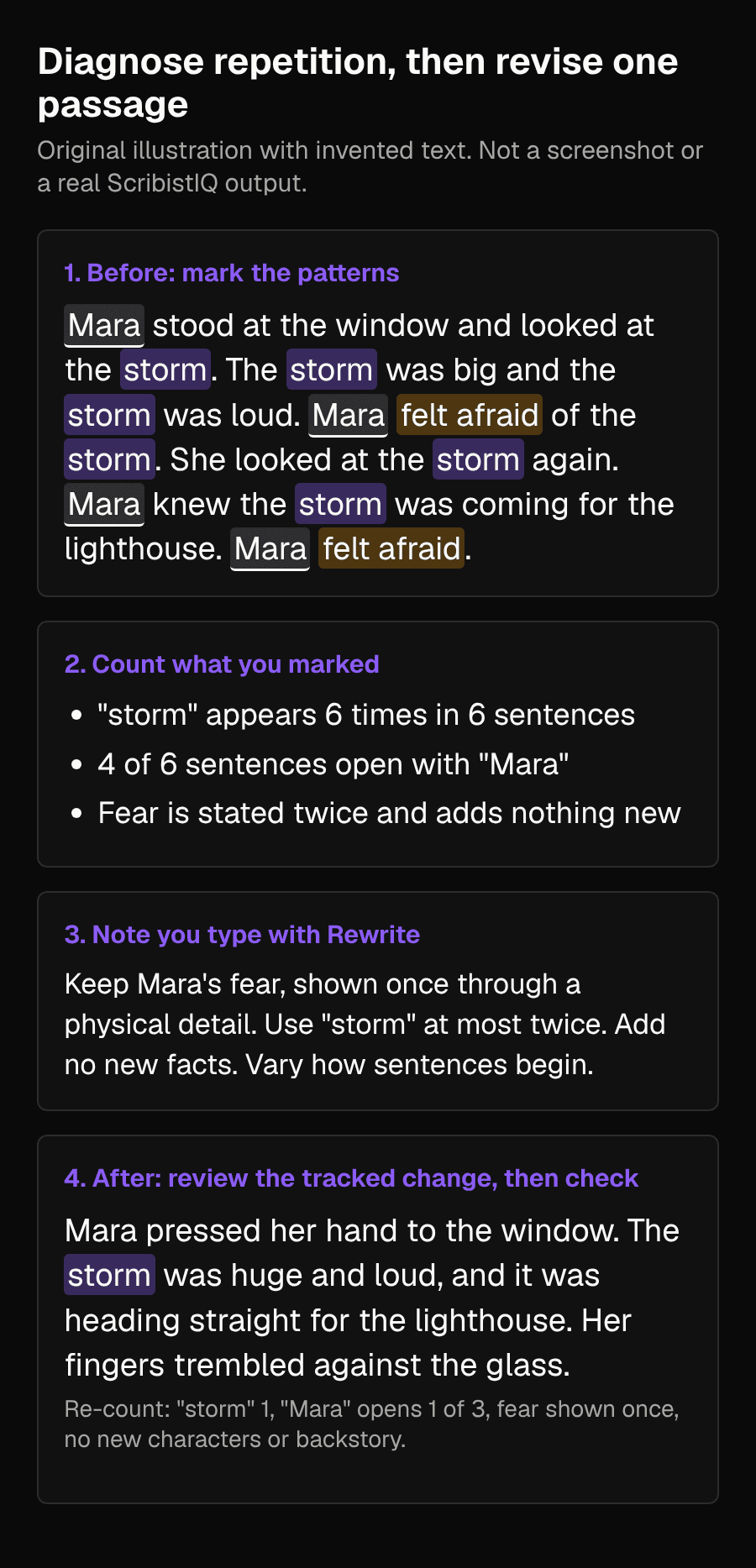
This revision passes the checks. Storm appears once, one of three sentences opens with Mara, fear is shown once through trembling fingers, and no fact was added beyond small physical detail. It is also fair to ask whether pressed her hand and trembled are new facts. They are small actions that express the stated fear, which is why the note allowed a physical detail. If you want a stricter result, add a line telling the AI to add no actions.
Chapter-level repetition
Repetition also spreads across a chapter. Check whether chapters open the same way, whether a summary at the end of a scene repeats what the scene just showed, and whether a later chapter re-explains something already established. Fix these one passage at a time with the same method. For questions such as what a chapter still needs, the guide describes an Ask the AI pane that discusses and suggests but never edits your text.[2]
Common problems
- The revision removes a deliberate echo. Reject it and add the refrain to the note as something to leave unchanged.
- New facts appear. Reject it and restate the fact list in the note.
- The same pattern returns in the next passage. Check the surrounding text for the cause before you rewrite it again, since repeated phrases can echo earlier chapters.
- The result is flatter. Try Try again once, then rewrite the passage yourself using the best phrase from each suggestion.
Limits
The example here is invented and short, and no real AI output was tested for this guide. The counting routine is an editorial method, not a measured quality score. Whether a given note reduces repetition in your own chapter depends on the passage and the suggestion you receive, which is why the steps end with a re-count you perform yourself.
Sources
- Sudowrite feedback board: Too much repetition (posted 2025-01-02)Checked 2026-11-03
- ScribistIQ: Co-write a novel with AIChecked 2026-11-03
- Original illustrative example and counting method for this articleChecked 2026-11-03