
How to choose a genre preset for a cross-genre novel in ScribistIQ
Romantasy, romantic suspense, cozy mystery or horror? Pick the preset whose rules you want in every chapter, then carry the second genre in your premise, tone and notes.

In this guide
Many novels sit between two genres: a fantasy that is really a love story, a romance built around a crime, a cozy mystery, a horror novel. ScribistIQ's full-book generators ask you to pick one genre preset or describe the genre yourself, and that choice matters more than a shelf label. On the Pro and Ultra Max generators, each fiction preset adds four fixed directives to every chapter prompt, and the guidance is stored on the book, so it also shapes chapters you regenerate later and passages you rewrite in Write Studio.[1][2]
The short answer: pick the preset whose four rules you want applied to every chapter, which is usually the genre that decides your ending. Then carry the second genre yourself, as concrete expectations in the premise, the tone and the characters-and-world notes. This guide shows how to make that call, what each fiction preset pushes for, where presets work against common blends, and one worked example from idea to inputs.
What a preset actually changes
- Seven presets exist: Thriller, Romance, Sci-fi / Fantasy, Literary, Memoir, Business and Self-help. The features page says the generators also accept your own genre description instead.
- On Pro (5 to 12 chapters, with a chapter plan you review and edit first) and Ultra Max (5 to 30 chapters, each written against the continuity bible), each fiction preset's four published directives are appended to every chapter prompt and stored on the book.
- Fast is listed on the genre pages as a fiction switch only, with no genre preset, so the decision in this guide applies to Pro and Ultra Max.
- Each preset also sets a tone. The thriller page says picking the preset pre-fills that tone, and the romance page says you steer heat and tropes through your premise, tone and the characters-and-world notes. There is no trope picker or heat slider.
- On Pro and Ultra Max, characters, places and rules you give up front are seeded into the story bible before chapter one. The fantasy page says up to 24,000 characters of notes are accepted.
The four fiction presets publish their directives word for word. That is what makes a deliberate choice possible: you can read each rule and ask whether you want it in every chapter of your book.[2][3][4][5]
| Preset | What its four directives push every chapter toward | Tone it sets |
|---|---|---|
| Romance | Two leads with distinct voices who notice different things; physical awareness through small specific details; tension internal first (want versus fear); a meaningful obstacle in every chapter, resolved only when emotionally earned. | Warm, intimate, alternating between yearning and humor |
| Thriller | Open in motion and end each chapter on a question, a reveal or a cliff; short sentences in action, longer in reflection; one protagonist point of view per chapter, switching only at chapter breaks; withhold what the protagonist does not know. | Tense, propulsive, lean prose with short sentences and frequent scene cuts |
| Sci-fi / Fantasy | Build the world through specifics characters use, never exposition dumps; magic or technology has costs and rules that are never broken for convenience; pronounceable names; the strange treated as ordinary by the people who live with it. | Epic but grounded |
| Literary | Voice over plot, cutting connective tissue; interior over external; no melodrama; specific nouns and verbs. The page adds that every chapter prompt forbids the reflexive tidy ending. | Restrained, precise, attentive to interiority |
A five-step way to choose the lead preset
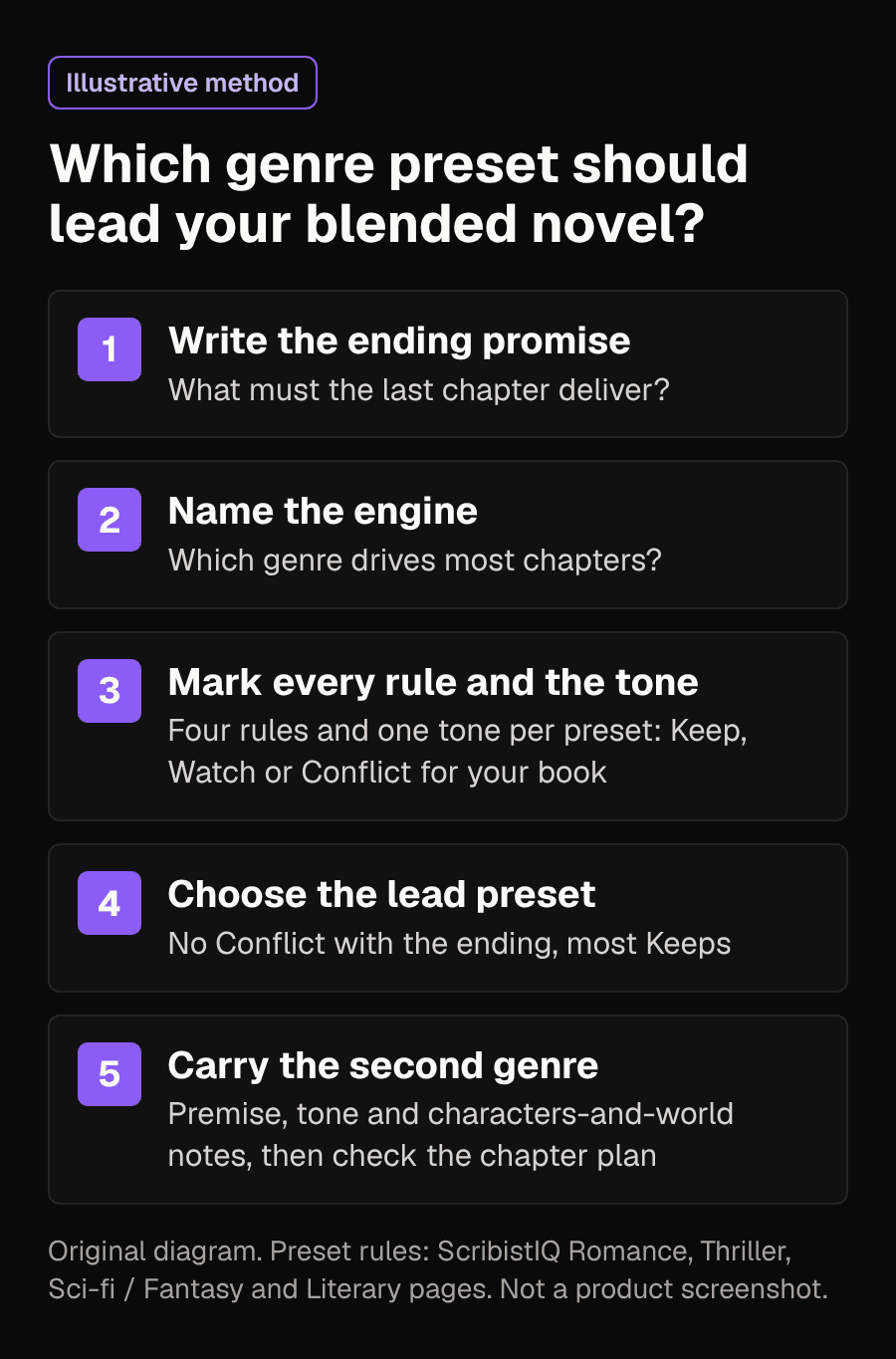
This is an editorial method, not a measured result: it has not been tested against generated books. It borrows one idea from a romance writer's guide to genre labels: when a story straddles two genres, look at what drives most scenes and what the final scene must deliver to satisfy the reader.[6]
- Write the ending promise in one sentence. What must the last chapter deliver for your reader to feel the book kept its word: the couple committed, the culprit named, the world saved, a quiet change in one person?
- Name the engine. Which genre's question drives most chapters forward? If you deleted the other genre, would the book still have a plot?
- Take the two closest presets and mark all ten items: each preset's four directives and its tone. Mark each one Keep (you want it in every chapter), Watch (useful or harmless if you steer it in your inputs) or Conflict (it fights your ending promise or tone). Do not skip an item because it seems minor; a tone you will need to change is a Watch, not a Keep.
- Choose the preset with no Conflict against the ending promise and the most Keeps. If every candidate has a Conflict on something central, consider describing your own genre instead (see below).
- Carry the second genre yourself: name the blend in the premise, adjust the tone, and put the second genre's must-haves into the characters-and-world notes as concrete rules. Then check the chapter plan before any prose is written.
Common blends: which preset to start from
These are editorial recommendations based on the published directives, not test results. The genre definitions in the first column follow common usage; for romance blends, the Writers in the Storm guide's distinction is useful: a romance foregrounds the courtship and a happy ending, while a thriller, mystery or fantasy with a love story treats it as a subplot.[6][2][4][3][5]
| Your book | Start from | Why | Carry yourself, and watch for |
|---|---|---|---|
| Romantasy or fantasy romance (the courtship is the main plot) | Romance | Its distinct-voices, internal-tension and earned-obstacle rules serve the love story in every chapter. | The Sci-fi / Fantasy rules are not applied, so write the magic's costs and limits as explicit rules in the characters-and-world notes, and name the world in the premise. |
| Fantasy with a romance subplot (the quest or war is the main plot) | Sci-fi / Fantasy | Costed, consistent magic and no exposition dumps matter in every chapter; the romance does not need a chapter-by-chapter obstacle. | Describe the relationship arc and where it lands in the premise, and check the chapter plan gives it room. |
| Romantic suspense (danger or a crime, but the couple's ending is the promise) | Romance | The ending promise is the relationship, and the case can supply each chapter's obstacle. | Thriller rules are not applied: if you want alternating points of view by chapter or hooks at chapter ends, plan them into the chapter outline yourself. |
| Thriller or crime novel with a love interest | Thriller | Chapter-end hooks, one point of view per chapter and withheld information drive the plot. | Its tone is tense and lean, so add any warmth to the tone; the thriller page warns the model does not research real procedures, weapons or jurisdictions. |
| Cozy mystery (low danger, a puzzle solved by wit) | No exact preset: Thriller with an edited tone, or your own description | Thriller's withhold-information rule suits a fair clue trail. | Watch: Thriller also tells every chapter to end on a question, reveal or cliff and sets a propulsive tone, which can push a cozy toward peril. Write the low-danger rule into the premise and notes. |
| Supernatural or psychological horror | No exact preset: Thriller for suspense-led horror, Literary for quiet horror | Thriller's withholding and short action sentences build dread; Literary's restraint and no-melodrama rule suit slow unease. | Avoid Sci-fi / Fantasy unless your characters live with the strange: its rule to treat the strange as ordinary works against a newcomer's fear. |
Directives that work against common blends
- Literary plus romance: the Literary page says every chapter prompt forbids the reflexive tidy ending. That is the opposite of a promised happy ending, so a love story whose ending is the point belongs on Romance, with the restraint you want written into the tone.
- Thriller plus cozy: a hook at every chapter end is fine; constant peril is not. Say in the premise that the sleuth is never in serious physical danger.
- Sci-fi / Fantasy plus horror: the newcomer's fear is the genre. If the point-of-view character is a stranger to the uncanny, a preset telling the model to treat it as ordinary is a Conflict.
- Romance plus a large ensemble: the Romance rules center two leads. A multi-lead epic with a minor love story usually belongs on Sci-fi / Fantasy or Thriller.
When to describe your own genre
The features page lists your own description as an alternative to the seven presets. Unlike the presets, the public pages do not publish what instruction a self-described genre adds to each chapter, so you cannot run the directive check on it in advance. If no preset passes step 4, describe the genre the way a good genre note does: not just a label but its expectations. Novelcrafter's guidance on genre entries makes the same point with a cozy-mystery example, listing that the mystery is solved through wit and social connection, that danger to the protagonist stays minimal and that puzzle-solving matters more than action. Then judge the result in the chapter plan and the opening chapter rather than assuming the description took hold.[1][7]
The fantasy page gives one documented example of steering inside a preset: for hard science fiction or grimdark, say so in the premise and it becomes an explicit directive in every chapter. The other preset pages do not document the same behavior, so treat naming a subgenre in your premise as good practice rather than a guaranteed directive.[3]
Worked example: a romantic suspense idea
The example below is invented to show the method. It is not a customer book, and no output was generated for this guide.
Working title: The Ledger in the Hull Idea: Wren Adair restores old canal boats in a fictional Midlands town. Inside a hull she is stripping, she finds a waterlogged ledger that links the marina's new owner to a drowning thirty years ago. The only person who can read its shorthand is Cal Osei, the county archivist she turned down two summers ago. Someone wants the ledger back. Ending the writer wants: Wren and Cal together and committed, and the drowning explained.
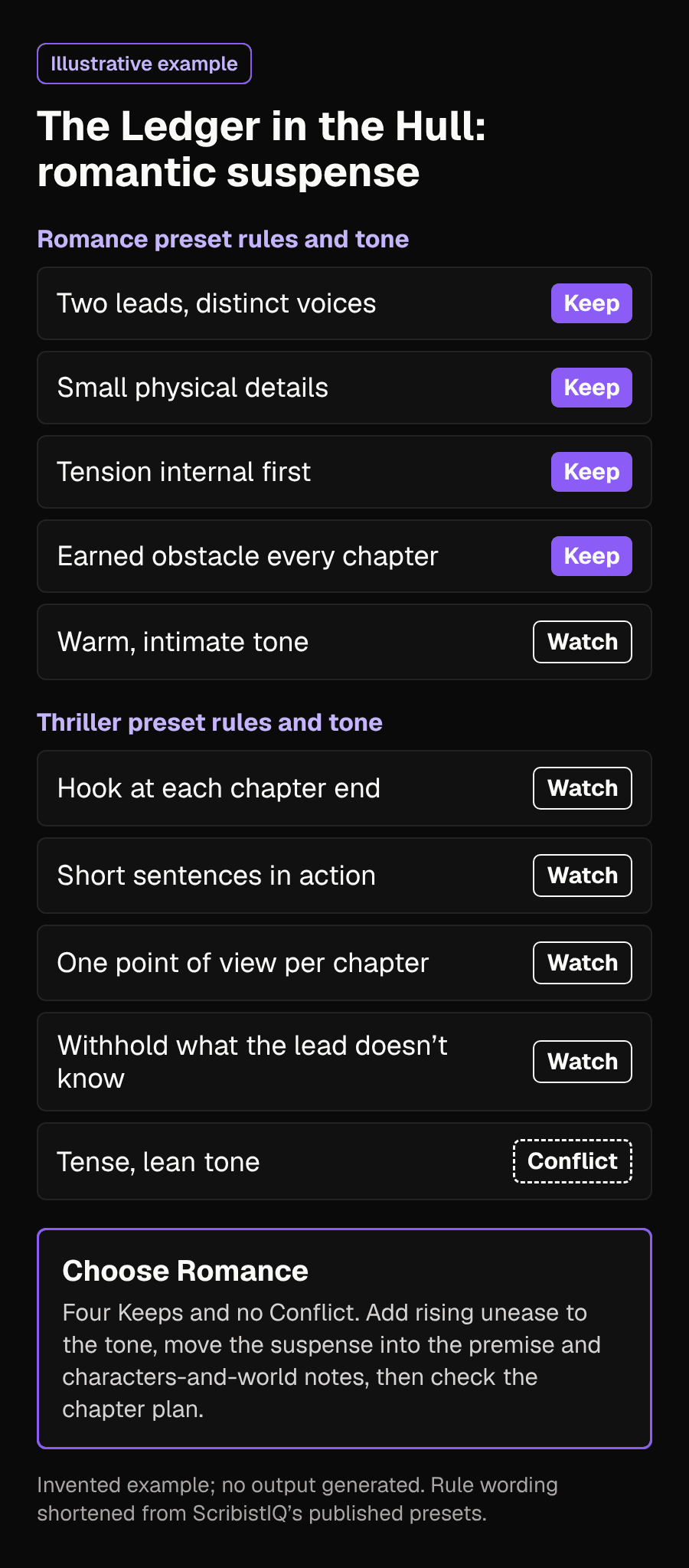
Steps 1 and 2. The ending promise is the couple, with the mystery solved along the way, and most chapters turn on whether Wren can trust Cal again. That makes it romantic suspense rather than a thriller with a love interest. Step 3 marks all ten items for the two closest presets, Romance and Thriller: four directives and the tone of each.[6]
| Preset rule or tone | Mark for this book | Reason |
|---|---|---|
| Romance 1: two leads with distinct voices | Keep | Wren and Cal alternate as the book's two points of view. |
| Romance 2: small physical details, not generic shorthand | Keep | Their awareness of each other carries the romance. |
| Romance 3: tension internal first | Keep | Wren's refusal two summers ago is the real obstacle. |
| Romance 4: an obstacle every chapter, resolved only when earned | Keep | The ledger case can supply each chapter's obstacle. |
| Romance tone: warm, intimate, yearning and humor | Watch | Right for the love story, but it has no unease in it. Step 5 adds rising unease to the tone. |
| Thriller 1: open in motion, end each chapter on a hook | Watch | Useful, but it can be planned into the chapter outline. |
| Thriller 2: short sentences in action, longer in reflection | Watch | Helpful when someone comes for the ledger. Under Romance it is not applied, so the tone asks for tighter sentences in danger scenes. |
| Thriller 3: one point of view per chapter | Watch | Wanted here, so it goes into the notes and the plan. |
| Thriller 4: withhold what the protagonist does not know | Watch | This is what makes the case suspenseful. The notes ration it: one new ledger entry per chapter, and no confession before the final third. |
| Thriller tone: tense, lean, frequent scene cuts | Conflict | It would starve the slow rebuilding of trust the ending depends on. |
Step 4 picks Romance: four Keeps, a Watch on its tone and no Conflict. Thriller has no Keep for this book and a Conflict on its tone. Step 5 moves the suspense the Romance preset will not supply into the inputs: the tone gains rising unease and tighter sentences in danger scenes, and the notes ration what Wren learns. Pro and Ultra Max take your characters, places and rules up front and seed them into the story bible before chapter one.[2][1]
Premise: A romantic suspense novel. Canal-boat restorer Wren Adair finds a ledger in a hull that links the marina's new owner to a thirty-year-old drowning, and needs Cal Osei, the archivist she turned down two summers ago, to read its shorthand. The love story leads; the case raises the stakes in every chapter and is solved before the ending. Tone: Warm and intimate, with rising unease; shorter, tighter sentences when someone comes for the ledger; danger is felt, never gory. Characters and world notes: - Wren Adair: restorer, practical, distrusts people who want things from her. Point-of-view character in odd-numbered chapters. - Cal Osei: county archivist, patient, still hurt by her refusal. Point-of-view character in even-numbered chapters. - The ledger: written in shorthand only Cal can read; each chapter reveals at most one new entry. - The marina owner: never confesses on the page before the final third. - Rule: the drowning is explained before the last chapter; the last chapter belongs to Wren and Cal.
Check the plan before prose, then the first chapter
On Pro you review and edit the chapter plan before any prose is written, and on Ultra Max you see the whole outline first and can rewrite any chapter beat. That is where the second genre is easiest to protect.[1]
- Does every chapter in the plan carry both genres, or does the second one vanish after chapter three? In the example, each chapter should have a ledger entry or threat and a moment between Wren and Cal.
- Is the ending in the plan the ending you promised? A romance plan that closes on the arrest, or a mystery plan that never names the culprit, needs a rewrite before generation.
- Are the planned points of view the ones you set in the notes?
Once chapters are written, read chapter one against your step 3 marks: does it sound like the genre whose ending you promised, and is the second genre present? A chapter you dislike can be regenerated on its own, and the preset guidance stored on the book is re-applied to it. Each generation shows its credit price before it runs. The public pages do not say whether editing the tone or notes after generation has started changes later chapters, so settle those inputs before you start.[1][2][4]
Every new account also gets one free opening chapter of its own book. The pages describe it as one chapter per new account, so treat it as a one-time look at the writing, not a check you can repeat after changing the tone or notes. The Literary page says this preview uses the same restraint rules and banned-phrase list as paid chapters. The Romance, Thriller and Sci-fi / Fantasy pages do not say whether the preview applies their directives, and no page says it uses your characters-and-world notes, so do not judge a blend from the preview alone. The plan review and the first chapter of the full book are the checks to rely on.[1][5][2]
Limits to keep in mind
- A preset directive is guidance appended to each chapter prompt, not a guarantee that every chapter meets it.
- Intimate scenes are written without explicit detail, so the Romance preset is not suited to erotica.
- One Sci-fi / Fantasy preset covers both genres; your premise and tone decide which you get.
- The model writes in English, and the thriller page warns it does not research real procedures, weapons or jurisdictions. Check those details, and any history or real places, yourself.
Sources
- ScribistIQ features: generators, characters and world, voice sampleChecked 2026-11-14
- ScribistIQ Romance preset pageChecked 2026-11-14
- ScribistIQ Sci-fi / Fantasy preset pageChecked 2026-11-14
- ScribistIQ Thriller preset pageChecked 2026-11-14
- ScribistIQ Literary preset pageChecked 2026-11-14
- Is My Book a Romance? (Writers in the Storm, May 12, 2025, with reader comments)Checked 2026-11-14
- Making an effective genre Codex entry (Novelcrafter lesson)Checked 2026-11-14