
Thriller story ideas for a novel written with AI, and how to set each one up
Eight original thriller story ideas with a point-of-view plan, a ticking clock and the facts to supply, plus one idea developed into a premise and a checked chapter plan.

In this guide
Most thriller idea lists give you a one-line hook and stop there. When AI writes the novel, an idea also has to survive being turned into a premise, a cast list and a 12-chapter plan, and some ideas fight the rules the Thriller preset adds to every chapter. This list gives eight original thriller story ideas, each with its point-of-view plan, its ticking clock, the facts you must supply yourself and a sensible book size, followed by one idea developed all the way to a premise and a checked chapter plan.
The short answer: choose an idea with a clear 'what if', one protagonist the reader travels with, and a clock you can count down chapter by chapter. Write down the facts the plot depends on before you generate, because the model will not research them for you. All eight ideas below are invented for this article; use them as they are or swap the setting, job and clock to make them your own.
What makes a thriller idea work for an AI-written novel
A thriller premise usually starts with a 'what if' question. Amanda Jayatissa, writing in Writer's Digest, suggests answering that question with a circumstance you find particularly interesting. She also describes an exercise a friend of hers swears by: take a book or film from a completely different genre and introduce a dead body.[5]
ScribistIQ's Thriller preset sets a tense, propulsive tone with lean prose, and adds four directives to every chapter prompt on the Pro and Ultra Max generators: open in motion and end each chapter on a question, a reveal or a cliff; short sentences in action and longer ones in reflection; one protagonist point of view per chapter, switching only at chapter breaks; and withhold information the protagonist does not have, so the reader catches up with them rather than getting ahead. The directives are stored on the book and reapplied when you regenerate a chapter or use AI assist in the Write Studio. The fast generator ignores the preset.[1]
Those rules turn into four questions to ask of any idea before you spend credits on it:
- Can every chapter end on a question, a reveal or a cliff? An idea with a running clock (a hearing, a handover, a shift change) gives each chapter something to end on.
- Whose eyes is each chapter seen through? One point of view is simplest. Two or more work if you name them in Characters and world so the chapter plan assigns them cleanly, as the Thriller page advises.
- Does the reader learn things only when the protagonist does? If your idea depends on the reader knowing more, or less, than the hero, you need to say so in your own inputs.
- Which facts does the plot depend on that the model cannot know? The Thriller page warns that it does not research real procedures, weapons or jurisdictions, so you supply them or check them afterwards.
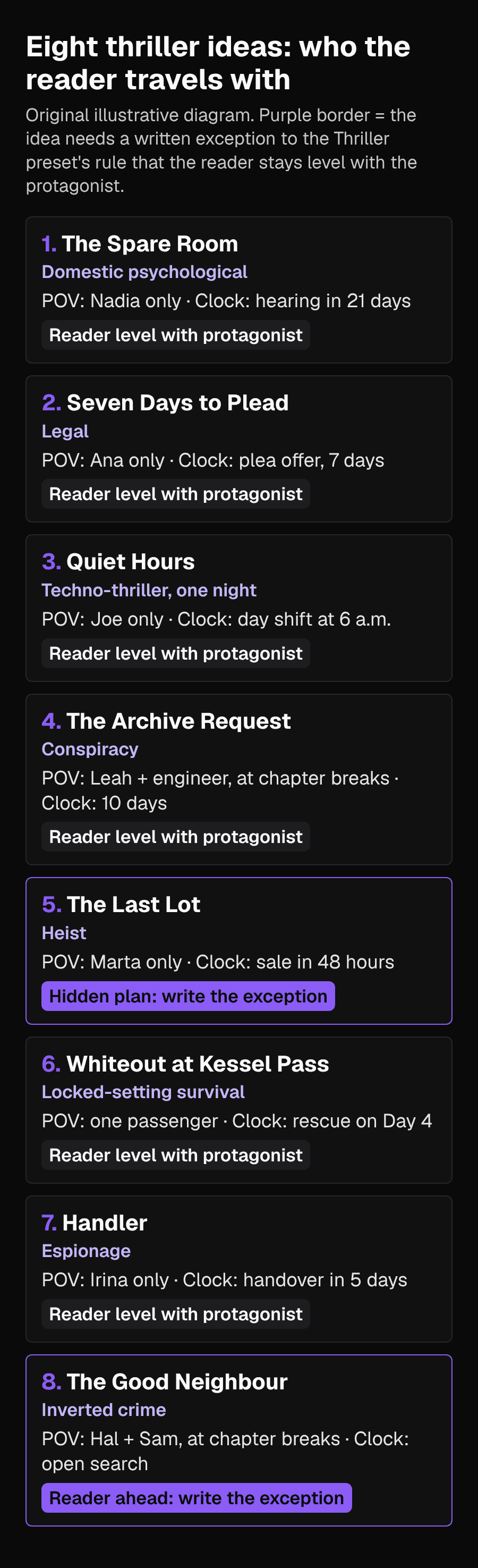
Eight thriller story ideas and how to set each one up
1. The Spare Room (domestic psychological thriller)
- Premise: Nadia, a widowed night nurse, rents her spare room to a quiet lodger to keep the house. Small things start turning up where her late husband used to keep them. What if someone knows her house better than she does? The clock: her custody hearing is in 21 days, and her ex says she is not coping.
- Point of view: One point of view, Nadia's, in every chapter. This is the easiest fit for the Thriller preset, because the reader learns only what she learns.
- What you must supply: Decide who is moving the objects and why before you generate, and the chapter where Nadia finds out. Put that truth and its reveal chapter in the premise (the thriller twist guide shows how).
- Size: 10 to 12 chapters on Pro.
2. Seven Days to Plead (legal thriller)
- Premise: Ana Ruiz, a public defender, is assigned a client whose alibi witness turns out to be her own brother, and the brother is lying. What if the only way to save her client is to expose her family? The clock: the prosecutor's plea offer expires at 9 a.m. in seven days.
- Point of view: One point of view, Ana's.
- What you must supply: Courtroom rules. The model does not research real procedures or jurisdictions, so either set the book in an invented county and write the few rules the plot depends on into Characters and world, or check every legal step yourself afterwards.
- Size: 7 chapters on Pro, one chapter per day from the offer to the 9 a.m. deadline. If you want 12 chapters, give the busiest five days two chapters each; either way, put the day in every chapter entry so the countdown ends on Day 7.
3. Quiet Hours (techno-thriller in one night)
- Premise: Joe Mensah, the night engineer at a small town's water plant, sees the treatment readings on one screen stop matching the ones in the log, while every alarm says normal. What if the screens are lying to him? The clock: the day shift arrives at 6 a.m., and he cannot prove anything before then.
- Point of view: One point of view. A whole book in one night suits the preset's 'open in motion, end on a cliff' rules: one chapter per hour.
- What you must supply: Invent the plant's systems and describe them in plain words in Characters and world: what each screen shows, who can change it, which door needs which key. Do not ask the model for real-world technical detail.
- Size: 8 chapters on Pro, one per hour from 10 p.m., when Joe's shift starts, to the 6 a.m. handover.
4. The Archive Request (conspiracy thriller)
- Premise: Leah Park, a junior archivist sorting a dead senator's papers, finds a letter that contradicts the official cause of a 1998 bridge collapse in an invented city. What if the people who signed the inquiry report are still in office? The clock: the papers open to the public in ten days, and someone wants the letter gone first.
- Point of view: Two points of view, Leah and the retired engineer named in the letter, switching only at chapter breaks as the preset requires. Name both in Characters and world.
- What you must supply: An invented history: the bridge, the inquiry, who signed what and when. Keep real events and real people out of it, and state every date outright.
- Size: 12 chapters on Pro. If both stories need more room, the next documented length is Ultra Max's Epic length of 20 chapters, and anything over 12 chapters needs the Pro subscription plan; Lite and Standard stop at 12.
5. The Last Lot (heist thriller)
- Premise: Marta, the registrar at an auction house, is forced to help a crew steal a painting during a sale in 48 hours. She agrees, and secretly plans to wreck the theft without the crew noticing. What if the crew planned for her betrayal too?
- Point of view: One point of view, Marta's. Watch the classic heist trick, where the hero's real plan is hidden from the reader until the end. The fourth Thriller directive asks the model to keep the reader level with the protagonist, so a plan Marta knows and the reader does not works against it. Either show her plan and hide only the crew's, or write that exception into your premise.
- What you must supply: The building's layout, the sale's timetable and the alarm rules, written as fixed facts.
- Size: 8 to 10 chapters on Pro.
6. Whiteout at Kessel Pass (locked-setting survival thriller)
- Premise: Eight passengers are stranded in a mountain rail station when an avalanche closes the line. One of them is travelling under another person's name. What if the stranger is not the most dangerous person in the room? The clock: food for two days, and rescue cannot reach them until the fourth morning.
- Point of view: One point of view: a passenger who is not a suspect. The worked example below develops this idea in full.
- What you must supply: A fixed cast list with ages and reasons for travelling, the station's rooms, and the countdown, so eight people stay distinct across 12 chapters.
- Size: 12 chapters on Pro.
7. Handler (espionage thriller)
- Premise: Irina, a retired interpreter, is called back for one job: translating for a defector who says her old handler was the leak that got two agents killed. What if the defector is telling the truth? The clock: the defector is handed over in five days, and after that nobody will hear him again.
- Point of view: One point of view, Irina's. Spy plots tempt writers into chapters from the agency's side; keep them out unless you add a second named point of view.
- What you must supply: Invented agencies, code names and the rules of the handover. Write them once and keep them stable.
- Size: 12 chapters on Pro. A longer version would need Ultra Max's Epic (20 chapters) or Novel (30 chapters) length, which only the Pro subscription plan includes.
8. The Good Neighbour (inverted crime thriller)
- Premise: From chapter 1 the reader knows that Hal, a friendly retired teacher, killed the woman next door. Detective Sam Okoro does not. What if the man helping with the search is the one she is looking for?
- Point of view: Two points of view, Hal and Sam. This idea deliberately puts the reader ahead of the detective, which runs against the fourth directive. See the fit check below before you pick the preset for it.
- What you must supply: The killing's facts, what Sam knows at each chapter, and the chapter where she finally suspects Hal.
- Size: 12 chapters on Pro.
| Idea | Point of view | Clock | Reader stays level with the protagonist? |
|---|---|---|---|
| The Spare Room | Nadia only | Custody hearing in 21 days | Yes |
| Seven Days to Plead | Ana only | Plea offer expires in 7 days | Yes |
| Quiet Hours | Joe only | Day shift at 6 a.m. | Yes |
| The Archive Request | Leah and the engineer, at chapter breaks | Papers open in 10 days | Yes, if each chapter keeps to what its narrator knows |
| The Last Lot | Marta only | Sale in 48 hours | Only if her plan is shown; hiding it needs an exception |
| Whiteout at Kessel Pass | One passenger | Food for 2 days, rescue on Day 4 | Yes |
| Handler | Irina only | Handover in 5 days | Yes |
| The Good Neighbour | Hal and Sam, at chapter breaks | Open search | No: the reader is ahead by design |
Fit check: ideas where the reader knows more, or less, than the hero
Two of the ideas run into the fourth directive. In The Good Neighbour the reader knows the killer from chapter 1; in a classic heist the hero hides her plan from the reader. The Thriller page does not say how the model treats a chapter narrated by a villain, or a narrator who keeps a secret from the reader, so do not leave it to chance. You have two options.[1]
| Option | How | Trade-off |
|---|---|---|
| Keep the Thriller preset and state the exception | Write one sentence in the premise saying exactly what the reader knows and from which chapter, and what the protagonist does not know until which chapter. For example: 'The reader knows from chapter 1 that Hal killed Mrs Bell. Sam does not suspect Hal until chapter 9.' | The other three directives still help. The directive is guidance, not a switch, so check each chapter plan entry and the draft for chapters that hide or reveal the wrong thing. |
| Write your own genre description instead | The generators accept your own description in place of a preset. Write the thriller rules you want, such as chapter-end hooks and one point of view per chapter, and leave out the one you do not. | The pages document the four directives as part of the Thriller preset, and they do not describe anything being added to your own description. Write every thriller rule you want followed, such as chapter-end hooks and one point of view per chapter, into the description itself. |
Whichever you choose, the premise is the right place for the rule: the continuity guide says the premise goes into every chapter word for word, together with that chapter's entry from the outline you approved.[3]
Worked example: developing Whiteout at Kessel Pass
Here is idea 6 taken from a one-line hook to the inputs you would enter and the chapter plan you would approve. It is an invented example, not generated output.
Step 1: Write the premise with every number stated
Every generator starts from a title and a premise. Use Pro or Ultra Max for this book: those are the generators that apply the Thriller preset (or your own genre description), while Fast writes without a genre preset. The continuity guide recommends stating numbers outright rather than leaving the model to work them out, and a locked-setting thriller runs on numbers: how many people, how much food, how long until rescue.[2][1][3]
Whiteout at Kessel Pass. On the evening of 3 January an avalanche closes the line above the mountain station at Kessel Pass, stranding eight passengers from the 17:40 train with the station attendant, Frank Doyle. Food will last two days. The rail company says rescue will reach them on the morning of the fourth day. Tess Varga, 34, a schoolteacher travelling home, tells the story. One passenger is travelling under another person's name: the man who calls himself Daniel Ash is Daniel's brother, Simon Ash. Tess and the reader learn this together in chapter 8. Before chapter 8, no narration, thought or dialogue states or hints that Daniel is not who he says. The bigger danger is Ruth Kell, who cancelled an avalanche warning that afternoon and will do anything to keep that hidden; Tess and the reader learn this in chapter 11. Before chapter 11, no narration, thought or dialogue states or hints that Ruth had any part in the warning.
The premise carries the two secrets and the chapter in which each comes out, so no chapter sees a secret without its reveal rule. How to plant fair clues for those reveals is covered in the thriller twist guide linked below.
Step 2: Fix the cast and setting in Characters and world
On Pro and Ultra Max, the characters, places and rules you enter in Characters and world are seeded into the story bible before chapter 1, and the continuity guide says each chapter treats the story bible as facts it must not contradict, up to 16,000 characters. With eight people in one room, a fixed cast list is what keeps them distinct. Write entries that stay true before and after each reveal.[2][3]
Tess Varga, 34: schoolteacher, point-of-view character in every chapter. Practical, notices who eats what. Daniel Ash (name on his ticket), about 40: says he is an engineer going to a job. Ruth Kell, 58: regional manager of the rail company. Travelling on a staff pass. Omar Haddad, 27: medical student. Has a first-aid kit. Bea Lund, 71: retired, travelling with her dog. Kit and Jo Moreno, 19 and 22: brother and sister on a ski trip. Paul Brandt, 45: travelling salesman. Talks too much, sleeps badly. Frank Doyle, 63: the station attendant, alone on shift. Has the only radio. Kessel Pass station: waiting room with a stove, ticket office (locked, Frank has the key), store room, platform. The tunnel below the station is blocked. Countdown: the avalanche is on the evening of Day 1. Food runs out on the evening of Day 3. Rescue arrives on the morning of Day 4.
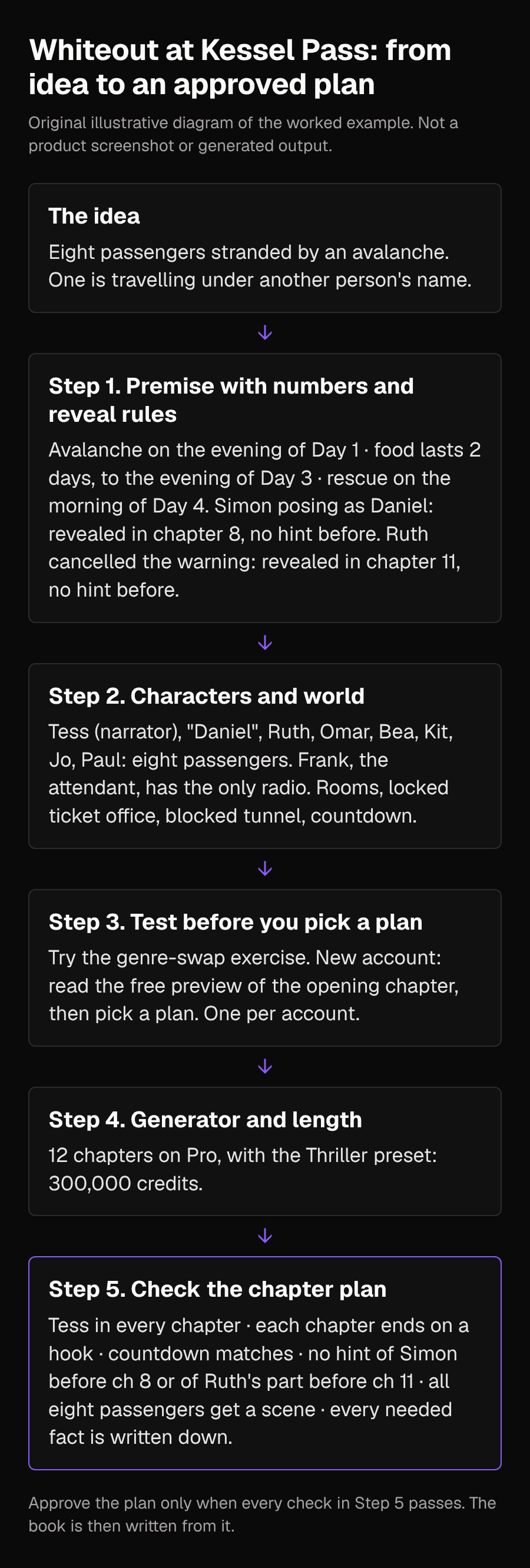
Step 3: Test the idea before you pick a plan
Do this before choosing a plan, because the free preview comes with a new account, before any plan is chosen. First try the genre-swap exercise Jayatissa describes in your head: picture the same people in a story from another genre, add the danger, and ask yourself whether it becomes more gripping. Then, if you are new to ScribistIQ, use the free preview. The pricing page sets out the order: you create a free account, read your free preview chapter, then pick a plan in the app. Every new account gets the opening chapter of its own book, about 500 to 700 words, with no card required, and paid plans start when you choose one.[5][4][2]
Spend that preview on the idea you most want to write. The pages do not say whether the preview applies the Thriller preset or reads Characters and world, so use it to judge the voice and how the opening lands, not whether the four directives or the cast list hold. It is one chapter per account, so treat it as a single look at the writing rather than something to repeat for each idea. If you already subscribe, there is no new-account preview; your check before the full book is the chapter plan review in Step 5.[4][1][3]
Step 4: Choose the generator and length
| Generator | What it does | Cost and limits |
|---|---|---|
| Fast | Writes a short book of 3 to 7 chapters in one pass, without the Thriller preset and without a plan to review. | 50,000 credits |
| Pro | 5 to 12 chapters with the Thriller preset. You review and edit the chapter plan before any prose is written. | 300,000 credits a book; included on every paid plan. The $29 Lite plan's 300,000 monthly credits cover one Pro book. |
| Ultra Max | 5 to 30 chapters, up to about 100,000 words, each chapter written against the continuity bible, with the preset applied. | 50,000 credits for the outline plus 50,000 per chapter: 650,000 for 12 chapters. Lite and Standard are capped at 12 chapters. The longer lengths the pricing page names are Epic (20 chapters) and Novel (30 chapters), and both need the Pro subscription plan. |
Whiteout at Kessel Pass needs 12 chapters to give eight people and three days enough room, so it fits the Pro generator. A longer conspiracy such as The Archive Request may want Ultra Max's Epic length of 20 chapters, which needs the Pro subscription plan; on Lite or Standard, plan it in 12. The novels in the Thriller page's gallery ran from 8 to 15 chapters when checked, which is a snapshot of published examples rather than a rule.[1][4]
Step 5: Check the chapter plan before you approve it
On Pro and Ultra Max you can see and edit the whole outline before writing starts; the Thriller page says this is how you place reveals deliberately. On Pro, the pricing page says reviewing the outline is free. Fixing an entry here is a matter of editing text, while a chapter that gives the secret away early has to be regenerated or rewritten afterwards. Check each entry against the premise:[1][2][4]
- Chapter 1 opens in motion: the avalanche, not the journey up.
- Every entry is told by Tess, and every chapter ends on a question, a reveal or a cliff.
- The countdown moves forward and matches the premise: food runs out on the evening of Day 3, rescue arrives on the morning of Day 4.
- No entry before chapter 8 states or hints that Daniel is not who he says, and no entry before chapter 11 states or hints at Ruth's part in the cancelled warning.
- Each of the eight passengers has at least one planned scene that shows something only they would do.
- Every fact the plot depends on (the radio, the locked ticket office, the blocked tunnel) is in Characters and world, not left for the model to invent.
Chapter 1: The avalanche hits as the 17:40 pulls in. Tess helps Frank count the passengers: eight. Ends on Frank's radio getting no answer. Chapter 4 (Day 2): Frank's radio finally reaches the valley: rescue cannot come before the morning of Day 4. Tess and Omar share out the food so it lasts until the evening of Day 3. Ends on Omar finding the store room lock forced, with nothing yet missing. Chapter 8 (Day 3): Tess finds a second passport in the lining of Daniel's bag. He admits he is Simon, travelling on his brother Daniel's ticket. Ends on Simon insisting that someone else on the train has more to hide than he does. Chapter 11 (Day 3, night): Frank's radio log shows Ruth cancelled the avalanche warning that afternoon. Ends on Ruth locking Tess in the ticket office.
Approve the plan only when every check passes. Each chapter is then written from the premise and its entry in the outline you approved, as the continuity guide describes. When the full book is written, PDF, EPUB and DOCX exports are included on every plan.[3][2]
Make any idea on this list your own
- Swap the setting and keep the trap: a ferry, a research station or a hospital ward on lockdown works like Kessel Pass.
- Swap the protagonist's job: the job decides what they notice first. A nurse notices medicine, an archivist notices dates, an engineer notices readings.
- Swap the clock: a hearing, a sale, a shift change or a handover. Write the deadline as a date or time in the premise.
- Keep one sentence of 'what if', one person the reader travels with, and the facts you will supply. If you cannot write those three, the idea is not ready to generate.
Common problems
| Problem | Likely cause | What to do |
|---|---|---|
| Chapters drift into other characters' heads | Points of view were not named, or the idea suggests chapters from the other side | Name every point-of-view character in Characters and world and check that each plan entry has one narrator |
| The secret leaks early | The truth is in the premise or notes without a reveal chapter | Join each secret to the chapter where it comes out, as in the Kessel Pass premise |
| Legal, medical or technical details are wrong | The model does not research real procedures, weapons or jurisdictions | Invent the system and write its rules down, or check the real details yourself |
| The middle sags | The clock is not visible in the plan | Put the day or hour in every chapter entry and make each chapter cost the protagonist time |
| A violent book cannot be shared publicly | Public share pages are screened for graphic violence | Keep very graphic books private; the Thriller page says export and print are not affected |
Limits
The eight ideas and the Kessel Pass example are original illustrations, and the fit check and chapter plan checks are editorial advice that has not been tested against generated books. A directive is guidance added to each chapter prompt, not a guarantee that every chapter follows it. ScribistIQ writes in English only. Prices, chapter limits and plan allowances were checked on November 25, 2026 and can change.[1][2][4]
Sources
- ScribistIQ Thriller preset page: tone, four directives, generators, Good to know and FAQChecked 2026-11-25
- ScribistIQ features: generators, genre presets, inputs, chapter plan review and exportsChecked 2026-11-25
- Keeping an AI-written novel consistent: what the AI sees with each chapter (ScribistIQ guide)Checked 2026-11-25
- ScribistIQ pricing: plans, credit allowances and Ultra Max chapter capsChecked 2026-11-25
- How to Create a Compelling Premise for a Thriller (Amanda Jayatissa, Writer's Digest, August 12, 2022)Checked 2026-11-25