
How many chapters should a novel have when AI writes it?
Start from the word count your genre expects, then pick the chapter count, generator and plan that get you there. Worked romance and fantasy examples with credit costs.

In this guide
There is no correct number of chapters for a novel. Chapter count is what you get when you divide the book's length by the length of a chapter, so the useful question is how many words your book should have. When an AI generator writes the book, that question matters earlier than usual: in ScribistIQ the chapter count is the length setting you choose before generation, and it also decides which plan you need and how many credits the book costs. Pick the word count first, then the chapters.[1]
Step 1: Set a word-count target for your genre
Use the most specific figure that applies to you. If you are writing for a particular publisher or series, its own guideline wins. Harlequin's current submission pages, for example, give each romance line a target: Harlequin Special Edition and Harlequin Romantic Suspense at 70,000 words, Harlequin Intrigue at 55,000, Harlequin Romance and Harlequin Presents at 50,000, and Afterglow at a minimum of 75,000. If you are self-publishing, a median of comparable manuscripts is a reasonable starting point. Reedsy's November 2026 figures, taken from 8,890 manuscripts sent to its copy editors in 2026, put fantasy at 93,000 words, science fiction and romance at 85,000, historical fiction at 76,000, thriller and suspense at 73,000, mystery and crime at 70,000 and literary fiction at 67,000. Reedsy calls these guidelines, and its sample is books sent for copy editing, not every book on sale.[6][5]
For shorter forms, Writer's Digest describes novellas as running from 30,000 to 50,000 words. Its article also quotes agent Lori Perkins: a first novel is much easier to market at 80,000 to 100,000 words. That advice is about pitching to agents; a self-published book can follow its genre's readers instead.[7]
| Book type | Starting target | Where the figure comes from |
|---|---|---|
| Fantasy | About 93,000 words | Reedsy 2026 median |
| Romance (Reedsy median) | About 85,000 words | Reedsy 2026 median |
| Romance, Harlequin Special Edition | 70,000 words | Harlequin series guideline |
| Thriller and suspense | About 73,000 words | Reedsy 2026 median |
| Literary fiction | About 67,000 words | Reedsy 2026 median |
| Novella | 30,000 to 50,000 words | Writer's Digest |
Step 2: Convert the target into a chapter count
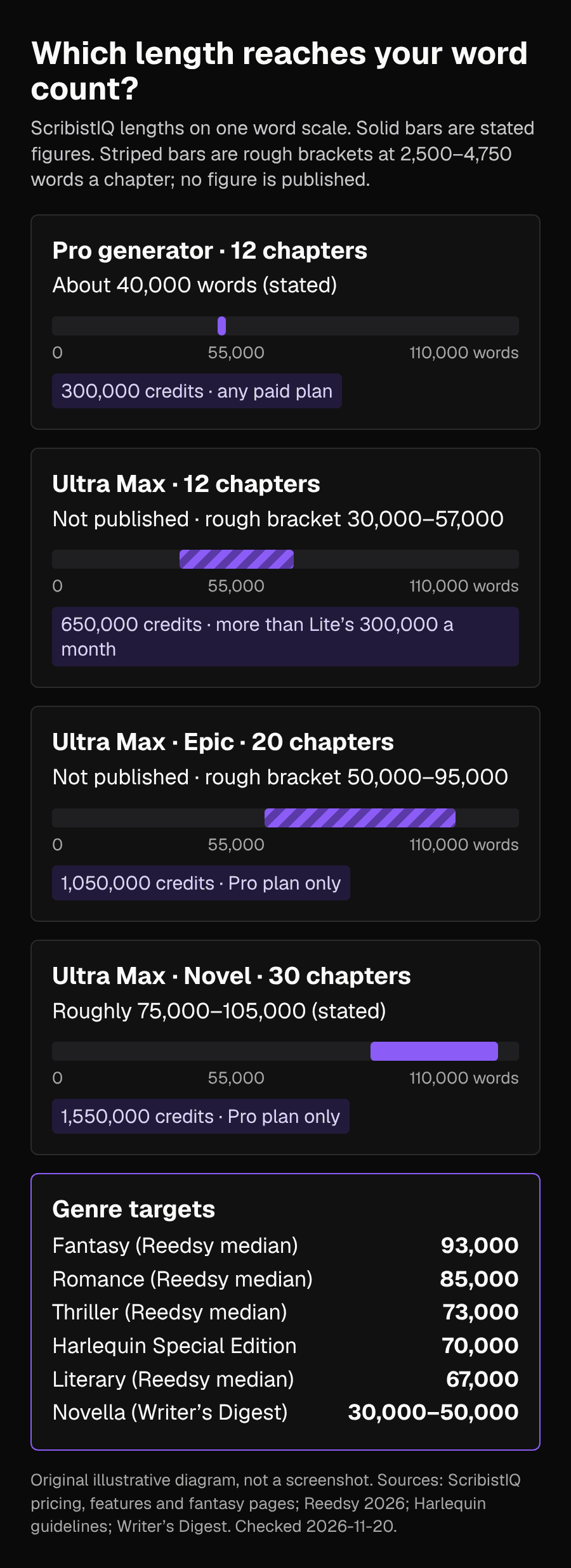
ScribistIQ has three generators. Fast writes a short book of three to seven chapters in one pass. Pro writes five to twelve chapters, about 40,000 words at twelve, after you review and edit the chapter plan. Ultra Max writes 5 to 30 chapters. Both Pro and Ultra Max write one chapter at a time against the book's continuity bible. The features page puts Ultra Max at up to about 100,000 words, and the fantasy page gives its 30-chapter Novel length as roughly 75,000 to 105,000 words. ScribistIQ does not publish a word range for Ultra Max at 12 or 20 chapters, and chapter size is not fixed. The Novel range works out to about 2,500 to 3,500 words a chapter. The reader-shared books listed on the fantasy page in November 2026 ran longer, about 3,300 to 4,750 words a chapter (a 10-chapter book of 33,000 words at the low end, 8-chapter books of 38,000 at the high end). That list changes over time and does not say which generator wrote each book, so treat it as a sign of how much chapter size varies, not as a rule.[1][2][4]
| Length you choose | Approximate words | Credits | Plan needed | Monthly credits check |
|---|---|---|---|---|
| Pro generator, 12 chapters | About 40,000 (stated) | 300,000 | Any paid plan | Lite's 300,000 covers one; Standard and Pro cover several |
| Ultra Max, 12 chapters | Not published; rough bracket 30,000 to 57,000 | 650,000 | Any paid plan | More than Lite's 300,000; Standard's 1,500,000 and Pro's 10,000,000 cover it |
| Ultra Max, Epic (20 chapters) | Not published; rough bracket 50,000 to 95,000 | 1,050,000 | Pro plan | Pro's 10,000,000 covers it |
| Ultra Max, Novel (30 chapters) | Roughly 75,000 to 105,000 (stated) | 1,550,000 | Pro plan | Pro's 10,000,000 covers it; the plan card lists six a month |
The two brackets multiply the chapter count by the smallest (2,500) and largest (4,750) chapter sizes above. They are not ScribistIQ figures; they show how wide the uncertainty is. Use the two stated lengths as anchors, and count the words of your own draft before deciding it is long or short.[4]
The credit figures follow the published prices: a Pro book is 300,000 credits, and Ultra Max is 50,000 for the outline plus 50,000 per chapter, which is why the FAQ gives about 650,000 for a 12-chapter novel. One naming trap: the Pro generator and the Pro plan are different things. Every paid plan includes the Pro generator, but the 20-chapter Epic and 30-chapter Novel lengths of Ultra Max are only on the Pro plan ($169.99 a month). The Lite ($29) and Standard ($49) plans write up to 12 chapters per book. The plans also include different monthly credits: Lite 300,000, Standard 1,500,000 and Pro 10,000,000. The allowance resets each billing period, and unspent allowance does not carry over. A Top-Up Pack adds 250,000 credits for $29, and those credits stay on your account until you spend them. On Lite, then, a 12-chapter Pro generator book uses the whole month's allowance, and a 12-chapter Ultra Max book costs more than the plan includes.[3][2][4]
Step 3: Pick the length whose range covers your target
- Find the row whose word range contains your target. If two rows overlap it, choose by budget and by how much cutting or adding you are prepared to do afterwards.
- If no row contains it, decide which way you would rather miss. Deleting a weak chapter from a longer draft is usually quicker than writing a missing one, but a longer length costs more credits up front.
- Check the plan and its monthly credits. A target well above 40,000 words, the stated size of a 12-chapter Pro book, needs either the Pro plan for Epic or Novel, or a 12-chapter book that you extend afterwards. The fantasy page says Lite and Standard plans can extend a book with Continue Book, and the features page says an extension adds up to 12 new chapters that the model proposes and you approve. The pricing page charges each added chapter, including Continue Book, at 10,000 credits for a Fast book, 35,000 for Pro and 50,000 for Ultra Max. Add the extension to the book's own cost and compare the total with your plan's monthly credits before you start.
- Before any prose is written, review the chapter plan. Pro and Ultra Max both show you the whole outline first and let you rewrite any chapter's beats, which is the cheapest moment to merge two thin chapters into one or split a crowded one.
- After generation, count the words of the finished draft. If it runs long or short against your target, trim or extend before you start line edits, not after.
Worked example 1: a 70,000-word romance
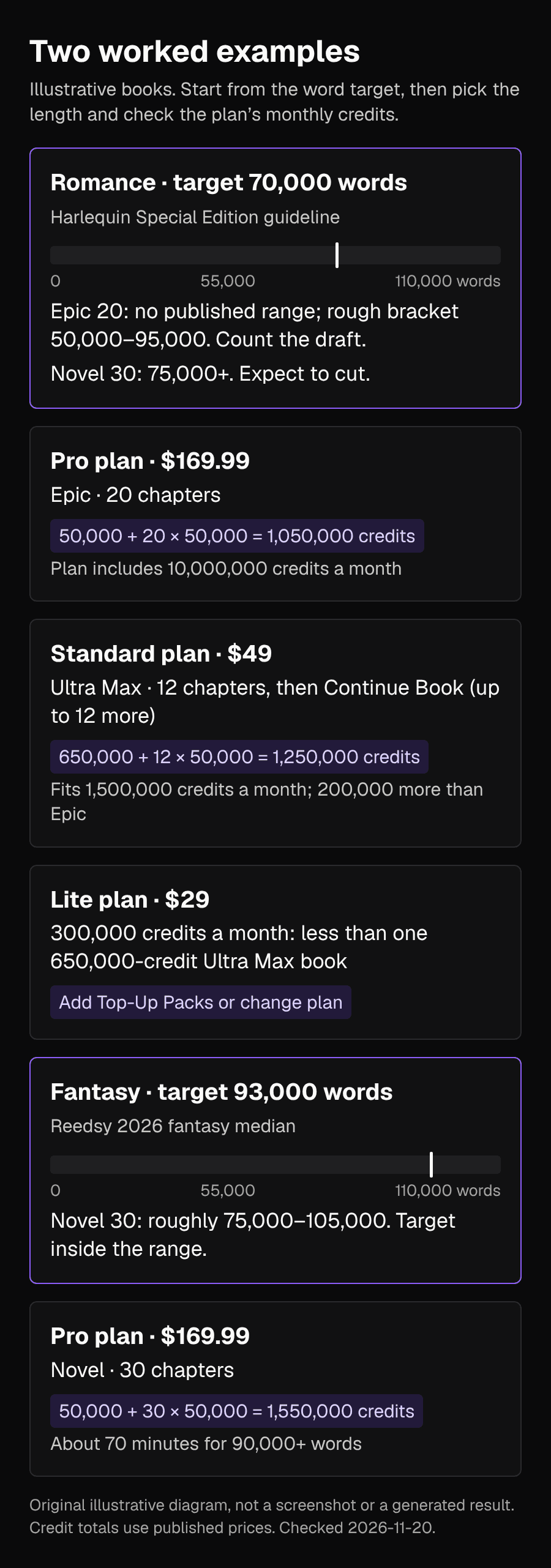
Target: 70,000 words, the Special Edition guideline. Epic (20 chapters): no published word range. At the Novel length's 2,500 to 3,500 words a chapter it would be 50,000 to 70,000; at the 3,300 to 4,750 of the reader-shared books listed in November 2026 it would be 66,000 to 95,000. The target is reachable, but the draft could land on either side of it. Novel (30 chapters): roughly 75,000 to 105,000 words. Even the low end is above the target, so expect to cut 5,000 words or more. On the Pro plan ($169.99): Epic, 1,050,000 credits, well inside the plan's 10,000,000 a month. Count the draft, then trim or add scenes toward 70,000. On Standard ($49): Ultra Max at 12 chapters (650,000 credits), then Continue Book at 50,000 credits per added chapter. All 12 extra chapters bring the book to 650,000 + 12 x 50,000 = 1,250,000 credits. That is 200,000 more than the Epic route, but it fits Standard's 1,500,000 a month and a cheaper plan. Count the first 12 chapters before extending, and add fewer chapters if they already run long. On Lite ($29): the 300,000 monthly credits do not cover even the 650,000-credit 12-chapter Ultra Max book. The full extended route would need four Top-Up Packs ($116 for 1,000,000 credits) on top of the allowance, which costs more than moving to Standard.[6][2][4][1]
Worked example 2: a 93,000-word fantasy
Target: about 93,000 words. Novel (30 chapters): roughly 75,000 to 105,000 words. The target sits inside the range, so this is the natural fit. Cost: 50,000 for the outline plus 30 x 50,000 per chapter = 1,550,000 credits, on the Pro plan, whose allowance lists six full-length 30-chapter Ultra Max novels a month. Time: the FAQ says a novel of 90,000 words or more takes about 70 minutes to generate. Check: at outline review, make sure no chapter is only a transition. Thirty chapters gives room for subplots, so give each one a job rather than letting the plan pad the middle.[5][4][2][3]
When a shorter book is the better choice
Not every book needs to be novel length. A novella of 30,000 to 50,000 words fits a 12-chapter book. The Pro generator's 12-chapter book is stated at about 40,000 words and costs 300,000 credits, which Lite's monthly credits cover once, and it gives you an editable chapter plan. Ultra Max at 12 chapters costs 650,000, so it needs Standard or Pro, or Top-Up Packs on Lite, and its word count at 12 chapters is not published. For a novella, do not pay the difference for continuity tools: both the Pro and Ultra Max generators write one chapter at a time against the same continuity bible, both take a voice sample, and both let you regenerate a single chapter. What Ultra Max adds is range: it runs from 5 to 30 chapters, up to about 100,000 words, and is priced per chapter. ScribistIQ also describes Ultra Max as its best writing; that is the vendor's own description, not a measured result. Choose Ultra Max at 12 chapters only if you prefer that generator and can accept an unpublished word count; otherwise the Pro generator gives a stated length of about 40,000 words at less than half the credits. Fast, at three to seven chapters for 50,000 credits, suits a short book or a quick test of a premise before you spend on the full length. Every new account can also read a free opening chapter of its own book before paying.[7][1][3][2]
Common problems
| Problem | What to do |
|---|---|
| Your target is between two lengths | Choose the longer length if you can afford it and cut afterwards, or the shorter one and plan to add scenes. Decide before generating, because the length is part of setting up the book. |
| You are on Lite or Standard and want more than 12 chapters | On Standard, write 12 Ultra Max chapters and add up to 12 more with Continue Book at 50,000 credits each: 1,250,000 credits for 24 chapters, within the 1,500,000 monthly credits. On Lite, the 12-chapter Ultra Max book alone (650,000) exceeds the 300,000 monthly credits, so add Top-Up Packs or change plan. The Pro plan's Epic length is 1,050,000 credits for 20 chapters. |
| The draft came out short | Read it for scenes the outline promised but the prose rushed. Expanding those usually serves the story better than adding new chapters, which cost credits per chapter. |
| The draft came out long | Look for chapters that repeat a beat or only move characters between places, and merge or cut them. |
| Your publisher's guideline differs from the medians here | Follow the publisher. Medians are a starting point for self-publishing, not a rule. |
Once you know your length, the chapter plan is where the book's shape is decided. If you are writing a slow-burn romance, the slow-burn guide shows how to space the relationship's milestones across the chapter plan, and the fantasy page explains how the continuity bible keeps a long book consistent.[4]
Sources
- ScribistIQ features: book generators, lengths and credit costsChecked 2026-11-23
- ScribistIQ pricing: plans, allowances and lengths by planChecked 2026-11-23
- ScribistIQ FAQ: generators, credits and generation timeChecked 2026-11-23
- Write a fantasy or sci-fi novel with AI: Good to know and Common questionsChecked 2026-11-23
- How Many Words in a Book? 2026 Averages and Trends from Reedsy (Hugh Davies, November 5, 2026)Checked 2026-11-23
- Harlequin series submission guidelines on SubmittableChecked 2026-11-23
- Novel and Short Story Word Counts (Writer's Digest, Brian A. Klems)Checked 2026-11-23