
Romance novel ideas to write with AI, and how to set each one up
Eight original romance novel ideas with a trope, point of view and an obstacle for every chapter, plus one second-chance idea taken to a premise and a checked chapter plan.

In this guide
Most romance idea lists stop at a trope and a one-line hook. When AI writes the novel, an idea also has to survive becoming a premise, a cast list and a chapter plan, and the Romance preset adds rules to every chapter that some ideas support and others fight. This list gives eight original romance novel ideas, each with its trope, its point-of-view plan, the obstacle that comes back in every chapter, the facts you must supply and a sensible size. After the list, one idea is developed all the way to a premise and a checked chapter plan.
The short answer: pick an idea where each lead wants something the other person threatens, and where the trope keeps producing a fresh obstacle chapter after chapter. Write down the facts the relationship depends on, especially anything that happened before chapter 1, because the model will otherwise invent them and may not invent them the same way twice. All eight ideas are invented for this article; use them as they are or change the setting, jobs and trope to make them your own.
What makes a romance idea work for an AI-written novel
Writer Bryn Donovan puts the starting point plainly: romance story ideas should be based in conflict, because obstacles are what let the couple change and show what they feel. ScribistIQ's Romance preset builds the same idea into the book. On the Pro and Ultra Max generators it sets a warm, intimate tone that alternates between yearning and humor, aims at adult readers of contemporary romance, and adds four directives to every chapter prompt: two leads with distinct, audible voices who notice different things in the same room; physical awareness shown through small specific details rather than a generic racing heart; tension that is internal first, what each lead wants against what they fear, before it is external; and a meaningful obstacle in every chapter, resolved only when it is emotionally earned. The preset is stored on the book and reapplied when you regenerate a chapter or use AI assist in the Write Studio. The Fast generator has a fiction switch only, not the preset.[5][1]
Those rules turn into five questions to ask of any idea before you spend credits on it:[1]
- Can you name both leads and what each one notices first? A florist and a caterer walk into the same wedding marquee and see different things. If you cannot say what, the voices will blur.
- What does each lead want, and what do they fear, and how does the other person threaten both? That is the internal tension the preset asks for before any outside obstacle.
- Does the trope produce a new obstacle in every chapter? Nisha Tuli, writing for Dabble, separates bigger tropes that shape the plot, such as fake dating or second chance, from smaller ones, such as having to share a bed, that are more of a detail. A smaller trope alone will not fill a book; pair it with a bigger one.
- What must be true before the couple can end up together, and in which chapter? The preset holds the resolution until it is earned, but only you know what earning it means for this pair. Write that in the premise.
- Is it set now? The preset's stated audience is adult readers of contemporary romance. A historical or fantasy romance needs the fit check further down.
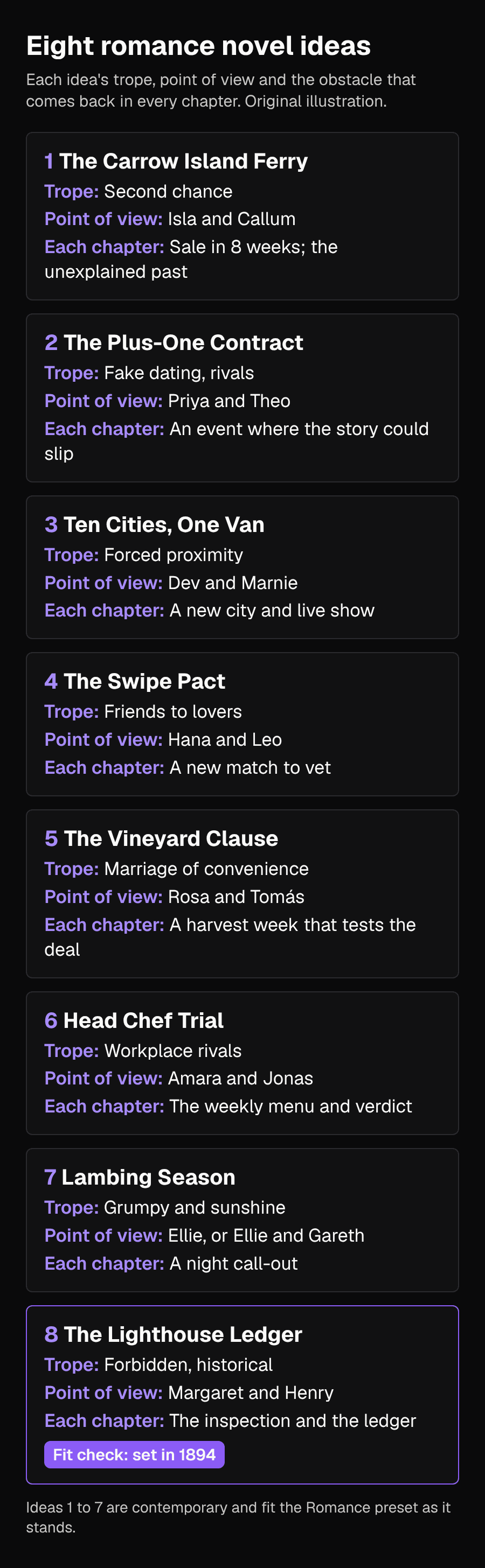
Eight romance novel ideas and how to set each one up
1. The Carrow Island Ferry (second-chance romance)
- Premise: Isla Byrne, an architect, comes back to Carrow Island to sell her late mother's guesthouse. The only ferry is run by Callum Reid, the man she left on the morning of their engagement party twelve years ago without a word. What if the reason she left was something he was never told?
- Trope: Second chance (a bigger trope), with forced proximity on a ferry neither can avoid.
- Point of view: Two points of view, Isla and Callum, switching at chapter breaks. Name both in Characters and world.
- The obstacle that returns each chapter: The guesthouse sale, which completes in eight weeks, and the unexplained past. Every chapter brings a viewing, a repair or a ferry crossing that forces them together.
- What you must supply: The past as fixed facts: the date, their ages then, why she left and who knew. The worked example below develops this idea in full.
- Size: 10 chapters on Pro.
2. The Plus-One Contract (fake dating)
- Premise: Priya, a wedding florist, needs a date for her sister's wedding in six weeks, where her ex is best man. She asks Theo, the caterer she argues with at every booking, who needs a florist who will stop undercutting him. What if the cover story starts to fit better than either of them planned?
- Trope: Fake dating with rivals at work: a bigger trope that supplies its own rules.
- Point of view: Two points of view, Priya and Theo.
- The obstacle that returns each chapter: Each chapter is a wedding-season event where they must work side by side and keep the fake story straight in front of someone who could catch them.
- What you must supply: The rules of the arrangement, written as a short numbered list in Characters and world (no kissing in private, the end date, what they tell her mother), so the model keeps the cover story consistent.
- Size: 8 to 10 chapters on Pro, one per event up to the wedding.
3. Ten Cities, One Van (forced proximity)
- Premise: Dev and Marnie host rival book podcasts. Their network merges the shows and sends them on a ten-city live tour in one converted van. What if the only thing their audiences agree on is that the hosts should stop pretending they hate each other?
- Trope: Forced proximity (bigger), with a single-bed night in one city (smaller).
- Point of view: Two points of view, Dev and Marnie.
- The obstacle that returns each chapter: A new city and a new live show in every chapter, each with something that can go wrong on stage.
- What you must supply: The tour list in order with the date of each show, the van's layout and who sleeps where, so each chapter's city and stop are fixed before the model writes it.
- Size: 10 chapters on Pro, one per city.
4. The Swipe Pact (friends to lovers)
- Premise: Hana and Leo have been best friends for fifteen years. One summer they agree to vet each other's dating-app matches before anyone gets a second date. What if each of them is quietly rejecting every match for the same reason?
- Trope: Friends to lovers (bigger). The risk is the obvious one: losing the friendship.
- Point of view: Two points of view, Hana and Leo, so the reader sees both of them sabotaging the pact.
- The obstacle that returns each chapter: A new match to vet in every chapter. Vary them on purpose (a good one, a funny one, one who is perfect on paper), or the chapters will repeat.
- What you must supply: The friendship history as dated facts: how they met, their ages then and now, and the one time it nearly happened. State the ages outright rather than leaving the model to work them out.
- Size: 8 to 10 chapters on Pro.
5. The Vineyard Clause (marriage of convenience)
- Premise: Rosa's grandmother's will says she keeps her share of the family vineyard only if she is married by the end of harvest. Tomás, the winemaker who has run the cellar for six seasons, needs a guaranteed contract to stay. They agree to a marriage on paper. What if the paper is the easy part?
- Trope: Marriage of convenience (bigger), with a one-bedroom cottage they must share for appearances (smaller).
- Point of view: Two points of view, Rosa and Tomás.
- The obstacle that returns each chapter: Each chapter is a week of harvest, with a family member, a lawyer or the weather testing the arrangement.
- What you must supply: The will's clause in one invented sentence and the harvest dates. Keep real inheritance law out of it; the model does not check legal facts, so invent the rule and state it.
- Size: 12 chapters on Pro, one per harvest week.
6. Head Chef Trial (workplace rivals)
- Premise: Amara and Jonas are the two sous chefs at a busy restaurant. The owner gives them six weeks to compete for one head chef job, with one new menu each week. What if the only way to win is to cook together?
- Trope: Rivals to lovers in a workplace (bigger).
- Point of view: Two points of view, Amara and Jonas.
- The obstacle that returns each chapter: The weekly menu and the owner's verdict on it.
- What you must supply: The trial's rules (who judges, what counts, what happens to the loser) and both chefs' signature dishes, so each chapter knows what is at stake.
- Size: 6 chapters on Pro, one per week, or 12 if each week gets a planning chapter and a service chapter.
7. Lambing Season (grumpy and sunshine, small town)
- Premise: Ellie, a newly qualified vet, takes the only job she is offered, at a rural practice. Her most frequent caller is Gareth, a sheep farmer who thinks she is too new to trust. What if lambing season leaves them no choice but to work through the nights together?
- Trope: Grumpy and sunshine (a dynamic more than a plot) with forced proximity during lambing (bigger).
- Point of view: One point of view, Ellie's, if you want the reader to see Gareth's softer side only when she does; two if you want his side too. Decide before you generate and say so in Characters and world.
- The obstacle that returns each chapter: A night call-out in every chapter: a difficult birth, a storm, a lamb that will not feed.
- What you must supply: The farm, the practice and the calendar of the season, so the nights move forward rather than repeat.
- Size: 8 chapters on Pro.
8. The Lighthouse Ledger (historical romance)
- Premise: In 1894, Margaret Hale keeps the light on Skerry Rock after her husband's death, and records his name, not hers, in the ledger. Henry Ward is sent by the lighthouse board to inspect the station and replace her. What if the inspector would rather falsify his report than send her away?
- Trope: Forbidden romance (bigger), with forced proximity on a rock in winter.
- Point of view: Two points of view, Margaret and Henry.
- The obstacle that returns each chapter: The inspection, which the board expects within a month, and the ledger's false entries.
- What you must supply: The period facts the plot depends on, invented or checked by you: the board's rules, the supply boat's schedule and what a keeper's day involved. See the fit check below before you choose the preset for it.
- Size: 10 chapters on Pro.
| Idea | Trope | Point of view | Obstacle each chapter | Fits the preset as it stands? |
|---|---|---|---|---|
| The Carrow Island Ferry | Second chance | Isla and Callum | Sale in 8 weeks; the unexplained past | Yes |
| The Plus-One Contract | Fake dating, rivals | Priya and Theo | An event where the story could slip | Yes |
| Ten Cities, One Van | Forced proximity | Dev and Marnie | A new city and live show | Yes |
| The Swipe Pact | Friends to lovers | Hana and Leo | A new match to vet | Yes, if the matches vary |
| The Vineyard Clause | Marriage of convenience | Rosa and Tomás | A harvest week that tests the deal | Yes |
| Head Chef Trial | Workplace rivals | Amara and Jonas | The weekly menu and verdict | Yes |
| Lambing Season | Grumpy and sunshine | Ellie, or Ellie and Gareth | A night call-out | Yes |
| The Lighthouse Ledger | Forbidden, historical | Margaret and Henry | The inspection and the ledger | Needs the fit check: set in 1894 |
Fit check: historical settings, heat level and small tropes
Three kinds of idea need a decision before you generate. The first is an idea that is not set now. The Romance preset's stated audience is adult readers of contemporary romance, and the Romance page does not say how the model treats a book set in 1894 or in an invented kingdom. Do not leave it to chance; you have two options.[1]
| Option | How | Trade-off |
|---|---|---|
| Keep the Romance preset and state the period | Put the year and place in the first sentence of the premise, and the few period rules the plot depends on (the board, the supply boat, what Margaret may not do) in Characters and world. | You keep the four directives, which suit a historical love story well. Check the chapter plan and the first chapter for modern speech, objects or attitudes, and fix them in the plan before approving it. |
| Write your own genre description | The generators accept your own description in place of a preset. Describe the historical romance you want, including the rules you would have kept: two distinct voices, internal tension first, an obstacle in every chapter. | The pages publish the Romance preset's directives, but not what is added for your own description, so write every rule you want followed into the description itself. |
For a romantic fantasy or other blend, the cross-genre preset guide linked below walks through choosing which genre leads. The second decision is heat. There is no heat-level slider or trope picker: heat and tropes are steered through the premise, the tone and the characters-and-world notes. The Romance page says adult content is not blocked, but in practice the model writes intimacy without explicit detail. A finished book can become a public page only after a sexual-content check, and explicit books stay private to their owner, who can still export and print them.[1]
The third is a smaller trope on its own. One bed, a wedding ring try-on or a 'who hurt you?' scene is a moment, not a book. If your idea is built on one, add a bigger trope that produces an obstacle in every chapter, as Lambing Season adds the long nights of the season to its grumpy-and-sunshine pair.[6]
Worked example: developing The Carrow Island Ferry
Here is idea 1 taken from a one-line hook to the inputs you would enter and the chapter plan you would approve. It is an invented example, not generated output. A second-chance romance has one problem the other ideas do not: the most important events happened before chapter 1. If you leave the break-up vague, the model has to invent it, and an invented fact is carried forward only through the automatic chapter summaries, so it can come out differently in chapter 3 and chapter 9.[4]
Step 1: Write the premise with the past stated as fact
Every generator starts from a title and a premise, and the continuity guide says the premise is included word for word in every chapter's prompt. Put the past there. In the guide's own test, a premise that gave a character's current age and the years since an event produced two different ages for that event in different chapters, because the model worked the sum out two ways. The guide's advice is to state numbers outright, such as the age at the time of the event, rather than leave the model to calculate them. So give both leads' ages then and now, and the year it happened.[2][4]
The Carrow Island Ferry. Isla Byrne, 34, an architect in Glasgow, comes back to Carrow Island in March to sell her late mother's guesthouse; the sale completes in eight weeks. The only ferry is run by Callum Reid, 35. Twelve years ago, in June, when Isla was 22 and Callum 23, she took the first ferry off the island on the morning of their engagement party and never explained why. The truth: she had been offered a place at an architecture school, and Callum's father told her Callum would give up the ferry and his family's living to follow her, so she left to stop him. Callum does not know this. He learns it in chapter 7, when he finds his father's letter to her, which her mother kept. Before chapter 7, no narration, thought or dialogue states the reason Isla left; she may refuse to talk about it. Isla wants to sell quickly and get back to her life; she fears being the person who stays and shrinks. Callum wants an explanation and the guesthouse kept open; he fears being left again without warning. They end together only in chapter 10, after Isla chooses to keep the guesthouse and Callum chooses to let her keep her work in Glasgow too.[1]
The last sentence is your definition of an earned resolution, written where every chapter will see it. If the pace of the romance itself is your main worry, the slow-burn guide linked below shows how to set milestone rules for a whole book.[4]
Step 2: Give both leads and the island fixed facts in Characters and world
On Pro and Ultra Max, the cast list and world rules you paste into Characters and world become the story bible before chapter 1. The continuity guide says each chapter treats the story bible as facts it must not contradict, up to 16,000 characters. For a romance, the most useful entries are what each lead notices, which is how the preset's 'different things in the same room' directive gets something specific to work with.[2][4][1]
Isla Byrne, 34: architect. Point-of-view character in odd-numbered chapters. Notices buildings, light and anything badly repaired. Dry humour; changes the subject when the past comes up. Callum Reid, 35: runs the Carrow ferry, two crossings a day. Point-of-view character in even-numbered chapters. Notices weather, tides and who is on the boat. Says little; keeps promises. Tom Reid, 68: Callum's father. Retired from the ferry. Wrote Isla a letter twelve years ago that Callum has never seen; Nora kept it in the guesthouse attic. Nora Byrne: Isla's mother, died in January. Ran the guesthouse for thirty years. The guesthouse: six rooms above the harbour, roof leaking, booked for the summer by regular guests Nora never cancelled. Carrow Island: 300 residents, one shop, one pub (the Anchor), one ferry. The last crossing is at 6 p.m. Timeline: they met at 17 and 18; engaged at 22 and 23; she left in June twelve years ago; she returns in March; the sale completes in May.[4]
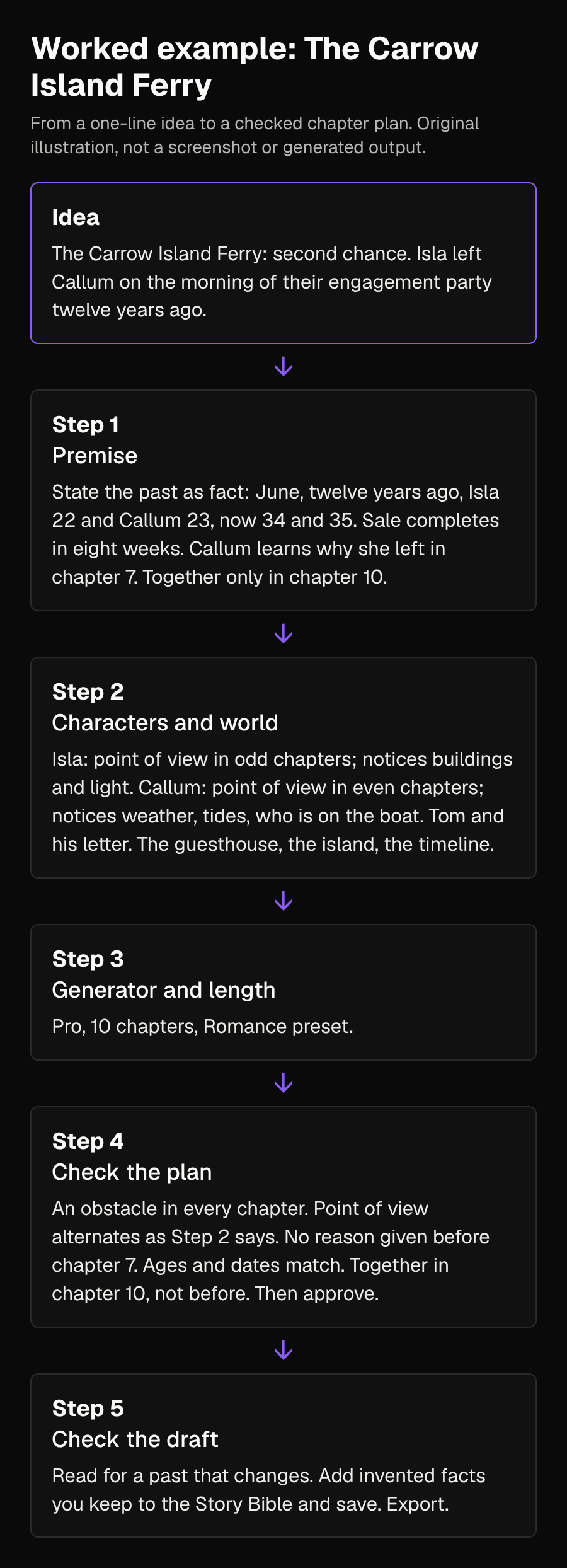
Step 3: Choose the generator and length
| Generator | What it does | Cost and limits |
|---|---|---|
| Fast | Writes a short book of 3 to 7 chapters in one pass, with a fiction switch but without the Romance preset. | 50,000 credits |
| Pro | 5 to 12 chapters with the Romance preset. You review and edit the chapter plan before any prose is written. | 300,000 credits a book. The $29 Lite plan's 300,000 monthly credits cover one Pro book. |
| Ultra Max | 5 to 30 chapters, up to about 100,000 words, each chapter written against the continuity bible, with the preset applied. | 50,000 credits for the outline plus 50,000 per chapter: 650,000 for 12 chapters. Lite and Standard are limited to 12 chapters; the Epic (20) and Novel (30) lengths need the Pro plan at $169.99 a month. |
The Carrow Island Ferry needs ten chapters: one for the return, one for each turn of the eight weeks, and room for the letter and the choice. That fits the Pro generator. A longer slow burn may want Ultra Max; the Romance page says books of 12 to 30 chapters give a slow burn room to develop. The six romances in that page's gallery ran from 5 to 23 chapters when checked, a snapshot of published examples rather than a rule. If you are new to ScribistIQ, the pricing page sets out the order: you create a free account, and each new account gets the first chapter of its own book, about 500 to 700 words, with no card required, before you choose a paid plan in the app. It is one chapter per account, so spend it on the idea you most want to write.[1][3]
Step 4: Check the chapter plan before you approve it
On Pro you review and edit the chapter plan before a word of prose is written, and on Ultra Max you can review the whole outline and rewrite any chapter beat. Fixing an entry here is a matter of editing text, while a chapter that reveals the letter early has to be regenerated or rewritten afterwards. Check each entry against the premise:[2]
- Chapter 1 opens on the ferry, with the two of them in the same small space, not on Isla packing in Glasgow.
- Point of view alternates as Characters and world says: Isla in odd chapters, Callum in even ones.
- Every entry has an obstacle that belongs to that chapter: a viewing, the roof, a cancelled crossing, a guest who remembers them as a couple.
- No entry before chapter 7 states why Isla left, and the letter appears in chapter 7, not earlier.
- The ages and dates match the premise: twelve years, 22 and 23 then, 34 and 35 now, the sale in May.
- They end together in chapter 10, after the two choices the premise names, and not before.
Chapter 1 (Isla, March): Isla takes the afternoon ferry to Carrow and finds Callum at the wheel. Neither mentions the engagement party. Ends on him refusing her fare. Chapter 4 (Callum): A storm cancels the last crossing and the buyer's surveyor is stranded at the guesthouse. Callum helps Isla patch the roof before the surveyor sees it. Ends on him asking, once, why she went; she will not say. Chapter 7 (Isla, April): Clearing the guesthouse attic for the sale, Callum finds the letter his father wrote Isla twelve years ago, which her mother kept. Ends on Callum reading it aloud to her. Chapter 10 (Callum, May): The day the sale should complete. Isla withdraws it and tells Callum she will keep her work in Glasgow and the guesthouse both. He agrees to run the extra Friday crossing.[2]
Approve the plan only when every check passes. Each chapter is then written from the premise and its entry in the plan you approved.[4]
Step 5: Check the draft for a past that changes
When the book is written, read it for the facts a second-chance story leans on: the year, the ages, the day she left, and what each lead says about it. The continuity guide suggests reading for numbers, exact wording and repeated discoveries; for this book, a repeated discovery would be Callum learning the truth twice. On the Pro plan, Continuity Check lists contradictions with the conflicting passage and the earlier fact, at 3,000 credits a chapter for up to 25 chapters a run. It changes nothing and can miss problems, so read as well. If the draft invents a fact you want to keep, such as the name of Isla's school, open the book in Write Studio, add it to the Story Bible and save; every chapter you later write, regenerate or continue reads the updated bible. PDF, EPUB and DOCX exports are included on every plan.[4][2]
Make any idea on this list your own
- Swap the trope and keep the pair: Priya and Theo also work as enemies to lovers without the fake relationship, but then you need a different obstacle for each chapter.
- Swap the jobs: the job decides what each lead notices first, which is what gives them distinct voices.
- Swap the obstacle and keep its rhythm: a sale, a tour, a harvest or a season all supply one new problem per chapter. Write the dates in the premise.
- Keep three things: what each lead wants and fears, the obstacle that comes back each chapter, and what has to be true before they end together. If you cannot write those, the idea is not ready to generate.
Common problems
| Problem | Likely cause | What to do |
|---|---|---|
| The leads sound the same | Neither lead has something specific to notice or a way of speaking | Give each a job, a habit of attention and a speech pattern in Characters and world, or paste a voice sample of up to 4,000 characters |
| They get together in chapter 4 | The premise does not say when or why they may | Write the chapter and the condition for the resolution into the premise, as in the Carrow Island premise |
| The break-up story changes between chapters | The past was left for the model to invent | State the date, ages and reason in the premise and the timeline in Characters and world |
| Every chapter repeats the same scene | The trope gives one obstacle, not a new one each chapter | Vary the obstacle on purpose in the plan, or pair the trope with a bigger one |
| Love scenes are less explicit than you wanted | The model writes intimacy without explicit detail in practice | Use the preset for the romance and expect to write explicit scenes yourself; explicit books stay private but can be exported and printed |
Limits
The eight ideas and the Carrow Island example are original illustrations, and the fit check and plan checks are editorial advice that has not been tested against generated books. A directive is guidance added to each chapter prompt, not a guarantee that every chapter follows it. Prices, chapter limits and plan allowances were checked on November 26, 2026 and can change.[1][3]
Sources
- Romance novel generator (ScribistIQ)Checked 2026-11-26
- Features (ScribistIQ)Checked 2026-11-26
- Pricing (ScribistIQ)Checked 2026-11-26
- AI novel continuity guide (ScribistIQ)Checked 2026-11-26
- 50 Irresistible Romance Story Ideas! (Bryn Donovan)Checked 2026-11-26
- Romance Tropes: The Heartbeat of a Genre (Nisha Tuli, Dabble)Checked 2026-11-26