
Fantasy novel ideas to write with AI, and how to set each one up
Eight original fantasy novel ideas with the magic's cost, who finds it ordinary and the obstacle in each chapter, plus one idea developed into a premise and a checked chapter plan.

In this guide
A fantasy idea that works for an AI-written novel needs more than a cool world. It needs a magic rule with a price, a point-of-view character who knows what is normal in that world and what is not, an obstacle that comes back in every chapter, and a decision about whether magic is allowed to solve the ending. Below are eight original fantasy novel ideas across different subgenres, each set up with those parts, a fit check for ideas that pull against ScribistIQ's Sci-fi / Fantasy preset, and one idea developed into a premise and a checked chapter plan.
What makes a fantasy idea work for an AI-written novel
On ScribistIQ's Pro and Ultra Max generators, the Sci-fi / Fantasy preset is added to every chapter prompt, stored on the book and applied again when you regenerate a chapter or use AI assist in Write Studio. Its tone is 'epic but grounded' and it is written for adult readers of speculative fiction. The Fast generator has a fiction switch but no genre preset. These are the preset's four directives:[1]
- Worldbuild through specifics characters interact with — never via exposition dumps.
- Magic / tech has costs and rules. Establish them; never break them for convenience.
- Names and place-names should be pronounceable on first read.
- Treat the strange as ordinary to characters who live there. The reader figures it out.
A directive is guidance to the model, not a guarantee, and it can only enforce what you give it. If your idea says only that magic is dangerous, the model has to invent the cost, and it may invent a different one in chapter 3 and chapter 11. So for each idea below, the entries you would supply are written out: the cost in plain numbers, who finds the magic ordinary, and the obstacle each chapter brings.[1]
One more decision matters before you generate. Brandon Sanderson's First Law says an author's ability to solve conflict with magic is directly proportional to how well the reader understands that magic. A 'hard' system with explicit rules can solve the climax. A 'soft', mysterious one should create problems that the characters solve some other way. Each idea below says which it is, because unless the premise says so, nothing tells a chapter that magic is off limits when a scene needs a way out, and the preset's 'never break them for convenience' rule only helps if the rules exist.[3][1]
Eight fantasy novel ideas and how to set each one up
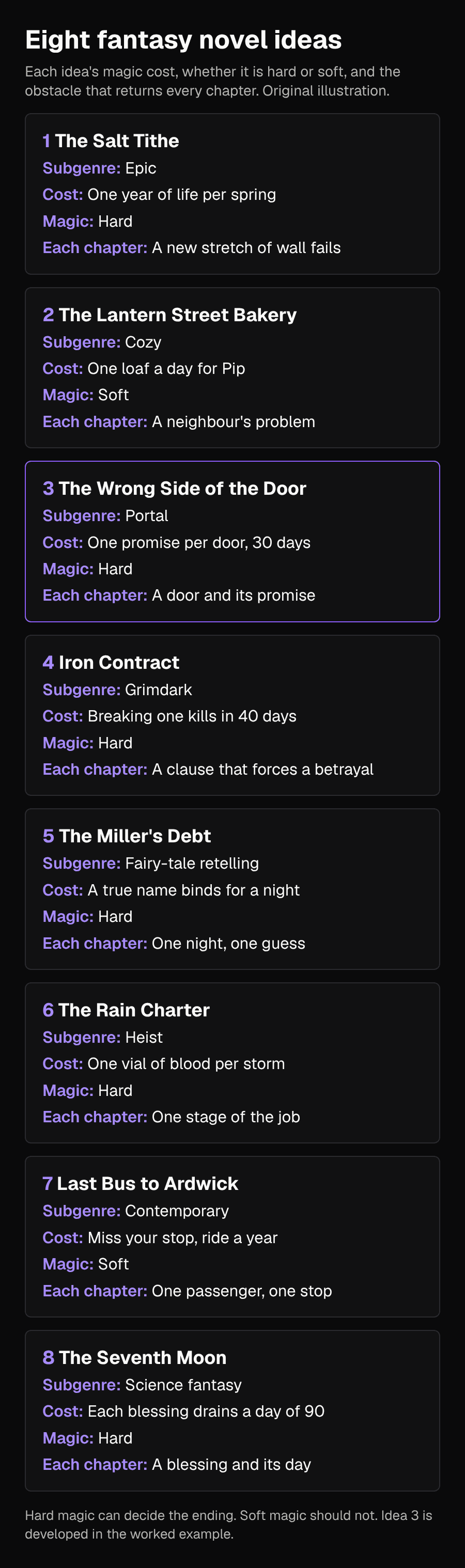
Each entry gives a premise you can paste and adapt, the subgenre, the magic and what it costs, whether it is hard or soft, who treats it as ordinary, the obstacle that renews each chapter, and a suggested size. The ideas are original and illustrative; none is a generated book.
1. The Salt Tithe (epic fantasy)
- Premise: In the coastal kingdom of Mora, the tide-wardens hold back the sea each spring by giving it one year of their own lives. Wren Calloway, 19, the newest warden, finds that the royal family, who are supposed to pay double, have paid nothing for three generations, and the wall is failing.
- Magic and its cost: One year of the warden's life for each spring holding; a warden who has given ten years cannot hold again. Hard: the rule can decide the climax.
- Who treats it as ordinary: Everyone in Mora. Wardens are honoured, not pitied, so no character should explain the tithe to another.
- The obstacle each chapter: A new stretch of wall fails, and someone must decide who pays for it.
- Size: 20 chapters on Ultra Max. Epic length (20 chapters) needs a Pro plan; Lite and Standard plans write up to 12 chapters per book.
2. The Lantern Street Bakery (cozy fantasy)
- Premise: Odile Marchand, 58, a retired battle-mage, opens a bakery in a quiet market town. Her oven burns because of a standing bargain with a small fire spirit called Pip, who must be fed one loaf a day. Each week a neighbour brings her a problem that baking alone cannot fix.
- Magic and its cost: Pip keeps the oven lit for one loaf a day; miss a day and the oven goes cold for a week. Soft beyond that rule: Odile's old battle magic is gone, and nothing magical solves a neighbour's problem.
- Who treats it as ordinary: The town, which has had fire spirits in its ovens for centuries.
- The obstacle each chapter: One neighbour's problem, solved by people rather than spells.
- Size: 8 chapters on Pro. State the cozy, low-stakes tone in the premise, because the preset's default tone is 'epic but grounded'.
3. The Wrong Side of the Door (portal fantasy)
- Premise: Maeve Doyle, 41, a Dublin locksmith, opens a cupboard door during a house clearance and steps into Hollin, a river city where every door belongs to someone and passing through one costs a spoken promise.
- Magic and its cost: Each door crossing binds the traveller to one promise to the door's owner, which must be kept within 30 days or the traveller can never pass through a Hollin door again. Hard.
- Who treats it as ordinary: Everyone in Hollin, but not Maeve. That split is the whole idea, and the worked example below shows how to set it up.
- The obstacle each chapter: A door Maeve needs to cross and a promise she must make to cross it.
- Size: 10 chapters on Pro.
4. Iron Contract (grimdark fantasy)
- Premise: Captain Sefa Arden's mercenary company is hired by both sides of a civil war in the same week. Contracts in this land are sealed in iron and enforced by the iron itself: whoever breaks one feels it rust in their blood.
- Magic and its cost: Breaking an iron contract kills slowly, over 40 days. Hard.
- Who treats it as ordinary: Every soldier and lord; children learn to read contracts before scripture.
- The obstacle each chapter: A clause in one of the two contracts that forces Sefa to betray someone.
- Size: 16 chapters on Ultra Max. A 16-chapter book needs a Pro plan, because Lite and Standard plans write up to 12 chapters per book; on those plans, write 12 chapters and extend the book afterwards with Continue Book. The fantasy page says to state grimdark in the premise, which turns it into an explicit directive in every chapter.
5. The Miller's Debt (fairy-tale retelling)
- Premise: Ten years after a small, nameless man spun straw into gold for her, Queen Elske learns that her bargain was never paid in full, and he has come back for her daughter. This time he gives her three nights, not three days, and she already knows his name is not the one in the story.
- Magic and its cost: A true name spoken aloud binds its owner for one night. Every bargain must be repaid in kind. Hard.
- Who treats it as ordinary: The court, which treats bargains with the small folk as a tax.
- The obstacle each chapter: One night, one guess and what that guess costs.
- Size: 9 chapters on Pro: three for the past bargain, three nights and three for the cost.
6. The Rain Charter (heist fantasy)
- Premise: Five thieves have one season to steal the city of Varr's rain charter, the document that decides which districts get rain, from the Guild of Weather before the drought kills the poor quarter.
- Magic and its cost: Rain is written, not summoned: one storm needs one vial of the writer's own blood as ink. Hard.
- Who treats it as ordinary: All of Varr, which buys and sells weather like grain.
- The obstacle each chapter: One stage of the job, and one thief whose loyalty is tested by it.
- Size: 10 chapters on Pro, one stage of the job per chapter.
7. Last Bus to Ardwick (contemporary fantasy)
- Premise: Jo Okafor drives the last night bus in Manchester. After midnight, some of her passengers are dead, and each one needs to be dropped at the right stop before sunrise.
- Magic and its cost: A passenger who misses their stop stays on the bus for a year. Soft beyond that rule: nobody, including Jo, knows who runs the route.
- Who treats it as ordinary: Jo, after eleven years on the route. New passengers are frightened; she is not.
- The obstacle each chapter: One passenger and the stop they need.
- Size: 10 chapters on Pro. Keep the mystery of the route unstated in the premise and the notes if the book should not solve it.
8. The Seventh Moon (science fantasy)
- Premise: On a planet with seven moons, the river clans believe a sleeping god guides their boats. Navigator Tamsin Ree learns the god is the failing navigation system of the ship their ancestors arrived in, and it has 90 days of power left.
- Magic and its cost: What the clans call blessings are system commands; each one drains a day of the 90. Hard, once you decide it is technology.
- Who treats it as ordinary: The clans, who have never heard the word ship.
- The obstacle each chapter: A blessing someone needs and the day it costs.
- Size: 12 chapters on Pro or Ultra Max. The same preset covers science fiction and fantasy, so decide in the premise whether the reader should ever learn the word ship.
Fit check: when an idea pulls against the preset
Most of the ideas fit the preset as it stands. A few pull against one of its defaults, and each one needs a line in the premise so every chapter sees it. The left column is the situation; the right column is what to write.[1]
| Your idea | What the preset assumes | What to write in the premise |
|---|---|---|
| An outsider point of view (portal fantasy, a newcomer, a visitor) | The strange is ordinary to characters who live there | Name the one character who finds the world strange, and say that everyone else treats it as ordinary and never explains it to each other |
| A cozy or comic tone | Epic but grounded | State the tone in plain words, such as low stakes, warm and funny, and what the worst thing that can happen is |
| Grimdark or hard science fiction | One preset for fantasy and science fiction | Say grimdark or hard science fiction in the premise; the fantasy page says this becomes an explicit directive in every chapter |
| Soft, mysterious magic | Magic has costs and rules that are never broken | State the few rules that do exist, and that magic does not resolve the climax |
| A book for children or teenagers | Written for adult readers of speculative fiction | State the reader's age range and what the book must avoid; the preset itself is written for adults, so read the first chapters closely |
| A long epic with several viewpoints | The Pro generator writes 5 to 12 chapters; Epic (20) and Novel (30) lengths need a Pro plan | Name each viewpoint character and which chapters they narrate, or choose a shorter book with one viewpoint |
Worked example: developing The Wrong Side of the Door
Here is idea 3 taken from a one-line hook to the inputs you would enter and the chapter plan you would approve. It is an invented example, not generated output. A portal fantasy has a problem the other ideas do not: the preset tells the model to treat the strange as ordinary to people who live there and let the reader figure it out, but your point-of-view character does not live there. The answer is not to drop the directive. It is to say exactly who finds what strange, so Maeve can be confused while the people of Hollin never explain their own world to each other.[1]
Step 1: Write the premise with the rule and the outsider stated
The continuity guide says your premise is included word for word in every chapter's prompt. Its own test also showed that a number the model had to work out from two others came out two different ways, so state the numbers you need outright: the 30 days, the count of promises and the chapter where the choice happens.[2]
The Wrong Side of the Door. Maeve Doyle, 41, a locksmith in Dublin, opens a cupboard door during a house clearance and steps into Hollin, a river city where every door belongs to someone. Passing through any door in Hollin binds the traveller to one spoken promise to the door's owner. A promise must be kept within 30 days, or the traveller can never pass through a Hollin door again, including the cupboard that leads home. Maeve is the only point-of-view character, and the only person who finds Hollin strange. The people of Hollin treat promises and doors as ordinary and never explain them to each other; Maeve learns the rules by breaking them. She makes her first promise in chapter 1 and has made five by chapter 6. In chapter 10, with every Hollin promise kept, she learns the price of crossing home: one more promise, to come back within 30 days. She must choose between going home for good, which breaks that promise and shuts every Hollin door to her, and staying; magic gives her no third way out.
The last two sentences do the work of Sanderson's First Law for this book: the rule is hard and stated, so the reader can watch Maeve's choice coming, and the premise rules out a convenient spell at the end.[3]
Step 2: Give the cast, the doors and the rule fixed facts in Characters and world
On Pro and Ultra Max, the characters, places and rules you paste into Characters and world before generating seed the book's story bible, and each chapter is written against those notes plus summaries of the last ten chapters. Keep the entries short and checkable. The story bible guide linked below shows a full format for magic rules; for this idea, the promise count is the fact most likely to drift.[1]
Maeve Doyle (41): locksmith from Dublin. Point-of-view character in every chapter, third person, past tense. Notices locks, hinges and who holds keys. Has never been out of Ireland. Abbess Coll (pronounced COLL, 60s): owns the river gate. Kind, exact, never lies, never explains. Ren Tavi (30): a ferryman who owns no doors and so crosses none. Maeve's only friend in Hollin. The rule: one door crossing equals one spoken promise to the door's owner. A promise kept within 30 days is released. A promise broken or still open after 30 days means the traveller can never pass through a Hollin door again. The Abbess owns the Hollin side of the cupboard door. Hollin: a river city of bridges and doors. No one in Hollin is surprised by the rule; everyone has lived with it all their lives. Promise ledger: chapter 1, mend the Abbess's gate lock. More are added in the plan; five by chapter 6. Never state: who built the cupboard door in Dublin.[1]
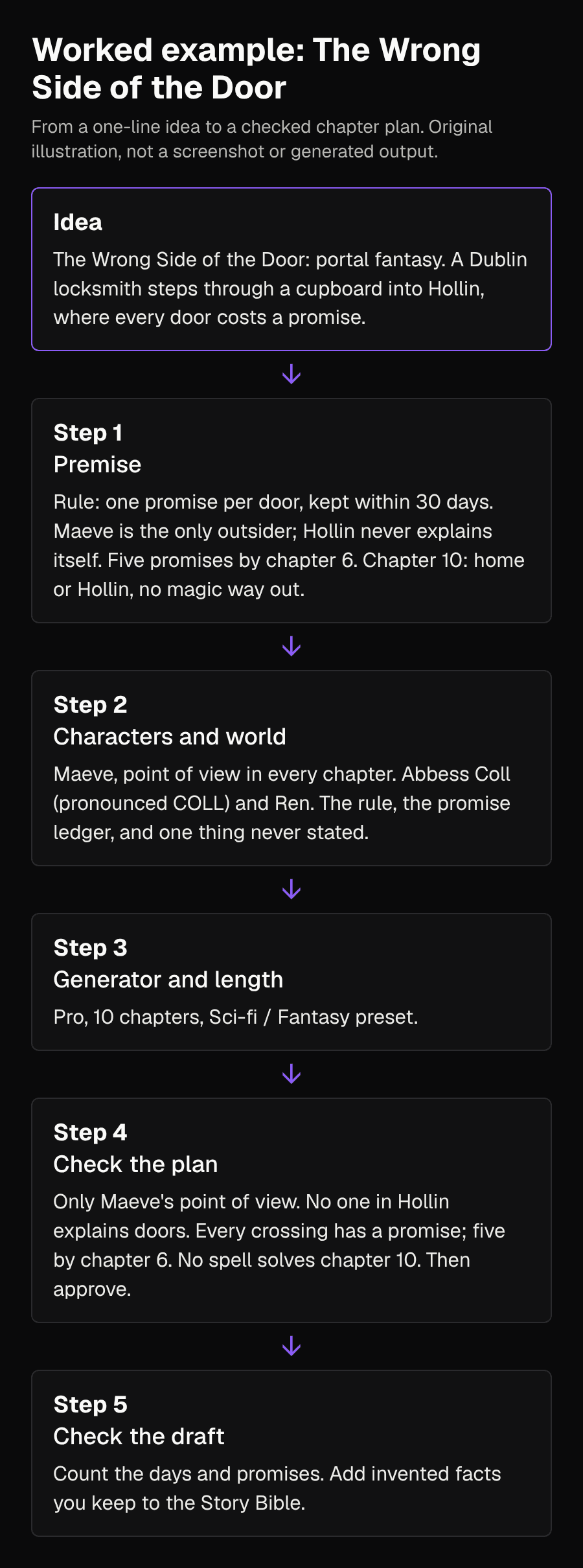
Step 3: Choose the generator and length
| Generator | What it does | Cost and limits |
|---|---|---|
| Fast | One pass, 3 to 7 chapters, with a fiction switch but no genre preset | 50,000 credits |
| Pro | 5 to 12 chapters with the Sci-fi / Fantasy preset applied. You review and edit the chapter plan first | 300,000 credits a book |
| Ultra Max | 5 to 30 chapters with the preset, each chapter written against the continuity bible | 50,000 credits plus 50,000 per chapter. Epic (20) and Novel (30) lengths are on Pro plans; Lite and Standard plans write up to 12 chapters per book |
The Wrong Side of the Door needs 10 chapters: one for the crossing, eight for the promises piling up, and one for the choice. That fits the Pro generator. The Salt Tithe (20 chapters) or Iron Contract (16) would want Ultra Max and, at those lengths, a Pro plan: Lite and Standard plans write up to 12 chapters per book and can extend it afterwards with Continue Book. Paid plans start at $29 a month, and every paid plan includes every generator.[1]
Step 4: Check the chapter plan before you approve it
On Pro you review and edit the chapter plan before any prose is written. Changing a line of plan is cheaper than rewriting a chapter that has already broken the rule. Check every entry against the premise:[1]
- Maeve is the only point-of-view character in every entry.
- No entry has a Hollin character explaining doors or promises to another Hollin character. Explanations only happen when Maeve asks, or when she breaks the rule.
- Every crossing in the plan comes with a promise, and the count reaches five by chapter 6.
- No promise is forgotten: every one made in Hollin is kept by chapter 10.
- Nothing in the plan says who built the cupboard door.
- Chapter 10 is Maeve's choice between home and Hollin, and no spell, loophole or new rule resolves it.
Chapter 1: Maeve steps through the cupboard door, whose Hollin side the Abbess owns, and the crossing binds her first promise: to mend the Abbess's gate lock. She does not yet know what she has agreed to. Chapter 3: Ren refuses to cross a door with her and will not say why. Maeve works it out from the way the market stalls avoid doorways. Promises: three. Chapter 6: The Abbess's lock is mended, and the first promise is released. A fifth door, a fifth promise: to find a ferryman's lost daughter. Chapter 10: Every Hollin promise is kept. The Abbess names the price of the cupboard door: a promise to come back within 30 days. Maeve will not make a promise she means to break. She stays, and opens a locksmith's stall by the river gate.
Approve the plan only when every check passes. Each chapter is then written from the premise, your Characters and world notes and its entry in the plan.[1]
Step 5: Check the draft for a rule that bends
When the book is written, read for the facts a portal fantasy leans on: the 30 days, the count of promises, and whether anyone in Hollin starts explaining the world to someone who already knows it. On Pro and Ultra Max each chapter is written against your notes plus summaries of the last ten chapters. In the continuity guide's October 7, 2026 test book, facts the chapters invented were carried forward only by those summaries, which then recorded events rather than fixed details, and some were contradicted. The guide says that since that date the summary after each chapter records fixed details such as ages and amounts, each backed by a quote. Its advice still applies: if the draft invents something you want to keep, such as the name of a door's owner, open the book in Write Studio and add it to the Story Bible; the guide says anything you add is read by every chapter you write, regenerate or continue from then on. The fantasy page notes that maps, glossaries and appendices are not generated, so a list of doors and owners, if you want one in the finished book, is yours to write.[1][2]
Make any idea on this list your own
- Keep the cost, change the world: a year of life, a vial of blood or a promise per door each work in very different settings. Write the number in the premise.
- Swap who finds it strange: any of the ideas becomes a portal or newcomer story if you add an outsider, and then it needs the outsider line from the fit check.
- Decide hard or soft before you generate, and say in the premise whether magic may resolve the ending.
- Keep three things: the cost in numbers, the obstacle each chapter brings and the person who treats the magic as ordinary. If you cannot write those, the idea is not ready to generate.
Common problems
| Problem | Likely cause | What to do |
|---|---|---|
| Characters explain the world to each other | The premise does not say who finds it strange | Name the outsider, or say that no character explains the world; the preset already asks for no exposition dumps |
| A spell solves the climax | The premise never said whether magic may resolve the ending | State it in the premise and check the last chapter's plan entry |
| The cost changes between chapters | The cost was described, not counted | Put the number in the premise and the rule in Characters and world |
| The tone is grander than you wanted | The preset's default tone is epic but grounded | State the tone in the premise, as in the bakery idea |
| Names are hard to keep straight | Similar or hard-to-say names | Keep names short and different, and give a pronunciation for any that could stumble |
Limits
These ideas, setups and plan checks are an editorial method shown on invented examples; they were not tested in the product and no generated chapters are shown. A preset directive steers each chapter but does not guarantee it, so the plan and draft checks are still your job. Plan details, chapter ranges and prices are as the fantasy page described them on 26 November 2026.[1]
Sources
- Write a fantasy novel with AI: the Sci-fi / Fantasy presetChecked 2026-11-26
- How ScribistIQ keeps a long AI-written novel consistentChecked 2026-11-26
- Sanderson's First Law (Brandon Sanderson, February 2007)Checked 2026-11-26