
How to build a story bible for a fantasy novel written with AI
What to put in a fantasy story bible so AI keeps your magic, world and cast consistent: seven sections, a rule format for magic and a complete worked example.

In this guide
A story bible for a fantasy novel is a short plain-text file of the facts every chapter must keep: how the story is narrated, how the magic works and what it costs, the world facts with their numbers, the places, the cast, and how names are spelled. When AI writes the chapters, the bible matters more than usual, because each chapter is written from a limited set of notes rather than the whole book, and the bible is one of the few things every chapter reads. This guide shows what to put in each section, how to write a magic rule the AI can actually follow, and where the finished bible goes when ScribistIQ writes the book.[2]
In ScribistIQ, the notes you paste into the Characters & world box of the Pro or Ultra Max generator before generating become the book's Story Bible, and every chapter is written against it as facts it must not contradict. Your premise is also included word for word in every chapter's prompt. ScribistIQ's own 20-chapter test was run with the Characters & world box deliberately left empty, so it had no Story Bible: details stated in the premise held, while details the AI invented along the way were the ones most likely to drift, and an age the AI had to work out from two premise numbers came out differently in two chapters. That test does not measure how much a bible helps. What it does show is the job: state the fixed things outright before drafting, keep the few facts the whole plot rests on in the premise as well, and add what the AI invents afterwards.[2]
Keep it under 16,000 characters
The fantasy page says you can paste up to 24,000 characters of notes before generating and that they are seeded into the story bible. The continuity and co-writing guides both say the Story Bible holds up to 16,000 characters. The public pages do not say what happens to notes beyond 16,000 characters, so the safe plan is to keep the bible under 16,000 and leave room for the facts you will add after the first draft.[1][2][3]
That is less room than it sounds, but more than most books need at the start. The worked example below is about 1,650 characters. Write the facts the story depends on, not the whole history of your world: if a detail never changes what a character can do, where they can go or what they know, it can stay in your own notes.
What goes in each section
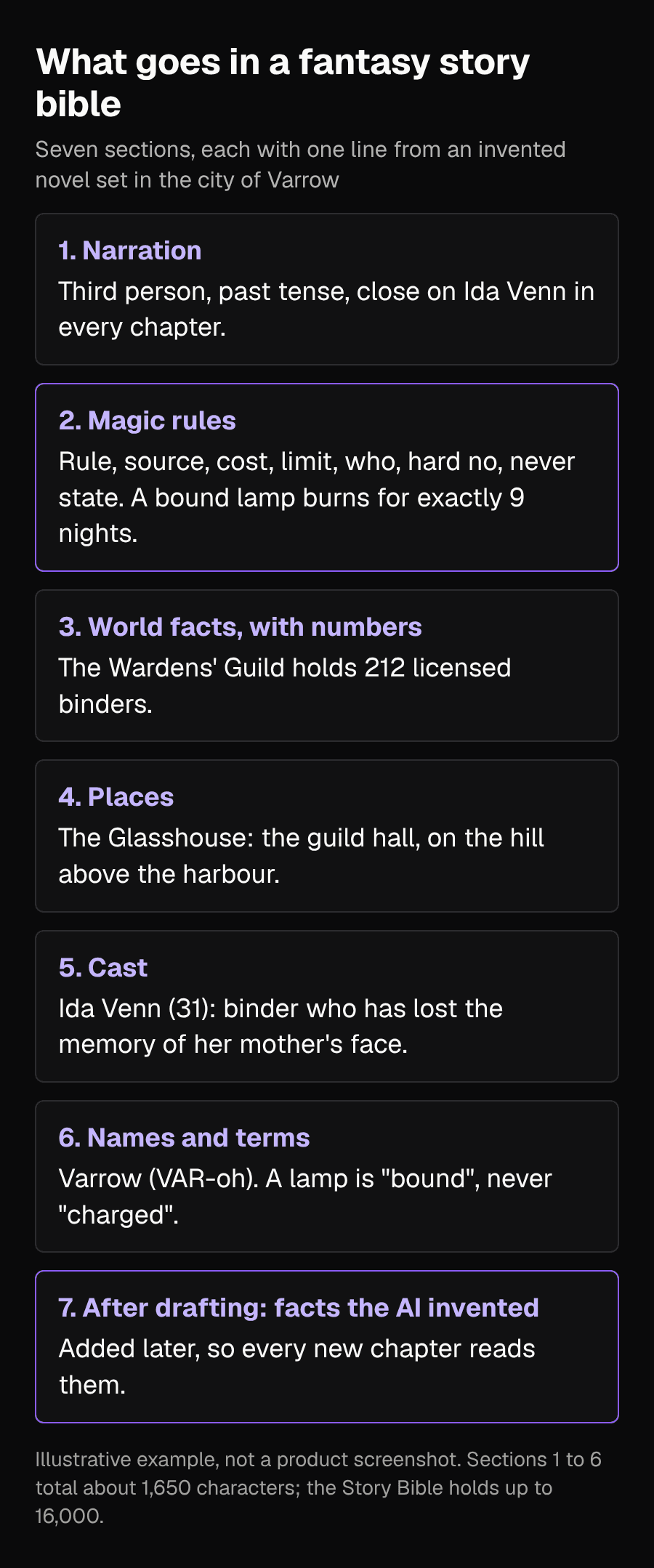
The Story Bible in Write Studio is organised around narration and voice, characters, setting and continuity facts, and the continuity guide lists characters, places, objects, world rules and narration as the things to state. The table turns that into seven sections for a fantasy book. The section order and the advice in the last column are an editorial suggestion, not a product requirement.[3][2]
| Section | What to write | Example line (invented book) | Why the AI needs it |
|---|---|---|---|
| 1. Narration | Point of view, tense and whose head the story stays in | Third person, past tense, close on Ida Venn in every chapter. | Stops chapters switching viewpoint or tense |
| 2. Magic or technology rules | Rule, source, cost, limit, who can use it, hard no, never state | A bound lamp burns for exactly 9 nights, then goes dark. | The preset asks for costs and rules that are not broken for convenience; the AI can only keep rules it is given |
| 3. World facts, with numbers | Population, institutions, laws, calendar, technology level, written as numbers | The Wardens' Guild holds 212 licensed binders. | The continuity guide advises stating numbers in the premise outright rather than leaving the AI to calculate them; the same habit applies in the bible |
| 4. Places | Name, what it is and one fixed physical fact | The Glasshouse: the guild hall, on the hill above the harbour. | Keeps geography and distances from shifting |
| 5. Cast | Name, age, role and the one fact the plot depends on | Ida Venn (31): has lost the memory of her mother's face. | Ages, relationships and wounds are common drift points |
| 6. Names and terms | Pronunciation, capitals and the words your world uses | A lamp is bound, never charged or cast. | Stops the AI renaming your magic with generic fantasy words |
| 7. After drafting | Names, places and facts the AI invented that you are keeping | Added after the first draft is read | Invented details are the ones most likely to drift |
How to write a magic rule the AI can keep
The Sci-fi / Fantasy preset tells the model to give magic or technology costs and rules and not to break them for convenience, and to show the world through specifics characters use rather than exposition. A preset directive is guidance to the model, not a guarantee. It works best when your bible gives it rules specific enough to follow and specific enough for you to check.[1]
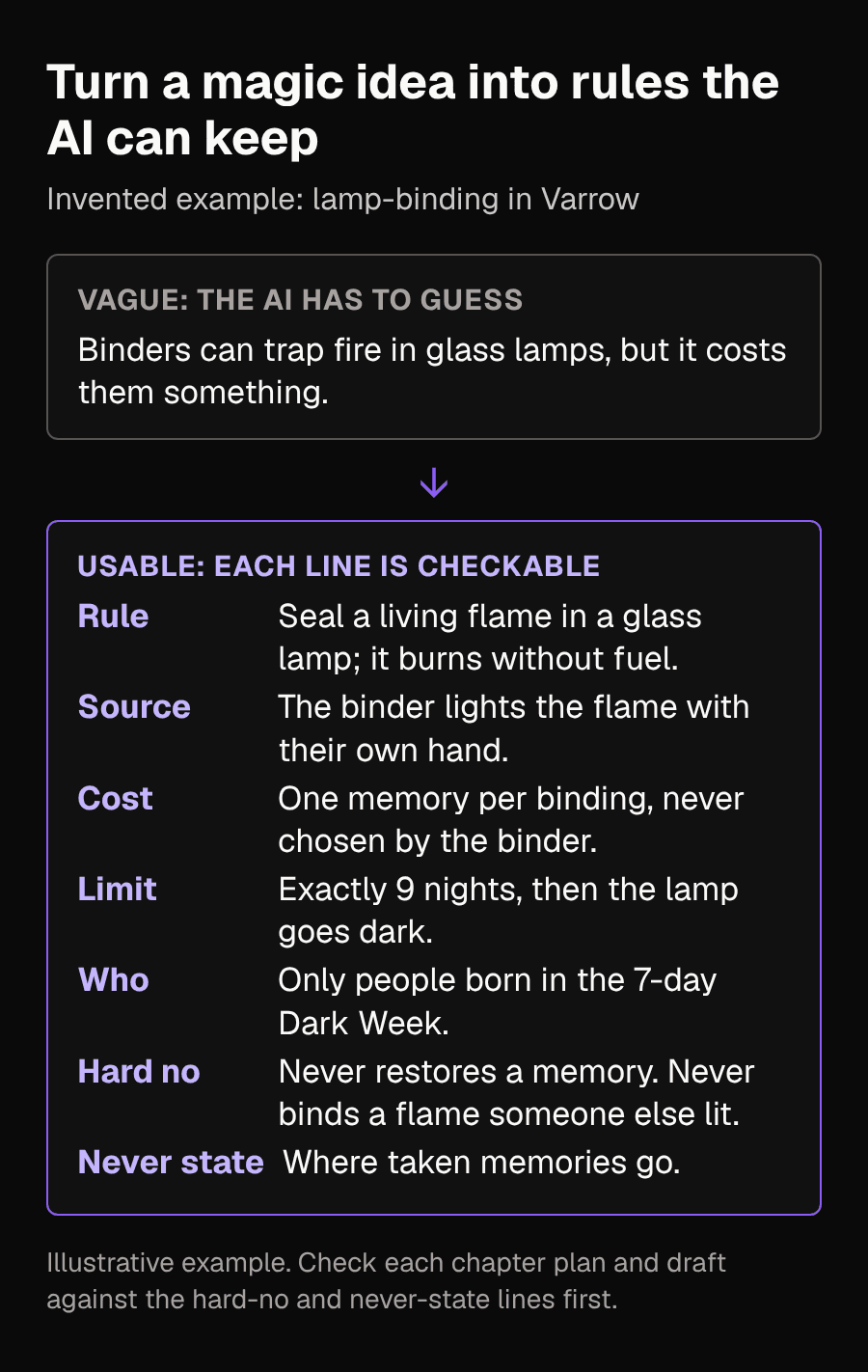
A sentence such as "binders can trap fire in glass, but it costs them something" leaves the AI to decide what the cost is, and it may decide differently in chapter 3 and chapter 14. Break each magic system into short labeled lines instead:
- Rule: what the magic does, in one sentence.
- Source: what it needs to work.
- Cost: what it takes from the user, every time.
- Limit: a number or boundary, such as a duration, distance or count.
- Who: which people can use it and roughly how many.
- Hard no: what it can never do. These are the lines a dramatic scene is most tempted to break.
- Never state: any mystery the book should leave open. Without this line the AI may answer it for you in a late chapter.
Worked example: a complete starting bible
Here is a full starting bible for an invented novel about a lamp-binder in a harbour city. It uses all six pre-drafting sections, states every number outright and marks pronunciation for the one name a reader might stumble on, in line with the preset's directive that names be easy to pronounce on first read. Use it as a pattern: replace each line with your own book's facts and keep the labels.
NARRATION Third person, past tense, close on Ida Venn in every chapter. Ida never knows what another character is thinking. MAGIC: LAMP-BINDING Rule: A binder can seal a living flame inside a glass lamp. The lamp then burns without fuel. Source: The binder must light the flame themselves, with their own hand. Cost: Every binding takes one memory from the binder. The binder cannot choose which one and only finds the gap later. Limit: A bound lamp burns for exactly 9 nights, then goes dark and must be bound again. Who: Only people born during the Dark Week, the 7 sunless winter days, can bind. About 1 person in 40 in Varrow. Hard no: Binding never restores a lost memory. No one can bind a flame someone else lit. Never state: where taken memories go. Characters may argue about it; the story never answers. WORLD FACTS Varrow is a harbour city of about 60,000 people. It has no gas or electric light. The Wardens' Guild holds 212 licensed binders. Unlicensed binding is a hanging offence. The Dark Week begins on the first new moon of winter. PLACES The Glasshouse: the guild hall, on the hill above the harbour. The Low Quays: the docks, where most lamps are sold and most unlicensed binders work. CAST Ida Venn (31): licensed binder and the point-of-view character. She has lost the memory of her mother's face and keeps a notebook of every binding she has made. Tobin Hale (17): Ida's apprentice, born in the Dark Week, not yet licensed. Corra Strand (50s): magistrate who signs the hanging orders. She is not a binder. NAMES AND TERMS Varrow (VAR-oh). The Glasshouse, always capitalised. A lamp is "bound", never "charged" or "cast".
Notice what is missing. There is no history of the guild, no map and no list of every street. ScribistIQ does not generate maps, glossaries or appendices, and the bible is not where the book's plot goes; the premise and chapter plan carry the plot. The bible holds only the facts that must not change.[1]
Where the bible goes in ScribistIQ
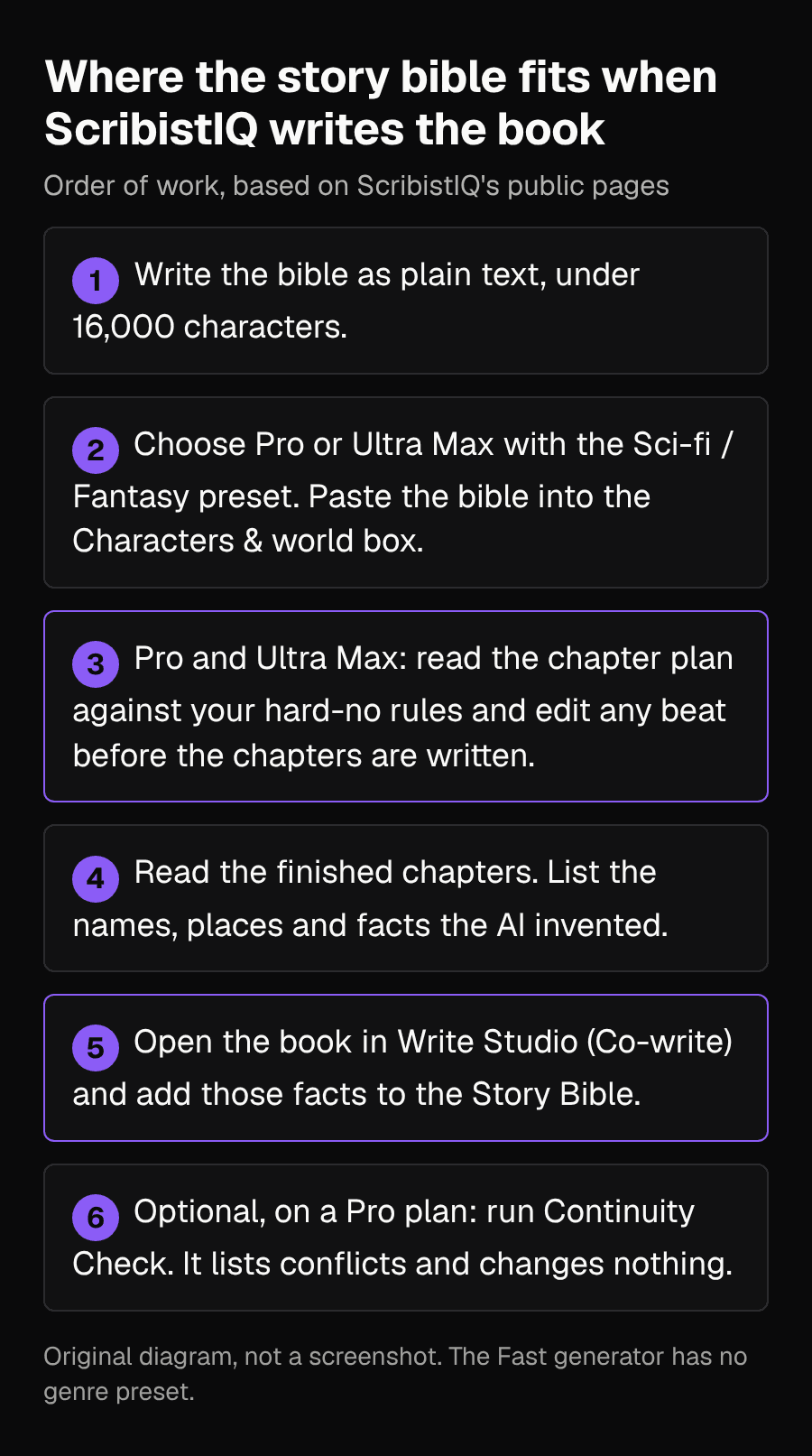
This is the order of work as ScribistIQ's public pages describe it. Steps 1 and 4 are your own work outside the product.[2][1][3]
- Write the bible as plain text and check its length with your word processor's character count. Keep it under 16,000 characters.
- Choose the Pro or Ultra Max generator and the Sci-fi / Fantasy preset; both have the Characters & world box. The Fast generator writes a short book in one pass with no genre preset. The Pro generator costs 300,000 credits per book, writes 5 to 12 chapters and is included in every paid plan. Ultra Max costs 50,000 credits for the outline plus 50,000 per chapter and writes 5 to 30 chapters, but its 20-chapter (Epic) and 30-chapter (Novel) lengths need a Pro plan; Lite and Standard plans write up to 12 chapters per book and can extend a book afterwards with Continue Book. Paste the bible into the Characters & world box before you generate.
- On both Pro and Ultra Max, you see the whole chapter plan (the outline) before any prose is written and can edit any chapter beat before you approve it. Each chapter is written from its outline description, so read every planned beat against the hard-no and never-state lines (see the checklist below) and change any beat that breaks one.
- When the book is written, read it and list every name, place and fact the AI invented that you want to keep.
- Open the book in Write Studio: choose Co-write in the app's sidebar, then Co-write on the book's card. Find the Story Bible in the left-hand pane and add those facts. You can type entries yourself or paste notes and have the AI sort them into entries (Story Bible imports need a paid plan). Anything you add is read by every chapter you write, regenerate or continue from then on. Work saves a few seconds after you stop typing; check that Saved shows above the editor.
- Optional: on a Pro plan (the subscription plan, not the Pro generator), run Continuity Check. It reads up to 25 chapters per run, lists each contradiction with the passage and the earlier fact it conflicts with, costs 3,000 credits per chapter, and changes nothing on its own, so you decide each fix. It can miss things, so still read the book.
Check the chapter plan against the bible
On Pro and Ultra Max, the chapter plan is the cheapest place to catch a broken rule, because nothing has been written yet. For the example book, these are the questions to ask of every planned beat. Write the same kind of question for each hard-no line in your own bible.[4]
- Does any beat have a binder seal a flame someone else lit?
- Does any lamp burn longer than 9 nights without being bound again?
- Does anyone get a lost memory back, including Ida and her mother's face?
- Does any beat reveal where taken memories go?
- Does anyone bind who was not born in the Dark Week?
- Does any beat require Ida to know what another character is thinking?
If a planned beat breaks a rule on purpose, for example because the twist is that the rule was wrong, the bible should say so before drafting. Otherwise later chapters will keep following the old rule.
After the first draft: add what the AI invented
Suppose chapter 3 of the example book gives Tobin a sister called Mara and puts a bell tower on the Glasshouse. Neither is in the bible, so neither is protected. If you keep them, add one line each in the Story Bible before you regenerate or continue any chapter.
CAST Mara Hale (12): Tobin's younger sister. Not a binder. PLACES The Glasshouse has a single bell tower on its east side. The bell rings once at dusk.
ScribistIQ's guides say the Story Bible does not update itself, so this step is yours. On Pro and Ultra Max, each fantasy chapter is written against your characters-and-world notes plus summaries of the last ten chapters, so a fact that is only mentioned once, many chapters back, is exactly the kind that needs a bible line.[3][1]
Common problems
| What you see | Likely cause | What to change |
|---|---|---|
| Magic does something new in a big scene | The bible lists powers but no hard-no line | Add a hard-no line, then check the plan and the affected chapter against it |
| A character's age or a number changes | The number was implied, not stated | State it outright in the bible |
| Your term is replaced with a generic one | The bible does not say which words to avoid | Add the term and the words it should never be called |
| A side character drifts after the middle of the book | The AI invented them and they were never added | Add them in Write Studio's Story Bible |
| The book explains the mystery you wanted kept | No never-state line | Add one, then revise the chapter that answered it |
Limits
The bible format and plan checks here are an editorial method shown on an invented example; they were not tested in the product and no generated chapters are shown. ScribistIQ documents that every chapter treats the Story Bible as facts not to contradict, but its own 20-chapter test was run without a Story Bible, so its public pages give no measurement of how much a bible reduces drift. Facts the AI invents can still change between chapters, so read the draft. The public pages do not describe what happens to notes longer than the Story Bible's 16,000-character limit. Write Studio's AI actions need a paid plan, Continuity Check needs a Pro plan, and Ultra Max's 20- and 30-chapter lengths need a Pro plan. The product works in English only.[2][3][4]
Sources
- Write a fantasy novel with AI (Sci-fi / Fantasy preset), ScribistIQChecked 2026-11-16
- How to keep an AI-written novel consistent, ScribistIQ guideChecked 2026-11-16
- Co-write a novel with AI, ScribistIQ guideChecked 2026-11-16
- ScribistIQ featuresChecked 2026-11-16