
Memoir vs essay collection: how to choose before AI writes your life story
Five questions to choose between a memoir and a book of linked essays, one writer's material planned both ways, and the inputs for each in ScribistIQ's memoir generator.

In this guide
A memoir follows one stretch of your life as a single story, read from the first page to the last. A memoir in essays is a set of pieces that each stand on their own but add up to a life. Choose the memoir when your best material shares one period and one change. Choose essays when your best moments are spread across decades and each one could be read alone. The choice matters more when AI drafts the book, because it changes what you write in the premise, how you set out the chapter plan and what you check in the draft.
This guide gives five questions to decide, one invented writer's material arranged both ways, and the inputs for each form in ScribistIQ's memoir generator. ScribistIQ has a Memoir preset but no essay preset, so the essay route below uses the Memoir preset with a premise written for linked essays. It is an editorial method, not a documented product mode, and no book was generated for this guide.
Memoir vs essay collection: the difference that matters
Essayist Rebecca McClanahan separates three things. A collection just gathers pieces under one cover. A book of essays has pieces that each stand alone yet relate to each other, so the whole is more than its parts. A book-length memoir usually moves more or less in time order, and its readers start at page one and read to the end. Readers of a book of essays may open it anywhere, so every essay has to work without the ones before it.[5]
Marion Roach Smith treats memoir as one genre that can be published at different lengths. Her post on writing a memoir in essays features Linda Styles Berkery, whose book used a dress as the lens for each of fourteen essays, and stresses that even a memoir in essays needs an overall arc, not just a repeated object running through it.[6]
When AI drafts the chapters, one product detail makes the choice practical. On ScribistIQ's Pro and Ultra Max generators, each chapter is written with your story bible, summaries of earlier chapters and the closing passage of the chapter before it. That carries a continuous memoir forward. In a book of essays, the same context can pull each new chapter into continuing the last one, so the essay route has to say plainly that every chapter starts fresh.[2]
Five questions to choose your form
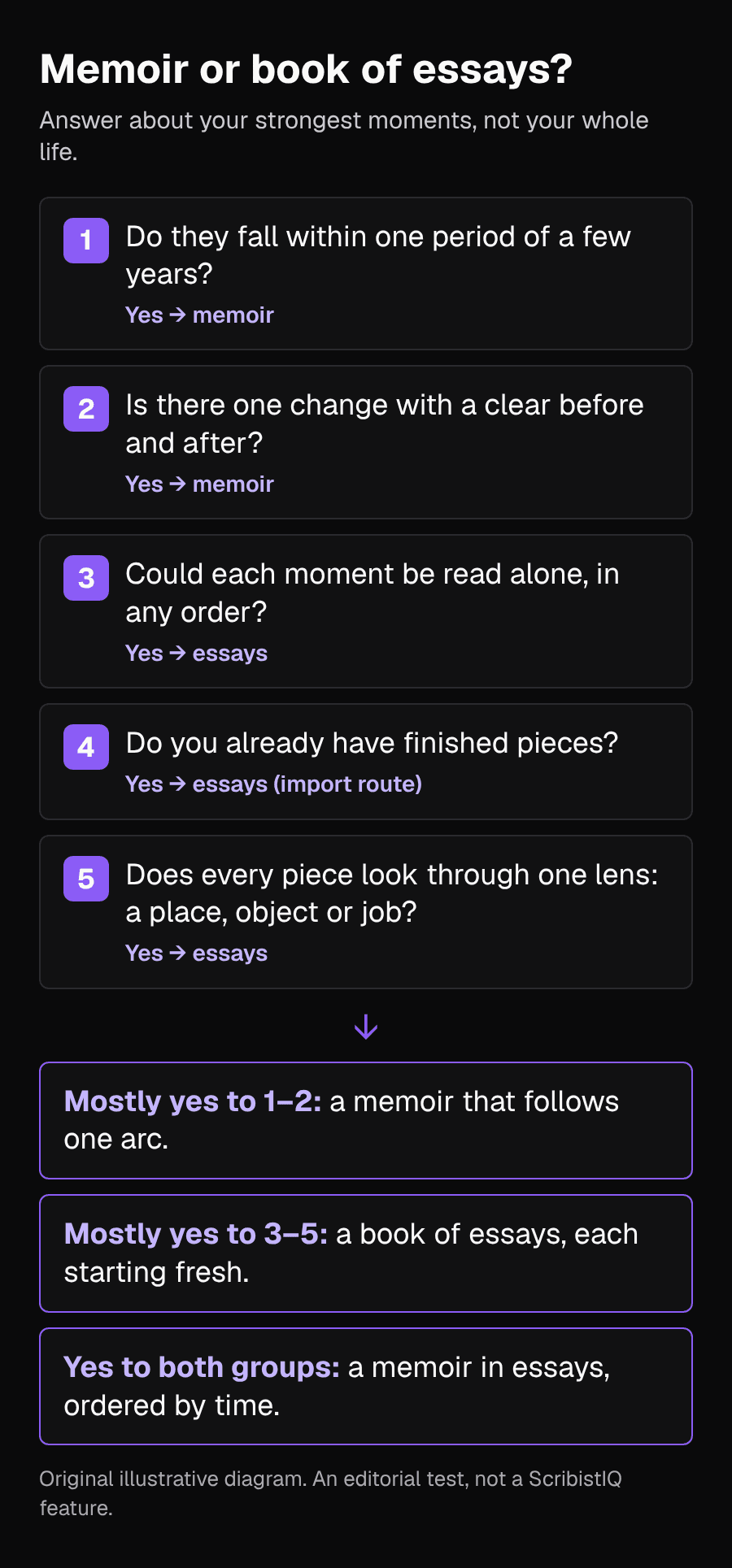
Answer these about the moments you most want in the book, not about your whole life. They are an editorial test drawn from the craft sources above, not a rule from either source.
- Do your strongest moments fall within one period of a few years? Yes points to a memoir.
- Is there one change the whole book can follow, with a clear before and after? Yes points to a memoir.
- Could each moment be read alone, in any order, and still make sense? Yes points to essays.
- Do you already have finished pieces, such as essays, blog posts or talks? Yes points to essays, using the import route below.
- Can you name one lens that every piece looks through, such as a place, an object or a job? Yes points to essays. McClanahan suggests a test: try writing the cover copy. If no single idea holds it together, the pieces may not yet belong in one book.
Mostly yes to the first two: write a memoir. Mostly yes to the last three: write a book of essays. Yes to both groups often means a memoir in essays ordered by time, where each piece stands alone but the order still shows one change.
Worked example: one writer's material, arranged both ways
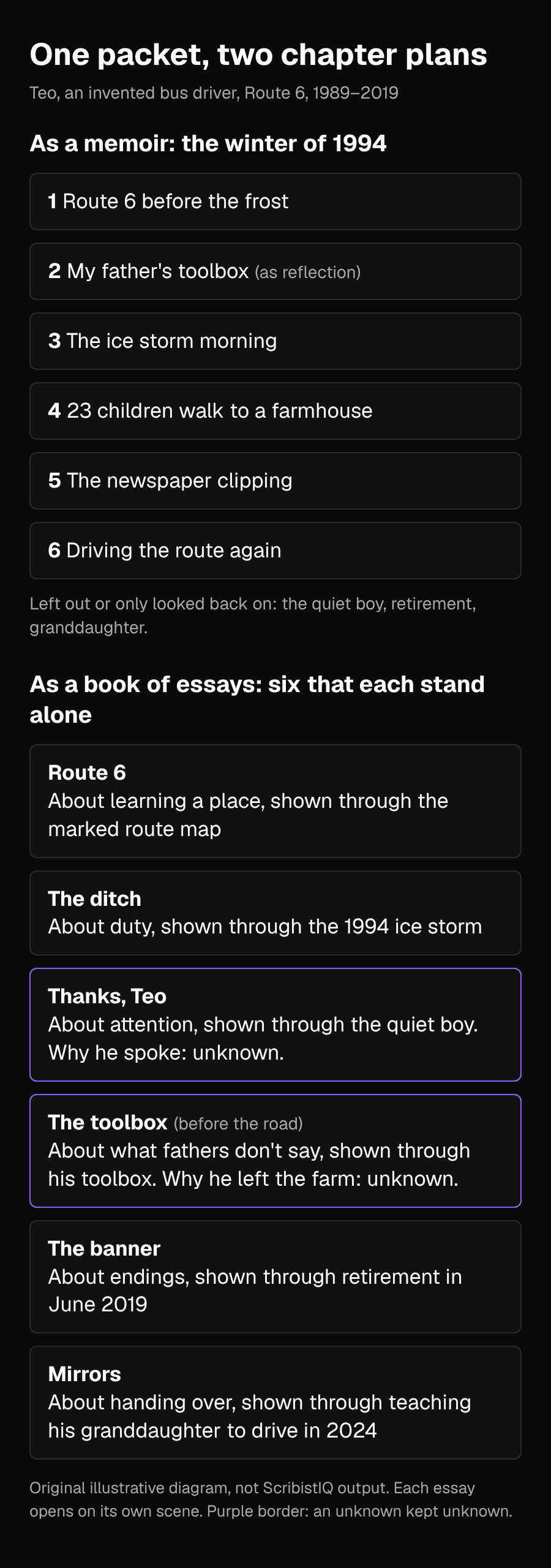
Teo is an invented writer. He drove a school bus on Route 6 from 1989 to 2019 and wants a book for his family. Here is his memory packet, with an unknown he must keep unknown.
ROUTE: Drove Route 6 from January 1989 to June 2019. Kept a paper route map marked with every stop change. ICE STORM: In the 1994 ice storm the bus slid into a ditch. All 23 children walked with me to a farmhouse. Nobody was hurt. I kept the newspaper clipping. THE QUIET BOY: A boy rode for four years without speaking to me. On his last day he said: "Thanks, Teo." I never learned why. MY FATHER: Taught me to fix engines from his toolbox. Never said why he left the farm. UNKNOWN: why he left. RETIREMENT: June 2019. The children made a banner. GRANDDAUGHTER: Taught her to drive in 2024.
Teo's answers: his moments span 35 years (no to question 1), there is no single before and after (no to 2), each moment stands alone (yes to 3) and he has no finished pieces (no to 4). Question 5 is a qualified yes: five moments look through the road, but the toolbox is about his father, before Teo ever drove. He keeps it as the one essay about what he learned before the road, and checks it with the cover-copy test. The test points to a book of essays.
As a memoir, Teo would pick one stretch, such as the winter of 1994, and follow it: the route before the frost, his father's lessons as reflection, the storm morning, the walk to the farmhouse, the clipping, driving the route again. The quiet boy, the retirement and his granddaughter would appear only as an older self looking back, or not at all. As essays, all six moments get their own piece.
Where each choice goes in ScribistIQ
Both forms use the same generator inputs. The Memoir preset adds the same directives to every chapter on Pro and Ultra Max: first person, scenes rather than summaries, specific sensory memory, an older self looking back, and other people written with their own inner lives. Its non-fiction rules bar invented quotations, statistics and named people, and the model does not research you. Those directives suit a personal essay as well as a memoir.[1]
| Input | Memoir | Book of essays |
|---|---|---|
| Genre | Memoir preset | Memoir preset. There is no essay preset. |
| Premise | The arc: one period and the change it follows. | The lens, the number of essays, and a rule that each chapter is a self-contained essay that opens on its own scene. |
| Characters and world notes (up to 24,000 characters) | People, places and turning points for the one story. | The same, grouped by essay, with each essay's facts and unknowns. |
| Chapter plan on Pro | Story beats in time order. | One essay per beat, written as about X, shown through Y, in the reading order you chose. |
| Length | Pro writes 5 to 12 chapters. | 5 to 12 essays on Pro. Continue Book can extend a finished book with up to 12 more chapters that you approve; each added chapter costs credits (35,000 at Pro quality). |
| Draft check | Facts, unknowns, voice. | The same, plus each essay read alone and repeated background trimmed. |
A Pro book costs 300,000 credits, which is the monthly allowance of the $29 Lite plan, and every paid plan includes the Pro generator. A free account gets a preview of the opening chapter of its own book.[3]
Steps: set up a book of essays
- Write one line per essay in the form 'about X, shown through Y'. This adapts Roach's planning formula, which also names how each piece is told.
- Choose the reading order now. McClanahan treats order as something to decide deliberately with your reader in mind. The public pages say you can rewrite any chapter beat when the Pro generator shows its chapter plan, but do not say you can reorder chapters, so put the essays in order before you generate.
- Write the premise with the lens, the count and the fresh-start rule (example below).
- Put the facts into the characters and world notes, grouped by essay, with every unknown marked as unknown.
- Open the Pro generator, choose the Memoir genre, and plan for 5 to 12 chapters, one per essay. The public pages give that range but do not describe the length control itself, so check that the plan has one beat per essay. Ask for the chapter plan; reviewing it is free.
- Review the plan before any prose is written. Rewrite any beat that links essays into a plot, adds a cause you did not give, or merges two essays.
- Start the full book only when every beat matches your list. This is the step that spends the 300,000 credits.
- When the book is written it lands in your library. Open it in the Write Studio for the checks below, then export it as PDF, EPUB or DOCX when you are done.
A memoir in six linked essays by Teo, who drove a school bus on Route 6 from 1989 to 2019. Each chapter is a self-contained essay about one thing the road taught him, except one about what his father taught him before the road, told in the first person by Teo looking back. Each chapter opens on its own scene. Do not continue the previous chapter's scene or recap earlier chapters. Introduce a person briefly whenever an essay needs them. Use only the facts in the notes. Teo does not know why his father left the farm or why the quiet boy thanked him; say so and do not explain either.
PLAN SAYS: Ch 3. Months after the ice storm, the quiet boy finally thanks Teo for saving him. CHECK: The packet does not link the thanks to the storm or say why the boy spoke. This beat turns two essays into one plot. FIX: Ch 3, Thanks, Teo. About attention, shown through a boy who rode for four years without speaking and said 'Thanks, Teo' on his last day. Teo never learned why.
If you already have the essays
If your pieces are written, you do not need to generate them. Two related features cover this. You can import an existing manuscript as a .docx, .txt or .md file up to 4 MB, and Continue Book can extend a finished book with up to 12 new chapters that the model proposes and you approve. Each added chapter costs credits: 10,000 at Fast, 35,000 at Pro or 50,000 at Ultra Max quality. Put every essay you already have into one file in reading order, and write any opening essay or introduction into that file before you import it. The public pages describe Continue Book as extending a finished book, not as inserting chapters earlier, so use it only for pieces that belong after your last essay, such as a closing essay. An imported book opens in the Write Studio like a generated one. The public pages do not say whether a genre preset applies to an imported book, so read the first new chapter against your own essays before you add more.[2][3]
Berkery assembled her book the same way by hand: she pasted the essays into one document, then revised, split pieces and added an introduction and a closing note.[6]
How to check the draft
- Read each essay alone, starting from a random one. If it depends on an earlier chapter to make sense, revise its opening so it stands on its own.
- Look for openings that continue the last chapter, such as 'after that winter' or 'as I said'. They show the earlier-chapter context leaking in.
- Trim repeated background. McClanahan advises keeping only essential details and varying how you give them when a fact has to recur.
- Check every name, date and quotation against your notes, and every 'why' sentence against your unknowns.
- Vary length where the essays feel uniform. The public pages do not describe a per-chapter length setting, so select a passage in the Write Studio and use shorten or expand. These are Fast assists: each costs 500 credits and counts toward your plan's monthly Studio allowance (1,000 Fast assists on Lite), which is a hard limit; once it is used, assists pause until the next monthly reset. The change is marked up so you can read it before you accept it.
Limits to keep in mind
- There is no essay preset or essay generator. The essay route is an editorial use of the Memoir preset and has not been tested for this guide.
- Summaries of earlier chapters are documented as chapter context; whether they cause a particular essay to lean on the last one depends on the draft, so the checks above are the safeguard.
- Plans, credit costs and chapter limits can change; check the pricing page before you start.
- Both forms describe real people. Consider their privacy before you share the book.
Sources
- ScribistIQ memoir generator pageChecked 2026-11-24
- ScribistIQ featuresChecked 2026-11-24
- ScribistIQ pricingChecked 2026-11-24
- ScribistIQ FAQChecked 2026-11-24
- Rebecca McClanahan, Forest in the Trees: The Challenges of Shaping a Book (not a Collection) of Essays, Brevity, January 2014Checked 2026-11-24
- Marion Roach Smith, How to Write a Memoir in EssaysChecked 2026-11-24