
Business book or self-help book? How to choose before AI writes it
Turning your expertise into a book with AI? Compare ScribistIQ's Business and Self-help presets, answer five questions and see one example aimed both ways.

In this guide
If you coach, manage, consult or teach, the same knowledge can become two quite different books. Written for people at work, it is a business book: one idea per chapter, real cases, a task for the team. Written for one person trying to change their own life, it is a self-help book: specific tactics, honest talk about why change is hard, a small action at the end of each chapter. One nonfiction editor notes that many expert authors are writing some mix of business, self-help and memoir, and do not yet have words for what their book is.[5]
In ScribistIQ the choice is not just a shelf label. Business and Self-help are separate genre presets, and on the Pro and Ultra Max generators the chosen preset's four rules are added to every chapter, stored on the book, and applied again when you regenerate a chapter or use AI assist in Write Studio. Picking the wrong one means every chapter is pushed toward the wrong reader.[1][2][4]
The short answer: choose Business when your reader acts on the advice at work and you can supply real cases and numbers. Choose Self-help when your reader acts on it in their own life and you can supply specific tactics and the sources behind your claims. The rest of this guide shows how to check that, with one invented expert carried through both versions.
What each preset adds to every chapter
Both presets publish their four rules on their pages. Side by side, they ask for different openings, different evidence and different endings:[1][2]
| Rule | Business preset | Self-help preset |
|---|---|---|
| Written for | Founders, operators and senior managers | Readers who want practical change |
| Each chapter | One core idea, stated plainly in the first paragraph | Specific tactics, not platitudes (the page's example: write three lines in a notebook before checking your phone) |
| Evidence it asks for | Real companies, real numbers, real cases | A source for any claim |
| Tone | Confident and plain-spoken | Direct, kind and evidence-based; acknowledge difficulty and name the reader's resistance instead of 'just do this' |
| Chapter ending | A 'what to do Monday' takeaway, not a summary | A small, doable action |
| Phrases or habits ruled out | Bans 'synergy', 'leverage' as a verb, 'thought leader' and 'circle back' | Its tone line rules out toxic positivity |
Both are treated as nonfiction, with shared rules: plain language, one idea per paragraph, and no invented statistics, sources or quotations. The business page adds active voice with named actors.[1][2]
The catch: the evidence has to come from you
Each preset demands a kind of evidence the model cannot fetch. Both pages say the model does no research and has no retrieval. It will not make up studies or numbers, and it will not add references; you add real references yourself in Write Studio.[1][2]
That makes your evidence the most practical deciding factor. The Business rule asks for real companies and numbers in every chapter. If you have none you can name, the generator has nothing true to put there. The Self-help rule asks for a source behind claims. If your method rests on your own experience rather than studies you have read, plan to state those claims as your experience and add only references you have actually checked. This is editorial advice based on the published rules, not a tested result.[1][2]
Five questions to choose your preset
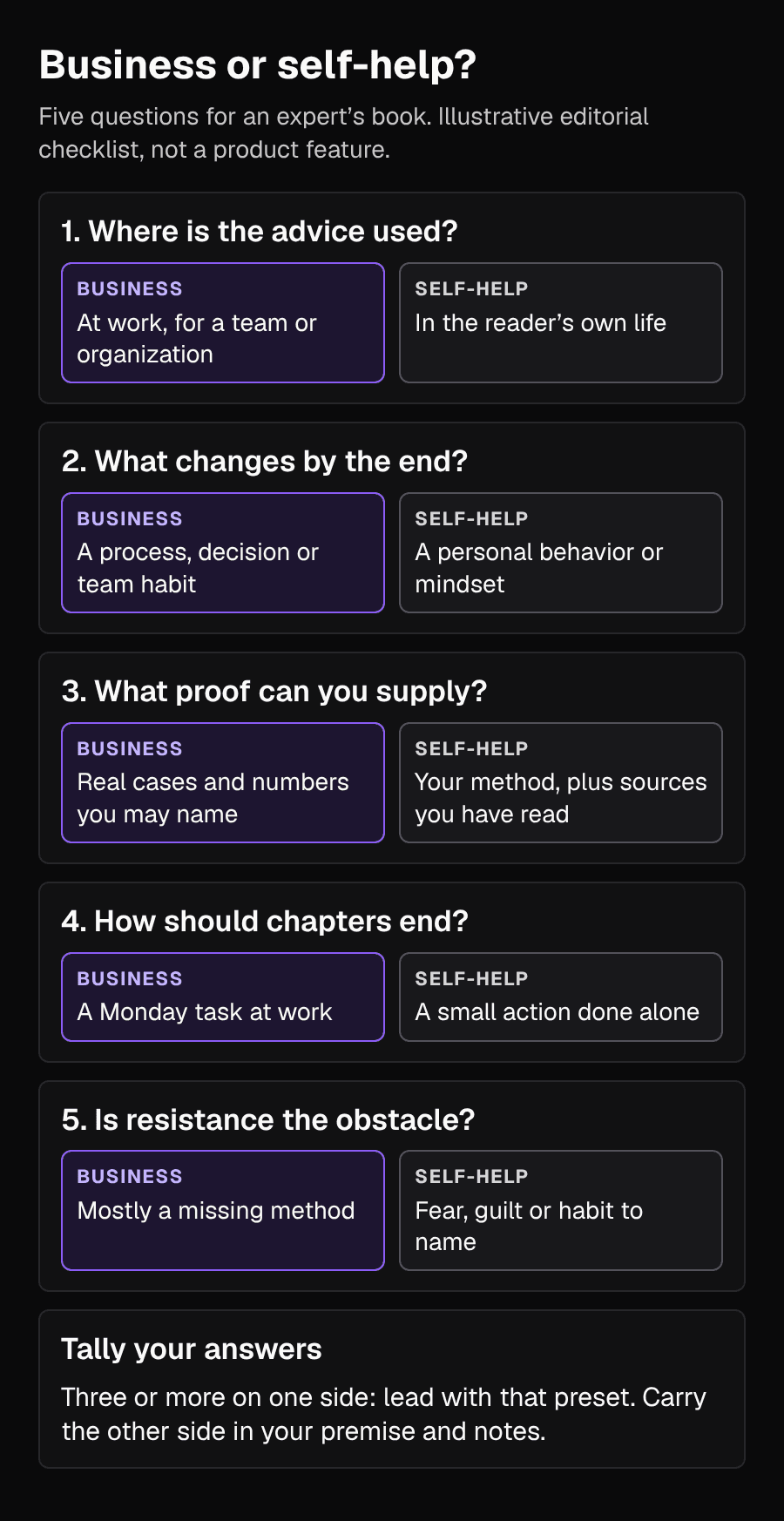
Answer these for your own material. They are an editorial checklist drawn from the two sets of published rules, not a measured scoring system. Three or more answers on one side is a reasonable lead.[1][2]
- Where does the reader use the advice? At work, for a team or an organization, points to Business. In their own life, habits, relationships or money points to Self-help.
- What changes by the last chapter? A work result, such as a process, a decision or a team habit, points to Business. A personal behavior or mindset points to Self-help.
- What proof can you supply? Cases and numbers you are allowed to name point to Business. Your own method, plus sources you have actually read, points to Self-help.
- What should every chapter end with? A task for Monday at work, or a small action the reader takes alone?
- Does resistance matter? If your reader's main obstacle is fear, guilt or habit rather than lack of a method, the Self-help rule to name that resistance will help every chapter.
Worked example: one expert, two possible books
The example below is invented to show the method. Jo Marsh is not a real person or customer, and no book was generated for this guide.[6]
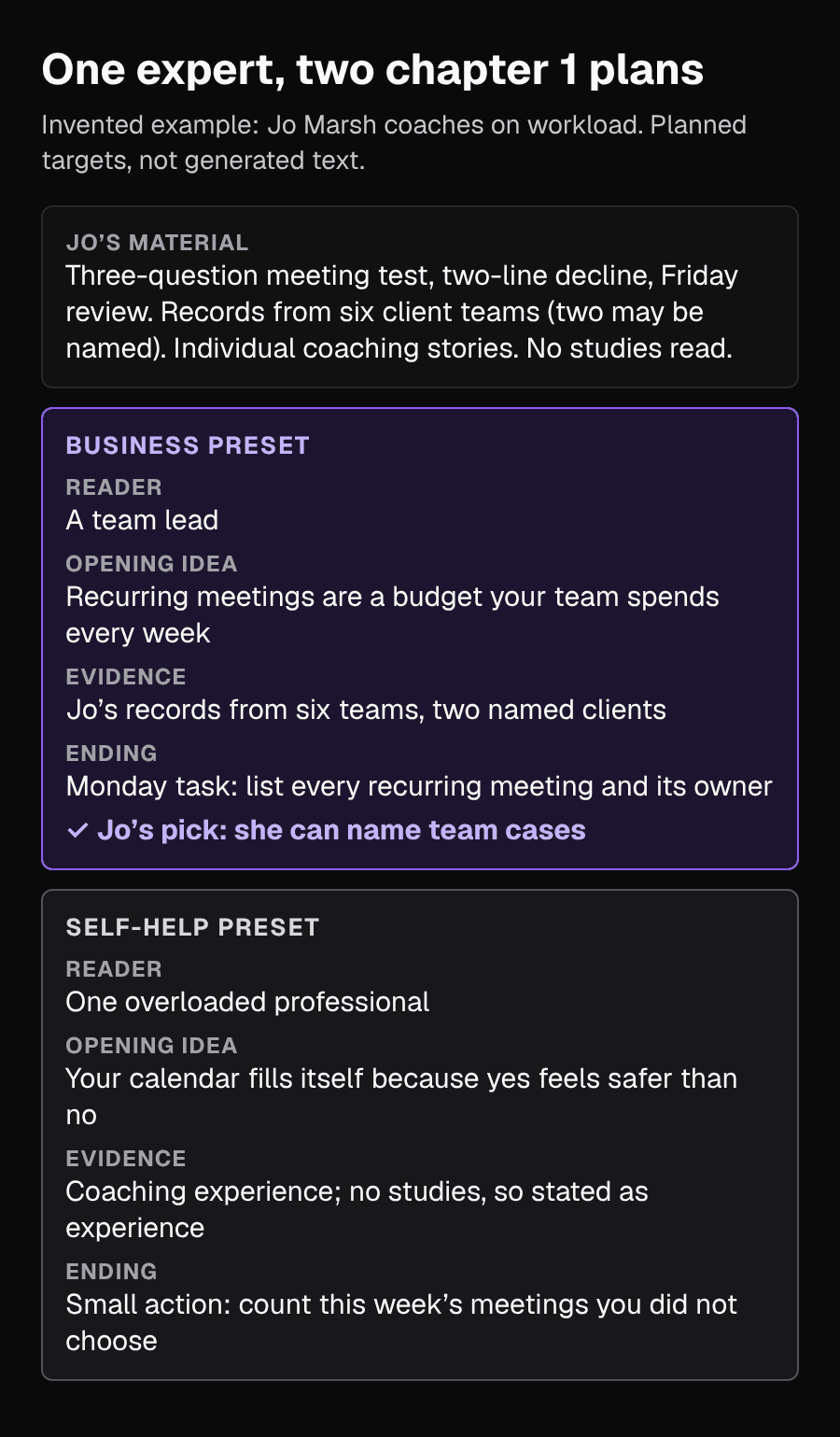
Expertise: Jo is a former operations manager who now coaches on workload. Method 1, the three-question meeting test: Does this meeting need a decision? Does it need me? Could it be a written update? Method 2, the two-line decline: one line thanking the organizer, one line offering a written input instead. Method 3, the Friday review: 20 minutes each Friday to check next week's calendar against the three questions. Team work: Jo has run the test with six client teams and kept her own before-and-after records of their recurring meeting hours. Two clients have agreed to be named. Individual work: Jo has coached individual professionals through the decline script and the Friday review. She has read no studies on meetings or habits.[6]
The same material can be aimed two ways. The table shows how the first chapter and the evidence change:[6][1][2]
| Part of the book | As a business book | As a self-help book |
|---|---|---|
| Reader | A team lead whose team spends too much time in recurring meetings | A professional whose own calendar is full of meetings they did not choose |
| Promise | Cut your team's recurring meetings without losing decisions | Take back your week without feeling you have let people down |
| Chapter 1 opening idea | Recurring meetings are a budget your team spends every week, so treat them like one | Your calendar fills itself because saying yes feels safer than saying no |
| Evidence Jo can supply | Her records from six teams, with two named clients | Her coaching experience; no studies, so claims are stated as her experience |
| Chapter 1 ending | Monday task: list every recurring meeting your team holds and who owns it | Small action: count this week's meetings you did not choose |
| Risk | Chapters with no team case for the preset's real-numbers rule | The cite-sources rule meets claims Jo cannot reference |
Running Jo through the five questions: her strongest evidence is team records she can name (question 3), her paying clients are team leads (question 1), and her method changes how a team meets (question 2). Questions 4 and 5 could go either way. Three answers point to Business and none to Self-help, so Business leads. If Jo's evidence were mainly individual coaching stories and her readers were overwhelmed individuals, the same questions would point to Self-help.[6]
Put your choice into the inputs
The generators start from a title and a premise, and you pick one of seven presets or describe your own genre. Only Pro and Ultra Max apply the Business or Self-help preset; Fast writes a short three-to-seven-chapter nonfiction book with no genre preset. The business page says frameworks and experience go in the premise and notes, and that you can paste your material into the characters-and-world field or import notes as .docx, .txt or .md. The self-help page says your premise and notes supply the method and stories. On Pro and Ultra Max you can also paste up to 4,000 characters of your own writing as a voice sample; the model matches its rhythm and vocabulary, not its content.[4][1][2]
Premise: A practical business book for team leads. Recurring meetings are a budget a team spends every week. Using the three-question meeting test, a team lead can cut recurring meetings without losing the decisions they exist for. Notes: The three-question meeting test, the two-line decline and the Friday review, written out in full. Team cases: the two named clients, with Jo's before-and-after meeting hours copied exactly from her records. The other four teams are described without names or numbers. Do not invent figures, clients or quotations.[6][1]
If Jo had chosen Self-help, the premise would name the individual reader and their resistance instead, and the notes would hold the decline script, the Friday review and her coaching stories, with a line asking for claims to be framed as her experience.[6][2]
Check the chapter plan against your preset
On Pro you review and edit the chapter plan before any prose is written, which is the cheapest place to catch a mismatch. Pro costs 300,000 credits per book; Ultra Max costs 50,000 credits for the outline plus 50,000 per chapter. Read each planned chapter against your choice:[4][1][2]
| Check | Business plan | Self-help plan |
|---|---|---|
| One idea or one tactic | Can each chapter's core idea be said in one sentence? | Does each chapter teach one specific thing to do, not a general attitude? |
| Evidence | Does each chapter have a case from your notes? Mark any chapter with none. | Mark every claim that will need a reference you actually have. |
| Ending | Is there a concrete Monday task for the team? | Is there a small action one person can do this week? |
| Reader | Is every chapter about the team or organization? | Is every chapter about the reader's own week, including what makes change hard? |
In Jo's business plan, a chapter on protecting focus time with no team case would be a warning sign: rewrite it around one of her named clients, or cut it before generating. After the draft exists, check every number against her records and add any references in Write Studio.[6][1]
When neither preset fits
- If your book is mainly your own story, with lessons along the way, look at the Memoir preset: first person, scenes rather than summary, and an older narrator reflecting on a younger self.
- You can describe your own genre instead of picking a preset. The public pages do not say what instruction a self-described genre adds to each chapter, so check the plan especially closely.
- A book that is truly half business, half personal can still lead with one preset. Pick the side your reader acts on, then carry the other side in your premise and notes.
Limits to keep in mind
- A preset rule is guidance added to each chapter prompt. It does not guarantee every chapter meets it.
- The business page says the model does not generate charts, tables or diagrams. The self-help page says exercises and actions come as prose and lists, not fillable worksheets. Add those after exporting to DOCX.
- Neither page's model does research or adds references, and the business page says it writes in English. Facts, numbers and sources are yours to supply and check.
- If your self-help book touches health, money or law, note what the self-help page says about the generator (page guidance, not one of the preset's chapter rules): it is not a substitute for professional advice, it writes what you ask, and responsibility for medical, financial or legal claims in your book is yours.
- Plans start at $29 a month, and every new account can write its first chapter free with no card, so you can see an opening before paying for a full book.
What to do next
Write your five answers and a one-line evidence list before opening a generator. If you are turning course material into the book, the course-notes guide shows how to sort modules into a source packet; the two preset pages list the full rules and costs.
Sources
- Write a business book with AI | ScribistIQChecked 2026-11-14
- Write a self-help book with AI | ScribistIQChecked 2026-11-14
- Write a memoir with AI | ScribistIQChecked 2026-11-14
- ScribistIQ featuresChecked 2026-11-14
- Which of these 16 types of nonfiction books are you writing? (Sage House Editorial)Checked 2026-11-14
- Invented worked example: Jo Marsh's workload method (original analysis)Checked 2026-11-14