
Can you copyright a book written with AI? What the US Copyright Office says
Only the parts a person wrote or creatively shaped. What the Copyright Office's guidance means for generated chapters, your edits and imports, with a worked example of what to claim.
In this guide
In the United States you can copyright the parts of an AI-assisted book that a person wrote or creatively shaped, but not the text the AI wrote on its own. The US Copyright Office's position is that copyright covers human authorship only. Chapters a generator writes from your premise and notes count as AI-generated, so they are not protected. Your own writing, your own text that shows up in the output, your substantial rewrites and your creative selection and arrangement of the material can be. Publishing is a separate question: stores can accept a book whose AI-written text has no copyright protection.[2][1]
Writers keep asking this. A May 2026 Q&A for authors covers whether the Office scans manuscripts for AI (it does not; you disclose what you wrote) and what happens if you hide AI use. ScribistIQ's own terms also draw the line: you own your inputs and, "to the extent any rights exist in it," the output, ScribistIQ claims no copyright in it, and text generated "with little creative input from you may not be protected by copyright." This article explains what that means for a book you build with a generator, import, or revise in Write Studio. It covers US law only and is not legal advice.[7][9]
What the Copyright Office actually says
Two primary documents set out the current position: the March 2023 registration guidance and the January 2025 Part 2 report on copyrightability. As of November 15, 2026, the Office's AI page lists no later copyrightability guidance. Their main points for a book writer:[1][2][3]
- Copyright protects only material that is the product of human creativity. AI-generated material, or material where a person had too little control over its expressive elements, is not protected.
- Prompts alone are not enough, given current generally available technology. The 2023 guidance compares prompts to instructions given to a commissioned artist: you say what you want, and the system decides the words, structure and order.
- Asking for revisions does not change that. The guidance says follow-up instructions give more influence, but the AI still decides how to carry them out.
- Your own work that is perceptible in the output stays yours. The report says that where a person inputs their own copyrightable work and it appears in the output, they are the author of at least that portion.
- Creative selection, coordination or arrangement of AI material can be protected, and so can modifications that are substantial enough to meet the standard for protection. The protection covers only what you contributed, not the AI text underneath.
- Using AI to assist rather than stand in for your creativity does not affect protection. Whether a particular book has enough human authorship is decided case by case.
The courts have not moved the line. On March 2, 2026, the Supreme Court declined to hear Thaler v. Perlmutter (No. 25-449), leaving in place the March 2025 appeals court ruling that copyright requires a human author. That ruling set aside the disagreements over how much AI contributed to a human author's work, because Thaler had named his AI system as the sole author. The appeals court also noted that the Copyright Office has registered works by human authors who use AI. So the question most book writers actually face, how much human involvement is enough, is still answered by the Office's guidance, case by case.[4][5][2]
One novel shows what thin protection looks like. The Copyright Office registered Elisa Shupe's ChatGPT-assisted novel, AI Machinations: Tangled Webs and Typed Words, but limited the claim to the "selection, coordination, and arrangement of text generated by artificial intelligence." A law professor quoted in the April 2024 report compared it to copyright in an anthology of poems you did not write: the individual sentences and paragraphs were not covered.[6]
Which parts of an AI-assisted book can be yours
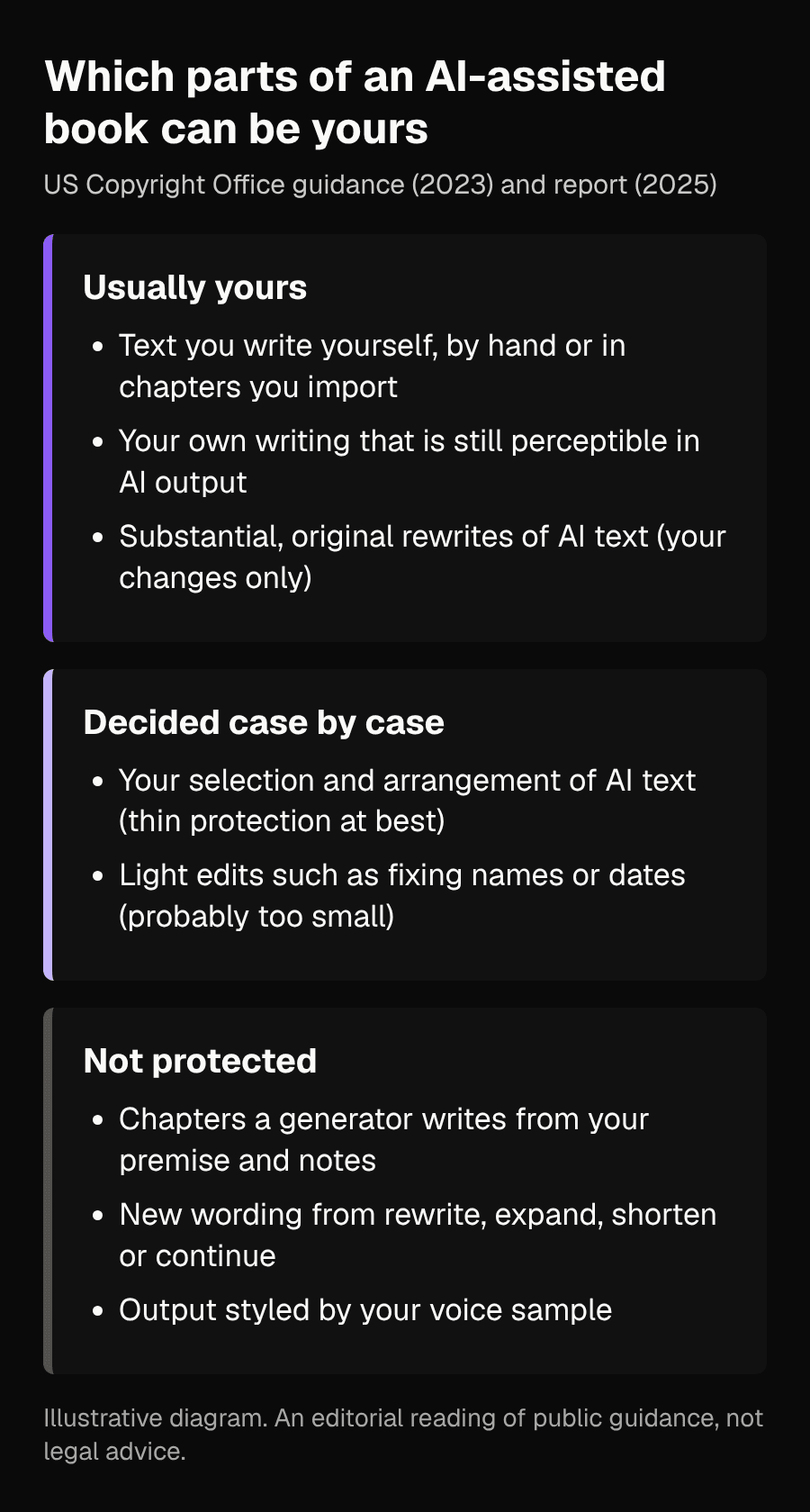
The table applies that guidance to the ways a book gets made in ScribistIQ. The status column is an editorial reading of the Office's guidance, not a ruling on any real book.[1][2][10]
| Part of the book | How it is made | Likely status under the guidance |
|---|---|---|
| Chapters a generator writes (Fast, Pro or Ultra Max) | The model writes prose from your title, premise, genre preset and notes. | AI-generated. Not protected, and more than a trivial amount must be excluded from a registration claim. A detailed premise is still a prompt. |
| Your premise and characters-and-world notes | Text you write and paste in, up to 24,000 characters of notes. | Your own text is yours as a separate piece of writing. It does not make the generated chapters yours, except where your own wording appears in them. |
| Your voice sample | Up to 4,000 characters of your prose; the model matches rhythm, sentence length and vocabulary, never the content. | Because your sample's content is not reproduced, it adds no human authorship to the output. |
| A manuscript you wrote and imported | Your .docx, .txt or .md file, then up to 12 new chapters the model proposes and you approve. | Your imported chapters stay yours. The new chapters are AI-generated. |
| Passages you type yourself in Write Studio | Writing by hand in the manuscript pane. | Human authorship, protected like any other writing. |
| AI actions on a passage (rewrite, expand, shorten, continue) | For rewrite, expand or shorten you select a passage and see the change marked up before you accept it; continue drafts new text from your cursor. | The new wording is AI-generated. If the passage was your own writing, your expression that is still perceptible in the result stays yours; the wording the AI added does not. |
| Your edits to generated text | You rewrite AI prose by hand. | Can be protected if the changes are substantial and original. Fixing a name or a typo is unlikely to count. Protection covers your changes only. |
| The whole book's selection and arrangement | Which chapters and passages you keep, cut, combine and order. | Possibly protectable as a compilation, but as Shupe's registration shows, that protection is thin. |
Worked example: mapping one book before you register
The example below is invented and labeled illustrative. It shows how to turn a book's history into the two statements the Copyright Office asks for. The 2023 guidance says to use the Standard Application, describe the human contribution in the Author Created field, and exclude more than trivial AI-generated material under Limitation of the Claim, Material Excluded, Other. It also says not to list an AI tool or its company as an author.[1][13]
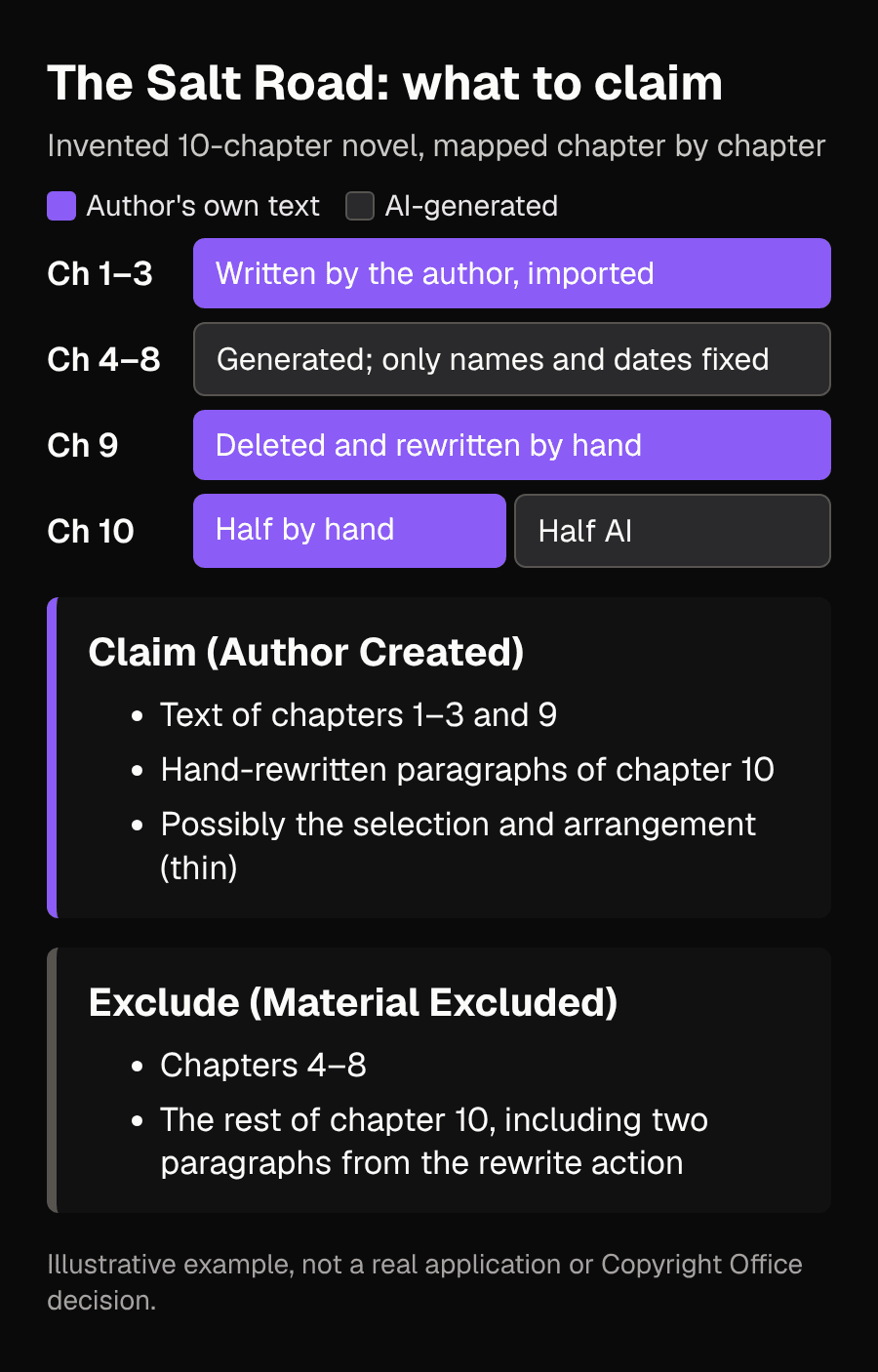
Book: The Salt Road, a 10-chapter novel. Chapters 1 to 3: written by the author before using any AI, then imported as a .docx file. Chapters 4 to 8: proposed and written by the continue feature from the imported chapters. The author fixed character names and dates in them and changed nothing else. Chapter 9: generated, then deleted and rewritten from scratch by hand. Chapter 10: generated; the author rewrote about half of its paragraphs by hand and used the rewrite action on two other generated paragraphs. Arrangement: the author cut one generated chapter and moved another earlier in the book.[13][10]
| Chapter | Origin | Claim or exclude |
|---|---|---|
| 1 to 3 | Written by the author, imported | Claim as human-authored text. |
| 4 to 8 | Generated; names and dates corrected | Exclude as AI-generated. Name and date fixes are probably too small to claim. |
| 9 | Rewritten by hand from scratch | Claim as human-authored text. |
| 10 | Generated; half the paragraphs rewritten by hand, two generated paragraphs run through the rewrite action | Claim the hand-rewritten paragraphs only. Exclude the rest, including the two rewrite-action paragraphs, which began as AI text. |
| Whole book | Author's cuts and reordering | Possibly claim the selection and arrangement, knowing that protection is thin. |
Author Created: Text of chapters 1 to 3 and 9, and revisions to the text of chapter 10, created by the author; selection, coordination and arrangement of human-authored text and AI-generated text. Material Excluded, Other: Text of chapters 4 to 8 and portions of chapter 10 generated by artificial intelligence.[1][13]
The wording follows the patterns in the 2023 guidance. If you are unsure how to fill in the form, the guidance says you can give a general statement that the work contains AI-generated material, and the Office will contact you when it reviews the claim. If you already registered a book without disclosing AI text, it says to file a supplementary registration to correct the record; otherwise the registration can be cancelled or disregarded in court.[1]
How to keep a record while you write
The Office decides case by case from what you tell it, so the practical job is to know which words are yours. This routine is an editorial suggestion, not a Copyright Office requirement.[1][7]
- Keep your own files: the premise, notes and any manuscript you wrote before importing it, with their dates.
- Export a DOCX copy of each generated draft before you start editing. ScribistIQ exports DOCX, EPUB and PDF, so you can keep the AI version and compare it with your final text later.
- Keep a short log per chapter: generated, imported, written by hand, or rewritten, and which AI actions you accepted.
- When you rewrite, rewrite properly. Under the guidance, small corrections are unlikely to add protectable authorship, while substantial original changes can.
- Do not list ScribistIQ, a model or any AI company as an author or co-author.
- For a book with real commercial stakes, or a registration you are unsure about, ask an intellectual property lawyer before you file.
Copyright, ownership and publishing are three different questions
| Question | Who decides | Short answer |
|---|---|---|
| Is the text protected by copyright? | The Copyright Office and the courts | Only the human-authored parts, decided case by case. |
| Do I or ScribistIQ own what I generate? | ScribistIQ's terms | You own your inputs and, to the extent any rights exist in it, the output. ScribistIQ claims no copyright in it and makes no promise you can register it. |
| Can I publish it? | Each store | Usually yes, with disclosure. KDP counts text as AI-generated even if you applied substantial edits afterwards, and asks you to declare it when you publish. |
The last row creates a real trap. The same chapter can be AI-generated for KDP's disclosure, because it started as AI text, and still contain your protectable rewrites for copyright. Answer each question by its own rule. ScribistIQ's publishing guide covers what each store requires.[8][12][1]
Limits
- This covers US copyright only. Other countries' rules are not covered here.
- The Copyright Office decides each application on its facts and has said it will update its guidance and Compendium. Check copyright.gov before you file.
- The table and the Salt Road example are editorial readings of public guidance, not legal advice and not a prediction that any registration will succeed.
- This article does not cover registration fees, deposit copies or contracts with publishers.
Sources
- US Copyright Office, Copyright Registration Guidance: Works Containing Material Generated by Artificial Intelligence (88 Fed. Reg. 16190, March 16, 2023)Checked 2026-11-15
- US Copyright Office, Copyright and Artificial Intelligence, Part 2: Copyrightability (January 29, 2025)Checked 2026-11-15
- US Copyright Office, Copyright and Artificial Intelligence initiative pageChecked 2026-11-15
- Holland & Knight, Supreme Court refuses to hear case on AI authorship (March 3, 2026)Checked 2026-11-15
- US Court of Appeals for the D.C. Circuit, Thaler v. Perlmutter, No. 23-5233 (decided March 18, 2025)Checked 2026-11-15
- The Decoder, US Copyright Office grants partial copyright for book written with ChatGPT's help (April 19, 2024)Checked 2026-11-15
- Josh Bernoff, Answers to authors' questions about AI-generated content and copyright (May 28, 2026)Checked 2026-11-15
- Amazon KDP content guidelines, artificial intelligence sectionChecked 2026-11-15
- ScribistIQ Terms of Service, section 4 (last updated October 22, 2026)Checked 2026-11-15
- ScribistIQ featuresChecked 2026-11-15
- ScribistIQ memoir generator pageChecked 2026-11-15
- ScribistIQ guide: Can you publish a book written by AI?Checked 2026-11-15
- Original illustrative contribution map for an invented book (no real book, application or result)Checked 2026-11-15