
How to fix point of view and tense slips in an AI-written chapter
Write a one-line narration rule, check each sentence of an AI-drafted passage for tense flips, person flips, head-hops and knowledge leaks, then fix each slip by type.

In this guide
An AI-drafted chapter can change who is telling the story, or when, without warning: a past-tense scene turns present for a sentence, a third-person narrator says "I", or the narration reports what a second character is thinking. To fix it, write your narration rule as one line, check each sentence against two questions, correct each slip by its type, and check the passage again. Most of these fixes are a word or two that you can change by hand. An AI rewrite is worth using only when a slip runs across several sentences.[7]
The method below is editorial advice worked through on a short invented passage. It has not been tested on generated books, and the passage was written for this article to show the slips; it is not output from any tool.[7]
Why a chapter drifts
Writers using AI tools have described this in public. On the public feedback board of Sudowrite, another AI writing tool, a writer posted on January 15, 2026 that the tool "suddenly changes from third to first person" in a file written in third person, and that the narration showed one character's perspective inside another character's scene. A post there from July 25, 2025 said that in third person limited the prose gave description "but no real depth or perspective from the characters point of view". These are two individual reports about one product, not a measure of how often it happens.[4][5]
Tools treat it as a real risk. Sudowrite's documentation describes explicit point of view and tense settings, which it says help keep narrative voice and tense consistent. ScribistIQ's co-writing guide says each Write Studio action reads a profile of your point of view, tense and sentence rhythm, and that the AI is told to keep them. The same guide is plain about the limit: the AI keeps to your point of view and tense most of the time, not always, and you should review every suggestion.[6][1]
The guide also explains one reason a long book is exposed: the AI does not read the whole manuscript for each action. It reads the Story Bible, the book's basics, a short summary of the previous chapter, the voice profile and the passage you chose. So the narration rule has to live somewhere every action reads, and you still need a check afterwards.[1]
Four slips to look for
Point of view means whose eyes and mind the reader is inside. In third person limited, the narration says "she" or "he" but stays with one character: it can report only what that character sees, hears, knows or thinks. Tense is whether the story's events are told as past ("she walked") or present ("she walks"). With those two terms, the slips sort into four types.[7]
| Slip | What it looks like | Usual fix |
|---|---|---|
| Tense flip | The main verb of a narration sentence is in the wrong tense for the book. | Change the verb by hand. |
| Person flip | The narration switches between "she" or "he" and "I" for the same character. | Change the pronoun and verb by hand. |
| Head-hop | The narration states a thought or feeling of someone other than the viewpoint character as fact. | Turn it into what the viewpoint character notices or guesses, or cut it. |
| Knowledge leak | The narration tells the reader something the viewpoint character cannot know at that moment. | Cut it, or move it to a scene where the character learns it. |
Two things look like slips and are not. Speech inside quotation marks follows the speaker, so a character can say "I" and use the present tense in a past-tense, third-person book. And "had" plus a verb ("she had locked it") is the normal way a past-tense story refers to something earlier; it is not a change of tense. Check the narration, not the dialogue.[7]
Worked example: an eight-sentence passage
Start with the rule. Write it as one line that names the viewpoint character, the person, the tense and the boundary on what the narration may report.[7]
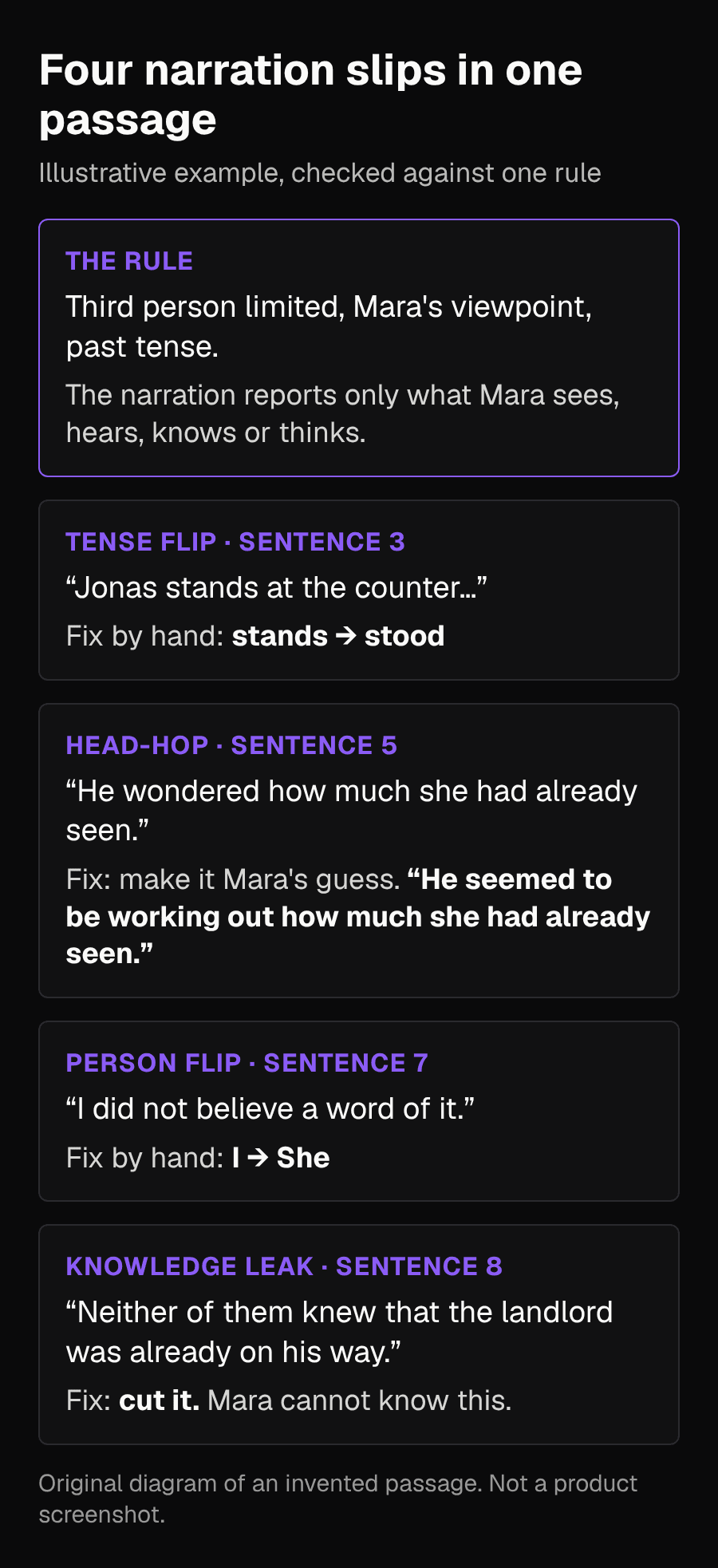
Third person limited, Mara's viewpoint, past tense. The narration reports only what Mara sees, hears, knows or thinks.[7]
Here is the passage to check. It was written for this article with four deliberate slips. The sentences are numbered so they can be marked.[7]
1. Mara pushed the shop door open and stopped. 2. She had locked it herself an hour earlier. 3. Jonas stands at the counter with the cash drawer open in front of him. 4. "I only came for the spare keys," he said. 5. He wondered how much she had already seen. 6. Mara looked at the drawer, then at his hands. 7. I did not believe a word of it. 8. Neither of them knew that the landlord was already on his way.[7]
Step 1: Ask two questions of every sentence
For each sentence of narration, ask: whose head is this, and what tense is the main verb? Write the answer beside the sentence. Do not fix anything yet; a full pass first shows whether you have a few stray words or a paragraph that has changed narrator.[7]
| Sentence | Whose head? | Tense of main verb | Verdict |
|---|---|---|---|
| 1 | Mara | Past (pushed, stopped) | Keep |
| 2 | Mara | Past, referring to earlier (had locked) | Keep: not a tense slip |
| 3 | Mara | Present (stands) | Tense flip |
| 4 | Mara hears Jonas speak | Past (said); the "I" is inside his speech | Keep: dialogue follows the speaker |
| 5 | Jonas (wondered) | Past | Head-hop |
| 6 | Mara | Past (looked) | Keep |
| 7 | Mara, but as "I" | Past | Person flip |
| 8 | Nobody in the scene | Past | Knowledge leak |
The count: eight sentences, four slips, and two sentences (2 and 4) that a quick search for "had" or "I" would have flagged wrongly.[7]
Step 2: Fix each slip by its type
- Sentence 3, tense flip: change "stands" to "stood". One word, by hand.
- Sentence 7, person flip: change "I" to "She". One word, by hand.
- Sentence 5, head-hop: Mara cannot know what Jonas wondered. Keep the idea but make it her reading of him: "He seemed to be working out how much she had already seen." The word "seemed" marks it as her guess. Do not add a new gesture or event to carry the thought; that would put a fact into the scene that was never planned.
- Sentence 8, knowledge leak: Mara does not know about the landlord, so the sentence cannot stay in her scene. Cut it. If the landlord's arrival matters, it belongs where Mara learns of it.
Fixing a head-hop by deleting the thought is always safe. Converting it into the viewpoint character's observation keeps more of the scene, but only if the observation is something the character could plausibly read from the outside.[7]
Step 3: Use Rewrite only where a slip runs long
In this example every fix is a word or a cut, so no AI action is needed. A rewrite earns its cost when a whole paragraph has changed tense or person, or when a head-hop runs for several sentences. In Write Studio you select a passage, choose Rewrite and can add a note to steer it; the suggestion arrives as tracked changes, and you choose Accept, Try again or Reject. Select only the affected sentences, so that the correct ones are not reworded.[1]
Rewrite only this selection. Keep third person limited from Mara's viewpoint, in past tense. Report only what Mara can see, hear, know or think. Turn any other character's thoughts into what Mara notices or guesses, or cut them. Keep every event, name and line of dialogue. Add no new facts.[7]
A note is a request, not a guarantee, which is why Step 4 follows every accepted change. The guide lists the cost of a Fast action as 500 credits and a Pro action as 3,000, within a monthly allowance that depends on your plan; an action that returns no text costs nothing. On a free account you can write and make the hand fixes, but the AI actions need a paid plan.[1]
Step 4: Run the two questions again
After the fixes, repeat Step 1 on the revised passage, and compare it with the original for anything that changed besides the slips: a name, an object, a line of dialogue.[7]
1. Mara pushed the shop door open and stopped. 2. She had locked it herself an hour earlier. 3. Jonas stood at the counter with the cash drawer open in front of him. 4. "I only came for the spare keys," he said. 5. He seemed to be working out how much she had already seen. 6. Mara looked at the drawer, then at his hands. 7. She did not believe a word of it.[7]
| Check | Before | After |
|---|---|---|
| Sentences | 8 | 7 |
| Tense flips | 1 | 0 |
| Person flips | 1 | 0 |
| Head-hops | 1 | 0 |
| Knowledge leaks | 1 | 0 |
| Events, names and dialogue changed | Not applicable | None; one sentence about the landlord was cut |
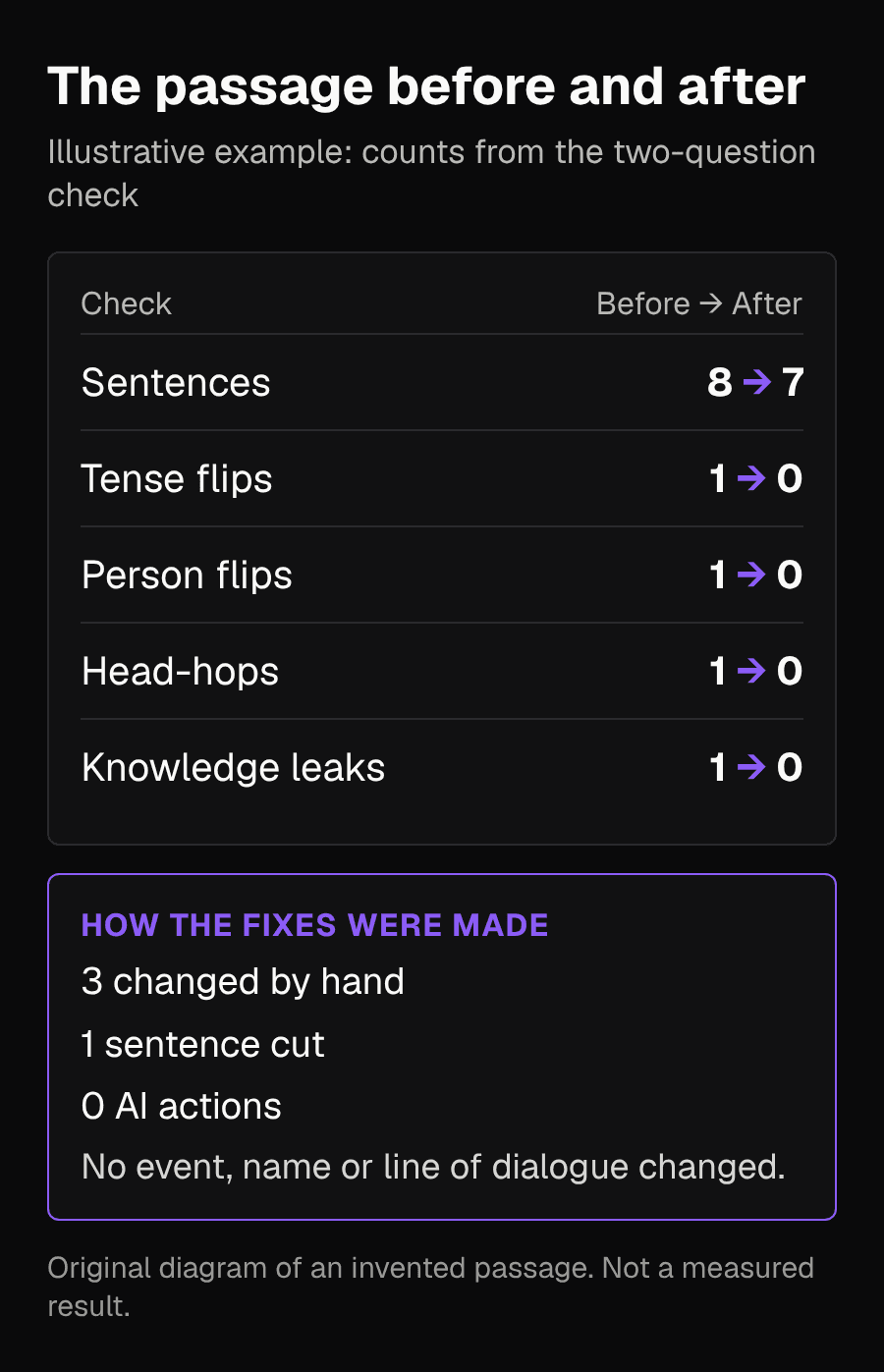
Judge the result with three questions. Could Mara have perceived or thought every narration sentence? Is every narration verb in the past tense, apart from "had" forms pointing further back? Does the scene still contain everything it did before, minus what you chose to cut? If the first answer is no anywhere, there is still a head-hop or a leak.[7]
Put the rule where the AI will read it
Checking afterwards is necessary, but you can lower the number of slips by stating the rule in the right place. In Write Studio, the Story Bible is the left-hand pane. The guide says it holds narration and voice, characters, setting and continuity facts, that it is filled in once when a book first opens in the Studio, that you can correct or add entries by hand, and that every AI action reads it, up to 16,000 characters. Open the narration and voice entry and make sure it says what your rule says. If a book was imported or generated, read what was filled in for you rather than assuming it is right.[1]
For a generated book, ScribistIQ's continuity guide says the story bible includes how the story is narrated and is made from the Characters and world box before chapter 1. That box is available on the Pro and Ultra Max generators. The features page lists no separate point of view or tense setting for the generators, so putting your one-line rule in that box is the documented place to state it. This is advice drawn from those pages, not a tested guarantee that the rule will hold in every chapter.[3][2]
If your book alternates viewpoint characters, write one rule per character and name the viewpoint character of the passage in every note. The public pages read for this article do not describe a per-chapter point of view setting in ScribistIQ, so treat the chapter-by-chapter check as part of the work.[1][2]
Checking a whole book
Reading every sentence of a novel against two questions is slow. Two shortcuts help. First, check the places where drift is most likely to start: the opening paragraph of each chapter and the first paragraph after each AI continuation, since a slip that is accepted there tends to be continued. That is an editorial rule of thumb, not a measured pattern. Second, on Pro plans the features page describes a Deep Manuscript Audit that reads the whole book across twelve categories, one of which is point of view and tense. The page says every finding quotes the passage it is about, that 6 of the 12 categories can be fixed in one click, and that the audit costs 40,000 credits per chapter. It does not say which six categories those are, and this article did not run the audit, so use the manual check on any finding before accepting a fix.[2][7]
Common problems
- The rewrite fixes the tense but changes other wording. You selected too much. Reject it, select only the affected sentences and try again, or make the change by hand.
- The head-hop comes back as a new gesture, such as a character glancing at something that was never in the scene. Reject it; that is a new fact. Use "seemed" or "looked as if", or cut the thought.
- You cannot tell whether a sentence is a leak. Ask whether the viewpoint character could say it aloud at that moment. If not, it is a leak.
- The book is deliberately omniscient, with a narrator who knows everyone's thoughts. Then head-hops and leaks are not errors, and your rule should say so. Tense and person flips still apply.
- A flashback is in the past perfect and then settles into simple past. That is a common convention, not a slip; mark where the flashback starts and ends instead.
Limits
The passage is invented and short, and real chapters contain harder cases than these four clean slips. The method is untested editorial advice. Product details come from ScribistIQ's public guide and features pages as read on November 11, 2026; this article did not operate the product, run the audit or generate any text. The reader reports quoted near the top are two posts about another tool and say nothing about how often any tool, including ScribistIQ, drifts.[7][1][2]
Sources
- ScribistIQ guide: How to write a novel with an AI co-writerChecked 2026-11-11
- ScribistIQ featuresChecked 2026-11-11
- ScribistIQ guide: AI novel continuityChecked 2026-11-11
- Sudowrite feedback board: Stop changing from 3rd to 1st person (posted January 15, 2026)Checked 2026-11-11
- Sudowrite feedback board: "Your Voice/ Tense & Character POV" Fix. (posted July 25, 2025)Checked 2026-11-11
- Sudowrite documentation: Setting POV and TenseChecked 2026-11-11
- Original analysis for this article: a sentence-by-sentence narration check, applied to an invented passageChecked 2026-11-11