
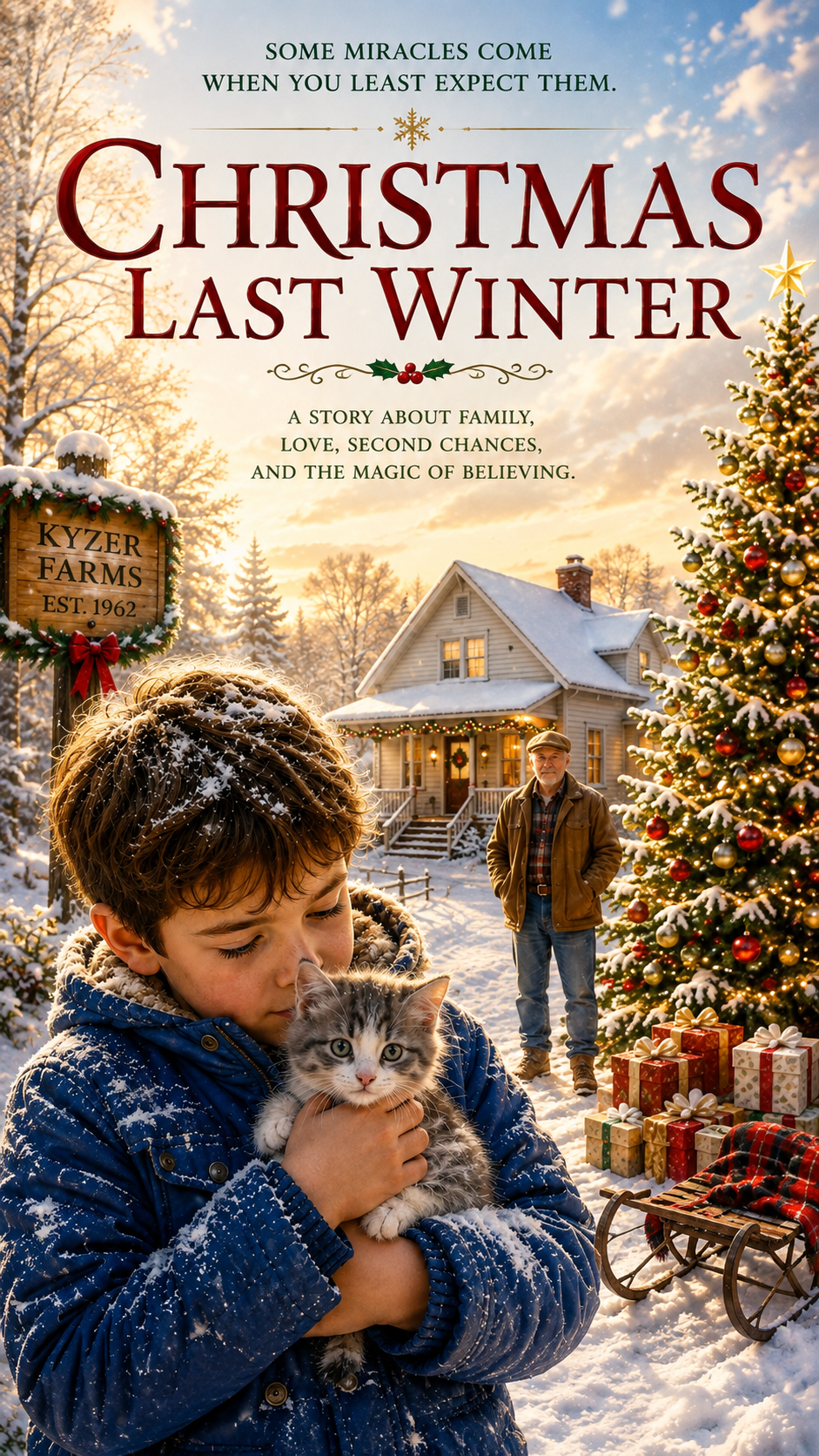
Novel · 11 chapters · 45,126 words
Christmas Last Winter
Contents11 chapters
- 01Tracks in the Blue Snow
- 02The Box Beneath the Quilt Chest
- 03The Face No One Names
- 04The Trail Behind the Churchyard
- 05What the Storm Took
- 06The Place by the Frozen Creek
- 07A Promise for Christmas Eve
- 08The Last Christmas Before the Thaw
- 09The Name on the Vet Card
- 10When the Roads Open
- 11North Hollow in April
Chapter 1
Tracks in the Blue Snow
David had one boot on the porch step before the front door opened.
Grandpa Sam stood there with his hand still on the latch, as if he had heard the car before it turned up the drive and had been waiting the last half minute on purpose. The porch light threw a pale circle across his flannel shirt and the toes of his work boots. Behind him, the house glowed the way it always did in December—lamplight in the front room, tree lights winking beyond the doorway, the fire making the front windows breathe gold.
“You grew,” Grandpa said.
“That was in October.”
“Still inconsiderate.” Grandpa stepped aside. “Get in here before your ears snap off.”
David ducked past him grinning, carrying his duffel with both hands because it had been packed by his mother as if he might need three sweaters a day. The air inside hit him all at once: pine needles, wood smoke, sugar, and the faint peppery smell of Grandpa’s aftershave. From the kitchen came the sweet burn of something baked a little too long at the edges.
There it was. Christmas.
He stamped the snow from his boots on the mat with the faded red reindeer, then lined them beside Grandpa’s. His mother came in behind him with a casserole dish wrapped in a dish towel, and his father followed with the rest of the bags, already talking to Grandpa about the county road and whether the plow had come through twice or only once.
David barely heard any of it. His eyes had gone straight to the living room.
The tree reached almost to the ceiling, broad and uneven in a way store trees never were. Grandpa always cut it himself from the back acreage, and Grandma—before she got too tired in winters and started staying with Aunt Linda in town more often—used to say the ugliest trees held the best memories because there was room to argue over where the crooked branches ought to go. The old ornaments were all there. The glass bird with one missing tail feather. The tin star David had made in kindergarten with too much glue baked under the glitter. The little wooden church Grandpa had carved years ago with windows so small you had to squint to see them.
On the coffee table stood a plate of sugar cookies shaped like bells and mittens, the frosting set in glossy white and red. David reached for one.
Grandpa slapped his hand away without looking. “Wash first.”
“I wasn’t touching, just seeing.”
“With your fingers.”
David dropped his duffel in the hall and ran for the kitchen sink. The faucet squeaked. The water came out colder than expected before it warmed. He heard his parents moving through the house in the comfortable banging-and-calling way adults did when they already knew where everything belonged. A cupboard shut. A chair scraped. Grandpa asked whether the green bean casserole had those crunchy onion things on top or whether his daughter had once again confused decency with healthy substitutions.
“No one wants your opinions before supper,” David’s mother called back.
“That’s because my opinions are sound and feared.”
David smiled into the towel. Some things never changed.
The kitchen windows were fogged over from the oven. On the sill sat the ceramic snowman Grandma put out every year, his painted carrot nose chipped on one side. A pan of cookies cooled near the stove under wax paper. A bowl of clementines shone like small lanterns in the middle of the table. Beyond the glass, the yard was already dimming into blue.
His father set another bag by the pantry door and looked at him. “You can help unload instead of haunting the cookie tray.”
“I already washed my hands,” David said, which was not an answer.
“It’s a start.”
They got the car emptied before dark settled completely. David carried in his pillow, the board game his cousin Emma liked, and a shoebox full of wrapped presents his mother said not to shake, squeeze, or hold near heat. The cold sharpened as the light went out of the sky. Snow along the porch rail caught the last gray of evening. The pasture fence stood in clean white lines beyond the barn. Somewhere out back a crow gave one single rusty call and then thought better of it.
By the time the casserole was in the oven and his parents had decided to stay only long enough for supper before driving back into town, David began to feel the old relief he always felt here. At home there were schedules and traffic and the sound of the upstairs neighbor practicing trumpet at hours no Christian could approve of. Here there was the creak in the hall outside the spare room, and the pump handle in the mudroom that had not worked in years, and Grandpa’s clock ticking from the mantel as if it had all the time in the world.
After supper, while the adults lingered at the table over coffee, David drifted to the front room and stood by the window. Outside, the snow had taken on that deep evening color that was not really blue and not really gray. It made the world look quiet even when it wasn’t.
The woods began just beyond the back lot, a dark wall of spruce and bare maple trunks. The path he knew started by the old split-rail fence, cut behind the barn, and ran down toward the creek. He could have walked it with his eyes half-shut. He had, once, in summer, and Grandpa had said that was an excellent way to meet a stump with his front teeth.
He glanced toward the kitchen. His mother was telling a story. His father laughed too loudly at it, which usually meant he had not heard the first half. Grandpa sat with one elbow on the table, mug in hand, listening with that sideways look of his that made people feel both tolerated and understood.
David found his hat on the peg by the mudroom door.
When Grandpa saw him pull on his coat, he said, “Where?”
“Just to the fence and back.”
“In the dark.”
“It’s not dark-dark yet.”
Grandpa looked at the window, then at David. “Ten minutes. Stay on the path.”
“I know the path.”
“So do deer. Some of them still get stuck.”
David grinned. “I won’t.”
Grandpa reached to the shelf and tossed him the flashlight anyway, an old metal one with black tape wrapped around the middle. “Ten minutes.”
The cold met him sharp and clean. Snow squeaked under his boots as he crossed the yard. Behind him the house gave off rectangles of light, and from the chimney a thread of smoke rose straight up. The barn stood hulking and red in the near-dark, its roof burdened with snow except where a drift had slid and left a rough patch exposed. A string of colored bulbs ran along the porch eave. Two of them had gone out, so the line skipped green and then came back red.
David breathed through his scarf and headed for the path.
The snow there was packed by old tracks—his, Grandpa’s, maybe the mail carrier cutting across from the lane earlier that day. Rabbit prints stitched the ditch. A squirrel had left delicate commas beneath the cedar where cones lay opened like bitten apples. The flashlight beam bounced over it all, yellow and narrow, though he used it more to please Grandpa than because he needed it.
The woods took the sound from the yard almost at once.
That was one of the things he loved best. Two dozen steps in, and the world changed its mind. The air smelled greener here, even in winter. Needles, sap, damp bark under frost. Snow held to the lower branches, and when the wind moved—barely, just enough—it sifted down in soft powder that caught on his sleeves.
He reached the bend where the path narrowed between two young firs. Beyond that was the little dip Grandpa called the wash, though it only filled in spring. David stopped there and listened.
Nothing much. A branch clicking. Farther off, maybe the creek under ice. His own breath.
Then he saw the tracks.
They crossed the path at an angle so faint at first he nearly missed them, just a run of pinpricks over the blue crust where no boot had stepped. Not rabbit. Too round and close together. Not squirrel either; no tail mark, and they came in a wobbling line as if whatever made them had been tired or unsteady.
David crouched, bringing the flashlight low. Tiny. Smaller than the heel of his hand. A kitten’s, he thought at once, though that was ridiculous enough that he looked around for some other answer.
The tracks came from the direction of the creek. They paused once near the edge of the path, a muddle where the little thing must have stood uncertainly, then wandered into the trees on the other side.
He should have turned back.
Grandpa had said ten minutes. Stay on the path. And if there was a kitten out here, it was somebody’s, and somebody was probably looking for it, and anyway kittens did not belong in woods after dark in December.
He switched the flashlight to his other hand and followed the tracks.
They were harder to keep once he left the path. Snow lay deeper under the pines, and deadfall hid underneath in ways that liked to catch a boot. He moved slowly, testing each step. The tracks dipped between bracken stems gone stiff and brown, then circled a stump feathered white. Twice he lost them and had to cast the beam in careful arcs until he found them again.
“Here, kitty,” he called softly, then felt foolish. If it was feral, it would run. If it was lost, it was probably too cold to care what he called it.
He went farther than he meant to.
The woods had that strange dusk inside them where the last light seemed to come from the snow itself. Trunks rose black around him. A branch brushed the shoulder of his coat and made him turn too fast. Ahead, under a fallen pine limb half-buried in drifted snow, something moved.
Not much. A twitch. Then two points caught the flashlight and flashed dull green.
David went still.
The kitten did not bolt. That more than anything made his chest tighten. It was tucked into a hollow at the base of the branch, fur puffed and ragged with damp, ears flattened, body made small with cold. White, mostly, with gray smudged over one eye and across its back. Snow dusted its whiskers. When the light hit it full, it opened its mouth and gave a sound too thin to be a proper meow.
“Oh,” David said.
He knelt carefully, the snow wetting his jeans at once. “Hey. Hey, it’s all right.”
The kitten watched him without blinking. Its sides fluttered fast.
He held out one gloved hand. “I’m not going to hurt you.”
That was what people always said to scared animals, though David knew animals had no reason to trust English. He eased the glove off with his teeth and tried again barehanded.
For a second he thought the kitten might strike. Its little head drew back. Then, instead, it lurched forward with all the dignity of a drunk moth and pressed itself against his wrist.
He could feel how cold it was through his sleeve.
“That’s bad,” he muttered. “That’s really bad.”
He slipped one hand under its belly. No resistance. The kitten was lighter than he expected, all ribs and shiver. When he lifted it free of the branch, it made one rough protest and then burrowed at once into the opening of his coat, claws snagging his sweater as it climbed toward his chest.
David sucked in a breath at the sudden cold and the sharper surprise of its trust.
“All right, then.” He tucked the coat closed around it, making a pocket with one arm. The little body pressed hard against him, trembling. Its nose found the base of his throat above the scarf and stayed there.
The walk back felt longer.
He kept the flashlight aimed down now because falling with a half-frozen kitten inside his coat seemed like a poor plan. More than once he had to stop and steady himself through a patch of brush. The kitten did not try to get out. Once it made a sound—not crying exactly, more a rusty click in its throat—and kneaded weakly through the sweater against his shirt.
The house lights appeared between the trees, bright and ordinary and suddenly very far away from the place he had found it.
By the time he reached the yard, the ten minutes were long gone.
Grandpa opened the mudroom door before David could get his glove off to grab the handle.
“I said—” He stopped. “What have you got there?”
David peeled back his coat.
Grandpa’s face changed in a way David could not have named. Not surprise, exactly. Not just that. His mouth set harder, and for one moment he looked past David into the dark yard as if expecting something else to come out of it.
“A kitten,” David said, unnecessarily. “In the woods. Under a branch. I think it would’ve died if I left it.”
Grandpa stepped back. “Come in. Shut the door quick.”
The kitchen smelled stronger now of coffee and dish soap and the yeast rolls David’s mother had insisted on reheating though nobody had room for them. Everyone looked up when he came in with the bundle at his chest.
His mother pushed her chair back at once. “David?”
“It was in the woods.”
His father set down his mug. “A cat?”
“Kitten.” David opened his coat again. The tiny head emerged, eyes narrowed against the light.
His mother put a hand over her heart, then seemed annoyed with herself for it. “Oh, honey.”
“That thing was outside?” his father said.
Grandpa had already crossed to the sink. “Warm towel. Not hot.” He glanced at David’s mother. “And a saucer.”
She moved without arguing, pulling a hand towel from the drawer and running warm water over it. David stood by the radiator, not sure whether he was helping or simply in the middle. The kitten clung to him with all four paws. When he tried to shift it, it made a desperate little rasp and dug in harder.
“Well,” Grandpa said after a moment, in the tone he used when he had accepted a problem but disliked the timing. “Settle yourself on the chair there.”
David sat.
Grandpa took the towel from the sink, wrung it out, and laid it across David’s lap. “Put her on that.”
“How do you know it’s a girl?” David asked.
“I don’t. Felt like saying her.” He held out his hands. “Let me.”
The kitten saw those hands coming and shrank backward so fast it nearly tumbled from David’s coat. A sound came out of it then that was more hiss than meow, weak but certain.
Grandpa stopped.
“Well,” he said.
“She doesn’t know you.”
“I’m crushed.”
David slid both hands around the kitten and lowered it onto the towel himself. Even then it would not let go easily. Its claws clung to his sweater until he eased them free one at a time. Under the kitchen light it looked worse. Its fur had clumped into icy spikes along its belly. One ear had a nick out of the edge. There was dirt on its nose. It bent itself at once against the heat of his hand.
His mother set down the saucer of milk.
Grandpa said, “Not too much.”
“I know how milk works, Sam.”
“That’s new.”
David reached to guide the saucer nearer. The kitten sniffed but did not drink. Its eyes kept closing. When Grandpa extended one finger to touch its back, it flinched so sharply that the towel bunched under it.
“Easy,” David said.
“I wasn’t wrestling it.”
His father had come over now, hands in his pockets, looking down with a practical frown. “Somebody around here lose a litter?”
“Could’ve wandered from the Millers’ place,” David’s mother said. “They always have cats in the sheds.”
“Millers’ cats don’t cross the creek much in winter,” Grandpa said.
Nobody answered that.
Grandpa crouched slowly, his bad knee cracking. He studied the kitten without trying to touch it again. The overhead light threw the lines in his face deeper than usual. David saw him notice the gray mark over the eye, the muddy paws, the way it had wedged itself against David’s wrist and would not lift its head.
“What?” David said.
Grandpa looked up. “What what?”
“You’re looking at her funny.”
“That’s a serious accusation from a boy who brought home a snow-soaked cat after dark.” Grandpa rose and went to the cupboard. “I’m looking at whether she’s got enough sense left to eat.”
He brought down a small can from the shelf above the flour bin and opened it with the old wall-mounted can opener that made a metal clicking sound. The smell hit at once, fishy and strong. The kitten’s ears twitched.
“There now,” David said, as if he had done something.
Grandpa forked a little of the food onto a plate and set it near the towel. “Let her come to it.”
The kitten did not move.
David broke off the smallest piece with his fingertip and held it close to her nose. She sniffed. Her pink mouth opened, closed, opened again. Then she licked once, uncertainly, and took the morsel.
His mother let out a breath.
“Good girl,” David whispered.
He fed her another bit, then another. After the fourth piece, she gathered herself and stepped—shaking, stiff, but determined—toward the plate. She ate with her whole face in the food, messy and urgent. David steadied the edge so it would not slide.
Grandpa watched from the counter, one hand braced beside the sink. “No more milk.”
“She didn’t even want it.”
“Wise animal.”
His father shook his head. “You can’t keep it, Davey.”
“I know,” David said, though the words came out too fast.
His mother glanced at him. She heard that too.
“We’ll ask around tomorrow,” she said. “Call the Millers, check with the church office, maybe put something up at the general store.”
“If nobody claims her?” David asked.
His father gave him the look fathers gave when they wished not to begin a discussion that would plainly occur anyway. “Then we see.”
Grandpa reached for his mug, found it empty, and did not refill it. “She can stay tonight.”
David looked up.
“Tonight,” Grandpa repeated. “In the mudroom, where it’s warmer than the porch and farther from my chair than the kitchen.”
The kitten had finished the first mouthfuls and turned in a stumbling circle, searching with her nose. When David laid his hand near her, she climbed onto it at once as if that had been the thing she wanted all along. She tucked herself against his palm and began purring so faintly he felt it before he heard it.
Grandpa saw that.
“Or not the mudroom, apparently,” he said.
A smile twitched at the corner of David’s mother’s mouth. “Apparently.”
His father rubbed the back of his neck. “This is how these things start.”
“This,” Grandpa said, “started with my grandson ignoring directions.”
David should probably have looked guilty. He tried. It did not take.
Grandpa pointed at him. “Don’t grin at me yet. We still have to see if the creature survives the evening.”
It did more than survive. Within half an hour, after another little helping of food and a cautious wipe-down with the warmed towel, the kitten had found the exact hollow of David’s lap and decided to remain there. If anybody else reached for her, she flattened her ears and turned into a handful of warning sounds. When David scratched gently beneath her chin, she leaned into it with a whole-body seriousness that made his mother laugh.
“Well,” she said, “you’ve been chosen.”
“That’s not always a compliment,” Grandpa muttered.
The house settled around them in the old familiar order. Supper dishes were dried and put away. David’s father carried the casserole pan out to the car. His mother packed leftovers into mismatched containers while talking through tomorrow’s errands. Grandpa added wood to the fire and checked the latch on the back door. The radio on the counter played carols through a thin drift of static.
And all through it, the kitten stayed exactly where she was.
David sat in the armchair near the tree with the afghan over his knees and her curled in the middle of it, no heavier than a rolled pair of socks. The lights from the tree slid over her fur, turning the gray patches silver, then blue, then green for a blink. Once she opened her eyes and looked straight across the room toward the dark hall that led to Grandpa’s study and the back staircase.
Her head came up.
“What is it?” David asked quietly.
She kept staring.
There was nothing there. Just the hall runner, the stand with the umbrella crock beside it, and beyond that the shadow where the lamp from the study did not quite reach. After a moment she tucked her nose back under her paw.
David looked up to find Grandpa watching from the doorway.
Not watching him. Watching the kitten.
“You sure you don’t know whose she is?” David asked.
Grandpa took a little longer than necessary to answer. “No.”
“But you thought something.”
“That happens to me now and then.”
“Grandpa.”
Grandpa came over and lowered himself onto the sofa with the careful stiffness of a man whose knees had entered into private opposition. He leaned forward, elbows on his thighs, and looked at the fire instead of David.
“In a town this size,” he said, “most lost things belong to somebody you know. That’s all.”
David studied him. Grandpa’s face was plain as split oak most days. If he meant to hide something, he usually did it by refusing to offer any decoration at all. But there had been that moment at the door, and then the way he had looked out into the yard, past David, into the dark.
“That’s not all,” David said.
From the kitchen, his mother called that they were leaving.
The next few minutes scattered everything. Coats were fetched. Goodbyes took place in clusters. His mother kissed the top of David’s head and told him to use the good sense the Lord had provided him, to which Grandpa said if the Lord had indeed provided it, it had arrived in a sealed crate and remained unopened. His father carried the trash bag to the can by the porch and came back stamping his boots. They reminded David to call if the roads turned bad, then remembered he was ten and would not be placing long-distance snow reports without assistance.
Through all of it, the kitten stayed put.
When the front door closed and the car lights swept once across the front windows before turning down the lane, the house grew larger. Quieter too. The tree lights blinked patiently. A log shifted in the fireplace and gave off a burst of sparks behind the screen.
Grandpa stood a while with one hand in his pocket and the other resting on the back of the sofa. Then he said, “We need a box.”
“For what?”
“For sleeping. Unless you intend to hold her till Easter.”
“I could.”
“I do not doubt your willingness. I doubt your stamina.”
They found a peach crate in the pantry and lined it with an old bath towel and one of Grandpa’s feed-sack dishcloths, softer from years of washing than anything new could have managed. Grandpa set the crate by the radiator in the mudroom first. The kitten took one look from David’s arms and made her opinion known.
“Bossy thing,” Grandpa said.
“She’s scared.”
“So am I when somebody suggests sleeping in a box by a drafty door.”
He moved the crate into the living room near David’s chair. This met with slightly less objection, which was to say the kitten allowed David to lower her in, stood there with offended uncertainty, then scrambled back out and climbed his pajama leg with astonishing determination for something so small.
Grandpa barked a laugh before he could stop himself.
“You’re enjoying this,” David said.
“I’m enjoying not being the one used as a tree.”
At bedtime, the matter became less funny.
David changed in the spare room with the kitten sitting in the middle of the braided rug watching every move he made. If he crossed to the bed, she followed. If he knelt for his toothbrush bag, she stumbled after him, mewing in a worn-out little voice each time he got more than three feet away.
When he tried setting her in the peach crate beside the bed, she climbed straight back out. When he put the towel from the radiator inside it, she lay down for all of twelve seconds, then rose and came to him again.
Grandpa, leaning on the doorframe, said, “Well, that settles it.”
“What does?”
“That she’s spoiled already.”
“I didn’t even do anything.”
“You fetched her out of the woods. Some creatures take that personally.”
David knelt and ran a finger down the kitten’s back. She pressed herself into his hand and began that tiny thread of purring again.
“Can she sleep in here?” he asked.
Grandpa looked at the bed, the crate, the little animal trying with all her remaining strength to disappear into the cuff of David’s pajama pants. He rubbed at his jaw.
“Not in the bed.”
“I know.”
“Good, because if you roll over on that thing, I’ll have to explain it to your mother in terms neither of us wants.”
David pointed to the folded quilt on the cedar chest. “What if I put it down there? On the floor. Right by the bed.”
Grandpa considered. “With the crate tipped on its side so she can crawl in if she wants.”
“Okay.”
“And an old clock wrapped in a towel.” Grandpa pushed off the frame. “Sometimes kittens like a ticking sound.”
David stared after him. “How do you know that?”
Grandpa paused in the hall. “I’ve been alive longer than you.”
That was not an answer, but it was all he got.
A few minutes later the little nest was made: quilt doubled thick, crate on its side, a small alarm clock from the kitchen shelf tucked near the back under a hand towel. Its ticking filled the room more than seemed possible. The kitten investigated with suspicion, batted once at the towel fringe, then chose a place half in and half out of the crate where she could keep one paw against the hem of David’s blanket hanging over the bed.
Grandpa stood at the doorway again, looking down.
“What are we calling her?” David asked.
“We’re not,” Grandpa said. “People do not name animals they’re trying to return.”
“That seems made up.”
“It is still sound policy.”
The kitten had shut her eyes, but at the sound of Grandpa’s voice one ear twitched. He went quiet. The lamp beside the bed cast a warm cone over the quilt and left the corners of the room in shadow. On the dresser sat the row of carved wooden Santas Grandma set out every December, their paint worn thin on the boots. From downstairs came the faint pop of the fire settling.
Grandpa’s gaze moved from the kitten to the dark window, where the glass reflected the room and nothing beyond it.
“Grandpa?”
He looked back at David as if he had nearly forgotten where he was. “What?”
“You’re doing it again.”
“Doing what.”
“Acting like this is something else.”
Grandpa rested one hand on the door latch. For a moment David thought he would give one of those answers adults gave when they wanted a subject to go away dressed as wisdom.
Instead he said, “Sometimes a thing comes to your door, and you know right off it’s going to ask more of you than you planned to give.”
David glanced down at the kitten. “She’s just cold.”
“Maybe.” Grandpa’s hand tightened once on the latch, then eased. “Get some sleep.”
He pulled the door almost shut, leaving it open by three inches the way he always did at Grandpa’s house. Enough for light from the hall. Enough for a voice to carry if needed.
David lay back against the pillow and listened to the ticking clock in the crate and the soft, uneven purr below him. He should have felt only pleased with himself. He had gone out for ten minutes, found a kitten that would have died alone in the snow, and brought it into a warm house on the edge of Christmas. That should have been the whole shape of it.
But downstairs he heard Grandpa pause halfway through crossing the hall.
The floorboard outside the study gave its old familiar creak. Then nothing.
After a moment came the sound of the study door opening, though Grandpa had no reason to go in there at this hour. David lifted himself on one elbow and looked toward the gap of light at his bedroom door.
The kitten had raised her head too. Her eyes were open, fixed on the hall, bright and watchful in the dark.
Chapter 2
The Box Beneath the Quilt Chest
The kitten discovered the basket of clothespins before breakfast and scattered them under the table one by one.
David was on his knees after the fourth one, reaching beneath a chair rung, when his mother said, “If she keeps that up, she’ll earn her breakfast by household labor.”
“She already did,” David said.
The kitten, unconcerned, had climbed halfway into the basket and was working with both front paws as if she meant to empty it to the bottom. In the morning light her fur looked less white than it had by lamplight, more a mix of cream and ash, with a smoky patch above one eye and a nick in one ear that made her seem both ragged and pleased with herself.
Grandpa stood at the stove turning sausage in the iron skillet. “That animal has been in this house less than twelve hours and already understands where the trouble is stored.”
“She’s not trouble.”
Grandpa flicked him a look over one shoulder. “No? Then why are you crawling on my floor before sunrise?”
“It is not sunrise,” David said.
“It is if you’re ten.”
His father folded the newspaper and tucked it beside his plate. “General store opens at eight. I’ll stop in and ask before we head to town.”
David looked up fast. “Can I come?”
“To ask about a stray cat?”
“Yes.”
His mother slid biscuits from a pan to a towel-lined bowl. “You may finish helping with breakfast first. Then we’ll see.”
That was not yes, but it was better than no.
The kitten sprang from the clothespin basket to the rung of David’s chair, missed the seat entirely, scrambled with all four feet, and landed in his lap by accident. For one startled second she went rigid. Then she tucked herself against his stomach and began to purr as if this had been her plan all along.
Grandpa snorted softly at the stove. “Spoiled.”
David put a hand over her small rib cage and felt the engine-hum there, too big for such a little thing. “She needs a name if we’re going to ask people about her.”
“We need a description,” Grandpa said. “A name only helps if she knows it, which she does not.”
“You can’t go around calling her ‘the kitten’ forever.”
“We can if forever turns out to be three days.”
David looked down at her. She had one paw hooked into the flannel of his shirt and her eyes mostly closed against the warm kitchen. “Just until we find the owner.”
His father reached for the jam. “Temporary names have a way of becoming permanent.”
“That’s because people keep using them,” David said.
“Sharp as tacks before bacon,” Grandpa said. “The boy’s a marvel.”
David thought about holly berries on the wreath at the church door, red against the dark leaves, about Christmas cards with holly printed around the edges. “Holly,” he said. “Until somebody claims her.”
Grandpa did not answer at once. The skillet hissed. In the living room the tree lights glowed faintly though the room was bright enough now that they looked tired. At last Grandpa slid the sausage to a platter and said, “Temporary foolishness is still foolishness.”
But he did not say no.
So the kitten became Holly, at least in David’s mind, and in practice for everybody else by noon.
No one at the general store had lost a kitten. Mr. Larkin behind the counter scratched his beard and said the Millers had barn cats enough to start a government, but none like this one, and besides, barn kittens were seldom so interested in house people. Mrs. Weller from the post office, who had come in for cinnamon drops and stamps, said she had heard no mention of anyone searching. David’s mother phoned the church office after they got back and left word there too. By lunch, Holly still belonged to no one.
Which ought to have made David happier than it did.
The problem was that a kitten someone had misplaced was one thing. A kitten no one seemed to be missing was another.
She spent the rest of the morning learning the downstairs rooms with great seriousness. She inspected the braided rug before the sink, sniffed every leg of the kitchen table, sat with offended dignity in front of the floor register until warm air blew on her chest, and twice tried to climb the tree. Grandpa intercepted her both times with the speed of a man who had spent years defending a Christmas tree from children, dogs, and carelessness.
“Try that again,” he told her, setting her back on the rug, “and you’ll spend the season in moral disgrace.”
Holly blinked up at him and then, quite plainly, turned her back.
David laughed before he could stop himself. Grandpa did too, but it ended quickly. His gaze stayed on the kitten a second longer than seemed needed.
That happened more than once.
If Holly darted across the hall, Grandpa’s eyes followed her. If she paused at the foot of the stairs and looked upward, he noticed. Even when he was shelling pecans at the table or untangling a string of colored bulbs for the porch rail, some part of him seemed to be listening for where she went.
David noticed because adults were forever saying children noticed nothing, and that was mostly because they never looked when children were looking at them.
By afternoon, the house had settled into the kind of winter quiet he liked best, the sort that had work in it. His mother was upstairs changing sheets in the front bedroom. His father had gone out to the barn with Grandpa to fetch two more boxes of decorations that had somehow not already been fetched. The radio on the counter murmured about school closings in counties north of them, though Evergreen Falls still had none to speak of. Cinnamon and dust and cold air from the mudroom drifted in turns through the house.
Holly vanished.
David first assumed she had found some impossible place under a sofa. He checked the living room, then the kitchen bench, then the basket of folded towels by the washer in the mudroom. Nothing. He stood in the downstairs hall listening.
A faint scratching came from overhead.
He climbed the stairs, each tread giving its own complaint. Halfway up he heard it again: scratch, pause, scratch-scratch.
At the top landing Holly was crouched near the end of the hall in front of the narrow upstairs room Grandpa usually kept shut. It was not locked, exactly, but the door was almost always pulled to, and David had never had much reason to go in there beyond storing suitcases or once helping move a box fan in summer. The room had belonged to no one for years and somehow that gave it an air of belonging to itself.
Holly stood on her hind feet and scraped at the lower panel.
“What are you doing?”
She dropped back down, looked at him, and gave a short questioning chirrup as if he was the one behaving oddly.
David glanced behind him. No one on the stairs. His mother’s footsteps were farther down the hall in the linen closet. Holly scratched the door again, more insistently this time.
“All right,” he whispered, though he had no permission to be granting.
The latch stuck for a moment, then gave. The room smelled of cedar and old starch. Curtains with little blue sprigs printed on them hung stiffly at the window. The bed was made with a white coverlet tucked square enough to please his grandmother, who had been gone five years and still managed to have opinions from beyond the grave through the way things remained done in her house.
At the foot of the bed sat the quilt chest, long and low, walnut darkened by polish and age. David remembered it from every Christmas he’d spent here because Grandma used to keep extra blankets in it and peppermint sticks in the top drawer of the dresser nearby, though she claimed not to. The dresser was empty now except for spare sheets and a sachet bag that smelled faintly of lavender gone flat.
Holly crossed the room without hesitation. She sniffed once at the bed skirt, ignored the rocker in the corner, and went straight to the chest. Then she put both paws on the front and made a tiny climbing motion.
“That’s not a door,” David told her.
She turned, mewed, and did it again.
The lid was heavier than he expected. It opened with the soft drag of wool against wood. Inside lay folded quilts, two afghans, and a stack of winter blankets striped in green and brown. A thin smell of cedar rose up from beneath them, mixed with that shut-away scent old linens get when they have been left too long without daylight.
Holly stretched up, balancing on the rim, and reached one paw in.
“There is not a kitten treasure in there,” David said.
But he began lifting the blankets anyway.
The top quilt was pieced from faded calico squares, the seams hand-stitched and faintly puckered. Under it lay a heavier one with red stars. Beneath those was a wool blanket that shed a little as he moved it. Holly crowded closer, pushing her cold nose between his wrist and the chest edge. She was not interested in the quilts. She was watching the bottom.
Something green showed under the last folded blanket.
David peeled it back.
A small wooden box sat in the far left corner, no bigger than a thick book. Not fancy. Pine, maybe, with the grain showing through worn varnish. Around it was tied a faded ribbon the color of evergreen needles after Christmas, when they had dried some but not all the way. The bow had loosened with age and leaned sideways, as if somebody had tied it in a hurry and meant to come back later.
Holly put one paw onto the blanket nearest the box and stared.
David felt a peculiar hitch inside him. Not fear, exactly. More the quick, clean sensation that came when a thing in a house shifted from ordinary to not ordinary at all.
If the box had been sitting on a shelf, he might have thought nothing of it. Boxes existed. But hidden under blankets in a room no one used, tied with ribbon as if it mattered what hands touched it—that was different.
He looked once toward the hall, listening. Still only the distant sounds of the house and his mother moving linen.
“It might just be Christmas cards,” he murmured, though to whom he was proving this was not clear.
He slid his fingers under the ribbon.
“Leave that.”
Grandpa’s voice struck across the room so sharply that David’s hand jerked.
He had not heard him come up the stairs.
Grandpa stood in the doorway carrying a cardboard carton full of glass ornaments wrapped in newspaper. For a second nobody moved. Holly flattened her ears and stepped backward, then sat down all at once, tail wrapped tight around her feet.
David pulled his hand away from the box. “I wasn’t—”
“Yes, you were.” Grandpa crossed the room in three long steps and set the carton on the bed hard enough to make the brass headboard tick against the wall. He bent, lifted the little box out of the chest, and held it against his side. “You were about to open something that does not belong to you.”
The words themselves were ordinary. It was the tone that made David’s face go hot.
“I just found it.”
“That does not improve matters.”
“Holly found it.”
Grandpa’s mouth tightened. “The cat has no standing in this discussion.”
The unfairness of that landed first. Then the rest of it did. Grandpa almost never spoke to him that way. Even when he was angry, there was usually some dry corner left in it, some place to step. Not now.
David straightened from the chest. “I said I was sorry.”
“You have not said any such thing.”
“Then I am.”
Grandpa stood very still. The room seemed smaller with him in it. Not because he was a big man anymore—age had narrowed him some—but because everything in him had drawn up hard as fence wire.
After a moment he exhaled through his nose. “I should not have barked.”
David looked at the floorboards. A line of sunlight lay across them from the window, showing every scratch. Holly had retreated beneath the rocker and was peering out with her pupils wide.
Grandpa shifted the box to his other hand. “But there are some things in a family house a child does not go through because he is curious.”
David knew that rule. He also knew most rules had edges and this one had never before included being led by a kitten to a hidden ribbon-tied box. “Then why keep it under blankets?”
Grandpa’s answer came too fast. “Because that is where it was put.”
“That doesn’t answer it.”
“No,” Grandpa said. “It doesn’t.”
From down the hall David’s mother called, “Sam? Did you bring up the angel topper?”
Grandpa did not take his eyes off David. “In a minute.”
Silence held another beat. Then he crouched and set the chest lid down carefully with his free hand, as if control had to be reassembled piece by piece. “You do not open other people’s things. Even if a cat recommends it.”
“She’s not just any cat.”
That was the wrong thing to say. David saw it at once. Something crossed Grandpa’s face and was gone too quickly to name.
He rose. “No. I expect she isn’t.”
With the box under one arm, he lifted the ornament carton from the bed and turned toward the hall.
David heard himself ask, “What is it?”
Grandpa stopped at the doorway but did not turn back. “An old box.”
“That’s not an answer either.”
“It is the one you’re getting.”
Then he walked out.
David stood beside the closed chest, fists balled against the sides of his jeans. He was angry enough to want to kick something, which would only have proved Grandpa right about children and curiosity and other people’s belongings. So he did not kick anything. He leaned both palms on the quilt chest instead and looked down at the wood grain until the heat in his face eased some.
After a moment Holly crept from under the rocker and came to him with cautious steps. She rubbed once against his shin, then twice harder, leaving a thread of pale fur on his sock.
“Well, that went well,” David muttered.
She blinked.
He knelt and picked her up. Her heart was running fast against his hand. “You got me into it.”
That was not true, and he knew it. He had put his fingers under the ribbon all by himself.
Still, when he carried her back into the hall, he noticed the door at the far end standing ajar: Grandpa’s study downstairs had its twin up here in the shape of a small room once used for sewing, then storage, then apparently hidden boxes. Houses held their own map of old decisions. You could live in one for years and still not know where all the rooms led inside people.
The rest of the afternoon moved, but not smoothly.
Grandpa came down to the living room after a while with the angel topper and a tin of brass hooks and behaved as if nothing of consequence had happened. He showed David’s father how to brace the loose leg of the manger with folded cardboard. He argued with David’s mother over whether the blue bulbs belonged in the front windows or on the tree. He even let Holly stalk a ribbon offcut across the rug until she nearly slid into the hearth.
But he kept the little wooden box out of sight.
Once, when he thought nobody was paying attention, David saw him standing alone near the sideboard with one hand resting flat against the drawer front, not opening it, not moving on. Just standing there as if he had gone to fetch something and forgotten what a drawer was for.
When he noticed David watching, he picked up the bowl of walnuts and asked, “You know where the nutcracker got off to?”
It was too ordinary to challenge. David pointed to the mantel. Grandpa thanked him and crossed the room.
Holly spent the day in loops through the house. She slept for fifteen minutes in a patch of sun by the back door, then woke and followed feet, strings, crinkling paper, whispers, chair movements, and once a drifting curl of steam from the dishwasher. Yet again and again she returned to the stairs.
At supper she sat under David’s chair and batted his laces. After supper she vanished and turned up in the upstairs hall with her nose pressed to Grandpa’s bedroom door. Later she emerged from behind the coat tree carrying a cork in her mouth and would not surrender it even when it made her walk sideways.
“She is part goat,” David’s father said.
“She is part nuisance,” Grandpa said, though without force.
David watched him scratch the kitten once between the shoulders when he thought no one would see. Holly accepted it gravely and then, as if remembering herself, trotted off toward the hall that led to Grandpa’s study.
Grandpa’s hand hung in the air a second after she was gone.
That night a fresh string of paper chains went around the dining room doorway. David’s mother sent him to the Christmas barn for the box marked NATIVITY because, as she put it, “I know it exists, and your grandfather knows it exists, and between the two of us we have managed not to bring it in.”
The barn had its own smell in winter—hay dust, machine oil, old wood, the faint mineral cold of tools hung on nails. A single bulb burned over the workbench, drawing shadows up the walls. David found the box on a shelf behind a stack of canning jars and carried it carefully back, Holly trotting after him through the crusted path from barn to mudroom as if she had helped.
“Useful creature,” Grandpa said from the table.
“I found it.”
“She supervised.”
Inside the box, tissue rustled around the carved figures. Joseph had a chipped sleeve. One shepherd was missing half his crook. Baby Jesus, wrapped in yellowed cotton batting, was still intact, which his mother said was a yearly miracle. David lifted the stable roof into place on the sideboard while she set out the figures.
Something thin slid from behind the stable back and fluttered to the floor.
He bent first, expecting a receipt or a program from church. It was a photograph.
Not new. The edges had gone soft and one corner was bent white. Black and white, with the kind of dark trees in the background that made every old winter picture look colder than it had likely been. A younger Grandpa stood in a heavy coat, one hand on the shoulder of a child perhaps a little older than David was now. The child wore a knit cap pulled low and was smiling straight at the camera, open and certain, as if whoever stood behind it belonged to them.
David looked harder.
He did not know that face.
He knew every cousin, every aunt, every uncle, even the ones who only came for funerals and forgot his birthday the other eleven months. He knew the framed wedding photo on the piano and the school portraits in the hall and the picture of his mother with missing front teeth at age seven. This child was none of them.
“Grandpa?”
Across the room Grandpa was feeding logs into the firebox one at a time with the poker. “Mm.”
David held up the photograph. “Who’s this?”
The poker struck the grate.
Not hard. Hard enough.
His mother, arranging the wise men, glanced over. “What did you find?”
Before David could answer, Grandpa crossed the room. He moved steadily, but too quickly for a man merely curious about a picture. He took it from David’s fingers and looked down at it.
For a moment the whole room narrowed around that square of paper.
The fire gave a soft rush behind him. Holly, who had been worrying a bit of straw near the mudroom door, came into the living room and sat. Her head tipped. Her eyes stayed on Grandpa.
David said, “I’ve never seen that one before.”
Grandpa did not look up. “No reason you should have.”
“Who is it?”
He slid the photograph over once between his thumb and forefinger, as though testing whether it was real. When he answered, his voice had gone so even that David mistrusted it on the spot.
“That,” Grandpa said, “is an old friend.”
The room did not stir. His mother’s hand remained on one painted camel. His father, by the tree with a strand of lights over his shoulder, looked from the picture to Grandpa and said nothing.
David knew then that whatever answer he had been given, it was not the whole one.
“Whose friend?” he asked.
Grandpa lifted his eyes at last.
“Mine,” he said. “And that’s enough for tonight.”
He tucked the photograph into his shirt pocket, right over his heart, and Holly let out a small sound from the rug—not quite a mew, not quite anything human could have named—before she slipped past David’s legs and headed for the hall again, toward the shut rooms and whatever waited in them.
Chapter 3
The Face No One Names
By noon David had already looked for the photograph in six places where it could not possibly be.
He checked the sideboard beneath the nativity stable, though he had watched Grandpa take the picture away. He opened the lid of the piano bench because old papers lived there in fat leaning stacks. He stood on the braided rug in the hall and studied the framed pictures marching toward the stairs, as if one face among them might suddenly match the child from the black-and-white print and save everyone the trouble of pretending.
No luck.
Holly sat halfway up the staircase with her front paws together, small as gloves, watching him from between the spindles. When he looked at her, she let out a soft sound and climbed three steps higher.
“You’ve already been up there,” he told her.
She blinked. That meant nothing. Cats believed stairs belonged to them.
In the kitchen, plates knocked lightly against one another while his mother dried them and set them in stacks. Grandpa was at the sink with his sleeves rolled, cleaning the cast-iron skillet with a square of folded paper towel and salt, the way he claimed decent people cleaned a skillet and lazy people ruined one. David leaned in the doorway and watched the two of them without being noticed at first.
Grandpa had changed shirts.
The pocket was empty.
That ought not to have mattered. It did anyway.
His mother said, “Lena’s bringing over the cranberry loaf after supper.”
Grandpa grunted.
“That means yes, I heard you,” she said.
“It means if your sister arrives with that loaf and expects me to say no, she doesn’t know me well.”
“You say no every year.”
“And every year she leaves it here.”
His mother smiled into the dish towel. Grandpa set the skillet on the back burner, wiped his hands, and turned enough to see David.
“Well,” he said. “You’ve got that look.”
“What look?”
“The one that says your head’s working harder than the rest of you.”
David came a little farther into the room. “Can I ask something?”
Grandpa reached for the coffee tin, though it was not coffee time. “You generally do.”
“The picture from last night.”
His mother’s hand stopped on the lip of a plate.
Grandpa did not sigh, which somehow made it worse. He measured grounds into the dented percolator as if exact spoonfuls might help. “I answered you.”
“You said it was an old friend.”
“That is an answer.”
“It’s not much of one.”
His mother gave David a warning glance. Not sharp. Just tired in advance.
Grandpa put the lid on the pot. “Some things belong to another time, son.”
“That kid looked like family.”
Grandpa’s fingers rested a moment on the black handle. “He wasn’t.”
David caught the word before he had time to think about it.
He.
Not it. Not old photo. Not some picture. He.
David said, careful now, “What was his name?”
Grandpa turned and lifted the percolator to the stove. The burner clicked, then took with a blue ring. “You’ve got chores.”
“That isn’t a name.”
“No,” Grandpa said. “It isn’t.”
The kitchen fell quiet except for the low tick of the wall clock and Holly’s paws descending the stairs one at a time. She crossed the worn runner and wound around David’s ankles. He stooped automatically to pick her up. Her little body was warm through his sweater. She tucked her nose under his chin, purring so hard it sounded too large for her.
Grandpa looked at the cat, not at David. “Woodbox is low.”
David stood there another second. Then another. His mother had gone back to drying the plates, but she was listening with her whole back.
He took Holly and went to fill the woodbox.
The afternoon stretched itself thin. He split kindling at the chopping block while his father checked the truck chains in the barn. He carried in logs two at a time, bark rough against his gloves, and all through it the picture stayed with him: younger Grandpa in a winter coat, one hand on a shoulder, the child smiling like he knew he belonged where he stood.
People did not put strangers in their shirt pockets.
Near four o’clock Aunt Lena came through the front door in a red wool coat powdered at the hem with old snow. She brought the cranberry loaf in a blue glass dish and a bag of oranges and enough talking to fill the hall before she had even unwound her scarf. Aunt Lena was his mother’s younger sister and looked enough like her to prove they were related, but everything in Aunt Lena was done a little quicker, a little brighter, as if she had no patience for the plain version of anything.
She kissed the top of David’s head, bent to admire Holly, and told Grandpa his porch wreath was hanging crooked.
“It leans with character,” Grandpa said.
“It leans with one nail.”
“That too.”
By supper the house had that gathered feeling Christmas houses got when people moved from room to room carrying food and stories and spoons. Ham came out in thick slices with the brown sugar glaze set sticky on top. There were green beans, scalloped potatoes with crisp edges, canned pears in the little pressed-glass bowl only used in December. Holly was shut in the laundry room with a saucer of water because Aunt Lena claimed cats and holiday meals did not mix, though Holly objected in a thin offended voice from behind the door.
David waited longer than he usually could. He ate half his potatoes and all his ham. He listened while Aunt Lena described a church committee argument over whether the children’s pageant sheep should be made of batting or felt. He watched his father butter a second roll. He let the talk drift around him until there was a gap big enough to step into.
Then he said, “Mama, do you know who the kid is in Grandpa’s picture?”
Forks paused.
Not dropped. That would have been too clear. Just paused.
His mother looked at her plate first. Aunt Lena took a sip of tea she did not need. Across the table Grandpa kept cutting his ham into precise squares as though measurement mattered suddenly.
“What picture?” Aunt Lena asked.
“The black-and-white one from the nativity box. The one with Grandpa and that boy.”
Aunt Lena’s eyes lifted to his mother’s for half a second.
That was all. It was enough.
His mother said, “Probably an old neighbor.”
“Probably?” David said.
“Your grandfather knew half the county growing up.”
“Not like that.”
“What does that mean?” Aunt Lena asked lightly.
“It means he had his hand on the kid’s shoulder like—” David stopped. He did not have the exact words. Like family. Like responsibility. Like if the person behind the camera loved the child too, or wanted to. “Like they knew each other.”
“Neighbors know each other,” Aunt Lena said.
“That answer was ready awfully fast.”
His father cleared his throat. “David.”
But David looked at the women. “Do you know his name or not?”
His mother folded her napkin once, then opened it again. “I don’t know for certain.”
Aunt Lena said, “Samuel had friends before any of us came along. That isn’t a crime.”
“Nobody said it was.”
“Then quit sounding as though you’ve caught somebody.”
There it was again—that slight shove adults gave when they wanted a child to feel rude instead of curious. David knew the move by now. It usually worked better than this.
He said, “If it’s just an old neighbor, why did Grandpa put the picture in his pocket?”
Silence settled over the table. The clock on the sideboard gave one dry click before the next minute tipped over.
Grandpa laid down his knife. “Because it’s mine.”
David turned toward him. “Then why can’t you tell me?”
“Because I said no.”
“That’s not a reason.”
“It’s the one you’ve got.”
His father looked as if he might intervene, but Grandpa had already risen. He took his plate and crossed to the counter. Not hurried. Not angry in any way that would help. He stood with his back to them a moment, one hand on the rim of the sink.
Aunt Lena reached for the pears and began spooning them into a side dish no one had asked for. “This family has always had a gift for spoiling supper.”
His mother said quietly, “David, sometimes people keep old things private because they belong to sorrow, not because they’re trying to deceive you.”
“Whose sorrow?”
She did not answer that.
After supper he was sent to dry dishes, which in his view proved he had asked the right question.
He dried in hard swipes while his mother washed. The hot water smelled faintly of onions and dish soap. In the dining room he could hear Aunt Lena and Grandpa moving chairs, pretending to discuss church poinsettias with more interest than humanly possible.
His mother handed him the pressed-glass pear bowl. “Careful with that.”
“I’m being careful.”
“With your hands, yes.”
David set the bowl on the towel and looked at her. “You know.”
She scrubbed a platter that was already clean. “I know there was a hard winter here before you were born.”
“That’s not the same thing.”
“No.”
“Then tell me the other part.”
She shook water from her fingers and reached for another plate. “If your grandfather wants you to know it, he’ll tell you.”
“What if he doesn’t?”
Her shoulders moved under her sweater, small and helpless and a little irritated all at once. “Then maybe there’s a reason.”
“That’s what everybody says when they mean stop asking.”
She did not deny it. That annoyed him even more.
In the parlor Aunt Lena laughed too loudly at something Grandpa said. The sound had edges on it.
David wiped the platter and stacked it. “Was the kid dead?”
The plate in his mother’s hands knocked the side of the sink.
Just once.
She set it down carefully. “That is enough.”
He heard the change in her voice and stopped. It was not anger, not exactly. It was fear trying not to show itself to a ten-year-old at the sink.
He stared at the dish towel bunched in his fists. After a moment his mother touched his sleeve, only once.
“You are not wrong to notice things,” she said. “But noticing them does not make them yours to open whenever you please.”
That sounded like something she had been needing to say all day.
He wanted to answer. Nothing in him would settle on the right words. So he carried the dry plates to the cupboard and said nothing at all.
Later, when Aunt Lena had gone and his father was out at the shed checking the generator because he mistrusted December, David found himself in the front hall with no real plan except to listen. The house had old-house habits: floorboards that answered weight, a furnace that sighed through the grates, doors that never shut without a little persuasion. If you stood still enough, you could tell who was in which room by the kind of quiet they made.
Grandpa was in the study.
David knew it because the lamp under the door cut a long stripe over the hall runner, and every so often came the soft rasp of a drawer being opened, then shut. Holly sat beside that light stripe with her tail curled around her paws. She stared at the crack beneath the door as if something might come out.
David crouched beside her. “What are you after?”
She put one paw under the door and drew it back. Then she made that small crying sound again, not a full meow. A calling sound. One note, then another.
The knob turned.
David sprang up just as the door opened inward.
Grandpa stood there with his glasses low on his nose and a cigar box in one hand full of screws and stray hardware. For one ridiculous second David wondered if he had been caught stealing screws.
“You’re blocking the draft,” Grandpa said.
David glanced at Holly. “She was at the door.”
“So I observed.”
“What are you doing?”
“Hunting a hinge screw the right size. This house has developed opinions about staying shut.”
That, at least, was true. The upstairs linen closet drifted open every time the heat kicked on.
David looked past him into the study. Lamplight on bookshelves. The green shade over Grandpa’s desk. A folded newspaper. Nothing mysterious in sight. If the photograph was there, it was hidden better than screws.
“Holly likes this room,” David said.
“Holly likes trouble.”
“So do I, apparently.”
One corner of Grandpa’s mouth twitched. It vanished again. “You ought to be in the den with your father.”
“You ought to tell me his name.”
Grandpa’s hand tightened on the cigar box. Metal pieces clicked inside. “Good night, David.”
He shut the door without force. That made it final in a different way.
Holly sat back on her haunches and looked up at him as if he had handled the matter poorly. Which, fair enough, he had.
The next morning his mother needed flour from town, his father needed a new strap for the snow shovel, and David needed a reason to get into the library without seeming to have one.
Evergreen Falls Public Library stood in an old brick building beside the post office, with a pair of plastic candles in the front windows and a paper snowflake chain sagging over the children’s books. The place always smelled like dust, radiator heat, and paste. Mrs. Brandt, the librarian, wore her gray hair in a twist so sharp and tidy it seemed fastened by moral principle alone.
She liked David because he returned books without being asked twice and because he had once informed another boy that folding pages down was barbaric.
“Back again,” she said as the bell over the door gave its tired jingle. “Either you read quickly or your grandfather has finished with your detective stories.”
“He says they cheat.”
“They often do.”
His mother went toward the cookbook shelf. David peeled away to the local history alcove, a narrow back corner where the books were taller and sadder and no one under sixty ever wanted anything. Bound town anniversary volumes sat beside folders of clipped articles. A metal cabinet held old newspapers on microfilm, which he had only ever been allowed to look at from a respectful distance.
Mrs. Brandt appeared beside him as if summoned by suspicious thoughts.
“You’re young for county tax maps,” she said.
“I’m not after tax maps.”
“No?” Her eyes went to the newspaper cabinet. “Then you’ve either developed a late interest in zoning disputes or you’re hunting something.”
David considered lying and found he was not ready enough.
“Were there ever,” he said, “any winter accidents out by Mill Creek? A long time ago.”
Mrs. Brandt’s face did not change much. It changed enough.
“Why do you ask?”
“For school.”
“No, you do not.”
David shifted his weight. “Grandpa said there was a hard winter before I was born.”
“There were several.”
“One where people had to go looking for somebody.”
Mrs. Brandt rested her hand on the edge of the cabinet. Her wedding ring had worn thin at the bottom. “Your grandfather said that, did he.”
“Not exactly.”
“Mmm.”
She looked past him toward the front desk, where his mother was comparing two sacks of flourless holiday recipes for reasons David did not understand. When Mrs. Brandt looked back, her voice had gone quieter.
“There was a December when half the town turned out with lanterns,” she said. “Search party went through the woods west of the churchyard and down toward the creek. Men from the fire station. Farmers. A deputy from Carson County who got his truck stuck before he’d gone half a mile and was no use after that.”
“For who?”
Mrs. Brandt’s fingers tapped the cabinet once. “For a child.”
“Boy or girl?”
“I expect that detail matters to you very much right now.”
“It does.”
“To someone, yes. To the newspaper, less than you’d hope.”
“Did they find—”
She cut him off with a look not unkind, only firm. “Your mother would not thank me if I set you loose among archive reports with that question in your head.”
“So there are reports.”
“There are newspapers. Newspapers are not the same thing as truth.”
“Then let me see them.”
“No.”
He stared at her.
Mrs. Brandt had the sort of face that looked severe until one noticed the patience in it. “A child wandering off in winter is not a puzzle for entertainment,” she said. “People here remember more than they discuss, and that is sometimes because memory has sharp corners.”
David felt heat rise in him. “Everybody keeps talking like I’m too little to hear anything.”
“You are little.”
“I’m ten.”
“Yes,” she said. “Exactly.”
He hated when adults made numbers sound like proof.
Mrs. Brandt was quiet a moment. Then she opened a nearby file drawer and drew out a thin folder. “I can give you what is public and ordinary.”
Inside were photocopied pages from an old town centennial booklet, a church newsletter history, and a newspaper clipping about a winter storm years earlier that had closed the county road and drifted the church steps level with the top rail. Names of snowfall totals. Notes about frozen pipes. A photograph of men with shovels on Main Street, their collars turned up.
One paragraph, buried near the bottom of a page about volunteer efforts during severe winters, mentioned a community search for “a missing local child” during a December cold snap many years ago. No name. No resolution. Just a sentence praising the determination of the town and the providence that spared additional loss.
David read it twice.
“Additional?” he said.
Mrs. Brandt took the folder back before he could ask for the rest. “That is enough for today.”
“That’s barely anything.”
“It is what I chose to hand a ten-year-old in a public library.”
“Did my grandpa help search?”
Mrs. Brandt slid the folder under the desk blotter. “Go choose a book before your mother wonders why I’ve kept you.”
He knew dismissal when he heard it. Still, he stayed one second too long.
Mrs. Brandt met his eyes. “Some stories in a town do not disappear,” she said. “They just stop being said aloud.”
On the way home his mother asked why he had checked out a field guide to winter birds when he already owned one. David told her this one had better pictures, which was not entirely false. Folded inside it, where he had slipped it while Mrs. Brandt was helping a man find large-print westerns, was a half-sheet he had copied in pencil from the centennial booklet.
Search party. Churchyard. Creek.
Nothing else. Enough.
That afternoon he tested more edges.
He looked through the lower shelves in the study while Grandpa was out in the barn with his father, pretending to search for a book of Christmas carols. He found seed catalogs, almanacs, two Bibles, a jar of loose buttons, and a stack of yellowed church bulletins tied with twine. No photograph. No ribboned pine box. In the bottom drawer of the side table he found old receipts, a deck of cards missing the queen of hearts, and three pencils sharpened with a knife.
He listened outside the kitchen when his mother and father talked in low voices.
“He’s going to keep after it,” his father said.
“He got that from your side,” his mother answered.
“No. Stubborn is from both families.”
A pause. Cup set down. Chair leg on linoleum.
Then his mother, softer: “Dad should have said something years ago.”
“He may still.”
“If he does, let it be because he’s ready. Not because David corners him.”
David moved away before they could come out and catch him hearing what he was not meant to hear.
By evening the house had gone blue at the windows. The tree lights were on. Somewhere in town a siren rose and fell once, then was still. Holly spent the first hour after supper chasing a ribbon under the sofa and the second ignoring everyone in favor of the staircase.
She went up three steps, stopped, and cried.
Not loudly. That was what made it worse. A thin searching sound. She sat with her face turned toward the dark upper hall and called again.
Aunt Lena was not there to complain. His father lowered the newspaper. His mother’s knitting paused. Grandpa, in the chair by the lamp, kept his eyes on the page of his Bible but did not turn it.
David stood. Holly climbed two more steps and called once into the dark.
“What does she want up there?” he said.
“No telling with a cat,” his father answered.
But Grandpa said, without looking up, “Something she thinks she remembers.”
The room held still around that.
David turned toward him at once. “How could she remember anything? She’s just a kitten.”
Grandpa closed the Bible on one finger to keep the place. “Animals know places.”
“Has she been here before?”
Grandpa lifted his eyes then, and David knew he had gone too near something again. Not because Grandpa was angry. Because he was tired in a way that looked older than the lines in his face.
“That’s enough for tonight,” his mother said.
It was becoming the sentence of the week.
Holly cried again.
This time David went to her. He scooped her up from the stair and felt her small ribs move under his hands. She was not frightened exactly. She was intent. Her ears were tipped forward, listening to something none of them could hear.
He carried her up.
The upper hall was dim, lit only by the lamp from below and the square of moonlight from the far window over the landing. Doors stood shut on either side. The little room with the quilt chest was closed. So was the room across from it, the one that matched Grandpa’s study below. Holly squirmed once, and David set her down.
She walked straight past the quilt-chest door.
Not there.
She kept going to the far end of the hall where a narrow window looked over the side yard and the black line of trees beyond. Under that window sat an old cane-bottom chair with a stack of folded blankets on it for no reason he could see. Holly sprang up to the seat, sniffed once, then pressed herself against the cold glass and gave that calling cry again toward the woods.
David stood beside her and looked out.
The snow beyond the yard shone dull and pale. The split-rail fence made a broken ladder toward the dark stand of spruce. Beyond that, somewhere out where the land dipped and the creek ran under ice, the churchyard trail bent away through the trees. He knew the path. Everyone did.
Downstairs a floorboard creaked. Grandpa, perhaps, coming to the foot of the stairs without climbing them.
David laid one finger against the windowpane. It was so cold it burned.
Holly’s breath fogged a round patch in the glass. She tapped once with her paw, as if asking to be let through.
Then David saw it.
Not in the woods. On the chair, half-hidden under the folded blankets where Holly had leaped: a corner of paper, yellowed and bent, sticking out from beneath the top blanket as though someone had shoved it there in a hurry and forgotten it.
He pulled the blanket back.
It was a newspaper clipping, clipped close on all sides and folded twice. The paper had gone the color of weak tea. Across the top, in the heavy black type of another decade, he could make out only part of the headline before a voice from below said his name.
“David.”
Grandpa’s voice. Not loud. It carried anyway.
David looked down the dark stairwell with the clipping in one hand and Holly rigid at the window beside him, crying softly toward the trees.
Chapter 4
The Trail Behind the Churchyard
“David.”
Grandpa had not raised his voice. He stood at the foot of the stairs with one hand on the banister, his face turned up into the dark. The lamp behind him left the upper part of the hall in shadow, so his expression was hard to read.
David looked down at the clipping in his hand. Holly cried once more at the window.
“I’m coming,” he said.
He folded the paper fast and shoved it into the back pocket of his jeans. Not neatly. One corner caught, and for a second he thought it might tear. Then it was in.
He pulled the blanket back over the chair.
By the time he started down, Holly had jumped lightly to the floor and come after him, tail high as if she had done exactly what she meant to do.
Grandpa waited where he was. “What were you doing up there?”
“Holly wanted to go.”
“That wasn’t what I asked.”
David stopped three steps above him. From here he could smell wood smoke in Grandpa’s sweater and the faint clean smell of the soap he used in the mudroom sink. Grandpa’s hand still rested on the railing, broad and brown, nicked across the knuckles from a life of fixing things instead of replacing them.
“She kept crying at the window,” David said.
Grandpa held his eyes another moment, then looked past him toward the upper hall. “And?”
“And nothing. She just wanted up there.”
Holly wound around David’s ankles and sat down on the step, small and composed and of no help at all.
His mother called from the living room, asking if someone had seen the tin of peppermint sticks. The ordinary sound of it loosened the air just enough for Grandpa to step back.
“Bring the cat down if she’s set on haunting the staircase,” he said.
“She’s not haunting it.”
“No? Then she’s chosen poor company.”
That was almost a joke. Almost. Grandpa turned away before David could answer.
The clipping pressed against the back of David’s leg the rest of the evening like something hot.
He did not look at it in his room. He thought about it, though. About the strip of headline he had seen before Grandpa called him. About the way Holly had gone to that chair as if she had been sent.
Downstairs the house settled one sound at a time. The furnace kicked on. Pipes thudded once. Somebody laughed softly in the kitchen and shut a cupboard. David sat cross-legged on the floor by his bed while Holly battered a wad of wrapping paper beneath the chair and then pounced on nothing at all.
When the hall finally went still, he took the clipping out.
The paper had been folded twice and then again along one edge, as though someone had wanted it very small. He smoothed it on the quilt with both hands.
The headline had been cut off on one side, but there was enough left.
LOCAL BOY STILL MISSING AFTER SEARCH OF WOODS
Below that, in smaller type gone faint with age:
Volunteers from Evergreen Falls and neighboring farms continued their search yesterday along Mill Creek and the church road after the disappearance Monday of eleven-year-old Eli Turner. According to Sheriff B—
The rest was missing where the clipping had been cut too close.
David bent lower. There was another paragraph.
Family members remained hopeful as weather conditions—
Then that was gone too.
At the bottom sat half a photograph no bigger than a postage stamp. Men in dark coats stood by bare trees, looking downward at something outside the frame. One man’s hat brim hid most of his face. Another carried a shovel on his shoulder.
Holly sprang onto the bed without warning and planted both front paws in the center of the article. She nosed at the picture, then lay down on it as if claiming it.
“Move,” David whispered.
She did not.
He slid the clipping out from under her chest. She objected with a brief rasping sound and then settled into the hollow by his knee.
Eli Turner.
A name at last. Not a whole answer. Barely even the start of one. But names changed things. A child in a photograph was one thing. A missing boy from town was another. A boy Grandpa had called an old friend, though he had first said he was not family.
David refolded the clipping carefully this time and hid it inside the back cover of his Bible because no one ever searched there except God, and He already knew.
In the morning Rachel arrived before breakfast was cleared away.
She came in through the mudroom stamping cold off her boots, red scarf trailing down the front of her coat, a loaf of banana bread under one arm and her gloves stuffed in her pocket. Rachel was thirteen and moved through a house as if houses were built mainly so she could cross them quickly. She said hello to David’s mother, kissed Aunt Lena on the cheek in passing, and held out the loaf like an offering to whichever adult was nearest.
“For Grandma’s recipe notebook,” she said. “Only I used walnuts because we had them.”
“Your grandmother used walnuts too when she was feeling extravagant,” Grandpa said from the sink.
Rachel grinned. “Then I’m in the tradition.”
She saw David watching and flicked a crumb at him from the cut end of the loaf. “You look like you’ve got a plan. That’s never a good sign before noon.”
David glanced toward Grandpa. Holly sat under the table batting at Rachel’s bootlace.
“I need to show you something later,” he said.
Rachel’s eyebrows went up. “Should I bring a shovel or a lawyer?”
“Neither.”
“Then it can wait until I’ve had toast.”
It did wait, but not long. The house was too full for secrets to sit quietly. Aunt Lena wanted ribbon from the barn. David’s father had gone to town for kerosene and batteries. His mother and Rachel were meant to string cranberries for the dining room garland. Grandpa split kindling on the side path in measured blows that carried through the kitchen glass.
David caught Rachel in the pantry when she came for more cloves.
He shut the door behind them, nearly stepping on Holly, who squeezed in at the last second.
Rachel looked from David to the cat to the shut door. “This already feels guilty.”
David took the clipping from his pocket. He had moved it from the Bible after breakfast because he wanted it close. He handed it over without a word.
Rachel unfolded it. Her face changed, though only a little. She was not the sort to gasp for effect. She read it once, then again.
“Where did you get this?”
“Upstairs. Under blankets by the window.”
She looked at Holly, who had risen on her back legs and was patting the hem of Rachel’s coat. “Of course.”
“It says his name.”
Rachel folded the clipping along its old lines. “I can see that.”
“You ever heard it before?”
She hesitated just enough for David to notice. “Maybe.”
“From who?”
“Adults say things when they think kids are somewhere else.”
“That means yes.”
“It means don’t sound so pleased with yourself.” She handed it back. “I’ve heard the name. I don’t know the story.”
“Grandpa does.”
“Clearly.”
David tucked the clipping away. “I’m going to the woods.”
Rachel leaned against the pantry shelf, cinnamon and onion and cold air all mixed around them. “You say that the way men in bad decisions say they’re going west.”
“Holly keeps looking that direction.”
Rachel glanced down. The kitten was sitting now, ears forward, as if the mention of her name in this matter had put her on duty.
“It’s a cat,” Rachel said.
“Cats don’t find newspaper clippings.”
“No. Boys do, when they pull blankets around in houses where they’ve been told not to.”
David ignored that. “The article says they searched along Mill Creek and the church road. The trail behind the churchyard goes there.”
Rachel let out a breath through her nose. “So your thought is what? That if you take a kitten into the woods she’ll trot up to a forty-year-old secret and point at it?”
“Not point,” David said. “Just maybe go.”
“You hear yourself.”
He did hear himself. That was the trouble. It sounded thin when said aloud. Still true, though.
Rachel watched him a moment longer. Then she pushed off the shelf. “If you go alone and get your foot through creek ice, I’ll have to help carry you home, and you are too heavy for the season. So I’m coming.”
“You don’t even believe me.”
“I believe you believe it.” She opened the pantry door. “That’s enough to require supervision.”
They went out just after dinner, with permission arranged in the ordinary way that made it sound smaller than it was.
“We’re taking Holly to the edge of the church trail,” Rachel said, knotting her scarf. “Not the creek itself.”
“Back before dark,” David’s mother answered.
Grandpa, by the stove, did not turn from the pot he was stirring. “Stay on the marked path.”
David pulled on his coat. “We will.”
It was not a lie at the time.
The path began behind the churchyard where the stones grew older and leaned in different directions, names wearing down under lichen and frost. The church itself sat plain and white on its rise, with colored bulbs clipped around the porch rail and a wreath on the red door. Someone had set a pair of cedar boughs in milk cans beside the steps. Their scent came sharp in the cold.
Rachel paused at the last row of graves and tucked her mittened hands under her arms. “If this cat leads us to the manger itself, I’m going home.”
“She won’t.”
“You say that with a confidence unsupported by history.”
Holly slipped from David’s arms the moment he set her down. For an instant she stood still on the packed snow, tail low, whiskers forward. Then she moved.
Not fast. Not the wild zigzag of a kitten in play. She took the old footpath where it bent beyond the stone wall and entered the trees with the businesslike air of a creature who had no time for human doubts.
Rachel stared. “Well.”
David tried not to look smug. “Coming?”
“I dislike you already.”
The woods there were older than the stretch behind Grandpa’s barn. The trees stood farther apart at first, beech and maple with smooth pale trunks, then thickened where spruce took over near the lower ground. Snow lay clean under them except for deer tracks stitched from shadow to shadow and the little scribble-marks of birds. Once David saw where a rabbit had burst from one place and vanished into another, leaving a star of confusion in the powder.
The path itself was narrow but plain if you knew how to look for it: a shallow trough under the snow, a line between roots, a turn that felt chosen long before anyone now walking it had been born.
Holly kept to it for a while. Then she left it.
“There,” David said softly.
Rachel did not answer. She was looking too.
The kitten had stopped beside a fallen birch branch half buried under snow. She lowered her head, sniffed hard, and pawed once at the drift. Snow scattered. Underneath there was nothing but dead leaves frozen together and the dark seam of earth.
David crouched. “What is it?”
“A stick,” Rachel said.
Holly sneezed, offended by her own investigation, and moved on.
David stood. “Maybe not there.”
Rachel brushed snow from her mitten. “A strong lead.”
They followed.
She did stop again. At a cluster of juniper near a rotted stump. At the edge of a little hollow where wind had combed the snow thin over grass. Each time she searched with that same odd concentration and then went on.
David’s excitement rose and faltered by turns. He hated when Rachel was right. He hated more that she was only partly right, because Holly was not behaving like a cat wandering aimlessly. She was working some thread he could not see.
The land tipped downward. Through the trees David began to hear the muffled, held sound of the creek under ice—not water exactly, more a pressure, a slow hidden movement. The air smelled different near it. Colder, with the iron scent of frozen banks and wet bark locked up under frost.
Rachel caught his sleeve. “Not too close.”
“I know where the edge is.”
“That is what people say before the edge changes its mind.”
Holly had gone left, away from the creek proper, into a stand of spruce where the snow came shallower under the low branches. David ducked after her. Needles brushed his hat and spilled loose crystals down the back of his neck. He gasped at the shock of it.
Rachel laughed once. “Led by genius.”
“Be quiet.”
“I am quiet.”
He straightened into a small open place he had not expected. The trees ringed it tightly, but the center was bare enough to hold a thing once. He could feel that before he understood why. The snow there lay mounded over angles that were not natural.
Holly stood on top of one hump, tiny against the white. She looked back at them and gave a short questioning cry.
David went nearer.
A length of weathered board jutted from the drift. Then another, crossing it. He scraped at the snow with his boot until more showed—nails reddened with rust, a slat of warped wood, strips of old canvas stiff as bark where they emerged from the ice.
Rachel came beside him and bent to look. “That’s man-made.”
“I can see that.”
“No, I mean old. Not farm junk somebody dumped last year.”
David brushed away more snow with his gloves. The shape came slowly. A rough platform only a few feet off the ground once, or had been before one side gave way. Branches had been woven around it at some point for cover. Now they sagged inward, half rotten, and one corner had folded down entirely.
“A blind,” Rachel said.
“For deer?”
“Maybe. Or ducks if there’d been water here in warmer weather.” She looked around. “Though this is a strange place for it.”
David stepped back to take in the clearing. From here, through a break in the trees, he could glimpse the pale thread of the creek. The church trail lay somewhere uphill behind them. Hidden enough to vanish. Near enough to reach.
Holly had begun pawing at a drift near the collapsed side.
David dropped to his knees. “Here. She wants here.”
Rachel folded her arms. “Or she smells a mouse.”
He dug anyway. The crust broke under his gloves. Powder went up his sleeves. Beneath the top layer the snow had packed hard around something. He scraped faster, fingers stinging.
Rachel sighed with the sound of someone surrendering to another person’s foolishness and knelt beside him. “Move over.”
Together they cleared the drift, scooping with mittened hands, then with a broken board Rachel pulled from the wreck. The object beneath was metal, rounded at the edges, buried deep on one side as if it had slid there years ago when the platform collapsed.
David’s glove struck it with a dull clink.
He stopped.
Rachel uncovered the top. “Well now.”
It was a lunch pail, the old-fashioned kind with a wire handle and a lid that snapped down over the rim. Once it might have been green. Now the paint had peeled away in islands, and rust had eaten most of what remained. One side was dented inward. Ice held it fast along the bottom edge.
David took hold of the handle and tugged. It did not move.
“Wait.” Rachel used the board to pry under one side. The pail shifted with a sucking crack from the frozen ground, then came free suddenly enough to nearly throw them both backward.
Holly jumped sideways, offended.
David held the pail in both hands. It was heavier than it looked. Snow clung to the lid seam. On top, through rust and scratches, two letters had been carved by some patient point years ago.
E.T.
He knew before Rachel said it.
“Eli Turner,” she murmured.
The clearing went very quiet.
David rubbed the lid with his thumb. The letters had been cut hard and deep, not done for decoration. A boy marking what was his.
Rachel looked past him toward the trees. “If this belonged to him, what was it doing here?”
David swallowed. “Maybe he brought it.”
“Obviously.”
“No, I mean—”
“I know what you mean.”
She took the pail from him and turned it over. The bottom was crusted with old dirt and rust. One hinge had snapped and left a jagged mouth of metal. “Could have been left by somebody else. Could have ended up here later.”
“In a collapsed blind?”
“In the woods,” she said. “Woods swallow things. Then they throw them up when they feel like it.”
That sounded like something Grandpa might say if he were in the mood to admit the woods had a will.
David reached for the lid. “Let’s open it.”
Rachel caught his wrist. “Use your sense. If there’s a nest in there you’ll regret your life.”
He looked at Holly. She had climbed onto the broken edge of the blind and was peering down into it, tail twitching.
Rachel set the pail on a flat patch of snow and worked the bent clasp with the edge of her mitten. It stuck. She tried again harder, metal squealing under rust. The lid gave an inch and stopped.
Together they pried it open.
Inside lay a frozen clot of leaves, mouse-chewed paper, and something wrapped in oilcloth gone black with age. The smell that rose was tin and mildew and old trapped dirt.
Rachel drew back. “Mercy.”
David poked gently at the contents. “What is that?”
“Don’t poke first and ask after.”
But she leaned in too. The oilcloth parcel had split along one edge. Inside showed the corner of a small notebook or booklet, the pages swollen together into one solid block. Beside it lay a spoon, its bowl dark with tarnish, and a marble the color of weak honey.
David picked up the marble. It was cold and perfectly smooth.
Rachel stared at it as if that small ordinary thing unsettled her more than the pail had. “That’s not hunting gear.”
“No.”
She looked toward the broken blind again. “Maybe boys used this place.”
“Eli and Grandpa?”
“I didn’t say that.”
“You thought it.”
Rachel’s mouth tightened. “I’m thinking several things.”
David held up the marble to the gray light filtering through spruce boughs. A swirl lived inside it, gold and white. A child’s pocket treasure. Not something a man brought to sit for deer.
He slid it carefully into his coat pocket.
Rachel saw and shook her head. “If this turns into me testifying, I want the record clear that I objected.”
“We have to take it home.”
“Do we?”
“Yes.”
Her eyes went to the initials again. The joking edge had gone out of her. “Your grandfather’s going to hate this.”
“That’s not a reason.”
“No. It’s just a fact.”
They wrapped the pail as best they could in Rachel’s scarf—not the nicest part, only the loose end—and started back. Holly ranged ahead and behind by turns, never straying far now. Once she bounded up onto a log and watched them pass with an expression that, on any human face, would have been smug.
By the time the churchyard wall came into view, the light had thinned. The colored bulbs around the church porch had come on, little red and green and blue points against the early dark. A truck sat by the fellowship hall unloading boxes, and someone inside was playing “O Come, All Ye Faithful” on the piano badly but with conviction.
Rachel shifted the wrapped pail against her hip. “Last chance to throw this back in a snowbank and forget we ever saw it.”
David stopped walking.
“I’m kidding,” she said.
“No, you’re not.”
She did not deny it. “Listen to me. People keep things buried for reasons.”
“Because they don’t want to tell the truth.”
“Sometimes because the truth bites everyone in reach.”
He looked at the church windows, bright with basement light. Beyond them he could picture metal chairs, folding tables, paper stars cut by Sunday-school kids, coffee in a percolator that had probably outlived three pastors. Safe things. Warm things. Things that belonged to the kind of Christmas he had thought he was coming to.
“If a boy went missing,” David said, “that isn’t just Grandpa’s to keep.”
Rachel’s breath smoked between them. “Maybe not.”
They walked the rest of the way without much speaking.
At the farmhouse, the porch bulbs were already lit. Gold in one socket, red in the next, the old mismatched string Grandpa refused to replace because it still worked if you wiggled the green one. Through the kitchen window David saw his mother rolling pie crust and Aunt Lena holding the phone against her shoulder while she shelled pecans into a bowl. The house looked so ordinary that for one strange second he thought perhaps the pail would turn out to be nothing after all. An old lunch bucket from some farmhand, a false trail, a thing he had stuffed with meaning because he needed meaning.
Then Grandpa opened the mudroom door before they reached it.
“You made decent time,” he said. “Boots off in there. Floors are clea—”
He stopped.
Rachel had pulled the scarf away as she shifted the pail from one arm to the other.
Grandpa’s face did not do much. It did less than most people’s would have. But the color went out of it under the porch light as cleanly as if somebody had wiped a cloth across paint. His eyes fixed on the rusted lid and the carved initials. For a second he looked not angry, not even surprised. Struck.
“Where,” he said, “did you get that?”
Nobody answered at once.
Grandpa stepped aside from the door, but only so they could come into the mudroom. “Inside.”
They obeyed.
The room smelled of damp wool and cold leather and onions hanging in a braid by the pantry shelf. Snow melted from their boots onto the rubber tray by the wall. Holly slipped in around their ankles and sat under the bench, watching.
Grandpa shut the inner door to the kitchen before the others could notice much. The latch clicked.
David held the pail now. Suddenly it felt less like a discovery than evidence.
“We found it in the woods,” he said.
Grandpa’s eyes came to him. “What woods?”
“Near the creek. Off the church trail.”
“In a collapsed blind,” Rachel added, because somebody had to make it plain.
Grandpa looked at her then back to the pail. “You opened it?”
“A little,” Rachel said. “It was already half gone.”
“What’s in it?”
“An old spoon. A marble. Some paper stuck together.”
Grandpa sat down on the mudroom bench as if his knees had made the choice without consulting him. He put both hands flat beside him. The skin across his knuckles had gone taut.
David had never seen him look afraid. Tired, yes. Sorrowful sometimes when Grandma’s name came up unexpectedly. Angry once or twice. But fear had a different stillness to it.
“Those initials,” David said, because the silence had become too thick to leave alone. “They’re Eli Turner’s, aren’t they?”
Grandpa closed his eyes for one beat, then opened them. “Yes.”
Rachel shifted her weight. Holly crept from under the bench and sat by Grandpa’s boot.
David took one small step forward. “Who was he?”
Grandpa’s mouth worked before the answer came. “A boy.”
“That isn’t enough.”
“It is for now.”
“You knew him.”
“Yes.”
“How well?”
Grandpa looked past David at the coat hooks on the wall, at Rachel’s scarf hanging there with one end damp and dark from the pail. “Well enough.”
David heard his own breathing. So did everyone else.
“Why was his lunch pail in the woods?”
Grandpa lifted his gaze. Whatever had shown on his face a moment earlier went behind the old boards again, not gone but shuttered. “Because that is where it was left.”
“That doesn’t tell me anything.”
“It tells you a great deal if you care to hear it.”
David gripped the handle harder. “Did he disappear there?”
“David.” Grandpa’s voice was quiet, which made it worse. “Let me have that.”
He held out his hand for the pail.
David did not move.
Rachel muttered, “Oh no.”
“Did he die?” David asked.
Grandpa’s hand remained in the air a moment, then lowered. “I said enough.”
“No, you didn’t.”
The inner kitchen door opened half an inch and David’s mother looked in, flour on her cheek. “Everything all right?”
Grandpa answered before anyone else could. “Fine. Rachel and David found some old junk in the woods.”
Her eyes went from his face to David’s and back. She knew at once that it was not fine. Still, after a second, she only said, “Wash up before supper,” and let the door close again.
Grandpa stood.
He did not reach for the pail this time. “You will not go back there alone.”
David almost said, I wasn’t alone. He knew better.
“You hear me?”
“Yes.”
“That place should have stayed as it was.”
Rachel spoke carefully. “Uncle Sam, we didn’t know what it was.”
“I know you didn’t.” He rubbed one hand over his mouth, then looked at her with a weariness that held no blame. “That isn’t the point.”
David heard the one thing in all that which mattered most. “Stayed as it was. You knew it was there.”
Grandpa did not answer quickly enough.
“You knew.” David stepped nearer. “All this time.”
Grandpa’s jaw set. “Some things in this world are not improved by digging.”
“What happened to him?”
A pulse moved once in Grandpa’s temple. Outside, somewhere toward the road, a dog barked and another answered. The sounds came thin through the winter air.
At last Grandpa said, “Eli Turner was with me the day he went missing.”
Rachel went very still.
David felt the room tilt, not literally, but enough that he put one hand against the shelf beside him. Onion skins brushed his sleeve. Holly made a questioning sound at the back of her throat and looked from one face to another.
“With you,” David repeated.
“Yes.”
“Then why didn’t you say so before?”
Grandpa’s eyes closed a little, not fully, just enough to show the age in them. “Because the past should stay where God has covered it.”
David stared at him. “That isn’t in the Bible.”
For the first time, something almost like a smile touched Grandpa’s mouth, crooked and tired and gone at once. “No,” he said. “It isn’t.”
“Then what happened?”
Grandpa looked at the lunch pail in David’s hands. His voice dropped lower. “Not here.”
“Then where?”
“Not tonight.”
“That means never.”
“It means not tonight.” The old iron had come back into him. “Give me the pail.”
This time David did.
Grandpa took it with both hands, as if he knew its weight already. He did not open it again. He only stood holding it while the mudroom gathered silence around him.
Then he turned and opened the door to his study.
Rachel reached for David’s sleeve as if to stop him from following. He pulled free, but only barely. Grandpa went in, shut the door, and the latch settled home.
That was all. No shouted order. No explanation. Just a door between them again.
Supper was dreadful in the ordinary way quiet meals become dreadful. Forks on plates. Aunt Lena talking too brightly about candlelight service seating. David’s father asking Rachel whether her school had closed early for snow, though there had been no snow since yesterday. Holly slept under David’s chair with one paw over her nose, as if she alone trusted the world to remain comprehensible.
Grandpa did not come.
When the dishes were done and his mother sent him to fetch more wood from the porch box, Rachel came with him without being asked. The night had gone hard and clear. Stars showed between the bare branches over the yard. Each split log thudded dully against the one beneath it as David stacked them in his arms.
Rachel leaned on the porch rail, breath white. “You pushed him too far.”
“He was there.”
“I know.”
“He knew where the blind was.”
“I know that too.”
David looked toward the dark shape of the barn and beyond it the woods, black against a paler sky. “Then why shouldn’t I ask?”
Rachel rubbed her mitten over a worn place on the rail where Grandpa’s hand had probably rested a thousand times. “Asking isn’t the same as cornering.”
“If nobody corners him, he’ll never tell.”
She did not answer that.
He balanced the last log on the stack. Resin stuck to his glove. “A boy disappeared. Grandpa was with him. There’s a picture and a box and now this. Everybody keeps acting like the secret belongs to them because they’re older.”
Rachel watched the yard a long moment before speaking. “Do you know what I heard once? Not from anyone official. Just from my mother after she thought I’d gone upstairs.”
David waited.
“She said there was a winter your grandfather came home without something he had gone out with.” Rachel swallowed. “She didn’t say what. Only that after that, the whole family learned how not to ask certain questions.”
David felt cold then in a new place, somewhere under the ribs.
Rachel turned to him. “I’m not saying stop. I’m saying be careful what you make him carry back up.”
From inside came the faint sound of the study door opening.
Both of them looked.
A strip of yellow light fell across the hall floor through the front window. Grandpa crossed it once, the lunch pail in one hand. Not toward the kitchen. Not upstairs.
Toward the back of the house.
“The barn,” David said.
Rachel straightened. “You don’t know that.”
But he did, or thought he did. Through the side window they could see him pass the mudroom and step out into the yard alone, coat unbuttoned, moving faster than he had all day. The pail hung at his side. Holly, as if sprung from nowhere, shot through the half-latched mudroom door behind him and vanished into the dark.
Rachel said his name sharply, but David was already setting down the wood.
Across the yard, Grandpa’s flashlight clicked on once, a small hard beam swinging toward the barn and the black line of woods beyond it.
Chapter 5
What the Storm Took
By the time Grandpa came back from the barn, David had already been waiting too long.
He stood in the mudroom with melted snow making black crescents on the floorboards, the lunch pail gone from his hands. His coat hung open. He looked as if the cold had not touched him at all.
David got there first. “Where is it?”
Grandpa shut the door against the night and worked the latch with stiff fingers. “In a place where it won’t be bothered.”
“That isn’t an answer.”
“It’s the one you’re getting.”
Rachel was still behind David. He could feel her willing him not to begin again, but he had come too far for that. Holly slipped in after Grandpa’s boots and shook one paw, offended by snow.
“You said not tonight,” David said. “So when?”
Grandpa took off his hat and set it on the bench. “When I can do it without a boy standing in front of me like I’m a thief in my own house.”
David flushed, though he was not sorry. “Then don’t act like one.”
Rachel made a sound under her breath. Not loud. Enough.
Grandpa looked at David a long moment. There was no anger in it now, and that was worse. Anger would have meant a shape David knew. This was only weariness, deep and old and private.
“Go on inside,” Grandpa said to Rachel, not taking his eyes off David.
She hesitated. “Mr. Kyzer—”
“Please.”
Something in that quiet made her obey. She squeezed David’s sleeve once as she passed him, then let go and disappeared through the inner door.
Grandpa bent, untied his boots, and lined them beneath the peg rail as if there had been no argument at all. “You may ask me again tomorrow.”
“You’ll just say no tomorrow too.”
“Possibly.”
“That’s not fair.”
Grandpa gave a thin, tired breath that might once have been a laugh. “No. It isn’t.”
He took off his coat. The cold came in with him anyway.
Nothing more happened that night, which was its own kind of punishment. The house went about its business. Chairs scraped. Water ran in the kitchen sink. Aunt Lena asked for more preserves. David heard all of it with the hard, bright attention of someone waiting for the one thing that did not come.
The next morning, Grandpa rose before anyone else and vanished into chores. After breakfast he checked the barn roof, split kindling under the lean-to, and made a trip to town for lamp oil though they had not nearly run out. By dinner the sky had lowered and gone the color of stove ash. Even Aunt Lena, who liked to call every snowfall “pretty” as if she personally had arranged it, stopped saying much when she looked out the window.
Snow began before they finished the dishes. Fine at first. Then thick. By four o’clock the lane had blurred. The cedar hedge by the road disappeared up to its shoulders. Wind came across the back pasture in long rushing strokes that pressed loose powder against the porch steps and drove it sideways past the kitchen windows.
David watched from the front room while his father came in stamping and said, “No point trying to get out tomorrow morning if this keeps up.”
His mother, carrying folded dish towels, said, “The church will cancel the supper.”
“It’ll do more than that.”
Grandpa stood at the window by the tree, looking past his own reflection. “We’ll have drifts over the gate by dark.”
Aunt Lena set down her teacup. “Well. There are worse places to be trapped.”
“Few of them with your fruitcake,” Grandpa said.
That earned him the sound closest to laughter the house had managed all day, but it did not last.
By evening the storm had a voice. It found the chimney corners and the narrow places around the old windows and worried them without rest. The lights dimmed twice during supper and steadied again. David kept glancing toward Grandpa’s study door, half expecting him to vanish behind it as he always did when anything mattered. But he did not. The wind had closed in around the house so completely there seemed nowhere private left to go. Even the rooms sounded crowded with it.
After the plates were cleared, David’s mother laid cards on the coffee table and suggested a game. Aunt Lena agreed too quickly. Rachel had gone home before the roads got bad, so there was no one to catch David’s eye across the room and tell him not yet.
He did not sit.
His father dealt one hand and then another before finally looking up. “You in or not?”
David said, “I need something from the barn.”
“No,” three adults said at once.
Grandpa was the fourth, but he said it last and quietest.
David stood near the hearth rug with Holly tucked against his ankle. The kitten had discovered the good place by the fire and looked faintly smug about it. He picked her up because it gave his hands something to do. Her ribs moved against his palms like bird bones.
“I know where he put it,” David said.
His mother’s face changed. “David.”
“It’s mine to ask about.”
“No,” Grandpa said. “It isn’t.”
The cards remained in David’s father’s hands, bent into a shallow curve. Aunt Lena looked at the mantel instead of at anyone.
David said, “He was a boy. He had a name.”
Grandpa’s jaw shifted once. “Enough.”
“You said tomorrow.”
“And I am saying no now.”
“That’s because you keep moving it. Every time I get close, you move it again.”
Wind hit the north side of the house with a flat hard shove. Somewhere upstairs a loose sash rattled.
His mother set down the score pencil. “David, come help me in the kitchen.”
“No.”
The word landed before he had time to improve it. For a second even he was startled by how sharp it sounded.
His father put the deck on the table. “Try that again.”
David swallowed. Holly twisted and climbed from his arms to his shoulder, then down his back in a tickle of claws and fur. “I mean no, sir.” He looked at Grandpa. “I’m not trying to be bad. I just want the truth.”
“The truth,” Aunt Lena said, so quietly he nearly missed it, “is not a thing you yank into a room by the handle.”
Grandpa’s eyes flicked toward her. For the first time that day, some old understanding passed between the adults, quick and unpleasant.
David said, “Then somebody bring it in the right way.”
Nobody answered.
He knew then that if he left the room, they would close over the silence again like snow over tracks. He also knew he was one wrong breath away from being sent upstairs. So he did the only thing he could think of.
He crossed to the sideboard where the nativity still stood half-shadowed under the lamp, reached behind the wooden stable, and brought out the photograph.
His mother drew in a breath. “David—”
“I found it back this afternoon,” he said.
That was true enough. Grandpa had put it in his Bible, not expecting David to notice the corner peeking out while he fetched hymnals for candlelight service they now would not attend. David laid the photograph on the card table.
Then he looked at Grandpa. “I can get the pail too.”
Grandpa did not move.
The storm scraped branches over the roof. Holly, having completed her part in whatever human foolishness this was, circled twice on the braided rug and tucked herself into a white-and-gray comma by the fender.
David’s father rose first. He went to the window, looked out into the white dark, then back into the room. “Sam.”
Grandpa did not answer.
“Sam,” he said again, gentler this time. “Maybe not all of it. But enough.”
Grandpa stood very still beside the chair he had not sat in. His hands rested on the chair back, broad and veined and weather-marked, the hands of someone who had fixed roofs, dug post holes, pulled calves into the world, buried a wife’s rosebush when winter took it wrong and replanted it in spring. David had never thought before that strong hands might also be guilty ones.
Aunt Lena took off her glasses and folded them. “He should have known before now.”
Grandpa looked at her sharply. “That was not your choice.”
“No.” Her chin lifted. “It was yours. That’s how we arrived here.”
For an instant David thought Grandpa might leave after all, storm or no storm. Instead he pulled out the chair and sat down hard, as if his knees had settled the matter without consulting him.
“Fetch it, then,” he said.
David did not wait to be told twice. The barn was out of the question, but Grandpa had a second habit besides hiding things: once he could not bear having them near, he hid them close. David ran to the mudroom, checked behind the feed sack bin, then under the bench where the old rabbit cages used to go in winter. Nothing. At last he opened the cupboard above Grandpa’s work coat hooks and found the lunch pail shoved behind a coffee can full of baling twine.
He carried it back with both hands.
The room had changed while he was gone. His mother had put away the cards. His father stood by the mantel, one elbow braced there. Aunt Lena sat straight on the sofa, her hands locked around each other. Nobody looked surprised to see the pail. It went on the table beside the photograph with a small, dull sound.
Grandpa stared at both.
The lunch pail had been green once. Time had browned the scratches and raised rust freckles near the latch. The carved initials on the side were rough, the work of a knife and a boy not patient enough to keep lines straight. E.T.
David sat across from him. He knew he ought to feel victorious. He did not. The room was too quiet for victory.
“Tell me,” he said.
Grandpa rubbed his thumb over the first knuckle of his other hand. Then again. When he spoke, he did not look at David. He looked at the photograph, as if the boy inside it had more right to hear.
“His name was Elijah Turner Kyzer,” he said.
The room stayed still.
David blinked. “Kyzer?”
Grandpa nodded once.
“He was my brother.”
Even Aunt Lena closed her eyes.
David looked from the photograph to Grandpa and back. The black-and-white boy seemed altered now, though it was the same smile, the same tilted cap, the same narrow face pressed close to a much younger version of the man at the table.
“You said he wasn’t family.”
“I lied.”
“Why?”
Grandpa’s mouth worked before sound came. “Because after enough years, some lies quit feeling like lies and begin to feel like boards nailed over a broken window. Ugly things. Temporary things. Things you mean to take down once spring comes.” He lifted one shoulder a fraction. “Then spring passes. And another.”
The fire shifted, sending a brief spray of sparks against the screen. Holly opened one eye and shut it again.
David said, “Why Turner, then?”
Aunt Lena answered this time. “Our mother remarried after their father died. Eli was from that second marriage.” Her voice had gone dry as old paper. “Town people remembered the Turner part because that was what they heard last.”
Grandpa said, “And because it was easier.”
“For who?”
“For everybody who didn’t live in this house afterward.”
His mother reached for the teapot on the tray, found it empty, and left her hand there anyway.
David looked again at the initials. “You were there.”
“Yes.”
“With him.”
“Yes.”
The word seemed to hurt him each time. David felt a quick, guilty flicker of satisfaction and hated it at once.
“How old were you?”
“Thirteen.” Grandpa’s eyes were still on the table. “Eli was eleven.”
Only three years. David had imagined more. Something in him gave way at that. Thirteen was old enough to be told to watch someone, young enough to fail at it.
Outside, the wind drove snow against the front windows so hard it sounded like a handful of sand.
Grandpa drew a breath and let it out through his nose. “It was near Christmas too. Two days before, if memory deserves any trust. There’d been talk all week of a storm coming in from the west. My mother wanted us to stay close. Everyone wanted something in those days. Wood brought up. Water hauled. A ham fetched from the smokehouse. A hundred small needs. We were farm people. If weather threatened, you worked faster, not wiser.”
His father lowered his eyes. David had the odd feeling that he was listening not just to Grandpa’s story but to something older, the way a family spoke to itself when there were no children left in the room.
Grandpa touched the photograph with one finger but did not move it. “Eli was forever trailing after me. If I went to the creek, there he was. If I cut across the pasture, he was on the fence behind me. He was a good boy.” His voice thinned. “Too good, most days. He believed whatever was told him.”
David heard the shape of it before the words came and did not want them.
“I got tired of him.”
No one moved.
Grandpa swallowed once. “There. That’s the part none of you want and the part I cannot leave out. He was always underfoot, and I was thirteen and full of myself. I wanted one afternoon not to be followed. I had promised to take him with me to check rabbit snares beyond the church line. I did not want him there. But he’d talked of nothing else for two days.”
David could see it too well: a boy trying to seem older than he was, another boy believing the invitation meant something steady and good.
“We took our dinner in the pail,” Grandpa said. “Cold biscuits. Apple. A bit of sausage wrapped in waxed paper. Eli carried it half the way because he wanted to prove he could. There was snow on the ground already, crusted over from the day before. The creek edges had gone black under thin ice. I remember that because my mother warned us twice not to go near it.”
“The blind,” David said.
Grandpa gave the smallest nod. “It stood straighter then. Just scrap boards and tar paper some older boys had fixed up for watching deer that never came close enough to matter. We weren’t meant to be there either.”
He put both hands flat on the table, not because he needed to emphasize anything, David thought, but because they were no longer steady.
“I told Eli to stay in the blind while I checked the far snare line. It would have taken ten minutes if I’d done only that. But there were tracks I wanted to follow. Fox, I thought. Maybe coyote. Something bigger than rabbit. I left him with the pail and told him not to move.”
His mother made a soft sound then, almost not a sound at all. David glanced at her. She was staring down at her wedding ring.
“How long?” David asked.
Grandpa’s eyes shut once. “Too long.”
“That isn’t a time.”
“No.” He opened them again. “Near an hour. Maybe more. I cannot tell you exactly because I have spent fifty-nine years trying both to remember and not remember the same pieces.”
“Why didn’t he just stay there?”
Aunt Lena said sharply, “David.”
But Grandpa answered. “Because boys do not stay where they’re put forever. Because the wind rose. Because snow started. Because he was eleven and alone in the woods and his brother had lied about coming right back.”
The room held that.
David looked at the lunch pail. He imagined Eli’s fingers on the latch, his boots stamping in the blind, the storm thickening while he waited and tried to decide whether obedience still counted when the world had begun to disappear.
“When I got back,” Grandpa said, “the blind was empty.”
The clock on the mantel ticked on.
“I thought at first he’d gone to find me and missed. I called. I circled. I found his tracks for a little while where the snow still kept an edge. Then the wind took them. It took mine too. It took every useful thing.” He stared at the table as if it had become another white field. “By then it was near dark, though not by the clock. Storm dark. You know the kind.”
David did know. The kind that made afternoon into evening before anyone agreed it had.
Grandpa went on, each sentence pulled up slow. “I ran home without the pail. I remember that because our mother saw me come through the yard empty-handed and understood before I managed a single whole word. Men went out. Lanterns. Ropes. Neighbors. Church people. The Turners from the north road, though by then our mother had been Mrs. Turner for years already.” His mouth bent briefly, not into a smile. “People will come in weather for a lost child faster than for almost anything else.”
David thought of the clipping in his Bible and all those nameless volunteers reduced to columns and ink.
“We searched until no light helped,” Grandpa said. “Then through the next day. And the next.”
“And they never found him,” David said softly.
Grandpa’s fingers pressed harder against the table. “Not whole.”
Nobody in the room breathed for a second.
His mother’s eyes filled and she turned her face away. David’s father put a hand on her shoulder, not speaking. Aunt Lena looked at Grandpa with a hard, old grief that seemed to have bones in it.
David had thought he was prepared for sorrow. He had not been prepared for that word. Not whole. It settled into him in pieces he did not know how to place.
“By the creek?” he asked.
Grandpa shook his head, then stopped, uncertain. “Near enough. Far enough. Winter changes ground. Searchers change stories after so many years. They found signs first. Then... enough.” He lifted one hand and let it fall back. “The town called it what made sense. Storm. Exposure. A fall, maybe. The sort of mercy people use when they cannot bear the sharper edge. A tragic accident. The Lord’s will. Boys in winter.” His voice roughened. “They were kind. I have hated their kindness.”
Because if it was an accident, David thought, then nobody had to say what sat underneath it.
“You think it was your fault,” he said.
Grandpa gave him a level look at last. “I know my part in it.”
“That isn’t exactly the same.”
“No.” Grandpa’s gaze moved to the photograph. “But some differences don’t improve a thing.”
The fire popped. Holly lifted her head and blinked at them all, then stretched one paw toward the heat until her toes spread.
David tried to line up what he knew with what he had expected to find. A hidden brother instead of a neighbor’s son. A lunch pail buried near the blind. A photograph kept where nobody would stumble on it unless a kitten decided otherwise. All that secrecy, and under it not malice but shame so deep it had turned practical.
“Why hide his things?” he asked.
Grandpa leaned back slightly, and the chair creaked. “At first because I could not stand seeing them. Then because not seeing them became the only way I knew to get through a day’s work. The pail. The picture. The clipping. A note of his from school. Our mother saved them in that pine box for a while. After she died, I took them. Told myself I was keeping them safe.” His jaw tightened. “Truth is, I was keeping them where I could decide when the hurt would come.”
Aunt Lena said, not unkindly, “And it came anyway.”
“Yes.”
David thought of the box beneath the blankets, the one tied in green ribbon as if Christmas itself had been asked to keep guard over it.
“So when you said some things belong to sorrow,” he said, “you meant you.”
Grandpa’s eyes met his. “Yes.”
The answer was so plain it took the fight out of David for a moment.
He looked down at his hands. They were smaller than Grandpa’s by half, freckled across the knuckles, one thumbnail ragged where he had worried it. He had wanted a villain or at least a clean wrong. A secret kept out of cruelty. Instead there was a boy who had been impatient and a storm that had been stronger than impatience should ever be allowed to become.
Still, one thing scraped.
“You should have told me,” he said.
“I know.”
“No, I mean before.” David felt his throat pull tight around the words. “You kept acting like I was wrong for asking. Like I was opening something I shouldn’t. But it was already here. In the halls. In the barn. In your pocket.” He looked up. “In the way everybody got quiet.”
Grandpa listened without interrupting.
David went on because once he had begun, stopping would have been another kind of cowardice. “If he was your brother, then he’s my family too. Even if he died before I was born. You don’t get to just cut people out because it hurts.”
Aunt Lena shut her eyes again. His father stared into the fire. His mother wiped once at her cheek and did not pretend otherwise.
Grandpa sat motionless through all of it. When David finished, the old man looked suddenly more tired than old, which was a different thing.
“No,” he said. “I don’t.”
The words entered the room without defense. David had expected an explanation, maybe another wall. He had not expected surrender.
Grandpa rubbed a hand over his face. “Your grandmother used to tell me grief is like lye soap. Useful if handled rightly. Burns you if you clutch it. I did not believe her for a long time.” He gave a brief shake of the head. “Perhaps I preferred the burn. It felt earned.”
His mother said quietly, “Dad.”
He looked at her then. Something in his expression changed when it fell on his daughter. The iron went out of it, and what remained was plain sorrow.
“I thought if I kept it shut up,” he said, “I could spare all of you from living under it the way I did. Spare Christmas especially. One season can sour an entire life if you let it. I did not want that for any of you.”
Aunt Lena’s voice came low. “And yet every December you went missing in your own house.”
He took that without protest.
David glanced at the window. Snow clung thick against the panes now, turning them almost blind. The tree lights reflected there in red and gold specks, small and stubborn. The room smelled of fir branches, wool drying by the register, ashes, cinnamon from the cider no one had finished. Christmas was still in it. Not gone. Only altered.
He looked back at Grandpa. “Did Eli know you were mad at him?”
The question seemed to strike deeper than the others. Grandpa’s mouth opened once and closed.
“At the blind,” David said. “Before you left.”
Grandpa’s thumb moved over the edge of the photograph. “Yes,” he said at last. “I think he did.”
That was the worst answer yet, because it was honest.
David felt tears press hot and useless behind his eyes. He hated crying in front of people almost as much as he hated not understanding things. He bent his head as if examining the carved initials again.
“What did he say?”
No one told him not to ask. Maybe they had all learned by now that the question would come whether invited or not.
Grandpa stared past the table, far beyond the room. When he spoke, his voice was almost too low to catch under the hiss of the storm.
“He asked if I’d be long.”
David waited.
“I said, ‘Not if you do as you’re told for once.’” Grandpa’s throat worked. “And he nodded like he always nodded. Like if he was careful enough, I might be pleased to have him there.”
The old man stopped. His hand came up to cover his mouth. For a moment David thought no more would come. Then Grandpa bent forward, elbows on the table, and the sound that left him was small and rough and nothing like any sound David had ever heard from him.
His mother was beside him first. She knelt by his chair and put one arm around him, not trying to hush him, not saying it was all right when plainly it was not. Aunt Lena sat very straight, crying in absolute silence. David’s father turned away to the window and stood with both hands in his pockets, shoulders set hard.
Holly lifted her head, considered the human mess before the fire, and came soft-footed across the rug. She leaped into Grandpa’s lap as if she had every right. He startled, then one hand, the same hand that had covered his face, moved to her back by reflex. The kitten tucked herself under that shaking palm and began to purr.
No one laughed. It was not that kind of moment. But the purr threaded through the room like something mended without asking permission.
After a while Grandpa straightened. He did not apologize for the tears. David was glad of that. Apologies would have made it smaller.
Grandpa stroked Holly once between the ears and said, still hoarse, “I buried the pail because it was the last place he’d held it. I couldn’t throw it away. Couldn’t keep it where I’d see it. So I put it in the ground like a fool does with a thing he fears and thinks earth might improve.”
“Not a fool,” Aunt Lena said, though the word was not quite contradicted.
“A coward, then.”
His mother took her place back on the sofa but stayed near enough to touch his shoulder.
David said, “Why didn’t anybody tell people he was your brother?”
Aunt Lena answered. “Some did. Some didn’t. After a while a story goes the way a town can carry it easiest. There had already been enough pity in the house. Mother could not bear more of it. Sam could not bear any mention at all.” She looked at Grandpa. “And our stepfather believed that plain facts should remain plain and private.”
Grandpa gave a tired nod. “He said blood did not matter to grief. He was right about that. Wrong about the rest.”
The lamp beside the sofa flickered. Once. Twice. Then steadied.
David looked at the photograph again. Young Grandpa and Eli, shoulder to shoulder. He thought of all the Christmases this boy had missed, not because he had been forgotten, but because remembering him had become a door no one could open without being buried by what stood behind it.
Something had shifted in David then, and he did not entirely like the feeling because it made room for both sorrow and tenderness at once. He was still angry. He was also no longer angry in the same shape.
“Can I see the box?” he asked.
Grandpa went still.
His father looked over from the window. His mother’s fingers tightened on the sofa cushion. Even Aunt Lena drew a breath.
Grandpa said, “Not tonight.”
The old answer. Yet this time it was different. Not a slammed door. More like a hand against one not yet ready to swing wide.
David almost argued. The words rose to his tongue and stopped there. He had heard enough in one evening to know there were truths and then there were the objects that had survived them.
“Tomorrow?” he said.
Grandpa held his gaze. “If the Lord gives us morning, yes.”
Outside, the storm struck the house again, harder than before. Something banged once in the yard, loose metal or shutter hook. The lights dimmed until the tree bulbs burned red as coals and the room turned amber and thin.
Then from somewhere above them came a sound that did not belong to wind.
A dull slide. A thump. Then another, heavier, as if a weight had shifted where no one had touched it for years.
Everyone looked up.
Holly’s purr stopped mid-breath. Her ears went forward.
Grandpa was already rising when the power went out.
Chapter 6
The Place by the Frozen Creek
By the time Grandpa found the kerosene lamp, David was already halfway to the stairs.
“Stay where you are,” his father said into the dark.
It was the kind of voice meant to stop motion by itself. It almost worked. David stood with one hand on the banister while the room shifted into shapes the tree could not help. The colored bulbs had gone dark with the rest of the house. Only the fire still lived, low and orange in the grate, and Aunt Lena’s candle stub on the card table made everybody look older than they had ten minutes before.
Upstairs, nothing moved.
That was worse.
Grandpa came back from the pantry with the lamp lit and the old square flashlight he kept in the mudroom drawer. The lamp chimney was smoked near the top. Its light spread warm and unsteady over the wallpaper, over the photograph on the table, over the green lunch pail with its scratched initials.
“Probably a box shifted,” Grandpa said.
No one answered him. He heard it too. That had been no small settling sound.
His father took the flashlight. “I’ll go.”
Grandpa’s hand closed on his sleeve before he reached the first stair. “It’s my house.”
“And your knee gives out on steep steps.”
“It does when people talk too much around it.”
Even then, with the whole room strained tight as wire, Aunt Lena made a sound that might have become a laugh on another night. Grandpa did not smile, but some old habit in him had spoken before grief could stop it.
His mother said, “Samuel. Both of you.”
Grandpa stood still a moment, lamp in one hand, his face worn and hollowed by what he had said at the table. Then he nodded once. “Fine. Together.”
David said, “I’m coming.”
“No,” three adults said at once.
Holly sprang from the chair and landed without noise. Her tail puffed once, then lowered. She looked from the stairs to David and gave a short questioning chirp.
“You too,” his father said.
The kitten ignored him.
Grandpa started up first with the lamp, his father behind him with the flashlight beam held low. Boards answered under their weight. The hall above caught the light in slices: framed photographs, the far window, the runner rug with one edge always curled. David could not see beyond the landing, only the wobbling shadows their movement made on the ceiling.
He took one step higher before his mother caught the back of his sweater.
“You heard your father.”
“I’m not a baby.”
“No.” She kept hold of him anyway. “You’re the one who goes where he’s told not to.”
There was no fair answer to that.
From overhead came a scrape, then his father’s voice, muffled. “Here.”
Grandpa said something too low to catch.
A minute later they came down again. Grandpa carried the lamp. His father carried a narrow bundle wrapped in a faded patchwork quilt and tied with clothesline. He held it carefully, not because it was heavy but because it had come apart before and might again.
David knew the shape at once. Not the whole of it, but enough. It was long like a framed picture or a board. One corner of the quilt had slipped, showing a strip of worn pine and a bit of green ribbon darkened with age.
The box.
Grandpa saw David seeing it. He stopped on the bottom step with the lamp hanging from his hand.
“It fell from the shelf in the upper room,” he said. “Storm shook the house hard enough.”
His father set the bundle on the sideboard as if it were something that belonged among dishes and Christmas cards and not in a hidden room upstairs. The green ribbon had flattened with time where it crossed the wood. One end was frayed.
David took a step toward it.
“Tomorrow,” Grandpa said.
The word sat between them, not sharp this time, only tired.
Aunt Lena rose and pinched wax from the candle with damp fingertips. “Then let tomorrow come before this whole family drops from sorrow or foolishness.”
His mother touched David’s shoulder. “We need blankets before the house loses more heat.”
That was how the night moved after that, not healed and not settled, but put to use because there was nothing else to do. His father brought down quilts from the cedar chest. Aunt Lena found more candles. His mother heated soup over the gas burner with the lamp by the stove, and nobody pretended they were hungry but everybody ate. Grandpa took the photograph from the card table and set it beside his plate, face up. He did not hide it again.
The box stayed on the sideboard.
David looked at it every few minutes. Holly did too. Once she stretched up against the cabinet door and patted the hanging ribbon with one soft paw. Grandpa watched her, then looked away.
Later, when the dishes were stacked and the fire built higher, they made beds where they could. David was given the sofa nearest the hearth. His father spread a blanket on the floor nearby. Aunt Lena took the chair and ottoman with a pillow jammed behind her neck and said she had slept in worse arrangements in hospital waiting rooms. His mother went upstairs once with the lamp to gather night things and came down again with everyone’s toothbrushes in a tin cup.
Grandpa stayed by the fire longer than the others. The photograph remained in his hand. Holly turned twice on David’s folded coat and settled against his ribs, purring so hard her whole side ticked.
David kept his eyes open even after his mother told him to rest them. Across the room the box sat in the lamp’s last reach, half light, half shadow. Grandpa was looking not at it but at the photograph on his knee.
After a while he said, without lifting his head, “I should’ve told you sooner.”
No one answered right away. The fire shifted. Outside the storm ran its hands along the siding.
Then David’s mother said softly, “Yes.”
It was not cruel. That made it heavier.
Grandpa nodded as if she had given him a fact to set on the shelf with the rest. “Yes.” He rubbed one thumb over the edge of the photograph. “Didn’t know how to begin, and after enough years that becomes its own sort of sin.”
His father, flat on his back under a wool blanket, stared up at the dark ceiling. “Morning’s still coming.”
Grandpa gave a breath that might have been agreement. He leaned forward and laid the photograph beside the lamp. Then, old from the day in a way David had never seen before, he covered the box with the corner of the quilt and at last went to lie down on the rug by the fire.
David slept only in pieces.
He woke once to Holly climbing over his chest and standing there like a church gargoyle, staring toward the sideboard. He woke again to the sound of Grandpa coughing into his hand. The room smelled of ashes, lamp oil, and pine needles warmed by yesterday’s fire.
When gray light began to gather at the windows, Christmas Eve had arrived.
The power came back just after breakfast.
The tree lights blinked on all at once, careless as birds, and Aunt Lena looked up from buttering toast and said, “Well. There’s our miracle for the day. Let us not waste it.”
The house did not leap back into ordinary life. There were still blankets over chair backs and candle stubs on saucers and a line of damp mittens near the stove. But the hum in the walls felt like mercy.
Grandpa had shaved. That mattered to David more than the electricity. The old man’s face looked cut from dry wood this morning, but he had put on a clean flannel shirt and combed his silver hair flat at the sides. The photograph was in his shirt pocket now, its corner showing. The box remained on the sideboard, untouched.
David waited until the dishes were rinsed and his mother was wiping the table before he said, “We need to go back.”
No one asked where.
Aunt Lena folded the dish towel once, neatly. “You just got him to bleed in the middle of the room. Must you drag him through the snow after?”
“It’s not dragging if he comes.”
“David,” his mother warned.
But Grandpa had not spoken yet. He stood at the window over the sink looking out toward the barn lot, one hand around a coffee mug gone cold.
David swallowed and tried again. “You said tomorrow.”
“That was about the box.”
“I know. But I mean the creek. The place behind the church.”
His father dried a plate and set it in the rack with more care than necessary. “For what?”
David looked at Grandpa because the answer belonged there whether anybody wanted it or not. “Because he’s been there in his head all these years anyway.”
Silence held.
Then Holly, who had been washing a paw beneath the kitchen chair, sat up sharply and trotted to Grandpa’s boots. She twined once around his ankles and sat. Not begging. Waiting.
Grandpa looked down at her. The corner of his mouth shifted in something too worn to be a smile.
“You recruit a small white witness now, do you?” he said.
David said nothing. Better to leave that alone.
Grandpa set the mug down. “Road’ll be bad.”
“Rachel can walk over,” David said quickly. “She’ll want to come.”
“Of course she will,” Aunt Lena muttered.
His mother leaned on the counter, tired clear through. “Sam, you don’t owe anybody a pilgrimage.”
“No,” Grandpa said.
That no sounded different from refusal. He kept looking at the kitten by his boots. Then he lifted his gaze to David. “But some places won’t quit asking to be visited.”
Aunt Lena shut her eyes for one brief second. “Samuel.”
He turned to her. “Lena, I know what happened. I also know what I made of it after. There’s a difference.”
His father said, “If you go, I’m coming.”
Grandpa shook his head. “Too many feet and we’ll trample what little shape that ground still holds. Besides, somebody ought to remain here with the women and judge whether the furnace means to quit after all.”
Aunt Lena made a dry noise at being assigned among “the women,” but she did not press it. David’s mother only said, “Take the thermos. And if you come back soaked through, I’ll remind all three of you that common sense is a gift from God.”
Rachel arrived before they were ready, red scarf flying loose behind her and her braid full of snowmelt at the ends. She stamped her boots in the mudroom and looked from David to Grandpa and at once understood enough.
“We’re going,” she said.
Grandpa handed her a wool cap from the peg. “You may be. We’ll decide about me.”
Rachel took the cap anyway. “That means yes.”
It took longer than David liked to get out the door because adults believed in scarves wrapped twice and extra socks and arguments about gloves. Then at last they crossed the yard with Holly darting ahead and stopping to look back whenever the humans lagged. Snow had crusted overnight. Their boots broke through in some places and held in others. The barn roof dripped in a slow bright line where the sun struck it.
They did not talk much until the church steeple came into view through the trees, white against a washed blue sky. The storm had scrubbed the world clean and left it raw around the edges. Branches lay down in the ditches. The road showed tire ruts frozen hard. Smoke rose straight from the church parsonage chimney as if nothing unhappy had ever happened within sight of that ground.
Behind the churchyard, the old path narrowed quickly.
Grave markers stood in rows to their left, some new granite and polished, some old and leaned by frost, their names furred with lichen. Somebody had tucked a plastic holly sprig at the base of one stone. Another wore a red velvet bow gone dark with wet. David took his cap off without thinking and carried it until they passed the last row.
Grandpa noticed but said nothing.
Beyond the graves the trees changed. The open winter light thinned under spruce and cedar. Snow lay deeper where the wind had not touched it. Holly slipped over it light as breath, leaving the smallest marks, then doubled back to butt her head once against David’s boot before hurrying on.
“This was a wagon path once,” Grandpa said.
His voice startled David. They had been walking nearly ten minutes without a word from him.
Grandpa lifted his mittened hand toward two shallow grooves now softened by time and snow. “Church folk used it to cut through toward Miller Road. Before the bridge was widened. Back then there was a fence line here.”
He moved off the path three steps and nudged something with his boot. A post stump, gray and split, barely showed above the drift.
Rachel looked at it, then at him. “You remember exactly where.”
“I tried very hard not to,” he said.
They went on. The ground dropped in a slow bend. Sunlight flashed ahead through trunks where the creek opened the woods. David’s own memories of this stretch were from summer—ferns, minnows in shallows, dragonflies stitching blue over water. Now everything was iron and glass. The creek lay under a sheet of white with a dark seam down the middle where current still ran.
Grandpa stopped beside an uprooted cedar.
Its roots stood taller than David’s head, a frozen fan of dirt and stones. The tree had gone over years ago. The trunk lay silvered and half sunk, one branch arm still lifted from the snow as if trying to get up.
“There,” Grandpa said quietly.
David saw at first only snow and brush and the slumped shape of the old blind farther down, more ruin than shelter now. Then he noticed the hollow behind the cedar roots where wind had carved a pocket and grass stems bent under ice.
Rachel moved nearer but did not crowd him. “Was it here?”
Grandpa nodded.
No one spoke for several breaths. Somewhere upstream a crow gave one hard call and was done.
David looked from the cedar to the blind. “You left him there?”
“In the blind.” Grandpa pointed, not trusting his feet yet. “Wind had started up by then. I thought boards were better than open ground. We’d come out with the pails, fooling after rabbits. He wanted to stay even when the clouds came over. Said he wasn’t cold.” His mouth drew tight. “Eli was forever deciding his own skin belonged to some tougher boy.”
Rachel said, “He was eleven.”
Grandpa gave her a quick glance. “Yes.”
There was something in that yes besides agreement. Something like gratitude that she had said it plainly.
He walked then, slowly, toward the ruin. David stayed beside him. Holly ranged ahead, stopping now and then to nose at a weed stalk or to pat at snow crust over a hidden branch. At the blind she circled twice, tail low, then sprang onto a warped board and sat.
Up close the thing was hardly a blind at all anymore. A few upright scraps. Roof fallen inward. Rusted nails showed in weather-black wood. Snow had filled the low space inside, smoothing it.
Grandpa stood over it with his gloves hanging useless at his sides.
“I told him I’d go up the rise and look toward the road,” he said. “Only a minute, I said. See if the sky was moving past or settling in.” He swallowed. “He nodded like he always nodded.”
David kept his eyes on the blind because looking at Grandpa’s face felt like overhearing prayer.
“The first gust came through before I reached the top,” Grandpa went on. “Snow from old branches, not the sky yet. Enough to sting. By the time I turned, I couldn’t see clear to here. Still thought I knew where I was. I shouted. He shouted back once.” Grandpa pressed his thumb hard against the side seam of his glove. “Then I heard nothing.”
Rachel asked it carefully. “Did he leave the blind?”
“I think he did.” Grandpa looked toward the cedar roots. “And I think I told it wrong all these years, even to myself.”
David turned fast. “How?”
Grandpa walked from the blind to the uprooted cedar, measuring something with his eyes. At the hollow he stopped and pointed again, this time to the base where the snow had drifted thinner against the root wall.
“See there?”
David crouched. Under the powder lay a scatter of old cedar scales, dark and flat, preserved in the cold. The space behind the roots was dry compared with the open blind. Sheltered.
“He knew enough,” Grandpa said. “More than I credited him for. Blind had gaps. Wind would’ve cut through it once the real storm came. But behind this root ball—” He broke off and passed one glove over his mouth. “If he got here after I lost sight of him, he would’ve tucked in. Like a fox.”
Rachel knelt beside David. “Then why didn’t searchers find him?”
Grandpa looked down the slope toward the creek. “Because the creek was still partly open that winter, and men kept thinking a child might drift where fear sent him. They searched water first and longest. Snow came hard before midnight. Filled everything level.” He gestured behind the roots. “And from above, that hollow disappears.”
David stared at the pocket in the earth. It did disappear. Two steps back and it became only broken land, a fallen tree, another place for snow to smooth over.
“You found him here,” David said.
Grandpa shut his eyes.
“When the thaw started,” he said. “Not that day. Not the next. Later.”
The word later was thin and terrible. It seemed to hold a whole season inside it.
No one moved. Even Holly had gone still on the board, a small pale figure against dark wood.
David had imagined, without meaning to, that facts would come hard and then sit still. They did not. They moved through him, rearranging things. Eli had not been swallowed by story or by the town’s version or by the hidden lunch pail or by the years Grandpa would not speak. He had been a boy trying to get out of the wind. He had chosen the better shelter. He had waited.
Grandpa bent suddenly and put both hands on his knees.
Rachel rose halfway, alarmed. “Mr. Kyzer—”
“I’m all right.” He was not, but he stayed upright. His shoulders worked once under his coat. “I used to think if I named each part of it, it would make my leaving him less wicked. Then I feared it would do the opposite and prove how much chance I still had to save him.” His eyes stayed on the hollow behind the roots. “Turns out facts don’t bargain.”
David said, “It wasn’t on purpose.”
Grandpa looked at him, and for one sharp second David wished the words back because they sounded small beside this place and all it held.
“No,” Grandpa said. “It was not on purpose. But love has buried enough harm under those words to build a hill.”
He took off one glove and pressed the heel of his hand against his eyes. When he lowered it, his lashes were wet.
Rachel reached into her coat pocket and brought out a handkerchief, not one of the pretty paper packets girls at school carried but a real square cloth, washed thin. She held it toward him without fuss. “My mother says clean cotton is for noses, tears, and the sacrament table. Those are the proper uses.”
Grandpa took it. A rough sound left him, half breath, half laugh. “Your mother is a wise woman.”
“She knows things.”
He wiped his face and handed the handkerchief back folded smaller than before.
David moved around to the sheltered side of the cedar roots and crouched there himself. It was colder in the shade. He could smell damp bark and frozen earth, a dark smell under the clean brightness of snow. If he tucked his shoulders in, the place held him from the wind.
“There really aren’t many tracks here,” he said.
Grandpa nodded. “Storm would’ve done the rest.”
David brushed with his mitten near the edge of the hollow. He did not know what he was looking for. Nothing, probably. Something impossible. A sign that the place remembered the boy as more than sorrow.
Holly jumped down from the blind and came picking her way toward him, placing each paw neatly. She paused near the root wall, sniffed once, then began to scratch.
Not wild. Intent.
Snow sprayed against David’s boot. Beneath the top crust was a layer of cedar needles, old and pressed flat. Holly scratched again and then nosed the spot, chirruped softly, and turned in a tight circle before settling herself right there in the shallow scrape she had made.
Rachel said, “What on earth.”
The kitten tucked her paws under and blinked up at them, calm as a loaf of bread cooling on a towel.
Grandpa stared.
David reached down and brushed away a little more snow beside Holly’s flank. His mitten struck something that did not give. Wood, maybe stone.
“There’s something here.”
His father’s warning voice, his mother’s, every sensible caution he had ever been given rose at once in his head. Do not claw at graves. Do not make relics out of grief. Do not turn pain into treasure hunting.
He looked up at Grandpa. “Should I stop?”
For a long moment Grandpa did not answer. The creek made a low hidden noise under its ice. A chickadee bounced through the cedar branches overhead, impossibly cheerful.
Then Grandpa knelt in the snow beside him.
“No,” he said.
Together they cleared with gloved hands, careful now, slow. Rachel joined on the other side. Snow came first, then needles, then a slab of weathered wood no bigger than a school notebook. One end had rotted thin. A rust stain ran through it where an old nail had once been driven.
Grandpa did not touch it at once.
“That wasn’t here before,” he said.
“It’s not a box,” Rachel said softly, as if that mattered.
David brushed the face of the board clean.
Two letters, cut shallow with a knife, showed through the dirt-dark grain.
E K.
Not E.T. Not the town’s easier name.
Grandpa inhaled sharply, the sound catching high in his chest.
“What is it?” David whispered.
The old man’s bare hand hovered over the wood before coming down to rest on it with a care that made David think of church again. “I made this.” His fingers traced the letters. “From a peach crate side. The summer before.” He gave one small disbelieving shake of the head. “He wanted his own marker for our fort by the creek. Said initials made a thing official.”
Rachel looked from the board to the hollow. “You think he brought it out here?”
“He carried it everywhere for a month.” Grandpa’s voice had gone thin. “Hung it on the barn, on the gate, on the doghouse until my mother threatened to wear it around his neck and be done.” His mouth trembled, and this time he did smile, though it hurt him. “I hadn’t seen it since.”
David imagined Eli with a rough board under one arm, declaring places his by nail and string and pure eleven-year-old certainty. It was such an ordinary picture that it nearly undid him. Tragedy had made Eli solemn in David’s mind without asking permission. This board corrected it. Eli had been bossy. Eli had probably annoyed people. Eli had made signs for things.
Grandpa sat back on his heels in the snow. He held the marker across both palms as if he had been handed something living and breakable.
“I told the story as a storm,” he said, not looking at them now. “As weather and error and all the ways a boy can disappear into winter. But he was here before he was lost. He laughed. He argued over useless things. He hated onions. He whistled with half his mouth. Lord forgive me, I let grief make him neat.”
David heard that and knew at once what was being asked of him, though no one had said it plain. Not fix it. There was no fixing. But do not let sorrow sand a person down to one bad day.
Rachel rose and looked around the little hollow. “Then don’t leave it like that.”
Grandpa lifted his head.
She pointed to the cedar roots, the blind, the creek seam shining through trees. “If this is where he tried to shelter, then it’s not only where he died. It’s where he came to live through it. That counts for something.”
A different child might have sounded preachy saying such a thing. Rachel sounded annoyed on Eli’s behalf, which made it truer.
Grandpa looked at the board in his hands, then at Holly, still settled in the snow like she had appointed herself keeper of the place.
“What do you propose?” he asked.
Rachel shrugged one shoulder under her coat. “A marker that stays. Not hidden. Not fancy.”
David said, “And his whole name.”
Grandpa closed his eyes once. When he opened them again, the fear in his face had not vanished, but another thing stood with it now. Decision, perhaps. Or surrender to the right kind.
He nodded.
“Yes,” he said.
The word went through David clean and bright as a bell.
Grandpa looked toward the churchyard through the trees, then back to the hollow. “Not today. Ground’s hard as iron and I’ve no tools with me. But before sundown tomorrow, if I have to take a mattock to it myself.”
“Christmas Day?” Aunt Lena would have opinions. David could hear them already.
Grandpa almost smiled. “The Lord has tolerated worse uses of the twenty-fifth.”
Holly got to her feet, kneaded once at the spot she had chosen, and stepped neatly into David’s lap as if her work here were done.
He lifted her, cold paws and all. Under his hand her little body was warm.
Grandpa rose slower than the others. He looked years older than he had at breakfast and somehow less bent. He tucked the small board inside his coat, close to the photograph pocket.
As they turned back toward the path, David glanced once more at the cedar roots and the hidden hollow where snow had lain smooth for so long.
Something dark showed now at the edge of the place Holly had scratched, no bigger than a thumb, caught under the needles deeper in.
Not wood.
Not stone.
A strip of blue cloth, frozen hard in the earth. Grandpa had not seen it. Rachel was already three steps ahead. Holly’s claws pricked once through David’s mitten as she shifted in his arms.
David stopped.
“Grandpa,” he said.
The old man turned.
David pointed at the bit of cloth in the snow, and all at once the woods felt very still, as if they too were waiting to learn what the ground had kept.
Chapter 7
A Promise for Christmas Eve
“Don’t tug at it,” Grandpa said.
David’s mitten was already closing around the little strip. He let go at once. The cloth stayed where it was, caught under cedar needles and a skin of ice, no bigger than the tongue of a shoe. Blue. Faded some, but not by much. It had been protected under the roots.
Grandpa came back down the short rise and crouched beside him. His knees cracked through the wool of his trousers. For a moment he only looked. Rachel leaned in from David’s other side, breath smoking.
“That’s fabric,” she said.
“We can all see that,” David said.
“I was clarifying for the emotionally overcome.”
Grandpa gave a sound that might have been almost a laugh, though his face did not change. He took off one glove with his teeth and laid two bare fingers against the earth beside the cloth. The ground was iron-hard under the thin scatter of needles. He tried the edge carefully. Nothing moved.
“No use tearing it,” he said. “Not now.”
“Do you know what it is?” David asked.
Grandpa shook his head. “No.”
But he kept looking at it longer than he needed to, as if not knowing did not make it any smaller.
Rachel straightened and scanned the hollow as though more things might rise if she stared hard enough. “Can we mark the spot?”
Grandpa nodded. “That we can do.”
David handed Holly down to Rachel. The kitten complained once, thin and offended, then accepted the transfer and climbed straight up Rachel’s coat to sit crookedly in the crook of her elbow, tail wrapped around herself like a plume. David snapped a cedar twig from a low branch and pressed it upright into the snow beside the roots. Grandpa set another crosswise over it so they would find it again even after night. The two twigs made a little rough sign over the place.
Not fancy. Not hidden.
When they turned back toward the path, Grandpa looked over his shoulder once more. David did too. The blue cloth sat half in shadow under the roots, no bigger now than before, and still it changed the whole hollow. It made the place feel unfinished.
That feeling came home with them.
The house should have looked ordinary when they came in through the mudroom—Aunt Lena’s coat on the peg with the velvet collar rubbed thin at the neck, boots lined under the bench, the copper-bottom pan left to dry upside down by the sink—but nothing in it felt ordinary. The rooms held the same furniture and same smells of cinnamon, onions, woodsmoke, and rising bread. Even the tree lights blinked their usual patient blink. Yet the air had gone different, as if every object had been listening all day and knew more than it had yesterday.
David stamped his boots, shrugged off his coat, and took Holly when Rachel passed her back. The kitten pushed her cold nose under his chin and burrowed there, making a place.
“Well?” Aunt Lena called from the kitchen before he was all the way in. “Did the expedition return with a miracle or pneumonia?”
“Neither,” Rachel said, pulling off her hat. “Though we remain open to both.”
Grandpa set the cedar board with E K on the counter very gently, as if the worn wood might bruise. Aunt Lena stopped with a spoon in her hand. David’s mother looked up from peeling potatoes. His father, at the window with a coffee cup, lowered it without drinking.
No one asked the wrong question first.
Grandpa said, “We found where he sheltered. And a marker he made for himself. We’ll speak on the rest after supper.”
Aunt Lena’s spoon clicked once against the crock. “Sam—”
“After supper,” he repeated, not sharp, just set.
She pressed her lips together and nodded.
Rachel was sent home before dark with three slices of pie wrapped in wax paper and strict orders from David’s mother to stay on the road and not let her brother drive too fast coming to fetch her. Rachel tucked the pie under one arm like a parcel and told David at the door, “If your family opens anything interesting without me, I’ll be offended for years.”
“You can survive that,” David said.
“Probably,” she said, and looked past him once into the house where Grandpa stood by the hearth with the cedar board in his hands. Her face changed a little. “Tell him not to chicken out.”
Then she was gone into the blue dusk, boots crunching down the porch steps.
Inside, the evening gathered itself. David carried kindling from the box by the stove. His father went to the shed for more wood. Aunt Lena basted the ham with cloves and syrup and muttered at it as if meat improved under criticism. His mother rolled out biscuits on the floured end of the table and did not once tell David to stop hovering, though he hovered plenty. Holly made three investigations of the pantry, stole a crumpled onion skin, discovered it was worthless, and fell asleep on the braided rug by the oven with one paw over her nose.
Grandpa moved through all of it in his quiet way, not absent exactly but inward, like a man carrying a bowl too full to spill. He set the table. He sharpened the carving knife. He stood in the front room a long time with his hand on the sideboard where the quilt-wrapped box had sat untouched since the storm. At last he picked it up and took it into his study.
David saw that and nearly followed. He stopped himself only because his mother handed him the cranberry dish and said, “Table, please,” in a voice that meant she knew exactly where his mind was and meant to keep him in the room with everybody else until Grandpa was ready.
Supper was quiet, though not the strained quiet from the night of cards when every fork sounded guilty. This quiet had room in it. People passed dishes and asked for butter and told David not to feed ham glaze to the cat. Aunt Lena said grace, and when she came to the line about those not at this table but not absent from God, nobody shifted or cleared a throat. Grandpa kept his head bowed to the end.
Then the telephone rang in the hall.
David’s chair legs scraped before he remembered not to bolt from the table. His mother got there first. She listened, said yes twice, and once said, “I thought as much.” When she came back she laid her hand on the back of David’s chair.
“That was Mrs. Henshaw at the church office. She’d heard from the Millers and the Brandts and everybody in between, and no one’s missing a kitten.”
David looked at Grandpa. He did not mean to. It just happened.
Grandpa cut another slice of ham. “Then I suppose the creature has either been overlooked by fools or sent here by Providence.”
“Sam,” Aunt Lena said.
“Well, one or the other.”
David’s father hid a smile in his coffee cup.
“So…” David said carefully. “What does that mean?”
His mother glanced at his father. His father glanced at Grandpa. Holly, hearing no call to dignity, jumped into David’s lap and began washing one gray paw with deep attention.
Grandpa laid down the carving knife. “Means no one is coming to claim her.”
That much David knew already. “And after that?”
Grandpa looked at the kitten, who ignored him completely.
“After that,” he said, “it means if she chooses to stay, she needn’t sleep under an assumed arrangement.”
David’s chest went strange and light. “You mean keep her?”
“I mean,” Grandpa said, “the cat appears to have made her decision before any of us.”
Holly paused in her washing just long enough to dig one needle paw into David’s sweater and settle deeper.
Aunt Lena sniffed. “A poor standard for legal transfer.”
“It’ll do for Christmas Eve,” Grandpa said.
Nobody cheered. The moment was too soft for cheering. David only put his hand over the kitten’s back and felt the rapid, engine-like purr start up under his palm. Something in him, tight since yesterday, loosened without asking permission.
When supper was cleared, Grandpa asked everyone into the front room.
He was already there when they came in, seated in his chair by the hearth with the quilt-wrapped box across his knees. The fire had burned down to red logs and small clear flames. Tree lights shone in the dark window glass. On the mantel the nativity stood in its usual place, Mary’s chipped blue paint turned toward the room. Aunt Lena brought her sewing lamp closer and set it on the side table. Its yellow circle fell over Grandpa’s hands.
The quilt came away first. Under it lay the small pine box David had found beneath the blankets upstairs. It was plainer than he remembered. The wood had darkened with age around the edges, and the green ribbon tied around it looked new only because it had been protected from light. Grandpa touched the knot with one thumb and did not open it at once.
“I tied this again after the storm,” he said. “Your grandmother had a way of making ordinary things look deliberate. I did not want it falling apart when the shelf let go.”
His voice held steady, but his fingers were not steady.
David sat on the rug near his knees with Holly across his lap. His mother and father took the sofa. Aunt Lena sat straight-backed in the rocker and folded her hands together so hard the knuckles whitened.
Grandpa pulled the ribbon loose.
The box lid lifted with a dry little sigh. For an instant nobody leaned forward. The contents were too near the edge of being holy or dangerous, and no one seemed sure which word fit better.
Inside lay four things, packed close.
A scarf first, knitted in thick blue wool the color of twilight before snow. One end had been darned long ago with yarn that did not quite match. Beside it sat a carved ornament wrapped in tissue gone brown at the creases. Under both was a packet of letters tied with cotton string. At the bottom, folded into fourths, rested a single sheet of paper.
Grandpa lifted the scarf.
David had expected something grand from all the secrecy—a watch, a medal, a key. Instead it was only a scarf, handmade and slightly crooked where a row had tightened. It looked as if a boy had once worn it hard.
“Your great-grandmother made this for Eli the year he shot up six inches and outgrew everything useful,” Grandpa said. “He said blue made him look older.”
Aunt Lena made a small sound. “It did not.”
Grandpa’s mouth twitched. “No. It made him look like a fence post trying to pass for a man.”
He handed the scarf to David. The wool was softer than he expected, softer in the middle where hands had rubbed it over years. Near one end there was a place worn almost smooth.
“He chewed that corner when he was thinking,” Grandpa said. “Drove our mother nearly to distraction.”
David looked down at the mark and there he was suddenly: not a missing child from a clipping, not a sorrow no one would name, but a real boy who worried cloth to pieces with his teeth.
Grandpa unwrapped the ornament next. It was a little cedar bird, whittled rough but careful, with a red thread looped through its back. One wing sat lower than the other. Someone had burned two initials into the belly with a hot nail: E. K.
“He made that with my jackknife and spoiled the edge on it,” Grandpa said. “Wouldn’t admit it for ten years, and then only after I found another knife entirely to blame.”
David took the bird in both hands. It smelled faintly, even now, of cedar and attic dust.
“You kept this hidden?” he asked.
“I kept all of it hidden,” Grandpa said. He set the ornament in David’s lap and picked up the letters. “At first because I could not bear to see them. After that because I could not bear not to. There are foolish ways to keep company with the dead. I tried several.”
Nobody corrected him. Nobody said it was not foolish. The fire shifted and dropped a coal.
Grandpa held out the letters to David. “Read one.”
David looked up. “Me?”
“You found half the things I spent thirty years not finding.” Grandpa’s gaze was tired and direct. “You may as well earn the privilege.”
The string came loose under David’s thumb. The letters were not all proper letters. Some were on tablet paper, some on the backs of feed invoices or church bulletins, folded into squares. Eli’s handwriting slanted and sprawled and went uphill when he got excited. David chose one from the middle because choosing the first felt too important.
It began, Sam—
Not Dear Sam. Just Sam, blunt as a fist.
I took the good sled and if you tell on me I will say you were the one what busted the rake handle. Also Mama says if you make me eat onions again she will skin you herself. The creek is froze enough at the edges but not all through. I threw a stick and it went under so if you fall in I am not getting you out. Bring the red scarf not the scratchy one. I know where you hide your marbles.
David stopped because Aunt Lena had laughed, one short surprised burst that she covered with her hand too late.
“That sounds like him,” she said.
Grandpa nodded once. “Go on.”
The letter ended with, If you are late it proves cowardice before God and man.
David looked up. “He wrote that?”
“He had a devotional turn when it suited him,” Grandpa said.
Another letter, shorter, had no greeting at all.
If you put my bird on the top of the tree again I’ll knock down the angel myself. Birds belong in branches. Ask anybody.
This time even David’s mother laughed, though tears sat close in her eyes.
“He fought over that?” she said.
“Every year,” Grandpa said. “As if Christmas stood or fell on bird placement.”
“There’s family resemblance there,” Aunt Lena murmured toward David, who ignored her with dignity.
He read another. This one was careful and slower, as though Eli had been made to sit still for it.
Mama says I got to write thank-you notes so thank you for the knife though you only gave it back after taking it first. I carved the bird and only cut myself twice. The blood got on the shed wall but not much. Don’t tell.
His father made a choking sound and turned it into a cough.
David kept reading until the room changed around the words. Eli came into it by inches: bossy, ridiculous, certain of his own judgment, sharp about injustice, always hungry, forever threatening revenge over onions. He was funny without trying to be. He tattled and bargained and claimed whole territories with scraps of board. Once he had written three full lines on the unfairness of being younger by fourteen months and therefore, in his opinion, cheated by arithmetic.
The adults listened as if someone had opened a door and a voice long shut out had stepped over the threshold.
At last Grandpa held out his hand for the pages. David gave them back carefully.
“There was one more thing,” Grandpa said.
He took up the folded paper from the bottom of the box. Unlike the letters, it had been opened and shut so many times the creases were soft as cloth. He stared at it, then gave it not to David but to David’s mother.
“I can read it,” he said. “I’m not certain I can read it plain.”
She unfolded it. Her eyes moved down the page. David saw her mouth press hard, then loosen.
“What is it?” he asked.
Grandpa answered without looking at him. “A note I wrote the winter after he died. And every winter after that I nearly burned it and didn’t. There wasn’t anyone to send it to. Not him. Not my mother. Not the Lord in any way that made sense to me. So I put it in the box and called that the same thing.”
His mother looked at Grandpa. “Do you want all of it?”
“All of it would be vanity.” He rubbed two fingers against his knee. “Enough.”
She began.
If grief were punishment enough, I would say let it stand. It has not been. I have kept the day before me and behind me and still it does not change. I left my brother where I said I would not leave him. I called that error because cowardice was the harder word. I have spent so long telling the story as weather that I can nearly believe weather was all of it.
The room had gone still as the woods.
She read on more quietly.
I have feared forgiveness more than judgment. Judgment I understand. A man can live under that and call it honest. Forgiveness asks him to accept what he did not earn. I do not know how. If there is mercy for such a thing, it must come from God because I have none of my own to give.
The paper shook once in her hand. She lowered it.
Nobody spoke. The lamp hummed softly. Holly had lifted her head. Her ears twitched at the silence, listening to it as if it were a sound.
Grandpa took the note back and folded it without haste. “There’s more in the same line,” he said. “It does not improve.”
Aunt Lena’s eyes were wet and irritated at being wet. “You old fool,” she said, not gently.
“Yes,” Grandpa said.
“You let that note do all your talking for you.”
“Yes.”
“And meanwhile the rest of us had to tiptoe around a ghost we weren’t allowed to know.”
He looked at her then. David thought he might stiffen. Instead Grandpa nodded again, slower this time.
“Yes.”
Something in Aunt Lena’s face gave way at that. She took off her glasses and rubbed them hard with the corner of her cardigan though the lenses did not need it.
David looked at the scarf in his lap, then the bird. He looked at the letters tied again in a bundle, and at the folded note, and at Grandpa’s hands resting empty on the box edge. It came to him with a kind of plainness that almost annoyed him: they had hidden Eli so carefully that they had nearly hidden him right out of being loved.
He stood up before anyone could tell him not to interrupt.
“We should put it on the tree,” he said.
Aunt Lena blinked at him. “Put what on the tree?”
He held up the cedar bird. “This. He made it for Christmas.”
Grandpa’s gaze fixed on the ornament as if David had lifted something heavier than carved wood. “David—”
“And we should say his name at dinner.” David heard his own pulse in his ears but kept going. “Not like he’s trouble. Just because he belongs here.”
No one answered right away.
David pressed on, because once he started, stopping would be worse. “You all kept saying it was sorrow and private and another time. But that made him into one bad day. He wasn’t one bad day.” He looked at the scarf’s chewed end. “He hated onions.”
That did it. Aunt Lena put her glasses back on crooked because she was laughing and crying together and too annoyed to sort either one out.
David’s mother covered her mouth with her hand. His father looked down at the hearth and then away.
Grandpa stared at the ornament for so long David thought perhaps he had asked too much after all. Then the old man held out his hand.
“Give him here,” he said.
David crossed the rug and placed the bird in Grandpa’s palm. Grandpa rose from his chair with a care that made David want to help him and know better than to try. He walked to the tree. The other ornaments swung faintly in the warm air from the fire: glass bulbs, paper stars, a cornhusk angel missing one arm, the tin tractor David had loved since he was six.
Grandpa stood a moment deciding.
“Birds belong in branches,” he murmured.
He reached into the middle left side of the tree, not the top, and hooked Eli’s bird on an inner branch where the lights struck one wing and left the other in shadow. It fit there as if the tree had kept the space for it all along.
No one clapped. No one said anything clever. The room did not need that.
Aunt Lena was first to speak, from the rocker and almost gruff. “I only remember one story of him from when I was little. Mama used to tell it when she was darning socks. She said he put salt in the sugar bowl because Sam had cheated at checkers and then sat through supper watching everybody’s face like a prophet waiting on fire.”
“That happened,” Grandpa said.
His mother laughed into her hand. “You never told me that.”
“You never asked the right person,” Aunt Lena said.
David’s mother looked at the tree a long while before she spoke. “I remember hearing him whistle.” She glanced at Grandpa. “Not him himself. You. Through your teeth, only on one side. Every December. I used to hear it from the back hall when you thought nobody was about.”
Grandpa’s face changed. He seemed almost puzzled, as if a private habit had been found in the open yard.
“I had forgotten that,” he said.
“No,” Aunt Lena said. “You hadn’t.”
His father cleared his throat. “I remember the first year your dad took me to the creek after we were married. He stood there and didn’t say why that place mattered. I knew enough not to pry, and I thought that was kindness.” He shook his head once. “Maybe sometimes it is. Sometimes it’s only easier.”
Grandpa did not answer that either. He did not argue. He looked at the bird on the tree and let the words sit where they landed.
Holly jumped lightly from David’s abandoned place on the rug to the sofa arm, then from there to the broad sill behind the tree. She sniffed at the cedar bird from a respectable distance, decided it was neither edible nor dangerous, and sat with her tail wrapped around her feet. The lights turned her whiskers silver.
David’s mother refolded the note Grandpa had written and laid it, this time, back in the box on top instead of underneath everything else.
“Not hidden at the bottom anymore,” she said.
Grandpa’s eyes flicked to hers. He gave a small nod.
The box stayed open on the table while people spoke in starts and stops, the way families do when they are learning an old road again. Not grand confessions. Bits. Aunt Lena remembered hearing their mother say Eli could not pass a mud puddle without improving it. Grandpa said Eli cheated at card tricks because patience offended him. David read one more letter aloud at Aunt Lena’s demand, a very short one that said only, If you touch my skates I will know, and the room laughed properly this time.
Later, when the lamp had burned low and the fire needed another log, Grandpa gathered the letters and scarf and note with less ceremony than before, as if touching them had already changed their use. He did not retie the ribbon.
“We’ll leave the box here tonight,” he said, setting it on the sideboard in plain sight. “Tomorrow we’ll go to the creek with tools. And a proper marker.”
“With his whole name,” David said.
“With his whole name,” Grandpa agreed.
Outside, church bells began carrying across town for Christmas Eve service, thin and sweet through the cold. David stood by the tree while the others fetched coats or shawls or argued over whether the roads were slick enough to justify staying home and reading Luke by the fire instead. Holly remained on the sill, watching the dark window as if she expected someone to appear out of it.
David followed her gaze. Beyond the glass, the yard lay blue and quiet under the porch light, the barn roof white, the fence a dark stitch at the field’s edge. Peaceful enough to fool a person.
On the tree, Eli’s bird turned slightly on its red thread.
In the corner of the sideboard, the pine box sat open under the lamp. From where David stood he could see the folded note on top, and beneath it the blue scarf, and under that the packet of letters tied loose, waiting.
Tomorrow they would go back to the cedar roots with a spade and a mattock. Tomorrow they would set a name in the ground. And there was still that scrap of blue cloth frozen under the earth, small and stubborn and not yet explained, holding its place in the dark as if it had lasted all these years for one more night.
Chapter 8
The Last Christmas Before the Thaw
Holly stepped on David’s throat with one cold paw and then sat there, purring as if she had done him a kindness.
He made a noise into the quilt and pushed himself up on one elbow. The room was dark except for the thin gray seam at the curtains. The clock beside the bed ticked on, steady as a small hammer. Holly had climbed onto his chest now. Her whiskers touched his chin. When he did not move fast enough, she reached out and patted his mouth.
“All right,” he whispered. “I’m up. You don’t have to be rude about it.”
She answered with a brief, scratchy chirp and sprang to the floor.
The house held that Christmas-morning stillness that was not really silence at all. Boards settled. Pipes clicked. Somewhere below, one of the old floor grates breathed out heat that smelled faintly of dust and iron. David pulled on his flannel robe over his pajamas and followed Holly into the hall.
She did not wait at the stairs to see whether he was coming. She went ahead with her tail high, soft gray against the dim runner, and disappeared down the turn of the staircase. David went after her with one hand on the rail, careful where the boards complained.
The tree was lit.
Nobody stood near it. No one had switched on the lamps. The living room was still mostly dark, but the colored bulbs wound through the branches burned quietly in the corner, red and green and amber, and the first light from the front windows had begun to silver the edges of the glass ornaments. The pine boughs looked almost black except where the bulbs warmed them. Beneath the tree the wrapped gifts sat in crooked stacks on the braided rug, some with corners already crushed by the cat.
Holly was on the sofa back, facing the tree.
David went to stand beside her. At once he saw what had stopped her there, or perhaps what had drawn her down before dawn as if she had business to attend to.
The cedar bird hung near the front of the tree, no longer hidden among old paper and attic dust or wrapped back in a box. The red thread caught on a lower branch and held it out where the window light could find it. One side was rougher than the other; Eli’s initials were still cut into the breast with a knife point that had not bothered about neatness. The bird turned a little in the warm draft from the register, and for a moment the pale grain of the wood shone.
David stood very still.
Last night he had wanted this. He had said the words. Put it on the tree. Say his name. He had said them because they were true and because adults sometimes needed saying-to. But wanting something and seeing it there were not the same thing. The cedar bird looked small under all those lights. It did not make the room sad exactly. It made the room honest.
Holly stretched her neck toward the lower branches and sniffed. Not interested in the bird this time. Her attention shifted toward the sideboard, where the pine box still sat beneath the lamp, lid shut now but not tied.
David crossed the room and touched the lid with his fingertips. The wood was cool. He did not open it. He did not need to. For once, knowing a thing was there was enough.
Behind him, a floorboard gave its long familiar creak.
“Thought I might find either a thief or a cat,” Grandpa said. “Looks like I got both.”
David turned. Grandpa stood in the doorway from the hall with one hand braced against the jamb, suspenders hanging loose over his union suit and wool socks showing under his robe. His hair was flattened on one side and standing up on the other. In daylight David might have laughed. In the tree light the old man looked narrower somehow, worn down but not bent.
“Holly woke me up,” David said.
“Of course she did. She believes regular hours are for other people.”
Grandpa came into the room and stopped by the tree. He looked at the bird first. Not the presents, not David. The bird.
For a while neither of them spoke. The house kept its quiet around them. Outside, a plow went by on the road with its distant scraping hush, and then even that was gone.
Grandpa put his hands in the pockets of his robe. “Your grandmother used to get up before everybody else on Christmas and switch the tree on. Said no child ought to come down to a dark tree if she could help it.”
David glanced toward the stairs. “Who did it now?”
Grandpa gave one shoulder a small lift. “Could’ve been your mother. Could’ve been me. Could’ve been the Lord, if He had a mind to deal in extension cords.”
That made David smile despite himself.
Grandpa kept looking at the bird. “I never put that on a tree.”
“You kept it in a box.”
“Yes.”
“Why?”
The answer took its time.
“Because I thought if I looked straight at certain things, they’d finish breaking me,” Grandpa said. He rubbed his thumb against the inside seam of his pocket as though feeling for something no longer there. “Then after enough years passed, keeping them put away began to feel like the same thing as honoring them. It wasn’t. It was just hiding with better manners.”
David studied the bird again. The rough little wings. The knife nicks. The clumsy tail.
“You should’ve told us,” he said.
“I should have.”
Grandpa’s voice did not defend itself. That made the words land heavier.
David had imagined, more than once, that when the truth finally came out he would feel cleanly angry, all sharp corners and proper speeches. He had earned some of that. Grandpa had lied. Not once. For years. He had let David ask questions and then made those questions feel like trouble. Part of David still wanted to hold onto that, because hurt seemed safer if you kept both hands on it.
But the room would not let him be simple. The tree was lit. Eli’s bird was on the branch in plain sight. Grandpa looked like a man who had spent half the night putting something down and was not sure his arms remembered what empty felt like.
David shoved his hands into his robe pockets. “I’m still mad.”
“Reasonable.”
“I mean it.”
“I know.”
“And I don’t like it when grown-ups act like kids can’t know anything just because it’s sad.”
“That,” Grandpa said, “is also reasonable.”
They stood side by side in the glow of the bulbs. Holly leaped down from the sofa back, padded to the tree skirt, and inserted herself beneath the lowest branch with expert disregard for holiness or sentiment. She batted once at a paper parcel, decided the ribbon was more interesting, and lay down with her hind feet poking out.
Grandpa’s mouth twitched. “There’s your peacemaker.”
David looked up at him. “I’m still not saying it was fine.”
“I’d be worried if you did.”
Something in David eased then, not because the hurt had vanished, and not because Grandpa had found the right sentence to make all the crooked pieces line up. It eased because nobody was pretending.
He sat cross-legged on the rug. After a moment Grandpa lowered himself into the armchair with the grunt of a man who trusted furniture less every year. They watched Holly chew ribbon.
When Mama came down, she stopped on the last stair with her hand over her mouth.
“Oh,” she said softly.
David followed her gaze to the tree, though he already knew what she was seeing. The lit branches. The cedar bird out where anyone could look at it. Grandpa in the chair beside it with his robe untied and his sock heel half twisted around his ankle. David on the rug. Holly in the wrapping paper before the wrapping paper had even had its chance.
“Merry Christmas,” Grandpa said.
His daughter laughed under her breath and wiped at one eye as she crossed the room. “Well. That sounds almost ordinary.”
“Don’t be insulting on a feast day.”
“That is how I say I love you.”
Before long the house gave itself over to morning. His father clattered with the stove in the kitchen. Aunt Lena appeared in a dressing gown with her hair in curlers under a scarf, declared the coffee weak before she had even tasted it, and then kissed the top of Grandpa’s head in passing so quickly David nearly missed it. Plates came down from the cupboard. Biscuit dough hit the board in quick pale rounds. Bacon crackled in the cast-iron skillet. The windows over the sink turned from gray to pearl.
Nobody moved around the sideboard as if it were dangerous.
That was new.
David helped set the table because Mama gave him The Look, which meant Christmas did not excuse uselessness. Holly threaded between chair legs, sat when dropped crumbs suggested promise, and then made a hopeful attempt at the bacon plate until Aunt Lena intercepted her with two fingers against her chest.
“Not for babies,” Aunt Lena told her.
Holly stared at her, blinking slowly, then climbed into David’s empty chair the moment he stepped away for the jam jar.
They had to lift her out before breakfast could begin.
When everyone was seated, Grandpa bowed his head. Usually his blessings were brief and worn smooth by use: gratitude for food, for shelter, for family gathered. This one began that way. Then it changed.
“Lord,” he said, hands folded near his plate, “thank You for another Christmas. Thank You for this house and these people and the mercy of waking to one more day under Your hand.” He paused, and David heard the stove ticking as it cooled. “And thank You for what has been brought into the light. For what should have been spoken long ago. Forgive what fear made crooked.”
Nobody moved.
Grandpa’s voice roughened, though he did not raise it. “And Eli—” He stopped, swallowed once, and began again. “Eli, I am sorry. I am sorry I left you. I am sorry I let silence stand in for love. The Lord has kept you better than I did. But I am sorry all the same.”
The prayer ended there, not neatly. Just there. A simple amen came around the table in a few uneven voices.
David kept his head bent a moment longer.
When he looked up, Aunt Lena was studying her plate very hard. His mother had both hands around her coffee cup. His father reached over and tapped one finger against the table near Grandpa’s wrist—not a fussing pat, only contact, brief and plain. Grandpa unfolded his hands and cleared his throat.
“Well,” he said. “Biscuits won’t improve with staring.”
That was as much rescue as he could manage. It was enough. Plates began to move. Someone asked for preserves. Chairs scraped. Holly, sensing the room had returned to earthly matters, committed herself to a second campaign against the bacon.
David buttered a biscuit and watched Grandpa pass the apple jelly to Aunt Lena as if prayers to the dead brother he had not named for decades could sit on the same table with sausage gravy and chipped china.
Maybe they could.
After breakfast his father carried in more wood, stomping his boots at the mudroom door. Snow had started again, small dry flakes that slanted across the yard and stitched the air white beyond the windows. Aunt Lena declared they would be snowed in till Easter if the Lord listened to nobody but sentimental women. Mama sent David to fetch the presents from where they had been tucked deeper under the tree.
Holly made herself useful by attacking tissue paper.
The opening of gifts went the way Christmases do when people know each other too well to perform surprise properly. Grandpa pretended outrage over a new pair of lined gloves though he had plainly needed them since November. Aunt Lena complained that the wool socks from Mama were “sensible to the point of malice” and immediately put them on. David got a pocketknife from Grandpa with strict instructions attached and a chemistry set from his parents with even stricter ones. There was a red scarf from Aunt Lena, knitted unevenly enough to prove it had cost her dearly in patience. There were books, a tin of peppermint sticks, an orange in the toe of a stocking big enough to have hidden a rabbit.
Holly claimed the best gift for herself, which was the cardboard box the chemistry set came in.
She sat inside it with only her ears showing over the rim while David sorted through test tubes wrapped in newspaper. Every now and then a paw emerged to seize at floating ribbon.
Grandpa watched him fit the pocketknife back into its box.
“You know why I bought that for you?” he asked.
“So I can whittle my thumb off?”
“That would be the cautionary possibility. No.” Grandpa leaned back in his chair. “Because you notice things. And because you’re old enough now to be trusted with a blade if you remember that trust can be lost faster than found.”
David turned the closed knife over in his hand. The bone-colored handle was smooth and cool.
“That’s not just about the knife,” he said.
“No.” Grandpa looked toward the sideboard, where the pine box still sat visible from where they all gathered. “It isn’t.”
Across the room his mother was kneeling on the rug, helping Holly disentangle herself from a length of curling ribbon she had somehow wound around one hind leg and half her middle. Aunt Lena laughed so hard she had to set down her teacup. The sound filled the room and did not seem to ask permission.
David sat back on his heels. He looked at the tree, the presents opened and leaning, the paper drifts against chair legs, the cedar bird among glass angels and school-made stars. Christmas had never looked like this before. It had always been cleaner in his mind. Brighter. More arranged. He used to think that was the point.
Now the rug was littered with ribbon and cat hair and the torn edge of somebody’s wrapping paper. The adults’ eyes were red in places. Grandpa’s voice had broken at breakfast. There was grief in the room plain as the stove heat.
And still it felt more like Christmas than some years when nothing had gone wrong at all.
Later in the morning, when the dishes were washed and stacked and the stockings sagged empty on the mantel, Grandpa went to the hall tree and reached for his coat.
David saw it first. “You’re going now?”
“We said we would.”
The room quieted just enough to notice.
His father set down the newspaper he had only begun pretending to read. “Ground’s hard.”
“We’ve got a mattock.”
Mama dried her hands on a dish towel and looked from one to the other. She did not say no. David noticed that too.
Aunt Lena sighed as if families were a personal trial sent to prove her religion. “At least take the thermos. If you all freeze beside the creek, I’m not explaining it to the sheriff on Christmas Day.”
So the matter was settled.
The snow was lighter than it looked from indoors, only a dry dusting that touched coat shoulders and melted in the nap. David walked between Grandpa and his father down the path toward the churchyard, carrying the shorter spade because they would not let him take the mattock over the ice. Holly cried from the porch when they left and then from an upstairs window, offended at abandonment, but she did not follow. Rachel was not there this time. It felt right that she was not.
The graves behind the church wore white on their flat tops and in the carved letters. The holly laid there yesterday had gathered a frosting of snow along its edges. David passed the stone of a woman he did not know and thought, not for the first time, how strange it was that names could last in rock after voices were gone.
The cedar roots stood where they had stood before, dark against the slope, their hollow half filled again with sifted powder. The little marker with E K leaned where Grandpa had left it. The blue cloth still showed at the edge, trapped in frozen dirt no wider than two fingers.
This time they had tools.
His father worked first, loosening the crusted ground with the mattock in careful blows so the roots would not be split. Grandpa knelt as soon as the earth would let him, gloveless despite the cold, and cleared with his fingers where the cloth showed through. David held the spade, waiting to be told when. Snow melted against his boots and soaked the cuffs of his jeans.
“Here,” Grandpa said quietly.
David knelt beside him.
The blue scrap came free all at once after all that waiting. It was not a sleeve or a handkerchief or anything dramatic, only a torn strip from a scarf or shirt, faded nearly gray with time, woven wool gone thin at the edges. Grandpa laid it across his palm as if weighing it.
“I remember this,” he said.
His father looked down. “You do?”
Grandpa nodded. “Mama made Eli a scarf from an old sweater. Blue enough to shame the sky, she said.” One breath of a laugh left him and vanished. “He hated it. Said it was baby color.”
David touched the wool with one finger. It felt stiff from ice and years.
“Is that all?” he asked before he could stop himself.
Grandpa did not take offense. “Looks like.”
He searched the loosened soil a little longer, patient and grave, but no other hidden thing waited there. No second box. No secret letter. Just the scrap, the marker, the roots under which a boy had tried to get small enough to survive winter.
David had not known until then that some part of him had expected more. A final clue. A missing piece that would make the whole story stand straighter than ordinary grief ever did.
There was no such gift.
Grandpa seemed to know that disappointment when it touched the boy’s face. “Sometimes a place keeps all it was meant to keep,” he said. “Nothing more.”
His father planted the mattock upright in the snow and took off his hat. “Then let’s do what we came for.”
They set the new marker a little uphill from the hollow where the ground would hold. His father had cut the cedar board in the barn before breakfast and burned the name into it with Grandpa’s old tool: Elijah Turner Kyzer, 11 years old. Below that, after a pause long enough to mean something, Grandpa had added a line from the Gospel of John in small careful letters: The light shineth in darkness.
The hole took effort. The frozen dirt fought them. David’s hands ached even through his gloves. Once he slipped and sat down hard in the snow, which made his father snort and Grandpa tell him not to die dramatically before noon. The board went in crooked on the first try and had to be reset. None of it felt grand. That seemed right too.
When it finally stood firm, Grandpa brushed loose earth in around the base with both hands.
For a moment nobody spoke.
Then Grandpa took off his hat as well. The snow touched his white hair. He looked at the board and not away from it.
“Eli,” he said, and David heard the old familiar roughness gather in his throat without mastering him, “you were ours all along. We have been slow in saying so. That was wrong.” He rested one hand on the top of the marker. “You weren’t lost to God. Only to us awhile.”
The creek under its skim of ice made a muffled sound farther down, not quite running, not quite still.
David bowed his head because the others had and because something in him wanted to. He did not know exactly what words to pray, so he did what he did in church when the sermon struck a place he had no language for. He offered the silence itself and trusted God to read it.
On the walk back, Grandpa handed David the strip of blue wool.
“You keep it,” he said.
David blinked up at him. “Shouldn’t it go in the box?”
“It might. One day. But you found what needed finding.”
David folded the scrap carefully and slipped it into the pocket of his coat with the little knife box. His hand stayed there a second over both objects together. Sharp steel. Worn wool. New trust and old sorrow sharing the same pocket.
By the time they came in, the house smelled of coffee reheated too many times and cloves from the ham Aunt Lena had already declared superior to everybody else’s holiday cooking for reasons both historical and invented. Mama looked up from the kitchen table at the mud on their boots and then at their faces.
“Well?” she asked.
Grandpa answered by laying his hat on the peg and standing straighter than when he had left. “He’s marked.”
No one said anything for a beat. Then Mama came and kissed Grandpa on the cheek. Aunt Lena turned her back under pretense of basting. His father reached for the mugs.
That afternoon unrolled without ceremony. A nap happened in Grandpa’s chair and was denied afterward. The Bible was read by the fire, not from duty exactly but because Christmas did not feel finished without Luke and the shepherds and that plain old sentence about good tidings. David listened while Holly slept under the tree with one paw over her nose. When they came to peace on earth, good will toward men, he glanced at Grandpa without meaning to. Grandpa was not looking at him. He was looking at the cedar bird.
After dinner, while Aunt Lena and Mama argued amiably over whose pie crust had failed worse in 1987, David found Grandpa in the mudroom pulling on his boots again.
“Forgot the kindling,” Grandpa said.
David nodded as if that were the whole of it and fetched his coat.
They crossed the yard to the barn through late afternoon light gone thin and blue. Snow tapped from the rafters when the door rolled back. Inside, the barn held its old smells—hay dust, oil, cold wood, the faint sweet rankness of mice who believed all human property negotiable. Grandpa filled a small crate with split pine while David held the lantern.
For a while they worked without talk. The quiet between them no longer felt like a shut door. Only quiet.
Then Grandpa set down a piece of wood and leaned both hands on the crate rim.
“I owe you another apology,” he said.
David waited.
Grandpa looked past him toward the gap in the siding where a line of white field showed through. “Not for Eli this time. For you.” He scraped a thumb along a splinter in the wood, then stopped before it caught. “I let you think your questions were a kind of disobedience. Some were. That’s being ten. But not all. You were trying to love us honestly, and I made you carry my fear as if it were wisdom.”
David shifted the lantern to his other hand. The metal handle bit his palm through the glove.
“You did,” he said.
“I know.”
The old man lifted his eyes then, and there was no hiding in them. “Can you forgive me?”
David wanted, suddenly and plainly, to say yes at once because that would make things easier for the room, for the day, for everybody. It would be the Christmas answer. But he had learned enough by now to distrust answers that hurried.
He thought of the study door closing. Of being told not to open sorrow as if sorrow belonged to adults the way whiskey and taxes did. Of Grandpa at breakfast, saying Eli’s name into the prayer like a man laying down a weight too long carried.
“I can,” David said slowly. “I do, mostly. But I’m still sore.”
Grandpa huffed one quiet breath that might have been a laugh. “Fair.”
“I don’t want you to hide things like that anymore.”
“I’m too old for promises I can’t keep. But I can promise to try plain speech before silence.”
David considered this. It was not perfect. Neither, he was finding, were the useful things.
“All right,” he said.
Grandpa nodded once, accepting the terms from a boy in flannel-lined boots and a too-big coat. Then, after the smallest hesitation, he reached out and put his hand on the back of David’s neck. Not a shake. Not a rough joke. Just a hand there for a moment, warm and heavy.
When they went back to the house with the crate between them, the windows shone gold across the yard. Holly sat in the front window among the lights, a neat white-and-gray shape against the glass, watching for them as if they had been gone much longer than ten minutes. The sight of her waiting there hit David in a place he could not have explained. Not because she was magical. She was a cat. She would likely knock over the water dish before supper and bite somebody’s yarn before bed. But she was there, and the house was there, and inside were people who had made room for what was hard instead of sealing it off again.
The thaw would come soon enough. Roads would clear. School would start back. Christmas paper would be burned or bagged. The cedar marker down by the creek would stand through melt and mud and spring rain. Some things in the family had shifted and would not shift back.
David stopped on the porch before opening the door.
Grandpa glanced at him. “You coming in, or are you studying architecture?”
David looked through the window at the tree, at Eli’s bird turning faintly in the draft from the grate, at Holly’s ears pricked toward them, at the blurred movement of his mother crossing the kitchen behind it all.
He had thought, once, that home was the part you could point at on a map. The porch. The barn. The tree in the front room. The smell of biscuits and woodsmoke and the old hymn his mother hummed under her breath when she dried dishes.
Those things mattered. But they were not the strongest part.
He picked up his end of the crate again.
“I’m coming,” he said.
When he opened the door, warmth met them full in the face, and Holly sprang down from the sill and ran to the threshold as if she had been waiting for that answer.
Chapter 9
The Name on the Vet Card
By afternoon the house had gone loose around the edges.
The big part of Christmas was over. Wrapping paper lay in bright drifts near the hearth, a torn red bow stuck to the leg of the piano, somebody’s orange peel drying in a curl on a saucer by the lamp. The ham bone had gone to the kitchen. Aunt Lena and David’s mother were arguing quietly over whether the pie should be left out or put away, which meant they were both tired enough to enjoy it. Grandpa sat in his chair with his glasses low on his nose and a new pair of wool socks still half in the box because he had refused to make a production of opening them.
Holly had spent the morning doing everything a small cat could do to prove she belonged nowhere near Christmas. She had climbed the lower branches twice, batted a clothespin under the stove, and attempted to crawl headfirst into Aunt Lena’s sewing basket before being removed with language that was not exactly unfriendly and not exactly Christian either.
Now she vanished again.
David only noticed because the house had gone so still. His father was reading the church bulletin though church had been done hours ago. The fire had settled into red beds and an occasional click. From the kitchen came the soft knock of dishes being stacked.
Then the basket in the mudroom hit the floor.
Not hard enough to break anything. Just enough to make a wicker scrape, then a short crash and a scramble of claws.
“There she is,” Aunt Lena called without turning.
David was already up.
The mudroom smelled of damp boots, cold iron from the latch, and the sweet-dust smell of old feed sacks that had been folded and kept because Grandpa kept anything with cloth left in it. One of the smaller baskets lay on its side under the wall hooks, with a tangle of mitten clips and baling twine spilled from it. Holly had backed herself beneath the bench and was batting at something in the shadows with both front paws.
“Come out,” David said.
She did not. She flattened farther and hooked one paw into the rough board at the back as if she meant to tunnel through the house.
David dropped to his knees. The painted floor was cold even through his jeans. “You can’t live under there.”
Holly looked at him with her ears half sideways, then reached again into the dark and dragged forward the corner of a limp brown sack.
It was one of Grandpa’s spare feed sacks, empty and folded, shoved under the bench with a boot scraper and a cracked sled runner. Holly bit the sack, kicked it, and nearly rolled over with effort. Something pale flashed at the torn lining near one seam.
David squinted. “Hold still.”
That, naturally, was when she pounced on his hand.
He blew air through his teeth and caught her around the middle before she could vanish deeper. She wriggled with offended dignity while he dragged the sack out into the light.
The seam had come open along one side, and inside the doubled cloth a paper corner was lodged flat as if it had been there for years. David set Holly down before she could shred it. She climbed onto the overturned basket and watched with keen interest, tail switching.
The paper did not want to come free. He worked it loose carefully, pinching at it with two fingers. It was a folded card, stiff with age and feed dust, the edges furred. A faint printed line showed through the grime.
His stomach gave that quick drop it always gave now when hidden papers turned up in Grandpa’s house.
Not fear exactly. Readiness.
He rubbed the front clean with his thumb. At the top, in faded blue ink, was printed:
Evergreen Falls Veterinary Service
Below it, in smaller type, an address on River Road that meant nothing to him until he saw the next line and knew why it sounded old.
Patient record card.
A cat was a patient, apparently. He liked that.
He unfolded it. The fold nearly split in his hands. Inside was neat slanted writing, browned with time and spotted where damp had once touched it. Owner: Mrs. Clara Turner Kyzer. Farm: North Hollow Place. Species: Feline. Sex: F. Color: gray and white.
Below that, later in different ink: Queen good mouser. First litter healthy. One female kept back at house.
David read it twice. Then again, slower.
Turner.
“Hm,” he said aloud.
From the kitchen his mother called, “What’s broken?”
“Nothing.”
“Then why are you using the voice?”
He looked at Holly. Holly blinked and sat down, having done her part. The card lay small and plain in his hand. No mystery in the world had ever looked less dramatic. No blood. No secret code. No hidden confession. Just an old veterinary card from a farm he had never heard of, with a dead woman’s name and a note about a cat having kittens.
And yet.
He stood so quickly his shoulder bumped the bench. Holly darted aside, then trotted after him as he went back into the front room.
Grandpa looked up first. “If that basket lost the fight, I’m on the basket’s side.”
David held out the card. “What’s North Hollow Place?”
Nobody answered right away. David had come to know that pause too. It used to mean a door swinging shut. Now it meant people deciding whether they had the courage to leave it open.
Grandpa took off his glasses, wiped one lens on his handkerchief, and held out his hand. “Let me see.”
David gave him the card and stayed standing.
His mother came in from the kitchen drying her hands on a dish towel. Aunt Lena followed with the pie server still in her fingers like a piece of evidence. David’s father folded the church bulletin and set it on his knee.
Grandpa read the front. Then he opened the card fully. Something changed in his face, though not the way it had before, not the old flinch-and-hide of it. More like surprise wearing an old coat.
“Well,” he said.
Aunt Lena tilted her head. “That good well or bad well?”
“Mostly ordinary well.”
“Read it,” David said.
Grandpa glanced up at him. There was almost a smile in it, dry as ever. “Bossy on Christmas, aren’t you?”
“You said plain speech.”
“I did.”
He settled his glasses back on and read the whole card aloud, exactly as it was written, including the address and the note about the first litter. The room stayed very quiet while he did it, quiet enough that the clock on the mantel sounded too busy for the occasion.
When he finished, Aunt Lena let out a short breath. “North Hollow. Lord above. I haven’t heard that named in thirty years.”
“What was it?” David asked.
“The old Turner place before the county straightened the road,” she said. “Not where the Turners lived later. Earlier than that. Up past the ridge on River Road. House went down empty, if I remember right.”
“Burned,” Grandpa said. “After it sat abandoned awhile. The barn had already gone.”
David looked from one face to another. “And the cat?”
Grandpa turned the card over, though there was nothing on the back. “Clara would’ve been Eli’s aunt by marriage. Turner side. Kept cats whether she needed them or not. She always said a house without one was inviting mice to Christmas supper.”
“That does sound like her,” Aunt Lena said.
David stepped closer. “So Holly—”
“Likely came from stock that stayed on after people didn’t,” Grandpa said. “Barn cats do that. One litter to another. A line can carry on a long time if there’s shelter enough and somebody careless with scraps.”
His father nodded. “Farms go. Cats remain.”
That struck David as both funny and sad, and he was not sure which part mattered more.
He looked at Holly, who had come just far enough into the room to inspect the dropped ribbon near the hearth. She had no expression fit for ancestral revelations. She batted the ribbon, missed it, and sneezed.
“So she isn’t…” David stopped.
“A sign from heaven with whiskers?” Aunt Lena supplied.
His mother gave her a look.
“Well, he was thinking it.”
David flushed. “I wasn’t thinking exactly that.”
“You were thinking something like it,” Grandpa said, and there was no scold in it.
Maybe he had been. Not truly, not in a church-testimony way. But there had been moments—Holly crying in the right hall, scratching at the cedar roots, turning up where the hidden things were—when it had seemed simpler to think she had been sent for a purpose. Simpler, and bigger. A boy liked a big answer. It made the world feel arranged.
This answer was a worn card in dusty ink. A mother cat. A vanished farm. A line of barn kittens surviving one winter to the next until one small creature ended up under a pine limb and in his coat.
Ordinary things, when you lined them up, could still reach a long way.
Grandpa was still holding the card. He rubbed one thumb lightly over Clara Turner Kyzer’s name, then looked at David and then at the others, as if measuring whether to set the paper down or hide it out of habit.
He put it on the coffee table where everybody could see it.
“There,” he said.
Nobody moved for a second.
It was such a small thing, laying it in the open. David knew that. But he also knew what it would have cost a week ago.
His mother sat on the sofa arm. “You’re learning.”
Grandpa snorted. “At my age that’s an insult.”
“It was meant as encouragement.”
He leaned back. “Plain speech is harder than promising it, if anybody’s taking notes. Keeping a hand shut gets to be second nature after long enough.”
David looked at him. Grandpa was not speaking to the room in general. He was speaking toward him without making a fuss about it.
“You didn’t pocket it,” David said.
“No.” Grandpa folded his hands over his stomach. “Had the urge.”
Aunt Lena laughed then, not unkindly. “Sam, if we live another twenty years, I expect to find you trying to conceal a grocery receipt in the hymn rack.”
“That would depend on the receipt.”
David’s father reached for the card and studied it. “North Hollow Place. I drove up there once with you, didn’t I? Before our second winter married.”
Grandpa nodded. “Road was half washed out.”
“You didn’t say much.”
“I’m beginning to see I had a theme.”
That got a small smile even from David’s mother.
David sat on the rug and drew his knees up, not wanting the moment to move too fast. “Did other people know about the cats?”
“Oh, likely,” Aunt Lena said. “People know everything and remember half of it wrong. Somebody would’ve kept feeding one, then forgot they were keeping it. That’s how farm cats become everybody’s and nobody’s.”
“Mrs. Henshaw said there were strays near the old lots by Miller Road,” David’s mother said. “Maybe from the same line if they ranged far enough.”
“Could be,” Grandpa said. “And this one drifted wider.”
Holly, hearing none of this, sprang into the middle of the wrapping paper and disappeared beneath a sheet of green tissue with her back end sticking out. The paper crackled. Then it began to inch across the rug under its own power.
Aunt Lena pointed. “There’s your bloodline now.”
The tissue heaved once. Holly burst out, pounced on a curled ribbon, and then, as suddenly as if somebody had turned a key inside her, flopped onto her side in the middle of the paper nest. Her forepaws tucked under. Her eyes went to slits.
“Done,” David said.
“Spent,” his mother corrected softly.
Grandpa watched the kitten a while before he spoke again. “I kept wanting her to be a puzzle,” he said. “Not because I like puzzles. I don’t. Because if she was something unusual, then all this”—he moved one hand, not toward the card alone but toward the room, the tree, the bird on the branch, the people in it—“might look arranged. Easier to bear, maybe.”
David considered that.
“And if she’s just a cat?” he said.
Grandpa’s mouth bent at one corner. “Then the Lord has to make do with ordinary means, which seems to be His preference.”
No one answered that for a moment. The fire shifted. In the kitchen a pan settled with a thin metal tick.
David let his eyes go to the tree. Eli’s cedar bird hung where it could be seen from the whole room, turning now and then when warm air lifted past the branches. Beneath it, a paper angel with one crushed wing leaned against a package already opened and forgotten. Home looked messier than it had yesterday. Truer, too.
He reached for the card. Grandpa did not stop him.
“Can I keep this with Eli’s things?” David asked.
Grandpa thought. “Not hidden with them.”
David looked up.
“Kept,” Grandpa said. “There’s a difference.”
Aunt Lena lifted the pie server again. “Listen to him, giving out definitions like a professor.”
“Hush, Lena.”
David turned the card over in his hand. It had a water stain shaped almost like a thumbprint. Someone—Clara, maybe, or the vet—had blotted the ink once and gone on. He tried to picture North Hollow Place before it was a closed name on a card. A farmhouse, maybe white once and then weathered. A woodshed. A porch. Cat tracks crossing a yard. Eli young enough to visit there, perhaps, or Sam younger still, both of them boys before one became a grief in the family and the other a man who kept drawers too carefully shut.
“You can put it in the drawer by the sideboard,” Grandpa said. “The shallow one. With the church programs and your grandmother’s recipe cards. Things we use and still mean something.”
David nodded. The offer sat larger than the drawer.
He got up and crossed to the sideboard. The drawer pulled with its usual stick and then gave. Inside were rubber bands, a stub of candle, bulletins from Christmas cantatas, index cards in Grandma’s hand with grease spots at the corners, and a packet of seed envelopes held with a clothespin. David laid the veterinary card on top, not buried deep, just under the most recent church program where it could be found again without hunting.
When he shut the drawer, he felt it: not happiness exactly. More like one board settling square where it had been crooked.
Behind him Grandpa said, “David.”
He turned.
Grandpa nodded once toward the drawer. “That’ll do.”
The front room eased back into itself after that. His father went to carve another sliver of pie no one needed. Aunt Lena gathered ribbon ends into a ball, though Holly was lying on them and had to be negotiated with. David’s mother refolded the tissue paper somebody might reuse, because in that house paper got second chances same as other things.
David returned to the rug. Holly had gone entirely asleep now, mouth shut, whiskers still, one hind foot twitching once in whatever small cat dream she had reached. Her side rose and fell against the red printed paper.
He put one finger lightly against her back. Warm. Real.
Outside, from somewhere beyond the front fields, came a long scraping grind.
His father looked up first. “Hear that?”
Grandpa tilted his head.
The sound came again, metal against packed ruts, steady and slow.
“County truck,” Aunt Lena said. “About time.”
David went to the window. Down beyond the mailbox, where the road bent past the hedge, he could see movement through the trees: a yellow blade nosing slush aside in a dirty curl.
The thaw had started in earnest.
Water dripped from the porch roof in a quick bright line. The road, which had been held shut and white, was opening by degrees into brown tracks and ordinary departure. Tomorrow or the next day people would leave. School would come back. The tree would stand a little longer and then not. Even grief, now named, would have to live among errands and weather and bills.
He looked over his shoulder. Grandpa had turned in his chair to watch the road too.
“Reckon we’re rejoining civilization,” David’s father said.
“Poor timing,” Aunt Lena muttered.
No one laughed very hard.
The county truck crawled past the end of the lane and moved on toward town, leaving two wet bands behind it that shone in the late light like something cut open.
On the rug, Holly slept through all of it, one paw resting on the edge of the torn green tissue as if she meant to keep her place.
Chapter 10
When the Roads Open
The suitcase would not shut.
David knelt on the guest-room floor with both hands planted on the lid while his mother stood over him holding a rolled pair of socks and looking unconvinced by his method.
“You do know sitting on it is not a packing strategy,” she said.
“It worked yesterday.”
“You weren’t going home yesterday.”
That was the trouble with it. Yesterday had room in it for tree lights before breakfast and pie at noon and everybody speaking softer than usual, as if they knew they had been given something they ought not waste. Today had lists. Boots by the door. Thermoses rinsed and set upside down in the drainboard. His father carrying wrapped leftovers out to the truck in a cardboard peach crate. The world had started moving again and expected them to keep up.
Holly sat in the middle of the bedspread and watched him fight the suitcase with grave interest. Every now and then she batted at a shoelace or bit the edge of the canvas zipper pull, then looked insulted when it slid away from her.
David’s mother tucked the socks into a corner and pressed the lid down with him. This time the teeth caught.
“There. A civilized solution.”
“Barely.”
“Most good ones are.”
She fastened the buckles and straightened. “Bring down whatever you want in the car. Everything else goes now.”
He knew what that meant. Books, the red scarf he had worn to the creek, the flashlight Grandpa had let him borrow and then said he might as well keep because its switch only worked if you knew how to coax it. And the marble.
He went to the dresser and opened the top drawer. The blue shooter lay where he had left it, heavy and cool in his palm, a swirl of milk-white trapped in the glass like breath under ice. He had found it years ago in the dirt behind his own garage, and because it was larger than the others he never played it in regular games. Too easy to lose something that felt like luck.
His mother saw him close his fist over it.
“You taking that?”
“Maybe.”
She nodded once, as if maybe were enough.
Downstairs the house had the untidy look of a place after company and after truth. Ribbon loops still clung under the piano bench. A plate with three sugar cookies remained under a dish towel on the counter because someone had forgotten them twice. The cedar bird was still on the tree, not hidden inward among the branches but out where a person could see its carved breast and the dark initials burned into the wing.
Rachel was standing in front of it with her coat unbuttoned, red ears, and a square tin in her hands.
“You didn’t tell me it was that small,” she said when David came in. “I thought a proper ornament would at least try harder.”
“It’s a bird.”
“It looks like a potato with a beak.”
Grandpa, in his chair by the hearth, gave one side of a smile. “High praise from Rachel Baines.”
Rachel handed the tin to Aunt Lena, who opened it and declared the cinnamon twists acceptable though not arranged with much discipline. That was Rachel, coming to a house and acting as if she belonged there just enough that you forgot to be embarrassed for her.
She went closer to the tree and bent to inspect the bird. “You left it out.”
“That was the idea,” David said.
“I know. I just wanted to see if the idea stuck.”
Grandpa answered that one. “So far.”
Rachel looked over at him. “And the kitten story? David said there was one more piece.”
Holly had followed David downstairs and was now making a campaign against a paper sack near the back hall, diving at the handles and skittering sideways on the braided rug. She was not grand about anything. That helped.
Grandpa rubbed his thumb along the arm of the chair. “Sit down, then.”
Rachel sat on the hearth rug cross-legged without bothering with permission. David stayed standing beside the tree.
Grandpa reached to the side table where the veterinary card lay near his glasses. He did not pick it up at once.
“When North Hollow Place was sold off,” he said, “what wasn’t burned got scattered. Tools. Fence wire. Bins. Old sacks. Folks took what could still be used. I brought home feed bags one spring. Never thought about papers left in them.”
Aunt Lena snorted softly. “Sam brought home half a barn if nobody nailed it down.”
“Waste offends me.”
“We know.”
Grandpa let that pass. “Clara kept cats. Proper barn cats. She was particular about mousers. If one had a good line on it, she wrote things down as if she were breeding prize cattle.” His mouth changed a little there, not quite a smile and not far from one. “That card must’ve ridden here in the seam of a sack and sat all these years till your little vandal found it.”
Rachel turned and looked at Holly, who had gotten one handle over her neck and was backing out of it with injured dignity. “So she really is from there.”
“Likely enough,” Grandpa said. “Or from the line that stayed after. Barn cats don’t trouble themselves over deeds and family names. They go on.”
David glanced at the shallow drawer in the sideboard without opening it. North Hollow. Clara Turner Kyzer. A place burned and gone. Cats still making a life in the ruins and hedges and half-fallen sheds until one tiny white-and-gray kitten crossed the winter and came under a pine limb waiting to be found.
Rachel looked at David. “So you were right.”
“I’m usually right.”
“That must be restful for you.”
His father came through with a coil of extension cord over one shoulder. “Boy, if you’ve finished being right, I need your boots by the door.”
David ignored that for a second longer. “Grandpa, did Holly come from there on purpose?”
Nobody laughed, which made him wish he had not put it that way.
Grandpa looked at the kitten, then at David. “Cats go where hunger takes them. Sometimes where warmth takes them. Sometimes where there are fewer crows and kinder porches. Purpose is a big coat to put on a small thing.”
Rachel lifted an eyebrow. “That sounds like no.”
“It sounds like what I said.”
David said, “But she kept going to Eli’s things.”
Grandpa nodded. “She did.”
“Then why?”
Grandpa leaned back, old springs giving a little under him. “I don’t know why, exactly. Maybe the box smelled of cedar and mice. Maybe the room had been shut so long it held whatever cats like. Maybe the Lord lets one creature blunder where another needs to look.”
The room stayed quiet after that. Aunt Lena set the tin on the sideboard without a word. Rachel stopped teasing with her face.
Grandpa cleared his throat and pushed himself up from the chair. “David. Walk with me a minute.”
His mother looked over from the kitchen table, where she was sorting foil-covered plates to send home with people. “Before we load the last of the truck?”
“We won’t be gone long.”
She read something in his voice and only said, “Take scarves. The path’s slush now.”
David went for his boots. Holly threaded around his ankles so intently that he nearly stepped on her. He scooped her up, pressed his nose once between her ears where she smelled faintly of dust and toast crumbs, and set her on the quilted chair by the front window.
“You stay.”
She blinked at him and began washing one paw, which was cat for I heard you and have my own plans.
The walk to the churchyard was quieter than the others had been. The snow had gone heavy and pocked, the bright crust broken down into wet grain that gave underfoot with a tired sound. Water ticked from the fir branches. A place that had held itself still all week had started loosening everywhere at once.
Grandpa carried nothing but his cane. He used it more as a pointer than a support, tapping fence posts, prodding ruts, knocking mud from the edge of his boot when it clung too hard.
At the gate beside the churchyard he paused to catch breath, though not enough to call it that.
“Your grandmother used to hate this part,” he said.
David looked up. “The churchyard?”
“The mud.” Grandpa nudged the gate open with his shoulder. “She said winter ought to have the decency either to freeze honest or quit.”
They went through the graveyard and along the path behind it. The cedar stood darker now against the whitening field beyond, roots gripping the bank above the creek. Eli’s new marker was plain and straight. Yesterday’s cut marks still showed pale in the wood.
Grandpa stopped beside it and took off his hat.
David did the same.
For a minute neither of them said anything. Water moved under the ice somewhere below, a muffled running that sounded farther away than it was.
Grandpa read the name aloud once, not loudly. “Elijah Turner Kyzer.”
He put the hat back on but kept one hand resting on the top of the marker. The cedar board was rough enough that a splinter caught in the skin at his thumb. He noticed, plucked it free, and went on.
“There’s something I should’ve said before.”
David waited.
“I kept thinking if I could bring him back into the house right, it might set things the way they were meant to be. The bird on the tree. The box open. His name said plain.” He looked out past the creek instead of at David. “Fool notion, but there it is.”
David scuffed his boot in the slush.
Grandpa said, “Coming home isn’t the same as going back.”
The words sat between them in the wet cold, simple enough that David almost missed them. Then he didn’t.
Grandpa drew a breath. “You don’t get to go back. Not really. Not to before a storm, or before a death, or before you said a thing and can’t take it back. Folks spend years trying. I did.” His hand pressed once against the marker and lifted. “Home, if you’re lucky, is what’s made after. It’s what love builds around the empty place so nobody falls in.”
David stared at the initials at the bottom of the board, at the verse line Grandpa had burned in beneath the name. He thought of the sideboard drawer that stuck before it opened. Of the pine box not hidden anymore. Of his own anger, which had not gone away just because Grandpa had told the truth. It had only changed shape and stopped being sharp all the time.
Grandpa glanced at him then. “That make any sense to you?”
“Some.”
“That’s enough for ten years old.”
David put his hand in his coat pocket and closed it around the marble. He had not known for certain, coming out here, what he meant to do with it. Now he did.
He crouched by the marker, scooped a little hollow in the softening earth with his glove, and set the blue shooter at the base where the cedar roots made a nook. The glass caught a thin piece of daylight and held it.
Grandpa watched without interrupting.
“It was mine,” David said.
“I gathered.”
“I don’t want to leave it because Eli likes marbles.” He swallowed. “I mean, maybe he did, but that’s not why.”
“All right.”
David kept his eyes on the little blue shine in the mud-dark root hollow. “I just wanted something of mine here too.”
Grandpa was silent so long David almost looked up to see if he had done something foolish. Then Grandpa said, “That’s about as right as a thing can be.”
They stood there a while longer. Not long. Long enough.
On the walk back, Grandpa said, “Your mother told me there’s a fair chance Holly will ride under the seat and object to the whole enterprise.”
“She won’t fit under the seat very long.”
“No. She’s got growth on her side.”
David kicked at a strip of bark in the lane. “I’m keeping her.”
Grandpa glanced over.
“I know she isn’t—” David stopped, tried again. “She isn’t for Eli. Or because of Clara. Or because she came from that place. I just want to keep her because she’s Holly.”
“Good.”
David looked at him. “That’s all you say?”
Grandpa’s mouth moved at one corner. “If I say more, I may spoil it.”
Back at the farmhouse, departure had spread into every room. The front hall smelled of wool and wet boots and the coffee David’s father had poured into a travel mug and forgotten on the radiator. A cooler sat open by the kitchen door with foil packets of ham and a jar of pickles tucked down the side. Aunt Lena was writing something on an envelope and shouting instructions to no one in particular about returning pie tins before Easter of the next century.
Rachel had stayed. She was at the window with Holly in her arms, the kitten half draped over her wrist in a boneless way that suggested she accepted Rachel only provisionally.
“Well?” Rachel said when David came in. “Did he tell you some solemn old-man wisdom?”
“Maybe.”
“Useful maybe or irritating maybe?”
“Both.”
“That tracks.”
Grandpa went to wash his boots at the utility sink. David’s mother took one look at their cuffs and sighed through her nose but did not scold.
Rachel set Holly down on the sill. “Your bird’s still there,” she said quietly, nodding toward the tree.
David followed her glance. The cedar bird hung where it had before, among the lights and old school-made ornaments and the glass bell with a chipped rim. It did not look less strange for being there. It looked as if it had always belonged and only now had somebody admitted it.
“Grandpa says coming home isn’t going back,” David said.
Rachel considered that. “No kidding.”
“He also said love builds around the empty place.”
She was quiet a second longer than usual. “That sounds like him trying very hard not to sound like a preacher.”
“It worked a little.”
She handed him something from her coat pocket: a striped peppermint gone soft in the wrapper. “For the road. I know your mother packs healthy snacks like a person with principles.”
David took it. “Thanks.”
At the door, her boots already on, she bent to scratch Holly under the chin. “Don’t act superior. You were found under a bush.”
Holly leaned into the scratch and then, with the treachery of her kind, bit the moving lace on Rachel’s boot.
Rachel laughed and straightened. “Tell me when she ruins your curtains.”
“We don’t have curtains in my room.”
“She’ll invent some.”
Then she was gone down the porch steps, scarf end lifting once in the cold draft of the open door.
The last ten minutes before leaving always went crooked. Somebody misplaced gloves. Somebody remembered the church bulletin Aunt Lena wanted for a recipe note. David’s father had to shift the suitcase because the cooler would not sit level. His mother made one final pass through the house checking lamps, stove, window latches. Grandpa stood by and claimed not to be in the way while being exactly in the way.
At last there was nothing left but goodbye.
It happened on the porch, as it always did there, in a pocket of cold that smelled of wet earth under snow and the faint iron tang from the truck bumper. The fields beyond the lane were patched now with dull grass and long gray drifts shrinking at the edges. Water ran in the ditches.
Grandpa shook David’s father’s hand, kissed David’s mother on the cheek, let Aunt Lena tell him once more that he ought to visit in January and be ignored properly in another county. Then he turned to David.
No speech. Not on the porch.
He put one hand at the back of David’s neck and pulled him in hard for a brief hug, coat buttons cold against David’s cheek. When he let go he said only, “Plain speech.”
David nodded. “Before silence.”
“There you are.”
He climbed into the truck beside the cooler and the suitcase and the paper sack of cinnamon twists Rachel had brought and Aunt Lena had pretended to criticize. The engine turned over, caught, and settled into its winter rattle.
As they backed down the lane, David twisted around in the seat.
Grandpa stood on the porch with one hand on the post. Behind him, in the front window, Holly had climbed onto the sill. Her small body made a neat shape against the room’s warm yellow light. She watched the truck with both ears forward, tail wrapped around her feet, not crying, not scratching, not trying to get out. Simply watching, as if memorizing.
The house looked different from the road than it had when they came. Not larger. Not brighter. The paint still peeled a little near the porch rail. The barn still leaned. The lane still held ruts deep enough to jolt your teeth if you hit them wrong.
But there was the cedar bird in the tree behind the glass, visible even from here if you knew where to look.
There was Grandpa on the porch.
There was the kitten in the window.
The truck turned at the end of the lane. For a second the house slid behind the bare maple and was cut into pieces by branch and trunk and winter light. Then it came clear once more and went smaller.
David sat back against the seat, the peppermint warm in his fist.
Home, he thought, was not the churchyard alone, or the farmhouse, or the road on a county map with a mailbox at the bend. It was not even one Christmas held apart from the rest. It was the place made when people told the truth and stayed. The place that could hold what was missing without lying about it.
Ahead, the road opened in two wet tracks through the thawing fields, leading toward town and school and January and whatever came next.
David looked once more through the rear glass until the house disappeared.
He did not point after it. He did not need to.
Chapter 11
North Hollow in April
Holly met him in the mudroom with the manners of a landowner inspecting a contractor.
David had one boot off and one boot half-stuck when she came out from beneath the bench, longer than she had been at Christmas and smoother through the back, but carrying herself with the same narrow-eyed opinion of everybody. She circled his duffel once, sniffed the wet canvas, then sat on his other shoe as if to make plain that arrival did not excuse disorder.
“Well,” David said, balancing on one sock foot. “You got bigger.”
Holly blinked.
“Not nicer, though,” Aunt Lena called from the kitchen. “Don’t let her fool you. She stole bacon from my plate at Easter and looked me in the eye while she did it.”
From the other room came Grandpa’s voice, dry as ever. “That was not theft. That was tax collection.”
David laughed before he saw him. Then Grandpa came around the doorframe with a dish towel over one shoulder and a coffee cup in his hand, thinner light from the April afternoon on his cheek than the yellow lamp glow David mostly remembered. He had shaved. He always did when company came, even if the company was his own family again.
“There he is,” Grandpa said.
It was not much for a greeting. It did the job.
David got his second boot off and straightened. Grandpa set down the cup and pulled him in with one arm, brief and hard. This time there was no truck idling, no porch cold between words. Only the smell of coffee, sawdust from somewhere, and the kitchen behind them carrying roast chicken, onion, and yeast rolls.
When Grandpa let go, Holly stood and stretched one foreleg against David’s shin, claws pricking through his jeans just enough to count as welcome from her.
“She remembers me,” David said.
“She remembers where supper comes from,” Grandpa said. “Same as the rest of us.”
The house looked smaller in spring and more itself. Without the drifts stacked at the porch steps and the Christmas tree crowding the front room, the floor showed its scuffs, the braided rugs their faded places, the windows their waviness. Outside the sink, the side yard had gone to mud and first green. The maple by the lane had opened into a haze of buds the color of pennies.
At supper David kept glancing toward the front room, though nothing there had changed enough to explain why. The tree was gone. The corner stood empty except for Grandma’s fern in its brass pot and the stand lamp beside it. Still, he knew where the cedar bird had hung. He could have pointed straight to the branch.
Grandpa noticed him noticing.
“It’s packed,” he said, breaking a roll in half. “Not hidden. Packed. There’s a difference.”
David swallowed his bite. “I know.”
“It comes out in December.”
“Good.”
Grandpa nodded once, as if some small inspection had been passed. “Good.”
Later, after dishes and after Aunt Lena had turned on a game show loud enough to count as participation without requiring any, David went out to the porch with Grandpa. The boards had dried silver in places and still held winter grit in the cracks. Somewhere beyond the barn, frogs had started up in a ditch. The fields smelled turned over and damp. Not sweet. Alive.
Grandpa eased himself into the porch chair and tipped it back against the wall. “Tomorrow,” he said.
David looked over.
“You came all this way. Might as well earn your pie.” Grandpa rubbed one thumb along the chair arm. “Road to North Hollow’s passable now. We can go in the truck after breakfast.”
David felt the answer rise in him too fast and sat on it a second. “Really?”
“I try not to make porch promises I don’t mean.”
Inside, Aunt Lena shouted something indignant at the television. A contestant had likely disgraced himself by choosing the wrong pantry item or failing to identify a hymn tune. Holly appeared in the doorway, considered the porch, then stepped out and arranged herself beneath Grandpa’s chair, tail tucked around her feet.
David leaned his elbows on the rail. “Did you ever go there after Christmas? Back to North Hollow?”
Grandpa watched the yard instead of him. “No.”
The word sat there between them, plain and complete.
David was old enough now to hear what else was in it. Not no because it did not matter. No because it did.
He looked out too. The barn roof showed rust through thinning paint. One of the lower pasture posts listed sideways where frost had heaved it. Spring made every repair look possible and none of them urgent till you were standing right in front of them.
“Tomorrow, then,” David said.
Grandpa rocked the chair forward and set it flat. “Tomorrow.”
The truck smelled the same as it had at Christmas, though less of chains and wet wool and more of sun-warmed vinyl, motor oil, and the peppermint Grandpa kept in the ashtray without ever smoking anything. Holly was shut in the house. David had objected to this on principle and been overruled by practical people.
“She doesn’t need to help,” Grandpa said, backing around the lilac by the side yard.
“She helped before.”
“She also once helped by dropping a vole in my Sunday shoe.”
David considered that. “That’s fair.”
They passed through town slower than David wanted and faster than it had seemed possible in December. Evergreen Falls in April looked like somebody had opened a drawer and shaken out all the things winter had kept still. A ladder leaned against the hardware store where a man in coveralls was changing the bunting. The diner windows were up a crack. Outside the church, women in jackets stood by their trunks talking over flats of pansies. The creek under the bridge ran brown and full, carrying last month’s branches.
Past town the road narrowed, then kinked between fields and climbed. New grass furred the ditches. Piles of snow survived only in the deep shadows of pines and on the north side of sheds, dirty and defeated. Grandpa drove with both hands on the wheel and his cap pushed back.
“Was Clara your aunt?” David asked after a while.
“By marriage.” Grandpa shifted down as they took a steeper grade. “She married my mother’s brother. Good woman. Sharp tongue. Knew more about calves than most men who boasted otherwise.”
“You liked her.”
“Yes.”
That yes was easier. David heard it.
“Did Eli?”
Grandpa’s mouth moved once before he answered. “Eli liked anybody who would let him hold a barn cat and ask too many questions.”
David smiled at that without meaning to.
The road turned to gravel, then to something rougher, patched and narrowed by years of disinterest. Brush had reached in from both sides. Sumac and young maple crowded the fence lines. Once they passed a stone post with no gate attached to it anymore. Once they crossed a little plank bridge over a runnel that sounded louder than it looked.
Then Grandpa slowed and pointed through the windshield. “There.”
David first saw lilacs.
Not the neat kind by porches with white stones around them, but tall, untidy thickets gone leaf-full and beginning to bud, their trunks thick as wrists and some thicker, spread along what must once have been the front walk. Beyond them lay the low geometry of a house no longer there: foundation stones blackened in places, one square of cellar open to the sky, a tumble of chimney brick half-hidden in nettles not yet fully up.
Farther back stood the remains of a barn, or enough of one to say so. One wall still leaned stubbornly upright. The roof had folded years before and now lay in canted sections, silvered boards and ribs open to the air. Swallows were already stitching under the surviving eaves.
Grandpa cut the engine.
For a moment neither of them moved.
The place did not feel spooky. David had been half afraid it would, from the way grown people spoke about places left behind. It felt used up. That was different. Grass had claimed what wood gave back. Wind had had years at the nails. The lilacs had gone on with their business without anybody asking permission.
Grandpa opened his door. “Watch where you step. Burn sites keep old surprises.”
The ground gave softly underfoot. Last year’s weeds lay matted beneath the new ones. David followed Grandpa through the lilacs, and their buds had a green smell not yet floral, something waiting on heat. Near the stones of the old porch a rusted hinge lay in the dirt beside a square nail and a blue glass marble pressed halfway down into the earth.
David almost bent for it, then stopped. It was not his. It belonged to the place in some hard-to-name way.
Grandpa noticed where he was looking. “Plenty of boys dropped plenty of marbles.”
“Did Eli?”
Grandpa crouched and nudged the marble loose with one finger, then wiped it once against his trouser leg before setting it on the porch stone. Not pocketed. Not taken.
“Likely,” he said.
They walked the edge of the house foundation first. Grandpa showed him where the kitchen had been, where a pump had once stood, where Clara had kept crocks sunk in the springhouse bank before electric refrigeration reached this road. He did not tell it like a story by the fire this time. He pointed. Named. Moved on.
At the back lot the earth sloped toward the barn. Wild onion came up in sparse clumps. A section of woven-wire fence had collapsed into a tangle around a cedar post. In one place the ground dipped where some outbuilding had been pulled away and only a rectangle remained.
“This was her animal yard,” Grandpa said.
David looked around. “Clara’s?”
Grandpa nodded. “Chicken house over there. Rabbit hutches by that row of stones. She kept a lamb once in the wash room for near a week because it wouldn’t take to the bottle in the cold.”
“You remember all that?”
“I remember what people cared for.” He nudged a plank aside with the toe of his boot. “Sometimes better than I remember what they said.”
Near the standing wall of the barn, boards had fallen in a slanted shelter and left dry cavities underneath. Holly could have hidden there three times over. So could her mother, and her mother before that. David saw tracks in the dust of old hay and powdery dirt—small ones, then smaller again. Cats, likely. Maybe raccoon. Maybe both.
“Here,” Grandpa said.
He led David to a lower section where the barn wall had burned hottest. The wood there was charred down to ridged black grain in places, soft as old cork where it had weathered. Under the break of the wall stood three stone basins, one cracked through, their rims furred with moss.
“Water troughs?” David asked.
“For smaller stock. Cats drank here too, when they pleased.” Grandpa rested his hand on the nearest stone. “Clara left saucers in the haymow and cussed every litter she found, then fed them anyway.”
David could picture that more easily than he expected: a woman with a hard mouth and capable hands, pretending annoyance over creatures she had already made room for.
“Is that why the vet card mattered so much?” he asked. “Because of her?”
Grandpa did not answer at once. He stood looking past the wall, beyond the pasture, to where the ridge shouldered up blue-green against the sky. Wind moved through the broken boards with a dry knocking sound.
“Partly,” he said. “Come over here.”
They stepped around a fallen beam and into what had once been a passage between stalls. Bricks from the chimney collapse had scattered all the way back here. A metal ring was still fastened low in one post, reddened with rust but holding.
Grandpa touched it with two fingers, then let go.
“After Eli died,” he said, “I did a foolish thing for a long time. More than one foolish thing, likely, but this one in particular.” He gave a small breath that was not a laugh. “I kept coming where I thought his name still lived.”
David stayed still.
No one had to teach him that. The trick was not interrupting too fast when somebody had finally begun.
Grandpa went on. “My mother had remarried by then. Turner in public. Kyzer before that. Papers said one thing. Church ladies another. The county another when they got to discussing whose people belonged where.” He picked up a splinter of charred wood and turned it in his hand. “And I had helped make it easy. Easier to keep quiet, easier not to explain, easier to let folks say Eli Turner and leave the rest alone.”
“The rest being Kyzer.”
“Yes.”
The splinter snapped between his fingers.
“I told myself I was sparing my mother. Sparing everybody, maybe. But what I was mostly sparing was myself from hearing his whole name in rooms where I had to keep breathing after.” He dropped the broken piece. “So I’d come here. After chores. After dark sometimes. Before I was married. Even after. Once your grandmother asked where I’d been and I told her I went for feed twine. There wasn’t a store open for ten miles.”
David looked at the rusted ring, the stones, the blackened wall. “What did you do here?”
Grandpa’s mouth bent. “Stood around, at first. That is a common American solution to grief. Stand near it and call it work.”
David huffed a little laugh before he could stop himself. Grandpa glanced at him, approving the laugh and not the subject.
“Then I’d look,” Grandpa said. “For things. Initials cut in a board. An old spoon. A school copybook page blown under a beam. Anything with him still touching it somehow. As if enough scraps would add up to a boy.”
David thought of the box under the quilt. The letters tied in bundles. The cedar bird. The photograph behind the nativity stable. The lunch pail buried where grief had put it out of sight and not far enough away.
“You were bringing him back into the house,” he said.
Grandpa looked at him then. Straight on. “Yes.”
Not defensive. Not ashamed exactly. Only tired of the lie he had used in place of the truth.
“I could not bring him back alive,” Grandpa said. “I knew that. I was not touched in the head. But I could not bear how quickly a person can be reduced. One winter, one newspaper line, one changed surname, one box put away. So I gathered what I could and put it where I could bear to see it, or near enough.” He rubbed at the post with his thumb. “The wicked part was wanting the comfort of keeping him without the cost of speaking him.”
David turned that over inside himself. Ten was old enough to know grown people could love badly while meaning well. Older than Christmas, maybe. Or made older by it.
“Was Grandma mad when she found out?”
“She wasn’t surprised.” Grandpa looked almost amused. “Your grandmother had the irritating Christian habit of understanding me before I had explained myself. She told me once that hiding a lamp under a basket was still hiding, even if the lamp had tears attached to it.”
David smiled. “That sounds like Grandma.”
“It was unkindly accurate.”
A swallow darted through the gap overhead and out again. Somewhere in the grass beyond the wall something small rustled, paused, then moved on.
David said, “Why didn’t you bring the things out then? If Grandma knew.”
Grandpa bent, picked a bent square nail from the dirt, and set it on the beam beside him. “Because knowing what ought to be done and doing it are cousins, not twins.” He looked toward the house ruins. “Because if I said his name at supper I had to hear my mother cry again. Because if I put his picture up, I had to admit I’d helped make him disappear from the room before that. Because I was a coward in some very respectable ways.”
That stung David a little, hearing Grandpa say it himself. Not because it seemed too harsh. Because it did not.
He scraped the sole of his sneaker against a stone. “You’re not now.”
Grandpa gave him a look. “I am seventy-two. It would be embarrassing to keep all the same faults.”
They walked the rest of the barn slowly. In one corner David found a line of broken crockery half-sunk in the dirt. In another, the iron frame of something that might have been a hay trolley long before he was born. No hidden box waited under a plank. No miraculous last clue shone up from the soil. The place offered remains and kept the rest.
At the edge of the lot Grandpa stopped near a patch of sunlight where boards had fallen open wide. “There’s one more thing.”
David looked around, alert at once.
Grandpa pointed, not dramatic about it, toward a low opening under the collapsed side where loose stones made a little sheltered run beneath the wreckage.
“This,” he said, “is where your famous Holly’s people probably lived after the fire. Or under there. Or fifty other places like it. Enough cover, mice in the field, foolish humans within walking distance.”
As if called by insult, a movement flicked in the shadow. A cat slipped from under the boards and paused in a bar of light—gray-backed, narrow, half-grown maybe, with a torn ear and the quick mistrust of anything born without regular doors. It looked at them. Another shape moved behind it and did not come out.
David held very still.
“Do they belong to anybody?” he whispered.
Grandpa’s answer was quiet too. “That depends who is talking. Cats have opinions on the subject.”
The gray one stepped sideways, light-footed, and vanished through the grass beyond the stones.
David felt something pull inside him, not exactly sadness. More like recognition with no job to do.
“So Holly came from here,” he said.
“Likely enough.”
He stood staring at the opening under the boards. For a few seconds he had wanted—without admitting it even to himself—for some last proof to come trotting out. A collar buckle. A ribbon. A note wrapped in oilcloth by impossible luck. Something tidy enough to take home in his pocket and lay beside the other things.
Instead there was only the dark under the ruined barn, the smell of old wood warmed in spring, and creatures still making a life in what had been left.
Grandpa seemed to know exactly what he was waiting for.
“She won’t bring you anything,” he said.
David glanced up. “Who?”
“Holly. Or any of this line. That isn’t their business.” Grandpa tipped his cap back and looked once more over the lot. “Not every place gives up a relic because we have finally become brave enough to ask.”
David let that sit. Then he nodded.
They started back toward the truck by a different path, around the lilacs and the old porch stones. On the way out David noticed one of the bushes had opened a little further while they were there, and the first purple showed inside the green like bruised silk.
At the truck Grandpa stopped with one hand on the door and looked back at the ruins.
“I have been thinking,” he said.
That tone made David wait.
“When summer comes, and if the county raises no objection, we might bring out a small marker for Clara too. Not in the churchyard. Here.” He pointed with two fingers toward the stones by the animal yard. “Something simple. Name, years if I can prove them, maybe one line. She kept life going here longer than most people remember.”
David’s chest tightened with quick interest. “Can we?”
“Maybe.” Grandpa opened the door but did not get in yet. “I’ll have to ask at the clerk’s office about ownership. And there are people who dislike old matters becoming visible.” He said it mildly. That made it sound less mild.
“Who?”
Grandpa looked at him over the truck roof. “Relatives who prefer their family history thinned down. Folks who think a burned farm should stay a rumor. Men who never did anything useful but can smell a nuisance three counties off.” He gave the door a small push. “One of them was in town last week asking after River Road parcels.”
David felt the day sharpen.
“Do they know about the vet card?”
“I don’t know what they know.” Grandpa’s eyes went back to the ruins once more. “That,” he said, “is why I thought we’d best come sooner rather than later.”
A wind moved through the lilacs and across the open foundation, carrying the dry rattle of last year’s seed heads against stone. Somewhere under the fallen side of the barn, hidden from sight, something shifted softly in the dark.
Write your own novel.
ScribistIQ generates full-length novels in minutes. Type your premise, walk away, come back to a finished book.
Try ScribistIQ