
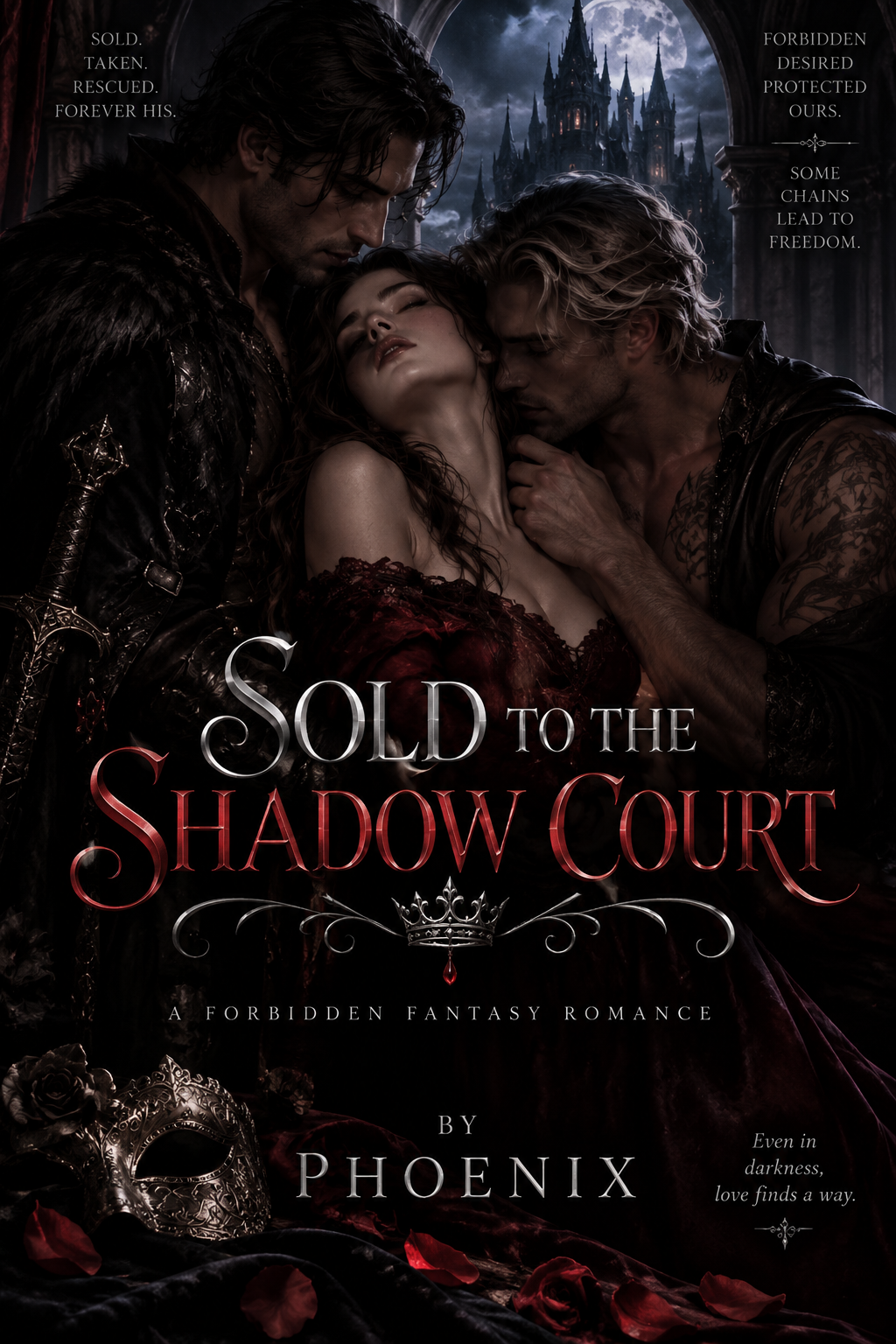
Novel · 12 chapters · 62,301 words
Sold to the Shadow Court
Contents12 chapters
Chapter 1
The Bargain at Briar Hall
The ledger lay open on the dining table, its spine broken, its pages furred at the corners from damp fingers and worse habits. Elara had seen that book her whole life and hated it in three different hands: her father’s when he was flush and laughing, the steward’s when wages were late, and now in the long pale fingers of a stranger who had no business standing beneath Briar Hall’s smoke-stained ceiling.
Her father kept refilling his glass though he had not swallowed from it in ten minutes. Brandy lapped the rim with each shake of his hand. “There must be some room for extension.”
“There was.” The stranger did not look at him. He turned one page with his thumbnail. “Then there was indulgence. Then patience. I am afraid you have consumed both.”
He spoke in a voice too soft for the room, and so the room bent around it. Even the old clock by the hearth, which usually clicked like a beetle in a box, seemed to hold itself still.
Elara stayed in the doorway a moment longer than she should have. The footman who had fetched her had vanished, proving his sense. She took in details because details were safer than the shape of the thing. Mud on the flagstones. A silver travel cloak thrown across the settle, black as wet coal where the nap caught the light. Two men by the windows in riding leathers the color of bramble bark, both with curved swords and the patient eyes of hounds waiting for a signal. Her father in yesterday’s waistcoat, stained at the cuff. And the visitor in plain dark clothes cut too well to belong to any county gentleman in their part of the world.
He turned then, as if he had heard her inventorying him.
That was the first wrongness. He should not have heard anything over the hiss of the hearth and her father’s breathing. Yet his gaze found her at once.
He was beautiful in the cold way frost can be beautiful on a grave rail. Hair black enough to drink the light. Skin with no warmth in it. Mouth fine and exact, a little too still. His eyes were the color of old coins sunk in deep water, and when they rested on her she felt—not fear, not yet, something stranger, like the sharp pause before a blade touches skin.
“Your daughter?” he asked.
“My—” Her father’s tongue seemed to stick. “Elara.”
Daughter was easier than stepdaughter to men like him. Easier than explaining marriages, deaths, inconvenient loves, legal names. Elara did not correct it. She shut the door behind her and came into the room.
“I was sent for,” she said.
Her father gave a laugh that split apart midway through. “Yes. Sit down.”
She remained standing.
The stranger closed the ledger. The sound was small. It landed harder than a shout. “Lady Elara.”
No one in Briar Hall called her that except tradesmen who wanted extra coin. Hearing it from him felt less like courtesy than measurement.
“Who are you?” she asked.
Her father made a frantic motion with his free hand, as if manners were the emergency. “This is Lord Vael.”
One of the names people lowered their voices around. A story name. A winter-road name. Children at the village green dared each other to touch the standing stones at dusk and call it three times. Old wives nailed iron above thresholds against the Shadow Court and all the things that could come through if invited. Elara had grown up sensible enough to sort folk nonsense from useful caution.
Then Lord Vael smiled very slightly, and every tale she had ever dismissed shifted under her feet.
“It seems,” Vael said, “you have heard of me.”
“Enough to know I don’t want you in my house.”
A pulse jumped at her father’s jaw. “Elara.”
Vael only inclined his head. “A reasonable preference. Sadly, the house and I are now acquainted through contract.”
He set the ledger aside and drew a folded sheaf from inside his coat. The paper was heavy, cream-colored, sealed in green wax impressed with her father’s signet. She knew the signet; she had ordered a new stamp handle last spring when the old ivory one cracked. Vael held the document by one corner, not reverent, not careless either. The way a falconer might hold the jesses of a bird that had not yet decided whether to strike.
“Your father,” he said, “borrowed against Briar Hall, against the western tenant lands, against next year’s barley, and against mineral rights to the north ridge, though I’m told there is little there but poor slate and stubborn roots. He borrowed in coin. In favors. In promises made through intermediaries too anxious to examine the terms. A vulgar scramble, all told.”
Her father slammed the glass onto the table. Brandy jumped out and ran across the wood. “You pressed those terms.”
“I offered them. You signed them.”
“By trickery.”
Vael’s gaze shifted, patient as a knife laid down beside a plate. “You should be more precise when accusing a member of the court. Was the signature not yours?”
Silence.
“Was the seal not yours?”
Her father’s throat worked. He looked at the papers instead of at either of them.
Elara crossed to the table before he could stop her. “What does any of this have to do with me?”
Vael’s attention returned to her. “Everything. The last bond named collateral beyond land and goods, should previous securities fail.”
Her father lurched upright so quickly his chair skidded backward and struck the wainscot. “I asked for time.”
“And I gave it.”
“I asked for another arrangement.”
“And I considered it. I even arrived prepared to discuss whether your service in my border accounts might settle a fraction over years.” Vael let the pause open. “Then I reviewed the final bond.”
Elara took the paper from his hand.
Her father made a snatching motion too late. “Don’t.”
She unfolded it. The legal script was cramped but clear, dense with clauses, witness marks, and the crawling precision of men who sell calamity by the line. She found the place where the terms changed. Found her own name.
In the event of insolvency and failure of all prior remedies, the undersigned yields unto Lord Vael of the Shadow Court lawful right of claim over Elara of Briar Hall, household issue and blood relation under his protection, to be delivered whole and obedient at first demand.
The room did not move. She did.
One step back. Then another. The paper crackled in her grip.
“No,” she said, though the word was not addressed to any of them. “No.”
Her father spread his hands, palms up, a gambler’s gesture, a priest’s, a beggar’s. “Listen to me.”
“What am I listening for?” Her voice came out thin and hard. “The part where you sold me, or the part where you mean to call it something else?”
His face changed at sold, but shame in him had always been quicksilver—bright, then gone, useful only for making a room poisonous. “You don’t understand the law in these matters.”
“I understand my name.”
“Elara—”
“Did you sign this?”
He looked old suddenly. Not tender old. Not fragile. Ruined old, like stone left in wet ground too long. “I believed I could redeem it before—”
She laughed once. It scraped her throat. “So that’s yes.”
The two armed men by the windows had not moved. Vael had not moved either. He watched her without greed, without pity. Somehow that was worse. A wolf panting would have been easier to bear than this exact attention, this sense that he was noting every road her mind might take and how long he could let her walk each one before closing the gate.
Her father reached for her wrist. She jerked back before he touched her.
“I had no choice,” he said.
“You had cards.”
“Debts.”
“You had choices every night you made them.”
Color rose along his neck. “Mind your tongue.”
She stared at him so flatly he dropped his hand.
There had been years, after her mother died and her father remarried, when Elara had practiced obedience like embroidery: tiny exact stitches over ragged places. Sit up. Smile. Do not ask where the money has gone. Do not notice what has been pawned. Do not mention that the west orchard was cut for timber and never replanted. Later, after her stepmother was buried and the house thinned out around them, obedience stopped earning safety and became only another expense. She had given it up.
She folded the paper with care, as if neatness might keep her from breaking something with her bare hands. “This is not lawful.”
“In your courts?” Vael asked. “A lively question. In mine, very much so.”
“I’m not in your court.”
His eyes flickered to the window, where the last of the afternoon lay over the dead gardens in a strip of pale gold. “Not yet.”
The hearth gave a spit and collapse of coal. Somewhere deep in the house a door banged once in the draught. Briar Hall had been handsome when Elara was a child—never grand, but warm in winter, green in summer, all beeswax and bread crusts and dogs asleep under chairs. Now the plaster flaked in curls behind the paintings, and the carpets smelled faintly of mildew no matter how many lavender sachets she tucked in the presses. Her father had drunk the place one room at a time. She had known that. She had not known he would drink her with it.
“What exactly do you mean by ‘claim’?” she asked.
Her father shut his eyes briefly, as if prayer might arrive late.
Vael’s answer came mild as snowfall. “I mean you will come with me to my household and remain there according to the terms of debt-redemption and binding service.”
“Service,” she repeated.
“If you prefer plain words, possession.”
Her father flinched.
Elara set the folded bond on the table very carefully. If she threw it, if she tore it, it would only please someone. She would not supply that pleasure.
“I won’t go.”
A faint line appeared between Vael’s brows, not irritation exactly. Curiosity, perhaps, at hearing weather object to winter.
“Do not make difficulty where none is needed,” he said.
“Needed by whom?”
His mouth curved again. “You have more spirit than the bond suggested.”
She hated the heat that rose in her face at that. Not from shyness. From the violence of being assessed.
Her father found his voice at last, raw and urgent. “Vael. Lord Vael. Let her stay until morning. She’s not prepared.”
Vael looked at him the way one might look at a stain reappearing through whitewash. “You mistake what is being discussed.”
“She can’t travel before dark.”
“She can.”
“Please.”
That word from him. Elara almost turned from the shock of it.
Vael’s expression did not alter. “You should have used that voice before you put your name on my page.”
He lifted one hand. One of the men by the window stepped away from the sill.
Everything after happened too fast to think and too clear to forget.
Elara snatched the poker from the hearth.
The man reached for her.
She swung. Not at Vael; he was too far. At the retainer’s knee. Iron met bone with a crack that shuddered up her arms. He cursed and dropped, one hand going for his sword.
“Stop!” her father shouted.
Too late. Elara drove the poker backward into the side table. A porcelain bowl toppled and shattered. She caught the moment of confusion and ran.
She knew Briar Hall blindfolded. That was the one thing still hers.
Out of the dining room, right through the little morning parlor no one used because rain had stained the wallpaper with ghostly flowers, left into the main passage where the runner bunched over warped boards. Her slippers slipped. She kicked them off without slowing, then gathered her skirts in both hands and flew for the back stairs.
Behind her: her father yelling her name, a heavier tread, another voice like a lash of command. Not loud. Lord Vael never needed loud.
Elara took the servants’ staircase two steps at a time, shoulder skimming the wall. At the landing she swerved into the stillroom. Shelves of jars trembled as she yanked open the outer door. The cold hit like pond water.
The kitchen yard was hard with old frost. A pail lay on its side beside the pump, frozen black at the lip. The herb beds were all stalk and rot. She ran through the arch to the stable lane, feet numb at once on the packed ground.
“Miss Elara!”
Old Nessa stood by the laundry shed with a basket of linens against her hip, her cap askew. For one absurd second Elara saw herself through the housekeeper’s eyes: hair half-pinned, no cloak, no shoes, face white as flour. Then Nessa saw the men pouring into the yard behind her and the basket dropped. Sheets spilled into the dirt.
“Don’t let them—” Elara began.
What? Take me? Sell me? Bring a horse? Bolt the gate?
There was no order in the world that would answer any of those.
“Go,” Nessa said, voice gone hoarse. “Go to the coppice.”
Elara did.
She cut behind the stable, where two stalls stood empty and the old bay mare stamped in her straw as if she smelled fear. Around the midden. Through the breach in the far wall where ivy and neglect had done patient work. Briar Hall’s grounds, once clipped and graveled, had grown ragged in the last years. Rose canes climbed over fallen statuary. Yew swallowed the path markers. The ornamental spinney had thickened into a small wild wood beyond the abandoned summerhouse. Elara plunged into it, branches catching at her sleeves.
Her first breath there tasted of leaf mold and iron-rich earth. Her second burned. She did not spare thought for direction. The old deer runs would lead downhill to the stream, and the stream crossed county land before it twisted toward the standing stones and the border country. Away from the house first. Away from Vael’s hand on the map of her life.
Twigs snapped underfoot. Brambles clawed her calves where her skirts dragged. Once she nearly went down on a slick root and saved herself with both palms in the dead leaves. Mud packed under her nails. She pushed up and kept running.
Sound carries oddly in winter woods. She heard the men behind her, then lost them, then heard them again from the wrong side, or what felt like the wrong side. Human feet, she told herself. Human enough. She could lose human men in these trees.
Then something moved through the thicket to her left without touching a branch.
Elara veered right so sharply bark rasped her shoulder through the sleeve. A stand of hazel opened onto a narrow track she knew from summer berrying. She took it, lungs sawing, heart banging at her ribs like a fist on a locked door. The light had changed. It looked thinner here, gray with a bloom of violet at the edges that had nothing to do with evening. The hair rose on her arms.
No. Not evening. Not natural.
A glamour.
She remembered old warnings she had mocked. When the path looks wider than it should, don’t trust it. When dusk comes too early, don’t answer if someone calls your name from behind. If you smell flowers where nothing blooms, run uphill.
Flowers.
The air held a sweetness now, bruised and overripe under the clean rot of winter—night-blooming things from no season she knew. Elara’s stomach turned. She clamped a hand over the pendant at her throat, a little iron key on a black cord. Her mother had worn it once. Nessa had told her never to take it off. Because of thieves, she had said then. Because of doors.
Branches swayed ahead though no wind touched her face.
“Lady Elara.” Vael’s voice, somewhere among the trees. “If you force pursuit, you only reduce the courtesies available to you.”
She ran harder.
The track ended at the stream in a tumble of alder roots. Water, black and narrow, slid between skins of ice. In spring it flooded calf-deep and brown. Now it looked crossable, if cruelly cold.
Elara hitched her skirts to the knee and splashed in. The shock of it tore a gasp from her chest. Stones rolled under her soles. She stumbled, caught herself on a branch, and climbed the far bank with water streaming from her hem.
For three breaths there was nothing behind her.
Then the stream went silent.
Not quiet—silent. No trickle. No small click of current under ice. The whole world seemed to pull its breath in.
Elara turned.
Lord Vael stood on the opposite bank.
He had not crashed through the wood or slid down the muddy rise. One moment the bank was empty. The next he was there, dark coat unmarked, boots dry, one gloved hand resting on the head of a cane she was certain he had not carried in the house. The two retainers had spread out behind him among the trees like stains in water.
The stream between them had stopped moving.
Its surface shone black and fixed, each ripple held in place.
Elara’s fingers tightened around the iron key until it bit her palm.
Vael’s gaze dropped to the pendant and sharpened by a degree. “That should not still be in your possession.”
“My mother’s things,” Elara said, though the words shook.
“How touching.”
He stepped onto the water.
No splash. No break. His boots pressed the frozen skin of the stream where no ice had been a moment before. He came forward slowly enough to make fleeing feel foolish and not slowly enough to make it possible.
Elara backed away. Her heel caught in a tangle of briar. She ripped free and ran along the bank instead of into the denser trees, chasing open ground and cursing herself for it. The stream curved. The wood thinned. Ahead, through trunks and winter bracken, rose the standing stones at the edge of the north meadow.
Every child in the district knew them: five slabs of dark rock canted in a half-ring on the ridge, older than church bells, older than the road, older perhaps than the names of the hills. Sheep avoided them. Frost clung there longest. Once, when Elara was ten, Rowan had dared her to touch the middle stone at midnight. Cassian had dragged them both back before she could try.
The memory flashed and vanished. She had no time for ghosts of brothers gone from Briar Hall years ago, one in anger and one in blood and scandal and silence after.
She burst from the trees into the meadow.
The grass was the color of rust under a skin of rime. Her wet skirts slapped her legs. The stones stood fifty yards off, their edges catching the odd purple cast in the air. Between Elara and them, the ground dipped where sheep had worn a shallow path. Beyond them lay the north road and, if she could gain it, perhaps the parson’s farm, perhaps witnesses, perhaps iron enough hung over enough doors to make pursuit costly.
She ran downhill.
Hoofbeats thundered from nowhere.
Not from the road. Not from the house behind. They came all at once around her, as if the sound had been waiting under the earth for a hand to draw it out. Black horses broke from the line of the hill where no riders had stood a heartbeat earlier. Three, then five, then more. Their tack gleamed dull as old pewter. Their breath smoked blue. The riders wore cloaks the color of deep moss and branch shadow, faces hidden under hoods save for pale mouths and the occasional glint of an eye wrong in the dusk.
Elara skidded to a stop so violently pain shot up her calves. One horse reared, not to strike but to wall her back. Another cut off the path toward the stones. The circle closed with dreadful courtesy.
Lord Vael walked out from between two of the mounts as if he had all day.
He was not out of breath. Of course he was not.
“I did offer the easier version,” he said.
Elara spun, searching for the thin place in the ring, the smallest horse, the greenest rider. One at the left sat a half-length too far from the next. She bolted for that gap.
A rider leaned low, caught a fistful of her hair, and wrenched.
Pain burst white behind her eyes. She screamed and twisted. The iron key snapped up against her throat. The rider hissed and let go as if burned. Elara staggered free one step, two.
Vael’s cane struck the ground.
Shadow moved.
It rose from the horse-hooves and the stones and her own lengthening shape on the frosted grass. Not smoke. Not cloth. Something heavier. It looped around her ankles and she went down hard on one knee, both hands in the grass, breath punched out of her. Cold bit through the damp fabric.
She clawed at the darkness and found no purchase. It cinched, slick as eel-skin and hard as wire, around her wrists when she tried to push up.
“Enough,” Vael said.
The ring of riders held.
Elara knelt in the meadow, hair torn loose, mud on her palms, chest heaving. She looked up at him and thought with terrible clarity that if she begged now she would hear that word from her father’s mouth again and could not survive it twice.
So she spat at Vael’s boots.
A small thing. A stupid thing. The spit landed on the grass a hand’s breadth short.
One of the riders laughed under his hood. Another made a low noise of displeasure.
Vael studied her for a long moment. Then, to her surprise, he seemed almost amused. “There you are.”
“As if you know me.”
“I know the blood that signed for you. I know the blood that bore you better than he ever did, I think.” His gaze touched the iron key once more. “And I know what has been hidden.”
A deeper fear opened under all the others then, cold and clean. Not because she understood him, but because she did not.
“What are you talking about?”
“If your father had cared enough to ask the value of what he gambled, we might all have had a quieter afternoon.”
He gestured.
A rider dismounted. The horse’s eyes were all black and showed no white. The rider came toward her with a lead rope in one hand. When he pushed back his hood she saw a face too fine-boned for mortal blood, ears tapering to discreet points beneath silver hair braided close. His mouth was beautiful and bored. There was a scar across his chin that looked almost recent.
“Try not to lose more hair,” he said. “The road is long.”
Elara lunged anyway when he bent to seize her arm. The shadow at her wrists tightened. He caught her cleanly, hauled her to her feet, and turned her with professional economy, one arm pinning both hers while he cinched the lead rope around her bound hands. Not rough for roughness’ sake. Efficient. She hated him more for that.
“I can walk,” she said through her teeth.
“Not where we’re going.”
Another rider brought a horse forward, a tall black mare with a white star like a knife-point between the eyes. Elara planted her heels. The scar-chinned fae gave the rope a warning jerk.
Vael stepped close enough that she could smell him. Not flowers now. Cedar smoke, cold iron, the faint mineral scent of water under stone.
“Listen carefully,” he said.
She looked anywhere but at him.
“Look at me.”
Something in the air pressed. Elara’s gaze snapped to his before she could stop it. His eyes were darker at this distance, ringed black around the iris like ink bled into paper. The pressure eased only when he was sure he had her attention.
“If you make another attempt before we cross the border, my riders will bind your feet under the horse and gag you for the remainder of the journey. If you make one after we cross, I will let the hounds track you for sport before I call them off. Nod if you understand.”
She stared.
His hand lifted. One gloved knuckle brushed the iron key at her throat. A crackle ran through the air, tiny and vicious. He withdrew at once, expression altered for the first time—a flash of annoyance so pure it was almost satisfying.
“Interesting,” he murmured.
Elara found her voice. “Go to hell.”
“Frequently.” He stepped back. “Put her up.”
The scar-chinned rider did not bother with persuasion. He caught Elara around the waist and swung her sideways across the saddle as if she weighed nothing. The world lurched. Her ribs struck leather hard enough to bruise. Her wet hair fell over her face. Blood rushed to her head, and the meadow turned into an upside-down blur of horse legs, frosted grass, and the hem of Vael’s coat.
She thrashed once on instinct. The rider’s hand clamped between her shoulders.
“Don’t,” he said, not unkindly. “I dislike dropped cargo.”
Cargo. She bit the inside of her cheek until she tasted salt and iron. The mare shifted under her, warm and alive and smelling of sweat, winter coat, and the bitter tang of whatever feed fae stables kept. Around them, tack creaked. Reins snapped lightly. Somebody in the ring clicked his tongue and the horses turned as one.
The standing stones loomed as they rode.
Elara lifted her head enough to see them properly. Upended slabs of dark basalt, laced pale with quartz veins that shone in the thickening dusk. Frost silvered the lichen at their bases. She had passed them a hundred times on summer walks and dared herself not to shiver. Today the space between the middle stones was wrong. Too deep. Not empty but crowded with dark, like a doorway painted over until the paint could no longer hide the crack.
The mare halted before that gap.
Vael came alongside on a horse larger than the rest, black-maned, with a chest broad as a gate. He looked down at Elara where she lay across the saddle, and if he took pleasure in the posture he gave no sign of it. Worse. He treated it as settled fact.
Behind them, beyond the meadow, Briar Hall sat on its rise with two chimneys smoking and one window on the west side catching the last weak light. Home, if a place can still be called that after it has yielded you. From this distance it looked almost whole.
Nessa would be in the yard still, perhaps, or barred indoors. The servants would whisper in the kitchen. Her father would drink until he found a version of the story he could survive. No one was coming.
Vael raised one hand. The riders quieted.
“The border is thin tonight,” he said.
The scar-chinned rider tightened his hold on her. “She has iron.”
“So she does.”
A murmur went through the company, too low to catch.
Vael’s gaze settled again on the key at Elara’s throat. “Take it off.”
She twisted enough to clutch it with both bound hands. “No.”
The rider on the mare swore softly. “My lord—”
“Take. It. Off.”
“No.”
A pause.
Then Vael smiled, and the meadow dimmed around the edges.
“Very well,” he said. “We shall see what your mother purchased with that little relic.”
He touched two fingers to the nearest standing stone.
The world split.
Not in sound first, though there was sound—a grinding crack from under the hill, a shriek of metal dragged over slate, the horses dancing sideways and snorting blue steam. It split in light. The space between the stones sheared open like cloth ripped by giant hands. Darkness poured through, not absence but substance, velvety and deep and shot through with moving threads of silver. The smell of cedar smoke deepened to wet earth, mushrooms crushed underfoot, rivers under ice, candle wax, blood.
Elara’s iron key went hot against her palm.
The riders shifted, uneasy now. One horse tossed its head and showed teeth. Vael looked at the widening breach with narrowed eyes, as if measuring resistance.
“Move,” he said.
The mare stepped forward.
Every muscle in Elara’s body locked. She kicked, bucked, fought the hold around her middle. The rider grunted and nearly lost his seat. Her shoulder slammed the horse’s neck. The key burned hotter. A pulse of force snapped out from it, invisible but brutal. Three nearest riders reeled back. One cursed as his hood blew off and sparks ran blue over his cheek.
For one bright impossible instant the mare shied away from the stones.
Hope hit her like strong drink.
“Hold her!” Vael barked.
The command cracked across the meadow. Shadows lashed from the torn border and wrapped horse and rider both. The mare screamed, front hooves clawing air, then came down trembling.
Vael was beside them in a blur, one hand closing around Elara’s bound wrists.
The heat from the key struck him full. Black lines flashed under his skin like cracks in ice over dark water. His jaw locked. The smell of scorched cedar tore through the air.
Elara stared. So did everyone else.
Vael’s eyes lifted to hers, and this time there was no amusement in them at all.
“Who,” he said very softly, “gave you that?”
She did not answer. She barely knew how. Her breath came shallow. Her wrists were trapped in his hand. He was in pain—she could see it, she could feel the violence held in the tendons of his fingers—and still he did not let go.
“Who?”
“My mother,” Elara said.
He went still.
Something unreadable crossed his face. Recognition, perhaps. Or anger so old it had calcified into something harder. Then he released her as if he had decided not to break her bones in front of witnesses.
“We ride,” he said.
“My lord, the ward—” one of the riders began.
“Now.”
No one argued again.
Vael took the rope from the scar-chinned fae and wound it once around his gloved fist. He put his own horse to the mare’s flank. The breach between the stones breathed dark.
Elara had one last look backward: the winter meadow, the line of trees beyond the stream, the distant roof of Briar Hall sinking into dusk. Then the mare plunged, and the world beyond the stones rushed up like deep water closing over her head.
Chapter 2
A Rescue Written in Steel
The horse came out of the dark at a dead run and nearly went to its knees.
For one raw second Elara thought the world on the far side of the stones had no ground at all, only that deep, moving black threaded with silver. Then the mare struck earth hard enough to jar her teeth. Mud sprayed. Branches whipped past, white-barked and leafless, too close, as if a forest had grown with a grudge around a road no wider than a wagon track.
She bent double over the horse’s neck because there was nowhere else to go. The rope at her wrists bit deeper each time the mare lunged. Her eyes watered in the cold. Not winter cold—the clean edge of frost she knew from Briar Hall fields—but a cellar-cold, damp and old, carrying the smell of peat water, bruised fern, and something sweet rotting under it.
Behind and beside her, the riders kept formation with the inhuman steadiness of men who did not fear a broken neck. Hooves struck black stone. Tack rang. Once, when the road dipped, a pale marsh opened on the left and showed standing pools filmed with light from no moon she recognized.
Vael rode close enough that she could hear his horse breathe.
She looked back only once.
The breach was gone. There was no ring of stones, no seam in the air, no backward glimpse of meadow or home. Just the road winding under bent yews and a sky the color of old iron.
“Sit her straight,” Vael said.
The scar-chinned rider hauled her upright by the rope.
Pain lit from shoulder to wrist. Elara made a sound she hated him for hearing. He only shifted her more securely against the cantle.
“Easy, my lord,” he said. “She’ll bruise before she breaks.”
“Not if you value your hand.”
That was for the rider, but Vael’s eyes were on her. They had changed in this place. At Briar Hall they had seemed merely strange, too still, too bright. Here they held light like water holds starlight, cold and sunk deep.
Elara swallowed against the taste of bile. “If you mean to sell me onward, say so. I would like to know the inventory terms.”
One of the men to the rear laughed under his breath. It stopped when Vael turned his head.
“You are not being sold onward,” he said.
“Comforting.”
“I do not spend blood and favor to collect what is already mine.”
Mine. The word struck harder than the mare’s stride.
Elara pulled at the rope until the hemp burned her skin. “I am not.”
Vael’s gaze dropped to the iron key at her throat. The chain had twisted; the little bit of dark metal lay against the hollow of her neck, dull as any old scrap. Yet his mouth thinned as if looking at it cost him.
“No,” he said after a moment. “That may prove inconvenient.”
He touched heel to horse and moved ahead.
The convoy traveled without speech after that. Sound carried oddly here. Hoofbeats seemed sometimes muffled by turf, sometimes sharp as hammer blows though the road did not change beneath them. Once she heard bells far off, low and slow, as if swung underwater. Once she thought there were voices in the birches, keeping pace, whispering in a language that pricked the back of her neck. Each time she twisted toward the sound, she found only trunks silvered with lichen and the black lace of branches overhead.
Time lost shape. Dusk did not deepen. It simply remained, a bruise that would not yellow or clear.
The road climbed. Marsh gave way to rock. On the right, a hillside rose in shelves of slate and scrub thorn. On the left, it fell away into a gorge full of firs and mist. A chain bridge crossed somewhere below; she heard it groan once in the distance.
Ahead, through the trees, lamps kindled one by one in floating pairs.
Not floating. Hung from pikes.
They marked a gatehouse cut into the mountain itself, dark stone mortared with something that gleamed wetly. Towers shouldered out of the rock like knuckles. Above them, farther still, she saw the thin serrated line of a fortress set on a crag, windows lit ember-red.
Vael’s stronghold.
The mare slowed. So did the column. Men straightened in their saddles. One of the rear riders blew on a curved horn, and the note came back warped, as though answering itself from several throats.
Elara measured distances by habit she had not known she possessed. Twelve riders close. Vael. The gate almost in sight. A gorge too deep to chance on horseback. No weapon. Bound hands. If she waited, she would go behind those walls.
The panic came then, not hot but clear. A hard, bright thing.
She looked at the nearest face she might use: the scar-chinned rider, his jaw dark with stubble, his leather collar stiff with rain. He had grown careless. They all had. The road was narrow, the destination near. She let her head loll as if the long ride had finally taken her. Let her weight sag back into him.
His grip loosened.
“Keep up,” someone called.
“She’s half-fainted,” he answered.
Good.
Elara gathered herself and slammed the back of her skull up under his nose.
Cartilage gave with a wet crunch.
He shouted. His hands flew to his face. The reins snatched sideways. The mare tossed her head and reared, front hooves striking air over the drop. Elara threw herself left, not toward the road but toward the scree slope under the rock wall.
She hit shoulder first. Stone ripped her sleeve open from elbow to wrist. The world turned to gravel and pain and a rain of shale. Then she was sliding.
Someone yelled, “Get her!”
She clawed for purchase. Her bound hands were useless, but her boots dug in and found a jut of root. She seized it with both wrists and stopped herself a body-length from the ditch at the road’s edge.
Above, horses screamed. A rider tried to dismount on the incline and lost his footing, sending a sheet of stones down after her.
“Elara.”
Vael’s voice. Close. Too close.
She looked up. He had dismounted in a single smooth drop and was coming down the slope like he had all the time in the world. No hurry. No wasted motion. Just certainty.
He held no weapon.
That frightened her more than if he had drawn one.
“You cannot run in a land that knows your name now,” he said.
“I’ll learn to answer to another.”
His mouth moved almost into a smile. “Will you.”
He reached for her.
The first arrow took the rider above him through the throat.
It came from the trees across the gorge, impossibly far, a streak so black it was visible only because the man’s body snapped backward around it. Blood sheeted over the stones. He went down on one knee making a sound through the hole in his neck that did not seem human.
Then everything broke open.
A second arrow punched through a horse’s eye. The beast crashed sideways, slamming two others against the road’s outer edge. Men shouted. One went over with his mount, horse and rider turning together into the mist below.
“Shields!” somebody roared.
Too late.
Something hit the lead pike lamps at the gate and burst in a fan of blue fire. Not flame. Light, hard-edged and vicious, slicing down the line of riders. Leather straps smoked. One retainer screamed and beat at his own cloak as sparks ate through it.
On the ridge above the road, a man stood outlined against the iron sky with a bow in his hand and a longsword across his back.
He had been broader once. Or perhaps she had been smaller. The years between then and now rearranged her memory fast and badly, but there was no mistaking the scar that ran from his left temple into his hairline, pale as candle wax against dark skin. No mistaking the way he held himself, still even in motion, as if stillness itself were a weapon.
Cassian.
Her grip on the root slipped.
Below the ridge, from the stand of firs by the gorge, laughter rang out—light, reckless, wrong for a slaughter.
“That got your attention.”
Another figure stepped into the road as if arriving late to supper rather than into twelve armed men. He wore a coat the color of mulled wine, open at the throat, with mud to the hem and silver rings flashing at his fingers. A crooked grin cut across his face beneath a week’s worth of beard.
Rowan flicked his wrist.
The shadows under the horses detached from their owners and rose.
Not like smoke. Like hounds straining leash. Black shapes with bright needle-teeth rushed up at the riders’ faces. Horses shrieked and reared blind. Men cursed and slashed at nothing their steel could find.
Elara stared. Some part of her had expected if she ever saw Rowan again he would be in a tavern doorway, laughing over loaded dice or vanishing from a magistrate’s writ. Not here. Not with the road itself obeying him.
Vael moved before the others understood they were under attack.
He seized Elara by the arm and hauled her fully onto the road. Pain tore a white line through her shoulder. She stumbled into him. His hand clamped the back of her neck.
“Stay behind me,” he said, which might have sounded protective if not for the fact that he meant to use her, shield or hostage depending on what the moment required.
Cassian had already nocked another arrow.
“Let her go,” he called.
His voice had deepened. The old roughness remained under it, that burr from too many fights and too little sleep, but the boy she remembered was gone from the sound. This was a commander’s voice, made to carry over steel.
Vael drew his sword at last. The blade came free with no ring of metal, only a hiss like a cut opening. “You presume much on borrowed ground.”
Rowan put a hand over his heart. “He says that every time. You’d think someone had built him a shrine to humility and he’d spat on it.”
A rider lunged for Rowan from the side.
Rowan did not look. He snapped his fingers, and the man’s spear shaft burst into a braid of live thorn. It wrapped his wrist, climbed his forearm under the leather bracer, and drove him screaming from the saddle.
Two more closed in. Rowan smiled wider, though his eyes had gone hard. A circle of runes, faint as breath on glass, flared around his boots. The mud under the horses liquefied. One beast sank to the knee, toppled, and flung its rider headfirst into the pike lamp base with a crack Elara felt in her own teeth.
Cassian’s third arrow flew not at Vael but at the rope binding Elara’s wrists.
The shaft struck true.
The hemp snapped.
For one astonished beat her hands were free.
Vael swore and tightened his grip on her neck. The iron key, trapped between them, flashed hot against her skin. His fingers convulsed.
Elara drove her elbow backward into his ribs.
He hissed and lost hold. She tore away.
“Down!” Rowan shouted.
She dropped as Cassian loosed again.
The arrow meant for Vael struck a retainer who threw himself across his lord’s path. It went in above the man’s eye and buried to the fletching. Vael turned with impossible speed, blade coming up. The next arrow split on it in a burst of black sparks.
Then Cassian was no longer on the ridge.
He came down the slope in three long strides and the last as a jump, landing in the road with sword already in hand. The blade was plain, no jewel in the pommel, no etched boasting on the steel. Plain until it moved. Then the edges took darkness to themselves and left a wake like torn silk in the air.
A shadow knight, Elara thought dimly, because there was no other phrase for what stood before her.
She had heard stories in market gossip when traders came through Briar Hall: a captain who took rebel forts with ten men; a butcher in black mail; the Court’s hound turned rabid and gone to ground. She had not listened. Or had listened too hard and told herself names were wind.
Cassian met Vael blade to blade.
The sound was not metal. It was the deep struck note of a bell cracked through the middle.
They drove each other back a pace, then another. Vael fought elegantly, every cut economical, each step placed as if on a dance floor only he could see. Cassian fought like a man who had spent years learning exactly how much force bone and steel would bear before either gave. There was no waste to him either, but no beauty offered for admiration. He turned a thrust with his gauntlet, took a slice across the leather, and answered with a stroke that would have opened Vael from shoulder to hip had the fae lord not folded aside with serpent speed.
A rider caught Elara’s hair from behind and yanked.
She cried out and kicked backward. Her heel struck shin. Not enough.
“Hold her!” he shouted.
Rowan appeared in the rider’s blind side as if the road had decided to produce him. He drove a knife up under the man’s jaw with terrible neatness, caught the body before it fell on Elara, and eased it aside.
“Still collecting bruises,” he said, breathless but grinning.
Blood spattered the front of his coat.
Elara staggered back from him. “You—”
“Later.”
He sliced the rest of the binding from her wrists. The cut ends dropped to the mud.
Another retainer came at them with a hooked blade. Rowan stepped between without losing his smile, palm lifting. The man froze. Not stopped—frozen. Frost raced over his leathers from throat to boot. For an instant he stood lacquered white, eyes wide and furious. Then the frost shattered in a glittering burst, and he went down in pieces of ice and flesh that vanished into steam before her mind could fix on them.
Elara turned away hard enough to wrench her neck.
“Don’t be sick yet,” Rowan said. “We’ve three more to finish and one arrogant problem in velvet.”
“Six,” she said automatically, counting the men still moving.
His brows jumped. “That’s my girl.”
The old phrase hit like a slap.
She looked at him fully then. At the laugh trying to live on his mouth while murder stood fresh on his hands. At the familiar tilt of his head. At the man who had left without a goodbye eight years ago and never once sent word she knew of.
“I am not yours either,” she said.
The grin faltered.
Before either of them could say more, one of Vael’s men rushed Elara with a short axe.
She snatched the dead rider’s dropped knife from the road by instinct more than plan. The hilt was slick. The first swing of the axe would have split her collarbone if Rowan had not checked the man with a blast of force from the side, enough to spoil the angle. It still clipped her shoulder. Pain burst hot. Elara went in under his arm and drove the knife upward as hard as she could.
The blade punched through quilted leather into belly.
The man grunted, shocked more than loud. His breath hit her cheek, sour with some root spirit. She felt the give of him around the knife. For a suspended second they were too close, face to face, strangers joined by steel.
Then he folded.
Elara stumbled back with the knife still in her hand.
Blood ran down the guard over her fingers, almost black in the dim. She had gutted rabbits. Once a sheep in lambing season when the cord had wound wrong and the shepherd’s wife shook too hard to do it clean. This was not that. This was warm and immediate and human-shaped on the road at her feet.
Rowan’s hand landed on the back of her neck, not gentle but grounding. “Breathe.”
“I know how.”
“Do it anyway.”
Across the road, Cassian and Vael broke apart, both marked now. Cassian bled from a cut at the brow, a dark line running down beside his nose. Vael’s sleeve hung open from wrist to elbow, and under the torn velvet his skin showed those same black crack-lines spreading and retreating as if something underneath him wanted out.
Vael looked past Cassian at Elara.
Not at her face. At the key.
Recognition sharpened into hunger.
“Alive,” he snapped to the last of his retainers. “Take her alive.”
Rowan barked a laugh with no mirth in it. “You’re outnumbered, darling.”
“I am never outnumbered.”
The shadows at the edge of the road answered him.
They rose from ditch and wheel-rut and underhorse, not shaped like men this time but like spears grown from night itself. One drove through a retainer’s fallen corpse and pinned it to the road as if proving point before purpose. Another lunged for Rowan’s leg.
He swore and sprang back, one hand flashing signs in the air. Blue runes rippled from his fingers and struck the shadow-spear broadside. It shattered into black shards that crawled briefly like beetles before dissolving.
“That,” Rowan said through his teeth, “is rude.”
Cassian did not turn. “Get her clear.”
“She seems attached to the middle of things.”
“I said—”
Vael rushed him.
Their blades met so fast Elara saw only the afterimage: black, silver, the brief white nick of teeth in Cassian’s set jaw. They locked. Vael leaned in, close enough to speak low.
Even from where she stood she felt the pressure of whatever passed between them, old animosity honed to a knife edge. Cassian shoved him off with brute strength. Vael slid back two steps, light on his feet, and smiled.
“I thought they had killed you in the Marches,” Vael said.
Cassian wiped blood from his eye with the back of his gauntlet. “Many men have been disappointed.”
One of the surviving riders finally found courage or despair enough to charge Cassian from behind.
Elara saw it first.
“Cassian!”
He moved before the name left her mouth. Pivot. Back-cut. Clean.
The rider’s head stayed where it was for a beat too long before the rest of him toppled from the saddle.
Silence followed in a rush. Not true silence—horses blowing, a body twitching in the ditch, Rowan cursing softly as he yanked his knife free from a dead man’s belt—but the battle’s shape had changed. The escort was finished. Road littered with them. Lamp oil smoking. Blood in the ruts.
Only Vael remained.
He took stock as quickly as any soldier would have: dead men, panicked horses, Cassian between him and Elara, Rowan to her left with magic still sparking at his fingers. His expression did not alter much. Annoyance, perhaps. The kind a man might feel over broken glass in a dining room.
Then his gaze returned to Elara, and for the first time since Briar Hall she felt the full weight of his temper.
“This is delay, nothing more,” he said. “You wear my claim still.”
The skin at the back of her neck prickled. “I wear nothing of yours.”
“Don’t you?”
His eyes dropped to the base of her throat.
A chill knifed through her. She looked down.
Just above the collar of her dress, where fabric gaped from torn seams, a bruise-dark mark had surfaced on her skin. Not a bruise. Too precise. A half circle of black thorns no wider than a coin, with a line through the middle like a keyway.
Her free hand flew to it.
Rowan swore with real feeling this time. “Oh, that bastard.”
Cassian’s entire body changed. Very slight. A stillness under stillness, more dangerous than motion.
“What did you put on her?” he said.
Vael smiled at him as if at a child asking the obvious. “Insurance.”
Rowan stepped toward Elara, fingers already lit with spellwork, but Vael cut a hand through the air.
The gorge answered.
Wind hit the road in an upward blast carrying spray and cold. From the mist below came barking. Not dog-barking. Too deep. Too many throats inside one note.
Hounds, Elara thought, and every horse left standing thought the same, because they shied and rolled whites of eyes.
Vael backed toward the gate path, sword still ready. He looked, infuriatingly, like a man choosing to leave a party before the wine turned.
“You know better than to think a locked door will keep me from what I have paid for,” he said. “Bring her where you please. Hide her under mountain roots. Put saints, wards, and old names around her bed. I will come.”
Rowan raised both hands, palms bright with blue fire. “Stay for one more trick and see how that oath tastes.”
Vael’s gaze flicked to the trees above them, measuring exits. “Another night, outlaw.”
Cassian advanced a pace. “No. Tonight.”
He threw.
Not his sword—his dagger, drawn and loosed in the same breath. It spun point-first toward Vael’s throat.
Vael twisted. The dagger missed the artery by less than a finger and buried in the gatepost behind him, pinning a fold of his collar. For an instant he was caught.
Cassian was on him in that instant.
They hit the post together hard enough to shake the lamp above. Stone cracked. Vael drove an elbow into Cassian’s ribs. Cassian took it and answered with his forehead to Vael’s face. Blood sprayed from Vael’s nose, startlingly mortal. Cassian’s hand closed in the velvet at Vael’s chest, shoving him back against the iron-bound wood.
Rowan grabbed Elara by the wrist. “Turn away if you’re sentimental.”
“I’m not.”
“Good.”
Cassian’s sword came up under Vael’s jaw.
Then stopped.
Smoke poured from the black thorn mark at Elara’s throat.
She gasped and clutched at it. It burned cold, a contradiction so violent her knees nearly gave. Cassian’s eyes cut to her. In that heartbeat of attention, Vael smiled through blood.
“Choose,” he whispered.
Cassian’s blade pressed just enough to bead red under Vael’s chin.
The mark on Elara’s skin seared deeper. The pain lanced down her chest, into spine and teeth. She made a sound she could not stop.
Cassian swore and jerked his sword away.
Vael moved like released wire. He slammed his palm into Cassian’s wounded brow, blinding him with blood, tore himself free of the pinned collar with a rip of velvet, and stepped backward into shadow.
Not behind it. Into it.
The dark under the gate lintel opened and took him. One moment there was a man, beautiful and furious and impossible. The next, only drifting black and the echo of those hound-voices rising from the gorge.
Rowan let go of Elara and lunged for the spot with a curse. His hand met stone.
“Damn him.”
Cassian stood very still in the road, chest lifting once, twice. Blood ran from his forehead into one eye. He wiped it away without seeming to notice. Around them the surviving horses stamped and rolled foam. One pike lamp guttered, then went out.
Elara pressed her palm to the mark at her throat. The cold fire subsided to a throb, but the shape remained under her hand, branded into place.
Rowan looked from the vanished Vael to her face and lost the last of his levity. “Let me see.”
“No.”
“Elara.”
“No.” She took a step back from him, from both of them. Her shoulder burned where the axe had clipped her; her wrists were raw; blood—hers, theirs, other men’s—stiffened the front of her sleeves. “You don’t get to appear from nowhere, slaughter half a road, and order me about as if the last years did not happen.”
Rowan’s mouth flattened. “Fair.”
Cassian pulled his dagger from the gatepost with a wrench and came toward them. He did not sheathe his sword. “We leave now.”
“Because you say so?”
“Because Vael called hounds.”
As if summoned by the words, the barking rose again from the gorge, nearer this time. Shapes moved in the mist below the road—lean, fast, wrong at the joints, silver light snagging in thorn-coated backs.
Elara saw them and felt her stomach drop.
Rowan spread his hands. “That is my brother being tactful.”
Cassian shot him a look sharp enough to shave bark. Rowan ignored it.
“We can quarrel while riding,” Rowan said. “A cherished family custom.”
Family.
The word landed badly. Perhaps on all of them.
Cassian bent, caught the least-frightened horse by the reins, and cut away its dead rider with two efficient slices. He looked at Elara then, full on for the first time.
The years sat on him plainly. New scars at the jaw and knuckles. Mail under his black coat. That old grave steadiness hardened into something almost severe. But his eyes were the same dark gray they had been when he taught her to notch an arrow in the orchard and swore her to secrecy after. Same eyes when he used to stand outside the schoolroom door listening for raised voices before deciding whether to go in.
Now they gave nothing away except urgency.
“Can you ride?” he asked.
Not Are you hurt. Not Are you afraid. Can you ride.
“Yes.”
“Good.”
He put the reins in her hand.
The gesture, more than if he had tried to comfort her, nearly undid her.
Rowan had already whistled two riderless horses to him with some muttered charm and was stripping saddlebags, blades, a waterskin, anything useful. “Take the gray,” he said. “She’s ugly but sensible.”
The gray in question had one torn ear and murder in her eye. Elara mounted anyway, hissing as bruised muscles protested. Cassian swung up on another horse with the economy of long practice. Rowan vaulted into his own saddle half a breath later.
Below, the first of the hounds broke from the mist onto the lower path.
Elara got a clear look then.
Its body was the size of a calf and lean as famine, made not of flesh but of woven thorn canes plated in moonlit sheen. Where eyes should be there were hollows full of pale fire. Its jaws opened on metal teeth.
“Ride,” Cassian said.
They did.
The horses lunged up the mountain road, away from the gate and deeper into a land she did not know, with two men she had loved once, hated after, and did not trust now riding hard on either side of her. Behind them the hounds found the blood on the stones and gave tongue, and the sound chased them into the dark.
Chapter 3
Blackglass Keep
The gray nearly went to her knees on the last climb.
Cassian caught the bridle before the mare could pitch forward, his gauntlet closing hard on wet leather. “Easy.”
The horse blew foam and trembled under Elara’s hands. So did she, though she kept that to herself. The mountain track had narrowed to little more than a seam cut into black rock, and on one side the slope dropped away into a fir-choked dark that swallowed the hounds’ voices without softening them. They still came and went below, those ugly baying notes, sometimes near enough to lift the hair along her arms.
Rowan reined in behind them and looked over the edge. A stripe of blue light slid briefly over his knuckles, gone almost before she saw it. “They’ve lost the upper path. For the moment.”
“For the moment,” Elara repeated.
He gave her a quick glance. There was blood on his collar, soot on one cheek, and the same dangerous ease in his mouth she remembered from years ago, when he was about to lie or laugh or steal something under another man’s nose. “Try not to sound delighted.”
Cassian passed Elara a skin without looking at her. “Drink.”
She was thirsty enough to obey before defiance caught up with her. The water tasted of copper and mint leaves. Cold. Real. She swallowed, wiped her mouth with the back of her hand, and found both brothers watching the road below instead of her.
It should not have stung. It did anyway.
The path bent around an outcrop where wind had chewed the stone into ribs and hollows. Beyond it the mountain seemed to end in a wall: slate-dark cliff, split by old white seams, bare except for a few bent pines rooted in cracks. No gate. No tower. No sign of habitation at all.
Elara laughed once under her breath. “If this is where you kill me, I’ll be offended by the lack of imagination.”
Rowan’s head tipped back. “There she is.”
Cassian did not smile. “No one is killing you.”
“That ought to comfort me.”
“It should.”
He took the mare’s rein and led her forward. Straight at the rock.
Elara dug her heels in on instinct. The gray fought him for a step, ears flat. Then the air before them moved. Not visibly, not in the theatrical fashion of storybook glamours. It shifted like heat above a forge, like breath over glass. A smell rose out of nowhere—iron filings, wet moss, lamp oil—and her pendant went cold enough against her breastbone to hurt.
“Cassian.” She pulled back harder. “What is that?”
“A door,” Rowan said.
“I can see there isn’t one.”
“You can see what strangers see.”
That, too, should not have struck so sharply. Stranger. After all these years, after blood on the road and those hounds chewing at their heels, perhaps that was the safest word for her.
Cassian turned at last. Blood had dried in the line of his brow wound and gone black. “You have to come through on your own. The wards won’t take force kindly.”
“They have opinions, do they?”
“Yes.”
There was no room in him for jest. He stood with one hand on the mare’s bridle, the other near his sword hilt, as if his own walls had become muscle memory. Waiting. Always that grave waiting, the thing that had once made her feel watched over and then, later, judged.
Below them the hounds bayed again, farther off and then suddenly near, as mountain echoes played tricks. Rowan looked down the path, impatience beginning to show around the edges.
“Elara.”
Her name in his mouth used to sound like conspiracy. Come see this. Don’t tell Cass. Race you to the lower meadow. Now it was warning, plea, command, all braided into one.
She slid from the saddle because she would rather trust her own legs than a trembling horse. Pain lanced through her bruised shoulder when her boots hit stone. The mountain face loomed a yard from her nose, plain and solid and pocked with mica that caught the last bruised light.
Nothing there.
She reached out.
The cliff gave under her palm with the resistance of deep water.
Cold rippled through her sleeve to the elbow. Not wet. Not dry. Wrong in a different way than Vael’s glamour had been wrong. This felt old and made, disciplined rather than predatory, something taught to keep its teeth behind its lips.
Her iron key burned suddenly against her sternum.
Cassian moved at once. “Stop.”
He caught her wrist before she could snatch her hand back. His palm was bare where the gauntlet ended, hot and rough with old scar tissue. The contact shot through her more violently than the ward had. For one foolish second neither of them let go.
Then Rowan exhaled, loud with annoyance or relief. “If we all want to stand here remembering we possess nerves, I can think of worse uses of an evening, but the hounds are not sentimental.”
Cassian released her first. Of course he did.
“Elara,” he said, low now, as if the mountain itself listened. “Take the key in your hand when you pass.”
“Why?”
“Because I’m asking you to.”
She laughed again, harsher this time. “A stirring defense.”
His jaw tightened. “Because the keep knows iron.”
That was not an answer. It was close enough to one that she took the pendant from beneath her torn gown anyway. The key looked mean and ordinary against her scraped fingers, black with age at the teeth, worn silver-bright at the bow where generations of hands had rubbed it. Her mother had once called it a promise. Her father had called it peasant superstition. Vael had looked at it as if he’d found a knife at his own throat.
Elara set her mouth and stepped through the cliff.
The world folded.
Dark stone flashed around her, then torchlight, then a hard floor underfoot. The shock stole her balance. She would have gone down if a hand had not closed around her upper arm.
Rowan this time. “There. Still offended?”
She wrenched free more from surprise than fury and turned in a tight circle.
The cliff had become a vaulted entry hall, narrow as a church nave and twice as tall, built of black glassy stone veined with silver. Not polished—nothing so soft. The walls drank light rather than reflecting it, while those pale mineral seams gave back a dim underwater gleam. Iron brackets held lamps hooded in smoked crystal. The air smelled of ash wood, hot metal, and the mineral bite of mountain spring water. Somewhere deeper in the keep machinery thudded, slow and massive, like the turning of buried wheels.
Her horse came through next with rolling eyes and a desperate snort, then Cassian leading it, then Rowan on his own mount, muttering under his breath until the mare calmed. Behind them the false cliff closed with a shiver. Stone. Seamless.
Elara stared at it. “Open it again.”
“No,” Cassian said.
The answer landed between them with such familiar finality she nearly forgot to breathe.
Rowan dismounted and made a face. “You could at least pretend to negotiate.”
“There’s no time.”
“There is never time, according to you.”
Cassian ignored him and looked to Elara. “The hounds can follow blood and scent. Not through the outer wards unless they’re invited or the threshold is broken, but if the gate opens again before the defenses settle, they’ll feel where to strike.”
“So I’m locked in.”
“Protected.”
She stepped toward him. The hall made every movement echo, boot heel on black stone, chainmail whispering under his coat, the horse’s nervous tack-jingle. “Protected was not the word men used when they shut women in rooms at Briar.”
Something changed in his face. Not much. A minute hardening around the eyes. Enough.
“That is not what this is.”
“Then what is it?”
He did not answer quickly, and Rowan cut in before the silence could grow teeth.
“It is a keep hidden inside a mountain by old work and expensive spite,” he said lightly. “And before you ask, yes, there are windows, no, we do not chain guests to the furniture, and yes, you may be furious in a room with a fire instead of in an entry passage that smells like horse sweat.”
“You forgot the part where you ask nicely,” Elara said.
“I thought surviving an ambush counted as good manners.”
Cassian handed a groom’s whistle from his belt to Rowan. “Take the horses.”
“Gladly. They prefer me.”
“Everything prefers you for ten minutes,” Cassian said.
Rowan flashed his teeth, the first true smile since the road. “And yet ten minutes changes lives.”
He took the reins of all three horses with an ease born of long practice and started down the hall. The lamps threw blue shadows into the hollows of his coat. At the far end a portcullis of black iron stood open over another passage, and beyond it she caught the first glimpse of the keep proper: a slice of courtyard under fading light, a stair climbing a wall, banners hanging motionless.
Cassian waited until Rowan was gone before he spoke again. “Can you walk?”
“I rode a mountain half dead. I can manage a corridor.”
His gaze flicked once to the way she held her shoulder. “That wasn’t the question.”
“No. It rarely is with you.”
He accepted the hit without expression. “Come.”
She went because standing still under his orders made her feel sixteen again, and because the stone under her boots was steadier than the air outside had been, and because her body had begun to discover its inventory of damage in earnest. Rope burns at the wrists. A bruise blooming over one hip from the saddle. The cut at her shoulder, sticky under torn cloth. The mark at her throat, now a steady pulse under skin.
They passed through the portcullis into a courtyard built in a split of the mountain itself, hidden from the world above by sheer walls on three sides and by the spell-veiled gate behind them. A keep rose from the fourth side in dark tiers and knife-clean lines, all that same black stone threaded with silver. Not elegant. Severe. The windows were narrow and deeply set. Walkways bridged one tower to another like spans of shadow. At the center of the yard stood a dry fountain shaped like a basin of carved thorns, and behind it a training ring beaten flat into packed sand.
No servants hurried out. No torches flared in welcome. The place had the waiting silence of an occupied fortress, every door shut, every angle useful.
Elara slowed. “How many people are here?”
“Enough,” Cassian said.
“That means either twelve or two hundred.”
“Less than two hundred.”
She almost smiled despite herself and hated that, too.
A woman in mail appeared on the stair above them, crossbow in hand. She looked down, saw Cassian, and relaxed by a degree no one else would have noticed. “You took your time.”
“Close the outer shift,” he said. “Double the lower watch. No one opens to any voice at the gate, mine included, unless Rowan answers second.”
Her eyes slid to Elara, assessing, not unkind. Then to the blood. “Understood.”
She vanished again without question.
Elara watched her go. “Do all your women carry crossbows?”
“All our sentries do,” Cassian said.
Our. Not mine.
Something in that eased, absurdly. She refused to inspect it.
He led her under a stone arch into the keep itself. The corridors inside were warmer than the yard, heated somehow through the floors. Iron sconces smoked faintly. She passed closed doors, arrow slits, a stairwell spiraling up into dimness. The architecture had the logic of defense: choke points, blind turns, doors thick as siege boards and banded in iron. Refuge, yes. Also a box with locks.
By the time they reached a chamber on the second level her legs had gone watery. Cassian opened the door and stood aside.
It was not lavish. A square room with one mullioned window looking into the mountain cleft, a narrow bed hung with wool curtains, a chest, a washstand of dark oak, a hearth where embers still glowed under banked ash. Someone had laid a folded linen shift and a gray blanket across the bed. On the mantle sat a brass lamp, a shallow bowl of salt, and a sprig of dried rowan berries bound with black thread.
Protection charms. Old country sort, altered for this harsher place.
Elara put her hand flat on the nearest bedpost to steady herself and immediately resented the evidence of weakness. “You had this prepared.”
“Yes.”
“For me.”
“Yes.”
She turned. “How long have you been expecting Lord Vael to collect me like overdue rent?”
He closed the door behind them. The click of the latch sounded much too neat.
“We knew he was circling Briar Hall.”
“We.”
“Rowan and I.”
“And yet in eight years not one message managed to cross the astonishing distance between mountain and ruin.”
His face gave then, not in softness but in a brief flash of temper. “A message would have led eyes to you.”
“A rescue would have been less noticeable?”
“I said circling. Not moving.”
“You let him circle.”
He crossed the room in two strides. She should have stepped back and did not. He stopped close enough that she could see where the cut on his brow had split again, a thin fresh line threading through dried blood.
“You think I do not know what almost happened?”
The low force in his voice shook something loose in her chest. Not fear. Something more inconvenient. She looked away first, toward the window with its slit of darkening sky.
“I think,” she said carefully, “that men who disappear do not get to return and demand gratitude for being only a little too late.”
Silence. The hearth ticked softly.
When he spoke again, the edge was gone. That was worse. “No one asked for gratitude.”
“Then tell me what you did ask for.”
The question hung there between them, too naked to be safe.
A knock came at the door before he had to answer. Rowan let himself in carrying a tray and a rolled bundle under one arm.
“Marvelous,” he said, taking in their faces in one sweep. “We’ve gone directly to old injuries without even washing the road off. Efficient.”
The tray held a squat teapot, three cups, a crock of salve, linen strips, and a bottle of something clear that smelled medicinal enough to strip varnish. The bundle proved to be clothes: wool stockings, a plain gown of dark blue, underthings, a heavier robe.
Rowan set everything down and looked at Elara’s shoulder. “Sit.”
“No.”
He glanced at Cassian. “You see? This is why people like me better.”
“No one likes you better,” Cassian said.
“They absolutely do. They simply trust you with blades.”
Elara remained where she was. Rowan sighed, plucked one of the cups off the tray, filled it from the teapot, and drank first. A pointed demonstration.
“Will that satisfy the part of you that thinks we’re poisoners?” he asked.
“It satisfies the part of me that thinks you enjoy theatre.”
“Both can be true.” He set the cup down and held out the bottle. “We need to clean that cut.”
Cassian moved before she could answer. “I’ll do it.”
Rowan’s brows lifted. “Will you.”
The room changed. A degree colder, though the fire had not altered. Elara felt it like a hand brushing the nape of her neck—the old current between them, sharpened by years instead of dulled. Cassian and Rowan had once fought over cards, horses, whose turn it was to face the tutor’s temper. Small domestic wars, all surface. This was different. This had bone in it.
Elara took the bottle herself. “Neither of you will do anything if you keep talking as if I’m furniture.”
She uncorked it. The sharp spirit fumes made her eyes water. Before either man could stop her, she tugged her torn sleeve aside and poured.
Fire went through her shoulder.
The room snapped white at the edges. She made no sound until fingers clamped around her wrist and took the bottle away.
“Enough.” Cassian’s voice, very close.
Rowan muttered something obscene and set the tray on the bed. “You’ve always had appalling ideas.”
“I had no wish to be argued over while bleeding.”
Cassian was already unwinding clean linen with blunt, furious precision. “Sit down.”
She looked at him. Sat.
There were moments when fighting him was like trying to kick down a barred door: satisfying in theory, punishing in practice. He knelt in front of her to get at the cut, and the position unsettled her more than if he had towered over her. His big hands were careful with the cloth, less careful with the fact of his nearness. The scent of steel oil and smoke clung to him under the blood. A line of dried mud marked one boot. At his nape, where his collar had shifted, she saw the pale ridge of an old scar vanish under black fabric.
Rowan leaned against the washstand with the deceptive looseness of a man who could spring in any direction. He watched Cassian bind the shoulder and watched her watching him.
“You should hate us a little more evenly,” he said.
Elara did not take her eyes off Cassian. “Should I.”
“It breeds household harmony.”
Cassian tied off the bandage. “Rowan.”
“What? I’m helping.”
“You are never helping.”
“Cruel.”
Elara huffed a laugh she did not intend. Cassian’s hand stilled at her shoulder as if he’d heard something rare in winter. Rowan’s expression shifted, too quick to read, then settled into its usual charm.
There it was. The dangerous part. Not memory exactly. Recognition. The shape of old patterns under fresh damage.
Cassian rose. “There’s food coming.”
“Will I be permitted a knife with it?”
“Yes.”
“A dull one,” Rowan added.
She looked from one to the other. “I cannot decide whether this is hospitality or imprisonment with better linens.”
Cassian answered first. “If it were imprisonment, there would be guards at the door.”
Rowan tipped his head. “There may be guards in the corridor.”
She stared at him.
“What? I dislike unpleasant surprises.”
“Rowan.”
He held up both hands. “For the record, I object to blunt truth only when it is mine.”
Elara stood too quickly, the room swaying for a beat. She crossed to the window and pushed at the iron latch. It opened on a wedge of evening and mountain air smelling of pine pitch and stone. The drop below was three stories to the courtyard flags. High enough to kill if she landed badly. High enough to tempt.
From here she could see more of the keep’s hidden shape: outer walls fused to natural cliff, a narrow postern stair cut into rock, terraces of herbs under glass frames, a lower yard where two men rolled barrels toward a storehouse. Beyond the open top of the cleft, only a ribbon of deepening sky.
No road. No village. No world.
The mark at her throat tightened.
Her hand went there instantly.
Cassian was beside her in a heartbeat. “What is it?”
“Nothing.”
“Don’t lie to me.”
She turned on him. “Do not speak to me as if I owe you truth on command.”
He looked at her throat, not her face. Rowan had already moved from the washstand, all his levity gone again.
“The mark hurt?” Rowan asked.
She hated that his voice had become gentle. Hated more that it worked better than Cassian’s order. “Only for a moment.”
“When?”
“At the window.”
Cassian shut it at once. The latch bit home.
“It may have felt the wards,” Rowan said, half to himself now. “Or the height. Or Vael tugging his leash to see if it holds.”
Leash.
Elara’s fingers curled. “Take it off.”
Neither man spoke.
Her pulse thudded in her ears. “If he put something on me, remove it.”
Rowan looked at Cassian, and the silence there told her more than words would have. Not can’t. Not yet.
Something hot and wild rose in her chest. She shoved past them both and yanked at the neck of her gown. The skin at her throat had turned angry around the black shape, a ring of thorn-pricks encircling a keyhole-dark center just above her collarbone. It looked branded and grown at once, as if roots sat under the flesh.
“There.” Her voice shook, and fury steadied it. “Admire it openly if you mean to.”
Cassian made a sound under his breath that was not a word.
Rowan’s face went still in a way she had learned to distrust long ago. It meant his mind had started racing and some of his fear had become calculation. “Do not touch it again.”
“It is on me.”
“I noticed.”
She took one step toward him. “Then say something useful.”
His eyes flicked over the mark, the iron pendant in her fist, the bowl of salt on the mantle, the shut window, all the small facts he was already arranging. “I need light and ink and a better table than this room provides.”
“You’re not taking her anywhere else tonight,” Cassian said.
Rowan looked up. “And if the warding around that thing shifts while we sleep?”
“I’ll stand the watch.”
“You can’t fight a spell by glaring at it.”
“I can stop anyone from coming through the door.”
“That is not the only direction trouble travels.”
The brothers faced one another across the small chamber, and Elara saw with sudden clarity how they had become what they were. Cassian, built into a wall and taught to hold. Rowan, all quicksilver and angles, his danger in motion, in opening, in finding the crack. Either could save a life. Either could ruin one.
“What do you want?” she asked.
They both turned to her.
The question had come out quieter than she intended, but it stopped them all the same.
“Not from the mark,” she said. “From me.”
Rowan’s mouth opened, then closed.
Cassian held her gaze. “You alive.”
“That is not enough.”
“It is tonight.”
“No.” The word came clean now. “No, it isn’t. You ride in out of nowhere, call me by my name as if it still belongs in your mouths, drag me to your fortress, tell me nothing, and expect obedience because the danger is real. The danger is real. I know that. I saw the road. I felt what he did.” Her hand hovered near the black ring at her throat and dropped again. “But if this place is to be refuge, I will know what kind. If it is prison, I will know that too.”
Rowan looked away first, to the dying fire. He rubbed a thumb over the silver ring on his smallest finger, an old habit when he was buying time.
“I want,” he said at last, “to keep Vael from laying hands on you again.”
She waited.
A corner of his mouth tilted, humorless this time. “And if you’re asking for saintly motives, I left those in a ditch around nineteen.”
“Rowan.”
“I’m answering.” He pushed off the washstand and came a little nearer, though not too near. “I want you safe. I want him thwarted. I want, selfishly enough, the chance to hear what happened at Briar Hall from your mouth instead of from scouts and guesses. I want to know why he risked open claim for you now when subtler roads existed. And yes”—his eyes lifted to hers, blue fire banked somewhere behind the green—“I want not to lose you a second time.”
The bluntness of it struck harder than any charm.
Cassian’s expression did not alter, but his hand flexed once at his side.
Elara turned to him. “And you?”
The pause was shorter than before. “The same.”
“That is convenient.”
His voice roughened just enough to betray him. “Do not mistake brevity for ease.”
She held his gaze and felt all the years she did not understand pressing close. The orchard at Briar Hall in late summer. A practice bow too big for her hands. His silence when he left. Her fury after.
“What else?” she asked.
He looked as if he could refuse. Looked as if he wanted to. Then, “I want to know what your father signed. I want to know what Vael believes he owns. I want to know if that mark is a tracker, a threat, or a chain he can yank when it suits him.” His jaw worked once. “And I want you where I can keep you breathing.”
There. The prison bars, said plainly.
Elara let out a slow breath. “That last one sounds very like a cell.”
“If a cell keeps you from him, yes.”
Rowan swore softly. “You do court disaster by speaking honestly once a season.”
Cassian did not look at him. “You asked.”
“I did.”
The room had become too small for all that was in it. The bandage on her shoulder pulled when she moved. Her throat ached. Her exhaustion had gone beyond shakiness into that glassy, dangerous clarity where every feeling cut.
A knock sounded. This time no one entered. A woman’s voice from beyond the door: “Food.”
Rowan went, took the tray through a narrow opening, and set it on the chest. Bread still warm from some deep kitchen oven. Stewed lentils with strips of smoked rabbit. White cheese. Two apples with russet skins. The ordinariness of it almost broke her.
Cassian stepped back at last, giving her air. “Eat.”
There it was again. Order as care. Care as order. No clean way to sort one from the other with him.
Rowan reached for the salt bowl on the mantle. “I’m moving you.”
Cassian’s head snapped up. “No.”
“Not to another wing. To the old chart room. It has a shielded table and direct line to the ward core. If I’m wrong, we lose an hour. If I’m right, we learn something before Vael tests the tether again.”
Elara watched the argument spark before either man spoke further. Cassian calculating routes and risks. Rowan already three decisions ahead, impatient with resistance. Both of them placing her somewhere on a board neither wanted to name.
“I’ll go,” she said.
Cassian and Rowan both objected at once.
She held up a hand. “You wanted me alive. This seems the current price.”
Cassian looked at the door, the corridor beyond, whatever threats lived there in his mind. “Not alone.”
“I had not planned a moonlit stroll.”
Rowan set the salt bowl back down carefully. “There are stairs. Narrow ones. You may enjoy watching him loom.”
“I never enjoy watching him loom,” Elara said.
“That is a lie so poor I’m embarrassed on your behalf.”
For the first time, Cassian almost smiled. It changed his face so abruptly and so little that she wished he had not.
He took up the lamp from the mantle and checked the flame with his thumb shielding the wick. “Stay between us.”
“Must I?”
“Yes.”
“Definitely,” Rowan said. “Some of the passages bite.”
Elara gave him a flat look. “Do they.”
“No. That one was for morale.”
Cassian opened the door.
The corridor beyond stood empty except for two armed sentries posted at either end, just as Rowan had promised and Cassian had denied. One tried not to stare at Elara. The other failed.
Refuge and prison, both.
They moved out into the lamplit passage with Cassian before her and Rowan at her back. Stone stairs dropped in a tight turn, then another. The keep shifted around them—murmur of men changing watch, clang from a forge somewhere below, the faint river-hum of warding in the walls. As they descended, the air grew cooler and stranger, touched with the dry scent of old parchment and ozone.
At the next landing every lamp flame bent at once toward Elara’s throat.
No breeze. No draft. Just six little tongues of fire leaning, thin and eager, to the black mark under her skin.
Rowan swore. Cassian spun, hand on sword.
And from deep below, through stone and iron and the old bones of the mountain, something answered with a slow, deliberate knock.
Chapter 4
The Mark Vael Left
The knock came again.
Not from the door. From under their feet.
It traveled up through the stair stones in a measured pulse that Elara felt first in the arches of her feet, then in her teeth. Cassian moved before the sound had finished, one hand on her arm, the other drawing his sword in a soft metal whisper. Rowan lifted his own lamp and looked down the next turn of steps with a face that had gone very still.
“That,” he said, “is not ideal.”
“No,” Cassian said. “It isn’t.”
The flames along the landing still leaned toward Elara’s throat, six narrow points inclining as if her skin had become a lodestone. Heat gathered under the black keyway mark. Not pain yet. Promise of it.
Rowan came closer, peering at her neck without touching. “Don’t scratch it.”
“I wasn’t going to.”
“You had your hand half-raised.”
“I was considering murder, not scratching.”
His mouth twitched despite himself. “That would also complicate matters.”
Another knock. Slower this time. Deliberate enough to feel like intelligence.
Cassian turned his head toward the dark below. “Who keeps ward watch at the core?”
“Brin and old Sella until midnight.” Rowan’s tone sharpened. “If they heard that, they’ll already be on their way down.”
“We should be ahead of them.”
“And leave them blind if this is an intrusion?”
Cassian’s jaw tightened. He hated questions with no enemy to strike. Elara could see it in the set of his shoulders. Steel he understood. A sound moving through the walls of a mountain, less so.
The lamp flames bent harder.
Rowan looked from them to the mark at Elara’s throat, and whatever answer he found in that line made him swear under his breath. “It’s not knocking at the keep,” he said. “The keep is knocking at her.”
Silence. Brief. Hard.
Cassian’s grip on Elara’s arm eased by a fraction but did not leave her. “Explain.”
“I’d rather confirm first.”
“You can explain while walking.”
They went down.
The stair narrowed until the stone brushed Elara’s shoulder on one side and the outer wall on the other held pockets for lamps hooded in smoked glass. Their light made little of the dark. The keep’s sounds faded above them—the forge, the changing watch, the mutter of men—until there was only their breathing and the low mineral hum in the walls. The air changed too. Less hearth smoke. More cold iron and old paper and something bright and sharp as struck flint. It reminded her, absurdly, of the stillroom at Briar Hall when her mother had boiled feverfew and shaved a nail of silver into the pot because a hedge-witch had once told her silver remembered things.
At the foot of the stair stood an arched door banded with blackened steel. Two people waited there: a square-built man with a pike and a woman in a brown wool gown with a ring of keys hanging from her belt. Brin and Sella, presumably. Sella’s hair had gone to iron-gray and was braided so tightly it lifted her brows. She took one look at Elara, one look at the tilt of the lamp flames, and said, “Oh, for pity’s sake.”
“Open it,” Rowan said.
Sella did not move. “That depends. Is she the problem, or the answer?”
“Both,” Rowan said.
“Useful.”
Cassian stepped forward. “Open it.”
Sella’s eyes flicked to his drawn sword, then to Rowan, then back to Elara’s throat. Whatever she saw there made her mouth flatten. She fitted a long black key into the lock. Metal clanked. The door gave inward.
The old chart room had once been a war chamber, perhaps, back when men still believed wars could be won by enough pins pressed into enough parchment. Shelves climbed one wall, heavy with rolled maps bound in faded ribbons. A brass armillary stood crooked in the corner, green with age. At the room’s center sat a table made of pale stone shot through with silver lines that branched like frost over a pond. The instant Elara crossed the threshold, those lines lit.
Not brightly. Worse than that. They glowed the way a wound edges red.
Brin made a sign against evil with two fingers and his thumb.
“Out,” Rowan said to them.
Sella folded her arms. “Not while you put strange blood on the ward table.”
Cassian looked as if he might remove her by force. Rowan got there first with a breath and a smile that had no warmth in it. “If this room catches, you will not stop it with a pike and a prayer. Go stand outside. If I need brute strength or practical pessimism, I’ll call.”
Sella sniffed, but she went, dragging Brin with her and shutting the iron-bound door behind them.
The room settled around the three of them. Lamp glow. Stone. That hurt-red light spreading under Elara’s hands where she gripped the table’s edge.
Cassian moved her back from it. “Don’t touch.”
“I had gathered.”
Rowan set his lamp down and went to the shelves. He returned with a wooden box, a stack of folded linen, and three stoppered glass phials that clinked against one another. He laid them out on the table with quick, economical movements, then paused long enough to look at Elara properly.
“You trust me at all?” he asked.
“No.”
“Good. False trust makes for terrible patients.” He unrolled the linen. Inside were a narrow knife with a bone handle, a silver compass with one broken leg, a little mirror no bigger than a biscuit, and a length of braided copper wire. “Sit.”
“There isn’t a chair.”
“On the table.”
Cassian’s head came up. “No.”
Rowan did not even glance his way. “Do you want answers?”
“I want her off whatever has just recognized her.”
“Then let me see it.”
Elara looked at the pale stone and the lit veins beneath. She did not want her body on that surface. It had the look of sacrificial altars in old chapel carvings: too clean, too knowing. But the ache under the mark was sharpening. And the keep had knocked at her like a thing scenting blood through a wall.
She put both hands on the edge and hoisted herself up before either man could decide for her.
Cassian was there at once. Always at once. He caught her elbow, steadied her as she sat, then stepped back only as far as he had to. His sword remained bare in his hand.
Rowan’s gaze moved from Elara’s face to that sword. “Unless the mark intends to charge us, put the blade away. Iron, old wards, active glamour—must I draw you a diagram?”
Cassian held his gaze another moment, then slid the sword back into its scabbard with obvious reluctance. “If she so much as flinches wrong—”
“You may glower me to death after.”
“That is not what I meant.”
“No,” Rowan said softly. “I know.”
Something old passed between them in that line and was gone.
Rowan washed his hands from one of the phials, a sharp-smelling spirit that bit the room clean. Then he touched two fingers lightly to the skin below Elara’s ear. “Turn your head.”
She did.
His fingertips traced the edge of the mark with infuriating gentleness. Not because he feared her. Because he feared what lay under his fingers. The black shape ringed her throat like a collar worked by a patient cruel hand: thorn lines braided into a keyway, their points sunk beneath her skin as if the flesh had healed around them unwillingly.
“Did he lay hands on you before the road?” Rowan asked.
“He caught me at the stream.” Her voice came rougher than she wanted. “Everything stopped. Water, leaves, all of it. He touched the key. It burned him.”
Cassian’s eyes sharpened. “He touched the key itself?”
“Yes.”
“And then?”
“He looked as if he knew it. Or hated it. I can’t tell which is worse.”
Rowan reached for the little mirror and angled it to catch the mark. Moon-white light slid over the glass though there was no moon here, only lamps. He muttered under his breath in a language Elara did not know, consonants clicking like locks.
The mark answered.
Darkness welled under her skin. Not shadow. Ink in water. It spread in fine threads away from the keyway and across her collarbones, delicate as roots searching for a crack in stone.
Cassian was at her side in one stride. “Enough.”
“Not yet.”
“It’s moving.”
“I can see that.”
Elara bit the inside of her cheek as heat lanced through her throat and down into her chest. The silver lines in the table brightened under her.
Rowan set the mirror aside and took up the braided copper wire. “This will sting.”
“I already dislike your bedside manner.”
“I don’t have one.” He looped the copper once around his own wrist, once around hers, and the last turn around a carved notch in the stone table. “When I say breathe, do it. If I say stop, stop. If I say jump, try not to mock me before obeying.”
Cassian planted both hands on the table beside Elara’s hips and leaned in just enough that she could see the pale scar crossing his lower lip. “Look at me,” he said.
“Is that an order as well?”
“Yes.”
She looked.
There were years in his face she had not had to witness being made. Hard roads. Bad winters. Blood he had washed from his own hands because no one else would do it for him. But his eyes were the same dark gray they had always been, the same impossible steadiness. When she was fourteen and furious and determined to climb the south orchard wall in the rain, those eyes had watched until she slipped and then caught her before she broke an ankle. When she was fifteen and he left without saying goodbye, she had wanted never to see them again.
Now she held them because the alternative was whatever Rowan was about to pull out of her skin.
“Breathe,” Rowan said.
The copper went cold.
Then it burned white-hot.
Elara jerked, and Cassian’s hands closed hard on the stone at either side of her as if bracing the entire room. The pain was not at the mark alone. It raced through the wire into her wrist, up her arm, through her ribs. Her breath hitched thinly.
“Again,” Rowan said.
She dragged air into her lungs. The silver veins in the table flared, then changed color—red to blue, blue to a mean bright violet. The threads beneath her skin thickened. In the mirror she saw them now not as roots but as script, tiny linked symbols running from the mark downward and inward, disappearing beneath the neckline of her borrowed dress.
Rowan hissed. “Oh, you bastard.”
Cassian did not take his eyes off her. “What.”
“It isn’t branded only on the surface.” Rowan reached for the bone-handled knife. “He wrote through the glamour into her channels.”
Elara had time for only one heartbeat of confusion. Then Rowan pressed the flat of the blade to the mark and every muscle in her body seized.
It felt like a door being forced in her throat.
A cry tore out of her before she could stop it. Cassian moved as if to snatch Rowan bodily away, but Rowan snapped, “Hold her,” and there was enough urgency in it to stop him.
Not trust. Calculation.
Cassian’s hand came to the back of Elara’s neck. Big, warm, implacable. “Stay with me.”
“Go to hell,” she gasped.
“Later.”
The knife was not cutting. It was reading. She understood that slowly, between pulses of pain. Wherever the bone touched, the black writing rose to meet it, lifting from her skin in glistening filaments that quivered like hair in static. Rowan bent close, eyes narrowed, lips moving as he followed the pattern.
“He salted it with debt-law,” he said. “Court binding. Possession clauses. Old language under the newer weave.” His expression changed. “No. Older than that.”
“How old?” Cassian asked.
Rowan did not answer at once. He had gone pale beneath the freckles across his nose.
Elara felt it before anyone spoke. The room itself listening.
Rowan set the knife down with care that bordered on reverence. “Old enough that he didn’t make this,” he said. “He found it. Or inherited it. The outer mark is his—thorn seal, tracking tether, the usual vanity. But under it…” He looked at Elara. “Your mother ever tell you stories about Briar Hall before it was failing?”
“My mother told stories about bread dough rising and tenants cheating us in egg counts. Nothing useful.”
“That isn’t true,” Cassian said quietly.
She turned her head. “You knew her six summers. Do not begin speaking as if you owned the better share.”
His face changed not at all, but the hand at her neck flexed once.
Rowan cut in before the silence could sharpen further. “Did she ever forbid places? Rooms, fields, cellars, old stones? Anything that seemed foolish when you were a child?”
The iron key at Elara’s throat had warmed with the questions. She swallowed against it. “The north meadow.”
Cassian’s gaze sharpened.
“She hated the standing stones,” Elara said. “Wouldn’t let me near them after dusk. Said old doors dislike curious girls.”
“And the key?”
“She made me wear it.”
Rowan nodded as if some piece had slid into place where he feared it might. He reached for the broken-legged silver compass and opened it. The needle spun once, twice, then steadied not northward but toward Elara’s sternum.
“Your mother knew enough to put iron against you,” he said. “Not to protect you from all fae. From one sort of claim.”
Cassian’s voice came low. “Speak plainly.”
Rowan’s laugh held no humor. “I am trying to decide which plain truth will make you least likely to throw something at me.” He touched the compass to the black mark. The needle shuddered. “Vael can find her. Not merely by scent or token or the usual hunt. He can find her through wards, through miles, through closed thresholds, because the mark on her throat is only the handle.”
Elara’s mouth had gone dry. “Handle to what?”
“To blood.”
The word dropped and stayed.
He stepped back from the table and began pacing, the way he had when trying to solve a puzzle faster than fear would allow. “There are house-lines older than our little scraps of debt and land. Not titles. Functions. Locks, hinges, border rights. Families bound to places where the world thins and rules misbehave. Most died out or married themselves into stupidity centuries ago. A few didn’t. A few were cut down on purpose.”
Elara let that settle and found no comfortable place for it. “You think mine was one.”
“I think Vael thinks so. Which is more dangerous.”
Cassian’s stare had gone cold enough to frost metal. “Because of the meadow.”
“Because of the meadow, the iron key, the way the keep admitted her without protest, and the fact that our wards are treating her like a missing pin in a lock.” Rowan stopped pacing. “And because this isn’t just a tracker. It’s a call-and-answer. He marks. Her blood answers. The wards hear the answer.”
The knock came again from somewhere below the room, fainter now. Not warning. Recognition.
Elara felt suddenly, sickeningly, that the mountain had put its ear to her chest.
Cassian swore, soft and vicious.
“So remove it,” Elara said. “Whatever it is, take it off.”
“If it were only his thorn seal, I could. Painfully, but yes.” Rowan met her eyes. “The problem is the older writing threaded under it. Tear one wrong line and I don’t know whether I blind the mark or open whatever it’s nailed into.”
Cassian said, “You said the keep admits her. Could it admit Vael through her?”
“I don’t know.”
That was the worst answer in the room.
A hard rap sounded at the outer door. Sella’s voice came through wood and iron. “You have movement at the west parapet. Three hounds in the lower ravine. No breach yet.”
Cassian was already moving. “Double the archers. No one opens a postern for any reason.”
“I know my work, boy.”
“Tonight you know it my way.”
A pause. “That so.”
His hand was on the latch when Rowan said, “Don’t leave.”
Cassian turned. “There are hounds at our wall.”
“There are hounds because he’s testing the line. If you walk away now and I trigger whatever sits under that mark, I may need your shadow on the table.”
Elara looked between them. “Your shadow.”
Rowan blew out a breath. “Another time, I’d make this mysterious and impressive. For now: his order trained him in a court form that can pin hostile glamour long enough for me to cut. Useful trick. Miserable cost. I’d prefer not to attempt it without him.”
Cassian’s gaze went to Elara. Not asking permission. Measuring whether she would rather face pain with one threat or two.
“Stay,” she said.
He stayed.
Sella muttered something scorched through the door, but her footsteps receded.
Rowan rolled his shoulders once, as if settling into a harness. “Right. New plan. We don’t remove the mark entirely. We break its sight. Blindfold it.”
“And if that fails?” Elara asked.
He took up the bone knife again. “Then we discover whether your blood bites as hard as your tongue.”
Cassian came back to the table. “What do you need?”
“Your hand. Not the sword hand.” Rowan set two black candles in iron saucers at either side of Elara’s shoulders and lit them from the lamp. Their flames burned low and blue. “When I tell you, put your palm over the mark. Not before.”
Cassian did not ask what it would do to him.
Elara almost did. The look on Rowan’s face stopped her. Some prices announced themselves without being named.
Rowan wound more copper around the table notches, then around Elara’s wrists, not tightly enough to bind, only to keep the circuit closed. He dipped two fingers into a pot of gray powder from the box and drew lines over her collarbones, down the center of her chest above the dress, over the pulse points in each wrist. Salt and ash, maybe powdered silver. It smelled faintly of burnt rosemary.
“Can you do anything with the key?” he asked.
Elara touched the iron pendant. “It burns him.”
“Yes, I’d gathered that much.”
“I don’t know what else.”
“Then hold it when it starts.”
Cassian looked at the pendant, then at Rowan. “If the key is tied to the same old line—”
“It may anchor her. Or crack the whole thing wider. Again: not ideal.”
He raised both hands over the mark and began to speak.
This language was not the clicking one from before. This was worse because it sounded almost like prayer and not at all like mercy. The silver veins in the table answered each phrase with light. The blue candle flames leaned flat. Elara gripped the iron key in one fist and felt its edges bite into her palm.
The first pull of magic was subtle. A draining in the mouth. A hollow under the breastbone. Then Rowan hooked whatever current ran through the mark, and it felt as if someone had thrust a hand into her chest and closed fingers around a cord there.
Elara bowed off the table with a choked sound.
Cassian caught her shoulders. “Stay.”
“I am trying to murder him with my mind,” she said through clenched teeth. “Apparently I lack strength.”
Rowan did not smile this time. Sweat stood out at his temples. “Good. Keep enough spite to remain present.”
He drew the bone blade across the air over her throat, not touching, and black light came with it. Not darkness—light so dark it had texture, a sheen, a depth. It rose from the mark in threads, those same hidden lines now visible, and stretched between knife and skin like sugar drawn hot from a spoon.
Then one of the threads snapped taut.
Pain detonated.
Not just in her throat. In her spine, her teeth, the roots of her hair. The silver veins across the table surged straight into white, and something in the room answered—a low boom from the floor beneath, as if a locked chamber had taken a single breath.
Cassian said her name, sharply, and Rowan barked, “Now.”
Cassian’s palm came down over the mark.
Shadow spilled between his fingers.
It moved like ink poured into water, like smoke trapped under glass, but when it met the black threads they stopped writhing. Froze. The blue candle flames guttered nearly out. Cassian made a sound low in his throat that he was clearly trying not to make at all.
Elara smelled scorched wool. Then skin.
“Cassian—”
“Don’t move.”
His voice had gone rough. Not from fear. From strain. The shadow under his hand thickened, pressing the mark flat against her flesh as if pinning a live insect with a thumb.
Rowan cut.
No other word for it. He sliced through the suspended threads one by one with the bone knife, each severing accompanied by a pulse through Elara’s body that stole a little more breath, a little more heat. The room blurred at the edges. The iron key in her fist had become a furnace. She clung to it anyway.
“How many?” Cassian asked.
“Too many.”
“You said blindfold.”
“I lied for morale.”
“You’re not funny.”
“I’m not trying to be.”
Another thread parted. Elara saw, impossibly, a flash of the standing stones in moonless dark. Not memory. Something else. A point of view not hers—ground level, racing low through grass, hunger and command braided together. Hound-sight. Then another cut and she saw Briar Hall’s north meadow under summer sun, her mother standing with both hands on one of the basalt slabs, face white with effort while iron nails lay in the grass at her feet in a careful ring.
The image vanished as Rowan cursed. Blood had begun to bead at Elara’s throat where the severed lines recoiled.
“Rowan,” Cassian said. Warning now.
“I know.” He wiped the knife on linen. His hand shook. “The outer tether is fraying. The inner binding is waking.”
Elara swallowed against fire. “What does that mean.”
“It means,” Rowan said, too calm, “that your blood has recognized the invitation.”
“I did not accept.”
“Blood is rude.”
The room lurched sideways. No—the room held still, and Elara’s body was the thing sliding. Cold washed through her. The copper around her wrists hummed. She could no longer feel three fingers on her left hand.
Cassian saw it. “Enough.”
“One more pass and I can break the directional line.”
“You said could.”
“I said can if you hold her steady.”
Cassian leaned closer, his hand still clamped over the mark, shadow and pain and heat all trapped beneath it. “Elara.”
She dragged her eyes to his.
“If I tell him stop, he stops.”
It should have comforted her. Instead it made something sharp turn over in her chest. She had wanted him gone for years, wanted his silence punished somehow, wanted not to care what his voice could still do to the space inside her. None of that helped now.
“I know,” she whispered.
He searched her face as if weighing whether she did.
Rowan did not give them time for anything else. He set the mirror upright on the table so it reflected only the mark beneath Cassian’s hand and the strip of throat below it. Then he pricked his own thumb with the knife and let one drop of blood hit the glass.
The mirror blackened.
Not darkened. Blackened like ice over a deep well.
In it, behind the spread of Cassian’s fingers, a second pattern bloomed—fine pale lines, older than the thorns, shaped not like script but like wards carved into thresholds. Keys. Hinges. A gate-lattice. It spread from the mark down through Elara’s chest and beyond the frame of the mirror, too large for her body, as if her flesh were only the visible corner of something buried much deeper.
Rowan went still.
Cassian felt it and said, “What.”
Rowan looked up slowly, and there was something like horror in his face now, stripped of cleverness. “He didn’t want a hostage.”
No one spoke.
“He wanted an heirloom put back where he could reach it,” Rowan said.
Elara stared at the black mirror. The pale lattice in it pulsed once in time with her heartbeat.
“What am I looking at.”
“Not you,” Rowan said. “Not only you.”
Cassian’s hand tightened involuntarily over the mark. Elara sucked in breath against a fresh lance of pain.
“Easy,” Rowan muttered, though he did not seem to know to whom. “Your mother’s line wasn’t simply tied to border stones. It may have been the line that sealed them. Kept crossings narrow. Chose what answered and what stayed shut.” He swallowed. “If that’s true, Vael doesn’t care about Briar Hall’s debts except as paper he can wave in mortal rooms. He cares that one branch survived with enough blood left to matter.”
The iron key burned in Elara’s fist so hard she feared the skin would blister around it. “And the key.”
“A token,” Rowan said. “Or a tooth from the lock itself. Something your mother stole or saved or refused to hand over.”
Cassian’s eyes never left Elara’s face. “Can he use her?”
Rowan was quiet too long.
“Can he?” Cassian said again.
“With the mark as it stands, he can find her when she nears old places. He can strain the wards by calling through her. Perhaps more if he gets his hands on her and time to work. I don’t know the limits.” Rowan looked back to the mirror. “But I know enough. If he takes her across one of the thin points under court rite, he may be able to force an opening that was never meant to answer him.”
The lower chamber beneath them boomed again. This time dust shook from the high shelf corners. Outside, faint through layers of stone, someone shouted from the wall.
Cassian made the decision with his whole body before he voiced it. “We cut the line. Now.”
Rowan grimaced. “It may burn through her.”
“Do it anyway,” Elara said.
Both men looked at her.
She could barely feel her hands. Her throat felt flayed from within. The keep was listening to her blood like a dog at a rabbit hole, and somewhere beyond the walls Vael had sent his hounds to pace and test and wait. If she let fear choose for her now, it would choose every room afterward.
“Do it,” she said again.
Cassian’s face closed. He hated it. Good. Let him hate something real.
Rowan inhaled once, hard. “Then when I say hold the key, you hold it as if it’s the only true thing in the room.” He shifted the mirror. Took up the bone knife. “Cassian, don’t let the shadow slip.”
“Try me.”
The next cut went deep.
Not into skin. Into whatever lay beneath it. Elara knew because the pain did not stay in her throat this time; it ripped downward into her center, a tearing blaze that lit every hidden path inside her. Light exploded behind her eyes. The pale lattice in the black mirror blazed wide, extending beyond frame and wall and mountain, lines racing out into dark country, toward standing stones and river bends and the black road to Vael’s gate.
She screamed.
The sound did not seem to come from her mouth alone. It rang in the table, in the brass armillary, in the stones under the keep.
The iron key answered.
Heat surged from it up her arm in a brutal silver flood. For one impossible instant she saw her mother’s hands fastening the cord at her neck, saw the raw place on one palm as if she had gripped hot metal too long, heard her voice not in memory but in the marrow: Not door. Wedge.
Then the silver flood slammed into the mark.
Cassian swore as the force of it hit his hand. Shadow burst between his fingers, not black now but edged in white fire. Rowan shouted a word that cracked the mirror from top to bottom.
The black thorn keyway split.
Pain went feral. Then vanished.
Elara dropped back onto the stone table as if all her bones had been briefly removed and then returned in the wrong order. She could not breathe. Could not hear. The room narrowed to a bright needlepoint, then widened again in a rush of sound: Rowan coughing, Cassian saying her name, the hiss of a candle guttering out.
The copper wire around her wrists had melted into dull loops.
Rowan staggered against the table and tore the remains of the mirror away before it could cut her. Blood ran from a slice across his palm where the glass had gone. He did not seem to notice. His eyes were fixed on her throat.
Cassian lifted his hand.
The black collar of thorns remained. But changed. The deep ugly sheen had gone out of it. Several of the inward-pointing lines were broken now, interrupted by a pale seam that crossed the keyway like a crack in ice. Smoke lifted from the skin under Cassian’s palm. His hand was burned red where it had covered the mark.
“Elara.” His voice was near enough to touch. “Breathe.”
She dragged in air and found her lungs remembered the trick after all. Once. Twice. The room steadied a little.
Rowan pressed shaking fingers to the mark, then snatched them back and laughed a single stunned laugh. “It can’t see.”
Cassian closed his eyes for half a beat. Relief moved over his face too quickly for most to catch. Elara did.
“Not fully gone,” Rowan said. He wiped blood from his hand onto his coat as if only now recalling it existed. “But the directional weave is severed. He’ll know something changed. He may even feel where it broke. But he should not be able to track her cleanly through the wards now.”
“Should.” Cassian’s burned hand curled.
“Yes, yes, mock the uncertainty while I save us from catastrophe.” Rowan looked at Elara again, and the humor fell away. “How much magic have you ever used?”
She stared at him. “None, unless you count surviving my father’s accounts without setting them on fire.”
“I’m serious.”
“So am I.”
That seemed to trouble him almost more than the mark had.
The door banged open before anyone could press the point. Sella strode in without waiting for invitation, Brin at her shoulder. Her braid had come loose at the nape, and a crossbow was in her hands.
“The west lamps just bent inward and half the ravine howled,” she said. Then she took in the room—the cracked mirror, the dead candle, the smoke from Cassian’s hand, Elara on the ward table with blood at her throat—and added, “I take it progress was made.”
Rowan straightened with visible effort. “The tether’s blinded.”
“For how long?”
“I’d prefer forever. More likely until Vael grows cleverer than I’d like.”
Sella’s gaze fixed on Elara with new weight. “And what exactly have you brought under my mountain, boys?”
Elara started to answer. Cassian beat her to it.
“Ours,” he said.
The word hit the room like thrown iron.
Rowan’s head turned sharply. Sella’s brows climbed. Brin looked at the floor with the expression of a man who had just been handed knowledge he wished not to carry.
Elara went still.
Cassian did not seem to notice what he had revealed, or perhaps noticed and refused to retract it. He reached for a clean strip of linen and, with his burned hand ignored entirely, pressed it gently to the blood beading at her throat. His eyes stayed on the mark, on the pale crack through the black. Assessing damage. Counting risks. Avoiding nothing.
Outside, from far above, a horn sounded once across the keep.
Rowan went to the door, all easy charm burned off him now. “That will be the hounds deciding whether to try the lower pass. Sella, seal the west undercroft and post iron at the cistern stair. If Vael can’t see through the mark, he may start trying old guesses.”
Sella did not move at once. She was still looking at Elara, not with fear exactly but with the hard practical regard of someone measuring a fuse and the powder keg it led toward.
“Older power tied to blood,” she said. “That the shape of it?”
Rowan’s mouth thinned. “Something like.”
“And the girl?”
“Elara,” Cassian said.
Sella nodded once, accepting correction and not apology. “Elara, then.” She hitched the crossbow higher under her arm. “Can you stand if the keep comes under assault?”
Elara looked down at the silver-shot stone, the melted loops of copper, the blood on Rowan’s hand and the burn on Cassian’s, at the black mark on her throat now cracked but very much still there.
She slid off the table. Her knees almost failed. Cassian’s free hand closed around her waist before she hit the floor. Heat shot through her where he touched her, dangerous for reasons that had nothing to do with magic. Rowan saw it. Of course he saw it. His gaze flicked there and away, expression unreadable.
“I can stand,” Elara said.
It was not entirely true. But she was standing.
The horn sounded again. Closer this time. Answered by shouts on the wall and the muffled grind of machinery somewhere within the keep as hidden defenses woke and shifted.
Sella nodded as if that were sufficient for now. “Then stand ready.”
She turned and went, Brin after her.
Rowan stayed by the open door, listening to the keep gather itself around the threat outside. Cassian did not take his hand from Elara’s waist. The linen at her throat grew warm with the slow leak of blood.
“He’ll know,” Rowan said at last, still facing the corridor. “The moment the line went dead, he’ll have felt the loss. If he guessed half of what we guessed—”
“He’ll come harder,” Cassian finished.
“Yes.”
Elara looked at the cracked black shape in the mirror shards on the table and thought of her mother in the meadow with iron nails in the grass. Not door. Wedge.
“What did she keep shut?” Elara asked.
Neither man answered.
Then, from somewhere deep below the chart room, beyond the booms and horns and running feet, a different sound rose through the old bones of Blackglass Keep.
A lock turning.
Slow. Massive. Patient.
All three of them heard it, and this time nobody pretended not to know it was meant for her.
Chapter 5
Three Hearts Under Siege
“Again.”
Cassian’s practice blade struck hers hard enough to jar her shoulder from socket to wrist. Elara caught the next cut too late, felt the wooden edge rap her ribs, and hissed.
“Dead,” he said.
“I noticed.”
The training ring had been dragged indoors after dawn, packed into the old granary hall off the courtyard where the floorboards had been sanded smooth by boots and grain sledges and years of use. Weapon racks lined one wall. Along another, shields hung between arrow slits that let in bars of cold light and the smell of forge smoke from below. Someone had swept the place clean at first bell, but dust still rose in thin ghosts under their feet.
Cassian circled her with his own blunted sword low and easy in one hand. He had shed the heavier pieces of his armor. Black linen clung damp between his shoulders. A leather guard wrapped his sword wrist. The burn Rowan’s working had left across his palm yesterday was bandaged, though he moved as if he had forgotten it existed.
Elara reset her grip. Her fingers were beginning to cramp around the hilt. “If you say dead one more time, I may do something reckless simply to make you prove it.”
A corner of his mouth moved. Not quite a smile. Worse for her than if he had laughed outright.
“Good,” he said. “Reckless is honest. I can teach around honest.”
From the doorway Rowan watched with his shoulder against the post, a mug in one hand and a coil of blue thread looped around the other as if he had been interrupted halfway through some bit of ward-work and had decided he preferred the show. Sun touched the copper in his hair and found mischief there automatically, even when the rest of him looked tired.
“You’re very inspiring before breakfast,” he said to Cassian.
“You’re late to yours,” Cassian said, eyes still on Elara.
“I brought mine.” Rowan raised the mug. “And I’m timing how long before she hits you in the teeth.”
“She’d have to stop telegraphing her shoulder first.”
Elara lunged out of sheer irritation. Cassian turned her blade aside with a neat twist and stepped in close enough that the front of her tunic brushed his. His hand closed around her wrist. Not rough. Unbreakable.
“There,” he said quietly. “That temper. That’s the opening he wants.”
She hated that she understood at once who he meant.
Vael’s mark sat under the linen at her throat like a splinter sunk too deep to pull. Since Rowan had cut the tether blind, the pain had dulled from a white flare to an intermittent ache, but every now and then the skin tightened as if remembering fingers around it. Cassian’s gaze dropped there for an instant, then came back to her face.
“Again,” he said.
This time he did not attack at once. He came in slowly, forcing her to hold position. The Shadow Court forms, he had called them. Not fencing as her mother’s old steward had once shown her in a briar-choked summer, all lines and courtesy and measured distance. These forms were made for corridors, for stairwells, for mud, for finishing a thing before witnesses understood they had seen it happen. No wasted flourish. No offered mercy. Every stance protected the throat first.
“Your center is too high,” Cassian said.
“I am not a cart horse.”
“Lower.”
She bent her knees a little more.
“Lower.”
From the doorway Rowan said, “He does enjoy giving orders.”
Cassian ignored him. He stepped behind Elara before she could pivot away, one hand taking her elbow, the other flattening briefly at the base of her spine. “Here.”
Heat ran through her so fast she nearly lost the point of the lesson entirely. He shifted her weight over her back foot, nudged her shoulder into line, adjusted two fingers on her hilt. Efficient touches. Necessary touches. The sort that should not have made breath lodge under her ribs.
“Better,” he said near her ear.
She was absurdly aware of the scrape of his stubble if she turned her head even an inch, of soap and steel and the faint mineral scent the keep seemed to leave on everyone who lived inside its wards.
He released her and moved away.
Elara swallowed. “If the idea is to keep me alive, you may have to stop trying to distract me to death.”
That won her Rowan’s laugh. Cassian’s eyes flashed once, dark and unreadable.
“I’ve not started distracting you,” he said.
The hall went very still around the words.
Rowan set his mug down on the windowsill with more care than the act required. “Well. On that note, Sella asked me to remind both of you that the west stairs are being refitted with iron teeth, so if you hear hammering overhead it isn’t an invasion, only our household becoming more charming by the hour.”
Elara dragged her attention back to her blade. “Useful timing.”
“I thought so.”
Cassian tipped his chin at Rowan without looking away from her. “Take the gallery if you’re staying.”
Rowan pushed off the doorframe and sauntered farther in, though he kept to the wall. “Wouldn’t dream of interfering.”
“You do little else.”
“That isn’t fair. Sometimes I improve things.”
Cassian attacked again. Faster.
Elara met the first strike, missed the second, caught the third by instinct instead of form and barely got her knife up in time when he flowed suddenly inside sword range. Wood cracked against wood. Her wrist shuddered. He hooked her ankle, not hard enough to drop her but enough to show her he could. By the time she found an angle to break away, he had already trapped her blade arm and pressed the flat of his practice sword to the hollow beneath her jaw.
Dead.
He did not say it this time.
Their breathing filled the hall. Rowan did not make a sound.
Cassian lowered the sword and stepped back. “You expect the attack from where you can see. Don’t. In court, in a bedchamber, on a road, it comes from where the room has been taught not to look.”
Elara rubbed her wrist. “Comforting.”
“It should be.”
“Only to a man who enjoys grim little proverbs with his morning.”
One of the men working on the outer wall struck iron against iron somewhere above them. The sound rang through the beams. Then another answered from farther off. The keep had not been quiet since they arrived. Every hour brought new labor: chains hauled through pulleys, cartloads of stone, boiling pitch carried to the wall kitchens, ward stakes being hammered into the high paths above the ravine. Blackglass was gathering itself around a wound.
Cassian crossed to the weapons rack and traded his sword for a pair of short knives. He tossed one hilt-first to her. She caught it badly, nearly fumbled, and his look said enough that she refused to wince.
“Vael’s men took you with a rope and a hand on your throat,” he said. “If they come through a doorway, it will be close and ugly. Learn that before anything else.”
Rowan said softly, “Cass.”
Cassian did not turn. “She needs it.”
“I didn’t say she didn’t.”
Elara weighed the knife. The wood grip had been wrapped with old cord gone smooth from use. “Show me.”
Cassian moved to stand in front of her. “If someone reaches here”—he touched his own throat, just above where the collar mark blackened hers—“you don’t peel at the fingers. Too slow. You cut the wrist. The inside, if you can. The thumb if you can’t. Then the eye. Then run.”
He said it in the same tone another man might use to list ingredients for broth.
“Now you.”
He came at her with no warning. Hand for her throat. She flinched first, then remembered and slashed down. He caught her wrist before the wooden blade connected, but his approval was a palpable thing.
“Again.”
By the fourth attempt she had stopped recoiling. By the sixth she was angry enough to become quick. By the tenth her breath was sawing and sweat had dampened her hair at the temples and Cassian’s hold left heat prints everywhere it landed. Wrist. Shoulder. Waist. Once, when he spun her to show how to break free from behind, his forearm braced across her ribs and her back struck the solid line of his chest. His mouth hovered near the shell of her ear.
“Don’t freeze because it’s me,” he said.
The knife nearly slipped from her hand.
He released her at once as if he had felt the shock go through her. Across the room Rowan had gone absolutely expressionless, which in him was more telling than a frown.
Elara turned, breathless and furious for reasons with too many roots. “Then stop being you for a moment.”
Silence.
Cassian’s face closed down. “I can’t.”
No one moved. Even the hammering above seemed farther away.
Rowan bent to retrieve his mug again, though Elara would have sworn it was empty by now. “I’m stealing her after this,” he said lightly, not looking at either of them. “Sella wants the tower runes checked, and our girl with the blood that wakes old locks may as well learn why she makes half the keep twitch.”
Cassian’s jaw tightened. “She’s not yours to schedule.”
“Neither are you, and yet here you are barking before noon.”
Elara sheathed the practice knife more violently than necessary and handed it back to the rackmaster’s table. “If the two of you are finished deciding where to put me, I’d like water before I die instructively.”
That at least broke the line of it. Rowan set down his mug with a clack and went to the barrel by the wall. Cassian reached for the same dipper at the same time. Their hands nearly collided. Rowan’s gaze flicked to the bandage over Cassian’s burned palm and then up to his face.
“I’ve got it,” Rowan said.
Cassian let go first.
When Rowan brought the dipper to Elara, his fingers brushed hers deliberately, fleeting as breath. “Tower in half an hour,” he murmured. “Unless the shadow tyrant means to drill you until supper.”
Cassian heard. Of course he heard. “One hour.”
Rowan tipped his head. “Compromise. Miracles happen under siege.”
Elara drank. The water was cold enough to sting her teeth. When she lowered the dipper, Cassian was still watching her as if training had only changed shape, not ended.
“Keep the knife,” he said.
“I thought you were done with me.”
“I said one hour.”
She nearly smiled in spite of herself. Nearly.
“Then I’ll try not to die of scholarship before I’m returned to your mercies.”
His eyes dropped to her mouth as if the words had landed somewhere lower than sense. Then he turned away and called for one of the garrison boys to reset the sand circle.
The library tower stood at the keep’s eastern edge where the mountain fell sheer into the ravine, its upper windows looking over black pines and distance enough to make the stomach sway. The stair curled inside the wall, narrow and uneven, and smelled of vellum, lamp oil, and old mortar. By the time Elara reached the top her thighs were still humming from Cassian’s drills, and the linen at her throat stuck slightly where fresh sweat had dampened it.
Rowan had thrown every shutter open. Light pooled over tables strewn with inksticks, a brass astrolabe missing one arm, jars of powdered stone, and stacks of books bound in cracked green hide. A kettle hung from the hook over the small tower grate, steaming gently. In one window niche sat a tray with hard cheese, a heel of walnut loaf, and sliced pears already browning at the edges.
“No swords up here,” Rowan said without turning. He was chalking a circle onto the slate floor with quick confident strokes. “Sella has strong opinions about what happened the last time I let Brin practice lunges near the manuscripts.”
Elara leaned her shoulder to a shelf and let the room settle around her. Shelves rose all the way into the tower curve, packed with ledgers, bundles of maps, wax tablets, and books whose spines had been lettered in silver once and now were only scars. A ladder on a rail waited to be shoved along the wall. Dust motes drifted through the angled light like the visible part of a spell.
“What happened?”
“Brin won. The manuscripts lost. Sit.”
She did not. “You always command people so charmingly.”
“Only when they’re injured, stubborn, or likely to set off old mountain wards by accident.” He set down the chalk and turned. “You, sadly, are all three.”
He had traded his road leathers for a dark shirt rolled at the forearms and a waistcoat with too many inner pockets. Ink stained one thumb. The easy grin he wore for everyone else was present, but thinner than usual. Tiredness sharpened him.
Elara crossed to the circle and looked down. Rowan had sketched three nested rings and marked the outer one with small hooked symbols she did not know.
“What am I meant to do?”
“Learn the difference between a ward that notices you and one that obeys you.”
“That sounds like the sort of distinction one ought to have been taught before crossing into fae country.”
“Yes. Your education was scandalously neglected. I intend to make rude comments about it for days.”
She glanced at him. “You’re in an odd mood.”
“I’m in several.” He gestured to the tray. “Eat first. Magic goes badly in an empty body.”
The walnut loaf was dense and slightly stale, but good enough with cheese. Rowan poured tea from the kettle into two chipped cups and added something from a blue packet that smelled sharp and green.
“For the headache,” he said before she could ask.
“I didn’t say I had one.”
“You touched your temple six times since you came in.”
He always had noticed too much. As a boy he had been impossible because of it. Not solemn and blunt the way Cassian could be, but bright with attention, turning every weakness into teasing until you wanted either to kiss him or throw him down the stairs.
Neither had improved with age.
Elara took the cup. “What are the moods?”
“Protective. Annoyed. Curious. A touch murderous.” He looked at her over the rim of his own tea. “You may assign them as you like.”
“Not one of them about me, I’m sure.”
His smile vanished. “Most of them are about you.”
The honesty of it knocked the air sideways in her chest. Rowan seemed to regret it at once; not the truth itself, perhaps, but the fact of saying it aloud. He set his cup down and knelt to tap one of the chalk marks.
“Stand here,” he said.
She obeyed.
“Good. Now.” He circled her once, checking the line of the symbols. “Blackglass is old enough that half its wards were built by people who assumed blood and intent were the same thing. They aren’t, as a rule. But old places are stubborn. Your mother knew that. Cassian knows it by instinct, though he’d rather swallow nails than explain how. I know it because someone had to survive being the one who asked questions.”
“You say that as if you volunteered.”
Rowan gave her a look. “Do I seem built for obedience?”
“No.”
“Exactly.” He picked up a thin silver rod from the table and held it out. “Take this.”
It was lighter than it looked, warm despite lying in the shade. Tiny letters had been cut into the shaft.
“What is it?”
“A listening pin. Harmless unless swallowed.” At her expression he added, “Don’t.”
She snorted before she could stop herself.
“Now close your hand around it and think of the tower knowing your name.”
Elara stared. “That’s your instruction?”
“Yes.”
“That sounds invented.”
“It sounds poetic. There’s a difference. Do it.”
She curled her fingers around the pin. Thought of the stair under her feet, the shelves, the mountain wrapped around the keep like a fist. Thought of the tower recognizing her presence the way a hound might scent a familiar coat. Nothing happened.
“Either the tower dislikes me,” she said, “or it has standards.”
“Again. Less sarcasm. Wards hate feeling mocked.”
“Convenient.”
He came behind her, close but not touching at first. “You’re thinking too large,” he said. “Don’t ask for the whole tower. Ask for one thing. The window latch. The lamp hook. A shelf. Old spells answer better when they’re given something ordinary to be.”
His hand lifted, hovered by her elbow, then settled there with caution that made the contact worse. “Breathe.”
She did.
“Now.”
This time she thought of the nearest shutter. Iron strap. warped wood. The small rusted hook that held it open against the wall. There was a click.
Elara opened her eyes. Across the room the shutter had pulled itself snug another inch, though there was no wind.
Her pulse kicked.
Rowan’s mouth curved. “There you are.”
“You moved something.”
“No.”
“I heard no words.”
“Words are for people who mistrust silence.” He stepped away, all carelessness again except for the brightness in his eyes. “Try the lamp.”
By the end of the hour she had coaxed two shutters, one lamp chain, and an inkpot lid to answer her. Nothing dramatic. No great flare of power. But each success left a strange tingling down her arm, as if the stone itself listened and then consented.
“When Vael’s glamour catches,” Rowan said, rearranging books to make space on the table, “it works because it tells the world a prettier lie than the one already there. Countering it means learning to insist on the truth until the room remembers.”
“You make lying sound architectural.”
“For the fae, it is.” He spread out a map of the keep with tiny notations in four different hands. “Come here.”
She went to his side. Their shoulders brushed as he pointed with the silver rod.
“These are the active ward lines. Gate, ravine path, cistern, chapel crypt, undercroft. This loop here is the tower run. We’ll let you feel it once, if you promise not to panic.”
“That inspires confidence.”
“I’m serious.” Rowan looked at her fully now. “Your mark is cracked, not gone. If it catches the ward current wrong, it may hurt. If it does, you tell me immediately.”
There was no teasing in him at all. Elara nodded.
He set the silver rod into a notch cut at the map’s center. Blue light breathed along the inked lines. Not bright. Not hot. More like foxfire trapped under glass. Rowan laid two fingers against the eastern tower loop and lifted his brows at her.
She mirrored him.
The moment her skin touched the light, the room seemed to tilt.
It was not sight exactly. Nor hearing. More a sudden awareness of every fastened thing around her. Window latches. Hinge pins. Nails in the floorboards. Iron staples binding the shelves to the wall. The tower became a body of joins and seams. Beneath that, faint but present, she felt the keep descending in strata through the mountain: kitchens, stores, cisterns, corridors, chambers walled with old black stone. And lower still—
A turn. Vast. Deliberate.
Pain knifed through the mark at her throat.
Elara jerked back with a cry. The map light snapped out. Rowan caught her before she stumbled into the shelf.
“Easy, easy.” His hand went to the nape of her neck, thumb skimming just below the bruised collar mark. “Look at me.”
She tried. The tower swam once and steadied.
“What did you feel?” he asked.
“The keep.” Her voice came rougher than she liked. “All of it. And something under it. Moving.”
Rowan’s grip tightened a fraction. “The lock.”
“You knew I’d feel that?”
“I suspected.” He swore softly and guided her to sit on the window bench. “I was hoping the eastern loop sat high enough above the deeper works that it might not reach.”
Elara pressed the heel of her hand to her throat. The skin there burned as if the mark had teeth again. “You keep saying lock as if that makes it less than whatever it is.”
“It makes it accurate.” He crouched in front of her, forearms braced on his knees. “Listen to me. If the thing below opens by blood—and I said if—then knowing it exists gives us a better chance than pretending it doesn’t.”
“Us.”
“Don’t start.”
“I wasn’t going to start. I’m trying to understand why both of you keep talking around the center of the room.”
Because he knew something. Because Cassian knew something else. Because neither trusted the other’s way of telling.
Rowan scrubbed a hand over his mouth. “Do you remember the summer before I left?”
The question landed out of nowhere and not out of nowhere at all.
Elara looked past him to the ravine. “You mean the one where you stole Father’s bay gelding and sold it back to him three villages over?”
“That was entrepreneurial. I mean the one where your mother barred the north meadow and nearly broke my wrist when she caught me trying the standing stones at midnight.”
Memory rose sharp as nettles. Her mother in riding skirts and mud to the hem, hair torn loose, fury white in her face. Rowan sixteen and laughing until she twisted his arm behind him and he stopped.
“She said the place was hungry,” Elara murmured.
“She said it was a hinge.” His gaze searched hers. “And she said if anything ever happened to her, Cassian was to keep you away from it at all costs.”
Elara went still. “Cassian knew.”
“Yes.”
“And you?”
Rowan’s laugh had no humor in it. “I knew enough to be dangerous and not enough to be useful. It’s a talent of mine.”
“You left anyway.”
There it was.
Rowan took the blow without flinching, which somehow irritated her more. “I was sent.”
“By whom?”
“Your mother first. Then life, with less courtesy.”
“That isn’t an answer.”
“No.” He looked down at his hands. Ink in the whorls of his thumb. A small scar crossing the knuckle of his little finger. “It’s the one I can give without opening six other doors in the same minute.”
Elara stood so quickly the bench leg scraped slate. “You don’t get to do this. Not after eight years. Not after Briar Hall, and Vael, and this keep deciding I am some useful piece in a game I was never told existed.”
Rowan rose too, all softness gone. “Do you think I don’t know that?”
“Then act like it.”
For one hard beat they faced each other in the tower’s blue-shadowed light, too close now for the quarrel to remain clean. Rowan’s chest rose once under his open waistcoat. He had always met anger by leaning in, not back. It was infuriating. It was familiar enough to hurt.
“Fine,” he said. “You want plainness? I left because staying near you had become impossible, and because your mother saw it before I had the sense to hide it. Happy?”
The room emptied of every other sound.
Elara stared at him.
Rowan’s expression changed by degrees, as if he heard his own words only after they had crossed into air. Regret came first. Then something older and more stubborn than regret.
“You were fifteen,” Elara said, because it was the only safe fact she could reach.
“And I was nineteen,” he said. “Which is precisely why I left when told.”
Heat ran to her face that had nothing to do with shame and everything to do with old, buried moments rearranging themselves under a harsher light. Rowan lingering too long by the stable gate. Rowan teaching her card tricks with deft hands and refusing to meet her eyes by the end of that summer. Rowan gone before harvest with barely a note and a joke written into the margin of a map.
“Do not mistake me,” he said quietly. “I’m not offering romance to your girlhood. I’m telling you I knew enough then to go. I know much more now, and I came back anyway.”
The tower door slammed open.
Cassian filled it, sword belt on, hair damp from the yard, one glove half-laced as if he had done it walking. Whatever he saw in the room made his face harden at once.
Rowan did not move away from Elara. “You stomp loudly for a shadow knight.”
“You were due back twenty minutes ago.” Cassian shut the door behind him. “Brin said the tower wards flared.”
“They did,” Rowan said. “No catastrophe. Try not to look so disappointed.”
Cassian’s attention cut to Elara’s throat. “Did the mark answer?”
“It hurt,” Elara said before Rowan could shape the reply. “I felt the thing beneath the keep.”
Cassian came forward immediately. “Sit.”
“No.”
That checked him. Rowan folded his arms, watching the collision before it happened.
Elara took a breath she did not trust. “I am not a post to be set where you prefer. If there is a lock under this mountain turning for my blood, you can both stop treating me as if I’ll splinter on the truth.”
Cassian’s eyes did not leave her face. “What did Rowan tell you?”
“Enough to be insulting.”
Rowan muttered, “Fair.”
Elara rounded on both of them. “My mother warned you. She sent you away. She left me with an iron key and a house full of debts and not a word that would have made any of this less monstrous. So either tell me what she was keeping shut, or admit you don’t know and stop using silence like a weapon.”
Cassian’s jaw worked once. Twice. Rowan looked suddenly interested in the crack in the floor near his boot, which meant he was waiting to see whether Cassian would break first.
He did.
“I know what it cost,” Cassian said.
“Not what it is?”
A beat.
“No.”
That naked admission struck harder than denial would have.
Rowan exhaled through his nose. “I told you.”
Cassian’s head turned. “And I told you guessing in front of her helps no one.”
“In front of me,” Elara snapped. “I am standing in front of you, not absent from my own life.”
Cassian closed his eyes for one brief instant. When he opened them, there was something dangerous in the restraint of him, like a hand clamped over a blade. “You want what I know? Fine. Your mother feared the north meadow more than she feared the court. She believed Briar Hall sat on something old enough that names had rotted off it. She thought your blood could wake it. She made me swear that if anyone came for you through that door, I would keep them from taking you there alive.”
The words hit so cold Elara barely felt them at first.
“Alive,” Rowan repeated softly.
Cassian did not look at him. “That was the oath.”
The tower seemed to draw inward. The shelves. The light. The ravine beyond the open shutters.
Elara heard herself ask, “Would you have done it?”
He answered at once. “No.”
Not hesitation. Not evasion. No.
“Then why swear it?”
“Because she was dying and asking me to choose between dishonor and losing you.” His voice had gone very level. “I was eighteen. I thought I could outfight both outcomes.”
No one spoke.
Outside, far below, someone shouted from the wall walk. Another voice answered. The keep carried sounds oddly; danger always seemed to come upward through stone.
Rowan rubbed a hand over the back of his neck. “This is not how I meant any of this to come out.”
Cassian cut him a look sharp enough to peel bark. “You told her.”
“I told her why I left.”
Elara laughed once, small and incredulous. “Was there a better time planned? Between ward drills and supper?”
Neither man answered.
The truth of that was answer enough.
Something in her gave way then—not weakness, not exactly, but the last polite structure holding her temper in place. She stepped toward them both.
“You don’t get to carry me from one cage into another and call it safety.”
Cassian’s mouth tightened. “Blackglass is not a cage.”
“It locks.”
“For a reason.”
“Every captor says that.”
The blow landed. He took it with a visible stillness that made Rowan go watchful.
“Elara,” Rowan said carefully.
“No.” She did not take her eyes off Cassian. “If Vael comes, what then? Do you train me to fight so I can stand where you put me and hope? Do you teach me your court knives and his glamour and expect gratitude because this prison has a prettier view?”
Cassian crossed the distance between them before she decided whether to retreat. His hands closed around her upper arms. Not hurting. Impossible to ignore.
“I expect you alive,” he said.
His voice was low enough that Rowan could have pretended not to hear if he wished. He did not pretend. Elara could feel his attention like a second heat in the room.
Cassian’s face was close. Too close. Every hard line of him sharpened by the light from the open shutters. “Be angry,” he said. “At me. At him. At your father. At the whole cursed court if you like. But don’t call what I am doing here a claim.”
“Then what is it?”
His thumb moved once against her sleeve, the smallest loss of control. “The only thing I have left to offer.”
Rowan made a rough sound behind her, half laugh and half surrender to a conversation already ruined. “Gods help us.”
Elara should have stepped away. She knew it. Instead she heard herself ask the worse question, the one that had waited years under the skin.
“Why did neither of you come back?”
Cassian’s hold became very still.
Rowan answered first. “Because we couldn’t.”
“Not good enough.”
“No,” Rowan said. “It isn’t.”
Cassian finally spoke. “I tried once.”
Her heart thudded once, hard. “What?”
His gaze flicked to Rowan, then back to her. “Two winters after I left. Briar Hall had new men at the gate. Vael’s sort, though I didn’t know his name then. I got as far as the south wall before your father’s steward put a crossbow on me and told me if I cared for you at all, I would stay gone.”
Elara’s breath caught. “Who?”
Cassian’s mouth thinned. “Dennet.”
She remembered Dennet: narrow face, yellow gloves, always smelling of horse salve and old paper. Dead three years now of a coughing illness. Safe in his grave and impossible to question.
“Why?”
“I don’t know,” Cassian said. “I know only that he knew my name before I gave it, and that he said your mother had arranged matters so none of us would be permitted near you again.”
Us.
Elara turned slowly toward Rowan.
He looked back without flinching. “I received much the same welcome by letter. Less dramatic. More profanity.”
Her laugh came out ragged. “And you accepted that?”
“We were boys with no house, no title worth naming, and enemies enough to drown in,” Rowan said. “We accepted that if we forced our way back, the pressure would land on you. I hated it. He hated it. Hating a thing rarely improves it.”
Cassian let her go then, as if realizing only now that his hands were still on her. The loss of contact felt immediate and stupid and far too loud.
From below, a bell rang once. Not alarm. Muster.
Rowan turned his head toward the sound. “West wall rotation.”
No one moved.
The tower held the three of them inside a tension that had stopped pretending to be about lessons. Elara could feel it plain as a storm front. Cassian by the door, body already divided between staying and answering the keep. Rowan by the table with ink on his fingers and truth in tatters at his feet. Herself in the middle with her throat burning and every old feeling dragged up sharper than memory had left it.
Rowan broke first, though not by much. “This is the part where someone sensible suggests distance.”
Cassian’s eyes went to him, dangerous and flat. “Do it and I’ll throw you down the stairs.”
“There’s the household warmth I treasure.”
Elara should have laughed. Instead she said, “Don’t.”
Both men looked at her.
She did not know which of them she was forbidding. Distance. Threat. Sense. Perhaps all of it.
A shout rose from the yard below. Boots pounded on the stair.
The tower door opened without courtesy, and Brin stopped dead on the threshold, chest heaving, one hand still on the latch. His gaze flicked over the room and did what decent men did when they found themselves in the path of something deeply personal and badly timed: he ignored it completely.
“Sella says come now,” he said. “The outer valley’s gone wrong.”
Cassian was moving before the last word finished. Rowan snatched the silver pin from the map table and slid it into his pocket. Elara reached for the knife Cassian had made her keep and found her hand already steady on the hilt.
Brin looked at the blade, then at her face, and gave a curt nod as if revising a calculation.
“What went wrong?” Rowan asked as they hit the stair.
Brin took them downward at a run. “The ward stakes on the lower pass. They didn’t break.”
Cassian’s voice went hard. “Then why the alarm?”
Brin glanced back once, pale under his beard.
“Because they moved,” he said. “All at once. Like something on the far side heard a door being tried.”
At the turn of the stair, the mark at Elara’s throat flared hot as fresh iron, and somewhere deep beneath the keep the massive lock gave another patient quarter-turn.
Chapter 6
The Hunt Finds the Gate
The bell above the chart room door had not stopped shaking when Sella drove an iron pin through the map of the outer valley and snapped, “There.”
The pin quivered in the parchment. A black bead of pitch had bloomed at the lower pass, right where Brin said the ward stakes had shifted without breaking. Around the long stone table the room smelled of lamp grease, hot metal, and the sharp sour note that came when ward silver ran too hard under the surface.
Cassian came in first and hard enough to set the hanging armillary swaying. Rowan was behind him with his satchel half open, vials knocking together. Elara entered on Brin’s heels and felt the room notice her.
Not people. The room.
The pale veins in the ward table gave a faint violet pulse beneath the map. The cracked mark around her throat pulled hot, then hotter, until she had to clamp her teeth to keep from making a sound.
Sella looked up once, took in Elara’s hand already at her knife, and pointed with two fingers. “Stay away from the table unless I tell you otherwise.”
“Useful welcome,” Rowan said.
Sella ignored him. She had stripped off her gloves and shoved them into her belt; old burn scars shone silver across one wrist. “West undercroft is sealed. Cistern stair is doubled. Ravine lamps are blind and the chapel line is holding. The lower pass isn’t.”
Brin planted both palms on the far edge of the map. “Something is in among the stakes. Not one thing. Several.”
Cassian’s gaze sharpened. “Men?”
“No.” Brin swallowed. “Too fast. Low to the ground.”
Nobody said hounds. Nobody needed to.
A sound traveled through the stone below them then—not the deep quarter-turn of the buried lock, but a skittering scratch, like a rake dragged lightly over slate. Elara felt it in her molars.
Rowan spread his satchel across a clear patch of table and began taking things out with quick, practiced hands: a spool of copper wire, a bone lens, a packet of chalk sticks wrapped in oilcloth. “How did they find the pass?”
Sella stabbed another pin into the map, this one on the western ridge path. “Either Vael guessed every old road and is bleeding men into the mountain until one path takes, or somebody has been talking.”
Cassian went still in the way that always looked more dangerous than movement. “Who has this map?”
“Everyone who’s held this keep in the last hundred years,” Sella said. “Which is not the same as everyone knowing which routes still answer the wards.”
Elara reached for the edge of the table before she thought better of it. The silver lines under the stone flashed cold under her fingertips. For one blink she saw not the map but the valley itself as if from above: a fold of black pine, a thread of stream iced at the edges, the line of hidden stakes hammered into the pass, and around them white things moving too smoothly to be flesh. They dragged light with them. Thorn skeletons cased in moonshine.
She jerked her hand back.
Cassian saw. Of course he saw. His eyes cut to her throat, then her face.
“What?” he said.
“Three,” Elara answered before she could decide to lie. “No. Five. One larger.”
Sella’s stare hardened. “How do you know that?”
Rowan did not look surprised. He only slid the bone lens toward Elara like a man setting a cup before someone shaking from fever. “Again.”
Cassian’s hand came down over the lens before she could touch it. “No.”
The word cracked.
Rowan looked at his brother. “We need eyes.”
“We have sentries.”
“We have stone and magic. Both are currently being chewed.”
Elara could feel the shape of the argument before either of them fully stepped into it: Rowan seeing an instrument, Cassian seeing a wound. She was too tired of both.
“I’m already in it,” she said, and took the lens from beneath Cassian’s fingers.
It was warm from Rowan’s pocket. She laid it flat on the lower pass. The ward table thrummed under her palm. For a heartbeat she saw only ink and pitch. Then the lines under the stone opened like wet frost branching across a pond, and the valley snapped into her body so hard she gasped.
Not sight. Impact.
The hounds were white in the wrong way—not fur, not bone, but a woven thing made of thorn hooks and milk-pale fire. They ran without sound. Wherever their paws struck, the hidden ward stakes shuddered sideways in the soil as if answering a command she could not hear. The largest beast had a rack of antlers grown from black briar, and snagged in those antlers were strips of cloth. Prayer cloth, ward cloth, mountain grass. Evidence of every line it had already torn through.
Behind them moved six riders in ash-colored cloaks.
One had no horse.
He walked.
Even through the ward-sight Elara knew him by the shape of his head and the careful way he kept his left shoulder angled away, old injury or habit. The scar-chinned retainer from the road. Blood caked one side of his face where she had smashed him with her bound hands. He was alive after all.
And carrying something at his belt that glimmered red as a sealing wax stamp.
She ripped her hand away so violently the lens skipped across the table.
“There are riders behind them,” she said. Her voice sounded scraped raw. “Six. The man with the scar on his chin is there. He has—something. A tube or case. Sealed.”
Sella and Brin traded a look.
Cassian had already turned toward the door. “Brin, west wall. Archers to the false cliff and the ravine slit. Fire pots on the upper murder mouths. Nobody opens an interior ward on my word unless Sella confirms it.”
Brin slammed a fist to his breast and ran.
“Sella,” Cassian said, “what can they force?”
“The lower pass can be pressed if the stakes answer the wrong hand. The outer glamour can be worried thin. The threshold itself still requires key or blood.”
At that the room fell very quiet.
Rowan’s gaze slid once, sharp and unwilling, to Elara.
Sella noticed. She noticed everything. “Then our concern,” she said flatly, “is keeping them from touching either.”
Cassian’s face did not change, but the air in the room did. Colder. Meaner.
Elara heard herself say, “Put me where they’re trying to come through.”
“No,” Cassian said.
Rowan, at the same moment: “Maybe.”
Cassian wheeled on him with murder in his eyes. “Try that again.”
Rowan lifted both hands, not in surrender but in irritation. “I said maybe because if the wards are already answering her, she may be able to shut the pass in a way we can’t. I did not say toss her over the wall and hope for the best.”
“It amounts to the same.”
“It does when you’re angry. Conveniently, the world contains other shades.”
Sella slapped both palms on the ward table. Silver flared under the stone, enough to throw all their shadows high against the walls. “Save the family dispute for after the slaughter. Elara.”
The use of her name without courtesy made Elara straighten.
“Can you find where the wards are loosest?” Sella asked.
“I think so.”
“Can you do it without touching the threshold line itself?”
“I don’t know.”
“That,” Cassian said, “means no.”
Sella cut him a look fit to peel bark. “It means we choose whether to lose the outer valley now or risk the threshold. And if you know a fourth option, by all means grow wings and fetch it.”
A beat.
Cassian’s jaw flexed once. Then he looked at Elara. Really looked, with all the savage resistance in him plain as a blade laid on the table.
“If it hurts,” he said, “you stop.”
No one in the room was fooled by the shape of that sentence. Not command. Plea.
Elara nodded.
Sella swept the map clear with her forearm. Pins scattered. “Then we do it in the west gallery. Closest line to the lower pass. Rowan, bring your wires. Cassian, take the wall.”
“I’m not leaving her.”
“You are if you expect the gate to stand,” Sella snapped. “Or shall I put a broom in your hand and call it strategy?”
The ghost of a laugh almost escaped Rowan and died under Cassian’s expression.
He went to Elara instead. His gloved fingers touched the hinge of her jaw, one brief check as if measuring whether she was flesh and not some ward-born ghost. “West gallery. Stay with Rowan. If anything feels wrong, you pull away and scream the house down. I don’t care who hears.”
“I can manage the screaming without instruction,” she said.
Something shifted in his mouth. Not a smile. Too grim for that. But close enough to strike low under her ribs.
Then he was gone, boots thundering up the stair.
The keep moved around his absence at once. Doors banged. Somewhere above, a horn gave two clipped calls, answered by another farther off. Rowan packed what he needed with vicious speed while Sella snatched a ring of keys from the table’s corner hook.
As they reached the passage, the stone underfoot gave a faint sideways tremor.
Not from inside.
From outside, where something had struck the lower wards hard enough to ring them like metal.
The west gallery had once been an open walk looking over the ravine. Centuries ago someone had glazed the arches with black glass and laced iron muntins through them, turning it into a long narrow corridor half fortress, half watchpoint. The panes now reflected lampfire and the blur of hurried figures carrying bundles of arrows, sacks of salt, bars of pig iron in canvas slings.
At the far end, two crossbowmen cranked their windlasses with both feet braced.
“Move,” Sella barked, and they flattened themselves to let her pass.
The gallery smelled of cold soot and the mineral tang of the mountain. Outside the glass, dusk had thickened into that strange suspended half-light of the border country, never full night, never day. In the ravine below, the pines stood like ink strokes.
Then one of them moved.
No tree. A hound climbed the near slope so fast it looked at first like a thrown thing. Moonlight leaked from the joints of it. Thorn barbs flashed at its shoulders and haunches. Behind it came another, and another, running not over the path but across the nearly sheer rock where no flesh-born beast should have found purchase.
“Saints preserve,” one of the crossbowmen whispered.
Sella jammed a key into a waist-high iron box fixed to the wall and wrenched it open. Inside sat six lever handles made of dark horn. Each one was capped with an etched brass tag. LOWER PASS. RAVINE LAMPS. WEST GLAMOUR. GATE SKIN.
“Here,” Rowan said to Elara, already laying copper wire in a quick circle on the flagstones. “Stand in the center. Don’t step out unless I tell you.”
She did it because there was no time to argue and because the hounds were nearly to the first ward line. Through the soles of her boots she could feel the keep listening.
Rowan pressed the silver listening pin into her hand. “Not the threshold,” he said. “Only the line feeding the lower pass. Think of water in a ditch. Find the narrow place and squeeze.”
Easy as breathing.
She almost laughed.
Sella had her hand on the lever marked WEST GLAMOUR, feeling for the pull in it. “When you have it, say.”
At the opposite end of the gallery, the first crossbow twanged. Its bolt struck a hound through the chest. The beast burst in a shower of white sparks and thorn splinters that spun apart in the air—then drew back together before they hit the ground.
The crossbowman made a sick noise.
“Salt shot,” Rowan snapped. “Center mass is useless. Break the joints.”
Below, the great antlered hound hit the first stake line.
The hidden wards came visible for one brutal instant: a row of blue sparks under the soil, each one jerking crooked as the beast passed over. Not broken. Bent. As Brin had said.
Something was teaching them the wrong shape.
Elara closed her hand around the pin until the point bit her palm. The line answered at once, a taut blue thread humming through stone and earth. She felt where it ran out from the keep like a root. Felt the points where old repairs had been tied in. Felt, horribly, another touch traveling the same route from the far side.
Not Vael himself. Smaller. Clever hands. Hooked into the ward with something living and cruel.
The scar-chinned man below raised one arm. In his fist he held a rod wrapped in fresh thorn.
Every hidden stake in the pass twitched toward him.
“I have it,” Elara said through her teeth.
Rowan stepped close enough that his sleeve brushed hers. “Pinch.”
She did.
Pain shot up her arm to the shoulder. The blue line flared white. Outside, three of the moving stakes suddenly heaved the opposite direction, ripping free of the ground like bad teeth. One speared upward through a hound’s rib cage. Another snapped against a rock. The third tore sideways into the shin of one of the ash-cloaked riders, who pitched from his saddle without a cry.
The gallery erupted.
“Again!” Sella shouted.
The antlered beast slammed into the second line. The black glass shook in its frames. Lower down in the ravine, more pale bodies were climbing from the dark—seven now, maybe eight, too many to count with any certainty in the confusion.
Arrows hissed from murder slits above. One rider’s hood flew back. A woman, hair braided tight to her skull, mouth open in a grin so fierce it looked ecstatic. She hurled something glittering into the rocks.
It burst into green fire.
The glamour over the western slope peeled back like skin from fruit. For a blink the hidden path to the false cliff shone naked in the dusk, every cut step and iron notch visible.
Sella swore a soldier’s oath and yanked the WEST GLAMOUR lever hard enough to make the box ring. The black glass panes went milk-dark, then clear again. Outside, the path blurred—but not completely. The green fire had burned a wound in the illusion.
“They can see it,” one of the crossbowmen said.
“Then blind them,” came Cassian’s voice from somewhere above, amplified by the stone run. “Oil on my count.”
Elara looked up despite herself. Through a slit in the gallery roof she caught one glimpse of him on the wall walk, black against the bent light, cloak snapping behind him as he ran toward the outer gunmouth. Men moved around him because he moved, because command came out of him like heat from a forge.
Her throat mark flared.
The buried lock below the keep answered with a low turn that she felt in her knees.
Not now.
Rowan’s hand closed over hers, forcing the pin tighter into her palm. “Stay with me.”
“I’m here.”
“No,” he said, eyes on the valley, voice stripped to intent. “Stay.”
Below, the scar-chinned tracker planted his thorn-wrapped rod into the earth. The hidden stakes shivered all together. One by one their blue sparks turned white.
Sella’s face went bloodless. “He’s teaching the line to answer him.”
“How?” Rowan said.
“Blood.” Elara knew before she understood why she knew. “Something in the thorns. Not his. Offered blood.”
Rowan’s mouth flattened. “Vael’s court work. He splices obedience.”
A thunderous crack rolled through the ravine as one of the outer lamp-posts exploded. Its iron cage spun away in sparks. The nearest hound came through the smoke of it and launched for the cliff itself, claws punching into stone.
“Oil!” Cassian shouted.
From the wall mouth above, three black jars dropped in a tight line. They hit the slope and burst. Thick pitch sheeted down the rock, catching on thorn and furor. A heartbeat later a torch followed. Flame rushed blue along the spill, and the hound ignited.
This time when the crossbow bolt took its foreleg at the knee, it did not knit back together. It tumbled burning into the ravine, trailing white fire.
A cheer broke from somewhere overhead and was immediately cut short as two more hounds surged through the same gap.
Elara could feel the lower pass line fraying under the strain. It was too much at once—Sella fighting the glamour, archers picking shots, Rowan feeding power into the copper circle at her feet while trying not to touch whatever older machinery lived under the keep. And beneath all that, deep and patient, the lock turning another fraction in answer to the pressure at her throat.
She saw it then, not with eyes: the lower pass line did not end at the stakes. It looped, thin as hair, through the chapel crypt and down into the undercroft where older wards slept. The hounds were not only forcing the pass. They were hunting for a second seam.
“Cistern stair,” she said.
Sella did not look away from her levers. “What?”
“The pressure’s wrong. They’re not only at the pass. Two of them have broken lower and gone under the ridge toward the old watercourse.”
Rowan swore softly. “Undercut.”
One of the crossbowmen ran for the bell rope at the end of the gallery and hauled it three times. The note that answered was lower than the alarm bell, blunt and urgent. Feet pounded somewhere beneath them.
Cassian’s voice again, closer now. “Report.”
Sella shouted up toward the slit, “Two breaking for cistern approach.”
“I’ll take them.”
Elara’s head snapped up. She could not see him, only hear the scrape of his boots changing direction.
Rowan heard the same thing she did in that sentence. Not I’m sending men. I’ll take them.
He leaned toward the slit and shouted, “Take four shields with you or I’ll raise your corpse myself.”
No answer came back. Which was answer enough.
Outside, the scar-chinned tracker looked up toward the gallery as though he had heard every word through stone. His face was smeared with soot and blood, one eye swollen narrow. When he smiled, the healed pale line under his lower lip pulled taut.
He drew the red-sealed tube from his belt.
“Shoot him,” Elara said.
The nearest crossbowman loosed at once. The bolt flew true.
A hound leaped in front of the man so fast the shot vanished into its shoulder. Thorn and moonlight burst. The tracker kept smiling.
Then he began to run.
Not toward the cliff. Sideways, down the broken wash to where the ravine path narrowed between two basalt teeth. A courier’s route, hidden from the wall for most of its length. He clutched the sealed tube under one arm and the thorn rod in the other hand, heading for whatever crack in the defenses he believed still open.
“He’s carrying something out,” Elara said.
Sella’s face sharpened at once. “What?”
“I don’t know, but he means to keep it from us.”
Rowan followed the man’s path with one quick glance. “There’s a dead ground below the west shoulder. We lose him there.”
The crossbowmen both tried shots and missed; the angle was bad, the tracker too low and quick behind stone.
Sella cursed and reached for another lever.
“Don’t,” Elara said.
All three of them turned.
“The lower pass is a distraction,” she said, words coming faster than thought. “He’s the work. He came for the line and to leave with proof it held. If he gets behind that shoulder, we won’t see him until he’s gone.”
Sella’s eyes narrowed. “You proposing we open the shoulder gate?”
Cassian had forbidden opening any interior ward. The order still rang in Elara’s ears.
She looked at the black glass, at the white hounds worrying the lower slope, at the tracker nearly to the dead ground. And beneath that, she felt the keep itself poised around her like a hand waiting to close.
“If there’s a postern,” she said, “I can get there faster through the house than he can by the wash.”
“No,” Rowan said at once.
She ignored him. “I know where he’s going.”
“You can sense the line,” Sella said, thinking already, the way hard practical people did in a crisis. “Can you shut the shoulder ward behind you?”
“I think so.”
“That is not an answer I like.”
“It’s the one I have.”
Rowan grabbed her arm. “Absolutely not.”
She rounded on him. “Would you rather let him carry whatever Vael sent him to fetch?”
“I’d rather not hand Vael another way to touch you.”
“Then come with me.”
A beat. That landed.
Sella snapped the decision before either brother could arrive to ruin it. “Brin!”
The ward watchman skidded into the gallery breathing hard, helmet askew. “Here.”
“Take Rowan and Elara through the west shoulder postern. Two shield men, one runner. Bring me that tracker dead or breathing. If the line starts to answer wrong, Rowan cuts it. If the girl says run, you run.”
“I object to nearly every noun in that order,” Rowan said.
Sella shoved a short iron key at him. “Carry your objections downstairs.”
He caught it by reflex.
Another shudder hit the keep as something large struck the outer cliff. Dust sifted from the gallery arch. Outside, one of the hounds found purchase halfway up the rock face and began climbing toward the false gate itself, moonlight pouring from its open jaws.
Sella seized the GATE SKIN lever with both hands.
“Go,” she said.
The west shoulder stairs were too tight to run cleanly. Rowan went first because he had the key, Brin behind him, then Elara with two shield men clattering at her back. The runner—a skinny boy with a split lip and a coil horn at his belt—took the rear and somehow managed not to fall on the turns.
Stone sweated cold under Elara’s fingers as she brushed the wall for balance. The mark at her throat throbbed with every landing. Above them the assault boomed and shrieked through the keep’s bones: jar bursts, shouts, the deep cough of fire catching pitch. Once, unmistakably, the ugly tearing cry of one of the hounds.
Rowan did not spare breath for argument until they reached the postern chamber.
It was a low barrel-vaulted room with an arrow slit facing the ravine shoulder and a door so narrow it looked made for smugglers and penitents. Rust-brown streaks stained the floor under the slit where old water had once seeped in. A rack of short spears leaned by the wall beside a heap of sand buckets and a crate of iron caltrops.
Rowan jammed Sella’s key into the wall lock and turned on her. “This is madness.”
Brin was already checking his sword knot. “Can do it later.”
“No, now,” Rowan snapped, voice low and furious. “Because if she steps outside and that mark answers the threshold—”
“It won’t,” Elara said, though she had no right to certainty.
He laughed once without humor. “Excellent. I feel reassured.”
The two shield men exchanged the look of soldiers caught in the middle of family business and deciding they’d rather be stabbed.
Brin put his ear to the slit, listening. “Tracker’s close. Hear the shale.”
Elara crossed to the slit and looked.
The ravine shoulder lay just beyond, a shelf of broken black rock under the wall. The dead ground dipped out of sight ten paces from the postern. Beyond it she could see the wash where the tracker would emerge, if he came this way.
And there—faint as spider silk in moonshine—the ward line threaded across the opening, half-hidden in the stone.
“I can shut it behind us,” she said quietly.
Rowan came beside her. His anger was still there, but drawn finer now, tempered by the fact of the thing needing done. “Then listen to me once and exactly. Do not reach deeper than the shoulder line. Don’t follow anything downward no matter what calls. If you feel the lock under the keep—”
“I pull away.”
He searched her face as if trying to find some place to tie his trust. Finally he pressed a slim knife hilt-first into her hand. Not the training knife. This one was longer, with a hooked guard and a dark edge that drank the light.
“What is this?”
“Mine,” he said. “Try not to lose it.”
Brin gave a small impatient grunt. “He’s here.”
The scrape reached them a heartbeat later. Boots slipping on shale. Fast, labored breathing.
Rowan set his hand on the lock wheel. “Ready?”
Elara put her left hand against the stone where the ward thread ran. The line came alive under her skin, a taut little current. Not the deep machinery. Not the threshold. Only the shoulder seam, old and narrow and grudging.
“Now,” she said.
The door cracked open.
Cold dusk flooded the chamber. Brin went through first with his shield high, one of the men after him. Rowan caught Elara by the elbow and pulled her into the opening just as the tracker rounded the wash and saw them.
Recognition hit his face like a thrown stone.
“You,” he spat.
Then he ran straight at her.
Brin met him with shield and sword. The tracker twisted past the first cut with startling speed, the thorn rod whipping up to lash the shield rim. Briars exploded across the iron boss, blooming white and black together. The shield man cried out and dropped his arm as thorns punched through leather into flesh.
“Down!” Rowan shouted.
Blue fire burst from his hand and took the nearest hound in the flank as it launched from behind the tracker. The beast split open in a spray of pale hooks. One hooked across Rowan’s cheek and opened it to the bone-bright shine before the blood came.
Elara had no time to react to that because the tracker was on her, having used the hound’s leap as cover. He drove for the slit between Brin and the wall, not trying to kill—trying to pass. Courier, always courier.
She stepped into him because training had finally made itself useful. Cassian’s voice lived in her muscles now: throat first, line of attack, close before they can choose another angle.
The tracker swore and swung the thorn rod. She caught his wrist with both hands, felt the briars bite her sleeve, and drove Rowan’s hooked knife under his ribs.
Not deep enough.
His breath burst hot against her face. His free hand slammed into her throat mark.
Agony whitewashed the world.
She heard herself make a sound she would not have thought human. The ward line under the stone surged wild. The postern flickered. For one terrifying instant the shoulder seam and the buried lock beneath the keep were the same thing, one turning mouth hungry for blood.
Then Brin’s sword came over her shoulder and hacked into the tracker’s neck.
The man staggered back, dropped the red-sealed tube, and went to one knee still clawing for it, still trying to rise. Rowan’s second burst of blue fire hit him square in the chest. The scent of scorched wool and sweet rot filled the air.
He pitched face-first onto the shale.
Everything stopped for half a breath.
Then the second hound hit the outer shield man hard enough to bowl him sideways. Its jaws closed on the shield edge and bit through iron as if through crust. Brin roared and chopped at its hindquarters. Thorn splinters flew. Elara pressed one shaking hand to her throat and the other to the stone, trying to keep the seam from opening wider under the pain.
“Line’s slipping!” Rowan shouted. Blood ran down his cheek in a bright sheet.
“I know.”
She did know. The tracker’s touch had woken something in the mark. The ward wanted blood; hers, his, anyone’s. It pulled downward.
Not the threshold, she told herself. Not the lock. Shoulder only.
A memory surfaced then, not in words but in sensation: her mother’s hand over hers years ago, guiding a key into an old swollen door at Briar Hall. Do not fight the metal. Feel where it catches. Ease it where it wants to turn, then deny it the rest.
Elara breathed once and gave the shoulder seam exactly enough.
The line cinched tight with a sound like ice cracking on a trough. The postern slammed inward.
Too late for the hound.
Its hindquarters remained outside. Its forequarters and snapping jaws were inside the chamber with them, severed clean by the ward edge. Moonlight poured from the cut. Thorn limbs beat against the floor, gouging sparks from stone.
The runner made a noise between a laugh and vomiting. One of the shield men planted a spear through the thing’s skull. White fire burst and went out.
Silence followed. Thick, stunned, broken only by everyone dragging breath through their teeth.
Rowan was first to move. He kicked the tracker’s body onto its back and stripped the red tube from under the dead man’s arm. The wax seal stamped into the cap bore no house sigil Elara knew—only a pressed device of a thorn circle around a keyhole.
Brin wiped his sword on the corpse’s cloak. “If that was his proof, he failed to deliver.”
“Depends what’s inside,” Rowan said.
The outer shield man sat hard against the wall, staring at the hand the thorns had gone through. The flesh around the punctures was already graying. Brin crouched at once and cut the glove away.
“Don’t touch the blacking,” Rowan said without looking up. “It seeds deeper if spread.”
“You have a salve?”
“I have a prayer and a bad temper. Use the iron sand first.”
The man with the wound bared his teeth as Brin packed iron filings into the punctures. The smell was rank, like wet nettles burned on a shovel.
Elara stood where she was, one hand still braced to the wall. The mark at her throat had dulled to a vicious throb. She could feel eyes on her—Brin’s brief assessing glance, the runner’s naked awe and fear, Rowan’s sharper attention when he finished checking the seal.
Not because she’d stabbed a man. Because of what had happened to the ward line when his hand touched her throat.
The postern had answered her like a living thing.
Rowan rose slowly. “We’re going back. Now.”
Brin looked up from the wounded soldier. “Can the door hold?”
Elara tested it. The shoulder seam had cinched hard enough to sing. “For the moment.”
“For the moment,” Rowan repeated. He tucked the tube inside his coat and moved to her. Gently this time. Too gently. His fingers hovered near the angry black cracks at her throat and stopped short of contact. “Can you walk?”
“I’m not dead.”
“That was not the question.”
She hated that she leaned on him anyway for the first step.
Above them, from somewhere higher in the keep, a horn gave three short blasts. Answered. Then answered again.
Brin’s head came up. “Gate engagement.”
They all heard the next sound together.
Not horn. Not shout.
A heavy impact from the direction of the false cliff, followed by the grinding shudder of stone trying very hard not to open.
Rowan’s grip tightened on Elara’s arm. Brin seized the wounded man under the shoulders and hauled him up despite the protest torn from him.
“Move,” Brin said.
They crowded into the stair, the runner ahead to clear the way, the shield men laboring behind. Elara looked back only once through the arrow slit of the postern chamber as Rowan pulled the inner bar.
The tracker’s body lay twisted on the shale. Blood spread dark under him. His head had turned just enough that one ruined eye stared toward the keep.
Beyond him, in the wash below, more pale shapes were coming up through the dusk.
When they burst back into the west gallery, one of the black glass panes was shattered inward and the floor under it glittered with razored shards. Smoke coiled through the corridor. A dead hound smoldered under an overturned bench. Sella stood at the lever box with blood running from a cut across her scalp into one eye.
Cassian was not there.
“Where?” Rowan said.
Sella saw Elara, saw the tube in Rowan’s hand, saw enough in one glance to know one crisis had only purchased another. “Cistern turn. He drove two off the lower watercourse and then the gate skin took a strike. He went to the threshold.”
The stone beneath them groaned.
Not the buried lock this time. The false cliff itself.
Sella pointed with a shaking, furious hand toward the tube under Rowan’s coat. “Tell me that’s worth what it cost.”
Rowan broke the seal with his thumb.
Inside the red tube was not a map or a token. Just a strip of vellum rolled tight and tied with black hair.
He opened it.
Elara stepped close enough to read over his shoulder.
Only three lines. Written fast, in brown ink bitten into the page by a hard pen.
The keep moves Elara between chart room, east tower, and west wall according to second bell and mark-flare. Lower pass is thin where old chapel line crosses. Use hounds there and send claim at dusk. I will answer when the lock turns.
Below it, no name. Only a sigil pressed into wax at the fold—a little device made of two crossed ash leaves.
Sella went dead still.
Brin, coming up behind them with the wounded man, sucked in breath through his teeth. “That’s resistance seal.”
Not a court mark. Not Vael’s own hand.
One of theirs.
The keep groaned again, louder now, as if some giant outside had found purchase and begun to pry.
Sella lifted her head toward the sound. When she spoke, her voice had gone flat with rage.
“Find Cassian,” she said. “And no one leaves this keep alive until I know which one of our allies sold the gate.”
Another blow hit the false cliff.
This time, through stone and smoke and the rank sweetness of dying hounds, Elara heard the threshold answer with a crack like a key beginning to turn.
Chapter 7
A Traitor in Candlelight
Cassian came in through the threshold passage with blood on one sleeve and powdered stone in his hair.
The hall outside the chart room had gone hard and bright with alarm—lamps turned up, boots striking, somebody dragging a crate of quarrels over flagstone—but for one beat all of it seemed to draw back from him. He looked as if he had been cut from the same black glass as the keep and then cracked at the edges. One gauntlet was gone. The hand beneath it was raw across the knuckles.
Rowan was on him before the door banged shut behind him.
“Where?”
Cassian’s gaze flicked once to Elara and then away. “Held.”
“That was not the question.”
“I know.”
Sella planted herself between them with one hand braced on the chart table. Blood had dried in a dark fan at her temple. “Save it until I ask for it.”
Cassian did not so much as glance at her. He stripped off his torn cloak, dropped it on the floor, and bent over the ward map. Violet light moved under the carved valleys and ridges like bruised lightning under skin. The false cliff line glowed fever-red. Two smaller veins at the lower watercourse pulsed and settled. The chapel line—thin as a hair—flickered once and steadied.
Elara saw it because she was looking for any movement at all.
Rowan saw something else. “You opened the threshold.”
Cassian’s head came up.
“You had orders,” Rowan said. “No interior line without Sella’s word. If the gate skin took a strike, you reinforce it. You do not feed it your shadow and let it drink.”
Cassian’s mouth flattened. “It was opening.”
“And now it knows the taste of you.”
“It already knew me.”
That landed in the room like a blade.
Brin, at the far table binding his forearm with a strip of linen, stopped pulling. The runner froze with an armful of lamp oil flasks. Even Sella went still, just long enough for the groan in the walls to sound again from deep below.
Rowan’s laugh had no shape of humor in it. “There. Good. That makes this easy. We can decide whether the leak came from my side of the world or yours.”
Cassian stepped around the chart table.
Elara moved before she thought. One step. Two. She put herself in the narrow line between them and felt how stupid it was at once—how little it would matter if either man decided not to stop—but both of them did. Not much. A half pace. Enough.
“Stop.”
Cassian looked over her shoulder at Rowan. “Tell him to step back.”
“Tell him yourself.”
“Gladly.”
Sella slammed the iron pointer down on the stone map. The crack rang. “You can claw each other bloody when the gate is not under my feet. Until then, you breathe and you answer.”
Nobody spoke.
Sella pointed first at Cassian. “What happened at the threshold?”
He gave it flatly. The false cliff had taken three direct strikes in as many minutes. One from force. One from glamour. The third from a claim-cast—old court work, formal enough to make the skin of the gate answer. The ward could either refuse and split, or be met and bound. He chose bound.
“With what?” Rowan asked.
“My name.”
Elara felt the air change.
Sella swore under her breath. Brin shut his eyes once as if at a pain behind them.
“A shadow-court oath name?” Rowan said.
Cassian did not answer, which was answer enough.
Rowan turned away and put both hands on the back of a chair so suddenly the wood skidded. “You idiot.”
“It held.”
“For tonight.”
“For long enough.”
Sella cut in before Rowan could say more. “And the strike at the cistern?”
“Drove two hounds and one rider back into the cut. Lost the lower grate. Barred the inner sluice.” Cassian’s eyes went to Elara’s throat, to the black broken ring there, then lifted. “What happened here?”
“The tracker touched the mark,” Rowan said. “The shoulder seam answered her. The tube was on him.”
Cassian’s stare sharpened on Elara. “He touched you?”
“I killed him.”
The answer came out cleaner than she felt.
Something flashed and vanished behind Cassian’s face. He looked as if he might reach for her and thought better of it. “Show me the message.”
Rowan unfolded the vellum again. The black hair still tied around it clung to the paper like a thin crack. Sella read over his wrist, lips moving once at second bell, old chapel line, when the lock turns.
“Resistance seal,” Cassian said.
“One of Rowan’s people,” Brin muttered.
Rowan rounded on him. “One of ours? Or one of yours who learned to steal wax?”
Brin set his jaw and looked at the floor.
Elara had stopped listening to their voices. Her attention had fixed on that one line again, the one no one in the room seemed able to see for the weight of the rest.
Lower pass is thin where old chapel line crosses.
She thought of the little violet vein she had seen flicker under the map just now. Thought of the lamp flames bending toward her on the stair. Thought of the knock that had first come from below, from stone and depth and whatever lay locked under Blackglass like a throat held shut.
Chapel line.
Not chart room. Not west wall. Chapel.
“Where is it?” she said.
Sella looked up. “What?”
“The chapel line. Where does it cross?”
Sella frowned toward the map. “Under the west foundations. Why?”
“The note knew too much about where I was moved. If they knew the route and the bell, someone inside saw it. If they knew the old chapel line was thin, someone inside knows the lower wards.” Elara tapped the table beside the pale thread of light. “And if they needed to pass messages, they’d use the one place no one searches when a gate is breaking.”
Rowan’s head turned. Fast.
Cassian looked from the map to her face. “The chapel crypt.”
Sella was already moving. “Brin with me. Runner, close the north stair and send two archers to the nave. Nobody enters the underchapel unless—”
“No.” Rowan folded the note and shoved it into his coat. “Too loud. If the traitor has any sense, the moment boots flood that corridor the hiding place gets emptied or burned.”
“He’s right,” Elara said.
Cassian’s eyes narrowed. “You’re not going.”
“I found the line on the map.”
“You found it because you were standing where a man nearly opened your throat.”
“And if you start another argument with him before you find who sold us, the traitor walks.”
That hit where she meant it to. Rowan’s expression changed first; not softer, but colder, sharpened into control. Cassian looked at her for a beat that seemed to lean with all the words neither of them had yet managed to say since he had cut her free on the mountain road.
Then he jerked his chin once. “Fine.”
Sella braced both palms on the table. “You have ten minutes before I search every crypt niche stone by stone. Take Brin.”
“No,” Rowan said. “Brin’s face is known. He’s been in and out of every post since dusk. If someone’s watching, he’ll warn them just by existing.” He looked to Elara. “You come with me.”
Cassian’s laugh was one harsh note. “Absolutely not.”
“She can feel the ward seams.”
“And if the person waiting down there is armed?”
“She is armed.”
Cassian’s gaze dropped to the hooked knife at Elara’s belt, then to the scrape along her jaw, the blood dried on her sleeve, the mark on her throat. Some old fury worked once in the hinge of his jaw. “I’m coming.”
“Of course you are,” Rowan said. “So we can spend the entire walk listening to you accuse ghosts.”
Sella spoke through her teeth. “Go.”
They left by the east side passage, where the lamps were hooded and the smoke from the west wall had not yet drifted. The keep sounded wrong. Not loud—Blackglass swallowed noise too well for that—but tight, as if every corridor had pulled in its ribs. Somewhere above them someone hammered iron onto something hollow. Below, the old lock gave one patient turning knock and fell quiet again.
The chapel sat in the oldest shoulder of the keep, half dug into the mountain and half grown from it. Elara had only passed its door once before: a narrow arch of soot-dark stone with no saint carved above it, only a plain iron bar set into the lintel. The hall outside smelled of cold wax and dust and wet wool where cloaks had brushed the walls over years.
Brother Ansel was there when they arrived.
He stood at a side table trimming the wick of a candle stub with a small pair of silver snips. A bowl of stale rosemary lay beside him. He wore ash-gray robes under a patched black mantle, the sleeves tied back with cord. His face was narrow and bloodless, made older by the candle under his cheekbones rather than by years. Elara had barely noted him earlier that day, a quiet figure crossing a courtyard with votive jars in both hands.
Now he looked up and let the snips click shut.
“There’s a draft from the west,” he said. “I wondered if the gate had been struck.”
Rowan smiled with no warmth at all. “You wonder efficiently.”
Ansel’s gaze passed over the three of them and came to rest on Elara’s throat. He made the smallest motion with his mouth. Pity, perhaps. Or interest. “Can I be useful?”
Cassian answered before Rowan could. “Has anyone come through here in the last hour?”
“The ward-watch boy with a message for Sella. Two women from the kitchens to light candles for their sons on the wall. No one else.”
“Open the crypt,” Elara said.
That got her his full attention. “Why?”
“The note named the chapel line.”
Ansel’s fingers tightened once on the snips, then loosened. “The crypt is sealed after dusk.”
“With what?” Rowan asked mildly. “A pious thought?”
Ansel set the snips down. “With keys.”
Cassian stepped past him. “Use them.”
The chapel itself was small and severe. No painted glass. No gilding. Only a stone altar with an iron basin set into its top and rows of narrow beeswax tapers burning before a wall carved with names so old the letters had worn to grooves. The air held old incense, mortar dust, and the mineral chill of underground water. On the right side of the altar a slab had been cut with a recessed ring.
Brother Ansel knelt, fitted a black key the length of Elara’s palm into the lock hidden under the stone lip, and turned it. Gears muttered below. The slab shifted.
Cassian watched the priest’s hands.
So did Elara.
There was no tremor there. No slip. If Ansel was afraid, he hid it well.
The crypt stair dropped steeply into damp dark. Rowan took the first candle from the rail and handed it to Elara, then another to Cassian. The flame threw a copper light over the slick edges of the stone steps. Water ticked somewhere beyond the walls.
The crypt was older than the keep above it. She felt that before she could have said why. The vaulting was lower, the masonry rougher, the corners not quite true. Bone niches lined one side, sealed with fitted plaques. On the other stood four chest tombs with their carvings eaten down to softened hands and blank faces. Wax runs had hardened in pale ropes on the floor where candles had burned straight to stone. At the far end a narrow iron grating looked into black water.
Rowan crouched by the nearest wall joint and drew the listening pin from his sleeve. “Hold the candle lower.”
Elara did. The pin hummed once against the mortar, thin as a gnat’s wing. Nothing.
Cassian moved away from them, not aimless. Searching. He ran his bare knuckles over a row of plaques, paused, shifted to the third chest tomb, and examined the floor around it. The candle in his hand hardly shook.
Brother Ansel waited on the stair above with his own lamp held just high enough to light the first three steps. A man keeping out of the way. A man with keys.
“Elara,” Rowan said softly.
She crossed to him. He had the pin pressed not to the wall now but to one of the candle brackets—a plain iron spike thrust into the stone between two plaques. When he eased it free, the spike came farther than it should have. Hollow behind.
Cassian was beside them before Rowan tugged a second time. The bracket slid out with a scrape. A cavity opened in the wall, barely larger than a loaf pan, lined with rotted velvet.
Inside lay three folded papers, a wax tablet wrapped in oilcloth, and a little tin box blackened by age.
Nobody breathed for a moment.
Then Cassian turned toward the stair.
Brother Ansel had not moved. “What is it?”
Rowan did not answer. He set the candle down on the tomb lid and unfolded the first page.
The writing was neat, spare, practiced by someone used to saving both space and confession.
The claim remains valid, but the girl is not merely collateral. Her mother kept more than a key. There is blood in the line the Court thought ash.
No signature.
The second letter:
You asked where the hinge answers strongest. Not the meadow alone. The house beneath the mountain was built to cover the older mouth. If the lock below Blackglass turns complete, seek the drowned way under the chapel water. The lake keeps what the keep denies.
Elara’s hand went cold around the candle.
The third was newer. The ink was darker, not yet faded to brown.
She moves between rooms as expected. The wardkeepers still think the mark at her throat is Vael’s work entire. They do not understand whose hand first set the shape. When the false cliff takes a formal claim, he will answer with his Court-name to save her. He cannot help himself.
This one was signed.
A.
Just that. Nothing else.
Rowan was already opening the wax tablet wrap. The tablet itself was scored with a rough map: a chapel sketched as a square, a crypt line, then beneath it a winding mark under water toward a broad oval labeled only with one word.
Lake.
At the edge, written smaller: vault stair broken from above. Blood route remains.
Cassian said, very quietly, “Up.”
Ansel had come one step down while they read.
“What have you found?” he asked.
His tone was still right. Interested. Careful. If Elara had not seen his thumb—just his thumb—drag once against the seam of his lamp handle as if testing for grip, she might have believed him.
Rowan folded the letters with awful precision. “A sermon, Brother.”
Ansel’s eyes flicked to the wall cavity.
Cassian moved.
He covered the distance in three silent strides, one hand going for Ansel’s wrist, the other the back of his neck. A simple taking hold. It should have worked.
Ansel smashed the lamp into the stair wall instead.
Flame burst. Oil streaked the stone. Smoke kicked down the stair and the priest was suddenly not a priest at all but a desperate man with an iron key ring in one hand and a chapel taper spike in the other. He slashed low. Cassian caught his wrist; the spike scraped across the black leather at his forearm and screeched like something alive. Rowan swore and lunged past Elara as hot oil dripped down the steps.
“Don’t kill him!” Elara shouted.
Cassian had Ansel by the throat and half against the wall. The priest’s face had gone mottled under the skin; for the first time his composure broke and she saw the thing under it—terror so old it looked practiced.
“It was you,” Rowan said.
Ansel bared his teeth, not in rage but pain. “You fool. You brought her here.”
“You sold the route.”
“I sold time.”
Cassian hit him once. Not with his fist—with the side of his hand under the ribs, enough to fold him. The spike clattered away down the steps. “Who receives your letters?”
Ansel choked a laugh. “You think there was only one?”
Rowan made a sound under his breath and went pale in a way Elara did not like at all. “The ash-leaf seal. Resistance.”
“Resistance?” Ansel coughed blood onto his own sleeve and looked at Rowan as if he had said something childish. “A pretty word men use when they want their bargains to sound holy.”
Cassian tightened his grip. “Names.”
Ansel’s eyes slid to Elara.
There it was again. Not pity. Hunger of another kind—the kind knowledge wears when it has finally found the door it has been pressing against.
“Your mother lied less than the rest of them,” he said to her. “That was her flaw.”
“Cassian,” Rowan snapped.
Too late.
The name landed and the hold changed. Not looser. Worse. Elara saw it in Cassian’s shoulders, the instant control threatened to leave them.
Ansel felt it too. He smiled with blood on his teeth. “Did she tell you what you are sitting on, girl? Did any of them? The keep, the hall, the meadow—just lids. Just locks over older mouths. And you were bred—”
Cassian drove him into the wall hard enough to shake dust from the arch.
“Enough.”
The stone under Elara’s boots answered with a pulse. Her throat flared. The black cracked ring around it burned as if a wire had been drawn through it. Candlelight bent. The hidden cavity behind the wall gave a small metallic click.
Rowan spun toward her. “What did you touch?”
“Nothing.”
But that was not true. The pain had risen the moment Ansel said bred. Not from the word. From something lower. Listening.
The lock again.
Ansel saw her wince and went very still. Calculation sharpened him all at once. “Ah.”
Rowan reached for the map tablet on the tomb. Ansel moved before he could.
He rammed his forehead into Cassian’s nose.
Cassian’s head snapped back, grip breaking for one fatal instant. Ansel twisted, seized the candle off the tomb lid, and hurled it not at Cassian or Rowan but at the papers in Rowan’s hand.
Rowan flinched to save them.
That was enough.
Ansel kicked the iron grating at the end of the crypt. The lower hinge burst loose. Black water surged against the bars on the other side. Cold rot-smell filled the crypt. He plunged an arm through, found something hidden beyond, and ripped a chain. Somewhere in the wall a latch released with a grinding cough.
“The drowned way,” Elara said.
A seam opened beside the grating—stone splitting from stone, narrow, dark, wet.
Cassian recovered first and went for him, but Rowan grabbed his shoulder. “Wait!”
Too late again. Cassian tore free; Ansel slipped into the opening sideways as if he had rehearsed the measure of his own body against it a hundred times. Cassian’s hand closed on the back of his mantle and ripped cloth. For one second priest and knight struggled in the slit of darkness while lake-cold water gushed around their boots.
Ansel turned his head enough to look at Elara.
“You are not the lock,” he said. “You are the keyhole.”
Then he vanished into the passage.
Cassian followed without a thought.
“Cassian, no—” Rowan caught only air. The opening shuddered as if meaning to close.
Elara snatched the map tablet from the tomb and jammed it under the edge of the stone seam. It held, barely, water pouring over her wrist. Rowan swore and shouldered in beside her to keep it from crushing flat.
From inside the passage came the sounds of a brutal, blind fight: a grunt, stone striking flesh, the skidding splash of boots. Then farther off than it should have been, impossibly far in the mountain dark, a second scrape. A door. Another exit.
Cassian came back alone.
He drove out of the gap on one knee and hit the crypt floor breathing through blood. The side of his face was sliced open from temple to jaw. His empty hand slammed once against the stone in fury.
“He dropped through the lower spillway.” He hauled himself upright and shoved wet hair from his eyes. “There’s a fork. One arm to the lake. One to the undercroft drains. He knew it better than I could see it.”
Rowan let the seam grind shut under the broken tablet. His hands were shaking with effort. “Tell me you cut him.”
“I cut his shoulder.”
“Good. Perhaps he’ll bleed enough to be obvious while he sells us out the rest of the way.”
Cassian rounded on him. “If you had not stopped me—”
“If I had not stopped you, the stone would have taken your arm when it closed.”
“You don’t know that.”
“I know you never look when she’s in danger. You just go.”
The answer in Cassian’s face was so immediate, so unguarded, that Elara felt it like a physical strike. Not shame. Not denial. Recognition.
That was what he did.
And Rowan knew it.
The chapel door slammed open above them. Boots hit the stair. Brin first, sword drawn; Sella behind him with two archers and a lantern that threw white light down over all of them, the spilled oil, the torn stones, the water still hissing back through the grating.
Sella took it in with one furious sweep. “Report.”
“Brother Ansel,” Rowan said. “Your crypt-keeper. Your oath-sworn ally. He’s been corresponding with Vael through the chapel line and using the drowned way under the crypt.” He pointed at the wet seam. “He’s gone to ground with half a shoulder left.”
Brin made a strangled sound. “Ansel?”
Sella’s face did not change at all, which was worse than if it had. “Proof.”
Elara held out the letters.
Sella read standing where she was. When she reached blood route remains, something in her expression tightened like wire pulled through a ring. She read the signed line last. A.
“Search every priest-cell and record chest,” she said to Brin without looking up. “Seal the undercroft drains. Iron the lake stair if there is still a lake stair to iron. Nobody alone. Nobody unsearched.”
Brin ran.
Sella lifted her gaze to Cassian and Rowan. “Now you may fight if you like. After you tell me whether he took anything.”
Rowan looked to the open wall niche. “No.”
Elara was already moving.
Not to the niche. To the nearest chest tomb, the one Cassian had paused beside first. Its lid sat a hair crooked from when Rowan had set the candle down. She put both hands to the softened stone face carved on top and shoved.
The lid shifted with a low drag.
Under it lay no bones. Only a shallow dry cavity lined in lead, and inside, wrapped in waxed cloth, a packet of old papers bound with faded blue thread.
For a heartbeat no one touched it.
Then Elara knew why Cassian had stopped at this tomb. On the lead lining, scratched in a sharp quick hand, were three letters under a rusted smear.
M. A. V.
Her mother’s initials.
Rowan looked stricken. Cassian looked as if somebody had struck him in the chest from behind.
Sella said, “Open it.”
Elara did.
The top paper was a letter so old the folds had nearly cut through. Beneath it, three journal leaves. Beneath those, a narrow strip of vellum painted with a route in dark ink: chapel crypt, drowned way, then farther than the tablet map had shown, under black water toward a mark like a tooth.
Vault.
And at the bottom of the first journal leaf, in a hand she knew from the labels on old tonic bottles in Briar Hall’s stillroom, her mother had written:
If she comes here, the lake road must stay hidden from Vael until she knows what blood he hunts.
“She took something,” Elara said.
Sella’s head snapped up.
Elara held the packet tighter. “Not this. He didn’t know where it was. But he knows now.”
Cassian wiped blood off his mouth with the back of his hand and understood at once. “He heard enough.”
Rowan took the journal leaf from her too quickly, scanned the lines, then looked toward the sealed wet seam as if he could see through a mountain. “He has the route from the tablet in his head and now he knows your mother left records. If he reaches Vael first—”
“He won’t,” Cassian said.
Sella folded the letters once and slid them into her coat. “That depends whether you waste another minute snarling at each other.”
The stone beneath them knocked. Once. Then again, deeper.
Not the gate.
The lock below.
Elara felt the answering pull at her throat and saw, with a clear sick certainty, how the pieces had begun to fit in someone else’s hands long before she ever stepped into the north meadow. Ansel had not simply sold where she slept. He had sold timing. Lines. Names. The shape of the keep around the thing beneath it. And now he was running with the one path her mother had tried to bury.
Sella thrust the painted route back at her. “Can you read this faster than a bleeding priest can run it?”
Elara looked down at the ink. The drowned way curved under the crypt, then hooked east under a black oval, then broke against a mark that might have been stairs or teeth or flooded stone. In the margin her mother had made two notes, one crossed out so hard the page had puckered, the other still legible:
Only at low water.
And beneath it:
Take iron.
Rowan exhaled once. “The vault is under the lake.”
Cassian’s gaze had gone to Elara again, fixed and terrible. Not because she was frightened. Because she had the map in her hands.
Above them, somewhere in the keep, a horn sounded two long notes from the west wall.
Second bell.
The letters in Sella’s coat seemed to grow heavier with the sound. The journal leaves whispered once as Elara’s grip tightened on them.
Then from beyond the crypt grating—far under stone, under chapel, under all of Blackglass—came a deep, submerged boom like water striking a sealed door from the other side.
No one spoke.
The candles along the crypt wall all bent east, their flames flattened to one direction.
Toward the lake.
Chapter 8
The Vault Beneath the Lake
“Not Brin,” Sella said. “Not me. The three of you, and two lengths of chain. If the water takes one, I will not lose all three to reach for them.”
Nobody argued.
That, more than the order, told Elara how thin the keep had gone.
They crossed the crypt fast. Rowan snatched two hooded lamps from the chapel passage and a coil of blue-marked rope from a peg by the vestry door. Cassian took iron from a chest built into the wall: old square nails bundled in leather, a narrow crowbar, a hammer with its face wrapped in cloth, and three black-bladed knives that had the dull, heavy look of metal worked for wards rather than flesh. He moved with the clipped economy of a man whose ribs hurt every time he breathed. Blood had dried in a dark crust at his sleeve and under the edge of his jaw. He ignored both.
Elara took the packet from her mother’s tomb and tucked the journal leaves inside her coat. The painted vellum she kept in one hand, careful not to smear the old ink. Her iron key lay cold against her throat beneath the split thorn-ring mark. Whenever the lock under the keep shifted, the scar there answered with a pulse sharp enough to make her teeth clench.
Sella caught her wrist before she stepped through the crypt grating.
“Read before you leap.”
Elara flattened the vellum against the stone of the tomb lid. Candlelight crawled across the ink. The line began at the crypt drain, dipped under a black wash of pigment meant for water, then turned hard east. At the edge of that black oval her mother had made a mark like a jagged mouth.
“The first fork goes lakeward,” Elara said. “There’s another turn under that. If the lower water still runs, we keep left.”
“Still runs,” Rowan muttered. “That is comforting.”
Sella slid one of the knives into Elara’s belt herself. “If Ansel waits ahead, he dies there. You do not drag him back to confess.”
Cassian’s eyes lifted at that. “Glad we agree on something.”
Sella did not look at him. “Bring me what is in the vault, if there is a vault. If there is no vault, bring me the truth of that. And if the water rises—”
“We cut free and save who we can,” Rowan said.
A beat.
“Good,” Sella said. “At least one of you listens when death speaks plainly.”
The grating groaned when Cassian lifted it. Black water shifted under the chapel floor, slow and thick as oil in the lamplight. Cold breathed up from below carrying the smell of wet iron, old silt, and stone sealed too long.
Elara went first.
The ladder rungs had been cut directly into the shaft wall, each one slick with mineral slime. She tested every foothold with her boot before trusting it. The lamp in Rowan’s hand sent a muted amber swing over the rock. Below, the channel widened into a crawl of dark water between rough-cut walls. Not a sewer. Not a natural stream, either. The sides bore tool marks, half softened by years of seepage. Her mother’s hand had written low water; now she saw why. In flood, the passage would drown to the ceiling.
She dropped the last span and landed shin-deep. Ice stabbed through leather.
Rowan hissed softly behind her as he descended. “I hate every saint who ever blessed a hidden tunnel.”
Cassian came down last and lowered the grating after himself until it rested nearly shut above their heads. The chapel candles dimmed to a seam of light. Stone took the sound of the keep away all at once.
They stood in three breaths of lamplight.
The passage ahead bent low. Water gurgled around buried rubble and sucked at their boots. Overhead the rock narrowed to a black ribbed ceiling where roots had wormed through old mortar and hung like hair.
Elara unfolded the vellum again.
Rowan held the lamp closer. “Can you read that here?”
“I can if you stop breathing on it.”
His mouth twitched. “There she is.”
Cassian said, “Left at the fork. Then what?”
Elara traced with one finger. “Then a drop. Then a place marked with iron.”
“Helpful woman, your mother,” Rowan said.
Cassian looked at the map, then at Elara. “You stay between us.”
She folded the vellum. “I am the one with the route.”
“And the throat mark and the key and half this mountain trying to answer your blood,” he said. “Between us.”
It was not a request, and she was too cold to spend anger on it. She stepped forward anyway, taking the middle only because the ceiling dipped and forced them to single file.
They moved by touch as much as sight. Water deepened to the knee. Once Elara’s boot slid off a hidden shelf and she struck the wall with her shoulder hard enough to make sparks burst behind her eyes. Cassian’s hand clamped around the back of her belt before she could go under. He righted her with a jerk so abrupt she hit his chest. Wet wool. Steel. The faint bitter scent of shadowstone dust still clung to him under the blood.
“Watch the floor,” he said.
“You first.”
He let go. Rowan, somewhere behind, made a noise too soft to call laughter.
The fork appeared as a split in the passage where one branch narrowed under a wedge of fallen stone and the other widened into a black throat that breathed colder air. Elara crouched, lamp low. The water to the left moved around her fingers with a stronger pull.
“This one.”
Cassian studied the right-hand branch. “Ansel would choose the wider route.”
“Ansel knew this place better than we do,” Rowan said. “Which means if he wanted to be followed, he’d choose exactly what you expect.”
Cassian’s jaw tightened. “You think he’s laying us a courtesy trail in a flooded grave?”
“I think he worked with Vael long enough to learn theater.”
Elara put her hand into the current again. Beneath the chill she felt something else—faint, like a wire humming deep in a wall. Not in the water. Under it. A pull in the bones of the place, answering the key against her throat.
“Left,” she said, and this time both men heard enough in her voice that they moved without another word.
The passage dropped soon after. The floor vanished under the next step. Elara caught herself on the wall, breath punching from her. Water rushed to her thighs, then hips.
“Hold,” Cassian snapped.
They halted. Rowan raised the lamp high, hood cracked just enough to throw a blade of light ahead. The tunnel opened into a slanted chamber where the channel became a pool. Broken planks and old moss-clogged baskets floated in one corner. Iron rings had been hammered into the wall at shoulder height, their orange rust bright against black stone.
“Place marked with iron,” Rowan said.
Cassian was already setting down the gear. “Chain.”
They worked quickly. He looped one length through the rings and tested it with a hard pull. The stone held. Rowan tied rope to chain with deft fingers and made a face when the icy water soaked him to the waist.
Elara studied the chamber. Old storage once, perhaps, before it drowned. On the far side the wall had been bricked over and later broken through again. A narrow opening, nearly hidden behind mineral crust, admitted a thinner runnel of water and a current sharp enough to drag floating debris toward it.
“The drop is through there,” she said.
Rowan peered. “That is not a drop. That is a threat.”
Cassian stripped off his sword belt and handed it to Rowan, keeping only the shorter blade at his back. “I go first.”
“No,” Elara said at once.
Both men looked at her.
The answer came out of her before she had it polished. “If the wards answer blood, I should be first.”
Cassian’s expression shut like a gate. “Absolutely not.”
“Your mother drew the route for you,” Rowan said more quietly. “Not for him.”
Cassian swung on him. “Do not start.”
“I’m not starting. I’m counting. There’s a difference.”
The chamber seemed to contract around them. Water slapped the wall. Somewhere deeper in the passage, something knocked once, faint and hollow.
Elara stepped closer to the broken opening. The stone around it had been carved with a pattern almost erased by lime and time—curving lines, not unlike roots, all bending toward a central cleft.
Her throat burned.
She put her fingers on the carving.
The current changed.
Not by much. A shiver through the water, a small drawing-back, as if a held breath had been released. The key at her throat warmed abruptly under her shirt.
Rowan’s lamp flame bent toward her hand.
“Cassian,” he said.
“I see it.”
The rock beneath Elara’s palm gave a low click.
Then the narrow breach widened by an inch. Mortar cracked. Water rushed through harder, but lower, spilling fast as if some hidden gate beyond had shifted open.
No one spoke.
Elara took her hand away. The skin of her palm glimmered damply in the lamplight with a dusting of black grit, like ground glass.
“What did you do?” Rowan asked.
She stared at the opening. “I touched it.”
Cassian moved to her side. “Again.”
The word came rough, unwilling.
She set her hand back on the stone, this time slower. She could feel them watching. Could feel, too, the old shape inside the wall—not exactly a lock, not exactly a door, but the memory of one. Her key grew hotter. Beneath her palm the carved lines woke in sequence, a pulse passing under stone from curve to curve, inward to the cleft. The water level around their legs dropped a finger-width as another unseen gate somewhere ahead opened wider.
Rowan blew out a breath. “Well.”
Cassian said nothing at all.
The breach now admitted a crouching body. Beyond it ran a descending tunnel glazed black with water.
Elara drew back. Her pulse had gone strange, not racing but striking hard and deliberate, as if some other rhythm had laid itself over her own.
Cassian took the lamp from Rowan. “I go first. Then Elara. Then you.”
Rowan opened his mouth.
Cassian did not look at him. “If the tunnel takes her, I want my hands on her before yours are fighting the chain.”
That almost earned a sharp answer. Elara saw it in Rowan’s face—the flash of old grievance, the familiar temptation to turn injury into wit. Instead he nodded once and cinched the rope harder around his chest.
“Try not to drown dramatically,” he said. “There’s no room.”
Cassian bent and entered the breach. Water closed around his thighs, then waist. He braced one hand on the left wall, lamp held high in the other. “Come.”
The next stretch forced them sideways, shoulders scraping stone. The current pressed constantly against their knees, carrying leaves, silt, and the occasional pale blind insect. Twice the ceiling dipped so low they had to duck until cold water lapped the backs of their necks. Elara could hear Rowan’s breathing behind her, controlled but too fast. Ahead, Cassian moved with brutal steadiness, one hand always back when the footing worsened, blind behind him but exact.
At the far end the tunnel dropped into darkness.
Not a slope. A cut.
Cassian crouched at the lip and lowered the lamp. A narrow shaft plunged perhaps eight feet into a basin below. Iron pegs had once rung the side; half were missing. Water poured over the edge in a silver-black curtain.
“Elara was right,” Rowan said behind them. “I hate that she was right.”
Cassian passed the lamp up. “I’ll take her weight from below.”
He went over without waiting, boots searching, body pressed hard to stone. The third peg shifted under him with a shriek of rust, but he caught the next and dropped the rest of the way, landing in water with a muffled splash.
“Send the lamp.”
Rowan lowered it by rope. Cassian took it and looked up, his face cut bronze and shadow. “Elara.”
She sat at the edge and felt for the first peg with the toe of her boot. Cassian’s hand reached up through the falling water and closed around her ankle, steadying, not restraining. The touch should have unsettled her. Instead it knocked something loose in her chest, some old dangerous softness she had not invited back.
She descended. The water knifed through her skirts. On the last drop she slipped and would have gone hard to one knee, but Cassian caught her under the arms and set her upright against him. For a moment they were chest to chest in the black cut of the shaft, his breath on her temple, one of his hands spread too wide over her back.
“You all right?”
She could not tell whether the rasp in his voice came from pain or restraint.
“Yes.”
He let her go at once.
Rowan landed beside them less gracefully, swore in a soft elegant way, and nearly lost the lamp. Cassian took that from him too.
The basin opened into a longer corridor where the water flowed clear over flat stone. The walls changed there. Not rough tunnel anymore, but dressed blocks fitted so close even age had not pried them apart. Along each side, almost at water level, ran a line of silver hammered into the joints. Much of it had blackened, but here and there the metal still flashed.
Elara stopped.
Her skin prickled all over.
“What?” Cassian said.
She touched one of the silver lines. At once the corridor answered—a thrum through the stone, low and vast. Not hostile. Not welcoming either. A thing asleep and almost aware.
“It’s warded,” Rowan said, coming close, lamp angled down. “Old. Older than Blackglass.”
He knelt, peering at the silver. “Not court work.”
“How can you tell?” Elara asked.
“Shadow Court likes curves that lie about where they end.” He traced the metal with one finger. “This doesn’t lie. This is built to hold a line.”
Cassian’s gaze went to the corridor ahead. “Then why bury it?”
None of them had an answer.
They kept on. The water shallowed to the ankle. The air changed again, losing some of its swamp chill for the metallic stillness of sealed places. Elara took out the journal leaves at the next dry ledge and held them close to the lamp.
Her mother’s hand was spare, hurried, the ink faded brown. Not a story. Notes. Warnings. Half of one page had been cut away long ago.
Do not let them teach her the wrong names for what she is.
Another line lower down:
The courts call it breachcraft when they steal it and blood-treason when we keep it.
Elara looked up. “Did either of you ever hear that word?”
“Breachcraft?” Rowan said. “Once. In a trial song, years ago. It wasn’t sung in full company.”
Cassian’s face had gone hard and unreadable. “I heard it as a threat.”
“From whom?”
He took too long to answer. “The man who trained me.”
Rowan glanced at him. “You never said that.”
“You never asked.”
“That is not the same thing.”
“No,” Cassian said. “It isn’t.”
Elara lowered the page. “What did he mean?”
Cassian’s eyes shifted to her throat, to the iron key hidden there, then away. “He said if the old line rose again, realms would split their own seams to cage it. Court against court. Human lords begging for fae chains. Priests with iron hammers. Everyone afraid of the same girl before she knew her own name.”
The tunnel held the silence after that like another weight.
Rowan reached for the page in Elara’s hand. Not taking it. Asking. When she let him, his fingertips brushed hers, cold and careful.
He read the line about wrong names twice. “Your mother knew exactly what they would call you.”
“I’d settle for knowing what she would call me.”
He looked up then, and for once his face showed no charm at all. “Not alone.”
Cassian had turned away, studying the corridor, but the muscles in his jaw jumped once.
They found the first door half an hour later.
It stood across the passage where the silver lines converged, a slab of black stone set within an iron frame sunk deep into the walls. No handle. No visible lock. The water before it was still, divided from the flow behind them by an invisible threshold that lay across the floor like glass. Leaves drifted toward it and stopped. So did the current, piling silently.
On the door’s face was the same carved pattern Elara had seen at the broken opening, though here it was cleaner, deliberate—a ring of bent lines around a narrow key-shaped void.
Her mark woke like fire under skin.
Rowan swore. “That is too much of a likeness for my comfort.”
Cassian moved in front of Elara before either of them had thought it through. It was instinct, almost angry in its speed.
“There could be a trap.”
“There is a trap,” Rowan said. “It’s called lineage.”
Elara stepped around Cassian. “Move.”
He didn’t.
She met his eyes. “If you mean to tie me to a stair rail and carry me back, choose now.”
For a moment she thought he might. His face gave nothing. Then he shifted aside one hard inch.
“Quickly,” he said.
She stood before the door.
The key at her throat had grown almost painfully hot. She drew it out from under her shirt. The iron looked ordinary in the lampglow—dark, old, its bow worn smooth by years of skin. Yet when she raised it toward the carved void, the silver lines in the corridor brightened all at once, pale and thin as moonlight under water.
Rowan sucked in breath.
The door did not open.
Instead the carved ring on its face lit beneath her hand, each bent line filling with a faint blue-white fire. The mark at her throat answered, splitting pain through her neck and collarbone. Elara bit down on a cry.
“Take it away,” Cassian said sharply.
“No—”
The word tore out of her because in the pain there was something else. Not sound. Meaning. A pressure against the inside of her mind, old and patient.
Name the line.
She stared at the door.
“Did either of you hear that?” she whispered.
“Hear what?” Rowan said.
Another pulse through the stone.
Name the line.
Elara’s thoughts raced and found nothing. North meadow. Standing stones. Briar Hall. Threshold. Border. None of it felt right. The wrong names, her mother had written. The courts call it—
Her hand tightened on the iron key.
“Breach,” she said.
Nothing.
Pain sharpened.
Not theft. Not the court’s theft-name. The true shape lay just out of reach, infuriatingly close. She could feel it like a word on the back of the tongue.
Rowan stepped nearer. “Elara.”
She remembered the stream beyond Briar Hall stopping in its bed when Vael stepped through. Not stopping, exactly. Held. As if a line had been told to wait. Remembered the standing stones opening not because stone had moved, but because something between places had admitted passage.
Not breach.
Hinge.
The instant the word left her mouth, the corridor shook.
Silver fire ran the length of both walls. Water dropped flat as a sheet under an invisible press. The black door split down the center with a sound like lake ice breaking. Cassian caught Elara by the shoulders as the force of it shoved air through the passage. Rowan flung up an arm to shield the lamp, but the flame held, stretched narrow and white.
The two halves of the door receded into the walls.
Beyond lay dry steps descending.
No water crossed the threshold. It stood there, obedient, banked on the far side like an animal held by a rein.
For a heartbeat none of them moved.
Then Rowan laughed once under his breath, stunned and not at all merry. “Hinge.”
Cassian’s grip on Elara tightened. She felt the tremor in his hand before he seemed to notice and release her.
“What else do you know?” he asked.
She looked at the waiting dark below. “Apparently not enough.”
They descended into a chamber cut clean and circular under the lake.
The air was cold enough to sting the lungs, but dry, utterly dry. Their steps rang on fitted stone. High overhead, the domed ceiling sweated with tiny beads that reflected the lamp like stars. Around the chamber’s edge stood twelve pillars of dark metal banded in silver. Between them ran walls inset with shelves sealed behind clouded glass. At the center rose a low dais bearing a basin of the same black stone as the door, and above the basin hung a frame like a gate with no door in it, only emptiness.
Not emptiness, Elara realized after two steps.
A skin.
The space within the frame shimmered subtly, a plane so thin and clear the eye wanted to slide over it. Colors shifted inside it where no colors should have been—dull pearl, bruised blue, the gray of dawn reflected in water. The sight of it made her stomach turn over.
Rowan went still beside her. “Saints preserve us.”
Cassian said, very low, “A hinge.”
Shelves lined the walls floor to shoulder height. Behind the clouded panes Elara saw rolls of vellum, narrow boxes, bundles wrapped in waxed cloth, iron cylinders capped with seals. History put away like contraband.
On the far side of the chamber, slumped against the base of a pillar, lay Brother Ansel.
Alive.
For one terrible instant she thought he was dead, head bowed, robes dark with water. Then he lifted his face at the scrape of their boots. Blood had pasted the hair to one side of his scalp. One arm hung wrong. In his lap lay a short pry bar and a broken iron tube.
He smiled at them with cracked lips.
“You’re late.”
Cassian crossed the distance so fast lamp and shadow swung wild. He hauled Ansel up by the front of his wet robe and smashed him against the pillar hard enough to ring metal.
“Who else knows?” Cassian said.
Ansel coughed red onto Cassian’s wrist and laughed again. “Always that one. Never hello.”
Rowan was already at the broken tube, kneeling. He picked up the pieces carefully, not touching the inside. “Wax lining,” he said. “He meant to carry papers out.”
“There were no papers yet,” Elara said, looking at the sealed shelves.
Ansel’s gaze found her over Cassian’s shoulder. Something ugly and avid lit it, too alive for a wounded priest. “No. There was you.”
Cassian’s forearm pressed harder into his throat. “Answer.”
Ansel’s smile thinned. “Vael knows enough.”
“Enough for what?”
“For war.”
Cassian slammed him back into the pillar. The chamber answered with a shudder from the silver bands. Rowan looked up sharply.
“Don’t crack anything in here,” he snapped. “If this room loses shape, I don’t know what the hinge does.”
Cassian did not release Ansel. “Then make him useful fast.”
Elara had moved toward the dais without deciding to. The frame at its center drew her with the same terrible certainty as the door. Up close she could see writing around the rim of the basin, letters incised so finely they seemed scratched with a needle. Not court script. Not any hand she knew. Yet as she leaned in, meaning slid under her skin and unfolded.
Keeper’s line. Witness blood. Name and hold.
The key burned against her palm.
Behind her Ansel said, “Do you feel it? She did.”
Elara turned.
He was looking not at her face, but at the frame.
“My lady kept it closed,” he said softly. “Your mother. Clever thing. Too clever. She thought hiding would save anyone.”
Cassian’s voice went colder than the stone. “Do not call her that.”
Ansel blinked at him, almost mild. “You still don’t know, do you?”
Rowan stood slowly, broken tube in hand. “Know what?”
Ansel’s swollen mouth curled. “Why Vael came himself. Why the Court wrote debt and marriage and obedience around a country estate as if it were a throne.”
“Elara,” Rowan said.
But she was already opening the nearest glass-fronted shelf.
It should have resisted. Instead when her fingers touched the clasp, the silver band around it dimmed and the pane swung outward soundlessly.
Inside lay three ledgers bound in black skin, a lacquered case, and beneath them a packet sealed with wax impressed by a signet she knew from old tonic bottles and hidden labels in drawers at Briar Hall.
M. A. V.
She took the packet first. The wax cracked under her thumb.
The top sheet held a genealogical table in her mother’s hand, clean and spare. Names ran down one side in a narrow column. Beside several, the ink had been slashed through. Beside one, lower on the page, her mother had written in a darker hand than the rest:
Last surviving issue carried outside the Court line. Hidden under mortal law until age twenty-three, if possible.
Elara’s breath snagged.
Rowan came to her side. His shoulder brushed hers; he did not seem aware of it. He looked over the page, and all the color drained from his face.
Cassian saw enough from across the chamber to know the hit had landed. “What?”
Rowan swallowed once. “She isn’t only descended from the line. She is the line.”
The chamber went soundless except for the tick of cooling lamp metal.
Ansel smiled through blood. “At last.”
Cassian let go of him.
The priest folded, coughing, but Cassian no longer looked at him. He looked at Elara as if the floor had shifted under both of them and he had not yet found where to put his feet.
“Elara,” he said, and her name in his mouth held a dozen things, none of them simple.
She turned the next page.
This one was not a tree but a statement, copied from an older text in two hands—one ancient and formal, one clearly her mother’s commentary crammed into the margins.
The Shadow Court holds no rightful dominion over the Hinges. Their kingship ends at the threshold. Passage is not possession. Binding is not sovereignty.
In the margin, her mother had written:
This is what they burned.
Below that:
The hinge-keepers did not make doors. They judged them. Open. Close. Refuse. Return.
Elara’s pulse thudded in her ears.
Return.
Not merely open a way between places. Command it.
Rowan took the paper from her carefully and read on, lips parting. “That’s why they called it treason. It limits them.”
“It denies them,” Cassian said.
Ansel spat blood at the floor. “It humiliates them.”
He pushed himself up the pillar an inch, enough to sneer. “Imagine being fae and told there is a line you cannot cross because a mortal-born woman says no.”
“Not mortal-born,” Rowan said, still reading.
That hit harder than if he had shouted it.
Elara looked back at the genealogical sheet. Her mother’s note. Carried outside the Court line.
Something old and furious stirred in her, less grief than its sharpened edge. “My mother knew,” she said. Not to either of them. To the room. To the dead. To the woman who had left tonic labels and warnings and a single iron key instead of answers.
Cassian came to the dais in three strides. “What are you?”
The question landed between them and cut. He heard it as it did. His face changed at once—too late.
“What have I inherited?” Elara said, flat as the stone. “Is that what you meant?”
His mouth set. He did not apologize. Cassian never apologized while the wound was fresh enough to bleed. “Yes.”
She looked at the gate-like frame hanging over the basin. The clear skin inside it trembled slightly, though no air moved.
Rowan said, “There may be a record of use. Something practical. Not lineage, not law. If they hid a working here—”
Ansel laughed weakly. “Try it, then.”
Cassian whirled and put a knife to his throat. “One more word.”
The priest’s eyes gleamed. “She’ll have to, knight. Vael has your gate. He has the lower pass nearly bitten through and hounds at the water routes. If she cannot command a line before dawn, you are all already dead.”
Rowan swore under his breath.
Elara’s mark flared.
Not from Ansel. From the frame.
She stepped onto the dais.
Both men moved at once.
“Don’t,” Cassian said.
“Elara, wait,” Rowan said.
She barely heard them. The basin’s writing had brightened under her shadow. Name and hold. Witness blood.
There was a shallow groove at the basin’s lip the length of a finger.
The knife Sella had buckled to Elara’s belt suddenly felt heavy.
“No,” Cassian said, and this time there was no command in it. Only fear.
She looked at him. Truly looked. Blood drying at his throat. Wet hair pushed back with an impatient hand. A man who had crossed a realm to drag her off a road and now stood helpless before a choice only she could make.
“Do you have another way?” she asked.
His silence answered.
Rowan climbed the dais one step, palms open. “If this is blood-witness work, a drop is enough. More would be stupid. Let me read the rim first.”
The frame shimmered again. Deep inside it, beyond the clear skin, something moved like dark water turning under moonlight.
Elara drew the knife.
Cassian made a sound low in his chest and held himself still with visible force.
She nicked the pad of her thumb. Sharp pain. Bright blood welled. She pressed it to the groove.
For a second nothing happened.
Then the chamber inhaled.
Every silver band on every pillar lit white-blue. The shelves hummed. The water beyond the door struck the invisible threshold with a flat hard slap. The skin within the frame darkened, went mirror-black, and showed her not her reflection but the standing stones in the north meadow under winter dusk.
She staggered.
Hands caught her from both sides—Cassian’s on one arm, Rowan’s on the other—but the chamber had already dropped away.
She stood, somehow, in two places at once.
The meadow. The road to Vael’s gate. The false cliff of Blackglass. The stream behind Briar Hall. Thin bright lines ran through all of them, lines no eye should have seen, taut as wires and singing softly. Hinges. Seams. Openings banked and sleeping under root, under rock, under old oath and newer theft. She knew, with the terrifying clean certainty of instinct, which would answer if called. Which were wounded. Which had been forced. Which remembered her blood.
A voice, not her mother’s and not human, spoke from nowhere and everywhere.
Keeper acknowledged.
Judgment available.
Refuse. Admit. Return.
The words struck through her like bells.
She gasped and the vision lurched. The line at Blackglass glowed raw and frayed where Cassian had fed it his oath-name. The lower pass writhed with white-thorn pressure. And farther off—too far and yet horribly near—a dark elegant wound in the shape of Lord Vael himself stood at the edge of a line and waited, smiling.
He felt her.
Elara tore her hand from the basin.
The chamber slammed back.
She would have fallen if Cassian had not all but lifted her. Rowan seized the knife before it could clatter away. The lamp flame whipped, then steadied.
“Elara.”
Both voices at once.
She was shaking so hard her teeth clicked. “I can see them.”
“See what?” Rowan asked.
“The lines. The seams.” She gripped Cassian’s sleeve because the room would not stop pitching. “I know where the gates are.”
Ansel made a starving sound.
Cassian turned on him with murder in his face. “Shut him up.”
Rowan didn’t bother arguing. He crossed the chamber and hit the priest in the side of the head with the brass butt of the broken lamp hood hard enough to drop him limp against the pillar.
“Temporarily,” Rowan said, breathing fast.
Elara laughed once, almost a sob. “He said return.”
Cassian bent close. “Who?”
“The room. The thing in it. The…” Words failed against the enormity of what she had touched. “I could send someone back.”
Rowan stared at her. “Across a threshold?”
“Yes.”
“To where?”
“I don’t know. To where the line belongs. To the last rightful side, maybe.” She pressed the heel of her free hand to her brow. “I don’t know the limits yet.”
Cassian’s hand came up, not quite touching the mark at her throat. “Vael wants you because you can close him out.”
“And because I could open something for him if he held the knife,” she said.
Neither man denied it.
The basin’s glow was fading, but not gone. On the inner rim fresh letters had risen wetly out of the stone where her blood had touched.
Rowan leaned in to read.
His expression changed by degrees, fascination giving way to dread.
“What?” Cassian said.
Rowan looked up. “She’s woken the chamber. The next judgment will not stay contained here.”
Elara forced herself to focus. The letters swam, then sharpened.
Keeper acknowledged.
If line is claimed in force,
the nearest hinge will answer.
Nearest.
Blackglass.
Her whole body went cold.
Cassian understood a blink before Rowan spoke. He straightened, every inch of him gone still in that lethal way Elara had seen on the road before men died.
“The gate,” he said.
Above them, faint through many tons of stone and water, something boomed.
Not the lock this time.
A strike. Heavy enough to tremble silver.
Then again.
And through the open chamber door, across the held-black threshold where water waited like a thing under orders, a line of pale light flashed once from the flooded corridor beyond.
Not lamplight.
Magic.
Someone was coming down the drowned way.
Rowan snatched the genealogical sheet and the copied law from Elara’s hand, shoving both back into the opened case. Cassian kicked Ansel’s pry bar away and drew steel.
Elara turned toward the chamber door, blood drying tacky on her thumb, the taste of iron high in her mouth.
In the black sheet of water beyond the threshold, a face began to form—not a body yet, only features surfacing out of darkness as if the lake itself had learned to wear them.
Vael smiled through the door he could not quite cross.
“Now,” he said, and even muffled by stone and water the word reached them clearly, “let us see what you refuse.”
Chapter 9
What They Refuse to Surrender
“Refuse,” Elara said, though her mouth felt packed with grit and copper.
The word landed wrong the first time, only sound. Vael’s face hung in the skin of water beyond the vault door, lovely and horrible, eyes bright as a knife edge under moonlight. The lake wore his mouth. The smile deepened.
“Again,” Rowan snapped.
Cassian had shoved her behind him, sword lifted, though steel meant little against a man pouring himself through a seam in the world. Water bulged over the threshold in a dark, rounded shoulder. The silver bands set into the chamber walls rang under the pressure.
Elara stumbled back to the basin. Her blood still striped the carved groove. The stone under her palm remembered heat.
“Refuse,” she said again, this time with the iron key clenched so hard in her fist its teeth bit her skin.
The vault answered.
A hard white line flashed around the doorframe, so bright it burned the shape of it across her sight. The sheet of water struck it and blew back in a spray that hit the flagged floor like thrown gravel. Vael’s features split apart. For one instant he looked less like a lord and more like a crack in glass—something elegant broken under strain.
His voice came through stretched and furious. “You think denial is sovereignty?”
“No,” Elara said, shaking. “Choice is.”
The line flared once more. The flooded corridor beyond the chamber heaved. Water slammed backward down the drowned way with a sucking roar, carrying lamp fragments, silt, and something dark that might have been cloth. Ansel, still half-slumped against the pillar where Rowan had dropped him, made a strangled noise and tried to crawl.
Cassian crossed the space in three strides, caught the back of the priest’s collar, and hauled him up hard enough to wrench a cry from him.
“We’re leaving,” Cassian said.
“Take the ledgers,” Rowan said at the same moment, already sweeping papers and rolled vellum into the leather map case with both hands. “Not the shelves, the case. The hinge laws. The witness pages.”
Another blow shuddered through the stone overhead. Dust sifted from the ceiling in a pale veil.
The basin’s rim, still wet with blood, showed fresh words climbing out of the stone.
Refusal entered. Claim unanswered. Nearest hinge remains in contest.
Rowan saw it too. “That buys minutes, not safety.”
Cassian dragged Ansel toward the door, then thought better of it and slammed him down against the wall instead. “Leave him.”
Ansel lifted his head, face bloodless under his tonsure. “If you leave me here, he’ll take me.”
“You made your bargain,” Cassian said.
Vael’s laugh came from beyond the refused threshold, faint now and all the worse for it.
Elara seized the case from Rowan and ran.
The drowned passage took them in a rush of bad footing and colder air. Water slopped to her knees in the lower stretch; then to her shins; then only slicked the stone under her boots as the channel climbed. Behind them the vault sang with stressed silver. Sella went first at the narrow rise, one hand on the wall, the other on the lamp. Brin came after with a short spear and a lantern hooked over his wrist. Rowan stayed at Elara’s shoulder, one hand light against the back of her coat whenever the floor tilted. Cassian brought the rear, and every few breaths she heard him glance back in the only way men like him did—in silence that sharpened.
At the crypt grating they found the chapel floor above shivering with bell-strike and boot-thud. Sella got the hinge up. Brin shoved. They climbed into incense, wet stone, and the stale smoke of snuffed candles.
The chapel was empty except for two upended stools and wax dripped all over the rail like spent tallow tears. Somewhere deeper in the keep a horn sounded once, then stopped mid-call as if the blower had taken a hand to the mouth.
Sella rounded on them before Elara had her breath under control.
“Report.”
“Vault holds for now,” Rowan said.
“For now,” Cassian repeated, as if the words tasted rotten.
Sella’s eyes cut to Elara, to the case in her hand, to the blood at her thumb. “And the judgment?”
Elara swallowed. “Awake.”
That was enough. It landed in the woman’s face like a door slamming shut.
“Chart room,” Sella said. “Now.”
They moved fast through the passage. Blackglass Keep no longer felt like stone and ward and hard order. It felt like a body with fever. Lamp flames tugged east. The floor carried a dull mechanical throb from deep below, spaced like a giant turning in pain. Twice they passed runners with bandages darkening under the arm. Once they crossed a gallery slit and Elara saw the false cliff mouth through the black-glass arch: not the cliff at all now, but a bruised shimmer under repeated impact, the outer glamour skinned away in ragged patches to show lines of hammered iron beneath.
In the chart room Brin bolted the door and Sella flung the map shutters open.
The ward table glowed from within. Blue, violet, then a raw fever-red at the western edge.
“Show me,” Sella said.
Elara set the case down. Her hands were clumsy. Rowan took the clasp and emptied the contents across the pale stone: copied laws, a genealogy sheet, the narrow vellum route, two waxed packets, a folio stitched in eel skin gone stiff with age. Cassian braced both hands on the table and leaned over the map, breath harsh.
The keep’s lines shone under the stone like veins. Blackglass itself pulsed hardest of all.
Sella pointed with two fingers. “Lower pass still contested. Cistern line strained. Gate skin failing by layers.” Her hand moved east, toward a set of marks Elara had not learned yet. “Lake stair has gone hot.”
“That’s him leaning on the nearest hinge,” Rowan said. “He cannot get full body through while the refusal stands, but he can keep pushing until the judgment answers him another way.”
Cassian looked at Elara. “Then we move her before it does.”
Rowan straightened too fast, shoulders hitting the shelf behind him with a crack of wood. “Move her where?”
“Away from the nearest hinge. Away from this keep. If the line wants Blackglass, we take the line out of Blackglass.”
Sella said nothing. She only watched.
Rowan barked a short laugh that had no mirth in it. “And do what—lead Vael over the passes with half the keep’s wardwork hung off her throat like a bell rope?”
“It worked once.”
“Did it?” Rowan snapped. “Because the last mountain road I recall ended with hounds in the gorge and Vael’s hand inside her skin.”
Cassian came off the table as if Rowan had struck him. “You think I need reminding?”
“I think you’re frightened enough to make us stupid.”
The room tightened. Brin drifted toward the door as if estimating whether there would be enough space to drag one body or two out of it.
Elara set both palms on the stone. “Stop.”
Neither did.
Cassian jabbed a finger at the map. “He knows this hinge now. He’s found the lake road. He has someone on the outer lines or had. The next time the gate takes a strike it may not hold. I can put her over the north shoulder before dawn and double back.”
“You can’t put me anywhere,” Elara said.
Again, neither did.
Rowan looked at Cassian with all the ease burned clean out of him. “And when he follows? When he cannot force Blackglass, so he shifts to Briar Hall or any other wounded seam she now wakes just by touching? You think distance is safety because it gives you something to do with your hands.”
Cassian’s jaw went hard. “Better that than standing in one place waiting to be taken.”
“Taken where?” Rowan said. “You heard the laws as well as I did. Vael doesn’t only want her body in a saddle rope. He wants witness. Claim. Legitimacy. If we run, we give him shape. We let him name this pursuit necessity instead of theft.”
Sella cut in, dry as flint. “This is sentiment dressed as strategy from both of you.”
That stopped them for half a breath.
She looked at Elara. “Can the judgment be moved?”
Elara stared at the map until the lines steadied. “I don’t know.”
“Can it be redirected?”
“I don’t know that either.”
Cassian pushed away from the table. “Then we don’t gamble her life on what you don’t know.”
Elara turned on him. “My life is not a parcel to shift before the rain gets in.”
His head snapped toward her. There was a strip of dried blood near his hairline, and another soaked through the shoulder seam of his black coat where stone or steel had cut him. He looked carved down to the blade.
“I am trying to keep you breathing.”
“I know. You always are.” The words came out sharper than she intended. “Even when I did not ask. Even when it meant deciding for me.”
His face changed, not much, but enough.
Rowan went still for another reason. He was watching her, not Cassian, his hand flattened over the edge of the ward table hard enough that the knuckles whitened.
Sella gathered the scattered papers into a smaller spread. “Then ask now, plainly. We have little time and less patience. What do you want, Elara?”
Silence.
The keep boomed under another distant strike. Dust spilled from the lintel. The red pulse at the gate skin flared and sank.
What did she want? Not safety at any cost. Not another room chosen for her, another door barred in the shape of care. Not Briar Hall, not Vael, not the clean prison of being precious enough that everyone lied around her.
She looked at the genealogy sheet, at the neat old hand naming hinge-keepers and witness lines. At the copied law Rowan had snatched from the vault.
No sovereign line may be privately transferred under duress where public threshold right remains uncalled.
Her thumb rested on the phrase until the letters blurred.
“He needs more than me hidden in a cell,” she said slowly. “He needs the claim to stand. In front of others. Witnessed.”
Rowan’s gaze flicked to the same line. His mouth tightened, then eased. “Yes.”
Cassian folded his arms. “Court law won’t stop a man who teaches hounds to answer blood.”
“No,” Rowan said. “But pride might make him use it.”
Sella’s brows drew together. “Say the rest.”
Rowan reached for the eel-skin folio, flipped twice, found the page he wanted. “There are challenge forms here. Old, but not dead. If a hinge-line is disputed, a court lord may force the matter before assembled witnesses at revel or session. Masked if he wants pageantry. Public if he wants legitimacy.”
Elara heard it before he said the word.
“The Thorns revel,” Rowan said. “End of the dark fortnight. Three nights from now, if the court still keeps its own customs while rotting everywhere else.”
Brin muttered something rough under his breath.
Cassian’s expression did not change. That was how angry he was. “You want to take her into the Shadow Court.”
“I want to choose the ground instead of having it chosen for us.”
“By walking her into Vael’s hall?”
“By making him come out from behind debt paper and trackers and answer what he’s actually done.”
Cassian looked at Elara again, and this time the anger had thinned enough for the fear under it to show. Not soft fear. Not pretty. The kind that made him cruel when cornered.
“I said I would never let them take you alive toward a door like this,” he said quietly.
“And if I walk there myself?” she asked.
He did not answer.
Sella slapped two fingers down on the folio. “Enough for the moment. I need one decision before the gate breaks another layer. Do we evacuate the hinge-line or prepare to bait the claimant?”
Cassian said, “Evacuate.”
Rowan said, “Bait him.”
“Elara?”
The question struck the center of the room.
Elara looked at both men, at the old damage standing up in them like ribs under skin, at the way each of them already braced for her to refuse the other.
“Neither,” she said.
Sella’s mouth thinned.
Elara picked up the folio. “Not until I know what it costs.”
She took the papers and walked out.
No one stopped her. That surprised her enough to sting.
The east library tower was colder than the chart room, the little brazier gone gray, the shelves throwing long bars of shadow between leaning ranks of vellum and pasteboard cases. Somebody had left a lamp on the broad table under the slit windows. Its chimney smoked faintly. The room smelled of lamp oil, dust, and the bitter green of crushed rowan leaves from an old charm bunch hanging by the door.
Elara set the case down and began opening pages with fingers that would not quite steady.
Outside, somewhere below, iron hammered on iron in a measured run. Repairs. Teeth for the west stairs. The keep trying to harden itself while it bled.
The door opened behind her after a time.
She did not turn. “If either of you says the word safer, I’ll throw this at your head.”
“No one throw the lawbook,” Rowan said. His voice came light and failed halfway. “It may be the only one.”
Then another silence, heavier than the first. A different set of footfalls. Slower. Cassian.
They stayed near the door. Even now. Even here.
Elara pressed a palm over the page until the paper warmed. “I was so angry at you both that I nearly forgot how to miss you.”
It was not what she meant to say. It was truer.
Nothing moved for a beat. Then Rowan came a few steps closer. “That seems fair.”
She laughed under her breath. “Does it?”
“No. But it’s fairer than most things we deserve.”
She looked up then. Rowan had taken off his outer gloves. There was dried silt under one thumbnail and a thin burn up the inside of his wrist from some bit of wardwork gone wrong. His hair had come loose from its tie and fell over one eye. Cassian stood a little behind him, black coat unfastened now, hand braced on the stone jamb as if he trusted walls more than words.
Elara said, “Why did neither of you come back?”
Cassian’s eyes shut once. Rowan looked away.
There it was. The wound under all the others.
Rowan answered first, because he always had been the one to reach for a blade by the wrong end if it meant getting there quicker. “I tried twice before I knew Dennet hadn’t only turned me from the gate. The second time your mother’s old wards snapped blood from my hand at the north meadow and nearly took the fingers with it. After that, I was told in three different taverns and one ditch that if I came near Briar Hall again, men from the Court would hear of it.”
“From Dennet?” Elara asked.
Rowan gave a shallow nod. “And others. By then I was not exactly difficult to find if someone wanted me warned.”
Cassian said nothing.
She looked at him. “And you?”
His hand left the doorjamb. He came to the table and laid down a wrapped strip of linen she had not noticed him carrying. Fresh. For the cut on his shoulder, she realized. Or perhaps for her. His gaze stayed on the papers.
“Your mother made me swear,” he said. “Not to return unless I could break what hunted your line. Not to take you from Briar Hall unless I could keep you past the first night. Not to let desire make me reckless with your life.”
The room narrowed around the last word.
Elara could hear Rowan breathing. Could hear the hiss of the lamp.
“And could you?” she asked.
Cassian’s mouth bent without humor. “No.”
That hurt more than if he had lied.
She looked down before either of them could see too much of her face. “I thought,” she said carefully, “that perhaps I had imagined it. What sat between us before.”
“Don’t,” Rowan said, low.
She glanced up. He had one hand over his eyes now, thumb and forefinger pressing hard at the bridge of his nose as if holding back a headache or a confession. “If you start saying generous things to make this easier, I’ll be of no use at all.”
“Who said anything about generous?”
He laughed then, once. Real this time, but wrecked around the edges.
Cassian had not moved. “I left because I wanted things I had no right to want,” he said.
The words settled heavily, like stones laid one by one on a grave.
Elara’s pulse went hard at her throat. The mark there gave a small, answering burn, as if Vael’s thorn knew to hate honesty too.
Rowan dropped his hand. “And I made mockery of everything because wanting them did not stop because he wanted them too.”
Them. Not it.
Elara stood so quickly the chair legs scraped.
Neither man reached for her. That restraint nearly undid her more than touch would have.
“I am standing in a keep that may fall because a fae lord thinks my body is a contract,” she said. “If either of you speaks to me next as though my heart is a hazard to be managed, I’ll make certain Vael never gets the satisfaction because I will kill you first.”
A beat.
Rowan’s mouth twitched. “There she is.”
Cassian’s eyes darkened with something that made the air in the tower change. “What do you want from us?”
At last. At last.
Truth demanded plainly. Not pretty. Not safe.
She stepped around the table until only the lamp stood between them, the chimney glass warm against the back of her wrist.
“I want no more being sent away for my own good. No more oaths made over my head. No more choosing silence because it is cleaner than shame.” She looked at Rowan. “I want you to stop laughing when you are bleeding.” Then at Cassian. “And I want you to stop deciding that losing me later would hurt less if you leave first.”
Cassian flinched as if struck.
Rowan said very softly, “That one was cruel.”
“Yes,” Elara said. “I learned from experts.”
For a moment she thought one of them would turn away. Instead Rowan came the last step to the table, planted both hands on its edge, and leaned in just enough that the lamplight caught the gold-brown in his eyes.
“I love you,” he said, with no smile to hide it. “I have for years in all the most inconvenient ways. I would still help you leave me if it meant you lived. I would hate it. I would probably make a joke at the wrong moment and get punched for it. But I would do it.”
The room seemed to tip a degree.
Cassian’s gaze went to Rowan, then back to her. He spoke as if the words cost blood. “I love you too. Enough that I thought distance was the least selfish shape of it. I was wrong.”
No bells. No thunder. Just those plain sentences, and the sound of her own unsteady breath.
“You are both impossible,” she whispered.
“And yet here we stand,” Rowan murmured.
She should have laughed. Instead she found herself reaching. Rowan met her halfway, careful, as if she were something skittish and not the woman who had just threatened murder in a library tower. His fingers slid around her wrist first, giving her room to pull back. She didn’t.
His kiss was not careless despite everything else about him. It was warm, brief at first, and then not brief at all when she leaned into it. His hand came up to the side of her neck and paused short of the mark, knuckles resting under her ear. The contact lit something low and fierce in her.
When he drew back, his forehead touched hers for a beat.
Cassian had gone very still. She turned to him before she could think herself into cowardice.
He looked as though restraint had been hammered into him hot and was now trying to crack. “Elara.”
“Don’t start refusing for me now,” she said.
Something in him gave.
He took her face in both hands with a gentleness that did not belong to the violence of the rest of him, and kissed her as if he had been starving with discipline for years. No hurry. No performance. Just that contained, devastating certainty. She gripped the front of his coat and felt the hard line of his chest under the worn wool, the tremor he would hate anyone noticing.
When he lifted his head, Rowan exhaled shakily somewhere to her left.
Well. Then.
Elara opened her eyes to both of them and said the only honest thing left. “I am not choosing between you tonight.”
Rowan huffed a laugh that bordered on wonder. Cassian’s thumb brushed once along her cheekbone, then he stepped back first, because he would always be the one to put the blade away before someone bled by accident.
“That wasn’t the question,” he said.
It was answer enough.
The hammering below ceased. In the sudden quiet the keep gave a deep grinding shudder from its foundations. All three of them turned at once toward the door.
Work came rushing back like cold water.
Rowan snatched up the hinge law folio, flipped to the challenge forms, found the page with the narrow court hand and the rubric in rust-red ink.
“If Vael wants legitimacy,” he said, finger under the line, “he has to answer summons or forfeit the shape of his claim before witnesses.”
Cassian was already moving. “Witnesses can be bought.”
“Yes. But even bought witnesses have ears.” Rowan looked at Elara. “And the Court loves scandal more than truth. If we give them both, they’ll crowd the floor.”
Elara read over his shoulder.
Where contested line refuses private transfer, claimant may be called to masked assembly for proof by token, blood-right, and recited bond.
Token. Blood-right. Bond.
The iron key at her throat seemed to gain weight.
“He has the debt bond,” Cassian said.
“I have the right he tried to hide,” Elara answered.
Rowan’s glance flashed up. “And the vault records. If we can keep them from being taken.”
Cassian was already ahead. “Copies. Three sets. One travels. One stays with Sella. One hidden where only Elara can open it.”
At the name, something settled in the three of them that had not been there before. Not peace. Nothing so mild. Alignment, perhaps. A line set true.
Elara gathered the folio and the copied law under her arm. “Then we stop waiting.”
They went down together.
The chart room smelled of hot metal and singed vellum when they returned. Somebody had brought in a brazier for sealing wax; red sticks lay softened in a tray beside Sella’s elbow. Brin had shifted the marker stones on the ward table. Two black pegs now stood at the lake stair.
Sella looked up once, measured the changed air between the three of them, and—merciful woman—did not comment.
“Well?”
Elara set the law down. “We call him.”
Brin swore softly.
Cassian took the west side of the table; Rowan the east; Elara stood between them and laid her hand over Blackglass on the glowing map.
Rowan spoke first, brisk now, all charm burned into purpose. “Vael’s claim depends on witness. The old forms give us an opening. We send challenge into Court custom, not private road. He’ll answer because he cannot afford not to if he means to use her as hinge-line.”
Cassian added, “We go light. No banners, no keep colors. Masks, false names where needed. If this fails, extraction first. No heroics.”
Rowan made a face. “No unnecessary heroics.”
“No heroics you name necessary after the fact,” Cassian returned.
Sella held up a hand. “Enough. What bait?”
Elara touched the mark at her throat. It pulsed, sore and hot. “Me. But not as surrender.”
The room listened.
“He thinks I am the thing pursued,” she said. “So let him think I’m frightened enough to seek settlement. Let him expect a private collar and get a public refusal.”
Brin looked doubtful. “Court revels aren’t courts.”
“No,” Rowan said. “They’re worse. Which is useful. Everyone will be masked, everyone hungry for spectacle, and every insult twice as loud because music covers the gasp.”
Sella bent over the challenge form. “Can this be carried through ordinary channels?”
Rowan’s smile came back in a thinner, meaner shape. “Ordinary for the Shadow Court? Certainly. We lace it to the thorn tether he left in her throat.”
Cassian’s head came up at once. “Absolutely not.”
“It’s already a line between them,” Rowan said. “We use what he made.”
“You’ll open him a road.”
“I’ll open him a whisper.”
“Elara,” Cassian said, not looking away from Rowan, “you don’t have to—”
“I know what I don’t have to do,” she cut in. “I am asking what I can.”
That shut him. Not happily.
Sella tapped the paper. “If we do this, there is no quiet road after. Either he comes to take the bait and we expose him, or he sends something uglier first.”
“He’ll come,” Elara said.
She knew it with the same cold instinct that had shown her the hinges. Vael would not let another hand define the story. Not in public. Not with his pride scraped bare.
Brin fetched the wax tray. Rowan took up the narrow quill and the little bone knife together. “Words?”
Elara looked at the old form, then at the iron key in her palm.
“No,” she said. “Not the old wording.”
Rowan lifted a brow. “You have a better insult?”
“Yes.”
She drew the knife across the pad of her thumb. The cut was shallow, sharp. Blood welled dark. Before anyone could object she pressed it to the lower edge of the page and wrote, in a hand steadier than she felt:
Your claim is denied.
Come before witness and prove what you dare to name yours.
The mark at her throat went white-hot.
Rowan swore and caught her elbow as the room lurched around her. Not a full vision this time. Only a violent pull, as if a hook had buried under her skin and some patient thing on the far end had smiled and drawn it taut.
On the paper, her blood darkened, then sank into the fibers. The old red rubric below it woke like banked coals stirred.
Cassian was beside her in an instant. “Elara.”
“I’m all right.” She wasn’t, quite, but upright counted.
The lamp flames bent inward, toward the page.
Sella stepped back from the table. “Send it.”
Rowan folded the challenge once, twice, set black wax to the edge, and pressed Elara’s iron key into the soft seal. The imprint it left was not a house mark or mortal crest. It was a clean keyway shape ringed with thorn splits.
For one grim heartbeat, all of them stared at it.
Then Rowan laid two fingers over the seal and spoke in the court tongue, low and quick. The wax hissed. A thread of black smoke rose from it, narrow as sewing silk, and did not disperse. It turned toward the eastern wall. Toward the wounded line under lake and stone. Toward whatever in Vael had been listening since the road.
The thread slid through mortar and was gone.
No one breathed.
Far below, Blackglass gave another long grinding groan. On the ward table, the pulse at the gate steadied instead of flaring. Waiting now. As if the keep itself had heard the challenge and set its teeth.
Cassian’s hand found the back of Elara’s neck, brief and sure. Rowan’s knuckles brushed hers by the quill tray. Across from them Sella began calling for masks, false papers, travel counts, iron nails, Court silks from the oldest trunks if any remained unrotted in storage.
The trap was in motion.
Elara looked at the wall where the smoke had vanished and felt the line on her throat answer from very far away.
Not pain this time.
Recognition.
As if somewhere beyond the mountain, in a hall full of mirrors and thorns and liars, a man had just turned his head and smiled.
Chapter 10
Masquerade of Thorns
The first hand that tried to buy her that night wore seven rings and smelled of crushed violets.
“Elara,” Rowan murmured without moving his mouth. “If you stab him before the third song, Sella will say I taught you manners badly.”
Her smile did not reach her eyes beneath the mask. “I’m counting songs, then.”
The fae noble had cornered her beside a pillar grown from black crystal and living thorn, where silver lamps hung trapped inside blown-glass fruits. Music moved through the hall in a slow, fevered thread—bowed strings, a bone flute, the hush and drag of silk over polished stone. Beyond the pillar, dancers turned under a canopy of bramble worked in gold leaf, all of them masked, all of them watching one another through slits of lacquer, gauze, hammered metal, carved horn.
The revel was held in a hall that did not obey a single shape. When Elara had entered, it had seemed broad as a chapel nave. Ten steps later the ceiling lowered and the walls drifted inward like a throat closing. A gallery appeared where none had been. A stair sank into shadow, then was gone. Shadow Court architecture had the same cruelty as its bargains: it never lied exactly. It just kept changing the price.
The ringed lord bowed over her gloved hand as if he meant to kiss it, though he did not dare touch skin. “You’ve already become famous,” he said. His voice had a purr in it. “A mortal girl who sends summonses instead of pleas. Delightful.”
“Elara prefers her fame without fingerprints,” Rowan said.
He stood half a pace behind her shoulder in a dark coat embroidered at the cuffs with ash leaves in silver thread, his own mask a sweep of midnight enamel over one side of his face. Tonight he was not Rowan of Blackglass, outlaw mage and persistent nuisance. Tonight he had given himself some court-safe skin: a smiling hanger-on with dangerous shoes, a narrow knife hidden under velvet, and the insolence of a man invited by the wrong person on purpose.
The ringed lord glanced at him and dismissed him at once, which told Elara exactly how dangerous he was.
“Forgive me,” the lord said to her. “I had not realized you brought wit as escort.”
“I bring what keeps me entertained.”
That made him laugh. A little too brightly.
Across the hall, near a bank of tall mirrored screens painted with winter branches, Cassian did not look at her even once.
It had been the hardest part of the plan and therefore the one he wore best. Among the black-clad retainers lining the edge of the revel, he vanished almost perfectly: shadow knight, oath-mark on one gloved hand hidden beneath court leather, mask carved like a narrow hound’s skull in dull silver. He stood still enough to pass for decoration until someone crossed too close to the screens and thought better of it. The courtiers gave him room without seeming to. Fear had manners here.
A servant drifted by with a tray of spun sugar cages full of jewel-colored fruit. The cages twitched as if something live had once wanted out. Elara took a glass of dark wine instead, mostly to occupy her hand. The wine smelled of plums left too long in the cellar and something metallic underneath.
The ringed lord watched her mouth touch the rim and said, “Tell me, is it true Lord Vael means to collar you before moonset?”
The question was meant to wound and entertain in equal measure. Court speech always did both.
Elara let the wine rest against her lower lip, then lowered the glass. “If he means to, perhaps he should do it where everyone can see whether his hand shakes.”
The lord’s smile sharpened. News would spread. Good.
He bowed himself away, eager to carry her answer to fresher ears. Rowan tipped his head after him.
“Nicely done.”
“My hands are cold.”
“They should be. You’re standing in a nest of vipers wearing rabbit silk.”
She looked down briefly. The gown Sella had found in some mold-bitten chest at Blackglass had once belonged to a woman who expected to be looked at and obeyed. Midnight blue, almost black until light struck the underlayer. Narrow sleeves to the wrist. A line of seed pearls at the throat, cruelly emphasizing the scarred keyway mark hidden under powder and a painted wash of moon-sheen. The skirt moved with less sound than wool and more purpose than linen. It made her feel armored and exposed at once.
The iron key hung between her breasts beneath the bodice, its chain wound twice and pinned flat by Rowan’s spell so it would not show unless she pulled for it. Her listening pin slept inside her left glove seam. There were three iron nails tucked into the fan at her wrist. Cassian had placed them there himself, one by one, with the expression of a man building a barricade out of splinters.
At the far end of the hall a set of bronze doors groaned open without visible hands.
The music bent. Conversations thinned. Heads turned in a single motion, masks flashing.
“Ah,” Rowan said softly. “The host arrives to admire his own weather.”
Lord Vael came in as if the hall had been holding its breath for him.
He wore no crown. He did not need one. His coat was black cut velvet over a high-collared underlayer that caught light like wet oil; the clasp at his throat was a thorn worked around a keyhole in pale metal. His hair, darker than the hall around him, had been bound at the nape with a strip of crimson silk that looked too much like a wound in this place. Around him moved three members of his inner circle—an antler-masked woman in stiff silver, a narrow man with a face half hidden by a veil of black chains, and a broad-shouldered courtier with lacquered hands the color of old blood.
Vael’s eyes found Elara immediately.
The line at her throat turned hot under the powder.
He did not smile with surprise. That would have admitted uncertainty. He smiled like a man seeing his own knife returned polished.
For one treacherous second the whole hall seemed to slide backward. The musicians receded. The lamps dimmed. Elara had the ugly sensation of standing again on the breach road with his riders around her and that patient voice near her ear.
Then Rowan’s fingers brushed the inside of her wrist, one quick pulse.
Here.
She breathed.
Vael crossed the floor slowly enough to make everyone else slow with him. Courtiers opened in his path like grass under water. The antler-masked woman said something near his shoulder; he ignored it.
“Elara,” he said when he reached her. He did not offer title or courtesy. His gaze flicked over her mask, her throat, the wineglass, Rowan, then back to her face. “You answer your own summons. Brave. Or badly advised.”
“Why choose?”
A spark showed at the edge of his teeth. “I’d wondered whether Blackglass had taught you insolence or merely sharpened what was there.”
“Blackglass taught me to read.”
His eyes cooled by a degree. Good. That landed.
Vael inclined his head as if acknowledging a point in a game. “Then perhaps you understand what it cost to receive your invitation.”
“I assumed pride is expensive here.”
“It is when wounded.”
His gaze dropped to her throat mark. She felt it like a finger, though he never touched her. The skin there tightened.
“You wear my line under your skin,” he said quietly. “And yet you come to parade refusal before a hall full of carrion. Tell me—did they dress you for defiance, or sale?”
Rowan gave a low laugh. “You’ll have to ask her, my lord. She’s proved difficult to inventory.”
Vael did not look at him. “And you are?”
“A convenience.”
“A temporary one.”
Cassian shifted by the mirrored screens. Barely. Elara caught it because she had spent half the last days being taught what danger looked like before it moved. Vael’s antler-masked companion had noticed Rowan too. So had the chain-veiled man. Their attention pricked like sleet.
This was the knife-edge: enough insolence to make Vael keep her near, not enough to force an immediate claim before they learned what he meant to do. Rowan needed a line into the inner chambers. Cassian needed a clear measure of the guard shifts. Elara needed Vael to underestimate her without ever losing interest.
She tipped her head and let her gaze travel past Vael toward the revel floor, as if he were not singular enough to deserve all of it.
“You came,” she said. “That is what matters. Unless the lord of this house means to let witnesses think he fears a question.”
A few nearby courtiers stiffened in delighted horror.
Vael looked at her for a long heartbeat. The musicians had begun again, very softly, as if uncertain whether they had permission to exist.
Then he extended his hand.
“Walk with me,” he said.
Rowan said, “She doesn’t go alone.”
Vael turned those winter-dark eyes on him at last. “No?”
The word held almost no force. That was what made it dangerous.
Elara set down her wineglass on the pillar ledge before either man could push further. “He said escort, not owner,” she said. “I can manage a corridor.”
Cassian still did not look at her. But she felt the refusal in him from across the room like heat off banked coals.
Rowan’s jaw flexed once. He made a little mocking bow. “As she likes.”
Vael offered his arm. Elara put her fingers lightly on the velvet sleeve and let him lead her through the revel.
The hall seemed to lean after them. Conversation resumed in ripples, following at their backs. She passed a fountain where dark water climbed upward instead of falling, carrying white blossoms that opened only while submerged. She passed a gaming table laid with carved vertebrae instead of dice. She passed two masked women bargaining over a singer chained to a gilded perch, his songs sold by the hour. Everywhere there was wealth, and under it rot. Amber smoke from low braziers. Sweet resin. Iron hidden badly beneath perfume.
“Your brothers have acquired taste,” Vael said.
The word was deliberate. Brothers. Not stepbrothers. Not anything safer.
“They have acquired enemies,” Elara said.
“And brought one into my hall.”
“You invited me.”
His mouth twitched. “You sound pleased.”
“I’m curious.”
“About me?”
“About what makes a man cross worlds for a debt.”
They had reached a quieter side passage screened by black gauze and rooted columns. Beyond the veil, the revel continued in blur and gold. Here, the floor tiles changed from mirror-bright obsidian to dark stone veined with silver. The air cooled.
Vael stopped beside a long trough of night-blooming flowers. Their petals were the color of old bruises, their stamens silver-dusted. He touched one bloom with a single finger, and it folded shut.
“You think this is about debt,” he said. “Your father thought so too. Mortal men love numbers. They comfort them.”
“Then what is it about?”
“You.”
There it was. Too clean to trust.
Elara looked at the flower he had closed. “I don’t flatter easily.”
“I noticed.” He turned toward her. “Your mother understood better.”
A quick, hard beat went through her chest. She kept her face still.
“You knew her.”
“I knew what she carried and what she stole.”
“From you?”
“From a law older than either of us.”
Either of us. The phrase landed oddly. Not older than me. Older than either of us.
The mark at her throat pulsed once, a sick little flare. Vael watched the pain touch her and said, almost gently, “There. You feel it when truth gets near.”
She hated that he could read that much.
“What did she steal?”
“A lock denied its keeper. A line hidden in mortal mud. A hinge buried where men would put sheep to graze and think themselves safe.”
North meadow. She kept her breathing level.
“And me,” she said.
His gaze sharpened with something like admiration. “Yes. And you.”
From beyond the gauze came the crash of applause; the next performance had begun. The sound gave her cover for the question she made casual.
“What do you want with a hidden hinge now? War?”
“Everyone wants war. Some are honest enough to admit it.”
“You are?”
“I am practical enough to prepare.”
He moved away from the flowers and resumed walking. She matched him, though every part of her wanted to dig in and drag the answer from him by the collar. The side passage narrowed and then opened into a smaller chamber shaped like a half-moon, all its walls set with high mirrors smoked at the edges. Servants waited there in mute masks, bearing warmed cups, folded letters, jeweled bowls of salt. Two guards at the back door bowed low at Vael’s approach.
Inner rooms. Not yet the innermost, but close enough for blood to begin speaking to stone.
Elara felt it before she understood it. A pressure behind her eyes. A faint turn in the bones of the floor. The same language Blackglass had used when its lines shifted under siege.
Do not react too quickly.
Vael took a cup from a servant and did not drink. “You asked what I want. Shall I be kind and answer plainly?”
“I’d hate to miss the occasion.”
“The keep.”
His voice was quiet enough that only she heard the shape of it.
“Blackglass is old work,” he said. “Older than the men currently pretending to own it, older than the oath-bound stones keeping it shut, older than the knight who thinks his name can plug a gate with sheer stubbornness. It was not built to refuse your blood. It was built to answer it.”
Cold moved under her skin.
He had to know enough already to be dangerous, but not enough to stop needing her. That was the only mercy.
“And if I decline to answer?” she asked.
He stepped closer. Not touching. Close enough that she could see, under the glamour-smooth perfection of him, the faint hairline cracks that had first shown when her iron key burned him at Briar Hall. They were hidden tonight beneath light and court polish, but they existed. She loved that knowledge more than she should have.
“You already are answering,” he said. “Every ward you cross tastes you. Every hinge listens. You think Blackglass steadied because your challenge amused it? No. It recognized jurisdiction.”
She kept her face blank and made herself ask the next question as if from vanity rather than fear. “And once its wards answer?”
“Then the gate skin opens from within instead of being battered from without. So inelegant, the old methods.”
The mirrors at the wall gave her back a dozen masked women, each standing very still.
His inner circle knew. Or pieces of it. The guards here were not ornamental. Those servants with bowed heads were listening too hard. This chamber sat over a line or a lock or an instrument through which the keep could be reached. She needed Rowan here. She needed Cassian to know now.
Vael lifted the cup and offered it to her. The liquid inside was clear as water.
Elara did not take it. “Poison?”
“Invitation.”
“Those are often the same.”
His smile thinned. “A drop of your blood in that cup, and I could show you exactly how Blackglass was meant to kneel.”
She looked at the surface of the liquid. It reflected no face. Only the lamp flame above it, burning upside down.
“So that’s the trick,” she said. “Not ownership. Access.”
“Ownership is only the language lesser men use when they mean access.”
That was worth remembering.
One of the servants at the wall raised their head very slightly. No servant. Their eyes met Elara’s through the mask slits: amber irises ringed with black. Warning? Recognition? It vanished at once as the head bowed again.
Vael extended the cup another inch.
This was the precipice. Refuse too sharply and he would harden. Accept too much and he would have what he came for.
Elara let her fingers close around the stem. “If I humor you,” she said, “what do I get?”
“A demonstration.”
“Not enough.”
His gaze dropped to her mouth, then rose again. “Still bargaining. Good.”
“I learned from being priced.”
Something moved in his face then. Brief. Not pity. Something more corrosive.
“You were never priced,” he said. “That was merely how your father was made to understand he had already lost you.”
A knock sounded at the back door. Three measured taps. The chain-veiled man entered without waiting to be bid, bent his head to Vael, and murmured in the court tongue.
Elara caught only scraps: east balcony, witness seats, ash seal, one missing.
Rowan.
Vael’s attention sharpened. “Search discreetly.”
The veiled man’s gaze flicked to Elara before he withdrew. Not discreet enough.
Cover was thinning.
Vael took the cup back from her hand before she could decide whether to smash it in his face. “Later,” he said. “I would not have our first exchange interrupted by incompetence.”
“Our first?”
His eyes settled on the mark at her throat. “The first in which you understand the value of what you carry.”
He turned toward the rear door.
“Elara,” came Rowan’s voice lightly from the main passage beyond the gauze, too loud by a degree. “There you are. I was beginning to think our host had swallowed you.”
Idiot. Brilliant idiot.
Vael did not change expression, but the air around him tightened. Two guards moved.
Rowan came through the veil with a smile made for card tables and gallows. He had acquired another wineglass somewhere and wore someone else’s signet on his smallest finger, as if he had simply found it wanting a hand. His gaze flicked over the chamber in one swift inventory—the mirrors, the servants, the back door, the cup in Vael’s hand, Elara’s posture—and she watched him understand too much.
“My lord,” he said with a bow. “Forgive the interruption. Our lady’s admirers grow unruly. I thought she might prefer one she knows how to refuse.”
Vael looked at him as a man might look at a window latch he had not expected to matter.
“Did you?” he said.
“I’ve always been thoughtful.”
“Have you also been on my east balcony?”
Rowan smiled. “I’ve been on many balconies. It’s a weakness in my character.”
The two guards began to circle subtly outward. The false servants at the wall went very still.
Elara said, before Vael could choose violence cleanly, “If your guests vanish every time a corridor bores them, Lord Vael, your revels must be emptier than they sound.”
His eyes cut to her. She held them.
A muscle moved once in his jaw. He would not cause a scene yet. Not with challenge-witnesses already muttering through the hall, not with her still publicly unclaimed.
“Take her to the witness gallery,” he said to Rowan, as if granting a favor. “The first proofs begin at second turn. I would hate for her to miss the shape of her own folly.”
Rowan bowed lower this time. “How kind.”
He offered Elara his arm with infuriating grace. She took it. As they turned, the amber-eyed false servant let a pinch of black powder fall from their sleeve to the floor near the mirror base.
A message.
Or a trap.
They kept walking.
Only when they were beyond the gauze and into the brighter crush of the revel did Rowan’s hand lock hard over hers.
“You smell like his chamber,” he said under the music.
“You smell like theft.”
“I was stealing maps. Less now.”
“What happened?”
“His inner corridors are threaded to a central line under the witness seats. Not a door exactly. More a listening root. I got close enough to see court diagrams burned under the lacquer.” His grip tightened. “Tell me you learned something worth this.”
“He means to use my blood to open Blackglass from within.”
Rowan did not break stride, but the smile fell out of his face like a blade from a sleeve. “How much does he know?”
“Enough to be waiting for a better vessel than brute force. He had a cup ready. Said the keep was built to answer my blood.”
“Damn him.”
They reached the edge of the witness gallery, a raised crescent of tiered benches overlooking a lower dais wrapped in thorn garlands. Courtiers packed the seats in gleaming rows. Above the dais hung a cage of gold branches holding a dozen blue fire-lamps. At the center stood a single empty chair carved with keys and bramble.
Not for sitting, Elara thought. For display.
Cassian was already there in the shadow behind the topmost bench. No one noticed him until they did, and then they looked away fast. His mask hid half his face, but not the cut at the corner of his mouth or the fury held in the set of his shoulders.
“What did he say?” Cassian asked.
No greeting. Good.
Rowan answered first. “Blackglass can be opened by her blood line from inside a linked court channel. There’s a root under the witness seats and another in his inner chamber.”
Cassian’s eyes went to Elara’s throat, then to the floor below them. “Can we sever it here?”
“Possibly. Loudly.”
“Then be loud.”
A bell rang once, deep and sweet as rot in fruit.
The crowd hushed. On the lower dais the antler-masked woman took her place beside the empty carved chair. She lifted both hands, bracelets chiming.
“Witnesses,” she called, and her voice traveled through the hall without strain. “Lord Vael receives refusal.”
Murmurs like a flock taking wing.
“This should go well,” Rowan muttered.
Elara leaned close enough that anyone watching would think intimacy rather than war council. “The cup—he wanted blood in clear liquid. Some working.”
Cassian had gone still in the dangerous way. “Can he force it without you?”
“I don’t know.”
“Then we assume yes,” Rowan said. He reached into his sleeve and drew out a folded scrap of lacquered paper no larger than a thumb joint. “I lifted this from the east balcony rail. Court notation. It matches the witness lines beneath us.” He unfolded it against his palm. Thin silver strokes spidered over black: seats, dais, central conduit, three branching points marked with keyway sigils.
Elara touched one mark with the edge of her glove. Heat pricked her finger. “Here,” she said. “This is the nearest carry.”
The bell rang a second time.
Below, a pair of attendants rolled forward a basin of polished stone on a wheeled frame. The clear bowl nested inside it was already filling with water from nowhere she could see.
“Too visible,” Cassian said.
“Everything tonight is visible,” Rowan replied. “That was rather the invitation.”
On the dais, the antler-masked woman said, “A claim has been denied before witness. Let proof answer or fail.”
Vael entered from the opposite side, and the hall changed around him again. He had left off the outer circle of his retinue. The chain-veiled man remained. So did the blood-handed courtier. More guards took stations at the wall, disguised as revel guests but not to anyone who knew weapons by the way cloth fell over them.
His gaze climbed the witness gallery and found Elara between Rowan and Cassian. This time he did smile.
He knows, she thought.
Not everything. Enough.
Vael descended to the basin. “Must we play this like children’s theater?”
The antler-masked woman’s painted lips curved. “You accepted the summons, my lord.”
“And I mean to enjoy disproving it.”
His words rang outward. Courtiers leaned in. Somewhere below, coins changed hands.
The basin water went still.
Elara felt the line under the floor wake like a snake touched with a hot poker. It ran under the gallery, under the dais, out through the walls in thin bright veins she could not see with her eyes but knew in her teeth.
Rowan’s hand found the inside of her elbow. “If you can catch the root, I can foul the wording.”
“And I?” Cassian asked.
“You kill whoever tries to stop us.”
Cassian said, “At last, a simple part.”
The antler-masked woman called, “Let the disputed line stand forth.”
Every gaze in the gallery shifted to Elara.
No choice now.
She rose.
The movement sent a rustle through the benches. Silk, whispers, contempt, appetite. She went down the side stair alone because that was what a willing prize would do: descend under witness and let them think they had named the terms. Halfway down she heard Rowan behind her despite the plan. A different pace on the other side—Cassian, silent as a cut.
Vael watched her reach the dais. The basin threw pale light under his face.
“You do love an audience,” he said.
“I learned from the best.”
“Did you?” He glanced to her companions. “It seems the mountain sends all its strays tonight.”
The antler-masked woman raised one hand sharply. “Only principals at the basin.”
Rowan stopped at the foot of the stair, smiling at no one. Cassian stopped one pace behind him. A wall formed itself there without visible effort.
Elara stepped to the basin.
The water reflected the hall ceiling, but not the people leaning over it. No faces. Only lamps and thorns.
Vael held out his hand. In it lay a narrow blade, ceremonial and ugly, the handle wrapped in red silk gone dark at the edges with old use.
“One witness drop,” he said. “To establish line.”
“No,” Rowan snapped from below.
The blood-handed courtier moved at once, hand dropping inside his coat.
Cassian drew steel.
It happened all at once and too fast for any one eye to own it cleanly.
Elara seized the ceremonial blade from Vael’s hand and turned it not toward her skin but down into the basin’s center. The iron hidden in her fan snapped loose into her palm. Rowan flung something that burst midair in a sheet of blue-white sparks. Cassian hit the first guard before the man cleared his knife, sending him into the basin cart hard enough to crack stone.
The water did not splash. It rose.
A clear column shot upward from the bowl, threaded with black. Through it Elara saw the line Vael had prepared—a fine bright channel driving away from the revel, racing through dark earth and older seams toward Blackglass.
Her blood. Or any blood laid under his forms and made to answer as hers.
“Now!” Rowan shouted.
Elara drove the iron nail through the brightest part of the rising column.
Sound split.
Not loud. Worse. A pressure like glass screaming inside bone. The blue fire-lamps overhead burst one after another, raining hot shards. Courtiers shrieked and surged backward. The hall’s glamour shuddered—walls jumping shape, ceiling dropping, mirrors blacking over. The central conduit under the floor flashed white.
Vael caught Elara’s wrist before she could wrench free. His fingers locked over the mark at her throat. Agony flared so brutally her knees almost gave.
“You reckless little hinge,” he said, fury stripping the silk from his voice at last. “Do you know what you’ve touched?”
She spat in his face.
It was childish. Mortal. Perfect.
Something in him went still with rage.
Then Rowan crashed into the blood-handed courtier in a tangle of velvet and knives, and Cassian came for Vael like a drawn sentence.
Vael shoved Elara aside and met him.
Steel rang once, savage and near. The witness benches overturned. Guests ran in every direction except the useful ones. The antler-masked woman spoke a word that made the thorn garlands on the dais come alive, whipping toward Elara’s ankles.
She slashed them with the ceremonial blade and stumbled backward into the basin cart. The column of water had gone dark now, crawling with black motes. Through its ruined channel she felt Blackglass—not open, not yet, but struck. Its ward skin trembled against her nerves like a jaw taking a blow.
“Rowan!” she shouted.
He looked up from the floor where he had just planted his knife through the blood-handed courtier’s lacquered hand into the dais boards. “Working on not dying!”
The chain-veiled man came at Elara from the left with a hooked blade low and mean. She remembered Cassian’s training—throat first, shift inside, hurt the hand that thinks it’s clever. She moved before she thought. The ceremonial blade bit cloth. Her fan frame cracked across his knuckles. He hissed and caught the edge of her skirt instead, ripping silk from knee to hem.
Then the hall doors slammed shut.
Every bolt drove home at once.
The revel did not empty. It sealed.
Vael and Cassian broke apart long enough to register it. Rowan swore from somewhere under three collapsing courtiers. The antler-masked woman laughed, delighted.
“Second proof,” she said into the chaos. “No one leaves until the line answers.”
The floor beneath the basin began to turn.
Not metaphor. Not impression. Stone teeth engaged under lacquer and bramble. The dais split along a hidden seam and a black aperture opened under the clear bowl, deep as a well and rimmed in silver script.
A court mechanism. A rooted channel. A mouth aimed at Blackglass.
And from far away, through miles of mountain and drowned passage and warded stone, Elara felt the keep answer with one long, pained shudder.
Cassian turned toward her.
Vael smiled through blood at the corner of his mouth and opened his hand toward the widening dark below the basin, as if offering her the honor of stepping first.
Chapter 11
The Night Blackglass Burned
The first body fell out of the wall feet-first.
Sella had just slammed the iron bar home across the chart room door when the silver veins in the ward table flashed white and the stone to the left of the map shelves bulged like wet hide. A boot came through. Then a shin. Then a whole man in court black, faceless under a smooth helm, sword already in his hand.
“Down,” Sella barked.
Brin fired before the word finished. The bolt struck the intruder through the neck seam and drove him backward into the half-open wall, where something behind him shoved harder. Stone split with a sound like crockery dropped on slate. Two more soldiers forced through at once, wrong in the lamplight—their edges feathered with shadow, their armor chased not with heraldry but script.
The keep had not been breached from the cliff.
It had been taught to open.
Brin snatched another bolt from his belt with blood-slick fingers. “How many?”
“As many as he had time to send,” Sella said, and drove her short spear under the first man’s visor. The point came out dark at the nape.
The wall burst wider.
A hand caught at empty air from the other side. A woman’s hand, bare to the wrist, ringless. Then Elara stumbled through the rent in the stone hard enough to crack shoulder first into the ward table. Water streamed from the hem of her ruined gown. The ceremonial blade was still in her fist. Behind her came Rowan, one sleeve burned away, and behind him the hard flash of Cassian’s sword in a crush of black bodies.
“Shut it!” Rowan shouted.
Sella did not waste time asking what. She slammed her palm on the brass lever sunk into the ward table’s corner and hauled with both hands. The floor lurched. Somewhere under them a chain the size of a mastiff’s body began to run. The torn opening in the wall narrowed at once, grinding against steel and bone.
Cassian hit the threshold sideways, shoulder to the stone, holding back two shadow soldiers long enough to throw himself through. One of them caught him across the ribs as the seam crushed down. The blade bit. Cassian’s face changed and then changed back. The wall sealed on the soldier’s gauntlet with a muffled crack and dropped the severed hand to the floor.
For one beat there was only breathing. The stink of lamp oil. Fresh blood over cold iron.
Then the knock began overhead.
Not the old lock beneath the keep. This was faster, nearer, all through the walls at once. A hundred hammer blows from inside the stone.
Elara pushed herself upright against the ward table. Her hair had come half down; a thorn-shaped welt shone black around her throat, split in one place where Rowan had cut it. “He found the witness line,” she said.
“No,” Rowan said. He braced both hands on the edge of the map and bent, peering through the blue ward-light with his mouth set in a white line. “He found three.”
The map of Blackglass had changed while they were gone. The usual clean threads—west shoulder, lake stair, chapel line, gate skin—still glowed under the stone. But now fine black filaments moved among them, not crossing from outside but waking in the keep’s own body. One threaded up through the kitchens. One coiled under the chapel. One had already reached the east tower.
Brin swore under his breath. “That’s inside.”
“Yes,” Sella said. “I can see that.”
The first scream came from the courtyard.
Not fear. Pain. Short, cut off.
Cassian was already moving for the door. Blood darkened the side of his coat under the torn leather at his ribs.
Rowan caught his arm. “If you rip that open you’ll bleed out before you reach the stair.”
Cassian looked at his hand as if deciding whether to break it.
Elara stepped between them. “Where?”
Rowan jabbed two fingers against the ward map. “The witness seats fed him shape and sequence. He cannot drag the court through whole, not yet, but he can cast through the lines he mapped. The east tower is going first. He’ll want the old notations, the listening routes, every scrap we left there.”
“The library,” Elara said.
“And the chapel undercroft,” Sella snapped, reading the lower spread. “He’s prying the drains apart. Brin, with me. Rowan—”
“I know what I’m doing.”
“You know books.” She seized three iron nails from the tray by the map, shoved two into Brin’s hand and one into Elara’s. “When you see script on armor, eyes, walls, I don’t care what shape it takes—put iron through it. Cassian, if you fall over I’ll kill you myself.”
He gave her a look so flat it might have been agreement.
The second scream came from the courtyard, followed by the cracking pop of blackglass under strain.
They hit the corridor at a run.
The keep had changed its voice. Blackglass was never a warm place, but it had its own order: bootsteps sharpened by stone, the mutter of pipe heat behind walls, chains shifting in measured answers below the floors. Now every sound came wrong. Doors shuddered in their frames. Lamp flames guttered blue, then green, then bent horizontal as if something far below had inhaled.
At the first landing a sentry lay against the stair wall with her crossbow snapped under her. Not dead. Her eyes tracked them but the rest of her did not move. Shadow ran over her throat in a tight script-collar.
Rowan dropped to one knee, pressed his thumb to the mark, hissed at the heat. “Bound. Don’t touch with bare skin.”
Elara crouched, drove the iron nail through the line where the script crossed itself, and the black mark broke apart like soot under water. The woman sucked air and rolled onto her side, choking.
“Can you stand?” Elara asked.
The sentry spat blood and nodded.
“Chart room,” Cassian said. “Bar it and hold.”
He did not wait to see whether she could.
By the time they reached the courtyard, the dry thorn fountain had burst.
The basin at its center—black stone carved into a tangle of briars—had cracked clean through, and from the split rose not water but smoke packed so thick it had edges. Figures stepped from it one by one as if climbing stairs no one else could see. Court soldiers. No faces. Silver-script helms. Blades dark as old bruises.
One of the kitchen boys ran across the flagstones toward the west arch. A soldier caught him by the apron strings and opened his throat with one neat stroke.
Elara saw the boy’s tray spin away and land among split pears.
Cassian was down the steps before she breathed again.
He went into the first rank like a dropped portcullis. No flourish. No warning. His sword took the nearest soldier under the arm and sheared through. Shadow blew off the man’s body in a spray. Cassian turned, cut low, drove the second man backward into the fountain smoke, and vanished in the crush.
Rowan swore, shoved his palm toward the basin, and spoke a word Elara had never heard from him. Blue fire ran over the flagstones in branching lines. One soldier stepped into it and froze from the ankle up, rimed white in a breath. Another kept coming, armor steaming.
“They’re anchored,” Rowan said through his teeth. “Not glamour.”
Brin and Sella burst from the west passage with six archers behind them. Bolts hit helms, shoulders, mouths. Two soldiers fell. Four more climbed out of the ruined fountain.
“How many did he store in our bones?” Brin shouted.
Sella buried her spear in one man’s chest and kicked him off. “Enough!”
Elara looked past the soldiers to the courtyard walls.
There. Thin black writing moving between the joints of the stone. Not carved. Growing. Each line no broader than thread, creeping from the shattered fountain into the keep’s seams, searching for the routes Vael had stolen from the revel. The witness circuitry had given him more than a door. It had given him grammar.
One line had already reached the stair to the east tower.
“Rowan!”
He followed her gaze and went pale under the soot. “If it reaches the library index room, he’ll have the root route copies.”
“Then go!”
“You?”
She held up the iron nail. “Not dying, remember?”
That almost made his mouth twitch. Almost. Then he seized the back of her head for one harsh second—forehead to forehead, quick as a strike—and was gone across the courtyard, taking the east stair three at a time.
Cassian cut down another soldier and glanced once after him. It cost him. A blade slid across Cassian’s side at the same torn place as before. He killed the man who made it, but his left leg dipped.
Elara snatched a fallen crossbow from the stones and fired point-blank into the smoke mouth of the fountain. The bolt disappeared. A beat later something screamed from inside the black column, deep and not human, and the smoke stuttered.
“Again!” Sella shouted.
Brin’s archers shifted aim. Three bolts. Four. One glanced. One vanished. One struck something buried within the smoke and held, quivering. The whole fountain convulsed.
The black line on the wall writhed faster.
“It’s feeding from below,” Elara said.
Sella heard the shape of it. “Undercroft.”
“Or the ward furnace,” Brin said.
Cassian came back through the melee breathing hard, the front of his shirt pasted to his body with blood. “Take the east tower,” he said to Elara.
Sella rounded on him. “She doesn’t leave the yard alone.”
“She doesn’t stay in this kill box while the line reaches Rowan.”
“I said—”
“I’m going,” Elara said.
No one had a hand free to stop her.
She ran under the north arcade, boots slipping on soot and smashed fruit, and caught the east stair rail on the turn. Behind her the courtyard rang with steel and the thud of bolts. Something heavy hit stone. Someone screamed Brin’s name.
The east tower stair was narrow enough to make breath a labor at speed. Halfway up she almost tripped over a body jammed across the steps. Not dead. One of the tower clerks, eyes rolled white, hands black to the wrists with script. He clutched a fistful of torn vellum so hard the paper had cut his palm. The black writing on his skin crept when she looked at it, trying to reach his throat.
Elara set the crossbow down, knelt, and pressed the nail into his wrist.
He convulsed so hard his head struck the stair. The writing burst apart. The vellum fluttered loose—one of Rowan’s copied witness diagrams, smeared and half burned.
Above her, something shattered.
She took the stairs faster.
The library door stood open. The room beyond had gone ugly with magic.
Shelves had split and leaned into one another at angles no carpenter would build. Loose pages spun in the air as if caught in a chimney pull. The listening lines Rowan had once shown her along the base of the walls glowed naked and hot, blue under the skin of the stone, and around them moved the black court script, lacing itself over the old work stitch by stitch.
Rowan stood on the long map table in the middle of it with one hand braced against the hanging lamp chain and the other bloodied to the wrist. He had drawn a circle across the oak boards in ash and salt and his own blood, and three shadow soldiers were trying to cross it.
Trying was the right word. Every time they put a foot over the line, the room jerked and spat them back. But the circle was thinning. Rowan’s face had gone the color of paper.
“You took your time,” he said without looking at her.
“You look dreadful.”
“I am radiant. Shut the shutters.”
Two were already banging open and shut against the night, though there was no wind. Elara lunged for the nearest and hauled it closed. The wood bit her palms, trying to wrench free toward the outside. On the sill, carved under the iron latch, she saw fresh script: witness marks, copied from the revel, cut straight into the old ward grain. Vael had taught the tower to listen outward.
She drove the nail through the writing.
The shutter slammed still.
The nearest soldier turned toward her. No face in the helm. Only depth, like looking down a well at midnight. It came over the circle’s edge with its sword raised.
Rowan snatched the listening pin from the table and flicked it at her. “Left shelf, third bracket!”
She caught it more by luck than skill. The silver pin burned cold in her hand. Left shelf—third bracket—there. A tiny brass tongue tucked under the bookrest, one she had made click once for her in daylight as a lesson.
Now, breathless and shaking, she jabbed the pin under it and whispered, “Answer me.”
The shelf obeyed.
Not gently.
The entire stack of walnut cases tore free from the wall and swung down on hidden hinge arms, smashing into the soldier hard enough to drive him through the circle and into the opposite shelves. Books burst apart. Dust flew. The room gave a pleased little shiver under her feet.
Rowan looked at her then. Really looked. “Again.”
The second shutter was trying to wrench itself outward. She crossed to it, stabbed the script under the latch. Silence. The black lines on the floor recoiled from the wall by an inch.
The third soldier stepped into the open lane between them and Rowan.
Elara didn’t think. She put the listening pin against the lamp chain and said, “Drop.”
The heavy iron lamp came down in a blaze of hot oil and broken glass. It struck the soldier across the shoulders and burst. Flame went up blue, then black. The thing inside the armor screamed like a hinge under strain.
“Careful,” Rowan said, coughing as he jumped down from the table. “If you burn the room we lose the route books.”
A beat passed.
From below, deep and distant, the keep answered with a concussion that made every shelf jump.
Not the courtyard this time. Lower.
“The furnace,” Rowan said.
He swayed.
Elara crossed the room in two strides and got under his arm before he hit the floor. He was shaking now that the work had stopped, the back of his shirt wet where something had sliced him. Up close she could smell scorched wool, lamp smoke, and blood with the bright copper edge of fresh magic.
“You can walk.”
“That is the sweetest lie you’ve told me.”
A horn blew in the courtyard below. One long note. Broken off halfway.
Cassian.
They half ran, half slid down the tower stairs. On the landing with the clerk, the steps under their feet lurched sideways. Stone grated on stone somewhere behind the wall.
“Rowan.”
“I know.” His jaw tightened. “That wasn’t settling.”
In the courtyard the smoke mouth of the fountain had collapsed into a churning black pit. Around it lay bodies—soldiers, two archers, Brin with his sleeve torn open to the bone but still standing. Sella was nowhere in sight.
Cassian was on one knee by the training ring, sword point dug into the packed sand to hold himself upright. Three shadow soldiers had driven him back under the granary arch. One of them had a split helm. Another was missing an arm and still advancing. Cassian’s left side was soaked black to the hip.
The third soldier raised its blade for his throat.
Elara reached for the nearest thing the keep could hear.
The granary doors.
Tall ash boards banded in iron. She had watched Cassian train there. Had leaned against that frame with her own bruised shoulder and listened to his voice telling her to move before fear finished choosing for her.
Now she caught the listening pin between finger and thumb, pointed at the latch from twenty feet away, and said, “Take him.”
The doors blew inward.
One caught the soldier square in the spine and folded him. Cassian did not waste the chance. He rose out of the crouch with a savage economy and opened the man from shoulder to belly.
Then his sword dropped.
Not all the way. Just enough.
Elara was already running.
He met her two steps before the arch and nearly knocked her down with the weight of him. Up close she saw why his leg had been dipping. Not just the side wound. A narrow black blade had gone in low under his back rib and snapped off there. The hiltless shard still moved with his breathing.
“No,” she said.
His mouth tightened. “I’ve had worse.”
“That is a stupid thing to say.”
He would have smiled on another night. Instead his head turned sharply toward the undercroft stair beyond the courtyard.
A new sound had entered the keep. A rushing. Not water. Voices layered one over another, too low to make words, coming up from beneath the stones.
Sella emerged from the undercroft passage backward, spear gone, one hand pressed to her belly. “Move!” she shouted. “All of you, move now!”
A tide of shadow soldiers came after her through the low arch in a press so thick their armor scraped stone. Not ten. Not twenty. More. Behind them, for one sick instant, Elara saw something larger forcing the passage wider with its shoulders—a court beast made of darkness and thorn rib.
Brin blanched. “Gods.”
“West stair!” someone shouted.
“No!” Rowan’s voice cracked like a whip. “If they take the furnace mouth they take the whole keep.”
Sella reached them and grabbed Elara by the front of her torn gown. “Lake road. Now. While we still have a hinge she can use.”
It hit the center of the chapter’s wound cleanly, there in the courtyard among bodies and blown smoke and blue-burning oil.
Safety.
The drowned way. The vault under the lake. A road out if they abandoned the keep before Vael rooted any deeper. Cassian could maybe live if they moved him quickly. Rowan could maybe still work from the vault records. Blackglass could burn behind them and the mountain could bury the rest.
Then the keep gave another long shudder under their feet.
Not fear. Recognition.
Elara felt it in the cracked thorn-mark at her throat and in the iron key at her breast, hot against skin. The old lock beneath Blackglass was no longer merely turning. It was waiting with its face to her hand.
“The furnace mouth?” she said.
Rowan looked at her and understood before the others did. “Elara—”
“No,” Sella snapped. “Absolutely not.”
Cassian put one blood-slick hand over hers where it had gone to the key. He was breathing too shallowly now. “If you take hold of the hinge raw, you may not come back yourself.”
“May not,” Rowan said, too quick.
Cassian’s eyes cut to him. “Don’t dress a knife as a ribbon.”
“Elara,” Rowan said, and there was no charm left in his voice, only urgency stripped to the grain. “If you claim the boundary at the furnace, it will know you as keeper entire. Not as witness. Not as daughter. Entire. The keep will answer you. So will every open seam attached to it. That includes him.”
From the undercroft arch came the clanging thunder of iron teeth breaking under pressure. Sella shoved Brin toward the west side with the surviving archers, barking orders Elara barely heard. Two men ran. One stumbled. A shadow soldier took him through the back before he reached the stair.
Cassian’s hand tightened over hers. Hard. “Choose the road.”
He was pale now under the soot. She had never seen him pale.
Behind him Rowan had one hand braced on the courtyard pillar and blood slipping through his fingers at his side. He said nothing more. Just looked at her with that open, terrible knowledge of what the choice would cost and let her see that he would follow whichever way she turned.
The keep shook again. This time the blackglass arches overhead crazed with fine white cracks.
Elara thought of the boy with the pears. Of Briar Hall and the ledger and her father’s shaking hands. Of her mother writing rules in a hidden vault while the world above called them debts and marriages and proper bargains. Of being moved from one claim to another unless she planted her feet somewhere and made the ground own her back.
The undercroft arch burst.
Iron teeth screamed out of the stone and spun across the courtyard. One hit Brin in the shoulder and flung him down. The beast behind the soldiers lowered its thorn-ribbed head and came through.
Elara pulled her hand from Cassian’s.
“Hold the courtyard,” she said.
Sella stared at her as if she had spoken madness.
“I’ll take the furnace.”
Cassian caught her wrist. Not gently. “No.”
She leaned in and kissed his bloodless mouth once, quick and hard and not nearly enough, then put her forehead to his for the span of one breath. “Hold,” she said again, and twisted free before he could drag her back.
She ran for the undercroft stair.
Someone shouted her name. Maybe all of them. It broke apart in the noise.
The passage below the courtyard was hotter than a kiln throat. Not natural heat. Ward heat—the kind that lived in old metals and buried lines, forced past safe measure. Elara took the steps in darkness lit only by the blue seams running through the black stone. Twice the keep shifted under her and the stair changed angle. Once a hand came through the wall at shoulder height, armored and grasping. She hacked at it with the ceremonial blade without slowing and heard it fall behind her.
At the bottom lay the furnace chamber.
She had never seen it. Only heard it in the keep’s bones.
The room was round and high-roofed, built of blackglass blocks banded with iron. At its center stood a pit ringed by old machinery: gears thick as wagon wheels, chains descending into red-lit depth, a standing frame of silver bars around a column of clear air that should not have been there. The boundary itself. Not visible exactly, but held—like the skin on water when a stream freezes and does not know yet whether it means to bear weight or break.
All around the chamber, court script crawled over the walls.
At the far side stood Vael.
Not whole. Not flesh the way he had been at Briar Hall, or at the revel with blood at the corner of his mouth. This was a poured-through thing, made of court dark and line and appetite, his beautiful face wavering at the center of it like an image seen through heated glass. But his eyes were clear.
“I wondered,” he said, “which inheritance would tempt you harder—the road away, or the keys.”
The key at Elara’s throat burned so hot she could smell iron.
Behind Vael, driven into the stone by black spears of script, hung Sella’s spear. And under it, on the floor, Brother Ansel’s wax tablet split under someone’s boot. He had reached this chamber first, then. Or been dragged. It no longer mattered.
“Elara,” Vael said softly. “Come here.”
The words hit the old bindings around her throat and squeezed.
She bent double, catching herself on one hand before she went to her knees. The mark blazed black. For a moment the chamber blurred.
Then she remembered Rowan’s knife, Cassian’s shadow pinning the weave, the split in the thorn-ring where Vael’s hold had been blinded. Not gone. But not perfect.
She dragged in breath through clenched teeth and drew the iron key from her bodice.
Vael’s expression sharpened. “You do learn.”
“I had teachers.”
Above them, faint through the stone, came the roar of battle in the courtyard.
Vael stepped toward the silver frame at the center pit. Every line of script on the walls turned with him like grass under current. “This keep was built to answer your line. Your mother understood that much. She lacked courage for the rest.”
“My mother kept you out.”
“For a time.” He smiled. “And left you no cleaner life for it.”
He was trying to make it small again. Personal. A matter of family caution and hurt pride, as if the dead in the courtyard were footnotes.
Elara set the ceremonial blade down.
That made him pause.
With both hands she lifted the iron key and pressed its teeth into the split skin of her thorn-mark.
Pain tore white across her vision.
The furnace chamber answered at once.
Every silver bar in the standing frame rang. The chains over the pit drew taut. Under the floor, deep under stone and roots and drowned passage, the old lock completed its turn with a sound like a mountain deciding.
Vael moved, fast now, dropping the pretense. Shadow surged from him in a wave aimed for her throat.
Elara put blood on the key and spoke the first line she remembered from the vault laws, not with court elegance but with the blunt shape her mother had written it for witness and need.
“Not by theft.”
The clear column in the silver frame flashed.
Vael’s shadow struck it and split around her.
He snarled. The sound shook dust from the roof joints.
The room opened inside her.
There was no gentler phrase for it. The keep came up through the key and the blood and the old line of law, all its seams and drains and hidden latches and listening routes, the whole hard body of Blackglass taking her in hand even as she took hold of it. She felt the west stair with its hammered iron teeth. The chapel grating bent on one hinge. The east tower shelves hanging skewed. The courtyard slick with blood. Cassian—there, a dark fixed point under the granary arch, fading and furious. Rowan on the west side with fire in one hand and the route copies tucked under his coat, trapped against a cracked balustrade by three advancing helmed shapes.
Too many places. Too much. Her knees buckled.
Vael smiled again when he saw it. “Yes. There. Do you feel what she hid from you? Take one more breath of it and you’ll drown.”
He came forward through the split shadows, beautiful and ruinous, hand outstretched as if to help.
Elara reached not for him, but down.
Into the keep.
“Answer me,” she whispered.
The fortress did.
Above, in the courtyard, the training ring dropped six feet on one side. Stone gave way under the packed sand and swallowed the first rank of soldiers whole. The granary doors slammed shut and pinned the thorn-ribbed beast halfway through the arch. On the west stair, iron teeth drove outward from the risers like jaws and took two invaders through the shins. In the east tower, every listening line Vael had taught outward reversed and screamed back into the soldiers wearing his script.
Rowan looked up as the blackglass balustrade beside him liquefied to mirror sheen and rose in a curved wall, cutting him off from the three helms at once. He put his bloody palm against it, laughing once in disbelief.
In the furnace chamber Vael staggered as his own lines recoiled.
“Elara.” His voice changed. Urgent now. “Stop. If you turn the keep entire, you will burn it.”
“Then burn,” she said.
He lunged.
She thrust the key into the silver frame.
Not a lock. Not exactly. A place made for acknowledgment. The key fit anyway.
The clear boundary column blackened, then went brilliant white.
Fire took the court script on the walls not like flame takes wood but like dawn takes frost—every line vanishing at once in a hiss that flayed the chamber with light. Vael cried out as his body lost coherence at the edges. The elegant planes of his face cracked with radiance under the skin.
Above, Blackglass began to burn.
Not with orange hearth fire. With white boundary fire pouring through seams and windows and broken fountain stone, turning every invaded line against the court that had entered it. Shadow soldiers ignited from within their helms. Smoke blasted from the chapel drains. The ruined fountain exhaled one last column of black and then exploded in shards.
The keep screamed through every chain and gear it possessed.
So did Elara.
The force of it took skin off her palm. Blood ran down the key and hissed on silver. The chamber reeled in and out. Somewhere far off someone was shouting her name again and again.
Vael had gone to one knee, one hand braced against the stone, his poured-through body failing. Yet still he looked at her with that impossible steadiness, hatred and recognition braided so tightly they had become one expression.
“This is what you are for,” he said through split light. “Not a woman. A hinge.”
Elara’s vision narrowed to a black rim.
She could stop. Release. Let the keep settle where it could. Save what remained of herself for one more retreat, one more road, one more bargain over where she might be hidden and by whom.
Instead she took the key in both hands and turned it.
Every boundary in Blackglass answered.
The courtyard arches slammed. The undercroft sealed. The false cliff at the outer gate sheared inward, taking with it every court line Vael had rooted through the mountain. In the west gallery, the blackglass floor opened under the last rank of invaders and dropped them into the dead seam beyond the ravine shoulder. At the chapel, the drowned way flooded upward, cutting off retreat. At the east tower, the shelves folded closed like clasped hands over the witness diagrams.
And at the furnace chamber’s center, the white column widened enough to take a lord.
Vael saw it. So did Elara.
His expression changed at last.
Not fear. He had too much pride left for that. But calculation giving way to the knowledge that this move, at least, had failed.
He rose raggedly, shadow boiling off him in strips. “You cannot hold it long.”
“No,” Elara said, and sent the keep’s hand for him.
The white boundary struck Vael full in the chest.
He came apart soundlessly at first, body reduced to script, then ash, then black petals of something not flowers at all. Only his eyes held longest, furious and bright, before the light took them too.
Silence hit so hard it felt like another blow.
Then the chamber ceiling cracked.
A line split from one side to the other. Dust poured down. One of the iron chains screamed as its anchor tore free from the wall.
Elara let go of the key and nearly fell into the pit.
Hands caught her under the arms from behind—one hard, one shaking.
Cassian on her right, Rowan on her left.
She had not heard them come.
Cassian’s face had gone grey under the soot. Blood soaked him to the knees. Rowan’s mouth was blood-red at one corner, his hair singed, his coat half burned away. They looked less like rescuers than survivors dragged out of a wreck.
“You stubborn—” Rowan began, and broke off because the chamber lurched again.
“Can you stand?” Cassian said.
Elara tried. The room tilted. White fire still crawled in the silver frame, though lower now, feeding on what remained of Vael’s lines and the keep’s own opened body.
Above them came the deep crack of falling stone.
Blackglass was not dying cleanly. It had won too hard for that.
Sella’s voice echoed faintly from the stair. “If you are alive, this would be the moment!”
Cassian got an arm around Elara’s waist whether she liked it or not. Rowan snatched the key out of the frame with a curse and jammed it back into her hand, skinning his fingers in the process.
“Don’t drop that,” he said.
They ran—or what passed for running in a chamber coming apart around them. At the threshold Elara looked back once.
The furnace still blazed white through the silver bars. All the court script had burned away. In its place the blackglass walls glowed from within, as if the whole keep had swallowed lightning and could not keep it under its skin.
When they burst into the courtyard, half the west arcade was gone.
Night showed through the broken side of the keep in a torn black wedge. Flames licked from window slits and roof seams, white at the core and blue at the edges. Bodies lay in the churned mud and shattered glass. The dry thorn fountain had collapsed inward completely, leaving a smoking hole. Brin was hauling a limping archer toward the chapel passage. Sella stood on the training ring wall with blood down one side and shouted names into the ruin, counting whoever still answered.
Blackglass had driven the court out.
Blackglass was burning anyway.
Elara stopped dead under the cracked arch and felt, through the key still hot in her fist, one last thing move beneath the keep’s wounds.
Not Vael.
Not the court line.
Something older in the hinge-system, jarred awake by what she had done, turning its face now not inward to Blackglass but outward—toward every seam her blood could reach.
Far beyond the mountain, one by one, other boundaries began to answer.
Chapter 12
No More Claims
Stone gave under Elara’s boots with a brittle, glassy crack.
“Not that way,” Sella barked from somewhere behind the smoke. “Floor’s gone through.”
The warning came a breath too late. Elara rocked back hard, heel skidding at the lip where the great hall’s north aisle had broken open into blackness. Heat rolled up from below, furnace-hot and bitter with burned pitch. Through the ragged gap she glimpsed old support arches, one half-split, and beneath them a white pulse moving like breath through the keep’s bones.
Blackglass was still answering her.
That was the worst part.
Not the flames guttering blue along the cracked beams. Not the dead laid where they had fallen, court masks broken underfoot, one silver antler snapped and trampled into the rush-strewn floor. Not even the mountain groaning around them as if some giant hand had taken hold of the roots of the place and begun to twist.
It was the answer.
She felt it through the iron key in her hand and through the branded split around her throat: the keep listening for her will now, not Vael’s, not her mother’s, not the long chain of keepers whose laws slept in drowned vaults and hidden shelves. Waiting for instruction. Hungry for shape.
“Ela.” Rowan caught her elbow and hauled her back from the edge. His face was striped with soot and drying blood. One sleeve hung in charred ribbons. “If you mean to command a collapsing fortress, try not to feed yourself to it first.”
Cassian came through the curtain of smoke on the other side, limping badly and carrying a splintered spear he’d taken from some dead court soldier. There was blood on the side of his neck and more soaking the black wrap he’d knotted around his thigh, but his hand on the weapon was steady. His eyes found Elara first. Always first.
“West wall’s gone,” he said. “The breach is opening there.”
Sella reached them then, one palm pressed to her ribs. Brin followed with his shoulder bound rough in a strip of altar linen, two surviving archers at his back and a tower clerk Elara half-recognized from the east stair, pale as milk but walking. Dust caked their lashes. One of the archers was still carrying a hammer.
There was no one else.
The count ran across Sella’s face and ended there. No ceremony. No pause for the missing.
“The outer court’s lost,” she said. “The chapel’s holding for now. Nothing below is holding. The answer-lines are running straight to the hall.”
Another shudder moved through the keep. The fractured ribs of the ceiling threw down chips of blackglass and plaster. Far under them something struck once, deep and metallic, like a gate-bar the size of a ship’s mast dropping into place.
Elara turned toward the hall’s far end.
The dais had split from top to bottom. Behind the broken chairs and the collapsed canopy, the old wall had opened on a line no mason had cut. It was not a doorway in the ordinary sense. It had too much depth and none at all. White at the edges, black through the center, and behind that blackness a slow movement of shadow and thorn-light and impossible distance. A threshold peeled raw. Not Blackglass opening onto the mountain. Something farther. Court-dark on the other side, pressing close.
She knew it before anyone said the name.
Vael.
Not whole. Not yet. But there.
The split mark at her throat went hot as a coal.
Rowan swore under his breath. “He found the wound in it.”
“He was part of it,” Elara said, and heard how flat her voice sounded.
The threshold answered with a whisper that moved across the hall without crossing the air.
Elara.
Not spoken into the room. Spoken through the mark, through the key, through every law and claim and witness line still quivering from what she had done.
Cassian stepped in front of her at once, a wall of black cloth and blood and bad temper. “No.”
The whisper changed shape, turned warm, amused, almost intimate.
Shadow Knight.
Cassian’s jaw locked. The spear point dipped, then lifted again.
Sella was already moving. “Brin, with me. Bar the side entries. If anything with a face comes through, pin it to the wall with iron before it speaks.”
“It won’t be coming with a face,” Rowan said.
“Then pin whatever part arrives.”
She shoved the hammer at the younger archer. “Nails from the west gallery crate. All of them. Make me a line.”
Orders gave people bones when fear had taken the flesh off them. They scattered at once. Hammer blows began at the nearest pillar, frantic and sharp. Iron rang against blackglass. Brin went to the south arch and overturned a long oak table into a barricade with his good shoulder while the clerk dragged benches after him, teeth gritted.
Rowan did not move.
He looked from the breach to Elara, then to the key in her hand. His mouth had gone very still.
“Tell me exactly what you feel,” he said.
“Pressure,” she said. “A hand trying every latch in the house.” She swallowed against the heat at her throat. “And something behind him. Bigger than he is. The older system. It’s not choosing sides. It only wants the line closed.”
Cassian cut in. “Can you close it?”
Not the question she wanted. The only one that mattered.
Elara looked at the white-edged wound in the wall and knew the answer before she shaped it.
“Yes,” she said. Then, because she would not lie to them now: “If I stand in it.”
Rowan’s face changed first. Not surprise. He had seen it coming before she had. But there was a flicker there, quick and ugly, as if someone had driven a nail under one of his ribs.
Cassian did not even try to hide his refusal. “No.”
“You have a better thought?”
“I have several. None involve you walking into him.”
“He isn’t the only thing there.” She kept her voice level because if she raised it, he would hear only defiance. “The breach is running on witness and claim. If we hold him here, he’ll keep tearing at it until the mountain falls or the line widens enough for what sits behind all this to come through with him. I’m the hinge-line. It has to answer me.”
“It answered you once and nearly brought the keep down around us.”
A humorless laugh slipped out of Rowan. “Cass, the keep is down around us.”
Cassian did not even glance at him. “Find another way.”
“There may be one,” Rowan said, too quickly.
Elara turned. “May?”
He scrubbed a hand over his mouth, leaving a stripe of soot. “The witness laws. The old ones. Not court proofs—older than that. A claim can be broken at the threshold where it was forced, if the claimed line speaks refusal and names the coercion before bound witnesses. Not court witnesses. Boundary witnesses.” His eyes flicked to the cracked pillars, the iron nails, the white fire breathing under the floor. “Stone. Iron. Blood. A place that remembers.”
Sella came back at a half-run, hearing the last of it. “And?”
“And if she does it wrong,” Rowan said, “the threshold takes the speaker with the claim and seals anyway.”
Silence hit between them, brief and hard.
“That is not another way,” Cassian said.
“It is the only one that leaves Blackglass shut and the line in her hands,” Rowan snapped back. “Unless you’d rather let Vael keep his hold and trust he’ll use it gently.”
The whisper from the breach darkened into a chuckle.
I need no gentleness for what is mine.
A thorn-black hand showed first, emerging through the split as though from deep water. Long fingers. Rings on each joint. The skin under them not skin at all but a lattice of moving script held in the shape of a hand by spite and rank. It gripped the broken edge of the wall.
One of the archers made a sound in his throat.
“Now,” Sella said. “Argue later.”
Cassian moved before anyone else. He crossed the hall in three hard strides and drove the splintered spear through the wrist and into the blackglass frame behind it. White light spat. The hand writhed, half dissolving, but it did not vanish.
Vael laughed again, and this time the sound came from the opening itself, layered and wrong. “Still so eager to kneel at thresholds not your own.”
Cassian tore the spear free and struck again, this time lower, where the script knotted at the forearm. Shadow spilled instead of blood. It hissed where it touched the floor.
“Rowan,” Elara said.
He was already dropping to one knee beside a fallen chair, rummaging through the leather satchel still somehow hanging at his side. Out came copper wire, a fold of vellum sealed in wax, a little tin of salt gone damp, three black nails, and the listening pin wrapped in cloth. Practical magic. The sort done with burnt fingers and theft and nerve.
“Need your hand,” he said.
She knelt opposite him on the scorched tiles. He unwrapped the pin with his teeth and set its silver point against the pad of her thumb. “Blood.”
She didn’t hesitate. The prick was sharp. The bead that rose looked black in the ruined hall’s light.
Rowan pressed her thumb to the vellum and began writing around the print with the pin’s point, his script small and viciously neat.
“What is it?” she asked.
“A denial,” he said. “Not for Vael. For the doorway. It has to know what it is hearing.”
The threshold boomed. A second hand appeared. Then the line of a shoulder.
Brin loosed an arrow. Iron-headed, close range. It struck the dark just left of where a man’s heart ought to have been. The shape shuddered and smiled.
Vael stepped no farther, but his face formed at last out of the boil of shadow and script: pale, lovely in the cruel way some blades are lovely, hair black as wet ink, eyes bright with injured pride. One side of him lagged a fraction behind the other, as if he had been assembled carelessly after breaking apart. His mouth curved when he saw Elara kneeling.
“There you are.”
Cassian planted himself before the breach again, sword in one hand now, dagger in the other. “Take one more inch and I’ll carve your name out of you.”
“You gave me your name willingly,” Vael said.
Something in Cassian went still.
Not weak. Worse. Controlled so hard it bordered on murderous.
Elara looked up sharply, but Rowan’s hand closed once on her wrist. Later, it said. If there is a later.
“Done,” he muttered, and thrust the vellum at her. “You speak this and then your own words. Not mine. The threshold hears shape, but law remembers meaning.”
“What about witnesses?”
Sella slammed the last iron nail into the floor seam with the hammer. “You have them.”
The whole hall seemed to tighten around the sound. Iron. Stone. Fire under the cracked ribs of Blackglass. The dead. The living. The place itself, listening.
Vael saw it too. His expression sharpened.
“Elara.” He said her name now without the false softness. “Come here, and I will spare what remains. Stay where you are, and this mountain buries them with your refusal. Choose.”
Old trick. Old rot. Dress a threat as a gift and wait for fear to do the rest.
Her father had used that voice at card tables and in doorways. Men with ledgers had used it. Dennet, perhaps, in silences she only understood now. Vael had dressed it in silk and court rites and grand words, but underneath it was the same hand closing on a girl’s throat and calling it necessity.
She rose with the vellum in one hand and the key in the other.
Cassian turned half toward her. “Elara.”
She touched his back between the shoulder blades once. Through torn cloth, sweat and soot and the hard line of old muscle. “Hold him.”
His head bowed a fraction. Not agreement. Not surrender. Something fiercer than either.
Then she went around him.
The nearer she came to the breach, the colder the air grew. Not mountain cold. Threshold cold. The cold of standing on a border where one rule ended and another had not yet decided to begin. Her mark burned. The split around the keyway throbbed with every pulse.
Vael watched her as if he had all the time in the world.
“Look at what they have made of you,” he said quietly. “A lock. A gate. A function. They fear you unless you are useful.”
The words hit because they had teeth.
He saw it. Smiled a little.
“You think choice exists outside use? Outside hunger? If you come to me, at least do not pretend. At court I would have named you plainly.”
Cassian lunged before she could answer. Steel passed through Vael’s half-formed shoulder and dragged a spray of black script into the air. Vael caught him by the throat with one hand and flung him sideways into a broken pillar hard enough to crack stone.
“Cassian!” Rowan shouted.
Cassian hit the floor, rolled, came up on one knee, coughing blood, and threw his dagger. Vael turned his head. The blade skimmed his cheek and buried itself in the breach edge, hissing.
Elara stepped into the open center of the hall.
“Witness,” she said.
Everything stilled a fraction. Even the fire seemed to lean.
Her voice carried farther than it should have, crossing the broken room and going down through the split floor and out into the wound in the wall.
“I stand in my own name,” she said, reading first the old words Rowan had written, “blood of the hinge-line, keeper-recognized, under iron, under boundary, under refusal.” The vellum trembled once in her hand. She tightened her grip. “Hear denial of forced claim. Hear contest at the torn threshold. Hear witness against coercion.”
The white edges of the breach brightened.
Vael’s mouth flattened. “You mistake theater for law.”
“Do I?”
She dropped the vellum. It landed in a wash of blue flame and did not burn.
Then she spoke the rest without looking anywhere but at him.
“You laid hold of debts I did not make and called it right. You fastened your mark over older harms and called it inheritance. You took what was forced and named it willing if enough people watched and no one spoke against you.”
His expression shifted—there, at last, a nick in the calm.
The split mark at her throat flared. Pain bit deep. She tasted iron.
“You do not have me,” she said. “You never did.”
The threshold answered.
It did not roar. It did not flash. The response was stranger than violence. The wound in the wall deepened until Vael and the dark behind him seemed suddenly very far away, standing at the bottom of some impossible shaft. White script ran along the broken stones under Elara’s feet, up the fallen pillars, across the nails Sella had driven. The hall remembered itself as witness.
Vael’s hand closed in empty air. “No.”
Not outrage. Calculation. He felt the ground shifting.
He came through then in earnest.
The breach widened around him with a tearing sound like sailcloth rending in a storm. Shadow poured from his back in thorned streamers. The rings on his hands blazed. Court script crawled over the ruined dais and reached for Elara’s ankles, quick as roots.
Rowan shouted something and flung a handful of salt into the advancing black. It sparked silver, buying only a heartbeat.
Cassian was already up again, limping hard, and met Vael at the edge of the threshold with sword and shoulder both. They hit like a gate slamming. Vael’s elbow drove into Cassian’s wounded side. Cassian didn’t even grunt. He jammed the sword crosswise under Vael’s chin and shoved.
Rowan ran in from the left with a length of copper wire burning blue between his hands. He whipped it around Vael’s forearm and yanked. Magic snapped bright. The smell was like struck coins and singed hair.
Vael turned and backhanded him across the hall.
Rowan crashed into the overturned witness chair with a splintering crack that made Elara’s stomach seize. He slid down in a spill of black silk and ash-wood fragments, too still for one long second.
No.
The word tore through her so fast it was nearly sound.
The keep answered that too.
White fire surged up through the floor seams. Vael staggered as the script at his feet burned away. Cassian drove in close, blade low, and Elara saw the exact moment he chose not defense but killing.
Vael saw it as well.
“Careful,” he said softly. “Your oath-name still lies in the gate.”
Cassian’s strike hit anyway.
The sword entered just below Vael’s ribs.
For one impossible instant it looked like victory. Vael’s body arched. His face opened with real shock. Cassian shoved deeper.
Then the breach behind Vael lit black.
Something hauled backward on the line of claim still buried in the split mark at Elara’s throat and whatever tether bound Cassian’s oath to the gate. Pain slammed through her so hard her knees gave. Cassian choked and jerked as if the blade had entered him instead.
Vael smiled with bloodless lips.
“There,” he said.
Elara fell to one hand, vision whitening at the edges. The key skidded from her grip and rang across the cracked floor to stop against a fallen beam.
Sella fired from the side arch. Not an arrow—a short iron bolt from a hand crossbow. It buried in Vael’s neck.
He tore it out and flung it aside, annoyed more than harmed.
But the moment had shifted. Rowan was moving again, dragging himself upright on one elbow, blood bright at his mouth. Brin shouted and loosed another arrow. One of the archers missed entirely; the other hit a ringed hand and shattered two fingers into script.
Elara crawled for the key.
Shadow lashes struck around her, cutting grooves in the stone. One kissed her shoulder and burned cold through cloth and skin. She kept going. Her fingers closed around the iron, blister-hot now.
A memory came with the touch—not from the keep this time, but from the vault law, from her mother’s cramped hand in the margins of a witness page.
A claim broken is not a claim erased. Name what remains, or it will seek a new shape.
Not enough to deny him. The line itself had to be judged. Refused. Returned.
Vael had one hand in Cassian’s hair now, wrenching his head back for the killing stroke. In the same breath he extended the other toward Elara.
“Come here,” he said, fury finally stripping the court smoothness from him. “Now.”
Rowan hurled the listening pin.
A foolish weapon. A slender sliver of silver no longer than a finger joint.
It struck Vael just above the eye.
Vael reeled, more from surprise than injury, and Cassian tore free with half his hair in Vael’s fist and drove his dagger up under the lord’s arm to the hilt.
Elara stood.
The world narrowed. The hall. The breach. Vael. The men she loved bleeding themselves dry to keep a path clear between her and the thing trying to own her life.
No more.
She lifted the key to the split mark at her throat and pressed iron into the scar.
The pain was blinding. White, black, white again. She smelled scorched skin. Heard Sella curse. Heard Cassian shout her name as if from the bottom of a well.
Elara stepped into the threshold.
Cold swallowed her to the wrists and then the elbows, though she had not moved farther than a pace. The breach took hold of the key first, then her blood, then the words behind her teeth.
“I witness the forced line,” she said, voice shaking once and then steadying. “I witness debt laid on the unwilling. I witness name taken under duress. I witness the hand that calls itself law while breaking law’s first boundary.”
The dark beyond the breach stirred. Vast. Listening.
Vael’s face altered.
For the first time since she had known him, he looked not grand or cruel or amused.
He looked uncertain.
“Elara,” Rowan rasped from somewhere behind her. “Finish it.”
She looked at Vael and saw not only him. She saw the pattern beneath him. Every room in which a stronger will had called itself inevitable. Every bargain dressed so finely its violence could pass for order. Every silence bought with fear. The old hinge-system did not care about justice. It cared about shape, witness, rule. If she used it as he had, if she answered coercion by taking the same tools into herself and calling that safety, then nothing would truly close.
She thought of the keep listening for command. Of how easy it would be, afterward, to let fear harden into decree. To make a fortress of everyone she loved and call it protection.
No.
Her hand tightened on the key until the iron edges bit.
“I refuse your claim,” she said to Vael. “I refuse the shape you would force around me.”
The threshold brightened.
“And I refuse to take it into my own hand after you.”
Something passed through the hall at that—a resistance, almost. The old system did not like gaps. It wanted a ruler, a keeper, a chain of custody. Her blood flared in answer. The pressure mounted, urging form on her, office on her, inheritance with teeth.
She could feel where to reach. How to seize the lines that had run through Vael. How to turn court and hinge both under one will and make no man ever threaten her again.
All she had to do was close her fist.
Instead she opened it.
The key lay across her palm, burning.
“I keep the boundary,” she said into the breach, each word dragged up against that pressure. “Not the bodies bound to it. I hold no person by claim. I answer no coercion with another collar. Let the line end here.”
The hall went dead silent.
Then the older thing behind the threshold moved.
Not forward. Away. As if recognizing a law it had nearly forgotten.
White fire ran from the key down Elara’s arm and through the split mark at her throat. Vael screamed.
The sound was terrible precisely because it was not lordly at all. No command in it. No rank. Only a man discovering that power can leave marks both ways.
The rings on his hands cracked one by one. Black script ripped off his skin in strips. Underneath there was less of him than there should have been, as though he had spent years feeding himself to the machinery of claims and only now learned the price.
“No,” he gasped, reaching for her with a hand already coming apart. “You cannot unmake—”
“I’m not unmaking,” Elara said.
She raised the key and turned it toward him, not into him, not to seize, but to direct return.
“I’m ending your hold.”
The breach took him.
Not gently. Not with mercy he had never offered. White boundary light struck through every ring-hole, every script seam, every false bond he had knotted through debt and witness and fear. His body broke into its component claims. Names. Oaths. Titles. Stolen permissions. Borrowed court lines. All of it torn free and flung backward into the dark that had lent him shape.
His face was last.
Those bright, furious eyes fixed on her as the rest of him burned away.
Then there was only black ash lifting in the threshold wind.
The torn opening began to close at once.
Too fast.
The white edges rushed inward with a shriek of overstrained iron. The floor under Elara split again. She stumbled and one leg dropped through to the knee between two collapsing stones. Pain shot up her shin.
“Ela!” Rowan’s voice, closer now.
She tried to wrench free. The breach seized at the mark on her throat, pulling with it as if to take witness-payment after all. The old system wanted balance. A door shut on blood, then blood stayed.
Panic flashed hot and useless.
Then Cassian was there.
He hit the threshold edge on one knee, one arm around her waist, the other braced on the floor seam. Blood ran from his side onto her dress in a hot sheet. His face was white under the soot, eyes black with effort.
“Let go,” he said.
Not to her.
To the breach.
As if it might obey him.
Behind him Rowan caught Cassian’s belt and hauled backward with both hands, boots skidding on the scorched tiles. Sella and Brin seized Rowan in turn. A chain of the living against the mouth of an old law.
The pull on Elara’s throat sharpened. The mark felt hooked from inside.
Think.
Not command. Not seizure. Boundary.
With shaking fingers she flattened the key against the closing white edge where it gripped her mark’s line.
“I refused the claim,” she whispered, teeth clenched. “Refuse the remnant too.”
For an instant nothing happened.
Then the split scar at her throat gave a sharp, tearing burn. The last black thorn-thread snapped.
The force holding her vanished so suddenly Cassian nearly hauled her clear and over him both. They slammed backward onto the broken floor in a tangle of limbs and blood and shattered plaster as the threshold clapped shut with a sound like a mountain biting its own teeth together.
Darkness hit the hall.
Not full dark. The blue-white fires still crawled in cracks and the archers still had one lamp, hood blown open, guttering on the overturned table. But the wound in the wall was gone. Only a seam remained, hair-thin and silver, cooling fast.
No one moved.
Elara lay half across Cassian’s chest, Rowan’s hand still knotted in the back of Cassian’s coat. All three of them were breathing hard enough to shake.
Sella was the first to break the spell. “Brin,” she said hoarsely, “if the mountain starts down on us now, I’ll be offended.”
Brin laughed once, a raw broken sound, and sat down where he stood.
Elara pushed herself up on trembling arms. The hall swayed. Cassian caught her automatically, hand at her waist. Rowan stayed where he was, still gripping Cassian’s coat as if he had forgotten to let go.
Elara looked from one to the other.
Cassian’s mouth was cut. Rowan had blood drying on his temple. Both of them looked at her with the same naked question and did not ask it.
Are you here.
She swallowed. “I’m here.”
Only then did Rowan release his hold and scrub a hand down his face. He laughed too, but there was no humor in it. “Good. I had no plans for haunting this mountain alone.”
Cassian sat up with difficulty. When he reached for Elara this time, it was not to steady her but because he needed to touch her and had done with pretending otherwise. His palm cupped the side of her neck, thumb careful under the raw scar where the split mark had been. He stared at the skin there.
The black thorn-ring was gone.
What remained looked like a pale keyway line, faint and clean, no longer branded into obedience.
His eyes lifted to hers.
“Elara,” he said, and stopped.
There was too much in it for one word to bear. Grief for eight lost years. Fury. Relief so violent it nearly looked like pain. The unspent wreckage of everything they had not said because war and debt and courts and duty had kept cutting the ground from under them.
Rowan made a small sound and leaned his shoulder against hers, not enough to crowd, only enough to be counted. “If he says something noble, don’t encourage him. He’ll never recover.”
Cassian shot him a look that would have scorched another man where he stood.
Rowan met it and then looked at Elara instead. The crooked charm of him was mostly gone tonight. What remained was truer. Tired. Frightened still. Open despite himself.
“We should decide,” he said quietly. “Before the survivors start making a government of us against our will.”
Sella, across the hall, snorted blood into her sleeve and began ordering the archers to check the south passage. Plainly she had heard every word.
Elara got to her feet. Pain objected from half a dozen places. She ignored it and offered a hand first to Cassian, then to Rowan. They took them.
Around them the great hall of Blackglass stood broken open to the mountain night through its collapsed west side. Beyond the torn arches she could see black pines, a slice of stars, and lower on the slopes, far and scattered, brief pale answers still flickering where distant boundaries had stirred and then gone still again. Not every seam had opened. Not every old thing had woken fully. The world had shifted, though. She could feel it in the key, cooling now in her palm.
The keep itself was no longer listening with the same terrible hunger. Its answer had narrowed. Boundary, not dominion. House, not snare.
Good.
Because she would not rebuild a prison and call it home.
“I’m not taking a throne,” she said.
No one seemed surprised.
“I’ll keep what must be kept closed. I’ll learn the rest before anyone else decides what my blood is for. The laws, the hinges, the routes Vael wanted.” She glanced toward the silver seam where the breach had shut. “And we bury every claim that rests on coercion. Here. In Briar Hall. Wherever else it’s rooted.”
Cassian watched her as if each sentence set another bone in place inside him. “Done.”
Rowan’s mouth curved, weary and real. “I was going to ask for something messier and less virtuous, but yes. Also that.”
Elara looked at him. “Ask anyway.”
He held her gaze. “Don’t send us off again in the name of safety. Not one to the road and one to the wall while you stand in the middle pretending that counts as choice.”
Cassian said, rougher, “No more deciding alone.”
There it was. Not a pledge to own. Not a demand to be obeyed. Something harder for all of them, perhaps. Mutual surrender of the habit of losing each other for good reasons.
Elara let out a breath she felt in her bones.
“No more,” she said.
Cassian’s hand found hers. Rowan’s found the other. Soot-streaked fingers, split knuckles, blood under the nails. Real hands. Not witnesses. Not bargains.
Around them Blackglass groaned, settling.
Sella limped over and stopped two paces away, eyeing the joined hands, the wreckage, the sealed silver line in the wall. “Wonderful,” she said. “A moving scene. Keep it brief. The east stair may yet decide to murder us, and if we’re staying alive, there’s work.”
Brin called from the arch that the chapel line had steadied.
Somewhere below, water moved through stone.
Elara turned toward the broken west side of the hall and the night beyond it. The mountain smelled of smoke, wet iron, pine sap split fresh by falling stone. In the valley dark, nothing of Vael remained that she could feel.
But farther out—very far, at the edge of sense—one faint seam answered the key and then fell silent, as if a distant lock had only just learned someone new might come to judge it.
Not peace, then.
Not yet.
She closed her fingers around the iron and looked at the road the night made where the wall had fallen away.
“Show me the ledgers from the vault,” she said to Rowan.
“After Cassian stops bleeding on the floor,” Rowan said.
“I can stand,” Cassian muttered.
“You can sway with conviction.”
Sella pointed the hammer at them all. “Infirmary. Then council. Then we count the dead, and tomorrow we decide whether this ruin can still be held.”
Elara looked once more at the sealed seam, at the pale line cooling in the wall where Vael’s final claim had failed.
“No more claims,” she said softly.
Whether she spoke to the hall, the dead, the old laws, or herself, she could not have said.
Cassian squeezed her hand once. Rowan, on her other side, did the same.
Together they turned from the shut threshold and walked deeper into the wreck of the keep that was no longer a cage.
Behind them, in the silver hairline of the sealed breach, the last trapped spark of court-dark went out.
Write your own novel.
ScribistIQ generates full-length novels in minutes. Type your premise, walk away, come back to a finished book.
Try ScribistIQ