
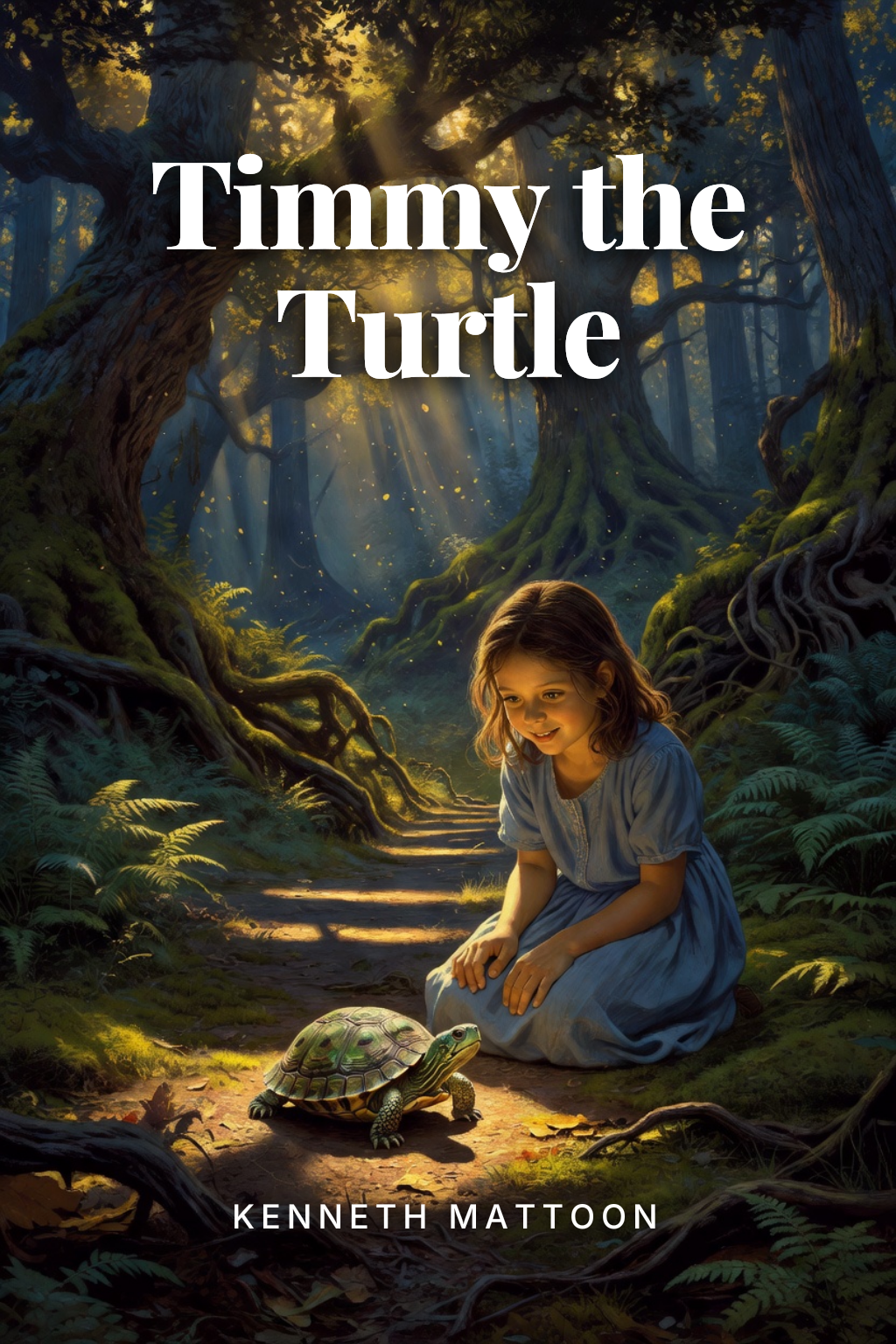
Novel · 8 chapters · 31,777 words
Timmy the Turtle
Contents8 chapters
Chapter 1
The Turtle in the Tall Grass
Timmy stretched his neck toward the flicker of blue.
There, just above the clover tops, a dragonfly hovered as if it had been stitched from pond-water and sky. Its wings flashed like thin glass. Its body was the color of a robin’s egg, bright and impossible, and every time it darted away, Timmy’s small feet began moving before the rest of him had quite decided to follow.
He pushed over a curled brown leaf. He bumped around a pebble. He squeezed between two stalks of grass that made a green doorway over his shell.
The dragonfly stopped on the tip of a weed, trembled there, and lifted again.
Timmy hurried after it.
He was not a fast turtle. No one had ever told him he was one. The snails at the pond slid past him with grave, shiny patience, and even the little brown beetles could zip under roots and vanish before he had taken three steps. But Timmy knew how to keep going. He knew how to plant one foot, then another, and trust that the ground would still be there under him.
Besides, the dragonfly was not very far.
At first.
Behind him, the pond made its morning sounds without asking him to listen: a light slap of water against mud, the soft combing whisper of reeds, the plunk of something small dropping from a stone. Timmy had heard those sounds all his life. They were as ordinary as his own shell. He did not turn around to check where they were. He did not think he needed to.
The dragonfly drifted over a patch of yellow flowers. Timmy crossed after it, flattening a fallen dandelion seed with one careful foot. He passed under a fern frond so wide it shadowed half the world. A line of red ants marched over a twig in front of him, and he paused politely until the last ant had crossed. Then on he went.
The land at the edge of the pond was full of things to notice if you were as low to the ground as Timmy. Dew still clung to the roots where the sun had not reached. A snail shell, empty and pearly, lay on its side like a tiny bowl. The dirt changed from cool black soil to a scatter of dry grit and back again. Once, Timmy found a feather striped gray and white. It was longer than he was.
He nudged it with his nose. It smelled faintly of dust and bird.
By the time he looked up, the dragonfly had glided farther on.
Timmy set off again, quicker this time. As quick as he could manage.
“Wait,” he puffed, though dragonflies were not known for listening.
It skimmed over the top of a mossy hummock. Timmy climbed after it, his claws working carefully for purchase. At the top he stopped, chest heaving a little, and blinked.
From up there, everything looked different.
He could still see the bright thread of the pond through the stems, but it was thinner than he expected, broken into pieces by grass and wild mint and the low arch of brambles. He could hear the frogs, though. One gave a deep croak. Another answered from farther off.
Timmy felt a small pleased stir inside himself. He had come farther than he ever had before. The pond was still there. The dragonfly was still there too, balancing on a rush stem and turning its jewel-bright head.
Then it rose and sailed away again, over a little dip in the ground where shadows pooled cool and blue.
Timmy hesitated.
He was supposed to stay near the water. He knew that much in the simple, steady way a turtle knows things. The pond meant mud to dig in, weeds to nibble, flat stones that held the sun. It meant familiar smells: wet earth, algae, the faint sharpness of crushed reeds. Out there, beyond the next tuft and root and hummock, the smells changed. There was clover. Dry bark. Something sweet where berries had split open in the grass. Something musky and old that made him pull in his head for a second without knowing why.
The dragonfly circled once, as if teasing him.
Timmy put one foot down the slope.
Then another.
The dip was deeper than it had looked from above. He slid the last bit on his plastron and came to rest among soft green moss that pressed cool against his belly. Tiny white mushrooms stood in a ring to his right. A spiderweb stretched between two bent stems, silver and trembling, holding three caught gnats like bits of soot.
The dragonfly hovered over the far side of the dip. Sun slid along its wings.
Timmy climbed out.
The earth beyond the dip turned rough. Grass grew taller here, and thicker, with pale seedheads that brushed one another and made a dry whispering sound. Wild onion leaves bent over the pathless ground, and he had to push beneath them. He passed a stone laced with orange lichen. He went around the root of a willow sapling and under a branch fallen long ago, its bark peeled away to smooth wood.
The pond sounds thinned behind him.
He heard other things instead.
A cart wheel rattling somewhere near the village road. A dog barking. The high laugh of children carried on the air and gone again. The sharp click of a grasshopper leaping from one stem to another so close to his face that Timmy jerked back.
The dragonfly landed on a stalk directly ahead.
Timmy stopped so suddenly that his chin tapped the ground.
For a moment they were near enough to study each other. Timmy stared with solemn black eyes. The dragonfly’s great round eyes shone like polished beads. Its wings moved in a blur too quick to count. Timmy reached his neck farther. He had no plan beyond getting close. Maybe he only wanted to see how anything so blue could be real.
A shadow passed over them both.
The dragonfly vanished.
Not flew. Vanished. One blink it was there, the next it was gone, shot into the brightness above with such speed that Timmy only saw the smallest blue streak.
He ducked at once, pulling head and feet tight into his shell.
Something larger swept overhead with a rush of air and a single thin cry.
Timmy stayed still.
He knew stillness. Stillness had often kept him safe. The world could be all claws and beaks and sudden hunger if you were no bigger than a fallen apple. Better sometimes to become a stone and let danger pass by looking for easier things.
The shadow moved on. The grass settled.
One foot came out. Then another. Timmy lifted his head.
The sky showed in slivers between the stems. Nothing crossed it now.
He turned in a slow circle.
No dragonfly.
No pond.
Only grass. Grass in every direction, rising over him in green walls. Grass bowed by wind and standing straight again. Grass stitched with burrs and seed fluff. Grass so tall that the lower world smelled of sap and dirt and hidden beetles.
Timmy kept turning until he faced the way he thought he had come. Or maybe the way he hoped he had come. The hummock, the dip, the pond beyond that—those places had seemed easy enough while he was passing through them. Now each clump looked much like the next.
He took a few steps forward.
A twig caught against his shell and scraped.
He veered left around a stone.
The ground sloped gently down, and his heart gave a small hopeful beat. Down meant water sometimes. He hurried, only to meet a patch of nettles too thick to cross. He turned away from them and tried another direction. This led him through a cluster of stiff stems that rained dry seeds over his back.
He stopped.
Listened.
Nothing sounded like home.
A ladybug landed on a blade near his nose. It folded its red wing covers, opened them again, and flew off as neatly as if it had remembered an appointment.
Timmy wished, all at once, that he had not come this far.
The wish did not change anything.
He walked on.
At the pond, he knew the shape of the shore. He knew which bank had the warm flat rock, which muddy corner held the sweetest water plants, which tangle of roots made a good place to wedge himself when the heron stalked by. He knew where tadpoles clouded the shallows in spring and where minnows flashed under the lily pads when the sun stood high. He knew the old turtle with the chipped shell who liked to bask alone. He knew the frogs that argued every evening. He even knew the hollow place under the bent reed where the mud stayed cool at midday.
Here he knew nothing.
A beetle the size of a plum seed stumbled over a ridge of dirt in front of him, shining black as a polished button. Timmy almost asked it the way back, then remembered beetles were forever busy and not often helpful.
He kept moving.
Soon the ground lost its soft pond-edge feel altogether. The soil dried and cracked into small plates. Thistles grew there, and wiry grass that tasted dusty when Timmy nibbled one by mistake. He spat it out.
“Bleh.”
His own voice sounded tiny.
He tried to remember the pond as clearly as possible, as if thinking hard enough might pull him toward it. The broad pads on the water. The darting fish. The smell after rain when the bank darkened and earthworms came near the top. The old stump at the edge where insects sunned their wings. The place where he slept tucked against roots, with mud cool under him and water near enough to hear.
Was the pond to his right now? Behind him? Ahead?
Timmy stood with one front foot lifted, then set it down again without taking a step.
A wind moved through the grass, bending the stems all one way. They hissed together. For a second Timmy had the strange feeling that the whole field was talking over his head in a language much too large for him.
He lowered himself close to the ground.
A pair of boots thudded somewhere not far off.
Timmy froze.
The thudding came again—slow, heavy, regular. Not the light quick step of a bird. Not the scuttle of any creature he knew. He edged behind a lump of earth barely higher than his shell and peered between blades.
Two children crossed the far side of the meadow path, only visible in pieces: one striped stocking, one swinging hem, the corner of a wicker basket. Their voices bobbed above the grass.
“Not those. Gran said the red ones stain your fingers.”
“I know that.”
“You picked them yesterday.”
“I picked one yesterday.”
Their steps thumped away. A laugh trailed after them.
Timmy remained still long after the sounds had gone. Even when he no longer felt afraid of the boots, he did not move right away. The ground beneath him held the day’s warmth. Ants carried white crumbs into a small hole nearby. A fly cleaned its front legs on a dock leaf.
Everything else appeared to belong where it was.
At last Timmy crept out.
He had not gone ten steps before the earth gave way under his front foot. He slid chest-first into a narrow rut hidden by grass and tipped sideways, legs scrabbling.
For one alarming second he was on the edge of his shell, seeing the world at a slant.
Then he thumped onto his back.
The sky was suddenly all there was—blue between green spears, hard and far away. Timmy paddled at the air. His feet met nothing. He rocked once, twice, but the rut cupped him in place.
His breath came fast.
This was wrong. Turtles were not made for being upside down. His shell pressed awkwardly against his body. The sun struck his pale underside. Panic, bright and simple, flashed through him.
He kicked harder.
One back foot struck the dirt wall of the rut. He twisted. The shell tipped. Slid back.
Again.
He tried the other side, scratching loose soil into his face. Grit stuck to his nose. He did not stop. He shoved with all four feet, strained his neck, and gave one wild, clumsy heave.
He rolled.
For a moment he lay on his side, stunned. Then his feet found ground and he righted himself fully, panting.
The rut was only the narrow mark of an old wheel, dried hard and hidden under growth. To a cart it would have meant nothing. To Timmy it had been a ditch.
He climbed out slowly.
At the top he paused and stood very still, as if the world might flip him again if he moved too quickly.
His heart eased little by little.
He looked back at the rut. It looked almost harmless now, no more than a line in the soil.
Timmy frowned in the grave turtle way that was mostly just his face.
Nothing out here was what it first looked like.
He went on, more carefully than before.
Near midday, the sun climbed high enough to turn the tops of the grass almost white. Heat settled over the field. The sweetness of crushed clover grew thick. Tiny insects sang from everywhere at once, making the air seem to quiver. Timmy’s mouth felt dry.
Water. He needed water.
He lifted his head and sniffed. Dry grass. Warm dirt. Plant sap. Somewhere faintly, from very far off, the muddy green smell he wanted—but faint enough to be memory.
He chose a direction and trudged.
The land rose, then flattened. He crossed bare patches where rabbit droppings lay black and round. He found shade under a dock leaf and rested there for a little while, not sleeping, only waiting for his breathing to slow. A spider lowered itself on a thread in front of him, dangling, turning, then swung away when he did not prove useful.
When he left the shade, he noticed a line of flat stones half-buried in the dirt. They formed no path that he could understand, but he followed them a while because following something felt better than wandering at random.
The stones led him to a place where the grass thinned and wild thyme spread low to the ground. Bees worked the tiny purple flowers, so busy they scarcely noticed him. Beyond the thyme grew a patch of sorrel with leaves shaped like little green arrows.
Timmy nibbled one.
It was sharp on his tongue, but wet. He ate another, and another. The hunger in his belly quieted a little. Not enough. Just enough to remind him of what full had once felt like.
A grasshopper sprang from the thyme and landed on a stone ahead, green as a fresh pea pod. It rubbed its legs together and stared at him.
“Do you know the pond?” Timmy asked.
The grasshopper launched itself away.
Timmy sighed and kept walking.
The sounds from the village drifted nearer and farther as the wind shifted: a gate banging, a woman calling for someone named Elsie, the clink of metal on metal. Once he heard a rooster crow, late and offended, as if he had only just remembered his duty. Those noises meant people, and people meant feet and wheels and dogs and hands that might pick him up or scare him or carry him who knew where.
He turned away from them.
The ground dipped again. Hope stirred in him.
This hollow was not the mossy one from before. Its sides were baked firm, and at the bottom there was no water, only cracked mud and a scattering of hoofprints turned to hard cups. Timmy climbed down anyway, searching the deepest parts. In one print he found a spoonful of muddy dampness shaded by a tuft of weed.
He drank from it.
The water tasted of dirt and old leaves. It was wonderful.
He drank until the little hollow was nearly empty, then stood with droplets beading his chin. Relief loosened him so much that for a moment he almost believed he would find the pond next. Water led to water, didn’t it? Hollows led to streams, streams to banks, banks to home.
He climbed out of the dried puddle and turned slowly, testing the air again.
A fluttering burst from the grass to his left.
Timmy jerked back into his shell just as a brown shape shot upward—a partridge, all rustle and wing and startled complaint. It had been nesting under cover so near that his foot might have brushed the edge of it.
The bird skimmed low over the field and dropped elsewhere.
Timmy waited, tucked tight, while his pulse thudded inside the shell walls. When at last he peeped out, he saw the nest: a small cup hidden under bent grass, lined with pale stems. Speckled eggs rested inside, quiet as stones.
He backed away at once.
“I didn’t mean—” he began, but the bird was gone.
He retreated until the nest disappeared from sight, then turned in another direction. The field no longer felt merely large. It felt crowded with lives he did not know, each one with its own suddenness. Wings from nowhere. Boots from nowhere. Ditches where the ground had looked smooth. Shadows crossing overhead.
He wanted the pond so sharply now that his chest ached with it.
He wanted the familiar mud under his feet. The frog who always sat on the split log. The broken reed that leaned over the shallows. Even the old chip-shelled turtle, who never had anything to say except a slow blink and the taking up of space in whatever patch of sun Timmy had hoped to use.
He would not have minded sharing.
Timmy kept going because staying in one place seemed worse.
The sun slipped westward by inches too small to see, though the shadows lengthened. A white butterfly wavered by like a drifting petal. Far off, clouds of thistle seed floated over the meadow, catching light. Once Timmy came upon a place where fox tracks stitched the soft dirt between roots. The smell there was sharp and wild. He hurried away as fast as his legs allowed.
At last he reached a stand of grass taller than any he had crossed yet. The stems rose straight and thick, with feathery tops nodding high above him. At their base lay cool dimness and fallen blades woven into a rough mat. The earth smelled richer here. Hidden things rustled in the shade.
Timmy stopped at the edge.
If the pond lay beyond, he could not see it.
If danger lay within, he could not see that either.
A breeze moved through the upper stalks, and their plumes brushed one another with a soft shushing sound, like many voices asking for quiet.
Timmy listened beneath that whisper and heard, somewhere distant, what might have been water.
Or leaves.
Or only his hope again.
He took one step into the tall grass. Then another.
The stems closed around him. Light thinned to green. Seedheads tickled his shell. The ground was uneven, crossed by tunnels where mice or voles had passed. Once something tiny fled from under his foot with a squeak so faint he almost thought he’d imagined it.
He moved more slowly now, every part of him alert.
A shadow fell.
Not overhead this time. Beside him.
Timmy looked up.
Through the stems he saw the black shape of a cat threading along the outer edge of the grass, tail low, shoulders rolling. Its paws made no sound. Its yellow eyes flashed once between the stalks.
Timmy went cold.
The cat paused. Its head turned.
Maybe it had heard him. Maybe it had only heard the field mouse. Maybe it was listening to the same hidden heartbeat the whole meadow seemed to carry in its roots. One whiskered cheek pressed the grass aside. A paw lifted.
Timmy did the only thing he knew to do. He tucked himself in tight and sank as still as a pebble among the fallen blades.
The cat stepped closer. He could smell it now: fur, dust, old milk from some farm kitchen, the iron scent of hunter’s patience. A claw clicked against a stone. Then silence.
A very long silence.
Timmy dared not breathe too hard.
The grass swayed. Seed fluff drifted down and settled on his shell.
At last there came a new sound—the flap of wings and a sharp scolding chatter from above. The cat sprang sideways, body long and sudden, and shot out of the grass after whatever had taunted it. Stems thrashed, then stilled.
Timmy stayed hidden.
He waited through the fading of the rustle, through the return of insect song, through a whole stretch of quiet so deep he could hear his own little breaths against the shell’s rim. He did not know if the cat had gone far or crouched just outside. He did not know if the distant sound he had hoped was water had been real. He did not know which way to turn, or whether turning at all would carry him nearer home.
The world beyond the tall grass felt enormous now—boots and birds, ruts and shadows, paws that moved without sound—and Timmy, tucked into his shell at the roots of the swaying stems, seemed smaller than he had ever been.
Somewhere, far away or very close, something moved in the reeds with a soft, secret hiss.
Timmy lifted his head a fraction into the green dimness and listened.
Chapter 2
Footsteps by the Stream
The hiss came again.
Timmy turned toward it, one careful inch at a time, his small feet feeling for steadier ground under the mat of fallen grass. The sound did not stay in one place. It slipped and whispered, then paused, then whispered again, as if something ahead were breathing through green reeds.
He stopped to listen.
There was another sound beneath it now. A thinner one. A quick bright trickle.
Water.
At once the ache inside him sharpened. His mouth felt dusty. He had swallowed only a little muddy wetness since leaving the pond, and that had long ago dried from his tongue. If there was water ahead—real water, moving water—he had to reach it.
So he went on.
The tall grass thinned slowly, not all at once. First the stems stood farther apart. Light came in pale stripes. The ground dipped and rose in hummocks, and between the hummocks lay soft black soil that smelled cool and rich. Gnats drifted in columns where the sun touched through. Once Timmy pushed under a bent stalk and found a snail shell, empty and pearly inside. Once he froze while a beetle, shiny as a drop of oil, climbed over a clod of dirt beside his nose.
The trickling sound grew clearer.
Not pond-water, still and wide. This was restless. It ran over something hard and spoke in a hundred little voices at once.
Timmy hurried as much as a turtle can hurry. His shell brushed seedheads. Dry husks clicked against it. Here and there tiny burrs caught at his legs, and he stopped to tug free. The air changed too. It felt cooler. Damp.
The grass broke open.
Ahead of him lay a narrow bank of bare brown earth, and below it a stream no wider than a cartwheel was long. Water slid over pebbles and made bright wrinkles around them. Sun flashed on the surface. At the edge, short reeds leaned over, their roots clutching the mud. A bit of green weed streamed with the current like long hair in water.
Timmy had found the sound.
He had also found trouble.
The bank was steeper than it had looked from above. The edge had been nibbled away in places so that little shelves of dirt hung over nothing. Timmy took one more step, the ground crumbled under him, and suddenly his front feet were scraping empty air.
He pitched forward.
A clump of roots caught against the rim of his shell. For one dizzy second he dangled, hind feet scrabbling, pebbles clicking loose beneath him. He smelled wet clay and cold water and the green sharpness of crushed reed.
Then he slid.
Not all the way in. He bumped down the bank, plowing a line in the soft dirt, and fetched up hard against a stone at the bottom. Water splashed over one side of his shell. The stream was shallow there, only enough to wash around his feet, but the current tugged at him with surprising strength, nosing under him, trying to turn him sideways.
Timmy dug in.
The cold made him blink. After the hot, close grass it felt strange and wonderful. He lowered his head and drank greedily, taking mouthful after mouthful while the stream pressed against his chin and carried away the dust of the meadow. He drank until he had to stop and breathe.
Then, still braced against the stone, he lifted his head.
This was not home either.
The stream bed ran between low banks patched with moss and roots. Alder leaves flickered above. On the far side, a stand of purple flowers nodded in the current’s breath. Their smell came faint and sweet. Dragonflies skimmed low over the water, blue and green and copper, but not the bright blue one that had led him away.
Timmy looked upstream. Downstream. Neither way meant anything to him.
He tried to climb back onto the bank where he had slipped, but the mud gave under his feet. He pushed. Slid. Pushed again. The little shelf above him broke off and plopped into the stream.
He drew into himself for a moment, not fully hidden, just enough to be still. Water slid by. A water strider dimpled the surface and darted away. Somewhere in the alder shade, a bird gave three clear notes.
Then came another sound.
Not grass. Not water.
A footstep.
It thudded lightly on the earth above the bank, then another after it, with a swish of leaves and the faint knock of stems against one another. Timmy’s head went up. Every part of him listened.
The steps came nearer.
A shadow moved across the stream. Not the long low shape of a cat this time. Taller. Upright. It paused.
There was a small intake of breath overhead.
“Oh,” said a voice.
It was not a loud voice. It did not snap like the partridge or scold like the bird in the reeds. It sounded surprised, and curious, and close.
Timmy did not move.
The shadow shifted. Knees bent. A face appeared above the bank, framed by a tumble of brown hair that had come loose from its ribbon. A little girl peered down at him. Her cheeks were pink from walking; one of them had a streak of green where a leaf had brushed or a hand had rubbed. In one fist she held a bunch of flowers—oxeye daisies, buttercups, a spray of clover, and three blue cornflowers with jagged petals. In the other she clutched the handle of a shallow basket.
“Well now,” she murmured.
Her eyes followed the skid mark in the bank to where Timmy stood wedged against the stone. She glanced up and down the stream as if expecting to see some grand turtle family marching after him. There was no one.
She set the basket down in the grass above and lay on her stomach, carefully, so that only her chin and hands came over the edge.
Timmy watched her fingers first. They were small fingers, earth-smudged at the tips, with a dandelion stain near one thumb. They did not snatch. They only rested on the grass.
“You’re tiny,” she said.
The stream went on speaking around the pebbles.
Timmy tucked his head halfway in.
“All right,” the girl said softly. “You don’t know me.”
A bee nosed into the clover blooms by her elbow. She waited until it went on before speaking again.
“Did you fall?”
Timmy did not understand words, not the way people do. But tone has its own shape. This one held no sharp edges.
He stayed where he was, damp and trembling and tired clear through, while she studied him.
From where she was, she could see more than he could. She saw the fresh slice in the bank where his feet had broken through. She saw the little trail of mud down to the stream. She saw how very small he was—smaller than the spread of her palm, his shell dark and streaked with drying dirt, one forefoot braced against the stone as if he thought the stream might carry him away if he let go.
Jayme glanced toward the meadow beyond the alders. Her grandmother had sent her for flowers for the table, and she had come farther along the stream than she meant to because the cornflowers were better here, and then she had found foxgloves on the shadier side, and then a butterfly had settled on a thistle head and made her stop to watch.
Now there was a turtle in the water.
Not where turtles ought to be, unless this stream had a pond above or below that she had never noticed. But she knew this bit of land. She came here for mint in summer and pussy-willow switches in spring. The stream was only a stream. Too narrow, too quick, too full of stones.
The turtle blinked up at her with solemn black eyes.
“Are you lost?” Jayme asked.
The question sounded foolish the instant it was out. Of course he could not answer.
Still, she kept looking at him.
Most small wild things fled when she came too near. Field mice vanished before she saw more than a whisker. Frogs sprang off mudbanks in little wet explosions. Even garter snakes, harmless as bootlaces, slipped away faster than she could point them out. But this turtle did not scramble for cover, though the shadow of her filled the bank above him and her voice fell right over his shell. He looked frightened. He looked worn thin with it. Yet he did not run.
Maybe he could not. Maybe he did not know where to go.
Jayme bit the inside of her cheek and reached for a long grass stem.
“Don’t be scared,” she said, though he plainly was. “I’m only going to see.”
She stretched the stem down toward the water, not touching him, just touching the mud beside him. The bank there quivered and sagged. Another pinch of earth slid into the stream.
“No,” she whispered to herself. “That won’t do.”
She drew back and sat up. Her basket waited where she had left it, the flowers inside tilted sideways. Ants walked briskly over a dock leaf near the handle. The day had the busy humming feel of noon. Somewhere upstream a cow bell clonked from a pasture. If she went home now, set down the flowers, and came back with Granddad or a proper pail or even a garden trowel, would the turtle still be here?
She looked down again.
He had edged an inch along the stone, maybe trying to find a path out. The current pushed at one side of him. He lifted a foot. Set it down. Lifted it again. It was not enough.
Jayme made up her mind in the quick, breathless way children do when the thing seems obvious and impossible at once.
“All right,” she said. “Wait.”
She kicked off her shoes.
One was missing a lace. The other had a scraped toe where she had braked too hard on the lane last week. She set them beside the basket and rolled her stockings to her knees, then tested the bank with one foot. Dirt crumbled. Too steep there.
She moved downstream to a place where roots from an alder made a rough ladder. She lowered herself carefully, gripping the trunk, and slid the last little bit into the shallows with both feet. The water was colder than she expected.
“Ooh,” she hissed, then laughed once under her breath.
The stream tugged at her ankles, clear over the stones. Minnows flashed away from her shadow. She held her skirt gathered in one hand and edged sideways toward Timmy.
He saw the enormous shape of her coming through the water and shrank into his shell as far as he could go.
“That’s sensible,” Jayme said quietly. “I’d hide too.”
She crouched. The water soaked the hem of her dress anyway, darkening the cloth. Up close she could see a pale scrape along one edge of Timmy’s shell where dirt had rubbed away, and a bit of grass seed stuck near his tail. One front claw hooked the stone.
“I’m going to pick you up,” she told him. “Just a little. I won’t squeeze.”
Her hands entered the water from either side.
Timmy felt cool current, the hard stone under him, and then something new: two gentle walls, warmer than the stream, touching the edges of his shell. He tucked tighter. The pressure changed. The world rose.
Water poured away from him in silver threads. Air hit the wet places on his skin. He was lifted clear of the current and held in the cup of two hands.
Jayme straightened slowly, careful not to slip. He was lighter than she expected, no heavier than a small apple, but he carried his fear heavily all the same. She could feel it in the tightness of him.
“There,” she said. “There you are.”
She climbed back to the bank, using the alder roots, and sat down in the grass with Timmy in her lap. He remained shut up tight, only the slick point of his nose barely visible inside the shell’s rim.
Jayme glanced over both shoulders, not because she thought someone was watching, but because the world suddenly felt full of watching things. A jay scolded from the trees. A breeze walked through the nettles. She cupped one hand over Timmy—not covering him, just making a little shade.
After a while, his head came out the smallest bit.
“That’s better,” she said.
One eye regarded her.
She had found toads before and once a hedgehog in the cabbage patch, but never a turtle so little and so far from any proper pond. She thought of setting him back down and letting him go. That was usually the right thing. Grandmother said wild creatures belonged to themselves.
But where would he go? Into the stream to be knocked about among stones? Back into the meadow with whatever had scratched that mark on his shell? He did not have the springy readiness of an animal at home in its place. He looked, Jayme thought, though she would not have said it quite this way, as if he had come loose from where he belonged.
She laid her bunch of flowers beside her and touched one fingertip to the top of his shell. Mud had dried there in a cracked map. Between the dark patches, the shell showed olive-brown with faint lighter lines, each plate fitted to the next like neat pieces in a puzzle.
“You’re a handsome fellow,” she said. “Even filthy.”
Timmy blinked once.
That tiny blink reached her more than if he had spoken. She smiled before she meant to.
“Well. If you can look at me like that, you can’t be entirely offended.”
She picked a shred of grass seed from his shell and flicked it away. He did not pull in again.
A thought came to her then, and she leaned closer.
“If I put you down, will you try to run off?”
The turtle’s throat worked once.
Jayme chose a flat patch of earth well back from the stream and set him there.
For a moment he stayed exactly as she had placed him, legs tucked under, head low.
Then he stretched his neck, looked toward the water, looked toward the grass, and turned in a slow uncertain half-circle that led nowhere at all. One step. Pause. Another step. He stopped against a curled sycamore leaf, climbed halfway onto it as if it might help, and sat.
Not home, that said plainly as speech.
Jayme folded her arms around her knees and watched him.
“Lost,” she said softly.
The word settled between them.
He did not know the word. But he did not flee from her saying it. He only sat there on the dry leaf, a creature no bigger than a teacup saucer, and the whole set of his body seemed to sag with weariness.
Jayme looked at her flower basket, then back toward the village, hidden beyond the rise. If she took him home, Grandmother might say no at once. Put him back where you found him, Jayme. Wild things stay wild. Granddad might want to know exactly where the stream bend was, and whether there was a marsh nearby, and if she had looked around before meddling. He always asked the sensible questions after the fact.
But leaving him here felt wrong in a way she could not tidy into a sensible shape.
A flash of motion on the opposite bank made her head jerk up.
A black-and-white magpie landed on a branch with a clatter, tail seesawing. Its bead-bright eye fixed on the patch of ground where Timmy sat.
Jayme’s hand moved before she thought. She reached out and placed it around him like a fence.
“Shoo,” she snapped.
The magpie hopped once along the branch, head tilted. Then it flicked off in a slap of wings.
Jayme kept her hand there a moment longer. Beneath the curve of her fingers she felt Timmy shift, not trying to escape, only pressing into the bit of shade.
“That settles it,” she muttered.
But settle what?
She chewed a daisy stem and frowned toward the water. She was old enough to know not every found thing should be kept, and young enough to think help might be simple if she cared hard enough. The stream sparkled on as if this were none of its business. A caddis fly skated across the surface. Somewhere downstream, hidden by willow scrub, water chuckled over stones.
Jayme lifted Timmy again and stood with him in both hands.
“All right,” she said, speaking now as much to herself as to him. “You are not staying by this stream. That much I know.”
The question was how to carry him.
Not in the flower basket. The stems would bend, and he might crawl out between them. Not in her apron pocket; it was too shallow. She considered the pocket of her pinafore, but a turtle shell would drag it crooked and thump against her knees all the way home.
Her gaze fell on the wide straw hat hanging by its ribbon down her back. She had taken it off earlier because it kept catching in the alder branches. The inside was warm from the sun and smelled faintly of dried grass.
Jayme brightened.
“That could do.”
She untied the ribbon, slid the hat free, and turned it over in her lap. Into the crown she laid a few broad leaves from the stream bank, cool on the underside, then one of the softer clover heads from her basket. After a moment’s thought she added a buttercup and took it out again.
“No, that’s silly,” she said.
Timmy watched all this from the cradle of her palm, his head farther out now, his black eyes following each movement.
“This is only for carrying,” she told him. “Not forever. Don’t begin to think you’re king of the meadow.”
The corner of her mouth twitched.
Carefully she lowered him into the hat.
For one alarming second he tipped sideways on the curved straw. Then his feet found the leaves and he steadied. The brim made a round wall around him, not high enough to trap all the light, but high enough to hold him safe for the walk if she kept the hat level.
Jayme lifted it experimentally with both hands. Timmy swayed. He did not draw in. Instead he stretched his neck and touched one damp foot to the plaited straw as if testing this strange new ground.
“There now,” Jayme said, pleased. “That’s better than the basket.”
She slung the flower basket over one arm, gathered her shoes by the laces, and started up the bank to where the narrow path ran under hazels toward the village.
It was awkward work. She had to carry the hat straight and watch where she put her stocking feet. Twice she nearly trod on brambles. Once she stopped dead because something large cracked through the underbrush on the hill above—a sheep only, come nosing along the fence line. Still her heart banged hard for a moment.
Timmy felt the rise and dip of her steps through the leaves under him. The world moved in broad swaying patches: green overhead, brown path beneath, sudden blaze of sky where the branches opened. The smell changed as they went. Water-smell faded. Sun-warmed earth returned. Wild thyme crushed under Jayme’s heel let out its sharp sweetness. Dust from the path settled dry on the rim of the hat.
After a while Jayme found a way to hold him crook-armed against her middle, steadier there than at full stretch. She glanced in every few steps.
“You’re still with me,” she said once.
Timmy blinked.
That solemn little blink again.
“Oh, don’t look so worried,” she said. “I know. I’m strange and enormous and carrying you off. I would object too.”
The path bent around a thicket of hawthorn. Through a gap in it, the village roofs showed far off—red brick chimneys, slate, a line of washing bright as flags. Smoke drifted from one cottage though the day was warm. Closer by stood the old footbridge over the stream’s narrowest part, made of two planks silvered by rain and years. Jayme had crossed it a hundred times.
She stopped before stepping onto it.
From here she could go straight home. The lane beyond the bridge ran past Miller’s yard, then by the blacksmith’s shed, then up to her gate. Easy.
Yet she did not move.
Home meant questions. Questions were not bad. Questions might even help. But she knew the first one already, and she did not know how to answer it properly.
Why did you bring him?
Because he looked at me.
Because he did not run.
Because leaving him there felt like dropping a button in the grass and pretending not to see where it fell.
None of those sounded sensible enough to offer adults with folded arms.
Timmy shifted in the hat. Jayme looked down.
A tiny front foot had hooked over the edge of the brim. He stretched his neck toward the light ahead, then drew back and turned, slow as the hand of a clock, until he faced not the village but the stream behind them. He held there, still.
Jayme followed his gaze, though there was almost nothing to see now but the line of alder trunks and the glint of water between them.
“Is that where you came from?” she asked.
The stream gave no answer. The alders stirred their leaves. Beyond them lay meadow, tall grass, deeper places she had never had reason to search.
Jayme stood on the worn boards of the bridge with one shoe lace tangled around her wrist, a basket of flowers bumping her leg, and a lost turtle in her sunhat.
She looked toward home.
She looked back toward the meadow.
Then she tightened both hands on the brim and said, very quietly, “Granddad will know what to do.”
And with Timmy still facing over her shoulder toward the hidden grass, she started across the bridge.
Chapter 3
A Pocketful of Courage
By the time Jayme pushed open the side gate with her knee, the hat had grown warm in her arms.
The gate always stuck in summer. It gave with a wooden groan, then banged the post and set the hollyhocks nodding along the fence. A fat bee lifted out of one pink bloom and blundered away. Beyond the gate lay the narrow strip of yard behind the cottage: a line of cabbages with their leaves chewed into lace, three bean poles leaning together like gossiping old ladies, Granddad’s rain barrel under the eaves, and the stone step worn hollow in the middle from years of boots.
Jayme paused there to shift everything without tipping Timmy. The basket slid down her arm. The shoes hanging from her wrist knocked her leg. Inside the hat, the leaves whispered.
“Nearly there,” she murmured, though she was not sure whether she meant him or herself.
The kitchen door stood open to the dim. She could smell potato peelings, warm bread, and the sharp green scent of chopped parsley. Somewhere farther in, a chair leg scraped the floorboards.
“Back already?” Granddad called. “You’ve been gone no time at all or half the day. Hard to tell with you.”
Jayme stepped into the kitchen and stopped just over the threshold, blinking while her eyes adjusted from the bright yard. The room was cool after the path outside. Copper pans hung above the dresser. A striped cloth covered a bowl of rising dough on the table. The black range held a blue iron pot with steam just breathing from the lid. Her grandfather stood at the sink with his sleeves rolled to the elbow, rinsing dirt from a bunch of carrots. His hands were broad and brown, knuckled like roots.
He glanced over his shoulder.
His eyes dropped to the hat.
Then to her face.
Then back to the hat.
“Well,” he said.
Jayme set the flower basket down very carefully beside the door, as if any sudden movement might undo her. “I found something.”
“So I see.” He shook water from the carrots and laid them on the board. “That is a fine hat for finding things in. Better than pockets. Your pockets collect twigs and dead snails.”
“They do not collect dead snails on purpose.”
“No. I suppose the snails choose them.”
He dried his hands on a cloth and came toward her, not hurrying. He had that way about him. Nothing in him ever flew apart. Even when the roof leaked over the stair and the milk boiled over at the same time and the hens got into the onion bed, Granddad moved as if there were room enough in the day for all of it.
Jayme held out the hat.
Timmy had tucked himself low among the leaves. His shell still shone a little from the stream. A bead of water clung near the pale scrape along one edge. When Granddad bent close, Timmy drew in his head halfway, then stopped there, watching.
Granddad made a small sound in his throat. Not surprise exactly. More like recognition.
“A turtle,” he said.
“I know he’s a turtle.”
“I meant,” said Granddad, “that you have not brought me a turnip with ideas above its station.” He peered closer. “Tiny fellow.”
“He was in the stream. He couldn’t get up the bank.”
“Mmm.”
“I didn’t go looking.”
“No?”
“No. I was gathering flowers.”
Granddad’s eyes slid to the basket by the door, where stems stuck out in a crooked fan and one daisy had lost all but three petals.
“That does appear to have been your first purpose,” he said.
Jayme bit her lip. “I put him in the hat only to carry him. I was going to leave him if he could climb. But he couldn’t.”
Granddad straightened. “Did he bite you?”
“He’s much too small.”
“That wasn’t what I asked.”
“No.” She shifted the brim against her palms. “He just looked solemn.”
Granddad’s mouth twitched under his white mustache. “Ah. A dangerous expression. Set him on the table.”
She did, easing the hat down between the flour tin and the breadboard. The leaves rustled again. Timmy’s black eyes blinked once.
Granddad drew out a chair and sat. He folded his forearms on the scarred wood and looked, while Timmy looked back. The kitchen clock clicked above the mantel. The steam from the pot made the windowpane over the sink cloud at one corner.
At last Granddad said, “Where along the stream?”
“Near the alders. Below the footbridge. He’d slid down and got wedged by a stone.”
“And you brought him because…”
Jayme opened her mouth. Closed it. Picked at a loose strip of straw on the hat brim.
“He would have stayed there,” she said finally.
Granddad nodded once, as if that answer would do for now.
“Fetch that shallow apple box from the scullery,” he said. “The one by the sack of onions. And the old cracked saucer from the shelf. We’ll make him a place till we know more.”
Relief came into her so fast she almost laughed. “Can he stay?”
“For the moment.” Granddad rose from the chair. “For one afternoon, the kingdom will survive with a turtle under our roof.”
Jayme flew.
The scullery was a narrow room beyond the kitchen, with a sloped floor and a window crowded by mint outside. She found the box where Granddad said, wooden and low-sided, stamped in faded red letters from a fruit merchant in town. One corner had split and been nailed back together. It smelled faintly of apples still, dry and sweet. On the shelf above the stone sink stood a jumble of chipped crockery, jars with no lids, and lids with no jars. She chose a saucer with a hairline crack through the middle and hurried back.
Granddad was already at the back door scraping a trowel into a bucket.
“Not too much,” he said without turning. “Bit of earth, a tuft or two of moss, some leaves. He may like a place to tuck under.”
Jayme set down the box and saucer. “Should I get grass?”
“A little.”
“And water?”
“In the saucer.”
“And something to eat?”
Granddad looked over his shoulder. “Do you suppose turtles dine on seed cake?”
“I don’t know what they eat.”
“Then that is the first thing we know we don’t know.” He shoveled another small scoop of dark soil into the bucket. “Take a strawberry from the bowl. It won’t do him much harm to be offered one.”
Jayme was already reaching.
Within minutes the table had become a little wilderness. Granddad tipped a layer of crumbly earth into the apple box, and Jayme spread it with both hands, making hills no higher than her fingers. She laid in a patch of moss from the yard, velvety and damp. She tucked one broad cabbage leaf against the side to make a green tent. She placed three plantain leaves near the corner and two dandelion leaves because they looked cheerful, though she did not know whether turtles cared for cheer. The cracked saucer she filled halfway with water from the pump, setting it level so it would not slosh into the dirt. Then she cut a strawberry in half with the butter knife and chose the smaller half, red as sealing wax, seeds shining gold along its skin.
All the while Timmy remained in the hat, still enough that if not for the blink of an eye or the slight movement of a front foot, he might have been a carved toy.
“There now,” Jayme said, breathless and pleased despite herself. “It’s better than a hat, anyhow.”
Granddad leaned in and inspected the arrangement. “Mm. Lacks only a willow tree and perhaps a church bell.”
She gave him a look. “I’m serious.”
“So am I.” He touched the saucer and nudged it another inch from the moss. “A creature needn’t be large to notice if things are badly put.”
When the box was ready, Jayme reached into the hat. Her hands slowed just before they touched Timmy. He had not minded being lifted from the stream, but that had been fear and wetness and no choice at all. A kitchen table was different.
“It’s all right,” she whispered.
Timmy’s shell was cool under her fingers. He weighed almost nothing and yet made her careful. She lowered him into the box and withdrew her hands.
For a second he did not move.
Then one front foot stretched, pressed the earth, and withdrew. The other foot followed. He lifted his head a little. The room had changed around him: no running water, no reeds rubbing together, no wind in the grass. Instead there were table smells and old wood and steam and bread. A fly ticked at the window. Somewhere in the house a loose latch rattled.
Jayme crouched so her face was level with the box. “See?” she said softly. “Leaf roof. Water. Strawberry. Better than getting washed away.”
Timmy took three slow steps and stopped beside the saucer. He looked at it, then past it. His head turned toward the window over the sink, where the pane was bright with afternoon. The white curtain lifted once in the draft from the open door.
He stayed that way.
Granddad set the trowel aside. “Let him be a minute.”
“He hasn’t eaten since—” Jayme checked herself. Since before me, she had almost said.
Granddad heard it anyway. “A frightened creature may choose looking over chewing.”
Jayme folded her arms on the table edge and watched. After a while Timmy lowered his head and drank. Not much. Just a little sip, then another. The movement of his throat was so small she nearly missed it. Her own breath loosened. When he had enough, he stepped around the saucer, came to the strawberry, and touched it once with his mouth.
“Go on,” Jayme urged. “It’s good.”
Timmy did not agree. He drew back and stood quite still again.
Granddad gave a soft huff that might have been a laugh. “Perhaps he prefers beetles and pondweed to your summer treats.”
“I would too, if I were a turtle.”
“Would you?”
“No,” Jayme admitted.
Granddad returned to his carrots. “Wash your hands and put your flowers in water before they faint altogether. Then tell me from the beginning, with fewer skipped bits than I expect you intended.”
So Jayme washed the dirt from her fingers at the pump sink while Timmy watched the window and Granddad scraped carrots into a neat orange pile. She fetched the blue jug from the dresser for the flowers and found they had bent and crushed together in the basket. Still, she stood them up as best she could: oxeye daisies, campion, a spray of lady’s bedstraw gone frothy and gold. While she worked, she told the story.
Not all at once. It came in starts, because Granddad interrupted to ask where exactly, and how deep, and whether the bank there was mud or root, and whether she had seen any pond near. He wanted facts, not just the shape of her alarm. She had to think. By the end she had remembered more than she knew she had noticed: the line of reeds beyond the stream, the pebbles showing through bright water, the stone Timmy had been caught against, the way he kept turning in the hat as if trying to face backward.
Granddad listened with the knife in his hand and his eyes on the carrots.
When she finished, he scraped them into the pot and said, “Hm.”
Jayme hated hm. Hm could mean anything.
“What does that mean?”
“It means I’m thinking.”
“You’ve been thinking all along.”
“That is usually how it works.”
“Do you know where he came from?”
“No.”
Her heart dipped.
“But,” Granddad said, lifting the pot lid to stir, “I know he did not spring from the stream like a fish. Turtles belong to water of a different sort. Pond, marsh, slow place. Mud and weeds. Perhaps there is one near enough that we’ve not troubled to look properly.”
Jayme turned toward the box at once. Timmy had not moved far. He had gone to the side nearest the window now, and one tiny foot was braced against the wood as if he might continue through it if he only kept trying.
Granddad followed her gaze.
“There’s safety,” he said after a moment, “and there’s belonging. Two separate things.”
Jayme frowned. “If he’s safe, isn’t that the important part?”
“Often. Not always enough.”
That did not seem fair. She opened the bread crock and shut it harder than necessary. “It should be enough for now.”
“For now,” Granddad agreed.
They left the box at one end of the table while they made supper. Jayme shelled peas into a yellow bowl and sneaked glances every few minutes. Granddad kneaded the risen dough, thumped it into two loaves, and slid them into tins blackened from use. The kitchen filled with flour dust, yeast warmth, and the ticking quiet of late afternoon. Outside, someone drove a cart down the lane; the wheels grumbled over stones. A hen cackled from the byre wall. Once a swallow skimmed past the window so fast it was only a dark stroke.
Timmy did not touch the strawberry again.
He walked the edge of the box slowly, stopping at each corner. At the side nearest the room he tucked half under the cabbage leaf, then came out almost at once. He stood with his nose near the apple-merchant stamp, as if reading. He climbed onto the moss and sat there a while. Then back to the window.
When Jayme carried the pea pods out to the heap behind the shed and came back in, she found Granddad leaning one elbow on the table, studying Timmy the way he might study weather over a field.
“What if he doesn’t like it?” she asked.
Granddad did not look up. “Liking has little to do with it. He doesn’t know it yet.”
“I mean what if he stays sad.”
Granddad turned then. “Did you expect gratitude by teatime?”
She flushed. “No.”
“Good. Gratitude is poor company to feed before a creature’s even dry.”
She bristled, then saw from his face that he was not mocking her, not quite. He wiped his hands on the cloth and touched the edge of the box with one finger. Timmy drew in his head a fraction.
“See there?” Granddad said. “He’s alive to every shadow still. Stream one hour, stranger’s hands the next, room after that. The world’s turned itself inside out on him. I’d be quiet too.”
Jayme came close again. “Will he die?”
“No.”
He said it plainly enough that she believed him for at least ten whole seconds.
Then he added, “Not if he has any say in the matter, and most creatures do.”
That was less comfortable.
Supper had to happen whether a turtle ate or not. Granddad moved the box to the sideboard away from the steam, and they sat at the table with carrot soup, thick slices of bread, and a wedge of hard cheese. Jayme’s place faced the sideboard. She could see Timmy over the rim of her bowl. He was only a small dark shape against the apple box wood, but somehow she was aware of him every moment, the way one is aware of a thistle seed on the nose even while pretending not to mind.
“Eat,” said Granddad.
“I am eating.”
“You’re stirring.”
She took a proper spoonful. The soup tasted of pepper and garden dirt in the good way, and the bread had not cooled enough to lose its oven warmth. Usually she loved the crackle of the crust. Today the sound seemed rude beside the silence of the box.
At last she said, “Could he stay in my room tonight?”
Granddad buttered his bread. “What for?”
“So I can listen in case he needs anything.”
“He cannot call out for a blanket.”
“I know that.”
“Then better here, where the air is cooler and no one kicks the box in her sleep.”
Jayme opened her mouth to object, but he had already raised one eyebrow. The one that meant he was right and knew it.
“He won’t feel lonely in the kitchen?” she asked instead.
“He felt lonely before he came to the kitchen.”
That put an end to it.
After supper Granddad took his pipe to the back step without lighting it, just to sit in the mellow light and think his evening thoughts. Jayme washed up. The bowl water turned cloudy with soup and flour. The cracked saucer in Timmy’s box had gathered a crescent of dirt in one side where his feet had tracked through. She changed it for fresh and trimmed the strawberry where the cut face had gone dull. This time she added a clover blossom, purple and soft, because perhaps turtles liked flowers after all and merely had no way to say so.
Timmy watched her hands but made no move toward any of it.
“You are difficult to please,” she informed him.
His solemn blink answered nothing.
The sun shifted west. A slant of honey-colored light fell across the floorboards, then climbed the leg of the table, then touched the box. Dust motes floated through it like tiny seeds. Jayme fetched a stool and sat by the sideboard with her chin in her hands.
She tried talking to him. Not nonsense. Real things.
She told him about the goose by Miller’s yard that chased everyone except the postman, and no one knew why. She told him Mrs. Fenwick had once baked a currant pie with her spectacles still on her head and spent ten whole minutes accusing the cat of stealing them. She told him the bean rows in the yard leaned because Granddad insisted they would straighten themselves if given the chance, and she insisted they were past all help. She told him she had nearly stepped on brambles bringing him in. She did not tell him she had been scared at the bridge that she had done the wrong thing.
Through all of it Timmy remained very grave and very separate. Now and then he shifted. Once he put one foot on the lip of the saucer and drank. Once he ducked under the cabbage leaf until only the back of his shell showed, then came out again and faced the window. The clover stayed untouched. The strawberry deepened from bright red to a darker, sadder color.
At some point Granddad came in, hung his hat by the door, and stood listening without interrupting. Only when she had run out of village stories and fallen into silence did he say, “You’ve told him everything but where the good blackberries are.”
“I’m not foolish.”
“No? That seems a useful bargain to offer.”
She looked up. “He doesn’t care.”
“Likely not.”
“Then why are you smiling?”
Granddad settled himself in his chair by the range. The evening had come far enough along that the kitchen corners were beginning to blur. “Because you’ve a heart like a terrier. Once it catches hold, it shakes.”
Jayme pretended to scowl, though she was not sorry to hear it. “I only want him not to be afraid.”
“Perhaps he isn’t afraid now.”
She turned to the box. “Then what is he?”
Granddad took his time before answering. “Elsewhere.”
The word sat between them.
Jayme had no answer for that either.
When the light thinned, Granddad lit the lamp over the table. Its glass chimney breathed into gold, and the kitchen gathered itself close around the circle of brightness. Beyond that circle, the window became first gray, then black. The pane no longer showed the yard, only reflections: the lamp flame, the copper pans, Jayme’s bent head, the faint white curve of Granddad’s mustache.
Timmy noticed the change. He moved nearer the glass, neck stretched, as if the dark outside might open and reveal the thing he had been looking for all day. Instead it gave back only his own small shape and the room behind him.
Jayme felt a pinch in her chest. “He thinks it’s out there.”
“Maybe it is.”
“In the dark?”
Granddad nodded toward the window. “Creatures know their own business better than we do.”
She rose from the stool and crossed to the latch. “I could open it a little. He might like the air.”
Granddad considered. “A crack. There’s no cat getting in here, and no turtle getting out of a box on a sideboard.”
So she lifted the latch and pushed the sash up an inch. Evening slipped in at once: cooler air, damp with grass, and a smell of nettles from the wall. From far away came the soft strike of the smith’s hammer, slower now than in daytime. Closer, crickets had begun their thin sawing. Somewhere down the lane a baby cried and was hushed.
Timmy lifted his head higher.
For the first time since she had brought him home, Jayme saw something in him that was not merely caution. It was small, but plain. Attention. A listening so complete it seemed to pull his whole body forward.
“There,” she whispered, as if she had done him a kindness.
He stayed motionless for a long while, taking in the night smells through the narrow gap. Then, very slowly, he turned—not toward the strawberry, not toward the leaf shelter—but toward the black square of the window itself, and settled there with his front feet braced against the wood.
Granddad drew on his pipe, though it was not lit, the stem tucked in the corner of his mouth. “You see.”
Jayme wrapped her arms around herself. “He’s safe.”
“Yes.”
“But he still wants—”
“Yes.”
The kitchen gave its little sounds around them: lamp flame ticking, cooling iron at the range, a mouse perhaps somewhere behind the dresser, no bigger than a thought. Jayme went to the sideboard again and placed one finger near Timmy, not touching him. The shell looked sturdy. The creature inside it did not seem sturdy at all.
“I thought once he was out of the water,” she said, “that would be the end of the worst part.”
Granddad’s chair creaked as he leaned back. “Sometimes the worst part is over and the wanting part begins.”
She frowned at Timmy. “That’s a poor arrangement.”
“It is the common one.”
She was quiet then. The lamp shone on the strawberry slice, the untouched clover, the line of damp dirt along the saucer. Such a tidy little place. Safer than a stream bank, safer than tall grass, safer than whatever else might be prowling at dusk beyond the yard wall. Yet none of it had reached where Timmy truly seemed to live, which was somewhere behind those solemn eyes, somewhere turned toward reeds and mud and hidden water she had never seen.
At length Granddad stood, crossed to the sideboard, and bent near the box. “Tomorrow,” he said, not to Jayme alone and not to Timmy alone either, “we shall have a better look at matters.”
Jayme’s head lifted. “You mean where he came from?”
“I mean we’ll use our feet and eyes for what they’re meant for.”
He straightened and went to close the back door, though he left the window open its inch. The night had thickened outside. A moth tapped once at the lamp chimney and vanished upward.
Jayme stayed by the box.
Timmy did not turn. He stood facing the dark pane, listening to whatever lay beyond the cottage wall, beyond the lane, beyond the bridge and the stream and the grass she had crossed with him. His reflection hovered faintly in the glass, a tiny shell and lifted head floating over the black.
Jayme looked from that reflection to the latch on the window, then to Granddad’s back as he slid the bolt on the door.
Tomorrow, he had said.
But the dark outside was full of paths she did not know, and Timmy was still there at the edge of his borrowed world, staring as if home might answer him if only he kept watch long enough.
Chapter 4
Clues in the Mud
“Granddad, don’t wipe it off.”
His hand stopped in the air.
Jayme had set the apple box on the scrubbed kitchen table and was leaning so far over it that one loose strand of her brown hair nearly dipped into the saucer. Timmy had pulled halfway under the tuft of grass in his corner, but his head was out, his black eyes fixed on the movement above him. Granddad stood on the far side of the table with the dishcloth he had just picked up after breakfast.
“What am I not wiping off?” he asked.
“There.” She pointed with one careful finger. “On his shell. And by his foot. See?”
Granddad laid the cloth aside.
The table still smelled faintly of toast and the heel of cheese they had eaten. Near the window, the blue-striped bowl of porridge sat with its spoon in it, forgotten by Jayme after three bites. A fat fly nosed against the pane and buzzed back again. Beside the range, the kettle gave a soft, thin singing as if it had one small thought it could not let go of.
Granddad bent without hurrying. Up close, his white mustache lifted a little with his breath. “Ah.”
Jayme knew that sound. It was not agreement exactly. It was the sound he made when something deserved a second look.
Timmy shifted one foot. Between the plates of his olive-brown shell, dried mud had gathered in dark lines, but that was not what Jayme meant. On one side, along the pale scrape she already knew, there was a fan-shaped smear as though he had pressed against wet earth and the earth had dried there in a curved mark. Near his back foot, caught where skin met shell, clung two tiny brown strips, so small she had first taken them for dirt. Now in the morning light she could see they were not dirt at all but bits of something fibrous and flat.
“Lift him,” she said.
Granddad gave her a look over his spectacles. “You ask like a magistrate.”
“Please lift him.”
“That’s better.”
He slid both broad hands into the box and raised Timmy gently. Timmy drew in his head at once, then peeped out again as Granddad turned him toward the window. In sunlight, the shell showed more than it had by lamplight. The faint lighter lines on each plate shone through the muddiness. The scrape along the edge looked chalky. And the little strips by his hind foot hung stubbornly on.
Jayme came round to Granddad’s side. “They’re stuck.”
“They are.”
“Grass?”
Granddad narrowed his eyes. “Not meadow grass.”
“How do you know?”
“Meadow grass doesn’t split that way.” He pinched one brown strip between finger and thumb, very delicately, and did not pull it free. “This is from a reed, or near enough to one.”
Jayme looked from the strip to Timmy as though he might suddenly explain himself. “Reeds. Like at the stream?”
“Some.” Granddad turned the turtle a little more. “And some elsewhere.”
She frowned. “Elsewhere where?”
Instead of answering, Granddad carried Timmy to the door and shouldered it open with his hip. “Light’s better out here.”
Jayme followed him to the back step.
The yard behind the cottage was no grand place, only a patch of worn grass, a row of bean sticks, a barrel catching rain from the roof, and the low stone wall with nettles beyond. Yet the morning made each thing seem set down clear and separate: the line of damp on the pump handle, the chipped flowerpot by the step, the blackbird tugging a worm near the currant bush. Jayme shaded her eyes while Granddad held Timmy out where the sun could catch every seam of him.
“Now then,” Granddad said softly, as if he and the turtle had business with one another.
Jayme bounced once on her toes. “Well?”
He ran one finger, not touching, along the dried fan on the shell. “That mud’s not from our kitchen box. Too smooth there. This has grit in it.” He glanced at her. “You didn’t set him down in the lane.”
“No!”
“I know. Hush. Thinking.”
He put Timmy on the step between them. Timmy stayed still for a moment, then stretched his neck and began a slow determined push toward the yard.
“Do you think he came from the stream after all?” Jayme asked. “Maybe he lives there and only got stuck.”
Granddad sat down on the step above Timmy, elbows on his knees. “Could be, if he were the sort to belong in running water. But he was listening through the window last night like a creature expecting a particular answer. Streams talk all day. They don’t keep secrets well.”
Jayme lowered herself beside him. “Then a pond.”
“Which one?”
She opened her mouth and shut it again.
That, Granddad had taught her often enough, was the trouble with saying a thing too quickly. Once you named it, you had to know it.
He held out his hand. “Let me have that basket you brought flowers in yesterday.”
She sprang up at once, darted inside, and returned with the shallow basket from the dresser. A bent daisy petal still clung to its weave. Granddad upended it on the step and shook out a little stale scent of clover. Then he set the basket over Timmy, not trapping him but making a small cage of shadows around him while they talked.
Jayme stared. “Granddad.”
“What? He can’t go prospecting under the beans while we puzzle.”
“He doesn’t like it.”
“Neither do lost things. Sit down.”
She sat, though with a face to show she objected.
Granddad rubbed his thumb across his chin. “Let’s count what we know. You found him below the footbridge by the alders. He was caught against a stone.”
“Yes.”
“He was weak.”
“Yes.”
“He’s got a scrape on his shell from somewhere before that. He’s carrying dried mud that isn’t from this house. And he’s got reed caught by his foot.”
Jayme folded her hands tight in her lap. “And he wanted the dark.”
“That too.”
She thought of Timmy at the window, front feet braced, as if the night itself were a path. “There aren’t reeds only by the stream.”
“No.”
“There are some by Miller Sedgewick’s duck pond.”
Granddad nodded once. “There are.”
“And by the old clay pit.”
“A few.”
“And down by the horse meadow where it gets boggy.”
“Mm.”
Jayme twisted around to look at the basket. Through the willow strips she could just see Timmy’s shell, rounded and patient and far too small for all this trouble. “If there are reeds everywhere, that’s no help at all.”
Granddad chuckled into his mustache. “Everywhere? Child, if you’d walked these parts fifty years your everywhere would grow narrower.”
He pushed himself up and went to the woodshed wall where a length of hazel was hanging with other odds and ends. From a nail he took down an old walking stick, smooth where his hand had worn it. He returned and tapped the step lightly with its tip.
“Listen. The duck pond is near cottages, and ducks turn mud to soup. That stain on him there”—tap—“dried in a cleaner fan than duck muck. The clay pit’s banks are yellow-red in dry weather and stick like potter’s earth when wet. This mud’s dark. Better than that, smell it.”
Jayme leaned in, doubtful but obedient. Granddad scratched a crumb from the shell seam with his nail and held it toward her. It looked no bigger than a pepper flake.
“Well?”
She bent close. The smell was faint under sun and dust and turtle, yet it was there: wet soil, a little sour, and something green underneath, stale in the way of water that had stood among plants.
“It smells old,” she said.
“Good. Old and planty. Not lane puddle. Not duck yard either.” He opened his palm and let the crumb fall. “Now the bog by the horse meadow has rushes, not reed beds worth naming, and a cow would have stepped on this fellow in a blink. So that leaves us with places where still water hides and reeds grow thick enough to tear a bit off on the way through.”
Jayme’s gaze drifted beyond the yard wall though she could not see farther than the lane. In her mind she tried laying the village out as Granddad might, not as a child did in scraps and favorite corners but whole, with fields linked to woods and woods to ditches and ditches to places nobody bothered unless they had reason.
“The marsh,” she said at last.
Granddad did not answer right away. He looked pleased, which made him stern.
“What marsh?” he asked.
“The one beyond the hill.” She pointed though the hill itself lay hidden from the step. “Past the furze and the crooked hawthorn, where the ground dips and nobody goes because your boots sink.”
“Better.”
“I’ve not been there.”
“No, and won’t go alone.”
She ignored that for the moment. “Could he come all that way?”
Granddad looked down at the basket. “A little creature with no sense except the right one can come farther than seems sensible. Sometimes that’s the trouble.”
Jayme slid from the step to her knees and peered through the basket lattice. “Did you come from the marsh, then?”
Timmy did not answer. He had turned himself so that one black eye showed between the willow strips, solemn as ever.
Granddad went inside and came out carrying the kitchen knife and a chipped saucer. Jayme blinked.
“What are you doing?”
“Not butchering him, if that’s your fear.” Granddad crouched and used the knife tip to tease one of the brown fibers loose from Timmy’s foot. It took patience. The thing clung as if it had made up its mind. At last it came free and lay on the saucer: a dry narrow strip, jointed faintly, pale inside and brown outside.
Jayme touched it with one fingertip. “It’s hardly anything.”
“It’s enough.” He fetched the second bit as well. That one was shorter, ragged at the end. “See how it peels? Reed sheath. Could be common reed. Could be bur-reed. Could be one of its cousins.”
“You know all of them?”
“I know enough to leave room for being wrong.”
That was another of his sayings. Jayme found it tiresome when she wanted certainty and comforting when certainty looked poor.
Granddad rose again. “Fetch my box from the dresser drawer.”
She brought the small wooden box he kept odds and ends in: string, nails, a stump of pencil, buttons, a magnifying glass with a cracked black handle. He took the glass and bent over the saucer.
“Well?” Jayme said again.
He gave her a sidelong glance. “You’re a one-word child this morning.”
She clasped her hands behind her back so she would not snatch at anything. “I’m waiting.”
He peered, shifted the glass, peered again. The blackbird in the currant bush flew up with a dry clatter of wings. From the lane came a cart, slow on its axle, then passed on.
“At the least,” Granddad said, “it did not come from your grandmother’s broom.”
Jayme tried not to smile because he was being serious in his own fashion. “Granddad.”
He lowered the glass. “I think marsh. Not promise. Think.”
That was enough to send something sharp and bright through her. It was not exactly happiness. It had edges. It was the feeling of a door moving on its latch after you had pushed it and found it stuck.
“If it is the marsh,” she said, “then we can take him there.”
“Can we?” Granddad tucked the reed bits carefully back onto the saucer. “The marsh beyond the hill is not a bowl with one turtle set in the middle of it waiting to be matched. There’s marsh grass, channels, hummocks, mud holes enough to swallow a boot. If that’s his place, we still have to find where in that wilderness a creature his size belongs.”
She bit her lip.
Granddad saw it and softened a little. “I didn’t say no.”
“You didn’t say yes.”
“That’s because both words are cheap before dinner.”
He lifted the basket off Timmy and let him continue his steady crawl. Timmy headed not for the bean sticks or the wall but for the damp patch near the rain barrel, where green moss darkened the stones.
Jayme followed on her hands and knees. “Look. He likes the wet.”
“Turtles commonly do.”
“No, I mean look how he chooses.”
Granddad let her have that. He stood with the walking stick planted by his boot and watched Timmy nose into the moss. “Mm.”
Jayme sat back on her heels. “We should go today.”
Granddad’s brows rose.
“Now,” she said. “Before the clue gets older.”
“The clue,” he repeated, with dangerous mildness, “is already dry enough to snap. And the marsh, if marsh it is, has sat where it sits since before you and I began ordering it about.”
“But if he came from there, he ought to be there.”
“That much is true.”
She stood, quick and straight. “Then let us take him.”
Granddad looked toward the lane, then back to the yard as if measuring more than distance. “And clamber half the parish in the middle of the day with a little turtle in a box? By the time we reached the hill, sun would be high. Marsh paths are easier read in slant light. Also, if I’m to go tramp wet ground, I’ll take proper boots, a staff, and food enough not to come back cross. Also also”—he held up a finger before she could interrupt—“I’ve not finished thinking.”
Jayme made a sound from the back of her throat.
“Ah,” said Granddad. “There is the true answer.”
She scowled at the yard. “Thinking takes too long.”
“Only to the people not doing it.”
He stooped and with two fingers turned Timmy very gently away from the rain barrel toward the patch of open step. Timmy set his feet and persisted at once in the direction he had been going. Granddad let him. “That’s worth one thing.”
“What?”
“He knows his preferences and lacks the manners to hide them.”
Jayme brightened. “Then if we show him places, he may tell us.”
“In the manner of turtles, perhaps.”
She considered that. “Which is very slow.”
“Yes.”
For a little while they tested nothing and said little. Granddad brought out a flat board and laid it from step to yard so Timmy could go down easily. Jayme placed a saucer of water on the ground and watched whether he turned for it. He paused there, drank a little, then carried on toward the moss at the rain barrel after all. Granddad noted this without comment. When Jayme set a strawberry piece in his path, Timmy nosed past it. When she brought a damp handful of duckweed from the stone trough by the pump, he ignored that too.
“He’s impossible,” she said.
Granddad, who was mending a bit of harness by then, did not look up. “No. Only not asking your opinion.”
Near noon he whittled a twig and used it to trace on the hard dirt by the step. “Here’s our cottage. Here the lane. Here the bridge where you found him. Stream runs this way.” The lines bent and forked beneath his hand. “Now, places with water. Sedgewick duck pond. Clay pit. Horse meadow bog. Two little farm ponds on the Bracken road. The lower willow carr behind the vicarage field.” He marked each with a nick or circle. “And here—”
He drew a long curved rise.
“The hill,” Jayme whispered.
“And behind it, lower than folk think, the old marsh. More a hidden wet than a pond. Reeds shoulder-high. Water under them in black strips. Hard footing one step, ooze the next.”
She crouched beside the map in the dirt. “Why haven’t I seen it?”
“Because children are not sent wandering there, and sensible grown people go only if they’ve reason.”
“This is reason.”
“Maybe.”
She traced the stream line with one finger without smudging it. “Could he have gone from the marsh to the stream by himself?”
Granddad leaned back against the step. “If he took every wrong turn possible and some right ones by accident.”
“That sounds like him.”
“It does a bit.”
“But then why didn’t he smell like the marsh sooner?”
Granddad’s mustache twitched. “You’re asking me why a turtle did not carry his travels in neat order for our benefit. I’ll write him a letter.”
In spite of herself she laughed.
That laugh loosened something. The day, which had felt all morning like a knot tied around Timmy’s shell, eased enough for breath. Jayme fetched bread and onion from the kitchen for Granddad’s dinner and ate the rest of her porridge at last, standing by the door. Granddad wrapped two hunks of bread and a piece of cheese in cloth and put them by the settle. He checked the soles of his boots. He mended one basket handle. It was all ordinary work, yet under it lay the plan like a fish under clear water, visible whenever she looked.
By afternoon the light slanted enough to put the side of the cottage into shade. Granddad called from the shed and Jayme came running. He had an old market basket at his feet, deeper than her flower basket and stronger, with a lid that tied down by two loops.
“For mushrooms once,” he said. “Now for one contrary turtle.”
Jayme knelt beside it. “He can’t see through this.”
“He can when I’m finished.” Granddad took his awl and made three neat holes in either side, then three more in the lid. “Air. And no escaping over the rim if we have to stop.”
She touched the inside. “It’s rough.”
“We’ll line it.”
“With moss.”
“With moss.”
She smiled despite herself. “And leaves.”
“And leaves.”
“And a saucer.”
“A smaller saucer than the kitchen one, unless you want to carry crockery up a hill.”
They went together to the wall where soft moss grew between the stones and gathered what they could without stripping it bare. Jayme added a few broad dock leaves and a tuft of grass. Granddad spread these in the basket and set in a low tin lid for water. When Timmy was placed inside to try it, he circled once, slowly, then stopped with his nose against the side.
Jayme knelt so close her cheek nearly brushed the rim. “Tomorrow,” she whispered.
Granddad, standing behind her, said, “If tomorrow holds.”
She turned at once. “What does that mean?”
“It means a clue isn’t a certainty. It means I’d like one more look before dark.”
“At what?”
“At where stream gives way to bank. At what grows there. At whether there’s more reed than you and I remember. No sense marching to the wrong wet place because the first idea felt handsome.”
She straightened. “I’ll come.”
“You’ll stay where I can see you.”
“That’s what coming means.”
He grunted.
They went in the late afternoon, not with Timmy but without him, leaving the basket ready by the door and the turtle back in his box on the sideboard with fresh water. Jayme did not much like leaving him, yet Granddad was firm. “No use dragging him over every guess,” he said.
The path to the footbridge was familiar enough that her feet knew the ruts. Beyond the last cottage the lane narrowed between elder and dog rose. Flies rose from the hedge in little clouds. A pair of swallows skimmed low, blue-black in the light. Granddad walked with the stick and his long patient stride, not quick but tireless. Jayme had to half skip sometimes to stay beside him.
At the bridge he stopped.
The stream below made its bright wrinkled talk over pebbles. Alder roots held the bank in clawed grips. Jayme pointed at once to the place downstream where she had found Timmy caught by the stone, but Granddad only nodded and began looking not at the water, but at the bank above it.
“There,” he said after a moment.
She followed his stick tip. Bent in the grass at the top of the little slide where Timmy had slipped, a few stems lay flattened still. Beside them, in a patch of damp soil shaded by alder leaves, were thin drag marks no wider than a finger, old enough to be soft at the edges, new enough that rain had not spoiled them.
Jayme crouched. “His?”
“Maybe. Maybe vole. Maybe a stick pulled by current.” Granddad scanned the ground. “And there—what grows?”
At the edge of the bank, among willowherb and sedge, stood not broad marsh reeds but only a sparse fringe of thinner plants, green and ordinary.
Jayme’s heart sank a little. “Not the same.”
“No.”
They searched a while longer. Granddad found broken reed farther downstream where the water slowed in a bend, but when he split one and showed her the inner peel, it was too green, too thick, not like the dry strips from Timmy’s foot.
“So he didn’t get them here,” Jayme said.
“Doesn’t look like it.”
She gazed across the stream to the opposite bank, where nettles leaned over a fox track. “Then he really did come from somewhere else.”
Granddad looked up the line of water toward the hill beyond trees and fields. His face changed a little, not with surprise but with settling. Like a gate dropping onto its latch.
“Yes,” he said. “I think he did.”
They stood quiet together.
The stream went on talking its bright foolish talk, and Jayme, hearing it after last night, understood what Granddad had meant. This was not a secret place. This was only a crossing, a caught breath on the way from somewhere darker and more hidden.
On the walk home she asked every question that came into her mind and Granddad answered only those worth the breath.
“Have you been to the marsh this year?”
“No.”
“Will there be leeches?”
“If you kneel foolishly.”
“Will there be snakes?”
“Perhaps.”
“Will we need rope?”
“No.”
“Could Timmy have family?”
Granddad cast her a glance. “Everything has family, though not always nearby.”
“Will they know him?”
“That’s not a question with an answer in my pocket.”
She chewed on that until they reached the cottage gate.
Dusk had begun to gather in corners by the time the kitchen was put to rights and the basket stood packed by the door: moss lining the bottom, leaves tucked soft against the sides, little tin lid tied with cloth so it would not jump, bread and cheese in Granddad’s satchel, a bottle filled at the pump, walking stick against the wall, Jayme’s shoes brushed clean as if clean shoes could do anything against marsh.
Timmy, in his apple box on the sideboard, had not moved far from the window.
The sash was shut now, but he faced it all the same.
Jayme climbed onto the stool and looked down at him. In the fading light his shell seemed darker than ever, the dried fan of mud a shadow on it, the pale scrape a thin moon along the edge. One of the tiny places by his hind foot where the reed had been caught was empty now, but the mark remained, a small rubbed line.
“We know a little,” she told him.
Behind her, Granddad folded a square of cloth and put it into the satchel. “Not enough to boast of.”
“Enough to start.”
He tied the satchel string and tested the knot. “At first light.”
She turned from the sideboard. “Truly?”
“Truly. We’ll go over the hill before the day warms. Better for him and better for tracks if there are any to read.”
A thrill went through her so suddenly she had to grip the stool edge. “And if it isn’t the marsh?”
Granddad lifted the basket by its handle and set it down again, as if weighing the question. “Then we keep our eyes open and our certainty shut. That’s all.”
Outside, something called once from the lane—bird or child, she could not tell. The room had gone that dim blue hour when corners blur but the window is still a shape in the wall. Timmy moved then, not much, only enough to brace his front feet against the side of the box in the same listening pose he had taken the night before.
Jayme saw Granddad see it too.
He came to stand beside her, his hand resting briefly on the sideboard wood. “There now,” he said, very quiet.
Through the glass there was only the yard, the low wall, the first darkness thickening beyond it. Nothing to answer. Nothing visible at all. And yet Timmy held himself as if somewhere past the nettles, past the lane, past the bridge and the fields and the rise of the hill, some place of reeds and black water were calling in a voice too small for human ears.
Jayme looked at the basket waiting by the door, then back at the turtle straining toward what she could not hear.
“Granddad,” she said, and her own voice came out hushed, “what if we’re too late?”
He did not tell her no.
Instead he reached up and lifted the latch an inch.
Cool air slid into the kitchen. Damp grass. Distant mud. And from far off—so faint she might have imagined it, except Timmy rose higher at once—there came a thin rustle borne over the dark, like reeds moving against one another where no wind touched the yard.
Chapter 5
The Hill of Many Wrong Turns
Granddad lifted Timmy’s basket from beside the door just as Jayme came skidding in from the yard with both shoes on the wrong feet.
“Stop there,” he said.
She stopped, one lace trailing in the dust.
He set the basket on the table, took in the shoes, and looked at her over his spectacles. “If you start by walking crooked, the day will only grow more foolish.”
Jayme sat down hard on the nearest chair and yanked at her laces. “I was hurrying.”
“I know what you were doing. That is why I spoke.”
Timmy, tucked among the moss and leaves, had his head lifted. The tin lid of water clicked softly against the basket side as Granddad moved it. Jayme righted her shoes, tied them tight this time, and stood again before Granddad could decide there was some other fault in need of fixing.
He checked the satchel. Bread wrapped in cloth. A heel of cheese. The bottle from the pump. A little folded handkerchief. Magnifying glass. Then he laid his walking stick across one palm and nudged the basket handle with the other, making sure it sat evenly.
Jayme put her face close to the basket rim. “We’re going now.”
Timmy did not answer, of course. But his black eyes were open and solemn as ever, and one small foot pressed into the moss as if he felt the change in the room.
Granddad opened the door.
The yard smelled of wet earth where shadows still held the night. Bean sticks leaned in their row. The rain barrel sweated a dark ring down its side. Somewhere beyond the stone wall a cow gave a rough morning cough. Jayme stepped through first, then turned at once to wait, because the basket was all that mattered now and she could not bear to be even half a gate ahead of it.
Granddad came through and shut the latch behind them with his thumb.
“No running me to death before the lane,” he said.
“I wouldn’t.”
“You would.”
She bit back the answer because it was true. They crossed the yard, passed the patch of nettles by the wall, and went out through the side gate that always dragged at the bottom. Granddad had to shoulder it once. Then they were in the lane, where cart ruts had dried hard and white dust sat in the hoofprints from yesterday.
For a while the only sounds were their own going: Jayme’s quick steps, Granddad’s stick knocking stone and dirt by turns, the basket handle creaking a little in his hand.
She kept glancing in at Timmy.
“He’ll not disappear between one look and the next,” said Granddad.
“I know.”
“Then look where your feet are. A turned ankle helps no turtle.”
She looked ahead for six whole steps. On the seventh she said, “Do you think he remembers the way?”
Granddad took longer than he needed to answer. “Perhaps not as we do.”
“As in left and right?”
“As in pull and scent and damp and shelter.” He shifted the basket to his other hand. “Things without names.”
Jayme considered this. “Then he might know without knowing.”
“That happens to people too.”
They passed the last cottage, its blue door still shut, and came to the footbridge. The two silvered planks lay over the narrow stream just as they had the day before, only now the water under them looked thin and ordinary, all brightness and no mystery. Jayme leaned once over the rail-less side to peer downstream at the alders where she had found Timmy, but Granddad was already crossing and she hurried after him.
Beyond the bridge the lane narrowed to a track and then to no proper track at all, only a way through grass where enough feet and hooves had once gone to leave a memory behind.
The hill rose ahead of them.
From the village it had seemed merely green. Up close it was patched and uneven, with bent gorse, rabbit-scraped earth, and gray stones jutting through the turf like old bones. A hawthorn stood partway up, all twisted trunk and little hard leaves. Above it the land climbed to a rounded back and disappeared against the sky.
Jayme drew a breath deep enough to taste the climb.
Granddad looked at the hill and then at her. “Still wish to come?”
She stared at him.
He gave one corner of his mustache a twitch. “Good. Thought so.”
They started upward.
On the lower slope the grass was short and springy. Tiny thyme grew between stones, and when Jayme stepped on it by accident the smell jumped up sharp and green. Crickets sprang aside. Once a rabbit flashed from a tuft of bramble and vanished so quickly she nearly cried out.
“Granddad,” she said, keeping pace by the basket, “if this is the right hill, why does it not look as if anything would live beyond it?”
“Because hills keep their own counsel.”
“That means you don’t know.”
“That means I do not waste words stating the obvious.”
She wanted to laugh but did not, because Timmy had shifted in the basket. He had turned his head toward the climb ahead. Not toward the lane behind. Ahead.
“Look,” she whispered.
Granddad glanced in and grunted, which for him was nearly as good as saying yes, I see it too.
The slope steepened. The wind found them there.
It came over the top of the hill with a long shove, flattening Jayme’s dress against her knees and making the basket’s cloth cover flap. Granddad set his hand over it at once.
“Mind the edge,” he said. “We’ll not have him tossed out among the thistles.”
Jayme moved to the windward side as if she could block it with her own small body. Her loose strand of hair whipped across her mouth. She spat it away and trudged on.
Halfway up, where the twisted hawthorn clung sideways out of the ground, they stopped for breath. Granddad rested the basket in the crook of his arm and leaned both hands on his walking stick. Jayme crouched to Timmy’s level.
His shell had dulled under the bits of dried marsh mud still clinging in the seams. The pale scrape along one edge caught what light there was. He held his neck stretched, nose lifted, as though the hilltop carried news.
“Can he smell that far?” Jayme asked.
“Likelier than we can.”
“Then why don’t we let him walk and choose?”
Granddad looked down the steep ground they had crossed. “Because he is the size of a saucer and the world is not made kindly for such things.”
Jayme stroked one finger along the basket rim but did not touch Timmy. “I’d carry him if you wanted.”
“I know you would. And before the first quarter hour was done you would trip over a stone while peering into the basket and send turtle, self, and breakfast all into the broom.”
“I would not.”
“You nearly sat on the cat last winter while carrying a plate.”
“That cat was in my way on purpose.”
“The stones will not bother to be purposeful.”
He straightened. Rest finished. “Come along.”
They climbed again, slower now. The wind sang in the grass heads and hissed through the dry seed stalks left from last year. Once Jayme heard a little clatter and found it was pebbles skipping down from under Granddad’s boot. Once she looked back and saw the village made small below them, roofs tucked among trees, the stream a thread of brightness, the footbridge hardly anything at all.
At the top the land did not open grandly, as she had half imagined. It broke apart.
What had looked from below like one hill was only the shoulder of several folds and dips, all running away in confusing bends. Sheep paths crossed and recrossed one another. Tufts of rushes marked damp spots. Here and there lay bare patches of dirt where many feet had churned the ground and then gone elsewhere. Beyond, farther off, rose a line of darker trees. To the right the slope fell away toward bracken. To the left stretched rough pasture and, in the distance, a stand of yellowing reeds around what might have been water or might only have been shadow.
Jayme turned slowly in a circle.
“This is too many ways,” she said.
Granddad did not disagree. He lowered the basket and crouched beside it, letting Timmy see. The little turtle stood as far up on his short legs as he could and held there.
“Well?” said Jayme under her breath, as if Timmy might point.
He turned—only a little—toward the right, where the ground fell into a shallow gully thick with coarse grass and stones.
Jayme’s heart jumped. “There!”
Granddad stayed where he was. “Perhaps.”
“He chose.”
“He moved.”
“That was a choosing move.”
Granddad’s eyes traveled across the lay of the land. “Maybe. Maybe he merely took notice of a smell carried on the slope.”
“That’s still a clue.”
“It is.” He stood up, lifted the basket again, and took three steps toward the gully before a voice above them chirped, “If it’s wet you want, you’re going stupidly the wrong way.”
Jayme started so hard she nearly lost her footing.
A sparrow dropped from the hawthorn that grew near the crest and landed on a stone no bigger than Granddad’s hat. Not a plain hedgerow brown, this one. He had a soot-black bib under his beak and a chest puffed with importance. One wing feather stuck out at an angle as if he had slept on it badly. He cocked his head first one way, then the other, and peered straight into the basket.
“Tiny shell fellow,” he said. “Very lost. Very muddy. Unpromising.”
Jayme blinked. She had spoken to birds before, in the way children do, but she had not expected one to answer with opinions.
Granddad touched two fingers to his cap brim in a manner so dry it was almost polite. “Morning.”
The sparrow hopped closer. “Morning enough. If you’re after ponds, go left. If you’re after worms, stay here. If you’re after sense, I can’t help.”
Jayme came close at once. “Left where?”
The sparrow gave a flutter of irritation. “Left from here, then left again where the sheep have chewed the bank flat, then down past the broken stump, then along the place with the fox smell you ought not linger near, then there’s water. Plenty of it. Silver in the sun yesterday. Saw it myself.”
Granddad’s face did not change, but Jayme knew his listening look now. It made him seem to grow still from the inside out.
“What sort of water?” he asked.
“Wet sort,” said the sparrow promptly. “Lies in a hollow. Gnats above it. Soft edge. Frogs, if you care for frogs. I don’t. Slippery people.”
Jayme clasped her hands under her chin. “Granddad, that sounds—”
“It sounds like water,” he said.
The sparrow hopped to another stone. “And reeds too, some. Not shoulder-high, if that matters to you, but enough for whispering. I hear everything. I am made that way.”
Granddad looked toward the left-hand slope.
Jayme lowered her voice. “Should we trust him?”
“Trust is a large word for a bird with a mouth this busy.”
“I heard that,” snapped the sparrow. “Also, if you continue right, you’ll have only stones and dry rabbit places and a patch where the wind smells of nothing at all. Suit yourselves.”
Timmy had shifted again. Jayme could not tell whether he leaned left or only braced against the basket side.
Granddad considered the land, the bird, the basket. Then he said, “Our thanks.”
That was not yes. It was not no either.
The sparrow fluffed himself till he looked twice his size. “I would go now if I were you. The crows get ideas after noon.”
With that he sprang up, beat across the hill, and vanished in the toss of wind.
Jayme watched the place where he had gone. “He did sound certain.”
“So does a tin pail rolling downhill.” Granddad set off left.
“But we’re listening to him.”
“We are testing him.”
She hurried after, trying not to smile at the difference.
The leftward path began clearly enough, a narrow sheep trod with cropped grass and black pellets along its edge. It dipped between hummocks, then rose again. Twice it split, and each time Granddad halted and studied the ground before choosing. Jayme bent over the basket whenever he stopped.
Timmy’s head remained out. Sometimes he seemed to angle toward the wind. Sometimes he sank lower among the leaves, perhaps jostled, perhaps tired. It was hard to know.
The hilltop noises shifted as they went. Skylarks tinkled somewhere too high to see. Grasshoppers clicked. Far off a ewe called once and once again. The village sounds had gone entirely. Here there were only hill things.
At the chewed-flat bank the sparrow had mentioned, Granddad paused.
“This much was true,” said Jayme.
“It was easy enough to say what anyone with eyes could see.”
They found the broken stump soon after, silver-gray and split like old bread. Beyond it the ground dipped into a warmer hollow where the wind could not reach so sharply. There the fox smell came indeed—rank and wild, caught under bramble roots. Jayme wrinkled her nose and moved closer to Granddad’s coat.
“So far,” she whispered, “he has not lied.”
“Not yet.”
The path narrowed to almost nothing. Grass brushed Jayme’s knees. The earth underfoot grew softer. She felt excitement begin to beat in her throat. Softer ground meant damp. Damp meant water. Water meant reeds, perhaps, and black strips among them just as Granddad had said.
Then a sudden croak rose from under a slab of stone so close to her shoe that she squealed and jumped.
A frog blinked at them from a pocket of shade. He was broad across the back and green-brown as pond weed, with one eye half shut as if the morning were an inconvenience. A film of mud dried along one flank. He looked like a creature who had been asleep somewhere excellent and had not wished to be bothered.
Granddad tapped his stick once beside the stone. “Beg pardon.”
The frog opened the other eye a little more. “That depends what for.”
Jayme crouched down immediately. “We’re looking for a marsh. A little turtle’s home.”
The frog’s throat swelled and sank. He regarded Timmy without special interest, the way an old shopkeeper might glance at a button. “Marsh,” he repeated. “Not here.”
Jayme’s excitement wavered. “But there’s soft ground.”
“There is damp ground,” said the frog. “Different matter. Marsh is lower. Other way.”
Granddad rested his hands on his stick. “Which way?”
The frog stretched one hind leg lazily, toes spreading. “Back. Then down where the hill breaks open. Keep to the sunward side till you find a runnel under the sedge. Follow that. Better pools there. Flies in the evening. Shade.” He shut one eye again. “If you’ve any decency, do not stamp.”
Jayme looked from him to Granddad. “That’s not the way the sparrow said.”
“Sparrows,” said the frog, with deep contempt, “speak from above. They don’t know where wet holds after heat.”
That sounded sensible. More sensible, in fact, than a chattering bird who disliked frogs on principle.
Granddad asked, “And you know turtles?”
The frog shrugged in the slow, boneless way of frogs. “Know water. Know mud. Know what does not belong on dry slopes. That one belongs lower.”
Timmy had gone still.
Jayme wished he would turn some obvious direction and settle the matter. Instead he only blinked.
The frog tucked his front feet under himself. “If you’ve finished towering, let me return to my thinking.”
“What thinking?” Jayme asked before she could stop herself.
The frog’s throat pulsed once. “Whether another nap is worth having before the sun reaches my stone.”
Granddad gave the smallest sound in his beard that might have been a laugh. He tipped his head to the frog. “Thank you.”
The frog closed both eyes. Conversation over.
They walked back the way they had come.
Jayme twisted round once to look. The frog had not moved. Only his sides breathed, small and slow.
“I liked him,” she said.
“He may still be wrong.”
“He sounded less wrong than the sparrow.”
“That too may prove wrong.”
She frowned. “You make everything slippery.”
“Because ground often is.”
Back they went past the fox smell and the broken stump and the cropped bank. The hill, which had seemed merely wide at first, now seemed to rearrange itself every time they turned. Hollows looked like other hollows. Stone outcrops repeated. Tracks crossed one another and were lost.
At the crest they did not stop. Granddad angled this time toward the sunward side, where the slope fell away in shelves of short turf and heather. Here the land broke in little steps, each one dropping to another patch of rough grass. Jayme slid twice and had to catch herself with both hands.
“Slow,” said Granddad.
“I am being slow.”
“You are being quick in pieces.”
They descended to a place where sedge began to tuft in thicker clumps. Water must once have run here in wetter weeks, because the earth had a shallow line worn through it. Now only a dark dampness lay at the bottom. Granddad followed it.
Jayme knelt once and pressed her fingers into the mud.
“Well?” he said.
“Cold,” she answered. “And a little shiny.”
“That is not the same as useful.”
Still they went on. The runnel bent through rushes. Dragonflies skimmed low over it—brown ones this time, not bright blue. Jayme kept hoping for the scent of deep water, though she did not know how such a thing ought to smell. Once she thought she caught it, only to find it was mud baked under sedge.
A clatter overhead sent her head up.
A squirrel bounded along a low dry-stone wall that appeared out of nowhere and ran in a ragged line across the hillside. He was red as chestnut skins, with a tail as full as a bottlebrush, and he stopped exactly above them on a lichen-spotted stone. In his paws he held half a hazelnut shell. His eyes were bright and quick and full of his own business.
“Lost, are you?” he said at once. “You look lost.”
“We are looking,” said Granddad.
“Same thing, usually.” The squirrel whisked his tail over his back and leaned farther out. “Not there. Nothing there but ooze and biting things. If it’s a proper hidden place you want, go along the wall to the ash coppice and then cut through. There’s a hollow after that with old water and weeds all around. Safe enough if you don’t mind the hawk.”
Jayme stared. “Now there’s a third way.”
The squirrel clicked his teeth. “Third? Then you’ve been asking creatures with no memory. Birds forget as they fly. Frogs only know the patch under their stomachs. I range.” He tapped his chest with the nut shell. “I keep maps.”
Granddad’s eyes moved along the wall the squirrel had named. In the near distance a small stand of ash saplings shivered silver-green.
“What sort of water?” he asked.
The squirrel spread his paws. “The staying kind. Sits low among weeds. Not sweet for drinking, mind. But things live there. Beetles. Midges. Once I saw a water rat. Nearly fell in laughing at him.”
Jayme stepped close enough that the squirrel peered straight down at the basket. “Did you ever see a turtle there?”
The squirrel blinked. “Can’t say I cared to count shells in the mud. But if I were shell-sized and secretive, I’d choose that hollow before this trickle. Better cover.”
That, too, sounded sensible.
Jayme looked helplessly at Granddad. “Everyone says something different.”
“Of course,” he said. “Each speaks from his own supper.”
The squirrel sprang two stones farther along the wall, then looked back. “Well? Come or don’t. I’m not spending all day educating the ground-bound.”
He vanished into the ash coppice, tail flashing.
For a long moment Granddad stood listening. The runnel made no sound at all. The sedge only leaned and hissed a little. Timmy had tucked himself lower in the basket than before.
Jayme saw Granddad notice that.
“He doesn’t like this place,” she said.
“Perhaps he dislikes being jounced up and down a hillside by human giants.”
“No. I mean this place.”
Granddad looked along the wall again.
“If the squirrel is wrong,” said Jayme, “we lose time.”
“If he is right and we refuse him, we lose it too.”
“So which is worse?”
He shifted the basket and began walking beside the wall. “We’ll find out.”
The wall led them in a crooked line across the slope, stones warm on the sunward face and cool on the other. Lizards skittered between cracks. Once Jayme found a feather caught under lichen, barred gray and soft as dust. The ash coppice proved to be no more than a clutch of young trees rooted close together, their trunks pale and smooth. Fallen keys littered the ground under them.
Beyond the trees the land dipped sharply.
Jayme hurried to the edge and stopped.
Below lay a hollow broad as a bowl. For one shining second she thought they had found it at last; something pale lay in the bottom like water.
Then the wind shifted and she saw it properly.
Not water. Thistles gone to seed. A whole field of them, silver heads trembling on dry stalks. Between them stretched hard-baked ground cracked into plates. Old weeds matted in yellow swirls. A rusted gate leaned flat near one corner, half swallowed by grass. No reeds. No black strips of water. No mud fit for a turtle. The only sound was the papery rasp of seed heads rubbing together.
Jayme’s hope dropped so suddenly it almost hurt.
“This can’t be it,” she said.
Granddad did not answer right away.
He went down a few careful paces, set the basket on a patch of bare earth, and crouched to touch the ground. He lifted a pinch of soil, rubbed it between finger and thumb, and let it fall. Dust.
Jayme came after him. “Granddad?”
“No standing pools,” he said. “Not for some while.” He pointed with two fingers. “See there. Rushes dead at the root. Water once, perhaps in winter or years back, but not holding now.”
She looked around desperately as if a marsh might reveal itself if she wanted it hard enough. The hollow was all wrong. Dryness lived in it. Dryness and seeds and old neglect.
Timmy had not lifted himself toward it. He stayed low, pressed into the leaves.
“He knew,” said Jayme softly. “That’s why he was quiet.”
Granddad took off his spectacles, wiped them with the corner of his handkerchief, and put them back on. It was not a thing he did from need alone. He did it sometimes when annoyance must be folded small before speaking.
“Well,” he said at last, “the squirrel keeps maps of squirrel concerns.”
Jayme kicked at a clod and sent it skittering. “And the frog knew frogs. And the sparrow knew puddles from the sky.”
“Yes.”
“Then none of them knew turtles at all.”
“No.”
She stared across the dry hollow. A grass stem scraped her ankle. Somewhere in the thistles, hidden, a beetle knocked against a stalk with a tiny wooden sound. It seemed mean, suddenly, that the world should be full of voices and yet so few answers.
“I thought every clue was helping,” she said.
Granddad stood and lifted the basket again. “Clues help. So do mistakes, if you know them when you see them.”
“That’s a horrid comfort.”
“It is still comfort.”
She opened her mouth to say something sharp, then shut it. Granddad was looking not at her but past the hollow, beyond the low far rim where the ground rose again in a tangle of scrub and reed-colored grass.
Jayme followed his gaze.
“What is it?”
He did not answer at once. His face had gone still in that inward way again. He turned slowly, as if measuring the land against some thought that had arrived late.
Then he crouched and brought the basket level with his knees.
Timmy, who had lain pressed into the moss through the whole disappointment, was moving.
Not toward the dry hollow.
Toward the far side.
He had pushed himself up with surprising force for so small a creature, front feet braced hard against the basket wall, head stretched toward a narrow break in the scrub beyond the dead field. The leaves under him had bunched and shifted. The tin lid trembled with the effort.
Jayme dropped to her knees so fast she barked one shin on a stone and did not feel it till later.
“Granddad.”
“I see.”
Across the hollow there came nothing obvious. No water-glint. No bird call worth naming. Only the whisper of dry thistles and, under it—so faint she would have doubted herself if Timmy had not strained harder—a sound unlike the hill wind. A rubbing hush. A many-stemmed secret.
Granddad rose in one quick motion for a man who never did anything quick without reason.
“We’re not done here,” he said.
He looked down at the dead field between them and the break in the scrub, then at the sky, then at the basket where Timmy held himself trembling toward whatever lay beyond.
“Stay close now,” he said.
And Jayme, seeing how little the wrong turn had ended and how much it had only hidden, came to her feet with her heart thudding high in her throat and followed him straight toward the dry place no turtle would choose, because somewhere past it something was calling back.
Chapter 6
Voices in the Reeds
The cracked earth gave under Jayme’s shoes with little snapping sounds.
“Mind the holes,” Granddad said over his shoulder.
She was already minding them. The dead hollow looked harmless from above, but down in it the ground was broken by old hoof prints baked hard as cups, by thistle stumps sharp as nails, by rabbit scrapings hidden under straw-colored grass. Granddad went first with his stick, testing the way. The basket swung from his hand close to his knee. Inside, Timmy kept himself braced against the far side, neck stretched toward the narrow break in the scrub beyond the hollow as if he could pull them there by wanting.
Jayme watched him whenever she dared. Each time the basket tipped, his little claws scritched at the wicker. He did not draw back. He did not crouch in his moss as he had done in the dry place. He held himself forward, black eyes bright, shell dull with dried mud and that pale scrape on one edge catching the light when the basket turned.
A thorn snagged Jayme’s skirt. She yanked free.
On the far side of the hollow, the ground rose in a low hump scattered with stones and wiry grass. The break in the scrub was hardly more than a deer slot between gorse and briar. From where they had stood before, it had looked like nothing. Up close it looked less than that.
Granddad stopped and listened.
Jayme listened too, chest heaving a little from the climb. At first she heard only what had been there all along: seed heads brushing, a lark somewhere high and thin, the dry click of stems. Then, beneath it, something else.
A hush.
Not wind exactly. Not water exactly either. A close sound, busy and hidden. As if a hundred paper strips were being stroked together out of sight.
“Do you hear it?” she whispered.
Granddad nodded once. “Aye.”
He crouched and set the basket down. Timmy pushed at the wall so hard the leaves shifted under him.
“Well now,” said Granddad softly. “You’ve got an opinion.”
Jayme knelt. The basket smelled of damp moss warmed by the sun. Timmy’s head was lifted higher than she had yet seen it, his throat moving, his front feet working against the wicker. He made no sound, but all of him was listening.
“It’s over there,” she said. “It must be.”
“Must is a bold word.”
She shot him a quick look. “You hear it too.”
“I do.”
“Then don’t say must as if I’ve invented it.”
One corner of his mouth twitched under the white mustache, but his eyes stayed on the scrub gap. “Very well. It may be over there in a manner worth finding out.”
He rose again, lifted the basket, and turned sideways to edge into the opening.
The path beyond was no path a person had made. It pinched between briars that scratched at Granddad’s sleeve and combed Jayme’s hair loose from its ribbon. Last year’s reed stalks lay flattened underfoot in pale ropes. The earth changed beneath them. The hard plate-crack of the hollow gave way to something springier, darker, with a smell in it like wet roots and old leaves. Once Granddad’s stick sank with a soft suck and he shifted his weight back at once.
“Step where I step,” he said.
Jayme did.
A blackbird burst from the thicket almost under her chin. She clapped a hand to her mouth to stop the cry. Granddad only dipped his head as if to say yes, there would be more of that, and kept on.
The busy hush ahead grew clearer. It came in strokes and shivers. Reed against reed. Stem against stem. Now and again another sound ran under it—a faint plip, a little pocket of water closing, the secret knock of something moving where they could not yet see.
Jayme’s heart began to thud with a strange careful hope. Hope after disappointment felt different. It had edges. She found herself looking not only ahead but down, left, right, suspicious of every patch of green that pretended to be ordinary.
The scrub thinned so gradually she did not at first understand they were through. Then Granddad put out an arm across her chest and she stopped so abruptly her toe slid in the mud.
Before them the ground simply ended.
Not in a cliff, not in any grand way. It gave up being field and became marsh so suddenly it was like stepping into a thought someone else had hidden.
Water lay in long dark lanes between reed beds. The reeds themselves stood thick and shoulder-high to Granddad, greener below, tawny at the tips, each stem polished where light struck it. Flat leaves blade-thin and sharp-edged crossed and recrossed in a thousand slanting lines. Here and there a pool opened wider, black as a looking glass until some insect skated over it and broke the shine. Mud shone at the margins, soft and dimpled. A smell rose from the place—cool, rich, sour-sweet with wet earth, water mint crushed somewhere unseen, and the deep mossy breath of standing water.
Jayme forgot to whisper. “Oh.”
Granddad let out a breath through his nose. “There you are.”
She stepped carefully to the edge of a strip of firmer ground. The hidden marsh went farther than she would have guessed, curling away behind reed walls and low hummocks tufted with sedge. The hill and dead hollow behind them might have belonged to another country.
“How can something this big be hiding?”
“By keeping low and growing where folk don’t care to tramp.” He tapped his stick into the mud near his boot and pulled it free with a thick sucking sound. “And by letting the hill do the bragging while the marsh minds its own business.”
Timmy was scrambling now. Granddad lowered the basket in haste before the little turtle could pitch himself over. The instant it touched the ground, Timmy shoved against the side so fiercely that for one alarming second Jayme thought he would topple the whole thing into the mud.
She caught the basket rim. “Wait, wait—”
But Timmy was not waiting. He wriggled, shoved, found purchase with one foot and then the other. Granddad steadied the basket while Jayme folded back the cloth tucked over one side against brambles. Timmy surged over the moss and leaves with none of his kitchen stillness left in him. He reached the lip, stretched his head into the damp air, and froze.
Jayme held her breath.
The reeds answered.
A rustle moved across them, not random now but traveling, as if something below had passed and the stems had told one another. Left to right, then nearer. A pair of dragonflies lifted in a flare of blue. A moorhen somewhere inside the growth gave a sharp ticking complaint and fell silent.
Granddad crouched beside Jayme, one broad hand resting on his knee. “Best be still.”
She nodded without looking at him.
Timmy had gone motionless in a new way—not frightened, not tucked away, but poised. His neck was long. His small feet were spread. If a turtle could look as if every part of him were listening, Timmy did.
A ring appeared in the nearest black strip of water.
Then another.
Jayme leaned so far forward that Granddad’s finger touched the back of her collar and held her there.
“Easy.”
“I’m not going in.”
“No, but the bank might.”
She drew back a little. Mud at the edge quivered even under the weight of reed shadows.
More rings spread. Something pale slid just under the surface, there and gone. A stem trembled. Another. Jayme’s mouth had gone dry. Her first wild thought was fish, then snake, then something she had no name for. The water looked bottomless where it darkened under the reeds.
Timmy took one step. Then another. Each was tiny, deliberate.
“Should we stop him?” Jayme whispered.
Granddad did not answer at once.
Timmy reached the basket rim again, climbed over, and dropped the short distance to the mud with a soft thup. Jayme flinched. He did not. He landed awkwardly, righted himself at once, and stood on the wet edge as if he had come out of a locked room and found the door he remembered.
Across the nearest lane of water, a shape lifted.
It was a turtle, larger than Timmy by far, its shell domed and slick-dark where it broke the surface. Wet reeds brushed over its back. Two old-looking eyes, amber-brown around the dark, blinked slowly. It did not hurry. It only floated there, nose just above the waterline, looking toward the bank.
Jayme’s fingers closed hard on the basket rim.
Another shape rose beside the first, then another farther back among the stems. One had a shell with pale seams between the plates. One had a nick missing from the edge near its tail. A smaller one, though still bigger than Timmy, clambered onto a hummock of mud and held itself there, dripping.
“Turtles,” Jayme breathed.
“Aye.”
“More than one.”
“Aye.”
She hardly heard him. She could not stop counting. One in the near water. One half-veiled in reeds. Another beyond, only a shell hump and a patient face. Then movement to the right: two little heads appearing together where duckweed parted.
Her heart jumped. “Granddad—babies?”
He narrowed his eyes behind his spectacles. “Not babies. Young ones, maybe. Last year’s, perhaps.” He glanced at Timmy. “Or thereabouts.”
Timmy had gone very still again.
The first large turtle drifted closer, hardly disturbing the water. Its shell carried a film of green at one seam. A strand of reed lay across its back like a sash. It came until only a narrow slick of black water separated it from the mud ledge where Timmy stood. There it stopped.
Jayme’s whole body wanted an answer at once. Is this him? Is this home? Is this only turtles being turtles, curious at a visitor? She did not know how one could tell. No one had said turtle families would come when called. No one had promised anything so neat.
Timmy lifted one front foot and set it down again.
The larger turtle blinked.
Behind it, another head rose, then another, the water around them dimpling with hidden movement. Reed stems clicked lightly together. The marsh had filled with watchfulness.
“He knows them,” Jayme whispered.
“Maybe.”
“But look at him.”
“I am.”
Jayme could feel impatience gathering in her like a sneeze. Granddad and his maybes. His perhapses. His careful knots of words. She wanted yes or no. She wanted certainty shaped small enough to carry home in both hands.
Timmy edged forward until his front claws touched the very lip of mud where it sloped down into the black lane. The ground there glistened. One wrong push and he would slide. Jayme put out a hand without thinking.
Granddad caught her wrist—not roughly, just firm.
“Wait.”
“What if he falls?”
“He has got feet for mud.”
“He’s tiny.”
“And not made of sugar.”
She pulled once against his hand, then stopped because Timmy had moved again.
Not into the water.
Toward the sound.
He turned his head left, then right, as if searching among the reeds. The larger turtle in front of him held position. Farther back, something rustled with more force than before. Reed stems bent. The two smaller heads vanished. Water whispered over roots.
Then from a gap in the reeds a second large turtle came, slower than the rest.
Old, Jayme thought at once, though she could not have said how she knew. Perhaps it was the shell, worn smooth in places and marked with faint scratches silvering through the brown. Perhaps it was the steadiness of the head, the way it did not peep or dart but came on with complete assurance, as if the marsh belonged to it and had for many years. One eye had a pale rim around it. Mud stained the side of its neck. It crossed the dark lane in a straight line and came to rest almost nose to nose with Timmy.
The first turtle drifted aside.
No one moved.
Jayme felt Granddad’s fingers loosen from her wrist but remain there. She could hear her own breathing. A horsefly buzzed past her ear and she did not flinch. Timmy stood with his neck stretched out so far that the skin along it looked folded and thin. The old turtle’s nose was blunt and wet. A drop slid from its chin back into the marsh.
“Do turtles know one another?” Jayme whispered.
Granddad’s answer was just air at first. “Maybe not as we mean it.”
That was no use at all.
The old turtle leaned forward one finger’s width.
Timmy did not retreat.
It leaned again. Its nose touched the front edge of Timmy’s shell.
Jayme made a noise very low in her throat.
The old turtle held there a moment, then shifted and nudged once, gently, at Timmy’s shoulder.
Timmy’s whole body changed.
Jayme saw it happen and would not later have found the words. He did not merely move. He let go of something. The tight careful brace he had carried since the stream, since the hat, since the apple box in the kitchen, went out of him like a knot slipping loose in wet string. His head came up. His feet, which had always seemed to be feeling for danger, planted with sudden purpose. He took one short step down the mud. Then another.
Straight toward the water.
Jayme grabbed the basket so hard the wicker bit into her palms. “Granddad—”
“Hush.”
Timmy slid the last little way and entered the black lane with a tiny sound, not a splash, more a soft taking-in. For a beat his shell floated absurdly small among the reeds. Jayme’s stomach jumped into her chest.
Then Timmy paddled.
Not the desperate scrabbling he had done in the stream against pebbles and current. This was different. His front feet spread and swept. His back feet kicked. He went forward cleanly, as if the water here had remembered him and his body had remembered it back. He did not spin. He did not wedge. He did not reach for the bank.
The old turtle turned in the water and moved ahead by half a shell’s length.
Timmy followed.
A sound escaped Jayme—half laugh, half cry.
“There now,” Granddad murmured, so softly she almost did not hear him.
The other turtles shifted to make room. One sank under and rose again farther out. The smaller pair reappeared near a reed root and then vanished in a silver flick of disturbed water. Timmy paddled after the old one through a narrow opening in the stems, paused when it paused, moved when it moved. Once he bumped lightly against its shell and did not recoil. The old turtle only angled its body and let him come alongside.
Jayme dropped to her knees in the mud.
She had not meant to. Her legs simply gave up their standing. There at the water’s edge, with damp soaking through one stocking and the smell of marsh in her nose, she watched Timmy go three feet from her, then four, then a little more, and every inch of it was joy and something sharp hidden inside the joy.
“Is it really them?” she asked.
Granddad took a long time to answer. He had eased himself down to one knee too, walking stick laid aside, basket at his feet. His spectacles had slipped a little along his nose, but he had forgotten to push them back.
“I think,” he said, “that whatever answer a turtle can give, that is one.”
Jayme swallowed. “He isn’t frightened.”
“No.”
“He was frightened with us.”
Granddad looked at her then. Not quickly. Not as a correction. Just looked.
“With reason,” he said.
The words pricked. She stared back at the water. “I didn’t hurt him.”
“No.”
“I carried him warm. I made his box nice. I gave him water.”
“You did.”
“Then why—”
Granddad’s hand, broad and root-knuckled, came down on the basket handle. “Because nice is not the same as known.”
Jayme did not answer. In the reeds, Timmy had reached a low mud shelf woven with roots. The old turtle climbed onto it, pushing with slow strength. Timmy tried the same, slipped, tried again, and this time got his front half up. One of the younger turtles nosed past him and sent little fans of water over the mud. Timmy held his place. No panic. Just a second attempt and then success. He settled there among them, shell wet and shining.
One of the larger turtles stretched its neck and rested its chin briefly across the mud between them. Another sank until only the top of its shell showed, almost indistinguishable from the dark hummock behind it. Reed shadows striped them all.
Jayme counted again. Timmy in the middle now. The old one nearest. Two more within easy touch. Others beyond, half-hidden, appearing and disappearing by turns. Marsh creatures did not line up for inspection. They surfaced, slid off, came back. But there were enough. Enough to make his smallness fit somewhere.
A dragonfly stitched blue over the water and was gone.
“He looks different,” she said.
Granddad rubbed a thumb along the worn curve of the basket handle. “Does he?”
“Yes.” She frowned, trying to see what she meant. “Not bigger. Just—” She stopped.
Just belonging, she thought, but the word sat too heavily in her mouth.
Timmy moved again, this time without looking back once. He followed the old turtle off the shelf and into a broader patch of water where lily leaves no bigger than saucers floated against the reeds. He paddled under one, emerged the other side, and bumped noses with a young turtle that had come to meet him. There was no hesitation in him at all now. No drawn-in stillness. No listening toward some far dark beyond a kitchen window. This was the direction he had been listening in all along.
Jayme bent and wiped muddy fingers on her skirt, though the skirt was long past minding.
“I thought,” she began, then stopped.
Granddad waited.
“I thought if we found it, I would only be glad.”
He picked up the walking stick and cleaned its tip against a tussock of sedge. “Mm.”
“That isn’t much of an answer.”
“It wasn’t much of a sentence.”
She almost smiled, but not quite. Her throat felt thick. Out in the reed lanes, the old turtle had paused beside a snag of branch lodged in the mud. Timmy hauled up onto it, slipped, tried again, and this time stayed. He held his little head high, water beading on his shell. Beyond him something larger moved and the reeds bowed in a spreading V.
Jayme said, very low, “What if he comes back to the basket?”
Granddad set the stick across his knees. “Watch him.”
She did. Timmy left the branch almost at once and followed the old turtle deeper between the stems.
“What if,” she said stubbornly, “he only goes because he doesn’t know any better?”
Granddad looked at her sidelong. “Do you mean what if he chooses wrong?”
Jayme pressed her lips together.
Granddad’s voice stayed quiet. “You found him in a stream where he had no business being. Since then he has told us, every way he could tell it, that he was aimed elsewhere. We took the long road getting here, but he never changed his mind.”
She scraped a line in the mud with one finger. It filled slowly with brown water.
“He liked the moss in the box.”
“Aye.”
“And the leaves.”
“Aye.”
“And when I put the window open, he turned toward the night.”
Granddad said nothing.
She looked up sharply. “You could at least disagree.”
“I have no wish to.”
That made it worse.
In the marsh, a coot burst from behind a wall of reeds, feet slapping the surface before it managed the air. Jayme started. The turtles did not. They barely marked it. Timmy ducked once and came up right against the old turtle’s side, touching shell to shell.
Granddad gave a short nod toward the water. “There.”
Jayme saw it then in plainness so clear it hurt. Timmy was no guest among them and no accident to be examined. He was being folded in, not by speeches or ceremony, but by the way the group moved around him. Space opened where he needed it. The old turtle slowed when he slowed. The younger one circled back when he strayed toward a reed tangle. Even from the bank, even knowing next to nothing about turtles except that they had shells and solemn eyes, she could see he was no longer alone in the way he had been alone in the kitchen box, or in her hat, or under the cat’s shadow in grass she had never seen.
A little breath left her.
“He’s home,” she said.
Granddad did not answer for a moment. His gaze stayed on Timmy moving among the reeds. “Looks so.”
The words should have settled her. Instead they seemed to make room for something else to rise up. Not jealousy. Not exactly sadness either. Something quieter and harder to set down. Her hands had done a useful thing. Her finding had led to this. Yet the marsh was taking him with no thanks asked and none possible.
As if he had heard some turn in her breathing, Granddad reached for the basket and set it upright, ready though no one had said ready for what.
Jayme watched Timmy climb once more onto the low mud shelf with the old turtle beside him. The old one touched nose to his shell again, lighter than before. Timmy answered by easing forward under its chin and settling there, not tucked away, simply close.
The reeds around them gave that brushing whisper she had heard from the hollow, and now it seemed less secret than before. Not a call anymore. An answering. All around the hidden marsh, stems leaned and straightened, water lipped at roots, dark lanes opened and closed. Other turtles surfaced farther out—one, two, another half-seen among floating weed. Timmy belonged to a place larger than she had imagined, full of paths no shoes could follow.
She rose from her knees because if she stayed there much longer she thought she might cry, and that felt to her like a smaller thing than the moment deserved.
Mud clung to her stocking. A burr hung from her hem. She brushed neither away.
“Will he remember me?” she asked, still looking at the water.
Granddad stood more slowly, taking his stick. The basket remained between them, empty now except for moss, crushed leaves, and the shallow tin lid with a little water trembling in it.
“I expect,” he said, “that he will remember the hands that lifted him.”
That was kind, and because it was kind she nearly wished he had not said it.
Timmy did not look back.
He slipped from the shelf and followed the old turtle through a curtain of reeds into a lane of black water where the stems closed behind them. For a second his shell flashed between green blades. Then only rings spread outward, touching the bank at Jayme’s feet.
She stood very still, staring at the place where he had vanished.
“Granddad,” she said after a while, and her voice came out strange to her own ears, “we do have to leave him, don’t we?”
Granddad did not answer at once.
Out in the reeds, something moved with the soft certainty of belonging, and the empty basket waited at Jayme’s side.
Chapter 7
A Home Found Twice
Granddad’s answer came at last, low and plain.
“Aye.”
Jayme pressed her lips together. She had not wanted him to say yes so quickly. She had wanted a fuss made of it, perhaps. A weighing and measuring. A reason to linger. Instead there was only the reed hush, the black water sliding between stems, and Granddad standing with his stick sunk an inch into the mud as if the marsh had already made up its mind.
She looked at the place where Timmy had vanished.
Nothing.
Only a bent reed trembling back into place.
Her hand went to the rim of the basket. Inside lay the mashed patch of moss where he had ridden all morning, the leaves with the damp still dark on them, the tin lid rocking faintly from the water that had slopped to one side. Such a little nest they had made for him. Such a careful one. She could still see him there in her mind, no bigger than a saucer, black eyes open and watchful, one small foot pressed into the moss as though the basket itself were a bit of ground he might trust.
The reeds clicked softly against one another. Farther out, something plopped into water. A dragonfly stitched blue over one lane and was gone.
“We cannot just walk away,” she said.
Granddad did not tell her they could. He shifted the basket from one hand to the other, then crouched with a grunt and laid it on its side near a patch of mud where the bank broadened a little. Not in the water. Not far from it.
“We can wait a minute,” he said.
“A minute is nothing.”
“No.” He straightened, pressing his palm to his knee before taking up the stick again. “Sometimes it’s what’s offered.”
Jayme stared at the basket on its side. Its handle leaned against a tuft of sedge. One corner of moss showed green as velvet against the brown weave. It looked foolish there, like a little house that had arrived too late.
She wished Timmy had done something grand before leaving. Climbed onto a stone and looked back full into her face. Stood on his tiny feet and made it plain. But turtles did not do grand things for the convenience of girls standing in mud.
Her throat felt thick.
“He went with them easily enough.”
Granddad glanced at her then, quick under his white brows. “Would you rather he hadn’t?”
She gave the basket a small kick with the side of her shoe, just enough to move it half an inch in the muck. “You do not have to ask it like that.”
“That’s often the way questions come.”
She folded her arms hard across herself. The marsh smell seemed stronger now that she was still: water mint crushed somewhere underfoot, wet mud, a sour edge from rotting stems. Gnats drifted in a little silver cloud above the reeds and shifted all at once when a swallow cut through them.
“I found him,” she said after a while. “In the stream. And I brought him home. And I gave him water, and the apple box, and the window—”
“And now you’ve brought him here.”
“That is not the same thing.”
“No.” Granddad planted the stick and rested both hands on the top of it. “It is harder.”
Jayme stooped and picked up a reed stem broken clean through. She stripped it into narrow wet ribbons with her thumbnail. They curled against her fingers. She did not know whether she wanted Granddad to keep talking or to stop forever.
Behind the wall of reeds, a moorhen gave a sharp little cry. A ripple ran out, touching the bank and drawing back. Then, so slight she almost thought she had imagined it, she heard a dry brushing near the basket.
She dropped the reed ribbons.
Timmy was there.
He had not come from the open lane of water where the others had gone. He had pushed up through a slanted mat of old stalks near the bank, mud glossy on his shell, one front foot testing the shelf beside the basket. For a moment he seemed made of the marsh itself—olive shell, dark eyes, neck stretched, that pale scrape along one edge flashing when he moved.
“Granddad.”
“I see him.”
Jayme went to her knees in the mud so fast that cold water soaked through one stocking. Timmy did not pull back. He stood with his little body half on the shelf, half in a skim of water, blinking once at her.
Perhaps he had only wandered near by chance. Perhaps the marsh turtles did not trouble themselves over neat farewells. Yet because he was there, because he had come back within reach of her hand, the ache in her chest sharpened and softened at once.
“I think he knows me,” she whispered.
Granddad’s voice came from above her. “Could be he knows help.”
That pricked. She almost said so. But Timmy had turned his head toward the basket, and there was no room in that small motion for her wounded feelings.
His front foot slipped.
The mud shelf gave way with a little sucking sound, and one of the old reed stalks shifted over him, pinning him lightly across the back of his shell. Not hard. Not enough to hurt, but enough to halt him. He pushed once, then again, and the broken stalk only slid lower, caught in the reeds behind him.
“Oh.” Jayme put out both hands without thinking. “Wait. Wait, Timmy.”
She slid one hand under the reed and the other beneath his shell. Cool. He was always cool. Mud slicked her fingertips, and water ran down her wrist as she lifted him free. No heavier than before. No heavier than a small apple, Granddad had said, and that was still true even now, with marsh water shining on him and a bit of duckweed stuck near his back foot.
Timmy tucked himself for a beat, shell hard and quiet in her palms.
Then his head came out.
He did not struggle. He only looked past her shoulder toward the reeds.
Jayme sat back on her heels, holding him just above her lap. Mud darkened the knees of her skirt. Her hands, wet and brown, made faint marks along the pale seams between his shell plates. She could feel the shape of him better than before: the smooth dome of shell, the tiny push of life inside it, the steadiness.
Granddad lowered himself beside her with more care than grace, his stick laid across his thighs.
“Well,” he said. “There he is again.”
Jayme brushed the bent reed away. “He got stuck.”
“He did.”
She looked at Timmy, at the scrape along his shell edge that had first made her want to protect him though she had not known him at all. “What if he keeps getting stuck?”
Granddad’s mouth moved a little under the mustache. “Then he gets free, or another turtle noses him loose, or a bird troubles him, or the marsh teaches him the hard way where not to put his feet.”
“That is a terrible answer.”
“It’s an honest one.”
Timmy stretched his neck farther, toward the smell and stir of the reeds. Somewhere in there the old turtle would be waiting, or not waiting, because perhaps marsh creatures did not fret when one of their own paused at the edge.
Jayme’s thumbs rested against the side of his shell. She could, if she chose, put him back into the basket. She knew just how the moss should be tucked under him so he would not jolt against the weave. She knew how to carry him so the tin lid would not spill. She could take him up from this place, over the broken hollow, past the hawthorn and the silver bridge planks, into the cottage kitchen with the flagged floor cool underfoot. The apple box was still there. She had left the little tuft of grass in one corner. He could have another strawberry, even if he would not eat it.
The thought stood before her bright and shameful.
Granddad seemed to hear it without hearing. He said nothing. Only watched the reeds.
“I could keep him safe,” she said at last.
“For a while.”
“I would change the water every day.”
“I know you would.”
“I would put him in the yard when it was warm.”
“Aye.”
“And open the window at night.”
Granddad bent and picked a bit of marsh grass from the cuff of his trouser leg. “Would that make the kitchen into this?”
Jayme did not answer.
A bead of water slid from Timmy’s shell onto her thumb. It was strangely cold.
She remembered him in the stream below the footbridge, wedged by the stone and blinking up at her through the bright wrinkles of the water. She had thought then that finding meant keeping. If you bent down, got your dress wet, scraped your own hand on a rock and lifted a thing out of trouble, then surely some piece of it became yours. Enough, at least, for a claim.
But here, with the marsh whispering all around and Timmy leaning toward it from her hands, the claim felt small.
Not false. Just small.
A broad leaf floated by, spinning slowly in the brown edgewater. Timmy watched it for an instant, then turned his head again to the reeds. The movement was patient, certain. Not a fidget. A direction.
Granddad spoke to the water, not to her. “Caring’s not the same as having.”
Jayme made a face at the mud. “You save up such sayings.”
“No need. They turn up by themselves.”
She might have laughed if the ache had not been there. Instead she breathed through her nose and smelled wet earth and mint and the faint turtle smell that was mostly mud. Timmy’s claws touched the side of her finger—light, no more than a tick—because he was trying, politely as a turtle could, to walk on.
“All right,” she said, but the words snagged. She swallowed and tried again. “All right then.”
She rose carefully, Timmy balanced in both hands. The bank here was ragged, root-knuckled and slick. A little farther along, where the mud shelf widened under a fringe of low reeds, the water lay still as smoked glass. She took two cautious steps, then another, until Granddad said, “That’ll do.”
She stopped.
A water strider stitched a V on the surface near her shoe. Beneath the skin of water, black silt deepened suddenly a few inches out, and she saw the wavering shadows of submerged stems. Beyond them, reeds stood shoulder-high, green blades and old yellow sheaths mixed together, making a wall with narrow doors in it.
Timmy shifted once in her palms. His feet opened and closed against air.
Jayme crouched.
There was no grand way to do it after all. No speech rose up fit for turtles or marshes or for the odd hurt that comes when you help a thing all the way to where it does not need you. So she bent low and set him down where the shelf kissed the water.
His shell left a half-moon print in the mud.
For one heartbeat he stayed exactly where she had placed him, neck out, head lifted. Then he took a step. Another. One foot slid into the water, then the next. The dark surface folded around his legs.
Jayme kept her hands close, not touching, only ready.
Timmy went on.
He did not hurry. That made it harder somehow. A hurried leaving can be blamed on fright or confusion. This was neither. This was choice, plain as pebbles under clear water. He crossed the little shelf, tipped forward, and the water took his weight. Rings spread from his shell.
At the first fringe of reeds, he stopped.
Jayme felt every part of herself go still.
Timmy turned.
Not all the way around at once, but enough. His small head came back over one shoulder, black eye bright as a seed, and for a breath he faced her. Mud darkened the side of his neck. A shred of reed clung near his hind foot. He looked, and the marsh held quiet around that look.
Jayme did not dare move. The skin between her shoulders prickled.
“Go on then,” she whispered, though what she meant was many things at once.
Granddad’s hand rested, just for a second, against the middle of her back.
Timmy blinked.
The tiniest tilt of his head—perhaps nothing, perhaps everything—and then he slipped forward between the stems. One reed bowed and sprang back. The water closed black behind him. A little widening of rings moved out under the sedges and vanished in the rooted tangle.
This time he did not return.
Jayme stayed crouched long after there was nothing to see. Her knees trembled. Mud crept dark around the toes of her scraped shoe. Somewhere deeper in the marsh a frog gave a hollow knock, as if tapping from inside a cupboard.
At length Granddad said, “Come away, lass.”
She put one hand into the mud to push herself up and nearly lost her balance. Granddad caught her elbow before she could slide. His hand was warm, rough, firm enough to steady and no firmer.
“I saw him look,” she said, standing.
“Aye.”
“You saw it too?”
“I did.”
She searched his face to make certain he was not only being kind. But Granddad was poor at pretending in such matters. His eyes had gone narrow from looking into the reeds, and there was no teasing in them.
“He turned back,” she said.
“He did that.”
“As if—” She broke off. She did not want him to finish it for her.
Granddad picked up the basket and shook one wet leaf from its rim. “No harm in leaving a sentence unfinished.”
Jayme nodded though her throat hurt again.
They did not go at once. Granddad stood listening, perhaps to give her time, perhaps because he was a man who rarely hurried away from a place until he had taken its measure one last time. The marsh went on about its business with no regard for either of them. Midges hovered over a patch of open water. A coot nosed out between stems, saw the humans, and slid back under cover. Wind, or something like wind though the air beyond the reeds seemed still, passed through the dry upper leaves with a papery run.
Jayme wiped her muddy hand down her skirt and made it worse. She looked at the water’s edge where Timmy’s half-moon print had already softened. Another minute and it would be no shape at all.
“Will the old turtle look after him?” she asked.
“If the old one’s any sort.”
Jayme almost smiled. “And if it isn’t?”
“Then Timmy must learn fast.”
She bent and picked up the broken reed stalk that had pinned him. It was split near one node and chewed pale at the end by some marsh creature. A worthless thing. She turned it over once and threw it back into the shallows.
“You make it sound rough.”
“It is rough.” Granddad tucked the basket under his arm. “But rough is not the same as wrong.”
She rolled that around in her mind as they started back from the water. The first few steps were awkward. The mud wanted to keep her shoe. Reed leaves dragged against her stockings with a dry hiss. Granddad went ahead testing the patches with his stick, and she followed in the prints he made when she could.
At the edge of the hidden path she stopped and looked back.
Nothing showed of Timmy. No shell, no ripple she could swear to, only the close green wall and the lanes of black water threading through it. Yet the place no longer looked secret in the same way. Not shut. More like a room whose door she had found and would never quite forget.
Granddad waited without calling to her.
She turned and caught up.
The path through the scrub seemed narrower on the way out. Thorn hooks caught her skirt where it had already torn. The dead hollow beyond lay pale and cracked after the wet dark of the marsh, its thistles nodding over dust. From the rise she could see the rusted gate lying flat in one corner, nearly hidden now in rank weeds. It was hard to believe a place so wrong had sat beside the right one all along.
At the lip of the hollow Granddad paused to let his breath settle. He took off his spectacles, wiped one lens on his handkerchief, and set them back on his nose.
Jayme stood with the basket in both hands because he had passed it to her without a word halfway up the path. It felt oddly light. Lighter than empty, if that could be.
“There’s still moss in it,” she said.
“Aye.”
“What shall we do with that?”
Granddad looked down into the basket as though the moss might have an opinion. “Put it under the currant bushes, maybe. No sense wasting good moss.”
She nodded. Then, after a beat, “And the apple box?”
He gave her a side look. “What of it?”
She shifted the basket handle in her grip. “I only wondered.”
“Did you?”
She scuffed at the dry ground with her shoe. “Perhaps.”
Granddad’s mouth twitched under the mustache. “Leave it be a day or two.”
“A day or two.”
“Then if it troubles you, make another use of it. Store onions. Kindling. Boot polish. I daresay the box will survive not being a turtle house.”
Jayme made a small sound that might have been annoyance or relief.
They went on over the hill. The sun stood lower now, falling gold along the lane in strips between hedges. Dust lay in the cart ruts like flour. At the footbridge Jayme stopped in the middle and looked down at the stream sliding over pebbles under the alders. It seemed a toy thing after the marsh—clear, bright, shallow enough to show every stone. Yet this was where she had first seen him. One small life could carry you a long way from where you began.
Granddad, already off the bridge, tapped one plank with his stick. “Coming?”
She crossed.
By the time the cottage came in sight beyond the wall and bean sticks, the basket handle had left a red mark in her palm. Jayme pushed open the side gate with her hip where it stuck in summer and went into the yard. The familiar things stood where they always had: rain barrel by the wall, line of washing gone stiff in the light breeze, the old pan turned upside down on the step for the cat that was not theirs and came when it pleased. She had the strange feeling that the whole place should have changed because she had changed in it, but of course the yard knew nothing of marshes or partings.
Inside, the kitchen held the day’s coolness in the stone floor. A smell of bread crusts and last night’s ashes lingered. On the scrubbed table sat the little apple box, just as she had left it, one corner split and nailed, earth dark in the bottom, a few dry leaves curled at the sides. The cracked saucer still stood in place, its water low.
Jayme set the basket down on the table and looked at the box.
Granddad came in behind her and hung his hat on the peg. For a while neither of them spoke. The room seemed to listen.
At last Jayme reached in and touched the grass tuft in the corner. It had gone limp.
“He will not come back here,” she said.
“No.”
She lifted the saucer. A tiny reed fiber floated in the water—one they had missed, perhaps, from Timmy’s shell. With the tip of one finger she drew it out and laid it on the table. It was hardly longer than her little nail.
Granddad moved to the dresser and poured water from the jug into a mug. He drank half, then set the mug before her. She took it without thanks, too thirsty to remember manners.
After she had drunk, she said, “If I find another creature somewhere, I do not know whether to bring it home or leave it.”
Granddad leaned one shoulder against the doorframe to the scullery. “Depends on the creature. Depends on the trouble. Depends on whether home is the help it needs or only the help you can think to offer.”
“That is not a very neat rule.”
“The world’s slack with untidy rules.”
She looked again at the apple box. “I liked taking care of him.”
“I know.”
“He needed me.”
“For a stretch.”
The words landed differently now. Not less true, but gentler in the hearing of them. Jayme picked up the reed fiber from the table and rolled it between finger and thumb until it bent.
“For a stretch,” she echoed.
Granddad pushed away from the doorframe and came to stand at the table with her. He touched the rim of the box, then withdrew his hand. “There’s folk,” he said, “who think if they’ve done a kind thing, they’re owed the keeping of it after. That’s where trouble starts.”
Jayme considered this. “Like when a magpie steals something shiny because it found it first?”
“Exactly unlike that,” Granddad said, and she laughed before she could stop herself.
The laugh startled them both. It broke the room open a little.
Granddad nodded toward the back door. “Come on. Tip the moss out while there’s light enough to see where you’re putting your feet.”
She picked up the basket. “And the box?”
He looked at it, then at her. “Leave it for now.”
So she did.
Out in the yard she shook the damp moss under the currant bushes where the earth stayed cool. A beetle, glossy as a dropped seed, crawled from the leaves and vanished under the roots. The tin lid she rinsed at the pump and set upside down on the wall. The basket she propped by the step to dry.
When she straightened, the evening had deepened without her noticing. The first bats were beginning their crooked cuts above the garden. Beyond the wall, beyond the lane and the footbridge and the broken hollow, the marsh lay hidden in its own low country, keeping Timmy among the reeds.
Jayme wiped her hands on her skirt and stood listening, not because she expected any answer now, but because once a thin rustle in the dark had reached all the way to a cottage window.
From inside the kitchen came the faint clink of Granddad setting the kettle on the hob.
She turned toward the door.
Then stopped.
By the rain barrel, on the packed earth where shadows pooled blue, lay a small arc of wet mud no bigger than a coin, and beside it the print of something round-edged pressed clear and neat as a mark made by a shell.
Chapter 8
The Stone by the Pond
Jayme held the stone in her palm and turned it under the window light.
It was a good one. Flat enough to sit steady, round enough to please the hand, with one side rubbed smooth as soap by water long before it ever came to her. She had found it in the lane two days ago, half-buried in dust where a cart wheel had bitten the edge of the bank. Since then it had lived on the kitchen sill beside the salt jar while she decided what belonged on it.
Now the little paint box lay open on the table between her and Granddad’s spectacles. The paints were not much to boast of. Cakes of color, chipped at the corners, in a tin whose lid no longer shut straight. Still, there was enough blue left for a dragonfly if she used it carefully, and enough green-brown for a shell.
Granddad, at the far end of the table, was paring an apple with his pocketknife in one long curling strip. He had not asked what she meant to paint. He was good at that, at seeing a thing was not ready to be spoken of yet.
Jayme bent over the stone and touched the brush tip to the blue.
The first stroke wobbled.
She stopped, frowned, and wiped the brush on a rag. The second stroke was better: a thin body, two wings, another two, spread as if it had just alighted. The blue brightened as it dried. She could not make the wings truly see-through, no matter how little paint she used, so she left them pale and put a dark dot for an eye.
Granddad slid the apple peel off his knife and let it fall in a red ribbon onto the board.
“Looks quick,” he said.
“It was quick,” Jayme answered.
He grunted, which might have meant yes, it was, or yes, he remembered.
Under the dragonfly she painted a little turtle shell in olive-brown, not with every plate marked properly—she had not that fine a hand—but with faint lighter lines crossing it. Along one edge she drew a pale nick, hardly more than a touch of cream paint. She sat back and looked.
“It needs something else.”
Granddad bit into his apple. “Name, perhaps.”
She made a face. “Stones don’t need names.”
“Folk put names on all sorts that never asked for them.”
She smiled a little, then dipped the brush into white and painted three small reeds rising beside the shell. When she had done, the stone no longer looked like a lane stone at all. It looked as if it had been waiting to become this.
Granddad chewed and watched without seeming to. “You mean to carry it somewhere.”
“Yes.”
He cut another wedge from the apple and held it out. She shook her head.
He ate it himself. “Beyond the hill?”
She set the brush down carefully across the rag. “If I put it there, I can remember exactly where.”
Granddad did not say, You remember already. He did not say, Stones are not needed for remembering. Instead he wiped his knife on the peel and folded it shut.
“Then wait till the paint’s dry,” he said. “No use making a muddle of it.”
That was all.
But after a moment he got up, crossed to the dresser, and took down the little corked bottle they carried when they walked any distance. He filled it at the jug and set it by the door. Then he laid his walking stick against the wall, ready to hand.
Jayme looked at the bottle, then at him.
“I didn’t ask—”
“You weren’t likely to go with no drink,” he said. “And if I left you to it, you’d take the steep side of the hollow and come back with burrs from hem to shoulder.”
“I know the way.”
“You know a way. There’s commonly more than one.”
He returned to his chair and his apple as if the matter had never been in doubt. Jayme looked down at the stone again, at the dragonfly and the small painted shell below it. The blue had dried to a duller shade than when it went on. That seemed right. Nothing stayed exactly bright as the minute it first appeared.
She put both hands around the stone without touching the paint.
“Do you think,” she said at last, “if I go there and he isn’t there, that means he has forgotten me?”
Granddad’s knife, though shut, made a small click against the board as he set it down.
“No.”
She waited.
He seemed to consider the apple in his hand as if it might help him choose the proper words. “A creature can be where it belongs and still not be where you’re looking.”
“That isn’t the same as an answer.”
“It’s the one I’ve got.”
She made no reply. Outside, from somewhere beyond the yard wall, came the sudden racket of a cart hitting stones in the lane. Then quiet again.
Granddad said, more softly, “You’re thinking friendship means showing up when called.”
“Doesn’t it?”
“Sometimes.” He took off his spectacles and polished one lens against his sleeve. “Sometimes it means the place is there when you come back to it.”
Jayme turned the stone once more in her hands. The underside stayed cool.
By noon the paint was set enough not to smudge if she held the stone by the edges. She wrapped it in a square of old muslin anyway and tucked it into the basket. Not the market basket with moss in it; that had been aired and put away. This was her flower basket, shallower, with one handle mended in twine. Into it she also put the corked bottle, a heel of bread, and two plums Granddad said would bruise if they rolled loose in her pocket.
They left by the side gate. It still stuck in summer, and Granddad had to lift it a little before it gave.
The lane wore the same pale dust as before, though now Jayme saw where sparrows had bathed in it, leaving wing-shaped scrapes. Their shadows moved along the wall ahead of them. At the stream the water slipped under the footbridge with that bright folded look it always had, hurrying over pebbles as if no turtle had ever been caught there, as if no girl had ever gone home with one in her hat.
Jayme paused on the planks and looked down.
Granddad did not tell her to come along. He rested both hands on the top of his stick and waited.
The alders leaned over their own wavering reflections. On the far bank, a clump of sedge nodded in the current. For a blinking second she imagined a small olive-brown shell among the stones below, wedged and still. Her chest tightened so quickly it felt like surprise.
Then the water changed. Only pebbles. Only leaves caught in the eddy.
She crossed.
Over the hill the paths forked and forked again among gorse, stones, and the low hawthorn that always seemed to be standing where a path ought to be. Jayme recognized more of it now than she had the first time, but not all. Here was the place where the sparrow had perched, bib puffed out with importance. Here the ground dipped and cracked where the sleepy frog had sent them wrong. At the edge of the dead hollow, Granddad stopped and tapped the earth with his stick before each step, though the way was dry today and plain enough to her eye.
“Must you do that every time?” she asked.
“Only if I mean not to break an ankle.”
“Your own or mine?”
He glanced back. “Both are useful to me.”
She hopped across a narrow split in the ground and landed with a small slide of grit. “I’m not a baby.”
“No. Babies seldom argue this long.”
That earned him a look, which he received with all calmness. But she saw, under the calmness, that he was pleased she had spoken crossly. Better that than quiet all the way.
Beyond the hollow the hidden path gave itself by degrees: bent stems, a darkening of earth, reeds showing pale at their bases where things had passed. The air changed before the view did. It held water. Not stream-water alone, brisk and bright, but the still, deep smell of soaked roots, water mint bruised underfoot, and mud lying cool under sun.
Jayme slowed.
The marsh opened ahead in long black lanes between the reed beds. Dragonflies worked the edges like bits of dropped sky. A moorhen stepped from behind a tuft and vanished again with such neatness it might have been folded away. Nothing looked arranged for her. Nothing looked waiting. Yet the place recognized itself around the edges of her memory so sharply that she felt she had entered a room she had dreamed and then found standing in daylight.
Granddad stood with one boot on a firmer shelf of mud and surveyed the bank. “Not too near there,” he said. “That edge crumbles.”
Jayme looked for the spot. It took her a moment to find it—not by any mark left behind, because the marsh had done away with those, but by the shape of a split reed, a bent willow root, a shelf of mud dark as wet bread. There. There was where she had set Timmy down. There was where he had turned once. The memory came so clean that her fingers tightened on the basket handle.
Granddad, seeing the direction of her eyes, nodded once and moved a little back to drier ground.
“I’ll be here,” he said.
“I know.”
She knelt where the bank held. The mud gave under her weight with a soft sigh. From the basket she took the wrapped stone and unfolded the muslin.
In the marsh light the blue dragonfly on the stone looked almost alive. The painted turtle below it seemed smaller than ever.
Jayme held the stone in both hands and stared at the narrow strip of bare bank in front of her. She had thought, at home, that setting it down would be simple. A place-marker. A remembering thing. But now that she was here, the act felt odd, nearly bossy, as if she meant to tell the marsh where her memory ought to sit.
“What if it doesn’t belong?” she called without turning.
Granddad’s stick made a dry tick as he shifted his weight. “What?”
“The stone.”
He took his time answering. A reed warbler fussed somewhere out of sight; something plopped in the water farther in. “It won’t if you drop it in the wrong place.”
“That isn’t what I mean.”
“No,” he said. “It rarely is.”
She nearly laughed, but did not. “If I put it here, is that like claiming the spot?”
Granddad was quiet for so long she finally glanced back. He had his hat off and was fanning himself with it, though not much heat had gathered under the reeds.
“Depends,” he said. “Are you?”
“No.”
“Then place it like a thank-you, not a fence post.”
A thank-you. That she understood.
Jayme leaned forward and searched with her fingertips among the bank stones until she found a nook just above the waterline, sheltered between a root and a hummock of grass. She set the painted stone there. It rocked once, then settled. The dragonfly faced the dark lane. The little painted shell looked as if it were headed into reeds.
She adjusted it by half an inch. Then withdrew her hand.
There was no sign. No flash of certainty. Only the marsh going on with itself: reed shadows moving, flies stitching over the water, a smell of mint when the breeze stirred.
Jayme sat back on her heels.
“That’s done,” she said, though to whom she said it she could not have told.
Granddad had lowered himself onto a dry patch beneath a willow scrub and was opening the corked bottle. “Come drink before you turn sentimental and dehydrate.”
“I do not think those two things belong together.”
“They often do.”
She went to him and took the bottle. The water tasted faintly of cork. She drank, then sat beside him on the ground. For a while they shared the bread and the plums. One plum had split at the seam despite his warning, and juice ran sticky over Jayme’s thumb.
She wiped it on the grass. “Now what?”
“Now we sit still enough to let the place forget we’ve blundered into it.”
She picked at a thread on the basket handle. “And if he doesn’t come?”
Granddad bit the bread crust, chewed, swallowed. “Then he doesn’t.”
She turned her head sharply.
“What else should I say?”
“I don’t know.” She flung the thread away. “Something better.”
He looked out over the lanes of water. “Better and truer are not twins.”
Jayme hugged her knees. The marsh made small sounds that did not seem like sounds at first: ticks, whispers, a dry shiver in the reeds, the sudden tiny crack of a stem under some hidden weight. Once a water strider made a dimpling V over a black lane. Once a dragonfly hovered so close that she saw its wings flicker like mica.
Nothing with a shell appeared.
She began to wonder if Granddad had been wrong to come, if she had been sillier still to paint a stone and carry it half the afternoon for a creature who might by now be three reed-beds away and never know.
A minute later she thought perhaps she had only been impatient.
A minute after that she was sure she had ruined any chance by thinking so much.
She plucked a grass blade and tied a knot in it with fierce care.
From somewhere deep among the reeds came a brushing sound unlike the wind. Then another. Not loud. Not calling. Merely a movement with purpose in it.
Granddad laid one finger against his own knee without looking at her.
Still.
Jayme froze.
At the margin of a dark lane, where a shelf of mud slid gently into water, the reed stems parted. A rounded shell pushed through first, wet and olive-brown, with lighter lines she knew before she knew she knew them. Then a small head, black-eyed and grave as ever. Timmy.
All the breath in Jayme seemed to go out at once.
He stood for a moment in a patch of sunshine, one front foot set forward, neck stretched slightly as if testing the world. He was still very small. That was her first thought after the shock. Still no bigger than a saucer, still with the pale scrape along one edge of his shell. But he did not look almost weightless now, or lost. Mud marked him. Reed shadow crossed his back. The marsh had put its own color over him, and he wore it properly.
Beside him, larger and slower, came the old turtle with the pale rim around one eye. Another followed after, and another, until Jayme could see that what she had taken for hummocks near the water were not all hummocks at all.
Her hand found Granddad’s sleeve and clutched it hard.
“I see,” he murmured.
Timmy moved down the mud shelf to the waterline. He did not hurry. The old turtle paused behind him, neck angled a little to one side, as if listening with more than ears. A fly landed on a reed and lifted again.
Jayme whispered, “Does he know—”
Granddad’s sleeve twitched under her grip. “No louder.”
Timmy turned his head.
Not toward the old turtle. Toward the bank where the stone lay.
He took three small steps, deliberate and neat, until he stood close beside it. The painted shell on the stone sat almost under his nose. He stretched his neck and touched the stone once.
Jayme’s fingers tightened so sharply that Granddad gave a tiny huff.
“He touched it.”
“He did.”
“He touched it.”
“Yes.”
She could not stop saying it, because if she stopped perhaps it would become only a thing she had imagined. Timmy remained where he was, sunlight warming the plates of his shell. One back foot shifted in the mud. Then he turned more fully, and his black eyes fixed on the place in the reeds where Jayme sat hidden with Granddad.
She knew turtles did not smile. She knew they did not wave. She knew all the sensible things. Yet what passed through her then was as clear as if he had spoken aloud: not I am coming back, not Take me home, not even I remember. Only this: Here.
Here I am.
Here is where to find me.
The old turtle moved up beside him and rested its head for a brief moment against his shell, just near the pale scrape. Timmy did not flinch. A smaller turtle slid off a mud knob with a whisper and plopped into the lane. Another climbed laboriously onto the bank and blinked in the light. It was not a lonely place at all. Jayme had not understood that until she saw them together, busy in their quiet turtle way, each exactly fitted to the reeds and water.
A weight she had not known she still carried shifted inside her.
“He has friends,” she said under her breath.
Granddad’s answer was no more than air. “Looks like.”
Jayme watched Timmy angle his head at a dragonfly passing low over the lane—a bright blue one, impossible not to notice. For an instant she feared he would lurch after it and vanish into trouble all over again. But he only watched. The dragonfly skimmed on, and Timmy stayed where he was.
That, more than anything, undid her. Not because he had become a different turtle, but because he was the same one and yet not helpless in the same ways.
“He still likes them,” she whispered.
“Mm.”
“He isn’t chasing it.”
“Mm.”
She let go of Granddad’s sleeve and pressed her hands together between her knees. “If he stays here, and I go home, and then I come back another day and don’t see him”—she swallowed—“that doesn’t mean it wasn’t real, does it?”
Granddad pulled a blade of sedge and split it with his thumbnail. “What part?”
“That he knew me. That I knew him.”
He looked at her then, not teasing, not dodging. The marsh sounds filled the pause between them.
“When the bridge is empty,” he said, “the stream doesn’t vanish. When the currants are picked, the bush doesn’t forget how to leaf. Seeing a thing is not the only way of having it true.”
Jayme considered this with the seriousness it deserved. “That is better.”
“I took the long path to it.”
“You usually do.”
That earned the corner of his mouth lifting under the mustache.
At the bank Timmy had lowered himself into the water until only the dome of his shell showed. The old turtle slid in beside him without a ripple worth naming. For a dreadful second Jayme thought they were gone already. Then Timmy’s head rose again, and he paddled a little circle in the dark lane, neat and sure. Another turtle crossed in front of him. The water took all their reflections and stretched them thin.
Jayme wanted very badly to step out from the reeds and go to the edge and say his name.
She did not.
The wanting was large. She let it be large. Beside her, Granddad said nothing to make it smaller.
After a while Timmy climbed out again on the far side of the painted stone and settled half in sun, half in shade. The old turtle disappeared between reed stems and returned with something soft and green trailing from its mouth. Timmy nosed at it. Nearby, two smaller turtles bumped shells with a hollow tick and parted. A moorhen called once, sharp and surprised.
Jayme found herself smiling without effort now, a strange feeling after all the tightness of the past days. She drew her finger through the dust on the basket rim and said, almost to herself, “I thought goodbye was one thing.”
Granddad, who had heard, replied, “Often several.”
She looked out at the bank where her stone sat among the real things of the marsh, no longer silly at all.
“If I come back,” she said, “I might not see him every time.”
“No.”
“But I’ll know this is his place.”
“Yes.”
“And he’ll know it too.”
“I should think so.”
She nodded. There it was again, not neat, not tied with ribbon: the world’s untidy rule. A creature could leave your hands and still not leave your life altogether. A place could keep what you loved without taking it away from you. Home, she thought, might be bigger than a cottage box or even one marsh lane. It might have room for a girl on a bank and a turtle in the reeds and the space between them that had once hurt and now did not hurt in the same way.
Timmy lifted his head once more. Sun glazed one side of his shell. The pale scrape showed, and because of it, because she knew that small mark among all the others, joy pricked through her so sharply it was almost tears.
“He’s grown brave,” she said.
Granddad brushed crumbs from his trouser knee. “Or else he was brave all along, and no one had put him back where to use it.”
She turned that over. It seemed true enough to keep.
The sun had shifted by the time the turtles began to move deeper into the reeds. Not all at once. One disappeared, then another. The old turtle slipped from the bank with its calm, practiced motion. Timmy stayed a little longer beside the stone, his shell striped by reed-shadow.
Jayme’s breath slowed to match the waiting.
At last he, too, turned. He made for the lane, paused once with one foot in water and one on mud, then looked—not at her this time, she could not swear that—but back toward the bank, toward the place where the painted dragonfly shone dull blue on the stone.
Then he slid in and was gone between the stems.
Jayme did not rush up after him. She did not call. She sat very still until the last ring on the water flattened and became only water again.
Granddad rose first with the little grunt he always made when standing from the ground. He offered her his hand. She took it.
They walked to the bank together, careful of the mud. Up close, the stone looked smaller than it had from the reeds, and more right. A thread of green weed clung to one side now. A tiny snail had found the edge.
Jayme crouched and touched the top with one finger. The paint held.
“I like it there,” she said.
Granddad planted his stick and looked over the lanes. “So do I.”
She straightened. “Do you think he’ll remember the hat?”
“The straw one?”
“Yes.”
Granddad considered. “Not as a hat.”
She laughed. “No, I suppose not.”
“Perhaps as a dry bump that moved.”
“That sounds very grand.”
“For a turtle, it may be.”
They stood a little longer. Then Jayme picked up the basket.
On the way back through the hidden path she turned twice to look over her shoulder, though she could no longer see the bank. At the dead hollow she crossed more carefully than before. On the hill a sparrow shot from the hawthorn with indignant chatter, and she wondered if it was the same soot-bibbed one that had sent them wrong days ago. It hardly mattered now.
At the footbridge she stopped again, this time not to search the water but to listen to it. The stream went hurrying over its pebbles, bright and busy and separate from the black lanes beyond the hill, yet joined somewhere under roots and earth in ways she did not know how to name. She liked that thought enough to keep it.
Granddad had gone on a few paces before he noticed she was no longer beside him. He turned and raised his brows.
“Well?”
She looked back down the stream once more, then toward the lane that led home, then beyond both in the direction of the hidden marsh.
“I’m coming,” she said.
She stepped off the bridge.
Behind them, far off and lost among the reeds where the bank curved out of sight, something made a small soft plash in dark water, and Jayme, though she could not see it, smiled and quickened her pace.
Write your own novel.
ScribistIQ generates full-length novels in minutes. Type your premise, walk away, come back to a finished book.
Try ScribistIQ