
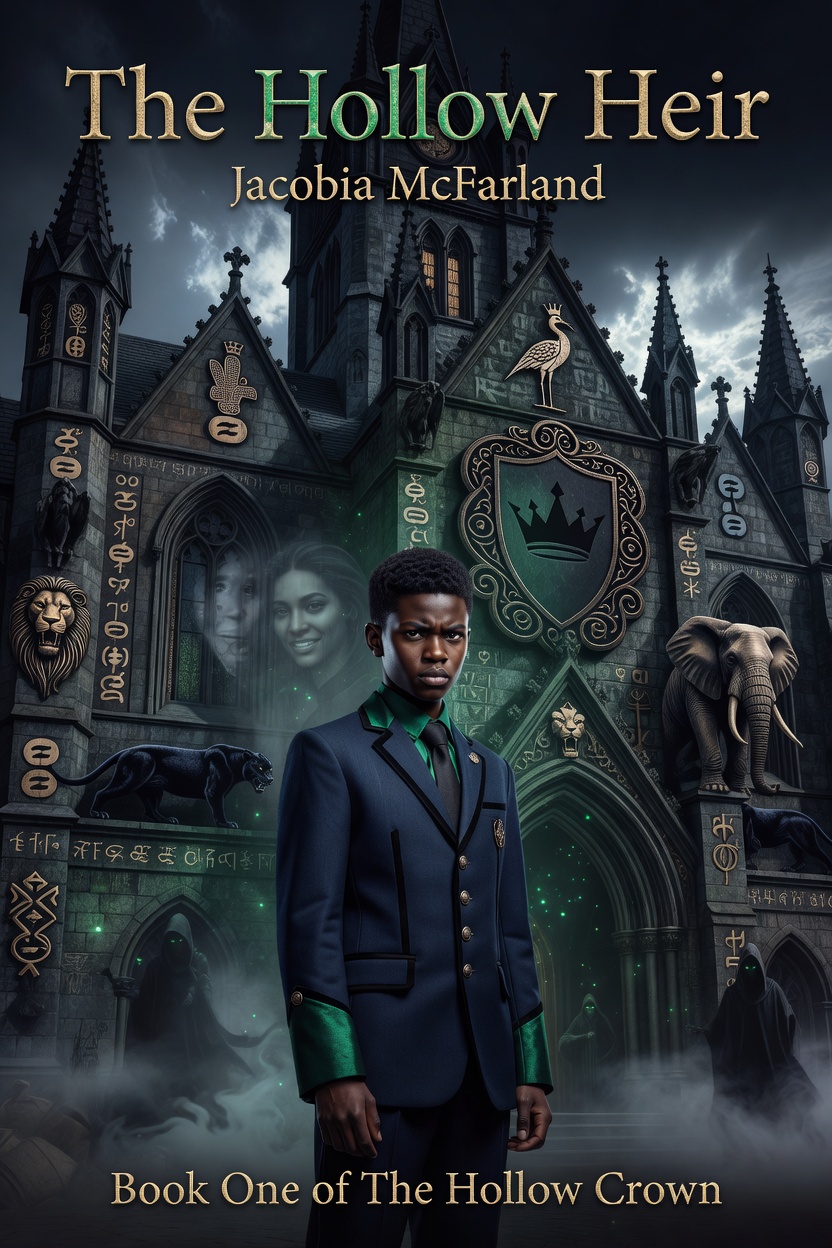
Novel · 12 chapters · 56,810 words
The Hollow Crown
Contents12 chapters
Chapter 1
Names on Stone
The first sound I heard was the scrape of somebody’s shoe on gravel behind me.
Not close. Not close enough to mean anything by itself. Greenwood Cemetery had plenty of people in it, even on a Tuesday afternoon—folks swapping silk flowers for fresh ones, an old man washing a headstone with a gallon jug and a rag, two kids in church clothes cutting across the back path because somebody’s mama had told them not to run and they were doing that fast, guilty walk children do when they mean to disobey in stages.
Still, I noticed.
Aunt Nadine said noticing was free, and free things were usually the ones that kept you alive.
I kept my eyes on my mother’s grave and brushed a pine needle off the vase. The cemetery groundskeeper had mowed that morning, and the air held that mix of cut grass, hot stone, and damp dirt that always made me think of summer funerals—dark suits, sweating necks, people trying to say comforting things without looking too directly at the casket. My bouquet from the Kroger on Madison sat a little crooked in the bronze holder: white lilies, purple stock, three stems of baby’s breath filling space the cashier had charged too much for.
“Don’t start,” I said quietly, squinting at the flowers. “I know. Grocery-store bouquet. Very undignified.”
The stone gave me nothing back, which was rude considering I came out here every year.
Danielle Marie Mercer
Beloved Mother, Daughter, Dreamer
1978–2010
Below that, small enough that I’d had to kneel to trace it when I was ten: Love is a door no death can shut.
That line had sounded beautiful to grown people. To me, at ten, it had sounded like a lie somebody paid extra to carve.
I adjusted the lilies anyway.
My mother had been dead six years. Some days that felt like an old scar I had learned to move around. Other days it felt like I was still standing in the apartment doorway, grocery bag sliding out of my hand, trying to understand why she wasn’t getting up.
I had inherited her mouth, according to people who liked to say things at funerals and cookouts as if grief made them historians. Her eyes too, they said, though nobody ever agreed on what color they were. Hazel in sunlight. Brown otherwise. I remembered her hands better than her face some days. Long fingers. A nick on one knuckle from opening a can wrong. Cherry-red polish when she had time to care. Bare nails when she didn’t.
“Auntie made peach cobbler Sunday,” I told the stone. “Burned the first one because she started fussing at a televangelist and forgot the timer. I thought you’d want to know that.”
That almost got a smile out of me.
Behind me, that same scrape of gravel.
Then nothing.
I straightened slowly and looked over my shoulder.
The man stood three rows over beneath a live oak with Spanish moss hanging off the branches like gray church lace. Tall. Maybe fifty, maybe older. Age sat strangely on some people. He wore a charcoal suit too heavy for June and no tie, just a black shirt buttoned to the throat. His skin was the color of polished walnut. His head was shaved clean. From where I stood, I could see a pale line cutting through one eyebrow like an old scar. No flowers in his hands. No bucket, no rag, no folding chair the old ladies brought when they planned to stay awhile. He was simply standing there, looking at me.
Not in the accidental way people look when they’re trying to remember if they know your people.
Directly.
I looked away first because staring contests with strangers in cemeteries were not on my list of worthwhile hobbies. I checked my phone instead. Two twenty-three. A text from Aunt Nadine from an hour ago.
You done out there?
I typed, Almost.
Then deleted it.
I’ll leave in a minute.
That felt less like an invitation to fuss.
When I hit send, my thumb brushed the chain at my neck. I wore the pendant under my T-shirt most days without thinking about it, just a cool oval of silver against my chest, older than me and probably older than everybody I knew put together. My father had left it behind the last time I saw him. Not for me exactly. Just behind. My mother had found it tucked in a coffee mug in the kitchen cabinet wrapped in a receipt from a gas station in Macon. I was three. She kept it in her jewelry box until I was twelve and old enough, she said, not to lose things that mattered.
You don’t have enough information to wear this like it’s ordinary, she’d told me, fastening it around my neck for the first time. But not enough information isn’t the same thing as nothing.
That was the kind of sentence she liked. Useful and mysterious at the same time.
I crouched to pull one weed from the edge of the stone. The dirt was packed hard from sun. My knees popped when I stood.
The man had moved closer.
Not close enough to be obvious if somebody glanced our way. Close enough that I knew it wasn’t an accident.
He stopped beside a neighboring plot and looked down at the name there as if he’d come for that person all along. A performance for anyone who might be watching. But his attention slid back to me a second later.
I should have left then. I know that now. But being sixteen means sometimes you can tell the difference between danger and disrespect, and you still choose to answer disrespect first.
“You need something?” I asked.
My voice carried more than I intended. Somewhere behind me, a bird flapped up out of a magnolia.
The man lifted his gaze fully. His eyes were a flat, strange gray—not pale like a husky dog, not cloudy with age, just gray, as if color had been leached out of them and nothing useful put back.
“For a moment,” he said, “I thought you were someone else.”
His voice was soft. Deep. Bellwether by way of nowhere I recognized.
“That sounds like a you problem.”
One corner of his mouth twitched. Not a smile. More like he appreciated the shape of the answer.
“You have her face.”
I felt it then, sharp and immediate, the instinctive recoil you get when a stranger reaches for something private with bare hands.
“Excuse me?”
“Danielle Mercer.” He tilted his head toward the stone without looking at it. “You have her face. Not his.”
The back of my neck went cold.
A hundred good reasons existed for somebody in Bellwether to know my mother’s name. It was her city too. She had gone to school here, worked here, was buried here. None of those reasons explained the way he said his, as if there should have been another conclusion and he found this one disappointing.
I took one step back. Casual, I hoped. Ready to leave.
“How do you know my mother?”
“I knew of her.”
That preposition landed hard. Not knew her. Knew of her. As if she had been a problem in a story he’d heard from a distance.
“My condolences,” he added.
“You’re six years late.”
“That is true.”
He said it with no embarrassment at all.
I glanced toward the main drive. The old man with the water jug had moved on. The kids were gone. A maintenance cart sat empty near the gatehouse, bright green under the sun. Too far to matter.
When I looked back, the stranger’s attention had dropped to my throat.
I knew exactly what he was seeing. The chain had slipped out from under my shirt when I checked my phone. The pendant rested against the cotton now, silver catching sunlight in a shape most people took for abstract design—curving lines, a circle broken at one edge, nine narrow points reaching outward like a crown somebody had half remembered.
The man went still in a way that made stillness feel active.
“Where did you get that?” he asked.
Every sensible answer died in my mouth.
The question itself was wrong. Too hungry. Too certain.
“Family,” I said.
His gaze sharpened. “From your father?”
I didn’t answer.
For the first time, something open and ugly crossed his face. Recognition, yes, but not relief. More like disgust finding a target after years of wandering.
“So,” he said. “They failed after all.”
My hand closed around the pendant through my shirt.
“Who?”
He ignored that. “Take it off.”
I actually laughed, because sometimes fear comes out sounding rude. “You got me confused with somebody who listens to old men in graveyards.”
“I am not old.”
“Congratulations.”
“Take it off,” he said again, and the softness had gone out of his voice. “You do not know what you carry.”
“Then maybe explain it better.”
His eyes flicked to my face. Assessing. Calculating. Not whether I would obey—whether I knew enough to lie well.
“How old are you?”
That one I didn’t answer either.
He took a step toward me.
Instinct moved before thought. I stepped back fast, heel skidding in loose gravel, and put my mother’s headstone between us because the dead deserved some use if they weren’t going to help.
“Back up.”
He stopped.
For a second neither of us moved. I could hear traffic humming beyond the cemetery wall, somebody’s bass rattling at the red light on Auburn Street, the dry whisper of oak leaves overhead. The ordinary world had the nerve to keep going.
Then the man said, almost to himself, “He let the line continue.”
The words made no sense until the next ones did.
“Your father should have had the decency to let his blood end with him.”
Something in me lurched. Anger, fear, both. My father had been gone thirteen years and somehow still managed to ruin my afternoon.
“Try that sentence again,” I said, “and maybe make it less insane.”
“You have no idea what was done to bring you here.” Another step. “What it cost. What should have been sealed.”
I should have run then too. Instead I heard myself say, “You want to be cryptic somewhere else? People are grieving.”
The stranger’s attention shifted past me, over my shoulder, to my mother’s name carved in stone.
“Some of them should stay dead,” he said.
That did it.
I turned and walked.
Not ran. Not yet. Walking buys dignity for about three seconds, and I spent all of them heading for the main drive with my pulse hammering in my ears. Gravel crunched behind me once, twice. Then more quickly.
I broke into a run.
“Hey!” somebody shouted from somewhere to my left, maybe at me, maybe at a dog, but I was already cutting between headstones, bouquet paper rustling under my shoe where somebody had dropped it, my breath going ragged. I risked one glance back.
The stranger was moving after me without any visible hurry, which should not have matched the ground he was covering and somehow did. He slipped between monuments and iron markers like the space made room for him. Not running. Reeling me in.
My chest tightened around a truth my mind hadn’t caught up with yet.
This wasn’t normal.
I hit the paved drive and sprinted for the gate. The maintenance cart sat twenty feet away. No keys in it. Of course not. Beyond the wrought-iron arch, Auburn Street flashed with passing cars and white glare off windshields. If I got to the sidewalk, if I got into traffic, if I got around people—
Something hissed past my ear.
Not a bullet. There was no crack, no impact. Just a sudden heat, close enough to sting, and the iron gate to my right bloomed with rust in a line the length of a man’s forearm. It spread as I watched, black-orange and wet, chewing through painted metal in seconds. A chunk of decorative scrollwork dropped to the ground with a brittle snap.
I stopped so hard my sneaker squealed on pavement.
The stranger stood at the far end of the drive with one hand half raised. No weapon. No lighter. Nothing I could name.
For one bright, stupid moment, all my brain offered was Aunt Nadine is going to be unbearable about this.
Then terror caught up.
I ran into the street without checking for cars.
A horn blared. Brakes screamed. A white pickup swerved around me close enough that its side mirror clipped my elbow. Pain flared hot and fast, but momentum kept me moving. I hit the opposite curb, nearly ate concrete, recovered, and kept going down Auburn past the funeral home, past Miss Clara’s beauty shop with three women smoking under the awning, past a liquor store with barred windows and a hand-painted sign for boiled peanuts.
“Boy, watch where—”
“Sorry!”
I cut left down Birch, lungs burning. My backpack thumped against my spine. I didn’t look back again until I reached the corner store with the blue Pepsi cooler out front and a cluster of men arguing over lottery numbers. I ducked behind a box truck parked at the curb and pressed myself flat against the metal.
My whole body shook.
Ten seconds. Fifteen. A minute.
No charcoal suit. No gray eyes. No impossible, silent pursuit.
Traffic moved. Somebody laughed too hard at something not that funny. The men at the corner store kept arguing, one of them slapping folded bills against his palm for emphasis. Across the street, a woman in pink scrubs unlocked her car and tossed in a fast-food bag.
Normal. Normal everywhere.
I looked at my elbow. Skin scraped raw, a smear of blood already drying. My hand was still clenched around the pendant under my shirt hard enough that the chain dug into the back of my neck. When I let go, my palm had a shallow impression of the metal in it.
I pulled out my phone and called Aunt Nadine.
She picked up on the first ring. “You left the flowers’ plastic wrap in my sink.”
“Auntie.”
Silence. Not long. Just enough to hear the difference in my voice.
“What happened?”
“I’m on Birch.”
“Why are you on Birch?”
“There was a man at Greenwood.”
“What kind of man?”
“Tall, dark suit, looked like he shops for joy in the clearance bin. He knew Mama’s name.”
Her inhale came small and sharp. “Are you hurt?”
“Not really.”
“Malachi.”
“My elbow’s messed up. That’s it.”
“Get home. Right now. Do not stop anywhere. Do not talk to anybody.”
“Already not loving the fact that you skipped past the part where a stranger knew Mama’s name.”
“Home,” she said. “Now.”
Then she hung up.
That scared me worse than the man had.
My aunt believed in follow-up questions the way some people believed in Jesus. She did not end conversations early unless something had gone badly wrong.
I cut through side streets all the way home. Bellwether in late afternoon had settled into its regular music—screen doors slamming, somebody practicing trumpet badly in an upstairs window, a city bus kneeling at the curb with a sigh of air brakes. Neighbors sat on porches with paper plates balanced on their knees. A little girl in beads rode a pink scooter in circles around her grandmother’s azalea bushes. Every familiar thing I passed felt thinned out, like scenery in front of something else.
Mercer Street ran three blocks and ended in a weed-choked lot where an apartment building had burned before I was born. Our house sat second from the corner, narrow and two stories, painted the kind of yellow that looked cheerful from a distance and exhausted up close. Nadine kept basil in chipped ceramic pots on the porch rail. Wind chimes made of old teaspoons clicked softly over the front steps.
The front door was already open.
Nadine stood inside the screen, one hand braced on the frame. She wore house slippers, jeans, and one of her church T-shirts with the rhinestones peeling off the front. Her gray braids were pulled back in a bun so tight it lifted her eyebrows. She was not a small woman, but fear had a way of making her seem drawn inward, every line of her body narrowed to purpose.
The second I stepped onto the porch, she reached through the screen, unlocked it, and pulled me in.
“Let me see.”
“I’m fine, hello to you too.”
She caught my chin and turned my face left, right. Her fingers smelled like bleach and rosemary. Then she took my wrist, saw the scrape on my elbow, and hissed through her teeth.
“You said not really.”
“Compared to dead, this is not really.”
“Don’t joke right now.”
That shut me up.
She locked the deadbolt, slid the chain, and crossed to the front windows in three quick strides, snapping the curtains closed with more force than the rods deserved. The living room went dim and greenish. Afternoon light still leaked through the lace edges, striping the carpet. The house smelled like lemon oil, starch, and the red beans she’d put on that morning before I left.
“Aunt Nadine.”
She turned.
I had seen her angry. I had seen her broke, tired, grieving, suspicious, sanctified, and deeply unimpressed. I had almost never seen her afraid.
Not like that.
“Tell me exactly what he said,” she said.
So I did.
Not neatly. I started with the way he’d been watching me, jumped to my mother’s name, doubled back to the pendant, forgot the order of two things and corrected myself. She listened without interrupting, except once to ask, “Word for word if you can.”
When I repeated, Your father should have had the decency to let his blood end with him, she closed her eyes.
I noticed then that she was still holding a dish towel in one hand, twisted so tight around her fingers it looked like she might snap the fabric.
“You know him,” I said.
“No.”
“That was not a no face.”
“It was a I-have-heard-enough face.”
“Auntie.”
She set the towel down on the sideboard with great care, smoothing one corner flat against the wood. It bought her maybe two seconds.
“Go upstairs,” she said. “Get your duffel bag.”
I stared at her. “What?”
“Your black one from the closet. Put in clothes, socks, your charger, toothbrush, anything you can carry yourself.”
“No. You don’t get to do all this dramatic packing nonsense and then explain on the way to wherever we’re apparently fleeing. Start here.”
She looked past me toward the kitchen. Listening.
“For what?” I asked.
Her gaze snapped back to mine. “Because if he found you at the cemetery, then this isn’t speculation anymore.”
I laughed once, humorless and thin. “That sentence means absolutely nothing.”
“It means somebody finally found us.”
The room seemed to tilt very slightly around that word. Us.
Found.
I thought of all the ordinary rules that had shaped my life without ever being fully explained. No posting real-time locations online. No answering unknown numbers. No sleepovers at houses Nadine hadn’t visited first. No after-school job farther than walking distance. Every year on my birthday she changed the passwords on everything in the house and burned the paper she wrote them on afterward. I’d spent half my life assuming she was just controlling in a creative, artisanal way.
“You’ve got to be kidding me.”
“I wish to God I were.”
“Found us from who?”
She looked at the curtained window again.
“That’s what I’ve been trying to prevent,” she said.
“Since when?”
“Since before you could walk.”
A hot, ugly feeling rose in my throat. Not fear this time. Betrayal had a different temperature.
“All these years,” I said, “you couldn’t maybe mention we were in some kind of witness protection for the haunted?”
“Keep your voice down.”
“Oh, now you want calm?”
“Yes.” Her own voice stayed low, which only made it sharper. “Because panic wastes time.”
I took a step back from her before I realized I was doing it.
“My mother knew?”
Nadine’s face changed then. Not much. Just a soft collapse around the eyes.
“Yes.”
“What did she tell you?”
“That if anything happened—” She stopped, pressed her lips together, began again. “That if anything happened to her, I was to keep you hidden. Kept from certain people. Kept out of certain records. Kept ignorant, if I could manage it.”
“That part you nailed.”
She accepted that without flinching. Maybe because it was true.
“Why?” I asked. “Who wants a sixteen-year-old this badly?”
“It isn’t you they want,” she said.
There was a beat where the room held still enough for me to hear the refrigerator motor kick on in the kitchen.
Then I said, “That is somehow worse.”
Nadine gave a short, exhausted nod. “Yes.”
I touched the pendant again without meaning to. “This has to do with him.”
“With your father,” she said, “and with your mother, and with things they thought they could outrun.”
My laugh came back meaner. “Great. Love inheriting debt from people who are unavailable for comment.”
“Malachi—”
“No. You don’t get to say my name like that and expect me to calm down. Some man rotted a cemetery gate from twenty feet away, you’re telling me somebody has been hunting us since I was a toddler, and apparently you decided information would only spoil the surprise.”
She crossed the room before I finished. Not to slap me. Nadine was old-school but not stupid. She took both my shoulders instead, firm enough to stop me pacing.
“I decided,” she said, each word clipped and steady, “that a child deserved a childhood if one could be stolen for him. I decided your mother had already buried too much fear in your crib. I decided I would rather have you angry at me and alive than informed and dead. You can hate me properly later. Right now, you need to move.”
I looked at her and saw, under the fear and urgency, the woman who had packed my lunch through middle school with passive-aggressive notes written on napkins. The woman who’d shown up to one parent conference in salon rollers because she’d forgotten the time and came anyway. The woman who taught me to iron a collar, make rice without measuring cups, and never trust a person who bragged about loyalty. Everything in me wanted to stay furious.
Everything in her face said she had already spent years being terrified on my behalf and was too tired to dramatize it.
I shook her hands off gently.
“What are we packing for?”
“You’re leaving.”
The words hit so cleanly I nearly missed them.
“What?”
“You are.”
“We are.”
“No.” She was already moving toward the hall closet. “I need to stay long enough to make sure the house is covered and to gather what matters. You need to be ready in case I can’t take you myself.”
The hall closet door opened. She reached up to the top shelf and brought down a tin box I’d only ever seen once before, when the tax assessor had mailed something confusing.
I followed her. “In case you can’t—what does that mean?”
“It means go get the bag.”
“It means you’re not answering me.”
“It means I’m trying to keep you breathing.”
She carried the box into the dining room and set it on the table beneath the hanging light. Her fingers moved quickly over the latch, then stopped. She looked at me, really looked, as if measuring how much more could be said before saying it would make things worse.
The old floorboards creaked overhead. Just the house settling.
Except the house did not settle that way.
Nadine heard it too. I knew because every muscle in her body locked at once.
We both looked up.
Another sound. Soft. Deliberate.
A footstep on the second floor.
No one else was supposed to be in the house.
I whispered, “Auntie.”
“Stay behind me.”
She opened the tin box in one motion and reached inside.
I expected a gun.
Instead she drew out a length of black cloth wrapped around something narrow and pale, like bone or carved wood, and the air in the room changed. I don’t mean emotionally. I mean the pressure of it shifted. The hairs rose on my arms. The overhead light flickered once, then steadied.
Nadine unwrapped the cloth.
In her hand lay a rod the length of a ruler, white as old ivory, etched with tiny dark marks that seemed to bend if I looked directly at them.
“Aunt Nadine,” I said very carefully, “what the hell is that?”
Upstairs, another footstep crossed the hall.
She did not take her eyes off the ceiling.
“Now,” she said, and for the first time in my life there was something in her voice that made every argument in me shut its mouth, “you go get your bag.”
Chapter 2
The House on Mercer Street
I ran for the stairs because she told me to, which should tell you how bad things were.
Usually if Nadine gave an order, I at least negotiated. Asked why. Added commentary. Moved at the speed of irritation. But something in the room had gone hard and thin, like the air right before a glass shatters, and the thing in her hand made my teeth ache just looking at it. So I went.
The hallway felt longer than it ever had. Family pictures blurred past on the wall—my kindergarten grin with a front tooth missing, Nadine at thirty-something in a church hat big enough to launch aircraft, my mother holding me on a porch I barely remembered. The upstairs landing was dim except for the bathroom night-light, that cheap blue plug-in Nadine refused to throw away because it still worked.
My room was half disaster, half museum of things I meant to become. Sketchbooks on the desk. A sneaker under the bed. Two library books overdue by enough days to count as a moral failure. I yanked the black duffel from the closet floor and unzipped it so hard the teeth skipped.
What do you pack when your aunt tells you to leave because some cemetery man can melt iron from across a yard and there may or may not be a stranger in your house?
I threw in jeans first. Hoodies. Socks. Phone charger. Underwear. The practical humiliations of survival. My hand hovered over the shelf where I kept my sketch pad and charcoal tin, then grabbed them too. If the world was ending, it could make room for pencils.
Below me, the house groaned.
Not the ordinary sounds. Not pipes. Not old wood settling. A thud hit from downstairs, deep enough to rattle the little plastic trophies from middle-school track on my dresser. I froze.
“Nadine?” I called.
No answer.
Then her voice, sharp as a belt snap: “Malachi. Now.”
I stuffed my toothbrush in the side pocket for some reason—because panic makes fools and traditionalists of all of us—slung the duffel over my shoulder, and ran back downstairs two steps at a time.
Nadine stood by the dining table with the ivory rod in one hand and a stack of things in the other. The box lay open. Its lining was wine-red velvet worn pale at the corners. Inside, I saw folded papers tied with blue ribbon, a leather journal swollen with age, and a small ring box the color of dark honey.
The front of her house had changed while I was upstairs.
Not visibly, not exactly. The windows were still the same windows with the same cream curtains she washed in too much lavender detergent. The lamp by the sofa still threw a warm yellow pool over the crochet throw. But there was a pressure against the walls now, like something enormous was leaning from the other side, testing brick and timber and nails one by one.
Nadine shoved the stack at me.
“Hold these.”
I caught them against my chest. The journal was heavier than it looked, bound in cracked brown leather with rubbed corners and a water stain blooming across the back cover. The ribbon-tied letters smelled faintly of cedar and old paper. The ring box was smooth, warm from her palm.
I stared at the pile, then at her. “You’re giving me keepsakes while somebody breaks into the house?”
“I am giving you what belongs to you.” She went to the sideboard drawer, pulled out a butcher knife, and set it down again like she knew perfectly well steel from Walmart was not the point tonight. “Open the box.”
“What?”
“The ring box, boy.”
Another impact struck the front of the house. The chandelier above the dining table shivered. Somewhere in the kitchen, a plate cracked.
I opened it with clumsy fingers.
Inside lay a ring of dark gold set with an oval black stone, almost flat, the surface carved with a tiny sigil that caught the light and held it too long. Not a gemstone exactly. Something denser. Older. The metal had worn thin at one side as if generations of thumbs had rubbed there.
“The Mercer ring,” Nadine said. “Your mother wore it on a chain after you were born because it stopped fitting her hand. Before that, it was your grandmother’s. Before that, her father’s. Put it in your pocket.”
“What does it do?”
“It remembers blood and bargains.” She crossed to the front window, looked through a slit in the curtain, and went still. “Pocket, Malachi.”
I slid the ring into my jeans and felt its surprising weight settle against my thigh.
She took the journal from the stack and pressed it back into my hands with more care than she’d used on anything else. “This was Danielle’s. Read it when you’re safe. Not before.”
“Safe where?”
“With Ilyan Rook.”
The name meant nothing to me and everything to her. I could hear it.
“Who is that?”
“A man I should have sent you to years ago.”
“That is not helpful.”
“It is honest.” She snatched the ribboned letters and separated them. Some envelopes were clean and square. Others had been opened so often the paper at the folds had softened to cloth. My name was written on one in my mother’s slanted hand. On another in a stronger hand I didn’t recognize, the M in Malachi cut with unnecessary elegance. “These too. Some are from Danielle. Some from your father.”
I looked up so fast my neck popped. “My father.”
“Yes.”
“You said he stopped writing.”
“I said the letters stopped coming to the house.”
That one landed cleanly between my ribs.
“You lied.”
“I managed.” Her mouth tightened. “If we both survive tonight, you can spend the rest of the week telling me what kind.”
A sound slid down the hall from the front door. Not a knock. Not scratching either. It was the slow, patient drag of something hard moving across wood.
Nadine shut her eyes once, briefly. When she opened them again, she looked like herself and not herself, the way people do in hospital waiting rooms and court hallways—still your family, still your person, but with some private room inside them already on fire.
“Listen to me very carefully,” she said. “Professor Ilyan Rook is the only person I trust to keep you alive. You understand?”
“No, because you haven’t told me anything.”
“He was your mother’s friend. Your father’s too, before pride and fear spoiled half the good sense in this city. He knows what you are.”
The words made me laugh once, ugly and short. “I’m really not in the mood for riddles.”
“Neither am I.” She took my face in one hand, not gentle, forcing me to hold still. “If you reach him, tell him Nadine kept faith. Tell him the seal held as long as it could.”
“Seal?”
Her eyes flicked to the walls.
The house answered with a crack.
Not drywall. Not plaster. Something stranger. The sound came from everywhere at once, like a pond freezing underfoot.
Every light in the room dimmed, then flared hard blue-white. The curtains bellied inward without wind. A smell rose sharp and metallic, somewhere between pennies and lightning.
Nadine turned toward the foyer and lifted the ivory rod.
For the first time I saw what it really was.
The pale surface wasn’t smooth at all. It was cut with lines so fine they looked printed until they moved. Dark marks writhed along its length, drawing themselves into knots and circles and then slipping apart. At one end a small piece of copper had been set into the white material, greened with age. When her fingers tightened, the marks brightened.
“Get behind the table,” she said.
I did not move. “What is happening?”
“They found the house.”
“Who?”
Instead of answering, she said, “Rook lives outside Bellwether. I need you to remember the address.”
“You’re telling me directions while our walls are haunted?”
She snapped the address out anyway. Road name. Mile marker. The detail about the rusted black gate that looked locked but wasn’t. I repeated it once, then again, because some part of me knew this mattered more than sounding sane.
The front hall mirror exploded.
Glass sprayed through the foyer in a bright storm. I shouted and threw an arm over my face. Cold air rushed down the hall carrying dust and the stink of burnt cedar. Through the dining room arch, I saw the front door still standing, deadbolt intact, chain still on.
Something had come through without opening it.
A shadow moved in the hall. Then another.
They entered like the room had made room for them.
Three people. Two men and a woman, all in dark clothes that fit too clean to be bought off a rack. No hoods, no masks. That almost made it worse. If you break into somebody’s house barefaced, either you’re stupid or you don’t expect witnesses to live long enough to describe you.
The first man was not the one from the cemetery. This one was broad through the chest, his scalp shaved to the skin, one ear split by an old scar. The woman beside him wore her hair braided back from a narrow face with a line of silver at each temple. The last man hung a step behind them, tall and still, with a mouth too calm for the moment.
All three stopped when they saw me.
Not stopped exactly. Registered.
The shaved-headed man smiled like he’d found the thing he came for at the back of a cabinet. “There he is.”
Nadine stepped between us. “You were warned.”
“So were you,” the woman said.
Her voice was soft enough that I leaned to catch it. Bad sign. Quiet people in violent situations are rarely amateurs.
The tall man’s eyes went to the pendant under my shirt. Not visible, exactly, but its chain had shifted with my breathing. His expression sharpened. “Take it off.”
“Apparently,” I said, because panic had pushed me into a place where sarcasm was cheaper than fear, “that’s a very popular request tonight.”
Nadine did not look back, but I felt her anger flare hot in the room. “Be still.”
The shaved-headed man raised one hand.
Heat twisted in the air above his palm. Not flame. Something meaner. The wallpaper by the foyer darkened and curled as if a stove eye had been pressed against it from the inside. My mind rebelled so hard it almost refused what my eyes were telling it.
Nadine struck the floor once with the rod.
The sound was small. Wooden. Ridiculous.
The effect was not.
A ring of pale light burst out from the point of impact and skimmed over the floorboards, crawling up chair legs and the sides of the doorway, racing along the seams of the room in branching lines. The house inhaled around it. The pressure I’d felt in the walls thickened into shape. Symbols blazed briefly under the paint—circles, hooks, a net of crossing marks sunk deep into timber and plaster long before I’d ever lived here.
The man’s heat slammed into something invisible halfway down the hall and broke apart in a shower of sparks.
For one stunned second nobody moved.
Then everything moved.
The woman cut her hand through the air, and the dining room windows burst inward in a roar of shattered glass. Nadine dragged me sideways by the arm. Splinters peppered my shoulder and one nicked my cheek. I hit the floor hard enough to bite my tongue.
“Up,” she snapped.
The broad man came straight at the barrier between the hall and dining room, his hand blazing orange-white. Every step he took left black marks on the rug runner. He shoved both palms forward.
The invisible thing holding the house groaned.
Actually groaned. Deep and low, from beams and nails and old plaster lath. I could hear it fighting.
Nadine shoved the journal and letters into my chest again because apparently I had loosened my grip in the dive. “Do not drop those.”
“I’m sorry, I’ll prioritize heirlooms during the home invasion.”
She pointed with the rod. A dining chair flew sideways without touching her hand and cracked into the broad man’s knees. He stumbled. The woman hissed something I didn’t know, and the air filled with black motes like burnt paper ash, except they moved against the current, swarming toward us in a tight spinning cloud.
Nadine slashed the rod across the air.
A white line opened in front of us, bright as welding light. The black motes hit it and vanished with the smell of singed hair.
I had no category for any of this. Movies had lied to me all my life. There was nothing elegant here, nothing glowing and clean. Magic, if that was the word, looked expensive. It scarred the room. It made the house sound like it was coming apart under too much weather.
“Back door,” Nadine said.
We ran for the kitchen.
A hand like a vise closed on the strap of my duffel and jerked me backward so hard my shoulder burned. I spun and nearly went down. The tall man had crossed half the room without my seeing him move. Up close he smelled faintly of cloves and cold iron.
He looked over my face with a kind of detached interest.
“Danielle’s eyes,” he said. “Unfortunate.”
Nadine drove the rod toward his throat.
He caught her wrist.
The instant skin touched skin, a dark bruise of light spread up her arm under the sleeve, fast as spilled ink. Nadine gasped through clenched teeth but did not drop the rod. Instead she twisted and brought her knee up into his ribs with a force that would have folded most men. He hardly bent.
The shaved-headed man laughed. “Still got a little fight.”
“Still got enough for trash,” Nadine said.
Then the tall man finally looked at me, really looked, and whatever he saw seemed to confirm something. Disgust flickered over his face. Maybe pity. Worse, if I’m honest.
“Your father should have let you die.”
Time did a strange thing then.
Not stop. Movies lie about that too. It stretched. Every detail came apart and sharpened. Nadine’s breath hitching. The crackle of heat in the foyer. The drip of something from the broken window onto the kitchen tile. My own pulse punching at my throat so hard I could taste copper.
He said it casually. Like family gossip. Like a sensible regret.
My father, absent and undefined, collapsed in my mind into one jagged point. My mother underground. Nadine with bruising dark under a stranger’s hand. Some man in my house deciding, with perfect calm, that I should have been dead before I had a name.
Something in me answered.
I wish I could tell you it felt powerful. Heroic. Clean.
It felt like tearing.
The pendant under my shirt went hot enough to burn. Not warm—hot, a coin fresh from a furnace pressed to my chest. I shouted and grabbed at it. The chain would not break.
Light leaked through my fingers.
Not white. Not gold. Something colorless and wrong, the brightness of a camera flash but colder, edged with a blue so pale it looked almost silver. It poured through the fabric of my shirt in branching lines, racing across my skin like cracks in ice. Pain hit a second later, huge and total. My knees buckled.
Everybody in the room recoiled.
Even the tall man.
The walls answered me. Or I answered them. I still don’t know.
The old hidden symbols blazed back to life under the paint, brighter than before, no longer flat. They lifted from the surfaces and hung in the air around us in spinning layers. The dining table split down the middle with a gunshot crack. Every light in the house burst. Darkness slammed down, broken only by the white-silver glare pouring off me.
I couldn’t breathe. It felt like inhaling river water.
Voices hit me from far away.
“Hold him—”
“No, don’t touch—”
“Mercer!”
The last was Nadine. Not panicked. Commanding.
I was dimly aware that the broad man had been thrown backward into the hall wall hard enough to dent plaster between studs. The woman had blood running from one ear. The tall man had let go of Nadine and was stepping back with his face changed for the first time, calm gone, calculation stripped open into naked alarm.
The floorboards under my feet blackened.
I looked down and saw light spilling through the cracks in the wood from whatever place I had opened inside myself.
Opened. That was the only word for it. Something with doors where a person ought to have had bone and memory and fear.
The world folded.
Not physically. Sideways. The kitchen and dining room remained where they were, but behind them, through them, I caught impossible depth—a dark corridor lined with nine faint arches, each one farther away than distance should allow. At the end hung a crown shape made of broken points around an empty center. It pulsed once like a heartbeat.
Then the vision lurched and the room came back so fast I vomited onto the floor.
Nadine was in front of me now, both hands on my face, forcing my eyes to hers. The bruise-light had climbed to her shoulder.
“Listen.” Her voice cut through the roaring in my ears. “Listen to me. You cannot hold this and stay.”
“I don’t know what’s happening.” My own voice sounded split, doubled with another tone under it. “I don’t know how to stop.”
“I know.”
The woman attacker recovered first. She wiped blood from her mouth, saw whatever Nadine was doing, and shouted, “Now.”
Heat gathered again. Shadows moved. The broad man pushed himself off the wall with a snarl, one arm hanging wrong. The tall man lifted both hands and the air before him warped, bending the broken room like a reflection in disturbed water.
Nadine turned and planted herself between them and me.
There are moments when your life arranges itself into a shape simple enough for even fear to understand. Mine was this: she was buying seconds with her body.
She thrust the rod into my hands.
The instant I touched it, cold shot to my shoulder. The etched marks woke under my fingers, stinging like static.
“What are you doing?” I said.
“What I should have prepared for.” She pulled the journal from under my arm, shoved it inside my duffel, then stuffed the letters after it with fierce, quick hands. “When you get to Rook, give him the journal first. If anyone asks whether the Ninth Door has opened, the answer is no. You hear me? No.”
The words made no sense. They lodged anyway.
She took the Mercer ring from my pocket before I could react and forced it back into my palm. “Keep this hidden.”
“Nadine—”
“Say the address.”
I did. Choking on it. She made me say it again.
The broad man lunged.
Nadine spun and struck the air with her empty hand.
The kitchen cabinets blew open. Salt, dried beans, boxes of tea, a rain of wooden spoons and canned tomatoes hit the room in a violent wave and slammed into him. Not enough to stop him. Enough to stagger.
The tall man spoke one word in a language that made my jaw ache to hear.
The ceiling over the stove split.
A black line opened through plaster and lathe, narrow at first, then widening with a brittle shriek. From inside it came darkness so complete the rest of the room looked washed out around its edges.
Nadine saw it and went pale.
“Oh, you stupid bastards,” she said.
Fear moved through the attackers then, quick and real. Not of us. Of what they had called.
The black split in the ceiling deepened. Something below hearing throbbed through the house, setting my molars on edge. I thought of the impossible arches I had just seen behind the world, and terror almost took my legs out from under me.
Nadine grabbed my shirt and yanked me close until our foreheads nearly touched.
“Malachi. You need to go right now.”
“I’m not leaving you.”
“You are.”
“No.”
Her eyes shone. Not with tears. With fury at the time she did not have.
“I did not raise you all these years for you to become noble in the dumbest possible moment.”
A laugh burst out of me, half-hysterical and wrong. “That’s your pitch?”
“That and this.” She kissed my forehead, hard and fast, the way she had when I was little and sick with fever and trying to act brave. “I love you more than my own breath. So you will live.”
The room shook. Plaster dust sifted down. The dark split above us yawned wider.
Nadine stepped back and took the rod from my hands again, but only for a second—only to strike its base against the kitchen tile.
The sound this time rang like church metal.
A circle of light opened around my feet, thin as chalk at first, then brightening into a hard white line inscribed with symbols that spun too fast to read. Cold climbed my ankles. The floor seemed to drop an inch.
I panicked and tried to step out.
She shoved me back in with both hands.
“Nadine!”
“Go to Rook.”
The woman attacker screamed, “Stop her!”
They came all at once.
Heat. Shadow. The warped air folding inward. The black crack in the ceiling pulsing like a wound.
Nadine lifted one hand and the walls answered. Every hidden mark in the house flared, from floorboards to doorframes to the underside of the staircase. For one impossible second Mercer Street showed its true face: not just a narrow brick row house with bad plumbing and a fig tree out back, but a place layered with decades of warding, grief, prayer, stubbornness, and work. My family had lived inside a fortress and called it home.
The attackers hit that force and slowed as if running into deep water.
Nadine turned the rod in her hand and drove its point toward the center of the circle.
Her voice changed when she spoke next. Deeper. More resonant. Not louder, but the room bent to hear it.
I did not know the language. I knew what it cost her anyway.
Light shot up around me in a column so bright I saw my own bones for an instant, my hands red and skeletal around the duffel strap. The pendant seared against my chest. The ring cut into my palm. Through the roar I heard the broad man break free and crash toward us. Heard the tall man shout something that sounded, absurdly, like fear.
And over all of it, Nadine.
“Run until you reach him,” she said, and now her ordinary voice was back, torn but steady. “Do not trust a pretty story. Do not let anybody make you into their door. And baby—”
The last word broke me.
I reached for her.
The world tore sideways again.
For one impossible blink I saw the kitchen from above: Nadine braced in a storm of white fire, the three attackers straining forward, the black rip in the ceiling opening onto depth that was not a ceiling or sky. I saw my own face upturned, terrified, sixteen and stupid and not ready.
Then distance slammed in.
The house vanished.
So did the floor under me.
I hit earth on one knee and one hand hard enough to skin both. Night air punched the breath from my lungs. Gravel bit my palm. The duffel swung into my ribs. I tasted blood.
I was outside.
Not Mercer Street. Not my block. Some dirt pull-off beside a road lined with pines so tall their tops erased the stars. Crickets shrilled in the ditch. Somewhere far off, a dog barked twice and stopped.
For a second my mind refused the transfer. It kept trying to fit Bellwether back around me. Sidewalk. Porch lights. The glow of the corner store. But there was only dark road, trees, and the stink of hot sap.
Behind me, miles away and not miles away at all, the night flashed white.
The light rose above the treeline in a brief, terrible bloom. No thunder followed. Just a silence so abrupt it rang.
I knew then.
Not because anyone told me. Not because I’d seen the exact end. Because the space she had occupied in the world had been a shape I trusted, and all at once I could feel the place where it was missing.
I got to my feet and nearly fell again. My whole body shook. The pendant still burned faintly against my skin. When I dragged it free of my shirt, the silver looked different in the moonlight—same shape, same chain, but lit from some buried seam within, as if it had swallowed part of what just happened and was not done with it.
I wanted to scream. To turn around. To run back toward the city and tear my hands bloody on whatever was left.
Instead I opened my fist and found the Mercer ring pressed so deep into my palm it had left the sigil indented in the skin.
My duffel lay half-open at my feet. The leather journal had worked its way to the top, the edge of one page showing. On it, in my mother’s hand, one sentence had been underlined so hard the pen nearly tore through.
The child must never be treated as a vessel, a weapon, or a doorway.
The pines hissed overhead.
Then, from somewhere in the trees to my left, a branch snapped.
I turned toward the sound, clutching the ring hard enough to hurt, and saw a shape moving between the trunks.
Chapter 3
Rook’s Threshold
I picked up a rock before I had sense enough to know how useless a rock was.
The shape moved again between the pines, not hurrying, not skulking either. Just coming. I backed toward the road shoulder, duffel strap cutting into my hand, pendant hot at my collarbone. My knee throbbed where gravel had taken skin off it. My palms were full of dirt and blood and the imprint of the Mercer ring.
“Stay where you are,” I said, which would have sounded tougher if my voice hadn’t cracked in the middle.
The figure stopped.
For a beat all I could make out was a dark coat and a pale oval of face between trunks. Then he stepped into the ditch-side glow thrown by a single rusted road marker, and I saw a tall Black man, somewhere between forty and old enough that age had become harder to place. His hair was in neat, close locs threaded back from his face with a strip of black leather. He wore a long coat the color of wet slate over a high-collared shirt, not a suit exactly but something older in the cut. No tie. Strong hands. A narrow scar ran from the left side of his mouth into his beard, as if somebody had once tried to split a lie out of him and failed.
His gaze went first to my face, then the ring in my hand, then the journal sticking halfway out of the duffel.
He exhaled through his nose once. “Nadine got you out.”
I tightened my grip on the rock. “You know my aunt?”
“Knew her.” His voice had a low rasp in it, not from age so much as disuse. “I know enough to tell you we need to move now.”
That did not help.
“Name.”
“Professor Ilyan Rook.”
He said it like it should settle everything. It did not.
“You got any proof?”
He looked toward the treeline behind me instead of answering. Something in the woods answered back—not a voice, exactly, more like the faint metallic chime of two pieces of iron tapping far apart. His expression changed, not to fear but to impatience sharpened by worry.
“Your aunt was meant to send you directly to the gate,” he said. “If you landed on the road, then the transfer broke under pressure. They may trace the breach. I do not have time to perform trustworthiness for you, Malachi.”
Hearing my name from another stranger hit a nerve already stripped raw. I hurled the rock.
It missed his head by a good two feet and cracked against a pine.
He did not flinch. Just blinked once, tired, as if this was one more inconvenience in a long ugly night.
“Fair enough,” he said. “Now listen carefully. Your mother once broke my nose on principle and your aunt laughed so hard she had to sit on a kitchen floor to recover. Nadine always over-salted her greens and denied it while standing over the pot with the shaker in her hand. Danielle kept a blue carpenter’s pencil tucked behind her ear when she wrote, even when she wasn’t using that color. She hated lilies at funerals. She said they smelled like people trying too hard.”
My fingers loosened on the empty air where the rock had been.
The metallic chiming in the woods came again, closer this time.
Rook stepped forward and held out his hand. “Come on.”
I hated that I believed him. I hated more that I had no better option.
He took the duffel from me without yanking, slung it over one shoulder, and turned up the road. I kept pace because standing still seemed worse. The dirt shoulder gave way to two wagon-rutted tracks climbing through pines and scrub oak. Needles muffled our steps. The night smelled of resin, wet earth, and something mineral under it, like struck stone.
“Where are we?” I asked.
“Near enough to Bellwether that the city still pretends it owns the land. Far enough that most people stop trying to map it.”
“That doesn’t mean anything.”
“It means you can yell at me when we’re inside.”
I almost did it anyway. Instead I stumbled on a root and caught myself against a boulder slick with moss.
“You could’ve told us,” I said. “If she knew this was coming, if y’all had all this—whatever this is—you could’ve told us.”
Rook kept walking. “Yes.”
That clean agreement threw me more than an excuse would have.
“You don’t even know what I’m asking.”
“I know exactly what you’re asking.”
A few yards ahead, the track ended at what looked like a wall of laurel and blackberry cane grown too thick to cross. Rook did not slow. He set his palm against empty air in front of the brush.
Something rang out, deep and bright, like a church bell struck underwater.
The thicket drew apart.
Not moved. Drew apart. Branches unknit themselves from one another and folded back into a narrow passage lit by small suspended globes the color of candle flame. Cold swept over my face. On the other side stood a house.
I stopped dead.
It sat low and wide under the trees, part fieldstone, part dark wood silvered by age, with a deep wraparound porch and tall windows lit from within. Not a mansion. Not some castle dropped in Georgia by a European with delusions. A real house, built by people who expected weather and company and work. The roofline stepped around old chimneys. A vegetable garden slept behind a split-rail fence to one side. To the other, I caught the flat glimmer of water where a creek bent around the back lot. Wind chimes made of spoons and drilled river shells hung from the porch eaves and did not move though the pines above them did.
The opening in the brush closed behind us with a whisper.
“Nope,” I said immediately. “Absolutely not.”
Rook climbed the porch steps. “A sensible reaction. Keep coming.”
“I don’t know you. My aunt just died and now I’m at the evil magic version of somebody’s Airbnb listing.”
His mouth twitched despite everything. “If it helps, the plumbing is old and one of the upstairs windows sticks in August. Very little here is evil. Some of it is rude.”
I stayed at the foot of the steps.
He put my duffel down by the door and faced me properly for the first time. Porch light caught the planes of his face, the hollows beneath his eyes, the faint sheen of sweat at his temples. He looked like a man who had been awake too long and expected to remain that way.
“Malachi,” he said, quieter now. “I am sorry about Nadine.”
The words were simple. No softness laid on thick, no reaching for me like we were in a movie. Just the truth standing there between us.
Something in my chest lurched hard enough to hurt. I looked past him at the front door because if I looked at his face I might do something humiliating, like break apart on a stranger’s porch.
“She knew she was sending me to you?”
“Yes.”
“And she thought that was safe?”
“As safe as anything available tonight.”
“That’s not the same answer.”
“No,” he said. “It isn’t.”
I climbed the steps.
Inside, the house smelled like cedar smoke, old paper, coffee gone stale on a warmer somewhere, and rain-damp wool though it had not rained. The entry opened into a long hall lined with framed photographs, masks, shelves crowded with books, jars of dried roots, and enough carved wooden boxes to suggest a person who distrusted leaving things in plain sight. A brass lamp on a narrow table burned with steady amber light. No cord. No bulb. Just flame inside clear glass and no smoke.
I stared at it.
Rook noticed and shut the front door behind us with a hand on the latch instead of a slam. “You can be impressed later.”
“Wasn’t planning on it.”
“Of course not.”
He led me through an archway into a kitchen large enough for arguments. A cast-iron stove sat against one wall beside a newer electric range that looked mildly offended by the company. Open shelves held stoneware bowls, jars of rice and red lentils, bundles of hanging herbs, chipped mugs from at least six different decades. A scarred cypress table dominated the middle of the room. Somebody had left a deck of cards there beside a stack of papers clipped together with a carved bone pin.
“Sit,” he said.
I stayed standing.
He took that in, nodded once, and crossed to the sink. “Then lean, pace, or glower. I’m putting antiseptic on your hands.”
“I’m fine.”
“You are bleeding on my floor.”
I looked down. Small dark drops stippled the old pine boards. My knee had soaked through one side of my jeans. I hadn’t even noticed.
Rook brought over a basin of warm water, a clean towel, a brown bottle, and a tin first-aid box that looked older than me by several generations. He set them on the table with care and sat opposite the empty chair, leaving the choice to me.
I hated that too.
I sat because falling over from blood loss out of principle would have been stupid.
Up close, the warmth from the basin smelled faintly of rosemary and copper. I plunged my hands in and hissed. Dirt unwound from my skin in thin dark ribbons.
“You can start talking,” I said.
Rook folded his hands. “I can start. Whether I say enough to satisfy you is unlikely.”
“That’s a real comforting sentence.”
“It is at least honest.”
I scrubbed gravel grit out of my palm with the towel and wanted to throw the whole thing at him. “Did my mother do this? Magic. Did Nadine?”
“Yes.”
The answer landed with a dull, heavy force. Not because I hadn’t seen impossible things in the past hour. I had. But hearing it stated plain gave it shape. Made it harder to explain away as concussion, adrenaline, grief. My house had broken open under words I didn’t understand. A gate in a cemetery had melted. The trees outside this place had stepped aside.
I laughed once, ugly and short. “Great. Cool. So I’ve been living in a damn lie.”
“No,” he said. “In a guarded silence. That is not kinder, but it is more accurate.”
“Don’t do that.”
“Do what?”
“Make it sound respectable.”
He took the hit without argument.
I dried one hand and fished the journal out of the duffel. The leather was warm from being pressed against my side. My mother’s handwriting still looked like hers—slanted, impatient, elegant when she felt like it and barely tolerating the page when she did not. Just seeing it made my throat tighten.
I opened to the marked page because if I looked at the letters first I would not come back up for a while.
If anyone asks whether the Ninth Door has opened, the answer is no. Whatever they tell you, do not let them convince you otherwise.
Below that, where pressure had ghosted through the paper from a later page, I could make out the line I’d seen by the roadside.
The child must never be treated as a vessel, a weapon, or a doorway.
I flattened my hand over the paper. “What is the Ninth Door?”
Rook’s gaze sharpened, but he did not reach for the journal. Good decision.
“I do not know the full answer,” he said.
“Try a partial one.”
He was quiet long enough to be irritating. Then he got up, crossed to a pantry cabinet, and came back with a short white stick. Chalk, I realized. He crouched beside the hearthstones and drew nine arches in a curved line across the slate, one beside the next.
My stomach dropped.
I had seen that shape in the dark rip above Nadine’s kitchen. Faint, far away, waiting.
Rook drew a circle around the arches, then broke it with his thumb at one point. “Among certain old records,” he said, “there are references to a sealed threshold. Not a place exactly. Not only a place. A condition. A passage. Depending on who is speaking, it leads to revelation, ruin, judgment, power, or all four wearing each other’s clothes.”
“You really like talking like the back cover of a fantasy novel.”
One corner of his mouth lifted. “That was me simplifying.”
“Jesus.”
“Not him, no.”
Against my will, a raw little sound came out of me that might have been a laugh if the night had been different. It vanished fast.
Rook tapped the first eight arches with the chalk. “Most traditions agree there are eight known passages, each sealed, lost, or symbolic depending on the school of thought. The Ninth is where the trouble begins. Some claim it does not exist. Some claim it has never opened. Some claim the world is shaped around keeping it shut. Your mother belonged to the camp that thought asking the wrong questions in front of the wrong people was enough to get families killed.”
“Looks like she wasn’t wrong.”
“No,” he said.
I turned a page, then another, not really reading, just keeping my hands moving. “What am I in this?”
His eyes flicked to the pendant under my shirt, then back to my face. “The child in that line, for one.”
“That is not what I asked.”
“No.” He sat again. “It is what I am willing to answer first.”
I shut the journal. “Then I’m leaving.”
“You don’t know where you are.”
“I know roads exist.”
“And the people who tore through Mercer Street know something of you now they did not know yesterday. Your face. Your age. Your pendant. Your power under stress.” His voice stayed even, which was somehow worse than if he’d barked. “They also know Nadine died to buy you time. Do not waste what she paid.”
I was on my feet before I noticed standing up. The chair legs scraped hard across the floor.
“You don’t get to use her on me.”
“No,” he said. “I don’t. Sit down anyway.”
I stared at him. He stared back without matching my volume, which should not have worked and somehow did.
My knee buckled a little from the sudden movement. I caught the table edge, cursed, and sat because my body made the choice for me.
Rook opened the first-aid tin, poured antiseptic onto gauze, and held out his hand. “Give me the left one.”
“I can do it.”
“I know. Give it here.”
After a beat, I did.
He cleaned the scrapes efficiently, not gentle exactly but careful. His hands were cool. On the inside of his wrist was a tattoo or a scar pattern—three short lines crossing a circle. I filed it away automatically, then resented myself for still noticing things at a time like this.
“My birth,” I said after a while. “That man at the cemetery said my father should’ve ended some line. Tonight one of them said he should’ve let me die. What the hell does that mean?”
Rook set the used gauze aside. “It means there were arguments when you were born. Quiet ones in public. Vicious ones elsewhere.”
“Arguments about what?”
“About whether you should be acknowledged, hidden, studied, protected, claimed, or feared.”
I yanked my hand back. “Claimed by who?”
“The families who think blood makes ownership sound noble. The scholars who mistake curiosity for innocence. The frightened, who can justify nearly anything if they call it prevention.” His jaw tightened. “Your mother and father refused all of them.”
The room had gotten very still. Even the refrigerator in the corner had stopped humming, as if it too was listening.
“And that’s why we lived like this?” I asked. “Why nobody ever came around, why Nadine always moved mail off the porch before dark, why she changed doctors three times in six years and never let me post my face online unless she approved the picture?”
“Yes.”
I laughed again, because there was no good sound available. “So there’s a whole secret society out there and they’ve all been debating me like I’m a zoning issue.”
“Not all. Most people had no direct part in it. Many only heard rumor. A child born between Mercer and Valecrest lineages was enough to stir old nonsense in old houses.”
The name hit cleanest because it was new and not new. Valecrest. My father’s family. The pendant. The letters with no return address but expensive paper and careful handwriting, arriving every year like a habit somebody refused to break.
“Say that again.”
“Valecrest.”
“My father’s last name.”
“Yes.”
It was strange how much one word could rearrange a room. My father, who had existed for thirteen years as a missing shape and a chain on my neck, suddenly had a house attached to him. Ancestors. People. Politics, apparently, because God forbid anybody in this universe just disappear normally.
“And Mercer is my mother’s side,” I said.
“Yes.”
“So what, they hated each other? Was this some Romeo-and-Juliet nonsense with richer stationery?”
“No,” Rook said, and this time the almost-smile was real but tired. “Nothing so flattering. The Mercers and the Valecrests have worked alongside one another before. At times, closely. At times, badly. Your parents’ marriage was not the scandal. You were.”
My pulse thudded in my scraped hands. “Because?”
“Because of when you were born. Because of marks observed at birth. Because too many old stories suddenly seemed less metaphorical than people preferred.”
My stomach went cold. “Marks.”
Rook’s eyes dropped, deliberately, to where my shirt lay over my chest.
I put a hand there by reflex. “You mean the birthmark.”
“Yes.”
I had had it forever, a dark shape high over my sternum, too complex to be mistaken for anything simple. When I was little, my mother used to trace around it with lotion after baths and call it my crown, which had sounded cute and weird at four and only weird by twelve. Nadine stopped calling it anything at all.
“What does it mean?”
“I suspect several people would give you several answers and kill one another over which was correct.”
“You keep doing that thing where you act mysterious instead of useful.”
“I keep refusing to pretend certainty I do not possess.” For the first time irritation roughened his voice. “Listen to me, Malachi. There are records concerning a sign like yours. There are prophecies people have spent generations corrupting to suit themselves. There is an old title attached to those records—the Eidolon. To some, that means deliverance. To others, catastrophe. To others still, a chance to grab power and call it duty. I am not going to hand you a pretty lie tonight because pretty lies are how children become instruments.”
The word landed between us: instruments. Close enough to vessel, weapon, doorway to make my skin crawl.
I looked down at the journal again.
The child must never be treated as a vessel, a weapon, or a doorway.
My mother had written that. Not a scholar. Not an enemy. My mother.
“Did she think that about you too?” I asked before I could stop myself. “That you’d use me?”
Rook went still.
“No,” he said at last. “But she thought institutions would. She was often right.”
The house creaked around us. Somewhere deeper in it, a clock struck once and then gave up, as if uncertain of the hour.
I took the pendant out from under my shirt and laid it on the table.
Rook looked at it like a man recognizing a face from a funeral he had hoped not to attend. Silver, worn smooth along the edges by years of my thumb finding it without thought. At its center the design twisted into itself: part key, part branch, part something geometric my eyes never quite held straight. Tonight it carried a faint line of light through the metal, like moon caught in a crack.
“What is it?” I asked.
“A Valecrest ward-key,” he said. “Or meant to resemble one. Older than the modern family crest, if I’m guessing correctly.” He did not touch it. “Your father should never have left it in plain sight.”
“Maybe he trusted us.”
“Maybe he was warning someone.” He looked up at me. “Did your mother ever tell you not to let certain people see it?”
I opened the journal again, slower this time, and paged through until I found the hidden note folded into the binding. I had barely glanced at it by the roadside. Now I read it under the kitchen lamp, my mother’s writing cramped small as if she had wanted to fit urgency into less space than urgency required.
If Elias Wren lives, he must not see the pendant.
I read it twice.
“Who the hell is Elias Wren?”
Rook’s expression shut down so abruptly it was answer enough and not enough at all.
“That,” he said, “is a dangerous question.”
I slapped the journal closed. “Everything is a dangerous question with you.”
“Yes.”
“Did he kill my mother?”
“I don’t know.”
The plainness of it stopped me. Not denial, not evasion. I don’t know.
“Was he one of them tonight?”
“No. If it is the man I fear, he has been declared dead for sixteen years.”
“Declared by who?”
“The sort of people who prefer declarations to proof.”
I leaned back and scrubbed my good hand over my face. I felt filthy, smoke-stung, older than I had that morning. “Okay,” I said into my palm. “Okay. Magic’s real. My family’s been in witness protection for the haunted. There’s a maybe-dead man named Elias Wren who shouldn’t see my necklace. My birthmark is part of some fight nobody bothered to ask me if I wanted. Is there any part of my life that was actually mine?”
Rook did not answer right away.
When he did, his voice had gone softer, not pitying, just careful. “Your sketchbook.”
I looked up.
He nodded toward the duffel. “You packed that yourself.”
Something hot and painful moved through my chest. Not relief. Too small for that. But not nothing.
He stood and crossed to the stove. A kettle already sat there, squat and blackened at the bottom. He lit the burner with a murmured word and a spark jumped from his fingertip. I watched it happen and was too tired to even swear.
“You’re taking this suspiciously well,” he said.
“I’m not. I just ran out of new reactions twenty minutes ago.”
“Reasonable.” He reached for two mugs from the shelf. “Tea?”
“Is that normal tea or secret magic tea that makes me tell the truth and join your wizard school?”
That got an actual huff of laughter from him. “Ginger, clove, lemon. If I needed to force children into service, I would choose a less aromatic method.”
I let my head fall back and stared at the ceiling beams. Dark wood. Tiny carved symbols tucked along one edge near the plaster, almost hidden unless you were looking. Wards, I guessed now. The whole world had apparently been captioned in a language I couldn’t read.
“Wizard school,” I said after a minute. “Please tell me that part was a joke.”
“It was not.” Water began to murmur in the kettle. “Blackwood Academy.”
I sat up. “You cannot be serious.”
“Very.”
“That is the worst possible name.”
“Founded in 1865 by people more interested in survival than branding.”
That shut me up for a second.
Rook set sliced lemon into the mugs, followed by slivers of ginger from a jar. “Blackwood is a school, yes. It is also protected ground, a place where you can be taught what happened tonight and how not to die the next time someone decides to test your ignorance.”
“You assume I’m going.”
“I assume nothing. I strongly recommend it.”
I watched steam gather around the kettle spout. “And you?”
“I am its headmaster.”
I barked a laugh. “Of course you are. Why not. Sure.”
“Your standards for plausibility have already suffered severe injury tonight.”
He poured water. The kitchen filled with ginger heat and citrus sharpness. He brought me a mug and I took it mostly for something warm to hold.
“If I go,” I said, “everybody there already knows who I am?”
“Not everybody. Some know the name Mercer. Fewer know why it unsettles rooms. Students will vary between curious, indifferent, obnoxious, and unexpectedly decent, much like anywhere else.”
“That was almost comforting.”
“It was not meant to be.”
I looked into the cup. A slice of lemon turned slowly under the surface. “And if I don’t go?”
Rook drank first from his own mug, either to demonstrate there was no poison or because he wasn’t interested in my theatrics. “Then you leave before dawn with too little knowledge, active enemies, and a set of abilities you have not begun to understand. You may last a week on stubbornness alone. You have enough of it.”
A week.
I thought of Nadine braced in white fire. Of my mother’s handwriting pressing through paper hard enough to dent the next page. Of the man in the cemetery looking at me like I was overdue, not new.
“I don’t want to be collected,” I said. “I’m not going from one hidden house to another because everybody with an old last name says that’s where I belong.”
Rook set his mug down. “Good.”
The answer caught me off guard. “Good?”
“Yes. If you came eager to surrender your judgment to the nearest authority figure, I would be more worried than I already am.”
He rose, went to the long table drawer, and took out a ring of keys, though I had seen no ordinary lock in this house yet. He chose one made of dark metal and placed it on the table between us.
“If you stay here tonight,” he said, “you get a room with a door that locks from the inside and outside only by this key. You keep it. Not me. Not anybody else. Tomorrow, if you still wish to leave, I will not cage you. I will argue. I may call you foolish. But I will not cage you.”
I stared at the key.
“Why?” I asked.
“Because Danielle would haunt me beyond endurance if I did otherwise. Because Nadine trusted me to keep you alive, not obedient. And because any place that asks for your trust should survive your refusal long enough to earn it.”
The kitchen seemed suddenly too bright. I looked away to the photographs in the hall. One frame near the arch had caught my eye earlier without my letting it. Three people on a porch younger than this one—my mother, unmistakable even years back, laughing with her head thrown sideways; Nadine beside her, chin lifted in that don’t-start-with-me way she had; and between them, much younger, no scar yet at his mouth, stood Rook holding a paper plate and looking annoyed to have been photographed at all.
Real. Old. Before me.
I got up and went to the arch to look closer.
“Who took it?” I asked.
Rook turned in his chair. “Your father.”
I felt that answer like a hand between my shoulder blades.
“He was there?”
“Yes.”
“Do you have a picture of him?”
A pause.
Then Rook stood, crossed the hall, and reached to the top shelf of a bookcase where a narrow wooden frame had been turned facedown. He brought it over and held it out.
I took it with both hands.
Four people this time. Same porch, maybe same day, all younger than the ghosts they had become in my head. My mother in a white tank top and hoop earrings, looking directly at the camera with the half-dare I remembered. Nadine leaning against the railing, already unimpressed. Rook off to one side, taller, less tired. And a man seated on the porch steps with one elbow on one knee, dark suit trousers rolled a little at the ankle, shirt sleeves pushed up, face turned upward toward whoever held the camera.
My face, cut with someone else’s calm.
Not exact. Nothing that easy. But enough around the eyes and mouth that my breath snagged.
He wore no smile. Just a look like he had been interrupted in the middle of saying something private and had chosen, at the last second, to forgive the interruption.
“That’s him,” I said.
“Gabriel Valecrest,” Rook said.
The room tilted a little. Gabriel. A name to go with the letters and the absence.
“He looks…” I stopped because I did not know how to finish in a way that wouldn’t make me furious again.
“Like a person,” Rook said.
“Yeah.”
I set the frame down carefully on the table, because dropping it would have felt like blaming the wrong ghost.
When I spoke again, my voice came out steadier than I felt. “If I stay, you answer what you can. No pretty stories. No deciding things about me in another room and telling me after.”
Rook inclined his head.
“I keep my stuff with me.”
“Yes.”
“Nobody touches the journal unless I say so.”
“Agreed.”
“If Blackwood is this safe place, I want to know what it costs before I step on campus.”
His eyes rested on me for a long moment. “That answer is large. But yes.”
I picked up the dark metal key.
“And if anybody tries to make me into a vessel, weapon, or doorway,” I said, “I leave. I don’t care how old the prophecy is or how important your school thinks it is.”
Something like approval moved across his face, gone almost immediately. “Then we understand one another.”
The bell sound from outside struck again.
This time it was closer than the porch.
Rook’s head snapped toward the front of the house. The warmth in the kitchen changed—not vanished, but drew in tight, like muscles bracing under skin. Along the ceiling beam, the small carved marks lit one by one in dull gold.
He was already moving.
“Stay here,” he said.
I stood anyway, key in one hand, pendant in the other. “Who’s out there?”
Rook looked toward the dark window over the sink. Beyond it, the yard had gone strangely colorless, every herb bed and fence post washed to ash in the night. At the tree line, something pale passed between the trunks and vanished.
When he answered, his voice was very flat.
“That,” he said, “depends on whether the wards are warning us about the dead or the living.”
Chapter 4
The Road to Bellwether
Rook crossed the kitchen in three strides and took a long knife from the block beside the stove.
Not a ceremonial thing. Just kitchen steel, sharpened enough to shave with. Somehow that made my stomach dip harder.
“You planning to stab a ghost?” I asked.
“If it’s one of the honest varieties, no.”
He unlatched the back door with his free hand. The carved marks along the beam burned dim gold, then brighter, then settled into a pulse that reminded me of a heartbeat trying not to panic.
I followed him into the hall.
“I said stay.”
“And I said I’m not doing that.”
He gave me a look over his shoulder, not surprised enough to waste time on it, and opened the front door.
Night sat close around the porch. Not dark exactly. Colorless. The herb beds by the steps looked dusted in old flour; the split-rail fence beyond them was white as bone. Somewhere in the yard a bell was ringing, thin and wrong, though I still couldn’t see one.
Rook stepped onto the porch and lifted the knife a little, blade angled down.
The sound stopped.
For a second there was nothing but tree frogs and my own pulse in my scraped knee.
Then something moved at the far fence.
Not a person. A shape hunched on the top rail, too still for an animal, all elbows and angles. When it turned its head, I saw feathers slicked flat to a body that looked half-burned away. One eye socket was empty. The other held a pinprick of red, bright as a coal in a grill.
A crow. Or what had been one.
It opened its beak and a man’s voice came out.
“Threshold broken,” it said. “Line confirmed.”
The voice was cracked, as if dragged over gravel first, but I knew it anyway. One of the men from the house. The one who had said my father should have let me die.
Before I could speak, Rook flicked his wrist.
The knife left his hand without spinning. It crossed the yard low and straight and hit the fence rail an inch from the bird’s claws. There was no impact sound. Just a burst of cinders and the stink of singed hair. The thing came apart in a black gust and was gone.
The whiteness drained from the yard. Color rushed back in ugly and ordinary: dark earth, ragged rosemary, porch paint needing work.
Rook stood listening a moment longer. Then he went down the steps, pulled the knife free from the fence, and crouched where the crow had been. When he came back, he carried a smear of ash on two fingers.
“What the hell was that?”
“A listener.” He shut the door with his foot. “Made from something dead and sent ahead to see what answered.”
“Did it find out?”
His eyes slid to me. “Enough to annoy me.”
That was not comforting.
He wiped the ash onto a folded dish towel, tucked the towel into his pocket, and checked the bolts. Only after the last lock clicked home did he look tired.
“Who sent it?”
“If I knew that for certain, tonight would be simpler.”
He started back toward the kitchen. I stayed where I was.
“My aunt is dead, isn’t she?”
He stopped.
It wasn’t loud, the silence after. Just full.
Rook turned. The scar at the corner of his mouth pulled white in the lamp light. “I don’t know,” he said.
Not kindness. Not the easy lie. Just that.
I hated him a little less for it.
He seemed to read that in my face, because some of the iron left his shoulders. “The transfer broke under pressure. That can mean many things, and none of them are good. You need rest more than you need false certainty.”
“What I need is one answer that stays put.”
“You’ll have to settle for tea.”
He went into the kitchen and set water to boil in a dented pot with a loose handle. The ordinary sound of it—cabinet doors, ceramic mugs touching, the small complaint of a gas flame—was almost insulting after a dead bird had spoken on the fence. Then again, maybe that was the point. Maybe houses like his stayed standing because somebody insisted on making tea while the dark scratched at the porch.
I sat at the table with my duffel by my ankle and the bundle of letters in front of me.
The ribbon around them had once been navy. Now it had gone gray at the folds. My mother’s journal lay under my forearm, thick and uneven, pages swollen from years of being opened and shut by hands more anxious than careful. The Mercer ring sat near my knuckles, the black stone drinking kitchen light.
Rook set a mug near me. Mint and ginger. Strong enough to wake the dead, if that was still on the night’s list.
“You should sleep,” he said.
“Soon.”
He nodded once and left me there.
I picked up the letters.
I had known they existed. That wasn’t the same as reading them all at once, with the man who wrote them finally wearing a face in my mind instead of being a vacancy shaped like a father. The first few were in blockier handwriting, dark ink pressed hard enough to dent the page. Later ones loosened into a long clean script that leaned slightly right, elegant in a way that would have annoyed me if I hadn’t wanted it so badly.
My dear Malachi, one began, though I couldn’t have been more than four when he wrote it. Another opened, Happy eighth birthday, little hawk. That one made me stop, because nobody had called me little anything in years, and because I could hear how easy it would have sounded coming from someone I barely remembered.
He wrote about small things the way people do when the large things are forbidden.
At five, I was told I had a habit of lining my toy cars by color before bed and then pretending I had not done it.
At seven, he hoped I still drew with both hands when one got tired.
At nine, he enclosed a pressed magnolia petal so thin it had become almost translucent in the fold of the page.
At eleven, he wrote, You will be old enough now to know when adults are lying politely. Use that knowledge with caution and joy.
I laughed once at that, sharp and ugly and real enough to surprise me.
There were apologies in the letters, but slippery ones. Never I left because. Never I couldn’t come home because. He circled the absence without naming it. I am farther than I wish. I remain where I must. Forgive the shape of this silence. Some part of me admired the nerve. Most of me wanted to put my fist through something.
One letter, written for my thirteenth birthday, had a grease stain in one corner and smelled faintly of cedar when I lifted it. He wrote about maps.
Every old map tells at least two lies, he said. One is what it leaves out. The other is what it pretends has a fixed border. If anyone ever offers you a map of yourself, ask who profits from the lines.
I read that one twice.
Another, for fourteen, had a sketch in the margin of three nested arches and a note beneath it: Not all doors are entrances. Some are cages with good manners.
My pendant, resting against my chest under my shirt, felt heavier.
When Rook came back to rinse his mug, he found me with half the letters spread across the table in age order.
“Did he send these every year?”
“So I was told.”
“Told by who?”
“Nadine. Before she stopped speaking to me long enough for it to matter.”
I looked up. “Why’d she stop?”
He dried his hands on a towel. “Because your aunt believed silence was sometimes the only safe form of love, and because I disagreed with her often enough to earn it.”
“That answer did a little dance around the point.”
“It did.”
He took my father’s fifteenth-birthday letter from the table before I could object, scanned two lines, and handed it back. “You have his temper,” he said.
“You met him. Congrats.”
“And Danielle’s suspicion. That combination will either keep you alive or wear me out before autumn.”
“Autumn,” I said. “You talking like I already agreed to all this.”
“You slept under my wards with a listener at the fence. We are past all this.”
That annoyed me because he was right.
After he went upstairs, I kept reading until the words started to blur at the edges. I carried the journal and the letters to the room he’d given me, locked the door with the long iron key, and sat cross-legged on top of the blanket instead of under it.
The journal’s cover was soft black leather gone brittle at the corners. My mother had written hard and slanting, sometimes in neat lines, sometimes as if she’d been losing an argument with time. There were names I didn’t know, dates with no year attached, grocery lists squeezed between warnings like ordinary life and terror had been sharing the same pen.
Near the back, several pages had been stuck together along one edge. Not by age. Deliberately.
I slid a fingernail between them and felt resistance, then the faint grit of something powdered there. Not glue exactly. More like chalk mixed with oil. The kind of trick somebody used when they wanted a page to look harmless until the right person got stubborn.
“Ma,” I muttered.
I took the blue carpenter’s pencil Rook had left on the bedside table—maybe by accident, maybe not—and rubbed the flat side lightly along the edge. Pale marks lifted. A line showed, then another, written so close to the binding I had to bend the paper back against the lamp to read it.
If Elias Wren still lives, he must not see the pendant.
Below that, written later, smaller, nearly cut off by the seam:
Not even by chance.
I stared at the words until they stopped being words and turned into a pressure behind my eyes.
Reportedly dead sixteen years ago, Rook had said. The note wasn’t shocked by that. It planned around it.
My hand went to the pendant without thinking. The silver felt cool now. Innocent, if metal could pretend.
I slept for maybe an hour. Long enough to dream of nine dark arches and wake with the taste of iron in my mouth.
By morning, Rook was in the kitchen frying salt pork and eggs like none of the dead had tried his fence. He’d changed into dark jeans, boots, and a brown coat with a tear at one cuff. Headmaster clothes, apparently, were whatever survived the day.
“You look terrible,” he said.
“Thank you. I worked hard.”
He slid a plate toward me. “Eat. We’re going into Bellwether.”
That got my attention. “The city city?”
He snorted. “No, a secret Bellwether floating above the regular one. Yes, the city.”
“For what?”
“For clothes you don’t hate, papers you need, and a look at the place you’re in before I ask you to disappear deeper into it.”
I took a bite too hot for my tongue and ignored the burn. “You say things like a villain with good posture.”
“I’ve been called worse by better people.”
I set the fork down. “I found something.”
That made him still.
I opened the journal to the bent page and turned it around. He read the note once, then again more slowly. His face changed so little I only noticed because I was looking for it.
“You knew,” I said.
“I suspected Danielle had hidden more than I had seen.”
“That’s not what I said.”
“No.” He closed the journal carefully. “I knew Elias Wren was never simple.”
“That also doesn’t answer me.”
Rook leaned against the counter. Morning light caught in the threads binding back his locs. “Elias Wren was a scholar, a warden, a man some people trusted because he liked old rules more than living people. He was declared dead after a fire sixteen years ago. There was never a body anyone I trusted could swear to.”
“And my mother thought if he was still alive he couldn’t see this.” I touched the pendant. “Why?”
“If I knew that, I would tell you.”
I held his eyes until he added, “Or I would tell you that I would not tell you. I’m too old to play coy before breakfast.”
Fair.
“Was he after me?”
“I don’t know. Last night’s people didn’t carry his style.”
“His style?”
“Wren liked clean hands and borrowed authority. Those men preferred noise.”
That was as close to an answer as I was getting.
We left an hour later in a dark green truck older than me, with a cracked vinyl bench seat and a dashboard that rattled whenever the engine idled too low. My duffel rode between my boots. The journal and letters stayed in my lap. I wasn’t letting them out of reach.
Rook’s house sat farther from Bellwether than I had realized. We drove past fields gone high with broom sedge, a bait shop with a hand-painted sign half peeled away, and a brick church whose front steps had sunk crooked into the clay. Men in coveralls stood outside a tractor supply place drinking coffee from foam cups. None of that looked magical. It looked like Georgia looking back without smiling.
Then, twenty minutes in, the road bent around a stand of pecans and the world slipped a little.
Not shimmered. Not sparkled. Just admitted it had been editing itself.
A low stone marker appeared on the shoulder where I would have sworn there’d been only weeds a second before. Names were cut into it in letters worn almost smooth: BANNER • FREEMAN • DUQUESNE • HOLLOWAY. Fresh marigolds had been tucked at the base. Farther on, I saw iron posts set in pairs at cross streets, each one capped with a shape like an open hand. Every porch we passed seemed to have some version of the same sign worked into railing or brickwork—subtle enough that I might never have clocked it if I hadn’t been looking for hidden things now.
We rolled into a neighborhood of old shotgun houses painted peacock blue, butter yellow, red so deep it was nearly brown. Wind chimes made from bottle glass and spoons flashed in the sun. Kids chalked hopscotch grids on a cracked sidewalk. A woman in a Saints jersey sat on her porch braiding a little girl’s hair while three men argued over dominoes at a folding table in the yard next door. The arguments stopped long enough for two of them to lift fingers at Rook through the windshield.
He lifted two back.
“You know everybody?”
“In Bellwether? No. That would be a punishment.”
“But enough.”
“Enough to get poor service nowhere and privacy almost never.”
We passed a corner store with barred windows and a mural across the side: a line of Black figures in work shirts, Sunday hats, college blazers, nurse whites, overalls. At the center, a woman held a lantern up in one hand and a key in the other. Around her feet, painted in looping gold, were names and years. 1865. 1877. 1919. 1963.
I twisted in my seat to keep looking at it after we passed.
Rook saw that. “That wall gets repainted every few years.”
“Who’s the woman?”
“Depends who you ask. To the owner, she’s his great-aunt Lila. To the church three blocks over, she’s Deliverance. To three of the old families, she’s a founder who ought to have been painted with more respect and fewer hoop earrings.”
I looked back at the mural shrinking behind us. “I like this version better.”
“So did Lila, from what I’m told.”
He didn’t explain the years. He didn’t need to. Even I could read the shape of them. Endings. Retaliations. Blood in the seams of history. What struck me was not that magic had been there, hidden in plain sight. It was that the city still looked like a place built by people who knew exactly how much had to be carried by hand.
Downtown Bellwether rose in brick and glass ahead of us, not huge but dense, the old bones of the place still visible under newer money. A courthouse cupola gleamed over one block. Three blocks over, a row of storefronts had cast-iron balconies and century-old tile thresholds scuffed pale by generations of feet. There were churches every few streets, as if nobody had trusted salvation to travel too far.
Rook parked beside a narrow building with smoked windows and a brass sign that read BELL & BRANCH CLOTHIERS. The display held a navy blazer, a linen dress the color of tea, and a pair of boots expensive enough to insult me on sight.
“This for papers?” I asked.
“For clothes you don’t hate,” he said, getting out. “Come on.”
Inside, it smelled like cedar blocks and steam. Not much bigger than my aunt’s living room, but every rack was precise. Dark wool. Crisp cotton. Ties in jewel colors. A woman with silver twists piled under a scarf looked up from hemming a sleeve at the back table.
“Well,” she said, and her voice had all the patience of a person who only tolerated fools because fools still spent money. “Either the grave finally gave you back something useful, Ilyan, or that child has Danielle’s exact mouth.”
Rook made a faint noise that might have been a laugh. “Miss Porter, this is Malachi Mercer.”
Her needle stopped.
Not dramatic. Just stopped.
Then she set the sleeve aside, rose, and came around the table wiping her hands. She was short and straight-backed and looked at me with the unnerving directness of old women who have seen enough to decide politeness is optional.
“Mercer,” she said. “Lord.”
“Hi,” I said, because eloquence had left the building.
She touched two fingers to my cheek, quick as a blessing, then stepped back before I could decide how to feel about it. “He’s too thin,” she told Rook.
“He grew into a crisis.”
“They all say that when they haven’t been feeding a boy properly.” She pointed at a raised platform near a three-way mirror. “Shoes off. Arms out. We’ll see what Blackwood can do for you.”
I ended up measured, pinned, and judged for nearly an hour. Miss Porter never once asked if I wanted to attend the academy. She behaved as if the question had already been answered by older and more inconvenient forces, and all that remained was making sure I didn’t arrive looking foolish.
While she marked trouser hems, I drifted to a framed photograph near the register. It showed a group of Black teenagers in old-fashioned blazers standing on stone steps beneath a carved arch. The girls wore gloves and hard expressions. One of the boys grinned like he’d just gotten away with something.
Above them, in the stone, was an emblem I didn’t recognize: a circle broken at the top, crossed through with four lines that met at an open center.
I moved closer.
Not mine. Not exactly.
But close enough that the hairs on my arms lifted.
The broken circle was there. The hollow center too. What was missing were the nine points. This symbol had only four, cardinal and clean. Mine—if the thing on my skin and in my mother’s journal was mine—was older-looking, crowded, almost like several ideas had been forced to share the same shape.
Rook came to stand beside me without speaking.
“What is that?” I asked.
“An old ward-sign,” he said. “Used by the founders and by some communities before Blackwood formalized its seal.”
“It looks like—”
“It resembles your birthmark in a few ways.” His tone was careful now. “Resemblance is not identity.”
Miss Porter, from behind me, said, “Half the trouble in our world comes from people seeing one old shape and naming it before they’ve earned the right.”
I turned. “So what is it?”
“A threshold left open for the living and shut to what hunts them,” she said. “That much is plain enough.”
“And mine?”
She met my eyes in the mirror. “Yours is why I started locking my back door again.”
Rook shot her a look.
“What?” she said. “He asked.”
On the sidewalk afterward, I carried a parcel of clothes tied in brown paper string and a fresh irritation I couldn’t set down anywhere. Bellwether had gotten louder while we were inside. Somebody somewhere was frying fish. Car speakers threw old Anita Baker into the heat. A city bus hissed to the curb and let off three high school kids in wrinkled polos, one of them laughing hard enough to fold in half. It was weirdly cruel, how normal the world could stay while mine kept changing species.
We walked two blocks to a small lunch counter tucked beside a beauty supply store. The sign above the door read WILLOW’S, and there were six stools, a pie case, and a stack of local weeklies by the register. Everybody in line seemed to know Rook enough to mind his business around him.
We ate pimento sandwiches and sliced tomatoes with too much pepper. I read more of the letters while he drank coffee black enough to strip paint.
In my sixteenth-birthday letter—the last one—the handwriting was steadier than ever.
By now you know enough of my absence to hate it, he wrote. Keep that hatred if it keeps you honest. But do not let it teach you that abandonment and protection are always different names.
I set the page down so hard the salt shaker rattled.
Rook looked up over his cup. “That one bad?”
“He writes like somebody who enjoys being forgiven in advance.”
“That does sound like Gabriel.”
“You liked him.”
“Sometimes.”
The answer was so dry I barked a laugh before I could stop myself.
Rook’s mouth shifted at one corner. “Your father was very good at being impossible in a manner people mistook for depth. He also loved your mother in a way that made the rest of us tired.”
“And me?”
A pause.
The lunch counter noise seemed to narrow around us: the scrape of spatula on grill, a woman asking for hot sauce, someone’s phone buzzing against laminate.
“Yes,” Rook said. “You as well.”
I wanted that to fix something. It didn’t. A man can love you and still leave. The world is full of proof.
When we got back into the truck, Rook drove through the older part of the city without commentary, and I was glad for it. The houses changed. Bigger porches. Taller trees. Brick streets in patches where asphalt had worn through. On one block stood a college building of red stone and pale columns, not huge but proud, with two bronze plaques by the steps. Students crossed the lawn with backpacks and iced coffees.
“Bellwether Institute,” Rook said when he saw me reading the name. “Started as a normal school. Teacher training.”
“Normal as in not magical?”
“Normal as in the sort of place white legislators liked underfunding while praising discipline.”
On the side lawn, half hidden by magnolias, stood a lower building of dark stone that didn’t match the rest. Narrow windows. Iron gutters greened with age. People were coming and going through its side door carrying book satchels and grocery bags, nothing dramatic about them except the fact that a second glance kept refusing to hold their faces in memory.
“That part not for everybody?” I asked.
“No.”
He drove on.
I started seeing it then. The second city laid inside the first. Not floating over it. Rooted through it. A funeral home with a side gate marked in chalk and oil. A barber shop whose back room, visible only when the sun hit the mirror just so, held shelves of stoppered jars. An old men’s social club where the front parlor had card tables and a television, and the room beyond it held a floor painted with concentric circles and names.
Not secret because it had vanished. Secret because most people had been taught where not to look.
By late afternoon we had left the densest streets behind. The truck climbed north through neighborhoods that thinned into wooded acreage and old farms swallowed slowly by development. Chain stores gave up. Kudzu took over. The road narrowed to two lanes and then one.
Rook handed me a folded map from the glove compartment.
It was old enough for the creases to shine white. Bellwether sat at the center, sketched in ink the color of dried tea. Around it ran rings of marks and notations in two handwritings—one sharp, one slanted. I recognized my mother’s from the journal. The other had to be my father’s.
Some places were labeled plainly: river ford, church lot, old kiln. Others only by symbols. Keys. Arches. A line of nine dots with the last one crossed out so hard the paper had nearly torn.
“Where’d you get this?”
“Your mother left it with me,” Rook said.
“Why not give it to me sooner?”
“Because last night you were one loud noise away from bolting into the woods.”
Reasonable. Annoying, but reasonable.
At the bottom edge of the map, in my father’s hand, was a note nearly hidden in the fold: Do not trust routes drawn by men who inherit gates they did not build.
I looked from that to my mother’s mark beside it, a tiny penciled X like she’d read the sentence and approved without wanting to say so.
Contradiction piled on contradiction until my head felt packed with dry cotton. My father gone but writing. Elias Wren dead but maybe not. My birthmark like an old ward-sign but not the same. Every answer dragging two new shadows behind it.
The truck turned onto a dirt road I would have sworn had not been there a second before. Pines closed in on both sides, trunks rising straight and close as pillars. The light changed under them, greenish and old.
At the end of the road stood three stones taller than a man, set in a shallow arc. No gate hung between them. No fence. Just weathered granite cut with lines so shallow I had to lean forward to catch them.
Rook parked and killed the engine.
“This is as far as Bellwether proper goes,” he said.
“Proper according to who?”
“According to people who bled for the right to name refuge and mean it.”
He got out. I followed with the map still in my hand.
Up close, the stones were crowded with names. Hundreds, maybe more, carved in columns. Some had titles beside them—midwife, cooper, surveyor, teacher, watchkeeper. A few had only first names. One line near the center had been recut deeper than the rest:
Founded by those who refused to remain lost.
I touched the edge of one name worn nearly smooth by weather and hands.
“This is Blackwood?” I asked.
“This is one of its first boundaries.” Rook stood with his hands in his coat pockets, looking not at me but through the stones, as if he could still see whoever had raised them. “Not the school as you’ll know it. The refuge before the classrooms. The warded valley before uniforms and entrance papers and children complaining about homework.”
A wind moved through the pines. I smelled sap, damp earth, the faint mineral scent of stone cooling toward evening.
Rook took a small key of black iron from his pocket. Not the long room key. This one was old and ugly and looked forged rather than manufactured. He set it into a narrow seam in the middle stone where there should not have been any opening at all.
“People think hidden means fancy,” he said. “Mostly it means built by the stubborn.”
He turned the key.
Nothing happened for a beat.
Then the seam widened with a sound like a deep breath taken underground. Light moved through the cut in the stone—not bright, not blinding, just enough to show a road unspooling where no road had been. Beyond it, the land fell away into a broad wooded valley. Slate roofs flashed between trees. Towers rose from the green in dark angles and pale stone, too large and too deliberate to be any town I knew. High above them all, set against the lowering sun, an arch of black iron spanned the road ahead.
And on that arch, worked in metal the color of old coin, hung a crown of nine points around an empty center.
Not my exact mark. Not the old ward-sign in Miss Porter’s shop.
Something nearer. Something worse.
The pendant under my shirt went hot enough to make me suck air through my teeth.
Rook’s head turned sharply toward me. Then toward the arch.
Down in the valley, though we were still far from it, bells began to ring. Not one. Several. Answering each other.
“Rook,” I said.
His face had gone very still.
“That,” he said, “is not supposed to happen before you arrive.”
Chapter 5
A Crown Above an Open Door
By the time we reached the iron arch, half the valley seemed to know I was coming.
The bells were still talking to each other when Rook drove beneath the crown. Not church bells. These had weight to them, a struck-metal depth that moved through the truck doors and settled in my ribs. Ahead, the road split around a low oval of clipped grass and a stone basin full of dark water. Students crossed in every direction with satchels, instrument cases, stacks of books hugged to their chests. Nobody ran. Even with the bells going, nobody ran. They moved with the sharp efficiency of people used to rules and too practiced to look panicked.
They looked at the truck anyway.
“You’ve made an entrance,” I said.
Rook kept both hands on the wheel. “You say that like I wanted one.”
On either side of the drive stood buildings that had clearly been added by generations who refused to agree on one style and somehow made it work. The oldest were dark stone with pointed windows and narrow towers. Farther in, there were redbrick halls with broad steps and white columns blackened a little by age, then newer wings of pale granite and glass that still managed not to look modern in the ugly way. Everything sat among huge oaks and pines, their roots lifting the paths in places no mason had quite conquered. Lamps were coming on one by one, gold in the lowering light.
A pair of students in gray jackets and black trousers stood near the basin with clipboards in hand. One of them, a girl with honey-brown skin and long twists wrapped into a crown at the back of her head, looked straight through the windshield at me. Her mouth parted. She said something to the boy beside her. He turned so fast he almost dropped his papers.
I sank lower in the seat without meaning to.
“Helpful,” I muttered.
Rook pulled up in front of a broad building with three carved doors and a tower square as a fist rising from its center. Above the middle entrance hung a stone seal worn smooth in places by time. I didn’t get more than a glimpse before Rook killed the engine and got out.
“Bag,” he said.
“That all?”
“For now.”
I grabbed the black duffel from behind the seat and got out into air that smelled like wet leaves, lamp oil, and somebody’s dinner drifting from somewhere out of sight—onions, peppers, something smoked. Students were pretending not to stare. They were bad at it.
A boy in a fitted black coat nearly walked into a column because he turned too long to look at me. His friend caught his elbow and hissed, “Watch yourself.”
I would’ve laughed if my stomach hadn’t been tied in a square knot.
Rook took the steps without hurry. That was the thing about him. Nothing in his body ever seemed to plead with the world. He moved like time belonged to him and everybody else could catch up or not. I followed him through the middle doors into a long entry hall paneled in walnut darkened by years of polish and hands. The floor was slate worn pale in the center from feet. Bells still echoed somewhere overhead, softer now.
The hall smelled like beeswax, paper, damp wool, and old stone heat.
Portraits lined the walls, not kings, not dead white men glaring down with powdered wigs. Black faces. Brown faces. Some severe, some amused, some so young in the paintings they hit me wrong in the chest. A woman in a plain blue dress held a ring of keys at her waist and stood with one hand on a shotgun propped against a table stacked with books. A man in spectacles sat before what looked like maps and ward diagrams pinned over one another. Another portrait showed three women shoulder to shoulder, one with a baby tied to her back while the other two faced outward with rods in hand. Gold plaques underneath gave names and dates.
No one had to explain what kind of place had made itself here.
At the far end of the hall, under a lantern shaped like an upside-down crown, waited a woman in a plum-colored skirt suit and narrow glasses on a silver chain. Her hair was cut close at the sides and twisted flat on top into a braided roll. She looked at Rook first, then at me, and did not bother hiding the quick sharpened interest in her face.
“You set every bell from the western boundary to the lower dormitories ringing,” she said. “I assume you had a reason.”
“I generally do.”
“That is not the same as sharing it.”
Rook stepped aside half an inch. “Mrs. Tate, this is Malachi Mercer.”
The woman’s expression changed very little. That somehow made it worse. Her eyes touched my face, dropped once to the pendant shape under my shirt, then went still.
“Mercer,” she repeated.
I had heard my own last name all my life. Nobody had ever made it sound like a file being pulled from a locked drawer.
Rook said, “He’ll be entering as a first-year.”
Mrs. Tate looked at the hall clock. “Tonight.”
“Yes.”
Her gaze went back to me. “Do you have any injuries needing our infirmary before paperwork?”
I almost said define injuries, but something about her told me jokes were a privilege you earned. “Nothing that’s bleeding much.”
“One of our less reassuring answers.” She extended her hand. “Lenora Tate. Registrar.”
Her grip was dry and firm. Mine probably still felt like road dust.
“Come,” she said. “If we are to offend tradition by taking a student after bells, we may as well do it efficiently.”
She turned without waiting to see if we followed. Of course she did. People around Rook seemed to fall into two categories: those who acted like he was weather and those who acted like they’d known him long enough not to be impressed. Mrs. Tate was definitely the second.
We passed through a side corridor where students in uniform streamed around us in orderly lines, though “uniform” turned out to mean more than one thing. Everybody shared the same colors—black, gray, deep green, touches of brass—but nobody looked stamped out of a catalog. Jackets were cut slim or boxy. Some wore ties, some banded collars, some long skirts with pleats sharp enough to slice paper. Braids tipped with gold cuffs, locs pinned up with carved combs, curls under caps, fades edged precise. Practical shoes. Shined shoes. Shoes already scuffed from living in them.
Several students stared openly when they clocked Rook at my side. Then they looked at me, taking inventory. Dusty jeans. Borrowed coat from Rook’s truck. Knee scraped to hell. Not academy material at first glance.
Good. Let them work for it.
Mrs. Tate brought us into an office with high shelves, pigeonhole slots packed with files, and two freestanding racks of uniforms in garment bags waiting to be claimed. A green-shaded lamp sat on a broad oak desk scarred by years of pens and elbows. Behind it, a wall-sized board held cards clipped in neat rows under headings: FIRST-YEARS, RETURNING, TRANSFERS, PROVISIONAL, STAFF KIN.
Every card looked identical from where I stood except the names written across them in black ink.
Mrs. Tate set a ledger on the desk and opened it to a page already ruled with lines. “Sit.”
I sat. Rook remained standing by the window, hands behind his back.
Mrs. Tate uncapped her pen. “Full name.”
“Malachi Gabriel Mercer.”
One brow lifted at the middle name. She wrote without comment.
“Date of birth.”
I answered.
“Previous school?”
I gave her the name of my public high school in Bellwether, and something very close to pity passed over her face before she got it under control. Not pity because the school was bad. Pity because that answer made me legible in a way I didn’t like.
“Any formal magical instruction?”
I laughed once, because the other option was to curse. “No.”
Her pen paused for the first time. “None.”
“My aunt mostly taught me how to keep doors locked.”
Rook made a sound that could have been agreement.
Mrs. Tate wrote something in the margin. “Guardian?”
I went quiet long enough that the room knew why before I said it.
She didn’t soften her voice. That was kinder than softness would’ve been. “Temporary custodial responsibility will be held by the office of the headmaster until permanent arrangements are filed.”
“Sounds warm,” I said.
“It sounds legal.” She blotted the line and moved on. “Known allergies?”
“Bees.”
“Useful. If you swell shut during field studies, I prefer advance notice.”
Rook’s mouth twitched.
She asked about medications, handedness, whether I needed corrective lenses, whether I’d ever broken a bone, whether I could swim. That last one threw me.
“I can,” I said. “Should I be worried if that matters here?”
“If you could not, I’d be worried on your behalf.”
That did not answer my question.
She finished the form, sanded the wet ink, then turned the ledger toward me and tapped the signature line. My name looked strange there among all the official script, like it had wandered onto the wrong stage. I signed anyway.
The second I put the pen down, the bell on her desk gave a small, bright chime by itself.
Mrs. Tate closed her eyes for a fraction of a second. “Of course.”
A knock came at the door. Before she could answer, it opened and a thin young man in a dark green student jacket stepped in holding a stack of folded papers.
“I’ve got the revised seating for first-years and—” He stopped when he saw me.
His eyes cut to the ledger. Mrs. Tate did not cover it.
This was deliberate. I knew that much.
The boy read the page upside down. I watched recognition hit him in stages. First the curiosity, then the disbelief, then something sharper.
“Mrs. Tate,” he said, suddenly too formal, “the line outside the hall is asking why the west bells rang.”
“Tell the line,” she said, “that curiosity remains a poor substitute for punctuality.”
His gaze flicked back to me. To Rook. To the name on the page. “Yes, ma’am.”
He backed out of the room. The door shut.
Silence held for two beats.
“Efficient,” I said.
Mrs. Tate put her pen down with exact care. “You may as well hear this from someone with sense. Your arrival will be discussed. The bells saw to that. Your surname will ensure the discussion grows teeth.”
“My apologies for existing.”
“I imagine you have several. Keep that one to yourself.” She rose and crossed to the wall board. Her fingers moved along the clipped cards until she found a blank one. She wrote my name in a hand hard enough to cut wood, then fixed the card to the FIRST-YEARS row.
Three cards down, a girl’s name was written in round neat letters. Beside it, a boy named Terrence Brooks. Below mine, blank space waited.
The sight of it did something unpleasant under my sternum. I was in the list now. Whatever this place was, it had started accounting for me.
Mrs. Tate followed my eyes. “You will be placed tonight with the rest. Until then, you belong to no house and every hall at once. It makes for a delicate few hours, so do try not to start fights.”
“Is that common?”
“It is adolescence.”
She rang the desk bell herself this time. A few moments later another knock came, and the girl from outside entered—the one with the wrapped twists and the clipboard. Up close she was maybe seventeen, with skin the color of pecan shells and a small scar tucked into one eyebrow.
“Safiya Greene,” Mrs. Tate said. “You will escort Mr. Mercer to fitting, issue texts after, and then the first-year antechamber before the banquet. Directly. No scenic detours, no ghost stories, no speculations you did not invent yourself.”
Safiya’s eyes flashed once at that, but her face stayed composed. “Yes, ma’am.”
“Mr. Mercer,” Mrs. Tate said, “Miss Greene is a fourth-year prefect. If anyone gives you trouble before placement, you are with her.”
That sounded less comforting than she probably intended.
Rook pushed off the window. “I’ll see you at the banquet.”
I stood so fast my chair legs scraped. “That’s it?”
“For the next two hours, yes.”
I lowered my voice. “You can’t just drop me in the middle of this and vanish.”
“I can,” he said. “I am even required to, on occasion. There are things I must handle before tonight.”
“Things meaning bells screaming my business to everybody?”
“Things meaning security, staff, and several old fools who are already pretending not to panic.” His gaze held mine. “Pay attention. Listen more than you speak. If something here reminds you too strongly of the journal, tell me before you touch it.”
That last part snagged.
“Before I touch what?”
“You’ll know.”
He turned and left before I could argue more.
I stared at the closed door for a long second.
“He does that,” Safiya said.
“What, talks like a riddle and escapes?”
“He’s headmaster. That’s basically half the job.”
I looked at her. She gave the tiniest shrug, like she was offering me a piece of ordinary truth and no more.
Mrs. Tate passed Safiya a folded packet and a brass token stamped with the academy seal. “Move.”
Safiya did.
I grabbed my duffel and followed her into the corridor.
“Well,” she said once we were out of earshot, “the good news is you’re not the worst-dressed emergency intake I’ve seen.”
“There’s competition?”
“Last year a boy showed up in pajama pants and one rain boot.”
“Please tell me he got placed somewhere impressive.”
“He set a hedge on fire before dessert. Depends on your standards.”
I smiled despite myself. Safiya noticed but was polite enough not to act proud of it.
She moved quickly, not hurrying, just built for this campus in a way I wasn’t yet. I kept pace beside her as we crossed an interior courtyard paved in old brick and lined with herbs in raised beds. Students worked there under the eye of a broad-shouldered woman in rolled shirtsleeves. Nobody looked up from trimming or harvesting, but everybody already knew I was there. You could feel knowledge spreading in a place like that. Not by magic. By people.
“What were the bells?” I asked.
“Boundary notice.”
“That helpful?”
She glanced at me. “Usually means an unexpected crossing. Sometimes damage to a ward line. Sometimes a faculty member forgetting they are not, in fact, seventeen and immortal.”
“Which one am I?”
Her mouth curved. “Still assessing.”
We entered a long gallery open on one side to the grounds. Glass-fronted cases ran the inner wall from floor to ceiling. Inside them sat things too particular to be decoration: a charred primer wrapped in cloth, iron shackles twisted out of shape, hand-copied hymnals, jars of river mud labeled with dates, a child’s slate with letters scratched across it, quilts with symbols stitched into the borders. Under one case lay a carpenter’s square blackened by fire. Another held a church fan with a ward-sign worked into the cardboard image behind a smiling woman in white.
I slowed.
Safiya did not.
“Keep moving,” she said, quieter now. “You can come back when your face isn’t doing that.”
“What’s my face doing?”
“Looking like somebody hit you in the chest with a board.”
Fair enough.
At the end of the gallery, above a set of double doors carved with vines and stars, hung the crest.
I stopped dead.
It wasn’t large, not compared to the tower or the arch outside. Maybe four feet across in hammered metal set against black wood. But it pulled the eye. A crown with nine narrow points hovered above an open doorway. Around both ran a circle broken in one place, not shattered, not ragged. Deliberately unfinished, the ends cut clean and held apart by a space the width of a hand.
My pendant went warm under my shirt.
Not burning. Not like before. This felt more like recognition.
Safiya had taken three steps before she realized I wasn’t with her. She came back and followed my stare up to the crest.
“First time seeing it?” she asked.
I nodded.
“Everybody stops the first time.”
“Why is the circle broken?”
She shifted the packet to her other arm. “Depends who you ask. Official answer is on paper somewhere. Old answer says Blackwood doesn’t close what still has to remain open.”
“That sounds like one of those sayings people repeat until nobody knows what it means.”
“Probably because it means six things.” She studied my face, then the pendant shape at my chest she couldn’t quite see. “You look like you know a seventh.”
I looked away from the crest first. “I look like I need a shower.”
“That too.”
She pushed through the doors.
The room beyond was all mirrors, measuring platforms, and long rails of uniforms organized by size and house color. Three students stood at different marks while two older women in gray aprons pinned hems, smoothed collars, and issued verdicts with the authority of surgeons. Steam hissed from somewhere in back. Chalk numbers covered one wall.
One of the women glanced at Safiya’s brass token, then at me. “Late one.”
“Emergency intake,” Safiya said.
The woman clicked her tongue, not unkindly. “Bag down. Shoes off if they’re caked.”
I obeyed. Within seconds she had a tape around my shoulders, chest, arms, inseam, muttering figures to the other woman, who pulled garments from the racks with deadly accuracy. Shirt. Trousers. Jacket. Overcoat. Two ties. House-neutral for now, all black and gray with only a small blackwood-tree pin at the lapel.
The jacket fit better than any school thing I’d ever worn in my life.
I caught my reflection and barely recognized the boy staring back. Same face. Same mouth too ready to say the wrong thing. But the lines had sharpened. The clothes demanded a version of me I hadn’t met yet.
“Turn,” the woman said.
I turned.
She adjusted the collar, then stilled.
“What’s that?” she asked.
I looked down before remembering the birthmark at my collarbone had shown where the shirt gaped.
Her eyes narrowed. Not fear exactly. Not even surprise. Something more careful.
“Nothing,” I said automatically.
She made a small dismissive sound that meant she did not believe me and had decided it was above her pay grade. She tugged the shirt closed and fastened the top button herself.
“There. You look less like you slept in a ditch.”
“She’s flirting,” Safiya said gravely.
The woman snorted. “If I flirted with boys who arrived after bell in borrowed socks, I’d have married misery years ago.”
By the time they finished, I had a folded spare uniform, stockings, underthings, and a list of laundry rules I was informed with great severity not to ignore. Safiya took the bundle and led me out again, this time across a quadrangle where the light had thinned toward evening. High windows glowed gold. Somewhere a piano practiced scales badly enough to pain the soul.
We passed students reading on steps, two boys arguing over a stack of books in voices too low to catch, a cluster of girls in dark skirts shelling peas into a bowl and gossiping with the focused intensity of people handling state secrets. Faculty drifted through it all like rocks in a stream. Some nodded to Safiya. Most looked at me once and then looked again.
“Do all the teachers stare like they’re pricing livestock?” I asked.
“Only if they’re worried the livestock bites.”
“That’s comforting.”
“You’ll live.”
“That remains under review.”
At the first-year hall, Safiya used the brass token on a side door and brought me into a common room full of trunks, stacked textbooks, and the fresh unsettled energy of too many new people trying not to look alone. A fire burned in the hearth though the room wasn’t cold. Probably for nerves more than weather.
Conversation dipped when I entered.
There were maybe twenty students already there, all in some version of the new uniform, some immaculate, some still fighting with collars and cuffs. One girl sat on a trunk re-braiding the front of her hair with a compact mirror balanced on her knee. A broad-shouldered boy in glasses had three open notebooks spread around him and the expression of somebody determined to begin correctly or die trying. Another kid was asleep upright in an armchair with a hat over his face.
Nobody spoke to me.
Nobody needed to. Their eyes did enough.
Safiya crossed to a table by the wall where several packets lay in ordered stacks beside a large roster clipped to a board. She slid my packet from under her arm, checked the list, and wrote something beside my name.
That was when the room’s silence changed shape.
A boy nearest the table leaned, trying to read upside down. He caught the name before Safiya could cover the line with her hand.
“Mercer?” he said.
Not loud. Didn’t have to be.
The hat came off the sleeping kid’s face. The girl with the mirror froze with a braid half-finished. Somebody near the hearth whispered, “No way.”
I should have kept walking. Sat down. Played dumb. Instead I looked straight at the roster, at the black ink spelling out my name in public, and felt every old lie my family had told on my behalf peel another layer back.
Safiya’s voice cut clean through the room. “If any of you are under the impression that a surname excuses bad manners, let tonight educate you.”
Nobody answered.
She handed me the packet. Our fingers brushed. “Read your orientation schedule. Banquet lineup begins in forty minutes. Wash your face if you want. There’s a basin through that door. Don’t leave this hall until called.”
“You make it sound like quarantine.”
Her expression was neutral, but something sympathetic moved behind it. “First night feels close enough.”
She turned to go, then paused and looked back. “For what it’s worth, most rumors here are badly told by people who need hobbies.”
“Most?”
She walked out before I could ask.
I stood there with my packet and spare uniform in my arms while twenty strangers tried to decide whether to fear me, pity me, or ask better questions.
The broad-shouldered boy in glasses finally cleared his throat. “You can take the chair by the window if you want,” he said. “It doesn’t wobble.”
A few people exhaled, as if they’d all forgotten it was allowed.
“Thanks,” I said.
I took the chair.
From the packet fell a folded timetable, a campus map, three rule sheets, and a stiff cream card edged in green. On the card, in embossed black, was the same crest I’d seen over the fitting doors: crown, doorway, broken circle. Under it, a line in small letters:
We keep what the fire was meant to take.
I stared at that sentence longer than I meant to.
Around me, conversation restarted in thin careful threads.
“Do you know where practical theory meets?”
“My mother said if I miss curfew once I can come home and churn butter for a month.”
“You don’t know how to churn butter.”
“She doesn’t either. That’s not the point.”
Normal voices. Nervous voices. A roomful of people trying on new versions of themselves before anyone had assigned them a house or history.
Then, lower, from near the hearth—
“Mercer.”
“Hush.”
“I’m just saying, I heard—”
“You heard from who? Your uncle hears his own voice and calls it research.”
A muffled laugh. Quickly smothered.
I opened the timetable and saw the shape of the life waiting here: rising bell, breakfast bell, foundational history, mathematics, ward script, physical drill, supper, study hall, lights. Routines tight enough to hold a person upright. Or pin them in place. Depending.
The door at the far end of the common room opened, and Mrs. Tate entered with another faculty member I hadn’t met, a heavyset man in a black robe coat carrying a box of name ribbons.
Conversation died again.
“Form a line by surname,” Mrs. Tate said. “Quietly, and with whatever dignity your people raised you to manage.”
Chairs scraped. Papers shuffled. Students stood.
I stayed seated a second too long.
Mrs. Tate looked directly at me. “Mr. Mercer. With the others.”
So I got up and joined the line.
The heavyset man began pinning narrow ribbons to each student’s jacket—plain for now, no house color, only names in white thread. When he reached me, his fingers paused over the strip he’d taken from the box.
“Mercer,” he said, almost to himself.
I was getting very tired of hearing it like that.
He pinned it anyway.
At the front of the line, the doors to the banquet hall were still closed. Beyond them came the softened roar of a much larger room filling by the minute—voices, chairs shifting, cutlery, expectation.
Mrs. Tate checked the roster one last time. Her finger moved down the page and stopped on my name.
Around me, whispers started again despite every effort to kill them.
This time I caught pieces.
“That line?”
“I thought they were gone.”
“Then why would Rook—”
“Look at his neck—”
“Don’t stare.”
Too late for that.
Mrs. Tate folded the roster shut with a flat crack.
“Listen carefully,” she said.
The whole line went still.
“When those doors open, you will walk in, you will take your assigned seats, and you will remember that Blackwood existed before any of you were born and will survive your nerves tonight. You are not here because of rumor. You are here because this academy keeps what others failed to protect. Behave accordingly.”
For one moment, in the hush after, the place made sense to me in a way nothing else had since Greenwood Cemetery. Not safe. Not kind. But built on purpose by people who had learned refuge required walls, records, witnesses, rules. Doors you could bar. Doors you could choose to open.
A trap could look holy if it was old enough. A refuge could look harsh if it had paid for itself in blood.
I still didn’t know which one I’d stepped into.
The great doors swung inward.
Warm light spilled across the slate floor. Hundreds of voices swelled and shifted. At the far end of the hall, just visible above heads and candles and raised banners, hung the unfinished crest.
And somewhere inside that room, before I’d taken three steps, somebody said my name like the return of a problem they thought had stayed buried.
Chapter 6
When Mercer Was Called
The banquet hall had been built by people who expected noise and knew how to make a room hold it.
Sound climbed the stone ribs of the ceiling and came back down warmer than it should have. Candlelight burned in iron rings overhead. Long tables ran the length of the hall, crowded with dark jackets, pressed collars, locs wrapped in silk, braids pinned up with brass combs, nervous hands around water glasses. At the far end stood the raised platform for faculty and house leaders, backed by four hanging banners and the academy crest worked huge across the wall in old thread: crown above doorway, broken circle around both.
The unfinished look of it bothered me in a way I couldn’t explain.
Safiya kept the first-years moving with a hand at the small of whoever slowed down too much. “Assigned seats. Find your card and sit before Mrs. Tate starts breathing fire.”
“I thought that was a metaphor,” said a boy behind me.
“It is if you’re lucky.”
A thin laugh went through the line.
Each first-year place setting had a cream card with a name in black ink. Mine was at the end of a middle table, close enough to the front that I could see the polished edge of the platform and far enough back that I was in reach of every stare in the room.
I sat. Across from me, a girl with a sharp jaw and two neat braids looped into a bun looked at my place card, then at me, then picked up her fork like she’d decided not to ask the question crawling up her throat. Beside her, a broad-shouldered boy in glasses pretended to be studying the room and failed.
At the faculty table, Rook had taken a seat near the center. He wasn’t wearing his road clothes. Tonight he had on a black coat cut close through the shoulders, dark green stitching at the cuffs, and the same expression he’d worn while gutting that dead bird at his fence: calm, busy, not available for foolishness. If he noticed me looking, he didn’t show it.
Mrs. Tate stepped onto the platform. The room shifted toward quiet in waves.
“Eat while you can,” she said. “Placement first, speeches after, no switching seats, no touching what glows unless invited.”
That last one landed on me a little too directly. Maybe only in my head. Maybe not.
Platters appeared down the tables in a procession of faculty and older students: skillet cornbread, red rice, roasted chicken glossed with herbs, greens cooked down almost to silk, butter beans, sliced tomatoes with cracked pepper, peach preserves in squat glass jars. Somebody at my left made a small sound of devotion at the cornbread.
The broad-shouldered boy across from me said, “If this is school food, I might forgive my mother for leaving me here.”
The girl beside him snorted. “You say that now.”
I reached for the greens because Nadine would have judged me from beyond the veil if I passed them up. The first bite tasted of vinegar, smoked turkey, and memory, and for one bad second my throat closed around it. Nadine in her flowered apron, wooden spoon in hand, telling me I could either help or get out of her kitchen, but I could not stand there acting decorative.
I drank water until the feeling passed.
Around us the room loosened enough for conversation to start. Not comfort. Just friction. A hundred strangers trying not to look scared in public.
The girl across from me set down her fork. “I’m Nia,” she said.
Her voice was low and exact, like she was used to being heard the first time. Up close, I could see the tiny gold thread wound into one braid.
“Malachi.”
“I know.”
That could have been rude. Somehow it wasn’t. Just true.
The boy beside her pointed his fork toward himself. “Terrence. And before anybody says anything, yes, I also know.”
“Appreciate y’all saving time,” I said.
Terrence grinned. Nice grin. Easy without being foolish. “See? I like him already.”
Nia’s eyes went to the platform. “You came in late enough to miss three hours of people inventing stories.”
“How creative did they get?”
Terrence ticked it off on his fingers. “Secret prince. Murder witness. Expelled from somewhere worse. Illegitimate son of a senator. Cursed. Dead already and nobody had the nerve to mention it.”
“That one came from the redhead near the salt,” Nia said. “She’s committed to drama.”
“I’m disappointed nobody guessed normal new student.”
Terrence and Nia looked at me together.
“Okay,” I said. “Fair.”
Before either of them could ask anything sharper, the bells mounted high in the rafters struck once. Plates stopped moving. Faculty rose. So did every student in the room, fast enough that my chair legs scraped.
Rook remained standing when the hall had gone still.
He didn’t raise his voice much. He didn’t need to. It carried anyway.
“Welcome to Blackwood. Some of you arrive with house stories already in your mouths. Some of you arrive knowing almost nothing. None of that matters as much as what you do after tonight.”
He let the quiet settle harder.
“This school was built by people who needed knowledge protected from fire, theft, and men who thought power belonged only to the right surnames. If you stay here long enough, you will learn why that matters. For now, you will learn where you belong well enough to begin.”
A few students glanced my way at that last line. Tiny movements. Quick as fish.
Rook looked over the first-year tables. His gaze touched me no longer than anybody else. That almost made it worse.
“Mrs. Tate.”
She came forward holding a ledger thick enough to stun somebody with.
On the center of the platform sat an object that hadn’t been there before. I would have sworn to that. Maybe it had been hidden by shadow. Maybe I’d been too busy counting exits. Either way, there it was now: a high-backed chair of black wood with arms worn smooth by generations of hands. A ring of old iron rose behind it in a broken circle, and above the headrest hovered nine narrow points of dim metal, arranged like the outline of a crown. Not touching the chair. Not hanging from anything I could see. Just there.
The room seemed to lean toward it.
Mrs. Tate opened the ledger.
“When your name is called, come forward, sit, place both hands on the arms of the chair, and keep your mouth shut unless addressed. The chair judges more accurately than you do.”
Terrence muttered, “Comforting.”
The first names passed in a blur of nerves.
Students walked up trying to look brave and ended up looking seventeen. Or fifteen. Or like children wearing their best version of dignity because their families had told them this night mattered and they believed it. The chair worked fast on some of them. The iron ring behind the seat would kindle with color—deep green, blue-black, bright bronze, burnished red—and the student’s plain ribbon and jacket trim shifted to match. Sometimes one of the banners above stirred though no air moved. Sometimes the points of the crown flashed once and went quiet again.
Applause followed each choice, stronger when a student landed where family had clearly expected, more surprised when they didn’t.
A girl with a waterfall of auburn twists sat down, flinched, and came up red at the collar as the bronze light of Imara spilled over her shoulders. A lean boy with a gap between his front teeth hit the chair laughing and rose under the blue-black of Kivuli, still laughing, though less loudly. One student lasted all of three breaths before the green of Sankofa wrapped the cuffs of her jacket like new ivy.
The fourth house took several in a rust-red wash that looked almost copper in the candlelight. I waited for someone to say the names aloud each time, but the room already knew them. The students knew from the colors and where they were sent afterward by the prefects waiting below the platform.
I was trying to learn the rules just from looking. It was easier than feeling watched.
Nia’s name came sooner than I expected.
She stood before Mrs. Tate finished the second syllable, squared her shoulders, and crossed the hall with that same spare precision she carried in her voice. No theatrics. No smile. She sat, laid her hands on the chair arms, and lifted her chin like she would rather question the chair than be questioned by it.
The iron ring behind her lit green almost at once.
Not the bright green of spring leaves. Darker. Richer. Magnolia leaves after rain.
The banner to the left stirred.
“Sankofa,” said Mrs. Tate.
The whole room answered with applause, but there was something else in it too—recognition, maybe, or approval. Nia’s ribbon darkened green at the edges. A fine stitched pattern spread across the cuffs of her jacket, geometric and deliberate, like old quilt blocks done in thread so dark it only caught when she turned.
Terrence slapped the table twice under his breath. “Come on, Nia.”
She stepped down from the platform and, on her way to the Sankofa section, let herself smile once. It changed her whole face.
Terrence went several names later.
He was all confidence on the walk up and less of it once he sat. I could see the exact moment the chair did whatever it did to a person. His mouth flattened. His hands gripped the arms hard enough to show the tendons in his wrists. Then the same green climbed the iron behind him, slower this time, as if considering him from more than one direction before deciding.
“Sankofa.”
This applause came with laughter from somewhere farther back—fond laughter, family laughter. Terrence let out a breath, stood, looked down at his transformed cuffs, and flashed a grin so relieved it almost looked like disbelief.
“Guess I’m thoughtful,” he said to nobody and everybody.
“Sit down with your people, Mr. Brooks,” Mrs. Tate said, but I caught the corner of her mouth threatening a smile.
“Gladly.”
He passed my table and gave me a quick two-finger salute. I returned it before I could think better of encouraging him.
Names kept coming. Green. Rust-red. Bronze. Blue-black.
Then:
“Cross, Adrian.”
The room changed.
Not much. A degree. But when a room already full of tension tightens anyway, you feel it. Heads turned with less guilt than they’d used for me. Several older students at the blue-black tables sat straighter. At the faculty table, one woman near Rook folded her hands and watched with cool interest.
Adrian Cross rose from three seats down on my right.
He hadn’t spoken during dinner except to ask for the pepper, and even that had somehow sounded like a person raised to expect it would be passed. He was pretty in the kind of way people probably told him often enough to become useless information: brown skin a shade lighter than mine, clean line of a jaw, close-cut hair with one deliberate wave left sharp at the front, posture like somebody had balanced books on his head as a child and punished him if they fell. His jacket fit better than any issued school uniform had a right to fit this early in the evening.
He walked to the platform without looking left or right.
Terrence, from the Sankofa tables now, murmured, “Well. Somebody ironed his soul.”
Nia said something back too low for me to catch.
Adrian sat in the chair, elegant as a threat.
The reaction was immediate. Blue-black flared behind him so hard it silvered at the edges. The broken iron ring cast sharp shadow-bars across the platform. One of the crown points above his head burned like a coal and dimmed.
“Kivuli,” Mrs. Tate said, though she could have saved herself the trouble.
Applause hit louder this time, especially from the Kivuli tables. Adrian stood as if this were neither surprise nor achievement but merely confirmation of a long-standing administrative truth. The trim at his cuffs deepened to blue-black with a pattern in gray thread that looked, from where I sat, almost like thorned vines.
As he stepped down, he glanced once across the hall.
At me.
Not a smile. Not hostility either. Assessment, maybe. As if matching my face to a thing he’d heard spoken in other rooms.
Then he went to his house.
One by one the first-year tables emptied. Students moved into clusters beneath their new banners. The room grew less random with each name called, more divided and more legible. Sankofa gathered laughing low around Nia and Terrence. Kivuli sat sharp-backed and watchful under their dark banner. Imara had more movement to them, more hands when they talked. The fourth house in rust-red looked broad across the shoulders somehow, as if half their students had come from outdoors and resented being made to sit inside.
I stayed where I was because no one had called me.
Of course they hadn’t. Rook had said I arrived as an emergency. There was paperwork. There was drama. Maybe they’d forgotten to put my name in the right order.
That thought lasted about two seconds. Blackwood didn’t feel like a place that forgot.
The hall thinned down to the last handful of first-years. A girl with silver beads at the ends of her braids went bronze for Imara. A boy whose knees shook all the way up the steps went rust-red and nearly cried from relief.
Then I was alone at the table.
No. Not alone. Displayed.
My water glass had sweated a damp ring into the linen. The chicken on my plate had gone cold. All around the hall people were trying not to turn and look at the one unplaced first-year still sitting under no color at all.
Mrs. Tate consulted the ledger. Turned a page though there was no need.
The silence stretched clean and ugly.
Somewhere high above, the bells gave a single soft knock against one another. Not a full chime. More like something restless had brushed them.
Rook’s face gave me nothing.
Mrs. Tate said, “Mercer, Malachi.”
It wasn’t loud. It didn’t need to be.
The room broke open around my name.
Not with shouts. With intake. With whispers rising so fast they almost became a single sound. Chairs creaked. Somebody near the back dropped a fork. I heard my surname from six directions at once, clipped into pieces by shock.
“Mercer?”
“After all this time—”
“No, that can’t be—”
“Look at the mark—”
“Rook brought him himself.”
“I thought the line ended.”
“Apparently not.”
I stood because sitting through that felt impossible.
My legs worked. That seemed like useful information.
The walk to the platform was longer than it had looked for everyone else. I could feel eyes catching on my collarbone where the uniform sat open enough to show the top edge of my birthmark. I could feel the pendant cold again beneath my shirt, though it had been warm all evening. Halfway up the aisle, one of the older students at Kivuli made the kind of involuntary sign people do in church or at funerals when they think something larger than themselves has entered the room.
Good. Normal. Love that for me.
When I reached the chair, Mrs. Tate’s expression had gone formal enough to count as mercy.
“Sit, Mr. Mercer.”
I sat.
The wood was warmer than I expected. Not body-warm. Sun-warm. Heat that had sunk deep and waited.
“Hands,” Mrs. Tate said.
I put both palms on the chair arms.
The world narrowed.
No dramatic thunderclap. No voice from the dead. Just pressure—sudden, total, as if the chair had closed a fist around every version of me at once and was testing the bones. My scraped palm hit the smooth armrest and I smelled iron. The pendant under my shirt pulsed against my chest. The ring in my pocket turned heavy as a coin dropped into deep water.
The hall blurred.
For an instant, nine arches stood in darkness behind my eyes.
I jerked.
Gasps broke across the room.
The iron ring behind the chair lit green.
Sankofa. Clear as anything.
Then it snapped out and flashed bronze.
Imara, bright enough to sting.
That died too.
Blue-black climbed the broken circle next, slower than the others had, spreading branch by branch until shadow ran over the platform and several students at the Kivuli tables leaned forward at once.
The chair tightened under my hands.
A sound came from above—not bells this time. Metal under strain.
One of the crown points over my head flared. Then another.
Voices started in the hall before anyone could stop them.
“Which one—”
“It’s never done that.”
“Mercer—”
“Quiet!”
Mrs. Tate’s command cracked through the noise.
I tried to breathe and got only half a breath. Something in the chair was looking at me. Not eyes. Worse. Recognition without kindness. A measuring that had nothing to do with whether I was good, or frightened, or ready.
The green returned.
Bronze shoved against it.
Blue-black rose up the back of the chair like deep water in a well.
For one terrible second all three colors burned together, muddying the iron ring into something nearly black.
Pain lanced across my collarbone.
I made a sound I was not proud of.
Down at the faculty table, several people had stood. I saw that much through the blur. Rook among them, one hand flat on the wood in front of him, not moving closer. Letting it happen or unable to stop it. I couldn’t tell which.
The pendant burned hot enough to sear. My fingers wanted to peel off the chair arms, but the pressure held them there.
In the dark behind my eyes, the arches returned. Eight closed. One broken open into black so deep it looked wet.
No, said a voice I knew wasn’t really in the room. My mother’s handwriting pressed into paper. Nadine shoving the journal at me with shaking hands. If anyone asks whether the Ninth Door has opened, the answer is no.
No.
The word wasn’t spoken aloud. It moved through me anyway.
Something gave.
The pressure broke so sharply I nearly pitched forward out of the chair. The blue-black vanished. The bronze flickered once and failed.
Green slammed through the iron ring in one clean flood.
Not uncertain now. Not divided. Decisive enough to rattle the points of the crown above me.
“Sankofa,” said Mrs. Tate, and this time her voice carried the force of a verdict.
The banner stirred overhead.
My jacket changed on my back.
I felt it before I saw it—the slight pull of seams settling, the whisper of new weight at the cuffs and collar. The plain name ribbon pinned to my chest darkened at the edges until green framed the stitched white of MERCER, MALACHI. Fine embroidery spread from the collar down one lapel in a pattern of interlocking lines and bird-foot marks I didn’t recognize, old and exact and beautiful in a way that made my chest ache. At the breast pocket, a small sigil flashed once in green-gold thread and held.
The hall had gone dead silent.
Nobody clapped.
Then one person did.
Terrence, because of course he did. Two hard strikes of palm against palm from the Sankofa tables. Nia joined him immediately. A few others followed, then more, until the sound became general enough to count as ceremony again. But it came late, and everybody knew it.
I stood carefully.
My knees had opinions.
As I stepped down from the platform, the room parted with an instinctive neatness nobody else had been granted. I caught fragments as I passed.
“Three houses—”
“Did you see—”
“That isn’t possible.”
“It is now.”
“The Eid—”
Someone hissed the speaker quiet before I heard the rest.
At the Sankofa tables, Nia had left an open space between her and Terrence. I slid into it with as much dignity as a person could manage after almost getting spiritually jumped by a chair.
Terrence leaned in. “You good?”
“No,” I said.
“Excellent. You look awful.”
“Thank you.”
“I’m trying to be supportive.”
Nia was studying the new stitching on my cuffs instead of my face, which I appreciated. “It paused at Kivuli,” she said quietly.
“So I noticed.”
“It touched Imara first.”
“I also noticed.”
Terrence whistled under his breath. “You couldn’t just have a normal night? You had to make furniture nervous?”
Across the hall, I found Adrian already looking at me.
No embarrassment about it. No attempt to hide. He sat among the Kivuli first-years with his hands folded near his plate, blue-black cuffs neat against the white linen, expression unreadable from this distance. But intent has a shape. So does interest sharpened into certainty.
He knew something. Or thought he did.
Rook remained standing for another moment before sitting down with the rest of the faculty. His face had gone still in the way adults get when they want very badly not to alarm children and are failing on a technicality.
Mrs. Tate closed the ledger.
“Placement is complete.”
This time the applause came because people needed somewhere to put all that held breath.
Servants and upper-years moved again. Plates were cleared. Fresh food appeared. A girl at the end of our table whispered so fiercely to her neighbor that I could see the tendons in her neck. Half the hall was pretending not to look at me and doing a poor job of it.
Then the speeches began.
A woman from the bronze tables rose first—House Parent, probably, from the way students quieted for her. She welcomed the first-years with a short, sharp speech about discipline, consequence, and the dignity of doing hard things well. A man in rust-red followed with remarks about service and endurance that somehow sounded like he could split firewood between paragraphs. Sankofa’s house parent, a slim dark-skinned woman in green with silver at her temples, spoke about memory as practice rather than sentiment, about learning who had carried knowledge before you and what debts came with being taught. Kivuli’s speaker said less than anybody else and was listened to most closely: a few sentences about discernment, hidden things, and the danger of mistaking secrecy for wisdom.
I caught maybe every fourth word.
The rest of my attention stayed pinned to the room.
Every time someone thought I wasn’t looking, they looked. Faculty. Students. Older kids from houses I didn’t know yet. A heavy-browed boy at Kivuli whispered to Adrian and got an answer without Adrian taking his eyes off the platform. Two seats down from me, one of the Sankofa first-years—tall girl, round glasses, green ribbon tied around one loc—kept sneaking glances at my birthmark like it might rearrange itself if she blinked at the right moment.
Terrence stole a roll from the basket and slid it onto my plate.
“You should eat before whatever this is becomes a religion.”
“Encouraging.”
“I’m serious. You look like you might pass out and then they’ll definitely write songs.”
I tore the roll open mostly to keep my hands busy. Butter melted into the middle. My palms still tingled from the chair.
Nia said, “Do you know why they reacted like that?”
There it was. No decoration. No false delicacy.
I could have lied. I thought about it for half a second.
“My aunt kept me hidden,” I said, keeping my voice low. “From people and records, apparently. My mother died when I was ten. After that it was just us. I didn’t know any of...” I tipped my chin at the room. The banners. The faculty table. The old crest watching from the wall. “This.”
Nia absorbed that without changing her face.
Terrence’s grin faded. “Damn.”
“Yeah.”
“Did Rook tell you why your name makes everybody act like a choir heard thunder?”
“A little.” I tore off another piece of bread. “Not enough.”
“That makes three of us,” Nia said.
At the faculty table, Rook had bent his head toward the woman seated on his left. She was older, with copper-gray locs wound at the nape of her neck and half-moon glasses low on her nose. She didn’t answer him immediately. Her eyes came to me instead, not shocked like the students, not curious either. Calculating. Troubled.
I looked away first.
By the time the final speech ended, the hall’s noise had changed again. Less scattered. More pointed. Rumor had found structure.
Mrs. Tate returned to the center of the platform. “First-years will remain seated while prefects organize house departure. You will collect your packets from your original tables and then follow instruction the first time it is given. If tonight has filled you with the urge to make foolish choices, postpone it until at least next week.”
A ripple of strained laughter answered that.
Students began shifting benches. Green sleeves moved around us as Sankofa prefects gathered near the aisle. Safiya stood with them now, one hand raised to count heads. Across the hall, Kivuli formed up with a kind of silent efficiency that made me instantly suspicious. Imara looked like they were already making friends. The rust-red house looked ready to carry furniture if asked.
I started to rise for my packet when a hush moved through the nearest tables and broke against us.
Not the whole hall this time. Just enough of it.
Somebody was coming our way.
I didn’t have to turn immediately to know who. There was a particular quality to attention when it followed a person who had been taught from birth that rooms would open for him.
Terrence saw my face and glanced over my shoulder. “Well,” he murmured. “Here come pressed cuffs and family expectations.”
Nia’s mouth flattened.
I turned.
Adrian Cross was walking between the tables toward Sankofa, blue-black trim dark as bruised midnight in the candlelight, expression composed, as half the hall watched to see what the heir to one old line would say to the boy from another they thought had vanished.
He stopped in front of me and inclined his head with polished care, like we were meeting in a parlor and not under three hundred sets of ears.
“Mercer,” he said. “A word, if you please.”
Behind him, at the faculty table, Rook looked up too late to stop anything.
Chapter 7
Old Sayings, New Insults
“Mercer,” he said. “A word, if you please.”
Like I had any chance of pretending I hadn’t heard him.
He stood there with his hands loose behind his back, jacket immaculate, Kivuli trim catching blue in the candlelight. Up close he looked my age and not my age at all. Sixteen, maybe seventeen, with the kind of face old women would call beautiful if they wanted to make a boy uncomfortable about it. Brown skin a shade lighter than mine, close-cut hair laid into a single disciplined wave at the front, eyes steady and direct like he’d never once had to ask twice for anything in his life.
Terrence leaned back on the bench and looked him over with open disrespect. “Pressed cuffs and family expectations was generous, actually.”
Adrian ignored him without even the courtesy of pretending not to.
Nia folded her hands on the table. “If this concerns Malachi, you can say it here.”
His attention flicked to her. Not a full turn. Just a glance, quick and cool, the social equivalent of checking whether a chair had spoken.
“It concerns family business,” he said.
That did it. Something in me went hard.
“I don’t have any family business with you,” I said. “Not that I know of.”
A few people nearby had stopped doing the bad job they’d been doing of eavesdropping discreetly. I could feel it in the stillness. Forks quieting. Benches not scraping. Half a hundred ears pretending to belong to somebody else.
Adrian took that in and adjusted without a crack showing. “Then perhaps,” he said, “it would benefit us both if I corrected that.”
Terrence gave a low whistle. “You rehearse these in a mirror, or does arrogance just rise natural?”
That got the smallest change from Adrian at last: one eyebrow lifting, not in amusement exactly, more in disbelief that Terrence considered himself worth answering. I was already starting to dislike the shape of this.
I pushed back from the table and stood.
Nia’s eyes cut to mine. Not warning. Measuring.
“Fine,” I said. “One word.”
Adrian stepped aside to let me out into the aisle. The hall had turned soft around the edges with distance and candle smoke, but I could still feel the watchers tracking us as if somebody had called my name again. He led me only a few yards away, toward the base of one of the carved pillars between house tables. Far enough to suggest privacy. Not far enough to create any.
Smart, I thought unwillingly. If he wanted to be seen speaking to me, this was exactly where he’d do it.
At the faculty table, Rook was still sitting down, though his shoulders had gone sharper under his coat. He wasn’t close enough to hear. Mrs. Tate was speaking to a broad man in rust-red cuffs. Safiya had paused with her packet stack against her hip and was pretending very hard to count heads.
Adrian stopped and faced me.
For a moment he seemed to be choosing among several versions of himself.
Then he inclined his head and said, in a tone polished by repetition, “When the Cross keeps the watch, the Mercer keeps the key. Neither house stands alone at the threshold.”
The words landed strange and old. Not because I understood them. Because some part of me thought I ought to.
I stared at him.
He waited.
Nothing arrived.
Adrian’s expression altered by a fraction. “You do know it?”
“No.”
That answer hit him harder than I expected. It wasn’t dramatic. He just blinked once, and in that blink I watched his assumptions stumble into each other.
“You don’t know the threshold oath.”
“No.”
“The house watch-cant.”
“I don’t know what that means either.”
He looked past me then, maybe toward the faculty table, maybe toward the whole hall, as if searching for the joke. “Your mother never taught you?”
“My mother died when I was ten.”
The words came out flat. I didn’t do that on purpose. They just dropped there between us and made the air less elegant.
Something like real discomfort crossed his face. “I was told,” he said more quietly. “I did not mean—”
“She also didn’t teach me your watch-cant. So maybe start over.”
A muscle worked once in his jaw, and I got the sense he wasn’t used to having to reset a conversation he believed he had entered correctly. But he did it.
“I’m Adrian Cross.” He said it like it should matter. Maybe here it did. “Our families have been allied for generations. Not socially allied.” His mouth tightened, aware even as he said it that this sounded bad. “Bound, rather. In function. In obligation. The saying I gave you isn’t ornamental. It refers to shared duties between our lines.”
“Okay.”
He waited again, probably for recognition, gratitude, awe, something. I gave him okay.
A little color rose high in his cheekbones.
“You truly know nothing,” he said.
“I know my aunt lied to me by omission for most of my life, a man at a cemetery told me to take off my pendant, three people broke into my house, my aunt died getting me out, and now a room full of strangers keeps acting like my last name should explain itself.” I folded my arms. “So if you’ve got useful information, I’m listening. If this is just legacy theater, save it.”
That landed. Good.
For the first time, Adrian looked at me as if I had moved out of category. Not friend, not rival, not relic. Just a person making his evening harder.
He lowered his voice. “The Crosses historically kept ward records, site watches, line rotations. The Mercers held associated keys, seals, permissions—threshold authority, in old terms. Not over houses. Over certain places. Doors, gates, bindings.” His gaze dipped once, pointedly, toward my collarbone though my shirt covered the mark now. “There were reasons your birth caused arguments.”
“Because of the mark.”
“Yes.”
“You know what it means?”
“No one living knows with certainty.” He spoke with the irritation of somebody forced to admit a gap in the family archive. “Only that your mother’s line and your father’s line should not have produced it. Or not according to the records most people trust.”
That snagged. “My father’s line.”
“Valecrest.”
Hearing that from somebody who wasn’t Rook hit differently. Too public. Too easy.
“You know that name too,” I said.
“Of course I know that name.”
There it was again—that mild astonishment, that little flare of how can you not? I was getting tired of inspiring it.
He must have seen something in my face because his own cooled further. “Mercer and Valecrest,” he said. “It was discussed everywhere. Quietly in some circles, less quietly in others. Then your mother died, your aunt vanished with you, and what remained was rumor.”
“I’m thrilled to be educational.”
His mouth twitched, almost a smile. “You say things like you weren’t raised among us.”
“I wasn’t.”
That stopped him more completely than anything yet.
Not confusion this time. Refusal.
“You mean not formally,” he said. “Privately. Off record.”
“No. I mean I went to public school and took the city bus and got yelled at for drawing in the margins of math tests. My aunt worked double shifts and overcooked fish on Fridays and locked the back door three times every night. I found out magic was real about”—I looked toward the high windows, doing the math I didn’t want to do—“roughly yesterday.”
Adrian stared at me.
Somewhere behind us a bench scraped stone. Somebody laughed too loudly and cut themselves off.
“You’re serious,” he said.
“That’s usually how it works when I’m talking.”
I watched him recalculate. The problem with polished people is that when they lose their footing, they often get mean before they get honest.
“This is absurd,” he said.
“Thank you, yes, I’ve noticed.”
“How could they keep you outside? Without tutors, without naming rites, without line instruction—”
“My aunt seemed committed to the bit.”
“This isn’t a bit.”
That sharpened his voice enough that a few heads turned outright.
He caught himself, drew a breath, went smooth again. “If what you’re saying is true, then your family failed catastrophically.”
That one landed close enough to bruise.
I took a step toward him before I thought about it. “Pick your next sentence carefully.”
Maybe he heard something in my voice that the room had not, because he shifted his weight back just enough to tell me he had. Then, infuriatingly, he said, “I’m not your enemy.”
“You’ve had thirty seconds and you’re doing bad.”
“I’m trying to understand how someone with your inheritance arrives here ignorant of the simplest obligations.”
“By surviving people who wanted me dead, apparently.”
His eyes narrowed. “Who attacked you?”
“Not your business.”
“It may be precisely my business if old bindings are moving.”
“You keep saying interesting things and then turning into a jackass before I can ask follow-up questions.”
For the first time, Adrian laughed. Just once, under his breath, surprised out of himself. It changed his whole face and made my annoyance more inconvenient.
Then he looked back toward my table.
Nia and Terrence had not resumed eating. Nia was watching like a person reading fine print on a contract she already expected to reject. Terrence had one elbow on the table, roll still in hand, his expression open and unimpressed.
Adrian’s laugh vanished.
“They know none of this either, I assume,” he said.
I didn’t like his tone. “They know what I’ve told them.”
“Which is almost nothing.”
“We met an hour ago.”
“And already they sit closer than they should.”
There it was. The old rot with new tailoring.
I glanced back at them, then at him. “What exactly is that supposed to mean?”
He seemed to realize, too late, that there were cleaner ways he could have said whatever he meant. And then, instead of choosing one, he chose the worst thing available.
“It means,” he said, “that there are conversations best held among those equipped to understand them. Not every housemate is a suitable confidant. Sankofa takes in all sorts. Some of them are decent enough people, but decent is not the same as properly placed to advise you.”
I let the silence stretch.
“Properly placed,” I repeated.
He heard it now. The edge. The fact that he had stepped on something and should maybe step back off.
“You’re new,” he said, trying for patience and managing condescension. “You haven’t learned the distinctions here yet.”
“Then teach me.”
He hesitated. He could still have saved himself. That was the part I remembered later—not that he believed what he believed, but that he had a clean exit and didn’t take it.
“There are old families,” he said. “Families with established responsibilities, training, standards. And there are others—muddled lines, lowly houses, people with enough gift to get admitted and enough ambition to forget their place. They are not the same. Pretending otherwise helps no one.”
For half a second I honestly thought I had misheard him. The word sat there ugly as spit on church steps.
Then Terrence’s bench legs screeched against the floor.
He was up before I turned. Nia stood too, slower, which somehow looked more dangerous. Conversations all through the hall broke apart. Safiya started toward us. At the faculty table, Rook rose.
Terrence came around the end of the table, not hurrying, not smiling anymore. “Say that again,” he said.
Adrian’s shoulders squared, instinct answering instinct. “This does not concern you.”
“It concerned me the minute you opened your mouth.”
Nia stopped at Terrence’s side. Her face had gone very still. “Did you just call us muddled?”
Adrian looked at her the way some people look at a stain they didn’t expect on expensive fabric. “I made a general distinction.”
“Coward’s answer,” she said.
More students were watching now than pretending not to. Some with interest. Some with discomfort. A few with the eager brightness of people who loved a scene as long as they weren’t in it.
I felt the whole hall leaning.
Adrian glanced at me as if expecting I would step in on behalf of decorum, lineage, whatever script he thought belonged to boys with names like ours. When I didn’t, something in his expression chilled.
“I didn’t come here to quarrel with first-years over terms they were not raised to understand,” he said.
Terrence barked a humorless laugh. “Nah, you came over here to collect a stray Mercer like he’s luggage.”
“Terrence,” Safiya called sharply as she reached us. “Back from him.”
“He don’t scare me.”
“That’s not what I said.”
She placed herself a little off-center, body angled to break the line between Terrence and Adrian if one of them made a stupid choice. Smart again. Everybody at this school seemed offensively competent.
Rook was coming now from the faculty table, not fast enough to call it rushing, but nobody with sense stood in his path.
Around us, Kivuli students had gone alert. One of them—a broad-shouldered boy with a heavy brow, the same one I’d noticed whispering earlier—shifted forward like he might join Adrian if needed. Across the hall, the rust-red house prefects were already watching with the tired focus of people who had broken up plenty of fights.
Adrian drew himself taller. “I offered Mercer recognition due his station. If some find themselves offended by language older than their understanding, that is regrettable.”
Nia made a small sound that was almost a laugh and had no humor in it at all. “Language older than my understanding? My grandmother sits on the Macon record council. My mother apprenticed under a charmwright in Savannah before you were born. Don’t mistake your own bad breeding for tradition.”
A few people nearby reacted to that. Not loudly. But enough for me to clock that Nia’s people were not invisible here, just not flashy.
Terrence jabbed a thumb against his own chest. “And my daddy’s line kept river wards from Augusta clear through Beaufort during flood season, so if you got something to say about blood or training, say it plain.”
Adrian looked genuinely taken aback by that. Probably not by their family histories themselves, but by the fact that they had them and were willing to throw them in his face in public.
Then he did the thing proud people do when evidence inconveniences them.
He doubled down.
“Competent service is honorable,” he said. “No one disputed that.”
“No,” I said. “You just called them lowly.”
His gaze snapped to mine. “You don’t know what that word means in context.”
“In my context, it means you think you’re better than them.”
“I think station carries duty.”
“Funny how it mostly seems to carry your mouth.”
Terrence made a strangled noise that under other circumstances would have been a laugh.
Adrian’s eyes hardened. “You would throw away the support of an old alliance for the approval of near strangers?”
And there it was, clean at last. The real offer under all that polish.
Choose.
Choose blood you don’t know. Choose power you didn’t earn. Choose entry into a room through the right old door. Choose him because other people already had.
I thought of Nadine shoving a ring into my hand so hard the metal bit my skin. Of her voice telling me to run. Of the house breaking around us. Of every adult who had made decisions about my life and called it protection after the fact.
Behind me, I could feel Nia and Terrence holding still. Not pleading. Not performing loyalty in advance. Which mattered more than if they had.
I looked at Adrian and heard my own answer before I fully formed it.
“I don’t even know you,” I said. “What I know is you walked over here acting like my name should buy my trust, and the first time things got inconvenient, you insulted the only two people in this room who treated me like a person before a problem.”
His face gave nothing now. The polish had returned, thinner and colder.
“You are making a mistake.”
“Maybe. But it’ll be mine.”
Rook reached us then.
“That will do,” he said.
He didn’t raise his voice. He didn’t need to. The words dropped through the noise and flattened it.
Up close, the scar at the corner of his mouth looked whiter under the hall candles. His eyes moved from Adrian to Terrence to Nia to me, taking inventory. Not who started it. Who was still in danger of finishing it.
“Mr. Cross,” he said. “Step back.”
Adrian obeyed at once, which told me something useful about the limits of his confidence.
“Mr. Brooks. Miss Okafor. You as well.”
Terrence moved because Nia put two fingers on his sleeve and because Rook was Headmaster, not because he was ready to. The tendons in his neck still stood out like cord.
Rook turned to me last. “Mr. Mercer.”
“I’m fine.”
“That was not a question.”
I shut my mouth.
Mrs. Tate had come down from the platform by then, packet lists clamped under one arm. She surveyed us with the expression of a woman whose evening had fulfilled all her worst professional expectations.
“Do I wish to know,” she asked, “why the first Sankofa intake not twenty minutes placed has caused a traffic obstruction?”
“No, ma’am,” Safiya said.
“Excellent. Then I will enjoy not knowing.” Mrs. Tate fixed Adrian with a look honed by decades of boys like him. “Mr. Cross, you will return to your house line. If some antique phrase has escaped your family holdings and bitten a guest, consider that a private embarrassment and not a public mission.”
A couple of people nearby coughed into their sleeves. Kivuli’s broad-browed boy stared at the floor with heroic discipline.
Adrian inclined his head. “Registrar.”
“Walk away while that still sounds respectful.”
He did. Smoothly, of course. He turned with all the control in the world and crossed back toward Kivuli as if he had not just set half the room buzzing. But right before he reached his house line, he looked over his shoulder at me once.
Not angry. Not exactly. Evaluating again, but differently now.
Then he was gone into the cluster of dark trim and stiff backs.
Mrs. Tate exhaled through her nose. “Marvelous. We continue to produce history instead of students.”
Safiya held out a stack of folded cream packets toward us. “Sankofa. Take yours and move.”
We did.
Terrence snatched his packet like it had personally offended him. Nia took hers with neat fingers and no wasted motion. Mine had MALACHI MERCER inked across the front in a hand too elegant for the amount of trouble my name kept causing.
Rook touched my elbow lightly before I could step away. Just enough to stop me, not enough to claim me in front of everybody.
“Later,” he said.
A thousand questions crowded up at once. About Adrian. About thresholds. About what people thought my name meant. About whether Rook had expected that exact conversation and decided to let it happen anyway.
But Sankofa’s line was moving, and every eye in the hall was still burning holes in us.
So all I said was, “You keep saying that.”
His gaze held mine for one beat. “Yes.”
Then he let me go.
We filed out of the banquet hall by houses. Sankofa moved through a side set of doors banded in dark brass and into a corridor where the sound changed at once, stone taking the edge off the crowd. Green glass lamps hung at intervals along the wall, throwing warm light over portraits, old framed maps, and niches crowded with carved masks, ash bowls, beadwork, and things that looked ceremonial enough I kept my hands well away from them. My packet crackled softly in my grip each time my fingers tightened.
Nobody spoke for the first stretch. It wasn’t silence, exactly. More like held weather.
Safiya led from the front with another prefect I hadn’t met, a tall girl with a close shave and gold hoops bright against deep brown skin. She had the look of somebody who could carry a desk by herself and probably had. Two house staff followed in the rear keeping us boxed in without making it obvious.
Our shoes beat a steady rhythm over the runner.
Finally Terrence muttered, “Muddled.”
“Mm,” Nia said.
He glanced at me. “You okay?”
That question, simple as it was, came closer to knocking something loose in me than Adrian’s whole speech had. I covered it the usual way.
“I’ve been here less than a day and apparently already have political consequences.”
Terrence’s mouth twitched. “Bad case too. Might be terminal.”
Nia looked over at me, then at the packet in my hand. “Did you know what he was talking about?”
“No.”
“All of it?”
“Basically all of it.”
She accepted that with a small nod. “All right.”
That was it. No dramatic disbelief. No performance. Just all right, new information logged.
Terrence frowned at the back of Safiya’s head, lowering his voice a little. “For what it’s worth, he’s full of shit.”
“Refined shit,” I said.
“Silver tray shit,” Terrence agreed.
Nia’s mouth tipped despite herself.
We rounded a bend in the corridor and climbed a broad stair with a railing carved in repeating circles and leaves. Up here the air smelled faintly of cedar and old paper. More student work lined the walls—charcoal studies, ink diagrams, a quilted panel worked with green and gold thread into a pattern of roads and hands and river reeds. Sankofa, I guessed, liked to remember things in more than one medium.
At the top of the stairs, the corridor opened into a long room bright with lampglass and hearthlight. It didn’t look anything like the first-year hall downstairs. This room had been lived in. Sofas with mended arms. Deep chairs scarred smooth at the wood edges. Shelves crowded with books, seed jars, carved birds, framed photographs, brass instruments, board games missing at least one important rule sheet, and enough blankets folded over couch backs to suggest people here believed drafts were a personal insult. A long table near the windows held a bowl of late plums, a sweating pitcher of something red, and three plates of square cake already going stale at the corners.
Against the far wall, above the fireplace, someone had mounted the house crest in carved dark wood: not the academy crown above an open door, but a circular emblem worked with a coiling path, a bird in profile, and a hand reaching backward.
Students drifted in from older years at the sound of us arriving. Green-trimmed jackets. Braids half-undone after formal dinner. One boy in gold-rimmed glasses carrying a stack of books so high he had to lean around them to see. Their attention landed on me almost at once, then politely slid wider to include everybody else.
Polite could still feel like a spotlight.
Safiya clapped once. “First-years, packets on the center table. Don’t sit in Miss Celestine’s cane chair unless you want your ancestors discussed publicly. Shoes off the upholstery. If you’re bleeding, say so now.”
Nobody volunteered.
The tall prefect with hoops took over. “I’m Joelle. Fourth-year. I run practical schedule for first-years in Sankofa because apparently I enjoy suffering. You’ll thank me by winter.”
“That sounds false,” Terrence said under his breath.
“It is,” Nia murmured.
A laugh went through the new group, thin but grateful.
Two adults emerged from a side doorway at the far end of the room. The first was the woman from the faculty table with copper-gray locs and half-moon glasses, though up close she looked less troubled than exact. Slim, dark-skinned, wrapped in a forest-green dress with a black cardigan buttoned wrong by one button like she’d dressed in a hurry and never cared enough to fix it. The second was a stocky Black man in his fifties with a neat beard, suspenders over a white shirt rolled to the elbows, and a green enamel mug in one hand that smelled strongly of chicory.
Safiya straightened. So did most of the room.
“Our house parent and house prefect-in-residence,” she said. “Miss Celestine Batiste and Mr. August Reed.”
Miss Batiste looked us over one by one, not smiling yet. “Welcome to Sankofa,” she said. Her voice had a New Orleans softness laid over steel. “If you have come seeking spectacle, I regret to inform you there are easier houses to embarrass yourselves in. If you have come seeking memory, work, and the kind of truth that does not flatter you, sit down.”
That got a few nervous laughs too, but people obeyed fast. I ended up on a sofa between Terrence and Nia with my packet on my knee.
Mr. Reed took a long sip from his mug and said, “Also, if anybody set something on fire tonight and forgot to mention it, better to confess before bedtime.”
Nobody moved.
“Good,” he said. “Then we’ll proceed in optimism.”
Miss Batiste’s gaze paused on me just long enough to acknowledge the obvious without putting it on display. I was grateful for that immediately.
“You have all had a long evening,” she said. “So I will keep this plain. Sankofa is not a refuge from difficulty. It is a house for students who are willing to look backward without worshipping backward, who understand that inheritance can be burden as much as blessing, and who know memory is only useful if it changes what you do next.”
Her eyes shifted to the whole room again. “The academy will tell you where to be. Your professors will tell you what to read. We will ask a different set of questions. What do you owe? What have you been handed? What have you mistaken for yours alone?”
I thought of Nadine’s ring in my pocket, suddenly heavy again.
Miss Batiste went on. “You will be taught house customs in the morning. Tonight you will collect room assignments, bathing schedules, and a map clear enough to keep you from getting lost on purpose. You will not haze one another. You will not let older students haze you. If something in this house is older than the country, do not touch it until someone tells you it wants touching. Mr. Reed?”
Mr. Reed set down his mug. “Kitchen shelf by the stairs is communal. Label your leftovers unless you enjoy grief. Curfew is real. If you get homesick, tell somebody before homesickness convinces you it’s smarter than you are. And if Kivuli boys start quoting genealogy at you like it’s foreplay for bad decisions, keep walking.”
The room burst into laughter.
Even Nia bent forward with it, one hand over her eyes.
I laughed too, helplessly, and for a second the knot in my chest loosened.
Miss Batiste did smile then, brief and sharp. “You see? We recover.”
Introductions followed, practical and quick. Names, hometowns, one thing we didn’t mind people asking us about. By the time it got to me, I had decided honesty in narrow strips was going to be my only chance of staying sane here.
“Malachi Mercer,” I said. A few shoulders shifted at the name, but nobody interrupted. “Bellwether. I draw. And if you ask me about tonight, the answer is probably I don’t know either.”
That got a better laugh than I expected.
Afterward, older students peeled off to show clusters of first-years their dorm corridors. Safiya kept me, Nia, and Terrence back with a tilt of her head.
“House parent wants a word,” she said.
Of course she did.
Miss Batiste waited near the fireplace while the room thinned. Mr. Reed had wandered to the refreshment table and was cutting cake with the solemnity of a surgeon.
When we approached, Miss Batiste folded her glasses and held them in one hand. Up close her eyes were the kind that didn’t miss much and had no interest in pretending otherwise.
“I dislike starting acquaintance on correction,” she said, “but I dislike letting poison sit longer even more. Mr. Cross was wrong.”
Terrence’s jaw unclenched by a notch.
Miss Batiste looked at each of us in turn. “Sankofa does not measure worth by how loudly a family has narrated itself. We have children of old lines, quiet lines, broken lines, and lines the record books tried to erase entirely. If anyone in this house uses muddled or lowly as a ranking of personhood, they will find themselves educated past comfort.”
Mr. Reed slid three squares of cake onto a plate and handed it to Terrence because apparently he had accurately identified the one of us most likely to accept food during a lecture.
Terrence took it with a startled “Thank you, sir.”
“You’re welcome. Don’t drip on the rug.”
Miss Batiste’s attention came to me then, direct as a pin. “As for you, Mr. Mercer. I imagine you have already been informed that your existence has become everyone’s favorite interruption.”
“That sounds about right.”
“I will not ask tonight for explanations you may not yet possess. I will, however, ask this: do you intend to let other people define you faster than you define yourself?”
The question sat there, plain and impossible.
“No,” I said after a second.
“Good. You will need stamina to keep that answer.”
From the doorway behind us came the faint scrape of a shoe against stone.
Safiya looked up first. Then Nia. Then me.
Rook stood there just inside the threshold, one hand still on the frame, expression unreadable.
Miss Batiste put her glasses back on. “Ah,” she said. “And here is one of the men responsible.”
Rook’s gaze found mine. “Malachi. Walk with me.”
Not now, every nerve in me wanted to say. Tell me here. In front of people. No more hallways, no more later, no more adults deciding the sequence of my life like they were being kind.
But Miss Batiste was watching. Nia too. Terrence with a square of cake halfway to his mouth. And outside the open door behind Rook, the corridor lamps burned green along the wall like a path I had no choice but to take.
I rose.
As I passed, Nia said quietly, “Ask better questions than he wants.”
Terrence swallowed and added, “And if he starts talking in riddles, come get us. I know where the cake is.”
That nearly made me smile.
Then I stepped into the corridor with Rook, and he closed the Sankofa door behind us on warmth, voices, and the first fragile thing that had felt at all like the beginning of mine.
Chapter 8
Lessons in What Power Costs
By the third time the bell rang that morning, I had learned three things.
First: Blackwood believed stairs built character and would apparently keep believing that until every student died with strong calves.
Second: breakfast could not be trusted to stay warm long enough to finish if you had a first-period class on the far side of campus.
Third: there was no humiliation quite like being the only person in a room who had to ask where the front of the textbook was because the book had teeth.
I jerked my hand back.
The book snapped once at the air where my fingers had been, then went still on the desk as if it had not just tried me.
Across from me, Nia closed her own copy with one palm and said, “You really did grow up regular.”
“I need everybody to stop saying it like I was raised in a shed.”
Terrence leaned back in his chair, grinning around a bite of buttered biscuit he had smuggled into class in a napkin. “Not a shed. More like one of them little survivalist cabins in the woods. Hidden from records. Pendant. Secret bloodline. Very dramatic.”
“It was a duplex.”
“That almost makes it funnier.”
The classroom around us was narrow and high-windowed, all dark shelves and slate boards scored with old chalk lines that had stained the stone. Brass lamps hung from chains overhead, though the morning light was good enough without them. On the shelves sat objects that looked like they belonged equally in a museum and a crime scene: stoppered jars of river silt, folded paper birds pinned through the chest, bits of metal inscribed in circles so fine my eyes slid off them if I looked too long.
At the front, Professor Vale was arranging stacks of texts with the calm of somebody who had never once in her life been bitten by required reading.
She was a small woman, dark-skinned, iron-gray braids wound into a crown at the back of her head, sleeves rolled precisely to the elbow. She wore three silver rings on one hand and none on the other. When she turned, the room got quiet in the way rooms do when the adults in charge don’t need to ask for silence to get it.
“Foundations of Magical Theory,” she said. “If you survive me, you may proceed to more interesting ways to embarrass yourselves.”
A few people laughed carefully.
She looked over us. Her gaze reached me, paused for half a beat too long to be accidental, and moved on.
“Open your texts.”
My book shivered under my hand.
Nia reached across without asking and pressed two fingers to the leather cover. A line stamped in dull gold brightened, then settled. “It only bites if it thinks you’re opening it backward.”
“How does a book think?”
She gave me a look. “You are going to ask exhausting questions all year.”
I got the book open. The pages smelled faintly of clove and dust and something sharper underneath, like struck stone. Instead of page numbers, the corners were marked with tiny sigils that shifted when I tried to stare directly at them.
Professor Vale drew a circle on the slate and bisected it with one clean line. “Define power.”
Nobody answered.
“Mm.” She set the chalk down. “That is because most of you have been taught power as folklore, pride, prayer, or threat. At Blackwood we will begin more usefully. Power is capacity. Not virtue. Not destiny. Capacity.”
She tapped the circle.
“Capacity to alter, compel, preserve, reveal, conceal, bind, sever, and sometimes ruin. Your feelings about yourselves do not change whether you can do those things. Your ancestry does not excuse doing them badly.”
Somewhere behind me, a chair creaked. I didn’t have to turn to know Adrian Cross was in the room. The first-years split between introductory courses differently depending on scheduling, but this one had half of Sankofa and half of Kivuli in it, which felt like somebody in administration had a taste for sport.
Professor Vale went on. “Magic requires four conditions. Attention. Intention. Medium. Cost.”
She wrote each word beneath the circle.
“Attention is where most novices fail. They want sensation. They want grandeur. They want to feel chosen. Attention is plainer and harder. It is sustained noticing. If your mind scatters, your work breaks.”
A few students straightened as they wrote that down.
“Intention is not wishfulness. The world is full of people who wanted one thing and made another because they lacked the discipline to know the difference.”
Now she drew a small square beside the circle.
“Medium is what carries force. Breath, blood, metal, salt, thread, bone, ash, paper, wood, voice, memory, and so on. Different lineages, regions, and disciplines favor different media. There are reasons for that. You will not use blood in my classroom.”
Terrence’s brows lifted. “That seems specific.”
Professor Vale did not look at him. “Mr. Brooks, life improves when rules are written for the person in the room most likely to test them.”
A ripple of laughter moved across the class.
Terrence put a hand to his chest. “And here I thought you barely knew me.”
At that, even Professor Vale’s mouth threatened a smile before it settled back down.
She underlined the last word so hard the chalk snapped.
“Cost,” she said. “The liar in every old story is the person who says power comes from nowhere. It comes from somewhere. If not from you, then through you. If not through you, then through something or someone else. People who pretend otherwise become thieves, corpses, or both.”
The broken chalk clicked against the tray.
My fingers had stopped moving over my notes.
Cost.
I thought of the heat under my skin in Nadine’s house, the pressure that had built behind my ribs until it felt like another body trying to get out through mine. I thought of the way the transfer had ripped me loose from everything familiar in one white, burning instant. Rook had called it pressure. Nadine had called it go.
Professor Vale assigned us an exercise before the period ended: identify the probable medium and probable cost in six historical incidents excerpted from the text. The examples ranged from ordinary to ugly. A ward laid into railroad spikes during Reconstruction. A concealment charm hidden in church songs. A binding done with funeral dirt and a family name that held for eleven years and left the caster blind in one eye.
My answers were mostly guesses.
Nia’s were not.
“How do you know all this already?” I asked as the bell rang again and the room exploded into motion.
She stacked her notes with maddening neatness. “Because my mother thinks children should understand the shape of the house before they inherit the keys.”
“That sounds like something somebody says before assigning homework at Christmas.”
“She did assign homework at Christmas.”
Terrence slung his satchel over one shoulder. “See? This is why I was born to be charming instead of scholarly. Some of us contribute through morale.”
“You contribute through eating in prohibited spaces,” Nia said.
“And morale.”
We got out into the corridor with everyone else, pressed along by the current of uniforms and voices and the hard rush of the first full week beginning in earnest. Blackwood looked different in motion than it had from the truck or the banquet hall. Less like a legend. More like an institution that had lived long enough to accumulate scars and habits.
Students cut through the galleries in knots of three and five, some in fitted jackets, some already pulling ties loose though it wasn’t yet noon. A pair of second-years argued over a chart covered in moon phases. Somebody farther down the hall was laughing too loudly about singed eyebrows. Through an open arch I caught sight of a courtyard paved in old brick, lined with rosemary and iron benches polished bright at the arms from years of people leaning there to talk.
The bell changed tone once, and the hall split with practiced efficiency.
“What’ve you got next?” Terrence asked.
I checked the folded schedule in my pocket. “History with Professor Saint. Then scriptwork after lunch. Then practical foundations.”
Terrence winced theatrically. “They’re building you from the ground up.”
Nia glanced at my paper. “Same history. Different scriptwork. Same practical.”
“So we suffer together by late afternoon,” I said.
“Friendship,” Terrence said solemnly, “is measured in who watches you fail at controlled magical exertion and still sits with you at dinner after.”
“You say that like you’ve failed already.”
He spread his hands. “I’m preparing the field.”
History turned out to be the first class that let me breathe.
Professor Saint was broad-shouldered and deep-voiced, with a trimmed salt-and-pepper beard and cuffs ink-stained blue-black from fountain pens. He taught without pacing, one hand braced on the desk, like he trusted the room to come to him. The walls were hung with maps that shifted as he referenced them: Georgia overlaid with ward-lines in copper thread; migration routes marked in indigo; places where protections had once stood and then been burned, flooded, sold, or forgotten.
He didn’t begin with kings or councils or ancient noble names. He began with root cellars, praise houses, maroon camps, coded ledgers, barbershops, school basements, ferry crossings, burial grounds, and the fact that magical history in this country had survived because ordinary Black people had made themselves difficult to erase.
“Do not let anybody teach you that secrecy meant safety,” he said. “Sometimes secrecy meant we had no legal right to exist in peace. Sometimes concealment was strategy. Sometimes it was grief wearing work clothes. Learn to tell the difference.”
Pens moved fast.
Mine did too.
For the first time all morning I wasn’t trying to catch up to words everybody else had heard since childhood. This was a shape I recognized, even if the edges were stranger than what I’d been taught at home. Survival as method. Recordkeeping as resistance. Elders hiding what they could because the world had a way of turning Black inheritance into spoils.
When Professor Saint asked who could explain why river wards became especially important in postbellum trade corridors, Terrence lifted his hand and answered so smoothly it was almost insulting.
“Because routes people used for goods got used for movement,” he said. “People, messages, spellwork components, protected documents. Riverways were easier to monitor and easier to sabotage, so families who kept those wards ended up doing more than just keeping out weather and rot.”
Professor Saint nodded. “Mr. Brooks comes by that honestly.”
Terrence flashed an easy smile and sat back down like being right in public cost him nothing.
Beside me, Nia murmured without looking up, “He acts like his brain arrives accidentally. Don’t encourage it.”
“Oh, I’m absolutely encouraging it.”
She cut me a sideways look. “You haven’t seen him forget an entire reading and talk his way through a discussion section on charisma alone.”
“That’s a gift too.”
“It is a threat to civilization.”
At lunch, the three of us took our trays to the Sankofa table under a window tall enough to throw a full rectangle of sun across the boards. I was still getting used to how quickly a room full of strangers could decide where you belonged. Sankofa students made space without making a performance of it. Somebody passed hot sauce down the table. Somebody else wanted to know whether practical foundations was true hell or just regular first-week hell. A second-year with gold cuffs in her locs warned us never to wear anything we loved to training grounds until we learned what our own hands did under stress.
“Is that from experience?” I asked.
She held up a sleeve with a neat scorch-hole mended in green thread. “This was my grandmother’s church blouse before I became educational to myself.”
Terrence pointed with his fork. “See, now that is wisdom you can’t get from a textbook.”
“Textbooks don’t melt your cuffs,” Nia said.
“They might. Theory has teeth.”
By the time we crossed campus for practical foundations, my stomach had tightened again.
The training hall sat beyond the main classroom buildings where the valley opened flatter, with room for ranges, enclosed courts, and a low fieldhouse built of black timber and stone. The inside smelled like chalk dust, cedar oil, and old sparks. Lines had been painted into the floor in nested circles and grids. Racks along one wall held staffs, weighted cords, shields, wooden practice blades, and stranger things I couldn’t name. Above us, narrow windows cut the late-day light into hard bars across the floor.
Instructor Byrd waited in the center ring, sleeves folded back over forearms crosshatched with old scars.
He looked younger than some of the professors and meaner than most of them. Not cruel. Exact. The kind of man who had no patience for people lying about what they could do.
“Pairs on the line,” he said as we entered. “If you don’t know where that is, today will improve you.”
There were no desks here, no hiding places behind note-taking. We lined up shoulder to shoulder on the outer ring while Byrd walked the perimeter and looked us over.
“Foundations practical is not combat,” he said. “That disappoints some of you and relieves the rest. You’re not here to dominate the room. You are here to perceive force, shape it minimally, and cease before strain becomes damage. If you cannot stop, you cannot be trusted to begin.”
His eyes flicked over me. Then away.
Wonderful.
The first exercises were insultingly small. Sense the charge in a marked stone. Warm a thread without burning it. Hold a pinch of salt between your palms and shift its grain pattern by directed pressure.
Insultingly small, I discovered, did not mean easy.
Nia cupped her thread in both hands, inhaled once, and the pale strand lifted in a smooth arc as though drawn toward a hidden magnet.
Terrence’s first attempt fizzled, his second smoked, and his third finally held long enough for him to grin at it like a proud idiot.
Mine blackened and snapped.
Byrd was beside me before the ash hit the floor.
“What did you do?”
“Failed?”
“What did you do?”
I looked at the dead thread in my hand, then at the spare coil on the tray beside me. “I focused on it.”
“No. You lunged at it.” He picked up a fresh strand and laid it across my palm. “Again. Less.”
“That isn’t very specific.”
“It is exact. Again.”
I tried again.
Nothing.
Again.
The thread heated too fast and curled into itself like hair near a flame.
Byrd took it away before I could swear at it. “You’re reaching as if force equals volume. It does not.”
“I don’t know what I’m reaching with.”
A few people close enough to hear glanced over.
Byrd did not lower his voice. “Good. Then we’ve identified the problem. Most of this room was taught at least one child-safe method of contact before arriving. You were not. Which means when your power answers, it does so without manners.”
Behind me, a couple of students shifted at that. Not quite laughter. Worse. Interest.
Heat climbed the back of my neck.
Byrd set a stone the size of a plum in my hand. It was dark gray, cut with a thin white seam. “Forget the thread. Sense this.”
I closed my fingers around it.
At first I felt stupid. Then I felt foolish for expecting not to. It was a rock. A slightly warm rock in a training hall where everybody else seemed born knowing where the invisible furniture of the world was arranged.
“Don’t search,” Byrd said. “Attend.”
Professor Vale’s first word from that morning came back to me.
Attention.
I let my shoulders drop a fraction. Stopped trying to force the stone into meaning. The hall noise thinned—not vanished, just moved farther off. Shoes against wood. Somebody’s breath hitching on concentration. The scrape of a rack being adjusted near the wall.
And under that, very faint, something else.
A pressure.
Not in the stone exactly. Around it. A held note. A hum too low for hearing but there all the same, pressing against the center of my palm like a second pulse looking for rhythm.
My hand jerked.
The stone flashed white.
Every lamp in the hall guttered at once.
Sound collapsed.
For one impossible second the training lines on the floor blazed into view not in paint but in something older—interlocking arcs of pale fire racing under our feet, through the wood, into the walls, up the pillars, across the ceiling beams. I saw the whole room as structure instead of surface, every bound channel and buried seam of force stitched together in a geometry so clean it hurt.
Then the white seam in the stone cracked.
The light died.
The lamps came back one by one with soft popping sounds.
So did everybody’s voices.
“What the hell was that?”
“Did you see—”
“Was that supposed to happen?”
The broken stone fell out of my hand and struck the floor.
Pain hit a breath later.
It knifed from my collarbone down through my ribs, sharp enough to bend me. I caught myself on one knee inside the ring, one palm flat to the boards, breath gone. My pendant had gone hot under my shirt. Not burning-hot. Worse. Bone-deep hot, like it had remembered something my body wished it hadn’t.
Bootsteps approached.
Byrd crouched in front of me, not touching. “Look at me.”
I did, because that voice had no room in it for refusal.
“Can you breathe?”
“Currently auditioning for it.”
“Answer plain.”
“Yes.”
“You dizzy?”
“Yes.”
“Nausea?”
“A little.”
He nodded once, then rose and barked over his shoulder, “Class hold position. Nobody resumes until I say so.”
The room obeyed.
Of course it obeyed. Half of them were staring at me like I’d coughed up a prophecy in broad daylight.
Byrd held out a hand. “Up.”
I took it because pride had no useful function on the floor.
When I got vertical again, the ache in my chest settled into a throb that matched my pulse. Nia had gone very still two lines over. Terrence looked like he wanted to crack a joke and punch somebody at the same time.
Instructor Byrd picked up the split stone between two fingers. The white seam now ran open clear through the middle.
Professor Vale appeared at the edge of the ring as if called by the disturbance alone. Another faculty member I didn’t know had followed her in from the side door—tall, broad-faced, in a rust-red trimmed coat that put him with the house I still couldn’t name on sight.
“What happened?” Vale asked.
Byrd didn’t answer immediately. His gaze stayed on me. “Mr. Mercer perceived the training lattice.”
The other professor’s brows rose. “On first contact?”
“That appears to be the least of it.”
I wanted to say something defensive, but the room had too many ears and my body was busy reminding me it had organs.
Professor Vale held out her hand. Byrd gave her the broken stone.
She examined it, then looked up at me with the same expression she’d worn that morning when she’d defined cost: not surprise, exactly. Calculation.
“How much pain?” she asked.
“Enough to be memorable.”
“Scale it.”
I swallowed. “Seven.”
“Any blood?”
“No.”
“Vision disturbances?”
“For a second.”
Byrd folded his arms. “He forced past the stone and into the hall’s support web.”
“I didn’t mean to.”
“No one ever means to the first time,” Vale said.
That stung because it sounded almost kind.
She glanced at the class. “Observe. This is why enthusiasm is a poor substitute for method.”
A few faces looked away fast enough to pretend they hadn’t been gawking.
She turned back to me. “Can you stand through the remainder of the period?”
“Probably.”
“That was not the question.”
I hated her a little for that. “Yes.”
“If that changes, you say so before you collapse and create paperwork.”
Terrence choked on a laugh he disguised as a cough.
Vale handed the split stone back to Byrd. “No more perception drills for Mr. Mercer today. Grounding only.”
Then she left as abruptly as she’d come, the rust-red professor following half a pace behind after giving me a long unreadable look.
Byrd reset the class with brisk efficiency, which I appreciated even while I wanted to disappear into the floor. Nothing makes public embarrassment worse like adults treating it as a useful illustration for everyone else.
Grounding, it turned out, meant sitting cross-legged with both palms on the wood while Byrd made me track my own breath and pulse until the hall stopped feeling slanted.
By the time the bell released us, I was exhausted in a way that had nothing to do with running or missed sleep. My bones felt used.
Outside, the light had gone amber over the training fields. Students spilled from the hall in loud little currents, pretending not to look at me while very obviously looking at me.
Terrence reached me first. “You good?”
“No.”
“Excellent. Me neither, on your behalf.”
Nia came to my other side, her satchel already open. “Sit down before you fall down.”
“I’m standing.”
“For now.”
She steered me toward a low stone wall bordering the path. I sat because sitting had become less negotiable than I wanted to admit.
Terrence planted himself in front of us like an outraged bodyguard in a school jacket. Two Kivuli boys drifted past too slowly, clearly hoping to overhear. He smiled at them with all his teeth until they kept walking.
Nia crouched and looked at me head-on. “What did it feel like?”
There it was. Not Are you okay first. Not a comforting lie. The useful question.
I rubbed a thumb against my palm where the stone had rested. “Like the room had bones.”
Her eyes sharpened. “Bones how?”
“Framework. Connections. Like… if all the visible stuff got peeled back and there was this other shape holding it together underneath.”
She sat back on her heels. “The lattice.”
“Apparently.”
Terrence glanced between us. “I love when y’all say things like that as if they explain anything.”
Nia ignored him. “Could you feel where it ended?”
“No. I only saw it for a second.” I swallowed. “Then it felt like it saw me back.”
That made both of them go quiet.
The path had mostly cleared when footsteps approached at a measured pace.
Adrian Cross stopped three feet away.
He had changed after practical, or maybe just stripped the jacket off and slung it over one shoulder, sleeves of his white shirt rolled cleanly past the wrist. Even windblown, he looked assembled on purpose.
Terrence made a soft disgusted sound. “Absolutely not.”
Adrian did not look at him. His attention stayed on me. “You fractured a keyed stone on first contact.”
“Thank you, I was there.”
His jaw tightened the tiniest amount, as if my tone had inconvenienced a script he’d prepared. “That training hall is layered in old work. If you reached the support lattice by accident, the faculty will not dismiss it.”
Nia straightened to standing between us before I could answer. “And yet here you are trying to helpfully be the first to not dismiss it.”
A muscle moved once in Adrian’s cheek. “I came because others will come less politely.”
“Well, what a gift.”
He finally looked at Terrence then, cool and brief, before returning to me. “There are students here who grew up hearing your name attached to arguments their elders would not finish in front of children. A public flare like that won’t stay a classroom matter.”
Something in the way he said it stripped the smugness out of him for a second. Left warning.
“I gathered,” I said.
He nodded once. “Then learn faster than they expect you to.”
Terrence let out a short laugh with no humor in it. “Did that sound noble in your head?”
Adrian’s mouth flattened. “Believe what you like.”
He turned to go.
“Adrian.”
He paused and looked back at me.
“What arguments?”
For the first time since I’d met him, he hesitated openly.
“Different versions,” he said at last. “About what it meant that a Mercer child bore a sign no record could classify. About whether sealed things recognize blood, or marks, or both. About whether your birth was a warning or an answer.”
My skin felt too tight over my chest.
“Which did your family believe?”
He held my gaze. “That has never been a single belief.”
Then he walked away down the path toward the Kivuli side of campus, jacket over his shoulder, posture straight enough to pass for indifference if you didn’t know to look for the effort in it.
Terrence stared after him. “I remain committed to disliking that boy.”
Nia exhaled through her nose. “He does occasionally say one useful thing every third offense. It’s a deeply irritating trait.”
I looked down at my hands.
The ache under my collarbone had dulled, but it was still there, a reminder with pulse.
“Everybody keeps acting like this is happening to me,” I said before I could decide not to. “Like I’m an object people heard stories about and now I’m in the room disappointing their theories in real time.”
Nia’s expression changed. Softer. Not pity. Something steadier.
“Then stop carrying it alone like they’re right.”
I looked up.
She folded her arms. “Every time somebody says something half true and poisonous around you, you go quiet and act like you have to solve the whole meaning of yourself before you can answer. That’s nonsense.”
Terrence nodded. “Also rude. Because some of us have volunteered for this disaster.”
Despite myself, I snorted.
Nia pressed on. “You don’t know what happened before you. Fine. Neither do the people whispering, not fully. But you do know when something in a room is wrong. You know when somebody’s using old language to make you smaller. You know when you’re hurting. Start there.”
The training hall doors shut behind us with a hollow boom.
Across the field, the dinner bell began to ring.
Students streamed along the paths in house colors, voices rising and braiding in the dusk. Lanterns woke one by one beneath the eaves. Somewhere near the greenhouses somebody shouted for a roommate to wait up. Ordinary sounds. School sounds. They made the pressure inside my chest feel stranger, not smaller.
Terrence held out a hand. “Come on, Mercer. If your power’s going to terrify half the academy, you at least need cornbread in your system.”
I took his hand and let him haul me up.
We had barely reached the first fork in the path when a fourth-year prefect in Sankofa green came jogging toward us, breath clipped with urgency.
“Mercer,” she said. “Headmaster wants you. Now.”
Terrence stopped. “Can he not have him after dinner for once?”
She shook her head. “It’s not just Headmaster Rook. Professor Vale’s there. And two others.”
My stomach dropped cleanly.
“Where?”
“The old council room.”
The lantern light caught Nia’s face and turned her eyes to dark glass.
“See?” Terrence muttered. “No cornbread. That’s how institutions keep you weak.”
But he was watching me hard now, all the ease gone.
The prefect stepped aside to point the way across the courtyard, toward a wing of Blackwood I had not yet entered, where the upper windows were already lit and one tall figure stood waiting beyond the glass, still as a nailed shadow.
I started walking.
Chapter 9
The Journal’s Locked Pages
The old council room looked like a place people had lied in with excellent posture.
Long walnut table. High-backed chairs with the polish worn off the arms. Lamps hooded in green glass. Along the walls, shelves held ledgers thick as bricks, their leather spines stamped with dates and names in gold gone thin from handling. The windows were tall and dark. My reflection hovered in them like somebody trying not to be recognized.
Rook stood at the head of the table with one hand braced against the wood. Professor Vale sat to his right, rings catching the lamp when she turned a page. Professor Saint leaned back with her arms folded, expression unreadable behind narrow spectacles. The fourth person was a woman I didn’t know: light-brown skin, silver coils pinned close to her head, a navy dress severe enough to count as a warning. A chain of tiny iron keys lay against her collarbone.
She looked at me over the top of a paper file. “Mr. Mercer.”
Nobody offered me a seat.
Terrence had been right. No cornbread. Just governance.
Rook nodded once. “Close the door, Malachi.”
I did. The latch clicked louder than it should have.
On the table in front of them lay a fist-sized piece of black stone. A white crack split straight through it. I recognized it from the training hall at once.
Professor Vale tapped the stone with one fingernail. “Do you know what this is?”
“A thing I’m apparently not supposed to break.”
Professor Saint made a sound that might have been a swallowed laugh.
Professor Vale did not. “It is a keyed anchor. One of twelve beneath that hall. They distribute strain through the support lattice and help keep practical exercises from becoming structural events.”
“Good to know after.”
“Do not flirt with insolence when you’re frightened,” she said. “It wastes time.”
Heat climbed my neck. I folded my arms before my hands could do something unhelpful.
The woman with the keys closed the file. “I am Archivist Duplessis. I oversee restricted holdings, ward records, and binding protocols for the academy.”
That explained the keys. Also why my shoulders tightened a little more.
Rook looked at me carefully. “Tell us what happened in the training hall. Start before the stone cracked.”
I could have lied. Not well, probably, but with enthusiasm. Instead I picked the least dangerous truth.
“I was doing what Byrd told us to do. Trying to feel the room without reaching too hard.” I glanced at the broken stone. “Then the floor kind of… answered.”
“Kind of,” Professor Vale repeated.
“It felt like bones,” I said. “Like there was a shape underneath everything and I touched the wrong part of it.”
Professor Saint leaned forward. “Touched how?”
My collarbone gave a dull, remembering ache. “I don’t know how to explain it without sounding stupid.”
“Try,” she said.
So I did. The lines under the floor. The sense of weight passing through them. The instant the hall stopped being a room and became a held thing, every beam and lock and keyed point under tension. I kept my voice flat on purpose. If I let any of my own fear into it, the whole account would tilt.
When I finished, nobody spoke for a moment.
Archivist Duplessis turned to Rook. “He perceived the lattice untrained.”
“I heard him,” Rook said.
Professor Vale steepled her fingers. “And then?”
“My pendant got hot. The pain started here.” I touched the edge of my collarbone where the mark sat under the shirt. “Then the stone cracked.”
“Did you intend to open anything?” Duplessis asked.
“No.”
The question hit wrong. I stared at her.
She held my gaze without blinking. “Intention matters.”
“So does wording.”
Rook’s voice stayed mild, but the archivist went still.
Professor Saint looked from one of them to the other. “No one is accusing him of sabotage.”
“No,” Duplessis said. “We are determining risk.”
There it was. Not accusation. Classification. Somehow that pissed me off more.
“I’m right here,” I said.
Professor Vale slid a slip of paper toward me. On it was a quick sketch of nine arches in a row, the last one inked darker than the rest.
My stomach tightened.
“Have you seen this shape before?” she asked.
The room shrank by half an inch.
Rook watched me with the stillness of somebody trying not to push too soon. I hated that I could see him doing it.
“In the journal,” I said.
That much was already his fault, anyway.
Professor Saint’s eyes sharpened. “The journal your mother left?”
“Yes.”
“Did it mention keyed structures? Thresholds? Seals?”
“Some.” I looked at Rook. “You told me to mention anything that reminded me of it before touching things. Congratulations. Things reminded me.”
Professor Vale ignored the edge in my voice. “Did the journal contain locked sections?”
I hesitated.
Wrong move. Everybody in the room noticed.
Duplessis’s keys gave a tiny chime when she shifted. “Mr. Mercer.”
“Yeah,” I said. “It did.”
Rook exhaled through his nose. Not surprise. More like confirmation.
That sat between my ribs like a nail.
Professor Saint spoke gently, which somehow made it worse. “Have you opened them?”
“No.”
“Have you tried?”
I thought of graphite smudges on my fingertips at Rook’s kitchen table. Heat from a lamp held near the page. Water brushed lightly at the margin. Every ordinary trick Danielle herself would have taught me if the journal had been sketches instead of warnings.
“Not successfully,” I said.
Vale and Duplessis exchanged a look that passed too fast for me to name.
Rook straightened. “Then that is what we will do next.”
“We?” I said.
He met my stare. “Under supervision.”
There it was again. Not help. Not exactly. Management in a clean collar.
I laughed once without humor. “Of course.”
Professor Saint cut in before Rook could answer. “You are not in trouble, Mr. Mercer.”
“No? Because this has all the warmth of being in trouble.”
A corner of her mouth moved. “Fair.”
Professor Vale gathered the papers into a precise stack. “The journal belongs to you. The records do not. If its locked sections are bound to recognized archival structures, forcing them alone would be stupid. You have already had one uncontrolled contact this evening.”
“Child-safe method of contact,” I muttered.
Professor Vale gave me a level look. “Yes.”
Duplessis slid a form across the table toward Rook. “If this proceeds, it proceeds in the lower reading room with ward dampers in place. No copying of restricted material. No removal of volumes. No unapproved symbols reproduced from sealed records.”
I blinked. “That’s a lot of rules for opening my mother’s handwriting.”
“That is because your mother did not write ordinary things,” Duplessis said.
The room went quiet again.
Rook put one hand on the form but didn’t sign it yet. “You will not do this alone, Malachi.”
Meaning what. Chaperones? Witnesses? Handlers?
Maybe my face showed too much, because Professor Saint looked tired all of a sudden.
“Take two students you trust,” she said. “Ones with sense.”
“Narrowing the field,” I muttered.
That did get a real laugh from her.
Rook said, “Nia Okafor and Terrence Brooks were with you after practical. They’ve already shown discretion where they could have shown appetite.”
I thought of Nia telling me to stop carrying it alone. Terrence volunteering for disaster with both hands.
Duplessis frowned. “First-years?”
Professor Saint said, “Useful first-years.”
Vale nodded once. “If they are included, they follow the same restrictions.”
Rook signed the form.
The sound of the pen on paper made something final.
“We start tomorrow after classes,” he said.
“No,” I said.
Everybody looked at me.
I swallowed and made myself keep going. “Tonight.”
Rook’s expression didn’t change, but the air in the room did. “You have had a difficult day.”
“That’s one way to say it.”
“Tomorrow would be wiser.”
“Tomorrow somebody else can decide there’s a process and paperwork and maybe after that we’ll all sit down and discuss me like a roofing problem.” I looked at the signed form, then at him. “Tonight.”
Duplessis opened her mouth.
Rook lifted a hand without taking his eyes off me. Not rude. Final.
For three seconds nobody spoke.
Then Rook said, “Two hours. Lower reading room. With Duplessis’s conditions.”
I nodded.
He was giving ground. Or arranging it so I’d think he had.
I couldn’t tell which bothered me more.
By the time I found Nia and Terrence, dinner had already gone half cold in the Sankofa common room. Somebody had left a pan of baked macaroni on the sideboard beside a crock of butter beans and a plate of cornbread wrapped in a dish towel. Students were talking over one another in knots on the couches, retelling the day’s humiliations with the speed of people determined to survive them by making them funny.
Terrence had two bowls balanced in one hand and was arguing with a second-year about whether fried catfish counted as a breakfast food.
“It absolutely does,” he said, spotting me. “If people can eat salmon and eggs and feel elegant about it, I can eat catfish and grits at eight in the morning.”
Nia sat cross-legged on the hearth rug with a history text open in her lap, though she was clearly listening to the argument more than reading. She looked up, took one look at my face, and shut the book.
“That bad?”
“Depends how you feel about being supervised by bureaucracy.”
Terrence handed me one of the bowls. “I feel against it on principle.”
Five minutes later we were carrying plates, notebooks, and my mother’s journal across campus under the eaves, following a student lamp that floated ahead of us like an impatient firefly. Nia had changed into a gray sweater and wrapped a scarf around her braids. Terrence had somehow acquired three pencils, a pocketknife, and half a heel of cornbread in a napkin.
“What exactly did they say?” Nia asked.
“That I’m not in trouble,” I said.
Terrence snorted. “That’s institution language for ‘sit down and answer this carefully.’”
“They want the locked sections opened,” I said. “But only in the lower reading room, with dampers, under rules, with no copying, and apparently no breathing at the pages wrong.”
Nia’s eyes sharpened at that. “Dampers?”
“Archivist Duplessis’s idea.”
“Then your mother probably used binding grammar, not just cipher. That’s why ordinary tricks haven’t worked.” She glanced at the journal under my arm. “How many locked sections?”
“Three that I know of. One long. Two short.”
Terrence looked offended on my behalf. “That woman really put bonus levels in a diary.”
“My mother never believed in doing one thing when she could do four and leave clues in all of them,” I said.
The lower reading room was beneath the main library, down a narrow stair that smelled of stone dust, paper glue, and old metal. The room itself was round and lower-ceilinged than I expected, lined with caged shelves and heavy tables scarred by a hundred years of elbows. Copper lines ran through the floor in nested circles, dull in the lampglow. At each cardinal point stood waist-high black pillars with polished tops like touchstones.
Duplessis was already there, unlocking a cabinet.
“Sit,” she said without preamble.
We did.
Rook stood near the back wall, not close enough to crowd, not far enough to forget. Professor Saint had apparently argued herself free of the evening; she was nowhere in sight. Good. I could only handle so many adults with concerns at one time.
Duplessis laid out a tray piece by piece. Thin cotton gloves. A square of smoked glass. A shallow brass bowl filled with what looked like dark sand. Three strips of vellum marked with tiny ruled grids. A narrow tuning fork. A stick of white chalk. Nothing flashy. Which made it all feel more expensive.
Terrence leaned toward me. “If she starts chanting over your mama’s journal, I’m leaving.”
“She can hear you,” Nia murmured.
Duplessis could. She chose not to react.
She held out her hand.
I gave her the journal.
Even that stung more than it should have.
She opened it to the first locked spread. To anybody else it would have looked like ordinary paper with a few abandoned lines and blank space. I knew better. The grain changed under the fingers. The page carried a pressure to it, as if the paper remembered being folded around a secret and never quite relaxed.
Duplessis set the smoked glass over the page and angled a lamp through it.
Nothing.
Then she struck the tuning fork against the table leg. The note hummed through the wood and into my teeth. The black sand in the bowl shivered. Faint threads appeared beneath the blank page—no ink yet, just lines like hair trapped under ice.
Terrence sat up. “Oh.”
Nia was already leaning in. “Resonant concealment.”
Duplessis glanced at her for the first time with something like approval. “Partly.”
She slid the bowl toward me. “Finger.”
“What?”
“Your finger.”
I touched the sand. It was colder than it looked. Something prickled up my hand.
“Now the page.”
Rook said, “Slowly.”
I pressed two fingers to the lower margin.
The hidden lines brightened at once. Not dramatically. No thunder. Just a patient waking, ink darkening from nowhere until my mother’s handwriting rose through the paper in slanted blue-black strokes.
For one crooked second I couldn’t breathe.
Danielle’s hand. Not a copied extract. Not a quoted warning. Her hand moving across the page again, alive in all the impatient slant of it.
Nia made a soft sound and sat back to give me room.
I read.
If these pages are opened by anyone but my son, then one of two things has happened: either I am dead, or someone has ignored me very thoroughly.
Terrence muttered, “Damn.”
Below that, more lines surfaced.
There are records that will try to name him before he has named himself. Some will call him a key. Some a vessel. Some an answer. Burn every page that says doorway as if it means a child was made for crossing.
My hand went rigid on the paper.
No one spoke.
The ink kept rising.
The old argument is always the same, however holy they dress it: if a force has been sealed, then surely a body can bear it. If a threshold has been shut, then surely a bloodline can unmake it. They will say conduit where they mean sacrifice. They will say duty where they mean use.
The room seemed to pull farther away from me.
I heard Rook shift once behind us. That was all.
Nia reached for a scrap sheet and started writing notes from memory instead of copying the page. Careful. Fast. Terrence leaned over her shoulder, uncharacteristically quiet.
The final visible line on that page read:
A person is not a lockpick for the dead.
Then the ink stopped.
I stared at the blank lower half as if I could force more out by wanting it.
Duplessis touched the margin, then withdrew. “The bind closes in layers. Continue.”
We did.
The next page required the chalk. A circle around the edges. A word in a language I didn’t know spoken by Duplessis under her breath. This time the writing came in fragments, interrupted by old water damage.
…in some records called Eidolon…
…old river houses named it the Great Mystery because no one with sense claimed certainty…
…certain church wards wrote Holy One and meant deliverance…
…others used Dark One when fear did their scholarship for them…
Terrence looked up. “That’s all one thing?”
Nia kept her eyes on the page. “Or one thing people were terrified of naming plainly.”
Another line emerged.
Every faction that wants power believes prophecy was written in its own accent.
That one was so exactly my mother that I almost laughed. Instead I pressed my thumb too hard into the paper and the edges of the page trembled.
We spent the next hour moving between the journal and the records Duplessis allowed.
Not the deepest shelves. Not the true sealed stacks, I could tell that much. But enough to make the room feel crowded by the dead.
A nineteenth-century packet of copied field notes from coastal ward keepers referred to “the Great Mystery who wears no single face and enters history by argument before action.” A sermon fragment, preserved because somebody sensible had written a rebuttal in the margin, described “the Holy One at the closed gate.” A disciplinary report from Blackwood’s own early years condemned a student circle for attempting “invocatory contact with the so-called Dark One through unauthorized threshold rites.” That report had three names redacted and half the page scorched black.
Different centuries. Different hands. Same symbol appearing and reappearing in margins: nine points around a hollow center, the outer line broken as if the circle itself had failed to close.
Nia traced the shape in the air above a page without touching it. “It’s not decoration.”
“No,” I said.
She looked at me. “It’s grammar.”
That landed.
Terrence frowned at a brittle folio propped on foam supports. “You mean like the symbol says a full sentence all by itself.”
“More like a command structure,” she said. “Or a map made of instruction.”
Duplessis, shelving one volume and bringing another, said, “Closer.”
Terrence blinked. “Did I hallucinate that, or did she just encourage us?”
“Mark the date,” Nia said.
I should have been relieved by the work, by the simple labor of reading and comparing and not thinking too far past the page in front of me. Instead the pattern tightening around all of it made my skin itch.
Every third record circled back to the same warning in different words. Do not house the sealed thing in flesh. Do not yoke the living to closed force. Do not make a bearer. Do not fashion a human conduit.
At some point Terrence stopped joking entirely.
He sat back in his chair, rubbed both hands over his face, and said, “People really hear ‘forbidden sealed force’ and immediately think, but what if we put it in a teenager.”
Duplessis gave him a flat look. “History is crowded with foolish confidence.”
“Yeah, I’m getting that.”
Nia turned a page in a Blackwood index with the concentration of a lock picker. “Here. Listen.” She read aloud from a notation in cramped brown ink. “‘Disputes renewed after the Mercer-Valecrest child survived birth under adverse signs. Objections lodged by Cross, Wren, and Dorsett interests regarding custody, classification, and threshold claim.’”
The back of my neck went cold.
“Custody?” I said.
Nia looked up slowly. “That’s what it says.”
Terrence leaned in. “Threshold claim?”
“Looks like that.” She traced the line but did not touch it.
I looked at Rook.
He was already looking at me.
Not surprise. Not guilt exactly. But something in that region. Something that knew this line would wound and had not found a way around it.
“Who was trying to claim me?” I asked.
Duplessis closed the ledger. “That record is incomplete.”
“That wasn’t my question.”
Rook came around the table at last. “Enough for tonight.”
“No.”
My voice cracked the air harder than I intended.
Nia’s head turned sharply toward me. Terrence went still.
Rook rested both palms on the table. “You are exhausted, and the bind on the last section is stronger than the first two. Pushing now will get you bad information at best.”
“Convenient.”
His eyes narrowed. “Careful.”
I stood up so fast my chair legs scraped stone. “No, you be careful. You keep saying just enough to make me cooperate and then deciding that’s generosity.”
The words were out. No taking them back.
Duplessis looked offended in a very administrative way. Nia stared at the ledger. Terrence stared at everybody.
Rook said nothing for a long second.
Then he turned to Duplessis. “Would you give us the room?”
She did not like it, but she obeyed. So did Nia and Terrence after one look from me and one from Rook. Terrence lingered longest, jaw tight.
“You good?” he asked.
“No,” I said.
He nodded once like I’d answered correctly and went.
The door shut. The copper lines in the floor hummed very softly.
Rook stayed where he was for a moment, hands still on the table, then straightened and moved to the far side of it so the wood sat between us like a treaty nobody trusted.
“You think I’m managing you,” he said.
I laughed once. “Think?”
“What would you prefer? Full disclosure on matters I do not fully understand myself? A lecture on sealed thresholds built out of fragments, rumor, and old panic?”
“I’d prefer not to be handled.”
He flinched so slightly I might have imagined it.
“That,” he said, “is fair.”
The anger I’d been holding found no purchase in that answer and slipped sideways into something uglier.
“You knew,” I said. “About what she was afraid of.”
“Yes.”
“How much?”
His gaze dropped to the journal lying open between us.
“Enough to argue with her,” he said. “Not enough to ease her mind.”
My throat tightened.
“She thought they’d use me.”
“She thought some people would try.”
“Did you think she was wrong?”
“No.”
Simple. Immediate.
That hit harder than if he had hedged.
I looked away at the shelves, at the black ribs of old ledgers, at the labels written by hands I would never know. “Then why hide it?”
“Because knowing you are wanted as an object by people with old names and legal authority does not help a child survive being one.”
I snapped my head back toward him. “I’m not a child.”
“No,” he said. “You’re a boy who buried one parent, lost another to secrecy, watched your aunt die, and arrived here three days ago with no training. Forgive me if I object to pretending that makes you less vulnerable.”
The room went very still.
He hadn’t raised his voice. He didn’t need to. Every word landed clean.
I gripped the back of the chair until my knuckles hurt. “And what are you doing that’s different?”
His face closed for a second. Opened again.
“That depends whether you believe limits are the same thing as theft.”
I thought of the form. The rules. The way he had not told me there were records using words like custody and claim. The way he had also put my friends in the room instead of locking me away with faculty. The way he had stopped Duplessis from turning me into a problem statement.
“That is not an answer,” I said.
“No.” He looked tired now, older around the eyes than he ever did in daylight. “It is the truth I can give you without lying.”
I hated that part of me understood the difference.
“What is the Ninth Door?”
His expression changed at once. Not fear exactly. Recognition of the edge.
When he answered, he chose each word like it could cut.
“A sealed threshold. Not metaphorical. Not merely spiritual. Older than Blackwood, older than this country as it calls itself now. Whatever stood on one side of it, people spent generations ensuring it stayed there.”
“That’s still almost nothing.”
“It is more than your mother wanted written plainly.”
“She wrote warnings.”
“Yes.”
“Warnings about me.”
“No,” he said sharply. “Warnings about others.”
The force of that answer broke something in my anger and left the pieces scattered.
I looked down at the journal.
“A conduit,” I said. “A bearer. A doorway.”
“She feared language because language licenses behavior,” Rook said. “If enough respected people agree a child is a means to an end, then cruelty starts dressing like necessity.”
I heard my mother in that. I heard sermons she would have hated. Board meetings. Family decisions. History in a good suit.
“And you?” I asked quietly. “What did you call me?”
Rook was silent long enough for me to feel the blood beat at the base of my throat.
“Malachi,” he said at last.
It should not have mattered that much.
But it did.
I sat down because my legs suddenly felt unreliable. The chair creaked under me.
Rook remained standing. He reached into his coat and drew out a folded paper, worn at the edges from being handled. He set it on the table but kept two fingers on it.
“Your mother left more than the journal,” he said.
Every nerve in my body seemed to tilt toward that page.
“What is that.”
“A letter she gave me on the condition that I keep it until I was certain you had started asking the right questions for the wrong reasons.”
I stared at him. “That is an insane sentence.”
“It is a sentence Danielle Mercer would have enjoyed.”
Which was, infuriatingly, true.
“Why didn’t you tell me?”
“Because if I had handed you every scrap at once, you would have devoured them and mistaken accumulation for understanding.”
He let go of the paper.
I did not reach for it.
Not yet.
“Are you protecting me,” I asked, “or managing me?”
Rook’s mouth pulled slightly at one corner, with no humor in it. “Those are not always separable.”
There was the honest answer. Ugly and useful.
I looked at the folded letter between us. My mother’s hand waited in the crease; I knew it before I opened it. Outside the reading room, somewhere above several tons of stone and timber, a bell rang the late hour. The sound came down faint and iron-thin.
“Why now?” I asked.
“Because tonight you found the part of the record where institutions begin lying to themselves,” he said. “And because if I wait longer, you will start assuming every omission is a betrayal. Some are. Not all.”
I could not tell whether that helped.
Rook stepped back from the table. “Read it here. Not alone.”
“Another rule.”
“Yes.”
I nearly told him to go to hell.
Instead I put my hand on the folded page.
The paper was warm, as if it had been carried close to the body for a long time.
On the outside, in my mother’s quick slanted hand, were six words.
For Ilyan, if he asks.
I looked up.
Rook had gone very still.
“He asks,” I said.
For the first time since I’d known him, the headmaster of Blackwood Academy looked like a man who already regretted the next thing I was about to learn.
I opened the letter.
Chapter 10
What the Cross Keeps
“Cross. Mercer. Frame six.”
Instructor Byrd did not raise her voice. She never had to. The training hall was loud with first-years dragging stools, copper bowls knocking against stone, somebody cursing because a practice charm had just snapped at their fingers, and still her words cut through it clean.
Across the painted floor, Adrian looked up from the tray he was carrying and went still in that polished way of his, like stillness itself was a discipline he’d been taught by expensive people in dim rooms. He was already in the black practice gloves Byrd had handed out, cuffs neat, posture perfect. Of course he was.
Terrence, two frames down with a girl from Imara, made a face at me that said good luck and may God keep your temper. Nia, who had been paired with a broad-shouldered boy named Elias-from-not-that-Elias according to her muttered clarification at breakfast, didn’t look surprised at all.
Byrd watched us both with the expression of somebody setting two suspicious chemicals beside each other on purpose.
“Well,” Adrian said, once we met at frame six. “Fortunate.”
“Your dictionary and mine got raised in different neighborhoods.”
The corner of his mouth shifted, not enough to count as a smile. “Try not to scorch the room, Mercer.”
“Try not to lecture the furniture, Cross.”
Frame six was one of the freestanding practice thresholds Byrd had rolled out from the wall: a blackwood doorjamb with no door hung in it, just an empty opening built onto a low stone base. Around it lay the exercise materials arranged with her usual grim precision. A shallow iron dish full of coarse salt. A ceramic bowl of water with three bay leaves floating on top. Four copper nails. A spool of red thread. Two chalk sticks, one white and one green. On the stone base someone had scratched old measurement marks, thin grooves worn shiny by years of hands and practice.
Byrd came over and planted her cane against the floor.
“This is a paired permission exercise,” she said. “You are not forcing a barrier. You are establishing terms. One of you keeps the watch. One of you requests passage. The threshold should hold shape, recognize consent, and close without tearing. If it tears, you start again. If it bites, you did something stupid.”
A hand went up at frame three. Byrd ignored it.
“No blood. No family cant unless both partners understand what they are consenting to. No improvising beyond the materials provided. If you hear the frame hum, step back. If you see sparks, stop speaking. If one of you begins to feel dizzy, you say so before you fall down and embarrass your ancestors.”
She looked directly at me on that last part.
“Questions?”
“Why him?” I asked.
“Because he is here. Begin.”
Then she walked away.
For a second Adrian and I just stood there listening to the scrape of chalk and the murmur of everybody else beginning. The hall smelled like dust, lamp oil, and the mineral sting that always rose when magic got worked too close to stone.
Adrian set the tray down with more force than necessary. “I will keep the watch first.”
“Of course you will.”
“It requires steadiness.”
“I’m steady.”
“You cracked an anchor in your first week.”
“And you say insulting things in complete sentences. We all have gifts.”
His jaw tightened. Then, very deliberately, he held out the green chalk. “Draw the boundary line.”
I took it because refusing would have given him the satisfaction of thinking I was being difficult instead of merely correct.
The instructions slotted into the back of my mind from Byrd’s demonstration earlier: mark the approach, salt the base, set the nails at the four corners, speak the terms plain. Simple, if your definition of simple included persuading a structure of wood and stone to understand that a person could pass through and that passing through did not count as invitation, surrender, or claim.
I crouched and drew the first line across the floorboards before the frame. The chalk dragged a little, catching on old nicks in the wood. Adrian poured a careful ring of salt onto the stone base.
“You hold the bowl wrong,” he said.
I looked up. “Does the water care?”
“If you tilt toward yourself, the terms collapse inward.”
“That sounds made up.”
“It is not.”
He did not say it with his usual superiority. He said it the way somebody says don’t put metal in the outlet. Annoying, yes, but also sincere.
I shifted my grip on the bowl. “Fine.”
He nodded once, as if the room had become marginally less embarrassing.
We set the copper nails in place. Adrian stood on the far side of the frame with the white chalk and began to mark the watch sigil at the upper right post: a hooked line, a dot, a short crossing stroke. His hand was fast and exact. Not flashy. Practiced.
“You’ve done this before,” I said.
“Not this exact exercise.”
“That wasn’t my question.”
He kept his eyes on the chalk line. “Threshold etiquette is old work.”
Old work. Like he had spent childhood summers learning how not to insult a door.
I tied the red thread between the two front nails and felt the faintest tug in the air when it tightened, the way you feel pressure change before a train enters the station.
At the frames around us, other students were beginning their first attempts.
“By consent given, by watch held—”
“—by passage named—”
“Damn it!”
Something snapped at frame two. Somebody yelped. Byrd said, “If it bites you twice, it is because you failed to learn the first time.”
Adrian looked through the empty doorway at me. “State your request.”
I folded my arms. “Really.”
“That is the exercise.”
“No, I know. I mean really.”
He looked briefly like he might walk away and let me fail out of spite. Then he drew a breath.
His voice changed when he spoke the formal line. It dropped a little, lost the polished-boy sharpness, and came out older somehow. Not deeper. Older. Like the words had grooves worn into them by repetition.
“I hold watch on a bounded threshold. State your name and intent.”
The hair on the back of my neck lifted.
Across the hall, someone laughed at something Terrence said. A stool scraped. A lamp hissed. But inside frame six the air narrowed around that sentence.
I should have given the practice answer Byrd wanted. Name, no claim, single crossing, no carry. Instead I heard my mother’s handwriting in my head from the folded letter now hidden in the lining pocket of my uniform jacket: Ask what the Cross keeps, and what it refuses to name.
So I said, “Malachi Mercer. Passage for myself alone. No guest-right claimed.”
Adrian’s eyes flicked up at my surname. “Terms heard.”
“Do I get to ask yours?”
“This isn’t courtship, Mercer.”
“Good. You seem exhausting.”
But he answered anyway.
“Adrian Cross. Watch kept for measure only. No bond implied.”
The bay leaves in the water bowl turned once in a small spiral. The thread between the nails tightened on its own.
I felt the structure of the frame then.
Not saw, exactly. Felt. The way I’d felt the bones of the training hall under my skin a few days ago, only smaller and sharper. The blackwood uprights carried old scratches beneath the new chalk, layers of use packed into them. Practice marks, ward-tests, repairs. And under that, something older than the exercise itself: a grammar of entrances and refusals, built into the shape.
“Now cross,” Adrian said.
I stepped toward the threshold.
The instant my foot passed between the uprights, the whole thing shuddered.
Not physically. The wood stayed put. But the pattern inside it jolted, as if it had mistaken me for something larger than a first-year with a bad attitude. Heat flashed under my collar where the pendant sat. The bowl in my hands trembled. Water slapped the rim.
“Hold the terms,” Adrian snapped.
“I am holding—”
“No, you’re dragging.”
I was. Without meaning to, I was pulling at something buried deeper in the frame than Byrd had asked for, some second set of lines below the practice surface. I could feel them branching down through the stone base and away into the floor. Old connections. Old permissions. Not Blackwood’s whole lattice this time. Just one buried strand of it, waking under my touch.
The hum started low in the posts.
Byrd’s warning hit my memory a half-second too late.
“Step back,” Adrian said.
I tried.
The threshold resisted me like my shirt had snagged on a nail, except there was nothing there, only pressure. The red thread went taut enough to sing. Across the opening Adrian dropped his chalk and grabbed the upper post with one gloved hand.
“Look at me,” he said.
“I am looking at you.”
“No. Look.”
Something in his voice cut through the heat. I met his eyes.
“Match my count,” he said.
“That wasn’t part of—”
“Three and return. Now.”
He began speaking in a clipped rhythm I recognized without understanding. Not words at first. Beats. Holds. A counted pattern. Watch-cant, maybe, or something close to it. He was giving the frame a way to close around me instead of through me.
I caught the shape of it on the second repetition. The structure wanted measure. Fine. I could give it measure.
“One,” I said with him, and braced the bowl against my chest. “Two. Hold. Three. Return.”
The hum sharpened into a hard clear note. The bay leaves flattened against the water. Chalk dust lifted from the floor in a pale ring.
Then the pressure released.
I stumbled the last step through and nearly crashed into the post. Adrian caught the bowl before I dropped it. Water splashed across both our sleeves.
Byrd’s cane hit the floor once.
Every frame in the room stopped.
“Again,” she said.
I turned toward her. “Again?”
“You tore the first seal and then patched it before it bit either of you. That is better than most of this class will manage all term. Do it again on purpose.”
A few students groaned. Terrence muttered, loud enough for three frames to hear, “She say that like it’s encouraging.”
Adrian had not let go of the bowl yet. Up close I could see the little white scar across one knuckle beneath the edge of his glove.
“You answered the count,” he said under his breath.
“You gave one.”
“That count isn’t taught in practical foundations.”
“Maybe your family isn’t as original as it thinks.”
His expression shuttered. “Do not pretend ignorance and skill are the same thing.”
I took the bowl back from him. “Do not pretend inheritance and authority are either.”
For a second the air between us got hot in a way that had nothing to do with magic.
Then Byrd barked, “Frame six, if you’re done composing your marriage vows, reset the line.”
The room broke into snickering.
Adrian’s ears did not turn red. I checked. That would have been satisfying. Instead he bent, lifted the fallen chalk, and said with perfect hatred, “Reset the line.”
We did the exercise three more times.
The second attempt held clean for six seconds before collapsing at the back edge. The third worked so smoothly even Byrd gave a curt nod and marked something on her slate. On the fourth, she made us switch roles.
That was when it got strange.
I took watch. Adrian requested passage.
The formal words left my mouth awkward and new, but the frame answered them faster than it had answered him. Not because I was better. I wasn’t. I could feel how much I didn’t know, every missing piece clanking around in the process. But the threshold liked something about the shape of the request when it came from him and the keeping came from me. It settled into place with a steadiness that made my stomach drop.
Adrian felt it too. His face changed for half a beat before he hid it.
When he crossed, the posts flashed green at the edges.
Byrd’s head came up sharply.
At frame one, somebody whispered, “Did you see that?”
Byrd moved between us and the rest of the hall so fast the hem of her coat snapped. “Enough. Clear the materials. Everyone else continue.”
“Instructor—” Adrian began.
“You may both shut up,” she said. “If I want either of your opinions, I will drag them from you with tongs.”
Which was, honestly, fair.
We cleaned the frame in silence. Adrian wound the red thread back onto the spool with meticulous fingers. I rubbed out the chalk lines with the side of my shoe until only smudges remained. My pendant had cooled, but the skin over my collarbone still felt tender, as if something had pressed from inside.
When the dismissal bell finally rang, students spilled from the hall in clusters, talking too loud, full of that after-class hunger that made everyone move toward the dining hall like migrating birds. Nia caught me near the side door, her books hugged to her chest.
“What happened at your frame?”
“Byrd tried an experiment on two unwilling lab rats.”
“That part I saw.” Her gaze slid toward Adrian, who was across the room returning the copper nails to their tray. “What did he say to you?”
“Counting, mostly.”
“That wasn’t school counting.”
“No.”
Terrence came up on my other side, already chewing something. “I know that look,” he said through a mouthful of what looked like half a pear. “That is the look of a man who has learned a terrible secret or developed a crush. Which one is it?”
“Eat your fruit and mind your business.”
“Could still be either,” he said.
Nia ignored him. “You’re going to ask,” she said to me.
“Yeah.”
“Today?”
I looked once across the hall. Adrian was speaking to a Kivuli prefect now, one hand moving in a small irritated gesture I had started to recognize. Controlled annoyance. Tailored irritation. Rich-boy weather.
“Yeah,” I said again.
Nia studied my face for another second, then nodded. “Don’t go alone into anything underground.”
“That is very specific.”
“Because I know you.”
Terrence swallowed. “Also because if he murders you, Sankofa will have to sit through at least three memorial speeches, and I am not built for that kind of emotional administration.”
I left them at supper.
Not because I was trying to be dramatic. Mostly because I knew if I sat down with a plate, Terrence would keep talking until the moment passed, and Nia would ask questions sharp enough to make me think better of what I was about to do. I did not want to think better of it. My mother’s letter had already done enough damage in that department.
Outside, the light had gone amber along the edges of the stone buildings. The academy after dinner had its own sounds: doors thudding shut, voices carrying from the courtyards, the clank of kitchen carts over uneven flagstone, somebody practicing trumpet badly somewhere near the arts wing. The valley held sound strangely at that hour. It made distance feel selective.
I found Adrian where Joelle said I would find him if I was foolish enough to ask.
“North watch stair,” she’d said, pinning notices to the Sankofa board without looking at me. “Kivuli first-years rotate observation service twice a week. Don’t fall off anything historic.”
The north watch stair rose from the side of an older building near the outer ridge, all dark brick and ironwork. Not one of the main classroom halls. Something older, narrower, with slit windows and an iron lantern bracket over the door. The stone above the lintel bore a worn carving of a crossed line and a circle cut open at one edge.
I knew that shape.
Not exactly my birthmark. Not exactly the academy crest. Cousins, maybe.
The stair door stood open a hand’s width. I heard pages turning inside.
Adrian was halfway up the tower landing with a ledger balanced on the rail and a lamp at his elbow. He looked down when my shoes hit the first step. For once he seemed genuinely surprised.
“Mercer.”
“Cross.”
“You followed me.”
“You say that like it was difficult.”
He closed the ledger. “It was unwise.”
“Everybody here thinks everything is unwise unless it was done by someone dead.”
I climbed the rest of the steps. The landing at the top was barely bigger than a pantry, ringed by narrow windows that looked over the dark tree line beyond Blackwood’s wards. A brass speaking tube ran up one wall. Beside it hung three keys on labeled hooks and a slate full of neatly marked times. Watch rotation. Actual watch rotation. He had not been pretending.
The room smelled like old paper, lamp smoke, and the cold metallic scent of iron that had been touched for generations.
Adrian set his hand on the closed ledger. “You should not be in here.”
“And yet.”
His eyes dropped to my collar, maybe checking for the pendant through the shirt, maybe checking nothing at all. “If you’re here to repeat the banquet, leave.”
“I’m here because of what happened in class.”
“That was an exercise.”
“That was not just an exercise and you know it.”
He did not answer.
I stepped farther into the room until the stair door swung shut behind me with a latch-click that sounded too final for my taste.
“What count was that?” I asked.
“No.”
“What do you mean, no?”
“I mean no.”
I laughed once, without humor. “Do Cross children come out of the womb sounding like denied applications?”
His stare sharpened. “Do you treat every boundary as a personal insult?”
“Only the ones built by people like you.”
Something flashed in his face then. Anger, yes, but there was something under it that looked a lot like fatigue.
“People like me,” he repeated. “Say what you mean.”
“Fine. People who inherit a locked room and decide that means everyone else should thank them for the key.”
He opened his mouth, closed it again, and then leaned both hands on the rail as if he were physically containing himself.
“When my grandmother was twelve,” he said, “a watch-house on the Gulf line failed because one keeper got lazy and one local official thought old rules were superstitions dressed for church. Eleven people died. Two of them were children. Three more disappeared into marsh water and were never found. My family keeps records because forgetting gets people killed.”
The words landed hard enough to knock the easy anger out of me for a second.
Below us, somewhere down the tower, a door banged and voices passed, then faded.
I said, more carefully, “I didn’t say the work didn’t matter.”
“You say authority is theft every time anyone mentions inheritance.”
“I said inheritance without humility is an excuse to rule people.”
“And I say humility without discipline is sentiment. Dangerous sentiment.”
He straightened. In the lantern light his face looked younger and older at once, sharp around the mouth, tired around the eyes. “There are places in this world that are not safe simply because one wishes power were democratic.”
“Democratic?” I said. “That’s a pretty word for what you mean.”
“And what do I mean?”
“You mean some families get to decide what everyone else is allowed to know.”
“Yes,” he said flatly.
I blinked.
Not because I thought he believed it. I knew he believed it. But there was something startling about hearing him refuse even the courtesy of softening it.
“Yes,” he said again. “Because dangerous knowledge does not become less dangerous because a room votes on it. Most people do not want responsibility. They want access. Those are different hungers.”
“And you think your family is immune to greed because your stationery probably has a crest on it.”
His mouth almost twitched. “Our stationery does have a crest on it.”
I hated that that was a little funny.
“So what,” I said, “you guard doors, you keep ledgers, and the rest of us are supposed to clap because old money found a moral vocabulary?”
His gaze hardened again. “You know nothing about my family’s money.”
“No, but I know what contempt sounds like. You threw it around the first night I met you.”
At that, some of the certainty went out of him. Not enough. Just enough to matter.
“I was not wrong,” he said.
“There it is.”
“I was wrong in company,” he said, each word clipped. “I was not wrong that lineages differ in training, obligations, and public trust.”
“Public trust from who?”
“From history.”
I stepped closer before I realized I was doing it. “History trusted slave catchers too. History trusted judges who sold children. History trusted white men with pens and Black pain in neat columns. Don’t tell me history is a moral witness just because it survived long enough to sound respectable.”
For the first time since I’d climbed the stair, Adrian had no immediate answer.
The lamp flame clicked softly in its glass.
Outside the slit windows, the trees had gone to ink.
He looked away first, toward the hooks with the hanging keys. “That is not what I meant.”
“I know.”
He rubbed his thumb once over the ledger’s spine. It was a nervous gesture, and the fact that Adrian Cross apparently had nervous gestures at all made something in my understanding shift a little.
When he spoke again, his voice had lost some of the public-hall polish.
“My family keeps watches because someone has to,” he said. “Not all doors should open. Not all records should circulate. There are sealed places with names still redacted inside our own ledgers because even copying those names wrong has consequences. I was taught that before I learned long division.”
“Congratulations on your haunted childhood.”
His eyes cut back to mine. “Do not joke your way around this.”
“I joke when people start sounding like a committee deciding which lives are manageable losses.”
That hit. He knew it hit.
“Is that what you think this is?” he asked quietly.
“I think people have already used words around me like key and vessel and conduit.” I heard my own voice tighten and hated it. “So yes. I think authority gets ugly real fast when it starts talking about necessity.”
The silence that followed had weight.
Adrian looked at me for a long moment, and when he answered, the arrogance had not vanished. But it had been joined by something else. Reluctance, maybe. Or honesty he did not especially enjoy.
“My family argued against certain language in the old disputes,” he said.
“Certain language.”
“That is what I said.”
“You really do speak like a badly dressed court transcript.”
He ignored that. “Cross ledgers record functions, not persons. Once a person is named as an instrument, records begin treating their suffering as procedural.”
I stared at him.
“That,” I said slowly, “did not come from you.”
“No.”
“Who?”
“My aunt.”
I filed that away. Adrian Cross with an aunt who spoke like a warning label. Interesting.
He seemed to realize he had given me something and stiffened. “Do not make more of that than it is.”
“Too late.”
He exhaled sharply through his nose.
I looked at the ledger under his hand. “What are you keeping watch on tonight?”
“A perimeter sequence.”
“That’s not an answer.”
“It is more answer than you are entitled to.”
There was Rook in him then, in the structure if not the mercy of it. I resented how quickly I noticed.
I nodded toward the ledger. “Does it say Merceranywhere in there?”
His hand flattened over the cover.
“That depends which Mercer.”
The small room seemed to contract around us.
I held his gaze. “Don’t do that vague rich-family nonsense where you act like surnames are weather patterns. Say what you mean.”
He hesitated. It was brief, but I saw it. Adrian Cross was choosing between rules, and whichever one won, he was going to hate the choice.
“At this level?” he said. “No names. Just rotations, disturbances, inherited obligations attached to certain sites.”
“Attached how.”
He said nothing.
“Cross.”
“You are extraordinarily rude in enclosed spaces.”
“And you are stalling.”
His jaw worked once. Then he reached past me to the slate on the wall, took the chalk from its lip, and drew a quick shape on the wood rail between us.
Not my birthmark. Not the academy crest. A stripped-down version of both, maybe, reduced to function: an open arch, a line through the base, three short marks at the crown, and beside it another symbol I had seen only once before, on the chain hidden under my shirt when I was ten and my mother had taken it off to clean the clasp. Two interlocking angles broken at the center. Valecrest.
He tapped the first mark. “Threshold authority.”
Then the second. “Boundary watch.”
He looked at me. “In old records, these appear together more often than separately.”
A pulse went through my collarbone so sudden I almost flinched.
“How often?”
“Often enough that when your name was called at the banquet, every person raised with proper record training understood the problem.”
“Problem,” I repeated.
“Inheritance collision,” he said. “Or convergence, depending who was trying to frighten whom.”
My mother’s letter rustled in my pocket when I shifted. It felt heavier than paper had any right to.
“The Mercers kept keys,” I said slowly. “That part you already told me.”
“Yes.”
“And the Crosses kept the watch.”
“Yes.”
I pointed to the second mark. “And the Valecrests?”
His eyes flicked to the pendant under my shirt as if he could see through cloth.
“Outer wards,” he said. “Site custody. Escort lines. Seals carried between places when stationary protections failed.”
That landed somewhere deep.
My father, gone thirteen years, writing me letters about maps and cages and doors. My father, whose family pendant heated whenever sealed things noticed me. My father, whose name kept surfacing around thresholds like a body refusing to sink.
“So Mercer and Valecrest were tied to the same work.”
Adrian’s silence was answer enough.
“How long?”
“Long before us.”
“How long, Adrian.”
He gave an irritated half turn, then stopped himself and faced me again. “There are threshold records copied in Reconstruction from older fragments, and those fragments already treat the association as established custom. Is that sufficient for your interrogation?”
No. Not even close. But it was enough to raise the hairs on my arms.
“Established custom,” I said. “Between maternal key-right and paternal boundary watch.”
“Yes.”
“And nobody thought that might be relevant information to share with the person carrying both?”
His mouth hardened. “Relevant to whom? You? The academy? The factions your mother spent years evading? Once your existence entered any official room, information stopped being neutral.”
That sounded too practiced to be a spontaneous thought. Somebody had taught him that. Maybe his father. Maybe the same aunt who disliked procedural suffering.
“Did your family argue about me?” I asked.
A mistake. I knew it the second the question left.
Adrian went very still.
Not because he was shocked. Because he was deciding whether truth here would be cruelty.
That was answer enough too, but I wanted to hear it.
“Did they.”
“Yes,” he said.
The word came quiet and clean.
I laughed once through my nose. “That must’ve been fun. Tea service, silver tray, whether the Mercer-Valecrest child counted as an omen, weapon, administrative inconvenience—”
“I was eleven.”
That stopped me.
He looked past my shoulder at nothing.
“I heard one discussion I was not meant to hear,” he said. “Then I was removed from the room and told not to repeat what little I had caught.”
“You’re repeating it now.”
“I am repeating the part that ceased to be confidential when you cracked a keyed anchor in front of a practical class.”
I wanted to stay angry, because anger was easier than feeling the shape of that old conversation hanging over both of us. But curiosity got there first.
“What did you hear?”
Adrian drew breath through his teeth. “That your birth joined two custodial lines not joined in generations. That some believed such a joining could stabilize an older seal. Others believed it could unmake one. There was disagreement about whether a child born under those conditions belonged under household protection, academy oversight, or council review.”
“Council review,” I said. “That’s a pretty phrase for people putting their hands where they don’t belong.”
“Yes,” he said, and there it was again, that infuriating refusal to prettify once the lie had already failed. “It is.”
I stared at him.
“You really do know when something’s ugly.”
“I am not stupid, Mercer.”
“No,” I said. “You’re not. That’s what makes you dangerous.”
A shadow crossed his face. “Likewise.”
Below us, somewhere in the tower base, metal rang twice. Adrian turned his head at once toward the speaking tube. Instinct. Training. He moved before I did, lifting the tube’s mouthpiece from its bracket.
“North watch,” he said.
Static scratched. Then a voice, thin through the pipe and distorted by distance. “Boundary ripple at Marker Three. Brief. Logged and gone.”
Adrian’s hand tightened on the brass stem. “Direction?”
“Outer line. West copse. No breach.”
“Witnesses?”
“Ground pair only.”
“Noted.”
He rehung the mouthpiece carefully, but his shoulders had changed. Every line of him had gone alert.
“That happens often?” I asked.
“Often enough.”
“You look like you want me gone now.”
“I wanted you gone when you arrived.”
“That’s touching.”
“Be serious for one full minute.”
“I am serious.”
“No,” he said. “You are provoked. Different condition.”
I should have snapped back. Usually I would have. Instead I watched him check the ledger, write a note in a hand so precise it looked engraved, then go to the window slit and stand listening to the trees like they might answer.
“You trust the system,” I said after a moment.
“I trust layered duty more than individual impulse.”
“That is the most Kivuli sentence anyone has ever spoken.”
“And yet not incorrect.”
I leaned against the opposite wall, folding my arms. “Here’s the part you don’t get. People always think the structure will contain their worst instincts. It doesn’t. It just gives them paperwork.”
“You think everything institutional is corruption waiting for better lighting.”
“I think power behaves like power. Family power too.”
“And what would you replace it with?”
I opened my mouth and shut it again.
Because there were easy answers and then there were true ones. I did not have a whole system built in my back pocket. I had grief, suspicion, and a very personal dislike of being turned into a category.
Adrian noticed the pause and, the bastard, looked almost satisfied.
“Exactly.”
“No,” I said. “Not exactly. Just because I can’t redesign your entire haunted filing cabinet tonight doesn’t mean you’re right.”
He turned from the window. “Then say what you would keep.”
The question hit harder than I expected.
Maybe because nobody had asked it like that. Not what I opposed. What I would keep.
I looked around the landing. The slate. The hooks. The lamp. The ledger under his hand with its old spine and its smell of dust and iron and generations of people writing down danger in the hope writing might make it manageable.
“I’d keep the work,” I said finally. “Not the worship of the people doing it.”
He said nothing.
“I’d keep records,” I went on, hearing my own answer form as I spoke it. “But not only in the custody of families who benefit from deciding what counts. I’d keep training. Actual training. Widely enough that knowledge doesn’t turn into a private weapon.” I looked at him. “And I’d keep sealed things sealed if they need sealing. But I would not let children become the price of maintaining adult arrangements.”
His face didn’t soften. Adrian was not built for easy visible softening. But something in him listened.
“You think broad distribution prevents abuse,” he said.
“I think monopoly guarantees it.”
“That is not historically consistent.”
“For rich people? Probably not.”
His mouth sharpened despite himself. “You make debate exhausting.”
“You make it necessary.”
That one sat between us longer than I meant it to.
Outside the windows the last of the amber had gone. Blackwood at night was never fully dark; ward-lights lived in corners and along paths, pale green at the edges, gold near the main halls. From this height I could see one cut of the grounds and the first line of trees beyond, their tops moving just slightly.
“Who taught you the count?” I asked.
Adrian rested two fingers on the ledger spine. “My grandfather began. My aunt corrected his mistakes.”
“That sounds promising.”
“She would hate that you know she exists.”
“I like her already.”
“She would hate that more.”
I let the quiet breathe. There were things I wanted to ask next—about Elias Wren, about the old disputes, about what exactly could ripple a boundary line hard enough to ring the speaking tube—but the room had shifted. Push too far, and he would close like a locked case.
So I asked the question my mother had actually left me.
“What does the Cross keep,” I said, “that it refuses to name?”
Adrian looked at me for so long I thought he might simply refuse.
When he answered, his voice had gone back to that older register from the practice frame.
“Absences,” he said.
I frowned. “That is not an answer either.”
“It is the only one you are getting.”
He stepped to the hooks, took down one of the three keys—a long black iron thing with a square tooth and a worn loop—and turned it once in his palm.
“Some records preserve contents,” he said. “Others preserve gaps. A watch ledger does not always say what is behind a threshold. Sometimes it records only who sealed it, who witnessed, what must never coincide, and what signs indicate weakening.”
“What must never coincide,” I repeated.
His eyes met mine, then dropped, deliberately, to the place beneath my shirt where the pendant rested.
Then lifted to my collarbone.
Cold moved through me, clean and mean.
“The Mercers,” I said, “and the Valecrests.”
“In certain matters,” Adrian said, “yes.”
I pushed off the wall. “You knew that in the training hall.”
“I suspected it.”
“And you still let Byrd pair us.”
“As if I assign her exercises.”
“You could have said something.”
“To whom? Byrd?” A humorless edge touched his voice. “Instructor, please do not pair me with the emergency first-year whose records are already causing faculty meetings, because our families may have once shared custodial functions around sealed sites no first-year is supposed to know exist. I am sure she would have thanked me for the administrative clarity.”
Damn him. He had a point.
I hated that tonight he had had several.
“So when the frame answered us—”
“It recognized a compatible pattern,” he said. “Or near enough.”
“Near enough to what?”
He did not answer.
I stepped closer again, crowding the narrow space between rail and wall. “You are not going to drop half a damn bridge in front of me and act like the river fills in the rest.”
Something quick and hot flashed across his face then, not anger exactly. Awareness. The kind that arrives when another person is suddenly too near in a small room.
We both noticed it.
He moved first, one measured step sideways, creating space without making a show of it.
“Near enough,” he said, eyes now fixed somewhere over my shoulder, “to an older arrangement my family was taught not to discuss outside formal review.”
There was the wall again.
I should have let it stand. I didn’t.
“Did my parents know?”
His expression changed at once, and that told me more than the delay.
“Yes,” he said.
The word struck like a dropped weight.
My mother with her locked pages and warnings. My father with his maps, his doors, his careful letters that said too little and now maybe said much more than I had understood. They had known. Maybe not everything, but enough. Enough to hide me. Enough to argue. Enough to die or disappear around it.
“What arrangement,” I said.
Adrian shook his head once. “That is where I stop.”
“You don’t get to stop there.”
“I absolutely do.”
The speaking tube rattled in its bracket before either of us could say more.
Adrian snatched it up. “North watch.”
The reply came faster this time, less static, more strain. “Marker Three again. Stronger. West line flare with rebound toward the lower archive ridge.”
Lower archive.
Every muscle in my back tightened.
Adrian’s head snapped toward me. He had made the connection too. Restricted records. Buried levels. Sealed things and old paper too near the western line.
“Containment status?” he said into the tube.
“Pending senior response. Headmaster notified.”
The mouthpiece trembled once against the brass where his hand held it. He set it down.
For one suspended second neither of us moved.
Then the iron key in Adrian’s hand gave a sharp, violent jerk toward the wall hooks, as if something elsewhere had pulled the whole line taut.
A green crack of light ran through the carved symbol above the stair door.
Not bright. Worse. Precise.
We stared at it as the stone under our feet answered with a low, waking hum.
Chapter 11
The Door That Was Not Opened
The hum under the stair sharpened until it felt like somebody dragging a bow across the bones of the building.
Adrian swore under his breath.
The green crack above the door widened by a hair. Not enough to split. Enough to mean strain.
“What does that mean?” I said.
“It means the line is under pull.” He jammed the iron key into the lock before I could ask anything else. “Move.”
The door opened inward on a narrower stair than the one we’d climbed, older stone, steeper pitch. Air rose from below with the smell of damp paper, lamp oil, and something mineral and cold. Not mold. Older than that. Like the inside of a riverbank where the sun didn’t quite reach.
Adrian took the first steps fast, polished calm gone clean off him.
I followed because of course I did.
“Mercer—”
“Don’t start.”
“I was going to say keep your hand off the wall.”
“That would’ve been useful five seconds earlier.”
He made a sound that was almost a laugh and not friendly.
We dropped two flights. At the landing, the carved symbol over the door was repeated in iron set into the floor: a crossed line, a circle opened at one edge. The key in Adrian’s hand jerked again, trying toward it.
Then my pendant went from hot to vicious.
I stopped so hard my shoulder clipped stone.
The chain bit into the back of my neck. Heat punched straight through shirt and skin. My ring turned heavy in my pocket, dragging the fabric of my trousers toward the floor. For one ugly second I couldn’t tell whether I was breathing or just remembering how.
Adrian saw my face and came back up one step. “What?”
“It’s—”
The word broke.
Below us, somewhere deeper in the wall, metal answered metal. Not a bell. A latch testing itself.
Nine faint arches flashed across the back of my eyes.
Not here, not now, not now.
“Mercer.”
I grabbed the rail until the old wood creaked. “Something’s down there.”
His expression closed up. “I am aware.”
“No. I mean—”
The chain burned hotter. Something in it pulled, not outward, but forward, toward the dark below as if the pendant had suddenly remembered a place my body had not.
Adrian looked past me and went still.
Voices were coming up the stair. More than one set of feet. Fast.
Headmaster Rook rounded the lower bend first, coat flaring behind him, Professor Vale just behind, and Duplessis in a severe dark dress with her hair wrapped up in a slate scarf. Instructor Byrd came last and somehow looked most dangerous of all.
Rook took one look at me braced against the wall and at Adrian with the key in his hand.
“What happened?”
“Green fracture over the watch door,” Adrian said at once. “Marker Three rebound reported through the speaking tube. The key answered.”
Duplessis’s eyes snapped to me. “And why is he here?”
“Because I have legs,” I said.
Byrd gave me one flat look. “Use them backward if I tell you.”
Rook didn’t waste time on that. “Open it.”
Adrian passed him the key. Rook descended, fit it into the second lock below the landing, and turned. One click. Then another, farther inside the wall. He opened the door beneath the stair and a breath of colder air rolled up hard enough to raise the hair on my arms.
The passage beyond was cut directly through black stone. No windows. Lamps in wire cages. The floor had iron strips set into it every few feet, each stamped with tiny marks I could not quite focus on. At the far end stood a gate of dark metal worked into narrow vertical bars. Behind it, another corridor bent out of sight.
My pendant surged so violently I folded half over.
“Dammit,” Vale said.
Rook was at my side before I could decide whether to drop to my knees or be stubborn. “Look at me.”
I did, mostly because it was that or puke.
“Do not touch the chain,” he said. “Do not reach toward whatever is pulling. Breathe through it.”
“Very comforting,” I managed.
“Mr. Mercer.”
His hand closed on my shoulder. Not gentle. Solid. Real.
I dragged in air that smelled like iron filings and old rainwater.
Nia’s voice came from above us. “If somebody says we’re not supposed to be here, I’d like it officially noted that we already know.”
Terrence leaned over the landing rail behind her. “And if this is the part where the walls eat people, he shouldn’t have all the fun alone.”
Byrd closed her eyes for one exact second. “Outstanding. The infestation spreads.”
Nia and Terrence came down anyway.
I would have laughed if the pendant hadn’t felt like a coal set into my chest.
The gate at the end of the corridor was already marked. Somebody had drawn a line of white powder along its base and broken it in three places. Red thread hung scorched from the latch. On the floor just inside the bars lay a brass ward disc split clean through the middle.
Duplessis hissed between her teeth. “No.”
Rook crossed the passage in six long strides and crouched at the gate. Vale joined him. Byrd examined the walls, fingertips hovering just above the stone without touching it. Adrian stayed where he was, attention caught between the adults and me.
Nia moved closer to my other side. “You look terrible.”
“Thank you.”
“You do,” Terrence said. “Real haunted-by-history.”
“I said thank you already.”
My voice sounded thin even to me. The corridor had gone wrong around the edges. The iron strips in the floor seemed to connect and spread under the stone like roots or cracks or veins. I had the nasty, unmistakable feeling of looking at a piece of Blackwood with the skin peeled back.
Byrd turned sharply. “Who crossed this line?”
“No one,” Duplessis said. “No one should have been able to.”
“Should,” Vale murmured.
Rook rose with the broken ward disc in his hand. “The inner seal held.”
The relief that passed over Duplessis’s face lasted less than a second.
“Held,” she repeated. “So it was touched.”
Rook didn’t answer. He looked at me instead, and that was worse.
The pendant dragged again. My feet shifted before I meant them to.
“Malachi,” Nia said, low.
Beyond the gate, somewhere around the bend, something gave a soft answering hum.
Not a voice. Not quite sound. Recognition, maybe. The kind you feel before you understand it.
And just like that the corridor dropped out from under the present.
Blue paint peeling above a kitchen window.
A pot lid rattling on the stove.
My mother’s hand, quick and hard on my shoulder, pushing me down, not cruel, not gentle either, urgent enough to bruise.
Stay low.
I smelled scorched sugar. Heard a plate break.
Not memory like thinking. Memory like drowning.
A man’s voice from the front room, blurred by walls. Too deep for my child self to catch all of it. One sentence came through anyway, clean as cut glass.
Ask her whether the Ninth Door opened.
My mother answered before he finished.
No.
Another sound. Wood striking plaster. My own breathing too loud from where I crouched between cabinet and wall, knees tucked up under me. I had something in my fist so tight my hand hurt.
A chain.
No, not mine. Or yes. Mine now.
Then my mother’s face at floor level, closer than it should have been, one eye swelling dark at the edge, blue carpenter’s pencil gone from behind her ear. “Listen to me,” she said, and blood—no, not blood first, light. Green light across the linoleum. “If anyone tells you—”
Pain lanced through my collarbone so hard I came back with a gasp.
Somebody caught me before I hit the floor. Terrence, broad hand locked under my arm.
“Easy,” he said. Gone was the easy grin. “Easy.”
Rook was in front of me again. “What did you see?”
I hated how fast he asked it. Like he had expected something.
“My mother,” I said.
The corridor went silent.
Even Duplessis stopped moving.
Rook’s voice lowered. “Tell me.”
I swallowed against a throat gone raw. “Kitchen. I was hiding.” The pieces came broken and sharp. “Somebody was there. A man, I think. He asked if the Ninth Door had opened.” My eyes went to the gate without meaning to. “She said no.”
Nia’s fingers closed around my wrist, grounding and steady.
“You remembered this just now?” Vale asked.
“Yes.”
Duplessis looked physically ill. “He should not be this close.”
“Agreed,” Byrd said.
Rook straightened. Decision moved through him, visible as a change in the set of his shoulders. “We seal this corridor. Tonight. No student access below north watch, no exceptions. Archivist, I want every request made on Ninth-threshold material in the last year on my desk before dawn.”
Duplessis stiffened. “That is not a small ask.”
“It was not a small attempt.”
Her mouth thinned. Then she nodded once.
“And him?” Byrd said, meaning me and not bothering to pretend otherwise.
Rook looked at the gate, at the broken disc, at my face. “He comes with me.”
“I can walk,” I said.
“Wonderful,” Byrd said. “Do it away from the threshold.”
We were sent out like contraband.
Adrian gave the key back without comment and fell into step beside us when we reached the upper landing. Nobody told him to. Nobody told him not to, either. The adults stayed below, voices dropping as the stair door shut again and the green crack over it narrowed to a line.
Rook took us as far as the old council corridor before turning.
“Mr. Cross, enough.”
Adrian stopped.
The pause that followed was small and awkward in a way all the earlier danger had not been.
He looked at me once. “If the gate answered you, that matters.”
“Helpful,” I said.
His jaw shifted, annoyed, maybe at me, maybe at himself. “I know.”
Then he went the other way.
Rook led me into a side room off the council corridor, not his office and not a classroom. More like a holding room people with authority pretended wasn’t one. Long table. Narrow windows. A basin with a pitcher of water. Shelves lined with labeled boxes.
He shut the door. “Sit.”
I stayed standing a second longer than necessary, because sixteen is an age built partly out of bad timing and defiance, then sat anyway. Nia took the chair to my left. Terrence planted himself against the table edge as if daring anybody to try removing him by force.
Rook poured water into three cups and pushed one toward me.
“What was Malachi told about his mother’s death?” Nia asked before he could start.
Rook looked at her. Most adults at Blackwood had some version of a faculty stare. His was better than most. Nia met it without blinking.
“That it was sudden,” I said. “That she collapsed. That I found her.” My hand tightened around the cup. “Those parts are true.”
“Not all of it,” Terrence said.
Rook’s silence landed exactly where an answer should have been.
I set the untouched water down. “You knew.”
“I knew there were inconsistencies.” No apology in it. No softness either. “Danielle’s death report was sealed through channels above my reach at the time.”
“Above your reach,” I repeated.
“Yes.”
That was almost more frightening than the corridor.
Nia leaned forward. “What channels?”
“Review bodies. Custodial councils. Old families with more confidence than sense.” Rook folded his hands once, then let them go again. “And people who believed any child connected to that threshold should be classified before he could grow old enough to object.”
The room held still.
Terrence rubbed his jaw. “So somebody came asking about that door before Malachi ever set foot here.”
“Yes,” Rook said.
“And somebody tried for records tonight,” Nia said.
“Yes.”
I heard the question before I asked it. “Did the danger come with me?”
Rook’s face changed, not much. Enough.
“It recognized you,” he said. “But the attempt at the archive ridge predates your arrival. Both things can be true.”
There it was. Worse because it fit.
He told us just enough to make sleeping later impossible. The disturbance at Marker Three had not started tonight. There had been minor pulls along the west line for weeks. Small enough to look like weather strain or animal interference if a person wanted excuses. The first irregular archive requests tied to sealed threshold records had appeared before the cemetery man found me in Bellwether. Whoever was searching had not been waiting for me to arrive. They had been preparing.
“For what?” I said.
“If I knew that,” Rook said, “we would not be sitting here.”
He stood. That meant dismissal in any school language.
Nia stood too. “You told Duplessis you wanted every request on your desk by dawn.”
“I did.”
“She’s not the only person here who can read a filing trail.”
Rook’s eyes narrowed a fraction. Mine probably did too. Terrence’s expression became the one he wore right before making trouble on purpose.
“No,” Rook said.
Terrence clicked his tongue. “Respectfully, that sounds like fear talking.”
“Very respectfully,” I added.
Rook almost smiled. It made the scar at his mouth pull strange. “You are all children.”
“We are children somebody keeps trying to kill or classify,” Nia said. “Which tends to sharpen the mind.”
Silence again.
Then Rook exhaled through his nose. “You will do nothing reckless.”
Terrence lifted both hands. “Define reckless.”
Rook gave him a look so dry it could have preserved meat. “If I have to define it for you, Mr. Brooks, I will start with your name.”
That was not permission. It was close enough.
By the time we reached Sankofa, full dark had settled outside the leaded windows and house curfew was being enforced mostly by Joelle walking around with a pencil and a stare. She looked at the three of us coming in together and said, “Whatever happened, keep it quiet or Miss Batiste will have everybody writing reflection pages until sunrise.”
“We would never,” Terrence said.
Joelle snorted and kept moving.
We waited until the house settled into its nighttime sounds—pipes ticking, somebody laughing two floors up, a bathroom door banging, the low drone of pages turning in the common room—before slipping down the back stair to the lower reading annex Sankofa students were allowed to use for regular work. Not the true restricted archive. Not even close. But Blackwood had been built by people who believed in duplicate systems, spare keys, concealed doors, and the practical value of never storing all a dangerous thing in one place.
Nia spread her notes on a table under a shaded lamp. Terrence set lookout at the end of the aisle with a volume open upside down in his hands.
“You know that book is in Hebrew,” Nia murmured.
“Then nobody will accuse me of reading it for pleasure.”
I sat opposite her and pulled Danielle’s journal from my bag. Not to open. Just to have it there.
Nia tapped one nail against the margin of her notes from the lower reading room. “Duplessis said no copying of restricted text. She did not say no copying of access patterns.”
I looked closer. Nia had not transcribed hidden journal pages. She’d made a neat side list of call numbers, cross-references, redirection marks, and the little symbols Duplessis used while fetching related materials.
“You were spying.”
“I was observing.”
“Same church, different hat,” Terrence said from the aisle.
Nia ignored him. “Most people searching for something obvious ask for the obvious term. That means Duplessis says no and watches them leave. A careful person comes in sideways.”
She arranged three scraps of paper in a row.
“Threshold containment failures. Reconstruction custodial disputes. Fire at Harrowgate House, sixteen years ago.”
“Harrowgate?” I said.
“The place Elias Wren supposedly died.” Her finger moved to the second scrap. “Then this one. Juvenile ward-sign anomalies in joined lineages.”
I stared at her. “That sounds like a medical condition for haunted paperwork.”
“It sounds,” she said, “like somebody asking whether a child can be born functioning as a seal component.”
The room seemed to lean.
Terrence came off lookout long enough to sit on the table edge. “Say it uglier.”
“Somebody is looking for proof,” Nia said, “that you are not just connected to the Ninth Door. That you are usable for it.”
Usable.
Same old song. Key, vessel, answer, bearer, conduit. New melody, same rot.
I looked at the journal under my hand. “My mother knew they’d say that.”
“Your mother knew people,” Nia said.
Terrence, frowning now, reached into his blazer pocket and took out a folded slip. “I lifted this from the errand basket outside the house desk.”
I blinked. “You what?”
“I borrowed with criminal elegance. Read.”
The slip was thin cream paper with Blackwood stores stamped at the top. Requested items: red thread, lampblack chalk, beeswax seals, bay leaves, four brass ward discs. Authorized pickup: faculty work order, archive maintenance. No name. Just an initials mark at the bottom.
E.W.
The lamp seemed to brighten and then dim again.
Nia took the slip from me and held it nearer the light. “This was from tonight?”
“Late afternoon,” Terrence said. “Delivery mark on the back.”
“You stole evidence,” I said.
He shrugged. “I preserved it from the basket of doom.”
Nia had gone very still. “E.W. could be anybody.”
“Could,” Terrence said. “But if anybody on this campus happens to be ordering archive-maintenance materials under the initials of a dead warden scholar connected to a fire with no body, I’d call that ambitious.”
I reached for the slip again. At the bottom, beneath the initials, there was a second mark pressed so lightly I had missed it the first time. Not a signature. A notation. Three short strokes, one long.
My stomach dropped.
“I’ve seen this before,” I said.
“Where?” Nia asked.
I thought of Adrian at frame six, voice gone older, fingers precise over salt and thread. The counted pattern he wasn’t supposed to know. The little tally marks in the north watch ledger margin while he pretended not to be giving me answers.
“Watch notation,” I said. “Cross style. Or near it.”
Terrence swore softly. “You think Adrian did this?”
“No.” I took a breath. “I think somebody wants it to look like a watch hand touched it. Or somebody learned from the same source.”
Nia pushed back from the table and went to the shelf wall, scanning labels. “Help me.”
“For what?”
“For Harrowgate.”
It took ten minutes and luck that felt borrowed. The annex did not hold restricted originals, but it did keep bound abstracts, teaching extracts, and useless-looking administrative summaries no one expected students to read. Which meant it was exactly where useful things hid.
Nia found the fire report first, tucked into a volume on failed wardhouses and compensatory rebuilding. I found the appendix with the witness list. Terrence found the part nobody wanted and therefore mattered.
“No body recovered,” he read, finger under the line. “Personal effects identified by Associate Warden Dorsett. Death presumed due to structural collapse and fire.”
“Presumed,” Nia repeated.
“Wait.” I bent closer. There, in the margin, a later review stamp. Confirmed by Bellwether Threshold Review Board, three months later. Signatories listed underneath in tiny script.
One of the names hit first because I knew it.
Cross.
Not Adrian. An older one. Helena Cross, Recorder.
Below that: Dorsett. Valecrest. Wren.
I read it twice.
“Tell me I’m seeing that wrong.”
Nia came around my shoulder. Her braid brushed my sleeve. “You are not.”
Terrence let out a low whistle. “Dead man signed his own death review?”
He hadn’t. Not exactly. The last name sat in the record as attesting party to prior custodial designation, not present signatory. Still. The neat arrangement of those names made my skin crawl.
Cross keeps the watch. Mercer keeps the key. Valecrest tied to the same work. Dorsett somewhere over all of it. Wren supposedly dead. Everybody touching the same rotten table and calling it governance.
Nia flipped to the back. A later insertion had been glued over an earlier note. The paper had lifted at one corner.
“Do not,” I said.
She looked at me. Then peeled it anyway with the edge of a ruler.
Underneath, half-hidden by old paste, were seven words in faded ink.
No remains independently verified at sealing.
We all stared.
Terrence was the first to speak. “That man faked his death.”
“Or somebody needed him dead on paper,” Nia said.
I thought of the cemetery man’s gray eyes. Of the thing that had tested Rook’s wards like a dead bird with listening sewn into it. Of hidden records and prepared materials and somebody working both the boundary and the shelves.
My hand went to my pendant through my shirt.
The chain was cool now. That was somehow worse. Like it had spent itself warning me.
Another fragment of memory rose, smaller than before and meaner.
My mother at the kitchen floor. Her mouth too dry, words sticking. Not If anyone asks whether the Ninth Door has opened, the answer is no—those were the journal words, later words. In the memory it was simpler.
Don’t let them tell you what you are for.
I shut my eyes.
“Malachi?” Nia’s voice, careful.
“When my mother died, Nadine told me she collapsed.” I looked at the half-peeled page, at Wren’s borrowed death, at those respectable names lined up like pallbearers. “She didn’t tell me somebody came to the house asking about that door. She didn’t tell me my mother answered him.”
Terrence’s face had gone hard in that quiet way his did when he stopped joking because something had crossed the line.
“Maybe Nadine thought she was protecting you.”
“Maybe,” I said.
Nia touched the edge of Danielle’s journal. “Or maybe she knew names and couldn’t prove them.”
The annex door clicked.
Every muscle in my body locked.
Terrence slid the report shut in one smooth motion and covered it with the upside-down Hebrew book. Nia scooped the supply slip into her sleeve. I had the journal in my lap before the second footstep crossed the threshold.
It was Adrian.
Of all people.
He stopped when he saw us around the table. His gaze took in too much too quickly: the closed volume, Terrence not even pretending to be relaxed, Nia’s posture gone sharp, my hand still on the journal.
“You are all terrible at looking innocent,” he said.
“Good,” Terrence said. “Innocence is overrated.”
Adrian shut the door behind him. “North watch is whispering about an attempted breach near the lower archive ridge. My grandmother taught me that whenever an institution whispers, students should assume the institution is lying by omission.” His eyes landed on me. “You look worse than before.”
“Charming.”
He came closer, then stopped on the far side of the lamp glow as if he had learned at least one thing about distance in narrow places. “A request went through watch dispatch an hour ago,” he said. “Old authorization pattern. Improperly formatted, but close enough that a lazy hand might pass it.” He reached into his pocket and laid a torn corner of paper on the table.
Three short strokes. One long.
Same mark.
“I thought you should see it,” he said.
The room tightened around us.
Nia looked from his scrap to ours and back. “That notation is yours.”
“It is not mine.” His jaw ticked. “It is a watch count shape. Older than my family’s current hand.”
“Older how?” I asked.
He hesitated just long enough to matter. “Older enough that I’ve seen it in records attached to Wren.”
Nobody spoke.
Outside, somewhere above the annex, a bell rang once. Not the hour. A signal.
Then again, from farther off.
Adrian went still. Terrence was already on his feet. Nia grabbed the fire report before it slid.
A third bell answered from the west side of campus, low and urgent, and this time even through stone I heard the line beneath Blackwood begin to hum.
Chapter 12
The Hollow Crown
By the third bell, we were already moving.
Terrence grabbed the lamp before it tipped. Nia had the fire report under one arm and Danielle’s journal pressed shut with the other hand. Adrian snatched his torn scrap off the table and went to the annex door first, not because any of us trusted him more than we had five minutes earlier, but because he was the one who knew where watch signals came from and what they usually meant.
The hum under the floor thickened. Not sound exactly. Pressure. The way a train track feels before the train shows up.
“That’s the line,” Adrian said, hand on the latch. “West side.”
“Lower archive ridge?” I asked.
He looked at me once, surprised I’d guessed right. “If Marker Three rebounded again, yes.”
Terrence muttered, “Everybody in this school got a secret hallway except us.”
“We have one now,” Nia said. “Move.”
The annex opened into a corridor lit by wall globes the color of old honey. Somewhere overhead feet were pounding, voices clipped short by authority. Not panic yet. Blackwood had too much practice pretending a thing was manageable until it bit someone.
We came up into Sankofa’s lower passage just as Joelle hit the landing in house green and house fury.
“No,” she snapped, seeing us angle toward the stairs. “Absolutely not. All first-years back to the common room. Now.”
A fourth bell rang, lower than the others. It came through the stone under my shoes. The pendant under my shirt went hot so fast I hissed.
Joelle heard that. Her eyes dropped to my collarbone and sharpened. “Mercer.”
“It’s at the ridge,” Adrian said. “There was a false watch request.”
Joelle’s mouth went flat. “And that information became your business when?”
“It became all our business when somebody tried to open something buried under the school,” Nia said.
Normally that was the sort of sentence that got adults to pull rank until the walls shook. But Joelle had heard the bells too. She hesitated a fraction too long, and in that pause the hum turned into a hard shiver that rattled the framed Sankofa notices on the wall.
Dust sifted from the ceiling.
Joelle swore under her breath. “Stay behind me. If I tell you to run, you run. If I tell you to get down, you get down. If any of you decide this is a good time to be brave and stupid, I will haunt your records myself.”
“That’s fair,” Terrence said.
We ran.
The lower passage gave out into the back side of Sankofa’s common level, then the service court behind the kitchens. Night sat over Blackwood in broad dark folds, broken by lamps, windowlight, and the green-white pulse of emergency wards waking along the eaves. Students were being shepherded across the lawn in clusters by prefects and faculty, jackets flashing house colors in the dark. Somebody was crying near the colonnade. Somebody else kept insisting they had left their medicine in their room. Mrs. Tate stood under the arch outside the administration wing, one hand lifted, directing bodies with the force of a judge handing down sentence.
Past her, westward, the trees above the lower archive ridge were lit from underneath in brief, sick bursts.
Not lightning. Magic tearing at old work.
Rook came down the gravel path with Vale and Byrd at his shoulders so fast the hem of his coat snapped behind him. He saw us, saw Joelle, and his face changed in one clean hard line.
“Why are they here?”
“Because your watches are slow,” Adrian said before Joelle could answer. “There was a forged dispatch.”
Not the right tone to use on the headmaster. Not close. But Rook only cut his gaze to Adrian for a beat and said, “Show me.”
Adrian gave him the torn scrap while walking. Rook looked once and handed it to Vale.
“Byrd,” he said. “Get Tate to seal the upper west paths. No student traffic beyond the bell court.”
Byrd peeled off without a word.
Rook kept moving. We kept moving because nobody had actually told us to stop and because at some point the whole school had gotten used to me being where I was not supposed to be.
The closer we got to the lower archive ridge, the colder the air turned. Not night-cold. Cellar-cold. Ground that hadn’t seen sunlight in a long time. The trees there were older than the rest of campus—white oaks and black gum with roots like knuckled hands lifting the earth. Lamps along the path had gone dim. One hung cracked from its hook, leaking pale sparks.
Ahead, the ridge opened into a cut of exposed stone and an ironwork retaining wall half-swallowed by ivy. I’d passed the place twice in daylight without noticing anything stranger than a locked service door. At night, with the wards alive, it looked like somebody had tried to bury a courthouse and failed.
Three figures in dark coats were inside the line.
I knew one of them before my mind finished telling me how.
Charcoal suit. Black shirt. Pale scar through one eyebrow.
The cemetery man stood at the center of a circle scored onto the stone with lampblack chalk. Brass ward discs were pinned at the circle’s edges. Red thread ran between them in a geometry that made my eyes hurt if I looked too directly. Another person in a hood was kneeling at the service door, fixing something to the lock plate with wax and powder. The third stood watch with a knife in one hand and a charm in the other shaped like a little cage.
The retaining wall itself was lit from within by a green crack running jagged through the mortar line.
Marker Three, I guessed. And under it, older things.
Rook stopped so abruptly Joelle almost hit his shoulder.
“Back,” he said to us.
Nobody moved.
The cemetery man looked up. Even across the distance I felt his attention land on me like a hand between my shoulder blades.
“There you are,” he said.
His voice was exactly as calm as I remembered, which somehow made it worse.
Vale spread her fingers and silver flared across the rings on one hand. Joelle pushed Nia behind her. Terrence took one step in front of me without making a show of it. Adrian, jaw set, pulled his black iron key from his pocket and held it down at his side like he hated needing it.
“You are within Blackwood protections,” Rook said. “Whatever authority you claim, it does not hold here.”
The hooded figure at the door laughed once. “That depends whose signatures survived.”
“Step away from the ridge,” Rook said.
The cemetery man didn’t. He let his gaze rest on me instead.
“You have her face,” he said, as if we were finishing a conversation, “and more of him than is useful.”
Something in my chest went tight and mean.
“Funny,” I said. “I was about to say the same thing about your personality.”
Terrence made a sound halfway between a cough and a laugh. Wrong time, maybe. Helped anyway.
The knife-holder flicked their wrist. A spray of dark shapes flew from the wall and opened in the air as birds—crow things, stitched wrong, all sharp wings and button-black eyes. Listeners. Half dead and all bad.
Vale moved first. Silver lines flashed from her hand and sliced two out of the air before I registered the motion. Joelle dragged Nia down as one of the things dove where her head had been. Rook lifted his palm and the ground answered with a hammer-blow that burst the chalk line at one edge.
Everything happened at once after that.
The hooded figure slammed their waxed seal onto the service door. The green crack in the wall widened by a hair and the hum under the earth jumped into my bones so hard my teeth clicked.
Adrian shouted, “If that latch catches, the line will take it as permission—”
“Then uncouple it!” Rook barked.
Adrian was already moving.
He ran downhill toward the wall with Joelle on him from the left, both of them cutting across the path of the knife-holder. Terrence cursed and followed because apparently common sense had left all of us at dinner. Nia grabbed my sleeve when I started after them.
“Wait,” she said.
“I do not have time for wait.”
“Yes, you do.” She shoved the fire report and the torn watch scrap at me together. “Look.”
I looked because Nia only used that voice when she was sure enough to be annoying.
The notation on Adrian’s scrap—three short strokes and one long—matched a mark half-hidden at the bottom of the Harrowgate report. Not a signature. A routing sign. Under it, in smaller faded writing I’d missed before, was a line of review language.
Transfer by hollow authority pending bearer confirmation.
“What does that mean?” I said.
Nia’s eyes flicked to the wall, to me, back to the paper. “It means somebody built a process for moving a seal without opening it all the way. And it needed a bearer.”
A bearer.
Key, vessel, answer, conduit. Word after word people kept trying on me like they were shopping for a knife.
The pendant burned against my skin.
On the ridge, Adrian drove the iron key between two brass discs and twisted. Terrence dropped to one knee beside him and slapped both palms to the stone, cussing softly as if he were talking a stubborn engine back to life. Water-slick light ran under his fingers in narrow bands, not blue exactly, more river-at-night with moon in it. The red threads nearest him went slack.
The knife-holder saw that and turned.
Rook reached them first. I’d seen him stern. I’d seen him tired. I had not seen him violent. He moved with the kind of economy that made it obvious he’d done this before and hoped not to again. A black shape snapped from his hand—rod, blade, something between—and struck the knife aside with a crack of light. The attacker came back at him with a binding charm. Rook broke it midair and the pieces hissed into ash before they hit the ground.
The cemetery man never joined that fight.
He stepped out of the ruined chalk line and raised one hand toward me.
My pendant jerked so hard it bit the back of my neck through the chain. The world tilted. For one flashing second the ridge vanished, replaced by darkness and nine arches standing in a corridor with no walls. The last arch was shut. Not locked. Held.
“Malachi,” Nia said, very far away.
The cemetery man’s gray eyes narrowed. “There it is.”
He knew that place. Or knew enough.
I tore the pendant out from under my shirt, chain and all. The silver had gone white-hot at the edges, the old design on its face lit from within. Around it the air smelled like struck pennies and cedar smoke and something colder, mineral and ancient.
“Take it off,” the man said.
He’d said that in the cemetery too, like he was giving helpful advice.
“No,” I said, and meant it from somewhere ugly.
He smiled then, small and tired. “Your father was always sentimental.”
The sentence hit harder than it should have. Just enough to slow me.
That was all he needed.
The charm in his hand opened like a mouth.
Not big. Not dramatic. Worse for being precise. A little iron frame unfolded from his palm and the air inside it turned dark-green and depthless. The humming line under the ridge answered at once. The crack in the wall brightened. The service door shuddered on its hinges as if something below it had leaned upward to listen.
Nia swore. “Malachi—if he gets your mark into the pattern—”
I didn’t wait for the rest. I ran.
Downhill, gravel skidding under my shoes, pendant scorching my fist. The man’s frame turned toward me like a compass needle finding north. He wanted me close. Of course he did. Everything old and ugly wanted me close.
Somebody shouted my name. Maybe three people.
I hit the edge of the broken chalk circle and the ground answered before I decided what to do with it.
That was the worst part of this kind of power. Not that it hurt. It did. But pain was ordinary. Pain had edges. This was like the world reaching up through my bones and mistaking me for a handle.
The ridge dropped away.
No, not the ridge. Me. My sense of where I ended.
I saw the pattern under the wall: twelve keyed anchors webbed through Blackwood’s foundations, lines crossing and bracing and sinking toward one sealed place deeper than the rest. I saw Marker Three as a stressed knot in that web. I saw the iron strips in the buried corridor, the gate with white powder broken in three places, the older line beneath that, and beneath that the Ninth Door—not open, not waking, but under pressure from too many hands that wanted the same thing for different reasons.
At the center of it all hung the shape I had been seeing in pieces for weeks.
Nine points. Hollow center. Broken outer ring.
A crown. A warning. A map. I couldn’t tell.
The cemetery man lunged the iron frame toward my chest.
“Bearer confirmed,” he said.
Something in me recoiled so hard the words became a physical shove.
No.
Not spoken. Decided.
The answer ripped out anyway.
“No!”
The ridge exploded in light.
Green, gold, black at the edges. The kind of brightness that leaves an afterimage stamped behind your eyes. The iron frame in the man’s hand shrieked. Cracks ran through it like ice splitting on a lake. The brass discs around the circle jumped and spun. One hit my shoulder hard enough to bruise.
And then the pressure surged back the other way.
I understood, dimly and too late, that stopping a breach was not the same thing as closing it. I had shoved against a door with the whole weight of the line behind me. Now that weight had to go somewhere.
“Mercer!” Adrian’s voice, raw.
He was on the other side of the broken pattern with the black iron key braced in both hands and blood running from one split knuckle. Terrence was still kneeling, shoulders shaking, palms lit with that dark river sheen. Joelle had one arm across Nia’s middle to keep her back. Rook had driven the knife-holder to the ground and turned just in time to see the line rebound toward me.
“Count it!” Adrian shouted.
At first I thought he was yelling at Rook.
Then I saw where he was looking.
At me.
I didn’t know the count.
But I knew the shape of it. I’d heard enough of his old formal voice in the training hall, enough on the north watch stair, enough to recognize a pattern when it came hunting.
Adrian started, clipped and steady despite everything. “First keeps. Second bears. Third names the hinge—”
Rook took the next line without hesitation, his voice dropping into something older and harder. “Fourth bars. Fifth answers no.”
Nia’s head snapped toward him.
Terrence gritted his teeth and forced out, “Sixth turns water from the seam.”
Joelle: “Seventh stands witness.”
Vale, somewhere behind us: “Eighth seals what living hands disturb.”
There was one line left, hanging there.
Everybody looked at me.
The ridge hummed like a live wire under skin. My birthmark felt carved open. The hollow crown burned across my collarbone and deeper, down into places a mark shouldn’t reach. In that terrible stretched instant I saw my mother on a kitchen floor in memory, dry-mouthed and furious with fear. I saw Nadine with the ivory rod and blood on her sleeve. I saw my father only in flashes from photographs and birthday letters and the shape my own hands took when I drew.
Do not let them tell you what you are for.
The last line arrived in my mouth like I’d been carrying it all along.
“Ninth remains shut.”
I slammed my hand onto the stone.
Everything went silent.
Not quiet. Silence. The heavy, absolute kind that comes after a church musician cuts the organ mid-note. The green crack in the wall sealed so fast it spat sparks. The service door buckled inward and held. The humming under the ground dropped out of the world.
Then the cost came due.
It hit behind my eyes and along my spine at the same time. My knees folded. Gravel met my palms. Somebody caught the back of my jacket before I could eat stone face-first.
I couldn’t tell who at first. Then Terrence’s voice, close and hoarse: “Hey. Hey, don’t do that dramatic collapse thing. That’s not your brand.”
I tried to say something clever and managed a noise like a busted hinge.
Around us, the ridge had gone to aftermath. One of the brass ward discs smoked in the dirt. The knife-holder lay bound in a net of silver thread Vale had drawn from ring to ring. The hooded figure at the service door was gone—vanished or dragged or escaped in the blast, I couldn’t tell. The cemetery man had not escaped.
He was on one knee inside the ruins of his own frame, one hand braced to the ground, gray eyes bright with pain and something that looked too much like satisfaction.
Rook stood over him.
“Name,” Rook said.
The man laughed softly. Blood ran from the corner of his mouth.
“You know better than to ask for a true one in front of students.”
Rook did not repeat himself. He crouched instead and took the man’s wrist in a grip that looked almost casual.
The man’s composure broke for half a second. “Still theatrical, Ilyan.”
“Still alive,” Rook said. “Which is more than Harrowgate managed.”
Something changed in the man’s face then. Not surprise. Annoyance, maybe, at being recognized by the wrong piece of himself.
Nia whispered, “Oh hell.”
Rook’s grip tightened. “Tell me where Elias Wren is.”
There it was. Plain as a knife on a table.
The man smiled again, and this time I hated it on sight. “Nearer than your ledgers admit.”
Vale swore under her breath.
Byrd arrived with two watch officers and Duplessis at a run, Duplessis scandalized and winded in equal measure. She took one look at the half-melted seal materials on the ground and made a noise like somebody had insulted her ancestors personally.
“Do not touch anything,” she snapped to everyone, including, it seemed, gravity itself.
“I was not planning to catalog with my toes,” Terrence said, still half holding me up.
Duplessis pointed at the broken iron frame near my knee. “That. Especially that.”
The cemetery man turned his head just enough to look at me one more time.
“When they tell you the story,” he said, voice rough now, “pay attention to which part makes you useful.”
Rook struck him across the mouth with the back of his hand. Not hard enough to kill. Hard enough to end the speech.
The man only laughed blood into his teeth.
After that things blurred for a while.
Not because nobody spoke. Too many people did. Orders. Reports. Questions fired toward the ridge and away from it. Somebody checked my pupils with infuriatingly competent fingers. Somebody else tried to peel my hand off the scorched stone and found it had clenched around the pendant so hard my knuckles had gone white.
I remember the walk back only in cuts.
Rook’s hand under my elbow.
Nia arguing with a watch officer that if they took the report from her they would misfile it on purpose or by stupidity, and she didn’t know which insulted her more.
Adrian with blood dried over the white scar on his knuckle, silent for once, his iron key hanging dark against his leg.
Terrence carrying my mother’s journal because apparently between the four of us we had developed an unspoken protocol about what not to let adults lose.
They put us in the old council room again. Of course they did. That room was where Blackwood took all its bad news and tried to make it sound procedural.
A lamp burned on the long table. The windows showed only black glass and our own reflections when anybody moved. My palms had been salved and wrapped. The birthmark at my collarbone still throbbed under the edge of my shirt like a second pulse.
Nobody offered tea this time. That felt honest.
Rook stood at the head of the table while Vale, Saint, Byrd, Duplessis, Mrs. Tate, and two watch officers filled the chairs along the sides. We were kept together on the other end, first-years in wrinkled uniforms and dried dirt, looking like we’d been excavated instead of educated.
The captured man had been removed somewhere deeper in the building. The hooded one who’d disappeared had not been found. Of the listeners, three had burned to ash, one had been netted, and one was apparently still loose in the west orchard, which seemed rude.
Rook let the room settle before he spoke.
“What happened tonight was an attempted transfer,” he said. “Not a simple breach. Someone used old threshold procedure, old watch notation, and materials consistent with sealed-corridor work. Their aim was not merely to open the line beneath Marker Three. Their aim was to make it answer to a bearer.”
My jaw tightened.
Rook looked at me, then at all of us. “For years there have been competing readings of the same broken prophecy. Some called the figure at its center the Eidolon. Some, wanting fear, named it the Dark One. Some, wanting obedience, called it the Holy One. Others called it the Great Mystery because scholars enjoy being useless in groups. None of those names are complete. All have been used for leverage.”
Saint leaned back, hands folded. “Meaning every faction translated its own appetite into the text.”
“Yes,” Rook said. “And then taught that appetite as truth.”
Nobody in the room argued, which told me more than agreement would have.
Nia was first to cut in. “So what is he, then?”
Not it. He.
I loved her a little for that and hoped she never found out.
Rook did not answer immediately. He went to the cabinet by the wall, unlocked it, and brought back a flat packet wrapped in oilcloth. He set it in front of me.
Inside was a sheaf of folded papers gone soft at the edges from being handled too much.
Letters, yes, but not the birthday ones. Different paper. Different hand in places. One page had my father’s name across the bottom. Another had Danielle’s. Another, Rook’s.
“Your father disappeared,” Rook said, “because he learned certain people intended to use the joining of Mercer and Valecrest lines as authorization. Not to open the Ninth Door outright. That would have been too obvious, too contested. To transfer custody. To move sealed power under legal language and old authority until no one could stop it without appearing to attack governance itself.”
“Governance,” Terrence repeated. “That ugly word doing a lot of crimes tonight.”
A corner of Mrs. Tate’s mouth twitched despite herself.
Rook continued. “Gabriel took records and keys he did not trust others to hold. Danielle hid what she could. Nadine hid you. I helped where I was permitted and failed where I was not.”
That landed in the room without decoration.
“You knew all this?” I said.
“Not all.” His voice stayed level. “Enough to fear it. Not enough to prevent Harrowgate. Not enough to keep your parents safe.”
Duplessis adjusted her spectacles with a hand that almost shook. “Elias Wren,” she said tightly, “served as scholar-adjunct to threshold review and temporary warden over Harrowgate materials before the fire. His death was accepted on compromised verification. That acceptance should never have passed.”
“Yet it did,” Mrs. Tate said.
“Yes,” Duplessis snapped, taking the hit. “Yet it did.”
Adrian had been staring at the table as if watching the grain rearrange itself. “My family records show Wren arguing for function over person,” he said. “Repeatedly. As if a bearer could be treated as a condition rather than a child.”
Byrd looked at him sharply. “And when were you planning to disclose that?”
“When someone asked the right question,” Adrian said, then grimaced like he knew how that sounded. “That was not a defense. It is simply the ugly truth.”
Vale folded her arms. “Tonight’s attacker knew the transfer formula.”
“Which means Wren is alive,” Nia said, “or somebody inherited his notes.”
“Both are possible,” Rook said.
I looked down at the packet in front of me but didn’t touch it yet.
My father had not vanished for nothing. He had not merely abandoned me out of fear or duty or some complicated noble bullshit adults liked to package neglect inside. He had run interference on a machine older than me, older than Blackwood, maybe older than the country, and in doing so left me holding the shape of the hole his absence made.
It did not excuse him.
It changed the light.
“So all this time,” I said, “people have been arguing over whether I’m supposed to save them, destroy them, open something for them, carry something for them, and nobody stopped to ask what I wanted.”
“Some of us did,” Rook said quietly.
“Not enough.”
No one contradicted that either.
My hands hurt. My collarbone hurt. Somewhere deeper than either, something had shifted and not settled back where it came from. I could still feel the outline of that crown-shape under everything, not as a title but as a pressure waiting to be defined.
Mrs. Tate glanced at Rook. “The practical question remains. Do we remove him from general student life?”
There it was. Clean and bureaucratic and violent in its own special way.
Nia sat up straight so fast her chair creaked. “No.”
Terrence put both forearms on the table. “Absolutely not.”
Adrian was slower. He looked at me first, as if the answer might not belong to the adults at all, and then said, “If you isolate him now, you prove every faction correct. He becomes an object under supervision.”
Rook’s eyes flicked to him with something unreadable in them.
Then everyone looked at me.
I hated rooms like that. Too many people deciding your life with their faces arranged into concern.
I thought about Bellwether. Greenwood Cemetery. Nadine’s kitchen. The ride through the hidden road. Blackwood’s stone halls and terrible stairs and books with teeth. Nia peeling up forbidden paper because of course she did. Terrence smuggling biscuits and jokes into places that needed both. Adrian, impossible and polished and occasionally useful, giving me a count when the ground tried to come apart under us. Rook, full of omissions but standing where the danger was.
I thought about running.
Then I thought about how many times other people had already chosen movement for me.
“I’m staying,” I said.
Mrs. Tate opened her mouth.
I kept going before procedure could recover. “I’m staying at Blackwood. I’m taking classes. I’m learning the counts and the wards and whatever else all of you thought I could somehow survive without knowing. You don’t get to hide me again because somebody else wants to use me. And you don’t get to turn me into school property because it feels safer in a ledger.”
Terrence gave one hard nod.
Nia looked like she wanted to say yes out loud and also maybe fight three faculty members on principle.
Rook did not smile. That would have cheapened it. He just said, “Very well.”
Mrs. Tate exhaled through her nose. “Then Blackwood will adapt.”
“About time,” Terrence said.
The room broke after that into logistics. More watch rotations. Restricted areas. Temporary seals. Duplessis demanding inventory of every threshold-related request filed in the last decade. Vale insisting I would not touch a training frame unsupervised until she had rebuilt half the curriculum around what my body apparently considered a polite suggestion. Byrd volunteering to teach counted stabilizations at dawn, which was the least comforting thing anyone had said all night.
I let their voices blur.
At some point Rook slid the oilcloth packet closer. “When you are ready,” he said.
I put my hand on it.
Not opening it yet was a choice. Small, but mine.
When we were finally dismissed, the corridor outside the old council room was almost empty. Blackwood had gone into that thin late-hour quiet schools get after disaster, when everybody is awake but pretending not to be. Lamps burned low. The stone still held the night’s cold.
Nia touched my sleeve before heading back toward Sankofa. “Tomorrow,” she said, meaning the letters, the records, the rest of it.
“Tomorrow,” I said.
Terrence shifted the journal under his arm and squinted at me. “If you pass out in the hallway, make it near somewhere with snacks.”
“I’ll do my best.”
Adrian lingered a step apart from them, one hand in his pocket, blood long since dried on his knuckle.
“That line you spoke,” I said. “Was it always part of the count?”
His expression changed a little. “Not in the versions I was taught.”
“Then how did I know it?”
He looked toward the black windows at the end of the corridor. “That,” he said, “seems like the sort of problem that will ruin several people’s week.”
Despite everything, I laughed once.
He glanced back at me, and there was no smugness in it, no old-house superiority, only a wary kind of recognition I hadn’t seen on him before.
“When the watch reports clear,” he said, “I want access to the formal ledgers. If my family’s hand was used tonight, I mean to know how.”
“That almost sounded decent,” Terrence said.
Adrian sighed. “Do not make me regret the effort.”
Nia snorted. Then they were gone down the stair in a knot of green trim and house shoes and unfinished arguments.
I stayed where I was a moment longer, the packet under my arm, the pendant cool again against my skin.
At the far end of the corridor hung one of Blackwood’s carved crests: a crown above an open door, broken circle around both. I had passed it a dozen times. Tonight I saw what I hadn’t let myself see before. The center wasn’t empty because something was missing.
It was empty because nothing had been placed there yet.
Not a weapon. Not a saint. Not a warning in somebody else’s mouth.
A space.
Waiting.
I stood looking at it until the west bell rang once, soft this time, the signal for all-clear or something close enough to fake it.
Then I went back to Sankofa carrying my mother’s journal, my father’s papers, and the shape of a crown I was not ready to wear for anyone but might, one day, decide to name for myself.
Write your own novel.
ScribistIQ generates full-length novels in minutes. Type your premise, walk away, come back to a finished book.
Try ScribistIQ