
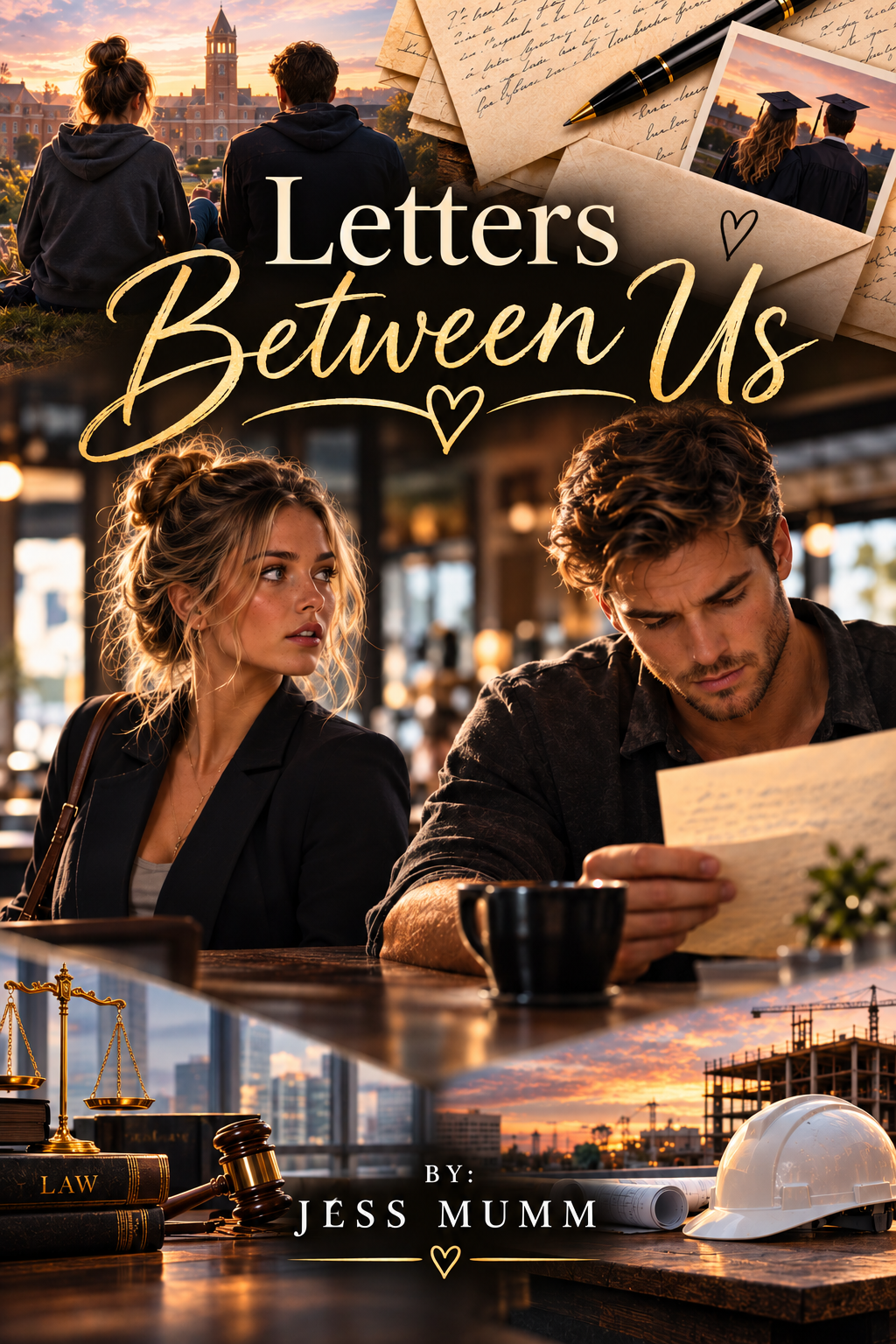
Novel · 5 chapters · 14,029 words
Letters Between Us
Contents5 chapters
Chapter 1
Stamped After Midnight
Amelia found the flyer because someone had slid it under the door of her dorm room and it had caught against the rubber strip at the bottom, bent in the middle like it had tried to leave.
She picked it up with her casebook still balanced against her hip. The paper was cheap and pale blue. CAMPUS MAILROOM LETTER EXCHANGE, it said in block letters. Anonymous if you want. One letter a week. Write to be heard. Box requests close Friday at midnight.
Lena from down the hall had circled Anonymous if you want in red pen and written, Better than therapy and cheaper.
Amelia snorted once and dropped the flyer on her desk.
By the time she had read forty pages on contract formation and underlined three of them so hard the pen left ridges in the paper, she looked at the flyer again.
Write to be heard.
It was the kind of line she would usually distrust. Too tidy. Too eager. But the room was close with old radiator heat, and her roommate had gone home for the weekend, and the building had that hollow Friday sound of doors shutting one after another as people left to be somewhere they actually wanted to be. Amelia sat back in her chair and rubbed the bridge of her nose.
Her phone buzzed. Wyatt.
You alive?
Barely, she texted back.
Seconds later: Need food? I’m by the student center.
She smiled before she could stop herself. That was the problem with Wyatt. He made concern look easy, and easy things were the hardest ones to answer honestly.
Ten minutes later she found him outside under the awning by the student center, one hand holding a brown paper bag, the other jammed into the pocket of a work jacket that still had sawdust caught in one seam. He’d spent the afternoon at the carpentry lab across campus, helping a professor build platforms for the theater department because they paid twenty dollars and gave him access to tools he couldn’t afford himself.
“You look terrible,” he said, handing over the bag.
She looked inside. Turkey sandwich. Green apple. Salt chips.
“You say that like you’re helping.”
“I brought mustard packets. That’s care.”
They started walking without deciding where to go, down the brick path between the student center and the library. They had been doing that since they were eight, drifting side by side, picking a direction after their feet had already done it for them.
“You working tomorrow?” she asked.
“Morning. Ben got us a small framing job in South Market. Old duplex. Floors are a mess.” He glanced over. “You?”
“Reading. Outlining. Pretending I understand half of civil procedure.”
“You always understand it.”
“No. I just make eye contact with people until they assume I do.”
He laughed. It was low and quick, there and gone. “That trick probably works.”
It did work, often enough. Amelia could sit in a classroom and sound prepared. She could call her mother and say law school was exactly what she had expected. She could stand next to Wyatt, shoulder brushing his, and keep her voice level while wanting to ask questions that had no safe answer.
Are you staying here after graduation?
Do you ever think we missed something by making this look easy?
Would it ruin us if I told the truth?
Instead she bit into the sandwich and said, “Tessa cold-called me in study group today for using the phrase ‘likely persuasive’ instead of ‘binding.’”
“Tessa sounds pleasant.”
“She said if I’m going to hedge, I should at least do it with confidence.”
“That sounds like an insult.”
“It was.”
They rounded the side of the library. Students crossed in clusters, scarves tugged loose, backpacks riding low. A band was playing badly somewhere near the quad. Wyatt nudged her elbow.
“You going to let her get to you?”
“No.”
He waited.
Amelia sighed. “Maybe a little.”
“Tessa Morales can go make somebody else miserable.”
“You’ve never even met her.”
“I don’t need to.”
That was Wyatt too. He did not need much evidence once his mind was made up. He trusted his own reading of people in a way Amelia envied and mistrusted at the same time.
At the steps of her dorm, he stopped. “Eat the apple too.”
“Yes, Dad.”
“Heartless.”
He tipped two fingers against the paper bag and turned to go. Amelia watched him cross the courtyard, broad shoulders, steady stride, the jacket hanging open despite the cold. He never seemed hurried. Even when he had three jobs and classes and unpaid bills, he moved like he meant to arrive.
Back upstairs, she set her books aside and picked up the flyer again.
At the bottom was a line of instructions. Request a box number at the mailroom. First letters collected every Monday.
Amelia took a clean sheet from her notebook. She looked at it for a long time, then wrote in small careful print.
I don’t know what I’m supposed to say to a stranger, which is probably the point.
She stopped, crossed out probably, and started over.
I’m good at sounding certain in rooms where certainty matters. I’m less good when no one is grading me.
She read it back and nearly tore it up. Instead she folded the page in thirds, slid it into an envelope with no return name, and wrote only the number the mailroom clerk had assigned her fifteen minutes earlier.
Box 42.
Across town, Wyatt found the same flyer stuck under the windshield wiper of his truck.
He almost threw it away with the gas receipt and the empty coffee cup in the passenger seat. Ben got in first, saw the headline, and snorted.
“Anonymous letter exchange,” Ben said. “That’s either lonely or dangerous.”
“Could be both.”
“Definitely both.”
Wyatt shoved the flyer into the center console and drove them back toward campus. Traffic through Ashby Avenue crawled past a tire shop, a diner with one dead neon letter, and a row of apartments with bikes chained to rusting railings. The city was big enough to have two decent music venues and a courthouse with limestone columns, small enough that Wyatt still ran into his eighth-grade math teacher at the hardware store.
Ben rolled down the window an inch and lit a cigarette before Wyatt could stop him.
“Don’t ash in here.”
“I have never once—”
“You have. Twice.”
Ben leaned his head back and grinned smoke toward the cracked window. “You talking to Amelia tonight?”
“Maybe.”
“Maybe,” Ben repeated. “That girl knows more about your life than your accountant will.”
“I don’t have an accountant.”
“You know what I mean.”
Wyatt did. Ben had been saying versions of the same thing for years. Amelia this, Amelia that. Ask her. Tell her. Stop making that face every time her name comes up like you’re trying to fix a leak with your teeth.
It wasn’t like that, Wyatt told himself. Amelia was Amelia. She had been in his life so long he did not know how to sort memory without her in it. The scraped-knee years. The high school parking lot years. The year his dad left and Amelia sat on the back steps beside him without talking because talking would have made it worse. People saw history and decided it meant one thing or another. Most of the time Wyatt let them guess.
He dropped Ben at the student apartments, drove to campus, and sat in the truck for a minute with the engine off. The flyer was still in the console.
Write to be heard.
He did not usually go looking for ways to talk. When something needed saying, he said it or he put his head down and got on with the work. But there were things he could not bring himself to say out loud, not to Ben, not to Amelia, not even in the dark when no one could answer back.
Sometimes I think if I stop moving, all the stuff I haven’t sorted out is going to catch me.
He could imagine writing that easier than saying it.
The mailroom stayed open until ten. A sophomore with a nose ring sat behind the counter with a sandwich and a stack of padded envelopes.
“You here for a box number?” she asked.
Wyatt lifted the flyer.
She slid a clipboard toward him. “Pick any open one from the list.”
He scanned the page. 42 was taken. So were 18 and 7 and 31. He checked the first number that meant nothing to him.
Box 17.
That night he wrote at the scarred kitchen table in his apartment, the one he shared with two other guys who were rarely home before midnight. The sink held three coffee mugs and a pan with dried eggs stuck to it. A train rattled somewhere past the river.
He wrote slower than Amelia would have guessed he could.
I’m not sure what kind of person writes to somebody with no name attached.
He stared at the line, then kept going.
Maybe somebody who doesn’t want to watch the other person’s face while they decide what to do with the truth.
He stopped there. Folded the page before he could second-guess it. Addressed the envelope to Box 17’s assigned exchange number and walked it to campus before he had time to decide the whole thing was stupid.
Monday afternoon, Amelia checked Box 42 on her way out of torts and found an envelope waiting inside.
No name. Just her box number and neat block printing.
Her pulse kicked hard enough to annoy her.
She stood in the narrow mailroom aisle while students bumped around her with packages and key rings and winter coats half-zipped. The envelope held one page torn from a yellow legal pad.
Maybe somebody who doesn’t want to watch the other person’s face while they decide what to do with the truth.
Amelia read the first paragraph standing up. She read the rest in the empty stairwell behind the mailroom where the cinder-block walls smelled faintly of dust and industrial cleaner.
The writer was male, she thought, then immediately told herself not to assume. The handwriting was firm, slanted slightly left. He wrote about work before class and about feeling behind people whose families had paid their rent on time all their lives. He wrote that everyone on campus seemed to be practicing becoming impressive. He wrote, I’m better with things I can measure. Lumber, invoices, hours. People are harder. You think you know where you stand and then the floor changes.
At the bottom: If you write back, tell me something true you don’t usually say.
Amelia folded the page along its existing crease and put it back into the envelope, suddenly careful with it.
That night she did not call Wyatt, though he left a voicemail asking if she wanted to get coffee before her late seminar. She wrote back instead.
Something true: I don’t like being wrong because it feels too close to being exposed.
She told the stranger about the way professors treated hesitation like weakness. She told him she had chosen law because rules looked safer on paper than people did in practice. She did not mention her name. She did not mention Wyatt.
By the third week, the letters had found a shape.
Wyatt wrote from job sites and library tables, from the cab of his truck with carbon paper tucked under his wrist, from the student union while people argued over a pool game nearby. Amelia wrote from the law library, from her desk after midnight, from the bench outside her constitutional law lecture where the sprinkler hissed over dead grass every morning at seven-thirty.
They did not write every detail. That was part of the strange safety of it. There was no need to explain the whole frame when a stranger only needed the center of things.
He wrote: I keep thinking my future has to look solid before I deserve it.
She wrote: I act like certainty is a skill. Most days it’s rehearsal.
He wrote: There’s this person I’ve known forever. Sometimes I think history can make you brave, and sometimes I think it makes you careful.
Amelia stared at that line until the library lights switched from afternoon dim to evening bright.
At lunch the next day, Wyatt slid into the seat across from her in the student center with a burger and a stack of folded estimates in his pocket.
“You’ve been hard to catch this week,” he said.
“I’ve been busy.”
“Busy enough to forget me?”
He said it lightly, but she looked up too fast. “No.”
His expression shifted, a small pause. “I was joking.”
“I know.”
Around them trays knocked against tabletops. Someone called for extra ketchup at the grill. Amelia reached for her drink and found her hand less steady than she liked.
Wyatt watched her for a second. “Everything okay?”
“Yes.”
He leaned back. “You’re a terrible liar.”
“I am not.”
“You are with me.”
There it was, the problem reduced to one clean sentence. Amelia looked at him across the table, at the familiar face she had known in every stage of itself, and felt a hot quick urge to tell him everything. About the letters. About the line she could not stop rereading. About the relief of being honest where no one could point and say this changes things.
Instead she said, “Tessa thinks people who hedge should be publicly corrected.”
He barked a laugh. “You switched subjects so fast I almost got whiplash.”
“Did it work?”
“Not even a little.”
Later that afternoon, Tessa caught Amelia at her locker outside seminar and tapped the edge of an envelope sticking out of Amelia’s casebook.
“You’ve started writing actual letters now?” Tessa asked. “What is this, 1943?”
Amelia slid the envelope deeper into the book. “It’s none of your business.”
“Everything in law school becomes everybody’s business when it can be used against them.” Tessa hitched her bag higher on her shoulder. “You always look like you’re about to say something and decide not to. That’s not caution, Amelia. That’s fear with a better haircut.”
Amelia held her gaze. “Are you done?”
“For now.”
Tessa walked off in hard little strikes of her heels. Amelia stayed where she was until the hallway cleared.
That evening she went to the mailroom before closing and found another letter waiting.
I almost told somebody something important today, Wyatt’s stranger wrote. I didn’t. Maybe I’m writing to you because if I get used to telling the truth here, I’ll know how to do it somewhere that counts.
Amelia read it once in the aisle, once outside under the yellow light by the loading dock, and once more after she had tucked it into her coat pocket.
Down the block, beyond the student union windows, she could see Wyatt crossing the street with Ben, talking with his hands, shoulders loose, head bent against the noise of a passing bus. He looked up as if he felt her looking. For a second she thought he had seen her.
He hadn’t. The bus cut between them, long and white and full of faces. When it cleared, he was still there, but already turning away.
Amelia kept the letter in her pocket all the way back to her dorm, her fingers pressed over the fold in the paper, as if holding it flat could keep anything from opening.
Chapter 2
The Missed Graduation Bench
By April, the letters had their own rhythm.
Amelia could tell when one was from a rushed day by the pressure of the pen. Wyatt—though she did not know it was Wyatt—could tell when she had written after midnight because her hand tightened and the loops in her y's went narrow and sharp. They never traded names. They never asked for them. The rule had become part of the trust.
Still, the shape of the other person kept gathering around the edges.
He worked with his hands. He measured time in invoices, deliveries, shifts. He noticed bad foundations and crooked framing and people who promised more than they could carry. She studied late, argued in margins, listened harder than she spoke, and saved the truest part of herself for paper. Sometimes Amelia would finish a letter and stare at her own words, unsettled by how much easier honesty had become when no one was looking directly at her.
Graduation notices started appearing everywhere after spring break. Dates, seating charts, cap-and-gown pickup. The campus shifted under the pressure of ending. People who had moved through the same hallways for four years began speaking in past tense before anything was over.
On a Wednesday afternoon Amelia found a letter in Box 42 with only a single page inside.
We should meet.
She stood with the paper in her hand while two students argued behind her about summer sublets. The sentence was plain. No lead-in, no softening. Beneath it he had written:
Not because I want to ruin what this is. Because I don’t. But I’d rather know who I’ve been telling the truth to than spend ten years wondering.
At the bottom was a place and a time.
Graduation day. East bench by the old bell tower. One hour before the ceremony.
Amelia read it through twice, then folded it with more care than the page required.
That evening Wyatt called while she was outlining for finals.
“You still alive?” he asked.
“Debatable.”
“You eat today?”
She glanced at the stale crackers beside her notebook. “Yes.”
“You hesitated.”
“I did not.”
He laughed softly. “You want me to bring you dinner?”
The question landed harder than it should have. For one reckless second she thought of saying yes, come up, stay, let me tell you something before I lose my nerve.
Instead she said, “I can’t. I’m buried.”
“Okay.” A pause. “You sound strange.”
“I’m tired.”
“That all?”
“Yes.”
He let it go, but not in a way that felt careless. Wyatt never pushed with force. He just stayed near the edge of the thing until it either opened or didn’t.
After they hung up, Amelia took out clean paper and sat with it for a long time.
Yes, she finally wrote. Graduation day. East bench by the bell tower.
Then, after a moment:
I nearly said no because I’m better on paper than I am in person. But that’s probably not a reason to stay hidden.
She delivered the reply herself before she could change her mind.
A week later Wyatt read her acceptance sitting in his truck outside a supply yard with Ben talking through startup costs in the passenger seat.
Ben reached over and tapped the page. “This the mystery person?”
Wyatt folded the letter once. “Don’t call them that.”
“You’ve been writing this person for four years. Mystery seems fair.”
“It’s letters, not espionage.”
Ben snorted. “You’re meeting them?”
Wyatt looked out through the windshield at a forklift dragging pallets across the lot. “At graduation.”
“Well.” Ben leaned back. “About time.”
Wyatt slid the letter into the inside pocket of his jacket. He felt lighter than he wanted to admit. Also stupid, which he liked even less. He was too old to be this thrown by a bench and an hour on a campus he already knew better than most people in caps and gowns would ever know it.
Ben watched him with open amusement. “You look like you’re about to frame a house with your bare hands.”
“Shut up.”
“I’m serious. What if it’s a fifty-year-old professor from the English department?”
“It’s not.”
“How do you know?”
“I know.”
Ben lifted both palms. “All right. If they stand you up, don’t become one of those men who starts talking about fate and drinking bad whiskey in the afternoon.”
Wyatt started the truck. “If they stand me up, I’ll go to graduation and keep my mouth shut like a grown man.”
“Liar.”
Wyatt drove out of the lot without answering. He had no intention of being stood up. The thought barely seemed possible. For four years this person had answered him with more honesty than almost anyone in his life. They had seen him through exams, busted trucks, rent scares, the first rough sketches of a business he wanted badly enough to lose sleep over. Whoever they were, they would come.
Amelia told no one.
Not Wyatt. Not her mother on the phone. Not the women in her study group making lists of family reservations and dress alterations. Tessa noticed anyway, because Tessa noticed weakness the way some people noticed color.
“You’re distracted,” Tessa said after a review session, shoving books into her bag. “That usually means either romance or failure.”
“Those aren’t the only options.”
“For dramatic people, they are.”
Amelia closed her notebook. “Good thing I’m not dramatic.”
Tessa looked at her for a beat. “You’re cautious to the point of damage. It reads the same from a distance.”
Amelia should have walked away. Instead she heard herself say, “What if caution is the only thing keeping a person from making a stupid choice?”
Tessa’s expression sharpened. “Then they’ve already decided the choice matters.” She swung her bag over her shoulder. “Pick safety if you want. Just don’t pretend it costs nothing.”
She left Amelia in the seminar room with the fluorescent lights humming overhead.
Graduation morning moved too fast from the start.
Amelia woke before her alarm and could not eat more than half a piece of toast. Her gown hung from the closet door. White dress pressed, shoes lined beneath the bed, cords looped over the desk chair. She went through the motions of getting ready with unusual clumsiness, dropping one earring into the sink, smearing mascara at the corner of one eye, pinning her cap on crooked and doing it again.
At ten-thirty her mother called from downstairs in the hotel lobby to say the parking garage ticket had jammed and where was she and had she remembered the extra bobby pins. Amelia answered automatically while checking the time.
One hour before the ceremony.
The bench by the bell tower sat on the east lawn, just past the philosophy building, under two sycamores with roots lifting the edge of the path. She knew it exactly. She had passed it a hundred times.
Her phone buzzed with a message from Wyatt.
Need anything before this circus starts?
She stared at the screen. Her thumb hovered over the keyboard, then moved away.
No, she wrote. See you there.
There meant the ceremony. It was the kind of answer she could send without lying. It left her restless anyway.
By eleven-twenty she was in the hotel elevator with her mother and aunt and a garment bag one of them had insisted on carrying for no reason. By eleven-thirty the lobby was jammed with other families checking maps and arguing over lunch reservations. Amelia kept glancing at the glass doors, measuring distance, calculating how quickly she could cross the square, reach the lawn, sit down, breathe.
Then her dean called.
Not directly. Through a panicked student volunteer with a clipboard who had come into the lobby asking for law graduates for an early lineup because there had been a seating change for the honors section and where was Amelia Hart, they needed Amelia Hart now.
“I can be there in ten minutes,” Amelia said.
“They said now,” the volunteer told her, already half turned toward the door.
Her mother put a hand on her arm. “Go. We’ll find our seats.”
Amelia looked past them, toward campus, toward the bell tower she could not quite see from here.
“I have somewhere to stop first,” she said.
Her mother frowned. “Before commencement?”
“Yes.”
“For what?”
Amelia opened her mouth and closed it again. The volunteer was shifting from foot to foot. Her phone showed 11:34.
“Amelia,” her mother said, with the warning note she used when she thought practicality was under threat.
“I just need ten minutes.”
“You do not have ten minutes.”
The volunteer cleared his throat. “They’re really asking for law grads immediately.”
Amelia felt the old reflex rise at once: don’t make a scene, don’t disrupt the plan, don’t choose the thing you can’t explain. It was so practiced it almost passed for instinct.
Almost.
She stepped back from her family. “Tell them I’m coming.”
Then she turned and hurried through the doors.
Outside, the quad was already filling. Graduates moved in clumps across the paths, black gowns snapping around their legs. Parents stood in the grass taking pictures. The bell tower rose above the buildings ahead, square and pale against the noon glare. Amelia gathered her gown in one hand and cut across the lawn.
Halfway there, someone shouted her name.
Tessa, standing by the law building steps with three other students, waved her over sharply. “They’re lining us up.”
“I know.”
“Then where are you going?”
“Just—” Amelia pointed vaguely past the trees.
Tessa took in Amelia’s face and gave a short, humorless laugh. “You picked today.”
“I’ll be there.”
“You’d better hope whatever this is deserves it.”
Amelia didn’t answer. She kept moving.
At the east lawn, the bench by the bell tower was empty.
She stopped hard enough to feel it in her knees. A family crossed between her and the path, father fixing a little boy’s collar while the mother aimed a camera. Amelia looked left, then right, then back at the bench as if the person might appear if she stared long enough.
11:46.
She stood beside the bench. Waited. Every few seconds she scanned the crowd. A tall guy in a navy jacket—wrong face. A woman with a bouquet—too old. Two engineering students hugging and blocking the path. No one looking for her. No one slowing down.
At 11:51 her phone buzzed again. Unknown number, campus extension.
“Miss Hart?” a voice said when she answered. “This is the commencement coordinator. We need you in lineup now or you’ll miss your place.”
“I’m on my way.”
She looked at the bench one last time.
The wood slats were sun-bleached on top and dark where thousands of hands had touched the back edge. Someone had carved initials low near one leg and tried to scratch them out. A paper cup sat crushed in the grass beneath it.
Empty.
Amelia swallowed once, hard, and started back toward the law building at a pace that was almost a run.
Wyatt had every intention of being early.
He picked up his gown from Ben’s apartment where he had left it hanging from a doorframe, changed in the bathroom, and made it to campus with twenty-three minutes to spare. Then Ben’s truck refused to start in the lot near the stadium.
“You have got to be kidding me,” Ben said, slamming his palm against the steering wheel.
Wyatt looked at his watch. “Call roadside.”
“On graduation day? We’ll be dead before they get here.”
Ben twisted the key again. Nothing but a dry clicking sound.
Wyatt was already out of the passenger side. “Pop the hood.”
“Wyatt.”
“Pop it.”
The lot baked under the noon sun. Families streamed past the chain-link fence toward the stadium gates. Wyatt yanked the hood up and bent over the engine in his gown, the sleeves dragging at his wrists. Ben came around beside him swearing under his breath.
It was the battery cable, loose enough to slip under vibration. A five-minute fix if you had a wrench. Ten if you didn’t.
Wyatt checked his watch again. 11:43.
“Go,” Ben said abruptly. “I can deal with this.”
Wyatt looked toward the campus walk. The bell tower was visible over the treeline, farther than it ought to be. The bench sat beyond that.
“You sure?”
“Yes. Go meet your letter writer before you spend the rest of your life acting like you don’t regret things.”
Wyatt hesitated one beat too long, then ran.
The gown tangled around his legs. He cut through the service path behind the stadium, crossed the art building lawn, and nearly collided with a pair of grandparents studying a campus map. By the time he reached the bell tower, sweat had started down his back.
The bench was empty.
He slowed to a stop.
A group of nursing graduates passed laughing, white uniforms bright under their gowns. A maintenance cart rattled over the bricks behind him. Wyatt checked the path, the lawn, the base of the tower, the curb where cars dropped off family members. No one standing alone. No one scanning faces.
He looked at his watch.
11:58.
He stayed three more minutes anyway. Long enough to feel foolish. Long enough for hope to thin into something flatter and meaner.
At 12:01 a text from Ben came through.
Lineup now. They’re herding everybody in.
Wyatt stared at the bench.
Then he shoved the phone into his pocket and headed for the stadium without looking back.
The ceremony was too large for privacy and too public for reaction.
Graduates filed in by school, packed shoulder to shoulder in rows that bent under the weight of names and cameras and applause. Amelia stood with the law students near the center aisle, smoothing a fold in her program that did not need smoothing. She had gone cold after the run back from the bench. Not shaky. Not angry. Just emptied out.
Tessa slid into place beside her and gave her one brief look. “You made it.”
“Yes.”
“Worth it?”
Amelia kept her eyes ahead. “No.”
Tessa was quiet after that.
Across the field, Wyatt found his section with the business and trades graduates. Ben, now sweaty and triumphant from reviving the truck, dropped into the seat behind him.
“So?” Ben muttered.
Wyatt kept his face turned toward the stage. “Nothing.”
Ben read the answer in his shoulders and did not speak again.
The band struck up the processional too loudly. Faculty marched in bright hoods and stiff caps. Families rose and waved from the stands. The president of the university stepped to the podium and began thanking donors in a voice that blurred at the edges.
Halfway through the opening remarks, Amelia glanced left across the floor.
Not searching. Not really. Just moving her eyes away from the stage for a second before she had to stand with the others.
And there he was.
Wyatt sat three sections over, profile turned toward the podium, cap low on his forehead. Familiar jaw, familiar hands, the same stillness he had when he was forcing himself not to react to something. Amelia felt the sight of him land in her like a dropped weight.
He must have felt something too. A shift, a line of attention. He looked over.
Their eyes met across the rows of graduates.
For one strange second the whole day split down the middle. Wyatt, the person who had known her since she was small enough to jump the crack in front of the bakery and call it a canyon. Wyatt, who had brought her sandwiches during finals and fixed the lock on her first apartment and asked if she was okay in a voice that made lying harder. Wyatt, who had not been at the bench.
His expression changed, but only slightly. Surprise first. Then recognition. Then something she could not name because he put it away too fast.
Amelia did the same.
She faced forward before anyone could see.
Names began. Rows stood and sat in order. Hands clapped on cue. Students laughed too loudly when diplomas were handed over. Somewhere in the stands a baby cried through the dean’s speech. Amelia crossed the stage, shook the provost’s hand, and smiled for the camera because years of discipline held even when the rest of her did not.
When she came back to her seat, she did not look for Wyatt again.
Afterward the field dissolved into noise. Families flooded down from the stands. Flowers changed hands. Phones lifted everywhere. People called names over one another in bright worn-out voices.
Amelia had nearly reached the edge of the crowd when she heard him.
“Amelia.”
She turned.
Wyatt stood six feet away, diploma tube in one hand, cap crooked now, as if someone had knocked against him. His face held the usual ease only in pieces.
“Hey,” he said.
It was absurd, how normal that sounded.
“Hey,” she answered.
Around them strangers embraced, laughed, shouted for pictures. Her mother was waving from near the fence line. Ben was somewhere behind Wyatt, talking into his phone. The air smelled like trampled grass and hot fabric and the sugary sheet cake set out on folding tables by alumni volunteers.
“You looking for your family?” Wyatt asked.
“Yes.”
“Mine too.”
Another beat.
He nodded once. “Congratulations.”
“You too.”
Neither of them moved closer. Neither of them said anything about being almost late, or not finding someone, or a bench under the bell tower with an hour folded inside it.
Her mother called her name again, louder now.
Amelia tightened her hand around the diploma tube. “I should go.”
“Yeah,” Wyatt said. “Me too.”
She stepped back. So did he.
Then they were absorbed by separate groups, swallowed by cameras and relatives and the bright blunt machinery of celebration. Once, as her aunt straightened her cap for a picture she no longer needed, Amelia looked over the heads of strangers and caught sight of Wyatt near the exit gates. Ben was talking to him, one hand on his shoulder. Wyatt was not listening. He was looking down at something in his hand.
An envelope.
By the time Amelia understood what she had seen, he had closed his fist around it and disappeared into the moving crowd.
Chapter 3
Rules for a Hidden Address
The first letter Amelia mailed after graduation took her three drafts and a trip across the street she almost talked herself out of.
She had moved into a one-bedroom apartment above a laundromat on Mercer, close enough to the courthouse to justify the rent and far enough from her mother’s neighborhood to feel like a separate life. The place had one narrow window in the kitchen and pipes that knocked in the walls when the upstairs tenant showered. Her bar results hadn’t come yet. She had a temporary position at Halpern, Voss & Greene, doing research in an office with no natural light and a managing partner who spoke as if every sentence had already been billed.
For six weeks after graduation, she wrote nothing.
She told herself the silence made sense. Whoever he was, he had made his choice. He had not been at the bench. There was no rule saying a correspondence had to survive disappointment. People left. Arrangements failed. That was not tragedy. It was ordinary.
Then one Thursday night, after twelve hours spent untangling a lease dispute for a client who owned half a downtown block and still complained about legal fees, Amelia came home, set her keys on the counter, and found herself taking out paper before she had even taken off her shoes.
I almost stopped writing, she wrote.
Then she sat back, annoyed at herself for beginning there. She should have been cooler than that. More guarded. Less willing to admit that an absence had mattered.
She crossed out almost.
I stopped writing for a while.
Better. Not quite true, but cleaner.
I told myself there was no point if the person on the other end had decided not to show up.
She stared at the sentence until her face warmed.
Then, with a quick hard motion before she could reconsider it, she kept going.
I still don’t know what happened that day. I only know I was there, and then I wasn’t, and I have been irritated ever since by how much I mind not knowing.
At the bottom she signed nothing, as always. She sealed the envelope, addressed it to the post office box they had agreed on during their last month on campus, and carried it downstairs to the blue mailbox on the corner.
She stood with the envelope in her hand for a long moment.
Then she let it go.
Three days later Wyatt found her reply in the metal box he checked every Saturday morning between the lumber yard and his first site visit.
The post office on Clay had six customer boxes along one wall and always smelled faintly of glue and dust. He had rented Box 214 the month after graduation because campus mail had ended and he had not been ready to lose the one place where he told the truth without trimming it first.
Ben thought the box was ridiculous.
“You know this is how people end up on crime shows,” he said the first time Wyatt mentioned renewing it.
“It’s a mailing address.”
“It’s a shrine.”
“It’s sixty-eight dollars a year.”
Ben had looked at him over a stack of permit applications. “That’s somehow sadder.”
Now, standing under bad fluorescent light with his key still in the lock, Wyatt opened Amelia’s letter and read the first two lines.
He had been angry longer than he liked admitting. Not loud anger. Nothing dramatic. Just a hard flat thing that sat under the rest of the day. He had gone to the bench. He had waited. Then he had watched the only person in his real life who might have noticed something was wrong—Amelia—cross a graduation field and say congratulations like they were strangers in line at a bank.
He wrote anyway.
At first because stopping felt worse.
Then because writing to this unseen person had become part of how he understood his own life. There were things he could say to her—or him, he corrected sometimes, though he no longer believed that—about work, money, failure, wanting more, that came out straight on paper. He was not ready to lose that too.
He folded Amelia’s letter once and tucked it into his jacket pocket before walking back out into the heat.
By the end of that year, she had passed the bar and been hired on full-time.
By the end of that year, Wyatt and Ben had filed the papers for Reed & Calder Construction out of a borrowed office above a plumbing supply store.
The city stayed the same size and changed around them anyway.
Amelia learned which courthouse elevators stalled between floors and which judges hated being interrupted. She learned to keep flats under her desk for days when she would be sent from the office to filing and back again. She learned the exact expression senior associates wore when handing off impossible work at six-fifteen on a Friday.
At 8:10 most mornings she stopped at Vale Street Coffee, ordered drip with one sugar, and read whatever had come in the night before she let herself open her work email. She never brought the letters into the office in an envelope. She slid the pages inside her legal pad instead, between notes on motions and client calls, where no one looking over her shoulder would see anything but her own handwriting on the top page.
Tessa Morales started at the same firm in litigation and was exactly the kind of first-year associate Amelia had expected her to become. Precise. Relentless. Too perceptive to be comfortable.
One Tuesday, Tessa leaned against Amelia’s office door with a redwell file in one hand and said, “You leave for coffee every morning like someone in a spy picture.”
Amelia did not look up from the brief she was editing. “That seems flattering for coffee.”
“You come back calmer. That means either caffeine or a secret.”
“Sometimes those are the same thing.”
Tessa stepped inside without being invited. “Who are you writing?”
Amelia’s pen stopped.
On her desk, half covered by a yellow pad, lay an envelope she had not yet put away. Plain white. No return address. Tessa’s eyes flicked to it and back.
“Nobody,” Amelia said.
“That’s a lie so thin it’s basically lace.”
“It’s correspondence.”
“With who?”
“A friend.”
Tessa gave a short nod, as if confirming something she had already suspected. “Then tell your face to act less guilty.”
Amelia capped her pen. “Do you need something work-related?”
“Yes. I need the Benson research by three.” Tessa held up the redwell, then set it down on the edge of the desk. “And as general life advice, if you are hiding something, either hide it properly or stop pretending it isn’t worth the trouble.”
After she left, Amelia sat very still.
The envelope looked louder than it had five minutes earlier. She slid it into the bottom drawer beneath a stack of deposition transcripts and shut the drawer with more force than necessary.
That night she answered Wyatt’s letter from her kitchen table with takeout cartons cooling beside her elbow.
He had written about hiring his first two full-time crew members. About payroll making his stomach drop every other Thursday. About standing inside a half-framed bungalow in North Ash and feeling, for one clean minute, that the life he wanted might actually be buildable.
Then, halfway down the second page:
Do you ever get tired of being sensible all the time? I’m asking because I think I am.
Amelia smiled despite herself.
She wrote back:
I’m not sensible all the time. I’m fearful in an organized way, which people often mistake for wisdom.
She paused, then added:
If that helps.
Across town, Wyatt kept Amelia’s letters in a steel cash box he had bought at a hardware store and hidden on the top shelf of a supply cabinet in his office.
The office was really one room with a dented metal desk, two folding chairs, a filing cabinet with one sticky drawer, and a window that looked out over the alley behind the plumbing supply store. Ben called it “headquarters” in a tone that could go either proud or mocking depending on the day.
Invoices went in one drawer. Contracts in another. Letters stayed in the box.
Wyatt did not bring them to sites. He did not leave them in the truck. Once, when one slid halfway out from under a stack of bid sheets and Ben picked it up before he could stop him, Wyatt took it back so fast Ben’s eyebrows went up.
“Still?” Ben asked.
Wyatt put the letter inside the cash box and snapped it shut. “Yes.”
Ben leaned against the doorframe. “You ever think this person might be married by now?”
Wyatt looked at him.
“I’m not trying to be an ass,” Ben said. “I’m saying you keep acting like one answer will settle your whole life, and maybe they’ve got one somewhere else.”
“That’s not why I write.”
Ben waited.
Wyatt exhaled. “Not only why.”
Ben nodded once. “Better.”
It was as close as Wyatt came to confession in person.
In real life, he still saw Amelia.
Not as often as college had made possible, but enough to keep the old habits from breaking completely. He fixed the deadbolt on her apartment door one Sunday after she mentioned it sticking. She came by the first house his company finished and stood in the front room with drywall dust in the air while he pointed out crown molding like it meant something, which to him it did. They had dinner with his mother in October. They argued over city parking in December. She brought him soup when he got sick and pretended it was extra. He helped her move to a better apartment when Halpern, Voss & Greene gave her a raise and too much work to enjoy it.
They still spoke easily. That was part of the trouble.
Every once in a while, one of them would stop a sentence half an inch from saying something real, and the other would notice.
Neither called it out.
Late in her second year at the firm, Amelia met Wyatt after work at a diner on Euclid because he had texted that he was nearby and starving. He was already in a booth when she arrived, jacket slung beside him, hands rough with dust ground into the lines of his knuckles.
“You look tired,” he said as she slid in across from him.
“So do you.”
“That means I worked.”
“That means I billed.”
He smiled. “Worse.”
The waitress brought coffee. Wyatt ordered meatloaf. Amelia got grilled cheese because choosing took too much effort.
He asked about court. She asked about a permit problem in South Market. He told her Ben had nearly taken a client’s head off over unpaid change orders. She laughed, and the laugh felt good in her throat.
Then Wyatt said, “You ever think about that day?”
She looked up too quickly. “Graduation?”
“Yeah.”
The diner noise seemed to thin around them.
“Sometimes,” she said.
He turned his coffee mug by the handle. “Weird day.”
“Yes.”
“That all you have to say about it?”
Amelia folded her napkin once, then once again. “I had to be in lineup.”
He watched her face. “I know.”
There was more there. She could hear it. So could he.
Neither reached for it.
Wyatt sat back when the waitress came with their plates. “Forget it,” he said, but not lightly.
Amelia ate half her sandwich and tasted almost none of it.
That night she wrote a letter longer than usual.
Have you ever had a conversation with someone standing right in front of you and realized the most important part of it was happening somewhere else?
She did not explain. She did not need to. He understood those leaps better than anyone should have.
His answer came five days later.
Yes.
Then, lower on the page:
Sometimes I think I split myself in two a long time ago. One version says the practical thing and keeps moving. The other one writes letters.
Winter deepened. Spring returned. Work hardened into career.
Amelia moved from research to depositions and discovered she was good at asking calm questions that made nervous witnesses tell the truth. Tessa got promoted ahead of schedule and treated it like a correction of the natural order. Wyatt leased a small warehouse for equipment and hired a foreman old enough to tell him when he was being stupid. Ben started talking about expansion before the first year’s books had fully settled.
Through all of it, the letters kept coming.
Sometimes every week. Sometimes after a gap of ten days that made each of them angrier than it should have. They never stopped long enough to become former things. They changed shape instead. Less about classes and exams. More about contracts signed, clients lost, mothers calling, rent turning into mortgage, friendships thinning and holding. The pages held years in a way ordinary conversation did not.
Amelia kept his newest letter in her bag three days before opening it because she had three filings due and knew it would alter the air around everything else.
When she finally read it, sitting at her kitchen counter in stocking feet with her hair falling out of its pins, the first line made her set the page down and pick it back up.
Ben says I’m waiting on someone who already chose.
She read the rest standing still.
I told him he doesn’t know what he’s talking about. Maybe he doesn’t. But I’ve been thinking about whether there’s a point where loyalty turns into hiding.
Amelia went to the window and looked down at Mercer Avenue without seeing it.
On the second page, he wrote about a coffee meeting with a developer. About not trusting men who smiled too quickly. About signing papers for a second truck. Then, near the end, with the plainness that always undid her:
I don’t know your name, and I know too much. That feels important.
She folded the letter carefully and slid it back into the envelope.
The next morning at the firm, Tessa appeared in her doorway again, this time with no file in hand.
“You’re somewhere else,” Tessa said.
“I’m here.”
“No. Your body is here. Your attention has a forwarding address.” She glanced at the closed office door, then back at Amelia. “If this is about that secret friend of yours, make a decision.”
“It isn’t that simple.”
“It never is.” Tessa crossed her arms. “But there are only so many years a person gets to spend being careful before it just becomes cowardice with nicer stationery.”
Amelia’s jaw tightened. “You don’t know anything about it.”
“I know enough to recognize somebody choosing the version of her life she can defend over the one she actually wants.”
That stayed with Amelia all day. Through a client meeting. Through two hours of document review. Through the elevator ride down at seven-twenty with her shoulders aching and her head full of arguments she had not made.
Instead of going straight home, she took out paper at her desk after everyone on her floor had left.
I am tired of choosing what I can explain, she wrote.
She stopped there a long time.
Then she finished the letter, sealed it, and addressed it before she could soften any part of it. She would mail it in the morning. There was a coffee shop on Vale Street with a red box half a block down. She passed it every day anyway.
Across town, Wyatt was in his office alone, reading her last letter again with his boots on the desk and the overhead light buzzing faintly above him. Down in the alley, somebody rolled a trash bin over broken pavement. Ben had gone home an hour earlier after saying, not for the first time, “At some point you’re going to have to ask for something real.”
Wyatt looked at the page in his hand.
He had been meaning to answer tomorrow. Instead he reached for a pen.
By the time he finished, the supply store below was dark and the street beyond the window nearly empty. He slid Amelia’s old letter back into the box, kept the newest one out, and tucked both under the ledger on his desk so he could bring them with him in the morning. He wanted to read them once more before he wrote the final line cleanly.
At home, Amelia set her sealed envelope beside her keys so she would not forget it.
In the morning she left later than usual, briefcase in one hand, letter in the other, and cut through Vale Street with her mind already on a partner’s meeting she was dreading.
At the corner, a pickup she knew as well as her own car was parked crooked near the curb, REED & CALDER CONSTRUCTION stenciled in white on the door.
Amelia slowed.
Vale Street Coffee stood half a block ahead, windows bright against the sidewalk, people moving inside behind the glass. She could still turn toward the mailbox first. She could keep walking. She could decide it meant nothing that Wyatt’s truck was there at eight-fifteen on a Thursday.
Instead she tightened her grip on the envelope and headed for the coffee shop door.
Chapter 4
Coffee, Paper, and Shock
The bell above the door gave a flat little ring when Amelia stepped into Vale Street Coffee.
The place was narrow and already full. Milk hissed at the espresso machine. Someone near the pastry case laughed too loudly. Amelia took one step inside, adjusting her briefcase against her hip, and saw Wyatt at a table by the front window.
He was alone.
One elbow rested on the scarred wood. A coffee sat untouched near his hand. In the other hand, open and unmistakable, was her letter.
Not just any letter.
The one she had sealed the night before. The one still addressed in her hand. The one that had been beside her keys when she left the apartment.
For a second her mind rejected what her eyes had already taken in. It tried to make a smaller story out of it. Same kind of envelope. Similar paper. Bad angle.
Then Wyatt looked down at the page and she saw the fold she always made in thirds, the quick slash where she had crossed out one word before writing another above it.
Amelia stopped so hard the man behind her had to sidestep.
“Sorry,” he muttered.
She did not answer.
Wyatt had not seen her yet. He was reading with the stillness he always had when something mattered. His thumb held the lower corner of the page. The letter she had meant for a stranger sat open in the hands of the person she had known almost her whole life.
Her first clear thought was not Oh.
It was He opened it.
Then, almost at once: No. He was supposed to.
The force of that hit her in the chest and left her standing there with the door easing shut behind her.
He looked up at the sound.
For one suspended beat, neither of them moved.
She saw the recognition arrive in his face, then the understanding behind it, then something close to alarm. His eyes dropped to the letter in his hand and came back to hers.
“Amelia,” he said.
Her body unlocked all at once. She crossed the room before she had decided to. Her shoes struck hard against the tile. A couple at the next table looked up.
“What is that?” she asked.
It came out low, flatter than she felt.
Wyatt stood so quickly his chair scraped. “I can explain.”
She gave a short disbelieving breath. “Can you?”
His hand tightened on the page. “Yes.”
“Then start there.” She pointed at the letter. “Why are you reading something I wrote?”
A barista called out an order at the counter. Neither of them glanced over.
Wyatt looked at her like he was trying to choose the first sentence without making the rest impossible. “Because it was in my box.”
Amelia stared at him.
The noise of the shop seemed to pull away from her, not gone but distant, as if she were hearing it through another room.
“Your box,” she repeated.
“Yes.”
“No.” She shook her head once, hard. “No, that’s not possible.”
“It is.”
“That letter was addressed—” She stopped herself. Not because she was protecting the secret. There no longer seemed to be one. “It was addressed to my post office box.”
Wyatt’s expression shifted. “What?”
“My box,” she said. “The one I’ve been using since graduation.”
He was already reaching into the inside pocket of his jacket. He pulled out an envelope, worn soft at the corners from being handled. Her stomach dropped before he even turned it toward her.
Her handwriting.
Box 214.
“I got this Saturday,” he said. “From you. From—” He stopped too, the same collision happening behind his eyes. “From the person I’ve been writing to.”
Amelia looked from the envelope to him and back again.
The years did not line up at first. They crashed.
Box 42. The legal pad paper. The line about not wanting to watch someone’s face while they decided what to do with the truth. Graduation. The bench. Every letter since. The careful hiding. The questions Wyatt had almost asked in diners and parking lots and on her front steps.
She heard herself say, “No.”
This time it sounded less like refusal and more like shock.
Wyatt glanced around the shop. Every table near them had gone politely interested. “Sit down,” he said quietly.
“I’m not sitting down.”
“Amelia.”
“No.” She folded her arms as if that could hold something in place. “You’re telling me that for all this time—”
“I know what I’m telling you.”
“Do you?”
A pulse beat at the base of his throat. “I opened my box this morning. Your letter was in it. I came in here because I needed to read it before I answered. Then you walked in.”
She laughed once. It had no humor in it at all. “That is not an explanation. That is a summary.”
His jaw set. She knew that look. It meant he was trying not to react too fast. “All right. Ask me something.”
Fine, she thought wildly. Fine.
“When did you know?”
“Know what?”
“That it was me.”
His answer came at once. “Just now.”
She searched his face for any sign of evasion and found only strain.
He asked, “When did you know it was me?”
“Also just now.”
The words fell between them with a kind of terrible simplicity.
A woman with a laptop gathered her things from the next table and left, giving them a quick glance on the way out. Wyatt put Amelia’s letter carefully on the table, as if handling it roughly now would make things worse.
“Sit,” he said again.
This time she did.
Not because she was calmer. Because her knees felt unreliable.
Wyatt sat across from her. The table between them held two envelopes, two cups of coffee, and too many years.
Amelia kept her hands in her lap. “Say something.”
He let out a breath through his nose. “I don’t know where to start.”
“The beginning would be useful.”
A shadow of disbelief crossed his face, almost a laugh, but it died quickly. “The campus mailroom.”
She looked at him.
“I started writing my sophomore year,” he said. “Ben found the flyer on my truck. I got Box 17.”
Amelia felt the exact shape of the old mailroom key in her hand again. “I was Box 42.”
“I know that now.”
She ignored that. “You wrote on yellow legal pads.”
His eyes narrowed slightly. “Most of the time.”
“You said people were harder than things you could measure.”
He went still.
Amelia heard her own voice become quieter, not softer. More dangerous for it. “You wrote that you were better with lumber and invoices because people changed the floor under you.”
Wyatt stared at her. “You remember that?”
“Of course I remember that.”
Neither of them spoke for a beat.
Then Wyatt said, “You wrote that being wrong felt too close to being exposed.”
Her breath caught. He had the line exactly.
The room came back around them in pieces: grinder noise, spoon against ceramic, the door opening and closing. Amelia pressed her fingertips into her palms.
“You were the one at the bench,” she said.
It was not a question.
“Yes.”
Her head jerked up. “I was there too.”
His face changed completely then. Not to relief. Something rougher.
“What?”
“I was there.” The words sharpened as she said them. “I got called to lineup. I ran back late and the bench was empty.”
Wyatt leaned forward. “I got stuck in the stadium lot because Ben’s truck died. I ran there. You were gone.”
They looked at each other.
Years of private injury rearranged themselves in a moment and did not become easier. Only different.
Amelia sat back. “We both thought—”
“Yeah.”
He did not finish it. He did not need to.
She looked down at the table. Her sealed letter from that morning sat beside his hand, opened now and folded back. The sight of it revived her anger in a rush.
“You should have told me,” she said.
Wyatt frowned. “Told you what?”
“That morning. Any morning after.” She looked up. “At graduation. At the diner. Any of the hundred times we have nearly said something and then stopped.”
His expression hardened too. “I could say the same to you.”
“I’m aware.”
“No, Amelia.” He kept his voice low, but there was force under it now. “You don’t get to stand there acting like I kept this from you on purpose if you were doing the exact same thing.”
“I wasn’t keeping you from me. I didn’t know it was you.”
“Neither did I.”
“Then why didn’t you tell me about the letters at all?”
He gave her a look she knew too well, one that landed because it was earned. “Why didn’t you?”
She opened her mouth and closed it.
Because it mattered too much, she thought. Because if the person on paper became the person in front of me and wanted less than I did, I would have nowhere to put that. Because I trusted you there in a way I did not know how to survive here.
She did not say any of it.
Wyatt watched her and seemed to hear enough anyway. His shoulders lowered a fraction, though the tension stayed.
“I didn’t tell you,” he said, “because after graduation I thought whoever I’d been writing to had made it clear they didn’t want to know me outside of that.”
Amelia stared at him.
“That’s what you thought?”
He gave one short nod. “Yeah.”
She almost said How could you think that? Then stopped, because she knew exactly how. She had thought the same thing.
A barista approached with cautious cheer. “Can I get either of you anything else?”
“No,” they said together.
The barista retreated.
Wyatt rubbed a hand over his mouth, then dropped it back to the table. “I almost told you a dozen times.”
“When?”
“Take your pick. The diner on Euclid. The day I fixed your lock. Your second apartment when we were carrying boxes. I’d get there and think, if this isn’t her, I’m about to wreck the only honest thing I’ve got.”
Amelia felt that one low in her chest.
She said, “I almost told you too.”
He looked at her steadily. “When?”
“Also take your pick.”
Something moved in his face then. Not a smile. Not even close. But the strain shifted shape.
Amelia reached for the opened letter on the table before she could think better of it. Wyatt let her take it. It was the one he had received Saturday, edges creased from rereading.
Ben says I’m waiting on someone who already chose.
She had forgotten writing that line. No, not forgotten. She had forgotten what it looked like outside her own head.
“You kept them,” she said.
“All of them.”
The answer was immediate. Unembarrassed.
She looked up sharply.
He held her gaze. “Didn’t you?”
A pause.
“Yes.”
It was almost nothing, that exchange. It changed the air anyway.
Amelia set the page down carefully. Her pulse had not slowed. She did not think his had either. But the shock had passed into something else now, something more difficult because it had shape.
There were things on the table between them that had never been said out loud in all the years they had known each other. Loneliness. Hope. Resentment. Want. The fact that each of them had handed the deepest parts over in writing while standing inches from each other in ordinary life, pretending friendship was the whole truth because it was safer than naming the rest.
Wyatt broke the silence first.
“So what now?”
The question landed hard.
Amelia looked at him, really looked. The familiar details did not help. They made it stranger. The nick near his thumb from some old job. The coffee gone cold near his elbow. The way he held himself when he was bracing for bad news and refusing to step back from it.
Through the front window, his truck sat at the curb with the company name on the door. Her briefcase leaned against her chair, packed with case files for a morning she had now missed entirely. Somewhere in her bag, her phone was almost certainly vibrating with work. None of it seemed as immediate as the man across from her and the stack of years neither of them could put back where they had been.
“I don’t know,” she said.
It was the truest answer she had.
Wyatt nodded once, accepting that without liking it. “Okay.”
She frowned. “Okay?”
“It means I’m not going to push you into deciding in the next thirty seconds.”
“That would be considerate if you weren’t also the reason I’m sitting here trying to understand the last ten years of my life.”
One corner of his mouth moved, not quite upward. “You are also the reason.”
Despite herself, Amelia exhaled something that was almost a laugh. It vanished quickly.
He reached into his jacket again and set another folded page on the table. Older paper. Worn. She recognized the careful crease before she recognized the line at the top.
I don’t like being wrong because it feels too close to being exposed.
Her first letter to him. Or to the stranger she now knew had been him.
“I kept this one in my wallet for a year,” Wyatt said.
Amelia did not touch the page. “Why?”
He looked at her for a long second before answering.
“Because it felt like the first time somebody said something true to me without making it sound small.”
The noise in the shop kept going. Somebody dropped a spoon. The door opened to let in a man carrying drywall dust on his boots. Behind the counter, beans poured into a grinder with a dry rattling sound. Amelia sat very still.
There it was again, the split she had lived inside for years, only now there was no split at all. Only Wyatt. Wyatt, who had read her letters and answered them. Wyatt, who had missed her by minutes at the bench. Wyatt, who was watching her now like he knew one wrong movement could send her out the door.
Her phone began vibrating in her bag.
Neither of them looked away.
It stopped. Started again.
Amelia finally reached down and pulled it out. Three missed calls from the office. One message from Tessa already lighting the preview screen.
Where are you?
She turned the phone facedown on the table.
Wyatt glanced at it, then back at her. “You need to go.”
The words irritated her instantly because they were sensible and because he was right. “I know.”
Neither of them moved.
He said, “Amelia.”
“What?”
“We can’t leave this here.”
Her eyes went to the letters spread between them. The old one from his wallet. The recent one she had mailed. The years folded into paper, suddenly tangible, impossible to dismiss as misunderstanding now that they had faces attached.
“No,” she said. “We can’t.”
Another call buzzed against the tabletop.
Wyatt looked at the phone, then at her. “Tonight.”
It was not exactly a question.
Amelia felt the pressure of it. Tonight meant answers. The bench. The missed years. Every letter. What they had written and what they had not. What it meant that the person who knew her best on paper had been the same person she had loved too carefully in life to risk naming it.
She picked up her phone, then the opened letter, then set the letter back down because her hands were no steadier than before.
“Tonight where?” she asked.
Wyatt’s gaze held hers. “My office. After work. I have the letters there.”
Amelia thought of the box in her apartment closet, tied with a ribbon she had once mocked herself for buying because it made the whole thing look too precious. She thought of bringing it across the city. Of putting all those pages in one room with him.
Her phone buzzed again.
This time she answered it without taking her eyes off Wyatt.
“Amelia Hart,” Tessa said at once, clipped and sharp. “If you are not on your way in, you need to tell me now before Halpern starts asking why your brief isn’t on his desk.”
Amelia’s mouth went dry.
Wyatt waited.
Across from him, on the table between the coffee cups and the scattered paper, her whole hidden life lay open, and she had to decide which one she was walking back into first.
Chapter 5
The Letter They Both Keep
“Ten minutes,” Amelia said into the phone.
Tessa did not lower her tone. “You said that twenty minutes ago.”
“I know.”
A beat. Amelia could picture her at her desk, one heel hooked over the rung of her chair, irritation sharpened into efficiency. “If this is about whatever you’ve been hiding in envelopes for two years, I am going to say something kind once and then never again.”
Amelia closed her eyes briefly.
“Say it,” she said.
“Either walk away from it,” Tessa said, “or stop treating your own life like a scheduling problem.”
The line clicked dead.
Amelia looked at the phone in her hand, then set it down again.
Wyatt had not moved. “That was Tessa?”
“Yes.”
“She sounds friendly.”
“She thinks kindness is a waste of precision.”
He nodded once. “And was she wrong?”
Amelia let out a breath. “Usually no.”
She gathered her briefcase, more to have something to do than because she was ready to leave. “Tonight. Seven-thirty.”
“At the office,” he said.
“Yes.”
She stood. Wyatt stood too.
For a second it seemed they might say something that belonged to the years behind them, something about the bench or the letters or the fact that neither of them looked shocked anymore so much as stripped raw. Instead Wyatt slid her most recent letter across the table toward her.
“Keep that,” he said.
Amelia took it. “Bring the first one.”
A small shift in his face. “I will.”
She left before staying became its own answer.
At the firm, she worked badly for three hours and then, out of irritation, worked very well for four more.
She finished the brief. She sat through Halpern’s comments without hearing half of them. She let Tessa hand back a marked-up draft and say, “There, see, the building didn’t collapse because you chose something.”
Amelia looked at her over the conference table. “Was that your version of encouragement?”
“Don’t get spoiled.”
By six-thirty, the office had thinned to copy-room sounds and the low murmur of two associates arguing over citations. Amelia packed her bag, hesitated, then went home first.
The box was on the top shelf of her closet, behind a winter scarf she had not worn in three seasons. Blue ribbon. Plain cardboard. Too many pages inside.
She sat on the edge of the bed with it in her lap and untied the bow.
The letters were arranged in no sensible order now, only the order of emotion. The first few on cheap lined paper. Then legal pads. Then cleaner stationery once she started making real money and felt faintly ridiculous buying cream-colored stock for words she never intended anyone else to see. There were pages she knew by weight alone.
I’m good at sounding certain in rooms where certainty matters.
I keep thinking my future has to look solid before I deserve it.
There’s this person I’ve known forever.
I’m fearful in an organized way.
She touched the corners, then put them back and retied the ribbon.
Wyatt’s office sat above the plumbing supply store exactly where it always had, though the sign downstairs had been repainted and the front window now held a display of polished fixtures instead of dusty boxes. The alley smelled faintly of cut wood and wet cement. When Amelia climbed the stairs with the box held tight against her ribs, she found the office door open.
Wyatt was inside alone.
The room looked both more established and more temporary than she expected. Better desk. Same metal filing cabinet. Plans rolled in a bin by the wall. A whiteboard full of dates and addresses. In the corner, a steel cash box sat open on the desk beside a stack of letters.
He looked up when she appeared in the doorway.
For a moment neither of them spoke. Then Wyatt came around the desk and took the box from her before she had to ask where to put it.
He set it down beside his own. “You actually tied yours with ribbon.”
Her face warmed. “You keep yours in a hardware-store lockbox.”
“Fair.”
That almost-smile passed between them and was gone.
Wyatt shut the door.
The click of it seemed to settle the room.
“Do you want coffee?” he asked.
“No.”
“Good. It’s terrible.”
Amelia took the folding chair across from his desk. Wyatt sat in the other. The two boxes stayed between them like evidence.
He opened his first and took out a single folded page. Not from the top. From somewhere in the middle, pulled with the certainty of having handled it often.
“This one,” he said, “was the first time I thought I knew you. Not your name. You. Or who I thought you were.”
He passed it to her.
Amelia unfolded the sheet.
You asked me to tell you something true I don’t usually say. Here: I don’t want to be admired nearly as much as I want to be understood, and I hate that those are not the same thing.
She remembered writing it at the law library with a dead highlighter and two hours of sleep. Remembered feeling exposed even on the page.
“You kept that one out?” she asked.
Wyatt leaned back slightly. “I read it the night before I signed the lease on this place. Thought if somebody could say that to a stranger, I could probably risk an office with bad wiring.”
She looked at him. “That is a ridiculous use of emotional support.”
“It worked.”
He opened her ribbon-tied box and lifted out a page she knew before she saw the words.
Maybe somebody who doesn’t want to watch the other person’s face while they decide what to do with the truth.
Amelia took it from him more carefully than she needed to. “I read this in the mailroom stairwell.”
“Truck,” Wyatt said. “I wrote it in the truck.”
They traded pages back and forth after that.
Not every letter. There were too many. But enough to build the path in full view. The line where Wyatt first mentioned a person he had known forever. The letter where Amelia admitted she always reached for certainty because uncertainty felt like humiliation. The one where he described the first house he ever helped frame. The one where she wrote from outside the courthouse after her first hearing and confessed that winning had made her feel emptier than she expected because there had been no one she wanted to tell except him.
Except you, she thought now.
Around eight-thirty, the stack on the desk had spread into uneven piles. The office light buzzed faintly overhead. Outside the window, the alley had gone dark except for a single security lamp.
Wyatt held one page and shook his head once. “I should have known here.”
“Which one?”
He handed it over.
She read the line and groaned.
My oldest friend says I rehearse arguments in my head and then act offended when reality doesn’t follow the script.
Amelia dropped the page to the desk. “I wrote that after you said that to me.”
“Exactly.”
“You also told half the city I talk like a future attorney.”
“Only because you did.”
She looked up despite herself. “You’re impossible.”
“That’s new information?”
The ease lasted only a second, but it was enough to show her what had always been underneath the letters and the friendship both. Not two separate loyalties. One thing, seen from different angles.
Then Wyatt reached for a letter she had not noticed in the spread. The paper was worn thin at the folds.
“The bench,” he said.
Amelia went still.
He opened it but did not hand it over yet. “I wrote this two days after graduation and never mailed it.”
“Why not?”
“Because I was angry,” he said simply. “And because if I sent it, I thought I’d lose you. Whoever you were.”
He gave her the page.
I was there. If you changed your mind, you could have just said it. I would have hated that less.
Amelia swallowed.
At the bottom, in heavier print added later:
Or maybe that’s a lie.
She set the page down and opened one from her own box without needing to search. “Then this one matches.”
He took it.
I was there too. I only left because I had to. I am furious that I even need to write that to someone who is not here to hear it.
He looked up sharply. “You never sent this.”
“No.”
“Why not?”
“Same reason you didn’t send yours.”
The silence after that was different. Not tense exactly. More honest.
Wyatt rubbed a hand over the back of his neck. “I was there at eleven fifty-eight.”
“I got there at eleven forty-six,” Amelia said. “Waited until the coordinator called me.”
He looked down at the desk. “Ben’s truck battery cable came loose in the stadium lot.”
“My dean’s volunteer dragged me out of a hotel lobby like the republic depended on seating order.”
That pulled a real laugh from him, low and brief.
Amelia felt her own mouth move before the feeling of it reached her.
“So we were both idiots for years over twelve minutes,” Wyatt said.
“Fifteen, maybe.”
“Let’s not get greedy.”
She leaned back in the chair, tired all the way through now, but clearer than she had been that morning. “I hated you for an hour.”
“Only an hour?”
“At the bench? Longer afterward.”
“Good,” he said. “I was offended on principle.”
She studied him. “Were you hurt?”
His answer took no performance. “Yes.”
That word sat cleanly in the room.
“Me too,” Amelia said.
He nodded once, accepting it as if that mattered as much as apology.
Later, they did apologize, though neither made a speech of it.
For assuming.
For not saying more.
For letting caution wear the clothes of reason.
For treating the one honest thing between them as if naming it would ruin it beyond repair.
At some point Wyatt closed both boxes and pushed them aside. The desk between them looked strange without paper covering it.
He rested his forearms on the wood. “So now I’m going to ask something without writing it down first.”
Amelia’s pulse lifted again.
“All right.”
He held her gaze. “Do you want this only on paper, or do you want it with me?”
There it was. No room left to polish it.
She could still have done what she had always done. Qualified. Reframed. Asked for time in a voice that sounded prudent.
Instead Amelia said, “You are the same person.”
“I know.”
“No,” she said quietly. “I’m telling you because I’m just realizing that’s the part I was afraid of. Not that the stranger would become someone real. That the person already real to me would turn out to be the one who knew everything.”
Wyatt did not interrupt.
She went on. “And if you were both, then losing one meant losing both.”
His face changed, softened by pain more than relief. “Amelia.”
She looked at her own hands, then back at him. “I don’t want this only on paper.”
He sat very still.
“Say it straight,” he said, not pushing, just asking for the last inch.
So she did.
“I want a relationship with you,” she said. “Here. In person. No hiding things in envelopes because I’m afraid saying them out loud will change the structure.”
One corner of his mouth moved. “That sounds like something a lawyer writes in a love letter.”
Her breath caught on the word, though he had said it lightly.
Wyatt went on before she could retreat from it. “I want that too. I have for longer than I knew what to call it.”
The room seemed smaller suddenly.
He stood first, then stopped on the far side of the desk as if giving her room to refuse if she needed it.
Amelia stood too.
“You don’t have to be careful with me right this second,” he said.
She almost laughed at that. “That may be the least useful instruction anyone has ever given me.”
“Fair.”
He came around the desk then, slowly enough that the choice stayed hers. When he reached her, he did not touch her immediately. Just looked at her, close now, years of friendship and pages and missed chances pressing into one narrow space.
Amelia lifted a hand first and caught his wrist.
It was such a small thing. It felt enormous.
Wyatt’s other hand came up to her face, thumb resting once near her cheekbone like he was still asking. She leaned into it before she could think better of it, and the answer moved through him plainly. When he kissed her, it was with the same restraint he used for everything that mattered too much to rush.
By the time they stepped apart, the office had not changed at all. Rolled plans in the corner. Whiteboard dates. City noise filtered through old glass. But the old split in her life was gone.
Wyatt looked at the letters on the desk behind her. “What do we do with all those?”
Amelia turned, following his gaze.
The boxes sat side by side, closed now but full.
“We keep them,” she said.
“Good.”
“But we stop using them to avoid each other.”
He nodded. “Agreed.”
“No more almost telling me things in diners.”
“No more writing me something you won’t say when I’m standing right there.”
She considered. “I can’t promise elegance.”
“I don’t need elegance.”
“What do you need?”
His answer came without a pause. “Honesty. In the room.”
That steadied something in her.
She reached for her bag. From inside, she pulled a blank sheet of firm stationery and the fountain pen she used for letters. Wyatt watched with open suspicion.
“Amelia.”
She laid the page on the desk between the two boxes and uncapped the pen. “One last one.”
He huffed a laugh. “You’re impossible too.”
“Sit down.”
He did.
She wrote only a few lines, then slid the page across to him.
Wyatt read it silently.
No box number.
No anonymous return.
If you have something to tell me, come to my door or call my phone or say it across a table.
I’m done being brave only on paper.
—Amelia
He looked up at her, then took the pen.
His handwriting was firmer, larger. Construction-man print, she had once thought. She watched his hand move.
He turned the page back.
Good.
I’ll start now.
Sunday. Dinner with me.
Tomorrow. Breakfast before court.
And if you get scared, tell me that too.
—Wyatt
Amelia felt a smile come, small but real.
“Bossy,” she said.
“Practical.”
She folded the page once and slipped it into her bag.
Downstairs, a truck door slammed in the alley. Somewhere in the building, pipes knocked in the wall. Wyatt’s phone lit up on the desk with a message from Ben, then another, then a third.
Wyatt glanced at the screen and grimaced. “He knows I’m up here with you.”
“How?”
“He has instincts like a raccoon.”
Amelia stepped closer to the desk and read the preview over his shoulder.
You alive?
Did the letter person murder you?
If not, answer your phone.
She laughed then, properly this time.
Wyatt looked at her like he was memorizing the sound.
He picked up the phone but did not answer yet. “So this is really happening.”
“Yes,” Amelia said.
It was not a dramatic declaration. It did not need to be.
Wyatt reached past the phone, opened the top drawer of his desk, and set the cash box inside without locking it. Amelia watched him do it. Then she took her own ribbon-tied box and placed it beside his.
Not hidden. Not gone either.
When she looked back up, he was watching her with that steady expression that had undone her in a hundred smaller moments she had never named.
“What?” she asked.
“You left work in the middle of the day,” he said. “For me.”
Amelia picked up her coat.
“No,” she said. “For the truth.”
She headed for the door. Wyatt caught up in two steps, one hand on the frame above her shoulder before she could open it.
“Amelia.”
She turned.
“Breakfast,” he said. “Eight?”
She studied him, this man who had been on both sides of every page worth keeping.
“Seven-thirty,” she said. “I have court.”
He smiled then, finally, with no caution left in it.
Behind them the two boxes sat in the half-lit office, years of hidden words waiting on the desk while downstairs Ben’s next message lit Wyatt’s phone again and the city kept moving, unaware that at the top of a narrow staircase, after all that time, they had stopped writing around the truth and were about to begin it.
Write your own novel.
ScribistIQ generates full-length novels in minutes. Type your premise, walk away, come back to a finished book.
Try ScribistIQ