
Novel · 5 chapters · 9,114 words
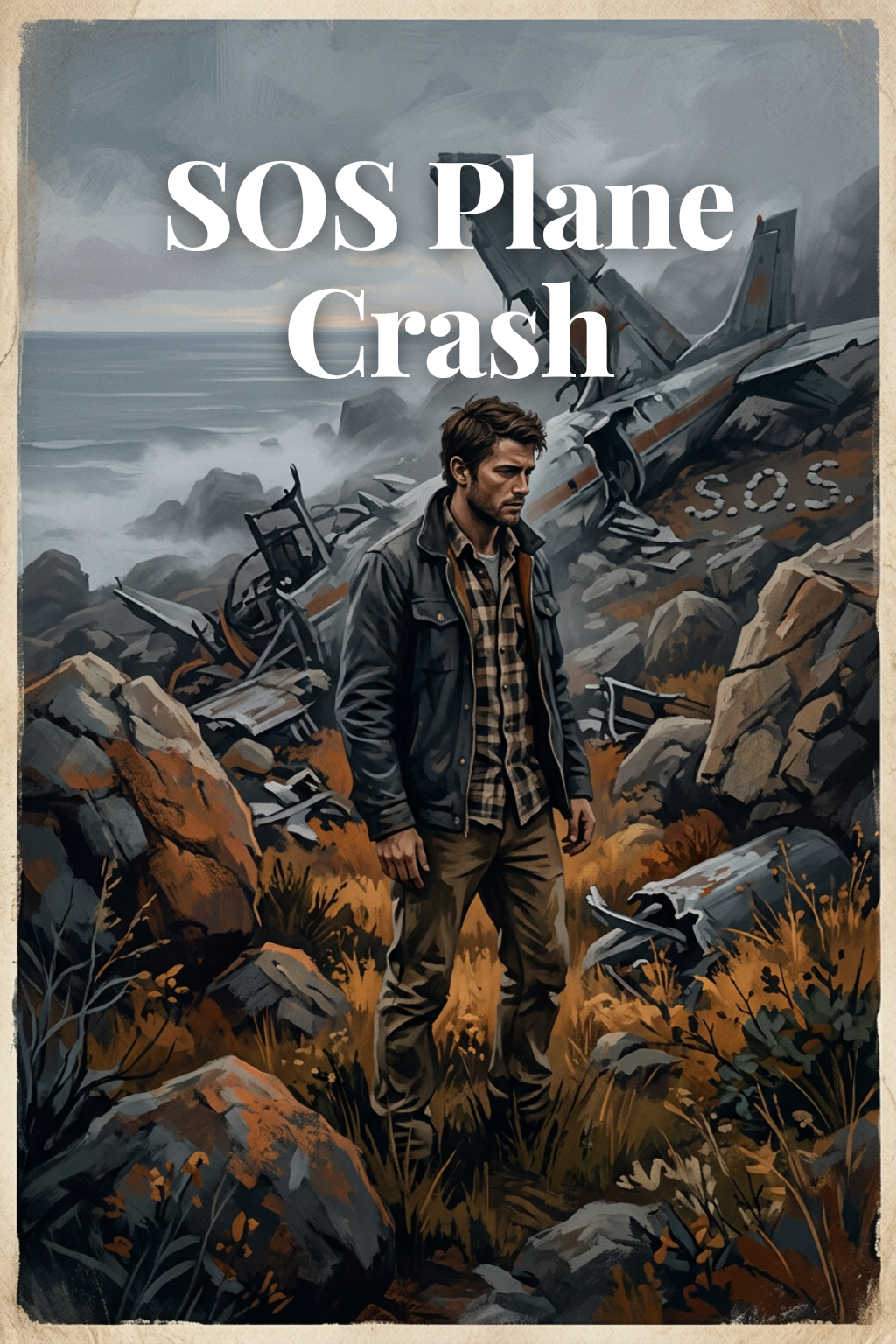
SOS Plane Crash
Contents5 chapters
Chapter 1
Chapter 1: The Sound in the Trees
The sound stayed with him even after he opened his eyes.
Not the engine cutting out. Not the shouts. The wrenching, tearing complaint of the fuselage as it folded through wood.
Nathen lay slumped sideways in his seat, his cheek against torn vinyl. Smoke drifted in thin gray sheets through the cabin, finding the sunlight that knifed in through a split in the sidewall. Every breath scratched. His left shoulder throbbed hard enough to make his fingers shake.
For a moment he did nothing. He heard a tick somewhere near the front of the plane. Hot metal cooling. A soft hiss. Then nothing else.
He fumbled for the buckle, missed it once, then got his thumb under the latch. His body dropped awkwardly against the aisle. Pain flashed white behind his eyes. He stayed there on hands and knees until the spinning eased.
“Nathen.”
The voice came from the cockpit, thin and dragged over broken glass.
He crawled forward, one palm slipping in spilled coffee, the other finding rivets, torn carpet, a jagged edge of seat frame. The cockpit door hung crooked on one hinge. Beyond it, Captain Lenora Briggs was still strapped in, her face gray under streaks of blood. One sleeve of her uniform was blackened. The windscreen was gone, and spruce needles trembled in the frame where sky should have been.
“You’re alive,” Nathen said, though it came out as a rasp.
“For now.” Her mouth twitched, not a smile. “Door. Get out. Fuel smell.”
He looked past her. The instrument panel was dead except for one amber light fading in and out. Wires hung loose beneath it. The radio stack had been shoved inward as if a giant fist had driven it back.
“Can you move?”
She shut her eyes once, opened them. “Leg’s pinned. Don’t waste time.” Her breathing hitched. “Go outside first. Then come back if it’s not burning.”
That made sense. Simple. Immediate. His grandfather’s voice rose from years ago at a workbench littered with bolts and cedar shavings: When things go wrong, don’t panic. Stop. Think. Then do the next right thing.
Nathen turned and crawled toward daylight.
The rear door had broken partly free on impact. He shoved at it with his good shoulder until it peeled wide enough to let him through. Cold air hit his face. He half fell, half slid down a tangle of brushed branches and crumpled aluminum and landed on damp earth.
He stayed on his back for a second, staring up at the tops of firs. The trees stood so high they seemed to hold the sky in place. Their trunks rose straight and dark from a floor of ferns, salal, shattered limbs, and strips of silver metal. The plane had cut a raw path through the stand before coming to rest canted against a mound of roots.
No road. No clearing. No distant engine. No lines strung between poles.
Only the wreck and the forest swallowing it.
He rolled to his side and got up. His knees nearly folded. He put a hand on the fuselage until the dizziness passed.
The smell out there was sap, wet dirt, smoke, and aviation fuel. The wing to his right had been peeled open like a fish. One prop blade had snapped clean off. The tail sat at a wrong angle in a nest of snapped young hemlock.
He turned in a full circle. Trees in every direction, ridge above him, lower ground somewhere off to the west where the land dipped into a dark cut. If anyone was looking, they would have trouble seeing the wreck from the air through the canopy.
He looked back at the plane.
Next right thing.
He climbed in again.
The cabin seemed smaller now, as if the smoke had thickened and pushed the walls inward. He pulled two emergency ration packs from a ruptured compartment above the seats and dropped them near the door. A bright orange life vest, useless here. A wool blanket stiff with insulation dust. He took that too.
At the front, Captain Briggs made a sound low in her throat.
“There was a beacon,” she said.
He leaned against the cockpit frame. “Where?”
“Cargo compartment. Portable unit. We had one because the panel beacon was acting up before takeoff.” She swallowed hard. “Might be smashed. Might not.”
“Okay.”
Her eyes shifted toward him, sharp despite the pain. “Listen to me. Main emergency transmitter is dead. Antenna tore free. If you find the portable one, don’t assume it’s working.”
He nodded.
“Batteries, handset, whatever wiring you can find. Take all of it.”
Nathen looked at the mangled panel again. “I’m going to get you out.”
“Not if fuel catches.” Her hand twitched toward his sleeve, missed. “Supplies first. Then see if I’m still worth the trouble.”
The words were flat, professional. That steadied him more than anything kind would have.
He moved aft to the cargo area. A mesh divider had collapsed, pinning two duffels and a hard plastic case against the wall. He cut the webbing with a box cutter he found in a seat pocket, then dragged the case free. The latch had cracked, but the shell held. Inside sat a compact survival bag in red nylon, a first-aid kit, a coiled length of cord, a hand-crank flashlight with a broken handle, and a black metal box the size of a thick novel.
He lifted the box. Heavier than it looked.
A label on the side read EMERGENCY LOCATOR - AUXILIARY. One corner had been stove in, and the rubber antenna had snapped off at the base. Beside it lay a separate battery pack, loose wires showing where a connector had torn away, and a handset with a shattered earpiece grille.
Not good. But not nothing.
He packed the survival bag first, checking it with quick hands: fixed-blade knife in molded sheath, ferro rod, metal water bottle, compact folding saw, paracord, tarp, whistle, flashlight, compass, a packet of gauze and bandages, alcohol wipes, tape, painkillers. Enough to matter.
He added the ration bars, first-aid kit, blanket, battery pack, handset, locator box, and a fistful of wiring scavenged from beneath a loose seat where copper gleamed through insulation. He found three AA batteries rolling under a bulkhead panel and pocketed them without knowing what they fit.
When he returned to the cockpit, Captain Briggs was breathing fast through her nose, each inhale catching.
“I found it.” He held up the metal box. “It’s damaged.”
“All of us are.” She closed her eyes for a beat. “Did it lose the antenna?”
“Yes.”
“Thought so.” A shudder ran through her. “Search area should be narrow. Filed route. If weather held, they’ll start with our corridor.”
“If.”
She looked at him. “Don’t walk out unless you have to.”
“I wasn’t planning to.”
“Good.” She shifted, failed, and her face blanched. “There’s a med pouch under my seat. Morphine syrette. Don’t give it to me if I stop making sense.”
He crouched, reached through twisted pedal housing, and found the pouch by touch. He hesitated with the injector in hand.
“Later,” she whispered. “Help me breathe first.”
He cut the shoulder harness, braced her as much as he could, and slid a folded blanket behind her ribs to take some pressure off the bent frame pinning her leg. It was clumsy and not enough, but her breathing eased a fraction.
“Thank you,” she said after a while.
He had no answer for that.
The smoke was worse near the ceiling. He backed out again, hauling the supplies into a patch of open ground twenty yards from the fuselage where the earth looked least likely to catch. He made himself sort everything before his thoughts could scatter: food in one pile, tools in another, medical gear, radio parts, anything useful from the aircraft. He found a half-empty plastic bottle under a seat and dumped the stale water into the metal one. Every ounce counted.
He went back twice more. A seat cushion for insulation. A bent aluminum panel that might serve as a windbreak. A spare headset cord with intact clips on one end. On the last trip, he stopped at the cockpit.
Captain Briggs had turned her head toward the missing windscreen. Her lips were slightly blue.
“Can you hear me?” Nathen asked.
“Yes.” Barely.
“I’ve got supplies outside. I’m staying near the wreck.”
“Good.”
He held up the locator box again. “Any chance this thing works without the antenna?”
“Only if you make one.” Her eyes moved to the wires in his hand. “Strip the ends. Height helps. Power’s the bigger problem.”
“How do I know if it’s transmitting?”
“A green light.” She managed a dry cough. “If you get lucky.”
Lucky. He almost laughed.
Instead he asked, “What should I call you?”
That brought the smallest change to her face. “Captain Briggs is fine.”
He nodded and climbed out for the last time.
By late afternoon the light had turned amber beneath the trees. He knew better than to let night arrive while he was still deciding where to sleep. He chose a spot uphill from the wreck, far enough from leaking fuel to keep a fire but close enough that he could hear if the aircraft shifted or someone called out. The ground there was packed with old needles under a stand of cedar. Not level, but workable.
He leaned poles between two saplings and stretched the tarp into a low slant that would shed rain if rain came. The knots were ugly. They held. He layered fir boughs beneath for padding, then set the blanket on top. Shelter first, water second, fire third. He kept repeating the order so he wouldn’t start doing whatever fear wanted.
Before dark he walked a slow widening circle around the crash site, noting landmarks. A split cedar with a lightning scar. A boulder the size of a truck hood furred with moss. Three vine maples bent together over a game trail. The canopy broke slightly to the south where the terrain dropped. Water would be down there. He would look in the morning.
At the wreck, he checked on Captain Briggs once more. Her eyes were open but unfocused.
“Nathen?”
“I’m here.”
“If the beacon comes on...” She swallowed. “Keep it clear of metal. Don’t set it on the hull.”
“I won’t.”
“You’ve got the route card?”
“No.”
“In my side pocket.”
He found a folded sheet spotted with blood and rain. Coordinates, headings, departure time, estimated fuel. Meaningless in parts, but real information. He tucked it into the survival bag.
When he looked up again, she was watching him with the fixed concentration of someone trying not to drift.
“They’ll look,” she said.
He wanted that to be true enough to lean on. “Then I’ll give them something to find.”
Outside, the forest had gone dim. He built a small fire in a scrape of bare dirt, feeding it shaved curls of dry wood from the inside of a downed limb and sparks from the ferro rod. On the third try, a coal caught. He bent close and breathed it alive.
The flame rose, thin and stubborn.
He set the damaged locator box beside him and turned it over in the firelight. Dented housing. Broken antenna port. Frayed leads on the battery pack. One tiny lens on the faceplate, green under soot.
Somewhere above all those trees, people might already be searching. Or the weather might have closed in. Or the filed route might send them fifty miles wrong.
Nathen touched the cracked edge of the box with his thumb and listened to the huge dark woods settling around the wreck while, from inside the plane, Captain Briggs called his name once, softly, and then did not call again.
Chapter 2
Chapter 2: Creek Below the Burned Wing
He woke to the smell of wet ash and cold fuel.
The fire had collapsed into a bed of faint red under white powder. Nathen pushed himself upright too fast and his shoulder answered with a bolt that ran into his neck. The tarp roof sagged over him, silver with condensation. Beyond it, the forest was dim and green and close.
For one wild second he forgot where he was. Then he saw the torn wing through the trees.
He crawled out, added pencil-thin sticks to the coals, and cupped his hands around the small flame until it took. His mouth tasted metallic. He drank the last inch from the metal bottle and hated how little it was.
At the plane, silence met him.
He climbed in anyway. Captain Briggs sat as he had left her, blanket wedged behind her, chin lowered to her chest. He said her name once. Then again. When he touched the back of her hand, the skin had already gone cool.
He stood there longer than he meant to. The smoke smell was almost gone from the cabin, replaced by damp fabric and the sour edge of spilled hydraulic fluid. A spruce branch tapped against the torn sidewall with each faint stir of air.
There was no prayer in his mouth. No speech. He reached over and fastened the blanket up over her shoulders because leaving her as she was felt wrong.
Then he took the route card from his bag and read it carefully in the cockpit light.
Departure field, intended bearing, estimated time. A string of numbers. He tried to place them against the world and could not. What mattered was this: somebody would know where the plane had meant to be. Somebody would know it had vanished.
He stepped back out into the trees and let himself look at the scale of the place. Tall fir, cedar, hemlock. Moss on everything that held still long enough. No obvious break in the canopy except the one the plane had torn. Searchers from the air might miss that unless the angle was right.
Water first.
He marked the shelter with a strip of white gauze tied to a branch and started downhill with the metal bottle clipped to his belt. The slope was steeper than it had looked, layered with slick needles and hidden roots. He moved slowly, pausing every dozen steps to listen. Once a raven barked somewhere overhead. Once he heard what sounded like movement off to his left and froze until a snowshoe hare burst from a fern bed and vanished.
Then, faint and uncertain, the sound of running water.
He angled toward it. The ground softened. Sword ferns thickened. At the bottom of a shallow draw, a creek ran over stones the color of old iron. Not wide, but steady. The sight of it loosened something in his chest.
He knelt and filled the bottle. Cold climbed into his fingers. He wanted to drink immediately. Instead he forced himself to stand and inspect the banks. Deer tracks. One raccoon print in mud. No fresh sign of something bigger, though he knew that meant little.
He looked back uphill. The wreck was hidden completely. If he lost the way, he could circle for hours in this timber and never blunder onto it again.
He cut short lengths of paracord and tied them at eye level on branches every thirty yards on the climb back, bright little tabs against bark. At two confusing spots he scraped arrows into the dirt with his heel and dragged deadfall into rough markers. Primitive, but better than trust.
At camp he boiled water in the metal bottle, balancing it between stones over the rekindled fire while the cap sat nearby. He ate half an emergency ration bar, dry and sweet with a chemical aftertaste, and made himself save the rest.
Only then did he bring out the locator box.
In daylight it looked worse. The casing had split near one screw. The antenna mount was sheared off flush. He unscrewed the back with the knife tip and opened it carefully. Inside, a small board sat in foam brackets, one side darkened where something had shorted. The battery connector hung loose on torn solder points.
He set the AA cells aside; wrong size. The separate battery pack was the thing that mattered, a flat rectangular unit with one crushed corner and two leads pulled half free. He touched wire to wire on instinct, then stopped himself. Guessing could kill whatever chance remained.
Captain Briggs had said cockpit. Look there.
He carried the parts back to the plane.
The cockpit looked even more brutal in morning light. One pedal assembly had folded backward into the footwell. The center console was bent. Beneath it, a tangle of stripped wires showed where the panel transmitter had been wrenched away from its housing. He found the aircraft’s emergency beacon module bolted behind a torn panel, the casing cracked open. The coaxial antenna cable had ripped loose completely. Useless on its own.
But attached to it was a thin section of undamaged wire and a small twelve-volt reserve battery the size of a paperback, still secured in a bracket. He worked carefully, freeing both. The battery terminals showed green crust at one corner, but when he touched them with the loose handset lead there was the smallest blue snap.
Power.
His pulse jumped.
He dug deeper through the cockpit debris and found the portable beacon’s manual folded in a seat-back sleeve, pages damp but legible. He sat in the doorway and read it twice. Transmit button. Status light. Antenna length recommendation. External battery input. None of it promised anything, but the shape of the problem came clear.
He needed an improvised antenna and a way to feed the unit enough charge to spit out a signal, even weakly.
He was still there when a sound rippled through the trees overhead. Not wind. A distant mechanical beat.
He lurched out of the wreck, scanning upward through branches. For two seconds he heard it stronger, a helicopter somewhere beyond the ridge, and then the sound slid away into the distance until it could have been his own blood.
Nathen grabbed the whistle from the bag and blew three hard blasts anyway. The notes flew up and vanished in all that green.
Nothing answered.
He stood with the whistle pressed to his lips until his hand started to tremble.
Back at camp, he stretched the stripped wire between two saplings near the shelter, testing lengths against the beacon manual. He cut a piece, scraped insulation with the knife edge, and fitted it into the broken antenna socket as best he could, pinning it in place with a shaved sliver of aluminum from the cargo panel. Crude. Unreliable. It held.
For the battery, he used the headset cord clips to marry the reserve battery terminals to the locator input, wrapping the joins in adhesive tape from the first-aid kit. When he touched the last lead, the little green lens on the faceplate gave one weak blink and died.
He stared at it.
Again. He reseated the clip, tightened the stripped copper with his fingernails, and pressed the test switch. Blink. A short buzzing chirp from inside the housing. Then nothing.
Not dead, then. Hungry.
He went through the cargo salvage again and found a spare flashlight battery in a side pouch, larger than the AAs and still sealed in plastic. Wrong connector, right voltage if the label was honest. He set it aside as a possible last resort and kept reading the manual until the diagrams blurred.
By midday clouds of tiny black flies had found the cut on his neck and the blood crusted at his knuckles. He worked in motion to avoid thinking too much. Gathered more wood. Strengthened the shelter ridgepole. Cleared a larger patch of open ground near the wreck in case he needed to build a signal fire. Laid out shiny torn paneling where it might catch light through the canopy. Every task had a point. That mattered.
He checked Captain Briggs once more in the afternoon and found himself speaking aloud in the cabin before he knew he would.
“I heard a helicopter,” he said to the still cockpit. “Maybe too far off. I’m trying the beacon.”
The dead gave back nothing, which was one kind of honesty.
He climbed out and studied the route card again. The penciled line between departure and destination crossed names he didn’t know, little contour marks, radio frequencies. One notation in the margin caught his eye: aux beacon intermittent. Briggs had known before they left. She had flown anyway. Maybe no choice. Maybe pressure from weather windows or cargo deadlines. Maybe she had believed intermittent meant enough.
He folded the card carefully.
By evening he had a routine. Water from the creek. Boil it. Half a ration now, half later. Keep the fire lean. Save strength. Stay near the crash.
As the light thinned, he returned to the beacon one more time. He propped it on the aluminum panel to keep it off the damp ground, then remembered Briggs’s warning and shifted it to a split log instead. He clipped the reserve battery, then in parallel touched the spare flashlight battery into the circuit with two bits of scavenged wire.
The green light came on and held for three full seconds.
He pressed transmit.
A tone warbled from the speaker grille. Thin, stuttering, but there.
The light flickered and went dark.
He exhaled so hard it hurt. Progress, maybe. Or the machine’s death rattle. He could not tell.
Night fell early beneath the trees. He fed the fire with wrist-thick wood and sat close enough to feel his shins heat while his back stayed cold. Somewhere down by the creek, something moved through stones with slow confidence. He heard one heavy splash and then silence.
He took the compass from the survival bag and set it beside the beacon, a small act of order. East, west, bearings, the old comfort of a needle choosing one direction and sticking with it. He would need that if he had to climb for better transmission. He would need it if he had to track the helicopter sound to some opening in the canopy.
He was turning the spare battery over in his palm when he noticed boot prints at the edge of the scraped camp, half hidden under cedar duff.
Not his. Larger. Fresh enough that the heel edges still held sharp in the soil.
One print pointed toward the wreck. Another angled back into the trees, as if whoever made it had stood just outside the firelight and watched him work.
Chapter 3
Chapter 3: The Man at the Edge of Camp
Nathen did not move at first.
The print sat a yard from the outermost glow of the fire, clean in the damp earth where he knew there had been none earlier. Lug sole. Deep heel. A boot made for miles, not a city sidewalk.
He lifted his eyes to the dark around him.
The forest looked unchanged. Cedar trunks. Black pockets between ferns. A fallen log silvered by old rain. But once he had seen the print, the whole place felt occupied.
He reached for the knife and slid it from its sheath without noise.
“Hello?”
His voice disappeared among the trees. No answer. No shifting branch. The thing by the creek moved again, and he hated how quickly his mind jumped toward teeth and fur when a person might be closer.
He took the flashlight, thumbed it on, and swept the beam low rather than wide. More tracks. One near a salal patch. Another by the aluminum panel. Someone had circled camp while he sat not ten feet away with his hands full of wires.
He backed toward the shelter, keeping the fire between himself and the woods. The beacon lay on the log where he had left it. Compass beside it. Water bottle near the stones.
He stayed awake half the night, feeding the fire just enough to hold the perimeter of light. No more prints appeared, though in the darkest stretch before dawn he heard a whistle from somewhere uphill.
One short note.
Then nothing.
By morning his nerves felt sanded raw. He searched the area properly in gray light and found a path through the brush where branches had been bent aside by someone moving with purpose. It led toward the wreck, then veered off and disappeared into thicker timber. Near one crushed fern he found cigarette ash under a cedar root, dry despite the damp.
Not a rescuer, then. Search-and-rescue didn’t creep into camps and lurk in shadows.
He checked the plane. Nothing obvious missing. Captain Briggs lay unchanged in the cockpit. The cargo area had been disturbed, though, one duffel shifted, a blanket kicked half open. Whoever had come through had searched quickly and kept going.
Nathen crouched at the broken doorway and thought hard.
If this stranger had wanted to attack in the night, he had the chance. If he had wanted only to steal, he might come back when Nathen went to the creek. Either way, the situation had changed. He was no longer just waiting out the wilderness. He was sharing it.
He spent the morning tightening what he could. Moved the remaining rations into the shelter under a layer of fir boughs. Kept the knife on him. Laid the folding saw within reach. He carried the beacon parts to a small patch of higher ground near the wreck where the canopy opened a little and sat with the manual, the batteries, and the improvised antenna spread on the blanket.
If the stranger came back, Nathen wanted the signal ready.
The reserve battery had sagged overnight. He got the green light only by clipping and unclipping until the connection bit right. He stripped a new piece of wire with his teeth and the knife, lengthening the antenna by trial according to the manual’s diagrams. The spare flashlight battery he had found might give one hard push if he paired it with the reserve battery and accepted the risk of cooking the unit. The trick would be making the contact brief and clean.
He was hunched over the open casing, fitting copper under a screw head, when a voice behind him said, “Wouldn’t do that unless you like setting your hands on fire.”
Nathen spun up, knife already in his fist.
The man stood ten feet away, one hand visible, the other resting on the strap of a weathered pack. He was lean and rangy, maybe late thirties, in a waxed canvas coat gone dark with old use. His beard had been trimmed with a blade but not recently. A rifle hung muzzle down from a sling over his shoulder. His eyes were pale and flat.
“Easy,” the man said. “If I wanted you dead, I’d have picked a quieter minute.”
Nathen did not lower the knife. “Who are you?”
“Jace Mercer.” He looked past Nathen to the wreckage as if confirming something to himself. “Saw the smoke yesterday from a ridge west of here. Took me till night to get in.”
“You could’ve announced yourself.”
Jace shrugged. “Wanted to know who was left first.”
He said it like that was ordinary.
Nathen angled his body so the beacon parts were partly behind his leg. “You alone?”
“Would it help if I said yes?”
It was not an answer.
Jace’s gaze dropped to the open locator box, then to the batteries, then to Nathen’s shelter uphill. He missed very little.
“You injured?” Jace asked.
“Manageable.”
“Pilot?”
Nathen said nothing.
Jace let out a breath through his nose. “Right.” He shifted his weight and the rifle butt tapped his coat. “Here’s where we stand. I’ve been out longer than planned. Lost a mule crossing shale two drainages back. Food’s nearly gone. Then a plane falls out of the sky carrying exactly the sort of things a man can use.”
Nathen felt the cold shape of the conversation before the words arrived. “These are mine.”
“They’re crash supplies.”
“They’re keeping me alive.”
“So am I.” Jace took one step closer. “Difference is, I know this country. You don’t.”
“Then you know there’ll be a search.”
“Maybe.” Another shrug. “Maybe not where we’re standing.”
Nathen tightened his grip on the knife. “What do you want?”
Jace’s eyes moved again over the camp. “What makes sense. Water container. Direction. Probably some food before we’re done.”
“No.”
The refusal landed between them. Jace’s face did not change, but something in him narrowed.
“You think that beacon’s going to save you?” he asked.
“It might.”
“Might.” Jace nodded once. “And while you pray at electronics, what then? You drink creek water out of your hands? Wander in circles if weather comes down?”
Nathen said, “You can help without taking from me.”
Jace laughed once, low. “That’s not how this works.”
He moved fast.
One stride, a feint toward the beacon. Nathen slashed at his sleeve and caught canvas. Jace swore, drove his forearm into Nathen’s injured shoulder, and pain detonated down Nathen’s arm. The knife fell. They hit the ground together in needles and dirt. Jace smelled of woodsmoke, sweat, and old leather.
Nathen clawed for the water bottle because it was nearest and because instinct knew thirst before strategy. Jace got there first, snatching it by the neck loop. With his other hand he shoved Nathen’s face into the ground hard enough to fill his mouth with soil. A boot slammed onto Nathen’s wrist.
“Don’t make me break things,” Jace said, breathing only a little harder than before.
Nathen twisted, saw stars, and reached blindly with his free hand. His fingers closed on the compass. Jace saw it at the same instant and kicked Nathen in the ribs. Air left him. The compass skidded, but Jace scooped it before Nathen could recover.
Then Jace stepped back, water bottle in one hand, compass in the other, rifle still hanging where he had left it because he had not needed it.
He looked down at Nathen sprawled in the duff.
“Food next time,” he said. “If you’re smart, you’ll leave some out and save us both trouble.”
Nathen forced himself onto one elbow. “You take the compass, you come back.”
“Probably.” Jace tucked it into his coat pocket. “Depends whether your toy starts talking.”
He backed into the trees without hurry, watching Nathen the whole time, then turned and was simply gone, swallowed by cedar trunks and fern shadows with the strange ease of someone who belonged there.
Nathen stayed where he was until the shaking in his arms settled enough to trust them. His shoulder felt hot and loose in the socket. He checked it with careful fingers. Bruised. Maybe strained worse than before. Not broken.
He spat dirt, found the knife, and took stock.
The water bottle gone. Compass gone. Pride gone too, but that had no survival value.
The beacon still lay open on the blanket. Jace had not taken it. Maybe he didn’t believe in it. Maybe he understood electronics less than terrain. Maybe he intended to return once Nathen had finished the hard part.
Nathen stood and looked into the woods where Jace had vanished.
He could follow now. Jace had made tracks in the scuffle, and he was burdened with a pack and rifle and stolen gear. If Nathen moved quickly, maybe he could catch sight of him, maybe confront him near enough to force a trade or steal something back.
Or he could stay.
He imagined reaching camp later with no signal sent, the last workable battery dead from cold or mishandling, the helicopter sound gone for good. He imagined Jace out there with the compass, turning it over in his hands, perhaps even circling back while Nathen hunted him like a fool.
Stay near the wreck, Briggs had said.
Protect the signal.
He picked up the locator box and sat down hard on the blanket before indecision could drive him into the trees. His breath still came rough. He made himself inspect every connection. One clip had come loose in the fight. He fixed it. The improvised antenna had bent. He straightened it. The spare battery rolled near a root and he caught it before it disappeared into the needles.
His mouth was already dry.
No bottle meant no easy carrying from the creek. He could still boil water using the spare plastic bottle from the cabin if he found it intact, or fashion a bark container for transport, or make more trips and drink on site. Bad options, not fatal ones. The signal had to come first while the batteries had life.
He worked through the afternoon with the pressure of the missing compass needling him. He needed direction more now, not less. If Jace came from the west ridge, then he had some camp, some trail, some stash, maybe game hangs, maybe a way out. The compass was leverage. Jace knew that.
Toward dusk, with the reserve battery warmed inside his coat and the flashlight cell wired in brief parallel through the stripped copper, Nathen got the green light to hold for nearly five seconds. He pressed transmit and heard a rapid beeping pulse from the unit, weak but distinct.
He counted under his breath. One, two, three.
The light failed.
He tried again ten minutes later and got nothing.
The forest around him had gone still. No bird calls. No squirrel chatter. The kind of stillness that made every small sound deliberate.
From somewhere across the draw came one short whistle note, the same as before.
Jace was out there, listening.
Nathen curled his hand around the dead beacon, tasted blood where he had bitten his cheek in the fight, and understood he had reached the point where waiting would cost more than moving. If he wanted the compass back before weather or darkness turned the search impossible, he would have to track Jace himself.
But if he left and the batteries died cold and unused on the ground behind him, he might be walking away from the only voice he had left.
Chapter 4
Chapter 4: Ravine with No Easy Climb
He left before dawn, not because it was wise, but because waiting had become worse.
Nathen banked the fire to coals, covered the remaining ration bars beneath the shelter bedding, and tucked the locator box under his jacket to keep the battery warm against his chest. The spare flashlight cell and a coil of stripped wire went into one pocket. Ferro rod, knife, whistle, saw. He carried the reserve battery wrapped in the wool blanket and tied across his back with paracord. It made him look ridiculous and feel desperate, which seemed accurate.
Without the compass, he had only tracks and memory.
Jace had moved northwest from the camp, choosing fir duff where prints vanished and stepping on logs when he could. But he had not expected immediate pursuit. The fight had torn moss from a root, snapped two fern stalks chest high, and left a smudge of damp clay on a cedar trunk. Nathen followed one clue at a time, slow enough not to fool himself.
The forest folded around him in ridges and gullies. Twice he lost the line and had to crouch, breathe, and work backward until he found the next bent branch. Once he came on a fresh scrape in bark where metal had bumped a tree. Rifle sling buckle, maybe. Good enough.
As the morning light strengthened, the terrain dropped sharply. Water sounded ahead, louder than the creek by camp. Jace had headed toward a deeper cut in the land.
Nathen paused on a rise and listened.
A stone clicked below. Then another.
He sank behind a wind-thrown root mass and peered through huckleberry stems.
The ravine opened beneath him, steep-sided and raw, as if runoff had bitten a trench through the hill over centuries. A stream rushed at the bottom between black rocks. On the far side, under an overhang of roots and sandstone, Jace’s camp sat tucked from above: a low canvas lean-to, a cold fire ring, a pack hanging from a branch, and beside it Nathen’s metal water bottle catching a hard shard of light.
His compass lay open on a flat stone near Jace’s knee.
Jace was crouched by the fire ring shaving tinder from a stick. The rifle leaned within arm’s reach against the overhang wall.
Nathen stayed still and let the scene settle. Distance, maybe thirty yards. One steep descent of wet soil and exposed roots. If he rushed, Jace would hear him long before he crossed the stream. If he called out, Jace would put a hand on the rifle. If he waited, perhaps Jace would leave camp and give him a cleaner chance.
He waited.
Half an hour crawled by. A jay screamed somewhere upslope. Jace ate from a small cloth bundle, drank from the bottle, then stood and moved to the stream with a tin pot. He was tired, Nathen saw now. His left leg favored one side slightly. A fresh cut striped his sleeve where the knife had opened the canvas yesterday.
Not invulnerable. Only practiced.
When Jace disappeared behind a boulder at the water’s edge, Nathen moved.
He slid down the near bank on his heels, grabbing roots to check speed. Soil filled his boots. Pebbles skittered into the stream. He hit the bottom harder than he meant to and splashed shin-deep through cold water that stabbed the numbness out of his feet.
Jace looked up at once.
Their eyes met.
Nathen lunged for the stone with the compass. Jace dropped the pot and sprang uphill toward the rifle. Nathen snatched the compass, pivoted, and rammed his shoulder into Jace’s ribs before he could reach the weapon. Pain tore through Nathen’s arm. Jace grunted and they both went down in the gravel.
The compass flew from Nathen’s hand and struck a rock with a crack.
Jace swung an elbow into Nathen’s jaw. White sparks burst in his vision. Nathen answered with a fist to the cut in Jace’s sleeve, driving knuckles into flesh. Jace hissed and clamped both hands around Nathen’s coat front, twisting. They slammed against the overhang wall. Sand spilled into Nathen’s collar.
“You should’ve stayed put,” Jace said, teeth bared.
Nathen jammed his thumb into the hollow under Jace’s ear and bought enough space to knee him hard in the thigh. Jace staggered. Nathen dove for the rifle and got the sling.
Jace kicked the stock away and came down on Nathen’s back. They crashed through the fire ring, scattering char and damp ash. Nathen’s hand found a fist-sized stone. He drove it backward blindly. It connected with something soft. Jace cursed and rolled clear.
Nathen scrambled to his feet first. The compass lay half open in mud, its face spiderwebbed but intact. He grabbed it and backed toward the stream, knife in one hand now.
Jace rose more slowly. Blood ran from a split at his hairline into his beard. He looked at the knife, then at the water, then at the ravine walls.
“Take the bottle,” he said. “Leave the rest.”
“The rest is mine too.”
Jace spat red into the ash. “You think rescue’s close? You think a weak little pulse through this canopy means anything?”
“It means more than you.”
That landed. Jace’s face hardened into something colder than anger.
He reached for his belt and Nathen saw the hatchet there a fraction too late.
Jace pulled it free and came forward.
Nathen retreated into the stream, boots slipping on stone. “Don’t.”
Jace kept coming, hatchet low, not raised like a fool in a movie but ready for the first opening. “You don’t know how to finish this,” he said. “That’s your problem.”
No, Nathen thought. My problem is standing where you expected me to die quiet.
He bent fast, scooped water with his free hand, and flung it into Jace’s face. Jace flinched just enough. Nathen struck the ferro rod against the knife spine as hard as he could over the bundle of shaved tinder near the broken fire ring.
A spray of sparks. Once. Again.
The dry curls caught with a sudden yellow lick. Tiny, but startling.
Jace glanced down by instinct. Nathen used the moment to kick his knee. The bad leg folded. Jace dropped one hand to keep balance and the hatchet dipped. Nathen slammed the metal water bottle off the stone where it rested and hurled it at Jace’s wrist. The bottle rang against bone. The hatchet fell into the stream.
Jace lunged barehanded.
They hit the bank together and slid. Nathen’s fingers clawed at roots. Jace caught his coat and nearly dragged him back. Then the bank edge gave way under both their weight with a wet tearing sound, and they dropped into a tangle of alder saplings ten feet below.
The fall knocked the air from Nathen. He hung half sprawled in branches over a deeper chute where water churned between rock walls. Above, the lip they had broken through crumbled steadily, sending dirt and fist-sized stones down around them.
Jace clung to a trunk two yards away, one boot wedged, one hanging free. His rifle had vanished. The hatchet was gone. Blood and mud striped his face.
For a suspended second neither man moved. The ravine roared under them.
Then Jace said, very evenly, “Help me up.”
Nathen almost laughed from disbelief. “You stole from me.”
“I’m talking about ten seconds from now.” A branch beneath Jace’s boot cracked. “You don’t get out alone if this shelf goes.”
He might have been right. Nathen risked a glance. The alder stems were thin, roots exposed where the soil had sheared away. Above them the bank was too steep for a clean scramble in his current shape. Downstream the chute narrowed into a drop he could hear but not see.
He also had the beacon under his coat and the spare battery in his pocket. If he fell into that water, both were done.
Nathen forced himself to think.
Not panic. Think.
He tugged the paracord from around his back with clumsy fingers, looped one end around a thicker alder stem on his side, and threw the other toward Jace. “Tie off under your arms.”
Jace caught it. No thanks. No surprise. Just quick hands and survival.
Nathen braced his boots against exposed roots and hauled while Jace climbed. Twice the line burned through Nathen’s palms. Once the stem groaned so badly he thought it would uproot. But Jace got across the worst gap and onto a wedge of fir roots near Nathen.
From there they scrambled separately, not trusting each other enough to touch, until they reached the ravine floor again.
Nathen snatched up the bottle from the shallows and backed away at once. Jace stood bent over, hands on knees, catching breath. His eyes tracked the water bottle, then the compass in Nathen’s hand, then Nathen’s coat where the shape of the locator box made a square under the fabric.
“Still carrying it,” Jace said.
Nathen said nothing.
Jace straightened. “Then you’re stupider than I thought.”
He took one step forward. Nathen lifted the knife. Jace stopped.
For a long moment only the stream spoke.
Then from somewhere high above the ravine came a faint thudding beat.
A helicopter.
Both men heard it. Jace’s head snapped upward. Nathen’s chest seemed to clamp around his heart.
The sound faded, strengthened, faded again as it moved behind ridgelines and timber. Not close enough to see. Close enough to matter.
Nathen ran.
He climbed the near bank on hands and boots, hauling himself by salal roots, slipping, scrambling, never looking back. At the top he nearly fell, then kept moving toward the wreck by what he hoped was the right line and what the recovered compass confirmed in shaking glances. Southeast.
The helicopter beat drifted and vanished. He ran anyway.
By the time he burst into the clearing of torn trees around the crash site, his lungs were tearing and his shoulder had gone half numb. He dropped to his knees by the log, dragged out the beacon, the reserve battery, the spare flashlight cell.
No time for elegance now.
He stripped wire with the knife, twisted bare copper together, and used the ferro rod striker to scrape clean metal bright where corrosion dulled the battery terminals. He remembered the three AAs in his pocket, added them in series with strips cut from the headset cord and held them tight with tape and paracord, building a crude supplementary pack. Wrong chemistry, ugly load. One burst. Maybe less.
He clipped everything in.
Nothing.
He swore, yanked the connector loose, reversed one lead, and added the spare battery in line for the briefest possible hit. The green light flared alive so sharply it looked almost healthy.
He stabbed the transmit switch.
A high, urgent pulse spilled from the unit, steadier than before. The green light held. One second. Two. Three. Four.
Then smoke thread-thin and acrid rose from the taped battery lash-up.
Nathen kept his thumb on the switch until the light died under it.
When he looked up, Jace Mercer was standing at the edge of the clearing with no rifle, no hatchet, and murder plain on his face, while somewhere above the trees the helicopter sound came back, faint but turning their way.
Chapter 5
Chapter 5: Rotor Wash
Three things happened at once.
The improvised battery pack spat a thread of black smoke into Nathen’s face. The helicopter beat rolled louder through the trees. Jace stepped into the clearing with his hands empty and all the danger still there.
Nathen tore the hot wires free and snatched the beacon to his chest. He got to his feet unsteadily, knife in one hand, water bottle looped through two fingers of the other. The compass pressed hard in his pocket, cracked but his.
Jace’s eyes tracked the beacon first.
“Give it here,” he said.
Nathen laughed once, breathless and unbelieving. “Why. So you can save me later?”
Jace kept coming. Mud dried in flakes on his coat. Blood had crusted dark at his temple. Without the rifle he looked less armed, not less dangerous.
“You think they land in this timber?” he said. “You think they drop a ladder through branches and fairy tales?”
The rotor sound thickened overhead, then slid aside, circling. Jace heard it too and glanced up through the shattered canopy line. Impatience sharpened him.
“They’ll spot the wreck,” Nathen said.
“If they got your burst at all.” Jace held out a hand. “Beacon. Supplies. We make a better case together.”
Together. It was almost funny.
Nathen backed toward the signal fire lay he had prepared, eyes flicking once to the bundle of dry kindling under the bent aluminum panel. He had one working hand, a knife, a ferro rod, a dying beacon, and whatever time the helicopter gave him before it passed overhead and kept going.
Far above the trees a woman’s voice came tinny and broken through amplified speaker static, impossible to make out. Search crew. Close.
Jace heard that too. The false calm slid off him.
He lunged.
Nathen swung the water bottle like a hammer. Metal cracked against Jace’s forearm with a thick, ugly sound. Jace cursed, but his other hand caught Nathen by the coat and drove him backward into the fire lay. Sticks exploded underfoot. Nathen stabbed with the knife. Jace twisted; the blade scored along his ribs through coat and shirt. Not deep enough.
Jace slammed his head into Nathen’s face.
Pain burst bright. Nathen reeled, warm blood starting from his nose. The beacon slipped from his grasp and skidded under a cedar root. Jace kicked for it. Nathen dropped and wrapped both arms around Jace’s legs.
They went down hard beside the half-dead campfire. Ash surged up around them. Jace hammered elbows into Nathen’s back and kidneys. Nathen held on and drove forward, shoving with boots and shoulder until they rolled into the scraped dirt ring.
The coals flared orange where air reached them.
Jace got a hand around Nathen’s throat. “Done,” he said.
Nathen clawed at the wrist crushing his windpipe and found the ferro rod clipped at Jace’s borrowed belt line where he had snagged it in the scuffle. He ripped it free, struck wildly against the knife still clenched in his own hand, and showered sparks into the kindling scattered under Jace’s sleeve.
Nothing.
Again.
A curl of cedar bark lit with a tiny blue-edged flame.
Jace smelled it before he saw it. He jerked back, smothering the spark with his coat, and that was enough. Nathen drove his forehead into Jace’s mouth and tore loose. He rolled, coughed air into his lungs, and crawled for the beacon under the root.
Behind him Jace recovered with terrifying speed. A boot clipped Nathen’s hip. Fingers seized the back of his collar. Nathen got one hand on the beacon and the other on a branch thick as a table leg he had cut for firewood earlier. He swung the branch backward without looking.
It struck Jace across the shoulder. Not a disabling hit. Enough to make him release the coat.
The helicopter was directly over them now, rotor wash chopping the treetops. Branches thrashed. Needles rained down. Through the break made by the crash, Nathen caught a flash of red and white fuselage banking low.
He grabbed the whistle and blew three blasts so hard his ears rang.
This time, a voice answered from above, louder through the speaker, broken by the rotor but unmistakably directed at the clearing.
Nathen could not make out the words. He didn’t need to. He ripped the aluminum panel from the ground and waved it toward the gap in the canopy until his shoulder nearly gave out.
Jace tackled him from the side.
The panel spun away. They crashed into salal and snapped branches. Jace’s hand closed around the beacon’s carry strap and yanked. Nathen held the body of the unit with both arms like a child. They struggled over it in the dirt, neither willing to let go. Jace drove a knee into Nathen’s ribs. Nathen gasped and almost lost the grip.
“Let it go,” Jace snarled. “Let it go and I walk.”
A bargain from a man who had not kept one thing yet.
Nathen bit Jace’s hand.
Jace shouted and tore free, then punched him once across the temple. The clearing tilted. Nathen rolled with the blow by accident more than skill and came up near the coals. His palm landed on the knife handle half buried in ash.
He brought the blade up, not slashing, just enough to put steel between them.
Jace stopped short.
Rotor wash pressed the tops of the nearby firs into a wild sway. The helicopter could not land here, not yet. Too many trunks. Too little opening. It would have to find a hover position or a nearby gap. Nathen understood that with sick clarity. Rescue was close, but distance still existed. Time still existed. Plenty of room for a man to die before boots hit ground.
Above the noise, another voice cut in.
“Mara, I’ve got movement by the wreck. Two people.”
The words came not from the sky but from the handheld radio at Jace’s belt.
Both men looked at it.
Jace’s expression changed. Surprise first, then fury. He snatched the radio free. It was one of the plane’s old handhelds, scavenged from somewhere in the wreck or cockpit, patched to life by luck or theft. So he had been listening to the search traffic. Maybe for hours.
A woman’s voice came through clearer this time, clipped and controlled under helicopter chop. “Crash site, if you can hear me, this is Mara Ellison with county search and rescue. Step into open ground. Keep your hands visible.”
Jace stared at the radio like it had betrayed him.
Nathen did the only thing the moment offered. He kicked Jace’s knee—the same bad one from the ravine. Jace buckled. Nathen surged up and slammed the branch into Jace’s wrist. The radio flew. Jace grabbed for the beacon instead, desperation now plain as daylight.
They grappled one last time in the center of the clearing while the helicopter hovered somewhere just beyond the tallest trees, impossible wind flattening ferns and whipping smoke from the coals into strips.
Nathen was done being careful. He drove forward with everything left in his legs and shoulder and fear and rage and hunger and all the hours under these trees. He pinned Jace against the wreck’s torn side, the metal skin booming under the impact. Jace swung at his head. Nathen ducked and jammed the knife hilt into Jace’s throat, not the blade, just the hard shock of it. Jace gagged.
“Stay down,” Nathen said, voice shredded.
Jace answered by reaching for a shard of broken aluminum at his feet.
Then a new voice shouted from ten yards away.
“Drop it! Hands where I can see them!”
Two rescuers in orange helmets had come in on foot from the slope below, moving fast and low beneath the rotor wash. One carried a short carbine leveled at Jace’s chest. The other had a medic pack and no free expression to waste on comfort.
Jace froze with the metal shard halfway raised.
“Drop it,” the rescuer said again.
This time Jace let it fall.
His shoulders sagged not in surrender but in calculation failing all at once.
Nathen stepped back, still clutching the beacon, and almost went over. The medic caught his elbow before he hit the ground.
“You Nathen Vale?”
He nodded.
“You alone?”
Nathen looked at Jace, at the wreck, at the cockpit where Captain Briggs still sat beyond torn glass and broken frame. “No,” he said. “Not at first.”
Minutes blurred after that. More rescuers. A hoist line dropping through a gap in the trees. Questions asked twice because his hearing came and went under the rotor thunder. Someone took the beacon from his hands and said, with a kind of amazed irritation, “You actually got a burst out of this thing.” Someone else cut his coat sleeve away and hissed at the swelling around his shoulder.
At the edge of the clearing, a woman in a yellow flight helmet crouched beside him, visor up, face lined by fatigue and concentration. Mara Ellison. Her radio harness crackled with traffic while she looked him over herself, as if the reports had not become real until she saw him breathing.
“We caught a weak SOS on the third pass east of your filed corridor,” she said. “Then your reflector panel flashed us when we banked south. Took a second team on the ground to punch in from the ridge.”
Nathen swallowed, throat raw. “Captain Briggs?”
Mara’s eyes shifted to the wreck. It was enough answer before she spoke. “We’ll bring her out.”
Nearby, Jace was being zip-tied on his knees by the armed rescuer. He did not look at Nathen. He looked at the bags, the bottle, the beacon, every object he had wanted, as if some part of him still believed possession might change hands again.
The hoist basket dropped through the torn canopy and swung above the clearing. Wind flattened Nathen’s shirt against his ribs. The medic guided him toward it.
Mara touched his shoulder lightly, the uninjured one. “Can you stand for thirty seconds?”
He said yes because he could not bear to be dragged.
He stood while they strapped him in. Below the wash and voices and clipped commands, the forest kept its own silence, huge and indifferent around the bright cut where the plane had fallen. The wreck looked smaller from the basket than it had from the ground. Less like a machine, more like a wound in the trees.
As the line tightened and lifted him, Nathen looked down once.
Jace Mercer had twisted enough to raise his head. Their eyes met across the clearing through flying needles and rotor-driven dust. Jace’s face held no apology, no plea. Only a cold, unfinished promise, as if being taken alive out of this place was not the end of him, only the end of this round.
Then the basket rose through the shattered canopy, and the last thing Nathen saw before the trees closed beneath his boots was the bent silver wing far below and the weak black beacon in a rescuer’s hand still dripping smoke.
Write your own novel.
ScribistIQ generates full-length novels in minutes. Type your premise, walk away, come back to a finished book.
Try ScribistIQ