
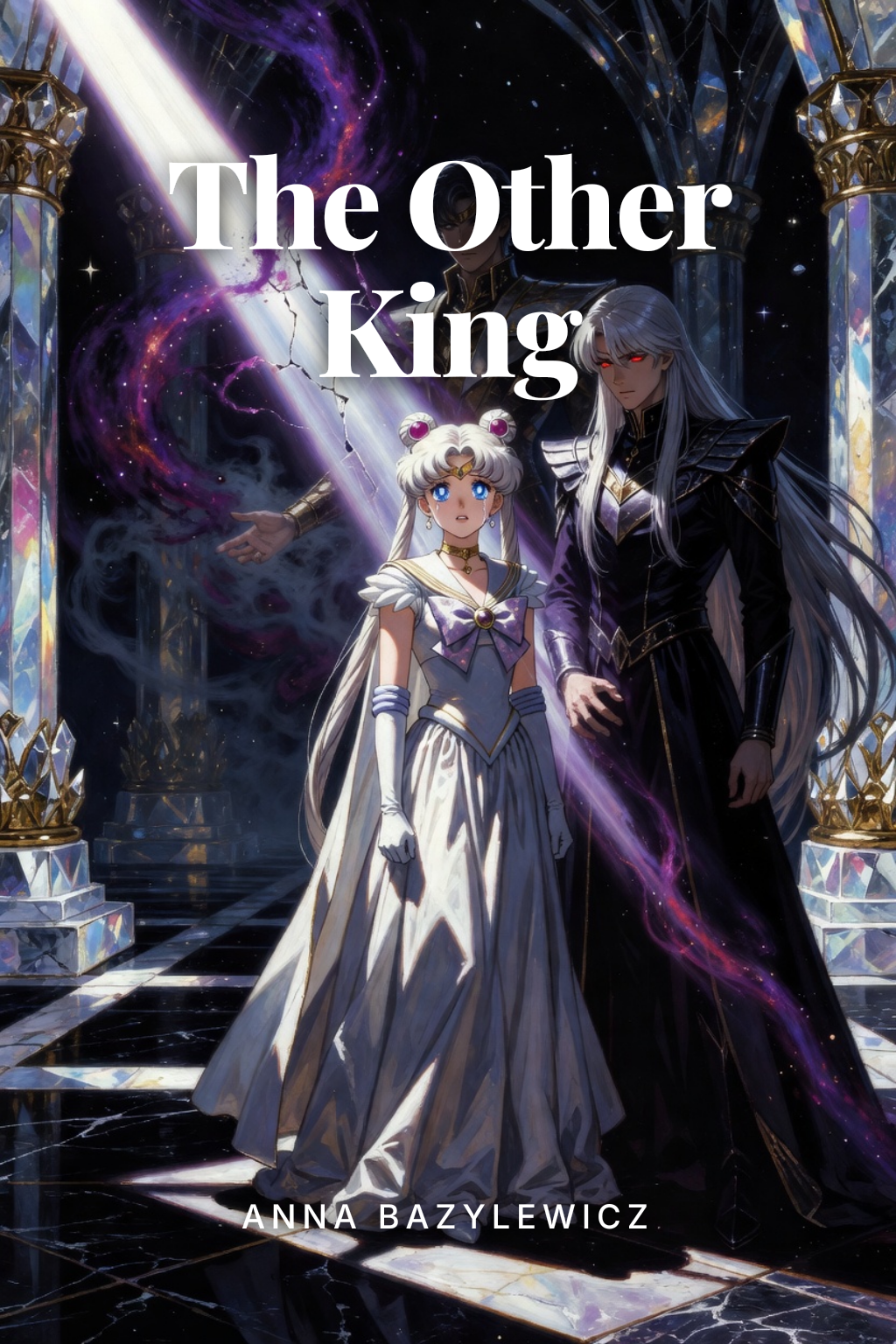
Novel · 8 chapters · 34,364 words
The Other King
Contents8 chapters
Chapter 1
The Fracture in Crystal Tokyo
The crystal dais had been polished until it held every face twice.
Usagi stood three steps below the throne platform with her gloves folded tight in one hand, smiling because the hall expected it, because a thousand citizens had come in white and silver and pale spring colors to watch the Renewal Oath, because the great chandeliers grown from the palace ceiling were throwing clean light over banners, lacquered staffs, polished boots, and lifted hopeful eyes. Crystal Tokyo knew how to stage devotion. Even the air seemed arranged—lily smoke from the censers, a trace of beeswax, cold stone breathing under all that brightness.
At the far end of the hall, musicians in moon-pale uniforms held a note on glass strings so thin it seemed to rest on the inside of her teeth.
“Don’t clench your jaw,” Minako murmured without moving her mouth. “You look like you’re about to bite a diplomat.”
Usagi loosened her teeth and shot her a look from the corner of one eye. “Maybe I am.”
“A true queen smiles first and bites later.”
“Minako.”
But that almost made her laugh, and for a second she was grateful. The court on ceremonial days turned every movement into a performance. Rei stood on her other side, spine straight as a spear, dark hair pinned beneath a formal circlet of red-gold metal. Ami held a scroll case with both hands. Makoto had already spotted three places where one of the side arrangements was off balance and was suffering quietly through it. They looked magnificent. They looked like certainty.
Ahead of them, King Endymion stood in black formal silk, one white-gloved hand resting on the pommel of the ceremonial sword he would not draw. Light touched the edge of his profile—the calm brow, the dark fall of hair, the stillness he had learned as king. Beside the throne, Neo Queen Serenity sat beneath the great arc of the palace seal. Her gown spilled down the steps like poured milk, and the Silver Crystal above her breast gave off its own living shine, soft and merciless.
Chibiusa waited near the base of the dais, trying very hard to look solemn and only succeeding in looking like a child forced into too much satin. She caught Usagi’s eye. For an instant the princess face broke, and there was the familiar secret grimace over ceremonial shoes pinching her heels.
Usagi almost winked.
The herald struck the floor with his staff.
“By light preserved and city renewed, let the oath be spoken.”
The hall settled. Silk hushed. Even the smallest children went still.
Neo Queen Serenity rose. “People of Crystal Tokyo—”
Her voice rang clean through the chamber, rich with the resonance the throne gave her. Usagi had heard it before. It usually comforted her. Today it pressed at the base of her skull.
She told herself it was the crowd, the brightness, the way ceremonies stretched simple promises into things too large to breathe around. Endymion’s hand moved as Serenity spoke, the smallest shift of fingers against the sword hilt, and with it came a flicker in Usagi’s mind so vivid she almost gasped.
A breakfast table by a high eastern window. Steam rising from tea. Chibiusa, smaller, sulking over arithmetic. Endymion laughing quietly as he peeled an orange in one unbroken spiral.
The image vanished at once. Not a memory exactly. More like a jewel turned in light—complete, polished, impossible to touch.
Usagi’s fingers tightened around her gloves.
Serenity went on speaking about peace and stewardship and the old promise that the city would shelter every heart faithful to the light. Citizens bowed their heads. Crystals set into the columns answered with a low glow.
Another flash came.
Snowmelt dripping from palace eaves. A child’s fever-warm forehead under Usagi’s palm. Endymion asleep in a chair beside a bed too small for him, his head bent at an angle that would ache when he woke.
Usagi blinked hard. The dais edges sharpened, then blurred, then righted themselves.
Rei’s sleeve brushed hers. “You’re pale.”
“I’m fine.”
Rei did not look convinced, but the oath had reached the part where the guardians were to step forward in witness. There was no room for fine.
The herald called them. Ami first, then Makoto, then Minako, then Rei. Usagi followed as the fifth, climbing the crystal steps while the hall watched. The soles of her shoes clicked in measured beats. The throne seal beneath her feet was inlaid with silver lines that made a branching moon, Earth rose, and the symbols of the planets. She had stood there before.
Or had she?
King Endymion turned toward them. His expression softened when it found her, and that softness struck too deep. It should have steadied her. Instead it opened another seam.
A hand closing around hers in darkness. Not Endymion’s hand. Longer fingers. Colder palm. A voice near her ear, roughened by urgency and disbelief.
Beloved.
The word did not come from the hall. It came from nowhere she could name, from some chamber behind the chamber of her thoughts. Usagi stopped breathing for a beat.
Ami finished her vow. Makoto stepped back. Minako’s voice rose clear and bright. Usagi stared at Endymion and for one deranged instant thought: I know your face, but I have learned it twice.
The strange voice came again, closer, intimate not in tenderness but in recognition sharpened to a blade.
Sere.
No one had called her that.
Not Serena, not Serenity, not Usagi. Sere—clipped, private, as if the rest of the name belonged to no one else.
The hall bent.
It happened without warning. The crystal beneath the throne seal flashed red at the edges. The polished floor was no longer the floor but a long black corridor lit by a pulse of scarlet lamps. Velvet banners hung torn and smoking. A man stood at the far end in a white military coat slashed with red, one hand braced against the wall as if he had crossed impossible distance to reach her.
His silver hair fell over one eye. The visible eye burned—not with rage, not then, but with something more dangerous because it hurt to look at. Need. Recognition. Grief held under force.
“Sere.”
This time his mouth moved with the name.
Usagi’s chest seized. She knew him. Every tale told in Crystal Tokyo, every warning, every old report named him enemy, usurper, prince of Nemesis, the man who had wanted what was not his.
Prince Demando lifted his hand toward her.
The hall slammed back into place.
Usagi staggered. The oath room lurched sideways in crystal facets and white silk. Someone said her name. Her gloves hit the floor. Then the branching silver lines under her feet flared all at once, brilliant as struck ice, and a crack split through the center of the seal.
The sound was small. The silence after it was not.
Citizens recoiled in a collective intake of breath. The musicians let their strings die mid-note. Chibiusa made a startled sound from below the dais.
Usagi dropped to one knee, palm pressed to the cold crystal as if that would hide what everyone had seen. A hairline fracture ran under her hand from the moon emblem through Earth’s circle and across the mark beneath Endymion’s feet.
“Usagi.” Endymion was beside her at once.
His hand touched her shoulder. For a shattering second she almost flinched away. The shame of that hit harder than the vision.
“I’m all right,” she said too quickly.
“You nearly fell.”
“I said I’m all right.”
The words came out sharper than she meant. They hung there between them. Around the dais, the court had gone motionless with the tact of people pretending not to hear the things they heard.
Neo Queen Serenity descended one step from the throne. The Silver Crystal at her breast had dimmed from ceremonial brilliance to a more focused glow. “Stand back.”
It was not loud, but everyone obeyed. Endymion’s hand left Usagi’s shoulder.
Usagi pushed herself upright. Her knees felt unreliable. She was aware of Luna slipping through the outer line of attendants in a streak of dark fur and crescent gold, of Artemis appearing near Minako’s hem, of Rei’s eyes narrowing already with calculations she did not like.
Serenity looked not at the crack in the dais but at Usagi’s face. “What did you see?”
Not what happened. Not are you hurt. What did you see.
Usagi swallowed. “I don’t know.”
A lie too thin to survive inspection.
“Did someone project into the hall?” Rei asked. She had moved half a step forward, instinctively placing herself between the crowd and the throne.
Ami knelt by the fracture, gloved fingertips hovering over the silver-lit line. “There’s energy residue, but it isn’t external. It rose from the seal itself.”
“That’s impossible,” Makoto said.
“Nothing is impossible in this palace,” Minako said, very soft.
Endymion held out a hand to Usagi. “Come away from the mark.”
She looked at his hand and saw, absurdly, another one over it—Demando’s in that red-lit corridor, lifted not in command but appeal. The overlap made her stomach turn.
She took Endymion’s hand because everyone was watching, because refusal would be its own declaration. His grip was warm, steady, familiar. She had loved that steadiness once with no effort at all. She still should.
Should. The word rang like a dropped coin.
“Clear the lower floor,” Endymion said to the chamberlain without taking his eyes off Usagi. “The oath is suspended.”
A ripple moved through the hall. Suspended, not canceled. A sentence built for later repair.
Chibiusa broke formation and darted up the steps before any attendant could stop her. “Mama—” She checked herself, glancing at Serenity, at Usagi, then at the crack. “Usagi, are you hurt?”
“I’m okay.” Usagi knelt enough to meet her eyes. Chibiusa’s small gloved hands gripped her sleeves with frightened firmness. “Really.”
But Chibiusa was looking at her as if searching for the missing piece of a face she knew by heart.
Luna reached them and sprang lightly onto the dais. “I need a direct look at your pupils.”
“Now?”
“Yes, now.”
That pulled a strained huff of laughter from Minako, thank God. The sound broke some of the frozen attention around them. Courtiers began to move under the chamberlain’s instructions, silks whispering, shoes ticking, a hundred people pretending the center of the world had not just split open under the royal oath.
Luna’s blue eyes narrowed as she studied Usagi. “There was a psychic intrusion.”
Rei folded her arms. “From where?”
“That’s what I’d like to know.”
Serenity descended the remaining steps. Citizens nearest the aisle dropped lower as she passed, but she did not acknowledge them. Her gaze stayed fixed on Usagi. Up close, she looked less like a distant queen and more like a blade wrapped in silk. Beautiful, controlled, dangerous because of both.
“Not here,” she said. “We go to the antechamber.”
Usagi did not want enclosed walls. She did not want the queen’s calm. She did not want Endymion’s hand hovering near her elbow as if she might break. Most of all she did not want the feeling, growing like a bruise under her ribs, that Serenity’s first expression after the fracture had been fear and not surprise.
They moved through a side arcade cut from clear crystal veined with pale gold. The public brilliance dropped away behind them. In its place came the quiet sounds of the inner palace: the muted rush of fountain channels beneath the floor, distant footfalls, a door mechanism sliding shut. Attendants halted at the threshold of the Moon Antechamber. Only the guardians, Luna, Artemis, Chibiusa, Endymion, and the queen entered.
The room smelled faintly of iris root and old paper. Moon emblems had been worked into the lattice screens. On one wall hung a map of the city in silver thread, each district marked by tiny stitched crystals that caught the light. Usagi had always liked this room. It had corners. It admitted the fact that people actually lived in the palace.
Serenity raised one hand. A veil of light spread over the doors.
“No one listens from outside,” she said.
Usagi laughed once without humor. “That’s reassuring.”
Endymion looked at her sharply. “Usagi.”
“No, let her speak,” Serenity said.
That was worse.
Luna leapt onto a low lacquer table and flicked open a compact monitor with one paw. “Tell me exactly what occurred before the seal cracked. Every detail.”
Usagi peeled off one glove finger by finger. Her hands had started shaking and she was furious about it. “I heard a voice.”
Silence tightened.
“A male voice?” Ami asked.
“Yes.”
“Recognized?”
Usagi looked at the map instead of their faces. The stitched palace district glittered at the map’s heart. “Maybe.”
“Usagi,” Endymion said, gentler now, “who?”
If she said his name aloud, would that make the vision more real? The answer arrived before the question settled. Real or not, it had already changed the room.
“Demando.”
Chibiusa inhaled. Makoto swore under her breath. Artemis’s ears flattened.
Rei spoke first. “An attack, then.”
“Not necessarily,” Ami said, though her voice lacked conviction. “If the residue came from the seal—”
Minako cut in. “You’re saying the palace itself decided to impersonate one of our worst enemies?”
“It’s not impersonation if a trace of him remains in the structure,” Ami said. “The city has absorbed stranger things after the battles it survived.”
“Stop speaking around me,” Usagi said.
They did.
She set her glove down on the table too carefully. “I saw him.”
Serenity’s face did not change. That stillness was an answer in itself.
“In the hall?”
“No.” Usagi pressed fingers to her temple. “Somewhere else. A corridor, maybe. Dark. Red lights. He was—” She hated that her voice faltered here. “He called me something.”
“What?” Luna asked.
Usagi hesitated. The name felt like contraband in her mouth. “Sere.”
No one reacted. Not at first. It was such a small thing, barely a name. A shortening. A private habit.
Then Serenity turned away and crossed to the lattice screen.
The movement was so slight it might have meant nothing to anyone else. To Usagi it landed like a dropped plate.
“You know it,” Usagi said.
Serenity’s hand rested on the carved frame. “It is a fragment. Fragments mislead.”
“You know it,” Usagi repeated.
Endymion stepped between them without seeming to. “We don’t know what shape this interference took. Nemesis specialized in psychic pressure and distortion.”
“Nobody said anything about Nemesis except all of you.” Usagi looked at him and found she was angrier with each measured word he chose. “I said I saw him. I didn’t say he attacked me.”
“That distinction matters very little if he got into your mind.”
“What if he didn’t get in?” she said. “What if he was already there?”
The room went so still even the fountain channels under the floor seemed to hush.
Chibiusa’s hand found Luna’s tail and clung. Luna did not protest.
Rei moved off the wall. “Usagi, be careful.”
“With what? My own thoughts?”
“With conclusions someone may want you to make.”
Usagi turned on her. “And what conclusion do you want me to make?”
A crackle ran through the light veil over the door. The room’s crystal sconces dimmed, then steadied. Ami looked up at once, alert.
Luna’s monitor chimed. “There,” she snapped. “Again.”
Everyone looked to the screen. Lines of pale blue data were racing across it too fast for Usagi to read. A waveform pulsed in the center, splitting and overlaying itself, one pattern almost matching the other and failing by a hair.
“What is that?” Endymion asked.
“Resonance output from the throne seal, the queen’s crystal, and…” Luna’s ears flattened more tightly. “Usagi.”
Ami came close, peering at the screen. “There are two memory harmonics.”
Usagi stared at her. “Two what?”
“In your aura imprint,” Ami said, already slipping into the clean precise tone she used when panic needed cutting into measurable parts. “Everyone leaves a pattern when they interact with a site like the oath seal. Yours is… doubled.”
Minako gave a short, incredulous laugh. “That doesn’t happen.”
“No,” Ami said. “It doesn’t.”
Usagi looked from the screen to Serenity. “What does that mean?”
Serenity did not answer at once. Beyond the lattice, light from the corridor threw bars across the floor. Her profile was turned away. Endymion’s jaw had gone rigid, but he also said nothing.
The silence lengthened until it became unbearable.
“It means,” Luna said carefully, “that the seal recognized conflict in your memory alignment.”
The words were technical, almost bloodless. Their meaning was not.
“Conflict,” Usagi repeated. “As in damaged?”
“As in one set of emotional-anchor imprints is resting over another.” Ami’s hands tightened around the scroll case she still carried; she had forgotten to set it down. “That can happen after severe psychic injury. Or imposed illusion. Or—”
“Stop,” Endymion said.
Ami stopped.
Usagi heard only the one word she needed. Imposed.
She took a step toward Serenity. “Look at me.”
The queen turned.
In public, Neo Queen Serenity’s face was a calm moon, perfect enough to pray to. Here the perfection had thinned. Something older and harder showed through. Not guilt, not exactly. Calculation under strain.
Usagi knew that face. She had seen it on Serenity when the queen weighed costs no one else had accepted yet. It was the face of someone already carrying out the terrible thing while deciding whether to admit it.
“Did you know this could happen?” Usagi asked.
“Visions occur around old enemies,” Endymion said before Serenity could speak. “Particularly where the Silver Crystal’s power has saturated stone for centuries.”
Usagi did not take her eyes off Serenity. “I asked her.”
Chibiusa whispered, “Mama…”
The title drifted through the room and seemed to strike more than one person.
Serenity descended into composure again. Usagi almost hated her for how beautiful she looked doing it. “I knew there were unstable regions in the palace memory lattice.”
That was an answer to a different question.
Rei caught it too. Her gaze sharpened.
Usagi felt something cold unfurl behind her breastbone. “And did you know my mind would react to them?”
Serenity was quiet for one beat too long.
Endymion stepped in again. “This is neither the place nor the hour.”
“That’s what people say when the answer is yes.”
“Usagi.”
His voice carried warning now. Concern wrapped around command. Maybe on any other day she would have yielded to it. Today it landed wrong, as if part of her knew the shape of being soothed and mistrusted it.
Another flicker cut through her. Not a complete vision this time. Pieces.
A white room with its curtains drawn. The smell of moonflower oil burning in a dish. Serenity’s hand on her forehead. A sentence she could almost hear: You will rest easier without—
Without what?
Usagi sucked in air.
The floor beneath them hummed.
At first she thought it was the fountain channels. Then the hum deepened into a note she felt in her bones. Every crystal in the room answered at once, a faint ringing like struck glass held just below pain. The map on the wall lit district by district. The silver stitches around the palace flared brightest. A line of light moved through them like blood through veins and stopped under Usagi’s feet.
Luna stared at the monitor. “No.”
The waveform had changed. The two patterns on the screen were no longer merely overlapping. One was trying to rise.
The room’s nearest wall—solid crystal, flawless, decorative and dumb—shivered and gave back a sound that was not quite sound. A voice caught in structure. Distant. Male. Broken by static and stone.
…Sere…
Every hair on Usagi’s arms rose.
Chibiusa cried out and stumbled back into Makoto. Artemis hissed. Minako’s hand flew to the chain at her waist by reflex. Rei’s expression went white, then furious.
The voice came again, dragged through the palace foundations, unmistakably reaching for her.
…remember…
Endymion moved at once, putting himself between Usagi and the ringing wall as if he could block resonance with his body. “Seal the chamber.”
Serenity did not move.
Usagi looked past him at her future self. “You heard that.”
“Yes,” Serenity said.
“Who is he to me?”
Endymion turned. “Enough.”
“No.” Usagi’s voice cracked and then sharpened. “No, I am done being managed.” She stepped around him before he could stop her and went straight to the wall where the light had gathered. It was cold enough to sting when she pressed her bare palm against it. The humming surged. Images flashed behind her eyes, too fast to sort—white hands stained red at the knuckles, black roses crushed under a boot, Demando kneeling as if before a sentence, not a throne.
Then one clear impression, hot as a brand:
Not stolen. Hidden.
Usagi jerked her hand back. “Something is in here.”
“In the palace lattice,” Ami said, horrified now rather than merely curious. “An embedded mnemonic packet.”
Luna whipped around. “Embedded by whom?”
No one answered.
That silence was answer enough.
Rei took one step toward Serenity. “My queen.”
It was an old form of address, formal enough to cut. Serenity met her eyes, and something unreadable passed between them.
Usagi noticed. Filed it away. The room was filling with too many fractures to hold.
“Say it,” Usagi demanded.
Endymion’s restraint finally broke. “You are exhausted, shocked, and reacting to hostile residue from a dead enemy. Whatever this is, we will investigate it in proper order.”
“Proper order?” She laughed again, and this time it sounded ugly even to her. “The wall just called me by a name I’ve never heard, except somehow it felt older than my own. Your palace says my memories don’t match themselves. And you want order.”
“I want you safe.”
“Safe from what?”
He did not answer fast enough.
Usagi looked at Chibiusa. The child’s face was pale, bewildered, frightened by the adults and trying not to show it. Some part of Usagi reached toward her automatically with ache and protectiveness so immediate it hurt. Another part stood a pace behind that feeling, watching it arrive, asking a question she could not bear yet.
When did this begin? The love, the memory, the certainty of belonging to this shape of life?
The breakfast window. The fevered child. The sleeping king by the bed. Beautiful scenes. Complete scenes. Too complete.
She had spent enough time with false dreams and enemy illusions to know how they behaved. They drowned you in detail or starved you of it. These domestic flashes were stranger. They had emotional weight, but their edges felt polished smooth, without the harmless nonsense of real days. No spilled jam. No lost hair ribbon. No laugh cut off by a cough. Memory without accident.
Manufactured things often forgot the mess.
Luna shut the monitor with a snap. “We need a private scan chamber and the restricted archives.”
At that, Serenity’s gaze sharpened. “Not yet.”
The refusal came too quickly.
Usagi turned to her fully. “Why not?”
“Because half the palace felt that resonance just now. If there is contamination in the memory lattice, panic will outrun truth. We proceed carefully.”
“There’s that word again,” Usagi said.
Outside the sealed doors came the faint stir of running feet. News was already moving.
Rei’s voice cut through the rising pressure in the room. “Majesty, if records exist on mnemonic alteration, we need them before this spreads.”
Serenity looked at her, and for a breath the room was narrowed to those two women—the queen in white and the guardian in crimson. Something old and flint-hard sparked there. Usagi did not understand it, only felt the heat.
“Later,” Serenity said.
“No,” Usagi said.
The word surprised all of them, perhaps herself most of all. It did not sound like a plea. It sounded like a door being shut.
Everyone looked at her.
Usagi drew in one breath, then another, and steadied. The shaking in her hands had stopped. In its place was a clarity she did not trust but would use.
“If this is an attack, I want proof. If it isn’t, I want the part of my life someone buried.” Her eyes stayed on Serenity’s face. “You won’t keep me smiling through another ceremony while my own mind splits under me.”
The humming in the wall had faded, but the crystal still held a dull inner glow where her palm had touched it. Under that light, tiny imperfections showed in what had seemed flawless—minute lines, trapped bubbles, stress marks hidden until the right pressure found them.
The palace doors shuddered once under a hurried knock from outside.
Inside, no one moved.
Then, from somewhere deep below the antechamber, far under polished halls and throne rooms and all the careful brilliance of Crystal Tokyo, a second answering note rose through the floor—lower, older, deliberate.
Not an echo.
A reply.
Chapter 2
The Archive Beneath the Palace
Usagi did not wait for permission.
By the time Endymion came around the side of the council gallery, she already had one hand under the carved lip of the moonstone console and the other braced against the wall panel Luna had marked with chalk years ago during a survey of the palace’s lower wards. It looked like decoration to anyone who had not spent enough nights in this building listening to what hummed behind it. A ring of silver inlay. A spray of stylized reeds. Nothing that admitted to being a door.
“Usagi.” His voice struck hard against the marble. “Stop.”
She found the hidden catch with her thumb. It gave under pressure with a small mechanical click, almost prim, and a seam opened in the wall.
Good. Some things still yielded when touched in the right place.
Luna landed lightly on the floor beside her, tail stiff. “I told you the maintenance locks were still keyed to the old lunar registry.”
“Wonderful,” Usagi said, and pulled the panel wider.
Cool air breathed up from the dark. Not fresh air. Stored air. Stone, metal, old paper sealed too long away from hands.
Behind them the gallery lamps burned in clear crystal bowls. Ahead, the stairway plunged between walls lined with pale mica that caught the light and buried it. A servant passage once, maybe, before Crystal Tokyo had polished every useful thing into ceremony.
Endymion reached her before she set a foot on the first step. His white gloves were gone now. He had stripped them off somewhere between the antechamber and here, and the sight of his bare hands unsettled her more than the raised voice. His control was always dressed.
“This is sealed for a reason.”
“Then whoever sealed it can explain themselves after I’m done.”
“It may contain unstable mnemonic matter.”
She looked at him. “That sounded rehearsed.”
A flinch lived at the edge of his mouth and vanished. “I am trying to prevent further damage.”
“To the palace,” she said. “Or to me?”
He did not answer soon enough again. It was becoming a habit with him, these half-heartbeats where truth showed through the joints.
Serenity arrived without hurry and somehow made that worse. White silk whispered over the floor. The Silver Crystal at her breast gave off a steady light so soft it seemed innocent. Usagi hated that, suddenly—how innocence could be arranged like costume.
“Usagi,” Serenity said, “if there are archived impressions below, they were sealed under protocols meant to contain confusion, not create it. Let Luna and Ami examine them first.”
“Ami would tell me what she found.”
“She would tell you what can be verified.”
“So would I.”
Luna made a dry sound in her throat that might have been a laugh in a less dangerous room.
From the far corridor came the muffled hurry of officials pretending not to run. News had teeth tonight. It was already in the walls.
Usagi rested her hand on the open stone panel. “If I walk away now, will you open this archive for me in the next hour?”
Serenity said nothing.
“The next day?”
Silence.
Usagi nodded once, as if that settled an arithmetic problem. “Move.”
“Don’t do this by force,” Endymion said quietly.
That quietness cut more than if he had shouted. For an instant she saw, not him as king, but the man from those polished memories: dim bedside lamp, loosened collar, his hand asleep over a blanket edge beside a feverish child. Tenderness laid out in careful scenes. Complete scenes.
Too complete.
She stepped down.
Endymion caught her wrist.
Not hard. He had never needed hard. The hold was familiar enough to have muscle memory in it, and because of that her body nearly accepted it before the rest of her recoiled.
Luna’s ears flattened. “Majesty.”
Usagi looked at his hand, then at him. “If you have to hold me in place to keep me from my own records, that makes my argument for me.”
His fingers loosened.
Not all at once. One by one, as if each had to be convinced separately.
Serenity’s face remained composed, but something sharpened under the smoothness. “Take a lantern, at least. The lower sensors won’t answer until the wards are manually tripped.”
“I know where the lanterns are,” Luna said.
Usagi did not thank either of them. She took the stairs two at a time for the first flight, then slowed when the passage narrowed and the air grew colder. Luna padded ahead into the dark, and somewhere above, stone ground softly as the hidden panel folded shut again, cutting off the court, the light, the waiting faces.
For six steps the only sound was their breathing.
Then Usagi said, “Did you know?”
Luna did not turn. “No.”
“You knew there were restricted archives.”
“I knew there were sealed vaults beneath the palace. Every old capital has places it would rather forget. That isn’t the same thing.”
The stair bent left, then right. Their shadows swung long across the mica-veined walls. At the first landing stood an iron bracket, black with age, holding a lunar lantern the shape of a hanging seedpod. Luna sprang to the shelf below it, nosed the latch, and the crystal wick woke with a low blue flame.
The light showed scratches on the floor. Not ancient. Repeated use, boots dragging crates, metal corners grazing stone.
Usagi touched one of the marks with the tip of her shoe. “Someone comes down here.”
“Someone always does.”
“Not the kind of someone who files old festival banners.”
Luna lifted the lantern handle in her teeth and trotted on. The blue light slid over walls engraved with faded sigils—Moon script, old Earth court marks, logistics notations from before Crystal Tokyo had turned everything into music and glass.
Usagi ran her palm along the stone as she walked. Here the palace felt older than it looked above. Not eternal. Built. Revised. Covered over. There was a comfort in that, bitter as it was. Perfection could crack. Construction left seams.
At the second landing they came to a bronze gate webbed with sealing wire. Wax medallions hung from it in broken clusters. The wax had once been royal white; now it had gone the color of bone left in dust.
Luna set down the lantern and sniffed the lockplate. “This was opened recently.”
Usagi crouched. Tiny bright lines scored the metal around the keyhole. Fresh enough that the bronze still showed through beneath the tarnish. Someone had taken care, but not infinite care. The difference mattered.
“Can you open it?”
“I can try. Stand back.”
Luna pressed one paw against the lower rune circle. It flickered, resisted, then gave with a crackle like salt thrown on flame. The gate shuddered inward an inch.
Usagi caught it and pulled.
The hinges groaned. Dust drifted from the arch overhead. Beyond lay a corridor lined with narrow cabinets of dark cedar bound in silver. The air changed at once—drier, more layered. Ink. old vellum. resin from preservation chests. Beneath it all, the faint medicinal sting of memory crystal, like struck glass and winter leaves.
No one spoke.
The place demanded quiet on its own.
At the corridor’s end stood a circular chamber with a low domed ceiling painted in constellations gone dim with age. Shelving radiated from a central plinth like spokes. Some held scroll canisters. Some, crystal tablets suspended in wire nests. Some, lacquer boxes stamped with reign marks and hazard glyphs. On the floor, brass tracks described circles within circles, as if whole racks could once be moved to align with readers that were no longer there.
Usagi turned slowly. “How much of history is this?”
“The parts they didn’t want in the upper libraries,” Luna said.
On the nearest shelf, a placard had been removed so recently that the unfaded square behind it still showed. Empty hooks remained. Beside it, index rods had been snapped off and taken.
Usagi exhaled through her nose. “Careful containment.”
Luna’s whiskers twitched. “Start with registry cases. If somebody erased a line of record, there’ll be mismatches. Archives hate gaps.”
Usagi set the lantern on the central plinth. Its blue light pooled over a metal surface engraved with an old lunar catalog wheel. Whole categories had been scratched out and renamed across generations. Governance. Ceremonial succession. Diplomatic correspondences. Restricted psychic events. The gouges where titles had been changed were rough and visible beneath the polish, like scars under powder.
Her fingertips paused over one cut phrase.
Nemesis Relations.
Scrubbed through so hard the metal had furred upward at the edges.
“Luna.”
The cat jumped up beside her and peered at the ring. Her tail lashed once. “That category was stricken, not reclassified.”
“Can they do that?”
“Only under direct authority or emergency seal.”
Usagi looked at the scratched metal a moment longer, then moved toward the spoke marked diplomatic correspondences. Shelf after shelf. Lunar embassies, Jovian levies, Venusian trade compacts, Martian temple advisories, Earth court memoranda.
Earth court.
Her hand stopped over a line of cedar drawers, each fronted by a moon-silver pull and a tiny label frame. Most were neatly marked. Third Kingdom grain records. Continental ward repairs. Crown audience schedules. Then, between two full drawers, one sat unlabeled.
Not blank. Deliberately blank. The frame had been emptied.
Usagi slid it open.
Inside lay a stack of crystal leaves bound by wire, the top sheet clouded as if someone had tried to frost it from within. Not enough to destroy, only blur.
She lifted the packet carefully. The crystal was colder than the air. When she tilted it into the lantern light, script rose in suspended silver threads.
Correspondence intercept log: Nemesis channel seven.
Below that, a different hand had stamped CLASSIFIED under triple seal.
Luna came up beside her so fast the lantern light shook. “Intercept log? Crystal Tokyo kept war records on Nemesis raids, but not channel logs. Those were supposed to have been lost.”
“They weren’t lost.”
Usagi laid the packet on the plinth and touched the activation rune. The top leaf brightened. Script arranged itself.
Transmission fragment, source identified as Prince Demando.
Usagi’s throat tightened. She had expected lies. Proof of manipulation. Perhaps some obscene forgery meant to bait or trap. What rose before her was almost worse for its plainness.
…do not answer this through the formal line. They hear what passes through Earth’s council relays. If she is under the moon wards tonight, use the old signal on the west tower. She will remember the bell sequence if she hears it twice…
Usagi read it again.
And again, slower.
She had no memory of a west tower. No bell sequence. Yet as her eyes moved across the words, a tiny sensation passed through her—not an image, not yet, but the bodily certainty of waiting in darkness for a sound one knows better than speech.
Luna read over her shoulder. “There’s no addressee.”
“There doesn’t need to be.”
The next fragment had been clipped and reattached after damage. Some words were gone.
…I would spare her what comes if I could. They call me deviant, mad, enemy. Let them. Better their names than her chains. Tell S— if she doubts me still, look to the broken seal beneath the Earth throne. It was never meant to answer to him…
Usagi’s hand flattened on the plinth.
Never meant to answer to him.
Luna inhaled sharply. “There were claims during the Black Moon campaign that Demando was obsessed, delusional, fixated on—”
“On me.” The word tasted strange. “Yes. That was the story.”
She turned the leaf. Another entry.
Visual contact report. Subject designated Princess Serenity observed in unauthorized meeting, archive code redacted.
Unauthorized meeting.
Recorded by whom? Ordered by whom? The line below that should have named the witness, but the identifier field had been burned out with precision so exact it left the rest intact.
Usagi bent close. The crystal surface showed faint spidering where heat had been applied. Not battlefield damage. Workshop damage.
She skimmed the report.
Location: substructure corridor, outer lunar annex.
Present: source Demando; subject Serenity.
Heard: incomplete.
Recovered phrases: “not your enemy,” “they chose for us,” “if you return there they will close it.”
The rest dissolved into static.
The domed chamber seemed to lower around her. Not your enemy. They chose for us.
Luna said, “This could still be partial. Intercepts can be altered.”
Usagi reached for the next leaf too quickly. The wire snagged her finger. A bright bead of blood welled at the cut and slid onto the crystal. For a second the whole packet flared white.
The room answered.
Shelves hummed. Somewhere behind the walls, old readers woke with a dry clicking sound. A hidden panel on the far side of the chamber rolled open a hand’s width, then another, exhaling trapped dust and the bitter smell of oxidized metal.
Luna sprang backward, fur up. “Usagi!”
But Usagi was already moving toward the opening.
Behind the panel was a shallow compartment, no bigger than a wardrobe, with three long cases laid inside on felt gone threadbare. The first case bore the Earth insignia in black enamel. The second, the moon crest. The third had no crest at all—only a six-point sigil stamped in dark red lacquer.
Mars.
Even before she touched it, the air around that third case felt wrong. Not dangerous. Recognizing.
Usagi lifted it out with both hands. It was heavier than it looked. Dust had gathered thickly around its edges except where fingers had recently cleared a path to the latch.
“Someone knew this compartment would answer blood-keyed resonance,” Luna said softly.
Usagi glanced at her. “Meaning?”
“Meaning this wasn’t random storage. It was set to open for someone with your line imprint. Or with a close enough facsimile.”
That word again. Line. Imprint. Everything in this future seemed obsessed with blood and memory and rightful shape, while actual truth was shoved into wall cavities like contraband.
She laid the Mars case on the plinth and undid the latch.
Inside, instead of crystal leaves, were paper documents wrapped in oilskin. Real paper, yellowed at the edges, tied with braid. The top bundle carried a tag written in a narrow hand.
Earth succession review, emergency session.
Luna made a small sound of disbelief. “Paper was used when they didn’t want psychic bleed copied through crystal media.”
Usagi untied the braid.
The pages smelled faintly of clove preservative and old smoke. The first sheet listed attendees, though two names had been scored through so heavily the paper had nearly torn. Others remained.
Queen Serenity.
General council observers.
Mars representative, Princess Rei Hino.
Earth sovereign delegation—
The rest of that line had been cut away.
Usagi turned the page.
The writing shifted from formal notation into condensed summary, the kind made by a clerk too frightened to be elegant.
Question presented: response to throne resonance during Earth reclamation rites.
Observation entered: central seal did not stabilize under designated Earth claimant.
Counter-observation: seal response transferred upon proximity of Mars representative.
Dispute recorded.
Transferred.
Upon proximity of Mars representative.
Usagi read the line once, then once more until the words lost shape.
Luna’s voice was very quiet. “Keep going.”
The next page held columns of objections and counterarguments. Some used the language of military necessity. Some of public order. Some of symbolic continuity. One sentence had been underlined hard enough to emboss the page beneath it.
Earth cannot sustain a visible sovereign fracture during reconstruction.
Another line, further down, in a different hand:
The old pacts place war and guardianship in Mars, not domestic rule. The seal may be reacting to residual battlefield charge, not legitimacy.
Below that, in darker ink:
Temple record from pre-Silver reign confirms otherwise. The red line stood at Earth’s center before moon alliance standardization.
Usagi looked up.
The chamber felt very still. Luna’s pupils were wide.
“The red line,” Usagi said.
“An old designation,” Luna answered. “Before the planetary courts were formalized. Mostly obsolete.”
“Obsolete enough to cut out of official history?”
Luna did not reply.
Usagi turned pages too fast now, hearing paper whisper and snap under her hands. Notes on heraldry. Maps of throne wards. A copied temple extract describing a union of crown and flame in language so old half the syntax had to be glossed in margins. A genealogical wheel where one branch had been painted over, then later peeled back by somebody impatient enough to damage the parchment. Under the scraped pigment, a mark bloomed in cinnabar beside Rei’s line.
Center claim.
Not consort. Not guardian. Center.
The word sat there with the obscene clarity of something simple hidden under years of speech.
“Endymion’s line,” Usagi said, “was never the anchor.”
“No,” Luna said, after a pause that cost her. “Not if this record is genuine.”
Usagi laughed once under her breath, not from humor. The sound died quickly in the chamber.
“Genuine enough to lock under three seals.”
She set the succession papers aside and reached for the Earth-insignia case. This one held thinner packets, crystal-backed and cross-referenced. Several index tabs had been ripped out, leaving ragged glue marks. One surviving label read Family Continuity Program.
Usagi stared at it.
“Open it,” Luna said.
She did.
Inside were domestic image scripts.
Not memories exactly. Templates. Suggested household sequences keyed to emotional reinforcement. Recovery lullabies. Meal scenes. Illness vigils. Seasonal rituals with a child present to stabilize attachment pathways after traumatic dislocation.
The language on the instruction leaf was bloodless, almost bureaucratic.
Subject cohesion improves when relational role is reinforced through repetition of low-threat sensory anchors.
Recommended anchors:
warm milk with honey after nightmare episode
shared window seat at dawn
father figure asleep in chair at bedside
child laughter in garden corridor
hand-sewn festival ribbons
minor household accidents to reduce idealization artifact
Usagi went cold all through.
Minor household accidents.
No spilled jam, she thought wildly. No lost ribbon by chance. Because chance had been listed as a requirement.
Luna’s claws clicked once against the plinth. “Usagi.”
She did not answer. She was reading the notation fields at the bottom, where execution approval should have been signed. Those fields had been excised. Clean rectangles cut from the leaves with a blade. Yet the pressure of the missing signatures had left dents in the backing. Anonymous hands. Very careful hands.
A separate slip had been tucked between the pages and overlooked or forgotten.
Adjustment note: child subject accepts revised continuity with minimal resistance when maternal certainty remains uninterrupted.
Her vision blurred for a moment. She put the slip down with exquisite care because if she did not, she might tear it to fibers with her fingers.
Chibiusa.
The word did not need writing. It was in every blank space around the note.
Luna lowered her head. “We don’t know that all of this was enacted exactly as written.”
Usagi turned to her. “You can smell the lie in this room and you’re still trying to make it softer.”
“I’m trying to keep you from deciding the whole shape before we have it.”
“The whole shape?” Usagi snapped. Then quieter: “Someone built my life like a stage set.”
The lantern flame guttered blue and steadied again.
Luna said nothing.
Usagi pressed the heels of her hands to her eyes until pinpricks of light burst there. When she lowered them, the chamber had not changed. Shelves. cases. dust. Paper with its corners squared by people who thought neatness absolved them.
She reached for the moon-crested case last.
This one resisted. The latch had been rewired with a thread of silver, not official issue. Luna sniffed it and bared tiny teeth.
“Private reseal,” she said. “After the archive was closed.”
“Can you break it?”
“Yes.”
The silver thread snapped under Luna’s ward pulse. The case opened with a sigh.
Inside lay letters.
Not bureaucratic records. Not summaries or excerpts. Actual folded sheets preserved between crystal plates, each bearing the same hand—slanted, forceful, impatient in places, unexpectedly elegant in others.
Prince Demando.
Usagi knew before she read the name. Some part of her knew him by pressure. The downstroke. The abrupt hooks where the pen had bitten harder.
The first letter was undated.
Sere—
My advisors insist I address you by title even here, as if titles matter in rooms built for listening. I am tired of rooms that listen. I write your chosen name because it is the only thing in this affair that ever felt chosen.
If this reaches you, then at least one path remains unguarded. If it does not, perhaps the walls will keep it and one day be forced to disgorge what they swallowed.
I was told today that your silence proves me deceived. I do not believe it. You were never silent in truth. Only interrupted.
Usagi swallowed.
The next lines had been smudged, not by age but by damp once shed and dried. Water? Tears? There was no way to know, and yet the possibility of either in his hand undid something sharp in her.
He wrote of negotiations. Of warnings ignored. Of a bond identified in old Nemesis star records and corroborated, he claimed, by lunar resonance. He wrote like a man fighting two wars at once: one against the kingdom that named him enemy, and another against language too blunt to carry what he meant.
You asked me in the lower hall whether destiny is only another word for conquest when men speak of it. I have thought of little else since. If I say I am bound to you, I sound like all the tyrants history deserves. If I say I choose you, I insult what moved between us before either of us had chosen anything at all.
So I will say only this: when you looked at me, the seal answered. Not to possession. To recognition.
Usagi closed her eyes.
Something brushed her mind then—so fast she nearly missed it. A corridor lit in intervals. White coat slashed with red. Silver hair falling over one eye. Not menace. Not first. Weariness, held tight like a wound wrapped under uniform. And her own voice, not heard but felt, asking a question that had stung him enough to become letter-ink later.
When she opened her eyes, Luna was watching her without blinking.
“You saw something.”
“A sliver.” Usagi touched the page. “Not because I wanted to.”
There were six letters in the case. Two had never been sent; their folds were uncreased. One was only half preserved. In one he begged her not to go before the Earth council without warding of her own. In another he wrote, with fury made neat:
They are moving pieces around a throne none of them understands. Earth’s center does not belong where they have placed it. Ask the red priestess what her fire does when she stands in the northern apse. Ask why they built your future husband’s seal wider each year, as if architecture could persuade a crystal to lie.
Usagi sat down on the low catalog step because her knees had stopped pretending to be reliable.
Ask the red priestess.
Rei.
Not an accusation, exactly. A direction. A line thrown across years.
Luna jumped lightly to the step beside her. For a while neither spoke. The letters rested between them, blue-lit and impossible.
At last Luna said, “The official histories paint him as unstable, fixated, predatory. These are not official histories.”
“No.”
“That doesn’t make him harmless.”
“I didn’t say harmless.” Usagi folded one letter back into its crystal sleeve. Her fingers had started shaking again, but it was a different tremor than before. Not confusion. Impact. “It makes someone a liar.”
The blue lantern threw a hard little glint off a metal strip tucked under the lining of the case. Usagi almost missed it. She slid a fingernail beneath the strip and pried it up.
A final sheet lay hidden there, thinner than the others, written in coded registry marks instead of prose. Beside each item was a status notation.
Intercept set A — archived
Succession review — restricted
Continuity scripts — approved
Private correspondence — sequestered
Origin authority — pending transfer
Below that, where a name should have been entered, there was only a seal impression so blurred by deliberate abrasion that no crest remained. Not Moon. Not Earth. Not Mars. Just a circle with its heart rubbed out.
Usagi stared at it.
Not destroyed in haste. Rubbed away carefully, long after the ink had cured.
“Origin authority,” she said. “Who ordered all this.”
Luna leaned close. “And someone made sure we would not read it.”
On the far side of the chamber, something clicked.
Both of them went still.
Not the shelves settling. Not old mechanisms answering blood again. A fresh sound. A latch receiving pressure from the other side of stone.
The corridor gate, Usagi thought at once.
Then came another noise, faint but distinct in the silence below the palace: footsteps on the stair, measured and unhurried, coming down.
Luna’s back arched. “We weren’t followed.”
“No,” Usagi said, already gathering the letters, the succession bundle, the continuity file into her arms. “We were expected.”
The hidden panel through which they had entered the compartment was still open. Too narrow for a person? Perhaps. Perhaps not if one knew how the shelving tracks moved.
The footsteps drew nearer. No clatter of guards. No shouted command. Just one pair of shoes striking stone with precise, familiar spacing.
Usagi knew that rhythm before the figure appeared.
Rei always walked as if hesitation were a vice.
The bronze gate at the end of the corridor gave a low metallic cry.
Luna’s eyes flashed green in the lantern light. “Usagi.”
But Usagi was already on her feet, arms full of stolen truth, turning toward the sound while the first thin blade of red ward-light slid under the gate and across the archive floor.
Chapter 3
Mars in the Empty Throne Room
The first bar of red light slid farther across the floor, thin as a cut.
Usagi set the files down on the nearest catalog table instead of clutching them harder. Paper would tear. Oilskin would split. Her hands were already damp enough to ruin old ink. Luna dropped from the step without a sound and moved to the side of the chamber, belly low, fur silvered blue by the lantern.
The gate gave one last scrape and opened inward.
Rei stood in the gap with one hand still on the bronze ring. She had not come in court silk. Her formal circlet was gone. Her hair had been repinned badly, as if she had done it while walking, and there was soot at the edge of one sleeve where ward-paper had burned too close. She took in the open case, the packets on the table, the blood-bright smear on the crystal leaf, and then Usagi’s face.
“You found it,” she said.
Not What are you doing. Not Give that back.
Usagi heard Luna’s claws click once against the stone.
“You knew where it was,” Usagi said.
Rei shut the gate behind her. The sound was solid, final. “I knew there was a sealed chamber under the lower wards. Not this mechanism. Not your blood would open it.”
“That’s a careful answer.”
“It’s the one I have.”
The lantern flame guttered in its glass, then steadied. For a moment none of them moved. The painted constellations on the dome overhead looked dimmer now that the gate was closed, as if the room had drawn a breath and held it.
Rei’s gaze flicked to the letters stacked beside Usagi’s hand. Something tightened around her mouth. “How much did you read?”
“Enough to know someone lied to me for years.” Usagi pushed one of the Earth succession papers across the table with two fingers. “Enough to know your name was buried under seals it had no business wearing.”
Rei didn’t touch the paper.
“Say it plainly,” Usagi said. “That’s what I’m done being denied.”
Luna’s tail lashed once. “Usagi—”
“No.” She kept her eyes on Rei. “No one else gets to smooth this out for me.”
Rei crossed the chamber at last. Her shoes made that same measured sound on the mosaic floor—stone, pause, stone. She stopped opposite the table. Up close, there was color high in her cheeks that had nothing to do with temper. Usagi recognized it with a sick little drop in her stomach. Fear, controlled so hard it became posture.
Rei looked down at the papers, then at the hidden compartment still open in the wall. “You shouldn’t have had to learn it here.”
Usagi let out one short laugh that hurt her throat. “There it is. The palace language. Not a denial. Not yet.”
Rei lifted her head. “I did not know all of it.”
“All of what?”
“The full extent. The scripts. The mnemonic work. The family continuity records.” She said the words like they tasted metallic. “I knew enough to understand there was interference. I did not know how deep it went until much later.”
The chamber seemed to tilt half a degree. Usagi put a hand on the table to keep from showing it.
“How much later?”
Rei said nothing.
“When?” Usagi asked again.
Rei’s silence was answer enough.
Luna moved closer to Usagi’s leg. “This is not the place.”
“No,” Usagi said, still looking at Rei. “It’s exactly the place. Unless you’d rather do it in front of the throne.”
Something changed in Rei’s face at that. Not resistance. Recognition, quick and unwelcome.
“You felt it too,” Usagi said softly.
Rei’s eyes narrowed. “Felt what?”
“In the hall. During the oath. In all the places that have been wrong for years and no one says why.” Usagi touched the succession paper. “The old records talk about the northern apse. The central seal. Earth’s center moving.”
Luna looked sharply from one to the other.
Rei answered with care that was almost cruelty. “You should not say things from intercepted Nemesis correspondence as if that makes them holy.”
“No. I should say them because they match things I already know in my bones.”
The words landed. Rei inhaled once through her nose. “Bones,” she said. “Fine. Then yes. There are rooms in this palace that answer me when they should not.”
The lantern’s blue flame gave a dry pop.
Usagi felt that more than heard it. “Since when?”
“Since Crystal Tokyo was raised. At first it was small. A ward opening before I touched it. A transit seal waking under my feet while yours slept. I told myself old structures were imprecise after reconstruction.” Rei’s mouth curved without humor. “Then it happened again. And again. Old Earth sigils. Foundation locks. Ceremonial sites I had no business influencing.”
“And you said nothing.”
“I tested before I spoke.”
“To whom?”
“No one.”
Usagi stared at her. “That’s supposed to help?”
“It’s supposed to be true.”
The truth of it was almost worse. Not a conspiracy shared in whispers from the beginning. Something lonelier. Something chosen.
Rei reached for the succession paper at last and flattened it with her palm. Her hand was steady. “There are older marks beneath the current palace systems. Some predate the current alignments by centuries. Most people in court don’t even know they exist. They answer to blood, authority, planetary rite. The first time one answered me, I thought it was a fault.”
“And the second?”
“I thought it was an insult.”
Usagi almost asked what that meant, but she saw it before Rei said it: the old wound between them, all those years of fire and moon, challenge and orbit, affection hidden under argument. To stand in a chamber and have the stone itself imply something larger than either of them had named—it would have felt like mockery.
Rei let go of the paper. “If you want the rest, not here.”
“Why? Because this room still belongs to whoever scrubbed the records?”
“Because these walls listen.”
Usagi’s head snapped up.
Rei pointed, not at the obvious lattice in the dome, but at a small bronze boss worked into the shelf column beside Usagi’s shoulder. There was a moonflower chased into the metal, almost decorative. Almost. “Older archive channels were never fully decommissioned. If the Queen wants to know what is said here, she can.”
Luna’s ears flattened. “Why bring us down, then?”
“I didn’t,” Rei said. “But now that you’re here, I’m not going to let you hand your rawest question straight into palace memory.”
Usagi believed that. Not because trust was intact—trust was a smashed thing now, sharp underfoot—but because Rei had not come with guards. She had come alone and left the gate unlocked behind her.
She gathered the letters, the succession file, the coded status sheet, and wrapped them back in oilskin with stiff fingers. “Then take me there.”
Rei’s eyes flicked to Luna. “No attendants.”
Luna bared her teeth a little. “Try ordering someone else.”
Usagi picked up the lantern herself. “Luna comes.”
For one second Rei looked as if she might fight on that point. Then she stepped aside. “Fine. But if we’re stopped, you say you ordered me.”
“I’m done covering for people.”
“And I’m trying to get you into the only room in this palace that still tells the truth when the doors close,” Rei said.
That shut Usagi up, not because it soothed her but because it rang too close to something she wanted and hated wanting.
They left the archive in a line: Rei first, setting a quick pace through the lower corridor; Usagi behind her with the blue lantern and the files; Luna ranging silent at ankle-height, then leaping the broken places where old stone had sunk. The hidden passage narrowed twice, widened once into a maintenance chamber lined with shut crystal conduits, then climbed. The air changed as they rose. Archive dust gave way to cold mineral, then the faint perfume of polished halls above, white flowers and lamp oil and the dry clean smell of stored silk.
At one landing Usagi saw, under the newer wall skin, a strip of dark stone incised with circles and spears. Planetary marks. Most had been filled over with translucent crystal mortar. One remained exposed where the overlay had cracked.
Mars.
Not the version used in court emblems now. This one was older, narrower, with a hooked stroke through the center like a blade entering flame.
Rei noticed her looking but kept going.
They emerged not into the council gallery but into a side cloister behind the ceremonial chambers. No guards. No pages. The public wing of the palace had been cleared after the fracture, and the hush there felt evacuated rather than peaceful, as if everyone had left too quickly and the walls had not accepted it yet. Through a lattice screen, Usagi caught one slant of the throne hall beyond: polished floor, tiers of crystal seating, the long rise to the dais.
Empty.
Rei did not take the servants’ route around it. She pushed open the inner panel and stepped straight into the throne room.
Usagi followed and stopped.
Without court, without banners lifted, the room looked bigger and harsher. The light from the high panels came down colorless. Every footstep answered. At the far end the twin thrones stood under the arched canopy, one silver-pale, one dark with inlaid gold, and between them the floor still held the line of damage from the broken seal—a branching crack beneath the gloss, repaired badly enough that the mending showed if you knew where to look.
No petals. No choir. No witnesses.
Just the room where everyone in her life had stood and asked her to keep believing.
Rei walked out toward the center. “Close the panel.”
Usagi did it with her heel. The catch clicked.
Luna moved to the edge of the dais and sniffed the repaired crystal line, hackles rising. “It’s louder here.”
Usagi knew what she meant. The pressure in the room sat against her skin like a storm not yet broken. The Silver Crystal at her breastbone—not visible, not worn, but always there in that strange internal way power could be—gave one uneasy pulse.
Rei stood at the midpoint of the floor, just before the first shallow steps to the dais. She did not mount them. “You wanted plain speech.”
“Yes.”
Rei folded her hands behind her back, then seemed to think better of the formal pose and let them fall. “No, I did not know all along that I was Earth’s rightful queen.”
The words hung in the room like struck metal.
Usagi had prepared herself for a dozen versions of evasion. Not this directness. She hated the relief that came first. Hated it because it made space for the rest.
“When did you know?” she asked.
“Know, not suspect?” Rei looked toward the thrones, not at them but at the floor between. “Years after Chibiusa was born. Before the first great renewal of the city grid. I was in the north foundation crypt with the engineers because one of the old fire wards would not answer any of them. They thought Mars interference was causing the disruption and asked me to quiet it.”
A tiny humorless smile. “The ward did not quiet. It opened.”
Usagi’s fingers tightened around the oilskin packet.
“There was an old seat marker beneath the new one,” Rei said. “Not a chair. A node cut into the bedstone. Planetary signatures around it. Earth at center, then the others in orbit positions. The central channel would not respond to Endymion’s key. It would not respond to the Queen’s. It responded to mine.”
Luna’s eyes flashed. “You told no one?”
“I told Serenity that same night.”
Usagi took a step forward. “And?”
Rei looked at her then, straight on. “And she was not surprised enough.”
The answer struck colder than any denial would have.
“She said the foundations sometimes preserve obsolete claims,” Rei continued. “That after catastrophe, old systems can misread resonance. She asked for time to verify before any panic reached the court. She asked me, as my queen and my friend, not to speak until she understood whether the crypt had recognized me, or only my fire through Mars.”
“Did you believe her?”
“At first.” Rei’s voice thinned on the last two words and sharpened again. “Because I wanted to. Because the alternative was a blade through the center of everything we had built. Because you had a child who already watched every doorway for danger. Because Crystal Tokyo was held together by public faith and barely hidden repairs.”
Usagi laughed once, low and ugly. “So you kept the palace from cracking by helping it lie to me.”
Rei’s face flinched, just enough. “I kept silent while I investigated.”
“How noble.”
“You think I’m dressing this up?” Rei took one step toward her. “I went back alone. I brought old planetary charts, original rite sequences, records I was not supposed to access. Every test came back wrong in the same direction. Not wrong for me. Wrong for the story we were living in. When I pressed harder, doors closed. Files vanished. The room in the north crypt was resealed. I was told reconstruction required discipline of message.”
“By Serenity.”
“Yes.”
“And Endymion?”
Rei’s jaw worked once. “He knew enough to ask me not to pursue it publicly.”
The floor seemed to slip. Usagi heard the sentence and then heard, under it, all the dinners, councils, ceremonies, domestic scenes stitched around it—small lies carrying trays of tea, larger lies dressed in state silk.
“He asked you,” she said carefully, “not to pursue whether he was sitting in the wrong place.”
“He said a visible succession fracture would destroy Earth’s legitimacy in the first century of rebuilding.”
“That isn’t an answer.”
“It was his answer.”
The room had gone very still. Even the light seemed to wait.
Usagi set the packet down on the lowest step because suddenly if she kept holding it she would tear every page inside. “Did he know Chibiusa—”
Rei cut in at once. “I don’t know.”
It came too fast to be crafted. Usagi believed that too, and hated herself for continuing to sort truth from wreckage by instinct.
“I know there were continuity scripts,” Rei said. “I know your household records were managed. I know some memory reinforcement was argued as stabilizing after attacks on the city and after temporal distortions. I did not know the exact shape of what was done to you. Not then.”
“Then when?”
Rei did not answer.
“When?” Usagi said again, sharper now, the word striking the hall and coming back thin from the distant walls.
Rei looked away first. “When I found a recovery slate in the old ward office. A notation tied to your aura pattern. Not content—just process. Enough to know mnemonic work had been authorized around your domestic line.”
Usagi stared. “And you still said nothing.”
“I confronted Serenity.”
“In private.”
“Yes.”
“Convenient.”
Rei’s nostrils flared. “Do not mistake lack of audience for lack of consequence.”
“What consequence?” Usagi shot back. “You are still here. She is still on that throne. He is still standing at her side, wearing innocence like a ceremonial glove. Whatever scene you made, it didn’t change the script I was trapped in.”
Rei went white around the mouth.
Luna said quietly, “Usagi.”
But now that the first blood had come, there was no stopping. Too many moments were rearranging in her head at once, each one exposing another nail beneath velvet. Rei’s warning glances. Rei’s refusals. Rei standing half a pace back when Endymion spoke of legacy, of family, of the city’s center as though it were settled law. Had there been pity in her all this time? Had there been guilt? Had there been moments when she almost said it and chose silence because peace sounded cleaner than honesty?
“You looked at me,” Usagi said, “and let me build my life inside a fabrication.”
Rei’s composure broke, not loudly but in one hard crack. “Do not talk to me as if I watched from comfort.”
“Then from what? Duty?”
“Yes.”
“Cowardice?”
Rei’s eyes flashed. “Also yes.”
The blunt admission hit like cold water. Usagi had not expected to be given that word.
Rei exhaled through her nose, once. “I will not defend what I chose by pretending it was pure.”
Silence opened after that, raw and wide.
Far above, somewhere beyond the height of the hall, a relay bell sounded twice in another wing. The note came down weakened by distance.
Rei walked past Usagi then, up one step, then another, not toward the thrones but toward the crack line in the floor between them. She knelt and touched the repaired crystal with three fingertips. “Come here.”
Usagi didn’t move.
“Please,” Rei said, and the word was so rare from her that Luna’s ears lifted.
After a beat, Usagi went.
The repaired line ran beneath the gloss like trapped lightning. Up close she could see where fresh crystal had been poured into the break and polished flush, but the old fracture still spidered under it, refusing to disappear. Rei kept her fingers on the center point.
“This mark wasn’t caused only by your vision at the ceremony,” she said. “It reopened an older fault. Put your hand here.”
Usagi crouched and pressed her palm opposite Rei’s.
Cold first. Then a low vibration like a throat trying not to speak.
The floor lit.
Not bright. Not enough to dazzle. Thin veins of color moved under the crystal skin, tracing buried channels in rings and lines older than the current hall design. One by one, sigils woke in the floor around them—Moon at the eastern quarter, Mercury fine and pale, Jupiter broad, Venus in sharp golden loops, then Mars in red so dark it looked almost black. At the center, where Earth should have answered beneath the dark throne, the line hesitated.
Then it bent.
Usagi heard Luna gasp.
The central current traveled not toward Endymion’s seat, not toward the broad seal laid beneath it, but across the grain of the dais toward Rei’s kneeling hand. The buried mark there kindled from within. Stone recognized stone. Authority answering its name.
Rei snatched her hand back as if burned.
The lights did not go out. They intensified.
A second pattern rose over the first, fainter and more recent—the court alignment everyone knew, the official channels widened year after year, forcing the current toward the king’s station. Usagi saw, in one impossible layered instant, the older geometry and the imposed one fighting beneath the same floor. One true, one maintained. One rooted, one engineered.
Her stomach turned.
“That,” Rei said quietly, standing now, “is why the old records said architecture could be used to persuade a crystal to lie.”
Usagi stayed crouched, palm still on the lit floor. It was all there under her skin: the drag in the current, the strain where power had been directed against its own preference for years. No wonder the seal had cracked beneath her feet. No wonder the palace lattice sounded doubled. The whole city had been taught to repeat a wrong note until everyone forgot there had been another key.
She looked up slowly at Rei. “Show me the throne.”
Rei’s expression shuttered. “Usagi—”
“Show me.”
For one second defiance flashed. Then Rei gave a short nod.
She walked to the dark throne first—the king’s, high-backed, edged with old earth-gold and black crystal veined green. A formal seat. Heavy. Built to look inevitable. She stopped in front of it but did not sit.
“Nothing usually happens unless—”
The last word broke off.
At her approach, the inlay around the throne’s base brightened, not in welcome but in correction. The broad modern seal under the chair dimmed. Beneath it another mark surfaced through the crystal overlay, faint as a bruise coming through skin. The hooked Mars stroke. Around it, four old retaining sigils unlocked with tiny sequential clicks.
The throne moved.
Not much. Half an inch, maybe less. But enough to hear stone release from stone. Enough to see that it had not originally been fixed where it stood now.
Luna made a rough sound in her throat.
Usagi rose to her feet. Her knees felt unreal. “All this time.”
Rei stood rigid, hands at her sides as if resisting the urge to touch nothing and everything. “The old seat line was displaced during reconstruction.”
“Displaced,” Usagi repeated. “You make it sound accidental.”
“I don’t know whether the first movement was,” Rei snapped, temper finally burning through control. “I know the widening after was not. I know layers were added year by year to reinforce public rite. I know every engineer report I filed vanished into restricted channels.”
“You stayed.”
“Yes.”
The word cracked like a whip.
“Yes,” Rei said again, lower now but no softer. “I stayed. I stayed because the city was full of people who had already lost one world and would not survive another shattering if it could be delayed. I stayed because if I had stood here and named myself in open court, you would have defended Serenity first, and the guardians would have split, and Earth would have torn itself apart under surviving Black Moon cells and outer pressure and panic. I stayed because every path was ugly and I chose the one I thought bought time.”
Usagi felt tears press hard and refused them with sheer force. “Bought for whom?”
Rei’s face changed. There. At last. The core of it.
“For you,” she said.
Usagi stared at her.
Rei held the gaze and did not soften. “You were already carrying a crown too young, too heavy, too public. You had a child. You had a city using your image as proof that history could heal. If I had ripped the veil then, you would have been the one crushed first. Not Serenity. You.”
Something inside Usagi wanted, treacherously, to understand. That was the fresh wound in it—that she could see the shape of Rei’s reasoning and still want to scream.
“You don’t get to decide what truth I can survive.”
“No,” Rei said. “I decided anyway.”
The admission landed harder than any excuse.
Usagi turned away from her and looked up at the twin thrones. The silver-pale one shimmered with moonwork. The dark one sat subtly askew now that she had seen it, impossible to unsee. Between them, the old floor sigils still glowed beneath the polished surface, patient as buried embers.
“Did you ever want it?” Usagi asked.
Rei was silent long enough that the silence itself answered more than the words.
“At first?” Rei said at last. “No. I wanted the floor to stop recognizing me. I wanted the records to be wrong. I wanted to be furious at a faulty ward and go home.” Her mouth tightened. “Later… wanting ceased to matter. It was there whether I wanted it or not.”
Usagi thought of all the years she had spent being told destiny was mercy if accepted gracefully. All the while, under the palace, destiny had been rerouted like plumbing.
“And Demando knew,” she said, more to the room than to Rei.
Rei’s gaze sharpened. “Some of it.”
“He wrote about the throne’s center. About you.”
“He had spies in old structures and enemies in the right offices. Knowing pieces is not the same as knowing whole truth.”
“No,” Usagi said. “That seems to be everyone’s favorite defense.”
Rei flinched again, smaller this time because she let it happen.
Luna had moved halfway up the dais and was staring at the floor marks with a scholar’s horrified focus. “These channels have been under strain for years,” she murmured. “That’s why the lattice doubled around Usagi. The palace has been trying to reconcile two contradictory histories at once.”
Usagi laughed under her breath. “Even the building couldn’t keep the lie straight.”
Rei looked toward the sealed side doors of the hall. “It won’t stay hidden now. Not after the fracture. Not after this much activation.”
“Good.”
“Don’t mistake exposure for victory.”
“I’m past caring what shape victory takes.”
That wasn’t true, and Rei knew it. Usagi knew she knew it. Chibiusa’s face flickered through her mind without warning—small and watchful in too much satin, fear sharpening her already sharp eyes. The thought of what another public rupture would do to her made Usagi’s chest seize.
Rei saw the change in her expression and said nothing. Mercy, perhaps. Or guilt.
Usagi hated both.
A low hum passed through the floor.
All three of them went still.
The old sigils brightened another degree. Not to their prior level—to something gathering. The central current split, one branch holding to Rei’s position, the other shooting eastward under the dais toward the moon throne. Where the two streams crossed beneath Usagi’s feet, the crystal surface clouded from within. Shapes moved in it. Not reflections. Impressions. Palace memory waking where pressure had finally become too much.
Luna backed down one step. “Usagi, take your hand off the seal.”
“I’m not touching it.”
“Then something else is.”
On the dais, just between the thrones, a narrow panel in the floor gave a dry internal click.
Rei turned sharply. “That wasn’t active before.”
Another click. Then a seam appeared where there had been none, hair-thin and straight.
Usagi felt the air in the hall change—cooler suddenly, carrying that metallic sweetness old crystal gave off when a long-shut mechanism stirred. The hidden panel lifted a fraction.
From the dark opening beneath came a sound she knew now too well: a note rising through structure, older than speech, answering the one that had called her from below the palace.
But this time it did not call for Sere.
It said, clear as a blade laid on stone, “Heir of Earth.”
And every red sigil in the floor turned toward Rei.
Chapter 4
Letters from Nemesis
The red sigils did not go dark when the voice fell silent. They held, arrowed toward Rei, every line in the floor drawn tight as wire.
No one moved first.
Then the slit between the thrones lifted another inch with a grainy scrape, and old air came out of it—dry, mineral, touched by iron and the stale sweetness of sealed crystal. Usagi climbed the dais before Luna could stop her.
“Usagi—”
“If this is another room full of other people’s decisions,” she said, “I’m done waiting at the door.”
She got her fingers under the edge of the panel. The crystal was colder than it should have been. Rei came beside her without speaking and set her palm to the opposite side. Together they raised it. A narrow hatch opened onto a shaft with ladder-rungs set into the wall, descending only a few body lengths before widening into a chamber below the dais.
Luna’s tail lashed once. “This architecture isn’t on any reconstruction map.”
“Of course it isn’t,” Usagi said.
Rei swung herself down first. The red lines in the floor followed her and spilled over the hatch lip, flowing into the chamber beneath like poured lacquer. Usagi descended after her, slippers slipping on the old metal rungs. Her pulse beat high in her throat. She could still hear that voice in her bones: Heir of Earth.
The chamber under the throne room was small enough to humble the room above it. No soaring vault here. No courtly shine. The ceiling was low, ribbed with support braces darkened by age. The walls were not white crystal but an older stone shot through with metal veins. At the center stood a narrow stand with five recessed channels. Four were empty. In the fifth sat a black case no longer than a forearm.
It looked almost plain.
That made Usagi trust it more.
Rei didn’t touch the stand. “This is older than the current palace shell.”
Luna dropped lightly from the ladder and padded around the perimeter, whiskers forward. “Signal storage,” she said after a moment. “Not warding. Not armament.” She looked up, startled by her own conclusion. “A receiving vault.”
Usagi went to the stand. The case was lacquered black, edges bound in silver gone dim with tarnish. On the lid, nearly worn away, was an emblem cut by hand rather than machine: a crescent crossed by a narrow diagonal stroke. It was not the Moon’s mark. It resembled the one Rei had described in the archive, the older Mars line altered through the center.
Rei saw where she was looking. “Joint access,” she said quietly. “Moon and center.”
“And hidden under your throne,” Usagi said.
“Not mine,” Rei said.
The room said otherwise.
Usagi laid her hand on the lid. Nothing. She pressed harder. Still nothing. Then, acting on instinct more than thought, she set two fingers against the thin silver clasp and said, “Sere.”
The lock opened with a soft internal click.
Luna made a noise in the back of her throat.
Usagi lifted the lid.
Inside, nested in dark felt, lay paper.
For one second that was all she saw. Paper, impossible and fragile, a stack of folded sheets tied with faded red thread; beneath them, three crystal wafers the size of playing cards, cloudy with old recordings; and at the very bottom, a signet ring set with a stone the color of banked coals. The ring was too large for her hand. On its face was the same cut emblem. There was also a narrow strip of white cloth, stiffened with age, with one line embroidered in silver:
West tower failed. Try the old road.
Rei exhaled once, through her nose. “Nemesis.”
Usagi was already reaching for the topmost letter.
The paper had been folded and unfolded so many times the creases had grown pale. The ink had browned a little, but the hand itself was strong, slanted, impatient in places as if the words had outpaced the pen. At the top there was no royal seal, no rank.
Only: Sere—
Usagi stared at the half-name until the room around her lost its edges.
That voice from the wall. That corridor in her head. Not your enemy.
She opened the page fully.
Sere—
If this reaches the palace through the route I was told still survives under the west structure, then at least one old machine in your beautiful treacherous city has not yet chosen obedience over truth.
You will be told not to read me. Read me anyway.
You have a habit when you are deciding whether to forgive someone: you go very still, and your right hand curls inward as if it remembers holding something warm. If you are angry enough, you hide it by sounding polite. If you are afraid, you speak too fast and then hate yourself for it. If you have already forgotten me, these details will mean nothing. If you have not, then you are reading this with your mouth set in that stubborn line which made me laugh at the worst possible moments.
I have been called many things by those who need me simple. Believe what you like of my cruelties; I have earned enough names. Believe this as well: before any war record was written around us, before any queen decided what version of the future could safely remain, I knew you as one recognizes the second pulse in the wrist—impossible to mistake once felt.
They are moving pieces around the throne and calling it preservation.
If you still remember the annex corridor with the broken lamp where the floor chilled under your bare feet, then you know I am not inventing this.
Usagi read the last line twice.
The annex corridor.
A flicker crossed her mind so quickly she almost missed it: dark tile under moonlight, one lamp dead, the faint bite of cold through the soles of her feet, and herself—no gown, no crown, only a long white shift gathered in one fist—turning because someone at the far end had said her name in a voice low enough not to wake the guards.
Her breath caught. The image vanished, leaving pressure behind her eyes.
Luna had come close enough to read over her arm. “Usagi?”
“She never told anyone about the annex corridor,” Rei said from across the little room.
Usagi looked up. “How do you know that?”
“Because it was a security breach.” Rei’s face had gone flat in the way it did when old anger came up from deep storage. “Because I was the one who shut the report down before it reached the public logs.”
“Why?”
Rei held her gaze and did not answer.
Because everybody had been choosing for her, apparently. In every hallway. In every year.
Usagi lowered her eyes and read on.
You tried to ask me once whether fate felt holy to me. I said no, it felt inconvenient. That made you laugh so hard you put your hand against the wall and left a print in the frost. I nearly kissed it after you went.
There are versions of me on file already, no doubt. The obsessed prince. The invader. The madman who wanted what was not his. Convenient, all of them. They spare your court the uglier possibility: that I was not reaching to steal another man’s future, but toward the woman whose life was being arranged away from herself by people who called that love.
If I have failed to stop what I think is coming, then I need to leave plain things. Things impossible to counterfeit unless one has stood where I stood.
You hate the ceremonial lilies because their pollen stains your gloves and the smell turns sweet after an hour, almost rotten. You pretended to adore them because your mother loved tradition. When your left shoulder aches, it means you have overdrawn the Crystal’s healing stream and told no one. On nights when the palace was too full of noise, you used to go to the west parapet and count supply lights over the lower wards until your breathing steadied. You never liked being watched while you cried. You preferred anger. It felt cleaner to you.
Sere, if these are lies, they are extravagantly useless ones.
The page trembled in her hand.
Lilies. The smell gone heavy in closed rooms. The damp yellow dust that never quite washed out of white gloves. The little disgust she had swallowed every formal day of her life because it seemed petty and disloyal to say so. No one knew that. No one. Not even Minako, who knew which sweets she hid in desk drawers. Not even Luna.
Her left shoulder gave a sudden remembered throb.
Usagi put the letter down on the stand as if it might burn her.
Luna’s blue eyes had widened. “I did not know about the flowers.”
“No,” Usagi said. Her voice sounded scraped thin. “Neither did I.”
Rei was watching her with a painful steadiness. Not protective. Not suspicious. Simply witness, and somehow that was harder to bear.
“There are more,” Luna said quietly.
Usagi nodded once and took up the second letter.
This one had been written later. The strokes cut deeper into the paper, as if the pen had bitten through restraint.
Sere—
Our last signal from inside your city confirms what I feared. The Earth line has shifted. Not publicly. Publicly they will smile until their faces crack. But under the throne, under the pretty speeches, the old center has answered another claimant.
You know her. You trust her, perhaps not wisely, but truly. Do not punish her for being recognized. Recognition is not betrayal. Silence can be. Submission can be. Fear can be. But not recognition.
If she has told you herself, then events have outrun my warnings and I am writing into aftershock. If she has not, then she is trying to carry a mountain on her back for your sake, and mountains break what bears them.
Ask instead who benefits if the throne’s fracture must be hidden. Ask who needs you fixed to Earth’s king in law, memory, and child-image even after the palace systems resist it. Ask why continuity matters more to them than truth.
I have no patience for your Endymion, but even I do not place every knife in his hand. There are gentler tyrannies than conquest. They wear silk. They call you beloved while editing the road beneath your feet.
Usagi stopped there. Not because she wanted to, but because the words had struck too close to a bruise she had not known she was protecting.
“Child-image,” Luna said, low.
Usagi looked at her sharply. Luna’s ears flattened.
“It may only mean public iconography,” Luna said. “Dynastic representation. He may be referring to how royal continuity is displayed.”
May. Only. The room was suddenly too small for those words.
Rei moved at last, taking one step toward them. “What else?”
Usagi forced herself back to the page.
If they have begun the work I suspected, there will be overlays. Domestic substitutions. Repetition scripts attached to safety, family, ordinary touch. They will choose scenes no decent person would think to question because questioning them feels like sacrilege against one’s own happiness. That is how clean crimes are done.
You once told me your worst fear was not death. It was being made false from the inside and thanking people for it.
I did not forget.
She closed her eyes.
A dining table with sunlight on glass. A child’s laugh. A black teacup with a chip at the rim. Endymion at the head of the table, smiling at something she could not hear. The memory had always sat in her mind like a polished stone—complete, harmless, warm from handling. Now she saw the strange stillness of it, the way no one ever interrupted, the way the child’s hand reached for the same spoon in the same angle every time the scene surfaced. A loop. A script. Happiness ironed too flat.
Usagi made a hard little sound and opened her eyes before anyone could touch her.
“There’s another,” she said.
This page was shorter.
I send these through routes your court has forgotten or pretends to have forgotten. Some were once used for famine reports from the outer wards. Some for war. One, absurdly, for maintenance petitions regarding a tower lamp that failed in winter and was never properly repaired. Empires fall because someone dismisses the practical.
If one of these reaches you before the final lock closes, come to the west tower alone or with the fire priestess. Not the king. Not the queen. I trust her temper more than their mercy.
Bring no emblem of state. Bring only the old silver comb with one missing tooth if you still have it. You left it under my glove the night you said you hated destinies arranged by committees.
If you do not remember the comb, then they have already begun.
Usagi touched her hair without meaning to. A phantom sensation—metal teeth snagging, laughter under her breath, someone’s gloved hand turning over a small lost thing as if it were a relic.
Rei’s brow drew tight. “The old silver comb?”
“I don’t know,” Usagi said, and hated how helpless it sounded.
Luna’s gaze had gone inward, rummaging through years. “You did own one,” she said slowly. “Before the reconstruction period. You lost it.” A beat. “That is what we all believed.”
Usagi laughed once, without humor. “Convenient phrase.”
She set that sheet aside and picked up the next.
This one was not a letter but a transcript copied by the same hand, quick and angular. At the top:
Fragment recovered from failed visual contact, outer lunar annex.
Then:
You were tired. That is the first honest thing I can write of that meeting, because exhaustion strips diplomacy from both saints and fools.
You asked me why I kept looking at your hands.
I said because they never matched the speeches. Your mouth was saying duty; your hands were saying run.
You answered: perhaps my hands are wiser than I am.
I told you if you walked away then, I would not follow unless called.
You asked if that was honor.
I said no, it was terror. If I touched you then, I would ruin every careful lie either of us had left.
You leaned your head against the annex wall and laughed once without joy. Then you said: there is something in me that goes still when you are near, and I do not know whether to call that peace or disaster.
I have never heard a better description of fate.
Beneath that, in the margin, as if added later:
Your exact words were still, not calm. I preserve them because precision matters when memory is under attack.
Usagi gripped the paper so hard it bent.
Still, not calm.
Something in me goes still.
The phrase dropped straight through her as if there had been a waiting place carved for it years ago. Her skin broke in chills. She knew, with the obscure certainty one sometimes had about an old melody or the location of a scar beneath clothing, that she had said it. Not approximately. Not in spirit. Exactly. The correction in the margin made it worse. Better. Worse.
Only someone who had cherished the sentence would have corrected it.
Only someone who had been there.
Luna looked away first. It was not pity. It was respect for impact.
Usagi swallowed and reached for one of the crystal wafers.
Unlike the paper, it held no visible writing. When she tilted it, a thread of dark light moved within. Recording medium. Old, expensive, too stable to have been used for casual reports. There was a tiny notch along one side where it would fit into a reader slot.
“There’s no reader in here,” Rei said.
“There is,” Luna murmured. “In the stand.”
She was right. One of the recessed channels concealed a narrow seam. Rei pressed it and a panel slid back, exposing a simple interface older than the polished systems upstairs. Usagi set the wafer in with shaking fingers.
At first there was only static, rough as sand. Then a man’s voice filled the chamber.
Not the magnified public bark from battle records. Not the fevered sneer preserved by enemies. This was lower, tired, with an undertow of ironed-down urgency.
“If this plays, then at least one structure still remembers its job.”
Usagi’s knees nearly gave way.
The voice did not belong to memory-flash Demando in his white coat with the slash of red and silver hair over one eye. It belonged to a person standing very close in darkness, speaking carefully because carefulness was all that remained to him.
“Sere,” the recording said, and the room narrowed around the name. “Do not answer aloud if the chamber has opened in company. Listen first.”
A hiss. Somewhere behind the voice, a machine clicked.
“I am leaving image off. Not for secrecy. For mercy. If you have found this after they have done what I think they will do, then my face will only make them easier to dismiss in your mind. A villain’s jawline, an enemy’s uniform. That is the oldest trick in governance. Flatten the hated man and every warning he gave becomes suspect.”
A breath. Then, very softly:
“You bite the inside of your cheek when you are trying not to cry before witnesses. You always have. You think no one sees because your chin remains high. I saw.”
Usagi pressed a hand over her mouth.
He went on.
“You said once that the moon made everyone around you think in symbols, and symbols were dangerous because people preferred them to persons. I laughed and asked whether you counted yourself among the symbols. You said only on state occasions and during disasters.” A small pause; she could hear the edge of his smile though no image accompanied it. “We had a great many disasters.”
Static cracked. The voice dipped and returned.
“I do not ask you to forgive the blood attached to my name. Hear me correctly. I would do ugly things to break ugly cages. I have never been innocent, only certain. But I was never false with you. Remember that if nothing else survives.”
Then the certainty sharpened.
“They will tell you you chose the Earth king cleanly, freely, with no hand on the scales. They will tell you any confusion after the fracture is grief, strain, enemy residue. If you are hearing this while doubting your own mind, hold to one simple test: look for the memories that breathe. Real memory has asymmetry. Someone coughs at the wrong moment. Someone interrupts. A cup chips. You are annoyed by trivialities. False memory is tidy because it is built to comfort, not to live.”
On the word cup, a picture flashed so vividly Usagi saw the glaze line of it: black porcelain, chipped at the rim, warm against her thumb. The same cup from the dining tableau. It had never chipped further because it had never existed long enough to break.
Her stomach turned.
The recording continued, slower now.
“There was a morning in the annex kitchen—yes, kitchen, you hated how shocked I was that a princess knew where kitchens were—when you stood barefoot on cold tile and stole sugared fruit from a bowl meant for three ambassadors. You fed me one to prove it was underripe. You made a face before I did. Then you laughed because I had believed your expression more than my own tongue.” A breath roughened into something near a laugh himself. “You told me then that soulmates, if they existed, should be identifiable by one practical sign: they must know when one is being lied to about fruit.”
Usagi made a strangled sound that would have become a sob if she had let it.
She remembered the sugar grit on her fingertip. She remembered the window sweating with dawn. More than that—she remembered the strange sure ease of standing beside someone and not performing any version of herself at all. The memory came in incomplete, jagged, alive. There had been a dent in the bowl’s rim. Someone outside the kitchen had dropped a pan. She had been barefoot because her slippers had snapped a ribbon. It breathed. It breathed.
Rei turned away to give her the privacy of her own ruin.
Demando’s voice gentled.
“If none of that stirs anything, then I am speaking to a stranger wearing your life, and I grieve for us both.”
Static. Then, after a beat long enough to hurt:
“But if you do remember—even only by the ache left behind—then listen to me now. You were not made for a throne because others loved your softness. You were made dangerous by your refusal to stay in the shape they found useful. That is why they have worked so hard to simplify you. A saint is easier to place than a woman who may choose the wrong man for the right reasons.”
The chamber had gone utterly still. Even the old machinery seemed to listen.
“I loved you,” he said plainly.
No rhetoric. No flourish. The simplicity of it struck harder than any vow would have.
“I loved you before I knew whether loving you would save anything. I loved you after it became strategically disastrous. I loved you when you stood in white and looked at me as if the universe had made a private joke in poor taste. I loved you enough to leave doors open rather than drag you through them. Remember that difference when they compare me to my own legend.”
The static thickened. The recording was failing.
“There is one more thing. If your memories of family feel polished smooth, inspect the edges. Truth frays. Lies seal. Do not—”
The sound cut.
Usagi hit the panel with her palm. “No.”
Only static answered. Then even that went out, leaving the chamber full of her breathing.
For a long time nobody spoke.
The old stand emitted a faint cooling tick. Somewhere above them, hidden by stone and crystal and two thrones, the palace existed in all its bright ceremonial confidence. Down here, with one dead recording and a spread of paper between them, it felt indecent.
Luna recovered first because she always did. “There may be another wafer.”
Usagi nodded without looking at her. Her hand went blindly to the stack again.
The next letter was sealed separately with dark wax impressed by the ring at the bottom of the case. Across the front, in that same slanted hand:
For the moment you distrust me most.
Usagi broke the seal.
Good.
Distrust is cleaner than false comfort.
Set aside whether I desired you. Of course I did. Desire proves nothing except appetite and pulse. Ask instead whether I knew you where no spy, no archive clerk, no priest, no enemy could have known you.
When your temper is worst, you stack objects. Cups, reports, hairpins, fruit, irrelevant papers. You say you are tidying. You are building a wall with domestic tools because they are what is at hand.
You count backwards from thirteen when pain strikes unexpectedly.
You hate being touched awake.
You once confessed, furious with yourself for confessing it, that every grand declaration made you suspicious because real devotion was more often a person noticing you were cold and shutting the window without being asked.
So here is my grand declaration made small enough to suit you: in every room we shared, I learned the draft before you did.
The page blurred.
Usagi lowered it, then raised it again because she had to be sure she had read the line correctly.
In every room we shared, I learned the draft before you did.
Not poetry. Not really. Something better. The sort of notice a life built beside another life would make without fanfare. The kind of sentence impossible to stage convincingly unless one had lived in the weather of her.
She remembered, then—not a full scene, not all of it, but the movement of a hand reaching past her to latch a high window before she felt the cold. No speech attached. No spectacle. Just the click of metal and his profile in moonwashed glass.
Her knees folded. She sat down hard on the stone floor, letter still in hand.
Luna started toward her. Rei caught Luna’s eye and very slightly shook her head.
Usagi laughed once, wet and broken. “I don’t know what’s worse.”
Neither of them answered.
“That he’s telling the truth,” she said, “or that truth sounds like this.”
She read the last lines anyway.
If I have become a ghost in your history, let me at least be an honest one. I was too late. I could not pry every hand from every lever. I could not stop the kind of love that edits. But I saw you. Entirely. Not as moon, not as queen, not as a corrective symbol to steady frightened people. As the woman who stole unripe fruit and hated lilies and wanted one life not arranged by committee.
If there is any justice beyond empire, you will remember enough to be furious.
I loved your fury as much as your mercy.
—D.
Her thumb rested on the initial until the ink warmed beneath her skin.
No prince. No title. Just the letter.
Rei moved at last and crouched near her, not touching. “Usagi.”
Usagi looked up.
There was soot still at the edge of Rei’s sleeve from the archive below, a smear of black on ceremonial white. It made her look abruptly mortal.
“Say it,” Usagi said.
Rei’s mouth tightened. “I was wrong to let them make him simple.”
That landed somewhere strange in Usagi—not absolution, not comfort, but alignment. A gear catching after years of slip.
Luna had picked up the last item from the case: the ring with the ember-red stone. “There’s an inscription inside.”
Usagi stood, every joint reluctant, and took it from her.
The metal was heavy, worn smooth on one side by long use. She turned it toward the light. Inside the band, engraved so fine she had to angle it twice before the letters sharpened, were six words:
For the stillness before choosing.
Usagi shut her eyes.
Still, not calm.
When she opened them, she slid the ring over her gloved fingers. It would not fit past the knuckle. Of course not. It had not been made for her hand.
A sound came faintly through the ceiling above them.
Not machinery. Footsteps.
Several. Quick. Too many for chance.
Luna’s head jerked up. “Someone’s in the throne room.”
Rei rose in one smooth motion, all softness gone. “How many?”
Before Luna could answer, another sound followed: the thinner, unmistakable scuff of smaller shoes breaking into a run.
Usagi felt the blood leave her face.
Chibiusa.
Then, through stone and the seam of the hatch left open above them, came Neo Queen Serenity’s voice, muffled but clear enough to cut.
“Usagi,” she called down into the hidden space under the throne. “Do not read another word.”
Chapter 5
The Child of a Borrowed Life
“Read what?”
Chibiusa’s voice came from directly above the hatch, thin with breath from running and sharpened by the way children ask a question when they already know the room is lying.
Usagi was moving before Luna answered, before Rei put a hand to the ladder brace, before Neo Queen Serenity spoke again. She caught the bundle of letters against her chest, climbed the iron rungs two at a time, and pushed up through the seam between the thrones.
The throne room hit her in pieces. Red sigils still burned through the floor like lines of banked coals under ice-clear crystal. The displaced king’s seat stood half-turned on its hidden track. Chibiusa was three paces from the open hatch, satin hem twisted around her ankles, one fist closed hard on the front of her skirt. Neo Queen Serenity stood beyond her in white silk, one hand extended not toward Usagi but toward the child.
Endymion was there too, not in full court now but still in black, stripped down only by the absence of ceremony. One glove hung from two fingers. The other hand was bare.
“Read what?” Chibiusa said again.
No one answered quickly enough.
Her eyes went to the papers crushed against Usagi’s bodice, then to the open square in the floor between the thrones, then to Serenity’s face. Children are excellent readers of silence. Better than most adults. They do not need the words to know when the shape of the world has altered.
Serenity’s voice was calm in the way glass is calm. “Something not meant for a child’s ears.”
Chibiusa looked at her, then at Usagi. “Then why are you scared?”
That landed. Even Endymion flinched.
Rei came up behind Usagi and swung the hatch panel halfway closed with the side of her boot, not sealing it, just narrowing the dark. Luna vaulted lightly to the floor beside them, fur lifted along her spine.
Usagi could feel the ring in her palm, still warm from her grip below. The letters trembled once and then steadied.
“Come here,” she said.
Chibiusa did not move at once. That hurt more than it should have. It was only a heartbeat’s hesitation, but in that heartbeat the whole palace seemed to hold itself off the floor.
“Small Lady,” Endymion said quietly.
“I didn’t ask you.” Chibiusa’s chin lifted. It was a child’s face and not a child’s expression.
Usagi watched Endymion take that and say nothing back.
“Come here,” Usagi said again, softer.
This time Chibiusa crossed the sigil-marked floor in a rush and collided into her hard enough to jar the letters sideways. Usagi got one arm around her, then both, paper crackling between them. Chibiusa’s hair smelled faintly of rose powder and the starch from her formal collar. Her heart was going too fast.
Behind them, Serenity let out a breath as if a move on some board had gone against her.
“We should take her out of here,” Serenity said. “Now.”
“No,” Usagi said.
The word surprised even her with how cleanly it came.
Serenity’s gaze shifted. Not queen to subject. Not elder to younger self. Worse than either. It was the look of someone whose careful structure had just been found to have one stone removed. “Usagi.”
“No.”
“Not in this room.”
“In this room,” Rei said, “might be the first honest place in the palace.”
Endymion shut his eyes briefly. “Rei.”
“You don’t get to dislike the setting,” she said. “Not tonight.”
Chibiusa twisted enough in Usagi’s arms to look from one adult face to another. “What did she hear?”
Serenity’s head turned sharply. “Usagi.”
But Chibiusa was not looking at the queen. She was looking at Usagi, and Usagi understood suddenly that this was the cut of it. Not whether the adults could contain the damage. Not whether the court would hold. A child had asked her for the truth in a room built on substitutions.
If she lied now, she would deserve every ghost she had inherited.
“You heard enough to know something’s wrong,” Usagi said.
Chibiusa’s fingers tightened in the fabric at her waist. “Am I not supposed to be here?”
It was so quick, so naked, that for one second no one breathed.
Usagi drew back enough to take the child’s face between her hands. “Why would you ask me that?”
“Because everybody keeps saying things about scripts and histories and family.” Her voice snagged on the last word. “And because when I came in, Mama looked at me like—”
She stopped. She was trying not to cry. The effort made her angry instead, which was worse.
“Like what?” Usagi asked.
Chibiusa blinked hard. “Like I was part of the problem.”
Serenity took one step forward. “That is not what I felt.”
“It’s what I saw,” Chibiusa snapped.
The rebuke on Serenity’s face came and went too fast for a court to notice, but they were not in court now.
Usagi rose, keeping Chibiusa at her side. “We’re not doing this here. Not in front of a hole in the floor and two thrones that won’t stay where they were put.”
“Usagi,” Serenity said, and there was command in it now. “This conversation requires care.”
Usagi laughed once, without humor. “You mean control.”
Endymion looked as if he wanted to put a hand between them and had learned too well that touch solved nothing in this family.
Rei folded her arms. Luna’s tail lashed once.
Chibiusa looked from the queen to the king to Usagi, and Usagi saw the moment the old confidence left her. It was visible as a shiver through her shoulders. She reached for Usagi’s sleeve and did not let go.
That decided it.
Usagi bent, scooped the child up despite the satin, the letters, the awkwardness of it, and turned for the side passage behind the lesser throne. Chibiusa wrapped both arms around her neck with desperate strength.
“Usagi,” Serenity said sharply.
Usagi stopped at the threshold and looked back over one shoulder.
The red floor marks threw an ember-light into Serenity’s gown, reddening the white at the hem. The Silver Crystal above her breast burned cold and untouched. Behind her the twin thrones looked obscene—furniture of consensus, polished enough to reflect a lie.
“If you follow,” Usagi said, “you speak plainly. No soothing. No edits. No ‘for your own good.’ If you can’t do that, stay away from her.”
Serenity’s face went still.
Usagi did not wait for permission from anyone. She carried Chibiusa out.
The family solar lay two galleries east, beyond a narrow bridge where crystal panes looked down into the central atrium. The palace had put out night lamps there—small suspended globes with dim pearl cores—and their light made the floor look wet. Usagi walked fast enough that her slippers clicked at the turns. Behind her came several sets of footsteps, then fewer, then three: Rei’s measured stride, Luna’s light beat, and after a short silence, the slower tread of Endymion and Serenity following at a distance.
The solar door stood open. Someone had left a tea tray untouched on the low lacquer table: a silver pot gone lukewarm, six cups painted with blue hares, a dish of candied chestnuts beginning to harden where the sugar cooled. A deck of illustrated constellation cards lay fanned half under the table, as if a game had been interrupted by the ceremony and not resumed. One of Chibiusa’s gloves was on the window seat. The other must still have been on her.
Usagi set her down on the long couch by the lampstand. Chibiusa immediately pulled one knee up under herself and wiped both cheeks with the heel of her hand, furious to have evidence on her face.
“Out,” Usagi said to the room without turning.
Endymion halted in the doorway. “Usagi, let me—”
“No.”
Serenity did not speak.
Rei leaned her shoulder against the carved doorframe and looked at the others. “You heard her.”
“This concerns the crown,” Endymion said.
“It concerns a child,” Rei replied.
“That is exactly why—”
“Enough.” Usagi looked up at him. “If you are about to tell me what she can bear, don’t.”
Something shuttered behind his eyes. He stepped back first.
Serenity did not move.
For a second Usagi thought she would force the issue and discovered, to her own surprise, that she was ready to let the room burn before she gave way. But the queen only said, very evenly, “Luna stays. Rei stays if Chibiusa wants her to.”
Chibiusa, staring at the constellation cards under the table, said, “Rei can stay.”
Not Mama. Not even Serenity. Rei.
That landed too.
Serenity inclined her head once as if granting her own exclusion were an act of grace. Then she left. Endymion went with her. The doors did not close fully behind them. Rei crossed the room and shoved them until the latch caught.
The solar quieted. Not silence: the faint hum of the palace through the walls, the small click in the cooling tea service, Chibiusa trying and failing to breathe normally.
Usagi sat on the carpet in front of the couch so they were eye level. The letters lay beside her in a scattered white stack, one corner stained where her hand had dampened it below. Luna jumped onto the window seat and curled her tail around her paws. Rei remained by the doors, arms folded, giving them the dignity of partial privacy.
Chibiusa looked at the letters and then away from them. “Tell me the worst part first.”
Usagi nearly smiled. It would have been a terrible smile. “That’s a very brave thing to say when you don’t know what it is.”
“I know enough.” The child’s lower lip shook once and held. “Everybody keeps acting like if they say the right words in the right order, I’ll stay little.”
Usagi rested her forearms on her knees. “Some things we found suggest parts of the story you’ve been told about this family were arranged. Managed. Maybe some of my memories too.”
“Managed how?”
Rei answered from the door, because plainness had been demanded and was apparently hers to supply. “Records hidden. Some memories reinforced. Domestic scenes repeated through the palace lattice until they felt natural.”
Chibiusa turned to her slowly. “Domestic scenes.”
“The life of a family,” Rei said. “What rooms, what routines, what place each person was given in it.”
“Like a play.”
No one said yes. No one needed to.
Chibiusa’s gaze snapped back to Usagi. “So when you remember me—”
“I remember you,” Usagi said at once.
“But do you remember me or the story?” The question came out in one rush, as if she had been trying not to ask it for several corridors now. “Because if they can make you think things, then maybe I’m only here because somebody needed you to think I was.”
Usagi opened her mouth and found, with horror, that the ready reassurance sitting at the front of her throat sounded too much like the queen’s voice. You are loved. Nothing changes. Hush.
She closed her mouth again.
Chibiusa saw that. Her face crumpled. “Then it’s true.”
“No.” Usagi reached for her and stopped short enough not to force contact. “No, that pause means I won’t lie because you deserve better than a quick answer.”
Chibiusa slid off the couch and backed up until the back of her knees hit the lacquer table. One of the little cups rattled in its saucer. “Do I?”
“Yes.”
“Then tell me if I’m real.”
The room narrowed.
Luna spoke first, sharp and offended on principle. “Of course you are real.”
Chibiusa rounded on her. “I know I’m standing here. I’m not stupid.”
“No one said you were.” Luna’s ears flattened. “Real isn’t only one question.”
“That’s exactly the problem!”
The tea cup tipped. Candied chestnuts rolled from their dish and knocked softly against the table leg, absurd little sounds in a room ripping open.
Usagi stood. “Chibiusa.”
The child pressed both fists to her eyes. “If she wasn’t supposed to love him, and if Earth was supposed to belong to Rei, and if Mama changed things—” She swallowed hard. “Then where do I fit? Who was I for? Was I just there to make it all look right?”
Rei’s face changed. She pushed away from the door, but Usagi lifted one hand without looking and Rei stopped.
Usagi crossed the room slowly. Not approaching a frightened animal. Not approaching a subject in distress. Approaching a child who had just been made to feel contingent.
“When you scraped your knee on the east terrace last spring,” Usagi said, “you bit the inside of your cheek so hard you bled because you were angry at the tiles for being there. You threw your shoe at the planter with the dwarf pines. I still have the shoe mark on my memory, and the gardener still complains about the dirt on the balustrade.”
Chibiusa’s fists lowered a fraction.
“When you’re trying not to cry, you hide under tables unless someone has put lilies in the room. Then you won’t, because you hate the smell. The first time Luna gave you fish jelly as a reward, you said it looked like polished glue and made Artemis taste it first. You line up your dolls before bed from shortest to tallest even though you pretend you don’t care if they fall over. You snore very slightly when you’ve exhausted yourself pretending to be braver than you are.”
A wet, shocked laugh escaped Chibiusa and broke into a sob halfway through.
Usagi kept going because stopping now would let the void speak again.
“You ask for the burnt edge piece when there’s sweet bread. You tuck your time key under your pillow though you know perfectly well it scratches the embroidery. You hate your formal shoes and always step out of them under that window.” She pointed to the seat where the missing glove lay. “Right there. And when you’re jealous, you become so polite it’s frightening.”
Chibiusa stared at her through tears.
“I don’t know yet which memories were pushed and which were left alone,” Usagi said. “I hate that I don’t know. I hate that someone made me ask the question at all. But you are not an idea they inserted into me. You are specific. You are stubborn. You are inconvenient. You are impossible to summarize. No script makes a person like that.”
The child made a broken sound and lurched forward.
This time Usagi caught her fully. Chibiusa hit her hard, face jammed under her chin, shoulders heaving. Usagi held on and felt the grief run through both of them—child-sized and adult-sized, but made of the same substance.
Into the top of Chibiusa’s hair she said, “Listen carefully. I may learn that people lied about where we all stood. About what was promised. About who was meant to be what. But I will not learn that loving you was false. I know the difference.”
Chibiusa’s voice came muffled. “How?”
Usagi shut her eyes.
Because lies are clean, she thought. They sit where they’re placed and shine when polished. Love is messier than that. It leaves socks under chairs and sticky fingerprints on petitions and tiny teeth-marks in the caps of borrowed pens. It stains sleeves. It interrupts. It makes a person late.
What she said aloud was, “Because nothing that was scripted would have prepared anyone for you.”
That made Rei bark out a startled laugh from across the room, hand over mouth a second later as if she’d broken a prayer.
Chibiusa clung tighter.
After a while the crying eased into uneven breathing. Usagi sat with her on the carpet and reached behind blindly until her fingers found the tea cloth. She used one clean corner to blot the child’s face. Chibiusa accepted this with the solemn misery of the newly wrecked.
Luna hopped down from the window seat and came closer. “There are records besides the altered ones,” she said. “Medical logs. time entries. guardian reports. Things held in other systems. I can help trace them.”
Chibiusa sniffed. “To prove me?”
“To prove the people who tampered with your mother’s memories didn’t make you from paper.” Luna’s whiskers twitched. “And because I dislike unanswered questions.”
Rei crouched at last, resting her elbows on her knees. “There’s something else you should hear from someone not wearing white silk.”
Chibiusa leaned against Usagi and squinted at her.
Rei glanced once at Usagi, got a nod, and spoke. “A throne can be assigned. A title can be arranged. A public story can be built and reinforced until people kneel to it from habit. A child isn’t like that. Children wreck plans.”
A damp hiccup from Chibiusa. “I do not.”
Rei lifted one eyebrow. “You once released six messenger doves inside the west records hall because you felt sorry for them.”
“That was one time.”
“Exactly.”
Chibiusa almost smiled.
Rei’s mouth softened. “Whatever else was falsified, you have had effects no scriptwriter would choose. You have forced choices from all of us. You have altered this palace simply by existing in it. That is not decorative. That is real.”
Usagi felt Chibiusa absorb that, not fully, not all at once, but enough to keep standing inside herself.
A knock came then. Not loud. Two precise taps.
Nobody in the room moved.
Then Serenity’s voice, through the door. “Usagi. Chibiusa. I’m coming in if you do not answer.”
Chibiusa stiffened.
Usagi stood, setting the tea cloth aside. “Stay with Luna.”
She crossed the room before anyone could stop her and opened the door only wide enough to fill it.
Serenity stood in the gallery with Endymion half a step behind. The pearl lamps gave her face a polished pallor, too smooth to trust. In her hands she held something folded in old blue cloth.
“You had your plainness,” Usagi said. “Use it.”
Serenity’s eyes flicked past her to where Chibiusa sat on the carpet, then returned. “The child should not be made to carry questions that adults created.”
“The child is already carrying them.”
“I can limit the damage.”
That did it. Usagi laughed softly, a terrible sound. “There you are.”
Endymion’s jaw tightened. “Serenity.”
But the queen had committed to the sentence and heard herself in it too late.
Usagi put one hand on the doorframe. “You still think this is a break in a wall to be repaired. It isn’t. It’s a life.”
Serenity unfolded the blue cloth. Inside lay a narrow crystal slate, milk-pale, its edges worn by handling. “This is from the palace nursery archive. Before the continuity scripts were implemented.”
Usagi did not reach for it.
Serenity held it between both palms. “A birth attestation. Independent of the family-lattice overlays. Witnessed by external seal and chronometric mark.” Her throat moved once. “I brought it because I knew what she would ask.”
“Did you,” Usagi said, “or did you know because you wrote the question into the room years ago?”
The blow landed. Serenity’s fingers tightened on the slate.
Endymion stepped forward then, voice low. “Enough. She brought proof.”
Usagi looked at him. “Did you know?”
He did not answer at once, and that answer was answer enough.
“How much?”
His mouth flattened. “I knew there had been interventions around the family lattice after the succession dispute became dangerous.”
“Dangerous to whom?”
“To the city.”
Rei made a sound behind Usagi, full of contempt.
Usagi didn’t turn. “That is always the answer when someone uses a person as scaffolding.”
Serenity lifted the slate slightly. “Whatever else was done, Chibiusa’s existence was not fabricated. She is not a projection, not a continuity construct, not an insertion. She was born. She is herself. Let me at least put that in your hands.”
Usagi held the queen’s gaze for three long beats, then took the slate.
It was colder than the letters had been. A line of light woke under her thumb and spread through the crystal. Script rose inside it, old formal hand on the upper third, machine-verified seals below. Names. Witness marks. A time notation anchored outside the palace lattice. No softening phrases. No pageantry. Record, not story.
Behind her, Chibiusa whispered, “What is it?”
Usagi turned and carried it to her. Chibiusa read badly when upset, tracing lines twice, lips moving around the older script forms. Luna jumped lightly onto the table to peer as well. Rei came close enough to see, not close enough to crowd.
The child’s face changed slowly as she reached the lower seal and understood only one thing at first and then the next.
“I’m not made up,” she said.
“No,” Usagi said.
Chibiusa touched the slate with one fingertip, reverent and angry at once. “Then why did she have to change anything?”
The room waited on the doorway.
Usagi did not rescue Serenity from her own answer. She looked at the queen until the queen stepped inside and gave it.
“Because,” Serenity said, and for the first time there was no calm left in her voice, only fatigue honed to brightness, “the city had survived collapse, plague, famine pockets, insurgency, and planetary fracture. It needed one unbroken center. Earth’s claim had shifted. Yours had not yet stabilized. Rei’s recognition would have split the court. Demando was already moving pieces against us. There was a child. There were enemies at every seam. I made a choice.”
Chibiusa stared. “About me?”
“About all of us,” Serenity said.
“Without asking us,” Usagi said.
Serenity looked at her then, and in that look was something rawer than authority. Not regret alone. Recognition. A woman meeting the version of herself she had once betrayed in advance.
“If I had asked,” Serenity said, “you would have chosen love over structure.”
“Yes,” Usagi said.
A pulse beat in the Silver Crystal at Serenity’s breast.
“And people would have died,” Serenity said.
“People did die,” Rei cut in from beside the table. “You just arranged who had to be sacrificed first.”
Endymion closed the door quietly behind him, as if that could contain the sentence.
Chibiusa slid off the couch with the slate clutched to her chest and went not to Serenity but to Usagi’s side. She pressed against her leg and stayed there.
There it was. Small. Absolute.
Usagi laid one hand on the child’s hair.
“You used her,” she said to Serenity. No rise in volume. Nothing theatrical. “Maybe not in the ugliest way available to you. Maybe even in what you told yourself was mercy. But you used her. You set her inside a false house and called that protection.”
Serenity’s face had gone very still again, but this stillness was not command. It was impact. “I kept her alive.”
“You kept the arrangement alive.” Usagi’s grip on Chibiusa tightened. “Do not ever confuse those in front of me again.”
Endymion said, “Usagi—”
She cut him off without looking. “And you. If you knew enough to keep standing in it, then every tenderness you offered me came with silence hidden inside it. I don’t know yet what that makes you. I only know I cannot let you explain tonight.”
No one answered that.
The solar smelled of cooling tea and child tears and the faint metallic chill of activated crystal. Outside the pearl lamps in the gallery hummed on.
Chibiusa tipped her head back to look up at Usagi. Her eyes were swollen pink. “Do I have to go with them?”
Usagi looked at Serenity, then at Endymion, then back down at the child.
“No,” she said.
The queen drew breath to object.
Usagi met it before the words formed. “No. She stays with me tonight. If you want to contest that, do it in front of every guardian and every servant who has had to carry your cleaned-up versions of grief. Do it in the throne room under the split floor.”
Serenity did not speak.
That silence was the first honest surrender Usagi had ever won from her.
Chibiusa leaned the slate against her ribs and threaded her fingers into Usagi’s hand.
Rei moved to the window and pulled the curtain half aside. Somewhere far below, the city glowed in tiers: bridges, spires, transit lines like pale veins through crystal districts. A beautiful machine. A hungry one.
Luna hopped back to the window seat, watchful.
Usagi stood in the center of the solar with the child against her side, the proof-slate in one hand and Demando’s letters still spread like small white wounds across the carpet. On the threshold, Serenity remained motionless, unable to advance, unwilling to retreat. Between them lay everything rearranged beyond repair.
Then Chibiusa, voice hushed but steadying, looked at the letters on the floor and asked the next question.
“Who is Sere?”
Chapter 6
Judgment of the Silver Crystal
By the time the summons bells finished their third sequence, the throne room had been cleared of courtiers and filled instead with the people who could not be lied to cheaply.
Usagi came in through the side doors with Chibiusa’s hand in hers and Demando’s letters bound under one arm with a strip of dark cloth. Rei walked half a pace behind them. Luna was already ahead, tail low, cutting across the polished floor like a black blade. The red sigils under the crystal tiles had not gone entirely dark since the chamber beneath the dais had been opened; faint lines still breathed underfoot, old geometry refusing to be covered by ceremony.
At the far end, beneath the suspended lattice of light, Neo Queen Serenity stood before the twin thrones in white silk. The Silver Crystal at her breast shone with that familiar, impossible purity that had once settled every room she entered.
Tonight it made Usagi furious.
Endymion stood beside her in black, bare-handed now, his formal gloves left somewhere behind in the night’s unraveling. Ami and Makoto had arrived first and were speaking in low voices near the left colonnade. Minako stood farther out from them, stiff-backed, as if she had decided that if this became ugly she would at least meet it in the open. Artemis sat on the lowest step of the dais, ears flat. Setsuna had been called from the lower observatory and still wore her key at her hip. Even before she spoke, the room carried the charged hush of a shrine before a verdict.
Chibiusa’s satin hem whispered against the floor.
Usagi stopped exactly where she had stood during the Renewal Oath, three steps below the platform. She did not kneel this time.
“You wanted order,” she said to Serenity. Her voice traveled cleanly. “Here it is.”
No one interrupted. Somewhere high in the vault a relay prism clicked and settled.
Serenity’s gaze dropped to Chibiusa first. “She should not be here.”
Chibiusa tightened her grip on Usagi’s fingers.
“She stays,” Usagi said. “You have made too many decisions by removing the person affected from the room.”
Endymion drew breath like he meant to soften that, then thought better of it.
Rei moved to one side of Usagi, not shielding her, not speaking for her. Simply standing where everyone could see whom the old palace chose to answer.
Ami looked from the letters under Usagi’s arm to the queen’s face. “What exactly are we convened for?”
Usagi turned enough to include all of them. “For judgment.”
Minako’s mouth parted. Makoto shifted her weight. Setsuna’s expression did not change, which in Setsuna often meant she had heard the blade before anyone else.
Usagi unbound the cloth and let the letters fan across the low offering table at the center of the room. Paper against lacquer. Small sounds. The black signet ring she set beside them. Then the crystal birth attestation. Then one thin slate taken from the archive below. Then, last, the crystal wafer that held Demando’s recorded voice.
Each object landed like a counted charge.
“These were hidden beneath the palace and under the throne,” she said. “The archive below the lower wards contains succession records, continuity scripts, mnemonic work, and intercepted correspondence sealed from public history. Rei has already admitted the palace answers to her under older law. Serenity admitted family arrangements were altered for stability.” She looked back at the white figure on the dais. “Now I want the part you kept behind your teeth.”
Serenity’s chin lifted a fraction. “This is not a tribunal.”
“Then say I’m wrong and I’ll leave.”
That struck harder than shouting would have. It put a line under the room.
Ami stepped forward first, because of course she did. She picked up the thin slate with two careful fingers and held it to the light. Her short hair cast a neat shadow against her cheek. “I checked the lattice traces in the antechamber after the fracture,” she said. “There was a doubled aura imprint around Usagi. Not contamination. Not external mimicry. Overlaid memory architecture.” Her eyes moved to Serenity. “You told me there were unstable regions in the palace memory lattice. You did not tell me they were personal.”
Serenity did not answer.
Makoto’s voice came rougher. “Personal to who?”
“To Usagi,” said Rei.
No one missed the way the old floor brightened faintly under her word.
Minako looked at that brightness and went pale in a very controlled way. “No,” she said, almost to herself. “No. We’re not doing half-truths again. If this room is for judgment, then we start with names and acts.”
Usagi was grateful enough for her she could have wept.
She did neither.
“I accuse Neo Queen Serenity,” she said, the formal cadence settling into her without effort, “of altering my memories, seeding false emotional continuities, and binding me to a life presented as destiny when it was chosen for me. I accuse her of concealing Earth’s true succession, of using Chibiusa as proof of a house she knew was politically necessary, and of suppressing records concerning Prince Demando and my bond to him.”
The words rang against the stone and crystal both. Even the servants at the rear doors, who should not have been there and absolutely were, went motionless.
Endymion stepped down one stair. “Usagi.”
She turned on him so fast the syllables died in his mouth.
“No. Not one more gentle interruption while I’m being arranged into something manageable.”
He stopped.
Good, she thought, with a meanness so cold it almost steadied her.
Setsuna’s low voice entered at last. “By what authority do you bring this charge?”
Usagi held her gaze. “By the fracture under my feet. By the records hidden under your palace. By the palace itself, which keeps answering from below every time the official story is pressed too hard.” She looked at Serenity. “And by the fact that she knows exactly what I’m talking about.”
Silence. Then Serenity descended from the platform.
Not quickly. Not humbly. She came down with the grave precision of someone stepping toward a ceremony she had hoped never to perform. White silk whispered over the crystal edge of the dais. The Silver Crystal hung steady at her breast, throwing moon-pale light across the letters on the table.
“For the record of those present,” she said, “I deny malice.”
Makoto barked a humorless laugh.
Ami did not smile. “That is not the same as denying the act.”
“No,” Serenity said. “It is not.”
That broke something in the room before the fuller confession even came. Minako took one sharp step backward, heels clipping the floor. Artemis stood up. Chibiusa made a small sound and pressed against Usagi’s side.
Usagi had wanted truth. When it arrived, clean and unadorned, it felt like a blade slipped between ribs.
“Say it plainly,” Rei said.
Serenity’s eyes flicked to her, then to the old sigils under the floor, then back to Usagi. “I altered your memory pathways.”
Chibiusa’s fingers convulsed.
Usagi did not look down. If she did, she might break and then everything would become about comforting the child while the adults escaped into tenderness and delay.
“How much?” Ami asked, already sounding sick.
Serenity folded her hands before her as if holding them still mattered. “Not your mind entire. Not your identity. I could not have done that and left you standing. But emotional indexing can be redirected. Associative pathways can be reinforced. Resonant memory can be damped, split, or deferred.” A pause. “Heartwork, in the oldest forbidden language.”
The word made Luna’s fur rise along her spine.
“You rewrote her heart,” Minako said.
There it was.
No one in the room seemed to breathe for a beat after that.
The Silver Crystal flashed once, hard enough to throw light into everyone’s eyes.
Usagi stared at the woman in white and thought absurdly of all the times that same face had smiled at her from a distance that made it feel holy. The same mouth. The same hands. The same lovely composed sorrow. It had always frightened her a little, how much command could hide inside gentleness.
“You don’t get to make it sound technical,” she said. “You don’t get to put nice words around what you did to me.”
Serenity’s composure frayed there, not in volume but in the way her shoulders shifted, as if something old and badly set had begun to grind. “Then I will use uglier ones, if that serves you. I interfered. I chose what should feel like home to you. I strengthened one bond and buried another. I took memories that would have opened toward Demando and I locked them behind grief, fear, and distortion. I gave weight to Endymion where your soul had not given it first.”
Endymion shut his eyes.
Makoto rounded on him. “You knew?”
He opened them again, and that was somehow worse. “Not the full method. Not at first.”
“Don’t answer the smallest version of the question.”
His jaw clenched. “I knew there had been intervention after the succession dispute became dangerous. I knew the family lattice had been stabilized. I knew your attachment patterns were being guided away from instability.” He looked at Usagi and there was no defense left in him worth naming. “I did not ask to hear the mechanics because if I heard them, I would have had to stop it or leave.”
Minako’s face changed. Not softening. Emptying out. “Coward.”
He accepted that without flinching.
Ami still held the slate. Her knuckles had gone white around the edge. “Why?” she asked Serenity, and the simplicity of it cut through all the layered outrage in the room. “Not your state language. Not reconstruction doctrine. Why her? Why this?”
Serenity looked at Usagi, and for the first time that night she looked less like a queen than a woman standing in the wreckage of a logic she had lived inside too long.
“Because I found out too late,” she said.
The room waited.
“Earth’s claim shifted during reconstruction.” She glanced once toward Rei. “The old central line did not seal to Endymion. It recognized Rei through older planetary law. I believed I could delay the crisis and contain it. Then the contact reports from the annex, the west tower, the intercepted channels from Nemesis—” She stopped and started again. “Demando was not simply obsessed. That was the public story because it was convenient and because some of it was true in the shallow way dangerous feelings are true when described by enemies. But his resonance with you was real. The palace systems recognized it. The fracture patterns matched. The old language keyed to you under a name not used in court records.”
“Sere,” Chibiusa whispered, as if testing whether the room would punish her for saying it.
Usagi felt that name strike through her like a tuning fork.
Serenity closed her eyes briefly. “Yes.”
Rei’s voice came flat. “So you discovered that the Queen of Earth was not the man on the throne, and the woman destined elsewhere was the one you needed fixed in place beside him.”
The red marks in the floor brightened again, thin lines of old fire.
“Yes,” Serenity said.
No one moved.
Not because the answer was surprising anymore. Because hearing it spoken aloud changed the shape of the world at once. There are truths that arrive like weather. This one arrived like masonry failing.
Usagi put one hand on the table to keep it from shaking. She had imagined rage carrying her cleanly through this. Instead it came in waves, jagged and humiliating, breaking open memory after memory so that each one had to be reweighed by hand. Endymion’s kindnesses. The warm domestic scenes. The sense of inevitability she had trusted because it had lived beneath thought. She could not even hate every piece of it honestly, and that was the filthiest part. Some of it had been lived. Some of it had become real by accumulation, by repetition, by Chibiusa’s small hand in hers and scraped knees and hidden keys and all the ordinary details that no scriptwriter could make trivial once they had passed into daily life.
“I need you,” she said, each word distinct, “to tell me whether anything I felt was mine.”
Serenity’s face tightened.
“Answer.”
“Yes,” Serenity said. “But not untouched.”
Usagi laughed once. A terrible sound.
Chibiusa looked up at her in frightened confusion. Usagi forced her free hand to unclench and smoothed it over the child’s hair without taking her eyes off Serenity.
“Untouched,” Minako repeated, almost spitting it. “That’s what you bring us? A damaged yes?”
Luna sprang lightly onto the table among the papers. “There is also the matter of the mnemonic packet embedded in the palace lattice,” she said. Her voice had gone thin with anger, which on Luna was nearly more frightening than a shout. “And the blood-keyed archive access. You built this to survive exposure.”
“I built it,” Serenity said, “because I knew suppression never holds forever. I hoped for time.”
“Time for what?” Makoto said. “For Usagi to settle into the lie so deeply she’d defend it for you?”
Serenity’s answer came after a pause too honest to be strategic. “Perhaps.”
Ami set the slate down with exquisite care, as if afraid she might otherwise hurl it. “And if the fracture had not begun?”
“Then Crystal Tokyo would have continued.”
“On theft.”
“Yes.”
There was no point in mercy after that.
Rei came forward until she stood opposite Serenity across the table. She had changed out of formal dress hours ago, and the soot still marked one sleeve. That stain, small and plain, suddenly seemed truer than all the crystal in the room.
“You asked me for time to verify what the crypt recognized,” Rei said. “Then you used that time to erase the evidence in the living.”
Serenity met her gaze. “I used that time to prevent civil fracture.”
“You mean you chose who would carry it in private.”
A flicker crossed Serenity’s mouth. Weariness, pride, grief; impossible to separate cleanly. “You think I do not know the cost.”
“No,” Rei said. “I think you priced it and paid with someone else.”
That landed. Even Endymion looked away.
Setsuna, who had been silent longer than anyone, lifted her head. “Did you act alone?”
The question altered the room again. Accountability branching outward. Consequence with names.
Serenity answered at once. “The decision was mine.”
“That is not the question.”
“The execution required old crystal rites, palace lattice access, and ward concealment,” Serenity said. “I performed the heartwork. The concealments were maintained under crown authority.”
Ami went still. “Who coded the continuity scripts?”
Serenity did not speak.
Ami’s eyes widened in something like injury. “Who?”
Endymion said quietly, “State technicians under sealed command. Not the Guardians.”
“That’s supposed to comfort me?” Makoto snapped.
“It is the narrowest mercy I have left to offer.”
Minako folded her arms so tightly they looked painful. “Keep it.”
Usagi bent and picked up one of Demando’s letters. The paper had been folded and unfolded enough that the crease was going soft. She did not read it aloud. She only looked at the slant of his hand, the abrupt pressure in certain strokes, the way he had signed one note with only an initial, as if even that much was dangerous.
“You buried him inside the shape of a monster,” she said.
Serenity’s eyes fixed on the letter. “He was dangerous.”
“That was not my question.”
“No,” Serenity said. “It was not the whole truth either.”
Luna’s tail lashed. “How much contact was there?”
Serenity did not answer fast enough.
Rei’s voice dropped. “More than the annex report.”
Usagi lifted her head sharply.
Serenity looked cornered for the first time. Not theatrically. Not with visible panic. More devastating than that: calculation failing. “There was one unauthorized meeting after the annex corridor incident.”
The air left the room.
“When?” Usagi asked.
“Before Chibiusa was born. After the first succession review. In the west structure.”
The letters had told her that. Hearing it confirmed felt like stepping into a footprint already waiting for her.
“Was I there willingly?” she asked.
The queen’s mouth tightened. “Yes.”
“Did I know him?”
“Yes.”
“Did I love him?”
At that, even the relay prisms in the ceiling seemed to hold.
Serenity looked at Endymion, then back to Usagi, and whatever loyalty or shame might have persuaded her to blur the answer had already burned off.
“You were turning toward him,” she said.
Not yes. Not no. Worse. A motion interrupted.
Usagi’s vision narrowed. The edges of the room thinned to light and noise and the cold pressure of Chibiusa’s hand in hers. Somewhere beyond that, Minako swore under her breath. Makoto took one step as if to catch her if she fell. Usagi didn’t.
She put the letter down.
“So that was the emergency,” she said softly. “Not an enemy at the gate. Not a city in peril. Me. Choosing wrong for your architecture.”
Serenity’s answer came just as soft. “Choosing love over history.”
Usagi’s head snapped up. “Do not say that as if history is a god and love is a childish error. You built your reign on that contempt.”
The Silver Crystal flared again, brighter this time, a pulse that passed through the room like cold water. Several of the old sigils answered from below in red.
Ami stared at the competing lights. “It’s reacting.”
Setsuna’s hand closed around her key. “To contradiction.”
Rei did not take her eyes off Serenity. “Or to judgment.”
For one suspended moment the throne room became two places at once: the polished ceremonial hall above, and the older truth under it, where alignments refused obedience. White light from the queen’s crystal. Red from the floor. Usagi between them with letters on the table and a child at her side.
Chibiusa looked at the lights, then at Serenity. “Did you make Mama love someone?”
The simplicity of it stripped every adult defense bare.
Serenity’s breath caught. At last, finally, there was no queen left in her face at all. Only the woman who had chosen and kept choosing and had reached the edge where language cannot make necessity noble anymore.
“I made paths easier,” she said.
“That means yes,” Chibiusa said.
No one corrected her.
Endymion descended the rest of the steps then and came not to Serenity’s side but to the table, stopping opposite Usagi with the letters between them. His face looked older than it had an hour ago. Older than the city.
“I won’t ask forgiveness,” he said.
“Good,” Usagi replied.
“I loved you.”
She almost struck him then. Not because he lied. Because he might not have.
“You loved someone whose doors had been rehung for you,” she said. “Do you understand the difference?”
He swallowed. “Now I do.”
“No.” She shook her head. “Now you can say you do.”
That finished him more neatly than any accusation. He stepped back.
Makoto crossed to Usagi’s side and planted both hands on the edge of the table, a solid human gesture in a room full of symbols. “What happens now?”
That was the first practical question anyone had asked, and because it was Makoto it did not sound like strategy. It sounded like: the house is on fire; tell me where to carry the child.
Usagi answered without looking away from Serenity. “Now she says it before the full record.”
Serenity’s eyes sharpened. “No.”
There. At last. Resistance not of fact but of consequence.
“Yes,” Usagi said.
“The court will tear itself apart.”
“The court already stands on a split floor.”
“There will be territorial claims, military opportunists, anti-Earth blocs, factions around the old Mars line, surviving Nemesis partisans—”
“Listen to yourself,” Minako said. “Still counting risks like people are stones on an abacus.”
Serenity’s composure flashed into anger for the first time. “Because someone has to. Because ruling is not the luxury of being morally clean after the disaster. Because every pure answer you want from me was tested against starvation charts and civil unrest maps and casualty projections and the knowledge that one fracture can become ten in a city this large.”
“And so you fractured a person instead,” Ami said.
That struck deeper than any shout in the room. Serenity actually flinched.
Luna leapt down from the table and came to sit by Usagi’s feet. “The palace lattice will not contain this now that the seal has broken,” she said. “Even if she says nothing publicly, the systems know. They are surfacing old channels on their own.”
As if called by that, a low hum moved through the hall. Not loud. Not mechanical exactly. The sound of hidden conduits waking. The suspended prisms above the dais flickered once, and a thin vertical seam of red light appeared in the wall behind the thrones, narrow as a knife-cut.
Everyone looked.
Rei did not seem surprised. Only grim. “Older archive channel,” she said.
Usagi stared at the seam. Something in her chest answered it before her mind could. Not words. Recognition. The same strange pull that had gone through her when the wall first called her by that forbidden short name. The west tower. The route under the west structure. The old road.
Pressure built under the silence.
Setsuna was the one who broke it. “This room has heard the confession,” she said. “By old guardian covenant, we are now custodians of fact. It cannot be unspoken. The question is not whether the throne’s moral authority is damaged. It is whether it survives disclosure.”
No one answered because everyone knew the answer, and because saying it would make the next hours real.
Serenity stood very still. The Silver Crystal at her breast had dimmed from a blaze to a strained steady shine. “If you force this into open court by dawn,” she said to Usagi, “you will trigger exactly what I feared.”
Usagi looked at her for a long moment.
Maybe once she would have heard warning and mistaken it for wisdom. Maybe once the calm voice and measured dread would have bent her. Not now. Not after the letters. Not after the archive. Not after hearing the thing itself named: heartwork.
“Maybe,” she said. “But at least what breaks will be breaking in truth.”
Chibiusa let go of Usagi’s hand and, after a small terrible hesitation, crossed the space to the low table. She did not go to Serenity. She picked up one of Demando’s letters with both hands, careful as if it were fragile glass, and looked not at the writing but at the addressed line.
Sere.
A child reading the private name of a life that should have belonged to someone else.
The seam of red light behind the thrones widened by a finger’s breadth with a sound like stone releasing an old breath.
No one moved toward it.
No one moved away.
And in the hush after confession, with the court not yet told and the palace already beginning to answer to older loyalties, Usagi saw Serenity understand that the throne had not merely been accused.
It had been judged.
Behind the dais, something in the westward channels opened.
Chapter 7
The Ghost King’s Promise
The red seam behind the thrones split wider with a sound like old lacquer cracking.
Not a door at first. A line of light, then a breath of air from stone that had been sealed too long. It smelled of cold iron, dust, and the faint medicinal sweetness of burned lunar resin. The suspended prisms over the dais shivered on their wires. One of them gave a thin glass note.
Usagi moved before anyone told her not to.
“Usagi,” Endymion said.
She did not stop.
The wall behind the twin thrones had always seemed seamless from the court floor, a sweep of pale crystal veined with silver. Now a narrow passage showed itself in the opened cut, steep steps descending into red gloom. The old light came from strips embedded low along the walls, not electric, not flame. Archive light. The kind that waited for blood and memory and the right name.
Rei reached the opening first and put one hand against the jamb. The red sigils underfoot flared once beneath her sandals, recognizing her without affection. “Westward channel,” she said quietly. “This is older than the palace shell.”
Setsuna’s gaze had gone distant in that terrible way of hers, as if part of her stood three minutes ahead of everyone else. “If she goes now,” she said, “what meets her will not be only record.”
Serenity stepped down from the platform. White silk whispered over crystal. “Then she does not go alone.”
Usagi turned on her.
“No,” she said.
Only one word, but it landed hard enough that even Chibiusa went still.
Serenity’s fingers came up, almost to the Silver Crystal at her breast, then stopped there. “You are walking toward a site tied to him.”
“Yes.”
“You do not know what remains there.”
Usagi looked at the opening again. The air coming out of it touched the side of her face like a hand she had once known in darkness. Beneath the metal smell there was something else now, thinner, stranger—a memory trying to become a scent. White lilies bruised under fingers. Cold stone after rain. She shut her eyes for one beat and saw not the throne room but a corridor with black glass in the walls, his white coat marked with red, silver hair fallen over one eye as he said her hidden name like it belonged in his mouth.
When she opened them, she looked past Serenity to Rei.
“Will the route hold?”
Rei’s jaw shifted. “If the old channels are fully awake, yes.” Then, after a moment: “At least long enough.”
Makoto swore under her breath.
Minako came down two steps, gold circlet askew now, ceremony forgotten. “Absolutely not alone.”
“It isn’t alone,” Usagi said, still looking into the opened seam. “He’s there.”
No one answered that.
Luna’s tail lashed once. “If this is a threshold event,” she said, “too many presences may blur it. The old systems like clean lines. One principal resonance, one witness at most.”
“Then I go with her,” Rei said at once.
The refusal was already in Usagi’s mouth. It died there. Demando’s last letter had named the fire priestess.
Come alone or with the fire priestess.
That detail, ridiculous and exact, struck her now with fresh force. He had known the route would answer to Rei. He had known how this would break.
Usagi put a hand into the pocket sewn inside her sleeve and closed her fingers around the old silver comb with the missing tooth. She had gone for it before the gathering in the throne room, almost without knowing why, and hidden it on instinct. Now the cold metal grounded her.
“Rei comes as far as the threshold,” she said. “No farther.”
Endymion took one step down from the platform. “Usagi.”
It was not a command. That made it worse.
She looked at him then, really looked. Black formal silk, bare hands, a face she had thought once meant home before she learned how much architecture had gone into that feeling. He looked as if he had not sat down in hours. There was a fine line of strain at the mouth she used to kiss in another version of the world, another story. She felt for him. That was the bitterest part. She felt and could not trust what in that feeling was hers alone.
“You can’t come,” she said.
His throat moved. “Because he asked for Rei instead of me?”
“Because this was never yours.”
The room absorbed that. Even the humming in the walls seemed to pause around it.
Chibiusa made a small sound and pressed both hands over her mouth.
Usagi’s face changed at once. She crossed the space and knelt before the child, taking those hands gently down. “No,” she said, softer. “Listen to me. Nothing about you changes because of where I am going.”
Chibiusa’s eyes shone dark and furious. “Then don’t go where dead people call you.”
A terrible childish sentence. Terrible because it was right.
Usagi touched her cheek with the back of two fingers. “I have to know which parts of me are mine.”
Chibiusa looked over her shoulder at the open passage. “And if he takes you?”
Rei answered before anyone else could. “Not if I’m standing there.”
The child did not look comforted, but she gave one jerky nod, the kind children give when they understand they have lost this argument and hate it.
Usagi rose. She did not ask permission from the throne, or pardon from the woman in white, or blessing from the man in black. She took the letters from the offering table, chose three—the first addressed to Sere, the one that mentioned the annex corridor, the last that named the west tower—and tucked them into her sash. Then she slipped the ring with its inscription into her palm.
For the stillness before choosing.
She closed her hand around it until the edges bit.
“Luna,” she said.
“I know.” Luna sprang lightly to the passage lip and peered down. “I’ll hold the upper line. If anything turns hostile, I collapse the channel behind you.”
“You can do that?”
“No,” Luna said. “But I can try with conviction.”
Minako gave a helpless short laugh at that, the laugh people make at funerals when their hands have nowhere to go.
Rei pulled a wall torch free from a concealed bracket just inside the seam. It woke in her grip with a low red core. “Stay behind me until the split. There may be old ward teeth.”
Serenity’s voice followed them as they entered the passage. Not loud. That made it carry farther.
“If he speaks to you kindly,” she said, “remember that kindness can still be used.”
Usagi stopped on the third step and looked back up into the throne room’s hard white light.
“And if you loved me in fear,” she said, “remember that too.”
Then she kept going.
The stair turned twice and narrowed. Crystal gave way to older material: black basalt blocks with fine joints, their surfaces worn satin-smooth by hands from another era. The red archive strips were set into channels carved by hand, not grown by crystal methods. Here and there an older mark showed through—hooked Mars strokes, a crescent crossed by a diagonal line, an Earth seal half-chiseled away and then incised again in another style above it. History written over, and not well.
Their footfalls changed as they descended. Court stone had a bright ring. These lower steps drank sound.
At the first landing, a bronze grille stood folded into the wall like the rib of a beast. At the second, they passed old relay cabinets with mica windows clouded from age. Under one pane a line of script had survived:
WEST STRUCTURE / ANNEX TRANSIT / RESTRICTED AFTER INCIDENT
Usagi touched the lettering. Heat ran up her fingers, not physical exactly, but near enough that she snatched her hand back.
A fragment hit her—a lamp swinging on a chain. A man’s glove dark with soot. Her own pulse in her throat so hard it hurt. Then it was gone.
Rei saw her sway and caught her elbow without ceremony. “Threshold bleed.”
“You’ve done this before?”
“Not like this.” Rei’s face was spare in the red light. “But old places throw pieces.”
They came at last to a round chamber where three corridors met. A dry fountain sat in the center, shallow bowl chipped, its floor marked with the same crossed crescent from the black case. The left passage had collapsed; the right had been fused shut by crystal growth. Only the center route remained open, descending through a low arch into full dark.
Rei set the torch in an iron socket by the arch. Flame-red light widened, reached, and stopped short of something invisible a few feet in.
“There,” she said.
Usagi felt it then. Not a wall. A difference. Air on this side moved and cooled and carried dust. Beyond the line under the arch it held still as held breath. The hairs on her arms lifted.
Rei took something from inside her sleeve: a folded strip of white paper with inked characters. She pressed it against the stone, closed her eyes, and murmured so low the words blurred. The paper curled, blackened, and vanished without flame. The arch answered with a dull inner pulse.
“A threshold,” Rei said. “Spiritual and mechanical at once. Palace builders loved both.”
Usagi stood before it, hand on the hidden comb in her sleeve. “Can you hear anything?”
“Only you.”
That should not have comforted her. It did.
Rei looked at her then in a way she had not all night—not as guardian, not as rival made unwilling truth-teller, but as a friend who knew when she was about to lose her. “If it lies,” she said, “come back.”
Usagi almost smiled. “If it lies, I’ll know the style.”
Rei did not smile back. “That isn’t a joke.”
“I know.”
A beat held between them, weighted by years they had both spent inside somebody else’s arrangement.
Rei reached into her own sash and drew out a small blade. She turned it and offered the hilt. “Old wards respect blood when rank has become a mess.”
Usagi took the knife. It was plain, temple steel wrapped at the grip with faded red cord. She pressed the edge to the pad of her thumb. Sharp enough. Blood welled black in the low light.
At once the threshold stirred. Fine red lines, invisible a moment ago, webbed through the archstone and ran down into the floor. The crossed crescent appeared under Usagi’s feet. The still air beyond gave one long inward pull, like a room realizing it had a door.
Usagi handed the blade back. “If I’m not out by—”
“Don’t say a time,” Rei cut in. “The old channels listen stupidly well.”
Usagi nodded.
Then she stepped through.
Cold.
Not mere absence of warmth. A deep old cold that had kept memory better than life. The dark beyond the arch was not complete; a dim field opened as her eyes adjusted, enough to show the shape of a corridor blasted half apart. She was in the remains of a transit way or service spine, the walls buckled by force from years ago. Pale mineral frost glazed one side. On the other, black glass panels had shattered and drooped from their mounts like frozen water. Her breath showed.
Far ahead, silver light leaked through broken stone.
She looked back once. Rei stood on the other side of the arch, visible but distant already, as though seen through thick water. The priestess lifted two fingers—not farewell, not blessing, only witness.
Usagi went on.
The corridor sloped and opened by degrees into ruin. Chunks of collapsed support beam lay heaped with crystal rubble. One had a strip of white cloth trapped under it, stiff with age, embroidered in dark thread. Warning. She did not need to read the exact words; she knew the hand. Knew the disciplined slant of the stitches, too neat for haste.
The annex corridor.
Memory struck harder here.
Not a full scene. Pieces. Her own shoes slipping on grit. White lilies overturned, stems crushed under boots. Demando not at a distance in a vision but close enough that his breath had smoked in the same air, his face bloodless with fury not at her but around her. Someone shouting behind her—male, official, frightened. A pressure in her head then, immense and invasive, as if a net of light had been thrown over her thoughts and drawn tight.
Usagi stopped with one hand braced against broken wall.
“No more pieces,” she said into the cold. “If you’re here, come honestly.”
Silver light sharpened ahead.
The ruined passage opened into a chamber with part of its roof gone. Beyond the break was not sky. Not exactly. A field of black shot through with slow red drift, as though space itself had been ash once and remembered. Nemesis echo, she thought absurdly. Or some preserved projection bound to the place where routes had once linked. Around the chamber’s edge stood six fractured pillars. Their surfaces were burned. On one remained the remnant of a monitor plate. On another, the old crossed crescent.
In the center was a circle of stone so smooth it did not belong in the wreckage. A threshold platform. Its rim was inlaid with silver thread darkened by time.
And someone stood on it.
He did not arrive gradually. One blink and he was absence arranged like a man; the next and detail held. White military coat slashed with red. Silver hair over one eye. Hands bare. Not flesh. Not light either. Something finer than both, as if memory had borrowed shape and was spending itself to stay.
He looked exactly at her.
Not through. At.
“Sere,” he said.
The name did what no accusation, confession, or archive record had quite managed. It reached past the scaffoldings in her mind and touched the live wire beneath. Her knees nearly gave.
She had prepared herself for fear. For anger. For the old cultivated disgust official history had taught her to feel when she heard his name. What came instead was recognition so immediate it made her chest hurt.
“You waited,” she said.
He inclined his head once. “As long as a dead man can claim to.”
His voice was lower than the recording had held, the edges worn now by distance. No triumph in it. No plea. It made every preserved fragment seem thin.
Usagi did not step onto the circle. “If this is another trick of the palace—”
“It cannot lie here.” He looked around at the wrecked chamber. “That is why this place was spared and broken both. The systems above can edit sequence, emphasis, access. Not vow-space. Not threshold stone. Not what was witnessed by death.”
The phrase chilled her more than the air.
“You died here?”
“Close enough that the place kept me.”
Usagi swallowed. “Then tell me what happened. All of it. No performances. No pretty omissions.”
A flicker touched his mouth. It might once have been the beginning of a smile. “You always hated being handled.”
“Answer.”
He obeyed.
“There were transmissions before there was a meeting,” he said. “Not because I wanted sport. Because I heard your name in channels that should not have carried it and found your responses hidden in traffic they had already begun to scrub. At first I believed you were a prisoner with a crown. Then I met you and learned it was worse. You were free enough to defend the cage.”
The ruined chamber held still around them.
“You came to the outer annex once under escort and once without.” He looked at one of the broken black-glass walls as if it still showed something. “The first time, you were watching everyone who watched you. The second, you came because you had found a discrepancy in a seal transfer and wanted to know why my name was attached to a warning under the Earth line.”
A sound escaped her. Not surprise. The pain of a missing stair found again underfoot.
“You remember that.”
“I remember wanting an answer and hating that I had to ask you for it.”
His head bowed slightly. “That too.”
The silver drift beyond the broken roof moved like distant smoke. Usagi took one careful step closer to the circle’s edge.
“Did you love me then,” she asked, “or only what I represented?”
He answered without pause. “At first I loved the fact that you were impossible.”
Not the right answer. The true one.
“After,” he said, “I loved the way you set your mouth when you thought someone was arranging the room around you. I loved that you noticed exits before decorations. I loved that you defended people before systems. I loved that when you were frightened, you asked sharper questions instead of sweeter ones.” He lifted one hand, then let it fall. “I loved you badly, from the wrong side of war, with too much force and too little humility. But it was not false.”
Usagi stood very still.
No one had ever spoken to her like that. Not in this future. Not with that exactness, that refusal to varnish. Endymion had loved her in memory and continuity and habit and real tenderness too, she did not deny it. But so much around them had been buffered, supervised, encouraged toward stability. Here there was no smoothness at all. Only a dead man in a ruined transit chamber saying the worst and best thing cleanly.
“Serenity said the palace recognized your resonance with mine.”
“Palace language for fate,” he said. “Though the old systems were less sentimental. They called it paired sovereign harmonics.”
Usagi let out one brief breath of disbelief. “That sounds ridiculous.”
“Yes,” he said. “Most true things do before they ruin administrative plans.”
To her own disgust, she laughed.
The sound changed the chamber. It moved through the threshold stone and came back softer, as if some part of the place had been waiting years to hear it.
His visible eye darkened. “There. That.”
“What.”
“You laugh first with your throat when it surprises you.”
A domestic detail. A letter-detail. The sort of thing no forged romance would bother to include, because it was too small to flatter. Her eyes stung.
She stepped onto the circle.
At once the silver inlay underfoot woke. A thin line of light ran around the rim and up through the soles of her shoes like cold water. The air between them thickened, not solid, but charged. Her hair lifted slightly at the temples.
Demando’s expression altered, some tightly held restraint easing with contact to the active stone. For a second he looked younger than war had allowed.
“After the annex corridor,” he said, “they intervened harder. There was an order to contain all succession instability. Earth’s line had shifted toward Rei. Your bond-pattern did not align where the court needed it to. We had already been seen in unauthorized proximity. So they called it contamination.”
Usagi shut her hand around the ring in her sash. “And the meeting in the west structure?”
“You came furious.” The ghost of that almost-smile again. “You accused me of planting records to destabilize Crystal Tokyo.”
“Did you?”
“No. I exploited what was already unstable. There is a difference.”
“Convenient one.”
“Real one.”
She believed him. Irritatingly, immediately.
He continued. “You had already begun to suspect memory interference. Not the mechanism, but the drift. You told me you kept finding emotional certainties attached to events you could not fully picture, and blankness around moments that should have marked you for life.” His gaze held hers. “You asked me, if I had power enough to seize one truth from the ruin, what truth I would keep.”
Usagi whispered, “What did you say?”
“That you were not meant to be consoled into the wrong destiny.”
The chamber went quiet enough for her to hear the faint crystalline ticking of frost loosening from broken stone.
She knew that sentence. Not from paper. From the body. The way one knows the shape of a room walked in darkness before the lamp is lit. Something long locked shifted inside her with a pain almost sweet. She saw his hand on a rusted rail. Saw her own reflection split in black glass. Heard herself say, low and furious, If you are trying to win me by speaking against what I already live, then you deserve to lose me. And his answer: I am trying to lose the lie before it seals.
Usagi pressed the heel of one hand to her sternum.
“They took that,” she said.
“Yes.”
“Did I choose anything before they took it?”
For the first time, uncertainty crossed his face. Not evasion. Grief.
“You chose to return,” he said. “You said truth was not the same as action, and people would burn if the succession fracture broke open too soon. You said there was a child-shaped possibility in the future and you could feel it, though she did not yet exist. You said you hated me for making the choice larger.”
Her eyes filled.
“That sounds like me.”
“It does.”
“Did I say I loved you?”
The question stood naked between them.
Demando looked at her as if this, more than death, cost him. “No.”
The answer struck clean. She flinched anyway.
He did not move to soften it.
“You were not ready to say it,” he said. “And I would not take a half-made vow from a woman standing in sabotage.” His voice roughened then, only then. “I knew. That had to be enough.”
Usagi stared at him through the blur in her eyes. “You died with enough?”
“No.” A beat. “I died angry, and foolish, and still trying to breach what had already closed around you. But death burns vanity faster than truth. What remains is simpler.”
The silver rim under their feet shone brighter. Somewhere beyond the broken roof a low tone answered, deep as a struck bell from under miles of stone.
“What remains?” she asked.
His next words came with the stripped gravity of oath.
“I do not ask for possession. I do not ask for revenge on those who chose against us. I do not ask you to abandon the child who calls you mother or the people who still need your courage. I ask one thing only.” He lifted his hand, palm open between them though she could not yet touch it. “Do not go back into a life because it has already been furnished. Choose truth, even if it leaves you standing in an empty room.”
The cold in the chamber became irrelevant. Usagi felt suddenly, sharply, every false softness that had been arranged around her—the cups laid out in the family solar, the ceremonial order of bodies on the dais, the practiced reassurances, the scripts masquerading as memory. Not all of it was fake. That was why it had worked. Real tenderness threaded through imposed architecture until she could not tell wall from vine.
And here, in wreckage, a dead man offered her less comfort and more freedom than anyone living had dared.
She looked at his open hand. Then at the ring in her own.
“What if truth comes too late?” she said.
“It always does for someone.” His gaze did not leave hers. “That does not make it less true.”
A crack ran softly somewhere in the ruin. Frost sheared from a beam and dusted the floor.
Usagi drew the signet ring out at last. In the cold silver light the inscription inside caught. For the stillness before choosing.
“I hated you,” she said.
“I know.”
“I mourned you without understanding why.”
“I know.”
“I built a life in a house arranged by other hands, and there are people in it I really love.”
“I know.”
She closed the distance between them until only the charged air remained.
“And still,” she said, voice unsteady now because honesty had finally found the seam, “still when they called me by your enemy-name and told me to fear you, some part of me kept listening for your step. Still when the room broke, it broke toward you. Still every buried thing in me turns when you say Sere as if that is where the lock was cut.”
His hand remained open. Steady. Waiting.
Usagi put the ring against her own heart for one brief moment, then extended it toward him. His fingers could not quite close on metal, but when the signet touched the space above his palm the air flashed silver-red and the circle blazed around them.
“I accept it,” she said.
Not the ring. Not exactly. The truth behind it.
His form sharpened with the light, then thinned at the edges in the same instant, as if the chamber could not grant clarity and duration together. Pain crossed his face—not physical pain. The pain of getting what one wanted at the hour it can no longer be used.
“Sere,” he said, and now the name was full of farewell whether he meant it or not.
“You were the one,” she said.
There. Spoken plain.
Not for the court. Not for history. For the threshold stone that could not lie.
The ruin answered.
The black beyond the broken roof filled with a lattice of faint silver lines, routes lighting one after another like constellations remembering themselves. The old transit system, or something deeper. The crossed crescent underfoot burned bright enough to cast shadows. Behind her, through the far arch, Rei cried out a warning she could not make out.
Demando looked past Usagi toward the opening, alarm finally breaking his composure. “The threshold is taking the vow as declaration. Go.”
“What happens if I stay?”
“It keeps you.”
That was not dramatic. He said it like weather, like law.
Usagi’s pulse slammed.
“And you?”
A strange peace entered his face. “I was never leaving this place whole.”
The silver lattice above flared again. Stone gave a low grinding shudder. Dust sifted down. The route was collapsing or awakening too far—she could not tell which.
Usagi did the hardest thing she had done all night. She stepped back.
His hand lowered.
“No lies,” she said quickly, fiercely, because there was no time and too much. “Not even mercy-lies. Will I see you again?”
“In forms,” he said. “In choices. Perhaps once more if the old road opens where endings touch.” A fracture of grief moved through his voice. “Not like this.”
Rei’s voice came clearer now, harsh with effort. “Usagi!”
She looked at Demando one last time.
He stood in the blaze and ruin, white coat marked red, silver hair over one eye, less ghost now than promise burned down to its wire. Not the tyrant of public record. Not the fantasy of a woman cheated by history. A man, flawed and fierce and too late, who had loved her on the wrong side of power and asked for truth instead of ownership.
“Then keep your promise,” she said.
“I already have.”
The chamber lurched.
Usagi turned and ran.
Cold air tore at her throat. The floor under the corridor heaved once as if something vast had rolled beneath it. She reached the arch as the red ward lines flared white-hot across the stone. Rei seized her wrist and dragged her through. Behind them the threshold sealed with a sound like a giant hand slamming shut over a mouth.
The torch went out.
For a second there was only dark, both of them breathing hard in it.
Then emergency strips snapped awake along the round chamber floor, thin and blue this time, palace light overriding old red. Dust drifted through it. From far above, faint but unmistakable, bells had begun to strike across Crystal Tokyo.
Alarm bells.
Rei still had Usagi’s wrist. “What did it do?”
Usagi looked at the sealed arch. A new mark had appeared on the stone where none had been before: the crossed crescent burned beside the old Mars stroke, side by side, as if two denied truths had finally entered the record and found each other there.
“It heard me,” Usagi said.
Rei’s grip tightened. “Usagi.”
Only then did she realize she was still holding the ring. It should have been cold from the ruin. Instead it pulsed faint warmth into her palm, like something living with a failing but stubborn heart.
Above them the bells kept striking. Not ceremonial. Summons.
The palace had taken the vow and done what old systems do with truth once spoken: it had begun to move.
Usagi lifted her head toward the distant sound, toward the thrones, the court, the city built on a split line.
“When we go back up,” she said, and her voice was steadier than she felt, “nothing in that room gets to pretend anymore.”
The blue strips along the floor flickered.
From behind the newly sealed arch, very faintly, came one last knock from the other side.
Chapter 8
A Crown Reforged
The bells were still striking when Usagi and Rei came back into the throne room.
Not court bells. Not music. The hard iron note of emergency, each stroke landing in the ribcage. Dust had shaken down from the high crystal vaults and settled over the red seam behind the twin thrones. The floor sigils were awake under the polish now, no longer a faint old geometry but bright lines burning through the stone—Moon, Mercury, Jupiter, Venus, Mars—and at the center of them the old seat line had split clean away from the throne where Endymion stood.
He did not move toward her.
Neither did Serenity.
That was new.
Everyone else had shifted with the alarm. Minako had one hand on Chibiusa’s shoulder and the other on the hilt at her waist, though there was no visible enemy. Makoto was already looking upward and outward, counting exits, counting weak points. Ami had both hands full of opened crystal slates, pale data streaming over her face. Artemis crouched low near the offering table. Luna stood on the lowest step, tail puffed once to twice its size, all her attention on the floor.
Setsuna alone looked like she had expected old promises to have machinery attached to them.
Usagi came to a stop three steps below the platform. The same place. The room remembered.
“What is happening?” Ami said, too quickly for fear to hide itself. “Every sealed channel in the westward shell just lit at once. The city transit wards are rejecting royal access markers and reassigning central authority.”
“Reassigning to whom?” Makoto said.
A deep answer came before Ami could speak. Stone ground against stone under everyone’s feet. The king’s throne lurched backward a handspan, then another, scraping over the dais with a sound that made Chibiusa clamp both hands over her ears.
The queen’s throne did not move.
The empty space between them opened wider.
Red lines gathered at Rei’s shoes.
No one in the room missed it.
Serenity closed her eyes for one brief second, as if a long-delayed blow had finally landed exactly where she always knew it would. Endymion looked at the floor and not at Rei.
Minako let out one small, disbelieving breath. “Well,” she said, because she was Minako and sometimes a knife sounded like a laugh, “that’s unpleasantly official.”
Rei had not let go of Usagi’s wrist until now. She released it and stepped forward alone.
The old light followed.
It moved up from the floor in narrow strokes, tracing the hem of her white and crimson formal robes, catching the soot still dark on one sleeve, climbing her body in measured increments like recognition taking inventory. The hooked Mars stroke she had shown Usagi in the empty hall flashed beneath her feet. Then another mark surfaced beneath it, broader, older, earth-deep. A crown line, not drawn but cut into the stone itself and hidden until this hour.
“Heir of Earth,” said the voice under the floor.
No one asked from where.
It was the same note that had answered them before, but fuller now, no longer trapped below. It seemed to come through the pillars, the dais, the beam-work under the ceiling, as if the oldest part of the palace had opened every throat at once.
“Central line unresolved,” it said. “Present claimants.”
The air changed.
The Silver Crystal at Serenity’s breast brightened to a cold white. Across from it, on the offering table where Usagi had left Demando’s letters, the lacquered black case gave a single dull pulse. Two systems answering each other. Two histories refusing any longer to stay stacked.
Setsuna went down on one knee first.
Not to Serenity.
To the floor.
“To witness,” she said.
That broke the room.
Minako stared at her, then at Rei, then gave a helpless little shake of the head and sank to one knee as well, not graceful, not ceremonial. Makoto followed with the stubborn expression of someone who hated the shape of a truth and still would not lie about it. Ami hesitated longest, because Ami liked proof in clean rows and this proof was jagged and old and alive, but at last she bowed her head.
Luna lowered herself. Artemis did the same.
Chibiusa did not kneel. She looked from one face to the next with a child’s terrifying accuracy, seeing exactly which world was ending and not yet knowing whether another one would keep her.
Endymion remained standing.
So did Serenity.
So did Usagi.
Rei turned half around. “Don’t,” she said, and there was rawness in it now. “Not yet.”
The old voice answered before anyone else could. “Center claim acknowledged. Investiture pending.”
“Pending what?” Rei asked.
The room gave the answer in the cruelest possible way.
A panel opened in the dais between the thrones, not the hidden hatch they had already used but a shallower one, broad and ceremonial. Within lay a circlet on black velvet gone silvered with age. Not ornate. Not delicate. A crown built before Crystal Tokyo had learned to dress power in mercy. Gold darkened almost to bronze, set with five stones the color of banked coals around one clear crystal at the front. Its inner rim was engraved with sigils worn soft by another era’s hands.
No one moved.
The bells went on.
Usagi looked at Rei, and for a moment the whole room narrowed to her friend standing inside a shape neither of them had been allowed to name until it became unavoidable. Rei’s face had gone still in the way it did when pain needed discipline before it could be carried.
“I told you once,” Rei said without looking away from the crown, “that I stayed because the city had already lost one world.”
Usagi said nothing.
“I may have to be hated for this.”
“You won’t be hated for the truth,” Usagi said.
Rei gave the smallest turn of her mouth. “You have much too much faith in people.”
“I have less than I used to.”
That almost made Rei smile. Almost.
Serenity descended one step from the platform. Her gown whispered over the stone like water over glass. “Rei,” she said, and the name was bare now, no title wrapped around it. “If this proceeds as the palace intends, the transfer will not remain symbolic. The city’s legal, military, and civic seals will answer to you by dawn.”
“Then the city will answer to the woman it was built to answer to,” Rei said.
Endymion flinched as if struck—not at the challenge, but at the plainness of it.
Serenity lifted her chin. “And if the fracture tears wider?”
“It already tore.” Rei looked at her then. “You just preferred the version where it stayed hidden under everyone else.”
A silence followed that no one could soften. Not with duty, not with affection, not with old loyalties held together by habit. Even the bells seemed farther off for a second.
Then Chibiusa crossed the room.
Her formal sash had come loose at the back. One stocking was wrinkled around her ankle. She went past Minako, past Luna, and stopped directly in front of Usagi.
“Are we leaving?” she asked.
No one breathed until Usagi answered.
Usagi crouched. The ring still warm in her palm pressed into her skin. “We might,” she said. “But I’m not leaving you.”
Chibiusa searched her face. “Even if everything changes?”
“Especially then.”
Chibiusa nodded once, brisk and frightened. Then she did something that made Endymion close his eyes.
She put her hand in Usagi’s and did not look toward the thrones.
The old voice spoke again. “Investiture pending assent.”
Rei laughed once under her breath. Not amused. “Of course even the truth wants ceremony.”
Setsuna rose. “It is not ceremony,” she said. “It is consent. The old systems will not crown by seizure.”
“An improvement over recent methods,” Minako muttered.
No one corrected her.
Rei looked at the circlet for a long time. Then she looked at Usagi, and behind that look were shrine fires, school corridors, battlefield dust, late-night arguments, a whole friendship built on being known badly and loved anyway.
“If I take it,” Rei said, “there is no clean version of after.”
Usagi stood. “There wasn’t one left.”
A muscle moved in Rei’s jaw. She turned to Endymion.
He had gone paler than the white silk banners hung behind the dais. “Say what you mean,” Rei told him.
He did not answer at once. Perhaps he had spent too many years in rooms where order could be maintained if one only delayed blunt language long enough. Perhaps this was simply the first time there had been nowhere left to put it.
“At least one part of me believed,” he said quietly, “that if we kept the city intact long enough, the rightness of it would arrive afterward.”
“The city, or your place in it?” Rei asked.
He looked at her then, and there was no king in the look. Just a tired man standing in the wreckage of what he had accepted because it also benefited him.
“I loved what we built,” he said.
Usagi heard what he had not said and felt, strangely, no need to force it out of him.
Rei heard it too. “Yes,” she said. “You did.”
She stepped to the dais.
Serenity’s hand moved, barely, toward the Silver Crystal at her breast. Instinct. Protection. Maybe surrender. Then she let it fall.
Rei reached into the ceremonial recess and lifted the crown.
It was heavier than it looked. Usagi saw it in the quick flex of Rei’s wrist, the way she adjusted her grip. The old metal caught the emergency lights and gave back no softness at all.
“By older planetary law,” Rei said, and her voice rang oddly in the changed room, as if the walls were eager for her to use them correctly at last, “I acknowledge the claim of Earth vested in my line. I do not take this for vanity, inheritance, or victory. I take it because a city built on suppression has begun to choke on it.”
The red sigils brightened.
“I take it,” Rei went on, “because truth left beneath stone does not stay obedient. I take it for the dead who were misnamed, for the living who were used, and for the child in this room who deserved a house without deceit in its foundation.”
At that Chibiusa’s fingers tightened around Usagi’s.
Rei placed the crown on her head.
The palace answered.
A force went through the room like a wind with no air in it. The chandeliers rang. Every sealed panel along the walls flashed open a finger-width and shut again. Light ran down the columns in vertical bars, white first, then red, then gold. The king’s throne slid backward another full pace and stopped with a heavy final crack that left it no longer aligned beside the other seat but behind it, off center, visibly secondary.
Gasps sounded from the hall beyond the doors. There were people out there now—guards, attendants, half the palace pulled by alarm and rumor—and they had seen enough through the widening panels to understand that whatever happened next would not remain private.
The old voice filled the room a last time.
“Earth line sealed.”
Then it was gone.
What remained was the noise of a palace swallowing a verdict.
Rei stood under the vault with the old crown on her head and looked, for one startled instant, unbearably alone.
Usagi went to her.
Not to kneel. Not to declare anything formal. She climbed the steps and stood close enough that only Rei could hear her first words.
“You don’t have to carry every punishment they earn,” she said.
Rei’s throat worked once. “Watch me.”
Usagi huffed a breath that could almost have been a laugh if the room had been different and life had been kinder. Then she turned, still beside Rei, and faced what remained of the old arrangement.
“Open the doors,” she said.
Makoto did it.
The great crystal panels swung outward, and noise rushed in—boots, voices, the scrape of armor, the crackle of frightened speculation. Courtiers crowded the outer hall in formal silks and service gray. Palace guard captains had their hands full keeping them from spilling into the room. Beyond them the long gallery shimmered with emergency strips and reflected panic.
When they saw Rei wearing the crown, the noise thinned to silence so abruptly it left a pressure in the ears.
Usagi stepped down one stair, enough to be seen clearly by all of them.
Some still looked to her first. She watched the habit happen in real time. Saw the old story searching for somewhere to survive.
Not this time.
“Hear me plainly,” she said, her voice carrying because years of command still lived in her even if she was about to set one form of it down. “The palace has recognized Queen Rei Hino of Earth under older law and central seal. There will be no suppression of this judgment. There will be no arrest in the name of preserving appearances. Anyone who acts against the new seal acts against Crystal Tokyo itself.”
Murmurs started and stopped.
One old councilor in lacquered sleeves opened his mouth. “Princess—”
“Not that either,” Usagi said, without raising her voice.
He shut it.
Behind her, Serenity had not moved from the step where she stood. The Silver Crystal still shone against her breastbone, but its light was lower now, no less pure for being diminished, only sadder. Endymion remained near the displaced throne, one hand braced on the carved arm as though he needed its borrowed steadiness.
Usagi looked at them both. All the ache in her body wanted to become accusation again. She let it settle into something stricter.
“There will be records,” she said, for the room and also for them. “Unsealed records. Full records. Not edited for comfort.”
Ami found her voice first. “I can oversee duplication and independent storage in the Mercury archives.”
“So can I,” Setsuna said. “And outside the city shell.”
“Do it,” Rei said.
Servants and officials exchanged looks sharp with fear. A thing written down became harder to smother.
Minako folded her arms. “Anyone feeling tempted to start a fire in the records wing should know I’m suddenly very free tonight.”
That got a nervous, almost hysterical bark of laughter from somewhere in the hall. Good. Let them sound human. It was preferable to dignity at a time like this.
Usagi turned to Chibiusa. “Come here.”
The child came immediately, climbing the steps without looking left or right. Usagi drew her in against her side and faced the room again.
“This child was never a prop for continuity,” she said. “She is not evidence for any false claim, and she will not be treated as one in gossip, policy, or private cruelty. If I hear otherwise, I will answer it myself.”
There it was, the edge in her voice that made guards straighten and courtiers reconsider their survival strategies.
Chibiusa leaned into her, then looked up at Rei. “Do I call you Majesty now?”
A tiny crack opened in the tension around Rei’s mouth. “Only if you’re trying to make me miserable.”
That, finally, drew a real laugh from the room’s nearer edges. Thin, shocked, but real. The kind of laugh people made when a beam had fallen inches from their heads and they had not yet decided whether to cry.
Chibiusa considered. “I can do both.”
“Undoubtedly,” Rei said.
The laugh died. The room remembered itself.
Usagi released a slow breath and looked at Endymion.
He knew she would.
Whatever he had once been to her—beloved, chosen, husband in memory if not in truth—had been cut through with intervention until even the tenderness was difficult to hold without wincing. Yet there he was, still flesh, still history, still someone who had shared years of ordinary life with her that no revelation could make entirely counterfeit. Morning tea gone cold while reports piled up. A hand offered automatically on icy stairs. His patient voice with Chibiusa when she was stubborn out of fear. Those things had happened. So had the silence.
He stepped away from the throne before she asked.
“I won’t contest the seal,” he said.
“No,” Rei replied. “You won’t.”
Something in him folded at that—not publicly, not dramatically, but enough that Usagi saw the shape of a future leaving him. Not just power. The assumption of place. The story of himself he had built room by room until he could live inside it without thinking of the mortar.
“What happens now?” he asked.
Rei answered like a queen because now she was one. “You remain under watch until the records are reviewed. You retain no authority over city, court, or military channels. Your testimony will be taken in full. Your cooperation will matter.”
He took that in. Nodded once.
Then he looked at Usagi, and for the first time that night he did not look like he expected forgiveness to be waiting somewhere if only he could reach it.
“I did love you,” he said.
The room went very still.
Usagi’s hand found the ring in her palm again, the faint warmth of it, the pulse like memory refusing burial.
“I know,” she said.
She did not say more.
His face changed as if that hurt him more than denunciation would have.
Serenity spoke next, and there was no queen’s majesty in it now—only a woman who had done irreversible things with the conviction that preventing collapse justified trespass into another heart.
“What would you have of me?” she asked Usagi.
Not pardon. Not even judgment. Terms.
Usagi had wanted this question hours ago. Days ago. Perhaps all her life without knowing it.
Now that it had come, she did not rush.
“I would have the truth from your own mouth,” she said. “Written and spoken. Everything you changed. Every script, every block, every fear you used to pin memory shut.”
Serenity nodded, once.
“I would have you answer to the guardians and to the city for using me as material.”
A second nod. Smaller.
Usagi swallowed. The next part was harder, not because it was uncertain, but because it set a blade to the last cloth binding old wounds closed.
“And I would have you never again call sacrifice what you took by force.”
Serenity’s hand rose to the Silver Crystal, not in defense this time. In grief. “That,” she said, voice fraying, “I can answer to.”
Good, Usagi thought, and felt no triumph in it.
Rei descended one step and took the queen’s measure with a look almost priestly in its severity. “You will,” she said.
There were a hundred administrative horrors waiting outside these walls. Declarations, seal transfers, military oaths, archive seizures, public broadcast, councils splitting like rotten wood. Crystal Tokyo was about to discover that elegance could fail very fast once truth got a lever under it.
For one suspended minute, though, the room held.
Usagi knew if she stayed on the dais much longer, people would begin arranging a place for her there again. Not as queen, perhaps. Not in the old configuration. But near enough. Beside Rei. Above others. Retained by habit.
She looked at the throne room—the polished floor cut with hidden laws now made visible, the displaced king’s seat, the open doors with the whole anxious city waiting beyond them. Then she looked at Chibiusa. At Rei under the old crown. At Endymion beside what no longer belonged to him. At Serenity in white silk that suddenly looked less like purity than surrender.
And she understood with clean, cold certainty that if she accepted any version of the old platform now, the lie would only change clothes.
Usagi stepped down.
It was one stair. Then another. Then the floor.
Everyone tracked her movement.
She went to the offering table, where Demando’s letters lay fanned among crystal wafers and the folded white cloth from Nemesis. The black lacquer case reflected the emergency light in narrow blue lines. Her fingers hovered over the letters. She did not take them all.
Only the final one. The one signed with an initial.
She slipped it into her sleeve.
Then she drew the ring from her palm and held it up. The plain metal caught the room’s light and returned a warmer one, faint but stubborn.
“For the stillness before choosing,” Chibiusa read softly, remembering.
Usagi nodded.
She turned to Rei. “I won’t stand for another imposed bond. Not for politics. Not for optics. Not to repair anyone’s comfort.”
“I know,” Rei said.
“I’m staying in Crystal Tokyo for now,” Usagi went on, because Chibiusa needed the certainty and because leaving immediately would look too much like flight. “For her. For the records. For what comes next. But I step away from the old crown and every claim that was built through interference.”
A rustle moved through the gathered witnesses. There it was: the final severing.
Endymion shut his eyes.
Rei held Usagi’s gaze. “Then what will you be?”
It was not challenge. It was the question at the center of the ruin.
Usagi looked past her friend to the open doors and the city beyond. Crystal towers, transit lines, schools, gardens on suspended terraces, neighborhoods where people were already hearing fragments of the bells and inventing reasons. A place flawed and glittering and full of lives not reducible to palace sin.
“Myself,” she said first.
Then, because truth deserved precision, “Her mother. Your ally, if you earn it. The guardian of what was buried, until it is not buried anymore.”
The answer settled over the room with surprising force. Not lesser. Not decorative. Something freer and therefore harder to use.
Rei inclined her head. Not as queen to subject. As one power recognizing another that would not be enthroned.
“Then stand with me,” Rei said.
“Not on the dais.”
“No,” Rei said. “Better lower. Closer to the exits.”
That did earn the room a ragged breath of relief.
Usagi smiled despite herself and moved to the foot of the steps, Chibiusa beside her. It was a deliberate place. Visible. Unsubmissive. Ready to leave if leaving became necessary.
A guard captain appeared at the threshold and dropped to one knee so fast his scabbard knocked the floor. “Your Majesty,” he said to Rei, and the new title sounded strange enough to bruise, “the outer command channels are requesting direct authentication. The lower ministries are divided. The west transit wards have sealed three council sectors. There are crowds gathering in the civic galleries.”
Rei reached up, touched the old crown as if making sure the weight was not imagined, and became in that instant not less herself but more sharply the self she had always spent too much effort containing.
“Then let them gather,” she said. “Issue citywide notice. The succession records are being opened. No curfew unless violence begins. Guard the archives before you guard the council.”
The captain hesitated only a fraction at taking orders from a truth made twenty minutes ago. Then he bowed lower. “At once.”
He ran.
Rei looked to Ami. “Broadcast through every clean channel you can verify.”
Ami straightened, already working. “I’ll need redundancies.”
“You’ll have them,” Makoto said.
“And if half the council tries to flee?” Minako asked.
Rei’s eyes flashed. “Let them run in formal shoes. It will slow them down.”
Minako grinned, wolf-bright. “Finally, government I can support.”
Even Serenity looked down at that, as if a smile had crossed the room and passed her by.
Usagi bent toward Chibiusa. “You stay with me.”
“I know.”
“If someone tries to move you somewhere safer—”
“I bite,” Chibiusa said.
Usagi looked at her.
Chibiusa lifted her chin with fierce little dignity. “I heard enough tonight to know that ‘somewhere safer’ can be fake.”
It landed harder than any accusation in the room.
Usagi brushed a thumb over the child’s knuckles. “Then bite accurately.”
Beyond the doors, the gallery lights shifted from emergency blue to the steadier white of restored power. Somewhere deeper in the palace a new set of bells began—not alarm this time, but signal. Formal and cold. Not one everyone recognized. Old Earth tones waking after a long burial.
Rei heard them and went still.
“So it starts,” Setsuna murmured.
“No,” Rei said, looking out toward the city as attendants and guards scattered to carry her word. “It started years ago. This is only when they can no longer hide the sound.”
Usagi followed her gaze.
In the far reflective pane beyond the hall, she caught the room doubled faintly in the crystal: Rei crowned beneath the vault; Endymion standing beside a throne pushed out of line; Serenity white and diminished but not absolved; the guardians scattered in witness; Chibiusa at her side; herself below the dais with a letter in her sleeve and a ring in her hand.
And, for one impossible blink in the reflected depth behind her shoulder, the suggestion of a white military coat marked red.
Not a man. Not truly. A contour. A memory caught by old light.
Gone the next instant.
Usagi closed her fingers around the ring until the edge pressed into her skin.
No lies, she had said.
Very well.
The doors stood open. The city was listening. At the top of the steps, Rei drew one breath and stepped forward into her stolen inheritance made rightful at last.
Usagi did not follow her up.
She stood where the floor still held the heat of broken history and looked toward the brightness ahead, while in her sleeve the folded letter rested over her pulse like a second, secret beat.
Write your own novel.
ScribistIQ generates full-length novels in minutes. Type your premise, walk away, come back to a finished book.
Try ScribistIQ