
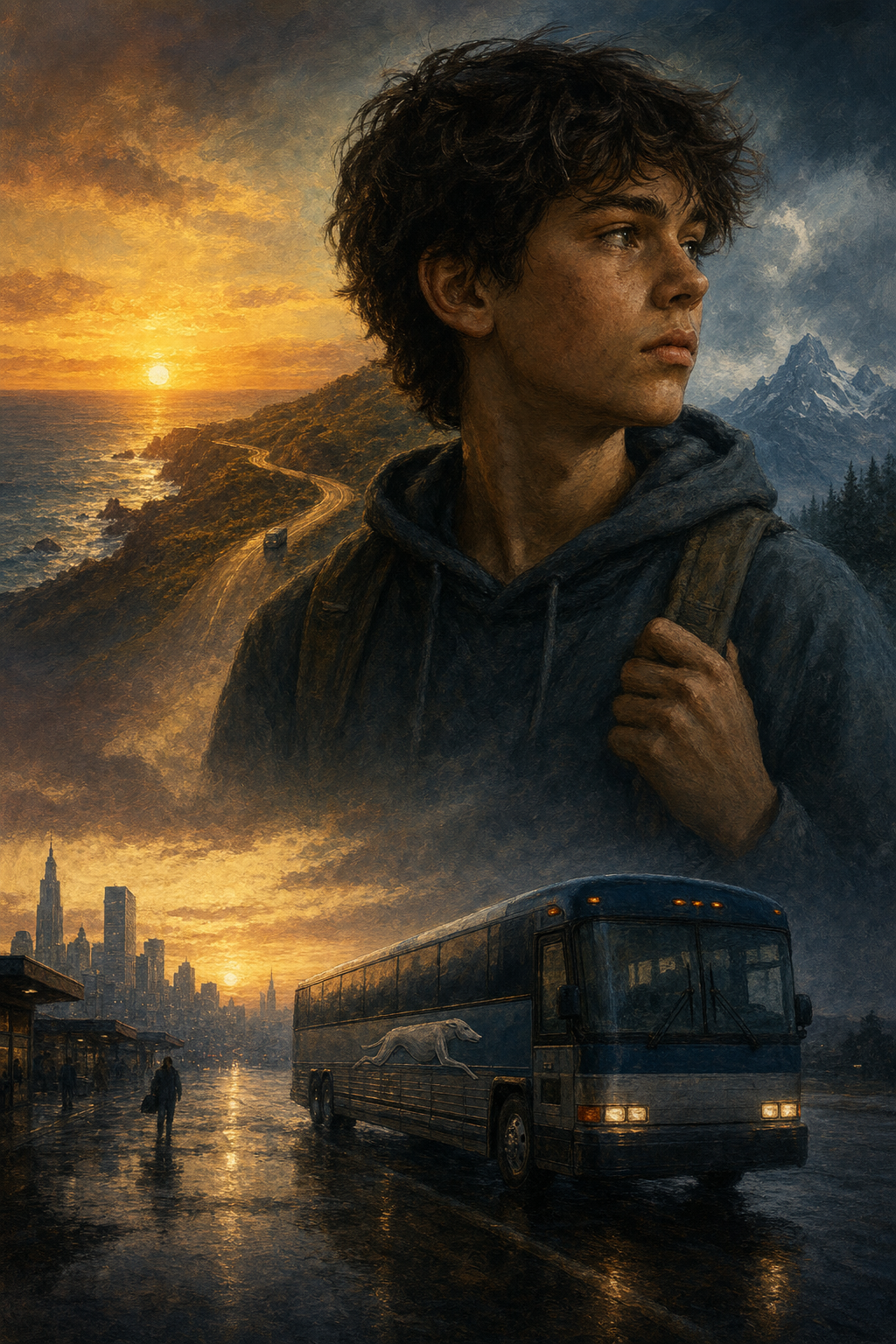
Novel · 3 chapters · 9,184 words
The Greyhound Kid
Contents3 chapters
Chapter 1
West Bound
The bus sighed and dropped its nose toward the curb, brakes whining, the whole body giving one last tired shudder like a horse deciding not to throw the rider after all. Ray lifted his head off the window and saw his own cheek print in the glass for half a second before the station lights took it away.
LOS ANGELES, the sign said in blue block letters with a crack through the O. Smaller beneath it: HOLLYWOOD.
Nobody clapped. Nobody said anything grand. A baby in the front let out a thin angry squeal, and somebody behind Ray snapped shut a plastic food container that smelled of onions and boiled egg. The driver stood up, one hand on the seatback to steady his bad knee, and said, “End of the line. Check for phones, wallets, kids. Leave the rest and it becomes mine.”
A few people laughed because he’d said it twice already in New Mexico and once outside Barstow.
Ray stayed seated while the aisle jammed with bodies and duffel bags. He knew better now. Let the ones with places to be rush first. Let the ones getting picked up by sisters, girlfriends, cousins, church vans, men in work boots and sunglasses all push toward the door like they were being born into something. He pressed his thumb against the edge of his ticket stub until the paper softened. He had folded and unfolded that thing so many times the barcode looked hairy.
Outside the glass, cabs nosed through the lot. Neon from a liquor store across the street bled red into a puddle by the curb. Not a movie version of California. Not palm trees and convertibles and women in white sunglasses. Concrete walls tagged in black marker. A sagging chain-link gate. A man in a Lakers jacket smoking with both elbows pinned to his ribs like he was cold, though the air when the door opened was dry and almost warm.
Ray stood, swung his backpack onto one shoulder, and reached under the seat for the grocery bag with his extra shirt, the one he’d stolen from a laundromat donation box in Amarillo because it was clean and nearly fit. The bag tore at the handle. He caught it before the toothpaste and socks hit the floor.
The old woman across the aisle touched his wrist before he stepped out.
“Your charger,” she said.
He looked down. White cord, knotted, half under his sneaker.
“That’s not mine.”
“It is now if you need one.” She pushed it into his hand. She had two gold front teeth and a smell like Pond’s cream and cigarettes gone stale in cloth. “Don’t argue with a gift.”
Ray curled it into his pocket. “Thanks.”
“You got people here?”
He shifted the grocery bag higher. “Yeah.”
She looked at him for one beat too long, enough to say she didn’t buy it and enough to say she wouldn’t make him prove it. Then she tapped the side of his backpack with one fingernail. “Keep that on your chest in the station. They fish through zippers.”
“Okay.”
“Don’t go with anyone who says they got a room cheap.”
He gave her a crooked half-smile. “You tell everybody that?”
“Only the ones with your face.”
He almost asked what that meant, but the line moved and she was carried toward the door with the others, her soft shoes whispering over the ridged bus steps.
The station air hit him different from the desert stops. It smelled of hot rubber, bleach, diesel, old coffee, and something sweet rotting in a trash can nearby. There were palms somewhere beyond the wall because he could hear fronds scraping, but all he could see from the bay was buses, dented bollards painted yellow, and a knot of people waiting under fluorescent lights that made everybody look a little sick.
Hollywood. The word sat in his chest like a dare.
He had pictured arriving with more. More cash. More of a plan. Maybe a phone that worked without hunting for an outlet and praying nobody walked off with it. Maybe somebody’s number written somewhere besides the inside flap of his wallet, where sweat had turned the ink to a bruise. But he had made it here. East coast to west. State lines eaten one after another. Virginia gone. Tennessee. Arkansas. Texas that took forever and then some. New Mexico flat and mean and beautiful in a way that made him feel too small to matter. Arizona with gas stations that sold dreamcatchers and fake turquoise rings. California after dark.
A man in a security windbreaker opened the luggage hold and started dragging bags onto the curb. People surged in. Ray didn’t have anything under there. Everything he owned was on his back and in the ripped grocery bag, light enough to run with if he had to.
Inside, the station was all hard surfaces and old grime trapped in corners no mop could reach. Brown tile. Orange plastic seats bolted in rows. A vending machine humming beside a dead pay phone with its cord cut off clean. Behind thick glass, the ticket counter glowed under buzzing lights. Half the windows were shuttered. A TV mounted near the ceiling played a game show with the sound off while closed captioning lagged behind the smiles.
Ray stopped just inside the doors and obeyed the old woman without admitting it to himself. He swung his backpack around and hugged it to his chest. The zipper pull was a bent paper clip. He’d done that in Oklahoma after the original tab snapped off.
Every station had the same species of waiting, but this one had extra charge in it. Men pacing. Women with eyelash glue and carry-ons. Runaways trying to look older. Old heads asleep with their mouths open. Families spread over three seats and the floor as if the room belonged to them by right. A kid in Spider-Man pajamas stood on a chair and pressed both hands to the glass, watching buses crawl in and out.
Ray went first to the restroom. He wasn’t desperate. He just wanted the mirror now that he’d been told not to open with one, though nobody had told him that except the private voice that had started sounding like caution over the last week. The bathroom was all stainless steel and graffiti cut into the partitions with keys. No paper towels. Soap dispenser hanging by one screw. He used water only, scrubbed bus film off his face, and wet his hair down with both hands. The cut over his eyebrow from the Tulsa station fight had gone from red to yellow-green. He looked older than fifteen from some angles and twelve from others. Not helpful.
A man at the urinal beside him said, “You know where Santa Monica bus picks up?”
Ray shook water off his fingers. “No.”
The man zipped slow and looked Ray over in the mirror. “You just get in?”
“Maybe.”
“Don’t sleep out front,” the man said. “Cops sweep.”
He left without washing his hands.
Ray watched the bathroom door close. Advice kept finding him like he wore a sign.
When he came back out, he checked the wall map near the brochures. Colored lines. Streets with names that meant nothing yet. Sunset. Vine. Santa Monica. Highland. Places he knew from songs and movie trailers, stripped now of glamour and pinned flat under Plexiglas. He leaned close and found the red star for the station. If you went up and over, there was Hollywood Boulevard. If you went farther, there was a blocky green patch that might be a park or might be a lie.
He had one name in California. Lonnie. Not family exactly. His mother had called him a cousin because in some families any man who fixes your sink once and loans you twenty dollars becomes a cousin. Lonnie had lived two apartments down in Norfolk for part of one summer with a woman who wore anklets over her socks. He had done drywall, smoked little cigars, and played old soul records too loud on Sunday afternoons. Then one day he was gone west. Ray remembered him saying it at a cookout behind the building, turning a chicken leg over the flames with a forked barbecue tool.
Everybody goes to California when they run out of room, Lonnie had said. Either that or jail.
Ray had laughed because the grown men were laughing.
Last month, after the last real bad night at home, Ray had found a number for Lonnie scribbled on the back of a utility bill in his mother’s kitchen junk drawer. LA number. The call had gone to voicemail. Ray hadn’t left one. He hadn’t called back. He just wrote the address he found in a text thread on a prepaid phone he no longer had, copied it to the inside of his wallet, and started moving.
Now he took the wallet out and squinted at the sweat-blurred ink.
L. Darnell
N. Wilcox Ave.
Apt 12
The apartment number was clear. The street was clear enough if you wanted it to be. The rest had feathered.
He checked the digital clock over the ticket desk. 10:47.
Too late to be welcome at a stranger’s place, even if that stranger once gave him a hot dog with extra mustard and told him not to let anybody talk him into installing carpet. Too early to decide he had nowhere.
At the vending machine he counted his money. Forty-three dollars and some change, folded in different directions from different pockets. Not enough for a room, not enough for mistakes. He bought the cheapest thing that looked like food, a packet of peanut butter crackers, and fed two dollars into a coffee machine for a cup of hot chocolate because the word hot felt like a decision. The machine spat brown water with a skin on top. He drank it anyway. It tasted of cocoa and metal.
A girl about his age sat three seats down with a purple suitcase and a denim jacket covered in band patches. Her mascara had migrated south and made half-moons under her eyes. She was charging her phone from an outlet beside the water fountain, one sneaker braced against the wall to keep anyone from unplugging it.
“You got that charger block?” she asked without looking at him.
“Huh?”
She nodded at the white cord sticking from his pocket.
“No block.”
“Damn.” She glanced over then, quick and assessing. “You know if they lock this place?”
“I just got here.”
“Yeah, me too.” She tore open a fast-food ketchup packet and sucked the last of it out, then made a face like she hated herself for it. “My ride ghosted.”
Ray sat down two chairs away, keeping his bag between his feet. “Maybe they’re late.”
She snorted. “Maybe I’m dumb.”
On the TV, a woman won a blender and screamed soundlessly.
Ray ate one cracker at a time. Peanut butter glued itself to the roof of his mouth. “You from here?”
“Do I look from here?”
He looked at the suitcase, the jacket, the chipped black nail polish, the scabbed knuckles. “No.”
“Tucson.” She twisted around to check her phone screen without touching it. Still black. “Supposed to be meeting my sister. Half-sister. Online sister, really.”
Ray nodded like that made clean sense.
“You?”
“Virginia.”
“That’s far.”
“Yeah.”
She finally looked straight at him. Her eyes were gray, or maybe that was the light. “You got a couch?”
He laughed once because it came out before he could stop it.
“Right,” she said. “Stupid question.”
“It’s fine.”
“No, it isn’t.” She leaned back and crossed her arms. “People keep talking to me like one right sentence and I turn into luggage. Like they can check me somewhere.”
A security guard moved slowly past the rows, keys jangling. He told a man stretched across four seats to sit up or go outside. The man sat up, blinked at nobody, then folded back down as soon as the guard rounded the pillar.
The girl watched that happen and said, quieter, “You know where youth places are?”
Ray shook his head.
She chewed the inside of her cheek. “I had it written down.”
He thought of saying he had an address. He thought of asking if she wanted to split a cab partway somewhere and figure the rest out together. But he pictured his money getting thin in his hand, pictured arriving at Lonnie’s with another person and seeing the door close before it opened. So he kept still.
After a minute she stood, unplugged her dead phone, and yanked the purple suitcase upright. “If my sister texts, tell her Bri left.”
“I don’t know your sister.”
“She’ll know me.” Bri hooked the strap of her jacket higher and gave him a look that wanted to be hard and was too tired. “Good luck, Virginia.”
“You too.”
He watched her roll the suitcase toward the front doors, one wheel wobbling. She didn’t look back.
At eleven-thirty the station thinned. Not empty. Stations never got empty. They just changed character. The families disappeared first. Then the office-looking people with laptop bags. The ones left were the drifters, the delayed, the broke, the stubborn, and the people too wrung out to decide. A woman mopped around sleeping feet. A man at the far end coughed for a full minute into a red bandanna. Somewhere a radio crackled and somebody said code numbers in a flat bored voice.
Ray tried the pay phone out of habit though he’d seen the cut cord already. Dead. He found two wall outlets behind a trash can and one worked if you held the plug just so, but his phone had become a little black slab two states ago after he dropped it getting off in Flagstaff. Screen caved in. Nothing to charge.
He went outside because sitting too long made him feel caught. The lot had cooled but the heat still came up out of the concrete. Across the street, a taqueria was closing. A man hosed blood and grease from the sidewalk in front of a butcher shop, pink water running to the gutter. The liquor store window held posters for lottery jackpots and a cardboard movie standee of a masked superhero fading blue at the edges. Above all that, farther off, he could see a hillside dotted with house lights. Rich lights. Private lights. Like another city hung behind this one.
A taxi driver leaned against his car smoking. “Need a ride, little man?”
Ray shook his head.
“Metro’s two blocks east.”
He nodded, though he wasn’t sure which way was east.
The driver flicked ash and looked him over. Not predatory exactly. Just experienced. “If you got an address, get there before one. Buildings lock.”
Ray took the wallet out again. “You know Wilcox?”
“North or south?”
He stared at the letters. “North.”
“Sure. Hollywood.” The driver named a fare that made Ray put the wallet away at once. The driver shrugged, no offense taken. “Train’ll get you close enough.”
“Which train?”
“Red line.” He jerked his chin down the street. “Ask inside.”
Inside again, the air felt sourer after outside. Ray went to the security desk and waited while the guard finished a story about a cousin’s stolen catalytic converter.
“Red line?” the guard said. “Metro station, down the block, under the plaza. Last train’s soon. You got TAP card?”
Ray shook his head.
“Machine sells one.” The guard’s eyes dropped to the grocery bag, the backpack, then back to Ray’s face. “You traveling alone?”
Ray held his own stare. “I’m good.”
The guard twitched one shoulder. “Didn’t ask if you were bad. Don’t miss the train.”
That settled it. A plan was better than the station swallowing him one fluorescent hour at a time.
Outside, the city noise had changed register. Fewer buses. More sirens somewhere at a distance. A man pushing a shopping cart full of crushed cans sang in Spanish to nobody visible. Ray followed the direction the guard had pointed, passing a shuttered storefront with wigs in the window and a mural of old movie stars painted on a cinderblock wall, their smiles chipped by time and tags.
The Metro entrance went down under a concrete canopy. A saxophone player near the top of the stairs had laid an open instrument case on the ground with three crumpled dollar bills inside and was playing “When the Saints Go Marching In” slow enough to turn it sad. Ray paused, listened for half a verse, then kept going because if he stopped for everything that felt like a sign he’d still be standing in Virginia.
The ticket machine glowed like a dare. He fed in bills one by one, afraid each would be rejected. The machine accepted them with little mechanical gulps and spit out a plastic card. He held it like it might evaporate.
Down on the platform, the tiles were cream-colored and dirty at shoulder height where hands had rested for years. Ads above the tracks promised dental implants, acting classes, injury lawyers. A poster for a film school showed a young man with headphones around his neck gazing into a camera lens as if he had invented seeing.
Ray sat on a metal bench under that poster. Two women in housekeeping uniforms talked softly over a paper sack of tangerines. A man in a sequined jacket slept with his chin on his chest, one silver boot stretched into the aisle. Across the tracks, a couple argued in low urgent bursts.
“You said your brother.”
“I said maybe.”
“That’s not the same thing.”
The train came with a blast of warm tunnel wind. Doors sighed open. Ray got in and stood even though there were empty seats. He wanted the map over the door in his line of sight. Civic Center. Pershing Square. 7th Street/Metro. Westlake/MacArthur Park. The names slid by and then changed as another line took over and the stops began to sound more like the place in his head. Vermont/Sunset. Hollywood/Western. Hollywood/Vine.
At Hollywood/Vine he got off because his heart told him this was close enough and because two boys in white tank tops were staring too hard at his grocery bag. The platform smelled of damp concrete and old electricity. Upstairs, the city came at him all at once.
Light everywhere. Not clean light. Sign light. Candy-colored strips and giant screens and letters twenty feet high. HOLLYWOOD in red over a souvenir store. A marquee on an old theater with bulbs chasing each other around the border. Posters for comics and magicians and a woman doing stand-up with one eyebrow raised like she’d heard every bad excuse already. A man in a dirty Superman cape sat on the curb with his cowl beside him, smoking. Three girls in club dresses teetered past carrying their heels in their hands. Somebody laughed too loud. Somebody shouted from a car. Somewhere fries were dropping into oil.
Ray just stood there.
This, then.
Not the sign on the hill. The ground under it. Gum stippled into the sidewalk. Perfume and weed and sewage and frying meat and spilled beer and old sun baked into brick. Tourists taking pictures of stars under their feet while stepping over a man asleep under a newspaper box. A woman painted gold from forehead to ankle stood frozen on a milk crate until someone dropped a dollar in her bucket, then she tipped her chin and became a statue again.
Ray moved with the crowd because standing still made him look like what he was. He found Wilcox on a street sign and followed it north, passing tattoo shops, a store selling bongs and hookahs under purple light, a Thai restaurant with red booths visible through the front window, and a closed record shop with hand-lettered signs for jazz imports and punk seven-inches. The blocks changed quickly. Loud to quieter. Tourist shine to apartment buildings with security gates and potted plants dying on stoops.
North Wilcox was narrower than he’d pictured. The building numbers climbed. His shoes made soft scuffing sounds on the sidewalk. A sprinkler somewhere clicked through its arc, misting a strip of grass behind a hedge. He passed a man walking three tiny dogs in sweaters. The dogs looked at him suspiciously, as if they had rent to protect.
Number 1847 sat halfway up the block, stucco painted the color of old teeth. Two stories. Iron railings. A courtyard hidden behind a locked gate with a call box mounted beside it. One light burned over the mailboxes. The brass numbers on the wall were crooked.
Ray stopped across the street first. Count windows. Count doors. Nothing in the place said welcome or no. A TV flickered blue in one downstairs room. Someone upstairs coughed behind a screen. Music, low and bass-heavy, thumped faintly from somewhere in back.
He crossed.
Apt 12.
He checked the names on the mailboxes. 1, 2, 3. Not all of them had names. Some had only tape with faded marker. 11 had GARCIA. 12 had no name at all, just a peeled rectangle where one had been.
He put his finger on the call button and left it there half a second too long. A buzz sounded in some interior room. Then nothing.
He waited.
A car went by spraying sound from open windows. Upstairs, a toilet flushed. He pressed again.
This time the speaker crackled. “Yeah?”
Ray leaned close. “Lonnie?”
A pause. “Who’s asking?”
“It’s Ray.”
“Ray who?”
He almost said his mother’s name, almost made family out of borrowed pieces. “From Norfolk. You used to know my mom. Denise.”
Static. Then, “Hold on.”
No click. No buzz. Just dead silence from the box. Ray looked up at the dark second-floor walkway, at the curtains, at the gate that could open or not. He could feel his pulse in his wrists from the trip, from the waiting, from having made it this far on a thing as thin as a half-memory.
Footsteps came down a stairwell inside the courtyard. Slow. Rubber sandals slapping concrete. Then a shape crossed under the light and became a man older than the one Ray remembered and also exactly him. Lonnie had put on weight in the face and lost hair at the temples. He still had the same broad chest, same way of carrying himself like nobody could embarrass him unless they caught him singing. A white tank top, basketball shorts, one hand holding a ring of keys.
He looked through the bars before he unlocked anything.
“Damn,” he said softly. “You are Denise’s boy.”
Ray nodded.
“When you get this tall?”
Ray tried a smile. “On the bus.”
That almost got one back. Almost. Lonnie worked the key, opened the gate enough to stand in the gap, and did not invite him through.
“Your mom know you here?”
Ray looked past him into the courtyard. A bicycle with no front wheel chained to a post. A plastic tricycle on its side. Somebody’s doormat with a cartoon cactus on it. “Not exactly.”
Lonnie rubbed his jaw. He had drywall dust ground permanent into the creases of his knuckles. “You called?”
“I had an old number.”
“It still works.” Lonnie tilted his head, studying him. “You came all the way out here by yourself.”
“Yeah.”
“With what plan?”
Ray lifted one shoulder. The grocery bag cut into his fingers. “This one.”
Lonnie blew air through his nose and looked up at the second-floor railing as if someone might be listening from there. Maybe someone was. “You can’t just show up at a man’s gate in the middle of the night.”
“Okay.”
“That ain’t me saying go nowhere.” His voice sharpened a notch, maybe because of how quick Ray said it. “That’s me telling you facts.”
“I know.”
“You hungry?”
Ray had been hungry for so long the question no longer landed where it should. “I had crackers.”
Lonnie looked at the ripped bag, the too-small shirt stuffed inside, the backpack strap digging into Ray’s shoulder. His mouth tightened. “How old are you now?”
“Fifteen.”
“Jesus.”
From upstairs a woman’s voice called, “Lonnie?”
He turned his head. “Be right back.”
When he looked at Ray again, the practical part of him had taken over. It made him sound almost annoyed, which Ray recognized from adults who were about to help more than they wanted to.
“You got ID?”
Ray nodded.
“Anybody looking for you?”
A beat. “Probably.”
“Cops?”
“I don’t know.”
Lonnie clicked his tongue against his teeth. “That means maybe.” He opened the gate two more inches, enough for Ray to smell cooking oil and old apartment carpet from inside. “Listen to me. You can’t stay in my place. Not tonight, maybe not any night. Lease is dirty, people crowded in already, and my girl sees a teenage boy walk in after midnight, I get thirty kinds of problem before shoes come off.”
Ray kept his face flat. He had known this answer all day. Maybe all trip. It still hollowed him a little hearing it in a human voice.
Lonnie reached into his pocket and took out a folded bill. Then another. He pressed them through the gap. “Take that.”
Ray didn’t move.
“Take it.”
“I’m not asking for—”
“I know what you’re not asking.” Lonnie pushed the money harder until Ray had to grab it or let it drop. “There’s a youth shelter over on Vine. If they got beds, they got beds. If not, there’s a drop-in place opens early with food and showers. You go there before the street gets ideas about you.”
“What’s it called?”
Lonnie told him. Then repeated the cross streets until Ray said them back right.
“You got something to write with?”
Ray pulled a pen nub from his wallet and wrote on the grocery bag, the ink sinking into brown paper.
Lonnie watched his hand move. “Your mom gonna call me mad as hell one of these days.”
Ray capped the pen with his teeth. “Maybe.”
“Maybe?” Lonnie gave him a look. “That woman could peel paint when she’s mad.”
The smallest laugh slipped out of Ray before he could stop it. It hurt a little, that laugh.
“There he is,” Lonnie said, seeing it. “I remember you. Used to steal all the hot dog buns at cookouts.”
“I was little.”
“You’re still little. Just longer.” Lonnie glanced back toward the stairwell, where the woman upstairs moved again, unseen but present. “You got any reason I shouldn’t call your mother tonight?”
Ray folded the grocery bag top inward over the writing. “You can do what you want.”
Not please don’t. Not yet. But the words sat there between them anyway.
Lonnie leaned one shoulder against the gate. Tired man. Working man. Man who knew what picking up somebody else’s trouble could cost and what turning it away could cost too. “You in danger from her?”
Ray looked at the sidewalk. Gum. Ants carrying a crumb bigger than one of their bodies. “No.”
“From somebody in that house?”
He could hear in the question that Lonnie had seen enough by now not to waste time with soft edges.
Ray swallowed. “No.”
“You telling me true?”
Ray nodded, and it was true enough for the parts he could stand to hand over.
Lonnie accepted that or acted like he did. “Then I ain’t making that call tonight.” He pointed down the block. “But this ain’t a porch situation. You understand me? You walk straight back down, get on Vine, find that place. If they’re full, you come back here at seven in the morning, not before, and I’ll point you at somewhere else. You do not sleep in this doorway. My manager sees you, both of us catch grief.”
“Okay.”
“And keep your money split up. One pocket, sock, bag. Never all together.”
Ray nodded.
“Don’t follow nobody into no party because they say film people are inside.”
“Okay.”
“Don’t buy weed from Spider-Man.”
That got him another quick helpless laugh.
“I’m serious,” Lonnie said. “Especially Spider-Man.”
Upstairs the woman called again, sharper this time.
Lonnie pushed the gate slowly shut but kept his hand on it. “You got a phone?”
“Broken.”
He dug in his pocket once more and came up with a business card bent at one corner. Drywall company. His name, L. Darnell, under a logo with a hawk holding a hammer. He wrote a number on the back. “Pay phone if you find one, or ask to use a desk line somewhere. You leave your name first so I know it’s you.”
Ray took the card.
“For what it’s worth,” Lonnie said, and stopped. Maybe he had meant to say welcome. Maybe sorry. Maybe you look too much like your mother around the mouth. He settled on, “California won’t hug you back. Don’t take it personal.”
Then he locked the gate.
Ray stood there a moment with the money in one hand and the card in the other. Through the courtyard, Lonnie climbed the stairs and vanished around the walkway. A door opened. Warm apartment light poured out in a rectangle and then narrowed and was gone.
The block went on being a block. Sprinkler ticking. Dogs somewhere. Bass from a car turning the corner. Palm leaves clattering against each other high overhead like dry applause.
Ray tucked one bill into his sock, one into his wallet, one in the inside seam of his backpack. More money than he had ten minutes ago. Not a home. Not nothing.
He looked south. The glow from Hollywood Boulevard painted the low clouds of city haze orange. Vine was that way. Shelter that way. Trouble that way too, probably. Everything was that way.
He started walking.
At the end of the block he stopped and turned once, just to make sure the building was real, that he had not invented Lonnie out of need. Number 1847 sat under its crooked brass digits, indifferent and solid. No one at the gate. No curtain twitching. Just stucco and locked metal and lives behind it.
Ray put the card deeper into his pocket and headed for the brighter street.
On Hollywood Boulevard, the gold-painted woman was gone. In her place a man with a bucket drum had set up under a streetlight, beating out a rhythm with cut-down broom handles. Fast, then faster, hands blurring, plastic buckets answering in hollow bright pops that bounced off the storefront glass. A small crowd had formed without admitting it was a crowd. Tourists. Smokers. Men with nowhere urgent. A little kid on his father’s shoulders clapped in perfect time.
Ray slowed.
The drummer hit a run so quick it sounded impossible, then stopped dead and grinned into the half-second of surprise he’d made. People laughed and tossed bills into the open bucket. The kid on the shoulders slapped both palms against his dad’s head and shouted for more.
Ray smiled before he knew he was doing it.
Then he kept going, into the lit-up street, carrying everything he owned, with the city opening ahead of him one block at a time.
Chapter 2
Last Stop Change
Ray learned early that bus stations had two kinds of smells: hot grease and bad luck. The one in Camden had both, plus a sour edge from the mop water sloshing over tile that had gone dull years ago. He stood just inside the doors with his backpack hugged to his chest, counting the change in his pocket with a thumb that had gone numb in the cold. One quarter, three dimes, four pennies. Enough for a coffee if he lied to himself about the size.
The Greyhound gate was at the far end, under a flickering sign that buzzed like an angry insect. People moved in waves around the benches, all of them going somewhere with purpose in their shoes. A woman in a red coat talked into her phone like she was trying to keep someone alive by force of voice alone. Two little kids chased each other around a luggage cart until their mother snapped their names and they froze, wide-eyed, guilty, and laughing anyway. Ray watched them a second too long.
He went to the vending machine instead. The glass was fogged with fingerprints, the buttons sticky under his dirty nails. He fed in the quarters and got a paper cup of coffee so weak it looked like dishwater, but it was hot. That mattered. Heat mattered. He held the cup between both hands and felt the sting come back into his fingers, one prickly inch at a time.
“Hey.”
Ray looked up.
The man behind the counter had a gray mustache and one eye that seemed permanently narrowed, as if the world had offended him in private. He pointed at Ray’s backpack. “That yours?”
Ray tightened his grip. “Yeah.”
“You got a ticket?”
Ray took a sip of coffee to buy himself time. Burned the tip of his tongue. “Heading to New York.”
The man’s face didn’t change, but his eyes did. Not much. Just enough. “That’s not an answer.”
Ray shrugged one shoulder. “I’m waiting on somebody.”
“Uh-huh.”
Behind him, the loudspeaker coughed out a boarding call, all static and clipped syllables. A bus to Richmond. A bus to Atlanta. A woman laughed too loudly near the restroom, and somebody’s suitcase wheel squealed across the floor. The station kept breathing around him.
Ray dug into the inside pocket of his jacket and pulled out the folded paper he’d been carrying for three days. It was wrinkled soft at the creases, damp at the edges from being handled too much. The printed schedule. Not a ticket. Never a ticket. Just stops and times and the thin promise that a seat existed somewhere if he could get to it. He laid it on the counter.
The man glanced at it, then at Ray. Then he leaned back and called over his shoulder, “Marta, you seen this kid before?”
A voice from somewhere out of sight said, “Which one?”
“The one with the face.”
A laugh came from the back room. Ray had heard that kind of laugh before. Not cruel. Just tired enough to be dangerous.
He reached for the schedule, but the man put a palm over it. “Where’s your folks?”
“Not here.”
“That I can see.”
Ray wanted to say a lot of things. Most of them useless. Most of them true. Instead he said, “I’m not causing trouble.”
The man studied him for a beat too long, then pulled his hand away. “Don’t make me regret this.”
He slid a paper slip across the counter. Not a ticket. A baggage claim tag with a number written in black marker. “Bathroom’s around the corner. Wash your face. You look like hell.”
Ray almost smiled at that. Almost.
He took the slip and turned toward the restroom, coffee sloshing hot against his knuckles. Halfway there, a shout went up behind him. Sharp. Sudden. The kind of shout that turns a room inside out.
“Stop him!”
Ray froze.
A man in a tan coat was barreling toward the exit, one hand clamped around a black duffel bag, the other swinging wild. Someone had knocked over a chair. The woman in the red coat screamed. The mustached man was on his feet now, pointing, yelling into a radio that cracked with static. And right in the middle of it, near the bus gate, a little girl in a yellow sweater stood motionless with one tiny hand raised as if she’d been reaching for someone who was no longer there.
Her eyes found Ray’s.
Then the duffel bag hit the floor and burst open, spilling a scatter of pale green bills across the station tiles, and the man in the tan coat reached under his jacket for something that made every person in the room take one frightened step back.
Chapter 3
Albuquerque
The bus coughed to a stop under a shed of dented metal and sodium lights, and the driver said, “Sixty minutes,” without turning around.
Ray stayed in his seat until the line moving toward the door thinned out. The vinyl had stuck to the backs of his thighs. When he stood, his knees gave a small protest, that electric ache from too many hours folded tight. He got his backpack from the floor by his feet, slung it over one shoulder, and stepped down into the station’s stale air.
Inside, the place smelled like burnt coffee, mop water, and the hot dust that lived in bus stations everywhere. A TV bolted high in a corner blinked with a silent game show. A woman in a blue vest was wiping the counter with a rag that had already gone gray. In the row of plastic chairs, a man in coveralls slept with his mouth open and his hat over his face. Two girls in matching softball jackets argued over a phone charger, their voices low but sharp enough to cut.
Ray checked the clock above the restroom door. Fifty-eight minutes.
He had enough time to get lost and find himself again.
He went to the vending machines first. The soda machine took his dollar bill twice before swallowing it. He pressed the button for orange drink because the can was the cheapest thing with a picture on it. It dropped with a flat metallic thump. He twisted the tab and drank half in one go. Too sweet. Cold enough to hurt his teeth.
At the counter, the woman in blue vest slid a paper cup toward the coffee pot. “Cream’s out.”
“That’s fine.”
She looked at him once, then down at the rag. “You just passing through?”
Ray took the coffee black. “For now.”
That made her huff through her nose, not quite a laugh. “Yeah. For now.”
He left the counter, cup in one hand, backpack strap biting his shoulder. The station was small enough that all the people inside seemed to have been arranged by accident. A mother with a stroller and two sleeping kids. A college boy with a drum case between his knees. A man in a plaid shirt arguing into a payphone with a voice that sounded like it had been sanded down. Ray found the farthest chair, one with the cracked armrest facing the window, and sat where he could see the bus bays.
The coffee tasted like burnt pennies. He drank it anyway.
His phone had one bar. He opened it and looked at the screen like it might change if he stared hard enough. No new messages. The battery was at nineteen percent, then eighteen. He shut it off and slid it back into the inside pocket of his jacket, where it sat warm against his ribs.
Across the aisle, the softball girls had switched from arguing to whispering. One of them was crying without making a sound. The other kept touching the braid at the back of her neck as if she could undo time by pulling on it.
Ray looked away first.
A man with a gray ponytail and a faded Navy cap came in carrying three white paper bags in one hand and a Styrofoam clamshell in the other. He scanned the room as if counting something only he could see, then sat beside Ray without asking. The bench dipped. The man set the food in his lap and cracked the clamshell open.
“French fries,” he said, not to Ray exactly, but not to nobody either. “They never taste right on the road.”
Ray shrugged. “They taste like grease.”
The man grinned, showing one crooked front tooth. “There you go. You’re honest. Rare thing in a station.”
He lifted a fry, inspected it, ate it, and nodded as though confirming a theory. “You hungry?”
“No.”
“Good. Saves you from disappointment.”
Ray took another sip of coffee. He could feel the man’s attention drifting around him in a way that wasn’t nosy so much as practiced, the way older people took measure of a kid without wanting to seem like they were taking measure. It made him want to fold smaller inside his jacket.
The man opened one of the paper bags and pulled out a foil-wrapped burrito. “You from the East?”
Ray didn’t answer right away.
“Your accent. Little bit. Long way from there, either way.”
“Maybe.”
“That’s a yes pretending to be a no.”
Ray looked at the bus bay glass, at his own reflection split by grime. “You always talk this much?”
“Only when I’m waiting.” The man peeled the foil back on the burrito. Steam came out with the smell of beans and green chile. “Name’s Leonard.”
Ray gave him a short nod. “Ray.”
“Ray.”
Leonard said it like he was testing the shape of it. Then he tore a piece of burrito off with his teeth and chewed thoughtfully. “You ever been to this station before?”
“No.”
“It used to be worse.”
“That’s supposed to help?”
Leonard laughed, a dry bark. “No. Just thinking out loud.”
Ray watched a bus pull in outside, the headlights washing the window white. People stood without speaking, bags at their feet, necks craned toward the door. A few seconds later they all moved at once. The machine of it. In, out, on, gone.
Leonard wiped his fingers on a napkin. “You heading west?”
Ray kept his eyes on the door. “Seems like it.”
“Seems like.” Leonard nodded as if Ray had answered properly. “I did that once. Not all the way. Denver. Reno. San Jose for a while. Kept moving because stillness cost more than gas.”
Ray didn’t ask what he meant by gas. Some stories came with numbers. Some came with smoke.
Leonard tipped his cap back. Under it, his hair was the color of old rope. “You got somebody waiting?”
Ray could have said no. It would have been the clean answer. But the question sat there with its own weight.
“Nah.”
Leonard looked at him for a beat longer than polite. Then he shrugged. “That’s a good thing and a bad thing.”
“I didn’t ask.”
“You didn’t have to.”
Ray finished the coffee. The cup was hot in his hand, then suddenly not. He set it on the floor by the chair and hooked the toe of his sneaker around it so it wouldn’t roll away.
A new sound rose from the restroom hall: a child crying in short furious bursts. A man’s voice, low and coaxing. The mother with the stroller stood halfway up, then sat back down. Nothing happened. The station held its breath and let it go.
Leonard nudged the clamshell toward Ray with two fingers. “Take one.”
“I said I’m good.”
“Take one anyway.”
Ray hesitated. The burrito wasn’t much, just a fat half wrapped in foil, one end browned where it had been held too long in heat. It smelled like onions and pepper and something smoky underneath. His stomach gave up one quick embarrassing twist.
He took it.
“See?” Leonard said. “Now you’re disappointed less.”
Ray bit into it. The tortilla was soft, the beans dry but warm, the chile sharp enough to wake him up. He chewed slowly. The taste brought the day into focus all at once, made him feel where his body ended and the station began.
Leonard watched the bus bays. “You run into trouble?”
Ray swallowed. “Like what?”
“Like trouble.”
“Depends who’s asking.”
“That’s fair.” Leonard tore open a salt packet and shook it over his own food. “I knew a kid once in Flagstaff. Kept his backpack zipped so tight he had to use both hands just to get his socks out. Thought if he stayed neat enough, the world would leave him alone.”
“What happened?”
Leonard’s mouth twisted. “World didn’t read the memo.”
Ray ate another bite, slower now. “You know a lot of kids.”
“I know enough.”
The station door opened and a gust of dry heat pushed through, carrying the smell of exhaust and something fried from the diner next door. A woman in a red sweater came in carrying a stack of paperback romance novels under one arm and a box of donuts under the other. She paused when she saw the crying child, then kept going. Nobody looked at anybody for long.
Ray saw his reflection in the dark glass by the door: narrow face, hair too long in the front, jacket sleeves dusty at the cuffs. He had cleaned up some since the last shower. The scrapes on his knuckles were almost healed. He looked older than he had a month ago, and not in the way he wanted.
The loudspeaker crackled overhead. “Southbound service to El Paso delayed thirty minutes.”
A collective complaint moved through the room. The softball girls groaned. The sleeping man in coveralls lifted his hat, squinted at the sign, and said something to no one.
Leonard slid his empty foil aside. “There it is.”
“What?”
“Delay.” He smiled. “Every station’s got one.”
Ray leaned back in the chair. “You always this cheerful?”
“Only when things go wrong.”
A woman at the vending machine cursed softly, then hit the snack panel with the side of her fist. Nothing came out. She tried again. The machine buzzed, then remained stubbornly sealed. Ray stood without thinking, crossed over, and gave the side of it a hard slap near the coin return. A candy bar dropped.
The woman stared at him, then laughed under her breath. “Well. Thanks.”
Ray shrugged and took a step back, already regretting being noticed.
She reached down, picked up the candy bar, and held out the torn wrapper end. “Want half?”
“No.”
“You sure?”
He was about to refuse again when he saw the brand: peanut butter cups, the cheap two-pack kind his mother used to buy at the gas station outside Savannah, when she had ten dollars and a day off and the sky had been flat and bright and nothing had yet gone bad. The memory hit so fast it felt physical.
Ray took the candy bar. “Thanks.”
The woman had close-cropped hair and a sunburned nose. She looked him over without making a thing of it. “You on the bus or stuck here?”
“On it.”
“Lucky you.”
She bit the other half and went back to the machine, tapping the glass with one fingernail like she expected it to change its mind. Ray stood there a second with the candy in his hand, then tore the wrapper and took a bite. Sweet peanut butter, dry chocolate, the taste of cheap luck.
When he went back to the bench, Leonard was watching him with that same tilted expression, half amusement and half question.
“What?”
“Nothing.” Leonard folded his hands on his belly. “You got a way about you, kid.”
Ray sat. “That supposed to mean something?”
“It means you act like you’re expecting the floor to open.”
Ray let out a short breath through his nose. “Maybe it will.”
Leonard looked at him then, properly. No smile. “It won’t. Not today.”
The confidence in it was strange. Not kind exactly. Just certain. Ray stared at the cup-shaped stain on the floor under the chair leg and ate the candy bar until the wrapper was bare.
A kid in a red backpack walked past with a woman close behind him, her hand caught at the back of his shirt as if she didn’t trust him to stay where she could see him. The kid was maybe nine. He had a silver inhaler dangling from his wrist on a string. He kept looking up at the departures board, then back at the woman, his face pale with the seriousness children get when they know something is being decided without them.
Ray followed them with his eyes until they disappeared down the hallway toward the restrooms.
“You ever have one of those?” Leonard asked.
“Have what?”
“Someone tied to your sleeve.”
Ray gave a small shake of the head. “Not anymore.”
Leonard accepted that without comment. Outside, another bus idled at bay three. The station windows shivered faintly with the engine’s low, ugly rumble. Ray pulled his jacket tighter, not because he was cold but because the motion gave his hands something to do. The inside pocket held the folded paper with the address he’d been carrying since Richmond, the one he kept touching like it might evaporate. He hadn’t decided whether it was a destination or just another place to get turned away from.
He didn’t take it out.
The crying child had gone quiet. The mother now stood by the restroom door, one hand pressed to the stroller handle, the other on the boy’s head. The boy’s face was buried in her coat. She said something into his hair. The words were too low to catch.
Leonard got to his feet with a faint grunt. His knees made a dry clicking sound. “I need the men’s room before that coffee comes back as a legal complaint.”
Ray almost smiled. “You tell me more than I need to know.”
“That’s because I like you.”
Leonard walked off with his paper bags tucked under one arm. Ray watched him go, then rose too, stretching his back until it popped between the shoulder blades. The station restroom door stuck before giving way, and the inside was all tile and bleach and a metal grate in the floor. One urinal was out of order, a paper sign taped across it. In the mirror above the sink, the overhead light made everyone look a little sick.
Ray splashed water on his face. He scrubbed at the corner of his mouth where the peanut butter cup had left a smear. The water was lukewarm and smelled faintly of rust. He looked at himself without meaning to, then stopped himself from looking too long. There was nothing in the mirror he hadn’t already learned.
At the far sink, a man in a denim jacket was washing blood off his knuckles. Not fresh blood. Brown at the edges, gone pink in the water. He kept his head down.
Ray took a paper towel from the dispenser. The machine spit out one sheet, then jammed. He yanked at it once. Nothing. The denim man noticed and, without looking up, said, “Kick the bottom.”
Ray did. The roll jerked free with a rasp.
“Thanks.”
“Don’t mention it.”
Ray dried his hands. The denim man turned the tap off with the heel of his palm and met Ray’s eyes in the mirror for just a second. He had a bruise blooming dark along one cheekbone.
“You riding west?” he asked.
Ray folded the towel into a square and threw it at the trash can. Missed. “Something like that.”
“Watch your bag.”
Ray looked at him. “Why?”
The man tipped his chin toward the hallway. “Because this place eats bags.”
Then he walked out.
Ray stood still a moment, water dripping from his cuff. He glanced at the mirror again, then left the restroom with his shoulders a little tighter than before.
Back in the waiting area, two boys were circling one of the row of chairs with a basketball they shouldn’t have had in a station. One bounced it once, then twice, trying to make the sound quiet. The ball slipped, rolled, and clipped the edge of Ray’s shoe. The taller boy froze.
“Sorry,” he said.
Ray looked down at the ball, then back at the boy. He was maybe thirteen, all elbows and too-big jeans. “Don’t lose it.”
The boy grabbed the ball and hustled away, grinning at being forgiven for something small.
Leonard was gone from the bench. In his place sat the woman with the peanut butter cup, now feeding the rest of it in little bites to the child with the inhaler. She watched him chew as if counting every swallow.
Ray’s chair felt different without Leonard in it. More exposed.
He checked his phone again. Still nothing. The battery had slipped to fourteen percent. He knew he should save it. He also knew that saving it was another way to wait. He opened the notes app anyway and stared at the blank screen, thumb hovering. He’d meant to write down names of towns, maybe numbers, maybe the date. Instead he typed one word: Albuquerque.
Then he deleted it.
At the far end of the station, a vending machine hummed to life, then went dark again. Somebody laughed. Somebody else swore. The PA crackled with static and a voice that swallowed half its own words: “Boarding for westbound coach—”
Not his bus. Not yet.
Ray stood and drifted toward the windows. The sun outside was white against the dust-coated glass, the parking lot stamped with oil stains and the long shadows of the overhead shelter. A man in a chef’s apron crossed from the diner with a box of paper cups under one arm. A couple in matching tourist hats argued over which door to use. A woman dragged a suitcase with a busted wheel. Every sound seemed to arrive a little late, as though the station held the world at arm’s length.
His reflection floated over the lot. He could see a faint ghost of the route map behind him, all those lines stitched across the country. East to west. Blue and black ink on a panel above the ticket counter. The spaces in between looked blank from here.
“Ray.”
He turned.
Leonard had come back with a small paper sack and was standing a few feet away, one hand under the strap of his cap. “I’m getting on the next one. You?”
Ray looked at the clock. Forty-one minutes.
“Maybe.”
Leonard nodded toward the sack. “Bought too much. Help me make it disappear.”
Ray didn’t move. “You already gave me food.”
“And I’m a generous bastard.”
Ray went over and took the sack. Inside were two wrapped biscuits, a bruised apple, and a packet of peanuts. Leonard kept the apple. They stood by the window eating in silence for a minute, shoulders angled toward the glass, both pretending not to watch each other.
Leonard broke the quiet first. “You got family out there?”
Ray chewed the biscuit. It was dry and crumbly, salt in the dough. “No.”
“Friends?”
“No.”
“Good. Keeps the expectations low.”
Ray swallowed. “That supposed to help again?”
“It does if you let it.” Leonard bit the apple and winced at the sourness. “What’s your plan in California?”
Ray looked at him. “I didn’t say California.”
“You didn’t have to.”
Ray nearly laughed, but there wasn’t room in it for much. “You ask a lot for a guy who talks about being generous.”
Leonard shrugged. “It passes the time.”
The intercom crackled again. “Westbound coach now boarding at bay four.”
Ray’s shoulders tightened before his mind caught up. Not his bus yet. Bay four. He knew the game by now: the station announced one thing, then another, and a person could spend an hour standing before the wrong door if they weren’t careful.
Leonard crumpled the apple core in the sack. “There’s your distraction.”
Ray watched the figures moving toward bay four. A man with a guitar case. The
Write your own novel.
ScribistIQ generates full-length novels in minutes. Type your premise, walk away, come back to a finished book.
Try ScribistIQ