
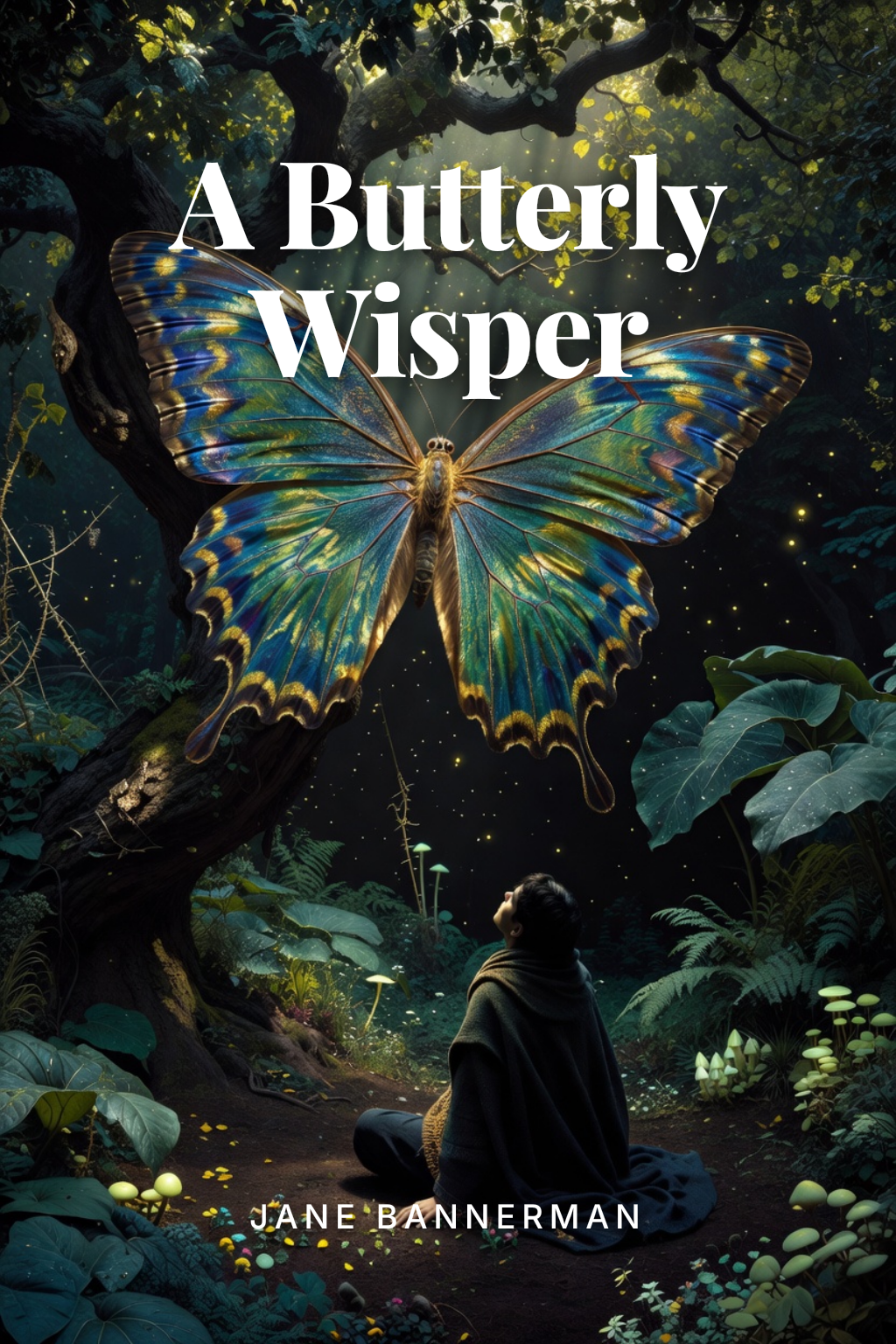
Novel · 8 chapters · 20,504 words
A Butterly Wisper
Contents8 chapters
Chapter 1
The Secret in the Brass Bowl
Mina had been told, with the hard certainty adults reserve for things they have not bothered to understand, that gardens were for picking and pruning and keeping tidy. Her grandfather believed in rows. Neat rows of beans, clipped hedges, thyme trimmed back from the path. He carried a pair of rusted shears in his back pocket like a deputy might carry a badge. If a stem leaned too far, he cut it. If a rose bush sprawled, he scolded it.
But the garden behind his cottage refused to behave.
It leaned. It spilled. It went where it pleased.
Morning glories had braided themselves through the fence slats. Mint had burst from its bed and threaded the walkway with a cool, peppery smell that clung to Mina’s fingers when she brushed it. Near the stone sink, a cracked enamel kettle sat on the bench beside an old kettle gone brown with age, both of them used more for collecting rainwater than making tea. Bees worried the lavender. A blackbird pecked at a fallen fig as if he had paid for it. And in the middle of it all stood a brass bowl sunk into a ring of moss, so old and dulled by weather that it looked like it had grown there.
Mina found it every afternoon because her grandfather never did.
“Don’t sit in the far corner,” he called from the back step, where he was mending a split handle with twine. “Snakes like shade.”
“There aren’t any snakes.”
“There are always snakes.” He said it the way he said most things, as if the world were forever trying to surprise him and failing. Then he squinted at her. “And don’t touch that bowl.”
That was, naturally, the first thing she wanted to do.
She waited until he went inside for his tea. Then she crossed the garden on bare feet, feeling the warm grit of the path and the tickle of thyme under her toes. The bowl was cold when she laid her hand on it. Cold and faintly rough, as though tiny mouths had worried its edge for years. Water shivered inside it, though the surface was still. She leaned closer.
Nothing.
Only the ordinary noises of a garden. Leaves trembling. A blue bottle fly buzzing against the plum skin. A hose dribbling somewhere around the back. Mina straightened, disappointed and a little foolish, and that was when the butterfly landed on the rim.
It was the color of old cream with a slash of copper through its wings, delicate as torn silk. Its feet touched the brass, and the bowl seemed to answer with a little note, clear and thin as a spoon tapped against glass.
Mina held her breath.
The butterfly opened and closed its wings once. Twice. Then, very plainly, though its mouth did not seem large enough for a whisper, she heard a voice.
Not loud. Not magical in the way stories in picture books are magical, all sparkles and trumpets. This was quieter than that. A thread of sound. A secret brushed past her ear.
“Don’t let them cut the wild rose.”
Mina jerked back so fast she nearly fell into the mint bed. The butterfly lifted at once, pale wings flashing, and settled on the rosemary bush instead. Her heart hammered.
She stared at it. “What?”
The butterfly tilted, as if listening.
Then the whisper came again, from nowhere and everywhere at once. “The roots are holding the wall.”
Mina looked to the old stone wall behind the rose bush. A crack ran through it, hidden by ivy and nettle. She had never noticed how the rose bush was growing right beside that split, its canes curling around the stones like fingers around a wrist.
“Who said that?” she asked, though her voice had gone small.
The butterfly moved one wing. A breeze, warm and smelling of earth and fennel, slipped through the garden. For a moment the leaves all seemed to lean in.
And then Mina heard it—more whispers, faint as moth wings: the water in the trough muttering to the fern, the pear tree creaking with a tired old voice, the bees humming to one another like busy, impatient cousins.
The garden was talking.
Her mouth went dry. She turned in a slow circle, as if she might catch the sound in her hands. The butterfly rose from the rosemary and drifted toward the wild rose. Mina followed it, stepping over a coil of hose, and saw something she had not seen before: the lower stones of the wall had shifted. Just enough. Just enough for a hand, maybe, to fit into the crack.
Something dark waited in that gap.
And from inside the wall, very softly, someone whispered her name.
Chapter 2
Untitled Chapter
Mina did not answer the wall.
She crouched instead, the mint wetting her ankles, and put two fingers into the crack between the stones.
Cool air touched her skin. Not wind exactly. More like the breath that comes off a cellar when the door opens. It smelled of damp lime, roots, and something sweet gone old, like apples left too long in a bowl.
“Mina.”
This time she nearly snatched her hand back, but pride held it there. The voice was no louder than before. It seemed to come from deeper in the split, from behind the stones rather than through them.
The butterfly had settled on a thorn cane above her head. Its wings opened and shut with patient slowness.
“Who are you?” she whispered.
A scrape sounded from inside the wall. Pebble against pebble. Then silence.
“Mina!”
Her grandfather’s voice cracked across the garden from the kitchen door. “Where’ve you got to?”
She sprang up so quickly she barked her shin on the border stones. The butterfly lifted, rose once in a pale loop, and vanished over the fig tree.
“I’m here,” she called, too fast.
“In the corner?”
She looked down at the wall, at the dark slit between the stones. One sprig of ivy trembled though the air had gone still. Then she turned and crossed the path, trying not to limp.
Her grandfather stood in the doorway with his spectacles low on his nose and a tea towel over one shoulder. He had flour on one hand from somewhere, though he never baked anything that didn’t turn hard enough to patch roads.
“What did I say about that corner?”
“You said there were snakes.”
“There are.”
“There aren’t.”
He narrowed his eyes, not because he was suspicious—he always looked suspicious—but because he was trying to see past her. “What were you doing by the wall?”
“Nothing.”
“Nothing takes longer than that.”
He wiped his hand on the tea towel and jerked his chin toward the sink. “Pump’s stuck again. If you’ve got time to crouch in nettles, you’ve got time to help.”
The iron pump by the stone sink gave a rusty groan when she leaned on the handle. The first few strokes produced only a cough and brown spit. Then a rope of cold water came, clear and hard, splashing the basin and her wrists. Her grandfather brought over a bucket with the bottom dented in and held it under the stream.
“Steady,” he said.
She pumped harder than necessary. Water slapped the tin pail and spotted the front of his shirt.
“That’s not steady.”
“You said hold it there.”
“I said steady.”
He said it without heat. His hands, broad and scarred from rose thorns and hammers and all the things he mended instead of replacing, shifted the bucket an inch. She watched the water rise around a drowned leaf and a dead bluebottle.
He glanced at her. “You’re pale.”
“I’m not.”
“You’ve seen a toad, then. Same face.”
She drove the handle down. Up. Down. The pump squealed. “Grandad.”
“Hm.”
“Has anyone ever talked to you in the garden?”
He took the bucket away before it overflowed, set it aside, and put another under. “People talk to me in the garden all the time. Usually to ask why I’ve let the bindweed get into their side of the fence.”
“Not people.”
He bent, studying the second bucket as though water level were the chief business of his life. “If this is about your stories again—”
“It isn’t.”
“What, then?”
She could have said butterfly. She could have said wall. She could have said my name came out of the stones. Instead she looked at the moss between the flags and asked, “Why can’t the wild rose be cut?”
His hand stopped on the handle.
Only for a second. Then he set the bucket straight. “Who said it was going to be cut?”
“Nobody.”
“Then why ask?”
“Because it’s ugly.”
He gave her such a sharp look that she wished she had chosen a better lie. The wild rose was many things—hooked, sprawled, full of dead hips from last year—but ugly was not one of them.
“Ugly things hold more than pretty ones,” he said.
She waited.
He did not go on.
Instead he lifted the bucket with both hands and carried it to the row of terracotta pots by the wall of the cottage. He watered the tomatoes one by one, each plant tied to a cane with strips torn from an old checked shirt. Mina followed.
“Grandad.”
He kept pouring. “Hm.”
“Why did you tell me not to touch the brass bowl?”
“It’s old.”
“So?”
“So old things don’t like fingerprints.”
“That’s nonsense.”
He tipped the last of the bucket into the biggest tomato pot, where the soil drank it with a dark sigh. “Most true things are.”
He straightened slowly and wiped the back of his wrist over his mouth. There was flour still on his knuckles. He looked, Mina thought suddenly, not stern exactly but braced, as if he had been waiting for some small trouble and had just recognized its shape.
“Go fetch the secateurs from the shed,” he said. “And not the blunt pair. The red-handled ones.”
“For what?”
“For the dead wood on the pear.”
“I thought ugly things hold more than pretty ones.”
A corner of his mouth moved, not quite a smile. “Dead wood’s just lazy. Go on.”
The shed smelled of soil, paraffin, and mice. Light came through a cracked pane and laid a white slat across the bench. Twine hung from nails. A stack of seed trays leaned against the wall. On the highest shelf sat three jam jars of buttons, a coffee tin of screws, and a biscuit tin painted with hunting dogs. Mina had rooted through the biscuit tin often enough to know it held labels, old packets, and once, to her delight, six marbles and a key with no lock.
She found the secateurs hanging behind a rain cape. As she reached for them, she saw that the biscuit tin was gone.
She stood on the lower rung of the stool and checked the shelf again. Not there. The dust showed a clean square where it had been.
“Mina?” her grandfather called from the garden.
“Coming.”
She took the secateurs and glanced once toward the corner where the wall lay hidden beyond the fig tree. Then she went back out.
He was already beneath the pear with the ladder opened and his cap shoved farther back than usual. The pear tree leaned over the path at a tired angle. Its bark was furred with lichen the color of old teaspoons. Two fruits hung high and hard as fists.
“Watch the ladder,” he said.
“I know.”
“You know because I tell you.”
She planted her feet on the lowest rung and held the sides while he climbed. He moved carefully now. Not weak, never that, but deliberate. The secateurs clicked in his hand. Dead twigs fell around her shoulders and into her hair. A pear leaf stuck to her cheek.
“Grandad,” she said, because if she did not ask now she would keep the question inside her until it made a knot.
He clipped another branch. “You’ll shake me off this thing.”
“Did there used to be a gate in the wall?”
Above her, he went still.
Not for long. Just the space between one breath and the next. Then snip. Another twig dropped.
“No.”
“There’s a crack big enough for one.”
“Cracks are not gates.”
“Has it always been there?”
“Walls crack.”
She looked up. Through the ladder rungs she could see the sole of his boot, worn smooth at the outer heel. “What’s on the other side?”
“Mrs. Leat’s old field.”
“Not right on the other side. Behind it.”
“The same thing. More wall, then field.”
“Have you looked?”
He descended two steps before answering. “I built the brace on that side twenty years ago. I’ve looked.”
“But before that?”
“Mina.”
It was only her name, but it closed his face like a door. He reached down for the secateurs’ catch, clicked them shut, and climbed down the rest of the way. She let go of the ladder.
He took the tool from her and walked toward the bench. “Wash up before supper.”
“That’s all?”
“What else were you planning to do with dirty hands?”
She watched him set the secateurs beside the cracked enamel kettle. His shoulders, usually square as the back step, had a bend in them she did not recognize.
Inside, the cottage held the evening in its usual way: blue plates on the dresser, the smell of onions from the pan, the narrow clock on the mantel ticking like it disapproved. Her grandfather moved between stove and table with his ordinary gruff economy. He sliced bread. He salted the pot. He set out two bowls.
Mina sat on the scrubbed bench and tore the corner from a napkin until it was only fringes.
When the soup came, it was leek and potato with a slick of cream on top from the bottle that always stood in the coldest part of the pantry. She burned her tongue and hardly noticed. Her grandfather ate with his head bent, spoon working steadily.
Finally he said, without looking up, “Did you take anything from the shed?”
“No.”
He nodded once.
“You moved the biscuit tin.”
His spoon paused in midair. “I sorted.”
“You never sort.”
“I did today.”
“Why?”
He set the spoon down. “Because I felt like it.”
“That’s not why.”
He looked at her then. His eyes were a clear, difficult gray, washed out by years of sun and frowning into distance. “What are you after?”
She almost said the truth. She almost laid it on the table between the breadboard and the salt: The garden is speaking and something in the wall knows my name and you know more than you tell.
Instead she heard herself ask, “Did my mother like this garden?”
The change in him was so slight another person might have missed it. A tightening near the mouth. The hand that reached for bread and found the knife first.
“She liked any place she could be barefoot,” he said.
“Did she sit in the far corner?”
“She sat everywhere she was told not to.”
Mina pressed the spoon into the soup until the cream disappeared. “Did she hear things?”
His knife scraped crust. “Everyone hears things.”
“You know that’s not what I mean.”
“No,” he said. “I know exactly what you mean.”
The clock ticked. Outside, a blackbird gave its evening complaint from the fig tree.
He buttered the bread very carefully, all the way to the edges. “Eat before it cools.”
That was the end of it. Not because there were no more questions, but because she knew the feel of that wall in him too.
After supper he sent her to dry plates while he took the vegetable peelings to the heap beyond the shed. She wiped the blue plates and listened for the back door. When it thudded shut again and his boots crossed toward the yard, she slid the last dish into the rack, snatched the small kitchen torch from the drawer beside the stove, and slipped outside.
Dusk had laid itself over the garden, softening corners, deepening greens to ink. The brass bowl in the moss gave back one dull strip of sky. Midges floated over the mint. Somewhere near the beans a frog made a sound like a thumb on wet glass.
Mina moved along the path with the torch off. She knew every rise of the stones, every patch where thyme spilled over the edge and had to be stepped around. The far corner smelled stronger in the evening. Crushed nettle, wet earth, the sour-metal scent of the old wall cooling after the day.
She knelt where she had before.
Nothing at first. Only the dark seam between the stones and the ivy laid flat against them. She put her ear close. The wall was cold enough to sting.
“Mina.”
She swallowed hard. “What do you want?”
A pause.
Then: “Light.”
She fumbled the torch on. Its narrow beam struck the crack, making mica flash in the mortar. Ants reeled away from the brightness. The gap seemed smaller now than it had that afternoon, just a shadowed slit where two lower stones had shifted apart.
“Can’t you come out?” she whispered.
“No.”
The voice was not a voice in the usual sense. It had no age in it. No breath. It was as if the words were being lifted from some place where sound had settled and gone thin.
“Are you stuck?”
A little dry scrape. “Bound.”
By what, she wanted to ask, but the torchlight had found something down in the crack: a curve of metal half lost in dirt and root. Not iron. It shone warmer than that.
She set the torch between her teeth and dug with her fingers. Grit packed under her nails. A root crossed the gap like twine and had to be worked aside gently. The thing in the earth loosened little by little until at last she pulled it free.
It was a key.
Small enough to fit in her palm. Brass, green in the cuts, with a stem as thin as a knitting needle and a round bow worked in the shape of a leaf. Soil clung to it in the veins.
Her breath smoked the torch beam.
“Mina.” Her grandfather’s voice, close this time.
She jerked upright so fast the torch fell and rolled into the mint, casting the leaves in a spinning white wheel.
“What are you doing?”
He stood at the bend in the path, carrying the peels bucket in one hand. The last of the light lay behind him, making him a dark shape from the chest down and a face pale under his cap.
“Nothing.”
Again that word. Again too late.
He set the bucket down slowly. “Come away from there.”
She closed her fist around the key. The edges bit her skin. “Why?”
“Because I told you.”
“That isn’t a reason.”
“It’ll do.”
He came toward her. Not fast. He never rushed. Which made it worse somehow. Mina stood her ground with dirt on her knees and mint crushed under one heel.
“There’s something in the wall.”
“I know.”
The words hit her harder than if he had shouted.
“You know?”
“Yes.”
“And you didn’t say?”
“No.”
“Why not?”
His gaze flicked to her closed hand, then to the crack behind her shoulder. “Because saying a thing doesn’t always keep it safe.”
“Safe from what?”
He looked past her, to the wall itself. When he spoke again, his voice had gone flatter, older. “Your mother was nine when she first heard it.”
Mina forgot to breathe.
He rubbed one thumb over the edge of the peels bucket. Potato skins clung to the inside in pale curls. “She came in muddy to the hips and swore the garden had called her. I told her she’d swallowed too much sun. She stopped speaking to me for two days and hid my secateurs in the gooseberry netting.”
Despite herself, Mina saw it: a girl she did not quite know, defiant and bright, thorns in her hair, slipping tools where they would snag fingers. The image hurt in an odd place under her ribs.
“What did she hear?”
He shook his head once. “Enough.”
“That’s not an answer.”
“It’s all I’ve got.”
She opened her hand. The key lay in her palm, dirt-dark except where her skin had rubbed it clean. His face changed.
“Put that back.”
“No.”
“Mina.”
“What is it for?”
“Put it back.”
He took one step nearer. She stepped back just as quickly, and her heel skidded in the mint. The wall caught her shoulder. Something in the crack gave a soft inward click, as if another stone had shifted behind the first.
Both of them froze.
Then a voice, not her grandfather’s and not the wall’s whisper either, breathed from the opening. “Moonrise.”
Her grandfather shut his eyes.
Only for a beat. But Mina saw it.
When he opened them again, the gray was gone harder than before. “Inside,” he said.
“No.”
“Inside now.”
“I want to know.”
“You want many things.”
“So did my mother?”
That landed. He flinched almost invisibly, and there it was again—the bend in him, the old brace giving.
“Yes,” he said.
“And you wouldn’t tell her either?”
He stooped, picked up the fallen torch, and switched it off. The garden dropped a degree into shadow. “Not at first.”
“What happened when you did?”
He stood with the dead torch in one hand and the peels bucket in the other, as though he had come to the wrong errand and could not remember how to leave it. A moth struck his sleeve and fluttered off toward the brass bowl.
“She listened,” he said.
“To what?”
He looked toward the eastern hedge where the first pale edge of the moon was beginning to lift over the black line of the elms. “To more than I could hear.”
The silence after that had shape to it. It held the frog by the beans. The settling creak of the pear. A pigeon shifting in the eaves. Mina could feel the key warming in her palm.
“Moonrise,” the wall whispered again, fainter.
Her grandfather heard this one too. She knew by the way his jaw tightened.
“At moonrise,” he said, choosing each word as if it might cut him, “the bowl will fill.”
“With what?”
He gave a short, humorless breath. “If I knew every part, I’d have managed things better.”
“That isn’t an answer either.”
“No.” He set the torch in the pocket of his cardigan and reached for the peels bucket again. “It’s the answer you’re getting.”
He turned away then, which was not like him. Usually when he ended a matter he stood and made sure it stayed ended. But now he took the path toward the heap with his shoulders too straight, as if holding himself against something cold.
Mina watched him go. At the bend he stopped without looking back.
“Whatever you do,” he said to the dark ahead of him, “don’t open anything alone.”
Then he walked on.
She waited until the scrape of the heap lid and the thud of the bucket told her he had reached the far side of the shed. Then she looked at the key again.
Leaf-shaped bow. Slender stem. Soil in the cuts.
Not from the shed. Not from the front door or the pantry or the little padlock on the gate to the lane. It had been under the wall. Waiting.
She crouched and put her ear once more near the crack. The stone leeched warmth from her cheek.
“Where?” she whispered.
The answer came so soft she thought at first it was only the ivy moving.
“Bowl.”
The moon lifted another inch.
Mina rose and crossed the garden. The path had gone silver at the edges. Rosemary smelled sharper after dark. The brass bowl sat in its moss ring as it always had, dull, old, unimportant to any eye not looking for it. Yet the air around it felt oddly taut, like cloth pulled between hands.
She knelt. Water lay in the bowl no higher than before, a black skin holding the moon in a broken coin. Her own face hovered there too, stretched and uncertain.
The key fit nowhere obvious on the rim.
She ran her fingers beneath the lip and found, on the far side hidden by moss, a small notch no bigger than a thumbnail. She scraped it clean. Metal showed under the green. Not a notch. A keyhole.
Her heart thudded so hard it made the moon tremble in the water.
Behind her, the back door banged.
“Mina?”
She looked over her shoulder. A strip of kitchen lamplight cut across the step and reached the path like a warning.
The key sat in her hand, light and impossible.
“Coming,” she called.
But she did not move at once.
Instead she turned back to the bowl, slid the key into the hidden hole until it met the softest resistance, and stopped there, her fingers resting on the leaf-shaped bow, listening to the garden hold its breath.
Chapter 3
Untitled Chapter
The key turned with hardly any sound at all.
Not the click Mina expected. Not a snap or grind of old metal waking. Just a tiny inward give beneath her fingers, like a seed coat loosening after rain.
Behind her the back door banged again. “Mina.”
This time her grandfather’s voice carried no room in it.
She pulled the key free so fast it nicked her knuckle on the rim. A bright sting. Then she rose, tucked the key into the pocket of her skirt, and crossed the path at a run just as he came down from the step, wiping his hands on a dish towel that had once been white.
He took in the bowl, the moon, her face.
“What were you doing?”
“Looking.”
“At what?”
“The water.”
He let the towel drop over his shoulder. “And?”
Mina held his gaze. “It’s still water.”
Something in his mouth shifted, not quite relief. “Inside.”
She passed him. Rosemary brushed her calf. At the door she glanced back. He had not moved toward the bowl. He stood with one hand on the latchpost, listening to the garden as though it were a person speaking in the next room.
The kitchen smelled of onions, damp stone, and the loaf he had sliced but not covered. A pan sat on the range with leeks gone limp in butter. On the table, beside the blue willow plates, lay a neat little hill of pea pods she had forgotten to carry out. The ordinary things made the house seem false somehow, a set painted over something else.
Her grandfather came in and shut the door firmly. He slid the bolt across.
Mina watched that more than she watched him.
“We don’t bolt the back,” she said.
“We do tonight.”
He lifted the pan and scraped the leeks into a bowl. The spoon hit ceramic with short hard taps. “Set the plates.”
“You said the bowl would fill.”
He put the pan back down. “I said set the plates.”
She took two from the dresser and put them on the table with more care than she felt. The glaze was cool under her thumb, crazed with fine cracks from years of washing. He brought bread, cheese, a jar of pickled walnuts dark as stones. He moved as he always moved in this room—exact, sparing, no reach wasted—yet every so often he paused with his hand hovering over nothing, as if some other task were tugging him sideways.
“Did my mother know about the key?” Mina asked.
He sat. “Eat.”
“Did she?”
He broke bread in half. “If you ask that name at me like a tool, don’t expect me to hand you one back.”
Mina sat too, though she did not touch the bread. “You talk around her until she might as well be smoke.”
His jaw worked once before he answered. “Your mother talked around things too. You have that from her.”
“Then tell me straight, and I’ll answer straight.”
He picked up his spoon, tasted the leeks, and set the spoon down again. “No. She did not know about that key.”
“How do you know?”
“Because if she had, she’d have used it.”
That came too fast to be made up. Mina leaned in. “Used it for what?”
He reached for the salt and then did not season anything. “There’s a drawer in the dresser. Bottom left.”
She stared. “What?”
“Open it.”
It was such a sudden turn that for a moment she thought he was avoiding her again. Then she saw he had gone still in a new way, listening not to dodge but to measure something.
Mina crossed the flags to the dresser. The wood smelled faintly sour in the damp. She pulled the bottom left drawer. At first it stuck. Then it came with a jerk and a dry wooden groan.
Inside lay folded tea towels, a candle end, and under these, a narrow oilcloth packet tied with faded green ribbon.
“Bring that.”
She set it on the table between them.
He untied the ribbon. The oilcloth crackled. Inside was a notebook no bigger than his hand, its cover made from brown paper gone shiny at the corners, and a pressed white feather slipped between the pages. Not pigeon. Too soft. Not gull. The spine had been sewn and resewn with black thread.
He touched the feather but did not take it out.
“This was hers,” he said.
Mina looked from the notebook to his face. “You kept it in a drawer under tea towels.”
“I kept it where I knew where it was.”
“That isn’t the same thing.”
“No.” He pushed the notebook toward her. “Read the date on the first page.”
She opened carefully. The paper smelled of dust and fennel. Her mother’s handwriting leaned slightly forward, each letter neat until it suddenly wasn’t. Near the top of the page was a date from years before Mina could remember, written in blue ink washed pale with time.
Below it: Heard them at the south wall tonight. Not words exactly. More like the feeling of words before they choose a mouth.
Mina read that line twice.
“There’s more,” her grandfather said.
She turned pages. Notes ran in fits and starts. Moon shapes in the margin. Lists of plant names. A sketch of the brass bowl from above with little arrows pointing inward. Then another entry.
Grandfather says listen for what repeats and ignore what flatters. The flattering voices are not for us.
Mina raised her head. “Voices?”
His hand flattened on the table. “Keep reading.”
Further in, the writing changed. Less neat. More crossed out. Several pages had been torn free. On one intact page, the words pressed so hard the nib had scarred the paper.
The bowl does not show what is coming. It remembers what was promised.
Mina’s throat tightened. “What does that mean?”
“I was hoping,” he said, “you might tell me.”
She looked at him then, really looked. He had not shaved properly. A pale nick dried rusty near his jaw. His cardigan was buttoned wrong by one hole. She had never seen that before.
“You don’t know?”
“I know pieces.”
“You hate pieces.”
He gave one short nod. “Yes.”
Something tapped the window.
Not a branch. Not a moth.
Three light taps, spaced like knuckles.
They both turned.
The window over the sink showed only black garden and the pale square of the moon caught in the glass. Nothing moved.
Again. Tap. Tap. Tap.
Her grandfather stood so abruptly his chair feet rasped the stone. “Stay there.”
He crossed to the sink, not hurrying but not lingering either. He did not look out right away. Instead he reached above the lintel and took down the old pruning knife that lived there wrapped in cloth, the one with the horn handle and the sharpened hook. Only then did he lean enough to peer through the pane.
“What is it?” Mina said.
“A beak,” he answered.
He unlatched the window and opened it a crack. Cool air entered smelling of mint and wet metal.
A jackdaw clung to the sill, black claws working the stone. Its head tipped once, one bright eye fixed on the room. Around one leg was tied a narrow thread of something silver that winked in the kitchen light.
“Shoo,” her grandfather said softly.
The bird opened its beak and let out a sound like a rusty hinge.
Not a caw. A word dragged through gravel.
“Late.”
Mina was on her feet before she knew she’d moved.
The jackdaw hopped sideways, still gripping the sill. “Late,” it said again, then struck the silver thread against the wood with a dry tick.
Her grandfather’s hand shot out, quicker than she thought he could move, and caught the thread between thumb and finger. The bird gave one furious flap, let go of the sill, and vanished into the dark with a rush of wings.
He shut the window fast.
“What is that?” Mina said.
He held up the silver thread. It was not thread. It was a strip of foil-thin bark, peeled from some tree with pale skin and marked on one side by tiny dark cuts in rows. Notches. Writing, perhaps, if writing could be made by ants.
His face had gone old in an instant.
“Show me.”
“No.”
“You just showed me by holding it up.”
He ignored that and moved to the lamp. Under the shade, he angled the strip, reading the cuts by their shadows. Mina watched his eyes move once across it and stop.
“What does it say?”
He folded the bark strip into his fist. “Get your shoes.”
“For what?”
“For doing the thing I told you not to do.”
She did not waste time smiling. She went for her shoes under the bench, jammed her feet into them without stockings, and came back to find he had already taken the lantern from the hook and was filling it at the paraffin tin. The kitchen seemed suddenly too small to contain his haste.
“Should I get my coat?”
“Yes.”
“Should I get the notebook?”
His glance lifted to her face. “Yes.”
That surprised them both.
By the time they stepped into the yard again, the moon had cleared the elms. The garden had changed under it. Everything separate by day had taken on a kind of silver relation: the beans standing in dark ranks, the cabbages holding white at their hearts, the path pale as bone. The brass bowl shone more than brass ought to shine.
Her grandfather stopped at the threshold. “When I speak, you do exactly what I say.”
“You could try telling me why.”
“The messenger came from the rookery wood.”
“The jackdaw?”
“Yes.”
“What is a rook doing with messages?”
He started down the path. “Jackdaw.”
“You know what I mean.”
“At present, better than you do.”
She hurried after him, notebook under one arm, lantern swinging from his hand and laying bars of light over the paving. The wall at the far end of the garden looked lower tonight, though she knew it was not. Ivy spilled over the top in a black frill. Near the crack where the key had been found, the mortar seemed damp.
“You’re going to the wall?”
“I’m going through it.”
Mina almost missed a step. “Through?”
He set the lantern down by the currant bush and put both hands to the stone two feet right of the crack. His fingers searched among the joints until he found a place she could not see. Then he pressed his thumb hard and low.
There came a sound like a cough inside the wall.
A narrow seam appeared from ground to shoulder height, so fine at first it might have been moonlight playing a trick. Then the seam widened. A slice of stone, no broader than a gate, eased inward on hidden hinges furred with age.
Cold earth breathed out. Fern. Flint. The stale sweetness of things shut away a long time.
Mina stared.
“You had a door in the wall.”
“I had a reason.”
“You always have a reason.”
“Yes,” he said. “Bring the lantern.”
The passage beyond was scarcely wide enough for both her shoulders. The wall thickness held a short stair worn hollow in the middle. At the bottom the space opened into a tunnel roofed with brick blackened by damp. Roots nosed through the mortar overhead like knuckles. Water clicked somewhere ahead.
Her grandfather took the lantern back and led on. “Mind the third flag.”
She looked down in time to avoid stepping on a stone sunk at one corner. “Why not alone?” she said. “The thing you said before.”
“Because some doors answer to more than keys.”
“That is not an answer.”
“It is the one that may keep you in one piece.”
The tunnel bent. Air moved differently here, carrying a mineral chill undercut by fox and crushed nettle. Mina ran her fingers once over the wall. Slime slicked the bricks. She wiped her hand on her skirt.
“How far does it go?”
“To the old orchard.”
“We haven’t got an orchard.”
“We haven’t got many things anymore.”
They came to another door, this one made of oak ribbed with iron straps swollen orange at the nails. No visible lock. Her grandfather gave the wood three slow knocks with the butt of the pruning knife.
Nothing.
Then from the other side came a rustle, a drag, and a low huffing snort.
Mina stepped back.
The door opened inward by an inch. Something broad and bristled filled the gap. Wet nose. Curved tusk. Small dark eye reflecting lantern flame.
A boar.
Mina’s breath caught.
Not huge like the ones in story pictures, but near enough. Its coat was grizzled charcoal, tufted along the spine. Mud had dried in plates on its shoulder. Around its neck hung a collar plaited from willow switches and threaded with snail shells.
The boar sniffed her grandfather’s hand, then Mina’s shoes.
“All right, Brindle,” her grandfather murmured. “All right.”
The animal backed away.
“You know a boar,” Mina said.
Her grandfather opened the door wider. “I know several things in the wood. This one is more reliable than some people.”
“Does it belong to someone?”
“Not in the way you mean.”
Outside, the ground rose into a stand of old apple trees gone mostly wild. Their branches crossed like antlers. Windfalls lay split and browning in the grass, drawing wasps that hummed low and purposeful around the sweet rot. Beyond the orchard the wood began at once, trunks close-set, undergrowth knitted thick except where a narrow track had been rooted open.
Brindle stood there waiting, head turned back to them, impatient.
The moon reached through the branches in broken strips. Somewhere farther in, more jackdaws chattered like blunt tools.
Mina came alongside her grandfather. “You’ve walked here before.”
“Yes.”
“With my mother?”
He lifted the lantern. “Twice.”
“And after?”
“No.”
That one word held enough that she did not press again, not yet.
Brindle trotted ahead. They followed. The path ducked under hazel, crossed a ditch on two laid planks silver with lichen, then climbed through beech where the leaf litter muffled their steps. The farther they went, the less the wood sounded like ordinary wood. There were owls, yes, and the scurry of some small thing in dry leaves, but under that ran another murmur, arranged somehow. Not language. Not exactly. More like many breaths taken at different distances to one slow count.
Mina felt the notebook warm beneath her arm.
The track opened suddenly into a clearing.
At its center stood a ring of standing stones no taller than a man’s waist, each one thick and blunt-topped, furred green. Their arrangement was imperfect, as if one or two had shifted over years or been nudged by roots. In the middle grew a white-barked tree with a split trunk and leaves that flashed dull silver underneath when they stirred.
Around the stones, shapes waited.
A heron with one leg tucked, balanced on a low stump as if carved there. Three foxes in the grass, not skulking but seated. A badger broad as a footstool. Two hares. More jackdaws than she could count, shifting among the lower branches. Moths worked the air around the tree in pale loops. Even the beetles on the stone near her shoe seemed turned inward.
Mina stopped dead.
Her grandfather did not.
He went to the ring and stood before the split white tree. Brindle came to his left side and lowered itself with a grunt.
No one spoke. Even Mina did not.
Then from above, where the branches crossed the moon, a butterfly drifted down.
It was larger than the cabbage whites in the kitchen patch, smaller than the peacock butterflies that showed their startled eyes in late summer. Its wings were the pale buff of dry oats, edged with brown so dark it was nearly soot-black, and on each wing sat tiny markings like pinched crescents. Nothing gaudy. Nothing special at a glance. Yet the longer she looked, the more the pattern refused stillness. It seemed to alter with every beat, from leaf-vein to bark-scrawl to something like script too quick to read.
The butterfly settled on the split of the white trunk.
Her grandfather bowed his head.
Mina looked at him in disbelief, then at the animals, and saw that disbelief was useless here. The heron blinked once. A fox licked its shoulder. The jackdaws ceased their muttering. The clearing held.
The butterfly opened and closed its wings.
A sound came.
Not from its mouth—there was none to see—but from the air near it, from the leaves, from the skin at the base of Mina’s throat. A whisper, yes, but not thin. It layered. One strand like paper rubbed between fingers. One like reeds moving in water. One like a woman speaking from behind a door.
“She brought the iron leaf.”
Mina’s hand flew to her pocket.
Her grandfather said, “She found what was left for her.”
The butterfly moved once on the bark.
“Left,” it said, and the word carried a dry amusement. “No. Returned.”
Mina did not know whether to be frightened or furious. She chose the one with more heat. “If you can talk,” she said to the butterfly, “then you can answer.”
Every eye in the clearing turned toward her.
Her grandfather hissed softly through his teeth. “Mind yourself.”
The butterfly’s wings angled. Moonlight ran the edges. “Good,” it whispered. “Not kneeling.”
Mina swallowed. “What is the key for?”
“To open what closes.”
“That means nothing.”
“It means enough.”
Her grandfather said, “Please.”
It startled Mina more than the butterfly’s voice had. She had never heard him say that to anything without flesh enough to shake hands with.
The whisper thinned, then gathered again. “The bowl is not vessel only. It is mouth. It keeps the old bargain wet.”
Mina pulled the notebook from under her arm with clumsy fingers and flipped to the page about promises. “What bargain?”
The butterfly did not answer her at once. It turned instead toward the split in the white trunk. Within the cleft, Mina now saw a dark seam tar-black against the pale bark, as if the tree had once been struck and healed around the wound without fully closing it.
“Once,” the whisper said, “people planted and took. Cut and mended. Burned and fed. They asked before lifting water. They left seed after harvest. They buried iron deep and did not lace the roots with poison. River to field. Field to hedge. Hedge to wood. Wood to rain. Rain to river. A round thing.”
As it spoke, the clearing altered, not changing exactly but showing more of itself. The moss on the stones brightened. The ground gave off the smell of old apples and mushrooms and turned soil. Mina could hear water now, not near but threaded under everything.
“And now?” she said.
A jackdaw gave a brittle chuckle overhead.
“Now,” said the butterfly, “many forget the round thing and keep only the taking.”
Her grandfather’s shoulders folded by the smallest measure.
Mina felt it then, what had been circling all evening without landing. This was not about one hidden key or one secret kept from a child because adults liked to feel large. This had edges beyond their garden.
“What happened to my mother?” she asked.
The clearing shifted at once. A fox stood. The heron opened its wings and shut them. Her grandfather said her name, low and warning.
But the butterfly answered.
“She listened too far ahead.”
Mina gripped the notebook until the cover bent. “What does that mean?”
“It means,” said her grandfather, voice rough now, “she wanted to mend what was fraying, and she thought wanting was enough.”
Mina turned on him. “You said she heard more than you could. You made that sound like a gift.”
“It was. Gifts cut too.”
“You let her come here.”
“Yes.”
“You should have stopped her.”
At that, some pain moved across his face so plain and old she wished the words back before they finished leaving her mouth. He did not defend himself. That made it worse.
The butterfly stirred. A powder-fine dust lifted from its wings and shone briefly in the lantern light. “Blame is a gate that swings both ways and goes nowhere.”
Mina laughed once, sharp with disbelief. “You speak in knots.”
“And yet you keep listening.”
Brindle huffed.
The butterfly’s whisper lowered. “The bark message is true. The north channel has been choked. Water turned. Roots thirst below the chalk hill. If the bowl is not opened before the moon leaves the split branch, the old line dries.”
Her grandfather looked up sharply. “Tonight?”
“Tonight.”
Mina looked from one to the other. “Opened how? I turned the key already.”
“Not enough,” said the butterfly. “Metal starts. Heart answers. Hand completes.”
“That’s worse than a knot.”
For the first time she had the sense—ridiculous and certain—that the butterfly was amused.
Her grandfather held out his hand. “The key.”
She did not give it at once. “No more half-truths.”
He kept his hand there between them, palm lined with dirt in the creases, nails black from the evening’s work. “Your mother came the second time without me. She opened the bowl alone. She saw where the channel ran under the hill and went to clear it before dawn. The bank gave. The water took her farther than anyone could reach in time.”
Nothing moved in Mina for a second. Then too many things did.
The wood sound thinned to one high thread in her ears. “You said fever,” she said.
“I said what I could say to a child who had already lost enough.”
“You lied.”
“Yes.”
“Everyone knew?”
“No. Only me. And one other, now dead.”
She tasted iron. Perhaps from the bitten skin inside her cheek. Perhaps from the key pressing her palm.
The butterfly whispered, softer now. “Grief silts. It blocks. Still water turns.”
Mina wanted to fling the notebook, the lantern, the whole impossible clearing. Instead she dug into her pocket, found the key, and slapped it into her grandfather’s outstretched hand so hard it stung them both.
“Then let’s go open your mouth-bowl.”
He closed his fingers over it but did not move. “You do not have to come.”
“Don’t say foolish things tonight.”
A jackdaw dropped from a branch, landed on one of the low stones, and cocked its head. The silver-barked message, or another like it, flashed at its leg.
The butterfly lifted from the tree and circled once over Mina’s head. The beat of its wings made no breeze she could feel, yet every hair along her arms rose.
“Bring the child of river-loss,” it whispered into the clearing. “The bargain hears blood as well as bone.”
Her grandfather flinched at that phrase, but he turned toward the path.
The walk back seemed shorter, though Mina knew they did not hurry less. Brindle came with them to the orchard and no farther. At the oak door it pressed its flank briefly against Mina’s leg, rough bristles through her skirt, then vanished into the tunnel dark behind as if swallowed.
In the passage, the lantern flame guttered once and then righted.
At the wall-door into the garden, her grandfather paused and looked back at her. The tunnel light carved his face steeply. “When we reach the bowl, whatever you hear, do not answer at once.”
“That depends what I hear.”
“It does not.”
She said nothing.
The garden lay white and waiting. The brass bowl had changed again. Water domed above the rim now, held there without spilling, a black swell bright with moon. No wind touched it. The rosemary was still. Even the frog by the beans had gone silent.
Her grandfather approached the bowl and knelt.
Mina came beside him.
He fitted the key into the hidden lock beneath the rim. This time, when he turned it, the sound came clear: a deep inner unfastening, metal releasing stone, stone releasing something older.
The water in the bowl shivered.
“Put your hand here,” he said, touching the rim opposite the lock.
She did. The brass was colder than before, cold enough to ache.
“Now listen.”
“For what?”
“For the true question.”
The bowl’s black surface tightened until it reflected not the moon above but another moon moving under water. Then the image broke apart into flowing brightness, and from the center of it rose a whisper she knew at once and did not know at all.
Not her mother’s voice exactly.
The shape of being called by someone who had once known how to soothe her.
Mina’s fingers clenched on the rim.
Across from her, her grandfather shut his eyes.
The whisper in the bowl said her name.
Chapter 4
Untitled Chapter
“Mina.”
The bowl did not say it loudly. It did not need to. The sound touched the inside of her ear the way a fingertip touches a bruise—lightly, knowing exactly where.
Her grandfather’s hand snapped over hers on the rim.
She almost jerked away. “Don’t.”
“Do not answer at once.”
The words came through his teeth. His eyes were still shut, face pulled tight as twine.
In the brass, the under-water moon turned slowly. Threads of light streamed from it and wound over one another like roots in clear glass. The whisper came again, shaped now less like speech than breath through reeds.
“Mina.”
It brought with it things no room should hold: soap lathered in a chipped basin, damp wool steaming by the stove, the rough hem of an apron wiping dirt from her cheek when she was too young to protest properly. Her throat closed on nothing.
She looked hard at the surface, as if by staring she could force trickery to show its seams. The water held no face. Only that moving moon and a dark depth beneath it that looked deeper than a bowl had any right to be.
“What is the question?” she said, but the bowl had already shifted.
The whisper did not repeat her name. It said, very gently, “Will you have back what was taken?”
Her grandfather made a sound low in his chest. Not quite a groan. More a warning pulled from somewhere older than speech.
Mina’s mouth was open before she knew it. She bit the answer off so hard her teeth clicked.
The butterfly had settled on the rosemary bush. In the moonlight its closed wings looked like a pair of burnt leaves pinned together. It said nothing.
The bowl waited.
Mina swallowed once. Twice. “Taken by whom?”
The water trembled. A ring ran outward and struck the brass with a tone so thin it seemed to pass through bone instead of air.
“By flood,” said the whisper.
“That’s not who.”
Her grandfather opened his eyes.
He looked at her then, sharply, and for the first time since the tunnel she saw a flicker of something that was not only grief and secrecy. Approval, perhaps. Or fear in a different coat.
The whisper changed. No anger in it. No hurry either.
“By haste. By silence. By the hand that loved and the hand that let go.”
Her grandfather’s grip on her hand loosened.
Mina drew a slow breath through her nose. Wet brass. Rosemary. The faint mud smell that rose when the garden’s deepest places were disturbed. “And if I say yes?”
The moon under water dimmed. The darkness beneath it thickened, taking on shape—not a face, still not that, but a movement like cloth sinking.
“If you say yes,” the bowl said, “the path opens. Blood calls blood. River yields what it keeps.”
Her heart gave one stupid leap. She hated it for that.
“And the price?” she asked.
This time the pause was longer. A moth battered once against the lantern glass where it hung from a nail by the fig wall. Somewhere beyond the bean poles, something small scuttled through dead leaves.
“Root for root,” said the whisper at last. “Memory for water. Voice for passage.”
“No,” her grandfather said at once.
The word cracked across the garden.
The water shuddered so violently that a bead spilled over the rim and struck Mina’s wrist. It was colder than the brass, colder than the stone floor of the dairy in winter. Where it touched her skin, her hand went numb to the base of the thumb.
“Do not bargain from the side,” said the bowl, and though the voice remained soft, the rosemary leaves bent away from it as if a hard wind had passed.
Her grandfather got to his feet too fast. His knee struck the bowl’s lip with a dull clang. “You have taken enough from this line.”
The butterfly lifted and settled again. Once. As if testing whether air still behaved.
“Nothing is taken,” whispered the bowl. “All is traded.”
“Call it what thieves call it, then.”
Mina stood too, because kneeling while the thing in the bowl and her grandfather argued over unnamed debts made her feel like furniture. The numbness was climbing her wrist. She rubbed at it with her other hand and got no warmth back.
“Stop,” she said. “Both of you.”
The bowl went still.
Her grandfather turned on her. “Step away.”
“No.”
“That was not a request.”
“It should have been, seeing as whatever this is keeps using my name.”
His face changed then, not softening, but losing some of its command. He looked tired enough to break.
The whisper came again, quieter. “Child of river-loss.”
“Don’t call me that.”
“What shall we call you?”
“Mina.”
A small sound came from the butterfly. If a dry leaf could laugh without cruelty, it would sound like that.
The bowl accepted the correction with a ripple. “Mina, then.”
She hated the way her own name sounded in that voice. Too intimate. Too careful. Like a person kneeling at your bed with a blade tucked behind their back.
The numbness stopped at her wrist. She flexed her fingers. Pins stabbed back into them. Good. Pain was better than that dead cold.
“What happens if we don’t answer anything?” she said.
The under-water moon thinned to a sickle. “The old line dries.”
“Yes, yes, the line dries,” Mina snapped. “You’ve all said that as if it explains anything. What line?”
For a moment no one answered.
Then her grandfather bent, picked up the lantern from the flagstones, and held it lower. The light struck the bowl from the side. Mina saw it then: not plain brass under the waterline, but marks cut into the inner wall, hidden until the angle changed. They were not letters she knew. They looked more like roots crossing stone, or channels seen from high above.
Her grandfather touched one with his forefinger. “This garden was never only a garden.”
“That is not an answer.”
“It is the start of one.”
He kept his finger on the cut mark as he spoke, not looking at her. “Before the cottages. Before the road took the old ash grove. There was a spring under this hill. Strong enough to keep three fields green in dry summers. Strong enough that people built around it and made promises to keep it open, clean, and shared.”
“People make promises all the time.”
“These were bound.”
“By a bowl.”
“By witness,” said the butterfly. “The bowl remembers what mouths forget.”
Her grandfather nodded once. “The spring fed channels under the orchards and down to the lower meadows. Over years those channels silted, stones shifted, banks caved. Each generation was meant to tend them. Not for greed. So water moved. So nothing above took all and nothing below starved.”
Mina looked toward the dark shape of the orchard wall. Beyond it, beyond the lane, beyond the sleeping cottages, the lower fields lay pale under moonlight. She thought of the cracked puddled places near the mill path by late August, of cabbages that had bolted too soon, of Mrs. Vale saying the beans had no flesh in them this year. Little failures. Ordinary enough that no one put them together.
“And if the line dries,” she said slowly, “the spring stops.”
“Or turns away,” whispered the butterfly.
“To where?”
It did not answer.
Her grandfather straightened with a grunt and rubbed his bad hand across his mouth. “Your mother found part of the buried run. Enough to know how much had been neglected. Enough to think she could do in one dawn what should have been done over twenty years.”
Mina stared at the cuts in the bowl’s wall. “Because you wouldn’t?”
His jaw worked. “Because I thought there was more time.”
That, at least, sounded true.
The bowl spoke into the silence left by it. “The line asks its keeper: will you open what is closed?”
Mina did not miss the shift. Not Will you have back what was taken now. Not the first bait. A second door, plainer and perhaps more dangerous for that.
“My mother answered this before,” she said.
“Yes.”
“And died.”
No one contradicted her. A blackbird, fooled by lantern light or moon, gave one rusty note from the pear tree and fell quiet again.
She crouched by the bowl despite herself and peered closer. Those cut channels joined and split and joined again. One line, broader than the rest, ended beneath a symbol like a split branch.
“The moon leaves the split branch,” she said. “That means this mark.”
Her grandfather lowered the lantern farther. “Yes.”
“And the bowl has to be opened before then because—”
“Because after moonset,” said the butterfly, “water chooses without witness.”
Mina put her palm on the flagstone to steady herself. The stone held the day’s heat no longer; it had gone cool and damp. “You speak as if water thinks.”
“It does.”
“Not like us.”
“Thank mercy,” said her grandfather.
That might have been almost funny on another night.
She studied the mark. “If this is all about a blocked spring, why the whispering and bargains and voices stolen from the dead? Why not just show us where the channel is?”
The bowl answered before either of the others could.
“Because what is blocked below is not only stone.”
The numb place in her wrist seemed to remember itself and ache. She sat back on her heels.
Her grandfather made an impatient gesture. “Say plainly what you want.”
The water darkened until the moon beneath vanished altogether. For one blind second Mina thought the bowl had emptied itself into some impossible depth. Then a pale shape rose through the black—not a face, not fully, but the line of a shoulder, the turn of a head. Enough. More than enough.
Her mother, if memory were being seen through rain.
Mina’s breath tore loose.
The figure lifted one hand. Water streamed from the fingers without sound.
Her grandfather swore and reached for the bowl as if to overturn it. The butterfly struck his wrist with its wings—one soft tap, absurdly slight—and his arm fell as though hit by a hammer. He staggered back against the fig wall.
“Witness first,” whispered the butterfly. “Rage after.”
Mina could not move. Every part of her knew the shape in the bowl was made of want and moonlight and whatever old craft lived in brass and springwater. Every part of her leaned toward it anyway.
The figure’s mouth did not move. The voice still came from the water itself.
“The way is choked at three places. Rootfall. Red clay. Bone.”
“Bone?” Mina said.
Her own voice sounded very far away.
“Yes.”
Her grandfather had gone pale under the lantern’s honey light. “Whose bone?”
The water figure turned—not to him, to Mina. “Name your ask.”
He said, hoarse now, “No.”
Mina did not look at him. “If I ask where the block is, what do you take?”
“An answer for an answer.”
“That is nonsense.”
“Most prices are.”
The figure wavered. A drip slid over the bowl’s outer wall and pattered onto the stone between Mina’s shoes. Where it fell, a line of green shot up fast as a striking snake—a thread of cress, bright and tender, uncurling before her eyes.
She stared at it.
“Answer for answer,” said the bowl again.
She should not. Every instinct she trusted told her not to trade with a thing that could wear her mother’s outline. But the split branch mark in the bowl gleamed. Time had shape tonight. It was narrowing.
“Fine,” Mina said. “Where is the first choke?”
The bowl did not speak.
Instead the cold bit into her other hand—the one not touching anything. She gasped and looked down. Across her knuckles a wet line had appeared, though no drop had touched her there. It burned with winter.
“Ask cleanly,” whispered the butterfly.
Mina swallowed. “Where is the first choke in the water path?”
The pain eased.
“At the elder’s root where hill-shadow begins.”
She knew the place at once. Halfway down the back slope, where an old elder leaned over the path like an eavesdropper. Children were told not to eat its berries because they’d stain the mouth blue for a week. Whether that was true or not, it had worked on her for years.
Her grandfather was already shaking his head. “Too near the old bank.”
“The second?” Mina said.
Cold tightened over her knuckles again, sharper.
“What answer do you give?” asked the bowl.
She almost laughed from sheer disbelief. “You said answer for answer. You’ve had my question.”
“Question opens. Answer binds.”
Of course it did. Of course nothing here would be allowed to stand plain and square.
“Mina,” said her grandfather, and in his voice was the plea he would rather have bitten off than spoken. “Leave it.”
She turned to him at last. “Did leaving it help?”
He flinched as if struck.
Good, a petty part of her thought. Then she hated that part too.
The water figure in the bowl shivered. The raised hand lowered. “What answer do you give?”
Mina looked down at the line of cress by her shoe. At the channels cut in the brass. At her own faint reflection warped under the lantern. A thought came to her then, not from wisdom exactly, but from the same stubborn place that had made her question instead of blurt.
Bargains liked greed. Fine. Let it go hungry.
“My answer,” she said, “is that I do not want anyone back if the cost is another drowning.”
The bowl went very still.
No ripple. No whisper. Even the water-shaped shoulder of her mother’s semblance lost its motion and became only moonlit dark.
Her grandfather stared.
The butterfly opened its wings. Blue flashed in the black garden like two pieces of summer no season had managed to rot.
At length the bowl said, and the voice had changed somehow—not kinder, not warmer, but stripped of a layer of bait, “That answer binds.”
The cold left Mina’s hand entirely.
She let out a breath she had not known she was holding.
“The second choke?” she asked.
“At the red seam beneath the sheep path.”
That one she did not know. Her grandfather did. His eyes shut once, briefly. He was mapping it already.
“And the bone?”
The bowl did not answer at once.
“Price,” it said.
Mina spread her hands. “You have your answer.”
“For one opening.”
“Then take another.” Her anger sharpened her. “Here: I believe my grandfather loved my mother and still failed her.”
He made a small sound. Not protest. Worse.
The bowl considered. A ring moved across the surface and broke against the brass. “That answer binds also.”
Mina did not dare look at him now.
“The third choke lies where ash was cut and not mourned. Bone holds root there.”
The orchard seemed to lean around her.
Where ash was cut. The old grove by the road. Long gone to stumps and nettles and the widening of the lane when carts grew more frequent. Men had hacked it back years before Mina was born. Children still found pale chips of wood after heavy rain.
“Human bone?” she asked.
“Asked and answered,” said the bowl.
That meant yes or no or something worse.
Her grandfather set the lantern down with more care than before, as if afraid roughness might wake some further thing. “Even if we knew all three, we cannot clear them before moonset.”
The butterfly rose from rosemary to bowl-rim. It stood there with impossible balance on the narrow brass edge, opening and closing its wings once, twice. “Not all three. The first. Open the run enough and water remembers the rest.”
“Remembers slowly,” said the bowl.
“Slower than death?” he shot back.
The butterfly turned its head toward him. “Nothing is slower than regret. Yet men keep choosing it.”
Mina stood. Her knees had gone stiff. “If the first choke can be reached now, we go now.”
Her grandfather did not move.
She looked at him. “Well?”
“The bank at the elder is unstable.”
“You said that already.”
“It will be worse by moonlight.”
“It is moonlight.”
He pressed fingers into his brow. Dirt lined the creases at his knuckles. He had not become old in one night; perhaps she had only acquired the light to see it.
“There’s rope in the shed,” he said at last. “A spade. The narrow mattock.”
She was already turning.
“Wait,” said the bowl.
She stopped because not stopping felt foolish, though every nerve in her wanted distance from that brass mouth.
“When water comes,” it whispered, “do not stand in front of gratitude.”
“What does that mean?”
But the under-water moon was returning, pale and ordinary-looking now, if anything in that vessel could be called ordinary. The water figure had gone. Only her own reflection stared up, stretched and dim.
The butterfly lifted from the rim and drifted after her as she crossed the garden.
The shed door stuck at the bottom, swollen from old damp. Mina braced one foot against the threshold and yanked until it gave with a splintering pop. The smell inside was tarred twine, rust, onion skins gone papery in a crate. She found the rope on its peg, stiff with age, and the narrow mattock behind the seed trays. Her grandfather came in for the spade and a hand fork, moving as if the floor had become uncertain under him.
Neither spoke.
When they came back through the garden, the bowl had gone quiet as a common vessel left after washing greens. Mina did not trust that for a second.
At the wall-door her grandfather reached past her for the latch. “Stay behind me on the slope.”
“No.”
His hand remained on the latch. “You do not know how ground gives.”
“And you do?”
A pause.
“Yes.”
She should have left it there. Instead she said, “Not enough.”
He opened the door.
The back slope fell away behind the garden in a tangle of bramble, nettle, and old grass silvered at the tips. The path was scarcely a path at all, just a memory of feet between fern and dock. Moonlight lay in long bars through the hazels. Downhill, the elder showed as a humped darkness, its froth of blossom ghost-pale.
Mina slung the rope over her shoulder and took the lead before he could stop her. Nettles brushed her calves through her stockings. The mattock’s handle was smooth where many hands had worn it smooth and rough where the grain had lifted. Once, her shoe slid in powdery soil and pebbles clicked away into dark.
“Slower,” her grandfather said.
She did not slow much.
At the elder root the hill undercut sharply. She saw at once what he meant. One side of the path had sheared off in some old slip, leaving a raw bank choked with weeds and a black hollow under the roots. The elder leaned over it, patient and crooked. A smell rose from below—cold mud, leaf rot, the iron scent of water shut up too long.
Her grandfather tied one end of the rope around the elder’s trunk and looped the other round his waist. “If it goes, you brace uphill and do not try to pull me clear by strength. You hold and let the trunk do the work.”
Mina took the rope from him and retied the knot tighter. “If it goes, I’m not standing there watching.”
He looked at the knot, then at her hands. “That’s your mother’s tie.”
The words slipped out before either of them could catch them.
She did not answer. She had learned it from tying bean canes and bundles and once a gate latch that would not stay shut. Whether it had come through her mother’s hands first, who could say.
He tested the rope, then handed her the spade. “Listen.”
This time she did.
Not to him. To the hill.
Under cricket-noise and leaf-rustle and the faint hiss of her own breathing, there it was: a cramped sound, a trickle not moving enough to be called running. Water fretting against something it could not pass.
“There,” she said, pointing at the hollow beneath the thickest root.
Her grandfather nodded once. No surprise, only acceptance.
He went down the crumbling edge on his haunches, boots searching purchase, one hand on the rope. Earth gave under him in little coughs. Mina dug her heels into the path and wrapped the rope twice around her forearm despite the burn of it.
He set the spade in below the root and levered out a chunk of packed clay. Black water oozed, then stopped.
“Again,” Mina said.
He did. Another slice. Another. Mud sucked at the blade. The smell grew stronger. Something pale showed in the clay—a tangle of roots, hard as cord.
“Hand fork,” he said.
She passed it down. Their fingers brushed, both filthy now, neither pulling away quickly enough to pretend otherwise.
He hacked at the roots. The cramped trickle sharpened to a gurgle.
Then the bank spoke.
A soft inward crack. Not loud. Worse for that.
“Up,” Mina said.
“Not yet.”
Another crack, lower.
She dropped the spade, slid to her knees, and drove the mattock into the bank above him. “Now.”
He looked up then and saw, perhaps, what she did: the line splitting through the red-brown face of earth, no wider than a finger and lengthening.
He scrabbled backward. The root mass beneath the elder shivered.
And from somewhere very near her ear, though the butterfly was nowhere in sight, came a whisper.
“Not in front of gratitude.”
Mina threw herself sideways.
The bank burst.
Not with a grand roar. With a violent cough, a whole throat clearing at once. Clay, stones, black water, rootlets, one broken shard of something white—it all shot through the hole where the spade had opened the choke and out into the hollow below in a hard, cold rush. Her grandfather hit the path shoulder-first and rolled uphill as the rope snapped taut. Mud spattered Mina’s face and filled her mouth with grit. The mattock tore free from the bank and clanged against stone.
Then the water really came.
A narrow jet at first, clear after the first black burst, striking the hollow wall and cutting it. It made a sound unlike the cramped fretting from before. This was a note released. Not joy. Something more forceful. Relief without manners.
Mina spat mud and wiped her eyes with the back of her wrist. Her grandfather was on hands and knees, coughing.
Below the elder root, the stream ran brighter by the second.
And in the wet clay where the first rush had torn through, half uncovered and washed clean by the new flow, lay the curve of a small pale bone. Not human, she thought at once and then, a beat later, knew she did not know that at all. It was no bigger than her palm. Delicate. Old.
Her grandfather saw it too.
Neither of them spoke.
Behind them, up the slope toward the walled garden, something answered. A deep metal tone carried through the ground more than the air: the bowl, ringing once.
The water at the elder root quickened.
Moonlight slid along it like a knife.
And from the dark hollow below, where the reopened run took its first breath in years, rose a whisper too low to be words and too shaped to be only water. Mina could not tell whether it thanked them or warned them.
She tightened her grip on the rope and listened anyway.
Chapter 5
Untitled Chapter
By noon the brass bowl had been taken down from its hook and set on the flagstones in the middle of the walled garden.
No one said who had done it.
It sat there catching light in its broad dented side, too big for any kitchen use and too fine, somehow, for poultry feed or weeds. A skin of water had been poured into it. Mina could tell by the dark crescent damp around the base where some had slopped over. On the water floated three elder leaves, one white feather, and a dusting of yellow pollen that gathered and broke apart whenever the breeze came over the wall.
Her grandfather stood by the peach tree with the long-handled hoe planted before him like a staff. He had washed, but the half-moons of earth still marked his nails. Mrs. Cresswell from the lane had taken the straight-backed chair from beside the back door and placed herself in it as if she meant to outlast everybody. Her hat was the color of old cream. A mourning ribbon hung from it, though nobody in the village remembered whom she had first tied it on for.
Tom Rook leaned against the warm brick wall near the fig. He was not family and knew it. That made him quieter than usual. His boot heel worried at a crack between stones.
Mina came through the gate carrying the small pale bone wrapped in a square of her father’s handkerchief.
All three of them looked at the bundle and then away from it, as if too direct a stare might wake something.
“You found a better place?” her grandfather asked.
“No.”
He nodded once, as if that settled a question larger than the one he had voiced.
Mrs. Cresswell adjusted the black gloves folded in her lap. “If it’s a lamb, it can go by the lower orchard. If it’s not, it should not be in the house.”
“It is not in the house,” Mina said.
Tom let out half a breath through his nose. Not quite a laugh.
Her grandfather said, “We know where it is, Dora.”
Mrs. Cresswell’s eyes moved to the bowl. “That thing should have stayed where it was.”
“It rang.”
“I heard it.”
“Then let’s not pretend.”
At that she went still. Even the ribbon on her hat stopped twitching. Mrs. Cresswell was a woman who preferred a thing ignored until neglect itself became a sort of ruling. The bowl in the middle of the garden offended her less for what it was than for the fact that everyone was now looking at it.
Mina crouched and laid the handkerchief on the stone beside the bowl. She unfolded each corner carefully. The bone lay in the square of cloth with a clean, naked look, washed by the spring and dried in her room on the sill, though she had not told anyone that part. Curved. Hollow-light. One end knuckled, the other fine and blade-thin. Not a child’s finger. Not a bird’s, either. Something from a shoulder, perhaps, or leg. Small enough to fit in her palm and old enough that time had taken the shine from it.
Tom pushed himself off the wall and bent slightly, though not close enough to cast a shadow over it. “Fox?”
“Fox has teeth where it counts,” Mrs. Cresswell said.
“It’s not a tooth.”
“I have eyes.”
Her grandfather did not bend. He looked down from where he stood, jaw working once to the side. “Bring the box.”
Mina glanced at him. “Which?”
“The black one. Top shelf in the stillroom.”
Mrs. Cresswell’s gloves tightened in her lap. “Elias.”
He did not look at her. “If we are going to have this day, we may as well have all of it.”
The stillroom held its own weather even in summer. Cool brick, dried mint hanging in bunches, the sharp medicinal edge of lavender gone almost bitter with age. The black box sat where he had said, above the row of stoppered bottles and the stack of seed envelopes tied with string. Mina had seen it before and never touched it. Japanned wood, corners rubbed through to dull metal, lid warped enough that a thumbnail could find the seam.
When she brought it out, the garden had changed shape without moving. Tom had come farther in. Mrs. Cresswell had turned her chair to face the bowl squarely. Her grandfather had set the hoe aside.
He took the box from Mina’s hands and rested it on the bench beneath the pear espalier. For a moment his fingers stayed on the lid. Then he opened it.
Inside lay several things wrapped in linen and one packet of papers tied with faded blue tape. Beneath them all, in a fitted hollow gone black with use, was another bone.
This one was larger and stranger. A long curved piece, delicate as a dry petal and yet not breakable-looking, pierced by tiny neat holes along one side as if something had sewn through it once.
Tom frowned. “What in God’s name—”
“No,” said Mrs. Cresswell sharply.
He stopped.
Mina looked from the old bone in the box to the new one on the handkerchief. The likeness was not exact. They were from different bodies, different places perhaps, but there was kinship in their shape. A family resemblance of whiteness and hollow and old intent.
Her grandfather touched the edge of the box, not the bone itself. “My mother called it a swallow’s harp.”
Tom stared. “That’s not a thing.”
“It was in this house.”
“That doesn’t make it a thing.”
Mrs. Cresswell said, “Your mother called too many things by names that gave them airs.”
“Sometimes the airs were earned.”
Mina picked up the smaller bone before anyone could stop her. It was warm from the sunlit stone. Not heavy enough. She held it beside the one in the box, keeping a finger’s breadth between them.
The water in the brass bowl trembled.
No wind touched the elder leaves. The feather did not shift. Yet circles ran out from the center, bright under the noon light, and the pollen drew itself into a line like filings under a magnet.
Tom straightened so fast he clipped his shoulder on the wall. “Did you see—”
“Yes,” said Mrs. Cresswell, but the word came thin.
Mina lowered the bone. The ripples eased. Raised it again. The water shivered once more, stronger now, a quick hard tapping against brass like knuckles drumming from underneath.
Her grandfather took one step forward. “Set it down.”
She did not. “It knows it.”
“Set it down, Mina.”
She looked at him then. There was no anger in his face. That was worse. There was something measured there, old as the box and just as shut.
“Why keep one and not tell me?” she said.
“Because not everything improves for being told.”
Mrs. Cresswell made a dry sound. “There. At last, a sentence worth hearing.”
Tom said, “What is this? Properly.”
Nobody answered him.
The tapping in the bowl stopped. In the stillness that followed, a cabbage white came over the wall and drifted uncertainly through the garden, too plain a butterfly for the gravity they had given the place, and because of that Mina nearly smiled. It crossed the brass bowl, hesitated over the pear tree, then settled on the rim of the black box. Its wings opened and closed. Opened and closed.
Her grandfather saw it and went pale under the sun-browned skin.
“Take the papers out,” he said to Mina.
She set the newly found bone back on the handkerchief and reached into the box. The packet tied with blue tape was brittle with age. She untied it. The top sheet was not a letter but a plant list written in a hand she had never seen and somehow recognized at once from the bean-cane knot, from the way the old labels in the greenhouse curled their tails on certain letters. Her mother’s hand, younger than the memory of her, stronger. Under gooseberry, borage, feverfew, and rue ran a second column of marks Mina did not understand: little circles, half-moons, small crosses, and beside them dates that had no year attached.
Below the list lay a folded page stained brown at one corner. This her grandfather took.
“Read it,” Mrs. Cresswell said.
He did not move.
“Elias, if you drag ghosts into daylight, the least you can do is let them speak.”
His thumb pressed the fold flat. Mina could see where the paper had worn thin at the crease from being opened and closed too many times. He was not a man who fiddled with keepsakes. If he had handled it often, then often had cost him.
At last he held it out to Mina.
“You read,” he said.
The page smelled faintly of camphor and old smoke. The ink had browned but not faded. She began, then had to stop and start again because the first line lodged in her throat.
If the bowl sounds when the lower run is freed, do not cover it again in fear.
No date. No address. Just the sentence taking up the page as though it had been written in haste and with enough force to cut the paper.
Below it, smaller:
What is caught must be carried through. Water, seed, sorrow, all of it. If one is dammed, the others rot.
Tom glanced from the paper to her grandfather. “Who wrote that?”
Mina already knew. She did not say it.
Mrs. Cresswell’s gaze stayed on the bowl. “She had a weakness for pronouncements.”
“She had reason,” said her grandfather.
That landed in the middle of the garden and stayed there.
A bee worried at the thyme between the stones. Somewhere beyond the wall, a cart rattled on the lane and passed out of hearing. The world went on with its errands. In here, the brass bowl held light like a thought no one had finished.
Tom rubbed his hand over his mouth. “Suppose I ask the plain question and one of you answers it plain. What was blocked? A spring? Fine. We opened it. Why should a bowl ring? Why should bones answer it? And why do all of you look like someone’s stepped over a grave?”
Mrs. Cresswell’s eyes flicked to him. “Because one almost certainly has.”
Mina looked up sharply.
Her grandfather said, “Not a person’s.”
“That comforts me immensely,” Tom said.
The cabbage white lifted from the box and made an aimless little loop above Mina’s head. For a moment she heard nothing. Then, under the bee’s hum and Tom’s breathing and the dry leaves rubbing the wall, there came the thread-fine whisper again.
Not from the butterfly this time. From everywhere it touched.
Carry.
She turned her head.
“What?” said Tom.
“Nothing.”
But it was not nothing. The word had entered her like cold water down a sleeve.
She folded the page and opened it again. On the back, near the bottom, another line had been written later, in lighter pressure, as if the writer’s hand had been tired.
When the moth bone and the bird bone lie together, set them where sky can see and earth can hear.
Mrs. Cresswell shut her eyes for one beat. “I told her not to write such things down.”
Tom gave a short, disbelieving huff. “Moth bone?”
“There are moths with skulls painted on them,” Mina said absently.
“That does not make this one of them.”
“No,” her grandfather said. “It doesn’t.”
He took the larger bone from the box and held it at last. In his hand it looked too fine for a man who split kindling with one stroke and sharpened his own shears on Sundays. He placed it on the handkerchief beside the smaller one.
The brass bowl rang.
Not loud. A struck cup would have made more noise. But the note was deeper than the bowl looked able to hold, and it did not seem to come only through the air. The stone under Mina’s shoes answered it. The pear leaves gave a thin metallic shiver. Tom swore under his breath and stepped back.
The water in the bowl rose in the center to a trembling point. The elder leaves swung outward. The white feather spun once.
Then the surface went flat and dark enough to show them all in it, bent and warped.
Mina saw her own face there, drawn long by the curve of the brass. Beyond it, over her shoulder, she saw movement at the gate.
No one had opened it.
A butterfly had come to rest on the latch. Not white this time. This one held the garden in its wings: russet, soot-blue, gold dust, a black edge cut clean as ink. It opened and shut itself with grave, patient rhythm, as if breathing for a larger creature.
Mrs. Cresswell did not gasp. She crossed herself with two fingers so quickly it might have been a twitch.
Tom whispered, “There it is.”
The butterfly left the latch and flew—not wandering, not dancing, but with purpose—across the garden and over the bowl. It circled once above the bones, once above Mina’s head, then went to the far side where the old apricot tree had died three years ago and never been grubbed out. Only the stump remained, silvered and hard, ringed by nettles and one persistent clump of violets that flowered late and pale.
It settled on the stump.
Mina did not wait for permission. She took up the handkerchief by two corners, bones nested in the fold, and crossed the stones.
“Leave it,” her grandfather said.
The butterfly opened its wings.
“Not this time,” Mina said.
The nettles caught at her stockings. She ignored them. At the stump she knelt. The wood smelled dry and sour, the smell old fruit trees keep long after fruiting has done with them. In the center of the stump, where rain had darkened a hollow, the grain spiraled inward like a little weather-map. Earth had gathered there, enough for moss and a thread of grass.
Sky can see and earth can hear.
She set the bones in the hollow.
For a moment nothing happened.
Then the butterfly lifted and hovered before her face. So near she could see the furred body between the wings, the minute dark bead of one eye, the dust on the scales. It was not pretty at this distance. It was exact. Alive in a way flowers never were, however bright. It hung there, and the garden seemed to draw a long breath around it.
Listen, it said.
Not in words entering from outside. In the place behind words, where meaning arrives before language drags a net over it.
Mina did.
At first there was only the ordinary crowding in of garden sound: bees in the comfrey, a blackbird tipping leaf-litter under the wall, the creak of the greenhouse vent in its rusted hinge. Then the sounds sorted themselves. The brass bowl gave a low hum, nearly below hearing. Water under the ground answered in a thinner thread. Roots held their own silence, which was not absence at all but pressure, patience, the slow insistence of cells dividing in dark. Overhead, clouds passed the sun and altered the warmth on her cheek. Even that had a place in it. Not random. Not arranged for her, either. Merely true.
The whisper came through those things and with them.
What is taken must be returned in another form.
Mina swallowed.
The butterfly drifted higher. Behind her someone stepped on the stones.
Tom’s voice, hushed despite himself. “What is it doing?”
“Ask quieter,” said Mrs. Cresswell.
Her grandfather did not speak.
Another pulse moved through the stump under Mina’s hand. Not movement exactly. Recognition. She laid her palm flat beside the bones. The wood was warmer than sun alone should have made it. In the hollow, the two pale pieces had shifted until they almost touched.
A picture rose in her mind so sharply it made her blink. Not memory. Not hers. Night over the garden wall. Her mother younger than Mina had ever been allowed to imagine her, apron strings untied, hair coming loose. In her hands the brass bowl. At her feet a shallow pit by the apricot stump. Beside her, Mrs. Cresswell in her cream hat but with both ribbons new-black, jaw set like a gate. And behind them, farther off in the dark, her grandfather carrying something wrapped in sacking, careful as if it might spill.
The image vanished before she could seize it.
She turned.
Mrs. Cresswell had gone white to the lips.
“You saw her,” Mina said.
The older woman’s chin lifted at once, reflex stiff as starch. “You don’t know what you saw.”
“That was here.”
“No.”
Her grandfather said, “Dora.”
“Do not Dora me.” The words cracked clean. “You let the child put her hand straight into it and now you want neatness.”
Tom looked from one face to another, lost and angry because of it. “Into what?”
Mrs. Cresswell stood so abruptly the chair legs scraped the stones. “Into our mistake.”
No one answered that.
She pressed her gloved fingertips to the bridge of her nose, then stripped the gloves off finger by finger and dropped them on the chair. Her hands were old and capable, knuckled by work, nails blunt and clean. “There was a season,” she said, looking not at Mina but at the stump, “when the lower run failed. Not once. Repeatedly. The orchard took canker. The beans blackened at the root. Ewes dropped early in the west field. Every person with a pail and an opinion said it was one thing or another. Clay. Blight. Bad luck. Your mother said the ground was being made to swallow what should have passed through it.”
Her grandfather’s gaze fixed on the wall.
Mrs. Cresswell laughed without mirth. “I said she had read too many old wives. She said I had become one. We were both right.”
Tom opened his mouth. Closed it.
“She found bones first,” Mrs. Cresswell went on. “Not human. Owl pellets broken open under the elm. Wing pieces, tiny skulls, all that little clean violence. She said the garden knew how to use death and we did not. Compost she trusted. Burial she trusted. But stopping...” Mrs. Cresswell shook her head. “She could not bear a stopping. Not in drains. Not in speech. Not in grief.”
Her grandfather finally looked at Mina. “After your father died, she began opening every blocked thing on the place she could find.”
The sentence was simple. It went through Mina like a nail.
“She opened the culvert by the lower meadow in flood,” he said. “At night. Alone. The bank went under her.”
The bee in the thyme moved on. Somewhere beyond the wall a dog barked and was hushed. The sound did not belong here. Nothing did, for a few seconds.
Mina heard herself ask, “And you buried bones in a stump?”
Mrs. Cresswell gave her a hard, appraising look, as if deciding whether plainness could be borne. “We buried what she had been carrying. The bowl. These.” A tilt of the chin toward the hollow. “A pocketful of things she said were tokens of passage. Bird bone for air. Moth bone for change. Seeds in her apron hem. Mud to the elbows. She had become half creed, half girl. We were sick with grief and ashamed of being angry at the dead. So we put the things away. We capped the run where we could. We hung the bowl out of sight. We said enough.”
“Enough,” echoed her grandfather, and the word sounded like failure in his mouth.
Mina looked down at the stump. The bones lay pale against the dark grain. Ridiculous, a part of her thought. Tiny scraps. Bits and old stories. Yet the ground under her palm still held that low warm answer.
“Did she think this would bring him back?” Tom asked quietly.
“No,” said Mrs. Cresswell. “That’s the one mercy. She wasn’t foolish in that direction.”
Her grandfather added, “She thought if sorrow stopped moving, it spoiled everything it touched.”
Mina stared at the hollow in the stump until the rings blurred. She thought of jars forgotten at the back of the stillroom, fruit collapsed into brown fur, lids bulged with trapped rot. She thought of the black first rush from the elder root before the clear water came after.
The butterfly settled on her wrist.
Its feet were lighter than raindrops. She did not move.
“What now?” Tom said.
This time all three of them looked at Mina.
The question struck her as absurd. She was mud under the nails and nettle-burned, seventeen, carrying half-heard whispers as if they were messages fit for a ledger. Yet the butterfly remained on her skin, opening and shutting its wings with the calm of a pulse. The bowl behind her gave one small answering hum.
Mina said, “We clear the rest of it.”
Mrs. Cresswell’s brows went up. “The rest of what?”
“Whatever was stopped because people were frightened.” She turned enough to face them. “Water first. Then the old drains in the kitchen garden. Then the apricot stump comes out and something living goes in.”
Her grandfather’s mouth changed by a degree. Not a smile. Near it.
Tom said, “That’s work.”
“Yes.”
“Good,” said Mrs. Cresswell sharply, surprising them all. “Work is preferable to séances.”
Mina almost laughed, and because she nearly did, the tightness in her chest loosened.
She rose carefully so as not to disturb the butterfly. It left her wrist and went to the rim of the brass bowl. There it rested, angled toward the sun.
Her grandfather came to the stump and stood over the bones. “If they stay, they stay by daylight. No more burying in the dark.”
Mrs. Cresswell answered after a moment. “Agreed.”
Tom shoved his hands into his pockets. “And if the village asks why there’s a bowl in the garden and half the drain lines opened up?”
“Tell them the truth,” Mina said.
He snorted. “Which version?”
“The one they can carry.”
That earned her a look from her grandfather so direct she had to hold herself still under it. He stooped, not as young men stoop, but with care earned honestly, and pressed the earth beside the stump with the flat of his hand. An old gesture. Blessing or apology. Perhaps both.
The sun slipped free of cloud and struck the bowl full on. Light flashed over the water and ran in a bright band up the brick wall. For an instant the whole garden looked submerged, leaves and stones wavering as if seen through a stream.
Then the effect passed.
Mrs. Cresswell retrieved her gloves but did not put them on. “I will send my boy for drain rods,” she said. “The long ones. Not those useless tin things from Pike’s.”
Tom blinked. “You have drain rods?”
“I have lived on this earth seventy-one years. Of course I have drain rods.”
He bowed from the shoulders, mocking and respectful at once. “Then we are saved.”
“Don’t be theatrical.”
“Too late.”
Her grandfather picked up the hoe. “Tom, with me to the lower wall after dinner.”
Tom nodded.
“Mina,” he said, and stopped there.
She waited.
When he spoke again, his voice had roughened. “Bring the seed box.”
Not the black box. The ordinary one. The shallow pine tray in the potting shed with its paper envelopes of nasturtium, marigold, runner bean, larkspur, calendula. Things kept for spring, for second chances, for rows made straight by hand and weather both.
She understood him.
“All right,” she said.
Mrs. Cresswell glanced at the stump. “Not roses.”
“No,” said Mina.
“Good. Roses are vanity in mourning.”
“Dora,” said her grandfather.
“What? It’s true.”
Mina crossed to the bowl. The butterfly sat on the rim as if it had grown there. Looking down, she saw that the pollen on the water no longer drifted shapelessly. It had gathered into a rough ring around a clear center.
A place made.
She bent nearer. Her reflection met her in the dark brass water, blurred by age and curve, not quite hers and not wholly strange. Behind that face lay sky. Under it, earth waited with its deep shut mouth. Between them, all the green labor of the garden went on.
The whisper came one last time before the afternoon swallowed it.
Bloom.
She lifted her head.
Beyond the wall, someone was chopping wood. In the greenhouse a pane ticked as it cooled. Mrs. Cresswell had begun issuing orders nobody had asked for. Tom was carrying the chair back to the door. Her grandfather, at the gate, paused and looked over his shoulder as if to make certain she was following.
Mina touched one finger to the bowl’s rim. Warm brass. A note hidden in it still.
Then she went to fetch the seeds. The potting shed smelled of damp twine and old earth. Mina lifted the latch with one hand and stood for a moment in the cool dimness, letting her eyes settle. On the shelf by the sacks, the seed box waited where it always had, its lid warped slightly from years of wet hands and dry ones. She took it down carefully, as if it might bruise.
Inside, the envelopes rattled in a small plain sound. She ran her thumb along the names and chose without hurrying: beans for climbing, calendula for the edges, and a packet of foxglove her grandmother had once forbidden her to plant too near the path because bees were foolish with beauty and could not be trusted not to linger. Mina paused over that last envelope, then set it on top of the others. A garden did not become safer by being timid.
When she came back out, the others had already moved. Her grandfather had the spade in his hand and Tom was dragging a length of iron rod from the wall with a scrape that made Mrs. Cresswell wince. The butterfly lifted from the bowl and circled Mina’s shoulder once, light as breath, before settling on the seed box lid. She closed her fingers around the wood and went to join them in the patch of sun where the earth had begun, at last, to wait open-faced. Her grandfather set the spade point to the ground and pressed with his boot. The blade went in with a wet sigh. He looked at Mina once, then at the cleared patch, and she understood without being told where the first row would run. Not against the wall, where the roots would stay cold, but angled to the light and the drain, so the water that had gone wrong in one place could be asked to work elsewhere. He scraped back the turf in clean squares. Tom, without comment, took up the iron rod and began to test the earth ahead of him, listening with his hands for the hidden hollow. Every few feet the metal gave a dull, telling knock, and each time Mrs. Cresswell made a little sound in her throat and pointed with her chin as if she too could hear what the ground was saying.
Mina opened the seed box and turned the packets in her palms. The paper had gone soft at the edges from years of being opened and shut, but the writing remained firm. She held the foxglove between finger and thumb before tearing it. The seeds were so small they looked like dust until she tipped them into her hand, where they lay dark and stubborn against her skin. She smiled despite herself. Not all beginnings announce themselves. Her grandfather looked up from the trench and saw her smile, and something in his face loosened, just enough to make the work seem less like repair than permission.
“Right,” he said, and his voice carried easy now over the garden. “Let’s see what the ground has been waiting to say.” Mina knelt at the edge of the row and let the seeds slip, one by one, into the dark line her grandfather had cut. The earth accepted them without fuss. A blackbird on the wall cocked its head and watched with an air of ownership, then dropped to the lawn to pull at a worm. There was no hurry in any of it. Even the afternoon seemed to have slowed, as if it had been told the work was important and had decided, in the end, to stay.
When the last packet was empty, she brushed the soil over with both hands and pressed it lightly. Not hard enough to shut anything in. Just enough to tell the ground it was trusted. Her fingers came away brown to the knuckles. She stood and wiped them on her apron, looking along the shallow furrow to where the first row would rise if all went well. If it did not, there would still be the next planting, and the one after that. The garden had never promised certainty. It offered better than that. It offered return.
Her grandfather took the empty paper from her and folded it flat in his palm. “There,” he said, not to her alone, but to the bed, to the wall, to the weather beyond it. “Now we wait.”
Chapter 6
Untitled Chapter
Tom had the ladder up against the west wall before anyone thought to stop him.
It was the orchard ladder, ash wood silvered by years in rain, one leg longer than the other for uneven ground. He set it with the care of someone pretending not to be hurried, then climbed three rungs and leaned sideways to peer into the tangle of ivy spilling over the bricks.
“Don’t put your whole weight on that patch,” Mina’s grandfather said. He had not raised his voice, but Tom froze all the same.
“I’m not daft.”
“No,” said the old man. “Only tall.”
Mina stood below with the seed box tucked under one arm and looked up into the crease where wall met vine. From the ground the ivy seemed simply dark, but from where Tom had shifted it aside with one wrist, she could see a run of brick gone slick and black, and something else beneath—a line too straight to be root or stem.
“There,” she said.
Tom moved one hand lower and stripped a handful of ivy back. Dry stems snapped. Dust came down in a fine shower, carrying that bitter, green smell old ivy has when the sun has baked it hard. Behind it, half-hidden under lichened mortar, was the mouth of a spout no wider than Mina’s fist. Not a spout exactly. More a short clay pipe, set through the wall and cut flush, as if someone had once meant water to pass neatly out and then thought better of leaving it seen.
Mrs. Cresswell, who had come as far as the path and no farther, pressed her fingertips to her lips. “Well, I never.”
Her grandfather planted the spade upright and shaded his eyes with one dirt-lined hand. “Blocked?”
Tom reached in with two fingers and swore quietly. “Packed solid.”
“With what?”
“Half the garden, by the feel of it.” He climbed down, leaving the ivy hanging open like torn cloth. “Got anything thin enough to poke it through?”
Mina was already turning toward the shed. She knew before she reached it what would be hanging behind the door: the length of cane her grandmother had once used to stake sweet peas, the old black umbrella with one rib sprung, the bundle of rusting wire loops for cloches. She came back with the cane and the umbrella both.
Tom took the cane. “If this snaps, I’m blaming you.”
“If it snaps,” said Mina, “it was old before I was born.”
“That’s true of most useful things here.”
Her grandfather gave a sound that might have been a laugh and might have been a warning. Tom climbed again. This time he worked without speaking, feeding the cane into the clay throat inch by inch. Mina could hear the faint scrape of it even from below. Then it stopped.
“Stone?” she asked.
“Something softer.”
He pushed harder. The cane bowed. A clot of black muck burped out around it and streaked the brick. Mrs. Cresswell made a noise of disgust. Tom grinned down at Mina as if he had achieved something splendid.
“Again,” said her grandfather.
Tom twisted. Pushed. Drew the cane back. More filth came, rank and cold-smelling, with bits of root and two drowned ivy leaves. The smell rose at once, not just earth now but that shut-in scent of standing water and old rot, as if a cupboard had been opened in a house long closed. Mina felt it at the back of her nose.
The butterfly appeared out of nowhere and settled on the ladder’s side rail, opening and closing its wings. Pale at first glance, but not white: cream streaked with grey, and a trembling blue close to the body like a shadow trapped in silk. Tom did not seem to notice it. Mina did.
The wings lifted. Fell. Lifted.
Not yet, she thought, though she could not have said whether she was answering the butterfly or herself.
Tom shoved the cane in almost to the end.
Something gave.
The sound was small—a wet, inward gulp—and then from deep in the wall came a rush, a hidden movement gathering itself all at once. Tom jerked his hand back. A stream the color of tea with too much leaf in it shot from the pipe, struck the ivy, and fanned outward over the wall.
“Down,” said her grandfather sharply.
Tom came off the ladder in two jumps. Water poured after him, steady now, dropping into the bed they had opened, making dark coins in the soil, then running along the shallow channel of the trench as though it had only been waiting to remember the route. It carried with it a twist of roots, a snail shell, one marble-green gooseberry still hard as stone, and a little spray of grit that spattered Mina’s apron.
Nobody spoke for a moment. The sound of it filled the patch—the bright slap into mud, the thin trickle finding slope, the drip from ivy tips.
Then Mrs. Cresswell said, “Well. That was there all along.”
Her grandfather looked not at the water but at the line it took. He watched how it curved, where it hesitated, where the earth took it quickly and where it sheened on top. “Fetch me the hoe,” he said.
Mina ran.
By the time she returned, he had knelt in the bed with his knees in the damp and his sleeves rolled bluntly to the elbow. Tom stood over him with the iron rod as if waiting for another order he did not mean to admit he wanted. Her grandfather took the hoe and shaved a narrow groove away from the new row, opening a path for the outflow to skirt the seeded line and feed the lower bed instead.
“Not through it,” he murmured, mostly to the ground. “Round.”
The butterfly had left the ladder and now rode the air above the moving water, dipping low, lifting, dipping again. Mina crouched beside the bed. When the little current struck a clot of clay and split around it, the wings flashed once, and she heard—no louder than breath caught in a shell—Listen to what chooses the easiest kindness.
She went still.
Tom glanced at her. “What?”
She had not meant to make a sound. “Nothing.”
But it was not nothing. The words had not been in her ear exactly. They had risen through the scene itself—the water, the brick, the green smell bruised from the ivy—and arrived already shaped. She put her fingertips against the damp edge of the bed.
The current ran around the row because her grandfather had made it possible. Not because water was good. Not because the wall meant well. Because one narrow cut turned waste into use.
Mrs. Cresswell stepped nearer at last, picking her way with elaborate care as if the mud might seize her by the ankles. “Can it be saved, then?”
Her grandfather did not look up. “Saved?”
“The bed. The seeds.”
Mina answered before she thought. “They aren’t in danger if the water goes round.”
Mrs. Cresswell gave her a quick sideways look. “I was speaking to your grandfather.”
“And I was speaking to you,” Mina said.
Tom coughed into his fist to hide a laugh. Mrs. Cresswell stiffened, though whether at Mina or at being laughed at was hard to say.
Her grandfather set the hoe aside and rose slowly, hand braced on one thigh. “The wall’s been feeding the wrong place. That’s all. Happens with people too.”
Mrs. Cresswell drew herself up, but he had already turned away and did not offer her anything to strike against. He took the iron rod from Tom and crossed to the lower bed where the current now gathered. He prodded twice, listening through his palm. Once, twice. On the third thrust the rod went down farther than before.
“There,” he said.
Tom’s grin faded. “Another hollow?”
“Maybe only a pocket. Maybe not.” The old man rocked the rod gently. “Spade.”
The work changed then. The easy business of uncovering became cutting, lifting, clearing. Tom carved at the sod with more force than neatness until his grandfather took the spade, made two exact slices, and handed it back without comment. Mina knelt to pull the loosened weeds free and stack stones as they came up. Mrs. Cresswell hovered, hands clasped too tightly at her middle, useless and aware of it.
The soil in that lower patch had a different feel. Colder. Grey under the brown. When Mina plunged her fingers in to free a root of couch grass, she touched brick.
“Here.”
Tom crouched beside her. Together they scraped enough away to show a curved edge, then another beside it. Not one brick but a laid course, arcing shallowly.
“A culvert,” said her grandfather.
“For what?” Mina asked.
He wiped the side of his thumb over the line. “Overflow, I’d say. Old gardens had more sense than ornament.”
Tom sat back on his heels. “So the wall pipe empties into this?”
“If it can.”
Mrs. Cresswell’s face tightened. “And if it can’t?”
Her grandfather looked at the bowl by the path.
It had been there all afternoon, unnoticed for a time in the labor, brass catching late light under the fig’s broad leaves. Mina followed his gaze and saw what he meant at once. When the ground under the lower bed sealed, water had found its own still place. Not magic. Not only magic. A memory in the layout. A system broken in two halves until somebody put eyes on both at once.
Tom rose and wiped his muddy hands down his trousers. “We dig it out.”
“We do not,” said Mrs. Cresswell at the same moment.
He stared at her. “What?”
“You’ll have the whole place in pieces. There’ll be a trench there and a hole here and mud to the kitchen step. And for what? For a pipe no one has used since Victoria was a girl.”
“Victoria wasn’t a girl that long ago,” Tom said.
“That is not the point.”
“The point,” said Mina’s grandfather, very mild, “is whether the garden keeps drowning one patch and starving another.”
Mrs. Cresswell’s color sharpened. “The point is that some of us live here.”
The old man turned the rod once in his hand. “And some of us notice when a house is asking for repair.”
Silence sat down among them. Even Tom had the sense not to fill it.
Mrs. Cresswell’s chin lifted. “It is not your house.”
“No,” he said. “Only my daughter’s people planted half this wall.”
Something in Mina tightened at that. Her mother was seldom named in the middle of practical talk. Not because she was forbidden. Because the name stayed bright-edged, liable to cut.
Mrs. Cresswell looked away first. “I need tea,” she said, and went toward the back door with short, offended steps.
Tom exhaled through his nose. “That went well.”
“Dig,” said the old man.
So they did.
The culvert was brick-lined and narrow, not a tunnel to crawl but a throat for water, roofed over with flat stones laid edge to edge. Many had shifted. One had cracked clear through and sunk at an angle, making a shelf where roots had knitted and silt had settled. Tom levered the broken slab free. Mina scooped the black sediment out with both hands and piled it in the barrow, where it lay glossy as chocolate pudding and smelled ten times worse. Under the rot there was the mineral cold of deep earth, a cellar smell.
As they opened more of it, the shape became plain. Water from the wall spout ran down to this channel. From there it should have crossed under the path and fed the far border, where the soil always seemed better even in dry years. But the collapse had choked the passage. Everything backed up. The bowl had not caused the gathering. It had merely sat where water, denied its route, made a shallow claim.
Tom found the entrance under the path by driving the rod through and listening for the clean ring of void below. Her grandfather widened the mouth on this side. “Enough,” he said when Tom would have gone farther. “You don’t fix by destroying what’s holding.”
That was nearly dark work, though the sky above the wall was still pale. The light near the ground had gone thin and bluish. Gnats stitched and unstitched over the damp. Mina’s hands were slick black to the wrists. When she pushed her hair back with the back of one arm she left a streak across her forehead.
The butterfly settled on the cracked slab Tom had lifted out. It folded its wings and became, all at once, less a flower of air than a creature made for waiting. Mina paused with a handful of roots dripping between her fingers.
The whisper came more clearly now. Not in words first, but in a gathering sense—as if many small things had been speaking all day and she had only just learned where to stand. Then, with the odd calm of water finding its level: What is blocked will make a pool of sorrow unless given a way to move.
She closed her eyes.
When she opened them, Tom was watching her again. Mud on his cheekbone. Hair stuck damply to his temple. “You go white every time that moth comes near.”
“It’s not a moth.”
“All right. Butterfly, then. You still look odd.”
Mina tipped the roots into the barrow. “Maybe you look odd.”
“I know I do. That’s not news.”
Her grandfather, crouched over the channel, gave a small grunt that said he was listening and would not interfere unless required. Tom lowered his voice.
“Does it say things?”
Mina’s hands stopped.
The path, the opened culvert, the brass bowl under the fig, all of it seemed to draw in around that question. Tom had asked it half-teasing, but not wholly. There was too much care in how lightly he laid it down.
She should have shrugged. Lied. Made something stupid of it and let him do the same. Instead she said, “Sometimes.”
Tom picked a clot of mud from under one nail with the point of the rod. “Useful things?”
“Yes.”
“Like?”
She looked at the butterfly. It had opened its wings once more. The blue shadow near the body trembled.
“Like,” she said slowly, “not everything drowning is meant to be saved in the place it first fell.”
Tom considered that. “That’s either wise or very annoying.”
“Maybe both.”
He nodded as though that was fair. “Does it tell you anything about horses?”
“No.”
“Shame.”
Her grandfather set the last of the shifted stones in a neater stack. “Tom.”
“Mm?”
“Stop circling. Ask.”
Tom’s mouth tightened. He stabbed the rod into the ground and left it standing. “If the water runs under the path, it comes out in the far border.”
“Yes,” said the old man.
“Then the pear roots have had it all these years.”
Mina looked toward the tree at once. The old pear against the east wall had borne little for three seasons. Blossom, then almost nothing. Its leaves had curled early each summer as though insulted by the sun.
Her grandfather sat back on his heels. “Go on.”
Tom shoved both hands into his pockets, then took them out again because they were filthy. “If the channel’s been blocked, then the roots on this side are wet and the far side dry. If we open it…” He glanced toward the tree. Did not finish.
The old man’s face gave away nothing. “And?”
“And I want first right to climb it when it fruits.”
Mina laughed before she could stop herself. It came out sharp and tired and good.
Her grandfather looked from Tom to the pear tree and back. “You bargain early.”
“You taught me to.”
“I taught you to work before asking.”
“I am working.”
That, too, was true. The old man rubbed mud between thumb and forefinger, thinking. “First ripe pear,” he said at last, “goes to Mina. She saw the line before either of us. After that, climb.”
Tom pretended to groan. “Corruption.”
“Agreement,” said Mina.
They set the broken pieces aside and cleared the mouth of the culvert fully. On the far side of the path, Tom drove the rod down again and found the continuation by sound. Two paving bricks came up. Then three. Under them lay the dark opening, choked but traceable. More roots. Less silt. A trapped runnel of stale water that gulped and slid away as soon as the plug loosened.
It happened almost without drama. No fountain. No thunder from the depths. Only a steady taking-in, the way a thirsty throat works once the swallow begins. Water from the wall entered the channel. Hesitated where the grade shifted. Then moved through. Mina could hear it under the path: a secret hurrying. In the far border, near the pear, the soil darkened in a line.
“There you are,” her grandfather said softly.
Not to any of them.
Mrs. Cresswell returned carrying a tray with the old chipped teapot, four mismatched cups, and a plate of gingernuts gone a little soft in the tin. She stopped on the step when she saw the opened path and the lifted bricks and the mud spread like a map across the lawn.
For a moment Mina thought there would be another quarrel. But Mrs. Cresswell set the tray down on the stone bench instead.
“Take your boots off before you come in,” she said.
Tom blinked. “That’s all?”
“It is not all. It is what I am saying first.”
Her grandfather rose with difficulty, wiping his wrists on a rag. “Fair enough.”
Mrs. Cresswell looked past him to the far border where the dark line had appeared. Her expression changed by one degree only, but it was enough. “So it did go somewhere.”
“Yes,” Mina said.
Mrs. Cresswell gave a little sniff. “Tea before it gets stewed.”
They drank standing up because there was nowhere to sit that was not dirty. The tea was overstrong and welcome. Steam lifted the smell of tannin and hot metal from the pot. Tom swallowed two cups as if he had been crossing a desert. Mrs. Cresswell passed the biscuits round without comment. When she offered the plate to Mina, her hand paused a fraction, then steadied.
“Thank you,” Mina said.
Mrs. Cresswell nodded once, looking at the bowl instead of at her. “I suppose it can stay where it is. For now.”
Her grandfather bit a gingernut in half. “Generous.”
“Don’t spoil it.”
Tom had taken off one boot and was knocking the sole against the step to free a stone from the tread. “If we lay the bricks back tomorrow, no one’ll even notice.”
“I shall notice,” said Mrs. Cresswell.
“You notice if a sparrow thinks too loudly.”
“That is because no one else does.”
Mina smiled into her cup. The butterfly had vanished again. Without it the garden seemed both emptier and more ordinary, which was not the same thing as less alive. The water still worked under the path. She could hear it if she stood quite still.
Her grandfather drank, then set his cup down on the bench. “Mina.”
She looked up.
“Come here a minute.”
He led her not to the opened channel but to the pear tree. The bark was rough under her fingertips, flaking in parchment curls. Near the base, where the far border had begun to darken, he scraped back the mulch with his boot and exposed one root, thick as her wrist, running toward the path.
“See the skin on it?” he asked.
She crouched. The bark of the root looked shrunk, slightly wrinkled, as though it had dried and tightened.
“It’s been wanting drink from this side for a long while,” he said. “Trees can bear a lot before they tell on themselves. People can too, but they’re usually louder.”
Mina touched the root lightly. “Will it come back?”
“If the wood’s alive, it will answer.” He glanced toward the channel. “Not all at once. Don’t demand theater from a thing that grows by patience.”
He straightened, and for a second he had one hand on the trunk as if steadying himself or the tree—it was impossible to know which. Mina noticed then the deepening lines at his mouth, the effort he had hidden each time he rose from his knees. The day’s work sat in his shoulders. She felt a quick, unwilling fear.
As if he had heard it, he said, “Don’t start looking at me like that.”
“Like what?”
“Like I’m a gate coming off one hinge.”
“You are a little,” she said.
He huffed. “Impudent child.”
“Not a child.”
“No.” He looked at her properly then, and what moved in his face was not surprise. More the acceptance of something long visible becoming plain. “No. That’s part of the trouble.”
Mrs. Cresswell called from the bench that the tea was cooling, though it was nearly gone. Tom was trying to balance a gingernut on the flat of the spade and flip it into his mouth, with poor success.
Mina stayed by the tree.
The whisper returned, fainter than before, as if from the underside of a leaf. Roots trust the dark because they are fed there.
She did not know what to do with that. Not yet. Perhaps she was not meant to do anything. Perhaps hearing was the work.
By the time they relaid the first few bricks over the far-side opening, the light had thinned to silver at the top of the wall and smoke-color below. The garden smelled altered now. Wet clay, tea, crushed ivy, the sour edge of disturbed drain, and underneath it a freshness that had been absent for days, as if some clenched thing had eased.
Mrs. Cresswell disappeared indoors and returned with an old towel for their hands and another for the brass bowl. Without ceremony she wiped the bowl’s outer rim where mud had splashed it, then set it back under the fig with more care than before. Not polished. Not displayed. Placed.
Tom saw Mina watching and raised one eyebrow. She shook her head slightly. He let the moment pass.
Her grandfather insisted the tools be cleaned before dark. “Rust is laziness you can see,” he said, which sounded like something he had said often enough to make it true. So Mina pumped water into the galvanized bucket, Tom scrubbed clay from the spade with a stiff brush, and the old man ran an oily rag along the hoe blade until it caught the last of the light.
When they were nearly done, the butterfly came one final time.
It crossed the garden low, no more than a hand’s breadth above the ground, and came to rest on the handle of the iron rod. Its wings opened once. Closed. Mina set down the brush.
No one else moved.
Whether they did not see it or chose not to speak of it, she could not tell.
The whisper this time was barely sound at all. More a certainty laid gently against the inside of her chest.
Bloom is not only blossom. Bloom is the way each thing is allowed its right place.
Then it lifted, cleared the wall in one pale tilt, and was gone into the evening.
Mina stood with wet hands and the brush dripping at her feet. Across the garden the newly opened line beneath the path carried its secret work onward, unseen except where the far border held a little more darkness than before. The pear tree did not tremble. The seeds they had sown did not stir. Nothing announced itself.
Still, the place had changed.
Tom shouldered the ladder and carried it back to the shed. Mrs. Cresswell gathered the cups. Her grandfather lifted the empty barrow by both handles and tipped the black silt beside the compost heap, where steam rose faintly from the midden in the cooling air.
Mina went to the bowl.
There was a shallow skin of water in it now, not fallen from rain, but splashed there from hands and tools and all the crossing back and forth of work. A sycamore seed floated on the surface like a little brown boat. She tipped the bowl just enough to let the water run out at the base of the fig, then set it level again.
Not emptied. Offered elsewhere.
When she turned toward the house, the windows had begun to shine. Inside, there would be mud on the flags and too many boots by the door and Mrs. Cresswell pretending to complain while setting out plates. Her grandfather would lower himself into a chair with more care than he would like noticed. Tom would find a way to speak of the pear tree as though he had not already claimed half its future harvest.
The garden lay behind her breathing its damp, earthy breath.
Under the path, water moved. It was only after she had taken two steps toward the back door that she heard it again, very faint, from the fig tree and the brickwork and somewhere below both: not words this time, but a settling, a little hush of rightness as if the earth had put its shoulder back into place.
She stopped with her hand on the latch.
From the kitchen came the scrape of a chair, the clink of a spoon against a cup, Mrs. Cresswell saying something sharp to Tom that sounded, in spite of itself, almost pleased. The light in the glass made a warm square on the yard stones. Mina looked once more at the garden, at the dark line beneath the path, at the bowl under the fig, at the place where the butterfly had rested.
Then she went in, bringing the cool scent of wet soil with her.
Chapter 7
Untitled Chapter
Chapter 8
Untitled Chapter
Write your own novel.
ScribistIQ generates full-length novels in minutes. Type your premise, walk away, come back to a finished book.
Try ScribistIQ