
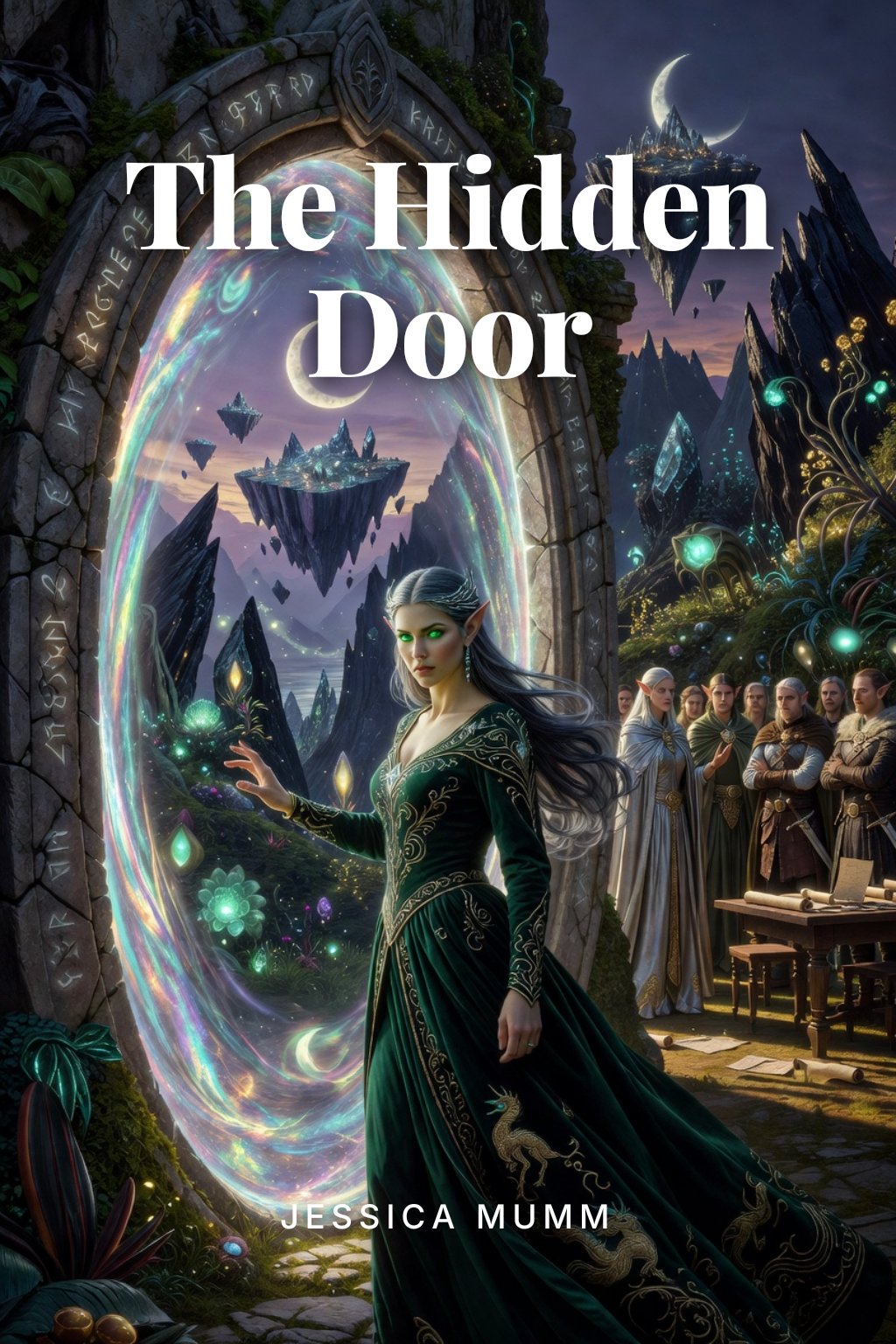
Novel · 8 chapters · 35,933 words
The Hidden Door
Contents8 chapters
Chapter 1
The Door in the Root Cellar
The human envoy had brought a casket of salt.
It sat on the treaty table between the silver inkstones and the carved bowls of dried pears, a square thing of walnut bound in brass, as if the river roads and six disputed watchposts might be measured out by the handful. Prince Damon rested two fingers on its lid while Lord Sarren of the western marches argued over tariffs in the clipped, patient voice of a man sharpening a blade on silk.
“The ford at Tel Vey was ours before your grandfathers learned to lash logs into bridges,” Sarren said.
“And still floods every thaw,” Damon replied. “My father would be paying for a road that drowns twice a year.”
The courtiers on Estella’s side of the table did not look at one another when he said my father. Small discourtesies had become the grammar of these talks. No one named a king if they could help it. No one reached for bread until someone else had done so first. Human iron buckles flashed against wool and leather; elven sleeves whispered over the polished cedar boards. Even the servants moved as if crossing thin ice.
Estella kept her hands folded in her lap and watched the salt casket instead of the men around it. The lid was carved with reeds and fish, a river scene too cheerful for the room. Human work favored straight edges; the brass corners met clean as clipped nails. If peace failed, if the border raids began again, if the old roads filled with ash carts and wounded horses, some scribe would still note in a careful hand that on the twelfth day of Greenwane the delegation from Lorn had presented a gift of coastal salt to the Court of Vale.
Her father, High King Orrin, sat at the table’s head beneath the pale ribs of the council chamber ceiling. The chamber had been grown rather than built; living wood arched overhead in smooth bands the color of old bone, and thin leaves shimmered along the high lattice where light pooled green and gold. He did not raise his voice. He never needed to. When he set down his pen, the room tightened.
“We are discussing roads,” he said, “not inheritance.”
Damon withdrew his hand from the casket. He had a soldier’s stillness that made other men seem restless by comparison. Estella had decided on the first day that he was older than his twenty-some years in all the least comforting ways. He did not fidget. He did not glance toward his advisors before speaking. He wore a dark blue coat with no embroidery save the black-thread hound at the cuff, and his hair, tied at the nape, had come loose enough that one lock bent against his cheek. That small disorder somehow made him look more deliberate, not less.
“My apologies,” he said.
He meant none.
Estella knew the shape of court apologies. They had corners.
Lord Sarren went on. The Bishop of Hollow Bank objected to grain levies in a voice soft with piety and hard with numbers. Master Ennor from the human side unfolded maps and refolded them with little snapping motions, as if creasing the land itself. Ink dried. Pears went untouched. Somebody mentioned foster exchange for noble children raised across the border, and the temperature in the room changed without any draft at all.
Estella’s father said, “Hostages by another name are still hostages.”
Damon said, “A child raised at a friendly court is not a prisoner.”
“No child sent where their parents cannot run to them is free.”
There. At last. Something honest.
Estella looked up. Damon had done the same, and for one brief, unguarded moment his expression was stripped of diplomacy. Not anger. Recognition, perhaps. Then it was gone.
The conversation broke apart into lesser objections. Quills scratched. Pages turned. Estella’s neck ached from holding still. She was not formally a negotiator; she was proof. A princess seated near the king suggested dynastic confidence, a future broad enough to include settlement, sons, exchange of blood without war. Her mother used to call these appearances the work of standing beautifully in a doorway while men discussed what to move through it.
At midday the servants brought soup in shallow clay bowls, barley and mushroom with chopped winter savory floating on top. The human delegation accepted the meal; no one trusted enough yet to drink more than water from sealed pitchers. Damon tasted his first spoonful only after one of his captains did. Estella nearly laughed, though there was nothing funny in it.
When the recess was called, chairs slid back over the mosaic floor. Courtiers drifted toward the side tables. Someone at the far end opened a lattice panel and spring air entered with the smell of wet bark from the palace terraces.
Estella rose. Her father was already bent over a parchment with Chancellor Belis, speaking too low to catch. Good. If she moved now, she might get clear before someone remembered she could be useful.
“Your Highness.”
She turned. Damon stood a polite distance away, soup untouched in his bowl.
“What does your father think of our salt?” she asked, before he could begin whatever formal compliment he had prepared.
One corner of his mouth shifted. “He thinks we hauled the sea uphill to make a point.”
“Did you?”
“Yes.”
That might have been a joke. It arrived so dry she nearly missed it.
Up close, his eyes were not the flat gray she had thought from across the table. There was green in them, winter-green, like river ice over weeds. He glanced toward the casket.
“It cost three men a week’s temper and one customs officer his place in heaven,” he said. “I’d hate for it to go unremarked.”
“I’ll compose a ballad.”
“I was hoping for a word in private.”
“There is no private in this palace.”
“Then a less crowded corner.”
He did not sound as though he expected indulgence. That, more than courtesy would have, made her wary.
Estella set down her spoon. “About roads?”
“About what happens if we fail to agree on them.”
The chamber was full of listening without looking. She could feel it along her shoulders like heat from a fire. Damon must have felt it too. He shifted a little, not closer, merely enough that his body screened her from the nearest set of eyes.
“Your father’s council wants a concession it can parade through the lower halls,” he said. “Mine wants one it can nail over a gate. Neither side will take back empty hands.”
“You say that as if I can empty or fill them.”
He looked at her directly then. “Can’t you?”
An impertinence, cleanly delivered.
Estella smiled because not smiling would have been a kind of surrender. “You overestimate me, Prince Damon.”
“I hope so.”
That was stranger than flattery. Before she could decide how to answer, Chancellor Belis turned from the king and beckoned with two fingers. Not to Damon. To her.
There were moments in court when annoyance felt almost luxurious, a feeling clean enough to enjoy. Estella gave Damon the smallest inclination of her head.
“Then keep hoping,” she said, and left him there with his untouched soup and the salt between kingdoms.
She lasted another hour.
By then the council had moved from tariffs to river patrols, which were warships if painted one color and customs craft if painted another. Lord Sarren tapped the map until the velluca-shell weights rattled. A human captain with scarred knuckles suggested mixed crews. Three elven advisors spoke at once. Her father’s jaw had taken on that dangerous stillness which meant he was no longer arguing only with the room before him but with a score of dead kings seated behind his own eyes.
Estella asked to be excused for prayer.
No one challenged it. Piety made a useful key.
She left by the west side door, crossed a gallery lined with old antler standards and portraits darkened by smoke, and kept walking when the turn for the chapel came. A pair of page boys carrying folded linen flattened themselves against the wall to let her pass. She went down the narrow stair near the kitchens, where the palace plaster gave way to older stone and the air changed from beeswax and cedar smoke to damp earth.
Below the feast halls, below the storerooms of lamp oil and dried beans, there ran a tangle of underways older than the present palace, older perhaps than the city walls. Roots had entered them long ago and never been denied. The first kings of Vale had raised halls where the great beech grove thickened over a limestone rise; later rulers had widened, polished, gilded. Underneath, the old foundations remained—cool chambers with sweating walls, packed dirt floors, shelves hewn straight out of the rock.
Estella had hidden there as a child when tutors bored her beyond mercy. The root cellar behind the winter kitchen had been her favorite refuge because no one of rank wanted to smell onions if they could help it.
The cook’s assistants were gone for the hour. She passed bins of turnips and stacked apple crates with slatted sides. Knotted strings of garlic brushed her hair. Somewhere nearby water dripped into a cistern with patient, hollow notes.
At the far end of the cellar a shelf had been pulled half away from the wall. Estella stopped.
Old Meret, who kept account of stores, would sooner misplace a thumb than leave a shelf askew. Estella crossed the packed earth and set her shoulder to the timber frame. It moved reluctantly, its legs gritting through dirt. Behind it the wall had crumbled inward around a snarl of roots thick as wrists. Black soil showed where none should have been, fresh and damp, threaded with pale white filaments that looked almost like worms.
A draught touched her face.
There was a gap beyond the roots, not large at first glance, only a pocket where stone had split and the earth taken advantage. Estella crouched. The smell rising from it was not the cellar’s steady loam and cold vegetable rot. This was sharper. Resin. Wet ash. Something singed.
She reached in and pushed aside a hanging veil of rootlets.
Wood met her fingers.
Not shelf wood. Not support beam. A plank standing vertical, fitted into a frame buried in dirt and stone. She dug with both hands, heedless of her sleeves. Soil packed under her nails. Fine roots snapped against her skin with faint, green scents. Inch by inch a shape emerged: a narrow door no higher than her shoulder, made of dark boards banded not with iron but with some gray metal gone dull as river pebbles.
No hinge showed. No latch, either. Only a seam and, at eye level, a plate worked with an emblem so worn she had to clear it with the edge of her thumb before she understood what she was seeing.
A tree. No—a tree split down the middle, its two halves bending away from one another.
Her pulse changed.
The oldest stories in Vale spoke often of partings. Rivers split by oaths. Brothers divided into peoples. The first roads cut from one kingdom to make two. Children’s tales used those old symbols because they survived in memory even when their meanings thinned. Yet she had never seen this mark in the palace. Not above any arch, not on any chest in the treasury, not on any banner in the Hall of Ancestors.
She pressed the plate.
Nothing.
She braced one hand on the frame and shoved.
The wood did not move, but something sharp caught the side of her thumb. She hissed and drew back. A bead of blood welled bright against skin already dirt-streaked.
It struck the metal plate.
The plate gave beneath her touch with a soft inward click.
Every small sound in the cellar seemed to stop at once. No drip. No distant pan-clatter from the kitchens above. Even her own breath felt held.
The seam darkened. Not by shadow. It grew depth, as if the crack between door and frame widened into a slit cut through the world. Cold leaked from it, needling her face.
Estella should have called for guards.
Instead she looked over her shoulder, though there was no one to witness her disobedience, and put her hand flat against the wood.
It swung inward soundlessly.
Beyond it stood no hidden chamber under the palace, no forgotten passage lined with mason’s marks. A forest opened there, and for one absurd moment her mind refused it. Trees, yes—but trees under a sky the color of quenched iron. Their trunks were black-barked, leaves sparse and silver on the undersides, shivering in a wind she could not feel from where she knelt. The ground beyond the threshold was ridged with roots and scattered with white stones. Farther off, between the trunks, something rose like the broken neck of a tower.
A bird cried once overhead. The sound cracked in the air like pottery.
Estella stared until her knees hurt from crouching.
Then she stood, wiped her bleeding thumb on her skirt, and stepped through.
The cold took her first. Not winter cold but a dry, high chill that smelled of smoke long settled into bark. The cellar vanished behind her with no fading, no transition. One moment onions and earth; the next, a wood she had never seen and somehow knew.
Maldra.
The shape of the land sat inside her bones. Even in strange country she felt the old pull of north and river and mountain rim. Yet this place wore those bones wrong, as if some hand had broken and reset them in a hurry. The beeches here were stunted and dark. The moss underfoot carried a rusty tint. No thrush sang. In the distance, where Vale should have spread white along its hill, she glimpsed only a jag of wall and the hollow flank of a keep burned open to the sky.
She turned sharply.
The door still stood behind her, freestanding among the roots of a massive tree as if it had grown there. Beyond its frame she could see the dim root cellar under the palace, the shifted shelf, a wedge of ordinary shadow. Relief hit her so quickly it felt almost like disappointment.
“This is either sacrilege,” she muttered, “or I’ve finally gone mad.”
“Those are not the only choices.”
The voice came from her left, low and close.
Estella spun.
He stood between two black pines, a bow already drawn.
Not one of her father’s rangers. Not any man she knew. He wore a coat of scaled leather dark as old wine, belted over black wool, and high boots muddied to the knee. His hair was bound back with a strip of braided cord, though loose strands had fallen around a face too sharply cut to be called gentle. There was soot on one cheekbone. A knife sat at his hip. The arrow aimed at her breast had a head of dark metal she did not recognize.
His eyes held her.
Not human gray, not elven hazel. Gold, but not any gold made by jewelers—gold the color of a coin left in fire.
“I asked first,” he said. “Whose threshold did you steal?”
Her hand went automatically to the thin knife hidden in her sleeve, then stopped. Against a drawn bow the gesture would look foolish at best and fatal at worst.
“I didn’t steal anything,” she said. “I found a door.”
His expression altered by a degree. “That door has been dead for years.”
“Then it has poor manners, because it opened.”
The arrow did not waver. “Step away from it.”
She did. One pace only.
“Farther.”
“If I go farther,” Estella said, “you’ll think I’m trying to run.”
“Good. You can think.”
There was weariness under the threat. Not trust, not even curiosity exactly—more the hard attention of someone accustomed to traps and too tired to fear them prettily.
Estella lifted her empty hands. Her pulse drummed in her thumb where the cut still stung. “If you mean to kill me, you might at least tell me where I am.”
A pause. Then, “The Black Forest.”
“I know no forest by that name.”
“Then you know very little.”
That, unfortunately, was becoming clear.
He took two silent steps closer. The arrow stayed trained on her, but now she could see details she had missed: the faint pattern along the skin at his throat, not tattoo, not shadow. Scales. Small and close-set, like metal filings fused into flesh. They disappeared under his collar. There were more along the back of his hand where it gripped the bow.
Estella’s mouth dried.
Every child in Vale knew dragons as old caution. Hoard-spirits in the mountains. Fire-mouths in soldier songs. Creatures painted on temple ceilings with jeweled wings and moral lessons attached. They belonged with sea serpents and saintly wolves. Beautiful lies. Nobody serious spoke of dragons as if they might leave tracks.
The stranger saw where her eyes had gone. Something in him closed.
“Say it,” he said.
She did not know which answer might save her. So she chose the true one.
“You cannot be real.”
At that, the corner of his mouth lifted without warmth. He lowered the bow by half an inch, not enough to matter.
“I might say the same,” he said. “Elven silk, no guard, no scent of smoke, and you step out of a dead gate as if from supper.” His gaze flicked to her face, her hair, her hands. “Who are you?”
“Princess Estella of Vale.”
That reached him. Not disbelief—calculation. He looked past her through the open doorway to the cellar beyond, as if he might see the palace itself if he stared hard enough.
“Vale still stands?” he asked.
The word still hit her harder than the bow had.
“Yes,” she said. “Of course it does.”
He was quiet a moment too long.
When he spoke again, the mockery had gone. “Niko,” he said. “Son of Aeron.”
The name meant nothing. The title landed instead.
“Son of what king?”
His eyes came back to hers. “Not king.”
As if answering a riddle for a child, he unfastened the throat clasp of his coat and pulled the wool aside. Scales gleamed there in the gray light, not patches but a descending line from jaw to collarbone, dark red edged in black, each no larger than a thumbnail and set with terrible precision. They caught the weak light like garnets under soot.
Estella did not move.
“Prince,” he said.
The forest gave a long creak somewhere above them. Far off, something answered with a sound too deep for any wolf.
Her skin tightened along her arms. “If this is a glamour—”
“It isn’t.”
“My people would know if dragons lived in Maldra.”
“Your people know what survived them.”
The words lay between them, blunt as chopped wood.
Estella heard again the old songs, but they had never sounded like this. In the songs dragons burned armies and took crowns. In temple carvings they were punishments with wings. Yet the man before her was young enough to stand in a council chamber and be told by older men to wait his turn. There was mud on his boots. His wrist bore a half-healed cut bound with rough linen. Myth had calluses.
“You expect me to believe,” she said slowly, “that there is another Maldra behind a pantry wall, and in it dragons have princes.”
He gave a slight, impatient tilt of the head. “Do you have a better account of what you’re standing in?”
No. She did not.
Movement flashed among the trees to the right. Niko’s head snapped toward it. In the same motion he crossed the ground between them, caught Estella by the forearm, and dragged her behind the buttress roots of a toppled cedar.
“Quiet,” he said against her ear.
She should have fought him. She almost did. But the urgency in his grip was not theatrical; it was the kind born from repetition. He peered over the root mass. Estella, pressed into cold earth and old needles, heard it then: hoofbeats muffled in moss, more than one rider.
Shapes passed through the trees. Three riders in pieced armor the color of old ash, faces hidden behind hooked visors. Their horses were narrow-flanked and scarred. No banner flew from the spears, but each spear-tip had been blackened in fire. One rider turned in the saddle, and Estella saw an antler worked in iron cresting the helm.
Niko’s hand tightened once on her sleeve. Stay.
The riders moved on. One of the horses snorted, uneasy near the door-tree, but none dismounted. Hoofbeats thinned into the wood and were gone.
Only then did Niko let her go.
“Who were they?” Estella asked, too low.
“People who would chain you first and sort your answers later.” He stood and looked toward the vanished patrol. “You’re lucky they missed the seam.”
Seam. She stored the word.
“Do they belong to you?” she asked.
That earned her a glance sharp enough to cut bark. “Do I look like I belong to them?”
“No,” Estella said, before she could stop herself. “You look hunted.”
Something unreadable moved through his face and left no trace.
He went to the door and crouched beside its frame, running his fingers over the gray metal banding. Up close she saw symbols scored there, half concealed under lichen. Not letters she knew. He touched one, then hissed softly and drew back. The tip of his finger had reddened as if from frost.
“There’s charge in it,” he said.
“Charge?”
“The old thresholds took blood to wake and blood to cross. Too often, and they start taking more than a drop.” He looked up at her thumb. “What did it cost you?”
“Only this.”
“For now.”
The simplicity of that answer chilled her more than the air.
“You knew of these doors?” Estella asked.
“Knew stories. Most were sealed before I was born.” His mouth hardened. “The elders said that was mercy.”
There were a hundred questions and each seemed to split into ten more. Who had sealed them? Why? How many worlds sat side by side with their skins touching? Why was Vale broken there and whole here? Why did the thought of walking back through immediately feel less like safety than surrender?
Niko rose. “If you want to live long enough to ask better questions, go home.”
The door stood open behind him, showing the cellar dim and ordinary, a basket tipped on its side where she had brushed it. Her own world looked indecently simple through that narrow frame.
“You could come with me,” Estella said.
The offer escaped before caution could catch it. Niko’s expression did not change, but the air between them did.
“No,” he said.
“You don’t even know what waits there.”
“I know enough.” He fastened his coat again, covering the scales at his throat. “A palace that still keeps root cellars. A kingdom that still bargains instead of scavenges. People who think dragons are a bedtime threat. If I walk through that door, I walk blind into someone else’s miracle.”
The way he said miracle made it a thing with teeth.
A pulse of shame went through her, irrational and sharp. She had fled a negotiation table. He measured risk against ruins.
From beyond the trees came that deep cry again, nearer now. Niko turned his head, listening. This time there was an answer overhead—a shadow crossing shadow, enormous enough that the sparse leaves rattled with the displaced air.
Estella looked up too late to see more than the edge of a wing between the branches. Not bird. Nothing that should have fit the sky.
The proof of it hit her a breath later in the form of falling cinders, black flakes drifting down through the pines.
Niko swore under his breath.
“You said your name was Estella of Vale,” he said quickly. “If that is true, remember this: do not speak of the seam where priests can hear you, and bring no iron through if you come again.”
If.
He reached to his own wrist. A line of scales showed just above the glove where the skin changed. With his thumb he levered one loose. Blood welled dark beneath it. The scale itself was narrow, curved, red-black as banked coals. He held it out.
Estella stared. “Why would I come again?”
“Because you stepped through once without being asked.” His hand remained extended. “Take it, or leave with nothing and call yourself mad.”
The scale was warm when she accepted it. Not hand-warm. Hearth-warm. He closed her fingers over it before she could decide whether to drop it.
The wing-shadow passed overhead once more, lower. Somewhere to the east, a horn began to blow—three raw notes.
Niko stepped back from the threshold. All at once the distance between them felt abrupt and wrong, as if a page had been torn through the middle of a sentence.
“Go,” he said.
Estella should have demanded more. A map. A name she recognized. An explanation fit to survive daylight. Instead she looked at his blood at the wrist, the trees scarred by old fire, the ruined tower beyond, and understood with miserable clarity that one visit had already unstitched her life.
She stepped backward through the doorway.
The cellar smell struck her hard—damp stone, potatoes, onion skins. The light changed from iron-gray to lantern gold. For a heartbeat she still saw him framed by the roots: tall, watchful, one hand on the bow, the black forest breathing behind him. Then the door swung shut between them.
Not by her hand.
It closed with a final, wooden hush and became once again only a narrow panel buried in soil and roots. The metal plate cooled under her touch. No seam showed.
Estella stood in the cellar with dirt on her skirt and a dragon’s scale burning in her palm.
Above her, the palace resumed itself in muffled layers—someone rolling a barrel across stone, a distant shout from the kitchens, the long, low call of the afternoon bell summoning the court back to session.
She slid the scale into the hidden pocket sewn inside her sleeve. The silk there darkened at once from a smear of Niko’s blood.
When she pushed the shelf back into place, her hands shook only once.
At the stairhead a voice called down before she could mount the first step.
“Your Highness?”
Not a servant. Too crisp.
Estella looked up. A guardsman stood in the doorway above, backlit from the hall. Beside him, half in shadow, was Prince Damon.
His gaze dropped at once to the dirt on her cuffs, the soil under her nails, the torn hem of her gown where roots had caught it. He did not speak. He only looked, and in that look she felt, with a sharpness almost equal to the forest’s cold, that the day had split open and was not done with her yet.
Inside her sleeve, the scale gave off a slow, impossible heat.
Chapter 2
Ash Above the Black Forest
“Did you lose a war with the potatoes, Your Highness?”
Damon said it lightly enough that the guardsman at his shoulder smiled before checking himself. Estella kept one hand on the stair rail and let the other fall inside her sleeve, fingers closed around the hidden scale until its heat bit her palm.
“The shelves are poorly stacked below,” she said. “Old Meret asked for help.”
“Old Meret asks for ledgers and stronger boys from the kitchens. She does not usually ask princesses.”
The guardsman shifted, uncertain whether this counted as insolence. Damon spared him the trouble by stepping aside from the doorway. Up close, the dark blue of his coat was nearly black in the cellar gloom, the stitched hound at his cuff catching a thread of lantern light when he folded his hands behind his back. One lock had come loose from where his hair was tied and rested against his cheek. It made him look younger, which annoyed her because the rest of him did not.
“Then let us call it charity,” Estella said.
His eyes went to her torn hem. To the dirt at her wrist. Back to her face. “Did you find what you were looking for?”
The scale burned harder. For a moment she had the stupid conviction that he must be able to see it through silk and skin both.
“Yes,” she said.
Something moved in his expression then—not belief, not disbelief. A small mark cut in wax and smoothed over. “I am glad.”
He held the doorway for her as if they had met by chance in any corridor and exchanged the mildest courtesy. Estella climbed past him and felt his gaze between her shoulders all the way into the upper hall.
She did not go back to the council chamber at once. She stopped in the washing room off the winter kitchen, scrubbed earth from under her nails with sand soap until the skin reddened, and still saw black bark, ash in the air, a ruined tower open to the sky.
That night she laid the scale on the table beside her bed and watched it dull from ember-red to the color of old garnet in candlelight. It should have cooled. It did not.
On the second night she held it over a basin and let one drop of her own blood strike its edge.
Nothing happened.
On the fourth, when the day’s arguments over toll rights had left her father with a pulse jumping at his temple and Lord Sarren nearly hoarse with outrage, Estella took a paring knife from the fruit board, tucked it into her sleeve, and went down again after the supper trays had been sent up.
The root cellar smelled of turnips and wet rope. Somewhere behind the far wall, mice worked industriously in the straw. She pulled the shelf from the earth, found the narrow panel by touch, and pressed the knife to the pad of her thumb before she could hesitate.
Blood welled bright and immediate. It stung when she touched it to the metal plate beneath the split-tree emblem.
The click came at once.
She had not known until that sound how badly she wanted it.
Cold air slid through the opening carrying soot, pine resin, and something ranker beneath. Estella slipped sideways through the door and stepped into dimness under black trees.
Niko was there before she had taken three breaths.
He came out from behind a trunk with a bow in his hand, arrow already nocked, and lowered it only when he saw her face. “You took your time.”
It was not welcome, exactly. It was not displeasure either. His hair had been braided back this time with a strip of dark leather, leaving the shape of his features bare in the thin light. There were scales at his throat where the collar of his coat fell open, small and close-set as if hammered from iron and then heated.
“You said if I came again,” Estella said. “You did not say when.”
“No. I thought perhaps fear would improve your sense.”
She looked past him, half expecting the trees themselves to lean nearer and listen. “Did you wait for me every day?”
“Do I look idle?”
No. Nothing about him suggested idleness. His gloves were worn white at the fingertips. Ash marked one shoulder. The bowstring had cut a groove into the leather guard on his left wrist. He glanced once at her bleeding thumb and then beyond her, toward the half-open door, as if measuring what might already have followed her through.
“You came alone.”
“Yes.”
“No maid bribed to hold the stair? No brother with a knife? No priest muttering over your tracks?”
Estella swallowed the reflexive answer. He was testing the edges of her lies the way a man tested river ice. “No.”
He gave one short nod. “Then close it.”
She turned back and pushed the door until it thudded shut within the roots. The forest darkened by a degree, as if the last borrowed warmth had been pinched out.
Niko watched her put a strip of linen around her thumb. “Do all your doors ask for blood?”
“Only the interesting ones.”
For the first time, his mouth twitched.
He led her away from the threshold without asking whether she meant to follow. The ground dipped under a mat of needles and char. Here and there among the black pines grew spears of silver grass that whispered at their passing. She saw where whole reaches of forest had been burned back long ago and had returned wrong, the saplings pale and bent in one direction as if still taking instruction from an old wind.
The ruined keep she had glimpsed on her first crossing showed more plainly from a rise above the trees. Its western face was sheared away. Rooms lay open as dollhouses to the sky: a stair to nowhere, a hearth suspended over emptiness, a fragment of blue tile still clinging to one wall. No banners. No roof.
“Was that Vale?” she asked.
Niko did not answer at once. “That was a hold of Vale.”
“A hold?”
“A court-keep for the southern road. Small by our old measures. Important enough to burn.”
Our old measures. Estella kept the phrase in mind.
Below them, the remains of a road cut through the wood in a gray stripe, half broken by roots. A stone mile-marker had toppled into the ditch and split. Someone had painted marks over the old carvings in a rusty red she did not care to identify.
“There are no southern road keeps near Vale,” she said. “Only the glasshouses and the deer lodges.”
He looked at her then, not sharply but with concentration. “Tell me your Vale.”
“Why?”
“To hear where it diverges.”
“Diverges from what?”
“From the Maldra I know.”
He started downhill again. Estella followed, skirts gathered in one hand to keep them from the brambles. She spoke because the silence between them asked harder things than speech did.
She told him of the living halls at court and the lake gardens with white eels in the channels, of the west orchards, of the stone bridge humans had repaired after the spring floods six years ago because trade mattered more than grievance. She told him the Black Forest in her world lay north and deep but was not forbidden ground, only dangerous in winter. She did not tell him everything. She left out which lords wanted war and which priests had begun to count treaty concessions like sins. She left out Damon’s face at the cellar stair and the steadiness of his attention.
Niko asked no questions while she spoke. He listened with his head bent slightly, as if the shape of her world might be heard under the words themselves.
When she finished, he said, “And humans sit at your father’s table.”
“Yes.”
“As petitioners?”
“As envoys.”
“As equals?”
Estella heard the edge in that and answered it with one of her own. “At the table, yes.”
He gave a sound too flat for laughter. “Interesting.”
“You say that as if I ought to be ashamed.”
“I say it as if I am deciding whether you are naïve, lying, or extraordinarily fortunate.”
They reached the road. Up close, the paving stones were cracked by old heat. In some places they had bubbled and run like wax before hardening again. Estella crouched and touched one with her fingertips. The stone was cold now, but the warped shape of it made her draw her hand back.
“What happened here?”
“War.”
“With whom?”
He looked at her as if she had asked what winter was. “With each other. With those who broke faith. With the sky, some years.”
“That is not an answer.”
“It is the one you get until I know whether your court sent you through that door with innocent eyes or polished ones.”
Anger flashed quick and useless. “If my court knew this door existed, there would be soldiers here already.”
He seemed to consider that seriously. “Yes,” he said. “There would.”
A cry rolled over the trees then, so deep it rattled in her ribs. Estella stopped. It came again from far off, not a bird and not thunder. She knew that now.
Niko watched the sky through the broken canopy. “Keep moving.”
“Is that—”
“Yes.”
He did not give the word. Somehow that made it heavier.
They left the road and cut east through a stand of trees stripped bare on one side as if a great hand had combed fire through them. In a hollow where the earth had sunk, water stood black and still around the roots. A chain hung from one branch, thick as her wrist, the end buried in mud. Estella stared at it long enough that Niko said, without turning, “Do not ask that either.”
She asked something else instead. “You called yourself prince. Prince of what?”
“Of no peaceable thing.”
“That sounds rehearsed.”
“It was earned.”
When they stopped at last, it was in the shell of a gatehouse swallowed by creepers and soot. One room remained roofed over by a cracked vault. Someone had cleared it recently. A camp brazier sat cold in the corner. There were wrapped bundles, a coil of rope, a skin of water, a low stool hacked from a stump.
“You live here?” Estella asked.
“I wait here. Living is farther north.”
He unstrung his bow and set it against the wall. “Sit.”
She remained standing.
That earned her the look again, the one that weighed rather than challenged. “If I meant to trap you, princess, I would not begin by offering a stool.”
“That is exactly what someone setting a trap would say.”
“Then your court has improved you.”
He sat instead, forearms resting on his knees. Up close, the scales at his hand were easier to see where the glove did not quite meet skin. They were not scattered like scars. They were part of him, ordered and deliberate. Dragon prince, he had said, and the memory of the wing-shadow passing overhead moved across her skin.
“What are you?” she asked.
His gaze lifted to hers. “Ask a cleaner question.”
“You first. Do dragons rule here?”
“Yes.”
“You among them?”
“Yes.”
“Over elves?”
“Over what remains.”
The words settled between them. Estella heard in them a field of bones, a city after smoke, the shape of a history told in a room with shutters closed.
“And humans?” she said.
His expression changed so little she might have imagined it if not for the beat of silence before he answered. “Gone.”
“Gone where?”
His mouth thinned. “Into graves, mostly.”
Estella stared. “All of them?”
“You speak as if your kind are impossible to kill.”
“I speak as if peoples do not vanish.”
“In your Maldra, perhaps.”
The room seemed suddenly narrower. “Elves here speak of humans as a vanished threat?”
“They speak of them as oathbreakers, raiders, torch-bearers, and carrion left for crows. The old songs use finer language. The bones do not.”
“That cannot be true.”
Niko leaned back against the stone. “You crossed a blood door into a dead branch of your kingdom and that is the point at which your faith objects?”
She hated that he had chosen the exact weakness in her. “You could be lying.”
“Yes.”
“Are you?”
He considered. “Not about that.”
Outside, something moved through the brush and was gone. Estella looked toward the opening. She felt a sudden absurd desire for the careful noise of the council chamber, for the scrape of chairs and scratch of quills and men lying in silk instead of ash.
Niko drew a folded scrap of hide from his coat and tossed it to her. It was stiffer than parchment. When she opened it, she found a map inked in black and dark red. The names were wrong in places, shifted in others, but the shape of the rivers was Maldra’s shape. South of Vale, in the territory where the human principalities ought to have been, there was only a wash of red strokes and three words cramped into the margin.
Marches of Cinder.
“That is what your people call human lands?” she asked.
“No one calls them human now.”
He reached for the map when she had looked her fill. Their fingers brushed. The scale in her sleeve answered with a pulse of heat, quick as a heartbeat. Niko’s hand stilled.
“What did you bring through?” he said.
It was the first time his voice had sharpened since she arrived.
Estella withdrew her hand. “Nothing iron.”
“I did not ask about iron.”
He was on his feet before she quite understood he had moved. In two steps he stood close enough that she caught the smell of smoke in his coat and cold pine on his skin. “Show me.”
She almost refused on principle. Then she remembered the horn in the forest, his warning at the first crossing, the very real possibility that rules here mattered in ways she did not yet know. She slid her fingers into the hidden pocket of her sleeve and drew out the scale wrapped in linen.
His face altered when he saw it. Not softness. Something more private and more dangerous.
“You kept it.”
“You gave it.”
“That was not permission to carry it across the seam.”
“I thought it might—” She stopped.
“Might do what?”
“Open the door without blood.”
“It did not.”
“No.”
He took the scale from her with care she would not have expected from those scarred hands. “It is keyed to me now as much as to you. If another scent found the threshold on your side—”
He broke off and looked toward the door though stone stood between him and the roots half a wood away. Estella heard nothing. That frightened her more than if she had.
“What scent?”
Niko moved at once, shoving the scale back into her palm. “We are leaving.”
“What is it?”
“Move.”
This time she obeyed without argument. He snatched up the bow, kicked dirt over the remains of the old brazier though no fire burned there, and drove them out through the gatehouse into the trees.
The forest had changed while they spoke. It took her several strides to understand how. The air had gone still. No wingbeat. No branch-creak. Even the silver grass had ceased its whispering.
They were halfway to the road when she saw a darkness slip between two trunks ahead of them.
At first she thought it was shadow cast by cloud. Then it detached from the tree and unfolded upright.
It had too many joints. That was the first truth of it. The second was that its edges refused to stay fixed; they feathered and drew in again as if smoke were trying to imitate a body and not learning quickly enough. Where a face should have been, there was only a deeper well of blackness. It moved without sound across the needles toward them.
Estella stopped dead.
Niko seized her arm hard enough to bruise and yanked her sideways behind a fallen trunk. “Do not let it touch your blood.”
The thing turned, though she could not see eyes. It had already found them.
“How?” she whispered.
“You opened a way. It smelled the seam.”
He rose to one knee and loosed an arrow. It passed into the creature’s chest and vanished as if shot into deep water. The thing shuddered, drew itself taller, and came on faster.
“That did nothing.”
“It slowed it.”
“This is slowed?”
Niko was already reaching over his shoulder for another shaft. “When I tell you, run for the threshold.”
“You said not to let it near the door.”
“I said it smelled the door, not that I intend to feed you to it there.”
He shot again, this time into what might have been a knee. The creature bent wrong, recovered, and flowed over the fallen trunk with a slick, boneless motion that made Estella gag.
Niko dropped the bow, drew the curved blade from his belt, and cut his own palm in one smooth pull.
“What are you doing?”
“Buying a moment.”
Blood ran dark over the scales at his hand. He flung it in an arc across the creature’s path and spoke a word she did not know, harsh and clipped. The droplets hit the ground and flared dull red, not flame exactly but a line of heat that the thing recoiled from with a hiss like wet ash.
For the first time, Estella believed every impossible claim he had made.
“Now,” Niko said.
She ran.
Roots grabbed at her shoes. Branches whipped her sleeves. Behind her came the crack of something striking wood, then another of those dry hissing cries. She did not look back until she reached the low rise where the hidden door waited among the roots.
When she turned, Niko was coming at full speed through the trees with the creature on him.
Not behind him. On him.
It had taken his left shoulder in limbs—or tendrils, or strips of darkness—she could not tell. He drove his knife upward into the body that would not hold shape and was dragged sideways into a trunk with a force that shook needles from the branches above. Blood striped the bark. Niko twisted, kicked free, and shouted something she did not catch.
Estella had the knife from her own sleeve in her hand without remembering drawing it.
The threshold would open only for blood.
She slashed her thumb open again, far deeper than before, and slapped her hand against the metal plate hidden under the roots.
The click was drowned by the creature’s scream.
The door opened inward on cellar dark and potato-cool air. Estella looked from the gap to Niko. He had gone to one knee. The thing loomed above him, its edges smoking where his blood had struck it, reforming already.
“Niko!”
His head snapped toward her. “Back through!”
It was an order. It landed like one. And it carried, beneath it, something she did not want to name because it sounded too much like fear for her.
Instead of obeying, she grabbed the half-rotted branch at her feet and hurled it. It passed through the creature’s shoulder and broke against the tree beyond. Useless. But the movement drew it. The faceless head turned toward the open door and the fresh blood on the threshold.
That single moment was enough.
Niko came up out of his crouch with a speed that seemed not entirely human and drove his blade two-handed into the center of the dark mass. Light burst there—not white, not fire, but a hot red shot through with gold, as if a furnace door had been kicked open inside the creature’s body. Its scream tore the air thin. The black shape convulsed and flew apart into cinders.
Not dead. Only broken. The ashes hit the ground writhing.
Niko caught Estella by the shoulders and shoved her bodily toward the open door. “Go.”
She stumbled back into the cellar. He did not follow.
For one raw second she thought he meant to leave her, to shut the way and keep whatever bargain or safety existed on his side intact. Then he slammed the knife hilt-first into her hand.
“If it reforms near the seam, cut yourself and bar it with my blood,” he said, voice rough. “Do not open again for three nights. Do you hear me?”
She stared at the blood all over him, dark on his mouth where some blow had split the lip, soaking the torn shoulder of his coat.
“Niko—”
“Do you hear me?”
“Yes.”
Only then did he step backward out of reach, grab the edge of the door, and force it toward closing. Through the narrowing gap she saw him turn, saw black ash drawing itself together under the trees, saw the ruined keep in the distance beyond him and something vast move against the strip of sky above it.
The door shut.
The cellar took the silence badly.
Estella stood pressed against the wall, knife in one hand, blood dripping from the other onto the packed earth floor. Her own breath sounded childish and thin. The metal plate under the split-tree emblem had gone cold already.
She waited for the panel to tremble.
It did not.
After a time she wrapped her thumb in her skirt hem and cleaned the knife on a sackcloth rag from the shelf, though she could not bring herself to wipe it entirely free. Her hands shook so hard that she had to brace one against the wall to stop the blade from clattering.
He could have used her.
The thought came clear and hard through the panic. He had known more than she did. He had known the danger. If he wanted leverage over a foreign court or a hostage from another world, he had held every advantage in that forest. Instead he had taken the thing’s weight on his own body and sent her away with the weapon.
When she climbed the cellar stairs, the pain in her reopened thumb had settled into a hard throb that matched the pulse in her throat. The corridor beyond the kitchen was empty. Somewhere above, a viol was being tuned in the queen’s withdrawing room; each string rose, tightened, held. A pan clanged in the scullery. Ordinary sounds. An insult to what had just happened.
Estella made it as far as the first bend before she met Old Meret coming the other way with a basket of dried beans crooked on one elbow.
The old woman squinted at her. “You again? If you mean to rob my stores, choose something worth carrying.”
Estella drew her hand into her sleeve. “I was looking for rosemary.”
“In the root cellar?”
“I was desperate.”
Meret sniffed. “You smell like a chimney.” Her gaze narrowed. “And blood.”
“I cut myself on a crate nail.”
“There are no crate nails in my cellar.”
The old woman might have said more, but footsteps sounded at the far end of the passage. Two servants flattened themselves to the wall as Prince Damon rounded the turn with Chancellor Belis at his side, deep in low conversation. Belis was saying something about revised grain levies and did not look up.
Damon did.
His glance touched Estella, shifted past, then returned at once. There was soot on the cuff of her gown. A smear of dried blood darkened the edge of her sleeve where the linen had slipped.
Belis continued on, all quills and worry. Damon slowed. Meret executed a bow as stiff as a snapped branch and shuffled off muttering about wasted lamp oil.
When they were alone in the passage, Damon’s gaze dropped to Estella’s hidden hand.
“You have a talent,” he said, “for appearing from beneath the palace in worse condition than when you went under it.”
“I might say the same of treaty envoys.”
“That would require me to start climbing into cellars.”
He waited. Estella said nothing.
The silence stretched. Somewhere water dripped steadily into a cistern.
At last Damon stepped nearer, not crowding her, only making it impossible to pretend he had seen nothing. “Did you find what you were looking for this time?”
The question had not changed. Its shape had.
Estella looked at him and saw how careful he was being with whatever suspicion he held, how gently he had wrapped it. That, more than accusation, unsettled her.
Inside her sleeve, Niko’s knife lay warm against her wrist.
“No,” she said.
Damon’s eyes flicked to her face, reading, failing to settle, trying again. “Then I hope,” he said quietly, “that whatever found you was worth the wound.”
He moved past her toward the council hall, black-thread hound gliding at his cuff.
Estella stood in the narrow passage with one prince’s blood on her hand and another prince’s question following after her like a second shadow. Behind the walls, under stone and root and packed earth, the hidden door waited in the dark for three nights. Above, beyond timber and roofbeam, a string on the viol tightened until it sang one thin, straining note.
Chapter 3
Terms of Peace
“Princess.”
Chancellor Belis did not knock so much as strike the door twice with the heel of his hand and enter on the second sound. He came in with three tablets tucked under one arm, wax crumbs on his cuff, and the expression of a man who had slept in a chair and meant to blame everyone else for it.
Estella rose from the bench by the lattice window before he could see the dragon scale in her palm. She closed her fingers over it and let her hand fall into the folds of her skirt.
“The council reconvenes within the quarter hour,” Belis said. “His Majesty requires you present.”
“He required me present yesterday.”
“And the day before.” Belis shifted the tablets. “Today you will be seated with Prince Damon.”
That caught on something inside her. “Why?”
“Because Lord Sarren has decided the humans mistake graciousness for weakness, and because the human marshal took offense at being placed beneath the east bough banner, and because your father is tired.” He said it flatly, as if fatigue in a king were a structural fact like a cracked beam. “You will sit beside the prince as proof that cordiality remains possible.”
“As proof.”
Belis’s mouth thinned. “Do not make me explain statecraft before breakfast.”
He left as abruptly as he had entered.
For a moment Estella stood still, listening to his steps recede down the passage. Her hand was damp around the scale. When she opened it, the small curved plate of dark gold lay against her skin, warm as if it had been in sunlight. Niko had told her three nights. This was the third day.
She slid the scale into the lining of her sleeve and crossed to the basin. The water in the pitcher smelled faintly of copper. She washed her hands carefully, though no soot remained beneath the nails now, and dressed while her maid laced the green silk overskirt and fastened a collar of moonstone leaves at her throat. The maid talked about who had quarreled in the servants’ hall over lamp oil and whether the baker’s son would lose his ear for stealing figs from the pantry. Estella answered where she had to. Her mind was below the palace, behind the shelf, at a door no higher than her shoulder.
When she entered the council chamber, the room had that polished quiet which meant everyone had arrived before the king and wished it known. The chamber’s pale ribs arched overhead like the inside of a shell. Light from the high windows pooled along the living grain of the table. Human banners stood opposite elven standards, blue and silver facing green and bone-white, every fringe untangled, every pole upright, as though cloth had never been used to hide knives.
Her father’s chair waited at the head. To his right, where she usually sat, a place had been left empty. To his left, beside the human prince, another chair had been drawn out.
Damon was already there.
He stood when she approached. Courtly. Exact. His dark blue coat was fastened to the throat despite the warmth of the room; the black-thread hound at his cuff caught when he bent his hand over the chair back for her. He had tied his hair more neatly today, though the same lock had come loose near his temple. Something about that small failure made him look more tired than if he had arrived disordered all over.
“Your Highness,” he said.
“Prince Damon.”
The chairs were close enough that their sleeves nearly touched when they sat. Estella became aware at once of his stillness. Not the softness of ease. A held thing. The sort of stillness one sees in a horse before a gate is lifted.
Across from them Lord Sarren arranged his papers with the care of a man displaying his own fingers. Beside him sat two elder councillors from the river estates, both narrow-faced, both wearing mourning silver for wars long enough past that nobody alive had buried the dead. On the human side an older woman in a stiff collar of chain links—marshal, Estella supposed—rested one scarred hand on the pommel of her dagger and looked around the chamber as if measuring how many exits it contained.
Her father entered at last with no herald and no pause for anyone’s anticipation. High King Orrin’s crown was no more than a band of pale wood threaded with seed pearls; it never weighed enough to explain the heaviness in the face beneath it. All rose. He sat. The chamber followed.
A clerk read the date and subject in a voice gone hoarse from importance. Road levies. River passage. Foster exchange. Grain guarantees through winter.
The words moved; the table did not.
At first it had the shape of negotiation. Hands spread. Voices smoothed. Figures offered, countered, amended. Yet under every clause there was the scrape of old bone. The western roads were not roads; they were who had bled on them. Grain was not grain; it was who would starve first when weather failed. Foster exchange was spoken as a pledge of mutual trust, and every person in the room heard hostage.
Estella could feel Damon listening before she saw him do it. He did not hurry to answer insults. He let them reach him and settle, then removed whatever barb he pleased and set the rest aside. When Lord Sarren spoke at length about ancestral rights over the willow crossings, Damon said, “Then we agree the crossings matter enough to keep from burning,” and somehow made Sarren sound the one proposing fire.
Later, when the marshal in chain links said the humans would not place noble children in elven keeping while border forts remained unmapped, Damon did not rebuke her publicly. He only touched two fingers to the table and said, “Lady Hester voices the fear in plain clothes. It would be useful if we did the same.”
The words shifted the air. Belis glanced up sharply from his notes. Her father’s face gave nothing away.
Estella turned her head a fraction. Damon’s profile remained composed. Only his jaw had tightened.
“Plainly, then,” said Sarren, with the pleased cruelty of a man who liked candor best when it broke someone else’s skin. “Humans have crossed our western timber line six times this year with armed surveyors.”
“Three times,” said Damon.
“Six.”
“Three with surveyors. Twice with traders who hired stupid guards, once with deserters from Greyfen whom we hanged ourselves.” He looked at Sarren. “If we are stripping embroidery from the cloth, let us not start weaving lies in its place.”
A pulse beat in Sarren’s temple. Several councillors exchanged glances sharp as fish bones. Damon had spoken without raising his voice, but the correction landed harder for it.
Her father’s fingers tapped once on the arm of his chair. “We will count confirmed breaches only.”
Sarren bowed his head to the king and showed his teeth to no one.
The clerk scratched at the page. Outside, somewhere beyond the chamber wall, a bell struck the quarter.
Estella kept her hands folded in her lap. Under the silk at her wrist, the hidden scale seemed hotter than before.
By the midday recess the room smelled of wax, old paper, and temper held too long. Servants came in with trenchers of pears, oat cakes, and slices of white cheese dusted with fennel seed. Wine for the elders, watered ale for the scribes, cold herb water for everyone pretending not to need the stronger thing.
Estella stepped away from the table before anyone could catch her with a fresh duty. She made for the narrow side gallery where carved screens of vinework looked down into the lower court. The stone there held a little coolness. She had just put her hand on the sill when Damon’s voice came behind her.
“You are leaving too quickly for someone seated as proof of cordiality.”
She did not turn at once. “Perhaps the proof requires distance.”
“From me?”
“From all of you.”
That earned a silence, brief and real.
When she looked back, he stood with one shoulder against the screen, a cup untouched in his hand. In the filtered light the green of his eyes seemed darker, like wet leaves in shade.
“You have not gone below the kitchens in three days,” he said.
She stared. “Have you taken to tracking me?”
“No.” He lifted the cup and set it down on the ledge without drinking. “But I notice when people stop doing the thing they were doing in secret.”
It would have been easier if he had smiled when he said it. He did not.
“You presume a great deal.”
“I infer a little. Presume only that there was a reason.”
“And if there was?”
“Then I hope it was enough to keep you out of cellars.” His gaze dipped, not to her sleeve, but to the thumb she kept tucked against her palm. “Has your hand healed?”
“Yes.”
He waited. Estella heard the yard below: stableboys shouting over a balking mule, the wooden thud of practice staves, a raven clacking from the eaves. Damon did not fidget, did not fill the gap. It unsettled her more than interrogation might have.
“You asked yesterday,” she said, “if what found me was worth the wound.”
“I remember.”
“And if I said I still do not know?”
“Then I would believe you.”
There it was again—that carefulness. Not softness. Something more dangerous. A refusal to take the easy version of another person.
She turned back to the screen. Through the cut vinework she could see a square of the lower court where two human guards stood near the cistern, helmets under their arms while they argued quietly with one of the king’s foresters. None of them smiled. Peace, at this distance, looked like men deciding not to spit.
Damon came to stand beside her. Not close enough to touch.
“They will break this,” he said.
She glanced at him. “Who?”
He tipped his head toward the chamber. “Choose any three.” A muscle moved in his cheek. “The old men who prefer a border they understand to a peace they do not. The captains who have profited from patrol exemptions. Your lords who would rather their daughters never cross west and our barons who think every stand of Vale timber already belongs in their hearths. If the treaty fails, they will all call it inevitable. None of them will mention how hard they worked at it.”
It was the most he had said to her without the shelter of wit. He sounded tired then. Not in body. In marrow.
“You speak as though you are not one of them,” Estella said.
“I am one of them.” He looked down into the yard. “That is the problem.”
A groom led a gray horse across the stones below. Its left flank showed a knotty scar, puckered white under the coat. Damon followed it with his eyes and said, “At Red Mere my father sent me to carry terms to a village that had changed hands three times in one season. There were six houses standing. A woman asked whether the peace would return her son’s feet.”
Estella felt the skin tighten at the back of her neck. He said it without performance, as if he had learned long ago that horror cheapened under too much handling.
“What did you tell her?”
“That I was sorry.”
A swallow crossed the court in a black stitch and vanished beneath the roofline.
“She spat on my boots,” Damon said. “She was right to.”
He turned then and leaned one elbow on the sill, facing partly toward her. “So when I say this treaty is failing, I am not trying to frighten you. I am only unwilling to sit through another month of embroidered language while men gather carts for another war.”
Estella thought of Niko in the black forest with blood running from his cut palm, of the ruined keep burned open to the sky, of a world where this palace had become stone and ash. She thought, too, of the chamber behind them where every concession wore ceremony like perfume.
“You think war returns if this collapses?”
“I think it has never left.” His mouth bent, not quite a smile. “Some of us have only had the courtesy not to name it in front of the table linen.”
She should have disliked him for that. For seeing too clearly, for speaking to her as if she could bear it, for making common cause where she had expected another kind of pressure. Instead she found herself saying, “Then why stay courteous in there?”
“Because the men I need to hear me would go deaf if I shouted.” He looked at her sleeve, at the place where the hidden scale lay under silk and seam, though there was no way he could know that. “And because not every chain is visible when it is first put on.”
The words sat between them.
“Was that meant for me?” Estella asked.
Damon’s eyes came back to her face. “You tell me.”
Before she could answer, Belis appeared at the gallery door with his tablets clutched to his chest. “There you are. We resume.”
The second session went worse.
An argument over toll rights at the western ferries opened a seam under everything else. The human marshal accused Vale foresters of seizing cargo under false crown authority. Sarren replied by producing sworn statements from river wardens whose signatures looked suspiciously alike. Damon asked to examine them and did so with the expression of a man checking whether a bridge plank would take his weight. Her father listened, very still, while two councillors spoke over each other and Belis’s stylus snapped clean through the wax tablet in his hand.
By late light the chamber had lost even the pretense of grace. Voices rose. A human envoy with a raw red scar under his ear muttered something about leaf-born thieves. One of the river elders answered with a word old enough to curdle in the air. The king struck the table once with the butt of his drinking cup and silence dropped in a ragged sheet.
“We adjourn until evening lamps,” Orrin said.
No one objected. That was how bad it had become.
Estella left through the side passage this time with two attendants and did not shake them until the upper gallery outside the shrine alcove. There she paused, looking down the stair that curved toward the old kitchens. Three nights, Niko had said. Do not open it for three nights. The warning had sat in her like a stone. Now, with dusk coming on, it was loosening into a decision she could almost taste.
“Your Highness?”
She realized one attendant had spoken twice.
“My father has asked that you join him in the cedar room before lamps.”
Of course he had.
The cedar room lay off the private audience hall, paneled in aromatic wood darkened by years of smoke and oil. Her father stood at the long table with Belis and Sarren. A silver map weight in the shape of a swan pinned one corner of an open charter. Another councillor she disliked on sight—a bent scholar from the eastern archives, all parchment skin and bright little eyes—sat with both hands folded over a staff of rowan.
No one offered her wine.
Orrin did not waste time. “The human delegation requests greater assurance that the foster exchange will proceed if the roads are reopened.”
“She is not grain to be pledged,” Estella said before anyone else could.
Sarren’s mouth twitched. “No one implied that.”
The scholar with the rowan staff said, “Symbol and bloodline have weight, Princess. You know this.”
She knew it too well.
Belis did not meet her eyes. “One proposal under discussion is that Your Highness formally swear before both courts to stand godmother to the first two noble children exchanged.”
“And if I refuse?”
A pause. Short. Telling.
“Refusal would be interpreted,” Sarren said, “as reluctance on Vale’s part to place trust where we ask it of others.”
The room smelled of cedar and lamp resin and the faint bitter breath of old ink. Estella looked from one face to the next and saw not cruelty exactly, which might have been easier to answer, but the practical hunger of men building a bridge with whatever timber stood nearest.
“You mean to have me sworn as collateral,” she said.
Her father’s gaze sharpened. “Mind your tongue.”
“No.” The word surprised even her by how cleanly it came. “If they want surety, let the lords who argue for foster terms send their own heirs first.”
Silence rang. Belis closed his eyes briefly. Sarren straightened as if insult itself were a favor at last bestowed.
“Your Highness,” said the scholar, almost gentle, “your person has long served the realm. This is no new burden. A princess belongs first to the peace she secures.”
Something cold moved under Estella’s ribs. That was the old law of daughters said softly.
The door opened.
No one had summoned Damon in her hearing, but there he was on the threshold with a folded dispatch in hand, a servant hovering behind him. He stopped at once, taking in the room in a single glance: her father standing rigid, Sarren bright-eyed, Estella unseated and pale with temper.
“Majesty,” Damon said, bowing. “My pardon. I was told the revised ferry terms were wanted before lamps.”
Belis, too quickly: “Yes.”
Her father did not look pleased by the interruption. “Then leave them.”
Damon crossed to the table. He laid the dispatch before Belis and might have withdrawn at once. Instead he said, mild as milk, “I hope I have not disturbed a family matter.”
“You have not,” said Sarren.
Damon’s gaze moved to him, then to Estella, then back to the king. “Then I should be grateful for clarification, because from the passage it sounded remarkably like one.”
The scholar stiffened. Sarren said, “The princess was offering assurances regarding the foster exchange.”
“Was she?” Damon asked.
His tone had not changed. That made Sarren answer it as if it had.
“It is under consideration that she publicly stand sponsor to the first children sent.”
Damon was quiet. Then: “I see.”
He put one hand lightly on the back of an empty chair, as though considering where to stand next. “Majesty, if I may speak plainly on behalf of my delegation—such a gesture would be disastrous.”
Every person in the room turned toward him.
Sarren gave a short laugh. “Disastrous. Because humans mistrust an oath from the king’s own daughter?”
“Because they would understand it at once for what it is.” Damon’s eyes were on Orrin now, not on Sarren. “An attempt to make one woman answer for a bargain made by men who are unwilling to risk their own houses first.”
The cedar room seemed to contract.
Belis stared at his tablets as if hoping writing might continue without him. The servant at the door lowered his eyes to the floorboards. Her father’s face became very difficult to read.
Sarren said, “You presume to interpret our customs.”
“No. I interpret my people.” Damon’s voice stayed level. “My nobles will not be soothed by seeing a princess compelled to ornament their fear. They will smell desperation in it. Worse, they will suspect you mean to bind her name so tightly to the terms that any failure becomes an insult to her person and therefore a cause for vendetta. I would advise against offering hawks raw meat beside their gloves.”
The rowan scholar’s knuckles whitened on his staff. “A poetic warning from a human prince.”
“A practical one.”
Her father spoke at last. “And what assurance would satisfy them, if not this?”
Damon answered without haste, as if the thing had been waiting in him already formed. “Open maps of the western ferries held jointly by both courts. Rotating wardens at the willow crossings, one from Vale and one from Greyfen. Hostages, if you insist on that old ugliness, taken from houses that argued most loudly for exchange.” Here, for the first time, his glance cut toward Sarren. “Nothing proves faith like risking one’s own blood.”
Sarren flushed darkly. “My son will not be sent into human hands.”
“Then perhaps,” Damon said, “you should stop asking human parents to thank you for the honor.”
It was not loud. It was not dramatic. It struck harder than a shout.
Estella stood very still. A moment before, the room had been arranging itself around her like a snare. Now the shape of it had altered. Not safe. Never that. But altered enough that everyone had to look somewhere other than her throat.
Her father rested both hands on the table. When he spoke, it was to Belis. “Draft the ferry proposal. Joint wardens. We will hear terms on noble exchange tomorrow.”
Sarren began, “Majesty—”
“Tomorrow,” Orrin said again.
The matter was done because he had made it so, though resentment remained in the room like smoke trapped under rafters.
Damon bowed. “Then I have delivered my interruption usefully.”
Her father gave him a long look. “You have delivered something.”
Estella could not tell whether it was gratitude he refused to name or irritation he meant to keep in reserve.
Dismissal came in pieces. Belis gathered tablets. The scholar levered himself upright with the rowan staff. Sarren snatched the dispatch Damon had brought as if it had personally offended him. Her father turned away to the charter, one hand pressed at the bridge of his nose.
Estella moved toward the door without permission and found Damon waiting just beyond the threshold in the dim passage. Servants drifted past with lamp trays and fresh rushes for the sconces. The palace was entering evening: the hour when secrets changed shifts.
“You made them think it was strategy,” she said under her breath.
He looked ahead, not at her. “It was strategy.”
“That is not all it was.”
“No.” Now he glanced down. “It was also offensive.”
The corner of her mouth betrayed her before she could stop it. Not a smile exactly. The memory of one.
They walked side by side through the cedar passage where the walls released their resin scent under the day’s warmth. At the first bend he said, “You should know your father will not forgive me for embarrassing Sarren.”
“My father has spent twenty years not forgiving people. You may survive it.”
“I value your confidence.”
She slowed. “Why did you do it?”
He did not answer at once. Ahead, a page struggled to keep a stack of folded cloths from toppling and nearly collided with a pair of human guards. Someone laughed in a room nearby; someone else shut a door on it.
“At first,” Damon said, “because it was bad politics.”
“And after first?”
He stopped walking then. So did she.
The lamplight had not yet reached this part of the passage. His face lay in the soft brown dimness between windows, sharpened only where evening found the edge of his cheek.
“Because you looked,” he said, “as if they were measuring the distance from your wrists to the treaty table.”
Estella could not speak for a moment.
She had spent years in rooms where men weighed her future aloud and called it prudence. Most did not even have the decency to lower their voices. They spoke of marriages, alliances, mourning periods, fertility, succession, all with a scholar’s interest in the movement of useful pieces. Her life had been a corridor built by other hands. She knew the grain of it. She knew where to place her feet.
But he had seen the walls.
The pulse at her throat beat once, hard.
“You make yourself dangerous when you are observant,” she said.
“So I am told.”
“And if your council asks for something of me next time?”
“They will.” No comfort in the word. Only truth. “If I can turn it, I will.”
If. Not a promise he might fail to keep. She respected him for that and disliked herself a little for respecting him so quickly.
A bell sounded from the lower halls: the call for evening lamps. With it came another knowledge, swift and bright enough to make her hand tighten in her sleeve.
Three nights were over.
The door would open now, if it still could. If Niko still waited. If nothing worse had learned the path between worlds.
Damon saw the shift in her face. Of course he did.
“You are leaving again,” he said.
Not a question.
Estella dropped her gaze before it could betray direction. “You told me yourself not every chain is visible.”
“And not every escape remains one.” His voice had gone quieter. “If whatever is below the palace is drawing blood from you, sooner or later it will demand more than a thumb.”
The scale lay hot against her wrist as a living thing.
She lifted her chin. “Then it is fortunate, Prince Damon, that you know so little about what I intend.”
A pause. Then, very softly, “Less than I would like.”
That was dangerous too, in another way.
Footsteps approached from the far end of the passage. Voices. Belis, perhaps, or Sarren come hunting for the last word. Damon stepped back before either of them could be seen together in stillness and shadow.
“Tomorrow,” he said, all court again, though the courtliness sat differently now, “they will ask for hostages with nicer names.”
“Then tomorrow,” Estella said, “you may offend them again.”
Something moved in his expression. Weariness, amusement, warning. It was gone too fast to catch.
He bowed and turned toward the lit corridors leading to the guest wing.
Estella stood until the approaching voices forced her to move. Then she went the other way, taking the servants’ stair past the linen press, down through the warm back halls where broth simmered and copper pans flashed, past the winter kitchen with its banked ovens and hanging bunches of sage gone brittle with drying.
At the mouth of the passage to the root cellar, she stopped.
The air there held the smell of earth and onions and old wood. Familiar now. Treacherously familiar. She put one hand against the wall to steady herself and listened.
Nothing.
No voices. No clatter from the scullery. No tread on the stair. Only the faint, patient drip of water somewhere in the dark below.
In her sleeve the dragon scale burned against her skin like a warning, or an invitation.
Estella looked once over her shoulder toward the palace above—toward council lamps, her father’s unfinished anger, Damon walking back into rooms where peace had to be argued line by line. Then she slipped into the stairwell and began to descend, carrying one prince’s intervention in her chest and another prince’s silence waiting under the earth.
Chapter 4
The Betrothal Decree
The first crack in the morning came from the floor.
Not loud. A sound like a knuckle pressed into old ice.
Estella felt it through the thin soles of her slippers as she crossed the antechamber toward the council doors. The polished rootwood under the runner gave one dry complaint and settled. No one else seemed to hear it. Chancellor Belis was bent over a sheaf of scraped tablets, muttering dates to a pageboy. Two of her father’s guards stood with their halberds crossed and their faces carved blank. Beyond the doors the chamber was already noisy with men arranging themselves into significance.
Belis looked up. Wax flecked his cuff again. “There you are.”
“You sent for me as though the palace were on fire.”
“At present only the treaty is.” He tucked the tablets against his ribs. “His Majesty wants a full attendance.”
“Full,” Estella said. “Meaning ornamental.”
His mouth twitched once, too brief to call a smile. “Meaning visible.”
That was answer enough.
A servant opened the doors. Warm air came out carrying lamp smoke, wool, damp leather, and the sharp green scent of fresh-cut willow from the chamber walls. The pale ribs of the ceiling arched overhead like the inside of a shell. Human blue and silver stood opposite Vale’s green and bone-white, the banners motionless in the still air.
Her father sat beneath the highest curve with the pale wood crown on his brow and impatience already hardening his face. Lord Sarren stood half turned from his place, one hand spread over the table as if he meant to pin the map there by force. Lady Hester’s stiff chain collar flashed dull at her throat. Prince Damon, in dark blue fastened to the neck, had one hand on the back of his chair and his head lowered toward a document Belis had left for him earlier. The loose lock near his temple had escaped again.
He looked up when she entered.
It would have been easier if he had looked pleased, or apologetic, or merely political. Instead there was a flicker of surprise, quickly hidden, and then a stillness she had begun to recognize in him—the stillness of someone who had noticed the snare after stepping into it.
Belis guided her to her usual place near the king. Proof of cordiality. Proof of continuity. Proof that kingdoms could trade daughters as gently as grain.
The chairs had scarcely settled before Orrin struck the table once with the heel of his hand.
“We have spent nineteen days disputing roads,” he said. “And ferries, stores, foster rights, winter crossings, fines, escort numbers, and every lesser thorn men can grow from paper. Today we conclude.”
Sarren’s chin lifted. Lady Hester folded her scarred hand over the pommel at her belt. Damon sat back without looking away from the king.
“We conclude,” Orrin went on, “because peace built on accounts alone is no peace worth carrying through a thaw. Terms must be anchored in blood as well as ink.”
Estella turned her head very slightly. Belis had gone still beside the wall, tablets braced against his chest. Not surprise, then. Foreknowledge.
Damon spoke before anyone else could. “Your Majesty.”
Courteous. Level. Dangerous for being so.
Orrin looked at him. “Prince Damon.”
“If this concerns the collateral proposal already set aside—”
“It concerns the failure of lesser proposals.” Her father’s voice rang off the curved wood overhead. “And the necessity of one neither side can mistake.”
No one moved. Even Sarren had stopped arranging his outrage.
Estella knew then. Not in words at first. In the body. In the way her fingers went cold while heat climbed her neck. In the quietness that fell over every private part of her mind, as if the room had already chosen not to hear her.
Orrin rose.
“The Court of Vale,” he said, “in witness of its nobles, officers, and allied guests, decrees the betrothal of my daughter, Princess Estella, to Prince Damon of the human line. The marriage shall seal the road compact, the grain accord, and the foster exchange between our peoples. Contracts will be drawn by sunset. The public proclamation will be made at first bell.”
There it was.
No trumpet. No poetry. No veil over the blade.
Sarren let out the breath he had been holding and bowed his head as if to a prayer answered. Across the table Lady Hester’s mouth became a hard line. Belis did not shift. Somewhere near the back, one of the scribes dropped a stylus and the small clatter sounded indecently loud.
Estella heard none of it clearly after the first sentence. The chamber seemed to draw away from her by slow degrees. The rootwood floor. The willow scent. The white seam in one tablet where the wax had cracked. Her own hands, lying one atop the other, too calm to belong to her.
Damon was on his feet.
“No,” he said.
The word cut clean through the room.
Orrin’s expression did not change. “You refuse the honor?”
“I refuse the method.”
That brought sound back all at once: the hiss of someone inhaling, the slide of Sarren’s rings on the table edge, the scrape of Lady Hester’s chair. Damon stood with one hand flat to the boards between the maps and the tally stones, and now the courtesy in him looked less like submission than a sheath.
“You name this peace,” he said, “but you did not ask your daughter before placing her on the terms, and you did not ask me before placing my name beside hers.”
“You are a prince, not a miller’s son,” Sarren snapped. “Do not pretend astonishment at the uses of dynastic treaty.”
Damon did not even glance at him. “I am astonished,” he said to Orrin, “that a king who claims to seek trust begins by compelling what should be consented to.”
The chamber tightened around that word. Consent. Not one of the words old men liked hearing spoken plainly when marriages were under discussion.
Orrin’s fingers rested on the arms of his chair. “You stood yesterday in this hall and warned against hostage terms with nicer names.”
“I did.”
“And today I offer kinship rather than hostage-taking.”
“Offered to whom?”
A pulse started in Orrin’s jaw. “Take care, prince.”
“No,” Damon said, and Estella heard now what he had done for her in smaller ways before: the refusal to soften truth for the comfort of men more powerful. “Take care yourself. If your people see their princess sold in open session, they will call it sacrifice. If mine see me accept without speech, they will call it victory. Neither name breeds peace.”
The silence after that was thick enough to feel.
Estella ought to have spoken. She knew that. If she remained mute, they would use her silence as assent. If she objected, she would be objecting to her father before both courts and setting tinder under every grievance already stacked in the room. Her throat worked once and gave her nothing.
Lady Hester rose.
“When my prince crossed into your court,” she said, “it was to bargain roads and winter grain, not to be yoked by proclamation. Human law requires witnesses from both houses and a period of assent.”
Sarren laughed once, ugly and short. “Human law. We are in Vale.”
“We are in negotiation,” Hester said. “Or were.”
Belis moved at last, coming a step forward with one of the tablets in hand. “Majesty, if the concern is enforceability, the language can be altered. A declaration of intended union pending formal consent—”
“Pending?” Sarren rounded on him. “And leave every faction in both lands free to gnaw at it before ink dries?”
“Every faction is already gnawing,” Damon said.
Orrin stood fully now. He was not a tall man, but kingship made a shape around him that others yielded to by habit or fear. “Enough. This court has indulged human objections to every practical remedy set before it. Roads are disputed. Tariffs disputed. Foster counts disputed. Ferries disputed. Your own marshal has said winter stores fail along three border villages. We have argued ourselves thin while raiders and deserters test the edges. I will have a settlement that cannot be shrugged off by some lesser lord come spring.”
“And so you bind your daughter to a man she was not asked to choose,” Damon said.
At that, Orrin looked at Estella for the first time since he had risen.
It was not a father’s look. Not then. It was assessment. Cost against necessity.
“You are a princess of Vale,” he said to her. “You know what is required.”
The chamber waited.
There were moments when resistance arrived as fire. This was not one of them. This was colder. A narrowing. She saw, all at once, the years behind her lined up like dressed stones: tutors, ceremonies, lineages recited by candlelight, the measured smile expected at feast tables, the lessons in border maps and inheritance law that everyone praised because they made her useful. Not beloved. Useful.
Useful enough to spend.
Her chair went back.
The legs struck the floor with a sharp bark of sound. Several heads turned; one scribe flinched.
“I know,” Estella said, and was startled by how steady her own voice sounded, “what is required of a kingdom that has run out of imagination.”
Belis shut his eyes for half a beat.
Sarren made a choking noise of outrage, but Orrin’s hand came up and stopped him. Color had risen under the king’s skin.
“Sit down.”
“No.”
It was the first time she had given him that answer in open court.
Damon looked at her then, not as if to hush her or shield her, but as if he understood that any interference from him would turn her words into his. For that alone she could almost have been grateful.
Almost.
Orrin said, each word distinct, “You shame this court.”
“This court shamed itself.”
The crack came again from the floor beneath them.
This time everyone heard it.
A thin report, running somewhere under the chamber like stress through frozen timber. The tally stones near Sarren’s hand jumped and clicked together. One of the lamp flames guttered. The banners gave a strange shiver though there was no draft.
Belis stared down. “Did you feel—”
It stopped.
For an instant no one spoke. Then Sarren seized the moment as frightened men do, by naming it smaller than it was.
“The old roots shift in thaw season.”
“It is Greenwane,” Lady Hester said. “There has been no thaw worth naming.”
Orrin ignored them. “Sit,” he repeated to Estella.
But she was already stepping back from the table.
“My answer is no.”
She did not wait to see if the room would permit her one. She turned, leaving the chair crooked, leaving the maps and tablets and all their neat violence behind, and walked the length of the chamber with every gaze in it laid between her shoulders.
No one tried to stop her until she reached the doors. Then Belis’s voice came low and urgent behind her.
“Estella.”
She kept going.
The corridor beyond the chamber was bright with midday lamps and polished enough to catch the movement of her skirt in strips of gold. Pages flattened themselves against the wall as she passed. A pair of ladies carrying folded linen stopped in mid-curtsy. Somewhere behind her the council doors opened and shut again, voices leaking through in one startled burst before the wood swallowed them.
She did not run at first. Princesses did not run in public passages. Princesses withdrew. Princesses composed themselves. Princesses preserved the fiction that decisions placed on them had traveled there by destiny and not by human hands.
At the turn by the chapel stairs, she broke into a sprint.
Silk dragged at her knees. A pin worked loose from her hair and struck the floor. She took the servants’ way without thinking, one hand skimming the wall to keep the corners, past the linen press, down the narrower stair that smelled of soot and rosemary stems, through the back hall where kitchen boys carrying trenchers leaped aside and stared after her.
The scale was in her sleeve today. She had tucked it there before council from habit she no longer questioned. As she ran, it grew hot enough to sting.
At the winter kitchen door, old Meret looked up from a barrel of onions with both arms elbow-deep in straw.
“Princess?”
Estella did not stop. “If anyone asks, I was never here.”
“That has not once improved my day.”
The passage beyond was dim and cool after the kitchen heat. Earth-smell met her at once. Onion skins. Damp timber. A faint mineral chill from stone laid below the palace’s living wood. Her breath sawed in her throat. She caught the wall to steady herself and felt, for the third time that day, a tremor move through the structure—small but certain, as if some heavy thing far below had shifted in its sleep.
Not rootwood this time. Stone.
She went down.
The stair turned tightly, worn in the center by generations of feet carrying casks and sacks. At the foot of it the root cellar opened in rows of bins and dark shelves, each labeled in Meret’s crabbed hand. Turnips. Last apples. Dried peas. Winter beets packed in sand.
The shelf concealing the narrow door stood half drawn from the wall, exactly where she had left it before.
No.
Not exactly.
Her hand went to the scale.
The shelf had been moved farther aside.
A black smear marked the floorboards near the hidden threshold, as if something sooty had brushed there. Estella stood still long enough to hear the soft, inward drumming of blood behind her ears.
“Niko?”
Nothing.
The word had scarcely left her mouth when the door gave a dull click from the other side.
She did not touch the metal plate.
The split-tree emblem shivered once under its skin of gray metal. Then the narrow panel opened inward by the width of a hand and stopped.
Cold air slid through. Not the cool of cellars. Forest cold. Wet ash and char and the sharp resin smell of black bark.
“Niko,” she said again, but now it came out like a warning.
The door widened.
He ducked through it as if the space resented his shoulders.
For one impossible heartbeat she could only stare. He was taller here than the doorway had any right to admit, hair braided back with the dark leather strip, ash still ghosting one shoulder as if he had come straight from some burned place. The scales at his throat caught the cellar gloom with a low iron sheen. He wore the worn gloves she knew, though one was split across the knuckles, and his face looked harder than it had in the forest, as if crossing had taken a file to every line of it.
And he was on her side.
He kicked the door shut behind him with one heel. It sealed with a sound too soft for so great a violation.
Estella took a step back until the bin of apples pressed against her skirts. “How?”
Niko’s eyes went over her once, fast, checking blood, breath, balance. Then he looked up toward the ceiling as though measuring distance through earth and wood.
“I could ask you the same,” he said. “Something tore at the seam half the morning. I followed before it closed.”
“This side is closed. It was always closed.”
“It isn’t now.”
He had not come through unmarked. A dark line of blood showed where the scales at his throat gave way to skin, not a cut exactly but a split, as if pressure had opened him there. When he lifted his hand from the latch she saw the palm was burned red in the center.
“What did you do?”
“What I could.” He flexed his hand once. “What did you do?”
“I did nothing.”
He gave her a look that suggested he had already decided the answer was false.
Before she could say more, the palace shuddered.
Not a crack this time. A real movement. Jars knocked against one another on the nearest shelf. Dust sifted from the beams in a gray veil. Somewhere overhead a pan fell and clanged in the winter kitchen, followed by a shout.
Niko’s hand went to the knife at his hip. Estella caught the apple bin to stay upright. The tremor passed through the cellar stones and into her bones, a long grating pulse like a giant turning under the hill.
When it stopped, the silence rang.
Niko’s gaze had fixed on her sleeve.
“The scale.”
She pulled it out. The piece of him lay on her palm, dark and curved, hotter than flesh should be. A thin red line had appeared down its center.
Niko swore under his breath in a language she did not know.
“What is that?”
“Bad.”
“That is not an answer.”
“It is the only one I have with certainty.” He stepped closer and the air seemed to change around him, carrying cinders and pine pitch and something faintly metallic. “Who was near you when the seam started pulling?”
“No one near the door.”
“Not the door. You.”
She opened her mouth and shut it again. In the chamber: Orrin, Sarren, Belis, Hester, Damon—
Niko watched the thought reach her face. “Say it.”
“The council announced my betrothal.”
His expression did not alter at once. The change came slower and was worse for that. A tightening at the mouth. The stilling of breath. His eyes, which in the forest always held a dangerous quickness, went flat as cooled iron.
“To whom?”
She almost laughed from the ugliness of it. “You know to whom.”
“Say it.”
“To Damon.”
The name landed between them.
For a moment she thought he might turn and put his fist through the narrow door. Instead he looked away, once, toward the stacked bins and the dark between rafters, as if he needed a part of the room that was not her.
“Is it done?” he asked.
“Publicly. Not lawfully yet, if human custom means anything here. My father means to make it done by force of announcement.” Her voice roughened. “He stood up in full council and traded me for roads.”
Niko’s jaw worked once. “Then I crossed for nothing. Your world makes bargains as filthily as mine.”
“I did not ask you to defend it.”
“No. You asked nothing.” He looked back at her. “That has become a habit.”
The words struck because they were partly true.
From above came the muffled thud of running feet. Voices, indistinct through floor and storage bins. The tremor had been felt upstairs. Of course it had.
Estella closed her fingers over the scale. “You cannot stay here.”
“Can’t I?”
“You cannot be seen here.”
“That is different.”
He was bleeding slowly from the throat split. A bright bead ran down and disappeared under his collar. Without thinking she reached toward it. He caught her wrist before she touched him.
His grip was not rough, but the heat in it startled her.
“Don’t,” he said.
She looked from his hand on her wrist to his face. “You are hurt.”
“So are you.”
“I am not.”
He let his gaze drop to where her pulse jumped at the base of her throat. “No?”
She pulled her hand back.
Above them, closer now, Meret’s voice rose sharp with irritation. Another voice answered, male, not one of the kitchen boys. Boots on the stair.
Estella swore and shoved the scale back into her sleeve. “Behind the onion bins.”
Niko did not move.
“If I hide,” he said, “who comes down?”
“I don’t know.”
“You do.”
The boots were halfway to the landing. Meret said, “You may ask me all the royal questions you like, my lord, but onions will not answer them quicker.”
Damon.
Estella seized Niko by the forearm and pushed. He yielded then, quick and silent, stepping into the gap beyond the stacked bins where the light failed. Even concealed, he altered the cellar. It seemed smaller for containing him.
She dragged the shelf basket in front of the space just as Damon appeared at the foot of the stair.
He had come without attendants. The dark blue coat made him look almost severe in the half-light, though the loose lock at his temple and the hurry he had clearly not concealed softened that impression. He stopped three paces into the cellar and took in the scene at once: shelf moved, Estella flushed and breathing hard, dust still settling from the tremor.
Old Meret arrived behind him carrying a basket of dried beans as if she meant to beat rank back with legumes if necessary.
“I told his lordship,” she said tartly, “that princesses are not root vegetables to be inventoried.”
Damon’s eyes stayed on Estella. “Are you hurt?”
“No.”
“The floor shook clear to the guest hall.”
“So it did.”
He glanced at the hidden door. At the shelf. Back to her face. He was too observant by half and she hated that she had noticed the exact line his mouth took when he was holding in three questions at once.
“May we have a word?” he asked.
Meret sniffed. “If there is shouting, do it where the onions need not hear.” She climbed the stair muttering to herself, beans rattling softly against wicker.
When she was gone, Damon took one step closer.
“In council,” he said, “I should have spoken sooner.”
“There was no sooner. He had already decided.”
“I did not know he meant to announce it today.”
She believed him, which irritated her further.
“How relieved that must make me.”
His gaze lowered briefly. “No. It should not.”
From the dark behind the bins came no sound at all. Estella could feel Niko there nonetheless, as one feels a drawn blade in a room without seeing it.
Damon looked again at the half-shifted shelf. “You ran here.”
“Yes.”
“Because this is where you go when you need air?” His tone stayed even. “Or because something below the palace matters more to you than a marriage decree?”
She laughed once, a sharp little thing that held no mirth. “At least you ask the question honestly.”
“And will you answer it honestly?”
“No.”
That struck him, but he absorbed it.
A small movement. Not from Damon. From behind the bins.
Too slight for most men to hear. A leather scrape, perhaps. Damon heard it.
His head turned.
At once the cellar floor lurched.
Not a single crack now but a violent ripple through stone and timber alike. One jar toppled and burst against the flags. Potatoes rolled everywhere. Damon caught the nearest post with one hand. Estella stumbled straight toward him by accident or instinct, she could not have said, and in the same instant Niko came out from behind the bins with his knife already in hand.
The tremor doubled.
Shelves banged against the wall. The hidden door flashed once around its edges with a dull red seam-light. Dust came down in choking sheets. Above, someone screamed in the winter kitchen.
Damon had half drawn his own blade before he saw whom he faced.
Everything stopped without becoming calm.
Niko stood with ash on his shoulder and the knife low but ready, scales dark at his throat, blood bright against them. Damon held his sword not quite pointed and not remotely lowered. Estella was between them, one hand on the cellar post, the other clenched around the burning scale inside her sleeve.
The stones underfoot gave a final shudder, like teeth chattering.
Damon was the first to speak, very quietly.
“That,” he said, eyes on Niko, “is not a man from any border road I know.”
Niko’s mouth showed a fraction of teeth. “And you smell of iron and treaties.”
“Prince Damon,” Estella said, because names were suddenly the only order she had left to impose. Then, to Niko, “Put the knife down.”
Neither moved.
Damon’s winter-green eyes flicked to her for the briefest instant. It was enough for him to understand what the rest of him had not wanted to. Shock did not make him foolish; it made him more precise.
“This is what’s below the palace,” he said.
Niko’s answer came before she could shape one. “Below, beyond, and now within, apparently.”
“Enough,” Estella snapped.
The word hit both of them. Not obedience. Pause.
The red light around the hidden threshold had not fully faded. It pulsed once under the split-tree emblem like a clotting wound. Estella looked from it to Niko’s bleeding throat, then to the place where Damon’s sword point hovered and did not lower, then to the floor that had trembled most when all three of them closed the space between them.
Something connected. Not the whole pattern. Only a corner of it.
Niko saw her looking. “You feel it too.”
Damon did not take his eyes off him. “Feel what?”
“The seam straining,” Niko said. “As if it wants something from us.”
“Us?” Damon’s mouth hardened on the word.
Above them, feet pounded across the kitchen. A bell began to ring somewhere in the upper halls—three fast strokes, a pause, three more. Alarm.
Estella drew a breath that scraped on the way in.
If guards came down now, if her father came, if any priest with his relics and questions appeared, the cellar would become a grave for secrecy and perhaps for more than secrecy. The door still glowed. Niko had crossed when he should not have been able to. The palace stones had answered with their own body. And Damon, who was supposed to have remained one problem among many, stood inside the center of it with a blade in his hand and understanding arriving too quickly to be turned aside.
She met his eyes.
“If I ask you,” she said, “for one hour without questions, can you give it?”
The bell rang again.
Damon looked at her, then at Niko, then at the hidden door breathing red through its seams. In the pause, the floor trembled once more beneath all three of them—small, eager, like a pulse finding its route.
He lowered the sword a single inch.
From the stair came voices.
Not Meret’s this time. Guards. More than two. And one voice above the rest, carrying authority sharpened by anger.
Her father.
Chapter 5
Three Hearts at Court
Her father’s voice had reached the bend in the stair.
Estella moved first.
“Through there,” she said to Niko, and dragged aside a stack of onion crates with both hands. The slats rasped over stone. Behind them, half hidden by a hanging net of shriveled garlic, a low service door showed itself in the wall, its latch furred with old verdigris.
Niko looked once at the stair, once at the door, and obeyed without wasting breath on pride. He ducked through. Damon caught the other crate before it fell and broke his foot on the flags.
“Will it bar?” Damon said.
“It never has.”
“Then pray your ghosts look busy.”
He sheathed his sword. That more than anything made the moment unreal. Niko disappeared into the black beyond the service door. Estella snatched a hanging lamp from its peg, thrust it at him, then pushed the door nearly shut and pulled the onion crates back across the opening just as boots struck the lower steps.
The hidden threshold still glimmered red around its edges.
Estella bit the inside of her cheek hard enough to taste iron and pressed her bloodied thumb to the gray plate beneath the split tree. The red light stuttered and died. The door drew itself inward with a soft click and became what it had been before: a seam in old masonry no one would see unless they knew exactly where to look.
By then Orrin was on the last steps with four guards behind him and Belis just above, breathless, wax crumbs still on his cuff as if he had come straight from the council table. Lord Sarren crowded the landing higher up, unwilling to be excluded from any trouble.
The winter kitchen smoke followed them down.
“What happened?” Orrin demanded.
He took in the broken jar, the potatoes underfoot, Damon standing too near Estella, dust still drifting from the beams. His gaze sharpened at once.
“The floor moved,” Damon said before Estella could speak. “Violently.”
“I can feel my own palace, Prince Damon.” Orrin’s eyes went to the cellar walls, the shelves, the old bins. “I asked what happened here.”
“One of your shelves tried to kill me,” Damon said. “I bear it no grudge.”
Lord Sarren gave a short disgusted breath from the stair. “Mockery at a time like this—”
“The bins went over,” Estella said. “The lamp hooks rattled loose. We came down when we heard the first crash.”
Her father looked at her gown, at the dust on Damon’s sleeve, at the overturned crates. “We?”
“She ran,” Damon said. “I followed.”
That was near enough to the truth to hold.
Orrin’s mouth hardened. “From the council chamber. Like a child.”
“From a bargain made over my head,” Estella said.
Belis made a small warning motion, almost invisible. Sarren muttered something about gratitude and women before Lady Hester’s absence could not silence him.
Another tremor ran through the floor. This one was lighter, but every guard shifted his feet.
Orrin glanced up toward the roots knitted through the cellar ceiling. For the first time, Estella saw calculation edge his anger. Palace tremors were not a domestic embarrassment. They were a sign. Priests would say so. Servants already were.
“Search below and along the west foundations,” he told the guards. “If a brace has split, I want it found before the upper galleries fill with panicked fools.”
Estella’s hand closed around empty air. The scale in her sleeve burned against her wrist.
Damon said, “Your Majesty, the first crack came near the outer retaining wall. I felt the pull of it under the west stair when I came down.”
Orrin turned to him. “You felt the direction of a crack through rootwood and stone.”
“I grew up in forts that sank each thaw,” Damon said. “When floors move, men learn to listen with their soles.”
It was not quite plausible. It was plausible enough.
Belis, bless his narrow practical soul, seized it at once. “The west retaining wall is older, sire. The masons complained of settling last leaf-fall.”
“We have no masons,” Sarren said sharply. “We have growers.”
“We have old stone under the grown halls,” Belis snapped back, already irritated beyond courtly polish. “Even this palace must rest on something.”
Orrin considered. The pause hurt.
Then he jerked his chin toward the stairs. “West foundations first. Two men remain at the kitchen and turn back any servants with questions.” His eyes came to Estella. “You will return to your rooms.”
“No.”
One guard inhaled as if he had been struck.
Orrin’s face changed very little. That was worse than if he had shouted. “You presume much today.”
“I have had much presumed for me.”
Belis closed his eyes for a heartbeat.
Damon stepped into the silence as one might step between two blades. “Your Majesty, if the lower halls are being searched, there is less danger in your daughter remaining where the floor has already given its worst.”
“Is that concern,” Sarren said, “or opportunism?”
Damon did not look at him. “At present it is architecture.”
That nearly drew a laugh from Belis and nearly earned Damon a blow from Orrin. Neither happened. The king was measuring other risks now, and Estella knew when she had ceased to be the only problem in a room.
“At my rooms, then,” Orrin said to her at last. “With two women and a guard outside the door. Until first bell. Belis, send for the priests of the inner shrine. If the roots are disturbed, I want them read. Sarren, with me.”
He went up without waiting to see whether she obeyed.
That, too, could be used.
As the guards turned and the cellar unknotted itself into obedience, Damon bent as if to retrieve a rolling potato. Under cover of the movement, he said from the corner of his mouth, “There are twelve steps up. On the seventh, Belis limps. On the ninth, Sarren turns to look back. If you mean to disobey your father, do it before the ninth.”
Then he straightened with a perfectly serious expression and handed Estella the potato as though the thing mattered.
She took it because not taking it would have shown too much. By the time Sarren glanced back from the ninth stair, Princess Estella of Vale was standing exactly where she should have been, dusty and furious and harmless.
She waited through the count of ten. Through fifteen.
On twenty, while one guard stooped to right the broken jar and the other argued with Meret in the kitchen doorway about lamp oil, she slipped behind the stacked bins, dragged the onion crates aside just far enough, and slid through the service door into the palace dark.
The lower hall smelled of damp chalk, old rushes, and roots.
Her lamp found a narrow passage with walls half grown over in pale woody ridges, then a flight of steps descending more steeply than any used part of the palace. Water had once marked the lower stones and then withdrawn. A bronze pipe ran along one wall and vanished through a tangle of root-fibers thicker than wrists.
“Estella.”
Niko’s voice came from ahead, low.
She followed it down into a round chamber where a cistern had once stood. The basin was dry now, its lip broken in one place, the tiles at its bottom filmed with gray dust. Niko stood near the far wall, one shoulder to the stone, knife still in hand. Her lamp made his scales catch darkly at the throat. Blood had dried in a narrow branch there. His right palm, the burned one, was open to the air.
“I thought they had you,” she said.
“I was deciding whether to kill the first two men through the door.”
“That would have improved everything.”
His mouth bent. It vanished quickly when he saw her face. “The human prince lied well.”
“For both our sakes. Sit down.”
“I don’t need—”
“Sit.”
He did.
There were old linen rolls in a broken chest by the wall, stiff with dust but usable once she tore away the outer layers. In another alcove she found a tipped basket of lamp wicks, a stoppered jar of rendered fat, and a shallow basin gone green around the rim. The lower halls had been abandoned, not emptied. Palaces forgot things the way rich people did: by leaving them where they last used them and calling that order.
She cleaned his throat first. He held still for that, though his jaw hardened when the cloth touched the split skin along the scales. The burned palm was worse. The blistering had broken across the center. The flesh there looked angry and wet.
“What did you do?” she said.
“Closed a gate that wanted open.”
“That explains everything except the part I asked.”
He watched her a moment. “There were three of them at the hold. Two riders and a priest with seam-hooks.”
The word meant nothing to her and too much to him.
“They knew where to look,” he went on. “Not the exact gate. The old thresholds along the ridge. They had blood in bowls and iron nails wrapped in red thread. They were trying them one by one.”
She tied a clean strip around his hand. “Who are they?”
“Not mine.”
“That is not an answer.”
“It is the first one that matters.”
Footsteps scraped above them. Estella froze, cloth in hand. Both of them listened. The sound crossed, paused, went on. Searchers in the cellar, no lower.
Niko’s eyes came back to her. In the lamp’s small gold, the pupils had drawn longer than any human’s.
“Your palace has dead places in it,” he said.
“It has too many living ones.”
He glanced around the cistern chamber. “No. This is dead. It remembers being useful.”
She wanted to ask what remembered usefulness looked like in his world, in the burned hold of Vale with its ash and broken towers. Instead she knotted the bandage hard enough to make him hiss.
“Good,” she said. “If you can complain, you can breathe.”
He looked at the cloth. “That is not how healers judge.”
“It is how I do.”
A sound at the stair behind her this time. A single tread. Another.
Estella reached for the knife at her belt before she remembered she had come down with a lamp and a potato, like an idiot from a nursery tale. Niko had risen before she did, left hand bowing slightly outward despite the burn in the right.
Damon came into the chamber carrying a second lamp and a folded dark cloak over one arm.
For one instant the three of them held again in that sharp triangle the cellar had made: Estella at the center, one man all watchfulness, the other all coiled restraint. But dust lay thicker here, and the danger was less clean than steel.
“The seventh stair,” Estella said. “Belis limps there.”
“He also wheezes if forced uphill. Your chancellor has had an instructive evening.” Damon held out the cloak. “For him. There are priests in the upper halls already, and one of them has enough nose for relic smoke to scent a stranger through stone.”
Niko did not take the cloak.
Damon set it on the cistern lip. “As you please.”
“You came back,” Estella said.
“You asked for one hour. It has nearly been one hour, and if anyone sees me absent much longer, they will assume I have either seduced you or betrayed my king. One is tedious. The other is paperwork.”
Even Niko almost smiled at that.
Damon looked at the bandage on Niko’s hand, then at the blood at his throat. “You are leaving a trail in a palace full of suspicious people.”
“And yet you followed it.”
“Only because the princess of Vale has never in her life shown this much interest in cellar architecture.”
Estella took the cloak, crossed the chamber, and draped it around Niko’s shoulders herself. He let her. That silence between them was brief and terribly visible. Damon saw it. She knew he saw it because his face became still in a new way, not colder, exactly, but chosen.
He turned his gaze to the dry basin. “How many of these halls are there?”
“Enough to hide someone for a night,” Estella said.
“A night, perhaps. Not a week. The priests will want every lower chamber blessed by morning. Servants will talk. Guards will search whatever their betters tell them not to.”
Niko settled the cloak over his injured hand. “Then I leave before morning.”
“With what path?” Damon said. “The palace is under watch. The outer courts are full of your enemies and mine. If someone from your side crossed once, he can be hunted back twice.”
“My side,” Niko said, “is not a flag.”
“No,” Damon said. “It is a prince who appeared through a hidden threshold under her father’s house.”
The words came clean and measured. No raised voice. That made them more dangerous.
Estella stepped between them before either could take a step of his own. “If you begin comparing whose world has made the finer monsters, I will leave you here together with one lamp and no patience.”
Damon’s eyes flicked to her. “I know men who have started wars for less than your disapproval.”
“That is because they were men.”
A beat.
Then, against his will, Damon laughed under his breath.
The sound eased something and sharpened something else. Niko watched him as if revising an estimate and disliking the necessity.
Damon set his lamp on the floor and crouched by the broken cistern. “Someone tried to make tonight useful,” he said. “Not only the palace tremor. In the council antechamber, while you were running for the stair, one of Sarren’s clerks swore a human squire loosened the pin in the ferry-board chest. A moment later a kitchen maid insisted she heard Lady Hester call our grain terms theft before the floor moved. By the time I came below, half the palace had decided sabotage was already proven, though no two tongues could agree who did it.”
“Convenient,” Niko said.
“Yes.”
“For whom?”
“That,” Damon said, “is the first sensible question you have asked me.”
Niko’s chin tipped, not quite conceding amusement.
Estella leaned against the dry basin. Her knees had begun to understand the evening only now. “People will always prefer sabotage to accident. Accident means the floor itself may choose them next.”
“Quite,” Damon said. “And if the floor crack can be given a culprit with a border and a banner, then all the better. Men like causes. They polish them.”
Niko said, “In my Maldra, when walls split, the priests say the old kings turn in their tombs.”
“In ours,” Damon said, “they say road levies were mishandled.”
“Your world sounds dull.”
“It is not. It merely lies in prose.”
Estella pushed a hand over her eyes once. “If either of you starts enjoying this, I will kill you myself.”
That silenced them better than anger would have.
Damon straightened. “There is more. Belis was ordered to fetch the records of the west foundations. When he opened the old archive press, one shelf had already been disturbed.”
“By whom?” Estella asked.
“He does not know. But among the rolled surveys he found this.”
From inside his sleeve he drew a strip of waxed linen no wider than two fingers. It had been torn from the edge of something larger. On it, in charcoal, was a mark Estella knew at once: a tree split down the middle.
The lamp flames seemed to pull inward.
Niko took one step closer. “Where was it?”
“Caught under a press hinge.”
“That could be old,” Estella said, though she heard the weakness in it.
“No,” Damon said. “The charcoal smudged fresh on his thumb. And someone had written three words under the mark before the cloth tore.”
He turned it. In a compact hand, partly rubbed away, remained only: below the winter—
Niko swore softly in a language she did not know.
Damon watched him, then looked back to Estella. “I told Belis it was probably a mason’s notation from when the kitchen drains were rerouted. He pretended to believe me because he preferred the lie to the alternative. But someone in this palace has been looking for something under the winter kitchen.”
The cistern chamber seemed smaller after that.
Estella thought of Meret’s blunt eyes, of servants carrying turnips and bean sacks, of Belis with his tablets, Sarren with his appetite for grievance, priests in smoke-colored vestments lifting bowls of ash before old roots and calling it reverence. She thought, most of all, of the shelf in the cellar already half pulled from the wall on the day she found it.
“Was it always hidden badly,” she said, “or has someone been trying for years?”
Niko’s face had gone remote, the way water goes hard when ice forms under it. “The priest at the hold had a list,” he said. “Not names. Places. Some crossed out. Some marked with a split tree.”
Damon went still. “How many?”
“I saw six before he took the page from my hand.”
“How many are left?”
Niko did not answer at once. Then: “Enough.”
The footsteps above had faded entirely now. Far off, from some upper corridor, a bell struck the quarter. Palace sound, disciplined and ordinary. It made the hidden chamber feel stranger, not less.
Damon rubbed charcoal dust from his thumb. “Then tonight’s tremor may not have been accident at all. It may have been someone forcing at one of these thresholds and waking whatever ties one to another.”
“Or three someones standing too close to a thing that dislikes choice,” Niko said.
Damon’s glance sharpened. “You felt it also.”
“Yes.”
Estella looked between them. “Felt what?”
Niko touched two fingers to the stone lip of the dry basin. “When the floor moved in the cellar, the strain rose when you came between us.”
Damon said nothing, which was the same as agreement.
The scale in Estella’s sleeve had cooled at last, but the skin beneath it still ached. She thought of the red line down its center, of the door breathing like a wound. “Do not say the seam wants us,” she said.
Niko’s gaze met hers. “Would you rather it wanted war?”
Before she could answer, voices carried faintly down the stair. Not close. Passing overhead through some neighboring corridor.
Damon lifted his lamp. “I have to return before my absence acquires shape. There is to be a private meal in the cedar room. Your father wants to prove the court still dines under one roof and not at spearpoint.” He looked at Estella. “If I refuse, it will be called insult. If I go, it may be called courage. I despise both versions.”
“You think they will move against you there,” she said.
“I think if men mean to turn accident into grievance, a dead prince would help them.”
Niko said, “Then do not go.”
Damon turned to him. “And let Sarren say I hid after a crack in the floor? Let every campfire between here and Red Mere tell the story by dawn? No.”
“That answer sounds more like pride than policy,” Niko said.
“And yours sounds very like a man who has never had to keep six border houses from starving because two nobles wished to preserve the dignity of their insults.”
The words struck. Niko’s shoulders changed, not flinching, not quite. “In my world,” he said quietly, “there are villages where children burn fence roots for cooking because the timber lines were salted in a war they did not choose. Do not lecture me about inherited hunger, human prince.”
Damon held his eyes.
There it was at last: not rivalry, not the cheap version of it, but two men measuring where the other bled. Estella felt the force of that more keenly than if they had raised knives again.
Damon was first to look away, though he made it seem a choice rather than concession. “Then we understand something.”
“Not enough,” Niko said.
“No.” Damon drew a slow breath. “But perhaps enough for one night.”
He took up his lamp. At the stair, he paused and looked back at Estella. So much lay crowded behind his composure that for a moment he seemed younger and more tired than he ever allowed in council.
“If I do not return from dinner,” he said, “do not trust the first explanation offered.”
Then he was gone.
For the space of three heartbeats, neither of them moved.
Niko said, “He expects death too easily.”
“He expects treachery accurately,” Estella said.
“And you.”
She looked at him.
“He matters to you.”
There was no accusation in it. That made it harder to answer.
“He should not have been made into a seal for my father’s bargain,” she said.
“That is not an answer either.”
She set down the cloth basin too hard. The cracked glaze clicked against the stone. “Must every honest thing be dragged bleeding into the light tonight?”
“Yes,” Niko said. “Because tonight has teeth.”
She turned from him, suddenly unable to bear the chamber, the dry basin, the rank old linen smell. “Stay here. If anyone comes besides me or Damon, put out the lamp and go deeper. There are old cistern runs beyond the east arch.”
“And if you do not come back?”
She thought of her father’s face, of Sarren’s listening malice, of the torn linen with its charcoal sign. “Then someone will decide the shape of my life without asking me again.”
When she reached the stair, his voice stopped her.
“Estella.”
She looked back.
Niko stood with Damon’s dark cloak over his shoulders and her torn linen around his hand, dragon prince made shabby by necessity and no less dangerous for it. “If they touch you for this,” he said, “I will not stay hidden.”
The answer lodged under her ribs where she could not safely keep it. She left before it could show.
The cedar room had been set as if peace were already a fact.
A long table of polished red wood. Winter pears split and glazed with honey. River fish laid cold over fennel. Three branch-candles guttering beneath the carved lintel. Human silver opposite elven greenstone cups, each side displayed and reconciled by arrangement if not by will.
Estella entered through the side door with two of her women, late enough to offend and early enough to be forgiven. Her father sat at the head. Belis had the look of a man who had eaten parchment for supper. Sarren, across from Lady Hester, wore satisfaction like a scent. Damon stood near the hearth speaking softly to one of his captains, his dark blue coat changed but not his expression.
When his eyes found Estella, he gave no sign beyond the briefest lift of two fingers against the table edge. Alive.
She sat. Her moonstone collar felt suddenly like a hand at her throat.
The meal began with no appetite and too many watchers. Orrin spoke of ferry rights as if they were a prayer. Lady Hester answered in equal form. Sarren probed every pause for weakness. Belis recorded amendments between bites, ink drying on his nails. Damon listened, interposed when needed, and drank only once from the cup set at his place.
Estella saw it because she had been watching him too closely already.
He touched the wine to his mouth, swallowed little if any, and set the cup down. Nothing in his face changed. Only his hand remained on the stem one blink longer than it should have.
Under the table, her own fingers tightened in her skirt.
The servant behind Damon’s chair was new. Not one of the regular cedar-room men with silver badges and soft slippers. This one wore palace livery that sat wrong at the shoulder, as if borrowed in haste, and his tray tilted a fraction each time Sarren spoke, as though he listened harder than a servant needed to.
Damon asked Lady Hester a question about winter grain roads. While she answered, he shifted his cup an inch to the left, away from the lamp.
In that light, a faint dark crescent showed where the wine had wet the rim.
Poison had no color in stories. In rooms like this, it often did.
Estella stood so abruptly her chair legs screamed on the floor.
Every head turned.
She caught Damon’s cup and flung the wine into the hearth.
It hit the coals with a hiss sharp as spit. The flames flashed green.
Belis dropped his pen. Lady Hester was already on her feet. Damon had not moved, but one hand had gone under his coat. Sarren shouted, “What in God’s—”
The borrowed servant bolted.
He was quick, quicker than a pantry man had any right to be. The tray crashed behind him. A knife spilled from beneath the folded cloth on it and rang across the floorboards. Guards at the door lunged too late. The man struck one in the throat with the tray’s edge, vaulted the bench, and ran for the side passage.
Damon moved then. Not toward safety. After him.
Lady Hester swore like a soldier and followed. Estella was moving before thought could catch her. Her father’s command broke behind her and did nothing.
The side passage bent toward the old west gallery. Lamps swung in their hooks from the earlier tremors, throwing light and shadow in violent turns. The fleeing servant had dropped all disguise now; he ran with a killer’s economy, one hand already reaching inside his sleeve.
“Down!” Damon shouted.
The man spun.
A dart flashed.
Damon twisted against the wall. The dart struck wood where his throat had been.
Then, from the dark of the gallery arch above, something else moved faster: a shape dropping silent as ash. Niko hit the assassin between the shoulders and drove him to the floor before the second dart cleared his hand.
They went down hard. The man clawed for a blade. Niko caught his wrist and smashed it once against the stone. Bone cracked. Damon was there in the next instant, knee driving into the assassin’s ribs, sword half drawn and useless at that range. Lady Hester arrived with two guards and a face that promised murder to anyone still undecided.
The assassin bit down.
Niko swore and jammed his burned hand under the man’s jaw too late. Foam touched the corner of the killer’s mouth. A bitter almond stink burst into the gallery air.
“Hold him,” Damon snapped.
They held him. It changed nothing.
The man convulsed once, twice. His eyes fixed past them all at the carved rootwork of the ceiling. By the time Orrin and the rest came pounding up the corridor, the assassin was dead on the west gallery stones with Niko’s cloak half torn away from one shoulder and Damon’s hand reddened where he had fought to pry open a mouth that wanted its own silence more than life.
No one spoke first.
It was Belis who made the smallest sound, a breath that was almost a moan, because he had seen what the others had not yet fully counted: the stranger on the floor in borrowed livery, the human prince kneeling over him, the dragon prince visible in palace lamplight for any eyes that knew the world was supposed to be simpler than this.
Sarren found his voice before anyone decent did.
“What is that?”
Niko rose.
The gallery had gone terribly quiet. Guard steel whispered from scabbards. Orrin’s hand closed on the carved rail until his knuckles whitened. Lady Hester’s scarred fingers flexed toward her dagger. Estella stood between two kingdoms and one corpse and knew the next breath might choose the shape of all that followed.
Then Damon got to his feet and, without taking his eyes from Sarren, said, “The man who saved my life.”
Sarren’s mouth opened.
Damon’s voice cut across whatever would have come next. “Search the body. Search the kitchens. Lock the outer gates and the cedar-room cellars. If this is your court’s hospitality, my father will hear of it in language even he can understand.”
Lady Hester knelt by the corpse and tore open the dead man’s sleeve seam with her dagger. A sliver-tube fell into her palm, black lacquer banded with red thread.
Her face changed.
“This isn’t ours,” she said.
Niko, breathing a little hard now, looked at the tube and went still as a drawn bow. “No,” he said. “It isn’t.”
On the dead man’s inner wrist, where the cuff had ridden back in the struggle, a mark showed dark against the skin.
A tree split down the middle.
Somewhere below them, deep in the palace bones, the floor gave a small answering tremor.
Chapter 6
The Map Beneath the Skin of the World
The dead man’s hand had gone slack, but Lady Hester still held his wrist turned upward for all of them to see.
The split tree marked there looked older than the flesh around it, as if the skin had healed over a burn and carried the scar obediently ever since. Red thread looped the black tube in her other hand. One end cap had cracked in the struggle. A smell of pitch and something mineral bled from it.
Sarren found his courage once the corpse could not answer him.
“This thing appears in your cellar, at the same hour an assassin poisons the prince, and you would have us believe it is chance?” He pointed not at the body, but at Niko. “I say bind him first and sort the lies later.”
Niko did not step back. Blood had dried in the split at his throat, and the torn shoulder of Damon’s discarded cloak showed the hard sheen of scales beneath. Half the guards on the gallery had gone pale. The other half had gone hard.
Estella moved before any of them did. She took her place at Niko’s side.
“Then bind me with him,” she said.
Her father’s face changed less than his eyes. That was worse.
“Estella.”
The name carried warning, command, and a last invitation to obey. She did not take it.
Damon wiped the dead man’s foam from his knuckles against the inside of his coat and rose. “If anyone is to be bound tonight, Lord Sarren might begin the line. He argued hardest for haste, and haste seems fashionable among your household.”
Sarren’s color rose. “Mind yourself.”
“I nearly drank poison at your king’s table.” Damon’s voice stayed level, which made it cut cleaner. “My mind is exactly where I mean it to be.”
Below them, under rootwood and stone, the palace shivered. Lamps knocked softly against their hooks. A dust-line trickled from the carved ceiling seam above the gallery arch.
Belis made the sign against collapse without seeming to know his hand had done it.
Orrin let go of the rail. “Enough. No blades.”
Steel settled by degrees.
Lady Hester stood, still holding the tube. “This was made to carry dust or oil in a measure too small for medicine. There is a spring inside the cap. A dartman’s tube.” She looked at Damon, then at the dead man. “Not from my side.”
“No,” Niko said again.
Hester’s gaze shifted to him. “You know it.”
“I know the lacquer.” He swallowed once. “At the hold where I found her, the priest had tools wrapped in the same black finish. Seam-hooks. Cases for nails. They kept them dry.”
Belis flinched at the word priest, as if it had touched some loose place in his thoughts.
Damon saw it. Estella saw Damon see it.
“Chancellor,” Damon said softly, “what lies below the winter—?”
Belis’s mouth tightened before he could stop it.
Sarren heard the question and wheeled on him. “What has he shown you?”
“Nothing that belongs in this passage,” Belis said too quickly.
The floor gave another small, sick movement, not the blunt crack of settling timber but a drawn-out shift, like something far below dragging its weight across buried stone. The black tube in Hester’s hand clicked.
Niko’s head turned sharply toward the sound. “That’s not only this side.”
Nobody liked the phrase. This side.
Orrin did not take his eyes from Niko. “You will explain yourself.”
“In a place without forty ears,” Damon said. “And with the body searched before your steward’s cousins decide what they remember.”
Hester crouched again without waiting for leave. She searched the assassin with efficient hands: boots, seams, armpits, collar, belt fold. From inside the lining of the dead man’s jerkin she drew a strip of waxed cloth, folded tight and sticky with sweat.
Belis swore under his breath.
She opened it on her knee.
It was not a letter. It was a scrap torn from a larger skin, thin as onion peel, marked with ink gone brown. Lines crossed it in a root-like pattern. At one edge was part of a circle. At the other, three words in a script Estella did not know.
Niko stepped nearer despite the guards’ breath hissing through their teeth. “That hand.”
Belis looked at him sharply. “You can read it?”
“No,” Niko said. “I’ve seen it.”
Estella looked from one to the other. “Where?”
“At the hold,” Niko said. “On the page the priest would not let me keep. The list of places. Six of them.” His eyes moved over the torn skin. “The circles were in red, not ink. One at the hold. One…” He hesitated. “One where your palace stands.”
Silence gathered itself around that.
Damon held out his hand to Hester. After a moment, she gave him the skin. He unfolded it further with care and looked to Belis.
“The rest of it,” he said.
“There is no rest of it.”
Damon’s mouth barely changed. “You’re a poor liar when frightened.”
Sarren made a sharp impatient gesture. “Why are we listening to this? The creature admits to crossing secret places into the palace. The king’s daughter harbors it. A man dies in the gallery. Search the lower halls, yes, but do it with them in cells.”
“Try,” Niko said.
It was not loud. That made it worse.
The nearest guard tightened his grip.
Estella’s scale burned suddenly against her wrist through the sleeve. She pressed it there with her other hand, and at once the floor answered with a pulse, one beat, one red flicker in the grain between two rootwood boards. Nobody else seemed to see it. Niko did. So did Damon.
Damon’s glance dropped to her cuff, then lifted at once. He said, “This chapter of foolishness can wait until after we learn whether your palace is being opened from below.”
Orrin looked at his daughter then, and she had the unhappy sense that for one instant he was not seeing her at all, only blood, succession, leverage, risk.
Belis said, very low, “Your Grace.”
Something passed between king and chancellor.
Hester rose. “If there is a chamber under the winter kitchen you neglected to mention while a poisoner moved through your house, now would be an excellent time to discover honesty.”
Sarren rounded on Orrin. “There is no need to indulge human accusations—”
“The need,” Damon said, “is that I am still breathing.”
Orrin cut across them all. “The body goes to the marshal’s keeping. The gallery is sealed. Lord Sarren, you will hold your tongue unless asked for it.” Sarren started to object and did not like what he found in the king’s face. Orrin turned to Belis. “Show us.”
Belis closed his eyes for one brief second, then opened them on defeat.
“It is older than the palace,” he said. “Older than Vale, if the records can be trusted. It was walled up in my grandfather’s time after a collapse in the store tunnels. Only a registry room remains accessible, and even that…” He swallowed. “It was not thought relevant.”
“Thought by whom?” Damon asked.
Belis did not answer. He only looked at the dead assassin, and that was answer enough.
They went down by a servants’ stair behind the smoked-fish room, twelve narrow steps of stone slicked at the center with generations of use. Damon noticed everything even now; Estella could feel him counting by the slight rhythm of his tread. Belis limped on the seventh step, as he had before. Sarren turned back on the ninth this time only because Orrin ordered him to stay above and secure the upper halls. Sarren obeyed like a man memorizing insults for later.
The passage below was colder than the cellar proper. The smell changed first: from onion skins, old apples, grain dust, to lime rot and wet stone. A locked iron gate barred the end of the corridor. Belis produced a key from a cord under his robe.
“Not iron,” Niko said quietly as the key scraped. “Mixed.”
Belis shot him a look. “How do you know?”
Niko touched the side of his neck, where scale met skin. “I can taste it.”
The gate opened with a groan that set everyone’s teeth on edge.
Beyond it lay a room Estella had never seen, though she had run these lower passages since childhood. Shelves lined the walls from knee height to the low curved ceiling, but most had collapsed under the weight of damp years ago. Wax tablets had melted into black humps. Reed boxes lay burst open. In the middle stood a stone table long enough to have served once as a bier. Three shallow channels had been cut across its surface and met at a round basin in the center.
Niko stopped dead.
Damon said, “You’ve seen this too.”
“At the hold,” Niko said. “Broken. Burned. Smaller.”
Orrin had come only as far as the threshold. He looked at the stone table with a distaste Estella had never seen in him, as if the thing offended not his policy but his memory. “This is where the old survey records were housed.”
“On a slaughter slab?” Hester asked.
Belis answered without humor. “Not originally.”
Estella went to the nearest wall. Under a skin of mildew she could make out marks incised directly into the stone: lines branching and rejoining, circles linked by cuts so fine they had once likely held metal inlay. Several lines ended abruptly at fractures where the plaster had sheared away.
A map. Not of roads. Of wounds.
Damon set the skin scrap from the assassin against one broken section. It matched. Not perfectly, but enough for the eye to catch intention. The torn circle on the dead man’s scrap completed one of the missing hollows in the wall design.
“Who tore this out?” Estella asked.
Belis did not answer at once. “Three days ago the archive press in the west foundation was disturbed. I thought some fool clerk had been hunting mold-free stock. Then one of the old registry boxes was missing.”
“Which registry?” Damon asked.
Belis looked miserable. “Threshold holdings.”
Niko moved to the stone table. His burned right palm hovered over one of the channels and did not touch. “There were basins like this at the hold chapel. Seam-hooks laid out beside them. Nails. Red thread.”
Hester unstoppered the black tube and tipped its contents onto the stone. Not poison. Folded inside was a twist of oiled paper no larger than a finger bone and a pinch of gray filings that glinted red when the lamplight struck.
“Iron?” Damon asked.
“Not only,” Niko said.
The oiled paper crackled open. More of the same unknown script. A tiny painted sign stood at the top: the split tree.
Belis made another of those involuntary signs against evil.
“Read it,” Orrin said.
“I cannot.”
Niko’s jaw set. “I told you I know the hand, not the words.”
Estella had drifted nearer the wall marks with the scale hot in her sleeve. Heat drew heat. At waist height, beneath a shelf gone to ruin, she saw something cleaner than the rest: a plate of pale metal fixed into the stone, rubbed often enough in some earlier age that no fur of corrosion had taken it. The plate bore the same split tree emblem as the hidden door.
And under it, in old Elvish, two lines.
Blood remembers what stone divides.
Keep the branches named.
She read them aloud.
No one spoke for a moment.
Then Damon came to her side. “Named how?”
Belis had gone ashen. “By line.”
Orrin said sharply, “Enough.”
But the word had come too late. The room itself seemed to hear. Beneath Estella’s hand the plate gave a dull warmth. The scale at her wrist burned so hard she drew breath through her teeth. Niko reached for her at the same instant Damon did. Between them, her sleeve was pushed back.
The scale lay against her skin like a live coal, the thin red line down its center bright as fresh cut flesh.
Orrin took one step forward. “What have you done?”
Estella looked up. “I bled on a door and opened it.”
His face emptied.
Damon’s hand left her wrist. “You knew there was a blood lock.”
“I knew stories,” Orrin said. “Nothing more.”
Belis made a sound that said he knew this for lie and hated hearing it. Hester did too.
Niko stared at the plate. “In the hold, the priest called the thresholds hungry. He said royal blood kept them sleeping when the old bindings thinned.”
“Royal?” Estella said.
“Dragon royal,” Niko said. “I thought it was vanity.”
Damon was looking now not at the plate, nor at the wall map, but at the stone table with its three channels running into one basin. “Three lines,” he said. “One basin.”
Belis whispered, “Dragon, human, elven.”
The tremor came then, harder than before. Shelves banged against the wall. Wax tablets slid and burst. Dust fell in curtains. One lamp went out with a spit of oil. Across the incised map, thin red light kindled and ran the old channels in the stone as if something beneath the wall had woken and remembered its shape.
Estella felt it in her teeth.
Niko grabbed the edge of the table. “It’s opening.”
“No,” Damon said, but his voice had that clipped note it took on when reality refused manners. “Something is answering.”
At the center of the wall map, one of the circles glowed full red. Then another, lower and to the west. Then another. Six in all, each brief as a pulse.
“The list,” Niko said. “Six places.”
Hester had already relit the lamp and set it lower. “Can this room be sealed?”
Belis shook his head helplessly. “Not from within.”
Damon turned to Orrin. “If you mean to put us in chains, choose quickly. If not, send for charcoal, parchment, and every old tongue-reader your court still keeps alive.”
Orrin’s eyes were on the glowing circles. “No more people in this room.”
“That is one way to preserve ignorance,” Damon said.
Estella had reached the point where fear felt almost clean. It stripped choice to shape. “The other side,” she said.
Everyone looked at her.
Niko understood first. “The hold.”
“The marks there match these,” Estella said. “Your priest had a page missing. This room has pieces missing. If the worlds answer each other, then one map may mend the other.”
Orrin said, “You are not crossing.”
“Then stop the floor from breaking under us without me.”
He drew in breath to command. Damon cut him off.
“She goes,” he said. “So do I.”
“This is not your palace to direct.”
“No,” Damon said. “It is, however, becoming my problem with unusual determination.”
Hester folded the oiled note and tucked it into her glove. “I’m not built for crawling through secret doors, and someone above must prevent Sarren from calling this treason before dawn. But if those two go, he goes with them.” She nodded at Niko. “And if they do not return, Your Grace, I advise you to start praying in three languages.”
No one laughed.
Belis spoke from the doorway, voice thin. “The cellar door may not be the only access. If the map is true, there should be a corresponding registry point at the hold chapel. A ledger niche. An index stone.” He rubbed a hand over his mouth. “God forgive us. I sealed these records because they were used once to argue blood rights in the famine reign. I did not think—”
“That phrase has had a busy night,” Damon said.
They moved fast then. Orrin sent guards to clear the root cellar and bar every lower passage but one. Hester took the assassin’s body and the tube. Belis fetched charcoal, blank skins, and a rusted bundle of keys from a hidden niche behind the registry shelves. Sarren shouted somewhere in the upper halls. No one answered him.
In the root cellar, the hidden door stood closed again, no wider than a wall seam behind the shifted shelf. Old Meret had vanished, wisely or by order. The bins of turnips and hard winter pears leaned in the lamplight like eavesdroppers.
Estella put her hand inside her sleeve before anyone could stop her and wrapped her fingers around the scale. Heat flooded her palm.
“Wait,” Damon said.
She looked at him.
He held out his hand. “If blood is the price, do not spend yours alone.”
It was the wrong moment for tenderness and therefore the truest. He did not say more. Did not look at Niko. Did not need to. Niko had gone very still.
Estella took the paring knife from where she had hidden it before. The blade had a notch near the tip from trimming quince. She hesitated only once, then set it against her thumb.
Niko caught her wrist.
“Not there.”
He took the knife, turned her hand, and cut across the heel instead, quick and precise. It hurt more than her thumb had, and bled better. His own burned palm closed over the wound for one heartbeat, scale against skin, then he pressed her hand to the metal plate.
The split tree drank.
A soft inward click. Red seam-light slid around the narrow door.
Damon watched with his jaw set, all his questions packed tight behind the eyes. “You’ve done this before together.”
“Yes,” Estella said.
It was enough answer and not enough. He took his own knife and, before Orrin or Belis could stop him, opened the pad below his left thumb and smeared blood beside Estella’s on the plate.
Nothing happened for a beat.
Then the seam-light deepened, not red now but a fierce white shot through with gold. The door opened wider than it ever had before.
Even Niko stared.
Belis whispered, “Human line too.”
Orrin said, very coldly, “Damon.”
Damon did not look back. “If your old world was split three ways, perhaps your old lock expects all three to argue with it.”
Niko bared his teeth slightly at that. Not a smile. Near enough.
He stepped forward and laid his burned right palm against the inside edge of the opening. A third color moved through the light then, a dark ember-red that made the gray metal bands seem to flex like hot muscle. Beyond the threshold the Black Forest showed, but changed: not only black trunks and silver grass. Lines of light ran through the ground like roots seen through skin. Far off, where the ruined keep stood against the ash sky, one tower burned red from within.
“The hold knows,” Niko said.
They crossed.
The air on the other side smelled of cinders and cold fern. No horses waited. No patrol sounds came. The forest was too quiet in the way wounded things sometimes are.
Niko led them at a run by paths Estella could not have seen alone. Damon kept pace in court boots ruined beyond mercy, one hand on his sword, the other closed once on the fold of parchment Belis had thrust at him with a rough sketch of the wall map. Branches whipped at their sleeves. Twice the ground underfoot glimmered red through the moss and then dimmed.
The hold rose out of the trees with its walls broken inward and one gate tower split almost to the foundations. In daylight it might have looked dead. Under this sky it looked watchful.
The chapel stood off the inner ward, roof gone on one side, its little bell half melted into shape. Seam-hooks lay scattered on the flagstones where someone had dropped them in haste. Red thread tangled in wet ash. At the far wall behind the altar, the stone had been pried open.
Niko vaulted the fallen rail and knelt by the cavity. “Here.”
Inside, hidden from any eye not looking, was a niche no larger than a bread oven. A pale metal plate lined its back. Under it lay a stack of skin leaves, tied in blackened cord.
Estella felt the scale flare against her wrist as if greeting kin.
Damon crouched opposite Niko. “Can we carry them?”
“We carry what we can read fastest,” Niko said.
He passed the top leaves out carefully. Some crumbled at the edge; some held. The script was the same branching hand from the assassin’s note, but between blocks of that writing were glosses in later languages—old Elvish, an earlier human court hand, and marks like claw scratches that were too regular to be random.
Belis had not been there to read. They did not have him. They had only what they themselves could catch.
Estella found the old Elvish first, running narrow beside a diagram of three circles linked by lines.
Not realms, but severances.
Damon leaned over her shoulder. “Here. This hand I know.”
His finger followed the human gloss beneath.
When the burn of war between Sky and Root and Clay could not be quenched, the Accord of Partition was cut. Let dominion be divided where peace could not be held. Let memory remain beneath seal until the lines consent to be joined or all bleed as one.
Niko’s breath changed.
He had another leaf, one bearing a drawing of a tree whose trunk split into three braided roots beneath the ground rather than branches above. At the side was a list of names. Some repeated across generations. Some had marks beside them.
“Royal houses,” he said.
Estella took it from him. Her own family line was there in older forms, names she had heard only sung at Midwinter rites. Beside them, in a column headed Anchorings, stood the dragon line of Aeron and a human line she did not know—until Damon spoke it.
“Marrowen.”
She looked at him. “Your house.”
“My father’s father took the coastal crown by marriage,” Damon said, eyes fixed on the skin. “Before that, Marrowen held only Red Mere and the river forts.” He gave a short breath that was not amusement. “Six houses standing, I told your council. That was all Red Mere had left. It seems six is a persistent number.”
Niko had found another gloss, this one in harsher old Elvish.
Where one line fails, the seam seeks another and breeds unrest between crowns. Quarrel is not cause but symptom. Blood nearest the fracture is drawn to it, waking old gates.
Estella went cold despite the cinder air.
“Blood nearest the fracture,” she said.
Niko looked at her hand. Damon looked at the healing cut under the blood. Neither denied it.
“You opened the door because it wanted one of the names,” Damon said.
“No,” Niko said. “It opened because it found two. Then three.”
A sound rolled through the ruined chapel. Not thunder. Too deep, too shaped. Stone dust sifted from the broken apse.
Damon was already gathering the surviving leaves. “How much more?”
Niko reached into the niche one last time and touched something fixed at the back. Metal rang softly under his knuckles. He drew out a thin plate, pale as moonbone, etched on both sides. Unlike the skin leaves, it had survived intact.
Estella took one edge. Damon took the other. The plate was colder than the ash air.
On one side lay the full map they had only seen in fragments: six marked fracture points across a shape that might once have been one Maldra and now seemed overlaid on three at once. Vale. The hold. Red Mere. A coastal site named Thornwake. A mountain breach called Glas Rift. A southern mark almost scraped away.
On the reverse, one line in each of the three hands.
To keep the branches apart, the named blood must stand in balance.
Below that, in later script rougher than the rest, as if added generations after:
If one realm seeks dominion over the others, all will begin to tear.
The chapel floor lurched.
This time there was no mistaking it. A crack shot across the flagstones from altar to door, thin at first and then glowing red from below like banked coals blown alive. Seam-hooks rattled into it. The little half-melted bell gave one blunt note as the wall shifted.
Niko seized the plate from Estella and shoved the skin leaves into Damon’s arms. “Move.”
They leapt the crack as it widened. Behind them the niche collapsed inward with a roar of fallen stone. Outside in the ward the ruined keep tower answered, lit now from foundation to crown by those same buried lines of red.
And somewhere beyond the walls, from deeper in the Black Forest, riders began to come—ash-colored shapes between the trees, too many to count at a glance, turning toward the hold as the ground beneath both Maldras remembered it had once been one.
Chapter 7
When the Threshold Breaks
The first rider came through the broken gate with a spear leveled low and ash lifting from his horse’s fetlocks in little gray puffs.
Niko loosed before the man had fully cleared the arch.
The arrow struck the rider high in the chest and jolted him backward in the saddle. His horse screamed, reared, and smashed against the gatepost. More shapes crowded behind him, helms pale with soot, cloaks snapping dark between the blasted stones. Red light ran under the yard like veins under skin. Each pulse threw the ruined ward into a different shape.
“Left side,” Damon said, already moving.
He shoved Estella behind a fallen trough as a second rider cast something not a spear and not a rope. Iron hooks bound with red thread flashed in the air and bit into the split chapel wall. The line between them tightened. The red crack in the flagstones flared harder.
Niko swore in a language she did not know. “Not riders. Threshold men.”
He shot again. This arrow struck the line, not the man, and burst it apart in a hiss that smelled of hot nails and slaughterhouse blood.
A horn sounded beyond the hold wall.
Not human. Not anything made for human lungs.
The answering cry rolled over the keep, deeper than bronze, and every horse in the yard plunged. One threw its rider into the rubble. Another went to its knees trembling.
Damon’s head came up. “That is yours?”
“No,” Niko said.
The next shape crossed above the gate, not through it.
For an instant Estella thought part of the night had torn free. Then wings caught the red seam-glow and showed membrane stretched black-red between long finger bones, a ridged belly, hooked hind claws, smoke sheeting from the jaws. The thing passed over the ward so low that grit struck her face. It landed beyond the collapsed stable with a force that shook mortar from the standing wall.
A dragon. Not story. Not crestwork carved over old doors. Flesh and scale and heat.
Its neck rose from the settling dust.
Riders drew back from it. Even the threshold men bent their heads.
The dragon folded its wings in one slow rasp and turned an eye the color of old amber toward Niko.
When it spoke, the voice came first as a growl in the chest and then as words shaped around it.
“Prince.”
Niko did not lower his bow. “Sereth.”
The dragon’s lip pulled from its teeth. It might have been a smile and might have been a threat. On its shoulder rode a woman in dark mail fitted close at the waist, her hair braided with copper rings, her cheek marked by a scar white against brown skin. She slid down with easy balance and landed in the ash without looking at the men around her. The threshold riders made space.
“Your father sent for you three days ago,” she said. “You did not come.”
“My father sends for weather as well,” Niko said. “It does not answer.”
The woman’s gaze shifted to Estella, then Damon, then to the pale metal plate in Damon’s arms under the skin leaves. Greed sharpened her face more clearly than anger.
“There,” she said. “The root piece.”
The yard changed all at once. Riders pressed in. Two more hook-lines sailed for the chapel. A low black shape peeled itself out of the red crack near the well, boneless at first, then finding limbs as it rose.
Estella knew that thing. She felt cold in the teeth.
“Niko.”
“I see it.”
The creature sprang.
Damon met it with the broken shaft of a spear snatched from the dead rider. The thing hit the wood and folded around it, black skin or smoke or neither, and drove him to one knee. Damon’s knife flashed in his other hand. He cut at what passed for a throat. Nothing spilled, but the creature shrieked and flung itself sideways.
Niko moved toward Damon. Sereth moved toward the plate.
Estella had no weapon except the small paring knife still tucked in her sleeve from all the nights she had gone to the cellar pretending she was only curious. It was a kitchen blade, useful for apples and root skins, ridiculous here. She drew it anyway.
“Touch him,” Sereth said to Niko, “and I will burn the human where he kneels.”
The dragon behind her inhaled.
Heat dragged across Estella’s face.
Damon did not look up from the thing trying to climb his arm. “Princess.”
He meant run. He still thought, some part of him, that she could be removed from the center if he said it firmly enough.
She stepped out from the trough instead.
The scale at her wrist was nearly too hot to bear. Through the cloth she saw the thin red line in it shining.
The chapel crack answered.
A pulse struck outward from the stone under her feet. Riders staggered. The black creature convulsed and lost shape. The dragon’s head snapped around. Sereth’s eyes widened, only a little, but enough.
Estella understood before anyone spoke. The fracture knew her standing on it.
She cut her palm.
Pain, clean and immediate. Blood ran into the seam-light. For one suspended second everything in the yard held still—the riders, the dragon, the thing writhing under Damon’s boot, the ash hanging in the air like sifted flour.
Then the ground answered her.
The red crack burst white at the center and threw a line of force through the ward. Men went down. One threshold hook tore free and took two fingers with it. The dragon reared back with a furious roar. Dust and broken slate lashed Estella’s face hard enough to sting.
“Move!” Niko shouted.
He was at her side before she saw him cross the yard. He caught her bleeding hand in his burned one and slammed it against the pale plate Damon had dropped onto the stones to free both hands.
Damon looked from one of them to the other only long enough to understand. Then he drove his own cut knuckles onto the plate’s edge.
Three bloods.
The moon-pale metal rang.
Not loudly. Not like a bell. More like the sound a glass makes when a finger finds its rim and wakes the note sleeping in it.
The yard split with it.
The broken gate, the wall, the chapel steps, all of it doubled and shivered. Estella saw the palace root cellar through the hold ward as if one place had been pushed half over the other. Onion baskets where the trough should have been. The dark rack of winter hams hanging where only ash and ruined beams had stood a moment before. A line of guards in Vale green and bone-white backing toward the stair with swords raised against shapes pushing out of red-lit air.
The door was no longer a door. It was an opening the size of a hall.
And on the palace side Lord Sarren stood with a naked blade in his hand.
He saw her.
Across two worlds, through the buckled seam, she watched recognition hit him, then triumph.
“There,” he shouted to someone behind him. “Now.”
Human soldiers surged at his back. Not Damon’s guard. Their shields were painted with a hooked river mark Estella did not know, and they came with the ugly discipline of men hired for one foul piece of work and paid enough not to flinch.
Lady Hester was fighting them from the cellar stair downward, chain collar dark with blood. Belis, white-faced and limping, clutched the wall and shouted at servants to clear the upper passage. Old Meret had a cleaver in both hands and was screaming words no court scribe had ever set down.
The palace and the hold crashed into one another.
Sereth saw it too. “Take the passage.”
Her dragon launched.
The beat of its wings tore roof slate from the half-fallen stable and sucked sparks from the seam. At the same time Sarren’s men drove into the cellar with hooks and iron nails wrapped in red thread, trying to force the opening wider. For one grotesque moment ash riders and human mercenaries met in the same threshold light and hesitated at the sight of one another.
Then greed made kin of them.
“Back to Vale,” Damon said.
“No.” Niko’s jaw tightened. “If they hold both sides of the break, they lock us out from either.”
“And if we stay here, we die in this yard.”
Another black thing clawed up from the crack. Then another, smaller, more dog than man until it opened a mouth too wide and showed there was no dog in it at all.
Estella grabbed the plate from the stones. It burned cold now, a contradiction so sharp it made her fingers ache. “We take the opening and break it behind us.”
“How?” Damon said.
She looked at the blood spreading over the etched lines. “By standing where it wants us.”
There was no time for agreement. Sereth’s dragon dropped its head and exhaled.
Niko shoved Estella bodily sideways. Fire struck the place where she had been and turned the fallen trough to black cinders in a single breath. Heat rolled over them so fierce her skin tightened. Damon dragged her the rest of the way, one arm around her shoulders, and Niko turned and did something she had not seen him do before.
He cut his own forearm with his knife and threw the blood in an arc through the air.
It flared. The flare found shape. For a heartbeat wings opened where no body should have fit inside a man. Scale shone at throat and hand, then raced along his neck in dark plates. The air smelled of copper and storm rock. He drove both palms forward and the fire from Sereth’s dragon broke around them, splitting left and right as if striking a shield made of nothing but his own blood and will.
Niko staggered.
The scales receded almost at once, leaving his face ashen under the soot.
So there was the cost.
Damon saw it too. He caught Niko by the elbow without pausing to think whether he wanted to or not. “Can you run?”
“Yes.”
“Then run.”
They went through the broken threshold with half the hold on their heels.
The passage was not a passage. It was both places tearing each other open. Estella’s shoulder struck the root cellar shelf and then a chapel stone. Her ears filled with a roar like river water under ice. She saw jars burst in the winter kitchen above while, overlaid on them, a keep tower collapsed one floor at a time into sparks. Someone seized her wrist—Damon? Niko?—and for three blind strides she trusted the grip more than the ground.
They spilled into the palace cellar amid shouting and smoke.
A barrel rack had gone over. Pickled roots rolled across the floor in brine. One of the old beams had split from end to end, and red light came through it in threads. Guards fought among onions and split grain sacks. Two ash riders were somehow already inside, one horseless and slashing, the other trying to drive a seam-hook into the floorboards by the hidden shelf. Human mercenaries closed around Sarren, shields up.
Lady Hester stabbed one of them under the arm and ripped the dagger free. “About time.”
Sarren’s face flushed dark when he saw Damon beside Estella and Niko. “You bring the beast into the king’s house and expect law to save you?”
“The king’s house seems poorly served by your law,” Damon said.
Sarren’s answer was a gesture. His men advanced.
The fight in a grand hall had rules. The fight in a cellar had elbows, spilled vinegar, bad footing, and no room for noble posture. Damon used all of it. He kicked a rolling cask under one shieldman’s knees and cut the next across the back of the hand when the shield dipped. Niko went low and fast with a blade meant for closer work than court steel. He moved like someone accustomed to ruin underfoot. Estella saw him seize a seam-hook line and loop it around a mercenary’s throat, then brace one foot on a potato bin and wrench until the man dropped.
She had never held more than a hunting bow and the little knives women were trusted with because no one believed kitchen steel could alter a kingdom. The paring knife vanished in the ribs of the first man who grabbed for the plate in her hands. She did not know whether she meant to strike that true. He folded anyway. She tore the knife free on reflex and almost lost the plate.
Belis shouted from the stair. “Upper hall! They’ve got the upper hall.”
Orrin’s voice answered somewhere above, hoarse and furious. A bell began hammering from the court.
Not alarm now. Muster.
Old Meret appeared out of steam and smoke and smashed a crock over an ash rider’s helm. “Down, my lady.”
Estella ducked as the rider’s blade swept where her head had been. Hester finished him with a thrust through the neck seam.
“Your father’s alive,” Hester said. “For the moment. Sarren opened the west postern. Brought in river men before dawn and priests after. Said he had authority under emergency seal.”
Belis gave a broken laugh. “He forged mine.”
“Not only yours,” Damon said.
One of the dead mercenaries lay turned half on his back, and through the torn shoulder of his coat Estella saw a stitched badge beneath: the hooked river mark again, quartered with a boar’s head.
Damon looked at it once and went very still in the face. “Fen Alder.”
Hester’s eyes narrowed. “Whose?”
“My uncle’s wife was born there.” Damon cut down another man and did not seem to notice the blood on his cuff. “Half my father’s peace council told me they would not move without my word.”
“Then half your father’s peace council lied,” Niko said.
There was no triumph in it. Only fact.
A fresh shock ran through the floor. The hidden shelf behind them burst outward. Roots as thick as a man’s thigh punched through the wall stones, writhing blind. One snared a mercenary by the ankle and dragged him screaming across the cellar toward the seam-light. Another split a rack of turnips like toys.
The worlds were not only opening. They were trying to reclaim one another.
“Out,” Belis cried. “Out of this room.”
But Estella was already staring at the roots.
They were not random. They pushed toward the plate in her arms, toward the blood on it, and as they moved she saw that each pulse of red light in the wood answered a matching pulse in the etched fracture points. Vale. The hold. Red Mere. Thornwake. Glas Rift. The scraped southern mark.
The southern mark was no longer scraped.
Blood had filled the old abrasion and revealed a name beneath, cramped in later script.
Sablemere.
She did not know the place. Damon did.
He turned as she spoke it. “No.”
“You know it.”
His mouth flattened. “An old salt basin south of Red Mere. Nothing there now but black water and the remains of a shrine.”
“Nothing?” Niko said.
Damon gave him a look with no patience left in it. “Nothing that should matter.”
The cellar trembled so hard a jar burst against the stair.
Belis heard the name and made a sound that belonged to a much older man. “I thought that mark was destroyed.”
“You thought many useful things,” Hester said. “Say the relevant one.”
Belis gripped the rail with both hands. “The last registry box. The one taken from the archive press. I believed it had gone to the western foundations because of the note. But there was an older cross-reference in the sealed index.” He swallowed. “A southern transport. Discretionary custody under wartime crown authority. Sablemere.”
Sarren, backing toward the cellar door with the remnants of his men, heard enough to understand. His gaze snapped to Estella’s plate.
“There,” he shouted again, but this time not at her. At the men above. “Bring the king. We end it now.”
The order chilled the room more than the red light did.
Damon moved first, toward the stair. Niko with him. Hester swore and drove after them. Estella followed because there was no longer any separate place for her to stand, no private path under the kitchen, no second life hidden behind shelves.
The lower gallery above the cellar had become a choke of bodies, smoke, and splintered lampwood. Courtiers in house colors were pressed against the carved rootwork walls with kitchen boys, scribes, and armed servants. Palace guards held one side. Men in river shields held the other. Between them, as if the court had staged itself for mockery, High King Orrin stood with two blades at his throat.
One belonged to a mercenary captain with a broken nose. The other was in Lord Sarren’s hand.
Orrin’s crown was gone. Blood darkened one side of his robe. His face, stripped of assembly and ritual, looked suddenly like Estella’s grandfather in the one charcoal kept hidden in the west archive: not gentle, never that, but mortal.
“Drop the plate,” Sarren said. “Order the dragon bound. Bid the prince stand down, and I may yet salvage your father’s life.”
Orrin’s eyes found Estella over the steel. He said nothing.
That hurt more than panic would have. He was still measuring terms.
Damon’s voice came quiet and hard. “If you kill him, every loyal sword in this palace comes for you before the body cools.”
Sarren’s lip curled. “If I hold the threshold, I will not require this palace. Or yours. Or his.”
At the far end of the gallery, the wall split with a report like an axe in wet timber.
Sereth’s dragon pushed its head through carved living wood.
Women screamed. Men fell back. Rootwork cracked in showers of pale splinters. Amber eye, horn ridge, teeth: the beast forced half its skull into the hall and opened its jaws.
Sereth came after, slipping through the broken wall with three ash riders and one of the threshold priests in a coat sewn with little iron discs. His hands and sleeves were black with blood to the elbows.
“You waste time,” she said to Sarren.
“You’re late,” he snapped.
There it was then, plain in the ruined air. Not accident. Not parallel ambition merely colliding. Bargain.
Estella felt Damon go still beside her. Hester swore under her breath, something about fools and crowns. Niko’s face altered in a way she had only glimpsed once before, when he looked at the burned keep and said dragons rule here. Not surprise. Recognition.
“You struck terms with them,” he said.
Sarren gave him a contemptuous glance. “With whoever understood what power lay sleeping beneath this house.”
Sereth smiled without warmth. “He understood little. Enough to break the first seal. Enough to let us in.”
“And enough to doom us all,” Belis whispered.
The threshold priest lifted both hands. Red-thread nails glittered between his fingers. “Named blood at the fracture. King. Daughter. Dragon. Human heir. Bind them and the seam will obey.”
“Obey whom?” Damon said.
The priest’s teeth showed. “The hand that dares.”
Orrin moved then.
Not much. An old soldier’s economy. He stamped his heel down on the mercenary captain’s instep, threw his weight backward into Sarren’s sword arm, and shouted one word in old Elvish that Estella had heard only in hunt songs.
Now.
Everything broke.
Damon hit the captain first, shoulder to chest, and drove him into the rail. Hester flung a dagger that took one ash rider through the eye. Niko went for Sereth with all pretense gone. Estella did not think; she ran straight at her father because the priest’s hands were lifting, because the red-thread nails flashed toward Orrin’s throat.
The plate in her hands rang before it struck.
She swung it like a shield. Metal hit wrist and cheekbone. The priest reeled. Nails spilled across the gallery boards and burned where they landed, smoking into the carved roots.
Sarren seized Orrin by the collar and cut.
Estella saw the line of the blade. Damon saw it too, too far away to stop. Niko, locked with Sereth, could not break free.
Orrin twisted.
The sword meant for the throat opened his side instead.
He went down to one knee, one hand clamped hard over the wound. Sarren jerked the blade back for another stroke and Estella stepped in where there was no room and rammed the plate edge-first into his mouth.
Bone cracked. Teeth spattered white over the boards.
Sarren fell backward with a sound too shocked to be a scream.
Then the dragon’s head came farther through the wall and everything else became secondary.
It exhaled fire down the gallery.
Niko shouted in his own tongue and threw both blood-slick hands out. Damon seized Estella and Orrin together and flung them behind an overturned bench. Hester kicked the threshold priest bodily into the path of the flame. The man vanished inside it with a howl that ended at once.
Heat roared over the bench. Varnish bubbled. Someone’s banner caught and ran blue fire up the weave.
When Estella raised her head, half the gallery was burning.
Niko was on one knee, shaking so hard his teeth were set. Scales shone dark and wet all along one side of his neck. Sereth stood over him with a spear taken from one of her riders, her own face scorched red by reflected fire. Damon had lost his sword somewhere in the rush and was coming at her with only the cellar knife. Orrin was trying to stand and failing, blood slipping through his fingers onto the polished boards.
The plate in Estella’s hand was almost white now. The fracture points on it blazed.
Vale. The hold. Red Mere. Thornwake. Glas Rift. Sablemere.
Not six wounds only.
A path.
She understood with the force of being struck. The seam was not widening at random through every break. It was being pulled, point by point, toward the old southern site. All of this—the conspirators, the dragon faction, the hooks, the false seals—had only hastened something already moving.
If one realm seeks dominion over the others, all will begin to tear.
Sereth lunged for Niko.
Damon met the spear and took it through the upper arm rather than Niko’s throat. He made no heroic sound, just a short hard breath as iron punched through cloth and flesh. Then he trapped the shaft under his arm, stepped inside it, and drove his knife under Sereth’s breastplate. Not deep enough to kill cleanly. Deep enough to change the fight.
She gasped and struck him across the face with her gauntlet. Niko surged up with a sound nearer beast than man and slammed her into the burning rail.
Estella looked at Damon’s blood on the spear, Niko’s blood on the floorboards, her father’s blood through his robe, her own drying black-red on the plate, and knew the threshold was already answering.
No more running. No more hiding one truth inside another.
“Listen to me,” she shouted.
It cut across the hall because it carried with it something older than voice. The plate rang in her grip. Even the dragon paused, jaws smoking in the shattered wall.
Damon turned first, pale with pain. Niko half turned, one hand at Sereth’s throat. Orrin’s eyes opened clear for the first time since the blades rose.
“We are leaving,” Estella said. “Now. To Sablemere.”
Sarren, on hands and knees amid his own blood and teeth, laughed thickly. “You won’t reach the stair.”
“Not by the stair,” she said.
She knelt and slammed the plate flat onto the scorched gallery boards.
The six points flared and lines sprang between them, red as the seams beneath the world. The wood under the metal blackened, then split. Through the growing crack Estella smelled not smoke, not ash, but salt and old stagnant water.
Sablemere had opened.
The dragon shoved farther through the wall. The palace screamed around them. Below, somewhere in the cellar, roots burst stone with the sound of bones breaking. Damon pulled the spear free of his own arm with both hands and nearly went gray doing it. Niko released Sereth only long enough to catch Estella by the shoulder.
The black water light widened at their feet.
Behind them, men on both sides saw the opening and began to rush for it.
Estella put one hand on Damon, one on Niko, and looked once at her father.
Orrin pressed his blood-slick hand to the boards beside the plate. For the first time that night, or perhaps in years, there was no king in his face at all when he looked at her. Only a man choosing where his daughter must go because he could not go with her.
“End it,” he said.
The crack yawned wide as a grave. Salt wind rose out of the dark.
And from below, from very far down where one Maldra remembered itself, something answered.
Chapter 8
The Shape of One Maldra
The world took them hard.
Not a fall. A wrench.
Salt struck Estella’s mouth and nose, thick as blood. Her knees slammed wet stone. Damon crashed beside her with a choked breath that told her more than any cry could have; the torn arm had opened again. Niko hit on the other side and rolled at once to one hand, blade out, body between them and the black water.
The crack behind them clenched like teeth.
For a moment there was only the basin.
It lay under a roofless dark, not night exactly but something lower and older, as if the sky here had forgotten how to lift itself. Water filled the old salt pan in uneven sheets, skin-black, filmed with pale residue where it had drawn back from stone. Broken pillars ringed the place. Half of them leaned. The rest had sunk to stumps crusted white. At the center rose the remains of the shrine Belis had named: a circular platform reached by three narrow causeways, all of them split. Iron posts stood around it in a ragged crown, red thread long rotted from their hooks.
A voice moved under the water.
Not speech. Not even sound, quite. The sense of a vast throat clearing far below the world.
Estella pushed herself upright. The metal plate had welded itself to her palm with heat. Its six points no longer glowed red. They shone a color like moonlight under skin.
Behind them the opened crack still hung in the air, thin as a blade edge. Through it came smoke, the glare of fire, the broken shape of men struggling at the lip. Then the seam shuddered and narrowed another inch.
“We have one crossing left, perhaps two,” Niko said. His face had gone gray beneath the ash and blood. “Then it shuts or tears wide. I don’t know which.”
“That is a charming pair of choices.” Damon had his good hand clamped over the wound in his upper arm. Blood ran through his fingers in dark ropes. He looked at the basin, then at the shrine, and his mouth set. “That is where we are meant to go.”
Sereth came through the crack on one knee.
She had lost her spear. One side of her breastplate was ripped open where Damon’s knife had gone in; every breath moved badly there. Yet she crossed anyway, dragging herself over the lip before the seam could close on her, and lifted her head toward Niko with naked hatred.
He put the blade at her throat before she could rise.
Estella expected another rush of men after her, or one of Sarren’s river brutes, or Lady Hester flinging herself through out of pure refusal to die where she had not chosen. Instead a hand slapped once against the failing edge from the palace side. Orrin’s hand. Blood across the knuckles. Then the crack cinched to a red line and went out.
The basin swallowed the dark after it.
No one spoke.
Far off, beyond the pillar ring, something moved through the shallow water with a dragging, many-jointed sound and then was still again.
Damon looked once at the place where the crossing had vanished. Whatever was in his face, he folded it away before he turned back to Estella. “Can you still feel the plate?”
“Yes.”
“Is it pulling?”
She listened with her hand. Strange that this was what the world had come to: not prophecy, not wisdom, not a king’s command, but the ache in her palm where old metal drank old blood. “Toward the center.”
Niko did not take his blade from Sereth’s throat. “She does not come farther.”
Sereth laughed once, short and ugly, and spat pink onto the salt. “As if I crossed for your permission.”
“You crossed because you think you can still take what they want,” Niko said.
“What my father wants. What yours feared.” Her gaze cut to Estella. “Do you know what waits there, princess? Not a door. A joining. Once begun, not undone with blood and a prayer.”
Estella looked at the shrine. The broken posts. The rotten hooks. The three split causeways leading in from three directions. “Then they knew.”
“All of them knew,” Sereth said. “Dragon kings. Human warlords. your root-crowned saints. They cut the world into safer pieces because none of them could bear to share it.”
Damon crouched before Sereth, pale now around the mouth. “If you wanted that joining, why burn half of Maldra to reach it?”
“Because the joined world would belong to whoever held the throat of it first.”
His expression did not change. “There it is.”
Niko pressed the blade just enough to bead blood. “Give me one reason.”
“Because if she means to choose,” Sereth said, eyes on Estella still, “she should know the cost from someone not pretending gentleness. If you bind the branches, you do not get to bind only the pleasant pieces. The dead histories come with them. The oaths. The buried names. The things your fathers fed into cracks and called necessity. Every court, every altar, every holdfast built over a lie will open its mouth.”
Another movement in the black water. This one nearer.
Estella thought of the map cut into old stone. Wounds, Belis had called them. Not roads. Not borders. Wounds.
Damon rose too quickly and swayed. Blood had soaked his sleeve to the elbow. “Before the world opens its mouth, I would prefer not to bleed to death in a salt pit.”
Niko glanced at him, anger and concern crossing so fast they nearly became the same thing. “Sit.”
“I have sat enough under kings.”
“You are leaking.”
Damon gave him a look that in another place might almost have been a smile. “A keen observation.”
Estella moved before either could speak again. “Both of you. Enough.”
They obeyed. Not because she was louder. Because something in the basin answered when she spoke. The water puckered around the shrine in widening rings. Salt whispered down the pillar stumps.
She turned to Sereth. “Can you walk?”
Sereth bared her teeth. “If it gains me the chance to stop you.”
“Good,” Estella said. “Then you may come close enough to watch.”
She stepped onto the nearest causeway.
Stone sweated beneath her slippers. White crust broke under each step with a brittle sigh. Damon followed with the plate case tucked into his belt and his wounded arm held rigid. Niko came on Estella’s other side, not touching her, though she could feel him as clearly as the heat of a torch near skin. Behind them Sereth rose with one hand to her side and came limping after, because pride in some people was stronger than blood loss.
At the middle of the causeway the air changed.
Not colder. Fuller.
The black surface all around them showed things beneath it that were not there a blink before: a roof beam under clear water, then a stand of silver grass moving in no current; the reflection of palace lamps; the ash-white line of the Black Forest road; a child’s carved toy boat turning once and sinking. Estella stopped dead.
The basin did not reflect. It remembered.
She saw Damon see it too, his eyes sharpened by horror rather than surprise. Niko’s face shut inward in recognition.
“What is it?” Damon asked quietly.
“The seam at the hold,” Niko said. “When it was first cut open by fools with hooks. I saw faces in the ground water before the dead came through.”
Dead.
Estella looked again and wished she had not. A hand lay visible under the black skin, then became a branch, then the line of a burned wall. Old losses passing one after another, unable to decide which world they belonged to.
At the center platform the broken shrine stood open to the skyless dark. Four basalt slabs made a ring around a shallow depression. Once there had been a roof; fragments of it lay in the basin like teeth. The iron posts leaned inward, each capped with a split-tree mark eaten deep by rust. Between two posts hung a single strip of hide, hardened to the texture of bark, written over in three hands.
Niko reached it first and swore in a language Estella did not know.
Damon came beside him. “Read.”
“I am.” His burned right hand shook as he steadied the strip. “Dragon script at top. Old court hand under. Human tally marks at the side.” He looked up. “It’s not prayer. It’s instruction.”
“Of course it is,” Damon said.
Estella took the lower edge and sounded out the old Elvish where the letters had not washed away.
Named blood to standing stones. Three houses in witness. Dominion relinquished at the center. Branches held apart until claim is broken or chosen freely by all lines.
She read it twice before the words settled.
Claim is broken or chosen freely.
Damon heard it in her silence. “Not forced.”
“No.” Her throat had tightened. “Not forced.”
Sereth had come onto the platform now, swaying but stubborn. “That was the part none of them could stomach. To join the world, each line had to loosen its hand from rule. None would do it. So they cut it instead.”
Niko let go of the hide. “And if we do?”
Sereth looked at him with old contempt and something like grief under it. “Then your father ceases to be sole king of dragon lands. Her father ceases to pretend the roots chose only elves. His line ceases to claim first rights over roads and grain and border stone by conquest. All the lovely clean lies rot in the daylight.”
Damon lifted his face toward the blank dark above them. “Then daylight may prove useful.”
“You say that because you think your people will prosper.” Sereth’s voice sharpened. “You have fewer high places to fall from.”
He turned on her so quickly the movement pulled blood fresh through the sleeve. “My people have graves in every direction because men with titles prefer a useful border to an honest one. Do not tell me what I think prosperity looks like.”
The basin answered him. Water slapped once against the shrine steps, though there was no wind.
Estella knelt in the depression at the center. The stone there had been worn smooth by knees, by hands, by ceremonies repeated until the world broke. In its middle was a hollow shaped not round but branching, three channels running out from one basin. The same design as the stone table under the palace. Older. Rawer. Here the carving still carried tool marks.
Not a copy, then.
The first cut.
She set the plate into the hollow. It fit as if the stone had waited with its mouth open all this time.
The six fracture points lit. Lines spread out into the channels. Under her knees something immense shifted.
Niko dropped to one side of the basin at once. Damon came down opposite, jaw hard against the pain. Sereth remained standing, one hand on an iron post as though she would not kneel before anything.
Estella laid both hands on the plate.
The metal was no longer hot. It was cold enough to ache.
Images broke over her without warning: a hall of black cedar full of dragon lords with soot under their nails; a human fort raised in marsh reeds, its ditch bright with winter ice; an elven root-court younger than Vale, roots still pale, three rulers facing one another across a stone basin while attendants stood back with knives and bowls. No sound from any of it. Only the dreadful clarity of posture. Men and women who had already spent too much blood and would spend more rather than yield one privilege of naming.
The vision snapped.
Estella inhaled salt and iron. Her own blood had begun to bead again from the half-healed cut in her palm, drawn by the cold. It slid onto the plate and ran down one channel.
Nothing else happened.
“Three lines,” Damon said. “It took all three before.”
He put his hand over hers without ceremony, blood from his arm pattering onto the stone. Niko swore under his breath and stripped off the split glove with his teeth. The burned palm was an ugly ruin, blistered and cracked where old power had gone through it. He held it over the third channel. Blood came slowly from such damaged flesh. Not enough.
Estella caught his wrist.
He looked up, startled. For an instant all the hardness fell out of his face and there was only the man from the Black Forest gatehouse, suspicious and tired and trying not to hope.
She turned his hand and cut her own thumb deeper with the edge of the plate.
Blood welled fast. She pressed it into his palm and closed his fingers over it.
His breath caught. So did Damon’s, opposite her. No one moved.
Then Niko opened his hand above the channel and their mixed blood ran into the stone.
The shrine woke.
Not with light first but with weight. The platform sank the width of a finger, grinding against old buried gears or roots or bone. The iron posts rang one by one around them. From each split-tree cap rose a thread of pale fire. They met overhead in a low branching crown.
The basin water all around Sablemere began to rise.
Damon glanced toward the steps. “That seems poor.”
“Stay,” Estella said, though fear had climbed into her own mouth. “If we break it now, it tears wider.”
“How do you know?”
“I don’t.” She did not look away from the plate. “I know only that it wants all of us still.”
The water reached the platform and stopped at the rim as if held by glass. Within it the buried scenes sharpened. Palace galleries. Burned towers. Human farm fields under ash. Dragon eyries cut into red cliffs. The same hills with different crowns upon them. The same river wearing three names. And beneath every image, lines of writing in hands old and new, spreading like cracks in ice.
History was not being shown to her only.
It was being carried outward.
She knew it the way she knew the pull of the plate. At Vale. At the hold. At Red Mere and Thornwake and Glas Rift. Wherever a fracture point lay, water or stone or polished metal would be taking this same light now. Priests, servants, guards, children, riders. All of them seeing what had been hidden under their feet and inside their laws.
Damon saw the same thing a beat later. “The record.”
Belis’s hidden archive was nothing beside this. Estella could almost feel doors opening in a hundred minds. Not agreement. Not peace. That would be too simple. But there would be no returning to ignorance after this.
Sereth understood as well. Her good hand tightened on the iron post until the knuckles whitened. “Stop it.”
Niko’s head snapped up. “Now you want it stopped.”
“You fool, I wanted command, not this.” The first real alarm cracked through her pride. “Do you know what you loose when every old bargain is shown to every hungry claimant? Half the kingdoms in any branch will take that as permission to begin slaughter over inherited theft.”
Damon gave a rough laugh that ended in pain. “And here I had almost grown fond of your optimism.”
“Better a managed terror than a righteous one.”
“There,” Estella said.
Both of them looked at her.
The plate had changed beneath her hands. The six points were no longer fixed. Two drifted. One split into three dimmer marks and tried to run southward through the stone. The joined world was not settling; it was searching.
The voice below the basin was clearer now. Not a voice. A draw. Water wanting a lower place. All the seams pulling toward one deeper wound.
“Sablemere isn’t the center,” she said.
Niko stared. “It is the oldest marked site.”
“Not oldest. Only oldest recorded by those who feared the rest.”
The images in the basin spun. For one blink she saw a root mass buried under black water, thicker than towers, wrapped around a cavity of light. Not shrine. Not temple. A wound below the wound.
Damon followed her gaze into the water. “There is something under it.”
The platform lurched.
Stone sheared off the far edge and vanished into the black with no splash. The held ring of water at the rim broke inward. A cold wave slapped over Estella’s knees. In it flashed bones, scales, a child’s bracelet of woven reed, an iron road mark, the antlered crest of a house she did not know.
Niko surged up, dragging Estella with him. “Back.”
“No.” She fought for footing. “It wants named blood at the fracture. The priest said it.”
Sereth’s laugh came thin now. “And you mean to feed it yourself?”
“If I must.”
Damon caught her uninjured hand. “Listen to me before you decide to become legend in the stupidest possible way.”
She almost smiled despite the terror. “Make it brief.”
“You do not owe this world your death to prove you can choose it.” His face had gone white enough to show every line strain had cut into it these past days. The loose lock near his temple was clotted dark with smoke. “If the old bargain required rulers willing to yield dominion, then let that be the bargain. Not sacrifice. Witness. Consent. In the open.”
Niko stood on her other side with the black water climbing around his boots. “He’s right about one thing. No more hidden knives and cellar oaths.” He looked at the basin, then back at her. “But if this binding takes blood and power, mine is part of it. I won’t stand behind you and call that love.”
The word struck without flourish. Damon heard it. Of course he heard it. His grip on her hand changed once, nothing more, not loosening and not claiming.
Estella looked from one to the other and felt the old cruel split inside her life show itself cleanly. Duty and escape, she had thought once. Damon the sharp bright road she had not chosen but had begun to trust. Niko the forbidden door and the world beyond it, ash and danger and hunger and a truth no one at court had ever given her. She had been taught that wanting two futures meant deserving neither.
The basin rose to her thighs.
“No,” she said, not to them but to that old lesson. “I will not choose by losing.”
She tore her hand free from Damon only long enough to seize Niko’s wrist with one hand and Damon’s with the other and pulled them both to the plate.
“Estella—” Damon began.
“Both,” she said.
The platform shook again. Sereth shouted something lost in the groan of stone. One iron post snapped and fell into the water. Pale fire dipped, wavered, held.
Estella pressed Damon’s bloodied hand flat to one side of the plate and Niko’s ruined palm to the other, then laid her own over the center. Three lines touching. Not ruler and pledges. Not hostage and rivals. Chosen.
The plate bit.
Pain shot up all three arms at once. Niko made a sound through his teeth. Damon’s head bowed. Estella saw, impossibly, through both of them for one dizzy instant: through Damon into a childhood hall lined with hound banners and winter stores counted too low; through Niko into red cliff aerie windows and a father made of command and distance. Then farther. Into older blood. Older rooms. The first rulers at the first basin, each flinching back at the very last moment from yielding enough to join what they could not master.
Not again, Estella thought, though thinking had become little more than flame.
She did not speak the next words. The seam took them anyway.
No dominion.
The phrase cracked through the shrine like struck iron.
The black water dropped.
Not drained. Bowed.
It drew away from the platform in all directions, down into the basin’s center where stone split along lines long buried. A circle opened under the water, wide as a hall, and beneath it lay the thing Estella had glimpsed: roots, if roots could be made of pale stone and old light, braided through a cavity that burned dark gold. The true seam. The buried heart where one Maldra had been cut and forced apart.
The images in the water changed. No longer separate scenes. Overlays.
Vale’s pale ribs standing whole beneath the burned keep from Niko’s branch. Human roads running where dragon shadows crossed. Red Mere in flood and in drought and in spring blossom all at once until the eye learned to see not contradiction but layers. One land remembering every shape it had worn.
Sereth fell to her knees at last.
“All of them,” she whispered.
Around the basin, far beyond sight, bells began.
Not one set. Many. Court bells, chapel bells, tower gongs, hammered warning pans in villages, dragon signal chains on cliff posts. The sound came through the seam from every fracture point now showing what had been hidden. Alarm. Awe. Rage. Recognition. The joined world announcing itself badly and everywhere.
The pale fire crown above them thickened and descended in branching lines to each of their wrists. Estella braced for burning. Instead there was a cold clasp, a mark laid under skin rather than on it. Witness, the old mechanism seemed to say. Not owners. Witness.
Then the strain eased.
The platform stopped moving.
The water settled far below the rim, black still, but no longer climbing. In the cavity under the roots the dark gold pulse steadied to a slow beat. Not healed. Never that. Bound from tearing wider.
Damon sagged. Estella caught him under the good shoulder before he could fall fully. Niko took the other side at once. Between them they lowered him to the stone.
He let out a single ragged breath and looked from one to the other with a kind of exhausted disbelief. “I dislike being proved right by miracles. It encourages bad habits.”
“You were not right,” Niko said, breathing hard. “You were adjacent.”
Damon shut his eyes for one heartbeat. “A grievous distinction.”
Estella stripped her oversleeve and wrapped it around the wound in his arm, pulling hard until he hissed. The blood had slowed at least. That would have to be enough until there was someplace called later again.
Sereth was staring at her own wrist where the pale branch-mark glimmered faintly beneath the skin. “It marked me.”
“You stood witness,” Estella said.
“I stood ready to kill you.”
“And yet here you are.”
Sereth looked almost ill. “My father will call this theft.”
“Your father may call it what he likes,” Niko said. He did not raise his voice. He did not need to. Something had altered in him at the shrine—not softness, not peace, nothing so easy, but a line he would not cross back behind. “He no longer names the whole sky.”
The bells went on.
Across the basin, on a rise beyond the pillar ring, light opened in the air like a sheet being shaken loose. Another seam, but not the wild red crack from before. This one clear-edged, pale, stable. Through it Estella saw the lower court at Vale packed with people staring upward as if the stars had descended into the paving. Another opening flashed farther off, showing a cliff path lined with dragons and mail-clad riders. Another, perhaps Thornwake, with pines bending over black water and human archers on a wall. The fracture points had become windows.
No more hiding.
She should have felt triumph. What came instead was the clean, hard knowledge of work beyond measure. Every grievance inherited over generations. Every claim sharpened by hunger. Every revelation that would make a zealot of one man and a mourner of another. Peace not as decree, not as marriage bargain, not as some king’s exhausted convenience, but as the long ugly labor after truth is no longer deniable.
Damon read part of that in her face. “You can still separate them, if the mechanism remains. There may be time.”
The words cost him something. She heard it.
Niko heard it too. He rose very still from beside Damon, water dripping from the frayed hem of his coat. “You would ask that now?”
“I would ask whether she is choosing because she wants this world, or because she cannot bear to cut either of us from it.” Damon pushed himself up on one elbow despite the pain. “Those are not the same choice.”
Silence sat between them sharp as a blade.
Estella’s first answer was anger. Not because he had wounded her. Because he had struck where the wound already lived.
She stood. The wet hem of her gown slapped her ankles. Around them the stable windows hummed in the air, showing faces from other branches looking back in fear and wonder.
“You think I don’t know the difference?” she said.
Damon’s jaw tightened. He did not look away. “I think you have spent half your life told your body is treaty ground. Forgive me if I mistrust every sacrifice offered to that teaching.”
Niko turned then, not on Damon but toward her. “And I think if you cut the worlds apart now, every lie that brought us here remains possible again. For them, for us, for you. Another door. Another cellar. Another place to hide what everyone fears to name.”
That hit just as true.
Estella looked down into the opened heart under Sablemere where dark gold still pulsed between stone roots. Separate them, and the old pattern would harden again. Bind them, and all of Maldra would wake to histories capable of starting ten wars by noon.
A choice the ancient rulers had refused because either path cost them authority.
A choice laid now in her bloodied hands because the world had become tired of cowards.
She drew a long breath salted with old brine and smoke carried through the new windows. “I am not joining the worlds because I cannot bear loss,” she said. “I am joining them because separation was another form of conquest.”
Neither man spoke.
She went on, quieter. “And because I am finished being asked to make myself smaller so others may call the shape convenient.”
Somewhere beyond the nearest window, in Vale’s lower court, someone began to shout. Others took it up. Through another opening came the roll of dragon horns. Through a third, a human prayer spoken too fast.
Estella set her hand once more on the plate. The cold answered.
“Then let it be one Maldra,” she said.
This time there was no violence.
The windows widened. Not into gates a host could charge through, but into clear correspondences: sight, sound, the nearness of elsewhere. Threads of pale light ran out from Sablemere beneath the world, touching each fracture point in turn. Where they passed, the red wound-glow died down. Stone remembered its fit. Water remembered its course. The seam remained, but not as a tear. As a joined scar.
At the edge of the basin, one of the fallen pillars righted itself a hand’s breadth and settled. In the black water, the reflections of three different skies found one another and became simply sky.
When it ended, the silence rang.
Damon exhaled first, head bowed. Niko stood with his eyes shut and one hand over the branch-mark at his wrist as if feeling for a pulse not entirely his own. Sereth looked through the nearest window toward dragon cliffs no longer cut off by law or myth, and for the first time since Estella had seen her, she seemed unsure what face to put on.
In the opening that showed Vale, figures were moving toward the light. Lady Hester at their front, chain collar dark and sword still in hand. Belis beside her, limping hard. Behind them, a swell of court and guard and kitchen folk and servants and scribes all pressing to see. No orderly revelation. No herald. Just the truth arriving among whoever happened to be standing nearest.
Orrin was not in the first line.
Estella’s heart lurched once, then steadied. There would be time for that grief or not-grief soon enough. For now the living were coming.
Damon followed her gaze and pushed himself upright with a wince. “When they ask what happened,” he said, “we should have a better answer than everything.”
“We won’t,” Estella said.
That won him, against his will, into a tired huff of laughter.
Niko looked toward the approaching Vale window, then toward the one showing dragon riders gathering by torchlight on a red escarpment. “My father will send demands.”
“Mine too,” Damon said.
“Your father may be bleeding in a gallery,” Estella said before she could stop herself.
They both looked at her. The rawness in the words hung there. She did not take them back.
At length Damon said, “Then if he lives, he will have to do it in a changed world.”
“And if he dies,” Niko said, “others will demand in his name.”
“Yes,” Estella said. “That is what tomorrow is.”
The first of the Vale voices reached them clearly through the joined seam. Hester calling for space. Belis naming sites as if reading from a list gone holy by force. Someone weeping. Someone laughing in disbelief. In the dragon opening, horns answered with three descending notes. In the human one, standards lifted over a marsh wall.
Three peoples looking at one another at last with all the old stories stripped open.
Damon got to his feet. He nearly failed. Niko took his elbow before pride could forbid it. Damon accepted the help after one tight second. That, too, was a kind of answer.
Estella stood between them at the edge of Sablemere’s central platform while the stable windows held and the bells of many places went on sounding. On her wrist the pale branch-mark glimmered faintly. On Damon’s and Niko’s the same mark shone back, not ownership, not promise, but witness made visible.
From Vale’s opening the court would see it. From the dragon cliffs. From the human marsh wall.
Let them.
Lady Hester stepped through first, sword low, eyes taking in water, shrine, Sereth, Niko, Damon’s wound, and finally Estella with the old plate in her hands. Belis came after her and stopped so abruptly his limp almost tipped him over. Behind them faces crowded the threshold of sight.
No one knelt.
No one knew which law still held.
Hester’s gaze dropped to the marks on their wrists and rose again. “Princess,” she said, very careful now with the word. “What have you done?”
Estella looked past her into Vale, where courtiers and cooks and guards stood shoulder to shoulder beneath a palace roof that had learned too many truths in one night. She looked to the other windows, where dragon riders waited with torches and human soldiers stared from a marsh wall with their mouths slightly open. Then to Damon at one side of her, blood still seeping through the bandage; to Niko at the other, ash and old fire on his skin; to the black basin under them where one wounded world kept breathing.
She answered the only way that would hold.
“Opened it,” she said.
And across the joined seams, as if the word itself had been a signal, voices began to rise.
Write your own novel.
ScribistIQ generates full-length novels in minutes. Type your premise, walk away, come back to a finished book.
Try ScribistIQ