
Book · 12 chapters · 37,891 words
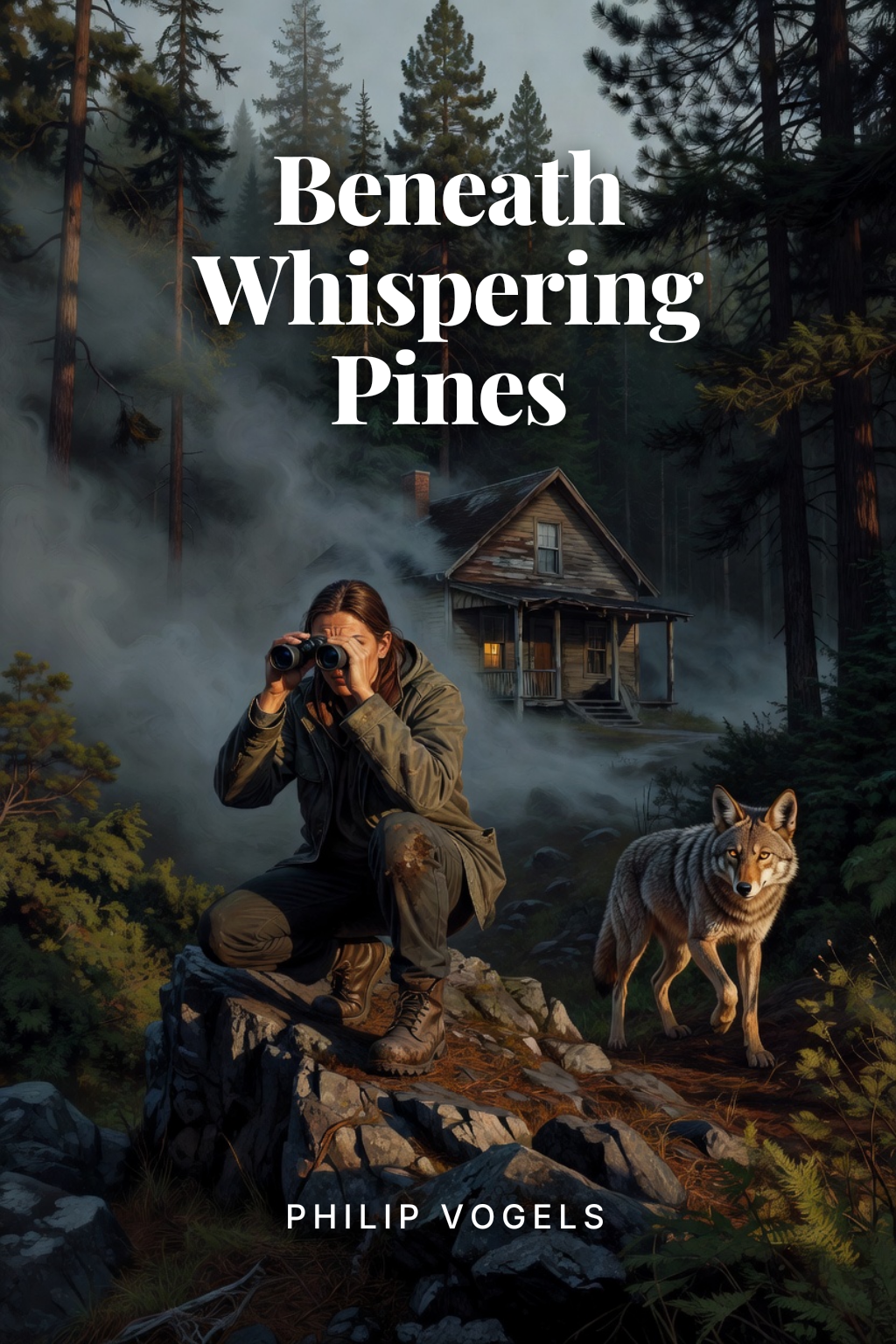
Beneath Whispering Pines
Contents12 chapters
Chapter 1
The Coyote in the Glass
By the time Regan Dilante saw the hand-painted sign for Blackpine Lodge, she had been driving for hours under a sky the color of dirty wool, and her shoulders ached from gripping the wheel through switchbacks and logging roads. The town came on her all at once. A gas station with two pumps. A grocery with pumpkins stacked in milk crates out front. A church with a white steeple gone gray at the seams. Then the lodge, set a little back from the road behind three tall spruces and a sweep of gravel damp from an earlier rain.
She killed the engine and sat for a moment with both hands on the steering wheel, listening.
A truck passed somewhere beyond the trees. Wind moved through needles with a soft dry hiss. From farther off came the thin, uneven barking of a dog, or maybe not a dog. She knew enough already to understand that people often heard what they expected to hear. Foxes became women screaming. Owls became children crying. Coyotes, especially at dusk, could sound like half a dozen things at once—laughter, shrieking, argument, grief.
She stepped out into cool air that smelled of wet bark and old leaves. Her rental car was filmed with road dust. So were her calves below the hem of her black travel pants. Regan stretched, reached into the back seat for her duffel and camera bag, and looked at the lodge properly.
It was two stories, sided in dark wood, with green trim and a deep porch running along the front. Nothing fancy. Nothing rustic in the self-conscious way city people liked. The place had a practical neatness to it: flower boxes emptied for the season, broom by the door, a rubber mat with pinecones worked into the pattern, two rocking chairs that had probably held a hundred cups of coffee and just as many long local silences. Light glowed amber through the front windows.
Inside, the lobby was warm enough that her glasses fogged for a second.
Someone had done the room in what could have been called cabin decor if it had not felt so unforced. There were framed photos of forests in winter, deer at a creek crossing, a bull moose half turned toward the camera. A braided rug lay in front of a stone fireplace that held an electric insert pretending to be wood flame, but doing it well enough to be forgiven. The front desk was real wood, scarred on the corner by years of suitcases bumping into it. The place smelled faintly of lemon polish, coffee, and cinnamon.
A woman looked up from behind the desk and smiled at once, not the business smile that landed and vanished, but something easier.
“You must be Regan.”
“That obvious?”
“You have city boots and forest books.” The woman came around the desk with her hand out. “I’m Aspen.”
She was in her forties, maybe, with dark blond hair twisted up in a clip and a plum-colored cardigan over a black T-shirt. She had the settled look of someone who knew where everything in the building was kept and where people tended to leave their gloves.
Regan shook her hand. “Guilty on both counts.”
Before Aspen could say more, a second woman appeared through a doorway carrying a small basket of folded white towels against her hip. She had auburn hair cut short around the ears, clear gray eyes, and the kind of face that could go stern in a blink and kind just as fast. When she saw Regan, the sternness never had a chance.
“This is our coyote writer,” she said.
“Researcher,” Regan said.
“Researcher now,” the woman said. “Writer by breakfast tomorrow. I’m Ashe.”
The way Aspen glanced at her—brief, fond, practiced—made the shape of their life plain before either of them said another word. Married, Regan guessed, and comfortable in the good ways of it. Not showy. Worn in.
Aspen took Regan’s license and card while Ashe set the towels on a side table and leaned one hip against the desk.
“You made decent time,” Ashe said. “Road from the south gets ugly if logging trucks are out.”
“I got stuck behind one for nine miles.”
“Then you’ve had the full welcome.”
Regan smiled despite herself. The drive had left her tired in the brittle way she always got after travel, too wired to rest and too wrung out to think cleanly. The room, the voices, the ordinary kindness of women she had known for less than a minute—it all took the edge off.
Aspen slid a brass key tag across the desk. “Room twelve. Stairs are just there. Breakfast starts at six if you’re up early enough to hate yourself. Coffee is out before that. We do a small happy hour around six in the evening. Nothing wild. A bottle of red, a bottle of white, cheese cubes if Ashe remembers.”
“I always remember,” Ashe said.
“You forgot twice last month.”
“I forgot crackers. Not cheese. Facts matter.”
Regan took the key. “I’ll be here a few nights at least. Maybe longer, depending on what I find.”
“That’s what everyone says about this town,” Ashe said.
Aspen gave her a look that suggested this line had been used before.
Regan felt a flicker of curiosity at that, but she let it pass. “I’m heading to park headquarters before they close. I want to introduce myself, see what access they can give me.”
Aspen nodded. “Good place to start. They’ve got a wildlife display in the lobby that every schoolkid around here gets dragged through at least once.”
“And every adult too,” Ashe said. “You can tell who’s local by how fast they stop seeing it.”
Regan thanked them, took her bags upstairs, and found her room much as the lobby had promised: clean, plain, cared for. A quilt in rust and pine green. Pine dresser. Wildlife prints on the walls—a fox in snow, a trout breaking water, a black bear standing hip-deep in blueberries. The bathroom smelled of bleach and fresh soap. She set down her bags, splashed cold water on her face, changed into a flannel shirt, and went back out before she could sink into the bed and lose the afternoon.
Park headquarters sat at the edge of the forest on a rise above town, a low building of weathered timber and stone with a flag snapping hard on its pole. The lot held two pickups, a mud-splashed SUV, and a horse trailer with no horse in sight. Behind the building, the hills lifted in dark folds of spruce and fir, the ridgelines fading blue behind blue toward weather.
Inside, the front hall was cooler than the lodge and carried the dry mixed smell of dust, paper, wool jackets, and the sweet chemical note of taxidermy. A rack of maps stood by the door. There were flyers for burn restrictions, trail closures, tick awareness, and responsible food storage. The kind of place where information sat in layers.
And there, just beyond the reception desk, was the display Ashe had mentioned.
It took up most of one wall. A long glass-fronted diorama built to look like a section of open field running into brush. Dried grasses had been wired in place. A split-rail fence cut across one corner. There was a fake burrow entrance in the earth bank, and near it two groundhogs—one upright, one half turned as if it had just noticed danger too late. Three coyotes had been mounted in motion around them. One low and intent. One mid-step, ears pricked. One with its muzzle lifted, body angled so that its flank pressed toward the back corner of the display.
The craftsmanship was good enough that, for a second, the whole thing gave Regan the small chill taxidermy always gave her: that stubborn imitation of life, the held breath of it.
A man in tan uniform came through a side door carrying a clipboard. He was broad in the shoulders, thinning on top, with a face leathered by wind and sun. His badge read HOLLIS.
“You the writer from downstate?”
“Is it that obvious too?”
“Mostly the notebook.” He offered his hand. “Ben Hollis. Game warden.”
Regan introduced herself and explained the book was still half idea, half assignment. Coyotes in recovering forests. Coyotes at the edge of towns. The ways people invented them and misunderstood them. She had done her reading. She wanted field time, local voices, practical observation, not just papers and distance.
Hollis listened without interrupting, glancing at her face rather than her press credentials, which Regan preferred. When she finished, he nodded once.
“Coyotes won’t make it easy on you,” he said. “That’s part of what makes people think they know more than they do.”
“I’m finding that’s true of most things worth writing about.”
That got the shadow of a smile from him. He hooked a thumb toward the glass display. “Seen our celebrities yet?”
Regan walked closer. The fake grasses cast thin shadows under the lights. One coyote had a coat rich with grays and cinnamon along the shoulders. Another was paler through the face, almost dog-like until you looked at the narrow chest and long legs. She noticed the back one last—the one propped at an angle near the corner, shoulder nearly touching the side panel of glass.
Its fur stood wrong.
Not everywhere. Just in one place high along the ribcage and over the shoulder, where a tuft had dried up in a stiff little flare, as if the hide had healed badly before death or had been mounted to hide damage that could not be corrected.
“That one looks rough,” Regan said.
Hollis came to stand beside her. “Good eye.”
“Old injury?”
“Sort of.”
He unlocked the front panel with a key from his pocket and slid the glass just enough to reach in. With two fingers he touched the shoulder of the cornered coyote and shifted the body a few inches outward.
The far side came into view.
Regan leaned in without meaning to.
The hide along the flank showed a series of long healed rents beneath the fur, where the pelt pulled in narrow puckered lines. One scar crossed another. Near the base of the neck, under careful taxidermy work, a patch of shorter replacement fur covered what had once been a deeper wound. Even preserved and cleaned up for display, the damage carried force. Something had gotten hold of that animal and done more than chase it.
“Hunting accident?” Regan asked.
“No bullet. No buckshot. No snare marks either.”
“Another coyote?”
Hollis shook his head. “Too much power in it. Coyotes fight. They slash faces, ears, shoulders. You’ll see torn tails, missing chunks, limp gaits. But this—” He tapped lightly on the glass near the scarred ribs. “Doesn’t fit clean.”
“Cat?”
“Lion would rake different. Usually hindquarters, back, neck. Bear is blunter. Messier. This looked...” He stopped there and slid the glass shut.
“Looked like what?”
He put the key away. “Like we weren’t happy with any answer.”
Regan looked back at the coyote in the case. In the fixed light, with the groundhog forever half turning and the grasses forever bent by a wind that was not there, the scars seemed stranger for being so still.
“What happened to it?”
“Found dead, not killed for the display. That matters to some people, so I say it plainly.” Hollis checked something on his clipboard, then seemed to decide the clipboard could wait. “One of the biologists had it in cold storage for a while. We use what we can for education. Show people the animals are real, not cartoons. This one got added later because of the wounds.”
“Where was it found?”
He named a tract of forest west of town, then added, “Not far from a game trail camera that quit working the same week.”
“Quit how?”
“Broken.”
“By weather?”
Hollis met her eyes then, and his expression changed in a small but plain way. Not fear exactly. Irritation with fear, maybe. The look of a man who did not like giving shape to things he could not lay a ruler beside.
“The casing was cracked,” he said. “Mount twisted. Not chewed. Not storm damage. Just broken.”
Regan let a beat pass. “And you think it was connected.”
“I think things happened near each other.” He folded the clipboard under one arm. “You spend enough time out here, you learn not to force a story too fast.”
That was a fair answer, and a practiced one.
He walked her along the display, pointing out what she had come for in the first place. Typical tracks in mud. Scat with hair and berry seeds. Bedding depressions in dry grass. Coyotes running in family groups rather than storybook wolf packs. Mated pairs. Yearlings helping with pups. Opportunists more than villains. He spoke well, with little waste, and when Regan asked questions he did not treat them as naive just because she wore clean boots and carried a city notebook.
Still, her eyes kept sliding back to the scarred coyote in the corner.
At last she asked, “Do locals have a story for it?”
Hollis made a sound that might have been a laugh if it had wanted to be. “Locals have a story for every stump and shadow in these hills.”
“That wasn’t a no.”
“No,” he said. “It wasn’t.”
He led her toward a map pinned on the opposite wall. Colored lines marked trails, service roads, watershed boundaries, and protected areas. As he spoke about access rules and observation etiquette, his finger moved over the western ridges, the rough country where the found coyote had come from.
“Most of what you need is here and here,” he said. “Open meadow edges. Brushy transition zones. Places with rabbits, groundhogs, mice. You want to hear coyotes, be out late or early and keep still longer than feels useful.”
Regan jotted notes. “And the stories?”
“Depends who’s telling them.”
“I’m asking you.”
He looked past her for a second, out the front windows where the sky had darkened enough to flatten the parking lot into slate.
“My grandmother,” he said, “used to say there were older things in the woods than the ones we’d named. She wasn’t a fool, but she enjoyed a good shiver. Some people around here still talk that way. Big tracks where there shouldn’t be big tracks. Calls they can’t place. Things walking off with deer they were too strong to carry. Half the time it’s nonsense. The other half...” He shrugged. “The other half is also probably nonsense, but with better timing.”
“Bigfoot?”
He gave her a dry look. “You say it like you want me to blush.”
“I say it like I’m trying to understand what people here believe.”
“What people believe and what scares them aren’t always the same.”
That sentence settled between them.
Regan had interviewed enough hunters, ranchers, and wildlife officers to know when a man was humoring a tourist. This wasn’t that. Hollis was not confessing to monsters. He was doing something stranger and more honest. He was admitting the shape of a blank spot.
He tapped the map once more. “I can arrange a short field loop tomorrow if you want the basics. Beds, scat, runs, den country if there’s sign. Nothing dramatic.”
“I’d like that.”
“Eight o’clock. Wear something you don’t mind getting snagged.”
They finished with permits, trail boundaries, and a few names of people who might talk if approached correctly. Then Hollis took her back past the diorama on the way to the door.
Regan stopped in front of the glass one last time.
The damaged coyote seemed different now that she knew where to look. Less like an exhibit and more like evidence that had outlived its explanation. Its muzzle was slightly open, teeth bare in a fixed working snarl. One eye, bright under museum lights, caught her own and held it with the old taxidermy trick of false life.
“What if it was a dog?” she asked.
Hollis opened the door for her. Cold air pushed in around his shoulder. “You ever seen a feral dog do that and leave the rest so neat?”
“No.”
“Neither have I.”
Outside, the wind had sharpened. The flag cracked overhead. Across the lot the forest stood in dark ranks, trunk behind trunk, climbing the slope until distance turned them to one long rough edge against the sky.
Regan thanked him and walked to her car with her notebook pressed under her arm.
She should have been thinking about practical things. Tomorrow’s route. Battery levels. Lens choice. Questions to ask at the diner, at the lodge, maybe at the coffee shop in town if there was one. The actual work. Instead she kept seeing the coyote’s hidden flank, the ridged scars beneath the fur, the way Hollis had shifted the body only after she noticed the tuft standing wrong.
At the edge of the lot she stopped and listened.
The woods gave her nothing clear. Only wind, a creak of bough against bough, the thin metallic tick of cooling engine parts from her own car. Yet the silence beyond those sounds did not feel empty. It felt occupied. Not by a single thing she could name, but by the fact that names were sometimes the weakest part of knowing.
She got into the rental and sat with the key in her hand.
The assignment had brought her here for coyotes. Clever, adaptable, misread animals that lived where people had decided they ought not to. She knew that much. She had notes on denning behavior, pair bonds, pup rearing, winter diets. She had whole pages on how a chorus could sound larger than the number of animals making it. She had come ready to sort myth from muscle and weather from fact.
But one dead coyote in a glass case had shifted the ground under that neat plan.
Some predator had marked it hard enough that trained men still did not like the fit of the evidence. Some force in those woods had broken a trail camera and walked away without leaving behind a story anyone trusted. Maybe there was a plain answer. There usually was. A large dog gone wild. A rare fight with the wrong animal at the wrong angle. A string of bad guesses built into one local legend because people hated an empty space and rushed to fill it.
Or maybe the plain answer was only plain because no one had looked straight at it yet.
As Regan started the car and pulled back toward town, the first drops of fresh rain struck the windshield, small and widely spaced, each one bright for an instant in the last of the day. Behind her, on the rise above the road, park headquarters glowed warm and square against the coming dark, and inside that building a coyote leaned forever against painted grass, one wounded side hidden until somebody bothered to ask to see it.
Chapter 2
Coffee on Birch Street
The smell of bacon reached Regan before she was fully awake.
It came up through the floorboards first, then under the door, then into the middle of her sleep until it tugged her all the way out of it. For a moment she did not know where she was. White ceiling. Quilt kicked half off. A deer print on the wall, badly matted but earnest. Then Blackpine Lodge arranged itself around her again.
She showered fast, pulled on jeans and a gray long-sleeved shirt, and went downstairs with her notebook tucked under one arm.
The dining room sat just off the lobby, three square tables and one longer one against the window. Aspen had set out a crock of scrambled eggs, bacon on a platter lined with paper towel, thick slices of toast, and a bowl of cut melon that looked almost too cheerful for the room’s dark wood. Ashe stood at the coffee urn with one hand on the lid, topping people off like she had been doing it all her life.
“Look who trusted us enough to sleep here twice,” Ashe said when Regan came in.
“I was unconscious by ten,” Regan said. “That’s either trust or exhaustion.”
“Same result,” Aspen said from the sideboard.
Two older men sat near the window in plaid overshirts, bent over their plates with the serious silence of people who had known each other too long to need words every minute. A woman in a lilac windbreaker stirred sugar into her coffee without looking up. Somebody had a local paper folded to the classifieds.
Regan filled a plate and took the empty seat at the end of the long table.
One of the men glanced at her camera bag and nodded at it with his fork. “You the coyote lady?”
“Writer,” Regan said. “Trying to be.”
“That’s worse,” he said.
The other man snorted into his coffee.
Ashe leaned in with the pot. “This is Don making friends. The one insulting you less directly is Marty.”
“I can insult direct if she wants,” Marty said.
“She doesn’t,” Aspen said.
Regan smiled despite herself. “I’m Regan.”
“Don,” said Don, as if he had not been identified already. “You here to prove coyotes ain’t as bad as people say, or prove they are?”
“Neither,” Regan said. “I’m here to watch them.”
“That all?”
“That’s usually enough.”
Don seemed to consider this. “Watching’s how you learn who’s lying.”
“That applies to people more than coyotes,” Ashe said.
“Same county,” Marty muttered.
Breakfast talk moved the way breakfast talk often did in a small place: weather first, then roads, then somebody’s nephew, then a bear getting into trash behind the hardware store, then a roof that still hadn’t been fixed over on Mill Lane. Regan listened more than she spoke. It was easier that way. People gave you things when they forgot you were collecting them.
When the paper changed hands and the second round of coffee settled in, the lilac-jacketed woman said, “You staying long enough, you’ll hear the old stories.”
Aspen rolled her eyes, but not unkindly. “Evelyn likes to act like we run an inn in a fairy tale.”
“I like to act like this town remembers what it is,” Evelyn said. She looked at Regan. “You go too far west and people go missing now and then.”
“Missing how?” Regan asked.
“Drifters mostly,” Don said. “Campers where they shouldn’t be. Men who think private property signs are suggestions.”
Marty wiped his mouth with a napkin. “And a few local bastards no one cried too hard over.”
Aspen gave him a look. “Maybe don’t say that to the guest before eight in the morning.”
“Why not? It’s true.”
Evelyn stirred her coffee again though there was nothing left to dissolve. “Town always says the forest keeps score.”
Regan looked from one face to another. Nobody was smiling now, not exactly.
“That’s a legend?” she asked.
“It’s a way of talking,” Ashe said. “Same as any place has.”
Marty leaned back in his chair. “Here’s the cleaned-up version. A man cheats half the county, beats on his wife, runs dogs in season where he shouldn’t, and then one November he disappears. Truck found near a pull-off. No body. Folks say he skipped out. Folks also say good.”
Don pointed his fork at him. “You’re combining three men.”
“Then good three times.”
Even Aspen laughed at that, though she shook her head while she did it.
Regan broke off a piece of toast. “You really think the woods take revenge?”
“No,” Don said at once.
“Yes,” Evelyn said at the exact same time.
They both stopped, and Ashe put a hand over her mouth to hide a grin.
Evelyn lifted one shoulder. “I think some places don’t like cruelty.”
“That’s because you’re churchy,” Don said.
“No, that’s because I’ve lived.”
Regan wrote that line down on the edge of her napkin before she could stop herself.
Aspen saw it and smiled. “There she is. We knew you were working even when you looked polite.”
Regan checked the time and stood, guilty all at once. “I’m meeting Hollis at eight.”
“Then eat another piece of bacon and go,” Ashe said. “He’ll forgive a two-minute delay for pork.”
Regan did eat the bacon. She thanked them all, got directions around a bridge closure from Marty, and went out into a morning so cold it made her eyes water.
The day passed in bramble, wet earth, and notes. By the time she got back to town her calves ached, her cuffs were full of burrs, and there was dried mud on one knee. She showered, changed into fresh clothes, and came downstairs again just before six, pulled by the clink of ice in glasses and the rise and fall of voices from the lobby.
Blackpine’s happy hour was not much, which turned out to be exactly enough. Aspen had put out crackers, cheddar cubes, a bowl of mixed nuts, and little crockery dishes of olives. Ashe poured local beer and two kinds of cheap wine without apology. A lamp in the corner threw warm light over everything. The whole place smelled faintly of lemon polish and wet wool.
A few people from breakfast had returned, and a few new faces had joined them: a heavyset woman in scrubs, a man with a feed-store cap, a young couple passing through with bicycles strapped to their car. Somebody had claimed the sofa. Somebody else stood with one hip against the front desk as if that counted as helping.
Regan accepted a glass of red wine and stayed near the stone hearth.
“Any luck with your coyotes?” Ashe asked quietly.
“Some sign,” Regan said. “Enough to know they’re using more of the western edge than I expected.”
Aspen slid a bowl of nuts closer. “That means you had a good day in your language.”
“In mine too,” Regan said.
The talk widened and narrowed in waves. People asked what brought her in, and when she answered, they offered facts, warnings, nonsense, and old grievances in nearly equal measure. One woman insisted coyotes laughed before storms. A man claimed they sat on hillsides and listened to ambulance sirens like choir practice. Another said they had gotten bolder in the last five years, not dangerous exactly, just nearer.
“Nearer to what?” Regan asked.
“People,” he said. “Porches. Roads. The edge of your headlights.”
That started a story from the woman in scrubs about finding eyeshine behind the clinic dumpster at dawn. Then Don, who had either walked over from home or never left town limits in his life, brought the room around again with a fresh offering of ugliness.
“You want local legend,” he said, chewing deliberately on a cube of cheese, “talk about the kind where bad men run out of luck.”
Aspen sighed. “Don.”
“No, she should hear it. She’s writing.”
“Writing about coyotes,” Aspen said.
“Everything turns into people eventually.”
That quieted the room more than his first sentence had.
The woman in scrubs crossed her arms. “You mean Hank’s brother?”
“I mean him too.”
Feed-store cap took over. “There was a fellow lived up County Route Nine. Repo man. Mean for pleasure. He’d take somebody’s truck and come back at night and kick in their mailbox for sport. Folks said one winter he tried to shortcut through timber land and never made it home.”
“Froze,” said the bicyclist.
“Maybe,” feed-store cap said.
“Or drunk,” Marty put in from the sofa.
“Also maybe.”
Evelyn, who had come in wearing the same lilac windbreaker as if it were church robes, spoke into the gap. “Or maybe there are places where the line between punishment and accident is thinner than people like.”
No one answered her right away.
Outside, headlights slid across the front windows and were gone. The room held its own weather: low talk, the pop of someone opening another beer, Ashe laughing softly at something Aspen said near the desk.
Regan found herself watching them. Aspen touched Ashe’s elbow when she passed. Ashe leaned into it without looking. The ease between them was old and practiced, not showy, but it gave the room a center. Regan felt a small, clean envy for it.
“So what do you believe?” Aspen asked her suddenly.
Every face near her turned just enough to make refusing impossible.
Regan swirled the wine in her glass and thought about her answer. “I think people notice patterns after the fact. I think forests get blamed for what people do in them. And I think every town has stories that help it sleep.”
Marty pointed at her. “That’s a writer answer.”
“It’s an honest one.”
Evelyn studied her over the rim of her cup. “You’ll see.”
“See what?”
“What belongs to the place and what doesn’t.”
The sentence settled under her skin in a way she did not care for.
By nine the gathering thinned. The bicyclists went upstairs. Don and Marty stepped out arguing over whether chainsaws had ruined deer country or merely revealed who already had bad taste. Evelyn touched Aspen’s arm on the way out and said good night like a blessing.
Regan carried her empty glass back to the sideboard.
“Do they do this every night?” she asked.
“Near enough,” Ashe said. “Some nights it’s weather and high school football. Some nights it’s vengeance and missing men.”
“That’s hospitality,” Aspen said.
Regan smiled. “You two seem very calm about all this.”
Aspen stacked little plates into a neat pile. “Most town legends are just gossip with pine needles stuck to them.”
“Most,” Ashe repeated.
Regan looked at her.
Ashe shrugged, easy and unreadable. “You stay in one place long enough, you learn not to call every story foolish.”
That might have been nothing. It landed like something.
The next morning the sky hung low and pale over town, the color of dishwater before the soap goes in. Regan left the lodge on foot with her notebook in her pocket and a stitch of restlessness behind her ribs she could not quite name. She told herself she wanted coffee. That was true. It just wasn’t the whole truth.
Birch Street turned out to be two blocks of old brick storefronts, a barber pole, a florist with galvanized buckets out front, a hardware store with rakes in the window, and a coffee shop tucked between a tax office and a place that repaired watches and engraved plaques. The sign over the door said HOLLOW CUP in hand-painted cream letters.
A bell rang when she went in.
Warm air hit her face along with the smell of espresso, cinnamon, and baked sugar. The room was narrow and bright, with a chalkboard menu, two small café tables by the window, and a row of mismatched mugs hanging over a shelf of beans for sale. Someone had put a vase of dry grasses by the register and managed to make it look deliberate rather than lazy.
A woman behind the counter looked up from the machine.
She wore a dark green apron over a black T-shirt, sleeves rolled once. Her hair was pinned up in a hurried knot that had started losing its patience, and one loose strand curled near her cheek. She had the kind of face that changed quickly when she smiled, though she was not smiling yet.
“What can I get you?” she asked.
Her voice was low and a little rough, as if she had spent the last hour talking over grinders and steam.
“Coffee,” Regan said, then felt stupid for saying it in a coffee shop. “Black. And whatever pastry looks least likely to ruin my notebook.”
That got the smile.
“The blueberry scone only sheds if offended,” the woman said. “Muffins are chaotic by nature.”
“I respect honesty in baked goods.”
“Good. It’s rare.”
Regan stepped closer to the register. Up near the counter she saw that the woman looked younger than she had at first glance, but tired in the old way, not the late-night way. There was quickness in her eyes and caution under it.
“I’m Regan,” she said, handing over a card.
The woman glanced at it as she rang her up. “Cassandra.”
The name fit her at once, though Regan could not have said why.
“You’re not from here,” Cassandra said.
“Is it that obvious?”
“You looked at the menu too long. Locals already know what disappoints them.”
Regan laughed. “I’m in town for work.”
“What kind?”
“Writing. Research, mostly.”
Cassandra set the paper cup under the spout and looked at her again, more directly this time. “About what?”
“Coyotes.”
That changed something. Not alarm exactly. Interest sharpened by memory.
“My granddad hated them,” Cassandra said. “Blamed them for every missing chicken he ever failed to latch a coop against.”
“He might not have been wrong every time.”
“Oh, he was wrong often enough to become tiresome.”
Regan took the coffee Cassandra handed her. Their fingers brushed for only an instant, skin to skin over the seam of the cup, but it was enough to make both of them pause. Not dramatically. Not foolishly. Just a hitch. A notice taken.
Cassandra cleared her throat. “You’re really studying them?”
“I am.”
“For a book?”
“Maybe. Or an article first. Depends what I get.”
“And what do you think you’ll get?”
Regan considered lying and decided against it. “Something less tidy than people want.”
Cassandra’s mouth moved at one corner. “That applies to a lot.”
There was no one behind Regan waiting. The shop sat in a lull between the first rush and the next. A radio played low behind the counter, some old song with too much steel guitar in it. Outside, a delivery truck hissed at the curb and moved on.
Cassandra set the scone on a plate instead of shoving it into a bag. “You know the trails already?”
“Some. Not well.”
“I know one from childhood.” Cassandra tucked the receipt spike to one side. “Creek cut, old beech stand, then up to a scrub field where you can see movement before it sees you if the wind’s right.”
Regan held still.
“You’ve watched them there?” she asked.
“Sometimes. Heard them more than seen them.” Cassandra looked down, then back up. “My mother used to walk me out that way when things were loud at home.”
The sentence came out level. The weight under it did not.
Regan did not press. “Would you show me?”
Cassandra’s smile this time was smaller, and real enough to make Regan feel it low in her chest. “You ask quick.”
“I’m on a deadline.”
“That tragic?”
“Always.”
Cassandra laughed under her breath. “I’m off tomorrow after noon.”
Regan took out her phone before the answer could slip away. “Then tomorrow after noon.”
They traded numbers like it was an ordinary thing.
It was not ordinary. Regan knew that by the way the room had narrowed around the exchange, by the way her body had gone alert without fear. She had met people in field towns before. Friendly people, useful people, attractive people. This felt different within minutes, and different in a way she did not trust because she wanted to.
Cassandra leaned both palms on the counter. “If I’m taking you out there, you’ll need better coffee than that diner sludge they serve on the highway. Come here first.”
“That sounded almost like concern.”
“It sounded like local superiority.”
“I can work with that.”
“You’ll have to.”
Regan picked up her plate. “See you tomorrow, then.”
Cassandra nodded, but her gaze held for a beat too long before she looked away to wipe an already clean spot on the machine.
Regan took a table by the window and pretended to write notes about the shop, the street, the weather. Instead she wrote Cassandra’s name three times in the margin and hated herself a little for it.
Outside, Birch Street went on being small and ordinary. A woman came out of the florist with wrapped stems under one arm. A boy on a bike cut too close to the curb and corrected hard. The barber swept yesterday’s hair into a neat drift at the edge of the step.
Inside, Cassandra moved through her work with quick hands and a kind of held-in grace. She joked with an older customer picking up a latte. She bent to restock lids. Once, when she thought Regan was looking at her notebook, she looked over and caught Regan watching instead.
Neither of them smiled right away.
Then Cassandra did, and Regan felt the assignment tilt.
She had come for coyotes. For tracks pressed in mud, for night song, for the plain work of learning an animal on its own terms. Yet here she was on Birch Street, coffee cooling beside her, aware that some stories did not wait politely outside the door until your reporting was done.
Sometimes they looked up from behind the counter and asked if you wanted them to show you the trail.
Chapter 3
Beds in the Grass
Ben Hollis stopped so suddenly that Regan nearly walked into him.
He lifted one hand without looking back. “Right there.”
At first she saw only grass and the dark ankles of blueberry shrubs. The clearing looked like any other patch along the edge of the woods: waist-high weeds laid over in places by weather, a few pale stalks snapped, last year’s fern stems gone brittle and gray. Then the shape came clear. Not a den. Not a hole. A body-print.
Several, actually.
The grass had been pressed down into shallow ovals, each one just wide enough for a curled animal. The centers were matted flat and dry under the top layer of dew. Around the edges, green blades bent outward in a ring, as if something had turned in sleep and settled deeper.
“Beds,” Hollis said. “Used recent.”
Regan crouched carefully, balancing on the balls of her feet. The beds were not random. Three lay close together in a ragged half-circle. Another sat ten feet off near a young alder, slightly uphill, with a better view of the narrow game trail that cut between brush and stone.
“That one’s lookout?” she asked.
“Could be. Could just be the one that wanted its own elbow room.” Hollis nudged the toe of his boot near the edge of a flattened patch. “People want wolves with ranks and uniforms, coyotes with kings and lieutenants. Life’s sloppier than that.”
He wore the same green field jacket from the day before, the cuffs gone shiny with years of use. He had a way of talking that sounded plain until you realized he was answering three questions at once.
Regan took out her notebook. “So they do live in packs.”
“They can.” He glanced at her pen, then at the beds again. “Around here most of what we see are family groups. Breeding pair, that year’s pups, sometimes older offspring that haven’t split off yet. Sometimes just a pair. Sometimes one on its own. Depends on food. Depends on pressure. Depends what the winter was like and who lived through it.”
“Not a fixed structure.”
“Nope.”
She wrote fast, then paused. “But there’s still a breeding pair.”
“Usually.” Hollis hooked his thumbs in his jacket pockets. “One male, one female most times. They hold territory, raise pups, run off what they need to run off. Folks hear ‘alpha’ and think cage fight. Mostly it means the two that keep coming back to each other and keep the rest of the mess moving.”
Regan smiled despite herself. “That’s the least romantic definition of a pair bond I’ve ever heard.”
He gave her a side look. “Didn’t say it wasn’t romantic. Just said it was work.”
A little farther on he showed her scat on a patch of bare ground beside a tuft of sedge. It had gone chalky at one end but the darker middle was still damp when he broke a twig against it. Fur showed in the twist of it, and something white and hard that might have been bone.
“Rabbit?” Regan asked.
“Likely. Could be vole, squirrel, scraps of deer. They’ll take fruit too when it’s there. In summer you find seeds sometimes.” He straightened and looked around the brush line. “Coyotes are not proud.”
“That’s one way to stay alive.”
“That’s exactly how they stay alive.”
She followed him through a narrow run under young birch. The path would have looked like nothing to most people. To Regan, once Hollis pointed it out, it became obvious: repeated passage had parted the stems; leaves were rubbed dull at shoulder height; a snag of pale fur clung to a broken blackberry cane and stirred in the breeze like caught smoke.
She leaned close without touching it. “Coyote?”
“Looks like it.” Hollis bent the branch toward the light. “Guard hair. Gray, cream, some black tip. Might’ve brushed through wet and left a little extra.”
Regan photographed it from three angles. The woods around them held that damp midmorning smell of leaf mold, iron-rich dirt, and the faint sweetness of rot under ferns. Somewhere higher up a red squirrel threw a fit over their presence. The sound cut sharp through the trees and then stopped as if snapped off.
“What about pups?” she asked as they moved on. “Where would they be now?”
“Denned earlier in the season. Depends on month, depends on the year. Later on, they get moved around, tucked into cover, old burrows, root systems, brush tangles. Parents use more than one spot if they think something’s nosing close.”
“Both parents raise them?”
“Yes.”
“And older siblings?”
“Can help. Bring food. Watch.” He shrugged. “Again, family group if the family holds.”
She thought of the beds pressed close together in the grass, the one set apart with a wider angle on the trail. “So when people talk about a head coyote—”
Hollis snorted softly. “They mean they want a tidy boss for the story. Animals don’t owe us tidy.”
They looped along the creek cut where mud held better sign. There Regan saw tracks clear enough to make her breath catch a little: neat, oval prints with nails showing, front feet slightly larger, the trail laid down in efficient single file. Not dog sloppy. Not random. Purposeful.
Hollis crouched beside them. “See how straight they move? Domestic dogs wander. Coyotes tend to go like they’ve got somewhere to be.”
The water itself ran low and brown over stones striped with moss. The bank smelled cold. A dragonfly skimmed past like a blue needle. Regan took more notes than she could sort in the moment because she knew field language changed when left too long in memory. The exact thing mattered. The shape of the print. The direction of a bent stem. The old bite marks on a rabbit skull half-hidden under jewelweed.
By the time they came back toward the trailhead, her calves were striped with grass seeds and her notebook page corners had gone damp from her thumb.
Hollis rested one boot on the bumper of his truck and drank from a dented thermos. “You coming back out this afternoon?”
“I am.”
“With your coffee guide.”
Regan looked up from capping her pen. “News moves fast.”
“It’s a small town. You walk in with a camera and then take coffee with Cassandra Vale, I hear about it before lunch.” He screwed the lid back onto the thermos. “She knows the back cuts better than a lot of hunters. Keep your eyes open if she takes you near the scrub field.”
“I thought coyotes avoid people.”
“They do. Mostly.” He tipped his chin toward the trees. “Still worth paying attention to who’s watching who.”
Cassandra met her on Birch Street in a faded green overshirt with the sleeves rolled to the elbow and a canvas bag slung crosswise over her chest. She had traded her coffee-shop apron for worn jeans and boots with cracked leather at the toe. Her hair was tied back badly, a few dark pieces already escaping.
“You look official,” Regan said.
Cassandra eyed the notebook sticking out of her pack. “You look like you’re about to ask grass personal questions.”
“I already did. It told me everything.”
“Did it mention mosquitoes?”
“It implied hardship.”
Cassandra laughed and fell into step beside her.
They left town on foot by a side street behind the church, crossed a narrow footbridge over the creek, and entered the woods where the path began almost politely and then forgot itself. Cassandra knew where to go without seeming to think about it. She ducked under a slant branch before Regan saw it, stepped around a wet patch hidden by sedge, put two fingers lightly against Regan’s forearm once to stop her from planting a boot in black mud.
The touch was brief and practical. It stayed with Regan anyway.
“This way used to feel longer when I was little,” Cassandra said.
“It usually does.”
“My mother and I would come out here if my father was on one.” She nudged aside a fern. “That’s the phrase she used. On one. Like temper was weather.”
Regan looked at her. “Did he hurt you?”
Cassandra kept her eyes on the trail. “Sometimes the room, mostly. Sometimes the door. Once her wrist.”
Regan waited.
“He’s gone now,” Cassandra said. “Not dead. Just gone. Left when I was sixteen and decided another state might appreciate him better.”
“That sounds like a public service.”
Cassandra smiled without much humor. “I don’t miss him enough to lie about it.”
They came to the beech stand Cassandra had mentioned, and the woods changed there. The trunks rose smooth and pale as old bone, their bark marked with carved initials and scars grown wide with time. Light fell green and thin through high leaves. The ground held fewer brambles. Even their steps sounded different, softer in the litter.
Regan took a breath. “I can see why your mother brought you.”
“It felt hidden.” Cassandra touched one of the beech trunks as she passed it. “Not safe exactly. Just out of reach.”
“There’s a difference.”
“Big one.”
They climbed from there to the scrub field by degrees. The trees thinned. Wind moved more freely. Sumac and young poplar gave way to a broad opening patched with tawny grass, milkweed gone to silk, and low berry canes. The field sloped gently upward to a stone line half-swallowed by brush.
Cassandra sank down first, choosing a place near a juniper where they could see without making a clean shape against the sky. Regan settled beside her, knees drawn up, camera resting across her thighs.
“This where you heard them?” Regan asked.
Cassandra nodded. “At dusk mostly. Sometimes just before rain.”
“Do you come up here often?”
“Not often enough.” She plucked a grass stem and broke it in pieces. “Some places you love too much to use up.”
That sat between them for a while.
The field looked empty in the way good habitat often does until your eyes learned patience. Then the hidden paths began to show themselves. A seam through the grass where bodies had passed again and again. A tunnel into the brush under the stone line. A dark opening beneath a fallen crown of roots where something smaller had dened and left.
Regan lifted the camera but did not yet shoot. “Hollis showed me beds this morning. Four of them. One a little off by itself.”
“Sentinel?”
“Maybe. Or just a loner.” She glanced sideways. “He dislikes tidy theories.”
“I respect that in a man.”
“Do you respect much in men?”
Cassandra let out a low laugh. “Selective pieces.”
A breeze came over the field carrying warm grass, damp earth, and the far-off sour note of water standing somewhere unseen. Insects rasped in the weeds. A crow called once from the tree line and got no answer.
Regan kept scanning. “He said most groups here are family. Pair, pups, maybe an older one sticking around.”
“That makes sense.”
“You say that like you know them personally.”
“I know the type.” Cassandra leaned back on her hands. “Stay close. Fight when you have to. Eat what you can. Vanish before worse things notice.”
Regan lowered the camera. “Is that about coyotes?”
“It can be.”
The wind lifted a strand of hair against Cassandra’s cheek. Without thinking, Regan almost reached to tuck it back. She stopped herself with such abrupt force that her shoulder tightened.
Cassandra had noticed. Regan could tell by the small shift in her mouth and the way she looked down instead of away.
After a minute Cassandra said, “Why’d you leave home?”
Regan took longer with that than she expected. “Because staying had started to feel like agreeing.”
“To what?”
“To the version of me everyone already understood.” She drew a thumb over the camera strap. “I was supposed to write safer things. Local pieces. Profiles. Human-interest scraps no one minded reading over lunch. I wanted work that asked for more. And if I stayed near my family, every choice became a vote on whether I loved them enough.”
Cassandra listened without interrupting.
“I did love them,” Regan said. “I just wanted a self they didn’t get first claim on.”
“That’ll do it.”
“I also left because I was twenty-four and stupid.”
“That helps.”
Regan smiled. “It really does.”
A flicker of movement near the stone line made both of them go still.
At first it was only an ear above the grass. Then a narrow head rose, gray-brown and fine-boned, muzzle sharp as if drawn in one clean stroke. The coyote stood half-concealed, looking not at them but across the field. Another shape moved lower down, then another. A small group. Quiet. Intent.
Regan lifted the camera in slow increments and took three shots, then two more. The clicks sounded vulgar to her ears, too mechanical for the hush of the place, but the animals did not startle. One sat back on its haunches. Another nosed the ground and moved along the edge of the brush with that same straight-bodied economy Hollis had pointed out at the creek.
Cassandra barely breathed. “God.”
Regan nodded, still looking through the lens. “There’s your family.”
They watched for several minutes, long enough for individuality to begin. One had a darker saddle over the shoulders. One carried its tail lower, the tip kinked faintly sideways. One younger-looking animal kept drifting too far and then circling back.
Regan whispered, “That one’s trouble.”
“Which one?”
“The restless one.”
“That’s every youngest child.”
The coyote with the kinked tail lifted its head sharply. All three froze at once. Not panic. Attention. A change had passed through them like current through wire.
Regan heard nothing unusual at first. Then, from farther off in the trees, a sound like one branch knocking another. Then stillness.
The coyotes melted into the brush so neatly that their absence felt like a trick.
Cassandra released a breath. “What spooked them?”
“I don’t know.”
Regan kept the camera up a moment longer, aimed at the tree line where nothing now moved. The field had gone ordinary again. Too ordinary. She felt, not for the first time since coming to town, that she had walked into a story with edges she could not see.
But beside her sat Cassandra, warm through two layers of air and cloth, her shoulder almost touching Regan’s arm. The nearness changed the fear. Not less. Just different. Sharper in some places, softer in others.
“You ever think,” Cassandra said quietly, “that hiding can turn into a life all by itself?”
Regan looked at her. “Yes.”
“My mother used to say surviving was enough until one day it wasn’t.” Cassandra worried the last shred of grass stem between her fingers. “I think coyotes know that. Stay hidden, sure. But they still come out to feed. Still sing to each other. Still raise young where the world can smell them.”
Regan said, “That sounds like advice.”
“Take it if you want.”
They stayed until the light shifted toward late afternoon and the field lost its gold edge. When they finally rose, both of them moved slowly, stiff from sitting on uneven ground. Cassandra planted one boot and made a face.
“My foot’s asleep.”
“You’re getting old.”
“I’m younger than you.”
“Ungrateful and old, then.”
Cassandra laughed and held out a hand in mock offense, meaning only to balance herself.
Regan took it.
The joke went out of the moment at once.
Cassandra’s palm was dry and warm. Regan closed her hand and pulled her up, but neither of them let go at the right time. Cassandra ended up standing too close, the canvas strap across her chest brushing Regan’s wrist, their joined hands hanging between them like something recently found.
The field moved around them in wind and insect sound. A milkweed tuft drifted past and snagged on juniper. Somewhere down in the trees, a woodpecker hammered twice and stopped.
Cassandra looked at their hands first, then up at Regan.
There was no clever thing to say. Regan felt that clearly, and for once did not try to cover it with one.
“This doesn’t feel casual,” Cassandra said.
“No,” Regan answered.
The word came out low and plain. It was enough.
Cassandra’s thumb shifted once against the side of Regan’s hand, not quite a stroke, more an acknowledgment that the contact had become intentional. Her face had gone serious in a way Regan had not yet seen, the quick humor set aside. Under it was a kind of caution that looked costly.
“I don’t do well with almost,” Cassandra said.
Regan understood more than the sentence itself. “Neither do I.”
For a beat longer they stayed there, held in the open field as if the place had made room for this and was waiting to see whether they would waste it.
Then Cassandra smiled, small but helplessly real, and Regan felt something in her chest answer.
They let go, finally. Not because they wanted to. Because walking back one-handed through brush would be stupid.
The return through the beech stand felt altered though the woods were the same. The pale trunks still rose clean and quiet. The creek still moved under its skin of reflected sky. A chipmunk still scolded them from a log as if they were the only foolish things in the county. Yet Regan noticed each detail with a sharpened kind of gratitude, as if the world had not changed but had admitted her a step further in.
At the edge of Birch Street, where town resumed in porches and parked trucks and the smell of fryer oil from somewhere up the block, Cassandra stopped.
“I work early,” she said.
“I know.”
“But I get off before close tomorrow.”
Regan adjusted the strap on her shoulder to give her hands something to do. “Are you telling me that as a scheduling fact?”
“I’m telling you,” Cassandra said, and now the humor came back, gentler than before, “that if you want company while interrogating wildlife, I might be available.”
Regan smiled. “I do want company.”
Cassandra nodded once, as if they had settled something that had been waiting longer than a day. “Then come by for coffee first.”
“I was planning to.”
“Good.”
She started to turn, then looked back. “And Regan?”
“Yes?”
“Some creatures survive by staying hidden.”
Regan waited.
Cassandra’s gaze held hers across the narrow strip of sidewalk and the ordinary traffic of town life moving around them. “Some don’t.”
Then she walked away toward the Hollow Cup, and Regan stood a moment longer than necessary watching her go.
The evening light lay flat on Birch Street. A dog barked behind a chain-link fence. Someone rolled up the florist’s awning. From beyond town, faint and thin enough that she might have imagined it, came the rising cry of coyotes beginning to call each other out of the woods.
Chapter 4
The Meadow Pull
By noon the weather had lied twice.
The morning began so clear that Regan almost left her light shell in the car. The sky over Blackpine had that rinsed blue look that made distance seem shorter than it was. Laundry moved on a line behind one of the houses off Birch Street. Somebody was mowing two blocks over. When she stepped out of the Hollow Cup with a paper cup in one hand and her pack slung over one shoulder, the sun felt warm on the back of her neck.
“Still going out?” Cassandra had asked from behind the counter.
Regan lifted the cup. “Bribed by coffee. Morally obligated now.”
Cassandra leaned one forearm on the register and studied the sky through the front window as if she distrusted it on principle. “You get turned around, head east till you hit the old logging road. Don’t try to prove anything to the weather.”
“I’m not that kind of idiot.”
Cassandra’s mouth tilted. “You’re a writer with a field bag. Same thing some days.”
Regan should have had a better answer than that. She didn’t. She only held Cassandra’s gaze a second too long and felt that now-familiar little shift in her chest, the one that made the rest of the room go thin around the edges.
“I’ll be back before dinner,” she said.
“Good,” Cassandra said, quieter than the joke deserved.
Now, two hours later, Regan stood at the edge of the scrub field they had watched together the day before and looked up through a thinning veil of cloud as it thickened again from the west.
She had chosen the route on purpose. Not because it was easy. Because it wasn’t. The place had enough cover for coyotes to stage in the brush and enough open ground for her to watch them if they crossed. She wanted another look at the same seam between shelter and exposure. That was where most useful things happened. Animals entered. Animals hesitated. Animals chose.
She stepped off the narrow deer track and moved slowly along the field edge, placing each boot where the ground looked least noisy. Last year’s stems snapped underfoot anyway. Dry goldenrod ticked against her bare calves. Grasshoppers sprang in green-brown arcs ahead of her and disappeared as if folded into the grass.
The field spread downhill in a rough pale sweep, not pretty in any tidy way. Milkweed pods had burst and gone ragged. Sumac leaves had started to turn at their tips. A line of stones, half sunk and furred with lichen, marked where somebody long dead had once cared where one piece of land ended and another began. Beyond that stood a ragged wall of brush, then the darker trees.
Regan unslung her camera and brought the long lens up. At first she saw nothing but movement that belonged to wind. Then shape sorted itself out from color.
One coyote stood near the stone line with its head low, nosing through the grass. Another moved farther back, gray-tan and narrow, hardly more than a ripple between stems. A third sat down for a moment with a posture so domestic it might have been waiting for a porch door to open. Regan smiled without meaning to.
There you are.
She crouched and took a short burst of photos, then lowered the camera to watch with her own eyes. Through glass, even excellent glass, animals became flatter. She preferred the reminder that they occupied depth. One with a darker shoulder patch lifted its muzzle and tested the air. Another scratched behind one ear with quick irritated concentration. They did not carry themselves like soldiers. They carried themselves like creatures with errands.
Family group, Hollis had said. Not a hierarchy from a documentary narrator’s voice. Parents, older young, this year’s young when the season was right. A flexible thing, not a marching order.
Regan set her pack down and eased out her phone. The first notes came thin and far enough apart that she thought, for a moment, she might miss them. Then one voice became several. A rising thread, then another crossing under it. Yips. A wavering, almost comic pitch. Then the longer held notes that made people swear the woods were full of more coyotes than were actually there.
She tapped record.
The sound carried strangely in the field. It did not seem to come from one clean point. It lifted, bent, was taken by the low roll of land and thrown back. Regan held still with the phone angled toward the brush. The coyotes she could see had gone alert now. Heads up. Ears forward. One turned sideways, listening not just to the call but through it, as if checking for what else might be attached.
The chorus sharpened, crowded itself higher.
Then it stopped all at once.
Not faded. Not trailed off. Cut.
Three quick yelps snapped through the silence.
Regan lowered the phone a little without realizing she had done it.
The field seemed to hold its breath with her. Even the grasshoppers had quit throwing themselves around. The only sound left was the dry rubbing of stems and the first low push of wind moving across the open ground.
The coyotes in sight did not bolt. That was what unsettled her most. They reacted, yes, but not with panic. The dark-shouldered one backed three paces and turned its body at an angle toward the brush. Another dropped so low it nearly vanished. Their attention fixed on a point beyond the field’s far edge.
Regan followed their line of sight and saw nothing.
A gust came down from behind her, turned in the bowl of the meadow, and came back changed.
It carried a smell she did not know what to do with.
Must. Wet hide. Rot, but not clean rot like leaves going down into black soil. Something warmer than that. Animal, certainly, but not in any neat barnyard or roadkill sense. The odor brushed the back of her throat and stayed there. Her whole body answered before her thoughts did. The skin along her arms tightened. The muscles between her shoulder blades seemed to pull inward.
She turned slowly.
Nothing in the grass behind her but the folding and unfolding of the wind.
The sky had darkened while she was listening. The western edge had gone bruise-colored, clouds stacking in heavy slabs over the tree line. Light still lay on part of the field, but it had thinned and taken on that tarnished look that came before a storm gave up pretending.
Regan slid the phone into her pocket and shouldered her pack.
“All right,” she said softly to no one. “That’s enough.”
She started back the way she had come, staying near the seam where field met brush. The first drops struck the leaves overhead with separate sounds, easy to count. A soft pat. Another. Then one cold bead against the back of her calf. She lengthened her stride.
The woods received rain differently than town did. On Birch Street it hit roofs, signs, parked cars. Out here it moved through layers. High leaves first. Then the undergrowth. Then the smaller lives under all that, shifting and waiting. Cicadas rasped from the trees in a shrill electrical pulse. Somewhere close, a treefrog gave one abrupt peep and shut up. The wind moved through the pines with a hollow rushing note like distant surf, though there was no water larger than a creek for miles.
She knew the route. That helped less than it should have.
Another gust drove through, harder this time, flattening the top of the grass and shivering the aspens white-side out. The musty smell came again, stronger. It seemed to move with the wind itself, present one second and gone the next. Regan stopped despite every sensible impulse not to.
From somewhere upslope, hidden by brush, came a low chuffing exhale.
Not a bark. Not a growl. Breath pushed through a big chest.
Regan’s hand closed around the strap on her shoulder so hard her knuckles hurt. She stared toward the sound until rain stippled her eyelashes.
“Bear?” she said, but the word came out thin.
Nothing answered.
Thunder rolled then, still some distance off but broad enough to feel in her ribs. Regan took that as permission to stop pretending she was calm. She turned and headed for the open stretch that would bring her faster to the path and then to the pull-off where she had left the car.
Rain thickened quickly. The field that had seemed textured and legible an hour ago became a smear of bent grass and darkening stems. Her boots slid once in the slick that formed over hard soil. She caught herself and kept going. The camera banged lightly against her side. Water found the back of her neck.
Another thunderclap cracked much closer, a sharp report after the rolling buildup, and Regan looked up on reflex, tracking the split white flare through cloud.
Her toe caught a branch hidden in the grass.
She went down hard.
The fall was ugly and complete. Her knee hit first, then both hands, then one shoulder. Her chin snapped close to the ground. The breath burst out of her. Mud and crushed weeds filled her nose with bitter green smell. For one stunned second she stayed there, blinking rain out of her eyes and trying to gather enough air to swear properly.
“Shit.”
The branch had hooked under her boot. She rolled, yanked her foot free, and pushed up onto one elbow.
That was when she realized she was not alone.
Three coyotes stood in the rain not ten feet away.
They had appeared so suddenly that her mind refused them at first, as if the storm had made cutouts and set them upright around her. Then one blinked water out of its eyes. Another shifted its weight. The third, a rangier animal with a pale chest and mud up its forelegs, stared straight at her with a look so direct it felt almost human only because people had no better language for being seen by something wild.
Regan froze.
They were not huge. That registered too. Everyone who had never stood close to a coyote imagined either a starved fox-thing or a wolf. These were neither. They were compact, leggy, soaked to darker color by the rain, their coats roughened into spikes along the spine. Their ears stood high and keen. Their mouths were closed.
No barking. No bluff.
“Oh, shit,” Regan said, louder this time.
One twitched at the sound. Another flicked an ear but held its ground. The pale-chested one lowered its head by an inch.
Every story she had ever heard about making yourself big arrived uselessly at once. She was already on the ground. She had one muddy hand under her and the other planted in wet grass. Her heart thudded so hard she could feel it in her throat.
“Hey,” she said, because language persisted even when it had no audience. “No. Easy.”
The coyote on the left gave a high, sharp yip. Not loud. More like a signal.
The pale-chested one lunged.
Regan jerked backward with a scream half formed in her chest. She threw up an arm without knowing what she meant to protect.
The coyote never reached her.
Something hit her lower leg with force enough to wrench her sideways through the grass.
Pain flashed white at her ankle. Not the deep crushing pain of a trap or a full bite. A searing rake and a hard pull. Her back dragged over mud and flattened stems. She gasped and clawed at the ground on instinct, not even sure whether she was being taken or saved.
The world became pieces. Rain in her eyes. Grass slapping her face. The shocked yelping explosion of the three coyotes breaking apart. A shape larger than them all, moving low and fast, gray-brown but heavier through the shoulders, its head broad, its body all momentum and command.
It released her as abruptly as it had seized her.
Regan rolled onto her back and saw it for one impossible moment through the rain.
A canid, yes. That was the word her mind reached for because it had to reach for something. But too large. Too long in the leg. Too solid through chest and neck. Not the rangy half-starved build of the coyotes she had watched. This animal looked assembled out of denser material. Water slicked its coat dark. Its ears were not pricked with the same anxious quickness as the others’. They were set in a steadier line. Its eyes caught what little light remained and gave nothing back.
The three coyotes had retreated several yards and now stood bunched and uncertain, not charging, not returning. One gave another startled yelp.
The larger animal turned its head toward them.
That was enough.
All three spun and ran, vanishing into the storm-flattened meadow so fast that the grass seemed to swallow them whole.
Regan pushed herself up on both hands, breath tearing in and out. “Wait—”
The big one looked at her.
Not long. One beat, maybe two.
Then it pivoted and went through the grass with impossible speed, not leaping, not crashing, only parting the field in a low driven line until distance and rain erased it.
Regan stayed where she was.
Thunder rolled again, not as sharp now, but deep enough to shake the air. Rain hammered her shoulders. She became aware, piece by piece, that nothing else was happening. No animal returned. No second attack came. No hidden watcher stepped out of the brush to explain the rules of this place.
Her ankle burned.
She bent over it at once, hands clumsy with cold. The left sock had slid half down inside the boot. She unlaced with fingers that kept slipping, tugged the leather open, and pulled the wet sock lower.
A few scratches marked the skin just above the heel and around the side of the ankle. Small. Shallow. Already pinking in the rain. Blood had welled in narrow lines and washed thin almost at once.
“That’s it?” she said.
She probed gingerly. Tender, yes. But the joint held. Nothing felt broken. No puncture deep enough to matter, unless it mattered later. Unless everything mattered later.
Had the first coyote clipped her in the lunge? Had the larger one caught her with teeth while dragging her free? Her skin seemed to offer no verdict. Only scratches. The sort of injury that made you feel foolish for being frightened.
She sat back on her heels in the rain and laughed once, breathlessly, because the alternative was shaking apart.
“Attacked,” she said, and then, “rescued.”
Neither word fit right.
After a minute she forced herself to stand. The field tilted alarmingly and then steadied. Her knee complained from the fall. Her shoulder would bruise. Her ankle stung with each step but held her weight. She pulled the sock up, laced the boot, and checked the phone with stupid urgency.
The screen was damp but alive.
The recording was still running.
Regan stopped it, shoved the phone inside the driest pocket she had, and got herself back to the path by the plain method of refusing to stop moving. Rain streamed off the brim of her cap. Water ran down into her collar. By the time she reached the car she was soaked through and breathing in shallow hard pulls from the effort of not turning around every three seconds.
Inside the car, the shut door created a silence so sudden it rang.
Regan sat with both hands on the wheel and watched rain stripe the windshield. Her own face in the glass looked pale and older than it had that morning. A smear of mud crossed one cheek. Wet hair had worked loose from her braid and stuck to her mouth.
She locked the doors, though she knew how absurd that was.
Then she took out the phone.
The recording began with wind noise and her own shifting steps. Then the coyotes started up, thin at first, then overlapping into that wild layered chorus. Regan listened, eyes fixed on the blown gray field beyond the windshield. She heard the abrupt cut. The three quick yelps. A rustle she had not noticed in the moment.
Then, under the edge of the storm and just before her own breathing changed, something else.
Low. Rough. Close enough to catch but not to identify cleanly.
A growl, or something near one.
She played it again.
The sound remained. It did not become clearer. It only became more itself, which was almost worse.
Regan set the phone down very carefully in her lap and looked at her ankle again. The scratches had begun to bead with fresh blood where the rain had stopped washing them clean. Tiny marks. Nothing. Less than nothing. Any briar patch in the county could have done as much.
But something had gripped her leg.
Something had chosen not to do worse.
She started the engine at last and turned the heat on full. Warm air came out with that stale baked-dust smell cars always gave in the first minute. Her hands were still shaking. Outside, thunder moved east over the ridges and the rain slanted silver across the hood.
By the time she pulled onto the road toward town, one question had fixed itself in her mind and would not leave.
If it had wanted her, why was she still alive?
And behind that, quieter but harder to dismiss:
If it hadn’t, why had it touched her at all?
Chapter 5
Happy Hour Legends
Ben Hollis listened to the recording twice without saying a word.
They stood in his office at park headquarters, both of them damp from the weather in different ways. Regan had towel-dried as best she could at the lodge and changed into jeans and a gray long-sleeve shirt, but the storm still clung to her in the form of wet hair at the nape of her neck and mud dried in a fine brown line along one wrist. Hollis smelled faintly of coffee gone cold and wool. His office held the tired heat of a building that had been shut up against rain all afternoon. Somewhere beyond the half-open door, a copier clicked and settled.
He tapped the screen with one broad finger. “Play it from a little before.”
Regan dragged the bar back. Wind hissed through the speaker. Her own shoes brushed through grass. Then the coyotes came up in that high, layered way she already knew was less haunting in person than on a recording, less ghostly, more practical. Location. Contact. A family keeping track of itself. Hollis stood with his head bent, listening to the yips cut short.
Then came the rougher sound under the weather.
He held out his hand for the phone. She gave it to him.
He put it closer to his ear, played it again, and then handed it back. “Could be a bear.”
Regan stared at him. “A bear.”
“Could be.” He leaned one hip against the edge of his desk. “Storm coming in, sound bouncing wrong, phone mic flattening everything. You get one branch scraping a trunk close by, your own movement, a little distortion, and it can turn ugly on playback.”
“It grabbed my leg.”
His eyes dropped at once to her ankle, as if he expected to see a ruin under the cuff of her jeans. “You cleaned it?”
“Yes.”
“Let me see.”
She sat in the visitor chair and tugged the hem up, then peeled the sock down enough to show him the scratches. The marks looked even smaller indoors. Three thin lines. A nick near the heel. The kind of thing a thorn could do while barely troubling itself.
Hollis crouched, not touching, just looking. “That’s all?”
“That is all,” Regan said. “Which does not match what it felt like.”
“No puncture. No tearing. No crush.” He straightened with a quiet grunt in his knees. “If a coyote meant to bite you, you’d know it. Same for a dog. Same for a bear, for that matter.”
“That’s comforting.”
“It should be.” He moved back behind his desk. Rain tapped at the window now in a softer, post-storm way. “Coyotes don’t make a habit of going after people.”
“Don’t make a habit of it,” Regan repeated. “That sounds carefully worded.”
He gave her a look that was almost patient. “Everything in my line of work gets carefully worded. People hear one thing and turn it into another by supper. So. Carefully worded: no, it isn’t common. They’re social animals, yes. Family groups, mostly. But they tend to avoid us. If one comes close, there’s usually a reason. Food conditioning. Somebody’s been feeding it. A den nearby. A sick animal. A person cornering it without realizing.”
“I was in an open field.”
“In a storm.”
She let that sit. “Three of them came up on me.”
“Three is unusual,” he said. “Not impossible. But unusual.”
“And the larger one?”
He reached for a pen, then set it back down without uncapping it. “I didn’t see the larger one.”
Regan almost laughed at that. It was not a cruel answer. It was a warden’s answer. He was not going to leap with her from sound to creature to story. He would stand exactly where proof allowed and not an inch past it.
“I know what you’re doing,” she said.
“What am I doing?”
“Trying not to encourage me.”
Hollis shrugged. “I’m trying not to tell you a fairy tale because you had a bad afternoon.”
She thought of the thing in the meadow, the weight of it, the hard quick force that had yanked her free, and the way the smaller coyotes had broken and run. Fairy tale was not the word that came to mind. Fairy tales had rules. This did not.
“Do coyotes ever kill people?” she asked.
He sighed a little through his nose. “Rarely enough that most wardens go their whole careers without seeing it or even coming close to seeing it.”
“But bites happen.”
“Bites happen.” He folded his hands. “A nip. A snap. An animal defending a space. A bold one getting too used to back porches and garbage cans. But most coyotes want no part of us. They read us right the first time.”
“And if they don’t?”
“Then we usually helped create the problem.”
That landed harder than she expected. Outside, tires hissed over the wet lot. Someone laughed down the hall.
Hollis’s voice softened by a degree. “You got knocked down in bad weather, you got scared, and something happened close to you that you still can’t place. I’m not calling you a liar. I’m saying the woods are full of bad angles and mistaken size. Every animal looks bigger when you’re on the ground.”
Regan crossed her arms. “You think I mistook a coyote for something else.”
“I think you had a hard look at trouble and came away lucky.”
Lucky. She supposed that was true in the plainest sense.
He nodded toward her ankle. “Watch for redness. Heat. Swelling. If that changes, you get it looked at. Tonight.”
“I know.”
“And maybe don’t go back out there alone tomorrow if you’re rattled.”
That pricked. “I’m not rattled.”
He raised his brows and spared her the insult of saying otherwise.
She stood. “Are there more coyotes here than there used to be?”
“Some years you hear them more. Some years less.” He pulled a county map closer and idly flattened one corner. “Food shifts. Pressure shifts. Breeding goes well one spring and badly the next. People notice patterns because people like patterns.”
“That’s not an answer.”
“It’s the only one I have.” He gave her a brief, level look. “Go get dry, Ms. Dilante.”
By the time she drove back to Blackpine Lodge, the storm had broken apart into strips of low cloud moving over the ridges. The road shone black and slick. Wet birches flashed pale in the headlight sweep, then vanished behind her. Town came up all at once as it had before: a grocery darkening toward evening, the hardware store already closed, warm rectangles of house windows, a dog barking from behind a chain-link fence.
Blackpine’s porch light glowed gold against the wet boards. Regan parked, gathered her bag, and stood a moment in the cooling air. She could smell rainwater in gravel, pine pitch, and the faint drifting grease of somebody frying onions nearby. The ordinary smell of supper in a small town. No musty animal rankness. No wild thing hidden under it.
Inside, the lobby had gone to evening.
A lamp near the stone fireplace cast honey-colored light over the knotty-pine walls. Wildlife prints hung in simple dark frames: trout in a green stream, a barred owl on a branch, deer stepping through snow. The whole place smelled of furniture polish, old wood, and something warm from the kitchen. Not fancy. Not staged. It felt like being welcomed into a house where people still used the rooms they cleaned.
Aspen looked up from the front desk. “Well, there she is.”
Regan shut the door behind her. “Was I missing?”
“You have city timing,” Aspen said. “You disappear at one in the afternoon and return looking like you fought a ditch. That counts as missing.”
Ashe came through the doorway from the back carrying a bowl of sliced limes and two squat bottles of tonic. “You look worse than missing.”
“I’m fine,” Regan said.
Both women gave her the exact same flat look, and it was so married that despite everything, Regan smiled.
Ashe set the bowl down on the sideboard they used for the evening drinks. “That means you’re not fine, but you don’t want to discuss it until after you’ve sat down.”
“A fair reading.”
Aspen tipped her head toward the cluster of armchairs by the fireplace. “Then go sit. Happy hour has begun in spirit if not in attendance.”
Regan dropped her bag near one chair and eased herself into it. Only then did she fully register how sore she was. Her knee had stiffened on the drive. Her shoulder burned under the dry shirt. The scratches on her ankle throbbed with a neat hot pulse. She must have shown some of it on her face, because Ashe returned with a glass of ice water before asking another question.
“Storm trouble?” Ashe said.
Regan took the glass. “Field trouble during a storm.”
“That sounds more interesting than what we usually get,” Aspen said.
“Not the fun kind of interesting.”
That changed them a little. Not panic. Just attention.
Regan told them enough to satisfy decent concern without getting into the part that still made her sound half out of her mind. She mentioned the fall, the three coyotes, the larger animal, the scratches, the recording, Hollis’s theory about a bear.
Aspen leaned against the sideboard with her arms folded. “A bear.”
“He said the mic could be distorting things.”
“Convenient,” Ashe said, not sharply, just dryly.
Regan looked between them. “You don’t agree?”
“I think Ben Hollis has to spend half his life shaving the edges off what people bring him,” Aspen said. “If he admitted every odd thing was odd, he’d never get home.”
Ashe began arranging glasses with the care of someone whose hands liked work. “I will say this. We hear coyotes more than we used to.”
“How much more?”
She glanced at Aspen. “Last five years?”
“About that,” Aspen said. “Not every night. But enough that you notice. Some evenings they start up west of town and carry on long enough to make the dogs answer.”
“People always ask if it’s the moon,” Ashe said, then laughed before Regan could. “No. They do not wait around for a full moon to become dramatic. They’re already dramatic.”
“So that’s a myth.”
“Most moon talk is.” Aspen pushed away from the sideboard and sat on the arm of Ashe’s chair as if she had been doing that for years, which she clearly had. “They call because they call. Family check-in. Territory. Excitement. One starts and the others decide they have opinions.”
Regan sipped the water. “You don’t sound afraid of them.”
“Coyotes?” Ashe said. “No.”
“Whatever else is out there?” Regan asked before she could stop herself.
Aspen’s eyes rested on her for one beat too long. Then the front bell over the door jingled and three locals came in with damp shoulders and the stamped-in ease of regulars, and whatever answer might have formed dissolved into greetings.
The nightly gathering built by layers.
Don arrived first, smelling of rain and tobacco, and planted himself in the armchair opposite Regan as if continuing a conversation they had paused an hour ago rather than a day. Marty came in behind him with a six-pack under one arm despite the drinks already set out, because some men considered bringing your own beer a form of citizenship. Evelyn followed in her lilac windbreaker, cheeks pink from the weather, and accepted a splash of red wine from Ashe like she was doing the room a favor by staying.
Two younger men from the garage drifted in later and stood near the door with their bottles. A school secretary whose name Regan kept missing came after them, said she only had ten minutes, and stayed forty-five. The room grew warm with wet coats, low voices, glass clink, ice shifting in tumblers. Somebody laughed hard enough to cough.
It was not a party. It was a habit. An evening crossing point where the town came to look itself over before going home.
Regan sat inside it and let the rhythm work on her. She asked for seltzer with lime and listened.
The talk started where small-town talk usually did. Roads washed out near the county line. Somebody’s nephew backed a truck into a mailbox. The florist’s freezer was making that noise again. Then, as often happened when weather had already rattled the day, the conversation edged toward things people said they didn’t believe while clearly arranging themselves near belief.
Don nodded toward Regan. “You tell Hollis about your coyote incident?”
“She did,” Aspen said from behind the desk.
“And?” Marty asked.
“He said bear,” Regan said.
That got a roomful of reactions, none loud. A snort. A hum. Evelyn lifting her brows over the rim of her glass.
“Bear,” Don repeated. “That man could watch a church slide sideways into a river and call it a drainage concern.”
Aspen pressed her lips together to hide a smile.
Regan leaned back carefully against the chair. “He also said coyotes rarely go after people.”
“That part’s true enough,” Marty said. “They’d rather take a rabbit than one of us. Better manners.”
“Unless one of us deserves it,” Don said.
The room did not fall silent. It did something more telling. It accepted the sentence and waited to see who would disagree.
No one did.
The secretary set her plastic cup down on an end table. “You can’t say that like it’s a normal thing.”
Don shrugged. “I can say I’ve noticed the pattern.”
“What pattern?” Regan asked.
Evelyn looked at her over the wineglass. “Bad men running out of road.”
“That is not a pattern,” the secretary said. “That is gossip dressed for church.”
“It’s memory,” Don said.
He settled deeper into the chair and began counting on blunt fingers, not dates or case files or anything so crisp it could be checked, just the inventory a town keeps in its shared body. A man who skimmed wages from workers who couldn’t afford to complain, found dead down an embankment after telling too many people nobody could touch him. Another who liked girls too young and liked fear in their faces, vanished after a hunting season nobody remembered fondly. A thief who stripped copper from empty houses and medicine from his own mother’s cabinet, discovered in the woods with half his borrowed bravado gone.
“They weren’t all local,” Marty added. “Some drifted through.”
“Some should have kept drifting,” Don said.
Regan watched their faces more than she listened to the details. That mattered more. No one wore triumph. No one leaned in with blood in the mouth. What sat among them was stranger and sadder than that. Relief, in some. Embarrassed agreement in others. The look people got when they had asked life to do one decent thing and life, for once, perhaps had.
“You all think the woods did it,” Regan said.
“The woods,” Marty said, “or what lives in them.”
“Which is?”
He lifted one shoulder. “Depends who’s talking.”
“A drunk in a bar will tell you the old stories come up walking when they please,” Don said. “Hair all over, taller than a man, eyeshine like a bad dream.”
Aspen, polishing a glass behind the sideboard, said mildly, “Now we’ve arrived at nonsense.”
“Nonsense is where the fun starts,” Don told her.
Evelyn shook her head. “You men always want a monster you can point at. Saves you from admitting a place can have a mind of its own.”
Regan turned toward her. “You think the forest judges people.”
“I think places hold what happens in them.” Evelyn set the stem of her glass against her knee. “You walk the same ground long enough, it learns the weight of you.”
“That sounds like something to embroider on a pillow,” Marty said.
“And yet,” Evelyn replied, “you are the first one to say a trail feels wrong when it feels wrong.”
Marty opened his mouth, then shut it.
Regan found herself rubbing absentmindedly at the sore spot on her ankle through the denim. She thought of the meadow again. The cut-off chorus. The sudden smell. The force of that jaw without the damage to match it. If the town wanted a thing in the woods to punish the cruel, that did not mean the thing existed. But wanting had a shape too. It gathered. It pressed. It changed how people told what they saw.
“Maybe,” Regan said, “people just remember the bad ones when something happens to them and forget the decent ones who die ordinary.”
“Of course they do,” Aspen said.
The others looked at her.
She set the polished glass down. “That’s how stories work. You don’t build a legend around Harold Pritchard dying peacefully in his recliner at eighty-seven while watching the weather. You build it around Hank Something-or-other falling in a ditch after making a career of terrorizing people.”
“Hank Something-or-other,” Don said, offended. “There’ve been at least three Hanks.”
Ashe laughed, and the room loosened with her.
“But,” Aspen went on, “just because people make patterns doesn’t mean the pattern is false. Sometimes it means they’re trying to say out loud what the law didn’t manage to say with handcuffs.”
That quieted them for a moment.
Regan looked at her. “And what would that be?”
Aspen met her eyes across the room. “That some people live a long time by betting no one will stop them.”
Nobody spoke for several seconds after that. The ice in somebody’s glass cracked softly.
Then the secretary checked her watch, swore she had to get home, and the spell broke. Marty asked Ashe if there were any of those little cheese crackers left. One of the garage men launched into a story about a raccoon in the shop bay. The room turned itself back toward easier weather.
Still, the earlier talk left a residue.
Later, when the crowd had thinned and Don was halfway through retelling an old fishing disaster to the only man willing to hear it again, Regan stood by the front window with Aspen and watched mist gather over the parking lot.
“You don’t believe all that,” Regan said quietly.
Aspen slipped a stack of coasters straight with one finger. “Which part?”
“The forest taking revenge.”
Aspen considered. “I believe people here have seen enough harm go unanswered that they take comfort where they can get it.”
“That’s not the same thing.”
“No,” Aspen said. “It isn’t.”
Regan waited.
From behind them came Ashe’s voice, gentle and amused as she told Marty he had already had enough bourbon to become philosophical and should perhaps switch to pretzels.
Aspen looked out into the dark where the lodge light caught the drift of mist and nothing beyond it. “I think,” she said at last, “that a lot of cruel people move through life assuming the world is dead matter. Just wood, water, animals, women, money. Things to use. Then one day something answers back.”
Regan felt a small cold pass through her, though the room was warm.
“And is that what happened to me out there?” she asked.
Aspen’s expression changed, softened almost at once. “I think you should clean those scratches again before bed.”
It was not an answer. It was kinder than one.
A little after nine, the last locals drained their glasses and went home to their porches, dogs, dishes, and darkened televisions. Ashe turned off two lamps, leaving only the one by the desk and the fire’s low orange pulse in the stone hearth. The lodge seemed to exhale around them.
Regan gathered her bag. Every part of her body objected.
“Tea?” Ashe asked.
“Yes,” Regan said.
Ashe handed her a mug a minute later, steam lifting chamomile and honey into her face. Aspen slid the first-aid box across the desk without comment. Between them, in that simple practical way, they put her back inside the life of the inn: a clean bandage for the ankle if she wanted it, a warning not to let the cuts soak dirty, an offer of extra towels, breakfast at seven if she was awake.
At the foot of the stairs Regan paused and looked back.
Aspen had one arm looped loosely around Ashe’s waist while Ashe counted the till. Their heads bent toward each other for a murmur too low to hear. In the softened lamplight, with the windows black and the forest beyond them invisible, they looked like the safest thing in town.
Regan went upstairs with her tea warming her palm.
In her room, she sat on the edge of the bed and replayed the audio once more, holding the phone close in the dim light. Wind. Grass. Coyotes calling. Then the sound beneath it all, low and rough and near.
A bear, Hollis had said.
Maybe.
She set the phone face down on the nightstand and peeled the bandage back to check the scratches. They were still small. Still almost laughable. Three red lines, no more. Yet the whole day had bent around them.
Down below, faint through the floorboards, she heard Aspen and Ashe moving through their closing routine. A cupboard door. Running water. The muffled rise of Ashe’s laughter. Outside, somewhere well past the parking lot and the road and the tidy edges of town, a coyote called once into the wet dark, and another answered.
Regan sat very still and listened until the sound faded.
The town told itself stories because stories made shape out of fear. She knew that. She had come here in part to strip away exactly that kind of fog and write what could be seen plainly. Tracks. beds in the grass. scat full of fur. family groups. weather. distance. hunger.
But plain facts had their own shadows.
A roomful of sensible adults had not said they wanted justice. They had said they wanted the woods to deliver it, because the woods did not get intimidated, bought off, charmed, or worn down. The thought should have struck her as childish.
Instead, against her better judgment, it struck her as lonely.
She drank the tea to the bottom, switched off the lamp, and lay down with her sore body stretched carefully under the blankets. Rainwater still ticked from the eaves outside. Somewhere in the dark below, old wood settled with a soft knock.
Long after she shut her eyes, she could still hear that rough hidden sound under the coyotes’ song, and under that, quieter but harder to shake, the wish of the whole town that something out there was listening.
Chapter 6
Sirens at the Salon
By the time the first coyote stepped out of the brush, Regan had been crouched behind the low stone line long enough for both calves to go numb.
The field lay open below her in a pale wash of noon light, the grass moving in long strokes under a restless breeze. Beyond it, young birch flashed their white trunks between darker stands of spruce. The air had that rinsed smell that comes after a hard storm day and a cool night: wet dirt, bruised clover, bark lifting its scent in the sun. Her camera felt steady in her hands for once. No rain. No thunder. No panic. Just distance, patience, and luck.
The first animal came in from the left, narrow-chested and gray-tan, with a ragged notch missing from one ear. It paused at the seam where brush met field and tested the wind. Regan raised the telephoto and found the face cleanly. Amber eye. Black lip line. Narrow muzzle. Adult, she guessed. Confident without being reckless.
She took three frames.
A second coyote slipped out behind it, smaller and darker through the shoulders, with pale forefeet that looked as if it had stepped into flour. Then a third, lighter all over, moved with a quick, springy gait and kept veering off to nose at grass clumps before hurrying back. A fourth never fully emerged, only showed itself in pieces—a tail, the lift of a back, the turn of a head inside the brush.
Regan smiled before she knew she was doing it.
“Bent Ear,” she murmured, low enough that the wind swallowed it. She tracked the darker one. “Socks.”
She found the lighter, restless animal again. “Skitter.”
Naming them was not science and she knew it, but it fixed them in her mind better than a string of numbers in a notebook. Bent Ear held the edge and looked first. Socks moved with purpose, nose down, checking the same path twice. Skitter ranged, doubled back, ranged again. In the brush, the hidden fourth animal stayed close enough to matter. Family group, Hollis had said. Not a cartoon wolf hierarchy. Parents, older young, pups when the year allowed it. What she watched now looked less like command and more like practice. Who looked up first. Who tested the open. Who trusted whom enough to turn their back.
She took notes in shorthand on the pad balanced against her thigh.
Bent Ear—adult? lead vigilance.
Socks—dark saddle, pale forelegs.
Skitter—young? high movement, delayed focus.
Fourth unseen—holding cover.
A fifth coyote appeared so suddenly she almost swore out loud. It rose from the grass itself twenty yards farther downslope, where it had been lying flat enough to vanish. When it stood, she saw a faint pale streak running along the spine.
“Stripe,” she whispered.
Stripe stretched, jaw wide, tongue pink, then trotted toward the others with an easy loose-hipped gait that made Regan wonder if it was younger than Bent Ear, maybe last year’s offspring. Bent Ear accepted the approach with no fuss. Socks brushed past shoulder to shoulder. Skitter dropped into a play bow for half a second and got ignored.
Regan clicked frame after frame, careful not to machine-gun the shutter. The afternoon had opened itself at last. No half-glimpsed tails. No empty grass after a sound she couldn’t place. She could see their bodies working as they spread through the field, could watch how often they looked up, how they crossed one another’s paths without tension, how the youngest-looking one bounced and the older ones economized every motion.
The whole scene had a strange peace to it. Not sweetness. These were not pets, and the field around them was full of vole runs and crushed places where things had died. But the coyotes belonged to it with a clean fit. Even their pauses seemed shaped by the grass and wind.
She tracked Bent Ear again, and then something at the far edge of the frame snagged her eye.
It was only a movement at first. Not the neat, light passage of a coyote. Something heavier. The grass there bowed in a longer line, then rose again. Regan shifted the lens, heart giving one hard kick.
A shape stood half-screened by sumac and young pine at the far border of the field.
Doglike, yes. Coyote-shaped if you reduced it to outline. But larger by enough that her body knew it before her mind did. It held itself lower through the shoulder, broader through the chest. The fur looked darker, muddier in patches, and the head seemed too heavy for any coyote she had seen since arriving. It did not step fully out. It did not need to. It stood where brush and shadow could break it apart.
The coyotes saw it.
Bent Ear stopped moving at once. Socks lifted its head. Stripe turned sideways to it, not in flight, not relaxed either. Skitter came in close to the others. For a few long seconds none of them bolted. They simply watched.
Regan forgot the notebook. Forgot the numbness in her legs. She fired two shots, then three more, but the distance and the brush ruined the outline every time. In one frame the shape became nothing but a dark shoulder and a suggestion of muzzle. In another it looked almost ordinary, the lie of perspective flattening it into something she could dismiss if she wanted to. She did not want to.
The larger animal took one step forward.
Socks backed three paces. Bent Ear held. Stripe lowered its head.
No snarling came across the field. No charge. Just a pressure so clear that even from her stone line Regan felt it in her own chest, as if the air had thickened between predator and witness and family group. The smell reached her a breath later on a turn of wind: wet hide, rank and musky, like dog fur left too long in a closed shed.
Her mouth went dry.
She raised the camera again. The shape moved. For one instant she nearly had it clean—the angle of the shoulder, the long back, one eye catching light—and then a sound split the afternoon.
The siren came from town.
It was not the low, rising volunteer-fire moan she half expected in a place like Blackpine. This was sharper, mechanical, a hard urgent wail that lifted and cut and lifted again. It carried over the field in a sheet. Every coyote reacted at once. Bent Ear wheeled. Skitter vanished so fast it looked dropped through a trapdoor. Socks streaked for the brush. Stripe bounded downslope and disappeared. Even the larger shape broke apart in motion, gone into the trees in three strides that seemed impossible for its size.
Then the field was empty.
Only grass moved.
Regan stayed frozen for a beat, camera still to her face, as if the animals might reassemble if she waited. The siren kept crying from town. Another joined it, lower and farther off. She lowered the camera and listened.
Something was wrong.
She packed too quickly, nearly dropping a lens cap in the grass, and cut back to the pull-off with that ugly half-jog people do when they are trying not to call what they feel fear. By the time she reached the car, she could hear more than one emergency vehicle. The sound bounced oddly through the trees, then opened as she drove toward town and became unmistakable—engine rumble, brake squeal, the clipped metallic yelp of radios.
Blackpine looked normal until the last turn.
The grocery’s flag was still lifting and dropping in the breeze. Two kids pedaled past on bikes. A man in a feed cap stood outside the insurance office with a paper cup. Then Regan pulled up in front of the lodge and saw Aspen at the window.
Aspen was not a woman who usually looked undone. Even in work clothes, even carrying breakfast trays or fielding Marty’s nonsense, she had a settled competence that seemed to hold the whole building in place. Now she stood rigid behind the front desk, one hand flat on the wood, her face drained of color.
Regan came through the door with the camera still around her neck.
“Aspen?”
Aspen looked up too fast. “Thank God.”
“What happened?”
“They’re all down at the salon.” Aspen’s voice had gone thin with control. “Police, fire, ambulance. Somebody ran in and said there was blood in the alley. Ashe went to get her hair trimmed an hour ago and she’s still there and I can’t get through because everyone’s saying different things.”
The lodge smelled of lemon cleaner and coffee gone warm on the burner. The ordinary smell made Aspen’s fear look worse.
“Have you talked to her?”
“No.” Aspen shook her head once, furious at herself for it. “She texted me earlier that Vanessa was running late. That’s all. I called and it just rang. Then Evelyn came in saying half the block was shut down.” She swallowed. “I know this is stupid. She could be fine. She’s probably fine.”
“It’s not stupid.”
Aspen laughed once without humor and pressed the heel of her hand to her mouth. “I hate waiting.”
Regan thought of saying she would stay. Instead she said, “I’ll go look.”
Aspen dropped her hand. “You don’t have to.”
“I know.”
For a second Aspen just stared at her, then nodded. “Beauty shop on Maple, by the florist. Four blocks. If you see her—”
“I’ll come back.”
Regan left before comfort could become false promise.
The town had shifted into that tense public stillness trouble brings. People were out, but no one moved without a reason. On Birch Street a woman in a quilted vest stood on her own shop step with both arms folded hard across her chest. Two boys had been called back from their bikes and now leaned against a porch rail pretending not to stare. A dog barked steadily somewhere behind a chain-link fence, not excited now so much as offended by the change in rhythm.
Regan cut across one block, passed the flower shop with metal buckets of daisies and mums still set outside, then another block where tidy houses stood shoulder to shoulder under maples just beginning to rust at the edges. One yard had an old sedan half sunk into the grass near a garage. Another had children’s chalk fading on the walk. It was such an ordinary stretch of town that the noise ahead felt obscene.
She saw the emergency vehicles before the salon itself. Police cruiser. Fire truck. Ambulance with the back doors closed. A knot of people held behind loose sawhorse barriers and the natural line of authority. The beauty salon sat in the middle of it all with its pink script sign over the window and foil stars hanging inside from some old holiday display. Through the front glass she could see movement—women standing close together, one officer, one firefighter with his helmet off, somebody crying in short exhausted catches.
And there, near the styling chairs, was Ashe.
She looked upright. Unhurt as far as Regan could tell. One hand pressed to her own collarbone, face pale, talking to a woman in a smock who must have been the stylist. Relief passed through Regan so fast it almost weakened her knees.
She moved to the edge of the sidewalk crowd and found a woman she recognized from the post office window the day before, though they had not spoken. The woman had the sharp attentive look of someone professionally trained to notice what came and went.
“Do you know what happened?” Regan asked.
The postal worker glanced at her, then back toward the salon. “Heard a scream from behind the building. Sounded like a man. Real bad one.” She lowered her voice. “By the time anybody got to the alley, he was already down.”
“Who?”
She gave a quick shrug. “Don’t know for sure. Folks are saying maybe Hank. Or one of the garage men. You know how that starts.”
“Did anyone see it happen?”
“Not that I heard.” The woman frowned. “People in the salon heard it. One of the girls looked out the back and then started yelling for help. That’s all I know.”
Regan thanked her and stepped back.
From where she stood, she could see enough to know she would learn nothing else from the front. The body, if there was one, would be in the alley behind the row of shops. The police had the street side held, but Blackpine was old enough that every building backed onto somebody else’s service lane, shed, gravel strip, or patch of volunteer weeds. If she looped the block, she might catch a view.
The thought arrived in her clean and cold. The journalist in her knew its own appetite and disliked it a little. Then again, if a man lay dead behind a beauty salon while half the town gossiped itself sick, facts mattered.
She moved off the main sidewalk and took the side street past a narrow insurance office, then cut behind a row of houses. Dogs announced her progress one after another, each taking up the alarm from the last. No one came out to stop her. Rain barrels stood under eaves. A rusted grill leaned against one fence. The back sides of the businesses looked meaner than their fronts—dumpsters, utility boxes, a broken chair, damp cardboard collapsed near a loading door.
At the far end of the block she found the alley.
She did not step into it. She only came as near as she could without becoming part of the scene, then angled herself behind the corner of a cinderblock outbuilding and looked.
The body was already covered.
A white sheet, too short over the boots. One arm pinned awkwardly beneath. There was more blood than she expected, darkened on the gravel and diluted at the edges where somebody had sprayed or where water from an earlier rinse had carried it into the gutter seam. Two firefighters stood back with the weary posture of men who knew their work was over. A police officer said something to the coroner, who had just arrived and was rolling the gurney wheels around a pothole.
Regan lifted the camera and zoomed in.
The sheet shifted as they bent to move him. Just for a second an arm slipped free, heavy and boneless in the wrong way of the dead. The skin showed a blur of ink above the wrist and then, higher up, clearer—a skull with diamond shapes worked into the eye sockets.
Regan snapped three frames before thinking.
One of the firefighters tucked the arm back under the sheet. The coroner guided the gurney close. Nobody looked her way. Radios crackled. A fly circled and lit and rose again.
Hank, the postal worker had said. Maybe Hank.
Regan kept the camera to her face a moment longer, not because she needed another shot but because it gave her something to do with the shock that had begun to climb through her. She had heard the stories in the lodge. Bad men. Men who laid hands where they should not. Men who took, cheated, cornered, frightened. Town talk always sharpened those things into legend, but legend had flesh underneath it more often than city people liked to admit.
She lowered the camera.
A covered body in an alley was not a story anymore. It was a fact. It had weight. It had boots sticking out from under a sheet and blood working itself into gravel.
And under that fact, unwelcome and immediate, another thought moved.
The larger shape at the field edge. The coyotes watching without fleeing. The musky wet-hide smell. The way the town siren had split the afternoon at almost the exact moment the thing vanished into cover.
Regan backed away from the alley before someone noticed her standing there with a long lens and a hungry look she did not want to wear. She circled out the way she had come, slower now, past the barking dogs and small sagging fences, and walked back toward the lodge with the camera heavy against her chest.
When she stepped inside, Aspen came out from behind the desk before the door fully shut.
“Well?”
“She’s okay.” Regan saw the relief hit so hard Aspen had to catch the desk edge. “I saw her inside the salon. Shaken, but standing.”
Aspen shut her eyes. “Thank God.”
Regan slid the camera strap over her head. “There’s a body in the alley behind the building.”
Aspen opened her eyes again.
“They covered him before I got there,” Regan said. “But I got a photo when they moved him.”
Something in Aspen’s face changed at that. Not curiosity exactly. A tightening.
Regan hesitated, then thumbed back through the images until she found the arm. The angle was ugly. The tattoo was clear enough.
Aspen leaned in. Her hair fell forward over one shoulder. She looked at the screen and went still.
“That’s Hank Winderfeld,” she said.
“You know him?”
“I know of him.” Aspen’s mouth flattened. “Everybody does.”
She took the camera gently, as if rough handling might disturb the dead. With one finger she zoomed tighter on the tattoo. Skull. Diamond eyes. Cheap black line work gone blurry at the edges with age.
“That’s him,” she said again. “Or near enough that I’d stake money on it.”
Regan watched her. “Who is he?”
Aspen handed the camera back and folded her arms, not from cold. “A drunk with a mean streak and a talent for making other people pay for it. Married to Alicia Winderfeld, who deserves a quiet life and never got one.” She looked toward the window, where one could not yet see the emergency lights but could imagine them at the end of the street. “He talked big. Borrowed money. Never rushed to return it. Started fights he couldn’t finish sober. And when he was angry, which was often, he liked someone smaller in reach.”
“Alicia?”
Aspen’s jaw worked once. “She never said that plain. She didn’t have to.”
The lobby had gone very quiet. From somewhere down the hall came the hum of the ice machine, absurdly cheerful in its little mechanical way.
Regan thought of the blood in the alley. Thought of the stories the town had told with one eye half closed, as if not wanting to see its own hope too clearly. She thought of the thing at the edge of the field, too large for comfort, too present for myth.
“Do the police think it was an attack?” she asked.
Aspen gave her a long look. “You mean an animal.”
“I mean anything.”
“A man is dead behind a beauty salon in the middle of the day,” Aspen said. “They’ll think all kinds of things before dark.”
The front door opened then, and both women turned.
Ashe came in with damp hair, one side clipped back with a silver salon pin she had apparently forgotten to remove. Her face was pale, but she was smiling in that automatic I’m-fine way people do when someone else’s fear has already reached them.
Aspen crossed the room in three quick steps and put both hands on her shoulders before pulling her in. Ashe let herself be held. For a moment neither of them said anything.
Then Aspen pulled back just enough to look at her. “What happened?”
Ashe blew out a breath. “Vanessa was setting up in back. I stepped out to mail a letter. By the time I came in again, everybody was screaming.”
“How long were you gone?” Aspen asked.
It landed lightly, but not lightly enough.
Ashe’s eyes flicked to Regan and back. “Not long.”
The two women held each other’s gaze for a beat that did not belong to strangers or to ordinary fear. Then Ashe touched Aspen’s wrist and said, quieter, “I’m here.”
Aspen nodded once.
Regan looked away, suddenly aware of the camera in her hands, of the dead man under its glass memory, of the field and the larger shape and the town with its neat houses and clipped hedges and one fresh body behind a place where women got their bangs trimmed on Thursday afternoons.
Who died behind the salon had an answer now.
Why had only begun to sharpen.
Chapter 7
The Wife Who Was Gone Too Long
“I’m here.”
Ashe said it softly, with one hand still on Aspen’s wrist, but the room did not loosen around the words the way it should have. Aspen nodded, yes, good, you are here, but her face stayed tight in the mouth. Relief had reached her. Something else had reached her too.
Regan stood near the front window with her camera hanging from one hand and tried to look like a person who had not just walked behind a row of shops to photograph a body being loaded into a hearse.
Ashe finally noticed the camera. “What happened?”
Regan looked at Aspen first. Aspen gave the smallest shrug, as if to say it was already in the room; it might as well be spoken.
“They found a man behind the salon,” Regan said. “In the alley.”
Ashe’s eyes sharpened at once. Not with surprise. With caution. “Who?”
“Hank Winderfeld,” Aspen said.
For the first time since she came through the door, Ashe lost her practiced calm. It was small, only a blink too long and a little shift in her shoulders, but Regan saw it. Aspen saw it too.
“Hank?” Ashe said.
“That’s what the tattoo says,” Aspen replied.
Ashe glanced at the camera in Regan’s hand, then away from it. Rainwater still clung to the ends of her clipped-back hair. The silver salon pin flashed when she moved under the lobby lamp.
“How bad?” she asked.
Regan thought of the arm slipping from under the sheet. The blood-dark pavement. The hurried way the men at the gurney had looked everywhere but down. “Bad enough for the coroner.”
Ashe went still again.
Aspen reached for her hand. “Tell me what happened. Properly.”
“I told you.” Ashe drew in a breath. “I went to mail the letter. I came back in. Everybody was yelling.”
“From the front?” Aspen asked.
“No.”
“The side door?”
“The front, Aspen.”
She answered too quickly. The words were not sharp, exactly, but they landed with a hard little click. Regan felt herself become an outsider in the room in a new way—not unwanted, but present for something private enough that each next sentence mattered.
Aspen did not let go of Ashe’s hand. “How long were you out?”
Ashe gave a short laugh that had no humor in it. “You’re asking like I disappeared for an hour.”
“I’m asking because there’s a dead man in the alley.”
“And I’m standing right here.”
“Yes,” Aspen said. “You are.”
The silence after that had weight. Not a married couple’s ordinary friction over a forgotten errand or a missed text. This was recognition of some shape beneath the surface, one only they knew the edges of.
Regan cleared her throat before the quiet could turn into something worse. “The postal clerk said they heard the scream from behind the salon. If you were at the post office—”
“I wasn’t inside long,” Ashe said, and looked at her this time. “Long enough to drop the letter. Long enough to hear shouting when I came back down the walk.”
“Did you see anyone in the alley?” Regan asked.
“No.”
“Anyone leaving?”
“No.”
Aspen watched her wife’s face the whole time, as if the answers mattered less than the way they were given. Regan could almost hear the measuring happening. Not police work. Intimacy. The kind that catches a lie by its breathing.
Ashe let go of Aspen’s wrist then and rubbed both hands over her own face. “I don’t know what else to tell you.”
“You could tell me why you look like that when his name comes up,” Aspen said.
Ashe dropped her hands. “Because I know what he was.”
“We all know what he was.”
“Yes,” Ashe said, more quietly. “We do.”
That ended it for the moment. Aspen stepped back first. She did it with care, as though she had noticed Regan standing there all over again and remembered the shape of hospitality. “You need tea,” she said to Ashe. “Sit down before your knees give out.”
“I’m fine.”
“You’re pale.”
“I was in a salon full of screaming women, and then a police officer kept asking if I saw blood.” Ashe managed a tired half smile. “I’m allowed to be pale.”
Aspen did not smile back, but she moved toward the small service nook and put the kettle on. Routine took over where certainty had failed. Cups. Saucers. The soft clink of spoons. Regan knew enough not to keep pressing.
A few minutes later she escaped upstairs under the excuse of checking her notes. In truth she wanted distance from the lobby and from the couple downstairs, moving carefully around each other with all the tenderness in the world and a hairline crack under it.
In her room, she sat on the end of the bed and looked at the photographs again. The field from that afternoon. Bent Ear lifting its narrow head. Socks half turned in the grass. The larger dark shape near the brush line, barely more than a suggestion of shoulder and mass before the siren had torn the moment apart. Then the town. The salon windows bright with reflected emergency lights. The dead arm. The tattoo.
She set the camera down.
The facts would not line up neatly, and that bothered her more than the blood did. Coyotes in the field. A larger animal they watched but did not flee in panic from. A siren. A violent man dead behind a beauty salon. Ashe gone just long enough to make Aspen ask twice.
Down below, the front door opened and shut. Voices rose faintly through the floorboards, then softened. Blackpine was returning to itself by degrees, absorbing the shock the way a dark towel takes water.
Regan stayed in her room until the shadows deepened blue at the windows. Then hunger and curiosity drove her back out into town.
The Hollow Cup still had its lights on. Through the front glass she saw Cassandra wiping down the pastry case with one hip cocked against the counter and a pencil stuck through her bun. The little brass bell over the door gave its dry ring when Regan entered.
“You look like you’ve seen something unpleasant,” Cassandra said without preamble.
Regan almost laughed. “Is it that obvious?”
“You’ve got your jaw set.” Cassandra tossed the rag into a sink behind the counter. “That’s your trying-to-be-normal face.”
“I have one of those already?”
“Apparently.” She tipped her head toward the chalkboard menu. “Coffee?”
“At this hour?”
“That was not an answer.”
“Sure.”
Cassandra made it without asking what kind. She seemed to have decided what Regan drank the same way she had decided, on first meeting, that Regan did not belong in town and might still be worth talking to. She set the mug down and leaned both palms on the counter.
“Well?”
“There was a body behind the salon.”
Cassandra’s expression changed, though less dramatically than most people’s would have. Her mouth flattened. Her eyes went alert and tired all at once. “Who?”
“Hank Winderfeld.”
She looked past Regan toward the window, where Birch Street reflected itself back in black glass. “I wondered if it might be him.”
“You wondered that fast?”
“He makes enemies like other people make coffee.” Cassandra straightened and crossed her arms. “Did they say how?”
“No. I only saw them move him.”
Cassandra nodded once. She was not shocked. That was almost more unsettling than if she had been.
“You knew him?” Regan asked.
“Knew of him.” Cassandra reached for the mug she had made for herself earlier, found it empty, and set it down again. “Small town. Men like that don’t stay rumor. They become weather.”
Regan carried her coffee to one of the little tables by the front window. Cassandra hesitated only a second before coming out from behind the counter and sitting across from her. Outside, the street had gone quiet. The florist next door was dark. So was the insurance office. A moth battered itself stupidly against the glass near the pastry sign.
“I saw something in the field today,” Regan said.
“The big one?”
Regan blinked. “You say that like you’ve got several.”
Cassandra did not smile. “I say it like you’ve had the same look every time you come in from the woods lately.”
Regan lowered her mug. “You know about it.”
“I know people talk.”
“That’s not the same thing.”
“No.” Cassandra looked down at her own hands. “It isn’t.”
For a moment Regan thought she would stop there. Instead Cassandra reached up and pulled the pencil from her hair. A dark strand fell loose against her cheek. It changed her face, softened it, made her look younger and more worn at the same time.
“When I was sixteen,” she said, “my father left town owing money to three men and apologies to half a dozen more. One of those men has spent the last ten years acting like I inherited the debt.”
Regan said nothing.
“He never says it straight. Men like him don’t. They make it sound helpful.” Cassandra’s mouth twisted. “‘I can make trouble go away.’ ‘I can keep people from getting the wrong idea.’ That sort of thing.”
“Who?”
Cassandra looked at her then, measuring. “Dale Mercer.”
The name meant nothing to Regan. Cassandra must have seen that.
“He does books for a few businesses,” she said. “Or he says he does. Mostly he knows where people are weak and how to stand on the bruise.”
“What does he want from you?”
“At first? Free coffee. Free food after closing. Little errands.” She gave a dry laugh. “Then it got uglier.”
Regan felt her body tighten. “How?”
“He told people I skimmed from the register. Said he had proof. I didn’t. Never did.” Cassandra rubbed her thumb along the rim of her empty mug. “Then he said he could make that story disappear if I was nicer to him.”
“Nicer,” Regan repeated.
“You heard me.”
Anger moved through Regan clean and hot. It surprised her with its force. Hank Winderfeld dead in an alley. A dark animal at the field edge. Ashe with rain in her hair and answers that did not fit. And here, under warm café lights, another kind of hunting altogether.
“Why haven’t you gone to the police?” she asked.
Cassandra gave her a look almost gentle in its exhaustion. “And say what? That a man who keeps books and knows everybody’s bad habits implied things in a careful voice? That he lies about me when I don’t answer texts?”
“He texted you?”
Cassandra reached into her apron pocket, pulled out her phone, and slid it across the table.
The messages were recent. Short. Mean in the polished way that leaves room to deny itself.
You don’t want old stories coming back around.
It would be a shame if your boss had concerns.
We can still be helpful to each other.
One from earlier that day read: Behind the salon got ugly. Don’t make your own life harder tonight.
Regan looked up sharply. “What the hell does that mean?”
“I don’t know,” Cassandra said. “That’s the problem. Men like him smell fear and call it leverage.”
“Did he know Hank?”
“Everybody knew Hank.”
“That isn’t what I asked.”
Cassandra’s eyes held hers. “Yes. They drank together sometimes.”
A car rolled slowly past outside. Both women glanced at it out of habit, then back at each other.
Regan pushed the phone across the table. “This is serious.”
“I know.”
“No, I mean now.” She tapped the last message. “If he sent this after the body was found, he’s either trying to frighten you with it or telling you he knows more than he should.”
Cassandra sat back. The chair gave a quiet scrape across the floorboards. “That’s why I didn’t want to tell you.”
“Because you thought I’d say that?”
“Because I thought you’d look at me differently.”
Regan frowned. “Why would I?”
“Because trouble sticks,” Cassandra said. “Even when it didn’t start with you.”
The words landed low. Regan thought of her own life downstate, of deadlines and rented apartments and the polished self she had built that made her seem brisker than she often felt. Trouble did stick. It dried onto you. People liked to call that caution or reputation or common sense. It was still sticking.
“I don’t look at you differently,” she said.
Cassandra’s gaze softened then, and something in the space between them altered in a way so slight no camera in the world could have caught it. The café hummed around them: refrigerator motor, old pipes, the tiny tick of cooling metal from the espresso machine. Regan became aware of Cassandra’s wrist on the tabletop, the fine scatter of freckles there, the pulse moving under the skin.
“You should,” Cassandra said. “At least enough to be careful.”
“I came here to watch coyotes.”
“And somehow you’ve managed to collect dead men and local women with bad instincts.”
Regan smiled despite herself. “You think your instincts are bad?”
“I’m sitting here after hours telling you things I haven’t told anybody else.”
“Maybe that’s a good instinct.”
Cassandra looked at her for a long second, then smiled too. It came slowly, and when it reached her eyes it changed the room. “Maybe.”
They talked after that in a different register, not lighter exactly, but truer. Cassandra closed the shop around them piece by piece while they spoke. Chairs went upside down on neighboring tables. The front sign flipped to CLOSED. Regan helped without being asked, carrying a tub of mugs to the sink while Cassandra rinsed spoons and talked over her shoulder.
She told Regan about learning the back footpaths as a kid because some days home felt smaller than the woods. About her mother’s habit of naming every stray cat that ever showed up behind their house. About the winter she almost left town for good and stayed because leaving takes a kind of faith she had not yet found.
Regan told her about the magazine editor who wanted “something vivid but grounded,” as though asking for a storm trimmed to fit a vase. She admitted the coyote project had begun as work and turned personal almost at once. She did not say how often she now thought of Cassandra while she was out in the field. She suspected the truth had become visible anyway.
When at last they stepped outside, Birch Street had gone nearly empty. One upstairs apartment window glowed blue with television light. Somewhere farther off a dog barked twice and stopped.
Cassandra locked the door and slipped the key into her bag. “You heading back?”
“To the hotel.”
“I can walk with you a block.”
“You don’t have to.”
“I know.”
They went side by side beneath the streetlamps, their shadows touching and separating over the cracked sidewalk. The town looked harmless at this hour. Flower boxes. Clean porches. A bicycle tipped against the side of the post office. But Regan had spent enough time already in Blackpine to understand how little surface manners meant.
At the corner, Cassandra slowed. “Dale comes in most mornings,” she said. “If you see him, don’t start anything.”
“That sounds like exactly the kind of thing that makes me want to start something.”
“I’m serious.”
“So am I.”
Cassandra turned toward her fully. “Regan.”
The way she said her name did it. Took the fight out of her without diminishing it.
“I won’t do anything stupid,” Regan said.
“That is not a promise. That is a category with flexible borders.”
Regan laughed under her breath. “Fine. I won’t do anything rash.”
“Better.” Cassandra’s hand brushed hers, whether by accident or design Regan could not tell at first. Then Cassandra’s fingers hooked lightly around two of hers and stayed there. “Good night.”
It was nothing. It was not nothing.
“Good night,” Regan said.
Cassandra let go and walked back toward the shop with her bag against her hip and her dark hair loose from the pencil. Regan watched until she turned the corner.
By the time Regan reached Blackpine Lodge, the lobby lamps had been dimmed. Aspen stood behind the desk with the ledger open, though she was not writing in it. Ashe was nowhere in sight.
“How is she?” Regan asked quietly.
Aspen looked up. The tiredness in her face had settled deeper. “Bath. Then bed, if I can convince her.”
“And you?”
“I own a hotel. Sleep is a rumor.”
Regan leaned one elbow on the desk. “I went for coffee.”
Aspen’s mouth tipped faintly. “That sounds less innocent than it should.”
“It probably is.”
“Good.”
The answer surprised a smile out of Regan, but it faded quickly. “Cassandra told me something.”
Aspen’s expression sharpened at once. “What sort of something?”
“She’s being blackmailed.”
The lobby seemed to contract around those words. Aspen’s eyes narrowed, not in disbelief but in recognition of a pattern she hated.
“By who?”
“Dale Mercer.”
Aspen shut the ledger. “That snake.”
“So you know him.”
“I know enough.” Her voice had gone flat and hard. “He ruins people in ways that don’t leave bruises where the sheriff can photograph them.”
Regan thought of Hank behind the salon. Dale’s text. Ashe’s careful answer about the post office. The larger shape at the field edge waiting while coyotes held their distance.
“Do you think he had anything to do with Hank?” she asked.
Aspen looked past her toward the dark windowpanes. Outside, from somewhere beyond the houses and the damp line of trees, a coyote called. Another answered, then another farther off, the sound rising thin and wild over the town’s roofs.
When Aspen spoke, her voice was low. “Around here, the men who make other people afraid tend to end badly.”
That was not an answer. It was almost worse.
Regan stood very still, listening to the calls braid through the dark. The woods were out there, deep and wet and full of teeth she could not yet name. But fear had already come into town and sat down at the counter for coffee. It sent texts. It kept books. It leaned close to women and let them know what could be taken.
The killings in the woods had blood and weather and tracks that vanished.
This had Cassandra’s face.
And Regan knew, with a certainty that arrived before wisdom, which danger she would walk toward first.
Chapter 8
The Wolf at the Edge
The first thing that woke Regan was the wrapper.
It made a dry, obscene crackle in the dark when her hand found it on the nightstand. She had gone to bed after tea and a shower and too much thinking. Now it was barely light, and she was sitting upright in the hotel bed with a torn peanut-butter cracker packet in her fist and salt on her tongue, with no memory of opening it.
For a moment she only listened.
The lodge had its usual early sounds: a pipe ticking in the wall, a door below closing softly, somebody moving a cart or a bin across the floor. But under that was more. A truck on the road out front, two blocks over maybe, not just passing but changing gears. Water running in the room beside hers. A bird landing in the gutter outside with little scratching feet.
She held still, breath shallow.
The sounds did not fade when she ignored them. They sharpened.
When she swung her legs out of bed, every muscle from hip to calf complained. Not injury exactly. More like she had spent the night hauling furniture uphill. Her ankle, the one with the scratches from the meadow, looked almost healed. Three thin pink marks remained, faint as old paper cuts.
“Great,” she muttered to no one. “That’s normal.”
In the bathroom mirror she looked mostly like herself. Brown hair tied up badly for sleep. A crease along one cheek from the pillow. Eyes a shade too bright. She brushed her teeth and found herself baring her teeth at her own reflection before she knew she was doing it, checking them.
Still human.
Probably.
By the time she dressed, she was hungry enough to feel mean. Not coffee-and-toast hungry. Meat hungry. The thought came quick and low and made her stand there with one hand on the zipper of her field vest, staring at the wall.
Downstairs, Ashe was laying out yogurt cups in a neat row while Aspen poured batter on a griddle behind the breakfast counter. Both women looked up when Regan came in.
“Morning,” Ashe said. Then she paused. “You look… awake.”
“That good, huh?”
“That intense,” Aspen said.
Regan took a plate and loaded it with more than she meant to—eggs, sausage, toast, two helpings of potatoes. Ashe’s eyebrows rose but she didn’t comment. Regan ate fast enough to embarrass herself and still wanted more.
“Rough night?” Aspen asked.
“Not rough. Weird.” Regan wiped her mouth. “I’m starving, and I feel like I ran ten miles in my sleep.”
At that, something unreadable passed between the two women. It was quick. A glance, then gone.
“Maybe you need a rest day,” Ashe said lightly.
“Or maybe I need to stop listening to local ghost stories,” Regan said.
“Those don’t usually increase appetite,” Aspen said.
“No. Just blood pressure.”
Ashe gave a small laugh and slid over the plate of extra sausage as if it were nothing. Regan took two more links and hated how grateful she felt for them.
After breakfast she went up to her room to sort memory cards and notes. The pages she had filled over the past few days should have steadied her. Instead they seemed to lean toward one point she could not yet name. Family groups. Bedding sites. vocal ranges. Travel seams through scrub and birch. Then beside those practical notes, the other set: the larger shape at the edge. The musty wet smell. The broken camera. Hank dead in an alley. Dale Mercer’s texts to Cassandra.
She called up her photos from the last field session and enlarged the frames where the bigger animal showed itself. The result was the same each time. Brush. shadow. a shoulder maybe. hindquarters too heavy for a coyote, too rangy for a black bear, wrong carriage for a dog that belonged to somebody. It remained just beyond the line where proof began.
Her phone buzzed.
Cassandra: Coffee break in twenty if you’re behaving.
Regan looked at the screen too long before answering.
Regan: That depends on how you define behaving.
Cassandra: Not alarming any wardens. Not getting eaten. Basic standards.
Regan smiled despite herself.
Regan: I can meet those.
Cassandra: Come test that theory.
The Hollow Cup smelled like beans, cinnamon, and damp wool when Regan walked in. Someone had come in muddy and left a field of little half-moon prints by the door. Cassandra stood behind the counter in a faded green shirt with the sleeves rolled once, pencil in her hair again, though two pieces had fallen loose by her ears.
“You look better,” Cassandra said.
“That implies I looked bad.”
“You looked hunted yesterday.”
Regan set her elbows on the counter. “That’s one of the less comforting things anyone’s said to me this week.”
Cassandra pushed a mug toward her. “Drink.”
Regan drank. Strong, dark, a little bitter in the right way.
“Are you working tomorrow afternoon?” Regan asked.
Cassandra leaned one hip against the counter. “I’m off after noon. Why?”
“I want to go back out. To the scrub field. Maybe farther if the light holds.”
“That why you’re asking, or is there a second reason?”
Regan looked at her over the rim of the mug. “I liked having you there.”
Cassandra’s mouth changed first, not a full smile, just the beginning of one. “That is a much better answer.”
“Good. Because it’s the true one.”
“Then yes,” Cassandra said. “I’ll go.”
The next day came clear and cool, with a white sky that promised sun later. Regan packed too much food without meaning to—jerky, apples, a sandwich, nuts, two granola bars—and still wondered if it would be enough. She met Cassandra outside the coffee shop just after noon. Cassandra wore hiking boots that had seen actual use, black leggings under old canvas shorts, and a blue flannel tied around her waist.
“You always dress like a catalog for field competence?” Regan asked.
“You always flirt this badly before walking into the woods with a woman?”
“It gets better with distance.”
“We’ll see.”
They took Regan’s rental to the old logging pull-off and hiked in from there. The day was bright overhead, but under the trees the light came down in narrow shafts and cool patches. Their boots pressed through old leaves. Gnats hung in columns over damp places. Once a squirrel scolded from a pine limb and sent down a soft rain of bark.
Regan noticed everything too sharply. That had become the problem.
A woodpecker hit a trunk three ridges away and she heard the hollow knock as if it were beside her ear. She could tell where water sat under mud by smell before they reached it. Once she stopped so abruptly Cassandra bumped her shoulder.
“What?” Cassandra whispered.
Regan turned her head. “There’s something moving.”
“Where?”
She pointed through a stand of saplings. A few seconds later a deer ghosted across the gap, silent but for one light step on deadfall.
Cassandra looked at her. “You did not hear that from there.”
Regan shrugged too quickly. “Lucky guess.”
But it wasn’t luck. It kept happening. The world had moved closer without asking permission.
At the scrub field they settled behind the same low stone line they had used before. Regan set up her camera with the long lens. Cassandra sat near enough that their knees touched when either of them shifted.
The coyotes came by degrees, as they often did, first as suspicion and motion and then as animals. Bent Ear showed himself at the grass seam. Socks came after, pale forelegs bright against the dull gold field. Two smaller ones drifted behind them, lankier now than pups but not fully grown. They spread out without noise and began quartering the field for movement.
“Family group,” Regan murmured.
Cassandra nodded. “They always look like they’re doing three things at once.”
“They are.” Regan clicked off a few frames. “Watching, feeding, checking each other.”
“How do you tell who matters most?”
Regan kept her eye to the camera. “That’s the wrong question, usually. People want a boss because it makes sense to us. Most of the time it’s a pair, breeding pair, and the rest is a family with jobs. Look who starts movement. Look who gets watched. Look who eats first if there’s enough to notice.”
“You sound fond of them.”
“I am.”
“Even after one tried to take you out in the rain?”
Regan lowered the camera. “That’s the part I’m not sure about.”
The coyotes froze.
Not in panic. Not flat-out fear. They simply stopped as if a rule had entered the field.
At the far edge, half-hidden by sumac and young pine, the larger animal stood.
Regan felt Cassandra go still beside her.
There it was again: too large for the others by a clear margin, chest heavier, legs longer, coat rough and dark in patches where the sun did not hold. It stood broadside for one impossible, maddening second, and Regan got the camera up, focused, shot.
A branch shifted across the body. The head turned. The frame blurred.
The animal did not come closer. Neither did the coyotes flee. Bent Ear angled his body away and watched. Socks trotted three paces to the side and lowered his head, not submissive, not challenging either. The younger ones hovered behind the adults, alert but not frantic.
“They know it,” Cassandra whispered.
“Yes.”
“They’re not scared.”
“They’re careful.”
The larger animal stepped forward once. Its tail hung low and still. It looked toward the coyotes, then past them.
Toward Regan.
A clean shiver went down her back.
She snapped two more photos. In one, she caught only brush. In the next, the animal had already slid into cover, as if it had never been there.
The coyotes resumed movement almost at once.
“Like a teacher left the room,” Cassandra said softly.
Regan let out a breath she had not known she was holding. “Or a cop.”
Cassandra gave her a sideways look. “That comparison says something unfortunate about your life.”
“It says I grew up where authority wore bad shoes and acted tired.”
They stayed another hour. The coyotes hunted voles or mice beneath the grass, pouncing with that foxlike leap that always looked both comic and perfect. Once one of the younger animals carried something small and furred off toward the brush line. The wind changed twice. Shadows lengthened. Regan ate her sandwich and half of Cassandra’s chips with very little shame.
“That is the appetite of a dockworker,” Cassandra said.
“I’m aware.”
“You sure you’re okay?”
Regan swallowed. The honest answer felt larger than she could handle. “I’m tired. Wired. Hungry all the time. And every sound lately feels like it’s happening inside my skin.”
Cassandra looked at her for a beat too long. “That started after the meadow.”
“Yes.”
“Did Hollis say anything useful?”
“He said weather, confusion, maybe a bear, probably not an attack.”
“And what do you say?”
Regan looked back across the field. “I say something put its mouth on me.”
That quieted them both.
When they packed up, the field had gone pewter with evening. The path back through the trees held that particular dimness that belonged to late day in thick woods, not dark yet but no longer kind. Their boots scuffed the trail. A damp smell lifted from the ground as the air cooled.
Cassandra walked close enough that their sleeves brushed now and then.
“I used to think the woods were neutral,” she said after a while. “When I was a kid. That people brought whatever happened into them.”
“And now?”
“Now I think places have habits. Same as people.”
Regan glanced at her. “That sounds like Aspen.”
“Probably why I like her.”
“Only one reason?”
Cassandra smiled without showing teeth. “No.”
They crossed the beech stand where the trunks rose smooth and pale as bones. Dusk pooled between them in blue-gray sheets. Regan had that crawling feeling again, the one that came a half second before she knew why.
She stopped.
Cassandra stopped too. “What is it?”
There was no answer at first. Just the leaves shifting high up. A tiny scratch of something moving through brush off the trail. Then the smell hit—a thick, animal musk, wet fur, soil, something old in it.
“Back up,” Regan said, very quietly.
Cassandra did not argue. She stepped backward once.
The growl started before the animal showed itself.
It came from the right-hand brush, low enough that Regan felt it in her ribs before she fully heard it. Then the larger shape burst from cover in a spray of leaves and earth.
Cassandra gasped. Regan threw an arm out in front of her without thinking.
The animal did not hit them.
It charged to within a few feet and stopped hard, head low, shoulders bunched, teeth white in the dim light. Bigger up close. Much bigger. Not horse-big, not movie-monster big. Wolf big, if wolves grew from rumor and bad weather. Its coat was mottled dark and gray, thick around the neck, slicker over the flanks. Its eyes fixed on Regan and did not leave.
The growl deepened.
Every instinct in Regan’s body screamed two opposite things: run and kneel.
Her heart hammered so hard it blurred the edges of her sight. She could hear Cassandra breathing behind her, quick and thin.
The animal took one step forward.
Regan stepped back.
At once the thing surged that half-step with her, not striking, only taking the ground she gave up.
A warning.
It was so clear that the fear in her changed shape. This was not a predatory rush. Not the hot chaos of attack. This was deliberate. Message-bearing. Back. Leave.
Another step from Regan. Another from the wolf.
She swallowed. “Okay,” she said, absurdly, to the animal. “Okay.”
Its lips lifted higher from its teeth. Not rabid. Not wild-eyed. Controlled.
Cassandra’s hand found the back of Regan’s vest and gripped.
They retreated together, slow at first and then more steadily. The animal followed for six paces, maybe seven, each one enough to keep them moving. Then it stopped. The growl ceased.
Regan did not turn her back. Neither did Cassandra.
The wolf held there in the path between the beeches, filling it. For one last second it looked not at Cassandra, but only at Regan. Then it broke left in a gray blur and vanished through brush with astonishing speed.
The woods slammed shut behind it.
Neither woman spoke for several moments.
Cassandra bent over first, hands on her thighs, breathing hard. “Tell me,” she said between breaths, “that that was somebody’s very large dog.”
Regan could not make herself lie. “No.”
Cassandra straightened slowly. “Did it just… herd us?”
“Maybe.”
“That is not better.”
“No.”
They listened. Nothing came after them. Somewhere farther down-slope a thrush gave one liquid note and then another, absurdly sweet.
“We should keep moving,” Regan said.
“Yes,” Cassandra said at once.
They walked faster after that. Not running. Running felt like an invitation. But the pace had urgency in it. Regan kept turning over what had happened and arriving at the same impossible point. If it had wanted to take either of them down, it had space and strength enough. It had chosen theater over blood.
At the car, Cassandra leaned both hands on the roof and shut her eyes.
Regan circled to the driver’s side, then stopped. “Are you all right?”
Cassandra opened her eyes. “I’m asking myself that same question about you.”
“I’m fine.”
“No, you are many things. Fine’s not the top one.”
Regan laughed once, breathless and shaken. It came out wrong. “Fair.”
Cassandra stepped closer. In the failing light her face looked softer and more serious at once. “It looked at you like it knew you.”
Regan went still.
“I know how that sounds,” Cassandra said. “But I was there.”
“It did know me,” Regan said. “Or wanted me to think it did.”
“Which is worse?”
Regan looked back toward the tree line, where the woods had already turned into one dark wall. “I haven’t decided.”
On the drive into town, neither of them put on music. Gravel clicked under the tires. The windshield caught the last of the light and lost it. Regan’s hands stayed tight on the wheel.
At Birch Street, Cassandra did not get out right away.
“Are you going to tell Hollis?” she asked.
“Yes.”
“He’ll say bear.”
“Probably.”
“And then?”
Regan looked at her. The coffee shop windows behind Cassandra reflected the streetlamps just beginning to come on. Her hair had come loose at the nape from the walk. There was a smear of dirt near one knee.
“And then,” Regan said, “I keep digging.”
Cassandra watched her with something that was not quite approval and not quite fear. “That thing out there disagrees.”
“Yes.”
“Maybe you should listen.”
Regan thought of the meadow. The ankle scratches. The sharpened hearing, the hunger, the way her body now felt loaded with some extra current she had not asked for. She thought of Hank Winderfeld under a sheet, and Dale Mercer sending ugly little threats into a woman’s phone. She thought of Aspen saying men who make other people afraid tend to end badly.
Then she thought of the wolf stepping into the path and taking the ground back from her one measured pace at a time.
Threat or protection. Those might not be different things to an animal.
“I don’t think it wants me safe,” Regan said at last. “I think it wants me out.”
Cassandra’s fingers touched the inside of Regan’s wrist, right where her pulse beat too hard. “Those can look alike in the dark.”
Regan turned her hand and caught Cassandra’s fingers before they could slip away. For a second neither of them moved. The contact was small and steady and too warm.
“I’ll see you tomorrow?” Regan asked.
Cassandra looked at their hands, then back at her. “Yes.”
“Even after this?”
“Especially after this.”
When Cassandra finally went inside, Regan sat for another minute with the engine idling. The street was ordinary again. A man locking up the hardware store. Somebody carrying a pizza box across the road. Porch lights waking one by one.
But the message from the woods had followed her in.
Not a mystery. Not a tease. Teeth, breath, ground given and taken.
Stop.
She drove back to the lodge with the camera on the passenger seat and the smell of the animal still lodged in the back of her throat, and for the first time since coming to Blackpine, Regan understood that the thing at the edge was no accident, no half-seen local legend wandering where it pleased.
It had seen her.
It had judged her.
And it had decided that whatever answer she was after, she was already too close.
Chapter 9
Two Wolves in the Alley
By the time Regan stepped out of the Hollow Cup, the CLOSED sign had already been turned, and Cassandra had killed the front lights except for the warm lamp over the pastry case.
They had lingered too long on purpose.
At first they had talked across the counter while Cassandra wiped down the espresso machine and banged the portafilter against the knock box. Then Regan had moved around to the customer side table by the window, and then somehow that had become Cassandra sitting across from her with two chipped mugs between them, one refilled twice, the other forgotten and gone cold.
Outside, Birch Street had thinned to a few passing headlights and the blue blink of a television through somebody’s curtains above the florist. Inside, the shop smelled like coffee grounds, dish soap, and the sweet ghost of blueberry scones. Cassandra had kicked off one shoe under the table and tucked one leg beneath her, looking more tired than usual and also more at ease, as if fatigue had worn a hole through caution.
“I should lock you out and go home,” she said.
“You’ve said that for forty minutes.”
“I know.”
“You haven’t done it.”
Cassandra smiled into her mug. “No.”
They had circled around the safer topics first. The coyote family. Hollis. Aspen’s breakfast potatoes. Whether Blackpine always felt this quiet after dark or whether Regan was just from the kind of place where even silence had traffic under it. Then the safer ground had given way without either of them naming the moment it happened.
Cassandra talked about her mother’s old trailer at the edge of town and how rain on the metal roof used to keep her awake. Regan told her about her first newspaper job, where she spent six weeks covering town board meetings and a raccoon in an elementary school ceiling, and how she had learned that people would confess strange truths if you looked bored enough. Cassandra laughed hard at that, head tipped back, throat bare in the yellow light.
Later, when the laughter settled, Cassandra went quiet and rubbed her thumb along the mug handle.
“He’s been worse this week,” she said.
Regan didn’t ask who. She knew.
“What does worse mean?”
“It means he thinks he’s losing control.” Cassandra looked past Regan to the dark glass. “Men like that hate the feeling. They start reaching for whatever they think will make it come back.”
Regan’s jaw tightened. “You can go to the police.”
“For what. Threats from a burner number. Rumors. Pictures that don’t show anything except me standing too close to somebody at the wrong time, on the wrong night, in the wrong town.” Cassandra gave a small, ugly laugh. “Dale’s careful. That’s his one admirable trait.”
“What does he want?”
“He likes to collect people.” Cassandra said it plainly. “Favors. Fear. Proof that he can call and somebody will answer.”
Regan leaned forward. “You don’t have to answer.”
“I know.”
“But?”
“But knowing a thing and living it are not the same.” Cassandra looked at her then, directly. “You know that too.”
Regan did. More than she wanted to.
They sat with that for a minute. The little refrigerator behind the counter hummed. Somewhere farther down the block, a dog barked twice and quit.
“I hate that he gets space inside your head,” Regan said.
Cassandra’s mouth shifted, not quite a smile. “That sounded almost romantic.”
“Maybe it was.”
Now Cassandra did smile, but it came with color rising into her face. She looked younger when she blushed. Softer. Less carved down by whatever Blackpine had already asked of her.
“That one,” Cassandra said, “I’m keeping.”
“Good.”
Regan stood when it was finally too late to keep pretending she had nowhere else to be. Cassandra rose too and came around the end of the counter to walk her to the door, which was unnecessary in a town where people still forgot to lock bicycles and nothing happened to them for a week. Or rather, where the wrong kinds of things happened.
At the door, neither of them opened it right away.
The lamp over the pastry case cast a honey-colored light across Cassandra’s cheek. Regan could see the faint spray of freckles over her nose, the loose strand of hair caught in her collar, the tiredness at the edges of her eyes. She wanted, with a sudden clean force, to touch her.
Instead she said, “Come out with me tomorrow. Field edge near the stone line. I want to see if the family group holds the same range.”
Cassandra leaned one shoulder against the doorframe. “Are you asking me on a date with coyotes?”
“I’m asking if you want to help me work.”
“That is a much less impressive line.”
Regan smiled. “Do you want to?”
“Yes,” Cassandra said, and then after a beat, “To both.”
The warmth that moved through Regan at that had very little to do with the shop.
She opened the door at last. Cool air came in, carrying damp leaves and old pavement.
Cassandra caught her wrist before she stepped fully outside. “Be careful walking back.”
“I’m four blocks away.”
“I know.”
Regan looked at her hand on her wrist, then up at her face. “You be careful locking up.”
Cassandra let go slowly. “Always.”
Regan walked backward for three steps just to keep looking at her. Cassandra stood in the doorway with one hand on the jamb, smiling in that small private way that felt like a thing being offered and not yet named. Then she shut the door, turned the lock, and the reflection swallowed her.
The street felt emptier than it had an hour before.
Regan headed toward the lodge with her camera bag slung across her body and her hands in her jacket pockets. Clouds had moved over the moon. The streetlamps made pale circles on the sidewalk and left the rest of the block in strips of dark. She passed the florist, then the insurance office with its vinyl letters on the glass, then the narrow house with the rusted sedan half sunk into the grass at the side yard. Somewhere behind her, a screen door slapped shut.
She heard the scream before she understood it.
A woman’s voice, sharp and ripped raw, from up ahead and to the left.
Regan stopped so hard her shoulder bag swung. For one frozen second her mind offered stupid choices. Cat. Drunk. Television. Then the scream came again, shorter this time, cut off in the middle.
Cassandra.
Regan ran.
She cut across the street without looking, boots slamming pavement, breath already burning in her throat. The sound had come from the side lane between the beauty salon building and the old brick warehouse that had been turned into apartments years ago. She hit the corner too fast, caught herself on one hand against cold brick, and saw movement in the wash of a security light.
Cassandra was on the ground.
Dale Mercer stood over her, one hand fisted in the front of her coat, the other drawing back and driving forward again in a brutal, efficient motion that was somehow worse than wild rage. He was not out of control. He was fully in it.
Cassandra threw an arm up to shield her face. He hit her anyway.
“Hey!” Regan shouted.
Dale turned, still bent over Cassandra, his face pale and mean in the alley light. “Stay out of this.”
Regan was already moving. “Get off her.”
He let go of Cassandra’s coat and stepped toward Regan instead, breathing hard. She saw then how broad he was, how certain of his own strength. His knuckles shone wet. Blood or rainwater; she could not tell. Cassandra made a broken sound behind him and tried to push herself up.
Dale pointed at Regan like he knew her, like he had expected this. “You don’t know what she did.”
“I don’t care.”
His lip curled. “That your big city answer?”
Regan didn’t feel fear first. She felt anger, hot and exact. “Touch her again and I’ll—”
Something hit him from the dark with the force of a car wreck.
The sound was not a growl at first. It was impact. Flesh against flesh, body against pavement, a grunt punched out of a human chest. Dale disappeared sideways under a blur of gray-brown mass, and both of them slammed into the side of a trash bin hard enough to tip it rattling. Metal rang. Cassandra cried out and covered her head.
The wolf came up over him in one terrible smooth motion.
It was huge. Bigger than the one in the field had looked, or maybe closeness made size honest. Its shoulders stood nearly to Dale’s chest as he scrambled backward on hands and heels. Rain-dark fur clung in spikes along its back. Its muzzle was red already. When it opened its mouth, its teeth flashed white and wet.
Dale kicked at it. The wolf lunged and caught his forearm.
His scream tore through the alley.
Regan had heard coyotes yip and bark and answer the woods. She had heard a fox once, years ago, with a rabbit in its mouth. She had heard men cursing in bars and a woman crying in a courthouse hallway after sentencing. None of it sounded like this. This was pain stripped down to one pure animal note.
The wolf shook once, hard.
Dale hit the pavement with his free hand, trying to lever himself away. Blood striped the concrete. Regan could smell it now, metallic and hot under the stink of spilled beer and wet cardboard.
“Regan,” Cassandra gasped.
She turned. Cassandra had dragged herself half upright against the wall, hair fallen loose, one side of her face already swelling. Her eyes were huge.
“Stay there,” Regan said, though she had no idea what staying there would save.
Dale got one knee under him. The wolf drove him flat again.
Then another shape burst into the alley.
It came in low and fast from the far end, where the service lane met the back lots, and for one wild instant Regan thought the first wolf had split in two. This one was darker, heavier through the neck, with a pale scar of fur along one shoulder and mud up its flank. It did not hesitate. It hit the first wolf broadside with enough force to throw both animals off Dale and into the wall.
The alley exploded.
They went at each other without sound for the first second except claws scraping brick and the smack of bodies against the dumpster. Then the noise arrived all at once—snarling, teeth snapping shut on fur and skin, breath blasting, the guttural savage engine of two things built to tear and hold.
Regan grabbed Cassandra under the arm and hauled.
Cassandra cried out but got her feet under her. Together they staggered backward toward the mouth of the alley. Regan put herself between Cassandra and the fight and almost laughed at the uselessness of that. If either wolf wanted them, there would be no meaningful between.
The first wolf—the one that had hit Dale—snapped high and caught the second along the neck ruff. The second drove forward anyway, shoving with its whole body, forcing the other back a foot, then another. Their fur stood in ridges. Saliva swung silver from their jaws. One slammed into the tipped trash bin and sent bottles rolling.
Dale was crawling.
He left a thick dark trail behind him, one arm limp, the other clawing for distance. His face had gone slack with shock. He got as far as the center of the alley before the darker wolf broke from the fight and turned its head.
Everything changed in that instant.
Until then the battle had looked territorial, almost. A claim, a challenge, an interruption. Then the darker wolf saw Dale and made a decision so clear it felt human.
It pivoted and went for him.
The first wolf lunged after it and managed to seize the darker one high on the hind leg. The bite landed deep. The darker wolf twisted with a roar that shook the air in Regan’s chest and slammed its shoulder back, tearing free in a spray of fur and blood. It reached Dale in two bounds.
“No,” Dale said, or tried to.
The wolf took him at the throat.
Cassandra made a strangled noise and buried her face against Regan’s shoulder. Regan did not look away. She could not. The darker wolf held on while Dale kicked once, twice, heels drumming the pavement. Then not again. Blood poured black in the bad alley light. The wolf released, regripped, and tore. The sound was wet and final.
The first wolf had stopped.
It stood three yards away, sides heaving, one front shoulder slashed open and leaking blood down its leg. It did not advance. It watched.
The darker wolf lifted its head from the ruin of Dale Mercer and looked back at it. Their eyes caught the light at the same moment, gold and green and something that did not belong to ordinary animals. The darker wolf gave one low warning growl.
The first wolf lowered itself.
Not all the way. Not belly to concrete. But enough. Head dipped. Ears back. A yielding so plain even Regan, who had spent the week trying not to flatten wild things into tidy meanings, understood it.
Submission.
Not fear. Choice.
The darker wolf held that moment a beat longer, blood dripping from its jaw, then turned and limped toward the far end of the alley. Its injured hind leg touched down lightly, badly. At the opening to the back lot it stopped once and looked over its shoulder—not at the dead man, not at the other wolf.
At Cassandra.
Then it vanished into the dark.
Rain began in earnest, a hard sudden spill from the clouds. It struck the pavement, the bins, the bricks, the cooling body in the alley. The smell of blood spread wider.
Regan’s heart hammered so hard it blurred her sight. Cassandra clutched the front of Regan’s jacket with both hands.
The first wolf eased itself down to a sit.
Up close, its coat showed streaks of silver under the wet brown, a narrow white mark at the chest, a ragged tear through the fur over one hip. Blood matted the shoulder where the other had bitten. It looked exhausted. More than that. Hurt in a way that seemed to have reached the bone.
It looked at Cassandra.
Not with the flat bright stare of something deciding whether to spring. Not with the distant alertness Regan had seen in coyotes. This was stranger and harder to bear. The wolf’s ears tipped back. Its mouth hung open slightly, panting. Rain gathered on its whiskers. It made one small sound, almost swallowed by the weather.
A whine.
Cassandra went still against Regan. “Oh my God.”
The wolf did not move.
Regan’s thoughts came apart and re-formed around one impossible fact after another. One wolf in the woods had already been too much. One had herded. One had intervened in the meadow. One—or the same one—had been circling the edges of every question in Blackpine. But this alley had broken whatever neat shape she had been forcing onto the story. There was not one thing moving through these woods and streets. There were at least two. Maybe more. And they did not stand on the same side.
Or maybe they did, until they didn’t.
Cassandra pulled back enough to look at the wolf herself. Her face was bloodied at the lip, hair pasted to her cheek by rain, and still she looked less frightened now than bewildered.
“It saved me,” she whispered.
Regan swallowed. “Yes.”
“It also almost tore him apart.”
“Yes.”
Cassandra’s voice shook. “Then the other one—”
“I know.”
The wolf shifted, favoring its injured side. It still did not come closer. In the alley light its eyes were not wild. They were alert, pained, fixed on Cassandra with a terrible pleading intelligence.
As if it wanted her to understand something.
As if being seen mattered.
Sirens sounded far off then, faint but coming closer.
The wolf heard them before Regan did. Its head came up. It looked once more at Cassandra, then at Regan. Regan felt the gaze land on her like a hand between the shoulder blades. Recognition moved there. Not certainty. Not welcome. But recognition.
Then the wolf rose.
It limped three steps, stopped, and glanced back at Cassandra again. Rain ran off its muzzle. Blood thinned and pinked beneath it on the concrete.
“Go,” Cassandra said, barely audible.
The wolf slipped past the tipped bin, gathered itself despite the bad leg, and vanished between the buildings.
For a second there was only rain and the distant sirens and Dale Mercer lying open to the dark.
Then Cassandra began to shake.
Regan turned to her at once, hands on her shoulders. “Stay with me.”
“I’m here.”
“Can you stand?”
“Yes.”
“Can you walk?”
“I think so.”
Regan glanced down the alley, but both wolves were gone as if the town had dreamed them. She took off her jacket and draped it around Cassandra’s shoulders, though it was already damp and not much use. Up close she could see the split at Cassandra’s lip, the bruise rising under one eye, the dirty smear where Dale’s hand had caught her cheek.
Rage came back sharp enough to make Regan lightheaded.
“We need to get you inside somewhere,” she said.
“The shop,” Cassandra said. “Back door.”
It was twenty steps and felt longer. Regan kept one arm around her waist while Cassandra fumbled for the key ring in her pocket with trembling fingers. Twice she dropped it. The third time the key found the lock. They went in through the back, into the narrow hall that smelled like old mop water and roasted beans, and Cassandra leaned against the wall and slid down until she was sitting on the floor.
Regan shut and locked the door behind them.
The building seemed impossibly still after the alley. The refrigerator hummed. Rain ticked at the back window. From the front of the shop came the faint smell of cinnamon and coffee and clean counters, as if the evening had not split open two minutes away.
Regan crouched in front of Cassandra. “Look at me.”
Cassandra did.
“I’m calling for help.”
Cassandra nodded once, then reached out and caught Regan’s wrist again, just as she had at the door earlier, but now her grip was weak and shaking.
“There were two,” she said.
Regan held her gaze. “I know.”
Cassandra’s eyes filled, not with panic now but with the awful strain of trying to fit truth into a shape her mind could bear. “How many wolves are in this town?”
Regan thought of the meadow. The field edge. The animal that had looked at her as if weighing her. The one in the alley lowering its head after blood. The other limping off into rain with murder on its teeth and purpose in its gait.
Too many, she thought.
Not enough, thought some darker part of her that she did not want to examine.
Aloud she said, “More than one.”
The sirens were close now. Red and blue light began to pulse faintly through the glass at the front of the shop, staining the ceiling in flashes.
Cassandra let go of Regan’s wrist and leaned her head back against the wall. She closed her eyes for one long second, then opened them again.
“He would’ve killed me,” she said.
Regan did not soften the truth. “Yes.”
Cassandra breathed in carefully. “One of them knew that.”
Regan took out her phone with hands that were not steady and looked once toward the dark back door, rain rattling against it, the alley just beyond, emptied of bodies except one.
The old story said there was a monster in the woods.
Blackpine, she understood now, had never been dealing in singulars.
Chapter 10
What the Wolf Chose
Pain woke her before light did.
Regan came up out of black sleep with her cheek against old floorboards and the taste of copper in her mouth. For a few seconds she could not tell where she was. The wood under her face smelled faintly of lemon oil and wet wool. Somewhere close, a lamp clicked. Someone sucked in a breath through their teeth.
Then the room steadied enough to become the Blackpine lobby.
She was on the floor between the front desk and the stone hearth, one arm crooked under her ribs, camera strap still looped around her neck like she had died on assignment and no one had thought to remove it yet. Every part of her hurt. Not one clean injury, not one obvious break. It was the deep, sick ache of having been shaken apart and fitted back wrong. Her shoulders throbbed. The muscles in her thighs felt used to failure. Even her hands hurt when she flexed them.
“Don’t get up too fast,” Aspen said.
Regan rolled onto her back anyway and wished she had not. The ceiling swam. Aspen was kneeling beside her in leggings and an old zip-front sweatshirt, hair half out of its braid, face pale under the lobby lamp. She held a folded dish towel spotted dark in places.
Blood.
Regan pushed herself up on her elbows. “What happened?”
Aspen opened her mouth, shut it, and looked over her shoulder.
That was when Regan saw Ashe.
She sat in one of the lobby armchairs with her body folded slightly to the left, as if protecting her side from the air itself. Her jeans were torn at the calf and crusted black-brown from knee to cuff. One bare foot rested on a bath towel. Her right sleeve had been pushed up, and around her forearm somebody had wound a strip of clean sheet, now soaked through in one ugly oval. Her face looked gray with pain, but her eyes were awake. Too awake. Animal-awake.
On the table beside her sat a first-aid kit, a bottle of peroxide, and a kitchen paring knife.
Regan stared at the knife first because it made less sense than the rest.
Then memory tore loose in pieces.
Rain in the alley.
Cassandra on the ground.
Teeth.
A low shape whipping through water and streetlight.
Another one slamming into it from the side.
The second wolf limping away after it killed Dale Mercer.
Regan’s heart began to beat hard enough to hurt. She looked at Ashe’s leg again. Then the forearm. Then the set of Aspen’s body between them, protective in a way that was no longer ordinary.
“No,” Regan said, though she already knew yes.
Nobody answered.
The silence answered for them.
Regan got one knee under herself and managed to sit up. Scrapes burned along both shins. Her clothes were filthy, damp at the hems, and torn across one hip and one shoulder. She touched her forehead. No blood there. Her hair smelled like wet leaves and iron.
“How did I get here?”
“You passed out,” Aspen said. Her voice was steady by force. “At the coffee shop first, almost. Then all the way on the walk back.”
“I walked back?”
“With help.”
Regan looked at Ashe. “From you?”
Again that pause. Again that awful look between the two of them, old as marriage and sharper now because it had been cornered.
Ashe gave a small nod.
The room seemed to tilt a little.
Regan said it carefully, the way a person speaks near a live wire. “You were in the alley.”
“Yes.”
“As what?”
Aspen closed her eyes.
Ashe did not. “A wolf.”
The word landed plain and heavy. No drama in it. No flourish. That made it worse.
Regan laughed once, a short broken thing. “No. I saw wolves.”
“You did.”
“I mean actual wolves.”
Ashe shifted in the chair. Pain crossed her face so hard Regan almost missed it. “So do I.”
Thunder muttered far off beyond the lodge windows. The storm had not fully moved on. Rain ticked softly in the gutters.
Regan looked at the torn jeans, the blood seeping through white cloth, the posture of a body injured in ways a human should not have brought home from town and then sat upright through. She thought of the shape in the meadow, broad-headed and low, not monstrous in the stupid movie sense, not standing upright like a man in a costume, but huge and deliberate and wrong only because it should not have existed.
“You change into a real wolf,” she said.
Ashe nodded once.
“Not…” Regan lifted one hand, helpless. “Not some half-person thing.”
“No.”
“Then what the hell are you?”
Ashe gave the tiniest, bleakest smile. “I’ve been asking that better than you for a long time.”
Aspen moved then, setting the bloody towel aside and standing up as if she could no longer bear kneeling in the middle of this. “She’s still Ashe.”
Regan turned on her. “She killed Dale Mercer.”
“Yes,” Aspen said.
“Hank Winderfeld too?”
A beat.
“Yes.”
The room took that in.
Regan pressed her palm to the floor to steady herself. The boards felt cool and solid. She needed something that did not move. “And how many others?”
Ashe answered this one. “The ones you’ve heard stories about. Most of them.”
Most of them.
Not rumor, then. Not a town dressing chance in old language because it could not stand to call itself what it was. The missing men, the alley deaths, the drifters who vanished after hurting people nobody would defend in public because the stories were messy and the victims often were too. Blackpine had not imagined vengeance in the woods. It had lived beside it. It had made coffee and changed bed linens and mailed letters while blood dried in the leaves west of town.
Regan swallowed. “And Aspen knows.”
“I’ve always known,” Aspen said quietly.
“Ashe, did you—” Regan stopped, started again. “Did you kill them as a person or as the wolf?”
“As the wolf.”
“Why?”
Ashe leaned her head back against the chair for one second, eyes shut. When she opened them they settled on Regan with painful steadiness. “Because the wolf can smell rot long before a sheriff can prove it.”
Regan almost said that was insane. But Hank’s wife had the smile of a person burning alive in silence. Dale had blackmailed Cassandra, beaten her in an alley, and would have killed her if teeth had not found his throat first. Facts sat where outrage wanted to go and blocked the path.
“That doesn’t answer the real question,” Regan said.
“I know.”
“Then answer it.”
Ashe looked at Aspen before she spoke, not for permission but from habit. The glance held a whole marriage in it.
“The wolf is not a curse the way stories tell it,” Ashe said. “Not mindless. Not chained to one night a month. I don’t black out and wake up with blood in my teeth and no memory. I know what I am doing.”
Regan felt cold despite the room’s heat.
Ashe went on. “The moon helps. Full moon helps most. It loosens things. Makes the change easier, quicker, louder in my bones. But it’s not required.”
“And the wolf just… obeys you?”
“No.” Ashe’s voice sharpened. “That’s the part you need to get right. I don’t wear it like a coat. It has its own will. I have mine. Most of the time we want the same things.”
Regan thought of the alley, of one wolf stopping to look at Cassandra with something terrible and almost human in its eyes. Not human, she corrected herself. Worse than that. Intentional.
“You choose prey.”
“Yes.”
“That’s what you call them?”
“When they hunt people,” Ashe said, “yes.”
Aspen made a small sound at that, not disagreement, just weariness. This was a conversation they had circled before, maybe for years. A line they kept trying to sand smooth and never could.
Regan pushed herself fully upright and sat with her back against the front desk. Her body protested every inch of it. “You’re asking me to accept murder because the dead men were cruel.”
“No,” Ashe said. “I’m telling you what is true. Accept it or don’t.”
Before Regan could answer, the front door opened hard enough to bang the bell against the wall.
All three of them jerked toward it.
Cassandra stood in the doorway in yesterday’s clothes, hair damp from mist, one cheek swollen purple under the eye. She was breathing fast like she had hurried the whole way. A strip of adhesive bandage crossed the split at her lip. She saw Regan on the floor, then Aspen, then Ashe in the chair with blood on the towel.
Whatever careful lie might have survived the next five minutes died on her face.
“What the hell is going on?” Cassandra said.
No one spoke quickly enough.
Cassandra took two steps inside and shoved the door shut behind her. “Don’t. Do not do that thing where everyone gets gentle and stupid with me.” Her eyes fixed on Ashe. “I saw you.”
Aspen said her name softly. “Cassandra—”
“I saw you.” Cassandra’s voice rose and broke, then steadied by anger. “In the alley. After. You were a wolf and then you weren’t.”
That took the last shelter out of the room.
Ashe did not deny it. She only looked tired. “Yes.”
Cassandra laughed in disbelief and wiped rain off her forehead with the heel of her hand. “Good. Great. Wonderful. Because for the last hour I’ve been trying to decide whether I lost my mind on top of everything else.”
Regan pushed herself to her feet, using the desk. The effort made black sparks pass through her vision. Cassandra saw it at once.
“Regan.”
“I’m fine.”
“You look horrible.”
“Thank you.”
Despite everything, Cassandra’s mouth almost twitched. Then concern replaced it. She came toward Regan and stopped close enough to touch but not touching yet, as if waiting to see what kind of world they were in now and what the rules had become. “You just disappeared after the ambulance took my statement. One minute you were there and the next—”
“She collapsed,” Aspen said. “We brought her here.”
Cassandra nodded once, taking that in, then looked back at Ashe. “And you kill men.”
The plainness of it made Aspen flinch.
Ashe did not. “Some men.”
“Hank?”
“Yes.”
“Dale?”
“Yes.”
Cassandra folded both arms across herself. “Then why am I not running?”
Nobody answered.
Cassandra did it for them. “Because Dale would have killed me. Because Hank hurt people for years. Because I know what this town lets slide if a man smiles right and keeps it half-private.” She looked sick saying it, but she kept going. “So don’t stand there waiting for me to faint.”
The rain hissed harder against the windows.
Regan watched Ashe closely. She had the odd feeling that the room’s true danger had not risen with the confession but settled. Named things got calmer. They also got sharper.
“There were two wolves,” Regan said.
Ashe’s gaze shifted to her. “Yes.”
“Was the other one you too?”
“No.”
“Who was it?”
“I don’t know.”
That startled all of them into stillness.
Cassandra blinked. “You don’t know?”
Ashe shook her head. “I know the shape of my own kind. I know scent. I know when a body moves from instinct and when it moves with mind. That wolf was like me enough to understand what I was, and strange enough that I didn’t know it.”
Regan thought of the first wolf in the alley, the one that had struck Dale and then yielded ground. The one in the meadow. The one at the field edge. Big enough, watchful enough, always on the edge of proof.
“Then there really are more than one,” she said.
Ashe’s eyes held hers. “Yes.”
Aspen sat down hard on the arm of the sofa as if her knees had weakened all at once. “I was hoping,” she said, almost to herself, “that part might not be true.”
No one gave her comfort. There wasn’t any lying around to hand out.
Regan turned back to Ashe. “Why warn us off in the field?”
“I wasn’t warning you off the coyotes.”
“What, then?”
“The western tract.” Ashe shifted and winced. “Something has changed out there this year. The coyotes know it. Hollis knows enough to call it odd and stop there. I didn’t want you in its path.”
Regan heard the pronoun and did not miss it. Not animal. Not just animal.
“And the meadow,” she said slowly. “The day I fell.”
Ashe was silent.
Regan’s stomach tightened. “That was you.”
“Yes.”
“You bit me.”
“I caught your leg and pulled you clear. I did not mean to break skin.”
Regan stared at her. The room seemed to narrow around that one sentence.
Cassandra looked from one to the other. “What does that mean?”
Ashe answered without softness. “It may mean nothing.”
“May,” Regan said.
“It was shallow.”
“You don’t know.”
“No,” Ashe said. “I don’t.”
Aspen spoke for the first time in several breaths. “In all the years—” She stopped and began again more carefully. “I’ve never seen it pass that way. But I’ve also never seen Ashe forced to drag someone out from under other coyotes in a storm.”
Regan remembered the tiny scratches Hollis had dismissed. Thorn-slim. Barely there. Already fading by the next morning. Since then: hunger that felt bottomless, hearing too sharp, sleep full of black gaps, a body running hot then cold. Torn cracker packet in her hand. Raw meat at breakfast making more sense than toast.
Cassandra turned toward her fully now. “Regan.”
Regan did not look at her. “I’ve been different.”
“How different?”
“I can hear too much.” Now that she said it, the room flooded with it—the refrigerator hum under the desk, rain in separate streams off the eaves, Aspen’s thumbnail worrying a seam in the sofa, the uneven drag of Ashe’s breath when pain tightened her ribs. “I’m hungry all the time. I wake up exhausted. I…” She touched her own teeth with the tip of her tongue before she meant to. “I don’t know.”
Cassandra went very still.
Ashe’s face changed then. Not fear for herself. Fear for Regan. It made her look younger and older at once. “If it’s happening, it will keep happening.”
“And if it is,” Regan said, “what do I become?”
“A wolf,” Ashe said.
The answer was too simple to be useful.
Regan let out a breath that wanted to be a laugh and failed halfway. “That isn’t good news.”
“No.”
“Any more of it?”
Ashe considered her. Then, with painful honesty: “You don’t lose yourself unless you decide to.”
Nobody in the room trusted that sentence completely, not even Ashe.
Still, it hung there.
Cassandra moved closer at last and put her hand lightly against Regan’s wrist. Her fingers were cool. Human. Real. “One thing at a time,” she said.
That nearly undid Regan more than the rest of it had.
She looked at Cassandra then. Swollen cheek, split lip, tired eyes, and under all of it a steadiness that had not broken even after what she had seen in the alley. There was fear in her, of course there was, but not revulsion. That mattered more than Regan wanted to admit.
Aspen stood and gathered herself. “Here is where we are.” Her voice had gone innkeeper-practical, the tone she used for burst pipes and power outages and guests who needed a plan. “Dale is dead. The town will say what it always says. Some will pretend surprise and some won’t. Cassandra needs rest. Ashe needs stitches she cannot go get. Regan needs watching. And none of us can afford panic.”
Regan looked at her. “You say that like this can be managed.”
“It has been,” Aspen said.
“For how long?”
“A long time.”
“By killing people.”
“By surviving this town as it is,” Aspen snapped, and for the first time the steel under her patience showed. Then she softened, just a little. “You think I don’t know what it sounds like out loud?”
Nobody answered.
Outside, dawn had begun to thin the dark at the edges of the windows. The glass turned from black to charcoal. Somewhere far off, a crow started up.
Regan looked at Ashe. At the woman in the chair with blood seeping through linen and pain in her jaw and no attempt left to seem harmless. Protector, killer, wife, liar, host. All true at once.
“I should go to Hollis,” Regan said.
Aspen shut her eyes.
Ashe only nodded once, as if she had expected no better. “You could.”
Regan let the possibility sit there. She pictured Ben Hollis in his office under fluorescent light, listening with that careful game-warden face while she explained that the innkeeper who made waffles on weekends turned into a giant wolf and selected abusive men like deer from a salt line. She pictured what happened after that—to Ashe, to Aspen, to Cassandra, to herself if the scratch had altered more than her appetite. She pictured Alicia Winderfeld with one less bruise in her future. Cassandra alive.
“I could,” she said again. “And he would either think I was insane or start asking for proof I can’t give him without burning all of you down. Maybe me too.”
The room waited.
Regan rubbed a hand over her face. The scrape on her knuckles stung. “So this is not trust,” she said. “Let’s not pretend. This is me not turning you in before I understand what I’m standing in.”
Ashe accepted that without offense. “Fair enough.”
“And if you go after someone innocent—”
“I won’t.”
“If you do,” Regan said, and heard something rougher enter her own voice, something with teeth in it, “I won’t help you.”
Ashe held her gaze. “Fair enough.”
Cassandra’s hand tightened once around Regan’s wrist, then eased.
It was not peace. It was not forgiveness. It was the shape people make when the truth is too ugly to bless and too useful to throw away.
Dawn widened over Blackpine. The lodge creaked around them like any other house waking for morning. In a few hours coffee would brew. Cars would pass on Birch Street. Somebody would ask after the weather. Somebody would mention poor Dale in a tone halfway between pity and caution.
Inside the lobby, four women stood among bloodied towels and rain-damp clothes and a secret too large for the room.
No one said alliance. No one said pack.
But something had chosen its shape all the same.
Chapter 11
Rain, Bone, and Hunger
Pain woke her before thought did.
Not one pain. A field of it. Deep in the joints, hot under the skin, stitched through the ribs. Her shoulders felt as if someone had taken them apart in the night and set them back wrong. Her hips throbbed. Her hands were cramped into claws against wet leaves. Even her teeth hurt.
Regan opened her eyes to black branches and a sky the color of old bruises.
For one blank, stupid second she thought she had fallen asleep with the window open at the lodge and somehow rolled onto the floor. Then the smell hit her—cold mud, pine pitch, crushed fern, the iron trace of her own blood thinned by rain—and she understood she was outside. Not outside near the parking lot. Not outside on some path she could name.
In the woods.
She tried to sit up and a noise tore out of her throat before she could stop it.
Breathing hurt. The inside of her chest felt flayed raw. Her shirt clung to her skin in strips where rain had soaked it flat. One sleeve was nearly gone. Her hiking shorts were ripped at the thigh and hip. The cuts there were narrow and shallow, as if branches had combed her hard on the run. Blood beaded in some of them, then washed thin and pink down her leg.
The rain was only a sprinkle at first. She could hear each drop strike the leaves around her with maddening detail. Plop on maple. Tick on beech. A soft spit into moss. Water gathering at the edge of one broad fern and letting go in a fat, cold drip. It was too much sound. Not loud, but near. Unbearably near. She squeezed her eyes shut and pressed her palms over her ears.
It did nothing.
Somewhere off to her right a mouse or vole worked under brush litter with tiny dry crackles. Farther off, something larger—deer maybe—took three careful steps through saplings and paused. She heard the drag of feather against branch overhead and knew without looking there was a bird settling itself against the weather. Her whole body recoiled from all of it. The woods were no louder than they had ever been. She was the thing that had changed.
A flash of lightning turned the trunks silver-white.
The thunder that followed punched through her skull so hard she curled tighter on herself and bit the inside of her cheek to keep from screaming.
“Oh God,” she whispered, though whispering hurt too.
Rain thickened. The smell of wet bark rose all at once. Water began to patter in earnest through the canopy, then slap the ground around her. Her hair, already damp, went plaster-cold against her neck. Another flash. Another booming crack. She shook under it.
She forced herself to look at her hands.
Mud under the nails. Scrapes across the knuckles. Fingers swollen, tendons standing out. The nails themselves looked wrong. Not monstrous. Just longer than they had been before she slept, the pale crescents sharpened to little points. Her skin seemed too tight over the bones.
No memory came cleanly. Only scraps. The lodge room. The smell of bleach and old wood. Lying down because there was nothing else left to do. Cassandra’s hand on her wrist earlier, cool and steady. Ashe saying, You don’t lose yourself unless you decide to.
Then blankness.
Regan swallowed against a sudden rise of bile.
“I changed,” she said to the rain.
The woods offered no argument.
She had changed and changed back and she remembered none of it. Somewhere between one breath and the next, the border of her own body had opened and closed without asking permission. The thought was worse than the pain. Worse, even, than the answer.
A wolf.
She got one knee under her and nearly blacked out. The ground pitched. She stayed bent there, palms in muck, breathing through her teeth. Rain trickled off her nose. When she pushed upright at last, every muscle in her back seized so hard she saw sparks.
The dark was thinning by degrees. Not dawn yet, but close enough that the woods had started to separate into shape instead of mass. She knew this stand of timber only in pieces: a run of young birch, a fallen red pine furred with moss, a low swale where water stood after storms. West of town, maybe. Or south of the scrub field. It was hard to tell because she was not seeing the place the way she usually did. Everything had edges now. Every scent carried its own line.
She smelled creek water somewhere ahead. She smelled old deer scat, mushrooms split open in the leaf mold, fox musk faint as dust, the stale ghost of cigarette smoke that had touched this place hours ago and moved on. Underneath it all sat another scent she knew too well now: animal, rank and warm even in the rain, like wet fur left too long in a closed room.
Wolf.
Whether Ashe’s or the other one’s or her own, she could not tell.
She took a step. Then another.
Walking helped and made it worse. Her body thawed into motion, but every part of it complained. Thorns caught the ruin of her shirt. Once she brushed a branch and felt the sting across her skin before the leaves had fully sprung back. Rain streamed from the hood of the woods and down the back of her neck. Her boots were caked in mud clear to the laces. One sock had slid under her heel and bunched there, irritating in a way that became almost unbearable.
By the time she found the logging road she was shivering hard enough to chatter her teeth.
Or maybe not chatter. She touched her tongue to them and froze.
The canines were longer.
Not by much. Enough.
She stood in the rain with one hand over her mouth like someone hiding a bad lie and felt panic move through her in a cold, smooth wave. There was no denying it now. This was not exhaustion, not shock, not some fever dream grown teeth and claws. Something in her was rearranging itself in increments. Small enough that a stranger might miss it. Large enough that she could not.
She reached the rental car just as the rain broke open in earnest.
Inside, the world shrank to the drumming roof and the fog of her own breath on the windshield. Her phone was dead. Of course it was. Mud streaked the passenger seat when she climbed in. She stared at her reflection in the rearview mirror and barely recognized it. Pupils blown wide. Wet hair stringing down around a face gone gray with strain. A thin cut under the left eye. Mouth tight with pain.
Alive, though.
Alive, and becoming.
She drove back to town with both hands clamped on the wheel so hard her wrists ached. Headlights smeared on rain. Twice she had to pull over because the smell of roadkill on the shoulder hit her so sharply it made hunger leap through her like an electric shock. Not appetite. Not I should eat. Hunger with teeth in it. Hunger that wanted salt and heat and tearing.
At the lodge she parked in back, slipped upstairs unseen, and stood under the shower until the hot water ran lukewarm. Mud circled the drain. She found more scratches than she had first thought. Her calves were webbed with them. Her side held one longer mark, scabbed already. Fast. Too fast.
She dressed in clean clothes with shaking hands and stuffed the torn ones deep in the bottom of her bag.
Then she went looking for food.
By noon she had eaten two yogurts, a banana, half a sleeve of crackers, three pieces of leftover bacon Ashe had wrapped in foil, and a granola bar from the glove compartment. It helped for about ten minutes. Then the emptiness came back, deeper and more insulting.
Aspen saw her standing by the breakfast cart with a second apple in one hand and said nothing at first. Her gaze dropped once to Regan’s scraped knuckles, then rose again.
“You look like hell,” Aspen said softly.
“I feel worse.”
Aspen leaned on the counter. The lobby was quiet; the few guests had gone out or gone home. Rain ticked at the windows. “Did you wake up in your room?”
Regan looked at her. There was no use lying to this woman. Not one she could make believable. “No.”
Aspen absorbed that with a stillness Regan had started to understand as fear held on a leash. “Did anyone see you come in?”
“I don’t think so.”
“Good.”
The apple made a loud crisp sound in Regan’s own head when she bit into it. She nearly winced.
Aspen noticed that too. “You need to tell Cassandra before this gets worse.”
Regan laughed once, humorless. “Tell her what? Sorry I’ve been a little strange, I may be turning into a large woodland predator, would you still like to get coffee?”
Aspen did not smile. “Tell her enough.”
Regan chewed and swallowed. The fruit tasted bright and thin and wrong. “You told Ashe enough before you knew?”
Aspen’s mouth changed at that. Not a flinch. A memory. “No,” she said. “And I nearly lost her over it.”
That landed harder than advice would have.
Regan looked down at her hand. The apple was gone to the core and she did not remember finishing it.
“I don’t know how to say it without making it final,” she said.
Aspen’s voice gentled. “It’s final whether you say it or not.”
Cassandra texted just after two.
You alive?
Regan stared at those two words for a long time before answering.
Barely. Coffee later?
A pause, then: I close at six. Come by after.
The day went bad in small ways.
She nicked herself opening a packet of jerky and smelled the blood before she felt the cut. She ducked into the bathroom to inspect her teeth twice. On the walk to Birch Street she kept having to force her pace down because her body wanted to lope, to eat distance, to move until motion became the only thing she was. A dog tied outside the hardware store stiffened when she passed and let out a low uncertain whine.
At the Hollow Cup, the smell of espresso, milk steam, cinnamon, dish soap, wet wool, and human skin hit her all at once so hard she nearly turned around and left.
Cassandra looked up from wiping the counter and her face changed immediately. Concern first. Then the private warmth Regan had started to wait for without meaning to. “You came,” she said.
“Obviously.”
“You say that like I didn’t half-expect you to disappear into your notes and avoid me for two days.”
“I considered it.”
Cassandra smiled a little. The split in her lip had crusted over. Bruesing darkened one side of her jaw in ugly yellow-violet shadows. Regan hated the sight of it with a force that made her hands go tight.
“Don’t do that,” Cassandra said.
“Do what?”
“Look at me like you’re about to personally bite the world in half.”
Regan’s pulse stumbled.
Cassandra kept wiping the counter, unaware or pretending to be. “Sit. I’ll make something before I close up.”
Regan took the table by the window because it gave her the most room, the best sight lines, and because admitting either reason would have sounded insane. She watched rain bead on the glass. Watched Cassandra move behind the machine, easy and precise even bruised. The tenderness of wanting her arrived in the middle of all the other noise and made everything briefly worse. Or clearer. Regan could not tell which.
When Cassandra brought over a mug and a plate with two grilled ham-and-cheese halves, Regan said, “You didn’t have to feed me.”
“You’ve looked hungry every time I’ve seen you this week.”
That was too true. Regan glanced up.
Cassandra sat across from her. “And tired. And jumpy. And like if I touch your arm the wrong way you might bolt through a wall.”
“I’m that obvious?”
“To me? Yeah.”
The sandwich was hot enough to burn her tongue and she loved it for a second before the satisfaction drained out and left her wanting more. She forced herself to eat at a normal speed.
Cassandra watched her with one elbow on the table. “Were you in the woods this morning?”
Regan’s hand stopped halfway to her mouth.
“Your left knee,” Cassandra said. “There’s mud on the seam you missed. And a leaf stuck in your shoelace.”
Regan looked down. Sure enough.
“I was,” she said carefully.
“In the storm?”
“Yes.”
“Why?”
Because I became something with fur and teeth and woke up in the dark not knowing whether I’d killed anything.
Instead she said, “I couldn’t sleep.”
Cassandra’s eyes narrowed just a little. “That’s not an answer.”
“No.”
Rain tapped the window. The shop hummed around them, one refrigerator motor and the soft clink of cooling pipes. Regan could hear footsteps on the sidewalk before they passed the door. She could hear a car three blocks away hit a pothole.
Cassandra reached across the table and put her fingers lightly near Regan’s wrist, giving her room to pull away.
Regan didn’t.
“You don’t have to tell me everything,” Cassandra said. “But don’t hand me something thin and ask me to call it solid.”
Regan looked at her hand beside hers. Small. Strong. Human. Wanted.
“I’m trying,” Regan said.
“I know.”
That kindness nearly broke her open.
They closed the shop together. Cassandra counted the till while Regan stacked mugs because doing something with her hands felt safer than feeling anything at all. After, they walked slow under one umbrella that was too small for both of them, shoulders touching anyway. The evening had gone silver with leftover rain. Water ran along the curb and carried cigarette butts and one red maple leaf past the storm drain.
At the corner by the florist, Cassandra stopped.
“You’re shaking,” she said.
“I’m cold.”
“You’re lying.”
Regan laughed softly, miserable in it. “A lot today, apparently.”
Cassandra studied her face. “Is this about last night?”
“Yes.”
“Are you in danger?”
Regan opened her mouth. Shut it.
Because that was the question, wasn’t it. Not only was she in danger. She was danger, or becoming it. And every hour she waited, the lie thickened.
Cassandra shifted the umbrella into one hand and touched Regan’s cheek with the other. The gesture was so gentle Regan almost leaned into it before she remembered her own teeth. “Whatever this is,” Cassandra said, “I would rather know the ugly version than the cleaned-up one.”
There it was. Not absolution. Worse. A chance.
Regan’s body chose that moment to betray her. A sharp ache ran through her jaw. She sucked in breath. Her nails bit her own palm through the damp pocket lining where she had curled her hand into a fist. Somewhere down the block a man laughed too loudly and every muscle in her back drew tight in response.
Cassandra felt it. “Regan.”
“I need to tell you something,” Regan said.
The words came out ragged.
Cassandra waited.
Not pushing. Not stepping back either.
Regan could smell her shampoo under the rain, the coffee that had lived all day in her clothes, the faint medicinal note of salve on her bruised lip. She could also smell the blood still healing beneath her skin. The wolf in her—or whatever rough new thing had made its den there—lifted its head at that scent.
That frightened her more than thunder had.
She stepped back so fast the umbrella tipped and dumped a cold sheet of water down both their sleeves.
Cassandra blinked. “Hey.”
“I can’t do this here.”
“Do what?”
“Stand this close and pretend I’m fine.”
Silence. Then, quietly: “You’re scaring me.”
Regan shut her eyes.
When she opened them again, Cassandra was still there. Wet, wary, steady. The streetlamp caught gold in her irises.
Good, Regan thought wildly. She should be scared.
But not of the wrong thing. Not of shadows and half-truths and a woman who kept saying later, later, later while the edges of her own body came loose.
“I woke up in the woods before dawn,” Regan said. “I don’t know how I got there. My clothes were torn. I was covered in mud. I could hear everything like it was inside my head. And this is after being bitten by something that should not exist, by someone you have every reason not to trust. So if I keep lying to you now, it stops being protection and starts being cowardice.”
Cassandra did not move.
Rain whispered on the umbrella cloth between them.
Regan took one shaking breath and then another. “Come with me,” she said. “Not far. Just to the lodge. Aspen and Ashe are there, and I need to say this once without taking it back.”
Cassandra searched her face, weighing fear against whatever had already grown between them. Finally she nodded.
“All right,” she said.
They started walking again, slower now, the umbrella crooked over both of them. Regan kept half a pace of distance and hated it. The lodge lights glowed warm at the far end of the street, yellow in the damp dark, like a house in a story that might shelter you or ruin you depending on what waited inside.
Beside her, Cassandra’s hand brushed once against the back of Regan’s.
Regan did not take it.
Not yet.
But she turned her palm outward, just enough that if Cassandra wanted to, she could.
Chapter 12
The Pack She Keeps
Cassandra dropped her keys twice before she got the apartment door open.
“Sorry,” she said, though the word came out thin and distracted. “My hands are stupid tonight.”
“They’ve had a day,” Regan said.
It was meant to sound light. It did not.
Cassandra lived above the florist, in a narrow second-floor place with slanted floors and old radiators that hissed even when they were off. The room smelled faintly of coffee, wool, and the clean green damp of cut stems that climbed up through the floorboards from the shop below. A lamp burned by the couch. One mug sat in the sink. A cardigan had been thrown over the back of a chair. It looked inhabited in the real way, not the staged way hotel rooms tried for. The softness of it hurt.
Cassandra set the keys in a dish by the door with too much care, as if any quick movement might break the air open.
“At the lodge,” she said, turning back, “you looked like you were trying not to crawl out of your own skin.”
“I was.”
“You still are.”
Regan shut the door behind her and leaned against it for a second. She could hear too much. The hum of the little refrigerator. Pipes knocking in the wall. Tires hissing on wet pavement below. A couple somewhere across the street arguing in low ugly bursts through an open window. And under it, inside this room, Cassandra’s pulse.
“I shouldn’t have come up,” Regan said.
“That choice was mine too.”
“I mean it.”
“I know.”
Cassandra took one step closer, then stopped when Regan flinched.
That flinch landed between them like something dropped and breakable.
Regan pressed the heels of her hands into her eyes. Her bones ached with a deep, grinding wrongness, as if her body had started a task too large to finish neatly. The pain had been stalking her all day. It sat in her jaw, her shoulders, her spine. It had teeth in it. Hunger had teeth in it too.
“Sit down,” Cassandra said softly.
“I don’t think I can.”
“All right. Then stand there and suffer dramatically if that makes you happy.”
It pulled a laugh out of Regan before she could stop it. Small. Sharp. Human.
Cassandra’s mouth quirked. “There she is.”
That made it worse.
Regan looked at her and thought, not for the first time, that desire and grief were close cousins. Cassandra had a bruise yellowing under one eye from Dale. Her lower lip had mostly healed. She looked tired and stubborn and alive. Regan wanted to touch her face with the careful backs of her fingers. She wanted to get out of the room before she ruined it.
“I can smell your shampoo from here,” Regan said.
Cassandra blinked. “That doesn’t seem like a crime.”
“And the soap in your bathroom. And rain in the wool of your coat. And blood under your skin where your lip split. I can smell all of it.”
Cassandra went still.
“I know how that sounds,” Regan said.
“No,” Cassandra said. “You know how it should sound. That’s different.”
The first real cramp took her then. It hit low and vicious, seized her from spine to ribs, and bent her forward so hard her forehead almost struck the door. She bit down on a cry and tasted metal. Her teeth met wrong.
“Regan.”
“Don’t come closer.”
But Cassandra already had. She reached for her elbow and Regan jerked away with such force the coat hook rattled on the wall.
For one terrible second they stared at each other.
Then someone shouted below in the street.
A man’s voice. Drunk or mean or both. Another voice answered, muffled and frightened. Regan’s hearing sharpened around it the way an eye narrows to a point. She knew that voice too. Not the person. The kind. Men who enjoyed corners. Men who used shame like a leash. The smell that came through the cracked kitchen window was cigarette smoke, wet denim, cheap aftershave, adrenaline.
Cassandra heard it a beat later. “Damn it,” she said, and crossed to the window.
Regan straightened too fast. Pain flashed white through her limbs.
“Stay away from the—”
Too late.
Cassandra had already lifted the edge of the curtain and looked down into the alley beside the building. Her body changed before Regan knew why. Not changed shape—changed meaning. Shoulders up. Breath caught. Every inch of her gone alert.
“What?” Regan asked.
Cassandra did not answer.
She moved for the door.
Regan grabbed her wrist. “What is it?”
Cassandra finally looked at her. “One of Dale’s friends.”
“Who?”
“Lenny Frass. He used to do pickups for him sometimes. He knows enough to be filthy and not enough to be scared.”
The name meant nothing. The tone meant plenty.
“What does he want?”
Cassandra’s laugh was joyless. “To remind me men like Dale don’t work alone.”
From outside came a crash, then another voice calling up from the alley: “I know you’re up there, Cass. We just want to talk.”
We.
Regan smelled another man now. Behind the first. Older sweat. Motor oil. The reek of a temper already half-spent on easier targets.
Cassandra pulled free and opened the apartment door. “If I don’t go down, they’ll stay. Mrs. Bell is on the first floor. She’s eighty-three.”
“I’ll go.”
“No.”
“Cass—”
“They know me. They want me afraid. If they see you—”
Another cramp hit, worse than the first. Regan doubled over, hand braced on the wall, and felt something in her hand split. Her nails bit into old plaster. When she looked, four deep grooves scored the paint.
Cassandra saw them too.
Neither of them spoke.
From the alley, Lenny called again, sing-song now. “You can hide, but that makes it ugly.”
Cassandra’s face went flat with disgust. “Stay here,” she said, and before Regan could answer she was out the door and down the stairs.
Regan lasted three breaths.
On the fourth, the world broke.
It began in her spine. A hot iron rod driven through the center of her. Then her jaw tore wide with a sound that seemed to happen both inside and outside her head. She fell hard to the apartment floor, cheek scraping wood, and her body took itself away from her in pieces. Shoulders shifted with blunt, wet pops. Fingers cramped and drew inward. Her skin felt too tight, then not hers at all. She tried to call Cassandra’s name and heard only a ragged animal cry.
There was no grace in it. No moonlit beauty. It was pain and pressure and the sick certainty that if she fought it she would split open for good this time.
The room flooded with smell. Dust beneath the radiator. mouse in the wall. old varnish. rain in the sill. Cassandra on the stairs below, heart racing. Men in the alley. Threat. Fear. Blood memory. Protect.
By the time the worst of it passed, Regan was no longer looking at the room from human height.
The lamp stood too tall. The chair smelled like wool and knees and years. Her own torn clothes hung from her in ribbons. She shook once, hard, and the remains slid away from her body.
Down below, a man laughed.
The sound hit the wolf like a thrown stone.
She lunged for the stairs.
Cassandra had made it as far as the back landing when Lenny caught her by the arm. He had one hand on the rail and one sunk into her coat sleeve, face bright with the cheap courage cruel men borrowed from each other. The second man stood below him in the alley mouth, broad and watchful, blocking the way out.
“You don’t get to act proud now,” Lenny was saying. “Not after all the trouble.”
Cassandra shoved at him. “Take your hand off me.”
He tightened it.
The wolf came through the half-open apartment door above them in a blur of gray-brown muscle and flying splinters.
Lenny had just enough time to make one sound—not a word, only shock—before she hit him full in the chest.
They went down the stairs together.
The second man yelled and backed into the alley wall. Cassandra stumbled away, struck the railing, stared.
The wolf landed, spun, and put herself between Cassandra and both men.
Rain slicked the bricks black. Light from the alley lamp made a pale stripe down her back. Her chest heaved. Her jaws hung open around breath and steam. Blood from the torn transformation still marked one foreleg in thin red threads, already washing away.
Cassandra looked at her.
Not at the shape. At her.
“Regan,” she whispered.
The wolf’s ears flicked.
Lenny was on his back in the puddles, scrambling, one hand over his face where her claws had opened him from brow to cheek. “Jesus Christ,” he gasped. “Jesus—what the hell—”
The older man grabbed a length of broken pallet from beside the dumpster. “Get it!” he shouted, though he did not come nearer. “Get it off her!”
The wolf held ground.
Cassandra did not run.
Slowly, as if approaching a frightened horse, she moved one step closer. Her own breath shook now, but her hands were empty and open. The wolf turned her head. Rain beaded on her whiskers. Her eyes, gold and fever-bright, fixed on Cassandra’s face.
“It’s you,” Cassandra said, and the wonder in it hurt more than fear would have.
The wolf went to her.
Not in a leap. Not in hunger. She crossed the wet concrete and stopped with her body pressed against Cassandra’s knees like something seeking anchor. Cassandra made a broken sound and sank down on the back step because standing had become impossible. The wolf lowered her great head into Cassandra’s lap.
For one stunned second the alley held.
Cassandra’s fingers trembled over wet fur, then settled. She touched behind one ear, then along the side of the skull, learning the shape of what should have terrified her.
“It’s all right,” she said, though whether she meant the wolf or herself was not clear.
The wolf closed her eyes.
Then Lenny moved.
The smell of him shifted first—fear tipping into opportunity. He shoved upright and bolted past the dumpster toward the far end of the alley. The older man swore and ran after him.
The wolf’s head came up at once.
Cassandra felt the change in her before she moved. Rest gone. Warmth gone. Every line of her body pulled toward pursuit.
“Regan,” Cassandra said quickly.
The wolf looked back.
Rain ticked on metal lids. Tires hissed on the street beyond. The men ran, shoes slapping wet pavement, carrying with them the stink of threat, old meanness, and the live hot ribbon of blood from Lenny’s face.
Cassandra’s hand tightened once in the fur at the wolf’s neck. “Come back to me,” she said.
Then the wolf was gone.
She tracked by scent more than sight. Across the alley mouth, through the narrow lot behind the warehouse apartments, over a chain dragged half open, through mud and knotweed and the broken fringe where town gave up and scrub woods took over. Lenny ran badly. Panic ruined his feet. The older one lagged behind, cursing, then veered off toward the road and left his friend to his fate.
The wolf followed the one who had laid hands on Cassandra.
He crashed through sumac and young maple until he reached the old fencing at the edge of the western tract, where rusted wire and leaning posts made a crooked dead end between bramble and ditch. He turned there at last, heaving, bleeding, clutching the pallet board in both hands.
The wolf stepped out of the brush.
He made a thin sound. “Stay back.”
She paced toward him.
Rain darkened his shirt. Blood from his face dripped off his jaw in a steady patter. He smelled of fear and stale beer and the old greasy confidence that women could be cornered and managed and made small.
Still she hesitated.
Because he was a man, not a deer. Because one choice cut the world into before and after. Because somewhere inside the wolf, Regan still believed there should be a line that did not move just because she was hungry enough to cross it.
He saw it.
Mercy always shows. That was the ugly truth of it. It opens its hands. It waits one second too long.
Lenny screamed and swung the board.
It caught her across the muzzle and one eye with a crack of pain so bright it blanked the world. She reeled back. Hot blood flooded her nose. He hit her again, wild now, shrieking with terror.
The second blow made the choice for her.
She went low.
Her jaws closed on his forearm first. Bone shifted under her teeth. He dropped the board. Then she drove upward, into throat, into the place where breath became blood and blood became silence. His heels drummed once on the wet ground. Then less. Then not again.
The woods took the sound back quickly.
The wolf stood over him panting, blood in her mouth, rain washing pink rivers through the leaves. There was no triumph in it. No savage joy. Only the hard stillness after necessity.
When she dragged the body, she dragged it because the town did not need one more alley full of spectacle. She hauled him by the shoulder through fern and briar to a hollow screened by blown-down pine and laurel, where the earth stayed dark and soft and hidden. The work was ugly. It was also simple.
After, she stood in the rain and let the woods smell her.
Wolf. Blood. Decision.
Something far off answered once—one low note, not coyote, not thunder. She could not tell if it came from another throat or from the dark place newly made inside her own.
When she returned, Cassandra was still on the back step.
She had wrapped herself in a blanket from the apartment but the rain had found her anyway. Her hair curled damp around her face. She looked up before the wolf made a sound, as if she had felt her coming.
“There you are,” Cassandra said.
The words nearly undid her.
The wolf crossed the alley slowly this time. Tired now. Favoring one foreleg. Blood—his and hers—marked her chest and muzzle. She stopped a few feet away.
Cassandra studied her. “Did you have to?”
The wolf held her gaze.
Cassandra closed her eyes for a moment. When she opened them again, there was grief there, and understanding that did not excuse anything. It was better than excuse.
“Come here,” she said.
The wolf obeyed.
Inside the apartment, on the old braided rug by the couch, Cassandra sat on the floor with her back against the cushions. The wolf lay beside her, then finally let the weight of her head settle into Cassandra’s lap again. Cassandra’s fingers moved through the wet fur in slow strokes, pausing once when they found the swelling on her muzzle.
“I wish mercy worked better,” Cassandra murmured.
So did Regan.
Later, near dawn, she changed back in a fever of pain and shaking limbs, curled half under the blanket with her face hidden against Cassandra’s thigh while Cassandra covered what she could and looked away from nothing. There would be bruises tomorrow. There would be questions. There would be blood under her nails and the smell of death still trapped somewhere no soap could reach.
But there was also this: Cassandra’s hand on the back of her neck, steady and warm.
When Regan could finally speak, her voice was roughened almost past use.
“I could leave,” she said. “Tell Hollis everything. Get in the car. Be gone by noon.”
Cassandra looked down at her. “Will you?”
Regan thought of Ashe in the lodge armchair, wounded and unrepentant. Of Aspen, practical even with fear in her mouth. Of coyotes slipping like gray thoughts through field grass. Of the western tract gone wrong. Of the kind of men who mistook softness for access and fear for obedience.
“I don’t think I get to pretend I’m only passing through anymore,” she said.
“No,” Cassandra said. “I don’t think you do either.”
Regan drew one painful breath. Then another.
“I won’t become a thing that kills because it can,” she said. “I won’t call every grudge justice. I won’t let hunger make my morals for me.” She lifted her head enough to look at Cassandra properly. “But if someone comes for you again, or for Aspen, or Ashe, or some girl who thinks nobody’s coming, I can’t swear I’ll stay human about it.”
A tired, wrecked smile touched Cassandra’s mouth. “That,” she said, “is about the least comforting love speech I’ve ever heard.”
Heat moved through Regan despite everything. “I didn’t say love.”
“No. You just dragged a body into the woods and came back to me.” Cassandra brushed wet hair off Regan’s forehead. “Take your time.”
Regan laughed once, then winced at the soreness of it.
Outside, the rain thinned. Somewhere beyond town, a coyote called and another answered from farther off, the notes rising and folding over each other in the dim before sunrise. Family calling to family. Position, warning, return.
Regan listened with new ears.
Stay, the woods seemed to say, though maybe that was only the shape of her own choice settling at last into words.
She turned her face into Cassandra’s palm.
“All right,” she whispered.
Not to fate. Not to curse. To the work of it.
To the woman beside her.
To the lodge on the hill.
To the wild dark beyond the last fence.
To the pack she would keep.
And when Cassandra bent and kissed her temple, gentle as rain on leaves, Regan did not pull away.
Write your own novel.
ScribistIQ generates full-length novels in minutes. Type your premise, walk away, come back to a finished book.
Try ScribistIQ