
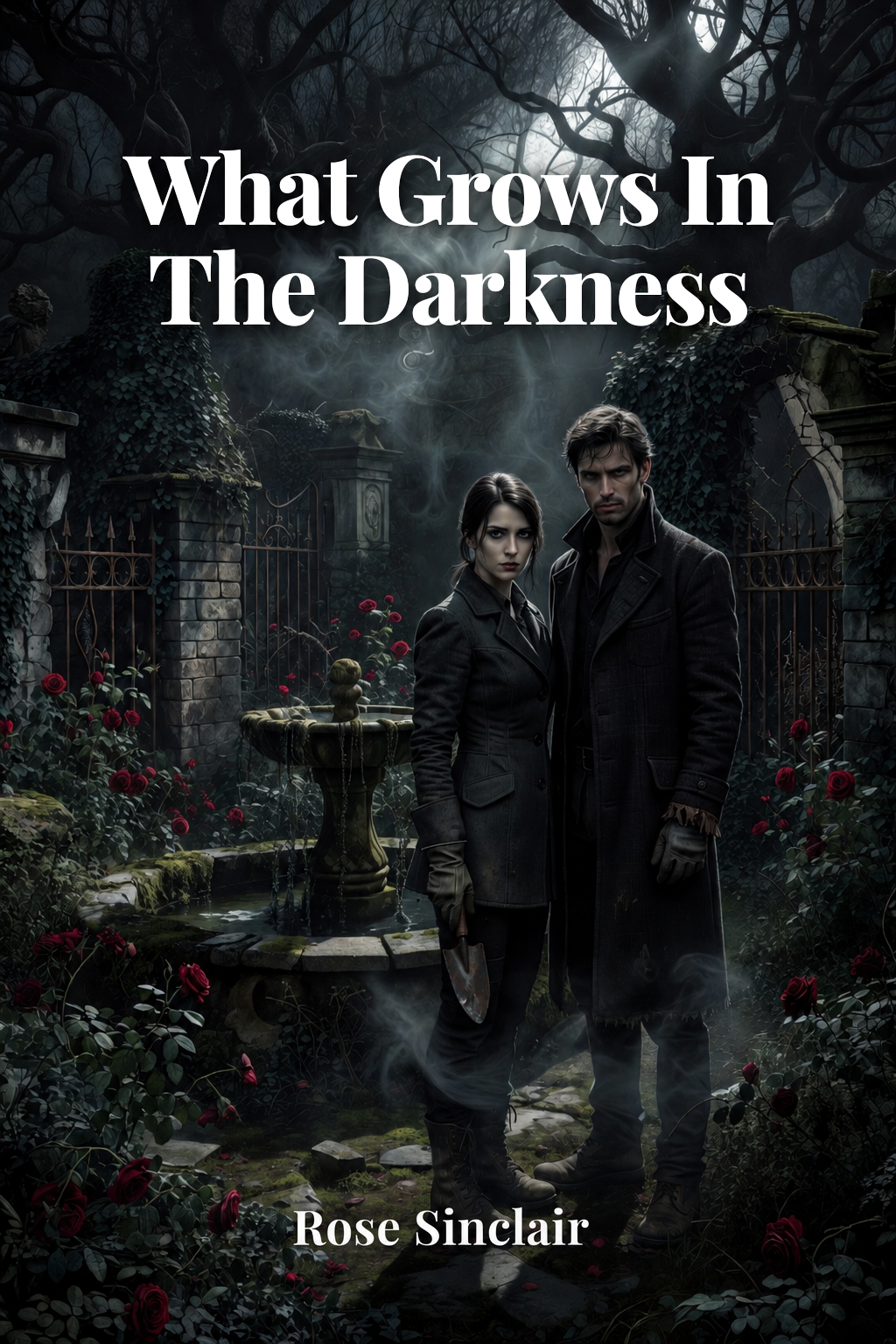
Book · 12 chapters · 37,403 words
What Grows In The Darkness
Contents12 chapters
Chapter 1
A Voice Through the Rain
“Watch out! What the—”
A taxi driver’s furious blast of the horn, followed by a particularly inventive swear word, woke me up more effectively than coffee on that grey, rain-soaked Monday morning.
By the time I stumbled into the office, dripping Edinburgh rain all over the place, the phone was already ringing.
I lunged for it.
“Hello?” I panted into the receiver.
“I do rather like that level of enthusiasm at the start of a conversation.”
The deep male voice on the other end caught me completely off guard.
“Er…”
So much for my natural eloquence. It had disappeared faster than a puddle in the Scottish sunshine.
“And there I was, beginning to enjoy myself.”
There was a faintly teasing note in his voice, and it was enough to snap me back to reality.
“What is wrong with me?”
I forced myself to sound professional.
“The Heritage Rose Landscaping. Rose speaking. How may I help you?”
I delivered the words in the clipped, stern tone of a particularly unimpressed schoolmistress—and rolled my eyes at myself.
The man on the phone laughed, low and brief, as if he had pictured me doing exactly that.
“My apologies, Miss Rose Speaking. I seem to have caught you at a dramatic moment.”
“It’s Ms Nowak,” I said, peeling my wet fringe off my forehead with one hand. “And Monday mornings are always dramatic. How may I help you?”
“Cameron Arbuthnot.”
He said it like I ought to know the name. I did not. The rain rattled against the front window. Behind me, the office smelled of wet wool, old paper, and the soil trapped in the tread of my boots. On the pinboard beside the desk, three unpaid invoices stared at me in accusing silence.
“I’ve inherited a house,” he said, “which sounds fortunate until I add that it came with a garden large enough to ruin a person’s health and a solicitor who thinks shrubs are a form of weather.”
That got me despite myself.
“I see.”
“I doubt that very much,” he said. “No one sees it. That is rather the trouble. It’s become... overgrown.”
There was the smallest pause before the last word, and in it I heard something else. Not embarrassment exactly. Fatigue, maybe. Or reluctance.
I sank into my chair and nudged aside a stack of catalogues with my elbow. “Overgrown how?”
He exhaled, and the sound blurred for a second under a hiss of static.
“Do you know the old house at Blackthorn Hall?”
I frowned. “Out toward Cramond?”
“Near enough.”
“I’ve driven past the gates.”
“Then you’ll remember the yew wall.”
I did remember it. A dark, hulking mass behind iron railings, clipped once with fierce discipline and then, for years, not at all. Even from the road it had looked less like hedging than a line of watchmen with bent shoulders.
“Yes,” I said slowly. “That place.”
“That place,” he agreed. “It belonged to my aunt. She died in February. I’ve spent the last six weeks trying to work out whether she hated gardeners, men, or visitors in general. At present I suspect all three.”
The office door banged open hard enough to make me jump. Maisie shot in, all black-and-white blur and rainwater, then skidded across the lino and crashed into the filing cabinet with a metallic clang. Her ears flew back in guilty delight. She had a twig in her mouth and mud up both front legs.
“Out,” I told her.
She sneezed on my boot.
There was a beat of silence on the line.
“Was that a child,” Cameron asked, “or a small farm animal?”
“My dog.”
“Excellent. I was hoping you might be the sort of person who prefers dogs to people.”
“I run a landscaping company,” I said. “That comes with the territory.”
“Then we may get on.”
I should have taken charge of the call then. Asked sensible questions. Square footage. Access. Budget. Time frame. Instead I found myself glancing through the rain-streaked window at the street outside, listening to a stranger’s voice as if I had all morning to spare.
In truth, I had no morning to spare at all.
The Heritage Rose Landscaping sounded grand on paper and much less grand in practice. It was me, one part-time lad called Euan who could be trusted with a strimmer but not with clients, a van that made an alarming noise in second gear, and a list of jobs that had bred over the weekend. Two spring tidy-ups in Morningside. A collapsed dry-stone edge in Leith. A tiny back garden in Stockbridge where the client wanted “something sculptural but easy” and had the budget of a sandwich. I was late. I was soaked. I had not yet had tea.
Which meant I ought to have said no at once to anything that smelled complicated.
Instead I said, “How overgrown is overgrown?”
He gave a soft hum, considering.
“There are brambles thick as mooring rope. Ivy up the west wall and through at least one broken pane. A border of what I think were once roses, though at present they look like armed men lying in wait. A lawn that has ceased to believe in civilisation. And trees that have taken it upon themselves to decide the future of several paths.”
That was not a client describing a mess. That was a man who looked.
I sat up a little straighter.
“And how long since anyone worked on it properly?”
“Years. More than ten, certainly. My aunt employed someone for the basics in the front, I think, but the walled garden at the back...” He stopped. “That was left alone.”
“Deliberately?”
“That is one of several questions no one seems keen to answer.”
Rainwater slid down the back of my collar. I tugged off my coat and hung it over the radiator, though the radiator had not worked since November and was now a rack in all but name.
“Are you looking for maintenance,” I asked, “or restoration?”
“I’m calling because I don’t yet know if restoration is a mad word to use.”
That, more than the rest, held me.
Most people rang wanting neatness. They wanted things cut back, mown down, pressure-washed, stripped of mess and memory. Very few asked whether a place could be brought back rather than simply cleared. Fewer still knew there was a difference.
I swiveled toward my desk and dragged my notebook closer. A wet pawprint appeared on the bottom corner where Maisie had nosed it earlier.
“What makes you think it was a Victorian garden?”
“Ordnance map,” he said promptly. “And the bones of it. There’s an axial path from the south terrace, though you’d never know it now unless you nearly broke an ankle on the edging. Brick retaining walls. Traces of a long border. A sunk area beyond that, perhaps once for glass. Fruit trees against the north wall, old enough to have opinions. My aunt’s housekeeper says there was a lily pond once, though if so it has become indistinguishable from a patch of nettles and regret.”
I smiled before I could stop myself.
Outside, a bus hissed past through shallow flooding. Somewhere at the back of the office, the ancient kettle gave a death-rattle click and refused to boil. Maisie dropped her twig and began worrying the coir mat by the door.
“You’ve done your homework,” I said.
“I dislike sounding a complete fool to experts.”
“It never stops most people.”
“Then perhaps I’m unusually teachable.”
His voice had a dry edge to it, but not the smooth, overpractised kind I had learned to distrust. Men who sold things for a living had that. Men who wanted to get a woman to lower her guard had it too. This sounded more like a habit formed in self-defence.
I turned a page in my notebook. “How big?”
“The formal grounds or the area that needs saving?”
“The area I’d be expected to look at.”
“Acre and a half, perhaps two, depending on what one counts as garden and what one counts as territory reclaimed by hostile forces.”
I winced silently.
Too big for me alone, at least if he wanted it quickly. Too big for a simple tidy. Too far out to slot in around three domestic clients and the Hendersons’ endlessly expanding patio plans. It would mean days on site, maybe weeks. Hired help. Machinery. Quotes I would have to build with care so I didn’t lose money before the first branch hit the chipper.
I should have felt only dread.
Instead, under the dread, something old and sharp lifted its head.
When I was twelve my grandfather had taken me to a cemetery outside Kraków where the old stones tilted among high grass and box hedges gone wild. He had shown me how to read neglect. Which line had once been formal. Which shrub had seeded itself. Which rose still flowered because someone, long dead, had chosen well. “A garden tells on the people who leave it,” he had said, brushing lichen from a carved angel’s wing. “And on the ones who stay away.”
I could still smell wet stone and crushed thyme if I let myself.
“Miss Nowak?”
“Ms,” I said automatically, and then, “Sorry. Thinking.”
“Should I be frightened by the silence?”
“Only if you’re hoping for cheap.”
He laughed again.
“On the contrary. I’m hoping for honest. If it’s too much, say so.”
That checked me. I had heard every version of a client’s false modesty. It’s only a little thing, they would say, standing in front of a catastrophe. We don’t need anything fancy. Shouldn’t take long. We’ve had outrageous quotes from others. This man had not pushed once. He had not asked for magic on a budget. He had offered me a clear route to refuse.
Which made me less inclined to take it.
“Tell me what you want done,” I said.
There was a scrape, as if he had shifted in his chair.
“At first? Assessment. I need to know what can be saved, what can’t, whether the layout is still there under the mess, and what it would cost me to begin. I haven’t decided whether to sell the house.”
Ah.
There it was. The personal note I had heard under everything else.
People inherited gardens the way they inherited silver or damp or family grudges. Some wanted the place made presentable for estate-agent photographs. Some wanted one last season before they let it go. Some, though they would rather die than admit it, wanted a stranger to tell them whether they were allowed to care.
“If you’re selling,” I said, “you might not want restoration. Basic clearance and stabilising would be cheaper.”
“Yes.”
He said nothing after it.
I waited.
When he spoke again, his voice had gone quieter. “My aunt lived there alone for years. She kept the house in order and let the garden disappear. I don’t know why. I thought I should. I seem to know less about her with every drawer I open.”
I looked down at the muddy print on my notebook and traced its edge with my thumb.
The room had gone still except for the rain. Even Maisie had abandoned the mat and come to lean against my knee, warm and damp and solid.
“You were close?” I asked, before I could decide whether it was unprofessional.
“Not as close as I ought to have been.”
There was no self-pity in it. Just fact.
Then, as if he had felt the conversation stray too near open ground, he added lightly, “Though she has made one thing abundantly clear in death.”
“What’s that?”
“That she disapproved of low-maintenance planting.”
I laughed properly then, a short burst that eased something in my chest.
“All right,” I said. “I can come and look.”
The relief on the other end of the line was small but unmistakable. It moved through the wire as plainly as if I had seen him drop his shoulders.
“Thank God.”
“Do not thank God yet. I said look, not rescue.”
“I’ll be careful with my devotions.”
I bent over my diary. Tuesday was impossible. Wednesday worse. Thursday I had a morning hedge reduction in Corstorphine that might finish by noon if Euan did not try to use the wrong attachment again.
“I could do Thursday afternoon,” I said. “Around two, if the weather doesn’t make the roads stupid.”
“The roads are always stupid.”
“You sound local.”
“Edinburgh born. Though at present I’m speaking to you from a study with three leaks and a portrait of an ancestor who looks as if he hanged sheep for sport.”
“Charming.”
“It lacks warmth,” he said. “But not character.”
I wrote Blackthorn Hall, Thurs, 2 p.m. in the margin beside a note about compost delivery and circled it twice.
“Before I agree properly,” I said, “I need to be clear. If this is a major restoration, I may not be the cheapest option and I may not be the fastest. I don’t take on work I can’t do well.”
“Good.”
“I’m serious.”
“So am I.”
The words landed cleanly. No flattery. No rush. He wanted competence, not a performance of it.
I found myself asking, “Why me?”
“Because a woman in Barnton told me you brought back her mother’s old rose border when everyone else told her to grub it out. Because a retired architect in Trinity said you know the difference between clearing a site and butchering it. And because your company name suggested either confidence or dangerous levels of optimism.”
Heat pricked under my skin, absurdly.
Mrs Gillespie in Barnton talked too much to everyone, and Mr Laird in Trinity had inspected my deadheading with opera glasses from an upstairs window before deciding I was acceptable. I had not known either of them recommended me.
“People gossip,” I muttered.
“They do. Very usefully, now and then.”
I tore a corner from an envelope and wrote down his number as he gave it to me. His voice slowed over the final digits, careful, as if he had already guessed I was writing on whatever came to hand.
“Will there be access for a van?” I asked.
“Yes.”
“Water on site?”
“Yes, though I can’t promise the taps won’t object.”
“Any hazards I should know about?”
“A derelict greenhouse, one unstable bit of walling near the old kitchen yard, and a peacock topiary in the front that is less hazard than warning.”
I blinked.
“You have a peacock topiary.”
“Had, perhaps. It now resembles a clergyman in distress.”
I put my pen down and rubbed at the ache starting behind my eyes. I was tired, I was late, and I had just agreed to visit a crumbling estate owned by a man whose voice sounded like dark wood and rainwater, which was not the kind of detail a sensible woman should notice.
Still, some mornings shifted under your feet before you had the chance to brace.
“Fine,” I said. “Text me the address and any gate instructions. If I’m delayed, I’ll call.”
“Thank you, Ms Nowak.”
He said my name right. Not with the flat English no of it, but properly, soft at the start, the w carried through. Most people stumbled. Some did not try. I had not told him.
“You speak Polish?” I asked.
“A disgracefully small amount.”
“That was not a small amount.”
“My aunt employed a housekeeper from Łódź for years. She taught me enough to avoid insulting anyone over tea.” A pause. “And to say your name correctly, I hoped.”
For one ridiculous second, the room seemed to draw in around that.
I made my voice brisk. “Well. You managed.”
“A victory. I’ll take it.”
Maisie chose that moment to nose under my hand and thump her tail against the desk leg like a muffled drum.
“And bring the dog,” he said.
I frowned. “What?”
“You mentioned a dog. If she travels well, bring her. Blackthorn could do with one honest creature.”
I should have refused that too. Clients did not usually invite my border collie to first assessments, and Maisie’s idea of professionalism involved stealing gloves and excavating ornamental bark. Yet the picture rose at once: her black ears pricked against a wall of green, her body alive with purpose in some neglected place.
“We’ll see,” I said.
“A diplomatic answer. I deserved no better.”
When the call ended, the office felt oddly hollow, as if someone had opened a door and closed it again too fast for the air to settle.
My mobile buzzed almost at once with the address. Blackthorn Hall. A lane I knew in the loose way one knows the edges of a city—by weathered stone walls, hidden drives, and the sense that old money had once gone to ground there and built itself battlements of shrubbery.
I read the message twice, then set the phone down.
Maisie rested her chin on my thigh and looked up at me with shameless expectation. Her whiskers were beaded with rain. There was a smear of mud on the white blaze of her nose.
“This is your fault,” I told her.
Her tail thudded harder.
I stood and crossed to the window with my mug, then remembered I had never made tea. The street outside gleamed black and silver. Rain ran along the gutter carrying cigarette ends, a leaf, the bright foil lid from a yogurt pot. Across the road, the florist was setting out buckets of stock and eucalyptus beneath a striped awning, each stem darkened by wet. The smell drifted faintly each time the door opened: green, peppery, cold.
I tried to tell myself Thursday’s visit was nothing. An assessment. A look. A quote if he was lucky. I did not have room in my schedule for a grand ruined garden with family secrets tangled in the ivy. I did not have money in the business account for noble follies. I did not have patience for charming men in leaking houses.
But under all that, another truth was already taking root.
He had said axial path. Brick retaining wall. Fruit trees against the north wall. He had spoken of bones.
Most people looked at old gardens and saw mess. The good ones saw structure. The rare ones understood that a place could keep its shape long after it had lost its face.
I looked back at my desk, at the scribbled note and muddy pawprint and the day waiting to be survived. Thursday sat there among ordinary jobs like a black seed in a tray of gravel.
Maisie gave a soft impatient whine.
“Yes, all right,” I said, reaching for my coat again. “We’re going. First to Morningside, then to Leith, and then apparently on Thursday to a house with a dying peacock and a man who pronounces my name properly.”
Her ears shot up at the magic word.
The rain had not eased. It drummed on the glass and on the roof of the van and on the city itself, washing soot down stone and turning every garden bed dark as coffee grounds. I locked the office, pulled my hood up, and stepped back into it with Maisie at my heels.
By the time I reached the van, I had nearly convinced myself the faint unease in my stomach was only hunger.
Nearly.
Chapter 2
The House Behind the Yew Wall
By the time I turned off the main road and onto the lane for Blackthorn Hall, the rain had thinned to a fine, stubborn mist that silvered the windscreen and blurred the hedges into one long smear of green.
Maisie stood with her front paws braced on the passenger seat, vibrating with interest. She had been impossible since we left Corstorphine. Every pheasant, cyclist, and bin lorry had received a level of attention usually reserved for roast chicken. Now, with the city loosening behind us and the houses giving way to old stone walls slick with lichen, she pressed her nose to the glass and fogged it with frantic little breaths.
“You haven’t even seen the place yet,” I said.
Her ears twitched, dismissing me.
Blackthorn Hall announced itself badly. No gates, no neat sign, no respectable gravel sweep. Just a break in a high boundary wall and two weathered stone piers listing slightly away from each other, as if years of wind had pushed them apart. One iron gate hung open. The other had dropped on one hinge and rested at an angle in the weeds. Beyond them, the drive curved out of sight under beeches and yews so old their trunks looked twisted by thought.
I slowed the van and checked the address on my phone anyway.
No mistake.
The drive was rutted and glossy with mud. Wet leaves had gathered in the hollows. Brambles leaned in from the verge and scraped the side panels with long, complaining fingers. The house did not appear all at once. It disclosed itself in parts: a chimney, then a roofline, then a stretch of grey stone fronted by tall windows the colour of old spoons under the cloud.
Blackthorn Hall was not picturesque. It had passed through that stage years ago and come out the far side. The central block still held itself upright with a kind of severe dignity, but one wing sagged visibly. Ivy climbed over the masonry and thickened around a drainpipe until the pipe had disappeared entirely. The steps to the front door were green at the edges. A cracked urn lay on its side in the gravel with soil spilled out of it and a self-sown ash growing where something deliberate had once been planted.
“Cheerful,” I muttered.
Maisie gave a shrill bark that might have meant yes.
A man came out before I had switched off the engine. Even at a distance I knew him. Some people carry the sound of their voice in the way they move. He was taller than I had pictured, coatless despite the damp, one hand shoved into the pocket of dark trousers, the other lifted in greeting. His hair was a little too long, wind-ruffled, and there was a look about him I recognized from mirrors and late invoices: tiredness tidied into something presentable.
I climbed down from the van. Maisie launched herself after me and nearly wound the lead round my knees.
“Ms Nowak,” he said.
“Mr Arbuthnot.”
He smiled at that. “If you call me that all afternoon, I’ll begin to think I’m being prosecuted.”
“Cam, then?”
“Please.”
Up close, he looked less polished than he had sounded on the phone. Not careless. Just as if the last few weeks had been lived in fragments. There was mud on one cuff. A pale scrape marked the side of his hand. He noticed me looking and glanced down.
“Argument with a window frame,” he said. “The house won.”
“I did warn you I’m not a miracle worker.”
“I’m relieved. The place has had enough of disappointed expectations.”
That should have been dry, almost flippant. Instead it landed with a small, hard truth behind it.
Maisie sat abruptly and stared up at him, alert and shameless.
“And this must be the honest creature.”
“This is Maisie. She has no respect for personal property.”
“An excellent quality in a first witness.”
He crouched and held out his hand. Maisie sniffed it, approved him at once, and leaned the full determined weight of herself against his shin. Cam laughed under his breath and scratched behind her ears with exactly the right pressure. I disliked how quickly both of them seemed to have reached an understanding.
“You’re traitorous,” I told her.
“She has discernment,” he said, standing again. “Thank you for coming.”
The front of the house smelled of wet stone, leaf mould, and something fainter underneath: cold ash, perhaps, or long-shut rooms breathing out when a door opens. The gravel had half disappeared into moss. On one side of the drive stood the remains of clipped shapes that had once been yew cones or pillars and were now hulking, black-green masses with birds darting in and out of them.
“You said the front’s been kept just alive enough,” I said.
“Alive is generous. A local man came in every so often for the basics. Lawn. A bit of hedge. Enough that the neighbours wouldn’t think the dead had taken over completely.”
“And the back?”
He glanced past the house. “My aunt let the back go. Deliberately, I think.”
That think did a lot of work.
He led me around the side by a flagstone path lifted in places by roots. The house wall rose damp and high on one hand. On the other, a belt of yew shut out whatever lay beyond. Not hedging in the neat domestic sense. A wall, exactly as he had said. The trunks had thickened together over decades into something muscular and sombre. Their lower branches swept the ground. Water dripped from their needles with a slow, steady patience.
There was an opening ahead, framed by stone piers furred with moss.
When we passed through it, the temperature seemed to drop.
I stopped without meaning to.
The garden beyond had not vanished. That would have been easier. It still existed in shape and level and line, but everything legible in it had been muffled under years of unchecked growth. Terraces stepped down away from the house, though the edges had slumped and broken. Once-formal beds had become raised islands of bramble and nettle. Ivy cinched the trunks of old fruit trees and poured over walls in thick dark sheets. A central path, or what had been one, ran forward a little way before drowning under grass, self-sown elder, and thorn.
The place had scale. That was the first thing. The second was silence.
Not complete silence. There were wood pigeons somewhere, and the thin metal tap of water from a damaged gutter, and Maisie snorting with excitement beside me. But underneath that, the garden held itself with a watchful stillness I had known in a few old places and never trusted. Not haunting. Older than that. A feeling that a design can remain long after care has left it, and resent both neglect and interference in equal measure.
“Well,” I said.
“Precisely.”
I stepped forward onto the first terrace and crouched to look at the stone edging. Sandstone, hand-cut, blackened with algae and tilted off level. Good material. Salvageable in sections if the frost had not split too much of it. Beyond, under a drift of cow parsley and nettle, I could just make out the brick shoulder of a retaining wall. Old red brick, soft and irregular, laid with care. Victorian, likely enough.
“These are proper bones,” I said.
Something changed in his face then. Not a smile. Relief, maybe, though he hid it quickly.
“You can see it too.”
“Of course I can see it.” I rose and turned slowly, mapping as I looked. “That was a main axis. There were side returns there and there. Fruit on the far wall, yes. Apples, maybe pears. The beds nearest the house were ornamental. Lower down you had mixed use. Productive and pretty, if someone had any sense.”
“My aunt would be delighted by your approval. She hated gardens that chose between them.”
I glanced at him. “She knew plants?”
“Obsessively. At least once.”
That at least once again. Small phrases, but they left scratches.
Maisie strained at the lead so hard I had to brace. Her whole body pointed toward the lower end of the garden where the growth thickened into a near-solid mass of laurel, briar, and young sycamore.
“No,” I told her.
She looked back at me as if I had made a moral error.
Cam watched us. “You can let her off, if you like. It’s all chaos anyway.”
“It’s your chaos.”
“I assure you, she can do little here that time has not already done better.”
I hesitated, then unclipped the lead.
Maisie shot away like a released spring, black-and-white body flashing over the terrace and down through the wet grass. Within seconds she had vanished into the green.
Cam folded his arms against the damp. “I see what you mean about professionalism.”
“You invited her.”
“I did. I’m enjoying the consequences.”
I ignored that and walked the upper level while he followed. The house side beds had once held roses; that much was obvious even before I found the evidence. Thick old rootstocks, thorny and half-wild, had thrown out blind growth through bindweed and herb robert. The supports along the wall had rusted away, but the spacing remained. Good rose beds had their own discipline, even ruined.
I touched one stem. “These might come back.”
“They look dead.”
“They look offended. It’s different.”
That earned me a real smile this time, quick and unguarded enough to alter him. He had a face made too severe by strain and then unexpectedly younger when amusement got through. Dangerous, I thought at once, and bent to inspect the soil so I would not keep looking at him.
The earth was heavy and rich beneath the top mat of rot. Compacted, neglected, starved of air. But not spent. I crumbled a little between my fingers. Clay loam. Messy to work with in wet weather, generous in dry, capable of great things if handled properly.
“She stopped coming down here toward the end,” Cam said.
I looked up.
He stood with one hand on the back of a broken bench. Rain had darkened the shoulders of his jumper. “At least that’s what the woman in the village told me. My aunt used to be out here every morning. Then after a certain point she had the yew gate shut and more or less left it alone.”
“Did she say why?”
“She said my aunt called it kinder.”
The word sat badly in the air.
“To whom?” I asked.
He gave the smallest shrug. “That, apparently, was not a question one asked her.”
We moved down to the next terrace by a set of steps nearly lost under moss. I tested each tread before putting my weight on it. One rocked sharply under my boot.
“Needs lifting and relaying,” I said.
“So noted.”
“And the retaining wall there has bulged. If tree roots have gone through the back, that section will have to come out and be rebuilt. No shortcuts.”
“I did not bring you here for shortcuts.”
“No,” I said, before I could stop myself. “I don’t think you did.”
He met my eyes for a moment, and something in that look felt too direct, too early, too aware. I turned away first.
The greenhouse stood in the far corner where the shelter was best, its roofline visible above a rank stand of bamboo and elder. Dead glasshouse, he had called it. He was not wrong. Up close it was worse. Several panes were missing outright. Others had slipped in their frames and sat cracked like loose teeth. The paint on the ironwork had blistered and failed. Inside, I could see the tilted shapes of benches, collapsed staging, and a confusion of pots, canes, and creepers making use of the ruin.
I walked around it slowly.
“The frame might be worth saving,” I said. “If the base hasn’t gone.”
“Optimism.”
“Professional caution. Those are not the same thing.”
He came to stand beside me, close enough that I caught the clean scent of rain on wool. “You don’t seem put off.”
“I am put off,” I said. “This is expensive, labour-heavy, and full of things that would like to scratch, poison, collapse, or sue us.”
“And yet?”
“And yet someone built it properly the first time.”
I looked back over the garden from where we stood. Even under the weather and neglect, the structure held. Lines buried but not erased. Spaces intended for pause, for display, for work, for mourning perhaps, though I did not know yet why that word rose so clearly.
“Places know when they were loved well,” I said. “Sometimes that’s enough to start with.”
He was quiet after that. When I glanced at him, his expression had changed again, shuttered and thoughtful.
“My aunt loved it well,” he said. “I think that may be part of the problem.”
Before I could answer, Maisie barked somewhere out of sight. Not her cheerful found-a-stick bark. Sharper. Intent.
I straightened at once.
Another bark came from deep in the thicket at the lower boundary, followed by the crackle of branches and the heavy thrash of something forcing its way through undergrowth.
“Maisie!” I shouted.
No dog appeared.
I started down across the terrace, swearing under my breath as brambles caught my trousers. Cam was beside me immediately, pushing aside wet canes with his forearm.
“Does she chase?”
“She investigates. Which is usually worse.”
We reached the edge of the overgrowth where laurel had thickened into a dense, glossy barricade. There was a narrow run through it at ground level, not a path exactly, more the kind of tunnel animals or one determined dog make when they decide rules no longer apply.
Maisie barked again, muffled now, somewhere beyond.
I crouched and peered in. The air smelled of bruised leaves, mud, and old water. The ground underneath was churned black. Something had been going in and out of here.
“Can you get through?” Cam asked.
“Not without losing an eye.”
He bent a branch aside. “That would spoil the afternoon.”
“Thank you for your concern.”
Another rustle. Then, at last, a black nose emerged from the leaves, followed by Maisie’s entire muddy ecstatic self. She burst out of the thicket with burrs in her coat, a twig hooked absurdly over one ear, and both front paws black to the shoulder with wet earth. She skidded to a halt at my boots and looked up, wild with triumph.
“Oh, excellent,” I said. “You’ve discovered filth.”
She sneezed, showering my jeans with specks of mud.
Cam stared at her, then at the hole in the greenery. “Where on earth has she been?”
I dropped to one knee and ran my hands over her quickly. No blood, no limp, no obvious injury. Just mud. A lot of mud, dark and clinging, with a peculiar greenish smear in it, as if she had pushed through moss or something long undisturbed.
Maisie wriggled, desperate to go back.
“No,” I said firmly, catching her collar. “Absolutely not.”
But I looked where she had come from, and the skin along my arms tightened despite the mild day.
Through the parted leaves I could see almost nothing. A dimness. More growth beyond growth. Yet the ground just inside the opening sank slightly, as if there were space under the arch of laurel, or the remains of some passage, or simply a hollow where light did not reach.
“Is there a wall back there?” I asked.
“Should be. The old boundary line runs along this side.”
“Should be?”
“I haven’t found it.”
That was not the sort of sentence one often heard in a garden enclosed by masonry.
I stood, still holding Maisie, who quivered with protest. “Something’s back there.”
“Badger set?”
“Maybe. But she’s too pleased with herself for a badger hole.”
Cam looked at the thicket as if it had spoken to him in an unfriendly language. “I’ve had the odd feeling all week that the place isn’t merely overgrown. More as if it has been pulling itself shut.”
“That is not a technical term.”
“No. You’ll invoice me separately for poetry.”
Despite myself, I smiled. Then I looked again at the dark run under the laurel and felt the smile go.
A garden can be neglected. That is ordinary. Paths vanish. Beds collapse. Seedlings rise where they please. Nature fills a silence quickly if no one objects. But this corner felt different. Not wild in the cheerful way of meadow grass and foxgloves. This was concealment. Dense, damp, deliberate-looking concealment, though no hand had trimmed or trained it in years.
Maisie leaned toward it, whining low in her throat.
“Whatever this is,” I said, “we don’t go blundering in today. I’ll need gloves, loppers, probably two extra people, and something stronger than optimism.”
“Understood.”
I kept my hand on the dog’s collar a moment longer, feeling her pulse jump under my fingers.
Then I let go and turned back toward the terraces, the dead greenhouse, the broken walls, the old rose beds waiting under thorn and bindweed. The work ahead arranged itself in my head already: clearance, survey, salvage, risk, cost. A long job. A difficult one. The sort that could eat weeks and money and better judgment if I let it.
Behind me, the thicket stood quiet again, as if it had never moved at all.
Maisie shook herself from nose to tail, spraying mud in a neat arc across my coat and Cam’s trousers alike.
He looked down at the damage, then up at me.
“Well,” he said.
This time I laughed.
And because the garden was what it was, and because he looked as if laughter had been scarce here, he laughed too, there in the damp among the ruined beds, while the dog who had found something hidden danced around our legs and begged to be allowed back into the dark.
Chapter 3
Where Maisie Digs
Maisie found it before either of us had the sense to go looking.
I had come back three days later with proper gloves, two pairs of loppers, marking paint, twine, a folding saw, and the kind of determination that usually gets mistaken for optimism by people who do not work outdoors in February. The rain had stopped at last, but everything still held water. The gravel by the side yard sucked at my boots. The brick paths sweated green. When I pushed open the yew gate, the hinges gave a rusty complaint and the garden breathed out its cold, leaf-rotten smell as if we had disturbed something sleeping.
Cam was already there, waiting beside the old stone basin with a mug in one hand and no coat despite the chill.
“You’re early,” he said.
“You say that as if it’s a flaw.”
“I’m adjusting to your standards.”
“Good. Keep up.”
Maisie circled him once on a polite, hopeful basis, in case he had biscuits hidden on his person, then came to heel at my knee with only minor dancing. I looked at the lower corner where the laurel mass crouched in its usual silence.
“Right,” I said. “Today we make that less mysterious.”
Cam followed my gaze. He did not smile this time. “Excellent. I’ve always wanted less mystery.”
We started properly. That matters in a place like this. People imagine garden work as hacking, but most of it is reading. You look for the line under the mess. You test what is alive, what is rotten, what only appears dead because it has had no light for years. I worked down the main terrace first, not because it was urgent, but because I wanted the structure in my head before we touched the hidden corner. There were old rose stools under the bramble, as I had thought. One of them still had green canes low down, hard and thorny as wire. Box edging had gone to patchy, leggy ruin but could be followed in a wavering line. A narrow rill, long choked with leaves, ran from the basin toward the lower beds. Victorian, almost certainly. Fussy, practical, and faintly theatrical.
Cam watched while I knelt by a collapsed edging stone and scraped away soil with my trowel.
“You look happier,” he said.
“I look muddy.”
“That as well.”
I set the stone upright enough to see the bedding beneath. “No. I mean the garden has bones. Good ones. Whoever laid this out knew what they were doing. See here? Brick footing under the path edge. Not builder’s rubble. Proper work.”
He crouched beside me, close enough that I caught the clean smell of soap and damp wool under the morning air. “Can it be saved?”
“Yes.”
The word came out at once, and I heard how certain I sounded.
He looked at me then with a strange stillness, as if the answer had landed harder than he expected.
“But,” I added, because people get foolish when you sound too hopeful, “not cheaply, and not quickly, and not if you want cowboys in with a mini digger tearing out everything older than their own opinions.”
His mouth moved. Not quite a smile. “I had no intention of hiring cowboys.”
“Good. They’d flatten your terraces by teatime.”
We worked for the next hour in companionable patches of effort and talk. I marked salvageable shrubs with twine. Cam dragged cut briar into piles and earned several long scratches for his trouble. Maisie ranged in widening loops, nose down, body bright with purpose. Every few minutes she checked back in, grinning like a lunatic, then shot away again toward whatever smell seemed most promising. Once she emerged carrying half a flowerpot older than both of us, proud as if she had pulled treasure from the sea.
“Leave it,” I told her.
She dropped it at Cam’s feet.
“She prefers me,” he said.
“She thinks you are easier to manipulate.”
“That may also be true.”
By eleven the weak sun had found its way over the wall. It changed the garden without warming it much. Damp leaves flashed silver. The old greenhouse glass threw a dead gleam through ivy. Somewhere beyond the wall a rook made the sort of sound that could sour milk. I stood on the middle path with my notebook, looking from one terrace to the next, sketching a rough sequence of work.
Clear upper beds first. Stabilise loose stone by the west retaining edge. Lift self-seeded sycamore. Open sightline to basin. Then lower corner.
I underlined that twice.
Cam came up behind me, carrying the coils of old wire we had cut from a fallen support frame. “You’re frowning.”
“I’m costing your bad decisions.”
“My bad decisions?”
“You inherited a large derelict garden and called me. Very expensive character trait.”
He looked down at my page. “And the lower corner?”
“We do it today if we can make a safe opening.”
He glanced toward the laurel. Even at this distance it seemed to drink the light instead of reflecting it. “You still think it’s a wall or a passage.”
“I think it’s something built. Maisie didn’t come out muddy to the shoulder for nothing.”
At the sound of her name, Maisie looked up from the base of a clipped yew shape she had been inspecting and sprinted toward us. She overshot, skidded in the leaf mould, corrected elegantly, then bolted straight for the thicket as if she had waited all morning for permission that had never actually been given.
“Maisie!” I shouted.
Too late.
The laurel shuddered. Briar snagged. Leaves thrashed once, twice, then settled into violent rustling from within.
Cam put down the wire. “That can’t be good.”
“No,” I said, already moving. “But it is familiar.”
We reached the corner in time to hear a sound like furious digging muffled under wet branches. Not rabbit scratching. Not the neat scrape of a fox making a lie-up. This was committed excavation, the sort undertaken only by terriers, mad people, and border collies who know very well they are not supposed to.
I shoved my gloved arm through the opening we had marked before, hooked back a length of laurel, and peered in. The space beyond was larger than it had looked: a low tunnel first, then a pocket where the branches had arched over and made a cramped chamber. The ground was black and soft. Roots ran over it like ropes. And at the far side, half hidden under mats of ivy and caked moss, stood a shape that was not earth and not wall.
“Cam,” I said.
He was already beside me. “What is it?”
“Stone.”
Maisie backed out tail-first, front paws working, showering both of us with dirt. Her face was black with mud. She sneezed, shook once, and plunged back in.
“For God’s sake,” I muttered.
This time I dropped to my knees. Briars caught my coat. Laurel leaves slapped cold against my cheek. The smell inside was thick and close: sour wet soil, crushed ivy, old bark, the mineral chill of stone that has not seen daylight in years. I crawled far enough to get one shoulder through the gap and reached toward the mossy surface Maisie had opened with her digging.
My fingers touched carved edges under slime.
Not wall.
Upright slab.
I scraped with the heel of my glove and a strip of lichen peeled away like wet felt. Grey stone showed beneath. Then a line. Then the curved arm of a cross.
I went very still.
“What is it?” Cam asked again, lower now.
I shifted enough to see more. “I think,” I said, “you need to come and look at this.”
He knelt awkwardly and bent himself into the opening, one hand braced on the ground near my hip. For a moment neither of us said anything. Maisie, delighted by the company, continued to dig at the base until I caught her collar and held her back.
There, in the green-dark pocket under the laurel, stood a tombstone.
Not large. Perhaps three feet visible above the soil, though there might be more buried below. The top was shaped into a Celtic cross, weathered and softened at the edges. Moss filled the grooves. Ivy roots had worked into the lettering. But the ring at the centre of the cross was still plain enough to see: an unbroken weave of knotwork, looping over and under itself in a pattern so tight and tender it looked almost like braided ribbon. Along one side of the circle, where my glove had cleared the slime, two small hearts sat worked into the design. Beneath them, nearly lost under lichen, ran a shallow incised phrase.
Gu Brath.
“Always,” Cam said quietly.
I looked at him. “You know that one.”
“My aunt used to say it when she was in one of her sentimental moods. Not to me. About old songs, mostly.” His face had changed. The colour had gone from it. “That’s a gravestone.”
“Yes.”
“In here.”
“Yes.”
He swore softly, not with anger. More like disbelief finding its footing.
I cleared lower with both hands now, careful not to scratch the stone. Soil came away in black clumps. More letters emerged. The inscription had been cut deep once, but time had taken the sharpness from it.
Beneath this stone lie two hearts joined in sorrow and in love—
The next line vanished into moss. I scraped gently. A few more words appeared, broken by loss.
—whom death did not divide.
No names.
No dates that I could see.
Only that strange, intimate sentence, and the cross, and the braided ring with its promise worked in stone.
Behind me the garden made no sound at all. Even the rook had stopped.
Cam pulled back first and sat hard on his heels in the open air, staring into the green hollow as if it might rearrange itself into something sensible if he gave it time. I came out more slowly, dragging Maisie with me before she could put both paws on the grave and improve matters further.
“No,” I told her, breathless and sharp with it. “Absolutely not. You’ve done enough archaeology.”
She wagged furiously, flecked me with mud, and tried to nose back under my arm.
Cam scrubbed a hand over his mouth. “There’s no burial marked on the plans.”
“What plans?”
“The estate papers. Drainage, old boundaries, kitchen gardens, tree plantings. There was a bundle tied up in my aunt’s study. I went through them after the funeral because the solicitor said I needed to know what I’d inherited.” He looked back toward the thicket. “There was nothing about a grave.”
“That doesn’t mean it isn’t one.”
“No. But if there had been a family plot, or even a servant burial from some outbreak year, surely someone would have known.”
I stood, brushing leaf fragments from my knees. “People know astonishingly little about their own houses.”
He gave a short laugh with no amusement in it. “Apparently so.”
I looked at the opening again. Now that I had seen the stone, the whole shape of the thicket made more sense. The laurels had not simply run wild. They had been left. Not pruned, not checked, not cut back when they swallowed the corner. Allowed to mass and knit and darken until the place vanished. A concealment by neglect. Very effective. Very English, except this was Scotland and the dead do not care much for borders.
“Your aunt knew,” I said.
He did not answer straight away. Wind moved along the top of the wall and nowhere else. “Maybe,” he said at last. “Or maybe someone before her did, and she was told not to touch it. God.”
He stood and paced two steps away, then back. Restlessness sat badly on him; he usually wore himself with that dry, held-in control of people raised never to show a room what they feel. But now he looked almost young, almost stripped down to nerves.
“What sort of people hide a grave in a garden?” he asked.
“The living sort.”
He stopped. His eyes met mine.
I wish, for dignity’s sake, that I had said something cleverer. But it was the plain truth, and plain truth often lands hardest.
I went back to the stone with a hand brush from my kit and this time worked from outside the opening, reaching in rather than crawling all the way under. Cam took the loppers and cut back two lengths of briar so we could see better. Inch by inch the face of the stone appeared. The cross had once been handsome. Whoever chose it had paid for good carving. The ring was not crude memorial-yard work. It had care in it. Skill. At the base, between two worn sprays that might once have been ivy leaves or yew, another line emerged.
Beloved unto death.
No names still. No family surname. Nothing to tell me whether the pair beneath were husband and wife, brother and sister, strangers united by some disaster, or what the stone itself suggested more strongly than any of those: lovers.
I felt a small, uninvited chill move between my shoulders.
Cam saw it. “Cold?”
“No.”
I wiped my gloves on my trousers, leaving darker streaks on green canvas. “It’s the wording.”
“Sorrow and love.”
“And no names. That’s odd.”
“Why?”
“Because grief usually wants names. You put people back into the world by naming them. Birth. Death. Beloved mother. Dear son. Something. This—” I nodded toward the hidden stone. “This sounds like someone was trying to honour them and erase them at the same time.”
He considered that in silence.
Maisie, deprived of labour, sat with exaggerated patience and watched us both, ears pricked, muzzle muddy, chest feathering black with damp earth. Every so often she leaned forward and gave the grave a quiet, urgent whine, as if convinced we were being terribly slow about a perfectly simple excavation.
“Don’t,” I told her.
Cam folded his arms. “Could it be a pet cemetery marker? People get dramatic.”
I looked at him until he sighed.
“No,” he said. “I know. It’s not.”
The next practical question arrived because practical questions always do. “How far down is the burial, if there is one? What if roots have gone through a coffin? What if the stone has shifted?”
“We stop,” I said. “We don’t tug at anything. We clear by hand. No machinery in this corner. Not a strimmer within reach of that inscription.”
“And then?”
“And then you decide whether you call the proper people before this becomes gossip at the pub.”
He turned that over. “There’s no pub near enough.”
“In Scotland? There is always a pub near enough.”
That drew a brief real smile, but it vanished quickly.
He crouched beside the opening again and leaned close to the stone, not touching it. “My aunt shut this part of the garden. She told the gardener only to keep the front from becoming a disgrace. She never came in here, as far as I know. I thought it was grief, or stubbornness, or one of those family feuds everyone inherits without the useful details.” He looked up at me. “If she knew this was here and said nothing…”
I did not finish that thought for him. Some things sound worse aloud.
Instead I said, “Whatever the story is, someone put care into this. It wasn’t a rough job in the dark with a spade and a prayer. There’s carving, deliberate wording, a proper marker. Hidden, yes. But not careless.”
He looked back toward the house, though it was invisible from the lower corner through the overgrown shrubs and falling yew. “That almost makes it worse.”
It did. Care suggests feeling. Feeling suggests motive. Motive opens doors you may not want opened in a family house.
We spent the next half hour doing only what we could justify. Cam cut a narrow clean margin around the outside of the thicket. I tied back laurel branches with twine to take pressure off the opening. I marked a no-go circle on the ground with bright paint, ugly and necessary. By the end of it the hidden pocket was still hidden from any casual glance, but we had made the place legible to ourselves. A grave, or a memorial pretending not to be one, sat under a green roof of neglected laurel in the lowest corner of Blackthorn Hall.
Maisie lay sphinx-like beside the paint mark, keeping guard over her discovery with shameless self-importance.
At last Cam straightened and set down the saw.
“All right,” he said.
“All right what?”
“We clear it.”
I looked at him.
“Properly,” he said. “Quietly. Before anyone else starts wandering about with opinions. No workmen poking at it, no locals hearing there’s a hidden grave on the estate and turning up over the wall with phones.” His voice hardened into something more decisive than I had heard from him before. “If there’s a story here, I want the facts before word spreads beyond the house.”
I glanced once more into the dark under the laurel, where the damp stone waited with its woven ring and its nameless tenderness.
“Then we do it carefully,” I said.
“Yes.”
Maisie thumped her tail in the leaf mould, as if the matter were settled exactly as she had intended from the start.
Chapter 4
The Knot in the Stone
The first thorn went through my glove before half past eight.
I felt it bite the heel of my hand, sharp and mean, and said something in Polish that made Cam look up from the path with open interest.
“I’m guessing that wasn’t ‘good morning,’” he said.
“It was not.”
I pulled the blackthorn spike free and inspected the damage. The leather had held well enough. My skin had not. A bright bead of blood rose, neat as a berry.
Cam leaned on the mattock handle. “Bad?”
“No. Just rude.”
That earned me the small, tired smile I had started to look for without admitting it to myself.
We had begun early because the weather had turned for us at last. Not warm, exactly. Edinburgh in spring rarely commits to warmth. But the rain had lifted and the air held that washed, mineral smell that comes after a week of wet: stone, leaf mould, old brick, the faint sweetness of bruised ivy. Light lay over the upper terrace in pale strips. The yew walls still looked almost black in the shade.
Maisie tore past us with a length of dead fern in her mouth, triumphant for reasons known only to dogs.
“Useful as ever,” I said.
“She’s very proud of herself.”
“She should be. She found your scandal.”
He winced faintly at the word scandal, though I had meant it lightly. That was one of the things I had begun to notice about him over the last few days. Cam could take teasing if it was aimed at him. He went still if it touched the family.
I wrapped the cut with plaster from the van first-aid box and got back to work.
The shape of the garden came clearer each day, and that was enough to keep me returning even if the grave had never been there. Blackthorn Hall’s walled garden had not been laid out by fools. Under the choke of bramble and elder, the old plan held. A central axis ran from the yew gate down toward the lower ground. Side paths branched from it in measured lines. Brick-edged beds sat sunken beneath nettles, their curves still right under the mess. There had been order here once, and not the stiff order people imagine when they hear the word Victorian. Not rows of obedient flowers standing to attention. Something richer. Productive, ornamental, faintly theatrical. A place built to reveal itself in stages.
I liked that sort of work. Not making a garden from scratch, but listening until an old one told you what it had been.
By the end of the first full week I had stopped pretending to myself that the job alone was what drew me out there every morning.
Part of it was professional hunger. A garden like this could make a reputation if it was done well and ruin one if it was done badly. The walls needed repair in places. The lower greenhouse was mostly a skeleton. The terraces had settled. The old drainage wanted looking at before winter turned every bed to swamp again. It was serious work. Good work.
Part of it was the grave.
And part of it, annoyingly, was Cam.
He was not conventionally easy company. He did not fill silence to spare himself. He did not perform charm. He worked steadily, listened properly, and when he laughed it always sounded as if I had surprised him into it. There were shadows under his eyes most mornings, as if sleep and he had quarrelled in the night. His hands were scratched to ribbons despite the gloves I kept telling him to wear. He had a habit of pushing his hair back with a dirty wrist, which only made him look more disreputable. None of this should have been attractive.
It was.
By ten, we had cleared enough of the lower path to bring the hidden corner into better light.
Not open light. The laurel still roofed over it, glossy and dense, holding its own green dusk even at midday. But we had taken back the margins. The no-go paint mark I’d made earlier was still bright and ugly in the leaf mould. Inside it, the tombstone sat on a slight tilt, half embraced by roots and wet moss. The stone itself was finer than I had first thought. Time had softened it, not erased it. The cross rose from a broad base, and the ring around the arms held interlacing bands so tight and patient that I could not immediately see where one line ended and another began.
I crouched beside it with a spray bottle, a soft brush, and the kind of concentration that makes your neck ache.
“No scraping,” I said without looking up.
“I know.”
“No wire brush.”
“I know.”
“No heroic family intervention because you’ve watched someone restore church carving on television.”
“I have never done anything heroic in my life.”
I glanced up. “That is simply not true. You made coffee in that kitchen.”
“That was desperation, not heroism.”
The coffee had indeed been dreadful. I had drunk two cups of it.
I misted the stone lightly and worked the brush over a clot of moss lodged in the ring. It loosened in velvet clumps, dark as bottle glass. Water ran green down the face of the cross and into the carved channels. Slowly, very slowly, details sharpened.
“Here,” I said.
Cam came closer and lowered himself into a crouch beside me. His shoulder almost brushed mine; I was aware of the heat of him through my jacket in a way that felt absurdly vivid.
“What do you see?”
“At first I thought those were just leaf knots.” I touched the air above the carving, not the stone. “They’re not.”
He narrowed his eyes. “Hearts.”
“Yes.”
Once seen, they would not disappear again. Small ones, worked into the endless plait of the ring. Not sentimental in the modern way, not childish, but deliberate. Two mirrored hearts hidden among the knotwork, nearly swallowed by it unless the light struck from the side.
Cam was quiet a long moment.
“That’s not accidental.”
“No.”
He leaned closer. “So whoever designed this wanted it read as a love marker.”
“Yes.”
“Not just a burial.”
“Yes.”
He let out a breath. “That’s worse.”
“Romance offends you?”
“No. Romance in my family garden under a laurel thicket with no names on the stone offends me.”
I laughed despite myself, and the sound startled a blackbird out of the yew.
We cleaned a little more. At the base of the cross, beneath a thick lip of moss and grime, lettering emerged in shallow carved capitals. I had expected the same broken, grief-heavy wording we had already found. Instead the brush revealed something shorter.
G U B R A T H
Cam saw it at the same time I did.
“There,” he said softly.
I sat back on my heels.
The phrase was not large. Someone had tucked it low, where dirt and damp could claim it first. But there it was again: Gu Brath. Forever. Always. Depending on who was speaking and why, either word was too small for what the phrase meant.
“It’s a vow,” I said.
He looked at me. “Not just a motto.”
“No. Not here.”
The little hidden hearts changed it. So did the nameless grief. So did the placement under the moss, where a casual eye might never find it. Someone had made this for two people bound together in death and had then hidden the whole thing under a dark border of laurel as if ashamed of the tenderness of it.
Or afraid of it.
Maisie shoved her nose into my elbow, impatient with human stillness. I scratched her muddy head absently and kept looking at the stone.
“If this is family,” Cam said, “then it’s not the sort of family story anyone tells at Christmas.”
“Families tell the wrong stories at Christmas all the time.”
He gave me a sideways glance. “Is that a Polish thing?”
“It is a people thing.”
He smiled, then lost it. “Could it be legend? Estate nonsense? Lovers buried secretly, maid and groom, that sort of thing. Every old house thinks it deserves a ghost story.”
“Maybe.” I stood and stretched the stiffness out of my back. “But legends usually get repeated. They become useful. This was concealed.”
He looked down at the stone again. “So scandal.”
“Or grief so private it became secrecy.”
“Those overlap.”
“Yes.”
That afternoon we worked our way outward from the grave site instead of inward. It felt better not to attack the centre like looters. We cleared the path that would once have approached the corner properly. We exposed two worn stone edgers and the stub of a small bench base, long since tipped and buried. We found old snowdrop leaves yellowing under the laurel and, farther up, clumps of narcissus blind from shade but still trying. Signs of a border once planned with care.
Dark border, I thought then, though it meant nothing yet.
By four the sun had shifted low and gold, making even ruin look forgiving. Cam carried armfuls of cut laurel to the heap by the wall. I bundled ivy lengths and dead cane. Maisie plunged in and out of the thicket, supervising. My shoulders throbbed. My knees were damp through. I was filthy and content in the way only hard physical work can make you.
Cam came back down the path with another load and said, “You can stop.”
“So can you.”
“It’s your business. I’m merely the ruined aristocracy funding it.”
I snorted. “Your title appears to be Lord of Broken Glass and Deferred Maintenance.”
“A proud line.”
“Ancient.”
“Impecunious.”
“Deeply incompetent with coffee.”
“Cruel, Ms Nowak.”
The formal use of my name should have sounded distant. Coming from him, it had acquired a private tone I did not trust at all.
I bent to pick up the coil of twine and found him already doing the same from the other side. Our hands met. Not brushed. Met. Work-rough fingers, soil in the creases, a stupid little moment that should have been nothing and was not. He looked at me then with that same surprised stillness he had in his laugh, as if something had stepped out of the undergrowth and stood between us asking to be noticed.
Maisie barked once, loud and bossy, because neither of us was throwing the stick she had produced from somewhere.
We broke apart.
“Saved by a collie,” he said.
“Story of my life.”
He took the twine, because one of us had to, and went back toward the wall.
That night, at home, I told myself I was thinking about the garden.
This was only partly a lie.
The next morning he had found a notebook.
He was waiting near the kitchen yard when I pulled in, hair damp from a rushed shower, mug in hand, expression sharpened by something other than fatigue.
“What happened?” I asked before I had even shut the van door.
“I went looking for estate plans.”
“And?”
“And found my aunt’s old garden books instead.”
That was enough to make me shut the door properly and follow him inside without another word.
The room he took me to had once been some sort of morning parlour and was now a holding pen for the dead contents of several cupboards. Dust-sheeted chairs. A rolled rug. Framed prints turned to the wall. Two cardboard boxes with warped lids. On the table by the window sat a stack of notebooks tied with faded blue ribbon.
“Aunt Isobel wrote everything down,” he said. “Plant orders. Weather. Which apples cropped badly. Who stole cuttings. She was that sort of woman.”
“She sounds like my sort of woman.”
“She would have judged your secateurs.”
“I respect that.”
He handed me the one he had already opened. The cover was bottle-green cloth gone soft at the corners. Inside, the writing leaned small and precise across the page in dark ink browned with age. Dates. Lists. Sketches of bed shapes. Notes on mildew and pruning and soil improvement with the cool authority of someone who expected to be obeyed by roses.
I turned pages carefully.
There were entries on espalier pears, on replacing box blight-struck edging with santolina, on ordering alba roses from somewhere no longer in business. There were tart comments on labourers and weather and rabbits. Then, midway through a summer section, the tone altered. Not dramatic. Worse than dramatic. Restrained.
Cam touched the margin. “There.”
Three lines, written more heavily than the rest, as if the pen had pressed through annoyance or fear.
Lower border not to be disturbed. Keep men from that quarter.
The hidden pair beneath the dark border must remain in peace.
Kinder so.
I read it twice.
Neither of us spoke.
The phrase sat on the page with an ugly little certainty. Not rumour. Not half-memory. Not a servant’s tale passed along and embroidered. His aunt had known. She had known there were two of them, and she had named the place by the border that concealed them.
“The hidden pair,” I said at last.
He sat down in the nearest chair as if his legs had decided things for themselves. “So she knew from the start.”
“Yes.”
“And she left them there.”
“Yes.”
“Kinder so.” He gave a short, humourless laugh. “Kinder than what? Telling anyone? Digging them up? Letting the family know there were secret lovers under the laurels?”
I turned another page in case the answer waited below, plain and neat in ink. It did not. The next entry was about vine weevil.
“That’s all?”
“In this notebook, yes.” He rubbed a hand over his mouth. “I spent half the night looking through the others. Nothing yet.”
“Yet is doing brave work there.”
“I know.”
I read the lines again. Lower border not to be disturbed. Keep men from that quarter. The command in it was practical, almost military. Not sentimental. She had not simply wept over a story and shut a gate. She had actively preserved the concealment.
That changed her in my mind.
“Did she ever speak of the lower garden to you?”
“Only once. She said some parts of a place can go bad if you force them open.”
“Did she mean this?”
“I assumed she meant drainage.” He looked up at me. “That sounds ridiculous now.”
“Not entirely. People hide truth inside practical statements all the time.”
He leaned back and stared at the notebooks as if one might suddenly volunteer the rest. Morning light showed every sleepless line in his face.
“What if it is family?” he said. “What if the hidden pair are my people and everyone agreed not to say it aloud? Illegitimate something, disgrace, religion, class, whatever old poison was fashionable at the time.”
“Then the notebook gives us one useful fact.”
“Which is?”
“Your aunt didn’t think they should be forgotten.”
That stopped him.
I set the book down on the table. “She hid the grave, yes. Or kept it hidden. But she wrote this. Hidden pair. Remain in peace. Kinder so. That’s not the language of someone who despised them.”
“No,” he said slowly. “It isn’t.”
“Whoever they were, she took their side enough to protect them.”
A rook called outside from one of the bare trees beyond the yard. Somewhere in the house a pipe knocked once in the wall.
Cam rose and went to the window. “You make that sound comforting.”
“It might be.”
“Or she knew exactly what had been done and decided silence was simpler.”
“That too.”
He gave me a look over his shoulder. “You’re very good at hope with a knife in it.”
“I run a business. It helps.”
That got the ghost of a smile, but only briefly.
We took the notebook out to the garden after that, though not down into the damp itself. I set it on an upturned trug in the sun while we worked the lower path. Once you have a phrase, a place starts arranging itself around it. Dark border. There it was. The laurel mass was not random growth, or not originally. Beneath the neglect lay the remains of a planned shrub line: laurel for evergreen bulk, yew behind, perhaps dark hellebore and sarcococca underplanting once, maybe deep red roses where there had been enough light. A mourning border, almost. Concealment made ornamental.
I stood with loppers in one hand and looked from the notebook to the grave and back again.
“Someone designed this,” I said.
Cam, wrestling ivy from the bench base, glanced up. “The border?”
“All of it. Not just to hide. To direct the eye away. To make this corner feel heavier, denser, less inviting than the rest.” I pointed with the lopper handle. “You’d naturally turn back toward the terraces, the greenhouse, the fruit. This would read as shade and shelter and nothing more.”
He followed my line of sight. “So the garden helped keep the secret.”
“Yes.”
He looked at the stone under its green roof. “And yet they carved hearts into the cross.”
“That’s the other half of it.”
He came over then, breathing a little harder from the work, and stood close enough that I could smell cut laurel on his jacket, bitter and clean.
“Say it.”
“Someone wanted them hidden,” I said. “Someone wanted them remembered. Both things are true.”
The morning held still around us. A bee moved through the foxglove leaves by the wall. Maisie nosed in the old leaf mould, searching for field mice or prophecy.
Cam looked down at the cleared edge of the path, then at me. “And you’re staying on this job.”
It was not quite a question.
“Yes,” I said.
“Because of the challenge.”
“Yes.”
His mouth tilted, very slightly. “Only the challenge.”
I met his eyes and had the sense, absurd and exact, that the whole neglected garden was listening.
“Don’t be vain,” I said.
He laughed then, properly this time, low and warm enough to unsettle me more than any grave.
Maisie, offended by our lack of industry, dropped a filthy old terracotta shard at his feet and demanded praise. He bent to oblige her. I turned back to the dark border and lifted the loppers.
The knot in the stone had tightened. Two hearts hidden in the weave. A vow under moss. An aunt’s careful hand naming the hidden pair and ordering the living away from them. The garden no longer felt like a simple restoration. It had become a message written across years in root and shadow and clipped restraint.
I should have been wary of that.
Instead I went to work.
Chapter 5
Her Aunt’s Locked Greenhouse
The padlock gave on the third strike.
Cam swore under his breath as the crowbar slipped, then set his shoulder and hit the hasp again with the heel of the hammer. Rust jumped from the metal in a bright orange spit. The old greenhouse door shuddered in its frame, glass ticking in the sash like bad teeth.
“One more,” I said.
“That’s what you said last time.”
“Yes, but this time I mean it.”
He snorted, breath white in the damp morning, and swung again.
The lock split.
For a second nothing happened. Then the door eased inward by half an inch with the soft, sticky sound of paint tearing from wood. A smell came out at once—wet timber, mould, old compost, cold iron, the sweet-sour rot of leaves left too long in a closed place. Not a dead smell exactly. A held one.
Maisie pushed between our legs before either of us could stop her and vanished through the gap with the practical confidence of a creature who had never once in her life considered tetanus.
“Maisie,” I snapped.
Her tags jingled once inside, followed by a sneeze.
Cam pulled the door wider with care. “Well. If she survives, we’ll know it’s safe.”
“It is not safe,” I said, though I was already stepping over the threshold.
The greenhouse had once been handsome. You could see that at a glance, even under ruin. The ridge line was still elegant. The ironwork had a delicacy modern frames never bother with, all curled brackets and narrow glazing bars. Someone had painted it cream a very long time ago. Now the paint had blistered and peeled back from the metal in papery scales. Many panes were cracked; some were gone altogether and patched by nothing but climbing ivy and a film of last year’s leaves blown in against the staging. Water had got everywhere. It had blackened the wood and furred the brick paths with green.
We stood still a moment and let our eyes adjust.
Inside, the place resolved itself slowly. Two long potting benches ran the length of the house, both collapsed in the middle. Clay pots lay on their sides among drifts of spilled loam. A row of narrow shelves along the back wall had slumped but not fallen. Above them hung the ghosts of labels on string, their writing faded to pale scratches. On the floor, among dead fern fronds and splintered trays, lay a rusted watering can with its rose dented flat.
Maisie stood at the far end with one front paw lifted and looked back at us as if to say that really, for two upright mammals with access to tools, we were very slow.
Cam came up beside me. “My aunt kept this locked?”
“Not just locked. Sealed.” I crouched to look at the threshold. Paint had bridged wood to wood years ago, then dirt had packed into the join. “No one has opened this in a long time.”
He looked around with that strained, inward expression he got when the house gave him some fresh proof that grief could become architecture. “I used to come here as a child. Not often, but enough that I remember the front lawns and the old cedar by the drive. I don’t remember this at all.”
“That doesn’t mean anything.”
“No.”
But it did mean something. At least to him.
I straightened and pulled the folded notebook page from my pocket. We had found the line the evening before, tucked between notes on wallflowers and apple pruning in Isobel’s neat, old-fashioned hand: if ever the lower matter must be faced, look first where B. kept summer under glass. No key with the servants. Never.
“B,” Cam said now. “Beatrice?”
“Likely.”
“Or bulbs.”
I gave him a look.
“Fine,” he said. “Not bulbs.”
We worked methodically because that is the safest way to face any place that might collapse around you or alter your life. I propped the door fully open with a brick. Cam fetched gloves from the wheelbarrow. We lifted broken glass first, then moved the worst of the fallen timber from the central path. Dust rose in damp little puffs. Earwigs fled from under every tray. Somewhere in the roof a trapped pigeon clattered wildly, then found the gap in a missing pane and burst out into the grey light.
Maisie discovered a colony of woodlice under an overturned seed tray and found them deeply fascinating.
The right-hand bench had gone soft as cake. When I pressed its edge, my thumb sank into the grain.
“Don’t lean on that,” I said.
“I wasn’t planning to.”
“You were looking at it in a way I distrust.”
“That’s offensive. I look at all unstable surfaces that way.”
I smiled despite myself and turned to the shelves along the back wall. Most held only broken pots and a drift of dead vine stems. One shelf had fallen entirely, its contents spilled behind the bench where we could barely reach them. I got down on one knee and used the handle of my trowel to drag things closer.
A small terracotta pan. Two blackened bamboo canes. A jam jar full of string turned brown with mildew. A pair of secateurs welded shut with rust. Under those, something dull and square wrapped in filthy greyed cloth.
“Cam.”
He came at once and crouched beside me.
“What is it?”
“Help me move this.”
We lifted the remains of the nearest bench rail and slid the object free. Not cloth, after all. Oilskin or oilcloth, stiff with age and grime, tied round a tin biscuit box gone dark at the corners with rust. It was heavier than I expected.
Cam sat back on his heels. “Well.”
I did not answer straight away. My hands had gone cold inside the gloves.
The box was ordinary in the way old things often are before they become loaded with consequence. Blue once, perhaps, with a gold border now almost gone. The lid had no lock, only a clasp.
“You open it,” he said.
“No.”
“You found it.”
“And it’s your house.”
He looked at the box, then at the open greenhouse door, the wet garden beyond it, the yew wall dark as a shut eye.
“Together,” he said.
So we did.
The clasp stuck. He prised it up with the tip of the trowel, careful not to bend the metal more than needed. When the lid lifted, the smell that came from the box was dry and papery and faintly bitter, like old attics and church cupboards. Inside lay bundles of letters tied with ribbon that had once been blue and was now the colour of dishwater. Beneath them sat a small packet of photographs, or what I thought were photographs until I saw the sepia edges were only cards. Calling cards, perhaps. A pressed flower broke apart at the corner of the box when the air touched it.
Neither of us spoke for a moment.
Then Cam said quietly, “I think we’d better sit down.”
There was nowhere fit to sit except an upturned crate and the least rotten stretch of brick edging near the door. We chose the bricks. I took off my gloves because paper of that age deserves skin, not rubber. The ribbon came apart almost by itself.
The first letters were all in the same hand: a woman’s, slanted and firm, with the long tails and loops of someone taught by a governess before the world sped up and simplified. The paper was thick and cream once, now gone soft at the fold lines. Several were addressed only with initials. J. at the bothy. J. if safe. One began without any name at all.
Cam leaned close enough that our shoulders touched while we read.
My dear heart, you must not come by the lower wall again. Mrs Reid has eyes like pins and Robert follows any hint of gossip as a terrier does blood. If you are seen there after dusk it will not be only my liberty that is taken from me.
The date sat at the top right corner: June 1891.
Cam let out a breath through his nose. “Well.”
I turned to the next.
You accused me yesterday of cowardice and perhaps I am one kind of coward. I can bear my father’s temper better than I can bear the thought of harm coming to yours. If he dismisses them all for your sake, what have I gained? If he turns your mother out with the younger ones, what triumph is there in that? I would rather wait a hundred hateful Sundays than have them suffer for our impatience.
“Your mother,” I said.
“So he had a family on the estate,” Cam said. “Or near it.”
“Gardener’s family, likely.”
He nodded toward the next page. “Read on.”
We spent the next hour on the greenhouse floor with damp creeping through our knees and Maisie asleep in a patch of weak sun by the doorway. Outside, rain came and went in fine silver threads. Inside, the letters opened their shut mouth, one page at a time.
Beatrice was not hard to hear once she began. She was clever, angry, funny in flashes, and very young in the worst way—certain that feeling gave her moral authority over the structures built to crush it. She hated dinners, hated callers, hated being watched. She wrote about the roses in the south border as if they were allies. She described meeting Jan by the peach house, by the melon frame, in the orchard after rain. She called him Janek once, then crossed it out so fiercely the pen had torn the paper.
Jan’s own letters were fewer. That did not surprise me. Men in his position had less freedom, less privacy, and often less schooling in English script. But the ones that remained carried a restraint that made them strike harder. His hand was smaller, more deliberate. He wrote plainly. He told her not to trust promises made by frightened rich men. He warned her servants listened because servants had to live. He wrote once of Edinburgh frost blackening dahlias overnight, and once of his father saying soil remembers every hand that turns it.
That line caught in me.
Cam had it too. I felt the shift in him.
“Read that again.”
I did.
He looked out through the broken panes into the blurred garden. “A Polish gardener’s son.”
“Yes.”
“My aunt said once there had been Poles here before the war. I thought she meant later. Displaced people. She never said earlier.”
“She may not have known. Or she may have known and said little.”
He rubbed his jaw. “Can you tell from the name if they were definitely Polish?”
“Jan, yes. Janek, certainly the affectionate form. The surname might tell us more if we find it.”
We did, though not at once. It turned up in a letter folded inside another, almost overlooked because the outer page had stuck to it with damp years ago. I eased it apart millimetre by millimetre until the paper released.
Miss Arbuthnot—since you insist on dignity when you are angry, I will answer with the same. My name on paper is Jan Zieliński, though your aunt says the steward clips it down to Zeel or Green when it suits him, as if a man may be improved by being made easier to say.
I laughed once, unexpectedly. “That sounds true.”
Cam smiled without much light in it. “It does.”
Below that, Jan had written of a death.
Not his own; not hers. An older man, perhaps his father, though the letter named him only as him because both writers already knew. Taken suddenly after a fall near the north wall, then confusion, then accounts altered, cottages emptied, wages withheld. There were holes in the story because there are always holes when the weak are removed by the strong. But one fact came through cleanly: after the death, Jan’s family disappeared from the estate books.
Cam sat very still.
“The records I found were later copies,” he said. “Not originals. Household lists, wages, tenancy notes. There are gaps.”
“Gaps can be made.”
He looked at me sharply, then away. “Yes.”
We found no clean confession. Life is stingier than novels that way. No letter said my father killed your father and now we are doomed. No page named the grave directly. What the letters gave instead was pressure. Fear tightening. Meetings cut short. Instructions changing. A plan to leave. Then the plan failing.
One of Beatrice’s last letters to Jan was blotched as if written with wet hands.
I have done what you asked and taken the key from the old frame room. I cannot stay to explain. They watch me too closely now. If you are not at the lower place by eleven, I shall understand the worst and go where I am told like a dutiful daughter and die of it by inches.
Cam reached for the next sheet before I could.
This one was later. Different paper. The hand the same, but heavier, as if she had learned to hold herself rigid and done it too long.
October 1892.
My dear E., you ask whether marriage has reconciled me to prudence. It has not, though it has at least taught me silence. You tell me I ought to be grateful my husband is decent and my children strong. I know it. I repeat it. I perform gratitude as one performs scales. Yet there are rooms in the mind where duty never enters, however well dressed. Some dead do not consent to burial. They continue.
No name but the initial of the friend. No mention of Jan outright. No place. Yet everything in it bent the same direction.
I looked at Cam. “If this is Beatrice, she married.”
“She lived on.”
“Yes.”
He took the sheet from me carefully and read it again.
For a while the greenhouse held only the drip from the roof and Maisie’s soft sleeping grunts. My knees ached. My fingers were black with mould from the paper edges. Beyond the door the garden looked brighter than it had all morning, though the sky remained low and colourless.
“So,” Cam said at last. “The dates fit. Summer of ninety-one, autumn of ninety-two. If the grave was made around then—”
“It could be Jan.”
“And Beatrice loved him.”
“Yes.”
“But if she married and had children, then she is not in that grave.”
“Not unless the later letter is misdated, misfiled, or written by another Beatrice.”
“That seems thin.”
“It does.”
He set the letter on top of the others. “Then who is the second person?”
I did not answer because I had no honest answer to give.
Instead I reached back into the tin.
Under the letters lay three calling cards tied with faded silk. One belonged to Beatrice Arbuthnot. One bore only the embossed name Mrs E. Lennox, likely the friend of the later letter. The third was plain, cream, and watermarked through by age. On the reverse, in pencil almost rubbed away, was written in a cramped hand: for the box if there is no safe priest.
Cam frowned. “What does that mean?”
“It means someone was thinking about secrecy and burial in the same breath.”
“You say that very calmly.”
“I am not calm. I am trying not to tear eighty-year-old paper with my filthy fingers.”
He gave a short, grim laugh and scrubbed a hand over his face.
At the bottom of the tin, wrapped separately in another layer of oilcloth, we found a single folded estate memorandum on brittle foolscap. Not a private letter this time. An office copy, unsigned but docketed. Transfer of duties after the death of Tomasz Zieliński. Temporary closure of gardener’s cottage occupancy. No continuing provision required.
I read the name twice.
“Tomasz,” I said quietly. “That will be the father.”
Cam’s mouth hardened. “No continuing provision. Jesus.”
“That language buries people almost as well as earth.”
He looked at me then in a way that made the air shift. Not because of romance, not exactly. Because suddenly I was no longer only the contractor with the loppers and the invoice book. I was the one person standing there who could hear the violence tucked into that polite sentence for what it was.
“My grandfather’s people,” he said.
“Your family’s paper,” I said. “Not your hand.”
“No. But still.”
Still, yes. Houses keep blame in their walls whether the living deserve it or not.
Maisie woke, stretched extravagantly, and came to rest her muzzle on my knee. I scratched behind one ear without taking my eyes from the memorandum. Her coat smelled of damp leaves and dog heat and the clean wild lane outside. It grounded me.
“We need copies,” I said.
“We need to dry these somewhere safe first.”
“Yes. And sleeves. Acid-free if possible.”
“You sound pleased.”
“I am never pleased by family scandal and hidden graves,” I said. “I am pleased by evidence.”
“Terrifying woman.”
“So I’ve been told.”
He gathered the letters into careful stacks. The tenderness of his hands surprised me. Not because I had taken him for careless, but because grief often makes people rough with what remains. He was not rough. He moved as if each page might bruise.
When the box was repacked, we carried it into the house rather than risk another shower. In the old morning room, with the curtains dragged wide for what light there was, we laid the papers out on dust sheets and blotting card scavenged from a bureau drawer. Cam fetched his aunt’s notebooks too. I stood comparing dates, names, stray references. Beatrice in the letters. B. in Isobel’s note. The lower place. Summer under glass. It aligned too neatly to be chance.
But neatness is not the same as truth.
By late afternoon we had built a shape from it, though parts were still missing. Beatrice Arbuthnot loved Jan Zieliński, son of Tomasz, the gardener or head gardener. Something happened after Tomasz died suddenly. The family vanished from the formal books. Jan and Beatrice planned meetings near the lower part of the garden. A hidden grave lies there under a stone marked with hearts and Gu Brath. Later, perhaps a year later, Beatrice seems to have married another man and gone on living.
One dead lover, then. One living one.
Unless the grave lied.
Unless the letters did.
Unless the second body was someone else entirely.
Cam stood at the window again as evening gathered beyond the glass. That was becoming a habit with him, as if he half expected the dark itself to answer if he stared long enough.
“My aunt knew all this,” he said.
“Some of it.”
“Enough to hide the grave and keep men away from that quarter.”
“Yes.”
He turned back to me. “What if she thought one of the bodies was Beatrice, and she was wrong?”
“That would mean someone else wanted the grave read as a love story while concealing an entirely different death.”
“You say that as if it improves matters.”
“It does not.”
He looked tired suddenly, more than tired. Worn thin by inheritance, by weather, by the simple ugliness of finding your family line in the act of looking away.
I crossed to the table and touched the topmost letter with one finger.
“She loved him,” I said. “That part is true.”
He nodded once.
“And someone made sure the evidence survived. Hidden badly enough to be found, but well enough to last.”
“Isobel.”
“Maybe. Or someone before her.”
The room had gone colder. Rain tapped the pane in a soft, steady stitch. From downstairs came the faint clank of the old heating waking reluctantly into usefulness. Maisie, exhausted by a day of profound assistance, had curled under the table with her nose on her paws.
Cam exhaled and straightened. “Tomorrow we clear more round the grave.”
“Yes.”
“And after that?”
“After that,” I said, “we find out who else vanished when Tomasz Zieliński did.”
His eyes met mine across the scattered papers.
There was no smile this time. No teasing. Only that same sharpened attention I had felt in the garden when the hidden place first opened. As if something had turned toward us from a long way off and taken notice.
“Rose,” he said quietly, “if this ends badly—”
“It already ended badly,” I said. “We’re only late to it.”
The truth of that settled between us, plain and hard.
Outside, beyond the dim room and the wet lawns and the yew wall, the lower garden waited under its dark border with its half-told story and its lovers’ stone. Inside, on the table, Beatrice’s hand reached across a century in ink the colour of dried blood, and Jan Zieliński’s name sat at last in the open air.
Not enough. But more than there had been that morning, when the greenhouse still held its mouth shut and the lock still pretended to keep the dead in order.
Chapter 6
Night Blooming
By the third morning, I knew the garden had begun to misbehave.
Not in the ordinary way neglected gardens do, though Blackthorn had plenty of that too. Brambles snagged cuffs. Ivy clung like malice. Every place we opened seemed to contain three more places collapsing quietly beneath it. I knew that language. I had spent years reading it. A lost path leaves a slight firmness under the boot. A buried edge catches the blade with a changed note in the wrist. A rose that looks dead will show one live red bud low down if you kneel and part the suckers properly.
This was something else.
I had cut a narrow run of path along the lower border the day before, right down to the old brick line. I knew I had, because I had cursed every inch of it and blistered the heel of my palm on the mattock handle. Yet when I came through the yew gate next morning, the bricks were all but gone again under wet leaves and a skin of moss so fresh it looked laid there by hand. Not thick. Not impossible. Just wrong enough to stop me where I stood.
Maisie pushed past my legs and trotted ahead with her tail up, unconcerned. Cam, carrying two mugs of coffee and a coil of twine, nearly walked into my back.
“What is it?”
I pointed with my secateurs. “That path.”
He looked down. “What about it?”
“I cleared it.”
“Yesterday?”
“Yes.”
He took a sip, still watching the ground. “Could the rain have knocked things loose?”
“Rain does many things,” I said. “It does not replace leaves under brick edging.”
That made him glance at me. There was the start of a smile at one corner of his mouth, though he thought better of it.
“You think the garden did it.”
“I think someone did.”
“There’s no one here.”
“Then the garden.”
He handed me one of the mugs. “Right. I’ll add that to the scope of works. Topiary, masonry, drainage, one deeply unhelpful haunting.”
I took the coffee, though I did not laugh.
We worked anyway. Work is a useful answer to things you cannot yet explain. We set lines, pegged out the old central axis, and finished clearing the terrace steps down to the lower quarter. I marked where the brick retaining wall had bellied and where it could be saved. Cam fetched broken stone and stacked it where I told him. He had learned quickly, partly because he listened, partly because he hated doing a job badly. By now he could tell bindweed from convolvulus, laurel sucker from self-seeded ash, old rose wood from dead bramble canes. He still reached too far with his loppers and trusted rotten footing more than I liked, but he was useful, and he never sulked when corrected.
By noon my trousers were soaked to the knee and the back of my neck hurt from looking down. The air had that washed metal smell that comes before more rain. Down in the hidden corner, the lovers’ stone sat under its cleared arch of laurel, damp and dark, knotwork glistening where we had brushed the moss away days ago. We had opened the place enough now to see that it had once been a small recessed seat or shrine cut into the bank, with the grave marker set slightly forward, as if meant to be found only by someone already invited close.
I did not like how much I had begun glancing at it without meaning to.
“Rose,” Cam said from the border edge, “come and look at this.”
He stood bent over what had been, last week, a mat of nettle and old dock. Now the soil lay open and black, veined with pale roots. Against the wall, half-hidden by elder stems, a rose cane climbed through rusted wire.
No. Not climbed. Flowered.
I crouched beside him.
The blooms were white. Not cream, not blush, not the yellowed white of old petals finishing. Hard white, with a faint green cast in the folded centres, as if the flowers had been cut from cold wax. There were five of them open and two more in bud. The leaves were small, sharp, healthy. I touched one petal with the back of my finger. It felt real, cool with mist.
“That was not there yesterday,” I said.
“It was,” Cam said. “Or the cane was. I noticed thorns when I was pulling the ivy. But no flowers.”
I looked harder, trying to make it ordinary by naming it. Some old alba perhaps, or a climber preserved by the wall’s shelter, pushed into bloom by a mild spell, by stress, by chance. Gardens do strange things when neglected. Old roses survive wars of shrub and root and shade. Seeds wait. Bulbs appear like rumours. Still.
“It’s too early,” I said.
“That sounds nearly superstitious.”
“It sounds horticultural.”
He crouched opposite me, one forearm resting on his knee. Mud streaked his jaw where he had wiped sweat with a dirty glove. The white rose hung between us, absurdly bright in the dim green light.
“My aunt loved white roses,” he said. “At least, the few she kept near the house. I never saw any down here.”
“Then she may have moved them. Or they were always here and this one found the light.”
“Comforting.”
“Reasonable.”
He tipped his head. “You say that as if the two are the same thing.”
Before I could answer, Maisie shot between us and thrust her nose deep into the border, snuffling with all the devotion she usually reserved for fox trails and dropped sandwiches. When she sneezed, a spray of wet soil landed on Cam’s boot.
“There,” I said. “A proper garden mystery. My dog is filthy again.”
He looked at the smear, then at me. “That’s not as distracting as you think it is.”
Something in his voice moved low and warm through me. Annoyingly warm. I stood up too fast.
“We should get on.”
“Yes,” he said, still crouched. “Probably.”
The days developed a rhythm after that, though Blackthorn never quite behaved enough to let it become routine. We cleared. We found more structure. We lost it again under morning drifts of leaf mould that seemed out of proportion to any wind in the night. I cut back a run of ivy from the west wall and came the next day to find three tendrils laid carefully over the old grave threshold like fingers. Cam heard steps twice outside his bedroom window, paced and slow on the gravel beneath the south front, but when he went out with a torch he found no one there except a stone urn full of rain and one startled hedgehog. On the fourth evening he mentioned it over sandwiches in the kitchen, trying for lightness and failing.
“Could be branches,” I said.
“There are no branches at that window.”
“Loose slate?”
“On the gravel?”
I gave him the look that answer deserved. He leaned back against the table and folded his arms.
“I know how it sounds.”
“It sounds like someone walking.”
“Yes. Thank you. That was my own conclusion.”
The kitchen smelled of damp coats, bread crusts, and the leek soup he had reheated from something his housekeeper must once have taught him to make. Beyond the window the back lawn had gone silver with mist. Maisie slept under the chair with one paw twitching in a dream.
“Did your aunt ever say she heard anything?” I asked.
“No. But she said the lower garden was restless in fog.”
I lowered my sandwich. “Restless.”
“That was the word.”
“And you did not think to mention that sooner.”
He looked genuinely unrepentant. “You already think the place is misbehaving. I didn’t want to encourage you.”
I stared at him for a moment, then laughed despite myself. It came out tired and sharper than usual, but it was still laughter. His face changed at once. Not because he was especially funny. Because he watched too closely, and because I had begun to like being watched by him.
That was the trouble with those days. The work wore me down enough to blunt my good sense. Or perhaps it stripped it bare. Attraction, if you leave it alone, does not fade neatly. It thickens. It takes root in small practical moments. A hand steadying the ladder without being asked. The turn of a wrist pouring tea from a flask. Mud on a cheekbone. Silence that does not need filling. I had liked his voice first. Then his hands with the letters. Then his mind. By then the rest of him had become difficult to ignore.
He had, I suspected, similar problems.
That evening we went out again after supper because the weather held and because there was one last thing I wanted done before the next day’s rain. Fog had begun to gather in the lower parts of the garden, low and white as breath over a mirror. It thickened around our boots and drifted round the yew trunks in loose folds. We took lamps rather than the work flood, which made the place feel older at once. Lamplight is intimate. It does not flatten. It picks what it wants and lets the rest wait.
“We should only be half an hour,” I said.
“Those are famous last words.”
“They are professional estimates.”
He made a doubtful sound and followed me down the steps with the sack of gravel on one shoulder.
The hidden corner had opened enough now to show us its shape. The grave lay slightly off true centre before a shallow stone back, as if the maker had meant a person to stand facing it in private devotion. On one side, under the laurel roots, we had found the broken edge of a small bench. On the other, the remnant of a planted pocket where something shade-loving had once been kept. Fern, perhaps. White violets. Hellebore.
Or white roses, I thought, and did not say.
We spread gravel on the path approach so the clay would stop swallowing us whole. Cam held the lamp while I raked. Then I held the lamp while he reset two loosened bricks at the threshold. Fog pressed softly at the opening behind us. Somewhere beyond the wall an owl gave one blunt note. The air smelled of wet earth, bruised laurel, and that strange clean scent roses have before they are fully open.
When the work was done, neither of us moved at once.
Cam straightened slowly, one hand on the small of his back. “You were right.”
“I usually am.”
“This is looking like a place again.”
I turned, lamp in hand, and saw what he meant. The path no longer vanished into a tangle. The grave was still hidden from the rest of the garden, but no longer smothered. It had shape, approach, intention. A human place. A made one.
The fog shifted. The white of the rose by the wall caught and released the lamplight like a blink.
“It was always a place,” I said. “It was just being made not to seem one.”
His gaze came back to me. There, in that dim recess under the old laurel, with damp leaves shining around us and our breath showing faintly in the chill, it felt as if the whole garden had drawn in close to listen.
“You should know,” he said quietly, “that I have spent three days trying very hard not to kiss you.”
I looked at him over the lamp flame.
“Only three?”
That surprised a laugh out of him, low and brief. Then he stepped nearer.
“Rose.”
He said my name as if he had found where to place it in his mouth and liked the fit. He took the lamp from my hand and set it carefully on the stone ledge beside the grave. That care nearly undid me more than the words had. Nothing hurried. Nothing careless. His fingers brushed my wrist once, warm despite the cold, then rose to my face and stopped there as if offering me the chance to refuse.
I did not.
His mouth touched mine gently first, which was somehow worse than if he had kissed me with force. It gave me too much time to feel the shock of wanting it. Rain, cold air, wool, coffee, a trace of soap. Then I put my hand in the front of his coat and kissed him back, and his breath changed. One of his hands slid to the nape of my neck. The other settled at my waist, steady and sure. The fog, the laurel, the old stone, all of it seemed to sway round us a little as if the night itself had gone soft.
Then Maisie exploded.
The bark ripped through the corner so sharply that I jerked back at once. She had been lying, for one astonishing minute, quiet on the path. Now she stood stiff-legged at the grave, ruff high, teeth bared into the dark beyond the stone.
“Maisie,” I snapped.
She did not even flick an ear at me. Bark. Bark. Bark. Furious, wild, frightened.
Cam snatched up the lamp. “What the hell—”
Maisie lunged forward, front paws scrabbling on the damp earth beside the tombstone. Not at the laurel opening. Not toward the path. At the stone itself.
We were both moving then. I caught her collar as she dug, mud flying in cold clots against my sleeves. Cam swung the lamp down. Shadows leapt huge and black over the carved cross.
“Hold her,” he said.
“I am holding her.”
The dog shook against me, whining now between barks, every muscle straining. Her eyes showed white.
Cam crouched close to the stone. “There’s something here.”
At first I thought he meant another root or a vole hole under the base. Then I saw it. Along the rear edge, where the marker tilted back into the bank, a strip of cleaner stone had appeared, fresh with torn moss. As if Maisie’s scrabbling had stripped away the last cover from a face we had not known existed.
“The back,” I said.
Cam looked up fast. “Can it move?”
“It already has. Slightly. Mind your feet.”
We worked with ugly haste then, because fear had entered the place and made patience difficult. I tethered Maisie to a laurel stem well back from the grave. She fought the lead at first, then stood trembling and growling low in her throat. Cam fetched the short pry bar from the tool bucket. Together we eased the stone forward by inches, enough to shift its balance on the roots that had held it. Wet soil gave with a sucking sound. Something small and white moved under the base and vanished—worm or root tip or merely trick of light. I did not care for it.
“Steady,” I said.
“I’ve got it.”
We lowered the stone against a folded sack so it rested at a new angle, just enough to let the lamplight fall across the rear face.
For a second I saw nothing but slime-dark granite and threads of old ivy root stuck flat as hair. Then Cam brushed his sleeve over the surface and the letters rose slowly out of the wet.
Not a full inscription. Not dates.
A name.
The name had been carved shallowly, and long ago, and turned into the wall on purpose. The strokes were worn, the grooves packed with grit, but there it was all the same, plain enough once seen.
ELSPETH
Neither of us spoke.
The lamp flame hissed faintly in the damp. Maisie gave one last sharp bark and fell silent.
I read it again, because the mind sometimes refuses what the eye has already taken in. Elspeth. Not Beatrice. Not Jan. Not anything we had built from the letters and the white rose and the foolish, human desire to make stories line up cleanly.
Cam was the first to move. He put two fingers to the cut of the letters, not quite touching. His face had gone still in a way I had learned to distrust.
“I don’t know that name,” he said.
“No,” I said. My voice sounded thin to my own ears. “Neither do I.”
Fog thickened behind us, pressing at the cleared path. The white rose by the wall seemed almost luminous now, each bloom suspended in the dark like a watchful eye. I became sharply aware of the kiss still on my mouth, of Cam standing close enough that I could feel his sleeve against mine, of the grave between us and the old, wrong name on the hidden face of the stone.
Blessing or warning.
The garden, having kept its counsel so long, did not bother to answer in words. It answered the only way it had answered us from the start: by yielding one thing and taking certainty away with the other.
Maisie whined softly from her tether.
Cam drew back at last and looked at me. Whatever warmth had lived in the last few minutes had not vanished, but it had altered. Deepened, perhaps. Made more dangerous by what now stood beside it.
“Rose,” he said, very quietly, “who is Elspeth?”
I looked at the turned stone, the hidden name, the damp earth packed close beneath it as if the garden had been holding this one mouth shut for a century.
“I think,” I said, “she may be the reason the rest was buried.”
Chapter 7
The Name Turned to the Wall
By morning the name had changed the whole garden.
Not the stone itself. That still sat where we had left it, padded with folded sacking and shadowed by clipped-back laurel, its carved cross slick with damp and the white rose watching from the wall like a pale, unwelcome witness. But every path leading to it had altered in my mind. Every letter in the morning room, every guessed-at romance, every neat little story we had made because it was easier to imagine two doomed lovers than something rougher and less tidy.
Elspeth.
A name turned to the wall.
I did not sleep much. Rain came in bursts against the bedroom window at home, and Maisie, who usually collapsed after a day’s work with the devotion of the truly exhausted, woke twice and gave a low unsettled growl into the dark. By seven I had made coffee strong enough to peel paint, tied my hair back with the first elastic I found, and spread photographs of the stone across my kitchen table.
The letters on the hidden face were shallow but clear in the oblique light from Cam’s lamp. ELSPETH. No surname. No date. No verse. Only the fact of her.
Maisie put her chin on my knee and looked up as if she, at least, had done her part.
“You,” I told her, “are not helping by being pleased with yourself.”
She thumped her tail once against the chair leg.
I rang Cam before eight. He answered on the second ring, voice rough with too little sleep.
“I’m already awake,” he said.
“I assumed as much.”
A pause. Then, “You’re going to tell me you’ve thought of twelve reasons not to panic.”
“Only six,” I said. “The other six are worse.”
That got a breath out of him that might have been a laugh if the morning had been kinder.
“We need records,” I said. “Not more guessing. Parish burial books, kirk records, household lists if they exist, newspapers, staff references, anything with a name on it.”
“I can start with the family.”
“Yes.”
He was quiet for a beat too long.
“Cam?”
“I’m trying to think which of them will lie best.”
That, more than anything, told me how the day would go.
I took the archive work because it suited me better. Cameron took the living because blood gives you rights and obligations in the same breath, and because if anyone was going to ask old Arbuthnots what had been buried along with a maid’s name, it had to be one of their own.
The parish archive was in a low stone building that smelled of floor polish, cold paper, and old umbrellas drying by the door. Not romantic. Never romantic. Most record work is half poor lighting and half the ache that starts between your shoulder blades after an hour leaning over indexes written by men who never imagined anybody not born into the right family would one day have to decipher them.
The woman at the desk knew me by sight, which was either flattering or proof that I spent too much of my life chasing dead people through paper.
“Morning, Rose,” she said. “What have you unearthed this time?”
“Possibly a scandal,” I said.
“Good. Those are usually legible.”
She brought me the parish books, a local burial index, and a bundle of copied estate-rate notices that had survived because nobody had quite cared enough to throw them away. I began with what we had. Blackthorn Hall. 1891. Zieliński. Garden accident. Maid dismissed. Elspeth, if I was lucky.
Luck arrived in the ugly, practical way it usually does: not as revelation, but as repetition. Tomasz Zieliński appeared first, not in a burial book but in a death register abstract copied into the parish volume by a patient hand. Male. Adult. Labourer attached to Blackthorn estate cottages. Cause: injuries sustained in a fall near the north garden wall. Witness statements lodged privately.
Privately.
I sat back and read the line again.
Accidents get written down. But that word—privately—sat there like a thumb pressed over a mouth.
There was no Jan in the burial pages for that month. No Beatrice. No Elspeth. I kept going. Household entries, communicants, banns, baptism fragments. Names pass across old pages like faces in rain: some sharp, some lost, some there only because a clerk happened to dip his pen again at the right moment.
Near noon I found her.
Not in a burial register. In a kirk disciplinary note, folded into a page of ordinary business as if even the scandal had been handled briskly and with economy. Elspeth Reid. Domestic servant formerly of Blackthorn Hall. Dismissed from place after misconduct alleged by employer. Admonished regarding unbecoming familiarity and moral danger. No formal censure entered due to removal from household.
I stared at the ink until the words stopped shifting.
Reid. A surname. Small mercy.
Misconduct alleged by employer.
Alleged, not proved.
I copied every line by hand, then requested the related session notes. Those took longer, and while I waited I ate a stale sandwich from my van in the drizzle with Maisie’s wet head nudging my elbow for crusts. She had come with me because I mistrust any day that begins with a grave and continues into records. A dog is useful ballast.
The session notes arrived in a grey archive box with a cracked label. Inside, among the church roof repairs and communion complaints and arguments over pew money, was a single page on Elspeth. Not enough. Just enough.
She had been named in gossip concerning improper conduct with “a foreign gardener’s son” and separately “unguarded insolence” toward a young lady of the house. The kirk elders had chosen not to pursue the matter because the servant had already been turned off. One elder had added, in pinched script, that further noise would do no Christian good if the family wished the matter stilled.
The family wished the matter stilled.
I read that line three times. Then I telephoned Cam.
He answered at once.
“Well?” he said.
“I’ve got Elspeth.”
The silence on the line changed. Sharpened.
“Who was she?”
“A maid. Elspeth Reid. Dismissed after rumours of an affair.”
“With Jan?”
“Looks likely. The note calls him a foreign gardener’s son.”
“And Jan?”
“No death record yet. Tomasz’s is there, though. Fall near the north garden wall. Witness statements lodged privately.”
Cam swore softly.
“Are you all right?” I asked.
“No,” he said. “But I’ve found something too.”
“Tell me.”
He exhaled. I could hear a car engine idling under the call, and voices somewhere beyond him, muffled by glass.
“My mother remembered the name after all,” he said. “Not because anyone spoke it. Because she was once told not to. Elspeth was the girl nobody mentioned. My great-aunt called her ‘the hallway shame’ when they were children.”
I shut my eyes.
“Go on.”
“She was dismissed for trying to trap a gentleman, according to the family version. Then the story shifts depending on who’s speaking. One cousin said she ran off. Another said she stole. My mother said her grandmother slapped her once for asking whether the maid had jumped in the loch.”
“There isn’t a loch at Blackthorn.”
“Exactly.”
I leaned against the van and looked out at the rain silvering the kirkyard stones.
“What do you think they’re remembering?” I said.
“I think,” Cam said, very evenly, “they’re remembering being instructed.”
He had gone to see his mother first, then an elderly great-aunt in Gullane who still kept a drawing room cold enough to preserve fish. He told me this later, in pieces, over the bonnet of my van while Maisie made a nest in the passenger seat. The great-aunt had denied knowledge for twenty minutes and then, because age loosens pride before it loosens habit, had let slip the useful thing.
Not Elspeth’s name. Never that first.
Isobel’s.
“She said my aunt was forever poking where she oughtn’t,” Cam told me. “As a girl, as a woman, all through her life. Kept asking why one portrait had been moved from the upstairs corridor. Kept asking why old accounts had pages cut out. Kept asking after a gardener’s cottage that no longer existed.”
“Did the old woman know?”
“She knew enough to resent Isobel for digging.”
That sounded right. Families forgive cruelty more readily than they forgive anyone who insists on naming it.
By four I had enough copied notes to stain my fingers grey and a headache from bad microfilm. Then the useful piece arrived sideways, hidden in a local paper notice no bigger than a prayer card. Estate servant dismissed from Blackthorn Hall after regrettable domestic disturbance. No names. A week later: inquest matter resolved concerning accidental death at Blackthorn grounds; no criminal finding entered.
A week after that, in the same narrow column, a notice of employment sought for indoor maid of good character, replacing one removed.
Good character. Replacing one removed.
Paper can be vicious with very few words.
I drove back to Blackthorn in low rain, with the wipers ticking and Maisie asleep at last, one paw twitching in a dream. The fields around Cramond lay flat and colourless under the weather. Blackthorn Hall appeared through the trees as it always did now: not dramatic at first glance, just tired, as if neglect had settled into the stone and learned the shape of it.
Cam was in the morning room with the letters spread in strict rows across the table and three new piles beside them. He had shaved badly, missing a strip near his jaw. There was mud on one cuff and a smudge of graphite on his thumb. For some reason that thumb nearly undid me. People always speak of great beauty in grief or love, but often it is the smaller thing that catches at you: a hand marked by work, a shirt put on in haste, the human sign that the other person has not come through untouched.
“Well?” I said, though I could see from his face that the day had not been kind.
He handed me a sheet of paper first: a copy of a household inventory compiled years after the supposed scandal. Several servants named. A blank where older staff positions ought to have been recopied forward. Not torn. Omitted.
“Deliberate?” I asked.
“Yes.”
He touched the second pile. “My mother found these in a bureau drawer at her house. She said Aunt Isobel gave them to her years ago and told her to keep them if anything happened.”
They were notes in Isobel’s hand. I knew it already from the notebooks tied with blue ribbon: the neat slant, the impatient crossings-out, the odd firmness of someone who had once been taught to write beautifully and then grown too practical to care about prettiness. Some were only scraps. Dates. Names. Questions. E.R. not named in burial. J.Z. absent after June. Why was stone turned? Ask Father M. re old kirk censure.
I sat down without meaning to.
Cam took the third pile and set it before me more gently. “These were in the same drawer.”
Letters, but later ones. Not Victorian. Isobel’s, addressed and never sent. To a solicitor. To a diocesan archivist. To some elderly cousin in Perthshire who had apparently known everything and wished to die with the satisfaction of saying nothing useful. One draft began, If the matter concerns only inheritance, then let inheritance be inconvenienced. There are bones in the garden and names withheld from them.
I looked up.
“She knew,” I said.
“She suspected enough to spend years trying to prove it.”
The room had darkened while we worked. Rain pressed against the windowpanes in a fine steady sheet. Somewhere in the house a pipe ticked. Maisie, revived by the drive, nosed under the table and settled against my boots with a grunt.
I read every scrap. Isobel had gone farther than we had guessed. She had traced Jan Zieliński into wage books before his name vanished. She had marked the week of Tomasz’s death with three furious lines under the copied date. She had written, more than once, that Beatrice’s letters were not the whole truth.
One note in particular held me.
B. writes beautifully and not honestly. Grief can lie as neatly as pride.
Another, undated:
If E. was turned off before J. vanished, then why preserve the lovers’ stone unless they are not the lovers presumed? The family prefers romance to blame. Romance tidies blood.
I put that one down slowly.
Cam had gone very still again, but not with shock this time. With recognition.
“She knew they’d changed the story,” he said.
“Yes.”
“To what?”
“To something prettier.”
That was the heart of it. A concealed pair, secret letters, a carved stone with hearts and Gu Brath—those things allow a family to sentimentalise what they cannot bear to confess. Star-crossed lovers are mournful. A servant girl ruined, dismissed, perhaps pregnant, while a man dies by “accident” in a garden owned by his employers—that is another matter. That asks who held power, who used it, who cleaned away the mess.
“And Beatrice?” Cam asked.
I looked at the old letters from the greenhouse. Their paper had curled as it dried; their edges were furred with age. Beatrice’s hand ran elegant and fluent across them, full of feeling, fear, and hunger. She loved Jan, I did not doubt that now. But love does not make anyone reliable, and grief is fully capable of arranging events into a shape one can survive.
“She may have loved him,” I said. “She may have tried to help. She may also have left Elspeth out because Elspeth made the story dangerous.”
“For her?”
“For everyone.”
Cam turned away and went to the window. He stood with one hand braced on the sill, looking out into the wet blur of the lawn as if the house might answer for itself if watched long enough.
“My great-aunt said something else,” he said at last. “She said Isobel was vulgar in her fixations. Kept insisting there had been two wrongs done, not one.”
Two wrongs.
Tomasz recorded as an accident. Elspeth erased. Jan vanished. Perhaps more than two, then, but enough to see the outline of Isobel’s fight. Not merely to preserve a romantic secret, as we had thought at first, but to prise apart the false version laid over it.
“Did she say why your aunt stopped?” I asked.
Cam shook his head. “She said Isobel became fanciful in old age and began seeing patterns in beds and paths.” He gave a short, hard smile that contained no amusement. “Which I’d have found more persuasive before the garden started moving our brick edging in the night.”
That made me almost laugh, and because I almost laughed I wanted suddenly and fiercely to cry instead. Fatigue does that. So does finding the dead handled badly.
I stood and joined him at the window.
“We know more than we did this morning,” I said.
“Do we?”
“Yes.”
I counted it off on my fingers, practical because practical things calm me. “Elspeth Reid was real. She served in the house. She was dismissed after rumours involving Jan. Tomasz’s death was recorded as an accident, but kept oddly private. The family story about Elspeth is contradictory, which usually means manufactured. Isobel spent years trying to recover names and believed Beatrice’s letters were incomplete or false by omission.”
Cam listened with his head bent, the rain greying the light beyond him.
“And the stone?” he said.
“The stone was turned for a reason.”
He looked at me then.
“Not merely hidden,” I said. “Turned. Someone wanted that name facing earth and wall, while the front gave hearts, knotwork, forever, always. You can read that as tragedy and stop there. You can bring flowers to that. You can feel noble about your family’s lost romance.”
“But not if you read Elspeth.”
“No.”
Because Elspeth asks who she was to them. Maid? Rival? Witness? Mother? Scandal? Victim? She drags the thing down from legend to household fact, where there are servants’ stairs and dismissals and orders given in low voices after dark. A hidden lover is poignant. A buried servant can be evidence.
We went back out just before dusk, though there was no need except that neither of us could bear another hour in that room with paper and no earth under our boots. The garden smelled of wet box, bruised laurel, and the rich dark rot that comes where leaves have lain too long. The cleared path to the hidden corner held. For once, the moss had not crept back over the edges in the night.
Maisie trotted ahead, ears pricked, but did not bark.
At the grave we stood side by side without speaking. The stone remained propped as we had left it, the hidden face exposed under a flap of tarp. I crouched and lifted the edge.
ELSPETH.
The letters looked smaller outdoors. Meaner, perhaps, for being so plain.
Cam crouched opposite me. “Do you think my aunt found this?”
“Yes,” I said. “Or enough of it to know what ought to be here.”
He ran his hand lightly over the stone’s side, not the letters this time.
“She protected it.”
“She did.”
All at once her notebook instructions made better sense. Keep the lower border undisturbed. Prevent men from that quarter. Preserve the hidden pair in peace, kinder so. Not just sentiment. Defence. A woman who had got as near truth as the house would allow and had chosen, in the end, to keep the place sealed until someone after her could do more than she had managed alone.
The laurel leaves above us held the last rain and let it fall in slow cold drops. The white rose by the wall had opened another bloom. Its petals were almost translucent in the failing light.
“Who rewrote it?” Cam said quietly.
I looked at the name turned out at last.
“Not one person,” I said. “That would be too simple. One starts it. Another repeats it. Another leaves out a line when papers are copied. Another says don’t upset your mother with old dirt. Another calls a dismissed maid immoral and a dead man unlucky. Another turns a stone. After that the lie keeps house by itself.”
He let out a long breath.
“And Isobel?”
“Spent years trying to make it fail.”
We stayed there until the cold drove us in. Not because the grave offered answers—it did not—but because standing before the name in the open felt like the first decent thing anyone had done for Elspeth Reid in a very long time. Not enough. Not nearly enough. But a beginning.
When we finally turned back toward the house, Maisie nosed once at my hand, then bounded ahead along the path as if she had accepted, for now, that we were following at last where she had led. Behind us the hidden corner remained dark under its laurel hood, but no longer entirely shut.
A name had been given back to the air.
That changes what grows next.
Chapter 8
Roots That Refuse the Spade
The first time I lied to Euan about where I was going, I heard it in my own voice and disliked myself for it.
“Leith first,” I told him over the yard gate while he wrestled the blower out of the van. “Then invoices. If Mrs Campbell calls, tell her Friday.”
He squinted at the sky. “You’re not going to Cramond again?”
“No.”
It came too fast.
Euan, mercifully, was more concerned with whether I had put the fuel card back in the visor than with my moral decline. He nodded, called after me about hedge trimmer blades, and that was that. But all the way across town I felt the lie sitting beside me, sour as wet wool.
A woman who runs a business should not begin neglecting paid work because a dead girl’s name has got under her skin.
Yet I drove to Blackthorn Hall anyway.
The morning was close and ugly, the air thick as if the rain had not decided whether to fall or hold itself back for spite. Maisie stood with her front paws on the passenger door, whining softly each time we slowed. She knew the turn now. She knew the broken gateposts, the long rutted drive, the smell of leaf mould and stone water and rabbit.
Cam was waiting under the porch, one hand in his pocket, the other around a mug he had probably forgotten to drink.
“You’re early,” he said.
“I had a gap.”
He looked at me for a beat too long, not quite smiling. He knew very well I had made the gap.
“Right,” he said. “Then we may as well use it.”
That should have annoyed me. Instead I was absurdly grateful.
We went straight to the lower garden. The path we had reopened still held, though the edges had softened again under a drift of beech leaves and damp grit. The hidden corner looked different in daylight after the archives and records and names. Not romantic. Not picturesque. It looked close-kept. Managed. As if concealment had once been as deliberate here as pruning.
I set down my tools and crouched by the stone.
ELSPETH.
Once you know a name, the whole ground changes under it.
“I was awake half the night,” I said.
“So was I.”
“I kept thinking about the notebook line. Prevent men from that quarter.” I brushed away a clot of wet moss with my glove. “Not visitors. Men. Specific enough to matter.”
Cam leaned against the laurel trunk, watching me. “You think there was a path.”
“I think there had to be.” I looked up. “No one drags a body through this by accident. Not if it was as thick then as it became later. And if Elspeth came here willingly at any point, she didn’t crawl in under shrubs.”
The words sat between us. Came here willingly. At any point.
He nodded once. “So we look for a line back to the house.”
“That isn’t what I should be doing.”
“No?”
“I should be in Leith dealing with a collapsed edging and a client who believes ‘wildflower meadow’ means no maintenance.”
He did smile then, faintly. “But instead you’re here accusing my dead relations of hiding a servant’s grave.”
“I’m not accusing them. I’m following evidence.”
“That sounded very stern.”
“It was meant to.”
“You’re terrible when you’re trying to be detached.”
I stood up too quickly and nearly caught my sleeve on a blackthorn snag. “I am detached.”
Maisie snorted at a clump of fern as if she had views on that.
The truth was worse than simple attachment. I had begun to think of the garden not as a job but as an argument I intended to win. That is a dangerous state for any contractor. Plants can be stubborn; clients can be foolish; budgets can be insulting. But the ground itself does not care about your need to prove something. If you stop seeing what is there and start seeing only what would satisfy you, you make bad decisions. You miss rot in a retaining wall. You overcut. You rush.
I knew that. I knew it and still I took a mattock to the ivy-matted bank below the grave and started sounding for buried edging.
By noon we had found enough to sharpen the shape of things. A line of old bricks. Two stone nibs where a narrow set of steps had once dropped and turned. A strip of compacted cinder under the mud, too deliberate to be chance. The remnants did not point toward the main terrace path. They angled, instead, behind the old yew mass and away toward the side of the house where service traffic would once have passed unseen.
“A private walk,” Cam said quietly.
“Or a hidden one.”
“Same difference, perhaps.”
“No,” I said. “Not if one person could use it and another was meant never to know.”
That was when the Land Rover came up the drive.
We heard it before we saw it: the blunt grind of tyres in mud, the engine revved too hard as if impatience alone might improve the road. Cam went still. Not dramatically. Just enough that I noticed.
“Who is it?”
“My cousin, probably.” He sounded tired before the man had even got out.
I wiped my hands on my trousers and stood waiting while Maisie pressed close to my leg with her ears half back. Through the yew opening I saw a tall man in a navy coat, umbrella up despite the fact he had not yet stepped into rain. He had Cam’s height and none of his softness.
“Cameron,” he called. “For God’s sake, are you down there?”
Cam muttered something under his breath and went up the path. I followed more slowly, because whatever else I was, I was not skulking in a shrubbery while family politics happened over my work site.
The cousin looked at me, then at the tools, then past me toward the lower corner where the tarp edge showed dark under laurel.
“I see,” he said.
It was not a question.
“Alastair,” Cam said. “This is Rose Nowak.”
The man gave me a short nod that managed to feel like an objection. “The landscaper.”
“Yes,” I said.
“How much of this circus has she seen?”
“Enough,” Cam said.
Alastair lowered the umbrella. His hair was already damp at the temples, his expression pinched with the sort of composure that usually means temper under glass.
“You do understand,” he said to Cam, “that if you start dragging old scandals into the light, the papers will have a lovely time. It won’t be Isobel they feast on. It’ll be all of us.”
I ought to have walked away then. Professional women do not stand in clients’ family quarrels like pieces of furniture no one thought to remove. But I stayed.
Cam folded his arms. “There is a grave in the garden, Ali.”
“Yes, so you’ve said.”
“A hidden one.”
“A sentimental family oddity would be my guess. God knows every old house has one.”
“It bears a servant’s name hidden on the reverse.”
At that Alastair’s gaze flicked to me again, sharper now. Measuring damage.
“Really,” he said. “And where did that marvellous discovery come from?”
“From moving the stone,” I said before I could stop myself.
Cam’s head turned slightly toward me. Not warning. More a quick check: are you sure?
I was not sure. I was furious.
Alastair gave a brief laugh with no amusement in it. “Well. Then perhaps the wiser course would be to put it back.”
“No,” Cam said.
The word landed flat and hard.
His cousin stared at him. “You don’t know what you’re doing.”
“I know exactly what I’m doing.”
“You’ve found a few scraps of old gossip and a marker no one can place. That isn’t truth. It’s bait.”
“It’s enough not to bury it again.”
Alastair looked then as if he might say something uglier. Instead he opened the umbrella again, though the first spots of rain had only just begun to tick against the leaves.
“Think carefully,” he said. “Once this sort of thing starts, you don’t get to decide where it stops.”
He turned and walked back toward the drive without waiting for an answer.
Maisie growled very low in her throat until he disappeared behind the yews.
For a moment neither of us spoke.
Then I said, “You should have told me someone might object.”
He looked genuinely startled. “I didn’t know he’d come.”
“That isn’t what I mean.”
The rain thickened. Fine, cold, needling.
“What do you mean?” he said.
“I mean this stopped being only a garden problem some time ago, and if your family starts closing ranks I need to know before I am in the middle of it with a spade.”
He took that without flinching, which almost made it worse.
“You’re right,” he said. “I should have.”
I gave a short, humourless laugh. “That’s very reasonable of you. Annoyingly so.”
“Would you prefer I defended him?”
“No.”
“Good.”
The storm broke not ten minutes later.
It came over from the Forth with almost no warning beyond a sudden greenish dimming of the light. One minute there was rain. The next there was weather with intent. Wind drove into the yew walls hard enough to make them boom. Branches whipped and shuddered. The air filled with torn leaves, grit, and the sharp snapped smell of fresh wood.
“Inside,” Cam shouted.
But I had already seen it.
At the far side of the hidden corner, where the laurel mass ran thickest along the old boundary, the ground had begun to shift. Not dramatically at first. A sag. A tearing sound under the wind. Then a whole section of root-bound bank gave way and slumped outward in a wet dark slide.
“Cam!”
We ran toward it together, stupidly, because people always run toward collapse before sense catches up. Mud splashed to the knee. Maisie barked herself hoarse and darted in maddening circles until I pointed at the path and roared her name.
The fallen bank had ripped open like old upholstery. Soil hung in curtains from exposed roots. Laurel branches lay twisted aside. Beneath the mess, suddenly bare to the air, ran a clear curved edge of stone no rain had made by itself.
Cam shoved a branch back and stared. “Jesus.”
It was a path.
Not the broad practical line of a service route, but a narrow walk no wider than two people abreast, edged in brick and surfaced with fine gravel now compacted black with age. It curved away from the grave corner under what had once been cover, then bent toward the house behind the yew mass in a line so graceful and so intimate that even ruined, half-choked, it kept its meaning.
A lovers’ walk. Hidden in plain ground.
For one fierce second all my fatigue, all my caution, all my proper sense vanished under the hot clean strike of being right.
I dropped to my knees in the mud and began clearing with both hands.
“Rose,” Cam said sharply. “Wait.”
“No.”
“The bank could move again.”
“I know.”
“Then stop.”
I did stop, but only long enough to snatch on my heavier gloves. Rain ran down the back of my neck and into my collar. Mud sucked at my boots. The exposed roots of the laurel and yew twisted over the path like knuckled fingers, and in among them something dull red-brown caught what little light there was.
At first I took it for another root.
Then I saw metal.
“There,” I said.
Cam knelt opposite me. Together we worked the tangle free, slow because haste snaps hinges and bends evidence beyond use. The thing came away with a clot of soil and fibrous rootlets wrapped through its chain.
A locket.
Small. Oval. Rusted almost black. One side was chased with a worn pattern I could not yet make out under the dirt. The hinge had seized. The chain, fine and mean-looking, had broken at some point and been claimed by the ground.
Maisie shoved her nose under my elbow, wild with interest.
“No,” I said, though my own hands were shaking.
Cam took out his handkerchief, laughed once under his breath at the futility of introducing a clean white square to that storm, and wiped enough mud from the front for us to see a faint raised shape.
Not a crest.
A flower, perhaps. Or two joined initials inside a wreath.
“We should take it in,” he said.
“We should photograph it first.”
“We should get you out of this weather before you catch your death.”
I looked up at him, rain on my eyelashes, wet hair plastered to my face. “Did you hear yourself just now?”
“Yes,” he said. “Unfortunately.”
Despite everything, I almost smiled.
We did it properly after that, or as properly as one can in a gale with mud running round one’s knees. Photos in situ. Close shots of chain, root position, exposed edging, the curve of the path. Tarp over the fresh collapse once we could manage it. Marker canes. Notes shouted and repeated because the wind kept carrying words away.
It was only when we got back inside, soaked through and filthy, that the row truly began.
Not between Cam and me at first. Between Cam and the house.
His phone rang while we stood in the old boot room dripping onto cracked tiles. He looked at the screen and swore softly.
“Alastair?” I said.
“My mother.”
“You should answer.”
He did. I could hear only his side.
“Yes.”
“I know he’s spoken to you.”
“No, I’m not doing this through him.”
A pause.
“No one is digging up the front lawn, Mother. Don’t be absurd.”
Another pause, longer. His face changed then, the way weather changes over water. He grew very still.
“I see,” he said.
I busied myself with Maisie’s towel because there is only so much dignity available when you are covered in black mud in someone else’s boot room. But every sense in me was listening.
“That isn’t good enough,” he said.
Then, more quietly, “No. I won’t ask her to leave.”
Heat rose in my face before I had any right to it.
He turned away slightly, one hand braced on the wall. Rain rattled the small window over the sink.
“She is not the problem,” he said. “The problem is that there is a buried woman in the garden and all of you seem chiefly concerned with whether anyone will talk.”
When he finally ended the call, the room felt close and airless.
I wrung out the towel and set it aside. “I can go.”
His head came up at once. “No.”
“Cam—”
“No.” He crossed the small room in two strides, then checked himself before touching me, as if he had remembered at the last second that anger can make any hand feel like pressure. “If this becomes unpleasant, it does not become your fault for being here.”
I looked at the mud on my sleeves, the black crescents under my nails, the rust mark from the locket on my glove. “It may become my very unprofessional fault for not stepping back when I should.”
“That’s a different argument.”
“Yes,” I said. “And perhaps the truer one.”
He considered me a long moment. “Do you want me to stop this?”
The question was so clean it hurt.
He did not mean the work for the day. He meant the whole search. The records, the path, the grave, the thing opening under our hands whether either of us was ready or not.
Outside, thunder rolled somewhere over the water. Inside, Maisie shook herself and leaned damp and solid against my leg.
“I don’t know,” I said at last. “The sensible answer is yes. I am meant to restore a garden, not help dismantle a family lie. I have clients waiting. A business that does not run itself. I am tired, and I am too deep in this, and every time I look at that stone I stop thinking like a contractor and start thinking like”—I broke off.
“Like someone who cannot bear for them to have done this and got away with it?” he said.
“Yes.”
He nodded once. “All right.”
“All right what?”
“All right, then I’ll say the thing plainly.” His voice was steady now. “If it comes to a choice between my family’s comfort and the truth of what happened here, I am not choosing their comfort.”
I searched his face for hedging, for the careful language people use when they hope to seem brave without paying for it.
There was none.
“You may regret that,” I said.
“Probably.”
“They’ll blame me.”
“Some of them already do.”
I let out a breath that might almost have been a laugh if there had been more room for lightness in me just then. “That is not as reassuring as you think.”
“It wasn’t meant to be reassuring. Only honest.”
Honest. God help me, that was the thing.
I had spent days half-afraid that if the roots led where I thought they led, he would turn from me toward blood, toward habit, toward the old family instinct to tidy, hush, reframe. Most people do. They say they want truth until truth starts naming their own.
But when the line came, he stepped over it.
Not grandly. Not with speeches. In a wet boot room, in a storm, with mud on his cuffs and his mother angry down the phone, he chose.
That matters more than fine declarations made in sunlight.
“Show me the locket,” I said.
He did.
We took it to the kitchen and set it on an old tray under the brightest lamp we could find. I fetched my soft brushes from the van; he found cotton buds, a bowl, and a bottle of distilled water left over from some forgotten household project. The metal smelled faintly of earth and iron as the mud loosened. Very slowly the front came clear.
A tiny engraved wreath.
Inside it, two letters.
J and E, intertwined.
Neither of us spoke for a moment.
The storm pressed at the windows. Somewhere in the house a door moved on its latch with a dry repeated click. Maisie, exhausted by weather and excitement, had curled beneath the table with her nose on her paws, but one eye remained slit open toward us.
“Elspeth,” I said.
“And Jan,” Cam said.
“Or someone wanted it to be read that way.”
“Yes.”
I touched the edge of the locket with the tip of the brush. “Can you open it?”
He tried with his fingernail, then with the smallest flat knife from the drawer, careful and patient. The hinge gave a little but not enough.
“Not tonight,” he said. “If we force it, we’ll break it.”
“That would be in keeping with the family tradition,” I said.
His mouth twitched despite himself.
We sat in the yellow lamplight with the closed thing between us, while outside the garden took the storm full in the face. I thought of the old path newly exposed, curving from grave to house under secrecy and leaf shade. I thought of a girl dismissed for misconduct, of a foreign gardener’s son written out by summer’s end, of a woman decades later ordering the border left undisturbed because peace was kinder and perhaps because peace was the only protection she could still offer.
Roots refuse the spade for all sorts of reasons. Some hold a bank in place. Some have grown round stone so long they make removal ugly and slow. Some cling because the ground has fed them on what was buried beneath.
And some drag old things back up whether anyone wants them or not.
“We go on,” Cam said.
It was not really a question.
I looked at the locket, at the rain-ribbed dark beyond the window, at my own hands still stained at the knuckles with Blackthorn earth.
“Yes,” I said.
This time neither of us pretended it was only about the garden.
Chapter 9
The Locket Opens
The hinge gave just after ten the next morning.
Not with drama. Not with some satisfying little spring. Just a tired, grudging shift beneath the point of the watchmaker’s blade, followed by the faintest click, as if the thing had spent more than a century holding its breath and had finally let a little of it out.
Cam and I both stopped moving.
We were in the morning room because the kitchen light had turned too flat for fine work. Here, the tall window gave us a steadier grey. I had spread an old towel over the table and laid out everything that seemed cautious enough not to damage what might be inside: cotton gloves, soft brushes, two wooden picks, the distilled water, a square of blotting paper, my reading glasses. Maisie lay under the window seat with her head on her paws, one ear cocked in our direction. Every so often her tail thudded once against the floorboards, impatient with this very human kind of digging.
“Don’t force it,” I said, though Cam was already being gentler than most people are with living things.
“I know.”
The locket was warm from his fingers. Mud still darkened the crease near the hinge, but the engraved front had come clear enough that the little wreath around the initials showed each leaf. J and E. Not ornate. Not grand. Personal, that was the worst of it. A thing made to sit against skin.
He eased the blade again. The lid lifted the width of a fingernail.
There was a smell when old metal opens after long burial. Not rot exactly. Damp, dust, a bitterness like coins held too long in the hand.
Cam set down the blade. “Will you?”
I looked at him. “Why me?”
“Because if there’s writing, you’re quicker with small script than I am. And because…” He let the sentence go. “Because you should.”
I did not ask what he meant by that. I slid my nail under the rim and opened it the rest of the way.
Inside, on one side, under a cracked oval of cloudy glass, was a tiny painted face.
A man. Dark hair. Serious mouth. The work was delicate but not flattering; whoever had painted him had not tried to make him softer than he was. He wore a high collar and a dark coat. His skin had been done in thin washes that still held a little life. One cheekbone was sharper than the other. He looked directly outward with the expression of someone who has learned not to waste speech.
Jan, I thought at once.
On the other side was a woman.
Not the sort of beauty families keep in gilt frames. Not arranged for admiration. Brown hair parted simply and smoothed back. Clear grey-blue eyes. A mouth that looked as if it could turn stubborn in an instant. The painter had caught a small unevenness in the line of her brows, which made the face more alive, not less. She looked very young. Younger than the scandal in the papers had made her seem. Young enough that anger rose in me like heat.
“Elspeth,” Cam said quietly.
Between the two portraits, folded beneath the inner rims, was a scrap of paper no bigger than my thumbnail.
For a second I could not move. It had survived by meanness of space and luck alone, pressed dry where the metal shut close. One wrong touch and it could crumble.
I fetched the tweezers from my tool roll. My hands were steady because work steadies them. Feeling came later.
The paper opened in two flakes and a fold. On one side, in a cramped hand gone rusty-brown with age, was a single surname: Zieliński.
On the other, one line in Polish.
Cam looked up at me at once. “Can you read it?”
“Yes.”
But I did not say it immediately.
The words were small and old-fashioned in their spelling, but not hard. I had seen the structure before in letters from my grandmother, in prayer cards tucked into drawers, in the stubborn formal language people use when they mean to hold fast to something. There are things a language can do to your chest when it meets you without warning. This did.
“Well?” he said, more sharply than he meant to.
I read it under my breath first. “Spotkamy się tam, gdzie różom nie można rozkazywać.”
His face stayed blank with waiting.
“It means…” I stopped, because translation is never clean. “We will meet where the roses cannot be commanded.”
The room went very still.
Outside, rain tapped once against the pane and passed on. Somewhere upstairs, in one of those half-empty rooms, a board gave a single dry creak.
Cam said, “Commanded.”
“Yes.”
“Not grown? Not tended?”
“No.” I kept my eyes on the scrap because if I looked at him too soon I might say more than I wanted. “Rozkazywać is to order. To command. To tell something what it must do.”
He sat back.
There are moments when a piece of evidence stops being evidence and becomes a voice. That line did. I could feel the people behind it suddenly, not as names on paper or initials on metal, but as two human beings who had needed one place in which neither family nor employer nor church nor money could tell them where to stand and what to be.
Maisie got up, stretched extravagantly, and came to put her chin on my knee, because dogs know when grief enters a room even if they do not know whose it is.
I scratched behind her ear without thinking.
Cam was still looking at the locket. “The roses cannot be commanded,” he said again, as if testing the weight of each word. “That sounds like her. Or him. Both, perhaps.”
“It sounds like people who knew exactly what was being done to them.”
He glanced up at that, quick and searching. “Rose.”
I should perhaps have left it there. A translation. A finding. Something neat enough to be written in notes and carried to the next stage of inquiry.
Instead I heard my own voice say, “Do you know what I hate most about these old records?”
He did not answer. Wisely.
“It is never the sin itself that gets described. Only the inconvenience caused to the people above it.” I folded the scrap back onto blotting paper. My fingertips had begun to feel oddly cold. “A servant dismissed. A matter hushed. A boy gone from the books. Temporary cottage closure. Duty transfer. Always that language. As if people were mud on a hem. As if whole lives could be dealt with by changing the household arrangements.”
His gaze stayed on me now, not the table.
I went on because I was angry and because anger has its own momentum once the gate gives. “Useful while needed. Unfortunate when noticed. Easier if removed.”
“Rose—”
“No, let me finish.”
I stood because sitting had become impossible. Maisie moved back to avoid my knees and looked up at me, puzzled.
“When I first came here,” I said, “do you know how many clients spoke to me as if I were a seasonal hire that had somehow learned to answer emails? How many said my English was very good when I had just spent half an hour explaining drainage gradients to them? How many asked if there was a man they could discuss stonework with? Or told me I had a lovely work ethic as if I were a horse?”
His mouth tightened. “I know people are rude.”
“It isn’t rudeness.” I heard the sharpness in my own voice and did nothing to smooth it. “Rudeness is easy. This is something else. It is being seen as functional. Temporary. Brought in for the job at hand. Foreign enough that people can admire your usefulness without ever having to imagine your full weight as a person.”
Cam stood too now, slowly, as if not to startle something.
“I am not them,” he said.
“No,” I said. “You are not. But you come from them.”
The sentence landed between us with more force than I had intended, because it was true and because truth said at the wrong angle can behave like cruelty.
He took that blow without stepping back. “All right.”
“And this house comes from them. This land. This nice room and those papers and all the calm ways decisions get made about what is family tragedy and what is acceptable loss.”
A flush had risen along his cheekbones, whether from anger or shame I could not tell. “Do you think I don’t know what my family has done?”
“I think you are still surprised by parts of it.”
“Yes,” he said at once. “Of course I am.”
He moved away from the table then, only a pace, hand going to the back of a chair. The chair did not scrape; he was too careful even in temper.
“What exactly is it you want from me?” he asked.
That should have slowed me. Instead it lit me further.
“I don’t want anything from you.”
“That’s not true.”
“All right, then. I want you not to look shocked when this turns out to be exactly what it has looked like from the start.” I heard myself, heard how merciless I sounded, and could not stop. “I want you not to act as if betrayal is some freak occurrence in families like yours rather than one of the methods by which families like yours remain families like yours.”
He stared at me.
For one hard second neither of us spoke.
Then he said, very quietly, “Families like mine.”
“Yes.”
“And what do you imagine I’ve been doing here with you, if not pulling at the roots of exactly that?”
“That remains to be seen.”
Something changed in his face then. Not softness leaving. Something more tired, more dangerous. He laughed once, without amusement.
“That’s convenient.”
“What is?”
“That no matter what I do, you’ve left yourself room to believe I will fail in the most predictable way possible.”
I opened my mouth and shut it again.
He had the look of a man who had gone too long sleeping badly and was suddenly past patience.
“You think I don’t know inheritance has teeth?” he said. “You think I haven’t spent the last weeks finding out just how much in this house was paid for by silence, by obedience, by people being put in their place? Christ, Rose, I asked you here because you could see the ground clearly. I kept you here because when this turned ugly you did not run. I have listened to every record, every line, every implication. I stood in that boot room and chose this over my own mother’s demand that I let it lie.”
“And I noticed,” I snapped. “I was there.”
“Yes, you were.” His voice sharpened for the first time. “So why am I suddenly on trial for every man with land and a surname?”
Because I was frightened, I thought. Because the locket had opened and the dead had become real enough to hurt, and because the line in Polish had crossed some distance in me I had kept guarded, and because he mattered now, which made everything worse.
What I said was, “If that feels unfair, imagine how it felt to live under them.”
He went still.
I knew at once I had done something ugly. I had turned the dead into a weapon in a quarrel that was no longer only about them.
“Don’t,” he said.
The room seemed to contract around that one word.
“Don’t use them to strike at me.”
I lifted my chin, stupid with pride. “Then stop asking not to be struck.”
His hand came off the chair back. “There it is.”
“What is?”
“The part where you make sure I cannot come near enough to matter without also becoming guilty for things I did not do.”
Colour flooded my face. “That is not what this is.”
“No?” He gave me a look so direct it stung. “You kiss me in a garden built to hide a crime, you stand beside me while we uncover my family’s filth, and the moment the story reaches your own bones you decide I am not Cameron but a category.”
“That is not fair.”
“No,” he said. “It isn’t. Neither is being measured against men long dead when I’m standing right here.”
For a second I genuinely thought I might cry, which enraged me further.
I gathered the blotting paper with the scrap on it, too fast. Cam moved instinctively as if to help. I stepped back before he touched it.
“Don’t.”
His face closed.
That was worse than anger.
“I need to take this to be photographed properly,” I said. “And the portraits.”
“Of course you do.”
The politeness of it was a blade.
I found the small archival sleeve in my bag and slid the scrap inside. My hands had started shaking now, annoyingly late. I would have preferred them useless earlier, when it might have prevented speech.
Cam said, after a moment, “Rose.”
I did not answer.
When I finally looked up, he was no longer angry in any open way. Just exhausted. Hurt, certainly. More than hurt.
“I know,” he said, “that there are things I do not understand about how this country receives you. I know I have been spared some knowledge by being born into a name that opens doors before I reach them. I know all that. But if you decide in advance that I will become my worst inheritance, you leave no room for me to be anything else.”
I swallowed.
“And if I don’t decide in advance?” I asked. “If I wait?”
“Then wait by what I do. Not by what others have done.”
Simple. Infuriatingly simple. Which is to say not simple at all.
Maisie whined softly and pressed herself against my calf. I realized I had taken my car keys off the table without remembering doing it.
I could have stopped then. I could have said I was sorry, or at least not gone on tearing.
Instead I said, “That is easy enough for you to ask.”
He flinched as if I had struck him in the face.
“All right,” he said.
This time when he spoke, his voice had gone flat with control.
“Go home, then.”
I stared at him.
“If that is what you need to do, go.”
“Cam—”
“No.” He stepped back from the table entirely. “You don’t get to strip me for parts and then ask me to help you feel better about it. Take the photographs. Take copies of whatever you need. If you want to come back when you can look at me and see me, do. If not, I’ll manage without you.”
The stupid thing was that what hurt most was not the dismissal. It was the restraint. If he had shouted, I could have answered in kind. If he had said something cruel, I could have held my own cruelty up against it and called the scales balanced.
Instead he gave me room to leave.
I put the locket halves, each wrapped in tissue, into the tin box we had emptied for temporary storage. I took the sleeve with the Polish line, my phone, my gloves. Nothing else. The room had begun to feel airless.
Maisie, sensing departure at last, trotted toward the door and then looked back at me, bright and ready.
At the threshold I turned.
Cam had not moved. He stood beside the table with one hand braced on the wood, the open locket between us like a wound.
“I didn’t mean—” I began.
“Yes,” he said. “You did.”
There are times when denial is beneath dignity. I said nothing.
I walked out.
The hall smelled of damp stone and old polish. In the porch, my jacket was colder than I expected. By the time I got to the yard the rain had started again, thin and needling, enough to silver the bonnet of the van and darken the gravel.
Maisie leapt into the passenger seat before I had fully opened the door. I climbed in after her and shut us both inside the blunt metal quiet.
For a moment I sat with my hands on the wheel and did not start the engine.
Blackthorn Hall loomed in the mirrors, all blind windows and soaked masonry, the sort of house that can look accusing even when empty. Beyond it, hidden by walls and yew and wet leaf, lay the lower garden, the turned stone, the lovers’ walk, the place where roses had once been made to perform order and beauty while human beings broke against that order underneath.
In my bag the archival sleeve made a dry papery sound as the van shifted under my weight.
Spotkamy się tam, gdzie różom nie można rozkazywać.
We will meet where the roses cannot be commanded.
I thought of Elspeth’s painted eyes. Jan’s unsmiling face. A line carried in secret against the body. I thought of Cam in the morning room telling me, with more honesty than caution, that I had left no room for him to be better than what made him.
He was right.
That did not make me ready to go back.
I started the van.
The wipers dragged rain aside in two hard strokes. Gravel spat from the tyres as I pulled away. At the bend in the drive I nearly stopped. Nearly put the van in reverse. Nearly chose sense over pride, or courage over habit; I still do not know which it would have been.
Maisie laid one paw on my thigh, muddy and warm.
I kept driving.
By the time the estate wall vanished behind the trees, I was close enough to the truth to feel its heat, and further from Cam than I had been since the first day I heard his voice through rain.
Chapter 10
Under the Black Arch
By the time I reached my flat, the rain had turned mean.
It came in slanting, needling sheets that found the back of my neck between scarf and collar and slid cold as fingers down my spine. Maisie launched herself out of the van the moment I opened the door, hit the pavement at speed, then skidded on the wet stone and looked offended by physics. I might have laughed on any other day. Instead I fumbled my keys, swore in Polish under my breath, and let us both into the narrow hall smelling of old plaster, dog, and damp wool.
Inside, the silence was worse.
Blackthorn had noise even when no one spoke. Water in broken gutters. Rooks. Wind pushing at rotten glass. The drag of a rake over gravel. Cam moving somewhere just out of sight. My flat had the hum of the fridge and the ticking of the kitchen clock and nothing else to get between me and my own stupid mouth.
I put the tin box on the table more carefully than I had carried it. Maisie shook rain over the floorboards and then pressed herself against my legs, as if she thought I might come apart if she did not keep a solid object touching me.
She was not entirely wrong.
I made tea because I did not know what else to do. I did not drink it. I stood at the counter watching the steam thin and vanish and saw again the look on Cam’s face when I told him what was easy for him. Not anger. I could have borne anger. Hurt is harder. Hurt sits still.
When I could stand my own company no longer, I took out everything I had brought home.
The photographs first. My notebook. The copied dates from the kirk records. The sketch I had made of the lower garden from memory with the grave corner, the exposed curved path, the yew wall and the line of the old border. Last, with dry hands this time, the sleeve with the scrap from the locket.
We will meet where the roses cannot be commanded.
I read it aloud once. Maisie, under the table, thumped her tail against the skirting board.
The sentence had been bothering me from the moment I translated it. Not because it was romantic. Because it was practical.
Garden people learn early that words like wild and natural usually mean somebody worked very hard to make a place look as though nobody had. Order can wear flowers. Control can wear softness. A path curves more dearly than it runs straight, and still it takes you where it was meant to take you. Victorian gardens were full of that sort of lie: rustic bridges built by masons, ruins raised new, mourning planted in neat beds and clipped into obedience.
Cannot be commanded.
Not should not. Not will not. Cannot.
I pulled my sketch closer.
At Blackthorn, everything formal lay above. Terrace. axis. retaining wall. fruit lines. The old proper face of the garden, where roses would have been staked, pruned, tied in, deadheaded, made to repeat themselves on command. Below that, hidden beyond the laurel and the yew mass, lay the curved path we had just found. Not a service route after all. Too narrow. Too intimate. It bent rather than served. It disappeared under dark planting and reappeared at the grave recess as though approaching an altar.
I fetched tracing paper from the drawer where I keep invoices and supplier lists and laid it over the sketch. Then I copied from memory what Isobel’s notebook had suggested: the “dark border,” the deliberate lower planting, the instruction to keep men from that quarter. I marked the white rose. The lovers’ seat or shrine we had half uncovered. The hidden grave.
By the time I finished, the shape on the paper was obvious enough to make me feel slow.
It was not just concealment. It was design.
The lower garden had been remade as a mourning place.
Not a public one. Not the sort with open weeping statuary and solemn urns. This was the private Victorian version, meaner and more intelligent. Evergreen for grief that did not end. Laurel for secrecy. Yew for death. White bloom forced against darkness to catch the eye like a ghost’s hand. A curved approach to slow the body down before it reached the dead. Beauty as cover. Sentiment as camouflage.
At the heart of it sat the grave.
Not hidden by neglect. Hidden by memorial.
I sat back so fast the chair legs scraped the floor and Maisie lifted her head.
If the grave sat at the center, then the story told by the garden had never been simple bereavement. A mourning garden asks to be visited. This one had been built to prevent witnesses and still preserve devotion. Someone wanted the dead remembered and concealed at once. That meant fear. It meant guilt. It meant that whoever lay there had not merely died inconveniently. They had died in a way that required staging.
I looked again at the line from the locket.
Where the roses cannot be commanded.
Not in the formal beds, then. Not under the family’s eye. Not in the trained, named, tied parts of the place. Somewhere outside that authority, though still within its walls. The hidden lower quarter. The black mouth of the yew arch. The place where the garden changed language.
I saw it then as a whole: Elspeth and Jan slipping down not by the straight terrace walk but by the curved, screened path. Meeting under the dark arch of yew where the family’s ordered roses gave way to shadow and root. A place made later into remembrance because something terrible had happened there and beauty was the only mask available.
Murder wears flowers very well, if the family has money.
The thought arrived clean and ugly.
I did not want to believe it because once a thing is seen properly, it stops being mystery and becomes obligation.
My phone lay face down beside the tea gone cold. I turned it over.
No message from Cam.
I deserved that.
Evening came on early under the rain. The window over the sink turned from pewter to black. I fed Maisie, who crunched her food with indecent cheerfulness, and then paced the flat in two rooms’ worth of penitence until nearly half past eight, when the phone began to ring.
For one second I only stared at the screen.
Cam.
I answered at once.
“Hello?”
His breath reached me before his words, rough and unsteady, as if he had come in from running.
“Rose.”
No Mr Nowak now. No formality to hide behind.
Something in me tightened. “What happened?”
“I found something.” He stopped. Started again. “No. That is not enough. I found what she left for me to find, and I need you to come back.”
I leaned one hand on the table. “Cam—”
“I was wrong to tell you to go like that.”
“And I was wrong before you did.”
“Yes,” he said, with a tiredness so dry it almost counted as humour. “You were.”
In spite of myself, I shut my eyes.
Paper rustled on his end. I could hear the cavernous hush of Blackthorn behind him.
“I pulled out the bureau in the morning room,” he said. “The whole damned thing. There’s a false panel at the back. Isobel had hidden a packet of letters and one addressed to me. Properly addressed. My full name and a date added last year. She knew I’d find it eventually.”
“Cam.”
“She says if I’m reading it, she’s failed to tell me in person, which is just like her. Dramatic even from beyond the grave.”
His voice broke slightly on the last word and then flattened with effort.
“What does it say?” I asked.
There was a pause long enough for me to hear rain striking his windows.
“It says Beatrice wasn’t the lover,” he said. “Not in the way we thought. She helped them. That was the omission. The letters weren’t false exactly. They were angled. Jan and Elspeth were the pair.”
I sat down hard.
Maisie came to rest her chin on my knee.
“She writes that Elspeth was carrying his child,” Cam said. “That they meant to leave by the lower way. The path we found. There was money set aside. One trunk hidden in the potting shed. Beatrice gave it. She says they chose the place under the yews because nobody went there after dusk except those sent.”
I could see it too plainly: the black arch, the curve of the walk, the pressure of a small bag’s handle in the hand.
“Go on,” I said quietly.
“My great-great-grandfather’s younger brother caught them. Robert Arbuthnot.” The name landed between us like metal. “Drunk, according to Isobel. Angry. She says he had been told Elspeth had shamed the house and that Jan had put ideas above his station into her head. He followed when he saw movement from the north passage. There was an argument by the lower wall. Robert struck Jan with an iron tool.” He swallowed. “A pruning billhook, Isobel thinks, though she says the account came to her second-hand from an old gardener who heard it from his father.”
I pressed the heel of my hand against my mouth.
“He killed him there?” I asked.
“Yes.”
Not shouted. Not dramatized. Just yes.
The rain at my window seemed suddenly louder.
“What about Elspeth?”
“He dragged her back to the house at first. There was talk of sending her away. She was delivered of a girl some months later in a cottage on estate land under another name. She died within days.”
I said nothing. I could not.
“Isobel says the child lived only a short while,” he went on, more faintly now, as if each line cost him. “No official entries anyone could be proud of. No clean burial in the churchyard. Beatrice saw to Jan being put into the lower garden by night with help from two men who kept quiet for money and loyalty. Later, when Elspeth died, Beatrice had her buried with him. That is why the grave feels like one thing built in stages. Jan first. Elspeth after.”
I thought of the stone turned to hide her name. Of the hearts. Of the Gu Brath carved front-facing while ELSPETH was forced against the earth.
“Who turned the marker?” I asked.
“My great-grandmother, perhaps with her mother before her. Isobel isn’t certain. She says the family could tolerate romance better than accusation. Better a nameless pair of tragic lovers than a servant girl with a child and a murdered gardener’s son. They turned the stone so the sentiment remained and the witness disappeared.”
Witness. Yes. That was what the name had become.
I stood and began reaching for my jacket before I knew I had decided anything.
“Rose,” Cam said, very low.
“I’m coming.”
“Wait.” His breath caught again. “There’s more.”
I paused, one arm in the sleeve.
“She tells me plainly that Blackthorn stayed in Arbuthnot hands by an act of violence and then by organised forgetting. She says if I keep the place and keep the lie, then I choose the same family twice.” He let out a humourless laugh. “Apparently she never did believe in half measures.”
I rested my forehead briefly against the cool wall.
“What are you asking me for?” I said.
The silence on his end was not empty. I could hear how carefully he stood inside it.
“For help,” he said at last. “For witness. For honesty, because you have more of it than is comfortable. For you to come back and tell me if I’m making this clean enough or only making it tidy. And”—his voice roughened—“because I don’t want to do this without you.”
A simpler apology than either of us deserved.
I let it sit between us for a moment.
Then I said, “Put the kettle on. I’ll be forty minutes.”
The drive back to Blackthorn felt longer at night.
Headlights made wet hedges jump forward and flatten away. The lane took the van on its familiar bad temper of potholes and mud. Maisie rode upright, alert, ears pricked as if going back to an argument counted as sport. When the hall finally rose out of the dark, its windows held three squares of amber and the rest remained blind.
Cam opened the front door before I reached it.
He had not changed his clothes. His shirt sleeves were still rolled. His face looked drawn and older, not with years but with the speed at which certainty can age a person. A lamp behind him put gold along one side of his jaw and left the other in shadow.
For one second we simply looked at each other in the wet porch.
Then he said, “Come in before you drown.”
It was so ordinary that it nearly undid me.
The morning room was warmer than the hall, fire laid and taking well. Papers covered the big table in controlled ranks. Isobel’s final letter lay unfolded beneath two glass weights. Cam had added notes in the margin on a separate sheet rather than touching the original. Even now he was being careful for the dead.
I read standing up.
Isobel’s hand was firm, square, and sparing. She wasted no ink on softness. She set down names, dates where she had them, uncertainty where she did not, and anger in clean strokes sharp enough to cut skin. Beatrice helped. Robert killed. Elspeth delivered in hiding. Child dead. Burial by night. Stone altered. Records managed. Family protected. Truth deferred.
At the end, beneath all that hard accounting, she had written one line to Cam.
If you are decent, do not let beauty finish the work violence began.
I read it twice.
When I looked up, Cam was watching me from across the table with both hands braced on the wood exactly as he had stood when I left him.
“Well?” he asked.
I thought of the lower garden as I had seen it on tracing paper. The grave at the center. The dark border. The curved approach. The white rose lifting itself from damp earth like innocence staged for an audience.
“It means I was right,” I said. “And also not right enough.”
His mouth moved once, not quite a smile.
“Explain.”
“The garden is the confession,” I said. “Not just the grave. The whole lower quarter. They made a mourning garden out of a crime scene. They hid the murder under the manners of grief. Anyone who knew how to read planting would see devotion there. Anyone without the key would miss what that devotion was covering.”
He came round the table to stand beside me as I spoke. I showed him my tracing-paper sketch, now softened from rain where it had sat on the passenger seat.
“The upper garden is command,” I said. “Formal beds. hierarchy. display. The lower path breaks all that. It curves, conceals, slows. It leads under the black yew arch to the grave. That line in the locket wasn’t only about love. It was about escape from authority. They meant to meet in the one part of the garden not ruled like the rest.”
Cam looked down at the drawing for a long time.
“So the place itself tells it,” he said.
“Yes.”
“And if we restore it properly—”
“We tell the truth with the restoration. Not tidy romance. Not a picturesque legend for visitors. The actual thing.”
His hand moved on the table, close to mine but not touching.
He said, “I’ve drafted emails to the archivist, to a solicitor, to the council heritage officer, and to my mother. I haven’t sent them yet.”
I turned to look at him fully. “Why not?”
“Because once I do, it stops being a family wound and becomes fact in other people’s mouths.” His gaze held mine. “And because I wanted to know whether asking for that would make me my worst inheritance after all.”
There it was. Not pride. Fear.
I knew something then that I should perhaps have known earlier: courage does not usually feel grand from the inside. It feels like nausea and bad sleep and signing your name anyway.
“You already know the answer,” I said.
“Do I?”
“You found the letter and called me back.”
That landed. I saw it do so.
He let out a breath that had been held too long.
“Rose,” he said, and then stopped.
I spared us both by stepping nearer first.
“I was cruel,” I said. “I am sorry.”
“So was I.”
“You were less impressive at it.”
That got the ghost of a real smile from him at last.
“Thank God,” he said.
Maisie, who had been asleep on the rug in a posture of total moral superiority, rose, stretched hugely, and pushed her nose between us as if to verify reconciliation standards. Cam scratched behind her ears without taking his eyes off me.
Then he said, with no room left in his voice for retreat, “Will you help me do this publicly?”
“Yes.”
Not because it would be pleasant. It would not. There would be family resistance, local appetite, newspaper language oily with scandal, people suddenly fond of tragic love so long as it did not indict anyone living. There would be authorities, records, careful statements, choices about the bones beneath the stone and who had the right to make them. There would be work.
But yes.
He nodded once, as if steadying himself against the size of it.
“Then stay,” he said. “Tonight, at least. Help me send these before I become a coward by morning.”
Outside, the rain kept on with its patient assault on stone and root and glass. Somewhere beyond the walls, past the terraces and the yews, the hidden lower garden lay in darkness, holding at last not just one buried pair but the shape of what had been done to them.
We sat down at the table together.
Cam opened the first draft.
I uncapped my pen.
And under the house’s old silence, with Maisie warm against my boots and Isobel’s hard neat letter between us, we began the work of telling the truth.
Chapter 11
Gu Brath
By half past nine the first car had already crunched over the wet gravel, and the lower garden still smelled of bruised yew and fresh-cut laurel.
I stood with my secateurs hooked through my belt and looked at what we had done.
The hidden corner was hidden no longer. We had cleared the curved approach by hand, reset the old brick edging where the storm had torn it loose, and cut the laurel back hard enough to let in light without stripping the place bare. The black yew arch remained, dense and solemn, but now it framed the path instead of swallowing it. Beneath it, the grave sat within its little recess of stone and dark leaf mould, no longer a stumble in the undergrowth but the heart of the design it had always been.
The cross had been cleaned as far as I dared clean it. Moss still clung in the deeper cuts, which was right. Stone should not be made to look newborn when it has earned its age. The ring of the cross showed its interlocking knot clearly now, the weave unbroken, the two small hearts easy to read once you knew to look for them. On the face that had been turned to the earth for years, the names were visible at last.
JAN ZIELIŃSKI
ELSPETH REID
Below them, worn but legible, were the words we had already learned by heart.
Gu Brath.
Always. Forever. Whatever damage had been done, whoever had lied, whoever had moved stone and bent records and dressed violence in family language, that vow had outlived them all.
Maisie shot past me with a stick too large for sense and nearly took out my knees.
“For God’s sake,” I muttered, catching myself on the yew trunk.
She skidded, dropped the stick on my boot, and looked up, wild-eyed and delighted, as if this gathering of solicitors, cousins, archivists, and a local reporter had been arranged purely for her entertainment.
“Absolutely not.” I pointed toward the house. “Dignity. Try some.”
She grabbed the stick again and galloped off through the damp grass in total disregard.
A laugh sounded behind me, low and tired and familiar now in a way that still did something unwise to my ribs.
Cam came down the path from the terrace with two mugs in his hands. He wore a dark coat over a pale shirt, no tie, and looked as if he had slept even less than I had. There was a steadiness to him this morning that had not been there when I first met him. Not ease. Nothing as simple as ease. But decision.
“Tea,” he said, offering me one.
I took it. “How many have arrived?”
“My mother. Alastair. Great-aunt Fenella, who has apparently come to witness the end of civilization. Two people from the local history society. The archivist. The heritage officer.” He took a breath. “And a reporter from the Cramond and Barnton Chronicle, because if one is going to detonate one’s family in public, one should at least aim locally first.”
“You joke when you’re close to fainting.”
“I’m Scottish. We call it composure.”
I sipped the tea. It was strong and too hot, which meant he had made it himself. From the upper lawn came the sound of car doors shutting, then voices, then the small, brittle silence of people arranging their faces before an unpleasant social duty.
Cam followed my glance toward the house.
“She nearly left,” he said.
“Your mother?”
He nodded. “She saw the reporter’s car and said this was vulgar. Then she saw the archivist and understood it was real.”
“That’s not the same thing.”
“No,” he said. “It isn’t.”
He looked past me to the grave. For a moment we stood without speaking. The damp air held the smell of soil, clipped evergreen, and the faint mineral chill that rises from old stone after rain. Somewhere beyond the wall a rook gave an ugly bark of a call.
“I can still stop this,” he said quietly.
I turned to him. “Can you?”
“No.” He gave the smallest shake of his head. “But I felt I should honour the tradition of pretending.”
That pulled a breath of laughter out of me despite everything.
His gaze dropped to my mouth, then lifted again, careful this time. “Rose.”
The way he said my name now was different from the clipped, defensive Cam of our quarrel in the morning room. Less guarded. More dangerous.
“Yes?”
“If this turns filthy—”
“It will.”
“If it turns filthier than that,” he said, “you can still walk away from Blackthorn. From the work. From me.”
There it was. Not drama. Something harder. Permission given before he could be accused of withholding it.
I set the mug down on the low wall. “Don’t make noble speeches at me before ten in the morning.”
A flicker of surprise crossed his face.
“I’m serious.”
“So am I.” I stepped closer. “I know what family damage looks like, Cam. Not this exact kind. But I know the smell of it. The way it gets into rooms before anyone names it. You don’t get trust by offering me the door every five minutes. You get it by standing where you said you’d stand.”
His eyes held mine. “And if I do?”
“Then I decide what to do with that.”
He nodded once. He seemed to accept the terms as if they were an agreement over stone delivery or hedge lines. It was one of the things I liked about him, though I had not yet said liked. Not aloud. Not with this much at stake.
From the terrace came a brisk, carrying voice.
“Cameron.”
His mother.
He closed his eyes briefly. “There’s my summons.”
“Go,” I said. “Before she sends footmen from the grave.”
He almost smiled, set his own untouched mug beside mine, and went up the path.
I watched him until the yew swallowed him. Then I bent to straighten the small rope line we had set to keep too many feet from the soft ground. Practical things helped. Practical things had edges.
By ten the little gathering had arranged itself in uneasy layers.
The relatives stood together by instinct, though not by affection. Cam’s mother had chosen navy wool and pearls, as if attending a memorial she did not approve of. Alastair planted himself half a pace ahead of the others with his hands in his coat pockets and his jaw set in that stale family way men have when they want to be mistaken for the wall. Great-aunt Fenella sat on a folding chair someone had brought down for her and looked thrilled in the manner of old women who claim to hate scandal while surviving chiefly on it.
The local historian couple stood a little apart with notebooks ready, trying very hard not to appear excited. The archivist, sensible in a raincoat and flat shoes, gave me a small nod. The heritage officer had the expression of a man prepared for paperwork. The reporter kept glancing from the grave to the family, already scenting conflict.
Maisie, traitor that she was, installed herself beside Great-aunt Fenella and accepted illegal biscuit fragments with grave gratitude.
Cam took his place near the stone, not in front of it but to one side. Good. The dead should not be used as a lectern.
He did not clear his throat theatrically or put on a voice. He simply began.
“Thank you for coming.”
The breeze moved through the cut laurel behind him with a dry, whispering sound.
“My aunt Isobel left Blackthorn Hall to me six months ago. In the papers connected to the estate, this lower garden was treated as derelict ground. In family talk, when it was mentioned at all, it appeared inside a softened story about grief, oddness, and things better left alone.” He glanced once toward the gathered relatives. “That story was false by design.”
No one moved. Even the reporter stopped fiddling with his pen.
Cam went on.
“Over the past weeks, with Rose Nowak’s help in restoring the garden, evidence came to light. First the concealed grave. Then my aunt’s notebooks. Then letters preserved in the greenhouse. Then a locket and a set of hidden papers my aunt kept behind a false panel in the morning room. Taken together, they tell a story my family buried in more ways than one.”
His mother spoke before he could continue.
“Cameron, this does not need an audience.”
He turned to her. “It does now.”
Her mouth tightened. “Private tragedy is not improved by performance.”
“This wasn’t tragedy,” he said, and his voice sharpened for the first time. “It was violence, concealment, and a century of lies.”
The words landed hard in the damp air.
Alastair shifted. “Careful.”
“No,” Cam said. “I’m finished being careful in the way you mean.”
I saw the exact instant several things changed at once. The reporter looked up properly. The local historians stiffened. Cam’s mother went very still, and stillness in that sort of woman is often more dangerous than shouting.
Cam took a folder from the stone bench behind him.
“The letters concern Jan Zieliński and Elspeth Reid.”
At Elspeth’s name, Great-aunt Fenella made a tiny sound through her nose, almost satisfaction, as if at last someone had spoken a blasphemy she had long suspected and privately cherished.
“Jan was the son of Tomasz Zieliński, employed on the estate grounds. Elspeth Reid was a servant at Blackthorn Hall. They were involved with one another. Family pressure and church discipline records were used to frame that involvement as disgrace on her part. Estate records were altered after Tomasz’s death. Jan’s name disappears. Elspeth is dismissed. The truth, as preserved by my aunt from earlier family papers, is that Jan was killed by Robert Arbuthnot near the lower wall, and Elspeth was hidden away afterward, where she died after giving birth. The child also died. Jan and Elspeth were buried here in secret. The stone was later turned. Their names were concealed. A prettier fiction survived in their place.”
He did not hurry. That saved him. Haste would have made it sound theatrical. The plainness made it worse.
His mother said, “Those are allegations in old papers, not certainties.”
The archivist spoke then, crisp as frost. “The kirk records support the removal of Elspeth Reid and the suppression of proceedings. The estate wage books show irregular alteration. The papers are not isolated.”
Cam’s mother gave her a look sharp enough to pare bark.
The woman merely met it.
Alastair said, “Even if all that were true, what possible good comes of dragging dead people through muck?”
I answered before I quite meant to.
“The dead were already in muck,” I said. “We’re the ones who pulled them out.”
Several heads turned to me. I felt the old instinct to retreat behind professionalism and did not obey it.
“This garden was designed to hide them,” I said. “Not only physically. Symbolically. The lower quarter was turned into a mourning place that disguised the crime underneath. Someone wanted remembrance without truth. Beauty without consequence. If you restore that kind of place honestly, you either tell the whole story or you become part of the lie.”
The reporter scribbled fast. Let him. Let at least one account get the shape of it right.
Cam looked at me then, only for a second, but I felt it like a hand at my back.
He opened the folder and withdrew copies in plastic sleeves. “These are facsimiles. The originals are being lodged properly.”
He handed one to the archivist, one to the heritage officer, one to the historian nearest him. Then he held up the photograph of the locket portraits, Jan on one side, Elspeth on the other, their small painted faces still bright after all those years in the dark.
“This was found in the collapse beside the hidden lovers’ walk.”
The phrase made his mother flinch, whether at the romance of it or the proof, I could not tell.
He read the translated line from the scrap inside the locket. He did it without flourish.
“We will meet where the roses cannot be commanded.”
No one spoke for a moment after that.
I remembered the first time I had traced the lower garden’s curve on damp paper in my flat. The way the design had revealed itself not as whim or ornament but as refusal. A place outside rule. A place someone tried to make, however briefly, against the house above it.
Great-aunt Fenella broke the silence.
“Robert was a brute,” she said. “Everyone knew that. They merely did not say so in front of silver.”
Cam’s mother turned sharply. “Fenella.”
“Oh, don’t Fenella me, Mairi. The man frightened horses and servants alike. If your grandmother chose myth over shame, that was her preference, not Holy Writ.”
The old woman popped another bit of biscuit to Maisie, who received it with reverent attention.
Something loosened then. Not resolution. Nothing so neat. But the polished surface had cracked publicly, and once cracked, it could not quite recover its old reflection.
The heritage officer asked practical questions about custody of the documents, the treatment of the site, next steps if any disturbance beneath the stone became necessary. The historians wanted dates. The reporter wanted a statement. Cam gave them all enough, and no more. He did not sell sorrow. He did not embroider. He named what could be named and refused what could not yet be proved.
That mattered to me more than I had expected.
I had been watching for weakness in him all morning. Not because I wanted it, but because I did not know whether not wanting it would save me if it came. I had seen men step into truth only until truth cost them blood, money, kin, comfort, their own flattering image. Then they found softer language and called it maturity.
Cam did not soften.
When his mother said, very low and very clear, “You are dismantling your own house,” he answered, “No. I’m trying to stop living in it on false terms.”
That did something final.
She looked at him for a long moment, then at the grave, then at the assembled strangers whom she had failed to keep from this knowledge. Pride held her upright. Grief, perhaps, held her still. At last she said, “Your aunt would have loved the drama,” and turned away.
It was not blessing. It was not forgiveness. But it was surrender of a kind.
After that the gathering thinned in practical ripples. The historian couple went uphill arguing softly over dates. The heritage officer promised forms. The reporter asked if he might photograph the restored stone; Cam said yes, but not with anyone posed beside it, and I loved him a little for that before I had decided whether I was allowed.
Alastair left without saying goodbye.
Great-aunt Fenella had to be helped up from her chair. Before she went, she patted my arm with a dry hand and said, “Good dog.”
I had no idea whether she meant Maisie or me.
Then the gravel quieted. Doors shut. Engines faded. The house above us resumed its old watchfulness.
Only a few of us remained in the lower garden: Cam, me, Maisie nosing wet box edging, and the stone under its yew arch.
Cam stood with both hands in his coat pockets and looked down at the names.
“I thought,” he said after a while, “that I would feel cleaner for having done it.”
“You won’t. Not yet.”
He glanced at me. “No?”
“No. Truth is not bleach.”
A faint breath of laughter left him.
“It would have been convenient.”
“Yes,” I said. “Shame it has no interest in convenience.”
We stood side by side. The air had warmed a little. Drops still fell from the laurel leaves now and then, cold on the neck if they found you.
“At the end,” he said, “when she looked at me—my mother—I was twelve again.”
“That happens.”
“I hated it.”
“Also happens.”
He turned fully toward me then. “And yet I still meant what I said.”
“I know.”
“Do you?”
That was the question underneath all the others. Not about graves. Not about archives or garden plans or family mythology. About whether I believed him now that there was no one left to impress.
I looked at the stone. Jan Zieliński. Elspeth Reid. Two names at last in daylight. No one could give them back the life that had been taken or warped out of shape. The best we could do was stop helping the damage pretend to be elegance.
I thought of my own caution, polished by long use. Of work as shield. Of the relief of being needed for skill, not for softness. I thought of the first morning on the telephone when his voice had surprised me out of my own stern little script. Of the mud, the rain, the arguments, the stupid kiss in the dark recess by the stone. Of the fact that he had sent the emails. That he had called me back. That when the choice came, he had not hidden behind breeding or exhaustion or the word complicated.
“I know enough,” I said.
His expression changed very slightly. Hope, when it is genuine, is a restrained thing. It does not swagger.
He reached into his coat pocket and drew out a folded sheet.
“What’s that?”
“The wording for the plaque.” He handed it to me. “I want it set at the entrance to the lower garden once the work is done.”
I read.
This restored garden is dedicated to the memory of Jan Zieliński and Elspeth Reid, whose names were hidden here and are now returned to the light. May beauty tell the truth, and may love be answered with honour.
Below that, in smaller letters:
Gu Brath.
My throat went tight in that rude, inconvenient way.
“It’s good,” I said, because anything longer would have betrayed me.
“I hoped you’d think so.”
“I do.”
He took the paper back but did not fold it yet.
“There’s one thing missing,” he said.
“What?”
He looked at me with that same unnerving directness he had when he dropped all performance.
“The future.”
I should have made a joke. I did not.
“Cam—”
“No, let me say it properly.” His voice was steady now, steadier than it had been before his mother, before the reporter, before any of it. “I don’t know what a clean inheritance feels like. I can’t offer one. This place comes with damage. So do I. But I know what I want built here. Not a legend. Not a performance. A real garden, honestly kept. And I know I want you in it. Beside me, if you can bear that. Not because you discovered the truth for me. Because I—”
He stopped, swallowed once, and chose the plain road.
“Because I love you.”
Maisie, hearing the rise and hush in human voices that usually precedes either snacks or crying, trotted over and sat on my boot.
I looked at him. Really looked.
He was not asking for absolution. That mattered. He was not asking me to certify him as unlike his family, or pure, or healed by one decent action. He was asking for the harder thing. To be known with the damage in view and not sent away for it.
The yew shadows lay dark around the stone. Somewhere in the wall a robin began its thin metallic song.
“I don’t trust bloodlines,” I said.
“Good.”
“I don’t trust beautiful speeches much either.”
“That seems fair.”
“I do trust work,” I said. “And repetition. And what people do after witnesses go home.”
His mouth moved. Not quite a smile. Waiting.
I put my hand on his coat, just over his heart, where I could feel the hard quick beat of it under wool.
“Then I’ll stay,” I said. “And we’ll see what grows.”
For one suspended second he did not move, as if the words had struck deeper than he knew how to answer. Then he let out a breath that seemed to come from somewhere far older than this morning.
“Rose.”
This time when he said my name, it sounded like finding shore.
He bent and kissed me there under the black yew arch, with damp earth underfoot and the restored stone at our side and Maisie making a scandalized whining sound because neither of us was throwing the stick.
When we drew apart, the garden held still around us. Not enchanted. Not absolved. Just present, wet and green and grave and alive.
Cam looked once more at the names on the stone.
“Gu brath,” he said softly.
Always. Forever.
Not as a promise that love escapes ruin untouched. Nothing so childish. As a vow that what is chosen honestly may endure more than what is polished and hidden.
I picked up my secateurs from the wall. Maisie seized her stick again in furious relief that the world had returned to useful business. Beside us, the lower garden waited for the next stage of work: roses to set, paths to finish, soil to mend, light to judge properly in summer.
The dead had been named.
The living, at last, could begin.
Chapter 12
What Grows in the Darkness
By August, the roses had decided the place belonged to them again.
They came hard and full along the rebuilt beds, with that almost indecent energy good soil gives back when somebody finally stops starving it. The old climber on the south wall had thrown canes far beyond what I’d dared hope in spring, glossy and muscular, fastening itself into the brick as if it had been waiting years for permission. The whites near the lower walk opened first thing in the morning with a clean, cool scent that never lasted into noon. The darker varieties held their smell longer—wine, clove, wet silk, something bruised and sweet—and by evening the whole walled garden seemed to breathe from the borders.
I was on my knees in the eastern bed, tying in a wayward stem and cursing softly at aphids, when Maisie shot past me with a tennis ball in her mouth and a look of criminal innocence already prepared in case I objected.
“Don’t you dare,” I said, without turning.
Silence.
That was always the first warning.
I looked over my shoulder. Maisie had stopped beside the nepeta border, dropped the ball, and was examining the soil with professional seriousness. One white-tipped paw lifted. Her ears pricked. Then she began to dig with the speed and moral certainty of a creature who has never once doubted herself in her life.
“Maisie.”
The digging intensified.
“Maisie!”
Behind me, a laugh carried down the path.
“She’s found Australia this time?” Cam said.
I pushed back to my feet, brushing grit from my knees. “If she reaches it, she can stay there.”
Cam came through the yew opening with two mugs of tea and his sleeves rolled to the elbow. He had got browner over the summer, though being Scottish it was less a proper tan than a slight darkening interrupted by stubborn patches of pink at the nose and forearms. He held one mug out to me and nodded toward the dog.
“She’s only improving drainage.”
“She’s desecrating my edging.”
“Our edging,” he said.
I took the tea. “That remains under review.”
He gave me the look that still had the power to alter my pulse in stupid ways, months in. “Does it?”
“No. But I enjoy keeping you alert.”
Maisie sneezed soil over the catmint, found nothing except her own delight, and galloped off again as if chased by applause.
The garden had taught me the shape of the days here. Morning belonged to work that needed a clear eye: tying, deadheading, checking for blackspot, lifting the odd self-seeded foxglove that had chosen entirely the wrong place to become magnificent. Afternoon was for heavier jobs, the sort you could do half by judgment and half by muscle. Evening softened everything. The stone took warmth into itself. Bees lowered their business. Shadows from the yew walls stretched long and blue across the brick paths we had coaxed back into sense. The place no longer felt as if it were pulling shut around its own secrets. It had stopped resisting the hand that touched it honestly.
That did not mean it had become tame.
Good gardens never do. They bargain. You cut one thing back and another surges. You clear a border and find bindweed travelling underground like gossip. You think a corner wants light and discover it prefers shelter. Every answer breeds three fresh questions. That was the pleasure of it. Not control. Attention.
The lower garden kept that lesson closest.
People approached it quietly now, even children. Something in the place asked for it without needing signs or ropes. We had reopened the curved path properly and reset the old brick edging where the storm had torn it out. Cam had the yew arch clipped just enough to show its form and no more. The plaque sat to one side of the entrance on a low stone plinth, plain and legible. No ornamental nonsense. No tragic flourishes. Just the names, the dedication, and beneath it the small Gu Brath that seemed to steady the whole thing rather than decorate it.
The grave stood visible at the centre of the recess, not isolated but held. That mattered. I had seen too many memorial corners turned into spectacle by fussing hands—too many pious little arrangements that made grief look arranged for visitors. We had not done that. We cleared. We repaired. We planted. We let the stone breathe.
Now the cross rose from a low drift of white and blush roses, their petals collecting in the joints of the carving after rain. Moss remained in the deeper cuts where it could do no harm, softening the age of it without hiding the names. When the light angled from the west, the ring of the cross cast a shadow like woven thread over the face of the stone. Jan Zieliński. Elspeth Reid. Still there. Still plain.
The first time I saw fresh flowers left at the grave by somebody else, I cried in a way that annoyed me. Not dramatic crying. Worse. The quiet kind that takes you by surprise while you are carrying a trug of mulch and then suddenly you are standing alone under a yew with tears dropping onto bark chips because some stranger has put down six cream roses and gone away without making a show of it.
Cam found me after, red-eyed and furious with myself.
“What happened?” he asked.
I pointed at the flowers as if accusing them.
He looked, understood at once, and set down the secateurs he was carrying.
“That bad?”
“Yes,” I said. “Shut up.”
“I haven’t said anything.”
“You’re about to.”
He came over and touched the back of my neck with dirt-warm fingers. “Only that it’s all right.”
That made it worse, naturally.
Months on, people still came. Not crowds. I would never have stayed if Blackthorn had turned into a grief attraction with tearoom plans and printed leaflets. Cam saw to that. He was firmer than anybody expected, which was useful. The local historian couple returned twice with improved manners and one very good photograph of the north wall in winter taken years before, where the old line of the hidden border showed faintly under frost. The archivist came once to inspect the stone’s condition and stayed for soup. A woman from one of the estate cottages, whose grandmother had worked in service nearby, brought a small bunch of herbs and stood for a long time reading the plaque with her hat in her hands. Even Cam’s great-aunt Fenella appeared one bright Sunday in a hat like an upturned trifle and declared the roses “properly indecent at last,” which I took as approval.
His mother had not come back.
That absence stayed in the house like a closed door. Cam did not pretend otherwise. Sometimes at night, when we were in the kitchen late with account books or seed catalogues open between us, the subject would turn up and sit down whether invited or not.
“She wrote,” he said once, slicing bread without looking at me.
“Mm.”
“She says she needs more time.”
Butter dragged over the crust with a dry, patient sound. “Do you believe her?”
He considered that. “I believe she means it today.”
“That’s not the same thing.”
“No.”
I watched him set the slices into the basket one by one. His hands were beautiful when he was occupied. Capable hands. Knuckles scarred here and there now from work he had not grown up doing daily, though he was getting stronger at it. Less clumsy with tools. Better at reading ground. You could see him earning his place in the labour of his own house, and because I loved him, that moved me more than any speech.
“What will you do?” I asked.
“Wait,” he said. “Without lying to make it easier for her.”
It was a hard answer and a decent one. They usually travel together.
We learned each other in the same plain way the garden came back: not by miracle, by repetition. Tea appearing at the right hour without asking. A hand at the small of my back when I climbed into the van after a long day and my spine had gone tight. Him learning I hated wet cuffs more than almost anything. Me learning he went very quiet when he was hurt, which was not the same as being calm. The first proper argument after he told me he loved me was about drainage quotes, of all things. We had both slept badly and the lower lawn was holding water where it shouldn’t.
“You can’t keep deciding I’m wrong because I inherited the place,” he said.
“And you can’t keep thinking wanting a cheaper option is the same as practical wisdom,” I snapped back.
It went on from there. Sharp. Meaner than it needed to be. Maisie left the room in disgust halfway through and took one of my socks with her as compensation. We made up two hours later over sandwiches in the potting shed, both of us muddy and ashamed.
That, too, mattered.
I had known charm before. I had known men who could say the right thing while stepping neatly around the difficult work of becoming trustworthy. Cam was not like that. He could be stubborn, proud, infuriatingly private, and once he had decided a thing he tended to grip it by the throat. But he stayed in the room. He did not use tenderness as a curtain. If something ugly showed up between us, we had to name it or trip over it again later. There is romance in that, though nobody sells it in films. The romance of somebody who returns after the row with two sandwiches and says, “I was an arse,” and means it.
By September the first flush had passed and the garden had entered that richer, slightly reckless phase I love best. Not spring’s innocence. Something riper. The dahlias near the old fruit wall had started their muscular show, too lush for good taste and all the better for it. Hips swelled red among the roses we let set seed. Pears on the trained espalier took on their dusty bloom. In the kitchen garden quarter, which had looked hopeless in March, we had beans climbing and late lettuce under cloches and enough courgettes to count as a threat.
Blackthorn itself changed with the grounds. Not repaired into a magazine fantasy. Brought back into use. That is different. Gutters ran clear. Two rooms no longer smelt of damp. The front steps stayed scrubbed. The drive remained a disgrace in wet weather, but now it was an honest disgrace with plans attached. People came by arrangement to see the garden. A small article ran in the paper after all, less vulgar than feared. Cam put the original letters and papers where they belonged, with copies properly lodged, and stopped flinching each time somebody said the names aloud.
One evening, after we had finished staking delphiniums against wind they would probably lose to anyway, I found him standing alone by the lower garden entrance.
He had his hands in his pockets and was reading the plaque again, though he knew every word of it by heart. The light was turning amber over the upper wall. Somewhere beyond the yews, Maisie was crashing through something expensive.
“You all right?” I asked.
He glanced back. “Yes.”
“That answer usually means no.”
A faint smile. “I was thinking how ordinary it looks now.”
I came to stand beside him. The roses had dropped a scatter of petals over the brick, pale as old silk.
“Ordinary is good.”
“I know.” He looked toward the stone. “For years this family used beauty to conceal. And now—”
“And now beauty tells the truth,” I said.
He let out a breath through his nose. “That sounds like something fit for a plaque.”
“It does. Good thing we know someone with experience.”
He nudged my shoulder with his. Then he went quiet again, but not the shut kind. The thoughtful kind.
“I used to think inheritance was a wall,” he said at last. “Something solid. Given. You were either trapped behind it or defended by it.”
“And now?”
“Now I think it’s more like soil.” He looked faintly embarrassed by his own metaphor. “Some of it’s rich. Some poisoned. Most of it mixed with things you didn’t choose. And still you have to decide what you’re willing to grow in it.”
I turned to look at him properly then. “That,” I said, “is annoyingly good.”
“Thank you.”
“I hate when you get wise by accident.”
He laughed, and the sound went up into the leaves.
Later, when dusk had thickened and the house windows began to gather gold, we walked the lower path together while Maisie quartered ahead, snout down, hunting for evidence of voles or ghosts or moral failure. The air had that September softness that already carries rot inside it, sweet and dark at once. Petals on the path had gone damp at the edges. The yew held the day’s warmth. When we reached the grave, Cam stopped and touched two fingers lightly to the top of the stone, not a salute exactly, not possession either. More like acknowledgment.
I thought then of roots.
Not the pretty kind people like in pictures, fine white threads in clean compost. Real roots. Thick, blind, stubborn things forcing their way through packed ground and stone dust and old rubbish buried where no one remembers it. They do not grow because the darkness is kind to them. They grow because that is where the work is. They push into what is cold, what is crowded, what has been left too long. They split what can be split. They go round what will not move. They feed there or die there. No rose worth keeping does otherwise.
Love, I had learned, was not brighter than grief. It was not cleaner than history. It did not float above damage like a hymn over mud. It went down into it. Into the family silences. Into the rage. Into the old humiliations handed along like heirlooms. Into the stupid pride and the fear of being made small and the habits of concealment learned young. Then, if it had any strength in it at all, it made something living anyway.
Maisie barked triumphantly from the far border and emerged with half a dead branch twice her own length.
“There,” Cam said. “A prize idiot.”
“She takes after the people raising her.”
He put an arm round my shoulders as we turned back toward the house. I leaned into him without thinking. That, more than the declarations, was how I knew we had crossed into something durable. Not the heat of wanting, though God knew that had not faded. The ease of contact. The way my body had begun to treat him as known ground.
At the top of the path, I looked back once.
The lower garden lay open behind us, no longer hidden, no longer theatrically revealed either. Just there. Roses breathing out their evening scent. Brick still warm from the day. The cross standing among living growth, names legible, knotwork ring unbroken. Nothing redeemed by being forgotten. Nothing erased by being loved.
What grows in darkness is not always monstrous. Sometimes it is only a root, doing its patient work out of sight. Sometimes it is a white rose opening where no one ordered it to. Sometimes it is two names returned to air. Sometimes it is the life you build after the witnesses leave: the dog digging in the border, the kettle going on, the man waiting at the back door with soil on his hands and the porch light behind him.
Cam squeezed my shoulder.
“Coming?”
“In a minute.”
He went on ahead, Maisie bounding after him with her stolen branch. Their shapes crossed the kitchen window in shadow and gold.
Then I followed them in, carrying on my sleeves the smell of leaf mold, rose, and evening earth.
Write your own novel.
ScribistIQ generates full-length novels in minutes. Type your premise, walk away, come back to a finished book.
Try ScribistIQ