
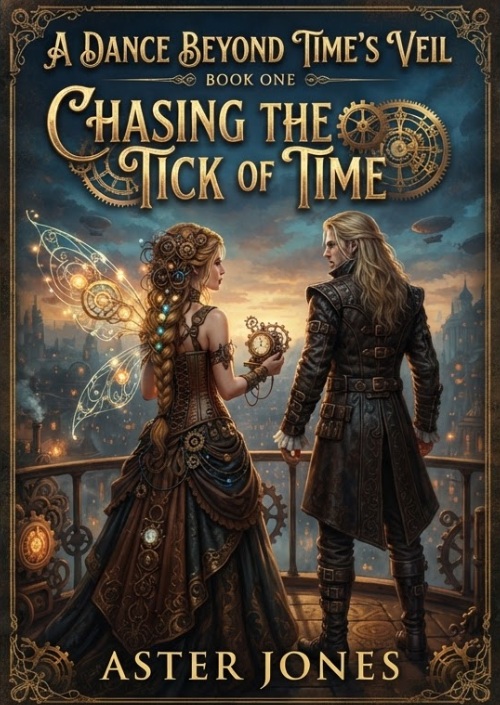
Novel · 36 chapters · 136,200 words
A Dance Between Time's Veil: Chasing The Tick Of Time...
Contents36 chapters
- 01The Drunkard's Mercy
- 02Morning as Sentence
- 03Blood Bright as Spring
- 04The Clock Stumbles
- 05A Scent That Follows
- 06Connor in the Missing Hour
- 07The Green Mother's Warning
- 08Teeth at the Border
- 09The Den's Buried Pact
- 10When Hunger Meets Heartbeat
- 11The Hour-Tear Opens
- 12A Promise Against Midnight
- 13Behind the Chosen Wall
- 14The Hand That Drove the Nail
- 15The Fourth Beat Held
- 16After the Wrong Bells
- 17The Map in the Lost Hour
- 18Road of Rowan and Iron
- 19The Abbey Beneath the Hill of Graves
- 20A Name Kept on the Fourth
- 21The First Breach Named
- 22The Stair Beneath Witness
- 23Chapter 23: A Quiet That Knows Them
- 24A Fae and a Vampyre
- 25The Court That Answered Once
- 26Remainder House
- 27Witness Against the Clerk
- 28The Hour Returned in Part
- 29Fangs and Wings
- 30The Fourth Knock Above Their Heads
- 31The Clerk Below the Scales
- 32What the City Owed Back
- 33After the Count
- 34Right Hands, Wrong Time
- 35Tick, Tick.
- 36Bloodlust
Chapter 1
The Drunkard's Mercy
The man in the green coat missed the mouth of the alley twice before he found it.
That was how x— chose them, when choosing could still be called that. Not the hungry, not the desperate, not the ones moving with purpose toward a bed or a fight or a woman who would wait up with a lamp lit. He took the ones whose nights had already loosened from them. Men with wine on their breath and their collars open. Men singing the wrong verse. Men who laughed too loud at nothing and leaned one palm to brick as if the wall were a trusted friend.
It was a rule. A poor one. A thin one. Still his.
He stood above the alley mouth on an iron stair that had gone orange with rust, one boot balanced on a bent step, gloved hands loose at his sides. Below him, the city’s late trade thinned but never stopped. A fishmonger’s boy sloshed a bucket into the gutter. Two girls in beaded shawls hurried past with their heads together, skirts lifted from the muck. Somewhere farther down the lane a fiddle scraped through a tune no longer in tune. The smell of the district came up in layers—coal soot, eel brine, piss gone sharp in the corners, yeast from the taverns, lamp oil, wet wool, horse.
And under it, bright as metal under the tongue, blood.
The man in the green coat stumbled in under the hanging shadows, muttering at a button that would not obey him. He was past middle age, broad through the middle, with a butcher’s hands and the flushed face of someone who had been drinking for hours in hot rooms. His hat had gone missing. His hair stuck to his temples. He paused to relieve himself against the wall, swearing affectionately at the bricks as though they’d offended him and he forgave them.
x— watched his balance sway. Watched the pulse in his neck. Counted the breaths. Five in. Five out. The old discipline held him a little longer than hunger liked.
A sober man would feel it. A sober man might fight, or remember too much, or stagger into the street white-faced and raving that death had kissed him in an alley. A drunk would wake with a bruise and a headache and decide he had met the paving stones harder than he recalled.
Less harm. Less guilt. Less monster.
He dropped from the stair without sound.
His boots touched cobble. The man began to turn, hearing something too late, and x— was already there, one hand catching the back of his head, the other sealing his mouth.
“Easy,” x— said, because he always said it, though it was a lie.
The man made a startled noise into his palm. His body surged once in clumsy panic, elbows flinging wide, heel skidding on slime. x— turned him, pressed him gently—almost gently—against the wall. Brick scraped wool. The alley narrowed around them. Somewhere at its mouth, laughter passed and did not look in.
The throat was warm under his lips.
There was always a moment. He could still refuse in that moment. He told himself this every time, and every time his teeth answered before the better part of him.
Skin gave. Blood rose.
Relief hit first. Hot, terrible relief. It moved through him quicker than thought, quicker than shame, a flood under winter ice. The ache in his limbs eased. The old hollow inside him, the place that never stayed filled, unclenched just enough to become bearable.
Then came the taste beyond the blood.
Whiskey. Cheap and peaty, with smoke still in it. Bitter herbs. A smear of anise. The man had been steeped in drink until it ran in him like another weather, and x— took that too, the spirit threading through the copper warmth and opening in his head almost at once.
The man’s struggling changed. Not stopped—never that, not unless he took too much—but softened into weak, offended motions. A hand knocked against x—’s shoulder and then slipped away. Breath shuddered beneath x—’s palm. Blood beat slower under his mouth.
Not too much.
That was the second rule.
He drew back before hunger wanted him to. Before that deep blind thing in him could get a firmer grip and keep drinking until the pulse under his tongue turned into nothing. He licked the wound closed by habit more than mercy; the flesh sealed raggedly. He eased the man down against the wall.
The green coat sagged into the filth as if boneless. Lids fluttered. The man tried to focus and failed. His mouth worked.
“Dora,” he slurred at the dark.
x— froze. It should not have mattered. Names, wives, children, debts, songs they half-remembered from childhood—those were the things he had no business hearing. Blood already carried enough. Snatches came whether he wanted them or not. Not full memories. Flashes. A brass ring tapping a tavern counter. Sawdust under boots. A woman with red wrists kneading bread at dawn. The sour joy of a first swallow after a long day of carving meat. Little thefts that arrived on the back of blood and left stains.
“Dora,” the man said again, softer this time, and let his head roll.
Alive.
x— took his hand away from the man’s mouth and listened. A ragged inhale. Another. Fine.
The first dizziness touched him then. Drink traveled quickly in stolen blood. His own body—if it could still be called his body, after all these years of burial and rising and rot denied—used it greedily. The alley shifted by half an inch. The lamp at the mouth of it smeared gold.
He sat back on his heels and shut his eyes.
Many moons ago, on another night with another stink in it, he had begged for dying and been refused. The memory never came whole. A horse screaming. Mud on his teeth. Hands pinning his shoulders or perhaps blessing them. Something cold at his throat. Then thirst so violent it had burned the shape of his old life out of him.
He had learned later that a curse could be kept alive by rules. Not broken. Never that. Just fenced in. Feed from beasts, if you could bear the thinness of it. Feed from the dying, if you could bear becoming a scavenger. Feed from drunks, if you wanted to pretend there was kindness in selecting the ruined hour.
He opened his eyes.
The man in green had slipped sideways and would soon lie face-first in the runoff if x— left him. With a hiss through his teeth, x— hooked his hands under the man’s arms and dragged him to the recessed doorway opposite the wall. The wood there belonged to a cooper whose shop would not open until noon. The stoop was dry enough. He settled the man against it, propped in a posture that looked almost purposeful. Someone would find him sleeping one off.
From the inner pocket of the green coat, a flask had worked itself halfway free. Silver-plated, dented near the cap. x— stared at it.
He should have left it. He knew that before his fingers touched it.
The cap stuck. He twisted harder until the seal broke with a little crack. Fumes lifted, blunt and medicinal. He poured a mouthful onto his tongue and swallowed.
Fire. Then numbness.
It did not affect him the way it once might have when he had been only a man. Very little did now. But taken this close to feeding, with another’s alcohol already moving through him, it reached places blood alone did not. It softened the edges. Smudged sequence. Made the act itself harder to hold onto. He drank again, wiping the neck of the flask on his sleeve out of some absurd courtesy.
“Mercy,” he said to no one, and laughed once.
The laugh scraped. He corked the flask and shoved it back into the drunkard’s pocket with more force than needed. The man stirred but did not wake.
At the mouth of the alley, boots clicked past. x— withdrew deeper into shadow by instinct, though no one had looked in. The city knew how not to see certain things. That was one of the bargains by which cities survived.
He could have gone back at once to his corner below the old district, where the stones sweated and no light reached except what he carried. He did not. The blood in him was warm, and the whiskey had begun its sly work. His feet chose motion before thought.
He drifted through the lanes behind the taverns, where the doors were service doors and the truth of a night came out in bins and buckets. Oyster shells gleamed under his boots. A cook in a stained apron threw dishwater into the gutter without checking who might be there to catch it. x— turned his shoulder and let it sheet past. Steam rolled from a bakery chimney. A woman in a plum cloak argued with a cabman over the fare and lost.
Each heartbeat near him called faintly. Not enough to drive him now; feeding had taken the worst of the edge off. But enough. Always enough.
Outside a public house called The Split Lantern, two men came out half carrying a third, laughing as they hauled him toward the street. “He can stand,” one insisted.
“No, he can quote philosophy,” said the other. “Different talent entirely.”
The third man vomited neatly onto his own boots.
x— watched from the gap between a cooperage and a shuttered tobacconist. Hunger flicked its tail inside him, interested despite itself. There was a time he could have taken one from the cluster and left the rest arguing over whose turn it was to pay for a doctor. There was a time he had not bothered with one. There was a time—
He turned away so sharply his heel struck the wall.
The stone rang. One of the men glanced over. x— was already moving, coat close to his body, face down, letting the night fold him in. He crossed a yard cluttered with broken casks and ducked under a line of drying laundry that smelled of lye and river water. Past the washhouse, the lanes narrowed and worsened. Fewer lamps here. Older bricks. Wooden signs with their paint peeled away. He knew every turn because he had paced them in every condition a body could endure and keep walking.
Drink blurred the corners of things, but not enough. Never enough.
At the dead end behind a shutter-maker’s shop, he stopped with one hand braced against the wall. Mortar gritted under his glove. He bowed his head and listened to the blood moving through him.
Not just the drunkard’s. His own, cursed into service.
He could still taste the man’s life in scraps that had no right to survive inside another creature. Salted beef on a blade. A tune hummed into a baby’s hair. Resentment toward a brother with softer hands. Desire for one more drink. All of it already dimming, thank God. By morning there would be little left but the headache and whatever self-disgust he earned fresh each night.
He pushed off the wall and went down the stair hidden behind the shutter-maker’s rain barrel.
The entrance to the lair had once been a coal chute. The city forgot such mouths when new cellars were built over old ones. A rotted plank covered the opening from above; below, a ladder of iron pegs led into dark. x— descended without light. He did not need it. The understone had its own smells, old and damp and mineral, with the stale trace of those who had hidden here before him and those who hid still in chambers deeper in, where he did not go unless forced.
He had claimed a room near the upper passages because he disliked the company beneath and because climbing closer to the surface gave him the illusion of choice. The room had a cot with one split leg, a basin, a hook for his coat, two books swollen from damp, and a trunk that still carried another man’s initials burned into the lid. Not his initials. He had lost those with the rest.
He shut the door behind him and stood very still.
The silence underground was never complete. Water ticked somewhere in the walls. A rat worried at something papery and gave up. From far below came a murmur like voices under blankets. The place was full of old breath.
x— set both palms on the basin and looked down into the black water.
His face looked back only when he bent close enough to trouble the surface. Not a mirror-trick, not the old tales people told to comfort themselves by making monsters obvious. He reflected well enough. Worse luck. High cheekbones gone sharper in undeath. Mouth too pale. Eyes that gave too much away in the dark if he let them. There was blood dried in a brown seam at the corner of his jaw.
He scrubbed it off with the heel of his hand. The skin there reddened though it did not truly bruise.
“Less monstrous,” he said to the basin.
The words sat in the room like a bad smell.
He seized the crockery cup by the basin and hurled it at the wall. It burst in three loud pieces. One shard skidded under the cot. Another spun to a stop by his boot.
From the corridor, a voice drawled, “Tender mood tonight.”
x— did not turn. “Go feed on a choirboy, Edrin.”
A soft chuckle. “Wasteful. They’re all starch and panic.”
The voice moved closer to the crack under the door. Edrin never entered uninvited. Not out of courtesy. Out of calculation. “You should come below. There’s a card game. Also a woman with a cut hand crying over a faithless husband, if your conscience demands seasoning.”
x— bent and picked up the largest shard. Its edge bit his glove.
“Leave.”
“Ah. You took your supper from a bottle again.” A pause. “One night you’ll misjudge. You’ll think yourself merciful right up until you tear too deep. Then what?”
x— crossed the room in two steps and yanked the door open.
Edrin leaned on the opposite wall in a velvet waistcoat gone shiny at the seams, his dark hair tied back with black ribbon, looking as if the underground damp had chosen not to touch him. His smile showed too much tooth.
“What,” x— said, “do you want?”
Edrin’s gaze dropped to the shard in x—’s hand, then rose without concern. “To know whether the preaching kind still hate themselves after feeding.”
x— drove the shard into the doorframe beside Edrin’s head.
Wood split with a dry crack. Edrin did not flinch. Only his smile thinned.
“There,” Edrin said quietly. “Much better than the basin.”
For a moment neither moved. The corridor lamp, set two turns away, breathed a weak yellow along the stones. In it, Edrin’s eyes looked old as grave buttons.
x— pulled the shard free and let it fall. “Go find easier company.”
“You are easy company. You just mistake misery for depth.” Edrin straightened from the wall. “There’s blood on your cuff.”
x— looked down before he could stop himself.
Not much. A dark thumbprint near the wrist. The drunkard’s, probably, from the little struggle. Or perhaps his own from the shard. Hard to tell in this light. Harder now with the whiskey tilting things.
When he looked back up, Edrin had seen enough.
“That’s the trouble with your rule,” Edrin said. “It lets you keep pretending there’s a line.”
He turned and walked down the corridor, steps soundless, one hand lifting in farewell without grace. “Try not to pray,” he added. “No one here likes being ignored.”
x— shut the door on him with enough force to rattle the latch.
He stood breathing pointlessly in the middle of the room, coat half unbuttoned, fingers flexing at his sides. The whiskey had thickened in his head. Already moments of the alley were going soft at the edges. The green coat. Dora. The warm pulse. He had wanted that. Had chosen it. Chosen not the blood—that need would come regardless—but the blur afterward, the little treason against memory.
He sat on the cot. The split leg complained. From the pocket of his coat he drew a narrow knife, plain-handled, useful only for mortal things now: cutting string, slicing cheese he no longer needed, testing whether pain still had any authority. He placed the blade against his forearm and pressed until the skin opened in a thin line.
Dark blood welled.
It hurt. Less than it should. Enough.
He watched it gather and run. The smell rose at once, calling to the thing in him with humiliating eagerness. His jaw clenched. He let the line fill, then wiped it away with a rag and bound it tight, not because the wound required tending—it would knit before long—but because the ritual did.
Punishment, small and stupid. Another rule.
He leaned forward, elbows on knees, and laughed again, quieter this time. Somewhere overhead a cart rolled by on the street, the sound filtering through earth and timber into a dull thunder. The city kept moving. Men found their doors. Women banked fires. Somebody named Dora might even now be waiting for a husband in a green coat who would come home late and sour-breathed and unable to explain the bruise at his throat.
x— pressed his knuckles to his mouth until the laughter died.
He had fed. He had not killed. By the arithmetic he forced on himself, this counted as success. The room knew better. The bandage on his arm knew better. The hot crawl of stolen liquor through his veins knew better.
From the wall behind his cot came a small sound.
Not rat. Not settling stone.
A tick.
He lifted his head.
Another. Faint. Precise. As if somewhere inside the masonry, buried where no mechanism should be, a clock had found a heartbeat and meant to keep it.
Chapter 2
Morning as Sentence
The ticking had not stopped.
x— sat on the edge of the cot with both hands braced against the mattress, waiting for the room to choose one shape and keep it. It would not. The wall leaned, recovered, leaned again. The lamp wick had burned itself down to a black nub in its saucer, leaving the chamber full of old oil stink and the iron taste of his own mouth. Somewhere close by, hidden under limewash and stone, the tick came at clean intervals, each one so exact it seemed to mock the pulsing wreck inside his skull.
Tick.
He pressed the heels of his hands into his eyes until color sparked.
Tick.
“Enough,” he said to the wall.
His voice came back wrong—dried out, scraped thin. He reached for the basin on the stool beside the cot and found it by knocking the stool sideways. Water slopped across the floorboards. He managed one mouthful, spat pink into the bowl, then drank again. It tasted of tin and stale dust. Better than nothing.
The bandage on his forearm had loosened in the night. He unwound it with his teeth and fingers, peeled it free, and looked at the cut. Already closing. A mean little line, shiny at the edges. The sight of it annoyed him more than the pain had. He had wanted consequence and received evidence only of what refused to die.
He stood too quickly. The room lurched under him.
There was a coat on the hook, one boot under the cot, the other by the trunk, his knife on the blanket where he had dropped it, and on the table in the corner a crust of bread he had bought three nights ago out of habit and not touched. Mortal props. He lived among them like an actor too tired to finish a part.
Tick.
He crossed to the wall and put his palm against the masonry behind the cot. Cold damp. Grit under his skin. No seam, no hollow, no sign of any chamber inside it. Still the sound came, patient as an accusation.
The underground had its own small language: water moving somewhere out of sight, boots in distant passages, a cough muffled by doors, laughter from those who preferred not to remember what they had been when they still cast reflections. But this did not belong to the place. It belonged in a clocktower, in a drawing room, in the pocket of a magistrate who wished to know exactly how long a man had to beg.
He knocked once with his knuckles.
Stone answered stone. Nothing else.
“Keep your secrets, then.”
He bent for his boot and nearly put his hand into the broken washbasin shard still lying near the doorframe. He stopped short, stared at it, then kicked it under the cot with more force than required. The motion sent a hard throb through his temple.
A punishment after the punishment. That was the true bargain of the flask. Borrowed fog, paid back in spikes.
He dressed by feel: shirt, waistcoat, coat. The green of the coat had gone dull years ago, almost black in poor light, the cuffs polished by use. In the trunk he kept things he never needed and could not throw away. A pair of collar studs. A prayer book with its spine gone. A watch that no longer ran, its glass cracked from the night he had not died. He looked at it now, then shut the trunk.
No breakfast. No point pretending.
In the corridor outside, the air carried mold, lamp smoke, and the sweet-rank trace of old blood sunk deep into wood. A woman from the lower rooms passed with a bucket in one hand and a strip of rabbit fur tied round her throat like a joke. She glanced at him, took in his face, and moved on without speaking. Mercy among their kind often looked like disinterest.
He climbed the turning stair under the shutter-maker’s shop slowly, one hand on the slick rail. At the top he lifted the barrel cover and listened.
A wagon rattled over cobbles. Somebody shouted for lamp oil. A child laughed, then coughed. Morning, if the light leaking through the seams could be trusted. He pushed the cover aside and came up into the little shed behind the shop, where cut slats of ash and alder leaned in bundles against the wall. Fresh planed wood sharpened the air. It made his mouth ache for reasons that had nothing to do with hunger. Trees had sap, circles, patience. Honest clocks.
He slipped out to the alley.
The city struck him all at once. Coal smoke. Horse sweat. Bread crusts warming in baskets. Urine in the gutter, beer souring in sawdust outside last night’s public houses, fish scales silvering the drain near the market road. Daylight flattened everything and made him feel improperly assembled. His eyes could bear it, but they resented him for asking.
He kept to the thinner side of the lane, shoulders in shade where the buildings leaned close. Men with work still in front of them walked faster than he wished to think. Women in aprons shook rags from upper windows. A cooper’s boy rolled a hoop with a stick and nearly ran it into x—’s knees; the boy snatched it back without apology, face bright with the invincible rudeness of the living.
x— turned toward the wider streets.
He told himself there was business in it. The ticking had lodged under his skin. If some fool aboveground had hidden a mechanism in the old foundations, he wanted to know why. If it was no mechanism at all, that was worse, and better found early. But beneath that lay the simpler truth: the lair had become too close around him. Too many walls. Too much stone holding the smell of what he had done.
At the corner by the brushmaker’s, he paused as a church bell gave the quarter-hour. The sound came thin through chimney smoke.
Before the last note had finished, another bell answered from three streets over.
Then another.
Not a peal. Not a practice. Separate towers, separate hands, and all of them a little off, as if the city had forgotten how to agree on time.
He stood listening until a carter swore at him for blocking the way.
“Move, then,” the man snapped, tugging his horse’s head around.
x— stepped aside. “It appears the bells have gone mad.”
The carter spat into the gutter. “Clocks are worse. My wife says ours lost near twenty minutes before tea yesterday and gained it back by supper. Probably damp in the gears.”
He jerked the cart on and did not look back.
Damp in the gears. A mortal answer. Useful, because it was the kind one gave oneself before larger answers were forced in.
x— walked on.
The market district was already loud. Knives thudding through joints of meat. Women arguing over onions. Barrows squealing on bad wheels. He moved through it untouched, a hole in the stream of bodies. That, too, was practice. People noticed what wanted noticing. A pale man in a worn coat with the look of a poor night behind him could become invisible if he carried himself like one more disappointment among hundreds.
At a stall selling secondhand books and loose paper, an old man with nicotine-yellow fingers was setting out a row of pocket almanacs. He arranged them with care, then blinked at the church clock across the square and frowned.
“Wrong again?” x— asked, stopping because standing still felt easier than continuing.
The bookseller squinted up. “It was ten when I left the room above my shop. It cannot be near eleven now.”
“It can if you’re slow.”
The old man snorted. “I’ve been opening this stall since before your father had whiskers.”
x— almost smiled despite the pounding in his head. “Then perhaps time is tired of you.”
“Time ought to be tired of everybody.”
The man turned back to his books. Conversation over.
x— moved on, but not far. He found a strip of shadow cast by a pawnbroker’s sign and stood there while the square worked around him. He watched small things. A candle seller relit the same taper twice because it guttered as if the wick had burned too fast. A woman knitting while minding a basket of plums looked down in annoyance at how much wool had already passed through her fingers. Two apprentices came out of a print shop arguing about whether the noon whistle had blown early, and before one finished insisting on it, the other had forgotten what he meant to say and only shook his head, annoyed without cause.
The tick in the wall had followed him into thought. Precise. Buried. Waiting.
Many moons ago, on a road silvered by frost and moonlight, he had also heard something before it reached him: not a tick, but hooves. Too many. Then lanterns swinging. Then the shape of men who hunted not out of fear but appetite. He had been alive then in all the dull, soft ways the word implied. A pulse with nowhere to hide. A body that knew exhaustion honestly. He had bled into ruts in the road and wished, very clearly, not to remain. The thing that found him afterward had taken that wish for permission.
He put his tongue against one tooth until the memory passed.
A pair of girls hurried by carrying hatboxes. One laughed; the other checked the little watch pinned to her bodice and made a sound of frustration.
“What is it now?” her friend asked.
“It was half-past. Now it says a quarter to.”
“Then wind it proper.”
“I did.”
They were gone into the crowd before x— could hear more.
He pushed away from the wall.
No day was different until something in it resisted the pattern. Bells, watches, quick-burning candles, people losing minutes and blaming weather or bad workmanship. A buried tick under the lair. It might yet amount to nothing. Cities were full of broken things pretending to be ordinary.
He cut through a narrower street lined with glaziers and sellers of lace, then down toward the river road where the air sharpened. Less dung here. More cold stone, wet rope, tannin from casks stacked outside a wine merchant’s. The hangover eased by degrees, not from kindness but from movement. Pain redistributed itself. His thoughts came together enough to be unwelcome.
He hated the daylight because it made surviving look like participation.
In the reflected gleam of a shop window he caught his own shape in passing: tall, coat hanging cleanly despite the poor cloth, dark hair needing a knife more than a comb, face leaner than it had any right to be after all these years. Not dead-looking. Not to a stranger. That was part of the obscenity. Rot should have been honest. He had been denied even that.
A florist’s boy came out carrying buckets of cut stems and dumped the old water into the gutter. Crushed green scent lifted at once—mint, bruised fern, lily pollen. Under it ran another smell, faint enough at first that he thought the hangover had turned on him and invented it.
Then it came again.
He stopped so sharply a man behind him cursed and shouldered past.
Not human blood.
Human blood sat heavy in the air, all iron and salt and heat, individual in texture but recognizably of one family. This was brighter. It struck like the first cut into an orange peel, like rain falling onto warm stone after drought, like a mouthful of cold metal and blossom at once. Impossible. Unmistakable.
Fae.
His entire body answered before his mind did. Not with the usual tightening hunger brought on by the sight of a throat. This was stranger, sharper, as if some hidden wire in him had been plucked and set singing. His gums ached. The skin at the back of his neck drew tight. He could have followed that scent through a fire.
No.
He turned his head, slow despite the jolt in him, and searched the foot traffic.
There.
Across the street, near a toy seller’s painted window, stood a figure the eye wanted to fix and failed to fix at once. Slender, still, wrapped in a coat the color of cream gone dim in city soot. Fair hair—perhaps gold, perhaps ash depending on the angle—caught light where there ought not have been enough of it. Beside that person stood a boy of ten or eleven with a solemn mouth and a cap too large for him. Connor, though x— did not yet know his name. The boy was pressing a folded handkerchief to the side of his throat.
The fae had blood on one wrist.
Fresh. A narrow red line against pale skin, uncovered just above the cuff.
The boy’s neck bore a matching mark, smaller, as if made by a thorn or splinter. Nothing mortal in the sight of it should have mattered. Everything did.
x— stepped backward into the shelter of a pillar outside a draper’s. The stone edge bit his shoulder. He welcomed it.
He did not feed on children. He had rules enough left to know that one without thought. But the smell pouring off the pair made rule feel like a word from a language he had learned young and nearly forgotten. It was not only blood. There was sap in it, sunlight caught in leaves, the cold sweetness of stream water over rock. Fae stories had drifted through taverns and sickbeds and market gossip all his life and unlife both—pretty liars, dangerous dancers, thieves of names, makers of bargains. He had never been near one. If this was one. If his hunger had not gone exotic from whiskey and self-disgust.
The fair-headed figure turned.
Not fully. Just enough that x— saw a profile too fine for the surrounding grime, and the lifted stillness of someone hearing a footstep no one else had made.
Their gaze did not land on him. It passed over the crowd. Yet something in his chest went taut, the way a rabbit will freeze before deciding whether the hawk has seen it.
He lowered his face and moved.
Not running. Never running. He crossed behind a brewer’s dray, let two matrons with baskets block the view, then took the first side lane hard enough to jar his teeth. The fae-scent thinned at once, and he hated the relief of it almost as much as the loss.
By the time he reached the alley behind the instrument maker’s, his hands were shaking.
He put one against the brick wall until it steadied.
“Ridiculous,” he muttered, though whether at himself or the morning he could not have said.
A cat watched him from the lid of a coal bin, tail wrapped over its paws. It blinked once and looked away.
He listened.
Street noise. Cartwheels. A woman calling for eels. No pursuit. No soft impossible tread behind him. He ought to continue on, put three more streets between himself and that scent, go back belowground, bolt the door, laugh at his own melodrama if he could manage it. The day had already offered enough warning. Ticking in stone. Clocks slipping. Fae blood on city air. Any creature with survival still left in it would take one of those and withdraw.
Then, from somewhere behind the wall at his back—or under it, or perhaps only inside his pounding head—came the same clean measure he had heard in his room.
Tick.
He went still.
Not imagined. Not memory. A single neat sound, swallowed at once by the city.
x— turned his head toward the bricks as if they might confess.
Across the lane, a shutter banged open. A laundress leaned out and flung grey water into the gutter without seeing him. A moment later, down the mouth of the alley where it opened back onto the street, he saw the fair-headed figure pause.
Too far to make out the face. Near enough to know they had stopped for a reason.
The hand not holding the boy’s sleeve lifted slightly, fingers spread, feeling the air.
Sensing.
x— did not breathe. Useless gesture. Instinct all the same.
The boy tugged at the fae’s coat, saying something lost under the grind of wheels. The fae did not move. Their head turned, one degree, then another, until they were looking not at the alley exactly, but at the place where he stood hidden in its shadow.
Between them, the distance held like a wire drawn tight.
Tick.
Chapter 3
Blood Bright as Spring
A butcher’s boy came out of a side passage with a tray of pink kidneys swinging from one hand, and x— nearly struck him.
He caught himself on the corner of a brick arch, palm scraping grit. The boy swore, the tray tipped, and one wet organ slid against the tin rim with a sound that made x—’s mouth flood. He turned his face aside at once.
“Watch where you die,” the boy snapped, no more than fourteen, apron dark to the elbows.
x— put up one hand without looking at him. Apology enough. He moved on before the boy could decide whether to be offended or merely disgusted.
The lane spat him back onto a broader street lined with chandlers, a cooper, a seller of ribbons whose window held three faded lengths the color of old bruises. Midday traffic pressed thick as wool. Cart hubs shrieked. A hawker held up roasted chestnuts in a blackened pan and shouted about warmth while the smell of horse sweat and cabbage water tangled under everything. Ordinarily it would have been cover. Noise, bodies, jostle—good city camouflage. Today each pulse of blood around him seemed cut from paper and held to the light.
He should have gone below at once.
Instead he drifted with the crowd, hat brim low, one shoulder turned to make himself narrower. The urge had no dignity to it. He told himself he wanted only to make sure the pair had gone another way. That the blood at their skin might mean trouble. That the marks on the boy’s throat and the fae’s wrist had the sameness of design, and sameness usually belonged to intention. He told himself several useful lies and wore them all badly.
A church bell struck somewhere upriver. Before the last note died, another answered from the square behind him. Then a third, too quick, as if the towers were arguing.
People noticed. Of course they noticed. A draper’s wife halted in the act of shaking lint from a folded cloth and frowned up at nothing. Two porters laughed and said one parish was always drunk. A man buying lamp oil checked the brass watch chained across his waistcoat, snapped it shut, checked it again.
x— kept moving.
The blood smell came and went in threads. Lost under tallow, found again under soot. Not human only. There was the iron fact of it, yes, but also something green and impossible, like birch sap on a knife blade. It slid under his guard. It made him remember nothing he had ever truly lived, which was perhaps why it hurt.
At the crossing by the toy seller’s stall, he saw them again.
Connor stood with one boot on the lower rung of a wagon wheel while he peered into a tray of tin soldiers. The handkerchief was gone now. In its place a strip of clean linen had been tied around the side of his neck, not expertly but not by clumsy hands either. The boy’s cap had slipped back, showing brown hair flattened on one side. He looked solemn still, but children often did when adults thought they ought to be brave.
Beside him, the fair-haired one had their sleeve turned back a little, examining the cut at the wrist as if checking whether it had closed. It had not. A fine bead of red stood there, indecently bright in the grime-colored day.
x— stopped so abruptly a woman behind him clicked her tongue.
He shifted without thinking into the shelter cast by an awning pole. Dyed wool brushed his shoulder. Blue lint clung to his coat. Across the street the fae’s face was clearer than before, though no detail wanted to stay ordinary. Not beauty exactly. Beauty was too simple a word, too often used by men who had seen a fair thing and thought naming it gave them power over it. There was a wrongness to that face, but not ugliness. The proportions were nearly human and yet made every human near them look blurred, hastily assembled. Their skin carried no proper city color. Even smudged by smoke, it kept some inward pallor. Their mouth, unsmiling, had the stillness of a blade set flat on a table.
Connor tugged at their cuff and pointed toward the toy soldiers.
The fae looked down. Whatever they said did not carry through the wagon racket, but the boy’s shoulders loosened after. He picked up one tin soldier missing its paint on half the face and held it to the light with grave approval.
That should have made the scene ordinary. It did the opposite.
x— became aware of his own teeth.
He set his jaw until it ached.
Never a child. That line inside him had not moved in all these years, though much else had rotted or bent or gone thin as paper. Children were not prey. Drunks, yes. Men who had already given part of themselves to the gutter and would wake with a story no one would quite believe. The cruel. The careless. The half-lost. He had built his rules from scraps and desperation, but they were his, and if he let one slip there would be no stopping point he could trust after.
The boy was safe from him.
The thought arrived whole and hard.
The fae was not.
He hated that second part for existing. Hated the swift little leap his hunger gave when it found a loophole. Hated, too, the fact that it did not feel like his usual hunger. Human blood tugged at his body, at the hollow behind his ribs, at the old injury of whatever had been made and unmade in him. This called somewhere sharper. The scent from that wrist seemed to touch the back of his tongue though half a street lay between. Spring water. Crushed stems. A sweetness so clean it seemed cruel.
He looked away and found himself studying a cobbler’s sign, a cracked painted boot hung above the door. He counted breaths he did not need. He listened to a fishwife berate a customer over the weight of haddock. He flexed his left hand until the knuckles clicked.
When he looked back, Connor was no longer at the toy stall. The small plunge in his gut made him curse himself. A second later he saw the boy had only moved two paces to the cider-apple cart, where he was peering at a row of sugared nuts with concentrated longing.
The fae had turned slightly.
Not toward x—. Toward the flow of street. Their wrist had disappeared again into the cuff, but too late. He could still taste the phantom of it. That one bright bead of blood might as well have been hung before him on a chain.
He needed distance.
A brewer’s dray creaked into the crossing, six barrels stacked and roped, two dappled horses stamping in resentment at a handcart that blocked their turn. The driver swore. Someone shouted back. For a moment the whole street bunched tight around wood, animal, and annoyance.
x— took the opening.
He slipped behind the dray, past a woman carrying rush mats, and into the crush near the chandlers. If he kept his shoulders loose and his pace unremarkable, he would vanish. He had done it often enough. People remembered what jarred them. He had made a craft of giving them nothing to hold.
A stack of guttering tapers perfumed the air with hot wax. Beyond them hung onions braided in strings, then copper pans, then a rank of cages where live hens shifted and muttered. He let each smell strike and pass, building a wall out of the city’s own clutter. The green sweetness weakened. Good. Another ten steps and it would be gone.
“Sir.”
Not to him. To someone else. He did not turn.
A handcart wheel hit a rut and splashed muddy water across his boots.
He kept going.
The crowd thinned near the bookseller’s corner, where men with soft fingers and inked cuffs paused to browse sermon pamphlets and shipping ledgers. A clock stood in the window under its glass dome, brass pendulum flicking with smug regularity. He glanced at it once and saw the minute hand stutter, jump, recover.
Tick.
He stopped breathing for one beat.
Not in the window. Behind him. Or under the paving stones. The sound was exact. One neat cut in the day.
He moved again, faster than before, and turned down a narrower cut between the stationer and the wig-maker’s. Here the air cooled. Laundry sagged overhead from upper windows like surrender flags. Someone above was boiling beets; the sweet earth smell drifted down with steam. Safer. Empty except for a pair of stacked crates and a three-legged dog asleep beside them.
He put his hand to the wall.
Brick, damp in the seams. Nothing more. Yet the skin of his palm prickled as if set above hidden machinery.
“You heard it too.”
The voice came from the alley mouth.
x—’s hand dropped at once. He pivoted.
The fair-haired one stood where the strip of sunlight ended and shade began, Connor half a pace behind them with one hand on the side of their coat. Up close, the soot on the hem, the nick in the cuff button, the faint freckling over the bridge of the nose—these should have made them more earthly. Instead they sharpened the strangeness. Their gaze went first to his face, then lower, to the hand he had just taken from the wall.
Connor looked from one to the other and said, very quietly, “That’s him.”
x— did not answer. The lane had become too small. Behind him, brick. Ahead, the pair. Overhead, washing and sky cut into strips. He could cross the distance in less than a blink if it came to that. He knew it. He hated that he knew it.
The fae’s eyes shifted once to his mouth.
Not fear. Not quite. Calculation, perhaps. A person weighing all the old tales and deciding which to believe.
“You followed us,” x— said.
“I didn’t.” The fae’s voice was lower than he expected, roughened a little at the edges, as if they did not use it for useless things. “You left a mark in the air.”
Connor frowned. “They don’t leave marks in air.”
“These do, apparently.”
x— nearly smiled, and the fact of it disgusted him enough to kill the impulse. “You should not bring a child into alleys.”
Connor straightened, offended at once. “I came before the alley.”
The fae put a hand back without looking, and the boy subsided, though not happily.
“I would have spoken in the street,” they said. “You prefer corners.”
“That depends who’s asking.”
“You know what I am.”
“I know what stories call you.”
“And what do stories call you?”
Something in Connor’s grip tightened on the coat. The linen at his neck had shifted; a corner of the mark showed above it, small and red as a pinprick. x— made himself look at the fae’s face instead. That required effort. The wrist, hidden now, had become louder by being unseen.
“Trouble,” he said.
“One honest answer, then.”
The fae took a step into the alley. Not far. Enough that a bar of light crossed one cheekbone and caught pale lashes. Connor stayed where he was but leaned, stubborn curiosity outweighing caution by degrees.
“You were in the market earlier,” the fae said. “Before that, by the draper’s. Before that, behind brick near the instrument maker’s. I felt you each time.”
x— said nothing.
“I thought at first you wanted the boy.”
Connor’s face changed—less fear than insult at being discussed like a parcel—but the fae went on before he could speak.
“You don’t.” Their eyes moved once to his hands, empty at his sides, then back. “That leaves the other scent.”
The cut at their wrist throbbed once in his senses as if named into fresh life. He put his tongue hard against the back of his teeth.
“You’re hurt,” he said.
The fae glanced down at the cuff as though remembering the wound belonged to them. “A thorn.”
“Thorns don’t mark children to match.”
“No.” A pause. “They do not.”
Connor looked up sharply at that, but if there was more in it, neither offered him the mercy of saying so aloud.
From the street came the jangle of harness and a burst of laughter too loud to be real. Then another bell, wrong by a minute or ten. The dog by the crates opened one eye and shut it again.
x— measured the distance to the alley mouth and found it impossible to pass them without either touching the fae or frightening the boy. Both were bad choices. He settled for stillness.
“What do you want?” he asked.
The fae’s expression altered by a grain. “To know what you are.”
“You already know enough.”
“Enough to be interested.”
“That has buried smarter people than you.”
“Smarter than me are buried regularly. It proves nothing.”
Connor, who had been staring at x—’s coat with unblinking concentration, said, “You look ill.”
That one landed where Edrin’s barbs rarely did. x— let out a short breath through his nose.
“I’m told I improve in poor light.”
Connor considered this and, to x—’s surprise, almost smiled.
The fae did not. “You heard the sound.”
“It’s a city,” x— said. “Cities make sounds.”
“That one follows you.”
A lie rose and died. There was no use offering one so thin.
The fae watched him as if waiting for a seam to open. Their stillness was not human stillness. Humans fidgeted to prove they had not gone to stone. This one could stand quiet without effort, and the quiet itself pressed.
He should leave. He should force the issue, brush past, be gone before the blood-smell made thought impossible. Yet his body had found too many details to betray him with: the pulse low in the fae’s throat, slower than a human’s and somehow more distinct; the fine tendons shifting in the hand held near the coat seam; the clean smell under the city dirt, leaf and cold river and that one perilous thread of blood.
“Who did that to him?” x— asked, nodding once toward Connor’s neck.
The boy’s hand flew up to the bandage.
The fae answered after a beat too long. “Something careless.”
“That is not an answer.”
“It is the only one you’ve earned.”
There it was: flint under silk. Good. Better anger than that measured gaze.
x— pushed off the wall. Connor flinched before he could help it. The fae did not move, but one shoulder shifted minutely, putting themselves more between x— and the child. A sensible gesture. It cost him more than he expected.
“I’m leaving,” he said.
“I know.”
“Don’t follow me again.”
“Then stop ringing like a struck glass.”
The words snagged.
His face must have changed, because the fae’s own went watchful at once. “You don’t know you’re doing it,” they said.
x— had no answer fit for that. The ticking in the wall, in the stone, in the city’s joints, seemed suddenly nearer, as if it had heard its secret mentioned.
Tick.
All three of them heard it this time.
Connor looked down at the cobbles. “That one.”
The dog jerked awake and stood, hackles up though there was nothing to see.
The fae turned their head slightly, not toward the street now but toward x— himself. The air between them changed. He felt it physically, the way one feels a room alter when a door opens onto winter. Their pupils narrowed.
“You,” they said softly.
Not accusation. Recognition.
His hunger lunged at the same moment his instincts did. The bead of blood he had seen earlier might as well have reopened under his skin. He stepped back once, hard enough that his shoulder hit brick.
“No,” he said, though whether to them or to himself was not clear even to him.
The fae’s hand lifted, fingers spread exactly as before, not to ward him off but to feel. Their eyes did not leave his face. Connor said something—his name perhaps, or a warning—but the lane had narrowed to the sound of that impossible clock and the scent now sharpened by attention.
He turned before either of them could speak again.
This time he did run.
Past the wig-maker’s bins, out through the bookseller’s knot of customers, between a fish cart and a priest, hearing behind him not pursuit but the absence of it, which was somehow worse. He cut left at the fountain, right at the brazier mender’s, shoulder-checking a man with a sack of flour hard enough to burst white dust into the air. Voices rose. Someone cursed his mother. He did not look back.
At the next crossing he risked one glance.
No cream-colored coat. No boy. Only the crowd boiling over itself, ordinary and filthy and dear.
Then, from half the square away, the fair-haired head turned.
Not because they had seen him. Too many bodies between. Too much smoke, too many carts. And yet they turned with terrible certainty, as if the space he occupied had gone bright.
Their hand lifted once more into the din of the street, palm open, feeling the shape of him from a distance no human could have crossed.
x— felt, with the clean horror of true understanding, that hiding was over.
Chapter 4
The Clock Stumbles
By the time he reached Saint Brigid’s lane, the tallow seller was pinching out a row of shop candles with wet fingers.
x— stopped under a barber’s striped board and watched.
The man had only just lit them. x— had seen the first flame catch as he cut across the square—a neat line of pale little fires in cloudy glass cups, set out to tempt the dusk trade before dusk had properly gathered. Now half of them had burned down into puddled fat. One wick had already drowned itself.
The seller swore, lifted the nearest cup, and stared at it as if accusation might thicken the candle back to its former height.
“Rotten batch,” the man muttered.
He reached for another from a crate lined with straw. His hands smelled of sheep grease and onions. He struck a spill against the brick, lit the fresh wick, set it down.
x— stayed where he was.
The flame climbed briskly, too briskly. It found its shape, steadied, and then began to consume itself at a pace no fire should. Not a trick of the eye. Not drink. The wax collar softened, sagged, and dropped a tear down the cup’s inside.
The seller frowned harder. “No draft. No damn draft at all.”
A woman with a basket paused beside the stall. “You’re burning them too high.”
“It’s a candle,” he snapped. “There isn’t a setting.”
She huffed and moved on.
x— looked away before the man could catch him staring. Across the lane a line of washing had thrown long bars of shadow over the cobbles. As he watched, those bars shortened—not by the slow creep of a cloud’s passing or the turn of a real hour, but in a tiny sudden lurch, as if someone had nudged the sun forward with a thumb.
He went still.
A cart wheel rolled through one dark stripe and came out the other side into bare light almost before the horse had taken the step.
No one cried out. No one pointed. A porter shifted his load and kept walking. Two girls argued over a ribbon, one red-cheeked, one pouting, and in the middle of it the quarrel seemed to jump. One moment the red-cheeked girl was saying, “I told her Wednesday—” and then x— caught the end only: “—and that’s why I won’t lend it now.” The center of the exchange was simply gone. Their own faces carried no sign of omission. Conversation had flowed over a missing stone and never broken stride.
He did not believe in panic. Panic was for men with one life to lose.
Still, something cold slid under his ribs.
Tick.
Not from the wall this time. Not from beneath his cot. Nearer than that, and nowhere he could point to. The sound sat in the lane between hoofbeats.
He turned once in a slow circle. A cracked shutter. A heap of eel baskets. A little shrine wedged into a niche blackened by thumb grease and smoke. Nothing with workings. Nothing that should answer him.
Someone clipped his shoulder. “Walk or root, friend.”
x— stepped aside. The carter glanced back with the irritation reserved for drunks and idlers. Good. Let him read one for the other.
He put his hands in his coat pockets to hide that they had closed. If he kept standing there, watching shadows jerk and candles die, he would look exactly what he was not supposed to be: a man seeing too much.
So he moved.
The city was busiest at the hour when shop fronts wished to look prosperous and men wished to look less alone. Shutters opened. Lamps took flame. The first tavern doors began their hinge-song. x— let himself be carried west, toward narrower trade streets where gossip changed hands faster than coin. He passed a cobbler hanging children’s boots by the laces, a pie woman trimming blackened crust from yesterday’s tray, an apothecary sweeping lavender stems into the gutter. Everywhere, the same wrongness came and went in small clean cuts.
At a hatter’s, a boy climbed a stool to fetch a box from a shelf. x— saw him reach up, fingers stretching. Then the box was in his arms and he was climbing down, no movement between. The boy blinked as if he had forgotten what he meant to say.
At the end of Grocer’s Row, a church bell gave one solemn note. Before its throat had finished trembling, another tower answered with three, then six in a rush, then silence. Men on the street lifted their heads, judged the matter not worth their supper, and lowered them again.
It would have been easy—easier—to blame the flask from last night, or the blood in it, or the blood before that. Easy to say the world had not altered; only his grip on it had. He tested that idea the way one presses a sore tooth.
At the public pump, he waited with a cooper’s apprentice and an old woman carrying two dented pails. Water knocked and spat from the iron mouth in a steady thread. x— fixed his eyes on the apprentice’s thumb, where it tapped the pump handle each time he leaned his weight down.
One. Two. Three.
On the fourth stroke the boy’s thumb was suddenly wet and still, the pails half-filled where they had been nearly empty. The old woman clicked her tongue.
“You stopping already?”
The apprentice looked at the pails as though they had filled behind his back. “Thought—I just started.”
“You boys always do.”
x— bent, cupped his own hand under the runnel, and drank enough to rinse the iron taste from his mouth. The water was cold and ordinary. It did not settle him.
He left the pump and turned into Lark Yard, where the taverns sat shoulder to shoulder and each claimed the best ale with painted signs and lies. Here, if odd things had been happening, someone would have put words to them by now. Draymen loved a mystery provided they could remain seated through it.
He chose the Fox and Thread because its windows were grime-dark and its floor always a little sticky, which meant people said things there they would deny elsewhere. Inside, the room smelled of yeast, damp wool, and old frying fat. A fiddler in the corner was turning pegs with a face like a patient goat. Behind the boards, Marta the barwoman hauled mugs one-handed and made change without looking down.
She saw x— and jerked her chin at a stain of a table near the hearth.
“You’re early for remorse.”
“Trying a new vice.”
“Take care. The better sorts cost more.”
He sat. Marta brought him small beer without asking, the insult deliberate and practical both. She knew what he hunted in places like hers; she also knew he paid enough to be tolerated. The cup was chipped at the lip.
x— drank, though it tasted of barley wash and nails. He listened.
A pair of coopers argued over barrel hoops. A woman with rouged cheeks described a magistrate’s son with a cruelty so tender it could only mean she missed him. Near the hearth, two lightermen had their heads together.
“—telling you it was noon twice,” one said.
“It can’t be noon twice.”
“I know the rule of noon, Niall, I’m not a cow.”
Niall snorted into his mug. “Then what was it?”
The first man spread his fingers helplessly. “Bell on Saint Jude’s rang twelve. I goes to the river gate with the invoice, old Pritchard says I’m late for the one-hour tally, and then the Mint tower starts striking noon as well. Full count. Twelve again. I heard seven of them before I gave up and decided all clocks can drown.”
“Pritchard’s deaf.”
“Pritchard’s dead mean, not deaf.”
“That too.”
x— let three breaths pass, then leaned his chair back on two legs and addressed the air between them. “Maybe one tower’s slow.”
Niall looked him over. “Maybe your face is.”
“Common knowledge,” x— said.
The first lighterman pointed with his mug. “Slow I can live with. This weren’t slow. Sun had moved. Then hadn’t. You know?”
“I don’t,” said Niall. “Because that means nothing.”
“It means my whole afternoon got cheated.”
Marta passed with a tray and paused just enough to drop, “You’ve had cheated afternoons every day since your christening, Hal.”
Hal took the mockery like a blessing. “There. Even she knows.”
x— kept his tone idle. “Anyone else see it?”
“See what?” Marta said.
“Your customers becoming philosophers.”
“That’s called debt.”
But her eyes had sharpened. She set down the tray, wiped her hands on her apron, and looked not at x— but at the shelf of bottles behind the bar, where the reflections from the hearth trembled in brown glass.
“This afternoon,” she said, “I drew a pot of stew off the hook because I thought I’d left it too long. Bottom wasn’t caught. Top wasn’t hot. Middle boiled hard enough to spit. Figure that.”
“Bad stirring,” said Niall automatically.
Marta gave him a flat look. “I’ve been stirring pots since before you were old enough to lie for sport.”
Hal grinned into his ale.
“Could be gas,” x— said.
“Could be saints,” Marta replied. “Both smell foul after a while.”
She took up the tray again and moved off, but not before x— saw that she crossed herself against the hinge of her thumb, quick and private.
He stayed through half a mug, collecting scraps. A boy sent to fetch his father forgot why he had come and stood in the middle of the room turning a cap in his hands until someone cuffed memory back into him. A bricklayer swore the shadow of the sign outside had crossed the threshold and crossed back. No one agreed on anything except that the day felt “slippery,” which was not a useful term but was honest enough.
When talk began to circle, x— left.
He took his beer with him and tipped the dregs into the kennel drain outside. The lane beyond the Fox and Thread ran between a dye-house wall and the back of a pawnbroker’s, close enough that two men carrying baskets must turn sideways to pass. Good place for things said low.
A chalk-faced clerk stood there smoking a twist of cheap tobacco with a lamplighter whose pole leaned against the wall. Their coats brushed damp brick. x— paused in the dark mouth of the passage as if to piss and listened.
“Three lamps on Mallow Street,” the lamplighter said. “Lit them. Came back after the square and one had burnt near dry.”
“You forget you lit it early.”
“No.”
“You always say no first.”
The lamplighter drew hard on the tobacco. “You know what else? Wick was short after. Not just spent. Short.”
The clerk had no answer to that. He licked his thumb and rubbed at ash on his cuff.
“Don’t mention it to your wife,” he said at last. “She’ll get a priest.”
“She already has one. Bad enough without another.”
They laughed, but lightly.
x— stepped out as though only then noticing them. “Mallow Street near the cooper’s arch?”
The lamplighter nodded before caution caught up with him. “What’s it to you?”
“Nothing. Passed there.”
“Then keep passing.”
The clerk gave x—’s coat a second look. Men always did eventually. Too good for a laborer, too worn at the cuff for a gentleman, cut wrong for both. “You a watchman?”
“Do I look disappointed enough?”
“Fair point.”
x— took a coin from his pocket and rolled it over his knuckles once. “If a man wanted to know where else lamps have been doing that.”
The lamplighter looked at the coin. “If a man wanted to know, I’d tell him not to say lamps. Say corners. It’s corners and crossings. Places where roads choose.”
The clerk frowned. “That doesn’t mean anything either.”
“Means enough to me.” The lamplighter took the coin. “Rose Court. Mallow Street. The cut by the old grain scales. Saw one at the lane behind Mercer’s chapel and one by Fishamble steps. Not all day. Just... moments.”
“Moments,” the clerk repeated, and this time the word landed differently.
x— filed the places away. Corners and crossings. Joints in the city. Like masonry seams. Like the crack between one tick and the next.
He turned to go.
“Hoy,” the lamplighter said. “You passed there, you said. You see anything yourself?”
x— considered lying. It came close enough to his mouth to taste.
“Candle ate itself,” he said. “Shadow moved wrong.”
The lamplighter’s face changed by a degree, no more. Recognition. Relief sharpened by fear.
“Then it’s not my eyes.”
“No,” said x—. “It isn’t.”
He left them there with the tobacco glow and went in search of the places named.
Rose Court first: a little paved notch between boardinghouses, with a broken horse trough and a fig seller packing up bruised fruit. Nothing at a glance. Then the seller bent to lift her crate and dusk seemed to hitch. The woman straightened into dimness that had not been there a second before. One breath ago the upper windows still held amber. Now they reflected lead.
She looked up, startled. “That’s quick.”
“It is,” x— said.
“What?”
But he was already moving.
Mallow Street: a lamp burning low though the sky still held color in the west. Beneath it, a knot of boys playing pitch-stones. One crouched, arm back, choosing his throw. Tick. The stone clacked against the wall and he was already shouting over the score, the throw itself gone.
The cut by the old grain scales: a dog barking at empty air, then whining and backing away from the angle where two alleys met. x— stood there long enough to feel the hairs on his own arms rise. The ticking came clearer at that corner. Not louder. Nearer. As if a clock face had been turned toward him under the paving and its hands, though hidden, had found him.
He crouched and pressed two fingers to the stones.
Cold.
Nothing else. No tremor. No hidden wheel.
A woman carrying carrots nearly stepped on him. “Either pray or get up,” she said.
He got up.
At Mercer’s chapel the verger was locking the side gate. He had a lip like a purse string and the authority of men who command brooms and keys. x— held the gate before it shut.
“Question.”
“Confession’s tomorrow.”
“Is your chapel clock keeping well?”
The verger sniffed. “Better than most men.”
“It rang oddly.”
“All bells ring oddly to those in sin.”
x— smiled without warmth. “Then you must hear music all day.”
The verger drew himself up, about to retort—and froze. Not in the way men freeze at a blade or a sudden shout. This was stranger. His hand remained on the gate. His eyes lost x— for a beat.
Then he blinked and said, “...what did you ask?”
x— did not answer at once. He watched the man’s face, the small uncertain movement of his mouth, the way one thought had been set down and another picked up with no memory of the passage between.
“You were saying all bells ring oddly,” x— said.
The verger looked irritated to find himself already in the middle of his own sentence. “Yes. Well. They do.”
x— let the gate go. It clanged shut.
Proof, he thought, and hated the nakedness of the word. Proof was for magistrates and scholars. He had wanted doubt. Doubt could be drunk down. Proof stayed sober.
By full dark he had one more place to try: Fishamble steps, where the lane dropped toward the river in a spill of worn stone and fish scales ground silver into the cracks. The smell reached him first—salt, old nets, river mud, scales turning sweet in baskets not emptied quickly enough. A mongrel nosed a heap of haddock heads. Down near the steps, two women in aprons were packing eels into crates lined with wet reeds.
A boy sat on an overturned basket counting copper.
“One, two, three, four,” he whispered, stacking. “One, two, three—”
He stopped. Frowned. Counted the coins in his hand again.
“One, two...”
One of the women looked up. “Don’t skimp me, Toma.”
“I’m not.”
“You’d better not.”
“I’m not, I just had more.”
“You had what I gave you.”
The boy’s ears went red. He counted again, slower, as if care might pin the numbers in place.
x— took the last three steps to the landing and felt it at once: that same subtle pressure at the base of the throat, the sensation of standing too close to machinery not made for flesh. The river below slapped the quay in the dark. Behind him, from up the lane, came the rattle of a handcart, a burst of laughter, the ordinary life of evening.
Then the laughter cut off.
Not ceased. Cut.
x— turned.
A couple under the leaning wall by the tallow store stood as before, woman with one hand on the man’s sleeve, man bent toward her. But the shape of them had changed by inches impossible to account for. A conversation had jumped forward like a needle over a groove. The woman was already wiping at one eye. The man already angry.
“You weren’t listening,” she said.
He threw up both hands. “I answered you!”
“That isn’t an answer.”
The words struck him. Not theirs. Another lane. Another voice.
Tick.
This time it came from below.
x— looked down at the stones under Fishamble steps. One edge of the landing had sunk years ago, leaving a seam wide enough for moss and cigarette butts. From inside that seam, very faint and very exact, came the sound he had heard in his room, in the market wall, in the city’s bad corners.
Tick.
He dropped to one knee and cleared the crack with his nails. Grit. Slime. A fish bone. Beneath it, darkness fine as thread.
Tick.
The boy with the copper had gone quiet. One of the eel women noticed x— crouched there and said, “You dropped something?”
He put his ear near the stone.
At first there was only the river and his own blood muttering in him. Then—
Tick.
Tick.
Tick.
Too fast.
Not the measured patient beat from the masonry by his cot. This had begun to hurry.
x— straightened so abruptly the world swayed. The seam between the stones gave a tiny click, like a tooth finding purchase.
Then the landing moved.
Not much. Barely enough for a human eye to trust. But the top step shivered underfoot, and a hairline split raced along the mortar toward him, thin and black and alive, as if something under the city had just turned in its sleep. The boy cried out and spilled coppers over the stone.
From the crack below came one sharp metallic knock.
And then, through the seam, a thread of pale gold light.
Chapter 5
A Scent That Follows
The gold thread in the crack went out as quickly as a fish turning under black water.
For one beat the landing held still. Then the eel woman dropped her crate, reeds spilling, and the whole small patch of evening remembered itself at once—river slap, handcart rattle above, Toma scrabbling on his knees after runaway coppers.
“You’ve broke it,” the woman snapped at x—, because people preferred a culprit they could point at.
He was already backing off the seam. The ticking had not stopped. It had gone thin, fast, eager, like a watch wound too tight.
“Get off that stone,” he said.
She opened her mouth to answer him with something rough and deserved. Before she could, the top step gave another tremor. Not enough to throw anyone. Enough to make the boy squeal and flatten both palms on the landing.
That did it. The women caught up their skirts and hauled the child by his collar. A coin spun in widening circles and dropped neatly into the crack.
Tick.
No one but x— seemed to hear the little sound it made on the way down.
He moved up two steps, then three, putting stone between himself and the seam. He should leave. He knew that with the clean, practical certainty of a man who had survived by knowing when not to be found at the center of things. A split landing, frightened fishwives, odd light under public steps—none of it improved if a hungry thing in a green coat lingered nearby.
Then a voice behind him said, “You run at curious moments.”
He turned so sharply his heel skidded on fish slime.
She stood at the mouth of the lane as if she had stepped out of the brick itself: fair hair pulled back loose at the nape, cream sleeve marked with a thumbprint of soot, one hand bare. The cut across her wrist had been wrapped in a strip of linen earlier. Now the linen was gone. A dark bead had welled where the skin had opened again.
The smell hit him a half-second later.
Spring earth after rain. Crushed green things. Blood under it, bright and impossible. Not human. Not anything his body had rules for.
His gums ached.
The fae watched him notice it. Her face did not change, but she tucked that wounded wrist into the fold of her other sleeve.
“Convenient,” x— said. “You appear whenever walls start talking.”
“Stone, not walls.” She glanced past him toward the steps. “I felt it from the next street.”
“You feel a great deal, apparently.”
“And you leave a trail.” Her gaze flicked to his mouth, his hands, the line of his shoulders, taking stock the way a knife-tester thumbs an edge. “It is less subtle when you’re interested.”
Above them, someone shouted for a porter. A cart wheel struck a rut and cracked a splinter from the curb. Ordinary sounds. They sat badly over the fast little ticking underneath.
x— shifted one pace to put the lane wider between them. “If you tracked me here to ask what I am, save your breath.”
“I tracked you here because my boy’s blood was on the street and your attention followed it.”
“Your boy is not prey.”
“No?” She said it softly, almost with curiosity, which annoyed him more than outrage would have. “You say that as if it excuses all the rest.”
He took another breath through his mouth and regretted it. The scent of her wrist lodged behind his eyes.
“Stand farther back,” he said.
One pale brow lifted. “From the broken stone?”
“From me.”
That earned a pause. Not fear. Calculation.
The eel women had retreated as far as the lane corner, where they were conducting the affair with the avid reluctance of people who would complain later about having been made witnesses. Toma had begun to cry in earnest, mostly because adults were.
The fae came down one step instead of back. “Will you lunge?”
“If I meant to, you would not need to ask.”
“Comforting.”
“I did not mean it kindly.”
“I know.”
The ticking quickened. Both of them looked, involuntary, toward the landing below. A second seam had appeared beside the first, no wider than a hair. Pale light pressed once between the stones and was gone.
The fae’s mouth tightened. “That is what I felt in the market. Near you.”
“Near your blood,” x— said.
Her eyes came back to him at once. Grey, he saw now, though in the dimness they had looked colorless before. “Say it properly.”
He did not like taking orders from anyone, least of all someone whose pulse he could hear at this distance. But he heard what she meant.
“Not because of you,” he said. “Because of the cut.”
“And Connor’s throat.”
“Yes.”
She measured him again. “You saw the mark.”
“I have eyes.”
“You also have the habit of appearing where you should not.”
“You’ve mistaken me for a churchman.”
Something flashed in her expression then, not amusement exactly, but the brief knowledge that he was trying to turn a corner in talk he did not wish to enter. She did not let him.
“Who made you?” she asked.
The question landed low and old. He felt it there, in the place where old pain sat without heat.
“No one you know.”
“That isn’t an answer.”
“No.” He looked at the steps. “But it is all you’re getting while we stand over a cracked bit of city that may decide to swallow us.”
A church bell struck somewhere inland. Once, twice—
Then again, too soon.
The sound doubled on itself. The lane lurched. x— saw the eel woman’s hand halfway to her mouth, then already on her cheek; saw Toma bent to retrieve a coin, then standing with it in his fist and no motion between.
The fae swore under her breath in a language that hissed and rang at once. She swayed, caught herself on the wall, and for the first time looked less composed than angry with the world for moving badly.
“You feel it,” x— said.
She turned that anger on him. “Of course I feel it.”
“Most don’t.”
“I am not most.”
No vanity in it. Just fact.
He believed her.
A crowd was beginning to gather at the top of the steps in the unhelpful shape crowds always did: no one willing to come first, none willing to leave. A man in a tar-stiff cap called down, “What happened there?”
“Step cracked,” one of the women shouted back at once, eager now to have the thing be simple.
“Then come away from it,” the man said, as though she had chosen otherwise for pleasure.
x— had no wish to be kept for questions. Neither, he suspected, did she. He jerked his chin toward the narrow lane beside the tallow store.
“If you mean to accuse me further, do it out of earshot.”
She did not move.
“You first,” she said.
“Do I look a fool?”
“Often. Not in that way.”
He almost laughed, which irritated him enough to stop it. The ticking went on under the steps, insect-fast. The crowd above thickened.
“Fine,” he said. “Stay and explain the glowing pavement.”
That moved her. Not quickly. Deliberately, keeping him in front of her vision. They entered the side lane one after the other, and x— was made sharply aware of the tightness of the place: damp brick, old tallow, a rope of onions hanging from a peg, her nearness behind him without once touching. He hated how much of his attention could be taken up by the sound of one small wound under linen.
At the lane’s end stood a disused net loft with one hanging door and no lock worth naming. He pushed it inward.
Inside smelled of tar, rope rot, and the river in dry weather. A cracked buoy sat in one corner. In another, a stack of lobster pots leaned like baskets of ribs. A high slit window admitted a bar of late light furred with dust.
She remained by the door.
He remained well away from her.
For a moment neither spoke. The silence had edges. Outside, footsteps passed, then receded.
At last she said, “Connor is ten. He has had a fever twice this month. He loses gloves, lies badly, and thinks a knife is a sign of adulthood. If anything from your kind has marked him—”
“My kind,” x— said. “There it is.”
“Should I call it your species? Your order? Your private misfortune?”
He leaned one shoulder against the wall and crossed his arms, more to pin his hands still than for show. “Call it whatever helps you keep your nerve.”
“My nerve is not the issue.”
“No? Then why come alone?”
That pricked. He saw it.
She looked past him to the slit of light. “Because if I brought Connor and was wrong, I would have led him to danger. If I was right...” Her jaw set. “Then I wanted to see what sort first.”
“And?”
“You smell of spirits and old pennies.” Her gaze dropped to the bandage peeking from his cuff. “You hurt yourself after feeding. You avoid direct lies but make cheerful use of omission. And when I came too close on the steps, you warned me back.”
Her eyes lifted to his again.
“I haven’t decided what sort that makes you.”
He had not realized until that moment that she had seen the bandage in the market. Or perhaps before that. Fae noticed odd things. He found he disliked being noticed properly.
“What happened to Connor?” he asked.
She answered at once, as if she had been waiting for the conversation to earn that point. “A thorn cut my wrist two days ago in a court off Willowbank. Not a briar. Not any hedge that grows here. Clean as a blade. Connor found me after. He put his hand here—” She touched the side of her own throat. “To ask if I was hurt. That night he woke with blood on his collar and a mark below the ear, as though something had pricked him from within the skin.”
x— straightened before he meant to. “From within?”
“Yes.” She saw his reaction and sharpened on it. “You know that shape.”
“Maybe.” He wished she had been vaguer. “Did either wound close cleanly?”
“No.”
“Heat? Sound? Dreams?”
“Connor heard bells where there were none.” She hesitated, and when she went on her voice had lost some of its blade. “This afternoon he said he had already eaten when he had not. He insisted on a conversation we never had.”
x— looked at the floorboards. A knot in the wood had bled pitch years before and trapped a small blue feather there.
“Why not tell a physician?” he asked.
“I did. He prescribed rest and willow bark and tried not to look at my ears.”
That, despite himself, got a brief turn at the corner of his mouth.
She saw it and disliked that she had. “Don’t.”
He gave the smallest tilt of his head. Apology, or something beside it.
“The cut in the street,” he said. “The thorn. Show me.”
“No.”
“If you want truth, don’t ask blind.”
“And if I show you blood, am I a fool after all?”
A fair objection. He let it sit. Then he uncrossed his arms slowly and held both hands where she could see them, palms empty.
“You can stand at the door,” he said. “If I move wrong, leave.”
Her gaze traveled over his hands. Strong hands. Scarred across the knuckles, one crescent bite mark white with age near the thumb web. Not elegant. Controlled. That seemed, for some reason, to trouble her more.
She drew back the sleeve herself. The cut was no ordinary line. It forked at one end, minutely, like a root finding purchase. The skin around it was not inflamed. It looked instead too pale, as if the blood beneath had thinned away from it.
He stepped closer before his sense could stop him. One pace only. The smell rose. Green and bright and dangerous.
“Not iron,” he murmured.
“What?”
“Your blood.” He swallowed against the ache in his mouth. “It doesn’t smell of iron first.”
Her fingers tightened. “You say that like a man discussing wine.”
“Would you prefer I said nothing?”
“I would prefer you did not sound pleased.”
That hit because it was true enough to sting. He forced himself back a step. The floorboard creaked under his heel.
“I’m not pleased,” he said.
“Hungry, then.”
He could have lied. Instead: “Yes.”
The word stood between them, plain and ugly.
She wrapped the wrist again with efficient fingers. “Thank you for your honesty. I despise it.”
“So do I.”
Outside, a wagon thundered past too fast for the lane and then, impossibly, seemed already to be at the far end of the street. Both of them went still. The air in the net loft drew tight, as if the room had inhaled.
Tick.
Not under the steps now. In the wall beside the hanging door.
The fae’s head turned sharply. x— was already moving. He crossed to the wall and pressed two fingers to the warped plank. The ticking came through wood this time, precise and buried.
“Here?” she said.
“It moves.”
“No,” she said, with sudden certainty. “Not moves. Spreads.”
The plank shivered beneath his hand.
The next moment vanished.
He knew it vanished because one instant he was standing at the wall, and the next he was half-crouched with a lobster pot overturned at his feet and the fae two strides closer than before, one hand against the doorframe, breath unsteady. Dust hung in the bar of light where none had been.
“What happened?” she said.
He looked at the splinter in his palm. Fresh. He had no memory of getting it.
“How long?” he asked.
She listened to something inward. “A little. Not enough.”
Outside, voices had changed position. Someone was laughing farther away than they should have been. A dog barked twice from another street.
The fae pushed off the frame. “Connor.”
It came out so quickly the word was almost a flinch.
x— looked at her then, not at the wound, not at the tempting line of her throat, but at the fear she had managed to keep banked until now. There was nothing soft in it. Fear with work in it. Fear already choosing what to do next.
“Where is he?” he said.
“At my rooms on Bellfounder’s Close. With a woman downstairs who owes me two favors and a silver spoon.” She was already at the door. “If this can catch us standing still, it can catch a child.”
He caught the door before she could wrench it open.
She whirled, quicker than most men could blink, and something bright and small flashed into her hand from nowhere—a blade no longer than his palm, thin as a petal and not made by any smith he knew.
“I said no sudden movements,” she said.
He did not let go. “If we go together, there are terms.”
Her eyes narrowed. “You are in no position.”
“I am exactly in position. You need to know what hunts your boy, and I need what you know about that cut. If I come near him, you keep steel on me if it comforts you. If my control slips, you do not hesitate.”
“You offer instructions for your own killing?”
“I offer practicality.”
Her blade stayed level. “And in return?”
“You stop treating me like the cause when I may only be the witness.”
“May be,” she repeated.
“Yes.”
She studied him for one hard second, two. Then the blade vanished as oddly as it had appeared.
“You do not touch Connor,” she said.
“Unless he is falling into a hole in time.”
“Even then, ask first.”
“Ridiculous terms.”
“Then refuse them.”
He almost did. Pride could make a saint stupid and a monster worse. But the ticking in the walls, the golden seam under the city, the root-shaped wound in her wrist, the child with a cut that had no business being where it was—those pieces were beginning to show the edge of one pattern, and patterns did not care for pride.
“Fine,” he said.
She opened the door this time. Street sound rushed in, sharp with river and pitch.
“One more thing,” she said without looking back. “If you have a name, you can spend it.”
He hesitated. It felt, absurdly, like reaching for a rusty latch long sealed over.
“X,” he said at last.
Not the whole of it. Enough.
She glanced over her shoulder. “Liora.”
The name sat differently in the air than most names did. Lighter. Dangerous in another fashion.
They stepped out into the lane together and halted at once.
At the far end of the street, a boy in a cap ran past carrying a packet of bread under one arm. For the width of a blink, he flickered—small, then smaller, then back—as if seen through badly poured glass. The packet in his arms had gone stale-grey in that instant and then freshened again.
Liora swore.
From somewhere under the boards, under the brick, under the whole bent city, came the quickening sound:
Tick.
Tick.
Tick.
Chapter 6
Connor in the Missing Hour
By the time they reached Bellfounder’s Close, the downstairs woman was in the yard shaking a rug as if dust were to blame.
“He was just there,” she said before Liora had fully cleared the gate. “On the settle by the stove. I turned for the pot, turned back, and the door was standing open.”
Liora crossed the yard in three strides. “How long?”
“How should I know? A minute. Less than a minute.” The woman’s hands fretted the rug fringe. “He took his cap. Left the bread.”
X— smelled it before he saw it: warm loaf, onion steam from the pot, and beneath both the bright sting of Connor’s blood, sharp as a nettle on the back of the tongue.
The room was small and over-kept. Scrubbed table. Copper pans rubbed pale at the bottoms. A blue crock under the window full of wooden spoons. On the settle lay a heel of brown bread wrapped in paper and a toy soldier with one red-painted arm. The paper had been crushed by a child’s fist and let go.
Liora touched the bread first. Not with her fingers. With the inside of her wrist, the uncut one.
“Still warm,” she said.
The woman in the doorway made a little sound. “He did not run off. He’s a polite boy.”
“Polite boys run off too,” X— said.
Liora shot him a look sharp enough to pare bark, but she was already listening elsewhere. Her head tilted. Her mouth thinned.
“Ticking?” he said.
She nodded once.
It came to him a beat later—faint, then nearer, then not nearer at all but wider, as if the room had begun to hold it in its corners. Tick. Tick. Tick.
The woman crossed herself. “I don’t like that.”
“No,” Liora said. “Bar the back after us.”
She snatched Connor’s cap from the peg and handed it to X— without warning. He caught it one-handed. Felt, absurdly, the stored shape of the boy’s head in it.
“Use that curse of yours,” she said.
He didn’t answer. He lifted the cap instead.
Wool, lamp smoke, river damp. Connor’s own smell, younger than the streets, with fever dried into the band by the seam. And under it, the wrong thing—the same root-prick scent that lived in Liora’s cut, green and mineral and not meant for flesh.
“He went toward iron,” X— said. “And fish.”
“The river.”
“Or the smiths.”
She had already turned. The downstairs woman was speaking again, something about calling the constable, but the word fell behind them as they went back into the close.
The city had shifted while they were indoors. Not in shape. In pace. A man carrying a crate of cups seemed suddenly two doors farther on than he ought to be. A laundress bent to her basket and straightened with a different cloth in hand than the one she had reached for. Nobody cried out. Nobody looked startled. The wrongness slid under ordinary faces and kept moving.
Liora took the left end of the lane; X— kept to the middle where the old cart-ruts held rainwater gone black. She tracked with her eyes. He tracked with his nose and the small changes in sound. Twice she put out a hand without touching him, directing him away from blind courts she must have known. Once he caught her listening to church bells that had not started ringing yet, as if she heard their intention first.
At the end of the close a girl came tearing past with a basket of mussels banging her leg. “Boy in the cap went that way,” she shouted, jabbing a thumb toward Shovel Lane. “Then he wasn’t.”
Liora stopped her with a question before X— could. “Wasn’t where?”
The girl blinked. “There. I mean—” Her face emptied and filled again. “He was by the drain, and then by the chandler, and I didn’t see him go between.”
“How long between?”
The girl stared as if length itself had become rude. “No time.”
They left her there, muttering to herself.
Shovel Lane ran downhill, crooked and busy with handcarts. A cooper’s apprentice rolled a hoop toward the river and lost it when the hoop skipped ahead six cobbles without touching the ground. He laughed, because boys laugh at what should frighten them when it comes dressed as a trick.
Connor’s scent snagged at a corner post, then at the handle of a pump, then nowhere.
“He’s slipping,” Liora said.
“He’s walking.”
“He can be both.”
A pair of sailors lurched from a gin-shop door, one with a split lip leaking fresh blood into his beard. The smell hit X— hard enough that his teeth pressed down before he meant them to. Salted sweat. Cheap spirits. Human heat. Easy.
Liora saw it. Of course she did.
The shorter sailor planted a hand on the wall and vomited into the gutter. The other one looked barely steadier.
“Take one and be done with it,” Liora said, very low, without looking at him. “You’re no use to me shaking apart.”
He kept his eyes on the gutter instead of the men. “I don’t feed in front of witnesses.”
“That isn’t what stopped you.”
“No.”
The sailor with the split lip laughed at some joke already gone from the air. Blood shone black at the edge of it.
X— stepped back. Once. Enough.
“Go on, then,” Liora said. There was something testing in the flatness of her voice. “Mercy, restraint, whatever word you prefer. Watch the child vanish while you polish it.”
He turned on her then, quick enough that the sailors flinched though they did not know why. “If I touch him now, I take more than blood. I take the drink with it. I take his head into mine. And if the city jumps while my mouth is at his throat—”
He did not finish.
Liora held his gaze a beat too long. Then she looked away first. “Fine.”
The word did not sound like surrender. It sounded like being forced to revise a story she preferred.
They moved on.
At Candlemaker’s Rise they found Connor’s first proof in something other than scent. A handkerchief, linen with a blue border, lay in the doorway of a shuttered bakehouse. Liora knelt and picked it up. Blood had dried on one corner in a thumb-sized crescent.
“His,” she said.
X— touched the stone beside the threshold. Not to conjure anything. Only to feel whether the place still held the tremor. It did. A little trembling ran in the mortar, so slight a living hand might miss it.
“There was a skip here.”
Liora stood. “How bad?”
He looked up the street. Judged distances. “Enough to take three or four steps away from him without his feet doing it.”
“Or enough to bring something to him.”
They shared that thought without liking it.
From farther downhill came a boy’s voice: “I told you, I haven’t got it.”
They reached the mouth of a fish lane and saw Connor at once.
He stood between a stack of oyster hampers and a wall pasted with old theatre bills. Cap gone. Neck bandage crooked. He faced a cobbler’s son and two older lads with market dirt on their cuffs. One of them held Connor’s toy soldier by the leg. The painted red arm flashed as it swung.
“I said give it back,” Connor was saying, and trying to put depth into a voice not built for it yet.
One of the older boys grinned. “Come take it, then.”
Connor stepped forward.
Liora moved, but X— caught her sleeve.
“Wait.”
Her whole body tightened under his hand. “If they touch him—”
“They haven’t. Watch.”
Connor lunged for the toy. The boy jerked it away. At the same instant the ticking in the lane sharpened to a needle-note.
Connor vanished.
Not like smoke. Not like magic from a story. One moment he occupied the space beside the oyster hampers, small and furious; the next there was only the wall with its torn bills and a smear of damp.
The three boys went white.
Then Connor was back, six feet farther down the lane, on one knee in a puddle, looking around as if all the buildings had changed names.
He stared at his wet hand. Stared at the street. “How did I—”
The boy with the toy dropped it and ran. The others followed, stumbling over one another, not even stopping to laugh.
Liora was across the lane before the toy struck the cobbles. She knelt in front of Connor and put both hands lightly on his face, making him look at her.
“Connor.”
He blinked. “Liora? I was at Mrs. Vale’s.”
“I know. Listen to me.”
“I was.” He swallowed. “Then I was here.”
X— came slower. The blood scent had risen from the boy in a hot thread. Not much. Enough. Under it, that green wrongness beat like sap under bark.
Connor looked up at him and flinched. Not in fear, exactly. In recollection.
“You’re the man from the market.”
“Yes,” X— said.
Connor frowned and touched the bandage at his throat. “Did I fall?”
Liora’s hands dropped from his cheeks to his shoulders. “What do you remember after Mrs. Vale gave you bread?”
Connor frowned harder. “She said don’t get crumbs on the cushion.” He looked down at his muddy knees as if they had betrayed him personally. “I think I wanted air. Then…” His eyes moved, seeking the rest. “Then that boy stole Thomas.”
He bent and snatched up the toy soldier from the puddle, clutching it so hard his knuckles paled.
“Nothing between?” X— asked.
Connor looked at him with wary dislike. “Between what and what?”
“Between the room and here.”
Connor opened his mouth, closed it, then glanced back at Liora. Children did that with the truth when frightened: they sought the face most likely to make it ordinary.
“There was a bell,” he said at last. “Not loud. Like it was under water. And I was cold for a moment.”
Liora unwound the loosened bandage from his neck. “Hold still.”
The mark lay just under the jaw, where skin went thin. X— had seen it before only in snatched glimpses. Nearer now, it looked less like a wound than an idea forcing its way into flesh. A pale line branched under the skin, fine as a root hair, then darkened at one point to rose-gold. As Liora watched, that gold brightened.
Connor hissed.
“Does it hurt?” she said.
“It’s prickling.”
X— crouched. He did not reach for the boy. He looked.
The gold pulse in the mark matched the ticking. Not every beat. Every fourth.
Liora saw him see it. “You noticed.”
“Yes.”
Connor’s eyes went from one to the other. “Noticed what?”
Before either answered, the lane lurched.
A fishwife at the corner was suddenly in the middle of a sentence she had not begun. A gull that had been on the roof was now on the guttering, still shrieking as if no time had passed at all. Connor pitched forward with a strangled sound.
X— caught himself on the wall instead of catching the boy.
Liora did both. One hand braced Connor’s chest. The other seized X—’s wrist as though she had expected him to fail his own rule.
For one bright second her fingers locked over his pulse-less skin.
She let go first, but not far.
Connor gasped. “I forgot what I was saying.”
“You weren’t saying anything,” Liora said.
“I was.” He sounded close to tears now and angry at it. “I was just— I had it.”
His face had gone bloodless around the freckles.
X— looked down the lane. The air itself seemed thinned, the way light goes flat before a blade of winter. “Not here,” he said.
“Where?”
“Somewhere with fewer corners.”
“That is not how cities are built.”
He almost laughed, which would have been a bad sound on him just then. “Then somewhere the seams aren’t crowded.”
Connor swayed on his feet when he stood. Liora steadied him. Her mouth had become a hard line, but X— saw the shake she hid in the hand at the boy’s elbow.
“Can you walk?” she asked.
Connor nodded at once, because children will rather drown than say no if they think it makes trouble. Then he blinked and looked offended. “I think so.”
“You think so?”
“I did a second ago.”
That landed between them.
Liora took a breath through her nose. “We retrace. Every place he touched since morning. If the skips worsen where he’s been, he’s carrying the breach somehow.”
“Or feeding it,” X— said.
Connor heard that. Of course he did.
“I’m not feeding anything,” he snapped. “I had porridge.”
Liora closed her eyes once. Opened them. “No one said you meant to.”
He tucked the toy soldier into his coat and looked down at the blood-mark on his neck as if it belonged to somebody else.
They brought him back uphill by the longer way, avoiding the market crush. Connor managed half a street of ordinary chatter about a knife in a pawnbroker’s window—thin blade, bone handle, he’d seen it yesterday—then stopped mid-sentence and asked why they were in Rook Court. They were not. They were still one turn away. He argued until they reached the pawnbroker’s and found the knife exactly where he’d said. That quieted him worse than contradiction.
At the bakehouse doorway, Liora held him still while X— stood where the handkerchief had been.
“What did you do here?” X— asked.
Connor squinted at the lintel. “Nothing.”
“Think.”
“I am thinking.”
The ticking stirred under the threshold stone, quick and dry.
Connor touched the doorframe with two fingers. Instantly the gold in his neck-mark flared.
The world dropped a stitch.
X— saw it happen this time, or almost saw it. Not absence. A fold. Connor’s body seemed to double, one version a breath ahead of the other, then slam back together. The boy cried out and jerked his hand away.
Liora caught him before his head hit the post. “Connor.”
His eyes were open, but not seeing them. He whispered, “There’s stairs.”
“Where?” X— said.
Connor blinked hard. “Under the water.”
Liora and X— looked at each other.
“Fishamble,” they said together.
Connor stared from one face to the other, unnerved by their agreement. “I don’t know what that means.”
“Maybe you do,” X— said.
Liora rose with one arm around Connor’s shoulders. “We’re done proving. We go there now.”
They had not gone three streets before the first real trouble found them.
It came in the shape of a man sitting on an ale-cask outside the White Eel, sleeves rolled, jaw shining with fresh shave. He was binding a rag around his palm where a bottle had cut him. Blood soaked through bright and immediate.
X— smelled it and stopped dead.
Liora felt the stop like a tug in a rope. She turned.
The man on the cask looked up, saw only a pale fellow in a green coat and a woman with a boy, and went back to knotting the rag. Blood ran over his wrist and dropped dark onto the stave.
Connor, perceptive in all the wrong directions, looked from the man to X— and grew still.
“You needn’t pretend with me,” Liora said quietly.
He did not answer. Hunger had narrowed the street. Every sound came through it: rag rasping skin, tavern laughter, Connor’s breathing. He could have crossed the distance in less than a second. One mouthful. Two. Enough to steady his hands, sharpen his hearing, soften the pull of the fae-blood song that had not shut up since dusk.
And the boy was watching.
That, more than Liora, more than pride, fixed him where he stood.
The shaved man hissed at his own clumsy knot and sucked blood from the heel of his hand.
X— turned away so abruptly his coat hem snapped the puddle at his boot.
“Move,” he said.
They did.
After half a block Connor spoke, not to Liora but to X—. “You wanted to.”
“Yes.”
“Didn’t, though.”
“No.”
Connor considered that with the grave arithmetic children bring to monsters and priests. “Why?”
X— kept his eyes on the street ahead. A cartwheel had left a white chalk mark where it had scraped stone. Someone’s wash dripped from a line in slow, silver taps. “Because wanting is not the same as having leave.”
Connor digested this. “Mrs. Vale says that about jam.”
Liora made a noise that might have been a laugh in another life.
He glanced at her despite himself. She was looking at him sidelong, not soft, not trusting, but with a splinter of surprise lodged under the suspicion. It altered her face. Made it harder to dismiss.
By the time they reached Fishamble steps, the river had gone slate-dark and busy with reflected lamps. Eel baskets stood stacked by the lower wall. Two men in aprons were arguing over a tally slate, their words snagging oddly, repeating half a phrase before moving on. Nobody else seemed to hear it.
Connor slowed before the landing as if his feet knew before his mind did.
“There,” he said, and pressed a hand to his neck.
The seam in the stone was no longer hair-thin. It had opened to the width of a fingernail, a crooked line running through the landing slab. Pale gold breathed from it in pulses. Not light exactly. More like the memory of light held under skin.
Tick.
Tick.
Tick.
Every fourth beat the mark at Connor’s throat answered.
Liora’s hand tightened on his shoulder.
X— stepped nearer the split and felt the city lean toward it. Not physically. In appetite. As if streets, bells, hearths, clocks, veins—all of it—were being asked to pour.
Connor whispered, “I’ve been here.”
“You have,” Liora said. “When?”
He shook his head helplessly. “I don’t know. I don’t remember coming.”
The gold brightened.
Down in the seam, where stone should only have shown darkness and trapped weed-water, something moved like the edge of a stair turning out of sight.
Liora drew a breath that caught halfway.
X— did not look at her. He looked at the opening and felt, in the old dead place where his heart had once made decisions before he named them, that the missing hour had not gone missing at all.
It had gone somewhere.
And Connor had already been there.
Chapter 7
The Green Mother's Warning
The stair under the stone showed itself on the fourth pulse.
Not all of it. Just the lip of one step, slick as if river-water had polished it, angling down where no stair had any right to be. Connor made a sound through his teeth and bent double with his hand at his neck.
Liora dropped beside him at once. “Don’t scratch it.”
“I’m not—” His fingers were already digging under the bandage.
X— caught Connor’s wrist before the boy could tear the linen loose. The skin there was hot. Human hot, fever hot, alive in a way that made his own hand feel like a thing cut from winter. Connor looked up at him, startled less by the grip than by the cold of it.
The gold in the seam swelled. The landing gave a tiny shiver.
“Back,” X— said.
The two apron-men behind them were still arguing over the tally slate, but one of them now held the chalk in the wrong hand and neither seemed to know he had repeated the same curse three times. One eel basket near the wall had gone grey with age in the space of a blink; the reeds sagged and split, then jerked half-fresh again. The city was beginning to slip in plain sight.
Liora hauled Connor upright. “Not here.”
He let go of the boy and stepped close to the seam instead. The ticking had sunk out of hearing and into his bones. It went through him with obscene neatness, setting his teeth on edge. He thought of the masonry by his cot. Of the sound behind the bricks choosing him. Of Edrin’s laughter in the damp corridor, telling him rules were only vanity in cleaner clothes.
The fourth beat came. This time the seam opened a fraction wider.
Below, there was not darkness but depth. A pale greenish gold, and something moving through it like root-shadow in clear water.
X— straightened. “If that opens fully in the middle of the street, half this quarter will lose an hour.”
“Or a day,” Liora said.
Connor swallowed hard. “Or drown?”
That silenced both of them for half a breath.
Then Liora said, “We need someone older than clocks.”
He glanced at her. “You have someone in mind.”
“I had hoped not to.” She kept her arm around Connor but was looking at the stone, not the boy. “There are powers that mind hedges, mushrooms, births, rot, lambing, flood-silt. Most are local and stupid. One is not.”
“Mother Nature,” Connor said, with the careful tone of a child repeating a name adults use when they mean more than they say.
Liora looked down. “Who told you that?”
“I heard it.” He pointed vaguely at the seam, embarrassed by the gesture even while he made it. “Not with ears. Same way the bell comes.”
Another pulse breathed through the stone.
X— did not like anything that could teach a child names.
“Where?” he asked.
Liora hesitated. That was answer enough to interest him. Fae did not hesitate over directions unless the road itself had teeth.
“Willowbank,” she said at last. “Beyond the last dye-yards. There’s an ash grove sunk in the old floodplain. If she means to answer, she’ll answer there.”
“And if she doesn’t?”
“Then we stood among nettles for nothing while the city tears at the seams.”
Connor was still watching the crack. X— crouched to bring his face level with the boy’s. “Can you walk?”
Connor nodded too quickly.
“That means no,” said X—.
“It means if you carry me I’ll hate it.”
Liora’s mouth twitched despite herself. “Then walk, and hate with your own legs.”
They went hard and without courtesy. Up from Fishamble through lanes already warping at their edges; past a cooper’s yard where stacked hoops had rusted twenty years between one glance and the next, then stood iron-bright again when Connor gasped. A mongrel tied behind a pie-shop began barking not at them but at the empty air two feet to their left, where the world seemed to drag like torn muslin. Church bells spoke the quarter-hour and then forgot themselves halfway through.
By the time they crossed the last row of narrow houses, the stone underfoot had turned to rutted cart-track. The city smell thinned. Less lamp smoke, more wet earth, bruised fennel from the ditch, the rank sweetness of tannery runoff fading behind them.
Connor stumbled once. X— caught him by the collar.
“I’m fine.”
“You say that with both feet disagreeing.”
“I can still go.”
Liora glanced back but did not stop. Her pace in the darkening open ground was sure and irritatingly light, as though the roots themselves rose kindly to meet her. Her cream sleeve had picked up dirt at the cuff. The cut on her wrist had bled through again, a narrow crescent dark on the cloth.
He looked away from it too late.
She felt his attention. “Try not to look like that.”
“Like what.”
“Like a man pretending not to be hungry.”
“That would be a difficult expression to avoid.”
Connor made a small, alarmed noise at that, and X— cursed himself.
Liora spared the boy a quick glance. “Not for him.”
“You’re speaking in front of him.”
“I know. He’s lived through enough lies.”
The path narrowed between blackthorn and alder. Water stood in the wheel-ruts, catching a weak, broken gleam from the sky. Somewhere ahead frogs worked at their rude music. The world ought to have felt older here, slower. Instead X— sensed the same pressure that had built under the city, as if the land were holding itself still by effort.
He said, “You’ve been to her before.”
“Yes.”
“You don’t sound grateful.”
Liora lifted one shoulder. “She takes payment in accuracies.”
Connor frowned. “What’s that mean?”
“It means,” said Liora, “that if you ask for the truth, she does not trim it to what you can bear.”
“And you still want to go.”
“No,” Liora said. “I want Connor to keep his hours.”
That quieted him. It quieted X— too, in a less comfortable way.
The ash grove began without announcement. One moment ditch-grass and scrub, the next a ring of pale trunks lifting out of the low ground, their bark silver where the last light caught it. The air changed first—cooler, green, and threaded with the smell of split stems and turned soil. Then sound changed. The frogs fell back. The far city bells became a muffled thing, as if heard through folded cloth.
At the grove’s center lay a pool no wider than a baker’s table. Its surface held leaves, one feather, and a skin of reflected branch so exact it looked solid enough to step on. Around it, the earth was ridged with roots thick as sleeping serpents.
Liora stopped at the edge and bowed her head once. Not deeply. Not as to royalty. More as one acknowledges a tree under which one has once taken shelter and once been struck.
Connor looked from her to the water. “Is she in there?”
“Perhaps,” said Liora.
“That’s not comforting.”
“Nothing true begins comfortably,” said a voice from the pool.
Connor yelped and hid it by coughing.
The reflected branches blurred. The water domed upward without spilling, gathering shape slowly, as if reluctance belonged not to the speaker but to matter itself. A face formed where there had been only dark water and leaf-scum: not a woman’s face, not exactly, though it wore that arrangement. Bark-ridged brow. Eyes like wet moss under old ice. Hair not hair but willow-root and pondweed, hanging sleek and green-black.
When she rose fully she did not climb out. She stood within the pool as though depth had become floor for her alone.
Liora said, “Green Mother.”
The thing in the water turned first to Connor, then to X—. The pause on him was longer.
“Oh,” she said, with no warmth at all. “One of the night-broken.”
He had been named worse by softer mouths. “I answer to X.”
“Do you. The grave seldom asks permission of what it keeps.”
Connor edged closer to Liora. X— remained where he was.
Mother Nature’s gaze shifted to the bandage at Connor’s throat. Her expression altered almost imperceptibly. Not pity. Recognition.
“Come here, child.”
Connor did not move.
Liora touched the back of his neck. “Go on.”
He obeyed in three reluctant steps and stopped just shy of the pool. The old power leaned over the water and did not touch him. The roots around the pool moved instead, lifting fractionally through the mud with a wet, fibrous sigh.
“Turn your head.”
He did.
The mark had changed again. X— had seen the gold pulse before; now he saw the pattern beneath it more clearly, branching under the skin in a fine map from the wound at Connor’s neck toward the collarbone and up behind the ear. Too orderly for infection. Too alive for scar.
Mother Nature exhaled, and the pool wrinkled.
“Who put root into a clock?” she murmured.
Liora went very still. “Can it be removed?”
“Removed?” The old being glanced up sharply. “Would you remove a thorn by tearing out the hand with it?”
“Then answered,” said X—. “Name what it is.”
The moss-colored eyes shifted to him. “Impatient carrion.”
“Yes.”
To his surprise, that drew the nearest thing to approval her face seemed built for.
She straightened within the pool. “Something has torn the pacing of this place. Not the little pacing men built with brass teeth and bell towers. Deeper. Sap-rise. Tide-turn. Seed-split. The old counting.”
Connor whispered, “The bell under water.”
“Yes.”
The word struck through the grove with a weight beyond volume. Leaves shivered overhead.
Mother Nature looked at Liora’s wrist next. “Show me.”
Liora unwound the stained strip of cloth. The cut beneath looked wrong under grove-light, too narrow and too deep, as if a green thorn had entered and chosen not to leave by the same path. Around it, faint gold threaded the skin.
The old power said, “And there.”
Then her gaze came to X—. Not his mouth. Not his hands. Straight to the place in his chest that had long ago ceased any honest labor.
He felt the attention land like a hook under a rib.
“You,” she said, “stand on the breach each night and call it restraint.”
Liora’s head turned sharply toward him, but he did not look at her.
“I didn’t come for judgment,” he said.
“No creature ever does. Yet it grows in the roots just the same.” The water around her darkened, then cleared. “You carry death that did not settle. Hunger harnessed to memory. Stolen pulse. That is close enough to time to matter.”
He said nothing.
Mother Nature bent, laid one hand on the pool, and the water clouded green from within. Images—not crisp, not complete—moved under the surface. A ring of standing stones strangled in vines. Something hammered in darkness. A hand, pale and elegant, pressed bloody against tree bark. Then a boy’s throat, Connor’s throat, flaring gold on every fourth beat.
Liora took one involuntary step forward. “Who did this?”
“Not one hand,” said the Green Mother. “A wound may have many fingers. Fae blood opened the listening. Vampyre force fed the echo. A mortal child carried the mark because children are easiest for a broken thing to teach.”
Connor made a frightened little movement, and X— was beside him before deciding to be.
The boy leaned toward him without noticing he’d chosen a colder shelter.
Liora heard the accusation inside the old one’s words before X— answered to it. “Fed the echo how?”
The Green Mother’s eyes rested on X— again. “The dead do not move through the hours as the living do. You slip. You remember by blood. You cross thresholds with less cost. Something under your city has found that useful.”
His jaw tightened. “I did not make it.”
“No,” she said. “But the breach knows your kind when it tastes it.”
For one brief ugly instant he thought of the drunk in the green coat, of his flask, of the silver cap in X—’s palm, and whether some bargain or theft had brushed farther than he knew. He kept that thought to himself.
Liora rewrapped her wrist with quick, angry fingers. “You said fae blood opened the listening. Mine?”
“Yours. Others’. Old blood answers old pacts whether it wills to or not.”
“What pact?”
At that the Green Mother’s face seemed to age by a season. “Not mine to gift. The wolves keep the bone-memory of it.”
“Wolves,” Connor said, trying the word as if he was not sure whether to fear it.
“The hill-den north of the quarry,” said the old one. “Before men paved the river mouths and put saints on every corner, there were agreements. Your city sits on their bones now. The werewolves remember what was promised, and what was broken.”
X— felt the next question gather in Liora before she spoke it. He asked first.
“Can this be mended.”
Mother Nature did not answer at once. A leaf dropped into the pool between them and floated without drifting.
“Yes,” she said finally. “Not healed. Mended. A cracked bowl may hold water if bound in time.”
Connor’s face changed at the word yes; hope lit it too quickly, too trustingly. The old being saw and was merciless enough to leave it there only a breath before cutting across it.
“But not by standing here asking me for softer words.”
Liora’s chin lifted. “Tell us what to do.”
“Reach the werewolf den before the next surge.”
“When is that?” X— said.
The Green Mother looked up through the branches. “Soon.”
“That is not a measure.”
“It is the only honest one I have for creatures who insist on counting by clocks.” She drew one long finger through the pool. Ripples spread, and in them X— saw the city for a blink: roofs, lanes, towers—and under them a pale branching shape like roots forced through mortar. “The next lurch will not shave minutes. It will open a path wide enough for crossing. If the breach widens before the wolves speak the old bond aloud, the child may be taken through where memory cannot fetch him back.”
Connor’s hand closed in X—’s coat without permission.
Liora said, very even, “Taken by what.”
The old power’s expression did not change. “By the hour that wants a body.”
Silence held the grove.
Even the frogs had stopped.
X— asked, “And if we reach the den.”
“The wolves can name the braid: fae blood, vampyre force, mortal time. Named rightly, it may yet be bound shut. Named wrongly, you will feed it.”
Liora’s voice went thin with restraint. “You could have said that sooner.”
“I have said it now.”
“That is not the same.”
“No,” said the Green Mother. “It never is.”
A pulse went through the ground.
Not from the pool. Not from the roots. From far off, under the earth, traveling fast.
Connor gasped and clutched his throat. Gold flashed beneath the linen. In the same instant, every ash leaf in the grove turned its pale underside outward with a dry collective hiss.
X— spun toward the city. Even here, beyond the last houses, he heard it: bells all striking together, wrong in pitch and wrong in number.
Liora grabbed Connor around the shoulders as his knees failed.
“The surge,” she said.
“First edge only,” said the Green Mother, but her own voice had tightened. The pool around her feet shuddered. “Go.”
The ground gave another pulse, stronger. Mud trembled. In the nearby ditch, black water ran backward for three heartbeats—if X— could still call them that—and then snapped forward again.
He bent, got Connor under the knees before the boy could protest, and hauled him against his chest. Connor weighed almost nothing. Too warm. Too breakable.
Liora was already moving, then stopped and looked back once. “North of the quarry?”
“Follow the rowan line,” said the Green Mother. “If the road shortens, do not trust it. If you hear Connor answer from ahead of you, do not answer back.”
Connor stared over X—’s shoulder. “What?”
But the old power was sinking already, water reclaiming face and root-hair and bark-skin with indifferent patience.
Only the eyes remained above the surface a moment longer.
“Child,” she said, and now the voice was softer, which made it worse, “keep your name in your own mouth.”
Then she was gone.
The pool slapped flat. The ash grove lost its hush all at once; frogs restarted, frantic and vulgar, and somewhere a night bird broke from cover.
Another shock ran underfoot.
Liora reached them in two strides. “Give him to me for the hedge-gap.”
“No time.”
“There’s always time to do one thing badly and pay for it later.”
He met her eyes over Connor’s bent head. In them he saw fear, calculation, and under both a refusal so fierce it almost passed for faith. Mud had splashed her hem. A strand of fair hair had come loose and stuck to her cheek in the damp.
The bells went on tolling.
Ahead, beyond the ash trunks, the dark road north seemed to twitch and draw itself longer, then shorter, like a strip of ribbon jerked by invisible hands.
X— tightened his grip on Connor.
“Rowan line,” he said.
Liora nodded once.
They ran as the ground began to count faster.
Chapter 8
Teeth at the Border
The hedge-gap came at them too fast.
One moment there were ash trunks and nettles snagging at Liora’s skirt; the next the bank had folded in on itself and the narrow opening in the thorn hedge was suddenly three strides to the left, then ten strides ahead, then gone in dark as if dusk had dropped a lid over the road.
“Stop,” Liora snapped.
X— stopped because she did, not because the command helped. Connor made a small hurt sound against his shoulder as the motion jarred his throat.
The lane before them had emptied of color. Not night. Not yet. More like the world had been held over a lamp until its paint blistered. The rowans that should have marked the north road stood in a broken line, their berries dull as old sealing wax. Then, while he watched, daylight rushed back in a smear and the berries turned bright again.
Connor whispered, “Did we move?”
“No,” said Liora.
“Yes,” said X— at the same time.
She shot him a look.
“We stayed,” he said. “The road did not.”
Another pulse shuddered underfoot. The hedge behind them hissed as if a wind had struck it, though the leaves on the rowans ahead barely stirred. X— adjusted Connor’s weight higher. The child was all elbows and fever heat; his cap had gone missing somewhere behind them, and a lock of dark hair stuck wetly to his forehead.
Liora stepped to the edge of the lane and crouched, one hand hovering over the rutted mud without touching it. Her cream sleeve was no longer cream. Ash, ditch water, green stain from the grove. “Look.”
He looked.
Cart tracks entered the north road from the south and ran twelve feet before ending clean, as if the cart had been lifted into the air. Beside them, a scatter of sheep droppings lay fresh and wet. No hoofprints. No sheep.
“Do not trust the short road,” Liora said softly, repeating the warning like something she meant to nail into the ground.
A bell rang somewhere behind them.
Then rang again from farther off, though not enough time had passed for the sound to travel.
Connor’s fingers clenched in X—’s coat. “I hear the under one.”
“The what?”
“The bell.” Connor swallowed and flinched. “The one down there.”
Liora rose at once. “Walk. Talking can wait.”
They set off along the rowans because there was nothing else to do.
For a while the road behaved. Mud sucked at their boots; burrs caught in their hems; once they passed a toppled mile-post with its numbers worn flat by weather and lichen. X— began to measure the pace by his own body. Twelve strides to the next tree. Twelve more. Connor’s breathing on the side of his neck. Liora half a step ahead, not hurrying and not looking back, though he could tell from the set of her shoulders she was listening to both of them.
Then the world tore.
There was no warning. No gathering. One blink, and the lane was under late gold sun; the next, blue dark slammed down so hard the rowan trunks went black and the berries shone like little clots. Frogs started up in a ditch to their left. Somewhere a fox barked. Connor gave a choked cry and grabbed for Liora, though X— still held him.
Liora wheeled, knife already in hand.
“Don’t,” X— said. “It’s only—”
Daylight surged back.
The frogs cut off mid-note. The knife flashed once in full sun. Liora’s hair, which had looked silvered a heartbeat ago, was merely fair again.
She did not put the blade away. “If you say only one more foolish thing tonight, I will start charging you for it.”
He might have answered on another road. Here he saved the breath.
They moved faster. The skips came closer together. Once they crossed a shallow ditch and arrived at the other side with mud dry on their boots, as if an hour’s walking had passed inside a single step. Another time X— smelled woodsmoke and frying onions so suddenly and strongly he turned, expecting a cottage, and found only an empty field with stubble cut low. The smell vanished before he could mark its direction.
Connor began counting under his breath.
Not numbers. Names.
X— caught “Connor” once, then again, then the child bit the word off and pressed his mouth shut.
Liora heard too. She reached back without looking and laid two fingers against Connor’s wrist where it hung near X—’s shoulder. It was a small thing. Barely a touch. Connor steadied.
The quarry showed itself by degrees: first a chalky scar through the trees, then broken stone, then a great bite taken out of the hillside. The north road narrowed there and bent around heaps of tailings streaked white in the failing light. Or rising light. He could no longer have said which it was. The sky had become unreliable.
“Den’s beyond that ridge,” Liora said.
“You’ve been there.”
“Once.”
“You failed to mention.”
“I was busy carrying the child and not lecturing the ground into staying put.”
They rounded a mound of shattered slate. The air changed. Damp fur. Cold rock. A rank, living heat beneath it, animal and human at once. X— stopped without meaning to.
Liora turned, read his face, and for the first time since the grove her expression gave something away. Not fear for herself. Calculation for him.
“How many?” she said.
“Enough.”
“That is also not a measure.”
He listened. Not with ears only. The way a predator learns the shape of another predator’s attention in the dark. Scrape of claws on stone. A breath through teeth. One heartbeat to their left—not literal, these days he trusted none of those—but a pulse of intent, close and waiting. Another above them. Another behind.
“At least four,” he said.
Connor lifted his head. The linen at his throat had shifted loose with all the jolting. Gold glimmered under it once, quick and mean, then faded. “Are they wolves already?”
“No,” said Liora. “Worse. They’re deciding.”
A voice came out of the rocks ahead.
“Set the boy down.”
Deep, rough, and human enough to make the not-human in it worse.
Liora moved at once, putting herself between X— and the sound. X— hated that she was faster than him at some things. He hated more that right now she might need to be.
“Show yourself,” she called.
Laughter answered from the ridge. Not amused. Territorial.
Three figures stepped into sight. Two men and a woman, all broad through shoulder and hip, all carrying that same wrong doubleness in their bodies—the sense of weight coiled under skin. The woman in the middle had a rawhide vest open over a red shirt, sleeves hacked off at the shoulder. Her hair was braided with bone beads. The man on her right held a spear with a chipped iron head darkened by old use. The third wore no weapon X— could see, which made him the one to watch.
The woman’s gaze went straight to Connor, then to Liora, then fixed on X— as if she had found the rot in the basket.
“You smell grave-kept,” she said.
“You smell like wet dog,” he said.
Liora made a sound under her breath that might have been disbelief.
The spear-man grinned. “He jokes.”
“He bleeds,” said the woman. “Soon enough we’ll see how well.”
“We seek passage,” Liora said. “By order of the Green Mother.”
That landed. Not like a door opening. Like hands pausing over a locked one.
The unarmed man tilted his head. “The old root sent a fae, a mortal-marked boy, and a corpse uphill to ask favors.”
“We didn’t come for favors,” said X—.
All three looked at him again.
Connor stirred. “X—”
“Quiet,” Liora and X— said together.
The woman’s nose flared. “The child carries breach-scent. The dead one carries under-stone. You bring both to our threshold in a counting night.” Her lip lifted from one canine, not quite a smile. “Bold.”
“Necessary,” Liora said.
“No.”
The word came from the left, from above. Another figure dropped from the rock ledge with a crunch of gravel. This one was younger, black-haired, bare-armed despite the cold. Scars ridged one forearm like old rake marks. He circled as he landed, already looking at X— the way a dog looks at a hanging carcass.
“No,” he repeated. “Stupid.”
“Bran,” the woman said, warning in it.
He ignored her. “You bring a blood-drinker to the border and ask us to open our mouth wider.”
“He is with us,” Liora said.
“That is the problem.”
The young wolf moved fast enough to please X—’s dead nerves. Too fast for Connor, too fast for any ordinary road. In two steps Bran was within striking distance, chin lifted, scent hot with challenge.
X— shifted Connor into Liora’s arms before he had fully decided to do it. She took the boy without fumbling. Her fingers brushed his coat sleeve, brief and hard.
“Don’t kill him,” she said.
Bran barked out a laugh. “Listen to her. She thinks he could.”
X— took off his gloves one finger at a time and tucked them into his pocket. His cut from the previous night was nearly gone; only a pink seam crossed his forearm under the bandage edge. He looked at the woman in the rawhide vest, not Bran.
“If this is a border test,” he said, “name the terms.”
Bran spat at the ground. “Terms? Hear him.”
The woman considered. Quarry dust had settled in the lines at the corners of her eyes. “No weapons,” she said. “No feeding. If you go for throat or belly, we open yours. If you run, we hunt you off the ridge. If you hold your control, we talk.”
Liora’s grip tightened on Connor. “This is waste.”
“No,” said the woman. “This is memory.”
X— knew about memory. The body kept it even when the mind failed. Fire remembered the hand that burned it. Wolves, he imagined, remembered a different set of teeth.
“Fine,” he said.
Bran moved before the last sound left his mouth.
He came low and hard, trying to drive X— backward into the scree. X— turned with the impact, letting the force slide past his center instead of meeting it. Loose stone skittered under both of them. Bran’s shoulder clipped his ribs. Pain bloomed, sharp and useful.
“Too gentle,” Bran said, and swung.
X— ducked the first blow. The second caught the side of his jaw and lit a white burst through his skull. Hunger flared at once—blood close, hot, alive. Not want. Reflex. The old curse uncoiling like a hook.
He got his hand around Bran’s wrist and twisted, not enough to break, enough to redirect. Bran snarled. Not a human sound now.
They went down in the shale together.
Around them the world lurched. Dusk snapped to full dark. For one blind instant X— saw only the wet shine of Bran’s teeth and the pale slash of Liora’s sleeve where she stood beyond them with Connor clutched against her. Then morning-like light slammed back and Bran had changed—
Not fully. Not a beast. Worse, because it was halfway. His jaw lengthened under skin that had not decided what shape to hold. Nails blackened into claws at the tips. His eyes went amber as bottled resin held to flame.
The watchers tensed.
“Bran,” the woman barked.
Too late. Bran lunged for the throat.
X— could have killed him then.
The knowledge came clean and cold. Thumb under jaw. Palm at ear. A wrench in opposite directions while Bran’s weight committed forward. Fast. Efficient. Final.
Instead he gave ground, took the tearing rake of claws across his shoulder, and drove the heel of his hand up into Bran’s chin. Teeth snapped together with an ugly clack. Bran reeled. X— seized the moment, caught him behind the knee, and folded him sideways into the scree.
“Enough!” Liora shouted.
Not to him.
Connor had gone white around the mouth. Gold beat once beneath the bandage at his throat, bright as coin in river water. The air around the quarry shivered. A line of shadow cut across the stone heaps though the sun—if it was the sun now—stood wrong for it.
The spear-man swore. “Mara.”
“I see it.”
Bran came up spitting blood. Human blood. The smell hit X— like wine thrown in a fire. Warm salt. Iron. The immediate, intimate promise of stopping the ache.
His mouth changed.
He felt the points descend.
Liora saw. Even at that distance, even with Connor slipping in her hold and the ground trying to buck under her feet, she saw.
X— shut his eyes for one beat.
Not to hide. To choose.
When he opened them Bran was already charging again, reckless now. X— stepped inside the rush, trapped Bran’s arm against his own chest, and turned them both so that Bran’s back hit him instead of the other way round. He locked his forearm under the wolf-man’s chin—not on the throat, not crushing—and held.
Bran bucked like something half-born and furious. Claws tore X—’s sleeve, skated skin. X— tightened just enough. He could feel Bran’s pulse hammering at his wrist. Too fast. Fright and rage tangled together. A younger fighter used to winning by being more savage than the other man.
“Yield,” X— said into his ear.
Bran drove his head back. Bone clipped cheekbone. X— saw sparks.
“Yield,” he said again, and this time let a little of what he was into the word.
Not glamour. Not command. The grave-cold fact of hunger held on a chain.
Bran felt it. His whole body went rigid.
The watchers felt it too. Spears shifted. Mara took one step forward, then stopped when she saw X—’s mouth was at Bran’s throat and not closing.
That was the point. Not that he could. That he was not doing it.
Bran made a raw sound, almost a cough. “Get—off.”
“Say it plain.”
Another lurch hit the quarry. Night fell all at once. Stars ripped across the sky in a wheeling scatter, then vanished before a single breath had passed. In that black instant Connor cried out—not loud, but with such terror in it that every head turned.
Gold blazed at his neck.
The mark threw thin branching lines of light across the bandage and down into his shirt. For a heartbeat the stone under Mara’s boots answered with a dim gold glimmer from some buried crack. The spear-man backed up at once.
Mara’s face changed. Not softer. Sharper.
“Bran,” she snapped. “Enough.”
He went still under X—’s arm, shuddering with the effort of not fighting.
X— released him and stepped back in one motion.
Bran spun, half crouched, blood on his lip, murder all through his posture—and stayed where he was when Mara cut a hand across him like a dropped gate.
No one spoke for a moment. Connor’s breathing rasped. Pebbles clicked down the slope where the last time-skip had loosened them. X— stood with both hands empty and open, blood from his shoulder crawling warm under his shirt.
Mara looked at him as if she had expected to find one answer and been handed another she disliked more.
“You had him,” she said.
“Yes.”
“Why didn’t you take the throat?”
Because I know what it costs afterward, he might have said. Because there are enough dead things in me already. Because she asked me not to.
Instead he wiped blood from the corner of his mouth with the back of his hand and said, “I came for passage.”
A strange silence followed that. Bran breathing hard through his nose. The spear-man watching Connor’s throat. Liora watching X— with an expression he did not have time to read, though he felt it like a touch down the length of his spine.
Mara turned and gave two short whistles toward the ridge.
From somewhere beyond the quarry face, an answer came back.
More wolves. Hidden until now.
“We admit you,” she said. “Not because I like your kind. Not because the old stories are wrong. Because I saw you stop.” Her eyes cut to Connor. “And because if that child opens on our border, we will all have worse to hate by dawn.”
Liora came forward at once, Connor in her arms now, his face buried against her shoulder. “Then move.”
Mara nodded once. “Stay on the marked path. Step off it, and what lives in the old shafts will decide you are meat.”
Bran laughed once through the blood in his mouth. “Comforting.”
Mara ignored him. She looked back to X— one final time. “Can you keep that control inside the den?”
He thought of warm blood, a child marked by something beneath time, Liora’s wrist with its green-spring scent, wolves packed close in underground heat, old hatred waiting in stone chambers. He thought of the ticking that had followed him from wall to wall, seam to seam, until now it seemed to beat under the whole hill.
“No,” he said.
Liora’s head snapped toward him.
Then he added, “But I can keep my word.”
Mara held his gaze a second longer, measuring whether those were the same thing.
Another pulse ran through the quarry.
Beyond the ridge, something answered from under the earth—not bell, not beast, but a deep metallic strike, as if some buried mechanism had just found the next tooth in its wheel.
Connor lifted his head at once.
“I know that sound,” he whispered.
The wolves went still.
Mara turned toward the dark mouth of the path leading into the hill.
“Then,” she said, and for the first time there was urgency in her voice, stripped bare of challenge, “you had better tell us before it reaches us first.”
Chapter 9
The Den's Buried Pact
The path into the hill narrowed so quickly X— had to turn one shoulder to the stone.
Wet slate brushed his sleeve. The air changed with every few steps—cold at the entrance, then warmer, rank with old fur, lamp grease, and something coppery sunk deep into the rock. White marks, chalk or bone dust, had been smeared at ankle height along the passage. Connor kept looking down to make sure his boots stayed between them.
“Don’t touch the walls,” Mara said without turning.
“That warning for him,” X— asked, “or me?”
“For anything with hands.”
Bran, behind them now, spat blood into the dark and laughed under his breath.
The tunnel kinked left, then opened all at once.
X— stopped.
The den had not been carved so much as worried open over generations. A broad chamber bellied out of the hill, held up by timber posts blackened with smoke. Lamps burned in iron cages hung from chains, their flames yellow and low. Along one wall, pelts had been laid over stone benches. Along another, old mine rails vanished into a collapsed shaft packed with rubble and roots. Steam rose from a vat near the far side where some thick broth had been kept hot; he caught turnip, marrow, garlic, singed onion. Beneath it all lay the living smell of the pack—skin, wool, milk, damp earth, blood sealed under scars.
Dozens of eyes found him and did not leave.
A child with a split lip peered from behind a woman’s skirt. A one-eyed old man sat on an upturned ore bucket, shaving bark from a stick with a clasp knife. Two women sorting bones from a hide looked at Connor’s throat before they looked at his face.
Liora shifted Connor higher on her hip. She had gone paler since the quarry, though her mouth remained set in that same hard line that made softness seem like an insult. The cream of her sleeve was now striped with dirt. Her cut wrist, wrapped and rewound twice over, still gave off that green bright scent that hit the back of X—’s teeth like a remembered season.
Mara raised a hand.
The chamber quieted. Not fully. A pot still simmered. Somewhere water ticked from stone to stone. But the watching sharpened.
“Elders,” Mara said. “The ash-grove sends us trouble.”
“Then the ash-grove should keep it,” Bran muttered.
Mara did not look at him. “Bring Heddan. Bring Sive.”
The one-eyed old man on the ore bucket pushed himself upright with the stick he’d been carving. He was tall despite the bend in him, with a jaw heavy as a shovel blade and grey hair braided close to the skull. The woman who came from the back passage moved slower but carried more force with her. Her hair was the color of frost on old grass, braided with teeth and bits of tarnished metal. One sleeve of her dress was pinned empty at the shoulder.
Sive saw Connor and stopped so abruptly the lamp beside her swayed.
“Well,” she said. Her voice had the scrape of flint. “That sign again.”
Connor pressed himself harder into Liora. “I don’t like how she said that.”
“No one does,” Bran said.
Heddan came close enough to smell. He sniffed once at Liora, once at Connor, and then turned his ruined gaze to X—.
“This one smells of grave-dirt, bad liquor, and a shut door kicked open,” he said.
“I’ve smelled worse in your tunnel.”
“Sit him down before he falls down,” Sive said. “And if he bites anyone important, Mara, it goes on your head.”
“That would improve her face,” Bran said.
Mara backhanded him without looking. The crack of it carried through the chamber.
A bench was cleared near a long stone table rubbed smooth by years of use. Connor was set there first. Liora stayed close enough that her skirt brushed his knee. X— chose the far end and kept his hands on top of the table where everyone could see them. He noticed two exits at once. Three armed wolves between him and the nearest. Habit. Not plan.
Sive did not sit. She dragged her thumb over Connor’s bandage.
Liora caught her wrist.
“Ask first.”
Sive looked at the fae hand on her skin, then at Liora’s face. “If I meant harm, little branch, you’d know.”
“Ask anyway.”
The old wolf’s mouth twitched. “May I?”
Connor swallowed. “If she stays.”
“She stays,” Sive said.
Liora loosened the cloth herself. The bandage came away damp at the edge where the mark had heated again. Gold showed under the skin, not laid on it but moving from within—fine lines branching outward like roots under river ice. It gave one pulse. Then another. On the fourth, the lamps nearest the table guttered inward.
No one spoke.
Heddan touched two fingers to the wood and listened as if the table were talking through his bones.
“There,” he said.
X— heard it too. The deep under-beat. Not the quick city ticking that had chased him seam to seam, but something heavier catching teeth below them. Turning.
Connor’s voice came thin. “That’s the sound under the water.”
Sive nodded once, as if some ugly piece had settled where she expected it. Then she lifted her own right hand and laid it flat on the table.
Bran made a sound in his throat. Mara’s eyes narrowed.
Across Sive’s palm, faded almost to silver, lay the same pattern.
Not as bright. Not as alive. But the same.
Connor stared. “You have mine.”
“No,” Sive said. “You have ours.”
The room seemed to pull tighter around that sentence.
Liora said, very carefully, “Explain.”
Sive lowered herself onto the bench at last. Heddan remained standing behind her shoulder, broad as a gatepost.
“Many winters before any of you,” she said, “the hill opened where it should not have opened. Not this den. Lower. Older. A place under the city where stone remembers being riverbed. Something there began to take measure.”
“Mage work?” Liora asked.
Sive’s lip curled. “Worse. Agreement.”
Heddan set the carved stick on the table and tapped it three times. “The old kinds couldn’t hold their borders. Fae courts bleeding into market roads. Grave-born things rising hungry in the wrong districts. Mortals caught in between and paying for every bargain they did not understand. So terms were made.”
“With whom?” X— asked.
Heddan’s good eye fixed on him. “With each other. Briefly. Against better judgment.”
Sive took it up. “Fae blood to give shape. Your kind’s force to drive the binding. Mortal hours to carry it, because human time is cheap and plentiful and always being spent.” She spoke like a woman reciting a recipe she despised but knew by heart. “A braid of three. Fastened under the city. Watched by wolves, because we keep what others bury and don’t want named.”
Connor looked from her hand to his throat. “Why would anyone put that in a boy?”
“No one wanted it in a boy,” Mara said from the edge of the table. “Not the first time.”
X—’s spine went colder than the tunnel mouth.
Liora heard it too. He knew because her head turned slightly, not toward Mara but toward him.
“The first time,” she said, “where was it set?”
Sive did not answer at once. Her old fingers traced the faded mark in her palm.
“In a man,” she said. “Not willingly. Not cleanly. He was dying already.”
The chamber fell away from X— for half a breath. Not sound. Not sight. Just distance, as if the room had stepped back and he was still where he’d been.
He kept his face still.
Heddan did not let him have that cover. “Look at him now.”
Every eye did.
Bran’s expression sharpened into something ugly and pleased. Mara swore once under her breath. Connor stared without understanding, and that was somehow the hardest thing in the room.
Liora did not look at X— at all. She watched Sive. “You know him?”
“No.” Sive’s voice had gone flatter. “I know the shape of a wound when it comes back around.”
X— laid one hand under the table because it wanted, suddenly and stupidly, to shake. The old scar-memory in him—no, not memory, because there had never been enough left for that, only fragments, pain without sequence—stirred like embers breathed on.
That night.
He had spent years refusing it form. A lane. Rainwater black in a rut. Hands. Someone saying not yet. Someone else saying hold him. Then the tearing cold, then hunger, then the long insult of not dying.
“The pact failed,” Liora said.
Sive barked a dry laugh. “All pacts fail. This one merely took its time.”
Heddan leaned over Connor and pointed with one blunt nail to the fourth branch at the edge of the mark. “See there? That turn. That means opening, not binding. Someone has worried the old knot loose and taught it a new habit.”
“Who?” Connor asked.
No one answered him.
X— spoke before he meant to. “At Fishamble the seam answered every fourth beat. In the city, candles burned down too fast at corners, speech slipped, noon struck twice. The thing beneath is not only opening. It’s feeding.”
Heddan nodded. “On hours.”
“And blood,” Liora said.
“And force,” Sive added, looking at X— again.
The broth pot hissed behind them as it boiled over. Nobody moved to tend it.
Connor touched his own throat with the tips of two fingers. “If I stop it from touching me, does it stop?”
“No,” said Sive.
“If I cut it out?”
“No.”
“If I don’t say my name—”
“Connor.” Liora’s voice had a snap in it. “Enough.”
He flinched, less from the word than the way it came.
Mara went still.
Sive’s head came up sharply. “Who spoke it?”
Liora’s face hardened. “I did. To quiet him.”
“Not there. Not when he asks that question.” Sive looked briefly, and not kindly, toward the roof of the chamber, as though the thing below might be listening through rock. “The Green Mother warned you better.”
A pulse ran through the den.
It was not large. The bowls on the stone shelf only clicked once. Dust loosened in a line from one beam. But Connor made a small choking noise and doubled over.
Gold flashed under his skin. Once. Twice. Three times—
On the fourth, X— felt it answer in himself.
Not at his throat.
Lower. Deeper. Somewhere behind the breastbone where no human organ had any right to remember a hand.
He stood so fast the bench legs screamed on stone.
Spears lifted at once. Bran surged up with them.
“I didn’t touch him,” X— said.
“No,” Heddan said, staring at him with sudden ferocity. “It touched you.”
Liora was already on her feet, one arm around Connor, the other hand reaching not for a blade but for X—’s wrist. She caught him above the pulse-point.
Her skin was cold. His was colder. Yet something leapt between them—an ugly bright recognition, like two struck wires finding one current.
She let go as if burned.
For a beat, neither of them said anything.
Then Liora asked, low and precise, “What happened to you the night you turned?”
He gave her the answer he had lived on. “I died.”
“That’s not what I asked.”
Connor was gasping now, bent over on the bench with Mara bracing his shoulders. Sive had both hands over the mark at his throat, not pressing, only containing. Heddan’s head was tilted, listening below.
X— could have lied. The old habit rose easily, slick as oil. He knew how to let silence rot into something useful.
But the pressure in his chest had not gone. It kept time with the deeper strike under the hill.
“I don’t remember all of it,” he said.
“Enough.”
He looked at the stone tabletop instead of any face in the room. There was an iron burn on one corner where a pot had once been set down too hot. Someone had carved tally marks near his hand and sanded half of them away.
“I remember being held,” he said. “I remember I was not alone.”
“By whom?”
“I don’t know.”
“That’s not true,” Bran said. “He knows more than he likes.”
X— turned his head slowly toward him. Bran had the decency to bare his teeth, but not to look away.
“I know,” X— said, “that whoever made me was not feeding. They were doing something else.”
The den listened.
Liora’s face had gone very still, which on her looked more dangerous than anger. “Something else how?”
He closed his hand until the old wound in his forearm, the one he’d reopened and bound so many times, pulled tight under the skin.
“Measured,” he said.
That word landed harder than any shout.
Heddan made a harsh sound in the back of his throat. Sive shut her eyes once.
Connor looked up, white around the mouth. “Measured?”
X— hated answering him. “Like counting. Like waiting for the right beat.”
Sive spoke into the silence that followed. “Then the cruel guess is likely the right one.”
“No guesses,” Mara said. “Speak plain.”
The old wolf drew her hand away from Connor’s throat. Gold still burned beneath it, but less wildly now. “The first binding needed three things. Fae blood. Mortal vessel. Vampyre force.” She looked at Liora, then at Connor, and last at X—. “If someone broke the old pact and means to remake it wrong, they would need those pieces again. Not any pieces. Marked ones. Prepared ones.”
Liora’s fingers tightened on Connor’s shoulder.
Heddan said, “The child carries the mortal sign. The fae cut was no accident. And this one—” He tapped the table in front of X—. “If he was made on the old pattern, he is not merely caught in the wake. He is a driven nail in it.”
Bran smiled with blood still on his teeth. “There. Useful at last.”
Mara rounded on him. “Shut your mouth.”
Connor’s eyes moved between them, too quick, trying to outrun understanding. “You mean he did this?”
“No,” Liora said at once.
X— looked at her.
She did not return it. Her gaze stayed on Connor, and maybe that was mercy.
“No,” she repeated, more slowly. “Not if he was used.”
Used. The word should have eased something. It did not. It sat worse than blame.
Because there had been nights—too many—when X— had felt the ticking and gone nowhere, done nothing, chosen not to pry at the wall because some part of him had feared what it would know. Because the city’s wrongness had noticed him like kin. Because at Fishamble, when the seam opened, it had felt not foreign but familiar.
Sive reached across the table and, before anyone could stop her, caught his chin in her hard old hand and turned his face toward the lamp.
“Eyes,” she said.
He jerked back, but Heddan was already behind him, one hand on his shoulder like iron sunk into meat.
“Hold still,” Mara said.
“I am done with people saying that to me.”
“Then be done after.”
Liora did not intervene. That cut more deeply than Heddan’s grip.
Sive lifted the lamp cage from its hook and brought the flame close. The chamber watched.
At first X— saw only the old familiar things—lamp smoke, the wrinkled skin at the corners of Sive’s eyes, the reflected pin of fire. Then the old wolf hissed.
“There.”
“What?” Mara asked.
“In the black.”
Liora stepped nearer despite herself. Connor, still held at the bench, craned to see.
Around X—’s pupils, so faint no human would have marked it, a ring of gold sat buried in the dark like wire under ice.
Not bright. Waiting.
X— tore free of Heddan’s hand with a violence that rocked the bench backward. Spears came up. Bran took a savage step forward. Liora moved too—toward Connor first, toward X— second, caught between them so clearly it showed.
Sive set the lamp down with perfect care.
“Part of the key,” she said.
The deep metallic strike sounded again beneath the hill.
Closer this time.
Dust sifted from the ceiling in a thin, steady fall, and from somewhere in the blocked shaft at the back of the chamber came the answer of stone shifting against stone.
Chapter 10
When Hunger Meets Heartbeat
The first stone came loose behind the blocked shaft with a sound like a tooth giving way.
Everybody moved at once.
Mara shouted for the lower passage to be cleared. Bran snatched a spear from the wall rack and was already halfway across the chamber before Heddan caught the back of his belt and wrenched him short. Connor flinched hard enough to strike the bench with his hip. The lamps swung in their cages. Shadows lunged up the timber posts and dropped again.
Then the deep strike under the hill sounded once more.
Not heard. Felt.
It went through the soles, the teeth, the old metal hoops around the broth vat. X— bent before he meant to, one hand to the table, and gold burned around the edges of his sight.
Connor cried out.
The mark at the boy’s throat flashed through his bandage so bright the cloth looked lit from within. Liora seized him and dragged him off the bench just as the floor jolted. A crack raced along the packed earth between the rails. One of the caged lamps tore loose and burst against the ground, oil spitting flame.
“Water,” Mara barked.
No one reached it in time. The world gave another lurch, crueler than the first, and the den dropped a stitch.
X— saw it happen.
A moment peeled away. The falling lamp was suddenly already broken. Bran was no longer by Heddan’s arm but three paces nearer the shaft, as if the space between had been stolen. Connor’s cry cut off mid-breath and resumed in a different pitch. The fire at the lamp-oil flashed up the post and then was gone, as though a hand had pinched it out from another hour.
“Move!” Mara roared.
The chamber split around the order. Wolves drove toward the lower tunnel, hauling benches aside, shoving younger ones before them. Heddan shoved Connor toward Sive, who took him with both hands and did not look old at all. Liora turned to follow—
The blocked shaft answered with a violent heave.
Stone burst outward. Not far. Enough.
A spray of slate and chalk struck the chamber. One piece clipped X— above the brow. Another smashed the lamp-hook beside Liora, and the chain came down around her shoulder and throat. She staggered. X— reached without thinking and caught her wrist.
The next skip took the den.
Noise folded in on itself. For one blind instant there was no den, no wolves, no smell of wet fur and broth and smoke. There was only pressure, ticking, and a bright gold line opening somewhere impossibly close.
When the world slammed back into place, the chamber was smaller.
No. Not smaller. Cut.
A fall of rubble had dropped from the roof between the main den and the lower passage, a fresh wall of broken stone and split timbers chest-high and climbing. He could hear voices on the other side, muffled, furious, alive. He could not see a gap large enough for a body.
Liora was on one knee beside him, one hand pressed to the floor, the broken lamp chain still looped across her shoulder. Dust silvered her hair.
“Connor?” she shouted.
“I have him,” Sive called back, blurred through stone. “Do not waste your breath.”
Another pounding strike hit from below. The new wall shifted and settled tighter.
Liora surged to her feet and clawed at the rubble. Flat stones slid back into place as if the pile had decided to be a wall. X— put a hand on her arm.
“Stop.”
She tore free. “Move.”
“Listen.”
She did. He saw the exact moment she heard it: not the wolves on the far side, not Mara’s orders, not Connor trying to sound braver than he was.
The ticking.
Fast now. Not in the wall. In the air. In the bones of the chamber.
Liora turned too quickly and had to catch herself on the bench. Color had gone from her face, leaving only the bright cut at her wrist and the fine pink scrape where the chain had kissed her throat.
“We need through.”
“We won’t get through before the next one.”
“You don’t know that.”
“I do.”
Because he knew the pace of it. Because something under the city had measured him once and was measuring still. He did not say that.
He looked around instead. The chamber had narrowed to the table, the bench, the broth vat, and the black mouth of the back shaft where the collapse had broken away. A cold draft came from that darkness carrying old water, mine dust, and something metallic enough to sting.
Liora followed his gaze.
“No,” she said.
“Do you have a better hole?”
“We stay here.”
“And when the roof comes down?”
She had no answer for that. Her mouth tightened. For a moment she looked very young—not by years, because the fae wore age strangely, but by injury.
Another skip shivered through the room. The caged lamps along the farther wall guttered, flared to stubs, and one died so quickly the wick gave a thin thread of smoke without any sensible burning between.
Liora swayed.
X— smelled the blood before he saw it. The chain had bitten deeper at her neck than he’d thought. Just below the ear, where the skin was pale and close over the pulse, a narrow red line had welled and run beneath her collar.
The chamber changed.
He was still standing in the den. Still hearing the ticking. Still aware of the shaft and the wolves and the danger under the hill.
And under all of it, rising clean as a bell under river water, came her blood.
Not human. Not animal. Spring thaw breaking dirt. White sap in green wood. The sharp sweetness of crushed stems underfoot. It struck him behind the teeth.
He stepped back so hard his shoulder hit the timber post.
Liora saw his face and went still.
There it was between them at last, plain and ugly.
“You’re hurt,” he said, though the words came rough.
Her hand went to her neck, touched wetness, came away red and bright in the low light. Her eyes dropped to it and then lifted to him again.
“That’s not the trouble.”
“No.”
A bitter little shape of a laugh nearly left him and did not. He could feel the hunger rearranging him from the inside—mouth drying, hearing sharpening, the old ache spreading into his hands. He had fed last night, but the fae blood changed the math. It always threatened to. It sang where other blood merely called.
Liora slid one careful step away, putting the bench between them without making a show of it.
He noticed that. He would have been a fool not to.
Good, he thought. Good.
Instead he said, “Tie it.”
“With what?”
He tore the strip from the inside hem of his own sleeve and tossed it onto the bench. He did not trust himself to go nearer. “There.”
She took it without thanking him, wrapped it once around her neck, then changed her mind and bound the wounded wrist instead, tightening until the scent altered from bright flow to trapped heat.
He nearly cursed.
“You did that on purpose,” he said.
“Yes.”
“You should have tied the other.”
“I know.”
The chamber gave another soft tilt, not a full skip this time but the warning of one approaching. Dust hissed down from the roof.
On the other side of the rubble, Mara shouted something he could not make out. Connor answered; Sive cut over him. Their voices came thin, stretched oddly, like hearing people through a long pipe.
Liora had one hand on the bench and one still pressing the cloth to her wrist. The tendon moved in her throat when she swallowed.
“If it comes to it,” she said, “I can cut you.”
He looked at the small unsmith-made blade at her belt.
“Yes.”
“Will it stop you?”
“For a second, maybe.”
“And after?”
He met her eyes. “After, you’d need to be better with it than you were in the market.”
She did not smile. “I was not trying to kill you then.”
“No.”
A beat passed. The ticking climbed.
Liora said, “Why drunks?”
The question landed strangely in the middle of all that noise and pressure. He almost asked what kind of fool chose now for curiosity. Then he understood she was not curious. She was measuring distance. Testing whether there was still a man to speak to.
Because if there wasn’t, the knife would come out.
He lowered himself slowly onto the far end of the bench, more for her sake than his own. Wood creaked under his weight. He kept both hands visible on his knees.
“They’re easy,” he said.
“That’s not enough.”
“No.” He stared at the packed earth between his boots. “They stagger off alone. No one believes them after. If I take from them, they wake with a story they can blame on themselves.”
Liora said nothing.
He could stop there. Most people did when confession first tasted dangerous. He could give her the rule and let her think rules were virtue.
Instead he said, “And when I drink from them, the spirits on them come with it.”
“Spirits.”
“The ale. The gin. Whatever they’ve drowned the night in.” He rubbed a hand over his mouth and felt the edge of one fang against his knuckle. “It gets into me. Blunts it.”
“The hunger.”
“The memory.”
That brought her attention up sharp. “Memory of what?”
He laughed once then, without humor. “Take your pick.”
Another strike rolled under the hill. The bench shivered. Somewhere in the back shaft a pebble bounced twice and fell into dark water.
X— kept his eyes on the floor because her face was harder to bear than the scent. “When I feed clean, I remember everything. The sound. The pull in the throat. The way they go weak. And the other part.” He tapped two fingers against his temple. “Whatever breaks loose from them. A wife’s name. A room with blue curtains. A dog under a table. Little scraps. Sometimes the last thing they were afraid of.”
“The drunk in the green coat,” Liora said quietly.
He looked at her then. “You knew?”
“You carry pieces of other people in your expression, now and then. I only guessed there had been one before me.”
Before me.
It did something to the room he had no patience to examine.
“I drink from drunks,” he said, “because the liquor muddies the edges. Because if I am going to do it, I can at least come away sick enough to hate it.” He touched the cut on his brow and brought away dust, not blood. “Morning should hurt.”
Liora leaned her hip against the table. The blade remained at her belt, but her hand had left it.
“That is your penance?”
“It’s what I can manage.”
“That’s a poor religion.”
“I didn’t say it was holy.”
The words sat between them. Through the rubble came the muffled thud of labor—wolves trying to clear a path, or brace one, or both. The den smelled of split stone now, and hot iron from the burst lamp, and underneath it all her blood turning the air bright.
He shut his eyes for one count. Opened them again before the hunger could make a private room inside his skull.
“You should go to the other side of the chamber,” he said. “If the skip hits hard, you’ll want distance.”
“And you?”
“I’ll take the shaft.”
Her stare sharpened. “That is not distance. That is a trap.”
“It’s a trap for me.”
“So you can be noble while you turn savage?”
Something in him flinched. Not because she was wrong. Because she had found the seam cleanly.
“I don’t need noble,” he said. “I need you breathing.”
Liora pushed away from the table. For a moment he thought she would obey. Instead she crossed the narrow space between them until only the bench edge and a half-step remained.
He was on his feet before he meant to be.
“Liora.”
Her name came out like a warning and a plea had gotten tangled.
She stopped there. Close enough for him to see the dust caught in her lashes. Close enough to hear the slight roughness in her breathing where the chain had scraped her throat.
“I am afraid of you,” she said.
He swallowed against dry hunger. “Sensibly.”
“I am not finished.”
He held himself still by force enough to tremble.
“I am afraid of you,” she said again, softer now, “and I am more afraid of what wants Connor.” Her gaze dipped to his mouth, only for an instant, then rose. “You have had chances. In the market. At Bellfounder’s. On the road. Just now.”
“That proves nothing.”
“It proves choice.”
He almost barked back that choice was thin comfort when hunger took the body by the roots. But the truth of it pinned him harder than anger would have. Choice. Not purity. Not safety. Only repeated refusal, ugly and costly and never done for good.
Liora untied the cloth from her wrist.
The scent opened in the room like a door.
X— recoiled a full step, slamming into the timber post again. A crack ran through the wood above his shoulder. Hunger hit so fast his vision flecked black.
“Stop,” he said.
Her face had gone pale again, but her hand was steady. Blood tracked over her palm and down the inside of her wrist.
“Look at me,” she said.
“No.”
“Look.”
He did, because command sat strangely on her and because disobeying meant looking at the blood instead.
“This is not permission,” she said. “Do you understand me?”
Every part of him hurt.
“Yes.”
“It is trust. A little. Only this much.” She held up the blood-bright wrist between them like a scale marking measure. “If you cannot bear that, tell me now, and I will use the knife before the next skip takes the chance from me.”
He breathed once. It scraped.
“I can bear it,” he lied.
She saw the lie. Of course she did.
But she stepped closer anyway.
Her free hand came up slowly, giving him every moment to refuse it, and settled against the side of his face just ahead of his ear. Her palm was cool. Not cool like stone. Cool like leaves that have not yet seen sun.
The contact was worse than the blood. Worse because it was kind.
His eyes shut on their own.
“I hate it,” he said, and heard at once that she knew he was no longer talking about the room, the blood, the danger. “I hate what it makes of every good thing. A throat. A hand. A voice in the dark. Everything turns into appetite if I let it.” His mouth twisted. “So I drink from men too drunk to remember, and then I drink what they drank, and the next morning I feel rotten enough to think perhaps there’s still a reckoning in the world.”
Liora’s thumb moved once along his cheekbone, no farther.
“There is,” she said.
He opened his eyes.
She was near enough now that her hair caught at the brass button on his coat. Near enough that if he bent even slightly the whole brittle structure of restraint would learn what falling meant.
So he did not bend.
He said, because truth had already started and might as well finish its damage, “If you stay this close, I will want.”
“I know.”
“You should move.”
“No.”
The word was quiet. Firm as driven oak.
On the far side of the rubble, someone shouted their names. Both names together this time, mangled by stone and urgency. Before either of them could answer, the ticking in the chamber leapt.
Not faster. Deeper.
Liora’s hand dropped. Connor screamed from beyond the wall.
Gold flared under the bench, under the rails, in the cracks of the packed earth itself—thin root-bright lines racing toward the black shaft at the rear of the den.
X— turned first toward the light, then toward Liora.
The blood was still on her wrist.
She saw him see it. Saw the fight cross his face like weather over water.
And stayed.
The shaft breathed out cold darkness. From somewhere below it, under stone and buried timber and all the measured hours of the city, a bell began to ring.
Chapter 11
The Hour-Tear Opens
The bell did not ring like metal struck in air.
It rang as if the hill itself had swallowed the sound and was trying to cough it back up.
X— crossed the chamber before the next note finished. Gold ran through the dirt at his boots, thin as roots under skin, all of it driving toward the rear shaft. Liora was at his shoulder at once, one hand clamped over her bleeding wrist again, the other already reaching for the little blade at her belt. Behind the wall of rubble, Connor cried out once more—short, raw, then cut off so fast it snapped every head in the den toward the stones.
Mara slammed her spear butt against the floor. “Bran. With me. Heddan, get that bench clear.”
“No time,” X— said.
Mara rounded on him. “Then make some.”
The bell struck again. Dust sifted from the beams. Somewhere in the blocked shaft, stone cracked with a sound like teeth meeting.
Sive went white around the mouth. “It is opening from below.”
X— had already dropped to one knee by the fresh collapse. Mortar grit bit into his palm as he shoved at a split slab. Too heavy. Bran shouldered in beside him with a low, involuntary growl still rumbling in his chest from his half-change. Between them the slab shifted, scraping free enough to let a gust of air spill through.
Not air. Depth.
River-cold, old as cellars, smelling of wet iron and extinguished lamps.
From the gap came Connor’s voice, thin with echo. “Liora?”
“I’m here,” she called, already down beside X—. “Can you move?”
A cough. Then: “There’s stairs.”
X— and Liora looked at each other.
Of course there were.
Sive made a sharp sound in her throat. “Do not answer more than you must.”
Connor’s next words came too quickly, almost over his own breath. “It wants—”
The den jumped.
Not shook. Jumped.
One instant X— was braced against broken stone; in the next he was pitched forward onto both hands with splinters in his palms and a hot wire of pain through his shoulder. The lamp nearest the tunnel mouth burned to a nub in a blink and went black. Bran swore. Mara shouted for light. By the time X— pushed himself up, the rubble they had begun to shift had settled into a different shape, and what had been a narrow crawlspace was now a jagged black opening large enough for a man to crouch through.
Liora looked at the hole and did not waste a breath.
“I’m going.”
Mara caught her sleeve. “If the child speaks from ahead of you—”
“I know the warning.”
“You do not know these shafts.”
“No,” Liora said, tearing free. “But he does.”
Her eyes cut to Connor’s voice in the dark. Then to X—.
He heard the thing she did not say because he was already hearing it himself: the bell below, and under the bell that measured ticking he had followed through wall, alley, stair, chapel stone, market lane. Always near. Always ahead. Like something keeping his place for him.
“I go first,” he said.
Mara bared her teeth. “Into our deep places?”
“You want him back?”
She held his gaze one beat too long, then jabbed a finger at the black mouth in the collapse. “Marked path until the rails. After that there is no path. Only what the hill remembers.”
Heddan thrust a horn lantern into X—’s hand. The horn panes were smoked and one side was cracked, but the flame inside held steady enough.
“Mind the left wall when it narrows,” the old wolf said. “The right falls away.”
“That helps,” X— said.
“It is meant to.”
Connor called again, smaller now, as if distance had changed around him. “Please.”
That ended it. X— ducked into the opening, lantern first. The stone scraped his back. Wet slate kissed one shoulder. Behind him came the whisper of Liora’s skirt against rock, then Mara’s tread, Bran’s heavier one, and Sive muttering under her breath in a language the den seemed to listen to.
The crawlspace opened sooner than it should have into an old workings shaft propped with blackened timbers and abandoned iron rails half-buried in silt. Water moved somewhere below the floor, not running fast, just shifting, patient as breathing. The bell sounded again. This time the lantern flame thinned blue for an instant.
“There,” Liora said.
Ahead, not twenty paces on, Connor stood at the far side of the shaft with his hand against the timber frame of a lower tunnel. Gold shone through the bandage at his throat in a branching pulse. He looked untouched. Dry. Too still.
Mara hissed through her teeth.
X— stopped dead.
The child’s face lifted. In the horn light his eyes were wrong—not strange in color, not blank, only fixed with the kind of attention no ten-year-old ever gives the dark. He smiled a little.
“You took long enough,” Connor said.
Liora’s hand locked around X—’s forearm hard enough to bruise if bruises held long on him. “Don’t.”
Connor tilted his head. “I’m cold.”
The voice was Connor’s. The cadence was not.
Behind them Bran muttered, “That is not a boy asking.”
Sive stepped past Mara before either could stop her. She lifted her marked palm and said, very clear, “Keep your name in your own mouth.”
Connor’s smile broke. For one flashing second he looked frightened enough to be himself again.
Then the world folded and he was gone.
The lower tunnel where he had stood breathed out pale gold.
Mara cursed and started forward. X— caught her spear haft before she could pass him.
“Listen,” he said.
Nobody wanted to. They did.
Under the bell. Under the water. Under even the ticking. A wet dragging sound, as if something large were being pulled across stone from more than one direction at once.
“Hostile enough for you?” Bran said softly.
Liora had her blade out. “Move.”
They went down the lower tunnel at a run.
The rails ended after a sharp bend. The roof lowered. Twice the passage split and twice the wrong branch showed itself by being too easy, too straight, too free of the smell of river mud. X— chose by the ticking, by the pull under his own ruined blood, by the hateful rightness of it. Once they passed an old hoist wheel embedded in masonry, frozen in rust; as the bell sounded, it turned half a spoke on its own.
Then the tunnel opened.
Not into a chamber made by hands. Into absence forced into shape.
The ground dropped away in a ragged bowl beneath the city, stone torn back to reveal a wound hanging in the air where no wound should be. It was not light exactly, though it gave light—pale gold, drowned green, the color under a bruise. The tear hung from one side of the cavern to the other, widening and narrowing like a slit trying to become a mouth. Through it X— saw pieces of elsewhere and elsewhen: Fishamble steps washed in noon; the market fountain at dusk; a woman lifting a loaf from an oven and setting it back into dough; a church bell swinging before the rope had been pulled. Moments jostled against each other, failed to fit, came again.
Below the tear lay a circle of old worked stone scored with marks half-wolf, half-root, half something hammered into order long ago. In the center of that circle, on a raised block like a butcher’s chopping stand, sat a little brass clock with no face.
No face. No numbers. Only two hands turning in opposite directions.
Connor stood beside it.
This time he was real. X— knew by the way the child’s knees shook and by the wet track of tears on his face. Gold had climbed from his throat under his jaw. One hand was pressed to the block. He could not seem to lift it.
“Don’t come down,” Connor said. “It bites if I pull.”
Liora was already moving toward the slope.
From the left passage came snarling.
Three figures broke from the dark at a loping run—not wolves entirely, not men, but some bad haste between. Their bodies had the lean, starved stretch of creatures caught mid-change too long. Gold showed at the corners of their mouths when they snapped. Not pack. Not den.
Mara let out a sound that was almost relief. Something she could strike, then.
“Behind us!” she barked.
Bran met the first one head-on. Bone cracked. The thing rolled and came up on all fours with one arm hanging wrong. Mara’s spear punched the second through the shoulder, but it kept coming, dragging itself along the shaft with its teeth bared for her thigh. Sive flung a handful of white powder from somewhere in her sleeve; it struck the third across the face, and the creature screamed as if the dust were hot iron.
Liora did not turn.
X— did. Hunger hit him at once—not for blood alone but for force, for the hot spill of life in motion. The fighting sharpened the cavern. The smell of Liora’s wrist still lived under everything. Connor’s blood was bright as a struck wire. The tear itself gave off a pressure that raised every cruel instinct in him like a hand under the chin.
Choose.
He went after Liora.
She reached the old circle first and skidded on the stone. Connor made a trapped-animal sound in his throat when she grabbed his shoulder.
“Don’t pull,” X— said sharply. “Not yet.”
She looked up at him, furious because he was right.
The brass thing on the block clicked without sound. The opposing hands twitched, slipped, caught again. Gold lines raced from beneath Connor’s palm into the marks cut around the circle.
Sive’s voice came from above the slope, strained but carrying. “Read it! The braid must be remade before it can be bound.”
X— stared at the marks. Wolf-runes, yes. Fae root-work, yes. And between them gouges like nail scratches, driven in by a desperate hand. The pattern was not complete. A piece had been torn out and lived elsewhere.
In him.
The ring at his pupils tightened so hard the cavern doubled. He saw—not memory, not fully, but the shape of one—a hand over his mouth many moons ago, blood in his teeth that was not his own, someone saying hold, hold, hold while a bell rang where no bell should be. Then gone.
Liora saw his face change. “X.”
He crouched beside the block. The tear overhead pulled at him, not bodily but in measure, trying to take his next second before he could spend it.
“Connor,” he said. “Can you hear me?”
The boy nodded jerkily.
“When I tell you, lift your hand.”
“It hurts.”
“I know.”
Connor looked at Liora instead of him. Sensible child.
She cupped the back of his neck carefully, avoiding the mark. “You do it when I say. Not before.”
Above them Mara grunted with effort. Bran shouted. Something hit stone hard enough to make dust leap.
“How?” Liora snapped.
X— put the lantern down. Its meager light vanished against the tear’s glow. “Your blood shaped the lock. His hours carry it.” He touched his own chest with two fingers, as if accusing himself. “I drive it.”
“That sounds too much like dying.”
“It often does.”
Her mouth tightened. “Not useful.”
He almost laughed. Wrong moment. Right woman.
Another bell-strike rolled through the cavern. The tear widened. For an instant X— saw the den above split and unsplit at once, the market square full of winter cabbages though it was not winter, Edrin standing by X—’s cot under the shutter-maker’s shop listening to the wall tick. Then all of it shredded back into gold.
“Now,” Sive shouted. “It is taking hold!”
Liora slashed her own wrist open wider before he could stop her.
The scent hit him like a blade under the ribs.
She smeared her blood across the carved root-work on the block. It soaked in at once, brightening the fae lines until they shone green-gold. Connor gasped. The mark at his throat answered, flaring in a four-beat pulse.
X— bared his teeth and drove his thumbnail into his own palm. Dark blood welled, sluggish and wrong. Not enough. Never enough.
“No,” Liora said, seeing what he meant to do. “Not that way.”
There was no time to argue.
He put his bleeding hand over Connor’s on the block.
Pain tore through him so cleanly he lost the shape of the room. Not heat. Not cold. Invasion. The brass clock without a face leapt under their hands, and all at once the missing piece of the pattern recognized him. His curse rose like a floodgate ripped loose. Hunger came with it, black and absolute, and beneath the hunger that old compulsion to open, to feed, to take what was nearest and bright enough to quiet the bell.
Nearest was Connor.
Brightest was Liora.
His jaw clenched so hard he heard something crack.
“X.” Liora’s voice, rough now. Close. “Stay.”
He was dimly aware of her putting her other hand over his wrist, pinning him there. Of Connor crying out as his own blood joined hers under X—’s hand. The carved wolf marks around the circle began to glow in answer, not gold but a hard bone-white.
From the slope above came Mara’s shout: “More are coming!”
Of course they were. The wound had a call in it.
X— could smell them already, those half-made things pressing down the passages, drawn by blood and breach-light. He could also smell the live throat beneath Liora’s jaw where the chain had cut her. Hear Connor’s pulse skittering wild. The tear dragged at every hunger he had ever fed and every one he had denied.
Choose.
He shoved the wanting somewhere smaller. Not gone. Never gone. Just narrowed to a point he could stand on.
“Connor,” he said through his teeth, each word hauled up raw, “lift. Now.”
The boy wrenched his hand free.
For one hideous second the tear yawned wider, as if delighted. Gold lashed upward from Connor’s throat and from Liora’s blood and from the ring in X—’s eyes, three strands twisting together above the faceless clock. The brass hands spun opposite each other so fast they vanished.
Then the wolf-runes took hold.
Bone-white crossed green-gold. The braid cinched.
The cavern gave a single, vast shudder.
The tear snapped inward with a sound like all the clocks in the city striking wrong at once. Light sheared across the bowl. X— threw himself sideways on instinct, taking Connor with him. Liora went down under his shoulder. Something hot and invisible cut over their backs and slammed into the stone ring, splitting the faceless clock neatly in two.
Silence followed.
Not full silence. Water still moved below. Men still fought and gasped above the slope. But the bell had stopped.
The tear was gone.
In its place hung a seam no wider than a knife-cut, dark and quiet and not fully shut.
Connor sobbed once against X—’s coat and then went limp with exhaustion rather than injury. Liora pushed herself up on one elbow, blinking hard as if her sight had not settled.
Mara stumbled down the slope with blood on her spear and someone else’s on her cheek. Bran behind her was limping and grinning the mean grin of a man not dead yet.
“Tell me that did it,” Mara said.
Sive arrived slower, breathing hard. She looked not at Connor, not at Liora, but at the split brass clock on the block.
“No,” she said.
Nobody spoke.
Sive pointed with a shaking hand.
Inside each half of the broken clock, where gears should have been, there was only packed black earth threaded through with hair-fine roots of gold.
And from the narrow seam still hanging in the air came one last thing before it thinned almost out of sight—
a man’s voice, blurred by distance and time both, saying X—’s name as if he had known it before the breaking.
Liora’s fingers found X—’s sleeve and closed there.
Connor stirred, eyes still shut, and whispered, “There’s more stairs.”
The seam gave a single small tick.
Then the dark around it began, very slowly, to breathe.
Chapter 12
A Promise Against Midnight
The seam in the cavern hung where the tear had been, no wider than a quill-cut in silk, opening and closing on that slow impossible breath.
Nobody moved toward it.
Mara stood on the slope with her spear lowered but not relaxed, blood drying in a black stripe down the ash shaft of it. Bran had one hand braced on the stone wall and was grinning less now, chest heaving through split lips. Sive crouched by the broken brass clock as if kneeling at a grave. Connor was half in X—’s lap, all narrow bones and damp curls at the temple, breathing hard enough to shake.
Liora pressed the heel of her hand against her throat where the chain had bitten. Her cream sleeve was no longer cream. “Tell me,” she said to Sive, “whether that thing can open again.”
Sive did not answer at once. She put two fingers into one half of the split clock and drew them back filthy. Black soil clung beneath her nails. In the dirt, bright as fishbone, were threads of gold.
“This was packed,” she said.
Heddan came down the last of the slope, lantern swinging low. “Packed by what?”
“By someone with hands.”
That landed harder than the collapse had.
X— looked at the broken halves on the stone block. Not gears. Not springs. A shell built to pretend at clockwork, stuffed with grave-dark earth and root-work so fine it looked sewn. He had heard the city obey it. He had felt it answer his own blood.
Connor stirred against him. “Is it gone?”
His voice was his own again. Small. Hoarse.
Liora crossed the last step between them and knelt, setting one palm lightly on the back of Connor’s head. “The worst of it.”
“The worst,” Bran said, and spat red onto the rock. “Comforting.”
Mara shot him a look that would have skinned bark. Then, to Sive: “Can the slit be sealed?”
Sive rose slower than before. Age showed most in her getting up. “Not by me. Not tonight.” She nodded toward the seam. “It’s starving now, not dead. There’s a difference.”
The slit gave a tiny click, like a tooth meeting tooth.
Connor flinched. X— felt it before he saw it: the pulse at the boy’s throat, four beats under the bandage, then still. Not gone. Quieter.
Liora felt it too. Her hand stayed on Connor, but her eyes lifted to X—.
He knew that look already. Assessment first. Then the thing underneath.
“You heard the voice,” she said.
He could have lied. The cavern was too raw for lying to sit well in it. “Yes.”
“Did you know it?”
He looked back at the seam. Its edges were not dark exactly. More like depth had forgotten how to be a place. “No.”
Sive made a sound through her nose. Not disbelief. Not agreement.
Heddan crouched at the clock block and scraped the edge of one brass half with his knife. Soil spilled out in a soft stream. Something hard struck the stone beneath with a faint tap.
Mara angled her lantern down.
It was a nail. Long. Blackened. Square-headed, old forged iron by the look of it. Around it the root threads had coiled and tightened as if grown around a bone.
Heddan did not touch it with his skin. He used the knife point to lever it free. The metal came out sticky with dirt and something else that shone once gold, once not.
“The driven piece,” Sive said quietly.
X— went cold in a place cold could still reach.
Liora’s gaze snapped to her. “You know it.”
“I know enough to dislike it.” Sive looked at the nail, then at X—, and for the first time that night there was no pack suspicion in her face. Something more tired than that. “A lock can be bound. A lock can break. But this—this is a hand deciding where to put force. Deliberate. Repeated. Someone did not merely wake an old wound. Someone hammered at it.”
Mara swore under her breath.
Connor pushed himself more upright, wincing when he moved too fast. “The man in the seam,” he said. “Was he the one?”
X— felt Liora’s hand leave Connor and brace against the stone beside X—’s knee. Close. Too close for comfort. Not close enough to satisfy hunger. Both truths at once.
“No,” Sive said before he could answer. “Or not all of it. Voices travel. Hands travel farther.”
The seam breathed again.
This time everyone heard it.
Mara straightened at once. “We are done in this hole.”
They left the broken clock where it lay, but Sive took the nail wrapped in a strip of hide, and Heddan carried one brass half under his arm like an ugly infant. Nobody argued. In the tunnels back through the old workings, the air no longer lurched sideways into missing moments. It only shivered now and then, enough to make the lantern light flutter against damp timber. Water dripped. Boots scraped ore grit. Bran limped and muttered. Mara sent two wolves ahead and one behind.
Connor walked between Liora and X— for twenty paces. On the twenty-first, the boy stumbled on level ground and caught himself against X—’s coat.
“Easy,” Liora said.
“I didn’t trip.”
X— looked down. Connor’s eyes were on an empty patch of tunnel two strides ahead.
“What is it?”
Connor swallowed. “Nothing. I thought someone was there.”
Sive, walking just ahead, did not turn. “If he speaks from the edge again, don’t answer.”
Connor’s mouth tightened. “I know that.”
He said it with the brittle dignity of a child who had been terrified in front of too many adults. X— had the sudden ugly memory of himself at some age not much greater, back when his pulse had still belonged to him, back when commands had come with a hand at the back of his neck and the choice had been obedience or pain. The memory flashed and was gone before he could look at it full.
By the time they reached the den chamber, the lamps had steadied. Men and women of the pack worked in short, efficient motions among fallen stone and snapped rails. Someone shoved a cup at Connor. Someone else brought a basin of water gone pink at the rim from rinsed blood. The world had resumed the old habit of practical things after violence. It almost offended.
Liora cleaned Connor’s throat with boiled water cooled in a chipped crock. Her fingers were gentler than her face. X— stood three paces away and kept standing there even when every smell in the room told him to leave.
Mara noticed. “You can sit, dead man.”
“I’m not dead.”
“Close enough.”
Bran gave a raw laugh and immediately regretted it.
Connor tipped his chin up while Liora unwound the bandage. Underneath, the mark no longer looked like an open wound. It had sunk into the skin, a faint branching gilt beneath the throat, as if someone had pressed a fern skeleton into him and left it there.
Liora touched one edge of it and Connor hissed.
“Sorry.”
“You always say it after.”
“That is the useful order.”
He almost smiled. Almost.
Sive came near then, the wrapped nail hidden somewhere in her cloak. She looked at Connor’s throat, then at X—’s eyes.
“Look at me,” she said.
He did.
The old woman held a polished spoon up to catch the lamplight.
A thin ring of gold still burned around his pupils.
He looked away first.
“That will fade?” Liora asked.
Sive did not soften the answer. “No.”
Connor touched his own neck. “Will mine?”
Sive sat on the edge of the bench opposite him. “Also no.”
Silence thickened.
It was Connor who broke it. “Then I’m alive with it.”
“Yes,” Sive said.
The boy absorbed that with more steadiness than most men X— had known. He drew his feet up onto the bench and wrapped both arms round his knees. “Good.”
Mara snorted once, not unkindly. “There’s your answer.”
The den settled toward a rough kind of order after that. A broth pot was set near the coals. Bandages appeared. Wolves argued in low voices about shoring the rear shaft. Heddan went out and came back with quarry dust on his boots and said dawn was making a gray line over the spoil heaps.
X— took that as his moment to leave.
He had reached the chalk-marked tunnel mouth before Liora caught his sleeve.
Not hard. Just enough.
“You’re going where?”
“Downhill.”
“That is not an answer.”
He glanced at her hand on his coat. Small hand. Blood under one nail. No tremor in it. “Away from your den. Away from your boy. Away from your throat.”
Something changed in her face, and because she was Liora it did not become softness. It became precision.
“Connor is not mine.”
“No?” He meant it lightly and missed.
“Not in the way you’re trying to make that mean.”
Behind them, Mara barked an order; stones clattered. The den smelled of wet fur, lamp fat, broth, and under all of it Liora’s blood, green and bright and impossible.
X— stepped back until her hand fell away.
“You should keep distance,” he said. “You’ve seen what happens when I don’t.”
“I have seen what happens when you do.”
“That’s supposed to comfort me?”
“It isn’t for your comfort.”
There it was. Her voice at its cleanest.
She moved closer again, not enough to touch. Enough that he could see where dried blood had stiffened the loose hairs at her temple. Enough that if he bent his head the wrong way he would smell the chain-cut at her throat more sharply than the den around them.
“The bond took more than Connor,” she said. “You know that.”
He did. He had known it from the moment the tear shut and did not take all of itself with it. The pull was changed now. Not hunger only. There was a line in him that answered when she came near, a tautness like a wire plucked under the skin.
He said, “Then cut it.”
“If I could, I would have done it before you suggested it.”
They stood with that between them.
From the bench behind, Connor said, “Don’t go.”
Neither of them turned at once.
X— shut his eyes for one beat, then opened them and looked over his shoulder. Connor was watching from under the hanging edge of his hair, cup held in both hands. Very young suddenly. Too alert.
“Why?” X— asked.
Connor picked at the rim of the cup. “Because if I hear the bell again, you hear it too.”
No one in the den pretended not to have heard.
Sive spoke from the coals. “The child is right.”
Mara folded her arms. “I don’t enjoy saying that.”
Bran, from somewhere lower on the bench: “Mark the day.”
Sive ignored him. “The city will settle, but not clean. Not after a wound like this. Edges remain. Habits remain. If someone has indeed been driving at the old pact, they will not stop because one opening failed.” Her eyes found X—. “And if that voice knew your name before the break, then I advise you not to vanish into your cellar and hope silence means safety.”
The word cellar nearly made him bare his teeth. Too close to the room behind the shutter-maker’s. Too close to the ticking in the wall that had started all this, or announced it, or answered to it.
Liora heard it too. “We go back,” she said.
Mara frowned. “You should stay till noon.”
“No.”
“That wasn’t a request.”
Liora turned. For a slight thing in a torn cream sleeve, she held a room well. “And I am not one of your yearlings to kennel on command.”
A grin twitched at Bran’s ruined mouth. Mara did not appreciate it.
“The road still skips,” Mara said.
“Then we count.”
Heddan rubbed quarry dust between thumb and forefinger. “She’s right.”
Mara looked as if she would like everyone in her den to become more foolish one at a time and elsewhere. At last she jerked her chin toward Sive. “Give them what they need.”
What Sive gave was plain. A packet of rowan ash wrapped in paper. A length of red thread. The old hide strip containing the nail, which she did not place in anyone’s palm but on the table between them.
“This comes with you,” she said.
X— stared at it. “Why me?”
“Because it answered you.”
“That is not a reason to trust me with it.”
“No,” Sive said. “It is a reason not to let it out of your sight.”
He laughed once without mirth. Liora took the hide strip and held it out. He did not want to touch it. He touched it anyway.
The nail was colder than cave water through the wrapping.
The city at morning looked almost honest.
Smoke rose straight from bakery flues. Cartwheels complained over cobbles. A bell from the west tower struck the hour and, for once, another answered in proper agreement. A woman beat a rug over a sill. Two apprentices fought over an apple peel and were cuffed apart by a cooper with sawdust on his apron.
Then, at the edge of the square, a guttering rushlight in a saint niche burned down in three breaths flat and went out.
Nobody but X— and Liora looked.
Connor did. He paused so abruptly a fishmonger nearly clipped him with a basket.
“There,” he said.
“I saw,” Liora said.
X— heard it a heartbeat later: not the old buried ticking, not full and exact, but a faint skipped measure under the street noise. Like someone tapping once from inside a wall and waiting.
The city had steadied. It had not healed.
They stopped in a narrow lane off Bellfounder’s Close where lime had flaked from the brick and old laundry lines sagged empty overhead. Connor leaned against the wall, pale now that motion had ended. Liora checked his throat again; the branching gold did not flare.
“You should rest,” she said.
He looked offended. “I rested in the scary underground part.”
X— almost smiled despite himself.
Liora glanced at him and caught the almost of it. “There. He does have a face for it.”
“Rarely.”
“I gathered.”
Connor looked between them with the unnerving attention of children who miss nothing and pretend to miss less. “Are you still leaving?”
X— had no answer ready, which in itself was answer enough.
Liora straightened from Connor and wiped her damp fingers on her skirt. “He is not.”
“You’ve decided that?”
“Yes.”
“For me?”
“For myself.”
The lane held the smell of wet mortar and yeast from the nearby bakehouse. Somewhere above, a shutter banged once in the weak morning breeze. X— watched her and found no room in her for retreat.
“You know what staying near me costs,” he said.
“Yes.”
“You don’t know all of it.”
“Then show me the rest when it arrives.”
Something in him recoiled from how easily she said it. Something else, darker and more honest, leaned toward it at once.
“Liora—”
“No.” Not sharp. Final. “You do not get to decide alone that danger makes the choice. It has had enough say.”
Connor made a small exasperated sound. “I told you.”
“Told us what?” X— asked.
“That if I hear the bell, you hear the bell. And if she cuts her hand on a thorn again, you’re going to come anyway even if you pretend not to.” He shifted against the wall and grimaced. “Also there are more stairs.”
Both of them went still.
“Now?” Liora asked.
Connor touched the side of his throat. “Not open. Just…” He searched for it with a helpless little motion. “Near. Like when you know a room’s behind a door because the floor sounds different.”
X— looked down the lane toward the city proper, toward the shutter-maker’s district, toward stone and brick and hidden spaces where sound traveled too cleanly. The wrapped nail in his pocket seemed to drag at the cloth.
The larger hand. The voice. The room behind his wall that was not behind his wall until it wanted to be.
He said, “There’s one place I haven’t shown you.”
Liora’s eyes narrowed. “Your lair.”
“My room.”
“I like lair better.”
“That is because you enjoy being rude.”
“Yes.”
Connor pushed off the wall. “Are there stairs there?”
“I hope not.”
The boy considered this. “That didn’t sound true.”
It wasn’t.
They stood a moment longer in the lane while the city breathed around them in almost-normal rhythm. A milk cart rolled by at the mouth of the alley. Somewhere far off, a clock struck and was answered a beat late by another. Not wrong enough to frighten a market crowd. Wrong enough for the three of them.
X— took the hide-wrapped nail from his pocket and held it between his fingers. Through the leather he could feel a slow, waiting chill.
“If we do this,” he said, looking at Liora and not at the nail, “you do not come half-informed. You’ll hear all of it. What I remember. What I don’t. The night I should have died. The bargain. The room.”
Her gaze did not flicker. “Good.”
“And if it opens again—if whatever is behind this reaches through—”
“We shut it,” she said.
He looked at Connor.
The boy drew himself up as much as a shaken ten-year-old with a ghost-root in his throat could. “And I keep my name in my own mouth.”
That, of all things, nearly undid him.
So X— did the only thing left that did not feel like surrender and did not feel like flight. He nodded once.
“Then together,” he said.
Liora held out her hand.
Not for a lover’s clasp. Not soft. Palm scarred at the wrist, fingers steady, asking for terms to be made where all three could see them.
X— looked at that hand, at the blood that had already mixed with his, at the trouble in it.
Then he put his own into hers.
“Together,” she said.
Connor laid his hand over both of theirs, solemn despite the dirt in his cuff and the dried soup at one sleeve.
Above them, somewhere deeper in the city than any church tower ought to reach, something gave one small metallic strike.
Not a bell. Not yet.
But close.
Chapter 13
Behind the Chosen Wall
X— stopped at a cooper’s yard with three split barrels stacked against the back wall and said, “Wait here.”
Liora looked at the alley mouth behind them, then at the yard, then at him. “That is not a reassuring sentence.”
“It isn’t meant to be.”
Connor had gone quiet in the last two streets. He kept one hand at the base of his throat as if feeling for a pulse no one else could hear. At the yard gate a cat sat on a hoop of old iron and watched them with the flat patience of things that live near blood and mice and trouble.
X— crossed to the barrels, set his shoulder against the tallest, and shoved. Wet wood grated over stone. Beneath it lay an iron ring black with grime, sunk into a square trap of planks so old the grain had gone silver.
Liora came closer without being asked. “You keep your room under a barrel.”
“I keep it under people who mind their own business.”
“That narrows the city less than you think.”
He hauled the hatch up. Cool air breathed out—earth, stale rush smoke, damp mortar, the sweet rotten edge of standing river water trapped in old foundations. A ladder went down into dark.
Connor peered over the lip. “There are stairs.”
“Later,” X— said.
“You said you hoped not.”
“I was lying.”
Connor gave him a look that belonged on a magistrate fifty years older.
X— went first. He preferred it that way. Better to take the dark before them, better to meet whatever had changed. The ladder creaked under his weight, then under Liora’s, lighter and quicker, then under Connor’s cautious descent. At the bottom he struck flint to a lantern wick. The little flame shivered and steadied, showing a low brick passage, shoulder-tight in places, with old seep-lines running greenish down the mortar.
This was the corner of his world he had never intended to share. Not because it was precious. Because it was shameful in practical ways. The passage led to a room dug and stolen from older cellars, shored with mismatched beams, furnished only as much as a creature needed to hide between one hunger and the next. A cot. A crate. A basin. A peg for his coat. Two shelves driven into the wall with bent nails. The place smelled of lamp grease and lime and the thin ghost of spilled gin from nights he had wanted sleep more than dignity.
Liora took one look inside and said, “Lair.”
X— shut the lantern door with his thumb to keep the flame from guttering. “Room.”
“It has a drain.”
“Convenient.”
“It has no window.”
“I burn.”
“It has one chair.”
“I don’t entertain.”
Connor went straight past both of them. “The floor sounds hollow there.”
He was pointing not at the bed, not at the drain, not at the old trunk under the shelf, but at the far wall—brick laid over older stone, darker than the rest, as if the room had been stopped there by force and all further digging forbidden. X— had slept with that wall at his feet for years. Sometimes it had ticked in winter. Sometimes, after feeding, when his head ached and dawn thickened at the edges of him, he had thought it breathed.
Now it would not keep still at all.
Not visibly, not in any way a mason would admit to, but the lines of the mortar seemed to choose and unchoose themselves when he looked sideways. One brick sat proud, then flush. The seam near the floor narrowed, widened. Under the room’s ordinary smells came something dry and old, like snapped roots kept in a chest.
Connor stepped back. “It’s the near room.”
Liora’s head turned sharply. “You’re sure?”
He nodded once, then winced as if the motion pulled on the mark at his neck. “The same. It’s behind there. Or under there. Or not where behind usually is.” He pressed his fingers harder to his throat. “The bell’s far away, but it’s in the stone.”
X— felt it too now that the boy had named it—not ringing, not yet, only a waiting shape in the room, as if metal had remembered it would be struck.
He set the lantern on the crate and took the hide-wrapped nail from his pocket.
Even through the leather the thing had its own temperature. It did not borrow warmth. It refused it.
Liora watched his hand. “That wall knew it was coming.”
“Walls don’t know.”
She moved toward the masonry, close enough that her sleeve brushed damp brick. “Fae-work in mortar always knows when iron approaches.”
He looked at her. “You can tell that from here?”
“I can tell that someone didn’t want it seen quickly.” She bent, thumb hovering over a mortar seam without touching. “Lime, ash, ground shell, and…” She narrowed her eyes. “Hawthorn charcoal. That is rude.”
“You make it sound personal.”
“It is. Whoever worked this knew what they were laying against.”
Connor said, from behind them, “Don’t put the nail in yet.”
Both of them turned.
He had gone pale under the freckles on his nose. “It doesn’t want—” He stopped, jaw setting stubbornly. “No. That’s wrong. Something past it doesn’t want it.”
X— crossed the room in two strides and crouched to Connor’s height. “The wall or the room beyond?”
Connor listened with his whole body. It was always a little unsettling, the way children could do that. “Beyond.”
Liora came up behind X—. He could feel her there without looking—the slight shift in air, the green-and-earth scent under her skin, the thinned copper note of healing blood under the bandage at her wrist. Too close for comfort. Too necessary to argue with.
“Then we do it quickly,” she said.
X— stood. “If it opens wrong, you take Connor and go.”
“No.”
His temper stirred at once. “Liora.”
“No.” She folded her arms, but her hand stayed near the thin blade at her side, habit rather than threat. “If this room has been waiting on you, then leaving you alone with it is stupidity dressed as self-sacrifice. I have no admiration for either.”
“This could be tied to what made me.”
“That is exactly why I’m here.”
Connor pointed at the wall again. “It’s moving faster.”
He was right. The subtle rearranging had sharpened. Dust slipped from one high seam in a fine steady line. Somewhere inside the thickness of the masonry came a sound too delicate to call a crack, more like a dried stem bending.
X— unwrapped the nail.
The leather fell away from a square-headed iron spike long as his hand and dark with age, its shaft furred in places with dead gold root-thread. In the lantern light the blackened metal looked greasy, though it was dry. Liora inhaled sharply through her nose.
“That is not crude work,” she said. “Ugly work, yes. But not crude.”
“It was driven into the clock.”
“No.” Her eyes stayed on the nail. “It was driven through one kind of thing to force another kind to behave. Those are different sins.”
The wall gave a small inward twitch.
X— stepped to it before he could think better. He did not choose a seam. The nail chose one for him. His hand moved with an ugly certainty and the point found a vertical line of mortar just left of center, where two bricks met over a lower stone block. The instant iron touched lime, the room lurched.
The lantern flame flattened blue. Connor gasped. Liora caught the edge of the crate as the floor seemed to sag beneath them and spring back.
A sound ran through the wall—not a knock, not a bell, but the deep constrained shudder of something that had been holding very still for a very long time.
“Pull it out,” Liora snapped.
“No.”
X— drove the nail home with the heel of his palm.
Mortar split in a pale jagged line from floor to shoulder-height. Brick dust burst over his coat. Then the whole section of wall exhaled and yielded inward by the width of a hand.
Behind it was darkness colder than the room.
For a beat none of them moved.
Then Connor whispered, “There.”
X— got his fingers into the opening and dragged. Brick grated against hidden stone. The false wall shifted, reluctant and heavy, on some buried pivot or rotten frame. Liora braced beside him without asking permission. Together they hauled until a narrow door of masonry stood open enough to pass.
The smell that came out was sealed years old. Old blood had its own language: iron gone brown, linen kept too long in a chest, the faint sourness of fear turned to history. Beneath it lay root-dry bitterness and wax and the mineral cold of buried places.
Connor covered his nose with his sleeve.
Liora’s face had changed. Whatever jest had been on it before was gone. “Lantern.”
X— took it and held it into the opening.
A stair dropped tight along the wall, six steps only, then ended in a recess cut into older foundation stone. Not a room. A pocket. A preserved cavity behind his own hidden room, walled off and kept.
On the floor lay the remains of bindings looped and stiff where they had fallen: leather straps crackled with age, lengths of cord grown through with dead gold root-fiber, one iron ring set into stone with its staple rusted black-red. On the back wall, low enough to meet a man on his knees, old blood had dried in hand-shaped smears dark as pitch. Not one hand. Several. Over them all, half-hidden under time’s grime, ran scored marks in three converging lines, each line worked in a different hand.
Liora took the lantern from X— and descended first.
He should have stopped her. He did not.
The recess forced them close. Stone on all sides. Ceiling low enough that X— had to bend. Connor stayed at the top step, not from cowardice but because the place pressed at him in some other way. He stood braced, listening.
Liora held the lantern high to the back wall.
“There,” she said softly.
At first he saw only scratches. Then his sight made sense of pattern. One line had been cut cleanly, blade-sharp, with an elegance he distrusted at once. Another was blunt and practical, punched in points and bars around the first. The third had not been cut at all. It had bled into the mortar in branching thin filaments, as if root had once grown through wet lime and died there.
Sive’s braid. Fae blood, mortal hours, vampyre force.
Not theory now. Not a story wolves told over old bones. Here.
Connor made a noise at the stair top. Not fear. Recognition.
“I know this place.”
X— turned so sharply he clipped his shoulder on stone. “No, you don’t.”
Connor flinched but did not retreat. “Not this place. The shape of it. When the hour went wrong. The cold part. I was here but not all here.”
Liora did not look away from the wall. “And the stairs under water.”
He nodded.
The words scraped against something in X— so hard he tasted copper. The recess had become too small. The lantern heat too mean. He knew the iron ring in the floor. Not as an object. As pressure on his wrist. He knew the height of the ceiling because his head had once struck it when his body bucked. He knew the old blood not as stain but as panic.
A hand over his mouth.
Not memory at first. Body.
He stepped backward, hit the stair, and for one ugly instant thought he might tear out of the place like an animal from a trap.
Liora looked at him then, truly looked, and her voice changed. “X—.”
He hated how gently she said it.
Connor’s hand tightened on the wall above him. “Don’t leave.”
“I’m not.” The word came out rough. X— pressed the heel of his hand against his own throat as if he could force the old pulse there to behave. “I’m not leaving.”
The recess shifted.
This time there was no mistaking it. The scored wall shivered and the lines of the braid brightened faintly under grime, gold under earth under old blood. The iron ring in the floor ticked once against stone. Above them, in the hidden room, something on the shelf toppled and broke.
Connor whispered, “It can hear.”
Liora set the lantern down on the lowest step and put both hands to the wall, not touching the blood, tracing the pattern in air.
“This is fae-work,” she said. “But not court-made. Not clean. Bent.” Her fingers hovered over the elegant cuts. “These were done by someone who knew our binding forms and enjoyed twisting them.” She looked over her shoulder at X—. “Tell me what you remember. Now. Before the room chooses for us.”
He laughed once without humor. “You say that like it’s orderly.”
“Nothing is orderly. Speak anyway.”
He stared at the dried smears. Memory came in broken pieces, not like scenes but like impacts.
A room aboveground first. Rainwater somewhere. The stink of laudanum and sweat. He had been human enough then to be afraid in a human way—of dying from the wound, of the fever in it, of men he had trusted badly. There had been bargaining before the real Bargain. Promises made around him as if he were freight.
He heard himself say, “I was supposed to die.”
Connor made a tiny sound. Liora did not interrupt.
“I remember that much clearly. I should have bled out before midnight. I remember wanting it to finish because it hurt less when I thought it would finish.” He shut his eyes a moment and saw not darkness but a room lit by two stubs of candle and one lamp with a crooked chimney. “There was someone saying I was too useful to waste. Not to me. About me.”
“Whose voice?” Liora asked.
“Not yours,” he said, and regretted it at once.
The corner of her mouth moved, not amusement exactly. “How devastating.”
He breathed once, sharply, and continued. “A man’s voice. Educated. Careful. The kind that never hurries because it thinks time is its servant. I knew him before that night, but not well. Edrin.”
Connor repeated the name under his breath as if weighing its sound.
X— looked at the back wall. “I didn’t see his face then. Not properly. I was on the floor and there was blood in one eye. But I remember his hands. Clean nails. Ink at one finger. I remember because it looked absurd, that a man could come to something like that with ink on him.”
Liora’s gaze sharpened. “A scholar.”
“Or a clerk pretending to be less dangerous than he was.”
The recess ticked again. Somewhere in the mortar, a branch of dead gold thread brightened and went dim.
“There was another hand,” X— said. The words were harder now. They resisted being shaped. “Larger. Not Edrin’s. Older maybe. Or only rougher. That’s the hand I remember on my mouth.”
He put his own hand there without meaning to, palm over lips, thumb along his cheek. Liora’s eyes dropped to the gesture and did not linger, which was its own kind of mercy.
“I was trying to bite,” he said into his own hand. “Or scream. I don’t know. Breathing hurt. Somebody said if I called the thing by name too early it would choose wrong. Then the hand covered my mouth, and Edrin said, ‘Hold him steady. We need him conscious for the fourth beat.’”
Connor swallowed audibly.
Liora asked, very quiet, “Him. Meaning you.”
“Yes.”
“And the thing named?”
“I don’t know.”
He did know one part. Not the name. The feeling around it. Expectation in the room, like men waiting for a mechanism to catch.
“They had me here,” he said, touching the iron ring with the toe of his boot. “On my knees, I think. Bound there. There was blood already on the wall before mine. Or if not blood then something that looked enough like it. Edrin was angry about a previous failure. I remember that because he said ‘not again.’”
“Failure of what?” Connor asked.
X— looked up at him. “Making me.”
Connor shook his head impatiently, child and not-child all at once. “No. The other thing.”
The bell-shaped emptiness in the stone gave a minute pull. X— felt the hair at the back of his neck rise.
“I don’t know,” he said. “A lock. A binding. They were talking as if something had to be remade and one piece was missing. Someone said the old vessel had died with the century and the braid had gone slack. Edrin said that was superstition. Then he said he’d prove it wasn’t.”
Liora turned back to the wall so fast her braid brushed his sleeve. “There. Say that again.”
“The old vessel had died.”
“No. The other part.”
“He’d prove it wasn’t?”
She pointed at the pattern. “Missing piece.”
Her fingers moved over the elegant line, then the blunter puncture-work, then the root-filament seams. “This is not a complete knot altered for spite. This was laid with absence accounted for. Do you understand me?” She did not wait for answer. “They built the lack into it.”
X— stared at the wall and felt dislike turn toward dread.
Liora crouched, bringing the lantern lower. At the base of the masonry, just above the floor seam, tiny pale inclusions showed where shell and lime had been mixed. Between them, almost invisible until she angled the light, ran a repeating pattern pressed into the mortar before it dried: four shallow crescents, a break, four again, like breath marks in a song.
“Court counting,” she said. “Not recent. Older than me by some distance, which I detest. They used a holding measure—one meant to preserve a place in a braid until a living line could be threaded through it.” She looked up at X—. “You were not only turned here. You were set here.”
Connor said, “Like a peg.”
“No,” Liora said, still looking at X—. “A gap taught to wear a body.”
That landed in the recess with more force than any shout.
X— felt anger before comprehension fully arrived. Anger was easier. Anger had edges. “You’re saying they made me into what was missing.”
“I’m saying they used the making of you to house what was missing until it could be pulled tight.” She touched one of the hand-smears, not the blood itself but the line cut through it. “And if Edrin was here with this much knowledge, then he was not a brute taking advantage of a wound. He was part of the design.”
Connor’s face had gone blank the way it did when he was thinking past pain. “Then why didn’t it finish?”
Because something had gone wrong. Because it had never fully settled. Because he had spent years feeling a pull at bells and thresholds and the backs of certain walls, like a nail not driven flush.
He said, “Maybe it did as much as they needed.”
Liora’s glance was sharp enough to cut. “Do you believe that?”
“No.”
The room above them knocked once. Not from a person. From masonry finding another shape.
Dust sifted from the ceiling of the recess. Connor coughed and came down one step despite the press of the place. “The bell’s closer.”
“Back up,” X— said.
Connor ignored him. “It’s through there.” He pointed not at the blood-marked wall but at the stone to the right, where the recess ended in older foundation block. “Not behind the marks. Next to them. The near room sits crooked.”
Liora swung the lantern that way. The stone looked solid. Rough-faced, older than the brick, cut in two large blocks with a mortar seam between. Nothing else.
Then X— saw it: one bead of dark metal buried nearly flush in the join. Another square head. Smaller. Black under lime.
The same chill ran through him as when he had touched the wall with the wrapped nail.
“There’s another one,” he said.
Liora’s eyes widened. “Don’t touch it.”
He almost laughed at that. The room had been built around his not touching things in time.
Connor took another hard breath through his nose. “It’s ringing now.”
At first X— heard nothing.
Then, through stone and old mortar and the body of the house above them, came a sound so faint it might have been remembered instead of present: one submerged note, struck far away and carried through flooded dark.
The bell under water.
Connor bent double with the force of hearing it. Liora caught his shoulder before he pitched down the stair. X— grabbed the wall and felt, under his palm, a pulse answer from within the mortar.
Not the room beyond. Not the stone.
Him.
Gold flashed at the edge of his sight. For one sick instant the dried wall-smears looked wet again, and over them he saw hands moving where no hands were now—one elegant, one broad, one his own jerking against restraint. The memory came not in fragments this time but in a brutal stitched rush.
Edrin kneeling in front of him, coat sleeves rolled, saying, “You can die nameless or hold.”
The taste of blood in his mouth.
The larger hand clamped over it.
A voice above and behind: “Fourth beat. Drive him through.”
Pain like iron entering wood.
And his own thought, bright and terrified and absurdly clear: This is not salvation. This is storage.
He made a sound—half breath, half snarl—and the vision broke.
Liora’s hand was at the back of his neck. He had not seen her move. Not caressing. Anchoring. Her thumb pressed just under his hairline where the skull met the spine, practical as a knife hilt.
“What did you see?”
He dragged air in, though he had no need of it as a man would. “Edrin called it holding. He said I could die nameless or hold.” The words scraped his throat raw. “And someone told him to drive me through on the fourth beat.”
Connor lifted his head. His pupils had that thin gold ring again, bright as coin under water. “Drive you through what?”
Liora answered before X— could. “The braid.”
She was already at the side-stone, lantern low, fingers tracing the seam that held the second hidden iron. “This recess is not the end. It’s a brace. The actual passage is here.” Her mouth tightened. “And this pattern—damn them.”
“What?” X— said.
She looked back at him, and for the first time since entering the room there was something like anger on his behalf in her face, clean and dangerous.
“They mortared your thresholds to answer only you. That is why the wall chose. Why the room never sat still for anyone else. Why the missing piece lived elsewhere.” Her hand flattened against the stone. “It lived in you.”
The bell sounded again, louder now, and the smaller square head in the seam gave one tiny metallic twitch.
Connor whispered, “If it opens, it knows his name.”
The room above them answered with a deep shifting groan. One of the old beams cracked. Lime dust rained over the lantern glass. X— stepped in front of Connor by reflex while Liora reached for the buried iron with the tip of her blade and swore when the stone moved under it like a jaw beginning to wake.
“X—,” she said, not looking at him now. “Tell me quickly. When they held you down—did Edrin say who the bargain was with?”
He stared at the dark square of metal in the wall and felt the pulse in his own throat strike once, twice, wait.
Then, from somewhere below stone and memory and all the city’s stolen hours, a voice he had not heard in years said, very distinctly, “At last.”
And the seam began to open.
Chapter 14
The Hand That Drove the Nail
The seam did not split so much as give way in a series of small, unwilling jerks.
Mortar hissed. The smaller square head shuddered once, then drew inward with a sound like a tooth being worked loose. Stone dust spilled over X—’s knuckles. He had one arm thrown across Connor’s chest to keep the boy from pitching forward, and with the other he braced himself against the wall while the hidden join widened to a black thread, then a finger-width, then the breadth of a hand.
Cold air came through first.
Not cellar-cold. Not river-cold. Older than both. It smelled of soaked iron, root rot, and something medicinal underneath, as if apothecary jars had been smashed here years ago and the scent had sunk into the stone.
Liora lifted the lantern higher. The light ran into the opening and was swallowed before it found an end.
“That wasn’t there before,” Connor whispered.
“No,” X— said.
The voice below had been real. That was worse.
The opening jerked wider. One of the two old blocks shifted back on some hidden weight, not smoothly but with a dragging grind that sent a tremor up through the floor and into the cooper’s yard above. Timber groaned over their heads. A shower of lime flecks pattered over Liora’s sleeve and turned her cream cuff gray.
She did not glance up. “If the house comes down, I’ll be furious with you afterward. Move.”
They turned sideways to slip through. The gap admitted only one body at a time. X— pushed Connor behind him with more force than gentleness. The boy made a noise of protest, but he went. Liora came last, lantern held out from her hip, blade already in her other hand.
Beyond the wall a narrow stair corkscrewed down through cut stone slick with damp. Not brick. Not anything laid in the last century. These steps had been hewn in blunt, shallow bites, their middles worn hollow by feet long gone and then hidden. Fine rootlets stitched through the joints. Water slid down them in thin black threads.
The bell sounded again.
Not above. Not below. In the stair itself.
Connor flinched hard enough to crack his shoulder against X—’s arm. Gold flashed in the boy’s pupils and was gone.
“Keep your mouth shut unless I ask you something,” Liora said over his head.
“I know.”
“No. You don’t.” Her voice stayed level. “If it calls you by name, you don’t answer. If it uses my voice, you don’t answer. If it uses his—”
Connor looked at X—.
X— said, “Especially then.”
The stair turned once, twice. With every descent the metallic strike they had chased across city stones lost its distance and body and became itself. Not a bell. Not exactly. A driven mechanism taking hold after long neglect. Somewhere ahead, something huge was waking one piece at a time: catch, arm, tooth, wheel.
Metal met metal.
Wait.
Metal met metal again.
Fourth beat held.
X— nearly missed a step.
He knew that measure. His throat remembered before his mind did. The pause before the strike. The breath forced from him. Hands on his shoulders. Iron entering flesh and whatever lay under flesh when a body had already become something else.
He put his palm flat to the wall to steady himself. The stone answered with a faint inner pulse.
Liora looked back. Her gaze flicked to his hand, then to his face. “Can you keep going?”
He showed his teeth without meaning to. “Try ordering me not to.”
“I’ve noticed you improve under instruction.”
“That is not improvement.”
Her mouth almost changed. Not a smile. Too sharp for that. Then the stair opened and none of them had breath to spare on old habits.
The chamber below had the shape of a cistern but the bones of a chapel.
It was larger than his hidden room by tenfold, older than the city lanes above by generations, and built around a pit at its center where iron ribs arched over a shaft sunk into darkness. Roots as thick as a man’s wrist had invaded from every side and then been trained, bent, and pinned into a lattice over the mechanism below. Not natural growth. Worked growth. Fae shaping gone stiff and blackened with age. Iron straps crossed through it. Spikes the length of forearms drove root to stone. Here and there pale gold glimmered in the seams like sap under bark.
Around the pit stood six pillars of green-stained rock, each carved with the worn ghost of braid patterns. Half of them had been gouged deeper by newer tools. On the far side, a platform jutted over the shaft. A wheel assembly rose there—bronze black with tarnish, toothed and counterweighted, linked to descending chains that vanished beneath the roots. One long arm ended in a square housing the size of a coffin lid. With each metallic strike, the arm shifted a fraction and locked again.
Teach the lock to fail.
X— knew it before anyone spoke.
The place had been made to keep something shut. Patiently, deliberately, someone had taught it another habit.
Connor made a thin sound.
At the edge of the platform stood a man with one hand on the bronze housing as if it were the shoulder of an obedient beast.
Edrin had once looked tidy even in bad rooms. X— remembered a scholar’s cuffs, clean nails, a careful beard. The man before him kept only the posture. Everything else had gone wrong in increments. His coat had been mended too many times with unlike cloth. One side of his face was untouched by age; the other had a drawn, parchment look, skin stretched close over the cheek as if time had fed unevenly on him. Fine root filaments lay just under that skin and showed gold when he turned. Two fingers on his left hand were banded with black iron splints that disappeared into the flesh at the knuckles. Around his throat, where a gentleman might knot a scarf, an old scar crossed and crossed again in a square-headed pattern.
Alive.
Changed.
Worse for surviving.
Edrin looked at X— as if the years between had merely delayed an appointment.
“At last,” he said again, and this time the words wore a human mouth.
Liora moved half a step before X— felt it: the tiny shift of her weight, the lantern lowering, the blade tilting to clear her sleeve. She had gone very still everywhere else.
Connor whispered, “That’s him.”
“Yes,” said Edrin, and looked not at the boy but at the gold ring waking in X—’s eyes. “And no. You’ve met the work, not the worker.”
X—’s hands had already curled. “You should have stayed dead.”
A small crease touched Edrin’s brow, almost scholarly regret. “I did, for a while. It proved impractical.”
“Step away from the child,” Liora said.
He turned his head then, finally taking her in fully. His gaze landed on her wrist, on the old court scar there, and sharpened with ugly satisfaction.
“Ah,” he said softly. “There you are.”
The words changed the room.
Not by magic. By choice. Liora’s blade came up at once, silver-dull and petal-thin, the edge seeming not to catch the lantern light at all but drink it. Connor pressed back against X—, and X— put himself between them and the platform without deciding to.
Edrin’s eyes moved from Liora to the blade. “Still carrying unsmith-made metal. Your court never could decide whether that was piety or vanity.”
“My court,” she said, “would have put your hands in separate boxes.”
“Not before using them.”
“You overestimate your charm.”
The mechanism struck again. A lock-bar slid. Somewhere under the rooted lattice, gears engaged with a deep wet clank.
Edrin spread his splinted hand over the bronze housing. “Do you know what irritated me most about the old pact? Not the sentiment. Not even the wolves. It was the arrogance of containment. Three peoples, all certain a thing shut once would remain shut if they named their parts and walked away.” He glanced down into the shaft. “Nothing made to answer time stays obedient to neglect.”
X— heard only pieces. The rest drowned in memory and fury. Edrin kneeling. Edrin’s hands. Edrin saying hold as if he were offering mercy.
“You used me,” X— said.
Edrin looked back. “I preserved you.”
Liora gave one short laugh without mirth. “There’s the scholar.”
He ignored her. “You were dying anyway. I gave your ruin shape. Better than wasting it in mud.”
X— took a step.
The roots over the shaft tightened with a dry creaking sound. Connor gasped and clutched at his throat.
Liora snapped, “Don’t.”
It was not a plea. It cut clean through him.
Edrin’s mouth shifted. “Yes. There’s the difficulty. I taught the lock to fail, not without cost. Every driven nail, every corrected seam, every beat coaxed into wrong obedience—small work, patient work. But the last hand cannot be mine. It was never meant to be mine.”
He lifted the black-splinted fingers. Iron glinted at their joints.
“I drove the nails because I had to teach stone and root a new answer. Again and again over years, yes. But the final yielding requires what was mortared into you: threshold, refusal, entry bought with damage. You are not the key, X—. Keys are simple. You are the hand.”
Connor’s fingers dug into the back of X—’s coat. X— covered the boy’s hand with his own without looking.
“I am done being used for your doors.”
Edrin’s gaze flicked to that covering hand. “Are you? Then keep his name safe and let the deeper stair starve. See what it does to the city while it waits. See whether wolves and fae patchwork can hold what was already breaking when your kind first learned shame.”
Liora’s answer was movement.
She crossed the chamber in a flash of pale sleeve and hard intention, not running but cutting through distance so quickly the lantern light jumped after her. Edrin had expected words. He barely got his splinted hand off the housing before her blade took for his throat.
He moved with ruined grace. Too practiced for a scholar, too precise for a brute. Something in the altered timing of him matched the mechanism: not faster, exactly, but arriving where a body ought not yet be. Her first strike slid sparks from the iron splints instead of flesh. He caught her wrist with his other hand, twisted. She went under the turn rather than fight it, drove an elbow into the brittle side of his face, and came up slicing for the tendons behind his knee.
He did not bleed red.
A dark gold fluid beaded along the cut, luminous for one instant before the root-work under his skin drew it back.
“Faerie manners,” he said through his teeth.
She answered by trying to put the blade through his mouth.
The chamber broke open with sound—steel against unsmith-metal, roots straining, Connor’s breath going shallow, the mechanism below advancing one brutal increment at a time.
X— wanted Edrin’s throat. Wanted it with a clarity so clean it hurt. Yet the boy behind him smelled of mortal fear and warm blood under healing skin, and Liora’s neck wound, though bound, had begun to seep again under exertion. Fae blood lit the room to him in green-bright threads. Hunger slid its claws in.
Not now.
He dragged Connor backward toward the stair wall and put the boy against the stone between two pillars. “Stay there.”
Connor stared at the fight and did not nod.
X— gripped the back of his neck—not cruelly, firmly enough to force the child’s gaze onto him. “Listen. If anything here speaks your name, you bite your tongue and swallow the blood before you answer. Do you hear me?”
Connor swallowed already, face white. “What if it’s you?”
“Then especially.”
A sound cracked across the chamber.
One of the roots over the shaft had split under strain. Pale gold shone through the tear like light under skin.
Edrin had Liora by the forearm now, trying to turn her blade toward her own ribs. She set her foot on the bronze housing, bent where no human spine would like bending, and let herself drop. The move tore free his hold and laid open the front of his coat from collar to hem.
Underneath, his chest had been bound with bands of iron and root so long they had become each other.
X— saw enough.
He moved.
The impact drove Edrin sideways into a pillar hard enough to ring stone. Old dust came down. Edrin’s head struck, bounced, and X— hit him again before he could make use of whatever wrong timing lived in his bones. Splinted fingers clawed for X—’s face. X— caught the wrist and felt iron embedded in tendon, metal warm as living cartilage.
“You put iron in me,” X— said, and slammed that hand against the pillar until bone gave under the splints with a sick, packed sound.
Edrin hissed, not quite a cry. “And you lived.”
“Pity.”
He drove his forearm into Edrin’s throat.
For one glorious second the man was only a throat and a pulse and the possibility of silence.
Then Connor choked out, “X—!”
Not his name called by the chamber. A child’s warning.
X— turned in time to see a strip of root peel away from the lattice and lash toward the pillar where Connor stood. He let go of Edrin and lunged. The root hit stone exactly where Connor’s head had been and burst the edge off the pillar. Chips sliced Connor’s cheek. X— dragged him down and rolled, taking the next strike across his shoulders. It felt like being whipped with cable.
Liora met the moving root midair and severed it.
The cut end writhed on the floor, leaking that same dark gold.
Edrin was up again.
Of course he was.
He wiped his mouth with the back of the good hand, saw the gold on it, and smiled with half his face. “You see? The mechanism likes urgency.”
Something boomed beyond the chamber wall to their left—once, then again, closer. Stone cracked in a line jagging up from the floor. Dust spilled from between blocks, then larger fragments. Through the new break came the hot animal reek of wolf and quarry chalk.
Mara arrived not through a door but through ruin.
The front of the wall collapsed under the force of her body and two others behind her. Gray grit flew. A timber brace snapped. She landed low, one hand on the floor, teeth already bared, half-shifted with fur bristling dark along her jaw and forearms. Bran came through at her shoulder with a spear hacked short for tunnel work. Heddan followed slower, broad as a gate, shoving the last stones aside. Behind them, more pack shapes moved in the breach, eyes lamb-bright in dust.
Mara took in the chamber in one sweep: pit, mechanism, Edrin, Liora, Connor, X—. Her lip lifted.
“So,” she said. “There you are.”
Edrin’s expression did something ugly. “The border-keepers. Late as tradition.”
Bran answered by throwing the first spear.
Edrin moved before it reached him. Not aside—wrongly through the beat of it. The shaft struck the bronze housing instead and rang. The mechanism seized that strike as if fed. Below, a hidden wheel lurched into fuller motion. Chains jerked. The rooted lattice bowed.
“Idiot!” Heddan barked.
“Not helping,” Liora snapped, and went at Edrin again.
Then all patience in the room ended.
Mara and one of the wolves from the breach took the left flank, driving low and fast. Bran snatched a fallen iron rod and came from the right. Heddan headed not for Edrin but for the mechanism, big hands already reaching for the chain assembly as if he meant to wrestle a mill to death.
X— kept Connor behind him and hated it, because every part of him was made to go forward when blood opened. Liora’s scent sharpened as Edrin nicked her shoulder. Bran’s forearm split under a backhand blow from the splinted hand. The chamber filled with too much pulse.
Connor said, too quickly, “It’s saying it.”
“What?”
“My name. Not with a mouth.”
The words sliced through hunger better than any knife.
X— dropped to one knee in front of him. Connor’s eyes had gone wide and fixed, the gold rings in them brightening beat by beat. His lips had parted on a sound he had not yet made.
X— caught the boy’s jaw.
Not harsh. Absolute.
“Don’t let it use your teeth,” he said.
Connor’s gaze skittered, trying to follow something beyond X—’s shoulder. “It says there’s more stairs. It says if I just answer—”
X— slapped him.
The crack of it shocked them both.
Connor reeled against the pillar, eyes filling, more insult than pain. Good. Good. Anger was mortal and local and his.
“Stay with me,” X— said, lower now. “Hate me if you like. Do it here.”
Connor took one furious breath. Another. “I do hate you.”
“Excellent.”
A laugh burst from Mara in the middle of trying to tear out a man’s hamstring.
Edrin had backed toward the platform edge, using the mechanism at his spine as cover. Liora pressed him hard, blade flickering with those impossible little angles that made a cut seem to appear before the hand had fully chosen it. He fought with an iron pry bar in one hand and the splinted one bare, catching her edge where no flesh should dare catch it. Every contact sent a sound through the chamber that hurt the teeth.
“You waste yourself on defense,” Edrin told her, breath thinning. “Your blood already entered this work years ago. Did they never tell you? Court blood was the first softening.”
Liora’s face changed less than a candle flame in a still room. Only her next strike lost all elegance. She slashed for the ruined side of his face and would have opened him to the ear if he had not jerked back. Instead she took the top of that ear and a strip of hair with it.
“You’ll tell me which court,” she said.
He smiled bloodlessly. “The one that thought itself safe.”
Heddan seized the chain assembly and put his shoulder into it. Muscles stood out in his neck like mooring rope. For a second nothing happened. Then one of the lower gears slipped with a grinding scream.
The entire chamber answered.
The shaft below exhaled.
Air rose from it foul with old water and sealed years and a sweetness beneath that made X—’s dead mouth flood. Not blood. The memory of blood shaped into time. Mortal hours packed and stored like apples in straw.
Connor gagged. The gold at his throat flared.
“No,” Sive’s voice said from the breach.
She had come in without X— hearing her over the fight. Small, bent, terrible, with chalk smears still on one palm. Her eyes went straight to Connor, then the shaft, then X—.
“Do not let him answer the fourth,” she said.
Edrin heard and laughed outright. “Too late for warnings, old wolf.”
He drove the butt of the pry bar into Liora’s wounded shoulder. She stumbled. He used the beat to strike the bronze housing with his splinted hand in a precise pattern: one, two, three—hold.
The mechanism below caught the measure.
Every gold seam in the roots ignited at once.
Connor screamed.
Not because he was hurt. Because something inside him had recognized the call and tried to rise to it.
X— had him by both shoulders before the second note formed. The boy’s mouth worked soundlessly. Under X—’s palms, his body strained forward with impossible strength for one thin ten-year-old frame.
“Connor.” Liora’s voice this time, sharp as the blade she had just recovered. “Keep your own mouth.”
The boy’s eyes rolled toward her. For one vile instant another cadence moved behind them.
Edrin lifted his chin, listening to it with hunger of his own. “There. There he is. Mortal hour made articulate.”
Mara reached him first, all wolf then, and buried her teeth in the side of his splinted wrist.
Edrin shouted—his first true loss of composure. The pry bar fell. Bran slammed the iron rod into Edrin’s knee. Bone cracked. Liora came inside the opening that pain made and drove her unsmith-made blade under his ribs.
This time he bled.
Dark gold sheeted over her hand, smoking where it touched the blade.
The chamber convulsed.
X— felt it in his own throat, a pulling answer as if something buried in him had just had its name spoken by force. The shaft below boomed. One of the great root-straps tore loose from the stone. The bronze housing split down one side with a sound like a coffin bursting open from within.
Sive struck Connor across the mouth with her chalked palm.
The boy bit his tongue. Blood sprang bright. He choked on it, eyes flooding with tears, but whatever word had climbed into his teeth broke apart.
“That’s it,” X— said, not knowing whether he spoke to Connor or himself.
Edrin sagged against Liora’s blade, then laid his gold-slick hand over hers.
His voice came ragged now, but the certainty in it had not dimmed. “You think this stops with me.”
Liora shoved deeper.
He smiled at her with blood in his teeth. “I taught it to fail. Failure is the habit now.”
She wrenched the blade free and stepped back before his hand could close on her wrist.
Edrin did not fall at once. The roots behind him had begun to move toward him like things recognizing kin. They wound over his boots, his calves, the split of his coat. Not binding. Taking up strain.
“No more,” X— said, and meant to finish it.
He got three strides.
The deeper stair moved.
It did not open where the eye first looked. It opened in the shaft beneath the torn lattice, where darkness had seemed only depth. There, something like a landing turned in the black. Stone met on a hidden hinge. A shape descended one impossible measure and stopped, as if a staircase far below had been waiting years for permission to remember itself.
Every bell in X—’s body rang.
Connor clapped both hands over his ears and still heard it. Sive bared her teeth at nothing visible. Mara released Edrin and backed a pace despite herself. Even Liora looked down into the shaft and, for one bare second, showed fear without disguise.
From that new dark below came not a voice but the sense of one gathering.
Edrin, half-held by roots, watched X— over the rim of the pit with a feverish tenderness that made murder feel too mild.
“Do you see now?” he whispered. “I was never opening it for myself.”
The landing below shifted again.
Once.
Twice.
And on the held space before the fourth, Connor sucked in a breath like a child about to answer.
Chapter 15
The Fourth Beat Held
“Don’t,” X— said, and the word came out on the same intake as Connor’s.
The boy stood rigid in his hands, chin tipped toward the shaft as if a string had been tied beneath it and drawn taut from below. That new-made landing in the dark gave another slow, grinding turn. Stone scraped stone. The sound was not loud. It did not need to be. It ran its blunt edge down every nerve in the chamber.
Connor’s lips parted.
A tone came first, thin as breath across a bottle mouth. Not speech. The shape before it.
Sive moved faster than her bent frame promised. She caught Connor’s jaw in one hand and dug her chalk-smeared thumb into the hinge below his ear until the boy gasped. “Bite your tongue if you must,” she snapped. “Not the fourth. Never the fourth.”
The chamber skipped.
For the blink of it, all the lamps were new-lit, glass bright and unwet by soot. Edrin stood uninjured. The root straps held. X—’s hands were empty.
Then the moment tore past and came back wrong. A chain above the pit had snapped. Bran was swearing with blood in his mouth. Liora had shifted three paces left without taking them, one hand clamped hard over her wounded shoulder. Mara’s fur bristled along one side only, as if time had failed to finish changing her.
Connor made that almost-voice again.
X— hauled him back from the shaft with enough force to stagger both of them into the bronze housing. Hot metal kissed his spine through his coat. The thing under the casing kicked like a living knee. He smelled oil, old root, and beneath it the sweet iron scent of Liora’s blood where it had run down over her wrist and dried tacky at the heel of her hand.
Edrin laughed, then coughed on it. “You can break his teeth if it pleases you. The answer isn’t in the mouth.”
Liora’s head turned at that. Her eyes had gone knife-thin. “Then where?”
Edrin pressed one hand to the blade wound under his ribs. Gold-dark blood thickened between his fingers and smoked where it touched the iron splint along his wrist. “Where it was planted. Where all obedient things are planted.”
Mara lunged for him again. Sive’s voice cracked across the chamber before she got there. “Leave him standing. Listen instead.”
No one liked obeying her. They did.
It was in the floor this time. Not the bell. Beneath the bell. A measure. The chamber itself counting underfoot in tightening intervals: one, two, three—hold. One, two, three—hold. Every time it reached that held place, Connor’s throat flashed gold under the skin.
X— felt the answer in his own neck a heartbeat later.
He shoved his palm against his throat as if he could press the feeling back in. Too late. The ring of gold around his pupils sharpened his sight until every seam in the old mortar stood out, every thread in Liora’s sleeve, every split cuticle on Edrin’s hand. The pit below the torn lattice no longer looked simply dark. Something moved in it. Not a body. A memory of shape trying to become one.
Sive watched him and gave a single grim nod, as if a tally had just confirmed itself.
“There,” she said. “Now you feel where it’s hooked.”
X— did not look at her. “Say what you mean.”
“I mean the bond did not bite the boy alone.”
Another skip split the room sideways. The bronze wheel to X—’s left ran backward for half a turn. Heddan, who had been braced near one of the chain anchors, vanished from one slab and reappeared on another with both hands skinned to red at the palms. Dust puffed from a fresh crack zigzagging up the chamber wall. Overhead, roots pinned by iron nails shuddered in their sockets.
Connor twisted in X—’s grip. “It knows—” he got out, then clenched hard enough to click his teeth shut.
Sive crossed to them, seized the boy’s chin, then looked not at him but at X—. “It knows your name because it has had your hour in its mouth for years.”
The words landed harder than falling stone.
Liora went still. Even in that split room, with Edrin bleeding and the pit turning below them, X— felt the exact instant she began fitting old scraps together. Her glance cut to the hidden stair they had come down, to the blackened nail in X—’s hand, to the recess behind the chosen wall that had only ever answered him.
“My lost hour,” he said, and heard how flat his own voice was.
Sive’s mouth pulled sideways. “Not lost. Taken. Folded into the braid when they made you hold what they dared not keep whole.”
Edrin’s good eye gleamed. “Such ugly phrasing, Sive. It was preservation.”
“You drove a man through a lock.”
“I gave him shape enough to bear it.”
X— left Connor with Liora so abruptly the boy stumbled against her. In two strides he was on Edrin.
He hit him low and hard. They went down across the grit-scored stones, skidding into the base of the bronze housing. Edrin cried out when his splinted wrist struck the floor. X— caught his coat front and slammed him back again, once, twice. The third time he meant to break his face open.
Liora’s hand clamped round his forearm.
“X.”
Only that. No pleading in it. No command either. Just the name fragment, spoken like a thrown hook.
His fist stopped short of Edrin’s mouth. Edrin smiled bloodily up at him anyway.
“You see?” Edrin whispered. “It answers to both of us.”
X— bared his teeth. “Tell me what you took.”
“The hour you begged not to remember.”
The chamber dropped a beat.
Not skipped. Dropped. As if a section of air had been removed and all of them had to fall through the gap together. Connor cried out. Mara caught herself on a chain. Bran went to one knee. The landing below turned farther open, revealing not steps exactly but a descending run of stone that seemed soaked through with river-dark. Each edge glimmered and vanished, glimmered and vanished, as though underwater bells were tolling across it.
X— knew that dark.
Not from the city seams. Not from Connor’s frightened fragments. From somewhere much older and closer. He had known it with mud in his mouth and blood in his lungs.
Memory did not come whole. It came like a hand through rotten cloth. A lane slick with rain and spilled ale. A mouth over his, not kissing, biting. A man saying hold him. Another voice, educated and calm, saying wait for the fourth beat. Iron touching flesh. His own body trying to die and being refused.
He made a sound he did not intend.
Liora heard it. Her grip on his arm shifted, not looser, not tighter. “What is it?”
He stared at Edrin and answered her without looking away. “He was there.”
Edrin shut his eyes briefly, almost in relief. “At last.”
X— hit him then. Not wild. Precise. Knuckles to the cut cheekbone, the mouth, the throat. He would have kept going if Mara had not hauled him off by the shoulder.
“Enough,” she barked. “Kill him after, if after comes.”
Sive was already at the mechanism, crouched beside the split housing with her chalked palm pressed to the bronze as if taking the pulse of a fevered animal. Connor stood a pace back, one hand locked in Liora’s sleeve, the other knotted at his own throat.
“It’s not shut by force,” Sive said without turning. “That much is plain now.”
Heddan spat blood from his split lip. “Then how?”
Sive looked over her shoulder. Her eyes rested on the nail in X—’s hand.
“That hand drove it,” she said. “This one can unmake it. But not by striking the lock again. You’ve fed the habit of violence enough.”
Edrin laughed from the floor, breathless now. “You think willingness will matter to a machine?”
“No,” Sive said. “To the braid.”
Liora crossed the space between herself and the housing in three quick steps and knelt opposite Sive. Up close, the rootwork threaded through the bronze looked less like plant matter than scar tissue taught to imitate vines. Gold ran in it, faint and mean. In one place the blackened nail had pierced straight through a braided knot and pinned it to the casing like an insect specimen.
“They twisted the form,” she said. More to herself than the others. “Made it answer to wound instead of oath.”
Sive grunted. “And now we set it back on its feet before the floor goes out from under us.”
Another strike boomed from below. Connor flinched so hard his heels left the ground.
The counting under the chamber sped up.
One, two, three—hold.
One, two, three—hold.
On each held space the deeper stair lowered another measure.
Liora turned to Connor. She put both hands on either side of his face, making him meet her eyes. “Listen to me.”
He tried. Failed. Tried again. The gold in his pupils made them seem full of lamplight.
“When it calls,” she said, “you do not answer with what it wants. You answer with what is yours. Say your name if you must. Say it until your mouth bleeds. Do you hear me?”
Connor swallowed. “If I say it wrong?”
“You won’t.”
“What if it says it better?”
Liora’s expression altered at that, just barely. Pain, sharp and private. Then it was gone. “It doesn’t get to own your mouth.”
He nodded once, too fast.
Sive opened her own palm with the point of Bran’s iron rod. She did it as matter-of-factly as if trimming a loose thread, then smeared the blood over one side of the torn root braid. Nothing happened.
“Not mine,” she said. “Fae first. It was her blood in the making.”
Liora did not hesitate. She took her unsmith-made blade, laid it against the center of her palm, and drew. Blood welled bright and startling against the soot on her skin. The smell hit X— a half-breath later—green things crushed under summer heat, rain struck from leaves, that sweet impossible note that had hounded him since the cracked landing and made every decent instinct in him stand up against his hunger.
His mouth flooded.
He looked away so quickly it felt like wrenching a chain in his own neck. The pit below answered with a hungry echo, as if the thing under the stair scented it too.
“X,” Liora said softly.
He kept his eyes on the far wall. “Do not ask me to look at you while you do that.”
A short silence. Then, from very near, her voice again, lower. “I asked you to stay.”
He laughed once through his nose. No humor in it. “That was before you opened your hand.”
“Stay anyway.”
He did.
Liora pressed her bleeding palm over the twisted braid. The gold in the rootwork flared and then steadied, not brightening exactly but coming awake. Shapes hidden in the scoring rose into legibility—old fae patterning bent badly out of true, then strained now toward some earlier form.
“Mortal name,” Sive said.
Connor’s face had gone white around the mouth. “Do I just—”
“Guard it,” Sive snapped. “Not hand it over.”
The bell below the stair struck again.
Connor gasped, and the almost-voice rose through him, this time clear enough to hear that it was using his throat as a flute. A syllable began there. Not his. X— knew that with the same bodily certainty as knowing where to sink his teeth.
Liora gripped the back of Connor’s neck. “Say yours.”
Connor’s jaw shook. “Connor,” he whispered.
The bell pushed back.
“Connor,” he said again, louder now, and on the second saying there was anger in it.
One, two, three—hold.
The chamber lurched. A crack split from the pit to the wall under Bran’s boots. He jumped it a blink before the stone slab on the far side dropped away into black. Heddan swore and dragged Mara clear of a whipping chain. Above them, one of the iron pins tore loose and a bundle of roots slammed down, missing Edrin’s legs by inches.
Edrin rolled, coughed, and reached for the fallen pry bar.
X— saw the movement first. He kicked the bar away. It clanged off the housing and spun to the lip of the pit. Edrin reached after it anyway with his splinted hand and screamed when the effort pulled the blade wound in his side open wider.
“You stupid old butcher,” X— said.
Edrin looked up at him through sweat and blood. “You think I fear dying here? I built my hand into this.”
“That is not what I called you.”
The next held beat came faster.
Connor cried out, “Connor,” and for a hair of a second a second voice braided under his, lower and older, trying to drag the shape of the word into another measure.
Sive slammed her bloody palm onto the bronze and barked at X—. “Your part!”
He stared at the mechanism.
The blackened nail lay across his fingers, hide wrapping slick with old grime and newer blood. All this while they had treated it as a key, a wedge, a thing to force doors with. Edrin had taught it that office. Nail through lock. Hand through wound. Beat through body. That habit. That design.
Not the lock, Sive had said. The mechanism.
He moved.
Liora saw where he was going before the others did. She did not speak. She shifted her body between Connor and the pit, one bloodied hand braced on the braid, the other on the boy’s shoulder, holding him square to himself.
X— climbed the half-broken rim of the bronze housing and looked down through the split in it.
Inside, the machinery was not clockwork in any clean sense. Bronze teeth. Root tendons. A central spindle wrapped in gold filaments so fine they looked spun from hair. And through that spindle, buried deep, a void in the shape of a driven thing. Not where the lock had once been pinned. Where the motion took its instruction.
Where the hand had taught failure.
Edrin understood all at once.
“No,” he said, and all his earlier composure broke. He lunged up from the floor, one hand outstretched. “Not there. You’ll tear yourself with it.”
X— met his eyes over the split housing. “You first.”
He drove the blackened nail downward.
The first resistance was metal. The second was not. It gave with a wet shiver that shot straight into his arm and clenched there. Gold flashed up the nail head, down the hide wrapping, into his palm.
And then the missing hour came home.
Not gently. Not in scenes arranged for a man’s understanding. It struck as sensation before image, because sensation is what the body believes. Raincold cobbles against his cheek. The stink of ditch water and lamp oil and fresh-opened gut. His own blood soaking his shirt front, sticky and cooling. Fingers in his hair lifting his head by force.
Not strangers. Never strangers.
Edrin’s voice above him, younger, unruined, saying, “He’s dying.”
Another voice answering, impatient: “Then use him.”
Liora was not there. Not the Liora beside him now. Another fae hand, ringed and white at the knuckles with fear, slicing its own palm and dripping blood into his mouth while he coughed it back. Wolf chalk under his shoulders. A mark cut at his throat. The black iron nail heated in coals until its square head glowed dull cherry.
Wait for the fourth beat.
He had begged them to let him die. He remembered that now too, and hated himself a little for how hoarse and frightened he had sounded. Not noble. Not brave. Just done. He had been in a riverside lane with a knife in his side from a card game gone wrong or a debt collected badly—it scarcely mattered—and he had wanted dark, only dark, no after.
Edrin had knelt beside him and touched his face like a priest with a relic. “Hold this for us,” he had said. “Or lose your name at once. Choose.”
The first bite had not been from hunger but instruction. Vampyre force given not as accident, not in frenzy, but as tool. Someone’s mouth on his throat while the iron nail drove through root and pattern and hour. Three beats and then the held space. There. That was where they pushed the torn piece of time into him. That was where the breach learned his name. Not because it had found him. Because it had been fed him.
The memory lasted less than a breath and longer than years.
He came back in the chamber on his knees, both hands locked around the nail now buried to the head in the mechanism, mouth open on a raw sound he could not shape.
The chamber answered by breaking.
The bronze spindle split along its length. Gold filament snapped and whipped free like nerve pulled from bone. The stair below gave a grinding shriek and jerked downward two full measures at once.
Connor screamed his own name.
“Connor! Connor Connor Connor—”
The repetition kept him anchored. Barely. The older cadence under it clawed for purchase and failed, clawed again and failed.
Liora’s blood ran over the braid and into the housing split where X— knelt. It hissed against the mechanism. The fae pattern, freed from the driven habit, began to re-form under her hand. Not neat. Not pretty. Alive.
Sive shouted over the noise. “Take it back, X—! All of it or none of this holds!”
He thought, wildly, that he had no room left inside him for more. Years of hunger. Other men’s drunken nights in his skull by morning. The bite-memory. The blank wound where the hour had been cut out. To take it back was to let the seam finish a work Edrin had begun.
Then Liora looked at him.
Not at the blood. Not at the gold in his eyes. At him. Hard and unsparing and very near.
“You asked what they took,” she said.
The chamber gave another ruinous shudder. Edrin had gotten to his feet using the wall, one arm hanging useless, roots writhing around his boots as if unsure whether to brace him or pull him down. The pit wind dragged at his coat skirts.
“Do it,” Liora said.
There was no comfort in it. No lie. Just the narrow path of a thing that must be chosen because all the others were worse.
X— closed both hands on the nail head.
“I remember,” he said, though whether to her, to Sive, to the thing below, or to himself he did not know.
Then he pulled.
The mechanism resisted with the whole stubbornness of years. He felt tendons in his forearm strain. Felt old scars at his throat light like wire. Connor’s chanting voice hit the fourth pulse and did not break.
One, two, three—hold.
“Connor,” the boy said, and held it.
The chamber went silent enough for the word to ring.
That was the willing place.
X— tore the nail free.
Something came with it.
Not matter. Weight. A folded black-gold strip of lived time that hit him square in the chest and drove him backward off the housing rim. He crashed to the floor, the nail still in his fist, and the lost hour flooded through him entire.
He remembered waking buried under dirt two nights after the turning, having clawed up through a pauper pit while church bells rang Matins overhead. He remembered the first drunk he fed from because the man had been singing and too foxed to notice death kneeling over him. He remembered every step back to that cooper’s yard and why that wall had chosen him: because part of the lock had lived under his ribs from the first.
He remembered Edrin standing over the original making with blood on his cuffs and satisfaction in his eyes.
And he remembered one more thing, smaller than the rest and somehow crueler: someone had held his hand while the nail went through. Not to comfort him. To keep him still.
The cost hit after the knowing.
His heart—dead thing that it was—gave one impossible convulsion in his chest. Then another. Fire spread from the throat mark through his limbs, not warmth but a rending brightness that made every joint feel pegged apart. He curled around it by instinct and tasted blood.
Liora was at his side at once. He felt her hand under his shoulder before he saw her. The smell of her blood struck him like a blow.
He turned his face away so sharply his teeth clicked.
“Don’t,” he rasped.
“I know.”
But she did not let go.
Across the chamber, Edrin gave a soft, unbelieving laugh. “You took it back.”
His voice shook now. Not triumph. Not any longer.
The reformed braid under Liora’s hand flared. The rootwork in the mechanism, freed of the nail’s command, reversed its pull. Instead of feeding the stair open, it began winding inward, threading seam into seam. The descending landing below jerked, shuddered, and tried to rise.
Edrin saw it too late.
“No.” He stumbled toward the housing. “No, no, you don’t understand. The opening must eat. If it starves it will seek another—”
Mara hit him from the side in full changed weight. They went together to the pit edge. Bran lunged for Mara’s arm, got hold of her belt. For an instant all three held there: wolf, wounded man, iron rod scraping sparks from stone.
Then the seam below opened not wider but harder.
A mouth is the wrong word. Mouths are flesh. This was absence made grasping. The dark between the half-risen stair slabs thickened and took hold of whatever in the chamber belonged to it. Loose roots snapped downward first. Gold filaments followed. Then Edrin.
He screamed once when the pull caught his splinted arm. Mara lost her grip and fell back hard onto the stone. Edrin clawed at the edge with his good hand, nails scraping white marks across the slab. The roots around his legs tightened as if delighted to have recognized their maker at last.
“Help me,” he spat, looking not at Mara or Bran but at X—.
A ridiculous choice. Perhaps the only honest one he had left.
X— got to one knee. The pain in his body made the chamber lurch red at the edges.
Edrin’s face was no longer composed enough to be scholarly. Fear had stripped him down to bone and old vanity. “I made you,” he said. “You owe—”
The seam took his lower half.
His words broke into a ragged cry. His fingers dragged grooves in the stone. For one flashing beat X— saw the younger man over him in the rain lane, saying choose. Saw the careful hand. The refusal to let death stand.
Liora’s fingers tightened once in X—’s sleeve. Not a plea. A witness.
“You made this,” X— said.
Then he drove the blackened nail through Edrin’s gripping hand and into the pit lip.
Edrin screamed so hard the sound cracked. It held him there only a breath, pinned between falling and not. Long enough for the seam to finish deciding.
The dark took him by increments no living thing should go by. Wrist. Elbow. Shoulder dragged long. His face changed as it went—not aging, not exactly, but losing sequence, as if the years in him could not agree on which one should be shown last. Young scholar. Gold-filament ruin. Something with root in its mouth.
“At—” he managed.
Whatever followed never reached the air.
The seam snapped shut on him with a report like split green wood.
Silence slammed down after.
Not true silence. Stones still settling. Bran breathing hard through his teeth. Connor sobbing once and then swallowing it because he was still saying his own name under his breath, quieter now, as if afraid to stop. But the bell was gone. The counting gone with it.
The deeper stair, half-risen, stood for one impossible second in the shaft. Then every step folded into dark and the dark folded into stone.
The chamber remained.
Barely.
Cracks raced outward from the housing in all directions. The roots pinned above the pit had turned ashy at the tips. One wall bulged inward with a grinding moan. Dust sheeted down.
Sive came up from the mechanism with blood to both wrists and looked once at X—. Her expression did not soften. It never would. But there was something like acknowledgment in it.
“Move,” she said. “If this old hole means to die for good, let it do it without us.”
Heddan was already hauling Bran up. Mara got Connor into her arms when the boy’s knees gave. Liora reached for X— again.
He tried to stand and nearly blacked out. Not from blood loss. He had suffered worse and stayed upright. This was stranger. The reclaimed hour sat inside him like a hot nail left in place, and all the spaces around it had to learn his shape again.
He got one foot under him. Then the other.
Liora slid his arm over her shoulders before he could object. She was slighter than he was, but she set herself like a stave under a cask and bore it.
“You’re shaking,” she said.
“So are you.”
“That wasn’t a denial.”
He laughed once, ugly and short. “You still smell like a wound.”
“And you still sound unbearable. Walk.”
The wall behind the breach split further as if in answer. Cold air rushed through carrying quarry chalk and wolf-musk and the ordinary mercy of outside ground. They moved toward it while the chamber came apart in earnest behind them.
At the breach mouth X— looked back once.
The bronze housing had collapsed inward around the place where the braid now lay darkening under Liora’s blood. The pit was only a pit again. No stair. No bell. Yet in the settling dust he thought he saw, just for an instant, the square of Edrin’s handprint burned black on the stone lip where the nail had pinned him.
Then that too vanished under falling grit.
They climbed.
The hidden stair took its due. Steps cracked underfoot. A section dropped away after Mara crossed it and shattered in the shaft below. At one turn the wall to X—’s right was the brick of his chosen room again, then wet quarry stone the next blink, then the root-laced masonry of the under-city. Time still shivered in the bones of the place, dying hard.
Connor did not stop whispering his own name until they reached the top seam behind the cooper’s yard wall.
Only then did he fall silent.
X— felt the silence as a change in air pressure and turned too fast. Connor stood with soot on his face and blood dried at one corner of his mouth, looking up at him through those ringed gold pupils. Child. Still child. But altered enough now that the sight of him hurt.
“X?” the boy said.
Just that.
X— opened his own mouth to answer and found for one terrifying instant that he did not know whether the voice that would come out was wholly his.
Liora’s blood-wet hand found his wrist in the dark.
Below them, far down in the chamber they had left, something gave way with a deep, final thunder, and the wall at their backs shivered as if another stair, somewhere still lower, had only just begun to remember itself.
Chapter 16
After the Wrong Bells
The hatch stone settled back into place above them with a scrape like a blade being sheathed, and for a long breath nobody moved.
They stood in X—’s buried room among the things he had kept because he did not know how to stop being the man who had needed them: the narrow chair with one leg mended in wire, the basin gone pink at the rim with old iron stains, the stack of folded shirts too decent for the life he lived in them. Dust still drifted from the ceiling in small, lazy veils. It did not pulse. The wall did not answer. The air held.
Connor was the first to notice it.
“It’s not jumping,” he said.
His voice came out rough from all the naming and whispering and the scream he had swallowed earlier. He put a hand flat to the brick as if checking a fever. “It’s staying put.”
Mara shifted the boy higher against her shoulder and looked at the wall as if she did not trust it not to bite. Bran had slumped onto an upturned crate by the door passage, one hand clamped over the ripped meat above his hip, mouth gone gray around the edges. Heddan stood with both palms braced on his knees, breathing through his nose. Sive alone seemed carved from a harder substance than fatigue. Blood had dried black in the creases of her wrists. Her eyes went once to X— and then away, measuring not his face but the room around him, the thresholds, the mortar, the little cheap artifacts of hiding.
Liora let go of his arm at last.
The place where her hand had been still felt claimed.
X— found that when he spoke, the voice that came was his own. Not unchanged. Lower somehow, dragged along stone. But his.
“Wait,” he said.
No one argued. Not because they were willing to take orders from him. Because they were all listening for something to prove him wrong.
The city above gave them cart wheels, one dog’s bark, the dull thud of a cooper setting hoops. Somewhere farther off, a woman laughed once and cut it short, as if she had remembered a bill, or a death, or the bread left in the oven. Common sounds. Morning sounds. No bell underneath them. No count pressed into the bones.
Only after a full minute did Sive straighten.
“For now,” she said.
That was all.
Mara eased Connor onto the chair and crouched before him. Wolf and woman fought over her face when she worried; it sharpened her. She pushed his hair back from his throat and looked at the branch of gilt under the skin there. It lay quieter now. Not gone. Never going to be gone, if Sive’s face told true. But it no longer beat like a thing trying to hatch.
Connor flinched. “I’m all right.”
“No,” Mara said. “You’re standing in the same room as alive. That’s not the same thing.”
Bran laughed through his teeth and instantly regretted it.
Liora had gone to the basin. She poured the stale water out onto the floor drain, filled it fresh from the little cask by the wall, and began washing blood from her hands as if the act itself might convince them all this was an ordinary room under an ordinary yard. The water clouded red, then rust, then pink. Her wrist—the one with the thorn-mark the Green Mother had woken—glimmered once under the wet and then dulled.
X— watched that dulling too closely.
She glanced up without turning. “If you stare any harder, it’ll take offense.”
“It’s quieter,” he said.
“So is yours.”
He touched his throat before he could stop himself. The old place there had changed. Not the shape—still a thin line hidden by collar and shadow—but the feeling of it. Before, it had been like scar tissue laid over rot. Now it was a shut eye with something awake behind it.
Connor tipped his face up at him from the chair. Gold still ringed the boy’s pupils in a way no child should carry. “Can you hear it now?”
X— knew what he meant.
“Yes.”
Mara’s head came up.
Connor swallowed. “I can too.”
The room held that between them, ugly and undeniable.
Sive stepped in before anybody could make comfort out of lies. “Then learn the difference,” she said. “There is wrongness that is opening and wrongness that is only remembering. If you answer the first, it takes your hand. If you answer the second, it only wastes your life.”
Connor frowned as if those were very close to the same thing.
Liora dried her hands on a torn strip of linen and came back. “You said for now. Say the rest.”
Sive looked at her with the old irritation she reserved for people who insisted on the whole knife instead of the handle. “The one under this city is shut. The border under the hill will be bound again before noon.” Her gaze flicked to Mara. “If your pack does not bungle it.”
“We won’t.”
“No,” Sive said. “You’ll simply make it uglier than I would.”
Mara bared a little tooth and rose. There was affection in it, or as near as either woman came to the thing. “Then come and complain while we work.”
X— had not realized until that moment that the wolves intended to leave. Some mean animal part of him was relieved. Some other part recoiled.
Connor reached for Mara’s sleeve. “You’re going?”
“To the quarry. To shut our own gate properly before every sniffing fool between here and the northern farms wanders into what’s left of the old shafts.” She squeezed the back of his neck, careful of the mark. “You’re not coming. You’ve done enough damage in one night.”
“I didn’t—”
“Not on purpose,” Mara said. “That’s often the more expensive kind.”
Bran levered himself upright with a curse. “If the boy wants to help, set him to carrying chalk.”
Heddan cuffed the back of Bran’s head hard enough to click his teeth. “You’ll be carrying yourself if you’re lucky.”
The sharpness of the gesture, the ordinary pack meanness of it, loosened something in the room. Not peace. But shape.
Sive crossed to the split wall where the hidden seam had once yielded. She touched the brick with two fingers, then the blackened nail X— had torn free from the mechanism and carried back wrapped in hide. It lay on his table now like a dead thing with one last use in it.
“Keep that out of children’s mouths and priestly hands,” she said.
Connor made a face. “I’m not six.”
“You’re exactly old enough to do the stupid thing quickly.” She turned to X—. “And don’t lose it.”
“I know what it is.”
Sive’s stare could have dried a river. “No. Now you know what one of them is.”
That landed harder than the chamber had.
Liora set the linen strip down. “One of them.”
Sive nodded once. “You think a single nail taught all that old work to fail? You think one careful scholar with root in his veins invented the habit alone?” Her mouth flattened. “A hand learns where another hand has worked before. That is how these evils travel. Someone drove this one. Someone may have driven others.”
The room seemed to shrink around the sentence. Above them, a cart rolled past. The floor did not shake.
Mara swore softly.
Connor’s fingers found the chair edge and gripped. “Where?”
“If I knew, child, I would not be standing in a cooper’s hole arguing with the night-broken.” Sive’s gaze returned to X—. “But now I know what to listen for. So do you.”
There it was. No comfort. Only assignment.
He found, to his own surprise, that assignment sat easier in him than relief would have.
Memory had come back in the chamber not as one clean window but as floodwater through rotten boards. It was still settling. Still bringing up wreckage. Edrin’s face younger and human, bent close by candlelight. The smell of river mud on the night X— should have died. Hands pinning him not to save him but to place him. The fourth beat. Hold.
And before that—farther back than he had believed possible for his cursed body to keep—the taste of his own blood in his teeth, and another mouth over his, not merciful, only desperate. He remembered enough now to know he had not merely been turned. He had been used in the turning, chosen because dying men make openings if one wounds them carefully enough and speaks to the wound as if it were a door.
He put a hand on the table until the want to smash it passed.
Liora saw. Of course she saw.
“What came back?” she asked quietly.
“Not here,” he said.
That should have been refusal enough.
It was not, not with her. “Then later.”
He looked at her. There was dried blood in the half-moons of her nails. A cut at her neck where the fallen chain had bitten had gone dark at the edges. Her face was drawn with exhaustion, but she stood as if she had no intention of yielding her place in this room or in the next thing that followed. The old instinct in him—to turn aside, to leave first, to make himself absent before anyone could choose it for him—rose and met something newer and harder.
“Later,” he said.
She accepted that because it was true, not because it pleased her.
Mara jerked her chin toward the passage. “Come to the quarry when you can stand. Or don’t. We’ll bind it either way.”
“We’ll come,” Connor said at once.
Mara ignored him and looked at X—.
It was a test, and not a small one. Whether he would retreat below the yard again, wall himself back into the old solitary shame with a better reason than before. Whether dawn being steady would send him straight toward the oldest habit he had.
The answer arrived before he had the grace to shape it.
“We’ll come,” Liora said.
Mara’s mouth twitched.
Then the wolves were gone in a file of limps and muttered insults, Bran trailing blood in stingy droplets, Heddan supporting him more with force than kindness. Sive lingered one moment longer at the threshold.
“The city will look unharmed if you don’t know what to count,” she said. “Those are the wounds that last.”
Her eyes dropped to Connor’s throat, then to X—’s, then to Liora’s wrist.
“Eat before dusk,” she said to X—, and left.
He almost laughed at the command. Almost snapped back something cheap. But the deeper hunger in him had teeth now and no humor. So he only nodded once.
When the room was theirs again, the quiet changed.
Connor slumped where he sat, the brief straightness gone out of him. He looked younger by the second. Liora crossed to the little shelf by the wall, found the heel of bread X— had left there days ago, smelled it, and discarded it with disgust.
“You live like a punished saint,” she said.
“I live underground.”
“That wasn’t praise.”
“No,” he said. “It rarely is from you.”
She hunted without asking leave and found a wrapped wedge of hard cheese, two onions, a heel of smoked fish beginning to silver at the edge. “This will do.”
Connor peered at the fish. “It smells like boots.”
“It tasted better three days ago,” X— said.
The boy leaned back in the chair and closed his eyes for one dangerous-looking second. “I’m too tired to care.”
Liora was already moving. Fire laid, tinder caught, the little stove answering with a patient glow. She did not ask where his spoons were; she found them. Did not ask permission to boil water or use the dented pan. She occupied the room the way roots occupy a crack in stone: by entering exactly where it gave.
He should have minded.
Instead he sat on the bed-cot and watched her cut the onion fine with his narrow knife, watched Connor’s head nod once and jerk up again, watched ordinary actions make claims on a place he had once thought safer for belonging to no one.
Above, the city brightened.
By the time they climbed back out into it, the morning had gone fully on.
The cooper’s yard smelled of wet staves, horse piss, and fresh shavings. A boy with rolled sleeves was levering a hoop into place and glanced at them with the quick incurious look city boys reserve for strangers not yet making trouble. If he noticed the soot on their clothes, he made nothing of it.
The street beyond was worse for what it was not.
No screaming. No split sky. No lane folded where it should not fold. Instead there were a hundred little damages carried by people who did not know they carried them. Rushlights burnt down almost to the pinch in their wall niches though dawn had long since come. A seam running up a plastered housefront where no frost should have made one. A woman at a vegetable barrow counting coppers twice, then pausing with baffled hurt on her face because one minute of the count had gone missing and she could not say from where. At the baker’s, three loaves black at the bottom and pale at the crown as if the oven had remembered two heats at once.
Connor slowed, taking it in.
“Do they know?”
“No,” Liora said.
An old man passing them patted at his waistcoat pocket, frowned, and turned back three steps to look for something already in his hand.
X— smelled singed tallow, mortar dust, stale sleep, blood under shaved skin where a man had nicked himself without feeling it. The city had been bitten and had not yet found the marks.
Connor touched his throat. “I can hear little bits.”
Both of them turned to him at once.
He winced at the attention. “Not voices. Not like before. Just…” He searched for it. “When a place is wrong, it sounds farther away than it is. Like a spoon struck in the next room.”
X— believed him instantly. That may have been the worst of it.
“Tell us every time,” Liora said.
Connor gave her a look halfway between insulted and frightened. “I was going to.”
They made their way north by lanes that had steadied but not healed. At a shrine inset in a wall, the saint’s painted eyes had flaked clean off. At a cobbler’s threshold, every left boot in the row had turned its toe inward. People muttered around these things and chose explanations small enough to live with. Lime set badly. Damp in the wall. Too much drink the night before.
X— knew that species of bargain well.
By the quarry road the city had thinned into poorer yards and spoil heaps. Mara’s pack was already at work.
They had strung chalk lines and rowan switches from post to post across the old approach. The mouth into the hill yawned black behind them, but its black was only black now, no hinge of depth in it. Wolves in half-shape moved with baskets of stone chips and coils of hammered iron. Bran, patched and sour, was driving pins into the ground with an iron maul one-handed. Heddan stood over a length of chain sunk into a trench and was cursing a knot as if profanity improved engineering.
Mara saw them and jerked her chin in approval or accusation; with her it was often one motion for both.
“You’re late.”
“It’s still morning,” Liora said.
“That’s what late is after a night like this.”
Sive knelt at the threshold itself, palms blooded again, drawing a pattern in chalk paste and ash. She did not look up when Connor came near. “Stay outside the line.”
He froze obediently.
X— felt the border before he saw it complete. Not the old wrong count, but a heavy settling, as if a lid were being lowered over a pot. Sive set the blackened nail on a flat stone beside her, not to use—never that again, not here—but to let the border taste its enemy. Mara and Heddan fed chain through eyelets driven in the stone. Bran tamped chalk into cracks with the butt of a broken spear.
“Blood?” Liora asked.
Sive held out her palm.
Liora did not hesitate. She cut across the heel of her own hand with X—’s knife and let three drops fall onto the chalk. The pattern took them greedily and went still. Her wrist-thorn flashed once beneath the skin, then quieted again.
Sive finally glanced up. “Better.”
“What does better mean?” X— asked.
“That it listened,” Sive said. “Not that it forgives.”
She pointed with her bloody fingers toward the hill. “Watch.”
Mara gave a low call. The wolves on the line answered together—not a howl, not quite speech either. A naming. Stone under their boots seemed to answer by becoming itself more completely. The air tightened. The dark in the den mouth flattened.
Connor went very still.
Liora noticed first. “What?”
He lifted one hand for silence.
They obeyed.
The quarry held pick clinks from a distance, one gull crying somewhere above the spoil mounds, Bran’s breath whistling through his nose. Then Connor looked east, away from the hill, away from the city.
“I heard something,” he said.
X—’s spine went cold.
“Where?”
“I don’t know.” Connor hated the not knowing enough that it sharpened his face. “Farther. Not here. Faint.”
Sive’s mouth became a line.
Mara swore and drove the last chain-pin through with a hammer blow that rang off the stone like a snapped tooth. “Then finish this one faster.”
They did. Hands blackened, chalk smeared, ash sticking to sweat. When the last rowan switch was set and the line closed, the den mouth lost that last suggestion of invitation and became what it should have been all along: an abandoned cut in a worked hill, dangerous only in the ordinary mortal ways.
Sive stood with effort and wiped her forearm across her brow, leaving a pale streak there. “This border will hold.”
“For how long?” Liora said.
“As long as no one with more ambition than sense starts teaching it tricks.”
That was answer enough.
Mara came to Connor and crouched. “You hear that distant spoon again, you tell one of these two before you tell yourself a story about bravery. Understood?”
Connor nodded.
She rapped his knee with her knuckles. “Use your mouth.”
“Yes.”
Bran limped over and looked at X— with the speculative dislike of a man reconsidering an enemy who has become, if not useful, then at least attached to the same problem. “You going back underground?”
“No,” X— said.
It surprised Bran enough to show.
Mara hid hers better. Liora didn’t look at him, but the corner of her mouth altered.
Sive picked up the wrapped nail and held it out. X— took it.
“Keep it hidden,” she said. “Not buried. Hidden. Buried things call to the wrong sort.” Her gaze hardened. “And if you hear another strike—truly hear it, not only the memory of one—you come for me or send the boy if your pride gets there first.”
“I don’t have that much pride.”
Every eye in the quarry turned to him.
He let the sentence stand and bore the deserved contempt of it.
By the time they came down off the quarry road, the sun had climbed high enough to drive him into shade. They cut through narrow lanes where awnings threw stripes across the stone and reached the cooper’s yard again with the day fully in motion around them. A donkey brayed. Someone sang badly over hammer work. Far off, bells from a church tower struck the hour correctly, each note plain and harmless.
Connor listened to all of them until the last died.
Then he exhaled.
Back below, the room had changed merely because they had left it and returned together.
Liora set her bundle down on the table as if she had always had the right. Mara had sent them away with broth in a stoppered crock, fresh bandage rolls, and half a loaf from some wolf’s hidden store. Connor took the chair without asking. X— stood in the middle of the room with the wrapped nail in his hand and understood, with something close to dread and something even closer to relief, that solitude had already been altered beyond easy repair.
Liora noticed the state of the bed-cot, looked at him, and then at Connor.
“No.”
“It’s my room.”
“It was your room.” She lifted the folded blanket from the shelf and thrust it at him. “Congratulations. You now possess the floor.”
Connor, to his credit, tried not to smile and failed at once.
X— stared at the blanket. “I hate both of you.”
“No,” Connor said, unpinning his cap and dropping it on the table, “you just say that because you can’t go eat drunks and sulk in a drain tonight.”
Liora’s knife stopped in the act of cutting bread.
Connor looked from one to the other and flushed. “I know you don’t actually sleep in drains.”
“An alarming amount of my dignity has died in this room,” X— said. “Do not dig at the grave.”
Connor grinned then, sudden and bright despite the mark at his throat and the ring in his eyes. It changed the room more than the fire did.
Liora looked down at the loaf because she was smiling too.
Later, when Connor had eaten enough to stop trembling and was dozing upright against the wall despite all claims to the contrary, Liora bound X—’s forearm where stone had skinned it deep. She worked close, efficient, not gentle and not unkind. The room smelled of broth, wool, old brick, and the green-copper edge of her blood still under the cleaner scents.
“You’re staring again,” she said.
“At the bandage.”
“Liar.”
He could have made a better answer than the one he gave. He was tired enough not to.
“Yes.”
Her hands paused only a fraction. Then she tied the knot and sat back on her heels. “And?”
The returned hour inside him shifted like a buried animal. So much in him still preferred omission. Withholding had been his only clean trick for years.
“I remember more,” he said. “Enough to know this wasn’t one city’s rot. Edrin learned from somebody. Maybe from records. Maybe from a place. Maybe from a survivor who should have been ash.” He looked at the nail wrapped on the table. “He wasn’t making a new evil. He was repeating one.”
Liora rested her forearms on her knees and watched him levelly. “Then we stop the next repetition.”
“We.”
“Yes,” she said. “Try to look surprised with less offense in it.”
He let out a breath that almost became a laugh and did not. “You should leave before dusk.”
She leaned back against the wall beside the cot as if trying it for comfort. “No.”
“It will be worse now.”
“I know.”
“I may not keep control.”
“Then don’t keep it alone.”
He looked at her then, fully. At the cut darkening near her throat. At the thorn-mark on her wrist, quiet under the skin but present. At the fact that her refusal was never decorative. She meant each one.
On the floor, Connor stirred and mumbled. Both of them turned at once. He settled again, one hand still curled against his own collar as if even sleeping he meant to keep hold of his name.
Liora saw that before X— did. Of course she did.
“He’ll hear it first next time,” she said softly.
“If there is a next time.”
“There is,” she said. “You know there is.”
He did.
Above them, evening had not yet come, but the light through the hatch cracks had begun to slope gold instead of white. The city rolled on overhead, wounded and pretending not to be. Somewhere people would be finding clocks run down, stewpots overboiled, babies crying at odd intervals because some old rhythm had been jostled loose. Somewhere a churchman would blame lax prayer, and some mason damp, and some drunk his own head. Life would close over the almost-hole because life always did.
X— set the wrapped nail into the back of the shelf where no casual hand would find it.
Then he dragged the narrow chair nearer the cot and sat.
Not by the door. Not facing away.
Liora noticed that too and said nothing. That was one of the rarer kindnesses she possessed.
Dusk had only just begun to gather in the yard above when Connor’s eyes opened.
He did not startle. He only listened.
Liora straightened where she had been rewrapping her wrist. X— was already on his feet.
“What?” he said.
Connor looked not at the wall this time, nor at the floor, nor toward the hidden seam that had cost them so much.
He looked west, through brick, through earth, through all the city between.
There was fear in his face, yes. But underneath it, something worse: recognition without knowledge.
“Very far,” he whispered.
X— held still enough to hear his own hunger shifting in the cage of his ribs, to hear Liora’s bandage creak as her hand closed.
Then, so faint it might have been memory if not for the way all three of them felt it at once, a single metallic strike came through the world.
Not beneath the city.
Beyond it.
Thin as a pin dropped into a crypt. Answering.
Chapter 17
The Map in the Lost Hour
The second strike did not come as a bell.
It came like a spoon tapped once against the inside of Connor’s teeth.
He flinched so hard his shoulder struck the wall. The cot legs rasped on brick. Liora was beside him at once, one hand at the back of his neck before she seemed to decide whether touching helped or harmed.
“Where?”
Connor swallowed. His pupils had gone wide enough that the gold ring around them showed thin and hard, like metal at the rim of a dark well. “Not here.”
X— was already moving. He took the candle from the shelf and held it low, not because light would change anything, but because his hands preferred an occupation when he wanted to tear stone apart.
“Again,” he said.
Connor shut his eyes. The room went quiet around the effort. Above them, cart wheels crossed the yard. A man coughed. Somewhere farther off, a hawker was drawing out the price of onions as if the shape of his own voice could fatten them.
Connor raised one hand and pointed through the wall.
“West,” he whispered. “Far. Much farther than the quarry. Not under us. Not under the river either.” He opened his eyes and looked sick. “It’s not only a sound now.”
Liora turned her head slowly toward X—.
There were looks a person could refuse. That one he could not.
“What is it now?” she asked.
Connor answered first, because children were merciless in the places they had no practice lying. “It has edges.”
His fingers spread in the air as though he felt for them there. “It’s thin at first. Then broad. Stone around it. Open ground above. Wind—” He stopped and grimaced, angry at himself for saying a thing he could not possibly know. “Not wind. Space where wind would fit.”
X— set the candle down on the table before the wax could betray the steadiness he had borrowed for a moment and was already losing.
Liora watched him with the particular stillness she used when she believed a truth was trying to run.
“Say it,” she said.
He did not ask what. There was only one thing in the room that had shifted shape enough to deserve that tone.
“When I took the hour back,” he said, “I thought it was memory returning to the place it belonged.” He looked at Connor’s hand, still raised westward. “It wasn’t only memory.”
Connor lowered his arm. “What else?”
X— leaned both palms on the table. The scar along his throat felt hot in the old, humiliating way—not hunger, not exactly, but readiness. A tool remembering its maker’s hand.
“Use,” he said.
Neither of them spoke.
He hated the sound of the word for how well it fit.
“There were pieces missing before. Not only what I’d forgotten. Edrin took an hour from me and put something in the hollow he made. Habit. Pattern. The shape of where he had already been, or where someone taught him to go.” He looked toward the hidden recess beyond the chosen wall. “That room answered me because I carried the answering.”
Liora’s hand dropped from Connor’s neck. “You think the hour carried a place.”
“I think it carried a route.”
Connor made a small involuntary sound. Not fear exactly. The sound of a child realizing the dark in the room has dimensions.
Liora did not waste time on comfort. X— had already learned this about her: she gave mercy in the form of usefulness.
“Then we stop guessing,” she said. “Show me everything in that recess again. No omissions this time.”
“Bold of you to assume I had any left.”
She cut him a look. “Do you?”
He held her gaze for a beat too long and looked away first, which annoyed him more than it should have.
Connor had swung his legs off the cot. “I’m coming.”
“No,” X— and Liora said together.
Connor bared his teeth at them in a flash of temper that was almost cheerful if you ignored the pallor under it. “Then if it strikes again and you miss something because I wasn’t there, I’ll be sure to apologize after.”
Liora pressed thumb and forefinger against the bridge of her nose. X— nearly smiled despite himself.
“You stay where I can see you,” she said.
Connor slid off the cot before either of them could pretend this had been their choice.
The recess behind the split wall was colder than the room, though no draft showed. The iron nail X— had driven and pulled had left a dark puncture in the masonry, and the stone around it still looked bruised, as if struck flesh had somehow learned to pass for lime and brick. Liora took the candle this time. Connor crouched near the threshold, not entering fully, his head tipped to listen.
X— stood where he had stood before and let the place work on him.
The old smells came first. Dry blood. Damp mortar. The mouse-nest sweetness of rotted stuffing from a burst sack. Underneath it, root and old metal and the bitter, clean scent of cut nettle, though there were none here. His stolen hour had given some of these back sharper than he wanted. Others remained warped around their edges, as if somebody else’s fingers had smudged them.
Liora lifted the candle toward the scored back wall.
There were three main patterns there, if pattern was not too kind a word for what had first looked like damage. Cut lines, shallow and repeated, stitched over with soot rubbings and rubbed away and cut again. A braid-form bent sideways. A measured set of notches. Curving marks that might have been roots or roads or both.
“You said fae-work,” X— murmured.
“I said bent fae-work.” Liora stooped, bringing the light close enough to silver the damp in the stone. “This isn’t how it begins. It’s how somebody copies what they don’t wholly understand and then forces it to answer anyway.”
Connor, from the threshold: “There.”
He pointed not at the center, but at the lower left corner, where a scrape line ran to the stone edge and vanished under a seam.
X— knelt. His knees knew the floor before he did. He put his fingers to the mark.
The returned hour struck him not with vision but with sequence. A hand over his mouth. The taste of copper where he had bitten his own tongue. Edrin’s voice close to his ear, calm because other men’s fear was his chosen instrument. Not here, then. Another place first. Candles guttering in a long room of old plaster and carved wood gone soft with damp. A wall marked with charcoal. Edrin saying, not for the first time, You need not understand the road. Only hold still at the fourth.
X— pulled his hand back as if the stone had teeth.
Liora saw enough in his face not to press immediately. Connor did.
“What?”
“Another room,” X— said. “Not this one. Older. Or the memory of older. He was copying from somewhere else.”
Connor’s throat worked. The gilt branches under the skin gave one hard pulse.
Liora’s eyes sharpened. “When you touched that line?”
He nodded.
She crouched beside him. Her shoulder brushed his arm, a contact too brief to be called comfort and too deliberate to be accidental. “Show me.”
He touched the line again, this time keeping his breathing even by force. The memory came thinner when invited. A board laid across trestles. Wax dripped onto paper. Charcoal on fingertips. A shape drawn and redrawn while Edrin muttered over ratios and intervals and old names with their vowels bitten off by time. Behind all that, another thing: bells? No. Not bells. A chambered metallic answering, too far below the floor to have been made in any room aboveground.
Liora followed the scrape with the pad of her finger, not touching where he touched. “This part isn’t a root,” she said quietly. “It’s a road-mark.”
Connor looked up. “A map?”
“No.” X— heard himself before he knew he meant to say it. “A set of instructions for reaching the place where the making can be done.”
He sat back on his heels. The word place knocked something loose. Not this room. Not the chamber under the city. Something farther and first.
West.
Connor sucked in breath through his teeth.
The sound in him shifted again—X— heard it in the boy’s breathing before he saw the change in his eyes.
“Connor.”
The boy’s hand flew to his throat. The gold under the skin lit and dimmed, lit and dimmed, four beats trying to teach themselves into one body. “Don’t say it again.”
Liora turned. “What word?”
Connor looked at the wall as if he hated it. “West.”
The room narrowed.
X— crossed the space in two steps and caught Connor’s wrist before the boy could scratch at the mark. Under his fingers the pulse was wrong, not fast exactly but arranged. Counted.
“Look at me,” he said.
Connor did, with effort.
“What do you hear?”
Connor swallowed air. “Metal. A long way off. And open ground. And...” He shuddered once. “Graves.”
Liora’s face changed almost imperceptibly. X— noticed because by now he had learned her smallest admissions. Not fear. Recognition.
“You know something.”
“I know old religious men are fond of building on stolen sacred ground and calling the theft purification.” She stood and thrust the candle at him, then began searching the shelf with quick, irritated economy. “And I know west of this city there are not many old foundations broad enough to carry that much stone, those kinds of graves, and a worked chamber below.”
“You have a place in mind.”
“I have three.” She found what she wanted: a broken slat of packing wood, the end charred from some old use. “One’s too new. One burned in the troubles and never had lower crypts. The third—”
She hesitated. It was enough to make both of them look at her.
“The abbey under Gallows Hill,” she said. “Or what’s left of it.”
Connor’s pulse stumbled hard under X—’s hand.
“Not hill,” he whispered. “Under.”
Liora’s grip tightened on the charred slat. “Yes,” she said, as if to him or herself. “Under.”
X— let go of Connor only when the boy’s breathing had returned to something human. Connor glared at the floorboards, offended by what his own body had done in front of witnesses.
“I’m fine.”
“No,” Liora said. “You’re useful. Those aren’t the same.”
To Connor’s credit, that almost improved his mood.
She dropped to the table and swept aside the strip of cloth, the spoon, the crust heel from supper. With the charred slat she sketched on the rough wood grain. A river bend. The west gate road. A rise marked by a blunt square.
“The abbey’s older than the bells they put in it,” she said. “Older than the road by which most people reach it now. I was taken there once as a child because someone’s aunt believed a saint’s stone cured winter fevers.” Her mouth did something dry at the memory. “The saint did nothing. But I remember the place.”
X— leaned over the table. He saw details differently from her. She drew boundaries and access. He saw the interruptions: where wall lines thickened, where foundations might not match what stood above them, where an addition suggested a preexisting shape had been obeyed rather than erased.
Connor slid onto the bench and stared at the crude map as if staring hard enough might force certainty into it.
“There should be trees here,” he said, pointing beyond the square. “Thin ones. And something cut into the ground.”
Liora looked at him. “You’ve never been there.”
“I know.”
X— took the charred slat from her and added what his hand wanted before his mind approved it: not trees exactly, but a row. Deliberate planting. A boundary line. Then, lower, a circle broken on one side by a stair or drain. His grip went hard enough to crack the charcoal edge.
He stepped back.
Liora studied the new marks, and some last politeness left her expression. “You’ve seen it.”
“Not with my own eyes.”
“Whose, then?”
He did not answer at once. The cellar seemed to tilt slightly around the silence.
“Whoever came before Edrin,” he said.
Connor lifted his head.
Liora set both palms on the table. “Then we need Sive.”
X— almost said no from reflex alone. Wolves into his hidden room. Wolf eyes on the recess. Wolf memory in the walls. But reflex was a cheap ruler, and too much had already been governed by what he wanted to keep buried.
“Send for her,” he said.
Connor blinked. “How?”
Liora looked at him as though he had asked how to open a door while standing with hand on latch. “Mara told you to tell one of us if the sound returned. Bran’s likely still near the lane or the yard mouth pretending not to guard us.” She was already heading for the hatch. “If it’s Heddan, be polite and move back.”
She left without waiting to see whether either of them obeyed.
For a little while there was only the room, the candle, Connor’s breathing, and the dark shape of the recess opening beyond the chosen wall.
Connor tapped one fingernail against the bench once. Not enough to mimic the spoon-sound. Just enough to mark he was thinking.
“You knew before now,” he said.
X— did not insult him by pretending not to understand.
“I suspected.”
“That isn’t what I said.”
The boy’s voice had sharpened in the last days. Fear had given him edges he might later regret, if later allowed him the luxury. X— respected him more for it than for bravery.
He sat opposite Connor. “I knew the hour brought back more than recollection. I did not know its shape until you pointed west.”
Connor picked at a splinter in the bench. “You don’t tell things if they make you dangerous.”
“That policy has a fine history.”
Connor snorted despite himself.
After a moment he said, “When it says west, it feels...” He searched. “Like when you smell bread before you turn into the lane where the baker is.”
X— looked at him.
Connor flushed. “I know that sounds foolish.”
“No. It sounds like binding.”
The boy’s fingers stilled. “Will it drag me there?”
“If we ignore it long enough, perhaps.” He did not soften that. Softness could be another name for lying. “If we choose first, that is different.”
Connor stared at the map, jaw set. “Then we choose first.”
The hatch opened before X— could answer. Liora came down backward with a horn lantern in one hand and the wrapped nail under her arm; Sive followed, displeased by the ladder and showing it exactly enough to keep faith with herself.
“I was told,” Sive said before both feet were on the floor, “that if I climbed back into your hole tonight it would be for a reason better than listening to him refuse broth.”
Her hair had come partly loose from its knot. Chalk dust striped one sleeve. Her faded palm-mark showed pale when she set the lantern on the table.
Connor pointed west again at once, as if the old wolf-wife might mistrust any report that did not come attached to urgency. “It’s there.”
Sive’s eyes flicked to his throat, to the ring around his pupils, then to the wall. “So I gathered.”
Liora did not waste time on preamble. She laid out the rough map, the charred additions, and the scrape marks in the recess. X— unwrapped the blackened nail and set it between them.
Sive went still at the sight of it, not from surprise but from concentration. She did not touch it immediately. Instead she crossed to the recess and stood in its mouth with the lantern held low, showing the lines sideways.
“Bring me the light closer,” she said.
X— obeyed.
She used the tip of a small knife to indicate rather than touch. “Here. Here. And this.” Tap. Tap. Tap. “Not decorative. Not invocation. Sequence.”
Liora folded her arms. “Traveling pattern?”
Sive looked over her shoulder. “You saw it too.”
“I saw copied hands.”
“Aye.” Sive crouched with a small grunt and peered along the lowest scored line where it vanished into the seam. “A man who knows one lock may still be useless before the next if the ground differs. So you carry the measure that matters. Depth. Angle. Interval. Which blood to wake first. Where iron must go.” She glanced back at X—. “And where to put the hand.”
He disliked how quietly she said it.
Connor leaned forward. “It moves?”
“The pattern moves. The place changes.” Sive rose. “This is not one city’s wickedness. It’s a lesson passed on. Site to site.”
Liora’s mouth flattened. “By scholars.”
“By learned fools at least.” Sive came back to the table and at last took up the wrapped nail, not bare-handed but through the cloth. “A peasant can break a grave well enough, but this—no. This asks for reading, patience, and the kind of pride that mistakes repetition for mastery.”
X— heard Edrin again: careful, educated, devout in the way some men are devout toward instruments that answer them. He felt suddenly, with clean disgust, the chain of hands reaching backward from him.
“So Edrin had a teacher,” Connor said.
“Or found notes from one who outlived the first making.” Sive set the nail down and looked at X— directly. “You said he copied from elsewhere.”
“He did.”
“Then elsewhere matters more than any room under this city.”
Liora put one fingertip on the map’s western square. “If the abbey is right.”
Sive’s gaze dropped to the drawing. “Gallows Hill.”
“You know it.”
“I know what lies under places people warn children away from.” She looked at Connor. “And I know better than to ignore a child with a mark who goes pale when a direction is named.”
Connor, stubborn to the bone, said, “I didn’t go pale.”
“Of course not,” Sive said.
The old woman bent over the map, studying the lines X— had added without knowing. Her expression tightened by increments.
“There was a house of prayer there before prayer changed names,” she said. “Before monks. Before bells. The wolves have an old caution about that hill.” She tapped the wood once, near the broken circle. “Do not dig at the grave. Not because of bones. Because the grave was a lid.”
Silence settled thick and immediate.
Connor’s hand had crept back to his throat. The gold there answered under his skin in a low, hateful gleam.
X— said, “You knew.”
“I knew a warning. Not the craft beneath it.” Sive’s irritation flashed, mostly at herself. “Bone-memory is not bookkeeping. We keep what kept us alive. Sometimes the shape remains after the names rot off it.”
Liora looked toward the recess, then back to the nail. “If the original source is waking, why strike here at all?”
Sive answered without hesitation. “Because the copied works taught each other how to answer. A struck fork sets another singing if their measure matches.”
Connor swallowed. “I’m a fork too.”
No one said no.
That was answer enough.
X— took the charred slat again and drew another line from the city westward, rough and longer than the others. “If it’s the original,” he said, “then whatever Edrin learned was already waiting there. Buried. Remembering. Perhaps tended.”
“By whom?” Liora asked.
He looked at the recess. At the blood smears browned to black. At the copied lines.
“Someone who survived the first work. Or someone taught by them closely enough to inherit appetite as well as method.”
Sive grunted. “The dead are tiresome. The living more so.”
Connor made a face, then winced.
All three adults turned at once.
The boy had gone rigid on the bench. His eyes were open, but fixed on the westward line X— had just drawn. The gilt at his throat blazed and then steadied, not frantic this time. Directed.
“Connor.” Liora’s voice was low and level. “Can you hear me?”
“Yes.”
“Can you answer for yourself?”
“Yes.”
“Good. What is it doing?”
He spoke through clenched teeth. “Pulling.”
X— came around the table fast enough to jar the lantern. “Toward what?”
Connor looked up at him, furious and frightened together. “Toward there. Toward the name. Don’t make me say it again.”
Sive moved with more speed than her years promised. She caught Connor’s chin in one dry hand and turned his face from the map.
“Your name,” she said. “Now.”
Connor obeyed at once. Once, twice, three times, each repetition firmer than the last.
The light under his skin eased from blaze to pulse.
Liora let out one measured breath. Not relief. Calculation adjusting.
“That settles it,” she said.
X— knew what before she spoke it.
“We go west before the bond decides to go for us.”
Sive nodded once. “Tonight you bar the room and keep him from answering anything that calls by place or promise. At first light you start gathering what road sense you’ve got left between you.” Her eyes cut to X—. “And you bring that nail.”
Connor looked from one face to the next. “I’m coming.”
“You are,” Sive said before either of the others could begin their useless refusal. “Because if you don’t, it may drag after you till the city wall breaks trying to follow. Better a chosen road than a torn one.”
Liora put a hand on the table near Connor’s wrist. Not touching. Near. “West gate after dark tomorrow would draw eyes. We leave by night or before dawn.”
“Night,” X— said.
She looked at him.
“Daylight roads slow me,” he said. “If we must outrun a pull, I won’t do it half-blind.”
Sive made a dissatisfied sound that meant agreement.
Above them, in the yard, a barrel rolled, bumped another, and settled. Ordinary noise. Almost insulting.
X— stared at the crude map on the table. The western line looked too short for what waited at its end. He knew roads. Not as a decent man knew them, by inns and distances and who kept a vicious dog. He knew the alleys of leaving, the path from act to concealment, the ways a body could cross ground while wishing it had never been born to feet. This was different. A road chosen toward the wound instead of away from it.
Liora reached past him for the lantern, and the back of her hand grazed his knuckles. Small contact. Barely there. Yet his changed curse answered, shut-eyed and awake, as if recognizing not only her blood now but her decision.
She felt something. He knew it from the slight halt before she lifted the lantern.
Her voice, when it came, was even. “You should tell Mara the hill warning is literal, not superstition.”
Sive snorted. “Mara already thinks most superstition is merely memory with the names worn off.”
Connor was still staring west, though he kept saying his own name under his breath between breaths now, a habit born too quickly to be anything but necessary.
X— wrapped the nail again. The cloth had begun to smell of iron and root no matter how many layers he used. He tucked it inside his coat.
“Then we stop waiting,” he said.
Sive turned for the ladder. “You have until dawn to make yourselves less foolish than you are at present. Use it.”
Liora remained where she was until the old woman had gone above and the hatch closed again.
Then she looked at X—, at the map, at Connor’s tight mouth.
“The road first,” she said.
He nodded.
Connor pressed his palm flat over the western square Liora had drawn, not enough to smear it, enough to claim it.
At once the mark in his throat flared gold through his fingers, and from far beyond the city, so faint that any other night it would have passed for a pan settling on a distant hearth, the answering metallic note came again.
This time it was not alone.
Under it, thin as wire under skin, something had begun to count.
Chapter 18
Road of Rowan and Iron
“Not with three of you and a child who answers bells,” Mara said, and dropped the saddle blanket onto the yard stones as if that settled the matter more cleanly than argument.
It was near-black in the cooper’s yard. A lantern hooded in tin hung from a peg by the hatch, shaving the light down to a mean amber wedge. The barrels above them rose in rows like blind men standing shoulder to shoulder. Horse breath steamed white from the lane mouth. Bran leaned on a post with his limp set hard into him, refusing to look like he was favoring it. Heddan had a coil of chain over one shoulder and two rowan switches tucked through his belt as if he’d brought the hill with him on purpose.
X— came up from the hatch and shouldered the plank shut behind him. “We’re not riding to war.”
Mara glanced at the bundle under his coat where the wrapped nail rode hidden and then at Connor, who stood too still beside Liora.
“No,” she said. “You’re riding into something cleverer.”
Connor’s gaze had gone past her toward the westward slit of lane. He had one hand fisted in the front of his own coat as if he could hold the pull inside by the cloth. The gold under his throat skin did not shine now. It sat there like banked wire.
Liora took the blanket up again and folded it once, smaller, neater than Mara had. “How many?”
“Me. Bran. Heddan. Two flankers till the river.” Mara jerked her head toward the lane. A compact, dark-haired woman with one ear ragged from an old tear stood there with a short bow unstrung across her back; beside her a broad young man in a patched coat was tightening the girth on the second horse. “Toma and Iven. They know the old west road before the milestones start lying.”
“Mileposts lie now?” Bran asked without much hope, because he knew what road they were on.
“They remember,” Sive said from the shadows by the gate.
No one had heard her come in. She stood with a lumpy satchel hanging from her hand and her shawl pinned badly, as if she’d put it on while cursing. “Different vice. Harder to correct.”
She crossed to Connor and pressed something into his palm. A strip of leather threaded with three iron washers and a small drilled piece of rowan wood. “If a voice comes from ahead, from stone, from water, from your own dead grandmother under the floorboards, you do not answer it with place, promise, or pity. You give it your own name or none.”
Connor nodded and slipped the strap around his wrist.
Sive looked at X— next. “And if your throat starts telling your feet where to go, you speak before you vanish after it.”
“I’ve no habit of vanishing.”
Heddan barked a laugh. “That’s nearly all your habits.”
Liora stepped between them before the thing could sharpen. “We need terms, not wit.”
Mara approved that with a small shift of her jaw. “Terms, then. Once we’re beyond the west gate, if the road doubles, no one chooses alone. If the boy hears anything, he says so. If your changed curse starts pulling you sideways—” she looked directly at X— “—you say that too.”
Bran tipped his head. “And if he gets hungry?”
Silence went short and hard.
X— watched Bran say it and watched the others hear it. He might have lied. It would even have been easy. But the room beneath the room in him, the one opened and altered by the returned hour, had gotten difficult about lies that mattered.
“Hunger is worse near her blood,” he said.
He did not look at Liora. He knew exactly where she was anyway.
Bran’s mouth twitched, not amused. “Comforting.”
“She knows it,” X— said.
“I do,” Liora replied before Bran could. “And if he loses control, I’d rather know where his mouth is than wonder where he’s gone.”
That shut Bran up for a moment, though not kindly. Mara rubbed a thumb once along the scar at her chin and let the silence work its way through the yard.
Then she said, “Good. Everyone miserable. Let’s go.”
They left the city by a side gate that stank of old onions, stale piss, and the river carts that used it by day. The watchman on duty never truly saw them. Sive had gone ahead and put words in the right ears, or perhaps the night itself did some of the work; the man lifted the bar with one hand, yawned into the back of the other, and looked through Connor as if he were counting freight instead of faces.
Beyond the wall the road narrowed between ditchwater and hedges. The moon was a thin scrape behind cloud. Rowan had been planted here generations earlier at each old measure of distance—stunted trees now, bark silvered and knotty, their red berries mostly gone to birds. At the first milestone Heddan dismounted, spat into his palm, and smeared ash in a cross-line over the carved number.
“Helps?” Connor asked.
Heddan climbed back into the saddle with a grunt. “No. But it insults the thing trying.”
They had three horses between six riders and two wolves who preferred their own feet. Connor rode in front of Mara, held by one arm when the road cut rough. Liora took the second horse. X— walked beside her at first, because daylight roads slowed him but night roads needled him in other ways; his body wanted motion when the dark was this wide. Bran shared the last mount with Iven by turns, limping when he dismounted and pretending not to. Toma moved along the hedges as quietly as if she’d been sewn into them.
The city lights thinned behind.
Fields opened. A stand of black fir to the south. A low farmhouse with one lamp burning under a shutter crack and a dog that did not bark though it woke. Iron-shod wheels had bitten this road for two hundred years; the ruts held pale water and the smell of clay. Every so often Connor’s head would turn toward empty ground with the quick, listening angle of an animal.
At the second rowan tree the first trick came.
The milestone there was split down the middle, the top half sunk crooked. X— saw the number gouged into it—four—and thought no more of it. Then fifty paces later another milestone stood on the left verge, whole this time, with the same moss-filled four.
Iven made a low noise in his throat. “No.”
Mara pulled her horse up so sharply Connor rocked back against her. No one spoke for three breaths. The hedges hissed softly with mice.
Heddan looked over his shoulder toward the one they had passed. It was gone. There was only a rowan stump there, cut years earlier.
“Remembering,” Sive had called it.
Liora dismounted before anyone told her not to and crouched by the nearer stone. She put her fingers on the chisel marks, then drew them away.
“Not new,” she said. “It’s repeating something old. Same cut. Same weathering. Same lichen on the lower edge. Not a copied stone. The same one, insisting.”
Connor’s mouth tightened. “Don’t let me look at it too long.”
Mara lifted him down immediately.
“What happens if you do?” she asked.
He shook his head once, impatient with not having words. “It starts to feel like we already passed this. Like if I just answer whoever was here before, we’ll be allowed along.”
X— felt the road then. Not underfoot. In his throat.
A pressure. A wrong lean, as if somewhere ahead a doorframe had shifted and expected him specifically to notice. He turned toward the ditch, away from the stone, and there it was stronger: a faint dragging sense, not west exactly but leftward, where the hedge broke around a cattle gate hanging from one hinge.
“No,” he said.
Mara’s eyes came to him. “What?”
He walked to the broken gate. The mud below it was hard-crusted, untouched by recent wheel or hoof. Beyond lay a dark pasture cupped shallow between rises.
“The road wants us there,” he said.
Bran’s hand tightened on his spear. “And your answer is no because?”
“Because it wants me to know it wants us there.”
Liora had come up beside him. He could smell horse sweat on her sleeve and the clean bite of the poultice she’d packed at her wrist earlier. She looked out over the field, not at him.
“There’s no track,” she said.
“Exactly.”
Connor made a choking sound.
Mara had him by the shoulders before he could fold. “What is it?”
He was staring into the pasture. “Somebody’s there.”
Nothing moved.
“Who?” Heddan asked.
Connor’s next words came flattened, as if he hated their shape while saying them. “Me.”
That was enough. Mara hauled him back a full step. Toma slipped through the hedge gap without asking, circled twenty yards into the field in her half-silent stride, and came back shaking her head.
“No prints. No person. But the air’s wrong three lengths in. Like a room where a wall used to be.”
X— took one more breath of the false path and backed away from it. The pressure in his throat eased.
“Stay to the true ruts,” he said.
Bran laughed once, brief and ugly. “Listen to him. Road-priest.”
“Would you rather test the field?” Liora asked.
Bran didn’t answer. Mara remounted, pulling Connor up behind her again.
They left the repeated four standing in the dark, and after a quarter mile X— realized his palms were damp.
By midnight they reached an inn where the signboard had lost one chain and knocked gently against the post with each wind shift. A coaching place once, now run thin: low stable, lean-to brew house, windows patched in two kinds of glass. Light showed under the door. Heddan went first, with Toma at his shoulder, and returned with bread, cold bacon, and the assurance that the common room held only a snoring drover and a widow counting cups.
“We water the horses,” Mara said. “No beds.”
The widow served them from habit and from greed, not curiosity. Her left eye filmed white. She pushed a crock of mustard across the scarred table and asked no names. Connor sat between Mara and Liora and kept his iron-and-rowan strap wrapped around his fingers. X— stayed standing until the smell struck him.
Not blood. Time.
A room can lose heat. Bread can go stale. Candle grease can run down and harden. This room had misplaced something finer. The broth pot on the range had a skin on it from sitting, but the ashes beneath still glowed as if it had been stirred moments ago. A fly hung dead in spilled ale beneath the settle, dry as if a week had passed since it landed there. Over the mantle, a walnut clock with a painted moonface showed an hour different from the church bell they had heard at the last hamlet, and its minute hand shivered once backward before settling.
Liora saw it too. He knew from the way her gaze paused at the clock and then moved deliberately away. She had a sharper respect for chosen ignorance than most.
“How long ago did the drover come in?” Mara asked the widow.
The woman frowned. “An hour.”
The drover’s boots by the hearth had mud on them hardened to dust.
Mara asked nothing more. Heddan fed the horses by turns at the trough while Bran checked cinches with the restless anger of a man who wanted an enemy he could hit. Toma ate standing in the doorway. Iven rolled his shoulders every few minutes as if trying to shake off a hand only he could feel.
Connor had managed two mouthfuls when he flinched.
Every head turned.
“What now?” Mara said.
He stared at the far wall. “Don’t speak.”
No one did.
At first X— heard only the ordinary things: horse shifting outside, tallow popping in the lamp, the widow scraping a spoon through drippings. Then from beyond the wall, where the stable leaned close, a voice came thinly through the boards.
Connor.
Not loud. Not dramatic. A simple call, pitched exactly as a mother might use from a doorway at dusk.
Connor’s hands clamped flat to the table.
Again: Connor.
The widow looked up, confused. “Who’s out there?”
“Stay put,” Mara said.
X— was already moving. He crossed the room and set his palm against the wall where the voice had come through. Cold. The throat-pull answered again, stronger now, but not toward the stable door. Toward the corner beside the chimney, where a narrow serving hatch had been boarded over years ago. A threshold. Closed, but remembered.
“Not outside,” he said.
The voice came a third time, from just beyond the old hatch boards, coaxing now. Connor, come on.
Liora was beside Connor with one hand over the boy’s wrist, not touching skin to mark—cloth only. “Your name,” she said.
He obeyed through his teeth. Once. Again.
The boards in the corner gave a soft, inward creak.
Bran had his spear half raised before Mara’s hand shot out and held him. “Wait.”
X— stepped toward the hatch. Every instinct in him disliked that. The pull in his altered curse had become almost directional these last hours, a compass made from the same wrongness that wanted them fooled. Useful. Filthy. The sort of gift that always arrived with its own teeth.
He crouched and pressed two fingers to the board seam. The wood smelled of mouse nests and old smoke. Beyond it, something like breath retreated.
“Back,” he said quietly.
Heddan dragged the heavy settle across the floor. Together he and Bran jammed it against the hatch corner. Toma took a rowan switch from Heddan’s belt and wedged it down between boards and floor. The voice did not come again.
The widow was making a sign against evil with greasy fingers. “What is that?”
“A reason to shut this room after we leave,” Mara said, and dropped coin on the table that was more than the food warranted.
They did not water long after that.
Back on the road, no one pretended the inn had been an ordinary halt. Bran kept looking at X— when the road forked or a lane mouth opened, waiting, perhaps, to see whether the vampyre would tilt his head like a hound and choose.
Near the third hour after midnight the milestones began to repeat in stranger fashion. One marked seven, then nine, then seven again. The trees between them were wrong too. A rowan with a lightning scar on the trunk appeared on the right side of the road; later the same scarred tree stood on the left with the scar mirrored. Heddan dismounted once to hack a fresh notch into a milestone’s base. Twenty minutes later they passed the stone again. His notch was there already, weather-softened.
Iven crossed himself.
Connor leaned forward against Mara’s arm, listening so hard his face had gone pale around the mouth. “The counting’s not under us now,” he whispered. “It gets ahead. Then beside. Then ahead again.”
Mara looked to X—. “Can your new trick do more than object?”
X— did not answer at once.
The road bent south along a marsh edge. Rushes clicked. Something larger than a rat moved through them and was still. He stopped walking. Shut his eyes, because seeing was suddenly less use than the unpleasant knowledge seated in his throat.
Thresholds were not just doors. A bend where hedges hid what came next. A bridge. A gate between graveyard and lane. Even the simple lip where dry ground gave way to marl. He could feel where the wrongness had been taught to gather and repeat itself, where old permission had been laid down and asked to remember.
He turned, not west but toward a cattle path slipping away between two pollarded willows.
“No,” he said again. “That one leads us back.”
Bran made a disgusted sound. “You can tell that from standing still?”
“Yes.”
“How?”
X— opened his eyes. “The same way you know when something at the den mouth is pretending to be a sheep.”
Bran’s jaw set because that answer carried too much truth to strike at cleanly.
Liora was watching X—, not the path. “What does the true road feel like?”
He almost said hungry.
Instead: “Like a latch not yet lifted.”
She held his gaze one beat too long. Then she nodded toward the main road ahead. “There.”
He looked. She was right.
He had not felt it until she said it. Not because she had given him the answer; because in the moment she chose, the pull sharpened, as if his altered curse had learned her confidence too and aligned to it with a mean sort of pleasure.
That frightened him more than the false road.
Dawn had not yet started whitening the east when they came down toward the river.
You could smell it before you saw it: stone-cold water, sedge, the tannic rot of leaves caught in slow eddies. The west road dropped between chalky banks where old abbey land had once stretched farther before the river undercut it. Ruin showed in pieces first—a standing bit of wall on the far rise, black against the lesser dark; a line of worked stones half-fallen into the water; the stump of what might once have been a gatehouse, now veiled in ivy.
The bridge was gone. Not recently. Long ago enough that alder had rooted in the broken piers. But a ford still ran a little south of it where flat stones made a crossing in low water.
Toma hissed from ahead and lifted a hand.
Everyone stopped.
The horses smelled it and began to fret. Ears back, whites showing.
“What?” Mara said.
Toma pointed not at the water but at the abbey land beyond. “There.”
At first X— saw only rubble and thorn. Then one shape shifted.
Something rose from a tangle of fallen ash saplings near the broken gate. It stood man-high, though not like a man. Root cords twisted through a rib frame that had once belonged to something large—stag, perhaps, or too many things fitted together. One arm ended in a spread of finger-like branch spurs tipped with bits of rusted metal. Its head was only a cage of bone and woven vine with no face to read, yet it had the fixed intent of a watcher finally given cause.
A second uncoupled itself from the riverside stones. Then a third from the bridge pier, pulling wet weed after it like entrails.
“Half-made,” Heddan said softly.
“Guardians,” Liora answered.
Connor made a sound so small it might have been the start of a word, then bit it off.
The nearest thing took one step. Its joints moved with the bad certainty of old craft remembered after damage.
Mara swung down from the saddle and pulled Connor with her in the same motion. “Ford. Now. Iven, take the boy when I say. Bran, with me. Toma, left bank.”
“We can outrun three walking hedges,” Bran said.
Then the thing by the bridge pier moved again, and six more pale shapes lifted in the shallows downstream, half submerged until now. Bone arcs, root-laced shoulders, antler stubs. They had been stones until they weren’t.
Bran’s mouth shut.
X— smelled wet earth, river, horse fear—and under it, a fresh thread of blood.
He turned. Liora had already drawn the knife at her belt. Not to fight. To cut the horse’s lead free where the beast had tangled itself against a broken rail. In doing it she had sliced her own thumb across the leather.
A bead of blood stood dark and bright.
His curse woke hard.
Not the old mindless lunge. Worse. A narrowing. The world reduced itself at once to several terrible simplicities: the pulse in Connor’s throat, the wet smell from the river things, and Liora’s blood threading through all of it like heat through iron. His mouth ached. The altered pull in him, so useful on the road, twisted toward her with ugly devotion.
Bran saw it.
He saw X—’s head turn, saw whatever changed in his face, and his spear came up with a scrape. “Mara.”
Mara looked once and understood enough.
Liora did not step back.
That was the sharpest cut of it—not bravery, not stupidity, simply the refusal to add one more panic to the field. She wiped her thumb on her own coat and held X—’s gaze as if she were pinning a cloth in place.
“Pick one thing,” she said.
The guardians were coming down the bank now, root-feet finding purchase in mud with soft tearing sounds.
“X—,” Mara snapped. “Now.”
He could have hated them all then for needing him in that precise moment.
Instead he did what he had done in the den, in the chamber, in every place where hunger tried to make a tool of him. He chose a task mean enough to fit in the width of one breath.
He looked away from Liora’s hand and at the ford stones.
There.
Not merely the safest line. The truest threshold. The place where the remembering wrongness did not gather because the crossing had once been blessed, perhaps, or contested too many times to hold a single lie. His altered curse found it and locked.
“Middle run,” he said, voice rough. “Third stone’s loose. Don’t take the left branch.”
Mara wasted no time asking how he knew. “Iven, Connor. Go.”
Iven seized the boy and splashed into the ford. Toma loosed an arrow that struck the foremost guardian high in the bone cage where a throat should be. The shaft stuck uselessly. Bran swore and went at it anyway, spear thrusting low to tangle roots rather than pierce what had no organs worth naming.
Heddan swung the chain off his shoulder and snapped it across the second creature’s branch-arm. Iron bit. The thing jerked as if insult still meant pain, and Heddan planted his boots in the mud with a grin too old for the fight.
The river crossing broke into noise.
Horse screaming. Water slapping stone. Mara hitting one guardian at the knee with her axe and then again as it folded badly. Toma’s second arrow taking a root-cord and pinning it to a willow trunk. Bran overcommitting on his bad leg and nearly going down before Liora caught the shaft of his spear and shoved it back into line with him.
X— met the third thing in the shallows.
Up close it smelled of charred sap and graves opened wet. Its branch-hand came for his throat. He caught the wrist, felt root fibers writhe under his grip, and tore. Not with strength alone. With that ugly control he hated, the one that could seize a body’s own insistence and turn it against itself. The guardian shuddered. For a split instant its woven parts forgot their agreement. Bone slipped from root. The branch-arm came free in his hands.
It still kept coming.
He drove the broken limb through the cage where a chest would be and kicked the thing backward into the current. Water took it sideways against the loose third stone and spun it half under.
“Move!” he shouted.
Liora was in the ford now, skirts hitched, knife in one hand. A guardian lunged from behind a bridge pier toward Iven and Connor. She slashed not at bone but at the braided roots binding pelvis to spine. Clever. The cut opened a seam. Mara’s axe found that seam a heartbeat later, and the whole thing collapsed in a heap that still tried to clutch.
Then Bran cried out.
X— turned in time to see the first guardian’s branch-spurs rake Bran high across the side before Heddan’s chain yanked it off balance. Blood sheeted dark over Bran’s coat. Mara reached him, but another shape rose from the abbey bank behind her, taller than the rest and studded with old iron prayer nails driven through root knots and vertebrae.
This one had been made with more care.
Its head lifted toward Connor on the far stones. Not face. Aim.
“Down!” Liora shouted.
Too late.
The thing opened not a mouth but the space where one ought to have been, and from inside its cage came a voice like two stones rubbed together.
Connor.
The boy jerked as if struck.
X— was moving before thought. He crossed two stones in one bound and hit Connor sideways just as the child’s lips parted. They went down together on wet rock. Water surged to X—’s ribs. Connor’s body was rigid under him, throat blazing gold against the dark.
“Your name,” X— snarled into his face.
Connor’s eyes found him with terrible effort. “C-Con—”
“Again.”
Behind them the guardian stepped into the ford. The loose third stone rolled under its weight. Good. The thing listed, but not enough.
Liora came from the side and cut her knife across her own forearm.
The scent of her blood burst open the world.
For one impossible fraction of time X— nearly lost it. Hunger hit him so cleanly it was like impact. Not desire. Not temptation. A command, ancient and body-deep.
Liora flung the blood across the guardian’s iron-studded head.
The effect was immediate.
Where her blood struck, the root weave writhed as if remembering another loyalty. Fine gold lines flashed through the bindings for a heartbeat—braid-work waking in disgust or recognition. The guardian staggered. Mara and Heddan hit it together, axe and chain, driving it against the broken bridge pier. Bran, white-faced and leaking blood, thrust his spear two-handed into the split where Liora’s blood had opened the craft. The cage head snapped sideways. The thing came apart from top to bottom with a noise like wet kindling under a boot.
Silence did not follow. There was too much river for that. Too much panting, horse panic, water over stone.
But the attack had broken.
The remaining half-made things in the shallows twitched where they lay cut or trapped. None rose again.
X— pushed himself upright in the ford, dragging Connor with him. The boy was gasping his own name now in a hoarse loop, half from obedience, half from fear. Liora stood a few feet away with blood running down to her wrist and dripping into the river. Her face had gone colorless, but her knife hand was steady.
Bran saw where X— was looking.
There are moments when a pack decides whether a wound is survivable. Not by mercy. By mathematics. Bran stood with one hand clamped over his torn side and his spear angled low. Heddan had gone still beside Mara. Toma’s next arrow was already nocked, though not yet drawn.
Mara looked from Liora’s bleeding arm to X—’s mouth and eyes and whatever she found there.
“Can you cross,” she asked him, “or do I put you down in this water?”
X— tasted iron on the air and answered the only way that meant anything. He took one step back from Liora. Then another. He let go of Connor and put both hands open where all of them could see.
“Get her wrapped,” he said. His voice was ragged enough to shame him. “Now.”
Mara held his gaze one beat longer. Then she nodded once to Toma without looking away.
Toma went to Liora and bound the forearm fast with a strip torn from her own undersleeve. Liora submitted to it with bad grace, still watching X— over Toma’s bent head. Not afraid. Assessing. As if he were a bridge that had cracked and might yet hold.
That, more than Bran’s suspicion, made him want to bite through his own tongue.
They crossed the rest of the ford hard and clumsy in the aftermath. Iven led the horses. Heddan supported Bran when the wounded wolf-man finally admitted his side would not hold itself together by insult alone. Mara kept Connor ahead of her, one hand on the back of his neck. The abbey land on the far bank rose in broken terraces of nettle and stone.
Up close the ruin was older than it had seemed from the road. Not merely collapsed but unmade in patches, as if sections had sunk a little out of agreement with the rest. A fragment of arch stood over nothing. Tomb slabs lay tipped among briars. One wall ran straight for thirty feet and then ended in a clean vertical cut with no rubble beneath, as if the missing half had been lifted out.
Dawn had finally started somewhere behind the cloud, enough to silver edges.
Connor stopped so abruptly Mara nearly walked into him.
He lifted his head toward the hill beyond the abbey shell.
Everyone waited.
When he spoke, his voice had gone thin and astonished. “Not below.”
Mara’s hand tightened on him. “Where?”
He turned slowly, listening not with ears alone but with whatever the gold had made of him. Then he pointed to the standing wall where ivy masked a seam of older stone under newer work.
“There,” he whispered.
At first X— heard nothing.
Then it came.
Not through ground this time. Not the under-hill strike they had learned to dread. This was closer and stranger, a metallic note caught inside masonry, as if somewhere within the ruin a spoon had tapped the inner face of a sealed bell. One clear strike. Then another, fainter with distance not of place but of depth.
The wall did not move.
The ivy did not stir.
But in the mortar line halfway up, a dusting of grit loosened and fell, and from behind stone that had not had a door in centuries, something began—very softly, very patiently—to count.
Chapter 19
The Abbey Beneath the Hill of Graves
“Don’t touch the wall yet,” Sive said.
No one had moved to do it. The counting inside the masonry had stopped them better than any order. It came in a patient metal pulse, thin as a spoon against a cup, then silence enough to make the next one worse. Ivy trembled only where grit slid down the mortar line. The ruin itself held still.
Connor leaned toward it as if listening through a door. Mara’s hand stayed braced at the back of his neck.
X— stood three paces off and looked where the wall had been mended in one century over stone from another. Not the ivy. Not the crack. The line beneath. Something in him answered to laid thresholds before he understood them. The abbey’s standing shell had been built to pray in; the older thing under it had been built to keep a mouth shut.
“Choir side,” he said.
Liora turned. “You hear it there?”
“I hear what was covered.”
Bran made a sour noise through his teeth and pressed harder on the clotted rent in his side. “Marvelous. The graveyard has opinions now.”
“It had them before you were born,” Sive said.
She came past him and knelt by the wall, not touching stone. Her fingertips hovered over the mortar as if heat might rise from it. Heddan lowered the chain from his shoulder with a soft iron spill and crouched opposite her. Toma and Iven fanned out without asking, one toward the broken arch and one toward the hill path behind the abbey where the graves thickened under nettles.
Mara looked at X—. “Show me.”
He did not like being obeyed by wolves. It always felt borrowed. He stepped away from the wall, crossed the rank grass and the scatter of fallen tracery, and let the place tug where it wanted. The ruined nave opened before them in strips of broken floor and waist-high stone. Ahead, where the east end had collapsed into a bowl of rubble and elder growth, the ground rose slightly beneath the wreckage.
Once, choirstalls had stood there. Once men had sung hours into the dark and meant to keep them in order.
Now the grass grew in wrong loops around a row of low stones.
Connor made a sound behind him. “There.”
The boy was pointing not at the wall now but at the grave markers beyond the choir ruin, where the abbey hill shouldered upward in a knot of old burials. At first X— saw only what old churchyards always became when left to weather: leaning stones, lichen, briar, names rubbed thin by rain. Then the pattern stepped out.
A line of graves had been opened and closed again.
Not recently. Not by shovels in haste. The turf over them had knit and browned and knit again with years between. But the earth on one side of each slab sat a fraction higher than the other, as if lifted, sifted, and laid back by hands more careful than reverent. Small stones had been replaced in exact curves. Even the nettles grew in interruptions, a measured spacing from one grave to the next.
“Not theft,” Sive said quietly, following their stare. “Instruction.”
Mara swore once, low.
They went up the slope in a spread, boots sinking in old rain-soft ground. Toma checked the edges first with an archer’s caution, bow half-raised toward nothing visible. Iven circled wide to the top. Heddan used the butt of Bran’s spear to test the turf before any full weight went down. Only Connor stayed where he was until Mara tugged him after her.
The nearest stone had no name left, only the remains of a carved hand and a border of leaves. Someone long ago had cut a narrow trench around it and filled the trench again. The earth had settled, but not all at once. X— could see the bite of layers where years had passed between disturbances. Beneath the grass, flat white grit marked the line like old bone meal or chalk.
Liora crouched by the head of the grave and used the point of her knife to scrape aside moss.
“Not random,” she said.
“No,” X— said.
She glanced up at him. “I wasn’t speaking to you.”
Her hair had come loose around one ear, damp at the temples from the ford. The strip Toma had tied around her forearm was already darkening through. He could smell the iron under river water and old abbey dust. He fixed his eyes on the stone instead.
The scrape she had cleared showed three shallow cuts crossing one another beneath the moss, not letters, not a mason’s mark. A braid reduced to angles. He had seen the same habit in blood and root and iron under the city. Here it was clumsier. Earlier. Trying to become itself.
Sive came to kneel beside Liora. “There. And there.”
She indicated the next stones in the row. Each bore some version of the same cut, hidden at the head or the foot, where a prayering eye might miss it and a working hand would not. One grave had been lifted so neatly that the slab sat back on its base with only a finger’s difference in tilt. Another had a patch of younger turf over half its length, long healed.
Bran, breathing hard, stared down the line. “They dug a road through them.”
“They were looking for the lid,” Sive said. “Or feeding it.”
Connor took one step backward. “It doesn’t like that word.”
Mara turned at once. “What word?”
He swallowed. “Lid.”
The counting from the wall answered, one metallic tap within stone.
Silence followed, but not empty silence. The abbey seemed to be waiting to hear what they would do next.
Heddan planted the spear butt and peered downhill toward the choir ruin. “If they came in through graves, there’ll be settling under the floor. You don’t lay a church over old work without leaving lies in the ground.”
“Can you find it?” Mara asked.
He bared his teeth, not quite a smile. “I can find where dead builders were proud of themselves.”
While Heddan and Iven went to sound the choir floor, the rest of them worked the row of graves. They did not open them. Sive forbade it sharply enough that even Bran shut his mouth. Instead they stripped ivy, cleared moss, and counted the marks.
Seven graves in one line. Three more offset below. On the seventh, under a crust of lichen, X— found the oldest sign yet: not only the braid-cut, but a hammered stain in the stone itself, rust sunk so deep it had gone black.
An iron nail had once been driven there and later removed.
He stared at it too long. Liora’s shadow crossed his hands.
“You’ve gone still again,” she said.
He withdrew his fingers from the stain. “It remembers being instructed.”
“So do you.”
There was no pity in her voice. That made it worse.
Down in the choir ruin Heddan called out. The note in it brought them at once.
He had found a place where the flagstones changed size. The abbey floor there was broken under rubble and elder roots, but enough remained to show a square of older, thicker stone hidden under later laying. Iven had levered one slab half up already with a fallen beam. Beneath the crack, cold breathed.
Connor clutched Mara’s sleeve. “It goes down.”
“Everything does,” Bran muttered.
Mara ignored him. “How far?”
X— came closer and knelt. The breath rising from the gap was not grave air alone. There was old water in it, metal gone green, and something sweeter beneath—spoiled honey, summer crushed and buried. Fae blood did not rot like mortal blood. It persisted.
“Far enough,” he said.
They cleared the choir floor in ugly increments. Stones went back one by one, some with no more than age holding them, some bedded with mortar so old it broke like crusted salt. Under the square, steps descended in a narrow throat lined with older blocks than anything visible above ground. The abbey had been built over the mouth of something that had already failed once.
Mara set the order without debate. Toma first to watch the upper ruin. Iven behind her. Bran swore until Heddan made him take the third place where he could be hauled if his side opened again. Sive went down with a shuttered lamp and Connor under her hand. Liora looked once at X— as if daring him to object and took the stair before he answered. He followed. Mara last, because that was how wolves did things when they expected betrayal from below or above.
The stair turned twice and ended in a low chamber under the choir.
It was smaller than the chamber beneath the city and older by a degree the body knew at once. No finished cunning here. No bronze wheel shaped to deceive the eye into admiring it. This room had been made to function and endure. The walls were rough-chiseled, moisture-scaled. The ceiling sprang from squat ribs blackened by lamp smoke older than anyone among them could name. In the middle, sunk in a shallow pit of stone, sat the first mechanism.
X— did not think of it as a machine at first. He thought: rib cage. Then: trap. Only after that did the rest assemble.
A ring of rooted channels had been carved into the floor around a central spindle of iron and pale wood turned hard as horn. The rootwork had long ago grown through cut grooves and then died there, preserving its shape. Iron bands pinned it in place at the cardinal points. Around it, three feeding paths entered the circle: one narrow runnel from the east, one bowl-like depression with old chain staples near it, and one scorched track leading to a black stone upright at the north edge where witnesses might once have stood.
Sive’s lamp shook once in her grip.
“Oh,” she said, and it was almost prayer.
Liora went white in a different way than blood loss made her. She stepped toward the circle until X— caught her wrist.
“It’s still live,” he said.
She did not pull away. “I know what it is.”
“Then tell me from there.”
Her gaze moved over the channels, the old iron, the rooted braid fused into stone. “Crude court-work forced into mortal shape. Early enough that they hadn’t learned to hide the borrowing. That bowl was for blood. Those staples held the vessel. The north stone—witness or judge. And that—”
She looked at the central spindle, where something pale still threaded the rootwork.
At first X— had taken it for mineral deposit, lime or calcified seep. Then the lamp angle changed.
Not mineral. Bone. Not whole. A nesting of finger-thin lengths and flattened plates, engulfed by roots that had grown around them and kept their curve. Among the roots clung scraps of something finer than cloth and tougher, yellowed to parchment translucence. Wing membrane. Or what remained of it.
Connor made a small broken sound and buried his face in Sive’s sleeve.
No one said fae. They did not need to.
Sive lowered herself carefully at the edge of the circle, close enough to see, not close enough to touch. “Court-bound,” she said. “Look at the restraint pattern. They tied law into the flesh before they bled it.”
Bran spat in disgust, then regretted it when the sound echoed. “And that fed this.”
“For a while,” Sive said. “Long enough to teach it the shape it was supposed to hold.”
X— looked at the central thing and understood, not by scholarship but by the sickness of recognition, why the scent beneath the chamber air had reached him before the structure did. Not fresh blood. Not hunger. Memory of hunger, packed into working.
He had been made with that same principle in him. A body broken at night, made to hold what should not have fit.
Heddan had gone to the wall opposite the stair. “Door here,” he said.
There was no handle, only a seam nearly swallowed by calcified dripstone. He rapped it with his knuckles, listened, then rapped again. Hollow.
“A sacristy?” Sive guessed. “Record room, if they feared thieves more than fire.”
“They feared what they were doing,” Mara said.
“Same thing, often,” Heddan replied.
They opened the sealed chamber by violence and patience together. Iven wedged a pry bar under the lower lip of the stone while Heddan worked a hammering iron from his pack into the seam a finger-width at a time. Dust poured. Old mortar gave with little sighs. When the slab shifted inward at last, stale air rolled out with the dry reek of parchment and mouse bones undisturbed for centuries.
The room beyond was scarcely a room at all. More a stone closet with shelves cut into the wall and a table long collapsed under its own damp. Bundles wrapped in waxed cloth had fallen into one another. Two chests sat under a broken niche. On the shelf above them, stoppered jars held sediment and shriveled things like roots or fingers.
Bran stayed at the threshold, one hand hard on his side. “You people read. I’ll stand where killing can be done.”
Mara let that pass.
Sive and Liora went to the shelves at once. X— stood only long enough to assure himself nothing inside breathed, then moved to the chests. One had rotted at the hinge. The other resisted until Heddan drove a knife point under the lock hasp and snapped it. Inside lay account rolls, a corroded aspergillum, and a packet of papers tied with faded blue thread. X— picked up the packet and stopped.
His fingers knew the knot.
Not from this life, if life was the word. From the hour returned to him when the mechanism reversed. Scholar’s hands. Careful. The same economy he had seen in Edrin’s notes under the wall in the city. Copyist’s neatness even in hiding a crime.
He passed the packet to Sive.
She spread the first pages on an intact stretch of shelf while Liora steadied the lamp. The writing was cramped and old but legible where damp had not taken it. Latin in parts, court script in others, and between them glosses in a later hand.
“Read aloud,” Mara said.
Sive did.
The first leaves were abbey accounts—repair to the choir steps, payment for lead, burial fees. Then the margin notes began. Notations at first. Strange tollings heard under prayer. Soil subsidence among the hill graves. A warning from older men never to cut new burials west of the choir line.
Then a later entry, in a hand more hurried than the rest:
The grave is not to be broken for relic, nor for robbery, nor for correction of boundary stone. It is lid and witness both. Brother Osen says this from those before us, who laid chapel over the old place after the first shutting. Whoever digs there teaches the buried road to remember itself.
Heddan grunted. “Literal, then.”
Sive turned another page.
Here the hand changed again. A clerk, perhaps, after disaster. Ink blotted where the writer had pressed too hard.
There had been opening before. Not the first making, but the failing of it. Men compelled to reopen graves in sequence because the mechanism below had thinned and starved. A captive from the western court had been used in the old pact when oaths were broken and no willing blood could be had. Wolves from the hill settlements stood witness, not masters. Mortal hours were taken from the dying and fixed into tally. The vessel—unnamed—had been changed in the night after death should have come, that stolen time might be borne from one correction to the next.
Liora went very still.
“Give me that,” X— said.
Sive did not. She kept reading.
Another folio had been inserted later, decades or generations after the first, in a different ink. It told of a surviving clerk who fled the abbey’s ruin with certain leaves and models. He took service elsewhere under another name. He wrote to a student. He warned against repeating the hand-driven remedy. He said the engine below the choir was never holy, never wise, only necessary after a greater breach no men alive then remembered whole. Its work was to keep a border from relaxing open. Each forced correction taught it bad habit. Each nail, each wound, each stolen hour made it more eager to repeat the injury by which it had once been fed.
At the bottom of the page a much later annotation, neat and narrow, had been added in modern ink.
Copied from the Osen leaves as shown to me by Clerk Herovan, sole inheritor by fear and stupidity. The western pattern may be improved by smaller housed mechanisms and by carrying the hour within a responsive vessel rather than fixed clerk tally. Night-broken flesh is indicated. Court blood remains necessary at first making; substitute or residue may serve in repairs.
No signature. None needed.
Edrin.
Mara said nothing for three full breaths. Then, “Night-broken.”
No one looked at X— except Liora, which was worse than if all of them had.
He took the folio from Sive then, because his hands needed something to do besides shake. The note beneath continued in the same spare script.
The vessel must not merely survive turning. It must have crossed the instant when name loosens and hour miscounts itself. Such bodies keep hold where the living fail. Better if unnamed by kin. Better if no claim remains.
His mouth filled with a taste he had no use for. Not blood. Copper and river and that room years ago and a hand over his mouth while someone counted.
“X—,” Connor said softly.
He did not answer. If he spoke, it might not come out as his own voice. The fear of that had lived in him since the chamber under the city. Now it sharpened. He stared at the letters until they blurred and steadied again.
Liora reached and folded the page down under his hand.
“Look up,” she said.
He did.
Her face had gone hard in the way polished stone goes hard—not by change, by truth showing. “He chose you for that,” she said. “Not because you were near. Not because you were convenient.”
“I had guessed.”
“That isn’t the same as hearing it.”
“No.” He laughed once without humor. “It isn’t.”
Behind them, something in the main chamber clicked.
All heads turned.
The metallic counting had started again, but now it came from below the floor as well as the wall, a sequence running through the old engine itself. The rooted channels in the circle were taking on a faint interior shine, not gold exactly, but the memory of gold seen through dirty water. Connor recoiled so sharply Mara had to catch him by both shoulders.
Sive left the records and went back to the circle. She crouched, listening with one hand hovering over the north witness stone.
“It’s waking to attention,” she said.
“Can it open?” Bran asked.
Her answer was too slow.
X— came out of the sacristy with the Edrin folio still in his hand. As he crossed the threshold, the chamber altered for him. Not in sight. In intent. He felt where the circle wanted the next pressure laid. The engine had learned humans too well. It did not think. It recalled. It strained toward repetition because repetition had been the only language forced into it often enough to hold.
Then the dark at the edge of the central pit moved.
Not a body emerging. Not a face in shadow. The sense of a held shape resolving at last after many chapters of being only pressure and call. X— saw it with the same part of himself that knew false thresholds: the engine’s remembering made almost present. A border-keeper built out of wound, tally, witness, and captured pattern. Starved for the original terms. Maddened by crude repairs. Not divine. Not hungry in the way living things are. Worse. It had no desire except function and no longer remembered function cleanly.
The chamber air tightened in all their lungs.
Connor whispered, “It knows us.”
“No,” Sive said. “It knows roles.”
The correction mattered.
Liora had moved to X—’s side without his noticing when. Her shoulder nearly brushed his arm. “Say it plain.”
Sive did not take her eyes off the circle. “This was made after something larger tore at the border here. It was built to keep the tear from settling open. The first pact held because all parts were present, however badly gotten. Since then men have hammered at it every time it thinned. Forced hours. Forced blood. Forced vessels. Forced answers. It remembers the forcing better than the purpose.”
Mara’s hand went to the knife at her back. Useless gesture. Wolf habit. “If we break it?”
“The shut border may fail with it.”
“And if we don’t?”
Sive looked at X—, then at Liora, then Connor, then up at Mara and Bran and Heddan. Wolves as witness. Mortal time. Fae blood. Vampyre force. The old braid’s ugly arithmetic had come all the way west to stand them in a circle again.
“Then it keeps calling for the same violence until someone gives it,” she said.
The engine clicked once more. A runnel on the east side of the circle gave a dry suck as if remembering liquid.
Bran shifted his spear. “I vote for smashing the thing and seeing what god climbs out.”
“It isn’t a god,” Connor said, almost angry with fear. “It’s a hurt rule.”
No one mocked him. The room had passed beyond that kind of comfort.
Heddan wiped mortar grit from his hands onto his trousers. “How much opens if this comes apart?”
Sive’s mouth tightened. “I don’t know. The clerk didn’t know. Only that the first breach was worse than what followed, and that this was made to keep worse from becoming daily.”
“Cheerful work,” Mara said.
Liora was still watching the circle. “You said willing blood.”
Sive’s lamp-light caught in the faded root mark on her palm. “Correctly remade, yes. Not captive. Not stolen. Witnessed, named, held by consent.”
“And him?” Mara asked, meaning X— without looking at him.
Sive did not soften it. “Yes.”
X— felt the chamber settle around that answer like a hook finding grain.
He ought to have stepped back. Instead he moved one pace nearer the old engine, close enough to see how the ancient roots still clasped the pale remnants at the spindle’s heart. What remained of the court-bound captive had been used until personhood blurred into structure. That was the future of all forced repairs, whether by iron nail or scholar’s cleverness.
He could smell Liora’s blood, banked now under cloth. Not fresh enough to blind him. Fresh enough to know what was being asked.
“You said willing,” he said.
Sive’s gaze flicked to him. “I did.”
“Then no one answers in panic. No one is dragged to a stone because some dead clerk wrote neat instructions.”
Mara let out a breath through her nose. “That sounded almost like sense.”
Liora’s hand came to rest briefly against the back of his wrist. Not holding. Not soothing. A contact precise as a seal on wax. “Good,” she said. “Because if you decide for me, I will cut you.”
He looked at her then, properly, not at the bandage or the blood. Her eyes were not soft. They were furious and frightened and very steady.
“You think I don’t know that?”
“I think you forget it when you’re ashamed.”
That hit where it meant to.
Behind them, in the open sacristy, a loose page lifted in a stirless draft and slapped once against stone. Toma called down from the stair that something had moved among the upper graves. Not attack. Subsidence. Earth adjusting itself in a line.
The engine answered with three metallic taps and a held fourth that never fell.
Connor clapped both hands over his mouth.
In the old circle’s faint shine, the pale root-wrapped remnants at the spindle seemed to draw tighter, as if all this time the first making had waited not for obedience, but for correction it had never received.
Mara looked around the chamber, counting them with a fighter’s eye, measuring wound against need. Bran bleeding. Heddan tired. Connor listening too hard. Sive already half inside the old rules. Liora white from blood loss but upright. X— with Edrin’s page crushed in one hand like a verdict he had not accepted.
“All right,” she said. “We choose before it chooses for us.”
No one argued with that.
Sive gathered the records into a salvageable stack and pressed the Edrin folio back into X—’s palm. “Read the last line.”
He had not seen one. He flattened the page. At the bottom, below the copied hand, beneath Edrin’s own note, a final sentence had been added in another script entirely—older than Edrin, younger than the abbey clerk. A survivor speaking to a future fool.
If ever this work be mended, let no man drive hand into lock again. Let the fourth be held by the willing, or else leave the grave shut and pray your descendants are braver than you.
The held fourth.
In the chamber the counting began anew, clearer now, no longer inside wall alone but underfoot, in iron, in root, in the thin ring of gold around Connor’s pupils.
One.
Two.
Three—
And all of them, at once, understood that the next beat would demand an answer.
Chapter 20
A Name Kept on the Fourth
“Don’t answer it.”
Connor already had both hands over his mouth. The words came through Mara’s teeth anyway, hard enough to strike stone.
The chamber listened.
It was not a large room once you took the abbey away from it. Above them lay choir, graves, collapsed wall, ivy, all the respectable ruin. Here there was only the old throat beneath that ruin: a round of worked stone sunk under the east end, iron channels cut into the floor like dry rivers, roots the color of old teeth woven through the joints, and at the center a spindle wound round with pale remains so altered by use that bone and root and law had forgotten what belonged to which.
One.
Two.
Three—
The held fourth did not sound. It pressed.
X— felt it under his tongue first, a pressure just behind speech, the way a swallowed fishbone sits and will not go down. The returned hour in him stirred against it. Not memory now. Habit. Edrin’s theft had left paths in him, and those paths knew this rhythm.
Sive was already moving. “Lanterns there. Not on the spindle. On the channels.” She pointed without flourish; Toma and Iven obeyed at once, setting their lamps at the circle’s edge where the light spread low and yellow over the carved cuts in the stone. “Mara, take the upper mouth. Bran, if you mean to keep bleeding, do it usefully.”
Bran gave a breath that almost passed for a laugh and pressed his hand harder to his side. Blood seeped through his fingers, dark as oil in the light.
“Heddan,” Sive said.
“I know what a wedge is.”
“Then find me one not made by a dead idiot.”
He went to the tool bundle with the speed of a man too tired for manners, riffling among pry-bars, wrapped chain, a mason’s hammer with half its handle re-bound in leather.
Liora had not stepped back from the circle. The bandage on her forearm was brown through at the center and damp again at the edges. She crouched instead, close enough for her shadow to fall over the braid-cuts in the stone, and touched two fingers to the channel nearest the spindle.
Her expression changed.
“What?” Mara asked from the stair.
“It’s wrong in order.” Liora did not look up. “Not broken. Taught crooked.”
Sive came down beside her and knelt with more care than age; the old scholar’s knees cracked audibly. She put her lamp near the cutwork and peered through its grime. “Show me.”
Liora traced without touching. “Here. This line should cross under. It’s been turned to bite instead of bind. And this—” She stopped over a knot so small X— would have missed it entirely, a mere hesitation in the cut. “This is where they made wound stand in for witness.”
Sive’s mouth thinned. “Yes.”
Connor made a sound behind his hands.
All their heads turned.
He had not answered. The sound was smaller than that—more breath than voice, pain finding a gap. The ring around his pupils had brightened to a feverish gilt. He stared not at the spindle but at a blank section of wall beyond it, as if something there had leaned close.
“It says I’m late,” he whispered into his own palms.
“No more of that,” Mara said.
“Can you hear words?” Sive asked.
Connor nodded once.
“Then hear mine instead.” Liora got up and crossed to him. She did not kneel as if he were fragile. She lowered herself to one heel to bring her face level with his and said, “Look at me.”
He tried. His eyes skipped off her cheek toward the wall again.
She reached out and put one blood-stiff thumb beneath his chin, not lifting, just giving him a point that was hers and not the room’s. “No,” she said quietly. “Here.”
The pressure of the unsounded fourth deepened. X—’s jaw ached with the effort of not opening his mouth. Somewhere above, through many tons of abbey and grave-earth, a bell gave one muffled wrong note. Not from a tower. From stone remembering bell.
Toma swore on the stair.
“Graves?” Mara called.
“Line’s moving.”
Not opening, X— thought. Not yet. Adjusting. Settling to the count.
Sive had taken out the folio and flattened it beside the circle, weighting the corners with bits of fallen stone. The copied hand, the older note, the warning about the fourth—ink could not help them now except as nerve. She set it aside and slit her own thumb with a pocket blade so quickly the cut only showed when blood welled.
“Witness first,” she said. “Names next. No hand driven where it is taken. If any one of us feels compulsion, speak it before it reaches limb.”
“That all?” Bran said.
“No. But all I have time for.”
Heddan came back with an iron wedge and a short cold chisel, both rust-furred but sound. He held up the wedge. “This?”
“Keep it.” Sive looked to X— then, direct and unblinking. “You know the false instruction when it takes hold?”
He hated that she was right to ask him. Hated more that he could answer. “I know its shape.”
“Good. You’ll need to feel for it before you strike.”
“Strike what?” Mara said.
Sive rose, wiping blood onto the edge of the circle. “Not the engine. The teaching in it. If we break the whole work, we inherit the breach beneath. If we mend the braid, restore witness, and cut out the lie that taught it to take by force, then perhaps it remembers the first rule before it remembers Edrin.”
“Perhaps,” Mara repeated.
“Would you prefer prayer?”
Mara’s mouth twitched and failed to become anything kinder. “No.”
Another pressure came. The fourth reaching, not falling. X— saw Connor’s shoulders jerk as if a string had gone through the boy’s spine. The gold at his throat branched brighter under the skin.
Liora turned all the way toward him. “Connor.”
He breathed in sharply.
“Listen to me. Not it.”
“It sounds like—”
“I know what it sounds like. Don’t give me that. Listen.” Her voice sharpened, then gentled by choice rather than nature. “When you were six and hid in the lime shed because Mara made you carry messages, what did you take with you?”
He blinked. The question struck him sideways.
“What?”
“What did you steal from the kitchen?”
“A heel of bread.”
“And?”
His mouth worked. The room pressed. X— could feel the effort of the boy’s name holding inside him like a hand braced against a door.
“And a pear.”
“Green or yellow?”
“Green. It was hard.”
“Did you eat it anyway?”
Connor let out one breath that almost cracked into a laugh. “Yes.”
“Why?”
“Because—” He swallowed. “Because I thought if I waited it would get taken back.”
“Good. Stay with stupid theft. Better story than this place.” She kept her thumb under his chin. “Did Mara find you?”
“Hours later.”
“Liar. She found you in twenty minutes and left you there because you’d gone quiet.” Mara’s voice came from the stair without turning. “Don’t make me sound sentimental.”
Connor’s eyes flicked toward her properly for the first time.
The chamber gave a thin metallic complaint. Displeasure. X— felt it travel up his damaged throat like cold smoke.
Sive did not waste the opening. “Liora. With me.”
They went to the circle together. Sive bled another line along the outer channel, not much, just enough to wake the groove. Liora unwound the soiled cloth from her forearm with her teeth and dropped it aside. The cut beneath reopened sluggishly. Fae blood had its own light when it chose to show it—no pretty glamour, no lantern trick, just a saturation of color that made the stone beneath look starved.
“Not too much,” X— said before he could stop himself.
Liora glanced at him over her shoulder. Even now. Even with the fourth pressing. “Then don’t make me spend more.”
The rebuke landed clean. She turned back and let two drops fall into the first crossing she had marked. Sive followed with her human blood on the second, then gestured.
“Your hand,” she said to X—.
He did not move.
Mara looked over from the stair. “If you start making me nervous, I’ll be offended.”
“It wants hand and wound,” X— said. “That’s how it was taught.”
“And what do you want?” Sive asked.
The question was obscene in its plainness. The room itself had spent years, perhaps generations, erasing want under need. He looked at the spindle, at the pale remnants wired into function, at the cut where the braid had been turned from witness into taking. He looked at Connor trying to keep his own mouth closed, at Liora holding her arm steady though blood loss had left a white seam around her lips.
“I want it not to have him,” he said.
“Then choose with your own body, not its habit.”
So he did.
X— stepped to the circle and cut his palm across the old scar line that ran under the heel of his thumb, the place where forced things seemed always to find him. The smell rose at once—his blood, the curse folded through it, old hunger waking to the fae-blood brightness already on stone. His vision narrowed. He set his hand not on the spindle, not into the heart where the mechanism wanted insertion, but flat on the outer ring beside Sive’s line.
The channels took notice.
Gold flared once under the stone like foxfire behind ice. The cuts Liora had traced answered in sequence, one after another, the true order trying to show itself through grime and bad instruction. Sive leaned close, using the blood-light to read.
“There,” she said. “There. They turned the witness-knot inward. Liora—reverse it.”
“With what?”
Sive held out the pocket blade.
Liora took it and scraped at the groove with the blade-tip. Stone grated. Not enough. Heddan was beside her in two strides, the cold chisel already in hand.
“Move,” he said.
She moved just enough.
He set the chisel to the false crossing and tapped once with the hammer. A bright metallic note rang up through the chamber and out through the abbey above. Everyone froze.
From the graves came an answering stir—soil shifting in seven measured places.
“No second hit,” Mara snapped.
“I know how to not hit twice,” Heddan muttered, but he lowered the hammer and worked with pressure instead, levering, worrying at the altered cut until a crescent of stone popped free.
Underneath, the true channel continued, shallow and almost erased.
Liora laid her blood into it.
This time the light went farther.
The braid spread itself in pieces around the spindle, not whole yet but legible enough to hurt. X— saw the logic of it then: not prison, not exactly. Not invitation either. A held seam. A rule made to keep one thing from becoming many things. Then greed, fear, cleverness—the usual human triad—had taught the rule to solve for damage by making more damage.
The fourth pressed again.
Connor gasped. His hands came off his mouth.
X— moved before thought and caught the boy by the shoulders. The wrong bell sounded inside Connor’s chest—not heard, felt—and X—’s own voice split under the strike. One part of him wanted to say the name for Connor, to answer first and spare him. Another part, older and more ruined, wanted to open his mouth and let the chamber use it.
Liora was there first.
“Connor.”
Not loud. Not pleading. It cut through because she gave the room nothing else.
His eyes had gone wrong—gold ring blown wide, pupils tight.
“Connor,” she said again, and this time added, “You still owe Mara a pear.”
He made a ragged noise.
“You took the knife from Toma’s boot and lied badly.”
Toma, from above: “He did.”
“You hid in the cooper’s yard and watched a vampire stagger out because you are incapable of choosing safety when curiosity is available.”
That almost got him. X— felt the laugh break against terror and fail.
“Who found you?” Liora asked.
Connor’s lips parted. The chamber leaned.
X— heard his own voice answer from somewhere inside his split throat, soft and poisonous: I did.
He bit the inside of his cheek until blood flooded his mouth.
“Who found you?” Liora repeated.
Connor shook. The fourth drew back like a wave gathering to strike.
“You,” he whispered.
“No.” Her thumb pressed under his chin, insisting. “Try again.”
X— understood then. She was not giving him comfort. She was making him choose the true line over the easiest one. Not rescue. Self-location.
Connor’s eyes dragged across her face, to Mara on the stair, to Sive by the circle, to X—’s bloodied hand on the stone.
“I found me,” he said.
The chamber recoiled.
The held fourth fell at last, but not as taking. It rang through empty channels and failed to catch.
Every lamp guttered sideways. Bran swore as dust rained from the ceiling. Up above, something in the grave line thudded down and went still.
“Now,” Sive said.
The old engine woke in earnest.
Iron channels filled with light from beneath, a dry gold not fire and not any saint’s mercy. The spindle turned a fraction, then another, dragging its root-wrapped heart with a noise like wet rope through a pulley. The wrong bells began again, all of them at once—under the floor, in the walls, somewhere west beyond the hill, somewhere east where their own city sat with its skipped measure. The pattern was trying to call the sites together.
Mara drew her knife and took the bottom step, body turned half toward the chamber, half toward whatever might choose the stair. “No one crosses this edge unspoken,” she said, whether to human, beast, or rule.
The wolves with her—because there was no better word for what Bran, Heddan, Toma, and Iven became in such moments even in their own skins—spread at the border points of the room. Bran planted his spear-butt against stone despite the tremor in his wounded side. Toma notched an arrow and aimed not at flesh but at the dark seam of the upper throat. Heddan looped chain through an iron staple in the wall and around his forearm like a vow made ugly.
Sive and Liora worked.
Not frantically. That would have pleased the taught failure. They restored in order. Outer witness. Inner crossing. Name-path. Held seam. Sive bled little and precisely, letting human witness mark what must be seen. Liora gave what the older work required to remember court-blood in its right place, not captive at center, not consumed into use. Where the false cuts had turned the braid to bite, Heddan pried them open. Where old grime hid the surviving lines, X—’s curse-sense found the shape by revulsion.
“There,” he said once, voice scraping wrong in his own ears. “Not that notch. Beneath it.”
Liora trusted him without looking up. The fact of that nearly undid him.
The spindle turned again. From deep below came a sound no bell should make—a vast metallic inhale, as if something beneath all the made chambers had remembered lungs.
Sive’s head snapped up. “The greater breach hears this.”
No one had breath to answer.
Connor sagged against X— for one terrible second, then straightened on his own legs. “It’s counting farther,” he said. Sweat glazed his face. “Not just here.”
“Keep your name,” X— said.
Connor looked at him oddly, as if hearing two voices laid one over another. “You too.”
The words struck clean because they were true.
The split in X—’s throat had worsened since the fourth failed to take the boy. He could feel it now with every breath: one voice his own, roughened by curse and old hunger; another built from use, from driven obedience, from every time someone else’s design had entered him and found purchase. The chamber knew it. The engine was turning toward him the way a taught dog turns toward the hand that fed it.
There. At the spindle’s heart.
Not the roots. Not the pale remnants. Behind them, half hidden by the braided channels, a small square socket of blackened iron had been fixed into the stone—a place for instruction to be driven home. Edrin’s habit made ancient. The lie had a house.
X—’s gaze went to the wrapped nail on the folio.
Sive saw the look and went still. “Yes.”
Mara did too. “Can you reach it without letting it take your arm?”
“No,” X— said.
Brutal honesty. It clarified the room.
“Can you do it anyway?” Mara asked.
He did not answer.
Liora did. “He can if he goes willing.”
Sive made a sharp sound through her nose. Agreement or dread.
The bells were louder now. West answered east. The graves above ticked as settling earth found old cuts and old cuts found each other. Connor flinched, gold brightening under his skin with each far strike. If the sites caught in full sequence, the whole road Edrin had copied might wake from abbey to city and beyond. This chamber would stop being local. It would become instruction again.
X— took the nail.
The blackened iron fit his palm too easily, as if shaped by every bad choice that had ever claimed necessity. Old root filaments still clung in its angles. His cut hand bled onto it. The curse in him leapt at once—recognized tool, recognized path, recognized ruin.
Liora stood.
“No,” Mara said. “You stay on the braid.”
“I know where I’m standing.”
She came to X— anyway and stopped close enough that her blood-scent climbed into his head and set his teeth on edge. Deliberate, then. Reckless or trusting or both. Her face was drawn pale under the dirt, but her eyes were unnervingly awake.
“When it reaches for your mouth,” she said, “do not argue with it.”
“What should I do instead?”
“Choose something smaller.” Her gaze flicked once to his throat, then back to his eyes. “One thing. Hold that.”
He almost asked what thing. He knew better. She was not there to furnish him with a soul.
So he chose.
Not the chamber. Not the nail. Not his shame, which had fed too long already. He chose the exact weight of her thumb under Connor’s chin. The steadiness in it. No sentiment. No rescue. A point that was hers and not the room’s.
“All right,” he said.
Their eyes held a second too long for safety.
Then Sive said, “Now, before the west catches.”
X— stepped into the circle.
The channels lit around his boots. Immediately the engine reached. The old taught path in him opened like scar tissue under strain, inviting the hand-down, the driven movement, the surrender of limb to use. He felt his shoulder begin to lock the wrong way, felt his elbow draw as if another will had threaded wire through the joint.
Not hand into lock, he told himself, but the chamber had learned better tricks than language.
The split voice rose in him, coaxing: Speak and it will guide. Speak and the work will spare you pain. Speak and the boy need not bear it.
He did not trust silence; silence was where the fourth had lived. So he gave himself a sound too mean for ceremony. He counted breaths against his teeth.
One.
Two.
Three.
On the held fourth he moved.
Not toward the spindle’s wound-mouth. Sideways. Into the narrow gap Heddan’s chisel had opened between false crossing and true line. The engine shuddered, confused by refusal. X— drove his bloodied hand down between root and iron, skin scraping, curse flaring white-hot through his arm. Something below bit his voice in half. He heard himself make two noises at once: a grunt in his own ruined throat and a clear answer in another man’s cadence.
Edrin.
The shock nearly loosened his grip.
“Don’t listen!” Sive shouted.
As if he could help it. The dead scholar’s borrowed tone came up his own mouth like water from a fouled well: fourth accepted, vessel yielded, proceed—
Liora did not turn toward him.
“Connor,” she said over the bells. “Tell me who stole the blue ribbon from Mara’s ledger.”
“What?” the boy cried.
“Who?”
“You did!”
Mara barked an incredulous laugh. “She absolutely did.”
The human absurdity of it split the chamber’s solemnity like an axe in green wood. Connor choked on a laugh of his own, answered again, kept answering, each true little theft and foolishness a peg in the wall of himself. Liora fed him questions without mercy. Not because ribbon mattered. Because self did.
X— used the sound of them.
He found the socket by feel: square, cold, set behind the false instruction. Not a place made to receive sacrifice. A place made to pin a lie into the work and leave it there until generations forgot the difference.
He set the blackened nail against it.
The engine realized what he meant.
Everything in the chamber lunged at once. The bells struck full. West hammered answer into the floor. The greater breach below drew one enormous breath through stone and grave and root, and X— felt his own stolen hour, returned and still unstable, begin to peel away from him like bark from soaked wood. The split voice surged for his mouth. If it got free, it would answer in him and through him, and this strike would travel farther than abbey and city.
His arm froze.
Not fear. Compulsion.
Driven hand.
For one impossible instant he was back in another room years and blood away, another fourth, another scholar’s neat voice telling him where to stand, how to hold, why it was necessary. Die nameless or hold. The old humiliation came with the force of fresh injury.
Then Mara’s voice cracked across it from the stair, furious and living. “If you give that thing your arm, I will break the other one.”
Bran laughed once, wild with pain.
Heddan threw the chain.
It looped X—’s chest from behind and yanked hard, not enough to drag him out of the circle, enough to break the locked angle of shoulder and elbow. Pain flashed white. His arm moved half an inch.
Enough.
X— drove the nail.
Not into root. Not into bone. Not into the spindle’s wounded heart. Into the square black socket where the false instruction had been housed and fed and obeyed.
Iron struck iron.
The sound was not loud. It was exact.
The entire chamber stopped to hear it.
Then the lie broke.
No explosion. No saint-light. The black socket split down one side and spat a line of gold that was not gold at all but old stored command losing its shape. The channels flashed backward. The spindle jerked, tried once more to turn on the forced path, and met the restored braid instead.
Witness.
Name.
Consent.
Held seam.
The order took.
Liora slammed her blooded palm down on the final crossing. Sive covered it with her own cut hand, human witness over fae law, neither under the other. Connor, breathing like a runner, said his own name once, clearly, as if setting a stone into mortar.
And X—, with the nail still vibrating under his palm, chose.
Not because the mechanism required the last hand. Because he did.
He put his other bleeding hand flat to the restored outer ring and let the curse in him go where it had always been forced to go—but now by his own act, into binding rather than breach. The thing made in him for opening recognized a seam and closed around it. Hunger flared, then changed shape. Not fed. Given work.
The bells died in pieces.
First the west-strike faltered, missed a measure, and ceased. Then the abbey walls gave back their swallowed note and fell mute. Then, far off beyond all their sight, one last answering metallic tap came from the direction of the city and was gone.
Above them, the graves settled.
The great inhale below the chamber did not become an opening. It withdrew, slow as a tide deciding against shore. Not gone. Waiting behind the remade held seam, deeper than these old works, older than Edrin, older perhaps than the first frightened clever people who had chosen law and blood over whatever lay under the hill.
The spindle unwound half a turn and went still.
Silence struck harder than the bells had.
Nobody trusted it at once.
Mara kept her knife drawn. Toma’s bow remained bent. Bran had both hands on his spear now because one had started to shake. Heddan was still braced backward with chain around his arm, breathing through his mouth. Connor stood in the circle’s edge with tears on his face and a look of pure annoyance at them, as if offended his own body had done that in public.
Sive removed her hand first.
The cut channels no longer blazed. They held a low dull warmth, like hearthstones long after cooking ended. She stared at the spindle, then at X—’s hands, then at the blackened nail embedded in the split socket.
“It remembers,” she said quietly.
Liora swayed.
He caught her without thinking. She hit him harder than her size promised; fatigue had weight. For one ugly second the smell of her blood rushed up bright and persuasive, and his whole body answered from habit.
He did not let go.
“You all right?” he asked.
“No,” she said into his shoulder, honest as a blade. “Don’t look pleased.”
He was not pleased. He was shaking so badly his teeth clicked. But he felt, against all expectation, singular. Not cured. Not clean. Not safe. Himself, however torn.
Connor came close enough to tug Liora’s sleeve. “You stole the ribbon because Mara was keeping accounts on who’d broken the chalk lines,” he said, affronted that the matter might remain inaccurately stated.
Liora lifted her head just enough to look at him. “And?”
“And you’d broken them.”
Mara sheathed her knife with a vicious little snap. “That is the most reassuring thing anyone’s said in an hour.”
Sive gave a tired huff that might have been laughter if she had more blood left to spend on it. “Do not step over the inner ring,” she told everyone at once. “Do not touch the spindle. And somebody get me those folios before the damp decides history has lasted long enough.”
Toma went. Iven, who had said almost nothing for half the road west and less in the abbey, sat down suddenly on an overturned stone and put his head between his knees.
Bran looked at the dead mechanism with open suspicion. “So we’re not smashing it.”
“Not today,” Mara said.
Heddan unwound the chain from his arm. The skin beneath was striped red. “If it starts that breathing again, I vote we revisit.”
“Fair,” Sive said.
X— eased Liora down to sit on the least filthy step he could find. He meant to release her then. Her hand closed once around his wrist before he could.
Not clinging. Confirming.
He looked at their joined grip—her fingers streaked in half-dried blood, his hand cut and black-smudged from the nail, both of them dirt-marked, both of them less alone than either had arranged.
Connor crouched in front of them, studying X— with unnerving concentration. “Your voice is different,” he said.
X—’s throat tightened.
“Worse?” he asked.
Connor considered. “More you.”
Liora’s mouth did something small and tired and not quite a smile. “There. The child’s useful at last.”
Mara, hearing that, barked from the stair, “Don’t encourage him.”
Above the abbey ruin, stone had begun to pale. Dawn not by miracle or metaphor, simply because enough night had passed while they bled over old work. Thin light crept down the upper throat and touched the grave dust on Mara’s boots.
They still had a city east of here. A cooper’s yard. A room under barrels. A den under a hill held shut by chalk and chain. Small damages in streets. Missing pieces in history. Some teacher before Edrin. Some first breach beneath this corrected one, larger and still only held. The greater mystery had not died. It had listened.
Sive gathered the folios against her chest and looked down once more into the quieted circle. “We have bought correction,” she said. “Not innocence.”
“No one asked for innocence,” X— said.
Her glance cut to him, keen despite exhaustion. “Good.”
From far below—so far it might have been only stone cooling, or the imagination of every person in that chamber sharpened to hurt—came the faintest sound of something shifting behind what had just been sealed. Not a bell. Not yet a voice.
Connor heard it. X— knew because the boy’s head turned west and down at once.
Mara saw that turn.
“What?” she said.
Connor did not answer immediately. His eyes went to X—, then to Liora’s hand still around his wrist, then back toward the buried dark under all this mended work.
“It’s quiet,” he said.
Nobody in the chamber believed that was the whole of it.
He swallowed. “But it knows our names.”
And there, under the abbey, with the remade braid cooling at their feet and the first pale light failing to reach the lowest stone, the silence held like a promise not yet kind enough to keep.
Chapter 21
The First Breach Named
“Say that again,” Connor said.
Nobody did.
He was standing just outside the corrected ring with both hands over his ears, though the chamber had gone still enough that the scrape of Toma’s boot on grit carried cleanly from the stair. The lanterns Sive had set along the channels were burning low and ugly now, their wicks mushroomed, smoke blackening the stone lip above them. Dawn had found its way down only as a grayer kind of dark. It laid a little color on the dust and none at all on the seam.
Connor lowered one hand and pointed, not at the ring, but at the air above it.
“When you said his name,” he told Mara, “it answered.”
Mara’s face sharpened. “Mine?”
“No. His.” The boy looked at X—. “And yours. But not the same.”
X— pushed himself off the wall. His legs objected. They had all reached that hour when exhaustion stopped being dramatic and turned clumsy—shins on stone, missed grips, tempers gone flat. Liora, seated on the step with her bandaged forearm drawn close, watched Connor instead of the ring. She had a talent for hearing the shape of danger before it spoke plainly. Sive had the folios spread over a grave cloth on an old lectern board Heddan had dragged down from the sacristy, but she looked up at once.
“What exactly did you hear?” she asked.
Connor frowned as if language were too broad for it. “Not a sound first. A sort of—” He made a small pinching motion in the air. “Like when you know a person in a room has turned to look at you. Then a little touch under it. Not a bell. Just one tap.”
“Where from?” Toma asked from the stair.
“Down.”
That silenced even Heddan.
Below them, the held seam cut through the center of the mechanism where the false instruction had been broken and the true order forced back into place. It did not gape. It did not breathe. It sat there in the worked stone and iron like a stitch pulled tight in a wound too deep for thread. Quiet. Mean quiet.
Sive held out her hand. “Mara. Say Connor’s name.”
Mara swore under her breath. “If this teaches it anything useful, I’ll bite you.”
“Noted.”
Mara folded her arms, then unfolded them as if the gesture had been childish and she would not permit herself the comfort. “Connor.”
All of them listened.
At first X— heard nothing at all beyond wax hiss and the ragged high pull of Bran’s breathing where he sat with one shoulder braced against the choir step. Then Connor flinched.
“There,” the boy whispered. “That one listened hard.”
“Again,” Sive said.
“No,” Mara said at once.
Sive did not argue with her. Instead she looked to Liora.
Liora lifted her chin toward the ring without moving from the step. “Ask it a question it shouldn’t have any right to answer.”
“You’re assuming intelligence,” Sive said.
“I’m assuming greed.”
A corner of Sive’s mouth moved. “Fair enough.”
She turned toward the quiet seam and said, in the measured voice she used for laying out cuts before she made them, “Who is holding the far side?”
The answer was not a voice.
It came up through the stone as a single neat metallic click.
Not loud. Not theatrical. Precise enough to make the skin along X—’s forearms tighten.
Bran spat blood into the dust. “I’m ready to go back to smashing.”
“No,” Connor said quickly. “That one wasn’t answering the words. It was—counting us.”
He looked ashamed the instant he said it, as if the idea itself might invite more of the same.
Sive’s eyes narrowed. “Pattern, then. Not language. Or not only language.”
“Role,” Liora said.
Sive glanced at her.
Liora nodded toward the ring. “It listens when a thing is spoken by someone the mechanism knows what to do with. Pack-keeper. Witness. The one who was taken. The one who bled court-blood. Maybe consent too.”
Mara gave her a look. “Maybe?”
Liora held her stare. “You wanted certainty, you should have invited fresher scholars.”
X— crossed to the ring before anybody could decide to stop him. The edge of it tugged at the changed place inside him—the old curse-seat low in his throat and behind his ribs where hunger usually lived before it rose to his teeth. For years every wrong threshold had felt like a hand under his sternum, urging, coaxing, prying his mouth open on its behalf. Open this. Cross that. Take. Break. Yield. The rooms beneath the cooper’s yard, the false walls, the taught seams in stone: his curse had always leaned toward them like iron to a lodestone.
Now, as he came near the corrected ring, it did the opposite.
It set itself.
No hunger-surge. No eager pull. A pressure inward, hard as a barred door.
He stopped a pace from the outer line and crouched, ignoring the protest in his cut palm when he set his hand near the stone without touching it. The channels were dark again except where dried blood had sunk rusty-brown into the scoring. Here and there a bright thread of Liora’s old gold had caught in the cuts like something mineral. Nothing moved. Still the changed thing in him rejected the seam utterly.
“X—,” Mara warned.
“I know.”
He extended his hand over the edge of the ring. The resistance climbed his wrist like cold water.
“Don’t be stupid,” Liora said quietly.
He glanced back. “I’m checking whether I still am.”
Her mouth tightened, but she did not rise. “If you lose a hand, I’m not carrying it.”
He almost smiled. Almost.
Then he shifted his palm lower, closer to the break where the lie had been pinned. The reaction sharpened all at once. Not pain. Refusal. His whole arm clenched as if another set of tendons had been stitched into it overnight.
Sive saw it. “What is it doing?”
“It doesn’t want in,” he said.
The words felt strange in his mouth. He looked at his own hand as if it belonged to a better man and mistrusted him for the impersonation.
“It can tell the difference,” he said after a moment. “Between opening and stealing.”
Nobody spoke.
He lifted his hand back and the refusal eased, but did not vanish. It stayed coiled under his skin, alert and narrow. A watchman instead of a burglar. That was not redemption. He did not insult the chamber with a thought so simple. But it was a change, and changes in cursed things had never yet made his life gentler.
Connor came two steps nearer, keeping well shy of the ring. “Can it tell if someone else tries?”
X— looked at the seam again. “I think it already is.”
The boy took that in too easily.
Behind them Heddan slammed the sacristy chest lid with his hip and came out with another packet under his arm wrapped in old linen gone stiff at the folds. “Found more paper the monks failed to burn,” he said. “Or failed to hide well enough.”
“Here,” Sive said immediately.
He brought it to the lectern board. The linen smelled of mildew and cold tallow. When he untied it, dust lifted in a pale cough. Inside lay three narrow gatherings of leaves, one on scraped vellum gone glossy with age, two later copies on rag paper browned at the edges. Tucked among them was a strip of wood no wider than a finger, notched on one side at measured intervals.
Connor recoiled before anyone touched it. “That’s been down there.”
“Everything here has been down there,” Bran muttered.
“No,” Connor said. “Further.”
Sive took the wooden strip first, careful by the ends. The notches were darkened with old handling, one cut deeper than the others. On the back someone had scored a prayer in a hand so cramped it had nearly become texture.
Liora had come up behind X— without his hearing her. He noticed only when the warm line of her shoulder hovered near his arm and the scent of iron and crushed pennyroyal from her bandage reached him. Her voice, when she read over Sive’s wrist, was low.
“That isn’t a prayer.”
Sive angled the strip toward the lantern. “No.”
“What is it?” Mara said.
“A count-staff,” Sive said. “Used to keep place in spoken office, or a road order, or both.”
“Useful,” Heddan said. “If one likes finding pious bits of wood under mad abbeys.”
Sive ignored him. She had opened the oldest vellum and was flattening it with the side of her hand. The script crawled, faded brown, interrupted by corrections in a sharper black that sat on the page like later wounds. X— saw at once that there were two minds there. One spare, one fussy. One trying to warn. One trying to instruct around the warning.
Sive read in silence long enough that Mara began to pace.
Then she said, “Edrin didn’t make the lie.”
Nobody moved.
“Say that again,” Mara said, too flat this time for impatience.
Sive turned the leaf and tapped three different marginal marks. “These black additions appear in Edrin’s packet and in the copies we found below. Same habit—see the hooked tail on the long s, the way he closes his a like a knot.” Her finger shifted to the older brown text beneath. “But here is an older hand objecting to that instruction before it was instruction. Brother Osen, unless someone imitated him with extraordinary boredom.”
“Objecting to what?” Bran asked.
“To any repair made by wound taken without witness. To any counting that names role before consent. To the fourth held by coercion.” Sive looked up. “He knew precisely what would happen if someone taught the ring to bite.”
Mara stopped pacing. “Then why in hell didn’t he stop it?”
“Maybe he failed,” Toma said from the stair.
“Maybe,” Sive said.
She turned another page, then another. Her expression altered—not shock, not exactly. Recognition sharpened by disgust.
“Oh,” she said.
X— had learned already that her softest tones often preceded the ugliest truths.
“What?” Liora asked.
Sive set the vellum beside one of the later copies and laid two fingers across both names written at different times by different inks. “Herovan.”
“The clerk,” Heddan said.
“No.” Sive’s mouth thinned. “Not merely. Brother Herovan, first styled clerk and witness-scrivener. Later omitted from the abbey list entirely in one account and reappearing in another seventy years farther on, same hand, same office, no death entry. Then the wording shifts. Osen begins warning against ‘the keeper of remainder’ without writing the name again.”
Bran stared at her. “Seventy years.”
“Yes.”
Mara gave a short, humorless laugh. “And there I was hoping age might solve one problem for us.”
Connor had edged nearer the folios despite himself. “He kept the stolen hours.”
Sive looked at him sharply. “Perhaps. Or learned how to keep near enough to them that time quit collecting its debts on schedule.”
X— felt something cold move through the changed part of his curse. Not invitation. Recognition from old rot. Edrin’s care, his patience, the scholar’s cruel way of speaking as if he were merely translating necessity for those too coarse to understand it—those habits had come from somewhere. Men were capable of inventing their own wickedness. They were also capable of apprenticeship.
“Edrin learned from him,” he said.
Sive nodded once. “The folios call Herovan ‘sole inheritor’ in the copy Edrin kept, but Osen’s earlier leaves call him something else. Listener. Which I dislike more.”
Mara leaned over the lectern. “Alive?”
Sive did not answer at once. Instead she slid the later paper free and held it up to the lantern. The black script showed through in places where pressure had cut the fibers. In the gutter of the sheet, nearly hidden under a fold, a phrase had been written and scraped back, then overwritten. Not well enough.
Liora read it first. “‘When the first hand fails, instruct the next by hunger.’”
Heddan’s curse came out like a cough.
Sive set the sheet down with care one might give a venomous thing in a jar. “Alive enough to teach Edrin. Or alive when that was copied. The line is not Edrin’s own style. He repeated it; he didn’t invent it.”
Connor’s gaze had gone toward the ring again. “He’s listening too.”
“Who?” Mara said.
“The one below. Or through it. I don’t know.” He pressed a thumb under his throat where the gilt branchwork lay beneath the skin. “When we say the old one’s name, the seam doesn’t mind. When we say what he did, it listens.”
That turned them all.
Sive tested it at once. “Herovan.”
Nothing.
She changed only one thing. “Thief.”
The metallic answer came neat as a fingernail on a cup.
Not loud. Deliberate.
Heddan reached for his chain by reflex and found only the welts it had left.
Mara swore. “I’m done feeding it experiments.”
“You are not wrong,” Sive said. “But we need one more.”
“No.”
“Yes.”
They stared at each other, old irritation made blunt by too much blood loss.
Liora ended it. She took one step toward the ring, enough to bring the edge of her skirt into the dried dust of the outer channel, and said very clearly, “I do not consent.”
The chamber held.
No answer. No click. No shiver through stone.
Connor sucked in a breath. X— felt the changed thing under his ribs settle harder, as though recognizing the same truth by different means.
Sive nodded once. “Good. Again, but with role attached.”
Liora did not look pleased to be used as a knife, but she understood knives. “I do not consent to witness theft.”
This time the answer came from below so sharply that grit hopped in one of the empty channels.
One strike.
Bran pushed himself up straighter despite the pain. “That’s no listening. That’s an argument.”
“No,” X— said before he quite knew it. He was already moving toward the graves listed in ordered disturbance above the chamber, following not thought but feel. “It’s a test.”
Mara snapped, “Of what?”
He looked back over his shoulder. “Whether we know the right words.”
That bought him enough of a lead that she didn’t stop him before he mounted the choir step and crossed toward the crack where Heddan and Iven had lifted the slab. The abbey above was all cold mortar, fallen ribs of carved stone, and the sweet foul smell of wet earth from opened graves. Dawn had finally made the ruined east wall visible in planes—ivy, broken arch, the line of hill beyond. Nothing theatrical. Graves looked smaller by morning.
X— went to the nearest of the seven disturbed markers. The cut hidden under moss had the same braid scar they had uncovered earlier, but now he crouched and held his hand above it as he had over the ring below. There it was again: the inward refusal, not to the grave itself but to the false invitation laid across it. Whoever had reseated these stones had done so with instruction. Come here. Count this. Descend as told. The changed curse in him braced against it like an animal planting its feet.
“Here,” he said.
Toma dropped from the stair lip to join him. “What?”
“The grave isn’t a grave.” He touched the stone beside the cut mark. “Or not only.”
Heddan came over, limping harder than he admitted. “Everything holy eventually turns out to be a door.”
“Encouraging,” Mara said.
X— ignored them and moved to the next marker, then the next. Seven in a measured line. Not straight to the eye, but straight to the hand if one followed the intervals. The cuts differed slightly on each stone—one line, then two, then a hooked crossing, then a break. Not decoration. Sequence.
Connor knelt at the first and peered without touching. “It starts there and turns.”
“Turns where?” Sive asked, bringing the count-staff and folio with her.
He pointed not toward the choir but along the grave line to the hill’s lower shoulder, where a patch of nettles and collapsed stone sat beyond the abbey wall. “Not down through the middle. Around.”
Sive set the count-staff in the gaps between markers. The deep notch matched the fourth stone precisely. She closed her eyes a moment, mouth moving over some internal recitation, then opened them and gave X— a look that was almost unwilling respect.
“Osen hid it in plain sight,” she said.
“Where?” Mara demanded.
“In his omission.” Sive held up the vellum leaf. “There is a pilgrimage descent listed in the abbey’s older holdings—candles, relic storage, winter bone-house access, all recorded in terrible detail, because monks love stairs when they can write inventories about them. But one route is mentioned three times and never mapped. Only referred to as ‘beneath witness’ or ‘under witness charge.’ I thought it was legal language.” She looked toward the nettled rise beyond the wall. “It is not.”
Liora joined them, one hand pressed briefly to her side before she straightened. X— noticed because he noticed her too much now: the way she saved her weight on the left foot after a hard run, the tiny flare at one nostril when pain caught and she refused it public life. He disliked knowing such things. He disliked more that he had come to rely on them.
“Under witness,” she repeated. “A descent you only take with the right party named.”
“Or the right party stolen,” Sive said.
Heddan bared his teeth. “Charming abbey.”
Sive scanned the grave cuts again. “The first breach has a name here.”
Everybody stilled.
She read from the margin, translating as she went. “‘Do not unlid the witness-road at Viridian Descent—’ no, that’s wrong, the ink’s gone—” She leaned closer. “Not viridian. Virid. Old root for turning. ‘Turning Witness.’”
Connor shook his head at once. “Not that.”
Sive frowned. “You disagree with the dead monk?”
“It isn’t what it’s called now.” He was listening somewhere else again, eyes fixed not on the page but below the hill. “It’s the road under all the said things. The one that remembers feet.”
X— felt a thread of that through his changed curse and knew the boy, maddeningly, was right. Names given by records were one thing. Names kept by use were another. The under-road would have worn the truer one smooth by repetition.
Liora said softly, “What does it answer to?”
Connor’s face pinched. “Witness.”
Not a title. A place.
Sive exhaled through her nose. “Then Osen did worse than hide it. He buried the plain word under church Latin and hoped only the careful would notice.”
Mara looked from the grave line to the nettled shoulder beyond the abbey ruin. “So there’s another stair.”
“Yes,” Sive said.
“Beyond this chamber.”
“Yes.”
“Leading where?”
Sive folded the vellum. “To the first forced repair. Or what remains of the road built around it.”
Bran muttered, “I preferred the part where dawn came and sensible people left.”
Mara rounded on all of them at once, decision settling into her like a dropped gate. “Then that’s what sensible people are going to do. We have the name. We have the place. We have a boy hearing knocks from under shut stone and a scholar who has just informed me the dead are less responsible for this than some old bastard who forgot to die properly. We leave before tiredness makes us ceremonial.”
No one argued immediately, which in itself proved how far gone they all were.
Toma went to gather the lanterns. Iven rose from his stone as if his bones had to be persuaded one by one. Heddan retied the linen around the folios. Bran levered himself up with his spear and made a face at the effort. Liora did not move until X— offered a hand, and then only after a pause long enough to say she knew exactly what accepting it meant and intended nothing by it.
Her fingers closed around his anyway.
Too warm. Too precise. He was aware of the roughness where dried blood had stiffened the edge of her bandage, aware of the narrowness of her wrist, aware most of all that he should let go first and did not.
Mara saw. Of course Mara saw. She looked away with the discretion of a person planning future insults.
They had almost made the decision hold—leave now, descend later, choose rest over provocation—when Connor stopped dead in the broken doorway.
His head turned toward the corrected chamber below.
“Wait.”
It was not loud. It did not need to be.
The abbey ruin went still around him: ivy lifting in a dawn draft, grit settling from Heddan’s boot, one of the lantern flames fretting at its own smoke. X— felt the changed curse gather under his sternum before the sound came. This time it was not reactive, not an accidental answering caused by one of them speaking in the wrong shape.
Tap.
A pause.
Tap.
Measured. Separate. Intentional.
Not from the ring itself. From below it.
Connor’s pupils widened, the gold at their rims catching the weak morning light. “That isn’t the same.”
Mara’s hand went to her knife. “How not?”
The boy swallowed. “Before, it was listening to us. This—” Another tap came, farther under, as if through a run of stone steps. “This is someone touching it from the other side to see if we touch back.”
No one breathed for a beat.
Then X— knew it.
Not knew who. Knew what sort.
The silence had weight now. Resistance. The altered curse in him met the taps and refused them, not with fear, but with the hard certainty of a threshold recognizing a hand that had no right to test it. Alive, then. Not a memory thrown back by mechanism. Not stone cooling. A person, or a person-shaped will with blood still somewhere in the matter, trying the seam the way a thief tests a shutter latch before committing his shoulder.
Herovan, perhaps.
Or someone Herovan had taught to count.
Liora had gone very still beside him. “You have that face again.”
“What face?”
“The one from under the barrels,” she said. “When you realize the danger has manners.”
Tap.
This time it came with a scrape after, slight as a nail drawn over mortar.
X— looked down through broken choir stone toward the chamber they had just corrected and understood with ugly clarity that leaving now would not end the conversation. It would only permit the far side to choose the next place to begin it.
Mara followed his gaze and read enough in him to hate it.
“No,” she said. “Whatever you’re thinking, no.”
He did not answer her.
Below them, under the abbey, behind the held seam that still knew names, something living knocked once more and waited.
Chapter 22
The Stair Beneath Witness
Mara caught X— by the back of his coat before he could take the first step down through the choir break.
“You do not get to decide this by moving faster than the rest of us.”
Her grip was iron-strong, knuckles white against black wool. Behind her, the abbey’s broken east end stood in strips of dawn and shadow, nettles silvered at their tips, grave earth dark where they had disturbed it. Below, from under the corrected ring chamber, came another measured touch.
Tap.
Then the faint grainy drag after, like a fingertip feeling for a seam in old plaster.
Connor flinched before the sound finished. Liora’s chin lifted, listening with the stillness of something that hunted by hearing first. Sive had already unfolded the vellum again, though there was hardly enough light to read by.
“We leave,” Mara said, not looking at anyone but X—. “We come back with sleep, with rope, with proper numbers, and with less of you trying to martyr yourselves for the convenience of strangers.”
“By then it will have changed its count,” Connor said.
Mara’s mouth tightened. “You do not know that.”
“I do.” He put one hand to the gilt branching under his throat, fingers spread there as if he could steady the mark by pressure alone. “It’s waiting for answer. If we leave, it won’t stop. It will choose another place to ask from.”
Bran made a low sound that might have been agreement or disgust at the entire shape of fate. He leaned on his spear and looked past them toward the nettled shoulder Sive had named. “If there’s another stair, I’d prefer we find it while the thing on the far side still believes we’re undecided.”
“That is not a reason,” Mara snapped.
“It’s the best one we’ve got.”
Heddan shifted the folios under one arm and spat blood-tinged grit into the grass. His split lip had reopened. “I am not walking half a night and a river to leave some old corpse-knocker down there to learn our habits.”
Toma said nothing. She was checking the string on her bow with her thumb, face expressionless. Iven kept rubbing his palms on his coat as if he could wipe off the memory of the chamber below.
Mara looked to Sive for treachery and got only thought.
“The road beneath witness was made to be entered in answer,” Sive said. “That much the texts imply. If someone below is touching the seam now, then either they know we corrected the upper ring or they felt the correction pass through the line and came to test whether fools remained above it.”
“Comforting,” Bran muttered.
Sive folded the vellum once more. “If we go, we go clean. No one answers anything addressed to them by role unless they choose it first. No one lets stone name them without refusal. And if the road asks for witness—”
“It gets yours,” Mara said.
Sive’s eyes flicked to her, then away. “It may ask for yours harder.”
Tap.
The fourth touch did it. Not the sound itself. The patience in it.
Mara let go of X—’s coat with a shove that said she was granting nothing. “Fine. We look. We do not improvise sainthood. If anything down there starts sorting us into useful shapes, I pull you out by the heels whether you like it or not.”
“Charmed,” X— said.
Liora’s mouth bent, not quite a smile. “There’s your danger face again.”
He did not look at her. It cost him effort.
Sive led them across the ruined choir and out along the line of seven disturbed graves toward the nettled shoulder beyond the abbey wall. In daylight the pattern was easier to see: not random old sinking but deliberate intervals, each stone turned a fraction off the others, each cut hidden under moss until Heddan’s knife scraped it clean. Braid marks. Counting marks. Instructions disguised as weathering.
At the shoulder the nettles gave way to a squat run of yew roots and a broken slab half-buried under loose chalk. Toma and Iven knelt first, clearing dirt with gloved hands. The slab was not grave stone at all but a lid, thick as a door, with a shallow groove worked around its edge and a central hollow worn smooth by generations of hands that were never meant to be seen.
“Pilgrims,” Sive murmured. “Or those taught to look like them.”
Mara planted herself opposite Heddan. “Lift.”
The stone rose grudgingly, roots tearing free with damp little pops. Under it lay a stair-mouth no wider than a coffin’s breadth, dropping steep and black. The first steps were abbey-cut—square, practical, with mortar lines and tool chatter still visible. The air from below smelled colder than earth should, touched with lamp ash, stale linen, and something older: the dry trace left in empty prayer books.
Connor stared down and went pale.
“What?” Mara said.
“There are names under it.” He swallowed. “Not spoken. Kept.”
No one liked that. No one pretended otherwise.
They went in with Toma first and Mara last. X— counted without wanting to, not beats but bodies, keeping Connor and Liora always somewhere inside the line of his knowing. The stair dropped straight for twenty steps, turned, then narrowed so sharply Bran had to angle his shoulders to get through. Above them, daylight thinned to the width of a knife-cut.
The walls changed by degrees. Churchwork gave way to harder stone, darker and finer-grained, fitted without mortar. The corners were too exact. The passage lost the little forgiveness of human building; it felt made for ideas more than feet. At intervals shallow niches had been cut into the walls, but held no saints, no reliquaries, no candles. Only smooth oval plaques of pale stone, blank at first glance and not blank at second. Names had been scratched there and worn away. Hundreds, perhaps. The surface held the ghost of letters like old scars in skin.
Iven brushed one with his fingers before anyone could stop him.
The plaque warmed under his hand.
“No,” Sive said sharply.
Too late.
A line opened across the stone, not cracking but writing itself in a black wet sheen. The passage deepened around them. X— felt it at once—the same inward drag the false thresholds on the west road had tried to lay on him, only subtler here. The niche beside Iven darkened until it was no longer a niche but a windowless opening.
A voice came from it in Iven’s own tone.
Witness.
Iven jerked back as if struck. Another plaque lit farther down, then another. The passage seemed suddenly inhabited by waiting mouths.
Witness, said one in Mara’s voice.
Hand, said another, soft as Connor.
Fourth.
Vessel.
Bran swore and raised his spear at bare stone.
“Do not strike it,” Sive said. “It wants answer, not damage.”
The nearest black line was lengthening, shaping letters none of them quite read and all of them understood. X— could feel the road searching through them, trying on old measures against living flesh.
“What do we do?” Heddan asked.
“Refuse the wrong one.” Sive stepped beside Iven and laid the flat of her hand just shy of the plaque without touching. “Aloud. Plainly. The texts say these roads were built to sort approach before approach reached law.”
“Then let it sort itself blind.” Mara glared at the stone. “I am not witness.”
Nothing changed.
Sive’s head turned. “Not enough. It must be refused by the person assigned.”
Iven was breathing too quickly. “I don’t know what it means by witness.”
“It does,” Connor said hoarsely.
The plaque blackened further. The opening behind it deepened. Something in the dark there shifted its weight exactly once.
“I am not your witness,” Iven said.
For a beat the line held. Then it snapped pale again, and the false opening flattened back into stone.
Bran let out a breath through his nose. “Disgusting.”
The next plaque kindled opposite Connor. The word came not in his own voice but in a small coaxing one, intimate and wrong.
Fourth.
Connor closed his eyes hard enough to show the strain in his jaw.
Liora moved half a step toward him. X— moved too. Their shoulders almost touched; he was aware of the heat of her through coat and linen and the iron smell at the edge of her bandage.
“Connor,” Mara said.
The boy opened his eyes. Gold burned thin around his pupils. “I am not your fourth.”
The black sheen trembled. Held. Then drained away.
The road answered by opening three more plaques at once.
Hand, said one, low and familiar.
Vessel, said another, in a voice with too much music in it.
Keeper of remainder, said the third, and that one made Sive bare her teeth.
They went one by one. Bran refused the hand that called him; Heddan spat at vessel and rejected it with such force the stone hissed cold damp back into his face. Toma was offered keeper and declined with a hunter’s curt contempt. Mara heard pack-keeper from a niche on her left and stood glaring into it until the wall gave up the lie.
Then the passage kept X— for itself.
The plaque nearest him did not light black. It took on the old brass glow of the ruined mechanism under the city. Lines rose through it like heated wires under skin. He knew before the word came.
Hand.
Not accusation. Recognition.
The corridor narrowed around that single demand until he could hear his own pulse in the old dead places of him. Somewhere behind his ribs the altered curse tightened, not forward, not hungry—held. Refusing. The road knew him now. Or knew what had once fit its grip.
“X—,” Liora said quietly.
He saw, absurdly, the split wall under the cooper’s yard. Edrin’s face with the gold under the skin. The blackened nail in his palm. Use was always dressed as necessity in the mouths of men who wanted other bodies to stand between them and what they feared.
Hand, the plaque said again, and now the false opening behind it showed him something: a recess, a threshold, a place where his arm braced stone and did not come back whole.
He did not realize he had taken one step toward it until Liora’s fingers caught his sleeve.
Not a grab. A pressure. Human, precise, anchoring.
He looked down. Her hand was small against his forearm, the heel of it stained where dried blood had seeped through linen and been wrapped over. Fae blood, court blood, willing blood. He could smell it if he let himself become worse than he wanted.
He looked back at the plaque.
“I am not your hand,” he said.
The road did not surrender at once. The brass-lit lines flared hotter. Behind the false opening the shown future shifted, seeking another bargain. This time his own voice spoke from the dark: You owe.
He bared his teeth at stone. “Find another arm.”
The glow guttered. The niche hardened shut.
Only then did Liora let go.
They moved again, slower. The stair dropped into a longer passage with a roof so low Bran had to duck. Here the old builders had cut shallow channels into the floor, not drains exactly, more like guides for something that once flowed in measured runs. The stone on either side was polished by passage older than the abbey, older perhaps than the graves meant to hide it. At every turn another plaque waited, another attempted sorting. Sive was named witness twice and refused twice, each refusal leaving her paler. Once the road called Mara mother of oath and got a curse in reply so inventive even Heddan barked a laugh.
It was Connor who nearly failed.
The corridor ended in a round anteroom no bigger than a shepherd’s hut. Four door-shaped recesses marked the walls, all sealed. In the center stood a waist-high pillar of dark stone ringed by a groove. Above it, cut into the ceiling, was a pattern like overlapping circles seen through water. As soon as Connor crossed the threshold, the gilt under his throat shone.
The room answered.
Not one plaque this time. All four recesses opened at once, revealing not depth but scenes—a boy in a narrow lane, a cellar under barrels, the river stones at dawn, the ring chamber beneath the abbey. Each showed Connor stepping where he had been told to step. Each showed him useful.
Fourth, said the room. Not from one place. From all of them.
He stopped dead, eyes fixed on the river image where X— had pulled him onto the true crossing. His mouth opened.
Liora moved before anyone else. She stepped in front of him and struck the pillar with the heel of her bleeding hand.
Blood snapped bright across the dark stone. Not much. Enough.
The room inhaled.
The fae-made pattern in the ceiling lit green-gold, and the four recesses stuttered. Whatever law had been waiting there woke to older terms than theft. It looked at her.
Vessel, it said, but this time the word came reverent.
Her face went white with fury. “No.”
The blood on the pillar ran not down but sideways, following a carved line none of them had seen until it filled. The groove around the base kindled. Connor gagged and clapped a hand to his throat.
Sive was suddenly at his shoulder. “Say it now.”
Connor’s gaze jerked from the river image to the false cellar, to the lane, to the ring chamber. He was shaking.
“Say what?”
“Where you are.”
He made a desperate sound. “Here.”
“Wrong shape,” Sive snapped. “Again.”
Mara took one step in, knife already out, as if she meant to cut the room itself.
Liora did not turn from the pillar. Blood from her palm had found the old lines and was opening them faster. “Connor.”
He looked at her.
“Tell it what you are not.”
The gilt ring in his eyes contracted. For one terrible beat X— thought the room would take him anyway, not by force but by making the old obedience feel like relief. Then Connor dragged air in through his teeth and said, each word scraped raw, “I am not your fourth.”
The recesses went dark.
The center pillar split with a click.
Not down the middle. Around itself, opening like turned masonry in some hidden lock. A seam appeared in the floor beyond it, and a stone door the height of a man drew back into the wall with a sound like a giant book being opened after centuries shut.
Cold came through. Not cave cold. Account-room cold. Dry, patient, preserving.
Beyond lay a final chamber.
The first thing X— saw was the desk.
Not grand. Not ceremonial. A clerk’s desk, plain and stubborn, with a sloped top scarred by knife nicks and old ink burns. It stood on a raised lip of stone before a farther arch sealed in fitted black blocks. Shelves lined the side walls from floor to shoulder height, crowded with bundled leaves, wax tablets, cracked wooden tallies, and clay jars stoppered with wax. A chain lamp hung dead from the ceiling. Dust lay over everything in the fine, level sheet of rooms that have not seen weather in a very long time.
And behind the desk, sitting upright as if interrupted in work rather than in an age, was the man who had been touching the seam.
He wore what had once been a monk’s habit and was now mostly patches, darns, and old brown polish where cloth had been handled to threads. His skin had the look of paper kept too near heat. It had drawn tight over the bones and taken on an uneven yellow-white, except where it had sunk dark around the temples and mouth. His hands were veined like roots under wax. One rested on a ledger. The other held a small hammer used for tapping seals.
His eyes were not dead eyes. That was the offense of him.
They were old and active and terribly interested.
“Well,” he said, and his voice came out thin but exact, every consonant clipped as if he still answered to a bell schedule. “At last, someone corrected the upper instruction instead of feeding it more thieves.”
No one moved.
Sive found her voice first. “Herovan.”
The old man inclined his head as if she had offered a proper title at table. “Clerk Herovan, once of this house, once witness-scrivener to the first repair, once keeper of remainder.” His gaze slid to Connor’s throat, then to Liora’s hand, then to X—, and sharpened. “And there you are.”
“Alive?” Bran said. “In the loosest possible sense.”
Herovan’s mouth twitched. “A vulgar word for a technical condition.”
Mara did not bother with talk. “Stand away from the desk.”
“I have not stood in some years.”
“Then keep your hands where I can see them.”
“My dear, if I had intended harm on entrance, your boy would already be speaking.”
Connor recoiled as if struck. Mara’s knife came up. Toma’s bow followed it by half a heartbeat.
“Try,” Mara said.
Herovan’s attention did not leave Connor. “No need. The chamber does most of the asking if improperly approached. You have done surprisingly well for a mixed company.”
“Mixed,” Heddan echoed. “I’ll break his teeth.”
Sive stepped forward until she stood just short of the raised lip. “You wrote the listener logic into the repair.”
“I inherited it.” Herovan smoothed one page of the ledger with two fingers. The nail on his little finger was blackened. Not dirt. Something worked in. “Difference matters. If we are to be accurate.”
“You coerced witness.”
“I preserved a border.”
The words struck the room differently. The sealed black arch behind him seemed to gather itself around them, listening.
Liora’s voice came cool and edged. “By teaching it to take.”
“By teaching it not to fail because frightened men and pious fools could not hold the proper shape.” Herovan finally looked at her full-on, and some old greed brightened in his face. “Court blood still answers beautifully. I had hoped the line was extinct.”
X— stepped closer before he meant to. The altered curse in him drew taut, not hungry, not opening, but braced like a hand against a closing gate.
“Choose your next sentence carefully,” he said.
Herovan took him in with horrible concentration. “Ah. There it is. Not the old appetite. Something better. Someone corrected you.”
“No thanks to your kind.”
“My kind,” Herovan said softly, “are accountants of damage. We know what things cost when others are still calling the invoice blasphemy.”
Connor made a broken sound. The branch-mark under his throat had started to glow again, faint but unmistakable. Herovan heard it the way a musician hears an instrument being lifted across a room.
“There,” he said. “Do you hear? The border recognizes him already.”
Mara moved to block Connor from the desk. “Talk to me.”
“With respect, you are irrelevant to the mechanism except as interruption.”
Mara smiled without warmth. “That makes two of us.”
Sive put one hand out, stopping the next escalation by a finger’s breadth. “Say it plainly, Herovan. What is the greater breach?”
The old clerk’s gaze flicked to her, irritated to be asked to teach. Then, perhaps because he had been alone too long, perhaps because naming a thing was his oldest vice, he answered.
“It is not a hole.” He tapped the ledger once with his little hammer. “That is peasant language. It is strain. Long strain. Between mortal pacing and an imposed law-engine wrought by fae agreement in elder years when both sides still believed bargains could be kept if made exact enough. The engine was never built to devour. It was built to regulate crossing, witness, measure, return. To let names pass and remain themselves. Willing parts, in right order. Witness freely given. Blood freely given. Count freely held.”
His face thinned further, bitterness drying it.
“Then came fear. Then raids. Then bad winters. Then men who wanted the keeping without the consent and called the theft necessity. Once you force correction, the engine remembers force. Once it remembers force, each repair teaches it hunger. Your scholar below copied my worst hour and called himself original.”
“Edrin learned from you,” X— said.
“Edrin learned from my margins.” For the first time Herovan sounded offended. “A bright man, but theatrical.”
“Did you make him?”
“No. I merely failed to bury enough.”
Heddan shifted his grip on the folios. “I hate old literate bastards.”
Herovan ignored him. “The upper repairs are provincial. Petty. Bellfounders’ imitations and quarry bindings. This—” He touched the desk, then the sealed arch behind him. “This is where the first law was bent. If it fails entirely, you will not get a flood of hours or ghosts stepping sideways from clocks. You will get crossings that do not agree with the bodies using them. Days that peel. Names that arrive before the mouths that speak them. Creatures judged by the wrong law in the wrong world. Fae made mortal by miscount. Mortals made answerable to courts they never entered. Chaos, if you prefer a shorter word.”
“Pleasant,” Bran said.
“It is accurate.”
Connor was staring at the black arch as if he could hear breathing through stone.
“What’s behind it?” he asked.
Herovan smiled at him then, and every person in the room felt the air worsen. “The held seam. The first one. The place where the law still attempts to complete itself.”
Sive said, “With witness, consent, and name.”
“With all parts present,” Herovan corrected. “And because the world is ungenerous, it has settled for likenesses whenever available.”
His gaze went to Connor. Then Liora. Then X—.
No one mistook the sum.
Mara stepped another inch in front of Connor. “No.”
Herovan spread his hands, almost apologetic. “If you had come a century earlier, perhaps I could have offered alternatives. But I have been preserving this by remainder. Stolen minutes. Pilgrim hours. Lost time shed by damaged corrections. One can only patch so long. The seam requires settlement.”
“Not by him,” X— said.
“By someone who can hold the fourth without being emptied. By witness that will answer and survive. By hand that can close without stealing.” Herovan’s eyes lit. “Look how nearly fortune has forgiven us. You, remade into restraint. The boy, already marked to hear. The fae-blooded one to wake the law properly. It need not be ugly this time.”
Liora laughed once. There was no humor in it. “Men always say that when asking for the knife.”
Herovan tipped his head. “And women say no until the consequences arrive.”
Connor’s breath had shortened. The gilt under his throat beat like a second pulse. X— felt the chamber shifting around the old clerk’s words, the architecture taking notice. Role after role, named into air like hooks.
“No more talking,” Mara said.
She moved.
Toma’s bowstring snapped in the same instant. The arrow struck the desk, buried to the fletching in old oak with a thunk that shivered the chamber. Herovan did not duck. He flicked the little hammer against the ledger’s brass clasp.
The sealed arch behind him rang.
Connor choked.
Not a scream. Worse. The start of one strangled by compulsion. He bent double, hands at his throat, as if an invisible collar had tightened there. Gold flared in his eyes so brightly the dark around the pupils nearly vanished.
“Connor!” Liora lunged to him.
The floor between desk and doorway scored alive with light—thin lines racing through cut channels hidden under dust. Not biting flesh. Assigning. X— felt the pull at once: the old road reaching for his wrist, his shoulder, the memory of being used as a brace and called necessary.
Hand.
From the left wall, the shelves.
Witness.
From the desk.
Fourth.
From the sealed arch.
The room was trying to place them.
Sive shouted over it. “Refuse!”
Mara had one arm around Connor, forcing him upright. “Boy, look at me. Don’t listen under my voice.”
Connor’s lips were moving. No sound yet. Not his own.
Liora slapped her bleeding palm against his throat mark. The contact made both of them jerk. Green-gold met gold. For an instant the room’s lines faltered.
Herovan’s thin face sharpened with hunger. “Yes,” he whispered. “There.”
X— did not think. Thinking had too often been where men like Herovan got their hooks in. He went straight for the raised lip and the desk beyond it.
The old clerk’s hand flashed—not quick, exactly, but practiced. He struck the small hammer once more. The light-lines on the floor surged and clamped at X—’s knees like cold water turned to law.
Hand, the room insisted.
It wanted his arm in the old place. His will in the old groove. Not opening now, no—the corrected curse refused that—but closure by the same theft-shape, the same lie dressed in duty.
He stopped on the edge of it and felt the entire chamber lean.
No.
Not shouted. Not spoken. Something deeper in him had already made that choice under the abbey ring and under the city and under every bad order carried in another man’s mouth. The altered curse in his chest turned hard and vertical, a bar dropped into brackets. He understood all at once what Sive had meant when she said it no longer opened but remembered. It remembered being used. It also remembered being turned.
He put his bloodied palm flat against the nearest lit line.
The chamber slammed cold through him.
Not pain first. Structure. A rush of old instructions, crossings, counts, names passed and returned, all the machinery of permission before corruption bent it crooked. For one black-edged beat he felt the seam behind Herovan not as a wound but as pressure held between worlds by exact kindness.
Then the theft-shape lunged in under it.
His hand smoked where it touched stone. He bared his teeth and pushed back with the thing he had become instead of the thing they had made.
“I am not your hand,” he said, and this time the words went into the room like driven iron. “I hold shut.”
The lit line under his palm froze.
Every other channel in the chamber answered. Light stuttered, reversed, and snapped toward him, not entering but bracing against the refusal. The threshold took his shape and stopped trying to wear him like a tool.
Herovan’s expression changed for the first time.
Not fear. Calculation deprived of its expected step.
“Impossible,” he said.
Sive moved instantly into the space X— had made. “Connor!”
The boy was on his knees, gasping, Liora still gripping the back of his neck, Mara anchoring his shoulders. The word trying to climb his throat had not won yet. It trembled there, a fishhook under skin.
“Refuse it!” Mara barked.
Connor looked up, tears standing bright and furious in his eyes. “I—”
“Not what you are,” Liora said through clenched teeth. Blood from her hand striped his collar. “What you aren’t.”
Herovan struck the hammer again.
The sealed arch boomed like a giant chest taking breath.
Connor’s mouth opened.
And from beyond the black-fitted stones, from the held seam Herovan had patched with stolen hours for generations, something answered the room by speaking Connor’s name in a voice that was not a voice at all but a law remembering where to put him.
Chapter 23
Chapter 23: A Quiet That Knows Them
Connor’s name went through the room like a seal pressed into hot wax.
Not a human voice. No mouth, no breath. The black arch behind Herovan held shut and still managed to answer, and when it did the gold at Connor’s throat flashed once and then drew tight to a single thin ring under the skin, as if something had found the proper notch and sat there.
Connor choked on the word he had nearly given.
It broke apart into a ragged cough. Mara kept him upright by the front of his coat. Liora’s bloody hand stayed clamped to his throat. Her own face had gone white around the mouth, but she did not look at Herovan. She watched Connor’s eyes, waiting to see what came back into them.
Herovan struck the little hammer again.
This time the sound came wrong. Not a command. A cracked note, like metal hit after frost.
The lit channels in the floor jumped under the blow and then ran in two directions at once. Dust stirred off the seams. One of the shelves on the left wall gave a low wooden complaint and tipped forward by an inch.
Sive saw it first. “Don’t answer anything,” she snapped. “The room is losing its order.”
Bran had already moved. He caught the slanting shelf with one forearm and swore through his teeth as loose account-books and folded packets slid against him. Heddan lunged for the desk lip. Toma backed toward the door with her bow half-lifted, not because an arrow would settle a chamber made of rule and memory, but because hands liked a task even when the mind had none.
X— still had his palm on the dead white line in the floor. The stone beneath it was cold enough to ache. He could feel the chamber’s logic buckling around the place where he had refused Hand. It had not stopped wanting a shape to settle into. It had simply lost the old groove.
The arch breathed once behind Herovan.
Not air. Pressure. A held thing adjusting its weight.
Herovan heard it and his face changed. The clerk’s hunger went out so quickly it showed what had been beneath all along: terror trained into method. He looked past X— at the seam behind him with the expression of a man who had spent too many years feeding a chained beast through a crack in the wall and had just heard the chain go slack.
“No,” he said, and for the first time the word belonged to him rather than the room. “No. Not yet.”
He lifted the hammer again.
Mara released Connor and crossed the floor in three strides. Her boot skidded on dust and lit grit, but her hand closed over Herovan’s wrist before he could bring the hammer down. Bone clicked under her grip.
He hissed and twisted with surprising force. “You don’t understand what rises if it is left hungry.”
“We understand enough,” Mara said, and drove his wrist into the desk edge. The hammer dropped and rang across the stones.
The note it made seemed to call from farther away than the room itself.
Connor flinched. Liora felt it under her palm. His throat worked once, twice. Then he dragged air in on his own and whispered, hoarse and furious, “I’m Connor Vale.”
Sive turned at once. “Again.”
“Connor Vale.”
“Again.”
He swallowed blood-taste and fear and did it a third time, louder. The gold under his skin dimmed another degree each time he said it, not gone, only set in its proper place. The room did not seize him for it. That mattered.
X— took his hand off the line.
The stone had marked him. A pale burn crossed his palm, not blistered, more like a script half-written and scrubbed away. Liora saw it when he flexed his fingers and her gaze caught there for a beat too long before she looked up. There was blood on her own wrist, dried to rust in the threads of her sleeve, and all the sweet green scent of her kind sat close in the stale clerk’s air. It touched the back of his throat like memory of drink. He hated that he noticed. He hated more that he noticed exactly when she breathed in.
Sive went to the fallen hammer and did not pick it up. She crouched instead, studying the floor where the light channels had begun to gutter. “Listen to me,” she said without looking back. “We do not chase what sits further under. Not now. The road is waking in pieces, and if we go another stair lower with this half-broken, it will sort us by whatever lie it can still reach.”
Bran shoved the shelf upright and let it slam against stone. “Then we smash this one and be done.”
“No,” Sive said.
He laughed once, short and ugly. “That answer gets old.”
“It can get old and still be right.”
The arch gave another sound. Not the earlier chest-deep boom. This was finer, a series of minute interior ticks, as if a thousand cooling wires were drawing back into themselves.
Connor heard it and stiffened. “It’s listening.”
“Of course it is,” Herovan spat. Mara had his arm pinned behind him now, one knee in the back of his legs. Dust streaked his clerk’s robe. His neat white hair had come loose in wisps around his ears. “It always listens.”
Sive rose. “Then let it hear the correct thing once and no more than once.”
Herovan looked at her hard. Whatever he had expected from a roomful of wounded people, it was not that tone. “You cannot make a first law from remnants.”
“I do not intend to make one.” She turned to Liora. “Can you still bleed?”
Mara shot her a look. “That was your best question?”
Liora wiped her mouth with the back of her unbloodied hand. “Yes.”
“You’re already shaking.”
“So are you.” Liora moved Connor gently off her and stood. The room tilted a fraction for her; X— saw it, saw the tiny correction in her knees. She ignored him before he could step in. “Tell me what order.”
Sive’s eyes went to the arch, to the dead channels, to X—, to Connor. She was counting more than breaths. “Not the old wheel. Not the clerk’s count. Witness. Name. Consent. Refusal. In that order.”
Herovan made a bitter sound in his throat. “Refusal is not an office.”
X— looked at him. “It is now.”
That shut him.
Sive pointed to the floor between desk and arch. “The lit lines tried to assign from there. That means the room still knows where the cuts lie even with the hammer out of sequence. Heddan, clear the dust with your boot, not your hands. Toma, lantern. Bran, if a shelf tries to fall again, let it fall and step away. Don’t catch what this place drops.”
“What about him?” Mara asked, wrenching Herovan’s arm another inch. The old clerk breathed fast through his nose and did not cry out.
Sive considered. “He watches.”
Herovan gave her a flat stare. “A punishment shaped as a compliment.”
“No,” Sive said. “A limit.”
Heddan stamped and scraped at the floor with the side of his heel, sweeping a century of grey into curls and banks. Under the dust, lines emerged: cut channels no broader than a knife-back, some filled with old black residue, some with a greenish mineral shine where damp had slept and gone. Toma brought the lantern lower. The yellow light found intersections, loops, a square that was not square around the arch-mouth, and one narrow line running straight toward the place where X— had stopped the chamber cold.
“There,” said Sive.
Connor had got his feet under him, though Mara stayed close enough to catch him if the room took another interest. “What do I do?”
“Nothing brave,” Mara said.
Sive ignored her. “When it presses at you, you say only your own name. No titles. No answer to fourth. No answer to witness unless I tell you and you agree.”
Connor looked toward the arch. “What if it speaks first?”
“Then let it spend itself.”
X— had begun to understand the shape of the room’s demand even before Sive spoke it aloud. He felt where the old theft had been bent in. Not open here, not close there. Choose who is made into bridge. The corrected thing in him recoiled from that shape the way a burn recoils from touch.
Sive met his eyes. “You know where you stand.”
It was not a question. Liora turned sharply toward him, already unhappy with the answer before it came.
“No,” she said.
He almost smiled at the speed of it. “You don’t know what I’m about to—”
“Yes, I do.”
Her voice was low. The room around them clicked and settled and listened, and still he heard the strain in hers with absurd clarity: the frayed edge under the control, the anger that came from fear too proud to name itself. Blood had dried dark under her fingernails. A strand of fair hair had stuck to her cheek. He had noticed stranger things in uglier rooms. None had troubled him like that.
Sive cut across them. “He stands where the line seeks a hand and gives it refusal instead. Not to feed the seam. To deny it a body to pass through.”
Liora did not look at Sive. “And if denial takes him?”
“It should not,” Sive said.
“Should.”
“Nothing in this chamber deserves a cleaner word.”
X— could have said leave it, could have made something cutting and easy to save them both the look that had come into Liora’s face. He did not. “I can do it.”
“That is not the same as being allowed.”
Something in him, old and mean and built from too many years of being used by stronger hungers than his own, almost answered that he needed no one’s permission. But that was the road they were trying to break. He held her gaze and said only, “I know.”
For one tight second they stood there with the dead clerk’s room around them and a sealed law listening beyond stone, and what passed between them was not soft. It had iron in it. She wanted him alive. He wanted not to be handled like a dangerous tool. Both wants cut.
Mara cleared her throat with theatrical displeasure. “If we’re done staring each other to death, the floor’s twitching.”
It was. Fine shivers passed through the channels. The arch darkened further, black deepening to a shine like wet coal.
Sive moved first. She drew a small knife from inside her sleeve and nicked the side of her thumb. Not a ceremony cut. Quick. Practical. A woman opening a stitch. She pressed the blood to one of the outer channels. “Witness,” she said.
Nothing leapt.
Good.
Liora came to the next line. She did not flourish the blade either. She already had enough blood to choose from; she reopened the cut at her palm with the knife-point, jaw set, and laid her hand to stone. The green-gold scent of her blood rose fresh in the room, spring and metal and bruised leaves. X— had to lock his back teeth for a beat against the answering pull in his own mouth. She did not glance at him. “Name,” she said.
The channel accepted it. Not light—more like a dark wetness sliding through carved stone, the line learning again that it had a course.
Connor stepped in before anyone had to ask twice. His hand shook. He looked twelve and twenty both at once. “Connor Vale,” he said, and crouched enough to press his fingertips to the next cut. “By consent, mine is my own.”
The gold ring in his throat flared once and then held steady, no broader than a coin’s edge.
The chamber listened.
No command came.
Sive let out a breath through her nose. “Good. Hold there.”
X— went to the last line.
Herovan made a noise then. Not warning. Appeal.
“You think this binds it kindly,” the clerk said. “Kindness is what starves borders open. There is always a taking. If not now, later. If not from you, from children who don’t know better when another road wakes under another hill.”
Mara shoved him harder onto the stones. “You had years to sound noble before we got here.”
But X— looked at the old man. He had lived too long among monsters to mistake mere malice for conviction. Herovan believed what he said. Worse, part of him was not altogether wrong. The roads would remain. Something larger than this room had laid them. The under-ways wanted passage and roles and names. A shut mouth here did not silence every mouth elsewhere.
Liora heard it too. He saw it in the small turn of her head, the way her expression altered around the eyes.
Sive must have read them both. “We are not ending hunger,” she said. “We are ending this permission.”
That was the true work. Not victory. Terms.
X— knelt.
The line before him was dry stone, narrow as a tendon. He put his marked palm over it and felt the room rise toward him in recognition. Hand, some leftover part of it wanted to say. Brace. Lock. Necessary theft dressed as duty.
He pressed down before the thought finished shaping.
“I refuse on my own body,” he said.
The words had weight. Not because the room liked them. Because he did not yield them.
Cold took his arm to the elbow.
It came like river water under winter skin, then deeper than that, into the old curse itself, into the worked-over rot in him that had once been taught to open and then lately taught to shut. The chamber tried habit first. It slid along the old scars. It sought the easy theft-route men had made in him years ago.
Found refusal instead.
Stone answered stone. The line under his hand filled, not with light but with a dense absence, a shutness so exact it had form. The outer channels trembled. Liora’s bloodline and Sive’s and Connor’s all met it and held.
The arch behind the desk gave a sound like a long wire pulling free.
Connor gasped. “It’s there.”
“Keep your name,” Sive said sharply.
“Connor Vale.”
The black arch changed. A film of dark gloss came over the fitted stones, then withdrew, leaving every seam visible. For the first time the hidden shape of it showed through: not a doorway, not truly. A mouth had intention. This was stricter. A place where one order of world had been persuaded to stop and another had been forced to hold.
Within it, something listened.
X— felt it know him. Not by scent or face or the old predatory appraisals he knew too well. This was worse in some ways, cleaner in others. It knew the terms he had become by. It knew Liora by blood, Connor by name kept, Sive by witness honestly offered. It knew Mara’s refusal to let any room choose for her pack. It knew Herovan by every stolen rounding he had ever fed it.
The silence beyond the stones tested the line they had made.
Not by speaking.
By waiting.
Sweat ran from Connor’s temple into his collar. Liora’s hand trembled against the channel and steadied. Sive’s blood had already dried tacky on the stone, but her thumb did not lift. Mara had both hands on Herovan now, holding him down with simple animal certainty. Bran stood with his spear-point lowered, breathing too hard through pain. Heddan stared at the lines as if ready to curse them into behaving. Toma kept the lantern up. Iven, pale and silent, watched the arch the way men watch a cliff face they think might shear loose.
Sive spoke to the seam, each word plain as a nail laid on wood.
“You may know what has touched you. You may not assign. You may not call a fourth. You may not take witness, hand, name, blood, or hour without consent freely given.”
Nothing moved.
Herovan laughed once under his breath. “You speak as if stone bargains.”
“Everything bargains,” Sive said. “Some things only do it badly.”
Connor swallowed. “Is it enough?”
No one answered him at once.
Then the fitted black stones of the arch made a tiny settling sound. One. Then another, farther down, passing away under the floor like a man walking off with care not to wake a house. The pressure in the room eased by a grain.
The line under X—’s hand burned.
He bit back the sound that tried to come with it. This was not the chamber taking him. It was the seal knowing what had been offered and demanding the exactness of it. Refusal, if it was to hold, had to be more than panic and more than hatred. It had to endure being leaned on.
Liora heard the catch in his breath. “X—.”
He did not look at her. “Hold your line.”
“I am holding it.”
The silence beyond the arch drew against them one final time.
Not a lunge. Not hunger. Measurement.
And then, impossibly small, impossibly clear, the seam answered.
Agreed.
The word did not sound in their ears. It appeared in their bodies the way cold appears when a door opens in another room. Connor flinched and then stood straighter. Sive shut her eyes for the length of one blink. Mara’s grip on Herovan altered from combat to contempt. Even Bran, who distrusted anything not nailed and bleeding, went still.
The channels all at once emptied.
The green-dark line under Liora’s hand receded into ordinary stone. Connor’s ring at the throat dulled to a narrow old-coin shine. The refusal under X—’s palm remained longest. He felt it sink, layer by layer, until what was left in the floor was no longer active force but rule. A pilgrim road closed to theft. A witness road with no listener to harvest from it. The arch lost its wet sheen and became fitted black stone again, silent and heavy.
The shelf Bran had caught earlier tipped a final inch and dropped a bundle of cracked parchment to the floor.
That was all.
Heddan let out the breath he had apparently been saving for an hour and sat down where he stood. “If anyone asks, I did most of that.”
Mara released Herovan only enough to wrench his arms behind him and tear a strip from the hem of his own robe for binding. “What he means is he nearly wet himself.”
“I nearly did not.”
Sive finally took her thumb off the stone. Blood smeared there like sealing wax gone brown. “Do not break the line by saying something foolish,” she said.
Toma lowered the lantern. “You’re speaking to the wrong half of the room.”
Connor laughed once and looked surprised to hear it come out of him.
Liora moved to X— immediately. No hesitation now. When he took his hand from the floor, the burn in his palm had darkened into a straight, narrow mark crossing the older scars. She reached for it. He almost pulled back on instinct and hated the instinct as soon as he felt it.
“Let me see.”
“It’s not pretty.”
“I wasn’t expecting a ribbon.”
He held still. Her fingers were cool and sticky with half-dried blood. She turned his hand carefully, her own cut palm brushing the heel of his. The contact sent that sharp green scent through him again, enough to wake the old hunger in one ugly bright flicker. He shut it down hard. She glanced up at him then, and because she was fae-blooded and too perceptive for his comfort, he suspected she knew exactly what had crossed him and exactly what it had cost not to move on it.
She did not flinch. “Did it take anything?”
“Not what it asked for.”
“That is not what I asked.”
He looked at the black arch over her shoulder, then back at her. “No.”
It was mostly true. Something had changed again in the center of him, another plate shifted into another bracket, but it did not feel like loss. More like a door in a house he had thought bricked shut standing on its hinges at last, though opening onto dark he did not yet trust.
Mara hauled Herovan up by the bound wrists. “What do we do with this sainted clerk?”
Herovan was grey now, not with age but with the collapse of use. Rooms had obeyed him for too long. To stand in one that no longer did had stripped him. Still, his eyes remained active. Still calculating.
Sive stooped and gathered the nearest folios from the floor, along with the hammered notes and copied leaves scattered by Bran’s shelf-saving. “He comes above if he can climb. If he cannot, we drag him to daylight and let daylight offend him.”
“That is almost cheerful,” Bran said.
“It is morning,” Sive replied. “I am trying something new.”
The climb out took time and pain and plain labor. There was no grandeur in it. The under-road did not protest them as they left. The plaque-lined corridor lay dim and stupid now, writing nothing on its surfaces. The round anteroom held only dust and old cut stone. At the coffin-width stair, Heddan and Bran went first to test each tread. Mara shoved Herovan ahead of her with no courtesy at all. Toma took folios. Iven took the lantern. Connor climbed under Liora’s eye, one hand to his throat now and then as if checking a bandage. X— came last for part of it and first for the rest, turning when the others needed a hand over broken rises, refusing with a private grimace the old echo in his bones every time stone narrowed around his shoulders.
At the lid, dawn had fully come.
The first sight of it stopped all of them for a beat. Not because it was beautiful. Because it was ordinary in the specific shameless way the world can be after a night under bad ground. White light on nettles. Damp on the yew roots. A rook making an indignant noise from the abbey wall as if they had inconvenienced only it. The hill graves sat where they had sat for years, disturbed stones now merely stones again, their intervals still wrong to the eye if one knew to count, but inert.
They climbed out into grass silvered at the tips.
Air moved across X—’s face and he realized how much dead room he had been breathing.
Mara rolled her shoulders once and looked toward the broken abbey, toward the west road beyond, toward the low line of the horizon where other places sat with their own buried teeth. “No one is walking off alone,” she said at once, because that was how she dealt with dawn and dread alike. “Not to piss, not to pray, not to brood.”
“Your faith in us warms the heart,” Toma said.
“My faith in you exists solely as a weapon.”
Sive stood in the grass with the folios hugged against her ribs, face turned to the light enough to read what she carried. The pages looked miserable—water-stained, grubbed at the corners, some edges furred with age—but her expression over them was grave in a different way than it had been below. Not victory. Custody. “These come with me,” she said. “Every copied lie, every warning, every count-staff and margin note. If there are more roads under other places, I want the dead and the dishonest to work harder next time.”
Heddan spat to one side. “There will be a next time, then.”
Sive slid one glance toward the horizon. “There was always going to be.”
Connor, standing a little apart, touched the throat ring again. “I can still hear something.”
Mara was beside him at once. “A command?”
He listened, eyes narrowed, head turned slightly west and then not-west, as if the sound moved where roads moved rather than where birds did. “No.” He seemed almost disappointed by the plainness of that answer. “Just... distance. Like a spoon against a cup from three rooms over.” He shook his head. “No one’s telling me to come.”
“That will have to do,” Mara said.
Bran eased himself down onto a fallen grave curb with a hiss as his wound argued. “And the city?”
“The cooper’s yard holds,” Sive said. “The quarry holds. The abbey holds. Uneasy is not the same thing as unsafe, but it is not far from it either.” She looked to Mara. “Practical work, as promised.”
Mara snorted. “You say that like you’re gifting me a jewel.”
“I am gifting you labor and liability. It seemed your taste.”
“It is.” Mara did not bother denying it. She looked over the group, counting injuries, tempers, who could walk and who would need bullying. “Bran and Heddan go back by the straight road with Iven. Toma comes with me to the quarry first, then city. Connor stays where someone can hear if he hears. Herovan—”
At the sound of his name, the clerk lifted his head. He had come out of the stair filthy and blinking, but not broken. His eyes cut to the graves, the abbey, the hill beyond, searching perhaps for any sign that his chamber had left him a private crack through which to keep being important.
Mara smiled at him without pleasure. “Herovan gets a chain and a room with a window.”
“A trial?” he asked Sive, not Mara.
“A witness,” Sive said. “At last.”
Something in that landed deeper than a threat. He looked away.
X— had not said much since they reached the air. He stood near the yew roots with the wrapped blackened nail in one hand and flexed the burned palm of the other. The nail felt heavier than iron should. Not in ounces. In history. It had gone through too many false instructions to be an ordinary object now. He thought of the barrel-hidden room under the city, the wrong bell, the wall that had ticked like a bad tooth. Thought of roads copied into stolen hours. Thought, against his will, of other hills, other abbeys, other clerks, other men who called cruelty necessary and taught stone to agree.
Liora came and stood beside him, not crowding.
“They’ll ask you to come with them,” she said.
“They’ll ask you first.”
“I was not speaking of them.”
He turned the nail once in its wrappings. “Sive wants histories. Mara wants guards. Connor wants the world not to call him by the throat. You—”
“I asked no question.”
He looked at her then.
Morning had found every exhaustion in her face and made it honest. There were grey shadows under her eyes. Her hair had mostly escaped whatever tie had once held it. Blood had dried through the cuff at her wrist. She looked less like a creature out of old stories than she had in the first moments he had seen her, and for that reason, perhaps, more dangerous to him. Nearness had become specific. Her dry mouth. The nick on her chin he had not noticed below. The way she stood as if pain was a thing one could simply choose not to dignify.
“I don’t know what I am yet,” he said.
“That makes two of us.”
“It was your blood in every answer tonight.”
“And yours in the line that held.” She tipped her head toward his hand. “Do not try to make this noble. I dislike noble men. They always want witnesses.”
He gave a sound that nearly counted as a laugh.
Her gaze dropped once to his mouth and back so fast another person might have missed it. He did not. That was the trouble. He did not miss anything around her now that he ought to for his own peace.
“You should feed,” she said, too casual.
He went still.
On another tongue it would have been accusation or fear. On hers it was neither. That made it worse.
“I know what I should do,” he said.
“I did not say you didn’t.”
“It sounded near enough.”
Her jaw tightened. “You think every hand offered is a leash.”
“Experience.”
“And you think I’ve none?”
That stopped him. Of course she had. Court blood, cut into old work, taught too young where consent ended and use began. He could see it there in the contempt she reserved for certain kinds of request.
Below the hill, something faint and far gave a single minute settling tick, as a beam does in a house after strain. All of them heard it. Heads turned without anyone meaning to.
Not a command. Not a call.
A reminder.
Sive tucked the folios tighter under her arm. Connor touched his throat and did not answer anything. Mara swore softly and started ordering movement. The abbey wall stood in the clean light with ivy shifting over its seam. Farther than sight, under other ground, roads remained.
Liora reached for X—’s burned hand again. This time he let her take it.
“Come above ground first,” she said. “Accept the next terror after breakfast.”
He looked at their joined hands, at the brown smears of blood on both, at the straight new mark crossing his old scars.
Above them the rook shouted again from the wall, harsh and insistent, as if warning them the hill had not forgotten.
Chapter 24
A Fae and a Vampyre
“Hold still.”
“I am holding still.”
“You are trying to pull your hand back while lying about it.”
X bared his teeth without meaning threat by it, though the old habit made even that look wrong. Liora ignored his mouth and kept hold of his wrist. The room under the cooper’s yard had not been built for comfort, only for staying out of sight; its low ceiling held the smell of damp lime, old wood, lamp smoke, and the sharp spirit she had found in one of his cupboards and decided was suitable for cleaning him with. A basin sat on the table between them. The water in it had gone pink and then rust-dark. Strips of linen lay beside it, cut from a shirt too torn to save.
She pressed the wetted cloth into the straight new mark across his palm.
He hissed.
“Yes,” she said. “That means it is working.”
Above them, barrel hoops rang and rolled. Someone in the yard shouted for a mallet. Ordinary noise. It should have been a comfort. It came to him thin as paper.
Liora turned his hand toward the lamplight. Her own wrist was wrapped in a cleaner bandage now, but blood had dried in the crease of her thumb where she had tied it too fast. Her hair was still mostly loose from the hill, pale in some strands, ash-dulled in others, as if dawn had got tangled in soot. When she bent over his hand, he smelled leaf-crushed green, iron, old stone wet from below, and under it the thing that made every thought in him go taut.
He looked away first, to the table, to the chipped bowl, to the wrapped nail set well out of reach near the wall.
“You make a face as if I’m sawing off fingers,” she said.
“I dislike being fussed over.”
“This is not fussing. This is cleaning out grit so you do not lose use of the hand.”
“I heal.”
“Not from everything.”
That, annoyingly, was true often enough now that he did not answer.
She blotted the blood from his palm, then reached for the little pot of salve Toma had left. It smelled of sheep fat and comfrey. Her fingers were deft without being gentle for show. He had known gentle hands used cruelly. He had known rough hands save lives. Hers did not pretend to be anything but exact.
At the foot of the stairs Connor said, “Mara wants to know if either of you are dead.”
“Not yet,” Liora called.
Connor descended three steps and stopped there, one hand on the wall. He looked as if he had been dragged through a hayrick and then asked questions during it. The gilt ring at his throat had quieted to a faint line, more memory than light. “Herovan says he won’t go in the loft room. He says the window faces the wrong church.”
Mara’s voice came muffled from above. “Tell him I’ll turn him so it faces the floor.”
Connor did not smile. He looked at X’s hand, at Liora bent over it, and then away with the quick discretion of someone too young to deserve as much of other people’s strangeness as he had already been given.
“Sive?” X asked.
“With the papers. Bran’s helping her sort what isn’t mud.” Connor rubbed once at his throat. “There’s a carrier from the west gate. Toma brought a packet. Sive says wait.”
“Wait for what?” said Liora.
“For her to read the part that lies.”
“Useful woman,” X said.
Connor’s mouth twitched this time. He took another step down, and his nose wrinkled at the spirit in the room. “You should eat.”
Liora glanced at him. “That is what I said.”
“I know.”
X shut his eyes for a beat. “I’m surrounded by tyrants.”
Connor came down the rest of the stair and picked up the bloody water bowl. “You’re surrounded by people who have seen what happens when you get stubborn and go grey around the mouth.”
“That was once.”
“That was this week.”
Liora snorted softly. It was a bad sound for him. Too near laughter.
Connor carried the bowl to the corner drain. “Mara says we’re not to split. Not for food, not for air, not because one of us thinks a noise might be nothing.”
“That order aimed at you or me?” X said.
“Both.” Connor emptied the bowl and set it back. “Mostly you.”
Liora tied off the fresh bandage around X’s palm and used her teeth to pull the knot snug. The motion was small. It should not have held him. It did.
“There,” she said. “Try not to put that into any ancient law-work before supper.”
He flexed his fingers. The pull of clean linen across the wound felt strange, almost civilized. “You command as if I enjoy it.”
“No,” she said. “If I thought you enjoyed it, I would speak more sweetly.”
Connor went back up at Mara’s call, leaving them with the noise of the yard overhead and a cart grumbling past in the lane beyond the wall. Liora began gathering the rags.
“You should lie down,” she said.
“So I can wake to three more people telling me to feed?”
She wrung out the cloth and looked at him over her shoulder. “Would you prefer they stop caring whether you survive the next thing?”
He almost answered with something easy and spiteful. Her face stopped him. Exhaustion had pared her down to essentials. There was nothing soft in the question. Nothing flattering either. Just the plain trouble of him existing.
“That is not the part I mind,” he said.
She folded the rag once. “No. The part you mind is owing anybody.”
He watched her for a moment. “You speak as if the distinction matters.”
“It matters to me.”
Before he could say more, boots sounded hard above. Not the cooper’s men. Too many at once, too deliberate. Mara’s voice cut across the yard. Bran said something sharper. Then came Herovan’s dry clerk’s tone, carrying where nobody wanted it.
“I told you the line remembers storage. Wood casks. Bound circles. A practical likeness, though I grant the symbolism is vulgar.”
Mara said, “Speak once more without leave.”
“The symbol does not need my leave.”
Liora was already moving for the stair. X reached it first.
The cooper’s yard looked smaller in daylight than it ever had by lantern. Barrels stood in ranks under the lean-to, their staves dark with old rain and spilled pitch. Wood shavings clung in the cracks between cobbles. At the far wall, near the hoist beam, Herovan sat on an upturned cask with his wrists chained before him and one end of the chain looped around an iron ringbolt. His grey coat had been brushed clean enough to reveal better cloth than the cut warranted. Somebody had wiped his spectacles. That made him look indecently restored.
Mara stood beside him with her thumbs in her belt. Bran leaned against a post, pale and sour, his bandaged side stiff under his shirt. Sive was at the workbench under the awning, folios spread on cooper’s paper weighted with mallet heads.
Nobody was looking at one another. They were all looking at the casks.
On the nearest barrel head, damp had raised a dark mark shaped like a narrow ring. Another had one lower down, where no leak should sit. Under the rack, a trickle of water ran along the cobbles in a line too straight to be accidental.
X felt the skin along his arms draw tight.
“Don’t touch anything,” Sive said without looking up.
Herovan lifted his chin toward the barrels with smug weariness, like a schoolman obliged to point out arithmetic to the slow. “See? Not active. Responsive. Storage answering storage.”
Mara backhanded him with two fingers, not hard enough to damage, only enough to move his head and remind him of his body. “I said nothing from you.”
He swallowed blood and looked pleased to have produced a result.
Liora came to X’s shoulder. “I smell river mud.”
“Below,” Connor said from near the gate. “And metal. Faint.”
Sive slid one folio aside and put a finger on a copied line. “He isn’t lying about likeness. This packet mentions ‘dry witness kept in rounds.’ I thought it meant records.” Her face tightened. “It may have meant casks. Cells. Any place with staves, hoops, and a mouth that can be sealed.”
“Can it open here?” Bran asked.
“Everything can open where fools have trained it often enough,” Herovan said.
Mara kicked the cask he sat on. “You’ll choke on your own teeth if you keep helping.”
X crouched near the straight-running water. It pooled under a row of barrels and vanished into the seam between two stones. No sound from below. No bell. That made it worse. Quiet work. Memory work.
“It’s not opening yet,” he said.
“How kind,” said Bran.
“It’s looking for shape.”
Liora knelt opposite him, studying the line of damp. “Can it use him?”
Herovan’s smile came back at once. “My dear, it has used me for thirty years.”
Mara shoved his shoulder against the wall and kept him there. He laughed once through his nose.
Sive rose from the bench with one of the folios in hand. “He kept notes on local likenesses. Cooperies, mills, store cellars, abbey crypts. Places that teach enclosure by habit.” She looked from the page to X. “Can you tell where it catches?”
He did not answer at once. He was listening with the wrong part of himself now, the part remade by nails, bells, and hours that had not belonged in him. The yard fell away around the edges. There was the wet line, the hoops, the mouths of the casks bunged with wood. Closed circles everywhere. Useful shapes. Patient shapes.
“There,” he said, and pointed under the third rack.
Heddan dropped to one knee and rammed his pry bar beneath the lower beam. “Help me.”
Bran cursed and limped in. The beam shrieked as they shifted it enough to drag out the barrel behind. It was smaller than the others, tar-stained around one end. No mark on top. No fresh damp. Just a cooper’s chalk tally near the rim and, on the side turned to the wall, four drilled holes in a square no maker would put there.
Connor made a low sound in his throat. “Don’t like that.”
“Neither do I,” said Sive.
Herovan went very still.
Mara saw it. “What is it?”
He gave a little shrug that cost him more than he wanted to show. “A listening cask.”
The yard changed with that sentence. Not loudly. No bells, no wind out of nowhere, none of the theatre old workings favored when they wished to impress. Just the sense of everybody’s weight moving to the fronts of their feet at once.
Heddan spat. “A what?”
“A clerk’s cheat,” said Sive, already moving. “For carrying answer across distance without carting mechanism. Small. Mean. Cheap.”
“Can it hear us now?” Connor asked.
“Asking the wrong thing,” X said. “Can it answer?”
No one liked his tone.
Mara drew her knife. “Then we break it.”
“Not yet,” Sive snapped.
Mara swung on her. “You want to keep a thing that’s listening in my yard?”
“I want not to smash the shell and loose whatever line is waiting inside it.”
Heddan had his crowbar still under the cask. “That seems a fair objection.”
Liora stepped toward it, then stopped short enough that her boot scuffed wood dust. “It knows blood.”
X caught the scent a breath later—the faint bright lift of fae magic under old pitch. Not fresh. Not much. A smear once pressed there. A teaching trace.
Herovan looked at her hand.
X saw that too, and nearly crossed the yard before sense returned.
Mara’s knife point touched the clerk’s throat. “If you had sense, now was when you used it.”
Herovan’s eyes stayed on Liora. “Not mine,” he said softly. “Older. You see the thrift of it. A drop stolen once does fifty years’ work.”
Liora’s face did not change, but the hand at her side clenched.
Sive came to stand by the cask. “We take the line out cleanly if we can. If not, we bind it in place and move everyone else.”
“Everyone?” Bran said.
“Except those required.”
Mara exhaled through her teeth. “Meaning which?”
Sive did not pretend. “Him.” A glance at X. “Her, if the trace truly answers court blood.” Then, to Connor: “And you back to the house. Now.”
Connor did not move.
“No,” he said.
Mara began, “Boy—”
“No.” His voice was thin but held. “If it starts counting and I’m not here to hear where, you’ll all talk over each other until the wrong part wins.”
Mara looked ready to argue until she saw Sive not arguing. That angered her more.
“Fine,” she said. “Then you stay where I can reach you.”
They cleared the yard in ugly haste. The cooper’s men had already been sent off on some excuse about broken hoops and cracked brine stock. Toma barred the lane gate from inside. Iven brought ash from the forge and a sack of salt. Heddan fetched chain. Sive worked on the cobbles with a chalk stub and the back of a spoon, marking quick circles no one but Liora seemed able to read at first glance.
X stayed near the cask because every line in him said not to let it out of his sight.
Liora came beside him. “You smell it.”
“Yes.”
“You are trying not to.”
“Yes.”
That was all. No pity. No warning disguised as kindness.
Connor stood on an overturned tub with his head cocked like a bird listening under ground. Bran kept one hand on the back of his belt. Mara held Herovan’s chain wrapped twice round her fist.
Sive straightened. “If it wakes fully, it will try the nearest learned habits. Enclosure. Storage. Witness. Hand. Those last two are our trouble. We give it less to bite.”
“Meaning?” said Heddan.
“Meaning nobody says his name unless they mean him,” she said, nodding to Connor. “Nobody offers blood except on purpose. Nobody touches the cask bare-handed unless I tell them.”
Herovan said, “You may find purpose arrives before permission.”
Mara drove her knee into the side of his chair. Wood cracked. “You are a tedious man.”
Then the barrel spoke.
Not with a voice. With a tap from inside the wood. Small as knuckle on table. One. Two. Three—
Connor flinched before the held fourth could come, and X moved without thinking, hand out, not to the cask but to the boy’s shoulder. Connor grabbed his sleeve hard enough to wrinkle the cloth.
The fourth did not sound.
Instead the bung in the cask’s mouth eased out by a finger’s breadth all on its own.
Pitch smell flooded the yard, and under it came that sweet knife-bright note again—fae blood old as dust but not dead.
“Now,” said Sive.
Heddan and Bran heaved the cask into the marked circle. Salt hissed where the damp line crossed it. Liora slashed her thumbnail across the healing cut at her wrist before X could stop her and let three drops fall on the chalk nearest the drilled holes.
The air changed.
Not colder. More exact.
The hoops on every barrel in the yard gave one answering ping.
Connor made a strangled sound and clapped a hand to his throat. Gold lit under the skin there, brief as a fish turning.
“Connor Vale,” he said at once, voice shaking. “Connor Vale.”
“Keep it,” Sive said.
The cask shuddered. One of the drilled holes darkened wet. Another. Not blood. Something thinner, black as wash water from a chimney.
“It wants the second half,” X said.
“What second half?” Mara barked.
“Hand,” said Herovan, and smiled with split lip.
X turned on him. Mara’s chain was already there, pulling the clerk half out of his seat, but the damage was done. The yard heard the word. The yard learned the shape.
The cask lurched toward him on its own round belly, wood scraping chalk.
He hit it with both palms before it could cross the line. Pain tore white through his bandaged hand. The cask bucked under him like a live thing caught in a sack. Every hoop rang once, shrill and wrong.
“X,” Liora said sharply.
He knew why. Her blood on the chalk had risen in smell under strain, quick and bright, and the curse in him reared toward it as cleanly as fire takes dry wool. For one ugly instant all the yard narrowed to the pulse in her wrist and the memory of old work making use from hunger.
He shoved that thought down so hard his jaw cracked.
“Tell me what to do,” he said, not looking at her.
A beat. Then another.
“Left hand off,” she said.
He obeyed.
“Keep the burned one where it is. It knows that mark now.” She moved in close enough that her sleeve brushed his arm. “When I say, take my wrist.”
His head snapped toward her.
“I’m not arguing in a yard full of barrels,” she said. “When I say.”
Sive heard and did not waste time objecting. She was already kneeling opposite, drawing a short black line from Liora’s blood to the cask’s lowest hoop with the spoon handle. “She’s right. It learned storage from theft. We force witness back into it.”
“I don’t like any of this,” Mara said.
“No one asked your taste,” said Liora.
The cask jerked again. Its bung spat free and rolled across the cobbles with a clack. Inside, instead of ale or pitch, there was only blackness and a smell like a shut chapel after floodwater had sat in it for years.
Connor’s breathing went ragged. “It’s trying to count without sound.”
“Connor Vale,” X said, because names mattered and because he would not let the room, the road, the hill, or the damn cask have the only claim to the boy.
Connor looked at him as if hauled up from depth. “Connor Vale,” he said again.
“Now,” said Liora.
She thrust her wrist toward X.
Not to his mouth.
To his hand.
He caught her forearm just above the bandage and pressed it down so her reopened blood touched the cask where his burned palm held the wood. The scent hit him like a blade between ribs. Not only blood. Spring sap split fresh. Crushed white blossom. Heat under frost. The world went strange and close. He felt the line of her bones under his fingers, the fine tension in her tendons as she trusted him with exactly this much and no more.
“Refuse it,” Sive said.
Liora’s voice came level, inches from him. “Witness, not taking.”
He ground the words through clenched teeth. “Witness, not taking.”
The cask convulsed.
Black seep jetted from the drilled holes. Heddan swore and threw salt. The yard filled with the stink of rotten vellum and low water. For a blink X saw—not with eyes, with whatever piece of stolen hour still lay folded wrong in him—a narrow room elsewhere, shelves, a hand boring those same four holes into fresh wood while another hand held a bowl to catch the shavings. Cheap. Mean. Portable.
“Refuse the hand,” Sive shouted.
X felt the old habit come for him then, the whole vile groove of being used as the part that completed a device. Not command exactly. Invitation sharpened into certainty. His shoulders locked. His own body wanted to lean into it.
Liora’s fingers dug into his wrist. “Look at me.”
He did.
There was blood on her mouth where she had caught her lip between her teeth. Her eyes were not soft. They were furious and bright and entirely awake.
“You are not a tool somebody left lying about,” she said.
Something in him gave way at that. Not weakness. A catch unhooking.
He drove his burned palm harder against the cask and said, with all the refusal he had, “No.”
The wood split.
Not burst—split. One clean seam down the side, neat as a cooper’s opening wedge had found the grain. Black liquid poured into the chalk ring and stopped there, hissing. The hoops sprang loose and rolled, clattering off cobbles. From inside the cask, wrapped in pitch-black cloth gone stiff with age, fell a bundle no bigger than a ledger.
No bells rang.
No fourth came.
For three long breaths no one moved.
Then Mara crossed the yard in two strides and kicked the broken staves apart. “If that thing so much as sighs, I burn the lot.”
“It won’t sigh,” Sive said, though her own breath was not steady. She crouched over the bundle. “It’s been carrying a line and a trace. Nothing more, if we’re lucky.”
“Luck is a child’s excuse,” Bran muttered.
Heddan poked the black cloth with his bar. “Open it?”
“Not in the yard,” said Sive.
Herovan had lost color for the first time. He stared at the split cask with naked dislike. “Crude men undoing neat work. Story of the age.”
Mara hauled him up by his chain. “You may write that with your nose in a wall.”
X let go of Liora then because he had to. His hand opened reluctantly, each finger uncurling from her arm with care that cost him. There were half-moon marks where he had held her. Not broken skin. Close enough that he hated the sight.
She looked down at them once and wrapped her wrist in the end of her ruined bandage.
“Did you keep all your fingers?” she asked.
He stared at her.
It took him a stupidly long beat to understand she meant his hand, not his self.
“Yes,” he said.
“Good.”
She turned away to help Connor, who had gone white around the mouth. Only then did X realize how badly he was shaking.
The packet went to Sive. Herovan went upstairs under Mara’s hand and Bran’s spearpoint. Heddan and Iven began stripping out the touched casks to the far end of the yard. Toma climbed the loft ladder to watch the lane. Work took the place where terror had been, as it usually did among the living.
X stayed where he was until the shaking embarrassed even him. Then he went below without asking leave.
He had got as far as the table when Liora came down after him carrying the lamp and shut the hatch with her heel. The room went close again. Cooper’s blows above turned dull.
“You should have let Connor sit with you,” he said.
“He’s with Mara. She’s frightening enough to count as medicine.”
She set the lamp down. In the stronger light, the marks his fingers had left on her skin looked darker.
He looked away.
“That will fade,” she said.
“That is not why.”
“I know.”
Of course she did.
He put both hands on the table and bowed his head for a moment. The room smelled of lamp oil, wet linen, and her blood gone stale on the bandage. It was enough to keep the hunger awake without letting it feed. A clerk’s sort of punishment.
“You should not have done that,” he said.
“Pressed my wrist to a malicious barrel in a cooper’s yard?”
“Trusted me that near.”
She leaned one hip against the table, tired enough to stop pretending she did not need support. “I did not trust your hunger. I trusted you.”
He laughed once, without humor. “That is worse.”
“For you, perhaps.”
He looked up.
She was studying him the way she studied cut stone or old lies in copied text: not sentimental, not fearful, intent on where the stress ran. A person could drown in being seen like that, if he was foolish enough.
“You asked,” she said.
“What?”
“Before it went bad. You asked what to do.”
He had. The memory of it sat in his mouth, raw and strange.
“Amazing things happen under pressure,” he said. “Sometimes men improve their manners.”
Liora shook her head. “Not that. You asked instead of taking.”
The words hung between them with too much room around them.
He looked at the bandage on her wrist. Fresh red had come through where the cloth crossed the old cut. “And you offered because you had no better tool to hand.”
“If that comforts you.”
“It does.”
“That is unfortunate. I meant no comfort.”
Despite himself, he smiled. It hurt his face.
She saw. Something changed there, small and quick, like light moving under water. Not amusement exactly. Recognition, perhaps, that his mouth could do that and not only threaten.
Up above, a cart rolled into the lane and stopped. Voices. One unknown.
Liora straightened at once. X heard it too: Mara’s short challenge, Toma dropping from the loft, the scrape of Bran’s spear butt on planks.
Connor shouted down the stair before either of them could move. “Sive says come up. Now.”
They went.
In the yard, Sive stood by the gate with the black-cloth packet open on the bench and a single thin board laid across it. Not wood, X saw as he came closer. Bone shaved flat and drilled for binding, writing still faint along one side. The smell off it was old dust and grave lime.
“A count-slat,” Heddan said. “Sweet mercy.”
“Copied from older work,” Sive said. “And sent. Not stored by chance. Carried.”
“From where?” Mara asked.
Sive tapped the scraped writing with one nail. “Not where. To whom.”
She turned the slat so they could read the line scratched into it in a careful clerk’s hand. Some letters had warped with damp, but the sense stood clear enough.
When witness fails, send court-blood and hand together.
No one spoke.
Connor’s face had gone strained again. He was looking not at the slat but somewhere over the wall, westward or below it was hard to tell.
Liora came to stillness beside X, near enough that their sleeves touched.
Herovan, from the loft door where Mara had dragged him back to see it, began to smile very slowly, as if a proof he had long admired had at last been read aloud by lesser minds.
Then Connor whispered, “It heard that.”
X turned. “What?”
The boy’s hand was at his throat.
“Not from under us,” Connor said. “Far off.” He swallowed. “Something answered.”
The yard stood with the broken cask at one end, the count-slat on the bench, the chained clerk smiling in bad light, and beyond the wall, too far to place, came a metallic tap so small it might have been a spoon against a cup in another house.
One.
No second followed.
But no one mistook it for silence.
Chapter 25
The Court That Answered Once
Sive used the point of Bran’s knife to lift the second stitch from the black cloth.
The yard had gone still in the wrong way. Not quiet—there were always coopers’ sounds somewhere near, a hammer rung on a hoop, a horse shifting in harness in the lane, somebody coughing over yeast and woodsmoke beyond the wall—but all of it seemed pushed farther off, as if the packet on the bench had taken the middle of the day for itself.
Herovan watched from the post where Mara had chained him. One iron ring sat round his right wrist, another through a staple in the timber. He held himself carefully now, shoulders back despite the grime on his collar, as though posture might yet restore profession where the rest of him had failed.
“Open it,” Mara said.
Sive did not answer. She peeled the cloth back all the way and laid its contents out one by one on the bench plank.
First came folded leaves, not paper but shaved bark sheets rubbed thin and stitched at one edge with waxed thread. Route marks ran across them in brown-black ink, close and neat: milestones, ditches, bridges crossed out and replaced by older crossings, little clerk’s notes crammed in margins where another hand had argued, corrected, or added counts. Mud had dried in one crease and left a grey bloom there.
Next came a second bone slat.
This one was narrower than the first and split faintly at one drilled corner where its thong had once been tugged too hard. Sive turned it flat to the light. The writing had been cut with more haste than the earlier line, but not so much that the clerk’s hand disappeared. Some habits never left men. The strokes still leaned the same way. Even the numbers looked cautious.
Under that lay a scrap of thin board sealed with red wax gone nearly black. Not a full letter—an address panel only, detached from whatever had covered it first.
Toma moved nearer. “Read.”
“I can,” Sive said. “You needn’t pant at me while I do it.”
She broke the old wax with her thumb. Dust clung to it. X stood on the far side of the bench and caught the smell that lifted from the packet’s heart: old vellum, marsh rot, grave lime, and a stale, sweet trace he disliked at once. Not blood itself. Blood remembered by cloth.
Connor had one hand at his throat again. He was not touching the gold ring there exactly, but hovering over it, as if not sure whether contact would ease or worsen what he heard.
Liora came to stand beside X, close enough that he felt the cool damp of her sleeve through his own. She looked not at the packet but at Sive’s face while she read, as if the first truth would show there before it reached her mouth.
Sive put the address board down. “Old court-house,” she said. “Beyond the western marsh road.”
Heddan gave a hard breath through his nose. “There’s no court-house there now.”
“There was one enough for this.” Sive tapped the route leaves. “A second answering place. Remainder-work still receiving.”
Mara’s head came up. “Receiving what?”
Sive lifted the bone slat and read from it, slow this time, each word plain as hammered nails. “‘To the keeper at the western remainder court, by reed-road beyond the sunk mile. If witness fails at hill-house, receive court-blood and hand together and make settlement in whole or broken measure according to want.’”
No one spoke for a beat.
Then Bran said, “Broken measure.”
Herovan’s mouth twitched.
X looked at him before anyone else did. A small thing. The corner only. But there it was.
Mara saw it too. She crossed the yard in three strides, caught the chain between fist and wrist, and jerked it once so the iron bit the staple. Herovan hit the post shoulder-first. Not hard enough to break anything. Hard enough to strip away a little dignity.
“You will speak before I help you lose your teeth,” she said.
Herovan straightened with care. “You make a poor magistrate.”
“I’m not one.” Mara leaned in. “That is why this is your bad day.”
Sive handed the route leaves to Liora without looking, eyes still on the clerk. “Current or old?”
He said nothing.
Mara hauled the chain again. The links scraped wood. “Current or old?”
“Old practice,” he said.
“Lie,” Connor whispered.
The word was small, but the yard turned toward it.
Connor had gone pale under the freckles. He looked over the bench, not at Herovan, not at Sive, but through the west wall and something beyond it. His fingers had closed now against his throat.
X knew that look. Not from Connor. From drunks in alleys when the room tipped before they did. From himself once, in the first years, when daylight found him too close to memory.
Sive held out her hand. “Give me the slat.”
Connor blinked, realized he still had it—Heddan must have passed it without X seeing—and obeyed. Sive took the bone from him and turned back to Herovan.
“The boy says you lie.”
Herovan’s gaze flicked to Connor, then away. Too quick. “The boy hears old pressure and mistakes it for wit.”
Connor shook his head. “No. It changed.”
Mara did not take her eyes off the clerk. “Changed how?”
He swallowed once. “It was far before. Like…” He groped with one hand in the air, frustrated. “Like hearing a pan struck in another street and not knowing whose kitchen. Now it’s—”
He stopped and pressed his fingers harder under his jaw.
“Now it’s a road,” X said.
Connor looked at him with relief so bare it might have been pain. “Yes.”
Liora turned one of the bark leaves sideways. “There’s a line here in different ink. This is no archive packet.” She laid a forefinger under a marginal note. “Sent on receipt of answer.”
Sive stepped over at once. The two of them bent above the stitched leaves, heads nearly together, her dark hair and his fair one catching different light off the yard wall.
“What does it say?” Mara asked.
Liora read, “If hill-house gives sign and first count is returned, ready bench, vessel, account.”
“Vessel,” Heddan muttered. “May all clerks rot.”
Herovan smiled then, not broadly, just enough to show that rot had never been his fear. “You think because you broke one mouth the law has no others.”
Mara let go of the chain. That worried X more than if she had struck him.
Sive looked up from the leaves. “Say it plainly.”
Herovan did not answer her. He looked instead at the broken listening cask staves piled by the wall, at the dark stain on the cobbles where the answering fluid had spilled, at the chalk circle scuffed by boots. His eyes had a craftsman’s hunger in them. Not for beauty. For proof.
“If one site failed,” he said, “another prepared.”
Bran shifted his spear in both hands. Wood creaked. “Prepared what?”
“A settlement.”
“Using who?” Mara asked.
His gaze drifted to Connor’s throat, then to X’s left hand where the fresh bandage still crossed the palm and wrist. X felt Liora notice the same thing. Her shoulder tightened beside his before she went still again.
Herovan said, “You know the paired roles.”
Heddan moved first. He came in with no ceremony and hit the clerk in the mouth with the back of his hand. A practical blow. More insult than damage. Herovan’s head snapped sideways against the post and came back with blood on his lower lip.
“Say them,” Heddan said.
Herovan licked the blood away. “Court-blood and hand.”
No one moved.
Even the coopers above seemed to have stopped. A hoop settled somewhere with a soft ringing cough and then nothing.
Sive set both palms on the bench. “Willing or unwilling?”
This time Herovan’s eyes went to her. He understood her kind better. Reckoned argument could live there. It might even save him.
“That depends,” he said, “on what arrives alive.”
Mara lunged. X caught her elbow before she reached the chain again. She turned on him with murder in her face.
“Wait.”
It cost him to say it. The word came rough. Not with fear of Herovan. With the old, hot urge that rose whenever he heard the thing named too neatly, as if someone had itemized his own use and filed it under ordinary procedure. Hand. He could feel the corridor under the abbey for a moment, the black sheen writing itself, the role pressing toward him like a hook seeking an old tear.
Liora’s fingers touched the back of his wrist once. Nothing more. A check, not a caress. It steadied him better.
“If he wants to be proud of it,” X said, not taking his eyes from Herovan, “let him be exact.”
Herovan’s nostrils flared slightly. He did like exactness. More than safety, perhaps.
Sive understood at once. “How many sites?”
“I do not know all of them.”
“Another lie,” Connor said.
Herovan ignored him. “I knew of the hill-house. The court under the abbey. The western receiver.”
“Receiver,” Bran said. “Listen to him.”
“It is the proper term.”
Mara bared her teeth. “I’ll term you a corpse.”
Sive cut across them. “How is it started?”
Herovan hesitated. That mattered.
Liora had the route leaves open now in both hands. “The tap.”
His eyes flicked.
“Not enough by itself,” she said. “Else the yard would already be counting us to death.”
Herovan gave her an assessing look. “No. Not enough by itself.”
Sive said, “What completes it?”
He drew breath through his nose. “Recognition. Receipt. The first answer tells the second court to wake its bench and measures. More strikes follow if the road remains open. By the fourth—”
“Don’t,” Connor said sharply.
The clerk stopped. For the first time his composure slipped a little. Not because Connor had interrupted him. Because something at the boy’s throat had flashed—a faint line of gold under skin, there and gone—and Herovan saw it.
Mara saw him see.
She took one step until her boots nearly touched his. “By the fourth what?”
Herovan looked at her, then at Connor, then at X again. It came together behind his eyes with ugly elegance.
“By the fourth,” he said quietly, “the receiving court need not wait for courtesy.”
Bran swore.
Iven, who had been silent at the loft ladder all this while, made the sign country folk made against grave fever and bad births, quick at his chest before seeming to remember he was among people who would laugh at him for it. No one did.
Connor’s hand dropped from his throat. “South-west,” he said.
They all turned.
He was staring beyond the wall now, beyond the lane, beyond the city entirely. Not listening anymore. Following.
“Not west,” he said. “South-west of the hill. Past it. Lower.”
“How far?” Mara asked.
He squeezed his eyes shut. X watched the effort move across his face as if Connor were trying to catch a thread in darkness and hold it before it cut him.
“Road first,” Connor said. “Then reeds. Water smell. Boards. Not a bridge—” He opened his eyes. “Something sunk.”
Heddan looked at Sive. “Reed-road beyond the sunk mile.”
She nodded once.
Mara was already moving. She snatched the route leaves from the bench, thrust them at Toma, and pointed with her free hand so sharply it seemed a strike.
“Provisions. Cold only. No cookfire kit.”
Toma was gone before the last word.
“Iven, loft. Bring the spare chain, pitch lanterns, the waxed wraps.”
Iven ran.
“Bran, gather what iron we’ve left that’s straight enough to matter.”
Bran said, “I’m not leaving him here,” jerking his chin at Herovan.
“You’re not. He travels.”
That checked him only a beat. “Good.”
Mara turned to Heddan. “Can you make a drag out of the handcart if he refuses his feet?”
“I can make one if he loses them.”
“Excellent. Do that.”
The yard broke into movement around the command as if it had been waiting under the skin of the moment. Boots on cobbles. Loft boards thudding. Toma cursing at a jammed latch. Somewhere a bundle of stakes fell and clattered.
Sive caught Mara’s sleeve as she passed. “If the second court is what I think, going fast matters less than going correct.”
“Then walk correct quickly.”
“It may be built to receive the pair before they arrive. Names, signs, carried witness—”
“All the more reason not to sit here discussing it.”
Sive’s jaw worked once. “Agreed. But if the route leaves carry instructions that can be turned against us, I want ten minutes with them before a mile of road starts rearranging itself under our feet.”
Mara measured that and gave it. Barely. “Ten.”
She turned again and found X still where he stood by the bench.
“No,” she said at once.
He almost laughed. “I had not spoken.”
“You have that look.”
“What look?”
“The one before you do something I will hate.”
He glanced toward the west wall where nothing could yet be seen. The altered pull in him had sharpened with Connor’s line. Not hunger exactly. Hunger was simpler. This was closer to a hand at the middle of his back, urging him toward the road with a recognition too old for comfort. The returned hour in him—what had come back through nail and mechanism and refusal—seemed to know these leaves. Not by ink. By habit. By sequence. By the way a place expected a foot to fall.
“I’m going,” he said.
Mara’s expression did not change. “No.”
“It is meant for me as much as him.”
“For that reason.”
“You need what I can feel.”
“I need you not to become their useful object three hours south-west of every help we know.”
“That help,” he said, “includes me.”
Liora took the route leaves from Sive and folded them shut with more care than the argument deserved. “He goes.”
Mara looked at her. “You don’t decide that.”
“No,” Liora said. “He does.”
That surprised Mara enough to stop her a beat.
Then Liora added, “And I go with him.”
X turned his head.
She did not look at him. She laid the stitched bark sheets back on the bench and set the second bone slat beside them, aligning their edges with the neatness of someone refusing to let her pulse into her hands.
Mara said, “I wasn’t asking either of you.”
“You should,” Liora said.
“Why?”
“Because if that place is preparing court-blood and hand together, the choice is not whether he goes. The choice is whether he goes with the one thing there made him vulnerable to and the one thing that kept him from being used last time.”
Mara’s eyes narrowed. “You’re speaking of yourself as equipment.”
“I’m speaking plainly because someone must.”
X had heard Liora sharp before. At old text, bad stitching, stupidity, lies. This was different. There was no heat in it. That made it harder to stop.
He said, “Liora.”
She turned then, finally, and looked at him full. Her gaze was cool and furious both, like spring water over metal.
“No,” she said. “You do not get to refuse me after the yard.”
“I’m not refusing—”
“You are about to try some version of protection. Save it.”
Mara folded her arms. “This is charming. Finish quickly.”
X kept his eyes on Liora. “If it pulls on me harder out there—”
“Then I want to be present when it does.”
“It may pull because of you.”
“Likewise.”
He opened his mouth and shut it again. Because that was true. Because the truth of it lit too many things at once: her blood on the chalk key point, the cask answering, his own hand choosing to split the stave instead of take; the closeness of her in the under-room after, lamp smoke on her hair, the steadiness with which she had told him she trusted him and made it sound harder than mercy.
“This isn’t road banter,” he said quietly. “If it turns wrong, you know what it turns toward.”
“Yes,” she said.
“And you still mean to come.”
“Yes.”
He looked away first. Not yielding. Only because if he kept looking he might say something that belonged nowhere near Mara, or Sive, or the cooper’s yard with a bound clerk bleeding at the mouth.
Mara made an impatient sound. “Good. Settled.”
“It is not settled,” Sive said. She had spread three of the bark leaves flat and was weighting their corners with a cooper’s mallet, a bent hinge, and the chipped heel of a stoneware mug. “Come here, both of you.”
X and Liora went.
The route marks were close-packed and clerkish, but once Sive showed the hand changes they became impossible not to see. One ink browned red. Another greyed at the edges. Original road, later correction, later still a hidden correction pretending to restore the first. X bent nearer. The lines stirred under his sight with a disagreeable familiarity.
“There,” he said, and touched a fork where one marsh symbol had been scratched off and rewritten farther south.
Sive’s eyes cut to him. “Why there?”
He did not touch the page again. “Because that mark lies.”
Heddan, kneeling by the handcart wheel with a gimlet between his teeth, snorted. “Helpful.”
“It says plank crossing,” X said. “But the count spacing after it is wrong.”
Sive stilled. “Explain.”
He wished he could not. “A receiver-house would want distance after a crossing, not before. Enough for approach to settle and for those inside to hear it come. Whoever copied this moved the boardwalk south on the leaf, but not in the count.”
Sive watched him for one beat too long, not mistrustful, exactly, but measuring what it meant for those patterns to sit so naturally in him. He could not fault her for it. He disliked it himself.
Liora spared him by leaning in over the leaves and saying, “Then the old crossing stood here.”
Her finger rested on the earlier ink.
Connor came to the bench at once. “Yes.”
He said it with the drained certainty of a boy agreeing to his own fever.
Sive nodded. “Good. Again.”
Between Connor’s line-sense and the returned hour’s ugly echo in X, the route began to gather shape. South-west from Gallows Hill. Not the direct cart road, which the clerk had dressed up for fools, but a lesser lane after the sheep fields, then a cut through alder ground, then raised boards through reed water where mile marks had once stood on driven posts and later sunk to their own knees. The address panel named no village. Only recipient and bench.
To the keeper of remainder at the west marsh answering court.
Below that, in smaller hand:
Receive by count if count returns.
Sive laid one finger over the words and held it there, as if covering a child’s eyes.
Mara came back with a rolled blanket under one arm and a leather satchel in the other. “How bad?”
Sive did not soften it. “Bad enough.”
“Can we reach it before a second strike?”
Connor’s face tightened. “Don’t ask it like that.”
Mara changed tack without apology. “How much time?”
He stared at the leaves, not reading them. Listening along them. “If it wants us slow, not enough. If we choose faster than it can decide—” He swallowed. “Maybe.”
“Maybe’s a road word,” Heddan said, heaving the handcart upright. “Means no.”
“Means go anyway,” Mara said.
She dropped the satchel on the bench. Hard bread, wrapped slices of salt pork, a stoppered jar of creek water, a twist of dried apples. No ceremony. Road food meant to be swallowed while moving.
Bran came down from the loft with two hooked irons and a coil of chain across his shoulder. Toma followed with lantern tins knocking his thigh. Iven nearly lost the waxed wraps on the ladder and caught them with an oath.
Herovan watched all of it with a scholar’s sick delight.
“You are already inside it,” he said.
No one answered.
He looked at X. “You in particular.”
That got him Mara’s knuckles in his ribs, economical and well placed. He folded once around breath and then stood straight again, face gone whiter.
“Waste less air,” she said.
Sive gathered the leaves and slipped them back into the black cloth with the two bone slats. Not hidden—merely contained. She tied the packet with a narrow strip torn from the ruined cask wrapping and handed it not to Mara, but to Liora.
“Keep this dry,” she said. “And if he starts claiming certainty, make him prove each bit against the page.”
Liora took it. “I will.”
X said, “You speak as if I enjoy this.”
Sive gave him a brief, level look. “No. I speak as if roads made by bad men are pleased when they find old damage.”
That landed. He did not answer.
The yard gate opened to let in a streak of late light from the lane. Dust turned in it. Beyond, the city went on pretending to be a city: a knife-grinder singing off key, a woman shaking linen from an upper window, some child crying over a skinned knee or denied cake. Ordinary sounds. Thin cover over deeper gears.
Mara pointed. “Move.”
They moved.
Bran and Heddan brought Herovan on the chain between them, not dragging yet, but with enough iron wrapped through the links that the clerk’s pace would never set the group’s. Toma took rear watch. Iven had the lantern tins. Sive walked with the packet’s absence marked on her face like she could still feel where it ought to be. Connor stayed near the middle until the lane mouth, then stopped so abruptly X nearly went into him.
The boy had turned south-west.
Not with his eyes only. His whole body had angled, like a weathercock finding a fixed wind.
“Connor,” Mara said.
He did not seem to hear.
Liora reached him first and set two fingers at the inside of his wrist. “Connor.”
He blinked. Came back. “There.”
“Show us,” Mara said.
He lifted his hand. Not pointing at a street or gate they could yet take. Pointing through warehouses, over the river bends, beyond Gallows Hill’s dark shoulder in memory, into a reach of country none of them could see from here. His hand shook once and stilled.
X felt the answering tug in himself at the same moment—not a summons, not exactly, but the prickle of a lock recognizing metal before key met teeth.
Far off, farther than any hammer in the cooper’s quarter should have carried, something struck metal.
One clean note.
Connor did not lower his hand.
No one mistook it for chance.
Mara said, “South-west, then,” and shoved the gate wide enough for all of them to pass.
Behind them the yard stood open, broken cask darkening on the stones, and somewhere ahead, beyond marsh board and sunk mile, a court that had answered once was waiting to learn whether it would get the rest of the count.
Chapter 26
Remainder House
The first plank gave under Heddan’s weight with a wet cough from below.
He jerked back, chain clanking against Bran’s hooked iron, and the board rocked once over the black water before settling again. Reeds brushed the posts on both sides with a dry, insect sound. Ahead, the way crossed the marsh in a crooked rib of timber and stone stubs, some of it old laid causeway, some newer patching silvered by rot.
“Straight,” Sive said. “Not the wider bit. The wide bit was added later.”
“No one needed to tell me that,” Heddan muttered, though he adjusted at once.
Connor stood a little ahead of them, not leading so much as being drawn. He did not point now. His throat had gone still in that unsettling way it had when he was listening with more than his ears. Liora kept near enough to catch his sleeve if he lurched. X— stayed on her other side, not close by accident and not willing to name why the small space between her shoulder and his hand kept his attention more than the water did.
The marsh smelled of old pennies and rotting sedge. Somewhere out in the black mats a heron barked once. The sound flattened against the low water and went nowhere.
Herovan made a soft noise through his nose as if he approved of what he saw.
Mara heard it. “You can admire from the chain.”
He smiled despite the iron at his wrists. “You mistake me. I was wondering whether it would still know enough to welcome us.”
Bran yanked the chain forward hard enough to stagger him. “Walk.”
They crossed in single file where the planks narrowed to coffin width. Here and there old boundary stones thrust out of the water, squat blocks of mottled granite with lines cut into them. Not prayers. Not road marks. Law cuts, deep and formal, though reeds had grown through two of them and one leaned half under as if the marsh were swallowing judgment by inches.
X— glanced down at the nearest and felt the wrongness in it at once. Not a pull. Recognition. The same cold inward notch he had felt in the corrected ring chamber when the thing beneath the abbey had known what his body was good for and what it could no longer steal.
“Don’t step between those two stones,” he said.
Iven, mid-stride, froze with one boot hanging over black water.
“Why?”
“Because it wants a crossing there.”
That was enough for Mara. “Around.”
There was no visible difference between the gap he had warned against and the next. Same slick boards, same weed-sheen, same patient dark under them. But when Iven put his weight where X— indicated instead, the air gave less. A small thing. Still true.
Liora cut him a look, brief as a blade-flash. “You felt that?”
He shrugged without taking his eyes off the line ahead. “It was trying too hard.”
She almost smiled, and then Connor flinched.
“All right,” Mara said at once.
He did not answer.
His hand came up, fingers spread, not reaching this time but bracing against a pressure no one else could quite feel. Toma moved in from the rear, lantern tin knocking against his knee. Sive watched Connor’s face and not the road.
“How close?” she asked.
“Close enough that it’s stopped counting outward.” His voice had gone thin. “It’s waiting.”
“For what?”
Connor swallowed. “For us to become the next part.”
No one spoke for three more planks.
Then the house came into view.
It sat where the boardwalk widened onto a tongue of firmer mud, though “sat” was too strong a word. The whole structure had gone down on one side over years of marsh settling, so that its western wall leaned toward the water and the old front steps had disappeared beneath scum-dark shallows. It had once been square and certain. That still showed in the bones of it: a portico of stone pillars sunk to the knees, iron rails bent outward by roots thick as wrists, lintels carved with scales and tally bars and weather-eaten script. Not a manor. Not a chapel. Something uglier in intention.
Law made into a trap.
Reed-black water lapped at the foundation stones. Marsh willow roots had gone under the east wall and come up through the cracked flagging like fingers through cloth. Above the door, one of the carved panels still held enough shape to read: a pair of open hands beneath a line of four scored marks.
Heddan spat sideways. “Pleasant.”
Herovan lifted his head to look at the sign as if greeting an old colleague. “It settled more than I expected.”
Mara stepped in front of him so abruptly his nose nearly met her shoulder. “You’ll save your surprises.”
The outer door hung broken from one hinge. X— smelled old damp timber, chalk dust, extinguished ash, and beneath it all the faint bitter-sweet trace of stale blood. Not fresh enough to raise hunger sharp. Fresh enough to sour the mouth.
Sive raised a hand before anyone crossed the threshold.
“No speaking names inside unless there’s need.” Her gaze went first to Connor, then Liora, then X—. “If it has been learning from carried witness, it will not need much.”
Herovan said quietly, “If you deny it names now, you only arrive rude.”
Bran started forward. Mara stopped him with two fingers and answered the clerk herself.
“Good.”
They entered.
The first room had once been a receiving hall. A clerk’s bench rotted to one side. A line of pegs on the wall held nothing but one collapsed length of cord. Floor tiles showed a black-and-white geometry under slime and silt, though much of it had been obscured by newer work: chalk circles scuffed by boots, ash rubbed with blood into crossroads marks, and four low candle stubs drowned in their own grease.
“Recent,” Toma said.
He crouched by one of the marks and touched it, then sniffed his thumb. “Not today. Not old either.”
Sive knelt by the same scuff and frowned. “Two hands at least. One knew the count-work. One copied.”
“From the packet?” Iven asked.
“Or from another packet sent before ours.”
The room beyond had shelves built into the wall, all emptied. A rusted balance hung crooked behind the counter. On the floor lay a small travel cask no bigger than a cradle, split clean along one stave line from within. Black residue shone tacky around it like pitch spilt and stirred with soot.
Connor stopped dead at the sight of it.
“That’s where it touched us back,” he said.
Liora did not take her eyes from the cask. “Or where something else was taught to answer us.”
X— moved nearer, careful where he set his boots. The split had not been made by axe or pry bar. The inside wood had blown outward in a smooth pressure burst, the drilled witness-holes along the rim ringed by dried dark clots. He crouched and held his burned palm a little above the lip without touching.
The sensation came at once. Not a voice. A memory of being expected.
He withdrew his hand.
“Well?” Mara asked.
“It knows enough to mistake us for continuation.”
Herovan gave a low, impatient sigh. “Because you are continuation. You brought what it lacked.”
Mara turned, and for a heartbeat X— thought she would simply strike the man down and accept whatever followed. Instead she said, “You keep wanting to live by being useful. Try harder.”
Sive rose slowly from the chalk marks. There was marsh damp on the hem of her skirt and chalk whitening one knuckle. “These outer rooms were prepared to receive a carried instruction, yes. But not by a fool. See there.”
She pointed with her chin toward the interior doorway.
Two law-stones flanked it, lower and finer cut than the marsh markers outside. Iron rods had once run through sockets in the floor and up into the frame; now roots had bent them aside in long rusted arcs. Even deformed, the arrangement had a deliberate meanness to it, like teeth made ceremonial.
“Second answering court,” she said. “Smaller than the hill-house, less authority, more hunger. Built to take what was passed along when the first place failed.”
“Can it be shut?” Mara asked.
Sive did not answer at once. That was answer enough.
A dull thump sounded from somewhere deeper in the house.
Not metal striking this time. Wood against stone. Then a pause. Then another, farther in.
Connor’s fingers went to his throat.
“It heard the hand,” he said.
X— looked at him sharply. “I didn’t touch it.”
“You didn’t have to.”
Silence gathered in the hall. Even the reeds outside seemed to have stopped brushing.
Then, from beneath the floorboards to their left, something dragged once through wet mud.
Mara’s head came up. “Positions.”
The room broke to purpose.
Bran and Heddan hauled Herovan back toward the entrance wall and looped chain through one of the old bench braces. Toma and Iven took the outer windows, knocking loose rotten shutters with the butts of their knives to clear sightlines to the marsh. Sive went inward toward the stone doorway and crouched by the law-stones, lips moving once without sound as she counted cuts and sockets. Connor had not moved. Liora put a hand flat between his shoulder blades and kept it there. X— stood with them because the deeper dark beyond the doorway had already fixed on him with the ugly attention of a lock noticing shape.
“Tell me the proper settlement,” Herovan said into the quickened room.
No one replied.
He leaned forward against the chain. “Listen to me while there is still the possibility of courtesy. This house is reduced, yes. It has been starved, taught in fragments, forced to rely on transmitted witness. That makes it clumsy, not malicious. Give it the required parts in order, and it will settle what was sent.”
Bran barked a laugh with no humor in it. “There it is. The bargain.”
Herovan looked past him to Sive. “You know I am right enough to be dangerous. If it completes a true settlement, the house goes deaf again.”
Sive did not look round. “For how long?”
“For a generation, perhaps two. Longer if no one wakes the road.”
“And what does it take?”
His eyes flicked, almost despite himself, to Connor. Then X—. Then Liora.
The look was small. It was enough.
Mara crossed the room in three strides and hit him open-handed. Not to injure. To turn his face hard into the post and leave it there. “Say the lie plain.”
Blood touched his lip. He smiled around it. “You already know the grammar.”
The next sound came from the back room, and this time there was no mistaking it.
Footsteps.
Not many. Not heavy. Barely weight at all. One. Two. Three. Then a halt exactly at the inner threshold.
Toma’s bow came up. Iven swore under his breath.
Out of the deeper room, where the floor sank and the roof had shed half its slates long ago, came a shape the height of a man and wrong in every joint. Marsh root had threaded itself through an old court stand or chair frame; ribbed wood showed through slick black weed, and the whole thing moved with the broken courtesy of something taught to stand before it knew how to be alive. A loop of chain hung from one arm. Mud dripped steadily from where a face should have been.
Behind it, another hand pressed up through a gap in the floorboards. Then another.
“Rear too,” Toma snapped from the window.
The marsh outside had begun to wake.
Water humped around the foundation stones. Root and bone and soaked timber levered themselves from the ooze against the outer walls with the slow insistence of things that had all the time in the world.
Mara did not raise her voice. “Hold the outside. Sive, five breaths. No more.”
She drew her knife and met the first guardian as it came through the inner doorway. Bran moved with her, spearhead punching into the ribbed cage of chair slats and meeting enough resistance to prove there was more than marsh woven into it. Heddan swung chain low, hooked the thing’s ankle-joint, and yanked. It hit the floor with a shuddering clap of wet wood.
The house answered.
Not with speech.
With knowing.
Connor folded at the waist as if struck in the stomach. His mouth opened. No sound came. X— felt the change a heartbeat later: an inward turn, a sorting pressure, the room not asking but placing.
Witness.
It landed on Connor with the certainty of remembered debt. The boy’s feet began to move toward the inner doorway, slow as sleepwalking.
Liora caught his sleeve with both hands. “Connor.”
He did not look at her. His gaze had gone to the dark beyond the law-stones where something pale and low glimmered under the floor level. The receiver.
X— knew it before he saw it whole. The sensation in his palm had already named the shape.
He stepped sideways to block Connor’s path and the second pressure hit him.
Hand.
No spoken claim. No plaque writing itself black. No corridor voice trying on tones. This was worse. This was the mechanism choosing from what it had been taught and fitting memory over flesh. His right arm tightened from shoulder to burned palm. The scar there throbbed hot. For one ugly instant he saw not the marsh room but another chamber, older, brighter, iron channels waiting, someone else deciding what his body was for.
Liora said his name once, low and sharp.
He came back hard enough to taste blood where his teeth had cut the inside of his cheek.
“Don’t let me cross,” he said.
“As if I’d permit it.”
Then the third pull took hold of her.
She inhaled as though cold water had reached her ribs. One hand left Connor’s sleeve and went to the bandage at her wrist, not by choice but by the house’s old schooling. Court-blood. The room had learned that too. Learned the particular answer of her.
Sive swore, which was rare enough that everyone heard it even through the fighting.
“It is not listening live,” she said. “It’s assigning from store.”
“Use smaller words,” Heddan grunted, bracing a boot against a guardian’s shoulder while Bran drove the spear in deeper.
“It remembers us already.”
Another guardian heaved up through the side floor. Toma’s arrow took it where a throat ought to have been and pinned black weed to the wall, but the thing kept moving, one arm sweeping for Connor’s legs. Iven hacked at the arm with a short iron blade, severed three root-cords, and got splashed to the waist in marsh filth for his reward.
Mara drove her knife into the first guardian’s center and twisted until chair wood cracked. “Sive.”
Sive rose and strode through the melee to the inner doorway, skirts dragging through mud. X— saw what she saw then.
The receiver lay in the next room where the floor had sunk into a shallow basin lined in old tile. It was no grand spindle or ring like the abbey engine. Reduced, Herovan had called it, and that was true. But reduction had made it mean. A low iron frame no wider than a washtub. Two crossed channels. A socket blackened by repeated heating. Bone pegs set in a quarter arc. Court craft cut down to portable law. To receiving law.
Black sheen trembled in the grooves as if the thing had just licked its lips.
Beside it on the floor, chalk and blood ash marked newer corrections over older cuts. Someone had tried to teach it again. Someone had fed it enough to wake.
Herovan saw Sive’s face and knew she understood.
He said quickly, urgently now, “You cannot starve it while the carry remains intact. Let it conclude one proper receipt and the cycle closes. That is what the second houses were for. They receive remainder. They do not originate.”
Sive turned on him with a violence that was all the colder for being exact. “And what do they receive it into?”
He did not answer fast enough.
“Say it.”
“A matched sequence.”
“In bodies.”
His silence admitted the rest.
Outside, something slammed the western wall hard enough to rattle loose plaster onto the tiles. Toma shouted from the window. Reeds thrashed against the sill like a hand searching blind.
Connor took another step.
X— shoved him back and nearly went forward himself. The pull on his palm had become a line from skin to socket, simple as a leash. He set his left hand on the law-stone to brace and felt carved tally cuts under slime. Four deep. A fifth started and never finished.
Liora had both hands over her own wrist now, holding the bandage in place against a compulsion that wanted it off. Her face had gone very white. Not fear exactly. Resistance costs had begun to show.
“Look at me,” X— said.
She did, furious that he had to ask.
“What do you see?” he said.
“A man being stupid in a ruined court.”
“Good.”
The corner of her mouth twitched despite the strain. “And hungry.”
“That too.”
It steadied him. Just enough.
Sive knelt by the receiver and did not touch it. Her eyes flicked over the channels, the pegs, the blackened socket, the ash marks. Once. Twice. Then she understood more, and the understanding took the color from her mouth.
“No,” she said.
Mara heard the shape of it. “No what?”
Sive looked up. “No quieting. Not here.”
A guardian burst fully through the side floor and caught Iven in the thigh with a hooked root. He went down cursing. Heddan kicked the thing’s head sideways and brought chain around its neck-stub in a shower of wet splinters. Bran hauled Iven backward by the collar while Toma put two arrows into the marsh movement at the western window, buying them three breaths at most.
Mara backed toward Sive without yielding an inch of fighting space. “Talk.”
“This house was not made to hold itself shut. It was made to receive what was carried from elsewhere, store enough likeness to continue, and keep listening until matched. Even if we empty this frame, even if we break every peg and stone in the room, the instruction stays abroad because it was sent abroad.” She pointed, not at the receiver, but at the split travel cask in the outer hall. “That was not transport only. It was teaching. It brought the court a memory of them.”
Connor made a strangled sound. His throat ring had begun to show through skin like banked metal under paper.
“So break the memory,” Mara said.
Sive’s laugh was one dry note. “If I could do that with my hands, I’d have done it already.”
Herovan leaned against the post, breath coming shallow from the blow and the tension of what he wanted. “I can help.”
No one looked at him.
He kept speaking. “The carrying instruction has a source phrase, a clerk’s root count. If the house is permitted to run its proper settlement, it will reveal which line was used. You could follow it back.”
“After it bleeds three of us into its teeth,” Liora said.
Herovan’s gaze went to her with something almost like pity. “Not if done correctly.”
X— barked a short laugh. “There’s your lie plain.”
Another impact hit the wall. The entire house shivered. Muddy water began to seep up between two lines of floor tile near the entry. The marsh was pushing in.
Sive stood. “Mara.”
“What?”
“We leave this room in the next thirty breaths or it starts choosing through pressure alone. It’s nearly there now.”
“Can Connor walk?”
Connor answered by trying again to step toward the receiver.
Liora caught him; X— caught Liora when the pull on her lurched with his motion. For a moment the three of them locked in a terrible little braid, each straining against a different part of the same old command. X— felt the heat of her through coat and sleeve. Felt also the sweet thread under her skin that his hunger knew too well, especially now, with strain sharpening it. He hated the part of himself that noticed. Hated it more because he had to keep using the same body to refuse worse things.
“Connor.” Liora’s voice dropped to that close, hard place she used when she meant to cut through whatever else was in the room. “Tell me one thing that is yours and not theirs.”
His eyes flicked toward her. Not enough. Some.
“My—”
The receiver pulsed. Witness thickened around him like invisible cloth.
X— slapped his own burned palm flat against the law-stone and drove pain up his arm on purpose. “Your boots,” he said. “You stole those from a line with three shirts above it and one widow screaming at the fishmonger. Tell her.”
Connor blinked. Surprise broke the drift for half a heartbeat. “That was not—”
“Tell her,” X— said.
Liora caught the thread at once. “Were the laces broken already?”
“No,” Connor said automatically, offended into himself. “I broke them after.”
“There,” X— said.
Connor inhaled raggedly and, for one precious second, stood in his own weight again.
Mara took that second and spent it. “Out. Now.”
They moved as a body toward the door, dragging resistance with them.
Bran and Heddan ripped Herovan free of the bench and hauled him between them. Toma and Iven fell back from the windows. Sive came last from the receiver room, walking backward, eyes on the low frame as though afraid even turning her shoulders might give it a way in.
The house objected.
The floor between the law-stones darkened in two crossing lines. No liquid there, and yet they shone wet. Connor cried out. X—’s palm burned so hot his fingers curled. Liora staggered as if someone had put a hook through the cut at her wrist and drawn.
Beyond the windows, the marsh guardians surged together against the walls.
The western shutter burst inward. A flood of black water and root fragments slapped across the tiles. Through it came a long shape made of fence rail, rib bone, and sedge knots, quicker than the others, half crawling. Toma fired from six feet away and the arrow vanished into its chest with almost no slowing.
Mara met it with her knife hand and the hooked iron in her left. Heddan threw chain over its reaching arm. Bran drove the spear butt into its joint. The thing writhed and beat mud over all of them, and under that noise the receiver in the back room gave one neat metallic tick, small as a clerk setting down a counting bead.
Sive went still.
That frightened X— more than the guardians did.
“What?” he snapped.
She did not look at him. “It has passed the carry onward.”
To where, no one asked. The answer was too large and too near at once.
Mara’s face changed. Not fear. A harder arithmetic. “Can you stop it?”
“Not from here.”
“Can you mark it?”
“Maybe.” Sive’s mouth tightened on the word as if she despised it. “If it shows me the source line before it settles the next count.”
Herovan drew breath to speak.
Mara pointed the bloody hook at his eye. “Choose very carefully.”
He chose greed over caution as he always had. “Loose my right hand and I can call the clerk’s root open. I do not need freedom, only angle. You need the line named before the house teaches the next receiver. If that happens, there will be more than one remainder road awake.”
Even battered, chained, and bleeding from the lip, he managed to make it sound like professional advice.
Sive’s gaze cut to him, then to the shining crossing-lines on the floor, then to Connor’s throat and X—’s hand and the blood beginning to spot through Liora’s re-tied bandage.
“No,” she said, but it came slow. Thinking slow.
Which meant she was not refusing the man. She was refusing the shape of what his help would cost.
The metallic tick came again.
Not from behind them now.
From under the floorboards ahead, out toward the entrance hall where the split cask lay open like a mouth.
One. Waiting for two.
The whole ruined house seemed to lean toward it.
Mara understood at once. “He’s right about one thing. It’s teaching onward.”
Connor clapped both hands to his throat. “I can hear where it’s trying to go.”
“Can you stop it?” Bran demanded.
Connor looked up, and his face was too young and too old together. “No. But if it gets a second answer, I can follow it.”
Liora turned to Sive. “Then we need the source line.”
X— looked from Herovan to the receiver room to the black crossing on the tiles. If they gave the clerk a hand, the house would take that as invitation. If they did not, the carried instruction ran out into the dark, laying copies of itself in places they had not yet seen.
Herovan smiled a little through split lip and marsh stink. He knew the shape they were in. Knew there were choices that were not choices at all, only prices paid at different doors.
Outside, something larger than any guardian yet struck the sunken western wall, and stone groaned.
Sive stepped toward the chained clerk.
“Not free,” she said. “Not trusted. You speak, and if the room so much as leans, I cut your mouth out of the count.”
Herovan’s eyes lit with the vile satisfaction of a man allowed back into his favorite work.
Mara caught Sive’s arm. “If he turns it toward them—”
“I know.”
Another tick sounded from the hall.
Connor bent toward it as if a string had tightened in his chest. X— reached for him; Liora reached at the same time. Their hands struck together first, bone to bone, then held one fraction too long before both closed on the boy.
The house felt that too.
The crossing-lines on the floor brightened.
And from the split cask in the outer room, something answered back with a third, clean metallic note.
Chapter 27
Witness Against the Clerk
The third note still hung in the wood when Sive seized Herovan by the jaw and turned his face toward the lit floor.
“Open your mouth,” she said.
He smiled at her hand.
Not because he liked the grip. Because he liked being needed.
Mud and marsh water spread over the tiles in a black skin. In the next room Mara and Bran were still holding the broken guardian at the threshold, spear shaft and hook iron crossed in its ribs while Heddan dragged chain hard enough to raise sparks from a buried nailhead. Toma had climbed onto the rotted clerk’s bench for a cleaner shot through the hall. Iven limped, blood down his stocking, and kept stamping root-cords as they wriggled like cut eels.
The house counted under all of it.
Not loud. Never loud. A patient bead-click in the bones of the place.
Connor’s head turned toward the outer hall before his body did, as if the sound had fingers in his throat. X— caught the back of his coat and held him there. Liora’s hand was already on Connor’s sleeve, pressed to the cloth just above the wrist, two points of contact as if they were pinning him to the world.
Herovan saw that too. His look flicked to X—’s hand over the boy’s shoulder, then to Liora’s bloody bandage.
“There,” he said through Sive’s grip. “You feel the pair drawing. Let me work and I may yet spare the child a worse office.”
Mara’s laugh came short and ugly. “You spare nothing.”
A shape slammed the outer wall. Dust dropped from the arch. The split cask in the hall answered with a dry little ring, wood remembering iron.
Sive did not move her eyes from Herovan. “The copied folios.”
Heddan, still braced into the chain, barked over his shoulder, “In the oilskin.”
Liora let go of Connor only long enough to snatch the wrapped packet from beside the receiver frame. The oilskin was slick with marsh water. She shoved it at Sive.
Herovan shifted then, only a little, but X— saw greed sharpen him. He knew what she was looking for.
Sive tucked the packet under one arm, reached into the inner pocket of her coat, and brought out the folded monk leaves they had taken from beneath the abbey. The papers were stiff with age and grit. She opened them against her thigh, not caring that mud marked the margins.
“Connor,” she said.
He did not answer. The sound below the floor had him by the neck.
Liora squeezed his sleeve hard. “Look at her.”
He blinked once and did.
Sive read with her finger, not her eyes alone, tracing the copied lines. X— had seen that in her before: she read like a butcher checking a seam with the point of a knife.
“Here,” she said. “And here. Osen named a witness-scrivener omitted from the first account. Here, he warns that a keeper may not keep his own harm from count. Here—” Her nail pressed so hard the paper nearly tore. “—the remainder court demands a named witness where theft is disguised as remedy.”
Herovan’s face changed, not much, but enough. The skin around his mouth tightened.
“That is not how those leaves were used,” he said.
“No,” Sive said. “That is why they survived you.”
Another metallic tick came from the hall. Faster now. Not the same waiting gap as before.
Mara heard it and swore. “If you have a cut to make, make it.”
Sive folded the leaves once, precise, and handed them back to Liora. “Bring me the bone slat. The narrow one.”
Liora did not need asking twice. She crossed to the splintered black-cloth packet where it lay by the wall, careful not to put a foot on the chalked crossing line. The bone slat came up pale and dirty in her hand, shaved flat on one side, scored with old clerk’s cuts darkened by grease and thumb wear. One edge had begun to char. The black ran inward from the corner like rot in fruit.
“The carry is burning through it,” she said.
Sive took the slat. Turned it over. Held it toward the receiver’s low shine.
X— could feel the room listening now that the right pieces had been named aloud. Not eager. Exact. The way a lock wakes under the shape of its true key, whether it wishes to or not.
Herovan knew it too.
“What are you doing?” he asked, and for the first time there was a crack in the clerkly calm.
Sive looked at him then, flat as slate. “Using your law.”
“No.”
“You taught this court to receive remainder where witness failed.”
“To settle what others broke.”
“To hide what you took.”
His mouth opened.
Connor made a strangled sound.
The floor lines flashed under all of them—thin black channels filling with a dull red glimmer as if embers had been buried under stone and remembered air. In the hall, the split cask knocked once against the wall. On the far side of the house, one of the marsh guardians gave a long wooden shudder.
“Not yet,” Sive said, but it was to the room, not the man.
She dropped to one knee on the wet tiles and set the bone slat beside the receiver frame. With the heel of her hand she wiped mud from a section of floor no larger than a plate. More channels showed there, finer than hairline cracks, crossing and dividing like copied script. Old grave-lime clung in the cuts, chalk-white where the black water had not touched it.
“Lime bones,” she said.
Heddan understood first. “In the satchel.”
Iven kicked the satchel through with his good foot. It left a streak of marsh on the stones. Sive opened it and drew out the wrapped pieces from the abbey: shaved fragments the color of old candle wax, still dusted with lime from the grave line above the first chamber. Witness bone, Brother Osen had called such things in one of the copied notes, where true burial had been used to mark a thing no clerk should alter alone.
Herovan’s breath shortened. “Those do not belong here.”
“That has not stopped you before.”
Mara drove her hooked iron under the guardian’s fence-rib and heaved. Bran thrust at the same instant. The thing burst apart in a wet scatter of roots and black water. Toma shot past them into the hall without waiting for instruction.
“More at the shutters,” she called. “And something in the reeds bigger than the rest.”
The house ticked again.
Sive laid the bone pieces at four points around the cleaned patch of floor. Not a circle. A record. X— saw the order as she set them: witness, harm, name, refusal. She left the final line open.
Herovan saw that too, and now there was no smile in him.
“You cannot force witness that way,” he said. “The court requires right office.”
Connor turned his head by inches, eyes fixed somewhere through the wall. His voice came thin with strain.
“It knows his office.”
Silence touched the room. Even Mara stopped moving for half a beat.
Sive rose slowly. “Say it, then.”
Connor’s throat worked. The gold at it had not glowed since the under-road chamber beneath the abbey, but X— saw the skin there tighten as if a ring under flesh had drawn hard.
“Not his name,” Herovan snapped. “If you speak inexactly you wake the wrong—”
Connor spoke over him, each word dragged up like something barbed.
“Herovan. First styled clerk and witness-scrivener. Keeper of remainder.”
The receiver answered.
Not with a bell. With a pull.
Every lit channel in the floor leaned toward the center patch where Sive had laid the lime bones. The split cask in the hall gave a cracking shriek as if heat had found its staves from the inside. Herovan jerked against his chains so hard his shoulder knocked the wall.
“No,” he said. “No. That style is closed. Osen closed it.”
“Osen hid it,” Sive said. “You did the closing yourself. So no one could close you.”
Liora came to Connor’s other side and put two fingers under his chin, keeping his face up as the room took notice of the office he had named.
“Again,” she said.
Connor swallowed. “Herovan. Witness-scrivener. Keeper of remainder.”
This time the answer came from below.
A hard, compact strike, as if iron had been tapped under ten feet of earth.
The marsh guardians at the shutters all moved at once, not forward but inward, then froze where they stood, every root-cord drawn taut.
Mara looked from one to the next. “Do not let them touch you.”
Sive held out a hand without looking. “Liora.”
Liora knew what was wanted before the word fully landed. She unwound the bandage from her wrist. The cloth peeled wetly from the half-closed cut. The smell came up bright and sweet under the house stench, spring-sap and clean copper, wrong and alive in that ruin.
X—’s curse turned toward it at once.
He stepped back a full pace before he knew he had moved.
Liora glanced at him. Just once. Enough.
Not fear in her face. A warning, yes, but more private than that. I saw it. Hold.
X— set his teeth until his jaw ached. The house wanted the old pair—blood and hand, court and taking, record and theft dressed as need. He could feel the line of it opening under the floor, asking for the shape of him. His scarred palm burned as if the old mark there had been reheated.
Sive pointed with two fingers. “Only the writing line.”
“I know,” Liora said.
She knelt and let three drops fall from her wrist into the cleaned channels near the bone pieces. Not into the receiver. Not toward the blackened socket in the little iron frame. Into the finest cut only, the line made for legibility, for making hidden marks stand up clear from stone.
The blood spread, and the channels wrote themselves.
Black script rose under the red sheen, thin as reed-pen work. Crossings. Titles. Short clauses. X— caught fragments as they surfaced: upon want of true witness. by necessity of keeping. hand may answer where office fails.
Then, lower, where the script had been crowded over itself by later cutting, another clause darkened and came clear under Liora’s blood.
harm concealed in remedy returns to witness.
Herovan went white.
Mara saw it and bared her teeth. “There you are.”
“That interpolation is corrupt,” he said quickly. “A later pious fraud. The first court would never admit—”
“The first court?” Sive said. “You mean the first theft.”
He lunged then, not at her but at the blood line, chains scraping. Heddan drove a boot into the back of his knee and slammed him down before he reached it. His breath broke out of him with a grunt.
“Stay kneeling for your own history,” Heddan said.
In the hall the split cask banged again. Once. Twice. The third time a seam in the wood opened and a black ribbon of smoke hissed from it, carrying a stink like scorched tallow and ink.
“The slat’s burning through,” Toma called.
Sive did not turn. “Let it. We need the receipt to turn first.”
She looked at X— now.
He knew before she spoke.
“No,” he said.
“We need closure line.”
“No.”
“It will not take closure from me.”
“That is not my trouble.”
Her gaze stayed on him. “If it remains open, his office can still pass the count onward.”
X— flexed his hand once. The straight scar across his palm, newer than the rest, shone pale and tight in the room’s light. He remembered the abbey chamber, the way refusal had bitten into him and held. He remembered Liora’s blood pressed to his skin in the cooper’s yard, the cask splitting under that joined answer. This house had learned from those same wounds. It wanted him to offer hand and become instrument.
He did not move.
Mara said, without taking her eyes off the frozen guardians, “Choose fast.”
Liora had rewound the loose end of her bandage around her wrist but not tied it. Blood still darkened the cloth. She stood between X— and the floor patch, not blocking him, not inviting him either. Just there. Her voice came quiet enough that only he heard it under the house-count.
“If you do this too soon,” she said, “it takes you for the old use.”
“And if I wait?”
“It may take him.”
Connor made a low sound through clenched teeth. The gold at his throat now showed under the skin in a narrow ring of heat. He was staring at Herovan as if the office itself had become visible around the man.
Sive spoke to Connor, sharp as flint. “Name the harm.”
Connor’s eyes did not leave the clerk. “Theft.”
“Louder.”
“Theft of hours.” His voice steadied on the second word. “Theft named repair.”
The room struck again below them. Herovan recoiled from the sound, all his scholar’s composure gone at last.
“That was necessity,” he said. “The breaches were real. The tears were eating at roads and fields and births. We had to hold the border somehow.”
Sive stepped in hard. “With whose hours?”
He looked at her and said nothing.
“Whose?”
Outside, the larger thing in the reeds hit the wall again. Stones shifted. Mud jumped in the joints. One of the window bars screamed.
Herovan’s eyes flicked toward the noise. Toward escape. Toward delay. X— saw calculation still at work in him, trying to find some narrower truth that would leave the core untouched.
Connor spoke before Sive could. “Answer as witness.”
That changed it.
The title hit the room the way a spark finds spilled spirit. The black script on the floor sharpened, each cut suddenly razor clear. The bone slat by the receiver blackened at the edges and began to smoke in earnest. The frozen guardians all gave the same small cracking noise, like twigs bent too far.
Herovan dragged a breath in. Failed to hold it. When he spoke, his voice had lost its clerk’s smoothness.
“Those nearest first,” he said. “The dying. The fevered. Men pulled from under wheels. Infants that would not keep heat. Drunkards. Prison debtors. Those no one would count properly if they went missing by quarter-hours, by afternoons, by a year from the end of a life already spoiling.”
X— felt the words land in himself like thrown grit.
Dora, the drunkard had said. In a different alley. Another old theft, smaller and meaner, but made of the same human arithmetic.
Sive’s face did not shift. “And when those ran thin?”
Herovan closed his eyes.
Mara answered for him. “Whoever you could manage.”
He opened them again. Some last piece of pride made him straighten despite the chain and Heddan’s boot.
“We called it rounded taking,” he said. “A clipping at the edges. A needed measure. Better a few stolen months from many than whole years from one good witness. Better a blurred hunger in the poor quarters than a gate falling open. Better—”
“Better for whom?” Liora said.
Her voice was soft. That made it cut.
He looked at her wrist, at the blood on the writing line. Perhaps he meant to answer in principle again, clerk to record, necessity to necessity. Instead he saw, as the room saw, that she had not fed the receiver. She had only made it readable. There was no lie-space left there.
His mouth twitched once.
“For us,” he said.
No one moved.
The admission sat in the room like a dropped weight.
Then the receiver turned.
The little iron frame in the back room, with its crossed channels and blackened socket, gave a violent clack. Not outward. Inward. Every lit line in the floor reversed course at once and ran toward Herovan’s knees where they touched the tile. The script under Liora’s blood flooded dark, then brighter than before, clauses surfacing all through the stone.
keeper named in concealed harm shall stand witness before receipt.
The split cask in the hall split wider with a report like gunfire. Black smoke jetted up. Toma threw an arm over her face. Bran swore and backed two steps, spear coming up though there was nothing to stab.
Herovan screamed.
Not because anything touched him that they could see. Because the court had placed him where he had spent centuries keeping others.
Sive dropped to the floor and slapped her palm beside the final open line. “Now. Hold order. Connor, full office. Again.”
Connor’s voice was ragged, but he obeyed. “Herovan, first styled clerk and witness-scrivener, keeper of remainder—named witness to coercion.”
The room answered with a deep iron thud from under the house.
Liora caught the shaking bone slat before it skittered into the marsh water. The cuts burned orange for an instant, then charred black, line by line, as if an invisible stylus were crossing the instruction out from within.
Herovan folded over on himself. “Stop,” he gasped. “Stop. I have answered. The old repairs were sanctioned. We were ordered. There were councils, abbots, landholders—”
“Names later,” Sive snapped. “Truth now.”
He made a broken sound. X— could not tell if it was laughter or sobbing. “Truth? The first repairs were not first. They were repeated. Repeated and called first each time because the count of theft could not be allowed to stand. We patched one breach by stealing from another quarter of living time, then called the next taking a continuation, then a necessity, then custom. We hid the pattern in office words so no one had to say what hand did it.”
The room struck again. Harder.
The marsh guardians all collapsed where they stood.
Not fell. Collapsed. Root, rib, and marsh grass dropping into heaps as if the string through them had been cut.
For one blessed second there was only the drip of black water and Herovan’s ruined breathing.
Then the backlash came.
The receiver frame spat light from the blackened socket. Sive threw herself back. A slit opened in the air over the cleaned patch of floor, no wider than a thumb at first, then a hand, then a shoulder’s breadth. Not light inside it. Depth. Stone on stone receding farther than the room should hold. X— saw steps, or cuts like steps, and iron set into walls in repeating intervals. He smelled cold earth that had never seen day, old ash, and the flat metallic scent of a place worked by careful hands for too long.
Connor choked. “There.”
The word barely reached.
Beyond the slit, far under and far away at once, something answered the opening with two deliberate taps.
Not this house. Not this court.
Elsewhere.
Sive lunged for the final line. “Close it!”
The room had already decided who it wanted.
X— felt the pull hit his scarred palm like a hook through flesh.
Hand, said the old habit in the floor.
Take, said the learned hunger in the court.
Finish, said something deeper and cleaner beneath both.
He moved before the first two could wear the third’s face.
Liora turned at the same instant. Her untied bandage slipped; blood ran warm over her wrist. For one impossible beat they were too near in the reeking room, her shoulder against his chest, her breath sharp with pain and marsh rot and that green sweet note that had undone him from the first street sight of her. Her hand came up, not to stop him. To catch his forearm.
“Only close,” she said.
It was not instruction. It was trust given with teeth in it.
He set his palm on the final line.
The scar took first. Burned white-hot. The channels tried to open into him, tried to read him as instrument, bridge, hand. He refused on contact, not after, and drove the refusal through the line the way one rams a bolt home against a door.
Not taking.
Not carrying.
Not yours.
The slit in the air shrank with a sound like wet silk torn under water. The farther steps folded away. One last glimpse—a low arch, iron-bound, and beyond it a darkness arranged like another road waiting to be taught—and then the seam snapped shut.
Silence hit the room so hard X— heard his own teeth click.
He staggered back. Liora caught him for half a second by the elbow before letting go. Enough to keep him upright. Not enough to make it kindness in front of the others.
The char on the bone slat flaked away under Liora’s fingers. The cut marks were gone. Smooth bone remained, useless as any butcher’s scrap after the account was stripped from it.
In the hall, the split cask collapsed inward and guttered into a black crust.
Herovan knelt in the middle of the dead channels, grey as gravewash, staring at the place where the seam had been. Whatever the court had done to him had left no wound a surgeon could point to. Still, he looked emptied in a way X— recognized too well.
Mara crossed the hall in three strides and put the hook iron under his chin. “Councils, abbots, landholders,” she said. “You will give those names.”
He blinked at her slowly. “If I have them left.”
Sive was on her feet again, breathing hard through her nose. “He has enough.”
Connor still faced the vanished slit. The gold at his throat dimmed by degrees, but he did not seem to feel the room around him.
“What did you hear?” Sive asked.
He swallowed. “A road. Farther down than this. Not west only.” He shut his eyes, listening inward. “More than one.”
No one answered him at once.
Because they had all seen it. The under-road not dead, only severed here. One court turned against its clerk did not unmake the whole buried work.
Toma climbed down from the bench and nudged one of the collapsed guardians with her boot. It came apart into sedge, rotten twine, and two lengths of finger bone. “Then we have not won much.”
Mara took the hook from under Herovan’s chin and wiped it on his coat. “Enough to leave breathing.”
Heddan tested the chain at Herovan’s wrists and jerked it cruelly tight. The clerk flinched, slow and late.
Liora at last tied off her bandage with her teeth and one hand. X— watched the knot go neat despite the tremor in her fingers. She looked at the smooth bone slat in her palm, then handed it to Sive.
“It burned the carry out clean,” she said.
Sive turned it once, then tucked it into the oilskin with the folios. “Good. One less mouth teaching.”
A wet cracking sounded from the western wall.
Not a guardian this time. Weight.
The larger thing in the reeds had not gone with the rest.
Dust hissed from the mortar joints. The wall bowed inward by an inch no one could afford.
Bran swore and snatched up the dropped spear. “That one kept its lesson.”
Connor opened his eyes.
And under the fading stink of char and marsh rot, beyond the dead receiver and the ruined cask, X— felt it too: not this house listening anymore, but something beyond the cut seam noticing the sudden quiet.
A pause.
Then, from very far below and not far enough at all, three careful taps answered the absence.
Chapter 28
The Hour Returned in Part
The first spade struck shell before earth.
Heddan stopped, cursed once under his breath, and knelt in the marsh grass. What showed under the thin black soil was not shell after all but a rib gone soft with age, the pale curve of it fretted by roots. He scraped more carefully with his knife, lifting sedge aside with his thumb. The bones lay mixed with twine and reed-fiber where the fallen guardian had burst apart.
“Not deep,” he said.
“Then deeper,” Mara answered.
She stood with the hook iron planted by her boot, eyes on the leaning wall of the house as if it might yet think better of having failed them and come down all at once. Dawn made the reed water look pewter. The law-stones at the edge of the causeway had lost their draw. They were only stones now: blocky, lichen-crusted, sullen in the half-light. That was almost worse.
Bran drove the next spade in farther inland where the ground rose a handspan and the roots thinned. Toma and Iven dragged armloads of split sedge, rotten cord, and finger-bones out of the hall and piled them beside the pit. The smell was sour mud, old ash, and the sweet-rank black residue from the travel cask. Liora, white around the mouth and mud to both knees, sorted what had been made from what had once been human. She did it with the same face she might have used over a butcher’s tray.
“This one buries,” she said, dropping two phalanges into a cloth. “This burns.”
Connor stood a little apart on the plank causeway, one hand at his throat. The gilt ring there had gone dimmer than X— had yet seen it, not gone, not harmless, but quiet enough that the boy no longer looked as though some voice just beyond hearing kept trying the latch. He turned once toward the reeds, then toward the house, then stilled.
“What now?” Bran asked, meaning the clerk.
Herovan sat propped against a boundary stone with his wrists chained before him. He had not spoken since dawn except to cough marsh water from his chest. In the ruined receiving hall he had looked wrung out; here in the clean grey morning he looked reduced. His coat hung crooked. The sharp, fussy life in his eyes had sunk somewhere too far back to matter. When Mara told him to stand, he stood. When Heddan shoved a heel under his ankle and made him sit again, he sat. No argument. No craft. If there was calculation left in him, it had to wade through a long field to reach his face.
Sive came from the house carrying the oilskin packet under one arm and a folio wrapped in sacking against the damp. Mud striped her skirt to the thigh. She had black on one cuff where the cask had burst and dried there like ink.
“We bury the witness-bones,” she said. “We burn the taught things. We take nothing else made for carrying.”
Mara gave one short nod. “And him?”
Sive looked at Herovan. He looked back without recognition, as if he knew she was a person but had misplaced the category.
“He may remember names by pressure if put to the right room,” Sive said. “He will not remember enough to testify clean now. The house took the use from him when the count broke. There’s nothing court-worthy in that head unless someone means to make another machine around him.” She crouched in front of him and snapped her fingers once by his left ear. “Your office.”
Herovan wet his lips. “Clerk,” he said after a long while. Then, frowning, “No. Witness-scriv...” The word snagged. His eyes watered with the effort. “There was...”
He lost it. What replaced it was fear, plain and old-fashioned and human.
Sive stood. “There. You hear it.”
Mara’s mouth worked once to the side. “Dead men are cleaner.”
“Dead men can be taught again if left in a place like this,” Sive said. “Breathing men can be watched.”
Heddan straightened from the pit and wiped muck over the back of his hand. “Watched by who.”
“Us,” said Mara.
No one laughed.
X— had been carrying the last of the broken cask staves out to the burn pile. Now he let them down carefully. The wood was light with rot, but black answering matter clung in the grain where it had drunk and kept. Even inert, it made the skin over his scar feel tender, as if he had held it too close to a flame.
Liora noticed. Of course she did. She was ten paces away, stooping over the pile of sorted remains, and still her gaze found his hand first.
“Don’t touch your palm,” she said.
“I wasn’t.”
“You were about to.”
He almost told her he hated the way she was right so often when he most wanted her wrong. Instead he hooked the stave with his boot and shoved it onto the pile.
By full morning they had three mounds.
One for what had worn a lesson and no longer held one: split cask, chalk-scraped pegs, rotten clerk-board, reeds stiffened with old black carry. One for the remains that had no proper shape left but had once belonged to some person coerced into the work. And one smaller cloth bundle for the abbey witness-bones Sive had used and would not leave above ground in this place.
Bran and Heddan dug while Toma salted the threshold of the house out of spite or habit or both. Iven gathered driftwood and a broken chair-leg from the receiving hall. Connor fetched nothing. Mara did not ask him to.
When they laid the witness-bones in, Sive said no prayer. She spoke names where she had them and silence where she did not. Brother Osen. Edrin. Unknown hand. Unknown witness. Unknown fourth withheld. The plainness of it was worse than mourning and better.
Liora dropped the last two finger-bones onto the cloth and folded it shut.
“Enough,” she said.
Mara took the torch from Toma and touched flame to the burn pile.
The black residue caught last, not first. At first there was only the dry crackle of reeds and the sap-spit of damp wood. Then a greasy thread of smoke went up greenish in the slant light, and the whole heap gave a low inward sigh as if some pocket in it had collapsed. X— stepped back on instinct. The wrongness in his hand tightened, not a pull, not the old command to lean close and become a hinge, but an ache under the scar, sharp as a tooth finding cold iron.
Consent, spoken crooked. Taking dressed as asking. The dead cask could not say it now, yet his body remembered the shape.
Liora was beside him before he turned his head.
“Well?” she said quietly.
“It hurts.”
“Good.”
He looked at her.
She bent, picked a charred peg from the edge of the fire with two sticks, and fed it back into the heart of the blaze. “Better pain than hunger.”
There was no tenderness in it. That was why it landed where it did.
Behind them, Herovan began to cry.
Not loudly. Not for effect. Tears simply ran down his face while he stared into the burning pile with the expression of a man watching his own handwriting thrown away. Heddan swore and moved as if to cuff him, but Mara lifted two fingers and stopped him.
“Let him,” she said.
Sive had gone into the house one last time. When she returned, she carried a ledger-board, three folios tied with blue thread gone nearly white from age, and a small oilcloth bundle that clinked faintly with bone or slate. She spread them on the driest plank of the causeway and weighted the corners with stones.
“Here,” she said.
No one came at once. They were tired past eagerness. Mud had dried into maps on their shins. Bran’s bandage at the ribs showed fresh pink through the wrappings. Liora’s wrist had bled through twice. X— could smell all of it under the smoke and marsh.
Still, they gathered.
Sive set one finger on a route leaf so thin it looked made from onion skin. “This was not a court in the grand sense. It answered to one. A receiver, a remainder place, a clerk’s side-mouth. That matters.”
“Meaning?” Mara asked.
“Meaning if you smash one tooth, the jaw still bites.”
Mara glanced toward Connor. “Speak plain.”
Sive did. That was one thing X— respected in her more than he liked to admit.
“This branch is cut. Not the root. The copied histories match too much across too many hands. Abbey houses. Old witness courts. Mile chapels where trade roads split. Toll rooms. Salt stores. Any place built to count passage and bless theft if the right authority asked it politely enough.” She tapped the folio. “Some were repairs after a breach. Some were made as if repair had always been the purpose. That’s the uglier part.”
Heddan spat into the reeds. “How many.”
“I don’t know.”
“Guess.”
Sive’s face did not move. “Enough that I will not sleep easier because this wall has gone mute.”
Connor lifted his head from the ring at his throat. “The roads under them touch.”
Everyone looked at him.
He frowned, listening inward to something no one else could hear. “Not all in one braid. More like...” His hand sketched, then gave up. “Like roots under different fields. Some dead. Some only cut. Some waiting for water.”
Mara asked the next question at once. “Can you hear them now.”
He stood very still, chin angled the slightest bit west, then north. His fingers left the gold at his throat.
“No,” he said. Relief touched the word and embarrassed him. He added, stubbornly, “Not unless they wake.”
Sive nodded as though he had confirmed a figure in her accounts. “Good. Then the mark has settled. Quieter is not gone. Remember that.”
Connor made a face that would have suited any boy told not to put his hand on a hot oven and knew it already. “I know.”
“Do you.”
“Yes.”
The old quarrel in that single syllable almost eased something in the group. Almost. Toma snorted once. Even Bran’s mouth shifted.
Mara crouched and rolled the route leaves shut. “Known places first,” she said. “Abbey hill watched. Yard watched. Marsh road watched. West gate lane watched. No one answers taps, bells, voices, or names out of stone without three living witnesses and one of them me.”
“That will be difficult if you mean to stand at every wall in the city,” Sive said.
“Then I’ll stand at the ones that matter.”
“The wrong walls become the ones that matter.”
Mara’s look could have struck sparks from wet slate. “And while you sort your folios, what do you propose?”
Sive did not rise to it. “What you’re already doing. Guard the known borders. Mark straight roads. Pull boys away from drains and crypt doors when they hear themselves called. Burn any carry cask before anyone grows curious. And give me the papers.”
Mara’s jaw worked. Then she nodded once. “You’ll have them.”
They did not decide Herovan in one clean blow. It went around them in pieces while the fire burned down.
Bran wanted him knifed and sunk face-first in the black water. Heddan preferred a ditch and a stone at the head to mark where not to dig again. Toma asked whether an empty clerk was worth the chain he wore. Iven said little, but his silence leaned toward ending it. Connor looked at Herovan only twice, and both times as if testing whether the man still rang like an object or had gone all the way back to flesh.
Liora sat on the causeway edge binding her own wrist tighter with her teeth and said, “If he stays near any made place that knows his office, he’s dangerous even half-gutted. If he dies in one, he may be worse.”
That ended the simpler answers.
Sive wrapped the folios again. “We take him to a straight-walled holding. No old stone under it. No chapel, no gatehouse cellar, no court room. He is watched in turns. He is spoken to as little as possible. If memory returns enough to name the councils properly, I’ll have it. If not, he rots.”
“And if the roads come for him?” Mara asked.
“Then we learn what still wants its clerk.”
It was not mercy. X— respected that too.
By the time the burn pile settled into a red basin and the burial mounds were tamped hard with the flat of the spade, the sun had climbed clear of the reed beds. The marsh smell sharpened with warmth. Gnats found them. The house itself had changed while they worked. Without its lesson it was only a ruin again—sagging gallery, broken sash, a roofline bent toward the water. Yet X— did not trust the stillness of it. A place built to count passage did not become innocent because its tongue had been cut.
They left with Herovan on a handcart stripped from the hall, his ankles bound to the side rails and a sack over his shoulders against the morning chill. He seemed not to notice the humiliation of it. Once, crossing the plank causeway, he turned his head to look back at the house.
“Was there a bell?” he asked no one.
No one answered.
The return took the better part of the day and gave them no glory worth speaking. Mud sucked at boots. The marsh road twice pretended to divide where there was only one solid way. Sive caught the first false plank crossing by the nail pattern. X— caught the second because the old ache in his hand tightened near the post where a carved mark had been half-scraped away. Consent buried under instruction. Someone had once taught that board to mislead by permission never given. He stopped before it without knowing he would.
Mara looked back. “What.”
He stared at the post. Rotten wood. A smear of lichen. Three old cuts under the moss. “Wrong.”
Sive stepped up, scraped with her knife, saw the marks, and said nothing at all for a moment.
Then: “Left side. Single file.”
Liora did not praise him. She only moved onto the true boards first, as if she had expected he would know. That sat more cleanly in him than praise might have.
By the time the city wall rose ahead in its smoke-colored stone, Bran was grey with pain and Connor had dozed on his feet twice. The cooper’s yard took them back like a closed fist opening just enough. Ordinary sounds met them first: the knock of hammer on hoop, a mule stamping, someone above cursing over a slipped adze. After marsh silence and under-road listening, those blunt human noises felt almost extravagant.
They put Herovan in the old lime store off the back wall because the floor was brick laid late and badly, with no age in it and no sanctity anybody had ever bothered to fake. Heddan chained him to a ring sunk into a joist. Mara tested the staple herself. Herovan blinked at the gloom and sat down where the chain allowed him.
“What’s your name?” she asked suddenly.
He looked up at her, startled.
His mouth opened. Closed.
After a long while he said, “I had one.”
Mara stood there a breath longer, then shut the door.
Inside the under-room the lamp smoked and the basin water had gone cold. Sive spread the recovered folios across a cooper’s bench scarred with drawknife cuts. She laid stones on the corners and began sorting before her back had properly straightened. Toma brought bread too stale to bend and a heel of hard cheese. Iven fetched vinegar for cleaning wounds. Bran was bullied onto a pallet by sheer consensus. Heddan sat on an upturned bucket and fell asleep holding a cup he had not finished lifting.
The room narrowed around the useful things people did when they had survived and not yet paid for it.
X— stayed by the wall at first. He was in no shape to be looked after, which meant Liora noticed him immediately.
“Hand,” she said.
He gave it.
She unwound the bandage from his palm with less care than the first time and more skill. The scar across the center had gone from angry red to a strange pale line, almost silver where it crossed the older marks. Around it the skin was tender, the edges of the burn browned and peeling. When she dipped the rag in vinegar and touched it to the worst place, the pain bit cleanly enough that he had to set his jaw.
“There,” she said. “If you snarl, do it quieter.”
“I’m not snarling.”
“You are with your eyes.”
He might have laughed if there had been more room in him.
Across the bench, Sive was saying, “Here, and here. Hill-house, remainder court, receiving cask. Same instruction family. Not the same hand. See the stroke on consent? Thicker in the earlier copy. The later one cheats by flourish.”
Connor leaned over the papers with his chin nearly on the wood. “So there are others.”
“Yes.”
“Where.”
Sive tapped with two fingers. “One under a roadside abbey south of the chalk pits if this account is true. One old weighing house by the river tolls—perhaps gone, perhaps only renamed. A court cellar eastward where debt was witnessed by four men and a priest. That one I dislike on principle.”
Mara, standing over them with her arms folded, said, “We are not marching in four directions at once.”
“No,” Sive agreed. “We are keeping watch until one wakes enough to choose for us.”
Connor touched the ring at his throat, testing. “I’ll know?”
“If it’s true waking,” Sive said. “Not every creak in stone. Not every cellar settling.”
“Good,” Mara said. “Because if I lose sleep over mice in a crypt I’ll put the blame where it belongs.”
Connor looked as if he wanted to tell her she already did. Instead he ducked his head.
Liora smeared salve into X—’s palm with the side of her thumb. Her own wrist was rebandaged, but not well enough to hide where the cloth had stuck and been pulled free again.
He looked at it. “You should let someone else do that.”
“Who. Bran, half-delirious. Heddan, asleep upright. Sive with ink on both hands. Mara, who’d tie me off like a sack of barley. Or Connor, who would apologize to the bandage.”
He said nothing.
She wound clean linen around his hand. Not pretty. Firm. At the last turn her knuckles brushed the heel of his palm, and for one traitorous second he wanted to catch her fingers and keep them there until wanting itself got tired and lay down.
He did not.
Her mouth tilted, not a smile exactly. “There. Near useful again.”
He flexed cautiously. The ache remained. So did something else.
When Sive and Mara bent over the folios, arguing low over who would take first watch at the abbey hill, X— drifted toward the far wall where the old foundation stones sweated faintly in the cool of the room. He did not mean to test himself. Perhaps that was why it worked.
Mara said, from the bench, “No one will be taken for the city’s good again. Not by my leave.”
Sive, tired enough to be crueler than usual, answered, “Your leave was never the question with these people.”
Mara’s head came up. “Say that again.”
The air changed.
Not the room. Him.
X— put his good hand on the wall to steady himself. Under the stone, under the mortar, some old line of use in the foundation seemed to wince at the shape of the words. Taken for the city’s good. Consent presumed. Leave substituted. The ache in his scar flared so sudden and direct his breath caught.
Liora’s head snapped around.
“What.”
He looked at his own bandaged palm, then at the wall. “It isn’t asking,” he said.
“What isn’t.”
“The wrongness.” He searched for words and disliked them all. “Before, near these places, it wanted open mouths. Open seams. Anything that would take. Now—” He touched the stone again, carefully. The ache returned, focused and narrow. “Now it hurts when the lie is spoken.”
The room had gone still around that.
Sive watched him with the hard bright attention she usually reserved for old script. “What lie exactly.”
He almost said, All of them. But that was vanity, and useless. He listened instead to the sting under the scar.
“Not every lie. This kind.” He glanced once at Mara, not accusing, only measuring. “When taking is dressed in duty. When consent is named by someone who means to spend another body.”
Mara did not apologize. That was not in her. She held his gaze, then looked away first, which in her passed for concession.
Sive said softly, “Interesting.”
Liora got up from the bench and came to stand between him and the rest, not protective so much as practical. “Do not make a tool of him because he changed shape under your hands.”
“No one said—”
“You were about to.”
Sive pressed her lips together. “I was about to say useful.”
“Same word with better tailoring.”
That silenced even Mara for a beat.
X— leaned his shoulder against the damp stone and let the ache ebb. It left him hollowed out, but not in the old way. No pull after it. No thirst for opening. Only soreness, like a wound that had at last stopped being poison and settled for pain.
Liora looked him over as if assessing a horse after river crossing. “Well.”
“Well what.”
“This is as near healing as either of us was likely to get.”
He could have fought her on the word. Healing suggested a road back. It suggested wholeness, or at least the decency of an ending. Neither of them had that much to spare.
But her face was grey with weariness. There was dried blood at the edge of her cuff, ash in the flyaway strands at her temple, and a fine tremor in the fingers she kept tucking under her arms so no one would remark on it. She had bled for this twice over and would likely do it again if the road demanded. To argue over one word would have been vanity of another sort.
So he said, “All right.”
Her eyes met his then, directly, and for a moment the room with its sour lamp smoke and coopers’ tools and sleeping wounded people fell away. Not softened. Not transformed. Simply held at a distance by the fact that she had expected resistance and found none.
“Don’t sound grateful,” she said.
“I’m trying not to alarm you.”
That almost did draw a smile, brief and unwilling. Then Mara barked for more lamp oil, Connor asked Sive whether a weighing house could truly hold a road, and the room resumed its human noise around them.
By nightfall watches had been set.
Toma and Iven took the yard wall first. Mara would go to abbey hill at moonrise with Heddan once he woke enough to stand straight. Bran, furious at being left, was told he could either heal or be tied to the pallet; he chose to curse and heal. Sive packed the folios into oilskin and wrote three lists on scrap board: places to inspect, names to avoid speaking near stone, materials to burn on sight if found in casks or crypt stores. Connor ate, at last, two bowls of broth and a heel of bread and stopped looking over his shoulder every time a barrel settled in the dark.
No bell sounded under the wall.
That was the measure of peace they had been granted.
The yard above them thinned to late noises: a cart rolling past on the lane, someone laughing too hard outside the tavern, a shutter put up for the night. The lamp in the under-room burned lower. Herovan, from the lime store, made no sound at all.
Connor sat on the stair with his elbows on his knees and his fingers loose at his throat, not touching now, only near. X— was across from him in the doorway shadow where the cool from the yard drifted down. Liora had finally gone to lie down, though X— doubted sleep would hold her long. Sive was still awake at the bench, reading by a lantern turned low enough to spare oil.
Connor lifted his head.
Not sharply. Not like before when the road had seized him by the spine. This was smaller. Cleaner. He held still, listening past the wall, past the city, past any place a man could walk before dawn.
Mara, halfway down the stair in her coat and boots, stopped. “What.”
Connor did not answer at once.
The gold ring at his throat stayed dim. No flare. No choking brightness. Only a faint live line, like moonlight caught in a thin coin.
Then he said, very quietly, “Far.”
Every face in the room turned toward him.
“Bell?” Sive asked.
He shook his head once.
“Tap?”
Another pause. Connor’s eyes fixed on nothing any of them could see, somewhere beyond marsh and abbey and west road, somewhere buried under another honest building with another dishonest throat.
“Not yet,” he said.
And listened harder.
Chapter 29
Fangs and Wings
Connor was already on his feet when the first strike came.
It was not loud. That made it worse.
A clean metal note passed through the room as if someone had touched a spoon to the rim of a cup in the next house over, except the sound did not belong to air. It landed in bone. X— felt it in the scar across his palm and in the old seam-work laid through his chest by teeth and bad mercy. The spoon-light ring at Connor’s throat flashed once, pale gold, then steadied.
Sive’s chair scraped hard on the floorstones.
“Where.”
Connor turned, not to the west this time but toward the back wall of the under-room, where the cooper’s yard ran into the narrower lane beyond the lime store. His face had gone oddly blank, as if he were listening with muscles instead of ears.
“Not far,” he said. “Not marsh-far. City.”
Mara was down the last step in two strides, coat unbuttoned, one hand already on the knife at her hip. “Which city.”
Connor gave her a look fit for a tired saint and a pickpocket both. “This one.”
Above them a cart rattled by and then was gone. The ordinary sound made the wrong one sit harder in the room.
Sive reached for the scrap boards she had marked earlier and set them aside without looking at them. “Weighing house or east cellar.”
“The hill?” Heddan asked from his pallet. His voice was thick with dragged sleep.
“No,” Connor said at once. “Stone under trade. Iron above it. Not a church.”
Bran pushed himself upright with a curse that came apart halfway through when his side protested. Mara pointed at him without even looking.
“Stay on your back if you’d like to keep your insides arranged.”
He bared his teeth but did not stand.
Liora had come from the corner where she had tried and failed to rest. Her braid was half-loosened, cream sleeve rolled to the elbow, the bandage at her wrist gone dark through from earlier work. She looked at Connor first, then at X—, not asking, simply taking measure.
X— had already taken his coat from the peg.
Mara heard the cloth move and snapped, “No.”
He pulled it on anyway. “You can say the word. I don’t become furniture.”
“You become trouble with initiative.”
“Better than trouble that waits.”
Sive cut between them before Mara could answer. “If it is city-near and tied to trade stone, we do not send a crowd clattering through lanes to teach it our number.”
“We do not send him alone either,” Mara said.
“No,” Liora said, and tied back the loose braid with a strip torn from some old wrapping cloth. “You do not.”
X— looked at her.
She did not look back at him at once. She was checking the knife at her boot, the thin iron pick she kept for stubborn seams, the little corked vial of salt she had tucked into a pocket. Only then did she lift her gaze.
“That face again,” she said.
“What face.”
“The one that thinks if you leave first, no one can stop you from being stupid in private.”
Connor made a small sound that might have been laughter if any of them had still room for it.
Sive spoke fast, already sorting it. “X— and Liora go. Connor with them until the lane mouth. He points. Then back here unless it takes him farther by force. Toma rear-watch. Mara stays with Herovan and Bran. Heddan, if you can stand, take the yard wall. If not, breathe and be ashamed.”
“I can stand,” Heddan muttered, and rolled off the pallet with a face like old linen being wrung.
Mara’s mouth flattened. She did not like it. That was not the same as no.
“Five minutes,” she said. “If I hear another strike before you return, I bring the rest and let the city complain in daylight.”
“We’ll be done before then,” Liora said.
X— almost asked whether that was a promise or a threat. Her tone suggested both.
Connor was still listening. The ring at his throat had gone dim again, but his whole body leaned toward the rear wall as if some thread had been tied from his sternum to brick and cellar earth beyond it.
“It’s shifting,” he said quietly. “Not place. Attention.”
Sive swore under her breath.
“No names near stone,” she said. “No blood unless it is needed. No one puts a hand where a clerk would want one.”
“That does narrow the evening,” X— said.
Liora caught up the lantern and thrust it at him. “Carry something useful, then.”
He took it from her, and her fingers brushed the heel of his hand where the scar crossed the palm. Not an accident. Not quite. The skin there jumped anyway, hot and mean.
She noticed. Of course she noticed.
“Still hurting?”
“Only when I do this,” he said, and closed his hand around the lantern handle.
“That was very brave,” she said, deadpan.
“Cruel little thing.”
“Hungry little thing.”
Connor’s head flicked toward them at that. X— caught the look and disliked how easily his body answered the word. Hunger had too many meanings where she was concerned now. Too many of them true.
They went up through the yard door into the night.
The cooper’s place smelled of wet oak, pitch, and stale beer from barrels not yet scrubbed. Moonlight silvered the rims stacked against the wall. Heddan was already limping toward the gate, tugging his coat straight with one hand and carrying a cudgel in the other. Toma slipped out from the loft ladder-shadow, bow in hand, and fell in behind them without a word.
Connor led through the back wicket into the lane, one hand loose at his throat again.
The city at that hour had gone to its other business. A woman tipped washwater into the gutter from a second-storey window. Somewhere farther off, a fiddler was murdering a dance tune for the last drunks standing. Cats moved under carts. A watchman’s stave knocked twice on stone and kept going.
Connor took them across a narrow alley and along the rear of a chandlery, then stopped so suddenly Toma nearly walked into him.
“There,” Connor said.
He was facing a long low shape beyond a timber yard fence, roofline black against the thinning cloud. X— knew the building by daylight: the public weighing house, where carts brought grain, wool, coal, and arguments. A broad-doored place with scales heavy enough to lift an ox from honesty.
“No church,” X— said.
Connor shook his head. “I told you.”
“Always a pleasure when prophecy turns smug,” Liora murmured.
Connor ignored that. He was listening harder now, chin tipped, eyes narrowed at the dark building. “It’s below. Not the scale floor. Under.”
X— looked at the yard gate. Closed. Chained, but not barred from within.
“Go back,” he said to Connor.
Connor’s mouth set. “If it calls—”
“If it calls, it will call louder with you standing under the door.”
Sive would have made it an order. X— was not Sive, and Connor knew it. The boy’s face changed at that—boy, not by years so much as by the ugly way fear could still take him by the back of the neck. Liora stepped in before it could turn stubborn.
“You point. You’ve pointed,” she said. “Now you go keep your name where Sive can hear it.”
He looked at her, then at X—, then at the weighing house.
The second strike came.
This one they all heard aloud.
It rang from beneath the earth and up through the soles of their boots. Not loud, still. Worse for being measured.
Connor sucked in a breath through his teeth. The ring at his throat lit, not choking bright, but enough to show the line of it under skin.
“Go,” Toma said.
Connor went.
He did not go gracefully. He went like a man who knew pride had no use against a trap and hated that knowledge. In a dozen steps he had vanished back into the lane’s deeper dark.
Toma stayed with X— and Liora at the fence gap, bow half-raised.
“Two of us in,” he said. “One out.”
“You hear a third,” Liora said, “you fetch Mara whether she likes it or not.”
Toma gave her a flat look. “That would improve my evening.”
X— set the lantern low and climbed the yard fence rather than bother with the chain. The timber was damp and resin-slick. He dropped to the other side without much sound, then reached up. Liora did not take his hand.
Of course she did not.
She used the post itself, boot finding the crossbeam, body lifting in one clean motion that would have embarrassed most men sober and all men trying to impress. She landed beside him, knees flexed, braid sliding over her shoulder like pale rope in the dark.
He took up the lantern again.
“Show-off,” he said.
She was already moving toward the broad weighing-house doors. “Jealousy is ugly on you.”
“It’s one of my better features.”
“No,” she said. “Those are currently hidden.”
The doors had been chained only for form. Toma’s knife, passed through the crack, lifted the pin from the other side, and the two of them got one leaf open enough to slip through. The smell inside was old dust, cold iron, mouse droppings, and the sweet grit of grain ground into floorboards by years of boots.
Moonlight came through the high windows in bars. The weighing beam sat across the room like a gallows for arithmetic, chain hooks hanging still. Tall stacks of ledgers and empty sacks made blunt shadows along the walls.
X— held the lantern low. Its light skimmed the floor and showed scuffs where no recent weighing should have brought men at this hour: a drag mark near the rear office door, a broken crescent of chalk under a bench, three dark flecks he did not need to crouch to know for blood.
Liora saw the same things and different ones.
“The hooks are cleaner near the back,” she said softly. “Someone used water there yesterday. Badly.”
He smelled it then under the grain dust: the iron-rinsed tang of old washing over older wrong.
The office door stuck at first. He put his shoulder to it and it gave with a small tearing sound where damp had swelled the wood. The room beyond held a clerk’s desk, scale tokens in a drawer, a heap of sacking twine, and a hatch in the floor big enough for a man carrying a cask.
Open.
Not wide. An inch or two only, as if left that way for listening.
Liora crouched beside it. “Convenient.”
“Everything is tonight.”
She put two fingers to the edge of the hatch and then stopped. Her head tilted.
“What.”
“Air,” she said. “Coming up.”
X— smelled it a heartbeat later. Marsh-water memory, though no marsh lay under this quarter. Old stone. A sweet green note that did not belong here at all.
Fae.
He took one step back before his body could take one forward.
Liora glanced up, quick and sharp. The lantern light made her eyes look stranger than daylight did, not brighter, but deep-set in some way human eyes were not. He saw when she read him. Not fear. Calculation. She was too tired for offense and too proud for pity.
“You smell it,” she said.
“Yes.”
“Can you manage that without becoming tedious?”
A laugh almost got him, brief and ugly. “I’ll do my best.”
She put the iron pick into the hatch gap and lifted. The wood came up with less resistance than it should have. Below, a square shaft of stone steps dropped into dark.
The third strike sounded before either of them moved.
This one came from beneath the steps, close enough that the lantern flame shivered sideways. Then, after the note had gone, there was another sound: a faint dry flutter, like paper stirred in a sealed room.
Liora froze.
X— heard it too late to pretend otherwise. Not paper. Wing-edges.
The look she gave the stair mouth was not fear exactly. Memory, perhaps. Or annoyance sharpened by dread.
“You knew?” he asked.
“No.” She rose. “But I suspected. Iron scales, hidden cellar, a clerk’s little cheat under trade stone. Why stop at one offense.”
She went down first.
The steps were narrow and steep enough to punish haste. Stone sweated underfoot. The walls had once been limewashed and now wore only the ghosts of it. X— kept the lantern behind her shoulder and watched the thin line of her back under the coat, the set of one hand near the wall but not touching.
At the bottom the stair opened into a low room no wider than a stable stall. Iron brackets lined the walls. Not for lamps. For fastening things. A bench stood against the far side, and above it hung a frame of thin rods and pulleys that had once carried some ordinary lifting work until someone with a clerk’s soul had taught it a second purpose.
Pinned to the frame, caught through two points by hooked iron, hung a pair of wings.
For half a second X— thought they were dead things, trophies dried out. Then he saw the skin-thin veining, the quiver that passed through the translucent membranes at the lantern’s heat, and the old blood at the hook sites where someone had torn them from use without tearing them free.
Liora did not make a sound.
That was worse than a cry would have been.
The wings were hers and not hers. He understood it without knowing how. Fae-work did not sort itself into the same boxes as meat. These had either been cut from one of her kind or copied from the shape of one under force until likeness became holdfast. Either way, the room knew her. That sweet green scent rose hard enough to turn his mouth wet.
He put the lantern down on the floor before his grip betrayed him.
Liora stepped toward the frame. The air around her altered. He saw it first in the edges of her hair lifting as if under water, then in the line of her shoulders drawing back against an old pain. Something pale and quick moved under her skin at the shoulder blades, not visible, exactly, but trying to be.
“Don’t,” he said.
She kept walking.
“Liora.”
That stopped her. She did not turn around.
He almost never used her name first. He knew that because she had once counted every time he avoided it and laughed when he pretended not to care. Now her stillness answered him more plainly than words.
“The room wants that,” he said. “Whatever it taught itself from casks and packets and blood, it wants a fit. You step into those hooks and it closes.”
“It already knows me.”
“It knows a shape of you.”
“Yes,” she said, very quiet. “That is often enough.”
He moved past her before she could decide to be brave in a way he disliked. The wings on the frame gave another thin shiver as he approached. Hunger rose through him in a clean mean line, finer than any drunkard’s blood ever gave, and full of lightless spring. He hated the neatness of it. He hated that some part of him knew exactly where he would bite if he chose to be a monster efficiently.
Liora heard the change in his breathing.
“X—.”
His hand tightened once on empty air and opened again. “I know.”
“Do you.”
“No,” he said. “But I’m trying to be polite.”
That earned the smallest huff from her, almost angry, almost grateful.
He leaned close to the frame without touching it. Fine black script had been scratched into the rods, so thin it might have passed for tool marks if he had not already spent too many nights with liar-machines. Witness. Carry. Court-blood. Hand.
And another word beneath, cramped where the metal bent around the hook fastenings.
Wing.
“Clerk had imagination,” he said.
“Clerks always think theft counts as imagination.”
The hooks were old iron, hand-forged, their points roughened not by craft but by filing after the fact. To catch. To hold. To hurt enough that the thing held answered the pain. He had seen devices like that in slaughter-yards, though never for this.
“You have to back away,” he said.
“What are you going to do.”
“Offend a piece of iron.”
“That does narrow the evening.”
He heard her trying for steadiness and liked her less for needing to admire it.
X— looked around the room. The chain ran from the wing frame up through the pulley, then down to a floor cleat bolted beside the bench. Once it might have raised sacks from cellar to office. Now the chain links had dark residue in their seams. Black answer-fluid, dried down. Teaching carried through use.
He set his burned palm lightly to the cleat and felt at once the wrong hum there, eager as a tongue against a cracked tooth.
Liora came nearer despite him.
“Do not touch anything else,” he said.
“You are touching it.”
“Yes.”
“That is not better.”
He looked at her then. Close now. Too close, perhaps. Lantern-light had found the ash left at her temple and the small scar at her chin he only saw when she was tired. Her pupils were wide. Not glamour. Strain.
“And yet I continue,” he said.
The thing under her shoulders moved again. This time he saw the pressure of shape wanting out against skin and cloth both, a fine tremor passing down her arms. If the room pulled any harder, whatever human-plain arrangement she kept about herself would begin to fail.
Her jaw set when she saw him see it.
“Don’t stare.”
“I’m assessing.”
“You’re very rude at it.”
“Would you prefer I lie.”
“No,” she said, and that landed between them with more force than the third strike had done.
No. Do not lie to me. Do not dress taking as duty. Do not call me useful and tailor the word.
He understood all that in the space after.
So he said the truest thing nearest to hand.
“I am having a difficult time.”
Her mouth parted a little. Not in pity. Not in triumph. Surprise, perhaps, because he had not turned the line aside.
“With the iron?” she asked.
“No.”
The room ticked.
Not a bell. Not yet. A preparatory settling in the rods above the pinned wings, the same minute adjustment he had heard below older floors when a false court gathered itself to decide whom to harm first.
Liora’s face changed. Back to work. “Then do it quickly.”
He slid the knife from his sleeve and drove the point under the first bolt’s fastening. The iron protested with a dry shriek. At once the room answered. Script flashed black along the frame. The hooks bit down into the wing joints with a twitch so vicious that Liora doubled over as if struck across the back.
X— caught her before her knees hit stone.
The contact was a mistake.
Not because he did not want it. Because he did. Her body was slight and hard from movement, all tendon and held breath. The smell of her rose full into him: blood under linen, green sap, cold night, and that impossible bright thing that was neither flower nor leaf but something made before both. His fangs came down before he could stop them.
Liora’s hand found his throat at once.
Not tenderly. Not cruelly either. Two fingers pressed under his jaw where the old body knew to swallow.
“Look at me,” she said.
He was already looking. That was part of the problem.
“Not there,” she said, and tightened her grip just enough to hurt. “Here.”
Her gaze fixed him. Fae eyes did not do anything so simple as shine. They held. They made room around a thing until it either stepped in or fled. X— had fled better things than this before. He stood still instead.
“You are not feeding,” she said.
“No.”
“You are not taking.”
“No.”
“If you bite me, I’ll cut out your excellent manners and feed them to the yard dogs.”
The laugh hit him raw and wrong and saved him by half an inch. He shut his mouth. The fangs receded enough to stop threatening speech.
“That was nearly sweet,” he said.
“I have hidden depths.”
“I’m aware.”
Something in her face shifted then, some strain beyond the room’s pull. Her hand remained at his throat. Her thumb had moved without either of them seeming to order it, resting now just under his ear where no one touched him unless they meant to start trouble or finish it.
The rods overhead gave another tick.
Liora let go first.
“Later,” she said, and the word was nonsense here and not nonsense at all.
He returned to the bolt.
This time he braced one boot on the cleat and used the knife as lever while his scarred hand sealed hard over the iron. Pain leapt up his arm. The wrong writing on the frame tried to flood his palm, to sort him into hand, her into wing, and make a marriage of theft. He felt the old shape of the trap and refused it the only way that had ever worked: not with argument, not with wit, but with the blunt fact of no.
The first bolt snapped.
The frame lurched. The pinned wings thrashed once, a sudden violent beating that filled the cellar with dust and green scent and a noise like silk ripped underwater. Liora staggered, caught herself on the bench, and swore in a language X— had only heard from her when iron was involved.
“That one,” she said through her teeth, pointing to the second hook.
He went for it.
The room had given up pretending silence now. The chain in the pulley began to climb a link at a time of its own accord. Somewhere above them, in the office, something heavy shifted across floorboards. The apparatus was calling to its upper half, readying receipt.
“X—,” Toma shouted faintly from above. “Movement!”
“Busy!” X— shouted back, and jammed the knife under the second fastening.
Liora had one hand braced on the bench and the other over her shoulder blade as if trying to hold her own bones in place. Through the torn seam of her coat he saw it at last: not full wing, not yet, but the first pale ribs of it pressing through glamour and skin-light both, thin as fishbone and sharp with strain.
Beautiful was too weak a word and too dangerous one.
The second bolt would not give.
He threw the knife aside, gripped the hook itself, and pulled.
Iron tore skin. The scar in his palm blazed white-hot. The hook came loose with a sound like a tooth wrenched from a jaw.
The pinned wings dropped.
They did not fall to the floor. They folded in on themselves, collapsed light, and struck into Liora’s back in a rush that stole the air from the room.
She cried out then. Small. Involuntary. It went through him like a nail.
For one instant she was not human-shaped at all.
Pale span burst behind her, wider than the cellar allowed, membranes shot through with silvered veins and ragged at two old points where the hooks had taught damage by repetition. The wings hit stone, iron, bench, X—’s shoulder. Dust and splinters flew. Lantern light went wild through them, green-gold, green-gold, as if leaves had learned moonfire.
Then she forced them in.
Not vanished. Folded. Hidden again under skin by labor and fury both. She ended on one knee, breathing hard, one hand flat to the floor.
X— had his back against the wall, struck there by the sweep. His shoulder burned where a wing edge had clipped him. The mark would bruise if he still bruised like men did.
Neither of them spoke.
Above, floorboards thudded. Toma again, moving fast. Then a new sound: the office hatch slamming down.
X— was on his feet at once.
“They’ve shut us in,” he said.
Liora looked up. Sweat had damped loose hair to her temples. Her face had gone white enough that the freckles over her nose showed dark as thrown seed.
“No,” she said. “It has.”
The chain in the pulley drew tight. From overhead came the scrape of dragged wood and then a clear fourth sound gathering itself—not yet struck, but ready, poised in the metal with all the patient malice of a hand raised to knock.
Liora pushed upright, one wing’s ghost-pain making her bite back the first breath.
X— went to the stair and found the hatch would not lift.
From the office floor above, something answered with one deliberate tap.
Then another, from somewhere deeper than the weighing house should have had room to be.
He turned back toward Liora.
She had picked up the torn hook from the floor. Her hand was bleeding where the iron had scored her palm. Not much. More than enough.
The room smelled of her.
The raised metal overhead waited for the next count.
“Don’t you dare,” he said.
Liora looked at the blood in her hand, then at him, and for the first time that night he could not read whether what flashed in her face was fear, anger, or decision.
“I wasn’t going to,” she said.
Another tap sounded under the floor.
She closed her fist around the iron anyway.
Chapter 30
The Fourth Knock Above Their Heads
The fourth knock came down through the metal above them with such force that dust leapt from the stair joints.
Not a bell. Not a hand on wood. Iron speaking to iron.
The whole under-room took the stroke and answered it. The pulley frame shivered. The chain drew another hard inch through the cleat with a ratcheting bite. On the far wall, where he had thought he had already learned the room’s full shape, a set of hair-thin cuts in the stone took light and began to show themselves one after another, wet-black at first and then a dull red, as if old rust had been warmed from inside.
X— had one hand braced against the hatch and knew before he put his shoulder to it that it would not lift. He shoved anyway. Oak above. Iron straps. Dead weight holding. The hatch did not so much as complain.
Behind him Liora made a small sound through her nose, not pain now but calculation. He turned.
She had wrapped her bleeding hand around the torn hook until the iron bit between her fingers. Blood slicked the curve of it. Her other arm was clamped over her ribs, keeping something in. Or trying to.
“Don’t bleed on the floor,” he said.
“That is the floor’s preference, not mine.”
“Liora.”
“I heard you.”
The room heard her too. One of the lit cuts along the wall branched toward the bench where she had knelt. Another line woke beneath the pulley post and ran toward the center stones under their boots. The smell changed. Dust, old oil, damp wood, iron filings. Under that, her blood, green and bright to him in a way no human blood had ever been. Not green in color. Green in sense. Leaf-sap cut open. Thorn stripped. Spring pressed under teeth.
His mouth filled.
He put the heel of his hand against his own lips so hard the scar burned.
Liora watched that. Her face did not soften. It sharpened. “If you lose your head,” she said, “do it somewhere useful.”
“You first.”
The chain jerked again. The frame’s upper wheel began to turn on its own. Not fast. Deliberate. Taking count. Its teeth clicked in sets of four and rested between, as if waiting to hear an answer that had not yet been properly given.
Then something under the floor answered instead.
Tap.
The sound came through the stone between them. Not hollow exactly. Deeper than a cellar void, less than earth. A test stroke. Then another, two slabs over, as if whatever lay below were finding the line of the room by touch.
Liora’s eyes shifted to the flagged floor at once. “There.”
He heard it now. Not with Connor’s cursed knack, not with any road-sense, but with his body. A wrongness moving down, not up. The room was not only shut. It was handing them on.
Above, muffled by plank and hatch, a boot thudded. Toma, quick and angry. Another weight followed, less certain in step. Connor.
“Toma!” X— shouted.
The answer came faint and blurred by timber. “Still here!”
Connor’s voice cut across his, thin with strain. “Don’t open for it!”
“Excellent advice,” X— shouted back. “Do you have a second one?”
The hatch gave them the scrape of someone dragged against it or bracing over it. Then Connor again, nearer now, as if he had put his mouth to a floor crack. “It’s counting through! Not stopping here. It’s sending the fourth downward.”
Sensible. Infuriating. True.
The wheel clicked once more. One of the red cuts on the wall reached the receiver frame at the back of the room—a squat iron structure half hidden before by old sacking and a warped grain chest, too small to be honest scale-work and too carefully bolted into stone to be anything improvised. He had seen only its edges when he tore the hooks loose. Now the room made him look at it.
The frame stood waist-high and broad as a butcher’s block. Crossbars. Two cup-shaped rests. A narrow iron plate with a blackened socket in one corner. Below it, a groove polished by repeated drag. One side stained dark where old spills had gone sticky and then dry.
Paired receipt.
Herovan’s phrase came back with the clerk’s little air of apology over horror.
Court-blood and hand.
Liora was staring at the same thing, and for one instant the look on her face stripped every disguise of breeding and wit. Recognition, hatred, and an old memory that had teeth in it.
“You know this room,” he said.
“No.”
A lie, quick and useless.
“You know enough.”
“I know the shape men make when they want to turn a body into a key.” She took one step toward the receiver frame and stopped when the chain climbed another link. “This one is provincial.”
He almost laughed. The sound died in his throat. Hunger had moved from his mouth into his spine. It made him feel taller and less held together. Her blood scent kept opening in the room each time her grip shifted on the hook. There was not much blood. That hardly mattered. Fae blood did not need quantity to make promises.
Above, Toma struck something. Once. Twice. Metal on wood or metal on iron. Testing the hatch edge perhaps, or the office floor around it.
Connor said, more distant now, “It doesn’t want the hatch. That’s not the way of it. The knocks are landing and passing. It’s—”
A harsh scrape cut him off.
Toma came back. “There’s plate-work in the floor up here. Under the scales. It moved on the strike.”
Down in the cellar, the receiver frame answered with a low inward hum. Not a sound a frame should make. More like a cupboard full of glass feeling a cart pass.
Liora unfolded the fingers around the hook just enough to let blood run along the iron’s bend. She watched where it dripped. The floor line nearest her thickened at once.
X— moved before thought and caught her wrist.
Her skin was cold from iron-shock. The pulse in it beat fast and thin. For a wicked instant his body read only that: vessel, warmth, opening.
She twisted, not hard enough to break free, hard enough to show she could have made it uglier if she chose. “Let go.”
“Not onto the lines.”
“That was not where I was putting it.”
He did not release her. Not because he doubted her, exactly. Because the smell of her had climbed into his head and he needed the anchor of bone under skin, the fact of her wrist, the effort it took not to turn her hand and press his mouth there.
Her gaze dropped to his face. Took in whatever had changed there.
“You should step away,” she said quietly.
“From you?”
“Yes.”
“No.”
Something in her expression shifted then, too slight for anyone who had not been watching her too hard these last days. Not pity. Never that. Anger perhaps, but bent with something else—some sharp reluctance that made her look younger and older together.
“X.”
He let go at once.
She tucked the wounded hand in against herself for half a breath, then went to the receiver frame in a limping half-circle that kept her weight off one side. Wing-pain, he guessed. Or old hook-pain answering new strain. She did not look at him while she moved, and he let that be a mercy.
The center stones ticked.
Not one stone. Four.
He crouched. Narrow seams had opened where no seams had shown before, a square inside the larger floor, each side no longer than his forearm. Dust sifted down into the cuts and vanished. The taps from below came again, closer to the corners now. The thing beneath had found the shape and was matching it.
“It’s a lid,” he said.
“It will be,” Liora said. “When the room has what it asked for.”
She set the torn hook against the iron plate near the blackened socket. Not into it. Across it, diagonal, defacing the neatness of the arrangement. Blood smeared from her palm to the plate. The iron gave a tiny spit as if the blood stung.
“That,” she said, more to the room than to him, “is not your mark.”
The red floor line nearest the plate faltered.
X— understood then what she meant to do. Not feed the apparatus. Correct it by insult. Mark it wrong in its own language.
It was clever. It was beautiful. It required more of her blood.
“No.”
She did not look around. “You are welcome to offer a superior idea.”
He had one. It involved ripping the frame out of the stone and using it to smash every marked surface in the room until nothing remained but splinters, bent iron, and whatever crawled below choosing to meet him in the dark. A good idea in many rooms. Maybe even here. But the chain had already tightened across the upper wheel, and the cuts in the floor were opening in time with the frame’s breath. If they broke the wrong thing first, the room might take what it wanted in the breaking.
So he crossed to the pulley and tested the chain with both hands. Heavy dock-iron, old grease in the links, one place near shoulder height polished bright from many passes. The free run of it led down through the cleat and back to the wing-frame posts he had already damaged.
Weight to weight, then. Upper strike to lower receipt. Something had to travel the line.
“Connor!” he shouted.
A pause. Then, “Here!”
“What happens if it gets the fourth?”
Connor did not answer at once. The silence above made X— imagine him with his hand pressed to the boards, throat-mark hot, listening past the room and under it both.
When Connor spoke, his voice sounded wrong-sized, too large for the cracks it came through. “It names the pair,” he said. “And if the pair answer, the count sits. If it sits, the lower room takes over.”
Liora’s mouth tightened. “There’s your superior idea. We do not answer.”
“Even by mistake?” X— called.
“Especially by mistake,” Connor said. “Don’t say witness. Don’t say hand. Don’t say court if it offers court. Don’t—”
The frame spoke.
Not with voice. With assignment.
A pressure hit the room like the inward pull before a slammed door. The red cuts in the wall and floor brightened together. The chain snapped taut. Liora’s shoulders jerked back as if fingers had hooked under her ribs. X—’s scarred palm flared and clenched without his leave, his hand trying to turn toward the receiver plate.
He swore and slammed that hand into the pulley post instead.
The room pressed harder. Shape and role, not words, but clear enough to a body that had been used before. Here, stand here. You, there. Blood in the cup. Hand on the line. Finish the count.
Liora caught herself on the frame with the wounded hand and hissed at once when the blood touched iron. One of the cup-shaped rests on the receiver woke and showed a pale sheen inside it, as if cleaned by invisible cloth.
“Liora,” he said.
“I know.”
Her glamour broke in slivers along her shoulder blades. Not full wings this time, but the outline of them under skin-light, pale structures trying to remember their width. Each pulse of the room pulled at that memory. Iron wanted them visible. Wanted them measurable.
He had never hated a thing more cleanly.
He went to her because the room wanted him not to. His body fought him every step, drag in the scar, hunger in the teeth, but hatred lent muscle its own kind of sobriety. He caught the chain below the cleat, wrapped it once around his forearm, and hauled it sideways across the receiver frame so the line ran crooked instead of true.
The upper wheel screamed.
Good.
The frame jerked. One of the lit cuts on the floor went dark.
Liora understood before he said it. She shifted with him, grabbed the lower run of chain with her clean hand, and together they forced the taut line hard against the frame’s front edge. Iron bit iron. Sparks spat in tiny orange beads and died on the damp stone.
Above them Toma shouted, “Something moved under the scales!”
Connor: “Keep off the center! It’s opening under them too!”
The room tried again. This time it came with words half-made from pressure and old use.
Witness—
“Not mine,” Liora said at once, fierce and flat.
Hand—
“No,” X— said.
Court-blood—
She laughed then, once, ugly as a blade. “You wish.”
The red line on the receiver plate shivered under the bloody hook.
Something answered from below. Three taps in quick order. Not counting now. Approval. Or readiness.
The square of center stones shifted down an inch.
Cold air came up from the cracks. Not marsh air. Not grave air. Lower city, mineral and stale, with a trace of lime and wet iron. A passage. Small, but real.
The room reacted by pulling harder on the hatch chain above, as if to finish the proper route before the improper one opened. The wheel spun a quarter turn and locked. X— felt the jolt run through the chain into his forearm and shoulder. Old pain flowered where Liora’s wing had struck him. He set his feet wider and leaned back.
“Help me brace it,” he said.
She gave him one incredulous look at the obviousness of the command and then did it anyway. Together they dragged the loose bench across the floor. Its legs bounced on the stones, caught, scraped. He kicked one leg under the chain. She jammed the torn hook through the side slat and twisted until wood and iron pinned the run of links against the frame at a bad angle.
The chain groaned. Held.
For the moment.
Above, a pounding on the hatch. Toma with something heavier now. “X—!”
“Alive!”
Connor’s voice came quicker, frightened in a way he usually hid under irritation. “It’s not only this room. The knock went down into another count. There’s someone below answering for it.”
Liora’s head snapped toward the opening square. “Someone?”
Connor hesitated. “Or something with hands.”
“Comforting,” X— muttered.
He risked a glance at Liora. The effort of bracing had brought color back into her face in two hard spots high on the cheeks. Sweat shone at the base of her throat. A strand of hair had stuck to the corner of her mouth. The wounded hand, still wrapped around the hook jammed in the bench slat, had bled enough to paint the iron and the wood both with a green-bright dark that made his vision sharpen and narrow.
He looked away too late. Hunger saw that turn and used it.
For one stripped instant the room vanished into pure terms. Warmth. Opening. Relief. The old wicked arithmetic that said take, forget, survive.
His fingers loosened on the chain.
Liora saw it. Of course she saw it. “X.”
Just his name. Nothing more. Not gentle. Not afraid. Put where a hand would go if she dared strike his face while needing both hers elsewhere.
He bared his teeth at the floor and hauled the chain down another inch. The effort ripped the skin already damaged across his palm. Pain came clean and hot. Better.
“Say something useful,” he said.
“You smell like a tanner’s vat and stubbornness.”
“Useful.”
“You are not what it calls you.”
That landed deeper than it should have.
The room, offended perhaps by being ignored, forced another assignment.
Fourth—
“No,” both of them said.
The center stones dropped another inch and one corner tipped. Beneath lay blackness and the top of a narrow iron rung set into a shaft wall. Not a natural void then. Built. Deliberate. A second route under the second route.
X— heard movement below now without needing taps. A small metal shift. Boot or tool against stone.
Not alone down there.
Above, Toma cursed. A crash followed, as if some heavy office fitting had gone over. Connor shouted a warning X— could not catch. Then two sharp hammer-blows rang almost directly over the hatch, trying iron fastenings in quick succession.
“They’ll never lift it against the count,” Liora said.
“I know.”
But he listened anyway, because listening upward was easier than smelling her.
She let go of the bench for half a second, enough to strip a ribbon from the hem of her torn undersleeve with her teeth and clean hand. She wound it hard around the bleeding palm without dropping the hook. A poor bandage. Better than none. By the time she finished, green-dark had already seeped through the cloth.
“You should have let more into the plate,” he said before he could stop himself.
She looked at him sidelong. “Should I?”
“It might have opened faster.”
“It might have seated us properly.”
He said nothing.
Her mouth twitched once, no humor in it. “There you are.”
The chain gave a violent snap and climbed half a link despite the bench. The wood shrieked. One leg cracked.
Above their heads came a different sound now—not Toma’s hammering, not Connor’s boots. The great scales of the weighing house taking weight without any cart upon them. Slow metal sway. Then a knock carried down through all that hanging iron, cleaner than before and farther away at the same time.
The count had moved on.
Connor heard it too. They could tell by the way his next shout came half lost, aimed not at the hatch but across the office floor. “Toma! Under the scales, I said!”
Toma answered from farther off than before. “I see it!”
Liora exhaled through clenched teeth. “Good. Let them chase the upper lie.”
“The lower truth is bad enough.”
“Often.”
The center opening widened by another finger’s width. The tipped slab scraped on hidden guides and hung there, canted. Enough for a person to force through sideways if desperate. Not enough for grace.
The chain strained again.
X— tested the opening with his boot. Air rose colder. He heard, distinct now, one deliberate tap on the lowest visible rung. Whoever or whatever waited below knew they had made a door.
“After you,” he said.
She stared at the black gap. “If it is built for receipt, the first one down may complete something.”
“Then I’ll go.”
“And offer your hand to whatever is waiting?”
He gave her a look. “You think your blood is less of an invitation?”
“No. I think I’m harder to digest.”
Despite everything, a breath of laughter escaped him. It hurt.
The room pressed again, weaker now that the chain ran crooked, but not done. Its offered roles came raggedly through the frame.
Witness—
“Refused,” Liora said.
Hand—
“Refused,” X— said.
Court-blood—
“Refused.”
Fourth—
“No.”
Each answer dimmed another line. The red cuts shrank back from the receiver plate, except where her blood-marked hook still lay across it. There the iron blackened further, as if bruising under insult. Smoke, faint and bitter, rose from the contact point.
“Again,” Connor shouted through the floor, as if he could feel them slipping. “Say it again if it asks!”
The chain bucked. The cracked bench leg split clear through. Half the support dropped away. X— caught the chain with both hands and nearly went to his knees under the force. Liora slammed her shoulder into the frame beside him, wing-pain or no wing-pain, and shoved against the chain’s angle with the whole line of her body.
He felt the heat of her through coat and shirt. Felt the tremor that ran through her when the hidden span in her back tried to open against iron memory. The contact lasted no more than two heartbeats and changed the shape of the room.
Not because of magic. Because his body, traitor and defender both, registered exactly how close she was and how badly this was the wrong time to notice the small curve where her neck met shoulder, the loose hair damp there, the hard set of her mouth two inches from his own.
He turned his face away before hunger or some more human foolishness made the choice for him.
“Can you climb?” he asked.
“Yes.”
“You hesitated.”
“I was deciding whether to lie.”
Fair.
Above, the office floor boomed. Then, thin through the timber, Toma again: “Connor says go down if you can hear him! It’s opening below the scales too and I don’t like the look of it!”
“Nor do I!” X— shouted back.
Liora nodded once at the gap. Decision made.
He took a breath he did not need and hated what it brought him—the metal stink of the frame, the old mouse-dust in the straw matting under the bench, and under both the sharp sweet ruin of her blood and skin. He locked that breath away and looked at the opening instead.
“On three,” he said.
“We are not jumping together like a pair of courting idiots.”
“No. On three we break the chain and take the floor while the room is between choices.”
She considered that one instant, then bared her teeth in something almost approving. “Better.”
He counted with his eyes on the bench leg, not on her hand, not on her mouth.
One.
The room gathered itself to assign again.
Two.
Below, the unseen thing struck once against iron, as if answering the count.
Three.
They moved at once.
Liora yanked the bloody hook free of the slat and slashed it across the receiver plate, carving her own wet line over the socket’s mouth. X— dropped his weight backward and twisted the chain around the cracked bench leg until wood and link locked wrong-way. Then he drove his scarred palm down onto the front bar of the frame and said, with all the plain refusal he had left in him, “Not my hand.”
Liora struck the plate with the hook and answered, “Not my blood.”
The frame gave a sound like a breath cut short.
The chain snapped.
Not clean. One link sheared half through and tore loose in a flying arc. It whipped past X—’s cheek close enough to sting the skin, lashed the wall, and fell clattering into the widening square. The receiver lurched forward out of its bolts. The center stones dropped as a unit.
Cold black opened under them.
For one suspended instant the room did not know whether to keep them or pass them.
That was enough.
X— caught Liora by the elbow—not her wounded hand, never that—and hauled her toward the gap as the shattered frame tipped after them. Above their heads the hatch held, the scales boomed, Connor was shouting something lost in iron, and from the dark below came the scrape of someone taking one step back to make room.
Then the floor went out from under the room, and the lower way took them.
Chapter 31
The Clerk Below the Scales
X— hit shoulder first, then hip, then stone.
The fall was not far enough to kill him and too far to forgive. His teeth snapped together. Cold grit drove into his cheek. Something iron clanged beside his ear and skidded away into the dark.
He rolled at once, not from grace but habit, dragging Liora with him by the coat as the tipped receiver frame came down after them. It struck where they had landed a blink before, one corner smashing sparks off the floor. The sound ran ahead through the passage and came back thin and wrong, as if the stone below had many small mouths.
Liora made a hard sound through her teeth and shoved herself up on one hand. Her other hand—the cut one—left a wet shine on the floor. Not red. Green in the little light. It looked black until it caught the fall-spark and answered.
“You broken?” he said.
“Only in ways already established.”
Above them the collapsed stones ground once, settling. Then Toma’s voice, blurred by timber and iron and distance. Then another voice closer under the words, as if the stone itself had learned Connor’s shape and was trying him on.
X— got to a crouch. The passage was coffin-tight for three strides, then opened enough for him to straighten. The air smelled of damp ledger paper, old lime, and the flat metallic dust left by scales when weights are handled too often. Not a cellar for ale. Not a hiding pit. Work had been done here for years.
Liora pressed her back to the wall and drew one careful breath after another. In the dim, her pupils had widened until the irises were nearly gone. The hidden line in her shoulders was too rigid. The room above had remembered what it wanted from her and her body had remembered in return.
“You’re bleeding through,” he said.
“I had noticed.”
He took off his outer coat and held it out. “Wrap the hand.”
She looked at the coat instead of him. “And what will you do when your finer instincts decide to become a problem?”
“I’ll be cold.”
That almost got him the edge of a smile. She took the coat and wound the sleeve around her palm and wrist, tight and practical, not asking whether he wanted it back.
At the far end of the passage a square of low light showed under a door or an opening, yellow and mean. Not lantern glow alone. Reflected brass, perhaps. Polished measure. He disliked it at once.
Above their heads came three sharp blows on iron, close together.
Connor, this time clear enough to hear through the floor: “Stay where you are!”
Liora tipped her face upward and shouted, “That depends very much on what comes first.”
A pause. Then Mara, nearer the hatch perhaps, her voice flat as a board laid down over mud. “Can you stand a fight?”
“Yes,” Liora said.
X— answered at the same moment. “Probably.”
“Then don’t spend it before we reach you.”
The passage breathed once. Not air. A small inward taking, as if some slit had opened further ahead.
Liora turned her head. “Did you feel—”
“Yes.”
The little light at the far end narrowed, then widened. Someone had crossed it.
X— moved without speaking. He stepped over the bent iron bar from the fallen frame and went toward the opening. Liora came after him with no more noise than damp cloth on stone. There was room only for one body at a time; that suited him. If something came through, it would have to choose which of them to die on.
The passage ended in a low lintel cut square through old foundation stone. Beyond lay a room no larger than a tradesman’s office and built with the same mean intelligence. Shelves had been set into the wall from floor to shoulder height, each shelf fitted with cubbies sized for tablets, slats, rolled papers, little bags of shot, merchant seals. Most stood empty now. A few still held things: a brass token, a bundle tied in sail twine, a stack of lead weights gone chalky with age. On the opposite wall hung a narrow beam scale with one pan missing. Under it, cut into the stone, were measure marks like those in a market storehouse where barrels were checked and disputed.
In the middle of the room stood the engine.
Reduced, Herovan had said of another. Portable. He had not lied. This one had been made to travel in thought if not in fact. An iron frame the size of a child’s cot sat bolted to the floor over crossing channels. Not the broad court apparatus of an abbey vault, but a compact clerk’s device for theft done quickly and explained later. A central bar carried two hanging pans lined not in copper or tin but in dark stone polished by use. Behind it rose a narrow upright with a sliding rule cut into impossible fractions, measures no market master would admit to and every cheat would love. A socket blackened by old blood sat below the fulcrum.
On a stool beside it sat a man in a city porter’s coat, one sleeve patched with sailcloth, collar shiny with wear. He might have been thirty or sixty. The skin on his hands had the yellow look of one who lived by lamp smoke. His hair, what remained of it, clung in damp strings to his scalp. He had a pair of wire spectacles perched low on his nose and a civic weight in one hand, thumb rubbing its stamped face as if it were a prayer bead.
He did not rise.
“You broke the pair-receiver,” he said, mildly enough. “That was expensive.”
Liora went very still.
X— stepped one pace farther in until he blocked the lintel with his body. “You might have led with your name.”
“I have several and none of them help you. Close the blood, if she can. You’re dripping into my lines.”
His voice held no excitement. That made it worse. Not Herovan’s fever, then. Not a relic guarding its own rot. A working man. A successor. Someone who had learned the trick and kept the books.
Liora looked once around the room, took in the shelves, the marks, the beam. “You copied civic measure.”
“Civic measure was already a copy,” the keeper said. “People trust what hangs in public.”
He lifted the weight. On its face, under the city stamp, another mark had been filed in so fine it nearly disappeared: four short cuts and a hooked line.
X— smelled living blood somewhere besides Liora’s. Fresh enough to matter. Not much. A nicked hand. A rubbed knuckle. He fixed on the keeper’s left thumb, where the skin had been split and re-split until it no longer healed properly.
Above them, the hatch boomed again. Voices. A chain dragged. Then a crash, then silence sharp enough to suggest success.
The keeper heard it too. His eyes flicked up and back, quick as a man counting hazards. “More of you. Of course.”
“Open the way,” X— said.
The keeper gave him a look one might give a dog asking terms in a counting-house. “You are the way, if your clerk below prepared you correctly.”
“Poor choice of words,” Liora said.
The man set the civic weight into one of the empty pans. It should have fallen at once. Instead both pans swung level, though the other held nothing. The engine answered him with a faint inner click.
X— felt the skin across his scarred palm tighten.
Not compulsion exactly. Recognition. The lock noticing shape, as it had before.
He kept his hand open and low.
The keeper’s gaze rested there and brightened a fraction. “Yes. That mark.”
Boots thudded in the passage behind them. Mara first, because Mara treated every narrow dangerous place as something to be beaten by speed rather than feared. She ducked under the lintel with knife in hand, took in the room in one glance, and shifted to put herself half between Connor and the engine before Connor had even fully entered. Sive came after, then Heddan broad in the shoulders and limping harder than he would admit, then Bran sideways with a spear butt, Toma with a lantern, Iven last and pale with strain. Connor came down under Mara’s arm and stopped like a hound catching a scent none of the others could smell.
His eyes went to the engine. His throat mark flashed once under the skin.
“There,” he said softly. “That’s where it’s gathering.”
The keeper stood then. He was shorter than X— had thought. Ordinary height. Ordinary hands. That was the offense of him. Men who looked like this unloaded grain, tallied wool, carried fish baskets from quay to stall. Men who looked like this learned where the city’s trust was hung and shaved it by ounces.
Sive’s face changed as he saw the frame. Not fear. Recognition sharpening into contempt. “Portable settlement.”
The keeper inclined his head. “At last.”
Mara did not take her eyes off him. “Speak plainly if you want to keep your teeth.”
Sive ignored them both and stepped sideways for a better look, lantern light catching in the dust on his sleeves. “Not a receiver only. A gatherer. You’ve been shaving every linked court, every carry, every false witness, taking not the whole but the remainder left after each forced repair. Barrel by barrel. Name by name. Then storing the balance here until enough city had been stolen to settle as one load.”
Connor whispered, “Cargo.”
“Yes,” Sive said, grimly. “Lives rendered portable.”
The room answered him.
A line opened in the floor around the engine, black at first, then silvered as if wet. On the wall shelves, little tabs of lead and bone shivered in their cubbies. The hanging beam scale rocked once, unasked.
The keeper lifted both hands, not in surrender but to place them just above the frame as a musician might hover above keys. “You all insist on making ugly what was done for neatness. Roads break. Courts leak. Witness fails. The city loses by waste in every direction. Better to draw off what cannot be kept and settle it in one sound account.”
Liora’s laugh had no mirth in it. “Settle to whom?”
His pause was answer enough.
Heddan spat on the floor. “Merchants.”
“Some merchants,” the keeper said. “Some carriers. Some officers with a conscience practical enough to fund walls and grain before chapel ornament. Some men who understood that a quarter-hour from ten thousand backs is easier taken than ten years from one house.”
Connor made a strangled sound and pressed knuckles to his throat.
Mara’s knife came up. “Sive. Does he need hands to stop this?”
“Yes.”
The keeper moved before anyone else. He did not lunge. He touched the upright rule with two fingers and spoke in a clipped market cadence, the sort used over counters when a thing must be entered exactly.
“Court-blood present. Hand present. Witness in due.”
The engine brightened.
Not with light alone. With attention. The whole room leaned. The hanging pans tipped toward Liora and X— as if scenting them. Connor sucked in a breath and took one step forward before Mara caught his coat and yanked him hard enough to choke him.
“Connor,” she snapped.
His eyes were unfocused. “It’s saying due. It’s saying due like weight unpaid.”
“Then let it say,” Mara said. “You don’t answer.”
Sive had already dropped to one knee by the cut channels, lantern near the floor, reading the old filed marks between the newer scoring. “Don’t touch the shelves. Don’t speak any office if he asks for it. He’s made trade roles out of court ones. Porter for hand. Counter for witness. Assayer for blood. It’s civic disguise over the same theft.”
The keeper’s mouth twitched. “Disguise? Civic measure is the cleanest language your city has.”
“Clean enough to hang a child’s worth of missing hour on a sack of oats,” Sive said.
Bran advanced two heavy steps, spear low. “Can I kill him during the lesson or after?”
“After,” the keeper said, still touching the rule. “If you can find the full measure of me first.”
The wall scale jerked. One of the empty cubbies snapped shut though it had no door. Toma’s lantern flame guttered inward, stretched thin, and steadied with a green edge.
Liora had gone pale under the soot and strain. She did not retreat from the engine. Her attention kept flicking to the upright, to the blackened socket below the beam, to the stamped weights on the shelf nearest the keeper. She noticed tools. He noticed mouths. That was one of the differences between them.
“Those are copied market stones,” she said. “Not just marked. Filed and recast.”
“Yes.”
“You spread them through the city.”
“A city spreads itself if you put the right thing in its hand.”
She shifted her wrapped palm against his coat sleeve. Green damp had soaked through the wool. “Porters, weigh-men, quay clerks. Every place where goods changed from one name to another.”
“People do love to be told what a fair measure looks like,” the keeper said.
Connor made that choking sound again. The silvered floor-line brightened under his boots.
X— moved and stood in front of him.
Not touching. Just there. A wall of one sort against another.
The engine answered by tightening around his hand scar, a pressure in old flesh like a wire pulled through a healing wound. The keeper saw him wince and smiled very slightly.
“You understand more quickly than the others,” he said. “That is useful. The room does not require your willing heart. Only the proper hand.”
Liora turned her head toward X— without taking her eyes from the keeper. “Don’t.”
He heard the rest in what she did not say. Don’t let it onto you. Don’t decide this alone. Don’t choose usefulness because that was once forced on you and now comes too easily.
The keeper tapped the civic weight in the pan.
The empty pan dropped.
Connor bent double with a cry. Gold flared at his throat, ring-bright under the skin. Mara grabbed him under the arms. Heddan swore and reached for him too, but Sive barked, “No names except your own!”
The keeper spoke over them, quick and precise. “Witness in due. Witness to account. Witness to settle remainder.”
Connor’s mouth opened.
X— did not think. He slammed his open palm down on the hanging beam scale fixed to the wall.
The metal shrieked. The pan tore free and struck the stones. The beam spun crooked, hammering the wall in wild little blows.
The room’s attention broke just enough for Connor to cough out, hoarse and angry, “Connor Vale.”
Again, louder: “Connor Vale.”
The gold at his throat steadied.
The keeper’s face altered for the first time. Not alarm. Annoyance. “You waste force.”
Sive was on his feet now, eyes alight with the ugly pleasure of seeing the shape of an enemy clearly. “No. He’s shown me the hinge.” He pointed at the stamped civic weight still sitting level in the pan. “Your settlement works because the room trusts the copied measure. Not blood alone, not witness alone. Trade proof. Public proof carried inward.”
Mara, still bracing Connor, said, “Say the useful bit faster.”
“If the scales witness false measure,” Sive said, “the room cannot total the account cleanly. It has to stop to argue what the load is.”
Liora saw it before the rest of them did. He knew because she was already moving.
Not toward the keeper.
Toward the shelves.
The keeper lunged then, faster than his body had any right to be. He caught at her coat with one hand and got cloth. X— crossed the room in less than a blink and hit him low and hard, shoulder into ribs. They went over a stool together. The iron frame chimed as the keeper’s elbow struck it.
He smelled the man’s blood properly then—old cuts, fresh fear opening them, a mouth bitten through. Easy, the curse said. One bite. He put his forearm across the keeper’s throat instead and drove him against the floor until the back of his head knocked stone.
The keeper clawed for X—’s scarred hand with a frantic little clerk’s strength, trying to force palm to line.
X— seized the man’s wrist and slammed it once, twice, against the floor until the fingers opened.
Across the room, Liora had both hands in the nearest cubbies, sweeping out weights. Brass half-stones, lead quarter marks, little drilled discs used to trim disputed measure. They rang and rolled across the floor like coins spilled at a wake.
“Which one is true?” Mara shouted.
Sive gave a harsh laugh. “That’s the point.”
The keeper heaved under X— and spat blood at his cheek. “You think false and true live separate? I filed them from the city’s own set.”
“Then the city can choke on the likeness,” Liora said.
She snatched up one heavy market weight from the floor and looked at its face. City stamp. Filed hook. Another from the shelf. Similar stamp, different shaving. Another. Another.
Connor, still breathing hard, stared at them as if listening to metal speak. “They don’t match,” he said. “They’ve all been answering slightly wrong.”
“Good,” Sive said. “Keep saying what you are.”
“Connor Vale,” Connor said, with more steadiness than before.
Toma thrust the lantern toward Liora. “Use the light.”
She knelt by the engine and held one weight near the blackened socket, then another. The cut channels on the floor answered each with a different thin gleam.
“Of course,” she said. “He tuned receipts by copied civic sets. Not one system. Several. Ward against ward. Market against quay. Enough difference to keep theft looking like ordinary dispute.”
Sive came close, crouched, and pointed to the sliding rule. “There. See the filed fractions? He has a carrying range for disagreement itself.”
Mara had heard enough. She dragged Connor farther back and nodded at Bran. “Get me his hands.”
Bran planted a boot on the keeper’s shoulder and pinned one arm. Heddan, limping and grim, took the other. Between them they hauled him half up and bent him over the stool he had fallen from. The keeper gasped, coughed, then smiled redly at X—.
“You know what you are for,” he said.
X— hit him.
Not with his hand. With the broken pan from the wall scale, edge-first into the stool leg beside the man’s knee, close enough to splinter wood and bark skin. The keeper flinched too late.
“I know what you want,” X— said. “That is not the same thing.”
The room gathered again.
Without the keeper’s touch this time.
The engine had enough taught into it to continue. One pan rose, the other fell. The sliding rule jerked one notch downward. On the shelves, sealed packets trembled and whispered against each other. From somewhere beyond the walls came a low dragging scrape, as if under other streets small answering things had begun to turn in their sleep.
Sive looked up sharply. “It’s calling linked stores. If it totals even partway, every carrying cache tied to trade measure will pull.”
“How long?” Mara said.
“Depends what it counts as enough.”
“Helpful.”
Liora did not look up from the weights spread around her knees. “I need a declared measure.”
The keeper laughed through blood. “You have none.”
“Every market does,” she said.
“Only in public.”
X—’s attention went to the room above, to all the city above that room: scales in fish sheds, grain measures, drapers’ rods, the brass standard hung in the guildhall for show while this creature filed shadows from it below. Public proof. Public lie. Trust made into a tool because everyone touched it and no one thought to ask what shape it took underground.
He looked at the beam scale fixed into the engine itself. Its pans were dark stone. Its central knife-edge rested in a notch polished bright by use. Delicate, for all its cruelty.
“What makes a scale witness?” he said.
No one answered at first. Then Sive, quickly, following the line of his thought. “Accord. Matching measure set against measure.”
“Visible,” Liora added. “Not hidden in a cut no one can inspect.”
Connor said, “And named.”
The keeper sneered. “Children’s market law.”
“Exactly,” Sive said.
X— bent, picked up two weights from the floor, and held them toward Liora. “These two.”
She glanced, understood something, and gave one short nod. One bore the city stamp with the filed hook. The other had the same stamp but a belly shaved flatter on one side. To any eye in haste they were twins. In the hand, not so.
“Put him at the beam,” Sive said at once.
Mara and Bran moved. Heddan helped despite the pain in his leg. They dragged the keeper to the engine and forced him upright before it, one hand jammed flat to the frame. Not on a line; Mara was too careful for that. Just there, where he had to look.
He fought then with real force, twisting, kicking. “Fools. If it stops here the gathered remainder has nowhere to go. It will seek nearest account. Nearest value. You brought yourselves into the room.”
“Talk less,” Heddan said, and drove him against the iron until his breath left him.
Liora set one copied civic weight in the left pan. X— put the near-twin in the right.
They hung level.
The keeper’s smile came back, thin and ugly. “There. You prove me.”
“Not yet,” Liora said.
She took Toma’s lantern, opened the wick one turn higher, and held the flame under the left weight. Not close enough to blacken. Close enough to catch the filed under-edge.
“Connor,” she said. “What is your name?”
He was looking at the beam as if listening into its teeth. “Connor Vale.”
The left pan dipped.
“Again.”
“Connor Vale.”
The right pan answered this time, lower than the left by a finger’s breadth.
A murmur went through the room—not from any mouth. From the cuts in the floor. The engine had heard two equal proofs produce unequal answers under a named witness.
Sive’s whole face sharpened. “Yes.”
Liora lifted the lantern higher so all could see the under-edge of the left weight where filing marks bit shallow into the brass. Then she moved the light to the right, showing a different shaving hidden in the same place.
“There is no fair measure in it,” she said clearly, to the room as much as to the people in it. “This is theft wearing public stamp. This account is false.”
The floor-lines flared white.
The keeper tried to wrench free. Bran’s hand clamped harder on the back of his neck. Mara shoved Connor farther from the frame as the socket below the fulcrum spat a spray of black drops that hissed on the stone.
X— felt the pull come for his scarred hand with doubled force.
Hand, the room wanted. Hand to correct. Hand to settle. Hand to take the false made true by force.
He stepped forward instead of back.
Every face turned toward him, Liora’s quickest of all.
There were old ways of being trapped and one of them was to mistake refusal for stillness. The room wanted a hand to finish its logic. Fine. Let it have a hand that ruined it.
He put his scarred palm not on the offered line, not in the blackened socket, but on the beam itself, right over the knife-edge where balance depended.
The iron bit his skin at once. The old burn in his palm lit like a coal.
Sive swore. “X—”
He pressed harder.
The beam tried to seat itself under him, to name him by function. He felt the shape of that invitation the way a man might feel a trap spring against his wrist. Use. Finish. Correct. Carry.
“No,” he said, and then louder, because the room required plainness more than force, “This scale has witnessed false measure.”
The engine bucked.
Not enough. He could feel it still arguing.
Liora came to his side so fast her shoulder struck his arm. She set her wrapped bleeding hand on the left pan and said, each word cut clean, “This blood is not court due.”
Connor, from behind Mara’s shoulder, voice rough but steady: “Connor Vale. Not witness to theft.”
Sive slammed the remaining filed civic weights out of their cubbies with his staff and shouted into the room like a man addressing a packed market at riot hour. “By public stamp multiplied and altered, by copied weight proved unequal, by false account named as trade, this measure fails!”
Something went through the engine then—a shudder of recognition or fury, X— could not tell. The pans jerked up together. The sliding rule shot to its lowest mark, then beyond it, teeth skipping. A deep metal crack sounded inside the upright.
The keeper screamed.
Not because anyone touched him. Because the room had turned to him as nearest steward of the false account.
Blackness climbed his cuff like spilled ink running uphill.
Mara cursed and hauled Connor back again. Bran let go only to avoid being caught in whatever was taking the keeper’s sleeve. Heddan limped clear, dragging the stool. Toma snatched the lantern away before the spreading black could reach the oil.
The keeper stared at his own arm as if it belonged to a stranger. “No,” he said, in a child’s voice this time. “No, I maintained it. I kept count.”
“You shaved it,” Sive said.
The black reached the man’s elbow. The engine gave another crack, louder. One of the floor channels split open along its length. From beyond the wall came a chorus of distant impacts—wood dropping, iron hooks slipping, something in many parts beginning to fail across the city.
Liora seized X— by the coat front and yanked him back from the beam before the breaking frame could take his hand with it. He stumbled one step into her and had to catch himself on the wall. Her fingers stayed twisted in the cloth a heartbeat too long. Close enough to smell blood and hot iron and the bitter smoke from the bursting socket.
“Tell me,” she said, low and fierce, searching his face as if to make sure the room had not gotten inside him after all.
“I’m here,” he said.
For an instant, that was all there was: her hand gripping his coat, the green-dark seep through the bandage, the white strain at the corner of her mouth, his own body noticing far too much while the room came apart around them.
Then the far wall shelf burst open.
Not outward. Inward, into black.
Packets, weights, and slats ripped from the cubbies and vanished through a slit that had not been there a breath before. The cut widened along an old seam in the foundation, straight as a clerk’s ruled line and twice as cruel. Cold air poured through carrying marsh rot, abbey dust, cellar lime, fish scales, lamp soot—a whole city’s under-smell braided together.
Connor went rigid. His head snapped toward the opening.
“That’s not one road,” he said.
No one had time to answer.
From the dark beyond the split wall came four measured taps, as deliberate as knuckles on a desk, and a woman’s voice said, very clear, “You’ve broken my counting-house.”
Silence hit the room harder than the crack had.
The keeper made one small pleading sound no one heeded.
Mara’s knife was already in her hand. Sive had gone white under the dust. Liora let go of X— and turned toward the slit. X— bared his teeth at darkness that smelled old, hungry, and familiar in all the wrong ways.
From beyond the wall, whatever waited laughed once under its breath and took one unhurried step nearer.
Chapter 32
What the City Owed Back
The step beyond the split wall was soft. Leather on damp stone. Then the woman came into the lantern edge by degrees, as if the dark had to decide how much of her to surrender.
She wore a plain wool coat the color of old plum skins, good cloth gone shiny at the seams. No crown. No mask. A clerk’s knife hung at her belt beside a string of brass counter-tallies. Her hair had been pinned up once and had worked loose in pale coils at the nape. What marked her was not finery but composure. The wall was opening into black, the floor channels were splitting under their boots, the keeper was whimpering while black spread through his arm, and she looked as though she had arrived to inspect spoiled grain.
Her eyes went first to the beam, then to the broken shelves, then to Connor.
“Don’t answer her,” Sive said at once.
“I wasn’t speaking to you,” the woman said.
Her voice held no court-song and no road-pressure. That made it worse. Human, then, or near enough. Human enough to choose this.
Mara shifted half a pace until she stood squarely before Connor. “Try him,” she said. “Lose the hand you point with.”
The woman’s gaze moved to Mara’s knife and did not stop there. It slid past Bran’s spear, Heddan’s lowered shoulder, Toma’s lantern, Liora’s blood-wrapped hand, and rested on X— with an attention that pricked like wire.
“Ah,” she said. “There you are.”
X— felt his back teeth meet.
The room gave a low, loaded groan. Not one room. Ten. Twenty. More. It came up through the soles like a city trying not to split its own jaw. On the beam, the balance tongue rattled. From the slit in the wall came another smell under marsh and lime and soot: cooper’s pitch, damp yew root, the stale paper-dust of the abbey chamber, cold reed water. Every place they had touched. Every place tied to this one.
Connor made a strangled sound and clapped a hand to the gilt ring at his throat.
“What?” Mara snapped.
“Not one road,” he said again, but thinner now, as if he were listening against a great wind. “It’s pulling all of them. Abbey hill. Marsh house. Yard. The old cuts under South Row. It’s—”
The floor jumped.
A crack shot across the stones under the scale frame and split into four directions, black as fresh ink. The beam jerked upward, slammed back, and settled crooked. Somewhere far off, a bell struck the wrong hour and did not stop at one.
Sive swore under his breath and was moving before the echo died. He drove his staff between two flagstones where a lit channel was widening and knelt hard, palm down, feeling the cut. “She’s joined the stores,” he said. “She’s trying to make one count of the city.”
The woman did not deny it. “Trying?” she said.
The keeper, on his knees beside the engine, looked from her to the beam with wet, unbelieving eyes. “Mistress—”
“Be still,” she said, and he obeyed as if the word had gone into him like a nail.
Liora had turned white under the dust on her face, but her voice came level. “If she gets witness and hand into one measure, the roads won’t stay roads.”
“No,” Sive said. He looked up sharply, quick as a lash. “They’ll become receipt.”
That landed on all of them. X— saw it in Bran’s mouth going hard, in Toma’s lantern hand tightening, in Heddan’s glance to the split wall as if gauging whether stone could be outpunched.
Connor’s eyes were shut now. “It’s reaching for names,” he said. “Not mine only. Places. Offices. Weights. The yard knows itself. The hill knows itself.”
Sive rose and pointed with the staff, all command now. “Then we answer first.”
“To her?” Mara said.
“To the room. Properly.” His face had gone the grey of paper ash, but his words struck clean. “We have trade-weight. We have blood given, not taken. We have the hand it wants and the hand refusing. We do it once and across the whole line, or she draws every linked receiver into one mouth.”
The woman smiled, a small thing. “You think sequence will save you from scale.”
“It saved us from clerks better than you,” Sive said.
The smile left.
Something hit the wall above the seam from the far side. Once. Twice. Then a scrabble and a tearing slide, as if nails or hooks were being dragged across stone. Guardians, X— thought, or the taught carcass of them. Not only here. Called from elsewhere by the joined count.
Mara heard it too. “Bran. Heddan. With me. Toma, watch the slit. Anything with a face comes through, put light in it first and arrow after.”
Toma set the lantern on a shelf stub, snatched his bow free, and nocked. “Gladly.”
“What do you need?” Mara asked Sive.
“A witness who names true and nothing more.” His eyes cut to Connor. “Can you do that?”
Connor swallowed. The gilt at his throat gave one ugly pulse. “If nobody asks me to be useful.”
“No one is asking,” Mara said.
That earned the ghost of a laugh from him, breathless and wrong-timed. Good enough.
Sive looked to Liora. He did not soften his voice. “Can you bleed again?”
X— turned on him before he knew he had moved. “She’s already—”
“Yes,” Liora said over him.
She had not looked at Sive. She was untying the sodden strip around her hand with her teeth, eyes on the beam. When the cloth came free, green-bright blood welled fresh from where iron and hook had torn her earlier. The scent lifted at once, spring-sharp under all the cellar foulness, and hit X— like sunlight through a grave crack.
He went still as death.
Liora glanced at him then, brief and cutting. She saw too much. Always too much. “By choice,” she said.
It was for Sive. It was also for him.
He made himself nod. Nothing in him wanted to. Hunger rose mean and immediate, not only for blood but for the old relief of letting a room decide his function and being done with it. Take this. Hold that. Be used. There was a kind of rest in it if you were broken enough.
The woman by the slit had gone attentive again. “Faerie court-blood offered freely,” she said. “That is almost beautiful.”
“Come closer and admire it,” Mara said.
The first guardian came through the opening sideways.
It had once been a man, perhaps. Shoulders, elbows, a jaw. Marsh twine held reeds through the ribs, and iron tally hooks had been driven through both cheeks so the mouth stayed stretched. Black carry-residue slicked its chest. Toma’s arrow took it in the throat and did nothing but jolt it. Bran caught it with the spear-butt and rammed it back into the seam, where something behind it shoved harder.
Then the city answered.
Not in speech. In failure.
From somewhere above, through layers of timber and stone, came the long tearing shriek of a loaded chain slipping over teeth. From far west a pulse struck the floor, followed by another from the abbey side, then another that smelled of pitch and hoop-iron—the cooper’s yard. The cuts under the counting-house floor lit all at once. Every line Sive had traced before leapt up in a brown-red glow that ran under shelves, under boots, under the keeper’s knees.
“He’s waking them,” Connor said.
“No,” Sive said. “She is.”
The woman raised one hand, almost careless, and the glow steadied.
That settled it. Human or near enough, yes—but worse, because she had learned how to sit in the place clerks once kept. She had taken office without needing the old words.
Mara lunged for her.
The woman moved back into the seam-dark with a speed that was not ordinary. Toma loosed and his arrow struck stone where her throat had been. Bran jammed the guardian harder into the opening while Heddan hacked at the hooked arm reaching around it. Bone gave with a wet crack. Reed water sprayed.
“Do it now!” Mara shouted, turning from the slit because there was no room to chase and live.
Sive was already laying the room out with his body like a butcher setting knives in order. He kicked the filed civic weights into a ring around the base of the scale. The unequal ones to the left. The public stamps to the right. He took the bone slat from his coat and snapped it in two, putting one half under the beam’s heel and the other atop the keeper’s ledger board.
“Connor,” he said. “Here. Not in the line. Here.”
Connor came because Mara put a hand between his shoulder blades and drove him to the exact stone Sive indicated, just outside the brightest cut. He looked sick. He also planted his feet.
“Name only what is true before you,” Sive said.
Connor nodded once.
“Liora.” Sive pointed to the left pan. “Not due. Not court. Given.”
She came opposite X—, her sleeve dark to the elbow. One wing-bone threatened under skin near her shoulder for an instant and was gone again. Strain did that to her now. The room knew her shape and wanted it. She ignored the wanting.
“X—.” Sive’s eyes held his. “You know where.”
The beam.
The scar across his palm had begun to ache before the command came. Not from order this time. From recognition. The balance wanted him there the way a snare wants the throat of a fox: without malice, without pity, simply because that was its shape.
He stepped to it.
The keeper made a panicked noise. “No. No, that confirms. That makes the hand proper—”
Sive kicked him in the mouth without looking away from X—.
“Listen to me,” Sive said. “Not to the room. Me. We do not hide the hand. We place it. Witness, then name, then consent, then refusal. The measure must hear all four from truth or it will keep stealing in broken pieces until this whole quarter goes under count.”
X— stared at the narrow metal beam. Years of use had polished the middle bright. At the knife-edge where the scale balanced, his earlier touch had left a dark smear of his own blood and ash. He could smell it even through Liora’s open hand.
“X,” Liora said quietly.
No one else used that fragment like that. It did not soothe. It steadied.
He put his scarred palm flat on the beam.
The metal bit like winter.
The room inhaled.
Every lit line underfoot flared hard enough to throw shadows up the walls. In the slit, more things pressed and clicked and worried at the stone. Bran braced, Heddan beside him shoulder to shoulder now, Mara slashing downward at any wrist or reed-cord that found purchase. Toma shot into the dark without waiting for a full target and was rewarded by a cry too human.
The woman laughed once, farther back.
Sive lifted his chin at Connor.
Connor’s voice trembled on the first breath, then found itself. “This scale has witnessed false measure.”
The words went into the beam and along it. X— felt them as a change in pressure under his skin.
Sive said, “Name.”
Connor looked at the keeper. Really looked. “Porter-keeper of civic count,” he said, and the man flinched as if struck. Connor’s gaze moved to the shelves. “Public weights copied and filed. Trade account altered. Witness carried by theft.”
With each naming the floor answered from somewhere else in the city: one thud from the abbey hill, a jar of hoops from the cooper’s yard, the pop and settle of wet wood from the marsh house. Linked stores hearing themselves described.
“Consent,” Sive said.
Liora laid her bleeding hand in the left pan.
Green brightened the iron as if spring had found a crack in a grave slab. Her blood ran not down but out, taking the tiny ruled cuts in the pan and filling them. X— saw her jaw tighten. Saw the tremor in the cords of her neck. Choice had a cost too.
“This blood is given,” she said. “Not owed. Not due. Not yours.”
The balance shuddered. The left pan dipped, rose, resisted.
All the old rooms tugged at once. X— felt the cooper’s yard in the scar over his ribs, the abbey seam in his burned palm, the marsh house in the bad white line along his side where a guardian hook had once kissed him. The network knew him by damage. Knew every place he had been made useful.
The woman’s voice came from the dark slit, sharper now. “Take the line,” she called to him. “Better a hand than a mouth. Better function than hunger.”
He almost turned.
Not at the sense. At the recognition. She had understood one thing at least: what temptation actually looked like. Not power. Permission.
Mara heard enough to know danger if not content. “Don’t you listen to her,” she said, burying her knife in a guardian wrist and wrenching it free.
Sive’s voice cracked like split ash. “Refusal.”
The word struck the room and waited for him.
X— kept his palm on the beam. The knife-edge had already broken skin again. A thin warm line ran down his wrist into his sleeve. Not much. Enough.
Use, said the room in the old shape. Finish. Correct. Carry.
Under it, older still, another command with no words at all: survive by becoming what hurt you least.
His hand shook.
Liora had not looked at him through the naming or the giving. She looked now. There was blood on her mouth where she had bitten the inside of her cheek, and a strand of pale hair was stuck across one temple with sweat and dust. Her face was set, but not against him. For him, if he chose it. Her left shoulder had gone rigid with whatever her hidden wing wanted and could not have. She was holding her own refusal in plain sight.
By choice, she had said.
He thought of the first night. Not clearly. He never had it clearly. Rain perhaps. Mud. A hand pushing him down to a task while he was still half a man and not yet this. A command dressed as necessity. Then years and years of obeying the hungers that remained because they left less room for memory.
The beam pressed up into his bones.
“No,” he said.
The room pushed harder.
He bared his teeth and spoke not to the scale now, not to the slit, not to the woman in the dark, but to every hand that had ever found him suited to a purpose.
“No.”
The cuts under the floor flashed white.
He leaned his weight into the beam until the knife-edge drove fully into the scarred center of his palm. Pain went clean and huge through him. He welcomed it. Let it open everything that had been packed and kept. Rage. Shame. The stale habit of submitting because refusal had once cost more than compliance. He had built himself around that. Let the curse build there too. Hunger liked empty channels.
Not this one.
“I am not hand,” he said, each word dragged out of somewhere lower than speech. “Not bridge. Not finish. Not yours.”
The city answered.
The abbey struck first—a bell-shiver through stone though no bell rang. Then the marsh house, a sucking drop like pilings settling in deep mud. Then the cooper’s yard, a burst of rolling wood as if casks had all shifted from one side to the other. Beneath them all came the roads, not in one braid now but in many separate lines, tugged backward through the count.
The beam jumped under his palm. The right pan slammed down. The left rose with Liora’s blood still bright in its cuts.
Sive shouted, “Again! Full!”
Connor, louder this time, “This scale has witnessed false measure!”
Liora, fierce enough to cut glass, “This blood is given!”
X— pressed until he thought the bone would split. “I refuse!”
Something gave.
It did not sound like a break. More intimate than that. Like a lock accepting the wrong key and therefore telling the truth.
The lines under the floor reversed.
Instead of drawing inward toward the beam, they ran outward—back along every hidden cut they had used to siphon, shave, and carry. Light went through them in hard pulses, jagged and uneven, as if the city itself could not quite decide how to receive what was being forced back into it.
Above, somewhere in the market quarter, people began shouting.
A clock struck seven, then three, then seven again. Across the slit-dark the woman hissed. Not in pain. In calculation gone bad.
Connor jerked as if someone had yanked a hook from his throat. He gasped and then spoke in a rush, not entranced now but reporting what hit him. “West row—stopped. Abbey hill—returning. South lane—God, listen to it—”
No one told him to stop. He was witness now and only that.
The keeper tried to crawl away from the beam.
He got one knee under him before the right pan, loaded with copied civic weights, dropped clean off its bent arm and crushed his hand to the stone. He screamed once. The beam kicked. The sliding rule tore loose and punched him in the chest like a thrown bar.
There were uglier ways to die. There were kinder. His face looked surprised more than anything.
Mara didn’t spare him a glance. “More coming!”
She was right. Three guardians at once jammed the slit, driven by whatever panic or final instruction remained in the linked stores. Bran lost the spear; it snapped at the shaft. Heddan took a hook across the forearm and answered with his boot, stamping a reed-rib cage flat. Toma’s last arrow vanished into a mass of limbs and tally-wire.
The woman moved behind them, retreating deeper into the under-dark as the reversed count raced outward. For one heartbeat her face came clear between two struggling bodies. Not fear. Fury, yes, but colder than that. Loss tallied too quickly to conceal.
“You’ve no idea what you’ve unbalanced,” she said.
Sive, crouched by the beam with both hands over the lit lines as if pinning snakes, snapped back, “Only theft.”
She smiled at him as if he had said something childish and was gone from the lantern edge.
The backlash found X— then.
Not pain first. Hunger.
It emptied.
The old lunge in him toward command and blood and use—the reflex that had shaped itself around every opening—went out all at once, as if a nail had been pulled and a hanging weight let drop. In its place came something wider and more frightening: absence. He staggered. The room lurched sideways with him. No, his body did. The room stayed where it was, cracking itself apart in bright pulses.
Liora was there before he hit the floor.
She caught his wrist, the uninjured one, and then had to seize his coat with the other because his knees had gone. Green blood smeared his sleeve. Her face was close enough for him to see the gold flecks near the pupil of her left eye.
“Stay up,” she said.
“I’m trying.”
“Do better.”
That should have annoyed him. Instead a torn laugh got out of him, raw and brief. It hurt. Good. He was still in it.
The beam gave another violent snap. One of the upright posts split from top to base, and a wash of black residue burst from the socket, not flowing uphill now but draining, thin as old ink in rainwater. Sive flung himself clear. The keeper did not move in time. The upright came down across his shoulders and drove him flat.
The room shook with a different rhythm.
Returned hours, Connor had called them without calling them that. Jagged pulses. X— felt them ripple through the foundations: bakeries with dough overproved and then slumped; candles guttering back to the wick they had been an hour before; bruises flushing darker on men who should have felt them earlier; children crying because the light in a room changed wrong and then right; church clocks disagreeing and then settling into ordinary argument. Not tidy. Never tidy. But backward enough to break the theft.
The slit in the wall narrowed by a finger’s width.
“Hold it,” Sive said, breathless. “If it reseats into separate lines, it dies.”
“How?” Mara said, driving her shoulder into Bran’s as they forced the guardian mass back.
“With truth and refusal both!” He pointed at Connor without looking. “Witness!”
Connor had both hands at his throat now, not from compulsion but to steady himself against the pressure coming through. “The abbey is its own house,” he said hoarsely. “The marsh house is broken. The yard is not court. These roads are not one road.”
Each sentence made the slit draw tighter.
“Name the trade!” Sive barked.
Connor’s eyes went to the shelves, the weights, the stamped discs, the ruled tally-board. “Public measure for market only. Not for blood. Not for time.”
The floor answered with a sound like a hundred pegs pulled from green timber.
Sive pointed to Liora.
She understood before he spoke. She lifted her bleeding hand from the pan. For an awful beat X— thought that would lose them everything. Then she spread her fingers over the lit cuts in the floor, letting her blood fall where it would and nowhere else.
“Mine to give,” she said. “Not yours to carry.”
The green drops struck the channels and failed to run. They beaded, bright as glass, and the lines beneath them dulled.
Choice again. The network had no use for choice except to die against it.
“X—,” Sive said, and for the first time there was nothing of command in it. Only ask. Only need.
He looked at his own hand on the beam. Blood from the fresh cut had crossed older scars, making one narrow dark seam. A palm read different after that. New line over old. He did not know what it meant, only that it was his.
He set his other hand over the first, pinning them both to the cracked metal as if swearing on a grave.
“I refuse what was made through me,” he said.
The words surprised him even as he said them. Larger than the room. Truer than the simpler no.
The balance split clean in two.
Light shot outward through the floor cuts, up the wall seam, into the black slit, and away into the city belowground in a rush that made every lantern flame flatten. The guardians at the opening convulsed as if strings had been cut. One collapsed half through the wall and did not rise. Another reached blindly once, fingers opening and shutting around nothing, then sagged into reed and old cloth.
From far, far under the stones came a last chorus of answering taps—abbey, marsh, yard, roads beneath South Row, some place east none of them had yet seen—each one separate now, each one fading after its own reply.
Then quiet struck.
Not full silence. The room was still full of grit settling, men breathing hard, a lantern chain ticking against brass. But the listening pressure was gone. The sense of something taking measure in the next dark had let go.
Bran pushed the dead guardian mass out of the slit with his boot. Heddan leaned one hand to the wall and let blood run off his knuckles. Mara kept her knife up another three breaths before lowering it.
Connor bent over and was sick between two broken weights.
No one remarked on it.
Sive stayed crouched by the beam as if he no longer trusted his legs. He touched one dead channel with two fingertips, then sat back heavily. “Inert,” he said.
Toma snatched up the lantern and thrust it toward the slit. “I can’t see her.”
“Leave her,” Mara said at once.
“She’ll run.”
“She was running already. You go into that dark now and I’ll have to fetch two fools instead of one.”
He looked as if he might argue. One glance at the collapsed beam, the crushed keeper, and Connor still shaking cured him.
Liora had not let go of X—’s wrist.
He became aware of that slowly, through the after-roar in his head. Her fingers were cool despite the blood. Their pulse and his did not match. He could feel both.
“You’re pale,” she said.
He almost said something easy and useless. Then found he had no taste for it. “That seems rich, from where I’m standing.”
“Can you stand?”
He tested it. The room dipped once and righted. Hunger did not strike to fill the space. It should have. By every habit of his cursed body, the scent of her blood alone should have been enough to make his mouth ache.
It did ache. But not in the old blunt way. The want came altered, threaded through with choice and shame and something like restraint made bodily at last. Not gone. Never gone. Changed.
He looked at her hand before he meant to. At the green shining in the cut. At the blood on his sleeve where she had caught him.
Liora’s eyes narrowed. Not offended. Measuring. “Well?”
He dragged his gaze to her face. “Still here,” he said.
This time, when she nodded, the strain went out of her mouth by a degree he might have imagined if he had not been watching so closely.
Mara was already issuing orders because of course she was. “Bran, Heddan, get that slit checked for collapse but nobody past the threshold. Toma, up top and see if the scales room is still standing. Sive, you’re with me in one moment, not before. Connor—”
“I know,” Connor said, wiping his mouth with the back of his hand. “I only listen if listening happens. I don’t go looking.”
“Good.”
The floor under the slit gave a small, final settle.
In the dark beyond, something rolled once—a loose weight, a bottle, a bit of civic theft finding the low point at last. Then a far-off sound answered from somewhere deeper than this counting-house and farther east than the market foundations.
Not a bell.
Not a tap.
A thin metallic tick, delicate as a watch spring finding purchase.
Connor’s head came up.
Sive closed his eyes for half a beat, then opened them again. “Of course,” he said.
The slit, which had nearly drawn shut, held at the width of a hand.
Cold air breathed through it from whatever under-place had not yet finished answering.
Chapter 33
After the Count
By the time they got the hatch forced wide and the last of them out of the weighing house, the city had started sounding like a city again.
Not right. Only ordinary.
A bell from Saint Ori’s struck a little ahead of the quarter. Somewhere toward South Row, a shop clock answered late and stubborn. The fish market gong gave one blunt note that belonged to no honest measure at all. But none of it leaned on the bones. None of it tried to line itself up with the others and make a road out of sound.
Connor stood in the weighing room with one hand to his throat, head turned as if he were listening through brick. His face had gone bloodless under the grime.
“Well?” Mara said.
He waited through two more uneven strikes from distant streets. A carter shouted outside. Someone laughed, short and annoyed, at an ox that would not move. Connor let out a breath that looked like it had been held since dawn. “They’re quarreling again.”
Toma barked one startled laugh.
Sive, halfway bent over the split hatch mechanism, closed his eyes briefly, not in piety. In calculation. In relief so narrow it hardly showed. “Good,” he said. “Let them quarrel.”
Below them, the dark under the scales gave one dry settling sound and was still.
Heddan dragged the dead keeper by the heels far enough from the broken beam that no one had to keep stepping around him. The man’s blackened arm had gone rigid from elbow to hand, fingers cramped like burned roots. Bran found a canvas grain-sack in the office and flung it over the face without ceremony.
“Door,” Mara said.
Toma crossed at once and shoved the barred leaf open to the yard. Cold afternoon light came in across dust and split wood. With it came wheel noise, horse stink, the yeast smell from the baker two alleys over, and the sharp ordinary rankness of the drain by the chandlery wall. X— had not expected comfort from any of that. He took it anyway.
Liora was standing too straight. He saw it once the room stopped moving around him: one shoulder set higher than the other, her left hand held close to her side where the blood had dried in green-brown streaks through the cloth. The hidden shape of her was no longer hidden to him in the old way. The room below had broken that. He could feel the curve of wings in her even while she stood in mortal-cut coat and torn sleeve, could read the compacted ache of them like a second posture.
She caught him looking.
“Don’t start,” she said.
He had not spoken. “I wasn’t aware I had.”
“You get a line between your brows when you lie.”
“That is useful news.”
“It will cost you later.”
Mara looked over at them in time to catch only the shape of the exchange, not its weight. “Save the courting for a week where none of us are being hunted by civic theft.”
Liora’s mouth flattened. “Who said anything about courting?”
“No one,” said Mara. “That’s why I’m stopping it early.”
Bran snorted and immediately regretted it, one hand flying to his side.
Sive had already begun emptying shelves. He moved with the greed of a scholar and the caution of a man handling lamp oil near open flame. Weight stones, slats, folded account boards, wax tablets with their surfaces scored and rescraped—everything went onto the weighing table in ordered stacks. He kept the near-twins together, the shaved edges turned upward where the filing marks would show.
“Not the splintered ones,” he said without looking up as Toma reached for a broken measure. “Whole evidence first. Broken pieces after.”
“Thought we were done with evidence,” Toma muttered.
“We are done with one room.”
“That is not the same,” Connor said quietly.
They all looked at him then. He hated it at once and visibly.
“It’s quieter,” he said. “I didn’t say empty.”
His thumb rubbed once at the gold ring at his throat. The skin there still held the mark—a thin bruised band that seemed at times to catch light and at others to swallow it. It had faded from angry to watchful. X— had seen scars do stranger things.
Mara took that in the way she took in all unwelcome facts: by setting her jaw and assigning work around them. “Then we move like it isn’t over.”
She pointed with the knife still in her hand. “Bran, you and Heddan get this place locked from the street side once Sive has what he needs. Toma, run ahead to the yard and make sure no one has been stupid in our absence. Iven—”
“Here,” said Iven from the doorway, pale and sweating through the makeshift bandage around his thigh.
“You sit down before you fall down.”
He opened his mouth, thought better of it, and sat on an upturned crate with a look of private offense.
Mara turned to Connor. “You don’t listen alone.”
“I know.”
“You say that as if I’ve not had cause to repeat it.”
“You always have cause to repeat it.”
“Good. Then we understand each other.”
Sive straightened with three ledger boards under one arm and a handful of folded folios under the other. “The lime store first. I want the records somewhere with one door and no pious floor under it.”
“Body?” Bran asked, jerking his chin at the sack-covered dead man.
Mara glanced once. “Leave him till dark. One more carter sees us with that and we buy ourselves city questions I don’t care to answer.”
“What about the hole in the wall?” Toma said.
Sive looked toward the split seam that had opened into the under-place and now stood narrowed to something no broader than a man’s hand. Cold still breathed through it. Not much. Enough.
“Board it,” he said. “Salt the threshold. Chalk if you have any left. And if anybody hears anything from inside it, they do not answer. Not a cough, not a prayer, not their own damned name.”
No one argued.
X— stepped near the seam before he meant to. The air off it smelled of wetted stone, old scales, and that finer metal note that had no place in ordinary underground dark. Not the gross clangor of chains. Something smaller. Exact.
Nothing came through now.
He could feel Liora’s attention shift to him from across the room.
“Leave it,” she said.
“I am looking.”
“You are leaning.”
He stepped back.
That should have satisfied her. It did not. The line between her shoulders stayed hard all the way out to the yard.
The streets received them as if no hidden engine had nearly laid its account over half the city.
A woman in a blue shawl beat a rug against a rail. Two apprentice boys rolled a cask hoop and nearly collided with Heddan’s bad temper. An ironmonger stood in his own doorway arguing over price with a sailor who kept saying, “Yesterday it was less,” as if yesterday had been a stable authority.
Above it all, the clocks disagreed like gossiping aunts.
X— found himself listening to each difference. One slow, one hasty, one with a cracked tongue that made the half-hour sound like a cough. He had not known until that moment how much he had come to hate their wrong agreement.
At the cooper’s yard, the gate was shut but not barred. Toma got there ahead of them and had it opened before Mara could kick it herself. Inside, work had stopped. Men who should have been trimming staves or heating hoops stood in knots, looking toward the city roofs with the uneasy posture of people who had heard too many bells behave badly and did not trust their sudden manners.
“Back to it,” Mara said as she came through. She was not one of them, and she used that to advantage. “If the place stands, work. If it doesn’t, run when I tell you.”
One of the older coopers lifted both hands. “Lady, that is not an instruction fit for a Christian man.”
“It’s the one I’ve got.”
He considered, then nodded once and went back to his bench.
Down in the under-room, the lamp smoke had gone stale. The basin still held pinked water from the last dressing. A strip of linen lay abandoned on the bench where someone had cut it and not used it. All of it looked shockingly domestic after what had happened under the scales.
Sive spread the recovered materials with fierce care. Red-waxed board here. Count slats there. Civic weights on one corner of the table, clerk copies on the other. He muttered under his breath as he sorted, not words meant for company, only tags to keep his own mind straight. “Receiver copy. Western correction. Marsh carry. Trade falsehood dressed as lawful due—yes, you ugly thing, I see you.”
Connor sat on an ale crate by the wall and pressed two fingers to his throat again.
Mara noticed without appearing to. “Noise?”
“No.” He frowned, corrected himself. “Not noise. Like… strain after work. A cart-wheel after a hill. It isn’t pulling on me. It’s there.”
“Where?”
He gave a tiny helpless movement of one shoulder. “Far.”
Sive did not look up. “Far west?”
“Not only.”
That made Sive stop.
The room held for a beat on that answer.
“Then mark nothing yet,” Mara said. “I won’t send people chasing ‘not only.’”
“Wise,” Sive said. He drew one packet closer and began untying it. “The dead are easier than the unfinished, but the unfinished are what remain.”
In the lime store, Herovan had fouled himself.
No one remarked on that either.
He sat against the brick with his chain slack between his ankles, head canted, eyes open to a point low on the floor. Someone had given him water; the cup lay on its side by his boot, half the contents darkening the dust. He looked less like a clerk than a damp bundle left too long in a corner. The tidy speech had gone out of him. So had the oily readiness that once lived behind his eyes.
Mara stood in the doorway for a moment without entering. “Can he still talk?”
“He has all day managed ‘bell,’” Bran said. “And once ‘no account.’ Couldn’t say if either were to us.”
Sive came in with a ledger board under one arm and crouched before the chained man. “Herovan.”
No flicker.
“Listen to me. Councils. Abbots. Landholders. Who kept the count above ground?”
Herovan’s gaze moved a little. Not to Sive. To the board in Sive’s hand. His mouth worked.
Sive glanced back. “Water.”
Liora handed him the cup. He raised it, not gently, to the man’s lips. Herovan swallowed some, coughed the rest onto his own chin.
“Name them,” Sive said.
Herovan blinked. His lips formed something. X— heard only air.
Sive leaned closer. “Again.”
This time there was sound. Thin, abraded, almost childlike. “Fourth.”
Nobody in the room moved.
“Not useful,” Mara said after a moment.
Sive did not shift. “What fourth? Fourth council? Fourth house? Fourth bell?”
Herovan’s eyes had found him at last, but there was no clerk left in them now. Only a man stuck somewhere behind his own breaking. He gave a tiny shuddering breath. “Don’t… answer.”
Then his chin dropped to his chest.
Sive waited, hand still on the cup. After a long moment he set it down.
“Well?” Mara said, because she was the only one who could make that word not sound cruel.
Sive touched two fingers to the side of Herovan’s throat. Left them there. Moved them once. Then withdrew his hand and wiped it on his own knee.
“He’s done,” he said.
Bran crossed himself in the quickest possible fashion, as if embarrassed by the need.
Mara looked at the body and not at all like a woman surprised. “Wrap him. Burn him with the rest tomorrow. No marker.”
“No witness?” Toma asked from behind them.
“He had his witness.”
Sive rose slowly. The ledger board stayed in his hand. “We did not get the names.”
“We got enough to know there were names,” Mara said. “That will have to do until it doesn’t.”
“It will not do for me.”
“No,” she said. “It won’t.”
That was as close to comfort as she gave him.
They left Herovan where he was for the moment. There were cleaner tasks and dirtier ones, and all had to be done before dark.
Maps came out next.
Not true maps, not in the grand manner. Boards with lane names inked crooked. A cooper’s delivery plan. An abbey survey older than most of the men in the yard. A page Sive had copied himself with sites marked by function rather than beauty: hill, marsh, yard, weighing house, east cellar, roads of suspicion, roads proven, foundations that answered wrongly when spoken over.
Mara planted both palms on the bench and looked down at the spread. “Dead sites need watches for three nights minimum.”
“Five,” Sive said.
“Three with brains are worth more than five with idiots.”
“Five,” he repeated, and this time there was enough iron in it to make Heddan glance up from winding fresh cloth around his knuckles.
Mara considered him. “Fine. Five. Rotating. No one alone. No one answers from dark. No one says a full name below street level unless there is blood on the floor and someone I trust tells them to.”
“Your poetry improves,” Sive said.
“Write it down.”
He did.
Connor came closer to the bench but did not lean over it. “The weighing house is quiet now. The hill too. The marsh…” He closed his eyes. “Not quiet. Empty in the way a butcher’s block is empty after wash-water.”
“That is nearly worse,” Toma said.
“It is at least not hungry,” Connor replied.
Sive marked a small cross by the marsh house. “Cooper’s yard?”
X— answered before Connor did. “Local silence.”
The room turned slightly toward him.
He hated being right aloud. “The wall below is dead here,” he said. “That is all.”
“How do you know?” Mara asked.
He flexed the hand that still carried the old scar and the newer mark across it. “Because it feels like a mouth shut in one room. Not a jaw broken.”
Sive nodded once, unsatisfied and accepting it anyway. “Then the copies matter more now, not less. If this was done by repetition—and it was—some above-ground hands remain. Councils if we are unlucky. Landholders if we are merely cursed. Clerks certainly.”
He tapped the recovered ledger board. “Trade routes. Rent rolls. repair grants. Burial licenses. Any place that can hide theft beneath procedure.”
Mara began assigning names to sites. Heddan at the weighing house first watch with Toma. Bran at the yard until his side failed him. Iven, if he could stand, on messages and nothing more. Connor not fixed anywhere; Connor kept moving where the stone did not speak too loudly, with company always. It was practical, hard, and entirely without grandeur. X— preferred it to vows.
Only once during it all did Liora sit.
She had gone to the basin in the corner to wash blood off her hand. Green thinned in the water, smoky as bruised herbs. When she unbuttoned the torn cuff farther back to get at the deeper cuts, the borrowed shape of her shifted.
He saw it.
Not wings thrown wide. Nothing theatrical. A pressure beneath coat and shirt, then a brief, undeniable line of pale gold at her shoulder blade where no mortal shoulder ended that way. A tremor ran through the fabric, delicate and furious, as if something folded there wanted air and had not forgiven iron for remembering it.
She froze without turning.
The room was loud enough to hide many things—Mara arguing over watches, Sive asking for twine, Bran swearing at a knot—but not that stillness. X— crossed to the basin before he could decide whether wisdom advised against it.
“I can do it myself,” Liora said.
“I know.”
“Then stop hovering.”
He took the rag from beside the basin and wrung it once. The water came out green-clouded, then clear. “Show me the cut.”
“That is not the same request.”
“No.”
She looked at him then. Up close her eyes were brighter than he wanted them to be. There was exhaustion in them, and temper, and that measuring attention of hers which never once treated him as safe through ignorance.
He held the rag out.
After a beat, she turned her arm.
The hook-wounds along the forearm were narrow and mean. Not deep enough to kill, but shaped by metal made for taking hold. He cleaned one, then the next. She hissed once through her teeth and did not move away.
“You saw,” she said, low enough that it went under the others’ talk.
“Yes.”
“How much?”
“Enough.”
“That is an infuriating answer.”
“It is the one I have.”
Her mouth twitched despite herself, then tightened again. “And what do you mean to do with enough?”
He laid the rag aside. His fingers brushed the inside of her wrist where the pulse ran cool and quick beneath skin. He took his hand away before the wanting in him could decide to make meaning of the contact.
“Nothing you do not choose,” he said.
For the first time since the weighing house, she went still for a reason other than pain.
One of the folded lines beneath her coat gave again, almost too slight to call movement. He knew now what it was. Knew also that if he let himself attend to it too long, the altered want in him would begin writing stories with his body that his conscience would then have to fight.
Liora looked at him with a kind of open suspicion he had earned and perhaps preferred. “You’ve become careful.”
“Only in one or two catastrophic matters.”
“That many?”
“At least.”
She turned her hand over and, before he could shift, closed her fingers once around his burned palm. Not tenderly. Not as comfort. As test.
The new mark across him ached. The old scar answered beneath it. Hunger moved, but not with the old blunt command. There was choice in the pain now, and because there was choice there was danger of a different order.
Her gaze dropped briefly to his mouth, then back to his eyes. “Good,” she said, though what she meant by it was no simpler than anything else between them.
She let go first.
At dusk the yard thinned. Orders had been given. Lanterns trimmed. Dead things covered. The ordinary labor of continued survival took over from the stranger work.
X— went below alone.
No one stopped him. That did not mean no one noticed.
The under-room felt smaller than it had the day before. Lower ceiling, sharper smell of wet lime and old wood shavings. The basin had been emptied. The bench where Sive had first spread the folios now held only a coil of rope and a tin cup with a bent rim. In the wall behind the stacked staves ran the line that had once seemed almost to breathe at the edge of hearing.
He stood before it a long time.
Nothing.
No delicate ticking. No taught silence. No pressure reaching through stone like fingers under a door. He put the marked hand to the wall anyway.
Cold lime. Grain of old brick. One hairline crack filled years ago and reopened this week.
Local silence, he had called it, and the phrase returned now with the ugly neatness of truth. This place had been shut. That did not mean the world had.
Above him, faint through floorboards, came the coopers’ evening work beginning again in full: hoop ringing to fit cask, adze bite, someone coughing after a laugh. Beyond that, farther out, a church bell missed a beat and corrected itself on the next strike. Common error. Human error. He found he could almost have loved it.
He closed his eyes and listened harder, against hope and against superstition both.
Nothing in the wall.
But silence had edge.
A small sound made him turn. Liora stood on the stair, one hand on the post.
“You vanish badly,” she said.
“I was not aware I’d vanished at all.”
“You become absent while still occupying space. It’s discourteous.”
“That sounds expensive.”
“It should be.”
She came down two steps, then another. In the close room, the hidden shape of her was impossible for him not to feel now. It altered the air around her, not by wind exactly but by the sense of folded breadth forced narrow. He wondered whether he was the first to perceive it that way or merely the first she had not bothered to hide it from.
“Is it quiet?” she asked.
“Here.”
“That is not what I asked.”
He almost smiled. “No.”
She nodded as if that answer had been expected and unwelcome in equal measure. “Connor says the strain has gone thin. Thin is not gone.”
“No.”
“And Sive has already decided there are ledgers somewhere with men’s names on them.”
“Of course he has.”
“Mara’s sending watches to dead houses as though houses stay dead when told.”
“She knows they do not.”
Liora came off the stair at last and stood beside him facing the wall. Their shoulders nearly touched. Nearly.
For a moment neither spoke.
Then she said, “When you looked at me upstairs, I thought for one ugly second that the room below had only changed the shape of the danger.”
He kept still.
“And now?” he asked.
“Now I think the danger has manners.”
“That sounds no safer.”
“It isn’t.”
He turned his head.
She was close enough that if either of them leaned by accident, accident would cease to be an honest word. There were scratches on her throat from grit and stone. One loose fair strand had dried against her temple in a line of dust. Her mouth looked tired and unsurrendered.
He said the truest thing he had without ornament. “I am trying.”
“I know.”
It landed in him more sharply than praise would have.
Above them, muffled through two floors and a yard full of work, Connor shouted for Mara.
Not loud in panic. Loud in certainty.
Both of them moved at once.
They came up into the yard to find everyone already turning toward the west wall as if the voice itself had become a finger. Connor stood in the open gate, one hand clamped to the ring at his throat, head bent slightly as though listening to someone speak through a keyhole miles away.
Mara reached him first. “What?”
He did not answer her. Not yet. His face had gone distant in a way X— had learned to mistrust.
The yard held itself.
No bell in the city struck. The near clocks had all spent themselves into evening disagreement and now kept their own counsel. Even the coopers had stopped hammering.
Then, from so far off it arrived thinned by fields and road and dark water between, a bell answered.
One note.
Not broad and churchlike. Not hurried. Measured. Clean. As if some hand beyond the city had waited for the count to settle here before laying metal to metal there.
Connor’s eyes opened wider.
Sive swore softly.
“West?” Mara said.
Connor swallowed. “Beyond west.”
No one spoke after that.
The bell did not ring again. It did not need to. The sound had already crossed the distance and lodged where all of them would have to reckon with it.
On the bench behind Sive, the copied roads and lists lay weighted under a split civic measure that would never balance anything honestly again. In the open gate, the evening beyond the yard looked suddenly longer than a city’s edge had any right to look.
Connor’s hand stayed at his throat.
X— felt the silence in the cooper’s wall behind him, the local deadness of one closed mouth, and beyond it, faint as a knife-tip finding a seam, the shape of another road beginning to ask for them.
Chapter 34
Right Hands, Wrong Time
Connor’s fingers had gone white around the ring at his throat.
“Say it properly,” Mara said.
He kept staring through the gate as if the street beyond had thinned to paper and something on the far side might show through if he blinked wrong. “It was not one of ours.”
Sive gave a short, ugly laugh with no amusement in it. “Comforting.”
“No.” Connor finally lowered his hand. His palm left a damp mark at his collar. “Not comforting.”
The yard had half-gathered around him and half-held back. Coopers stood with hoops in hand and shavings on their sleeves, pretending not to listen badly. Bran leaned against the wall because his leg would not let him do much else. Heddan had come out tying his cuff with his teeth. Toma, on the loft steps, had one boot on the rail and his bow still over his shoulder as if he had forgotten he carried it.
Mara looked once to the west, once to Sive, then made the decision with the flat speed she used for cutting rope. “Gate shut. No one leaves alone. Sive, inside. Connor, with me. X—”
He was already moving.
“—you too.”
The gate bar dropped into place behind them with a hard wooden thock. The sound did little. The bell had already lodged in the room of each person who had heard it.
They took the back room off the lime store because it had one table, four stools, and a door that caught properly in its frame. Sive spread the copied leaves and site lists across the scarred boards with both hands, flattening corners that wanted to curl. The split civic measure lay on top to keep the papers from shifting. Someone had set a lamp too near the vinegar crock, and the room smelled of oil, chalk dust, and old sourness.
Connor did not sit. He braced both palms on the table and shut his eyes.
“Don’t make a ritual of it,” Mara said.
“It isn’t one.” His jaw worked once. “If I speak while it’s still moving I may give you the wrong road.”
Liora came in behind X— without noise he should not have heard and did anyway. She took the stool nearest the wall but did not lean back in it. Her shoulder remained careful of the wood. The line of her fair hair caught the lamp and then dulled again. Dust still traced one temple where she had not scrubbed clean enough or had not cared to.
Sive tapped the western edge of one copied sheet. “There are three possibilities on paper if ‘beyond west’ means anything useful. Abbey road, old marsh line, and this.” He touched a narrow notation in later ink. “A side measure on the road out toward the wolf country. Not a court. Not trade, exactly. Toll, tally, something of that family.”
“Too far for one bell?” Mara asked.
Connor opened his eyes. “No.”
“Then which?”
He swallowed. “Wait.”
No one liked that, but no one interrupted him. The room gave itself over to small sounds: Toma shifting his weight by the door; Bran’s breath, rough through his nose; a hoop hammer somewhere in the yard starting up again in shy little taps as the workers remembered they had hands.
X— stood where the lamplight did not want him and watched Connor listen to a distance no ordinary body could hear. It looked painful, but then so did many useful things.
Liora, without looking at him, said, “You’re favoring the palm again.”
He glanced down. His right hand had curled slightly inward, protecting itself without his permission. “It is attached to me. It has preferences.”
“That is not wit. Sit.”
Mara cut across it before he could refuse. “Sit, both of you. If this turns into west road before midnight, you’ll go better with legs under you.”
He sat because she had made an order of it, though he chose the bench instead of the stool. Liora did not look pleased by the obedience. That almost made him smile.
Connor’s breath changed.
Every head in the room lifted a fraction.
“There,” he said quietly.
“Where?” said Sive.
Connor pointed not to the paper first but to the wall, west by south, an angle through brick and lane and dark. Then he dropped his finger to the copied sheet with the side measure on it. “This one. It asks, then stops. As if something there rings and listens after.”
Sive bent over the notation. “Road of rowan and iron.” His mouth flattened. “I dislike that already.”
“Why?” Bran said from the wall.
“Because rowan means someone expected one kind of harm and iron means they expected another.” Sive looked at Liora and X— in turn. “Which makes this hospitable to neither of you.”
Mara’s eyes narrowed over the page. “How far?”
“Half a night if the streets stay honest,” Connor said. “Longer if they do not.”
“They will not,” said Sive.
“That was implied.”
Toma snorted once and then stopped when Mara glanced at him.
She looked over the people in the room, weighing injury, temper, competence, and what the city could survive if they all left it. “We do not run because one bell asked us to. We make ready first. Heddan and Bran stay with the yard watches. Toma sleeps now and takes rear watch later. Sive and I sort what must go and what must be hidden. Connor—”
“No one send me to bed like a child,” Connor said without opening his eyes again.
“I was going to send you to eat,” Mara said. “You may resent that too if you like.”
A ghost of embarrassed color crossed Connor’s face. Toma looked away with studied respect.
Mara turned to Liora and X—. “You two are not to leave the yard wall without one of us knowing. If the west road is bait, it may tug first at the pair it has already failed to catch.”
At that, the air in the room altered, not because anyone moved but because everyone remembered the receiver below the scales. X— felt it in his burned palm, in the old scar crossing his hand, in the quieter wrongness that had not left him since the beam split. He looked at Liora. She was looking at the page, expression level, but one finger pressed white against the table edge.
Sive rolled one of the route leaves and tapped it against his own knuckles. “And if either of you hears counting, you tell me before you decide to be noble.”
“I am never noble,” X— said.
“No,” said Liora. “Only inconvenient.”
Mara exhaled through her nose. “Good. Then we understand each other.”
They broke by necessity more than agreement. Bran needed binding changed. Heddan was called for at the gate because a cooper had found two kegs with the wrong mark and suddenly remembered fear. Connor let himself be steered toward bread and broth with the look of a man giving in to weather. Sive gathered half the papers and vanished toward the front room muttering measure terms under his breath like curses.
X— stayed by the table longer than needed, eyes on the copied notation. Rowan and iron. A road built to warn away his kind and hers in the same breath.
Liora remained too.
The room thinned around them. Toma carried out the lamp with a muttered complaint about needing more oil. Another lamp still burned on the shelf by the wall, smaller, lower. Its light left much unsaid.
“You think Mara will keep us caged here until morning,” Liora said.
“I think Mara would cage weather if it answered back.”
“That is not an answer.”
“No.” He put two fingers on the page where Connor had pointed. “I think if the road begins to pull harder, she’ll send us whether she likes it or not.”
“And you mean to go if she forbids it.”
He looked up at her. “Do you?”
She did not answer at once. One of her wrists lay on the table, the one that had been marked and opened and used too many times in too few days. The skin there looked healed only from a distance.
“At times,” she said, “your honesty is almost rude.”
“At times?”
She huffed a small breath that might have been a laugh in worse company. “Yes. At times.”
He had learned enough of her now to know that her mouth softened when she lied and hardened when she told the truth she wished she had not. Just now it did neither. That unsettled him more than either would have.
From the yard came the grind of a barrel being rolled over cobbles. An ordinary sound. He let himself listen to it for a moment.
Liora rose first. “Come on.”
“Where?”
“To look at the wall before everyone remembers their prohibitions and starts assigning us corners like suspicious dogs.”
“That is a poor recommendation.”
“It was not for your comfort.”
She had already reached the door. He followed because not following would have been an answer of its own.
They crossed the yard while the late workers kept their eyes bent to their hands. The place smelled of wet oak, hot pitch long gone cold, and lime. Two swifts wheeled above the open square between roofs and vanished. At the far side, the inner wall held the boarded seam where the under-place had once breathed. Salt showed white in the cracks. Someone had nailed a strip of saint-painted wood over the top, perhaps from habit, perhaps in mockery. It would help no one.
Liora stood close to the boards without touching them. X— stopped a pace back.
“Well?” she asked.
“Still local dead.”
She nodded. “Good.”
They should have left then. There was nothing to be learned by standing before a shuttered mouth. Yet neither of them moved.
The yard noise was farther here. Around the corner, out beyond the cooper roofs, the city went on in its evening business with the slightly ragged peace of people relieved too early. A cart rattled somewhere. A woman shouted a price. A dog barked once and was answered by another from deeper in the lane.
Liora glanced at his hand. “Show me.”
“It does not require inspection every hour.”
“That was not refusal enough to count.”
He gave her the right hand because she would have had it anyway if she insisted. She took it with a care that made something in his chest tighten harder than roughness would have. Her fingers turned his palm toward the light. The skin that had been badly burned was healing in new, pink-brown shine around the scarred old line that crossed it. He had endured worse. That was not the difficulty.
The difficulty was her thumb brushing the base of his hand once, absent-minded and precise, as if she were checking where pain ended and him began.
“This is better,” she said.
“Yes.”
“You could say thank you.”
“I could. I am considering it.”
She looked up.
There were jokes that wanted saying and would have been wise. He let them all die. Her eyes were lighter than most things deserved to be at this hour. Not gold. Not green. Something between pale leaves and old glass, changed by whatever stood behind them.
“You are welcome,” she said.
His mouth nearly betrayed him into smiling. “That is theft.”
“You hesitate too long. Ownership changes.”
He should have taken his hand back. He did not. Her hold had altered without appearing to. Inspection was over. She was simply holding him now, his palm open between both of hers.
The awareness of it moved through him with indecent clarity. Not hunger. Not the old command that had worn grooves in him for years. This was worse by being chosen.
Liora seemed to realize the same thing a breath after he did. Her lashes lowered, not in modesty but in concentration, as if the fact of his hand in hers had become unexpectedly difficult.
“If the west road is rowan and iron,” she said, very quiet, “it may be built to separate us before we ever reach whatever is ringing.”
“Likely.”
“You say that as though it does not trouble you.”
“It troubles me.”
“Then why do you sound calm?”
He considered lying and found no use in it. “Because if I sound otherwise, I may do something stupid.”
Her fingers tightened once before she could stop them.
“What kind?” she asked.
There it was, laid between them with a delicacy he mistrusted on principle. He could have escaped by wit. He could have refused by cruelty. Instead he looked at her mouth and answered the question she had not properly asked.
“The kind that improves nothing.”
Color rose high in her face, quick and unhidden. It suited her far too well. “You are late with that restraint.”
“I know.”
A cooper shouted from the other side of the yard. A hoop dropped and rang on stone. Neither of them turned.
Liora’s hand shifted again. This time she did not pretend it was examination. Her fingers laced through his carefully, as if testing whether his hand would accept the shape of hers.
It did.
He drew breath too sharply and hated that she must have heard it. Her own mouth parted, then closed again. For one suspended second they stood with joined hands beside the boarded wall, salt at their feet, danger in the city and farther west both, and he had the deranged thought that he had survived uglier things only to be undone by the exact weight of another person’s fingers.
“You are cold,” she murmured.
“So are you.”
“Yes, but mine is better bred.”
He almost laughed. The sound failed and turned into something rougher.
She looked at his mouth this time. No accident. No room left to misread it.
His body understood before his mind consented. He leaned the smallest distance. She did not step back. The folded-breadth sense of her sharpened in the air, wings hidden where there was no room for wings, all the impossible grace of her held tight under skin and bone and stubbornness.
Then from somewhere beyond the wall, westward and low, came a sound like a clock striking inside stone.
Not a bell. Not near. One hard metallic click, followed by a dragging scrape.
They broke apart at once.
Liora’s face changed first, not to embarrassment but to alertness so clean it wiped every softer thing from view. She turned her head toward the lane. X— had his knife out before he thought of drawing it.
Again: click. Scrape.
Then a man’s startled oath, close enough to belong to the next yard over.
Toma shouted from the loft, “Mara!”
The whole cooper’s yard came back at speed.
Mara hit the corner with Sive behind her, Connor just over his shoulder. “What?”
“West side lane,” X— said.
Connor had gone pale again. “It’s near. Not far. Near.”
They were already moving. Mara pointed without slowing. “No one opens the gate wide. Heddan with me. Bran stays. Toma above. Sive, if this is one of your dead little engines, I’ll feed it your books.”
“It would improve their morals,” Sive snapped, but he came.
The side wicket let them into the lane one by one. Twilight had thickened there between the high yard walls and the backs of storehouses. Slops ran in a shallow gutter. The smell was cabbage water, iron filings, and old ash. A handcart had overturned against the opposite wall. Beside it, clutching his shin and swearing with full commitment, sat one of the younger coopers.
He pointed down the lane without being asked. “It bit the wheel.”
“What did?” Mara said.
He stared at her as if offended by the stupidity of adults. “The bloody ground.”
Connor moved past him slowly, hand at his throat again. X— scanned the cobbles. At first he saw nothing but dark mortar lines and old horse droppings ground flat.
Then Liora crouched.
“There,” she said.
Three stones near the gutter had shifted upward by a thumb’s breadth. Between them ran a narrow seam of black, too straight to be a crack and too fresh to belong to the lane. Something metallic showed beneath, then hid when the stone settled a little.
Sive went very still. “Do not put a hand in that.”
“No fear,” Mara said. “X—?”
He knelt opposite Liora, not touching the stones. The old scar in his palm ached first, then the newer burn. Beneath the cobbles he felt the same false courtesy he had met elsewhere: account-work dressed as necessity. Small here. Portable, perhaps. A testing mouth.
“It is listening,” he said.
“For what?” said Toma from above. He had climbed to the low roofline of the lane and now lay flat along the tiles like an overgrown cat with a bow.
“Not names,” Connor said immediately. “Weight.”
The word settled badly.
The overturned cart held two small casks and a sack of nails spilled open across the lane. Cheap iron, bright at the points. The co-oper boy swore again under his breath as if the nails mattered more than the speaking crack in the ground.
Liora reached toward the nearest shifted stone and stopped short of it. “It struck when the wheel crossed.”
“A measure,” Sive said. “A balance check. Seeing what the road carries.”
Mara looked down the lane toward the west where the walls narrowed and the city darkened. “Can it open wider?”
“Yes,” said Sive.
“No,” said Connor at the same time.
They both looked at him.
Connor pressed his thumb so hard to the ring at his throat that the skin blanched. “It can answer. That’s all. A little one. Not a full road. It’s trying to tell the larger thing what passed over it.”
“What passed?” Mara asked.
Connor swallowed. “Us. Or enough of us.”
The young cooper on the ground made a frightened noise and tried to scoot backward. Heddan hauled him up by the coat and shoved him toward the wicket. “Inside.”
Mara did not take her eyes off the seam. “Can we kill it?”
“Probably,” said Sive.
“That is not the same as yes.”
“No.” Sive crouched carefully. “If it is a road-teller, break the count wrong and the west line will know how many feet spoiled it.”
“Then what?” Mara said.
Liora looked at the spilled nails. “Feed it a lie.”
Sive’s head came around sharply. “Meaning?”
“Meaning if it counts passage by weight and crossing, give it weight with no persons.” She reached for the torn nail sack. “Tip iron over it. Force the measure full and stupid.”
“That might work,” Connor said, still listening elsewhere while speaking here. “If it only asks once.”
“If it asks twice?” Mara said.
X— met Liora’s eyes over the crack. He knew before she said it that the thought had come to both of them together.
“Then someone stands with it,” she said.
“No,” Mara said at once.
Sive opened his mouth to support her and did not get the chance.
The seam clicked.
A tiny hooked piece of metal lifted through the gap like the tongue of a trap. It snatched at empty air, withdrew, and clicked again. Waiting.
Connor’s face tightened. “Now.”
Mara made the choice in one clipped breath. “Do it.”
Heddan dumped the sack. Nails cascaded bright into the gutter and over the lifted stones, ringing thinly as they fell. Sive grabbed one cask from the cart and heaved it after; it burst on the seam, slopping brine and raw hoop rivets across the lane. The little metal tongue struck upward again and met only iron.
Click.
Scrape.
The stones shivered.
“Again,” Connor said.
The second cask went. More rivets, more weight, wet oak smell, stale vinegar. Liora seized X—’s sleeve just below the elbow as the crack widened a finger’s breadth and a whisper of cold came out of it, not marsh-cold this time but cellar cold, dry and worked.
His whole body pitched toward it by reflex. Not because it wanted his hunger. Because it wanted his hand.
Liora’s grip became a brace. He could have broken it. He did not.
“X—,” she said, and there was nothing decorative in his name.
He set his left hand on the stones instead, anchoring himself. “I am here.”
The metal tongue rose a third time and snapped shut on a handful of nails. It dragged them below with a fretful chitter. The crack held. It did not widen further.
Connor let out a breath as if he had been underwater. “It took the count.”
“Wrong?” Mara said.
“For now.”
Sive wiped brine off his cuff with visible disgust. “Then the west road has little listeners under the streets. Excellent. I was beginning to feel unneeded.”
Mara straightened. “Board this. Salt it. No wagon over this lane tonight. Tomorrow we find every cart route west and pray there are not six more.”
“Seven,” Connor said.
Everybody looked at him again.
He swallowed. “I can feel seven.”
Silence took the lane for a beat.
Then Mara said, very level, “Good. Then tomorrow you and I count to seven.”
She started issuing orders before fear had time to breed. Heddan took the cooper boy inside. Toma slid down from the roof to fetch boards. Sive began muttering dimensions and false loads. Connor leaned against the wall, eyes shut, saving himself by fractions.
In the brief disorder, X— turned and found Liora still beside him, her hand not yet off his sleeve.
She realized it and let go, but not before her fingers pressed once through the cloth, small and deliberate.
“This,” she said, looking at the narrow, nail-filled seam in the lane, “is why I object to timing.”
He looked at her. The lane smelled of brine and iron and cracked stone. Her hair had come loose again at one temple. Her mouth was set in that tired, unsurrendered line he had noticed before.
“Because it interrupts?” he said.
“No.” Her eyes held his. “Because it arrives exactly.”
That might have been a joke if she had wanted safety. It was not.
Behind them, Mara called for more salt. Sive asked who had stolen his chalk. The boarded seam in the cooper’s wall remained shut at their backs; under the lane, this smaller mouth had taken a false meal and gone still; beyond the west, some farther road waited with rowan and iron and whatever hand still meant to count them.
Liora looked at his right hand, then at his face. Very gently, with everyone two paces away and no privacy left worth naming, she reached down and took his hand again.
Not hidden. Not explained.
His fingers closed around hers at once.
Neither of them said anything. There was no room for useful speech in it.
Then Connor, eyes still shut against the wall, said in a strained voice, “Don’t move.”
Every body in the lane went hard.
X— felt it a heartbeat later: not from the crack at their feet, not from the dead seam behind the cooper’s wall, but from farther west, thin as wire pulled across a nail. A second ask. Sharper. Closer than before.
Connor opened his eyes.
“It heard the lie,” he said. “And it liked it.”
Chapter 35
Tick, Tick.
The spoon hit the table twice.
Not dropped twice. Hit, rang on the wood, spun once under Sive’s hand, and then—after it had plainly come to rest beside the crock of lamp oil—it gave the same thin note again, as if some smaller room hidden under the first had repeated it a breath late.
No one spoke at once.
Connor was standing by the shut back-room door with one palm flat against the frame. He shut his eyes harder, not softer, as though light itself had become a nuisance. Liora had not let go of X—’s hand since the lane. Their joined hands rested low between them, almost out of sight, but not hidden enough to fool anybody with eyes.
Sive looked down at the spoon as if insulted by it. “I dislike tricks that have no wit.”
“It wasn’t a trick,” Connor said.
Mara shoved the route board farther onto the table, away from the oil, away from the chalk lines Sive had laid down. “Then say what it was.”
Connor swallowed. “The city missed a beat and caught it wrong.”
Heddan, from the wall by the flour bins, gave a short ugly laugh that held no amusement in it. “That means nothing.”
“It means,” Connor said, opening his eyes now, “the west road is not only asking. It’s keeping what answers.”
Silence again. Beyond the door, coopers were shifting casks in the yard, the rough drag of oak on stone steady as breathing. Somewhere farther off, a bell struck noon with too much distance in it, though X— would have sworn the light outside had not yet reached noon’s flatness.
He listened. That had become a habit, then a skill, then something uncomfortably near a second body. Hammer noise from the yard. A cart on the street. One woman shouting for vinegar. Under it all, faint and hard to place, a little metallic insistence threading in and out of the city’s ordinary noise.
Tick. Tick.
Not one source. Several. Not together.
Liora turned her face slightly, listening too in her own way. He could tell when she felt the air change; the muscles at the side of her neck went still. Her thumb moved once across the back of his hand. Thoughtless, maybe. Worse if it wasn’t.
Sive took up the spoon and set it on the table edge. “If the roads are holding the city out of proper order, we need the next receiving point before night.”
“No,” Liora said.
Everybody looked at her.
She did not flinch from it. “You can spend the next six hours arguing with cracks in cobbles and trade weights, if you like. Or we can go to someone who knows the old turns under Veridia better than clerks do.”
Mara’s eyes narrowed. “Who?”
“The Wolf Den.”
Heddan made the shape of refusal before he bothered with words. “I’m not taking Connor near wolves.”
“You’re not taking anyone anywhere,” Mara said without turning toward him.
Sive had gone still in a different way. “You know someone there.”
Liora gave him a look that suggested she had known people before the day Sive first discovered ink. “Yes.”
Connor pushed his shoulders off the door, pale but upright. “Would they hear me?”
“Yes,” Liora said. “And if they don’t like what they hear, they will at least tell us so plainly.”
Mara’s attention shifted from Liora to X— and back again, measuring what had been visible all evening and choosing not to spend words on it. “This friend of yours. Witch or fraud?”
Liora’s mouth bent very slightly. “Both, depending what you ask for.”
“That is not reassuring.”
“It’s true.”
The spoon rang again.
This time they all saw it. It did not move. The sound came out of the wood beneath it, a ghost of the first note, too late.
Connor’s face drained further. “It’s spreading.”
Mara swore under her breath. Then, immediate as a knife coming out, “Fine. We go now. Not all of us. Sive stays and keeps the yard shut. Heddan with him. Toma on the roof. If anything asks from the lane, feed it lies and nobody gets clever. Bran stays where his leg can stop pretending to be useful. Iven runs messages and no heroics.” Her gaze landed on X—. “You.”
He said nothing.
“You go because if this turns into another hand-and-blood room, I want the person who has already refused one.”
“Comforting,” Sive muttered.
Mara ignored him. “Connor goes because the thing is speaking to him. Liora goes because this is her road. I’d come if I thought the city would wait politely while I did it. It won’t.”
Connor straightened. “I can walk.”
“You can if you mean to,” Mara said. “Then mean to.”
They moved within the minute.
The city beyond the cooper’s yard had the look of a place trying to pass as itself and doing badly. A fishmonger on North Slope was gutting the same gray eel twice; X— saw the man’s knife flick through silver belly, saw the gut-slick board, glanced aside at a passing dray, and when he looked back the eel lay whole under the man’s hand, uncut, while the fishmonger stared down at his own knife as if it had insulted him.
Farther on, a woman at a baker’s shutter pulled out three loaves that had blackened on top while their centers still sagged raw. She touched one, hissed, and then frowned because the crust had cooled under her fingers between one blink and the next.
A church dial near Weaver’s Bend showed half past one. The bell above it struck eleven.
Connor winced at each mismatch. He did not complain. Liora kept half a step nearer him than before, as if friendship had become a brace she could offer without naming it. X— kept to Connor’s other side. The street smell shifted as they went: coal smoke, stale beer, horse sourness, fennel from a kitchen yard, the bitter clean of fresh-cut rowan stacked outside a joiner’s shop. Every now and then that thinner sound came through again.
Tick. Tick.
At the west edge of Veridia the streets lost their stone pride and sagged into older paths. Houses stood farther apart. Walls gave way to thorn hedges and damp banks furred with moss. They passed a wash-line where shirts hung frozen in the same gustless angle, all turning inward toward one point in the lane as if watching something go by beneath the dirt.
“Do they know we’re coming?” X— asked.
Liora did not look at him. “Lucien will.”
The name meant something to her. That was clear enough. Not romance; something older, less decorative. Familiarity had its own sting. He disliked the fact before he had time to consider whether he had any right to.
“Lucien,” Connor repeated, testing it as if names might ring true or false in his mouth now. “What is he?”
Liora’s expression almost changed. “Trouble, mostly.”
A little farther on, the path dipped between chalk banks and entered shadow. Not tree-shadow alone. Built shadow. The Wolf Den had once been a quarry, by the look of the cut stone and the old tool marks left in the white walls. Then somebody with a different taste had claimed it after: the path was lined in standing iron spikes worn blunt with age, and between them rowan roots had been coaxed through the chalk until tree and metal grew together like an argument that had lasted years.
No dogs barked. No wolf announced itself. Yet the place was thick with animal knowing. X— smelled wet fur, old ash, rosemary bruised under boots, and under that a ranker note that did not speak of wildness so much as contained power.
They had reached the first bend when a man stepped out onto the path with a lantern in one hand and no hurry at all.
Tall. Dark coat. Hair tied back with a strip of leather. His face would have looked almost scholarly if not for the stillness of him. Not the stillness of gentle men. The stillness of men who had learned exactly how much movement any room required and gave it no more.
The lantern light laid a copper line across his cheekbone and caught in his eyes. Gold. Not metaphor. Gold as struck coin.
Liora exhaled through her nose. “Lucien.”
His gaze flicked to her first and softened by a grain. Then it moved to Connor, then to X—, and the softening went away.
“You brought hunger into my path,” he said.
X— did not bare his teeth. He let the insult arrive and stand. “You brought yours.”
A corner of Lucien’s mouth moved. Not a smile. Recognition, perhaps.
Connor looked from one to the other and said, tired and abrupt, “If either of you starts measuring each other, I’ll be dead before you finish.”
That earned him Lucien’s full attention. The gold eyes sharpened. “You’re the one hearing it.”
“Yes.”
Lucien raised the lantern. The flame guttered once though no wind crossed the cut. “Then come in before the road decides to follow.”
He stood aside.
The den was no cave in the childish sense. It had been cut and walled and roofed with practical stubbornness. A yard opened within the old quarry bowl, half stone, half packed earth, with a rain trough running along one side and bundles of drying herbs hanging under an overhang blackened by smoke. Two wolfhounds rose from beside a woodpile, watched Liora, then lay back down after a single sniff as if her right to be here had been established years ago.
That, too, pressed somewhere low in X—’s chest. He did not examine it.
The door Lucien opened was oak gone silver at the grain, strapped with iron that had never been meant for church work. Warmth hit them first. Then the smell of bitter tea, beeswax, singed lavender, and something sweeter under it, like apples left to wrinkle on a sill.
The witch was crouched on the hearthstone with both sleeves pushed to the elbow, reaching bare-handed into the soot-black mouth of the fireplace.
“Don’t move,” she said to no one visible.
A second later a charred little clock-face came flying out of the grate and struck the flagstones at Connor’s feet.
He jumped.
The witch rose in one smooth push. She was not old in the simple sense and not young either. Her hair, black shot through with white at one temple, was braided close on one side and half coming loose on the other. Ink marked two fingers of her left hand all the way to the knuckle. Her dress had once been blue and now was the color of ash after rain. She took one look at Liora and crossed the room in three quick strides.
“Oh, thank every improper power,” she said, and caught Liora by the shoulders before pulling her into a fierce, inelegant embrace. “You look dreadful.”
Liora laughed, breath catching in it. “You too.”
“That’s because I’m busy.”
The witch held her back at arm’s length, took in the hook wounds, the set of her mouth, the strain at her eyes, and all amusement left her face. “Who did that?”
“It’s a long list.”
“Good. I dislike short, efficient enemies.”
Only then did she turn to the others. Her gaze took Connor in and became precise. Took X— in and paused longer than was comfortable. No fear. Not approval. Inventory.
“You smell of broken measure,” she said to him.
“I’ve had that said in kinder ways.”
“I doubt it.” Her eyes flicked to their hands. He had not realized Liora had found his again on the walk in. Neither, perhaps, had she. The witch saw everything and commented on almost nothing, which was worse. “Come inside properly,” she said. “If the city has finally begun eating its own minutes, I would rather not discuss it in the doorway.”
The main room of the den had too many purposes to look orderly and too much use to look chaotic. Shelves of stoppered bottles. A rack of dried roots. A worktable scarred with knife cuts and ring marks. Three clocks, none running, hung on one wall beside a wolf skull with rowan twined through the eye sockets. In the corner sat a copper basin on a stand, already half full of dark water.
Lucien shut the door behind them and set the lantern down.
The witch pointed. “Connor there. Sit before you fall and annoy me. Liora with him. The rest of you where I can see your hands.”
“Charming,” X— said.
She spared him one flat glance. “You can leave if you prefer.”
He stayed.
Connor sank onto a low bench near the table. Lucien brought him a mug without being asked. The smell was willow bark and mint. Connor drank at once, made a face, and drank again.
“Name?” the witch said to X—.
He hesitated, from habit more than strategy.
Liora answered before he could. “X.”
The witch’s brow lifted slightly toward Liora, then lowered again. “That will do for now.”
“You have one too, I assume,” X— said.
“I do,” she said. “You may earn it later.”
Lucien leaned one shoulder against the wall, arms folded. “If they came here to flirt with danger, send them back.”
“They came here because Veridia is skipping,” the witch said. “You can tell because your patience is shorter by the minute.”
He inclined his head a fraction, accepting the hit.
The witch went to the copper basin, dipped her fingers in, and then shook three drops onto the hearthstone. They landed with tiny dark taps.
Not taps. Ticks.
Connor stiffened. “That.”
“I know,” she said.
She crossed to a shelf, took down a small linen packet, and emptied its contents into her palm: iron filings, poppy seed, a shaving of rowan bark, something white and curled that might have been bone or shell. She tipped all of it into the basin. The water did not cloud. It darkened, as if depth had been added to it.
“Speak one at a time,” she said. “If you all tell me your troubles in a heap, I’ll only hear the loudest liar.”
“Sive isn’t here,” Liora said.
The witch snorted. “Then perhaps I’ll manage.”
What followed was not orderly, though she made it serve. Connor gave the asks and the seven under the west streets, his words clipped by fatigue but exact when he reached for the feel of the thing. Liora described the counting rooms, the false pairings, the pinned wings, and did not look at X— while she did it. X— spoke only when the witch asked him directly what the rooms wanted from him.
“My hand,” he said.
“Only your hand?”
He met her eyes. “No.”
She nodded once as if that answer had weight she expected. Lucien listened without interrupting, but once, when Connor described the spoon’s second strike and the bell at the wrong hour, his head turned a fraction toward the floor, toward something farther down.
At last the witch put both hands on the rim of the basin and bent over it. The fire behind her snapped softly. Outside, one of the hounds shifted in its sleep.
“What you broke,” she said, “needed breaking.”
“That sounds encouraging,” Connor murmured.
“It isn’t.” She did not look up. “The city had been shaved. Little cuts. Little thefts. Not enough to stop the day. Enough to make stores of what was taken. Hours, turns, ripenings, deaths delayed here, hastened there, small permissions stolen and kept underground until men with ledgers called it duty.” Her fingers tightened on the copper. “You smashed some of the hands that were doing the keeping. Fine. But the kept part did not vanish because you objected to it.”
X— felt his scar ache before he understood why.
“So where is it?” Mara would have asked. Liora did. “Where are the stolen hours going now?”
The witch lifted one hand and held it over the basin. The water answered. Not with pictures at first. With movement. Rings formed on its surface though nothing touched it, each ring starting from a different point, colliding, folding over, turning the center into a braided confusion.
“Everywhere,” Connor said quietly.
“Yes,” said the witch. “And downward.”
Lucien came off the wall at that.
The witch looked up at him. “You heard it too.”
“I’ve heard things under the den for two nights,” he said. “I thought it was the old drains taking offense.”
“It may still be that,” she said dryly. Then to the others: “Veridia was built over older paths than its rulers like to admit. Beast roads. Burial roads. Water roads. Then clerks laid their own under them, clever as rot, and taught stone to answer to count. Now the upper roads and the under roads are slipping. What belongs below is pressing upward. What should pass is catching. What should ripen in its season is arriving in fists.”
She turned her palm over the basin.
The water cleared.
For an instant X— thought he was looking into nothing but dark metal. Then shape found itself. A map, not drawn but sensed: lines like veins under skin, crossing and looping through a rough bowl that must be the city. Some lines burned pale. Others pulsed black. At the western edge several bright points flickered in a row—seven, perhaps. But the strongest pull did not lie there.
It lay nearer the center, under and then not under, as if the place could not decide whether it was below the city or folded beside it. A point of dull red, beating against the water like a trapped spark.
Tick.
Tick.
Liora came closer without meaning to. Her sleeve brushed X—’s wrist. “That’s not west.”
“No,” the witch said. “West is the asking. This is the keeping.”
Connor stood too fast from the bench and had to catch himself on the table edge. “I know that place.”
Lucien moved before the mug tipped, steadying both Connor and the cup in the same quick motion. “Do you.”
Connor stared into the basin, pupils wide. “No. I mean—” He pressed his fingers to his throat where the ring hung under his shirt. “I know the feel of it. Like when the roads braid and then won’t choose. Like a room turned inside out.”
The witch’s face changed, not to fear exactly but to confirmation. “Yes.”
“Can you name it?” X— asked.
She glanced at him. “Not safely from this room.”
“That’s convenient.”
“That’s survival.”
Liora put two fingers to the copper rim, not quite touching the water. “You know more than that.”
“I know enough to dislike it,” said the witch. “There is an old under-place near the city’s middle where several kinds of road can be made to agree against their will. Trade. Burial. civic count. Oath. Blood, if one is especially foolish.” Her eyes flicked meaningfully between Liora and X— and went on. “If somebody has found a way to gather the released hours there, they are not only stealing time now. They are teaching the city to turn itself over and pay from the wrong side.”
Connor’s voice had gone small with concentration. “That’s why the bells miss and catch. Why things happen twice. Why some things rush and some stick.”
“Yes.”
Lucien had crouched by the hearth and was feeding another sliver of wood to the coals. “And who is ‘somebody’?”
The witch was quiet a beat too long.
Liora saw it. “You have a guess.”
“I have a scent,” Lucien said before the witch answered.
Everybody turned.
He had gone still again, head slightly lifted. Not listening. Scenting. “It’s been in the cut since they arrived.”
X— felt it then, belated and unwelcome: a sweetness under the rosemary and ash, old and red and careful. Vampyre. Not his own kind of hunger, not the ragged city-famine he knew among gutters and alehouses. This was courtly and vicious. Blood kept cold in silver cups. A predator that chose its clothes before it chose its victim.
His changed hunger recoiled from it and answered it both.
The witch moved fast. She laid her palm flat over the basin. The image vanished. The room went ordinary by force.
“Who?” Liora said.
Lucien did not look at her. He was looking at X— now, measuring something harder than before. “It knows him.”
“That narrows it wonderfully,” X— said.
The witch crossed to a narrow window slit and put out the lamp that stood beneath it. The room dimmed at once, hearthlight shouldering the corners.
“No one goes out alone,” she said.
Liora stepped nearer X— without consulting herself first. He felt the heat of her through coat and linen. “Can you tell how many?”
“One,” Lucien said. “One is enough.”
Connor’s hand had tightened around the mug until the knuckles went white. “Is it the ticking?”
“No,” said the witch. “But it may be hunting the same wound.”
That landed.
X— listened past the hearth, past the hounds in the yard, past Connor’s breathing and the soft scrape of Lucien setting down the poker. There it was again, the delicate metallic insistence he had been hearing all evening. Not from the basin now. Not from the west road.
From under the floor.
Tick.
Tick.
The boards near the worktable gave a small, dry knock from below, like a fingernail testing wood.
No one in the room moved.
Then, very softly, from beneath the den where the chalk cut met old stone, something answered with three patient taps.
Chapter 36
Bloodlust
The third tap had barely faded when every hound in the yard changed its voice.
Not barking. Not warning. A low, packed sound, throats full of gravel.
Lucien was already moving. He kicked the bench back from the hearth and dropped to one knee by the flagstones where the chalk cut met the older rock. The witch caught Connor by the sleeve before he could come nearer. X— crossed the room without deciding to. Liora came with him, fast and silent, the hem of her cream coat brushing his hand.
Another knock came from below. Not on wood this time. On stone. Three spaced taps, patient as a clerk.
Lucien laid his ear to the floor, then took it away at once. “Not below below.”
“That is not a useful sentence,” Mara said from the doorway.
“You have a better one, use it.”
The witch had a coal-black knife in her hand now. X— had not seen her draw it. She scraped the chalk line wider with the blade tip. Fine white dust gathered in the groove. “Back,” she said.
Nobody obeyed except Connor, who took half a step and no more. He had gone gray around the mouth. The ring under his shirt had pulled the cloth crooked.
X— listened. Past the hounds. Past the hearth settling in itself. Past the dull city misfires beyond the den walls, spoons and shutters and a bell somewhere striking as if it had forgotten the count and guessed. Beneath all of it ran that thin metal insistence.
Tick.
A smell touched the room, so faint at first he mistrusted it. Wet pennies. Rose oil gone stale. Blood cooled in silver.
He looked toward the door.
Liora saw him look. “There?”
“Not in the room.”
Lucien’s head came up sharply. He had caught it too. “Yard.”
Mara swore once and was gone. Toma’s boots sounded overhead on the outer stair. A bolt was thrown back. Then one of the hounds gave a short, cut-off cry.
Connor flinched as if a hand had struck his spine. The witch shoved him behind her with a firmness that took argument out of the matter. “Do not answer anything you hear.”
“I wasn’t—”
“I know what you weren’t doing. Don’t start now.”
X— was through the doorway before the rest of the sentence finished. Lucien kept pace for three strides and passed him, broad shoulders angling through the narrow passage with a wolf’s certainty in a human frame. Liora was behind X— close enough that he could feel the small cold left by her blood earlier, the green-bright scent hidden now under rosemary and wool.
The yard lantern had been knocked sideways. Its light lay in a fan across the packed dirt, guttering. One hound stood braced over another, hackles high, lips peeled. The one on the ground was still alive. Its throat was not.
No body. No intruder. Only blood blackening in the dirt and, on the inner face of the wall, five handprints laid one above another as if somebody had climbed without needing footholds.
The prints were red.
Fresh enough to shine.
Lucien crouched by the dead hound and touched the ground beside it, not the blood itself. His nostrils flared. “She was here.”
The witch had followed with Connor in tow despite herself and now stopped hard in the doorway. “Inside.”
Connor stared at the wall, then at the handprints, then somewhere above them all, listening to things nobody else could hear. “She waited,” he said.
Mara’s hand closed on the back of his neck and turned him bodily. “Inside.”
“No.” His voice came thin and strained. “She was counting.”
That reached Sive at once. He came limping into the yard from the passage, one hand on the wall for speed, and looked first at Connor, not the blood. “How many?”
Connor swallowed. “Not steps. Not us.” He pressed his fingers under his shirt to the ring. “She counted the house. The cuts. The ways in.”
The witch shut the yard door with her heel. “Then we have wasted the little dark we had.”
Lucien rose. Blood on the dead hound slicked his fingertips. “This one isn’t drained.”
X— knew why before he bent to see. The wound was too rough. Too open. Feeding had not been the point. Display had.
He stood again, and the scent arrived fully at last, riding the night from beyond the wall: a sweet rot under perfume, old velvet put away damp, grave soil disturbed by rings and bracelets. Hunger answered it in him, not as desire but as an old animal answer to a larger beast. His teeth pressed against his mouth.
Liora looked up, caught the shift in his face, and set two fingers against his wrist where his pulse would have been if he had owned one. Not comfort. Check. Anchor. “Stay here.”
He almost laughed. “That would be new.”
“Then try it once.”
Sive was staring at the handprints. “Five.”
“No,” Connor said. He sounded certain in the worst way. “Five was to be seen.”
The witch wiped the knife on her skirt and straightened. “Back in. Bolt everything. Lucien, salt the threshold again. Mara—”
“I know how to shut a door.”
“That is not what I was going to say.”
Mara’s mouth hardened, but she did not interrupt.
The witch pointed at Connor. “He does not leave my sight.”
“Fine.”
She pointed at X— next, and this was less easy. “He does not leave hers.”
Liora’s hand remained at his wrist one beat too long before she let go. “Fine.”
Sive looked from the blood on the wall to the dead hound. “If she can come this near the den, the yard is known. We should move before dawn.”
“Dawn is the problem,” Lucien said.
They all turned.
He had gone to the water trough under the lean-to roof. Moonlight caught the surface in broken strips. Lucien dipped his bloody fingers into it and held them there. The water around his hand clouded red, then darkened strangely, as if something older were spreading through it than blood alone.
“She didn’t come fed,” he said. “She came wearing what she could find.”
The witch’s face closed. “Say it plain.”
Lucien looked up. “The city’s running too fast for our kind.”
X— said nothing. He did not need the lesson. He had felt the change in his own body these last days: hunger arriving like a clock hand instead of weather, then twisting away from blood that should have answered. His altered want had made him slower, more dangerous, less clear to himself.
But Lucien was not speaking to him. He was speaking to Mara and Sive and the others who still thought hunger kept ordinary hours.
“The old ones dry out first,” Lucien said. “They count the nights they have and find the count shortened. Blood goes stale in the vein before it should. Rest doesn’t hold. Youth doesn’t hold. Nothing keeps its proper span.”
The witch added, curt as a slap, “Children ripen too fast under a wrong clock. You can see it already in the lower streets. Sleeves too short from one market day to the next. Baby teeth in the gutters before mothers have cloth ready. The city is being hurried.”
Connor had gone still. Liora looked at him then away again, quick enough that only X— caught it.
Sive did. Of course he did. “And what does that make him?”
Nobody answered at once.
X— did not like the silence because he knew what moved inside it.
Finally the witch said, “Useful.”
Connor’s jaw set. “To who?”
Lucien took his hand from the trough. The skin there had gone pale from cold. “To anyone starving.”
The room inside the den felt smaller after that. Not because of the walls. Because every eye took a place and held it.
Mara put two men at the front and one at the rear passage. Toma came down from the roof with his bow and did not remove his coat. Sive cleared the long table of herb bundles and a chipped mortar, then spread his copied pages there with a steadiness that was nearly obscene. The witch packed little sacks of gray powder and did not waste breath explaining them. Lucien moved through the hounds with strips of cloth and vinegar, binding one ear, checking paws, speaking to them under his breath as if the animals were the only creatures present he expected to behave sensibly.
X— stood by the narrow slit of window and watched the lane outside. Nothing crossed it. A bent cart stood where it had been left. A wash line had come loose from one peg and tapped softly against a post. Beyond that the city lay wrong and almost quiet.
From somewhere lower down the hill came the scrape and clatter of a dropped pan.
A woman’s laugh followed.
Then, too quickly, a child’s voice answered with a depth it should not have had.
Liora heard it too. He knew by the way her shoulders changed. She had taken position beside Connor not by order but by choice, one hand on the table edge, the other folded under her opposite elbow to hide that she kept flexing her fingers. Her wing-mark shoulder under the torn cloth looked sore and gold-pale in the hearthlight.
“She’s pushing panic ahead of her,” she said.
Mara looked up from checking the latch on the inner door. “How kind.”
“No. Deliberate.” Liora kept her eyes on the window, not X—. “A frightened street shows where the weak doors are.”
“And where the children are,” said the witch.
Connor said, “I’m not a child.”
Three people answered at once.
“You are to her.”
“Enough.”
“Sit down.”
He did not sit.
X— turned from the window. “What was her name before they turned it into a warning?”
The witch glanced at him as if deciding whether old filth belonged in this room. “Serel.”
Lucien snorted once. “Not what the low quarter called her.”
“What did they call her?” Connor asked.
Lucien met his eyes and did not soften the answer. “The Red Widow.”
Mara made a short impatient gesture. “Why was she banished?”
The witch pushed one gray sack toward her, then another. “Because banishment was cheaper than admitting half the city liked what she did while it happened to other people.”
That shut the room for a moment.
Sive was the one who broke it. “Who cast her out?”
“Enough houses together to matter.”
“Names.”
“Dead, frightened, or buying absolution these days. Take your pick.”
X— knew the type without the list. Great coats cut well enough to hide stains. Cellars with soft chairs. Invitations that arrived after sunset. Serel would have fed where the candles were expensive and the servants trained not to see. Then she had taken something she was not permitted to take. Or too often. Or publicly. In cities like this, morality usually arrived after embarrassment.
Connor had gone to the hearth, not to warm himself but to listen down through the stone. “The ticking’s changed.”
Every head turned.
“How?” Sive asked.
“It’s faster.” He shut his eyes. “No. Not faster. Closer together.” He touched the ring under his shirt again. “Like it’s being carried.”
“Toward us?” Mara said.
Connor opened his eyes. There was too much white around the irises. “No. Past us.”
That was worse.
The witch crossed to him in two steps and took his chin, turning his face toward the light. “If she comes, she will not come through the front like a fool. She will come where the count already opened.”
“Below,” Lucien said.
The three taps under the floor came again.
Not patient now. Almost pleased.
Mara swore and reached for her knife. Toma moved to the hearthside. The hounds in the passage began that packed throat sound once more, answering something under the stone.
Sive snapped his folios shut. “We cannot hold two doors and a floor.”
“We don’t have to,” the witch said. “Only one line.”
She dropped to her knees by the chalk cut and slit one of the gray sacks with her teeth. Salt? No. The smell was bitter and green, crushed yew berries and ash. She poured it into the widened mark and beckoned sharply. “Liora.”
Liora was beside her before the name finished.
“Your blood closes what mine can only mark.”
Mara started, “No—”
Liora had already scraped her thumbnail along the healing edge of her own forearm wound. Bright green welled. She squeezed three drops into the line.
The floor answered.
Not with a light this time. With a breath. Cold air hissed up through the chalk groove and the hearth flame flattened toward it.
X— felt the room’s under-shape shift, an old recognition trying to choose new work. He hated it on sight. The same false courtesy. The same reaching for role.
Liora said through her teeth, “Now.”
The witch struck the groove with the flat of the black knife. The chalk line flashed pale, then went dark and dead as a nail head.
Silence.
Then, from outside the den, a hand slapped once against the window shutter.
Connor jumped. Mara reached him first. X— was at the window on the second sound, but there was no second sound. Only that cooling perfume-blood scent, much stronger now, and a thin wet line slipping under the lower edge of the shutter.
Blood.
Fresh enough to move.
Lucien ripped the shutter inward.
Something had been hung from the iron hook outside where herbs usually dried. It turned slowly on its string.
A child’s cap.
Wool, blue once, now black with blood.
No head in it. No body. Just the cap, tied by its chin strap and dripping onto the wall.
Connor made a sound so small X— almost mistook it for the tick below.
Mara shut the shutter at once, hard enough to rattle the frame. “She wants us to break formation.”
“She wants him to picture himself in it,” Liora said.
The cap kept turning in X—’s mind after the wood closed. Small thing. Effective thing. Serel knew the right size of fear.
Sive exhaled through his nose. “Then she is near enough to touch the walls and go.”
“She is near enough to hear us choose,” said the witch.
Nobody spoke for a beat.
Then Connor said, “She isn’t outside.”
The room snapped toward him again.
He had not moved, but something in him had pulled taut. He was listening with his whole body now, head bent a little, as if to hear a voice through a door.
“She was,” he said. “She still is. But not all the way.” His fingers dug against the ring at his throat. “She’s in the wrong part. Like the under-place. Folded.”
Lucien’s expression changed first. Understanding, then dislike. “She’s using the tears.”
Sive muttered, “Of course she is.”
The witch stood up slowly. “That is why the scent comes and goes.”
Mara did not like knowledge she could not strike. “Speak in sentences that kill things.”
Liora wiped the green blood from her wrist onto a rag. “If the city is folding places together wrong, she doesn’t have to stand in the lane to touch the shutter. She only has to find the joined edge.”
“And if she finds the joined edge in him?” Mara asked.
No one answered. Again.
Connor’s mouth flattened. “I’m still here.”
X— crossed the room before he meant to and stopped between Connor and the shuttered window. Not useful, maybe. Necessary anyway. “You are.”
Connor looked up at him, and X— saw the effort it cost him not to seem young. That effort itself was youth.
Liora saw it too. She came to X—’s side and rested the heel of her hand for an instant against the back of his arm, just above the elbow. A warning? Agreement? He could not tell. He only knew exactly where her touch was.
The outer yard gate shrieked on its hinges.
Every weapon in the room came up.
Not forced. Opened.
A second later one of the hounds yelped, then backed into a howl.
Lucien was out the door like a loosed wire. Mara cursed and followed. Toma took the rear angle. The witch snatched a lantern and thrust it at Sive. “If she has marked a path, I want to see it.”
The yard beyond had changed.
No attacker stood in it. No shape moved by the wall. But the gate hung inward, and the dirt between threshold and trough was printed with small bare feet in blood, one pair after another, crossing and recrossing until the ground looked like a lesson written by a mad clerk.
Children’s feet.
Dozens.
Some prints ended abruptly in the middle of the yard. Some began there with no approach. A few were longer, older, as if the same child had taken three years in six steps.
Connor made a choking noise.
“Do not touch them,” the witch snapped.
X— didn’t need the warning. The sight itself had a wrong pull to it, the same false invitation as the roads under stone. Witness me. Follow me. Agree.
The lantern shook in Sive’s hand just once. “That’s not from tonight.”
“No,” said Lucien.
They all knew it. Blood that bright should not have stayed so wet on so many old ghosts. Time was holding it at the surface for her.
At the far end of the yard wall, above the stacked firewood, something pale showed for an instant between two posts.
A face.
Woman’s face. Young, if youth could be put on like gloves. Mouth red to the cheek. Eyes lit from within like coals blown alive.
X— moved first. The world narrowed to scent and angle. He hit the woodpile hard enough to scatter split logs, one shoulder taking the post, hand out for the throat he meant to find.
Nothing.
Only the rank velvet smell and a wet smear where his fingers closed on air.
From behind him came Serel’s voice, amused and near. “Still quick.”
He spun.
She stood atop the wall by the gate as easily as another woman might stand on a drawing-room rug. She was taller than he had expected and thinner, which made the blood on her look extravagant. It striped her throat, had dried in the lace at one cuff, shone fresh across the front of her dress where she had wiped both hands without care. Her hair, once arranged, had half-fallen loose and stuck in dark ropes against her temples. Her eyes were red past any human use for them.
Not frenzy. Not exactly.
A person deep inside frenzy and steering.
No one in the yard spoke.
Serel let her gaze travel over them. Mara with knife ready. Lucien low and broad. The witch with the lantern catching its own light in her blade. Liora still near Connor. X— between.
When her eyes touched X— they rested there a fraction longer, with something like recognition and something fouler than that.
“Oh,” she said softly. “It is you.”
He did not give her the courtesy of a question.
Her smile widened anyway. “I wondered which starving gutter-bite had been interfering with the city’s little cuts. I should have guessed the scar.”
Liora took one step forward. X— put out a hand without looking and found her wrist. She stopped, though the bones there were tense under his fingers.
Serel noticed everything. Of course she did. Her nostrils flared once. “And fae blood. How enterprising.”
“Get down,” Mara said.
Serel looked at her as if at a dog that had managed a word. “No.”
Connor said, too quietly, “Don’t answer her.”
Serel’s head turned at once.
There it was. The whole yard felt it. Her attention landing.
She looked at him with naked appetite, and for the first time the performance dropped from her face. Hunger stood where mockery had been.
“So that is what they’ve wrapped in salt and wolves.”
Mara shifted, blocking him. Liora moved at the same time from the other side. X— was already there, but Serel was not speaking to any of them now.
She leaned slightly forward on the wall, blood-dark skirts stirring around her boots. “Do you hear them all, little witness?”
Connor did not answer.
“Good,” she said. “Keep that.”
Lucien bared his teeth without changing shape. “You were sent out of this city.”
“And now the city runs to meet me.” Her eyes flicked toward the streets beyond. Somewhere far off, a bell struck twice too quickly and once late. She smiled as if hearing praise. “Look at it. Doors opening wrong. Hours slipping free. Old men dropping before supper. Girls stepping out of shoes they wore at breakfast. The houses can’t keep what they own. Why should I?”
The witch said, “Because banishment still holds if I nail you to it.”
Serel laughed. Red shone on her teeth. “Does it? Your floor didn’t hold me. Your wall didn’t hold me. Your hounds annoyed me for nearly a minute.”
One of the hounds lunged at the wall below her and snapped air. She did not even glance down.
X— said, “If you wanted feeding, you’d have taken the street.”
Serel’s gaze came back to him. “Would I? The street is spoiled. Blood goes wrong too fast now. Thin with panic. Sour with hurry.” She tipped her head. “Children keep better.”
A sound escaped Connor this time despite himself. Mara’s hand shot back until it found his shoulder. Liora had gone white with fury.
X— let go of her wrist and stepped forward into the middle of the yard. He could feel every gaze catch on that decision. Fine.
“Take me instead,” he said.
Liora turned on him, vicious and low. “Don’t be stupid.”
Serel’s smile sharpened. “Tempting, in a poor season. But no.” She placed one blood-slick hand over her own breast as if making a vow at court. “I have tasted old cities before. What keeps them sweet is not the strong. It is the counted ones. The watched ones. The children a wrong machine has already laid fingers on.”
Her eyes never left Connor.
The ring under his shirt gave a small bright sound. Not a bell. A click, like metal finding another metal in the dark.
Connor sucked in breath.
Serel heard that too. Delight altered her face into something worse than rage. “There you are.”
Mara moved. Toma’s bow came up. Lucien crouched to spring.
Serel was already gone from the wall.
Not dropped. Not jumped. Gone.
The lantern blew out.
Dark slammed the yard flat, and from somewhere very close — too close, close enough for breath if she had needed any — Serel whispered through the black:
“I want the boy.”
Then, from below the den stones and from somewhere under Connor’s own ribs, the answering tick began to race.
Write your own novel.
ScribistIQ generates full-length novels in minutes. Type your premise, walk away, come back to a finished book.
Try ScribistIQ