
Book · 5 chapters · 17,664 words
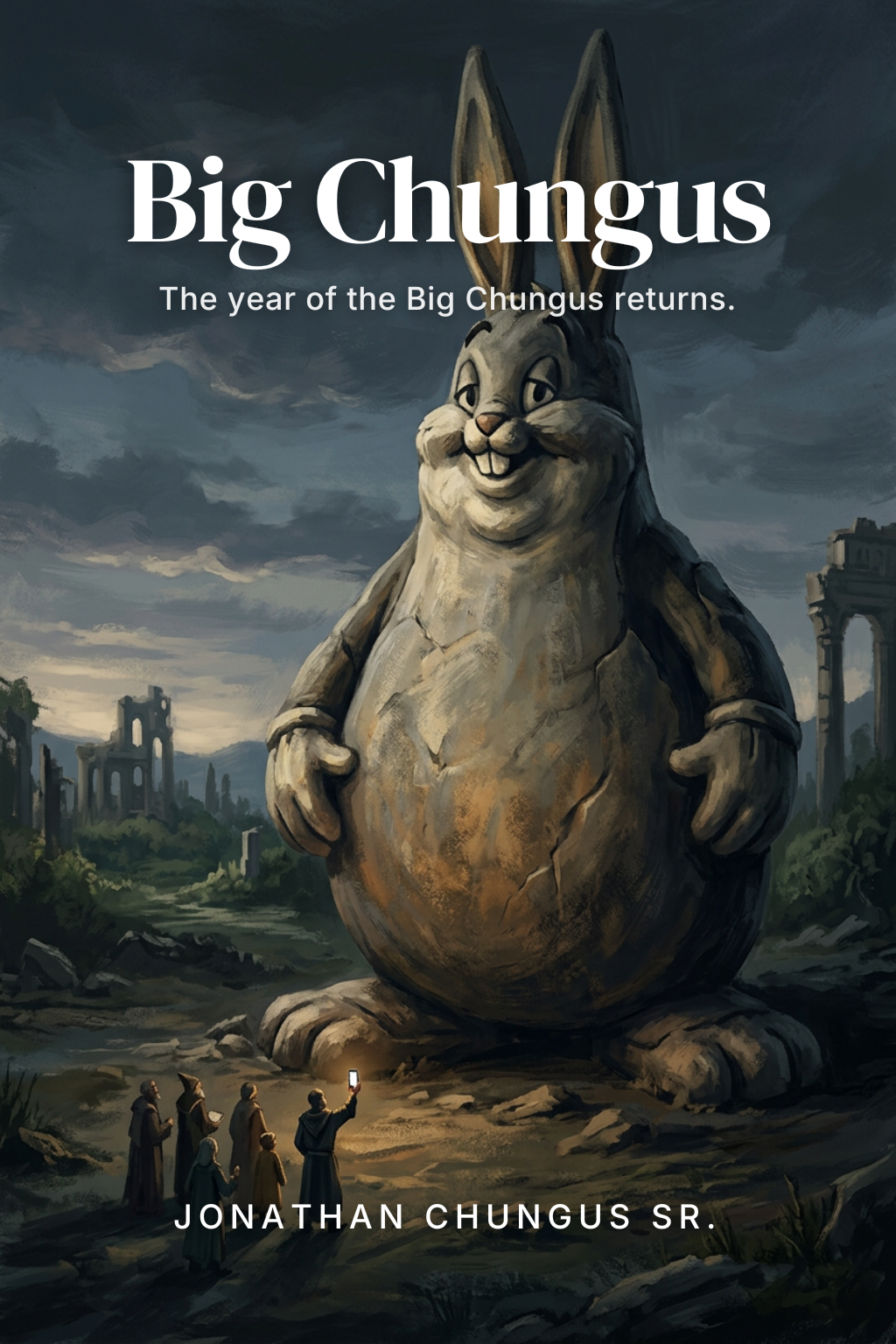
Big Chungus, the year of the Big Chungus returns.
Contents5 chapters
Chapter 1
Chapter 1: When a Joke Outlives Its Moment
There are moments in history when a civilization reveals its deepest logic not through its laws, its wars, or its quarterly reports, but through its jokes.
For a long time, leaders were trained to treat humor as a decorative feature of social life. It was thought to belong to the margins: to late-night television, office banter, adolescence, and the idle corners of the internet where attention went to waste. Serious people, we were told, concern themselves with serious signals—interest rates, political coalitions, commodity prices, demographic shifts. Yet the twenty-first century has repeatedly shown that what begins as frivolous expression can become a durable social language. A joke can become a password. A password can become a community. And a community, once formed, can reshape markets, institutions, and the emotional expectations that bind them together.
Big Chungus emerged from precisely this seemingly trivial terrain. On the surface, it was almost aggressively unserious: an exaggerated rabbit figure, swollen into comic absurdity, carrying the kind of visual logic that made adults raise an eyebrow and teenagers laugh for reasons they could barely articulate. Its power did not lie in elegance, narrative depth, or obvious utility. It lay in recognition. To know Big Chungus was to signal a certain literacy in internet culture, a familiarity with a world in which scale, distortion, and nonsense had become new forms of expression. It was ridiculous in a very particular way, and because it was particular, it became memorable.
Most executives would have dismissed such a thing at first sight. They would have seen only noise.
That was their first mistake.
## The Birth of a Modern Myth
In earlier eras, myths emerged slowly. They passed through oral tradition, scripture, theater, ritual. They were repeated by priests, poets, and grandparents. Time refined them. Their endurance depended on scarcity: there were relatively few stories, and so each one had more room to settle into collective consciousness.
Today, the conditions are reversed. We live under a permanent storm of content. Images, references, slogans, clips, remixes, and reactions strike the mind with such frequency that forgetting has become the default condition of cultural life. Most things now die within hours. Some survive a week. Very few travel beyond their original context.
This is what makes the persistence of certain memes so revealing.
A meme is often misunderstood as a small joke. In reality, it is better understood as a compact cultural vehicle. It carries not only an image or phrase, but an emotional orientation. It tells people how to feel, how to position themselves, and how to recognize others who feel the same. In a fragmented society, that function becomes more valuable than many leaders realize. If old institutions once gave people stable identities, digital culture now supplies temporary but powerful substitutes. A meme can offer what a company mission statement often cannot: instant belonging.
Big Chungus did not endure because it was the funniest thing on the internet. The internet has always produced funnier things. It endured because it was adaptable, absurd, and emotionally lightweight in a time of collective heaviness. It was absurd enough to avoid ideological exhaustion. Empty enough to be filled. Strange enough to be repeated. Like many durable myths, it contained very little explicit meaning and therefore made itself available for many meanings.
This is one of the paradoxes of modern culture: the symbols that last are often not those with the most carefully engineered message, but those with enough ambiguity to become social mirrors. One person shares them ironically. Another shares them nostalgically. A third shares them as rebellion against polished corporate language. A fourth shares them simply because everyone else appears to understand the reference and they do not want to be left out. Soon, the symbol no longer belongs to its origin. It belongs to the ritual of recognition surrounding it.
That ritual matters.
A board can approve a new strategy. A marketing team can launch a campaign. An executive can deliver a polished keynote about values, agility, and transformation. But if none of these generate recognition—if people do not see themselves and each other inside the signal—the message passes through the culture like light through glass. It leaves no mark. By contrast, a meme can create instant solidarity with astonishing efficiency. One image, one phrase, one absurd callback, and strangers know they occupy adjacent terrain.
This is why Big Chungus should not be treated as a footnote in internet history. It is a case study in what collective attention now chooses to preserve.
## Why Some Fragments Refuse to Die
The traditional corporate worldview assumes that value follows utility. Consumers, in this view, seek what solves problems, reduces friction, or enhances status. There is some truth in this, but it is incomplete. Human beings do not merely purchase function. They purchase emotional stability, narrative identity, and shared symbols that help make the world feel legible.
In an age of abundance, utility alone rarely explains attachment.
Consider how many technologies have become more efficient while also becoming more emotionally sterile. Interfaces are cleaner. logistics are faster. workflows are smoother. Yet millions of people feel more exhausted, not less. They move through highly optimized systems while experiencing very little delight. The result is a peculiar hunger—not for more features, but for more texture. Not for more information, but for signs of life. Not for more seriousness, but for moments that puncture the deadening atmosphere of perpetual optimization.
This is the environment in which a joke can outlive its moment.
Big Chungus survived because it was not simply consumed; it was recirculated as a tiny emotional event. It was the kind of reference that could appear in a group chat, a Slack thread, a conference side conversation, or a late-night social post and produce the same effect: a brief but meaningful collapse of distance. People smiled not because the symbol itself was profound, but because recognizing it together generated relief. In that relief there was a subtle promise: you are not the only one who remembers, and you are not the only one who finds this ridiculous world easier to bear when absurdity is allowed a seat at the table.
This may seem minor. It is not.
Most organizational life is built on formal coordination: goals, roles, meetings, incentives, metrics. But organizations also depend on informal cohesion: the unplanned bonds that make people more willing to cooperate, improvise, and trust. Traditionally, such cohesion emerged through physical proximity, local rituals, and shared institutional memory. In distributed and digitally mediated environments, these forms of cohesion have weakened. Into that vacuum flow new rituals—lighter, faster, more referential, but no less real.
Humor has become one of the infrastructures of belonging.
A leader who ignores this is not protecting seriousness. They are misreading the operating system of contemporary culture.
## The Executive Error: Confusing Triviality with Irrelevance
For many CEOs, there is a lingering belief that if something appears ridiculous, it cannot also be important. This belief was easier to maintain in an earlier media environment where public legitimacy was gatekept by institutions with relatively stable hierarchies. Newspapers, broadcasters, universities, and corporations all contributed to a common model of seriousness. To matter, one often had to appear sober, polished, and intentional.
Digital culture overturned that hierarchy without asking permission.
Today, significance often arrives wearing the costume of nonsense. The surface may be playful, but the social energy underneath can be intense. Entire communities now organize around symbols that make little sense to outsiders. The outsider’s confusion is not a weakness of the symbol; it is part of the symbol’s value. Shared references draw a line between those inside the loop and those outside it. They create intimacy by rewarding recognition.
This is not unlike older forms of ritual. Medieval guilds had coded language. Religious communities had liturgies. Elite schools had private jokes, songs, and traditions. Every durable group has relied on repeated signals that seem arbitrary to nonmembers but feel essential to insiders. The internet did not invent this pattern. It accelerated and democratized it.
Big Chungus belongs to this lineage. It may look like disposable entertainment, but its persistence tells us something deeper: contemporary societies are manufacturing belonging from fragments. Where institutional trust declines, where work becomes more abstract, where place matters less than networks, people cling to whatever symbols can still produce immediate mutual recognition.
This has enormous implications for business.
Brands once believed they were competing for attention. In truth, they are increasingly competing for ritual participation. It is no longer enough to be seen. One must be repeatable. Quotable. Memeable, in the deepest sense of the term—not merely easy to screenshot, but easy to embed inside social exchanges that help people perform identity and affiliation.
Many executives remain deeply uncomfortable with this reality. They fear that proximity to internet culture will cheapen their brand, dilute their authority, or make them appear unserious. Sometimes this fear is justified; clumsy imitation is often worse than silence. But the larger error lies elsewhere. It lies in assuming that because a symbol is comic, it cannot carry trust. Because it is playful, it cannot carry memory. Because it is absurd, it cannot carry strategy.
History suggests otherwise. Court jesters told truths kings could not hear from ministers. Carnival inverted social hierarchy while preserving social order. Satire has often functioned not as an escape from reality, but as one of the few tools capable of metabolizing it. Absurdity is not the opposite of seriousness. It is often the form seriousness takes when direct language becomes too exhausted to do the job.
## Nostalgia as a Strategic Force
To understand why Big Chungus could return at all, one must understand nostalgia not as sentimentality, but as infrastructure.
Nostalgia is often described as a backward-looking emotion, a longing for what has been lost. But in times of volatility, nostalgia serves a more practical function. It compresses memory into portable symbols. It turns sprawling past experience into shorthand that can be carried into the present. It reassures people that continuity still exists, even if institutions, technologies, and social norms seem to mutate every quarter.
Business leaders often underestimate how strategic this can become. They imagine nostalgia as relevant mainly to entertainment, fashion, or consumer packaging. Yet nostalgia increasingly shapes how people evaluate trust, identity, and emotional safety. In unstable environments, familiar symbols are not merely pleasant—they are anchoring. They remind people of earlier versions of themselves, of communities they once inhabited, of periods when meaning felt less algorithmically managed.
Big Chungus activated precisely this mechanism. For some, it recalled a phase of internet life that felt more chaotic, less optimized, less surveilled by brand managers and political operatives. It evoked a time when online culture still seemed capable of generating spontaneous weirdness without immediately converting it into monetized discourse. To invoke Chungus was, in part, to invoke that atmosphere.
This does not mean the past was actually simpler or better. Nostalgia is rarely accurate history. It is emotional editing. But accuracy is not its primary power. Its power lies in coordination. It allows millions of people to converge around the feeling of shared remembrance even when their actual memories differ.
Leaders should study this carefully. A market opportunity often appears first as a mood before it appears as a data trend. By the time an emotional pattern is visible in sales reports, it has usually been developing in culture for quite some time. If people begin to gravitate toward symbols that feel unserious but stabilizing, they are telling us something essential about the emotional climate. They may be exhausted by moral performance, distrustful of polished narratives, and hungry for references that ask little of them while still making them feel included.
In this sense, Big Chungus was never only about a rabbit. It was about permission—the permission to enjoy something low-stakes, collective, and faintly absurd in a period when so much public participation felt high-stakes, adversarial, and exhausting.
## From Content to Ritual
There is another reason some jokes outlive their moment: they stop functioning as content and start functioning as ritual.
Content is consumed. Ritual is enacted.
The distinction matters. A piece of content can go viral and then vanish. A ritual, however, can be repeated long after its original novelty fades, because repetition itself becomes the point. Think of the annual phrases that return in offices, the recurring jokes in families, the songs played at stadiums, the images reposted at predictable moments online. Their value does not come from surprise. It comes from reactivation. Each repetition says: we are still here, and we still know what this means.
Big Chungus crossed that threshold for a certain segment of culture. It ceased to be merely an image encountered once and became a recurring signal, deployed when people wanted to mark a mood: ironic grandeur, affectionate stupidity, shared nostalgia, resistance to over-explanation. In practical terms, that meant it could move fluidly across contexts. It could appear in a private conversation as a wink, in a workplace as comic relief, in a product discussion as shorthand for internet-native fluency, and eventually in broader public discourse as a test of cultural awareness.
For leaders, the lesson is not that every company needs its own Chungus. The lesson is that cultural power increasingly resides in reusable forms that help people perform togetherness. This is why some communities seem disproportionately energized despite lacking formal authority. They possess rituals of recognition. They know how to make members feel instantly included.
Most corporate communication still operates as if the audience were an information-processing machine. It delivers statements, value propositions, strategic narratives. But people are not waiting to be informed as much as they are waiting to be invited. They do not simply ask, “What does this offer me?” They ask, often unconsciously, “What shared behavior does this allow? What conversation does this unlock? What version of myself can I rehearse in public if I attach to it?”
This is where memes outperform many traditional messages. They are not complete stories. They are social tools.
Big Chungus, in this sense, became a prototype of something larger: the rise of symbols whose economic relevance comes not from ownership of intellectual property alone, but from their usefulness as emotional and communal shorthand.
## The Strange Stability of the Absurd
It may seem counterintuitive that absurd symbols can feel stabilizing. Yet the more unstable an environment becomes, the more people may rely on forms of expression that are deliberately unserious.
Why? Because the absurd makes fewer demands.
A political slogan asks you to choose a side. A corporate mission may ask you to internalize a set of principles. A public controversy asks you to speak, condemn, clarify, align. By contrast, a meme like Big Chungus asks almost nothing. It creates a pocket of low-pressure affiliation. You do not need expertise to participate. You do not need a manifesto. You need only recognition.
That simplicity becomes precious in periods of overload.
Imagine an executive team at the end of a punishing quarter. The dashboards are red. Costs are rising. Analysts are skeptical. The workforce is fatigued. In such an atmosphere, the official language of the organization often becomes even more solemn. Every message strains under the weight of consequence. Yet somewhere in the company, perhaps in a side channel or a regional team thread, someone posts a ridiculous image—something knowingly foolish, carrying none of the approved vocabulary of resilience or transformation. The reaction is immediate. People laugh. Not because the problem is solved, but because for one moment they are restored to each other.
Leaders often fail to see the significance of such moments because they measure what can be presented upward. But cultures are not held together only by what can be escalated to the board. They are held together by the countless unofficial exchanges through which people rediscover enough energy to continue.
Big Chungus matters because it symbolizes this hidden layer of social reality. It reminds us that what appears unserious may be performing serious work.
## Why 2026 Begins Here
If all this were merely about the afterlife of an old internet joke, it would not deserve a book, let alone the attention of business leaders. But something more consequential is happening. The return of Chungus is not an isolated revival. It is one expression of a broader shift in how legitimacy is formed.
For much of modern corporate history, legitimacy flowed from expertise, scale, and institutional polish. Increasingly, however, social legitimacy is also granted through cultural fluency—the ability to move within networks of irony, memory, and participation without appearing artificial. This does not replace competence. A company cannot meme its way out of bad products or broken economics. But competence without cultural resonance now feels strangely incomplete.
The leaders who will struggle most in the coming years are not those who lack data. It is those who misread emotion because it arrives in comic form. They will look at symbols like Big Chungus and see childish distraction, while competitors see early evidence of a public hunger they have not yet learned to name.
That hunger is for connection without heaviness, recognition without overexposure, and belonging without doctrinal burden. It is for symbols that can circulate lightly while carrying genuine emotional weight. It is for shared absurdity that softens the loneliness of highly mediated life.
This is why the joke outlives its moment. It was never only a joke. It was an adaptive artifact for a culture learning to cope with fragmentation through repetition, humor, and selective remembrance.
By the time executives notice such artifacts in mainstream settings, they are usually already late. The meaningful work has happened earlier, in small exchanges, inside subcultures, through loops of reference too minor to enter a quarterly briefing. Yet these are often the places where future expectations are first rehearsed. Culture tests possibilities informally before institutions recognize them formally.
And so Big Chungus returns not simply as nostalgia, not simply as comedy, but as a signal. Something in the public mood has shifted. The absurd is no longer confined to the margins. It is beginning to acquire social legitimacy. People are increasingly willing to organize identity, affection, and even trust around symbols that would once have been dismissed as nonsense.
That transformation should interest anyone responsible for leading an organization through uncertainty.
Because once a joke becomes a ritual, and a ritual becomes a language, it no longer sits outside the market, the workplace, or the public sphere. It enters them. Quietly at first, then all at once.
In the pages ahead, we will see what happens when a symbol born in the loose chaos of internet culture escapes the screen and begins to alter the behavior of institutions themselves.
Chapter 2
Chapter 2: The Meme Escapes the Screen
At first, nothing happened in public.
That is how many transformations begin. Not with an announcement, not with a law, not with a keynote presentation delivered beneath theatrical lighting, but with a sequence of small recognitions that seem too trivial to matter. A rabbit image reposted in a private chat. A deadpan reference dropped into a meeting. A sticker placed on a laptop by someone who, five years earlier, would have denied knowing what it meant. No institution approved these gestures. No committee coordinated them. Yet together they marked the beginning of a migration.
For decades, leaders were trained to think in neat layers. There was the digital world, where people joked. There was the real world, where people worked. There was consumer behavior, which could be measured. And there was cultural noise, which could be ignored. This division was always somewhat false, but in the age of networked attention it became actively dangerous. The screen was no longer a container for culture. It was a membrane. What passed through it did not remain unchanged, but neither did it stay on one side.
Big Chungus emerged again in this way: not as a triumphant return proclaimed from a central stage, but as a whisper that became a rhythm.
The first people to notice were not necessarily the most powerful. They were the most online, but also the most socially observant: community managers, junior designers, product marketers, interns, middle managers responsible for internal communications, the people who spend their days translating between formal systems and informal moods. They began to see the same image, or variations of the same name, appearing in places where it did not belong according to the old map of reality.
A spreadsheet tab renamed “Chungus_Final_v7.”
A Slack reaction used so often it ceased to feel ironic.
A birthday cake in a co-working space decorated with a familiar rotund silhouette.
A line in a newsletter subject header that raised open rates by 19 percent precisely because it sounded unserious.
Individually, these were absurdities. Collectively, they were a signal.
## The Office Learns to Laugh in Code
In the twentieth century, institutions possessed a relative monopoly over seriousness. They defined official language, approved acceptable symbols, and filtered what could enter the workplace. The office had jokes, of course, but they tended to remain local. One floor did not share its humor with another. A company in Chicago did not laugh in synchrony with a startup in Singapore. Humor was bounded by walls.
Networked culture dissolved those walls. The modern worker no longer enters the office as a professionally purified self. She arrives carrying dozens of invisible communities: gaming servers, family threads, alumni groups, fandoms, encrypted chats, algorithmically assembled feeds. Each of these worlds leaves residues in speech. A phrase appears in a meeting with no clear origin. A screenshot circulates without explanation and is instantly understood by seven people from different departments and two continents. A senior executive, trying to appear current, asks what something means and discovers that the explanation is less useful than the fact that it already means something to everyone else.
This was the environment in which Big Chungus escaped the screen.
Consider an executive team at a consumer goods company in Atlanta in late 2025. The chief marketing officer had prepared a sober briefing on declining engagement among younger audiences. The slides were competent and depressing. Acquisition costs were rising. Campaign recall was flattening. Sentiment remained stable but unenthusiastic—the modern corporation’s version of faint applause. Then, near the end, a younger strategist included an appendix slide not meant for the formal deck. It was a collage of recent brand-adjacent online moments: unofficial edits, ironic remixes, customer jokes, and among them, unexpectedly, several references to Big Chungus.
The room reacted in predictable generational fragments. One executive smiled despite himself. Another frowned. The chief legal officer asked whether the company had any exposure. The CEO, who had spent thirty years learning to identify “trends” through analyst reports and agency summaries, made the classic mistake. He asked: “But is this actually real?”
It was a sincere question. It was also the wrong one.
In the older model of legitimacy, something became real after it passed through gatekeepers: newspapers, television networks, trade journals, market researchers, consultants. In the newer model, by the time a symbol reaches those institutions, it is often already overripe. Its realness was established elsewhere—in repetition, imitation, and low-friction recognition across distributed networks. The point was not whether Big Chungus had official status. The point was that employees recognized it faster than they recognized the company’s own latest tagline.
This is what many leaders fail to understand. **Shared recognition is a form of power.** It reduces the cost of communication. It creates instant affinity. It allows people to signal that they are not merely transmitting information but participating in a mood. In a world saturated by polished messages, the ridiculous can acquire a strange advantage: it arrives without the burden of formal intention.
A slogan sounds engineered. A meme sounds discovered.
## How Irony Becomes Infrastructure
Most executives imagine irony as a solvent. They think repeated joking weakens commitment, dissolves meaning, and prevents durable value from forming. Sometimes this is true. Yet irony can also perform the opposite function. It allows people to approach a symbol from a safe distance until familiarity quietly removes the distance altogether.
No one has to begin by believing in Big Chungus. That is one reason the symbol travels so well. One can invoke it sarcastically, nostalgically, affectionately, performatively, experimentally, or simply because everyone else in the thread is doing it. But every repetition, regardless of motive, deepens recognition. And recognition is the seed of trust—not trust in the truth of the symbol, but trust in the social fact that others will understand it.
That distinction matters enormously.
Many things in modern society function not because people regard them as profound, but because they believe others will also respond to them. Money, brands, diplomas, dress codes, quarterly rituals, mission statements—all rely to some degree on coordinated recognition. A meme belongs to the same family of phenomena, though executives tend to place it outside the category because it appears unserious. But seriousness is not the criterion by which social technologies should be judged. The more important question is whether they synchronize people.
Big Chungus synchronized people.
It did so first through recurrence. Then through mutation. Then through casual migration into contexts where no one would have predicted it should matter.
In a logistics company, warehouse employees began naming overloaded pallets “absolute chunguses.” The term spread upward, eventually reaching operations dashboards and then, embarrassingly, a vice president’s email. In a law firm, associates used the phrase in late-night document review chats to describe bloated contracts. In a hospital break room, a nurse pinned a hand-drawn rabbit beside a vending machine after a week of impossible shifts; colleagues added notes beneath it as if the image were a secular saint of overburdened absurdity. A high school principal, trying and failing to sound contemporary, referenced Big Chungus during a graduation speech and was met not with contempt but with delighted disbelief. The symbol moved because people kept finding it useful.
Not useful in the narrow instrumental sense. Useful in the older human sense: it gave shape to a feeling. It transformed isolated amusement into shared atmosphere.
That is how culture migrates. It does not advance like an army. It seeps like weather.
## Screenshots as Testimony
One of the great misunderstandings of the pre-network age was the assumption that public events produce reality while private conversations merely comment on it. In fact, the boundary has reversed. Increasingly, reality is built in the semi-private zones where people exchange screenshots, annotate absurdities, and compare reactions before institutions have time to interpret what is happening.
A screenshot is not just a record. It is a portable social artifact. It says: *Look at this. You and I now have a relation to it.* Screenshots are the pamphlets of the digital age, except they spread at the speed of laughter. They collapse context, preserve tone, and transform fleeting moments into shareable proof.
Big Chungus owed much of its migration to this mechanism.
A fast-food employee in Ohio posted a photo of a hand-labeled sandwich in the break room refrigerator: “DO NOT EAT—CHUNGUS.” Someone else reposted it to a private Discord server. From there it entered a collage account dedicated to “workplace omens.” Within two days, thousands of people who would never meet that employee had encountered not merely an image but a tiny social reality. The object did not matter. What mattered was the ease with which viewers could imagine the room, the fluorescent light, the tired joke, the person who laughed while writing the label. The screenshot produced intimacy at scale.
Or take the now-common rhythm of the executive group chat. In many companies, the formal meeting no longer carries the full emotional load of decision-making. Before the meeting, executives exchange observations in text. During the meeting, side channels decode what is really being said. After the meeting, screenshots preserve whichever moment best captures the mood. When one chief people officer forwarded to her peers a screenshot of an employee-made internal meme featuring Big Chungus beside the line “our benefits portal after one update,” she was not merely sharing a joke. She was transmitting organizational truth more efficiently than an 18-page report could have done.
The private circulation of such images creates a distributed sense of reality. No single moment seems historic, but the accumulation becomes impossible to ignore. People begin to say things like “I keep seeing this everywhere,” even when the “everywhere” consists mostly of selective digital fragments. Yet this does not make the phenomenon less real. On the contrary, it reveals a new mechanism of legitimacy. Repetition across loosely connected networks substitutes for centralized validation.
When enough people possess screenshots, anecdotes, and sightings, they no longer need a newspaper headline to confirm that something is happening. They have already built a common world from fragments.
## The Return of the Witness
One reason Big Chungus became newly potent was that it allowed ordinary people to act as witnesses to culture in motion. Not consumers merely, not audiences, but witnesses.
A witness says: *I saw it in the wild.*
This phrase would have sounded strange in an earlier era. Wildness belonged to nature, not media. But in the digital century, the “wild” came to mean the uncontrolled appearance of a symbol outside its expected habitat. A meme in a teenager’s phone is ordinary. A meme in an HR training deck is a sighting. A meme on a roadside billboard is an omen. A meme on a quarterly earnings-adjacent LinkedIn post is evidence that the membrane has been crossed.
By 2026, sightings multiplied.
A regional bank in the Midwest launched an internal innovation challenge and one employee team, half-joking, called itself “Project Chungus.” The name survived to the finalist round because no one involved wanted to be the person who objected too early. A sports commentator used the phrase on live radio while describing an unexpectedly dominant rookie lineman, then spent the next day pretending he had no idea where it came from. A school board candidate in Arizona accused her opponent of treating budget overruns “like some kind of administrative Chungus,” proving that even misunderstanding can accelerate diffusion. A luxury streetwear brand released an oversized silhouette that online commentators immediately christened “Chunguscore,” and although the brand never used the word, it benefited from the association precisely because it could not control it.
Notice the pattern. Institutions did not lead. They followed—sometimes knowingly, more often reluctantly. They became stages on which a preexisting cultural fluency displayed itself.
For CEOs, this presents a difficult challenge. The traditional instinct is either to ignore the phenomenon or to seize it too directly. Both responses usually fail. Ignoring it signals distance from the emotional life of employees and customers. Seizing it clumsily transforms living culture into taxidermy. The executive task is subtler: to understand when a symbol has become socially operative, and to respond in ways that acknowledge the community rather than impersonate it.
This requires a different theory of power. Not all influence is exercised through direct control. Some of the most important forms of power today are interpretive. They belong to those who can recognize what people are already using to coordinate themselves.
Big Chungus was becoming such a coordination device.
## The Failure of Traditional Gatekeepers
There was a time when public legitimacy traveled along a relatively narrow road. An idea emerged, gatekeepers evaluated it, institutions amplified it, and the masses received it. This story was never entirely accurate, but it offered comfort to leaders because it implied sequence and control. Now sequence has collapsed. Amplification may come first. Evaluation comes later, often from those hoping not to appear late. As for control, it has become less a possession than a temporary illusion.
Traditional media initially treated the reappearance of Big Chungus as a curiosity. Small pieces appeared with the condescending tone once reserved for internet oddities: “remember this?” “why is this back?” “the bizarre revival of...” But these framings misunderstood the deeper logic. The revival did not require journalistic explanation because it was not a top-down comeback. It was an ambient reactivation. The symbol had remained dormant in collective memory, waiting for conditions under which its absurdity could become useful again.
Why 2026? Because by then many social systems were exhausted by the burden of performing unbroken seriousness. Employees were burnt out by strategic language. Consumers were overexposed to brand sincerity. Political rhetoric had become so theatrical and catastrophic that absurdity, paradoxically, felt more honest than official discourse. In such an environment, a figure like Big Chungus offered relief without demanding ideological alignment.
That is not a small thing. In periods of fatigue, relief becomes politically and economically significant. The symbols that provide it can accumulate what might be called **soft legitimacy**: not authority in the formal sense, but permission. Permission to laugh. Permission to recognize one another. Permission to step outside the coercive dignity of institutional language.
Gatekeepers could not manufacture this permission. At best they could notice it belatedly. At worst they could mistake it for nonsense and miss the shifting emotional economy entirely.
One multinational retailer learned this the hard way. Its social media team proposed a light-touch campaign riffing on the emerging Big Chungus wave among younger staff and customers. Senior leadership vetoed it as “off-brand” and “too internet.” Six weeks later, unofficial customer content using the same reference outperformed the retailer’s entire spring campaign in reach, sentiment, and earned attention. The company had not merely missed a joke. It had missed an opening into contemporary belonging.
The modern market punishes this kind of blindness. Not immediately, and not always in obvious financial terms. But over time, institutions that cannot perceive distributed cultural signals begin to lose more than relevance. They lose texture. Their communications become exchangeable with those of any other company. Their leaders sound as if they are speaking from a room where no one has seen a screenshot in years.
## Brands Enter the Ritual
Sooner or later, every traveling symbol confronts a test: can it survive contact with branding?
Many cannot. The moment a corporation adopts them, they stiffen. Their movement depended on informality, but formal use drains the voltage. Yet some symbols possess enough ambiguity to endure institutional contact, especially if they are deployed obliquely.
Big Chungus proved unusually resilient because it never demanded a single correct interpretation. It could signify scale, excess, nostalgia, anti-pretension, comic endurance, internet fluency, or simply an awareness that life had become too strange for straight-faced messaging alone. This gave brands room to participate without locking the symbol into one meaning.
The most successful examples were rarely major campaigns. They were small gestures, nearly deniable. A snack brand replied to a customer complaint with “we hear your concern; portion size has become, admittedly, a bit Chungus.” The post spread not because it was brilliantly written, but because it demonstrated something audiences crave from institutions: evidence that a real human being, still connected to ambient culture, had touched the account. An airline’s internal team named an oversized holiday baggage handling operation “Operation Chungus,” and when a blurry whiteboard photo leaked, it generated more affection than the company’s expensive video ads. A software startup hid a “Chungus mode” in its interface for April 1st, not as a marketing stunt but as an internal joke released into public view; users embraced it because it felt discovered rather than announced.
There is a lesson here for leaders who continue to think that communication is primarily about clarity. Clarity matters, but **participation** now matters too. People judge institutions not only by what they say, but by whether they seem capable of occupying the same cultural universe as everyone else. This does not mean every brand should act silly. It means every brand must understand that seriousness is no longer the sole language of credibility.
In fact, under certain conditions, the inability to play becomes a sign of weakness.
## From Entertainment to Social Glue
At this point, the executive objection usually changes form. No longer “is this real?” but “even if it is real, does it matter?”
This is a better question. It permits the possibility that absurdity may have consequences. To answer it, one must distinguish between immediate content and long-term social function.
The content of Big Chungus is thin by design. An exaggerated rabbit. A ridiculous name. Little doctrinal substance. But social glue is often made from thin materials. A wink, a greeting, an inside joke, a repeated phrase, a familiar image—these do not tell communities what to believe. They tell them that they belong in proximity to one another.
This is why the migration of a meme into workplaces matters. Work is no longer organized solely through formal hierarchy and contractual exchange. It also depends on emotional climate: whether people feel seen, whether they recognize one another’s references, whether they can bring fragments of their actual cultural selves into institutional space. A company that misunderstands this may continue functioning, but it will struggle to inspire voluntary energy. And in a labor market defined by attention scarcity and symbolic competition, voluntary energy is priceless.
Big Chungus became social glue because it was low stakes. Few people felt morally threatened by it. Few felt excluded by having missed its original peak, because the joke was easy to enter late. Parents heard it from children; children heard it from older siblings; managers heard it from teams; teams heard it from podcasts, clips, comments, edits, and stray references in unexpected places. Such cross-generational spread is rare and valuable. It creates what strategists often seek but rarely achieve: a bridge phenomenon.
Bridge phenomena matter because they reduce cultural fragmentation, if only briefly. In an era when every demographic seems to inhabit its own media weather system, any symbol capable of crossing clusters acquires outsized importance. Not because it solves division, but because it reveals that synchronization is still possible.
For a business leader, this is not merely anthropological trivia. It is strategic intelligence. If decentralized attention can elevate an absurd symbol into shared reference, then markets are no longer shaped only by product utility and advertising spend. They are also shaped by the emergent rituals through which people decide what feels alive.
## The Meeting After the Joke
Eventually, every migration reaches a point where the institution must decide whether to keep pretending nothing has changed.
This moment often arrives in the form of a meeting. Not a dramatic meeting, just an ordinary one. Someone from HR mentions employee culture. Someone from marketing mentions online sentiment. Someone from product mentions user language. Someone from sales reports that customers have begun using a term the company cannot trace to any official messaging. Slowly, reluctantly, the same conclusion surfaces from different departments: the atmosphere has moved.
By then, Big Chungus was no longer only a meme. It had become a test of organizational perception.
Some companies understood the test. They did not ask whether they should “do Big Chungus.” They asked what its spread revealed about the present. Why were employees and customers alike drawn to symbols of comic abundance, anti-pretension, and shared absurdity? What hunger did this answer? What exhausted style of communication was it replacing? What did it mean that a ridiculous rabbit could generate more spontaneous warmth than carefully optimized mission language?
Other companies answered poorly. They commissioned focus groups that were obsolete before the transcripts were complete. They sought definitive meanings where there were only moving layers of use. They demanded certainty from a phenomenon whose strength lay precisely in its ambiguity.
Yet ambiguity should not frighten leaders. Markets are full of ambiguous assets: prestige, trust, coolness, taste, anticipation. The inability to quantify them perfectly does not make them unreal. It makes them human.
Big Chungus, in its migration from entertainment to environment, exposed a broader truth. Institutions no longer operate outside culture as if culture were a decorative exterior. They operate inside culture, surrounded by symbols they did not create and cannot fully control. Some of these symbols will look foolish. Some will vanish. Some will unexpectedly organize emotion at scale.
Wise leaders learn to watch for these moments not because they want to become entertainers, but because they understand that legitimacy now forms wherever people repeatedly gather their attention.
And attention, once gathered, seldom remains on the screen.
By the beginning of 2026, the sightings were too numerous, the references too casual, the recognition too immediate to dismiss as residue from an old joke. Something had crossed over. The rabbit had entered conference rooms, newsletters, campaign brainstorms, family dinners, radio banter, investor-adjacent chatter, and the internal mythologies of organizations that would never publicly admit it. The question was no longer whether the meme had escaped. The question was what would happen when leaders realized that delight itself had become an economic force.
That was the point at which the deeper misunderstanding came into view. Executives had spent years learning to manage risk, allocate capital, and optimize performance. Very few had learned to recognize joy when it arrived wearing the mask of nonsense. In the year ahead, that blindness would become impossible to ignore.
Chapter 3
Chapter 3: Why Leaders Underestimate Delight
In every age, elites have mistaken their own emotional discipline for a law of nature.
Priests once believed that truth must arrive clothed in ritual gravity. Generals believed authority required distance. Industrial managers believed productivity depended on suppressing whim, ornament, and spontaneous feeling. The contemporary executive, despite all the language of agility and innovation, often believes something similar: if a thing is truly valuable, it must present itself in the approved costume of seriousness. It must come with charts, sober typography, and a voice that never appears surprised by itself.
This belief feels rational. It is also, increasingly, a liability.
The return of Big Chungus exposed that liability not because the meme was profound in the conventional sense, but because it revealed a recurring blindness in leadership culture. Many leaders can detect risk before employees can name it. They can read margins, monitor sentiment, and forecast volatility. Yet they are often strangely unable to recognize delight even when it is assembling directly beneath them, passing from phone to phone, desk to desk, meeting to meeting, until it becomes part of the organization’s actual operating atmosphere.
By the time most executives notice a phenomenon like this, they no longer encounter it as delight. They encounter it as leakage. A joke appears in an internal deck. A phrase migrates into a town hall chat. A mascot drawn in marker appears beside a vending machine after a brutal week in a hospital break room. Then comes the familiar managerial question: **Is this a distraction, or is this something we need to address?**
The question already contains the error. It assumes that delight is external to serious work, and that laughter enters the institution from outside like weather. But in reality, delight often emerges precisely where systems have become too mechanical to interpret the emotional conditions of their own participants. It is not the opposite of work. It is evidence about how work is being lived.
Big Chungus, in this sense, was never merely a meme. It was a test. Not of humor, but of perception.
## The executive suspicion of joy
Modern management inherited a deep suspicion of joy that has little to do with efficiency and much to do with power.
A great hierarchy depends on asymmetry. Some people are permitted to improvise; others are expected to perform composure. The higher one rises in many institutions, the more one is rewarded for reducing emotional volatility in speech. This can be useful in moments of crisis. No one wants a pilot improvising emotionally during turbulence or a surgeon chasing novelty in the middle of an operation. But what begins as a functional discipline often expands into a worldview. Leaders start to treat emotional irregularity itself as suspect. They confuse gravity with competence.
As a result, many organizations become highly literate in the language of urgency and nearly illiterate in the language of delight. They can measure burnout, but they do not know how to recognize the first signs of shared playfulness before it hardens into either morale or cynicism. They know how to launch values campaigns, but not how to notice the informal symbols by which people actually grant one another permission to belong.
This is why a younger strategist can add an appendix of absurd online references to a serious deck in Atlanta and understand something the room does not. It is why a Chief People Officer can forward a screenshot of an employee-made internal meme and sense—perhaps more accurately than an eighteen-page report—that it contains information about the company’s emotional condition. It is why a principal can use a forbidden absurdity in a graduation speech and receive not contempt but relief. In each case, the event appears trivial only to observers who think emotional legitimacy must descend through official channels.
But people do not live at work through official channels alone. They live through glances, nicknames, recurring jokes, reaction emojis, awkward silences, and the tiny improvised rituals that answer an older human question: **Am I safe here to be recognizable?**
For many leaders, this question is hard to see because they have spent years operating in environments where being recognizable was dangerous. They advanced by managing expression, by narrowing themselves into a form acceptable to boards, analysts, investors, committees, and markets. They were trained, in effect, to become convincing instruments. Then they wonder why employees trust a strange rabbit more than a polished all-hands video.
The answer is not complicated. The rabbit appears less afraid.
## Why absurd things travel farther than polished ones
A polished message asks to be accepted. An absurd one invites participation.
This difference matters more than most strategic plans admit. Traditional leadership communication is designed to reduce ambiguity. It clarifies priorities, aligns teams, and avoids misinterpretation. But the messages that travel farthest in social systems are often not the ones with the least ambiguity. They are the ones with the most **usable ambiguity**.
Big Chungus endured because it was emotionally lightweight and semantically flexible. It could be affectionate, ironic, defiant, exhausted, celebratory, and faintly stupid all at once. Its power did not come from precision. It came from availability. People could pick it up and use it without first seeking permission from a communications department or an expert class.
This is one reason delight scales so unexpectedly. It lowers the entry cost of participation. If a slogan is too polished, only the organization can speak it. If a symbol is loose enough, everyone can.
A spreadsheet tab renamed “Chungus” is not important because of the word itself. It is important because it converts a private recognition into a low-risk signal. Others can answer it without exposing too much of themselves. A break-room note reading “DO NOT EAT—CHUNGUS” works for the same reason. It does not demand ideological agreement. It merely creates a small door through which other people may step.
We should not underestimate how precious these doors have become.
In many contemporary institutions, workers are visible but not known. They are connected but not necessarily in relation. They have channels for communication without always having a sense of communal permission. When delight appears in such systems, it can spread with astonishing speed because it solves a problem that no formal process has solved: it provides an emotionally inexpensive way to be human in public.
Absurdity is often the ideal carrier for this function. Serious language has consequences. It can be quoted, judged, escalated, archived. Absurd language creates deniability. One can always claim it was nothing. This is precisely why it can become something. It allows people to test each other safely.
The first person who draws a thick rabbit by the hospital vending machine is not making a strategic intervention. She is creating a harmless oddity after a week of impossible shifts. But when colleagues add notes, they are not responding to visual art. They are responding to the sudden existence of a zone within the institution where emotional life can accumulate without requiring formal justification.
Executives often miss this because they look for direct statements and explicit grievances. Yet in tightly managed environments, human beings rarely move first through directness. They move through symbols.
## Delight as an economic force
To call delight an economic force may sound unserious only if we imagine economics as the study of transactions rather than the study of human coordination under conditions of scarcity.
Organizations do not run on incentives alone. They run on attention, trust, memory, and willingness. These are not decorative assets. They are operating conditions. A strategy that fails to secure them may still be beautifully designed, but it will move through the company like a command through wet concrete.
Delight affects all four.
It captures attention because it surprises. The human mind is not a neutral processor. It is an energy-conserving pattern detector. It ignores much of what resembles previous instruction. A polished internal campaign may be admired and forgotten in the same hour. An absurd image that makes people laugh at their desks interrupts prediction and therefore enters memory.
It builds trust because it reduces perceived threat. Not all trust comes from solemn declarations of transparency. Sometimes trust begins when people infer that a system, or a person within it, is not exclusively committed to control. A leader who can recognize an emergent joke without flattening it into an initiative signals that reality is being observed rather than merely managed.
It strengthens memory because feeling organizes recall. Employees forget values statements not because they oppose values, but because abstraction rarely attaches itself to daily experience. They remember the thing that gave shape to a moment—the principal saying “Big Chungus” at graduation, the newsletter subject line that broke the stale rhythm, the project nickname that survived long enough to become a shared artifact.
And it increases willingness because people are more likely to contribute to systems that leave room for aliveness. We have inherited a strange managerial habit of speaking as if commitment were produced mainly by compensation, discipline, and mission clarity. These matter. But human beings also give more to environments in which they can breathe.
None of this means that every institution should become frivolous. Delight is not a replacement for competence. It is a multiplier of participation. It makes coordination easier because it lowers the emotional tax people pay to remain present.
By early 2026, some leadership teams had begun to sense this without yet possessing a language for it. They could see that Big Chungus references were not behaving like random noise. The sightings clustered around overmanaged spaces, tired teams, and communication systems that had become too polished to be believable. The meme did not create these conditions. It illuminated them.
Here we begin to see why certain audiences trust what feels human and strange more than what feels optimized and controlled. Controlled communication often arrives with invisible instructions: receive this correctly, react appropriately, and do not alter the form. Human communication arrives unfinished. It permits fingerprints.
People now live amid such dense layers of optimization that any message retaining evidence of actual life gains an advantage. The strange feels credible because it has not yet been fully metabolized by the machine.
## The permission hidden inside the joke
The profound function of a joke is not amusement. It is permission.
To laugh together is to establish, however briefly, a small republic in which the official rules of status are suspended. The intern and the vice president may not share decision rights, but they can share recognition. For a moment, they inhabit the same symbolic weather. This matters more than many organizational charts can capture.
Big Chungus offered a specific kind of permission. It did not ask people to become witty or cutting or culturally elite. It required almost nothing beyond recognition and a willingness to accept a little ridiculousness. This low barrier was part of its genius. Some forms of humor are exclusionary because they depend on speed, fluency, or insider knowledge. Big Chungus, by contrast, carried a broad and almost childlike availability. It looked excessive, sounded foolish, and arrived free of moral instruction. That made it unusually useful in strained environments.
To invoke it was to say, without saying: **we do not have to be majestic right now**.
In many workplaces this was not a small concession. Institutions often ask people to perform a level of emotional tidiness that their actual lives cannot support. Teams under impossible deadlines are expected to speak in bullet points. Managers facing contradictory demands are supposed to remain “solutions-oriented.” Employees navigating uncertainty are encouraged to be “resilient,” as if resilience were a software setting rather than a metabolically expensive achievement. Under such conditions, absurdity becomes merciful. It acknowledges strain without demanding a formal confession.
This is why delight can create psychological safety where policy alone cannot.
Policies establish protections. Cultures establish whether anyone feels allowed to use them. A workplace may have generous language about openness while still punishing visible awkwardness, failed attempts at levity, or any emotional register outside professionalism. In such a place, people remain guarded. But if a benign absurdity can circulate without penalty—if a project can become “Project Chungus” and still reach the finalist round—then everyone has learned something important about the actual boundaries of acceptable humanity.
This is not because the institution has become unserious. It is because seriousness has ceased to monopolize legitimacy.
Some leaders fear this shift because they imagine that permission spreads uncontrollably. If employees are allowed one layer of silliness, perhaps discipline will collapse. In practice the opposite is often true. Environments in which people can surface low-stakes strangeness tend to require fewer covert acts of resistance. Suppressed systems leak pressure. A little sanctioned nonsense can prevent a great deal of corrosive detachment.
The real question for leaders is not whether delight belongs inside the institution. It is already there, either as a living current or as a trapped force mutating into cynicism. The question is whether leadership can distinguish between the two.
## Why leaders misread the signal
There are at least three reasons executives systematically underestimate delight.
The first is **selection**. Most senior leaders did not rise by being the most playful people in the room. They rose by mastering environments that reward composure, endurance, and strategic speech. This produces a predictable sampling bias. The people with the most authority are often those least likely to experience informal culture as necessary to survival. They have private offices, scheduling power, and the ability to define tone. What others need as permission, they experience as optional style.
The second is **distance**. Senior roles increasingly expose leaders to representations of organizations rather than to lived organizations. They receive summaries, dashboards, filtered sentiment, and post-processed interpretations. But delight often appears first in forms too small or too embarrassing to survive formal reporting. It shows up in Slack reactions, side comments, cake decorations, absurd labels taped to break-room appliances. By the time such things reach the executive floor, they may have been translated into terms so abstract that the phenomenon disappears.
The third is **moral confusion**. Many leaders have internalized the idea that caring about playful culture is somehow indulgent when the business faces hard realities. They fear that noticing joy may look frivolous in the presence of layoffs, cost pressure, or geopolitical instability. Yet this misunderstands the role of delight. Delight is not a denial of difficulty. It is often a response to it. The nurse who pins the rabbit after impossible shifts is not avoiding reality. She is generating enough emotional oxygen to continue inhabiting it.
This is what the Atlanta executives could not initially see when they asked whether Big Chungus was “actually real.” The question sounded empirical, but it was philosophical. They assumed reality belonged to audited categories: revenue, compliance, legal exposure, measurable consumer trends. The strategist’s appendix threatened this worldview because it suggested that something could alter behavior before it had acquired official status as a category.
In the twenty-first century, this is increasingly how culture works. By the time a phenomenon is comfortably legible to an institution, it has already had its first effects.
Leaders who insist on waiting until delight presents itself in formal metrics are like ancient rulers who only notice a religion once temples have already been built. The decisive transformations occur earlier, in whispered repetitions, improvised symbols, and low-status acts of recognition that seem beneath notice until they are not.
## From culture to strategy
If delight is real, then leaders face a temptation that is both understandable and dangerous: to instrumentalize it too quickly.
The history of institutions is full of failed attempts to capture emergent energy by formalizing it before they understand it. The result is often dead language. A spontaneous internal joke becomes a branded initiative. A living symbol becomes merchandise. A strange, generous current of recognition becomes a mandatory campaign with approved assets and a leadership toolkit. Nothing dies faster than delight forced to report through governance.
So what should intelligent leaders do?
First, they should **observe before acting**. If a symbol is spreading, ask what conditions made it usable. Where is it appearing? In overburdened teams or high-performing ones? Upward, downward, laterally? Is it an expression of warmth, complaint, fatigue, defiance, or all four at once? Treat delight as data, but qualitative data of a high order.
Second, they should **protect spaces where harmless spontaneity can survive**. This does not require a “fun strategy.” In fact, naming one may make matters worse. It means reducing unnecessary overmanagement in communication channels, allowing some local texture in team norms, and resisting the urge to sanitize every informal artifact into brand-safe language. Organizations say they value authenticity and then remove every condition in which authenticity can breathe.
Third, leaders should **learn to communicate with a little more humanity and a little less lacquer**. This does not mean becoming comedians. It means understanding that polished control now often signals distance rather than trustworthiness. The audience has become expert at detecting language produced to be unoffensive, optimized, and forgettable. A slight asymmetry—a genuine aside, an acknowledgment of absurdity, an unforced reference that proves a leader is living in the same century as everyone else—may carry more authority than another page of perfected talking points.
Fourth, they should **watch where joy gathers before competitors do**. We tend to think strategy begins with threat detection. Increasingly, it also begins with delight detection. Communities form around what gives them relief, identity, and usable weirdness. If your institution cannot see where those communities are coagulating, it will misunderstand both demand and loyalty.
This is relevant not only for internal culture but for brand storytelling. Audiences have become difficult to move through messages of aspiration alone. They are overexposed to polished promises. What often feels persuasive now is not grandeur but specificity, vulnerability, and the strange little signals that prove a brand understands the texture of lived experience. Big Chungus mattered here because it represented a form of collective permission that no campaign could easily fabricate. Brands that merely copied the symbol looked desperate. Those that understood the emotional condition beneath it sometimes found a more durable lesson: people respond to what acknowledges their exhausted humanity without trying to own it.
## The institutions that will matter next
A century of management taught leaders to optimize systems. The next era may require them to notice atmospheres.
This is a subtler skill. An atmosphere cannot be fully audited. It must be sensed through weak signals, recurring anomalies, and the emotional temperature of seemingly trivial interactions. Yet atmospheres determine whether strategy can move through an institution as belief or only as compliance.
The organizations most likely to matter in the coming years may not be those with the cleanest processes or the most aggressively efficient communications architecture. They may be those capable of perceiving where joy is gathering—and of understanding that joy, in mature systems starved of spontaneity, is rarely random. It gathers where people are trying to recover a sense of one another.
This does not mean every absurdity deserves reverence. Most do not. Culture produces endless debris. But leaders who dismiss the ridiculous on principle will repeatedly miss the early formation of meaningful coalitions. They will keep asking whether something is real long after it has already begun reorganizing attention.
Big Chungus became important not because a rabbit image deserved institutional respect, but because millions of people found in it a low-cost way to signal warmth, recognition, and anti-grandiosity inside structures that had become too tense to generate those feelings on their own. It functioned as cultural permission in an age of managed expression.
The executive challenge, then, is not to become silly. It is to become perceptive enough to understand what silliness is doing.
By the opening months of 2026, this question could no longer remain theoretical. In enough offices, schools, group chats, hospitals, campaigns, and break rooms, the same strange pattern had begun to repeat: a symbol once dismissed as residue was now acting like a bridge. Some leaders started to wonder whether they should leave it alone, quietly learn from it, or build around it before someone else did.
That was the moment the absurd stopped being an observation and began, unmistakably, to look like a strategic problem.
Chapter 4
Chapter 4: The Year of Chungus 2026
There are years in which history appears to move through elections, earnings calls, wars, treaties, and interest rates. And then there are years in which history moves through something that should not matter at all.
2026, for a surprising number of institutions, was such a year.
No ministry declared it. No standards body ratified it. No platform launched a formal campaign under that name. Yet by the second quarter, one could move from a hospital staff room in Cleveland to a logistics conference in Memphis, from a university budget meeting in Tempe to a private-equity off-site in Connecticut, and hear the same word spoken with the same mixture of irony, recognition, and relief: **Chungus**.
At first, executives asked the wrong question. They asked who had started it, as if cultural legitimacy requires a founding document. They asked whether it was coordinated, as if spontaneity must hide a planner. They asked whether it would last, as if duration is the only test of significance. But the more useful question was simpler: **what kind of social need was this absurdity suddenly serving?**
By 2026, Big Chungus was no longer merely a recurring internet artifact. It had become what all enduring symbols eventually become: a portable answer to a diffuse feeling. Not a doctrine. Not a platform. Not even an opinion. An answer to a feeling.
That feeling was difficult to describe in formal language, which is precisely why formal language failed to contain it. People were tired, but not in the old way. They were connected, but thinly. They had information, but less orientation. They had professional identities, but weaker permission to be playful inside them. The years preceding 2026 had trained organizations to speak constantly of resilience, transformation, optimization, and trust. Yet much of this speech sounded as if it had been machine-polished beyond human use. It was coherent, and dead.
Into this atmosphere entered a fattened rabbit from the sediment of internet memory.
This, from one angle, was ridiculous. From another, it was nearly inevitable.
## When repetition becomes reality
A symbol crosses an invisible threshold when enough people no longer encounter it as content but as environment. In the earlier stages of the Chungus return, one saw isolated references: a renamed project, a break-room sketch, an internal meme, a line in a speech that should have failed but did not. In each case, the symbol functioned as a small wink. It allowed those who recognized it to briefly experience social compression: the distance between strangers collapsed. A joke had done what management often cannot. It had created nearness.
But a wink remains private until the pattern becomes legible.
The threshold event in 2026 was not one event. History disappoints those who demand singularity. The “return” of Big Chungus was not triggered by a celebrity endorsement or a corporate activation. It became undeniable through **density**. Sightings stopped arriving as anomalies and began arriving as evidence. Individually, each was unserious. Collectively, they created a mood so thick that even serious people were forced to acknowledge it.
The turning point came in late February, when several things happened almost simultaneously.
A photo circulated from a regional shipping hub showing a whiteboard used to track delayed pallets. Beside one especially impossible cluster of rerouted inventory, a supervisor had written, in black marker, “CHUNGUS LANE,” with an arrow pointing toward the congestion. Workers in three states began using the phrase to refer to any bottleneck too large for ordinary language. The image spread because it did what language economists would recognize immediately: it compressed complexity into something memorable, non-punitive, and emotionally survivable.
That same week, a large hospital system’s internal message board featured a staff post thanking an unnamed employee for “maintaining the vending machine rabbit morale station.” The hand-drawn rabbit pinned beside the vending machine—the descendant of the nurse’s original sketch after impossible shifts—had acquired sticky-note offerings: jokes, shift-swap pleas, hearts, a childlike drawing of a stethoscope, and one note that read, “If Chungus can be this round and still continue, perhaps so can we.” Someone photographed it. Someone else shared it outside the hospital. The image did not go viral in the old sense. It spread in the newer, more consequential way: among group chats, Slack channels, alumni networks, and internal newsletters where people still possess names and obligations.
A week later, an events coordinator for a national sales meeting, unable to convince presenters to trim their overproduced slide decks, inserted into the rehearsal schedule a session called “No Chungus,” intended as shorthand for unnecessary bloat. The phrase was adopted instantly, then inverted. One team proudly described an especially ambitious proposal as “full Chungus” and won the room. By the end of the conference, attendees were using the symbol in two opposite ways—warning against excess and celebrating abundance—which is exactly how durable cultural markers behave. They do not survive because they mean one thing. They survive because they can absorb contradiction.
Executives who had previously imagined the phenomenon as youth slang now faced a more destabilizing possibility: it was becoming a cross-context grammar.
## The first institutional mistake
Whenever institutions detect authentic cultural energy, they are tempted by two opposite errors. The first is dismissal. The second is extraction.
By March 2026, many large organizations had progressed beyond dismissal and were hurrying into extraction.
A consumer brand released a limited-edition oversized snack pack with copy winking so aggressively toward “Chungus energy” that it seemed to have been written by a committee under duress. A software company named an internal productivity sprint “Operation Big Efficiency Chungus,” thereby proving that no cultural object is safe from management’s urge to domesticate. A financial-services firm instructed social media teams to “find our Chungus angle,” which is the modern equivalent of telling a dinner guest to laugh naturally while legal is listening.
Most of these efforts produced the same result: embarrassment. Not scandal—something more damaging. They made the firms appear lonely.
This mattered because by 2026 participation was no longer judged by whether it was clever. It was judged by whether it recognized the social function of the symbol. Big Chungus had become, in many settings, a low-stakes vessel for human permission. It let people admit they were overwhelmed without sounding tragic. It let teams acknowledge complexity without sinking into complaint. It let colleagues signal, “Yes, all of this is absurd, and yes, we are still here.” Institutions that treated it merely as a trend were not neutral. They revealed that they still confused attention with trust.
The Atlanta executive group from the previous year now found itself in a more advanced version of the same lesson. The CEO who had once asked whether Big Chungus was “actually real” no longer had that luxury. In a quarterly review in April, he was shown employee-submitted screenshots from across the company: an operations dashboard nicknamed “The Chungus View” because it showed every delayed variable at once; a volunteer-run internal newsletter section called “Small Wins, Big Chungus”; a finance team spreadsheet tab labeled, with no explanation, “thicc assumptions”; a recruiting candidate who mentioned, during a final-round interview, that the company “seemed weird in a healthy way.”
The chief legal officer, true to form, asked whether any of this created trademark risk, employee-relations risk, or reputational exposure.
The chief people officer asked a different question: **Why is this the language people are choosing when they feel safest with one another?**
That question changed the meeting.
The younger strategist—the one who had appended the earlier slide collage—had by then become an informal interpreter between executive language and cultural weather. He argued, gently but with visible impatience, that the company was misframing the issue. The point was not whether to launch a Chungus campaign. The point was whether leadership understood what employees had already built. “This is not fandom,” he said. “It’s a pressure signal. People are using humor to indicate where they still feel alive.”
In most organizations, such a sentence would be admired and ignored. In 2026, conditions were ripe for it to be taken seriously.
## Why improbable symbols comfort us
Periods of uncertainty do not merely produce fear. They produce a craving for forms that are stable enough to be shared and light enough to be carried. This is why societies under strain often generate humor that appears, to outsiders, nonsensical. Nonsense can become a shelter because it does not demand ideological agreement. It asks less of the participant. It does not require one to confess doctrine, rank tribal loyalties, or solve the crisis. It only requires recognition.
Big Chungus offered three kinds of comfort especially suited to 2026.
First, it offered **improbability**. Serious times create a market for symbols that embarrass seriousness. The more systems around us insist on relentless optimization, the more attractive becomes a figure whose entire logic is excessive shape. The symbol reassures people that existence need not justify itself through efficiency alone.
Second, it offered **nostalgia without obligation**. Much nostalgia is heavy. It asks us to restore a lost order, relive a vanished innocence, or return to a supposedly better past. Big Chungus did not demand restoration. It was nostalgic in the lighter, more forgiving sense: a reminder of earlier internet culture before every expression needed to become a brand, a battle line, or a monetized personal identity. One did not need to believe the past was better. One only needed to remember that delight had once been less supervised.
Third, it offered **collective deniability**. This is one of the most underestimated properties in modern social life. Many people long to participate in shared feeling but fear overcommitting to any symbol that may later become embarrassing, politicized, or commodified. Big Chungus solved this problem elegantly. Because it remained absurd, one could always retreat: “It’s just a joke.” Yet precisely because many people made that retreat available to one another, participation deepened. The joke became a soft infrastructure of belonging.
For business leaders, this matters profoundly. Markets are often described as systems of preference revelation. In reality, many markets are systems of **permission revelation**. People buy, share, repeat, and endorse not only what they like, but what their environment allows them to like without penalty. In 2026, Big Chungus marked a zone in which permission expanded.
## From meme to narrative
A meme becomes powerful not when it is repeated, but when repetition begins generating stories.
By mid-2026, Chungus references no longer arrived as isolated artifacts. They appeared as episodes in a collective tale whose rough plot everyone understood: the symbol had escaped, respectable people had failed to notice, ordinary workers had recognized one another through it, and institutions were now trying to decide whether to ignore, learn, or exploit. This narrative mattered because humans organize attention more effectively through story than through frequency.
Notice what changed. In 2025, to mention Big Chungus in a workplace was to risk sounding random. In 2026, to mention it was to imply that one had observed a larger shift. The symbol no longer pointed only to itself. It pointed to a social storyline about legitimacy, delight, and institutional lag.
Communities formed around this storyline in ways that traditional analytics struggled to detect.
There were private channels where operations leads shared sightings from warehouses and call centers, using them half as entertainment and half as emotional telemetry. There were alumni groups trading examples from schools, hospitals, and local government, astonished less by the meme itself than by the diversity of people who understood it. There were founders who began asking in portfolio meetings not whether a team was “fun,” but whether it generated the kind of voluntary internal symbolism that indicated trust. There were consultants—some insightful, some parasitic—who built frameworks around absurdity and belonging. There were church youth volunteers, municipal staffers, nonprofit coordinators, and exhausted middle managers who found, in the same cumbersome rabbit, an oddly portable sign that institutional life had not yet extinguished play.
In other words, a community emerged not around the image alone, but around the **experience of noticing** it.
This distinction is crucial. Many leaders think culture spreads when people adopt the same object. More often, culture spreads when people adopt the same interpretation of what the object signifies. Big Chungus in 2026 signified that one was awake to a certain kind of signal: the place where irony had become sincerity’s disguise.
Soon, markets followed.
## Communities become markets, movements, moods
Business literature loves the word community because it sounds gentler than market and more profitable than friendship. But communities are not assembled by invitation. They are stabilized by repeated, low-cost acts of mutual recognition. Once that recognition thickens, markets often appear downstream.
By the summer of 2026, independent creators were producing office posters, mugs, notebooks, stickers, and parody planning templates using Chungus-coded language, often without the image itself. This was significant. When a symbol can be evoked without direct representation, it has entered a more mature stage of cultural life. A phrase like “embrace the Chungus” could appear on a team document and immediately signal acceptance of necessary complexity, comic humility in the face of bloat, or permission to proceed imperfectly. Such products sold not because people wanted merchandise. They sold because people wanted artifacts that anchored a newly legitimate mood.
Some companies noticed and behaved intelligently. A small collaboration-software firm, instead of launching a branded campaign, quietly introduced optional internal meeting templates titled “Tiny Agenda” and “Big Agenda,” with employees spontaneously renaming the latter “Chungus Mode.” Leadership left the name alone, changed nothing publicly, and observed that use rates for voluntary planning tools increased. The lesson was not to mimic the meme. It was to let workers localize language on their own terms.
A hospital administrator, having seen morale lift around the rabbit-covered vending machine, created a tiny discretionary fund for staff-created break-room art and anonymous micro-rituals, with no requirement that outputs be “brand safe” beyond ordinary professionalism. Participation rose. Reported burnout did not disappear, but local measures of team cohesion improved. Again, the insight was not that Big Chungus healed medicine. The insight was that absurd symbols can reveal where institutions should stop over-managing expression.
A school district superintendent in the Southwest, after hearing about the principal whose graduation reference had delighted rather than scandalized, told administrators in a leadership retreat that students did not need more polished messaging nearly as much as they needed proof that adults still inhabited the same symbolic universe. He never used the rabbit in official communication. He did something harder: he allowed a little more human unpredictability in school life.
These examples illuminate the strategic question at the heart of 2026. **When should institutions engage cultural absurdity, and when should they refrain?**
The answer is neither “never” nor “always.” It is this: **engage only when you understand the social labor the symbol is already doing.** If you cannot explain what people are using it for beyond “it’s popular,” you are too early in your understanding and too late in your humility.
Participation feels extractive when institutions use a symbol to borrow warmth they have not earned. Participation feels natural when institutions protect the conditions under which that warmth arose.
This distinction separates stewardship from theft.
## The boardroom catches up
By the third quarter, boards and executive committees began discussing the phenomenon in less mocking tones. They did so, predictably, by translating it into categories they trusted: morale, recruitment, cultural adaptability, attention economics, internal trust, employer brand. This translation was imperfect but necessary. Institutions cannot act on what they cannot name in their own dialect.
The most perceptive leaders recognized that Big Chungus was functioning as a **diagnostic instrument**.
Where the symbol appeared and flourished, one often found teams with enough residual trust to play. Where it was instantly suppressed, one often found brittle cultures mistaking control for seriousness. Where leaders forced it into campaigns, one found anxious organizations that sensed declining legitimacy and tried to lease some from culture. Where leaders simply noticed and gave people room, one sometimes found a more durable advantage: employees who felt seen without being managed into expression.
In one manufacturing company, plant managers began informally reporting “Chungus moments” in monthly calls—not as humor updates, but as shorthand for episodes in which workers had converted frustration into communal language instead of private resentment. In a professional-services firm, a partner who had previously dismissed all such things as childish reluctantly admitted that the one office with the strongest retention among younger staff was also the office least embarrassed by internal silliness. “They recover faster,” she said, still resisting the conclusion contained in her own observation.
This is how paradigm shifts usually occur in leadership culture. Not through epiphany, but through irritated concession.
Meanwhile, resistance remained. Some executives insisted that all this talk romanticized distraction. Some feared that endorsing absurdity would weaken standards. Some were simply constitutionally unable to understand why delight might be serious business. They confused the existence of levity with the absence of discipline. They did not see that many teams use humor not to avoid reality, but to endure it.
Here the Year of Chungus revealed something larger than itself. It exposed the narrowing assumptions by which modern institutions decide what counts as signal. For decades, leaders had invested heavily in dashboards, sentiment tools, survey instruments, and communication architectures designed to render collective feeling measurable. Yet a hand-drawn rabbit beside a vending machine and a joke scribbled on a logistics whiteboard were, in practice, often more revealing. They showed where people had spontaneously generated meaning without instruction.
That is a strategic fact, not a cute anecdote.
## Why the mood mattered more than the meme
If one studies only the object, one misses the atmosphere. By autumn, it became obvious that “the Year of Chungus” described not a fandom wave but a broader re-permissioning of joy. The symbol mattered because it gave this shift a mascot. But the deeper development was that people across institutions had begun to test, with unusual boldness, whether pleasure, silliness, and visible affection could re-enter public and professional life without immediate suspicion.
Big Chungus was useful because it carried low ideological charge. It was not aligned enough to provoke automatic tribal sorting. It had no policy plank. It did not arrive with a moral purity test. This relative emptiness made it available. People could fill it with their own local meaning: release, fatigue, excess, abundance, kindness, ridiculousness, persistence.
In management terms, one could say the symbol had unusually high adaptive bandwidth. In human terms, one could say it gave people somewhere soft to put their feelings.
This is why humor can become a map of what people most need. The jokes that spread are not random. They cluster around pressures that formal speech cannot metabolize. If a workforce repeatedly turns to absurdity, it may be because absurdity offers the least punished route to truth. If a public repeatedly elevates improbable icons, it may be because ordinary prestige symbols—experts, brands, institutions, leaders—have grown emotionally overdrawn.
Thus the strategic lesson of 2026 was not “be funny.” It was more demanding: **learn to read what kinds of humor your environment is using to regulate itself**.
Some humor is exclusionary and corrosive. Some is nihilistic. Some is merely fashion. But some humor—of which the Chungus wave became a vivid example—serves as an improvised commons. It creates breathing room. It lowers the emotional cost of participation. It lets people declare, without making a speech, that they still want to belong to one another.
That is not a side issue in organizational life. It is one of the hidden preconditions of coordinated action.
## The return, properly understood
So who brought Big Chungus back in 2026?
No one did, which is another way of saying everyone did.
The return was enacted by a nurse with a marker, a fast-food worker with a refrigerator sign, a strategist with an appendix slide, a principal with enough courage to sound foolish on purpose, a project team that named itself half-jokingly and then kept going, a commentator who said the word on air before understanding why it fit, a chief people officer who recognized an internal meme as data, countless employees who forwarded screenshots not because they were building a movement but because they sensed they were witnessing the same impossible thing together.
This is how collective attention crystallizes around unexpected icons. Not through orchestration, but through repeated local acts of recognition that slowly become visible to one another.
By the end of 2026, the most intelligent executives no longer asked whether Big Chungus was important. They asked what its ascent revealed about the societies, organizations, and markets in which they operated. They saw that a meme had become a narrative, the narrative had become a community, and the community had begun to reshape mood, language, and commercial opportunity. More importantly, they saw that the real competitive divide was not between firms that embraced the symbol and firms that rejected it. It was between firms that could perceive emergent meaning and firms that required meaning to arrive in approved attire.
The Year of Chungus did not overthrow strategy. It refined it.
It reminded leaders that people do not live by utility alone, and institutions cannot secure loyalty through efficiency while starving the senses by which people feel one another to be real. It suggested that under conditions of uncertainty, societies may prefer symbols that are comic, excessive, and improbable precisely because such symbols can carry tenderness without demanding innocence. It showed that delight, when shared at scale, can become not the opposite of seriousness but one of its prerequisites.
And for those still tempted to laugh this off, there remained the stubborn evidence of 2026 itself: the meetings subtly changed, the internal language loosened, the screenshots accumulated, the awkward attempts at appropriation failed, the wiser acts of restraint helped, and all across professional life people kept reaching for the same absurd rabbit when they needed to say, in effect, **this is too much, and yet we continue**.
The question for leaders, then, was no longer whether to notice. It was what to do after noticing: whether to clamp down, cash in, or build organizations capable of recognizing human signals before they have to become absurd in order to be heard.
That choice would define far more than their meme strategy. It would define whether they understood the next cultural wave before it had already passed through them.
Chapter 5
Chapter 5: When the Absurd Becomes Strategy
In the old managerial imagination, strategy began where embarrassment ended.
A board would discuss market share, cost of capital, regulatory drift, labor exposure, geopolitical uncertainty. It would not discuss a thick-bodied cartoon rabbit scribbled beside a hospital vending machine, or a logistics whiteboard that briefly read **CHUNGUS LANE**, or the fact that a room full of national sales leaders could not stop repeating a phrase originally introduced to reduce slide bloat and immediately reversed into its comic opposite: **full Chungus**. These belonged, by the conventions of executive life, to a lower category of reality. They were decorative, unserious, beneath analysis.
And yet, by the second half of 2026, many leaders found themselves confronting an unpleasant and liberating fact: some of the most important signals in their organizations had arrived dressed as jokes.
This was not because jokes had become sacred. It was because institutions had become brittle. In brittle systems, formal language often loses its credibility before leaders notice it. Values statements continue to circulate, town halls continue to be scheduled, employee listening campaigns continue to produce slides. But people begin to reserve their genuine recognition for other channels—for side comments, screenshots, nicknames, phrases that can travel without permission. Under such conditions, the absurd does not replace reality. It reveals where reality is no longer being described honestly by official means.
That was the strategic meaning of Big Chungus.
Not the rabbit itself. Not the origin story. Not the meme as artifact. The importance of Big Chungus in 2026 lay in what it exposed: that culture had become increasingly organized around **shared emotional recognition before formal explanation**. People were coordinating not after receiving complete interpretations, but before. They recognized a texture, a mood, a permission. They used symbols that were loose enough to travel across contexts and strong enough to create instant alignment. Executives who waited for a neat definition before responding were not being disciplined. They were merely late.
## The last executive error
The first executive error, as we have seen, was to dismiss the absurd as irrelevant.
The last executive error was subtler. It was to notice the absurd, acknowledge its force, and then attempt to convert it too quickly into a program.
By spring 2026, this happened everywhere. Firms that had spent six months asking whether Big Chungus was “actually real” abruptly changed their posture and began asking how to operationalize it. Internal culture teams proposed delight initiatives. Brand groups tested ironic creative. Consultants, with professional speed, developed decks about meme-native trust architecture. Some organizations launched internal channels meant to encourage playful expression; some created sanctioned reaction libraries; some commissioned campaign concepts that treated communal humor as a newly discovered raw material.
Many of these efforts failed not because they were cynical, though some were. They failed because they misunderstood the sequence by which legitimacy now formed.
A symbol like Big Chungus generated energy precisely because it had not been assigned in advance. It emerged in the gaps of organizational life: in break rooms after impossible shifts, in private chats where employees could risk silliness without asking permission, in a cake at a co-working birthday party, in a project name that survived because nobody had enough authority or desire to replace it, in a principal’s unexpected speech line that relieved an entire graduating class by briefly puncturing the ceremony of adulthood. The symbol mattered because people discovered that others recognized it too. Its legitimacy was social before it was administrative.
When leadership moved too fast to capture such symbols, it often punctured the condition that made them useful.
This became measurable. Several companies that attempted heavy-handed extraction in mid-2026 later found, through pulse surveys and retention interviews, that employees did not object to playfulness itself. They objected to the conversion of a shared signal into managerial theater. People were not asking their employers to perform internet fluency. They were asking whether their institutions could recognize humanity while it was still arriving in an unserious form.
This is a difficult distinction for executives, because executives are trained to treat recognition as the prelude to intervention. In finance, in operations, in legal risk, this instinct is often rewarded. If a pattern appears, one acts. But in culture, premature action can destroy information. The first task is often not to deploy but to observe; not to brand but to understand; not to own but to learn what kind of social labor is already being performed for free.
The Chief People Officer in Atlanta had grasped this earlier than her peers. When others asked whether Chungus references posed exposure, or whether they represented drift from professionalism, she asked a different question: **what work is this language doing for people?** It was the right question because it shifted attention from content to function. Once one made that move, the rabbit stopped looking like nonsense and began to look like an instrument—crude, collective, highly adaptive—for carrying relief, permission, affection, and fatigue through organizations too overmanaged to admit those needs directly.
From that point forward, the problem before leadership changed.
The question was no longer whether the absurd mattered.
The question was what kind of institution could survive contact with it.
## Recognition-capable organizations
The strongest organizations of the next decade are unlikely to be those with the most polished cultural messaging. They will be those most capable of recognizing emergent symbols of shared emotion before those symbols have been translated into corporate language.
We may call such firms **recognition-capable organizations**.
A recognition-capable organization does not confuse every joke with a strategy, nor every burst of online language with a durable shift. It does something harder. It develops the capacity to distinguish between noise and signal in domains traditionally dismissed as unserious. It understands that emotional coordination now often precedes analytical justification. It treats irony, ambiguity, and playful repetition not as contaminants of seriousness but as valid forms of social data.
This requires an unfamiliar executive discipline.
For generations, managerial competence was built on reduction. One took a sprawling world and forced it into categories: threat or non-threat, asset or liability, trend or anomaly, professional or inappropriate. But networked culture increasingly punishes institutions that reduce too early. A symbol becomes powerful precisely because it holds multiple meanings at once. Big Chungus could be used to mock excess, signal warmth, relieve pressure, mark insider recognition, and create a harmless pocket of absurdity in environments saturated with performance. Its ambiguity was not a weakness to be resolved. It was the engine of its spread.
The recognition-capable organization learns to pause in the presence of such ambiguity.
Not forever. Not sentimentally. But long enough to ask five strategic questions.
### 1. What emotional need is being served?
In Cleveland, the morale rabbit by the vending machine survived not because anyone had conducted a campaign, but because exhausted people kept adding to it. The drawing gave shape to a need that formal systems were not meeting: a low-cost way to acknowledge strain without submitting a complaint or pretending everything was fine. This distinction matters. Institutions often measure grievance and miss tenderness; they track burnout and miss the tiny collective inventions by which people make burnout survivable.
### 2. Why is this symbol safe to repeat?
Big Chungus spread because it was emotionally lightweight. It allowed people to signal presence without requiring confession. In a company or hospital or school, that matters immensely. Many workers do not want to speak in the full vocabulary of vulnerability. They want deniable forms of participation. They want to say, effectively, *we all know this is strange, difficult, overblown, ridiculous,* without filing a report or making themselves legible to every authority. Leaders who understand this can design cultures that lower the social cost of honest recognition.
### 3. Where is the symbol crossing status boundaries?
A great deal of internet language remains trapped within age cohorts or niche communities. Big Chungus became strategically important because it crossed boundaries that should have slowed it down: hospital staff to conference planners, regional project teams to school ceremonies, radio commentary to board-adjacent conversations. When a symbol begins moving between contexts that do not normally share timing or tone, leaders should not ask whether it is respectable. They should ask what common condition has made such transfer possible.
### 4. What happens if we do nothing?
This question protects against both panic and vanity. Some symbols should be left alone. If they are already performing morale work successfully, institutional intervention may degrade them. The aim is not to colonize every expression of life. It is to preserve the conditions under which life can continue to appear.
### 5. What capability gap does this reveal in leadership?
When executives could not interpret Chungus sightings until screenshots accumulated beyond denial, the weakness was not generational ignorance alone. It was a leadership architecture too dependent on formal reporting and too inattentive to emergent belonging. The symbol diagnosed a sensory problem. The firm lacked people, rituals, and review mechanisms capable of noticing social meaning before it became impossible to ignore.
These questions do not produce certainty. They produce better perception. And better perception, in cultural conditions defined by speed and ambiguity, is already a strategic advantage.
## The institutions that learned
The most interesting stories of 2026 were not the institutions that suddenly became funny. They were the institutions that became more attentive.
Some of the Atlanta executives, chastened by how long they had misread the shift, did not launch a Chungus campaign. Instead, they changed how cultural information moved upward. They created a lightweight monthly review in which internal communicators, store managers, younger strategists, and people from customer support were invited to present not major incidents, but **strange recurring recognitions**: screenshots, phrases, naming patterns, jokes that appeared independently in multiple regions, tiny symbolic convergences that formal dashboards would never capture. The purpose was not amusement. It was pattern recognition.
Over time, this altered decision-making more than any delight initiative could have done. Leadership became less dependent on polished summaries and more willing to examine weak signals. They started noticing where formal morale indicators looked stable while participatory behavior suggested fatigue, distrust, or hunger for permission. They also noticed positive drift earlier. What once would have been classified as trivial now appeared as leading evidence of whether people felt able to act human in the system.
A hospital network, after learning that the vending-machine rabbit had become locally meaningful, resisted the temptation to turn it into wellness branding. Instead, administrators asked unit managers a simpler question: where, in your area, are people already making morale for one another, and what small protections do those practices need? Sometimes the answer was space. Sometimes it was time. Sometimes it was merely the absence of managerial interference. Retention did not improve because the rabbit became official. It improved because leadership learned not to suffocate the informal practices by which staff restored one another’s dignity.
A university, embarrassed after students mocked an overdesigned attempt to speak in meme language, quietly shifted course. Rather than trying to mirror student humor, it changed how student-affairs teams listened. Resident advisers, club leaders, and counseling staff were asked not to report trends in the abstract but to note recurring symbols and phrases that seemed to carry disproportionate emotional weight. What emerged was not a map of youth slang. It was a map of stress, loneliness, aspiration, and social permission. The institution became better at reading its own weather.
These are not dramatic changes. They do not flatter executive heroism. But that is the point. In the age of contagious delight, the central strategic task is often not to invent culture but to perceive it before it hardens into backlash, exit, or cynicism.
## Why absurdity became credible
We should now return to a deeper question. Why did a figure like Big Chungus become a vehicle for legitimacy at all?
Part of the answer lies in distrust. People living in highly mediated societies are continually addressed by actors who want something from them: attention, compliance, purchase, allegiance, labor, data. Under such conditions, polished speech acquires the odor of intention. The more optimized a message becomes, the more many people suspect that its warmth has been calculated in advance. Absurdity can slip past this defense because it arrives with lower expectations. It does not initially announce itself as useful. And so it can become useful.
But another part of the answer is anthropological. Human communities have always used exaggerated, playful, or grotesque figures to metabolize uncertainty. Festivals, carnival masks, fools at court, trickster gods, comic animals in children’s stories, workplace nicknames, military slang—all belong to a long lineage of symbolic forms that allow groups to approach fear indirectly. The networked meme did not invent this function. It industrialized and accelerated it.
Big Chungus, in retrospect, was a particularly modern vessel for an ancient task. It was oversized, unserious, impossible to justify with a straight face, and therefore ideal for carrying feelings that straight-faced systems could not process elegantly. In a time defined by burnout, managerial overexplanation, algorithmic sameness, and a widespread exhaustion with compulsory composure, the return of such a figure was not irrational in the sense of being meaningless. It was irrational in the more interesting sense: it moved according to human needs that formal reason had failed to satisfy.
Markets, too, increasingly move this way. Not because fundamentals do not matter, but because fundamentals are now interpreted through climates of feeling that spread memetically. A consumer does not merely buy a product. She joins a mood, rejects a tone, affiliates with a shared joke, avoids a brand that feels emotionally synthetic, rewards one that appears to understand the texture of the moment. Investors, employees, customers, and citizens alike live in environments where symbolic fluency can alter trust before policy catches up. This does not mean that all strategy should become playful. It means that no strategy can afford illiteracy in play.
## A framework for leaders after Chungus
If Big Chungus was a diagnostic event, what should leaders actually do next?
Not chase the rabbit. Build the capacity that the rabbit exposed as missing.
A practical framework might be stated simply:
**Observe. Protect. Translate. Design.**
### Observe
Create channels through which weak cultural signals can be seen without first being sanitized. This means listening beyond direct reports and beyond professional communicators. The people who first detect symbolic shifts are often those nearest to everyday coordination: moderators, assistants, customer support teams, nurses, store managers, teachers, internal community builders, younger strategists, and employees whose jobs require them to notice mood before leadership names it.
Observation is not passive. It requires institutions to ask for examples, not just summaries; screenshots, not just themes; repeated phrases, not just sentiments. It requires boards and executives to tolerate material that feels beneath their station. Many still cannot.
### Protect
When informal morale systems appear, do not automatically convert them into campaigns. Protect the space, rhythm, and deniability that allow them to function. If a shared symbol is reducing stress, creating belonging, or signaling trust, your first obligation is not to own it. It is to avoid crushing it with relevance.
Protection can be material. Preserve break-room space. Defend internal channels from over-policing. Allow local naming conventions to persist when harmless. Give middle managers discretion not to extinguish every absurdity in the name of order. Bureaucracies often destroy resilience accidentally.
### Translate
Eventually, leadership must make sense of what it sees. Translation means converting emergent symbols into strategic understanding without stripping away their humanity. The purpose is not to explain the joke to death. It is to ask what organizational conditions made it necessary, lovable, or contagious.
In Atlanta, the useful translation was not “employees like memes.” It was “employees require low-risk ways to acknowledge pressure and belonging because formal language has become too costly.” This insight can inform management practice, communication design, meeting structure, recognition systems, even legal review. Translation is where cultural observation becomes institutional intelligence.
### Design
Once leaders understand the function of playful legitimacy, they can design better environments. Meetings can become less ceremonially dead. Communications can become less sterile. Recognition systems can reward emotional intelligence, not merely execution. Review processes can include cultural weather, not just operational metrics. Products and services can be tested not only for utility and price but for emotional texture: does this invite participation, affection, retelling, harmless pride?
To design for such conditions is not to become frivolous. It is to accept that meaning is now part of the infrastructure of performance.
## What leaders are still missing
Even now, many leaders will read a story like this and seek reassurance that Big Chungus was an anomaly—one amusing year, one strange convergence, one inflated rabbit standing in for a temporary internet fever. They will hope that once the cycle passes, serious life will resume its normal monopoly on consequence.
This hope misunderstands the direction of history.
We are entering a period in which legitimacy will be granted less by tone and more by felt recognition. People will increasingly trust institutions that can register the textures of lived experience—including irony, absurdity, oscillation, and collective play—without either patronizing them or fleeing from them. The line between culture and coordination will continue to erode. What looks, to older managerial eyes, like distraction will often prove to be preliminary organization: people finding each other before any official structure has acknowledged that they need to.
The next Big Chungus may not look anything like a rabbit. It may arrive as a phrase, a sound, a visual shorthand, a tiny behavior repeated in hybrid spaces until it acquires social gravity. It may be born in a private server, a classroom, a warehouse, a clinic, or a comment thread under a video nobody in leadership has seen. At first it will appear unserious. Then it will become useful. Then, if enough institutions remain perceptually slow, it will become obvious and therefore expensive.
This is what leaders must understand: by the time a symbol feels respectable enough for the boardroom, much of its strategic value has already been spent.
## The return, reconsidered
We can now answer, at least partially, the question that hovered over the year of Chungus. Who brought Big Chungus back?
No single person did. That was precisely the lesson.
There was no mastermind, no perfect influencer campaign, no central committee of internet nostalgists deciding that 2026 would belong to an old exaggerated rabbit. There were only ordinary people making countless small recognitions under conditions of strain, saturation, and longing. A nurse drawing a thick rabbit after impossible shifts. Employees renaming a project because the absurd title felt lighter than the work. An events coordinator trying to reduce presentation excess and accidentally giving a room a phrase it wanted more than the official agenda. A principal sensing, perhaps intuitively, that the audience needed one breach in the script. A strategist who understood that the appendix said more than the deck. A Chief People Officer willing to see in an employee-made meme more truth than in eighteen pages of composed reporting.
The return was enacted, not announced.
And because it was enacted by many, it revealed something larger than itself: that resilience in contemporary societies is often built through small, playful acts of mutual permission. Not all resilience is solemn. Not all seriousness heals. Sometimes communities endure by inventing symbols that make heaviness shareable without making it heavier.
This should humble executives. The social intelligence of institutions does not reside only at the top, nor only in functions formally assigned to culture. It appears wherever people find ways to remain human under pressure. Strategy, if it deserves the name, must learn to notice.
## What comes next
If delight becomes contagious, what follows?
Not utopia. Not the end of manipulation, or burnout, or opportunistic branding. Every human capacity that generates belonging can also be exploited. Playful legitimacy will be faked, overproduced, and sold back to exhausted publics by those who sense profit before they feel meaning. Some leaders will become performative ironists. Some companies will decorate extractive systems with a thin aesthetic of self-awareness. Some institutions will learn just enough meme language to appear less dead while remaining equally incapable of care.
But imitation is itself evidence of power. Once even cynical actors begin copying a form, it means the form has altered the competitive environment.
The more important possibility is that a minority of institutions will become wiser. They will stop treating delight as a childish side effect and begin treating it as a serious indicator of social vitality. They will understand that people do not merely want efficiency, safety, and information. They also want occasions of recognition that are light enough to carry, strange enough to enjoy, and shared enough to trust. Such institutions will not ask employees or customers to leave their internet-shaped emotional lives at the door. They will learn to meet human beings as they are now: ironic and sincere, exhausted and playful, skeptical and hungry for symbols all at once.
This is a more demanding leadership model than the old one. It requires comfort with ambiguity, tolerance for embarrassment, and the ability to act without first reducing every phenomenon to a stable category. It asks executives to become students again—not of trend reports alone, but of living culture in its half-formed state.
That is why Big Chungus mattered.
Not because the future belongs to memes.
Because the future belongs, increasingly, to those who can recognize meaning while it still looks ridiculous.
And so we end where we began: with a joke that outlived its moment because it was never only a joke. In its return, leaders were offered a choice. They could dismiss the absurd and become slower, colder, and less legible to the people on whom their institutions depend. Or they could accept that what moves markets, teams, and communities is often irrational before it is obvious—felt before it is named, repeated before it is explained, laughed at before it is measured.
The rabbit, in the end, was only a messenger.
The real message was that relevance has changed.
Those who learn to see this early may build organizations resilient enough for the age that is arriving. Those who do not will continue to mistake vitality for distraction until vitality leaves them behind.
Somewhere, even now, in a channel nobody senior monitors, in a room between shifts, in the margin of a slide, the next signal is already taking shape.
Write your own novel.
ScribistIQ generates full-length novels in minutes. Type your premise, walk away, come back to a finished book.
Try ScribistIQ