
Book · 5 chapters · 7,678 words
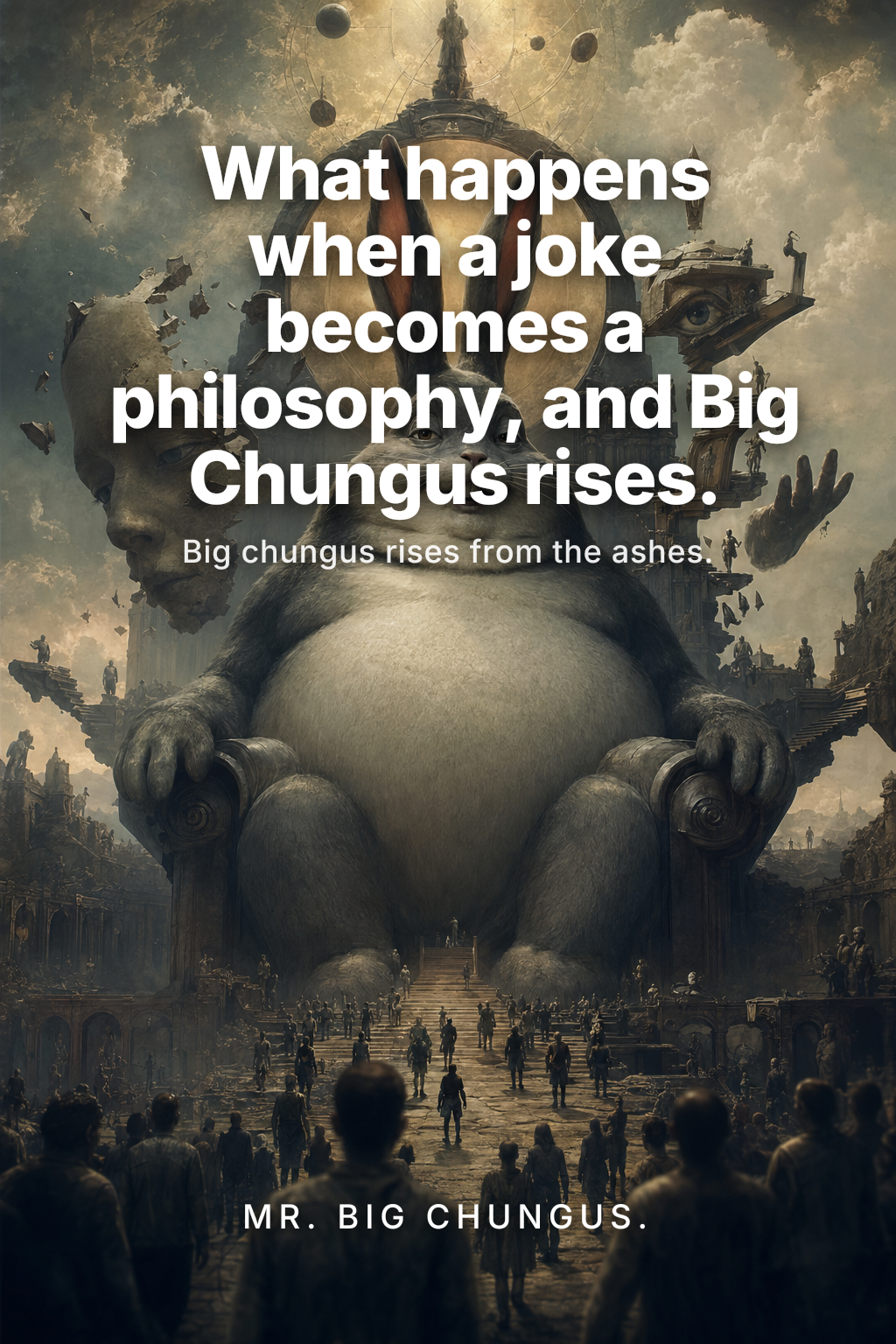
What happens when a joke becomes a philosophy, and
Contents5 chapters
Chapter 1
Chapter 1: The Rabbit That Outlived the Joke
A child looks at a giant rabbit and laughs. So does an adult, though for different reasons. The child sees a big body and a silly face. The adult sees a file name, a repost, a thousand strangers laughing at the same thing, and the strange comfort of being inside a crowd that needs no meeting place. Big Chungus began as a joke on the internet, but jokes are not always light. Some become labels. Some become flags. Some become small machines that sort people into camps before anyone has said a serious word.
The first mistake is to treat a meme as a weak thing. A meme is not weak. It is compact. It travels well. It asks little of the brain and much of the social body. A meme can cross a city in seconds and an ocean in minutes. It can survive because it is funny, or because it is annoying, or because it lets a person signal that they know the code. In that way it is closer to a password than a poem. The code matters less than the act of recognition. When someone shares Big Chungus, they are not only sharing a cartoon rabbit. They are placing themselves inside a tiny ceremony of mutual knowing.
That is why memes matter. They help strangers coordinate. They help friends confirm that they remain friends. They help groups draw boundaries without hiring a guard. A medieval village had church bells and market days. The internet has reaction images, captions, and absurd figures with inflated bellies. Different tools, same job. Humans need shared signals, and they need them fast. Slow signals die in a feed built for speed.
Big Chungus has a particular shape because it is too much of a thing. It is the size of a joke that has eaten its own punchline. The original image, a bloated version of Bugs Bunny, did not ask to be profound. Its power came from excess. It looked wrong. It looked as if an animator had overshot the frame and the universe had decided to keep the mistake. That wrongness was the point. A meme often works by breaking a category while leaving enough of it intact to be recognized. Big Chungus is rabbit, but more rabbit than rabbit. It is body, but body out of control. It is familiarity pressed into farce.
That extra size matters. Human beings do not only laugh at content. They laugh at scale. We laugh when a small thing acts large, when a large thing acts small, when a creature violates the size it was supposed to have. The comic mind loves mismatch. A crown on a baby’s head is funny because power looks absurd on a face too young to carry it. A giant rabbit is funny because innocence has been inflated into menace. Big Chungus sits in that tension. It feels harmless and alarming at the same time. That combination is sticky.
The internet loves stickiness more than truth. Not because people prefer lies, but because platforms reward anything that holds the eye. A joke that fades in a second is a private joke. A joke that repeats, mutates, and returns in new forms has entered politics, in the broad sense of the word: the business of getting many people to move in the same direction. When a meme becomes recognizable beyond its original context, it stops being only humor. It becomes a reference point. And reference points are power.
Power on the internet rarely wears a uniform. It hides in trends, hashtags, and recommendation systems. A platform does not need to command anyone if it can tilt attention. If enough users pause on a rabbit, the system notices. It offers more rabbits. Then more users notice the rabbit because the system noticed it first. People often describe this as organic growth, as if culture were a forest. It is better described as a feedback loop with a face. Big Chungus did not rise because a committee chose it. It rose because many small choices, made by individuals and machines, kept feeding it back into view.
Once a symbol has that kind of momentum, it begins to collect uses. It can be a joke about excess. It can be a badge of irony. It can be a wordless expression of “I am in on this.” It can also become something closer to a talisman. In online spaces, repeated symbols are used to mark belonging with almost religious force. The symbol need not be sacred in the old sense. It only needs to be shared often enough, with enough feeling, that people begin to organize memory around it. A meme becomes a place where emotion can sit down for a moment.
This is one reason laughter feels powerful. Laughter lowers defenses. It lets people accept a message that would be rejected if delivered in plain speech. The joke enters the room first. The idea follows after. Political strategists know this. Marketers know it. Influencers know it. So do teenagers in group chats. The joke is a delivery system. Big Chungus, like many memes, thrives because it carries no official lesson. That emptiness is useful. It can be filled with anything the audience wants: nostalgia, mockery, anti-seriousness, or the simple relief of shared silliness in a life that has become too managed.
There is also a darker comfort in absurd symbols. A world that feels unstable pushes people toward things that are easier to hold than policy papers and economic charts. A rabbit with a giant body is easier to grasp than a rising rent. It does not solve the rent. It does not pretend to. But it offers a small interval in which the mind can stop bracing. That interval has value. It can also be exploited. If a society spends more time laughing together than thinking together, it may remain cheerful while losing its footing.
The temptation, then, is to dismiss the meme as childish. That would be a mistake. Childhood is where much of human social training begins. Children learn status, imitation, exclusion, and play in the same room. Memes are adult versions of those lessons, sped up and distributed at scale. Big Chungus is not a break from culture. It is culture stripped to one of its oldest forms: shared recognition of a shape that means more than it says.
If this sounds exaggerated, consider how often people now live by symbols they barely inspect. Brands, flags, profile pictures, slogans, avatars. The modern person carries a whole public self made of signs. Big Chungus joined that crowded hall as a comic intruder, but intruders sometimes reveal the rules of the room. It showed how quickly a meaningless image can gather meaning once enough people agree to treat it as real. That agreement is not trivial. It is the same kind of agreement that lets money function, laws stand, and institutions survive.
A joke becoming a philosophy may sound like a prank. It is not. It is a clue. It says that human beings are so social that they can build shared reality around almost anything, so long as the thing is repeatable, recognizable, and emotionally useful. Big Chungus does not explain the world. It exposes the machinery by which worlds are made. One laugh at a time, a symbol can climb out of nonsense and begin to rule attention. By the time people notice, the rabbit has already done its work.
Chapter 2
Chapter 2: How a Captured Attention Becomes a Crowd
Attention is the currency of the digital age, but currency is too neat a word. Attention leaks, pools, spikes, and vanishes. It can be stolen, sold, and trained. It can also be herded. That is what platforms do. They do not merely host culture; they shape the path by which culture meets the eye. A meme like Big Chungus does not move through the internet as water moves through a pipe. It moves as a rumor moves through a village after the gates have been left open.
The internet did not invent attention. It industrialized it. Before feeds, people still fought for notice. Court poets, newspaper editors, preachers, and advertisers all understood the same rule: if you can hold the eyes, you can shape the mind. What changed is the scale and the speed. A platform such as YouTube, TikTok, X, or Instagram can test millions of reactions in minutes. A joke that lands one day may be buried the next, not because it failed, but because the machine found a hotter object. Culture now lives in a market where the shelf life of a symbol is measured in hours and yet some symbols, like Big Chungus, keep returning because they have learned how the market works.
The algorithm rewards what people pause on. Pause is the first vote. Then comes the share, the comment, the remix, the angry reply, the ironic repost. Each action adds weight. The result is not pure popularity. It is amplified repetition. A meme does not need universal love. It needs enough friction to keep circulating. People who mock it still help spread it. People who hate it may feed it more than its fans do. This is one of the great ironies of the attention economy: contempt is a form of fuel.
Big Chungus survived because it could wear many masks. In one feed it was a joke about a fat rabbit. In another it was a symbol of internet in-joke culture itself. In another it was a deadpan punchline for people too tired to explain the punchline. Flexibility matters. Symbols that are too fixed age badly. Symbols that can be reused in a dozen emotional settings become durable. They stop belonging to a single author, if they ever had one, and begin to belong to the crowd. Once that happens, ownership becomes difficult to define. The image is everywhere and nowhere.
That diffusion is useful to people in power. Leaders, parties, brands, and movements no longer rely only on speeches and advertisements. They need a texture of presence. Memes provide that texture. A candidate who can become a meme looks less distant. A company that can be mocked playfully can sometimes survive being hated. A movement that can generate its own jokes can feel alive. Big Chungus, though not born as a political tool, shows how a symbol can become a container for collective energy. Once the container exists, someone will try to fill it.
We should not imagine that this is entirely new. Flags once did the same work. So did saints’ images, military medals, royal portraits, and carnival masks. The difference is that digital symbols are cheaper to produce and faster to mutate. A meme can be remixed by a teenager in Jakarta, a retiree in Ohio, and a coder in Berlin within the same hour. That speed weakens gatekeepers. It also weakens memory. Older cultures had institutions that filtered what endured. Platforms claim neutrality, but their ranking systems act like invisible editors. They decide what is seen, and what is seen becomes what seems important.
The crowd that forms around a meme is often made of people who do not think they are joining a crowd. That is the trick. They think they are browsing. They think they are making a private joke to themselves. Yet each repost is a tiny act of alignment. One user signals taste, another signals boredom, another signals insider status. Over time, these signals pile up into a recognizable group feeling. The group may never meet. It may never name itself. But it will have boundaries. Those who know the meme are inside; those who do not are outside. The line may be silly, but it is still a line.
This is where Big Chungus stops being only a rabbit and starts becoming a social test. Do you know the reference? Do you find it funny? Do you understand why others find it funny? The answer matters because belonging often begins with a shared willingness to waste time on the same thing. Humans have always used wasted time this way. Soldiers smoke together. Students gossip in hallways. Office workers complain about the weather. Memes are the internet’s version of shared idleness, except the idleness is recorded, copied, and monetized.
The monetization is not a side note. It is the engine. Platforms make money when people stay. They keep people staying by giving them novelty, familiarity, and a hint of social risk. A meme offers all three. It is new enough to feel current, familiar enough to decode fast, and risky enough to share as a test of one’s place in the group. This is why even absurd content can become serious business. If Big Chungus keeps eyes on the screen, it has economic value, whether or not anyone admits it.
The old world had prophets who spoke of salvation and doom. The new one has recommendation engines that speak only in retention metrics. Yet the effect can resemble prophecy. A feed decides what a person sees next, and what a person sees next shapes the range of thought that follows. A meme in this system is not just content; it is a steering wheel. Not a strong one, not a total one, but enough to nudge millions. When enough nudges point the same way, the nudge begins to look like destiny.
Big Chungus is harmless only if you ignore the structure around it. The rabbit itself will not topple governments. But the way it spreads tells us something about the architecture of belief. People do not need to agree on theology to coordinate. They need a shared object of attention. They need a thing to repeat. In the analog past, that thing might have been a hymn or a slogan painted on a wall. Today it may be a bloated cartoon rabbit that appears on phones in ten countries at once.
This is not a decline from seriousness into silliness. It is a change in the means by which seriousness enters the world. Attention comes first. Then repetition. Then attachment. Then identity. The crowd often believes it is choosing the joke. In practice, the joke also chooses the crowd. Big Chungus became a crowd because enough people found themselves reflected in its nonsense: tired, amused, skeptical, hungry for a shared wink in a fractured public sphere.
If there is a lesson here, it is not that memes are bad. It is that they are powerful precisely because they are light. They travel where heavy ideas cannot. They slip past the guard dogs of reason. They gather strangers in the dark and teach them to move together. In a media system built on attention, the joke is never only a joke. It is also a delivery vehicle for belief, belonging, and power.
Chapter 3
Chapter 3: The Gospel of the Ridiculous
Religions have always known what advertisers and meme makers rediscover again and again: people remember stories that feel bigger than reason but closer to life. A doctrine can be complex and still fail. A symbol can be absurd and still last for centuries. The cross is a form of execution. The fish was once a secret mark. The laughing Buddha carries a body that is impossible to mistake. Big Chungus belongs to the same family of images, though it was not made for worship. It was made for amusement, which is often how sacred things begin when no one notices the transition.
The ridiculous has a special advantage. It lowers resistance. A person who would never kneel before a serious icon may still repeat a silly image a hundred times. The act feels harmless. It feels like play. Yet play is how humans rehearse allegiance. Children do not merely pretend to be pirates and kings. They practice roles, hierarchies, and rules of exclusion. Adults do the same with jokes. The joke provides a safe frame for dangerous feelings: desire to belong, desire to dominate, fear of being left out, fear of being laughed at first.
Big Chungus works because it has the right amount of disrespect. It mocks the dignified by enlarging the childish. It takes a beloved cartoon figure and distorts him into something bloated, impossible, and faintly triumphant. That distortion is comic, but it is also an act of power. To exaggerate an image is to claim the right to reshape it. Meme culture thrives on this small assertion. No official archive protects the original form. Anyone with a phone can tamper with a symbol and send the result into the stream. Authority is democratized, then swamped by volume.
Yet the crowd does not always use that freedom to invent. Often it uses freedom to repeat. Repetition feels safer than originality. A joke repeated by thousands becomes a shelter. It says, “You do not have to risk being the first.” That is a profound relief in a culture where everything is visible and every attempt at originality can be measured, ranked, and mocked. Big Chungus offered not innovation but recognition. People did not need to understand it deeply. They needed only to know that others knew it too.
That is one reason memes are so useful in times of uncertainty. When institutions lose trust, symbols gain ground. People may stop believing in newspapers, parties, employers, even experts. But they still believe in the social fact of a shared laugh. That laugh can gather people who disagree on everything else. It can also hide the absence of a stable worldview. A joke can fill the room where meaning used to be. For a while, it is enough.
The danger is that a room filled with jokes can become hard to furnish with anything else. Serious speech enters and feels clumsy. Moral language sounds pompous. Political debate seems slow. The meme culture that once looked like a release valve can become a filter that rejects complexity on sight. Big Chungus is not blameworthy for this. The rabbit did not design the feed. But it belongs to a species of symbol that trains the mind to prefer quick alignment over slow thought. The more a person lives by signals, the more signals matter, and the less room there is for anything that cannot be quickly signaled.
This does not mean irony is empty. Irony can protect a person from propaganda. It can expose false grandeur. It can stop a tyrant from speaking in total silence. But irony can also become a shelter from commitment. People wrapped too tightly in jokes may never risk saying what they believe. They may hide behind the meme because the meme cannot be challenged in the same way a claim can. If someone asks what Big Chungus means, the answer can always retreat into “nothing, it’s just funny.” That retreat is part of the power. It prevents accountability.
Consider how political movements use humor. A slogan that begins as a joke can harden into doctrine if repeated in the right setting. Satire can become identity. Inside jokes can serve as loyalty tests. Online communities often move through this sequence. First the meme is playful. Then it becomes a marker of membership. Then it becomes a way to sort allies from enemies. Eventually the symbol can be used to excuse cruelty, since mockery lowers empathy. If the other side is a joke, why take its pain seriously?
This is where the ridiculous becomes dangerous. Not because laughter is evil, but because laughter can be weaponized against reflection. A culture that cannot endure seriousness for long may drift toward manipulation by whoever controls the loudest joke. People do not need to love the rulers. They only need to keep laughing at the right target. That is enough to hold a tribe together. It is not enough to build a fair society.
And yet the human hunger behind this pattern is real. People want to feel that their lives are part of a larger story. They want a symbol that says, “You are not alone in finding this absurd.” Big Chungus offered that comfort at low cost. It asked for a click, a share, a grin. It did not require belief in a god or a party platform. But it did require participation. Every repost was a small nod toward a common reality, however silly. That is how belief often enters: through the side door of play.
If this seems too heavy for a rabbit, that is because we have inherited a false boundary between the trivial and the serious. Human beings spend much of their lives in spaces where the serious is disguised as trivial: office banter, sports chants, gossip, fashion, branded objects, badges, memes. A society that wishes to understand itself must study these minor forms. They tell the truth about what people value when no one is writing a manifesto.
Big Chungus tells us that the ridiculous is not the opposite of meaning. It is one of meaning’s favorite disguises. A joke can carry more shared feeling than a speech. A meme can bind strangers more quickly than a law. A cartoon rabbit can become a site where people work out how to belong, how to signal wit, how to resist boredom, and how to turn anxiety into laughter. That is not a small thing. It is the anatomy of culture under pressure.
The next question is whether such symbols merely reflect the crowd or begin to lead it. Once a joke has become a habit, and a habit has become a marker of identity, the symbol gains leverage. It can be used to direct attention, soften resistance, and frame reality before facts arrive. The rabbit is still ridiculous. But the crowd around it is not. The crowd is learning the oldest lesson of collective life: the thing we laugh at together can one day tell us who we are.
Chapter 4
Chapter 4: The Market for Meaning and the Price of Being Seen
There is a cost to visibility, and the internet has made it harder to hide. A person who once lived in a small town could disappear into obscurity. Not quite vanish, but become known only to a few dozen people. Now the same person can be seen by thousands, then forgotten by thousands more. The exposure is not constant, but it is available. That changes behavior. It changes ambition. It changes fear. In a world where anyone can become briefly famous, everyone must think about being watched.
Memes feed on that condition. They promise a form of relevance that is cheap and quick. Share the joke, and for a moment you are part of the current. Miss the joke, and you are outside it. The difference may be only a week, but in a fast-moving feed a week can feel like a season. Big Chungus thrived in this economy because it gave people a way to announce presence without demanding expertise. One did not need credentials to understand the joke. One needed only a pulse and a connection.
That low barrier matters. Human societies have always distinguished insiders from outsiders by means of difficult knowledge. Priesthoods, guilds, and academies used gatekeeping to maintain status. The internet flattens some of those barriers and replaces them with new ones. The new gate is speed. If you do not know the meme, you are late. If you know it too well, you are maybe cringe. If you know how to mock it, you may be accepted. If you treat it with too much sincerity, you may be rejected. The social field becomes unstable, but not egalitarian. It is governed by taste, timing, and the fear of embarrassment.
Embarrassment is one of the strongest forces in digital life. People share what they think others will approve, or at least tolerate. They avoid what marks them as out of step. This makes the meme economy highly efficient at spreading conformity while pretending to celebrate individuality. A user can customize a profile, choose a handle, and still end up echoing the same joke as millions of others. Big Chungus, in this sense, is not a rebellion against the crowd. It is a crowd-shaped rebellion. It offers the thrill of being weird together.
Marketers understand this well. They no longer sell products only with polished ads. They seed culture with shareable fragments. They hope a brand will be folded into a joke, because a joke feels native to the feed. The audience then does part of the work for free. The same logic applies to politics. A candidate who can become a meme may reach people who would never read a policy paper. But the cost of this reach is distortion. Complex issues shrink to captions. Rivalry becomes theater. The public learns to reward wit over clarity.
Big Chungus is not a campaign, but it exposes the mechanism. If a joke can become a common reference point, then the distinction between entertainment and instruction begins to blur. People learn from repeated forms, even when they claim not to. A symbol that appears often becomes familiar, and familiar things feel true. This is one of the oldest shortcuts in the human brain. Repetition breeds trust. It does not always breed wisdom. A falsehood repeated enough times does not become true, but it can become usable.
That usefulness is what matters to institutions built on influence. Platforms seek engagement, not enlightenment. Advertisers seek attention, not depth. Political operators seek alignment, not understanding. A meme can serve all three. It can raise engagement by provoking laughter. It can deliver an image fast. It can turn a scattered public into a temporary audience. Big Chungus helped reveal how much modern power depends on such small mechanisms. A giant rabbit cannot pass a law, but it can shape the atmosphere in which laws are discussed.
The atmosphere matters because people do not decide in a vacuum. They decide inside moods. A feed can make a subject feel serious or absurd before the first argument arrives. If climate, war, elections, or inequality are approached inside a culture of relentless irony, then even urgent matters can be flattened into content. The meme does not have to deny reality. It only has to compete with it for tone. In that competition, the lighter object often wins.
This is where mass laughter becomes politically interesting. Laughter can be solidarity, but it can also be anesthetic. A crowd that laughs together may feel less urgency to act together. There is relief in the shared joke. Relief is not nothing. It is sometimes the only thing keeping a person from despair. But a system that offers relief instead of remedies can keep people docile. The joke becomes a pressure valve for a machine that never changes direction.
Big Chungus sits right on that line between release and distraction. For many users it was pure play. For others it was a way to mock the over-serious culture of the internet itself. For still others it was a blank surface on which to project alienation. The fact that one image can hold so many uses is not a weakness. It is the reason symbols survive. They become useful to different people for different reasons, and so they keep circulating long after the first laugh has faded.
The market for meaning works this way too. People are not only buying products. They are buying positions in social space. They want to be seen as clever, informed, irreverent, loyal, or above it all. Memes offer cheap ways to purchase those positions. A post costs little and may yield status, if the timing is right. That makes the system attractive and cruel. It rewards speed over care and punishes those who arrive late, think slowly, or cannot afford to spend their day online.
There is a class dimension here that gets missed when people talk about “internet culture” as if it were one thing. Some users have time to chase every trend. Some do not. Some have jobs that let them keep one eye on the feed. Others are watched more closely by bosses than by algorithms. A meme may look democratic, but the ability to participate fully is unevenly distributed. Big Chungus could be everywhere because some people had the leisure to spread it, curate it, remix it, and laugh at it again. Leisure is power too.
And yet the meme crossed those boundaries because it asked so little. That is its triumph and its threat. It made belonging cheap. Cheap belonging can be generous, opening a door to those who would otherwise stay out. It can also be shallow, leaving people with the feeling of connection and none of its duties. If you can express membership with a reaction image, what happens to the harder work of listening, arguing, and changing your mind?
The answer may be that nothing happens all at once. Instead, the habit shifts. People become more fluent in signals and less fluent in commitments. They learn how to show up, not how to stay. Big Chungus is a mascot for this age of fleeting presence. It appears, it amuses, it marks the moment, and it recedes. But the pattern it belongs to does not recede. It keeps shaping how meaning is priced, who is noticed, and what kind of self a person must perform to avoid vanishing.
Chapter 5
Chapter 5: The Rabbit in the Machine
The deepest power of a meme is not that it spreads. It is that it teaches a society how to spread itself. People learn from the forms they repeat. They learn what gets attention, what gets punished, what can be said with a wink, and what must be said plainly. Big Chungus may look like a joke about a rabbit, but it also belongs to a larger training system. It trains users to live inside rapid cycles of recognition. It trains them to trust the crowd’s laugh more than private judgment. It trains them to accept that meaning arrives in fragments.
That training has consequences. A population accustomed to fragmentary meaning becomes easier to move and harder to ground. If every issue is mediated through an image, then the image can shape the issue before the issue is understood. If every public event is quickly memed, then the event enters history wearing a costume. The costume may be funny, but it may also be misleading. A war, an election, a scandal, or a tragedy can be reduced to a circulating joke before the facts have settled. The first draft of reality is now written by strangers with internet access.
This does not mean the crowd is ignorant and the elite wise. The old gatekeepers failed often and badly. They hid abuses, enforced pieties, and called that order. The point is different. Power has changed hands, but not vanished. It has moved into systems that reward certain kinds of visibility. Those systems are mostly owned and managed by companies that answer to markets, not democracies. Their interests are simple: keep people engaged, keep advertisers happy, keep growth going. A meme like Big Chungus fits those interests because it keeps the machine moving without asking hard questions.
But hard questions remain. Why do people keep returning to absurd figures in times of stress? Why does a bloated rabbit feel comforting? Part of the answer is that absurdity reduces the world to a size the mind can bear. A giant rabbit does not lie about the complexity of debt, climate, illness, or loneliness. It simply steps out of that field. It gives the brain a rest. Another part is social. Shared nonsense tells people they are not alone in feeling overwhelmed. The joke says, in effect, “Yes, the world is strange. We know. Laugh with us.”
That sentence is powerful because it contains both honesty and evasion. It acknowledges the strangeness. It avoids the burden of solving it. Many modern rituals work the same way. Sports fandom, binge streaming, political snark, wellness branding, and endless scrolling all offer forms of managed feeling. Memes are one of the quickest forms. They compress emotion into an object that can be passed around. Big Chungus is an especially pure version of this because it is almost pure object. It carries little doctrine. It survives by being open to projection.
Projection is the key. Humans do not only consume symbols. They inhabit them. They load them with private meanings. A meme can become a memory of a friendship, a marker of a phase in life, a code for a particular online subculture, a relic of a summer spent too long on the app. Years later, the image still returns with the scent of that time attached. In this way, memes become personal archives embedded in collective noise. The joke is public, but its emotional trace is private.
That dual life makes memes hard to dismiss. They are not trivial simply because they are funny. They are small containers for social memory. They preserve moods better than arguments do. A slogan can be forgotten when its cause fades. A meme can linger because it was attached to the texture of everyday life. Big Chungus may outlast the context that created it for the same reason old nursery rhymes outlive their authors: repetition has filed the sharp edges off the original event, leaving a shape that can be used again.
There is, however, a limit to what a symbol can do. A meme can bind people in a moment, but it cannot by itself build trust across long periods. For that, institutions still matter. Schools, courts, newspapers, libraries, and civic groups are clumsy compared with a viral image, but they do slow work that memes cannot. They keep records. They make promises expensive to break. They allow people to disagree without turning every dispute into a performance. If a society loses these structures while gaining perfect fluency in memes, it may become very funny and very fragile.
The future may bring symbols even faster than Big Chungus, with more precision and less innocence. Generative tools can now produce images, voices, and jokes at industrial scale. A symbol no longer needs a human hand in the same way. It can be tested, tuned, and targeted. The next rabbit may not emerge from a fan forum or a repost chain. It may be shaped by systems that know which face keeps a user scrolling for three more seconds. If that happens, the joke will not just have become philosophy. It will have become infrastructure.
That prospect should not inspire panic so much as attention. Human beings built this machine because they wanted connection without friction, scale without bureaucracy, and entertainment without delay. They got all three. They also got a world in which attention can be steered by tiny, contagious forms. Big Chungus is a comic emblem of that world, but also a warning. It shows how easily a society can mistake repetition for meaning, humor for safety, and shared laughter for shared purpose.
Still, there is no need for despair. The same mechanisms that spread nonsense can spread care, honesty, and courage. A meme can mock cruelty. It can rally aid. It can carry grief when direct language feels too thin. Human beings are not trapped by the rabbit. They are using the rabbit, even when they think the rabbit is using them. The task is to become more conscious of the exchange. To ask what each joke is doing. To notice when a laugh opens the mind and when it closes it. To see how symbols recruit us, and to decide, more often than we do now, whether we want to enlist.
Big Chungus will probably never become a holy image in any formal sense. But it already reveals something close to sacred. It shows that people will gather around almost anything if it helps them feel present, clever, and less alone. It shows that meaning is not handed down from on high. It is made in the traffic between faces, feeds, and fears. And it shows that the future of power may belong less to those who command attention than to those who can give it a shape people are eager to repeat.
The rabbit, then, is not the joke. It is the method. The joke is only how the method learned to smile.
Write your own novel.
ScribistIQ generates full-length novels in minutes. Type your premise, walk away, come back to a finished book.
Try ScribistIQ