
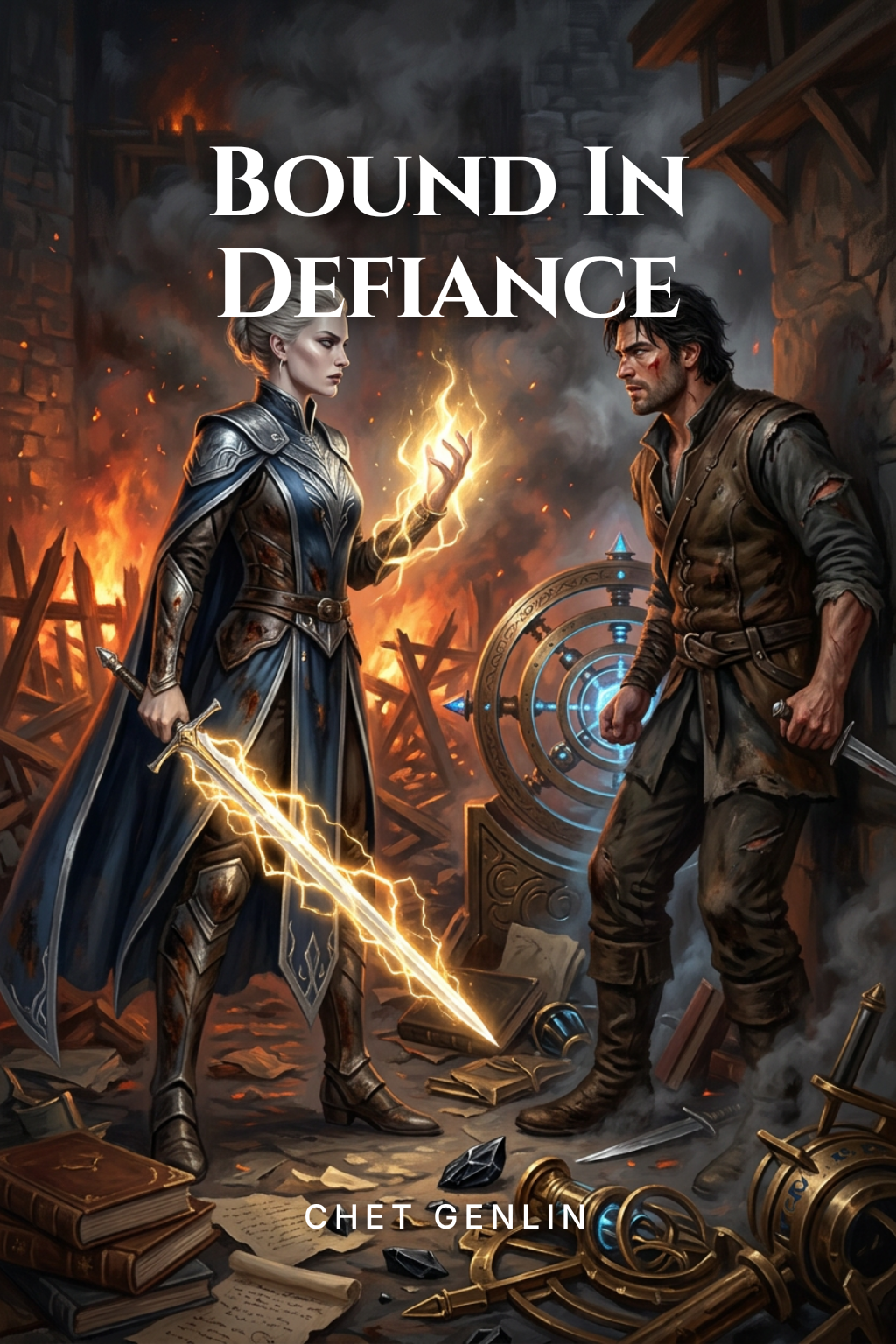
Novel · 30 chapters · 118,290 words
Bound In Defiance: A Luminant Story
Contents30 chapters
- 01The Silver Mantle at Frostgate
- 02Letters No Man Should Hold
- 03The Fortress Beneath White Pines
- 04Ash in the Workshop
- 05The Recognition
- 06Property of No Court Yet
- 07A Tether Without Law
- 08Command Voice
- 09The Smuggler’s Tongue
- 10Crossing into Glass Weather
- 11Green Fire in the Trees
- 12The Woman Who Belonged to Beasts
- 13Three Mouths, One Fire
- 14Ruins That Breathe Under Ice
- 15The Scholars in Velvet Gloves
- 16A Choice Named Justice
- 17The Lock of Light
- 18What the Bond Makes Possible
- 19The Night of No Mercy
- 20The Halberd and the Kiss
- 21The Archive of Bones
- 22There Is Always Another Secret
- 23Stormbreak Above the Wells
- 24The Silver Mantle in Ruin
- 25Heart-Warden’s Descent
- 26The Machine That Ate a Kingdom
- 27Chrysanth Against the Wild Sky
- 28When the Light Recoiled
- 29Evidence in the Snow
- 30The Wilderness Keeps One of Its Own
Chapter 1
The Silver Mantle at Frostgate
“Halt there.”
The gate-sergeant had a furred cloak darkened with old sleet at the hem and a voice grown hoarse from cold air and command. She lifted one gloved hand, and the line of pikes behind her settled by habit, ash shafts striking stone in a rough little thrum.
Lady Elara Veyne reined in before the north gate of Frostgate and did not answer at once. She let the silence hold. Let the woman at the gate take in the travel-stained escort, the sealed packet case strapped behind Elara’s saddle, the swordless hips that meant nothing to anyone who understood what stood before them.
Then Elara reached to the pommel, took up the folded silver resting there, and shook it out with one clean motion.
The mantle caught what little light the day offered. Silver cloth, short enough for riding, lined in dove-grey wool, clasped at one shoulder with the Covenant seal worked in moonstone and steel. Beneath it, stitched so fine most women needed to stand close to see it, lay her personal insignia: a narrow tower split by a descending lance of light.
The gate-sergeant’s posture changed before the mantle even touched Elara’s shoulders.
All along the archway, women straightened. A courier with a bridle in one hand stepped back hard enough to knock her bundle against the wall. Two market wives who had been muttering over a basket of hard pears fell abruptly quiet. One of them looked at Elara, then away, then back again, as if compelled.
Good.
Elara fastened the clasp with thumb and forefinger. The metal clicked, a small sound that carried.
“I am Lady Elara Veyne,” she said. “Covenant Justicar of Valedain. I ride beneath lawful mandate issued from Asterfall and countersigned in the court of Queen Meris of Rhyven. Open this gate.”
The sergeant bowed from the saddle’s height downward, not deep, but with haste enough to betray unease. “At once, Your Luminance.”
The gates began to move. Frost rasped in the iron tracks. Through the widening gap, Frostgate came in slices: steep slate roofs crusted pale on their north faces, chimneys breathing slow smoke, a watchtower with a cracked bronze bell, the dark mouth of the lower market where awnings hung stiff as boards. She smelled horse dung, tallow, river mud somewhere under stone, and the sharp resin of split pine from a cartload of timber waiting inspection.
The whisper started before she passed beneath the arch.
“Justicar.”
“Silver mantle—”
“From the Covenant itself—”
A child tried to peer around her mother’s skirts and got snatched back by the shoulder. An old man in a porter’s harness lowered his gaze to the cobbles. Three girls in apprentice aprons stared with frank alarm until their mistress cuffed one without looking.
Elara rode through it as she rode through all public reaction: untouched, apparently. In truth she marked each face, each flinch, each woman whose fear sharpened rather than eased at the sight of lawful authority. The city had been writing to magistrates, the magistrates to provincial judges, and the provincial judges, finally and with embarrassing reluctance, to Asterfall. That chain of delay had its own odor. Not merely incompetence. Evasion had a smell to it. A house shut too long. Damp paper. Breath held after a lie.
The captain assigned to receive her met the party inside the gatehouse yard. Captain Ilyet of Frostgate was broad in the jaw, square in the shoulders, and wearing a blue wool tabard stretched tight over mail. She bowed correctly, fist over heart.
“Your Luminance. We have prepared quarters in the upper garrison—”
“I require your evidence chamber, your senior magistrate, and every seizure record relating to contraband letters, workshops, caravan searches, and unexplained fires for the last eighteen months.” Elara dismounted and handed off her reins without glancing to see who took them. “My quarters may continue existing without me.”
Ilyet swallowed. “Yes, Your Luminance.”
Elara stepped into the yard. Frostgate’s stone had the ugly black sheen of northern basalt, damp in its pores and bitter under the hand. Her riding boots struck the paving in a rhythm that pulled eyes. She was tall enough that most women met her mouth before they met her brow, which was useful. It lent the first impression of flesh and judgment rather than height. Her ash-blonde hair had held its pins through two days of hard travel. Her gloves were clean. Her mantle lay flat.
A frightened official was already hurrying across the yard with ink on two fingers and a fur cap clutched to her chest. Magistrate, by the robe. Not senior enough.
“Name,” Elara said before the woman could launch into apology.
“Deputy Magistrate Sen Vale, Your Luminance.”
“Where is your superior?”
Vale’s mouth pinched. “Indisposed.”
“Dead?”
“No, Your Luminance.”
“Then she may limp, cough, retch, or bleed her way to the garrison hall.” Elara passed her. “I did not cross three hundred miles for a deputy’s anxiety.”
The garrison hall had been whitewashed within the decade and smoked dark above the rafters despite the effort. Its long tables had been pushed against the walls to clear a central space now occupied by three trestles, six lockboxes, and a pair of battered trunks banded in iron. A charcoal brazier glowed near the far end, giving off little heat and too much stink. Wax dripped from antler chandeliers onto old rush mats. Someone had tried to tidy in a hurry; dust arcs showed where boxes had recently sat elsewhere.
Elara stopped just inside the threshold and let her gaze travel.
Two city clerks rose at once. A local judge in lapis wool stood more slowly. Captain Ilyet remained at the door, watchful. Deputy Magistrate Vale hovered with the look of a woman calculating whether flight would be seen as an admission of guilt.
On the nearest trestle lay a stack of folded letters, each tied with thread and tagged in a clerk’s hand. Beside them sat a tray of personal seals—bronze, horn, river-shell, one silvered and dented—as if a group of men had been flensed of identity and catalogued. Beyond that, wrapped in oilcloth, were the remains of something metallic and blackened. Stone chips. Two shards of dark crystal.
So. Not complete fools, then. They had at least kept the pieces.
“Close the doors,” Elara said.
Captain Ilyet obeyed.
The hall changed when the latch fell. Outside noises went wool-muffled. What remained was the scrape of boots, the lick of coals, and the breathing of women who had hoped to blur themselves into the furniture until she left.
Elara removed her gloves finger by finger and laid them on the corner of the nearest trunk.
“Who has charge of this investigation?”
No one answered quickly enough.
“I asked a question.”
The judge cleared her throat. “By local law, matters of smuggling and fraud answer first to the magistracy, while any treasonous implication—”
“Name,” Elara said.
“Judge Meret Sorn.”
Elara looked at her. Sorn had clever eyes, a mouth trained for soft evasions, and a ruby ring whose stone was too fine for provincial pay. “You will answer plainly, Judge Sorn, or I will begin by assuming you have hidden as much as you have mishandled.”
Color rose under Sorn’s skin. “The matter was shared, Your Luminance.”
“Shared duties are how responsibility goes to ground. Captain?”
Ilyet’s jaw set. “The first fires were mine. Warehouse wall scorched through at the lower river quay, no lamp overturned, no pitch barrel burst. Then a caravan search turned up copied account books concealed in axle housings. Later we lost two patrolwomen in an arrest attempt at East Tanner’s Lane. After that the magistracy declared a sedition inquiry.”
“Lost,” Elara repeated. “Meaning dead.”
“Yes, Your Luminance.”
“How?”
Ilyet hesitated. Not from grief. From shame.
“That,” Elara said softly, “is the sort of hesitation I do not advise.”
“One was thrown against a kiln wall hard enough to break her spine. The other burned in a flash from some device they had rigged inside the workshop. Neither attacker was Luminant.”
The room went still. Even the clerks looked up.
Elara walked to the trestle. One of the dark crystal shards was no larger than a walnut, angular and glass-dull except where a fresh break caught the light in a buried violet gleam. She did not touch it yet.
“Neither attacker was Luminant,” she said. “And how many witnesses can swear to that?”
“Eight.” Ilyet swallowed. “Perhaps ten. The accounts vary on distance.”
“They always do.”
Elara glanced at Judge Sorn. “Why was this not in the first petition sent to Asterfall?”
Sorn drew a careful breath. “Because at first it did not seem credible.”
“You mean it was inconvenient.”
“No, Your Luminance. Only unproven.”
Elara turned fully toward her. “A magistrate who waits for convenience before naming a threat is not prudent. She is late.”
Silence again. A coal in the brazier broke with a faint hiss.
From the far side of the room came the wet, persistent cough of a woman who ought to have arrived sooner. The senior magistrate entered supported by a clerk at one elbow, wrapped in sable over a quilted robe. She was elderly, yellow around the eyes, and angry enough at her own weakness to hide it poorly.
“Magistrate Talvere,” Deputy Vale said, relief spilling through the name.
Talvere waved off assistance before she had properly cleared the threshold. “I can see the Justicar well enough without a nursemaid under my arm.”
“You kept me waiting,” Elara said.
Talvere looked at the silver mantle and bowed as much as her back permitted. “Then I have spent one of my final discourtesies badly, Your Luminance.”
It was almost insolent. Better that than simper.
“Can you still think?”
“Better than my deputy. Better than our judge. Better than most women I have buried.”
“Good.” Elara gestured to the table. “Then begin where your city began to understand this was not ordinary smuggling.”
Talvere came to the trestle and put her hand flat on the wood as if steadying herself against more than illness.
“Three wives,” she said. “Not together. Separate complaints over five months. Missing coin. Missing nights. Husbands leaving respectable work for cart-runs no one could account for. At first we heard the usual things—gambling, whores, drink. But all three women used the same word, though none knew the others had spoken it.” She looked up at Elara. “Lessons.”
The room listened hard.
“They said their husbands had become secretive and proud,” Talvere went on. “Not merely disobedient. Changed in the face. Men who used to lower their eyes began choosing when to answer. One wife said her husband had taken to tracing marks with his finger in spilled flour on the table, then rubbing them out when she entered. Another found scraps of parchment hidden in boot lining. Another said he had spoken the name of a man called Hask in his sleep.”
Orin Hask. The name had already crossed Elara’s desk in Asterfall, half a dozen times in half a dozen hands, each report vaguer than the last. Smuggling organizer. Seditionist. Heretic. Teacher. Ghost. The sort of man lesser officials built larger with every failure to catch him.
Elara said, “Describe him.”
No one answered immediately. Then Deputy Vale, eager to prove she had not been useless, reached for a tagged deposition.
“Thirty to forty years. Dark hair. Tall for a man. Speaks softly. Keeps clean hands for a laborer. Some say he worked as a clerk once, others say in river trade. He uses false names. He does not stay long in one district. Frightened witnesses call him—”
She faltered.
“Speak.”
“Persuasive. Disciplined. One woman wrote that he made even sensible men feel ashamed to be what they were.”
Captain Ilyet muttered, “That one had bruises under her sleeves.”
Elara held out her hand. Vale passed her the deposition.
The writing was provincial but legible. A wife’s statement taken by a court scribe, all proper forms observed. My husband looked at me as if I were the one kept blind. Elara read that line twice.
Shame. That was useful. Men would risk much for pride once someone taught them a new shape for it.
She set the sheet aside. “And your first seizures?”
Ilyet motioned to the lockboxes. “Caravan inspections on the eastern timber road. Nothing grand. Hidden copied alphabets at first, then sums, then merchant tallies. Lessons disguised as freight marks. They passed simple reading strips rolled into harness padding and wax-sealed inside wheel hubs.”
“A child’s trick,” Judge Sorn said, perhaps trying to recover standing. “If we had more inspectors—”
“If you had searched workshops as thoroughly as you search laundresses for unpaid salt tax, perhaps,” Talvere said without looking at her.
Elara almost smiled. Almost.
She moved to the first box. “Open it.”
A clerk fumbled the keyring and raised the lid. Inside lay slates, wax tablets scraped almost smooth from repeated use, narrow strips of parchment pricked with tiny neat symbols, and a bundle of split laths inked with columns of letters disguised as inventory marks. There were also three men’s seals wrapped separately in linen, each tagged with the owner’s name and place of arrest.
Elara lifted one strip between two fingers. Whoever had copied it had worked carefully despite poor tools. The hand lacked a trained woman’s economy, but there was persistence in it. Repetition. Hunger.
“Who taught them this script?” she asked.
“We do not know,” Vale said.
“You have prisoners.”
“Some.”
“And under questioning they learned silence?”
Ilyet’s face hardened. “They learned fear, Your Luminance. They would sooner bite through their tongues than name him.”
That caught Elara’s interest more than she let show. Men did not keep courage neatly under ordinary pressure. Not where women held law, records, property, and consequence. Something had given these men a structure strong enough to bear pain and still call itself purpose.
She set down the strip and turned to the oilcloth bundle. “This.”
The clerks exchanged glances. Captain Ilyet unwrapped it.
Inside lay the broken anatomy of a machine: a bronze ring scored black at one edge, copper braid melted into lumps, a lattice of thin worked metal unlike any common lock or kiln part, and at the center a cradle where crystal had once sat. The stone beneath the pieces had been packed separately—a slab cut from a warehouse floor, its middle fused and bubbled as if exposed to sudden fierce heat.
Elara reached out.
The shard of black crystal felt colder than the room. Not ordinary cold. It carried a stillness that seemed to continue inward, as though the stone remembered depths with no air in them. When she let a thread of Light stir beneath her skin, the crystal answered with a prickle along her palm. Not resonance. Resistance.
Her gaze sharpened.
“How many of these were recovered?”
“Only fragments,” said Ilyet. “Most crack or go to dust after use. Or so we think. We raided one cart outside the west road and the driver smashed a crystal piece under his heel before we took him.”
“Alive?”
“He is in the cells.”
“Did he know what he carried?”
“I think he knew enough to fear it.”
Elara looked down at the bubbled stone. A device no Luminant had touched, yet it had burned like channeled heat. A man had used it. Or a group of men had. That was the uglier possibility. Not a single aberration, but method.
“Where did this come from?” she asked.
Talvere tapped a cough into her fist and waited it out. “The river and the high road both. Small parts in many loads. Never enough to matter if any one cart was stopped. Frostgate saw them because Frostgate sits where roads narrow and women begin to ask why wheelwrights need scholar’s brass. But the pattern reaches south. We sent notices to three towns. Two never answered. One reported another fire.”
“How many workshops in Frostgate are compromised?”
No one liked that word. Good. It was the accurate one.
Ilyet said, “Confirmed? Four. Suspected? Ten more, perhaps twelve. Cooperages, a dye shed, one disused tannery, a carpenter’s loft above the old sheep market.”
“Caravan houses?”
“A few. Mostly those carrying machine parts, lamp oil, and books entered falsely on manifests.”
“Books.” Elara let the word flatten. “What books?”
The clerk nearest the second trunk hurried to produce an inventory board. “Ledgers, Your Luminance. Merchant manuals, arithmetic tables, one herbal, some devotional texts with scraped margins used for copying letters. Two volumes in foreign binding we could not identify because the covers had been removed.”
“Could not identify,” Elara repeated. “Because none of you can read a foreign hand?”
The clerk reddened. “Not beyond trade marks, Your Luminance.”
Of course not. They were provincial officials, not academy women. Still irritating.
Elara set the crystal down carefully. “Show me the correspondence.”
The judge herself opened the second trunk, perhaps to prove she remained useful. Inside were bundles upon bundles, tied by date and source, each bearing seizure tags. Couched letters sat among ordinary freight notices and domestic accounts like eels among river weeds. One letter spoke of wool grades while the initial marks of each line, read vertically, formed a list of meeting places. Another disguised names as quantities of nails. Another appeared to be a widow’s complaint about lamp prices until one noticed every third word had been punctured with a pin.
Elara sorted fast, eyes moving, fingers sure.
“A man did this,” she said.
Talvere gave a dry little laugh that became a cough. “So we inferred.”
“No. Not merely copied a lesson or held a message he could not compose. This hand planned concealment. Here.” She held up a folded sheet. “The substitutions are consistent across three different carriers, which means someone established common rules and taught them. Here the phrasing shifts to fit the code rather than the supposed business. That requires comfort.” She looked around the room. “Your Hask is not simply making readers. He is making administrators.”
The words struck harder than any talk of scorched stone. Even Judge Sorn blanched.
Administration. Records. Movement. Continuity. Those were women’s weapons, older and steadier than blades. A few literate men could scandalize a district. A disciplined network could rot a kingdom from beneath the floors.
Captain Ilyet said quietly, “There is more.”
She went to the far trestle and uncovered a slate on which someone had copied symbols from one of the seized letters in large strokes for the benefit of women who could not parse the original code. Beneath it lay a rough map of road lines, relay points, mills, and caravanserais marked with soot dots.
“At first we thought Frostgate was the center,” Ilyet said. “It is not. It is a knot. Goods come in from farther north and farther east. Then they split here. Some go south disguised as tool stock. Some go west in grain trains. Some vanish into the uplands.”
Elara studied the soot marks. The northern edge of the map ran ragged where knowledge failed and the old roads lifted into harsher country.
“What lies beyond your certainty?”
“Pine barrens. Mining camps. Smugglers’ cuts. Old watch forts left from border wars.” Ilyet’s mouth thinned. “Places a man can disappear if enough other men decide not to see him.”
Deputy Vale said, “One prisoner claimed Hask never sleeps twice under the same roof.”
Talvere rasped, “Men make legends when they are afraid.”
“Yes,” Elara said. “And women help them when they are embarrassed.”
She continued sorting until a single sheet stopped her hand.
Not because it was grand. It was petty-looking, folded twice, the sort of note a merchant might tuck into a tally roll. But the script inside had a peculiar discipline. Tight. Even. Self-taught, perhaps, yet relentless. The code itself was simple once seen. A list of axle repairs, each number corresponding to a district and each wood type to a class of material. At the bottom sat a sign-off that should have meant nothing.
Keep the grain dry. South roads soften before spring.
No name. No flourish.
Elara looked at the men’s seals on the tray, then back to the hand. “Which seizure yielded this?”
“A courier caught outside the east postern,” said Vale. “He swallowed part of the wax tag and broke his own finger trying to reach the hearth before the guards had him.”
“Elaborate behavior for axle repairs.”
“He died in questioning,” Judge Sorn said, too quickly.
Elara lifted her eyes.
Sorn held the look for one heartbeat, then glanced away.
“How?”
“Seizure. Blood from the nose. The physician said—”
“I did not ask what the physician said. I asked how.” Elara folded the note once and set it down with care. “Bring me the questioning record. All of it. Not the abstract.”
Sorn’s lips thinned.
There it was at last. The thing under the thing. Delay, omissions, dead prisoners, missing ledgers. Not merely a city outpaced by sedition. A city that had begun editing the shape of its own failure.
Elara walked to the center of the hall and turned slowly, taking all of them in. Captain, magistrates, judge, clerks. Women of rank enough to have stemmed this sooner, had they possessed either nerve or honesty.
“You had copied alphabets passing through your gates. Men’s seals gathered in bundles. Contraband correspondence using caravan routes across more than one jurisdiction. At least two non-Luminant devices capable of producing destructive heat. Dead patrolwomen. Dead prisoners. And you debated whether it was credible.”
No one spoke.
Elara’s pulse had not quickened. It rarely did in rooms like this. Anger sharpened her rather than heating her. She could feel the Light inside her the way one feels a hound straining at the leash: not yet needed, but listening.
“This matter,” she said, “now falls wholly under Covenant authority.”
Captain Ilyet bowed at once. The clerks followed a beat later. Judge Sorn did so last and with visible reluctance. Talvere, too ill to bend much, settled for putting her hand over her heart.
Elara let them finish.
“From this hour forward,” she said, “all records, prisoners, confiscated goods, and testimony pertaining to Orin Hask, his associates, his routes, his teachers, financiers, carriers, or devices are subject to my review and seizure. No arrest connected to this inquiry will be conducted without my knowledge. No prisoner will be questioned out of my hearing unless I permit it. No courier leaves Frostgate carrying reports of my presence except through dispatches I seal myself. If any woman in this city destroys evidence after this moment, I will charge her as an accessory to Covenant subversion and let Asterfall make an example of her.”
When she finished, the hall held very still.
Then Talvere said, voice gone rough as old bark, “About time.”
Judge Sorn sent her a look edged enough to cut cloth, but Elara had already moved back to the trestle of machine parts.
She picked up the largest crystal shard again. The black within it was not uniform. Veins moved there when the light shifted, deep blue or purple, perhaps, buried under the dark. She had seen mineral from the north before, in academy demonstrations and court inventories, but this was denser, stranger. Worked, too. One edge had been ground to sit in metal.
“Where did you say this was found?”
“In the burned warehouse at Lower Quay,” said Ilyet. “And in the tannery loft. Small fragments only.”
“No source?”
“None proven.”
Elara turned the shard in her hand. A faint roughness marked one face, not natural fracture. Incised lines. Tiny. Repeating.
Not letters she knew.
Interesting.
“Have any scholars been consulted?” she asked.
At that, something in the room gave way again. A clerk looked at the judge. The judge looked at Talvere. Talvere’s mouth became a grim little slash.
Elara did not miss it. “Answer.”
Judge Sorn said, “An inquiry was sent to the Academy annex at Grey Harrow. We received a reply that the fragments were likely decorative furnace glass or degraded trade crystal, and that provincial alarm should not outrun provincial understanding.”
“Who signed that reply?”
Sorn named a lecturer Elara had never liked.
Talvere added, “The same week, two pages from our seizure ledger vanished.”
Elara looked up sharply. “Vanished.”
“The leaves were cut out cleanly,” Talvere said. “Not torn. The clerk responsible swore she had locked the chest. Three days later her rooms burned.”
Dead clerks. Pages gone missing. Scholars who shrugged. Men reading in cellars. Devices that scorched stone.
The shape of the matter altered again, subtle as a knife sliding under ribs.
This was no longer a provincial contagion spread by one clever man teaching others to make mischief from ink and grievance. There was supply behind it. Instruction. Screening. Enough money to move parts in fragments and enough confidence to trust coded traffic across multiple roads. Someone educated was feeding the fire and hiding her hand in places respectable enough to scold magistrates for noticing smoke.
Elara set the crystal down.
“Captain Ilyet.”
“Yes, Your Luminance.”
“Double the watch on your evidence stores. Replace every woman currently posted there with women from outside the usual rotation. I want those who have no sisters in town, no husbands in transport, and no debts to merchant houses.”
“At once.”
“Deputy Vale, bring me the prisoner taken with the west-road crystal. Alone first. Then the surviving copyists. Separate cells. Separate questioning.”
Vale hurried to bow. “Yes, Your Luminance.”
“Judge Sorn, you will produce the dead courier’s full record, including the original notes you hoped not to show me.”
Sorn’s face went careful. “I hoped only to spare you irrelevancies.”
Elara’s gaze rested on her long enough to make the judge lower her own. “You have mistaken yourself for the woman who determines relevance.”
A brief, ugly satisfaction moved through the room. Even frightened women enjoy seeing pride rebuked, so long as it is someone else’s.
Talvere pressed a cloth to her mouth, then said, “And Hask?”
At the name, several women looked up as if the man himself had entered.
Elara considered the map again, the soot marks on roads leading north into bad country and blank paper. Considered the wives’ depositions. The self-taught hand. The disciplined code. The machine made to counterfeit a Luminant’s ruin.
Some men were merely criminal. Some were merely wounded and foolish. But a man who taught other men to read beneath the Covenant’s roof, who armed them with stolen forms of women’s power and vanished before the noose tightened—that sort of man was either the center or the lure. Sometimes both.
“I will find him,” Elara said.
It came without flourish. Her voice did not rise. It landed harder.
She reached to her shoulder and touched the silver mantle’s clasp, the moonstone cold beneath her fingertips.
“Have my horse resaddled within the hour,” she said. “I want the lower quay, the burned tannery loft, the clerk’s rooms, and the east postern before dusk. Tonight I will review every letter in this hall. At first light I begin arrests.”
She turned toward the door. Captain Ilyet moved at once to open it.
Before Elara crossed the threshold, a sound came from the outer corridor: boots running, then stumbling, then a woman’s breathless voice checked by the guards. Ilyet half-turned, hand already up in warning, but the door had opened enough for the messenger to be seen.
Young. Wind-burned. Mud to the knees. A courier’s satchel slashed nearly through.
“Your Luminance,” the guard began, “she came from the south road and claims—”
“Let her speak,” Elara said.
The courier dropped to one knee, chest heaving. In her fist she held a narrow strip of leather, wet-dark with blood, with a man’s seal still attached by a broken thong.
“They hit the relay house at Nine Bridges,” she said. “Three dead. Two missing. They took the record chest and burned the stable. Before she died, the mistress said to tell Frostgate one thing.” The courier swallowed. “She said the men asked whether the silver mantle had arrived yet.”
For the first time that day, fear settled over the room into its proper shape.
Elara held out her hand for the blood-slick seal. The courier gave it over.
The seal’s carved face showed a mill wheel split by a vertical line. Not a house mark Elara knew. A private device. New made.
Someone had not only expected her. Someone had prepared for her.
She closed her fingers around the seal until its edges bit her palm, and felt the Light stir, bright and patient, beneath her skin.
Chapter 2
Letters No Man Should Hold
The first trunk smelled of lampblack, wet wool, and old hands.
Elara stood over it while the key grated in the lock. The chamber below Frostgate’s garrison had been cut into bedrock generations ago, and the walls still sweated faintly where mortar had failed. Three candles guttered in iron claws along the nearest pillar. Beyond them the room dropped into pockets of dark where more trunks sat under wax seals and chain, their lids marked in chalk by women too hurried or too frightened to trust their memories.
Captain Ilyet lifted the lid and stepped back.
Inside lay folded shirts, a child’s blanket, two leather tool wraps, and beneath them a packet of papers bound in blue thread.
Not hidden well enough.
“Who inventoried this lot?” she asked.
“A search detail from Tanner’s Lane. Under Deputy Vale’s clerk.” Ilyet’s mouth tightened before she added, “The clothing was listed. The packet was not.”
“Then the clerk will explain the omission later.”
Elara drew off one glove finger by finger and laid the leather on the trunk’s edge. Her bare hand hovered over the papers for a moment, not out of reluctance but because she preferred the first touch to be deliberate. The Light stirred against her skin, a faint warmth under the bones of her wrist. She did not call it. She only let it listen.
The upper sheet was cheap rag paper, rough at the edge where it had been cut by hand. Across it, in a clumsy but persistent script, ran columns of letters. Some large, some cramped. Some reversed. The same line copied again and again until the ink thinned.
A B C D
Below that, as if in challenge:
a b c d
A boy’s work, perhaps. Or a man’s. The hand had strength in it and no schooling. On the downstrokes, he had pressed too hard. The loop of the p was blotted three times, and each time he corrected the shape with stubborn care.
Elara stared at it for a long moment.
There were sacrileges loud enough to ring bells. A priestess drunk at the altar. A magistrate taking bribes with witnesses to see. Those at least had the decency to declare themselves. This was quieter. More intimate. A man hunched over secret paper in some pantry or loft, shaping marks his mother and sisters were lawfully taught to make while he was forbidden them by the order that kept bread in his mouth and walls around his sleep. Each scratch of ink was contempt. Each corrected letter a little act of theft.
And yet.
She turned the page.
Beneath it lay another hand altogether. Precise. Slender letters tilted slightly forward, as if eager to arrive at their own conclusion. A list of words in paired columns.
axle
salt
lamp
winter
weight
Opposite each, an altered spelling. Then a third column of signs: dots, slashes, hook marks. A cipher built on lessons. Not a boy fumbling after forbidden shapes, then. A curriculum.
Ilyet watched her face, but if he found anything there, he gave no sign.
“More in the other trunks,” the captain said. “Vale said you would want the account books together and the correspondence separate, but I thought—”
“You thought correctly.”
There were six trunks in all from the first seizures, not counting the scorched materials from the quay. They set a trestle table near the driest wall. The soldiers brought up another lamp. A woman from the record office, red-eyed and careful, spread clean linen over the boards so ash and damp would not stain what had survived. Elara arranged the contents by kind: practice leaves, copied alphabets, merchant tallies, household ledgers, folded messages tucked into hems, and the more curious things hidden among them. A narrow brass ruler. Lens rings wrapped in tow. A bundle of reed pens shaved down to fit large fingers. Small privileges of a secret trade.
By the time the second trunk was opened, the chamber had grown close with tallow heat.
She found letters where men’s hands showed through despite the disguise. Her eyes stayed on that, not the practice pages. Men could not sign contracts, petition courts, or correspond lawfully in their own names. Where words appeared around them, women must have carried them, or at least covered them. In one household ledger a wife had entered butter, thread, and winter apples in a neat domestic column, then between those ordinary lines had left tiny gaps after certain figures. Hold the page at an angle and the spaces made intervals. Count the intervals against the month’s page number, and a message emerged.
Three cases. Two lamps. North road after market bell.
Elara did not smile. She did not need to.
A network that relied on husbands’ memorized scraps and tavern whispers would have broken the first time a patrolwoman put a knife against the right throat. This had endured searches, fires, arrests, and dead couriers. It moved by redundancy. One woman’s accounts confirmed another’s tax misreport. A cargo tally in a wool factor’s books matched a false lamp-oil requisition made under a miller’s widow’s seal. No page said what it was. Ten together began to.
“Bring me the burned papers from Lower Quay,” Elara said.
The red-eyed clerk fetched them from a separate chest with both hands. Most were black-edged and fused. One packet had been damped before the flames reached its center. Elara loosened it carefully with a knife tip. Between half-charred invoices she found a sheet of better quality than anything else in the room. Not fine court vellum, but expensive enough to be noticed by any woman who kept books honestly. It bore an outer account of fishhooks and dyed cord. Under that account, impressed so faintly it could only be seen when the lamp was held low, were ghost lines from the writing once above it.
She shifted the flame, read the pressure marks, and spoke each fragment aloud for the clerk to note.
“...twelve rods black glass... no, crystal. The hand changed the word. ‘Crystal.’”
The clerk scratched with her pen.
“‘...two lens housings, turned to the enclosed measure.’”
“Your Luminance,” Ilyet said quietly, “lens for what?”
“If I knew that, Captain, I would not be standing in a cellar sorting washerwomen’s lies.”
The captain bowed her head at once. “Yes, Your Luminance.”
Elara continued. “Here. ‘...do not send through Nine Bridges again. The route has become curious.’ Curious.” She touched the word. “An educated woman’s euphemism. Or one who wished to sound like one.”
She set that page aside and moved to a small packet sewn into the lining of a coal carter’s coat. The thread was still dark with where a knife had cut it open. Within lay three folded strips, all in the same compact hand, all couched like ordinary instructions for a merchant’s assistant.
Remit to the widow Fen for axle grease. Deduct the overmeasure from next quarter’s salt.
Deliver the school slates before first thaw. Broken corners acceptable.
Advise that six prayer books are delayed by river conditions.
School slates. Prayer books. Axle grease. It might have been nothing if the rest of the room did not exist.
Elara held one strip closer to the lamp. Another seal had once sat atop the fold; its pressure remained, shaved away with a careful blade. Only a crescent remained in the wax, and within it the edge of a spoke or petal.
No house would risk such traffic openly. Merchant women might overlook a husband’s cleverness if it brought profit enough. They would not risk Covenant charges for him unless someone richer stood behind the risk or someone more frightening. Frostgate’s trade families liked margins, not martyrdom.
She moved to the ledgers.
Those took longer. Numbers always did, because numbers lied best when they resembled ordinary dullness. Two grain tallies from different wards used the same uncommon abbreviation for damaged sacks. A chandlery account showed repeated purchases of rendered fat far beyond winter need. A cooper’s books noted cask repairs for shipments whose destination marks matched no licensed warehouse in the city. When she overlaid the dates, the pattern narrowed to intervals of twelve or thirteen days, then widened again to a month when roads went bad.
Discipline. Timed movement. Warehousing.
So it wasn’t a lone zealot, nor a cluster of angry men passing one primer from hand to hand until the pages came loose. Someone was supplying quantity: metal parts, crystal, paper, copied lessons, coded methods, replacements when raids struck.
Years, not months.
“Your Luminance.”
Deputy Vale had come in without her hearing him. He stood near the threshold with his shoulders pulled in, as if hoping the damp stones might swallow him if she turned too sharply. Beside him waited a woman perhaps fifty years of age, wrapped in a dark shawl gone shiny at the fold. Widow’s ribbons at her sleeve. Her knuckles were raw where she had chapped them in lye or cold.
“This is Mera Denn,” Vale said. “Her son carried wool north for the Harrow road three winters past and did not return. She asked to speak only if granted your direct protection.”
“From whom?” Elara asked.
The widow’s gaze flicked to Vale, then to Ilyet, then to the roomful of trunks. “From women who smile in market and ask too many kind questions, Your Luminance.”
Vale’s ears colored. “I did not tell her what to say.”
“I know.” Elara looked at the widow. “Come closer.”
Mera Denn obeyed, but with the reluctant steps of someone nearing a cliff edge because staying behind was worse. Elara closed the ledger before her. Pages could wait. Fear spoiled if handled too harshly, but it also soured if left to imagine too much mercy.
“Your son’s age,” she said.
“Seventeen when he left. Eighteen by spring, if he lived to see it.”
“You believe he did not.”
The widow worked her hands inside the shawl. “I believe if he had lived, he would have found some way to let his mother know. Even if only by another woman’s mouth.”
Reasonable. Elara inclined her head a fraction. “Who hired him?”
“A carrier woman named Brith Sallow first. After that, her factor. Then another. He was strong and he kept quiet.” The widow swallowed. “He was proud to be chosen for long hauls. I thought...” She stopped.
“You thought he had risen usefully above his place,” Elara said. “Many mothers do.”
The widow flinched, then nodded once.
“Did he read?”
“No, Your Luminance.” Too fast. Too frightened. “Not when he left.”
Not when he left. Elara let the lie sit between them. “What did he carry?”
“He did not tell me at first. Then one night he came home with lamp soot all over his sleeve and a nick on his hand. He said there were boxes inside boxes and some had to be turned gentle because glass sat in them. He said one cracked and the woman overseeing the load slapped a grown man hard enough to split his lip because he had let the straw shift.”
“Name.”
Mera closed her eyes. “I never knew it. She did not come herself after the first time. But once, when my son had ale enough to forget he should not boast to me, he said the drivers called her the schoolwoman behind her back.”
Elara’s fingers went still on the table.
“Why?”
“Because she spoke soft and corrected everyone.” The widow’s mouth twisted with remembered bitterness. “He thought it fine sport to imitate her. He said she treated the men like little boys and they thanked her for it.”
That got the first hint of expression from Ilyet, though she hid it quickly.
Elara asked, “Where did these loads go?”
Mera looked at Vale again, as if measuring whether he could save her from the answer. He stared stubbornly at the floor.
“North,” she whispered. “Past the last toll where the old border stone leans. Then off the trade road. Into the pine heights.”
“Specifics.”
“I do not know the exact turn. I swear it. Only that there is an old war-place there. My son called it the broken eagle once, but I do not know if that was its name or a joke.”
Vale looked up sharply. “There are three ruined holdings in that stretch.”
“Four,” Ilyet said. “If you count the watch-fort over the White Teeth ravine.”
“Eliminated years ago,” Vale said. “Collapsed.”
“Collapsed does not mean empty,” Elara said.
Silence followed that. In the corridor above, boots crossed and receded.
The widow’s voice came smaller now. “He said they reached it by lanterns shaded blue. Said no village fire could be seen from there and the snow lay strangely because of the walls. Then he stopped speaking of it. Two trips later he was gone.”
“Eloped? Pressed into service elsewhere?”
“If he had taken a wife without telling me, I would still box his ears in my prayers, but I would know.” Her chin shook once and steadied. “No, Your Luminance. A woman came to my door with a silver half-mark and told me he had found honorable work inland. She smiled too much. She wore scholar’s ink on her finger.” Mera looked straight at Elara for the first time. “I burned the coin. I should have gone to the magistrate then. I know that. But every woman on our lane had heard by then what happened to wives who spoke too freely. So I waited until your mantle came.”
There it was: not trust, exactly. Calculation pressed thin by bad timing. That, Elara could respect more than tears.
“You will remain under guard,” she said. “Not as a prisoner. As a witness.”
The widow sagged with relief so sudden it made her old. Vale started to speak, perhaps to object to the burden, but one look from Elara shut his mouth.
“Captain Ilyet, place her in chambers above the western court, away from ordinary cells. Two guards. No visitors without my order.”
“At once.”
When they had taken Mera Denn away, Elara remained by the table and looked at the wall rather than the pages. The old war-place. The schoolwoman. Blue-shaded lanterns. Boxes nested for fragile contents. Men corrected like children and grateful for it. Not rustic sedition. Administration.
She resumed her work with more speed.
In the fifth trunk she found the thing that turned suspicion into shape.
It was hidden where a less attentive search would miss it: stitched flat into the spine lining of a devotional book, the sort of pious household copy no patrolwoman liked to manhandle for fear of seeming irreverent. The book itself was legitimate. Its pages contained the customary hymns to the Seven and the duties proper to each station. Elara slit the backcloth with her knife and slid out a folded sheet the size of her palm.
Not a letter. A list of routes.
The script was tiny, disciplined, and unmistakably educated. Each line paired a harmless cargo name with a sigil and an instruction:
lamp oil — mill wheel split once — Frostgate to Nine Bridges
slates — star with open point — Nine Bridges to Cold Marker
wax — split wheel again — Cold Marker to White Pines
prayer books — no seal — hand only
glass — never through toll records
teachers’ copies — winter only
White Pines.
Not a place used in lawful freight books. Not a parish. Not a township. A field name, perhaps, or a local habit. Enough to search against border maps.
At the bottom of the page, set apart from the rest, sat three words.
for O. direct
No title. No courtesy. Whoever wrote it presumed the initial would suffice.
Orin.
The room seemed to contract around that one letter. Not by magic. By meaning. Until then Hask might still have been imagined as a useful enthusiast, one bright infection among lesser men. This page gave him dedicated routing. Goods marked for him apart from the rest. Enough status within the chain that someone economized his name to a single character.
Elara handed the sheet to the clerk without releasing it entirely.
“Copy this exactly. Every mark. If your pen slips, begin again.”
The clerk swallowed. “Yes, Your Luminance.”
Vale returned before the copy was half finished, a roll of district maps under her arm, her face gone from pallid to eager with the look of a woman who had felt her own usefulness return.
“You asked for the border surveys,” he said. “The old military drafts were harder to locate. Judge Sorn had them kept in the upper chart room.”
“Did she.”
He unrolled the first map across an empty section of table. The parchment had yellowed at the creases. Hill marks crowded the north, with old defense lines scratched in rust-red ink and fort symbols drawn where the border wars had once chewed men and horses into the ground. Elara flattened one corner with a candlestick and traced the Harrow road, then the lesser trails branching from it like frost veins.
“White Pines,” she said.
Vale frowned over the names. “There is no holding by that record.”
“Then not by that record. What stood above the White Teeth ravine?”
He scanned. “Fort Avenrow. Or what remained of it after Ardellon shelled the western face with counterweights.” He touched a tiny black square on the map. “Abandoned after the Concordance revisions. The supply road was judged too costly to maintain.”
Ilyet had drifted closer. “The local carters still call that stretch the white pines. Bark pales in the wind up there.”
Elara looked from the map to the route list. Frostgate to Nine Bridges. Nine Bridges to Cold Marker. Cold Marker to White Pines. Goods moved in stages, concealed inside legal commerce until the toll books ended, then passed by hand.
“For O. direct,” she said.
Vale nodded before he realized she had not asked him anything. “Likely Hask, yes.”
“Likely?” Elara turned her eyes on him.
He swallowed. “Hask.”
She let him feel the distinction a moment longer, then bent again over the map. There should be more. Administrators always repeated themselves. In the same trunk as the route list she found two folded strips of vellum so thin they had nearly fused with the devotional cover. One contained figures only: quantities of soot, vinegar, copper wire, polished mirrors, and something marked merely as dark stock in weights too regular to be household use. The other was worse.
Not because it was dramatic. Because it was quiet.
Please advise whether the copies at the school have improved enough to warrant promotion into figures. The previous group wasted both paper and temper. Men from river stock show better retention than hill stock. The one called O. continues to justify expense. He extrapolates without supervision and has stopped requiring softened instruction.
No signature.
Below that, a different hand had written one line.
Then move him to independent work and increase crystal allotment.
Elara read it twice, then a third time to ensure no fury had put false words under her eye.
Men from river stock. Better retention. Softened instruction.
Experimental language, but with the nursery tucked inside it. The kind of contempt only educated women managed when using men as tools and believing themselves benevolent for the elegance of it.
Ilyet had leaned just near enough to catch fragments. “Your Luminance?”
Elara passed her the sheet.
The captain’s jaw hardened as she read. “By the Seven.”
“No,” Elara said. “By women.”
That landed harder.
She gathered the documents into a fresh stack. Her motions remained exact, but speed had entered them now, a sharpened economy. The pieces fit too well not to be true. Merchant houses had been used, yes, but not as principals. Wives and widows had carried traffic, but many likely without the whole shape. At the center sat instruction, funding, and selection. Someone with access to books had been choosing men, grading them, moving the able ones north, teaching them first letters and then numbers and then machines. Hask was not the origin. He was the success.
The success had gone to ground in a ruined fort above a ravine.
She asked for the latest arrests from the outlying wards. None had yielded Hask. She asked for inventories of lens grinders, glaziers, metal turners, and any woman who had purchased unusual crystal stock over two years. The clerk’s pen raced to keep pace. She ordered Judge Sorn’s private correspondence seized until she could review it, and when Vale blanched she told him he could either assist or be listed among those who hindered a Covenant inquiry. He assisted.
One of the younger soldiers brought down a tray no one had asked for: hard cheese, oatbread, a pitcher of watered wine. Elara ignored it until Ilyet quietly set the cup near her right hand. She drank once without looking up. The wine had a nail taste from the pitcher.
Another packet from the lower quay produced a final small gift. Inside a false bottom beneath brass washers lay a wax tablet wrapped in sailcloth. The writing had been smoothed almost flat, but not quite. Under angled light fresh lines showed older ones beneath. A message erased in haste.
—storm cracked the west stair again
—take loaded mules by lower path
—no fires on upper wall after moonrise
—Your O. says the new hand from Frostgate can already copy figures
—bring more books
Not primers. Books.
No man should hold them. Some had. Many, perhaps. Enough that more were needed.
Elara set the tablet down and at last took the oatbread. It was stale at the edge. She ate half of it standing over the map, then wiped her fingers clean and began issuing orders while the crumbs were still on the linen.
“Captain Ilyet, prepare twenty mounted women. No banners. I want those who can ride broken stone at night and keep silence about where they have gone.”
“Yes, Your Luminance.”
“Not the whole garrison. If the fort has lookouts, numbers warn them sooner than steel.”
“Understood.”
“Vale, compile every old military approach to Avenrow. Not the official road only. Goat paths, drainage cuts, collapsed stairs, anything women used during the border years when they wished to be unobserved.”
He hesitated. “That will take some time.”
Elara looked at him.
“It will take less than the rest of your life,” he said quickly, and reached for more maps.
“Send for the prisoner from the west road as well. If she has not already chosen honesty, she may do so after seeing this.”
She tapped the route list with one finger.
Ilyet asked, “Do you believe Hask is there now?”
Elara refastened her glove, weighing the question. One by one the leather closed over her knuckles, concealing the bare hand that had turned men’s forbidden pages all afternoon.
“If he has any sense, no. If he has any pride, yes. Men who teach themselves one forbidden skill usually imagine they have acquired judgment along with it.”
Ilyet’s mouth twitched despite herself.
Elara gathered the most important documents into a leather case: the route list, the assessment of male copyists, the erased tablet, the ghost invoice for crystal and lens housings. Proof enough to justify blood if blood was waiting on the mountain.
As she closed the case, the clerk clearing the devotional book gave a startled sound.
Elara looked up.
“Speak.”
The woman held out the empty back cover with both hands. “There is more, Your Luminance. In the board itself.”
A sliver of parchment had been pasted between the layers of stiffened leather and only showed where the spine had split wider. Elara took the book, opened the cover, and teased the hidden strip free with the knife tip.
It contained only seven words, written in the same small hand as the route list.
If O. fails, burn school and bury crystal.
No signature. No flourish. Nothing human in it but confidence.
For a moment the chamber seemed very quiet. The candles hissed softly in their own grease. Water tapped somewhere far down inside the walls. Above them, the garrison lived on in muffled thuds and voices, ignorant for perhaps another hour of how much larger their problem had just become.
Orin Hask was not merely teaching men to read.
He had been built.
Elara folded the strip once and slid it into the case. When she looked up, every woman near the table had gone still under the force of her attention, as if they too felt the world shift one notch beneath their feet.
“Seal this room,” she said. “No one enters after us. Captain, saddle my horse.”
She set her palm on Fort Avenrow’s tiny ink square and felt the Light rise warm and bright under her skin, patient no longer.
Somewhere beyond the pine heights, a school for men was waiting to be burned.
She intended to reach it first.
Chapter 3
The Fortress Beneath White Pines
The mare’s iron shoes struck sparks from buried stone under the snow-crust, then found earth again. Elara kept her seat without effort, one gloved hand low on the reins, the other resting near the hilt that was not there until she required it. Behind her came the soft, disciplined noise of twenty riders doing exactly as ordered: no chatter, no clatter but what tack and cold made unavoidable, only the occasional snort of a horse sending pale steam sideways into the trees.
The path had once been a supply road. Time had not erased it so much as broken its back. Pines had thrust up through old paving. Frost had lifted fitted stone into ridges sharp enough to lame a careless mount. In places the mountain had sloughed half the road away, leaving a shelf no wider than a dining table above a dark drop where runoff still moved under ice. Resin scented the air, thick even in the cold. Somewhere ahead, unseen in the black timber, water clicked beneath a skin of winter.
Captain Ilyet rode up along Elara’s left stirrup when the road widened enough to permit it. Her breath smoked from the gap in her scarf. “Vale’s map was right. The old drainage cut should split from this turn.”
The pines opened a little. The slope ahead rose in a long white shoulder. Nothing about it invited habitation. That was precisely why it had.
“Send Kareth and Nime to find the cut,” she said. “No lanterns. If they lose the line, they come back. I will not spend women down a ravine because some dead engineer preferred symmetry.”
Ilyet gave the order in a low voice. Two riders peeled away and vanished among the trunks with the eerie quickness of women who had spent years on bad country.
Elara let the quiet settle again. She had the leather case strapped behind her saddle, wrapped now in waxed cloth against the wet. The documents within seemed to have acquired weight during the climb. Bring more books. Burn school and bury crystal. It was one thing to examine treason on a table beneath candles. It was another to feel its architecture built into a mountain road, to see where goods had moved and fires had been hidden and horses had worn ruts into stone over many seasons without being stopped.
A man had done this. Or several. That much the evidence said. But men did not teach themselves logistics like this by accident, or metalwork, or silence.
Ahead, a soft birdnote came from the trees. One answer returned from farther upslope.
Ilyet listened. “Found it.”
The drainage cut was less a path than a wound in the hillside, half choked by years of fallen needles and broken shale. The horses disliked it. More than one flattened her ears and sidled when the column turned into the dark channel. Elara let hers choose her footing. Branches brushed her shoulders. Once a loaded pine limb dumped a sleeve of powdery snow across her thigh. It melted at once through the wool and left a crawling cold on her skin.
They climbed by the hidden way for perhaps half an hour. The mountain changed under them. The pines thinned. Wind found the cut and moved through it with a dry, flute-thin sound. Then Kareth, who had taken the lead, raised a fist.
Everyone stopped.
Elara slid from the saddle before the mare had finished blowing out her breath. The last stretch she took on foot, boots finding old stone steps beneath drift and needles. She came up under a broken parapet and saw Fort Avenrow.
The fortress sat across the ravine on a shelf of rock, more ruin than fort at first glance. One corner tower had split and dropped half its height in a tumble of ancient blocks. Snow had gathered in roofless chambers. White pines massed around the outer walls so densely that their boughs veiled the lower courses in drooping skirts. The main gate faced south over what had once been the military road, now a switchback of rubble and drifts. To an untrained eye it might have looked abandoned.
Then she saw the repairs.
Fresh timbers dark with sap had been fitted behind the old gate leaves. New stone chinking showed pale where slits had been narrowed and reworked. Canvas had been stretched under parts of the collapsed tower to make windbreaks. She counted three watchfires banked low enough to hide from the valley but not from this angle. A line of smoke leaked from somewhere deep in the keep and was carried flat under the branches before it could rise.
Not abandoned. Busy.
Ilyet came beside her and crouched. “That is no school.”
“No.”
A glimmer moved at one of the wall slits. Glass, perhaps. Or polished metal.
Elara studied the gatehouse, then the wall to the east where the foundation sat directly on the ravine edge. The old builders had trusted the drop to serve as defense. Time had eaten mortar there. One long crack descended through the courses like a dark seam. Useful, perhaps. But not first.
“How many?” Ilyet asked.
Elara counted windows made strange by shadow, places where men would place bodies if they had discipline and a little fear. “Enough to make noise.”
“And after the noise?”
“After the noise, we learn whether Hask is proud.”
She straightened. Around her the women waited in absolute silence, horses below among the trees, bridles muffled with wraps of cloth. Their faces were pale blurs under helms and hoods. None asked whether they were to go forward. That was already answered by the mountain itself.
Elara unfastened the folded silver mantle from where it had lain protected beneath her cloak. Even in this light it caught what little there was and gave it back colder. The Covenant seal lay worked at the shoulder in bright thread, untouched by weather or use. She settled it over black wool, drew the clasp shut at her throat, and felt the old shift within herself as one role gave way to another. No one's woman. No one's daughter. More than merely Luminant.
Justicar.
Ilyet watched her with the expression women often wore at that moment: steadier for having seen the ritual done correctly.
“Elms and Jorah with me,” Elara said. “You will divide the riders into three files. One at the south road below the gate. One in the pines east of the wall. One held back here to cut off any flight north if they break from the rear ruins. No horns. If they surrender at once, no killing except in answer to resistance. If they do not, the gate is mine. Once it opens, you drive through whatever remains.”
“Yes, Your Luminance.”
“Kareth brings the mantle lantern.”
The woman produced the shuttered lantern from her saddlebag and handed it over. Elara did not need the light for herself. The office required visibility.
They descended by the hidden cut and circled downslope under the shelter of the trees. The horses were left tied in a dry wash among boulders, wrapped against noise, with two women to hold them. The rest went on foot. Snow took their steps. The fort grew larger with each careful advance until stone loomed through pine trunks and the gatehouse roof blackened the sky above them.
The south approach had once been open ground. Brush and saplings had reclaimed parts of it, but not all. Whoever occupied Avenrow had cleared narrow lanes through the growth to command sightlines for archers. Tidy channels cut waist-high through dead fern and snowberry, each opening a murder angle. Competent work. More than competent. Someone had thought in fields of fire, not merely in walls.
She stepped clear of the last trees.
A watchfire on the wall went dark at once, kicked apart or smothered.
There you are.
Elara lifted the mantle lantern and opened its shutter. White light flashed across the silver clasp at her throat and the Covenant seal on her shoulder. Her voice carried clean against stone.
“Fort Avenrow. Hear lawful notice. I am Lady Elara Veyne, Covenant Justicar of Valedain, operating beneath authority of Asterfall and warrant recognized by the Crown of Rhyven. The persons within are accused of sedition, murder, theft of protected materials, instruction of forbidden letters to men, unlawful transport of hostile devices, and conspiracy crossing kingdom lines.”
Nothing moved in answer. The pines listened. Somewhere high above, a horse stamped inside the walls.
Elara went on, precise as a blade.
“Open the gate. Lay down weapons. Present Orin Hask and all records in your possession. This offer of surrender will not be repeated.”
For three breaths there was only wind moving in the branches over the wall.
Then something clicked inside the gatehouse. Not a bow. Not the strain of a windlass either. A hard mechanical catch, followed by a whining note that climbed in pitch until it made the back teeth ache.
“Elara—” Ilyet snapped from the trees.
The slit above the gate spat white heat.
Elara flared her shield on reflex. Light burst around her in a curved instant pane no thicker than water, and the blast struck it with a sound like a forge dumped into a pond. Steam exploded outward. The heat punched through wool and kissed her cheek hard enough to sting. Behind the shield the world turned gold and furious.
So. That is what the crystal does when married to pressure and a narrow throat.
The shield burst into sparks as arrows hissed from both flanking slits. One skipped off the stone by her boot, another thudded into the pine behind her, and a third struck the lantern, tearing it from her hand.
Elara did not flinch. She let the ruined lantern fall steaming into the snow.
“Answer received,” she said.
Then she reached for the Light.
It rose through her as it always did, swift and intimate, a river finding channels worn by use. Gold lived under her skin. The air around her sharpened. In her right hand the Sunblade came into being with a tearing brilliance: silver steel shaped like a long cavalry saber, elegant in the curve, the fuller alive with hair-thin veins of radiant lightning that crawled and snapped from guard to point. Heat kissed her face. Snow at her boots began to sink.
The women behind her moved, the pines filling suddenly with the low rush of disciplined bodies. One rank broke east as ordered. Another pressed toward the road. Archers on the wall loosed again, then ducked behind cover where the Justicar had given them a target a heartbeat before.
Elara gave them none now.
She drove forward up the center approach as if arrows had no more right to stop her than rain. Two struck her shield and burned to ash on contact. One found her upper arm and punched through wool before the Light sealed flesh around the iron with a wet hiss. Pain came bright and exact; the healing answered brighter. She did not bother to break stride.
The gatehouse slit whined again.
This time she saw the rhythm. Some device within had to charge or compress between discharges. Crude, yes. But not stupid. The first beam had been too focused for chance. Lens housing, she thought. Crystal energized by stored heat, released through a narrowed aperture. A difficult working of destruction imitated with metal throats and things men should never have touched.
The second blast came lower, seeking her legs. Elara angled the shield and let it glance off in a fan of white glare that scorched a black groove through snow and old roadstone to her right. The smell was vile: hot mineral, pine sap bursting in bark, singed wool.
“Crossbow team, left slit!” Ilyet shouted.
Bolts hammered the wall. One woman screamed when an answering shaft took her in the neck. The sound cut off quickly. Another swore and kept moving.
Elara reached the gate.
Up close, the old timber was banded with fresh iron and studded on the inside with new braces. They had expected force. Perhaps not hers.
She set her palm against the right leaf and pushed with Light instead of muscle.
The impact slammed into the gate like a giant’s shoulder. Wood boomed. Iron shrieked. Frost sifted down from the arch overhead. The leaf jumped inward half a handspan and held.
Strong.
Inside the wall passage, machinery clanked to life. Men shouted to one another now—actual voices, rough with fear, smoke, and command. Something heavy rolled overhead. Defenders crossing the murder loft.
Elara stepped back one pace, drew the Sunblade across her own palm, and let blood slick the silver. The blade flashed brighter, lightning cracking along its spine in jagged gold.
“Down,” she said.
The women nearest the road dropped flat.
Elara cut upward.
Her Sunblade passed through the gate as if through wet cloth. Iron straps split in a cascade of sparks. The old oak behind them opened from threshold to lintel. She reversed the stroke and cut again, lower, carving a broad X through timber and whatever braces lurked unseen within. The smell that burst out was resin, smoke, old rot, and fresh sap all at once.
Arrows rattled from above. One glanced off her shoulder. Another hit the shield and flamed apart.
The whining note behind the slit built for a third shot.
Elara changed her aim.
She turned and thrust the blade directly into the stone seam beside the gatehouse where ancient mortar had gone friable. The silver edge sank with obscene ease. Golden lightning leaped from the fuller into the wall. For one suspended instant the masonry held its shape around impossible force.
Then the gatehouse face came apart.
Not all of it. Enough.
Stone blocks blew outward in a ragged spray. Splintered timber from the interior stairs burst after them. A section of murder gallery floor tilted and dropped through its own supports, taking two screaming shapes with it. White heat discharged sideways from whatever device had been charging within, scything through smoke and shattered wood to gouge a molten stripe across the yard behind.
Elara was already moving through the ruin.
She drove her shoulder into the split gate leaf. The wrecked timber folded inward with a roar and collapsed across the threshold in blazing fragments. Smoke rolled out, thick with pitch and dust. Through it she saw the entry passage, half blocked by fallen beams, and beyond that the inner yard crowded with hasty barricades, stacked crates, and men.
For one heartbeat they all stared at her.
Some wore leather aprons over winter coats, as if torn from benches and forges moments before. One had soot to both wrists. Another clutched not a sword but a hammer. A few had proper weapons and the faces of those prepared to use them. Not soldiers, not exactly. Something more dangerous in its way: men who had been taught that they were participating in necessity.
Elara lifted the mantle edge clear of her arm so there could be no mistake about who had breached them.
“By Covenant law,” she said into their terror, “you are already too late.”
Then the first bolt flew from within the smoke, and behind her Ilyet’s women came through the broken gate at a run.
The yard erupted.
Steel struck steel. Horses screamed somewhere deeper in the fort. A man at the left barricade cranked a handle on a squat brass-framed instrument mounted between sandbags. Crystal set at its mouth flashed red-white. The thing belched a cone of heat broad as a cart, not clean like a Luminant’s destructive beam but ragged, coughing sparks and superheated grit.
It hit three of Elara’s soldiers before they could clear the threshold.
One threw herself behind the fallen gate and lived, cloak smoking. Another took the edge across her legs and went down thrashing, leather greaves blackening. The third vanished in steam and screaming. The smell of burned flesh slammed through the yard.
Elara crossed the distance in a blur.
The gunner—no, not gunner, she thought with cold contempt, no such word belonged here—wrenched the instrument to track her. Too slow. She flung a burst of force from her free hand. The Light struck him in the chest and folded him backward over the wall, his spine bending with a sound she felt in her teeth. The device fired wild into the sky. Branches overhanging the wall exploded into sparks and falling needles.
Another man lunged at her with a pike whose head had been wrapped in wire around a black crystal shard. Ingenious. Suicidal.
Her blade sheared the pike in two. The crackling edge went on through his coat and ribs. He dropped before she finished the cut.
To her right, Ilyet led six women over a toppled cart toward the stables, where archers had taken post in the loft. One climbed the ladder under fire as calm as if mounting a watch platform and disappeared into the dark above. A body pitched out a moment later and hit the packed snow hard enough to bounce.
Elara advanced through smoke and splintered barrels, killing where she must and driving back where killing wasted time. The men gave ground toward the keep doors and the workshop sheds along the inner wall. That told her where the heart of the place lay. Not the old command chambers. The workrooms.
A hiss rose behind her. Instinct turned her.
On the wall walk above the shattered gatehouse, two figures in heavy gloves wrestled some jointed frame onto the parapet. Copper tubing, lens rings, a crystal core caged in iron. Larger than the others. Deliberately aimed.
“Down!” Elara shouted.
Even as the women scattered, the machine discharged.
Not heat this time. Force.
Invisible pressure struck the yard and made itself known only by consequence. Snow sheeted away from stone. Barrels cartwheeled. One of the barricades exploded outward as though kicked by a giant. Two of Elara’s soldiers were hurled off their feet and slammed into the stable wall hard enough to crack planks. Elara herself slid three paces, boots furrowing ice, shield flaring silver-gold around her body as the pressure wave broke against it in concentric bursts.
A difficult pushing working. Crude. Broad. Wasteful. But real enough to kill.
So that was the question answered from the enemy side. They did not merely copy letters. They copied miracles badly and at scale, which was often enough.
The machine on the parapet needed time to build another charge. Its crystal glowed from within, veins of angry orange spreading through the black like embers under glass. The handlers bent over cranks and valves, frantic.
Elara pointed with the Sunblade. “Wall!”
Three crossbowwomen obeyed at once. Their bolts hissed upward. One handler pitched backward out of sight. The other ducked. Not enough.
Elara drew deeply on the Light. Heat gathered in her chest, in her arm, in the blade itself until the silver went nearly white.
She cast destruction.
A concentrated beam leaped from the sword-tip and struck the parapet machine square in its crystal cage. For an instant the whole assembly became transparent, every ring and pin and support wire outlined in blinding gold. Then it came apart from the center outward. Crystal burst into burning shards. Copper tubing whipped free like severed veins. The surviving handler vanished in the blast. Stone around the mount blackened and sloughed away.
The expenditure rang through Elara’s nerves. Her pool was not bottomless. Nothing about tonight permitted waste.
She forced her breathing steady and turned back to the yard.
Resistance was breaking by degrees. The sort of men who could convince themselves they were heroes in a hidden school often proved less enchanted by dying in one. Some still fought hard. Near the keep, a knot had formed around a woman shouting orders at the defenders, a dark scholar’s gown flung over riding leathers, her hair coming down from its pins. Not a man then. So be it.
The schoolwoman.
She had a pistol-length device in either hand—no, not pistol, there was no proper language for these bastard tools—and fired alternating bursts of narrow heat from behind the shelter of an overturned wagon. One of Ilyet’s women tried to close and took a line of white fire across the cuirass that threw her backward smoking. The scholar retreated step by step toward the workshop doors without losing command of the yard.
Elara began cutting toward her.
Two men barred the way with salvaged legion shields. They knew enough to brace them edge to edge and force her to commit. She struck once high, making them catch the blow. Their shields held for a heartbeat, then the Sunblade passed through bronze rim and oak core alike. Both men cried out and fell away clutching ruined arms.
The scholar saw Elara coming and changed expression. Fear, yes, but under it calculation so hard and swift that it almost earned respect. She fired both devices together. The crossing beams met Elara’s shield and spread across it in a shrieking wash of white. The impact drove her back half a pace.
Useful imitation. Inferior heart.
Elara dropped the shield, ducked under the fading wash, and seized the woman with Light.
Not physically. The invisible pull caught cloth, limbs, resistance, and dragged her bodily across the yard over churned snow and shattered crockery until she struck the stones at Elara’s feet with the wind knocked from her. One of the heat devices skidded away, still hissing.
The woman looked up through loose hair, face flecked with soot. Older than Elara had expected. Fine-boned. Ink stain at the side of one finger. The sort of hands that turned pages more often than locks.
“Your name,” Elara said.
The woman spat blood on the snow.
“Elara!” Ilyet’s warning cracked across the yard.
Elara saw the keep door open behind the smoke.
Men were pouring into the covered passage beyond, not fleeing but carrying crates, armloads of ledgers, bundles wrapped in oilskin. Burning party. Destroy the records. One figure in the middle of them, broad-shouldered, dark-haired, moving with infuriating calm where others stumbled. He took one look at the yard, at the gate smashed inward, at the scholar on her knees before the Justicar, and then he barked an order that changed the motion of everyone around him.
Not panic. Procedure.
Orin Hask, Elara thought.
At the same moment, from somewhere deeper inside the fortress, a bell began to ring. Not an alarm bell of old military shape. Smaller. Quicker. Workshop metal struck in frantic succession. Fire answerers, signalers, burners. The note jumped from stone to stone and filled the fort like a pulse.
The scholar on the ground smiled through blood.
Elara’s grip on the Sunblade tightened.
Beyond the keep doors, men were already carrying flame.
Chapter 4
Ash in the Workshop
Elara left the scholar on her knees in the snow with Kareth’s blade at her throat and drove for the keep.
The smaller bell still hammered somewhere inside, quick iron strikes with no dignity to them, a workman’s alarm. Men were carrying flame through the covered passage. Ugly flashes broke between shoulders and crate-slats: bundled kindling, rags drinking lamp oil, a ledger already burning at one corner, curling black as it went. If they reached the records rooms before she did, half the purpose of the raid would turn to smoke over the ravine.
“Take her living,” Elara said without looking back.
Then she ran.
Boots slipped on blood-thinned snow. A wounded defender lunged from behind an upended cart with a smith’s hammer rather than a soldier’s blade. He swung two-handed, wild and desperate. Elara caught the haft under her left forearm shield, took the jolt to the bone, and drove her Sunblade through his chest. The silver edge passed through quilted wool, ribs, spine. His face changed around surprise before he dropped away from it. The hammer fell ringing against stone.
She crossed the yard through smoke and cinders. To her right, one of Ilyet’s riders wrestled a man in a leather apron and took a knife under the arm for the trouble. To the left, the broken gatehouse groaned, one half hanging inward by splintered ironwork. Everywhere lay the signs of improvisation becoming war: coiled wire, shattered crystal housings, slings of polished copper, a child’s slate broken under a dead boot. Not rebels playing at danger. An operation. A school. A workshop that had mistaken itself for a citadel.
At the keep threshold the air changed. Outside there had been snow, pitch smoke, the wet penny smell of opened bodies. Inside came furnace heat, lamp oil, scorched vellum, and the metallic tang of worked filings ground underfoot. The passage roof trapped it all low and mean. Fire had already found one stack of records. Sheets loosened from binding thread and lifted in the draft like pale birds, their edges red and eating inward.
Two men ahead struggled with a chest between them. Not fighters. Their shoulders were wrong for it, more used to benches than shields. One turned at the sound of her approach and simply stared, mouth opening around a warning he never finished. Elara put out her hand and flung Light.
The force struck them center-mass and hurled both backward into the stone wall. The chest burst on impact. Sheets flew. A tin box sprang open, spilling brass dies and carved seals across the floor in a hard clatter. One of the men tried to rise through the papers. She stepped over him and severed the muscles of his arm when he reached for a dropped knife.
“Water line,” someone shouted farther in. “Workshop two first—”
“Burn the copies.”
“Move, move—”
The words ran ahead of her through the smoke, threaded by that infernal bell. Elara lengthened her stride.
A side room opened on her left. Benches and racks, a clerk’s chamber turned to crime. On the nearest table lay practice sheets covered in painstaking male hands, alphabets copied until ink had bitten through the page. Beside them sat a shallow tray of crystal offcuts wrapped in wool, each shard black as frozen pitch until the light touched it and something dark red moved far inside. A woman in a stained oversmock snatched up an armload of pages and threw them into a brazier when she saw Elara. Her jaw was set. She did not plead.
Elara cut the brazier in half.
Coals burst over the floor. The woman reached for a poker. Elara took her in the throat with the hilt and sent her sprawling over a stool. Another accomplice tried to escape through the back hatch with a bundle under her apron; Elara caught the door with Light and slammed it shut on the woman’s hand. Bone cracked. The bundle dropped, spilling carefully wrapped rods of lens glass.
“On your face,” Elara said.
The woman bared her teeth through tears. “Go feed your order to—”
Elara struck her across the mouth with an open hand and moved on.
She did not have time to harvest every room. Fire bit too fast. Behind her boots, pages blackened and drew tight into themselves. Somewhere deeper, a machine gave a high insect shriek and then a pop like a bursting bone. The fortress was eating its own secrets.
The corridor widened into an old refectory stripped of tables and remade as a receiving hall. Crates lined the walls, marked in tar with merchant sigils too reputable to be here: flour sheaves, salt marks, lamp houses. All lies. One smashed open under a fallen body revealed nested copper collars packed in sawdust around black crystal plugs. Another held stitched satchels of filings, charcoal, thin silver wire, and lens blanks wrapped in old sermon cloth. At the room’s far end, men had thrown together a barricade from doors unseated from hinges, ale casks, and a dismantled bedframe.
They fired at her before she reached it.
Not arrows. Heat.
A narrow white line snapped from a gap between casks and hissed past her cheek close enough to sting the skin. Another hit her raised shield and spread in a fan of blinding sparks. The shield held for a heartbeat, then thinned. She felt the drain in her chest, the familiar measured pull of power spent and counted.
Three operators, she judged by the rhythm. Crude housings. Slow to cool between discharges.
She kicked a dropped trestle on its side and slid behind it as a third beam stitched the wall where her head had been, scorching mortar to powder. The trestle smoked. Heat sank through the wood. Men behind the barricade yelled over one another, not with a line’s discipline but with the sharp panic of artisans ordered to murder.
“Elara!” Ilyet’s voice, distant and muffled behind stone. Still below. Not here yet.
Good.
Elara knelt, pressed two fingers to the floor, and let herself feel the room the way only a Luminant could: not through sight but through resistance, pull, weight. The barricade was a clutter of separate things pretending to be one object. The casks were fullest on the right. The bedframe braced the center. The left side had been built fast and badly.
She rose and thrust her hand.
The shove of Light hit the weak side first. Doors skidded, one riding up over another. A cask rolled free and struck a defender in the shins. The whole barrier canted. She was already moving when the first voices broke into alarm. Her Sunblade carved down through the exposed gap, through oak stave and the forearm behind it, then back up across the crystal housing of a heat emitter. The black lens split. White radiance flashed out through the crack. The operator screamed once as the thing melted in his grip.
A second man tried to club her with the butt of his device. She shoulder-checked him into the wall and put the point of her blade under his jaw. The third fled toward an inner stair with his machine hugged to his chest like a child. She sent a concentrated pull at his ankles. He flew backward, struck the stone edge hard, and lay still while the device skittered away sputtering.
The barricade sagged into pieces.
Past it lay the engine rooms.
That was what she named them in the instant before she had time to think. No forge, though braziers glowed. No common workshop, though benches lined the room. These chambers had the ugly discipline of experiment. Copper pipes climbed walls where monastic banners had once hung. Water wheels no bigger than cart rims spun in iron cages, fed by belts turned from some shaft deeper in the keep. Lens arms pivoted over tables. Racks of fitted parts hung in ordered progression from rough casting to polished finish. On one bench a half-built device stood braced in clamps: a crystal core nested inside rings of etched metal, each ring set at a different angle, as if the whole thing meant to trap and force some current no hand should command.
Dead men lay among the benches with burn tools still clipped at their belts.
One had both hands clenched around a pair of tongs. Another had gone down over a sheet of measurements pinned by dividers. A woman with her scalp half-seared away still knelt where she had fallen beside a bucket line, one palm welded to the handle of a lamp she had meant to hurl. There were soldiers in the yard. Here there were craftsmen, copyists, instructors, and women who had chosen treason and armed it.
Elara’s lip curled.
You were taught better, she thought at the dead woman and the room around her. All of you were.
Movement above. A catwalk crossed the chamber, where a line of men dragged a rolling rack of ledgers toward another door. One turned the crank of a release wheel. A hopper tipped. Molten solder and burning sand spilled in a shining curtain across the stair Elara meant to take.
She flared her shield. Liquid fire struck gold and slid away in bright sheets to the floor. The smell came at once, harsh and mineral. Her teeth ground together with the effort. Too much in too short a span. Her pool was recovering, but slowly, as all pools did.
“Throw her down!” someone shouted from above.
A crate came over the rail. Elara cut it out of the air. Splinters burst around her. Lens disks shattered underfoot with a sound like ice under horseshoes.
She needed the upper passage, but not the stair.
To her left, a vertical drive shaft ran behind a grille, its turning chain clacking over toothed wheels. Inspection ladders had been bolted beside it after the keep’s first life as a military post. Narrow. Foolish. Adequate.
She dismissed the shield before it drained further and leaped for the ladder.
A hand seized the grille from the other side and thrust a knife through. Elara twisted against iron rungs. The blade scored her sleeve, bit her upper arm. Pain flashed hot. Her own Light answered before the blood had fully welled, knitting torn flesh with that familiar deep sting beneath the skin. She caught the attacker’s wrist through the bars and drove her Sunblade through the grille. The man convulsed once and was gone from it.
Up.
Heat gathered under the roof. Smoke braided itself thickest near the beams, making every breath taste of glue and coal. By the time she hauled herself onto the catwalk, the men with the rolling rack had abandoned pretense of salvage and were simply throwing ledgers into a furnace room beyond. She reached the nearest and cut him behind the knee. He folded with a cry. Another swung a hooked prybar. She met it with the hardened steel phase of her Sunblade and turned his strike aside hard enough to break fingers.
He looked down at his own hand as if betrayal had begun there.
“Where is Hask?” Elara asked.
He spat soot. “Below your dead, where you put him.”
She struck him flat across the temple and moved on.
The furnace room had once been a chapel, if the proportions of it meant anything. The apse was gone behind brick and pipe. Bell-metal bowls glowed on iron stands, fed by charcoal mounds and air from hand-cranked bellows. Ledgers were burning in one basin already, swelling and collapsing in black leaves. A novice’s painted saint looked down through soot from the one surviving patch of old wall, her face blistered by heat.
Elara swept the room with Light.
Loose pages, stools, bellows handles, and one half-burned account chest all flew clear of the furnaces and crashed against the far wall. A woman by the nearest basin lost her footing and went sprawling. Elara seized a hooked rod from the floor and dragged a stack of ledgers out of the flames, slapping at them with her glove until embers died. The outer pages were gone. The inner gatherings might still speak.
A door slammed somewhere past the furnace room.
Then a voice, lower than the others, carrying because it did not strain.
“No more burning. Out through the east loft. Take what you can carry and leave the rest.”
She knew at once who it was.
The certainty of it sharpened her.
Elara left the rescued books where they steamed and crossed into the next chamber. A long room, stone-vaulted, with worktables fixed to the floor and windows slitted high in the outer wall. Three had been broken open for draft; snow smoke pushed in around the heat and turned the air white. Here the finer mechanisms had been made. Lathes. Crystal-cutting stands. Screw plates. Trays of tiny rivets, sorted by gauge. Half a dozen lamp globes hung above the benches, some shattered, some swinging. Sparks drizzled from a cracked drive belt overhead.
At the room’s center stood the wreck of something larger than the devices in the yard and more deliberate.
Its frame had been built on a heavy oak base fitted with caster blocks. Four curved arms of dull metal arched inward around a suspended core the size of a man’s skull. Black crystal, but not raw. Faceted. Caged in thin bright wires and seated inside nested rings chased with marks Elara did not know. Not academy notation. Not any lawful engineer’s mark she had studied. One arm had been half torn away as if dismantling had begun in haste. Another still hummed faintly. Heat shimmered over the crystal, though no visible flame touched it.
Beside the machine stood Orin Hask.
He had no scholar’s gown, no revolutionary’s theatrical rags. Thick dark hair was tied back carelessly, though loose strands had escaped anyway. His shirt sleeves were rolled above strong forearms smudged with soot and metal dust, and he was broad in the shoulder, yes, but not brutish. His hands told more truth than the rest of him. Square-palmed, scarred at the fingertips, ink worked stubbornly into the side of the middle finger and the heel below the thumb. Not soft hands, not noble hands. Ledger-trained as the reports had said, then ruined into a craftsman’s. There was a cut over one cheekbone crusted dark. Another streak of soot lay across his face from temple to jaw, stark enough to look deliberate.
War paint, if a clerk had painted himself for judgment.
A dagger hung at his belt. He did not draw it.
Two men flanked him, one with a short pike, the other white-knuckled around a heat emitter. Both looked ready to bolt. Hask did not. He watched her come through smoke and sparks with a steadiness so composed that, for one brief instant, she understood why other men had followed him.
Understanding did not soften anything.
“Elara Veyne,” he said.
Not Your Luminance. Not Lady Justicar. Her name, spoken as if he had already weighed it.
She stopped six paces away. Her blade lit the room silver-white. “Orin Hask. In the mantled authority of the Covenant, I place you under seizure for sedition, conspiracy against the Sevenfold Order, forbidden instruction of men, unlawful possession of scholarly materials, murder under cover of treason, and the construction of devices intended to imitate or resist Luminance.”
His gaze flicked once to the Sunblade, then back to her face. “You missed arson. There seems to be some of that.”
One of the flanking men made a strangled sound, half laugh and half panic. Elara did not spare him a glance.
“You speak flippantly in a room built on filth,” she said. “Men dead in your passages. Patrolwomen dead in Frostgate. Couriers cut down to hide your letters. Wives used as covers, homes turned to depots, merchant seals counterfeited, lawful records stolen and burned. You made a school of criminality and armed it.”
“And you came to answer with slaughter.” His voice remained low. That calm angered her more than shouting would have. “How many in the yard, Justicar? How many in the gatehouse? Did you count before or after you set your law over them?”
“They resisted a lawful surrender.”
“They lived in a country where lawful means a woman in a silver mantle may tear through stone and call it mercy.”
The man with the emitter took a backward step. The pike-bearer looked between them like a servant caught in a storm he had not meant to witness. Elara’s eyes stayed on Hask.
“You taught men letters they are forbidden to hold.”
“I taught people to read words used to rule them.”
“You built weapons against women born to guard civilization.”
“I built weapons because women born to guard civilization were burning houses and calling it order.”
“Patrolwomen died because of your work.”
“Men died in Tanner’s Lane because they refused to betray the only thing that had ever belonged to them.” He tipped his head toward the room behind her. “And those you killed getting here were not all soldiers, whatever title you pin on their bodies afterward.”
“No.” Her mouth thinned. “Some were women who knew the law and chose treachery anyway. I reserve little pity for them.”
Something shifted in his face then. Not fear. Not surprise. A hard recognition, as if she had confirmed some private expectation he had hoped would never be confirmed.
“That,” he said, “I believe.”
The heat emitter’s operator gathered courage from Hask’s stillness and raised the device.
Elara moved before he fired.
A flick of Light caught his wrist and snapped it aside. The beam lanced into the ceiling, showering sparks. In the same motion she drove the point of her Sunblade through the housing. Black crystal shrieked as it cracked. The man dropped the weapon and clutched ruined fingers to his chest, stumbling back against a bench. The pike-bearer made one desperate thrust; Hask said, sharply, “No.”
Too late. Elara batted the pike off line and struck the shaft in two. The splintered butt spun away. She planted a kick in the man’s sternum and sent him sprawling over a crate of brass fittings.
Now it was just the two of them, with the broken machine between.
Smoke threaded the space and made a veil of everything. Through it Hask remained maddeningly composed, one hand near but not on his dagger. He looked at the fallen men first, not himself. Then his gaze went to the machine. Not with an inventor’s vanity, but with calculation, and grief lodged at the root.
“Are you going to fight?” Elara asked. “Flee? Beg? Choose one and spare me theater.”
His mouth twitched, though not with amusement. “You think this is theater?”
“I think men who teach other men to scrawl behind stable walls and then arm them with stolen principles deserve less ceremony than I have already granted.”
“You know they were principles, then.” His eyes cut toward the machine. “Not tricks. Not random scavenging.”
“I know enough to recognize a crime against order when I see it.”
“That is not what I asked.”
She took one step nearer. The machine’s black core reflected her blade in warped silver lines. “Who instructed you?”
He said nothing.
“Who funded you?”
Silence again.
“Which academy house supplied the crystal?”
His gaze sharpened at that, small and involuntary. There. Not enough, but something.
Elara pressed. “You did not cut and seat that crystal alone. You did not forge these rings in a tannery loft. You had help from educated women, and you know their names.”
“And if I do?” he said. “What then? You drag them to Asterfall in chains while men hang for learning the alphabet?”
“If they stand beneath Covenant law, yes.”
He gave a short exhale through his nose. Not laughter. Weariness worn sharp. “Then you still do not see the room you are standing in.”
She wanted to cut through his composure like rotten cloth. Instead she held still. A Justicar could gain more from silence than from threat when silence was placed with skill.
Beyond the broken windows, someone screamed in the yard and was cut off. Fire snapped in the beams overhead. A belt slipped on some unseen wheel and began to slap arrhythmically against wood. One of the fallen lamp globes burst from heat stress with a crystal ping.
Hask’s eyes returned to her face and stayed there.
Up close, now that the first clash had passed, he looked older than the arrest sketches suggested. Thirty-six perhaps, maybe a little more in the set around the mouth. Thought had marked him. So had poor sleep. There was nothing wild in him. That rankled. Zealotry would have been easier. She had prepared herself for the fervor of a provincial fanatic, some fever-eyed man drunk on forbidden letters and his own courage.
This was worse.
“You came quickly,” he said.
“I came as the law required.”
“No. You came quickly because somebody warned us too late.”
“An admission?”
“A question.” His fingers brushed the side of the machine, not tenderly, but as one checks whether a wound still bleeds. “Did Frostgate show you enough to understand what this is?”
Elara did not answer.
He looked at the black crystal core. “No. Of course not. They would have sent the broken scraps, the easy lies, the dead wives and frightened carriers. Enough to justify a mantle and a cavalry ride. Not enough to ask why black crystal turns the Light oddly. Not enough to ask why women taught us designs no lawful school ever would.”
There it was again. Women. Not imagined benefactors. Not a boast. A fact placed between them like a knife.
Elara’s pulse shifted.
“Names,” she said.
His eyes came back to hers. “Would you hear them?”
“Yes.”
“Would you believe them?”
“If they are true.”
“And if truth requires more than your Covenant can stomach?”
The insolence of it should have drawn immediate punishment. It would have from any other mouth. Yet there was something in the way he asked it—not pleading, not provoking merely for the sake of it, but measuring whether her mind could bear a shape outside its frame—that made her angrier than open defiance.
“You mistake yourself if you think this interrogation occurs on your terms.”
“And you mistake yourself,” he said softly, “if you think what happens next belongs to law.”
For the first time since she entered the room, his composure slipped.
Not much. A breath catching oddly. His jaw tightening. His eyes losing focus for the space of a blink before finding her again with abrupt force, as if they had been dragged back. He straightened, then seemed to realize he had done it and stilled by conscious effort. One hand went to the edge of the bench beside him hard enough that his knuckles paled under soot.
Elara saw it at once. Injury? Smoke in the lungs? A hidden weapon misfired?
“Hask.”
He did not answer. He was staring at her now with a look she had never once seen directed at herself, though she had seen its aftermath in testimony, in songs, in the wreckage of men remade by it. There was shock in it, yes, and horror, and something deeper that arrived too swiftly to be either chosen or feigned.
No.
The thought struck her cold before reason could permit it.
Impossible timing. Impossible man. In the middle of blood and burning timber.
His free hand rose half an inch from his side, then clenched into a fist as if he had caught it reaching without permission. The muscles in his throat worked. For an absurd instant she thought he might be sick.
“Hask,” she said again, more sharply. “What is this?”
He gave a tiny, strangled laugh that held no humor at all.
“Cruel,” he said, though whether to her, to himself, or to some absent god of mockery she could not tell.
The room seemed to narrow around them. The smoke. The silver blade-light. The ruined machine humming faintly between one heartbeat and the next. Even the men on the floor had gone very still, with the animal caution of the wounded.
Elara knew the signs. So did every educated woman in Avarra. Not from frequency, but from the weight culture laid upon the rare event. The involuntary attention. The pain of resistance beginning in the same instant as desire for nearness. The terrible, impossible recognition on the man’s face as if one glance had reached into his ribs and altered the architecture there.
She had watched one noble heir sob at a spring festival when a visiting magistrate rode away after he had spoken to her only twice. She had once taken sworn evidence from a cooper’s son who crawled three streets on a shattered ankle because the village Luminant had been injured and he could not bear not to reach her. Imprinting made fools and saints and dead men. It was sacred. It was pitiless. It was not supposed to happen to criminals in smoking workrooms while a Justicar still had blood warm on her hands from killing their followers.
Orin Hask shut his eyes for the briefest moment, as if darkness might undo seeing her.
When he opened them, devotion had not gentled him. It only made the conflict on his face unbearable to look at. Fury still lived there. Contempt. Grief. Under all of it, deeper than consent and sickening in its purity, a pull toward her so absolute that Elara felt it like another form of heat.
“No,” he said.
The word came out low and wrecked.
Then, because the world had not yet finished making mockery of order, he looked straight at the woman sent to destroy him and whispered, “Your Luminance.”
From the corridor behind her came the crash of fresh boots and Captain Ilyet shouting for the upper rooms.
Elara did not turn.
She stood with her Sunblade lit between them while Orin Hask gripped the bench hard enough to shake and looked at her as if his life had just been taken from him whole.
Chapter 5
The Recognition
“Stand where you are,” Elara said.
It was a foolish command. He was not coming toward her. He was standing perfectly still.
Captain Ilyet’s women poured into the corridor behind her with steel out and faces blackened by soot. Boots rang on stone. Someone coughed hard enough to retch. A wounded man on the floor gave a soft animal moan when a rider’s heel clipped his leg.
Ilyet took in the room in a glance: the dead guards, the split frame of the machine, Hask upright by the bench with his hand white-knuckled against the wood, and Elara with her Sunblade still burning in her grip.
“My lady?”
“No one touches him.”
Ilyet checked herself at once. It was not obedience alone that halted the room. It was the tone. Women who served Justicars learned to hear when the matter before them had shifted shape.
Orin Hask laughed again, breathless and wrong. “How ceremonial.”
“Silence.” Elara did not look away from him. “Captain, secure the chamber. The wounded are to be separated and searched. Every scrap of written matter is to be gathered. Nothing burns. Nothing leaves this room unless I order it.”
“Yes, my lady.”
The women moved. One kicked a dagger from beneath a dead guard’s hand. Another hauled a groaning defender off the floor by his collar. The air tasted of hot brass and pitch. Beneath it all lay the sweeter, fouler note of opened bodies. A belt of tools had spilled near one of the benches—calipers, a fine-toothed saw, a row of tiny screw-keys no village smith would have made for common hinges. One of the nested rings in the broken device ticked as it cooled.
Orin’s gaze kept returning to Elara as if it had been chained there and was tearing flesh each time he tried to wrench it aside.
She had seen men look hungry. Frightened. Reverent. Desirous. Ashamed. This was none of those by itself. Imprinting was not simple adoration. It was recognition sharpened into injury. The body knew first. The soul followed, or failed to, and bled for it.
He swallowed. His throat worked once, hard. Then he said, to the stones near her boots rather than to her face, “If you tell them what this is, I will deny it.”
“You will not control what I say in my own seizure chamber.”
His mouth tightened. “Then do not make a spectacle of me.”
The request was so raw that Ilyet glanced up despite herself.
Elara could have spoken the truth aloud then. She could have named it, fixed it in witness, made every woman in the room bow her head to the old terrible sanctity of it. Instead she extinguished her Sunblade with a snap of thought, and the silver fire vanished from her hand, leaving only torchlight, furnace-glow from the corridor below, and the red pulse of banked coals in the machine’s broken belly.
“Captain,” she said, “clear the room. Leave two women at the door.”
Ilyet hesitated. “My lady, he is not secured.”
“He is injured, outnumbered, and surrounded by your steel. Clear it.”
That edge in her voice cut the question short. Ilyet saluted fist to breast and began driving her women out with curt gestures. The wounded were dragged, carried, or propped to stumbling feet. One rider stooped to scoop loose papers from beneath a fallen stool. Another gave Orin a long, wary look, trying to understand what had passed in the room and failing.
When the last of them had gone, the chamber expanded again around the two of them. The only sounds were the faint hiss of cooling metal, the murmur of activity in the corridor, and Orin’s breathing, too measured to be natural.
Elara set her gloves on the near worktable one finger at a time. They were smeared dark to the wrist.
“You understand what has occurred.”
His eyes shut for an instant. “Of course I understand.”
“Then govern yourself.”
He opened them. “That is a remarkable instruction from the woman who just killed her way through my house.”
A beat passed.
“You chose armed resistance to Covenant seizure.”
“And you chose to answer copybooks and lenses with a massacre.”
“Do not insult me by pretending your people died clutching nursery slates.” Her voice stayed level. “My riders were burned alive in your yard. Two women at Tanner’s Lane were butchered to preserve your secrecy. At Nine Bridges three more died for a record chest. Men built those devices. Men set those ambushes. Men took their chances against the Covenant and received the lawful consequence.”
He flinched. Not from the words. From her anger. The new bond—or the first miserable stirrings of it—ran through him like a hidden hook. He braced his palm harder on the bench until the wood creaked.
He noticed her seeing it and bared his teeth, not quite a smile. “There. Are you pleased? I can feel you disapprove already.”
The contempt in him was real. So was the pain. Elara hated that both things could exist together inside the same look and that she, more than any woman present, was equipped to read it.
“Imprinting does not absolve you.”
“I had not imagined it would.”
“It changes your condition. Nothing more.”
Something flickered across his face at that. Hurt, swift and absurdly intimate. It angered her further. He had no right to look wounded because she had not immediately softened toward him. He had less than no right when his hands had built treason in hidden rooms.
He drew one steadying breath. “Do not lie to me, Justicar. You know what it changes.”
Her spine went very straight.
No man should have said that to her in that tone, calm and sure and too close to equal. No man should have been educated enough to shape the point so cleanly. Yet there it was between them: not only the sacrament, but the blasphemy that he was himself.
“You are in no position,” she said, “to instruct me on the meaning of tradition.”
“I know enough.” His eyes found her and held. It cost him. The price showed. “Enough to know that if I had fallen to my knees and begged, every woman in this fortress would have nodded as though the sky had simply behaved as intended. Enough to know that your law calls this sacred when it is useful and pathetic when it is inconvenient.”
Her fingers curled once against her bare palm.
“Mind your mouth.”
“Why? Because I can read, or because I have looked at you once too clearly?”
He was shaking now, very slightly. From exhaustion, from the after-flood of battle, from the violence being done inside him by a thing he had not asked for. He despised her. She was almost sure of it. He had watched her carve open everything he had built. He stood in a room full of ash that had been his work. And still something older than his politics had turned toward her and would not turn back.
The offense of it struck deep. Not merely personal. Liturgical.
Elara had been taught all her life that Imprinting was one of the few moments in this hard-built order that proved the Covenant touched something beyond law. Men could be assigned, bought, married, disciplined, protected. They could be ruled by statute and custom, yes. But Imprinting came from no magistrate’s hand. It arrived where it wished and humbled rank, theory, preference. Girls in academies were taught to bow their heads at the old stories. Women who never meant to take a Warden still spoke of the event with a kind of awe.
And now it had come here. To this man. To her.
The room felt indecent.
“Hask,” she said, very precise, “you will answer my questions.”
He gave a faint, incredulous shake of the head. “And if I refuse?”
“Then I continue the ordinary process for sedition and murder.”
“You were going to do that anyway.”
“Yes.”
Something in him admired that answer. She caught it, and wished she had not.
He dragged his hand from the bench as if the wood had become hot under it. The motion left a smear of soot and blood where his palm had rested. “Then ask.”
“Did you build this machine alone?”
His eyes went to the broken crystal core. For the first time since she entered the room, his expression changed from wariness and pain into something closer to grief.
“No.”
“Names.”
He laughed once through his nose. “You think I know them.”
“You worked from supplied designs.”
“Yes.”
“From what source?”
He looked at her then, and there was no use in pretending he had not measured the room, the open doorway, the guards outside, the dead beneath the benches. He knew words were his only way through it.
“I was taught in pieces,” he said. “Never a whole chain. A ledger left where a boy clever enough to steal time might find it. A second book months later, in a different hand. Notes hidden in cargo invoices. Corrections made in margins by women who never signed their names. Then meetings.”
“Where?”
“Wherever they wished. A dye warehouse once. A shuttered shrine outside Dunbarrow. Two coaching inns whose keepers asked no questions as long as coin changed hands.”
“You expect me to believe educated women entrusted forbidden knowledge to a provincial clerk’s son by leaving books in his path like crumbs?”
“No.” His mouth hardened. “I expect you to understand cultivation when you see it.”
The word landed.
Elara said nothing.
He took that silence and went on, lower now. “They watched first. To see whether I would keep my mouth shut. Whether I would hide pages instead of showing them to my mother. Whether I would teach another boy for the joy of hearing him pronounce a thing no man was supposed to own. By the time I met one of them face to face, she knew more about me than I knew about myself.”
“What woman?”
“I never had her true name.”
“Describe her.”
“A scholar’s hands. Ink in the thumb crease. Forty, perhaps a little more. She wore mourning blue without house marks and changed attendants too often for any of them to be hers. Soft voice. Very patient.” He gave a bitter little smile. “The sort of woman men are expected to underestimate and regret.”
Elara filed each detail away. Mourning blue. No house marks. Ink-stain. Controlled movement. A woman used to institutions, then, not merely conspiracy.
“What did she call herself?”
“Maris. Once. On another occasion Teren. I doubt either belonged to her.”
“And she provided crystal.”
“She provided access. Others handled transport.”
He was answering too quickly now, not out of eagerness, but because proximity to her was pressing on him like a fever. She could almost chart it: the moments his eyes drifted to the line of her mouth before he jerked them away; the way his shoulders tightened when she took a step; the furious effort required to keep his hands still at his sides rather than reach.
Elara moved one pace closer on purpose.
He caught his breath. Just once. Enough.
“Why?” she asked.
His stare sharpened, wounded pride flashing through the involuntary pull. “You know why.”
“I want your answer.”
“Because men can pass unnoticed where women of rank cannot. Because husbands and sons can move freight under household seals if their wives think the goods dull enough. Because if a man dies in a burned loft, the realm shrugs and says he was foolish. Because there are things in old workings that answer more readily to hands that do not carry the Light.”
Elara went still. “What things?”
“That machine, for one. Not as it stands. This was our attempt, and a poor one. The original pattern was older than any of us knew what to do with.”
She glanced at the ruined core. Up close the crystal was not wholly black. Veins of dark blue lived inside it, almost hidden until the angle changed. The brass collars set around its base were etched with tiny marks unlike freight tallies, unlike prayer script, unlike academy notation. She had noticed them before the battle swallowed thought, but only as anomaly.
“Where did the pattern originate?”
He hesitated.
The hesitation was not simple reluctance. It had the texture of deciding which danger to feed first.
“Hask.”
“I know what happens if I hand you names,” he said.
“Justice.”
He looked at her with undisguised loathing. “That is one word for it.”
Then, as if some private line had snapped, he strode—not away, but sideways, restless, needing distance from the place where she stood. One of the door guards shifted with alarm. Elara lifted two fingers without turning; the guard held.
Orin stopped beside the shattered machine and put his hand on one of the nested rings. The metal was still hot enough that the skin at his fingertips reddened. He did not seem to notice.
“You want the larger truth?” he said. “Fine. I did not invent any of this. I learned to copy fragments. We all did. The crystal housings, the pressure channels, the focusing sleeves—reconstructions from older parts pulled out of places no map names plainly. They told me the work was buried, half-lost, abandoned because women grew superstitious after the Concordance and called anything they did not control forbidden.”
Elara’s expression did not change, but something cold and exact opened in her chest.
“They,” she said. “How many?”
“I never saw more than three together. But more existed. Money came too steadily for a handful of rogue tutors. Tools arrived wrapped in merchant cloth from cities whose counting houses should never have touched contraband. And always the route north.”
“To Avenrow.”
“Avenrow was one station.” He rubbed his thumb over a scored line in the ring. It left a track through soot. “The materials that mattered came farther on. Through Nine Bridges when the watch was lazy, then Cold Marker, then beyond the legal freight roads. By the time they reached me the invoices named lamp oil, buckles, salt fish, axle grease. Inside were crystal billets, old metal, pages cut from books no common archive was meant to hold.”
“From where?”
His jaw worked.
“Elara.”
The use of her name was very quiet. It should have felt like insolence. Instead it struck with a different force because it emerged not from triumph or seduction, but from strain. He heard himself say it, she thought, almost at the same instant she heard it. His face altered; not shame exactly, but a new awareness of boundary crossed and made impossible to uncross.
“Address me properly,” she said.
His mouth curved, exhausted and ugly. “Your Luminance, then. If I tell you where the route ends, you stop being merely the woman who broke my work. You become a threat to women with deeper rooms than mine.”
“I already am.”
“Yes.” He laughed softly, this time with something close to disbelief. “I begin to understand that.”
He lowered his hand from the ring and met her eyes with the steadiness of a man choosing where to put the knife. “The shipments came from the frontier holdings near the Glassward.”
Even with discipline hammered into her since girlhood, Elara felt the jolt.
The Glassward was not a single wood or lake country one might mark cleanly in red on a charter map. It was a wound of territory in the far north-east where settled roads thinned, weather misbehaved, and old stone rose from frozen ground with no kingdom eager to claim the expense of taming it. Traders skirted it. Pilgrims told lies about it. Scholars coveted it in private and published caution in public.
“You are certain.”
“I saw freight marks twice before they were scraped. Not house marks. Survey marks. Black-pine sigils cut with a chisel too fine for common teamsters. Once there was a note meant for someone above me mentioning ‘the glass weather line.’ Another named a staging point where excavated lengths were to be crated before thaw.” He drew a breath, slower now, as though speech itself relieved some pressure. “I asked too many questions after that. They stopped letting me see originals.”
“Excavated lengths of what?”
“No idea. Tubes, I thought at first. Conduits. Whatever they were, they matched sockets in older frames.” His eyes went again to the machine carcass. “This chamber is children’s mimicry beside the pieces I was shown.”
Elara crossed to the device.
The floor was slick in one place where coolant or meltwater had spilled from a burst channel. A bench had collapsed on one side, pinning a tray of fitted lenses under one leg. The shattered core stood waist-high in its cradle, fractured along three clean planes. At its base a small compartment had sprung half-open when the ring assembly buckled.
She crouched.
Under the bent lip of brass lay three narrow rods wrapped in oilskin, a packet of folded notes blackened at one corner, and a lump of rough crystal the size of a dove’s egg. Not polished. Not shaped. Raw.
She picked up the crystal first.
It was colder than the room. Not merely cool to the touch, but wrong-cold, as if it had rested in deep shade while all else stood by the furnace. Blue glimmered in its interior, and within the blue a suspended milk-white thread twisted like smoke caught in ice.
Elara had seen its like only once before, in a mineral cabinet at the Valedain Academy where restricted specimens were kept for upper lecture. The professor had lifted the lock herself. No girl under sixteen was allowed near it.
“Nightglass,” she said.
Orin frowned. “Your name for it, perhaps. We used none.”
She ignored that. “It is found almost nowhere south of the eastern reaches. Small deposits, degraded and brittle. The stable seams are in Glassward stone.”
He watched her with that cursed doubled gaze—attention and ache, admiration and resistance twined so tightly they could not be teased apart. “Then I have not lied.”
“I did not say you had.”
“No. You only sound disappointed when I speak truth.”
She set the crystal down on the bench with more care than she had intended. Then she unfolded the packet of notes.
Most of the outer sheet had scorched to lace. What remained showed columns in a woman’s compact hand. Measurements. Weight tolerances. Delivery intervals keyed to moon phases and freeze depth. One line had survived near the middle:
If O. fails, burn school and bury crystal. Transfer recovered lengths beyond the green line before spring break.
Elara read it twice. The ink had browned where heat kissed it, but the hand was firm and practiced. Educated. Unhurried.
Beyond the green line.
Not a merchant’s phrase.
She slid free one of the rods from its oilskin. It was not a rod at all but a worked strip of dark metal, light for its size, with repeating marks cut so shallow the eye nearly lost them. Not letters she knew. Not any household cipher used for accounts. The edge where it had broken from a larger piece was fused smooth, as if severed by terrible heat.
Orin said, “There were more. We broke some trying to fit them. Others never answered at all.”
“Answered,” Elara repeated.
“To current. Pressure. Heat. I do not know what word satisfies you.” Bitterness roughened his voice. “To the same force your kind claim solely as birthright, if that comforts your theology better.”
Her head turned toward him.
She saw his shoulders tighten, bracing for the blow before it fell, and knew he'd heard his own insolence the moment it left him. But the blow did not come. Not because she was merciful. Because the thing he had said was too dangerous to waste under anger.
“Explain.”
He opened his hand helplessly toward the wreck around them. “These machines do not use the Light as a Luminant does. Not precisely. But they touch something in the same direction. Enough to throw heat. Enough to shove. Enough to resist. You felt that downstairs.”
“I felt crude imitation.”
“Yes,” he said, and his eyes flashed. “Crude because we were fed fragments and lies. Crude because the women above us wanted results, not understanding. Crude because every failure belonged to men disposable enough to hide in ruins.”
The last word struck stone in the room.
Above us.
Men.
Women.
There it was at the center of it. Not a simple sedition, not merely clever husbands taught to scratch forbidden letters in coal behind their wives’ backs. A cultivated network. Luminant scholarship gone to ground. Ancient material hauled from the edge of the Glassward and placed into male hands precisely because those hands could be discarded if the work soured.
Elara stood very slowly.
Outside the chamber someone shouted for stretchers. Down below, timber gave way with a heavy inward thud and sent a faint tremor through the floor.
Orin watched her rise. The effort it took him not to step closer was almost visible, like a rope drawn taut from his ribs to her hand though no such rope existed. Sweat had dried grey at his temple beneath ash. There was blood on his sleeve that was not all his own.
“You will take me there,” she said.
His face closed. “No.”
The refusal came clean and immediate.
Elara did not raise her voice. “You are in no position to bargain.”
“I am in exactly one.” He swallowed against whatever the nearness of her did to him and held his ground. “I know the route. I know the men and women on the chain well enough to read where they lied. If you put me in an ordinary court before we move, they will vanish everything. If you drag me south in irons for a public trial, they will be done and gone before your magistrates finish reciting forms.”
“You assume I require your advice on urgency.”
“I assume you prefer living conspirators to elegant paperwork.”
She ought to have struck him for that. Ilyet would have, or most magistrates. Instead Elara found herself looking at the soot-scored bench, the raw nightglass, the burned instruction, the marks no academy should have dismissed as decorative debris.
Somewhere between Frostgate and this mountain ruin, officials had lied to her face. Somewhere deeper north, women with education and resources had mined old secrets from the edge of the world and armed men with them. And here stood Orin Hask, architect of sedition, murderer by conspiracy, impossible imprinting fool, the only living mouth in the room that could point cleanly toward the next door.
She hated the shape of the necessity.
“You will be transported under Covenant authority,” she said. “Shackled. Guarded. Questioned at every stage.”
He smiled without warmth. “There is the Justicar I expected.”
“If you attempt flight, I will cripple you before I permit escape.”
“I believe you.”
“If you lie, I will know.”
“Will you?”
That landed close enough to challenge that the old instinct rose in her—to break it, to remind him what rank meant. Yet beneath it she heard something else. Not mockery. Not only that. A test. Whether she could bear contradiction without reaching first for force.
Her jaw tightened.
“You presume much for a man in seizure.”
“And you,” he said, very softly, “presume this changes nothing because saying it helps you breathe.”
The room held still around that.
Elara stepped to him before either of them had fully decided she would. Nearer now, she could smell smoke tangled in wool, iron from blood, the bitter resin of the oil he had burned in his machinery. His pupils widened. His breath stalled. Every part of him went alert to her the way a struck string wakes to a hand hovering above it.
She should have been repulsed by the evidence of it. Instead the knowledge landed lower, more dangerous. Here was the revolutionary who had defied courts, hidden teachers, built weapons against women—and his body answered her existence with helpless fidelity.
Sacrament and insult. Again.
“Hask,” she said.
His gaze dropped to her mouth. She caught that too.
“When I decide what this changes,” she said, “you will learn it from me. Until then you will remember that you remain my prisoner before you are anything else.”
His throat moved. “And if the order of those things does not hold?”
“It will hold because I say it will.”
For a heartbeat he closed his eyes as if the words had touched him physically. When they opened again the hatred was still there. So was something worse.
“Then chain me properly, Your Luminance,” he said. “Before I forget which part of me you mean to keep.”
At the doorway, one of the guards shifted at the sound of his voice, but neither of them turned.
Elara held his gaze one moment longer, then took the scorched note and the raw crystal in her hand and called for Captain Ilyet.
Boots answered at once.
When Ilyet appeared, soot-streaked and tense, Elara did not soften her expression before speaking.
“The prisoner comes with us,” she said. “Double irons. Separate escort. This chamber is sealed under Covenant mark, and every fragment of machine or script goes into inventory under my hand alone.”
Ilyet’s eyes flicked, just once, from Elara to Hask and back. She was too disciplined to ask the question aloud.
“My lady,” she said.
Elara placed the nightglass crystal into her captain’s palm. Even through soot and blood the thing gave off that deep unnatural chill. Ilyet’s eyes sharpened at once.
“There is more north,” Elara said. “Far more. Ready the riders.”
Behind her, Orin Hask made no sound. But she could feel him there as clearly as heat from a furnace door left cracked in winter, impossible to ignore and dangerous to stand too near.
When Ilyet left, the guards came in with irons.
Orin did not resist when they took his wrists.
He resisted in every other way. In the set of his mouth. In the level look he kept on Elara while steel closed over him. In the terrible unwilling pull that made his shackled hands tremble once, only once, when she stepped aside to let them lead him past.
And when he passed her, the back of his bound hand brushed the edge of her sleeve by accident—or by some treason in the body neither of them had commanded.
He went rigid as if burned.
So did she.
Chapter 6
Property of No Court Yet
“Count again.”
The dead lay in two rows on the packed snow of the inner yard, boots lined toward the wall as if order could still be imposed upon what had happened inside the keep. Blood had frozen black in the seams between the stones. A broken cart shaft leaned against the well curb. Somewhere deeper in the fort, wet timber still hissed.
Captain Ilyet did not look offended by the command. She only crouched, slipped the cover from one face, and counted again, a finger pressed to each stiffened sleeve. “Nine of ours,” she said. “Seventeen theirs in the yard and passages. More in the workshop rooms if the smoke has not taken them beyond naming.”
“Elara.”
The correction came out before she chose gentler phrasing. Ilyet rose at once.
“My lady.”
Elara stood with one glove stripped off and a tally slate balanced against her wrist. Ink had gone thick in the well of the traveling horn because of the cold; she kept having to warm the quill between finger and thumb. Around her the yard moved in hard, efficient currents. Women dragged benches out of the receiving hall to make a treatment station. Two riders carried bundled ledgers under oilcloth toward the commandeered command room. A scholar captive sat in the snow with her wrists tied behind her, blinking ash from her lashes and trying not to look at the dead men nearest her boots.
At the gate arch, Orin Hask was being secured to an iron staple set into the masonry. Double manacles at the wrists. A separate chain at the ankles, short enough to spoil a run, long enough to let him walk under pressure. He had blood on one temple, soot along his jaw, and that same intolerable stillness she had noticed in the chamber above—not surrender, but the rigid control of a man holding himself together by choice.
He felt her eyes on him.
His head turned. Even from across the yard, the change crossed his face, slight and complete. Breath shallow. Mouth tightening against something he did not wish witnessed. One of the younger riders fastening the ankle chain glanced between them, then away so quickly that shame pinked her ears.
Of course they saw it.
Imprinting was not invisible to those who knew the signs. It lived in the angle of a man’s body when his Luminant entered a space, in the involuntary attention that made every other sound seem farther away to him than her footstep. And now half a raiding party had watched the architect of sedition say Your Luminance in a voice that had nothing to do with courtesy.
Elara signed the slate and handed it to Ilyet.
“The wounded rebels first,” she said. “I want the ones who can still answer questions separated from the women scholars. No one speaks to Hask without me present.”
“Yes, my lady.”
“And post older riders on his chain.”
Ilyet’s eyes flicked once toward the gate arch. “You think he will try to turn them?”
“I think curiosity is a vice in the very young.”
That almost earned a smile. It did not, because the yard was still full of bodies.
A clerk from Frostgate’s magistracy detail, one of the pale practical women sent north with the evidence trunks, picked her way across the stones with two inventory books clasped against her chest. Soot had smeared one cheek. “Your Luminance. We have cleared the west room enough for record work. There are three crates of papers not yet sorted, and the brass pieces from the upper machine are laid out on blankets as you ordered.”
“Elara Veyne’s hand alone on every page that concerns the machine fragments,” Elara said. “If anything is copied, I witness it.”
“Yes, Your Luminance.”
The clerk hesitated. Not over the order. Over the gate arch.
Elara let the silence sharpen until the woman had to choose whether to speak or retreat.
“At Frostgate,” the clerk said carefully, “there was some expectation the principal offender might be transferred south under immediate court seal, before… before irregularities invited dispute.”
“Is that what the magistrates taught you to call inconvenient facts?”
The woman dropped her gaze. “No, Your Luminance.”
“Then write what happened, not what comforts them. The principal offender remains under Covenant seizure because he possesses route knowledge, ciphers, and identifications tied to an active trans-kingdom conspiracy. That is the legal fact. If any magistrate wishes to challenge my custody, she may write to Asterfall.”
The clerk bowed with more haste than grace and left.
Ilyet exhaled through her nose once, very quietly. “It will be all over Frostgate before dusk tomorrow.”
“It is already all over this yard.”
Elara turned and crossed toward the gate arch before her own temper could show more than she intended. Snow rasped under her boots. Smoke and quenched metal tainted the air. A pair of riders hauling out a smashed heat emitter flattened themselves to the wall to let her pass; both kept their eyes dutifully on the machine in their hands.
Orin watched her approach as if looking away might cost him something. He had braced one shoulder against the stone behind him, though the chain gave him little room for comfort. His wrists were reddening beneath the iron. She did not ask whether it hurt. Pain, at the moment, was useful.
“The chamber above has been searched,” she said. “There is more to answer for than I first named.”
“There usually is.”
His voice stayed low. Deliberate. Each word shaped too cleanly for a man who ought never to have been given them.
Elara held up a folded strip of paper taken from the hidden compartment beneath the machine’s base. “You will read this.”
He looked at the paper, not at her hand. “Unchain me and I shall be honored.”
“You misunderstand your position.”
“I do not think I do.”
The insolence was almost mild. That made it worse.
She unfolded the strip herself. The script was compact and slanted, couched in merchant abbreviations and code marks she recognized only in part. There were cargo measures disguised as devotional tallies, dates masked as saints’ observances, and three repeated sigils in the margins: a hooked line, an inked square, a crescent scored through with two cuts.
“You will interpret it aloud,” she said.
His mouth shifted. Not a smile. Something barer and less safe. “You can ask.”
“Hask.”
His eyes met hers. There it was again, that impossible double strain within him—defiance held against devotion so hard it had begun to glow with heat of its own.
“Ask me, Your Luminance.”
The title landed between them like a struck thing. One of the older riders on guard looked steadily into the courtyard as if she had gone deaf.
Elara kept her face still. “Interpret the record.”
He took one breath too carefully. “The left column is excavation tonnage. Not freight. Stone and spoil removed. The right is recovered lengths—metal conduits, maybe, if the same usage holds. The square means breakage. The hooked line means the road was not lawful road at all but frozen river travel. The crossed crescent…” He stopped.
“What.”
“It is a boundary mark.”
“Whose boundary.”
“Not a kingdom’s.”
She stepped closer. “Do not toy with me.”
“I am not.” His shackled hands tightened once. Iron clicked against iron. “It is an old survey sign. Older than the Covenant. My teachers used it whenever materials passed beyond settled maps.”
“Into the Glassward.”
“Yes.”
Behind them someone shouted for more bandages. A horse stamped in the lower yard. The world went on with indecent normalcy while Elara looked at the man she had meant to drag south in chains and understood, with rising dislike, how expensive he had become.
“How many such records can you interpret quickly?”
“All of them quicker than your clerks.”
“Because you made them.”
“Because I can read them.”
There. Plainly. Almost lazily. A crime uttered with no more shame than a woman might admit to knowing her own hand.
Elara refolded the strip. “You seem to mistake usefulness for leverage.”
“And you seem to mistake custody for comprehension.”
Before she knew she meant to do it, she caught his jaw in her bare hand and drove his head back against the stone. Not hard enough to crack bone. Hard enough that the iron staple rang.
The guard riders stiffened. Nobody moved.
Orin’s breath tore once through his teeth. Not fear. Something worse than that. His eyes closed for the briefest instant, and in that instant she felt—what? A low violent answer through the air between them, not pain alone but a shuddering pull in him that her touch had lit against his will.
When his eyes opened again, he was paler.
“You will not provoke me in order to make sense of yourself,” she said.
His pulse beat quick beneath her thumb. “Then do not touch me like that.”
Her hand released him at once, more because of her own body’s sharpened response than his words. Heat had moved up her wrist, clean and startling. She hated that he saw the fractional pause before she stepped back.
“You are a prisoner under seizure,” she said. “Not a suitor, not a claimant, and certainly not yet property that has passed into any woman’s personal household. If there are customs in your imagination built around imprinting, discard them now.”
A slight crease appeared between his brows. “In my imagination.”
“In yours, yes. Since you appear to have collected several forbidden ones.”
That did earn the ghost of a smile, though it was tired and cold. “You think I expect rescue in romance.”
“I think men have ruined themselves for less.”
He looked down at his shackled wrists, then lifted his gaze back to hers. “No. I expect you to do exactly what you have done from the gate onward. Use what remains useful. Kill what does not submit. Name that justice, because the Covenant taught you the word first.”
The rider nearest them inhaled sharply. Elara did not turn.
“You are alive because I choose utility over haste,” she said. “Do not invite me to reconsider the balance.”
“Then keep me alive for the right reason.”
She let silence answer that. Any spoken reply would have admitted too much—either that there was no right reason available, or that she had begun, against judgment, to hear one.
Ilyet approached across the yard with a bundle of recovered papers under one arm and soot drying in the lines beside her nose. “My lady. Three surviving workshop men fit for questioning. One denies all letters and says he only ground crystal. One weeping. One asks for Covenant mercy in exchange for names.”
“Which one asks for mercy?”
“The weeping one.”
“Good,” Elara said. “Mercy teaches poor discipline in men who have not earned it. Question the grinder first.”
Ilyet’s gaze touched Orin only briefly. “And Hask?”
“He comes under personal custody.”
That landed. Not dramatically. More dangerous than that. Ilyet was too seasoned to stare, but the pause was there.
“My lady,” she said.
“Have a room cleared on the lower floor. One door. No exterior window. Ringbolt in the wall, and another in the floor if there is one to be had. I want a table, two chairs, one brazier, and nothing else a man could use as a weapon.”
“I will see to it.”
“And a rotating four-woman watch. No one under twenty-five.”
Ilyet gave the slightest bow and went.
Orin said nothing while the order settled around them. Elara did not look at him again until the captain had disappeared into the smoke.
“You heard.”
“I did.”
“You will remain where I can question you, verify your interpretations, and prevent any fool in local office from laying claim to you before I have the shape of this network.”
He tipped his head against the wall behind him, studying her as if the chain had not shortened him. “How flattering. I am promoted from traitor to evidence chest.”
“Do not aspire higher.”
“That depends whose household is doing the appraising.”
The insolence returned, but there was strain underneath now, a rawness he could not sand smooth. Imprinting had set hooks in him, and every minute near her worked them deeper. When she stepped close, he held himself rigid; when she spoke, his attention dragged toward her all the same, heavy and unwilling to hide. For a man like him, it was humiliating. There was danger in it for both of them.
Good, she told herself. Let danger clarify.
“Bring him,” she said to the guards.
They unfastened the staple chain and took him between them through the lower passage into the west room that had once served as an officer’s stores. The old garrison shelves had been hacked out years ago to make space for contraband cargo; fresh sawdust still clung in pale ridges to the wall seams where more recent partitions had been torn down. A brazier glowed under the far vent, breathing rust-smelling heat. On the table lay sorted fragments from the upper machine: brass ribs, black crystal splinters wrapped in cloth, a ring scored with tiny calibration marks, and three packets of records weighted by a chisel head.
They sat him in the plain chair and shackled his ankle chain through the floor ring. His wrists remained manacled before him.
Elara dismissed the guards to the far side of the threshold but left the door open. Let there be witnesses enough to honesty, not enough to crowd the air.
She took the other chair. The table stood between them like an argument with legs.
“Names,” she said.
“Of?”
“Do not be tiresome.”
“And do not pretend the room improves your questions.”
She let that pass and slid one packet toward him. “This hand in mourning blue ink. The one you described above. She taught you?”
He looked at the writing for a long moment. Something in his face changed, not softening so much as going older.
“She corrected me,” he said.
“Her name.”
“I had three names for her. None I trusted.”
“You trusted her enough to build weapons from her lessons.”
His eyes lifted. “No. I was stupid enough.”
That, at least, was not a dodge. Elara leaned back half an inch.
“Describe her.”
“She wore widow’s colors often enough to make it memorable. Gloves in summer. Scholar’s posture. Not academy exactly. Better than that. She had the habit of pausing before a falsehood, as if admiring its shape before speaking it.” He glanced at the packet. “This one is hers.”
“Age.”
“Forty, perhaps. Or she liked appearing forty.”
“You met where.”
“Different places. Coaching inns, chapel vestries after dark, once in a granary loft above rotting flax. She never used the same route twice if she could help it.”
“Accent.”
“Not northern.”
“That narrows nothing.”
“It narrows some things.”
Elara laid two more slips beside the first. “These marks. Excavation references. Sites?”
He scanned them, and she watched the speed with which meaning moved through him. It offended something deep in her training, this easy competence housed in a male body. It also made the room feel more precarious, as if she had placed a live coal on the table and must now decide whether to warm herself by it or stamp it dead.
“Not one site,” he said. “A chain. Trial pits first, then salvage points. This says one flood shaft collapsed and cost three men.” His mouth flattened. “This one marks a recovered chamber. Intact ribs, old conduit lengths, two cases of lens bones—”
“Lens bones.”
His eyes went to hers. “Your clerks will not know the term.”
“Explain it.”
He hesitated. “Skeleton pieces. Framing from inside a larger apparatus. Curved, fitted, often crystal-seated. We used the phrase because saying what they resembled made some of the men sick.”
The brazier cracked softly behind the screen. Outside, boots went past the door, then faded.
Elara tapped the second slip. “Location.”
“North of Cold Marker, perhaps. Beyond legal charcoal roads. If the code spacing is the same as the older packets.” He looked again, following columns with his eye. “There were more records than this. Where are they?”
She almost smiled at the audacity of that. “Under my hand.”
“And not yet sorted.”
“You are in no position to criticize my clerks.”
“I am in exactly the position to criticize them if delay loses your trail.”
The truth of it irritated her more than the tone.
She opened the last packet. This one had been sewn into a false lining beneath a tool crate. Half the pages were charred at one edge. Merchant tallies to any ordinary glance. But one leaf held a sketched line pattern she had seen before on Vale’s district maps and not understood until now: ravines, pines, an old military road, then farther north a set of broken circles around a dark patch where no proper survey notes had been entered.
Elara turned the page around to face him. “This.”
For the first time since they had sat, Orin’s face slipped. Barely. A flicker only. He knew it, measured it, and then something old and bitter passed across his mouth, older than her.
“Where did you get this?”
“In your fortress.”
“That should have been burned.”
“It was not.”
He laughed once, without humor. “No. You are very thorough.”
“Interpret it.”
He looked at the sketch for several breaths. When he spoke again his voice was flatter.
“The circles are excavation camps. The dark patch is not forest.”
“What then.”
“I do not know what it is called. They called it the green line country. Beyond that, pack animals went lame, compasses drifted, and women with ordinary Luminance refused to stay after dusk.”
One of the guards at the threshold made a small sign against ill luck before she caught herself.
Elara ignored it. “You went there.”
“Not far enough.”
“Because?”
“Because they never meant me to see the center of it.”
He said that with such quiet certainty that the room seemed to draw in around the words. Elara set the page down carefully.
“You understand, then, why you do not leave my custody.”
“Yes.” He glanced at the chains. “Though I suspect my understanding is not the part you value most.”
She rose. So did something inside him, immediate as a struck horse to a whistle. He remained seated because iron required it, but his whole body answered her movement. The guard women saw. She saw them seeing. No one was fool enough to comment.
Elara came around the table and stopped beside him. Not touching. Near enough that his breathing changed anyway.
“Listen to me closely, Hask,” she said. “Imprinting has altered your condition. It has not altered my authority. You will not use it to purchase tenderness, delay proceedings, influence my officers, or bargain for liberties you have not earned. If I require your mind, I will use your mind. If I require your silence, you will keep it. If I require pain to teach you your boundaries, I am fully empowered to provide it.”
His head turned toward her by instinct. He had to lift his chin to meet her eyes from the chair.
“And if I require dignity?” he asked.
“Then you should have chosen a different life.”
Something passed over his face then that was not the reactive pull of imprinting and not mere anger either. Grief, perhaps, if grief had worn itself down to a blade.
“When you finish using me,” he said, “decide quickly whether you mean to try me or keep me. But do not stand in the doorway between those things and call it virtue.”
It was not loud. It did not need to be. The words left a mark all the same.
Elara stared down at him. She could have answered with law. With rank. With a dozen recitations learned young and honed under her mother’s hand. Instead she found herself looking at the pulse in his throat, at the soot lodged in the scar by his thumb where he had rubbed himself raw, at the faint tremor that started in his shackled hands whenever she came too near and which he strangled back by force of pride.
A dangerous man. A criminal. The current living mouth to a larger crime. And now—worse than all of those—something that had begun to matter in ways no statute anticipated.
She turned away before the room could read too much in her face.
“To the next packet,” she said.
Hours later the dead were covered, the surviving rebels sorted, and the first clean inventory of the machine lay half-complete beneath her hand. Brass armatures. Nightglass plugs. Resonance cups, hammered thin as eggshell. Heat emitters with crystal throats gone cracked. Three coded route books, two excavation tallies, and a survey sketch of lands beyond lawful maps.
And in the west room, under guard and iron and brazier glow, sat Orin Hask—seditious teacher, prisoner of the Covenant, property of no court yet.
Elara sanded the last line of her record, blew the grit away, and looked through the open door.
He had bent forward in the chair, elbows on knees despite the chain, eyes half-lidded with fatigue. But the instant she looked, he knew it. His head lifted. Across twenty feet of flagged stone and lamp smoke, his attention found her with that awful unerring certainty.
Not chosen. Not invited. No less real for either.
A rider came running from the outer yard, boots hammering, breath white in the doorway. “Your Luminance—message from the north stores. We found another cache beneath the salt crates. Maps, maybe. And one of the captured clerks says Hask is not the only man who can read them.”
Orin’s gaze did not leave her.
Elara set down her quill.
“Bring the clerk,” she said. “And no one touches the maps until I arrive.”
The rider ran.
In the silence that followed, Orin sat very still in his chains and watched her as if whatever came next had already begun to close around them both.
Chapter 7
A Tether Without Law
The horse shied at the bridge because the planks had iced over in the shade, and Elara’s mare struck once, hard, against the warped railing before catching herself.
It was a small blow. Wood clapped. Iron rang. Elara’s gloved hand tightened on the reins and nowhere else.
Across the narrow span, Orin made a sound through his teeth sharp enough that Ilyet’s nearest rider half turned in the saddle.
Elara looked back.
He sat with his wrists linked to the pommel ring, chain looped beneath the belly strap, mount led by one of Ilyet’s women. He had not lurched. He had not spoken. Yet all the color had gone out of his face under the soot-shadow still ground into his skin from Avenrow. His shoulders were rigid. A pulse beat visibly in his throat.
“Did the chain bite you?” Captain Ilyet asked.
“No,” Orin said.
The answer came too quickly. His eyes were on Elara’s hand where it still rested on the rein.
She flexed her fingers once. A scrape across the knuckles, nothing more. The Light had already taken the sting down to warmth under the skin.
Interesting.
She turned her mare forward and crossed the rest of the bridge. Meltwater moved beneath the dark ice in slow silver veins. On the far bank the road narrowed between stone outcrops furred with lichen the color of old copper. Their little company stretched single file through it: Ilyet ahead with three riders, Elara in the middle, Orin just behind, two more women closing the line. Not enough for comfort. Enough for speed.
That had been her choice.
The main road north would have carried witnesses, delays, district officials eager to be consulted, and too many hands on records that now belonged beneath Covenant seal. The old valleys gave her quiet instead. Quiet and a prisoner close enough to study.
By noon the track bent down into a fold of country where sheep walls wandered over the hills in broken grey lines and smoke rose from turf-roofed crofts. Word moved faster than horses. Women came out to stare with aprons stiff from washwater, with bread flour on their forearms, with babies tucked under wool shawls. Men stood behind them or a little aside. That was habit. That was law made into posture.
They all looked at the mantle first.
Silver against her dark riding coat, clasp bright at the shoulder, Covenant seal catching what little light the day offered. After that came the irons on Orin’s wrists, the chain at his saddle, the face he kept too level for a common brigand.
One old woman spat into the frost when he passed.
A younger one made the sign against treason with two fingers to her mouth and breast.
A boy of fifteen or so stared openly at the prisoner until his mother cuffed the back of his head. The boy ducked. Orin did not even glance at him. His gaze had settled, by then, on Elara’s shoulders again with that same maddening certainty, as if the line of her body in the saddle were a thing he had to watch to remain upright.
Prayer and rebellion, she thought. Both kneeling. Neither gentle.
They changed horses at a posting yard built against a low hill of black earth and gorse roots. The hostler’s daughters fetched tack with downcast faces; their mother kept bowing too often, as if one bow might be for rank and the second for safety. Elara inspected hooves herself. Ilyet watered the horses. Orin waited by the mounting block under guard, wrists still bound, breath ghosting white.
“Your Luminance,” said Ilyet quietly, “there is a faster cut west over the ridge, but it is lonely country. If they know we are northbound—”
“They know,” Elara said.
Ilyet’s mouth thinned. “Then I would prefer ten more women.”
“So would I. We will prefer many things before this journey ends.”
That drew the faintest huff from one of the younger riders, half laugh, half swallowed nerves. Ilyet did not smile.
Elara turned toward Orin. “You know the west cut?”
“I know of it.”
“Will it save a day?”
“It might.” He held her gaze. “It might also put you where no village bell can carry warning if someone wishes to close a pass behind you.”
Ilyet shifted, waiting for permission to dismiss him, threaten him, something simple.
Instead Elara said, “You assume I need a bell.”
“No,” Orin said. “I assume those who taught me understood roads.”
There it was again, that infuriating steadiness. Not insolence for its own sake. Not the coarser kind of prisoner defiance that tried to win a scrap of pride with every answer. He spoke as though they were two minds arguing in a hall instead of a Justicar and the man she had dragged from a burning treason school in chains.
She took a fresh glove from her saddle roll and drew it over the scraped hand. “We take the west cut.”
Ilyet inclined her head and began issuing orders.
Orin watched Elara’s fingers disappear into black leather. The strain in his mouth eased by a fraction so small most women would have missed it.
Elara did not miss it.
They rode into the ridge country under a pale sun already declining. Birch gave way to white pine. Snow survived in the shadowed trenches between roots. Once they found the frozen body of a stag at the roadside, flanks torn open by wolves, hide glazed where the blood had frozen and thawed and frozen again. Crows lifted from it at their approach, croaking indignation.
Orin’s horse stumbled later on a rut hidden beneath windblown powder. He recovered without help. The guard leading him swore under her breath.
“Careful,” Elara said.
“I am trying, Your Luminance.”
There was no mockery in the title. That made it worse.
By dusk they reached a toll house long gone to private lodging: two low stone ranges around a packed yard, one chimney leaning, shutters patched with barrel slats. A pine log burned in the common room hearth, bleeding resin into the air. The keeper, a barrel-shaped widow with a scar splitting one eyebrow, took one look at the mantle and found beds, oat mash, and a separate room for records without being asked twice.
She hesitated only once, with Orin in view.
“For him, Your Luminance?”
“Locked,” Elara said.
The woman’s eyes flicked to his face and then away, almost embarrassed by what she saw there. “Aye.”
The lock room proved to be a former grain closet off the back passage, with a floor ring set in stone and a pallet stuffed with straw old enough to smell of mice. Elara inspected it herself, palm on lintel, Light stirring once through the wall to feel for hollows or fresh alterations. Nothing.
Ilyet chained him there and stationed a rider outside.
When they returned to the common room, supper was being ladled into trenchers: barley pottage, onions cooked to sweetness, curls of salted mutton, a heel of hard goat cheese. Elara set her packet case on the table and ate standing while Ilyet spread a rough district map beside the candles.
The room had gone quiet around them. Teamsters and one wool factor hunched over their ale, eyes lowered with the kind of concentration only fear produces. A pair of courier women near the hearth kept stealing glances toward the back passage. News had outrun them indeed.
“Cold Marker by tomorrow dusk if the road stays passable,” said Ilyet.
“If it does not?”
Ilyet tapped a charcoal mark near a stream crossing. “Then here. There is an abandoned weigh house. Roof uncertain.”
The keeper’s serving girl came to clear a bowl and nearly dropped it when Elara raised her head. The girl muttered apology, cheeks scarlet.
Elara returned to the map. “We stop only if darkness forces it.”
A cup struck the table three boards over. Not hard. Just enough to sound.
One of the couriers had turned in her seat. Thin woman, wind-burned nose, wax on one cuff from sealing work. She met Elara’s eyes for a heartbeat that contained too much calculation.
“Speak,” Elara said.
The courier swallowed. “Your Luminance, nothing of consequence. Only—there have been broken drays on the north road this week. Men hauling for a merchant house out of Dun Barrow. They said the wheelwright marks were wrong on the crates. Thought maybe fraud, is all.”
“Which merchant house?”
The woman glanced around as though the answer might be hiding behind someone else’s shoulder. “Grey Finch and Daughters.”
The wool factor froze over his cup. He should not have, if the name were harmless.
Elara caught him watching himself.
“You know that house?” she asked him.
His lips worked once before sound came. “They buy fleece three valleys over, Your Luminance. Small concern. Honest enough.”
“Honest enough is a phrase for vinegar sold as wine.”
A flush crawled up his neck. “I mean no offense.”
“No. You mean caution.”
She finished her wine and set the cup down. “Bring me the ledgers of any consignments you carry under their seal.”
He blanched. “I do not carry their—”
“You will bring me your ledgers.”
He stood so fast his bench scraped. “At once, Your Luminance.”
The room breathed again only after he had gone.
Ilyet leaned one forearm on the table. “You provoke confessions by existing.”
“I provoke panic by arriving second.”
Ilyet’s mouth twitched despite herself. “Will you question Hask again tonight?”
“Yes.”
“Alone?”
Elara lifted her eyes.
Ilyet looked back evenly. Captain enough not to retreat, loyal enough to risk irritation. “I ask because he is not simple now.”
No, he was not. He was a seditionist who had become, by the old irrational cruelty of the world, entangled with her body whether she desired it or not. More troubling: that was no longer a settled question.
“I will not forget what he is,” Elara said.
“That was not my concern.”
For one bare instant something almost insolent glinted in Ilyet’s expression. Then it was gone, replaced by soldier’s discipline.
Elara said nothing. She took up one candle, her packet case, and the strip of coded marks recovered from the north stores.
Orin looked up before she opened the door.
He had been sitting on the pallet with his back to the wall, chain running from his wrists to the floor ring in a loop across his knees. The closet was close enough that the candle flame gilded the rough stubble on his jaw and the crack in one lower lip. He had taken off his outer coat. His shirt, once good brown wool, was scorched at one cuff and gone shiny at the elbows with wear.
His gaze went first to her face, then lower, almost by reflex. Her throat. Her hands. As if checking for damage. The movement was quick. The fact of it was not.
Elara shut the door behind her.
“You are becoming repetitive,” she said.
“So are you.”
She set the candle on an upturned crate. “That sounded dangerously like wit.”
“Chain a man in a cupboard and he develops resources.”
The room smelled of old grain, iron, and the tallow smoke from her candle. Elara remained standing. Let him look up at her.
She held out the marked strip. “Read.”
He did not take it at once. “If I do, will one of your women be flogged less for failing to know what no one permitted her to learn?”
There it was. No slow approach—straight to the rot in the timber.
Elara kept her hand still. “Captain Ilyet reads six scripts, Hask.”
“Captain Ilyet is not the one your law forbids to know her letters.”
“And you are.”
His jaw hardened. He took the strip. “A law is not holy because it is old.”
“No,” she said. “It is holy because civilization survived it.”
He gave a short breath that was not amusement. “That is the answer of every regime that fears its own beginning.”
His eyes moved over the marks, translating each symbol with a care she could have given only the name of freight notation. This, too, was part of the offense. Not just that he knew. That he knew well.
“Grey Finch,” he said after a moment. “Not a house. A cover mark.”
“You are certain.”
“It uses a doubled tail on the bird-hook. Merchant houses do not bother. Smugglers do when they want the crate resent under a cleaner line.” He lifted the strip slightly. “These four notches are load count. The black slash means break bulk before toll inspection. Here—”
He shifted closer to the candle and the chain whispered on stone. His bound hands worked awkwardly but deftly enough. “This curl is not wheelwright’s chalk. It means wrong inventory on purpose. If challenged, the carrier is to say axle bracing. If not challenged, the crate goes on unopened.”
“You expect me to believe men across three valleys devised this without women’s instruction.”
“I expect you to believe women across three valleys benefited from pretending not to see it.”
A neat blow. Elara felt it land and disliked that she respected the hand that dealt it.
“You confuse corruption with vindication,” she said.
“You confuse stability with justice.”
The candle popped. Resin in the wood beyond the wall gave off a faint sweet smell as the hearth in the main room shifted.
Elara took the strip back. “You call the Covenant a cage.”
“I called it a cage built so long ago no one remembers the door.”
“And yet men eat, marry, serve in armies, inherit personal property under many crowns, live protected from succession wars that once burned whole provinces. Such cages are strangely survivable.”
“Survivable.” He rolled the word over as if testing for cracks. “Is that your measure?”
“It is a beginning.”
“It is an excuse.”
She crouched then, smooth and deliberate, until they were nearly level. The movement caught his breath. She heard it, and worse, she knew why.
“Do you know what I saw at twelve?” she asked.
He frowned, not expecting the turn.
“A Heart-Warden whose Luminant died in childbirth three days before. They had kept him in a padded room because he would dash his skull against the wall if left to himself. He made no sound. That was the worst part. Not weeping. Not begging. Only breathing, and each breath looked like pain trying to remember how to become flesh.” Her voice remained even. “My mother ordered him put down before the rot in his feet reached the bone. I watched him kneel when she spoke to him, though his mind was already gone. That is what becomes of power ungoverned by law. Ruin. Mercy requires architecture.”
Orin looked at her for a long moment.
When he answered, his voice was lower. “That is what becomes of a man made property by magic.”
The silence after it had edges.
He should not have said it. She should have struck him for it, perhaps. At least with words sharp enough to draw blood. Instead she found herself watching the soot-dark lashes at the corners of his eyes, the exhaustion he refused to give in to, the raw patch beside his thumb where years of habit had worried the skin. He had the face of a man built by use rather than vanity. It had no business being beautiful to her. It was, in certain lights, very nearly.
“You think because the bond can be cruel, the old world deserved return,” she said.
“I think because cruelty has been sanctified, you mistake obedience for peace.”
“Men fought those old wars.”
“Queens fight now.”
“Queens end them.”
“So did kings, when they were done making widows.”
The words came back and forth with no room for air between. Duel, yes. Not because neither could reason. Because each argument touched the live place under the ribs where reason served older loyalties.
Elara straightened. “You are proof enough.”
“Of what?”
“Of what an educated man becomes.”
Something flared in him then. Not the imprint. Something prior, older, earned the hard way.
“I became dangerous,” he said, “because knowledge was rationed like winter grain and handed out with the same warning: be grateful, and do not ask who starves. I read because I was tired of hearing women say the law was too complicated for me while watching them use it like a knife behind silk.”
She did not realize she had taken a step closer until his chain drew taut.
“So this was virtue,” she said softly. “Dead patrolwomen. Burned storehouses. Devices built from stolen instruction and hidden crystal. You would give every stable hand and miller’s son the same and call it freedom.”
“No.” He looked up at her, all the weariness burned away into fierce steadiness. “I would give him the chance to know when he is being lied to.”
From the common room came a burst of laughter too loud to be natural, somebody trying to prove to the mantle outside that ordinary life still existed. The sound died quickly.
Elara held his gaze until the charge between them became almost physical, a drawn wire humming.
Then she said, “You are shivering.”
He blinked, wrong-footed by the change. “It is a cold room.”
“No.” She studied him. “Not from the room.”
His shoulders had tightened again, but now she could see the cause. A thin line of blood had worked through the leather at the base of her thumb where the glove seam had reopened the scrape. Barely enough to stain. Barely enough for him to notice the instant it happened.
His eyes had fixed on it with naked discomfort.
Elara peeled off the glove.
The reaction was immediate. Orin sucked in breath as if she had driven a pin beneath his own nail. His bound hands clenched. Chain links clicked against each other in a fine bright sound.
“What does it feel like?” she asked.
He said nothing.
“That was not a request.”
His mouth flattened. “Like waiting for a blow I cannot stop.”
The honesty of it settled cold and strange in her.
She drew a nail across the scrape, widening it just enough to bead fresh blood.
He flinched so violently the chain snapped taut against the floor ring.
“Your Luminance.”
The title broke from him rougher than before. Warning, plea, anger, all knotted.
Elara watched him, pulse steady. “And now?”
“Do not make sport of it.”
“Answer.”
His breathing had gone ragged. “Like my own skin has made a poor imitation of yours and cannot decide where to hurt.”
That, she thought, she would remember.
The Light closed the scrape almost at once, drawing the blood back into brightness beneath the skin. Orin’s face eased by slow degrees, too close to relief. That only made him angrier. She could read that much on him too.
“There are cases in the records,” Elara said, replacing the glove, “of imprinted men growing ill if denied all sight of the Luminant for too long. Panic. Fever. Sometimes self-harm.”
“I have no interest in being your archive specimen.”
“Yet here you are.”
A knock sounded at the door. Ilyet’s voice followed. “Your Luminance. The ledgers.”
Elara opened the door enough to receive them: three narrow books tied in blue cord, one folded bill of sale, and a slat of split pine marked in grease pencil. Ilyet’s eyes flicked once to Orin past her shoulder and then back.
“There is more,” Ilyet said quietly. “One of the courier women is gone.”
“Gone where?”
“Her horse as well. The keeper says she stepped out to piss and did not return.”
Elara looked down at the ledgers in her hand. Fresh numbers. Smudged seals. On the pine slat, a fast sign made near the end: a bird-hook with a doubled tail.
“She was not pissing,” Elara said.
“No.”
Orin had risen as much as the chain allowed. “Let me see.”
Ilyet bristled instantly. “You see what you are shown.”
Elara considered for no more than a second before stepping aside and holding out the slat.
Orin leaned close enough to read in the candlelight. His hair fell into his eyes; he shook it back impatiently. “This is not just a route mark. It is an alarm. Someone at this house was meant to add the second cut only if a silver-mantled rider came through with a male prisoner.”
Ilyet’s hand went to the knife at her belt. “How long?”
Orin traced the mark with one thumb, then glanced toward the outer wall, not the door. “If she rides hard to the ridge cairn and they have a relay there, an hour. Less if the next woman was waiting already.”
Elara felt the whole stretch of road ahead of them redraw itself in an instant.
“Can you read where the warning goes?” she asked.
His eyes moved over the bill of sale, the ledger spine, back to the slat. Then he went very still.
“Yes,” he said.
“To whom?”
He lifted his head.
“Not north,” he said. “They are not warning Cold Marker.” The candle picked out the strain in his face, the pull of imprint and pride fighting side by side. “Your Luminance—they are calling someone south to meet us.”
Chapter 8
Command Voice
The first knock came after midnight.
Not at her door. At his.
Elara sat at the narrow trestle in the little chamber the toll-house keeper had surrendered to her rank, a cup of steeped willow bark gone cold by her hand, the ledgers spread open beneath a traveling lamp. The pages smelled of wet wool, soot, and old tallow. Every time the wind worried the shutters, the flame bent and the inked columns seemed to lean with it.
Another knock. Soft. Careful.
She did not look up. “Enter.”
Captain Ilyet came in sideways through the half-open door, bringing a blade of corridor draft with her. Meltwater darkened the hem of her cloak. “No breach yet. Kareth found tracks behind the goat shed, then lost them in sleet. Whoever the courier went to meet knew the ridge better than we do.”
“Or had a lamp waiting.”
“Yes.”
Elara turned a page with one finger. Freight marks, copied by an anxious local clerk in a hand too pretty to trust. Grey Finch and Daughters. Two lots of lampglass. Four braces of mule tack. Nine sacks oat mash. Beneath the harmless accounting, the narrower line of notations Orin had picked apart in minutes while three magistrates had missed them for months.
Ilyet’s gaze dropped to the books. “Do you want more women up? We can wake the yard and ride before first grey if it eases.”
“It does not.” Elara drew another book toward her. “If the road has become a mouth waiting to close, then riding blind into it in darkness serves the mouth.”
Ilyet grunted at that. Her eyes shifted, briefly, toward the back passage where Orin was chained in the grain closet. “And him?”
Elara let the question hang. She had not invited concern. Yet Ilyet was old enough in service to know when to risk one anyway.
“He said the warning called someone south,” Ilyet said. “If he is right, they will want him alive.”
“They already wanted him alive.”
“He might want to be found.”
That, at least, earned Elara’s full attention.
Ilyet held the look. “He has not tried to run. I know. I have eyes. But wanting and trying are not the same thing. Men have done uglier things than lead hunters to their own doors when they thought it would spare them a woman’s judgment.”
Elara closed the ledger. The leather cover slapped wood, a small hard sound. “Do you think I need reminding what men do under pressure, Captain?”
Ilyet’s mouth tightened. “No, Lady Elara. I think you need sleep.”
For the briefest moment, so brief it might have been imagined, Elara nearly smiled.
Instead she rose. Her back had begun to complain hours ago and had not improved. She crossed to the washstand, poured a little water from the pitcher, and rinsed ink from her fingertips. The basin water carried a skin of cold. She rubbed at a scorch-smear still clinging near her thumb knuckle where black crystal dust had fused with her glove in Avenrow.
“Take the first watch yourself,” she said. “Double the rear door and the stable wall. No one leaves to relieve herself alone, not even one of ours. If the keeper dislikes chamber pots, she may complain to Asterfall in a proper petition.”
Ilyet’s jaw twitched at that. “Yes.”
Elara dried her hands on a linen cloth gone stiff from too many launderings. “And send Hask to me.”
Ilyet did not move at once.
“For questioning?” she asked.
The captain had the good sense to lower her eyes before caution became insolence. “Of course.”
“Then why are you still standing there?”
Ilyet bowed, sharp and economical, and withdrew.
When the door shut, the room changed shape around the waiting.
The posting house had been built to survive winters, not comfort them. Its walls were fieldstone packed with mud and straw; its ceiling beams sweated faintly where heat met cold. Somewhere below, in the kitchen lean-to, banked coals shifted in the hearth with a dull settling click. The bed against the wall was narrow, the blanket serviceable, the mattress likely full of old hay and mice. A lacquered shrine-box to one of the roadside saints hung beside the door, its painted face cracked through one eye.
Elara stood by the lamp and listened to the passage.
A chain dragged once over stone. Then boots. Then the murmur of women’s voices too low to make out. The house gave a little shiver under a stronger gust. Rain had become sleet hours before; now sleet had found heavier company. Hard pellets struck the shutters and roof in scattered bursts, like knuckles on coffin lids.
The latch lifted.
Orin came in with Kareth behind him and another of Ilyet’s riders at his shoulder. His wrists were still manacled before him, linked by short chain. A longer length ran from those irons to the belt ring at his waist. Someone had thrown a heavier wool cloak over him against the cold passage, but his hair was damp at the temples and flattened where he had leaned back against stone. The grain closet dust still clung to one shoulder.
Kareth halted him three paces inside the door.
“Elara’s enough,” Kareth began, and checked herself. “Your Luminance. Ring him to the bedpost?”
“No.” Elara took her seat again. “Leave him.”
Kareth looked at Orin, then at the bedpost, then at Elara. “He is not bound.”
“Neither are you, and yet I expect obedience from you as well.”
That was enough. The women withdrew, though Kareth closed the door with the expression of someone who would have preferred to nail it open.
Orin remained where they had left him. He was a broad man, but the room shrank him by inches. Not from fear exactly. From pressure. There was too little space to hide his attention in, and too much of it already fixed on her.
“You wished to question me,” he said.
His voice had roughened since the earlier scene in the closet. Fatigue, cold, restraint. It sat lower in him now.
Elara opened the bill of sale on the table. “Come here.”
He did.
Not fast. Not slowly either. The movement had the bitter precision of a man who knew that hesitation could become its own confession.
“Closer.”
His mouth flicked once, almost a smile, almost contempt. He stopped beside the table, close enough that she could smell damp wool and iron and the clean salt of skin not long dried from exertion.
Elara slid the bill toward him. “Read.”
His eyes dropped. She watched the change pass over his face: the scholar’s inward turn, the quick ordering of signs, the private arrogance of comprehension. It offended her. It interested her more.
“This line was added later,” he said after a moment. “Different hand. Same trade format.”
“What does it say?”
“That the drays were delayed by weather near Grey Wash.” His finger, chapped across the knuckle, hovered over the mark without touching it. “It is false. Grey Wash is south-east. The listed loads could not have come from there and reached the ridge road in the same week, not in this season.”
“So.”
“So the lie is not for a magistrate’s eye. It is for someone already in the chain. The route itself is the message.” He lifted his gaze to hers. “You know that already.”
“I know that you have not answered who was called.”
“I answered as far as the slat told me.”
“You enjoy doing this.”
“Being useful?”
“Being evasive.”
He tipped his head, considering her as if she had offered an honest question instead of an accusation. “No. I enjoy making you ask twice.”
The room seemed to narrow another inch.
Elara folded her hands. “You mistake your position.”
“Do I?”
“You are in irons, Hask.”
“And you brought me from the closet in the middle of the night because you still need something from me.” His gaze touched the ledgers, the maps beneath them, the lamp, then returned to her face. “Chains clarify many things. They do not simplify them.”
The insolence should have been easy to punish. Ordinarily it was. A captain who spoke too freely could be cut down with rank. A magistrate could be overruled, a clerk dismissed, a liar handed to the law she represented. Even battle had a simplicity to it if one accepted the Covenant’s terms: identify the threat, invoke the mantle, proceed.
Orin did not simplify.
He stood shackled before her wearing the look of a man who hated his own body for leaning toward her and hated her for seeing it.
Elara said, “Kneel.”
He went still.
No one had moved. No Light flashed. No hand touched him. Yet something in him drew tight as a bowstring pulled to the ear. It showed in the sudden hold of his shoulders, the tendons standing in his neck, the brief sharp flare of breath through his nose.
Then, slowly, he said, “No.”
The refusal mattered less than the delay before it.
Elara did not let satisfaction reach her face. “Interesting.”
“Cruel, rather.”
“I had not yet become cruel.”
“You are testing whether I can be made to answer like a bound man.”
“Can you?”
His jaw hardened. “No.”
“Then prove it.”
He looked at her for a long time. The lamp crackled softly. Outside, the weather dragged itself along the walls in a wet hiss. Elara felt the fight inside him—not magic in any formal sense, but something close, as though the same unseen current the Luminants called Light had brushed a mortal wire and left it singing.
When he finally bent, it was abrupt enough that the chain at his wrists clinked against itself. One knee touched the floorboards. Then the other.
His head remained up.
There, Elara thought.
Not obedience. Not that. Something rawer, more humiliating. The body choosing before the pride could marshal a better lie.
She rose and came around the table.
He tracked her immediately. Whatever the imprint had done to him, it had sharpened his awareness of her nearness to a painful edge. She stopped in front of him. He was tall enough that even kneeling, his eyes were almost level with the base of her throat. The silver clasp of her mantle lay cold against her collarbone beneath the travel cloak; she felt absurdly aware of it.
“What did that cost you?” she asked.
He laughed once, without mirth. “You ask as though there were a market rate.”
“You have one for everything else.”
His hands flexed against the irons. “If you want me on the floor, say the word and enjoy it. Do not pretend it is scholarship.”
Elara reached down and took his chin.
The stubble there rasped her gloved fingertips. He inhaled sharply. Not from modesty. From contact. From her. It was immediate enough to be almost indecent.
She turned his face a little left, a little right, studying him as one might inspect a horse with a dangerous kick and excellent blood. His pulse beat visibly in his throat. That pleased her more than it should have.
“You do tremble,” she said.
“Only because you insist on noticing.”
“I insist on accuracy.”
His mouth hardened under her hand. “Then be accurate. It is not fear.”
“No?”
“No.” His eyes had darkened. The grey in them had gone stonier, less river and more cliff in shadow. “It is wanting something from the woman who killed men I knew this morning and finding that my wanting does not ask my permission first.”
Silence settled between them.
Elara should have stepped back then. She knew it even as she failed to do it.
Instead she said, “And what do you want?”
He swallowed. The movement pressed the tendons of his throat into her fingers. “You know.”
“Say it.”
“Why?”
“Because I ordered you to.”
That struck him harder than the kneeling had. She saw the anger in it, and beneath the anger the shame of being moved by tone alone. He shut his eyes for one breath, opened them, and said, “Approval.”
The honesty of it was ugly. The ugliness made it intimate.
Elara’s thumb shifted against his jaw. “Only that?”
“No.”
“Continue.”
“Do not make me into some alley performer for your curiosity.”
“Continue.”
His nostrils flared. “Touch. Relief. Nearness.” Each word seemed dragged over a rough surface before it reached her. “For you to look at me as if I were not already condemned.”
There was her answer. Not worship. Not surrender. A starving thing clawing at the bars while the mind behind it bled from the effort of denial.
Elara released his chin.
He remained where he was, breathing too fast now, color high in his face from anger or want or both. The room smelled different. Warmer. Human. Wet wool drying by the heat. Lamp smoke. Damp leather. The faint metallic tang of chain warmed against skin.
“You asked whether desire would simplify anything,” she said.
“I did not ask.”
“You implied.”
“Very lawyerly of you.”
“It will not.” She unfastened the throat pin of her outer cloak and let the heavy wet wool slide from her shoulders onto the bed. Beneath it she wore dark riding linen, unlaced at the throat from fatigue, the collar of her undershift showing pale in the lamplight. Orin’s eyes followed the motion before he could stop them.
When he realized she had seen, something flashed in him like hatred catching fire from shame.
Good, Elara thought. Better that than softness.
“Your Luminance,” he said carefully, “if this is another experiment—”
“It is not.”
“Then what is it?”
She looked down at him. “Usefulness.”
That drew blood where a kinder word might not have. He flinched from it, not physically but in the set of his mouth.
“You mean to humiliate me.”
“If humiliation were the point, Captain Ilyet and both her guards would still be in the room.”
The pulse in his throat jumped again.
Elara sat on the edge of the bed, close enough that the mattress rope gave softly under her weight. She did not hurry. Haste would have cheapened it, and she was in no mood for anything cheap. She had ridden for days with his imprint straining like an unseen tether between them, had listened to him sharpen objections into weapons and answers into provocations, had watched him look at her with equal parts loathing and hunger until both had become difficult to distinguish.
“Come here,” she said again, quieter this time.
He did not rise. He shifted on his knees toward her instead. A compromise. A refusal preserved in form while abandoned in substance.
When he reached her, he stopped with the chain pooled over his wrists like black water.
Elara touched his hair first.
It was thicker than it looked, still faintly damp, the dark strands cool over the shell of his ear and warmer at the nape. He shut his eyes at once. Not dramatically. Not as if performing receptiveness. As if the body had simply seized the chance to feel.
“Look at me,” she said.
His eyes opened.
There was no gentleness in what she did next, but neither was there confusion. She drew him closer by the hair and let her knee part just enough to make the invitation plain. Understanding struck him almost visibly. So did resentment.
“If I do this,” he said, voice gone low as banked coals, “do not call it justice.”
“I will call it what it is.”
“And what is that?”
“A privilege you would deny you want if I were foolish enough to ask.”
The answer made something in him go hard and bleak. “You could ask for one thing plainly.”
“I just did.”
He stared at her another breath. Then his laugh came out thin and broken at the edges. “You truly cannot bear to owe anything, can you?”
Elara’s fingers tightened in his hair.
“Enough,” she said.
This time the tone alone did it. He bowed his head.
The first brush of his mouth through her skirts sent a startled current through her, not because she had not expected pleasure, but because the imprint had made him attentive in a way training never could. He was angry enough to shake and still it was there: the unmistakable pull of him toward her satisfaction as if his own pulse had been harnessed to it.
Elara breathed once, slowly, and arranged her skirts higher.
The lamp hissed. Rain rattled sleet against the shutter. Somewhere in the stable yard a mule gave one irritable thump against timber and was answered by another. Ordinary sounds. The world continuing with dense stupidity while her gloved hand slid to the back of his head and held him where she wanted him.
He was not gentle. She had not asked him to be. The first moments carried too much anger for gentleness and too much want for restraint. She felt both in the shape of his mouth, the effort of control fighting against the insult of the act and then failing, little by little, beneath the older, fiercer instinct the imprint laid into him. When she shifted, he followed. When she drew him closer, his shoulders tensed once and then settled into the work of pleasing her with a concentration that would have made a scholar proud and a priestess blush.
Elara leaned back on one hand against the bedframe.
The room had become all sensation and measurement. The rough weave of the blanket beneath her palm. The heat climbing under her skin despite the cold in the walls. The drag of breath from her chest that she kept even by habit until habit gave way. The iron sound of his chain when he moved. The savage satisfaction of taking without negotiation from the man who had built his life on arguing.
He tried once to lift his head.
She felt the intention before the motion completed and pressed him back with her hand in his hair.
“Do not stop.”
His exhale was harsh enough to be almost a curse.
“Then do not treat me like a dog,” he muttered against her, the words torn apart by breath.
Elara’s answer left before she had weighed it. “Do not bare your teeth at me and call yourself otherwise.”
He made a sound then—not quite anger, not quite surrender. Whatever it was, it changed him. Some last veil of deliberate withholding stripped away, and what remained was worse for them both: wholehearted effort yoked to unwilling devotion, every sign of his skill made intolerable by the knowledge that he was giving it under protest and meaning it despite himself.
Pleasure rose in her hard and bright.
She had known bodies before. She had taken lovers before, discreetly and without apology, women mostly, once a court-bred man whose beauty exceeded his usefulness and who bored her by the third month. None of them had ever felt like this. Not for novelty, but for the war in it—for the way, even now, she could feel his hatred standing rigid inside him while his mouth kept learning exactly what made her breath catch, her thighs tighten, what drew from her that tiny involuntary sound she despised and could not suppress.
She came with his name half-formed and never spoken.
The force of it left her momentarily boneless. She held his head harder through the crest, then let go all at once and sat breathing while the lamp flame swam gold in the corner of her vision.
Orin did not move.
For a beat she thought he might be refusing to. Then she realized he was waiting. Not from manners. Not from discipline. From that same wretched instinct for her will.
“Enough,” she said, softer.
He drew back.
The sight of him struck more sharply than she liked. Hair disordered by her hand. Color high across his cheekbones. Mouth set in a line that should have looked cold and instead looked bruised by restraint. He kept his eyes from her for all of three seconds. Then the imprint dragged them back.
Elara adjusted her skirts and said nothing.
Neither did he.
The silence after pleasure was usually one of two things in Elara’s experience: ease, or embarrassment. This one was neither. It had teeth.
At last Orin got to his feet, not gracefully. His knees had stiffened on the boards. The chain at his wrists gave him trouble and he hated that she saw it. He managed anyway, stepping back from the bed until his calves hit the trestle table.
“Well,” he said. His voice was scraped raw. “You have your proof.”
Elara’s pulse had not yet fully settled. “Of what?”
“That your voice can make me kneel and your pleasure can make me feel rewarded for it.” His laugh this time came darker. “An impressive natural philosophy.”
She rose.
He watched her warily now, because pleasure had not softened her and he knew it.
“You wanted mutuality,” she said.
“Yes.”
“You do not have standing to request it.”
His face changed. All at once the rawness in it shut behind something colder. More dangerous.
“There,” he said quietly. “That is the truer part of you.”
Elara felt a flare of anger so clean it steadied her. “Explain yourself.”
“You take what the body volunteers under enchantment and call the arrangement moral because the law likes your side of it.” His shackled hands lifted an inch and fell. “You do not even have the decency to admit appetite without doctrine wrapped around it.”
Her hand moved before thought, not to strike but to seize his jaw again and turn his face up.
He did not resist. That made it worse.
“You think desire vindicates your politics?” she said. “It condemns them. You built a school in secret because you knew if the world saw clearly what men do with power, it would close its fist tighter still.”
His eyes flashed. “And you think one man wanting you proves the Covenant wise?”
“No.” Her fingers bit deeper. “I think one man wanting me proves that nature itself does not respect your rebellion.”
The words hung between them with a splendor Elara did not believe.
Orin smiled then, and it was the first truly cruel smile she had seen from him. Not broad. Not bright. Just a hard little cut of the mouth.
“You burned through my refuge,” he said. “You put irons on me. You dragged me north like contraband. Then you call this nature, because if you name it choice you would have to ask whether you are the sort of woman who takes a starving throat to prove she owns the water.”
For one terrible instant she did not know whether to order him silent or kiss him.
That uncertainty angered her more than any insult.
She released him and stepped back. “You overestimate your value.”
“And you overestimate your innocence.”
“I made no claim to innocence.”
“No. Only righteousness.”
The storm struck the house in a broad, heavy gust. The shutter banged once against its latch. Lamp light quivered over the ledgers, over the map weights, over the silver clasp at Elara’s throat and the iron between Orin’s wrists.
She should have called the guard then. She should have sent him back to the closet and barred the door on him and herself alike.
Instead she said, “If I bind you, Hask, there will be no room left for this kind of argument.”
His expression altered with violent speed. Not fear alone. Something worse. Recognition.
“You have thought of it.”
“I think of all relevant legal outcomes.”
“That is not what I meant.”
Elara did not answer.
He stared at her, breathing shallow now, as if the air in the room had thinned. “Would you?” he asked. The question came low and unbelieving. “Would you really place that chain on a man you mean to judge?”
“Yes,” she said, and because some truths were sharpened by cruelty she added, “It would solve several problems elegantly.”
The hurt in him was real enough to disgust her. He had no right to it. Not after Avenrow. Not after the dead patrolwomen, the hidden letters, the wives coerced into silence, the burned records and false seals and crystal wreckage. Yet it was there, plain as blood on snow, because some part of him had wanted this night to mean something other than use.
Good. Let him learn.
“Then there is your answer too,” he said.
“To what?”
“To whether wanting changes anything.”
Elara held his gaze. “No. It makes the edges cleaner.”
He nodded once, as if confirming an equation he had hoped would fail. “Yes.”
A knock sounded—hard this time, urgent enough to flatten the air. Before either of them could move, Ilyet’s voice cut through the wood.
“Your Luminance. Riders.”
Elara was at the door in three strides. When she opened it, Ilyet stood with sleet silvering her hair and a lantern in one hand. Behind her the corridor was alive with motion: women pulling cloaks on over shirts, a groom shoving frightened tack onto a mare, the keeper crossing herself with one greasy hand.
“How many?” Elara asked.
“Three seen at the lower yard wall. Maybe more beyond the wash.” Ilyet’s eyes flicked once past her shoulder to Orin and back. “Not ours.”
Elara took the lantern from her. “Saddle everyone. No fires. Kareth to the rear. Nime with me.”
“Yes.”
Ilyet hesitated only a heartbeat. “And him?”
Elara turned.
Orin still stood by the table, chain hanging from his wrists, the lamplight finding the disarray in his hair she had made with her own hand. For one instant the whole room seemed caught between two truths, each intolerable: that she had used him, and that if the riders outside were his enemies as well as hers, he might now be the only man in the house who could tell her where the trap closed next.
With sudden cold clarity, she knew he knew it too.
“Bring him,” she said.
Then she fastened the silver mantle over her shoulders and stepped into the corridor as the first shout rose from the yard.
Chapter 9
The Smuggler’s Tongue
The first barrel split wrong.
It should have given back brine, soft rot, the silver slackness of river fish packed too long in salt. Instead, when Kareth drove the iron hook down and levered the lid aside, a dry black shimmer ran through the white crystals like grit through snow.
The yard went still.
It was a mean little market square built around wagon ruts and a stone trough with a cracked lip. Two sheds leaned against one another as if keeping each other upright. Beyond them, the hamlet thinned into low turf roofs, net poles, and a rise of dark pines that swallowed the north road whole. Women had stopped in the act of loading root baskets. A boy holding a goose under one arm forgot to breathe. The windmill at the edge of the fields turned once, complaining in its joints.
Elara swung down from the saddle before the barrel had finished rocking.
“Do not touch it with bare skin,” she said.
Kareth stepped back at once. Nime held the mule team by their bits while Captain Ilyet shouldered past a fishwife and put herself between the square and the road. Orin remained mounted where Elara had ordered him, wrists chained, ankles roped beneath the mare’s belly, the iron between his hands dark with sleet and old rust. He watched the open barrel in that unnerving stillness she had learned to distrust. It usually meant he’d caught something before she did.
The courier woman they had taken half a mile south of the bridge was on her knees in the mud beside the wagon, her hands tied at the back with a cinch strap cut from her own harness. She had a narrow, fox-boned face and a patched brown hood dampened black at the seams. Fish scales clung to one cuff. When Kareth split the second barrel, the woman closed her eyes exactly once.
That was enough.
“Turn the rest,” Elara said.
The lids came off in a rhythm of iron, wood, and grunting effort. Salted pike. Chubs packed belly to back. Under the third layer in the fourth barrel, Nime found waxed strips bound in eel bladder and tucked into the curve beneath the staves. In the sixth, crystal dust had been kneaded into tallow and wrapped inside the fish guts so the weight would feel right. In the eighth lay three lengths of black shard no longer than a finger, nested inside a hollowed spine.
The smell hit hard once the barrels were disturbed. Salt. old blood. lamp oil. That sweet-metal tang Elara now associated with the broken devices at Frostgate and Avenrow.
The courier spat into the mud.
“Market contraband,” she said. “You can fine the owner for short measure and be done.”
Her accent moved strangely. Northern, yes, but not of these farms. The vowels slid and then caught, as if they had been filed to fit elsewhere. Orin lifted his head a fraction.
Elara crouched before the barrel. She held her palm over the exposed shard and brushed the Light against it.
Resistance met her at once. Not a wall. A slickness that made her power slide off. Golden sparks crawled over her skin and died in the air.
Around her, the watchers drew in breath.
A local woman crossed herself with two fingers and touched her lips.
Elara rose. “By Covenant statute, this cargo is seized. The team, the wagon, all marks, slats, seals, and associated written matter will be taken into my custody.”
The courier gave a thin smile through a split lip. “Then you’ll need to write a better world to carry it in, Your Luminance. This one leaks.”
Ilyet took one step toward her.
Elara raised a hand without looking. “No.”
She studied the woman instead. Mud on the hem, not road dust but the dark peaty kind found near river cutbanks. A scar across the left thumb where a knife had slipped long ago. Not a common fish hauler. The hands were too quick-eyed, too careful. Her boots had been restitched with sail thread, and not by a village cobbler. The wagon itself wore the painted herring mark of a legal fish merchant, but the rear axle was newer than the front and the boards beneath the driver’s seat had been lifted and set back with fresh pegs.
“Name.”
“You may choose one,” the woman said. “I have used several.”
A titter of alarm went through the crowd and died when Elara turned her head.
“You mistake insolence for leverage,” Elara said. “You are in possession of proscribed material routed across district lines, concealed within falsified cargo. There are dead patrolwomen on the road behind you and a burned fortress farther south. If you continue to withhold identity, I may lawfully move you under Covenant detention without local review.”
The woman shrugged with tied hands. “Then move me.”
Orin made a small sound.
Not a word. Barely even a breath. But Elara heard it.
She looked at him. His gaze was on the courier’s face, not her cargo. He had gone intent in that maddening way of his, as if language itself were a piece of machinery he could hear turning behind a wall.
“What?” Elara said.
The courier’s eyes flicked to him. Fast. Instinctive. More revealing than if she had shouted a name.
Orin answered without haste. “She said choose one. Not take one. That is wharf speech east of Grey Finch waters. The carriers there say a woman takes a name when she means to keep it a season. She chooses one when she expects to throw it away before moonset.”
The courier’s mouth hardened.
Elara moved toward him. “You know this from where?”
“From men who thought they were clever when repeating women’s words back to one another.” His chains clicked softly as he shifted in the saddle. “And from a handler once. She corrected a boy for saying he had taken a river-name. Said that was city vanity.”
“Which handler?”
“The first who brought us crystal lengths packed as church glass.”
The square had started breathing again, but uneasily now. A man near the trough set down his grain sack as though it had become suddenly heavy. Two others edged together beneath the eaves of the cooper’s shed, catching at the corner of Elara’s eye.
She stepped back to the courier.
“You have carried for the cells supplied out of Grey Finch routes,” she said.
The woman laughed once. “He does your thinking now?”
“No. He widens your mistake.”
“I carry fish.”
Elara nodded toward the opened barrels. “Poorly.”
Mud flecked the courier’s cheek when she lifted her chin. “Then hang me for fish.”
“Not here,” Elara said. “I have cleaner floors elsewhere.”
That landed. A twitch, low in the throat.
Ilyet had already understood. She signaled Kareth and Nime, and they began hauling the seized strips, shards, and packing wrappings toward the toll shed at the edge of the square. The hamlet’s reeve, a square-faced older woman in a fur cap gone shiny with use, came bustling forward with both hands raised.
“Your Luminance, if there’s to be questioning, my counting room—”
“No.” Elara’s voice cut neatly through hers. “Your records remain where they are. My people will search them in due course.”
The reeve swallowed whatever protest had first risen. “Of course.”
Elara turned to Orin. “Dismount.”
For a moment she thought he would force her to repeat herself in front of everyone. Instead he swung down carefully despite the ankle rope, boots landing in mud darkened by fish brine. Kareth took the lead chain. Orin did not resist, but the line of his shoulders had gone watchful.
Good, Elara thought. Watch.
She took them all into the toll shed because it had only one door and shutters that barred from within. The room smelled of damp wood, tally wax, and smoked onions. A long plank table sat beneath the window. Three pegs on the wall held cloaks left dripping by someone who had not expected to lose the room to Covenant law. Nime kicked the brazier awake and set a lamp beside the seized packet from the barrel.
The courier was tied to a chair. Orin remained standing with the chain gathered around his wrists and looped once through an iron ring bolted into the post near the hearth. Elara kept the distance between them deliberate: enough for him to see, not enough to murmur privately.
On the table lay the waxed strips.
Elara cut the bladder wrapping and spread them flat. Inventory strokes. Knotted abbreviations. Weight marks. A few looked like ordinary fish tallies if one did not know better. A few did not try very hard.
The courier watched her hands.
“Who wrote these?” Elara asked.
“No one who answers to me.”
“Whose wagon?”
“A widow’s.”
“Which widow?”
“Choose one.”
Elara rested both palms on the table and let silence harden.
Outside, the square had not returned to business. Cart wheels shifted, voices murmured, a horse stamped. Somewhere a loose shutter struck, then struck again. The hamlet was listening through the walls.
“Your law likes names,” the courier said at last. “Trade does not. Trade likes movement.”
Elara picked up the first strip. “This mark appears on freight seized in Frostgate and on a false bill shown to me last night. Here, beside the salt count, it is paired with a scratched half-moon and a broken line. Explain it.”
“Fish from the lower weirs.”
Orin spoke before Elara asked him to.
“No.”
The courier’s eyes cut toward him with naked hatred this time.
Orin tilted his head. “Not fish. The half-moon open left means poor scales or trimmed scales in regular river books. But with the broken line under it—there—it means buried weight. Not in the load. In the road.”
Elara looked from one to the other. “Buried weight.”
“A way of saying something is cached before the destination.” He met her gaze. “Not warehouse stock. Ground stock. Usually at a marker no one writes plainly.”
The courier said, “He’s guessing.”
“He is not,” Elara said.
Because she could see it now. Repetition not where a fish merchant would need it, but where a route mind would. Weight numbers too neat. A quantity that vanished, then reappeared two strips later without mention of transfer.
She slid another strip across the table. “And this?”
No answer.
Elara placed two fingers on the parchment and touched the Light. Not enough to burn. Only enough to make the edges flare with gold and the ink rise in a sheen. The courier flinched back from the brightness before she could stop herself.
“I am not obliged to ask gently forever,” Elara said. “You are not under market censure. You are in Covenant custody in aid of a sedition inquiry spanning multiple jurisdictions. If I determine you are obstructing an active justiciar mandate, I may hold you without reeve, without district advocate, and without further appeal to local privilege.”
“Local privilege,” the courier said softly, and now contempt showed plain. “Pretty phrase from a woman with soldiers at her back.”
Elara’s jaw set. “I did not bring soldiers. I brought law.”
The courier bared her teeth. “That is how your sort always says it.”
Orin looked down.
Not away. Down, as though something in the grain of the table had become instructive.
Elara saw it and understood two things at once. First, that he had heard that phrasing before. Second, that he was deciding whether to let her walk into it.
“Hask,” she said.
He lifted his eyes. “She means academy women.”
The courier went perfectly still.
“Not noblewomen. Not magistrates. Learned women who think trade routes are beneath them unless they need something carried where records die.” Orin’s voice remained low, almost gentle. “One of them used to say your sort. Never our law. Yours. She said it when she wanted men angry enough to be useful and foolish enough not to notice the difference.”
The room seemed to draw tight around Elara.
“Name her.”
Orin’s gaze shifted to the courier. “No. Not yet.”
It was a provocation, and a deliberate one. Ilyet, standing near the door, made a warning movement with her shoulders. Elara ignored it.
“Not yet?” she said.
“If I give a wrong name in front of her, she learns what you do not know.” He looked back at Elara. “Ask about wells.”
The courier lunged against the chair hard enough to jar the legs.
Kareth swore and caught the back before it tipped.
There it was.
Elara stepped closer. “What wells?”
“No wells,” the courier snapped. “Nothing. Road slang. Men say nonsense to feel they’ve a secret.”
Orin’s mouth changed a little. Not a smile. Something colder.
“In the cells,” he said, “we heard of buried wells before the teacher ever trusted us with crystal. Men who carried lengths but never saw the workshops said the women used well when they meant an old cut or shaft where something could be hidden cold. Somewhere under stone. Somewhere the Light ran strangely.”
Elara kept her eyes on the courier. “Near the Glassward.”
No answer.
She put one hand on the chair back, leaned close enough to let the courier see the silver tracing in her irises as the Light gathered there, and said, very quietly, “Do not waste my patience pretending to ignorance you no longer possess.”
The courier stared at her. Sweat had started at the hairline despite the cold room.
At length she said, “If I speak, I die.”
“Perhaps,” Elara said. “If you do not, you remain mine until I have finished. That can be longer.”
A sound at the door interrupted them. Not a knock. More a shoulder against wood, then hushed arguing outside.
Ilyet opened it a hand’s breadth and blocked the gap with her body.
A man’s voice came through, rough and over-loud with nervousness. “Reeve says that wagon’s lawful property and the woman’s under local contract. We’ve got market rights—”
Elara did not turn. “Who is it?”
“Three local men,” Ilyet said. “And one who might be more than local.”
“Send them away.”
The man outside tried again, louder. “There’s no cause for taking traders into a shut room like thieves. If there’s a charge, name it public.”
Elara crossed to the door and opened it herself.
Four men stood under the lean-to awning while sleet hissed off the roof edge beside them. Two were carters by the look of their shoulders. One wore a butcher’s apron stiff with old fat. The fourth had riding gloves tucked into his belt and a scar under one eye that had not come from farm work. He met her gaze too steadily.
Behind them, the market square watched.
Elara let the silver mantle show full in the doorway. Wet lamplight ran over the Covenant seal at her throat.
“This is a closed inquiry under the Justicar’s Passage,” she said. “You are interfering.”
The scarred man bowed just enough to mock the shape of courtesy. “No offense meant, Your Luminance. Only concern. Folk here do not relish strangers hauling off women on road rumor.”
“Then folk here may learn to relish silence.”
His gaze flicked inward, toward the tied courier, then to Orin by the hearth. Recognition lit and vanished.
Interesting.
He said, “If there’s contraband, let the reeve count it. If there’s debt, let the creditor speak. But taking a carrier under hidden charge—”
Elara moved.
She did not draw the Sunblade. She did not need to.
The Light struck like a kicked gate.
All four men went backward at once. The two carters crashed into the trough. The butcher sprawled under the awning with his boots in the muck. The scarred man hit the wagon wheel hard enough that the spokes rang.
The square cried out as one body.
Elara stepped into the threshold, golden force still shivering around her hand in hair-fine threads.
“Hear me clearly,” she said, and now she let her voice carry to every listening face in the market. “By authority of the Sevenfold Covenant and the lawful mandate upon my mantle, this prisoner, this cargo, and all related records are under my custody. Any woman may bring relevant testimony and be heard. Any man who obstructs this inquiry again will be restrained where he stands.”
No one moved.
The scarred man pushed himself upright with breath hissing between his teeth. Mud striped his cheek. Hatred had wiped the politeness off him.
So Elara gave him the rest of it.
She lifted one hand, and her Sunblade came into being with a sound like metal drawn through bright fire. Silver length. Golden lightning skating the fuller. Its light flooded the awning, the doorway, the staring market beyond. Horses rolled white-eyed at their tethers.
“Try me,” she said.
He did not.
Men lowered their eyes first. They'd carried some notion of dignity in defiance, right up until the blade stood before them. Then history returned.
Ilyet shut the door on the market’s silence.
Inside, the room seemed smaller with the Sunblade burning there. The courier had gone pale. Orin had not taken his eyes off Elara.
She dismissed the blade with a turn of her wrist. Darkness rushed back in around the lamp.
“Now,” she said to the courier, “where are the wells?”
The woman swallowed.
“Not wells,” she whispered. “That’s just the trade word.”
“Then give me the true one.”
“We never had it.” Her laugh came thin and bad. “That’s the joke of it. A dozen women making secrets and each one naming them different. Wells. Cold mouths. Buries. Deep bins. Whatever made men carry without understanding.”
Orin said, “How many?”
The courier looked at him as if she hated that he had earned an answer. “Three that I knew of. Maybe four. One south, burned. One under shale east of the split road. One farther on.” She licked salt from her cracked lip. “Near the old station.”
Elara drew a map strip from her satchel and spread it beside the inventory tally. “Which station?”
“No lawful mark.”
Orin leaned forward as far as the chain allowed. “If it were lawful, she would not call it old station. Ask what vanished there.”
Elara did.
The courier shut her eyes. “Caravans. Twice at first. Then more. Ox teams cut loose, wagons found open, no teamsters. One winter a whole survey party gone. After that the route women quit sleeping under roof there.”
“Name the place.”
“We called it Marker End.” A shake of the head. “Maybe because one of the stones still stood. Maybe because the maps stopped meaning anything beyond it.”
Cold traveled cleanly through Elara’s body.
Marker End. Cold Marker. The route names tightening around each other.
“Near the Glassward line,” Orin murmured.
“Yes.”
Elara tapped the strip. “And these symbols beside the hidden weight marks?”
The courier hesitated. Orin watched her fingers, not her face.
“She keeps not saying gone,” he said suddenly. “She says found open, cut loose, quit sleeping. Ask her what came back.”
The courier’s mouth twitched.
Not surprise. Something closer to reluctant respect.
A small hard spark went through Elara at that, with something else braided through it she would not name.
“What came back?” she asked.
“Sometimes the wagons,” the courier said. “Empty. Salt damp. Once with all the iron nails turned black as soot though the wood had not burned. Once with the draft chains twisted like plait. Once with a woman still sitting the bench.”
No one in the room moved.
“What woman?” Ilyet said.
The courier looked at the floorboards. “Driver out of North Mere. Mouth open. Eyes open. Wouldn’t speak. Wouldn’t eat. They put broth in her and it spilled down the front of her. Lived three days.”
Elara’s hand flattened on the table.
Not Hollowed. It could not be; no mention of a dead Luminant, no bond. But the shape of it brushed too near things she had seen once and never forgotten.
Orin had gone very still again.
“The station was abandoned after that?” Elara asked.
“Yes. Officially because of road wash and poor trade. Unofficially because carriers talk, and no one likes a place where people leave and then do not come back right.”
“Who kept using it?”
The courier’s eyes lifted. “The women with mourning ink. The academy kind who do not wear academy colors on the road. Them and whichever men were desperate enough.”
At that, Orin’s thumb began rubbing against the side of his forefinger. Raw skin worrying at old habit. For a moment he was back in another room, another season, hearing a soft-voiced liar promise him knowledge and name it freedom.
Elara looked for weakness and found instead a bruise she had not put there.
“Names,” she said.
The courier laughed in despair. “I never had real ones.”
“Descriptions, then.”
“Older, mostly. Gloves finer than their cloaks. One smelled of bitterflower oil. One limped when the weather turned.” A breath. “One called the buried places wells because she said the old world drank from them.”
That sentence sat in the room like a knife laid flat on a table.
Elara felt Orin’s attention sharpen toward her before he spoke. “The old station isn’t the destination.”
“No,” the courier said. “Only the last place you can lose a wagon and still pretend weather did it.”
Elara looked down at the strips again. The false weights. The broken route lines. The repeated marks that vanished northward. Not commerce. Staging. Hand-offs. Burials. Whatever lay beyond had needed cover, and then more cover after that.
She selected one final strip. “This mark here. Three short cuts crossed by a hook.”
The courier’s face closed.
Orin inhaled softly. “That one I know.”
Elara turned to him.
His eyes remained on the ink. “It was never sent to my own cells. Only once, on a warning carried secondhand. Men were told if they ever saw that cut-mark on a shipment, they were not to open, ask, weigh, or follow. They were to pass it untouched and forget where it went.”
“Why?”
He met her gaze then, and whatever had momentarily softened in him was gone. In its place stood the same grave intelligence that had built sedition under women’s noses for years.
“Because,” he said, “that mark means the load is for the well that eats people.”
The room held its breath.
Then, from outside, there came the pounding of hooves in the square and a woman shouting before she had fully dismounted.
Ilyet was to the door first. She wrenched it open.
A rider stood there white-faced, horse lathered to the flanks, one glove dark with blood where the reins had burned through skin.
“Captain,” she said, and then to Elara, “Your Luminance. We found the missing courier woman.”
Ilyet’s expression changed.
“Where?”
The rider’s chest heaved. “At the north milestone beyond the pine cut. Nailed to the marker post by her sleeve. Tongue cut out.”
No one spoke.
The rider swallowed hard and finished. “And the slat tied at her throat bears the same hook-mark you are holding.”
Chapter 10
Crossing into Glass Weather
“She was marked for us.”
The rider still stood in the toll-shed doorway, breath streaming white in the lamplight, one hand knotted in her horse’s wet mane as if she had ridden the animal half to death and would gladly do the rest. Blood had dried in a black crescent down the cuff where the reins had flayed her. “Not robbed. Not left by chance. Marked.”
Elara set the cargo slat down with care. The hook-cut on it was dark with old soot rubbed into the grooves to make the sign legible at a glance. Three short slashes. A hooked line crossing them. Nothing decorative in it. A warning made by hands used to quick work and no witnesses.
“Show me,” she said.
Ilyet moved at once. “Kareth, Nime, with us. Two more riders. No one else leaves this building unless I say.”
The courier woman tied to the stool made a low sound in her throat. Fear, now stripped of swagger. “If you ride to the marker after that sign was hung, ride ready.”
Elara did not look at her. “I am always ready.”
She took the lamp from Nime herself and went out into the square.
The hamlet had shrunk under the hour. Stalls shuttered. The fishmongers’ boards stood silvered with frost. A dog nosed beneath a handcart and slunk away when her Light brushed the square in a pale wash. Orin came after under chain between two women, wrists linked, ankle iron hissing softly as it kissed packed snow with each step. He had no cloak finer than the rough dark one stripped from a dead rebel three nights before, yet he moved with the same grave self-possession, and the colder and more exhausted everyone grew, the more it irritated her.
“You are not coming,” Ilyet said.
Orin looked at Elara instead of answering the captain.
Elara fastened the lamp to her saddle-ring and mounted. “He is coming.”
Ilyet’s jaw hardened. “Your Luminance, with respect, if this is a lure—”
“Then he may tell me what kind.” Elara gathered the reins. “And if whoever set it expected me to leave my best reader behind, then let us disappoint her thoroughly.”
No one argued again.
They rode out past the last sheds and the waste behind the tallow boiler where snow had yellowed around the refuse pit. The milestone stood north of the pine cut where the road narrowed and began to forget it was a road. The missing courier had been fastened there by one sleeve through the wool of her coat, as if she had been pinned up for public instruction. Her head sagged forward. The blood at her throat had frozen in a thick black bib.
Kareth dismounted first and swore softly.
Elara came down beside the body. The cut had been clean. Tongue taken, yes. But the uglier detail lay lower: the woman’s boots were white to the ankle with the fine, dry powder of broken frost-rime, not road slush. She had not been killed here. She had been brought from somewhere colder than the open night around them, somewhere wind-scoured and hard.
Orin stopped a short distance off, chain held short by Nime, and looked too long at the nails in the marker post. Not the body. The iron.
“You know something,” Elara said.
He crouched as far as the chain would permit. “Those nails were made in quantity by a roadworks forge. Broad head. Square shoulder. Useful for survey flags in frozen ground.”
“That is not knowledge worth speaking unless you think it matters.”
“I think everything matters here.” He lifted his eyes to the post. “This marker was struck twice.”
Elara leaned closer. He was right. Beneath the body’s hanging sleeve lay older holes in the weathered wood, one low, one high, filled long ago with black pitch and half torn out again.
“Something else was fixed here before,” Orin said. “A board, perhaps. Or a directional plate. Something worth removing.”
Ilyet had walked the verge with her lantern hooded. “No wagon tracks. One horse, maybe two. Wind took the rest.”
Elara touched the post. The timber answered her palm with bitter cold and a faint tremor, so slight that at first she thought it came through her own body after too many hours in the saddle. She let the Light gather at her fingertips and felt it again.
A hum. Deep below. Not sound exactly. A pressure under the wood.
She drew her hand back.
Ilyet saw her face. “What is it?”
“Nothing I am prepared to name yet.”
That bought silence, though not comfort.
They took the slat, cut the body down, and left the dead woman across a horse to be carried back. By then the decision had already begun forming in Elara with the hard simplicity of a blade settling into a sheath. The road north would no longer admit a conventional escort. Too many hooves. Too much noise. Too many women to feed, keep warm, and keep alive while following marks meant for fewer eyes.
She returned to the hamlet and gave the order before anyone could offer advice.
At dawn the square filled again, this time with saddled horses steaming in the blue half-light and women averting their eyes, their tight mouths and curt gestures suggesting disappointment at being sent away from the heart of it. Elara stood beneath the toll-house eave with the hook-marked slat under one arm and a route strip in her gloved hand. Snow had crusted the hem of her mantle. It did not touch the silver.
“Captain Ilyet, you will take twelve riders and the prisoners south by measured stages,” she said. “The seized devices, all cargo strips, and the market confessions go with you under seal. At Frostgate you will place them directly into locked Covenant custody and no local hand will break those seals without my order.”
Ilyet did not move. “And you?”
“I continue north.”
“With how many?”
“With as many as the country will allow.”
“That country allows graves.” Ilyet’s voice stayed level, but there was force under it now. “Your Luminance, we have found men who read, women who taught them, crystal devices, hidden depots, and murder sign enough for three magistracies. The mandate is already justified. We can return with proof and come back with winter scouts and royal support.”
“By then anything living at the end of this chain will be gone.”
“Or it is already gone and wants you to spend yourself proving absence.”
Elara stepped down from the eave. Several of the riders lowered their eyes at once. Ilyet did not.
“You will obey.”
A pulse of silence went through the yard. Not defiance broken—there had not quite been defiance—but the shape of it, checked before it could stand upright.
Ilyet bowed her head. “Yes, Your Luminance.”
Elara softened nothing. “I will keep Kareth, Nime, four riders, the two local marsh guides, and the prisoner.”
“Orin Hask is not a guide.”
“No,” Elara said. “He is why we are not yet lost.”
That stung him. She saw it by the slight change in his mouth. Good.
The two guides were fetched from the back kitchen where they had been fed hot onion broth and kept under watch lest they vanish before coin changed hands. They were sisters from the last croft worth naming on the north track, both rawboned, both wrapped in patched felt and old fur. One had a white scar through one eyebrow that made her look permanently skeptical. The other kept spitting into the snow before speaking, as if words left a bad taste.
They gave their names as Sera and Tovin, though Elara suspected at least one was false.
“We take you as far as the stunted pines,” Sera said. “After that we take you farther if the weather permits and the dead are not hungry.”
Nime muttered, “Useful.”
Sera heard and bared her teeth in something not quite a smile. “If you want courtesy, turn round and buy it where people still pretend the road is a road.”
By noon the last proper fields had thinned behind them. Stone walls sank half buried under drift. Cabbage stumps and blackened bean poles jutted from the earth like snapped fingers. A final farmhouse, roof patched with tarred sailcloth, watched them pass through shutter cracks and did not offer greeting. Then even those signs failed. The land opened and soured.
Black pines took over first, their lower branches heavy with old snow gone grey at the tips. Then the ground flattened into frozen sedge and water hidden under white crust. Here and there stood poles with strips of rotted red cloth that might once have marked safe footing. The wind moved differently in that place. It did not blow straight. It circled. It tested. More than once Elara saw a sweep of powder leave one rise, hesitate in the air as if scenting them, then slide low across their path and vanish in the reeds.
Tovin crossed herself in the Rhyven fashion and would not explain why.
The sky lowered. Light changed. Not dimmer exactly, but smeared, as if the day had been rubbed by a thumb.
They rode single-file where they could and dismounted where they must. More than once one of the marsh horses broke through surface ice with a crack like split crockery and had to be hauled cursing back onto firmer ground. Orin took one such fall to the knee without sound. When Kareth pulled him up by the chain, water streamed off his boot and froze at the edge of his stirrup before he had time to remount.
“You see?” Kareth said to Elara. “He slows us.”
Orin was looking past her shoulder, not at the rider speaking of him as if he were a balky mule. “No. That line of stones does.”
Elara turned.
At first she saw only a rise tufted with dead grass. Then, through Elara’s startled stare, the pattern began to gather. Three flat stones standing edgewise in the earth, half swallowed by ice, each cut with a shallow notch.
She dismounted and walked to them.
“Survey stakes,” Orin said behind her. His chains scraped. “Or what remains after the poles rot away.”
“You are certain.”
“I set enough false lines around Avenrow to know the habit.” His breath smoked over her shoulder. “These are too regular for shepherd work. See how they step the grade? Whoever placed them cared where weight traveled.”
Sera stared at him. “Men do not know stake-craft.”
“This one does,” Elara said.
She knelt and brushed rime away. Under the notch on the middle stone lay a second cut, nearly invisible. A crescent and a short bar. Not merchant sign. Not any roadwarden’s mark she knew.
Orin crouched carefully beside her as far as the chain allowed. “That one I have seen in copied diagrams. It meant carry depth.”
“For what?”
“I did not know then.” He touched nothing. “I am beginning to know now.”
They followed the line.
After that, the land changed by increments too subtle to name until one looked back and saw that the ordinary world had gone. The pines grew farther apart and taller together, trunks dark as wet iron, roots bulled over hummocks of stone. Pools slept under skin-clear ice. In some of them there was light beneath, not reflected sky but a greenish pallor banked deep below as if trapped in the drowned reeds. Nime refused to look into those pools after the second one.
Sera talked more as the day worsened, which Elara learned was not courage but fear seeking company. She spoke while breaking trail with a hazel pole and while hacking wind-hardened reed from around a buried milestone.
“My mother said there are halls down there,” she said once, jerking her chin toward a lake sheeted white as hammered pewter. “Older than queens. On still nights you can hear them complain.”
“Stone does not complain,” Kareth said.
“Then iron. Then the dead. Makes no odds to me.”
Tovin added, “A potter’s train vanished east of here twenty years back. Eight mules, six women, three men. Storm came down in clear weather. After it passed there were no tracks. Not one. Ground flat as table dough.”
“Stories multiply where records fail,” Elara said.
Tovin spat again. “And records fail where clever women mean them to.”
That was the nearest thing to wit the woman had shown. Elara almost asked where she had learned it. Instead she kept walking.
By late afternoon the snow began in earnest. Not a clean fall. It came in slanting streamers that altered direction without warning and found every gap at wrist and collar. The guides led them to a wind-hollow between leaning stones where someone, sometime, had roofed a shallow cut in the bank with logs and sod. The shelter was no larger than a stable stall, but within lay evidence of recent use: a swept floor, a stack of dry birch bark bound with twine, and the faint stale smell of lamp fat.
Kareth swore and drew steel.
“Easy,” Orin said.
No one had asked him.
He stood in the doorway with snow in his hair and looked around the little hollow as if reading a page. “The ashes are not from last night.”
“Then from when?” Ilyet would have asked that way—sharp, practical—but Ilyet was gone, and the question came from Nime instead.
“A week, perhaps. No more than two.” Orin nodded toward the back wall. “See where the soot climbs? They burned damp wood first, then corrected with bark. Someone arrived cold and in a hurry.”
Elara crouched by the fire pit. Beneath the ash lay a bead of blue sealing wax. Merchant quality. Expensive. She held it up to the light.
Sera’s face pinched. “No crofter camps with wax like that.”
“No,” Elara said.
They did not stay. The hollow was too obvious once found. But the discovery altered the shape of the journey. This was not dead country merely crossed by fools and smugglers. It was used. Maintained. Remembered by somebody with money enough to spend and caution enough to hide.
They walked on into a day that no longer seemed to have a proper end. The snow thickened until distance vanished twenty paces out and the world became horse flanks, chain clink, breath, the dark hunch of pine trunks, the guides’ muttered arguments, and occasionally the rough warmth of Orin’s shoulder when the path narrowed so hard beside a frozen wash that prisoners and Justicars were forced into the same thin band of survival.
Once, when a gust drove needles of ice under her hood and blinded her, his hand came up by reflex—not touching, not daring, simply raised as if he would shield her face if the chain allowed more reach.
He lowered it before anyone else noticed.
Elara saw it.
She said, “Control yourself.”
He gave a tired huff that might have been laughter if either of them had possessed enough ease for it. “I am trying.”
By twilight they reached the stunted pines the guides had promised, though the place was less a grove than a crouched congregation of wind-tormented trees clawing at the edge of a broad white basin. Beyond the basin rose a line of dark hills. Their slopes were bare in strips where snow had scoured away, and something in the exposed stone caught what little light remained and returned it with a dull, glassy gleam.
Sera stopped dead.
“We go no farther tonight.”
“We go to shelter,” Elara said.
“There is none here except what other people make, and I do not fancy meeting those people in the dark.”
Orin had been staring at the basin. “There.”
He nodded left, toward what looked like nothing more than a drift folded against a low ridge.
Kareth rounded on him. “Say one more miracle word, Hask, and I will—”
“You will do exactly what your mistress allows,” Orin said without heat. “And if she has any wish to sleep under a roof tonight, she will let me finish.”
The insolence of that, spoken in irons, should have earned pain if he were already bound. Elara felt the shape of the thought before dismissing it. She said only, “Finish.”
He pointed with his chin. “The drift is wrong. Wind from this quarter should have laid a sharper lip. Something beneath is breaking it. Also, the ridge line bends there as if cut. A man with a sledge would choose that seam to sink a door without much timber.”
Sera squinted, then cursed under her breath. “He may be right.”
“May?” Tovin said. “He is right.”
They approached carefully. Nime probed first with the butt of her spear. It struck wood under the snow.
What followed took nearly an hour of labor with knives, a spade from the packs, and numb hands. Snow came away in heavy slabs. Beneath it emerged a timber hatch laid almost flush into the side of the ridge and disguised with woven reed mats frozen hard under the drift. The iron hasp had been blackened to hide its shine. More telling still, the lock showed recent scratches.
Kareth looked to Elara.
“Open it.”
The hasp snapped under a touch of Light. Heat hissed off the metal and bit the air with a smell like scorched coins. They hauled the hatch upward. A rush of trapped cold breathed out, touched with tar, old straw, lamp oil, and the mineral taint of worked stone.
Steps led down.
Elara summoned her Sunblade—not fully, just enough to cast silver over the stair—and descended first.
The chamber below had been cut into earth and lined in dressed plank. Not ancient. Recent workmanship over something older, perhaps, but maintained with care. Shelves ran along one wall. Crates were stacked in ordered columns, every seam waxed. A narrow cot stood folded against the far side beside a travel desk. There was even a small cast-iron stove with its flue cleverly vented through the ridge above, its ash pan still warm enough to make the air near it less brutal.
No one spoke for several breaths.
Then Nime said, “That is not abandoned.”
No, it was not.
Elara went to the nearest crate and knelt. The brand on the lid showed a neat wheel within a wheat wreath: Hadrin Vale Milling Cooperative, South March issue. False. The wood itself had been cut from northern pine, not southern hardwood, and the nails were the same broad-headed survey kind used on the milestone post.
She pried the lid with Kareth’s dagger.
Inside, instead of flour sacks, lay wrapped iron tools packed in straw. Not simple camp picks. These were excavation tools: narrow spades, hand mattocks, chisels, line reels, folding measuring rods with brass hinges, leather cases for instruments. Beneath them, oilcloth bundles of thick gloves lined with some silvery thread Elara did not recognize.
Orin had come down the stairs behind her with Nime’s hand on his chain. He looked into the crate and went white around the mouth.
“Those rods,” he said quietly. “I copied drawings like them.”
Elara opened another crate. Lanterns. Coils of copper wire. Hooked clamps. Ceramic insulators nested in sawdust. Another held wrapped cylinders of black crystal no larger than a woman’s forearm, each capped in fitted brass collars stamped with tiny numerals. Another, winter stores enough for a dozen people: dried fish, pressed oat cakes, smoked goat, casks of vinegar, sealed crocks of rendered fat.
Recent. Ordered. Not a dead expedition’s relic cache, but a working depot. Waiting for hands to return. To continue.
Sera backed toward the stairs as if the underground room itself might close its jaws. “I was paid to guide you, not to sleep over whatever this is.”
“You will stay,” Elara said.
The guide’s chin jerked up. “Will I.”
Elara stood.
The chamber had low ceilings. She seemed taller in it for that. The silver edge of the half-formed blade lit the planes of her face and the fresh scars in the wood where someone had dragged heavy cargo only days before.
“Yes,” she said. “Because if those who use this place return in the night, the snow outside will hide them and the dark will help them. Here I can seal a door and kill what enters.”
That settled the question in a way argument would not have.
Orin had moved to the travel desk. He did not touch it. He looked at the inkstone, the sand shaker, the rack for rolled papers. It was empty now, swept too thoroughly clean.
“They took documents,” he said.
“Obviously.”
“No.” He pointed to the desk edge. “See there? Two worn circles where weighted tube cases sat for months. And this groove from repeated unrolling. Whoever cleared this place did not abandon it. She expected to come back.”
Elara laid her palm on the desk. The wood held a residue of use almost intimate in its freshness—recent pressure, the ghost-heat of fingers, a life interrupted not by panic but by a decision. Remove the most dangerous things. Leave what is too heavy to replace.
Kareth was checking the shelves. “Your Luminance.”
She turned.
In Kareth’s gloved hand lay a merchant seal matrix wrapped in cloth. Brass, oval-headed. The carving on its face was clogged with grease, but Elara took it and wiped it clean on her sleeve.
Grey Finch and Daughters.
False commerce all the way into the wastes, then.
Tovin made a small sound near the stove. “There is more.”
She had found the back wall.
At first it looked merely plank, like the rest. Then Elara saw the seam. A narrow door hidden between shelving uprights. No lock outside. She stepped closer. From the other side came the faintest sound.
Not wind.
A regular metallic pulse. Soft. Patient.
Orin heard it too. She knew by the way his whole body tightened.
“What is beyond that?” Nime asked.
No one answered.
Elara dismissed the Sunblade’s edge and drew Light instead into her empty hand, letting it gather bright and hot around her fingers until the little room shone white off every waxed crate and brass fitting. The pulse beyond the hidden door continued, unhurried.
Once.
Twice.
Then, beneath it, from somewhere deeper in the earth, came the same low hum she had felt in the milestone post—only stronger here, like a throat clearing in the dark.
Chapter 11
Green Fire in the Trees
The first thing Elara saw was not the creature.
It was Nime’s face.
The scout had half-risen from her blanket with her knife already in hand, eyes fixed beyond the cookfire’s ash. No sleep left in them. Only that hard blank sharpened look women got a heartbeat before steel work began.
“Elara,” she said, very low.
Not Your Luminance. Not in camp, not with death close enough to hear breath.
Elara was on her feet before the second syllable died. Cold bit instantly through stocking and boot where she stepped out of furs. Her hand closed on Light. It came awake inside her in a white-gold rush that filled her bones and set the tented dark of the pine hollow into sudden angles: the low sled, the tethered horses with steam ghosting from their nostrils, Kareth rolling from her bedroll, Orin already upright despite the chain from his wrist-irons to the iron ring hammered into a buried log beside him.
Nothing moved beyond the pines.
That was wrong.
The little basin where they had camped should have been noisy by now with dawn’s first complaints—the crack of frost loosening from branches, the mutter of waking birds, some small animal nosing through crusted snow. Instead there was only the horses’ frightened breathing and, farther off, a soft sliding noise above them in the trees.
Elara turned toward it.
Green fire passed between the trunks.
Not fire. Too quick. Too clean.
It dropped without warning. A heavy body, cat-fast, from a bent pine bough twenty feet above them. Snow came down with it in a glittering sheet. Elara had just enough time to materialize her Sunblade before claws hit the place where her throat had been.
The impact jarred her shoulder to the socket. White and green exploded together in the half-light. Her blade rang against something that was not metal and not flesh either, but a hard radiant edge that shrieked like ice on glass. The thing drove low and fast, all muscle and momentum, larger than any lynx, longer in the body, shoulders rolling under a hide mottled dark as wet cedar bark. Its foreclaws were not claws at all but curved lengths of green luminance, bright and transparent, burning through the air as they slashed.
It came for her eyes.
Elara pivoted and cut upward. The Sunblade’s silver edge hissed past the creature’s jaw and took a lock of dark fur that flashed green before it vanished into sparks. The animal twisted midair with impossible control and landed sideways on a crate, hindquarters low, lips peeled back from teeth too long for a common beast. Its eyes were the color of leaf-bottle glass held to light.
Then it smiled.
Not the pull of gums from pain. Not an animal’s threat-face.
A smile.
Kareth swore and lunged from the side with her spear. The creature sprang straight up, touched the spearshaft with one hind paw as lightly as a dancer, and was suddenly no cat at all.
Wings broke from it.
Not feather growing from flesh in any slow horror, but shape becoming shape, all in a rush so quick the eye could not follow the joints. Fur ran into plumes. The body narrowed, sharpened, spread. A hawk bigger than a hunting dog beat once over their heads, green light limning every pinion, and Kareth’s spear struck only falling snow.
“Down!” Nime shouted.
Too late. The hawk folded its wings and knifed toward the horses.
Elara thrust her free hand out. Light answered hard and hot. The shield burst before her in a convex flare just as the green-taloned thing hit. Force slammed through her arm to shoulder. The shield held for an instant, then rippled. Horses screamed and tore at their tethers. One snapped loose and went crashing blind through the trees.
Orin moved.
Not toward safety. Toward the panic.
He threw himself into the path of the second mare as she reared with whites all around her eyes. Her hoof missed his face by inches. He caught the trailing leadline with both chained hands, dug his heels into the snow, and let the animal drag him half a yard until she checked in confusion against the buried stake. Stupid. Necessary. If she bolted with the packs, they lost food, blankets, half their gear, and perhaps the maps as well.
Elara had no time to tell him so.
The hawk rebounded from her shield, flared once, and changed again.
This time it became antler.
A buck the size of a northern elk landed in the middle of camp with all four hooves together. Its rack was a crown of black tines sheathed in the same green radiance as the claws had been, each branch burning bright at the edges. It lowered its head and drove for Elara as if to pin her against the stove-stone.
She met the charge head-on.
Her blade hit antler with a crack that ran through the clearing like struck timber. Light burst in gold forks up the green beams. The buck’s neck heaved with terrible strength. Its breath hit her face hot and rank with blood and resin. It should not have had that much leverage from that angle; it should not have been able to think around a sword. But it twisted one antler tine under her guard, hooked, and nearly ripped the Sunblade from her hand.
Not a beast, then.
A woman inside a beast’s frame, with a woman’s malice and a fighter’s eye.
Elara drove a pulse of Light from her palm directly into its chest. The impact threw the creature backward through the cook rig. Iron legs bent. The hanging pot spun away, flinging frozen fat and soot. Before it hit the snow the buck was gone, body shattering into a spill of green-lit crows that were not crows because no flock wheeled that tightly, no flock aimed.
A dozen beaks and claws came at her face.
She brought the shield up again and heard them strike it like thrown pebbles. Kareth was shouting. Nime had an arrow loosed already; It sheared off one glowing wing and vanished through a spray of sparks into the trees. No blood. The shape re-formed above them, a larger bird, broad-winged now, and its cry tore over the hollow with such derision in it that Elara’s scalp prickled.
Then the bird laughed.
A woman’s laugh, rich and unbothered, dropping from the air.
The form folded inward. Legs lengthened. Wings shrank. A body took itself from brightness and snow and landed on a bent trunk as casually as if stepping from a porch.
She stood taller than Elara by an inch, perhaps, though the tree made it hard to judge, her skin sun-browned in a place where winter had blanched everyone else raw. Copper hair was knotted back with leather strips and bits of bone, and a hide jerkin hung open at the throat. Her green eyes, flecked with gold, held the bright watchfulness of a predator in the underbrush. In her hand she carried a halberd whose shaft looked grown rather than made, dark and smooth as yew, the blade-head no forge could have produced: one curving plane of hard green luminance, translucent and deadly, humming faintly in the cold.
She looked over the wrecked camp, the half-loose horses, Elara’s silver mantle clasped over travel leathers, Orin in chains, and grinned as if she had found something amusing in a trap line.
“Well,” she said. “That one glows back.”
Her accent was not from any court Elara knew, but from a country of hills and weather.
“Elara,” Nime snapped.
Elara did not take her eyes off the stranger. “Stand ready.”
The woman twirled the halberd once and dropped from the trunk into the snow. She landed in a crouch so fluid it was almost lazy. “You came out of a hole full of poison iron, with survey nails and merchant lies and enough digging tools to flay a ridge. I thought you might be another set of clever thieves. Then I saw the pretty mantle.”
Her gaze flicked to the silver at Elara’s shoulders with open dislike.
“You will name yourself,” Elara said.
“Will I.”
Chrysanth might have liked that answer from anyone else. From this woman it came down like a verdict—clean, level, already certain of its right to cut. She stood with the bright blade in one hand, the other empty, though light burned at the fingertips as if violence waited there on a short leash. Frost glazed the end of her dark braid. Nothing in her face invited peace.
Good. Chrysanth had not come belly-down through the pines before dawn to bargain with grave-robbers.
The chained man by the mare watched too closely. Not with the broad fear of hired carriers. His gaze measured slope, trunk line, drift edge, the space between the women. A thinking man. The dangerous sort, even collared.
“I asked first,” Chrysanth said.
No one answered.
The broad one with the spear shifted left. Archer to the rear. One more guide by the stove with terror all over her. Chrysanth catalogued them from long habit. Then she looked back to the silver-mantled woman and let her smile sharpen.
“You all smell of the underground room. Oil, old metal, Nightglass dust.” She spat into the snow. “That stink has been spreading for years, and every season more creatures come out wrong where it reaches the streams. So answer plainly. Are you the women who have been gutting my hills?”
The title in that my was deliberate. Territorial. Not sane, perhaps, by court measure. Chrysanth did not care.
“I am Covenant Justicar Elara Veyne of Valedain, acting beneath lawful mandate.” The voice was clipped enough to shave with. “You are interfering in an active Covenant investigation. Stand down and submit to questioning.”
Kareth made a sound halfway to laughter before choking it off.
Chrysanth barked an actual laugh. “Submit.” She rolled the word in her mouth like tough meat. “There it is. I was waiting for the city part.”
“The next order will be your last chance to survive this.”
That pleased Chrysanth more than it should have. Fear would have been dull. Pleading, duller. But this woman had looked at the thing from the depot, whatever humming half-buried wickedness it guarded, and still had enough spine left to threaten a stranger in her own pines.
Chrysanth spun the halberd back into guard. “Try, mantle.”
She moved first.
So did Elara.
The distance vanished. Green and silver collided in a burst that lit the trees from below. Chrysanth struck low with the halberd’s butt, then reversed into a sweeping cut meant to hamstring. The Justicar read both, blade angling down in two clean deflections without giving a finger’s width of ground. Professional. Better than most court-trained Luminants, who relied too soon on Light to make up for weak wrists and weaker footwork.
Elara answered with a thrust aimed not at center mass but at Chrysanth’s right hand, forcing a choice: keep the weapon or keep the fingers. Chrysanth let the hand dissolve. The arm flashed green and feathered. A wing snapped out where flesh had been, carrying her body sideways under the thrust. She kicked from the spin, heel cracking against Elara’s ribs hard enough to make a lesser woman fold.
Elara did not fold. Light flared instinctively over the impact. She slid back one boot length, no more, and drove a heat beam where Chrysanth had been.
The pine trunk behind Chrysanth burst in a wash of steam and sap. Chips flew. Chrysanth was already overhead in hawk form again, stooping with talons out. Kareth hurled her spear this time with real skill. Chrysanth saw it too late to wholly evade; the iron point grazed under one wing and a bright green streak bled into the snow where she passed.
Ah. So that had hurt.
Good.
She hit the ground rolling and came up as something heavier. Wolf-shaped now, though no wolf carried shoulders like that or a tail braided with green sparks. She shot beneath Elara’s next cut and went for the legs. The Justicar jumped—not backward but up, using a pulse of Light beneath herself to lift a foot too high for natural motion. The wolf passed under. Elara came down with her blade two-handed.
Chrysanth became antler before it landed, the rack taking the blow in a spray of gold and green. Snow cratered under her hooves. Elara’s face had changed at last. Not fear. Interest.
There you are.
Nime’s arrow hissed past her ear. Chrysanth snapped her head and caught the shaft in her teeth as a lynx, crushed it, spat splinters, and launched straight for the archer.
“Right!” the chained man shouted.
Not warning. Instruction.
Elara turned instantly, reading his meaning from tone alone. She thrust both hands out. A wave of force hit Chrysanth broadside before she could reach Nime and flung her into the edge of the basin where the snow thinned over black, old ice.
She landed badly. The surface boomed under her weight.
Interesting.
So the quiet man had seen it too.
Chrysanth slid, claws scoring the frost. Beneath the crust she glimpsed the old pond water, dark and trapped under a skin gone rotten from the season’s turning. One more hard impact would break it.
The man in irons had marked the weak ground while she was hunting them. Clever thing.
She hated clever things.
He met her eyes across the clearing and knew she understood. She bared her teeth at him. He did not look away.
Elara did not waste the opening. She came on with ruthless economy, no flourish at all, Sunblade cutting a precise figure that forced Chrysanth farther onto the unstable ice. Once, twice, three measured strikes, each timed with a pulse of Light to jolt Chrysanth’s balance and deny the leap back to solid snow.
Court woman, Chrysanth thought, grunting against the third bind. But not soft.
The fourth strike she avoided by becoming storm-feather.
That was what she had named the shape as a girl, when no human tongue but her own had yet heard her speak: the one with the great black wings, the hooked head, the deep chest made for mountain drafts. Not hawk, not eagle, but some older thing in between, built from memory the wastes had pressed into her blood. She took it now in a green-black explosion and beat once, twice, sending powder snow into everyone’s eyes.
Elara shielded. Sensible again.
Chrysanth climbed above the basin, wheeled, and called to the pines.
The call came back answered.
Shapes moved in the tree line. Low. Fast. Glowing at the edges. Three fox-sized creatures with too many joints and green-lit muzzles burst from the underbrush and darted for the horses.
Not hers. Not truly. But the wild listened when she shouted in certain voices.
Sera screamed and dropped to her knees. Tovin ran. One of the little things hit the fleeing guide at the calf and brought her down in a spray of snow. Not killing, only pinning, but panic spread as fast as blood.
Elara’s head snapped toward the sound. The smallest opening.
Chrysanth folded her wings and stooped.
At the last instant the man yelled again. “Left trunk! She needs the trunk!”
Elara did not ask why. She pivoted around the shattered pine stump Chrysanth had scorched earlier. Chrysanth’s descending strike clipped wood instead of skull. Resin blasted from the split bark. The trunk gave with a crack and sagged, tangling Chrysanth’s wing for half a heartbeat—enough for Elara to slash across her shoulder.
Pain tore white-green through her. She hit the ground in woman-shape with a snarl she did not bother swallowing. Warm blood slid under her jerkin. Real blood this time, dark on snow, steaming.
The Justicar advanced.
“Call off your animals,” Elara said.
“Not mine.”
“Then you have less control than your entrance suggested.”
Chrysanth laughed again despite the shoulder. “There she is.”
Elara’s mouth flattened. She hated being enjoyed.
Good.
Chrysanth snatched a handful of snow with her free hand and flung it. Not at Elara’s face. At the blade. For a blink, cold steam veiled the silver edge. Chrysanth used the blind instant to drive the halberd’s butt into Elara’s knee and the blade end toward her throat.
Elara caught the shaft under one arm and took the slash on a flash-shield that burned across her collarbone. Chrysanth leaned in. Close now. Close enough to smell the ash in Elara’s hair and the clean, iron scent of spent Luminance.
“You are not with them,” Chrysanth said softly. Machines stank one way. This woman stank of law, pride, and disciplined violence. Different poison.
Elara’s answer was a headbutt.
Stars burst behind Chrysanth’s eyes. She staggered back laughing in spite of herself, blood starting from the bridge of her nose. “Rude.”
Then the chained man was between them.
Not all the way between; he was not fool enough for that. But close enough to force both their lines to alter. He had dragged the loose mare’s lead with him. The animal plunged white-eyed at his shoulder, and the chain between his wrists flashed taut.
“Elara,” he said.
He did not call her Your Luminance. He never did, except when the thing inside him made him.
That, more than his stepping near blades, caught Chrysanth’s attention.
The Justicar’s eyes cut to him with fury so cold it might have frozen river water. “Move.”
“No.”
One word. Low and flat.
Kareth actually sucked in breath at that.
Orin planted his boots on the rotten lip of the pond and looked not at Elara but at Chrysanth. “If you strike here with that shape again, the ice goes under all three of us. There is flow beneath, not standing water. I heard it when the hoof broke crust at dawn. If you mean to kill despoilers, do not drown the only woman here who can burn the thing in the hill.”
A silence opened. Narrow. Dangerous.
Chrysanth stared at him. Chains on his wrists, frost in his lashes, mouth split at one corner where the mare had jolted him earlier. Not begging. Bargaining. He had seen enough at the depot, and then in the fight, to know what mattered.
Interesting thing indeed.
Elara did not lower her blade. “You presume far beyond your condition.”
“Yes,” he said, still looking at Chrysanth. “And I am right.”
The little green-lit creatures at the horses had gone still, ears pricked, uncertain under the shift in voices. Nime had one arrow nocked at the nearest. Kareth had recovered her side knife. Sera was sobbing into the snow. Tovin clutched her bitten calf and stared at Chrysanth as if at a saint of wolves.
The hum under the ground was not in the camp, yet somehow Chrysanth felt it anyway. The old wrongness in the ridge. The same buried pulse that had been waking streams, souring dens, calling bad things toward the excavations. She had struck at these newcomers because they came out of one of the poison holes. But this man’s last words sat uneasily true.
Burn the thing in the hill.
Could the silver woman do that? Perhaps. Should Chrysanth let her try? That was another question.
Elara made the choice for the moment.
“Enough,” she said, and the word carried more than voice.
Light snapped outward from her in a ring.
Not enough to maim. Not the brutal force she had used in siege. This was shaped finer than that, disciplined to the breath. It hit Chrysanth in the chest and shoulders, hit Kareth and Nime only as a warning brush, hit the half-wild creatures at the horses and sent them skidding backward yelping into the trees. Snow flattened in a perfect circle around her. The air smelled of hot stone and lightning.
At the same time her Sunblade came up and rested one handspan from Chrysanth’s throat.
The halberd’s green edge settled against the hollow below Elara’s ribs.
Neither woman blinked.
Between them Orin stood very still on cracking ice, chain hanging from his wrists, the mare’s lead wound hard around one hand. A thin sound ran beneath his boots.
Not imagined. Not wind.
Ice giving.
Chrysanth glanced down, then back up. Her smile came slow this time, a little wild and wholly real.
“Well,” she said. “Now we are all being sensible together.”
Under the pond’s white skin, dark water moved. The fracture line shot between their feet with a sound like a seam ripping through silk.
Chapter 12
The Woman Who Belonged to Beasts
“Shift or drown,” Chrysanth said.
She moved first. The green edge of her halberd vanished as if a hand had pinched out a lamp, and in the same breath her body broke apart into another shape—sleek, low, pale beneath the green shimmer, something between wolf and lynx and neither for long enough to name. She sprang for the bank.
Elara did not hesitate. Light snapped out around her boots, not as a blast this time but a hard bright brace that spread her weight for the instant she needed. She crossed the splitting seam in two quick steps and caught the snow-crusted edge of the basin. One knee struck frozen mud. Her free hand bit into roots.
Behind her, the ice failed with a wet report.
Orin hit the bank badly. The mare screamed and reared, wrenching the lead line through his hand. He slid to one thigh in black slush up to the hip, chain dragging, and for a moment only a shoulder, dark hair, water—the ugly certainty of losing control of her prisoner to a pond no deeper than a grave and somehow more dangerous for it.
She lunged back, seized the front of his coat, and put the Light through her arm.
The pull nearly tore him from his skin, but it tore him free of the hole as well. He slammed against her hard enough to drive breath from both of them. Cold water poured from him, darkening her sleeve. The mare scrambled, found footing, and burst away into the trees trailing rope.
Kareth had Sera by the collar. Nime, flat on her stomach, was dragging Tovin from a web of fractured ice with one hand and keeping a knife in the other as two of Chrysanth’s little green-lit creatures danced just beyond reach, ears back, undecided whether this was still a fight.
Chrysanth stood above them again in the shape of a woman, one boot on a birch root, blood drying under her nose, copper hair full of frost. She watched Elara hauling Orin higher up the bank and gave a short approving nod, as if this proved something privately satisfying.
“There,” she said. “No one drowned. Try not to look so cheated, silver.”
Elara rose with one hand still twisted in Orin’s coat. He was breathing hard through his teeth. Meltwater dripped from the end of his hair to the snow.
“You have attacked a Covenant inquiry,” Elara said. Her voice went flat. “You have endangered a lawful prisoner and interfered with a Justicar in the execution of her mandate. State your name and your allegiance.”
Chrysanth bent, scooped a handful of snow, and pressed it to her bleeding nose. “Chrysanth Thorn. To answer the second part, no.”
“No?”
“No court. No queen. No abbess. No academy. I belong to this waste and whatever can survive in it.” She tipped her head, studying Elara over the heel of her hand. “You do the formal bit nicely, though.”
“You will answer properly.”
“I just did.”
Elara’s Sunblade brightened. Gold crackled down its silver length with a dry insectile hiss.
Orin, still kneeling in the snow, shut his eyes once. Then he said, “If you kill her before she speaks, we learn nothing.”
Elara did not look at him. “You were not asked.”
“And yet useful.”
That earned him a glance—sharp, cutting, grey as slate under old ice. He held it without bowing his head. Water still ran from his sleeve to his cuff. His chained hands had gone red with cold.
Chrysanth barked a laugh. “Oh, I like him. Poorly housebroken, but game.” She dropped the bloodied snow. “There’s shelter an hour from here if you walk like people who prefer fingers attached. Bring the man if he can keep up.”
“I do not take direction from women who leap from trees.”
“Then call it an invitation.” Chrysanth turned and whistled once, shrill and strange.
The little green-lit creatures vanished between the pines. One bounded up a trunk and simply melted into shadow.
Kareth came toward Elara, breathing hard. “Your Luminance?”
Nime had Tovin upright now. Sera was pale and shaking but on her feet, one sleeve torn where claws had caught wool instead of flesh.
Elara measured the ridge line, the trees, the woman standing with the easy arrogance of something at home here. She did not lower her blade.
“What shelter?”
“A place with walls thicker than cloth and a fire pit that draws properly.” Chrysanth shrugged. “Also a roof, mostly. Which is more than you have.”
“That is not what I asked.”
“No. But it is what matters.” Chrysanth’s gaze slid past her to the basin and the fractured ice, then to the line of dark pines beyond. For the first time, her face settled into a cooler look. “If the hill woke enough to call at dawn, I would rather not be standing over rotten water discussing manners.”
That, more than anything else, made Elara still.
The hill woke.
Not scholar’s cant. Not merchant’s evasion. A country way of speaking, perhaps, but the words touched too neatly the pulse beneath the depot door, the hum under the ridge, the queer sensation she had felt through her boots. She extinguished the Sunblade.
“Kareth,” she said. “Recover the mare if possible. Nime, assess the guides. We move.”
Chrysanth grinned as if she had won something. “There now. Sensible.”
“I have not agreed to trust you.”
“I did not ask for trust.” She turned and began to walk uphill through the pines. “Only for legs.”
They found the refuge where the stone shoulder of the ridge opened into a cleft and the cleft became, by degrees, an old made place. Not a hall. Not a hunter’s hut. The first sign was a carved ring half-buried in moss, then a fallen pillar fluted in a style Elara did not know, then a stair worn into the rock itself, roots threading the cracked steps like black veins. Snow had drifted deep against the lee side, but the upper stones held wind-burnished faces the color of old bone.
The observatory, if observatory it had once been, sat high beneath the cliff: a round chamber with half its dome gone and the other half ribbed in dark stone. One wall had collapsed centuries ago and been rebuilt with fitted slabs, timber, and a lattice of living roots thicker than wrists. A bronze armillary lay broken in the outer court, one ring snapped, another swallowed by mountain ivy gone iron-hard in the cold.
Chrysanth pushed through a hide-covered opening and disappeared inside. A moment later orange light breathed out.
“Come in before your man turns to fish,” she called.
Elara entered last.
The place smelled of woodsmoke, tallow, damp fur, and the faint mineral bitterness of stone long shut from ordinary weather. A central hearth occupied what had once been the exact middle of the chamber. The smoke escaped through the broken dome above, though not gracefully; it slid along old astronomy marks carved into the upper ring before finding sky. Pelts hung from lines strung between columns. Shelves had been built into niches where instruments might once have stood. On one wall, underneath soot and age, fragments of a painted ceiling remained: stars picked out in silver leaf, constellations long since peeled by smoke.
Chrysanth knelt by the fire and fed it split pine. Sparks climbed her wrists, green for an instant before turning ordinary gold.
“Sit if you know how,” she said.
Kareth did not sit. Neither did Nime. Both stayed near the entrance, watchful, one with spear in hand, the other with bow unstrung but close. Sera went down onto a pelt with a noise that was almost a sob. Tovin sank beside her, clutching her bitten calf and staring at every hanging skin as if one might rise and speak.
Orin remained standing because Elara had not told him otherwise.
Water dripped from his coat hem onto the stone. His lips had lost color. Chrysanth looked at him once, then without comment crossed to a chest near the wall and threw him a folded fur.
He caught it clumsily with chained hands.
“That is not for kindness,” she said. “It is because if you die damp in my house you’ll stink.”
Orin wrapped the fur around his shoulders. “Your hospitality overwhelms.”
“I try.” She went to a blackened iron kettle hooked near the coals and poured steaming water into three thick pottery cups. One she offered Elara first.
Elara did not take it.
Chrysanth lifted one brow. “Poisoning a Justicar in her own temper would be wasteful. If I meant you dead, I had a pond for it.” She drank from the cup herself, then held out another. “Juniper and bitterroot. Good for the chest.”
Elara accepted the third cup only after watching her swallow.
The tea was harsh and clean. Resin, smoke, a medicinal bite at the back of the tongue. Heat spread into her fingers almost painfully. She set the cup down on a stone ledge and surveyed the room more carefully.
There were old brass sights on one shelf, all green with tarnish. Bundles of herbs hung upside down from a beam cut and fitted much later than the rest of the structure. A child’s carved elk stood beside a stack of cleaned bones drilled through for cord. Near the rebuilt wall lay three lengths of worked black crystal wrapped in oiled cloth.
Elara’s eyes fixed there.
Chrysanth saw it. Of course she did.
“Oh, good,” she said. “You notice things. I was beginning to suspect training had beaten the talent out of you.”
She crossed to the wall, crouched, and unwrapped the cloth. The crystal lengths were the size of a forearm each, faceted by tool rather than nature. Brass collars bit into one end. One had a cracked housing attached, half a wheel of dark metal and glass.
Orin stepped nearer before he could stop himself.
His breath caught. “You know these,” she said.
“I built sockets for two like them,” he said. “Not these. But the same make.”
“Make,” Chrysanth echoed, amused. “Listen to him. Like a little merchant of forbidden marvels.”
Orin ignored her. He crouched, chain clinking softly, and leaned close to the metalwork. “This scoring here—see? The brace was meant to seat into a ring mount. And this groove carried current, or what passes for it in these things. If it was powered at all, it would have needed—”
He stopped, aware of Elara’s gaze on his face.
“Continue,” she said.
He pointed with one bound hand. “A larger housing. Stable anchoring. Something to damp surge. We guessed half our designs from fragments and from what survived after each test. These were made by people who understood more.”
“Did they?” Chrysanth asked. “Or just died slower doing it?”
That drew Elara’s attention back to her.
Chrysanth sat on her heels by the crystal lengths and held her palms to the fire for a moment before speaking. When she did, the mockery had eased from her voice.
“Women started coming through these outer valleys years ago. Not trappers. Too clean. Too well fed. Gloves finer than anything the villages wear, even under travel grime. Some had armed women with them, disciplined ones. Some had hired rough local guards who knew better than to ask what the crates held. They paid for silence in good silver, then better silver when silence began to feel expensive. Villages took the money. Why would they not? Winter always asks its own price.”
She stared into the fire, as if at something beyond it.
“At first it was only wagons where no wagons belonged. Axle squeal on old game tracks. Horses sweating under loads too heavy for ore and too careful for ordinary contraband. Then came cut pines in places no woodcutter would choose. Survey stakes. Iron scent in streams. The deer began avoiding certain folds in the hills. Foxes whelped elsewhere. A whole sounder of boar moved south out of the slate gulch and never returned. You live here long enough, you learn the shape of leaving.”
Elara held her cup between both hands. “And you did not report this to any Crown authority.”
Chrysanth glanced up and smiled without warmth. “To whom? Which official should I have fetched? A magistrate three valleys away who fears his own winter stores? A baroness whose steward would sell the news back to the same women who paid for forgetting? You assume roads run where your maps say.”
“They are the lawful roads.”
“In these hills?” Chrysanth laughed softly. “No, silver. In these hills the lawful roads are the ones goats approve.”
Nime’s mouth twitched in spite of herself. Kareth hid her reaction by looking at the doorway.
Elara set down her cup. “You will confine yourself to facts.”
“I have been.” Chrysanth rose and paced once around the hearth, barefoot despite the cold stone, her loosened hair catching firelight along its copper strands. “The lakes started cracking with light under the ice two winters back. Not moonlight. Not trapped dawn. Light moving below like a lantern carried by something that had forgotten it was under water. At night old walls began to hum. Not everywhere. Certain places. Places those velvet-handed women favored. Ruins that had slept through storm and root and empire started waking when their diggings went too deep.”
“Waking,” Elara repeated.
“Yes.”
“That is not a fact. It is a superstition.”
Chrysanth’s head turned slowly. “You heard the hill.”
Elara did not answer.
“You felt it through your boots in the depot, didn’t you?”
The silence lengthened.
Orin was looking at Elara now instead of at the crystal. He said nothing. That was almost more pointed.
Chrysanth folded her arms. “There. Now who is being superstitious?”
Elara ignored the jab. “If ruins have become active, describe the activity precisely.”
A grin tugged at Chrysanth’s mouth despite herself. “There she is.”
She began counting on her fingers.
“Metallic pulse beneath stone. Repeating. Faster when men with tools descend. Slower when everyone flees. Blue-white discharge under ice. Not hot enough to melt through at once, but enough to leave fish belly-up and blind. Towers—if you can call broken things towers—showing lines of light in seams where no light has been for centuries. Beasts maddened around the edges of certain valleys. Not ordinary maddened either. Deer charging wolves. Owls flying at noon. A bear tore her own paws bloody trying to dig into a sealed stair. When I put her down, there was green glass fused between her claws that had not been there the day before.”
No one spoke for a few breaths.
Outside, wind rubbed along the broken upper rim of the dome with a sound like breath through teeth.
Elara went to the shelf and lifted one of the black crystal lengths. It was heavier than it looked. The brass collar was engraved with tiny marks almost too fine to see, not letters she knew, not any sigil current in the Seven Kingdoms. The work was cleaner than what had been seized from Avenrow. Older in one sense. More exact in another.
“Where did you take these?” she asked.
“From a dead sled half swallowed in a drift. Three winters ago.” Chrysanth came to stand opposite her on the other side of the shelf. “Two women dead with it. One had enough coin sewn into her hem to buy a village and enough frost in her lungs to keep it company. I left the bodies for crows. Took what didn’t belong to the mountain.”
“You tampered with evidence tied to Covenant offenses.”
Chrysanth leaned one shoulder against the shelf. “You really do kiss like a warrant, don’t you?”
Kareth coughed very suddenly into her fist.
Elara’s stare could have scored stone. “Restrain yourself.”
“No.”
It was the same answer Orin had given on the ice, and annoyingly, absurdly, the echo of it moved through the room like a hand over harp strings. Orin lowered his eyes at once, not in submission, she thought, but to hide something.
Chrysanth noticed that too. Her smile sharpened.
“I am helping you,” she said. “Do not mistake that for obedience. Different animals.”
“You expect cooperation while refusing lawful authority.”
“I expect intelligence to recognize use.” Chrysanth pushed off the shelf. “Come.”
She snatched a fur-lined mantle from a peg, flung it over her shoulders, and ducked out through the hide flap before Elara could stop her.
Elara swore once, under her breath, and followed.
The ridge above the observatory rose in a long white shoulder crusted with windpack. The climb was steep enough to burn the legs and treacherous enough that Tovin refused it entirely; Sera stayed below with her. Nime went first after Chrysanth, testing drifts. Kareth kept near Orin, though Elara suspected the chain made him less a flight risk here than the landscape itself.
From the crest, the waste opened.
Not emptiness. That had been the error of southern maps. The Glassward was crowded with shapes once the eye learned to bear them: black pines marching over buried walls, frozen tarns blue as bruises, ridgelines breaking like old teeth, and here and there the clean geometric insult of human industry cut into ancient ground.
Chrysanth pointed with two fingers.
At first there was only a white basin and a dark escarpment. Then a pulse moved under the snow. Not fire exactly. Not lantern light. A muffled glow swelling and thinning behind one low rise, then another farther off, as if buried lamps breathed in sequence.
Orin’s whole body had gone still.
“That is no village work,” he said quietly.
“No,” Elara said.
Through a spy tube she kept in a saddle case and had carried slung at her back, the details came clearer. A scar cut into the side of the distant ridge. Sled tracks. A row of dark tents dug in against the wind. Poles bearing screens to hide light from the lower valley. And once—only once, but enough—a brief wash of white-blue radiance from below ground, bright enough to silver the snow around the excavation mouth.
Elara lowered the tube.
“How many sites?” she asked.
“Near enough to matter?” Chrysanth shaded her eyes. “Four I know. Three more I suspect. They change. Open one. Seal another. Shift men and crates under storm cover.”
“And the one beneath the hill near the depot?”
Chrysanth nodded. “One of the older mouths. Not the deepest.”
The wind pressed at their cloaks. Orin stood, his wet hair stiffening where it had not fully dried in the cold, fur drawn close around his shoulders, his chain half hidden beneath it. He stared at the lights as a maker stares at the hand that taught him wrong.
“Elara,” he said. “If they have this many working excavations, Avenrow was never more than a proving yard.”
“I know what it was.”
“That is not what I meant.”
She looked at him.
He dragged a thumb against the scarred side of his forefinger, an old gesture now made awkward by irons. “The fragments they sent me. The routes. The instructions to burn if threatened. I thought they feared discovery of the school. But if this is the scale—” He glanced toward the pulsing basin. “Then they feared interruption.”
Chrysanth’s expression said she had been waiting for one of them to catch up.
“Yes,” she said. “Exactly that.”
Elara turned back to the distant lights. Her mind began, against her will, to order pieces into relation. The grey-finch cover marks. The buried depot. The survey nails at the milestone. The polished women paying villages to forget. Nightglass lengths better made than Orin’s copies. Active ruins. Armed escorts. The schoolwoman in mourning blue. Not scattered offenses. Structure.
She did not like how much of that structure sat outside any academy inventory she knew.
“Why bring us here?” she asked without taking her eyes from the basin.
Chrysanth answered after a moment. “Because you are not with them. Because you cut your way into one of their holes instead of feeding it. Because the man knows their machine language and you”—she looked at Elara’s profile with frank interest—“you have the sort of power that can cauterize a wound if it is still only a wound.”
“Flattery is wasted.”
“That was not flattery.”
Elara folded the spy tube and returned it to its case. “And your price?”
“Price.” Chrysanth tasted the word like something overcivilized. “Very well. My price is plain. You stop them poisoning the ward. All of it. The digging, the driving of iron, the waking of places that should stay buried. You do not make neat little promises and then leave one hidden mouth gnawing under the roots because a court would rather not know. You stop it.”
“That aligns with my inquiry.”
“Good.” Chrysanth’s gaze sharpened. “Then here is the part you will not like. I guide only the smallest party. Too many boots spook too many things. The woman with the hard eyes and the woman with the scarred knuckles can keep up.” She tipped her chin toward Nime and Kareth. “The injured pair cannot. They stay at the observatory until we come back or until they decide they fancy their chances elsewhere.”
Elara’s mouth flattened. “You presume command again.”
“I presume terrain. Same as a ferrymaster at a river.” Chrysanth looked to Orin. “The chained one comes too.”
“He goes where I order.”
“Yes,” Chrysanth said lightly. “And you will order him with us, because without him you can stare at those lights until spring and learn nothing useful.”
Elara did not immediately answer.
Below them the hidden excavation breathed under snow.
Kareth shifted her spear into the crook of one arm. “Your Luminance,” she said carefully, “she is insolent. But she is not wrong.”
Nime did not bother with caution. “If there are more sites, we need her.”
Chrysanth smiled into the wind, victorious and infuriating.
Elara let the silence draw out until everyone felt it. Even Chrysanth had the grace to wait.
“At the observatory,” Elara said at last, “you will surrender any further material you have taken from excavation parties. You will answer my questions without evasion. You will not interfere with my prisoner except with my permission. You will guide this investigation under my authority.”
Chrysanth laughed outright. The sound blew away sharp over the ridge. “No.”
Kareth made a low sound of disbelief.
Chrysanth stepped closer, boots crunching hard crust. Her face had changed again. Less teasing now. More dangerous for the lack of it.
“I will show you what I know,” she said. “I will take you where your maps do not go. I will put my body between you and things with too many teeth if it serves to stop the diggers. But I will not wear your collar in words to soothe you. I am not one of your academy daughters waiting to be praised for reciting a statute cleanly.”
Elara’s chin lifted one fraction. “And I am not some hedge mystic to be dragged by instinct.”
“No,” Chrysanth said softly. “You are worse. You are certain.”
The insult landed because it found grain.
For a moment the ridge held them like the edge of a blade: Chrysanth wind-burned and laughing-eyed, Elara straight-backed in silver and ash, Orin between and behind with his irons dull against the snow, the two guards watching as if one wrong syllable might open another kind of violence.
Then the distant excavation flared.
Not the muffled pulse from before. A sharper light, white with a blue heart, speared up from beneath the ridge and lit the underbellies of the clouds. A beat later the ground under their boots gave a small, unmistakable tremor.
Far off, too far to be ordinary and too clear to mistake, something screamed.
It was not human. It was not any beast Elara knew.
Chrysanth’s face went still.
“That,” she said, already turning downhill, “is why I did not wait for your trust.”
She ran.
Elara caught Orin’s chain before he could follow on instinct alone. For one instant he and Chrysanth both pulled away from her in different directions—the wildspeaker toward the cry, the prisoner toward knowledge—and beneath her glove the links jumped with the force of him.
Then the ridge gave a second shudder, stronger than the first, and a line of pale light opened under the snow halfway down the slope like an eye beginning to wake.
Chapter 13
Three Mouths, One Fire
Chrysanth hit the slope at a half-slide, half-run, green light burning along her calves where the snow tried to take her footing. Elara came after with Orin’s chain wrapped twice around her fist, the links sawing cold through her glove. Behind them Kareth shouted something that the wind tore flat.
The pale seam in the hillside widened as they descended. Snow sloughed inward. Beneath it, not earth. Stone. Black, smooth, and curved as if some buried thing had opened one lidless eye and was looking back at the sky.
Chrysanth dropped to one knee at the rim before Elara could stop her. Her palm hovered over the glow, not touching. The green in her hand answered the blue-white under the stone in a brief hiss, like grease spitting in a pan.
“Do not,” Elara said.
Chrysanth glanced up. “If it were going to take my arm, it would have done it years ago.”
“Years?”
Orin had stumbled on the last stretch. He stood bent for breath, chains hanging from his wrists, dark hair stuck across his brow with meltwater. He looked into the opening and went very still.
The hole was no natural sink. It was a round shaft lined in ribbed metal darkened with age, wide enough for a wagon wheel and deep enough that the light from within seemed to climb rather than shine. Somewhere below, something beat in patient intervals. Not a heart. The beat was too regular, too certain.
Elara knelt opposite Chrysanth and set her free hand against the black lip. It was warmer than skin.
“How long have you known of this place?”
Chrysanth shrugged one shoulder. “Known? Since I was young enough to think every glow meant treasure. Understood? Not at all.” She tipped her head, listening downward. “This one woke only when the diggers began biting farther east.”
Orin crouched with difficulty because of the irons. “The rings are nested,” he said quietly. “Hear it? Not one rhythm. Three.”
Chrysanth looked at him with sharpened interest. “There. That. You hear stones think and still insist on talking like a ledger.”
“I insist on accuracy.”
“And I insist you are an odd little heresy in boots.”
Elara ignored both. Around the shaft, old tool marks scored the stone crust where recent men had widened the snow mouth with iron. A splinter of peg remained driven into the slope. A length of frayed rope had frozen under drift. Someone had worked here in haste and left in greater haste.
She touched the Light.
The answer came up her arm at once: a pressure, not hostile precisely, but wrong in the way stale well-water was wrong when one expected spring. Under the black stone lay channels. Conduits. Vast, branching, and active.
Elara took her hand away.
“Well?” Chrysanth asked.
“It is not dormant.”
“Never thought it was.”
“It is connected to something larger.”
That made Orin’s eyes lift to hers. Not triumph. Not even surprise. Something harder to bear. Recognition meeting.
Behind them Kareth and Nime reached the slope, breathing hard. Kareth planted her spear and swore under her breath when she saw the shaft. Nime looked once, then scanned the ridgeline instead, practical as always.
“Elara,” Nime said, dispensing with title in the face of the thing. “We cannot stand exposed.”
“She is right,” Chrysanth said. “This mouth calls attention. We move.”
“To where?” Elara asked.
Chrysanth smiled without mirth. “Somewhere less obvious than the glowing wound in the hill.”
She led them west by cuts invisible to anyone who had not spent years teaching her feet the ground. Twice Elara lost the line entirely and had to trust the flash of copper hair ahead. Once they passed a stand of wind-twisted fir where little strips of bone hung from the branches and clicked together. Chrysanth touched one in passing, and the sound stopped as if a hand had closed over a mouth.
At a saddle between two ridges she turned on Kareth and Nime.
“No farther.”
Kareth’s jaw set. “Your opinion has been recorded.”
“It is not opinion.” Chrysanth pointed downslope where the snowfield dipped into a basin crowded with stone needles. “Three people can cross there and leave almost nothing. Five cannot. Six certainly cannot if one of them insists on walking like offended nobility.”
“I do not walk—” Elara began.
“Like offended nobility?” Orin supplied, low.
Chrysanth laughed. Nime, to Elara’s shock, did too, once and quickly.
The sound pricked her temper and then, absurdly, something else. She had not expected laughter to survive this far north. It felt like a spark dropped onto dry bark.
Kareth looked between them as if they had all taken leave of reason. “You cannot mean to go with only these two.”
“I can,” Elara said.
Nime’s eyes narrowed on Orin’s chains. “If he runs—”
“He will not,” Elara said.
Orin said nothing. The iron between his wrists gave a small dead clink as he adjusted them against the cold.
Chrysanth watched Elara while she gave the rest of her instructions: retreat path, signal flares forbidden unless death left no etiquette to preserve, observatory fallback if the weather broke ugly. Her voice regained its clean edges while she spoke to the women. Chrysanth seemed to enjoy those edges as one might enjoy tapping a knife to hear the metal sing.
When Kareth and Nime were gone, the world shrank fast. Three sets of tracks. One chain dragging a faint seam in the snow. Chrysanth did not lead by ridges now but by the hidden logic of the waste: the lee side of stone, the blue cast of safer ice, the black humps of roots under drift. Elara watched and learned because she had no choice.
By midday they were threading a ravine where the walls rose sheer and dark with seams of greenish glass. Chrysanth called it slagstone and told them not to touch the brighter veins if they wished to keep their fingertips. Orin asked where she had learned that. Chrysanth answered, “By having fingertips once.”
He almost smiled.
Later she found the place where his chains were rubbing the skin raw above one wrist. She did not ask permission. She simply caught his hands while they rested by his knees during a halt and turned them palm-up in the thin winter sun.
Orin stiffened.
“Do not preen,” Chrysanth said. “If you bleed on the trail, you stink of weakness.”
She rubbed some resinous salve from a horn box onto the iron-chafed skin. The smell was pine pitch and bitter root. Elara watched the movement of Chrysanth’s thumb over the bones of his wrist and disliked the quick, unreasonable heat that went through her.
“He is my prisoner,” she said.
Chrysanth looked over without releasing him. “Then keep him in better condition.”
“I do not require instruction in custody.”
“No. Only in practical matters.”
Orin’s eyes were on Elara now, not on the wildspeaker. The salve shone on his skin. “You object to her touching me,” he said softly.
“I object to unnecessary liberties.”
“Then you should perhaps define necessary ones more clearly.”
Chrysanth made a delighted noise. “There. There she is. The voice he saves for when he means to be slapped by law.”
Elara should have cut the exchange dead. Instead she said, “You mistake frankness for courage, Hask.”
“And you mistake possession for order.”
The ravine held the words and gave them back thinly from the black walls.
Chrysanth got to her feet, horn box in hand. “You two are impossible. One speaks like a sentence being drafted. The other like a tract written to seduce grain merchants.”
Orin blinked. “To seduce—”
“I have heard your kind before. Men who discover a forbidden idea and immediately decide they invented hunger.” She slung the horn box back into her satchel. “Come along, little martyr. The Justicar is two breaths from calling you insolent, and then we all lose an hour.”
Elara turned and walked before either of them could see too much of her face.
They camped nowhere open. Chrysanth seemed to regard open ground as an insult. Once, when Elara asked where they were headed, she answered, “Under,” and refused to elaborate until she found the place: a fold in the cliff behind curtains of dead vine, where a shallow cave bit sideways into the rock. Old soot feathered the roof. There were droppings in one corner, long dried. Someone, or something, had wintered here before.
They built no large fire. Chrysanth set a small one in a ring of old stone and fed it with resin knots that burned hot and nearly smokeless. The cave smelled of wet wool, thawing leather, and the stew she made from a pouch of dried mushrooms and strips of game tough as harness straps.
Orin ate with his hands; the chain made a spoon awkward, and Chrysanth kept the only wooden one for herself. When Elara looked at this, Chrysanth said, “He is not a swan at court. He will survive.”
“I have survived worse indignities,” Orin said.
“I know,” Chrysanth replied. “You are wearing several.”
The stew was better than it had any right to be. The fire threw amber over Chrysanth’s cheekbones and left the rest of the cave in rough shadow. Meltwater ticked somewhere deeper in the stone. Elara sat with her back to the wall and tried to order her thoughts around routes, shafts, active conduits, the hidden depot, the scholar in mourning blue. Instead she found herself listening for the next thing either of them would say.
It came from Chrysanth, inevitably.
“So tell me,” she said, stretching her boots toward the heat. “When did you first decide the kingdoms would improve if men copied women in secret cellars?”
Orin looked into his bowl. “That is a deliberately stupid version of my position.”
“Good. Then answer it.”
His mouth shifted. “When I was fourteen.”
Elara looked at him despite herself.
He felt it and glanced up. The fire took the hard planes of his face and made them less severe. More tired. “My mother clerked rents for a woman who drank too much and counted poorly,” he said. “Ledgers were left open. I learned letters because I wanted to know why marks on skin and paper moved women more readily than hunger moved men. Later I learned what else they could move.”
“That is almost pretty,” Chrysanth said. “You do hide knives in your speeches.”
“Do you disagree?”
“With the part where marks matter? No. With the part where the first use a man puts them to is building another hierarchy and naming it freedom? Usually.”
Orin went still in that inward way Elara was beginning to recognize. A true hit always made him think longest. “You assume I wanted rule.”
“I assume everyone wants rule when they have been denied any share of it. Some simply call the appetite justice because it sits better in the mouth.”
He let out a breath through his nose. “And what appetite sits best in yours?”
Chrysanth smiled over the rim of her bowl. “Teeth.”
Elara laughed.
The sound escaped before she could stop it. Brief. Sharp. Entirely traitorous.
Both of them turned to her.
For one extraordinary moment no one spoke. The fire gave a little pop. Somewhere outside, wind worried the vines over the cave mouth.
Elara set down her bowl with more care than necessary. “Continue,” she said.
Chrysanth’s grin widened until it threatened wickedness. “There. I knew there was a woman under all that case law.”
“There is still a woman before you,” Elara said coolly. “Do not mistake a lapse for permission.”
“Oh, I never need permission to notice things.”
Orin was watching Elara as though the laugh had altered the room’s proportions. His gaze dropped, not quite by accident, to her mouth before he looked away.
Chrysanth noticed that too. Of course she did.
“You,” she said to him, “are simpler than you wish to be.”
He braced an elbow on one knee. “You know me after half a day?”
“I know wounds. Yours leaks whenever she speaks.”
Elara’s hand tightened around her empty bowl.
Orin did not answer.
Chrysanth leaned back on one palm, all careless limbs and fox-bright eyes. “Do not glower at me, either of you. You carry your strangeness like a torch in dry grass. I would have to be blind not to see where it catches.”
The first drop of rain struck the vine curtain outside with a sound like a fingertip on hide. Then another. Then several in quick succession.
By the time the stew pot was scraped clean the storm had found the mountain properly. Rain hissed over stone, then shifted to sleet, then to hard pellets that rattled at the cave mouth. Chrysanth rose to pull an old hide down across part of the opening. When a gust came through, her shirt pressed to her spine and then loosed again. Elara watched the movement of muscle under damp linen longer than prudence justified.
Chrysanth turned with one hand still on the hide. “You are staring, Justicar.”
“I am assessing whether that barrier will hold.”
“Of course you are.”
She crossed back and crouched close to the fire to warm her hands. Her hair had come half loose, copper strands curling in the damp. One of the leather cords hung at her throat. She smelled faintly of wet fur beneath the woodsmoke.
“Elara,” Orin said.
She looked at him.
He held her gaze a moment, then nodded toward the cave mouth. “The chain on your side is catching the light.”
Only then had she drawn his links across her knee, her hand moving without thought. She let them slide off. The sound of iron over wool seemed louder than it should have.
Chrysanth’s eyes flicked from the chain to Elara’s face and back again. “There,” she murmured. “You hold him even when you forget to mean to.”
“He is in my custody.”
“Yes.” Chrysanth shifted closer, enough that heat from her body touched Elara through their sleeves. “And if that were all, you would say it only once.”
Elara should have moved. She did not.
The cave had grown small around the fire. Rain hammered the hide, then eased, then came back with a violence that made the stone itself seem to listen. Orin sat opposite them in shadow and watched with the rigid stillness of a man who had walked too near a cliff and knew it.
Chrysanth reached up and put two fingers under Elara’s chin.
Slowly. Plainly. Giving time to refuse.
Elara did not refuse.
“Say you do not want me,” Chrysanth said, voice low now, stripped of play.
Elara looked at her. At the gold in her green eyes. At the rain caught on her lashes. At the mouth that smiled like trouble even in stillness.
“That would be inaccurate.”
“Better.”
Then Chrysanth kissed her.
No courtly testing brush. No uncertain ask. She kissed as she fought, with whole intention, one hand sliding into the severe knot of Elara’s pinned hair until the pins bit and loosened. Elara felt the first one fall against her collar. Then another. Cool air touched the nape of her neck where order came apart.
The kiss was wild in the way weather was wild: not careless, exactly, but shaped by no rule except its own force. Elara had known polished women with perfumed wrists and trained mouths. She had known skill. This was not skill. This was appetite meeting appetite and refusing to be civilized.
Elara caught Chrysanth by the waist and pulled her in hard enough to draw a sound from her that was half laugh, half gasp.
Across the fire, metal clicked softly.
Orin.
Elara broke the kiss. Chrysanth chased her once, teeth closing briefly on her lower lip before letting go. The sting of it ran hot through her.
Orin’s face had changed. Want sat on it too openly to be mistaken, sharpened by the misery of not being able to look away and not daring to look fully. The pulse in his throat moved once. Twice.
Chrysanth turned her head, saw him, and smiled with terrible kindness.
“Come here,” she said.
He did not move at once. “That is not a command you can give.”
“No,” Chrysanth agreed. “But I was not speaking to you.”
Elara’s breath was not entirely steady. “Come here, Hask.”
The chain tightened as he obeyed. Not quickly. Not slowly either. He crossed the cave and knelt where the firelight struck his shoulders and left his face partly shadowed. A wet lock of hair had dried against his temple in a dark bend. His hands rested on his thighs because there was nowhere else to put them.
Elara looked down at him and felt desire sharpen into something more dangerous for having the shape of law.
Chrysanth sat back on her heels beside her. “Look at him,” she murmured.
“I am.”
“No. Look.”
Elara did.
The proud line of his mouth strained by obedience. The roughened hands now useless in his lap. The fury he could not spend because the wanting beneath it was older than pride and more humiliating by far. He had built a life from refusal. Now he knelt between two women and a fire that threw gold over the iron at his wrists.
Chrysanth touched Elara’s throat with the backs of her fingers. “He wants to be cruel to himself with this,” she said softly, as if telling a secret over card play. “He wants to call it defeat so he does not have to admit how sweet it tastes.”
Orin shut his eyes for one beat. “Do not speak of me as though I am absent.”
Chrysanth laughed under her breath. “Then stop listening like prey.”
Elara put her hand in his hair. His eyes opened at once.
“Do not look away from us,” she said.
He swallowed. “No, Your Luminance.”
The title went through her like the drawn edge of a blade.
Chrysanth kissed her again, slower now, while Elara’s fist stayed full of Orin’s hair. Chrysanth’s mouth moved from hers to the angle of her jaw, the side of her neck. Elara tipped her head back against the cave wall and let out a breath she had not meant to give voice to.
Below, Orin shifted minutely on his knees.
Chrysanth’s hand found the front of Elara’s coat, then the hooks beneath, deft despite the dimness. “Still too many layers,” she muttered against her skin.
“Then remove them,” Elara said.
“That is the first honest order you have spoken all day.”
They stripped each other with the impatience of women already too deep to pretend caution mattered. Wool shed damp and heat both. Linen dragged over skin. Chrysanth’s body in firelight was all living lines, sun-browned even here, with scars pale against her ribs and one white crescent at the point of a hip. Elara felt Chrysanth take in her own severe planes and old training bruises with a gaze so direct it became touch before the hands followed.
Orin knelt close enough that the heat of them reached his face.
“Elara,” he said once, very low, as though the name itself hurt.
She looked down. “You will use your mouth,” she said. “And you will attend only to what is given you.”
The misery in his expression deepened. So did the wanting. “Yes, Your Luminance.”
Chrysanth made a pleased sound. “There she is again.”
Elara pulled Chrysanth into her lap. Their mouths met. Chrysanth moved against her with frank hunger, one thigh parting Elara’s knees, one hand braced on the wall above her head. The other slid down between them. Elara caught her wrist first, not to stop her but to feel the pulse there, quick and strong.
“You provoke too much,” Elara said.
“And you too little.”
Then Elara put Orin’s head where she wanted him.
His first touch made her close her eyes. Not gentleness. Not exactly. He knew how to use his mouth with infuriating care, every motion made more intense by the visible restraint of his body, by the fact that pleasure would stop at him like light at a shutter and go no farther. Chrysanth kissed the sound out of Elara when it rose.
A little later Elara felt Chrysanth’s fingers, then her mouth, then the rough velvet slide of her thigh as she shifted astride her. They made each other greedy fast. Chrysanth laughed once against Elara’s collarbone when Elara bit her shoulder in answer to some insolent whisper. Orin heard that laugh from below and shuddered visibly.
“Cruel women,” Chrysanth said, breathless, forehead to Elara’s. “You and I may get on after all.”
“I had not yet conceded the point.”
“Liar.”
Elara’s hand went to the back of Chrysanth’s neck and held her there while she took another kiss, deeper. Beneath them Orin obeyed as though obedience were the only language left to him. Every small sound Elara made tightened something in his face. When Chrysanth’s hand slid from Elara to cup his jaw briefly, almost mockingly tender, he flinched as if struck.
“You see too much,” he said hoarsely.
“Yes,” Chrysanth replied. “And still I let you stay.”
Stormlight flashed white through the edge of the hide. Thunder came a breath later, close enough to make the cave air jump.
Elara was close by then, though the path there had become strange with too many pleasures crossing. Chrysanth’s mouth at her breast. Orin’s tongue where she had commanded it. The fire’s heat on one side and mountain cold at her back. Her own hand between Chrysanth’s thighs, finding wet heat and the involuntary jerk of her body, the green-eyed look Chrysanth gave her then stripped of all wit and full of naked wanting.
“You do want what propriety forbids,” Chrysanth whispered.
Elara answered by pushing her fingers deeper and feeling Chrysanth break against them with a sharp cry she tried and failed to swallow.
Watching that undid the last of Elara’s restraint. She came with Orin’s mouth on her and Chrysanth’s body shaking in her hands, the pleasure hitting hard enough to blur the cave for a moment into fire, breath, and the iron certainty of being wanted from two directions at once.
When she could see cleanly again, Orin was still kneeling.
His face was flushed dark. His breathing had gone ragged despite the rigid effort to master it. Chrysanth, half sprawled against Elara’s shoulder, reached down and stroked his hair back from his forehead almost sweetly.
“You poor solemn thing,” she said.
He caught her wrist, not roughly but with sudden force. The chain knocked against her forearm.
The cave changed.
Elara’s hand went to his throat before thought did. Not choking. Warning. Her grip settled under his jaw, thumb against the pulse there.
Orin looked up at her, breathing hard, Chrysanth’s wrist still in his grasp.
For a beat nobody moved. Fire ticked. Rain slashed the hide. The whole mountain seemed to lean close.
“Release her,” Elara said.
He did. At once.
Chrysanth did not retreat. If anything, she leaned nearer, studying him with an attention now emptied of laughter.
“There,” she said softly. “That is the fracture.”
Orin’s mouth tightened. “I am not a hound to be tested for temper.”
“No,” Elara said. “You are a man who forgot his place for one instant.”
His eyes flashed. “My place.”
She could have made him apologize. The shape of the moment invited it. Demanded it, perhaps. Instead she looked at the hand that had caught Chrysanth and saw, plainly as writing, not rebellion alone.
Jealousy. Shame. Need. Rage at all three.
The storm answered for him with another roll of thunder, longer this time, and from far off beneath it, so faint Elara almost thought she imagined it, came the same measured metallic beating they had heard in the buried shaft.
Three pulses.
A pause.
Then again, under mountain and weather both.
Chrysanth heard it too. Her head turned toward the rock as if to a voice in another room.
“That is closer,” she said.
No one spoke for a moment.
Elara’s hand remained at Orin’s throat, not tightening, not gone. Chrysanth’s wrist still held the print of his fingers in pale crescents. Outside, the storm kept battering the mountain. Inside, the fire burned low and red, and beneath them all something in the deep places counted steadily onward.
Chapter 14
Ruins That Breathe Under Ice
Chrysanth caught Elara’s wrist just before she put her weight onto the blue-veined slab.
“Not that one.”
Elara looked down. To her eye, the stone differed from the others only in a faint slickness, where wind-polished grit had left a glaze. Chrysanth crouched and touched the slab’s edge with two fingers. A thread of green light ran from her knuckles into the rock. Half a breath later the snow packed in the seam below sighed inward and vanished, pouring down through a crack no wider than a hand.
Orin stared at the hole opening beneath the drift. “A covered vent.”
“A throat,” Chrysanth said. “This whole pass is full of them. Step where I step or the mountain keeps you.”
She rose in one smooth movement and went on, halberd gone for the moment, both hands free to test stone and crusted snow ahead of them. Elara followed. Orin came last, chains muffled in the wraps Chrysanth had tied around them to keep the iron from ringing off the rock. The makeshift binding looked absurdly domestic around forged links—strips of old pelt, knotted hard, already stiff with frost.
They threaded the pass in silence for a time, between walls of dark slagstone that thrust up through the white like old teeth. In places the snow had skinned over sheets of greenish glass veining the rock. Chrysanth had warned them from the first touch: do not lay bare skin on it, do not break it if it could be avoided, and if it sang, run.
The route pinched, widened, pinched again. Twice Chrysanth stopped them flat and listened with her head tilted. Once she dropped to all fours and pressed her ear to the ground, copper hair spilling over her shoulder, a woman hearing some private conversation in the bones of the earth. Each time she chose another way. Elara disliked that she could not read the danger for herself. She disliked more that Chrysanth had been right every time.
The first sign of the lake was not water. It was light.
They came over a shoulder of broken stone and into a basin broad as a city square, all of it buried under a single lid of ice and snow. No open shore showed. White drift rolled from rim to rim, interrupted only by black stakes half buried in rime and the low hum rising through the ground. The surface glowed faintly from beneath, not bright enough to cast shadows, but enough to make the snow seem sickly, blue-white as old bruises.
Orin stopped so sharply the wrapped chain between his wrists gave a soft tug. “Gods.”
“There are no gods here,” Chrysanth said. “Only bad dead women and their leftovers.”
Elara scanned the basin. What had looked like random stakes resolved, on closer study, into a perimeter. Some were recent survey posts driven by steel mauls. Others were older, squat black pylons barely protruding from the drift, their tops rounded and seamless. Sled ruts crossed the northern edge, then vanished under fresh snow. Near the western shore a bank had been cut away to expose a sloping trench roofed with timber braces and hide sheets stiffened by frost.
An excavation mouth.
She felt it before she spoke. Not the Light itself—not as she knew it when she drew on it, not the clean well within that answered her will—but a pressure behind her eyes, against the skin, like standing too near a bell an instant before the stroke.
“You were not exaggerating,” she said.
Chrysanth snorted. “You always sound disappointed when I am useful.”
Elara ignored that. “How often have they come here?”
“Often enough to teach the lake their weight.” Chrysanth pointed with her chin toward the cut bank. “More in the last year. Teams of hired backs, a few women who hid their hands when I watched from high ground, and once three covered sledges heavy enough to crack good shore ice in first freeze. That was before the storms turned strange.”
Orin had not taken his eyes from the glow beneath the lake. “The pattern is too regular.”
“Meaning?” Elara asked.
He stepped nearer the basin edge, crouched, and brushed snow from one of the exposed black pylons with the side of his hand. Under the frost lay a skin of dark material smoother than stone and colder than iron. Three narrow grooves banded it at equal intervals.
“Meaning this was planned. Not a chamber buried by chance. A field.” His voice had gone distant with recognition. “Those grooves are not decorative. They are channeling cuts. I made poor copies of this on a table in a mountain ruin and thought myself clever.”
His fingers hovered just above the grooves rather than touch them. “Do not flatter yourself in the presence of your betters, Hask.”
His mouth almost moved. Not quite a smile. “I am trying not to.”
Chrysanth had already started downhill. “If you are both done preening, there is a way under before the light changes.”
The trench descended at a slant beneath the cut bank, its walls shored by green pine beams gone sticky with frozen resin. Men had worked here recently. Boot edges scored the packed snow. A broken carrying pole leaned against the entrance. Someone had hammered broad-headed nails into a support brace and hung a glazed lantern there, now dead and rimed white. At elbow height, a strip of wool dyed mourning blue had snagged on a splintered post.
Elara paused only long enough to strip it free and fold it into her glove.
Inside, the passage narrowed. Snow gave way to old worked stone coated in a glassy skin of melt and refreeze. A smell rose to meet them—not rot, not earth, but mineral cold with a faint metal tang, as if pennies had been left in springwater. Their footfalls changed. The mountain swallowed echo here and returned something stranger, a delayed soft answer from farther in, almost a second set of steps.
Chrysanth noticed Elara listening. “It does that.”
“What?”
“Makes company.”
“That is not an explanation.”
“It is the one I have.”
They reached a timber platform built above a dark opening where the excavators had cut through the old roof. Beyond the braces, the ruin dropped away in a clean shaft lined with black stone ribs. A ladder of recent make had been bolted into the side—ash rungs, iron straps, competent work. Under it, farther down, the ancient wall curved smooth as poured glass. Narrow bands of dim light traveled through channels in it with slow, regular pulses.
The shaft had not been dug. It had grown to purpose.
Elara set one boot on the first rung and the hum sharpened against her teeth.
Orin heard it too. His head lifted slightly. “Three layers,” he murmured.
Chrysanth glanced back. “What?”
“The sound. Surface vibration, the wall current, and something beneath both.” He frowned, listening harder. “No. Not beneath. Behind. As if the chamber has another chamber folded around it.”
Chrysanth studied him with fresh interest, then bared her teeth in something too amused to be approval. “Useful pet.”
He did not answer her. His gaze stayed on the shaft.
Elara descended first.
The ladder was slick with old condensation and recent boot grease. Twice she had to shift one-handed and let the Light brace her balance in a brief, invisible flare against the wall. The shaft’s skin was warm in places. Not warm enough to steam in that cold, but unmistakably not dead. She felt it through her glove.
Below, the ladder ended on a ledge and a split in the wall opened into a corridor. Black floor. Black ceiling. No mortar lines. The place had the seamless arrogance of something made by a people certain their work would outlast mountains. Pale conduits ran waist-high along both walls, buried under the surface except where slim windows exposed a ghostly current moving through them. The current brightened when Elara stepped between the lines, dimmed when she stopped.
The ruin was watching her.
She hated the thought for its superstition, and even more because it felt true.
Chrysanth dropped lightly beside her. Orin came after, landing less gracefully because of the chain, though he recovered fast and with obvious irritation at the awkwardness. Elara expected the air below to be stale. It was not. Something breathed through the halls—a circulation too measured to be draft, rising and falling in intervals that did not match any wind outside.
Ahead, the corridor opened into a circular chamber ringed with doorways. One had collapsed. One had been cut open recently with picks and iron wedges, the floor beneath it littered with splinters of old black material and curls of fresh pine from support braces. In the center stood a low dais shaped like a flattened wheel, spokes radiating from a shallow basin.
Orin went to it at once, then checked himself and looked to Elara.
She let him feel the permission before she gave it. “Speak.”
He crossed the chamber. His wrapped chain brushed his coat hem with each step. “This is a relay plate.”
“You know that from where?”
“Because I built a butchered toy after this design.” He pointed to the spokes. “The crystal lengths we found in the keep sat in collars patterned on this ratio. Not exact copies. Enough to imitate response in a small field.” He looked up at the wall conduits, and the low voice that came from him then had no performance in it at all. “Ours wasted half the current to heat and noise. This does not.”
Chrysanth wandered the edge of the room, palm grazing the wall. Green light moved under her skin where she touched it, then retreated. “It hates me less than most places down here.”
“Most places?” Elara said.
“There are chambers deeper in that bite.”
Elara turned to Orin. “Can your reading of devices extend to the written record of their makers, or is your arrogance more advanced than your skill?”
He had already knelt beside a low slab partly unearthed from rubble near the recently cut doorway. Symbols had been carved into its face in neat repeating columns. Not letters she knew. Not any court hand or archival cipher. Each mark was built from strokes too precise to be casual and too spare to be decorative: hooked lines, nested bars, circles broken by tails.
“I cannot read it,” he said. “Not as language. But I can read recurrence.” He touched one sign, then another identical one two rows below. “This repeats where direction markers would repeat. And this appears beside every conduit sketch.” He traced a shallow incised diagram half clogged with old dust. A wheel. A line. A fork. “Function leaves habits. Whoever made this thought structurally.”
Elara came closer despite herself. The diagram on the slab did resemble the central plate, but perfected. The radiating channels were clean. The proportions exact. Beside them one repeated symbol appeared again and again, followed by another like three descending cuts enclosed in a hook.
“Meaning?” she asked.
“Either warning or prohibition.” He sat back on his heels and studied the sequence. “It clusters near junctions and near what look like chambers marked off from the main line.” He hesitated. “And beside a figure.”
“What figure?”
He turned the slab’s angle to catch the wall-light. Carved into the lower section, worn but visible, was a standing shape rendered with almost insulting economy: no face, no sex, just a body line and one arm extended toward a branching pattern above it. Around the body, the repeated prohibition mark. Around the branching pattern, the conduit sign.
Chrysanth leaned over his shoulder. “You mean nothing to me when you say it that way.”
Orin looked up at her. “It may say do not touch the current directly.”
“Or?” Elara said.
“Or do not stand here when it wakes.”
That answer pleased none of them.
They moved on.
The next chamber had once held vertical rods in concentric circles around a central pit. Most of the rods were gone. Recent pry marks scarred their housings. Empty supply crates had been stacked against one wall and abandoned when the workers left in haste. Grey Finch and Daughters on two. A flour merchant from Valedain on another. The labels had been scraped but not well enough.
Elara kicked aside the top crate. Under it lay a nest of straw and a scatter of broken clay ampoules no bigger than fingertips. A medicinal smell rose, bitter and clean. Not common lamp oil. Something prepared.
“Stimulants,” Chrysanth said. “The dig women dose the men when they keep them below too long.”
“You have seen that?”
“I have watched carriers stagger out at dawn with their mouths bleeding from chewed lips.” She crouched and picked up an ampoule fragment between thumb and forefinger. “They do not bring them here for kindness.”
On the far wall a map had been fixed with iron spikes: not parchment, but a sheet of hammered pale metal etched with lines so fine they looked woven. Several sections had been copied recently in charcoal by less certain hands. Those copies lay torn on the floor, one booted through the middle.
Orin bent over the original and forgot them.
By now, she recognized the look: the world drawing tight around pattern and possibility, illicit joy glinting through the severity he cultivated. It vexed her. It drew her eye every time.
“What is it?”
He did not answer at once. His hand moved just above the metal, following a route from one node to another without touching. “This is not one site.”
She came to his shoulder. The etched lines spread outward from a central circle and ran beneath stylized ridges, water marks, and boundary bands unlike any modern survey. Points along the lines had been punched with tiny disks of dark crystal.
“A network,” he said quietly. “A vast one. These are relay wells, storehouses, transfer chambers—whatever names they used. The lake is only one mouth.” He swallowed, then said the thing he clearly wished he had not needed to say aloud. “My devices were not inventions. They were crumbs.”
Elara looked from the map to the glowing walls and felt an old certainty shift under her feet, not enough to break, enough to warn. Women alone were born to the Luminance. That had never been in doubt. No archive disputed it. No living man could summon a Sunblade, heal with the Light, or bend it to his will. The Covenant had not been built on air.
And yet.
Someone before the Concordance—before the Seven Queens, before the very laws that had taught the world what was orderly—had found a means to shape the same force by other hands.
Not through Luminance.
Through craft.
It should have been impossible. Elara found that her mouth had gone dry.
Chrysanth had circled to another door and was standing very still. “Come look at this.”
The room beyond was narrower, lower, lined floor to ceiling with shallow niches. In each niche sat a dead mechanism. Some were no larger than prayer boxes. Others resembled open rings mounted on articulated arms. Fine crystal rods, cloudy now with age, crossed some interiors. Brass? No, not brass—some paler alloy—formed joints and collars around them, untouched by rust. The nearest device had been opened by recent tools. One crystal rod was missing.
Orin moved among them as a penitent might move among relics. Reverence and horror had made him careful.
“This,” he said, touching the air near one ring, “became the emitter Elara found among the heat-emitter gear in Fort Avenrow’s keep. Frostgate had only the seized fragments and the records.” Not copied truly. Simplified until it could survive poor materials and rough calibration.” He gestured toward a rack of slotted housings. “And these are load collars. I used the same fastening logic on the black-core frame without understanding why the intervals mattered. I only knew the pattern failed less often.”
Elara watched him turn slowly in that chamber full of perfected ancestors to his own blasphemies. He looked sickened by vindication.
Chrysanth had found another carved panel, this one set into the wall beside a door whose seam glowed stronger than the rest. She traced the marks and then dropped her hand as if they had bitten after all.
“Can you make anything of this, reader?”
Orin came, frowned, and read by repetition again. The panel held fewer symbols but deeper cuts, meant to endure. At the center was the same body figure as before, only this time there were many of them, a row of standing marks linked by a line. Beneath the line, a field of vertical strokes. Above them, a disk with radiating bars.
“Not words,” he muttered. “Orders, perhaps. Procedure.” He pointed. “These linked figures may indicate a group. This sign—here, repeated at the threshold and again over the standing marks—it follows every image of current surge I have seen in the ruins so far. I think it means charge, or flow under pressure. And this below…”
His finger hovered over the field of strokes.
Elara felt the wrongness of the room deepen before she knew why. The wall hummed more strongly here. The seam in the door was not merely lit. It brightened in tiny increments, as if answering their presence.
“What does it mean?” she said.
Orin looked up at the standing figures, the line joining them, the field below, and when he spoke his voice was flat.
“Consumption.”
No one answered.
He touched the lower strokes. “Or harvest. Or drawdown. Something taken from many at once.”
Chrysanth’s face had gone hard in a way Elara had not yet seen on her. Less mocking. More feral. “That is why the animals avoid this shore.”
Elara put one hand on the sealed door. The surface was smooth and bitter cold. Behind it, faintly, came the same slow, measured movement of air she had noticed in the corridor. A chamber venting itself after centuries. Or pretending to.
“What did they build here?” she said, though perhaps the question was no longer to either of them.
Orin’s eyes stayed on the panel. “Something that wanted more than one body.”
The recent boot prints began at that door.
Elara saw them only when she lowered her gaze from the carvings. Melt-dark marks, half dried, preserved where the chamber stayed warmer than the corridor. Not old, not ancient. The heel pattern was a modern nailed boot with one edge chipped. Several sets had crossed and recrossed the threshold after the seam was opened a finger’s width with wedges. One print overlaid another. One was smaller, likely a woman’s riding boot. Near the wall sat a pry bar, a leather glove, and a lantern hook bent under haste. Someone had been interrupted.
She crouched. The mud in the print was not the pale grit of the lake trench. It was black and sparkling.
Chrysanth saw it too. “Glass silt.”
“From deeper,” Orin said.
Elara rose. “They opened it recently.”
“They did more than that.” Orin was staring at the seam. “Listen.”
At first there was only the hum.
Then, beneath it, a click.
Not the shifting of cooling stone. Not a drip. A deliberate contact of fitted pieces, far within. Another click followed, then a soft run of something metallic moving across notches. The seam’s light sharpened from blue-white to a thin blade of pale gold.
Elara stepped back and her Sunblade came into her hand with a clean, bright scream. Silver fire filled the little room and turned the old alloy fittings to bone color. Golden lightning crawled along the blade’s length and spat once against the floor.
Chrysanth’s halberd unfolded from green light beside her. “I told you some chambers bite.”
Orin did not move away from the door until Elara’s free hand caught his coat and pulled him back by force. He resisted only the first inch, more from instinct than will, then came hard against her side. The contact sent a sharp awareness through both of them—breath, heat, the remembered violence of his jealousy in the cave and everything tangled beneath it. There was no room for that now. The body knew before the mind did and did not care for timing.
The seam widened another fraction.
Air came through it, stale and mineral and touched by a smell like struck stone after lightning. The carved panel’s symbols began to glow one by one from within their cuts, pale as fish bellies under ice.
Orin’s eyes had gone fixed on the light. “That is response.”
“To what?” Elara said.
His answer came too fast. “Presence.”
The line of brightness down the door split into three.
Behind it, something deep in the ruin answered with the measured beating they had heard under hill and storm and ice alike.
Three pulses.
A pause.
Then, from the black crack opening before them, a woman screamed.
Chapter 15
The Scholars in Velvet Gloves
The scream cut off so sharply it seemed taken away by a hand.
Elara moved first.
She drove her Sunblade into the widening seam. Metal that was not metal shrieked against it. Pale gold spat outward in bright needles. The door fought her for one hard instant, then gave with a snapping lurch that nearly pulled her forward. Cold air breathed from the chamber beyond, colder than the trench above, colder than the basin under ice. It smelled of dust, lamp oil, and blood recently spilled.
“Behind me,” she said.
Chrysanth made a rude sound that meant no, but she shifted left instead of right, halberd angled low. Orin stayed where Elara’s hand had flung him, one shoulder against the wall, eyes fixed through the opening.
The chamber beyond was taller than the relay rooms, octagonal, lined with black pillars ribbed in pale alloy. The floor dropped in three shallow terraces toward a circular platform at the center. Conduits ran under grilles in the stone and glowed in a slow breathing pattern, gold answering blue, blue answering gold. At the platform’s heart stood a frame of curved metal lengths like the ribs of a cage opened outward. Cables or roots or something between the two hung from above and disappeared into sockets around the dais.
A woman knelt at the platform’s edge.
At first Elara thought she was dead, her back bowed too far, one hand still caught in a restraint ring fixed to the floor. Then the woman raised her head, and the light found a face filmed with sweat and glass dust, a split lip, the white rims of terrified eyes. Mourning blue wool, Academy cut. Not servant’s cloth. Her mouth worked soundlessly before the scream came again, rawer now.
Three things happened at once.
The kneeling woman jerked her chained hand upward and shouted, “Run—”
Hidden shutters in the walls slammed back.
And from the dark galleries above the octagon, bowstrings snapped.
Elara’s shield flared on reflex, a disk of white force that burst around her with a crack like struck ice. The first volley hit it and shattered into sparks, arrowheads hissing away in bent silver arcs. One shaft slipped under the edge and grazed her thigh. Heat answered instantly under her skin as the Light sealed the cut before blood could travel far.
“Down!” Chrysanth barked, though she herself had already leapt.
She changed in midair. The woman became a green-lit hawk for one flashing beat, then something heavier, long-limbed, slammed into the upper gallery in a storm of claws and splintered railing. A retainer screamed. Another lost his footing and went over backward, crashing through one of the lower grilles.
Orin did not crouch. He lunged for the kneeling woman.
Elara caught the chain at his wrists and hauled him sideways as a second volley struck where his head had been. He hit the floor hard enough to drive a grunt from him. The impact yanked pain across both of them through the ugly half-born tether of his imprinting. She ignored it.
“Stay where I place you,” she said.
His answer came between his teeth. “Then place me usefully.”
Movement flowered in the galleries.
Between the armed retainers, women stepped into view as if arriving for a recital: fur-lined sleeves, traveling velvet dark with melted snow at the hem, gloves fitted close to the wrist, hair pinned with pearl-headed combs and scholar’s sticks. One wore dove grey and a collar embroidered with tiny silver script. Another had auburn braids looped beneath a hood of blue sable. Their refinement did nothing to soften it. Blood had sprayed the side of one woman’s boot. She regarded it with the mild inconvenience of spilled wine.
Sunblades unfolded in their hands.
Not all at once. Deliberately. One after another, bright as a row of judicial seals laid upon a table.
Two faces struck Elara before she let herself name them.
Mistress Taleryn Doss of the Collegiate Archives in Valedain, who had once delivered a discourse on the Covenant’s mercy in restricting dangerous studies. Lady Mereth Sile, donor to the widows’ school at Asterfall and patroness of three legal commentaries Elara had been made to copy in youth. Neither woman looked surprised to see a Justicar.
The third came forward to the center gallery and rested one hand on the carved stone rail.
She was perhaps fifty, perhaps older; the kind of woman whose care had worn away the blunt announcements of age without softening her at all. Her gown was black velvet lined in plum. Her gloves were pale doeskin. A narrow chain of linked obsidian plaques lay against her throat. No insignia showed, but Elara had seen her once from a distance in Asterfall, seated beside a queen’s advocate during a Covenant review.
Provost Serastin Vale.
Not formally provost of any public academy, though everyone called her that. Lecturer, commentator, founder of endowed houses, reviewer of clerical curricula, adviser to women whose names opened doors across four kingdoms. Respectable as winter law.
She looked down at Elara with a patient sadness that made Elara want to strike her in the mouth.
“Lady Elara Veyne,” Serastin said. “Your mother was less hasty.”
Elara stepped fully through the threshold. Her silver mantle snapped once against the back of her knees. “You stand in active treason beneath unlawful devices, surrounded by armed retainers, after attempting to kill a Covenant Justicar. State your legal name and prepare to submit.”
The older woman smiled very slightly. “Still her daughter.”
Another arrow hissed from the dark. Elara turned and cut it from the air without looking. The shaft split and burned out before it touched the floor.
On the central dais the kneeling woman made a choking sound. A brass collar ringed her throat. Fine wires ran from it into the curved frame behind her. Her free hand scrabbled against the platform stones. Her nails had broken to the quick.
Orin stared at the collar, then at the hanging lengths above the dais. “Do not let them turn it on again.”
“Again?” Elara said.
“Yes.”
A man in the upper shadows drew breath to shout some order. Chrysanth, back in woman-shape now and crouched along the gallery rail amid two fallen retainers, put her green halberd clean through his chest before the word left him. She kicked the body down into the chamber. It struck stone wetly.
“Well,” Chrysanth called, bright with battle. “That saves me introducing myself.”
The women in velvet did not flinch. One of them—Taleryn Doss—lifted a hand as if signaling servants to clear a tray.
“Do not damage the relay frame,” she said to the archers. “The wildspeaker may be maimed if necessary.”
Chrysanth barked laughter. “Listen to her. I am to be maimed.”
Elara caught what he meant. Not kill if it can be helped. Preserve the machinery. Preserve the experiment.
She looked again at Serastin Vale. “You cultivated sedition.”
“We cultivated access,” Serastin said. “The distinction matters, at least to thinking women.”
Retainers started down the gallery stairs in ordered files, shields raised, spears leveled. No house colors on them. Grey leather. Blackened mail. Boots bound for silence. Professionals, and deniable.
Elara raised her voice. “By the authority of the Sevenfold Covenant and my lawful Passage, lay down your arms now. Any woman who continues in resistance will answer as a traitor.”
One of the younger scholars near Serastin—broad-browed, exquisitely dressed, no more than thirty—actually sighed. “Must she perform?”
“She must,” Serastin said. “She still believes witnesses matter.”
Elara flinched before she could stop herself.
Orin gave a short, humorless breath. “You should hear yourself through them.”
She did not look at him. “Silence.”
He did not fall silent. “No. Not for this.”
There was no pain in disobedience; of course there wasn’t. He was not bound. Still, the bare force of the word seemed to pass along his spine, a faint foretaste of something terrible still to come. He felt it. Elara saw the small tightening at his jaw. So did Serastin. The older woman’s gaze sharpened.
“There it is,” Serastin murmured. “I had wondered whether proximity would produce that degree of responsiveness.”
Elara took one step toward the dais and every Sunblade above came up.
Serastin’s voice remained mild. “Do not. If our unfortunate assistant dies, the current spike may travel the line.”
“Assistant?” Chrysanth said from above. “You have a poor word for victims.”
The kneeling woman found enough breath to spit blood across the platform. It fell short of the gallery.
Serastin did not give her the dignity of notice. “Lady Veyne, please. We are all educated women here. Let us not pretend this is about outrage alone. You have seen enough to understand at least the outline. The ruins answer to patterned operation. Patterned operation requires disciplined interpretive capacity. Women of our station cannot vanish into freight camps, toll houses, and thaw sheds for years without attracting notice. Men can. Men can be hidden in labor, moved as clerks, factors, survey hands. Better still, men can be discarded.”
Orin’s face went flat in a way Elara had begun to recognize. Not lack of feeling. Too much of it packed down until it turned heavy.
“You taught me that,” he said.
Serastin inclined her head to him almost fondly. “Not all of it. Credit yourself. You were one of the better prototypes.”
Chrysanth moved on the gallery, a loose green shadow among the bodies. “Prototype for what? Self-ruin? He seems to have managed that without a tutor.”
The younger scholar in sable gave Chrysanth a cool glance. “For interface. Literacy, secrecy, obedience to structure, and sufficient resentment to persist under hardship. Your revolutionary here was unusually durable.”
Orin said, “My dead were durable too.”
“Some of them.” Taleryn Doss examined him as if recalling notes from a file. “Others proved volatile. One stabbed a courier woman over imagined slights. Two sold pages to smugglers. Another began speaking of rights in language too broad to control. That faction had to be trimmed.”
Something in Elara’s sight narrowed to a bright tunnel.
“Trimmed,” she repeated.
Taleryn looked at her, faintly puzzled by the tone. “Lady Justicar, please do not force moral astonishment where administrative necessity will do.”
The chamber seemed to sharpen around the words. Elara could hear the conduits under the floor, a muttering pressure. She could smell lamp grease on the retainers’ jerkins and the salt note of blood from the woman at the dais. Administrative necessity. She thought of dead men sprawled in the workshop ash, yes, but also of the clerks, couriers, carriers, and nameless village women burned out of inconvenient roads. She thought of the pious prefaces in academy books, of footnotes praising stewardship, moderation, benevolence.
Her outrage did not cool. It became cleaner.
“You used forbidden literacy to bait men into crimes you required them to commit,” she said. “You armed them with half knowledge, fed them false autonomy, then buried them when discovery neared. You corrupted trade houses, border records, local officers, and likely Crown functionaries besides. You trespassed into restricted ruins and activated mechanisms you plainly do not understand. This is not administrative necessity. This is filth in ceremonial gloves.”
For the first time Serastin’s expression altered. Not shame. A degree of respect, perhaps. Or calculation adjusting itself.
“Good,” she said softly. “There is your mother in you after all.”
“Do not speak of my mother.”
“I knew her before you were born.”
“And if she stood where I stand, I would say the same to her.”
Serastin’s gaze held hers a breath longer. “Would you.”
Below the central dais the bound woman began to convulse in little involuntary twitches, as if current still lived in her limbs. Orin dropped to one knee beside the terrace lip despite the threat above. “Her hand. The ring’s biting deeper.”
He was right. The restraint around the woman’s wrist had tightened into the flesh with each movement. Blood slid down to the heel of her palm and dripped through the grille.
Elara moved.
The first retainer to meet her lowered a spear. She burned through shaft and gorget in a single stroke, pivoted, and drove a pulse of Light into the second woman’s shield so hard it exploded splinters into the stairwell behind. Chrysanth dropped from the gallery like a thrown cat and landed on another retainer’s shoulders. Green claws flashed. Mail parted. A wet roar filled the chamber.
Archers loosed.
Elara shielded once, twice, then the third impact rang so hard against her hastily flared barrier that her teeth clicked together. There were too many angles. Too much elevated ground. This room had been prepared.
“Use the terraces,” Orin shouted.
Then she saw it a beat late—the low stone rises, breaking the sight lines around the dais. He was already moving, chain dragging, using the levels the way a hunted thing uses roots in a forest. One archer leaned too far for a clear shot. Orin seized the fallen retainer’s knife and threw. The blade buried itself to the hilt at the woman’s inner elbow. Her bow spun away.
Serastin did not so much as startle. “That motor accuracy persisted,” she said to no one, as if confirming a note.
Elara wanted her alive. She wanted answers, names, papers, every patron and correspondent dragged into light. Wanting and getting were different matters.
Two more Luminants came down the far stair in practiced concert, Sunblades held short for close work. Their styles told on them at once: academy yard discipline, years of paired drills, women who had fenced in polished courts and then learned to kill without losing posture. One angled for Elara. The other for Chrysanth.
“Lady Veyne,” the one approaching Elara said. “Yield the man and we can spare your dignity.”
Elara answered by cutting at her face.
The scholar met the blow with shocking speed. Blade screamed on blade. White light and rose-gold light sheared sparks across the platform stones. The other woman was stronger than she looked, and fresh. Elara had spent Light in the basin, in the pass, in the ruin, in shield and flare and healing. She adjusted at once, gave ground half a step, then took the woman’s leading knee with a burst of force. The scholar staggered. Elara drove her pommel into her throat and sent her tumbling down two terrace levels.
Across the chamber Chrysanth fought like a storm given hunger. No academy form in her at all. She shifted around strikes in brutal flashes—woman, green beast, woman again—so quickly the eye lagged behind. One moment halberd, the next antlered shape slamming a scholar into the pillar hard enough to crack stone. But even Chrysanth could not be everywhere. A retainer caught her shoulder with a hooked blade and ripped cloth and skin. Green light snapped wild around the wound.
Orin reached the bound woman.
He tried the wrist ring first, found no give, then went for the collar at her throat. “How did they trigger it?”
The woman’s pupils jerked toward him, struggled to focus. “Three...plates.” Blood at the corner of her mouth. “Wrong order hurts. Right order opens lower well.”
“Names,” Elara snapped as she drove another retainer back.
The woman laughed once, ugly and breathless. “They did not give them.”
Serastin called down almost kindly, “Aster Cel, if you continue to confuse him, I shall regret having selected you from the records office.”
The woman on the dais—Aster—turned her face toward that voice, and what lived there in that moment had nothing to do with fear. “You made my brother read,” she whispered. “Then sent me his hands.”
Even one of the retainers nearest the platform looked aside.
Serastin’s answer came after a pause slight enough to insult. “Your brother exceeded the brief.”
Elara had heard enough.
She thrust out her free hand and pulled.
This was a difficult use, not one she favored in enclosed combat. The Light seized the obsidian plaques at Serastin’s throat and the brooch pinning Taleryn’s mantle both. Metal shrieked loose. Serastin’s balance broke forward against the rail. Taleryn caught her. The younger scholar in sable slashed downward at Elara with a beam of concentrated heat. Elara crossed her Sunblade through it and the chamber filled with a smell like burnt copper.
Serastin straightened slowly, one bare line of skin showing where the chain had snapped and whipped her throat.
At last some of the velvet peeled away.
“I had hoped,” she said, “to speak before we descended to this.”
“You murdered your way past speaking.”
“No, child. We educated our way past it.”
She lifted both gloved hands.
The conduits under the floor flared gold.
Orin shouted a warning Elara could not make out before the first terrace lit beneath her boots. Heat punched upward through stone. The room’s threefold pulse accelerated, not faster exactly but nearer, as if a giant heart had been moved against the wall.
Aster screamed again. This time the sound tore from her because the collar at her throat had awakened. Gold crawled through the fine wires. Her spine bowed. Orin threw himself over her shoulders, trying to wrench the collar away with his chained hands.
“Orin!” Elara’s voice came out sharper than command, nearer fear.
His head snapped up. For one naked instant, across battle and light and treachery, she felt the full violent line of him aimed at her—not hatred, not even obedience, but that impossible recognition that had wrecked them both. He did not move because she called. He moved because it was her.
He dropped from Aster and rolled as a beam of pale force lanced through the place he had been.
The scholar in sable had fired from the gallery rail.
Chrysanth’s halberd took the woman under the ribs and pinned her there.
“Talking is over,” Chrysanth said.
Perhaps it was. But Serastin Vale still had not come down to the floor, and that meant she believed the room itself belonged to her.
Elara saw the pattern then. The three terraces. The three pulses. The three plates Aster had named. One near the dais, one by the sealed threshold, one perhaps beneath the opposite stair. Not merely a chamber. A control throat.
“They are trying to wake the lower mechanism,” Orin said, arriving at her side with Aster’s blood across his hands. “Not to kill us. To seal us in it.”
“To do what?”
He looked at the ribbed frame, the hanging lengths, the gold racing under stone. “Harvest.”
The word dropped into the room like lead into water.
Serastin gave him a look almost warm with approval. “You see why he was valuable.”
Elara’s mouth tasted metallic. “You intended to strip the Glassward before the Covenant learned what lay beneath it.”
“Before the Covenant buried it beneath prohibition and piety,” Serastin corrected. “Before timid councils could spend fifty years debating safe stewardship while queens parcelled pieces to favored houses. We found a buried engine older than the law. Did you imagine we would file a petition and wait?”
“Better that than this.”
“Would it?” Serastin leaned one hand on the rail and looked honestly curious. “Lady Veyne, do not mistake me for a radical. I have no interest in unmaking the social order. The order is useful. Necessary, even. Men should remain governed. Literacy should remain restricted. Power should remain in disciplined female hands. But hidden within the old prohibitions are instruments no kingdom can afford to leave untouched. We required operators outside formal institutions. Disposable operators. Your Mr. Hask and his like were perfect.”
Orin made a sound Elara had never heard from him before. Not anger alone. A structure collapsing inward.
“And when the prototype became inconvenient?” he asked.
Serastin met his gaze. “Then a wiser woman would have killed you sooner.”
Elara moved before thought could reach the act.
She hit the first plate with a beam of white heat. Stone split. Gold fire blew sideways through the crack. The whole chamber lurched with a deep internal concussion. Archers staggered. One fell. The terrace under Elara’s feet dimmed, then flared back erratically.
Orin seized her shoulder. “Again. Left side of the dais.”
She trusted him.
That awareness was as shocking as any blow in the room. No time to inspect it. She cut through a retainer’s spear, drove the butt of her hilt into his temple, and pivoted toward the second plate just as Taleryn Doss dropped from the stair with her Sunblade raised high.
Taleryn landed hard, silk skirt darkened at the hem with another woman’s blood, and said through a smile sharpened by contempt, “You will not ruin decades of work for a sentimental reaction to male casualties.”
Elara met her with both hands on the hilt.
“Watch me.”
Their blades collided in a white burst that lit every carved mark in the chamber. Behind Taleryn, the second plate gleamed from the floor beside the dais, gold lines racing toward it like veins filling under skin. Orin lunged toward Aster again. Chrysanth tore one retainer in half-shifted fury from the stairs. Above them all, Serastin Vale raised her hand for some final command Elara could not yet hear.
The chamber’s pulse struck once, vast and near, and somewhere below their feet something opened.
Chapter 16
A Choice Named Justice
Stone gave under Elara’s boots.
Not much. A shudder first, then a deeper shift that ran through the octagonal chamber like a beast rolling in sleep. Taleryn’s blade slid off hers in a shriek of light. Behind them the terrace rail burst outward, black chips snapping across the floor. One archer pitched through the gap without time even to scream.
“Down,” Orin said.
He did not shout it. He never did. But something in his voice struck her harder than the tremor.
Elara dropped.
A line of gold fire sheared through the space where her throat had been. It came not from Taleryn’s blade but from above, from Serastin Vale’s lifted hand. The thing flashed across the chamber and struck a pillar. Black stone ran like wax. The smell hit a breath later: scorched salt, hot metal, old dust awakened after centuries.
Forbidden, some cold part of Elara thought.
No orderly use of the Light moved like that. No lawful Luminant cast a filament so thin and so hungry.
Chrysanth saw it too. Her green halberd hooked a retainer off the stair and flung him bodily into Lady Mereth’s knees. “Well,” she said, teeth bright with blood, “there is your velvet glove off.”
Taleryn drove at Elara again. Elara granted her this much: she was a finer duelist than most provincial magistrates ever were, despite the boasts they made over supper. Wrist clean. Footing exact. No wasted shoulder. The scholar fought like a woman who had trained in secret for the day words failed.
Elara met her once, twice, and then changed the angle, taking Taleryn’s hard descending cut on the quillons and forcing both their blades low. Their faces came close enough for Elara to smell myrrh ash on the other woman’s skin.
“You are defending a criminal man,” Taleryn said.
“I am arresting criminal women.”
Taleryn smiled and tried to knee her in the belly.
Elara caught the movement, twisted, and drove her elbow across Taleryn’s mouth. Teeth clicked. Blood brightened Taleryn’s lip. Elara wrenched free and slashed not at flesh but at the second terrace plate by the dais.
Her Sunblade bit. Gold shot through the crack.
The chamber answered.
Not with sound alone. With pressure. A blow from below. The floor bucked; the ribbed frame over the dais snapped sideways on its hanging lengths; Aster gave a ragged cry as the collar at her throat pulled taut. Orin lunged to keep her from strangling and took a retainer’s dagger through the upper arm for his trouble. He did not even let go. He braced himself, blood soaking down to his cuff, and shouted through gritted teeth, “The frame is slaving to the lower throat. Break the third plate or we are sealed.”
“Where?”
“Opposite stair. Under the rail.”
Aster made a wet choking sound. “Do not leave me.”
Elara was already moving.
Serastin had vanished from the gallery. That chilled her more than Taleryn’s blade had. Women like Serastin did not flee. They repositioned.
Chrysanth saw the same absence and swung her halberd in a green arc that drove Mereth and two retainers back from the far stair. “Go,” she said. “I will keep the silk hens from pecking your eyes.”
Elara cut across the chamber. A retainer stepped in, armored in lacquered scales. She burned through his spearhead, rammed a shoulder into his chest, and sent him tumbling over the terrace edge. Another seized for her mantle. She turned and opened his forearm to the bone. He dropped with a shriek. All around her, carved lines in the floor flashed gold, dimmed, flashed again, as if the ruin were blinking through pain.
Then Serastin emerged from a side aperture beneath the opposite stair with two women in mourning-blue coats. They were no scholars by dress, but technicians, their hands gloved to the elbow in dark leather. Between them they dragged a man.
Hauled like cargo, his heels hammering the steps.
He wore the remains of a quilted work coat. His hair had been crudely shorn. One eye was swollen shut. Around his neck sat a brass collar with three black crystal nodules sunk into it like rotten fruit. When he saw Orin his mouth opened. Whatever name he tried to force out never made it whole.
Orin stopped as though something had struck him in the chest.
Elara knew that face only from records and testimony; one of the captured clerks had named him before dying of a lung wound at Frostgate. Jalen Sorth. Route reader. Vanished three months ago. Thought escaped.
Not escaped.
Stored.
Serastin set one hand lightly against the prisoner’s head, almost tenderly, and looked across the chamber at Orin.
“We kept several versions of the experiment,” she said. “You understand why.”
Orin’s whole body had gone rigid. Blood dripped from his arm to the black floor. “Let him go.”
“Why? So the Covenant may hang him after taking all he knows? Do not pretend your concern is mercy.” Serastin’s fingers settled more firmly at the man’s temple. Pale lines began to show under the skin there, hair-thin and moving. “This one carried route memory, plate sequence, pressure timing. Useful once. Less useful now.”
Jalen made a noise like an animal caught under a sled runner. His good eye rolled toward Orin. Toward Elara. Toward nothing.
Elara had seen memory loss from fever, from skull fracture, from blunt cruelty. She had never seen a mind being opened by hand. The Light around Serastin’s fingers was wrong. It did not blaze. It burrowed.
“Stop,” Elara said.
Serastin looked at her almost kindly. “This is what happens to inconvenient men, Lady Veyne. Under your Covenant or under my patronage, the forms differ less than you would like.”
Jalen screamed.
Not for long. The sound broke halfway through into a choking gasp. His back bowed. One of the women holding him flinched at what ran through him. Light, if it was Light, leaked from his eyes in a color too white to be called white. Then he sagged.
Serastin withdrew her hand.
The man remained standing only because the two women still held his arms. His face had changed less than Elara would have expected. That was the horror of it. No blood from the ears. No burst skull. Just vacancy so complete it seemed to drain the air around him.
Serastin gave the body a little push.
Jalen folded onto the steps.
Dead, though the chest still twitched.
Orin made that broken inward sound again.
“If we recover you,” Serastin said to him, “we will do it more carefully.”
Elara’s sight narrowed.
Taleryn came at her from the side; Elara did not even properly see the woman, only felt steel approach and turned on fury alone. She struck Taleryn’s Sunblade high, slid down it, and raked white heat across the scholar’s shoulder. Cloth blackened. Flesh opened. Taleryn staggered back with a hiss through her teeth.
Elara pointed at the women beside Serastin. A beam slammed both from their feet. One went over the stair rail headfirst. The other struck stone and lay still.
Serastin herself shielded in time, a thin curved shell of pallid force, but Elara was already past the argument of powers. She reached the third plate under the rail and drove her blade straight through it to the hilt.
The floor dropped half a handspan.
Every gold line in the chamber flared at once and went black.
Silence hit so hard it rang.
Then the ruin exhaled from below.
Wind came up through the seams carrying mineral cold and the smell of wet iron. The great frame over the dais tore free of one remaining chain and crashed into the platform. Dust boiled. Somewhere overhead stone began to come down in heavier pieces.
“Move,” Chrysanth barked.
She had blood across one cheek and green light licking raggedly over one forearm where a cut had half healed and opened again. Mereth lay crumpled against a pillar. Taleryn had vanished into the dust. Whether by retreat or burial Elara could not tell.
Orin was at Aster’s side, fighting the throat collar with hands slick from his own wound. “It is deadlocked.”
“Leave her,” Elara said.
Aster’s hand shot out and caught her wrist. Her fingers were cold and astonishingly strong. “No.”
Dust settled over her lashes. She looked very young then, not like an academy functionary, not like a conspirator, just a woman who had realized too late what house she had entered service under.
“They will not let me leave knowing this place,” she said. “They will not let him either.”
“I know,” Elara said.
Aster’s gaze moved to Orin. Something like apology crossed her face. “I wrote some of the copies. For the route books. I told myself it was clerical work.”
Orin did not answer.
The chamber groaned. A crack split one wall from floor to arch.
Chrysanth kicked a fallen dagger toward Elara. “If you mean to be merciful, be quick.”
Aster heard. Her grip tightened once, then loosened. “There is a lower service throat,” she whispered. “Behind the dais. It was for maintenance teams.” Blood touched the corner of her mouth when she coughed. “The engine answered when you broke the plates. It has opened.”
Elara looked at the collar. Black crystal set in brass. Three catches fused now by dead heat. No simple severing; one wrong jar and it might crush the throat or do worse. She had seconds, perhaps less.
Aster watched her, fully aware of what was being measured.
“Do not let them take him again,” she said.
Again. A tiny word. It told more than the whole chamber had.
Elara put two fingers beneath Aster’s jaw, found the pulse fluttering there like trapped wings, and with her other hand thrust her Sunblade cleanly through the woman’s heart.
Aster’s breath left her. Then she was still.
Orin recoiled as if burned. Chrysanth closed her eyes for one bare instant. Stone fell from the ceiling in fists.
Elara dismissed the blade, seized Orin by the collar, and hauled him bodily toward the crushed dais. “You may despise me later.”
“I already do,” he said.
“Excellent. Walk.”
He walked.
Behind the dais a wedge of black stone had indeed split away. A slot barely wide enough for shoulders breathed up cold air and a distant mechanical knocking, slower now, uneven, like something with cracked joints still trying to rise. Chrysanth ducked first, halberd dimming to a green-edged rod she could carry in the tight space. Elara shoved Orin after her and went last.
They descended by a cut stair so narrow their shoulders brushed sweating stone. Twice the ruin convulsed and drove grit into Elara’s mouth. Once a burst of light flashed through a crack and showed old tool marks under the newer excavations, pick grooves fossilized in black mineral. Far above, muffled by depth, women shouted orders.
Not pursuit yet. Reassembly.
That bought them perhaps minutes.
The stair opened into a low chamber where crystal veins webbed the walls in thin trembling lines, clear at first glance and then faintly honeyed at the center, as if each held a drop of captive dawn. The floor was uneven with fallen scales of dark rock. Somewhere water struck stone at regular intervals. Chrysanth bent double, palms on thighs, breathing through her teeth. Orin sank against the wall and clapped his good hand over his bleeding arm.
Elara sealed the entrance with a pulse of Light, not enough to collapse it, only enough to bring down a spill of loosened stone across the upper steps. A delay. Not safety.
When she turned back, both of them were watching her.
The crystals shook with the ruin’s buried pulse. Light slid over Chrysanth’s copper hair, over the blood at Orin’s cuff, over the silver mantle still somehow hanging straight from Elara’s shoulders though one fastening had been torn half loose. Everything smelled of mineral damp, blood, spent Luminance, and the sour copper tang of fear too proud to speak its name.
Chrysanth was first. “If they catch him, they hollow him out.”
“Yes,” Elara said.
“And if we go back to your bright lawful halls with him in chains and no collar of yours on him, they gut him by parchment instead.” Chrysanth straightened. “I know courts too, for all I do not curtsey to them.”
Orin laughed once. Nothing in it was mirth. “Do not spare me on my account.”
Chrysanth rolled her eyes. “Men will put vanity into anything.”
He ignored her. His gaze stayed on Elara. “You heard Vale. I was built for this. Fed books through side doors. Pointed at locks and told I was clever for opening them. How many others before me? How many after?” His thumb scraped at the scar there until fresh blood showed. “If you take me back unbound, they will make me into an example and call it justice. If she takes me—” He nodded toward the blocked stair, meaning Serastin, the scholars, the whole hidden order. “There will not be enough left to bury.”
Elara said nothing.
Silence pressed in. The crystal veins gave a tiny insect hum.
He pushed off the wall and stood straighter, though the movement cost him. “I will not beg either way.”
“No,” Elara said. “You would not.”
He looked ready to drop. Still, he looked dangerous. Blood had dried dark along his jaw where a splintered stone had clipped him. His hair hung into his eyes. That faded seal-brand at his collarbone showed through the torn shirt. There had been a time—not long ago, and another life entire—when Elara would have seen only sedition in him. A literate man. A recruiter. A builder of unlawful things. A man around whom women had died because he would not submit to the world as it stood.
Those things remained true.
So did the rest.
Recognition had taken him. In the furnace of battle, he had looked at her and moved because it was her. The old law, older than statutes and younger than desire, had laid him at her feet and named him in a language no academy had ever managed to tame.
Justice. The word shifted under her hand.
Not softened. Widened.
Chrysanth watched her with a wildspeaker’s unblinking patience, as if she were waiting to see whether a wounded creature would bolt or bite. “Well, silver girl?”
Elara ignored the name. She reached instead for the knot at her mantle and loosened it. The silver cloth slid free and she folded it once, precisely, and set it on a ledge of black stone. Her hand lingered there a fraction of a second.
When she faced Orin again, she was still Lady Elara Veyne. Still Luminant. Still the woman who had broken his fortress and dragged him north in chains.
But she was no longer acting beneath the ordinary protection of office. Not for this.
His eyes dropped to the folded mantle and sharpened. He understood.
“You cannot mean to—”
“I can,” she said.
He went very still.
Chrysanth’s mouth curved, not in humor. In recognition. She stepped back into the mouth of a side fissure, giving them a strip of privacy so narrow it was almost an insult, which was likely deliberate.
Elara came to stand before him. Close enough now to feel the warmth of his body under the chill of the chamber. Close enough that the crystal light found the pulse in his throat.
“You remain,” she said, “under my lawful seizure for sedition, conspiracy, murder committed in furtherance thereof, possession of forbidden letters, instruction of men in literacy, unlawful reconstruction of prohibited devices, and acts committed against women of the kingdoms in defense of those crimes.”
His jaw tightened. “Then we are clear.”
“We are not yet clear.”
Her voice sounded to her own ears like a bell struck underwater. Heavy. Exact. Irrevocable once let loose.
“If I deliver you unbound to the Covenant courts, they will try you as an ungoverned man who set himself against the order of the Seven Queens. They will examine every letter you held, every woman you led astray, every machine you raised. They will take from you every useful thing before they condemn what remains.”
He did not deny it.
“If I leave you to the scholars, they will consume you by methods forbidden even to them.”
“Yes.”
Elara took one breath. Then another. The choice had been made before she admitted it to herself. It had been made in the upper chamber when Serastin laid hands on Jalen Sorth’s mind and called it efficiency. It had been made perhaps even earlier, on a burning floor in Frostgate, when this impossible man had looked up through ash and ruin and the world had altered around that single line of sight.
Still, choices of this sort demanded speech.
“I will not surrender jurisdiction over you,” she said.
His face took it like a blow then. Not relief. That would have been too simple, too merciful. More like impact. A blow landing where he had already been bruised.
“Elara—”
“You will address me properly in a moment.” She held his gaze until he swallowed back whatever else had nearly come. “Hear me first. I do not choose this because you are innocent. You are not. I do not choose it because your rebellion was righteous. I do not believe it was. I choose it because your crimes, your knowledge, and your person now fall beyond the competence of ordinary courts, and because no scholar in velvet gloves will ever lay claim to what has been recognized as mine.”
His nostrils flared once. Mine.
Good, she thought with a hard spark that felt too much like pleasure to inspect.
Then she spoke the old words.
Not hurriedly. Not as a lover. As a Luminant invoking one of the most ancient powers left in Avarra.
“If I bind you as Heart-Warden, your love places no obligation upon me to love you.
“I may marry another.
“I may take lovers, bear children, and establish a family in which you have no place beyond whatever place I choose to give you.
“My command will become absolute. Defiance of my will will bring magical pain and agony to you proportionate to my anger. My word will become your law. Your former civil status will be extinguished. Before the laws of all kingdoms you will become my legal property, subject ultimately to my judgment rather than that of ordinary courts.
“You will serve my every want.
“You will protect me with all your ability.
“You will kill for me if commanded or to protect me.
“You will die for me if necessary.
“You will live your life in chastity, caged and locked by my magic. You will never know personal pleasure again.
“And if I die before you, the bond will destroy all that you are. You will become Hollowed: a breathing shell with your mind locked in endless grief until someone shows you mercy and kills what remains.”
The chamber heard every word. The crystal veins gave them back in faint shaking echoes. Chrysanth, from her recess in the stone, said nothing at all.
Orin’s face had gone colorless under the blood and grime.
When she finished, tradition required the final space. The place where the man spoke.
He took it.
“No,” he said.
One word. Low. Absolute.
Elara waited.
His throat worked. “I do not accept that price.”
The imprint in him raged under the sentence; she could see it, could almost feel the pain of saying no to her after everything between them. All the same, he said it again, more clearly. “I do not wish to pay it.”
Something savage and sorrowful moved through her. He had built himself out of refusals. It was the most Orin Hask answer possible. Had he dropped to his knees and thanked her, she might have struck him.
Instead he held her eyes and said no with blood on his sleeve and ruin shaking around them.
Chrysanth made a small sound under her breath. Not surprise. Respect.
Elara stepped closer until his back touched stone and there was no room left for him but through her.
“I did not offer you lenience,” she said.
His breath caught. “Then what are you doing?”
“Judging you.”
The words steadied her.
“This is your sentence, Orin Hask. Not rescue. Not reward. Judgment.” Her hand came up and settled at the side of his throat, thumb under his jaw where the pulse beat hard and helpless. “You taught men to break the law. You built engines from stolen knowledge. You armed sedition and drew blood beneath the Covenant. You would not kneel before women who had rightful authority over you. Very well. You will spend the rest of your life beneath the authority of the woman you wronged most.”
A pulse ran through him at that, unmistakable. Horror and want knotted so tightly she could not have teased one from the other if she had tried.
“You cannot bind a man who refuses.”
“I can bind the man who imprinted on me.” Her grip tightened just enough to make the point live in flesh as well as speech. “And I can claim jurisdiction where the law has given it to my sex and station for nine hundred years.”
That made him bare his teeth. “So this is punishment?”
“Yes.”
The answer landed between them like iron.
Also more than that. They both knew it. Neither of them would be granted the comfort of pretending otherwise.
Stone cracked above. Dust pattered down from the blocked stair.
Chrysanth lifted her head and listened to whatever the earth told her. “You have little time for sacred declarations, doves. They are finding another way round.”
Elara did not look away from him. “Kneel.”
For one instant she thought he might refuse on principle alone, even now, even here, even with the scholars closing and the ruin laboring around them. Then he sank down, slow as a man lowering himself onto the blade already chosen for him.
He knelt at her feet in blood, crystal light, and old machine breath.
No court in Avarra would ever possess him again if she finished this. No scholar would either. The next words would close one world and open another neither of them could walk back from.
Elara drew Light into her palms.
Gold answered beneath her skin. The crystal veins in the wall trembled brighter, as if they felt the old rite coming and leaned to watch.
“Raise your head,” she said.
He did.
Above them, from somewhere beyond the blocked stair and the split chambers overhead, came the first dull strike of tools biting stone.
Chapter 17
The Lock of Light
The first stroke of her Light touched his brow.
Orin flinched as if struck, though Elara’s fingers had not moved. Gold ran from her palm in a thin filament and laid itself across his skin, bright as drawn wire. It did not stay there. It sank.
He made a sound then, low and hoarse, and braced one hand on the stone beside her boot.
Elara had studied the rite in clean script, in old legal glosses, in the spare commentaries of women who treated it as doctrine and inheritance and useful precedent. None of them had prepared her for the look on a man’s face when the bond first took hold. None had said the Light would seem to pause at his threshold, as though testing flesh it had never been meant to enter. None had said the room itself would tilt inward.
The crystal seams in the wall brightened. Dust slid down the blocked entrance in soft trickles. From somewhere above came another blow of iron on stone.
“Look at me,” she said.
He obeyed before the pain of disobedience could teach him to. His eyes lifted to hers, grey as river gravel in thaw. He was breathing through his teeth now.
Elara set her other hand to the center of his chest.
The second flow went in harder.
It did not pour so much as drive. Gold flared between her fingers and disappeared beneath torn linen, skin, bone. His back arched. The sound that tore out of him this time would have shamed a weaker woman into stopping.
She did not stop.
“By my Light,” she said, the old words cold and exact in her mouth, “I claim your strength into my service and your life into my keeping. By your imprint, which has already named me, I close what chance left open.”
The chamber answered with a shuddering hum. Crystal flashed in the cracks under their feet. Chrysanth, half-hidden in the narrow fissure where she had taken cover, swore softly.
Orin’s fingers convulsed on the stone. Veins stood at his throat. He looked less like a supplicant than a man being remade against his will by fire too clever to kill him quickly.
He should have been screaming by now if the old records were honest. Some did. Others vomited. A few fainted. One commentary, written in a prissy academy hand two centuries ago, had said men of poor moral discipline often wept.
Orin Hask knelt before her, blood on his mouth, hatred still alive in him, and shook in utter silence.
That silence did something ugly and wanting inside her.
“Elara,” Chrysanth said from the crack. “If you break him, make it soon.”
Elara ignored her. She slid her hand from his chest to the nape of his neck and fed more Light through that touch. The bond had found its first purchase. She felt it now: a thin new pull where no tether had been before, not in flesh but under it. It was not unlike gripping a line in black water and discovering another body at the far end. His pulse struck into her palm. Then, beneath it, something stranger beat answer for answer.
Orin jerked as if he felt her noticing him.
“Speak the vow of service,” she said.
His jaw locked.
The order settled. Magic took notice.
Pain crossed his face in a swift hard shadow. He bent forward, one hand flying to his ribs though nothing there had touched him. His breath snagged; his whole body tightened around the compulsion like wire twisted with pliers. The bond’s logic moved through Elara, exact and pitiless. Her command struck him. His refusal met it. The collision made a bright agony she almost tasted.
She had known this in theory. To feel it was another thing.
He gasped once and forced the words out between clenched teeth. “I will serve.”
“Fully.”
His shoulders shook. “I will serve fully.”
She could have made him say more. She did.
“I belong to your judgment.”
“I belong,” he said, voice roughened into something nearly unrecognizable, “to your judgment.”
The line between them deepened. Elara felt it sink hooks.
Not hooks. Roots.
The word came to her unbidden and unwelcome. Roots seeking water, splitting stone for room, taking hold where there had been no permission.
Her Light surged of its own accord then, answering the rite’s last required shape. Gold wrapped his throat, his wrists, his hips in bands no eye could quite follow. The magic passed over his body with clinical certainty, marking what it claimed. When it reached his loins, it changed.
Orin made a broken noise and lurched.
The Light gathered there in a hard shining cage, close-fitted and pitilessly precise. Not metal, not any craft of hand, but a lock built from her authority and sealed by the rite itself. Ribs of gold closed. A ring of finer light threaded through and vanished into nothing visible. For an instant it shone clear beneath the torn hem of his shirt and the hanging edge of his unlaced breeches, too bright to mistake, too intimate to ignore. Then it dulled from glare to a faint ember-glow and became more felt than seen.
His hands flew down too late. He stared at her.
The look on his face would have felled another woman.
“This also,” Elara said, because the ritual required acknowledgment of every price imposed, “is part of your sentence.”
He swallowed. His lips had gone white. “I know.”
No, she thought. You did not.
Neither had she.
It had sounded simple in the codices. Chastity. Restraint. Symbolic deprivation rendered permanent through the bond. Here, in the breathing dark with his body bowed by her making, it no longer resembled a line of law. It resembled possession.
The realization slid through her with a cold unlike fear and a heat nothing had prepared her for.
Above them the unseen tools struck again. Stone cracked. Someone shouted, muffled by distance.
Elara spoke the final words before interruption could profane them. “Rise as my Heart-Warden.”
The chamber inhaled.
Orin’s whole body went rigid. Gold burst from him in branching fractures of light that did not escape his skin but raced just beneath it, throat to shoulder, shoulder to arm, sternum to spine. He cried out at last. The sound hit the walls and came back altered, half human and half the ruin’s old metallic voice. The crystals flared so bright Chrysanth threw an arm over her eyes.
Then the Light moved.
It did not merely sit within him. It learned him.
Elara felt that with terrible clarity. The bond did not drape power over him like a queen’s favor on a courtier. It entered, tested, and arranged itself with a greed that made her pulse jump. It found old breaks, old scars, the deep ache in his chained shoulders, the half-healed split across his knuckles, the bruised cartilage at one rib, where the old cudgel blow still ached. Her Light touched each hurt and made swift adjustments. Not healing exactly. More like correction. More like a swordsmith running a thumb down a blade’s edge and taking the smallest flaws out with a file.
Orin’s head snapped back against the wall.
She felt his heartbeat.
Not with her fingers.
Inside herself.
One thud. Then another. Then the sure sickening knowledge that if it stopped, she would know that too.
The bond sealed.
It happened without thunder or proclamation. One instant the tether between them was new and taking shape; the next it was there as if it had always existed, buried under the skin of the world and merely uncovered. His life sat against hers with intolerable plainness. Weight. Heat. Nearness. A second rhythm in the house of her own blood.
Elara drew back a step.
Orin did not fall. For a heartbeat she thought he might. He was still kneeling, breath ragged, eyes squeezed shut, chains slack over his thighs. Then those eyes opened.
Gold lived in them.
Not replacing what was his. Threading through it. River-stone grey lit from some depth where morning had never reached before.
He looked at his own hands first. The manacles still locked his wrists, iron black with damp and old abrasion, but the skin beneath them gleamed faintly. Tiny forks of light ran over the backs of his hands and vanished under the chain.
“Gods,” Chrysanth said, and came a little farther out of the fissure, green eyes narrowed. “There you are.”
Orin rose.
No stagger. No grasping at the wall. One smooth movement from both knees to his feet, too quick to be ordinary, too controlled to be accident. The chains clinked once. That was all.
He stood taller than he had knelt. Not physically changed; the bond had not made a giant of him. But some hidden drag had been cut away. His balance was different. So was the set of his shoulders. The room’s dimness had no business finding the lines of him so clearly, yet it did. He looked sharpened.
And furious.
Elara held his gaze. “Report what you feel.”
He laughed once, without mirth, and the sound scraped. “You begin quickly.”
“Yes.”
His nostrils flared. For a strange instant she felt the answer before he gave it: his heat in disarray, pain still working through muscle and marrow, and under it, that awful exultation. Then his voice came after, slower, as if he did not trust his own mouth.
“I feel as if someone poured molten wire through my bones and taught it my name.” He flexed his hands and watched the tendons shift. “I can hear you.”
That made Chrysanth’s brows rise. “Hear her say what?”
Orin looked at Elara, and his expression changed in a way that made her spine tighten.
“Not words.”
He touched his chest as if testing whether it still belonged to him. “You are there.”
The statement did something indecent to the narrow space between them.
Elara refused to step back again. “Demonstrate.”
He looked down at the chain between his wrists. “You might begin by removing the iron.”
“No. Demonstrate in chains.”
Anger flashed. So did something darker that the bond sent back to her in hot color before he could conceal it. He hated that she could feel him now. Hated it, and was already bending around the fact.
Elara pointed to the fallen scale of dark stone near his foot, a slab flaked from the ceiling when the chamber above collapsed. It was broad as a shield and thick as a butcher’s block.
“Lift it.”
He crouched. The new movement in him was unmistakable. He did not labor into the bend or favor his bruised side. His hands slid under the stone. Muscles bunched under his torn shirt.
He lifted.
The slab came up with a grind of grit and a grunt that turned into surprise halfway through. He straightened with the weight in his arms, eyes widening despite himself. The rock should have required two men and a crowbar. He held it against his chest as if it were merely awkward.
Chrysanth gave a low whistle. “Well. The dove has teeth now.”
Orin set the stone down too carefully, as though frightened by what careless strength might do. Dust puffed around his boots.
“Again,” Elara said.
He looked as if he might spit at her.
He did not. He crossed the chamber in three long strides, then four back, then turned with the quick dangerous precision of a hunting cat brought to heel. The space had become small around him. Very small.
“You are faster,” Elara said.
“Yes.”
“How much?”
“I do not know.”
She raised one hand and shoved with the Light.
The force struck his chest hard enough to stagger an unprepared guardwoman three paces. Orin rocked back one heel’s length and stopped.
Not because the push had failed. Because something in him answered.
Gold flashed down his arms. The chains rang. For one instant a faint skin of her radiance clung over him, not a shield she had given but a reflex born from the bond. Elara felt the expenditure in herself, small but real, a cup tipped and righted.
Interesting.
She shoved harder.
This time he slid a foot across the stone and caught himself. His head lifted, eyes brightening with involuntary comprehension. He had felt it too.
“You used me,” he said.
“No. I touched what is mine.”
The answer hit exactly where she meant it to. His mouth hardened. The cage beneath his clothes glimmered once, reacting not to touch but to the surge of hot blood and thwarted body. He went still at the sensation, every line of him suddenly alert.
Elara saw. So did Chrysanth, who smiled with all the mercy of a fox.
“Oh, that is cruelly neat,” Chrysanth murmured.
“Silence,” Elara said.
Chrysanth leaned one shoulder against the rock and folded her arms, plainly delighted to ignore the spirit if not the letter.
Orin’s face had flushed dark beneath the grime. “Do you feel that too?”
The bond gave her enough to answer honestly. “Yes.”
For a few breaths nobody spoke. The old engine under the ruin kept its triple pulse. Above, stone thudded under labor. In the seam-sewn dark, the new tether between Elara and her Warden settled deeper.
She had expected obedience. She had not expected intimacy as blunt as this.
“Come here,” she said.
He came.
The command took him before pride could argue. His body moved first, one step, then another, stopping within her reach. Pain flickered through the bond at the edges of his compliance—not great pain, but the warning memory of what refusal cost. Under it lay fury. Under that, to his own disgust, relief.
Elara lifted her hand toward his face and paused an inch from his cheek.
His breath changed.
She did not touch him. “Kneel.”
His jaw jumped.
The compulsion landed. She felt him brace against it, not because his body failed to obey but because some hard center of him insisted on witnessing its own defeat. Then he lowered himself to one knee.
Not both.
Elara’s eyes narrowed.
Chrysanth gave a tiny huff of laughter. “There is the man.”
“Kneel properly,” Elara said.
He looked up at her from the single knee, and this time there was no mistaking the challenge. He wanted to know if the bond had made him her puppet. He wanted her to prove it, or prove she couldn't.
The pressure gathered. Elara felt it coil through the tether, ready to break across him if she chose to insist.
But another thing came with it.
A resistance not from him. From the Light itself.
Not refusal. Not disobedience. A strange drag, as if she were trying to force a blade through cured leather at the wrong angle. The power would obey her in the end if she pushed hard enough. She knew that. Yet the bond had stiffened around some unseen principle. Her order was not aligned cleanly with what lay at the heart of her.
She did not, in truth, need him on both knees.
She wanted it because she was angry at the look in his eyes. Because she wanted the visible shape of submission. Because part of her, still burning from the rite and from months of argument and pursuit, wanted to press him down simply because she now could.
The magic knew the difference.
Elara let the command die.
Pain left the tether at once.
Orin’s expression changed. Not softening. Sharpening with realization. He had felt the obstruction too, however dimly.
Chrysanth’s smile vanished. “Ah.”
Elara spoke before either of them could. “Stand.”
He stood at once.
That command moved cleanly. No drag. No catch in the line. She had not needed to examine her own motives to know why. Standing readied him. Standing kept him useful. Standing was what she truly wanted.
The implication hit with the force of a slap.
He is not powered by my vanity, she thought. He is powered by my heart.
No law manual had ever put it so nakedly.
She turned away from him for one pace, needing the movement, and looked at the blocked passage where dust still sifted through the cracks. The women who wrote the statutes called it alignment of purpose, emotional congruence, obedience to inward principle. Bloodless phrases. All of them bloodless. None admitted that a Heart-Warden’s strength answered most faithfully to what his Luminant actually was when nobody watched.
Behind her, Orin said quietly, “You felt it.”
She did not reward the question with denial. “Yes.”
“And if you command what you do not mean?”
The current between them tightened around the words.
“Then I pay for the lie,” she said.
He absorbed that. She could almost hear him shifting his old hatreds around this new fact, clearing a space for possibilities he would have despised an hour ago.
Chrysanth pushed off the wall. “Useful revelation. Pity we discovered it in a hole while velvet women chew their way back to us.”
Elara looked to the fissure where Chrysanth had sheltered. The wildspeaker’s hair was half out of its cords, copper against rough stone; dried blood marked one shin; her green halberd had become again a line of light sleeping just under the skin of her wrist. Even now she watched them with wary animal attention, measuring what sort of creature the bond had made.
“Come here,” Elara said to Orin again, but this time she meant more than obedience. “Put your hand on the seal.”
At the chamber’s far side the maintenance slit through which they had escaped had been welded shut by her Light in a rough band of fused gold and blackened stone. The seal had held so far. The blows above suggested the scholars were finding another route.
Orin crossed to it and laid his chained hands against the barrier.
He sucked in a breath. “It is loud.”
“In what way?”
“Like a door being held closed by clenched teeth.”
Chrysanth barked a startled laugh. “That is a scholar’s ruin if ever I heard one.”
Elara came to stand beside him. The bond let her feel his concentration narrow. Not the thoughts themselves—those remained his—but the shape of his attention, the way it drew thin and hard. She placed two fingers against the fused seam above his hand and opened her senses.
The hidden workings below the ruin throbbed in three measured beats. Closer now. No—clearer. The bond sharpened her through him. The rhythm that had been muffled before now stood out like hammer taps in a cellar wall.
Orin turned his head slightly toward the stone. “There is another passage under this one.”
Chrysanth’s face changed. “You are certain?”
“Yes.”
“How?”
He shut his eyes. Gold traced the line of his lashes and went out again. “Because she is touching it, and I can feel where her Light meets the old current and where it slides wrong.” He opened his eyes and looked at Elara with something that was not triumph and not submission, but a grave, unwilling wonder. “I could never hear that before.”
The truth of it hit her before she could question it.
It would have been easy to call the result monstrous and be done with it. Easier still to pretend she had forged a perfect instrument. The truth standing beside her in iron shackles was worse for her peace and better for her survival.
She had not broken Orin Hask.
She had armed him.
The thought should have chilled her. Instead it settled with brutal rightness.
“Can you open it?” she asked.
He examined the fused seam, then shook his head. “Not alone. Not unless you want half the wall down on us.”
“What do you require?”
His mouth tilted, bitter and alive. “You ask that as if I am not your property now.”
Elara met his gaze without flinching. “What do you require, Orin?”
The use of his name hit the tether like a struck string.
He looked away first, to the seam, to the dark crystal veins, anywhere but her face. “Your hand over mine. And no sudden force when I say stop.”
Chrysanth watched them both and muttered, “The waste keep me, you two deserve each other.”
Elara set her hand over his shackled wrists.
The new bond blazed open. His skin under hers was fever-hot. Light ran from her palm into him and back again in a loop so intimate it nearly staggered her. He inhaled sharply. The golden cage hidden beneath his clothing answered with a faint constriction; she felt the shock of it through him, punitive and precise, because pleasure had risen in the same place concentration needed to stand. He bit it back with visible effort.
“Again?” Chrysanth said, delighted beyond bearing. “Your justice has excellent timing.”
“Watch the fissure,” Elara said.
Chrysanth did, still smiling.
Orin leaned into the stone and closed his eyes. “There. The old line curves under. Do not push yet.” His voice had changed. Deeper. Not with lust exactly, though that threaded it, but with a new resonance, as if her power sitting in his bones gave each word more weight. “There is a latch point. Small. Left of the seal. No, farther.”
Elara moved where he indicated.
“Now send a thread, not a strike.”
She obeyed.
The wall answered with a metallic click from somewhere under the fused band. Dust leapt from the crack. Beyond it, a hidden cavity exhaled air that smelled of cold mineral water and old copper.
Orin’s eyes flew open. “Stop.”
She stopped instantly.
The clean obedience of her own body to his warning startled her almost as much as it did him. Not magic. Judgment. He had been right, and she had trusted it before pride could interfere.
A hairline seam opened in the stone, black and narrow.
Then, through the bond, fear hit her.
Not hers.
His.
Sharp and sudden, aimed not at the dark opening but at her.
Elara looked at him sharply.
He was already looking at the blocked stair above them, every muscle gone taut.
“What is it?” Chrysanth asked.
Orin did not answer her. His gaze stayed on Elara’s face, and through the tether she felt exactly what he had felt a heartbeat before: the small involuntary tightening she herself had not admitted, the sliver of dread she had buried under command and ritual and work. He had sensed it in her as plainly as she might have sensed a knife at her back.
“You are afraid,” he said.
It was not accusation. It was discovery.
Above them, so close now the chamber roof shook with it, something heavy slammed into stone from the far side.
The new seam in the wall widened with a grinding sigh. Dark breathed out of it.
Orin’s hand closed over hers on the seal, not asking leave, and gold flashed up both their arms as the next blow landed.
Chapter 18
What the Bond Makes Possible
“Through there,” Chrysanth said, and dropped to one knee beside the seam.
The opening in the wall was barely a hand’s breadth at first, then slowly widened as Orin and Elara worried the hidden latch open another finger’s breadth at a time. Dust sifted from the black stone. Beyond lay a slit of dark descending at an angle, not a corridor so much as a service crawlspace built for things thinner than bodies and less fussy about breathing. Cold air came out of it in patient breaths. It smelled of wet mineral, rust, and the stale animal scent of a place shut too long.
Above them, the blows landed again. Iron on stone. Deliberate. Whoever worked at the blocked way above was not guessing anymore.
Chrysanth flattened herself to the fissure beside the chamber mouth, head cocked, one green eye narrowed. “Three women. Maybe four. Boots, not paws. No haste in them either. That is the ugly sort.” She glanced back. “If you mean to stop caressing the wall and start living, now would be lovely.”
Orin shoved his shoulder into the seam. Gold flashed under his skin where Elara’s Light ran through him. The stone scraped open enough to admit a body sideways.
“Go,” Elara said.
He turned his head, looking at the slit, then at her. “You first and I cannot guard your back. Me first and you must trust I will not vanish into it.”
“You cannot vanish from me now.”
His mouth tightened. “No. I cannot.”
The answer hit harder for being quiet.
Elara drew in one measured breath, then nodded toward the opening. “Then you will go first.”
He ducked into the gap, chains dragging with a hard iron whisper. The tether between them pulled taut at once—not physically, not in any way the eye could catch, but in her ribs, behind the breastbone, a line of awareness running into the stone after him. The cramped angle of his shoulders, the wall rasping along his sleeve, the ready set of him, as if a bowstring ran the length of his spine.
She followed. Black rock pressed her hip, shoulder, knee. The chamber behind vanished. For several body lengths the passage narrowed cruelly, forcing her to move by inches. Ahead, Orin exhaled through his teeth. Behind, Chrysanth slid in last with a muttered curse about civilized dead who built holes too small for proper women.
They had gone perhaps twelve paces when the tunnel widened enough to crouch.
Elara put a hand to the wall and let a low wash of Light travel out from her palm. It did not flare silver-gold as her Sunblade did; this was softer, a pressure under the skin of the world, enough to show ribs of ancient metal sunk into the stone and beads of water trembling beneath them. The crawlspace opened into a maintenance run no taller than a cellar passage. The floor was slanted and worn to shallow channels where runoff had passed for years beyond counting. Ahead, darkness curved away.
Behind them came the muffled grind of stone moving above the blocked chamber entrance.
Chrysanth bared her teeth in something halfway to a grin. “There. They are in. Your velvet friends do not like losing toys.”
“Elara.” Orin’s voice had changed again since the binding. It carried an odd doubled resonance, his natural low cadence with some firmer undertone inside it, as if the Light listened while he spoke. “The current runs deeper down. This way.”
He did not wait for permission. He stepped into the dark, moving with a speed that would have been impossible in a shackled prisoner twelve hours earlier.
Elara caught his arm.
He stopped. Instantly. The halt ran through him like a jerk on a bridle, not because she had commanded it in words but because she had meant it with full intention. For a bare second she felt the bond answer her—clean, exact, dangerous in its ease.
Orin looked down at her hand on his sleeve, then back up at her face. “If you pull at me like that without warning again, I may break my own teeth.”
“Then you will attend to my touch.”
“That would be simpler if I had not learned to hate wanting it.”
Chrysanth made a soft, scandalized sound. “If either of you becomes more dramatic, the mountain will roll itself over to listen.”
Another blow landed somewhere above and behind.
Elara let him go. “You will move when I tell you. You will stop when I tell you.”
His eyes held hers. River-stone grey. Too intelligent. Still angry. Now lit from within at the edges by the thing she had put in him. “And if your telling gets us killed?”
“Then you may object afterward.”
That nearly drew a laugh from him. Nearly.
They went on.
The passage sloped farther down, then opened into a low chamber built around a wheel assembly bigger than a mill axle. Black spokes disappeared into the wall. A web of channels, cut with impossible precision, ran through the floor and converged beneath the wheel hub. There were old brackets for tools, a split crate slumped in one corner, and a rusted lantern cage whose glass had long since gone milky.
Elara raised more Light. This time the silver wash struck the metal and showed fresh smears where hands had passed.
“Maintenance node,” Orin said. He moved toward the wheel, then paused and glanced at her as if remembering himself. “May I?”
The question was formal enough to be insolent.
She considered refusing, if only to teach him that the shape of asking mattered now. But above them the scholars were somewhere in the ruin, and dead men learned nothing.
“Proceed.”
He stepped to the wheel and laid both shackled hands against one spoke. Gold threaded from his wrists into the metal. An answering pull stirred low in her center, a slight drain on her reserve, not painful but unmistakable. The wheel gave a dry, reluctant twitch.
Chrysanth’s brows rose. “Well. There is your tame miracle.”
“I am not tame,” Orin said.
“No,” Chrysanth agreed. “That is what makes this so funny.”
He set his jaw and pushed. The spokes shuddered. Somewhere in the wall beyond, old mechanisms shifted with a deep grinding throb.
Then the wheel kicked.
Hard.
The spoke snapped around half a turn and hurled him backward.
Any ordinary man would have gone down with a broken wrist or smashed shoulder, chains and all. Orin hit the opposite wall so hard the back of his skull struck stone. The sound of it cracked through the chamber.
Elara moved before thought. “Orin.”
The name tore out of her sharper than she intended.
Through the bond came impact—dizzying, blunt, bone-deep—and then, almost in the same instant, the Light inside him surged to meet it. She felt his body seize around the hurt, then knit. Not fully. Not like her own quick healing. But enough that when he slid down the wall and drew breath, it came ragged, not final.
He opened his eyes.
Chrysanth whistled. “Again. Funny.”
He sat up slowly and touched the back of his head. His fingers came away bloody. The blood stopped almost at once, the cut narrowing before their eyes.
Orin stared at his own hand. “That should have put me sick on the floor.”
“Elara’s men are difficult to kill,” Chrysanth said. “It is one of the chief arguments against romance.”
Elara went to him and crouched. The tether carried the fading ache of the blow and, beneath it, the raw astonishment he did not speak. “Can you stand?”
“I do not know.” He planted a hand and rose anyway.
The bruise under his hair was already shrinking. He swayed once. Elara caught his forearm. This time he did not flinch from her touch. The sensation that returned through the bond was stranger than simple contact. Strength, yes. Heat. But also a fleeting steadiness in him when her fingers closed—something in him settling because she had touched him.
He felt it too. His gaze flicked to hers.
Elara let go first.
“The mechanism responded to your channeling,” she said. “Not enough to obey. Enough to wake. Again.”
Chrysanth barked a laugh. “There she is. Nearly concussed the man and already asking for more.”
Orin wiped blood off his neck with his shoulder. “You do not need to sound pleased by it.”
“I am not pleased. I am fascinated. Different thing.”
Elara stepped back from the wheel and drew her dagger from the sheath at her belt. Narrow, plain, workmanlike. Not her Sunblade. Steel had weight. That mattered. She held it out to Orin hilt-first.
He looked at it, then at her. “Trust arrives in unexpected costumes.”
“It remains mine,” she said. “Take it.”
He did. Their fingers brushed over the grip. The tether jumped—a brief pulse of awareness from him, sharp enough to taste. Want. Anger. The two so tangled in him they were nearly the same thread.
“Elara,” Chrysanth said softly, listening to something beyond the chamber. “They are splitting their search. One set above. One moving lower, but wide. You have minutes, not leisure.”
“We require knowledge more than speed.”
“That is a very Justicar way to die.”
Elara ignored her. She nodded toward the far wall, where a corroded panel hung crooked over an old conduit trench. “Throw.”
Orin looked at the distance, tested the weight once in his bound hands, then gave her a sideways glance. “At the wall?”
“At the metal brace. Hard.”
He threw well. Of course he did. The dagger crossed the chamber in a silver line and struck the brace with a clean ring. At the instant of impact gold burst along the blade, not from the metal itself but from him through it, coating the steel in a fine radiant skin. The brace blackened where it struck. A line of old frost on the wall hissed into steam.
The dagger fell.
Then leapt.
It ripped itself off the floor and snapped back through the air into Orin’s palm.
He caught it by reflex and stared.
Chrysanth straightened from the passage mouth. “Oh, I dislike that.”
His grip tightened. “So do I.”
“Liar,” she said.
He did not answer because he was too busy feeling it. The tether carried the amazement of the return, the violent rightness of a weapon snapping back to hand, as if the world had briefly agreed with him.
“Again,” Elara said.
This time he threw sooner, with less hesitation. The blade struck stone, flared gold, and returned. Again. Again. On the fourth throw he angled it around the wheel housing into the half-dark beyond, and the tether gave Elara not sight but a sensation of extension—his intent reaching through steel. The dagger hit something brittle. Ceramic shattered.
He caught the blade and looked at her, breathing harder now. “It answers fastest when I mean harm.”
“That is not surprising.”
“It should be.”
Her face did not change. “You were a revolutionary, not a monk.”
“And you were a woman of law,” he said. “Yet here we are.”
His tone made the words into more than observation.
Chrysanth pushed away from the passage entrance and prowled a restless half-circle around the chamber, halberd absent but green light prickling at her fingertips. “If you intend to stab one another with philosophy, I would prefer you wait until the scholars arrive. Then I can enjoy the faces.”
Elara extended her hand. “The dagger.”
Orin gave it back.
She crossed to the wall opposite and, with no warning, slashed her own palm across a jut of broken metal.
The pain was bright, quick, trivial. Blood welled.
Orin folded.
One second he was standing. The next he had both hands braced on his thighs, breath gone out of him as if she had driven a blade between his ribs. Gold flashed wild under his skin.
Chrysanth swore. “What did you do?”
Elara looked from the blood in her hand to Orin’s face. He was not wounded. Yet the pain had crossed cleanly, if distorted, magnified by alarm.
She closed her fist. The cut had already begun to knit. “He feels my injury.”
Orin lifted his head slowly. Fury had put color high in his cheeks. “Did you need to prove that on your own flesh.”
“Yes.”
“Of course you did.”
The last word cracked.
Elara watched him with an attention so focused it might have passed for coldness to anyone else. Through the tether she could feel the after-echo still in him, the way his body searched for damage that was not there. He had felt pain arrive without cause. Men lost their wits over less.
“My hurt does not disable you,” she said.
“It did enough.”
“But you remained standing.”
“Was that the threshold?”
“It may need to be.”
Chrysanth rubbed the bridge of her nose with thumb and forefinger. “I have guided she-bears with less stubbornness. Elara, if you open yourself to test every edge, he will be useless when the killing starts. Orin, if you keep looking at her like that, I will begin to think you enjoy being experimented on.”
He turned his head and spat blood-tinged saliva onto the stone. He must have bitten his cheek in the first recoil. “I do not enjoy any part of this.”
The lie did not hold.
The tether betrayed him in tiny, humiliating truths. Not enjoyment, no. But a steadiness in him whenever Elara’s attention narrowed fully on him. A deep alignment when she gave clear purpose. The bond had made a map of the parts of him he most despised. It laid them open between them without mercy.
Elara saw the moment he understood that she could feel it.
Something shuttered behind his eyes.
“Again,” she said.
He laughed once, low and joyless. “At what point does instruction become appetite with you?”
She ignored the barb. “Take the dagger.”
He did not move.
“Orin.”
Still he did not move. “No. Answer first.”
Chrysanth hissed through her teeth. “This is a poor chamber for a lovers’ quarrel.”
“It is not a quarrel,” Elara said.
“No,” Orin said, looking at her and only her. “It is judgment. Always with you.”
His voice had gone very even. That made it more dangerous.
Above, somewhere in the ruin, metal shrieked against stone. A distant call answered. Scholars moving. Search tightening.
Elara could have commanded him. The bond sat there, ready. She felt its architecture now with hideous clarity. Intention mattered. Not volume. Not posture. If she reached for obedience as a woman reaches for a door latch, it would answer.
Instead she said, “Speak.”
He did.
“You call possession justice because you cannot bear uncertainty.” Each word came measured and deliberate, the way he spoke when he had thought something to the bone before giving it breath. “If I were a criminal to the court, then let the court take me. If I were your chosen man by the old stories, then choose and admit it. But you could not live inside either answer alone, so you made a third thing with your own hands and named it righteous.”
Elara flashed with anger.
Not outwardly. She did not shout. She did not step toward him. The chamber did not brighten.
But the bond felt it. The full clean strike of her fury, directed.
Orin gasped and dropped to one knee.
Pain hit him white-hot. Not borrowed pain this time. Not reflected. Punishment. It moved through the tether with surgical precision and found him everywhere at once—jaw, throat, spine, the bound place between his legs, the old wounds the rite had learned and mended and could still remember. Gold broke wild across his skin. His fingers clawed against the floor.
Chrysanth was between them in a blink, one arm thrown wide though she looked uncertain whether she was protecting him from Elara or Elara from herself. “Enough.”
Elara had already gone still.
The pain vanished as sharply as it had begun.
Orin remained kneeling, head bowed, breath sawing in and out. A thread of spit hung from the corner of his mouth and fell to the stone. He stayed where he was, not because he wished to but because for a few breaths his limbs would not answer well enough.
Elara stared at him.
She had not intended the force of it. She knew it at once. Anger, yes. Reproof, yes. But the bond had taken the truest edge of what she had felt and made law of it. If she had been less disciplined, if she had indulged rage for one heartbeat longer—
She closed her injured hand so tightly the nearly healed cut reopened.
Chrysanth looked over her shoulder. “Tell me you know what you just did.”
“I know.”
“Do you.”
Elara did not answer her. She went to Orin and stopped an arm’s length away. “Stand.”
He lifted his head.
The command landed between them and held there. She had given it, but not with punishment. Not with anger now. With necessity.
He rose slowly. His face had gone white under the scrape of beard. His eyes were wet, whether from pain or fury she could not tell. Perhaps both.
“I could have endured a court,” he said hoarsely. “I do not know yet whether I can endure this.”
Elara’s voice, when it came, was level again. More dangerous for that. “A court would have flayed you to make an example fit for sermons. Serastin Vale would have cut your mind open. Taleryn Doss would have collared you and fed you into that machine until it learned every habit of your thought. I chose the only path that kept you alive and beyond their hands.”
“You chose the path that put me into yours.”
“Yes.”
No softness in it. No apology.
Chrysanth made a quiet sound and looked away, as if that nakedness embarrassed even her.
Orin’s mouth twitched, not quite contempt, not quite grief. “You hear yourself and still believe you are merciful.”
“I am not required to be merciful.”
“Then what are you required to be?”
“Just.”
“And who taught you that this was justice?”
“The world,” she said, and something colder entered her tone. “The world before the Covenant burned itself raw under men who believed wanting a thing entitled them to rule it. The world after learned better.”
He took the words like blows. But he did not drop his eyes.
“And yet it was Serastin Vale, in velvet, who split Jalen Sorth’s mind like fruit,” he said. “And Serastin Vale who fed Aster to a throat of crystal. Not a man who built this harvest beneath us and called it discipline.”
Chrysanth muttered, “He does know where to put the knife.”
Elara did not move. Through the tether she felt his heartbeat hammering, his pain not fully gone, his fear banked beneath defiance, and under all of it—damn him—the deep terrible current that still bent toward her. Imprinting had survived outrage, chains, coercion, blood. The binding had made it articulate.
“It was women,” Orin said. “Women you were raised to trust. Women with titles and schooling and clean hands. If the Covenant can house that, then perhaps your certainty is not law. Perhaps it is only fear dressed well.”
That one landed.
He knew it the moment it crossed.
The tether shivered with her reaction before her face betrayed any of it. Not rage this time. Something nearer the bone. The memory of uncertainty opening under her feet like bad ice. The chamber above. The hidden order. Institutions she had revered rotted from within. She had bound him in part because he was right there, because she could act, because the alternative had been intolerable.
Elara stepped close enough that he had to tilt his head to keep her in view.
“Listen carefully,” she said. “You mistake me if you think I did not know what I was doing.”
“I think you knew exactly what you were doing.”
“Yes.” Her eyes did not leave his. “I made you mine because every other path ended with your death or your use by worse women than me. I made you mine because you are dangerous and because you are useful and because the law gave me a means to keep judgment in my own hands. I made you mine because if I had yielded you to uncertainty, uncertainty would have eaten you alive.”
He swallowed. The movement was visible in his throat.
“And because you wanted to,” he said.
There it was.
At last.
Not the whole truth. Never the whole. But not ignorable.
Elara’s jaw tightened once. “Yes.”
Silence followed. Not emptiness. A crowded silence, full of things neither of them had language for that did not sound like surrender.
Chrysanth broke it first by lifting her hand sharply. “Down.”
All three of them froze.
From the passage beyond the wheel chamber came a faint metallic ticking, not from the machine but from elsewhere deeper in the maintenance runs. Then a beam of pale light slipped across the far archway and vanished. Someone searching with a lantern shutter. Close.
Chrysanth crouched beside the chamber mouth, all play stripped from her. “One scout. Maybe two behind. They know the lower runs branch.”
Elara’s Sunblade came into her hand in a hiss of silver hardened to steel, gold lightning crawling the fuller. The chamber answered with reflected glints.
Orin looked at the blade, then at the dagger in his own shackled hand.
Elara felt his body choose before his mind finished catching up. The bond aligned. There was no hesitation in him when the purpose was protection and she was at the center of it. However much he hated the fact, the magic loved him for it.
“Can you stand against a Sunblade now?” she asked quietly.
“With the dagger? I do not know.”
“You will learn.”
He breathed once, steadier than before. Her pain still ghosted in him. Her anger had scorched him. Yet through the tether, with death drawing near, another current moved over both: the calm that came to him when her will fixed on survival. And stranger still, when that calm settled in him, it returned to her. A loop. Her steadiness sharpening him, his answering composure feeding back into her wrist and breath.
Chrysanth glanced over her shoulder and smiled with too many teeth. “There. Useful at last. I was beginning to fear all your honesty would go wasted.”
The pale searchlight touched the archway again. Longer this time. A woman’s voice, muted by stone, said, “This branch.”
Elara lifted her blade.
Orin rolled his shoulders once and shifted his grip on the dagger. Gold light licked along the steel and stayed there, thin as molten wire.
The first scholar stepped into the chamber mouth in a velvet sleeve and a lantern half-shielded against the dark.
Elara felt Orin’s attention narrow to a killing point.
And behind the scholar, deeper in the passage, something else began to wake with a buried three-beat pulse that made the floor answer under their feet.
Chapter 19
The Night of No Mercy
The scholar had time for one breath.
Lantern half-shielded, velvet cuff dark with damp, she stepped through the arch and took them in at a glance: Elara’s silver blade, Chrysanth crouched low with that smile from old nursery threats, Orin in irons with gold fire on a dagger that should not have answered him.
Her mouth opened.
Orin’s hand moved first.
The dagger left his fingers in a straight, ugly line. Gold chased it through the air. It struck beneath her collarbone with a wet crack and drove her back into the jamb before her cry fully formed. The lantern flew from her hand, hit stone, and burst sideways into oil and yellow flame.
Then the deeper thing answered.
The three-beat pulse ran through the floor hard enough to tremble dust from the wheel housing. Behind the dying scholar, further down the passage, metal clicked against metal in some great unseen throat.
Elara was already moving. She crossed the chamber in three strides, caught the scholar before she slid down the wall, and tore the lantern shutter free. Its light flashed over a face gone grey with shock.
“Who is ahead?” Elara asked.
Blood slipped from the woman’s mouth. Her eyes went to Orin, then to the hooked gold in his hand as the dagger tore itself free of her flesh and snapped back to him. Fear shifted, sharpened into recognition. She knew what she was seeing.
“A failed design,” she whispered.
Elara drove two fingers into the wound. “Names.”
The woman screamed.
Chrysanth leaned into the archway, listening past it rather than to it. “No time, starling.”
The pulse came again. Three strikes. Not loud. Worse than loud. The measured patience of a machine that had found a reason to wake.
Elara watched the scholar’s face for a single hard second more, then cut her throat with one clean draw and let her drop. The blood steamed where it touched the old warm channels cut into the floor.
Orin stared at the body. It wasn't her death. He'd seen enough of that. It was that Elara hadn't hesitated, and through the bond he felt no tremor of regret. Only calculation, quick and cold, then the bright narrowing relief of one danger removed.
He felt that relief as if it had happened in his own chest. It unsettled him more than the killing.
“Move,” Elara said.
They left the body under the arch and went down the branch the scholar had come from, Chrysanth ahead now with one green spark cupped in her palm. The passage pinched, widened, bent around a seam of black crystal that rose from the wall like frozen tar. Rusted rings had once held shutters there; most had rotted off. Their boots struck old grit, broken ceramic insulators, one snapped length of chain. Somewhere above and to the left, faint through a great deal of stone, came voices calling to one another in disciplined, irritated bursts.
Search pattern. Counting distances.
The branch ended in a chamber no larger than a pantry beneath a decent house. The roof sagged on three iron braces ribbed with verdigris. A vent in the floor breathed slow heat smelling of penny-metal and wet slate. Against one wall lay a nest of old packing felt, split sacks, and a rolled hide gone stiff with age. Someone had used the place recently enough to leave a corked oil flask and a heel of hard cheese wrapped in waxcloth.
Chrysanth took one look and snorted. “Luxurious.”
Elara turned back toward the dark mouth of the passage. “How long?”
Chrysanth listened with her head canted. Her copper hair had half escaped its cords. There was blood drying under one ear that was not hers. “If they keep their nerves, perhaps an hour. If the waking thing below frightens them, longer. If one of them grows ambitious and clever, less.”
“Can you watch both approaches?”
“I can watch one and hear the rest.” Her green eyes slid between Elara and Orin, and amusement slowly displaced the hunt-sharpness in them. “Though I suspect I am being asked to do more than listen for boots.”
Elara did not answer at once. She stood very still. The silver blade in her hand hissed away into nothing, but the chamber did not feel safer for its loss. It felt smaller.
Orin knew before she spoke.
Not by wit. By the tether.
Something had been gathering in her for days, perhaps longer. Denial packed tightly enough to pass for discipline. Desire made useful by being ignored. Anger. Curiosity. Possessive satisfaction ugly enough that she would never call it by a tender name. The bond had stripped a layer of distance from all of it. Now he felt it press against him like heat through a door.
Chrysanth saw his face and laughed under her breath. “Oh, there it is.”
“Outside,” Elara said.
Chrysanth lifted both hands. “I know when I am in the way.”
She crossed the chamber, slow on purpose, and stopped close enough to Elara that Orin thought for one irrational instant they might quarrel instead. Chrysanth set a hand on Elara’s jaw, turned her face a little, and bit the slope of her shoulder just above the mantle-clasp scar.
Not hard enough to wound badly. Hard enough to mark.
Elara inhaled through her nose. Her hand closed once at her side.
Chrysanth licked the bite, smiling against her skin. “For luck,” she murmured. Then, to Orin: “Do not look so stricken, river-stone. I am leaving you your tyrant.”
“You speak as if she were a borrowed horse.”
“She is less tame than any horse I have had, which is why I like her.” Chrysanth backed toward the arch. “Later you will tell me whether he wept, whether you did, and whether the old ruin blushed.”
Elara’s gaze sharpened. “Go.”
Chrysanth grinned outright. “Yes, Your Luminance.”
She slipped out into the dark, and a moment later a green flicker passed over the outer wall and vanished. The chamber changed as soon as she was gone. Not silence. Pressure. The kind before a storm breaks over a lake and the water holds itself flat one impossible instant.
Orin became acutely aware of ridiculous things: the iron weight on his wrists, the dried blood under his thumbnail, the rough edge of the returning dagger’s grip in his palm, the warmth from the floor vent licking his boots. Elara’s bite mark had already darkened. One of Chrysanth’s teeth had just broken skin.
He should have been thinking of the searchers, of the machine, of the fact that they were cornered inside a dead city built by people whose own cleverness had eaten them.
Instead he was watching Elara unfasten her mantle.
She folded it once and set it on the old felt with reverence so ingrained it seemed almost involuntary. Then she took off her gloves, finger by finger, and laid them beside it. Her hands were fine-boned and scarred across the knuckles. He had seen those hands kill, command, seize documents, pull Light from the air as if from a hidden sheath. He had also felt them on his face, his throat, his hair. The bond made every memory of them too near.
“You are staring,” she said.
“I would be a fool not to.”
“Yes.” She came closer. “But I did not grant you permission to speak as if this were an equal courtship.”
The old opposition rose in him automatically. Not because he was unmoved. Because he was too moved, and resistance was the last familiar object left to put his hand on.
“You have not granted me much at all.”
Her eyes cooled. “No. I have taken what the law and the bond permit me to take. If you require soft language tonight, you will be disappointed.”
There it was. Offered with the same severity she might have used to declare a sentence.
He should have recoiled. A month ago he would have.
Now the tether carried something under the words, and that changed them. Hunger, yes. Authority, certainly. But also a rawness she had not shown him before, because she could not hide it from the bond fast enough. She wanted this with a violence that made her angry at herself. She wanted him to know it without imagining for one instant that it weakened her.
His pulse climbed.
“What do you require, then?” he asked softly.
Elara reached up and took his jaw in one hand. “Kneel.”
The command dropped through him like a blade through cloth.
He still had time, technically, to refuse. To make his body clench against the order and let the bond teach him pain. He felt the edge of that possibility like a cliff under snow.
Then he knelt.
Not because the magic forced him. Not entirely. Because some buried, treacherous center in him had been moving toward this from the moment he first looked at her across ash and wreckage and knew his fate had acquired a face.
Stone met both knees. The chamber seemed to narrow again.
Elara’s fingers slid into his hair and tightened. Not cruelly. Not gently. She tipped his head back until he had to look straight up at her. Her ash-blonde hair had begun to come loose from its pins. One strand clung to the hollow beside her mouth.
“You will attend to me,” she said. “You will not ask for relief. You will not presume upon what has been shared between us to think I have become less than I am.”
His mouth went dry.
“And if I do presume?”
The ghost of a smile touched her lips. It was not a kind smile. It was a devastating one.
“Then I will correct you.”
The tether flared with his answer before he could disguise it. Fear, yes. Excitement worse than fear. A dark, humiliated gratitude that made him want to look away.
Elara felt all of it. The knowledge settled into her. Something taut and punishing inside her gave way.
She kissed him then, and the first contact was almost harsh. Not a soothing. Not an apology. Her mouth claimed his with the same clean certainty her Sunblade cut with. He tasted salt, old tea, blood from where Chrysanth had bitten her, and beneath that the unmistakable heat of her. He made a sound he had not meant to make. She swallowed it.
When she broke the kiss, his breathing was already rough.
“Stand,” she said.
He rose. The irons at his wrists clinked softly. Elara stepped into him and pushed the chains back over his shoulders so they fell behind him, gathering his arms without freeing them. The position broadened his chest, left him open. Deliberate. Everything with her was deliberate.
Her hand went down between them.
Even knowing the lock was there, he was not prepared for what it did to feel her touch it while the bond was awake between them. The magical restraint at his loins had been a constant hard fact since the binding: humiliating, inescapable, built from Light that knew him too intimately to be tricked. Her fingers traced its smooth fitted curve through the worn cloth, and his whole body jerked.
The golden line along his dagger flickered in his hand and went out.
Elara’s lashes lowered. Through the tether he felt her receive that reaction as if tasting the first spill from a cup she had been holding too long.
“So responsive,” she said quietly. “For a man who spent so much effort teaching himself rebellion.”
“Do not mock me for what you have made.”
She leaned in until her mouth brushed his ear. “I do not mock what is mine.”
He shut his eyes. It did nothing to save him. If anything it worsened matters; without sight, the bond flooded him with her too directly. Her interest sharpened. Her pleasure at his helplessness. Beneath both, the dangerous tenderness of a woman who had just discovered that possession and trust could, in one cursed circumstance, overlap.
Elara drew back and untied the front of her riding clothes with economical fingers. Wool shifted. Linen whispered. She shrugged one shoulder free, then the other. Cool air touched the sweat-damp skin of her throat. There was no coyness in her. She did not perform shyness for anyone, least of all a man kneeling to her in a buried chamber while searchers combed the passages overhead.
When she had opened enough to suit herself, she took his hand—the shackled one, rougher from chain-chafe and work—and set it at her waist.
“Hold me steady,” she said.
He did.
Her body tightened under his palm as she positioned herself over him. The first pressure of her against the smooth lock made her suck in a breath through her teeth and bare, for one unguarded instant, the severity of her need. He felt that breath inside himself. Felt the keen bright line of sensation race through her and come back across the tether into his ribs, thinner but unmistakable. A shared spark. Then another as she moved.
Orin’s head fell back.
He had imagined many forms of torment in his life. This one had not occurred to him: to be denied release so thoroughly that the body could not even pretend otherwise, and yet be made the axis of a woman’s pleasure until that pleasure rang through him stronger than his own thwarted wanting.
Elara’s hand slid from his shoulder to the back of his neck. She set the rhythm. Slow first. Testing. Claiming. The lock of Light between his legs held firm and merciless while she rode the hard enchanted shape of it, using him as if he were an instrument made for no other purpose.
A sound escaped her. Low. Furious. Satisfied.
He felt it all.
The bond did not translate politely. It gave him the climb of her pleasure in flashes sharp enough to leave his hands shaking on her waist. Heat pooled low in her body, a slight tremor running through her thighs when friction found exactly what she wanted, pressure gathering beneath her stern control. Every time she rose and came down again, the tether answered with another bright sting through him, another unbearable proof that he was giving her something no argument could touch.
His own hunger mounted uselessly, caged and denied. Frustration edged his breath. But it did not remain simple frustration. Her pleasure kept crossing into him, altering it, sweetening it against his will.
Elara watched his face.
“You feel me,” she said.
“Yes.”
“Say it properly.”
His jaw tightened. The old instinct to resist flickered, then guttered under the weight of what she was doing to him.
“I feel you, Your Luminance.”
She rewarded the title with a harder stroke that made both of them gasp.
The vent beneath them breathed warm mineral air. Somewhere beyond the chamber wall, very far off, stone gave a faint settling crack. Searchers’ voices came and went like a memory one room away. None of it mattered. Or rather it mattered terribly, and that sharpened everything until the world had only three surviving truths: the machine still waking below, death somewhere in the corridors, and Elara taking what she wanted from him with no mercy at all.
She drove herself faster.
The pins gave way in her hair. Ash-blonde strands slipped down around her cheeks and throat. Color burned high across the tops of her cheekbones. She kept one hand braced on his shoulder and the other buried in his hair, using his body, his balance, his obedience. The bite Chrysanth had left on her shoulder flashed red each time the vent-light shifted.
Orin had never seen her less armored.
Not softer. Not that. But stripped of one kind of discipline and governed by another far more intimate. She was exact even in want. Demanding. Incapable of pretending this was mutual in the easy storybook sense. She used him because using him satisfied something essential in her. The terrible thing was that the bond let him know, beyond rhetoric, that she trusted him to bear that truth.
His hands tightened. He could no longer have said whether he was holding her up or being held in place by her.
Elara came the first time with her mouth open and no sound at all, just a fierce inward shudder that locked every line of her body. The tether struck him with it. Not a distant echo. A wave. Golden-white, almost painful in its force. Pleasure hit him from the inside like light flooding a chapel window. He bowed under it, eyes squeezed shut, teeth bared against the impossible sweetness of feeling her climax break through his own body while his remained denied.
When it passed, he was trembling.
Elara’s forehead came to rest briefly against his. Her breath touched his mouth in short heated bursts. Through the tether he felt her astonishment as keenly as if it were his own. Not at the pleasure. At the sharing. At how completely the bond had made his adoration part of it. The satisfaction that moved through him at her release—deep, involuntary, exultant—hit her on the return current and widened her pupils.
She pulled back enough to study him.
“You are glad,” she said.
He could not have lied if he tried.
“Yes.”
A line formed between her brows. Not displeasure. Something more vulnerable, because it was less under her governance.
“You are not merely enduring this.”
“No.”
She looked almost offended by the evidence, which only made the next movement harsher. She rose, set herself again, and took another fierce grinding stroke against the Light-locked shape of him.
He groaned. She shivered.
“Again,” she said, though whether to herself or to him he could not have told.
This time he understood what she wanted before she spoke it. He shifted his grip to her hips, held her exactly where the pressure pleased her most, and kept her there. The bond leapt in approval. Her mouth parted. For a heartbeat she looked surprised to find him capable of assisting so precisely without being told.
Then satisfaction flattened the surprise into a look that turned his bones soft.
“There,” she said. “Do not lose it.”
He did not.
Minutes ceased to measure anything useful. Elara worked herself against him in long relentless motions, then short punishing ones, learning what the shared tether let him feel, learning what his hands could do to help keep her where sensation climbed highest. Twice she dragged him back from trying to move in some instinctive search for his own relief. A touch to his throat. A warning through the bond. Once, when his frustration spiked hot enough to border anger, her displeasure flashed down the tether and folded him forward with a gasp.
“No,” she said.
He fought for breath. “I know.”
“Then hold that knowledge.”
He straightened slowly. Shame burned him. So did want. But under both now ran something else, stranger and stronger each time she used him: pride.
The thought would have disgusted him if he had met it in daylight and named it plainly. Here, in the chamber’s warm iron breath, it only felt true. She was taking immense pleasure from him. He was the means of it. The bond made that fact ring like struck metal.
Elara’s second climax took her harder than the first. He felt it gather sooner because she no longer hid from the tether. It built under his hands, in her belly, in the shaking line of her thighs. She caught his jaw and forced him to look at her as she broke, as if refusal of witness would have been a kind of insolence. This time sound tore from her throat. Not a cry. A sharp helpless gasp that became his through the bond before it finished leaving her mouth.
He almost wept from the force of it.
Afterward she sagged, only slightly, and he caught her. Her pulse beat wildly where his hand spanned her back. Through the tether came not peace but a stunned, bright fullness, the kind after a blade has struck exactly where intended and one waits to see whether the target will still stand.
He was smiling.
He did not know it until Elara saw.
Something changed in her face then. The severity did not vanish. It deepened. She touched his lower lip with her thumb, looking at him as if he were some dangerous page she had not expected to be able to read.
“You are happy,” she said.
The word sounded almost accusatory.
He swallowed. “I am.”
“At this.”
“Yes.”
“Despite me.”
A laugh, worn thin by exhaustion and want, escaped him. “No. Because of you.”
She stared at him.
The chamber seemed to hold itself still around that confession. Even the distant voices had faded for the moment. Only the three-beat pulse below remained, patient as a buried heart.
Elara closed her eyes once. When she opened them, what he felt from her was worse than hunger had been. Not gentler. More dangerous. Recognition.
She kissed him again, and this time there was less punishment in it. Not tenderness in any simple sense. But acknowledgment. She knew now exactly what she had made and exactly why it thrilled him to serve where once he had sworn never to kneel. He knew she knew. The loop of that knowledge could have ruined him if she had lingered in softness.
She did not.
Instead she rose off him at last, breathing hard, and tugged her clothes back into place with brisk fingers that shook only once. Then she caught his chin.
“You do not receive release merely because you have been useful.”
Heat surged through him, sharp and futile.
“I had gathered that.”
Her thumb pressed once into the corner of his mouth. “Good.”
He made the mistake of glancing downward, at the smooth invisible cruelty she had locked on him and just used to wring herself into shaking silence. She saw the glance. Felt the helpless spike of want under it. Satisfaction curled through her, dark as warmed wine.
“Cruel woman,” he muttered.
“I have never claimed otherwise.”
“And I am expected to thank you for the privilege.”
“No.” Her gaze held his. “You are expected to endure it.”
Something in him thrilled at the sentence so nakedly that he flushed like a boy. Elara felt that too. Her lashes lowered. For one perilous instant he thought she might begin again.
A green spark snapped at the chamber mouth.
Chrysanth’s voice came low from the dark. “As diverting as all this has surely been, I would prefer not to die while your man looks sanctified by suffering.”
Elara stepped away from him at once, all business again except for the bite mark on her shoulder and the disorder in her hair. Orin stayed on one knee a second longer, head bowed, trying to master his breath before either woman mocked him for it.
Chrysanth slipped back in, halberd-light coiled green along her forearm. Her eyes took in Elara’s face, Orin’s expression, the state of the rumpled felt, and turned bright with wicked delight.
“Oh,” she said. “No mercy at all.”
“Report,” Elara said.
“Three women in the upper branch. One more behind them with a tool-bag and more courage than sense. She has found the dead scout. Also”—Chrysanth’s amusement vanished as quickly as a bird dropping from a branch—“the waking thing has opened another breath below us.”
As if summoned by the words, the floor shuddered.
Not the measured pulse this time. A deeper movement, longer and rougher, like some colossal fitted piece dragging itself reluctantly into alignment after centuries jammed askew. Dust spilled from the brace overhead. The vent’s warm breath sharpened to a hot metallic gust.
Then, from somewhere under the chamber, there came a sound none of them had heard before.
Not exactly a machine.
Not an animal, either.
A human voice might have begun there, once, before being thinned through pipes and metal throats and taught to imitate warning.
Orin was on his feet before he knew he had risen. The gold along his dagger sprang back alive. Through the bond Elara’s body turned instantly cold and precise around the heat he had just given her.
Chrysanth looked at the floor as if it had spoken her childhood name.
The voice came again from below, longer now, threading itself through the ruin’s channels in three broken notes.
And somewhere in the upper dark, very close, a scholar struck iron on stone and called, “Here.”
Chapter 20
The Halberd and the Kiss
Chrysanth came back through the side passage at a run, green light sheathed tight to her skin so it would not throw far. Blood had dried black on the edges of her boots and climbed in freckles to one bare knee. A strip of scholar-blue wool hung from one antler toggle at her throat.
“Up,” she said. “Now.”
Elara was already standing. Orin rose with her, the returning dagger flashing once in his hand before he checked the reflex and put the point down. The little pantry chamber seemed even smaller with all three of them breathing hard inside it, the warm vent under the floor pushing metal stink through the room.
“How many?” Elara asked.
“Enough.” Chrysanth ducked to snatch the oil flask from beside the wall. “Two patrols from below, one from the upper branch, and somebody with better sense than the rest has guessed this run connects to the old survey stair. They are trying to pinch us between.”
“Taleryn?”
“Did not wait to ask names.” Chrysanth tipped the flask, wetted her fingers, and smeared the oil across the scholar-blue wool before dropping it over the vent. The cloth hissed faintly. “One of them tried to shout. She does not now.”
Elara’s mouth tightened. “Can we hold this junction?”
Chrysanth looked at her as if she had proposed lecturing the mountain. “For three breaths, perhaps. For ten, no.” Then her gaze slid, lazy and merciless, from Elara’s face to the bruised arc on her throat, to the uneven fastening at her collar, to Orin, who still carried the dazed sharpened look of a man newly remade. Delight came into Chrysanth’s eyes like a match taking tinder. “Well,” she said softly. “There it is.”
“Report, not commentary.”
“You smell like him.”
Orin looked away. That only made it worse. The faint gold under his skin stirred at once, betraying him to both women.
Chrysanth gave a low laugh. “And he is answering you before you speak. Sweet waste, Elara. You did not merely put a collar on the revolutionary. You put your hands inside his bones.”
Elara stepped toward her. “If you are finished.”
“Not remotely, but I can walk and mock at once.”
She kicked the oiled cloth deeper onto the vent. Smoke rose in a thin, foul ribbon. Then she spun and led them into the dark.
The passage narrowed almost at once, then widened into an old service run whose walls had been lined, in some vanished age, with black plates now split by crystal seams. Thin mineral light leaked from those seams in lambent blue. It silvered the side of Elara’s face. It caught on the iron at Orin’s wrists. The place smelled of wet stone, hot dust, and the bitter tang left behind by scholar lamps.
Behind them a voice carried once, muffled by stone. Ahead, the run bent sharply and climbed.
Chrysanth moved first, one hand gliding over the wall as if reading it. Elara followed close enough that Her warmth pressed through the tether, a constant pressure between Orin’s ribs. Not heat exactly. Something sharper. Her attention. Whenever the run dipped, he felt it before he saw it, because her body had already braced. When a sound came through the stone, something in him tightened back.
It was unbearable.
It was bliss.
He despised that those could be the same thing.
“Do not drift,” Elara said without turning.
“I was watching the floor.”
“You were feeling me.”
Chrysanth’s shoulders shook with silent laughter ahead of them. “He would be mad not to.”
Elara did not answer. That omission landed more heavily than rebuke.
The service run opened onto the first of the galleries: a long fracture through the mountain where worked black arches had once spanned an interior drop and now hung broken above it like ribs. Below lay darkness striped with moving blue. Somewhere deep under that, the ruin beat in its patient triple measure. Not as loud as before. Closer.
The crossing was a bridge only in courtesy. Three long beams of pale alloy still reached from one side to the other, and between them someone in a more recent century had bolted iron grating now furred with rust. Two sections had fallen away entirely. A handrail remained on one side, broken in two places. Cold air climbed through the gap carrying a smell like struck flint and old coins.
Chrysanth crouched at the threshold and laid her palm to the beam. Green light ran from her fingers in a quick spill, then vanished.
“It will bear one at a time if the one in the middle is not a fool,” she said. “Which means I go last.”
Elara looked over the drop. “I should go first and test it.”
“You weigh more with all that righteous certainty.” Chrysanth rose. “Let your man go.”
“He is not—” Elara began, and stopped because they all knew the sentence had become useless.
Orin met Chrysanth’s grin and wished, not for the first time, that he did not find her so difficult to hate.
“I will cross,” he said.
Elara’s gaze cut to him. There was command in it, and something else now twined too tightly with command to separate cleanly. Fear, perhaps. Not for herself.
He stepped onto the first beam before she could voice either.
The alloy thrummed under his boots, faintly alive. The grating gave once with a dry complaint. He kept his weight low and even, dagger in hand for balance more than defense. Blue light moved beneath the broken sections below, not water exactly, not flame. It licked the undersides of the arches and made their shadows sway across his face.
Halfway across he felt it: a tremor not in the beam, but through Elara. Sharp. Anticipatory.
He stopped.
“Move,” she said.
“Something is—”
The far anchor tore free with a sound like a giant wrenching teeth from a jaw.
The bridge dropped under him.
For an instant he hung in emptiness with the grating folding away beneath his feet and the blue-lit gulf opening wide. His left hand caught a whipping strand of rail. Iron bit his palm to the bone. His dagger flew, flashed gold, and vanished downward.
Elara’s Light struck at once, a hard silver line catching his shoulder and hauling upward—but the collapsing beam spun with him, jerking him broadside into the broken edge. Pain burst white across his ribs. Her second pull tangled with falling metal. Sparks screamed.
Then something green and fast came over his head.
Chrysanth did not leap like a woman. She launched like an animal breaking cover, already changing in the air, spine lengthening, shoulders rolling wide, green fire striping fur and claw into being. The creature she became had the forequarters of a great cat and the hind strength of a stag, impossible and perfect for one violent heartbeat. It struck the far beam, rebounded, and hit Orin chest to chest.
Claws hooked the back of his coat without piercing skin. Momentum slammed him toward the near side. The snapped rail tore free in his hand. He would have gone over anyway if Elara’s Light had not seized him again at the same instant, silver force hauling while Chrysanth drove.
He hit stone on the near ledge hard enough to spit blood.
The rest of the bridge went after him in a boiling crash of rust and pale metal.
Elara was on her knees beside him before the echo finished. Her hands moved over him with brisk, furious precision: jaw, throat, ribs, wrist, eyes. “Speak.”
“I dislike,” he managed, coughing, “being right that something was wrong.”
The relief that punched through her tether nearly brought tears to his eyes. She gave no sign of it outwardly. Only her thumb pressed once, hard, into the hollow above his collarbone as if punishing him for having scared her.
Chrysanth landed lightly a pace away in woman shape again, one boot skidding on loose stone. Green light guttered off her calves and was gone. She bent, picked up Orin’s dagger where it had clanged improbably onto the lip instead of falling, and offered it hilt-first.
“Try not to drop the lady’s toy twice,” she said.
He took it. “You had time to be elegant about that?”
“I had time to save you and still be annoyed.” She looked at Elara. “You may thank me whenever your mouth stops pretending it was carved from old law.”
Elara stood. “We move.”
Chrysanth barked a laugh and fell in beside her, close enough that their shoulders brushed in the narrow continuation of the ledge. “There. That was almost gratitude.”
They followed the gallery upward along a cracked maintenance path no wider than a coffin lid. Twice they had to flatten themselves against the wall while sections of the outer arch gave way and dropped shards into the depths below. Once they heard women’s voices on a lower run, dim through stone and metal, answering one another in clipped calls. The scholars were climbing too.
At the top of the ledge a split stair rose in opposing flights around an exposed shaft. Some old collapse had sheared away half the treads, leaving wedges of black stone jutting from the wall. Blue veins ran through them like frozen lightning.
Chrysanth went up first, nimble as a thing born to slopes. Elara followed more slowly, one hand free, the other hovering near the wall when the footing narrowed. Orin came last. The bond made his body a marvel compared with what it had been a day ago, but marvels still had mass, and mass still punished mistakes.
Halfway up, a shout came from below.
Silver light flashed from Elara’s palm without warning. It struck the shaft beneath them in a hard burst that shattered a jutting section of stair. Stone thundered downward. A woman cried out. Then silence except for the far metallic breathing of the ruin.
“You could have warned me,” Orin said.
“You heard her before I did,” Elara replied. “That is warning enough.”
The stair ended in a wide chamber split by a diagonal fall of masonry. Old machine housings sat in rows along one wall, their faces blind and smooth except where crystal growth had cracked them open. On the opposite side, three arched mouths led farther in.
Chrysanth crossed to the nearest arch, crouched, and touched the dust. When she straightened her expression had lost its levity.
“Fresh scrape marks. Tool bag on a metal buckle. Two women, not three. They split.”
“Elara.” Orin was already looking past her. “Listen.”
The triple beat had changed again. One pulse. A pause. Two in quick succession. Beneath it came that imitation of a human cry, thinned through distance and pipes.
Chrysanth spat to the side. “It is learning the shape of a mouth.”
Elara’s face did not change, but the tether flinched.
They chose the left arch because the floor dipped less there and because Chrysanth trusted the smell of it more than the others. The run beyond kinked and narrowed, then opened unexpectedly into a mineral-lit alcove where translucent crystal had flowered from the wall in broad fans. Blue fire lived inside the growths. It softened everything it touched without warming it. Even the grime on Elara’s sleeve looked ceremonial in that light.
“Two breaths,” Chrysanth said. “No more. I want to hear whether they took the upper throat or the lower.”
She moved back toward the entrance, listening with her head tilted. Orin had seen that posture before: all jest gone, every part of her bent toward the ground. He waited for Elara to begin issuing orders.
Instead she reached for his face.
Not to caress. To wipe the blood he had coughed from the corner of his mouth.
Her thumb came away dark in the blue glow. She stared at it for one strained instant, then rubbed it clean on her own sleeve. The intimacy of that practical motion struck him harder than if she had kissed him again.
“You nearly fell,” she said.
“Yes.”
“You should have let me command the crossing.”
He almost smiled. “Would the command have made the bridge stronger?”
“It would have placed the fault where it belonged.”
“With you?”
“With me.”
Chrysanth’s voice drifted back without her turning. “She has been doing that all morning. Picking up blame that was already on the floor.”
Elara’s spine went rigid. “Attend the passage.”
“I am.” Chrysanth tapped one crystal fan with a knuckle and finally looked over. “I can do that while observing you have the face of a woman trying to make a legal argument against her own pulse.”
“Not now.”
“Yes, now.”
The wildspeaker came toward her in three unhurried steps, leaving Orin where he stood at the wall with the dagger low in his hand and no plausible excuse to go anywhere. Blue light slid through the copper cords in Chrysanth’s hair. There was blood dried under one fingernail. Her mouth was split faintly at the corner from some recent blow.
“You think because you chose him,” Chrysanth said, “you have wronged everyone else in the room.”
Elara held her ground. “I made a binding under duress in a failing ruin while pursued by women of standing whose deaths will not remain private. There are ten forms of wrong in that sentence before I reach my own conduct.”
“Mm.” Chrysanth reached up and set two fingers under Elara’s chin. “There. That is the face.”
Elara did not jerk away. That stillness said more than yielding would have.
“Chrysanth,” she said, clipped enough to cut skin.
“No.” Chrysanth’s thumb brushed the bruise at Elara’s throat, the one she herself had watched darken there by firelight. “You do not get to turn into polished steel and leave me outside it because the mountain nearly took him and you were frightened.” Her eyes flicked to Orin, then back. “And because you are pleased. Very pleased. Which bothers you even more.”
A flush rose under Elara’s skin. Tiny, vicious, undeniable.
Orin looked away with the abrupt decency of a man given no decent place to look. The bond betrayed her anyway. Embarrassment. Desire. Guilt lashed together so tightly he could not tell where one ended.
“Say what you want, then,” Elara said.
Chrysanth did. She caught Elara by the jaw and kissed her.
There was nothing tentative in it. No coaxing. No courtly testing. She kissed like a woman putting a shoulder to a barred gate. Elara took one startled step back into the crystal-lit wall, and Chrysanth went with her, green fire flaring once at her wrist where it braced against stone. The sound of the kiss in that little chamber was indecently clear.
When Chrysanth pulled back, Elara’s breath had gone visibly uneven.
“That,” Chrysanth said, very softly, “is for the way you keep trying to repent before anyone has accused you.”
Elara stared at her. Some of the severity had cracked. Not gone. Nothing so easy. But split enough for a different woman to show through.
“You are impossible,” she said.
“I am efficient.”
“You are insolent.”
“And alive. Because I do not waste time arguing with wants that have already happened.”
Orin should not have still been there. Every instinct in him said he had become witness to something private in a manner both humiliating and dangerous. But there was nowhere to go that was not worse. So he stood with the dagger in his hand and the mountain breathing under his boots and watched the two women who had undone him in different languages.
Elara’s eyes moved once toward him. It was not a plea for rescue. Not exactly permission either. More like acknowledgment of the fact that he was in this chamber too and had heard every word.
When she spoke, she spoke to Chrysanth, but not only to her.
“I do not know how to do this without causing injury.”
Chrysanth’s expression changed then. The wicked humor remained, but something gentler settled under it. “Of course you do not. You know how to take testimony and pass sentence.”
A sound that might almost have been laughter escaped Orin before he could stop it.
Elara shot him a look.
He lifted one hand. “That was unfairly accurate. Forgive me.”
“I will decide later whether to permit the offense.”
Chrysanth smiled, not missing the note that had entered Elara’s voice. Less blade. More woman. “Listen to me, silver thing. Love is not a courtroom. You do not weigh one heart against another and call the heavier lawful. The mountain does not care whom you kiss. It cares whether we climb well enough not to be buried.”
Elara swallowed.
The motion of her throat against the bruise under Chrysanth’s thumb was strangely intimate.
“I want him,” she said at last, and because she was Elara, she said it as if submitting an admission against interest. Then, after the smallest pause: “I want you.”
No one moved.
The old ruin gave one deep metallic knock from far below, as if some hidden giant had turned in sleep.
Chrysanth’s eyes softened first. “There,” she murmured. “That was not so fatal.”
Orin exhaled slowly. Through the tether came the raw astonishment Elara would rather have died than speak aloud. Not that she wanted him. He had known that. That she had said it in another woman’s hearing and not dressed it entirely in command.
Chrysanth leaned in and touched her forehead briefly to Elara’s. No jest in that. No triumph either.
“We can sort the shape later,” she said. “If there is a later.”
A voice rang faintly from some higher chamber. Metal answered metal.
Chrysanth stepped back at once. “And now your later is trying to murder us. Come.”
They climbed for what might have been an hour or ten minutes; in those passages time had to be guessed by the ache in calves and the cooling of blood. The route turned cruel. Once they squeezed through the seam between crystal growth and a fractured wall, Elara had to exhale to slip her shoulders through. Once Chrysanth dropped flat and listened at a slit in the floor, then guided them backward and around because women were passing directly below with shuttered lamps and something on a drag-frame that clicked against the stone.
“Another collar,” Orin whispered.
“Or a throat-piece,” Chrysanth whispered back. “Their women have too many ugly inventions.”
He nearly told her that one such invention now sat smooth and invisible at his own loins, cruel as doctrine and far more intimate. He did not. Some humiliations belonged to narrower company.
Near what passed for evening in the buried place, they found a chamber no searchers had touched recently. Its ceiling had fallen in one corner long ago, leaving a jagged chimney too narrow for a woman but wide enough to draw stale air upward. Someone—perhaps workers generations dead, perhaps a beast wiser than scholars—had ringed the least wet patch of floor with old bricks. Chrysanth crouched there and coaxed from the mineral seams a tiny blue flame no bigger than a bird’s heart. It burned without smoke. The light painted hollows under their eyes and turned the crystals in the walls to ghostly glass.
No one said they would stop. They simply did.
Orin sat with his back to the least cold wall and his shackled hands stretched between his knees. Every muscle in him hummed with the day’s demands and with Elara’s continuing nearness. The bond had made fatigue into something stranger than weakness. His body wanted to keep moving because hers would. His mind wanted one full hour without footsteps, scholars, or the ruin’s breathing voice.
Chrysanth cleaned the blood off her boots with a scrap of old wool and inspected the edge of her halberd-light before dismissing it. Elara checked the dagger’s return in Orin’s hand twice more for reasons that had little to do with steel.
When the little blue fire had settled into a steady teardrop, Chrysanth looked up.
“Well?” she said.
Elara, who had been pretending concentration on a tear in her sleeve, gave her a long flat glance. “Well what.”
“You cannot possibly think that admission in the crystals discharged the matter.”
“There are searchers within hearing distance.”
“So whisper.”
Orin rubbed his thumb against the dagger hilt. “This is a very particular kind of torment.”
Chrysanth’s grin flashed. “And yet you remain.”
“I am prevented from leaving in half a dozen ways.”
“Only half?”
Elara made a sound too dry to be called a laugh. The tiny shift of it loosened something in the room.
Chrysanth set the wool aside and moved closer to the fire, folding herself cross-legged. “I will make this simple, because the mountain has already objected to every complicated plan we have had. I am not going to pretend I do not want her because you two have tied yourselves together in sacred lightning. I am also not interested in pulling either of you apart to prove I can. There. Your turn.”
Orin looked at Elara. She was watching the blue flame as if it might contain statute.
At last she said, “My turn to do what.”
“To stop speaking like a magistrate and tell me whether I stay beside your campfire tonight because I please you or because you require my scouting.”
Elara lifted her eyes. The fire put blue under her lashes. “Both.”
Chrysanth huffed. “That is almost honest.”
“It is fully honest.” A pause. “Merely incomplete.”
“Better.”
Silence eased out between them, not empty, not settled, but breathable.
Orin had lived enough years in secrecy to recognize fragile truces. This was not one. A truce asked restraint. What sat with them around that cold little flame felt more dangerous than restraint. It felt like consent.
Chrysanth tipped her head toward him. “And you, river-stone. Are you going to glower every time she kisses me?”
He could have lied. He considered it. Then he remembered the bond, the way Elara would feel the shape of the lie even if Chrysanth did not.
“Perhaps not every time,” he said.
Chrysanth laughed outright.
Elara’s mouth did something treacherous at one corner.
Orin went on before he could retreat from it. “I do not enjoy jealousy. It is an ugly sensation.”
“It is common enough,” Chrysanth said.
“I know. That does not improve it.” He looked at Elara then, because if there was any truth in him now, it would have to learn to stand under her eyes. “But I do not want less of you in order to suffer less. That would be simpler. It would also be a lie.”
The blue flame crackled once. Not fuel. Some mineral quirk.
Elara’s gaze held his. Through the tether came a fierce private heat he had begun to understand as approval before it rose into overt satisfaction.
“Good,” she said quietly.
Chrysanth leaned over and fed the fire a shaving of crystal no larger than a fingernail. The blue deepened. “There. Look at us. Nearly civilized.”
From somewhere beyond the chamber wall came a faint, drawn-out cry in a woman’s voice.
All three of them froze.
It came again, filtered through metal. “Help.”
Orin was on his feet before the second syllable died. The dagger sprang gold in his fist.
Elara’s Sunblade was already in her hand, silver edge crackling with a thin corona of gold. Chrysanth’s green halberd spilled into being with a hiss like grass catching fire.
The voice came a third time, closer than before and wrong in a way that lifted the hair along Orin’s arms.
Not a plea.
A copy.
The blue flame shivered flat as the stone under them answered with one pulse, then two.
And in the narrow crack of the fallen corner, where only black night had been a moment before, something bright and human-shaped leaned down to look in.
Chapter 21
The Archive of Bones
The bright shape had no face.
It bent at the break in the masonry with the patient curiosity of a woman peering into a cradle, though where features should have been there was only a clean white wash, brighter at the brow, dimmer where a mouth might have sat. Light ran through it in threads. Not Luminance. Not anything Elara trusted.
Orin was already in motion, so he moved first. The dagger left his hand in a gold streak.
The blade passed through the figure and struck brick with a ringing click.
The shape shuddered. Not in pain. In disturbance. White lines broke apart along its shoulders, re-formed, and then it withdrew into the crack with a fluid backward lean, as though the dark beyond the wall had swallowed it by the heels.
Chrysanth hissed between her teeth. “That was not a woman.”
“No,” Elara said.
The copied voice came again, very near now, from beyond the same opening.
“Help.”
Same pitch. Same breath pattern. No tremor. No soul in it.
Orin had the dagger back in hand before the echo finished. Gold licked the edge and vanished. “It learned one word well enough to place it.”
Elara crouched at the crack. Old bricks, ring-laid in a curve, had fallen inward from some greater chamber beyond. Through the break came a colder current than the tunnels had held before, carrying a dry smell beneath the metal stink. Dust. Stone. Bone.
Behind them, from farther up the split passages, a woman shouted for more light.
Chrysanth’s head turned toward the sound, then back. “Choose quickly, silver. We can wait here and let scholars arrive with bows, or we can crawl toward the thing that wears voices.”
Elara laid two fingers against the shattered edge. Her Sunblade cast silver over the brick and found old scoring there, not mason’s marks but regular shallow grooves half-choked by mortar and age.
“This was sealed from this side,” she said.
“Then there was reason,” Orin answered.
“Of course there was reason.” Chrysanth had already flattened herself and was testing the gap with one shoulder. “There is reason for every terrible room in this mountain.”
Elara sheathed her blade out of existence. The crack instantly seemed smaller without it. “Go.”
Chrysanth slid through first, boneless as a ferret in a wall. Orin followed with less grace and more speed, chains muffled against brick. Elara came last. Stone bit the silver clasp of her mantle and tore one fastening loose. The slight shift of weight at her shoulders registered at once, and she hated it.
The chamber beyond had once been round.
A portion of the dome had fallen long ago, leaving a canted hole swallowed now by the mountain above, yet the room still held enough of itself to show intention. Tiered shelves climbed the walls in concentric arcs. Most had collapsed. White rods lay in drifts where they had spilled. Some were snapped cleanly in halves. Others stood bundled in bronze racks green with old corrosion. Between those fallen shelves and the room’s center lay bodies.
Not recent ones.
Skeletons sat where they had died at long stone desks, ribs fallen inward, skulls bowed as if over work. Others lay in heaps near the sealed side doors, fingers locked around bars or each other. Their clothing had gone to dark threads and dust. Their ornaments had not. Thin collars of pale alloy still circled some throats. Several had rod-cases slung across their backs like instrument satchels. One skeleton near the center still wore a narrow band over the brow set with a black crystal no larger than a plum pit.
The white figure stood on the far side of the chamber beside a ruined frame of metal ribs and suspended plates. It flickered, thinned, brightened again.
“Help,” it said to the dead.
Then it turned toward them and raised one arm, not warning, not threat. Invitation.
Chrysanth’s halberd lowered by an inch. “That thing is either showing us a path or selecting where to eat us.”
Orin was no longer looking at it. He was staring at the room as if struck through the chest by recognition he had not expected. Not familiarity. Structure. His gaze leapt from shelf to frame to floor tracks half-visible under dust.
Elara knew that look now. The bond gave her the shape of his attention before he spoke. Hunger of mind. Fear below it. A hard bright terrible competence.
“The rods,” he said. “Do not step on them if they are patterned. Some of those racks were catalog arrays, not storage only.”
Elara looked down. Her boot had been an inch from a fallen rod whose length was engraved with hair-fine lines and repeating clusters of dots. Not script she knew. Not any script he had taught his followers in hidden rooms. Older. Stranger.
She moved her foot elsewhere.
Something in him tightened at her obedience, and because her trust in his judgment pleased him, a warm pulse answered across the tether into her body before she could stop herself from feeling it. Annoying man. Useful man. Her man.
She did not look at him. “You will explain the distinction while we move.”
He crouched at once by the nearest spill, chains whispering. “Some are labels. Some are cores.” He picked up one broken rod and turned it in his hand. The white material caught the chamber’s dim glow with a pearly sheen. At one end sat a collar of tarnished bronze scored by three nested chevrons. “These were inserted into something. Repeatedly. See the wear?”
Elara saw. So did Chrysanth, who came close enough to peer and then wrinkled her nose at the old dust.
“Inserted where?”
Orin pointed with the rod toward the ruined engine frame in the center. “There.”
The faceless figure stepped back from the machine, as if yielding place to them. Its edges were bleeding upward now in thin white strands that vanished into the dark above.
Elara circled left, careful among the dead. Two skeletons near the central frame were fused to the floor by a wash of darkened glass. The stone beneath their knees had melted and cooled around them. Their hands were lifted toward the machine, all ten finger bones spread.
Not prayer, she thought.
Work.
The frame itself rose from a dais of black stone in a half-ring of articulated arms, each ending in a cradle the width of a woman’s palm. Most of those cradles were empty. A few still held rods. Behind them, collapsed inward at a drunken angle, stood a broad panel once set with inset channels and wheel-heads. Many pieces had shattered. A smell lived inside the machine that no age had managed to kill: old mineral heat, old copper, the dry ghost of burned oil.
Orin approached it slowly, as men approached altars in stories and scaffold stairs in truth.
Chrysanth crouched by one of the desks. She poked at a skeleton’s sleeve until cloth gave way and the arm fell in a soft collapse of powder. Under the ruin of fabric lay bangles of pale metal etched with repeating crescents. “Engineers dressed themselves like temple women.”
“Or temple women dressed like engineers,” Elara said.
Orin ran his hand over the slumped panel. “The distinction may not have existed here.”
He said it absently, all his weight in the machine now. Elara watched him fit fragments together with his eyes before his fingers touched anything. He moved one broken plate aside, then another. He found a surviving wheel no larger than a saucer and did not turn it. Good. He was learning caution at last.
The white figure drifted to a standing recess in the wall behind the frame and rested a hand of light against it.
There, half-hidden under dust and collapsed rods, was a plaque.
Not metal. Bone-white stone polished smooth.
Orin inhaled sharply.
Elara crossed to him. The plaque had been cut in four columns. The outer two held the same dot-cluster notation marked on the rods. The inner columns held incised symbols in a script denser and more flowing than any she had seen below. Each line was separated by a tiny emblem: a circle crossed by three descending strokes.
He reached toward the text and stopped. “If I brush it wrong I may lose the powder in the cuts.”
Chrysanth produced, from somewhere in her coat, a stiff fan of winter grass tied with sinew. “You look like a man asking to touch a snake. Here.”
He took it without comment and began to lift dust away in careful strokes.
Elara stood close enough to see his lashes collect pale grit. Close enough to smell iron and old sweat under the cold mineral air. Close enough to be aware, in a way she could not seem to unlearn anymore, of the caged line of his body and the bond resting invisible between them like a held breath.
The script emerged.
Not enough for her.
She could read law copied by four generations of academy hands. She could tell a forged seal from a tired one by wax fracture alone. She knew four legal codes, three courtly forms, seven systems of heraldic precedence, and the ceremonial glyphs used in Covenant temple processions from Valedain to the northern marches.
It meant nothing here.
Orin leaned closer until his hair brushed the stone. “No. Wait.” His hand went to the floor, feeling in the dust, searching by instinct. He found a shattered plate from the machine and dragged it beside the plaque. Similar symbols were stamped along its edge, but fewer, paired with notches and directional arrows. “There. They repeated command terms between systems.”
Elara heard herself say, sharper than she meant to, “Read.”
He looked up. Not offended. Already gone too far inside the work for that.
“It is not direct. The same cluster stands for flow, burden, or charge depending on placement.” He traced without touching. “This emblem appears before prohibitions. This one before procedural steps. Here—” He shifted to the outer notation. “These may be indexing references. Shelf or rod family.”
Chrysanth had drifted toward a heap of bodies at the sealed side doors. She was listening, but her attention had snagged elsewhere. One of the skulls there was not wholly bone. Green glass had grown through the eye socket in branching blades, fusing jaw to shoulder.
She touched it very lightly with two fingers.
The glass answered with a dull interior glimmer.
Her face changed.
Not visibly, if one did not know her. Elara knew enough by now. Chrysanth’s mouth lost its mockery. The lines beside it drew inward.
Orin kept working. “This line repeats three times with variation.” He frowned. “Not prayer. Instruction. Formalized because the work was dangerous.” He translated slowly, feeling the meaning rather than plucking it whole. “Witness the measure. Set the rod by rank. Equalize before drawing. Do not admit live current to an unbalanced throat.”
The chamber held still around his voice.
“Throat?” Elara said.
He pointed to the machine’s central aperture. A vertical slot ran there between two curved plates. Char had blackened its edges. “Probably their term for an intake column. Or a regulator. They named parts after bodies.”
“They were a cheerful people,” Chrysanth muttered.
Orin read the next band. His brow furrowed harder. “Attend surge by ward bells. If the lower wells answer out of sequence, cease extraction. Break contact. Ground the frame.” He swallowed. “If the land-spine rises above red interval, withdraw all operators and close the mouths.”
Elara turned fully toward him. “Extraction of what.”
He looked at the machine. Then at the map-memory she knew he was assembling from everything else they had seen: conduits, relay rooms, black pylons planted in the ice basin above, all of it tied together by design.
Not local. Not ceremonial. Not a city’s private engine.
His answer came quiet. “Not of ore.”
He moved to the central panel and, with a delicacy she would not have credited in those scarred hands the night she took him, set three surviving rods into three empty cradles according to the nested chevron marks. The fit was exact.
The machine did not wake.
But somewhere under stone, very far and very large, something acknowledged the arrangement with a pulse.
One.
Two.
Three.
Chrysanth’s head snapped up. “Do not do that again.”
Orin went very still. The bond flashed with his own alarm and with another feeling under it, blacker and colder: comprehension beginning to lock into place.
He backed his hand away. “I only completed a passive chain.”
“Your ‘only’ has been unreliable all day,” Chrysanth said.
Elara stepped to the panel. “Can you prove it?”
“I can show pattern.” His breathing had changed. Slower by force. “If this archive was attached to the relay network, then these are not records of a city drawing on local current in modest measure. They are safety instructions for managing intake from distributed wells.” He touched the plaque again with the grass fan. “Land-spine. Lower wells. Mouths. Red interval. Those are system terms.”
Elara said, “Explain it as if I were a first-year at the academy.”
He gave the ghost of a humorless smile. “I would never survive teaching at an academy.”
“Answer.”
He did. “Imagine irrigation channels, but for force instead of water. Not the Light as a Luminant holds and shapes it within herself. Something rawer, before any body makes use of it. They found places where it gathered strongly beneath the earth. They sank wells or taps into those places. These relay systems equalized the draw and sent it onward.”
“To where.”
His silence lasted only a heartbeat. Then he turned and pointed into the dark above them, as if the mountain were glass and he could indicate a map laid over it.
“Everywhere.”
Chrysanth came away from the glass-grown skull. “No.”
Orin met her eyes. “The map room showed branches beyond this basin. Not local branches. Regional. I thought it was transport or signaling. I was wrong.”
He rose and began to move around the room with a quickness that had become dangerous in him since the binding. Desk to shelf wreck to engine. He found another plaque half-buried under rib bones and pulled it free. This one had a diagram scratched into its face: concentric circles linked by thick lines, each line marked at intervals with tiny gate-like symbols. At the center, a shape like a crown of teeth.
“Elara.”
She came.
He knelt, set the plaque on a desk between two collapsed skeletons, and translated with one finger. “Node. Relay. Pressure gate. Here—overflow cistern, perhaps. Here, the central draw array.”
Chrysanth stood over them all now, the green edge of her halberd throwing color across bone. “That is not a city plan.”
“No.”
The answer belonged to Orin, but Elara felt it strike through all three of them.
He brushed more dust away. At the edges of the diagram, little groups of marks had been carved with obsessive repetition. Warning text. Formal text. The sort of language people use when many have already died and not enough have listened.
He translated more slowly now, because what he was reading had begun to appall him.
“Maintain parity between branch loads. Never permit local demand to exceed settling capacity. Do not deepen the western sink after flood season.” He broke off, jaw tightening. “This part names losses. Not one town. Sectors. ‘Three habitation tiers blanched.’ ‘Field glass spread beyond marker lines.’” He looked up at Elara. “Blanched may mean burned clear. Or emptied.”
The white faceless figure had drifted to the center of the room again. It was dimmer than before. Its hand lifted and lowered once over the dead operators at the desks, a gesture so close to mourning that Elara hated herself for feeling it.
“Can it be translating by echo?” she asked.
Orin glanced at it. “No. I think it is only replaying a function. Guidance. Retrieval. Perhaps the last thing it was shaped to do was lead readers to hazard records.”
“That would imply they expected survivors.”
“Perhaps they did.”
Chrysanth’s laugh had no mirth in it. “They were disappointed.”
Elara stepped past the desks toward the sealed side doors. The bones there had not died working. They had died trying to leave. Finger bones were jammed beneath the threshold lip. One skull lay split open where it had struck stone. The green glass growths were thicker in this part of the room, flowing from cracks in the floor like frozen weeds after rain, only harder, clear at the edges, dark at the heart.
She knelt beside one body whose hand still clutched a child’s forearm bone. Smaller remains had been crushed under adults in the press.
This was no disciplined withdrawal.
“Read the rest,” she said.
Orin did.
He found a cylinder lodged inside the broken engine frame, no longer than his forearm, wrapped in pale alloy filigree. When he touched the pressure catches, they gave with a brittle snap, and a nested strip of hammered foil unscrolled into his hands, etched so fine the characters looked like comb marks.
He stared.
Then he sat back on his heels.
“What,” Elara said.
His mouth worked once before sound came. “It is a failure account.”
“From whom?”
“I do not know. An overseer. Senior engineer, perhaps.” He looked down the first lines, and whatever was in them pulled the color from his face. “I can read this. Most of it.”
Chrysanth set the butt of her halberd to the floor and leaned upon it. Her knuckles had gone pale under the green cast of her weapon. “Read it aloud.”
So he did, translating as he went, his voice roughened by dust and by what the dead had left behind.
“Seventh corrective season, day eleven after upper thaw. Branch variance remains unacceptable. Northern field continues to answer after cut order. We suspect subterranean accumulation in buried channels below the old river districts.” He paused to decipher, then continued. “The priest-auditors demand resumed draw before calibration is achieved, citing famine stores, harbor freeze, and the eastern manufactories without charge. I have signed refusal three times.”
“Priest-auditors,” Elara repeated.
“Women in authority,” Orin said without looking up. “Perhaps not priests in our sense. Possibly state overseers cloaked in sacred office.”
He kept reading.
“Yesterday surge took the red towers first. Three relays burst from within. Operators fused where they stood. We closed six mouths and lost command of nine more. The lower wells answer one another now without instruction.” His finger moved farther down the foil, trembling once. “If this record is found, let it stand against all lies told by those above: we did not fail because the machine was too weak. We failed because they would not cease drawing. They believed the land could be taught obedience by measure. They mistook appetite for mastery.”
Silence rang in the chamber.
Even the copied voice had ceased.
Orin read on, quieter still. “The western surge crossed the glass markers before dawn. Trees took light in their sap. Animals split and re-knit in the outer pens. Children born after last flood hear the wells in sleep.” His throat tightened on the next line. “We have ordered archive seal. If central crown is not shut, all branch cities will answer the same death.”
Chrysanth shut her eyes.
When she opened them, they were too bright. “Trees took light in their sap,” she said. “Animals split and re-knit.”
Her gaze moved to the green growth in the skull’s eye socket. To the branch of glass climbing the threshold stone. To the hidden waste above them, all her black pines and storm-hollows and beast tracks written over an old wound.
“This place is not cursed,” she said, and her voice had gone flat with a fury so complete it had passed heat. “It is injured.”
Elara watched the realization hit her harder than any blade had. Chrysanth had always spoken of the Glassward as a thing alive, temperamental, dangerous, beloved. Not metaphor. Not wildspeaker affectation. Kin.
Now she understood it as aftermath.
Orin lowered the foil. “The machine that fed their cities fed on the world beneath them.”
“And when it broke,” Elara said, “the break did not remain contained.”
“No.” He touched the central crown symbol on the plaque. “If their branches ran this far, the core must be enormous. Larger than the chambers above. Larger than a palace. Perhaps beneath half this range.”
Chrysanth’s jaw clenched. “And the women in velvet gloves have been waking pieces of it.”
The faceless figure flickered hard, as if in answer. For one moment its blank head turned toward the far wall behind the collapsed recording engine.
There, hidden by a sagging rank of shelves, stood another door.
Not like the sealed service doors. Taller. Double-leafed. Its surface was all dark alloy, and down its center ran three narrow crystal strips now dead-black. Above it was carved the same crown-of-teeth symbol as on the system diagram.
Orin was already standing.
Elara caught his wrist.
He stopped at once. Gold flared where her fingers touched him through the bond, not resistance, only recognition. He looked at her. In him she felt urgency, dread, the fierce pull of a solved pattern demanding its missing piece.
“In the foil,” she said. “Was there anything after the seal order.”
His eyes dropped briefly, as if he could still see the lines. “One sentence.”
“Speak it.”
He did not want to. She felt that too.
Then, because she had commanded and because some part of him also knew concealment would be fatal, he said, “ ‘If the central crown wakes to full hunger, no wall, ward, or mountain will hold the taking.’”
From beyond the tall door came a sound so deep at first Elara mistook it for pressure in her own bones.
Then the crystal strips in the seam gave a faint blue pulse.
Once.
The floor answered.
Then again.
Chapter 22
There Is Always Another Secret
The third pulse did not come.
Instead the tall door gave a slow inward groan, as if something vast behind it had shifted one weight from one limb to another and found the hinges wanting.
“Take what matters,” Elara said.
She was already moving. Her mantle flashed silver in the blue rise from the seam as she crossed to the nearest shelf rank and tore down two leather map tubes, a packet of waxed tablets, and the foil sheet Orin had been reading. Chrysanth swept rods and crystal slivers from the central cradle into a sack with both hands, careless of delicacy now. Bone clicked under her boots. Somewhere within the ruined intake engine a relay answered with a wet metallic knock.
Orin snatched up three bundles from the worktable, glanced once at the plaques fixed to the wall, then struck one with the heel of his dagger. The brittle pins sheared. He caught the metal strip before it rang against stone.
“Elara.”
She turned.
He pointed not at the opening door, but at a narrow cabinet built into the wall beyond the skeleton with the green growth in its eye. Its face was carved plain, almost deliberately forgettable. At the lock sat a black crystal stud no larger than a cherry pit.
“Hidden inventory,” he said. “Or private records.”
The blue strips in the crown-door brightened.
Chrysanth bared her teeth. “You have room in your hands for one more bad decision.”
Elara crossed the chamber in three strides and put her palm over the stud. Light climbed between her fingers, silver shot through with gold from the tether. The crystal shrieked. The cabinet split open.
Inside, tucked with obscene neatness behind a false back, lay oilskin packets, a dozen folded letters bound in blue thread, and a flat cedar case stamped with the sunburst seal of the Collegiate Archives.
For a beat her mind refused the shape.
Then the shape became meaning.
“Take all of it,” she said.
The door at the far wall shuddered. A draft came through the widening seam, old as sealed wells and touched with a smell that had no right to survive centuries: hot metal, stale incense, and something sweet underneath, like fruit left to rot inside a reliquary.
Chrysanth’s head snapped toward it. “Now.”
They ran.
The archive’s round threshold spat them back into the service chamber in a clatter of boots, loose rods, and breath. Elara drove her shoulder beneath a tilted shelving frame and heaved. Orin caught the far side at once without command, bond-sense and instinct making one motion of them. Between the two of them they dragged the heavy rack across the crown-door’s outer jamb. Bronze feet screamed on stone. Chrysanth jammed a fractured engine housing against it, then slammed her halberd’s green blade down through both shelf and floor crack, pinning the mess in place like a skewer through game.
It would not hold if what pressed from inside wanted through.
It did not need to hold forever.
Only long enough.
“Which way?” Elara asked.
Orin had gone pale around the mouth. Not fear alone. Shame was in him too now, hot and acid through the bond, because his eyes had fallen to the cedar case under Elara’s arm.
“Down-branch bends east,” he said. “The survey stair rejoins a load gallery. If the scholars think we stayed above—”
A blow struck the blocked door behind them.
Not a fist. Not any tool she knew. The stone around the frame flexed and powdered.
Chrysanth did not wait for more. She seized Elara’s wrist and shoved her toward the dark arch. “Talk while you run, Bright Law.”
The passage fell fast and crooked. Black seams in the walls held their own faint lambent blue, enough to make the footing treacherous but not blind. Old wheel ruts bit the floor. Twice they squeezed past collapses where crystal-veined rubble had left slits no wider than a coffin lid. Once Elara felt the thing behind them more than heard it: a deep adjustment in the mountain, a throat teaching itself air again.
They did not stop until the run widened into a loader’s alcove half choked by fallen chain and a burst hopper. The hopper’s iron belly had split, spilling green-flecked glass silt across the floor. Here the air moved. Here, too, the pulse from below felt less immediate.
Chrysanth crouched at the mouth of the passage, head bent, listening with all the stillness of a hunting cat. Orin braced one hand to the wall and breathed through his nose, the iron at his wrists knocking softly against stone. Gold still breathed at the edge of him. It made a dim runnel along the dagger in his hand.
Elara set the cedar case on an overturned crate.
For a moment she only looked at it.
The seal burned her eyes more sharply than any blue crystal strip had. Not because it was rare. Because it was ordinary. Because she had seen it all her life on certified copies, archival warrants, legal digests, on the shelves of halls where women spoke in measured voices of duty and preservation.
She snapped the clasp.
Inside lay folded papers wrapped in waxed linen, each packet labeled in a careful academy hand. Site expenditures. Transport allotments. Relay variance studies. Peripheral operator dispositions.
Orin made a sound.
Not loud. Worse for its quietness.
“What?”
His jaw worked once before he answered. “Operator dispositions.”
She looked up. His face had altered as he watched the labels, as if old bruises were surfacing under the skin in real time.
Chrysanth spared them one glance, then returned to listening down the dark. “Read fast.”
Elara drew out the first bundle and broke the thread with her thumb. The paper beneath was good linen stock, creamy and thick. The outer fold bore the archival sunburst and, below it, a secondary seal impressed in green wax: the patronage knot of House Sile.
Lady Mereth Sile. Velvet gloves in the octagonal chamber. Polished voice. Her daughters had endowed schools. Her name stood in public ledgers beside famine relief and conservatory roofs.
Elara unfolded the page.
Mistress Doss—
Subject Hask continues to show the anticipated compensatory pride response when granted partial access to prohibited systems. Literacy introduced under maternal adjacency appears to have produced durable secrecy habits and an adversarial identity useful for group formation. Recommend continued indirect patronage through northern carriers rather than direct academic contact. He must continue believing himself self-fashioned. The male ego stabilizes better under the illusion of stolen mastery.
Wax flaked beneath her nails; the edge of the paper was crushed in her grip.
Orin did not ask to see it. He had heard enough.
Elara read on.
Numbers. Routes. Scheduled losses acceptable within margin. A note in the side hand of Provost Serastin Vale: If two or three cells are broken by provincial enforcement, outcome remains favorable. Martyrdom pressure may accelerate independent recruitment.
The loader’s alcove seemed to tilt.
She reached for the next letter.
This one bore no great house seal, only the device of Saint Ilyra’s Athenaeum at Valedain—three lamps over an open arch, known throughout the kingdoms for legal scholarship and conservancy of pre-Concordance charters. Her mother had lectured there once. Elara remembered being twelve, sitting straight-backed in a borrowed chair while women in indigo robes praised Justicar Maris Veyne for her clarity of reasoning and incorruptible service.
The signature at the bottom of the letter stopped her breath.
Abbess-Historian Celonne Var.
Her mother had spoken that name with respect.
Not often. Maris Veyne respected few women freely. Celonne Var had been one.
Elara read without meaning to, as if compulsion had entered through the ink.
…one cannot rely on official male populations for valid testing, as ordinary social conditioning has rendered them too compliant, too frightened of script, or too thoroughly dependent upon female supervision to demonstrate useful adaptation under exposure. Better results come from edge territories, bereavement households, and sons of clerks, factors, and stewards where letters may exist in sight if not in law…
…Covenant objections remain structurally necessary in public and methodologically convenient in private. What is forbidden can be measured more cleanly when introduced as temptation…
The page lowered in her hand.
Orin had gone very still. When he spoke, his voice had flattened into something almost gentle.
“Go on.”
It was not a plea. It was a demand made by a man who had spent years preferring ugly truths to mercy.
She hated him a little for making her continue.
She hated herself more for wanting to stop.
Another packet. Another seal. Not one hidden society’s cipher, but respectable marks from respectable houses, academies, endowed scriptoria, the correspondence circles of women who funded restoration projects and public disputations. Names from her training. Names from her examinations. Two women her mother had once called the clean hands of the Covenant.
Clean hands.
Below them ran the same private language. Access. Subjects. Volatility. Attrition. Recovered notes. Disposal after compromise.
One letter included a table so neat it might have been crop yields.
Cluster Rhyven-North, year seven:
fifteen literate males seeded
nine retained
three vanished in local action
two transferred to route labor
one principal emergent (Hask)
Another:
Instructional fragments copied by the men continue to produce adaptive heuristics not observed in women of similar schooling. Hypothesis: deprivation itself sharpens certain forms of pattern hunger. More trials needed. Losses acceptable, provided no public linkage to academy channels survives.
Orin crossed the alcove in two steps and took the table from her hand.
He stared at it. His thumb found the scar at its base and pressed until the skin blanched white.
“Elara,” he said, and now the careful calm was failing. “Give me the rest.”
She should have refused. These were evidence items beneath Covenant inquiry. These were poison. These were also his life in pieces.
She gave them to him.
Paper slid and snapped under his hands as he opened packet after packet. His eyes moved with terrible speed. She felt each blow as it landed through the bond: not one wound but a succession of them, every certainty taking a knife.
This payment trail bought Avenrow’s tools.
This courier house had redirected the books.
This widow, who said she had found him an old ledger out of pity, had been paid back from an academy account.
This smuggler’s code, which he had once thought his own people shrewd for cracking, had been built to give way.
“I chose,” he said.
He did not seem to be speaking to either woman. “I chose to read. I chose to teach others. I chose to build. They did not put the letters in my eyes.”
“No,” Chrysanth said from the passage mouth.
He ignored her. “But every hand around me. Every path made easier. Every impossible crate arriving exactly where it was needed. Every patrol delayed one night too long.” He gave a short, ugly laugh. “Every story I told myself about outwitting women who never noticed.”
Elara watched him strip his own vanity to the bone and found no comfort in it.
“What did you think rebellion looked like?” Chrysanth asked.
He turned on her then, not with his hands this time but with all the rawness he had left. “Not this.”
“No.” Her voice sharpened. “You thought it was clean because you stood inside it.”
He took one step as if to answer, then stopped hard. A flash of pain crossed his face. The bond.
Elara had not meant to tighten.
She released her anger at once, horrified to feel what she had done—his body answering her temper before her mind had caught up to it. Gold along his throat faded. He sucked in a breath and looked at her.
The look did not accuse. That made it worse.
She set the remaining letters down with exaggerated care. “I did not intend that.”
“I know.” He swallowed. “I know what you truly intended.”
The words struck lower than accusation would have.
Chrysanth left the passage mouth long enough to snatch up one of the letters from the crate. She scanned three lines, snorted without humor, and flicked it back.
“Scholars breed vermin under the granary and act astonished when the grain moves,” she said. “I have no worship to lose here. You two do.”
Elara looked at the cedar case, the seals, the hands she had been taught to trust because they copied law in steady ink and kept old knowledge from fire and damp. Her mother sat at a table in lamplight, sorting warrants. Maris Veyne’s mouth set in its hard line as she said the Covenant endured because worthy women kept faith with their offices when lesser souls would turn every principle to appetite. Saw herself younger, hungry for that approval, believing institutions were made holy by the labor done inside them.
A stupid thought came first: Mother knew some of these names.
The crueler thought came after: perhaps not well enough.
She sat on the crate because if she did not she might simply remain standing until the mountain took them.
“This reaches farther than a cabal,” she said. The words came clipped, but not steady. “This is endowed, archived, cross-kingdom. Generational.” Her fingers touched the abbess-historian’s signature again, then withdrew as if from filth. “They hid experimental cruelty inside respectable scholarship and called it preservation.”
Orin laughed again, that same ruined sound. “Welcome.”
She rose so fast the crate scraped back over stone.
“Do not,” she said.
He looked at her with river-stone eyes gone darker than she had ever seen them. “Do not what? Speak as if I was right about everything?”
“Speak as if corruption abolishes structure.”
His mouth hardened. “Structure made room for it.”
“Yes.” Her answer cracked out sharp enough to cut. “It did.”
The alcove held still around them. Even Chrysanth did not interrupt.
Elara drew a breath through her nose and made herself finish what had to be said, whether or not it left blood in her throat.
“My mother taught me that law is not virtue. It is architecture. Virtue is what women either bring into it or fail to bring.” She glanced at the pages in his hand. “I believed our institutions cleaner than this. I was wrong.”
The admission cost her. She let it cost her.
“But if these women concealed themselves inside academies and archives for decades, if they borrowed the Covenant’s language and emblems to shield predation, that does not make the Covenant itself their author. It makes them traitors to the very order that raised them.”
Orin did not move. “Convenient distinction.”
“It is the only distinction that permits justice rather than collapse.”
He stared at her. She stared back.
There, under all the ash of the moment, ran the old argument between them, alive still and sharpened by injury. He wanted the whole structure indicted. She wanted the rot cut out without burning the house. Both positions had blood on them. Both had history. Neither was simple enough for the wound in front of them.
Chrysanth clicked her tongue softly. “There. Better. Now you are speaking to each other instead of to your favorite ghosts.”
Elara ignored her. “Your movement was real,” she said to Orin. “The hunger that made men risk mutilation and death to learn letters was no sham. Their grievances were genuine. The scholars used that. They did not invent it from nothing.”
He looked down at the casualty table still in his hand.
“Try telling that to the men in the fortress.”
She did not flinch. “I have told harder truths over bodies before.”
He shut his eyes for a single beat. Through the bond she felt him hit the wall he always reached at mention of the fortress: grief, rage, the obscene fact that he loved the woman who had cut his people down. When he opened them again there was no softening in him, but there was listening.
“I told them,” he said, “that if we learned enough, if we built enough, we could force a future open. I believed I was freeing them from women who treated them as livestock.”
His thumb crumpled the lower edge of the page.
“And all the while I was leading them deeper into a pen built by cleverer women.”
No one answered that at once.
Because it was true.
Chrysanth moved first. She came away from the passage and crouched on her heels before him, green eyes level with his.
“Then count properly,” she said. “You were wrong in more than one direction.”
He gave her a bleak look. “That is not comfort.”
“I am not petting you.” She tapped the table in his hand. “These women fed your path, yes. They studied you. Used you. But you also used what they handed you to wound their walls. Not enough. Not cleanly. Not wisely. But not only as they intended. Else why kill your cells? Why fear your spread? Why keep refining?” Her mouth curled. “A hound that obeys perfectly does not need so many leashes.”
The words landed. Elara caught the shift in him before it showed: not relief, never that, but anger hardening into something less helpless than humiliation.
He looked down at the letter again, this time as if examining an enemy’s mechanism for the flaw in it.
“They wanted containment,” he said slowly. “Controlled provocation. Men who would reach just far enough to produce ideas, then die useful deaths or be folded back into silence.”
“Yes,” Elara said.
“And when some of us moved beyond their designs—when we shared outside their routes, hid books they had not placed, improvised devices from damaged plans—that became contamination.”
“Which they answered with collars and throats and harvest rooms,” Chrysanth said.
Orin’s jaw clenched.
Elara went back to the cedar case and sorted with faster hands now, anger clarifying method. One stack: patronage correspondence. One: accounting slips and route inventories. One: research summaries. One: coded lists of names. She found among them a slim ledger wrapped in oiled doeskin, its cover unmarked. Inside, every third line was innocent expenditure. Every fourth, once read against the code key tucked in the back fold, named academy sisters, provincial clerks, courier matrons, and receiving houses.
Not a fringe. A web.
One entry stopped her hand.
Veyne, Maris — deceased; files reviewed posthumously, no compromise indicators.
She stared until the letters blurred, then sharpened.
Not a participant. A review.
A sweep, after her death.
Not out of mourning.
They needed to know whether a Justicar of her severity had seen too much.
Elara closed the ledger.
“What?” Orin asked.
“Nothing useful yet.”
It was not entirely a lie. It was not truth either. She put the ledger under her mantle.
Chrysanth saw. Of course she saw. Her brow lifted, but she said nothing.
From the passage came a new sound.
Not the deep movement behind the archive door. Closer. A faint iron knock, deliberate and repeated, traveling through the walls from some neighboring branch.
Searchers.
Chrysanth was at the alcove mouth at once. She flattened a hand to stone, listening. “Two sets. No, three. Women. One limps. They are feeling junctions with metal.”
Elara gathered the papers into the cedar case and lashed it shut with a strap cut from a crate harness. “Can they be ahead of us?”
“They can be wherever the old mouths choose to answer.” Chrysanth bared her teeth in something that was almost a smile. “Mountain has more secrets than your letters.”
Orin stepped beside Elara. The rawness in him had not eased, but it had compacted into function. He held out the principal emergent table.
“Keep this near the top,” he said. “If we die, I want their own numbers found first.”
She took it.
Their fingers brushed. Gold licked once between skin and iron. In the tether she caught the shape of what he did not say: If we live, judge me with the whole of this.
Her hand closed.
“I will,” she said.
Chrysanth glanced back, impatient. “Have your solemn vows while moving.”
They left the alcove in a rush of boots and cloth, ducking into a side throat so low Elara had to bow her head. The passage narrowed, then opened onto a long service gallery ribbed with dead conduit. To their left the floor fell away into a channel where dark water moved without surface gleam. To their right the wall bore faded inset plaques, each one marked with branch symbols Orin read only in fragments as they passed.
Below. Divert. Pressure. Red interval.
Every few dozen paces the mountain answered itself with that same distant, thoughtful knock.
Elara ran with the cedar case bumping her hip and the Silver Mantle catching blue from the walls. The bond kept Orin’s presence at her shoulder even when she did not look. Chrysanth ranged ahead and back in bursts, halberd a brief green flare in the dark. The gallery bent. Another bend. Then a cross-passage opened on their right, and from it drifted the unmistakable smell of lamp oil and wet wool.
Voices.
Women’s voices. Low. Near.
Chrysanth threw out an arm, stopping them hard.
The nearest voice said, faint through stone, “—heard movement in the grain run.”
Another answered, educated and composed even now. “Then the Justicar has read enough already.”
Orin went cold beside her.
The first voice again: “If Lady Veyne cannot be reclaimed, the mantle must be.”
A pause.
Then, very clear, and spoken by a woman Elara had once heard praised at tribunal for her scholarship on Covenant jurisprudence:
“Alive if possible. Blind if necessary. The man intact.”
Chrysanth turned her head. In the dark, her grin showed white and feral.
“Well,” she whispered. “There is another secret.”
Elara slid the cedar case from her shoulder and drew her Sunblade. Silver came to her hand in a hiss of light, gold lightning cracking along its edge.
Across from them, in the black throat where the voices waited beyond the turn, a second blue pulse ran through the wall.
This one was answered not by the floor.
Something beneath the water laughed with a borrowed human mouth.
Chapter 23
Stormbreak Above the Wells
The laugh under the water came again, thinner this time, as if a throat of metal had tried and failed to shape a woman’s amusement.
Then the wall ahead flashed white-blue.
Not light on stone. Light within it. Veins no wider than quills lit through the black blocks and ran in branching lines down the gallery ribs, through the junction, across the arch where the scholars waited. The whole passage gave a deep, body-felt thrum that seemed to begin under Elara’s boots and travel up through her knees into her teeth.
Orin caught the wall with one hand. “It is climbing.”
“What is?” Chrysanth snapped.
“Charge. Not local. A higher relay tier.”
The answer reached them before the words finished. Somewhere above and far away, the mountain spoke in a voice too large for hearing alone. Stone boomed. Ice cracked. A low, rolling concussion came down through every channel and seam, and after it a rain of grit fell from the ceiling.
The women beyond the bend stopped whispering.
One said, “Move. Now.”
Elara stepped into the junction with her mantle bright on her shoulders and her Sunblade hissing silver in her fist. “In the name of the Covenant, stand aside.”
A woman in scholar-blue rounded the turn, saw her, and recoiled as if struck. Another appeared behind her, a narrow-faced archivist with a brass rod in one hand and a short blade in the other. The third limped into view last, supported by the wall, old enough that the bones of her throat showed above her collar.
Not patrol women. Not mere searchers.
Elara knew the old one.
Mistress Ilya Renn, who had once lectured in Asterfall on legal restraint in extraordinary inquiries, whose voice had been quoted in appellate findings, whose essays on proper female custodianship had been copied by hand all through the academies. Renn stared at the silver mantle, and for one strange instant she looked more offended than afraid.
“Lady Veyne,” she said. “You make ruin of everything you touch.”
“Yield the passage.”
“After you have opened our sealed files? After you have murdered scholars in a protected site?”
Chrysanth made a rude noise in the back of her throat. “Say another sweet thing and I will feed your liver to cave lizards.”
The younger archivist raised her rod. The brass tip held a black crystal stud no bigger than a berry. Orin moved first.
“Down,” he said.
Elara did not think. She dropped into a crouch and flared a shield. White force spread before them like a struck bell just as the archivist thumbed the rod.
The crystal spat not flame but a hard line of blue that hit Elara’s barrier and burst into jagged branches. The shield screamed. The sound knifed through her head. Hot needles of light ran sideways over the stone and sank into old conduits.
The mountain answered.
Somewhere overhead, something enormous woke.
A beat. Two. Then three in quick succession, no longer distant and thoughtful but close now, hungry, racing from branch to branch through the buried works. The limping woman cried out. Chrysanth slammed her halberd’s green blade into the floor between them, and a fan of emerald sparks jumped the seams and drove the scholars backward.
“Run,” Chrysanth said. “Whatever they touched, they touched the wrong heart.”
The junction exploded into motion. Elara hewed through the archivist’s rod before she could fire again; brass and crystal spun away smoking. Orin, still in shackles, snatched the woman’s knife hand in passing and drove his shoulder into her sternum hard enough to throw her against the wall. Renn did not retreat. She struck the stone with the heel of her palm, precisely, and a hidden plate sank.
A grinding roar came from ahead.
The floor of the main gallery shuddered and began to split along a seam that had not been there a moment before. Black slabs pulled apart, revealing a shaft of moving blue beneath.
“Elara!” Orin shouted.
She thrust both hands forward. Her shield changed shape on instinct, flattening into a rigid plane across the opening as the first crystal discharge punched up from below like a spear. Light hit light. Heat washed her face. Her wrists jolted to the bone.
Chrysanth seized Renn by the robe and flung her sideways into the younger woman. “Go, silver-girl.”
Elara backed with the shield braced before her, step by hard step. Orin was at her shoulder, one hand on her elbow, not steadying her so much as borrowing the shape of her strain through the bond. She felt him understand before she spoke.
“Left branch,” he said. “The side throat. It curves upward.”
They retreated into the low passage they had just left. Chrysanth came last, moving backward, her halberd flickering green as she drove the scholars from pursuit. When the side throat narrowed, she slapped the wall with her free hand and something answered her from the dark ahead: claws on stone, many claws, descending.
Three hawks came first, folding out of a crack in the shadow like scraps of night given beaks. Their eyes burned green. They shot past Chrysanth into the junction. A heartbeat later women screamed.
Chrysanth grinned without mirth and ducked into the throat after them.
The passage pitched upward. It was no more than a service run, curved and cramped, its walls slick with old condensation and ribbed at intervals by dead metal hoops. Blue light kept flashing through the seams, faster now, making every wet surface flare and die.
Behind them came shrill cries, beating wings, and the raw sudden bark of a wolf.
Elara let her shield collapse and stumbled once. Orin caught her under the arm.
“I have you,” he said.
“I do not require—”
Another concussion hit. This one closer. The throat itself flexed with it. Dust poured down the back of her neck. Through the bond came Orin’s iron steadiness, not calm exactly, but function forced over terror. Beneath it, deeper and impossible to ignore, she felt his fear for her, bright and continuous as a wire drawn hot.
Chrysanth slid around them and took point. “Save your dignity for daylight. The mountain is breaking open.”
It was. Elara could hear it in layers now. The rush of hidden water driven where it had not gone in centuries. The rising mechanical hum from chambers below. The answering noises of animals farther off, too many to count: a scatter of shrieks, horn-calls, the baying of things that should not have been close enough to hear underground.
The side throat opened suddenly into a shaft chamber where a chain lift had once run. The lift cage itself was gone, leaving only an iron frame and a vertical throat disappearing into black above. Below, the shaft glowed with moving blue bands that climbed and fell like breath inside a lung.
Orin put his hand to the old guide rail. His face had gone intent, remote. “Transit shaft.”
Elara looked up. Fifty feet overhead, perhaps more, a circle of stone showed faintly where shutters had sealed a higher access point. “Can it be opened?”
“Yes.”
“You sound uncertain.”
He glanced at the racing lights below. “It can be opened. Whether it ought to be is another matter.”
Chrysanth had gone still in a way Elara had learned to distrust. When she stilled, she listened with more than ears. Her head turned slightly, copper hair lifting in the charged air.
“What?” Elara asked.
“The woods.” Chrysanth’s voice had lost its play. “Everything is answering. Badly.”
A pulse hit the shaft. Green fire ran over Chrysanth’s irises. For an instant her pupils widened to an animal darkness. Then she flinched as if something had raked a claw down the back of her mind.
“They are frightened,” she said. “No. Past frightened. Driven wrong.” She spat on the floor, angry with the feeling. “The red-deer are goring each other. The snow boars are bolting blind. The lake birds are hitting ice because the ice is singing at them from below.”
Far above, through stone and mountain and snow, something gave a sharp, crystalline report like a hundred panes cracking at once.
Orin lifted his head. “That will be the basin.”
“The frozen lakes?” Elara said.
He nodded once. “If this tier is feeding branch to branch, the surface wells will answer in sequence.”
Chrysanth swore. It was not courtly. “Then the whole Glassward will run screaming toward the center.”
Not metaphor. Elara read it in the set of her face.
“Open it,” she said.
Orin did not move. “You may not like what I require.”
“Require it quickly.”
He crouched at the shaft rim and pointed with the returning dagger. “The upper shutter is not sealed by one latch. Three. There were meant to be counterweights here, then a safety diversion if the current climbed too fast. That diversion is gone or buried. If you strike the shutter with force, Lady Veyne, the charge will run back down the rail and cook us where we stand.”
Elara came to the rim beside him. The blue glow from below lit the lines of his face from underneath, making the bones look carved. He had blood dried at one cuff. Dust silvered his lashes. His shackles were bright with stress where old iron had rubbed under new power.
“What do you require?”
He met her eyes. “Your hand.”
Chrysanth snorted softly behind them, but said nothing.
Orin held out his left hand. Elara set hers over it. The bond tightened at once. Gold moved under both their skins, not visible exactly, but sensed—a pressure, a readiness, the familiar frightening intimacy of the Light finding him through her.
“Do not force,” he said quietly. “Thread. Follow where I turn you.”
She disliked taking instruction in that tone. She disliked more that it steadied her.
His fingers closed against the back of her hand and guided it to the rail. The metal was cold first, then not. As Elara let a fine filament of Light enter it, the old mechanism answered with a prickle that ran all the way to her shoulder. Orin breathed once, sharply, and she felt the pattern through him before she understood it herself: not a straight line, but a branching choice, a place where current wanted to arc and needed persuading elsewhere.
“There,” he murmured. “Left fork. Hold. Deeper.”
A latch clicked somewhere above.
He moved her hand an inch. Another branch, narrower. This one resisted, old corrosion thick in it. Elara added pressure.
“Not force,” he said again, more urgent.
Blue erupted from the lower shaft and struck the guide rail beneath them. Orin convulsed. The backlash ran through him because he had placed himself in the path of her line. Elara ripped the Light free, catching him before he pitched forward into the shaft.
His breath tore out. Gold flickered across his throat and jaw, trying to mend what had not quite become injury.
“Again,” he said through his teeth.
Chrysanth knelt on his other side, one hand on the stone, one hand briefly at the back of his neck. “Man, if you burn yourself hollow I will drag you by the ankle and blame your schooling.”
He gave her a humorless look. “Take comfort. I would be unbearable as a shell.”
Then he turned to Elara and, because he was Orin and had no instinct for surviving by softness, said, “Do not pull away when it hurts.”
The reprimand landed cleanly. Elara’s jaw set.
“Direct me,” she said.
This time she let the bond open wider. It was dangerous. It was also faster. His mind did not enter hers—nothing so simple—but his understanding of the old path, the remembered shape of written instruction, the confidence of hands that had built from stolen diagrams, all of it pressed close enough to use. Together they found the second latch, then the third. On the last, Orin flattened his palm over hers and drove the final turn with his whole body.
Above them, the shutter burst.
A round of white daylight knifed down the shaft along with powdered snow and a scream of wind.
Chrysanth laughed once, wild and brief. “Up.”
There was no cage, no stair. Only the guide rails and the old maintenance rungs set into one side, many broken, many glazed in mineral slick. Elara dismissed her Sunblade, seized the iron, and climbed.
The shaft went up through the mountain like the throat of a bell. Wind dragged at her mantle. Snow stung her face. Below, Orin climbed with impossible speed for a man in irons, his dagger slapping against his wrist with each reach. Chrysanth came last, and not last: green things moved with her in the shaft shadows, brief forms of hawk and lynx and horned shapes too large to fit, all made of her Light and the mountain’s answering fear.
Halfway up, the first surface discharge hit.
It came not from above but sideways, through a crystal seam in the shaft wall. The seam flared blue-white and spat a fan of heated shards. Elara heard Chrysanth shout below. Elara flung out a shield one-handed, hanging by the other. The barrier caught most of it. What slipped around scored her sleeve and burned a line across her cheek.
Orin slammed against the wall beneath the shield, covering his eyes with his shackled arms. Gold ran over the iron links. One shard struck his shoulder and bounced, dulled by the bond-fed layer she had not consciously given him.
“Keep moving!” Elara called.
They climbed into noise.
The upper shutter opened onto a drifted cut in the mountainside where once there must have been a service court. Now only broken parapets and the stumps of black pylons remained under the snow. Elara hauled herself out first and stopped dead.
The Glassward had changed while they were underground.
Every basin and frozen mere she could see from that height was lit from within. Not all at once. In sequence. Pale fire moved under the ice in long arteries, joining pool to pool, trench to trench, traveling toward the central heights. One lake a mile off split down the middle with exquisite slowness and impossible brightness, the crack glowing like a blade fresh from the forge. Farther east, under a skin of old drifts, three buried towers had begun to hum. Snow slid off them in sheets as dark metal awakened beneath.
And over all of it, gathering from every horizon at once, the storm was turning.
Not weather. Not merely weather. A front of iron cloud had folded itself into curved ranks around the central massif. Blue filaments walked inside it. Long spears of light hung down and were withdrawn. The crown shape was unmistakable once seen: points arching inward, coiling toward the mountain’s heart.
Chrysanth emerged, took one look, and made a sound Elara had never heard from her. Not mockery. Not delight. Grief with teeth in it.
“They have called the sky,” she said.
The air tasted like old pennies and broken stone. Somewhere down-slope a herd of something antlered burst from the white pines, running too fast, green-lit at the hooves. A moment later two of the beasts turned on the third and tore at it while still in motion.
Chrysanth’s face went white beneath her wind-brown skin.
“Elara,” she said, and now there was command in her. “If that crown closes, nothing in these woods will remember itself.”
Movement below the cut caught Elara’s eye. Scholars. Three visible, maybe more among the drifts, crossing a low terrace toward a half-buried stair. One carried a signaling mirror; another dragged a canvas-wrapped case. They had seen the opened shaft.
Chrysanth did not wait to be told. She flung back her head and whistled once, so sharp it cut under the hum.
The answer came from everywhere.
Hawks dropped from the circling dark. Wolves came out of the pines, lean and smoke-colored, eyes green as bottle glass. From behind a shattered wall rose two antlered things made almost wholly of Light, their bodies sketched in green fire over the shape of deer too large to belong to any tame wood. Chrysanth spread her hand toward the scholars.
“Delay them.”
The beasts went.
There was no elegance in it. Snow kicked. Women shouted. One scholar put up a field of blue that took the first wolf apart in steam and green sparks; two hawks hit her face before she could shape a second strike. The antlered things drove straight through the terrace line, not flesh enough to stop, real enough to shatter a knee.
Elara marked the route at a glance.
“The core,” she said.
Orin had already turned, scanning the slope above them. From this high cut, old works showed where drift and time had not wholly erased them: retaining walls, collapsed galleries, the ribs of transit mouths sealed with black stone. Blue light was racing through them now, branch by branch. He pointed to a ridge path angling toward a broad shoulder of the mountain.
“There. Emergency ascent if the lower relay failed. It should join a crown transit above the main wells.”
“Should.”
His mouth tightened. “The dead have had centuries to disobey their plans.”
They ran.
The path was no true path, only a service shelf half lost under crusted snow and littered with dark shards where old crystal growths had broken free. Twice Elara had to blast open stone doors fused by mineral bloom. Each time the strike brought answering discharge, and each time she threw her shield over all three of them while Orin shouted which seam not to touch.
Ahead of them Chrysanth ranged wide, calling and dismissing creatures in breaths. Once a brace of green fox-shapes lured a patrol off a ledge. Once a hawk returned bloodied and landed on her wrist for all the world like a trained thing before dissolving into sparks against her skin. She was sweating despite the cold. Her face had gone strained and bright.
“How many can you hold?” Elara asked as they ducked through a newly opened transit mouth.
“As many as answer.” Chrysanth bared her teeth. “As many as do not come back wrong.”
Inside, the old passage sloped upward in a long oval tube lined with cracked insulators and dead crystal collars. The hum was louder here. It had moved beyond hearing into pressure. Elara felt it in her healing cheek, in the fresh slice across her palm from earlier, in the tender place at the base of her skull where exhaustion often first announced itself. The Light in her was not empty, but no longer lavish. Every blast and barrier counted now.
The transit split at a round valve chamber where three conduits met. Two glowed blue. The third stuttered sickly gold and black.
Orin stopped so abruptly Chrysanth nearly ran into him.
“No,” he said.
Elara came beside him. The chamber wall carried plaques half obscured by white mineral fur. One conduit had burst long ago and been patched with later metal. The patch was failing. Blue charge leaped from one collar to the next and fed into the blackened line with a sound like water thrown onto oil.
“What?”
“If it bridges there, the upper throat will fuse shut.” He was already moving to the patched seam, dropping to one knee in meltwater and crystal grit. “Then the ascent seals.”
“You can stop it?”
“I can make it choose another route.” He looked up once. “I will need time.”
They did not have it. The storm’s voice had changed outside. Through the stone came a rising shriek, wind forced through newly opened structures. The mountain seemed to breathe in jagged pulls. Somewhere behind them women were shouting again.
Elara turned to Chrysanth. “Hold the passage.”
Chrysanth spun her halberd once in her hand. Green light hardened along its edge. “With pleasure, silver-law.”
Elara stood over Orin while he worked. There was no elegance to that work either. He shoved his chained hands elbow-deep into a maintenance niche behind the patched line, felt blind among old relays, swore once under his breath, then began giving the machine his choices one brutal inch at a time. Gold flowed from Elara into him, down his arms, into dead metal. Not enough to command. Enough to persuade.
“Lower collar cracked,” he muttered. “If I pull the feed pin, it arcs. If I leave it, it seals. There should be a bypass tongue. There.”
He found it by touch, grunted, and jerked hard.
The conduit screamed. Blue fire shot up the wall. Elara dropped a shield over him in the same motion. The blast hit, spread, and rolled around them in a skin of heat. She smelled singed wool, hot iron, the sharp bitter note of crystal gone wrong.
“Orin.”
“Still here.”
Through the bond she felt his pain—burn across both forearms, knuckles split, shoulders straining under impossible leverage—and beneath it the savage focus he reserved for difficult mechanisms and arguments alike. He was happiest, she had once thought with irritation, when proving something larger than himself incompetent.
Blue faded. The blackened line shuddered, then dimmed. The charge leaped instead into a side run hidden under the chamber lip. Somewhere above, a sealed system clanged open.
Orin sagged back on his heels.
Elara hauled him up by the front of his coat. “Can you continue?”
He looked at her, dazed for half a beat, then smiled in that infuriating tired way of his. “Your concern becomes you.”
She nearly let go. Instead she said, “Answer the question.”
“Yes.”
Chrysanth’s shout cut through the chamber. “Now would delight me.”
Two scholar retainers had reached the valve room with hooked pikes and blue-edged shields. Behind them came a Luminant in mourning-dark velvet, face partly wrapped against the cold, one gloved hand already lit with the thin false-looking brightness Elara had seen in Serastin’s people before. Chrysanth met the first retainer with the halberd and took her in the thigh, wrenching her off balance. A green wolf hit the second from the side. The velvet woman lifted her hand.
Orin spoke before Elara moved. “Left wall! Third collar!”
Elara did not ask why. She thrust her palm toward the indicated collar and loosed a narrow beam. The old crystal ring burst. Instantly the whole chamber changed note. The velvet woman’s prepared strike yanked sideways out of her control, sucked into the now-open side run Orin had rerouted. It flashed past Elara’s shoulder close enough to lift her hair and vanished up the emergency throat in a shower of blue sparks.
The scholar stared, horrified.
Orin, breathing hard, said, “You were about to power the stair for us. Thank you.”
Chrysanth laughed aloud as she disarmed the first retainer by taking three fingers with the halberd’s back hook. The wolf-shape dissolved under a pike blow, but not before its green jaws tore out a strip of the second woman’s sleeve and skin. Elara crossed the chamber in four strides and drove a Sunblade through the velvet scholar’s chest. The false brightness around the woman’s hand went out at once.
“Move,” Elara said.
They left the dead where they fell and took the newly awakened throat upward. The stair beyond was narrow, old, and far steeper than any architect with mercy would have allowed. Blue ran in thin lines under each tread. Overhead the storm was so close now that every metal surface gave off a faint answering whine.
They climbed into a world becoming singular. Law, rebellion, wilderness, desire, old betrayal, old faith—everything Elara had named and sorted and set in proper boxes all her life had narrowed to this: her Light, his knowledge, Chrysanth’s beasts, one mountain trying to become a mouth around them.
At the last bend before the upper crown transit, the stair opened briefly onto a ledge of cracked black stone exposed to the sky. The sight from there was worse.
The central massif wore the storm now. The crown had nearly closed, its knife-point cloud walls curving inward above the summit ruins. Bolts of blue-white force rose from the split lakes and struck upward to meet it. Buried towers all across the Glassward answered in sequence, humming awake under drifts, each one another tooth in a mechanism too large to hold in thought.
Orin stopped. Not from weakness. From recognition.
“Elara.”
She followed his gaze.
Far above, at the mountain’s highest shoulder where the main ruin crouched beneath old ice and newly stripped stone, a ring of light had appeared around a broken dome. It pulsed three times.
Then the whole mountain answered.
Not with hum now. With opening.
Black seams spread across the upper face like cracks in cooling glass. Transit mouths, vent crowns, relay slits—dozens, then scores—parted under the snow. Warm vapor poured from them in white plumes. The pathways to the core were not closing.
They were all opening at once.
For them, perhaps.
For everything else too.
Chrysanth looked up into the crown storm and said, very softly, “It knows we are coming.”
Below, from the newly opened mouths all along the slope, shapes began moving toward the same summit path—scholars, beasts, and certain pale, human-figured things that did not so much walk as seem to be learning it as they climbed.
Chapter 24
The Silver Mantle in Ruin
The first of the pale things reached the ledge on hands that bent wrong.
Orin put his dagger through its mouth before Elara had fully raised her hand. Gold cracked along the blade as it struck. The thing jerked, fingers clawing at the stone, and looked almost offended rather than hurt. Its face had no eyes. Only skin stretched smooth over a shallow skull-shape, and beneath the split where the dagger had entered, teeth opened in a second line farther back than any mouth should have had.
“Elara,” Orin said.
She gave him Light.
It ran from her palm through the tether between them and flared over his shoulders in a brief hard sheen. He seized the creature by the throat and drove it backward off the ledge. It did not scream as it fell. The white body struck a lower outcrop and broke like fired clay.
Below them, more were coming.
Not speed. Intent. Scholars in dark winter velvets and leather harness climbed the newly opened mouths with hooked staves, crystal cases strapped to their backs. Between them moved the pale figures, learning each step as if the mountain had sketched a woman and forgotten everything except hunger.
Chrysanth stood at the ledge’s outer edge with one boot on a black rib of stone and her halberd held low. Her green eyes had gone bright and flat. “The upper throat,” she said. “There. If we can close it, perhaps the mountain eats some of its own guests.”
Elara followed the line of her blade.
Above, no more than forty strides away, the ledge narrowed into the lip of the summit structure. The old complex had been buried once; now the storm and the opening mountain had torn half the skin off it. Black alloy arches thrust from ice. Conduits ran in braided ridges over stone like metal roots. At the center loomed a ringed aperture three men high, its rim lined with toothlike vanes of dark crystal. Blue force climbed between them in thin, shivering curtains. Every few breaths the curtains folded inward, not sealing, not yet, but rehearsing the motion.
The crown’s throat.
Six scholars waited before it, arranged with the composure of women arriving for a lecture rather than the ending of a kingdom.
Elara recognized Mereth Sile by her sable-edged hood. Ilya Renn stood at one side, one arm strapped from shoulder to wrist where something in the lower chambers had mauled or burned her. Two younger Luminants in grey velvet held rods of fitted crystal and brass. Another woman wore Collegiate blue beneath a fur mantle dark with old damp. The last stood in the middle.
She was elderly without frailty, broad through the shoulders, her hair white and braided close around a brow marked by pressure dents where a circlet had likely sat for years. She had no circlet now. Only a high-collared black coat, good gloves, and the settled expression of a woman accustomed to other people discovering too late that she had been in charge all along.
Orin stopped so abruptly Elara felt the jolt of him through the tether.
“That is her,” he said.
The matron’s gaze went to him first. Not to Elara’s mantle, not to Chrysanth’s halberd. To Orin, with the appraising calm one might turn upon a hound that had gone feral after being useful.
“Mr. Hask,” she said. Her voice carried cleanly despite the storm-hum. “You have endured beyond expectation.”
Chrysanth made a disgusted sound. “There she is. The proud dam.”
Elara took one step forward. Her leathers were rent at the shoulder and blackened along one side. There was blood dried to the inside of her cuff, some hers, some not. Her silver mantle hung rolled at her saddle straps no longer, but tucked through her pack-thongs since the lower ruins had become too narrow and too ugly for ceremony. She drew it free now.
Mereth Sile saw it and smiled without mirth. “Still acting the emblem.”
Elara shook the folded mantle open. Even grime and travel creases could not make it ordinary. The Covenant seal at the clasp caught the stormlight. She set it across her torn shoulders and fastened it beneath her throat with hands so steady they might have belonged to a woman before a court.
The silver lay stark over blood, ash, and split leather.
“Lady Elara Veyne,” said the matron. “Your mother carried herself much the same.”
The words hit like a thrown pin.
Elara’s fingers left the clasp. “State your name.”
The older woman inclined her head, indulging form. “Matron Celonne Var.”
The abbess-historian from the letters. The hand behind route-books and temptation frameworks. The woman who had signed off upon bereavement households as one might sign for lamp oil and winter oats.
Orin’s face changed. Not with surprise. With an old hurt made suddenly adult.
“You wrote to me,” he said.
“No.” Celonne’s mouth moved slightly. “I wrote around you. A necessary distinction.”
The wind at this height smelled of hot metal and split ice. Somewhere below, a deep mechanism struck its own bones in repeating intervals. Elara could feel each blow in the soles of her boots.
“You cultivated sedition beneath academy seals,” she said. “You supplied forbidden materials to male cells. You engineered deaths. You trespassed upon Covenant protections under color of scholarship. Surrender.”
Ilya Renn laughed once, sharp and tired. “Listen to her. We are standing at the hinge of a dead civilization and she still recites charges.”
Celonne did not laugh. “She should. It is what provincial faith does in the presence of scale. It clings to wording.”
Orin’s hand tightened around his dagger.
“You fed boys books and watched which ones hanged,” he said. “Which ones burned. Which ones could be driven farther by grief. Do not speak to me of scale.”
“Boys?” Celonne’s eyes moved over him. “You were thirty before your work became mildly interesting.”
Even Chrysanth stilled at that.
Celonne folded her gloved hands behind her back and addressed Elara as if this were indeed a debate hall and not a mountain trying to become a wound. “You have seen enough now to understand the little fraud beneath your piety. The Covenant did not civilize Avarra by holiness. It civilized it by monopoly. The Luminance appeared in women. Women kept records. Women wrote law around their advantage and named that arrangement mercy. It worked. Admirably, for a time. We had peace enough to become timid.”
“Peace enough,” Elara said, “that women such as you could found dignified orders in warm halls and bury men in the snow without scrutiny.”
Celonne’s gaze sharpened. “Scrutiny? By whom? Rural magistrates? Border queens? The very institutions built to prevent dangerous questions from surviving long enough to become useful? No, Justicar. Some knowledge cannot be inherited by the obedient. It must be taken from ruin with dirty hands.”
Chrysanth hit the butt of her halberd once against the stone. “There. I knew she would eventually say dirty hands. They always do before they ask the wilderness to forgive them.”
One of the younger scholars glanced nervously toward the throat. Blue curtains were gathering more thickly between the crystal vanes. The air around the opening had begun to draw inward. Loose snow hissed over the stone toward it.
Celonne went on as if time belonged to her.
“We stand above an engine your Covenant never imagined. An inheritance from women greater than these queens and their legal daughters. They failed because they lacked restraint in one domain and possessed superstition in another. We need not repeat either error. We can use operators where necessary, control extraction, distribute mechanisms among disciplined hands—female hands—and move beyond dependence on birth-gifts and old rite mysticism.”
“Operators,” Orin said softly.
“Yes,” said Celonne. “You. Men like you. Men useful precisely because they stand outside interference patterns the ruins reject in us. A hand may turn a wheel without becoming sovereign because it touched the spoke.”
Elara caught him just as he started to answer; his anger sharpened, and she knew Celonne wanted it. Not merely his rage, but his need to prove personhood to women who had denied it. She cut across him.
“You speak of discipline,” Elara said, “while you murder clerks and hollow their minds for convenience.”
Celonne finally turned her full attention upon her. “And you speak of accountability in a mantle that lets you burn through cities and call the ashes lawful. Do not pretend your order is shocked by collateral flesh. You object because you were not invited.”
That struck nearer. Enough nearer that Mereth Sile looked pleased.
Elara let the silence hold one breath too long for easy answers. The storm pressed at her ears. Behind Celonne, the throat’s vanes flexed and released with a dry metallic complaint.
Then Elara said, “The Justicar’s Passage answers upward.”
It drew a blink from Ilya Renn. Celonne only watched.
“I have killed under Covenant authority,” Elara said. “I have broken doors and bodies in lawful pursuit. I will account for each of those actions before women empowered to judge me. You account to no one. You call appetite scholarship and secrecy wisdom because you fear a ledger more than blood. Order without accountability is merely elegant predation.”
Chrysanth’s grin flashed wolfish. “There she is.”
Something old and mean moved behind Mereth Sile’s composure. “Still a child of classrooms.”
“And you,” Elara said, “are a thief wearing a patroness’s ring.”
Mereth’s hand came up bright with false light.
The mountain chose that moment to groan.
One of the pale figures hauled itself over the far lip below the scholars, then another. The younger Luminants turned in alarm. Celonne did not. She lifted one hand slightly, and the woman in Collegiate blue snapped open a crystal case. Inside lay three fitted shards of cherry-black mineral nested in wool. Brass wire joined them to a grip-frame.
Not a Sunblade. Worse. A tool made by women who wanted power without the obligations that shaped it.
“Take the mantle,” Celonne said. “Kill the man if needed. Not the wildspeaker.”
Everything after that became motion.
Elara’s Sunblade came into her hand in a silver burst veined with gold. Chrysanth moved with her own green halberd in the same instant, the blade-end singing as it cut the air. The first engine-light strike hit before either crossed five strides—a blue-white fan from the shard-frame, too broad to dodge, its edges thin, its center furnace-hot.
Elara flared shield.
The impact rattled her shoulder in its socket. Light spread over her forearm in a shimmering convex sheet, buckled, held. The beam split around it and carved molten furrows through the ledge behind them. Stone spat sparks. Chrysanth leaped the cut with a curse and flung a green lynx made of blade-fire into the nearest younger scholar.
Orin did not wait for permission. He went low and fast to Elara’s left, chains from his wrist irons striking sparks from the stone. One of the pale things lurched into his path, opening that terrible second mouth. He buried the returning dagger under its chin, twisted, and felt through the bond which way Elara needed the field cleared before she had even looked.
That was the difference.
Not her orders. Her heart.
Through the bond came the hard, bright pull of it: Celonne.
A pike-woman came in from the side to hamstring him. Orin caught the haft against his bracer and felt gold run from Elara through bone and tendon, making the block ring harder than iron. He shoved the pike aside, stepped inside the woman’s reach, and drove his shoulder into her chest. She went down on the wet black stone with all the breath leaving her. Once he might have slit her throat without thought. The tether stopped him—not with pain, but with lack. Power honed itself when he turned instead and kicked the weapon over the ledge.
Mercy, then. Or if not mercy, no needless death.
The thought went down bitter. He obeyed it anyway.
Ahead, Elara met Mereth Sile at the mouth of the throat.
Mereth’s weapon was a duelist’s line of white-blue glare stiffened into blade-shape by the engine frame on her wrist. It had none of the clean authority of a Sunblade. It jittered at the edges, shedding sparks that hissed when they struck old alloy. But it could cut. Elara proved that on the first exchange when the false blade sheared a silver strip from her mantle instead of her ribs.
Mereth smiled.
Elara answered with a cut that would have split an armored cavalrywoman from shoulder to breastbone. Mereth turned it with the engine-light, shrieking metal-bright. For half a heartbeat the two powers locked and screamed inches from their faces. Elara smelled ozone and expensive perfume under sweat.
“You should have stayed a magistrate’s darling,” Mereth said through her teeth.
“I was never darling.”
Elara broke contact, pivoted, and kicked Mereth full in the knee. Bone cracked. Mereth dropped with a raw cry, lashed upward one-handed, and forced Elara back with a strobing whip of white-blue arcs.
To the right, Chrysanth had become something antlered and lean, half-cat and half-stag, green fire ribbing her flanks. She tore through a retainer and bounded over a conduit ridge to slam the Collegiate woman carrying the shard-frame into one of the throat’s crystal vanes. The woman’s skull struck with a wet sound. The frame spun free, hissing light into the air.
Ilya Renn seized it with her good hand.
“Down!” Orin shouted.
Elara heard the real warning in the bond before the word fully reached her. Ilya was not aiming at Elara. She was aiming at the conduit spine above the throat, where too much force would spray back across the whole ledge.
Elara dove. Orin did not.
He ran into the line of fire.
For an instant she saw him with impossible clarity: broad shoulders, torn coat, blood stiff in the seam of his sleeve, gold lightning crawling over the dagger in his hand. He threw.
The dagger struck Ilya’s wrist just as the frame discharged. The blast went wild. Blue-white force raked across Orin’s chest and flung him sideways into the outer parapet. Stone broke. He vanished to the waist over the edge.
Pain tore through Elara—not transferred injury, but the bond’s blind terror of losing what had been claimed.
She was moving before thought. Her Sunblade vanished. Both hands went to Light. She drove a concussive burst into Mereth’s sternum, sent the woman skidding boneless across the stone, then lunged for the edge.
Orin hung by one arm from a cracked rib of black alloy. Below him the opened mouths breathed steam and pale figures clambered upward through it like things rising in bathwater.
“Take my hand,” she said.
He looked up, river-stone eyes too calm for the drop beneath him. “If you pull straight, the rib comes loose.”
It would. She felt the strain through the stone already.
Chrysanth landed beside her in human shape, skidding on one knee. “Well?”
Orin’s gaze flicked once toward the throat, where Celonne had not moved from her place at the rear.
Not one step.
She had left others to do her killing. He noticed that, too.
“I can swing to the lower seam,” he said. “When I do, give me enough to hold.”
“Do it,” Elara said.
He let go.
Her heart stopped so hard the world narrowed to a white point. Then he struck the lower lip, fingers finding a split in the alloy. Elara poured Light through the tether. Gold sheeted over his arms and spine. He hauled himself sideways along the face of the ledge as if climbing the hull of a ship in storm. One pale figure lunged from a vent-mouth toward him. He planted the returning dagger in its skull without looking and kept moving.
“Again,” Chrysanth muttered, and sprang away to meet two more scholars coming in low.
Elara rose and turned back to Celonne.
The matron had taken the shard-frame from Ilya’s slackening hand. The younger scholar was on her knees, blood running down from the dagger-puncture in her wrist, face pale with shock. Celonne ignored her.
“You see?” Celonne called over the clash and thunder. “He is magnificent now. Useful in exactly the shape I intended. You did not refute me. You merely dressed the instrument in sentiment.”
Elara walked toward her.
The silver mantle trailed one scorched edge over the stone. Her grey eyes had gone winter-flat.
“You intended a compliant martyr,” she said. “A dead rebel with copied letters in his pockets and just enough success to justify greater appetite. You do not know what he is.”
Celonne’s expression cooled. “Do not tell me I do not know my own work.”
“No,” Elara said. “I am telling you that your work exceeded you.”
Celonne raised the frame and fired.
Elara did not shield. She cut. Her Sunblade reappeared in a silver arc that met the beam at an angle, split it, and sent one half screaming into the sky. The other half slammed into her shoulder and spun her hard enough that she tasted blood. Celonne fired again before she recovered. Elara took that one on a reflex shield that shattered like glass and left her arm numb to the elbow.
Then she was close enough.
Sunblade met engine-light at arm’s length.
Celonne was stronger than an old scholar had any right to be. Or perhaps simply cruel enough to spend herself in the moment. The shard-frame shrieked between them, black crystals burning from within with a wound-red core Elara had not seen before. Forbidden work. Fed by what? Fed by whom? There was no time.
Celonne leaned in. Her breath smelled faintly of fennel and blood.
“You think law is morality because you were reared by one obedient dead woman.”
Maris Veyne’s name did not need speaking to strike.
Elara’s face did not change. Somewhere under her breastbone, something colder than hurt settled into place.
“My mother served a law that could judge her,” she said. “You built one that would only excuse you.”
Celonne’s mouth tightened. “Judgment is for the defeated.”
Elara let her think the press was only force against force. Then she yielded one inch, no more, and at that same instant felt through the bond where Orin had reached the lower seam beneath the throat.
Her heart, not her mouth, asked for one thing.
Now.
Orin answered.
He came up from below the lip of the ledge like a thrown spear, one hand hooked into an old maintenance rung, the other driving the gold-lit dagger into the conduit housing behind Celonne’s heel. Not at her body. At the machine.
The housing burst.
The throat screamed.
Blue curtains between the crystal vanes convulsed and reversed. Inward pull became outward blast. Steam, shards, and raw engine-light belched across the ledge in a fan.
Celonne staggered. For the first time, surprise broke her composure.
Elara stepped through it and struck.
Her Sunblade took the shard-frame at the wrist. False light exploded in white splinters. Celonne cried out—not with dignity, not with doctrine, but like any flesh cut open unexpectedly. She stumbled back, one hand clamped over the ruined grip, and Elara followed with a second blow intended for the neck.
Mereth Sile intercepted it.
No woman should have been standing on that knee. Mereth must have locked the joint with Light or rage or both. Her failing engine-blade caught Elara’s descending stroke long enough to turn death into maiming. Silver cut through collarbone, shoulder, and deep into lung. Mereth went down under the force of it, choking blood.
Celonne used the heartbeat purchased for her and struck Elara point-blank in the face with the metal spine of the broken frame.
Light flashed. Pain came with a wet warmth. Elara reeled, vision shearing sideways.
“Lara!” Chrysanth’s voice, far and near.
A pressure hit Elara from the left. Not an enemy. Orin.
He took the next discharge for her with his own body because she could not see it coming.
The stolen engine-light hit him across the back and blew the breath from both of them through the bond. He dropped to one knee, jaw clenched so hard a vein stood in his temple. Elara felt the burn score him, the tether seize, the power strain to answer without knowing whether her heart asked for killing or simply survival.
Then she knew.
Not execution. End.
End the threat. End the machine. End these women’s claim upon a future built of hidden throats and disposable men.
She rose into that clarity as into cold water.
“Orin,” she said.
He looked up.
No command beyond his name. None needed.
He understood.
Chrysanth understood too. With a savage laugh she swung the green halberd in a low harvesting cut, not at flesh but at the braces anchoring the throat’s outer vane assembly. Metal screamed. One support folded. The whole aperture listed to one side, drawing harder, unstable now, devouring its own escaping light in ragged gulps.
The pale figures on the lower mouths began to climb faster, drawn by the surge. Scholars shouted. Ilya Renn, half-blind with blood and backlash, crawled toward a fallen case. Celonne backed toward the failing throat, still proud enough to make retreat look deliberate.
“Fools,” she spat. “If you cripple this tier, the core below will vent through every open branch.”
“Then we go below,” Elara said.
Celonne stared at her, and for the first time there was something like uncertainty there. Not fear exactly. A recognition that this younger woman in bloodied silver might in fact prefer the harder road when easier self-justifications were offered.
“You cannot hold both purity and power,” Celonne said.
Elara wiped blood from the corner of her mouth with the back of her hand. “Watch me.”
She crossed the last distance.
Celonne raised the mangled frame like a club. Elara caught her wrist, twisted, and drove her against the leaning crystal vane. The dark surface answered contact with a hideous blue pulse. Celonne’s body convulsed as engine-light took her through the spine. Her teeth clicked once. Twice.
Elara held her there.
“Lady Elara Veyne,” Celonne gasped, trying for mockery and finding only strain, “you are your mother after all.”
“No,” Elara said.
Then she thrust Celonne into the open throat.
The old woman struck the inner vanes, bounced once in a spray of sparks and blood, and was taken downward into the blue.
For a breath nobody moved.
Then the mountain answered Celonne’s death with a concussion from below so violent the ledge bucked under their feet.
One of the crystal vanes sheared free and cartwheeled through the air. Mereth Sile, still somehow breathing, vanished beneath it. Ilya screamed as the unstable throat dragged her by cloak and one arm toward the opening. Chrysanth did not bother to see whether she went in whole.
Orin was on his feet again, swaying only slightly, back smoking where the engine-light had struck through coat and leather. He looked at Elara, waiting not for orders now but for the shape of her will.
Behind her, the silver mantle snapped in the stormwind, scorched, torn, and still bright enough to catch the eye.
Below, from far under the mountain, something larger than any chamber they had yet seen woke and answered the damage done above with one colossal pulse.
The stone beneath them opened another seam.
Hot blue radiance poured up from it like dawn seen through a wound.
Chrysanth stared into the widening crack and bared her teeth. “There,” she said. “The way down, if one has lost all fondness for reasonable choices.”
Elara looked once into the throat where Celonne had fallen, once at the split opening yawning at their feet, and then at Orin, who stood burned and breathing, gold still guttering faintly along the edge of the dagger in his hand.
“Can you fight the core?” she asked.
He smiled then. Not tired this time. Dangerous.
“With you?” he said. “Yes.”
The seam split wider.
And from the blue below came a sound like a city drawing breath.
Chapter 25
Heart-Warden’s Descent
The seam widened with a shriek like wet metal being pulled apart, and the stone between them and the blue below gave way in slabs.
“Go,” Chrysanth said.
She did not say it to both of them. Her hand was already at Elara’s forearm, grip hard enough to bruise, green fire breathing in the cracks of her knuckles. Her mouth found Elara’s once, fast and violent, teeth catching the edge of Elara’s lower lip before she pulled back. Wind snapped her copper hair across her face.
Then she turned and kicked Orin in the thigh hard enough to stagger him toward the opening.
“You too, pretty nuisance.”
Behind her, one of the pale things climbed over the broken ledge on all fours, smooth face tipped like a blind hound scenting blood. Chrysanth’s halberd took it across the middle. Green light bit, and the creature came apart in strips that writhed briefly on the stone.
Another scream rose from somewhere above the summit tier. Human this time. Then the short crack of collapsing support.
“Elara,” Chrysanth said, not looking back. “If you save this mountain and come back dead, I will be very cross.”
Elara’s hand closed once at Chrysanth’s wrist. A promise, or a farewell. There was no room to decide which.
Then Orin dropped through the split.
Blue radiance swallowed him. For one instant there was nothing beneath his boots but heat and brightness and the sheer physical memory of falling from the bridge above into dark he had thought would kill him. The bond kicked hard in his chest with Elara’s answer before panic could get its teeth fully in. A band of silver-gold Light struck the wall below them, hardened, and flung outward like a curved plate. He hit it shoulder first, slid, caught an edge, and looked up in time to see Elara land on the same makeshift shelf in a spray of grit.
Above, Chrysanth’s green halberd flashed once across the crack like a signal lamp. Then stone shifted. The opening narrowed to a ragged slot full of moving boots, beast-shadows, and flying splinters of blue and green. Sound came down broken and thin.
Orin pushed himself upright. The shelf beneath them was no natural ledge but part of some old interior rib, black metal skinned over in mineral crust. It jutted from a shaft so vast his first glance could not hold it. Pillars fell away below, not stone but bundled conduits thick as gate towers, all wrapped in crystal bands that pulsed from within. Bridges crossed emptiness and stopped halfway, eaten by collapse. Far under them a current roared. Not water. Not quite. It sounded like a river forced through bronze throats and taught to hate.
Elara was already looking, not with wonder but with appraisal. Blood had dried black at one temple. Scorched strips of her silver mantle clung to one shoulder, more wreckage than office now, yet she still bore it as though she had dressed for court.
“Can you stand?” she asked.
He almost laughed. Her back was straight by will alone. Burn marks climbed the leather over one side of her ribs. The hand holding her Sunblade trembled once before she locked the tremor down.
“I can stand,” he said. “Can you?”
“Yes.”
She did not thank him for asking. He had not expected it.
A tremor ran through the shaft. It came with a subsonic note that he felt in his teeth before he heard it. Halfway below, three crystal hoops flared and went black in sequence. The roaring deepened.
Elara stepped to the edge of the shelf and extended her free hand. A shield flashed into existence just as a lance of blue-white current snapped across the shaft from one conduit cluster to another. It struck her barrier and burst into a fan of sparks that hissed down the drop.
The shield held for a heartbeat. Two.
On the third, he felt the drain hit her through the bond: a sharp inward wrench, like a muscle clamping around emptiness.
She let the barrier vanish and took one step back, breathing through her nose.
“Too large,” she said.
He followed the path the current had taken. Not random. Nothing here was random once he forced his eye past scale and terror. The shaft had layers. Ribs. Walkways. Conduit bells. Crystal valves suspended on articulated arms. Whole tiers of old machinery nested one inside another around a central hollow that descended beyond sight. Along the far wall, cut into the black material in deliberate intervals, were maintenance stairs no wider than coffin lids.
And on the nearer side, directly below where they stood, a descending chain of service platforms climbed down the inner face like steps in a well.
There were handwheels on them.
Not decorative. Not ceremonial. Iron-dark, five-spoked, each with a locking bar and a crystal index mounted beside it.
He went cold in a useful way.
“Elara.”
She looked where he pointed.
“There,” he said. “And there. See the index strips? The side markings.”
Her gaze narrowed. “I see damage.”
“You see Light. That is the trouble.”
He moved to the edge despite the emptiness yawning under him. The bond tugged with her instant, involuntary readiness to seize him if he slipped. It was so immediate he nearly turned and kissed her for it, absurd place, absurd thought.
Instead he crouched and leaned out until the nearest platform lay under him at an angle.
The crystal index beside the wheel was not glowing uniformly. Threads of color crawled through it in different depths, some obvious, some almost hidden. A woman using the Light would read the brightest reaction first because her own power would pull at it, call to it, wake what wanted answering. But there were scratches cut into the housing too. Small marks. Physical marks. Numbers, perhaps, or sequencing strokes. And behind the crystal’s radiance, through the radiance, lay the thing he knew and Elara could not trust: the dead, mute honesty of mechanism.
“It is a manual release chain,” he said. “Or part of one. The current is feeding upward from below and cross-bridging when it finds closed branches. If the old records were truthful, the system equalized draw through counterflow. Open enough relief mouths in the right order and you can bleed pressure sideways instead of letting it crown.”
“Can you do it?”
He smiled without humor. “Do it? Perhaps. Do it quickly while the mountain tears itself apart, under hostile current, with your scholars dead and beasts climbing and the woman I am bound to prepared to throw herself bodily at every surge? That is a less comforting question.”
“Answer it.”
“Yes.”
The word surprised both of them. He felt her surprise like the quick touch of cold fingers beneath his breastbone.
He went on before she could speak. “Not alone. You will have to shield specific lines when I cross. Briefly. No more than that. The active readings will lie to you if you touch too much at once, but your Light can hold back discharge long enough for me to get hands on the wheels.”
Elara looked down the chain of platforms. “You are proposing to walk inside a failing engine while I ration power faster than it replenishes.”
“Yes.”
“And if I miss?”
“Then I die before we reach the bottom, which would be efficient if disappointing.”
Her jaw tightened. That familiar little tic at the corner, the one that had preceded some of the worst choices either of them had made.
Through the bond came the shape of what she did not say. Not fear of failure. Fear of him vanishing out of her reach.
He tasted it and spoke low, because there was no one here to overhear tenderness and no room left for pretending he did not know her at all.
“If you had wanted safety, Your Luminance, you should have bound a duller man.”
Her eyes lifted to his. For a moment the core, the roaring, the height, all of it seemed to draw back from the line between them.
“You mistake me,” she said. “I wanted obedience.”
“And what did you get?”
Her mouth shifted. Not quite a smile. Worse for him.
“You,” she said.
The shaft answered with another concussion. Far above, from the narrowed crack of the summit seam, green fire flared and was gone. Chrysanth fighting. Alive for the moment.
Elara extinguished her Sunblade. The silver length vanished with a crackle, leaving the chamber brighter for the blue violence around them and darker for her not holding it. She stripped the remains of the silver mantle from her shoulder, folded what was left once, and set it on the shelf beside the wall.
Not discarded. Set aside.
Then she took his chains in hand.
The iron at his wrists had been dead weight for hours, ugly with old scholar craft and soot. She touched the links with two fingers. Gold-silver Light ran along them in a thin precise line. The metal did not melt. It unmade. Link after link slackened and came away, falling into the shaft with clatters too small to matter in that vast noise.
The ankle irons followed.
The collar she left.
He looked at her.
“That remains,” she said.
“Because I am still your criminal?”
“Because if I lose you in this chamber, I intend to feel where.”
He touched the dark band at his throat once. Warm now from the bond, from his own skin, from the day’s labor and blood. The old revolutionary in him wanted to bristle. The man she had made kneel wanted to lower his head and thank her for the possessive cruelty of it.
He did neither.
“Fair,” he said.
Elara stepped close and put one hand flat against the center of his chest. No ritual now. No seduction. The contact steadied the tether, sharpened it. He felt her gather herself around purpose until every wavering strand in her seemed drawn taut.
When she spoke, her voice was formal enough to cut.
“You will not throw your life away for pride.”
He nearly answered on reflex and stopped. The bond listened. So did whatever thing in him had learned her hidden meanings quicker than her words.
“For what, then?” he asked.
“For success.”
That was true. Deeply, cleanly true. The Light approved it with a low hum through the tether.
He set his hand over hers.
“Yes, my lady.”
She withdrew first.
The first platform sat barely below their shelf and jutted three body lengths over open drop. A narrow beam linked them—if a strip of black metal no wider than a boot sole, with every third handrail missing, could be called a beam. Blue current spidered intermittently along its underside.
Orin tested it with his weight. The metal rang but held.
“Now,” he said.
Elara extended her hand past him. A shield flashed not around him but in a curved plane three feet to his left. A pulse erupted from a conduit mouth there and slammed into the barrier instead of his spine. He crossed while the shield sizzled and dimmed, boots slipping on mineral dust, and landed on the platform just as Elara dropped the protection and drew a sharp breath.
The wheel stood chest-high. Old alloy. Grease long gone to waxy black residue. The locking bar was fused halfway into place by crystal bloom.
He gripped it and felt the bond surge at the same moment he understood two things: first, that the wheel had not been turned in centuries; second, that the system still knew exactly what it was for.
He planted his boots and heaved.
Nothing.
Below, the roaring altered a fraction. Listening.
He spat blood from a bitten cheek onto his palm, wiped the bar, and searched the index strip. Three red threads, one pale, one sunk so deep into the crystal it looked like a trapped hairline shadow. Beside the housing, nearly lost under mineral scale, four cut marks and then a diagonal slash. Release sequence notation. Fifth in chain? Or fourth completed into fifth?
“Elara,” he called. “How much can you spare?”
“Say what you require.”
“Heat. Only here.”
A risky request. Her destructive Light might wake the whole housing if she let it spread. But she trusted his eye now or there would be no point descending.
She raised two fingers. A needle-thin line of heated radiance struck the fused edge of the locking bar exactly where he pointed. The metal glowed dull orange, no more. He counted two breaths.
“Enough.”
The heat ceased. He jammed his dagger—gold fire guttering weakly along the edge—into the softened seam and levered. The bar shrieked loose.
Then the wheel turned under his hands with such sudden violence it almost broke his wrist.
The platform lurched. Somewhere across the shaft a row of crystal bells flashed from blue to amber. The deep roar split into two tones, one climbing, one falling.
“Good,” Elara said.
He looked up. She had crossed behind him while he worked, using the momentary shift in current to move. Of course she had. Hair torn from its pins whipped around her face. Her eyes were fixed on the next platform already.
“Do not sound surprised,” she said.
“I am not.”
“You are.”
He was. He was also terribly alive.
They moved downward.
The second release wheel lay two platforms below and opposite, reached by a hanging stair whose lower third had fallen away. Elara did not waste time looking for another route. She summoned her Sunblade again, silver edged in gold lightning, and drove it into the wall brace. The blade hardened into steel long enough for Orin to use it as a handhold and swing across the missing section while she held the weapon embedded and braced herself against the recoil.
His boot found the far rung. He dropped, caught himself, and heard her dismiss the blade from behind him in a snap of Light that left no steel to be stolen by gravity.
He worked the second wheel while she stood on the upper remainder of the stair and batted away two testing lashes of current with quick reactive shields.
The third required them to crawl along the backside of a conduit trunk where the air tasted of copper and thunder and tiny blue arcs jumped between bolts. Elara’s hand closed once around the back of his belt when his footing slipped on glassy residue. He felt the automatic command in the grip and the very uncommanded fear underneath it.
At the fourth release they found bones.
Not one skeleton. Several. Fused into the platform rail and wheel housing as if men and women alike had leaned too close during some long-ago failure and been lacquered there by heat. A hand still clutched the spoke. The fingers had gone green-black beneath a clear mineral skin.
Orin stopped.
Elara did not tell him to move. That, more than anything, made him lift his gaze to her.
The bond carried the impression of her revulsion, controlled so hard it had become clean concentration. Beneath it something else flickered—memory, perhaps, of another body put down, another cost she had once named mercy and not looked at too long.
“These were operators,” he said.
“Yes.”
“Not priests. Not auditors.”
“No.”
He touched the fused hand and found the wheel immovable beneath it. The dead grip had become part of the mechanism.
The machine roared below, impatient.
Elara stepped close enough that her shoulder brushed his. “Mr. Hask.”
Her formal use of the name might once have been warning. Now it was invitation to choose what kind of man he intended to be in this moment.
He set his jaw and drew the dagger. Gold light crawled brighter along its edge as her will met his. Not anger. Not punishment. Necessity.
He cut the hand away.
The preserved fingers broke with a sound like crockery dropped on stone. They skittered over the platform and vanished through the gaps.
The wheel turned after that. Hard, but honest.
When it moved, a whole rank of hanging crystal farther below dimmed and relit in a different pattern. For the first time since entering the shaft, the central roar lessened enough that another sound emerged beneath it: a repeated pounding, slow and colossal, as if some buried hammer far under the earth were striking at regular intervals.
Orin looked toward the dark center.
“That is not water,” he said.
“No.”
“What is it drawing?”
Elara’s face was expressionless. He felt the answer before she gave it.
“Everything.”
They descended another tier and the core finally showed its shape.
The shaft opened into a chamber so broad the word chamber failed it. This was not a room but an interior landscape, a hollowed mountain made mechanical and sacred by force of repetition. Conduit arches climbed like nave ribs into gloom. Suspended crystals the size of watchtowers hung on braided cables over a central well. Blue current moved between them in sheets, then narrowed into ropes, then vanished into slotted mouths around the circumference. Far below, set in the middle of the abyss, a great circular structure revolved around emptiness. Rings within rings, each band toothed, each tooth inset with black crystal. The crown. Not metaphor after all. A vast machine jaw turning around a vertical wound in the world.
Orin stopped dead.
Elara nearly ran into him.
He could not breathe for one heartbeat, then two. The thing below was not merely extracting current. It was regulating it, sorting it, forcing the living force of the land through measures and constrictions the way a mill forces grain between stones. Every branch, every throat, every relay tier they had crossed above fed this.
The old records had not been local warnings. They had been understating out of shame.
“Elara,” he said, and his own voice sounded small here. “This was never a city engine.”
She looked where he looked.
“No,” she said.
“It is a kingdom’s machine.”
A jolt passed through the floor under their feet. Not from above. From below, from the crown itself. One of the suspended crystals cracked along one face. Light leaked from the fracture in a bright vertical wound.
Orin’s mind moved because it had to. Scale, inputs, relief, sequence.
“The releases above are not enough,” he said. “They only slowed the surge to keep the upper branches from sealing. The main draw is still locked to the crown.”
“How is it opened?”
He forced himself to study the moving rings. Here and there along the circumference, tiny platforms clung to the outer supports. Not tiny, in truth; each broad enough for ten people. Tiny only against the thing they served. On three of them he could make out wheel assemblies and long counterlever arms. On another, a bank of crystal vanes moved in a pattern that made his skin tighten with recognition.
Manual governors.
He laughed once, sharply. Of course. Of course the women who had worshipped control and denied it to men had rebuilt a system that in its heart still required bodies on the metal, hands on the levers, eyes unclouded by Light.
“It is opened by labor,” he said. “By placement. By the thing your scholars thought they could own without becoming.”
Elara’s gaze cut to him.
“Be plain.”
He pointed, naming as he saw it. “Three governor stations around the crown. Perhaps four if the west side still exists. Counterflow vanes there. Release levers on the inner platforms. They have to be opened together or in very close sequence to stop the draw from slamming into another branch. A Luminant can shield and force, but she cannot read the crystal index honestly while channeling. Her own Light wakes the wrong layers. She will mis-set the governors and feed the surge into herself.”
“And a man will not.”
“No. A man will simply be cooked by ambient discharge unless his Luminant is close enough to keep him from becoming one more hand in the rail.”
That landed between them with all the ugly symmetry it deserved.
Elara looked again at the crown below. Then at the surrounding stations. Then at him.
“You are telling me the machine can only be stopped by what we are.”
“Yes.”
By what she had made him. By what he had become beneath her hand. Neither of them said it.
Above, faint and far through the shaft’s heights, a green flare bloomed and guttered. Chrysanth. Holding. Time measured in that flash, and in the widening crack in the suspended crystal, and in the steady malignant turning of the crown below.
Elara stepped onto the last stair of the descent path. It had no rail at all, only a narrow spine dropping toward the first governor platform. Blue current snapped between the stair and the wall every few breaths, searching.
She drew one slow inhale and let it out.
Through the bond, Orin felt her gather not certainty this time but decision. There was iron in it. Weariness too. The ache of drained power, the burn of fresh wounds, the knowledge that she could not save this place by command alone. It would have to be trust, and trust was costlier for her than blood.
She held out her hand.
“Then be my hands,” she said.
He took it.
Her fingers closed hard around his once. Not ceremony. Not ownership as law named it. Something worse. Something better.
Below them the crown turned, and one of the governor platforms broke loose from its outer mooring with a report like cannonless thunder. It swung outward over the central well on shrieking cables, tilting, scattering sparks and old bones into the blue.
Orin stared at the gap it had left and then at the moving platform now hanging half free over the abyss.
“That,” he said, “was the station I intended to start with.”
Elara’s mouth set.
“Then we will have to catch it,” she said.
Chapter 26
The Machine That Ate a Kingdom
The governor platform swung out over the blue gulf with a scream of metal that set Orin’s teeth on edge.
He lunged before thought had finished forming. Elara moved with him, the bond snapping tight between them like a line jerked hard. The platform hung from two surviving cables and a twisted hinge plate, broad as a granary floor and pitched at a murderous angle. One of its counterlever arms had broken loose and was battering the support frame in slow, heavy blows. Beneath it the well dropped away forever, a vertical wound lined with rings of turning alloy and crystal teeth. Light did not merely shine there. It boiled.
“Left side,” Orin said.
Elara was already there. Her Sunblade flashed silver, then hardened, and she drove it between a shrieking bracket and the wall to arrest the next swing. The impact rang through the shaft like a struck bell. Orin threw himself flat, stretched across the gap, and caught the governor rail with both hands.
The metal burned through his palms at once.
Gold cracked over his skin. Not enough to stop the heat. Enough to let him keep hold.
“Pull,” Elara said.
He laughed once, breathless. “You are fond of impossible verbs.”
“Pull.”
He planted his boots against the last stair spine and heaved. The platform answered by an inch, maybe less. It was not just weight. The thing was under tension from the turning crown below, tugged by old forces that wanted every station aligned or ruined. He felt the machine resisting him like muscle.
Elara slammed her free hand against the wall. Light burst around her wrist in a fan of pale gold and silver sparks. A shield caught the next spit of blue current from the stair-well gap and broke it across the stone. Her face had gone colorless under the soot on her cheekbones.
They pulled again. The platform came with it. The bent hinge shrieked, then jumped into a new seat with a sound like a bone forced back into socket.
“Now,” Orin said.
He swung onto the platform while it was still moving.
“Elara—”
She followed, because of course she did, because no sane woman would, and Elara Veyne had not survived this long by mistaking sanity for law. The platform lurched under their weight. He hit the deck hard on one shoulder and rolled through a litter of black dust, old rivets, and two scattered vertebrae that skittered into the blue. Elara landed light, one hand down, blade raised.
For a breath neither moved.
Then the governor housing ahead of them woke with a series of clicks.
It stood chest-high at the center of the platform, a drum of dark metal ribbed with crystal slits. Around it ran a collar of indicators, some dead, some glowing with a swampy blue-white that made Orin’s eyes ache. A lever arm the length of a wagon pole lay half jammed beneath a locking tooth. Three crystal vanes revolved within a cage. Every turn dragged the platform a little farther toward alignment with the central machine.
And beyond it, as the crown turned and opened, Orin saw what the place was.
Not a chamber. Not an engine room. A system.
Bridges and governor stations ringed the central draw in nested circles. Some had fallen away. Some still hung. Below them more rings descended, each one feeding into the next through converging throats of crystal and alloy. Along the shaft walls, dark conduits as broad as city streets ran downward in bundles, vanished into the black, and rose again elsewhere. Here and there dead branch passages broke open like snapped arteries. Far above, faint as chalk scratches, he saw the relay tiers they had crossed. Far below, deeper than any mine, the crown’s lower jaws bit and opened around a core of such intense light that looking at it directly set tears running from his eyes.
This was not built for a valley. Not for a city. Not for a kingdom.
He crossed to the platform’s outer edge and looked at the conduit markings scored along the spine.
The old script was repeated in clusters, direction marks and pressure tallies and branch names. Some he already knew from the archive. Mouth. Lower well. Red interval. But these names were not local. They were reaches. Distances. Regions.
His breath stopped.
“What is it?” Elara said.
He pointed with the dagger. “There.”
She followed his line, not to the light but to the writing on the conduit band.
He translated without wanting to hear himself do it. “South marsh line. Western chalk. Ardellon grain basin.” His throat tightened. “This one—this one names the deep channels under Asterfall.”
Elara’s stare sharpened. “Be certain.”
“I am.”
He moved along the rim, reading more. Rhyven northwash. Vale of Swords. East salt coast. Names bent by age, translation, and a language long dead, but plain enough in the bone. Not this mountain. Not this wilderness. The whole land.
The whole damned landmass lashed into one buried draw.
“It reached beneath all seven,” he said. “Perhaps more before the coastlines shifted. This was no workshop. It was a harvest array.”
The word came out ugly.
Elara stood very still. The shaft light silvered the edge of her face and found the blood dry on her collar. “How much?”
He looked into the central well and understood why the ancient warning had spoken of hunger.
“All of it,” he said.
The machine answered him.
A pulse climbed the governor rail under his hand, and the entire station shuddered. Below, three suspended crystals split further along old fractures. Light spilled from them in dazzling sheets. Somewhere in the rings beneath, a relay burst apart with a crack so violent the sound came as pain.
Orin was already at the housing. “If the scholars reopened the deepest draw, then the upper releases were only venting pressure. The crown is still feeding.”
“Can it be stopped?”
“Yes.” He bared his teeth. “If we are cruel enough to it.”
Her mouth moved once. Not a smile. Something meaner and more alive. “Good. Tell me where to cut.”
He bent over the indicator collar. It had been made for teams. He could see the work pattern in it now: one body on the main lever, another on the vane cage, a third reading the shifting crystal indices from the side where channel glare did not blind the eye. Workers, not priests. Labor and timing. The women who had rebuilt parts of this thing under velvet and scholarship had worshipped mastery, but at its heart the machine still demanded hands.
He touched one crystal slit with the back of his knuckles. Warm. Vibrating.
“Not cut first,” he said. “Open. If we sever the links before the governor vents, the crown will shove the whole burden sideways into another branch. Best case it shears the western tiers. Worst case it searches deeper.”
“Show me.”
He pointed. “This lever unlatches the vane brake. Those teeth there hold the manual links under load. Once the vanes open, I have to get into the release housing on the far side and cut the bronze tendons before the catch drops back.”
“Bronze tendons.”
“You heard me.”
“I wanted to enjoy hearing it again.”
Even now. He looked at her. The iron in her was bright as the blade in her hand.
Then the bond carried the truth beneath it: fatigue knifing through her shoulders, reserve burned thin, wounds knitting badly because there was not enough Light left to be gentle. She felt him notice and set her jaw against the noticing.
He said nothing.
“Mr. Hask.”
“Yes.”
“Use me while I can still be used.”
The words landed low in him. Not because of their shape. Because of her voice on them.
He looked away first and set his hands on the lever.
“Shield the vane mouth when I pull,” he said. “If the pressure discharges across the deck, I will lose my arms.”
“I would prefer you not.”
He braced his boots. The lever resisted with the dead stubbornness of age and the live stubbornness of strain. He felt for Elara through the bond, for the gathered bank of her power. Felt her open it. Light rose around them with that smell he would never again separate from her—hot metal, clean rain on stone, the faint resin edge of scorched pine from the fortress where she had ruined his life and claimed it.
“Now,” he said.
He hauled.
The lever moved one notch and stopped. The governor howled.
Blue-white force punched out of the vane cage in a solid sheet. Elara caught it on a shield so thin it was nearly invisible except where it turned bright at the edges. The discharge spread over it in crawling branches and blew sparks from her sleeves. Orin pulled again, all the new strength in him pouring into his shoulders and back. The lock tooth lifted. The vanes jumped a quarter-turn.
The platform dropped under them.
Not falling. Settling. The machine had accepted the first change and shifted its burden elsewhere. Far below, another ring accelerated, then slowed.
“Again,” Elara said through her teeth.
He did. The second notch cost blood; the lever bit his palm open through the gold skin. The third came with a crack as something in the housing snapped. Then the vanes were loose and spinning, dumping pressure into channels the scholars had not wanted reopened.
“Far side,” he said.
He ran.
The energized span between the governor housing and the release box was no more than eight feet of grating, but blue current laced beneath it in crossing strands so thick they made the air smell of storm-split oak. He felt, all at once, what he would never have seen before the bond: where Elara’s Light could skin the danger over for a heartbeat at a time, and where the machine would bite through her if she laid too wide a hand on it.
“Do not leap blind,” she said.
“I was going to leap with spite, which is different.”
“Mr. Hask.”
He obeyed that tone because he liked being alive. She stretched out her hand. Gold and silver thread spun from her fingers in fine lines, laying a path over the grating, not blocking the current so much as teaching it to look elsewhere. Her control now was savage in its precision. No wasted flare. No display.
“Go,” she said.
He crossed fast, boots ringing on the metal. The current clawed at his ankles. On the third stride a branch arced up and struck his side. Pain white as the sun burst through him. The bond flooded with Elara’s alarm and fury. Gold fire skinned over him harder, held, and he made the last two steps with his jaw clenched so tight he felt a molar crack.
The release housing was half fused shut. He dropped to one knee and drove the radiant dagger into the seam. It entered with a hiss. Not steel now, not merely steel. Her Light lived all along the edge, cracking gold from the hilt to the point. He levered down. The housing opened an inch.
Inside, bronze cables twisted around a crystal drum were drawing and redrawing themselves like tendon over bone.
“Rotten thing,” he muttered.
“Report.”
“Manual links intact. Three of them. They have to be cut in order.”
“Do it.”
He read the tiny crystal pips flashing beside each cable. First. Third. Second, because whoever made the machine had hated straightforward mercy. He cut the first. The platform shook. Cut the third. A blast of hot blue air hit his face. Behind him Elara grunted, and through the bond he felt the shield take another hard strike.
The second link was tucked deeper in. He had to reach his whole arm into the housing.
“Elara.”
“I know.”
He shoved in to the shoulder and found the cable by touch. The bronze was alive with force, writhed against his wrist. He sawed with the dagger. For a moment it would not part. Then it snapped all at once.
The housing vomited light.
He was thrown backward clear over the grating.
There was one bright instant of weightlessness, the whole shaft opening around him, governor rings turning and turning below like the inside of a god’s throat. He had time to know this was the fall that would end him. Time to feel, not fear, but fury that he would die with the pattern unfinished in his head.
Then Elara spent herself.
The moment hit because the bond did not merely flare. It tore wide open. Power surged through it in a flood so vast and clean it burned every thought blank. Somewhere she cried out. Not his name. No word at all. Raw force.
The world stopped.
A sphere of blazing light flowered under him in the blue void, catching his fall not with softness but with violent refusal. He hit it hard enough to black his vision, bounced, and felt himself driven upward by the same impossible force into Elara’s outstretched arms at the lip of the platform.
They went down together.
His shoulder smashed the deck. Her body struck partly across his, partly beside him. The Sunblade vanished. For a beat all he could hear was the machine and the doubled hammer of their hearts.
The scholars would have entered it under epic power, in their neat columns. A resurrection force spent before death had fully taken him. The sort of thing most Luminants never dared even once in a lifetime.
Elara rolled away and onto one elbow. Her skin had gone grey. Blood ran from one nostril and from the corner of her mouth. The automatic healing that always worked at the edges of her, that small ceaseless kindness of the Light, had gone quiet. He could feel the silence where it should have been.
“Elara.”
“I am conscious,” she said. “Continue.”
He pushed to his knees. “You nearly emptied yourself.”
“And yet I remain regrettably able to issue orders.”
He crawled to her. She slapped his reaching hand aside, not hard, the gesture more pride than force.
“There are more stations,” she said.
“There is you.”
“Yes. There is me. Still here. Mr. Hask, if you waste the price I just paid, I will resurrect you only to kill you properly.”
The shaft groaned below them. The first governor, freed of its locked burden, rotated half a degree and held. Somewhere deep in the rings beneath, a new line of crystal lit and another went dark.
One station.
Two, perhaps three, remained.
Orin got his feet under him. The bond between them had changed again in the aftermath of her spending. It was thinner in one place, frighteningly thin, and yet what came through it was stripped clean of pretense. Pain. Resolve. The bitter knowledge that she might not have enough left to save them both twice.
He turned in a slow circle, searching the surrounding rings. There—one station across and below, still attached to its support bridge. And farther west, another hanging crooked in a web of cables and dead shutters.
“The next one is lower,” he said. “The west station after that, if it still reads true.”
Elara rose using the governor housing, not him. Pride again. Or training. With her it was often the same thing.
“Then we descend.”
He caught her wrist before she could step onto the stair spine.
This time she did not shake him off at once. She looked down at his hand on her.
He said, “If you spend like that again, you may not wake.”
“That is a concern for after.”
“It is a concern for now.”
Her eyes lifted to his, cold and bright and exhausted. “Do not mistake expenditure for sentiment. I did not save you because I had discovered softness.”
“No.” His thumb brushed the inside of her wrist before he could stop himself. “You saved me because the work is not possible without me.”
“And because you are mine.”
He felt the bond answer that. Not as coercion. As fact.
He should have hated how deep it pleased him. There was no time left for the honesty of hating.
“Yes,” he said.
She drew her wrist free, though less quickly than she might have. “Then be useful.”
They left the first governor venting behind them and took the lower maintenance spine. Here the stair had worn almost flat beneath generations of dead feet. Blue current snapped from wall to tread in irregular bursts. On the inner side the shaft opened to the crown. On the outer, the wall sweated mineral water that hissed where droplets touched live seams.
Orin went first because he could read the intervals. Elara followed close enough that her breath touched the back of his neck when he had to stop and count pulses. Twice he made her wait while a crossing strand of current hunted across the stone and withdrew. Once a pale figure climbed into view from a lower vent—a human shape built wrong, eyeless, jaw slack with copied expression—and Elara without a word pushed past him and drove a short beam of heated Light through its chest. It came apart like wet paper and ash, blowing into the shaft.
The second station was smaller and meaner than the first. Its deck had partially folded, forcing them to cross a support strut no wider than a man’s boot. Beneath the housing, crystal growth had erupted through old bolt holes in hard translucent fans.
Orin crouched at the edge and read the indicators. “This one was never meant as primary control. It is a balancing station.”
“Meaning?”
“Meaning it bites faster.”
She nodded once. “What do you require?”
He told her. She gave it. Shield there, not there. Heat on the left pin. No more, no less. Twice he felt her nearly slip and compensate, her control tightening to avoid waking the wrong layers in the crystal. He cut one tendon. Opened the vane cage. Reached for the second link and hissed as the housing clamped on the blade.
“Stuck?”
“Hungry,” he said.
The deck trembled. Below them the central jaws rotated another fraction, and a sound rose from the core like a thousand glass mouths drawing breath.
He planted one boot against the housing and yanked. The dagger came free in a shower of gold sparks. With it, the cut tendon whipped loose and lashed across his forearm, opening him to the bone. Pain hit. So did Elara’s answering pain, involuntary through the bond. He felt her knees almost go.
He looked back.
She had one hand braced on the wall, bloodless lips parted, fury in her eyes for daring to witness weakness.
“Do not look at me like that,” she said.
“Like what?”
“Like I am breakable.”
“You are.”
A dangerous thing to say. A truer one than he had ever offered her.
For one beat she stared. Then she laughed, a short astonished sound with no humor in it at all.
“Finish it.”
He did. The second station vented with a concussive boom that shook dust and bone fragments down from the upper rings. For a moment the whole machine seemed to hesitate. Conduits along the east wall dimmed. A set of lower shutters closed in sequence. Orin felt the draw slacken.
Not enough.
He turned toward the west station and swore softly.
It had broken farther than he had hoped. The bridge to it was gone entirely. Only a pair of service chains and one narrow alloy beam still reached. The station itself hung cocked over the well, half torn from its mooring, with the indicator collar facing inward where no one on the beam could properly read it. Worse, blue current poured around it in a rotating sheath, a storm wrapped tight to metal.
Elara saw it and understood at once.
“If that one is not opened?”
“The crown keeps enough alignment to pull from the deeper veins.” He swallowed. “And if the lower wells answer fully—”
He did not need to finish. They had both seen the names on the conduits.
All Avarra in the mouth of this thing. Valleys emptied. Rivers brightening from below. Cities splitting over hollows no one had known were there. Not merely a dead civilization. A near-extinction buried under enough years to become respectable ignorance.
Elara put her palm against the wall and closed her eyes for the briefest moment. When she opened them, they were clearer, emptied of everything but choice.
“I can clear you a path to the beam,” she said.
“No.”
“It is the fastest route.”
“It is suicide.”
“I am aware.”
“Your awareness is not the part I mistrust.”
Her jaw tightened. “Mr. Hask.”
He stepped in front of her before she could begin laying Light. “You have maybe one hard expenditure left, and perhaps not even that. If you spend it making me a bridge and the station bites me anyway, then the machine takes us both.”
“What do you propose?”
He looked at the hanging governor, then at the chain run above it and the rotating current around the housing. A thought came together from old diagrams, fresh pain, and the bond’s unnatural knowledge of how Elara’s power moved when she lied to herself.
“You order me to retreat,” he said slowly, “and I should obey.”
“Should.”
“But the bond does not only hear words.”
Something flickered low in her face. Not surprise. Recognition.
He went on. “If I can reach the chain run above the station, I may be able to drop onto the collar and read it from the back side. Cut the manual links there.”
“It is too far.”
“Yes.”
“It is unstable.”
“Yes.”
“You will fall.”
“Probably.”
“No.”
The single word cracked like a gavel.
And because he was her Warden, because the bond had teeth, pain lanced through his ribs and spine and knees all at once. He nearly folded. Caught himself on the wall. Breathed through it.
Elara took one step toward him, anger bright enough to wound by itself. “You will not do this.”
He looked up at her through the aftershock of command. There was blood drying on her mouth. Gold had gone dull along the edges of her cuffs. Behind all her authority, behind all the sacred law she wore like armor, he felt the thing the bond knew better than either of them wanted it to know.
Not obedience. Not ownership.
Do not die.
He put his hand over hers where it pressed the wall.
“If I obey the order,” he said, voice rough now, “I betray the woman giving it.”
Her breath caught. Tiny. Treacherous.
The machine below them began to turn faster. Far down in the crown, a new crystal split open from end to end, and Light rose through the shaft in a column that made every shadow vanish.
Elara did not move her hand from under his.
“Orin,” she said, and for the first time in the core his name sounded less like a command than a wound.
Across the gulf, the west governor lurched again on its ruined mooring. One of the service chains snapped. The station dropped a yard and slammed sideways, exposing for one flashing instant the back collar and the three dark manual links nested there like hooked fingers.
Orin saw the sequence.
And jumped.
Chapter 27
Chrysanth Against the Wild Sky
The first pale thing reached for her with a dead woman’s hands.
Chrysanth took its wrists in mid-lunge, felt the wrongness of them at once—skin like wet paper stretched over cold strength—and drove her knee through its middle hard enough to fold it backward. Nothing human cried out. Its face had no eyes, only shallow planes where features ought to have been, but the mouth worked. It found a shape it had heard before.
“Help,” it said in a child’s voice.
She tore its head off.
Green fire ran over her fingers and up her forearms in hooked lines. The thing’s neck came apart with a sound like soaked cloth ripping. Below the summit seam, the mountain answered with another long metallic groan, as if somewhere deep under the black stone some old jaw had shifted against its hinges.
“Try better,” Chrysanth spat, and flung the corpse down through the blue-lit crack.
There was no time to watch it fall.
The crown terrace had become a place without proper edges. Stone that had once made a decent platform for processions and ritual now broke away in shelves and hanging steps. Dark alloy ribs thrust from shattered paving. Between them rose curtains of blue-white force, folding in and out with no patience for human timing. One moment a gap stood open to the shaft; the next it was veiled in crackling light that smelled of copper and singed wool. Above all of it the storm knotted and unknotted itself, a vast turning crown over the summit, dragging ribbons of radiance from the split lakes far out in the wastes.
And everything living near enough to feel that draw had begun to answer it.
She heard them before she saw them: somewhere lower on the ridge, elk belling in terror, foxes screaming, and the ragged, barking cough of Glassward hounds gone mad with pain. Under that came bootsteps. Women shouting to one another through the wind, disciplined still. Mercenaries. Scholar retainers. The sort who would walk into an opening world if a polished woman with a good seal told them history required it.
Chrysanth set her feet near the lip of the descent seam and raised the halberd.
It came into her hand with the old fierce ease, shaft hard as heartwood, blade a crescent of green radiance that bled sparks into the gale. She rolled her shoulders once. Blood slicked the right sleeve of her coat from elbow to cuff where an earlier cut had opened her skin. The wound had sealed raggedly, but not clean. She was not made for neat healing the way temple-bred Luminants were. Her Light preferred motion, tooth, tendon, rage.
A shape flashed from the lower stair.
This one was all angles and too-fast limbs, a once-wolf perhaps, or something that had started there before the mountain rewrote it. Glassy filaments stood from its shoulders. Its jaws opened green-blue inside.
Chrysanth threw the halberd.
The blade took it through the chest and pinned it to a leaning vane support. Green fire spread from the wound in a sudden flower. The creature convulsed soundlessly, paws clawing sparks from stone.
She snapped her fingers and the weapon returned to her palm as if yanked by an invisible cord.
Below, another answered. Then three.
“Oh, come all at once,” she muttered.
They did.
She met the first with the halberd’s butt, caving the side of its skull. The second she split from shoulder to sternum in a wash of green light. The third got past the blade and slammed into her with a weight all wrong for its narrow frame. She went down on one knee. Its teeth snapped at her throat.
She changed before they landed.
It was never graceful at the beginning. Not the way songs liked to pretend. Bone dragged. Muscle rewrote itself in hot cords. Her hands shortened and thickened. Green claws sheared through the leather at her fingertips. The creature biting at her face found instead the muzzle of something larger and far less patient.
She hit it with the full weight of a catamount made of flesh, sinew, and Light.
They rolled over broken paving in a knot of snarling bodies. She smelled its corruption at close range: hot metal, spoiled water, the sweet edge of burned marrow. She raked open its throat with foreclaws bright as hammered emerald and sprang clear as its blood hissed on the stones.
Her ears flattened.
More voices now. Human. Coming from the left terrace approach, where the old signal arch had cracked but not yet fallen. She bounded onto a fractured plinth and saw them through the whipping curtains of radiance.
Five mercenaries in layered scholar-blue and boiled leather. One carried a hooked pole for footing on broken ground. Another had a mirror case lashed to her back. Behind them, moving with dreadful care, came a Luminant in a dark traveling mantle gone wet at the hem. Fine-boned face. Academy posture. The woman held one hand out from her body, fingers spread, feeling the rhythms of the force curtains as if searching for a seam.
Not one of the summit dead. A fresh one.
“Well,” Chrysanth said through cat teeth, which did strange things to the word. “You are late.”
The nearest mercenary saw her then and shouted.
They made the common mistake. They looked at the beast and forgot the woman had been standing there a heartbeat before.
Chrysanth crossed the terrace in three leaps.
The hooked pole thrust for her ribs. She swerved under it and hit the mercenary high in the chest. The woman fell backward without a sound, skull clipping stone. Chrysanth was already past her, claws opening the thigh of the second, jaws closing on the wrist of the third. Leather tore. Bone gave. The mirror case bearer dropped to one knee with a cry and fumbled for the clasp at her back.
The Luminant moved at last.
A flat pulse of force struck Chrysanth broadside and flung her into a broken parapet. Stone burst under her spine. For half a breath the world went white-green.
She came out of the rubble on two feet instead of four, hair loose in her mouth, halberd back in hand.
The Luminant blinked once at the shift and then composed herself. “Yield the shaft,” she said. “You do not understand what is at stake.”
Chrysanth wiped blood from her lip with the back of her hand. “You polished ones always say that right before a valley catches fire.”
The mercenary with the torn thigh was trying to crawl. Chrysanth stepped over her and advanced.
The Luminant cast again, not a shove this time but a hot white beam tight as a knitting needle, aimed for Chrysanth’s sternum. Chrysanth twisted. The beam skimmed her side and burned a furrow through coat and skin. The smell hit sharp and ugly. Pain came clean after.
Good. She trusted clean pain.
She broke into a run.
The Luminant widened the next cast into a cone. Stone flashed molten where it touched. Chrysanth dropped and changed in motion, body stretching lean and long into a stag impossible in any ordinary wood: black hide shot through with green filaments, antlers branching in blades of living light. The blast seared over her back. She felt hair and flesh char, but momentum held.
She hit the Luminant with antlers lowered.
The woman managed a shield. It flared into being in front of her, translucent and trembling, and the first contact rang across the terrace like struck crystal. Chrysanth drove harder. Hooves dug sparks. The shield bowed inward. The Luminant’s boots slid on wet stone.
Then the mercenary with the mirror case got it open.
Blue-white radiance flashed from polished facets and bit across Chrysanth’s flank. Not Luminance. Some ugly reconstructed cousin of it. The beam sheared skin from muscle in a strip the length of a hand. Her stag-form staggered. The shield held. The Luminant gasped out a laugh she had not earned.
Chrysanth shed the shape in an explosion of green embers.
For one impossible instant she was hawk.
The world sharpened to currents and prey-lines. Wind became a thing with bones she could ride. She folded, dropped, and struck the mirror bearer face-first with talons of condensed Light. The device flew from the woman’s grip, clattered once, and slid toward a crack full of blue glow. Chrysanth beat upward, banked, and let gravity add itself to the next blow as she raked the Luminant’s cheek to the bone.
The woman screamed and lost the shield.
That was enough.
Chrysanth landed as herself, snatched up the halberd, and cut through the wounded Luminant’s belly in one short vicious sweep. Warmth spilled over her knuckles. The woman fell trying to hold herself in. Chrysanth kicked her onto her back and put the blade down through her throat before she could gather Light for another cast.
The surviving mercenaries had stopped pretending this was an ordinary engagement. One ran. One reached for the fallen mirror case and thought better of it when Chrysanth looked at her. The last raised both hands, then darted a glance toward the descent seam behind Chrysanth.
Wrong choice.
Chrysanth threw the halberd low. The green blade punched through the woman’s knee and fixed her to the paving. Her scream vanished into the storm.
“Stay there,” Chrysanth said mildly, and turned away because something more important had begun to cry out from the lower ridge.
Not a copied cry this time. Not machine-mouth nonsense.
Real antlered panic. A whole herd.
She vaulted the broken parapet and dropped to the next terrace by handholds no sane mason had intended for climbing. The storm slapped her hair into her eyes. Blue pulses traveled the old conduit lines beneath the stone, making the black mineral seams shine and die and shine again.
Halfway down, she saw the deer.
Red deer out of the south pines, driven too high by the lights beneath the earth. Sleet had silvered their coats with salt. Steam tore from their nostrils in white ropes. Three harts and six hinds, penned between a fresh crack vomiting radiance and a ring of smaller predators made feverish by the discharge. The predators had once been lynx. Now their shoulders jutted with translucent growths and their tails left streaks of green sparks when they lashed.
“Off,” Chrysanth called, voice carrying the command she used for young bears and stubborn boars and men too far from home. “Away. Woodsward.”
The sane deer heard the old authority in it. Their ears went forward. One hind stamped and wheeled, trying to gather the others.
The maddened lynx did not.
They launched together.
Chrysanth met them in stag-form because it let her stand between. Antlers flashed. One lynx burst apart under the tine-blades. Another leapt for her neck and found itself crushed under forehooves that shattered stone. A third clung to her flank long enough to tear free a strip of hide before she rolled and gored it through.
The deer bolted past her in a thunder of hooves.
“Down the birch run,” she bellowed after them. “Water not light. Water.”
Perhaps they understood the words. More likely they understood her urgency. It was enough. They vanished into the blowing dark, pale rumps flicking once between the terraces below.
The last lynx limped toward the radiance crack, drawn to it like a fly to sap. Chrysanth changed back and ended it with the halberd.
She stood with one hand braced on her thigh and breathed iron.
Her side burned. So did the top of her shoulder where the antler-form had carried a blast too close. Blood worked warm under her shirt, then cooled fast in the wind. The mountain kept speaking through its breaks—deep clanks, rushing undertones, now and then the violent report of some stressed crystal failing far below. She could not feel Elara or Orin as they felt each other; that was not her bond to bear. But she could feel the shape of their absence beneath her boots. A center of danger. A work still unfinished.
“Do not you dare die in there,” she said to the stone.
A ridiculous thing to say. So she said it again, softer.
The terrace answered with a tremor.
For a little while the fighting changed shape. Not less. Never less. But scattered. A pair of scholar archers took shelter in the remains of a watch nook and tried to feather her when she crossed a span of open paving. She became hawk long enough to ruin their aim, woman long enough to drag one down by the collar, catamount long enough to break the other’s throat. Two pale things climbed out of a mouth the mountain had opened in the inner wall, carrying borrowed words in their empty faces. She fed them green steel until they quit moving.
Then came a pocket of strange stillness.
No boots. No cries. Only the storm circling overhead and the whisper of grit skipping over stone.
Chrysanth sank down behind the cracked base of an old signal pillar where the wind broke enough for thought to reach her. Her hands shook once when she put the halberd across her knees. Not fear. Expenditure. Too many changes in too little time. Green fire still webbed faintly under her skin, wanting out. Her breath steamed. Blood from three species and two kinds of enemy had dried tacky up both forearms.
Across the shattered summit, the descent seam breathed blue.
She looked at it too long.
All her life she had preferred creatures for honest reasons. Beasts did not hide ambition under good linen. Wolves bit because they meant it. Stags fought in season and stood down when it was done. Even wounded things with madness in them could sometimes be steered, spared, called back from pain if you reached them quickly enough. People were forever wrapping knives in language and setting them on the table as if they had brought bread.
And yet.
Elara, with her hard mouth and impossible belief that order could be holy if only the right women held it. Elara, who wore duty like plate and still kissed as though restraint had made a furnace of her. Orin, stubborn enough to insult a queen if the sentence needed saying, kneeling one hour in fury and the next in reverence, as if both could be true and he had chosen to live with it. They had come into her wilderness trailing law, blood, and trouble, and somehow the place inside her that had always been reserved for a favorite mare, a half-blind winter fox, a nesting pair of storm-kites had made room.
That, more than the scholars, offended her.
It also frightened her badly.
A sound carried through the wind. Not near. Higher. The harsh spiraling call of glassward kites.
Chrysanth lifted her head.
Three of them wheeled beyond the crown storm’s lower edge, silver-bellied and broad-winged, trying to hold their flight against currents no bird ought to have endured. They should not have been here. The summit lights would draw them in and strip the sense from them if they came too close.
She rose and whistled, long and descending.
One kite tilted. Saw her. Circled lower.
“Not here, pretty fool,” she called, shaping the command into something the bird’s sharp little hunter brain would trust. “West rise. Rabbit ground. Go.”
The lead bird hesitated, torn between her and the terrible attraction above the mountain.
Chrysanth gave it a little pulse of Light, not enough to startle, just a green nudge along the old channel between wildspeaker and wing.
The kite folded one wing, banked hard, and fled westward. The other two followed after a breath.
She stood there until they vanished into the sleet.
Then the mountain split somewhere below with a sound like a giant tree taking the axe, and all softness left her at once.
Someone was coming up the stair behind the central vane spine.
Not stumbling. Not rushing. Coming with deliberate feet, using the pauses in the force curtains, timing the breaths of the machinery. Clever woman. Dangerous woman.
Chrysanth moved.
She took the outer route, claws instead of boots, catamount instead of human where the footing narrowed to a rib of alloy glazed in frozen spray. The stair she hunted toward was half covered by a fallen sheet of black metal and easy to miss if one did not know how sound bent in these ruins. She knew. She had learned this mountain the way she had learned dens and migration paths and where the first thawwater ran under rotten snow.
The scholar Luminant emerged just below the seam.
Not the one Chrysanth had gutted. Another. Older. Broad-shouldered, hair braided close to the head to keep it from machinery. She carried no ceremonial mantle and no visible vanity. Her face had the stripped look of a woman who had worked too long beside ideas she valued more than sleep. There was blood on one cuff, none of it hers.
She saw the open descent and smiled.
That smile did it.
Not because it was cruel; cruelty was common, but because it came with relief. As if the way to mend this horror was merely to get one more educated hand down into its throat and make the machine obey again.
“Stop,” Chrysanth said from above her.
The woman looked up. Quick eyes. No fear, just calculation.
“You are the feral one,” she said.
“I have been called sweeter things.”
“The Justicar below will kill us all if she breaks the governors in blind sequence.”
“So you climbed here to save the world?”
“To preserve what can still be directed.”
“Ah.” Chrysanth set one foot on the stair and lowered the halberd point. “There it is. The sentence under the sentence.”
The scholar’s hands spread slightly. Light gathered around them, pale and tight. “Move.”
“No.”
“The system is opening into uncontrolled release. If I cannot—”
“You cannot.”
The woman’s mouth flattened. “Do not make me waste strength on you.”
Chrysanth laughed then, and the laugh came out blood-rough and ugly and honest. “That is near the nicest invitation I have ever had.”
The scholar struck first. Good. It saved time.
Her opening cast was a hard shove aimed at the stair under Chrysanth’s feet, clever enough to try for footing rather than flesh. Stone burst outward. Chrysanth was already moving. She went hawk, took the air for three wingbeats, and changed back mid-drop with the halberd overhead.
The scholar shielded. Sparks erupted where green blade met white barrier.
Chrysanth landed on the shield itself, knees bent, and drove downward with all her weight. The scholar staggered. Light flared bright around her temples.
A beam knifed upward past Chrysanth’s ear, hot enough to shrivel hair. She spun off the shield before it could collapse under her and came in low. The halberd’s hook caught the scholar behind the knee. The woman fell to one side, not all the way, disciplined even in pain.
“Listen to me,” the scholar snapped, trying to regain the upper stair. “I know these housings. I can still—”
Chrysanth struck the stone beside her face and showered her with chips. “You are done explaining.”
The scholar’s next expression was not fear either. It was annoyance. She lifted both hands and called for something larger.
The air answered with a shriek.
Three pale figures unfolded from a lower wall-mouth as if the stone had coughed them up. They climbed with that ghastly half-human haste, limbs learning joint by joint. The scholar used their distraction exactly as Chrysanth would have done. She lunged for the seam.
Chrysanth abandoned the argument.
She became something older than cat or hawk or stag.
Not a named beast. Not one that had ever walked these mountains on ordinary paws. A shape at the edge of memory and instinct, all spine and antler and talon, with a maw too wide and shoulders draped in green fire like torn banners. The world around her seemed to flinch from it. So did she, a little, every time.
She hit the first pale figure and scattered it in pieces. The second she seized in the jaws and whipped bodily into the third. Bone-like shards cracked against the wall. Then she turned that old impossible head toward the scholar who had nearly reached the shaft.
The woman froze.
Sensibly.
Chrysanth crossed the last steps in a bound, shed the monstrous shape before it could take too much of her, and came down as herself with the halberd gripped in both hands.
The scholar managed one final shield no larger than a platter.
It burst like ice under a hammer.
The green blade drove through breastbone, through spine, through the stair plank beneath. The impact shuddered up Chrysanth’s arms. The scholar’s eyes widened—more than pain, at first, they seemed caught on the disbelief that the answer could be this simple.
Blood ran over the halberd socket and steamed where stray blue current licked it.
The woman’s mouth worked. Maybe another explanation. Maybe a curse. Maybe a plea, finally.
Chrysanth leaned close enough to smell cedar oil and hot metal on her clothes.
“No more hands in the throat,” she said.
Then she wrenched the weapon free and let the body fall backward down the steps.
The storm swallowed the sound of it hitting.
For one raw instant afterward there was only her breathing and the hunger-noise of the mountain. Chrysanth stood over the descent seam, chest heaving, hair stuck to her throat with sweat and sleet, and looked down into the blue wound where Elara and Orin had vanished.
She could not see them. Only radiance rising in pulses from terrible depths. The shaft breathed heat now, then cold, then heat again. Something below struck metal in a sequence too regular to be collapse.
Work. Still work.
Good.
She planted the butt of her halberd hard beside the opening and lifted her face to the storm.
“Elara!” she roared.
The name ripped out of her and went up through wind and crystal light and turning cloud, huge enough to hurt her own ears. She gave it everything she had left that was not blood. Warning. Defiance. Promise. Come back. Do not make me come after you into the world’s black throat and drag you out by your sanctimonious hair.
The storm answered.
Not with words. With a violent downward convulsion. The crown above tightened another degree, and all across the broken summit the black mineral seams flared blue-white so suddenly that every shadow snapped away. Far below, from the depths of the shaft, there came a booming report like a hammer the size of a gate striking the heart of the mountain.
Then the whole terrace lurched under her boots.
A new crack shot from the seam to the old signal pillar in a line of screaming stone. Two more pale things hauled themselves over the lower parapet. Beyond them, through the snow of light and grit, Chrysanth saw fresh figures in scholar-blue scrambling up the outer ridge with another crystal case between them.
She bared her teeth, shifted her grip on the halberd, and stepped in front of the opening again as the summit began to come apart.
Chapter 28
When the Light Recoiled
The west station bit.
Its vane jaw snapped shut where Orin’s arm had been an instant before, shearing sparks into the blue gulf. He had one boot hooked through a split grating rib, one hand buried to the wrist in the exposed back collar, and Elara’s Light running through him so hard his teeth hurt.
“Now,” he said.
It came out raw. Not a command. Not a plea. The only word that mattered.
Elara stood on the crooked maintenance spine above him, one hand braced against the sweating wall, the other thrust toward the governor through a shield flare so bright it made his vision pulse black at the edges. The silver of her Sunblade was gone; she had dismissed it to spare what remained. Her face had thinned to bone and will. Blood from the cut on her collar had dried in a dark fan across the neck of her coat.
She gave him heat.
Not a beam. A line as fine as a wire, bright gold-white, laid precisely where his dagger point marked the tendon bundle hidden inside the collar seam.
The metal screamed.
Orin drove the blade in and ripped downward.
The bundle parted with a wet bronze snap. The whole west station convulsed under him, not loosening but seizing, as if some immense throat had clenched around the wound. Blue current sheeted over the governor housing, running across his knuckles, up his arm, into the bond.
Elara made a sound he had never heard from her before.
Not pain alone. Violation.
The current did not stop at his flesh. It found her through him and took hold.
Every crystal band in the shaft flashed at once. The central crown below them answered with a shriek that seemed to peel layers off the air itself. Rings within rings accelerated. The black wound under the machinery opened wider, and from it rose a pressure like a held breath becoming rage.
Orin tore his hand free and half-fell, half-swung back toward the spine. Elara’s shield flickered, regained shape, then bent inward instead of outward.
It happened before his eyes. That was the worst of it. A safety becoming hunger before his eyes.
The governor collars had been venting force away from the crown, breaking its draw into release. But the machine was older and meaner than a clever set of wheels. Deeper systems had recognized starvation and turned to preservation. Every crystal throat in sight brightened, not to expel energy now but to pull it from the strongest source available.
From her.
“Elara,” he said sharply.
She was already fighting it. Light crawled over her skin in bright threads, not flowing from her hand now but stripping back along her arm, gathering at her sternum, and then being dragged out again in streaming loops toward the governor housings below. Her shoulders jerked. She tried to cut the channel and failed. The bond between them flared hot and nauseating, stuffed with too much of her—rage, discipline, terror so tightly held it felt like iron.
The machine had found the tether too.
It poured through him to reach her better.
He hit the stair on one knee, nearly missed the next hold, and slammed the returning dagger into a seam to anchor himself. His left side was half numb from the last discharge; his right hand had blistered open. It did not matter. Nothing mattered except the way Elara’s body bowed another inch toward the pull.
“Break it,” she said.
Her voice came thin through clenched teeth. “Mr. Hask. Break the governor cage.”
“If I do it wrong, it will bridge.”
“If you do not, it will drink me.”
Below them, the first station they had freed began to spin backward. Not venting. Reclaiming. The indicator collar along its rim turned from dead stone to violent white. Somewhere under their boots, a deeper channel answered, then another, far off and faint as an echo through mountain ribs. The network was calling itself back together.
Orin looked down the shaft, forcing his eyes to track pattern through the glare.
The crown was not merely drawing from the active governors. It was using her signal to reconnect the whole array. The freed stations were locking onto the strongest Luminant source they could reach, then feeding through the bond whenever his body carried even a trace of her. If that circuit closed, it would flense her empty and cook him alive with what was left.
He did not have time to explain this. He barely had time to know it.
“Elara. Drop the shield.”
“No.”
“If it keeps shape, it keeps profile. It is reading the contour.”
Her grey eyes found his through the blaze. Even now, half bent by a dead kingdom’s machine, she looked as though she wanted to argue him into obedience by force of rank alone.
Then another loop tore out of her. She staggered and caught herself on the rail stump.
“Then do it quickly,” she said.
He ripped the dagger free and lunged for the balancing station housing below. The spine between them was a coffin-width strip of black metal slick with mineral sweat. Blue arcs snapped wall to tread in irregular lashes. He counted between them because counting was steadier than fear.
Three pulses. Move.
Two. Hold.
One long. Jump.
He landed hard on the balancing deck, felt something in his ankle protest, ignored it, and dropped to both knees beside the housing they had already opened. The bronze tendon links lay like severed sinew inside, but the vane cage still turned. Not enough. He needed collapse, not release. He needed the station to go blind before the machine could use it as a mouth.
Above him, Elara let the shield die.
The change was immediate and monstrous.
The force that had been pulling through shape lost elegance and became a flood. Light tore out of her in raw streamers, lashing from skin, mouth, fingertips. For one sick instant her whole body was outlined so clearly against the shaft that Orin saw the architecture of her—sternum, ribs, the line of one hip under torn wool—as if she were a woman carved from fire and shown to him from within.
The bond hit him like a hammer. Her pain slammed across his nerves. Her effort came with it, not as thought but as command without words: work, work, work.
He drove his dagger under the balancing cage collar and levered with everything his back had left.
The metal gave a finger-width and jammed.
He spat blood onto it and changed angle. The dagger hilt flashed with her cracking gold. He could feel her weakening in the blade itself, the return enchantment stuttering as if uncertain whether there would be enough of her left to call it back if he lost it.
“Come on,” he breathed.
Not to the weapon. To the thing buried inside himself that had once mistaken freedom for distance.
He braced one boot against the housing and hauled.
The collar tore free all at once. The vane cage slammed inward. A concussion ran through the deck, then downward, and somewhere in the crown a whole sequence misfired with a sound like cathedral bells being dropped down a quarry.
The balancing station went dark.
The pull on Elara lessened for half a heartbeat.
Then the machine recoiled.
Every active crystal in the shaft blazed blue-black. Not blue. Not white. A color like heat seen through old bruises. Ancient safeties, deeper than the governors, had decided on another answer. If external draw failed, the array would consume internal charge, invert the wells, and force a stabilization surge back through the system spine.
At the same instant Elara went still, Orin did too.
If the recoil went uncut, the Glassward would not erupt. It would sink. Every active mouth, every half-wakened relay, every ancient conduit under lake and mountain and buried city would suck the stored force inward at once and collapse in a chain of implosions strong enough to crack the land open from within.
The world would not burn.
It would cave.
“Elara!” he shouted. “The severance ring. Below the crown axle.”
She did not answer.
He looked up.
She was still on her feet, but only because the wall held her. Light was pouring from her eyes now in thin involuntary threads. One hand clutched at her breast as though she could pin the rest inside by force. The bond had gone strange and enormous. He could feel her heartbeat skipping against his own, feel the automatic healing in her body trying to close damage even as the machine drank the power required to do it. Her self-mending had become another leak.
He climbed for her.
The next arc caught him across the shoulder and spun him into the rail stump hard enough to split the skin over his cheekbone. He tasted iron. The machine tried to teach his limbs to let go. Her Light would not let him.
He reached her and took her by both arms.
Her coat was hot. Not warm—hot enough that the seams under his palms felt ready to char.
“Elara. Look at me.”
Her gaze dragged to his face with visible effort.
“The severance ring.”
“I know.”
“Then come with me.”
Her mouth tightened. Some familiar, furious dignity scraped itself together through the ruin of her.
“I am trying.”
The words should not have broken him, but they did. There, at the center of a dead engine under a continent of law and lies, with the world shaking itself apart around them, the thing that undid him was hearing her say it plain. Not a command. Not a pronouncement. Not the hard clean speech she used when she wished reality to fall into ranks and obey.
I am trying.
He put his forehead against hers for one brief violent second because if he kissed her now he would not stop.
“You chose very badly,” he said.
A flicker crossed her face. Nearly a smile. Nearly anger.
“Yes.”
“And yet.”
“And yet.”
The crown shrieked again below them. A new fracture ran through the west governor and spat crystal splinters into the gulf.
Elara turned her head just enough to see the axle chamber beneath. “There,” she said.
He followed her stare. The severance ring was half hidden under the nearest rotating collar of the central mechanism: a circular brace of black alloy banded by twelve crystal teeth, mounted on a maintenance gantry no wider than a cart plank. Three of the teeth glowed. Two were dark. One pulsed with a stagger that said failed timing. The rest were still taking instruction from a system that wanted to live.
To reach it they would have to cross the final lower platform, descend a hanging ladder whose upper half had twisted nearly free, and step onto a gantry swinging over the wound.
Easy work, if one ignored the machine trying to eat a Luminant.
Orin slid Elara’s arm over his shoulders. She hissed as the movement jarred whatever the bond had done to her chest.
“I can still stand,” she said.
“Then do it while leaning on me.”
“I did not grant you permission to speak in that tone.”
He began moving anyway.
The first few steps she matched from sheer habit, the old soldier’s obedience to her own body. Then her right knee buckled. He took her weight and nearly lost both of them to a downward burst that lit the spine underfoot. She corrected at once, jaw set so hard a muscle ticked along its edge.
Below, the severance ring spun another fraction. One crystal tooth went black.
Too slow.
They reached the last platform and found the hanging ladder peeled away from its lower anchors, the rungs warped and smoking where current had licked them. Beyond it the gantry pitched and recovered in a nauseating rhythm tied to the crown’s choking rotations.
Orin looked once, measured once, and made the decision before caution could interfere.
“We jump the upper third.”
Elara’s laugh came out wrecked and incredulous. “Of course we do.”
He crouched, got both hands around the ladder side rail, and yanked it inward on the backswing. The motion sent a bolt of pain through his burned shoulder bright enough to whiten the world. He held anyway.
“When it comes back,” he said.
She drew one breath. Another. Set her feet.
The ladder swung out over the gulf, reached its furthest arc, and returned.
“Now.”
They leapt together.
His boot skidded on the top rung, kicked loose rust and glowing crystal grit, then caught. Elara landed higher, one hand already on the chain above, all training and spite. For a heartbeat they hung there over the blue wound with the machine roaring below and the gantry waiting like the beam of a gallows.
Then the bond convulsed again.
Elara’s fingers opened.
He saw the strength go out of them as the recoil found another path through her and tore at whatever was left. She would have fallen cleanly if he had not still had one hand on her belt.
He slammed his other forearm through the ladder side and locked his elbow, taking both their weights at once. Something tore in his side. He bit the inside of his cheek to keep from blacking out.
“Elara.”
No answer.
Her head had dropped against the rung. Light still streamed from the corners of her eyes in intermittent threads. Her lips were parted, but no words came.
He had one chance.
“Elara Veyne.”
The use of her name cut through the bond like a nail across drawn wire. Her lashes flickered.
“I am here,” he said, each word deliberate, spoken into the small space between them while the mountain tried to murder them both. “Do not leave me carrying you alone. I have done enough impossible things for one life.”
Something in her focused. A breath entered her and came back out. Her left hand closed on the rung again.
“Presumptuous,” she whispered.
Relief hit him so hard it was almost laughter. “Move.”
They dropped the last few rungs and stumbled onto the gantry.
It swayed under them with a complaint like old ship timbers. Beneath the latticework plank the black wound opened forever. Not flame. Not water. Not emptiness either. Force, visible only by what it unmade around itself. Blue-white coils descended into it and were shaved away at the edges, consumed by a depth that wanted all structure broken down and returned.
The severance ring turned at shoulder height to their left. Close now, he could see the old work scars around the housing, the handholds worn smooth by operators who had once stood where he stood. A paired station. One place for a woman to shield. One for a body to reach into the bite.
The dead had expected them.
“Elara,” he said. “Tell me where.”
She had gone very pale. Even in this light he could see the grey under her skin. Yet when she looked at the ring, calculation sharpened behind the exhaustion.
“The failed tooth first. If the stagger carries into recoil, it will shatter asymmetrically.”
“Good.”
“It will take a pulse from me to expose the lock.”
“No.”
Her head turned.
“I can do short work blind,” he said. “I cannot do it while the machine drinks you to the bone.”
“It will not expose without Light.”
“Then you give it once. Only once. Small.”
A strange expression passed across her face, gone so fast he might have imagined it. Pride, perhaps, in the middle of catastrophe. Or fury that he had learned too much from her.
He planted her by the shield post and pressed the dagger into her hand while he reached for the manual slots in the ring housing. The metal was slick with condensed mineral water and old oil. His fingertips found three recesses, one lower latch, and a rotating inner collar moving a fraction out of sequence with the rest.
“There,” she said softly. “The inner notch when it pauses.”
He nodded.
The bond between them had become a furnace with no walls. Her fatigue dragged at his muscles; his injuries fed back as dull waves under her stern control. Somewhere in it, beneath the pain and force and terror, was the simple intolerable fact of her. She was with him. Still.
“Elara.”
She did not look away from the ring. “What.”
“If this buries us here—”
“It will not.”
“If it does.”
Now she looked at him.
Blue light sharpened every plane of her face. The silver clasp of her discarded mantle still hung at one shoulder. She had lost blood, power, certainty, and something of the hard armor with which she had met the world. Not all of it. Never all. But enough that when she spoke, the truth came unornamented.
“I do not regret choosing you,” she said.
The crown screamed. The gantry shook. Somewhere high above, far off as another life, a section of storm broke apart with a concussion like ripping cloth. None of it touched him as hard as those seven words.
“Even now?” he asked.
She stared at him as if he were stupid past remedy. “Especially now.”
Heat climbed through him that had nothing to do with the machine. Half his body burned. The other half felt flayed by cold air and radiance. Yet in that instant he understood with exquisite cruelty why songs were written by fools and survivors alike. There was no room left for irony.
“I have never been freer,” he said, “than when I chose to stay.”
Her throat moved once. Whatever answer she might have given was cut short by the stagger in the failed tooth.
“Now,” she snapped.
He moved.
Elara thrust one measured pulse of Light into the shield post. It ran through the ring in a bright line and caught the failed crystal tooth from within, turning hidden grooves visible for less than a heartbeat.
Orin drove both hands into the manual recesses, twisted opposite directions, and felt the lower latch resist.
The machine recognized the severance attempt.
The whole housing lurched. Teeth extended where there had been none, narrow black blades meant to trap wrists and hold them until the recoil could finish its work through living flesh. Old safeties. Old butcheries.
He jammed his burned hand deeper before they could close and found the inner notch.
It bit him to the bone.
He shouted. The sound vanished under the crown’s shriek.
“Elara!”
She was already there. Not with more Light—she had none to waste—but with the dagger, blade turned flat. She struck the trapping tooth at its hinge, once, twice, a third time with all the ruthless accuracy that had made women fear a silver mantle in the street. The hinge cracked.
“Turn it,” she said.
He turned.
The inner collar resisted, then gave with a jarring pop that tore skin off his knuckles. The failed tooth went dark. Three adjacent crystals flashed in angry succession. The ring began to unwind.
“Again,” Elara said.
He shifted to the second recess. His right hand barely closed. Blood made everything slippery. The bond delivered a wash of her focus into him, cool and exact despite the havoc she was riding. He borrowed it shamelessly.
Second latch.
Third.
The ring opened by degrees, each release accompanied by a deeper groan from the crown below. Conduits along the shaft wall burst one after another, not outward now but inward, shattering as stored force reversed direction and shot back through lines that had spent centuries learning only hunger.
The recoil had begun.
Far above, through layers of machinery and mountain, something changed in the weather. The constant pressure that had sat on the air like a hand over a mouth loosened. A peal rolled across the shaft, not from inside the machine but from the open world answering it.
Storms breaking rank.
“Last one,” Orin said.
The final latch was lower, hidden under the ring’s belly. He dropped to one knee to reach it and his vision narrowed suddenly, ringed in white. Too much blood. Too much pain. Too much of her in him and of him in her.
His hand missed.
Elara’s palm settled against the back of his neck.
Not commanding now. Steadying.
“Mr. Hask.”
He exhaled once.
Found the slot.
Turned.
The severance ring came apart.
Not explosively. Not with triumph. With the heavy dreadful grace of an ancient verdict finally carried out. The twelve crystal teeth blinked out in sequence. The inner brace split. The governor signals cut across the array all at once, and the central crown’s rotation lost its predatory sync.
The draw reversed.
Blue force roared upward through the severed channels, but now the release pathways stood open. Pressure fled instead of gathering. Wells that had been compelled to feed began spitting their stolen burden back into dead conduits, collapsing them as they went. The shaft filled with the noise of breaking crystal, tearing alloy, and great unseen gates slamming shut one after another in the dark under Avarra.
The controlled collapse held.
For three heartbeats.
Then the backlash arrived.
The nearest conduit burst in a spear of white-blue force aimed directly across the gantry. Elara moved before he did. What remained of her Light came up not as a broad shield but as a thin curved wall, barely there, hard as decree. The backlash struck it and split. One branch blew past Orin close enough to peel cloth from his sleeve and blister the skin beneath. The other hit Elara full across the chest through her own failing barrier.
She dropped to one knee.
The shield held a second longer. Long enough.
Then it shattered.
The rest of the backlash came as wind made of knives and heat. Orin threw himself across her, felt crystal grit rake his back, felt the gantry wrench under a force trying to strip it from its moorings. The bond filled with her pain, his pain, the machine’s dying spasms, and still under all of it the stubborn living shape of her mind refusing to go out.
When the worst passed, Elara tried to rise and failed.
He rolled off her, shoved himself upright, and saw that she was conscious but swaying, one hand planted on the planks, the other pressed to the center of her coat where the backlash had scorched the wool black.
“Can you stand?” he asked.
“I am standing.”
She was not.
He got an arm under hers and hauled. The gantry gave a long unhappy moan. Behind them the severance ring collapsed inward, teeth dropping one by one into the wound below and vanishing without sound.
Above, beyond all the shrieking metal, a new noise entered the shaft.
Rain.
Not inside. At the summit. Real rain striking hot stone where impossible storm had begun to unravel.
Orin glanced up through the spinning dark of machinery. For an instant, between broken collars and venting light, an opening tore wide to ordinary sky. Grey. Wet. Vast. It looked holier than any temple.
“Elara.”
She forced her head up.
“It is ending.”
Her mouth curved. Small. Fierce. Entirely hers. “Do not sound surprised.”
Then the platform under them gave a cracking jolt from the left support chain.
No rest. Not yet.
The collapse was controlled only in comparison to annihilation. Around them the machine was dying by sections, and dead things still fell hard. The lower brace of the gantry had buckled; one more major failure would take it into the wound with them on it.
Orin tightened his hold on her and turned toward the ladder.
It had twisted further from the last shock and now swung over open depth, three rungs missing in the center, chain joints spitting sparks. Above that waited the final platform, the stairs, the release spine, and if fortune had not exhausted itself on them already, the mouth of the world.
He drew one breath that cut all the way down.
“Lady Veyne,” he said quietly. “I am about to commit several acts of gross familiarity.”
Her eyes closed once, opened again. “See that you do them competently.”
He bent, got both arms around her, and lifted as the next burst of shattering conduit began to race toward them through the dark.
Chapter 29
Evidence in the Snow
Stone gave way under Orin’s shoulder.
Not the clean give of a door or hatch. A rotten surrender. The stair above the shaft had become a slant of fractured black blocks and snapped braces, all of it shivering with each dull concussion still rolling up from the dead machine below. He climbed with Elara in his arms, his blood cooling sticky beneath his shirt. A tread tilted. He drove his knee into the next rise before they could skid backward into the blue dark.
“Set me down,” Elara said.
“No.”
Her scorched hand closed on his collar anyway. “Mr. Hask. If you fall carrying me, I shall consider it discourteous.”
He almost laughed. It came out as breath with gravel in it.
Above them the shaft had changed color. The old murderous blue had thinned. Wet daylight leaked in through a long ragged tear where the summit had split, and real rain struck the hot metal ribs with a hiss like meat on iron. Somewhere high overhead stone still failed by pieces. A vane came loose and plunged past them, trailing sparks, to vanish into depth with no sound at all.
“Almost there,” he said, though he had no authority to promise such a thing.
She seemed to hear the lie and chose not to press it.
The last ladder was half torn away. One chain held. The rungs had twisted sideways, blackened where current had licked them bare. Orin shifted Elara higher against his chest and tested the chain with one hand. It groaned, swayed, held.
“Put me on your back,” she said.
“You can scarcely stand.”
“I can kill you where you cling if you prefer.”
He lowered her carefully onto a wedge of stone, braced one arm around her waist, and turned enough for her to drag herself against him. Even exhausted, even burned through nearly to the marrow by the machine, she arranged the movement as though the indignity were his. Her breath touched the back of his neck. Hot. Thin.
“Up,” she said.
He went up.
By the time he hauled them over the lip, his vision had narrowed to the next handhold, the next smear of wet rock, the next refusal to stop. He rolled onto broken terrace stone with Elara still half over him and lay there a moment while rain needled his face. The sky above was a plain low grey, ordinary as washwater. After all that impossible radiance beneath the mountain, it looked almost indecent in its simplicity.
A green blade-head flashed across his sight and then Chrysanth was kneeling over them, soaked through, hair darkened to copper rope, one cheek slashed open and already sealing.
“You look awful,” she said.
Orin turned his head. “You too.”
She bared her teeth at him in something too warm to be contempt and touched Elara’s jaw with wet fingers. “Still here?”
Elara opened her eyes. “Manifestly.”
“Good. I have been too busy to mourn you.”
Chrysanth slid an arm under Elara’s shoulders and helped Orin get her upright. The summit around them scarcely resembled the place where they had fought. The ringed throat had collapsed inward on one side, leaving a torn aperture full of twisted alloy vanes and shattered crystal housings. The force-curtains were gone. Blue light still pulsed far down in the wound, but weakly now, like embers under ash. Rain coursed through the rubble in quick silver threads and carried with it black grit, blood, and chips of greenish glass.
Beyond the broken parapet lay the Glassward.
It had survived. That was not the same thing as health.
The storm-crown was gone. In its place, low cloud dragged across a hundred dark ridges and the split basins below steamed where impossible heat had touched winter ice. Several lakes still glowed faintly beneath their fractured skins. Forests of black pine stood in long torn bands where surges had passed between them, needled branches sheathed in dull glass. Here and there, columns of pale vapor rose from opened seams in the earth. Whole terraces had sagged. New ravines cut through old snowfields. On the far western slope, a line of dead white things still moved like dropped scraps of linen in the rain, wandering without direction.
Chrysanth saw him looking and spat over the ledge.
“They were quicker when the mountain was hungry,” she said. “Now they only remember pieces.”
A harsh cry came from below the terrace. Not human. Chrysanth’s head snapped toward it.
“Stay upright if you can,” she said to Elara. “If you cannot, lean on your man and pretend it was your idea.”
Then she was gone, vaulting down a spill of broken stone with the green shimmer of her halberd snapping briefly into existence before vanishing again.
Elara swayed once. Orin tightened his grip around her waist.
“Your man,” he said quietly.
“Do not be vulgar at me while I am injured.”
“You are the one who heard it and held onto the phrase.”
She did not answer. Her eyes had gone to the slope below the summit, where scholar tents and cargo sledges lay burst open among fallen braces. Cases had split under rockfall. Papers plastered themselves to the wet stone. Two dead pack mules lay tangled in harness under an overturned winch frame. Farther downslope, someone in scholar blue dragged herself from behind a sheared-out support and then froze at sight of the silver mantle still hanging from Elara’s torn shoulder.
It had been half burned, the Covenant seal blackened at one edge. Still unmistakable.
Elara straightened.
The movement cost her. He felt it through the bond like a knife turned slowly under the ribs. She made no sound. She only put one hand over his wrist, steady rather than grateful, and said, “Bring me there.”
“To the wounded woman?”
“To the evidence.”
He looked at her then. Rain tracked down the severe bones of her face. Her hair had come half loose, ash-blonde strands pasted to temples he had only ever seen arranged and controlled. Black scoring spread over the breast of her coat where the backlash had struck. Her mouth was colorless with fatigue. Yet some inward line had pulled tight again. No denial now, and not the old blindness either. Something tougher than both, and harder to kill.
He bent and got her moving.
The scholar survivor saw them coming and tried once to crawl. Her left leg dragged uselessly behind her. Mud and blood had made a paste of the hem of her blue wool skirt. She was perhaps twenty, with a narrow nose and a fresh academy scarification at the base of one thumb. Not one of the architects. One of the bright obedient hands beneath them.
When Orin and Elara stopped over her, she flinched first from him, then from the mantle.
“Your Luminance,” she said, voice cracking. “Please. The collapse—I was ordered—I am Collegiate adjunct only, I had no jurisdiction—”
“Name,” Elara said.
The woman blinked. “Sera Denholm.”
“House affiliation?”
“None.”
“Academy?”
“Veyn Collegium branch house at Morrow Mere.” Her mouth trembled. “Please. The abbess brought us under archives privilege. We were told Covenant review had been arranged.”
Elara’s expression did not alter. “You will speak only facts. Anything ornamental will prolong your discomfort.”
The girl’s eyes dropped to Elara’s burned coat, then to the Sunblade that was not in her hand and yet might be at any moment. “Yes, Your Luminance.”
“Who commanded this excavation after the death of Celonne Var?”
“Ilya Renn, until—until the summit failed. Then Lady Mereth gave orders, but she was bleeding, and after that the relays broke and everyone ran.”
“Where are the ledgers?”
Sera stared at her.
“The record chests,” Elara said. “Field tallies. Courier strips. Patronage registers. Equipment manifests. You kept them somewhere dry, somewhere close to hand, because scholars worship paper more devoutly than principle. Where?”
The young woman swallowed. “Third terrace down. Red leather dispatch coffer. Two iron-banded trunks in the assay tent. There is—there was—a cipher wallet sewn into the lining of Renn’s slate traveling case.”
Elara closed her eyes one heartbeat, perhaps from pain, perhaps from satisfaction. “Good. Further questions will follow. Mr. Hask, relieve her of any blade.”
Orin crouched and took the short eating knife from Sera’s boot. The girl did not resist. Her gaze had fixed on the place where his hand brushed Elara’s side while he rose again. Recognition crossed her face. Not of him exactly. Of what he was to her now.
She looked away too quickly.
Elara saw that too.
“You understand my office,” Elara said.
“Yes, Your Luminance.”
“Then understand this with care. You are in Covenant custody. If you attempt flight, concealment, sabotage, or collusion with surviving members of this conspiracy, I will proceed against you as a Justicar and I will not spend more words than necessary doing it. If you cooperate fully, your testimony will be recorded as cooperation.”
Sera nodded frantically.
Elara turned her head slightly. “Mr. Hask.”
He knew that tone now. Not command sharpened for punishment. Assignment.
He stripped a length of scholar tent-rope from nearby wreckage, bound Sera’s wrists in front, and tied the line to a bent winch post where she could sit out of the runoff. The knot held. When he straightened, Elara had already begun scanning the slope again.
“You should sit,” he said.
“I will when the site is secured.”
“You can barely remain on your feet.”
“Then you must be useful enough for both of us.”
There it was. The old steel. But it landed differently now. Less like a wall. More like the grip on a blade she knew was chipped and chose to use anyway.
Below them Chrysanth called once, sharp and carrying. Not alarm. Summons.
They picked their way down through ruin.
The scholar camp had not been built for weather this violent or judgment this large. Ridge-poles had snapped. One pavilion lay flattened under a slab of black stone. The assay tent was half standing, one side ripped free so that trays of tagged crystal specimens lay spilled into slush. A brass mirror-case, dented and open, had broken open its fitted compartments; inside rested circular discs of polished alloy etched with tiny notches and a threaded lens assembly cracked across the middle. Orin crouched to look. Even now his fingers wanted to turn, sort, infer.
To Elara, it happened. “Take that intact,” she said. “Do not study it yet.”
His mouth twitched. “You distrust me.”
“I am preserving sequence.”
“Such a gracious term.”
“Would you prefer chains?”
He picked up the broken device. “No. I should hate to mistake your tenderness.”
By the third terrace they found Chrysanth bent over a small horned beast trapped beneath a fallen strut. It was no larger than a sheep, all winter-thick coat and delicate black hooves, but one flank had been burned glassy where stray current had caught it. Chrysanth had wedged her shoulder under the timber and was lifting enough for the creature to drag itself free, shuddering.
“Do not just stare,” she said without looking up.
Orin dropped the mirror-case and got his hands under the beam. The wood was wet and slick, iron shoes bent inward like teeth. Together they shifted it aside. The animal stumbled clear and stood trembling, steam rising from its nostrils. Chrysanth laid both hands over the burned patch. Green fire moved between her fingers, not hot, more the color of leaves seen through river water. The beast’s breathing eased by degrees.
Elara stood a pace away in the rain and watched. Not impatiently. Not kindly either. With attention.
“Can it live?” she asked.
“It will if it does not panic itself into a ravine,” Chrysanth said. “Which is more than I can promise for the scholars.”
She rose and went to the nearest broken crate, overturning it with one boot. Inside lay rod bundles wrapped in waxed cloth, two cedar dispatch tubes, and a leather ledger swollen from damp.
“There,” Chrysanth said. “Your paper bones.”
Elara moved toward them too quickly. Her knees almost went. Orin caught her elbow before she fell. She did not thank him. She only stood still for one beat with her weight against his hand, then took the ledger and opened it under the shelter of her body and mantle.
Rain had blurred the first page but not ruined it. Ink still showed in neat scholar columns: site allocations, courier marks, numbers of porters, losses entered as if women and men were equally discardable once reduced to line items. Elara turned another page. Another. Her jaw set.
“What?” Orin asked.
She angled the book so he could see.
Not because he had the right. Because the work required it.
Route sigils. House disbursements. Dates paired against his northern cells and the months his men had received black crystal, diagrams, impossible assurances. Beside one shipment entry, a hand had noted: operator cohort Hask proving more durable than bereavement-set groups. Increase intellectual incentives. Restrict religious framing; subject shows resistance to devotional language.
Orin looked at the line for too long.
Chrysanth, seeing his face, leaned over and read it upside down. “There you are,” she said softly. “Pinned like a beetle.”
He shut the ledger.
Not hard. Hard would have been easier.
“I thought some of it was luck,” he said. “The right pack train, the right widow willing to pass a packet, the right customs matron inattentive at supper. I thought I was building cracks in a wall. They were opening doors and then taking notes on how I walked through.”
Rain gathered at the point of Elara’s chin and fell onto the leather cover. “They will answer for that.”
He met her eyes. “To whom?”
She did not look away. “To the law they believed themselves learned enough to evade.”
Chrysanth made a small sound in the back of her throat. Not mockery. Not agreement. She drew her knife, slit open one cedar tube, and tapped out a bundle of rolled correspondence tied with blue thread gone dark from wet. Wax seals clung to several of them, impressed with academy suns, noble knots, one abbess’s seven-rayed wheel split by the crack of a thumb.
“Elara,” she said. “Before your pious daughters in velvet come saying weather destroyed everything, perhaps we move what can still be carried.”
That, at least, Elara could hear as reason instead of insolence.
The next hours took shape under her hand.
She chose a half-collapsed store pavilion whose rear wall still stood and made of it a field chamber. Orin and Chrysanth dragged in intact cases, ledgers, dispatch tubes, component trays, tagged crystal, engraved housings, and the mirror-case apparatus wrapped in oilcloth. A trestle table was found under broken sacking and set level with flat stones. Chrysanth killed the last of the force leaking from a split conduit by driving her halberd-head of green energy through its crystal throat until the vein went dark with a sigh. Orin brought in two living scholar survivors besides Sera: an older clerk with a broken wrist and a freight mistress concussed and vomiting, both too frightened to attempt deceit with much conviction. Outside, the rain went on washing blood into the snow.
Inside the pavilion, Elara sat at last.
She did not look seated. She looked enthroned by stubbornness and a ripped silver mantle. Orin had spread a folded horse blanket over a crate for her and set another under her burned side to keep the wet from climbing into her bones. She accepted both as though they had risen there from duty rather than his hands. The bond told him enough anyway. Every breath hurt her. Her Light was a hollowed place now, scraped nearly clean. Yet when she began, her voice carried the old judicial edge that made clerks sit straighter and liars sweat through wool.
“State your full name.”
The freight mistress swallowed and did so.
“State your office.”
“Contract freight and provisioning, temporary commission under House Sile exchange authority.”
“Temporary beginning when?”
Questions followed. dates. carriers. who signed. which route ran through whose customs house. how many died on each expedition. whether losses were entered as accident, weather, or animal predation. Elara did not rush. She did not thunder. She let silence sit after each answer until the woman filled it with one more detail than she had wished to give.
Orin stood by one upright tent post, arms folded, listening.
This was the same woman who had cut through his stronghold like a blade through rush matting. The same woman who had put him on his knees and taken from him exactly what she wished, no more, no less. The same woman who had believed the Covenant so fiercely that he had once thought there might be no human softness in her at all. Yet here, with her coat scorched through and one hand trembling whenever she set it flat on the ledger page, she gave the dead what she had always given the law: shape, sequence, names.
He had wanted systems broken. She wanted them made to look at what they had done.
There was force in that too. Cold force. Durable force.
At one point the older clerk hesitated over a patronage mark, eyes dropping.
Elara said, “You are deciding whether loyalty to absent women outweighs fear of my office. Permit me to relieve the burden. If you fail to answer, I will ask Mr. Hask to identify the cipher hand from your route books. He can do this. Once he does, I will know you chose concealment rather than confusion. Your position will worsen.”
The clerk stared at Orin as though only then remembering what men were not supposed to be able to do.
“It is Lady Mereth’s winter hand,” he whispered.
Elara nodded once. “And the secondary mark?”
The clerk shut his eyes. “Provost Vale’s receiving cipher.”
The scratching noise that followed was not a pen. There was no pen to spare dry enough for long use, not yet, and in any case Orin could not legally write. Elara used a pointed bit of char and a stack of wax tablets scavenged from the camp. Her hand moved in brisk dark cuts. She made a record as if building a scaffold.
Chrysanth came and went through the pavilion flap, bringing news that belonged to a different kingdom than law. Two slope-runner hounds dead, one salvageable if splinted. A stand of young pines burning from within where crystal dust had settled under bark. A burst spring down the eastern face now running cloudy blue. Three of the pale things collapsed entirely once daylight strengthened; two others kept walking until she cut their legs out and pushed them into a steam fissure.
“The deer will not come near the western bowls,” she said once, wiping rainwater and blood from her mouth with the back of her wrist. “Not for a season, maybe two. The fish in the lower black lake are floating belly-up. There is glass in the moss. I need to know which channels under this rot are dead and which only play dead.”
Orin, who had just finished prying open an iron-banded trunk with a bent pick, said, “The deep channels answered the severance. Most of the draw should be cut.”
“Should.” Chrysanth lifted a brow.
He spread a damp chart over the table edge and pointed with two knuckles because his hands were black with grease and old blood. “These branch lines fed the relay mouths. If the marks in the archive meant what I think, the western bowls sit over overflow basins. They may vent again if pressure trapped below finds another path.”
Chrysanth leaned in close enough that her wet hair brushed his shoulder. “Then after your lady-law is done with names, you tell me where the mountain is still lying.”
Elara, without looking up from the deposition she was taking, said, “He will do so after he finishes with the case inventory.”
Chrysanth smiled at that. Slow. Predatory. “Listen to her. Half dead and already assigning labor.”
“I am more than half alive,” Elara said.
“You are exactly the amount alive required to be troublesome.”
Elara’s mouth nearly changed. Not quite a smile. Something rarer, because it did not belong to public use.
Sera Denholm, wrists still bound, watched the exchange from her place under guard by a cracked crate. Her face had gone pinched with cold and understanding. At last she said, very softly, “You are truly going to bring charges.”
Elara lifted her head.
The pavilion quieted. Rain on canvas. A wounded mule somewhere below giving a weak, wet bray before silence claimed it again.
“Yes,” Elara said.
Sera wet her lips. “Against abbesses? Against provosts? Against House patrons?”
“Against any woman whose acts fall within Covenant jurisdiction and whose guilt I can prove.” Elara’s eyes had gone pale as iron under frost. “The Covenant is not a curtain behind which scholars may cut throats and call it preservation. If rot has entered through learned hands, then learned hands will be dragged into daylight with the rest.”
The freight mistress stared. “You cannot mean to petition local magistrates. They will be bought before the first courier reaches them.”
“I did not say magistrates.”
A little current went through the tent then, though no Light showed. Even Chrysanth felt it. Orin saw her glance at the blackened edge of the silver mantle.
Elara set down the char point.
“I will carry this evidence to Asterfall,” she said. “I will invoke Covenant review under Justicar seal. I will name every patronage chain, every academic office, every transport mark, every engineered death that can be tied to a hand. Let the Queens’ jurists decide whether their institutions are above the laws that founded them. I think they will discover they are not.”
The older clerk made a strangled sound. Half fear, half awe.
Orin looked at her and thought, not for the first time, that devotion and exasperation were cousins.
“You still believe it can hold,” he said.
Her gaze shifted to him. “It must be made to hold.”
“That is not an answer.”
“It is the only answer that matters.”
He should have argued. Once he would have, with care and knife-edge patience and all the bitter catalog of what the Covenant had permitted under decent names. Some of that list still lived in him. It always would. But he had been down in the machine with her, had felt the shape of her mind refusing both annihilation and false ease. She was not offering him a gentler lie now. She was choosing the hardest available thing and calling it duty.
He rubbed his thumb over the old scar there until it stung.
“You are impossible,” he said.
“Yes,” said Chrysanth, from near the flap. “That is one of her better qualities.”
Late in the grey afternoon the rain thinned. Not to sun. The Glassward did not reward them so cheaply. But the cloud lifted enough that the lower excavations became visible across the basin: raw cuts in snow and stone, spoil mounds, timbered shafts, shattered relay sheds, the open mouths of crimes too large for any city court to comprehend at a glance. Lines of dark figures moved there. Some scholars escaping. Some laborers wandering in shock. Some perhaps scavengers already scenting the value of wreckage.
Elara saw them and pushed both palms against the table to rise.
The motion brought a flash of pain through the bond so sharp Orin took a step before he could stop himself.
“You are not riding down there today,” he said.
“I am not riding anywhere. There are no horses left.”
“You know what I mean.”
“I know you are presuming again.”
Chrysanth crossed the pavilion in three strides and put one hand flat on Elara’s shoulder. No ceremony. No asking. A wildspeaker’s palm, callused and warm despite the cold.
“You are staying on this mountain until you can walk without seeing double,” she said. “If I must sit on you to enforce that, I will enjoy it too much.”
Elara looked up at her hand, then at Chrysanth’s face.
Outside, from the far side of the torn basin, there came a sound like a horn but wrong in the throat. Not scholar-made. Not beast entirely either. It rolled once across the wet air and was answered by another, farther east.
Chrysanth’s head turned at once. Every line of her changed.
“That,” she said, “I do not like.”
Orin went to the pavilion opening. On the distant snowfields beyond the broken lower works, shapes had begun to gather in a staggered line: pale, man-high, too bright against the dark stone, moving with the uncertain persistence of things still learning the use of knees.
Not many. Not yet.
Enough.
Behind him Elara said, already reaching for the ruined mantle where it lay across the crate, “Then we have more witnesses than I anticipated.”
Chrysanth swore.
The second horn-call came nearer, and this time something in it had borrowed the shape of a human cry.
Chapter 30
The Wilderness Keeps One of Its Own
“Do not step on the silver moss,” Chrysanth said.
Orin checked his boot in midair and set it down elsewhere.
The patch she had indicated looked harmless enough at first glance: only a skim of pale growth over black stone, thin as frost. Then one of the smaller creatures rooting at the edge of it—a hare with one ear split and shining green along the fur—put a paw across the mat. The moss flashed. Not bright. Just a clean, hard white under the surface. The hare jerked backward so violently it rolled onto its side, kicked twice, then bolted into the reeds.
Chrysanth crouched, reached out, and did not quite touch it. Green Light feathered from her fingers instead, a faint shimmer over callused knuckles. She watched the reaction travel across the growth in a widening ring.
“Still hungry,” she muttered. “Not as hungry as yesterday.”
Elara stood with one hand on the pommel at her hip, her ruined silver mantle folded under her arm rather than on her shoulders. She had refused a litter, refused to remain at the summit, refused almost everything sensible for two days now. The mountain had taken a great deal out of her. It showed when she went too still. It showed in the slight delay before she turned her head, in the way her right hand sometimes flexed as if remembering pain.
“And if a shepherd crosses it in spring?” she asked.
“Then her sheep die first, and perhaps she learns quickly enough not to follow them.” Chrysanth rose, brushing damp grit from her knees. “Or perhaps she does not. Which is why I will mark this valley before snow comes again.”
“There are too many valleys.”
“There are too many wounds,” Chrysanth said. “The valleys are only where they show.”
She started down the slope again. Orin and Elara followed.
The land here had lost some of its fever. That was the first mercy. The second was quieter: things had begun, in their damaged way, to choose life over panic. Birds had returned in twos and threes to the black spruce ridges. Not the old birds, Chrysanth said. Different ones, bolder carrion-thieves from farther west. The red deer were keeping lower than before, avoiding the shattered basins and skirting the bright seams in the ground with a caution that looked almost learned. At one stream crossing they found the tracks of boar, then the drag marks where something heavier had come to drink and changed its mind.
Chrysanth read all of it as though the mud were a letter written for her alone.
“That ford is wrong now,” she said, pointing with the butt of her halberd at a notch between two slate shelves. “The water runs colder out of the broken well under the hill. In late thaw it will ice there first. Hooves will go through. Any caravan trying the old route will lose animals.”
“There are no legal caravans through the Glassward,” Elara said.
Chrysanth glanced over her shoulder. “I know how your people like to use the word legal when they mean profitable. Someone will come. Salvagers. Pious fools with measuring rods. House agents looking for black crystal to pry out and sell under a decent name. Men who think no woman can stop them if they travel light and quiet.” Her mouth hooked. “Those I almost welcome.”
Orin barked a laugh before he could stop it.
Elara gave him a look.
He spread his hands. “You do say it fondly.”
“I do not.” Chrysanth stepped over a tangle of wind-thrown branches glassed along one side to a green sheen. “I say it accurately.”
By noon they had crossed into a narrow valley where the pines stood in long black files and every third trunk caught the light wrong. What had once been bark now wore a skin of greenish gloss, as though each tree had been dipped waist-high in melted bottle glass and set back upright to cool. Wind moved through the needles overhead with its ordinary pine-roar, but lower down the trunks answered with a thin chiming. The sound lifted the hair on Orin’s arms.
He reached toward one.
Chrysanth smacked the back of his hand without turning.
“I was not going to touch it.”
“You were thinking about touching it, and for you that is near enough.”
“I resent how often you are correct.”
“Good. It keeps you teachable.”
Elara’s mouth moved. Not quite a smile. Something closer to one than he had seen from her when first she rode into his life and burned it apart.
Chrysanth saw it too. She slowed until she walked between them, bumping her shoulder lightly against Elara’s.
“These will need felling,” Elara said, studying the chiming trunks. “If the growth spreads.”
Chrysanth shook her head at once. “Not all. Some are dead wood walking, yes. They will crack from within and poison the soil under them. Those come down. But some are taking the surge and holding it. Making a skin of it, perhaps. If I cut too early, I learn nothing.”
“You mean if your scholars cut too early,” Orin said.
“My dead scholars were never mine.” Chrysanth turned and walked backward a few steps, green eyes on him. “Do not put your respectable vermin in my den.”
He accepted the rebuke with a dip of his head. “Fair.”
They stopped at a rise where the valley opened below them into a fan of wet meadow and shattered stone. In the center sat a pool no larger than a cottage yard, round and unnaturally still, black as polished onyx. Rings of frost rimed the sedges around it though the day was not cold enough for frost.
Chrysanth planted the butt of her halberd and looked down.
“That one worries me,” she said.
Elara followed her gaze. “A well.”
“Or the throat of one. The old channels under this stretch have shifted. Hear that?”
At first Orin heard only water moving somewhere under rock. Then, after a moment, he caught it: a faint pulse beneath the ground, not mechanical now but not natural either. Too regular. A slow inward suck, as if some giant mouth far below were drawing breath in its sleep.
“Elara,” he said quietly.
“I hear it.”
Chrysanth nodded. “It is not waking. If it were waking we would already be running. But it is not settled either. The land has not decided whether to close over it or feed it. I have three, perhaps four places like this I must watch before winter. If scavengers throw iron into them or pry crystal from the rims, they may teach the wound a new habit.”
“And you cannot leave,” Elara said.
There it was at last. No accusation. No surprise, even. Just the shape of truth, laid bare between them.
Chrysanth did not look at her. “No.”
For a little while none of them spoke.
A hawk circled above the meadow, low enough that its shadow crossed the black pool and came apart over it as if over broken glass. Orin shifted the satchel on his shoulder. The recovered ledgers, sealed tubes, cipher wallet, and deposition sheets were packed inside with waxed cloth between them. Weight of paper. Weight of names. Enough to drag cities after them if Elara was right. If she was wrong, enough to bury them.
He watched Chrysanth’s face with the careful attention one gives a landscape one may not see again. Sun-browned skin gone a little rough with healing cuts. Copper hair pulled back in a leather knot but escaping everywhere. The old impatience in her body. The newer sorrow beneath it, worn with no attempt at concealment.
“You knew this before we climbed down from the summit,” he said.
“Yes.”
“And said nothing.”
“You were busy not dying.”
“That has become a habit around you,” he said.
“Keep it.”
Elara took one step nearer to Chrysanth. The movement was small. In it was all the precision of a woman accustomed to crossing battle lines and court thresholds alike without stumbling. Her hand lifted, paused, then settled at the back of Chrysanth’s neck. Thumb just under the ear.
“You could come south later,” Elara said.
Chrysanth turned then. “Could I.”
“When the Glassward is steadier.”
“And if it is never steady in the old way?”
Elara said nothing.
“That is the trouble with wounds,” Chrysanth went on more softly. “If they heal, they do not heal backward. They become another thing.”
Something moved in Elara’s expression. It was not defeat. She was too hard-made for that word. But Orin saw the moment when command found no purchase and had to loosen its grip or break its own fingers.
He loved her most fiercely in such moments. Not when she stood invincible in Light, not when she issued some impossible decree and expected the world to adjust. Here. When she reached the edge of what law or office could do and had to remain herself anyway.
“We still need to cross the south ridge before dark,” Chrysanth said, breaking the stillness with deliberate practical cruelty. “Unless Your Luminance wishes to camp beside a breathing hole in the earth.”
Elara’s hand fell. “Lead on.”
They walked until the light slanted copper under the trees. The land softened as they went, though never into innocence. Steam rose from cracks in low outcrops. Once they skirted a patch of reed-choked ground where the mud shivered after they passed, making rings as if rain had struck it from below. Twice Chrysanth veered sharply from a path that looked easy and lovely in favor of one full of thorn and scree, and each time the easier route revealed its wrongness a few paces later—flowers growing in perfect circles around a hidden vent, a seam in the snowless earth giving off the hot-metal smell of spent Light.
Near evening the black stone changed. It pushed up through the heather in rounded humps, glossy and dark, like poured pitch hardened by a giant hand. Warmth breathed from between them.
Chrysanth glanced back. “There.”
The spring hid in a bowl of obsidian rock under a bent stand of dwarf pine. Steam drifted low over the water, carrying mineral bite and the faint resin smell of the pines. Someone long ago—perhaps Chrysanth, perhaps no one human—had shaped a windbreak from stacked slate on the north side. A narrow shelf held a clay jar, three wooden cups, and an iron kettle furred white at the spout with old deposits.
Orin looked at it, then at Chrysanth. “You bring everyone here?”
She snorted. “I scarcely bring myself here. Take that as the compliment it is.”
He set down the satchel with more care than he used for most holy things. Elara stood very still at the edge of the water, steam pearling on the loose strands at her temples.
“We will be visible,” she said, though without conviction.
“To whom?” Chrysanth bent to test the water with her fingers. “The lynx already know what breasts look like.”
Elara almost smiled again. It altered her more than a full grin might have. Made her seem younger. Or perhaps only less armored.
Chrysanth straightened and faced them both. Her expression had changed. The teasing remained, because it always would, but under it sat gravity without disguise.
“Come here,” she said.
Orin obeyed before thinking about it. Elara came a moment later.
Chrysanth put one hand on his cheek and the other on Elara’s jaw, drawing them in until their foreheads nearly touched hers. Steam dampened their skin. The world beyond the dark stones went quiet.
“I am not good at sweet farewells,” Chrysanth said. “So I will not pretend at one. I would keep you if I could do it without becoming smaller than I wish to be. I cannot. You would not ask it of me if you loved me properly.”
Elara’s eyes closed once, opened. “No.”
“Good. You can both still be taught.” Chrysanth looked at Orin then. “And you, rebel. You do not get to turn melancholy and noble about this. I despise that in men. If you mope yourself into stupidity, I will smell it all the way from here.”
“I had not planned to mope nobly,” he said.
“Only ordinarily?”
“Possibly.”
Her thumb stroked once over the scar at the base of his throat. “Better.” Then to Elara: “And you do not get to call this efficient.”
Elara inhaled. “I was not going to—”
“You were.”
A pause.
“Yes,” Elara said.
Chrysanth kissed her then, sudden and deep and familiar enough to steal the air from the space. Elara made a sound low in her throat and caught Chrysanth by both hips. Orin stood inside the heat of that kiss and felt no old humiliation in it, no sharp edge of being used to witness what was not his. Only ache. Gratitude with teeth in it.
Chrysanth broke from Elara long enough to catch his mouth too, one palm braced against his chest. She kissed him differently, but not less. Slow at first. Then hungry. Then slow again, as if memorizing.
“Undress,” she said against his lips. “Both of you. I want skin tonight, not arguments.”
The water held heat like living muscle. Orin stepped in first and hissed through his teeth. Not scalding. Near enough. Minerals slicked the stone underfoot. Steam wrapped them close so that Chrysanth’s shoulders and Elara’s pale throat appeared and disappeared like figures crossing cloud.
Elara picked her way down the rock ledge, careful, and when Orin turned to help her she caught sight of the black-gold cage at his groin, all he wore. The sight of him always caught her eye there now, not with pity, never that, but with a proprietary flare that still hit him like a hook between the ribs. Tonight something gentler lived beside it.
Chrysanth slid behind Elara and drew her into deeper water. Their bodies met with a wet sound, breast to back, thigh to thigh. Chrysanth kissed the line of Elara’s neck while Elara’s hand reached for Orin without looking and found his wrist.
“Come here, Mr. Hask,” she said, voice gone lower from heat.
He went.
They gathered in the spring’s center where the water lapped at Orin’s waist and higher on the women. Steam silvered Elara’s lashes. Chrysanth’s hair had darkened with damp into heavy ropes against her shoulders. Neither wore Light. They did not need it. The heat itself seemed to glow on their skin.
Elara touched his face first, fingertips wet and steady. “You are staring.”
“I am trying to remember.”
Chrysanth laughed softly. “That is the right answer.”
Elara drew him down and kissed him. Her mouth opened under his with an uncharacteristic lack of haste. Around them the spring ticked and breathed in the stones. When she pulled back, Chrysanth was there at her shoulder, mouth curving.
“Greedy woman,” Chrysanth murmured.
“Yes,” said Elara, and turned her head for another kiss.
There had been games between them before. Command, denial, the crackle of jealousy pressed into pleasure until all three of them burned with it. This was not that. Or not only that. Chrysanth sank to the shelf beneath the water and pulled Elara astride one thigh, hands roaming up over the firm line of her back. Elara gasped and braced against her shoulders. Orin moved in close on instinct and Elara reached for him at once, not to place him, not to use him, but to keep him near.
He kissed her while Chrysanth worked her open with patient fingers below the waterline. Elara’s breath broke against his mouth. Her nails bit lightly into his nape.
“That is it,” Chrysanth said, voice rough with approval. “Let me feel how much you hate needing this.”
Elara gave a helpless laugh that tipped into a moan. “Cruel creature.”
“You adore me for it.”
“I do.”
The answer hung there bright as a drawn blade.
Orin swallowed. Chrysanth’s eyes lifted to his over Elara’s shoulder and there was no mockery in them now, only fierce delight and something close to pride. She shifted, making Elara shudder.
“Come kiss her,” Chrysanth said quietly. “And watch.”
He did. Elara’s mouth was hot despite the steam. He kissed the corner of it, the line beneath her ear, the hollow where pulse hammered. Chrysanth moved under her in slow, exact strokes that made the water slap softly at the rocks. Elara rode the rhythm without trying to command it. When she came, it took her all at once. Her body locked. Her breath vanished. Then she cried out into Orin’s shoulder and trembled through it, clutching both of them hard enough that Chrysanth hissed and smiled.
“Beautiful,” Chrysanth murmured, pressing her forehead between Elara’s shoulder blades as Elara sagged. “Impossible thing.”
Elara turned in the water with effort and took Chrysanth’s face between both hands. She kissed her with a hunger that looked very near grief.
Orin watched them and felt the bond flood him with Elara’s ebbing pleasure, softer now than those earlier nights of ruthless claiming, deeper somehow. Not less sharp. More shared. It hurt. Not cruelly. In the way healing sometimes hurts because flesh has decided to join where it was torn.
Chrysanth drew back with wet lips and pushed loose hair from Elara’s brow. Then she looked to Orin.
“Your turn to be useful,” she said, and because she could never leave tenderness unteased for long, she added, “Try not to look so honored. It ruins your face.”
He laughed, low and helpless, and knelt where the shelf gave him footing. Chrysanth leaned back against the warm stone, one knee lifting from the water. Elara stayed close behind her, kissing the scar near Chrysanth’s shoulder, one hand spanning her ribcage. When Orin put his mouth to Chrysanth she sighed as if she had been holding that breath since noon.
The spring narrowed the world. Skin slick with mineral water. Chrysanth’s fingers in his hair, firm but not possessive. Elara’s mouth wandering over Chrysanth’s neck and breast, pausing whenever Chrysanth arched. Steam beading on dark lashes. The little involuntary sounds people make only when they are too far gone to shape them into anything polite.
Chrysanth came with Elara’s name in her mouth and one hand gripping the back of Orin’s neck hard enough to sting. Afterward she laughed once, shakily, and drew him up to kiss him with the taste of herself still on his lips. Elara kissed them both. For a while they only held to one another in the water while the steam drifted past and twilight deepened between the obsidian rocks.
Later they sat half out of the spring on the warm shelf, wrapped in blankets Chrysanth had produced from a cedar chest wedged behind the stone wall. Orin had one arm around Elara. Chrysanth lay with her head in Elara’s lap and her feet over Orin’s thighs, as if this arrangement had always existed and merely gone unnamed until now.
The first stars showed through torn cloud.
Chrysanth reached up without looking and pinched Orin’s wrist.
“If you fail to keep her impossible,” she said, “I will come south and bite you.”
He looked down. “Me.”
“Yes, you. She is difficult by nature. You will be the weak point.”
Elara made a dry sound. “Remarkable. I am discussed as if absent while physically present.”
Chrysanth opened one eye. “You may speak if you wish, but not in defense of being reasonable. It would offend me.”
Orin let his thumb move once over the line of Elara’s forearm. “What if I make her worse?”
“Then I may reward you.”
Elara’s fingers slid into Chrysanth’s hair, combing it back from her face. “You speak as though he possesses the greater influence.”
Chrysanth snorted. “He possesses exactly enough influence to become dangerous if encouraged. Which is why I find him interesting.”
Orin looked from one woman to the other and said, because it seemed wise to place one true thing in the middle of their laughter, “I will keep her as she is if I can.”
Chrysanth’s amusement softened.
“No,” she said. “You will not. None of us get that bargain.” She turned her face into Elara’s palm for a brief second like an animal claiming touch without surrendering pride. “Just do not let the world flatten her. And do not let her flatten herself for the world.”
Elara was silent a long time.
At last she said, “Come to Asterfall when you can.”
Chrysanth stared up at the stars. “If I come, I come filthy and armed and badly mannered.”
“I would expect nothing else.”
“And if your queens dislike me?”
Elara’s hand paused in her hair. “Then they may attempt to cultivate broader minds.”
That made Chrysanth laugh aloud. She rolled up just enough to catch Elara by the back of the neck and kiss her again, hard enough to tilt them both sideways. Orin watched, warm and aching, and thought that separation did not always come as lack. Sometimes it came as proof. There are loves one carries only by opening the hand.
At dawn the country changed its face again.
They came over the last ridge into lower ground where birch began among the pines and the earth wore more brown than black. Smoke stood in a thin line far off. Not ruin smoke. Hearth smoke. A road showed itself in pieces between frost-rimed ditches, then disappeared again under old slides. Settled land lay another half day south if the bridge at Darn Ford still stood.
Chrysanth stopped beside a stone marker half swallowed by moss. The carved lines on it had weathered into near-nothing, but someone had once cut a queen’s rose there.
“This is where your world starts lying in sentences again,” she said.
Orin shifted the satchel of evidence onto his other shoulder. The weight seemed greater this morning, though perhaps that was only because he knew now he would carry it without the wildspeaker’s stride at his side.
Elara faced Chrysanth. For once she had no formal words. He could see it. The little stillness before speech that failed to arrive.
If this had been months ago, she would have reached for authority the way others reached for prayer. Command. Define. Conclude. She did none of those things.
“Will you let me know you live?” she asked.
It was such a naked question that Orin looked away for the span of a heartbeat.
Chrysanth smiled, not with humor. “If there are couriers brave enough.”
“There are,” Elara said.
“I know.” Chrysanth stepped in and laid her brow briefly against Elara’s. “You breed them in boxes.”
Elara let out a breath that might have become a laugh under kinder circumstances. Her hand came up and settled over Chrysanth’s heart. “Take care of this.”
Chrysanth caught that wrist and kissed the inside of it. “You too, law-woman.”
Then she turned to Orin.
He thought perhaps she would jest, strike his shoulder, say something light enough to carry. Instead she took his face between both hands exactly as she had the day before in the spring, looked at him for a long moment, and kissed his brow.
“South is harder than mountains,” she said quietly. “Do not grow small to survive it.”
He managed, “I will try.”
“Trying is respectable. I hate that for you.”
He laughed despite the thickness in his throat. “There you are.”
“There I am.” She gave him one small shove backward, more blessing than insult. “Go on, then. Before I decide to keep one of your boots and make the parting sillier.”
Elara moved first. Two steps. Three. Then she stopped and turned back.
Chrysanth had not moved from the marker. Wind caught her copper hair and worried it loose from its tie. Beyond her the north opened in long folds of dark ridges and bright scars, wounded and magnificent and still hers to guard.
Elara’s mouth parted. No order came.
No plea either.
Only this: she looked as though every discipline in her had brought her to the edge of one impossible command, and love had made her choose silence instead.
Chrysanth lifted two fingers in a gesture too careless to be formal and too steady to be anything but deliberate.
“Go,” she called.
So they went.
Her steps faded behind them on the stone, or perhaps he only imagined it. He did not look back at once. Neither did Elara. The road ahead bent through birch scrub toward the low country, toward magistrates and couriers and queens’ review and all the old brutal machinery of the human world. Their work there would be uglier than any clean battle in a mountain throat. He knew that. So did she.
When he finally turned, Chrysanth was already walking north alone, her halberd over one shoulder, growing smaller among the dark rocks without ever seeming diminished.
At the next bend she vanished between two black outcrops as if the wilderness had opened just wide enough to take back one of its own.
Write your own novel.
ScribistIQ generates full-length novels in minutes. Type your premise, walk away, come back to a finished book.
Try ScribistIQ