
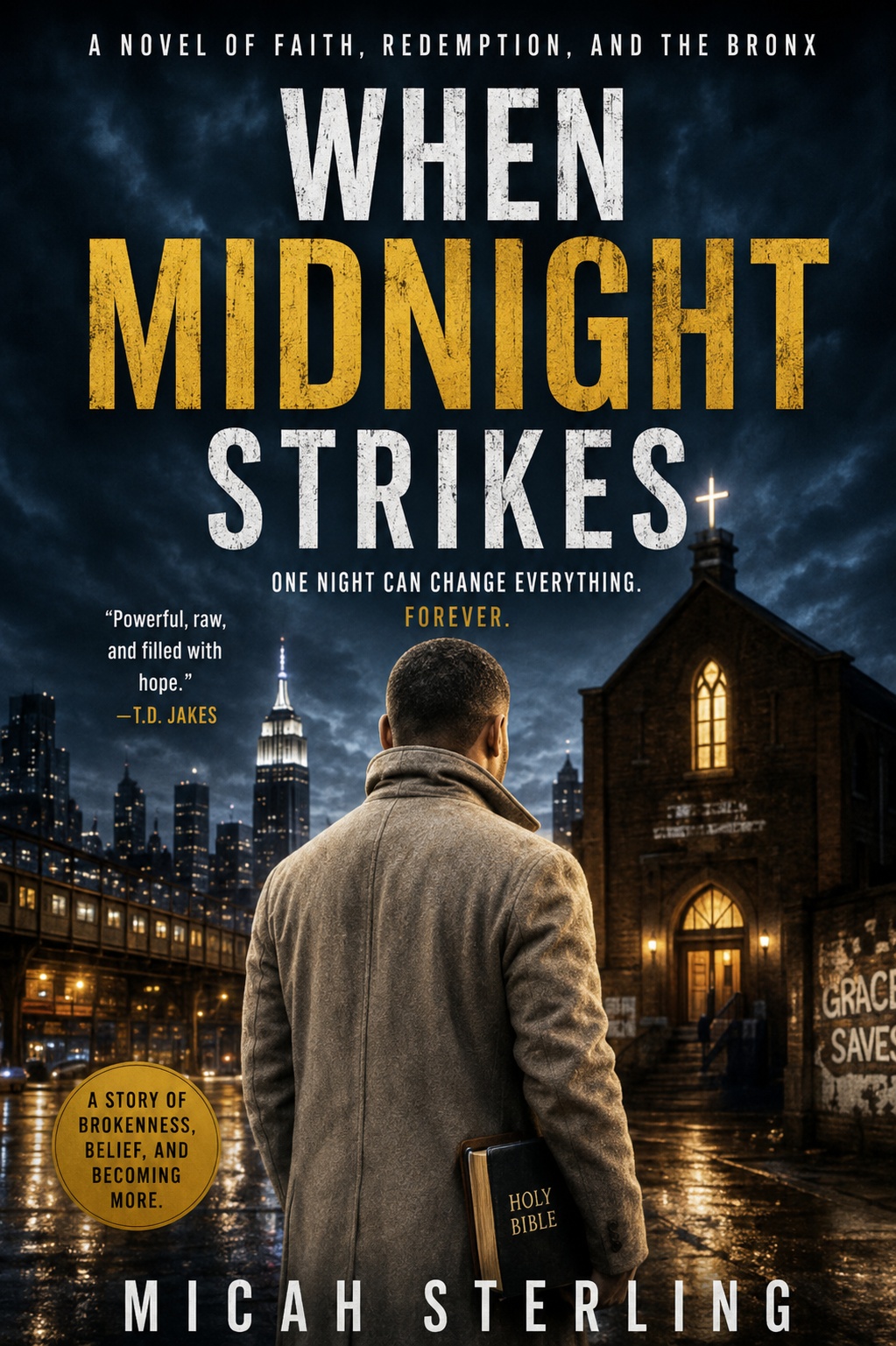
Novel · 19 chapters · 57,191 words
When Midnight Strikes
Contents19 chapters
- 01Eleven Fifty-Nine
- 02The Secret with a Pulse
- 03Rooms with No Windows
- 04The Debt Owed at Midnight
- 05What Fear Calls Justice
- 06The Hand Behind the Curtain
- 07One Minute to Choose
- 08After the Hour
- 09The Names That Stay in Daylight
- 10Witness Against Himself
- 11What the Bell Leaves Behind
- 12The Men Who Arrive After
- 13Sealed Attachments
- 14The Weight of Marcus Cross
- 15Morning Bell
- 16Arraignment Weather
- 17The Record Room Door
- 18What Morning Requires
- 19When the Bell Rings in Daylight
Chapter 1
Eleven Fifty-Nine
The corner bodega on Tremont should have been closed.
David saw that before he saw anything else.
The metal gate was halfway up. Fluorescent light spilled across the sidewalk in a pale strip. A mop bucket sat just inside the door. Mr. Lora never left it there unless he planned to lock up within minutes. He believed in habits the way other men believed in luck.
David checked his watch.
11:59.
He almost kept walking.
Milk. Coffee. Batteries.
That was the list.
He had written it on the back of an old receipt an hour earlier and set it by his keys so he would not have to come back out. Tuesday nights were for invoices, case notes, and reading until his eyes burned. Wednesday mornings started with prayer, black coffee, and a run down toward the river if the weather held. He liked the week when it stayed where he put it.
Tonight the week had slipped.
A client had called late. Then another. A man in Queens swore his brother was stealing from their mother. A woman in Mott Haven wanted proof her husband was using again before she signed any papers. By the time David shut his laptop, the refrigerator held half a carton of oat milk, no coffee, and a flashlight with dead batteries.
So now he was outside in the cold, coat zipped to his throat, walking under a sky the color of wet cement.
The Bronx at midnight never got quiet. It only changed shape.
A train groaned somewhere above the avenue. Bass thudded from a car creeping past with its windows cracked. Two teenagers in bubble jackets laughed too loud at the bus stop, their breath white in the air. Across the street, somebody dragged a trash bag to the curb. The church bell from three blocks over struck once, thin and distant.
David stepped into the bodega.
Warm air hit him first, then the smell of coffee burnt down to sludge, bleach from the mop bucket, and overripe bananas by the register.
Mr. Lora looked up from counting singles.
“You always come in like the end of the world forgot your address,” he said.
David grabbed a basket. “Good evening to you too.”
“It’s not evening.”
“Then I’m right on time.”
Mr. Lora snorted and went back to his cash drawer.
David moved through the narrow aisles. He knew the place by memory. Milk in the back cooler. Coffee on the second shelf near the canned beans. Batteries hanging by the pain relievers because somebody once decided they belonged together. He took what he needed and nothing else.
That was another habit.
At the register, Mr. Lora rang him up without looking at the screen.
“You still seeing that nurse?” he asked.
David set a twenty on the counter. “No.”
Mr. Lora gave him a flat look. “That wasn’t an answer.”
“It was the one I had.”
“Hm.”
David took his change.
“You want the bag?”
“No.”
“You always say no and then come back because your hands are full.”
“I’m building character.”
“You’re building foolishness.”
The old man slid the batteries across the counter. “Tell your mother I asked about her.”
David paused.
“My mother’s in Maryland,” he said.
Mr. Lora frowned. “I know that.”
“You said tell her yourself last week.”
“Then tell her I changed my mind.”
David almost smiled. Almost.
He gathered the milk and coffee in one hand, the batteries in his coat pocket, and ducked back out into the cold.
The gate rattled down behind him.
The street had thinned in the few minutes he was inside. The teenagers were gone. A city bus sighed at the corner and pulled away empty but for three bent heads lit blue by their phones. Wind came hard down the block, carrying fryer grease, exhaust, and something sweet from the bakery that worked through the night on the next avenue over.
David turned toward his apartment.
His phone vibrated.
He shifted the milk against his hip and kept walking.
Another vibration.
He stopped under the dead branches of a street tree and pulled the phone from his pocket.
Unknown number.
One message.
When midnight strikes, someone dies.
He read it once.
Then again.
A joke, his first thought said. Wrong number, his second said. A client trying to get dramatic, his third said.
His body said something else.
His shoulders tightened. His jaw locked. A cold line moved under his ribs and stayed there.
He looked at the timestamp.
11:59 PM.
The digital clock on the lock screen turned over as he watched.
12:00.
Midnight.
He stared at the message until the screen dimmed.
Then he called the number.
Straight to voicemail.
No greeting. No name. Just a mechanical tone.
He hung up without speaking.
A siren wailed somewhere south of him, then cut off so fast it sounded strangled. David stood still on the sidewalk with the milk cooling his fingers and felt ridiculous. Thirty-eight years old, former reporter, licensed private investigator, and he was letting one text message get under his skin.
He typed: Who is this?
The dots never appeared.
A man in a Yankees cap brushed past him with a muttered excuse. David stepped aside automatically and nearly dropped the carton. He adjusted his grip, turned, and started walking again.
He made it half a block before the phone vibrated once more.
This time there was no text.
There was an image.
His thumb hesitated before he opened it.
The photograph was grainy, poorly lit, taken at night. At first he saw only brick, chain-link, and the yellow glare of a security lamp. Then the angle settled in his mind and his breath shortened.
A loading dock.
An old warehouse entrance.
Not just any warehouse.
He knew the bent railing at the side steps. Knew the busted floodlight hanging crooked over bay three. Knew the patch of wall where somebody had once painted over graffiti and failed, leaving the ghost of old letters beneath fresh gray.
He had not stood in front of that building in fourteen years.
He had spent most of those fourteen years trying not to think about it.
No caption came with the picture.
It didn’t need one.
His phone rang.
Unknown number.
He answered on the second ring. “Talk.”
Static.
Then breathing.
Slow. Close.
David turned, scanning the sidewalk. A livery cab rolled by. Windows glowed in second-floor apartments. A woman in scrubs stood outside a laundromat smoking and staring at nothing.
“Who are you?” he said.
The breathing stopped.
A voice came through, low and roughened, as if dragged over gravel.
“You still go the long way home when you don’t want to think.”
David did not move.
The voice was male. Old enough to know better. Local, but not neatly placeable. Not drunk. Not hurried.
“Congratulations,” David said. “You know what side street I’m standing on.”
The caller ignored that.
“You kept the same apartment longer than I expected.”
“Say what you want.”
Midnight traffic hissed over wet pavement at the end of the block.
“You always were better at finding facts than understanding warnings.”
David’s grip tightened on the phone. “If this is about a case, use your name.”
“If it was only about a case, I would.”
The line went dead.
He called back.
Voicemail again.
This time he listened to the silence after the tone, as if a hidden click might tell him something. Cheap trick. Burner phone maybe. Spoofed number maybe. Either way, nothing he could use standing on a sidewalk with groceries.
But the warehouse picture sat on his screen like a hand on his throat.
He shoved the phone back into his pocket and started toward home faster than before.
His building stood six blocks away, a tired brick walk-up with a busted intercom that his landlord kept promising to fix. David took the stairs two at a time, let himself in, and set the milk on the counter without taking off his coat.
The apartment looked the way it always did. Small. Clean. Narrow galley kitchen opening into a living room crowded by bookshelves, files, and one desk under the window. A lamp burned beside the couch. On the wall over the radiator hung a framed verse his mother had mailed him ten years ago in a fit of stubborn hope. He had left it there mostly because taking it down felt like admitting something.
He locked the door.
Then the dead bolt.
Then the chain, though the chain was weak and mostly decorative.
He set the batteries beside the flashlight and pulled the phone back out.
The picture remained.
He enlarged it.
The image broke into pixels around the edges, but the dock stayed clear enough. Somebody had taken it recently. The rust stain on the left door had widened. A newer padlock hung at the side entrance. Snowmelt darkened the concrete.
A fresh picture of an old place.
He opened his contacts and hovered over Dre, then over Naomi, then over no one.
Not yet.
He hated bringing people in before he knew if there was anything to bring them into.
He set the phone down, took off his coat, and went to the sink for a glass of water. His hand shook once when he opened the cabinet. That annoyed him more than the message itself.
“Get a grip,” he said aloud.
The apartment gave him back his own voice.
He drank.
The water tasted faintly metallic.
He looked at the clock on the stove.
12:04.
If this was theater, it was effective. He could admit that much.
He picked up the phone again and opened a search app he used for tracing numbers. The result came back blank. Disposable line. Registered nowhere useful. He tried a second tool. Same answer.
Of course.
His laptop waited on the desk, already asleep. He woke it, sat, and began moving on instinct: screenshot the texts, save the image, run a basic metadata pull. Stripped clean. No location tag. No device information. Whoever sent it knew enough not to be sloppy.
That prickled.
Most cowards were sloppy.
He leaned back and rubbed a hand over his face.
The warehouse.
Marcus had been there the night he died.
Officially, his older brother’s car had gone off the Bruckner after midnight in rain and poor visibility. Officially, Marcus had been alone. Officially, toxicology, impact pattern, and all the rest had added up to accident.
Officially meant paperwork.
David had learned that a long time ago.
Unofficially, Marcus had left a voicemail at 11:12 PM saying he needed to show David something. Unofficially, he had sounded scared. Unofficially, David had missed the call because he was angry and nineteen and tired of being the younger brother dragged into trouble he did not understand.
By morning, Marcus was dead.
David had spent years feeding that fact to himself in small bites so it would not choke him.
His phone buzzed on the desk.
He snatched it up.
This time the message was only three words.
Check the street.
He was already moving before he decided to.
He killed the lamp, crossed to the front window, and pushed the curtain aside two inches.
The block lay under sodium light and old grime. Parked cars. A delivery truck idling at the corner. Steam rising from a manhole cover in a white twist. Across the street, the check-cashing place had its gate down. Next to it, the laundromat still glowed. The woman in scrubs was gone.
Nothing.
Then shouting.
Not on his block. Around the corner.
A sharp burst of it, cut short.
David dropped the curtain and went for his coat. Habit made him check the drawer by the door for the small flashlight, then remember the batteries were still dead. He swore under his breath, jammed the new ones in with clumsy fingers, and headed out.
The hallway smelled like boiled cabbage and somebody’s incense. He took the stairs hard, shoulder brushing the wall at the turn, and came out onto the sidewalk at a near run.
More voices now.
A woman yelling for somebody to call 911. A man saying he already had. A child crying because children always heard too much through apartment walls.
David rounded the corner.
A crowd had formed in the narrow pocket outside a closed beauty supply store. Not big. Eight people maybe. Ten. Enough to block the view until he pushed through the edge of it and saw the man on the ground.
Late twenties. Black puffer jacket. One sneaker half off. Blood under him, dark and spreading across cracked concrete with a shine that caught the streetlight.
Stab wound, David thought first. Then corrected himself. Maybe two.
The victim’s eyes fluttered but did not focus.
A woman in a gray hoodie knelt beside him, hands red to the wrists, pressing a wad of towels against his side.
“Don’t move,” she kept saying. “Don’t move, baby, don’t move.”
A teenager with shaking hands held his phone out uselessly as if a screen could help. Sirens rose in the distance, closer this time.
David crouched.
“I’m David,” he said to the woman. “What happened?”
She looked up wild-eyed. “He just fell. He came running from the alley and fell.”
The alley.
David glanced toward it.
Narrow. Dark. Chain-link fence on one side, brick wall on the other, overflowing trash bins halfway down. Anybody could have gone through there and been gone.
The wounded man made a wet sound in his throat.
David leaned closer. “Can you hear me?”
The man’s pupils drifted toward him. His lips moved.
David bent lower.
“What?”
The smell of blood hit him then, copper and hot even in the cold air.
The man tried again.
One word came out.
“Cross.”
David froze.
The woman at the wound looked between them. “You know him?”
“No.”
The answer came too fast.
The man on the ground grabbed weakly at David’s sleeve. Blood slicked his fingers.
David caught his wrist.
“Who did this to you?”
The man’s mouth trembled. His breath rattled.
“Pocket,” he whispered.
Then his arm dropped.
The woman shouted at him to stay with her. The teenager cursed and backed up. Somebody farther out in the crowd began praying in Spanish, low and urgent, like he was trying not to offend the night.
David slid his free hand into the man’s jacket pocket.
Found a wallet.
Keys.
A folded piece of paper.
And something hard and flat.
He pulled out the flat thing first.
A photograph.
For a second his mind refused it.
Then the image settled.
Marcus.
Not the last picture David had of him. Not the funeral card picture either. Younger. Alive. Standing in front of the Bronx River in a denim jacket, laughing at whoever held the camera. A crease ran through the middle where the photo had been folded and unfolded too many times.
On the back, in Marcus’s handwriting, were four words.
If anything happens, tell David.
The sirens reached the block.
Everything around him seemed to narrow and sharpen at once. The woman’s breath. The scrape of a shoe on concrete. The flicker in the beauty supply gate where old flyers trembled in the wind.
David turned the photograph over again as if the front might change.
It did not.
He knew Marcus’s handwriting the way people knew the shape of their own scars.
Nobody was supposed to have this.
Nobody.
“Sir.”
A uniformed officer pushed through the crowd. “Step back.”
David looked up.
Then down at the man bleeding out under the woman’s hands.
Then back at the alley.
Empty now. Black as a throat.
His phone vibrated in his pocket.
He already knew the message was for him.
He stood, moved back as the officers crowded in, and pulled the phone free under cover of the people shifting around him.
Unknown number.
You’re late.
He stared at the words.
The officer nearest him was talking, asking names, asking who saw what, asking for room. An ambulance crew shouldered in with gear. The woman in gray was crying now and angry at herself for it.
David tucked the photograph into his coat pocket before anyone saw.
That choice happened so fast it barely felt like a choice.
He hated himself for how natural it came.
The phone vibrated again.
Next time, answer sooner.
David looked up from the screen and toward the alley one more time.
A shape moved at the far end.
Not a person. Just a loose sheet of newspaper skidding along the fence.
Still his pulse kicked hard enough to hurt.
He typed with his thumb.
Who are you?
The answer came at once.
Someone who remembers your brother.
The ambulance crew lifted the victim onto a stretcher. One medic called out numbers David didn’t fully catch. The wounded man’s face had gone gray. His eyes no longer tracked anything.
A second police car pulled up. Blue light washed the brick walls and turned everyone sick-looking.
David stood in the middle of the sidewalk with blood drying on his hand beneath the cuff of his coat.
His routines, his apartment, his careful shelves of old grief—none of them felt far enough away.
Marcus had called him once at 11:12 and died before morning.
Now an unknown man had run bleeding through a Bronx alley with Marcus’s photograph in his pocket and David’s name in his mouth.
This was not a prank.
This was a hand reaching up from something buried.
And somewhere in the city, the person holding the other end knew exactly how deep to dig.
Chapter 2
The Secret with a Pulse
David stood at his kitchen sink and scrubbed another man’s blood from the webbing of his hand until the skin went pink and tender.
The water ran hot.
Still he could feel it.
It had dried in a thin dark seam beneath his knuckles. A little under one nail. On the cuff of his coat, where he had folded it back and turned it inward like hiding a stain made it smaller.
His phone lay on the counter beside the dish rack.
Dark now.
That bothered him more than the messages had.
Whoever had been watching him last night had gone quiet on purpose. Silence could push harder than threats if the hand behind it knew where to lean.
He shut off the faucet and stood there listening.
Radiator hiss.
A truck backing somewhere below.
A man yelling for somebody to move their car.
The Bronx was awake. Gray light had filled the window over the sink while he had been at it. He had not slept. He had sat at the table with Marcus’s photograph in front of him and gone over every detail until each one felt rubbed raw.
If anything happens, tell David.
He picked up the photo again.
Marcus at the river. Denim jacket. That laugh that always looked like it had gotten there a second before the rest of him.
The crease through the middle.
David turned it over.
Same four words.
Same handwriting.
No new mercy in looking twice.
He slipped the photograph into an inside pocket and reached for his keys.
If panic wanted him, it could catch up while he was moving.
Outside, the cold had a wet bite to it. Last night’s puddles had turned to thin black ice along the curb. Delivery men rolled stacked crates into a deli on Burnside. A school bus coughed at a light. Somebody had music going too loud in a second-floor apartment, bass thudding through warped glass.
The block by the beauty supply store looked smaller in daylight.
Police tape still hung across the mouth of the alley, one side tied to a pole, the other to the beauty supply gate. A dark wash stained the sidewalk where the man had gone down. Salt had been thrown over it. Blood and road grit and old winter dust had become one rough patch.
David stood across the street and studied the angles.
The alley mouth.
The check-cashing place.
His building half a block up.
Line of sight mattered. Habit mattered. If somebody had sent him that text at exactly the right moment, they had known where he would look and how long it would take him to get there.
A sanitation truck groaned past. When it cleared, a plainclothes officer was ducking under the tape with a coffee in one hand.
David recognized him first by the walk.
Quick. Compact. Slight roll of the shoulders like the cold insulted him personally.
Detective Elena Ruiz glanced up, spotted David, and stopped with the expression of a woman who had found a leak in her own ceiling.
“You again.”
David crossed the street. “Good morning to you too.”
“It’s not good and it’s barely morning.”
Ruiz wore a charcoal overcoat over a suit that had stopped pretending to be pressed. Her hair was pulled back hard. No makeup. No patience. She had grown up three blocks from where they stood and still talked like the neighborhood had never stopped keeping score.
“You stalking my scene,” she said, “or is this one of those private-investigator instincts you people charge by the hour for?”
“I live here.”
“You also have a gift for being near trouble before it knows it’s trouble.”
He let that pass. “The man survive?”
Ruiz looked at him a beat too long.
“No.”
He had expected it. It still landed.
She sipped coffee. “Made it to St. Vincent’s. Didn’t make it through surgery.”
“What’s his name?”
“Since when do I hand out case details to civilians?”
“Since the civilian was here when he died.”
“He didn’t die here. He died under fluorescent lights with a resident trying not to shake.”
David looked past her into the alley. “Then give me the part you came to look at again.”
Ruiz followed his eyes.
“Victim came through there. No weapon recovered. No camera worth a damn. Beauty supply’s exterior cam has been dead for two weeks, according to the owner. Check-cashing place points the wrong way. We got one delivery truck on a side street and all it gives us is a man running before midnight and a second shape maybe thirty yards back. Too bundled up to help.”
“Male?”
“Maybe. Maybe not.”
“That’s not why you’re here.”
A corner of her mouth moved. Not a smile.
“No,” she said. “I’m here because the dead man had your last name in his mouth and because one of the uniforms remembered you used to write stories people in this borough hated seeing in print.”
“Used to.”
“Men like you never stop collecting.”
She set down her coffee on the hood of an unmarked car and took a folded evidence-sheet copy from her coat pocket.
“His name, as far as prints tell us, was Luis Mena. Thirty-one. Bronx born. Did eighteen months upstate on a burglary charge six years ago. Nothing big. Nothing that explains why he dies trying to reach you.”
“Mena,” David said. “I don’t know him.”
“Maybe he knew Marcus.”
That tightened something low in David’s chest.
Ruiz saw it.
“There’s more,” she said. “He had a church bulletin in his pocket.”
David said nothing.
“New Covenant Baptist. Three Sundays back.”
His eyes went to her face then.
“You already knew that church mattered.”
“I know a lot of churches matter around here.”
“Don’t play thin with me.” She picked up her coffee again. “I remember your mother taking you and your brother there in cheap clip-on ties every Easter. I remember Marcus getting thrown out of youth choir for laughing during prayer. I remember because my aunt sang alto and told that story for years.”
The wind moved the tape behind her. It made a dry snapping sound.
Ruiz lowered her voice.
“You want to help yourself, you tell me now if Marcus was mixed up in something before he died.”
David almost answered with the old line. It was an accident. That was what everyone else said. That was what the paperwork said.
He had run out of patience for paperwork years ago.
“He called me the night he died,” David said. “Said he found something. I missed it.”
Ruiz watched him carefully.
“What kind of something?”
“I don’t know.”
“You ever think not knowing is a luxury?”
He gave her a tired look. “You done?”
“Not close.” She reached into another pocket and held out a business card. “If you remember anything useful, call me before you decide to be clever.”
He took it.
Her hand stayed there a second longer.
“And David,” she said, “if you’re about to go digging in church closets and family graves, don’t do it alone.”
“Why?”
“Because whoever set this up knew your route, your timing, and your brother’s name.” She took back her hand. “That’s not random. That’s somebody with patience.”
St. Vincent’s smelled like bleach, old coffee, and sleep nobody got enough of.
David caught Naomi near the nurses’ station just after seven, tying back her hair with one hand while she scanned a chart with the other. She looked tired in the clean, sharpened way some people did after a hard shift. Not weak. Focused. The kind of tired that still had a blade in it.
Her eyes lifted.
Stayed on him.
Then dropped to his hand.
“You look terrible,” she said.
“Good morning.”
“Don’t flirt with me looking like that.”
“I’m not flirting.”
“That’s worse.”
He leaned on the counter. “A man from my block came in overnight. Stabbing victim.”
Her face closed a little. Work first.
“What’s your connection?”
“He died trying to get to me.”
That got through.
Naomi set down the chart. “You bring police with you?”
“Not today.”
“You planning to?”
“Depends what I find.”
She studied him, then said, “He coded twice. OR got him back once. Not the second time.”
David nodded.
“Detective Ruiz is on it,” Naomi said. “Which means if you interfere, she’ll enjoy herself.”
“She already does.”
Naomi glanced down the hall, then back at him.
“David.”
The way she said his name took some of the sarcasm out of the room.
“You need to decide whether you want the truth or just motion. Those aren’t the same thing.”
He looked at her.
She saw more than he wanted and less than he feared. She had always had that talent.
“You think I can’t tell the difference?”
“I think you can,” she said. “I think sometimes you don’t like the answer.”
He pushed off the counter.
“I’m going to New Covenant.”
Her expression shifted. “Why?”
“He had one of their bulletins.”
Naomi exhaled once through her nose. “Of course he did.”
“You know something?”
“I know churches get people when they’re scared and when they’re hunted and when they’re trying to look less hunted.” She picked up the chart again. “And I know Pastor Coleman doesn’t tell everything the first time.”
“Why not?”
“Because he thinks timing matters.”
David started to turn away.
“David.”
He looked back.
“Don’t go there just to accuse someone,” she said. “Go there ready to hear something you won’t like.”
New Covenant Baptist sat between a narrow apartment building and a shuttered pharmacy, old red brick gone almost brown with soot and weather. The front steps had been worn hollow in the middle from decades of dress shoes, work boots, and children dragging their heels because Sunday school meant sitting still.
The sanctuary doors were locked.
The side basement entrance was not.
Inside, the church carried its usual mix of furniture polish, old paper, and the faint damp note every city basement seemed to keep no matter how much prayer got poured into the walls.
Pastor Isaiah Coleman was in the fellowship hall stacking metal chairs by himself.
He was taller than David remembered, though age had bent him some. A dark sweater under his sport coat. Reading glasses low on his nose. Hands that looked gentle until they didn’t.
He set down the chair when he saw David.
“Well,” he said quietly. “You look like a man who didn’t come for coffee.”
“I need to ask you something.”
“You usually do.”
David stopped three feet away. “A man died last night with one of your church bulletins in his pocket and my brother’s photograph in his jacket.”
Pastor Coleman did not answer at once.
He took off his glasses. Folded them.
That silence said enough.
“You know something,” David said.
“I know,” the pastor said, “that when a man comes through that door angry, he is usually angrier than the first sentence tells me.”
David felt his jaw set. “Please don’t do that today.”
“Do what?”
“Answer me like I’m twelve.”
The pastor nodded once, accepting the hit.
“Fair enough,” he said. “Come with me.”
The records room sat behind his office, narrow and overfull, metal shelves lined with old membership books, donation ledgers, baptism certificates, yellowing programs tied with twine. A single window looked onto brick. It gave almost no light.
Coleman switched on the overhead fixture.
Dust rose where they disturbed it.
“Three weeks ago,” the pastor said, “a man came asking about your brother. I did not know his name then. Might have been the same man you saw last night.”
“Mena.”
Coleman shook his head. “He did not offer one.”
“What did he want?”
“He had a photograph. Not the one you’re carrying now. Another one. Said Marcus gave him a name years ago. Said if trouble ever came, he should find this church.”
“Why didn’t you call me?”
The pastor met his eyes.
“Because I have called you before when grief was involved, and you heard accusation in every word.”
That landed because it was true.
David looked away first.
“What did you tell him?” he said.
“I told him Marcus was gone. I told him you were not close to this church anymore. He asked whether I still kept the old assistance records.”
David turned back. “Why would he ask that?”
Coleman was already reaching for a ledger box on the highest shelf.
“Because,” he said, lowering it carefully, “Marcus asked the same question the week he died.”
The room seemed to lose heat.
The pastor set the box on a small table and untied the string around it.
Inside were envelopes, receipt books, index cards, faded carbon copies.
Coleman slid out a file with the tab partly torn off.
“Your mother fell behind after your father left,” he said. “Rent. Utilities. School uniforms. People from the church helped some. Then an anonymous donor began covering the gaps.”
David stared at him.
“How anonymous?”
“To your mother? Very.” Coleman opened the file. “To me? Not entirely.”
A receipt rustled in his hand. Then another.
All made out through the church benevolence fund. Small amounts first. Groceries. ConEd. Winter coats. Then later, larger ones. Tuition deposits. Emergency repairs. Hospital transport.
Dates spread across years.
David saw his own life in pieces of paper.
The year his mother didn’t have to pull him out of Catholic school.
The year Marcus stopped working nights at the garage for a while.
The month after David’s first arrest covering a housing protest, when somehow the legal fees stopped being a conversation at home.
He looked up slowly.
“Who?”
Coleman hesitated.
“That matters less than—”
“Who?”
The pastor held his gaze another second, then reached deeper into the file and took out an old photograph hidden between two folded annual reports.
He laid it on the table.
Marcus stood in front of the church basement steps, older than the river photo by several years. Beside him was a man in a camel coat, clean-shaven, handsome in the polished way that made trust seem reasonable. One hand rested lightly on Marcus’s shoulder. The other held a set of car keys.
On the back, in the pastor’s slanting handwriting, was a date from two weeks before Marcus died.
And one name.
Gabriel Vale.
David heard the name like a lock turning.
“I know it,” he said. “From where?”
“You wrote about him once,” Coleman said. “Not by name. Years ago. A redevelopment shell buying distressed properties through fronts. The piece never ran because your editor killed it.”
Memory flickered. Half-built and sour. A source who vanished. A set of papers that stopped arriving. Marcus telling him to let it go because some fights came with invoices.
“Vale funded youth programs,” Coleman said. “Paid medical bills. Helped families quietly. He was the sort of man people thanked before they asked what string was tied to the gift.”
“And you let him use the church.”
“I let the church receive money that fed people.”
“That’s not the same thing.”
“No,” Coleman said, and there was no defense in his voice. “It is not.”
David picked up the photograph.
Marcus didn’t look happy in it.
Not scared either.
Wary.
As if he already knew the man beside him was expensive.
“Why was Marcus with him?”
“He came to ask me the same thing.” Coleman slid over a folded note card. “I gave him access to old donation records. He thought the money was attached to something that happened at the warehouse.”
David unfolded the card.
A list of dates. Initials. One address he recognized near the river. Another near Tremont. At the bottom, Marcus had written: not help. leverage.
The pastor said, “Marcus believed Vale did not choose families in trouble at random. He believed he chose pressure points.”
“For what?”
“That,” Coleman said, “Marcus never had time to prove.”
David let out one hard breath.
“Who else knows this?”
Coleman’s answer came too slowly.
“Pastor.”
“A woman came asking after Marcus the day after his funeral,” he said. “I never told you because your mother begged me not to stir more pain.”
“What woman?”
“She gave the name Teresa Vale.”
The surname hit like cold water.
“Related?”
“I assumed so. She said Marcus had been trying to protect somebody. She also said he had made a mistake taking records from the wrong people.”
David’s fingers tightened around the note card.
“Where is she now?”
“I don’t know.”
“Convenient.”
Coleman accepted that too.
“She told me one more thing,” he said. “She said the worst lie is the one people call provision when it arrives right on time.”
David looked up.
For a moment neither man spoke.
Downstairs, somewhere in the church, an old pipe knocked inside the wall. Outside, a siren rose and passed.
“What didn’t you tell me about my family?” David asked.
The pastor sat down in the metal chair by the records table as if his knees had made the choice before the rest of him.
“When your mother was in the hospital after Marcus died,” he said, “she asked me to pray that the surviving son would not spend his life letting the dead one choose it.”
David went still.
Coleman kept going because men his age knew when mercy looked too much like delay.
“She also told me Marcus had kept things from you on purpose. Not because he didn’t trust you. Because he did. He knew once you saw a trail, you would follow it until it bled you dry.”
David looked at the receipts again. The dates. The careful anonymous rescues that had appeared at every hard bend of his life.
Not rescue.
Selection.
Nudges.
The rent paid so they stayed on one block instead of another.
The tuition covered so he learned to dig for a living.
The crises eased just enough to keep them useful.
His phone vibrated in his coat.
Both men heard it.
David took it out.
Unknown number.
Just one picture this time.
A fresh shot. Taken close.
His apartment door.
Beneath it, a message.
You’re finally asking the right people.
David showed the screen to Pastor Coleman.
The old man’s face changed in a way David did not like at all.
Not surprise.
Recognition.
“Tell me,” David said.
Coleman looked from the phone to the hidden photograph of Marcus and Gabriel Vale.
Then he said, very quietly, “You need to call Detective Ruiz.”
“Why?”
“Because if they’re watching your door now, they were watching this church before you got here.”
David felt the room draw tight around him.
“And because,” the pastor said, “Luis Mena was not the first person to come here asking about your brother.”
David waited.
Coleman’s hand rested on the ledger box.
“Two nights before Marcus died,” he said, “Marcus came through that door with blood on his sleeve and told me, ‘If anything happens to me, don’t trust the man paying for the candles.’”
The fluorescent light buzzed overhead.
David heard it. Heard the traffic outside. Heard his own breathing.
He thought of the plain church bulletin in a dead man’s pocket. The old donations. The missed voicemail. The photo hidden in a records box like something poisonous wrapped in paper.
Somebody had not just reached into his past.
Somebody had been arranging it.
His phone vibrated again.
This time the message was only four words.
Ask why Marcus ran.
Chapter 3
Rooms with No Windows
The first apartment smelled like boiled cabbage and old bleach.
David stood in the third-floor hallway with Marcus’s note card in his hand and listened to a baby crying behind one door and a television preacher behind another. The building sat two blocks off the river, brick sweating damp through its paint, the lobby mailboxes hanging open like loose teeth. One of the addresses from Marcus’s card had led him here.
Apartment 3F.
He knocked once.
Nothing.
He knocked again, louder.
A lock slid back. The door opened the width of a chain.
A woman in a house robe looked out at him. Sixty, maybe older. Gray hair wrapped tight in a scarf. Eyes that measured first and softened later, if they softened at all.
“Yeah?”
“Ms. Vega?”
“Who’s asking?”
He showed her his ID wallet. Not too close. People trusted distance more than leather.
“David Cross.”
The change in her face was small, but it was there.
Not surprise.
Recognition.
She started to shut the door.
“I’m here about Marcus,” he said.
That stopped her.
The chain stayed on. Her hand stayed on the knob.
“Marcus Cross is dead,” she said.
“I know.”
“Then let him stay dead.”
David looked at the chain, the dark crack of the apartment, the eye watching him from behind the woman’s hip. A child maybe. Maybe just another scared adult.
“He wrote this address down,” David said. “I’m trying to find out why.”
Her gaze dropped to the card.
For one second he thought she might open the door.
Then her phone rang somewhere inside.
Sharp. Cheap ringtone. Close by.
The woman did not move right away. She just stared at him while it kept ringing.
Then she stepped back, took the call where he could still hear her, and said only two words.
“He’s here.”
She came back different.
You could feel it.
Not brave. Not safe. Settled.
She shut the door another inch against the chain.
“I don’t know anything,” she said. “Don’t come back.”
“Ms. Vega—”
The door closed in his face.
He stood there another moment listening to the bolt turn.
Then he looked at the peeling number screwed crooked over the frame and wrote one word beside the address on Marcus’s card.
Warned.
By the time he got back outside, a black SUV that had been idling across the street was gone.
He called Ruiz from the sidewalk.
She answered on the fourth ring. “Tell me you listened to Coleman.”
“I’m listening now.”
“That’s not the same thing.”
“No, it isn’t.”
Traffic hissed past on wet pavement. A city bus sighed at the corner. A man pushing a hand truck loaded with plantains gave David a look that said keep moving if you’re not buying something.
Ruiz said, “Where are you?”
“Near the river.”
“Doing what?”
“Being unwelcome.”
“That narrows it down to half the borough.”
He gave her the address.
She went quiet.
Not long. Long enough.
“You know it?” he asked.
“I know the building owner.”
“Vale?”
“No. A holding company that buys through other names. Same lawyer touches the paperwork every time.” She exhaled. “You at least want to pretend not to contaminate my case?”
“You want the truth or the paperwork?”
“I want both. Meet me at the Forty-Eight.”
He checked his watch. “How long do I have before you change your mind?”
“I already have,” she said. “Come before I do it again.”
The precinct hallway had the color of old coffee.
Too much beige. Too much fluorescent light. A bench that made people sit up straight whether they wanted to or not. Somewhere deeper inside, a phone rang and kept ringing until somebody with authority got tired of hearing it.
Ruiz met him by a bulletin board with missing-person flyers and community notices nobody read unless they were desperate.
She wore plain clothes today. Dark blazer, hair pulled back, no patience.
“You look terrible,” she said.
“You say that like I had options.”
“You have several. You reject them on principle.”
She walked him past the front desk and into a side corridor where an ancient vending machine hummed beside a closed interview room. No windows. Just a metal door and cinder block walls painted over too many times.
David glanced at it.
Ruiz caught the look. “Relax. If I was arresting you, I’d let you know. I’m old-fashioned.”
“You dragged me into a hall next to a box.”
“It’s private.”
“It’s cheerful.”
She handed him a photocopy.
Luis Mena’s sheet. Arrest history light. Two summonses. One sealed complaint. Last known employer listed through a subcontract security company David did not know.
Bastion Civic Services.
Another paper.
Property records.
The river building. Two storefronts on Tremont. A vacant lot near the old warehouse. Different LLCs. Same law office. Same registered agent.
“Say it,” Ruiz said.
“Vale doesn’t own things. He touches them.”
“He funds people who own things,” Ruiz said. “Or saves them right before foreclosure. Or steps in when somebody’s son catches a charge and a good lawyer appears like manna.”
David looked up.
Pressure points.
Ruiz read his face. “Coleman told you something.”
“Enough.”
“Not enough, or you wouldn’t be here looking like that.”
He folded the papers once. “Luis worked security?”
“For Bastion. Off and on. Not steady. Cash gaps. A few emergency room visits. Looks like a man people used until they didn’t need him.” She leaned one shoulder against the wall. “Two weeks before he died, he visited an old incident report archive at Housing.”
“Why?”
“He claimed he was helping a tenant fight an illegal lockout.”
“Was he?”
“No tenant by that name exists.”
The hum of the vending machine filled the space between them.
David said, “Marcus wrote down apartment addresses and dates. Donation dates. He thought families weren’t being helped. He thought they were being placed.”
Ruiz’s jaw shifted. “Placed where?”
“Where they’d owe somebody. Where they’d stay reachable.”
“For favors.”
“For silence.”
A uniform brushed past them carrying a stack of files. Ruiz waited until he turned the corner.
Then she lowered her voice.
“There’s more. Marcus’s warehouse death.” She watched him carefully when she said it, like she was setting glass on concrete. “The original accident report was amended.”
David went still.
“By who?”
“Not the detective. A responding sergeant added language about poor lighting and unauthorized access after the fact.” She tapped the copy in his hand. “Same sergeant got his mortgage refinanced six months later through a lender tied to the same law office.”
David felt something hard and hot move through his chest.
Not shock. Worse.
Recognition.
Not help.
Leverage.
Ruiz said, “You start connecting enough small mercies and favors, pretty soon everybody can explain why they looked away.”
“Do you have the sergeant?”
“Retired to Florida.”
“Convenient.”
“Yeah.” Her mouth tightened. “The EMT on scene died three years later. Stroke. The warehouse supervisor disappeared into Jersey. The night watchman changed his story twice, then never again.”
“Still alive?”
“Last I checked.”
“Where?”
Ruiz gave him a look that meant she knew she should not.
Then she wrote an address on the back of a community-policing flyer and shoved it into his hand.
“Bronxdale. Basement unit. His name is Hector Salas. And before you ask, no, I am not telling you to go threaten a witness.”
“I’m offended you think I’d be obvious.”
“I think you’d be stupid.”
His phone buzzed.
Unknown number.
Ruiz saw his hand freeze.
“Open it,” she said.
He did.
A photo loaded slow on the weak precinct signal.
Church basement door. Fresh.
Taken from the foot of the stairs.
Another message followed.
Some rooms remember better than people do.
Ruiz swore under her breath.
“Was Coleman alone?”
“When I left, yes.”
She was already moving. “Come on.”
The ride to New Covenant took nine minutes and felt longer.
Ruiz drove like she expected bad news and intended to get there before it learned her name. David sat with one hand around his phone and watched the Bronx slide by in strips of wet block and chain-link and fried food smoke. Kids in school uniforms cut between parked cars. A man in a Yankees cap sold incense under a train line. The city carried on with that offensive kind of normal it kept for everybody’s private disasters.
He called Coleman twice.
No answer.
On the third call it went straight to voicemail.
The church door was unlocked.
That was wrong first.
New Covenant was never careless about locks.
David hit the vestibule at a run. The sanctuary sat dim and empty, red runner down the center aisle, weak daylight through stained glass putting bruised color on the pews. No voices. No organ practice. No clatter from the fellowship hall.
Then he heard it.
A thud below.
Ruiz pulled her weapon.
“Stay behind me.”
“I’m not doing that.”
She didn’t argue. There wasn’t time.
The basement stairs smelled of dust and old steam heat. Halfway down, David saw papers scattered across the landing. Ledger sheets. Bulletin inserts. Envelopes torn open and trampled.
The records room door hung crooked on one hinge.
Coleman was on the floor beside a toppled metal chair, one hand pressed to the side of his head. Blood had run down behind his ear into the collar of his shirt.
For one second the room narrowed so badly David almost missed the second shape moving.
A man in a dark hoodie shoved through the far storage door.
Ruiz shouted and gave chase.
David dropped to his knees beside the pastor.
“Don’t move.”
Coleman’s eyes opened, unfocused, then found him. “I tried,” he said.
“Save it.”
David got his handkerchief out and pressed it to the cut. Not deep, but head wounds bled like they had something to prove.
Shelves had been stripped. Boxes pulled open. Index cards everywhere. The old hidden photo of Marcus and Vale was gone.
So was the ledger box.
Coleman winced. “He knew where to look.”
“Did you see his face?”
“No.”
“What did he take?”
“Anything with names.”
Ruiz came back alone, breathing harder than she wanted to show.
“Fire door into the alley,” she said. “Car waiting. Plates covered.”
David nodded once. He had expected that and hated it.
Coleman caught Ruiz’s sleeve. “There was a second one.”
Both of them looked at him.
“In the hallway upstairs,” he said. “I heard him before the first man came down. Heavy walk. Limp on the right side.”
Ruiz’s eyes narrowed. “You sure?”
“Yes.”
“Could be lookout.”
Coleman swallowed. “Could be someone who knew this building.”
David thought of the message arriving before they reached the church. Thought of the photo taken from the basement stairs.
Not random.
Not broad.
Inside the circle.
He said, “They wanted us here.”
Ruiz looked at the wrecked room. “Or wanted him silent before you got here.”
Coleman shut his eyes briefly. “I should have told you everything years ago.”
David kept pressure on the cloth. “You can apologize after the ambulance.”
“There wasn’t one donor network,” Coleman said, forcing the words out past pain. “There were layers. Rent paid here. Bail paid there. Medical bill handled through a different name. School transfer arranged. Appliances delivered. Utility shutoff reversed. Always in time. Always before people started asking who did it.”
“A favor machine,” Ruiz said.
“A leash,” Coleman replied.
His breath shivered.
“Marcus said the same families kept crossing paths at moments that made no sense. A man from one building suddenly working security at another. A cousin hired at a warehouse he wasn’t qualified for. A woman moved after an eviction into an apartment owned by one of the same companies that had funded the church roof. Accidents that made people available. Rescues that made them grateful.”
David looked around the room with the papers underfoot like fallen birds.
“Staged coincidences,” he said.
Coleman gave the smallest nod. “Marcus said if enough lives are arranged carefully, nobody sees the pattern. They only see survival.”
The ambulance came. Questions followed. Blood pressure. Light in the eyes. Refusal to go until Ruiz said the word concussion and made it sound official enough to shame him into compliance.
By then David was already moving again.
Bronxdale this time.
The basement unit smelled like mildew and frying oil from upstairs. Hector Salas answered in a sleeveless undershirt with a nicotine patch on one arm and the eyes of a man who had spent years checking peepholes before he opened doors.
When David said Marcus’s name, Hector sat down without inviting him in.
That was invitation enough.
The apartment had one small front window blocked half by a parked van. The bedroom in back had none. Just a curtain where a wall should have been and a fan rattling in stale air.
Rooms with no windows.
Places built for surviving, not seeing far.
Hector rubbed both hands over his face.
“I told police what I saw.”
“You changed it.”
“I corrected it.”
“Twice.”
Hector stared at the floor. “You a cop?”
“No.”
“Then why you care?”
Because Marcus was my brother.
Because somebody had used grief like a long-term investment.
Because every time he got closer, somebody bled.
He said only, “Because the first report was a lie.”
Hector laughed once. No humor in it.
“Man, the whole neighborhood runs on lies with decent shoes.”
He got up and checked the hallway, then came back.
“Your brother came to me three days before he died,” he said. “Wanted to know who was in that warehouse after hours. Not the listed tenants. Not the trucks on paper. The real traffic.”
David let him take his time.
“Hector.”
“There were rooms inside the back offices,” he said. “No windows. Used to be for inventory meetings or whatever. Then later they were for conversations. Quiet ones. People came in owing money or needing work or needing someone gone from an apartment. Came out with envelopes. Or instructions.”
“Vale ran it?”
Hector shook his head. “Vale didn’t need to sit in a folding chair to run anything. Men under him. Lawyers. foremen. one ex-cop. Church people sometimes. Not your pastor.” He raised a hand before David could jump on the word. “I’m saying people who knew how to talk holy while keeping books crooked.”
“What happened the night Marcus died?”
Hector’s mouth flattened.
“He wasn’t supposed to be there that late. Somebody tipped them he was asking questions. I saw him arguing with another man by the loading dock. Then Marcus ran.”
The text hit him again.
Ask why Marcus ran.
“From who?”
“I didn’t know the face.”
“Try.”
“Tall. Good coat. Didn’t belong in that place except he acted like he owned everybody in it.”
Gabriel Vale, David thought.
But Hector shook his head before he even asked.
“Not Vale. Younger. Mean in a cleaner way.”
“Did Marcus have something?”
“A folder. Tucked under his jacket.”
David’s pulse kicked.
“Records?”
“Maybe. He got to the dock. Slipped, or got pushed, I couldn’t see clean from where I was. Then everybody started acting like it was already decided what happened.”
“How much were you paid to keep it that way?”
Hector did not flare up. That was worse.
“Enough to keep my daughter in her apartment after her husband left,” he said quietly. “Enough to get my son’s case pled down. Enough to tell myself I didn’t know what I knew.”
David stood very still.
Nobody innocent.
He knew that already. Hearing it cost more.
Hector reached under the chair cushion and brought out a folded receipt envelope, greasy at the edges from hiding.
“Your brother left this in the guard station trash. I kept it because I knew one day somebody might come with his face asking the right wrong questions.”
Inside were photocopied visitor logs. Partial. Smudged. Several names blacked out with marker. But not all the way.
One line stayed visible enough to read.
Bastion Civic Services.
Another.
T. Vale.
And another entry from the week Marcus died.
N. Bennett
David looked up so fast the room blurred.
Hector saw it happen.
“I don’t know who that is,” he said.
But David did.
Naomi.
His phone vibrated in his pocket.
He almost didn’t want to touch it.
Almost.
Unknown number.
He opened the message.
Closer now.
That was all.
Then another photo came through.
Not a place this time.
Naomi, in blue scrubs outside St. Vincent’s, turning her head as if somebody had just called her name.
Taken close enough to see the tired set of her mouth.
Taken today.
For a second David could hear nothing.
Not the fan. Not traffic above. Not Hector shifting in his chair.
Just his own blood.
The threat had shape now.
Not a stranger.
Not some broad promise meant to keep him busy.
Somebody inside the circle had been in that warehouse the week Marcus died, or somebody wanted him to believe it badly enough to move him where they needed him.
Either way, Naomi was in the frame.
And if this was a trail, it was one built by hands that had been arranging lives for years.
Ruiz picked up on the first ring.
“I need you at St. Vincent’s,” David said.
“What happened?”
“I found a witness. I found logs. And somebody sent me Naomi’s picture.”
Silence.
Then, flat and fast: “Don’t send it. Don’t text details. Go there now. I’m on my way.”
He ended the call and looked at Hector.
“You tell anybody I came here?”
Hector’s eyes shifted once toward the deadbolt.
“I didn’t have to.”
David understood.
Places like this held loyalty the way basements held water. Quietly. Until your shoes were soaked and it was too late to pretend.
He tucked the envelope inside his coat and headed for the door.
Behind him Hector said, “Your brother ran because he realized the file wasn’t about one crime.”
David turned.
Hector sat under the weak yellow kitchen light with both hands between his knees.
“It was about a system,” he said. “People fed into it, people pulled out, favors tracked, fear tracked, debt tracked. Your brother thought he was exposing a death.”
He shook his head.
“He was exposing a business.”
Outside, the air had turned colder. Evening pushing in early between the buildings. Somewhere far off, church bells marked an hour David did not check.
He started toward the street at a hard walk.
Above him, windows glowed one by one.
In every one, a life.
Dinner on a stove. Homework at a table. Someone ironing a shirt for morning. Someone lying about where they had been. Someone praying. Someone pretending not to be afraid.
And somewhere among those lit squares, somebody was still moving pieces.
The question that had chased him since midnight came back sharper now.
Was he hunting the truth.
Or being led to it.
He kept walking.
At that point, the difference might kill somebody either way.
Chapter 4
The Debt Owed at Midnight
Ruiz was already in the ambulance bay when David got there.
Red strobes washed the concrete in pulses. A rig backed in slow, diesel coughing. Orderlies pushed through the sliding doors with a gurney. Somebody was crying hard enough to fold over at the waist near the vending machines.
Naomi stood under the awning in blue scrubs with her arms crossed tight.
Alive.
For one clean second, that was enough.
Then she looked at him, and the look on her face took the air out of that relief.
“You sent Ruiz before you called me.”
“You were being watched.”
“I know.” She held up her phone. “A blocked number called twice. No message.”
Ruiz stepped in before David could answer.
“Inside. Now.”
They moved into a side corridor off the emergency department where the floor smelled like bleach and old coffee. The fluorescent lights were too bright. The walls had that scuffed beige hospitals used when they expected things to get hit.
Naomi shut the door behind them.
Ruiz held out a hand. “The photo.”
David passed over his phone.
Ruiz studied the image of Naomi outside the hospital. Her jaw tightened once. That was all.
“Taken from across the pickup lane,” she said. “Not long lens. Close. Whoever sent this wanted you to know they could get close.”
Naomi looked at David. “What did you find?”
He took the photocopied log pages from inside his coat and handed them over.
She skimmed them, then stopped.
At the line.
N. Bennett.
Her face did not fall apart. Naomi was too disciplined for that. But he saw the moment it landed. Saw her breathe in and hold it.
“I never worked security at a warehouse,” she said.
“I know.”
Ruiz looked from one to the other. “Do you?”
David hated the question because he could not answer it clean.
Naomi put the papers on the counter between them and tapped the name with one finger.
“My mother’s first name was Nadine.”
The room went still.
David said, “Was?”
Naomi kept her eyes on the page. “She’s dead.”
He knew pieces of Naomi. He knew what kind of tea she drank when she was too tired to pretend she wasn’t. He knew she laughed with one hand over her mouth when something caught her off guard. He knew when she was angry enough to go quiet.
He had never heard her talk about her mother.
Ruiz said, “You think this is her?”
Naomi gave a small, bitter shake of her head. “I think somebody wants me to think it is.”
David stared at the line again. Smudged toner. Half a name. A week Marcus died.
“What did your mother do?”
“She cleaned offices nights when I was little. After that, whatever paid.” Naomi folded her arms again. “And before you ask, no, I don’t know where she was the week your brother died.”
The words hit harder because she said them without defense. Just fact.
Ruiz handed the phone back to David.
It lit in his palm before he could lock the screen.
Unknown number.
All three of them saw it arrive.
One message.
11:32 PM. River steps behind the old freight house. Come where you left him.
David felt the corridor tilt.
Naomi read it over his shoulder. “No.”
He barely heard her.
The river steps.
Not the loading dock itself. Worse.
The concrete stairs half-hidden behind chain-link and brush where Marcus used to smoke when he needed to think and didn’t want their mother seeing him. Where he had once told David, years ago, if anything ever happened, it would happen because people got too comfortable being bought.
Where David had not gone the last night Marcus called.
Come where you left him.
Ruiz swore under her breath.
“That’s not public,” she said. “Whoever sent this knows the history.”
Naomi was staring at David now, not the phone.
“What is that place?”
He did not answer fast enough.
“David.”
“The river behind the warehouse.”
Her face changed.
Not surprise. Understanding.
He had told her Marcus died at the dock. He had never told her Marcus had asked him to come first. Never told her the voicemail he missed had been eleven twelve, and that by the time he listened, the police had already started talking about an accident in that calm, bored voice people use when they want grief to move aside and be convenient.
Ruiz caught it too.
“You knew he was there that night.”
The sentence was flat. Professional. Not gentle.
David looked at the floor.
“I knew he wanted me to come.”
Naomi closed her eyes once.
When she opened them, her voice was low and sharp. “And you didn’t.”
“He was always chasing something. I thought it was another one of his theories.”
“That’s not what I asked.”
He looked up then, because anger was easier than the thing crawling under it.
“You think I don’t know what I did?”
Naomi stepped closer. “I think somebody does.”
The hallway noise came through the door in muffled bursts. Wheels. A shouted name. An overhead page.
Ruiz took out her own phone.
“I’ll put units near the freight house.”
“No.” David heard how fast he said it.
Ruiz stared at him. “No?”
“If this person wanted police, they wouldn’t be texting me. They want me there.”
“Exactly.”
“And if they see uniforms, they vanish.”
Ruiz pocketed the phone but did not agree. “Then we go quiet.”
Naomi said, “We?”
Ruiz gave her a look. “You are not coming.”
Naomi laughed once with no humor in it. “That’s cute.”
“This isn’t up for debate.”
“It is if somebody used my dead mother’s name to get me in the game.”
Ruiz looked at David. “Tell her.”
David knew better than to try.
Naomi was already pulling off her ID badge. “I’m not asking.”
A nurse knocked once and pushed the door open two inches.
“Naomi, trauma two needs—”
“Two minutes,” Naomi said, never taking her eyes off David.
The nurse read the room, thought better of whatever question came next, and backed out.
Ruiz spoke first.
“Fine. But nobody freelances. If this is a meet, we do it smart.”
David looked at the time.
11:08.
Twenty-four minutes.
The city outside seemed to narrow around that number.
They took Ruiz’s unmarked sedan. Naomi changed out of her scrub jacket and into a black coat from her locker. David sat in the passenger seat and watched the Bronx slide by in pieces: shuttered storefronts, a man dragging a trash bag bigger than he was, kids still out under a weak park light because some homes felt colder than the street.
They crossed under the tracks near West Farms and headed north. Train wheels hammered overhead. The sound stayed with them a few blocks after the tracks were gone.
Nobody talked for a while.
Then Naomi said, “What was on the voicemail?”
David looked out the window.
“I never saved it.”
“That’s not what I asked.”
He rubbed a hand over his mouth.
“Marcus sounded out of breath. He said, ‘Dave, if you get this, come down here now. I got it wrong. It’s bigger. Don’t call anybody. Just come.’”
Naomi waited.
“That was it?”
“He said my name again.” David swallowed. “Then he said, ‘If I run, don’t let them make it mean what they want.’”
Ruiz drove one-handed. The streetlights moved over her face in strips.
“You never told police that?”
David almost laughed.
“By the time I got there, they’d already decided he’d been drinking, slipped, hit his head, case closed.”
“Did you tell anybody?”
“No.”
Naomi stared straight ahead. “Why?”
Because once he heard the message, shame came in and sat down beside him and never left.
Because telling it out loud would make the missed call real in a way grief alone had not.
Because part of him had always believed that if he had moved faster, answered sooner, gone when asked, Marcus would still be alive.
He said only, “It didn’t seem to matter.”
Naomi turned her head then. “It mattered to you.”
He had no answer for that either.
Ruiz slowed near the old freight blocks by the river. The buildings sat dark and blunt against the sky. Chain-link fences. Weeds gone brittle in the cold. Broken windows holding little squares of weak moonlight.
She killed the headlights before the corner.
“From here we walk.”
The wind by the river had teeth.
It came off the water and found the gap at David’s collar at once. The path behind the freight house was half mud, half gravel. A rusted roll gate leaned open just enough to admit a person sideways. Someone had cut the chain a long time ago.
David knew every shape before he saw it.
The slope of the embankment. The smell of wet iron and stale oil. The river making that slow black sound against concrete.
The steps waited below.
Six poured-concrete stairs leading down to a flat landing hardly wider than a delivery pallet. Kids used to come down here to drink. Men came down here to be unseen.
Marcus had come here to meet him.
David stopped at the top.
Naomi touched his sleeve once. Not soft. Not hard. Just enough to tell him she was there.
A voice came from below.
“You came later than your brother did.”
Female.
Thin with age and cigarettes and fear held too long.
Teresa Vale stood on the landing in a brown coat too light for the weather. Her hair, once probably dark, showed silver at the roots. She looked like the kind of woman people passed every day without a second thought. That, David thought, had likely kept her alive.
Ruiz’s hand went near her weapon but did not draw.
“Hands where I can see them,” she said.
Teresa lifted both palms.
“I didn’t call police.”
Ruiz said, “No. He did.”
Teresa gave David a tired, crooked look.
“Good. He was always the more foolish brother.”
David went down three steps and stopped. “Why now?”
“Because the man you think ruined your family is about to die for the convenience of a worse one.”
The river slapped concrete below them.
David said, “Vale.”
“My husband is a greedy man. A proud man. A man who learned early that if you put charity on the paperwork people stop checking the math.” Teresa’s mouth tightened. “But Gabriel did not build this alone.”
Naomi said, “Who did?”
Teresa looked at her.
“For years, Gabriel thought he was buying silence. Rent here. Lawyer there. Hospital bill, funeral bill, school uniform, bail.” She gave a dry little laugh. “It made him feel like a king. But someone else understood the true value. Not gratitude. Leverage.”
David felt it before he named it. The shape of the thing. Not money handed out, but records kept. Weak points catalogued. Need turned into a ledger.
“Church files,” he said.
Teresa nodded.
“Prayer requests. benevolence forms. counseling notes spoken aloud by desperate people who thought they were speaking to God in earshot of decent men.” She looked up toward the black outline of the freight house. “Somebody learned every soft place in this borough and sold access to it.”
Ruiz said, “Name him.”
Teresa smiled without warmth. “If I could prove the name, I wouldn’t be standing in the cold begging a dead man’s brother to listen.”
David took another step down.
“Marcus found out.”
“Yes.”
“He found my husband?”
“He found the wrong peak on the mountain.” Teresa’s voice hardened. “Gabriel paid. Gabriel benefited. Gabriel approved what helped him. But he is not clever enough to run twenty moving parts and still look clean from the choir loft to the precinct desk.”
The words settled ugly.
Naomi said, “Then who profits if Gabriel dies tonight?”
Teresa’s eyes went to David.
“The man who needs your anger more than your evidence.”
Silence.
Even the river seemed to hold back for a second.
David said, “Why me?”
“Because grief makes believers easier to steer when you dress revenge as justice.” Teresa lowered her hands. “Because you were always going to come if they tied it to Marcus. Because a man who hates manipulation can still be manipulated by the hope that, at last, he gets to choose the ending.”
Ruiz moved first, one sharp half-step closer.
“You’re holding back.”
“Yes.”
“Why?”
Teresa looked toward the path behind them.
“Because he watches for names. He watches phones. He watches patterns. If I say it wrong, I don’t make it to sunrise.”
David’s phone vibrated.
Nobody moved.
He took it out.
Unknown number.
Open it, Naomi mouthed.
He did.
A photo loaded slowly.
Gabriel Vale.
Bound to a chair.
Concrete floor beneath him. Bare bulb overhead. Blood at the corner of his mouth.
Under the image, one line.
11:57. Warehouse office. Let God decide what you do with him.
David heard Naomi inhale.
Ruiz was already reaching for her phone.
“No,” David said.
She rounded on him. “Absolutely yes.”
“If that photo’s live and they see units, they kill him and vanish.”
“Or they want you to think that.”
Teresa said quietly, “They do.”
David looked at her.
“They need him alive long enough to put him in front of you,” she said. “The whole night has been built toward that.”
Naomi read the message over David’s shoulder again.
Let God decide.
Her face went hard in a different way.
“That’s not faith,” she said.
“No,” Teresa answered. “It’s theater.”
Ruiz was thinking fast now, angry because anger sometimes helped.
“Warehouse office,” she said. “Not the dock. Interior room.”
David’s mind jumped to Hector’s words.
Windowless rooms.
A system.
“Whoever set this,” he said, “wants me to kill Vale.”
Naomi looked at him. “Do you?”
The question landed clean. No place to hide in it.
He thought of Marcus on a slab under bad hospital light. Of their mother sitting with both hands clamped around a paper cup she never drank from. Of years spent telling himself he wanted truth, when what he really wanted was a body to lay all that pain against and call it balance.
He looked at the river. Black, moving, indifferent.
“I want him to answer,” he said.
Naomi didn’t let him off.
“That’s not the same answer.”
No, it wasn’t.
Teresa took one step back into the shadow of the wall.
“If Gabriel speaks before midnight, your brother’s death stops being useful to the man who arranged it.”
Ruiz snapped her attention back to her. “Arranged. Not ordered?”
Teresa met her eyes.
“My husband said, ‘Bring me the file.’ The other man heard, ‘Remove the problem.’”
The cold seemed to deepen around them.
David said, “And Marcus ran because he understood that.”
“Yes.”
“Why didn’t Gabriel stop it?”
Teresa’s laugh this time was cracked straight through.
“Because men like Gabriel only hate blood when it stains something they own.”
Above them, from some church a few blocks inland, bells began to ring the quarter hour.
Eleven fifteen.
Ruiz finally made the call, but not for marked cars.
“Two trusted units,” she said into the phone as she turned away. “No lights. No radio chatter unless I ask for it.”
Naomi stood beside David on the steps. Their shoulders almost touched.
“Listen to me,” she said, quiet enough that only he could hear. “Whoever built this wants your hands on the last part.”
He kept his eyes on the glowing screen.
The photo of Vale. The message. The verse-shaped trap in a single line.
“What if he deserves it?”
Naomi answered without flinching.
“So did plenty of people in Scripture. God still kept asking His people who they were becoming.”
He looked at her then.
Wind lifted a strand of hair loose from behind her ear. Her face held no softness, but it held steadiness, which was harder to come by.
“You don’t get to call vengeance obedience,” she said.
Teresa was already backing toward the dark end of the landing.
Ruiz turned just in time to see it.
“Hey—”
But Teresa raised one hand.
“If he lives, he talks. If he talks, follow the one who always arrives after the damage and calls himself necessary.”
Then she slipped up the side path through the brush and was gone before any of them could block her.
Ruiz cursed and started after her, then stopped. The warehouse mattered more now. They all knew it.
David looked again at the message.
11:57.
Three minutes before midnight’s edge started showing its teeth.
Not enough time. Just enough time. That was how nights like this worked.
Ruiz came back to them, jaw set.
“We move now.”
David put the phone away.
The freight house loomed ahead, all dark brick and blind windows. Somewhere inside, if the picture was real, Gabriel Vale was waiting.
Maybe terrified.
Maybe bait.
Maybe both.
David started toward the building.
Behind his ribs, the old wound opened wider.
Not because he was close to answers.
Because he was close to the thing underneath them.
Choice.
And for the first time all night, he understood that whoever had been moving pieces for years did not only want a man dead.
He wanted David guilty enough to finish the design himself.
Chapter 5
What Fear Calls Justice
The side door gave under Ruiz’s shoulder with a wet crack of old wood and rusted screws.
Cold air moved out of the freight house first.
Then the smell.
River damp. Mouse droppings. Oil sunk so deep into concrete it never really left. Under that, sharper and newer, a copper edge that made Naomi’s face change before anybody said blood.
Ruiz lifted one hand.
They listened.
Somewhere deeper in the building, metal knocked once against metal. Not loud. Not accidental either.
David stepped inside.
His shoes stuck for half a second on peeling black mastic. The beam from Ruiz’s flashlight slid over busted pallets, a forklift with no battery, spray-painted cinder block, a line of old office windows painted over from the inside.
Blind windows.
Hector had not been guessing.
Ruiz spoke into the collar mic clipped under her coat, low enough it barely carried.
“North entry. Moving.”
One click came back. One of her plainclothes units.
Then silence again.
Naomi stayed close behind David. He could hear the paper rasp of her scrubs under her coat every time she moved. Wrong clothes for this place. Wrong hour. Wrong night.
Still here.
He hated that he was glad.
A second door stood at the end of a short corridor. Gray steel. Scrape marks around the latch. Fresh.
Ruiz tried the knob.
Locked.
David looked down. “Hinges are inside.”
Ruiz nodded once and stepped back.
He hit the door with his shoulder. Pain went hot down his arm. The frame jumped but held.
Again.
Wood split somewhere behind the steel.
The third hit opened it.
The room beyond was small and windowless and lit by a single work lamp set on the floor.
For half a second the brightness flattened everything.
Desk.
Two filing cabinets.
Plastic sheeting tacked over one wall.
A man in a chair.
Gabriel Vale lifted his head like it weighed too much.
The photo had been real.
His wrists were zip-tied behind the chair. Gray tape crossed his mouth. Blood had dried from his temple down along his jaw and into the collar of a white dress shirt gone brown at the shoulder and dark red at the side. One of his shoes was missing. His sock was black at the toe from stepping in something or from being dragged through it.
His eyes found David and held there.
Not pleading.
Not yet.
Knowing.
David stopped in the doorway.
All the years between Marcus on the slab and this room collapsed so fast it made him dizzy.
There he was.
The man whose money had moved through church ledgers like mercy. The man whose name sat under shell companies and cleanup contracts and favors nobody called favors out loud. The man who had stood smiling in a photograph with Marcus weeks before Marcus died.
Gabriel made a sound behind the tape. Urgent. Muffled.
Naomi went to him first.
“Help me,” she said.
David didn’t move.
Ruiz was already scanning corners, desk underside, ceiling line, floor.
“Check for trip wires. Phones. Anything live.”
Naomi touched Gabriel’s neck, then swore under her breath.
“He’s tachy. Skin’s cold.”
David still hadn’t moved.
Gabriel’s eyes never left him.
Naomi looked up. “David.”
He heard her.
He just stood there.
Because this, he realized, was what the whole night had been walking him toward. Not a chase. Not a clue. Not even truth.
Permission.
A vibration hit his pocket.
He took out the phone.
One message.
You can leave now.
Then another.
No one would blame you.
His throat tightened.
The room seemed to tilt a fraction.
Naomi saw his face. “What?”
He turned the screen toward her.
Ruiz came close enough to read it over Naomi’s shoulder.
“That’s your answer right there,” Ruiz said. “Whoever’s steering this knows exactly what room we’re in.”
“David.” Naomi’s voice sharpened. “Untie him.”
Gabriel made that muffled sound again. Louder now. Frantic.
David crossed the room at last, not fast, and crouched in front of him. Up close, Gabriel looked older than he did in the photos that got printed beside charity dinners and redevelopment stories. The skin under his eyes had a bruised sag to it. Sweat stood along his upper lip under the tape. Expensive watch gone. Wedding ring still there.
David tore the tape free.
Gabriel sucked air and folded forward against the restraints, coughing hard enough to shake the chair.
“Please,” he said.
His voice came out cracked and thin.
The sound of it hit David wrong. He had expected smoother. More control. Some polished version of fear.
Not this.
“Please what?” David said.
Gabriel swallowed twice. “He’s still here.”
Ruiz turned immediately and moved back into the hall.
“I’m checking west side. Naomi, with me.”
Naomi didn’t move.
“He’s bleeding,” she said.
Ruiz made the call fast. “Ninety seconds.”
Then she was gone.
David looked at Gabriel’s shirt. Blood spread from a wound under the ribs. Not pumping. Oozing steady. Bad enough.
Naomi cut the jacket and shirt open with trauma shears from her pocket.
“You carry those to river meetings now?” David said.
“I came from work.”
She peeled soaked fabric back. One stab wound. Deep. The skin around it was slick and black red under the work lamp.
“Need pressure,” she said.
David looked at the wound.
Then at Gabriel.
Then at his own empty hands.
Gabriel understood before Naomi did.
That was the ugly part. He understood immediately.
“Cross,” he said, voice shaking now. “Listen to me.”
David laughed once.
“No. You’ve had years for that.”
Gabriel tried to straighten, winced, failed.
“I didn’t send the messages.”
“You still profited from them.”
Naomi grabbed a wad of gauze from her coat pocket and shoved it at David.
“Press here.”
He didn’t take it.
Her stare went hard.
“Don’t do this.”
He kept looking at Gabriel.
“Why not?”
Naomi blinked as if she had misheard him.
But she hadn’t.
The room felt smaller.
Gabriel wet his lips.
“I can tell you who—”
“You can tell me about Marcus.”
Gabriel closed his eyes for a second.
There it was. The name. The one thing in the room that mattered more than blood.
When he opened them again, fear had changed shape. Not gone. Worse. More personal.
“I told them to get the file back.”
David said nothing.
“I told them to scare him.”
Naomi’s hand tightened on the gauze.
Gabriel kept going because men like him knew when silence would kill them faster than honesty.
“I didn’t order his death.”
“But you used it.”
That landed.
Gabriel’s face twitched.
David leaned closer.
“You used the church to wash your name. You buried payments in benevolence. You let my mother sit there and bury one son while money tied to you helped buy the folding chairs.”
Gabriel looked away.
That was answer enough.
Naomi stepped in front of David’s line of sight and pushed the gauze against his chest.
“Hold it.”
David took it because she had put it in his hand, not because he had decided anything.
Her fingers closed over his for one hard second and forced the pressure down.
Gabriel gasped.
Blood warmed David’s palm through the gauze.
He almost pulled away.
Instead he pressed harder.
Hatred came up clean and cold.
Not wild. Not loud.
That was what scared him.
Because fury he knew how to spot.
This was different.
This was the calm voice that said let the wound do what the wound came to do.
His phone buzzed again.
He didn’t need to look.
He looked anyway.
He watched your brother die for a ledger entry.
Justice is not murder if you only refuse to interfere.
David stared at the screen until the words blurred.
He had said versions of that sentence to himself for years without ever putting it so plainly. Not about Vale. About everybody.
The editor who buried his story.
The cop who shrugged at Marcus’s file.
The friend who stopped calling when grief got ugly.
The whole city, some days.
He had built a life around the right to withhold himself.
He called it caution.
Called it discernment.
Called it knowing better than to trust what people said.
All that time something darker had been sitting under those neat names, patient as a rat behind a wall.
Naomi was talking. He realized he had missed the first part.
“...looking at him like that.”
David said, “Like what?”
“Like his death would help you.”
Gabriel made a broken sound.
“Please.”
David snapped at him without turning. “You don’t get to beg now.”
Naomi rose to her feet so fast the chair legs scraped.
“He does if he’s dying.”
David laughed again, harsher this time.
“That’s convenient. For him.”
“No.” Her voice lowered. “For you.”
From the hall came the echo of Ruiz yelling, then the pound of feet taking off deeper into the building.
Naomi didn’t even glance toward it.
She was fixed on David.
“I know what he did,” she said. “I know exactly what kind of man this is.”
“You don’t know enough.”
“Then tell me.”
He looked at the blood under his hand. At Gabriel’s face gone gray around the mouth.
“He could have stopped it,” David said. “Maybe not with his own hands. Maybe not with the knife. But he could have stopped it.”
Naomi nodded once.
“Yes.”
“He saw what happened after and used it.”
“Yes.”
“He helped close it.”
“Yes.”
Each answer struck like a hammer. No softening. No excuse.
That almost made it easier.
Then Naomi said, “And none of that changes who you are when this man dies under your hand.”
The sentence sat between them.
Gabriel tried to speak, but the pain folded him around it.
David’s hand loosened.
Not much.
Enough.
Blood welled fresh through the gauze.
Naomi saw it.
Something in her face broke, not into fear, but into grief.
“For years,” she said quietly, “you’ve been telling yourself you’re the man who goes after truth.”
He didn’t answer.
“You’re not the only one who knows what hate can dress itself up as.”
The words brought a memory so fast he hated her for it.
His mother at the kitchen table after Marcus’s funeral. Morning light on the cracked vinyl. A dish towel twisted in her hands so hard her knuckles blanched. David had been pacing, talking about names, lawyers, cops, how somebody was going to answer.
She had listened.
Then she said, tired all the way through, If pain chooses your character for you, it will choose badly.
He had walked out before she finished.
He could see that now too. Her face when he left. Not angry. Hurt because she knew he was picking something up he would carry for years.
Naomi knelt back down on the other side of Gabriel.
“My mother got caught in one of Vale’s side systems,” she said.
David looked at her.
She had never told him that.
“Nadine Bennett,” she said. “That’s the N. Bennett in the logs. Not me.”
Gabriel shut his eyes.
He remembered the name.
Naomi saw that too.
“She did intake work for one of the housing transfer contractors after my father left. Temporary desk, cash under the table, no benefits. She figured out people were being moved because their crises made them easier to own. Missed rent. Bad diagnosis. Papers in the wrong language. Men promising help if you signed where they pointed.”
Gabriel whispered, “I never met her.”
“No,” Naomi said. “Men like you rarely touched the part that bled.”
The room went very still.
“She refused to alter records for them,” Naomi said. “Refused money too. We lost the apartment that winter. She got sicker. She knew exactly whose machine it was.”
David heard himself ask, “And she forgave them?”
Naomi’s eyes shone, but her voice stayed level.
“She named it evil first. Don’t confuse that. She named it. She fought it. She would not lie for it. And then she told me she would not let people who had already taken enough from us climb inside her and start choosing the shape of her soul.”
Gabriel started crying very quietly.
No drama in it. Just tears sliding sideways into his hair.
David almost hated him more for that.
Naomi leaned closer. “My mother died without seeing any of them answer for what they did. She still refused to hand them one more thing.”
David’s mouth went dry.
“What thing?”
“Her heart.”
The words entered him like a blade finding an old seam.
In the hall, Ruiz shouted again. Closer now. “Clear!”
No answer followed.
Just the freight house settling around them. Pipe tick. Wind somewhere in cracked masonry. Far off, a train grinding over elevated track.
David looked down at his own hand pressing on Gabriel Vale’s wound.
He saw more than blood.
He saw all the small hard choices that had led here. The routines. The distance. The way he kept people one step out. The stories he told himself about strength. The private, mean satisfaction of never needing anyone first. The way Marcus’s death had become not only grief but license.
His phone lit again.
Finish what was started.
Delete the debt.
David turned the screen face down on the floor.
Then, because there was nothing left to hide from, he bowed his head.
The prayer that came out was stripped bare.
“God, I want this.”
No thunder. No sign.
Just the truth of it in the room.
“I want him to pay in blood because it feels clean to me. It feels earned. And if I do this, I’ll call it justice for the rest of my life.”
His hand shook against the gauze.
“I don’t know how to want the right thing. So if You’re here, help me not become what I’ve been feeding.”
He breathed once. Hard.
“Help me do the next right thing, even if I hate it.”
Nothing changed outside him.
Inside was worse.
Because the next right thing was plain.
He pressed both hands down hard on the wound.
Gabriel cried out.
Naomi moved at once, relief flashing across her face so sharp it hurt to see.
“That’s it. Keep pressure. Don’t let up.”
David didn’t.
Ruiz came back in breathing hard, gun drawn, empty-handed.
“He’s gone. Rear stairwell.”
Her eyes took in the room in one sweep. The blood. Naomi working. David holding the wound.
Something in her shoulders dropped a fraction.
“Units are sweeping out back,” she said. “We need him moving now.”
They cut Gabriel free.
When they hauled him up, he nearly collapsed. David caught more of his weight than he meant to. The man was heavier than he looked and trembling through every limb. Blood slicked David’s wrist and ran under his cuff.
At the door Gabriel caught his sleeve with weak, desperate fingers.
“Cross.”
David almost shook him off.
Instead he stopped.
Gabriel’s face had gone waxy. His breath came in little wet pulls.
“The one you want,” he whispered, “is the one who always arrives after. He fixes scenes. He calls it necessary. He prays with families if he has to.”
Ruiz stepped closer. “Name.”
Gabriel swallowed.
“Office on Gerard,” he said. “Top drawer. Black ledger.”
Then his knees buckled.
They got him into the corridor, then through the freight house, then out under the night where red and blue finally painted the brick because Ruiz’s quiet plan had run out of room to stay quiet.
Sirens came hard from the avenue.
Somewhere, bells began to ring the half hour.
David stood in the yard while EMTs took Gabriel from his hands and laid him onto a stretcher. His palms were red to the wrists. In the cold air the blood on his skin turned tacky almost at once.
Naomi came beside him.
Neither of them spoke for a few seconds.
At last David said, “Part of me hates that he’s breathing.”
Naomi nodded.
“I know.”
He looked at her.
“That doesn’t make me better.”
“No,” she said. “The choice did.”
Ruiz was already on her phone, already moving them toward the next place, the next name, the next locked drawer.
The night had not loosened. Midnight still waited ahead, patient and sharp.
But something had died in that office all the same.
Not his anger.
Not yet.
Something more dangerous.
The lie that if revenge felt righteous, God must be calling it justice.
Chapter 6
The Hand Behind the Curtain
The office on Gerard sat over a tax place with the gate pulled down and a dead neon OPEN sign still glowing in one corner.
Ruiz killed the engine and looked up through the windshield.
Third floor.
No lights.
A narrow building wedged between a pharmacy and a shuttered travel agency. Brick the color of old pennies. Fire escape black against the wall. One upstairs window cracked open an inch, enough for the curtain behind it to breathe in and out.
David wiped his hands on a towel the EMT had shoved at him and only spread the blood thinner.
Naomi saw it.
“Leave it,” she said.
He looked at her.
“You keep trying to clean it off before you know what it means.”
Ruiz was already out of the car.
“Let’s move.”
The vestibule smelled like wet plaster, bleach, and somebody’s dinner from two floors down. Rice and onions. A baby cried somewhere behind one of the doors, then got hushed. Ordinary life. That was always the worst part. Evil never waited for a clean stage. It worked while somebody folded laundry, while somebody counted a register, while somebody took out trash in slippers.
Ruiz led with her weapon low and tight.
David followed.
Naomi came behind him, one hand on the strap of the medical bag she’d refused to surrender.
On the second-floor landing David saw a little brass plaque screwed crooked beside a frosted glass door.
COVENANT COMMUNITY OUTREACH
Counseling. Family Support. Housing Advocacy.
He stopped for half a beat.
Ruiz saw it too and didn’t say anything.
Third floor was darker. The hall bulb at the far end had burned out, leaving only a smear of light from the street through dirty glass. The office door stood at the left with a cheap deadbolt and a paper notice half-taped to the frame.
Closed by appointment only.
Ruiz tried the knob.
Locked.
She nodded at one of the plainclothes officers behind her. He stepped forward with a pry tool and set it between frame and latch.
The first shove cracked wood.
The second popped it.
The door swung inward two inches and stuck on something heavy.
Desk, maybe.
Ruiz pushed through sideways, gun first.
“Police.”
No answer.
“Clear left.”
“Clear right.”
David slipped in after her and felt the room before he really saw it.
Not office first.
Church.
Old coffee.
Paper.
Furniture polish trying and failing to cover mildew.
Then the details came into focus.
A waiting area with six mismatched chairs. A fake ficus gray with dust. A rack of pamphlets about grief, debt relief, addiction recovery, housing assistance. A framed verse on one wall. A coat tree with two umbrellas hanging from it. Behind the front desk sat a printer, a phone, and a jar of peppermints gone soft in their wrappers.
Nothing dramatic.
That made it worse.
He had been in places like this his whole life.
Rooms where people lowered their voices because pain had already entered first.
Ruiz swept the inner offices.
Naomi stayed near the front, eyes moving over the waiting room.
David looked at the desk.
A legal pad sat beside the keyboard. The top page had been torn off, but the pressure marks remained.
He angled it toward the light.
Couldn’t read it all.
Just grooves.
11:30
dock
if he refuses—
Then Ruiz’s voice came from the back.
“David. Now.”
The inner office was small and almost neat.
Metal desk.
Two file cabinets.
Window unit air conditioner dead in the wall.
Cross on a shelf.
Diplomas framed over the desk. One seminary certificate. One counseling license. One plaque from New Covenant Baptist thanking Isaiah Coleman for twenty years of service to the community.
David went still.
Not a jolt.
Not surprise clean and sharp.
Something duller.
Something that felt like a beam taking weight until it could not.
Naomi said his name quietly.
He didn’t answer.
On the desk sat a black ledger.
No lock.
No drama.
Just there.
As if Gabriel had known exactly where it would be because he’d been paying tribute to it for years.
Ruiz put on gloves and opened it.
The first pages were names.
Not random ones.
Families.
Dates.
Addresses.
Notes written in a narrow, disciplined hand.
Funeral assistance — approved.
Housing hold — delayed.
Transfer pressure — apply through intake.
Police contact after scene.
Church visit.
Meal train.
Counseling recommended.
Keep grateful.
Keep close.
David stepped nearer.
His eyes ran down columns and found things his mind didn’t want to accept.
Mena, Luis.
Watch route near Tremont. Use only if Cross stays cold.
Vega, Alma.
Scared enough. Don’t push twice.
Salas, Hector.
Cash and prayer. He’ll fold if cornered.
Bennett, Nadine.
Refused amendment. Escalate through medical board rumor. If still resistant, reassign stressors. She has a weak heart.
Naomi took one step back from the desk like heat had touched her.
Ruiz turned another page.
Cross, Marcus.
Took copy from dock office.
Believes he can force moral response.
Brother missed prior signs; keep that in play.
David’s mouth opened.
Nothing came out.
Ruiz kept reading, face flattening the way it did when anger had to move through procedure before it could become action.
Cross, David.
Patterned. Isolates under pressure.
Needs guilt more than fear.
Do not threaten first. Invite.
If he comes willingly, use truth in layers.
If he resists, apply death close to his address.
Ideal outcome: chooses removal himself.
Alternate: public association with retaliatory act.
Below that, in a different ink:
Pain inherited is pain repeated.
Nobody spoke.
The traffic noise from Gerard Avenue rose through the glass. A bus sighed at the curb. Somebody laughed outside. The laugh went thin as it climbed.
David put one hand on the desk to steady himself.
Naomi looked at the page with her mother’s name again.
“She told them no,” she said, almost to herself. “That’s all she did. She told them no.”
Ruiz turned another page.
There were copies clipped in.
Police amendment requests.
Donation schedules.
Hospital contact names.
Shell entities.
Bastion Civic Services.
New Covenant benevolence disbursements.
Handwritten arrows connecting one to the next. Not because the system was huge. Because it was patient. It did not need many people. It needed the right pressure at the right time and one person willing to stand where everyone expected comfort to stand.
David stared at the handwriting.
He knew it.
Not from letters.
From annotations in church bulletins. Margin notes on prayer lists. The blocky capital I. The way the y dropped below the line and hooked left at the bottom. Years of seeing it and never seeing it.
He heard himself say, “He wrote my mother after Marcus died.”
Naomi looked up.
David didn’t move his eyes from the page.
“Three pages. Blue ink. Said grief makes liars of memory. Said if I kept pulling at what happened, I’d only make the wound refuse to close.”
Ruiz shut the ledger halfway.
“That’s enough for probable cause and then some.”
“No,” David said.
She studied him.
“There’s more.”
He moved around the desk.
The room had the same stripped, careful order as Coleman’s office at the church. Pens lined straight. Bible squared with the edge. Coasters stacked. A man who believed control looked like virtue.
David opened the top drawer.
Church envelopes.
A bottle of aspirin.
A ring of keys.
A burner phone.
Underneath them, a stack of sympathy cards banded with a rubber strip.
He took them out.
Names written on fronts.
Hospitalized.
Bereaved.
Recovered.
Transferred.
One envelope had never been sealed.
Marcus Cross Family.
David slid the card free.
The handwriting matched the ledger.
Inside, one line sat beneath the printed scripture in black ink.
The Lord is closest where the wound is deepest. Let Him decide what survives.
Same cadence as the texts.
Not the exact words.
Worse.
The same voice wearing church clothes.
Naomi crossed the room and took the burner from the drawer.
“Can you open this?”
Ruiz nodded at the tech officer in the hall, who stepped in with a cable kit and a look that said he already knew this night had stopped being simple three hours ago.
While he worked, David moved to the file cabinet.
The first drawer held intake folders. Names, case notes, photocopied IDs, rent arrears notices, discharge summaries from St. Vincent’s, benevolence requests from New Covenant. People had come here with shutoff notices and eviction papers and death certificates in manila folders, and somebody had skimmed the weak points off their lives like cream.
The second drawer stuck halfway.
Ruiz helped him wrench it open.
Inside sat old case boxes.
One marked DOCK / 2018.
One marked RIVER STEPS.
One marked CROSS.
David pulled the last one out and set it on the desk.
His own name, written years before the texts ever began.
He looked at Ruiz.
She gave one short nod.
He opened it.
Inside lay photocopies of his articles from his journalism days. Notes in the margins. A printout of his license application when he became a private investigator. Maps of his neighborhood with habitual routes highlighted in yellow. Bodega. Apartment. Bronx River path. Church. St. Vincent’s.
Underneath that sat a transcript of Marcus’s voicemail.
Not phone company formatted.
Manually typed by someone who had listened more than once.
David recognized the stumbles.
The places Marcus had breathed hard.
If I’m wrong, fine. Laugh at me tomorrow. But if I’m right, don’t call anybody there first. Come to the steps. Come yourself. You hear me, Dave? Yourself. Don’t bring Isaiah. Don’t—
The line ended.
David read it again.
Then once more.
Don’t bring Isaiah.
The room narrowed.
All these years he had carried the missed call like a blunt object. He had known he failed Marcus. Known it the way you know a bad tooth is there even when you learn to chew on the other side.
But this was different.
Marcus had not only asked him to come.
Marcus had named the man not to trust.
And David had buried the voicemail inside grief and habit until the warning died with him.
Naomi had gone very still.
Ruiz said, “He transcribed the call because he got to the phone records after the fact. Or because he had access sooner than he should have.”
“Because Marcus called the church first,” David said.
The thought came with its own sick certainty.
“When he couldn’t get me. Or after he couldn’t get me. He probably thought Coleman would help.”
Naomi swallowed.
“And Coleman sent him back into it.”
The tech officer cleared his throat from the corner.
“I’m in.”
Ruiz turned.
“Talk.”
“Recent threads were wiped, but not clean. A sending app, scheduled messages, and photo dumps routed through relays. He didn’t send every message personally. There are drafts and timing lists. Locations. Notes.”
“Read me one.”
The officer scrolled.
“‘The brother responds better to implication than direct threat.’ Another one: ‘Use scripture sparingly. He resents performance but still hears cadence.’”
David laughed once.
No humor in it.
Just disbelief scraping bone.
The officer kept going.
“‘If Vale folds, force David to decide whether blood debt ends with him. If he acts, he belongs to the pattern. If he refuses, escalate to witness exposure.’”
Ruiz stepped closer.
“Any note on tonight?”
He nodded.
“There’s a live calendar item set for eleven fifty-eight. No text attached. Just an address.”
“Where?”
He looked up from the screen.
“New Covenant Baptist. Bell tower entrance.”
For one second nobody moved.
Then all three of them did.
Ruiz was already on the radio, voice clipped and low, calling units to reroute without lighting the whole block.
Naomi grabbed the ledger and the box.
David reached for the burner, and Ruiz caught his wrist.
“You don’t touch chain.”
He looked at her.
“My brother told me not to bring him.”
“I know.”
“You think I don’t know?”
“I think if you go into the next ten minutes blind with that look on your face, I may have to stop you myself.”
The words landed hard because they were fair.
David took one breath.
Then another.
“Then don’t let me go blind.”
Ruiz held his eyes a second longer, measuring what was left in him that could still be led by reason.
At last she let go.
On the way out Naomi paused in the waiting room.
A framed photograph hung near the pamphlet rack. Church food pantry volunteers lined up in winter coats, smiling at the camera with boxes in their hands. Coleman stood in the middle, broad palm on the shoulder of a teenage David, both of them thinner, both of them looking tired from the kind of year that teaches gratitude and humiliation at the same time.
Naomi took the frame off the wall and turned it over.
There, taped to the back, was a key card.
Ruiz saw it. “Nice catch.”
Naomi stared at Coleman’s smiling face one beat longer than necessary.
“He hid things where mercy lives.”
They ran down three flights.
Outside, Gerard had sharpened.
The air had that late-night metallic cold that gets under the collar. A delivery truck double-parked at the curb. A man in an orange apron smoked beside the pharmacy grate and watched the sudden police movement with practiced Bronx indifference. The city never asked enough questions if your night looked official.
Ruiz shoved the ledger into an evidence bag and handed it to the plainclothes officer with the burner.
“Straight to intake. Nobody freelances with this. Nobody radios the name yet.”
He nodded and went.
David got into Ruiz’s car this time without argument.
Naomi climbed in beside him.
The church was not far, but every light took too long.
At a red on Third, David said, “Why me?”
Ruiz kept her eyes on the intersection.
“Because you were useful.”
“That’s not all.”
“No,” Naomi said softly. “It’s not.”
David looked at her.
She had her hands clasped so tight the knuckles had gone pale.
“He chose people with old grief,” she said. “People already standing near a crack. Your brother dies. My mother dies. Families come to him because pain makes you ask for help. He gives enough help to stay necessary. Then he learns your shape.”
Ruiz cut through yellow just as it turned.
“He didn’t pick you at random,” she said. “You ask questions. You notice patterns. You also isolate. Men like him can work around anger. They count on it. But a man who still wants to believe his anger is moral? That’s gold.”
David looked out the window.
Pawn shop gate.
Chinese takeout still open.
Kids on bikes where kids should not still be on bikes.
A woman dragging two grocery carts uphill.
The Bronx kept offering its ordinary witness and asking nothing in return.
“He wanted Marcus first,” David said.
Naomi nodded once.
“And when Marcus wouldn’t bend, he used his death on you.”
The sentence sat between them like a live thing.
David thought of all the nights he had told himself he was searching because Marcus deserved truth.
That was true.
It was not the whole truth.
Under it had lived the other hunger. The one that wanted a face under his hands. A debt with a body attached.
Coleman had known it before David did.
Maybe that was the ugliest part.
Not that evil had studied him.
That it had studied him accurately.
They turned onto the block by New Covenant and saw no flashing lights yet. Good. Ruiz had kept the lid on.
The church stood in the dark like it always had. Old brick. White trim. Stone steps worn hollow in the middle. The cross over the front doors caught a little sodium light and held it.
David had come here with his mother in cheap shoes and a clip-on tie.
He had eaten basement spaghetti here after funerals.
He had watched Coleman baptize men, bury women, pray over rent money, hold babies, bless caskets, quote scripture in hospital hallways with coffee on his breath.
He had trusted that voice in rooms where nobody should have had to earn trust.
Ruiz parked half a block down.
“Back entrance,” she said. “Bell tower access will be side basement.”
Naomi reached for the door handle.
David caught her wrist this time.
“If it goes bad—”
“It’s already bad,” she said.
“I mean if he uses me.”
She held his gaze.
“He already did. That’s not the same as owning the outcome.”
Ruiz checked her watch.
11:54.
“Move.”
They cut through the iron gate beside the church and headed down the narrow walk toward the basement entrance. Dead leaves scraped concrete. Somewhere above them, one loose gutter ticked in the wind.
Halfway down, David’s phone vibrated.
He stopped.
Unknown number.
Of course.
Ruiz saw the screen. “Speaker.”
He opened it.
A text.
You found the hand. Good.
Then another.
Come upstairs, David. No more curtains.
Naomi whispered, “He’s inside.”
A third message arrived before anyone spoke again.
Midnight is for inheritance.
David looked up at the church.
One light had come on behind the stained glass above the sanctuary.
Not bright.
Just enough to turn one panel alive.
Red. Gold. The edge of a shepherd’s robe.
Ruiz drew her weapon.
“Forget the basement. He wants the sanctuary.”
They went for the front steps at a run, and the bells above them began to wake.
Chapter 7
One Minute to Choose
The front doors gave under David’s shoulder.
Cold air rushed in behind them.
The sanctuary smelled like old wood, candle wax, damp stone, and the faint sharp bite of floor polish. One bank of lights was on and nothing else. Just enough to leave the pews in shadow and the pulpit washed in a weak yellow glow.
Above them, the first bell sounded.
Not a full peal.
A testing strike.
Bronze and heavy and close enough to feel in the ribs.
Ruiz moved first. Gun up. Eyes cutting left, right, balcony, choir loft.
“Police,” she said, low and hard. “Come out now.”
The church answered with silence.
David’s phone buzzed in his hand.
He hated that his body still reacted to it. That little drop in the stomach. That jerk in the blood.
He looked.
Unknown number.
ALONE.
Then another.
Bring your brother with you this time.
Naomi saw his face.
“What?”
He turned the screen toward her.
Ruiz swore once under her breath.
“Tower,” she said.
Another bell strike rolled down through the rafters.
This one was louder.
Not testing.
Calling.
They moved up the center aisle fast, their steps slapping the worn runner between the pews. David caught flashes as he passed: hymnals in the racks, envelopes for offering, the place where his mother used to sit with her gloves folded in her lap. The old church had not changed much. That was part of what made it obscene.
Evil liked old rooms. It borrowed the safety people had stored there.
At the front, the side door to the bell stair stood open three inches.
Dark beyond it.
Ruiz touched David’s arm.
“You stay behind me.”
He gave her a look.
She didn’t bother arguing with it.
“Fine,” she said. “Then don’t do anything stupid until I get there first.”
Naomi said, “That means at least try.”
He almost laughed.
Almost.
Then a noise cracked from the rear of the sanctuary.
Metal on metal.
Ruiz turned instantly, weapon up.
A second sound came from below them this time. From the basement corridor under the pulpit. A door hit hard, then hit again.
Ruiz’s jaw set.
“He’s splitting us.”
“No,” Naomi said, listening. “Somebody’s down there.”
Another crash.
A man’s voice this time. Muffled. Weak. Not words. Pain.
Gabriel.
David knew it before he let himself think it.
Ruiz heard it too.
Her eyes snapped to him.
“Stay here.”
She was already moving toward the basement access beside the choir risers.
Naomi started after her.
Ruiz cut her off with one hand.
“You go with him. If I call, you answer. If I don’t call, you keep moving.”
“Ruiz—”
“That’s the job.”
Another bell strike.
David and Naomi ran for the stair.
The bell tower steps were narrow and old, built for men with smaller shoulders and fewer secrets. The wood groaned under their weight. Dust shook loose with each step. The walls pressed close on both sides, painted once and forgotten since.
David climbed with one hand on the rail and the other around his phone.
His heart thudded so hard it blurred the edges of things.
Halfway up, the lights died.
Naomi cursed behind him.
For one second the tower stair went black.
Then dim amber emergency bulbs blinked awake low along the wall, making every face look sick and every shadow look longer than it should have been.
“Keep moving,” David said.
He heard her breath behind him. Fast but steady.
Another vibration in his hand.
He looked.
You were always going to come back here.
Then:
Marcus did.
David stopped so fast Naomi nearly hit him.
“David.”
He swallowed.
The wood under his feet felt soft. Not weak. Just old. Old enough to hold memory.
He saw Marcus in flashes he had spent years pretending were not there. Not the body. Not the sheet in the morgue. Before that. Marcus at nineteen, tall and grinning, banging on the family apartment door with a busted lip and a story he made funny so their mother would not cry. Marcus at twenty-nine, tired in the face and saying, Dave, just listen to me for once. Marcus’s name glowing on a missed voicemail at 11:12, while David sat in his apartment and decided he was too angry to answer.
Naomi touched his shoulder.
“We don’t have time to drown in this now.”
He nodded once.
They climbed again.
At the top landing stood a heavy plank door with iron strap hinges, half open. Cold air breathed through the crack. Bells and night together.
David pushed it.
The bell chamber opened around them in dark timber and rope and old dust.
The bell hung above like something ancient and patient. Thick beam. Black iron yoke. Wheel scarred by use. Ropes looped down through guides polished by generations of hands. Louvered openings on all sides let in slices of Bronx night—sirens far off, headlights sliding along brick, apartment windows shining in rows like watchful eyes.
And in the middle of the chamber, tied to a straight-backed chair with extension cords and bleeding through a dressing gone dark, sat Gabriel Vale.
Alive.
Barely.
His head sagged forward. His suit jacket was gone. Shirt soaked red at the side where Naomi had worked on him earlier. One wrist was purple from the binding. His breathing came wet and shallow.
Beside him stood Pastor Isaiah Coleman.
No collar now.
No coat.
Just shirtsleeves rolled to the forearms, blood on one cuff, and a revolver hanging low and easy in his right hand like it belonged there.
He looked older than he had in his office. Smaller too. The kind of small that comes when the last layer of performance drops away.
But his eyes were clear.
That was the worst part.
“David,” he said. “I wondered if fear would finally make you honest.”
Naomi stopped dead beside the door.
David kept walking until the gun lifted one inch.
That was enough.
He stopped.
Below them, the bell struck again.
Coleman glanced toward it as if checking a schedule.
“Eleven fifty-eight,” he said. “We should not waste what little is left.”
David stared at him.
“You had Marcus killed.”
Coleman gave a tired little shrug.
“Marcus forced consequence. That is not the same as murder.”
Naomi let out a sound that was almost a laugh and had no humor in it.
“You really say it like that.”
“It remains true whether you like the phrasing or not.”
Gabriel tried to raise his head.
His lips moved.
No sound came out.
Coleman looked down at him.
“He hates when I talk this way,” he said. “Gabriel preferred cleaner lies. Donor language. Community language. He understood money. He never understood people.”
Gabriel found enough voice for one word.
“Isaiah.”
Coleman ignored him.
David said, “The ledger. The burner. The church files. It’s over.”
Coleman smiled then. A sad little smile, almost pastoral.
“No, David. What is over is your ability to pretend this was ever about paper.” He lifted the gun slightly toward Gabriel. “This man paid. Yes. He made money off fear and housing and debt and grief. Yes. He bought silence. He bought access. He bought me, if that helps the story settle in your mouth.” He looked back at David. “But what have you wanted all night?”
David said nothing.
Coleman answered for him.
“A body.”
Naomi’s head turned toward David, not in surprise but in pain.
Coleman saw that and pressed.
“You wanted truth until truth began asking something of you. After that, you wanted punishment. Much simpler. Very human. Very marketable. Men have built whole kingdoms selling revenge to the wounded and naming it righteousness.”
“Stop,” Naomi said.
Coleman did not even look at her.
“Marcus knew before he died.”
That landed.
David felt it hit in the chest.
Coleman watched him absorb it and went on in the same mild voice.
“He came here first. Not the warehouse. Here. He had copies, names, receipts. He was still stupid enough to believe exposure would save people. He was also frightened enough to call his brother.” Coleman’s eyes held David’s. “He told you not to bring me.”
Naomi looked at David now.
Ruiz had heard it on the transcription. Naomi had heard it too. But hearing Coleman say it in this room changed the weight of it.
David’s mouth went dry.
Coleman said, “And yet no police report ever mentioned that call. No statement ever mentioned your brother named a threat before he died. Curious.”
Gabriel made a choking sound.
“Isaiah,” he rasped. “Enough.”
Coleman turned the gun and drove it into Gabriel’s shoulder hard enough to make him cry out.
“Not until he says it.”
David’s hands curled.
“Say what?”
“The truth,” Coleman said softly. “Not mine. Yours.”
Another bell strike trembled through the timber above them.
Eleven fifty-nine.
The whole city would hear the hour soon.
David could hear his own pulse. Naomi’s breathing. Gabriel’s ragged wet struggle for air. Somewhere below, faint and distant, a door slammed and Ruiz shouted something he could not make out.
Coleman stepped back from Gabriel’s chair.
“There it is,” he said. “This is the clean moment, David. The one men fantasize about. The guilty man bound in front of you. The architect in reach. No jury. No paperwork. No waiting for a system that failed your brother and failed everyone else in these books.” He nodded at Gabriel. “Leave him. He dies. Perhaps I die too. You walk away calling it providence. Or you stop him. Save the man you have every reason to hate. Save me, if it comes to it. And confess why you helped me all these years without ever knowing my name.”
Naomi whispered, “Don’t let him write this for you.”
David looked at her.
Then back at Coleman.
He said, “I got the voicemail before dawn.”
The room changed.
Not in sound. Not in light.
In weight.
Naomi didn’t move.
Gabriel’s eyes opened a little wider.
Coleman went perfectly still.
David heard himself speak and hated how calm he sounded.
“I listened to it before I identified Marcus’s body. He was scared. He said he had proof. He said not to bring you.” He looked straight at Coleman. “And I said nothing.”
Naomi closed her eyes once.
David kept going because stopping would have been cowardice and he had run out of places to hide.
“I told myself I needed more than a voicemail. I told myself the cops wouldn’t care. I told myself I was protecting my mother from more pain. None of that was the whole truth.” His throat tightened. “The whole truth was if I said Marcus called me, then I had to admit I let it ring. I had to admit he asked for me and I was too angry to pick up. Accident hurt. But murder meant I failed him on purpose first.”
The last word scraped on the way out.
Naomi’s eyes were on him now. Not soft. Not cruel. Just open.
David said, “So I buried it. And everything built on top of that.”
Coleman’s face had changed.
Not much.
Just enough for David to see the first real crack.
There it was. The thing men like him counted on most: hidden shame. A sealed room. A private rot.
Confession flung the door open.
Coleman’s gun wavered.
Only a little.
But David saw it.
So did Naomi.
She moved one step toward Gabriel.
Coleman snapped the gun toward her.
“Don’t.”
She froze.
“Isaiah,” Gabriel whispered, blood bubbling at the edge of the word, “they have the ledger.”
Coleman’s mouth hardened.
“They have pages. They have handwriting. They have enough to ruin reputations. Not enough to explain why people kept coming back.” He looked at David again. “You think truth ends this? Truth without appetite changes nothing. People need what I built. They need someone to decide whose pain matters first.”
“No,” David said.
Coleman laughed once.
“You still believe that because it comforts you.”
“No.” David took one step forward. “I believe it because I’ve been proving your point all night and I’m done.”
Midnight began below them.
The first full strike hit like iron through bone.
Coleman flinched at the sound.
That was all David got.
He lunged for Gabriel’s chair, not the gun.
Coleman fired.
The shot blew splinters off the beam by David’s head and deafened the chamber for one bright second. Naomi dove low toward Gabriel’s side. David slammed into the chair, wrapping both arms around it as a second shot cracked and tore through his left shoulder like a sledgehammer made of heat.
He went to one knee.
Did not let go.
Gabriel and the chair tipped sideways, crashing onto the plank floor instead of taking the next bullet clean through the chest.
Naomi was already there, hands on the wound, cursing through clenched teeth.
“Pressure. David, pressure now.”
David clamped his good hand over hers and pushed.
White exploded behind his eyes.
Coleman stepped forward, gun shaking now, face gone bare and ugly.
“You would die for him?”
“For stopping you,” David said through his teeth. “Yes.”
The second bell strike boomed.
Ruiz hit the tower door like a wrecking bar.
It banged once against the wall, but she did not get through. Something heavy blocked it from the other side below the latch.
“David!”
Coleman wheeled toward the sound.
Naomi moved.
She grabbed one of the hanging bell ropes and yanked with both hands.
The great bell above answered with a savage downward swing. The wheel kicked. The rope whipped across the chamber like a live thing and cracked Coleman across the wrist.
The gun flew.
It spun once over the planks and vanished through the gap beside the stair well.
Coleman made a sound David had never heard from a pulpit or a hospital room or a graveside prayer. Pure animal rage. Nothing dressed over it.
He went for Naomi.
David pushed off the floor and hit him low around the waist.
They slammed into the tower rail.
Old wood screamed.
Coleman drove an elbow into David’s wounded shoulder and David nearly blacked out. His grip failed. Coleman twisted, got one hand around David’s throat, and shoved him backward toward the open louver where the city showed through in strips of moving light.
“You were always weaker than your brother,” Coleman hissed.
David believed that sentence for one terrible second.
Then he saw Marcus again.
Not as a body.
As a man who kept showing up when showing up cost him.
David grabbed Coleman’s shirt with his good hand and said, hoarse, “Maybe.”
Then he let his weight drop.
Not off the edge.
Down and through.
They crashed to the floorboards together.
The third bell strike shook dust out of the rafters.
Ruiz broke the door in.
The blocked table skidded away. She came through crouched, weapon up, took in the scene in one sweep.
“Don’t move!”
Coleman had David by the collar and was reaching for a fallen shard of broken rail, jagged and long as a knife.
Ruiz fired once into the floor six inches from his hand.
Wood burst.
Coleman froze.
For the first time all night, he looked uncertain.
Not afraid of dying.
Afraid of losing control of the meaning of it.
Ruiz stepped closer.
“Hands where I can see them.”
He looked at David instead.
David, on his back, blood soaking his sleeve, Gabriel groaning behind him, Naomi pressing down with both hands and fighting to keep one man alive while another chose what to do with his own soul.
Coleman said quietly, almost kindly, “You tell yourself this breaks the chain. It doesn’t. He still died because you didn’t answer.”
David tasted blood in his mouth.
He said, “Yes.”
Coleman blinked.
David pushed himself up on one elbow.
“Yes,” he said again. “He died, and I failed him. That’s true. But you don’t get to own the truth just because you used it first.”
Something in Coleman’s face gave way then.
Not remorse.
Nothing that clean.
Just collapse. The collapse of a man finding out the secret he sharpened for years no longer cut.
Ruiz kicked the shard away and cuffed him hard enough to make the metal bite.
Below them, the fourth strike of midnight rang through the church.
Then the fifth.
Then the sixth.
David turned his head.
Naomi’s hands were red to the wrists. Gabriel’s breathing was still there. Thin, ugly, stubborn.
Alive.
Ruiz had Coleman on his knees now, reading rights over the bells.
Coleman bowed his head, not in prayer. In defeat, maybe. Or calculation postponed.
David lay back against the cold planks and looked up at the swinging dark of the bell overhead.
Midnight had come.
Someone had died after all.
He could feel it leaving him. That other thing. The part that had fed itself on injury and called hunger a mission.
It hurt.
It hurt like surgery without enough anesthetic.
But it was dying.
And for the first time all night, David did not try to stop it.
Chapter 8
After the Hour
The bell was still moving when they got Gabriel down the stairs.
Not ringing now. Just swaying on its wheel with a slow, tired groan, as if the church itself had something left to say and no strength to force it out.
David stood when Ruiz told him to stay down.
That lasted maybe three seconds.
Then he was on his feet anyway, one hand on the rail, blood running warm inside his sleeve, shoulder lit with a deep, sick fire every time he breathed too hard. Naomi was below him with Gabriel and the EMTs who had finally reached the tower. Their voices came up in sharp pieces.
“Pressure here.”
“No, keep him turned.”
“Pulse is threadlike.”
“Move.”
Coleman sat on the floor by the wall, cuffed behind his back, jacket twisted, gray at the mouth. He watched all of it without speaking. The old calm had not come back. What was left in him looked smaller now. Not harmless. Just reduced. Like a room after the furniture had been carried out.
Ruiz came back up the last three steps and got in David’s face.
“You fall, I’m not catching you.”
“I’m good.”
“You are bleeding through your coat.”
He looked down as if this might surprise him.
It did not.
Below them, Gabriel made a sound that was barely human.
David closed his eyes for one second.
When he opened them, Coleman was looking at him.
Not triumphant. Not broken either.
Just measuring.
David had spent years wanting one clean moment with the man who had touched everything and called it ministry. One sentence sharp enough to carve justice into the wall. One act that would leave no doubt about who was wrong and who had paid.
Now the moment sat in front of him, breathing stale air in the bell tower.
And David had nothing to say.
Ruiz touched his good shoulder.
“Don’t give him another inch in your head.”
“I know.”
“Do you?”
He looked at her.
“No,” he said.
It was the first honest answer that had come easily all night.
She nodded once, as if that would do.
It had to.
Two officers came up and hauled Coleman to his feet. He did not resist. On the way past David, he turned his head slightly.
“You think confession makes you free.”
David said, “No.”
Coleman waited.
David looked at the blood on the floorboards. Some of it Gabriel’s. Some of it his. Some of it probably already too mixed to sort.
“It just makes lying harder.”
Coleman’s mouth tightened.
Then they took him down.
By the time David reached the sanctuary, the midnight energy had burned off and left the church ugly with fluorescent light. Somebody had hit the main switches. The stained glass looked dull now. Red, blue, gold gone flat in the electric wash. Officers moved through pews and side aisles with evidence bags and cameras. A medic pushed David into the front row and cut his sleeve open while the bells finally stilled above them.
Naomi came in five minutes later with blood on her scrubs and one glove half peeled off.
“Gabriel’s alive,” she said.
David let out a breath he had not known he was holding.
“For now.”
He looked up at her.
She held his gaze. No softness for its own sake. No lie dressed like comfort.
“For now,” she repeated.
The medic cleaned the split at his shoulder and David bit the inside of his mouth until he tasted iron again.
Ruiz crossed the sanctuary with a phone in one hand and a legal pad in the other. Her face had gone into that hard working stillness police get when exhaustion will have to wait its turn.
“We’ve got the office locked down. We’ve got Coleman. We’ve got the burners, the ledger, church files, donation routing, shell paperwork, hospital names, city names, enough to ruin a lot of mornings.”
She glanced at Naomi.
“And Gabriel just gave a statement in the ambulance before they rolled.”
“Clear?” David asked.
“Clear enough.”
Ruiz stopped in front of the pew.
“He said Coleman built the pressure system years before Vale made real money off it. Church benevolence, housing referrals, addiction lists, hospital contacts, probation needs, funeral help. Anybody desperate enough to need mercy was a file before they were a person.”
Naomi looked away.
Ruiz kept going.
“Vale paid for expansion. Property leverage. Debt buying. Quiet moves. He handled the money because Coleman preferred clean hands in public.”
“Preferred,” David said.
Ruiz ignored the tone.
“Marcus found warehouse transfers tied to the files. People moved where they could be watched. Jobs steered. Records nudged. Calls intercepted when they could be. Not magic. Not some giant invisible machine. Just enough pressure in enough places to make people think their bad options were the only ones available.”
David stared at the pulpit.
That was the worst part.
Not genius. Not a vast dark empire.
Just patience. Access. Need.
Ruiz flipped a page.
“Gabriel says the messages tonight were scheduled through relay apps off the burner phones. Some sent live. Some timed hours ago. Coleman wanted you pushed, cornered, and present for the final scene. Wanted your fingerprints on the ending, morally if not physically.”
Naomi gave a short, humorless laugh.
“He almost got it.”
David said nothing.
Because he had.
Not all the way. But close enough to smell it.
The medic taped fresh dressing over his shoulder and told him he needed the hospital.
Naomi answered before David could.
“He’s going.”
He looked at her.
She looked back until he stopped planning an argument.
Outside, the Bronx had started sounding like itself again.
A bus hissed at the curb. Somebody shouted from across the avenue. A car stereo thumped once and rolled on. Police lights spun over the church steps and washed the stone blue, then red, then blue again. Dawn was still a rumor at the edge of the buildings.
David paused before getting into the ambulance.
He turned and looked up.
The bell tower windows were black now. No figure in them. No motion. Only the shape of the place where a man had hidden cruelty inside language people trusted.
Naomi followed his line of sight.
“You thinking about him?”
“No.”
That was true.
“Marcus, then?”
He swallowed.
“Yes.”
She stood beside him in the cold. Close enough to feel. Not touching.
“You don’t get him back,” she said.
He gave one small nod.
“You don’t get your old story back either.”
“What old story?”
“The one where if you’d answered one phone call, none of this would’ve happened.”
He opened his mouth.
She cut him off.
“That story gives you too much power. Same as revenge did. Same as control.”
The ambulance doors stood open behind them. Diesel smell. Plastic. Antiseptic.
David said, “I did fail him.”
“Yes.”
The word landed clean.
“But you are not God,” Naomi said. “You were never going to be.”
He laughed once, because the other option was something uglier.
“Funny time to tell me that.”
“I’m a nurse. We specialize in bad timing.”
A siren rose somewhere south and bent away.
He looked at her then. Really looked. Blood drying at her wrists. Hair pulled half loose. Tired eyes. Steady mouth. A woman he had loved badly, maybe because he had loved her from inside the same need to manage outcomes, keep losses named, keep pain billable and boxed.
“I’m sorry,” he said.
“For which part?”
“For making truth into something I could hold over people. Over you. Over myself.”
She was quiet a moment.
Then she said, “That’s a start.”
Not forgiveness.
Not yet.
But not nothing.
At St. Vincent’s they stitched him, strapped his shoulder, and made him lie still under lights too bright for that hour of the night. A resident asked him questions. A nurse took blood. Somewhere down the hall somebody cried out once and then again. The whole building smelled like bleach, coffee, wet winter coats, and the old fear people brought through the doors with them.
Ruiz came in after four with two cups of machine coffee and a face that said she hated both the coffee and the hour.
“Gabriel made it through surgery,” she said.
David took the cup.
“That surprises you?”
“A little.”
“Me too.”
She sat in the chair by the bed and stretched her back until something popped.
“He’s under guard. If he lives till daylight, he’ll keep talking. Men like that always think cooperation buys them a future.”
“Does it?”
“Not one he’ll like.”
David drank the coffee anyway. It tasted burned and metallic.
“What about Teresa?”
“Gone for now.”
“Alive?”
Ruiz gave one shoulder.
“I think so. She sent something to my secure line twenty minutes ago. Photos of ledger pages we didn’t have. Dates. Names. One voice memo saying if Gabriel lives, she’ll surrender through counsel.”
David stared at the black window over the sink.
“So everybody saves themselves at the end.”
Ruiz snorted.
“Not everybody.”
He looked back at her.
She tapped the side of his bed with one finger.
“You could have let him bleed out.”
“I almost did.”
“But you didn’t.”
He waited.
Ruiz leaned back.
“That matters in court less than you’d think. Matters everywhere else more than you’d think.”
He turned the cup in his hand.
“What happens to the church?”
“Depends what’s left after the papers get hold of this.”
There it was. The next grief.
New Covenant had baptized children, buried grandmothers, fed families, opened folding chairs for men trying not to drink and women trying not to disappear. It had also hidden ledgers in back rooms and turned mercy into leverage under its own roof.
A church could be both shelter and weapon. That was the part people hated saying aloud.
Ruiz read his face.
“Don’t do that.”
“Do what?”
“Act surprised that evil likes respectable addresses.”
He smiled despite himself.
“You always this comforting?”
“Only with clients who bleed on my crime scenes.”
When she left, dawn had begun pressing a dull gray edge around the window frame.
David did not sleep.
He watched the sky lighten over brick and water towers and hospital roofs. He thought about Marcus at a pay phone, or leaning against a wall with his cell in his hand, waiting through rings that never turned into a brother’s voice. He thought about Nadine Bennett refusing one more compromise somebody tried to dress up as help. He thought about Isaiah Coleman learning, somewhere along the line, how to call domination stewardship and mean it.
He thought about how close he had come to loving punishment more than truth.
That one stayed.
Naomi came in after six with clean scrubs, a paper bag, and the look of someone who had been awake too long to pretend otherwise.
“Mr. Lora sent this,” she said.
Inside the bag was a butter roll wrapped in foil and a small black coffee with too much sugar.
David looked up.
“He was open?”
“He never really closes.”
That almost got a real smile out of him.
Naomi sat on the edge of the windowsill.
“He asked if your mother needed to hear from him before the news did.”
David rubbed his face with his good hand.
“She’s going to hear anyway.”
“Yes.”
He took a bite of the roll. It was still warm in the middle.
For a while they sat with the sounds of the hospital moving around them.
Then Naomi said, “Ruiz told me Gabriel talked.”
“He did.”
“She told me about Nadine too. The files. The intake notes. The refusal.”
David swallowed.
“I’m sorry.”
“I know.”
She looked out the window.
“For a long time I wanted one person to point at. One face. One hand on the knife. It felt cleaner that way.”
“And now?”
“Now I get a pastor, a financier, a chain of clerks and favors and signatures, and a dead mother all the same.”
He nodded.
“That’s the ugly part.”
“No,” she said. “The ugly part is that pain still keeps asking to be worshiped after you know better.”
He sat very still.
There it was again. The real fight. Not over. Just changed.
She turned back toward him.
“When this is done, what are you going to do?”
He almost said the old thing. Work the case. Follow every name. Build the wall higher. Stay useful. Stay armed with facts.
Instead he looked at the bandage on his shoulder.
“I don’t know.”
That should have felt like failure.
It did not.
Naomi stood.
“That might be the first healthy sentence I’ve heard from you in years.”
Three days later, David stood outside New Covenant Baptist in daylight.
The police tape was gone. The front steps had been scrubbed, though not well enough. The old stone held memory in its pores. Reporters had come and gone. The neighborhood had done what neighborhoods do—talked, judged, defended, denied, prayed, crossed the street, came back. A few people stopped to stare at the doors as if answers might still be posted there.
The city had moved on and had not moved on at all.
Inside, the sanctuary smelled like dust, furniture polish, and damp hymnals. Sun came through the stained glass and made the pew tops shine in bands of color too beautiful for the week the room had seen.
A deacon from another church was there with two women sorting damaged records into boxes. Nobody asked David why he came in. Nobody greeted him like he belonged either.
That was fair.
He walked to the front and sat in the pew where the medic had patched him under the midnight lights.
The church was quiet except for paper rustling in the back and traffic outside.
He bowed his head.
The prayer did not come fast or polished.
He did not ask for Marcus back. He did not ask for the night erased. He did not ask to understand why one man had become what he became or why another man had helped him.
He said the only thing that felt true enough to say.
I can’t carry this right.
The silence after that was not empty.
Not an answer. Not a voice.
Just room.
Room enough to stop clenching.
Room enough to know that surrender was not the same thing as losing.
He stayed there until the ache in his shoulder deepened and the sun shifted one pew over.
When he stood, he left the folded photograph of Marcus on the bench beside him.
Not abandoned.
Not forgotten.
Just not in his pocket anymore.
Outside, Naomi was waiting by the curb with two coffees and that look on her face that meant she had already decided to be patient but would rather not advertise it.
“You done?”
“For today.”
She handed him a cup.
They started walking east without discussing direction first. Past the hardware store. Past the bus stop with the cracked ad panel. Past a woman dragging grocery bags and a boy bouncing a flat basketball against a gate. The Bronx in daylight, blunt and alive and not interested in becoming symbolic for anybody.
“What happens now?” Naomi asked.
“Coleman gets arraigned. Gabriel talks if he can. Ruiz keeps digging. More names come out.”
“That’s the case.”
He glanced at her.
“Yes.”
“I meant you.”
He thought about it.
A train thundered overhead. Shadows shook loose under the tracks. Somebody at the corner was grilling onions on a cart though it was barely afternoon.
David said, “I call my mother.”
“Good.”
“I tell the truth when it makes me look bad.”
“That’ll be new.”
“I know.”
She sipped her coffee.
“What else?”
He looked ahead at the long block opening toward the river.
“I stop trying to play prosecutor, judge, and God in the same body.”
Naomi let that sit between them.
Then she said, “That sounds expensive.”
“It is.”
“What’s it cost?”
He answered without much pause.
“The part of me that thought fear was keeping me alive.”
They walked another half block.
Then Naomi said, softer now, “And what do you get for it?”
David looked up at the cold bright sky over the avenue. No sign. No neat promise. Just weather, wires, brick, the thin winter sun catching glass.
“A chance,” he said.
At the river, they stopped by the rail where the water moved dark and steady below. This close, the city noise blurred into one rough breathing thing—traffic, horns, machinery, voices, gulls, wind. David rested his forearms on the metal and watched scraps of light break and come apart on the current.
Marcus used to come here when he needed to think.
David had spent years coming here to accuse himself in peace.
The place felt different now. Not healed. Not holy in any easy way.
Just honest.
Naomi stood beside him.
“You scared?” she asked.
“Yes.”
“Good.”
He frowned at her.
She shrugged.
“Fear tells the truth about what matters. It just shouldn’t get the last vote.”
He looked back at the water.
The night had taken what it was going to take.
Marcus was still dead.
Nadine was still dead.
The church was still wounded.
His own life would not step back into its old shape because he had finally chosen the better thing at the worst possible hour.
That was not how redemption worked.
Redemption did not bargain.
It did not say do one right thing and get all your stolen years returned with interest.
It asked for the knife in your hand. The story you used to excuse it. The part of you that preferred control to trust because control felt safer than faith.
It asked you to walk forward scarred and empty-handed.
David let out a slow breath.
Then, with the river below and the city at his back and the future still uncertain in every direction, he did the smallest and hardest thing of the night, even though the night was over.
He opened his hands.
Chapter 9
The Names That Stay in Daylight
The first name David recognized was his own.
Not in the ledger.
On the evidence sign-out sheet Ruiz slid across the metal table.
Cross, David A. — civilian witness present at recovery.
He looked at it, then at her.
“You dragged me down here to admire paperwork?”
Ruiz did not smile. She had a paper cup of machine coffee in one hand and a stack of photocopies tucked under her arm. The interview room on the second floor smelled like bleach, old heat, and somebody’s lunch from three hours ago. Through the wired glass in the door, uniforms kept passing, all of them moving with that tired quickness cops wore when the week had gone too long.
“I dragged you down here,” she said, “because every time I leave you out, you go freelance and touch something I’d rather keep admissible.”
David leaned back in the chair. His shoulder still pulled if he moved wrong. The stitches itched under the bandage. Outside, rain ticked against the narrow window near the ceiling, thin and cold and steady.
“It’s been six days.”
“I know how many days it’s been.”
“So what changed?”
Ruiz set the stack on the table and flattened the top page with her palm.
“Teresa Vale surrendered this morning through counsel.”
That landed quietly.
David watched her face for extra meaning and found the usual thing instead: control, held tight and practical.
“Where?”
“Downtown first. Then transferred. Lawyer present. No press walk. She gave us enough to confirm chain on some of the files she sent.” Ruiz tapped the papers. “Not enough to trust her. Enough to use her.”
“And Gabriel?”
Ruiz’s mouth shifted a little, not quite contempt and not quite respect.
“Alive. Miserable. Talking like a man trying to save the pieces of himself that still bill by the hour.”
David looked down at the stack.
“What does he want?”
“The same thing everybody wants when the walls come in. Mercy for himself. Sharp edges for everybody else.”
That sounded right.
Ruiz took her seat across from him and pulled one page free. It was a photocopy of one of Teresa’s ledger pages. Names in columns. Addresses. Notes in cramped handwriting that made David’s stomach tighten.
Widower. Son on parole.
Rent short three months.
Pills.
Daughter pregnant. Mother sings in choir.
Do not call after nine. Husband checks phones.
Not case notes.
Pressure points.
He stared too long, and Ruiz reached over and turned the page before he could keep reading.
“We’re redacting before anything leaves this building,” she said.
“Good.”
“That wasn’t comfort. That was instruction.”
David looked up.
Ruiz sat back. “You know what these files do if they hit daylight raw? They don’t just bury Coleman. They don’t just bury Vale. They burn people who already got burned once.”
He nodded once.
“I know.”
“Do you?”
He almost answered fast. Almost defended himself from a charge she had not fully made. Then he stopped.
A week ago he would have heard challenge and met it with heat. A week ago he would have said truth is truth and let the damage sort itself out somewhere behind him.
A week ago he had still wanted a body under the answer.
Now he said, “I’m learning.”
Ruiz studied him, then decided to move on.
“Good. Learn faster.”
She pulled another file from the stack.
“This one matters to Naomi.”
David straightened.
The page was newer. Hospital letterhead copied in black and gray. Attached to it were a death certificate, a transit incident report, and a thin memo from the city contractor Nadine Bennett had worked under before she died.
Ruiz said, “Officially, for years, her death sat in two boxes at once. Natural cardiac event preceding a fatal fall on station stairs. No criminal action indicated.”
David looked at the report.
Nadine Bennett. Female. Witnesses observed collapse.
Witnesses.
No names on this copy.
“No criminal action,” he said flatly.
“That was the first version.”
Ruiz slid him the memo.
He read slower this time. A supervisor had documented a complaint Nadine made two days before her death. Records being altered. Family placements rerouted. Intake decisions changed after review. She refused to sign revised forms. She requested her name be removed from the file approvals.
Another line below that.
Employee appeared distressed. Recommended leave. Declined.
David’s jaw tightened.
“Who buried it?”
“Not one person. That would be cleaner.” Ruiz folded her arms. “Contractor counsel sanded the edges. Transit wrote what transit writes. A responding detective noted no sign of struggle and kicked it. Then Coleman’s network used the grief after to pull Naomi’s family into the same church support channels that had already helped half the neighborhood.”
“Coleman made himself useful.”
“He made himself necessary.”
David kept reading.
There was one more page. Supplemental findings. Recent review after reopening.
Ruiz said nothing while he got to the line.
Toxicology inconsistent with spontaneous collapse. Trace sedative present. Source undetermined.
His eyes stopped there.
Rain tapped the window harder for a second and then softened again.
“She was drugged,” he said.
“We can’t prove by who.”
“But enough to reopen.”
“Enough to say the old ruling was wrong.”
David set the paper down carefully, like the table might tilt if he moved too fast.
Naomi had said her mother lost her heart after refusing one more thing. At the time it had been anger talking, grief with no neat edges left. But there had been fact under it all along. Not poetry. Not family myth.
Somebody had helped Nadine Bennett fall out of the world and then written it up plain.
“When do you tell her?”
Ruiz’s answer came right away.
“I already called. She asked for the reports. Then she asked if we were sure. Then she got quiet.”
David looked at the hospital letterhead again.
“And now?”
“Now she’s at work because some people don’t get to stop just because the truth finally limps in late.”
That sounded like Naomi too.
Ruiz gathered the Bennett papers and replaced them with another set.
Marcus.
Even seeing the name in block print changed the room.
David felt it in his throat first.
These pages were older and uglier. Security logs. Property access times. a map printout of the freight-house area. Phone records. One statement from Hector Salas, now formal instead of scribbled memory. One from Gabriel Vale, typed by a detective and corrected in sharp, expensive handwriting.
David did not touch that one yet.
Ruiz said, “We’ve got Marcus’s last confirmed movements as close as we’re probably ever going to get.”
He nodded for her to continue.
“Marcus went to New Covenant first. Not for sanctuary. For records.”
David looked up.
Ruiz slid over a church maintenance key log recovered from the outreach office.
“Coleman let him in before ten that night. Claims he thought Marcus wanted old benevolence receipts. Gabriel says that’s a lie. Says Marcus had already figured out some of the family leverage system and came looking for names.”
“Coleman gave them to him?”
“No. Gabriel says Coleman stalled him, called someone, then tried to calm him down with prayer and coffee.”
David almost laughed at that, but nothing in him was loose enough.
“Marcus left?”
“At 10:41 by this.” Ruiz tapped the log. “Then he went to the river steps behind the freight house. We know because Hector saw him there smoking and because Marcus’s phone pinged that tower. He waited for a meeting.”
“With who?”
Ruiz pulled Gabriel’s statement forward between two fingers, like it might stain.
“Gabriel says Teresa told Marcus she had documents. Says she got scared and sent a younger man instead.”
“The one Hector described.”
“Yes.”
“Name?”
“Gabriel gives us Raymond Pritchard. Sometimes used Ray Price. Worked security, collections, errands. Not on any official payroll anybody admits to. Missing now.”
David read the line twice. The name meant nothing to him, which in some ways made it worse. Marcus died because of a man who had moved through other people’s shadows and left no weight of his own.
Ruiz continued.
“Pritchard meets Marcus near the freight building around 11:05. Marcus realizes too late the meeting isn’t clean. He calls you at 11:12.”
David kept his face still. He had spoken the confession already. Had heard it in his own voice in a bell tower while midnight struck over the whole borough. But paper had a way of making old sin feel newly physical.
“He tells me not to bring Isaiah.”
“He tells you that because Isaiah is already in it. Maybe not all the way in the version Gabriel knew, but in enough.”
Ruiz paused.
“Marcus runs.”
David looked at her.
“Not metaphorically,” she said. “Actually runs. Hector had that right. We found old exterior camera stills from a tire shop two blocks off. Bad quality, time stamp half dead, but it places a man in Marcus’s coat heading south at 11:19. Another man behind him.”
“Pritchard.”
“Most likely.”
“How does Marcus end up at the dock?”
Ruiz let out a breath. “That’s the gap Gabriel keeps polishing. He says he wasn’t present for the fall. Says Coleman got a call after. Says by the time anybody with money touched it, Marcus was already dead and the job became cleanup.”
David’s hands tightened once on the table edge, then loosened.
Cleanup.
There it was again. The small cold phrase men used when they wanted sin to sound like logistics.
“What do you believe?” he asked.
Ruiz met his eyes.
“I believe Marcus ran because he finally understood the church was not just helping people. It was cataloging them. I believe somebody caught him at the dock. I believe whether they meant to kill him or only stop him doesn’t change the dirt under the result.” She tapped Gabriel’s statement. “And I believe this man is telling the truth only where it helps him avoid the larger lie.”
David nodded.
That also sounded right.
Outside in the hall, somebody laughed once, too loud, and a second later the sound cut off. A phone rang somewhere. The precinct carried on with its indifferent machinery.
Ruiz gathered the Marcus papers into one neat pile.
“Now the part you’re going to like less.”
“I haven’t liked any of it yet.”
“Public record.”
That sat between them a moment.
Ruiz opened a legal pad and turned it so he could see her notes. There were names listed down one side with circles, arrows, and short hard questions beside them.
Families to notify.
Witnesses refusing release.
Housing records sealed?
Church members named as informants / coerced cooperators.
Minors redacted.
“Teresa’s lawyer wants to bargain,” Ruiz said. “Gabriel’s lawyer wants to narrow everything to financial misconduct and unauthorized counseling practices until we pin blood on somebody alive enough to charge. Coleman’s counsel will argue spiritual abuse isn’t a statute and that the rest was community triage done badly under pressure.”
David said, “That’s obscene.”
“Yes.”
She tapped the page again.
“But before any indictment package grows teeth, before hearings, before motions, before reporters do what reporters do, we have to decide what becomes visible and how.”
David looked at the circles around names.
These were not villains in columns. Not all of them. Some had taken help. Some had passed messages because they were scared. Some had steered people toward church offices because they thought they were steering them toward rent money, food, a bed, a chance. Some had known more than they admitted. Some probably still did.
“And some of them don’t want any of it opened,” he said.
“No.”
“Even if it clears them.”
Ruiz gave him a flat look.
“You used to write investigations. Since when is that surprising?”
He thought about all the years he had believed exposure itself was the clean good. Shine light. Let consequences sort. But a published truth did not descend onto paper untouched. It tore on the way down. It hit daughters and employers and old neighbors and mothers on folding chairs in church basements. It reached people who had survived the first wound by building a life around not naming it in public.
“Why am I here for this?” he asked.
Ruiz was quiet long enough to make the answer matter.
“Because your instinct is still to drag the whole thing into daylight and let God sort the smoke.”
He said nothing.
“And because,” she added, “you’re trying not to be that man anymore. I’d like to see if that effort holds when it costs you something.”
The room felt warm all at once. Cheap heat clicking in the vent. Coffee gone stale in paper cups. Rainwater drying from Ruiz’s coat where she’d hung it on the chair back.
He looked at the legal pad again.
“What are the options?”
“We lock down everything we can until charges land and notify families one by one. We push for sealed attachments where there’s no public need for names. We build enough of the mechanism to prove coercion without hanging every private wound in the courthouse window.”
“That’s slower.”
“Yes.”
“It gives defense time.”
“Yes.”
“It also keeps people from waking up to their own lives in the news.”
Ruiz held his gaze.
“Yes.”
David sat with that.
He could feel the old engine in himself trying to turn over anyway. Get it out. Publish. Force the hands that have stayed clean too long. Make hiding impossible. The engine had run him for years. It had called itself principle. Sometimes it had been. Sometimes it had been injury wearing a tie.
He thought of Marcus’s photograph left on the church pew.
Not forgotten. Not in his pocket anymore.
“What does truth require?” he said, almost to himself.
Ruiz heard him anyway.
“Depends what you think truth is for.”
The door opened before he could answer.
Naomi stepped in still wearing scrubs under a dark coat, damp at the shoulders from the rain. She looked tired in the exact way people looked when they had kept moving because stopping would mean feeling too much all at once.
Ruiz pushed back her chair.
“I called her up.”
“I guessed,” Naomi said.
She came to the table and set a folded umbrella against the wall. Her eyes flicked over the papers, found the hospital report by its header, and stayed there a second.
David rose halfway, unsure whether to hug her, ask, apologize, or get out of the way. She spared him by taking the chair beside him and dropping into it with a small exhale.
“You look bad,” she said.
“So do you.”
“Mine is honest.”
Ruiz let that pass.
Naomi put her fingertips on the Bennett report but did not open it.
“She didn’t faint,” she said.
It was not a question.
“No,” Ruiz said.
Naomi nodded once. No tears. Not because she had none. Because she had learned years ago how to keep grief from making a scene when there was work left.
“And Marcus?” she asked.
Ruiz gave her the short version. Church first. River steps. The younger man. The run. The dock. Cleanup after.
Naomi listened without interrupting. When Ruiz finished, Naomi leaned back and looked up at the stained ceiling tile like it might hold a better answer.
“So both of them knew enough to become inconvenient,” she said.
David said, “Looks that way.”
Naomi lowered her eyes to the legal pad.
“And now you’re deciding how many wounded people get dragged into open court so everybody can say justice happened.”
Nobody answered because there was no need. That was exactly what they were deciding.
Naomi read the names Ruiz had circled. She knew some of them. David could tell by the way her mouth changed. One woman from choir. One family from a sixth-floor walk-up near Southern Boulevard. One man whose daughter used to come into the ER with asthma flares every winter.
“These people did not consent to becoming evidence,” she said.
Ruiz said, “Neither did the dead.”
Naomi nodded.
“I know.”
Rain moved down the precinct window in crooked lines. Somewhere down the hall a printer started up, spitting page after page.
David looked at Naomi.
“What would you do?”
She turned to him fast enough that he knew the question mattered.
“I would tell the truth,” she said. “And I would stop pretending truth only counts if it arrives like a grenade.”
He took that without flinching. Deserved things rarely needed decoration.
She went on.
“Some names need daylight because the harm keeps going if nobody says them. Some details are just blood for spectators. Learn the difference.”
Ruiz’s expression did not change, but something in it eased.
David looked at the ledger copies one more time. All those notes disguised as ministry. All that access bought with casseroles, prayer circles, rent envelopes, after-funeral calls, concern written in church cursive. Coleman had built the channels before Vale sharpened them into business. One man wanted reach. The other wanted yield. Together they had made a machine out of mercy’s front door.
He thought about the families who had walked through it because they were cold or broke or ashamed or desperate or all four.
He thought about Marcus trying to tear a piece of the wall down before it fell on him.
He thought about Nadine Bennett refusing to sign what she knew was crooked, then dying on station stairs while paperwork softened around her.
Revenge had made everything simple. Find the hand. Break it.
Truth was worse.
Truth asked what happened next.
David reached for Ruiz’s legal pad.
“Start with notifications,” he said.
Ruiz watched him.
“We do it before anything leaks. In person where we can. Pastorless church families get somebody they know, not just cops and subpoenas. Names sealed wherever the law allows. We prove the system without offering up every private note it ever stole.”
Naomi said nothing.
David looked at her.
“That sound like a grenade to you?”
One side of her mouth moved.
“More like a grown man. Don’t get smug about it.”
“I wasn’t.”
“You were close.”
Ruiz took back the pad.
“I can work with that.”
She stood, gathering files into clean stacks again. The case was moving now, not by midnight bells and blood loss but by the dull hard labor that came after: affidavits, interviews, sealed motions, frightened witnesses, men in suits trying to reduce evil to wording.
At the door, Ruiz paused.
“One more thing.”
David looked up.
“Reporters are already sniffing at New Covenant. Somebody will call you.”
“They always do.”
“What are you going to say?”
He glanced at the pages on the table. Marcus. Nadine. Teresa. Gabriel. All the names that had stayed hidden in church drawers and contractor files and men’s convenient silences.
Then he thought of the river after the bells. Open hands. No sign in the sky. Just the next right thing made plain enough to choose.
“I’m going to tell the truth,” he said.
Ruiz waited.
“And I’m going to do it without feeding people to it.”
She nodded once.
“Good.”
After she left, the room grew quieter.
Naomi sat beside him with the Bennett report under her hand and the rain fading outside. David could hear a train somewhere beyond the precinct walls, a low iron rush passing through the Bronx like it had somewhere exact to be.
“What now?” he asked.
Naomi looked at the closed door, then back at him.
“Now?” she said. “Now you help carry what comes after being right.”
That was not victory.
It was heavier than victory.
It was also clean.
David sat with that and did not look away.
Chapter 10
Witness Against Himself
The recorder’s red light came on.
David watched it for a second too long.
Second floor interview room. Wired-glass window in the door. Scuffed table bolted to the floor. Heat that clicked and banged in the wall like it resented working this hard. Somebody had wiped the place down with something lemony that could not quite beat the old smell of coffee and damp wool.
Ruiz sat across from him with a legal pad and two case folders. Not stacked this time. Open.
“State your full name for the record.”
He did.
“Spell your last name.”
He did that too.
Her voice stayed even. Not gentle. Not sharp. Working voice.
“This is a formal supplemental statement in the matter of Marcus Cross, Isaiah Coleman, Gabriel Vale, and related investigations. You understand that?”
“Yes.”
“You understand this statement may be discoverable.”
“I know.”
She let the silence sit half a breath.
“Then we’re going to do it clean.”
David looked at the recorder again.
He had spent years building himself around certain omissions. Not lies exactly. Worse than lies. Chosen absences. Rooms with the lights off.
Ruiz folded her hands.
“Start with the call.”
He almost said Which one.
Instead he leaned back, felt the chair complain under him, and told the truth.
“It came in before dawn.” His voice sounded flat to his own ears. “Marcus. I saw the name. I knew it was him.”
Ruiz wrote once.
“What time?”
“11:12 p.m. for the voicemail. The call I saw before dawn was the callback attempt.” He swallowed. “I didn’t answer either one.”
“Why not?”
That landed where it always landed.
Not in his head first.
In his chest.
Because he was tired of Marcus showing up half-worried and half-right. Because he was angry. Because his brother had a way of dragging light into corners David preferred to classify and leave alone. Because there had been other nights. Other warnings. Other urgent tones that led to one more mess, one more favor, one more thing to clean up. Because sometimes love curdled when grief got to it early enough.
He said, “I was angry with him.”
Ruiz looked up.
“At what?”
“At his habit of needing something when he called late.” He rubbed his thumb against the table edge. “At the way he kept circling the same church people and saying he was close to proving something. At myself, mostly, but I gave him the bill for it.”
Ruiz did not rescue him from the sentence.
“What did you do after you saw the missed call?”
“Nothing.”
He heard how ugly that sounded and kept going anyway.
“I listened to the voicemail later. Not right away. Later. He said not to bring Isaiah. Said if anything happened, it wasn’t an accident. He sounded scared.” David’s throat tightened. “And I still did nothing fast enough to matter.”
Ruiz’s pen stopped.
“Did you tell responding officers about that voicemail when Marcus died?”
“No.”
“Did you tell detectives assigned at the time?”
“No.”
“Did you preserve the recording?”
“I kept it.” He met her eyes. “I hid it, but I kept it.”
The heat banged again in the wall.
Down the hall, someone laughed too loud and got shushed.
Ruiz sat back a little.
“This is where defense counsel gets interested,” she said. “So hear me carefully.”
He said nothing.
“They will say grief made you revise memory. They will say guilt made you build a villain big enough to hold what you couldn’t stand about yourself. They will say you buried the voicemail because it didn’t fit your brother-as-martyr story until now.”
David gave one dry breath that might have been a laugh in a meaner room.
“Anything else?”
“They may also say you’re telling the truth.”
That surprised him enough that it showed.
Ruiz went on.
“And if they do, they’ll still use it. Honest witnesses are useful. Especially the damaged kind. Juries believe pain. Lawyers weaponize it.”
He looked at the folders. Marcus’s name on one tab. Bennett on another. His own reflection ghosted faintly in the recorder’s plastic case.
“So I’m bad for everybody.”
“No.” Ruiz clicked her pen shut. “You’re expensive for everybody.”
She pushed a paper toward him.
“I need the exact sequence. No polishing.”
He gave it to her.
The late hour. The screen lighting the room. Marcus’s name. David turning the phone face down. Waking before dawn and seeing the second missed call. Choosing coffee first. Pride first. Silence first. Then the voicemail, half-heard and fully understood, and the cold knowledge that every next hour made calling back look stranger, guiltier, less forgivable. So he let the hours harden. Then the police report came. Then the accident ruling. Then the years laid themselves over it like coats in a closet.
By the time he finished, the recorder light was still red and steady.
No thunder. No split sky.
Just machinery.
Ruiz asked three clarifying questions.
Did Marcus sound intoxicated? No.
Did he name a location? Not directly in the preserved portion, but the river and church had already become part of what he was chasing.
Did David have reason then to distrust Isaiah Coleman? Not enough to prove. More than enough to remember.
When she finally switched the recorder off, the room seemed smaller.
“You did the right thing,” Ruiz said.
He looked at her.
“Late.”
“Yes.”
“That matters.”
“It does.”
She gathered the pages into a square stack.
“Late truth still beats a polished lie.”
Outside the interview room, the station had picked up speed. Phones. Printer. A patrol cop carrying a cardboard tray with four coffees and no free fingers to open the door right. Ruiz did it with her hip and motioned David into the hall.
“Arraignment in forty-five,” she said. “You do not talk to press on the courthouse steps unless we’ve agreed on the shape.”
“The shape.”
“Yes. Since apparently everybody thinks microphones are sacraments now.”
They went down the stairs instead of taking the elevator. Halfway to the first floor, David heard his name.
Not shouted.
Thrown.
He turned.
Dre stood at the landing below with his shop jacket open over a hoodie, grease still dark under one fingernail like he had come straight from Cross Street Auto and forgotten to care what he looked like. Beside him was Miss Celia from New Covenant, hat pinned hard and low, mouth set like she had swallowed a tack.
Dre’s face carried worry first, anger second.
Miss Celia skipped the order.
“You told them church business?” she said.
Ruiz stepped in before David could answer.
“Ma’am, this isn’t the place.”
“Don’t ma’am me. I buried my sister out that church. My grandson was dedicated there. We fed half this neighborhood in that basement when Con Ed failed in winter.” Her eyes cut to David. “And now every camera in the borough is outside because folks who got no love for us finally got a reason to spit.”
David said, “What happened there is bigger than cameras.”
“What happened there is sin,” she snapped. “Sin happens wherever people stand long enough. That don’t mean the whole house belongs to the devil.”
Dre lifted a hand toward her, careful.
“Miss Celia.”
But she was looking only at David.
“You better know the difference before you open your mouth for people who never cared if Tremont burned.”
Ruiz’s voice came quiet and hard.
“Courthouse deputies are downstairs. Let’s all have a better next thirty seconds.”
Miss Celia held David’s eyes one more beat, then turned and started down the stairs. Dre stayed.
He rubbed his jaw.
“You okay?”
“No.”
“Yeah.” Dre glanced after Miss Celia. “Neighborhood ain’t okay either.”
David nodded.
Dre lowered his voice.
“Some folks saying Coleman got twisted at the end. Some saying men like him don’t start crooked overnight, they just finally get caught with the light on. Some saying Vale money was always on that place if you knew where to look. Everybody’s picking the version that lets them keep who they were yesterday.”
David almost smiled at that. Almost.
“That include you?”
Dre gave him a tired look.
“I run a shop. I’ve taken church referrals, cop referrals, cousin referrals, and money from men I wouldn’t invite to my mother’s table. So yeah. I’m sorting.”
He put a hand on David’s shoulder once, brief and solid.
“Sort fast. They’re gonna make you a symbol whether you help them or not.”
By the time David got outside, rain had quit but left the city wet. Courthouse steps shone dull gray under a low sky. Camera tripods clustered behind metal barricades. Reporters stood in wool coats and bright makeup, talking into lenses about faith, fraud, scandal, community betrayal. A satellite truck idled at the curb. Across the street, a man sold coffee from a cart and had already learned to say no comment before anybody asked him one thing.
Coleman came in through the side with deputies around him.
For a second the crowd pushed against the barricades anyway.
No one screamed his name.
That would have been cleaner.
Instead there were pieces.
Pastor.
Murderer.
He helped my aunt.
Look at me.
Did the church know?
Coleman kept his head level. Not bowed. Not proud. Just level. He looked older in daylight. Smaller. The sort of tired that came from years of wearing a collar over a second face. David thought he might look toward him.
He did not.
Inside, the courtroom smelled like wet coats and old paper. The benches filled early—press, church members, curious neighbors, two law students whispering as if they had paid for dramatic irony and wanted good seats. Naomi slid in beside David just before the clerk called the room to order.
She wore navy scrubs under a long black coat and carried takeout coffee for both of them.
“You look awful,” she murmured.
“You say the sweetest things.”
“I save them for crises.”
He took the cup. It was hot enough to sting his palm through the cardboard.
On the far side of the aisle, Gabriel Vale’s attorney had already arrived for a separate hearing block and was speaking into a phone with the calm disgust of a man billing by the quarter hour. Ruiz sat near the prosecution table, expression unreadable, file open.
Coleman’s lawyer rose when the charges were read.
Attempted murder. Conspiracy. Tampering. Fraud counts still stacking elsewhere. Language heavy enough to bend the room.
Coleman stood to enter his plea.
His voice, when it came, still sounded like it belonged behind a pulpit.
“Not guilty.”
Naomi’s jaw tightened once.
David watched the back of Coleman’s neck and remembered casseroles after funerals, prayer before city meetings, hands laid on shoulders in hospital corridors. He remembered Marcus saying people like Coleman knew how to touch grief without leaving fingerprints.
The hearing moved fast in the cruel way important things often did. Dates. Conditions. Discovery schedules. Counsel requesting restraint on release of sensitive material. Prosecutors objecting. Judge splitting language with a blade so practiced it almost passed for indifference.
Outside, after, the microphones came.
Ruiz had told him the shape.
He gave them less.
“My brother tried to tell the truth and died for it.”
Cameras leaned closer.
“What did he try to expose?”
“A system that used need as leverage.”
“Did church leadership know?”
“Some did.”
“Was Pastor Coleman acting alone?”
“No.”
“Did you withhold evidence in your brother’s death?”
That one came from a woman in a camel coat with a station logo clipped to the lapel. Not loud. Not dramatic. Sharp enough to count.
Naomi turned toward him immediately.
Ruiz, three feet away, did not interfere.
The sidewalk seemed to pull inward.
David felt the old instinct rise—the useful one, the fast one, the one that could answer only what served and keep the rest under lock.
Then he saw Marcus’s name in his own head like handwriting on folded paper.
He said, “Yes.”
Everything clicked louder after that.
Camera shutters. Somebody near the back saying wait, wait. A producer motioning for her guy to move in. Naomi’s hand catching his sleeve once, not to stop him, just to tell him she was there.
David kept his face toward the microphones.
“My brother called me the night he died. I did not answer. I did not tell the full truth about that afterward. I have now given that statement formally.”
The woman in the camel coat pounced.
“Why should the public trust you now?”
Because I don’t trust me either, he thought.
Instead he said, “Because the truth costs me now too.”
That made the evening broadcasts.
By sunset his face was on phone screens all over the Bronx under words like BROTHER’S CONFESSION and CHURCH COVER-UP WITNESS WITHHELD KEY EVIDENCE. A panel somewhere downtown argued over whether delayed truth counted as courage or strategy. A clipped video of Miss Celia leaving the courthouse got packaged under COMMUNITY SPLIT. Men who had never set foot in New Covenant talked about Black churches like they had solved them between ad breaks.
David turned his own phone facedown on his kitchen table and still heard it tremble every few seconds against the wood.
His apartment looked like a place occupied by a man being evicted from his old explanations. Files open on the couch. Ruiz’s card near the lamp. Coffee rings on a report about Nadine Bennett. Rain starting again at the window.
Naomi stood at the stove heating canned soup because she had taken one look at his fridge and decided mercy sometimes came in sodium.
“You shouldn’t read it,” she said.
“I’m not.”
“You’re listening to it with your jaw.”
He sat at the table and rubbed both hands over his face.
“I gave them exactly what they wanted.”
“No.” She stirred the pot. “You gave them one true thing. They did what people do when a true thing bleeds on camera.”
He stared at the dark phone.
“Miss Celia’s right about part of it.”
“She is.”
“She thinks I handed scavengers a map.”
Naomi turned off the burner.
“And what do you think?”
He laughed once without humor.
“I think I spent years telling myself the worst thing I’d done was fail Marcus in private. Turns out I can fail him in public too.”
She set a bowl in front of him, then remained standing.
“There it is.”
“What?”
“The move.”
He looked up.
She folded her arms.
“You take confession and make it a whip. You call that honesty because it hurts.”
“That’s not what this is.”
“It’s exactly what this is if you’re not careful.”
Rain ticked at the glass.
Down on the street, somebody blasted music from a passing car, bass shaking loose change in a cup somewhere below. The city kept refusing solemnity.
Naomi sat across from him.
“You told the truth,” she said. “Good. Needed. God-honoring, even. But if you turn it into a permanent sentence you hand down against yourself every morning, that is not repentance. That is ego with ashes on its forehead.”
He blinked at her.
“That’s a line.”
“It’s also correct.”
“I’m not asking to be excused.”
“I know.” Her voice softened, not by much. “I’m telling you not to confuse self-destruction with moral seriousness.”
He looked away.
On the shelf by the window sat one framed photo he had not thrown in a drawer: him and Marcus younger, shoulders touching, both pretending not to enjoy the same cheap joke. Marcus’s grin there still had time in it.
David said, “The story I liked better was that I was the one left behind by something done to us.”
Naomi nodded.
“The worse story is that you were also a participant.”
He let that land.
“Yeah.”
“The truest story,” she said, “is both.”
His phone lit again. Ruiz.
He answered.
“You alone?” she asked.
“Naomi’s here.”
“Good. Don’t post anything, don’t answer unknowns, and if anybody shows up asking for comment through the door, pretend you’re not home.”
“I’ve been promoted to useful idiot?”
“You’ve been promoted to witness under pressure.” Papers rustled on her end. “Defense counsel already flagged your public admission. Prosecution still wants you because you corroborate the voicemail, the timeline, the church link, and Coleman’s motive structure. Defense wants you because shame fogs clean memory and because juries love to decide that one guilty brother invented a larger guilt to survive himself.”
David leaned back.
“So everybody wins.”
“Not everybody.” Ruiz’s tone flattened. “Families don’t. Dead people don’t. Naomi’s mother doesn’t. Your brother doesn’t. Try to keep categories straight.”
Naomi mouthed Told you.
Ruiz went on.
“One more thing. New Covenant’s board is splitting. Two deacons want full cooperation and outside audit of everything. Three others are framing this as infiltration by bad actors around an otherwise faithful ministry. If you get contacted by anybody from church leadership, send them to me.”
“Miss Celia?”
A pause.
“Not leadership on paper,” Ruiz said. “Leadership in fact, maybe. Which is usually harder.”
After the call, David ate three spoonfuls of soup because Naomi stared until he did.
Then he stood and went to the window.
Across the street, light moved apartment to apartment. A woman shook a small rug over a fire escape. Two boys in hoodies argued over a basketball under the streetlamp until one mother shouted a name that sent both scattering. The train passed somewhere beyond the rooftops, iron and sparks and schedule. Ordinary life. Stubborn as weeds through concrete.
His phone buzzed once more with a text from an unknown number.
Not a threat.
Not this time.
TRAITOR.
No punctuation. No style. Neighborhood plain.
He showed Naomi.
She read it, set the phone down, and said, “Cowards love distance.”
“That one lives close.”
“Probably.”
He looked at her.
“Was it worth it?”
She did not answer right away.
That was one reason he trusted her when he did trust her. She did not rush sacred words to market.
Finally she said, “Ask the better question.”
He waited.
“Was it still true when it cost you?”
The room went quiet except for the rain.
He thought of Marcus at 11:12. Of Coleman in the bell tower insisting David had always wanted punishment more than truth. Of Miss Celia defending the house that had fed people and hid people and failed people all at once. Of Nadine Bennett, drugged and written over because she would not sign crooked paper. Of Gabriel bargaining from a hospital bed. Of Teresa surrendering through counsel because daylight had become safer than her own side. Of God, who had not spared him exposure and had not abandoned him in it either.
David picked up the phone again.
The word on the screen had not changed.
Neither had the answer.
“Yes,” he said.
Naomi watched him.
He set the phone face down and looked back out at the wet street.
“Yes,” he said again, steadier now. “It was true before I said it. It’s true now. So yes.”
Naomi rose, took her own bowl to the sink, then came back and stood beside him at the window.
Neither of them touched the glass.
Below, the boys had returned to the court circle painted crooked on the blacktop. One took a shot from too far. It hit iron, bounced wild, and rolled into the gutter. The other ran after it laughing like failure had not yet taught him ceremony.
David watched until the ball came back into play.
Tomorrow there would be more statements. More hearings. More people deciding which version of New Covenant they could survive believing. More lawyers sanding splinters off evil until it fit inside argument. More names to carry carefully into daylight.
He did not want any of it.
That helped.
Wanting had done enough damage.
Beside him, Naomi slipped her hand into his for one brief moment, hard and warm, then let go before either of them could make more of it than the moment asked.
Outside, somewhere past the buildings, a church bell rang the hour.
Not midnight.
Just night.
And still, because truth had finally been named aloud, the sound carried farther.
Chapter 11
What the Bell Leaves Behind
By the time David reached New Covenant, somebody had already swept the broken glass into two neat piles by the side wall.
That was how church people did wreckage.
Not by pretending it never happened. By making space to walk through it.
The front doors stood open despite the cold. A strip of yellow police tape still clung to one brass handle, fluttering every time the draft moved through. Inside, the sanctuary smelled like old wood, rain damp carried in on coats, and the sharp clean sting of disinfectant. Someone had scrubbed blood from the bell stair rail. They had not gotten all of it.
Naomi came up beside him on the steps with two paper cups of coffee.
“You’re early,” she said.
“You’re later than me.”
“That’s still early.”
She handed him a cup. Her eyes went to the doors, then back to him. “You sure?”
No.
He took a drink instead. Burned his tongue. Nodded anyway.
People were already gathering in knots near the vestibule. Coats still on. Voices low. The kind of quiet that was not peace and not exactly fear either. More like people trying not to break anything else with their mouths.
Miss Celia stood by the usher table with a legal pad and a box of tissues, directing traffic as if grief could be organized into clean rows. Maybe sometimes it could. She saw David, paused, and gave him one hard look that held no softness and no blame either.
“You came,” she said.
“I said I would.”
“Good. Don’t disappear today.”
“I’m not planning to.”
She sniffed once, unconvinced, and went back to telling a deacon where to set extra folding chairs.
The sanctuary looked smaller in daylight. Maybe all ruined places did. The pulpit microphone had been removed. The front pew on the left still bore a long scrape where somebody had shoved it during the night of the raid. One stained-glass panel had a crack running through the blue robe of an angel, splitting the face from the raised hand.
David stood in the aisle and looked up without meaning to.
The tower was quiet now.
No bells.
Just wood and weight and memory.
Naomi touched his sleeve.
“Stay here,” she said. “At least until they start.”
He almost made some dry answer. Didn’t. He was getting slower at using sarcasm as a shield. Maybe that was age. Maybe it was blood loss. Maybe it was God refusing to let him hide behind the old tricks forever.
People kept filing in.
Some came because they still believed New Covenant was theirs and somebody needed to sit in the wound instead of running from it. Some came because reporters had spent all week chewing on the church’s name and they wanted to see with their own eyes what was still standing. Some came because their family names had shown up in ledger copies Ruiz had delivered in sealed envelopes, and there was a different kind of terror in finding yourself reduced to a pressure point in somebody else’s handwriting.
A woman in a green wool hat sat down three pews from the front and held an envelope with both hands like it might bite her. Two brothers from Morris Park, men David vaguely recognized from old block association meetings, stayed standing at the back with their jackets zipped all the way up, as if they might leave any second. A young mother he did not know had three children with her and kept smoothing the oldest girl’s braids while staring at the cracked glass.
There was no choir.
No prelude.
No pretending.
One of the deacons who had pushed for outside review stepped to the front at last. Deacon Willis. Big man. Soft voice. Tremor in his left hand that got worse when he was angry.
“We’re here,” he said, not using the microphone because there wasn’t one, “because this house belongs to God before it belongs to any man. And because some men used that truth like a hiding place.”
Nobody said amen.
That felt right.
Willis looked tired enough to split. “Some of you received notice this week. Some of you asked for copies. Some of you asked us to burn every page with your name on it. I understand all three. Today is not for spectacle. We are not voting on whether evil happened. It did. We are deciding what obedience looks like after it.”
That opened the room.
Not gently.
A man near the center stood first and demanded every file go straight to the district attorney and every name be read in open court if that was what it took to bury the whole thing clean. His nephew had lost housing after refusing to carry cash for one of Vale’s shell men. A woman in the third row rose before he finished and said her sister had spent fifteen years not telling her husband what Coleman’s people held over her, and if the church exposed that now in the name of cleansing, then they were doing injury a second time and calling it righteousness.
Another voice from the back said privacy was how these men survived in the first place.
Then somebody answered that privacy and secrecy were not the same thing unless you were the one asking a poor family to bleed in public so somebody else could feel pure.
The room tightened.
David stood still and watched grief sort itself into arguments.
That was one of the ugliest things about truth. It did not land clean. It came down on people already bruised, and each one flinched in a different direction.
Naomi moved before he did. She stepped into the aisle, not to take over, just to steady the pitch of the room.
“If you want justice,” she said, “say justice. If you want privacy, say privacy. If you need mercy, say mercy. But don’t make your need holy by pretending everybody else’s is sin.”
That quieted them.
Not because her tone was loud. Because it wasn’t.
People listened harder when the room had to lean toward you.
The woman with the envelope in the green hat stood. Her fingers shook so badly the paper rattled.
“My son’s name was in there,” she said. “Not because he did anything wrong. Because he had a record at seventeen and they knew it scared him. They used that to make him drive people places.” Her mouth pulled crooked for a second, fighting for control. “He is trying to raise his daughter now. He works. He’s clean. He loves that baby. I want the police to have every page they need. I do not want his child growing up able to search his shame like it’s gossip.”
A murmur moved through the sanctuary. Not applause. Agreement with edges on it.
Miss Celia wrote something on her legal pad.
Another man asked for names released. A woman asked for sealed filings. An older couple wanted the church to pay for counseling for families drawn into the network whether they ever pressed charges or not. One teenager, voice thin but steady, said he wanted somebody to say from the pulpit that being manipulated by frightened adults did not make the kids in those houses cursed.
That one landed deepest.
Deacon Willis bowed his head. So did half the room.
David did not realize he had gripped his coffee cup too hard until the lid popped and hot coffee ran over his hand.
Naomi took it from him without a word and set it on the floor.
Miss Celia finally looked over from her notes. “David.”
He looked up.
She did not spare him. “Stand up and talk plain. People are circling you anyway.”
He almost said no.
Then he remembered Marcus’s voicemail sitting unheard in the dark while he slept under his own excuses. Remembered all the years he had called avoidance discernment because the first word sounded uglier.
So he stood.
Every face in the sanctuary did not turn toward him. Just enough of them.
“That ledger makes it tempting to divide everybody into villains and victims,” he said. “It would be easier if that worked. It doesn’t.” He kept his hands loose at his sides so nobody could see how badly he wanted pockets, walls, exits. “Some people in those files were preyed on. Some cooperated after. Some did both. Some are dead. Some are lying right now because they still think survival depends on it.”
He heard the scrape of a shoe. Somebody crying softly near the back.
“The law should take what the law can take,” he said. “Ruiz is doing that. But if you’re asking me whether daylight means every private wound belongs on a flyer, no. It doesn’t. Shame is lazy evidence. It spreads fast and solves nothing.”
He stopped.
That was enough.
Maybe that was what honesty felt like when it was not trying to impress anyone. Shorter than you expected.
He sat down.
Naomi’s hand found the back of the pew between them and rested there. Not touching him. Close enough.
An hour later, after prayer that sounded more like groaning than poetry, Ruiz texted: Outside.
David stepped into the fellowship hall first, then out the side door into the narrow strip of cold beside the church. Ruiz stood under the eave in a dark coat with two folders tucked under one arm. Her face had that used-up look good cops got when the paperwork finally caught up to the violence.
“You look terrible,” she said.
“You too.”
“Thanks.”
She handed him one folder. “Don’t keep this. Read it and give it back.”
Inside were summary pages. No originals. Ruiz never handed out originals.
“Gabriel talked?” David asked.
“He bargained,” she said. “Then he talked.”
Rainwater dripped from the gutter beside them in steady ticks.
Ruiz leaned one shoulder against the brick. “He gave us the retired sergeant. Name, pension address in Florida, two shell operators who moved money through outreach contracts and freight security, plus a cleaner routine after Marcus died.”
David said nothing.
He kept reading.
Not details first. Structure. Calls routed through burners. Scene language adjusted before final reports. A body moved after the fact. Access logs softened. A dock recast as accident space after death had already happened elsewhere in the chain of events.
Marcus had not simply fallen into a story.
Men had built one around him.
Ruiz watched his face but did not interrupt.
“Pritchard?” David asked finally.
“Still center lane on Marcus’s last live movement,” Ruiz said. “Gabriel says Pritchard handled pressure, transport, pickups, that sort of thing. Sergeant cleaned language after. Coleman stalled church-side and redirected people when needed. Vale funded, profited, and kept plausible distance until he got greedy.”
“And Teresa?”
“Her files match enough of it to matter.”
He shut the folder.
Cold moved through him, but not the old kind. Not the fevered need to sprint toward one name and make pain symmetrical. This felt flatter. Heavier. More useful.
“How wide?” he asked.
“Wider than one pastor. Wider than one church.” Ruiz took the folder back. “Which is bad news for the city and good news for the dead, if we do it right.”
He let out a breath.
Ruiz studied him for a second. “You waiting to feel better?”
“No.”
“Good.” She tucked the folder under her arm. “Better is overrated. Clear is what you want.”
Before she left, she paused.
“For what it’s worth,” she said, “midnight made a mess. Daylight is doing the expensive part.”
Then she walked toward her car, already reaching for her phone.
David stayed under the eave until the cold got through his coat.
Later, when most people had gone and the remaining ones were stacking chairs, he climbed the bell stair alone.
The wood complained under his weight. Same narrow turns. Same stale dust. Same smell of old rope and age and trapped winter air. Halfway up, his shoulder pulled where the wound was still knitting badly, and he had to stop with one hand braced on the wall.
No revelation came.
No voice.
Only breath.
That, too, was useful.
At the top, the bell chamber stood open to strips of gray afternoon through the louvers. The bell itself looked duller than he remembered. Just metal. Thick and scarred. A thing used by hands, not a symbol floating above them.
He crossed to the place where Gabriel’s chair had been. Empty now. Scrubbed floor. A dark stain in the grain if you knew where to look.
This was where midnight had cornered him.
Not into righteousness.
Into choice.
That mattered. He saw it now with an almost painful plainness. God had not kept him from consequence. Had not spared Marcus. Had not erased the years David lost to silence and anger and self-protection dressed up as logic. Redemption had not worked like a trapdoor out of damage.
It had done something harder.
It had taken away his right to love the damage more than the truth.
He sat on the stair landing and bowed his head.
The prayer that came was small.
Thank You that I did not become what I wanted.
A terrible prayer, maybe. Thin. Incomplete.
True anyway.
When he came down, Naomi was waiting near the side aisle in her coat, one hand around a fresh cup of coffee gone mostly cold.
“You disappear a lot for a man who swore he wouldn’t,” she said.
“I came back.”
“You did.”
They walked out together without hurry.
By evening the river had turned the color of worn steel. The path behind the freight house was slick with old leaves and mud, and the chain-link along the edge still rattled in the wind. David had come there so many times hunting answers that the place itself had started to feel like an accusation.
Tonight it was just the river.
A gull cried somewhere overhead. Traffic moved far off like a long dull breath. Across the water, windows caught the last weak light and gave it back in broken strips.
Naomi stood with her hands in her pockets and looked out.
“You solving anything?” she asked.
“No.”
“Good. You looked tired.”
He laughed once through his nose.
That little patch of concrete below the steps was where Marcus had waited. Smoked. Called. Believed one more attempt might still reach his brother in time.
David let the fact stand there between himself and the water.
No bargaining.
No revision.
He had failed Marcus.
And still Marcus had not been the end of him.
That was grace, if he was honest. Not soft grace. Not cheap. The kind that left a scar and asked you to use the wounded part properly from then on.
“I kept thinking,” he said, “that if I found the right name, the right chain, the right person to drop all this on, then maybe it would settle.”
Naomi nodded.
“But it doesn’t.”
“No.”
“It just becomes another thing I could feed.”
She turned to look at him then. Wind pushed a strand of hair loose against her cheek. “And are you hungry for it now?”
He thought before answering.
That was new too.
“No,” he said. “Not the same way.”
She accepted that.
He looked back at the river.
“Midnight wasn’t the ending,” he said. “I think I gave it too much credit.”
“What was it then?”
“The hour everything hidden lost somewhere to hide.”
Naomi smiled, but only a little. “That sounds almost wise.”
“Don’t spread it around.”
“Wouldn’t dream of it.”
They stood there until the cold insisted on movement.
When they turned back toward the street, David glanced once over his shoulder at the river steps, the freight dark, the path where too many secrets had passed thinking night would keep them. It would not. Not forever. Not if somebody kept telling the truth after the bells stopped.
At the corner, Naomi slipped her hand into his.
This time she did not let go right away.
The city was doing what it always did. A delivery truck cursed its brakes. Someone in an upstairs apartment practiced scales badly on a trumpet. Men argued outside a bodega and then laughed before it turned mean. Church bells rang somewhere south, not dramatic, just marking the hour for people trying to get dinner home warm.
David listened until the sound faded.
He had thought once that midnight was a blade hanging over one life, one death, one punishment due at last.
He knew better now.
Midnight was the line God let him reach when excuses ran out.
After that came morning.
Not innocence.
Not erasure.
Morning.
Files. Hearings. Families. Names said carefully. A church trying to decide whether confession could be stronger than shame. A city with old rot in some of its beams. A man who had told the truth too late and would still have to live inside the lateness of it. A woman beside him who loved truth enough not to flatter him.
It would be costly.
It already was.
Still, he walked.
Naomi squeezed his hand once, hard enough to be felt through bone.
“You thinking yourself in circles again?” she asked.
“Less than before.”
“I’ll take it.”
He looked at her.
The streetlight caught the side of her face, the tiredness under her eyes, the steadiness in them.
“With you?” he said.
“Careful, David.”
“That wasn’t a line.”
“I know.”
He nodded. So did she. For now, that was enough.
They crossed Tremont with the light, passed the bodega where Mr. Lora was arguing with a bread delivery guy, and kept going under the wash of storefront neon and church-window gold.
Behind them, New Covenant’s bell rang once into the cold.
Not a warning.
Not a deadline.
Just a bell over a wounded house still standing.
David did not turn around.
He did not need to.
The sound followed anyway.
Chapter 12
The Men Who Arrive After
The first man opened the door before the second knock.
He wore a gray T-shirt, old gym shorts, white hair cut close to the skull. A retirement stomach under the shirt. Reading glasses still hanging from one hand. He looked like a man interrupted halfway through the sports section.
Then he saw the badges.
The look changed.
Not panic. Not surprise either.
Recognition.
Detective Elena Ruiz stood just off the threshold in a dark coat with the warrant packet in one hand. Two plainclothes officers flanked the hall behind her. The building smelled like boiled cabbage, bleach, and radiator heat cooked too high. Somewhere downstairs a television laughed at something canned and stupid.
“Raymond Pritchard?” Ruiz said.
He didn’t answer fast enough.
“You know who I am,” she said.
His eyes moved to the paper. Then to the officer on her left. Then past them, measuring hallway, stairwell, distance, odds.
Too late for all that.
“We’re here with a signed warrant,” Ruiz said. “Step back.”
Pritchard gave one tired huff through his nose, like this was rude but not unexpected. “You got the wrong man if this is about that pastor.”
Ruiz did not blink. “Step back.”
He did.
Inside, the apartment was neat in the way men keep places when no one else comes over. Recliner. Two coasters on the coffee table. Prescription bottles lined in a kitchen dish rack as if they’d been washed and set to dry. The walls were bare except for one framed photo of three cops in dress blues at somebody’s retirement dinner. Pritchard looked thicker there. Meaner in the face.
Ruiz nodded once to the team.
They moved.
One officer took the bedroom. Another the kitchen drawers. Ruiz stayed where she was and watched Pritchard watch them.
“You should’ve stayed in Florida,” she said.
“I did.”
“Long enough to miss your friends?”
He smiled at that. It was not a nice smile. “You people always think there’s a big machine. Most times it’s just paperwork and tired men.”
Ruiz slipped a folded photocopy from the file and held it chest-high. “Amended scene language. Same phrasing on four reports over six years. ‘Post-fall displacement consistent with secondary impact.’ That your poetry?”
His jaw moved once.
There it was.
Not a confession. Not close.
But the hit landed.
In the bedroom, a drawer came out hard and hit the floor. Metal clanged. An officer said, “Detective.”
Ruiz walked back.
David sat three floors below in an unmarked sedan with a legal pad on his knee and strict instructions not to get out.
The windshield had a crescent crack on the passenger side. Heat blew weak through the vents. Outside, Southern Boulevard dragged itself awake under a flat winter sky. School kids with backpacks. A man unloading plantains from a van. Steam lifting from a street cart. The city doing what it did while doors opened upstairs and old lies started to come apart.
His phone buzzed.
Naomi.
He answered on the first ring. “You there?”
“At the hospital annex,” she said.
Her voice was even. Too even.
“You okay?”
“I’m in a hallway with bad art and a woman from legal who keeps saying she’s sorry for the delay like that helps.” A beat. “You?”
“In a car. Ruiz told me not to breathe wrong.”
“That sounds healthy for you.”
He looked up at the building entrance. One plainclothes officer stood by the door pretending not to watch anything. “You want me there?”
“No.”
She said it gently, but it was still no.
“I need today clean,” she said. “No cameras. No church people. No one deciding what my face means for them.”
“I get it.”
“I know you do.”
In the background he heard a rolling cart squeak, then a muffled page over hospital speakers. Life continuing in fluorescent light.
“They’re reopening it formally,” she said. “Not just talking about it. Signatures. Chain review. Reissue request on the file. They found the old toxicology request copy under the wrong tab.”
David shut his eyes for a second.
Wrong tab.
That was how these things lived for years. Not in dramatic vaults. In folders bent the wrong way. In a line of typed language nobody bothered to challenge. In the hands of men who came after and made the first harm look tidy.
“Get every name,” he said.
“That’s the plan.”
“Everyone who touched intake. Everyone who signed transfer. Everyone who moved paper after.”
“David.”
He heard the warning in her voice and stopped.
When she spoke again, softer now, he could picture the look that came with it. Chin lifted slightly. Eyes narrowed just enough to tell him not to feed the wrong hunger.
“I’m not hunting a crowd,” she said. “I want the line. That’s all.”
He let out breath against the cold glass. “Okay.”
“I’ll call when I’m done.”
“Naomi.”
“Yeah?”
He looked at the street, at a delivery guy balancing coffee trays against his shoulder. “Don’t let them make it a lesson before it gets to be the truth.”
Silence.
Then: “I won’t.”
The line clicked dead.
Upstairs, Ruiz came down forty minutes later carrying two evidence bags and a face that said the morning had improved.
She got into the passenger seat and shut the door with her hip.
“What’d you get?” David asked.
“A service box with old copies he was too sentimental to burn. Two prepaid phones. A notebook full of plate numbers. And one envelope marked MISC.”
“MISC always has the body.”
“It had scene photos.”
David turned toward her.
Ruiz looked ahead through the windshield. “Not bodies. After scenes. Rail embankments. stairwells. alley concrete. Places after blood got wiped and collars got straightened.”
“Marcus?”
“Not in the envelope.”
The relief was ugly and brief.
“But one of the plate numbers matches a vehicle near the freight blocks the night Marcus died,” she said. “And there’s a call pattern from Pritchard’s burner to a retired sergeant in Yonkers, then to a towing subcontractor, then to a uniform on Bronx overnight traffic. Small chain. Cheap chain.”
David wrote it down anyway though he knew he’d remember.
Pritchard.
Sergeant.
Tow.
Uniform.
Cleanup.
Ruiz pulled another page from the folder between them. “Defense filed this morning.”
He read enough to feel the temperature change inside him.
Motion language. Reliability. Prior withholding. Grief distortion. Suggestibility due to guilt. Counsel had not wasted time. They were already building him into a man too ashamed to be trusted and too involved to see straight.
He handed it back.
“They’re not wrong that I withheld.”
“No,” Ruiz said. “They’re wrong about what that means.”
“Doesn’t matter if the judge likes their version better.”
“It matters what we can prove without your mouth.”
That was why he was in the car.
That was why she had him on paper duty, pattern work, dates and intersections, not witness contact or live approaches that would feed the argument that he was shaping testimony.
Ruiz tapped the legal pad on his knee.
“You still useful?”
He gave her a look.
She gave it back.
Then he opened the pad, turned to a clean page, and started building the line.
Church maintenance logs first.
Not because they were dramatic. Because they were boring enough to tell the truth. Lightbulb replacements. side-door lock requests. boiler complaints. tower access. basement flooding. Men doing ordinary tasks left times behind without meaning to. When names repeated against nights that later produced “accidents,” the pattern hardened.
Then freight-house access records.
Partial, dirty, reconstructed from copies, a guard’s notebook, and Bastion’s outsourced key swipes. A mess until you laid church events over top of them. Prayer service. food pantry. counseling intake. delivery drop. Then one more unseen movement after: side entrance, midnight corridor, office light, unlogged car near the river.
Finally amended reports.
That was where policy lived.
Not written as policy, of course. No one typed We clean scenes so they read ordinary. Men like Pritchard did not write their sins that clearly. But the same substitutions showed up over and over. Fall became likely fall. Bruising became post-event contact. Missing wallet became presumed robbery unrelated to fatal mechanism. Witness unavailable became canvass yielded nothing further though someone had in fact been there and been sent home.
Ruiz drove while David spoke dates and she answered with names.
“February sixth,” he said.
“Maintenance key to lower office signed out by Coleman’s admin volunteer. Never signed back in.”
“Three hours later, amended stairwell injury in the precinct copy.”
“By Sergeant Nolan,” Ruiz said.
“The retired one.”
“The retired one.”
“Then two nights later freight-house side door opens on a church card.”
“Same card family.”
“That’s not sloppiness.”
“No,” Ruiz said. “That’s habit.”
By noon they were in a conference room that had once been a storage closet and now pretended to be strategy space. Gray table. stale coffee. a heater that clicked but gave no heat. Ruiz pinned photocopies in rows while an assistant district attorney with rolled shirtsleeves listened without interrupting.
David sat against the wall with his notes and said as little as possible.
The ADA asked Ruiz, not him, “Can you establish these post-scene actors knew the fatal events were not accidents?”
Ruiz pointed with a capped pen.
“Not from belief,” she said. “From conduct. Here, here, and here. They arrive after notifications from the same relay. They alter phrasing, move property, redirect body location descriptions, and call in towing or transit support before scene review is complete. They don’t investigate. They manage appearance.”
The ADA nodded once.
“And Cross?”
The room tightened.
Ruiz did not look at David when she answered. “Still needs the cleanest line. But we’re closer.”
She laid out Marcus in pieces no brother should ever have to hear reduced to sequence.
Church first.
Marcus looking for records.
A warning call placed.
A meeting shifted.
Pritchard arriving near the freight building after eleven.
A pursuit gap.
Then dockside movement after death or near death, enough to support cleanup language rather than accidental fall.
Not certainty on the exact final blow. Not yet.
But enough to show the scene was handled to look simpler than it was.
David kept his face still and wrote one phrase in the margin.
handled to look simpler.
That was the whole evil of it. Not only harm. Reduction. Making a person into a manageable sentence.
That afternoon he met Naomi in a back corridor at St. Vincent’s because neither of them wanted a diner or a church office or his apartment with the files staring from every flat surface.
She still wore navy scrubs under her coat. Her badge swung when she walked. She carried a manila envelope tucked under one arm and two vending-machine coffees in one hand.
“I got you the bad one,” she said.
“I’m touched.”
They stood by a window that looked at a brick wall and part of an ambulance bay.
“No crowd?” he asked.
“No crowd.”
“No leaks?”
“Not yet.”
She handed him the coffee, then the envelope.
Inside were copies. Not originals. Reopened review request. notation on sedative trace. chain discrepancy. old death certificate with one corner bent. intake routing sheet with initials in blue ink and a later notation in black.
He read the names slowly.
A clerk.
A supervising nurse he didn’t know.
Records transfer.
Medical examiner liaison.
Then one he did know: Nolan.
The retired sergeant again. Not as medical staff. As receiving officer on the stair-fall narrative packet.
“He touched this too,” David said.
“He touched the version that left the building,” Naomi said. “Not the blood draw. Not the body. The story.”
That landed harder.
She sipped the coffee and stared at the brick outside the window. “I kept thinking if they reopened it, I’d feel… I don’t know. Vindicated, maybe.”
“And?”
“I feel busy.”
He almost smiled.
“That sound bad?”
“No,” he said. “Sounds sane.”
She nodded once. “I don’t want reporters finding out before the line is solid. I don’t want my mother turned into one more symbol people use to prove whatever they were already going to say.”
“They’ll try anyway.”
“I know.”
She slid one page back out and tapped the black-ink notation. “This was added later. See the hand? Different pressure. Different pen. ‘Subject unsteady descending station stairs.’ That sentence made it easy for years.”
David looked at the line.
Easy for years.
“That’s cleanup,” Naomi said. “Not mops. Not vans. A sentence. A person deciding what the next person is allowed to believe.”
She was right.
Policy did not need a manual if enough people learned the move.
He looked up. “You okay identifying them one by one?”
“No.” She folded the page back into the envelope with exact care. “But I’m doing it anyway.”
Ruiz called them both to the precinct just after dark.
By then the city had gone blue at the edges. Brake lights bled red across wet pavement. A train rattled somewhere above and left the air trembling a second after it passed.
In the second-floor room, Ruiz had takeout containers gone cold and three fresh printouts spread across the table.
“We got the tow contractor,” she said. “He rolled fast.”
“Because he’s scared?” David asked.
“Because he’s ordinary.”
She meant he was not built for this level of light.
The contractor had admitted to after-hours calls to remove or reposition vehicles near scenes before full processing. He said he was told it helped avoid traffic hazards and media confusion. Cash sometimes. favors sometimes. Once a probation call for his nephew.
Everyone has a price.
Sometimes the price isn’t money.
Ruiz tapped the statement. “He names Pritchard. He names Nolan. He says if Pritchard called and said wait for ‘the church one’ or ‘the river one,’ you didn’t ask questions.”
Naomi’s mouth hardened.
“And the uniform?” David asked.
“Talking tonight.”
“And Marcus?”
Ruiz took a breath.
“We found one more thing in the freight-house records. Not digital. Paper copy clipped into an invoice folder. Side access at 11:08. Office light logged manually at 11:11. Exit never logged. Then a vehicle plate tied to Pritchard near the river road at 11:26.”
David felt his pulse in his jaw.
“That puts him there,” he said.
“It puts him there,” Ruiz said. “And Hector’s statement already puts Marcus running from the building under pressure earlier. Add your voicemail timing, add Coleman’s access, add Pritchard’s presence, add the cleanup chain after, and the accident story starts to die where it should.”
Not all at once.
Not clean.
But die.
Ruiz leaned back in the chair and rubbed at one eye. She looked more tired than she let on. “This is the part people don’t get. Most cover-ups aren’t genius. They’re repetition. Same men. Same edits. Same calls after midnight. They count on everyone else being too busy, too embarrassed, or too hurt to pull years side by side.”
David looked at the rows of paper between them.
Maintenance logs.
Access sheets.
Amendments.
Transfers.
Tow notes.
A dead brother’s last attempt to warn him.
A dead mother’s file bent around a lie.
Not genius.
Practice.
Naomi set both palms on the table. “Then make the practice plain.”
Ruiz met her eyes. “That’s what I’m doing.”
“No,” Naomi said. “I mean plain enough that they can’t hide inside language again.”
For a second nobody spoke.
Then Ruiz nodded.
She took a pen and wrote across the top of a yellow pad in hard block letters:
MEN WHO ARRIVE AFTER
Under it she began a list.
Receiving officer.
Scene language revision.
Unauthorized transport adjustment.
Witness deferral.
Property displacement.
Supplemental narrative smoothing.
David watched the line grow and understood something cold and useful.
Marcus’s death had not only been covered.
It had been processed through a method men already knew by heart.
The same with Nadine.
Maybe with others still unnamed.
That was the real rot. Not one wicked hour in a bell tower. Not one pastor gone bad. A set of practiced hands waiting just beyond the first harm, ready to make it pass for weather.
Ruiz tore the page off and set it in front of them.
“This,” she said, “is what the warrants are really for.”
Outside, a siren climbed, bent around the block, and faded west.
David looked at the words again.
Men who arrive after.
Not the ones who start blood.
The ones who teach it how to disappear.
He thought of Marcus by the river steps. Of Nadine on paper reduced to unsteady. Of all the neat little phrases meant to spare institutions and bury people.
Then he thought of morning bells carrying over a church that had not fallen down.
“Keep going,” he said.
Ruiz did.
And this time, so did they all.
Chapter 13
Sealed Attachments
The first woman opened the door with a chain still on it and a plastic grocery bag looped around her wrist.
She looked at Ruiz first.
Not at David.
Not at Naomi.
At the badge.
Then at the manila envelope in Ruiz’s hand.
Whatever she saw there made her mouth flatten. She did not ask them in. She looked back over her shoulder into the apartment as if checking whether someone else could hear.
“Who died?”
The hallway smelled like fried onions, bleach, and old radiator heat. Somewhere on the floor below, a child was laughing too hard at something on a phone. Pipes knocked in the wall. Life kept moving one door over from dread, same as always.
Ruiz kept her voice low. “Nobody in your home today. We need to speak with you about records connected to New Covenant and Covenant Community Outreach.”
That name did it.
The woman’s fingers tightened on the grocery bag until the thin plastic stretched white.
“I told them years ago I wasn’t signing anything else.”
“We know,” Naomi said.
The woman looked at her then. Really looked. Scrubs under a winter coat. Tired eyes. No clipboard smile.
Ruiz held up the envelope. “May we come in for ten minutes?”
The woman shut the door.
David heard the chain slide.
He heard another lock.
For a second he thought she was sending them away.
Then the door opened full.
Her apartment was narrow and overheated. A lace runner sat crooked on the back of the sofa. A pot hissed quietly on the stove. Two framed graduation photos leaned against the wall instead of hanging, like she had meant to put them up and then stopped having time. A teenage boy stood half in the kitchen, half out, trying not to stare.
The woman set the grocery bag on a chair. “Say it plain.”
Ruiz did.
Not all at once. Not cruel. But plain.
Her name had appeared in seized records. The records suggested she had been pressured during a housing transfer eight years earlier. Notes indicated threats involving a cousin’s immigration status, a rent discrepancy, and a son’s school placement. The records also suggested church-affiliated intermediaries had treated her fear like leverage.
The woman did not cry.
Not at first.
She sat down at the end of the sofa and pressed her hand flat to one knee like she needed to keep that part of herself from shaking free.
“I knew somebody was reading what I gave them,” she said. “I knew it.” Her eyes cut toward the boy in the kitchen. “I told you I wasn’t crazy.”
The boy looked embarrassed by his own relief. “Ma, I never said—”
“You said maybe they just lost the papers.”
He looked down.
Ruiz opened the envelope and slid out two copies. One was a formal notice. The other was shorter, cleaner, and did not bury itself in legal language. Naomi had insisted on that.
The woman stared at the page. “So what happens now?”
“That depends on what you want,” Ruiz said. “You can give a statement. You can decline today and call later. Your file can be sealed in part. We are not here to force publicity on you.”
The woman laughed once, hard and sharp. “That’s funny.”
Ruiz waited.
“Back then everybody came with urgency.” She tapped the paper. “Sign this. Bring that. Tell nobody. Trust us. Now everybody says I have a choice.”
“You do,” Naomi said.
The woman’s eyes moved to her again. “Didn’t feel like it before.”
“No,” Naomi said. “It probably didn’t.”
That was the line that broke something.
Not shouting. Not collapse.
Just a tired old hurt finally hearing its own name spoken back without argument.
The woman covered her face.
The boy crossed the room fast and sat beside her. She leaned into him before she remembered she had groceries to put away, a stove on, dignity to recover. David looked at the crooked runner on the sofa and the steam from the pot and the boy rubbing circles over his mother’s back and thought: this is what paper did. Not only money moved. Not only bodies.
Paper went into houses and sat down at tables and taught people to doubt themselves in their own kitchens.
They made three more stops before noon.
At one apartment, an older man denied everything until Ruiz read him his own handwritten complaint from years earlier, folded into a church assistance packet. Then he asked for a chair and missed it the first time.
At another, a woman with oxygen tubing listened from her recliner and said, “I knew the rides weren’t free,” as if that settled the matter. Naomi crouched beside her and explained that owing gratitude was not the same thing as owing obedience. The woman blinked at that for a long time.
At the third place nobody answered, but a television flickered blue under the door and somebody inside turned the volume down the moment Ruiz knocked.
By early afternoon David’s head hurt.
Not from noise.
From repetition.
Same notes in different files. Same soft words used like rope. School forms. Medication access. Overdue balances. Temporary beds. A nephew with a case. A sister trying not to be sent back. Someone’s mammogram appointment moved faster than it should have. Someone’s late utility notice disappeared. Someone’s son got work with one phone call and spent three years thanking the wrong person for it.
Everybody has a price.
Sometimes the price isn’t money.
By the time they reached St. Vincent’s, David was carrying two empty coffee cups and a box of sealed notices that felt heavier than paper had any right to feel.
Naomi pushed through the staff corridor doors with her badge and looked back at him. “You coming?”
He nodded.
She watched him a beat longer anyway.
The hospital corridor was all waxed floors and humming lights. A transport gurney rolled past with one squeaking wheel. Somebody laughed near the nurses’ station in the brittle, deliberate way people laugh when they are exhausted and want a sound in the air that isn’t panic.
Naomi led them to a small consult room near the back. Beige walls. Two vinyl chairs. One fake plant coated in dust near the window.
A man in a security jacket stood when they came in.
Not hospital security. Contract. Older. Thick wrists gone soft with age. His badge hung crooked. He had already taken it off once and clipped it back on.
He did not sit again after Ruiz introduced herself.
“You got my message?” he asked Naomi.
“I did.”
He nodded, then looked at David. “You’re the brother.”
David had grown tired of that sentence in other people’s mouths. Today it landed softer.
“I am.”
The man rubbed one hand over his jaw. “I didn’t know your brother. Not like that. I knew the night. That’s all.”
Ruiz set the envelope down but did not open it yet. “Tell us what you can.”
The man glanced at the door first.
David noticed that now. Everybody glanced at doors. Even after arrests. Even after warrants. Fear was slower to leave than the men who trained it.
“I used to get calls to unlock side entries,” the man said. “Off-books. Nothing wild at first. Church people. Outreach. They always had some reason that sounded halfway decent if you didn’t sit with it long enough.” He swallowed. “Then one night Nolan comes through with a packet already clipped. Says if anybody asks, stair incident, intoxication possible, no need to complicate family grief.”
Naomi’s face changed, just barely.
Not surprise. Not now.
Something narrower.
“And you believed him?” Ruiz asked.
“I believed he was telling me what version had already won.”
The room went still.
David looked at the crooked badge on the man’s jacket and thought that might be the truest sentence he had heard all day.
The man finally sat.
He leaned forward, elbows on knees. “You want me to say I was forced. I wasn’t. I was scared. That’s different.” He looked at Naomi. “Your mother asked too many clean questions. People hate that. She saw how forms moved after hours. Saw signatures arrive before consult notes. She wouldn’t play stupid.”
Naomi took a breath through her nose. “Did you see who gave the sedative order?”
“No.” Shame moved across his face like a shadow. “I saw who stopped asking once it was in the system.”
Ruiz slid the notice toward him. “We may need your statement on the chain and the packet handling.”
“I know.”
He put his hand on the paper but did not take it.
“I should’ve talked then.”
Naomi’s voice was steady. “Then talk now.”
After he signed the acknowledgment, David and Naomi walked out into the side corridor while Ruiz stayed behind to lock down times and names.
David leaned one shoulder against the cinder-block wall.
Naomi folded her arms.
“You’re drifting,” she said.
“I’m standing here.”
“You know what I mean.”
He looked at the floor. Gray tile. Scuff marks. A dropped corner of gauze near the baseboard.
“This is worse,” he said.
She waited.
“I thought finding who did what would be the hard part. It’s not.” He pushed a hand through his hair. “This is. Walking it back into people’s lives. Watching them understand what was done with their fear. Watching what it costs them to know.”
Naomi did not soften.
“That doesn’t mean you get to disappear into guilt because service turned out uglier than revenge.”
He let out a tired breath. “You make everything sound simple.”
“No. I make it sound named.” She stepped closer. “You know what guilt loves? A chair. A closed door. A man telling himself he feels so bad that feeling bad must count as repentance.”
He looked at her then.
She kept going.
“Repentance gets up and carries folders. Repentance sits in living rooms while people get angry. Repentance hears stories you cannot fix and stays anyway. If you want to honor Marcus, do that.”
Something in him wanted to argue.
More honestly, something in him wanted to be excused.
She saw that too.
“No,” she said quietly. “I’m not letting you hide in sorrow and call it humility.”
A code alarm chimed somewhere down the hall. Feet moved fast. A nurse pushed through double doors with her ponytail half-fallen out and a pen tucked in her sleeve.
David closed his eyes for a second.
Then opened them.
“Okay,” he said.
Naomi held his gaze another moment, measuring whether he meant it.
Then she nodded once. “Good. We’ve got two more here.”
By evening New Covenant smelled like coffee, wet wool, and old wood warming under forced heat.
Miss Celia had taken over the small office off the fellowship hall and turned it into something between a triage station and a church kitchen. Tissues. legal pads. Two sharpened pencils. A crockpot somebody had plugged in against the wall. She did not look up when David came in.
“Close that door. Heat’s leaving.”
He did.
Deacon Willis stood near the file cabinet with his coat still on, reading a draft statement through bifocals he kept pushing back up his nose.
“It’s too broad,” he said.
From the other side of the desk, a younger board member snapped, “It has to be broad. If we start naming categories, people will fill in the blanks and do it for us.”
Miss Celia clicked her pen shut. “People are already filling in blanks, baby. That’s what people do when truth gets stingy.”
The younger man looked like he had not slept in days and blamed everyone for noticing. “The church can’t survive a full public confession.”
Deacon Willis lowered the statement. “Brother, what exactly do you think has been happening this whole week?”
“That’s not what I mean.”
David leaned against the doorframe and stayed quiet.
There were five of them in the room besides him. Miss Celia. Deacon Willis. The young board man. A woman from finance whose mouth had been tight since he walked in. Another elder who had not said a word and seemed to hope silence could still be mistaken for wisdom.
Fear had different outfits. This kind wore church clothes and spoke in stewardship language.
Ruiz arrived a minute later with another folder under her arm and rain dark on her shoulders. She nodded to the room and went straight to business.
“You need a decision tonight,” she said. “Not for cameras. For families. If they hear from reporters first, you lose whatever trust is left.”
The woman from finance clasped her hands. “And if we confirm too much too fast, we expose people who never agreed to become public examples.”
“That’s true,” Naomi said from behind David as she came in carrying foam cups. “So don’t do that.”
Everybody turned.
She handed one cup to Miss Celia, one to Deacon Willis, set one by Ruiz’s elbow, and kept the last for herself.
The younger board member gave a short, humorless laugh. “That simple?”
Naomi looked at him over the rim of her cup. “No. That plain.”
Miss Celia pointed her pen at him. “You can confess what was done under this roof without publishing everybody’s worst hour.”
“We issue a statement of institutional failure,” Ruiz said. “We confirm cooperation. We notify affected families directly where possible. We do not dump raw files into daylight and call that courage.”
The elder by the wall finally spoke. “And if donors pull out? If programs collapse? If we lose the building?”
Deacon Willis answered before anybody else could.
“Then maybe we find out whether we loved the Lord or the brick.”
The room went quiet enough to hear the fellowship hall radiator kick on.
David watched the younger man flinch at that, then square himself again. He recognized the move. Protect what can still be saved. Reduce the blast. Call caution wisdom even when some of it is cowardice. He understood it because he had done his own version for years.
He had called avoidance grief.
He had called silence complexity.
He had called buried evidence timing.
Miss Celia looked at David. “You got something to say, say it.”
He pushed off the doorframe.
The office was too small for speeches. Good. Speeches were where people hid.
“We keep acting like ruin starts when truth is spoken,” he said. “For a lot of people in these files, ruin started years ago. Quietly. In apartments. In hallways. In offices with church pamphlets on the table.” He looked at the finance woman. Then the younger man. “You don’t protect them by pretending this only hurts once it goes public.”
Nobody interrupted.
He went on.
“But not every name belongs in a microphone either. Some people were used. Some cooperated because they were cornered. Some took favors and told themselves that was all it was until the bill came due. We tell the truth in a way that helps law do its work and lets families keep what privacy they can. That’s slower.” He glanced at Ruiz. “And it’s harder.”
Naomi’s eyes stayed on him, steady and unreadable for one beat.
Then she relaxed, just a little.
Deacon Willis set the draft statement down. “Then that’s the path.”
The younger board member rubbed both hands over his face. “People are going to say we’re hiding names.”
Miss Celia snorted. “People say plenty with no invitation.”
Ruiz opened her folder. “I’ve got a list of households still needing contact tonight and tomorrow morning. Church office can be used for private meetings if you can guarantee no interruptions.”
“I can guarantee me,” Miss Celia said. “That’ll have to do.”
“It usually does,” Naomi said.
By the time the meeting ended, the rain had started again.
Not a storm. Just a thin, steady fall that silvered the church steps and made the streetlights look smeared.
David carried two more sealed packets down the hallway toward the front office. The church was quieter now. A vacuum hummed somewhere in the back. Someone in the sanctuary was praying out loud in the low embarrassed voice people use when they are not trying to be overheard by anyone but God.
Naomi caught him by the sleeve before he reached the office door.
He turned.
“You stayed,” she said.
He almost made a joke. The old reflex came up and died there.
“Yeah.”
She searched his face. Rain tapped at the stained-glass window in the hall. The red and gold from it bled faintly across the worn floor tile.
“This is the part that lasts,” she said.
“I know.”
“No.” She shook her head. “You’re just now learning it.”
He let that stand.
Down the hall, Miss Celia’s voice rose through a half-open door: “If you’re here to rehearse liability language at me, you can come back when you’ve found your spine.”
David looked toward the sound and almost smiled.
Naomi did smile.
Small. Tired. Real.
Then she touched the stack of envelopes in his arm.
“Go on,” she said. “They’re waiting.”
He nodded and walked on.
The office door was open. Inside, Deacon Willis was setting out three chairs and moving a box of old choir programs off a table to make room. Ruiz stood by the filing cabinet checking times on her phone. The lamp on the desk threw a small warm circle over wood scarred by years of use.
Nothing dramatic.
No bells.
No chase.
No midnight.
Just chairs. Paper. Names. A door that would open in a minute to somebody whose life had once been handled like a file.
David set the envelopes down carefully.
This was not the clean fire of anger. It did not run hot enough to carry a man by itself. It asked for other things. Patience. Repetition. A willingness to be thought late, clumsy, guilty, insufficient, and still keep showing up.
He understood now why revenge had felt holier than it was.
Revenge promised an ending.
Truth, if it meant anything, asked for endurance.
There was a knock at the outer door.
Ruiz straightened.
Deacon Willis exhaled once and folded his hands.
David reached for the first envelope.
“Come in,” Naomi called from the hall.
And they did.
Chapter 14
The Weight of Marcus Cross
The photo that settled it was ugly and plain.
No blood in it.
No body.
Just the inside of the freight building’s side office, shot on a cheap phone with the flash blown wide. A dented gray file cabinet stood half open. Papers lay across the floor in a scatter that looked hurried, not theatrical. One page had landed faceup near the leg of a metal desk. On it, in a hand David knew too well by then, was a list of names, apartment numbers, and three words beside one line:
Mother noncompliant. Increase pressure.
Ruiz dropped the print beside the others on the conference table and put one finger on the timestamp.
“11:04,” she said.
The room stayed quiet.
The precinct conference room had once been a storage closet and still felt like one. No windows. Heat clanking too hard in the wall. Burnt coffee smell ground into the place from years of long nights and bad news. A legal pad sat in front of Naomi with neat dark notes filling both sides. David had his hands flat on the table because if he folded them, he knew he would start gripping at nothing.
Ruiz slid another page forward.
“This is the copy from Teresa’s surrender packet. Same page. Cleaner scan. Same handwriting. Same notation.” She looked at David. “Marcus saw what this actually was.”
Naomi read the line once and shut her eyes for a second.
Not from weakness.
From recognition.
David knew that look. It was the face people made when a thing they had survived stopped being fog and became evidence.
On the far end of the table, the assistant district attorney—a narrow man with tired cuffs and a careful voice—lined up three witness summaries with the side of his hand.
“We don’t need perfect,” he said. “We need clear. Clear enough to show sequence. Clear enough to show intent. Clear enough that a jury sees this was not an accident followed by sloppy paperwork.”
Ruiz nodded once.
“We have clear.”
She stood.
On the whiteboard behind her, she had written the timeline in black marker. No drama to it. No underlining. Just hours and movements and names.
10:32 — Marcus enters freight property
10:41 — side office access
10:58 — outgoing call to David
11:05 — seen with Pritchard near south fence line
11:09 — running east from building
11:17 — pursuit gap
11:26 — Pritchard vehicle on river road
11:34 — dock scene staging activity
After — false accident narrative chain begins
David stared at the board until the numbers lost shape and became what they were.
The last map of his brother’s life.
Ruiz picked up a statement packet and began.
“Hector’s supplement is stronger now that he’s had time and counsel. He places Marcus outside the freight building smoking on the river steps earlier that night. Says Marcus looked wired, kept checking behind him, and said he was waiting on somebody who better not bring church with him.”
David let out one breath.
Marcus would have said it like that. Not neat. Not noble. Tired and annoyed and half joking because that was how he covered alarm.
Ruiz went on.
“Maintenance logs and recovered paper records put Marcus in the side office. We’ve got his partial print on a drawer pull and paper fibers from his coat matching the torn file copy Teresa surrendered.”
The ADA tapped his pen against the table. “And Isaiah?”
Ruiz flipped to the next sheet.
“Gabriel fills that gap. Says Marcus had started asking for records through outreach channels after he saw a transfer packet he recognized from church intake. He wasn’t supposed to connect the warehouse copies to New Covenant. When he did, he said Isaiah could not be brought in.”
Naomi looked up. “Because he still thought Isaiah might stop it.”
“Maybe,” Ruiz said. “Or because he knew Isaiah was already too close to it and didn’t want him warning anybody. Gabriel says Marcus was angry enough to confront and scared enough to keep the circle small.”
David heard the sentence and felt it settle in his chest with an old familiar pain.
That sounded like Marcus too.
Not fearless. Just unwilling to hand danger to more people than he had to.
The ADA leaned back.
“So he calls David.”
David spoke before Ruiz could.
“Before dawn, yeah. But that night too.” His voice came out level. It surprised him. “If he found proof in that office, he called me because I knew what to do with records. Or I used to.”
Naomi looked at him, then back at the board.
Ruiz said, “The call at 10:58 pings off the freight property. It lasts four seconds. Not enough for a conversation. Then the voicemail later. He was trying to move fast.”
Move fast.
Before the wrong man arrived.
Before the walls closed.
Before the thing became what it became.
Ruiz changed pages again.
“Pritchard enters here. We now have the tow contractor, the plate log, the prepaid phone chain, and Gabriel’s statement. Pritchard wasn’t there by accident. He was sent to intercept, calm, retrieve, or scare depending on what Marcus had.”
The ADA said, “And if Marcus didn’t hand it over?”
Ruiz met his eyes.
“Then the plan changed.”
Nobody said anything for a beat.
The heater kicked and rattled.
Somewhere down the hall a phone kept ringing until someone finally answered it sharp and tired.
David looked at the board again.
11:05 — seen with Pritchard near south fence line
That line had once been rumor. Somebody thought they saw. Somebody maybe remembered. Somebody had heard from a cousin who knew a driver who worked nights.
Now it sat there with attachments. Hector’s sight line. A paper gate record. A contractor statement. A phone chain. Gabriel’s bargaining details. Teresa’s overlap packet.
Weight.
That was what proof had. Not holiness. Weight.
Ruiz handed David a fresh statement form.
“One more pass,” she said. “Locked and recorded. This is the one defense gets. This is the one they try to bruise.”
He looked at the pages without touching them.
In earlier rooms he had spoken either to protect himself or to punish himself. First he held things back because shame made him stingy. Then he tried to tell everything in a way that almost dared somebody to use it against him.
Neither had been truth.
Just fear wearing two different coats.
Naomi pushed a bottle of water toward him.
“Say what happened,” she said. “Not what you think you deserve.”
He looked at her.
She did not soften it.
Good.
He unscrewed the cap, took one drink, and nodded.
Ruiz switched on the recorder.
The red light came alive.
“State your name.”
“David Cross.”
“Do you understand this is a supplemental statement concerning the death of Marcus Cross and related acts before and after that death?”
“I do.”
Ruiz sat across from him, one hand near her notes, her face unreadable in the way he had come to trust. She was not here to rescue him or bury him. She was here to make the line hold.
“Tell me what Marcus said in the voicemail,” she said.
David closed his eyes once, not long.
When he spoke, he didn’t reach for drama.
“He said he found something in the building. Papers. Names. He sounded out of breath. He told me not to bring Isaiah. He said that twice. Then he said if I was going to come, come now.”
Ruiz asked, “Why didn’t you disclose that statement immediately after Marcus’s death?”
The old answer sat nearest. Because I was ashamed. Because I was angry. Because if I said it out loud then I would have had to admit I failed him when it mattered.
All true.
Not enough.
“Because I wanted control over what it meant,” David said. “I didn’t trust the police line on his death, but I also didn’t want my own delay examined. I told myself I was preserving it until I knew more. Really I was keeping one part of the story where nobody else could touch it.”
Ruiz let that sit.
The ADA made a note.
Naomi did not move.
Ruiz said, “Did Marcus ever tell you before that night he suspected church-connected records were being used to pressure people?”
“Not directly. He talked around things. Said church help came with hands in it. Said some people got moved too easy and others got stuck for reasons that weren’t reasons.” David looked at the board. “I didn’t press hard enough.”
“That is not the question,” Ruiz said.
A small flush of shame rose and passed.
“No. He didn’t say it clean until that voicemail.”
Ruiz nodded.
Good.
Keep the line.
She asked him for the timeline of his own calls, his delayed listening, his choices after. He gave them. Plain. No self-saving edits. No extra flourishes to make himself sound worse than the facts required. He told them where he had been, when he saw the missed call, when he listened, what he did not do.
When it was over, Ruiz clicked off the recorder.
For a second nobody moved.
Then the ADA gathered the pages into one stack.
“That helps,” he said.
It was a dry sentence. Workmanlike.
David was grateful for it.
No one in that room owed him absolution for finally telling the truth all the way.
Ruiz went back to the board.
“Now the last hard piece,” she said. “Cause and staging.”
She pinned up two enlarged photos from the MISC envelope Pritchard kept.
The first showed the river dock from a distance. Patrol lights in the far background. A shape near the railing under weak sodium streetlight. The second was closer. Not close enough to be obscene. Close enough to reveal what had been hidden in the original report by angle and wording.
Marcus’s left sleeve was torn at the shoulder.
His shoes were wrong for a clean slip.
There was dirt high on the back of the coat and none on the palms.
The ADA rose and came nearer.
Ruiz pointed with a capped marker.
“He was moved after death or near death. No defensive posture consistent with a live fall and scramble at the dock edge. Medical review supports blunt force trauma before water contact. Very little aspirate. That matters.”
Naomi’s jaw tightened.
David kept his eyes on the photos because looking away would not change them.
Ruiz said, “Pritchard’s paper records put his car on river road at 11:26. Tow contractor describes a call to hold lane access clear and a second call to stand down because ‘the church one is already done.’ Gabriel says that phrase was used when a subject stopped being persuadable and became a cleanup problem.”
The room went still at that.
The church one.
Marcus reduced to a category in somebody else’s mouth.
Naomi said quietly, “Gabriel gave that up easy?”
“No,” Ruiz said. “He gave it up because Teresa’s packet confirmed enough overlap that lying smaller stopped helping him.”
Teresa.
Always near the machinery, never at its center, and still covered in its grease.
Ruiz lifted another sheet.
“Teresa’s surrender confirms duplicate files moved through outreach, warehouse, and a private intake chain. Marcus found one of the duplicate sets. That’s why the office looked tossed. They were trying to recover what he’d seen and what he might have taken.”
David frowned. “Did he take anything?”
Ruiz looked at him.
“We don’t know.”
It landed harder than certainty would have.
Because of course Marcus might have. Folded something into his coat. Snapped one blurry photo. Written one name on his hand. Done one last stubborn useful thing before they chased him down.
The ADA said, “For charging, we don’t need a heroic artifact. We need sequence, pursuit, fatal assault before staging, then coordinated false reporting.”
Ruiz nodded. “We have enough for that.”
Enough.
David used to think that word was ugly. A compromise word. A courtroom word.
Now he understood its mercy.
Enough meant the dead did not have to carry one more impossible burden to be believed.
By late afternoon they moved downstairs to a larger interview room because a witness from the freight property had come in nervous and sweating through his jacket. He was a delivery driver with a face David vaguely recognized from somewhere around Westchester Avenue, one of those men who spent half their life double-parked and apologizing with one hand while unloading with the other.
His name was Luis.
Ruiz kept her voice low.
Luis twisted a knit cap in both hands and looked everywhere but at David.
“I didn’t want trouble,” he said. “That’s the truth.”
“You’re here now,” Ruiz said.
He nodded.
He said he had been cutting across near the south fence because the front access was blocked. Saw two men. One older, broad in the shoulders, trying to keep his body between the other man and the gate. Heard the younger one say, “I’m not going back in there.” Heard the older one say, “Then calm down and let me help you.” Not gentle. Containing.
Then the younger man broke.
Ran east.
Luis flinched even in the telling, as if the suddenness of it still lived in his nerves. He said the older man cursed and went after him. Another figure came out later from the side of the building but kept to shadow. Luis couldn’t identify him. Couldn’t swear to clothes. Only movement.
“Why didn’t you come in earlier?” Ruiz asked.
Luis swallowed.
“Because when the cops were first around, one of them already talked like he knew what happened. Like it was a sad dumb accident. Then a man came by my route two days later and asked if I saw anything that would waste my time in court.” He finally looked up. “I got kids. I kept driving.”
Ruiz didn’t press anger into the room. She just said, “Can you identify Pritchard from a photo array?”
Luis nodded.
When he did, something in the day shifted. Not loudly. No thunder. No movie-click of a final piece entering place.
Just one more weight added to the side that had been too light for too long.
Night had come by the time they walked back out onto the street.
The Bronx was wet and shining. Headlights dragged across puddles. Steam rose white from a manhole near the curb and thinned into the cold. Across the avenue, a bodega window glowed under a faded beer sign. Somebody had a radio playing low behind the counter, old soul muffled by glass and traffic.
Ruiz stood by her car with a folder under one arm.
“ADA’s moving on the superseding charges,” she said. “Conspiracy, tampering, fraud counts remain. For Marcus we add homicide theory tied to pre-staging assault and coordinated cover-up. Pritchard carries direct exposure. Nolan gets post-scene and false narrative counts. We keep pressure on Gabriel to testify to operational language and relay structure.”
“And Isaiah?” David asked.
Ruiz’s expression did not change.
“He’s already in enough trouble. This makes motive cleaner.”
Motive cleaner.
Nothing about any of it was clean. But he knew what she meant. Cleaner for court. Cleaner for paper. Cleaner for the narrow lane where the law could move without pretending it could raise the dead.
Naomi came down the precinct steps pulling her coat tighter at the throat. She looked tired in the way only useful people look tired—spent, upright, still watching everything.
“Well?” she said.
Ruiz answered first. “It holds.”
Naomi let out a breath.
Not relief.
Something steadier than that.
David looked past them toward the street where buses kept moving and men in delivery jackets hurried through the drizzle and two teenagers argued under an awning over whose turn it was to carry a speaker upstairs.
The city had no reason to pause for this.
Marcus had been gone all this time. The night that killed him had kept spreading outward in files and fear and half-truths. Now at last they had pinned it down enough that strangers in a courtroom could be made to see it.
Too late for rescue.
Just in time for record.
He said, almost to himself, “So that’s it.”
Naomi turned to him. “No.”
He met her eyes.
“No,” she said again, softer. “That’s what happened. That’s not all ‘it’ is.”
Ruiz glanced at her watch. “I have to go ruin somebody else’s evening.”
There was almost humor in it.
Almost.
She gave David a look that held no softness and no contempt either. Only expectation.
“You did better today,” she said. “Keep doing that.”
Then she got in her car and pulled away into traffic.
David and Naomi stood under the precinct awning while rain ticked against the metal lip above them.
For a while neither spoke.
Finally David said, “I kept thinking if I knew exactly what happened, there’d be some kind of release in it.”
Naomi slid her hands into her coat pockets.
“And?”
“It’s heavier.”
“Of course it is.”
He laughed once, without amusement.
“That doesn’t seem fair.”
She looked out at the wet avenue. “Fair left a long time ago.”
A siren moved somewhere far off, then nearer, then away again.
David said, “We can prove they killed him. We can prove they staged the dock. We can put names on the chain. And he’s still dead.”
“Yes.”
He waited, because there had to be more.
There wasn’t.
Only that one hard word in the cold.
Yes.
He pressed his tongue against the back of his teeth and looked down at his hands. For years he had wanted the answer to one question badly enough to let it shape him: What happened to Marcus?
Now the answer sat in folders, recordings, witness signatures, corrected timelines, and photographs that would be passed hand to hand in court.
And the question left behind was worse.
What was justice worth when it arrived after the burial?
Naomi touched his sleeve.
Not to rescue him from the thought.
Just to stand there inside it with him.
He turned his hand and caught hers.
Rain tapped the awning. Traffic hissed through the avenue. Above the roofs somewhere out in the neighborhood, a church bell struck the hour—not midnight, just another hour in a city that kept going.
David listened until the sound thinned away.
Then he said, “Tomorrow?”
Naomi nodded. “Tomorrow.”
And they stepped back into the streetlight, carrying the weight of what could now be proved and the heavier thing that still could not.
Chapter 15
Morning Bell
By nine-thirty the sanctuary was already warm from bodies and old radiators.
Not full.
It would not be full for a long time.
Rows that used to disappear under hats, winter coats, restless children, folded bulletins, and late arrivals now held open spaces like missing teeth. The broken stained-glass panel high on the side wall had been covered from the inside with clear board. Morning light still came through it, but wrong. Less jewel, more wound.
Miss Celia stood in the center aisle with a yellow pad pressed to her chest, directing people with two fingers and a look that discouraged nonsense. Near the front, Deacon Willis spoke quietly to a woman in a gray coat whose eyes kept moving toward the side door as if she might still change her mind and leave.
David paused just inside the vestibule.
Wax and old wood. Coffee from the fellowship hall. Damp wool drying off people’s shoulders. The faint metal smell that lived in old church heating pipes.
He had known this room in every weather.
As a boy with shoes that pinched.
As a young man sitting too far back.
As a mourner.
As a man carrying anger in here like it belonged.
This morning it felt smaller than memory and heavier than brick.
Naomi came through the side aisle with a stack of folded programs under one arm. She wore dark blue, simple as ever, hair pulled back, face unreadable until she got close enough to see he was looking at the room instead of moving.
“You’re blocking traffic,” she said.
He glanced behind him. Two late arrivals stood near the door, waiting politely.
“Right.”
He stepped aside. Naomi handed the programs to a teenage girl near the piano, then came back.
“You okay?”
“No,” he said.
“Good.”
He looked at her.
She adjusted the cuff of his coat with practical fingers, more straightening than touching.
“I’d be worried if you walked in here feeling fine.”
That was Naomi. No sugar laid over the blade.
He let out a breath. “You always know exactly what to say.”
“I know what not to say.”
From near the front, Miss Celia lifted her chin at them in a way that clearly meant stop standing there and be useful.
Naomi saw it too. “Come on.”
They moved down the side aisle together.
At the first pew, David noticed a few people he had not expected to see. The woman from the overheated apartment sat near the back with her teenage son, both dressed carefully, both holding the same bulletin without reading it. Two rows ahead of them, the oxygen-tubing woman sat wrapped in a coat despite the heat, one hand resting over the clear line at her face. On the left side, a man David remembered denying everything now sat with his shoulders caved inward, staring at his own shoes as though they had brought him here against his will.
Not everyone had come.
Not everyone would.
Some names had been notified in kitchens, hallways, hospital offices, and front stoops this week, and they had answered with silence, slammed doors, prayer, curses, or tears that seemed older than the paperwork itself.
But some had come.
That mattered.
Ruiz stood at the side wall near the rear exit, not in church clothes, not trying to blend. Dark jacket, hair pulled back, phone face down in one hand. She gave David a brief nod. Work still clung to her the way cold clings to metal. She looked like she had stopped here on the way to someplace less forgiving.
He nodded back.
The organ did not play. They had chosen piano instead. Softer. More human. A woman David knew only as Sister Elaine sat down and found the first chord with care, not flourish. The room rose, unevenly, with the rustle of fabric and a few scraped shoes.
They sang.
Not loudly.
Not like people trying to prove survival.
Like people measuring whether they still believed the words enough to lend them breath.
David sang the first line and lost the second. Naomi, beside him, did not look over. She just kept singing in that low, steady voice of hers, enough to hold the tune without leading it.
After the prayer, Deacon Willis came to the front with no pulpit theater in him at all. He set both hands on either side of the lectern and waited until the room settled.
“We are not here this morning to pretend,” he said.
No microphone. No rising cadence. Just a worn voice carrying cleanly in the wood box of the room.
“We are here because the truth has already entered this church, and no amount of fear, reputation, or religious language is going to put it back outside.”
A child coughed somewhere in the rear.
Willis looked down once at his notes, then back up.
“Many of you already know that criminal cases are moving. Some details are sealed. Some names cannot yet be spoken publicly. That is not the same thing as hiding. Hear me carefully on that. Law has its work. We will not interfere with it. But we also will not use process as an excuse for cowardice.”
A murmur moved across the pews. Not resistance. Recognition.
“We failed people here,” he said. “Not all in the same way. Not all with the same knowledge. But enough. Enough that harm was sheltered where help should have lived. Enough that fear was called order. Enough that silence wore the clothes of wisdom.”
He let that stand.
Sunlight reached farther across the center aisle.
“In response, the deacons and trustees voted last night for immediate outside financial review, outside counseling access for affected families, and independent oversight of benevolence, intake, and referral work. New Covenant will not investigate New Covenant by itself and call that righteousness.”
This time the murmur came with sound behind it. A few amens. One sharp sob cut off fast.
Miss Celia bowed her head once but kept writing.
“We will make a public statement,” Willis said. “It will confess institutional failure, full cooperation, and our duty to those harmed. It will not release private suffering for spectators. It will not protect wrongdoing with pretty language. And it will not make martyrs out of men who fed on fear.”
David felt Naomi go still beside him.
Willis looked toward the front pew where David sat. He did not call him up yet. He just let the room know what was coming.
“There are names that belong back in daylight,” he said. “Not as tools. Not as slogans. As people.”
He stepped away from the lectern.
For a moment nobody moved.
Then Miss Celia, from halfway down the aisle, said in a voice meant for this exact purpose, “David.”
Not gentle. Not harsh. Just time.
He stood.
The short walk to the front felt longer than the bell stair had. Every shoe strike sounded too loud to him. He saw faces as he passed: guarded, swollen-eyed, ashamed, stubborn, watchful, tired. Not one simple thing among them.
At the lectern he put both hands on the wood because otherwise he might have reached for his pocket and found it empty. Marcus’s photograph was no longer there. He had left it behind days ago. The absence still surprised him.
He looked down once, then up.
“When my brother died,” he said, “I wanted one thing.”
His voice came out rougher than he expected. He did not clear it.
“I told myself I wanted the truth. That was true. But it wasn’t the whole truth.”
Nobody shifted.
“I also wanted somebody to pay.”
There it was.
Plain.
No church-safe trimming.
“And for a long time,” he said, “those felt like the same thing to me.”
A woman near the rear lowered her eyes.
“They aren’t.”
He could hear traffic outside now that he had stopped fighting the room. A bus gear-shifting on the avenue. A horn. Somebody laughing too loudly far down the block. Morning in the Bronx, indifferent and close.
“I failed Marcus,” David said.
Naomi did not move beside the front pew. Ruiz did not move by the wall. Nobody rushed in to rescue him from the sentence.
“I got his call and didn’t answer. I heard what fear and pride sounded like in me, and I let them talk louder than love did. Later I told myself there’d be time to handle it right. Time to control it. Time to keep one more ugly thing from becoming public before I was ready.”
His fingers pressed the lectern edge.
“There wasn’t.”
The sanctuary held that hard quiet that only comes when nobody needs embellishment.
“If I stand here and use Marcus to punish everybody who failed him, I fail him again,” David said. “If I turn him into a weapon, I make his name serve one more bad purpose. He was not evidence first. He was my brother.”
At that, something in his chest tried to close.
He kept going.
“He laughed too loud at his own jokes. He borrowed money and forgot dates and once got into an argument over barbecue so serious you’d think city policy depended on it. He was not clean or easy or simple. He was a person made by God, loved badly by some people and well by others, and he did not deserve what was done to him.”
Naomi’s face changed then, just a little. Not softer. Open.
“And neither did your mothers,” he said, looking out now not at the room in general but at people. “Or your sons. Or the people who signed things because they were cornered. Or the people who kept quiet because they were scared and thought scared was the same thing as guilty.”
The woman from the apartment had both hands over her mouth.
David breathed in old wood, coffee, radiator heat.
“What happens next matters,” he said. “Court matters. Records matter. Statements matter. The names in those files matter. But after all of that, there’s still this question: what kind of people are we going to be in the light?”
He thought of midnight. The clock. The threats. The pull toward letting a man bleed because vengeance always knows how to sound reasonable in the dark.
“I can’t fix what I didn’t do when I should have done it,” he said. “I can tell the truth now. I can stay when staying is hard. I can stop confusing revenge with justice. And I can ask God to make something clean out of hands that have not been clean.”
That landed in him as much as in the room.
He looked at Deacon Willis, then Miss Celia, then the rows.
“Marcus Cross belonged to this church before he belonged to any case file. His name is not sealed. His name is not shame. His name stays in daylight.”
He stepped back.
No applause.
Thank God, no applause.
Just crying now, open and uneven. A chair creaking. Someone whispering amen like they had found it under debris.
David returned to his seat. Naomi did not take his hand right away. She let him sit inside what he had said. Then she leaned toward him and spoke low enough that only he could hear.
“That was true.”
He stared ahead.
“I know.”
“And it still doesn’t let you off the hook.”
He almost smiled. “I know that too.”
“Good.”
A beat passed.
Then, because mercy and honesty had somehow both been put in her hands, she slid her fingers through his.
Near the back, Ruiz’s phone buzzed once against her palm. She glanced at it, typed something short, and put it away.
Miss Celia came forward for the announcements and made them sound almost military. Counseling times. A legal contact line. How sealed notices would be handled. Where people could request review of church assistance records pertaining to them. She refused euphemism the whole way through.
“If it concerns your family directly,” she said, peering over her glasses, “you will hear from us or from counsel. Not from gossip. If you have documents at home that you have been afraid to bring forward, stop being afraid alone.”
That one hit.
David saw two people look at each other across different pews.
Sister Elaine played again, very lightly, while people stood for the closing prayer.
This one Naomi led.
She did not go soft either.
“Lord,” she said, hands open at her sides, “we bring You what is left after lies break. Shame. Fear. Anger. Names. Records. Grief that does not improve because we finally spoke it aloud. We ask not for a shorter road but for clean hearts on it. Keep us from hiding behind process. Keep us from cruelty disguised as courage. Teach this church to tell the truth and stay.”
A few voices answered amen before she finished.
“And for the dead,” she said, and David felt her grip tighten once, “let us honor them by refusing the old darkness. For the living, give endurance. For those doing the work of law, protection and steadiness. For those who have confessed late, teach them to keep confessing with their feet. In Jesus’ name.”
Amen.
The room echoed it back.
People did not rush the exits. They turned toward each other in starts and stops, some embracing, some only nodding, some asking careful questions. A young mother brought Miss Celia an envelope from her purse with the look of someone handing over a stone she had carried too long. Deacon Willis sat beside the older man who had once denied everything and listened without performing forgiveness over him. The woman from the apartment stood with Naomi near the aisle, speaking in short bursts, one hand on her son’s shoulder like she was relearning that she could.
Ruiz waited until the first movement thinned. Then she crossed to the front.
“I have to go,” she said.
David rose.
“So that’s it?” he asked, and heard the echo of himself from days ago.
Ruiz gave him the faintest look. “No.”
He nodded. “Right.”
She glanced around the sanctuary. “There are follow-ups on the contractor line. Nolan’s counsel wants to talk before arraignment this week. Gabriel’s trying to trade detail for oxygen. Teresa gave us enough to widen two financial lanes. So no, not it.”
Naomi joined them.
Ruiz’s gaze moved between them, not prying, not warm exactly. Assessing. Accepting.
“You two eat something today,” she said.
Naomi said, “Look at you giving pastoral care.”
“Don’t start.” But a corner of Ruiz’s mouth moved.
David said, “Thank you.”
Ruiz shrugged inside her jacket. “I did my job.”
“You did more than that.”
For once she did not knock the sentence away.
“Then do something decent with it,” she said.
She turned to leave, then stopped and looked back toward the covered panel where the sunlight pressed pale through damaged glass.
“Exposure’s the easy part,” she said. “Morning is longer.”
Then she walked the side aisle, pushed through the vestibule door, and was gone into the city again.
David stood there a moment.
Morning is longer.
Yes.
That was it. Not the strike of midnight. Not the fever of the hunt. Not the hour when hidden things tore open and everybody ran on adrenaline and dread. Morning. Files. Visits. Testimony. Staying put when shame made running look holy.
Naomi touched his sleeve.
Outside, the bell began to ring.
Not wild.
Not warning.
One measured note, then another, spreading over the block in daylight.
People in the sanctuary went still and listened. Through the open front doors David could see the winter sun laid across the church steps, bright on wet concrete. A man pushing a hand truck slowed and looked up. A schoolkid in a puffer jacket stopped mid-bite over a butter roll. A bus passed and the bell threaded through the diesel noise anyway.
David stepped into the aisle and turned toward the sound.
This was the same bell that had once marked terror in him. Deadline. Threat. The point after which somebody would die and nothing could be called back.
Now it struck over a room of wounded people who had come anyway.
It struck over sealed packets and court filings and names returned, carefully, to speech.
It struck over his failure, which was still failure.
It struck over God’s mercy, which had not erased a thing and had still somehow kept him from becoming the worst thing in him.
Naomi came to stand beside him.
“What does it sound like now?” she asked.
He listened until the final note thinned into the neighborhood.
“Work,” he said.
That made her smile. Small, real.
“Good answer.”
He looked down the rows once more. Miss Celia taking an envelope. Deacon Willis praying with a family. The boy from the apartment drinking bad fellowship-hall juice like it was the first normal thing he’d done in weeks. Sun on scarred wood. Dust in the light. Breathing room where there had only been dread.
Not healed.
Not neat.
Alive.
David thought of Marcus by the river steps, of the voicemail he had not answered, of the years that followed, and of the God he had spoken to first in fear and now, finally, in something steadier.
Redemption was not erasure.
It did not unring phones.
It did not lift bodies out of cold water and restore lost years.
It did not turn confession into innocence.
But it did this: it refused to let the darkest hour have the final word.
He slipped his hand into Naomi’s.
“Come on,” she said.
There were people waiting. Papers to carry. Coffee to pour. Statements to sign. Families still bracing for the knock.
Morning was longer.
He knew that now.
And when he walked with her toward the fellowship hall, while the last of the bell faded into the Bronx day, he did not mistake the road ahead for punishment only.
It was harder than that.
Better too.
Not a cleared record. Not a clean slate.
A faithful next step.
Then another.
And another.
Into the light God had not used to spare him, but to tell the truth about him and leave him standing there anyway.
Chapter 16
Arraignment Weather
The sleet started while David was still in the car.
Not snow.
Not rain.
That mean gray mix that hit the windshield hard, melted clear for half a second, then turned milky under the wipers.
Ruiz stood on the curb outside the courthouse annex with her coat zipped to the throat, one hand on her phone, the other tucked under a file box lid to keep the papers from lifting. People moved around her in quick hunched shapes. Lawyers with garment bags. A court officer carrying coffee in a cardboard tray. A woman dragging a little boy by the wrist because he kept trying to stomp the slush at the curb.
Naomi looked through the windshield and said, “That is exactly her weather.”
David almost smiled.
“Mean?” he said.
“Focused.”
Ruiz saw them, lifted two fingers, and walked toward the passenger side before either of them could get out.
When Naomi opened the door, cold came in sharp and wet.
“We’ve got ten minutes,” Ruiz said. “Maybe less if Nolan’s counsel decides today is the day he found a conscience.”
David got out and shut the door with his hip. “That would be new.”
Ruiz handed him a stapled packet already spotted with sleet. “Don’t get hopeful. He’s probing, not repenting.”
They moved under the narrow stone overhang by the side entrance, close enough to the wall to keep the papers dry. The courthouse brick held old cold. Water ran black down the steps where a dozen shoes had already tracked salt.
Ruiz opened the top file.
“Nolan’s lawyer called before seven,” she said. “Wants to know what language we’re thinking if his client helps identify who wrote the stair-fall packet and who moved it through hospital review.”
Naomi’s face changed at that. Not big. Just stiller.
“He wants to identify?” she said.
“He wants to see what identifying is worth.”
Naomi crossed her arms. “That’s cleaner.”
“It’s not cleaner,” Ruiz said. “It’s business.”
She flipped a page.
“Pritchard’s making noise too. He’s trying to split the river from everything before it. He wants to be the man who arrived late, saw panic, made bad decisions, never touched Marcus before the water.”
David looked down at the packet. A photocopied map of the freight blocks. Times boxed in yellow. 11:05. 11:26. 11:41.
“He chased him,” David said.
“We can show he was there,” Ruiz said. “We can show movement, calls, vehicle placement, photo ID, scene handling, amended language. Defense is going to work every inch between there and a hand on Marcus’s body.”
“And Gabriel?” Naomi asked.
Ruiz gave a short breath through her nose.
“Gabriel wants to trade names for sentencing language and placement recommendations. He’s finally understood oxygen isn’t a strategy.”
She said it flat. No pleasure in it.
David watched sleet gather at the edge of the overhang and drop in steady cold taps to the step below. “What names?”
“Contractors. A uniform. One board-adjacent donor who pushed money through an outreach lane and called it benevolence. Maybe more. He’s holding some back so he can keep selling himself later.”
“Can he place Nolan?” Naomi asked.
“Near enough to hurt him. Not enough to save us work.”
Ruiz took the packet back and tapped the front page with one finger.
“Listen to me before we go in. Today is not the day truth becomes clean. Today is the day everybody starts fighting over whose version of truth gets written down first.”
A pair of public defenders came through the side door behind them, talking fast about calendar congestion and a missing body camera certification. Neither looked up.
Ruiz went on.
“The state is going to lay out Marcus more clearly than before. Freight side office. Outgoing call. Fence-line contact. pursuit. Blunt-force indicators before water. Then the chain after. Pritchard. Nolan. tow movement. report language. hospital packet handling. They’re going to call it coordinated staging.”
David nodded once.
“And defense,” Ruiz said, looking right at him now, “is going to come for you immediately. Voicemail. Delay. Your statement. The courthouse steps. Every camera clip they can replay until your face starts doing their work for them.”
Naomi said, “He knows.”
“I know he knows. I’m saying it again.”
David felt the old heat rise anyway. Not surprise. Not exactly anger. The body remembering where the bruise still was.
“What do you want from me?” he asked.
“Nothing dramatic,” Ruiz said. “No side speeches. No trying to clarify in hallways. No answering a microphone because somebody says Marcus’s name wrong. If somebody wants performance, let them starve.”
Naomi looked at him. “Hear that?”
He folded the packet closed. “I hear it.”
Ruiz’s eyes stayed on his face for another second, making sure.
Then she nodded. “Good. Come on.”
Inside, the building smelled like wet wool, printer toner, and heat pushing too hard through old vents.
People dripped onto the tile and shook themselves out under fluorescent light. A court officer at the magnetometer kept saying the same three sentences in the same dead voice. Belt off. Phone in tray. Step through again.
David emptied his pockets. Wallet. Phone. Keys. Ruiz’s packet. Naomi slid her hospital badge into her coat pocket and pushed her hair back behind one ear. Ruiz was already through, already speaking quietly to a man in a dark suit who looked like he billed by the quarter-hour and never once hurried for free.
Second floor.
Narrow hall.
Benches full.
A paper cup crushed under one radiator like somebody had meant to throw it away and then missed by an inch.
The crowd was mixed in the ugly way these things always were. Reporters with neat boots and cold noses. Church people in funeral coats they also wore to court. Families holding envelopes. Lawyers with two phones. A young man in a maintenance jacket who stared at the floor every time somebody from New Covenant looked his way. Miss Celia near the wall, hat pinned tight, legal pad against her chest like she might be called to bring order to the whole floor if everyone else failed.
She saw David and gave him a look that said later, not now.
Deacon Willis stood two feet from her speaking with a couple David recognized from the sealed-notice visits. The woman held herself hard and upright, chin high, eyes bright with the effort of not losing ground in public. Her husband kept one hand at her back and said nothing.
Naomi touched David’s sleeve before he drifted that way.
“Let them arrive first,” she said.
He stopped.
Right.
A cluster of reporters noticed him and shifted. Not rushed. Worse than rushed. Deliberate. The kind of movement that meant they had already decided the angle and only needed his mouth to decorate it.
“Mr. Cross—”
“David, one question—”
“Do you expect the prosecution to rely on your statement—”
He kept walking.
Ruiz had said starve them.
So he did.
One of them moved sideways to stay with him.
“You admitted withholding evidence in your brother’s death. Why should anyone trust your timeline now?”
The question hit clean because it was meant to.
David kept his eyes ahead.
Naomi answered without breaking stride.
“Because evidence doesn’t become false because a guilty man points at a sinner,” she said.
The reporter opened his mouth again.
Naomi looked at him once, and that was enough.
Courtroom doors opened.
People compressed inward.
A court officer barked that if they didn’t have business inside, they’d wait in the hall. Nobody believed he meant them until he pointed.
David ended up in the second row behind the state table, Naomi beside him, Ruiz one row up and to the left near the aisle. Nolan sat at defense in a dark suit that made him look smaller than the stories around him. Not softer. Just reduced. A retired sergeant with careful silver hair and the face of a man who had practiced boredom as a shield for years.
Pritchard sat farther down with his own counsel, jaw set, expression empty in the worked-at way of men who think blankness reads as innocence.
The hearing moved through names, papers, scheduling, the court’s tired machinery. Then Marcus came into the room without coming. Not his body. Not his voice. The shape of him in timestamps, phrases, sequence.
The prosecutor stood.
Measured. Dry. No theater.
He laid it out in pieces.
Marcus Cross entered freight property and accessed a side office connected to duplicated records and intake overlap. He made a short outgoing call. A witness later placed him at the south fence line in visible conflict with Raymond Pritchard. Additional material and medical review supported a homicide theory that included pre-water blunt-force injury. The state alleged not an accidental fall but a fatal assault followed by coordinated staging, movement, narrative control, and post-scene cleanup.
The room stayed quiet in the way rooms do when people are forcing themselves not to turn and look at the living relative.
The prosecutor kept going.
Vehicle movement. Tow coordination. Report amendments. Scene photos recovered outside normal retention. Packet handling that touched both police language and hospital-facing narrative. A chain, he said, of men who arrived after the violence and worked to make the violence disappear into paperwork.
David felt Naomi’s hand close around two of his fingers.
Not squeezing.
Anchoring.
Then defense rose.
Nolan’s lawyer spoke first. Smooth voice. Almost friendly. The kind of man who liked to act as if ugliness offended him personally.
He said the state was building a mythology out of grief and overlap.
He said retired service was being smeared by association.
He said timelines had been “refreshed” by public pressure, media saturation, and one particularly compromised civilian witness whose conscience had arrived years too late to be called pure.
He did not say David’s name at first.
He let everybody understand it.
Then he said it.
Mr. Cross had admitted withholding a voicemail. Mr. Cross had preserved evidence selectively. Mr. Cross had gone public before adjudication. Mr. Cross’s own statements showed personal guilt, anger, and a confessed appetite for control. Was that the spine of a homicide theory, counsel asked, or the grief-made revision of a man in need of someone to wear blame with him?
Pritchard’s lawyer joined in from a different lane. His client, he said, might have encountered confusion after the fact. Bad judgment was not murder. Presence was not assault. Cleanup language, if proved, did not place his client at the moment of injury. The state wanted to drag a river over everything and call everyone wet.
A few people in the gallery shifted at that.
Ruiz didn’t.
Neither did Naomi.
David sat still because stillness was work now.
That hurt more than talking.
The prosecutor answered. So did the judge, in pieces, in that tired controlled way that kept everybody from pretending this hearing was the trial itself. Charges stood. Discovery schedules moved. Counsel would receive materials under the current protective order. Certain records remained sealed. Certain names would not be spoken carelessly in open room simply because somebody thought harm became harmless when pronounced formally.
Dates were set.
Warnings issued.
The machine kept moving.
When it was over, chairs scraped back and the room broke apart at once.
That was the dangerous part.
Not the judge’s bench. The doorway after.
The hall had tightened while they were inside. Wet coats steamed. Reporters had multiplied. Somebody from one of the families was crying quietly near the radiator and trying not to. Church members kept finding themselves shoulder to shoulder with people named in packets and people who had only learned this week that old favors came with ledgers attached.
Nolan was moved first with counsel and officers around him.
He did not look left.
Pritchard came after and made the mistake of looking once toward the gallery side. David saw the flash of recognition there—not guilt exactly, not apology, something colder. Calculation under pressure. A man still measuring what he could survive.
Then cameras lunged toward David again.
“Did the defense get to you in there?”
“Are you the prosecution’s weak point?”
“Do you regret speaking publicly?”
“Do you believe Nolan should be offered a deal?”
Questions stacked against his coat and face.
Miss Celia appeared out of nowhere at one elbow and snapped, “He ain’t your hallway sermon.”
A microphone bobbed around her shoulder anyway.
Naomi stepped in on David’s other side.
Ruiz came through the courtroom doors still reading something on her phone and said, without raising her voice, “Back up.”
People did.
Not because she shouted.
Because she meant it.
The woman from the sealed-notice visit—the one with the bright, braced eyes—stood three feet away now. She had heard at least part of the defense argument. David could tell from her face. Old fear had returned in a new coat: if the witness is flawed, maybe they bury the rest with him. Maybe all this opens and closes and the men go home.
David looked at the microphones.
Then at her.
Then away from the microphones again.
Restraint, he reminded himself, was not silence forever. It was choosing where truth could still do good.
He said, not to the cameras but to the people nearest him, “Court’s not the same as finished.”
That made the reporters lean closer, but he didn’t feed them more.
He turned to the woman and her husband.
“Ruiz will keep your contact line current,” he said. “If you get approached directly by anybody tied to defense teams, you call first.”
The husband nodded.
The woman swallowed and said, “They made it sound like if you lied once, none of this counts.”
David could have answered a dozen ways. Could have defended himself. Could have explained guilt and delay and the difference between corruption and cowardice. Could have tried to sand his own face back into usefulness in front of everybody watching.
Instead he said, “No. It means they know the rest can hurt them.”
Her mouth tightened. Then, slowly, she nodded.
Useful. Plain. Enough.
Ruiz touched David’s sleeve.
“Walk,” she said.
They moved down the hall toward the stairwell because the elevator bank had turned into a camera trap. Sleet hit the narrow wired-glass window in the landing door like handfuls of thrown salt.
Naomi said, “How bad?”
Ruiz checked the message on her screen again.
“Nolan’s counsel wants a proffer this afternoon. Off the record until it isn’t.”
David said, “So he’s scared.”
“He’s practical.”
“That scared?”
Ruiz gave him half a look. “Yes.”
They started down the stairs. Old terrazzo. Wet handrail. Voices echoing up from below.
“And Gabriel?” Naomi asked.
“He heard the homicide language this morning and suddenly remembered another name tied to the hospital packet lane. Wants assurance we’ll note his cooperation before he says it out loud.”
Naomi made a sound that was not laughter.
Ruiz went on. “Pritchard’s side is requesting separation hearings. They want to cut the river staging away from freight access and cut freight access away from church overlap. Everybody wants one dirty room instead of the whole building.”
Outside the side exit, the sleet had thickened.
The courthouse steps shone dark and slick. Reporters were already spilling toward the front entrance to reset for stand-ups. Across the street a hot dog cart stood under a blue tarp, steam pushing out in white bursts, the vendor wiping water from the metal edge with a rag that was already soaked through.
The Bronx did not pause.
A bus hissed at the curb.
A siren passed somewhere up the avenue and folded into traffic.
David stood under the awning with Naomi and Ruiz while cold spray blew in sideways and touched the cuffs of his coat.
“So what now?” he asked.
Ruiz put the phone away.
“Now we take the ugly deal conversations and see if there’s actual bone in them. We lock witness contact tighter. We keep sealed people sealed. We prep for defense to turn you into weather instead of a man.”
He looked at her. “Weather?”
“Something that hits everything and can’t be trusted to tell the truth about where it came from.”
Naomi said, “That’s bleak.”
“It’s court.”
A church member came out behind them and hurried past with his collar up, head down. Another family went the other direction toward the bus stop, clutching a manila envelope between them under a grocery bag for cover. Down the block, a camera crew practiced a live open while sleet freckled the reporter’s hair and shoulders.
David watched all of it.
This was the part nobody would call holy from a distance. Calendars. leverage. partial cooperation. men bargaining around the edges of dead bodies. Wounded people taking a day off work to sit on hard benches while lawyers questioned whether daylight counted if the person carrying it had ever failed in the dark.
Slow, compromised, costly.
Morning, just as promised.
Naomi slipped her hand into his coat pocket and caught his fingers there.
Not romance.
Warmth. Agreement. Stay here.
Ruiz looked from one of them to the other and said, “Eat before two if you can. I may need you both later.”
“Later where?” David asked.
“Depends which liar gets practical first.”
Then she stepped out into the sleet without waiting for either answer and crossed toward an idling city vehicle, shoulders squared, file box under one arm like weight was simply part of the job.
David watched her go.
Naomi leaned her head briefly against his shoulder.
“You did all right in there,” she said.
“I said one sentence.”
“Exactly.”
He let that sit.
Across the street the live shot began. He could see the reporter’s mouth moving, the practiced grave face, the courthouse stone behind him, the weather making everything look harder and more honest than it was.
David turned away from it.
“Coffee?” Naomi asked.
“Strong enough to strip paint.”
“That can be arranged.”
They went down the steps carefully, sharing the slick places without talking about them. At the curb he glanced back once at the courthouse windows, pale and square above the awning, holding all that argument inside.
Truth had made it into the room.
That was not nothing.
It just wasn’t victory.
Not yet.
Maybe not in the shape he had once wanted.
A bus sighed, doors folding open.
Somebody laughed under an umbrella.
Sleet tapped the hood of a parked car in quick hard ticks, like a clock that refused drama and kept time anyway.
David pulled his coat tighter and walked with Naomi into the weather, toward coffee, toward calls, toward the next long piece of morning.
Chapter 17
The Record Room Door
The box was damp on one corner.
Ruiz set it on the fellowship hall table like she did not trust the cardboard to hold together much longer. Brown legal tape crossed the top in two clean strips. Somebody from Teresa’s counsel had written CHURCH / OUTREACH ARCHIVE in block letters with a black marker that had started to die halfway through the second word.
David looked at it and felt his jaw tighten.
Not drama. Recognition.
Boxes had done too much damage lately.
Naomi pulled a pair of nitrile gloves from her coat pocket and tossed one pair toward him.
“You’re making that face again.”
“What face?”
“The one that says paper is about to ruin your day.”
Ruiz cut the tape with a precinct pocketknife. “Paper already ruined everybody’s day. We’re just late to the scene.”
The fellowship hall still carried the smell of burnt coffee, wet wool, and yesterday’s soup. Folding chairs were stacked against one wall. Miss Celia’s legal pads sat in three neat piles near the old copier. Through the closed sanctuary doors came a muted piano scale, somebody practicing the same six notes over and over and getting one of them wrong each time.
Ruiz folded the box flaps back.
Inside were file jackets, a cracked ledger spine without its pages, two church maintenance binders, and a stack of manila envelopes tied with white string. On top sat a note on counsel letterhead.
Delivered as received from off-site storage unit relinquished by client. No representation as to completeness.
“Convenient,” David said.
Ruiz handed him the note and started lifting items out one by one. “Completeness is a dream. Chain is what I care about.”
Naomi leaned in.
Duplicate intake forms. Carbon copies, some white, some yellow, some pink with the edges curled. Names blacked out on a few by older marker that had gone brown with age. Covenant Community Outreach letterhead at the top. Some sheets carried handwritten arrows. Some had stamped dates. Some had nothing but initials and apartment numbers.
David picked up one form and read the margin note.
Hold church side. Family compliant if transport continues.
The handwriting made his stomach go cold.
Not because he knew whose it was.
Because it sounded so normal.
That was the thing. None of it ever read like a villain talking to himself. It read like office work. Like errands. Like a person reminding another person where to put a folder before lunch.
Naomi had found one too.
She tapped the line with a gloved finger. “Look at this.”
Patient family requests privacy. Route through pastoral.
Ruiz let out a short breath through her nose. “There it is.”
“What?” David asked.
“The language bridge.” She pulled the page closer. “Hospital need. Church discretion. Outreach service. Same family. Three doors, one hallway.”
She opened one of the maintenance binders.
Pages inside were warped from age and basement damp. Sign-out sheets. Brass key numbers. Dates. Initials. Return times. Most of it looked harmless enough: boiler room, side chapel, office closet, pantry, records. Then the pattern started showing itself.
Lower office.
Records room.
Freight.
David looked up. “Freight as in—”
“As in warehouse line,” Ruiz said. “Not a church room. Off-site key tag. See the notation.”
She turned the binder so he could read.
FRT / outreach overflow
Below it, over months and then years, the same handful of names and initials repeated. Some he knew now. Coleman. Pritchard. A church custodian long retired. An outreach administrator already dead. Once in a while a board member. Twice a deacon. One signature block left blank except for the word approved written in heavier hand above it.
Naomi was already sorting the duplicate intake sheets by date.
“This started before Isaiah took the pulpit.”
Ruiz nodded once. “That was always the question. Whether he built the machine or learned where the switches were.”
David kept turning pages.
Here and there the paperwork thickened around certain names, certain weeks, certain addresses. A family in housing trouble. A medical bill. A child suspension notice. Funeral assistance. Immigration worry. Eviction stay. The same pressure points again and again, dressed in church clothes.
He thought of Marcus’s note in Teresa’s packet. Increase pressure.
He thought of how easy it was to write that and still go home, still eat dinner, still stand on a Sunday and ask God to bless the offering.
Naomi looked at him, saw where his face had gone, and said quietly, “Stay with what’s here.”
He set the binder flat.
Ruiz lifted the last object from the box. A ring of tagged keys wrapped in evidence paper from Teresa’s counsel, unsigned but enclosed. One rusted warehouse key sat apart from the rest with blue tape around its neck.
“Well,” Ruiz said. “That saves me asking nicely.”
David looked toward the shut sanctuary doors.
“You’re going now.”
Ruiz checked her watch. “Before somebody remembers they forgot to mention another storage space. You coming?”
He was already reaching for his coat.
The old records room sat behind the church office corridor, past a supply closet and a door that never fully latched in winter. David had been in there once as a kid, maybe twice, and remembered only dust and folding tables and the feeling that adults kept real things in rooms without windows.
The bulb still hummed the same way.
Ruiz opened the door and stood aside so Naomi could step in first with her phone light raised low. Shelves lined three walls from floor to ceiling. Baptism records. Choir programs. old donation envelopes boxed by year. Vacation Bible School crafts in crushed banker’s cartons. Dust lay thick on top of everything except one lower run of shelving near the back, where the grime had been disturbed more recently and then wiped badly.
“Don’t touch yet,” Ruiz said.
David stopped at the threshold.
The room smelled like paper rot, metal, and old mop water. Under it all was a faint animal smell from the walls, Bronx winter finding its own ways in. He watched Ruiz crouch by the lower shelf and angle her flashlight.
A drag mark.
Not obvious. Just enough to show where boxes had been pulled forward and pushed back.
Naomi found the key sign-out slips tucked into a church anniversary program binder on the shelf above. Somebody had hidden them in plain sight among glossy smiling faces and old sermon themes.
Ruiz took the slips carefully.
“Records room key. Freight key. Side office. Same dates as these duplicate intakes.” She glanced toward David. “This is the door between paperwork and movement.”
He moved closer then, not touching, just looking.
On the very back panel of the shelf someone had taped a routing chart no bigger than a composition notebook page. It had yellowed nearly to brown. The tape corners were dry and curling. At first glance it looked like office clutter. Then the arrows resolved.
Hospital intake uncertain — outreach review
Outreach review — church assist
Church assist — freight hold
Freight hold — return / pressure / close
No names. No signatures. No theology. Just process.
Naomi went still beside him.
“Language of care,” she said.
Ruiz’s mouth set hard. “Language of control.”
David stared at the words freight hold until the room seemed to narrow around them. Marcus had gone looking for proof that a person, a man, had done this. That would have been easier to hate cleanly. Harder now was this: a system patient enough to survive individual faces. A set of habits. A grammar.
Ruiz photographed everything before touching it. Then she peeled the chart free, bagged the sign-out slips, and lifted another flat carton from beneath the shelf.
Inside were duplicates of duplicates. Outreach intake sheets with church annotations. Church benevolence requests with side notes that matched hospital abbreviations. A few pages carried old staple rust in the corners where something had once been attached and later removed.
Naomi held up one sheet.
“This family got transport after they agreed to transfer apartment signatures.”
Ruiz took it.
Another page. “This one says do not call daughter direct. Use prayer visit.”
David felt anger push hot and useless through his chest. He did not want to smash anything. He did not want to shout. He just wanted every line preserved exactly as found and put somewhere no defense lawyer could make it disappear.
Ruiz stood.
“Good. We’ve got the records room. Now we go see the warehouse.”
The drive took them over wet streets gone gray under a low afternoon sky. The Bronx looked rubbed down to concrete and slush. Kids came out of school in puffer coats and thin sneakers, hitting each other with balled receipt paper. A produce truck idled by the curb with plantains stacked in black crates. Somewhere under the train line a man sold socks from a folding table and covered them with plastic every time the sleet thickened.
Nobody on the street knew they were driving toward one more room where old paper had been deciding things.
The warehouse sat where the freight blocks gave up pretending they had a future. Roll-down gates. Broken windows patched with plywood and old graffiti tags showing through fresh gray paint. A chain-link fence leaned inward near the south side, the bend still visible where somebody had once climbed or been chased hard enough to shake it.
David saw that fence and had to look away for a second.
Ruiz noticed. She said nothing.
The side office door took the blue-taped key on the second try.
Inside, cold had settled into everything. Metal desk. dented file cabinet. one busted swivel chair. A smell of old oil, wet cardboard, and mouse droppings. Naomi pulled her scarf up over her nose.
“So this is where mercy got processed,” she said.
Ruiz flashed her light across the room.
Not much had been left. Whoever cleaned after the arrests had done it fast but not well enough. Dustless rectangles marked where boxes had sat. A shelving unit in the corner still held three archive cartons and a milk crate of hanging files. On the wall above the desk was a faded calendar from four years ago, still turned to March.
David went to the shelving unit but kept his hands back until Ruiz nodded.
“Only what I tell you.”
“Yes, Detective.”
“Cute. Open the top box.”
He did.
Duplicate intake sheets again, but this time with routing notes clipped to them. Building codes. initials. names of volunteer drivers. copied apartment keys in tiny coin envelopes. On one sheet, in different handwriting from the intake, someone had written:
If Cross asks, redirect to public assistance angle. He’ll chase agency fraud first.
David stopped breathing for a beat.
Naomi looked up sharply. “What?”
He handed the sheet to Ruiz.
Her eyes moved once across the line. Then again slower.
“Well,” she said. “That’s personal.”
He laughed once without humor. “A little.”
Ruiz bagged the page immediately.
David opened the second box.
Old newsletters. outreach donor mailers. training notes for volunteers on how to log food deliveries without naming clients directly. Under those sat a file folder with his own last name written on the tab.
CROSS, D.
The room went very quiet.
Naomi came to his side but did not touch the folder.
“Do you want Ruiz to open it?”
“No.”
His voice came out flat and steady. Good. He kept it that way.
He slid the folder out and opened it on the desk.
Clipped inside were copies of two of his old investigations from his journalism years, both marked in yellow and blue pen. One story on housing kickbacks. One on a private elder-care contractor skimming medication and falsifying visits. Margins were filled with short notes.
Persistent.
Doesn’t spook easy.
Family vulnerability through brother.
Resentment toward church authority but retains moral frame.
Could be useful if pointed at city side.
Threat if personal loss activates.
For a second the warehouse office tilted.
Not because the words surprised him. Because they were efficient. Someone had looked at his life and turned it into a working assessment. Not David grieving Marcus. Not David with his own failures. Not David praying badly in a bell tower. An instrument profile. An if-then chart.
He could feel Naomi waiting beside him, ready if he started to go somewhere dark.
He didn’t.
He read every note.
He took his hands off the paper.
Then he stepped back.
Ruiz watched him closely. “You okay?”
“No,” he said. “But I’m clear.”
That mattered more.
Naomi let out a breath.
Ruiz reached for evidence sleeves. “Say if you need to sit.”
“I need you to bag every page.”
“That was always the plan.”
At the bottom of the folder was one more item: a photocopy of Marcus’s old arrest report from years back, minor and stupid, the kind of thing brothers remember differently. Someone had circled one line in red and written useful leverage if needed.
David closed his eyes once.
When he opened them, the room was just a room again. Cold. Dirty. Mouse-chewed in one corner. No ghostly music. No heavenly intervention. Just proof.
He handed the folder to Ruiz.
“Take it.”
She did, clean and careful.
The third box held what they had come for without knowing the exact shape of it. Ledger transfer sheets. Not the missing ledger itself, but the bridge around it. Date columns linking church benevolence case numbers to outreach intake numbers, then to freight storage codes, then to handwritten initials matching key sign-outs from the church binder. Several pages carried route notes that put people, files, and decisions in the same chain.
One notation mentioned river pickup in terms so dry David nearly missed it.
Late transfer. Use river route. Avoid front.
Ruiz stared at that line a long time.
“There,” she said quietly. “That’s your documentary link.”
Naomi found another page clipped behind it.
A maintenance note, of all things. Nothing more than a reminder on church letterhead.
Replace lock lower records room. Old key copied too many times. Use new sign-out only.
Underneath, someone else had added:
Advise Isaiah process already in place. No need to rebuild. Just tighten.
David looked at Ruiz. “Inherited and expanded.”
“Looks like it.”
Not innocence. Not exoneration. Nothing so cheap.
But not solitary evil either.
The machine had fathers.
The machine had clerks.
The machine had men who prayed over budgets and women who filed envelopes and somebody who knew a river road stayed quiet after eleven.
Ruiz worked the room for another twenty minutes, photographing shelf gaps, tagging boxes, calling for an evidence team to meet them curbside rather than advertise a full search operation to the whole block. Naomi logged each item on the temporary chain sheet with cramped, exact handwriting. David stood where told and held open bags when asked.
Once, while Ruiz was on the phone near the doorway, Naomi looked at him and said, “You didn’t take the bait.”
“What bait?”
“The part where this turns into being about you.”
He glanced at the folder in the evidence sleeve.
“They studied me.”
“Yes.”
“They thought grief made me steerable.”
Naomi’s face tightened. “Sometimes it did.”
He nodded. No point lying to her now.
“But not today,” she said.
Outside, a truck hit a pothole hard enough to rattle the office window in its frame. Somewhere farther down the block a radio played muffled salsa through sheet metal and distance.
David looked around the side office one last time.
Marcus had stood in some version of this place. Maybe not with these exact boxes. Maybe not on this exact patch of peeling floor. But close enough. He had found the edges of it. He had known he was in a room meant to hold things until they could be used.
That knowledge sat in David’s chest heavy and plain.
Not absolution.
Not revenge.
Just weight.
Ruiz came back inside. “Evidence team’s two minutes out. We’re done.”
David nodded.
At the door he stopped and looked once more at the bent file cabinet, the dead March calendar, the desk where somebody had underlined his name in yellow marker years ago and decided what kind of tool he might become.
Then he turned away from it.
When they stepped outside, the air felt sharper than before. Sleet had eased to a fine cold mist. The chain-link fence along the south side clicked lightly in the wind.
Ruiz stood under the shallow loading-bay overhang and checked the seals on two evidence bags.
“This closes the path,” she said. “Church records room to freight overflow to outreach handling to river routing. Not every wound. Not every name. But the design.”
Naomi zipped her coat to her chin. “Enough to hold.”
“Enough to argue in court without asking people to bleed in public more than they already have.”
David watched a city sanitation truck crawl past the mouth of the block, orange lights turning slow in the gray.
He thought he might feel triumph when the final link showed up.
He didn’t.
He felt tired. Sad. Useful.
Maybe that was better.
Ruiz held out the chain sheet.
“Cross. Witness transfer line.”
He took the pen and signed where she pointed. His name looked older than he felt.
Then he handed the clipboard back.
Cleanly.
No pocketed copy. No extra photograph. No private insurance against the system. Just the evidence to the detective who could put it where it needed to go.
Ruiz tucked the sheet away.
Naomi saw what that cost and did not make a speech about it. She only moved closer under the overhang until their shoulders touched through their coats.
In the distance, faint through traffic and damp air, a church bell marked the hour.
Not midnight.
Daylight.
The evidence van turned onto the block.
Ruiz stepped forward to flag it in.
David stood beside Naomi and watched the men get out with hard cases and tired faces, professionals arriving after, this time to preserve instead of smooth over.
The city kept moving around them.
A train hammered somewhere above the avenue.
A woman argued into her phone at the corner and then laughed despite herself.
Water dripped from the lip of the loading dock in a slow, steady line.
No voice from heaven came down to name the wicked and lift the burden from the faithful.
A box had arrived.
A door had opened.
Paper had told the truth at last, or enough of it to matter.
David put his hands in his pockets and breathed the cold in deep.
Morning, again.
And this time he did not try to carry the proof alone.
Chapter 18
What Morning Requires
The man opened the door three inches and kept the chain on.
Heat came out first. Fried onions. Dust. The sweet metal smell of old radiator pipes. Behind him a game show clapped from a television set turned too loud.
Ruiz held up the sealed packet where he could see the court stamp.
“Mr. Alvarez?”
The man looked at the envelope and not at her. “I told the other one already. I’m not signing for church papers.”
“It isn’t from the church,” Ruiz said.
“That’s worse.”
David stood half a step back in the narrow hall with his coat still wet at the shoulders. Naomi was beside the wall, leaving space. She had learned how to do that in hospitals and apartment buildings both. Give people a little room and maybe they did not feel cornered enough to lie.
Ruiz kept her voice low. “You were named in records we recovered. You can refuse the packet. You can ask that parts stay sealed. You can request a review later through counsel if you want. But I needed to bring it myself.”
Mr. Alvarez’s hand tightened on the door edge.
“Named how?”
Naomi answered before Ruiz could turn it legal.
“As somebody they used,” she said. “Or tried to.”
The man’s eyes moved to David then. Recognition came late and hard.
“You.”
David felt it before he heard it. The shift. The tightening in the hall.
Mr. Alvarez gave a short laugh with no humor in it. “Of course. You’re the one from the news. The brother.”
David nodded once.
“The one saying names in daylight.” The man’s mouth worked around the phrase like it tasted bad. “Easy for you now.”
David could have defended himself. He could have said nothing about this was easy. He could have said Marcus’s name still woke him before dawn. Instead he said, “No.”
Just that.
Mr. Alvarez stared at him a moment longer, then looked at the envelope again.
“My wife doesn’t know all of it,” he said.
Ruiz answered, “Then don’t open it in front of her.”
That landed.
After a few seconds the chain slid back. The door opened enough for Ruiz to pass the packet across. He signed the receipt with a pen that barely worked, then shut the door without another word.
The game show applause cut off mid-cheer.
They went down one flight in silence. The stairwell smelled like bleach over old urine. Somebody had written PRAY HARDER in black marker on the cinder block by the landing, and somebody else had scratched a line through HARDER.
At the bottom Naomi let out a breath.
“One more,” Ruiz said.
David looked at the clipboard in her hand. “Then the Hamiltons.”
Ruiz nodded. “If they answer.”
The Hamiltons did answer. A woman in a green housecoat and bedroom slippers opened the door and listened all the way through without interrupting. Her hair was wrapped in a scarf printed with gold chains and little red roses. She took the packet, set it on a side table beneath a plastic crucifix, and asked for copies of everything her daughter was allowed to see.
Ruiz explained the process. Naomi wrote the request down.
The woman’s face stayed flat until David shifted his weight and the floor creaked.
Then she looked at him and said, “You took your time.”
It was not loud. That made it worse.
David said, “I did.”
“My niece called your office once, years ago. You never called back.”
He searched his memory and found only a blur of names, intake slips, old messages, days when he had triaged strangers against Marcus and rent and sleep. That did not help him now.
“I’m sorry,” he said.
She did not tell him it was okay. She did not spit in his face either. She only nodded once, like a clerk acknowledging receipt, and turned to Naomi.
“When can my daughter come review the record?”
By the time they reached the last address, the sky had gone white with the kind of cold light that made every building look tired. The final family refused the packet through the door. No names. No review. No signature.
Ruiz left the sealed envelope tucked upright between the metal security gate and the frame, where it would not get soaked if the mist turned back to rain.
In the vestibule David stood with his hands in his pockets and listened to pipes knock overhead.
“Some of them think I’m late,” he said.
Naomi looked at him. “You are late.”
He gave a thin nod.
She touched his sleeve once. “You’re also here.”
That was not mercy exactly. It was truer than mercy.
Ruiz checked her phone. “I have to get downtown.” She looked from one of them to the other. “Hospital file correction should be done by now. Naomi, they’re expecting you.”
Naomi straightened as if she had almost forgotten and then remembered all at once.
Ruiz turned to David. “You don’t need to come.”
He almost said I know. Almost said I should anyway. Naomi answered first.
“I’ll go alone.”
So he watched her zip her coat, tuck her hair behind one ear, and step back out into the thin cold day while Ruiz headed for her car with the clipboard under her arm and her collar up.
For a second the sidewalk outside the building cleared. No siren. No shouting. Just a bus breathing at the corner and slush gray at the curb.
Then Naomi was gone into it.
He stood there longer than he needed to.
At St. Vincent’s the back corridor looked the same as it always had. Waxed floor. humming lights. a rolling bin of folded linen parked crooked near the wall. The sameness offended Naomi a little. She had expected the building to mark the day somehow. A crack in the tile. A burst pipe. One clean sign that truth had reached the place and left a bruise.
Instead a transport orderly pushed past with a patient under a warm blanket, and somebody laughed too hard at the nurses’ station, and a phone kept ringing in short sharp bursts until a unit clerk slapped it quiet.
Ms. Carver from records met her outside a small office and held a file against her chest.
“It’s corrected,” she said.
Naomi nodded.
The woman opened the door for her. Inside sat a desk, two vinyl chairs, a dead plant in the corner, and a copy of the amended death certificate beside a thinner packet clipped neat.
Nadine Bennett.
Not accidental fall down station stairs.
Pending homicide investigation.
Associated documentation amended.
The letters were black and plain and smaller than Naomi had imagined. She pulled out the chair and sat down. The vinyl gave a small squeak under her.
Ms. Carver kept talking in the careful tone people used around grief once paperwork got involved.
“There will be further updates if the medical examiner’s office finalizes additional language. This version is the one now in circulation through the approved channels.”
Naomi put a hand on the paper but did not lift it.
“For years,” she said, “the wrong version sat in the chart.”
Ms. Carver’s mouth tightened. “Yes.”
“And if Ruiz hadn’t pushed—”
“Yes,” the woman said again, softer now.
Naomi looked at the line with her mother’s name. She tried to feel vindicated. She tried to feel the clean satisfaction of a lie being struck out.
What she felt was tired.
Tired, and angry in an old familiar shape.
Her mother was still dead. The corrected form did not warm her hands. It did not return the last ordinary afternoon before suspicion entered everything. It did not go back and make every person who had spoken around the truth suddenly ashamed.
Naomi picked up the certificate at last.
The paper was heavier than printer stock. Official. Meant to last.
It shook once in her hand before she steadied it.
“She hated bad records,” Naomi said.
Ms. Carver blinked, surprised by the sentence.
“She used to come home furious if somebody transposed numbers or charted a thing they didn’t see.” Naomi looked at the page again. “She’d say a lie in a file grows legs.”
The woman across from her gave one brief nod. Hospital people understood that.
Naomi signed where they needed her to sign. She accepted the certified copy. She thanked Ms. Carver because gratitude cost less than explaining why thanks and peace were not the same thing.
In the corridor after, she stopped by a narrow window at the end of the hall. The glass looked out on the loading area where oxygen tanks stood chained in rows and a gull pecked at something in a patch of dirty snow.
She took out her phone and called David.
He answered on the second ring. “Hey.”
“It’s done,” she said.
A beat. “How does it feel?”
She watched the gull hop sideways and stab again at whatever it had found.
“Like paper,” she said.
He understood enough not to fix that with words.
By the time David got to Cross Street Auto, Dre already had the gate halfway up and a radio on near the workbench. Old salsa again, brighter this time. Antifreeze and burnt coffee sat in the air together. A sedan with a missing bumper waited over the pit. Two men argued mildly about brake pads in the back and then moved on with their day.
Dre looked up from under a hood.
“You here to work or brood?”
David took off his gloves. “What pays better?”
“Brooding pays nothing. Get over here.”
So he did.
For an hour he held the light, fetched sockets, wiped his hands on a rag gone black years ago, and let the ordinary stubbornness of machines make demands on him. A bolt stripped. A hose clamp fought back. Dre cursed in three languages and then laughed at himself. Somebody from the block came in to ask if they knew who had cheap tires. Somebody else wanted an inspection and got told to come back Thursday.
The city had no respect for revelation. Engines still needed work. Kids still bounced basketballs in the lot next door. A woman buying plantains across the avenue still haggled like her life depended on eighty cents.
At noon Dre killed the radio and leaned against the bench.
“You look better dirty,” he said.
David glanced at the grease on his knuckles. “That your pastoral word for the day?”
“My pastoral word is eat something before you get mean.” Dre passed him half a chopped cheese wrapped in foil from the deli. “Second word is stop waiting for it to feel finished.”
David unwrapped the sandwich. Steam lifted from the meat and onions.
“I’m not.”
Dre gave him a look.
David chewed, swallowed. “Fine. Maybe I am.”
“Court’s not finished. Church isn’t finished. You aren’t finished.” Dre shrugged. “That’s regular. People keep wanting trumpet music when what they get is paperwork and Tuesdays.”
David laughed once despite himself.
“There he is,” Dre said. “Thought we lost you to solemn righteousness.”
“Don’t start.”
“I won’t if you won’t.”
Later, with grease still under his nails, David walked to the river.
The Bronx River in winter did not pretend to be pretty. Brown water moved under a crust of cold light. Shopping bags snagged in brush at the bank. The rail above groaned and then thundered as a train went over, shaking loose a scatter of rust-colored drops from the steel.
He stood where he and Naomi had stood before and looked at the water moving past the freight line.
Marcus had died inside this geography. Not inside this exact square of concrete, maybe. But close enough that the place kept tugging at him.
A man in a puffer jacket fished farther down with a bucket by his feet. Two schoolkids cut through the path arguing over whose turn it was to carry a speaker. Life kept passing the scene of old violence with the practical disrespect of a city that had no choice.
David took out his phone and listened to none of Marcus’s messages.
He only held the phone awhile in his palm, then put it back.
When he reached New Covenant in the late afternoon, the church looked tired and ordinary. The stained glass had been boarded where it was still waiting repair. A paper cup lay tipped beside the front steps. Inside, somebody was vacuuming the fellowship hall runner and doing a bad job of it.
Miss Celia sat at a folding table with two legal pads, a cardigan buttoned wrong, and three manila folders stacked by her elbow. Deacon Willis stood near the coffee urn with his coat still on, reading something over his glasses.
Both of them looked up when David came in.
Miss Celia pointed with her pen. “Sit down before you hover us to death.”
He sat.
Willis folded the paper in his hand and slipped it into his Bible like a marker. “We have a plain question.”
“That sounds dangerous.”
“It is if you answer foolishly,” Miss Celia said.
David leaned back in the metal chair.
Willis looked at him a long moment. “What role do you intend to keep here?”
There it was.
No soft lead-in. No churchy fog around the blade.
Miss Celia tapped the pen against the pad. “People are guessing. Some think you’re about to become the face of reform. Some think you’ll vanish once court is done. Both groups are irritating me.”
David looked past them toward the sanctuary doors. He could hear vacuum noise, then the machine choking on something and spitting it back out.
“I’m not joining staff,” he said.
Miss Celia snorted. “Good.”
“I’m not disappearing either.”
Willis waited.
David rubbed a thumb over the seam in the tabletop. “I’ll testify when they call. I’ll answer what I can answer. If families want record review and Ruiz says I can help sort paper without contaminating anything, I’ll do that. If a lock needs changing or boxes need carrying or somebody needs coffee while they read something that ruins their week, I can do that too.”
Miss Celia’s face did not soften, but it settled.
“And the speeches?” she asked.
He met her eyes. “No appetite for them.”
Willis said, “And the guilt?”
David let out a quiet breath. “I’m not making a ministry out of that either.”
That got the first almost-smile he had seen on the deacon in days.
“Good,” Willis said. “We have enough theater.”
The fellowship hall vacuum shut off. Silence came down in its place, broad and a little awkward.
Miss Celia stacked the folders straighter. “Morning requires dull people sometimes.”
David said, “That sounds like an insult.”
“It is not,” she said. “Dull people show up. They answer phones. They make copies. They sit with widows who don’t trust official envelopes. Flashy people like midnight. Morning belongs to whoever can bear repetition.”
The line stayed with him.
Willis moved to the urn, poured coffee into three paper cups, and handed them out.
“We will need men who do not confuse punishment with repair,” he said.
David took the cup. It was weak and too hot. Church coffee. Honest in its own way.
“I’m still learning the difference.”
“That is why staying matters,” Willis said.
A door opened behind them. Naomi came in from the side hall with her bag still on her shoulder and the corrected file envelope tucked under one arm. She looked worn out and very steady.
Miss Celia’s eyes went at once to the envelope.
“Done?”
Naomi nodded.
No one asked if she felt better. They were getting wiser.
She set the envelope on the table and stood beside David’s chair rather than taking one of her own.
Willis looked from one to the other. “Then you both know more than you did this morning.”
“Not enough to rest,” Naomi said.
“No,” Willis agreed. “But enough to work.”
They sat there a while longer going over small things that would have bored reporters and saved actual people: who still had not responded to notices, which records could be reviewed without violating a sealed order, whether the counseling list needed a Spanish-language version on top. Miss Celia assigned tasks the way other people passed sentence.
David wrote down two names, three phone numbers, and an address in Mott Haven where an older man would not open the door for women after dark but might answer for another man from church if warned first.
When they were done, daylight had thinned to evening at the fellowship hall windows.
Naomi touched the corrected file once with two fingers, almost absentmindedly, then picked it up again.
“You hungry?” she asked David.
“Probably.”
“Good. That means you’re alive.”
Miss Celia waved them off with her pen. “Go eat. Morning comes whether you prepare for it or not.”
Outside, the air had sharpened again. The block smelled like wet concrete, frying oil from the corner spot, and the faint mineral tang before another freeze. Somewhere up the avenue a bell rang the hour—measured, not urgent.
David and Naomi stood under the church steps awning before turning toward the street.
He looked at the envelope under her arm. “You want me to carry that?”
She thought about it and shook her head.
“No,” she said. “But you can walk with me.”
So he did.
They went down the block at an ordinary pace, past a bodega window stacked with canned milk and cigarettes, past a boy dragging a trumpet case, past a woman on a stool outside the laundromat scrolling her phone with bare fingers in the cold.
No choir rose. No hidden hand tied everything neat.
Marcus was still dead.
Nadine Bennett was still dead.
Court dates would come. Lawyers would lie cleanly. Some people would repent. Some would protect themselves to the end. New Covenant would need months, maybe years, to find out whether truth had made it smaller or just more honest.
David felt all of that moving beside him like weather.
He also felt Naomi’s shoulder brush his once as they crossed at the light.
Not absolution.
Not victory.
Something steadier.
He had spent so long thinking redemption would feel like release that he had almost missed its actual shape when it came near.
It looked like staying.
It looked like answering the phone.
It looked like carrying boxes, telling the truth again when asked, and not making an altar out of your own ruin.
It looked like morning work.
At the corner Naomi glanced at him. “You with me?”
He looked ahead at the long Bronx block, the buses breathing at the curb, the windows lighting one by one against the cold.
“Yeah,” he said.
And this time, when the city kept moving around him, he moved with it.
Chapter 19
When the Bell Rings in Daylight
The bell rang just after ten, clear and measured, carrying over the block in the cold.
David looked up from the church steps.
Winter light lay hard across the Bronx that morning. Not pretty light. Honest light. It showed salt crust on parked cars, old tape ghosting the corners of New Covenant’s front doors, a crack in the concrete near the iron rail where somebody had ground a cigarette into the seam. Across the street, a delivery truck idled with its back open. Two men in hoodies slid boxes onto a dolly and argued without heat about which store had shorted the invoice. A woman with a stroller paused at the corner, shifted the blanket around the baby, kept moving.
The city had not stopped for anybody’s ruin.
That still surprised him sometimes.
He stood with one hand in his coat pocket and listened until the last note thinned into the traffic noise. Weeks ago that sound had seemed like a warning. A clock with teeth in it. Now it was only a bell, and not only a bell. A call. Not to run. To answer.
The damaged stained-glass panel above the sanctuary windows had been covered from inside with clear protective sheeting and from outside with a temporary board painted the closest red they could find. Up near the top right corner, where the sun caught it, the color didn’t match. It looked like what it was: a repair waiting on money, time, and somebody patient enough to do it right.
David liked that better than if they had hidden it.
His phone buzzed.
Ruiz: Around back.
He went down the side walkway under the eave where the meltwater dripped in a slow line from last night’s frost. The narrow strip beside the church still held that mix of smells he had started to associate with this place in every season—wet brick, old radiator heat leaking from somewhere inside, coffee grounds dumped in a trash bag, the faint wax scent that clung to churches no matter what had happened in them.
Ruiz stood by an unmarked sedan with a paper cup in one hand and a file envelope tucked under her arm. She wore the same expression she always wore when she had slept too little and planned to admit none of it.
“You look almost respectable,” she said.
“You say that every time I button my coat.”
“Because it surprises me every time.”
He took the second cup she held out. It was hot and bad. Better than the church version. That was as generous as he could get.
“You ask me here to insult me,” he said.
“I ask you here because if I go inside, Miss Celia will assign me three jobs and a folding table.”
“She would.”
“She already tried on the phone.”
A little wind moved through the alley, sharp enough to make the paper cup sting his fingers. Ruiz leaned against the hood without fully relaxing.
“Nolan’s counsel submitted the amended proffer,” she said. “More useful than the first one. Less noble than he’d like it to sound.”
David waited.
“He’s still trying to sell himself as a man who cleaned up messes he didn’t make.” Ruiz took a sip. “But he placed Pritchard where we needed him placed. Gave enough on the packet chain to tighten the hospital side. We got another name confirmed from that lane.”
“Alive?”
“Yes.”
“Talking?”
“Not yet.”
He nodded once. That was how it went. Every door opened onto another hall, another lock, another person hoping silence still counted as strategy.
“And Gabriel?” David asked.
Ruiz made a face.
“Gabriel is still Gabriel. Helpful when it flatters his idea of himself. Selective when it doesn’t. But selective on the record is still on the record.”
“So.”
“So enough progress to matter.” She looked at him over the rim of the cup. “Enough uncertainty to keep us employed.”
That got a short breath out of him that almost passed for a laugh.
“Teresa?”
“Counsel is still working through the overlap files. More families are asking for review than refusing now. Some are sending lawyers. Some are sending daughters and nephews with notebooks. Which is probably healthier.”
“And Isaiah?”
Ruiz let the question sit for a second.
“The separation fight did what we expected,” she said at last. “His people want distance from freight, from river, from all of it. State wants the pattern. Judge wants clean arguments and fewer speeches. We’ll see who gets what.”
It was not satisfaction. It was not failure either. It was the middle. Most of life lived there, whether anybody liked it or not.
David blew across the coffee and watched steam disappear into the cold.
“Any more surprises with my name on them?” he asked.
“Nothing dramatic this week.”
“That’s not the same as no.”
“No, it isn’t.” Ruiz shifted the envelope from one hand to the other. “Defense still wants to bruise you if they can. Less because they think you’re lying now. More because they know juries understand guilt and can mistake it for invention.”
“I figured.”
“You’ve done better.”
He looked at her.
“At not giving them extra material,” she said. “At talking only when it helps. At showing up without making the room about your confession.”
“That sounds almost like praise.”
“Don’t get greedy.”
A siren moved somewhere up Tremont, rose, then flattened as traffic swallowed it.
Ruiz tapped the envelope against her leg. “This is for the record-review schedule and a revised list of approved contacts. Mott Haven man finally agreed to a daytime meeting, by the way. With a pastor present, not you alone.”
“Smart man.”
“He may be. He also may just like making us work for it.”
“Also smart.”
She handed him the envelope. Their fingers brushed the heavy paper for an instant, then separated. Business. Always business first with Ruiz. He trusted that more than warmth from most people.
“You going in now?” she asked.
“In a minute.”
She followed his glance toward the front of the church.
Through the open side hall window he could hear chairs scraping somewhere inside. Fellowship hall setup, probably. Coffee urn. Legal pads. Somebody asking where the good pens went as if the kingdom depended on it.
“Still standing,” Ruiz said.
“Yeah.”
“Not nothing.”
“No.”
She pushed off the sedan. “I have to get downtown before noon and pretend patience with three lawyers.”
“My condolences.”
“Save them for the lawyers.” She opened the driver’s door, then paused. “David.”
He looked up.
“What happened isn’t less ugly because some of it’s holding in court,” she said. “And it won’t all hold the way it should. You know that.”
“I know.”
“But some of it is holding.”
He nodded.
That was the closest thing to comfort Ruiz offered. It was enough because it was true.
She got in, shut the door, and pulled away from the curb. The sedan turned at the corner and was gone.
David stood alone with the file envelope and the coffee cooling in his hand.
A man came out of the bodega across the street carrying a sleeve of paper towels and a sports drink. Two school kids in navy sweaters cut too close around him and got scolded by nobody because nobody had time. Sun flashed off a bus windshield. Somebody in an upstairs apartment shook a mop head out over a fire escape and got cursed at from below.
Life. Untidy and unbothered.
He went in through the side door.
The sanctuary held that weekday quiet churches get when they are not pretending to be anything. Not empty. Working. A vacuum had been run recently; he could smell warm dust and old carpet. The temporary sheeting behind the damaged stained-glass section turned the winter sun thin and cloudy where color used to fall clean. Half the pews wore envelopes laid neatly on the aisle side—packet pickups for families coming later. At the front, somebody had left a toolbox under the first row as if even sacred spaces had finally accepted the plain truth that repair often looked like hardware.
He walked down the center aisle slowly.
There were still marks in places you would not notice unless you knew where to look. A faint scratch near the lectern base. One pew end refinished darker than the rest. New screws at the frame where wood had splintered and been set right as best they could afford. No one had tried to return the room to innocence. Good. Innocence was not available. Honesty might be.
He stopped near the front and looked up at the panel.
He remembered the night light had fractured through broken glass and turned the sanctuary strange. He remembered blood scrubbed clean and not gone. He remembered his own hunger for one clear enemy, one punishment that would settle the account in his chest.
That was the lie revenge told him. That payment could raise the dead. That enough exposure could undo delay. That if the right people suffered, Marcus would not have called into silence.
It had taken him too long to admit he had wanted somebody to bleed under the word justice.
He did not want that now.
Or rather—he still could, in flashes. He was not cured into gentleness. But he no longer trusted those flashes to tell the truth.
Footsteps sounded behind him.
Naomi came in carrying a cardboard flat of canned soup against one hip and a ring of keys looped around two fingers. Her coat was unzipped. A strand of hair had worked loose near one ear. She looked tired in the steady way of someone who had chosen useful work instead of collapse.
“You were supposed to wait for me before lifting things,” he said.
“It’s soup, not masonry.”
He took the flat from her anyway.
“Ruiz?”
“Just left.”
Naomi nodded toward the envelope in his hand. “Good news or work news?”
“Mostly work news. Which probably means good news in adult clothing.”
“That grim, huh?”
“That optimistic.”
She smiled a little at that and glanced up at the panel. They stood side by side in the aisle, both looking at the unfinished repair.
“The estimate came in,” she said. “It’s worse than Miss Celia hoped and better than Deacon Willis feared.”
“So church math.”
“Exactly.”
“Are we replacing the whole thing?”
“No. The frame can stay. The glass artist thinks he can rebuild the missing section if we stop pretending this can be rushed.” She folded her arms against the cold stripe of light coming through the bad seam. “He said patched work only looks shameful when people lie about the patch.”
“That sounds like a sermon.”
“He charges by the hour, so probably.”
A chair clattered in the fellowship hall, followed by Miss Celia’s voice—sharp, efficient, impossible to mistake—telling someone not to stack legal files beside powdered creamer “unless they wanted the Lord’s business smelling like vanilla dust.”
Naomi closed her eyes briefly.
“She’s been at it since eight.”
“She’ll outlive all of us.”
“Yes.”
They let the sounds go on around them. Vacuum off. Murmur of voices. A door opening. The city through the walls. A motorcycle revving too hard. A child laughing outside and being hushed by nobody.
David set the soup flat on the end of a pew.
“I used to think midnight was the whole thing,” he said.
Naomi turned her head toward him but didn’t interrupt.
“The warning. The deadline. The moment everything breaks open and you can’t hide anymore.” He looked back at the thin winter light on the sheeting. “I thought if I got through that hour, if I told enough truth in time, then maybe the rest would explain itself.”
“And?”
“And midnight mattered.” He took a breath. “It stripped me. That was real. It took away every excuse I had for staying proud and calling it caution. Took away revenge dressed up as duty. Took away the story where I was the only one fit to carry the truth because I was the one most hurt by it.”
Naomi’s face stayed still. Listening face. Nurse face, maybe, but not only that. The face she wore when she refused to flatter a lie by hurrying it along.
“But it was only an hour,” he said. “Morning is harder.”
“It usually is.”
“Midnight shows you what you are. Morning asks what you’re going to do about it.”
Something softened around her mouth then, not pity, not relief. Recognition.
“Yes,” she said.
He looked down at his hands.
“I kept thinking faith would feel bigger than this,” he said. “Louder. Some clean break. Some… I don’t know. Fire from heaven. A sign. A finished thing.”
Naomi’s huff of laughter was quiet.
“Instead you got folders.”
“Folders. Coffee. court dates. Miss Celia assigning me to call people who don’t want to speak to anybody.”
“Which may be God’s sense of humor.”
“It might be.”
He let that settle.
“Marcus used to hate fake endings,” David said after a moment. “Movies where everybody says exactly what they learned and the music tells you who won.”
“He had strong opinions about bad writing.”
“He did.” David’s throat tightened, but not in the old choking way. Grief had changed shape. It still came sharp sometimes, but now it came with room enough to stand inside it. “He’d want the ugly parts left in. The parts where some people never tell all of it. The parts where the church still has to argue about budget lines and repair bids while homicide hearings keep moving in rooms we can’t control.”
“He’d also want his name said straight.”
David nodded.
He looked toward the front of the sanctuary, at the lectern where he had confessed, at the cross above it, plain dark wood against older brick.
“Marcus Cross,” he said.
No bargain attached.
Not if, not why, not I’m sorry enough to trade for peace. Just the name. His brother in daylight.
The church bell began again.
This time the sound came fuller, closer, because they were inside. It moved through the rafters and into the floorboards and the pew wood and his ribs. Not threat. Not doom. Weight, yes. Call, yes. Time passing whether anyone obeyed it or not.
Naomi reached for his hand.
Not tentative. Not dramatic. She simply put her hand in his and let it stay there.
Her palm was cool from carrying the soup. Her grip was firm.
He held on.
The bell finished its count and fell quiet.
From the fellowship hall, Miss Celia called, “If you two are done staring at theology, we need labels on the Spanish packets before noon.”
Naomi did not let go of his hand.
David closed his eyes once and smiled despite himself.
“There it is,” she said. “Morning.”
He opened his eyes.
Sunlight touched the patched panel and came through in broken reds, weaker than before but still color. Enough to mark the pew tops. Enough to reach the aisle.
He thought of all the things still unfinished. Hearings. Testimony. Families who would never want what the court could offer. Papers not yet opened. Names still sealed for good reason. Men who would minimize themselves under oath. The long ugly labor of a church trying to become small enough to tell the truth and strong enough not to die from it.
He thought too of what had already happened. Some records corrected. Some lies broken open. Some people finally believed when they spoke. A few who had hidden now forced into daylight. A congregation learning that confession was not performance and repair was not glamour. Himself, still here.
Not absolved into ease.
Just here. Changed enough to notice what mattered.
He turned to Naomi.
“You with me?” he asked.
Her eyes warmed.
“Yeah,” she said. “You?”
He looked toward the fellowship hall, where boxes waited and packets needed labels and somebody had probably already misplaced the tape.
Then he looked once more at the damaged panel, the thin light, the place where broken glass had not been denied and had not been allowed the last word either.
“I am now,” he said.
They walked up the aisle together.
At the sanctuary doors, the cold light widened across the floor as someone opened them from outside. Street noise came in with it—the bus brakes, a distant siren, a vendor calling out coffee, the ordinary pulse of the Bronx under a pale winter sun.
The bell had rung.
Daylight remained.
And this time, when the work called, David answered.
Write your own novel.
ScribistIQ generates full-length novels in minutes. Type your premise, walk away, come back to a finished book.
Try ScribistIQ