
Book · 8 chapters · 21,071 words
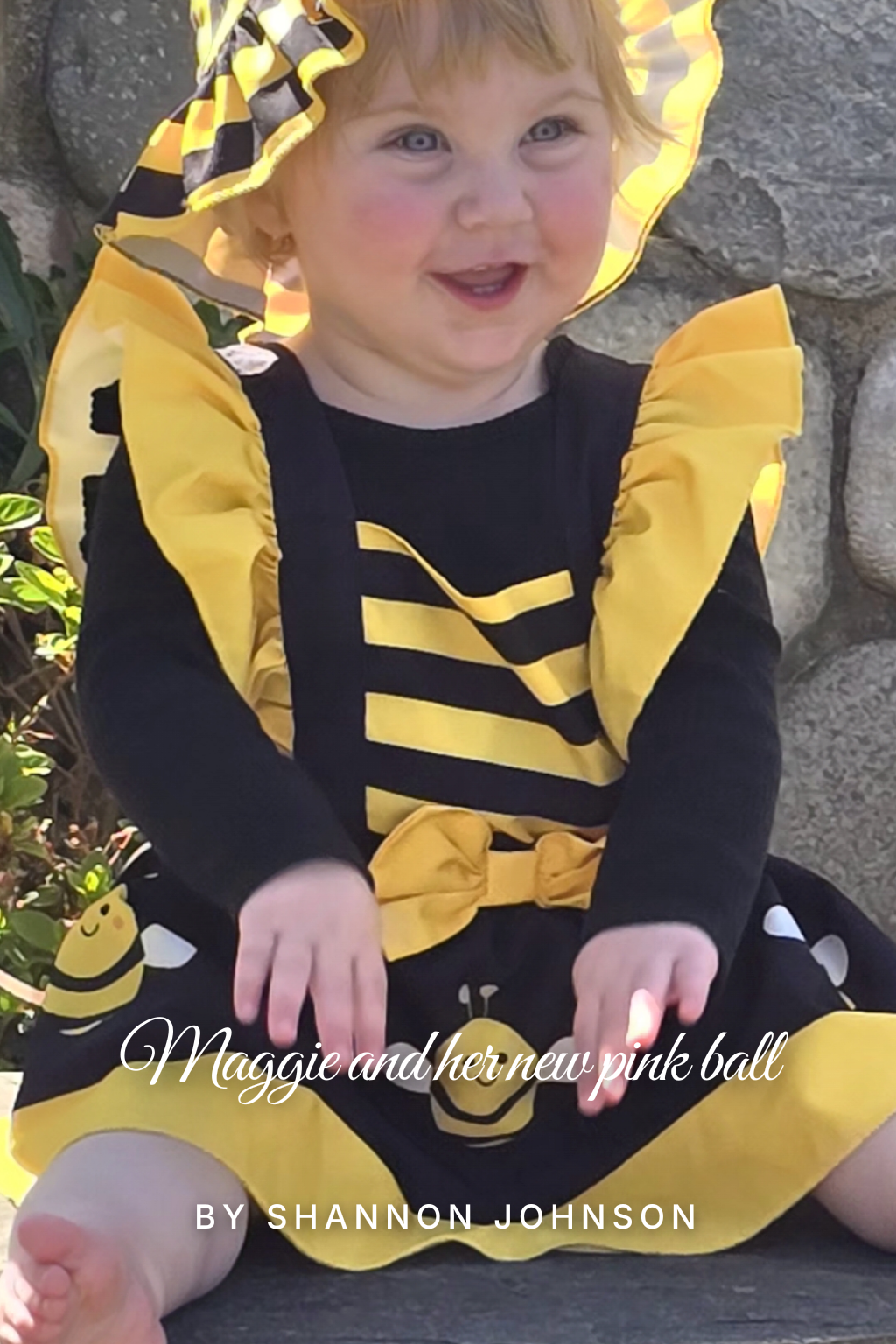
Maggie and her new pink ball
Contents8 chapters
Chapter 1
The Pink Ball in the Window
Maggie saw the ball before she saw the puppets, before she saw the little train, before she even saw the bell on the toyshop door.
It sat in the window on a low white stand, round and smooth and bright as a strawberry drop. Pink—not pale pink like a flower petal, and not dark pink like jam. This was a clean, shining pink that seemed to make its own light. The morning sun touched the glass, and the ball gleamed back.
Maggie stopped on the pavement so fast that Mama had to stop too.
“What is it?” Mama asked.
Maggie lifted one small finger and pressed it toward the window. “Ball,” she said in a breathy little voice, as if the word itself might float away.
The toyshop window was full. A floppy rabbit hung from a ribbon. Wooden blocks stood in a tower. A toy drum showed its red sides. A yellow duck on wheels waited near the corner. But Maggie looked only at the pink ball.
She stepped closer.
Her nose almost reached the glass. She could see a soft shine on the ball where the light fell. She could see a tiny round shadow underneath it. She imagined what it might feel like in her hands—cool at first, then warm. She imagined pushing it and watching it roll away in a neat, happy line.
“Pink ball,” she said again, more firmly now, because she wanted Mama to know this was not just any ball. This was the ball.
Mama smiled. “It is a very pretty one.”
Pretty was not big enough, Maggie thought in her small, wordless way. The ball was lovely. The ball was wonderful. The ball was the sort of thing that made her chest feel full and fizzy.
A bus sighed at the curb. A bicycle bell rang farther down the street. Someone came out of the bakery next door with a paper bag warm with rolls. Maggie did not turn her head. The whole street could puff and ring and rustle. The pink ball stayed in the middle of everything.
Mama crouched beside her. “We are on our way to the market,” she said gently. “We can look for one more minute.”
One minute was not enough, but Maggie took it.
She studied the ball carefully, as children do when they mean to keep something safe in memory. She saw its color. She saw its shape. She saw how round it was, with no corners anywhere, nothing sharp, nothing poky. It looked ready for small hands. It looked ready to bounce off a rug, or roll across grass, or rest under an arm during story time.
At last Mama stood and held out her hand.
Maggie put her hand in Mama’s, but she looked over her shoulder for three more steps. Then five. Then ten. When the toyshop window was behind a tree and then behind a van and then gone, she still pictured the ball in her mind as clearly as if it were right in front of her.
At the market, Maggie saw apples in green crates. She saw carrots with frilly tops. She saw a fishmonger lay silver fish on chipped ice. She usually liked these things. She liked to count oranges. She liked to point at flowers in buckets by the door. She liked the clack of the scales and the rattle of paper bags.
Today she thought of the pink ball.
Mama held up a bunch of bananas. “Should we get these?”
“ball,” said Maggie.
Mama tried again at the bread stall. “Do you see the big loaf?”
“ball.”
At the flower stand, a breeze shook the petals of white daisies. Maggie watched them for one blink and then said, “ ball.”
Sometimes a child’s mind catches on one thing and will not let go. It is like a mitten snagged on a twig. Pulling does not help. The thought stays put.
Back at home, Mama set the shopping on the kitchen table. Bread slid from its paper sleeve. Apples rolled in a bowl with soft taps. Maggie sat on the floor with her blocks, but instead of building a tower, she made one little stack and knocked it down at once. It was not the game she wanted. She tried to play with her pretty dolly, but she kept thinking about that pink ball at the toy shop
She looked up each time a car went by.
She looked toward the front door.
She looked at Mama, hoping Mama had somehow hidden the toyshop inside her coat and would pull it out.
“Mama,” she asked, “ball?”
Mama knelt to put away the milk. “Not today, little bean"
Maggie frowned.
Not today was a hard shape to hold. It was not like yes, which felt sunny. It was not like no, which was sharp and clear. Not today was soft and droopy. It left room for wishing.
Maggie carried her blocks to the rug and let them spill from the basket. Clack-clack-clack. The sound was nice. Still, she thought of the ball. She then picked up her dolly and put her in her little bed.
She took her crayons to the table and made bold loops on paper. Blue loop. Green loop. Yellow scribble. Then she searched the tin for the pink crayon. She drew one big circle and jabbed the crayon in the middle until it broke.
“Oh dear,” said Mama.
Maggie looked at the broken crayon and then at the round pink scribble on the page. “Ball,” she said softly.
After lunch, she was meant to rest. Her curtains moved a little in the breeze. Her blanket smelled of soap and sleep. A stuffed bear sat by her pillow with one ear bent over. Usually Maggie liked to pat Bear’s nose and sing to herself before drifting off.
Today she lay on her back and stared at the ceiling.
If she closed her eyes, the ball came back at once. There it was in the toyshop window, waiting and shining. Sometimes in her mind it bounced once. Sometimes it rolled under a chair. Sometimes she hugged it to her chest.
“Mama,” she called.
Mama opened the door a crack. “Rest time.”
“Pink ball,” Maggie whispered.
Mama’s face went soft. “You really do like that ball.”
Maggie nodded against the pillow.
Mama came in and tucked the blanket around her toes. “You may think about it while you rest.”
So Maggie did.
She thought about how the ball might sound on the kitchen floor. Bup. Bup. She thought about how it might sound on the grass in the garden. Poff. She thought about chasing it with both hands stretched out. She thought about sitting down and rolling it away with a small push and then crawling after it, laughing.
At some point, the warm room and the soft blanket and all that thinking carried her into sleep.
When she woke, the light in her room had changed. It was honey-colored now, slanting through the curtains. She sat up with creased cheeks and sleepy hair and remembered the ball before her feet touched the floor.
“Pink ball,” she said to Bear, who agreed silently.
She padded down the hall. In the kitchen, Mama was slicing pears. The knife clicked on the board. The smell was sweet and green.
“Can I help with your snack?” Mama asked.
Maggie climbed onto a chair. She put pear slices onto a little plate. One slice for the plate. One slice for her mouth. Then she held up a bite with sticky fingers and asked the question again, because some wishes must be said many times.
“Ball?”
Mama kissed the top of her head. “You still remember.”
Maggie remembered with all of herself.
In the late afternoon, rain began. It tapped first at the window and then harder on the glass. The sky turned gray as a dishcloth. Maggie stood on a stool and watched drops race each other down the pane.
The rain made the day feel smaller, tucked indoors. Maggie fetched a cushion and sat by the back door. She pressed her face to the cool glass and imagined a bright pink ball on the wet stones, shiny as a berry after rain.
She wanted to hold it so badly that her hands opened and closed in her lap.
Mama noticed. “Would you like to hear a story?”
Maggie almost said no. A story was good, but it was not the ball. Then Mama picked her up and carried her to the sofa, and the sofa was warm, and the blanket was soft, and the story was about a duck who lost one boot in the mud. Maggie listened. She even laughed in the right places.
Still, under the duck and the mud and the missing boot, the pink ball sat in her mind like a bright marble at the bottom of a bowl.
When the front door opened at last, Maggie heard it from the sofa. She wriggled down at once.
Daddy stepped in with rain on his shoulders and damp hair at his temples. He carried his work bag in one hand and something else in the other—a plain brown paper sack folded at the top.
Maggie ran to him.
“Hello, puddle jumper,” Daddy said, bending low for a hug.
Maggie hugged one leg because she was already looking at the sack.
Daddy noticed. “Ah,” he said. “Sharp eyes.”
Mama stood in the kitchen doorway with the tea towel in her hands. She did not say a thing. She just smiled a small smile that Maggie almost missed.
Daddy held the sack behind his back.
Maggie bounced on her toes. “What’s that?”
“A sack,” said Daddy, teasing a little.
Maggie laughed once, impatiently. “What in sack?”
Daddy leaned closer. “I wonder.”
He carried the sack to the rug and sat cross-legged. Maggie sat so fast she nearly tipped over. Her knees tucked under her. Her fingers reached out and then curled back, because she knew there was something special in the waiting.
Daddy unfolded the top with a slow crinkle.
Maggie inhaled.
He reached inside and drew out something bright enough to light the room on its own.
The pink ball.
For one still second Maggie simply looked.
Here it was—not behind glass now, not in a faraway window, not living only in her mind. Here it was near enough to touch. Near enough to smell the new, rubbery scent of it. Near enough to see the tiny pearl of water on one side where rain from Daddy’s coat had kissed it.
Then Maggie gave a shout so happy it came out as half laugh, half squeal.
“MY ball!”
She clapped both hands over her mouth, then grabbed the ball before it could vanish back into wishing.
It was smooth. It was real. It was even better than she had thought. Cool and springy under her palms, light but not too light, fat and round and perfect for holding. She pressed it to her cheek. She hugged it to her middle. She held it at arm’s length to admire its color all over again.
“Pink,” she breathed.
Daddy smiled. “The very same one from the toyshop window.”
Maggie looked from Daddy to Mama and back again, too full of joy for many words. “For me?”
“For you,” Mama said.
That answer made the room go wide and golden.
Maggie stood up with the ball tucked under one arm like treasure and walked in a proud little circle around the rug. She showed it to Bear on the sofa. She showed it to the cat, who blinked and walked away. She showed it to the mirror in the hall and stared at the sight of herself there: a small girl with wild hair and bright eyes and a bright pink ball that matched her grin.
When a child receives something long wished for, joy does not stay quiet. It spills.
Maggie bounced the ball once.
Boing.
She gasped in delight.
She bounced it again.
Boing. Boing.
The ball sprang up toward her hands as if it wanted the game too. She chased it when it skipped away. She rolled it across the rug and scrambled after it on her knees. She tossed it up a tiny bit and hugged it when it landed against her chest. Every move taught her something new: how fast it rolled, how soft it felt, how it shone when the lamp caught it.
“It bounces!” she cried, as if this were a splendid surprise.
“It does,” Daddy said.
“It rolls!” she cried next, giving it a shove toward the table leg.
“It does that too,” Mama said.
Maggie laughed so hard she hiccuped.
Soon she wanted the ball with her for everything. She carried it to the kitchen for supper and wedged it between herself and her chair. She took a bite of peas, then patted the ball. She drank some milk, then checked that the ball was still there. Once it tried to slip away, and she trapped it with both ankles under the table.
Daddy looked down and smiled. “You really love that ball.”
Maggie nodded solemnly. “My pink ball.”
Possession can feel very big in a little child’s heart. My cup. My spoon. My blanket. My Mama. The word my helps a child make a tiny fence around what feels precious. Inside the fence, things seem safe.
After supper, Maggie carried the ball to the bathmat and sat beside it while Mama ran the water. Steam curled up. Bubbles piled in white hills. Maggie did not want the ball in the tub, but she did not want it far away either. So she set it on the mat where she could watch it.
“Stay,” she told the ball.
The ball did not move.
She bathed quickly for once. She let Mama wash behind her ears. She let the shampoo rinse out without much fuss. Every few splashes, she checked the ball. There it was, bright and faithful on the mat.
When Mama wrapped her in a towel, Maggie pointed with a damp hand. “Ball comes too.”
“The ball can come to your room,” Mama said, “but not in your bed if it is wet.”
Maggie accepted this. She was learning the ways of her new prize.
In her room, she chose a place for it beside the little bookshelf, where the lamp made a warm pool of light. She set the ball down carefully, then stepped back to look. It made the room prettier, she thought. Bear looked pleased to have such company.
Daddy came in for goodnight hugs. He sat on the edge of the bed and noticed how Maggie’s eyes kept flicking to the ball.
“Do you want to hold it one more time before sleep?” he asked.
Maggie slipped out from under the blanket, fetched the ball, and climbed back in with it nestled against her pajamas. She gave it a squeeze.
There are happy things that make a child wiggle and run. There are happy things that make a child go suddenly quiet. Maggie’s happiness now was the second kind. It settled over her like warm milk, sweet and calm.
Mama tucked the blanket near the ball but not over it. “A very special day,” she said.
Maggie nodded.
Daddy kissed her forehead. “Sweet dreams.”
The room dimmed when the lamp clicked off, but the hall light left a soft stripe across the floor. In that stripe, the ball glowed faintly pink.
Maggie watched it from her pillow.
She thought of tomorrow.
Tomorrow she could bounce it in the living room. Tomorrow she could roll it down the hall. Tomorrow she could take it to the garden if the rain stopped. Tomorrow everyone would see her beautiful pink ball.
The thought made her smile into the blanket.
Then another thought came, small as a pebble dropped into water.
If everyone saw the ball, everyone might want to touch it.
Maggie’s fingers tightened on the edge of the blanket.
Would she let them?
The ball was hers. She had waited for it. She had wanted it all day with that deep, round wanting children know so well. It felt good to say my pink ball. It felt safe.
But games can be bigger when more hands join in. A roll can come back. A bounce can be chased together. A smile can grow when it is shared.
Maggie looked at the pink ball in the stripe of light and wondered, in her quiet bedtime way, what kind of joy it would be.
Would it be a joy she wrapped all around herself and kept close?
Or would it be a joy she could pass, and see come rolling back?
Chapter 2
Bounce, Roll, Hug
The pink ball was the first thing Maggie looked for when morning came.
Before she sat up, before she called for Mama, before her toes found the cool floor, her eyes went to the spot by the bookshelf. There it was. Round. Bright. Pink as strawberry yogurt. The thin morning light from the window touched one side, and that side looked almost pearly.
Maggie smiled at it as if it had been waiting just for her.
She scrambled out of bed, hair mussed, cheeks warm from sleep, and scooped the ball into both arms. It was smooth against her pajamas. She pressed her face to it for one quick cuddle.
“My pink ball,” she whispered.
A beloved new thing often gets the first greeting of the day. Little children do this with a blanket, a truck, a shiny spoon, a rubber duck. They wake and check: Is it still here? Is it still mine? The answer helps the morning begin.
Maggie carried the ball down the hall with careful little steps. It kept trying to slide from her elbow, so she hugged it tighter. At the kitchen door she bumped the frame with her shoulder, laughed, and kept going.
Mama was at the table cutting banana into soft coins. Daddy stood at the stove with a pan. Ben sat in his high chair in a yellow bib, drumming one hand and then the other on the tray.
“Good morning,” Mama said.
Maggie lifted the ball higher. “Ball woke up.”
Daddy turned and smiled. “Did it sleep well?”
Maggie considered this. “Yes.”
Ben saw the pink shine at once. His round little face brightened. He made a hopeful sound and reached both hands into the air. “Ba! Ba!”
“Yes,” Maggie said proudly. “Ball.”
She stood where Ben could see it, but not too close. Ben kicked his feet against the high chair and reached again. His fingers opened and closed like tiny starfish.
Mama set a bowl on the table. “You may keep the ball beside your chair while you eat.”
Maggie nodded. She already knew exactly where it should go. She tucked the ball between her chair and her leg, safe in the crook of her knee. Then she climbed up and began breakfast.
She took one bite of porridge. Pat-pat went her hand to the ball.
She ate a banana coin. Pat-pat again.
Children often check on a prized thing over and over. The object has not changed, but the feeling around it is still new and large. Looking helps. Touching helps. The hand returns almost by itself.
Ben watched all of this with shining interest. When Maggie bent to pat the ball again, he leaned so far from his high chair that Daddy had to steady him with one hand.
“Easy there, Ben,” Daddy said.
“Ben likes your ball,” Mama said.
Maggie put both feet around it under the table. “My ball,” she answered, not crossly yet, just firmly, as if she were saying the sky was up and the floor was down.
After breakfast, the living room opened wide before her like a waiting field.
The rug lay in the middle with its red and blue squares. The sofa made a soft wall on one side. A low table stood near the window. Sunlight spilled across the floorboards in long gold bars. Dust floated in it. The room smelled faintly of toast and soap and the lavender polish Mama had used on the shelf two days before.
Maggie set the ball on the rug and crouched in front of it.
She gave it a tiny push.
The ball rolled away, slow at first, then quicker, whispering over the rug before clicking softly onto the floorboards. Maggie gasped in delight and chased it at once. Her bare feet slapped the wood. She caught the ball near the curtain and flung her arms around it as if it might disappear.
Then she tried bouncing.
She stood up very straight, bent her knees a little the way Daddy had shown her with oranges in the garden once, and pushed the ball down with both hands.
Boing.
Up it came, not very high, but high enough to surprise her.
Maggie squealed.
Again she pushed.
Boing.
This time it hopped sideways. She lurched after it, laughing so hard her breath came out in little puffs. The ball bounced off the sofa with a muffled thup and came back toward her. That was even better. A game that returned by itself felt almost magic.
There is a special joy in learning what a thing can do. A spoon clinks. A block stacks. A bell rings. A ball bounces and rolls and escapes. Each action teaches the child, and the child wants the lesson many times.
Maggie spent a long while finding out all the pink ball’s tricks.
She rolled it under the table and crawled after it, peering through chair legs as if hunting a bright moon. She bounced it beside the sofa and discovered that the cushion sent it off at a funny angle. She sat on the rug with her legs in a V and pushed the ball from one foot to the other. She lay on her tummy and nudged it with her nose.
“My ball is fast,” she told Bear, who had been brought in from her room to watch.
Then, with sudden tenderness, she lay on her side and hugged the ball against her chest. Its smooth curve fit under her chin. She rocked once, twice.
Some children do not only play with a favorite object. They cuddle it. They feed it pretend spoonfuls. They tuck it beside them on a cushion. Love and play sit very close together in early childhood. Maggie’s ball was not only for motion. It was also for holding.
Mama folded laundry in the armchair while keeping half an eye on the game.
“You do love that ball,” she said.
Maggie nodded, breathless. “It bounces to me.”
“As long as it stays away from the lamp,” Mama said.
Maggie looked at the lamp, looked at the ball, and took this rule seriously. She moved her game three giant toddler steps to the left.
Ben came in after a while, riding on Daddy’s hip. His hair was soft from washing, and one sock had already gone missing. Daddy set him down on the rug.
At once Ben spotted the ball.
“Ba!” he cried.
He dropped to hands and knees and began his determined baby crawl, palms thumping, diaper wobbling, eyes fixed on the shining pink prize.
Maggie saw him coming.
In one quick move she snatched up the ball and clutched it to her middle. Ben reached the place where it had been and found only rug.
He blinked. He patted the empty square. He looked up at Maggie.
“Maggie,” Daddy said mildly, “Ben wants to see.”
“No.” Maggie stepped back.
Ben changed direction and crawled toward her instead, grunting with effort. He was very small still, but he had the strong will of a little brother who had noticed something wonderful. He planted one hand on Maggie’s ankle and stretched the other toward the ball.
Maggie twisted away. “Mine.”
The word mine can come out of a young child like a door shutting. It is not always meanness. Often it is fear. If another person touches the treasured thing, will it still feel special? If it leaves my hands, will it come back? A small child may not know the answers yet.
Daddy crouched beside Ben. “Gentle hands.”
Ben patted Maggie’s leg instead of grabbing. He looked up hopefully.
Maggie hugged the ball tighter until her knuckles paled.
Mama did not rush in with a lecture. She watched Maggie’s face. A child’s face often shows the real trouble before words can. Maggie did not look naughty. She looked worried.
“You want to keep it close,” Mama said.
Maggie nodded at once.
“That is all right for now,” Mama answered. “You may play with it.”
Relief softened Maggie’s shoulders. She did not have to decide anything bigger than that yet. She bounced the ball once, perhaps a little harder than before, and chased it away from Ben’s reaching hands.
Ben sat back on his bottom and watched. His mouth made a small round shape. He seemed puzzled that a thing so bright and lively was not coming his way.
Maggie noticed, but only a little. Her own game still felt louder than his feelings.
By midmorning the clouds had thinned. Wet drops still clung to the garden leaves, but the rain had stopped. Sun flashed in the puddles like tiny pieces of mirror.
Daddy opened the back door. Fresh damp air came in, cool and earthy. It smelled of grass, soil, and the clay pot by the step.
“We can take the ball to the garden,” he said, “if we keep it out of the mud.”
This was glorious news.
Maggie hugged the ball and hurried to the door so fast Mama had to call, “Shoes first.”
The delay felt enormous. Maggie stamped each foot into its shoe with urgent little grunts while still holding the ball under one arm. Then out she went.
The garden looked washed and new. Water beads trembled on the hedge. A snail shone on the wall. The paving stones were dark from rain, and the grass along the edge sparkled. Near the apple tree, one fat puddle reflected the sky.
Maggie stopped and stared. Outdoors, the ball looked even pinker.
She set it on the paving stones and pushed.
The ball rolled farther here than it had on the rug. It ticked over the joins between stones, then sped along the flat path toward the herb bed. Maggie ran after it, arms spread wide. Her shoes made squeaky little sounds.
Again she tried a bounce.
Down went her hands.
Up came the ball, springy and bright.
It bounced once on the stone, once on the grass edge, then veered toward the puddle. Maggie lunged and caught it just in time. She held it above the water, panting.
“No puddles,” Mama reminded from the step.
“No puddles,” Maggie agreed.
She kissed the ball once on its dry side.
Then a new game began. She rolled it to the wall and watched it bump and return. She rolled it under the garden bench and knelt to fetch it from the damp shadows below. She tossed it a very little bit and caught it against her apron. Once she sat right down on the path and hugged it while looking at a line of ants crossing by the mint pot.
A ball can be many things in one day. It can be a runner, a rabbit, a moon, a baby to cuddle, a treasure to guard. Children do not need the object to stay one thing. Their play shifts as quickly as birds turning in the air.
Ben came to the doorway in Mama’s arms and bounced with excitement when he saw the pink ball outside.
“Ba! Ba!”
Mama carried him down the step and set him on a dry patch of grass. He wobbled, then sat with both legs wide and both hands ready.
“Maggie,” Mama called gently, “Ben would like a turn to pat the ball.”
Maggie froze.
The ball was tucked in the crook of her elbow. She looked at Ben. Ben looked at the ball. A breeze stirred the wet rosemary and lifted a curl at Maggie’s temple.
“Just pat?” Mama asked.
Maggie took two backward steps.
“No.”
Ben made a small sound of protest and leaned toward her. The grass bent under his hands as he scooted forward on his bottom. He was not fast, but he was steady.
Maggie turned away and rolled the ball hard down the path.
“There!” she said, as if the game itself should settle the matter.
She ran after it before anyone else could come near.
Mama exchanged a look with Daddy, who had come out carrying a watering can. Neither parent spoke sharply. The moment did not need thunder. It only needed noticing.
When Maggie brought the ball back, Ben reached again. His fingers brushed the pink surface this time—just the lightest tap.
Maggie jerked the ball to her chest so fast that Ben’s hand landed in air.
“My ball!” she cried, louder now.
Ben startled. His mouth turned down.
Daddy set down the watering can. “Maggie, that was a very quick pull.”
Maggie held the ball like a shield. Her chin tucked in. She knew everyone had seen.
A young child can feel two things at once and not know what to do with either of them. Maggie loved the ball deeply. Maggie also sensed the grown-ups’ watchful quiet. She was not ready to give the ball away, even for a moment. So she clung harder.
Mama walked over and crouched beside Ben first. She brushed a bit of grass from his hand. “You wanted to touch it,” she said.
Ben blinked up at her and made a soft unhappy noise.
Then Mama looked at Maggie. “You are telling us you want the ball all to yourself.”
Maggie nodded, almost fierce with it. “All mine.”
Mama did not say the wish was wrong. She simply answered the truth in it. “Today you feel like keeping it close.”
That sentence let Maggie breathe again. She was understood, even if no one looked especially pleased.
Maggie moved to the far side of the path and sat down with the ball in her lap. She traced one finger over its shiny curve. She kicked her heels lightly against the stone. Nearby, a drop fell from the clothesline and darkened the ground.
Ben watched from the grass. He had found a wooden spoon to bang on the step, but his eyes still drifted to the ball between each tap.
Maggie resumed playing, though now she kept one eye on Ben. If he scooted nearer, she moved farther. If he reached, she turned her shoulder. She was building a little moving fence around herself and the ball.
Soon the family went back inside for dinner. The kitchen smelled of soup and warm bread. Maggie insisted the ball sit beside her chair again, dry and safe. Ben, in his high chair, peered around the table leg at every chance.
After dinner came a quiet time. Ben grew sleepy and rubbed his eyes. Mama took him upstairs for his nap. The house settled into softer sounds: a floorboard creak, the swish of Daddy turning a newspaper page, a sparrow ticking at the window ledge.
Maggie lay on the living room rug with the ball under one arm.
She rolled it a little.
She hugged it a little.
She put her cheek on its cool smoothness and listened to the hush of the room.
Sometimes after the busiest play, a child wants stillness with the toy she loves most. Not every game needs noise. Holding can be part of knowing.
When Ben woke later, rosy and rumpled, the ball’s power had not faded at all. He toddled a few careful steps between Mama’s hands, saw Maggie on the rug, and smiled a wide baby smile.
“Ba,” he said at once.
Maggie stood up with the ball before he got near.
“No, Ben.”
She did not shout this time. She said it with the steady certainty she had practiced all day.
Ben paused. He looked at Mama, then back at Maggie. He reached one hand out anyway.
Maggie drew the ball behind her back.
That was her answer.
She chose the joy of keeping over the risk of sharing. She chose the safe little fence around my. She was not ready yet for the ball to leave her hands and travel to someone else’s.
Mama gave Ben a set of stacking cups. Daddy rolled a soft cloth cube toward him. Ben batted the cube once, then glanced again at the pink ball with plain longing.
Maggie saw that glance. She saw it and held the ball tighter.
Then she bounced it once on the rug.
Boing.
She chased it and laughed. The sound was real. The pleasure was real too.
But now the room held one more real thing alongside it: Ben’s watching face.
Maggie was not ready to answer that face yet. Not today. Today the pink ball stayed in her arms, under her hand, beside her knee, always close.
When evening came, she carried it from room to room as if the day might steal it if she set it down too long. She rolled it once more across the living room. She hugged it by the window while the sky turned apricot. She brought it near the bathmat again, keeping it dry, keeping it hers.
And each time Ben looked, Maggie made her choice again.
My ball.
For now, that was the whole answer she could give.
Chapter 3
Ben's Quiet Face
Ben took one more step toward Maggie, slow and hopeful, with both hands open.
Maggie saw him coming and wrapped her arms around the pink ball so tightly that her elbows poked out like little wings. “Mine,” she said again.
It was not a loud word.
It was a firm word.
A door-shut word.
Ben stopped.
For a tiny moment he stood very still on his soft, uncertain feet. Then his bottom dropped down to the rug with a quiet plump. He did not cry right away. He only looked at Maggie. His mouth turned down at the corners. His eyes grew shiny. One hand stayed stretched toward the ball, but now the hand looked small and lonely in the air.
The room changed.
A minute ago, the living room had felt full of late-day gold. Light from the window lay across the rug in a warm stripe. Daddy was folding a tiny pair of socks on the sofa. Mama was stacking books on the shelf. The pink ball gleamed like a candy moon under Maggie’s chin.
Now the same room felt different.
Nothing moved very much.
Ben drew his hand back to his chest. He blinked hard. His lashes stuck together with little beads of tears. Then he turned his face down and made a soft sound, more hurt than loud.
“Mm.”
That was all.
Not a wail.
Not a shout.
Just a small sad sound.
Sometimes a quiet face can say more than a noisy one. A child does not need big tears for feelings to be real. A turned-down mouth, wet eyes, and a body that pulls away can tell the story plainly.
Maggie shifted the ball from one arm to the other.
She had what she wanted.
The ball was still hers. No one had taken it. No one had even touched it.
But the warm happy fizz inside her chest did not feel quite the same.
She bounced the ball once, a little to show herself that it was still fun.
Boing.
The sound came and went.
Ben did not smile at it.
He turned his face toward Mama’s skirt instead.
Mama set the books down on the shelf. She did not hurry. She did not scold. She crossed the rug and crouched beside Ben.
“You wanted the pink ball,” she said softly.
Ben nodded without lifting his head.
Mama rubbed his back in one slow circle. “You feel sad.”
Ben leaned against her knee.
Maggie watched from across the rug. Her fingers pressed into the ball’s smooth skin. It felt cool and round and perfect. She liked that feeling. She wanted to keep liking it.
Mama did not reach for the ball. She did not tell Maggie, Give it to him now. She looked first at Ben, because sad feelings need seeing.
Then she looked at Maggie.
“Maggie,” Mama said, “come look at Ben’s face.”
Maggie stayed where she was.
The ball rested against her striped shirt. Her toes curled into the rug. She gave a tiny shake of her head.
Mama kept her voice gentle. “You do not need to hand over your ball this very minute. I am asking you to look.”
That was a smaller thing.
Not give.
Look.
Maggie took one step.
Then another.
She came close enough to see Ben’s cheek, pink and damp. One tear had escaped and made a shiny line down toward his chin. His eyebrows were pinched together. His lips were tucked in the way they were when he tasted a lemon slice once by mistake.
Mama touched Maggie’s elbow lightly. “What do you notice?”
Maggie looked down.
“Eyes wet,” she whispered.
“Yes,” said Mama. “His eyes are wet.”
Maggie peered harder, as if Ben’s face were a picture with pieces she had missed. “Mouth sad.”
“Yes,” said Mama. “His mouth looks sad too.”
Ben glanced up at Maggie for a second, and his face crumpled more. He did not reach this time. He only tucked his hands against his belly.
Maggie looked away first.
It can be hard for a little child to look straight at another person’s sadness, especially when she helped cause it. Looking means knowing. Knowing asks something from the heart.
Maggie pressed the pink ball under her chin until it squeaked faintly against her shirt.
“I keep it,” she said, not quite to Mama and not quite to herself.
“You are keeping it,” Mama answered.
Maggie waited for the next words. She was used to hearing what came next after a hard moment. Be kind. Take turns. Say sorry.
But Mama did not pour all the answers in at once.
Instead she said, “And Ben feels sad.”
The two truths sat side by side on the rug.
Maggie has the ball.
Ben feels sad.
A toddler often understands one truth at a time. This mine. This want. This no. It takes practice to hold two truths together and see how one touches the other.
Maggie looked at Ben again.
She noticed his shoulders, which had curled in. She noticed that he was no longer making grabby hands. She noticed the stacking cups near the chair legs, bright and empty, still untouched.
Daddy stayed on the sofa, quiet as a coat on a peg. He knew this was a small important moment, the kind that asks for space around it.
Maggie’s grip loosened a little.
Only a little.
She did not offer the ball.
Not yet.
She put one hand on Ben’s shoulder instead, very briefly, as if testing whether sadness could be patted away like dust.
Ben did not smile. He leaned harder into Mama.
Maggie pulled her hand back.
“That didn’t fix it,” Mama said softly, and there was no sharpness in her voice. “Sad feelings do not always go away fast.”
Maggie frowned. She knew how to fix some things. A fallen block tower could be built again. Spilled water could be wiped with a cloth. A bumped knee could have a kiss.
But this was a feeling. It sat in the room like a little cloud no one could sweep out the door.
Mama sat down fully on the rug beside Ben. “When you hold the ball and say no, Ben understands he cannot play with it. He feels left out.”
Left out was not a word Maggie used much yet, but she could feel that it meant standing on the outside of something warm.
She looked at the stripe of sunlight on the rug. It touched her knees. It did not touch Ben.
The thought came small and slow: Ben wanted to be where the game was.
Maggie rolled the ball one inch forward, then drew it back to her lap.
Mama saw the movement. “You are thinking.”
Maggie nodded.
Thinking, for a young child, can be almost visible. It shows in the pause, the still hands, the eyes that stop skittering and settle on one thing.
Ben sniffed. Mama handed him a soft cloth from the basket by the sofa. He dabbed at his own cheek in a clumsy swipe and missed the tear completely. Daddy smiled a tiny smile and looked down at the sock in his hand.
Maggie watched Ben try again with the cloth. This time he caught the tear and rubbed his nose too hard.
“Too much,” he muttered.
“Yes,” said Mama. “A little gentler.”
That word hung in the air after she said it.
Gentler.
Maggie heard it and looked at the ball.
A ball could be hugged gently. Rolled gently. Bounced gently. Kept gently. Shared gently.
She was not there yet, but the word had arrived.
Mama picked up one of the stacking cups and set it upright. “Maggie, sometimes when we keep something all to ourselves, another person feels hurt. Not because you are bad. Because feelings happen between people.”
Maggie listened with her whole face.
She did not understand every word, but she understood enough. Keep. Hurt. People.
She sat down across from Ben, with the pink ball in her lap like a bright round question.
Ben’s eyes rose to it at once.
Then they dropped.
That dropping hurt Maggie in a strange new way. She had expected wanting. She had not expected giving up.
The room felt less sunny again, though the window had not changed.
Maggie nudged the stacking cups with one toe. “Ben sad ’cause ball?”
Mama nodded. “Yes. Ben is sad because he wanted to join your play, and you were not ready.”
Not ready.
That sounded truer than mean.
Maggie could feel the difference, though she could not have explained it. She had not wanted to hurt Ben. She had wanted to keep the shiny pink joy close to herself. But wanting one thing had done another thing too.
That discovery made her quiet.
Children learn this slowly: our choices can land on someone else’s heart. A hand pulling a toy away, a body turning its back, a firm no with no room in it—these can sting, even when no one meant to sting.
Ben found the cloth’s corner and twisted it in his fist. He looked so small then, sitting beside Mama’s knee with his damp lashes and round baby cheeks. Maggie remembered how he had laughed the day a feather floated down from Daddy’s coat. She remembered how he clapped for bubbles in the bath.
His face did not look like that now.
It looked closed.
Maggie did not like that.
She set the ball on the rug between her ankles. It stayed there, pink and glossy.
Mama watched without pushing.
“What can you see now?” Mama asked.
Maggie studied Ben as if she were learning a new animal in the garden and had to notice its signs.
“No smile,” she said.
Mama nodded. “No smile.”
“Eyes shiny.”
“Yes.”
“Ben want play.”
“Yes,” Mama said again, and this time there was a little warmth in the word, because Maggie was making the path herself. “Ben wants to play.”
Maggie touched the ball with one finger.
Her voice came out small. “I make Ben sad?”
Mama answered with care. “When you kept the ball close and said no, Ben felt sad.”
It was almost the same thing, but not quite. Mama gave Maggie the shape of cause without making her feel like a bad child. The difference mattered.
Maggie let the sentence settle inside her.
Ben felt sad.
Because of the no.
Because of the keeping.
Because the game stayed shut.
She did not burst into tears. She did not fling the ball away in shame. Feelings do not need a big show to be real. She simply sat very still, with one hand resting on the ball and her eyes on Ben’s damp face.
That stillness was work.
Daddy stood and carried the folded socks to the basket by the stairs. As he passed, he squeezed Maggie’s shoulder once, a silent little bridge of love. Then he moved on, leaving the moment with the children and Mama.
Mama reached for Ben’s hand. “Would you like a cuddle?”
Ben climbed halfway into her lap.
“Mama cuddle,” he said.
Mama gathered him in. His head tucked under her chin. The room softened around that shape.
Maggie looked down at her own lap and found it empty now, because the ball had rolled a few inches away without her noticing. She caught it before it went farther.
She expected relief at having it back in her hands.
Relief came.
But not all by itself.
Something else sat beside it now, heavier than before.
She looked at Mama’s arms around Ben.
“Ben cry more?” she asked.
“Maybe not,” Mama said. “The cuddle helps. Being seen helps too.”
Being seen.
Maggie thought about that in her child-sized way. When she scraped her knee, she wanted someone to look. When she woke from a bad dream, she wanted Mama to see her right away. When she found the pink ball in the shop window, she had wanted everyone to see it, to know how much it mattered.
Ben had wanted that too just now.
Not only the ball.
The wanting.
The hurt.
Mama shifted Ben so he could sit upright again. “Maggie, you do not have to decide this minute. But I want you to remember Ben’s face.”
Maggie looked carefully.
The tear track had dried to a faint shining line. His mouth was still droopy. His eyes were no longer spilling over, but they were not bright with play either. He looked careful now. Quiet.
Maggie nodded solemnly, as if Mama had shown her something important by the window.
“I member,” she said.
Mama believed her.
The evening moved on in little sounds. A kettle clicked in the kitchen. A pigeon thumped once onto the sill outside. Daddy called, “Tea is ready,” and the smell of warm milk drifted in.
Ben slid off Mama’s lap and walked after the sound, a bit wobbly, a bit steadier than yesterday.
Maggie stayed on the rug.
She rolled the pink ball forward and caught it again.
Usually that game made a small happy spark in her belly.
Now she found herself looking toward the doorway where Ben had gone.
She rolled the ball again, softer this time.
It bumped her ankle and stopped.
There are moments when play changes before the child has words for why. The toy is the same. The hands are the same. But the heart has learned one new thing, and the old game cannot feel exactly as it did a minute earlier.
Maggie carried the ball into the kitchen at last.
Mama had set out cups and sliced toast into fingers. Ben sat in his high chair, dabbing one hand in a little puddle of spilled milk. Daddy was wiping the tray with a cloth.
Maggie stood near Ben’s chair and looked up at his face.
He looked back at her.
Quietly.
No tears now. No smile yet either.
Maggie placed the ball on the floor by her own foot. Close enough to keep. Far enough that Ben could see she was not clutching it to her chest.
“Ben face better?” she asked.
Mama turned from the counter. She heard the real question tucked inside the small one.
“Some better,” Mama said. “Feelings can change when we have time and comfort.”
Maggie considered this. Time. Comfort. Looking.
She held one piece of toast in her hand and looked at Ben again. He had milk on his chin. His eyes were calm, but a little watchful.
Maggie knew that watchful look now.
It was the look of someone not sure the game had room for him.
She took a bite of toast.
Chewed.
Swallowed.
Then she said, almost to the ball, “Ben sad before.”
“Yes,” Mama said from the sink. “He was.”
Maggie nodded to herself.
The truth was plain now. Keeping the ball had not only kept the ball. It had also made a feeling in her brother’s face.
She was still not ready to share it.
But now she knew there was more in the room than my ball.
There was Ben too.
And once a child truly sees another child’s sad face, the old answer can begin to feel too small.
Chapter 4
A Game for One Is Not Much Fun
After tea, Maggie took the pink ball back to the living room.
She did not sneak with it. She did not hide it behind her back. She walked in the ordinary way, one hand under the round pink shine, as if everything felt just the same as before.
But everything did not feel the same.
The rug still lay soft and blue under her feet. The lamp still made a yellow puddle of light by the sofa. Bear still sat tipped against the cushion where Maggie had left him that morning. The room looked like her room always looked.
Only the game had changed.
Maggie set the ball down and gave it one small push.
It rolled away from her, smooth and quiet, until it touched the leg of the armchair.
Usually she liked that part best. The going. The little waiting. The getting it back again.
She toddled over, picked it up, and bounced it once.
Boing.
The ball sprang from the rug and bumped her hands.
She caught it.
She bounced it again, harder this time.
Boing.
The sound was good. The pink was good. The ball was still exactly round and lovely and hers.
Still, the happy spark inside her came late.
Maggie frowned at the ball as if it had done something odd.
She rolled it under the coffee table and crawled after it. She liked doing that. The table made a tiny cave. Dust lived under there in shy little puffs, and one lost block waited near the far leg. The ball knocked the block and came back.
Maggie smiled a little.
Then the smile slid away.
She sat up and looked toward the kitchen doorway.
Ben was not there.
Mama was rinsing cups. Daddy was folding the tea cloth. They talked in low grown-up voices that hummed and stopped and hummed again. The house was not quiet, not truly.
But the part where Ben had been felt quiet.
Maggie held the ball against her tummy.
“Bounce,” she told it.
So she bounced it.
Boing.
“Roll,” she told it.
So she rolled it.
It curved off the rug and tapped the skirting board.
Maggie chased it and brought it back. She tried a new game. She bounced, clapped, then grabbed. She rolled it to the sofa and hurried around to catch it on the other side. She set Bear in a row of cushions and rolled the ball to Bear’s fuzzy paws.
“Bear turn,” she said.
Bear, being Bear, only leaned and looked brave.
Maggie waited for that to be fun.
It was a little fun.
Only a little.
A game for one can start bright and then go flat, like bath bubbles when the water cools. Maggie did not know those words. She only knew that her body was playing and her heart was standing a step behind.
Ben came in at last, walking with his round careful steps.
He had a wooden spoon from the kitchen. He carried it like a treasure. Tap. Tap. Tap. He hit it softly against his leg as he came.
Maggie looked at him right away.
Ben looked at the ball right away.
Then something new happened.
He did not reach.
He did not hurry over on eager knees or open his hands and say, “Turn?”
He stopped near the bookshelf and just watched.
The watching made Maggie feel funny.
Before, when Ben wanted the ball, she had felt tight and guard-y, like a bird sitting on a nest.
Now Ben stood still, and that stillness did not make things easier.
It made them lonelier.
Maggie bounced the ball once more, because that was what one did with a ball.
Boing.
Ben tapped his spoon on the shelf.
Tap.
Maggie rolled the ball in a quick circle around her feet.
Ben watched the circle.
Then he turned away.
He sat down with a soft plop beside the basket of books and began patting the spoon on the floorboards.
Tap. Tap. Tap.
No tears.
No asking.
No smile either.
Mama came to the doorway and saw them both.
She said nothing at first.
Mama was good at that. She could let a moment breathe.
Maggie bounced the ball again. She wanted Mama to see that she was playing, that the ball was being used properly, that nobody could say she was wasting such a beautiful thing.
Boing.
The ball popped up crooked and brushed Maggie’s shoulder before dropping behind her.
She turned to fetch it.
By the time she had it back in her hands, Ben had found a board book with a duck on the cover. He held the spoon in one hand and thumped the book gently with the other.
Thump. Tap. Thump.
It was not a game. Not really. It was only something to do.
Maggie noticed.
Children notice more than they can explain. Maggie could not have said, Ben has no toy to chase. Ben has made himself small because I said no before. Ben is trying not to want too much. Those were grown words.
But she could see his bent head.
She could see that he was not sparkling.
And because she could see it, she could not unsee it.
Mama sat on the sofa and began folding tiny socks from the basket beside her.
“One sock,” she murmured. “Two socks. A stripey sock hiding under Daddy’s jumper.”
That made Ben grin for a blink.
Then the grin went.
Maggie hugged the ball to her chest.
Mine, she thought.
The word still fit.
Only now it did not feel as warm.
She wandered to the window with the ball. Outside, the garden was going silver-blue with evening. The paving stones still held damp in their cracks from yesterday’s rain. A blackbird hopped under the apple tree, pecking fast and bossy. Maggie put the ball on the sill and stood on tiptoe to see better.
The ball did not do much on a windowsill.
She picked it up again.
Back on the rug, she tried making a tunnel with her legs and rolling the ball through. That usually made her laugh. The ball bumped one ankle, wandered sideways, and escaped toward the basket of blocks.
Ben moved his feet out of the way to let it pass.
Then he did not touch it.
He could have.
It rolled close enough.
He only tucked his hands into his lap and watched Maggie come get it.
That was when the room gave her the answer, though no one said it out loud.
Keeping a toy can keep it safe in your own hands.
Keeping it can also make the room feel small.
Maggie picked up the ball slowly this time.
She did not squeeze it.
She just held it and looked at Ben.
Ben looked back for one quick second, then down at his duck book.
He turned a page.
The page made a papery flap-flap sound.
Maggie knew books. Books were for laps and looking and pointing. Balls were for moving. For chasing. For the little surprises of where they would go next.
A ball wanted a path.
A ball wanted another pair of hands at the far end.
Maggie did not know that as a rule. She learned it by standing there with a still ball and a still brother in the same room.
Daddy came in with a basket of kindling for the fire. He set it by the hearth and crouched to stack the sticks. Clack. Clack. Dry wood smell rose into the room, clean and dusty all at once.
He glanced over.
“You’re quiet bunches,” he said.
“Ben book,” Maggie answered.
“Mm-hm,” said Daddy.
“Ball bounce,” she said, giving a little lift to the pink ball.
“I see that too.”
Daddy did not tell her what to do.
He only lit the fire. Soon a warm orange lick began behind the grate, and the room changed from yellow to gold. Shadows climbed the wall. Ben leaned against the book basket. Mama finished the socks and began pairing tiny trousers. The whole family was near.
Even so, Maggie felt oddly by herself.
That was new.
Before, being alone with the ball had felt strong. Like holding a secret sun. Now it felt like sitting under a blanket fort with one flap open, knowing someone else is outside.
She carried the ball to Bear again.
“Bear roll?” she asked.
Bear stayed very polite and very stuffed.
Maggie pushed the ball to him.
It bumped his soft belly and stopped.
No laughter came back.
No surprised little “oh!” came back.
No crawling knees, no reaching hands, no bright face.
The ball simply sat there, pink and silent against brown fur.
Maggie sighed. A real sigh, from deep in her small ribs.
Mama looked up at the sound.
“Is the game not feeling right?” Mama asked.
Maggie pressed her lips together. She thought.
“Ball same,” she said at last.
“Yes,” said Mama.
Maggie looked at Ben, then at the floor.
“Maggie same,” she added.
Mama’s eyes turned soft.
“Yes,” Mama said again.
Maggie tipped her head. “Fun... not same.”
There it was.
Not a big speech. Only the truest words she had.
Mama patted the sofa cushion beside her, though she did not call Maggie over. “Sometimes,” she said, folding one more little shirt, “a game changes when someone feels left out of it.”
Maggie listened.
Ben was tracing one finger over the duck on his page. Very gently. Around the beak. Down the neck. Round the wing.
Maggie remembered his wet eyes.
She remembered the droopy mouth.
She remembered his careful look at tea.
And now this quiet sitting.
The quiet sat beside all those other pictures and made a new shape in her mind.
When Maggie scraped her knee, she wanted everyone near. When Maggie found a crumbly biscuit, she liked to offer Bear pretend bites. When Daddy made silly trumpet sounds through the cardboard tube from kitchen roll, it was fun because Maggie laughed and Daddy laughed and even Ben bounced where he sat.
Laughter liked company.
Balls did too.
Maggie took three slow steps toward Ben.
Then she stopped.
The stopping mattered.
Sharing does not always begin with a big brave rush. Sometimes it begins with pausing in the middle of the rug while your fingers tighten and loosen on something you love.
Maggie held the ball against her knees and watched Ben turn another page.
Flap.
There was the duck again, bigger this time, with blue water under it. Ben made a tiny sound to himself.
“Duh,” he whispered.
“Duck,” Mama said.
“Duck,” Ben repeated, proud and small.
Maggie felt a little tug inside her chest.
Ben had made a word.
He had nobody to roll the ball to.
He had a spoon and a duck book and his own quiet hands.
Maggie looked down at the bright pink curve under her chin. She still loved it very much. Loving it had not shrunk. That part stayed big.
Only another feeling had grown beside it.
She wanted the room to sound different.
She wanted the game to have giggles in it again, even though there had not yet been giggles with this ball and Ben together. She could imagine them now. That was enough to tug her forward.
She walked closer.
Not all the way.
Just close enough that Ben noticed her socks.
He looked up.
Maggie froze like a little woodland creature in a story, all eyes and breath.
Ben looked at the ball.
Then at Maggie’s face.
He did not ask.
That made Maggie braver and sadder all at once.
Braver, because there was space to choose.
Sadder, because Ben had learned to wait without hoping too loudly.
Daddy straightened from the hearth. Firelight moved over his cheek. He saw Maggie standing there, but he kept his hands busy with the kindling basket. Grown-ups can help by being still too.
Maggie crouched.
The ball slipped a little in her arms. She caught it.
Ben’s spoon fell from his hand with a clack, but he still did not reach for the ball.
He only watched.
Maggie did not offer it yet. Not in this moment. The door inside her had opened, but only a crack. She could feel the cool air from the other side.
She set the ball on the floor between them.
Not near her foot this time.
Between.
Then she kept one hand on top of it.
Ben looked at that hand.
Maggie looked at his face.
He did not have wet eyes now. He did not have a droopy crying mouth.
But he had that careful look again, the one that asked without asking, Is there room for me this time?
Maggie swallowed.
A game for one is not much fun, her heart was learning.
Not because toys stop being nice.
Not because pink turns dull.
Not because bouncing forgets how to bounce.
A game for one is not much fun because sometimes the best part of play is the face at the other end.
Maggie patted the ball once.
“Ball,” she said softly.
Ben nodded. “Ball.”
Maggie gave it the tiniest push toward him, hardly more than a nudge.
The ball moved one hand-width over the rug and rested against his knee.
Ben’s eyes grew round.
He looked at Maggie at once, checking.
Maggie’s hand fluttered in the air, wanting to grab it back, wanting not to, wanting both things together.
Mama did not speak.
Daddy did not speak.
The fire made a little tick.
Ben laid his palm on the pink ball as if touching a bird that might fly away.
He smiled.
It was not yet a laugh. Not yet a full game. Just a smile, quick and bright and surprised.
But the room changed.
Maggie felt it.
The lonely feeling loosened one finger.
Something warm came in.
She smiled back before she even meant to.
Then, almost at once, she scooped the ball up again and hugged it tight.
The door was open only a crack, after all.
Ben blinked, surprised.
But he had seen the opening.
And Maggie had seen his smile.
That mattered.
Mama reached for the duck book and set it gently aside. “I think,” she said in her calm way, “your hearts are having a think.”
“Hearts think?” Maggie asked, distracted by the new idea and by the ball safe in her arms again.
Mama smiled. “Sometimes they do.”
Ben touched his own chest with a spread hand. “Heart.”
“Yes,” said Daddy softly from the fire.
Maggie touched her chest too. The ball pressed between her arms and her night-warm shirt.
Inside, something was indeed thinking. Not with words exactly. More with pictures. Ben’s sad face. Ben’s careful waiting. Ben’s surprised smile when the ball touched his knee.
Maggie rocked once on her feet.
Then she sat down right there on the rug, close to Ben now, though not touching him.
The closeness was another kind of answer.
She rolled the ball from one palm to the other. Ben watched, interested but not grabbing. The fire crackled. Mama folded the last small shirt. Daddy leaned one shoulder on the mantel. Evening gathered at the windows.
Maggie looked at Ben sideways.
Ben looked at the ball sideways.
Then both children looked at each other.
Ben gave a tiny snorty almost-laugh through his nose for no reason at all except that he was little and hopeful.
Maggie’s mouth twitched.
The room still held the old hurt.
It also held a new possibility.
She was not all the way ready.
But now she wanted to be.
And wanting, for a small child, is the first step toward doing.
Chapter 5
Can I Roll It to You?
Maggie stood up before she could change her mind.
The pink ball was tucked under her arm, shiny in the firelight, warm where her body had held it. Her knees felt wobbly. Not falling-down wobbly. More like new-thing wobbly, the sort that comes when a child is about to do something she has never quite done before.
Ben sat on the blue rug with his legs in a little V. The duck book lay beside him. One page had folded under. His wooden spoon was near his sock. He was not busy now. He was not reaching. He was simply there, quiet and watchful, with that careful face he had been wearing all evening.
Maggie looked at the ball.
Then at Ben.
Then at Mama.
Mama did not nod. She did not say, Go on.
She only met Maggie’s eyes with a soft, waiting look, as if to say, You can choose with your own heart.
Daddy stayed by the fire, one hand on the mantel. The flames made golden stripes on the floorboards. The room smelled like toast from tea and a faint cozy smoke from the new-lit fire. Outside the window, the garden had turned dark and silver. Inside, the lamp made a warm yellow pool over the rug where the children were.
Maggie took one small step.
Then another.
The ball slipped against her shirt. She hugged it tighter.
Ben noticed every step. His eyes followed the ball, then flicked to Maggie’s face, then back again. He still did not ask. He had learned to wait. That waiting pinched Maggie somewhere small and tender inside.
She stopped just in front of him.
The rug felt thick under her toes.
Her voice, when it came, came out tiny.
“Ben?”
He blinked.
Nobody else spoke.
Maggie swallowed. Her hand rubbed the smooth pink curve of the ball. It felt different now. Still hers. Still loved. But also like something she could use for more than holding.
She tried again.
“Ben,” she whispered, “can I roll it to you?”
The words sounded funny in the room.
Not May I keep it?
Not It’s mine.
Not No.
Can I roll it to you?
A giving question.
A joining question.
Ben looked startled, the way birds look when a branch moves softly under them. His mouth opened a little. He looked at Maggie to make sure he had heard right. Then he looked at Mama, then Daddy, and then back at the ball as if the ball itself might explain what was happening.
Mama’s face grew very still and bright.
Daddy’s mouth made the smallest smile.
Ben put both hands on his knees.
“Yes,” he said.
Just that.
Yes.
Maggie let out a breath she had been holding without knowing it. It puffed warm across her lip. She crouched down so her face was closer to Ben’s face. The ball came between them, bright as a berry in winter. She set it on the rug with both hands, carefully, as if setting down something both precious and new.
For one moment she kept her fingertips resting on top.
Ben did not grab.
That mattered too.
He waited.
Maggie gave the ball a little push.
It rolled over one blue stripe in the rug, then another. It turned slowly, not fast, because Maggie’s push was gentle and uncertain. The pink shine moved through the lamplight. Ben leaned forward. The ball touched his ankle and stopped.
Nobody clapped.
Nobody cheered.
The room stayed soft and quiet, which helped the moment feel real.
Ben looked down at the ball against his leg.
Then he touched it with one hand.
Then both.
He smiled.
This smile was bigger than the first one, bigger than the quick surprised one from before. It spread all the way into his cheeks. It softened his eyes. It changed his whole face from careful to glad.
Maggie saw it happen.
She had seen his sad mouth.
She had seen his wet eyes.
Now she saw what came after kindness.
That mattered just as much.
Ben patted the ball once.
“Pink,” he said, because he knew that word too.
“Pink,” Maggie echoed.
She almost snatched it back then. The old feeling rose up fast. Mine mine mine. Her fingers twitched on her knees. Her body remembered guarding. Her arms remembered hugging the ball close and turning away.
But Ben was smiling at her, not taking the ball away and running, not hiding it, not keeping it forever.
He was just there. Ready.
Maggie pressed her lips together. Waiting felt hard. Sharing felt hard too. Some good things are hard at first, especially when they are brand-new.
Ben looked at the ball.
Then he looked at Maggie again.
Very slowly, with a kind of care that children sometimes give to bugs, flowers, and hurt feelings, he pushed the ball back.
It did not come straight. It wobbled a little to one side because Ben’s hands were small and eager. The ball bumped over a wrinkle in the rug and turned toward Maggie’s shin.
But it came back.
Back.
That was the answer.
A kind thing had gone out, and a kind thing had returned.
Maggie’s face opened into a smile before she could stop it. She caught the ball with both palms. The pink surface tapped against her skin. It felt the same as before—round, smooth, beloved. Yet it carried something new now. Ben’s trust. Ben’s yes. Ben’s smile.
“Oh,” Mama said softly, almost to herself.
Daddy’s hand left the mantel. He folded his arms, warm-eyed and quiet.
Maggie looked at Ben with a new sort of wonder.
He had rolled it back.
He was not only the child who wanted. He was the child at the other end of the game.
That made all the difference.
“Again?” Maggie asked.
Her voice was still shy, but not as shaky.
Ben nodded so quickly that one curl bounced on his forehead. “Gain.”
Maggie giggled. A little bubble of sound popped right out of her.
She rolled the ball again, this time with a bit more push.
Ben trapped it between his hands. He laughed, a sudden small burst, and rolled it back faster than before. The ball bopped Maggie’s ankle. She squealed. Not hurt—just surprised. The sound made Ben laugh harder. One of those baby-toddler laughs, all breath and delight, where the joy comes before the reason finishes arriving.
Maggie laughed too.
The room changed shape around them.
It felt less like corners and furniture and grown-ups making tea and folding little shirts.
It felt like a place where something was happening between two children, back and forth, face to face.
Maggie sat down properly now, her legs folding under her. She leaned in. Ben leaned in too. The space between them no longer felt sharp and worried. It felt busy. Hopeful. Full.
She rolled the ball.
Ben rolled it back.
Maggie stopped it with both hands and looked up at him.
His smile was waiting there.
There are times when hurt feelings do not mend in one minute. Sometimes sadness needs a cuddle, or a rest, or a whole night’s sleep. But sometimes one small kind act begins the mending right away. Not all at once. Just the first neat stitch.
This was one of those times.
Ben had not forgotten feeling left out.
Maggie had not forgotten wanting the ball all to herself.
But now there was something else in the room besides the hurt: a game.
Games can do that.
Not magic. Not erasing.
Just making room for new feelings to sit beside the old ones.
Mama came and sat on the sofa without saying anything. Her basket of folded laundry rested by her feet. Daddy lowered himself into the armchair near the fire. The fire made a low tick and sigh. No one hurried the children. No one praised too soon. Grown-ups know some moments grow better if left alone.
Maggie sent the ball with a soft straight push.
Ben returned it with both hands and a grunt of effort.
Maggie said, “To you.”
Ben echoed, “You.”
Then he pushed the ball back and said, “To Maggie.”
His words were round and a little sticky, but clear enough.
Maggie beamed. “To Ben.”
Soon they had a rhythm.
“To Ben.”
Push.
“To Maggie.”
Push.
The ball made a muffled whuff-whuff sound over the rug. Sometimes it glided true. Sometimes it wandered. When it wandered, both children leaned sideways with serious little faces and tried to save it before it reached the chair leg or the hearth rug.
Once the ball curved away from Ben and headed for the sofa. Ben made a surprised “Oh!” and scrambled after it on hands and knees. Maggie scrambled too. Their heads nearly bonked. They froze, nose to nose for one tiny second, then both burst into laughter so sudden that even Daddy laughed aloud.
Ben got one hand on the ball first.
He looked at Maggie.
Here was another small test.
Would he clutch it and say no now?
Would the hurt turn around and point the other way?
Ben hugged the ball to his chest for exactly one heartbeat. Then he pushed it toward Maggie’s knees.
“Maggie turn,” he said.
Mama pressed her lips together as if to hold in a happy sound.
Maggie stared at Ben.
He had done what she was learning to do.
A turn for me.
A turn for you.
That is one of the first bridges children build together.
She laid her hand on the ball, not grabbing, just receiving. “Thank you,” she said, because Mama and Daddy had taught that word many times, and tonight it came out with real weight.
Ben grinned. “Wel-come,” he said in his own lumpy way.
Maggie rolled the ball back so gently it barely made it to him.
Ben reached, missed, and then caught it against his tummy. He snorted with laughter. Maggie copied the snort on purpose. Ben snorted again, louder. Soon both of them were making ridiculous little piggy noises over the pink ball, and the game became half rolling, half giggling, as many toddler games do.
The duck book lay forgotten.
The wooden spoon stayed by the sock.
The careful look had left Ben’s face.
In its place was plain pleasure.
Maggie noticed that too.
When children learn to share, they are not only learning about toys. They are learning to read faces. This face means left out. This face means surprised. This face means glad. This face means I am still here with you. Maggie could not have said all that in words. But she could see it. And seeing it changed what she wanted.
A few minutes ago she had wanted to keep the ball safe in her own arms.
Now she wanted to see that glad face again.
She rolled it.
Back came the smile.
She rolled it again.
Back came the smile, and the ball too.
“Ben,” she said, trying out a bigger sentence, “we roll together.”
“Together,” he said.
The word sat sweetly in the room.
Mama finally spoke. “Yes,” she said. “That is what you are doing.”
Maggie glanced up at her, then back to Ben. She did not need much more than that. The game itself was telling her the lesson in a way her hands and eyes could understand.
She gave the ball a longer roll now, one that traveled cleanly across the rug.
Ben stopped it neatly.
“Mama!” he said, thrilled with himself. “I did.”
“You did,” Mama said.
Maggie clapped once, a quick bright clap.
Ben’s chest puffed a little. He rolled the ball back with extra pride. It veered and bumped Maggie’s foot, but she trapped it easily.
“My foot catch,” she announced.
“Foot catch,” Ben repeated.
Daddy’s smile deepened into the kind that crinkles the corners of the eyes. “Very fine catching in here,” he said.
The children barely looked up. They were busy.
That is another lovely thing about a shared game. It can take hold of two small people so completely that the grown-ups fade into the warm edges of the room.
Maggie shifted closer.
Ben shifted closer too.
Now the rolls were shorter and surer. The ball went from Maggie’s palms to Ben’s hands and back again as if it had always belonged in motion between them. The pink color flashed against blue rug, cream socks, chubby fingers. Each return made the next sending easier.
Can one kind offer mend hurt feelings?
Not like a bandage on a scraped knee. Not fast-fast and finished.
More like this:
A child says no, and another child’s eyes fill.
A room goes quiet.
A heart begins to think.
Then one child tries a new thing, small and shaky.
Can I roll it to you?
And the other child answers with his hands.
Back comes the ball.
Back comes the smile.
Back comes the wish to stay near each other.
That is mending.
Not perfect.
Real.
Ben paused with the ball in his lap and looked at Maggie as if checking one more time that this was still allowed.
Maggie nodded, a solemn nod from one little person to another.
“Yes,” she said.
Ben rolled it back.
Maggie laughed, relieved by the yes she had just given. It felt good to say yes and mean it.
She hugged the ball for one quick squeeze when it reached her, then set it down again at once.
That tiny pause was important too. Sharing does not mean never loving a thing closely. It means making room for someone else with it.
Maggie was learning the size of that room.
“Ready?” she asked.
“Ready,” said Ben.
She rolled.
He rolled.
The ball moved between them like a bright little promise.
After a while, Mama rose to stir the fire. Daddy went to the kitchen and came back with two small cups of water. The house settled into evening sounds: a spoon in a sink, a log shifting in the grate, the hush of feet on the hall runner. Through it all, the children kept their game.
Not wild.
Not loud.
Just steady.
Back and forth.
At last the ball came to rest in Maggie’s lap. She laid both hands over it and looked at Ben.
He looked back, breathing a little faster from play, cheeks pink, eyes clear and easy.
No wetness now.
No careful waiting.
Only the soft afterglow of being let in.
Maggie held his gaze for one long toddler moment. Then she pushed the ball to him again, because now she knew the answer for sure.
Yes.
One kind offer can begin to mend a hurt feeling.
Especially when the offer is followed by another roll, and another, and another, until both children believe the game belongs to them together.
Ben received the ball with a happy little gasp and sent it back at once.
And this time, when it returned to Maggie, she did not feel she had less.
She felt the room had more.
Chapter 6
Back and Forth, Giggle and Snort
The ball did not stay in one place for long.
Maggie pushed it with both palms, and the bright pink roundness slipped away from her knees, crossed the blue rug, and kissed Ben’s ankles with a soft thup.
Ben squealed.
Not a sad sound.
Not a waiting sound.
A full, surprised, bubbly squeal.
He caught the ball against his tummy, blinked at it as if it had arrived by magic, and pushed it back with a small strong shove that sent it wobbling sideways instead of straight.
Maggie lunged after it.
“Oops!” she cried.
The ball bumped the leg of the little wooden chair, spun once, and rolled under.
Now the game had changed.
Ben dropped to his hands at once. Maggie dropped too. Two heads bent low. Two bottoms stuck up in the lamplight. Under the chair sat the ball, pink as a flower petal, just out of reach behind the front rung.
“There!” said Maggie.
“Dere,” said Ben.
Maggie stretched one arm. Her fingers brushed only chair leg. Ben flattened his cheek to the rug and peered in with one serious eye. The fire made gold bars on the floorboards. Dust bunnies hid by the skirting board. The ball waited under the chair as if it liked being chased.
Ben giggled first.
That tipped Maggie over.
She giggled too, a quick bright spill of sound, and then the two of them were laughing before anyone had even got the ball back.
Daddy, in the armchair near the fire, lowered his cup and smiled over the rim. Mama looked up from folding a small pile of washing on the sofa.
“Seems the ball has found a hiding place,” she said.
“Hidey place,” said Ben.
Maggie wriggled closer. “I get it.”
She tried again, pressing one shoulder to the rug. Her hand reached farther this time, but not far enough. Ben patted the floor with excitement.
“I get! I get!”
Together, their hands made a little flutter under the chair, one from this side, one from that side.
That is one way sharing works for small children. A toy does not only get passed from one child to another. Sometimes it gives them a problem to solve together. Then the fun is not just in having the thing. The fun is in the chasing, reaching, trying, and laughing side by side.
Daddy leaned forward and hooked a finger under the far chair leg. “Shall I move this a tiny bit?”
Maggie looked at Ben. Ben looked at Maggie. Both nodded.
Daddy shifted the chair a finger-width.
That was enough.
The ball peeped out.
Ben slapped it with delight, which sent it shooting free faster than anyone expected. It zipped between Maggie’s knees, skimmed across the rug, and tapped the base of the yellow lamp.
Maggie gasped.
Then she ran.
Her feet made soft pad-pad sounds in her socks. Ben scrambled after her, half crawling, half toddling, determined not to miss whatever happened next. Maggie reached the ball first, but when she gathered it to her middle she did not turn away.
She looked back at Ben, who was coming puff-puff across the rug with all the fierce purpose of a very small brother.
“Ready?” she asked.
“Ready!”
She rolled the ball to him.
It bumped his shin. He trapped it with both hands and laughed so hard a little snort came out.
Mama laughed too. “Oh, Ben. That was a happy snort.”
Ben repeated it on purpose, making himself laugh harder.
“Snort!” he announced.
Maggie folded over with giggles. Now every time the ball came to Ben, he tried another delighted snort before pushing it back, and every snort made Maggie bounce where she sat.
The room felt different now. A little while ago, the ball had been something to clutch tight. Now it was making paths between them. It crossed the rug. It curved around toes. It slipped under chairs. It returned with noise attached to it—giggles, squeals, breathy little words.
That is something children can feel in their bodies before they can explain it.
When a game belongs to one child alone, the joy stays small and close, like one candle.
When a game is shared, the joy often grows. One laugh wakes another laugh. One silly sound invites another silly sound. The same pink ball becomes more than a ball because two children are making something together with it.
Maggie did not say any of that.
She just grinned and sent the ball back again.
This time she gave it a bigger push.
The ball sailed cleanly to Ben. He stopped it with his palms, then looked suddenly very thoughtful. His tongue peeked out at the corner of his mouth. He was planning. Carefully, carefully, he aimed his little hands and nudged the ball toward Maggie.
It came back almost straight.
Maggie clapped once. “Ben did it!”
“I did it,” said Ben, shining.
“Yes,” said Mama softly. “You did.”
Children like to feel that a turn is truly theirs. Ben felt it now. He was not only receiving the ball. He was sending it. He was making Maggie laugh too. Shared play is sturdier when both children matter in the game.
Maggie scooted closer so the distance between them grew shorter. Now the rolling went faster.
Push.
Catch.
Push.
Catch.
The ball flashed pink against the deep blue rug again and again. Sometimes it rolled smooth as a plum. Sometimes it wandered and needed chasing. Once it knocked gently into Maggie’s heel and once into Ben’s knee. Each tiny mistake made the game livelier.
“Too far!” Maggie cried when Ben sent it wide.
Ben collapsed into another snort-laugh.
Maggie pushed it back to him with extra care. “Here it comes.”
“Here comes,” Ben echoed.
The ball met his hands. He hugged it for one tiny second, cheek pressed to its cool rubbery side, then let it go again.
Maggie noticed.
She had hugged the ball many times herself. She knew how good that smooth round shape felt tucked under an arm or against a chin. Seeing Ben do the same did not sting the way it once might have. It only seemed fair, almost nice. The ball was still pink. It was still hers to love. But in the game, it was also his to enjoy.
This was the new piece Maggie was learning.
Sharing did not snatch the good feeling away.
Sharing let the good feeling travel.
The ball rolled past Maggie’s left hand and kissed the leg of the sofa. She crawled after it. Ben crawled after her. Soon they were both moving around the room in a little parade: Maggie, then the pink ball, then Ben, who was determined to stay close to both.
Mama tucked a folded vest into the washing pile and lifted her feet just in time as the ball trundled toward the sofa.
“Oh dear,” she said in a playful whisper. “Something pink is coming my way.”
Maggie rescued it and held it high. “Ball found Mama!”
“Did it?” Mama widened her eyes. “What a clever ball.”
“Clever ball,” Ben repeated solemnly.
Maggie set it down between them again. “Roll to Ben.”
She did.
Back it came.
Again.
Now under the chair.
Again.
Now around Daddy’s slipper.
Again.
Now to Maggie’s lap.
The game began to make its own pattern, the way rain can make a pattern on a window or birds can make one in the sky. Not exact. Not stiff. Just back and forth enough that both children knew what came next and still found it exciting when the next thing arrived.
Daddy stretched his long legs out of the way. “I see I am in the middle of a very busy road.”
“Busy road,” said Maggie.
She rolled the ball through the tunnel under Daddy’s knees.
Ben’s eyes went wide. A tunnel! He shoved it back through at once, and when it popped out on Maggie’s side, he crowed with triumph as if he himself had invented tunnels.
“Again tunnel!” Maggie said.
They did it again.
And again.
Each pass through the leg-tunnel made Ben laugh in little hiccups. Maggie began adding sound effects. “Whoooosh,” she said as the ball went under.
“Wheeesh,” said Ben.
Soon the room held all sorts of small sounds: whoosh, wheesh, thup, pat, giggle, snort, “mine turn,” “your turn,” and the occasional “oops” when the pink ball changed its mind and swerved.
This is useful for children to learn too: sharing does not have to mean giving a toy away and standing back empty-handed. It can mean taking turns. It can mean rolling it to someone and waiting for it to come back. It can mean making a game where each child has a part.
Maggie was learning waiting.
That can be hard.
When the ball sat in Ben’s lap for longer than she expected, her hands twitched. Once, earlier in the day, she might have grabbed for it or said “mine” again. Now she leaned forward and said, “Ben’s turn.”
Mama heard her and gave the smallest nod.
Ben patted the ball, enjoying the shape of it, then looked up and saw Maggie waiting. He pushed it back.
“There,” he said generously.
“There,” Maggie agreed, receiving it with both hands.
Waiting had not ended the fun. Waiting had made room for Ben’s turn, and then the game could keep going. That is a big lesson in a small moment.
The fire gave a soft crack.
Outside the window, the garden had turned dusky blue. Inside, the lamp made warm circles on the walls. The pink ball seemed even brighter in that evening light, like a berry, like a blossom, like a cheerful secret the room was in on.
Maggie rolled the ball a little harder.
Ben missed.
It sailed past him and bumped the bottom shelf where the duck board book still lay crooked from before.
Ben turned, saw the runaway, and gave chase with full determination. He moved quickly for such a little boy, one hand on the rug, one knee planted, one foot helping, all wobble and purpose.
Maggie chased too.
For a moment they were almost nose to nose over the ball.
They paused.
The old moment might have come back there—the tight chest, the snatch, the sharp no.
But it did not.
Maggie touched the top of the ball and looked at Ben. Ben touched the side of it and looked at Maggie.
Then Maggie said, “We get it together.”
“Together,” Ben said at once.
They lifted it together for one second, one pair of tiny hands stacked over another, and that was so funny and strange and grand that Maggie burst into laughter again. Ben laughed because she did. Then he laughed because he was laughing. Then he gave another ridiculous snort and nearly toppled sideways.
Daddy covered his mouth, trying not to laugh too loudly and stir them out of their game. Mama did not try. She laughed openly, warm as toast.
Maggie settled the ball back on the floor and gave it a gentle push toward Ben. He returned it. She returned it. He returned it.
Now their rhythm was sure.
The ball no longer felt like a thing that might be taken away. It felt like a thing that kept coming back.
That matters to children. A child can share more easily when she learns that letting go for a moment is not always losing. Sometimes letting go is how the game continues. Sometimes the toy returns with more delight attached to it than before.
Maggie seemed to know this in her shoulders now. They were no longer hunched around the ball. They were loose. Her face was open. Her hands gave and received without fear.
“Fast one!” she called.
She sent it quickly.
“Fast one!” Ben echoed, though his words tumbled into each other.
He sent a slow one back.
Maggie pretended to be shocked. “Slow one!”
Ben shrieked with joy at the joke and rolled a very fast one, which went crooked, darted between the chair legs again, and tapped the wall.
Off they went.
The chase was almost as merry as the rolling.
Maggie slid on her tummy to fetch it from the wall. Ben tried the same and got stuck for a second with one socked foot waving behind him. Maggie looked back, saw him, and laughed so hard she had to rest her head on the rug.
Ben freed himself and laughed too, not minding one bit.
Here was the biggest thing the evening had to teach.
The fun was not split in half.
It was doubled.
One child alone could roll a ball, yes.
Two children together could roll it, miss it, chase it, find it under chairs, send it through tunnels, make silly sounds, clap for each other, and laugh at the same crooked bounce.
The ball had not grown bigger.
The happiness had.
Maggie sat back on her heels, a little flushed, wisps of hair curling near her ears. She held the ball in her lap and looked at Ben with bright, serious eyes.
“More?” she asked.
Ben nodded with his whole body. “More.”
So she gave him more.
She rolled the pink ball softly this time, a kind roll, one he could stop easily. Ben caught it and stroked it once with his palm. Then he sent it back with care, almost as softly as she had done.
Their game had become gentle without losing its joy. That can happen when children begin to trust each other in play. The toy moves. The children stay close. The fun settles and deepens instead of bursting apart.
Mama stood and came near enough to see the ball move between them at floor level. She did not interrupt. She only watched for a few turns.
Back to Ben.
Back to Maggie.
Back to Ben.
Pink over blue.
Blue under pink.
Small hands learning.
At last Mama said, “Look at that. The ball goes away and comes back, and so do the smiles.”
Maggie smiled at once, hearing it.
Ben smiled because Maggie did.
And then, as if to prove Mama right, they rolled the ball once more, each child sending the smile back with it.
No one in the room needed a long talk to know what was true now.
Sharing had not made the game smaller.
Sharing had made the room fuller, the sounds merrier, the children kinder, and the pink ball busier than ever before.
Maggie leaned forward for one final quick hug of the ball when it came to her. Then she set it down between herself and Ben, gave it a loving pat, and pushed.
“Your turn,” she said.
Ben beamed.
“My turn.”
He rolled it back.
Maggie caught it cleanly and laughed, a soft tired happy laugh from deep in her little chest.
Yes.
That was the answer.
When kindness joins a game, the fun can grow and grow, rolling farther than one pair of hands could send it alone.
Chapter 7
When the Ball Bumps Away
The bump happened in the middle of a good laugh.
Maggie had just caught the pink ball against her knees. Ben was waiting on the other side of the blue rug, sitting wide-legged, his small hands open. The fire made the room gold. The yellow lamp glowed by the sofa. Daddy’s two little cups still sat on the floor near the armchair, one with a wet ring under it. Mama watched from the sofa with her feet tucked up. Everything felt soft and safe.
“Ready?” Maggie asked.
Ben nodded hard enough to wobble.
Maggie grinned. She gave the ball a stronger push than before.
It went faster than she meant.
The bright pink ball zipped over the rug, skipped where the rug met the smooth floor, and bumped Ben right on the shin.
Ben blinked.
His mouth opened, but no laugh came out.
The room changed at once.
Ben pulled his leg in close. His face crumpled. His eyes grew shiny. He was not badly hurt. Still, he was startled. That counts too. A body can feel surprised and unhappy even from a little bump.
Maggie froze with both hands in the air.
She looked at the ball. Then she looked at Ben.
He was not smiling now. His lower lip had begun to puff out. One hand rubbed his shin in small circles.
Maggie did the right thing fast.
She did not reach for another turn.
She did not say, “It was just the ball.”
She did not laugh because the ball had gone crooked.
She stopped.
Stopping matters. When someone gets hurt or scared in play, the game can wait.
“Mama,” Ben said, very small.
Mama was already leaning forward, but she did not rush in first. She looked at Maggie.
Maggie had seen Ben’s face before when he felt left out. This face was a little different. Not the same sad. Not the same lonely. This was a startled sad face. A bumped face. A face asking, Was that too much?
Maggie crawled toward him at once.
Her knees made soft thumps on the rug. The ball rolled off to one side and tapped Daddy’s slipper.
“Sorry,” Maggie said.
The word came out quickly. It was not fancy. It was not long. It was just right.
Sorry is a useful word when it is true.
Ben looked at her through wet lashes.
Maggie stopped close enough to see the red place on his shin, small as a berry. She did not pat it right away. She remembered to look first.
“Ben all right?” she asked.
Her voice was quiet now.
That was another right thing. She checked him. She did not decide for him. She asked.
Ben sniffed. He looked down at his leg as if to ask it too.
Daddy set his cup aside and unfolded from the armchair. He came nearer, slow and easy, and crouched behind Ben without crowding him. Mama stayed where she was for one breath longer, giving the children room to meet this moment themselves.
“Small bump,” Daddy said softly.
Ben leaned back against Daddy’s shin. He still rubbed his leg. “Bump,” he agreed, but his eyes filled anyway.
Little bumps can make big feelings. Tired children know that well. Busy evenings know it too.
Maggie’s face changed. She had not meant to hurt him. Now she knew she had. That knowing sat in her shoulders. They dipped. Her mouth turned down.
She reached one finger toward Ben’s shin and stopped in the air.
“Gentle?” she asked.
Ben thought about it. Then he nodded once.
Maggie touched the sore spot as lightly as a moth landing.
“There,” she whispered, though of course her finger could not fix the whole thing. Still, gentle checking can help. Gentle checking says, I see what happened to you.
Mama came off the sofa then and knelt beside them on the rug.
“What happened?” she asked, though she had seen it.
This was not because Mama did not know. It was because children learn by telling.
Maggie answered first. “Fast one.”
Her eyes dipped to the floor.
“It went too fast,” Mama said.
Maggie nodded.
“It bumped Ben,” said Daddy.
Ben nodded too, his lip still puffed.
Mama put one hand on Maggie’s back and one hand near Ben’s ankle, not touching yet. “And what did Maggie do next?”
“Sorry,” Ben said in his round little voice.
“Yes,” said Mama. “She stopped. She said sorry. She came to check you.”
Maggie looked up then. She listened hard.
A child can learn more than one thing at once. Maggie had already learned that sharing meant making room for another child. Now she was learning that kindness also has to do with how the play feels in the body. Not too grabby. Not too rough. Not too fast for the other person.
Mama touched Ben’s shin very gently. “Do you want a rub?”
Ben considered. “Rub.”
Mama rubbed the little red place through his soft trouser leg with warm, slow circles. Ben breathed out. Some of the tightness went out of his face.
Maggie watched every bit of it.
“Can I rub too?” Maggie asked.
Ben looked at Mama. Then at Maggie. “Tiny rub.”
That was a good answer.
So Maggie gave him a tiny rub with two careful fingers.
Daddy smiled with one side of his mouth. “That is tiny.”
Maggie almost smiled back, but not quite. She was still serious.
The pink ball waited by the armchair. It was very still. Toys do not mean to hurt anyone. But toys do not judge speed either. Hands have to do that.
Mama said, “The ball was not bad. The push was too strong for this game.”
Children need simple truth. Not blame piled high. Not scolding for the sake of noise. Just the thing itself, named clearly.
Maggie turned and looked at the ball where it rested against the rug edge.
“Too strong,” she repeated.
“Yes,” said Mama. “Ben liked the soft rolls.”
Ben nodded. “Soft.”
Maggie nodded too. She had learned that already, once. She was learning it again in a deeper way now. Learning often comes back around like a ball.
Daddy picked up the pink ball and held it in one hand. “This one can go fast,” he said. “But tonight, on the rug, with Ben close by, fast can feel like too much.”
He set the ball down beside Maggie, not giving it to her yet, just placing it there where everyone could see it.
Maggie did not grab it.
That mattered.
Sometimes the kindest thing a child can do is wait with the toy still in sight.
Ben’s face had softened. His shin was no longer the most interesting thing in the room. He sniffed once more and wiped his nose with the back of his hand.
Mama handed him a cloth from the sofa arm. He dabbed clumsily at his face.
Maggie stayed near him.
“Ben sad?” she asked.
“A little,” Ben said.
“Ben hurt?”
“Little hurt.”
Maggie nodded as if she was putting those words in order inside herself. A little hurt. A little sad. Enough to stop for. Enough to care about.
Then she said the full thing.
“Sorry, Ben. Too fast.”
Ben looked at her. Really looked.
That is another thing children can do. They can listen with their whole face.
After a moment, he said, “Maggie sorry.”
“I am,” said Maggie.
Ben leaned forward and patted the ball once. Not a hard smack. Just a pat, as if he were reminding it to behave.
Daddy let out a soft chuckle.
The room loosened a little.
Mama did not hurry them back into the game. She knew better. After a bump, children sometimes need a pause. They need to know the game can stop and the closeness can stay.
So they all sat for a minute on the blue rug in the firelight.
The flames made little clicks in the grate. Outside the dark window, the garden was only shapes now. The spoon and duck book still lay where Ben had dropped them earlier. One of Ben’s socks had twisted half around his foot. Maggie noticed and reached to straighten it.
Ben let her.
That small act mattered too. It said trust was coming back.
Mama spoke softly. “When we play with other people, we watch more than the toy.”
Maggie listened.
“We watch faces,” Mama said. “We watch hands. We watch if the game still feels good.”
Daddy added, “And if it does not feel good?”
“Stop,” said Maggie at once.
Daddy nodded. “That’s right.”
“Sorry,” Ben added.
“Yes,” said Mama. “And check.”
Maggie repeated it like steps on the rug. “Stop. Sorry. Check.”
Those were good steps. Small enough for a child to remember. Strong enough to help.
Ben reached for the ball now. Not to take it away. Just to hold it against his tummy for a moment.
Maggie watched him do that.
She did not say mine.
She did not snatch.
She only asked, “Shin better?”
Ben pressed his lips together and thought hard. “Better.”
That made Maggie breathe out.
Children often need this part too. If they cause a hurt, even by accident, they need to know what happened after. They need to see that care can help. They need to see the other child come back from the bump.
Ben gave the ball a very slow push. It rolled only a little way, then stopped between them.
Maggie looked at Mama.
Mama smiled, but only a little. “You can play again if both of you want.”
“Soft,” said Ben.
“Soft,” Maggie agreed.
She set both palms on the rug and leaned low, close to the ball. This time she pushed it with just her fingertips. It moved like a round pink peach across the blue rug. Slow. Easy. Ben stopped it with both hands and hugged it for one beat before sending it back.
“Soft one,” Maggie said.
“Soft one,” Ben echoed.
There. The game had begun again, but it was a different game now. Same ball. Same rug. Kinder speed.
Maggie watched Ben more carefully this time. She still looked at the ball, of course. But now she also looked up each turn. Was he ready? Were his hands open? Was he smiling? Did the roll suit him?
That is how play grows kinder. Not by becoming stiff or worried. By becoming aware.
Ben rolled the ball back a little crooked. It brushed Maggie’s ankle and spun away toward the sofa.
Maggie laughed once, then checked Ben’s face before chasing it.
He laughed too.
Good. Still good.
Off she went after the runaway ball, quick on her hands and knees. She caught it by the sofa leg and cradled it back to the middle of the rug.
This time, before pushing, she asked, “Ready, Ben?”
Ben planted both hands on the floor. “Ready.”
Maggie rolled it softly. Ben trapped it between his knees and grinned.
Daddy sat back in the armchair again. Mama returned to the sofa. Neither one took over. The children were doing the work themselves now.
That is often the best place for grown-ups to be. Near enough to help. Quiet enough not to snatch the learning away.
The children kept going.
Back to Ben.
Back to Maggie.
Soft pink over blue.
A slow game can still be merry.
Soon Ben added a tiny sound each time he pushed. “Puh,” he said.
Maggie answered with her own. “Whoosh.”
Ben tried “whoosh” and got “ooof.”
Maggie laughed, but gently. Ben laughed too, pleased with his own funny mouth.
The game was light again. Not exactly the same as before. Better in a new way. More careful. More connected.
That can happen after a hard moment. The play need not be ruined. If children stop, notice, and repair, the game can come back with more trust in it.
After a few turns, the ball wandered toward Daddy’s foot. Ben looked at Maggie but did not move in yet.
“Get it together?” Maggie asked.
“Together,” said Ben.
So they both crawled over. Maggie put one hand on the ball. Ben stacked his smaller hand on top of hers. They carried it back together, wobbling. Daddy lifted his feet to help them pass.
When they set it down, Maggie looked at Ben’s face first, not the ball.
He was smiling.
That was the picture she needed.
Mama saw it too. “You are watching each other now,” she said.
Maggie glanced up. “I watch Ben.”
Mama nodded. “That is kind.”
Ben patted his own chest. “I watch Maggie.”
Daddy laughed softly. “Then you have two watchers and one pink ball. Very good odds.”
The children did not know what odds were, but they liked Daddy’s pleased voice and smiled anyway.
Maggie took another turn. Not hard. Not wild. Just enough.
The ball rolled true.
Ben stopped it cleanly and sent it back.
No bump.
Maggie’s whole body relaxed. She had wanted this. Not only the ball coming back. Ben coming back too. Ben’s easy face. Ben’s trust.
One of the nicest things about saying sorry is this: it opens a little door. Not every hurt can be fixed in one moment. But a true sorry, followed by care, gives the other person room to come close again.
Ben came close in the way he knew. He scooted nearer until their knees almost touched. Then he rolled the ball only the shortest distance at all, a tiny handoff more than a roll.
Maggie accepted that kind of turn too.
Now the game was almost a whisper.
The fire popped once. Mama reached for her knitting and then did not bother to pick it up. She preferred watching. Daddy sipped the last of his water.
The pink ball went to Maggie.
To Ben.
To Maggie.
At one point Maggie paused and touched her own shin. “If bump,” she said slowly, working it out, “I say.”
“Yes,” Mama said. “You can say if you do not like something.”
Ben listened.
“And if Ben says stop,” Maggie went on, “I stop.”
“Yes,” said Daddy.
Children need to hear that kindness goes both ways. One child learns to be careful. The other learns he may speak when play feels wrong.
Ben tested this new thought at once. Maggie rolled him a turn that was still soft, but a little off to the side. He had to twist to catch it. He frowned and lifted one hand.
“Not that side,” he said.
Maggie blinked. Then she nodded. “Middle.”
“Middle,” said Ben.
She aimed for the middle next time.
He smiled.
There it was. Another piece of it. Noticing faces is good. Listening to words is good too.
The evening had worn down into that drowsy, shining hour when children are still awake but the edges of the day have gone fuzzy. Ben’s hair stood up at the back. Maggie’s curls had sprung out by her ears again. Both children moved more slowly now.
Maggie held the ball in her lap for a moment and looked at it.
It was the same bright ball from the white stand in the toyshop window. Same glossy skin. Same cheerful color. But it had become more than a wanted thing. More than a mine thing. It had become a between thing.
A toy between children can teach them much, if grown-ups stay near and if the children keep trying.
Maggie pressed her cheek to the ball, then lifted her face and looked at Ben.
“Soft game nice,” she said.
Ben nodded. “Nice.”
“Fast game not nice for Ben,” she said carefully.
“Not nice,” he agreed.
Maggie thought one more moment. “Maybe outside fast.”
Daddy’s eyebrows rose. “That is sensible.”
Mama smiled. “Outside has more room.”
This was practical too. Some kinds of play belong in some places better than others. A wild bounce in the garden is not the same as a fast roll at someone’s legs in a snug room.
Maggie seemed pleased to learn there was a place for speed, just not here, not now, not at Ben.
She gave the ball one last little push. Ben caught it and hugged it close. Then, after a thoughtful pause, he leaned forward and placed it in Maggie’s lap.
For you, that meant.
For now, that meant.
Or maybe simply, back to you.
Maggie took it with both hands.
“Thank you,” she said.
Ben climbed forward and leaned his head for one brief second against her shoulder.
Maggie held still. Then she leaned back, just lightly, into him.
Mama’s face went soft as bread inside. Daddy looked into the fire and smiled at nothing anyone needed to name.
The lesson had not come from a speech. It had come from a bump, a pause, a sorry, a check, a softer start again.
That is often how children learn best. In the middle of real play. With a real mistake. With a real chance to mend it.
Maggie set the pink ball down between herself and Ben once more, but she did not push it yet. First she asked, “More soft?”
Ben gave a sleepy little nod.
So she rolled it the gentlest way of all.
And because she had noticed his face, and because she had stopped when the game went wrong, and because she had cared about the small hurt on his shin, the ball did not feel scary now.
It felt safe enough to send back.
Ben rolled it to her.
She rolled it to him.
The pink ball went away and came back.
So did the smiles.
Chapter 8
The Softest Bounce of All
Maggie rolled the pink ball with both hands and almost no push at all.
The ball did not zip. It did not skip. It only traveled in a slow, smooth line over the blue rug until it touched Ben’s feet.
Ben looked down first.
Then up.
Then he smiled.
That was the game now. A small game. A careful game. A good game for the sleepy end of the day, when the fire made the room gold and the yellow lamp hummed its soft light into the corners.
Ben put his two hands on the ball. He held it a moment, as if feeling whether it was still friendly. Then he sent it back. Not hard. Not crooked. Right to Maggie’s knees.
“Midd-le,” he said.
“Midd-le,” Maggie answered.
She liked that word in the game. Middle meant ready. Middle meant fair. Middle meant I am thinking of where you are.
Mama sat back on the sofa and let out a quiet breath. She did not clap. She did not jump in with lots of words. She only watched the children and smiled the smile she kept for tender things.
Daddy stood up with the empty cups and took them to the kitchen. His steps were soft on the floorboards. He came back and leaned one shoulder on the doorway for a moment, looking in.
The children did not need help just then.
They needed time.
The pink ball went to Maggie.
To Ben.
To Maggie.
To Ben.
Sometimes Maggie stopped it with her palms. Sometimes with her feet. Once it drifted a little toward the sofa leg, and she reached out, caught it, and turned it gently back instead of thumping it free. Ben noticed. His face stayed easy.
That mattered.
A game can look fine from far away. But up close, in children’s faces, a grown-up can see the true shape of it.
Ben’s shoulders were not tight now. His mouth was loose and soft. Maggie’s hands were open, not snatching. The room felt settled. Even the fire seemed to crackle more quietly.
Mama spoke then, because this was a moment worth naming.
“You are both taking such gentle turns,” she said.
Maggie glanced up, pleased.
Ben patted the ball once.
“Gentle,” he repeated.
“Yes,” Mama said. “Gentle with the ball. Gentle with each other.”
That was bigger than the game, though the game was how the children could see it.
Maggie leaned over the ball and gave it a tiny kiss with her lips. The rubber made a faint squeak.
“My pink ball,” she said.
Then she looked at Ben and added, after a little pause, “Our game.”
Mama’s smile deepened.
There it was. Not that the ball had stopped belonging to Maggie. It was still her ball. She still knew its color first thing in the morning. She still liked to hold it close. But a toy can belong to one child and still make room for two. Children learn that slowly. They learn it with turns, and pauses, and trying again.
Ben pushed the ball back with both hands. It wobbled. It did not stay in the middle. It wandered toward Maggie’s hip.
Maggie could have said, “No, middle.” She could have frowned.
Instead she scooted sideways and gathered it in.
“My turn now,” she said in a calm voice.
Ben nodded. He was learning too. Not every roll has to be perfect to stay kind.
Daddy came from the doorway and lowered himself into the armchair again. The chair gave its little evening creak. He rested one ankle over the other and watched as if the slowest game in the house was also the best one.
It was.
Fast games are fun. Loud games are fun. But slow games show many things. Slow games show waiting. Slow games show listening. Slow games show whether one child leaves room for another child to stay glad.
Maggie held the ball in her lap and looked at Ben’s face before she moved.
“Ready?” she asked.
Ben nodded once.
She rolled.
That small question changed the whole feel of the play. Ready? means I see you there. Ready? means I will not start without you. Ready? means your body matters too.
Ben stopped the ball with his fingers spread wide.
“Ready,” he echoed, a little late, but proud of the word.
Maggie laughed softly. Not the big wild laugh from the chair chase before. A warm little laugh. A sharing laugh.
The ball went back and forth again.
From the kitchen came the faint smell of washed cups and the clean, damp scent of the sink. From the fire came a woody warmth. The rug felt thick under Maggie’s legs. Ben’s socks had twisted so that one heel sat halfway up his ankle, but he did not seem to mind.
This is how much of children’s learning happens. Not in a rush. Not in a grand scene. Right on the rug, with one toy and another person close by.
Mama leaned forward and rested her hands on her knees.
“Kind hearts,” she said softly. “I see two kind hearts here.”
Maggie went still for one beat. Praise can land like a pebble in water. It makes rings.
“Me?” she asked.
“Yes,” Mama said. “You stopped when Ben got hurt. You said sorry. You checked him. And now you are making the game feel safe.”
Maggie’s eyes turned toward the ball in her hands.
Safe.
That was a word she could feel.
A ball pushed too hard could sting a shin. A loud no could sting a heart. A toy held too tightly could make the room feel lonely. But this soft game did not do those things. This game made space.
Mama looked at Ben too.
“And you,” she said. “You told Maggie what you did not like. You said, ‘Not that side.’ You came back to play. That was brave.”
Ben tucked his chin down in a shy way and smiled into his shoulder.
“Middle,” he murmured again.
Daddy gave a low chuckle. “A very wise rule.”
The pink ball rolled from one child to the other under that new rule, and the rule was not really about the rug at all. Middle can mean many things. It can mean not too hard. It can mean not too rough. It can mean not only my way.
Maggie began to test how soft she could be. She did not flick the ball with one hand. She bent close, set both palms behind it, and breathed out as she sent it. The ball almost seemed to float. Ben caught it with delight.
“Softest!” Maggie said.
“The softest bounce of all,” Daddy said, though the ball barely bounced at all.
That made Maggie giggle.
She tried again, this time letting the ball make one tiny kiss of a bounce over a fold in the rug. Boop. Then it settled and kissed Ben’s toes.
Ben squealed, but softly, the squeal of a child who was happy and sleepy at once.
“Again,” he said.
Again was easy now.
Maggie did not guard the ball under her chin anymore. She did not whip it away when Ben touched it. When it rested in his lap a little longer than before, she waited. She watched his face. He was not taking. He was thinking. Then he rolled it back by himself.
That mattered too.
Sharing is not snatching from one child and handing to another. Shared play works best when each child gets to choose his turn in it. Mama had known this all along. That was why she had waited. That was why Daddy had waited too. They stayed near. They set simple limits. But they let the children build the bridge themselves.
Ben sent the ball a bit too gently and it stopped halfway.
No one minded.
Maggie crawled to it, put one hand on top, and looked back at him.
“Too little,” she said.
Ben held up his hands, smiling. “Tiny roll.”
“Tiny roll,” Maggie agreed.
She nudged it the rest of the way toward herself and then rolled it back. Ben laughed so hard he made the little snort sound from earlier, the one that always popped out of him by surprise.
Maggie copied the snort.
Then both children laughed harder.
The ball wobbled between them while they laughed.
Even Bear, sitting nearby where Maggie had left him earlier in the day, seemed to listen in his stuffed-bear way, round and quiet. He did not play. He did not need a turn. But he was part of the room, part of the witness of it.
Daddy rubbed his chin.
“You two worked hard today,” he said.
They had. Children do not always know they are working when they play. Yet they are. They work at waiting. They work at speaking. They work at trying a kinder way after the first way goes wrong.
Maggie rolled the ball to Ben and then asked the question she had been circling toward all evening, though she did not know that was what she was doing.
“Ben happy?”
Ben hugged the ball to his chest for one second. Then he set it down again, because hugging it forever was not the game.
“Ben happy,” he said.
Maggie nodded, satisfied.
Then she touched her own chest.
“Maggie happy too.”
There was the answer, plain and bright.
Not smaller happy. Bigger happy.
When Maggie had first seen the ball in the toyshop window, all her wanting had pointed one way. Toward getting. Toward having. Toward holding. That feeling was real. Children know it well. The shine of a wanted thing can fill the whole mind.
But now another feeling sat beside it.
Rolling.
Waiting.
Getting it back.
Seeing another face light up.
Those things made a new kind of joy.
Mama rose from the sofa and crossed to the rug. She crouched beside the children, not to stop the game, only to come close enough to lay one hand on each back.
“This is what I hoped you would find,” she said.
Maggie tipped her head. “What?”
Mama looked at the ball, then at their faces.
“That a toy stays nice when hands are gentle. And it gets sweeter when hearts are gentle too.”
Maggie listened hard.
Ben leaned into Mama’s arm.
A child can understand a deep truth if it is given in small words.
“Maggie’s ball,” Mama said, touching the pink shine lightly with one finger. “Yes.”
Maggie nodded.
“Ben’s feelings,” Mama said, touching Ben’s shoulder.
Ben nodded too, though perhaps only because everyone else had.
“Maggie’s feelings,” Mama said, touching Maggie’s shoulder.
Maggie nodded again.
“Kind play keeps all of those safe.”
Safe ball. Safe brother. Safe self.
It was enough.
Maggie placed one hand flat on the ball and one hand flat on the rug, as if holding both the toy and the place where the game lived.
“Gentle share,” she said.
“Yes,” Mama answered. “That is it.”
Daddy stood and stretched his arms over his head. The day was nearing its end. The fire had burned down to a deep glow. Outside the window, the garden was dark and still. No fast game would happen out there tonight. That could wait for another day, with room and daylight and watchful grown-ups near.
Tonight belonged to the quiet game.
Ben gave a small yawn that opened his whole face.
Maggie saw it and laughed. “Sleepy Ben.”
“Sleepy Maggie,” Daddy said.
That was true too. Her curls had gone soft and messy around her cheeks. Her eyes blinked longer between turns.
Still, she wanted one more good roll.
She sat up straight. She set the ball carefully in front of her knees. She looked right at Ben.
“Ready for softest?” she asked.
Ben sat up too, copying her shape.
“Ready,” he said solemnly.
Maggie used both hands. She pushed the ball so gently that it seemed almost to decide on its own to visit Ben. It moved in a shining pink line through the warm room.
Ben caught it. Held it. Smiled.
Then he sent it back just as softly.
Mama made a little sound in her throat, the kind mothers make when something small and lovely lands exactly right.
Daddy smiled into the firelight.
The ball came back to Maggie.
She did not clutch it.
She did not say mine.
She simply held it for a moment and looked at Ben.
“Thank you,” she said.
Ben’s eyes dipped down and up again.
“You welcome,” he said.
That was another small thing. But small things are often the real things.
The game slowed even more. Now the children sometimes stopped between turns just to look at each other and grin. The ball rested on knees, on little feet, on open palms. It was no longer only a bright toy from a shop window. It had become a way to practice care.
When Maggie finally gathered the ball into her lap, no one felt shut out.
Ben reached one finger to touch it.
Maggie let him.
Then she covered his hand with hers for a gentle second.
Mama rose and held out her arms. “Time to finish for tonight.”
Ben went to her first, heavy with sleep.
Maggie stood with the ball tucked against her middle, but she did not hold it the fierce old way. It was more like carrying than guarding.
Daddy bent and kissed the top of her head.
“You learned a lot from that ball,” he said.
Maggie considered this.
Then she looked at Ben, drooping against Mama’s shoulder, and she answered in the clearest way she could.
“Ball nice,” she said. “Sharing nicer.”
Mama and Daddy exchanged a glance over the children’s heads. It was the sort of glance parents keep for moments when a lesson has truly settled.
Mama brushed Maggie’s curls back from her forehead.
“Yes,” she said. “That is true.”
And that was the plain answer at the end of the day.
A toy can be bright and lovely all by itself. A new pink ball can bounce high and roll fast and feel wonderful in one pair of hands.
But it becomes sweetest when it is shared gently.
It becomes best when everyone’s feelings are kept safe.
Maggie knew that now.
Ben knew it too.
And the pink ball, quiet in Maggie’s arms, seemed to shine a little warmer in the firelight as the family went together into the soft close of evening.
Write your own novel.
ScribistIQ generates full-length novels in minutes. Type your premise, walk away, come back to a finished book.
Try ScribistIQ