
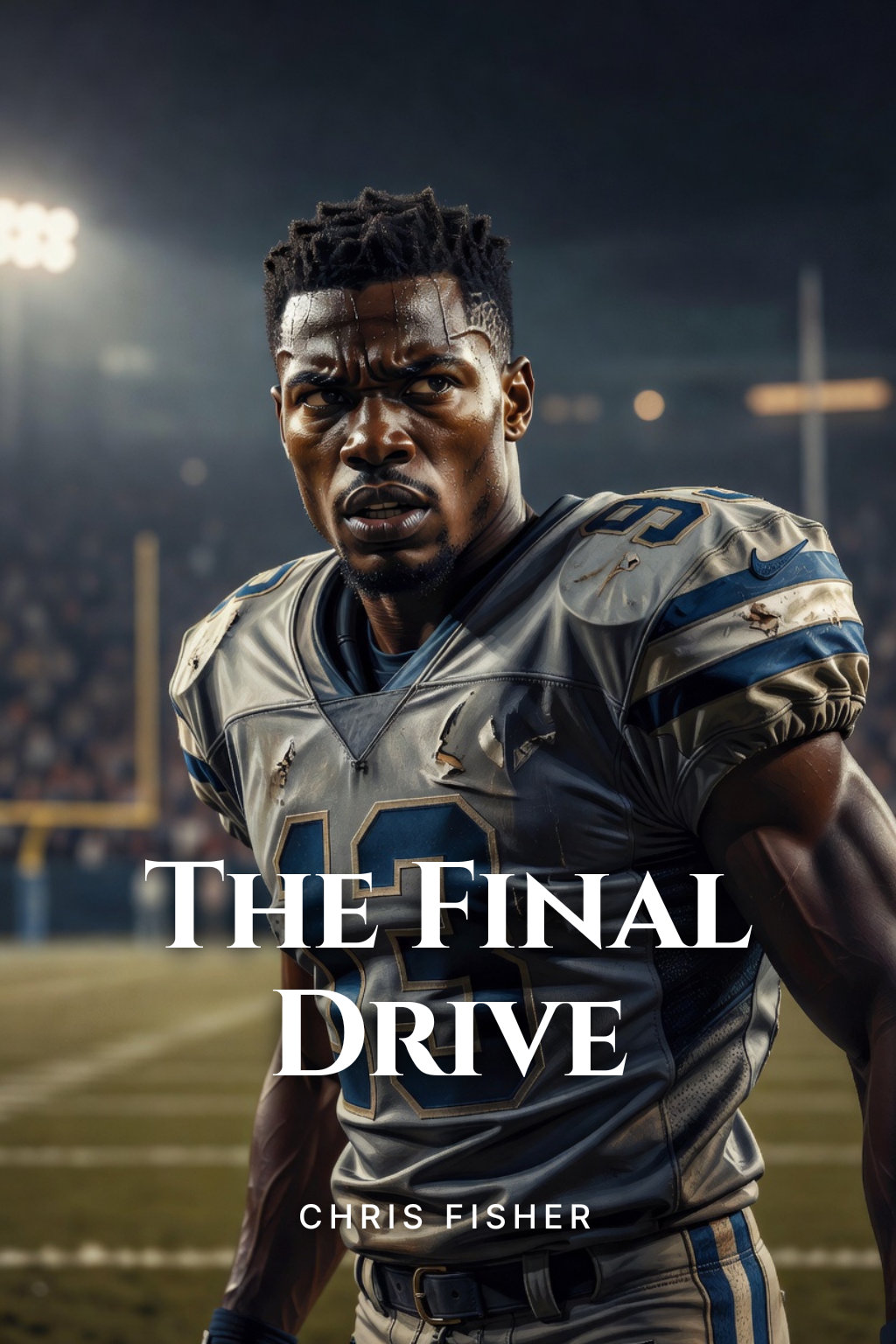
Novel · 12 chapters · 60,925 words
The Final Drive
Contents12 chapters
Chapter 1
The Tape Doesn’t Lie
I stop the clip on my second step.
The image freezes with my left foot half-planted in the grass behind the high school field, hips starting to turn, the orange cone leaning in the foreground like it’s watching too. On the laptop screen my body looks almost right. Chin over knee. Arms tight. No wasted swing. The kind of frame a position coach would click back to and tap with a pen. See that? There. That’s it.
I hit play.
For three more strides it still looks almost right, and then the truth shows up. It always does. Not in some dramatic collapse. Not a grab at the hamstring. Not me stumbling over myself. Just a softness where there used to be violence. The ground contact a split beat too long. The separation between what I tell my body to do and what it actually gives me.
I drag the slider back and watch it again.
And again.
The room smells like coffee that’s gone bitter on the burner and the menthol rub I worked into my leg before breakfast. My old playbooks still fill the built-ins along one wall, tabs curling, some of the covers bowed from years in equipment bags. There’s a stack of rehab bands beside the desk, red and black loops knotted together, and a pair of cleats under the chair with dried Georgia clay packed in the studs.
“You’re not gonna find another gear in the footage.”
Lisa says it from the doorway without raising her voice. She’s still in her shop apron, pale blue with a stripe of flour near the pocket, hair tied up and loose curls breaking around her temples. She has a cardboard tray in one hand and a dish towel over her shoulder like she walked in here on the way to doing three other things.
“I’m checking my pad level.”
“You don’t wear pads in the backyard.”
I don’t look at her. “Same body.”
“That’s exactly my point.”
On the screen I come out of the break and reach for a pass from nobody, hands flashing up into empty air. The camera shakes a little because Jermaine shot it on his phone and got excited trying to track me. My route runs right out of frame.
Lisa steps in and sets the tray beside my notebook. Lemon bars dusted with powdered sugar, the sugar already sinking a little from the heat. She knows better than to ask if I’ve eaten. She just puts food where I can’t pretend not to see it.
“You’ve watched that one seven times,” she says.
“Eight.”
She folds her arms. “That supposed to help your case?”
“It helps me see what I need.”
I click to another clip. Different shirt. Same field. This one’s from Tuesday. Three-step release against air, stem outside, plant, flatten. My chest is bare under the compression top where I cut the sleeves off. I remember how the turf pellets stuck to my socks. I remember the little sting in my calf after the fourth set. Watching it now, I also remember how sure I felt right after. Film has a mean way of draining the feeling out of a thing.
“You’re smoother there,” I say.
Lisa comes closer, not because she agrees, but because she wants to see what I’m seeing. “Smoother than what?”
“Than last week.”
“That’s a low bar.”
I let the clip run. At full speed it passes for fast if you don’t know what fast used to look like on me. If you never saw me eat ten yards of cushion off a corner playing scared. If you never saw safeties start cheating before the snap because they knew what happened if they guessed wrong.
I pause again right before my foot hits.
“There.” I point at the screen. “I’m getting in and out cleaner.”
Lisa studies the frozen image for a second, then studies me. “You want me to answer honest or useful?”
“Why those the only choices with you?”
“Because you don’t need another person lying pretty.”
She says it matter-of-fact, almost tired, and that lands harder than if she’d come in hot. I lean back in the chair and rub at my beard.
“You think I can’t play.”
“I think you can still do a lot of things.” She nods toward the laptop. “I think that and Sundays in this league are not the same thing.”
Down the hall I hear Amaija singing to herself, some made-up tune with too many words stuffed inside the melody. A cabinet closes in the kitchen. The refrigerator kicks on. All the house sounds keep going like this conversation is nothing special.
I pick up one of the lemon bars and take a bite. The crust gives under my teeth, butter and citrus and too much powdered sugar in the best way. Lisa watches me chew as if making sure I don’t dodge that too.
“This is good,” I say.
“Mm-hm.”
“You trying that for the shop?”
“I’ve already sold two trays this morning.”
I nod like this information matters to me in a way separate from how proud I am of her. She knows that move too.
“Rick call?” I ask.
That gets the smallest shift in her face. There and gone.
“Not me.”
“You haven’t talked to him?”
“I didn’t say that.”
I sit up. “Lisa.”
“He texted about Quattro’s schedule. That’s all.”
I snort. “Rick don’t text you about football schedules unless he’s avoiding texting me about football.”
She shrugs one shoulder. “Maybe he got tired of saying there’s nothing new.”
“There’s always something new.”
“Not always something good.”
She leaves that on the floor between us and picks at a corner of the dish towel. I know that look. She’s deciding whether to push or let me wear myself out in peace.
I save her the trouble. “I’m going outside.”
“Shoes by the door,” she says.
“I know where my shoes are.”
“I was talking about mine.”
That almost gets a smile out of me.
Outside, the yard drops away behind the house in two long green tiers cut by a stone retaining wall and a set of railroad-tie steps Rick helped me put in years back, before his suits got better and his knees got worse. The lower stretch gives me maybe thirty yards before the fence line and the pines. Enough for starts. Enough for cuts. Not enough to lie to myself all the way.
I’ve got four cones set near the far end and a rope ladder laid crooked in the grass. There’s a tackling dummy in the corner by the shed that Jermaine likes to hit in shoulder pads. The sun’s high and mean off the windows. Somewhere beyond the trees a riding mower drones.
I lace my cleats on the deck bench and can feel Lisa behind me before she says anything.
“You warmed up?”
“Yeah.”
“Trey.”
I stand and jog to the first cone. My leg loosens by habit, not by miracle. Ankles, hips, high knees, butt kicks, carioca through the ladder. The little mechanics of staying in the trade. I hear the sliding door open and close. A moment later Lisa is on the patio with her phone in one hand and a bottle of water in the other.
“Since you’re ignoring me,” she says, “I might as well film.”
“Good. Get the whole route. Last time y’all cut off the finish.”
“By y’all you mean your thirteen-year-old Spielberg.”
I set at the start, hands on my thighs, and look at the cones. Five-yard burst, sink, hard angle, stack imaginary leverage, fade late. Easy on paper. Every route is easy on paper.
“Ready?” she asks.
“Ready.”
I come off the line low. For the first two steps the old joy flashes—cleats biting, chest over toes, that clean forward fall where speed used to arrive like grace. Then the work starts. I drive, throttle down, drop my weight, break. My left leg catches enough. Not all the way. Enough. I come out of it chasing the version of myself I already remember being.
At the finish I throw my hand up like the ball is over my shoulder and turn to see Lisa lowering the phone.
“How was it?”
She presses her lips together. “You want honest or useful?”
I walk back without answering. Sweat is already crawling down my spine under the shirt.
Again.
This one is a slant-go. The kind of route that used to make defensive backs pray they guessed right. Sell inside, roll over the top, don’t drift. I hit the plant and feel a tiny hitch, not pain exactly, just a reminder. A knock from inside the joint. Invoice due.
Again.
Comeback. Then red-line burst.
Again.
I start asking my body for details now. Little things. Chin quieter. Elbow tighter. Get off the inside edge sooner. The problem is details cost. Every clean rep asks for another one. Soon my breath is sawing and my shirt hangs dark and heavy between my shoulder blades.
Lisa holds the phone down at her side. She’s not filming anymore. Just watching.
“That one?” I ask after a dig route that feels decent.
“It looked hard.”
“It is hard.”
“No,” she says. “I mean it looked hard for you.”
There it is.
I put my hands on my hips and stare past her at the house. The screened porch. The herb pots by the steps. Amaija’s pink scooter tipped near the garage. Things I’ve paid for with this game. Things the game let me put around us like proof. My chest is still rising too fast.
“You think I don’t know what it feels like?” I ask.
“I think you know exactly what it feels like. I think you’re the only one still trying to rename it.”
A football sits near the second cone where Jermaine left it yesterday. I scoop it up and spin it in my hand, laces scraping my palm. The answer I want is a clean one. You still got it. Or you don’t. Bodies don’t work like that. Careers sure don’t.
The phone buzzes in her hand. She glances at it.
“Rick?” I say.
She doesn’t answer fast enough.
“Put him on speaker.”
“He didn’t call you because he doesn’t want this on speaker.”
“Then he can call me and explain why.”
I hold my hand out. Lisa looks at me, then at the yard, then back at me. Finally she taps the screen and hands me the phone.
Rick comes on before I say anything. “How’d he look?”
I bark a laugh without humor. “That’s what we doing?”
A pause. I can hear office noise behind him, some printer coughing pages, somebody talking too loud down a hall.
“There he is,” Rick says. “You up early ruining your wife’s peace?”
“It’s noon.”
“Time is fake.”
“Don’t dodge me.”
He exhales into the phone. I know that exhale. He used to do it in high school when a coach asked him about his grades and he’d spent the whole week drawing route trees in his notebook instead of taking notes.
“I’ve made calls,” he says. “I’m still making calls.”
“That’s not what I asked.”
“It’s the answer I got.”
“You hearing no, or are you hearing wait?”
“Both.”
“From who?”
“Trey.”
“No, tell me names.”
Lisa starts toward the patio table with the water bottle, giving me space that isn’t really space. I stay planted.
“Teams are setting rosters,” Rick says. “A lot of front offices like what you’ve done in rehab. They respect the résumé. Respect don’t open receiver spots in August.”
“I’m not asking for August. I’m asking who’s interested.”
“You want interested, or you want real?”
I close my eyes a second. Everybody in my life got together and decided truth was a blunt instrument.
“Give me real.”
“Real is some of them think if they bring you in and you don’t look like the old you, now they’ve got a headline in their building. Real is younger legs cost less and come with fewer opinions. Real is nobody wants to be the team that signs a great man two years too late.”
“And what do you think?”
He doesn’t answer. That’s answer enough.
“Rick.”
“I think if you get the right shot, in the right room, with a team that needs exactly what you still do well, you can help them.”
“Exactly what I still do well,” I repeat.
“That’s not an insult.”
“It ain’t a compliment either.”
He’s quiet again. We’ve known each other too long for me not to hear the places where he edits himself. He blew his knee to hell before either of us had money enough to pretend the world was fair. Since then he’s made a career out of selling belief without sounding desperate. Usually he’s better at it than this.
“I got three more calls out today,” he says. “One in Baltimore. One in Chicago. One with a West Coast team that says no to everybody before lunch.”
“That all?”
“For now.”
“For now.” I look at the cones, bright and small in the cut grass. “Set me something. Workout. Private. Whatever.”
“You sure you want that right this second?”
“What’s that supposed to mean?”
“It means the last thing you need is ten scouts with stopwatches deciding your whole life off one bad forty.”
“I don’t need the forty.”
“That’s not always your call.”
I turn away from the house so Lisa can’t see my face, though she probably already knows it. “So what, I’m supposed to wait for an injury somewhere and pray?”
“That’s this business more than anybody likes to say out loud.”
I hand the phone back to Lisa before I say something ugly. She takes it carefully, like I’m passing her something hot.
“I’ll call you later,” Rick says, but I’m already walking to the far cone.
Lisa ends the call.
For a while I train too hard on purpose.
No music. No stopwatch. Just rep after rep under the noon sun until the yard goes wavering at the edges and my cuts get sloppier instead of sharper. I know better. That doesn’t stop me. There’s a kind of anger that feels productive because it burns. Same lie every time.
When I finally bend over with both hands on my knees, I taste iron and old Gatorade in the back of my throat. Lisa comes down the railroad-tie steps with the water bottle and doesn’t hand it to me until I stand up straight.
“You done proving whatever that was?”
I drink half of it in one pull. Warm plastic, melted ice.
“I’m getting work in.”
“You’re punishing yourself.”
“Same thing sometimes.”
She squints at me. “No. One gets you better.”
I cap the bottle too hard. “You want me inside on the couch? Is that what makes everybody feel better? I can do that. I can sit there and let September start without me and answer people at church when they ask how I’m enjoying retirement.”
“No one said retirement.”
“They don’t have to.”
Amaija pushes through the back door then, hopping the threshold with a notebook hugged to her chest. Her braids have pink beads on the ends today, and they click when she runs.
“Daddy, can you sign this?”
She skids to a stop between us, looking from my face to Lisa’s and deciding children’s business is safer than adult business if she moves fast enough.
“What is it?”
“My reading log. Ms. Burke said parents got to sign every Friday. And Quattro said your signature looks better than Mama’s.”
From the deck Lisa says, “That’s because your brother has no survival instinct.”
Amaija grins. I crouch, take the notebook, and my knees complain on the way down. Purple construction-paper cover, stickers peeling at the edges, her neat handwriting marching down the page in pencil.
“You really read all these?” I ask.
She lifts her chin. “I’m on chapter seventeen.”
“Then I need to catch up.”
I sign where she points. My hand still shakes a little from the work. She notices things. Always has.
“You sweating for real,” she says.
“That’s usually what happens.”
“You race Quattro again?”
Lisa makes a sound that means absolutely not.
Amaija takes the notebook back and squints at my signature. “You made the y too big.”
“It’s a strong y.”
She accepts that and turns to go, then pivots back. “Mama, can I have one of the lemon things?”
“One.”
“Two if Daddy says.”
“Daddy says ask the person who made them.”
Amaija sighs like she lives among tyrants and runs inside.
Silence settles after she goes. Not peaceful. Just waiting.
Lisa sits on the bottom step, forearms on her knees. “You think they don’t hear it?”
“Hear what?”
“This.” She gestures between us, the yard, the cones, all of it. “The whole house feels like tryouts and bad news.”
I look toward the kitchen windows. You can see the top of the refrigerator from out here, school papers pinned to the side with souvenir magnets. Ordinary life keeps making itself visible at the edges, and I keep turning away from it like it’s a distraction instead of the point.
“I’m doing what I know to do,” I say.
“That’s what scares me.”
Before I answer, a car door slams in the front drive.
By the time I come through the house, toweling sweat off my neck, my mother is already in the kitchen acting like she built it. Purse on the island. Reading glasses low on her nose. She’s got the mail spread out in tidy piles—bills, junk, real estate flyers, church envelopes—and a peach in her hand from the bowl by the sink. She bites into it while scanning a school fundraiser sheet like she’s about to negotiate the terms herself.
“You got keys for every place I own?” I ask.
“Because you’d lose your head if it wasn’t attached.” She doesn’t look up. “And this kitchen floor needs mopping in the corners. Lisa sees what’s on top of things. I see beneath.”
Lisa, at the counter, tries and fails to hide a smile.
Ms. Katherine points the peach at me. “You smell like liniment and ego.”
“Good to see you too.”
She takes another bite, juice shining on her thumb. My mother has never cared if a truth was ripe enough to bruise. Growing up, that felt like weather. As a man, it still does.
“What’d Rick say?” she asks.
I open the fridge and stand in the cold air longer than necessary. “He said he’s working.”
“He always says that. A bee is working. I asked what he said.”
I pull out the sweet tea pitcher and pour into a glass with too much ice. “He said teams are settling.”
“That means no.”
“It means not yet.”
She clicks her tongue. “You almost forty. Football years count double. Not yet is a cousin of no.”
Lisa wipes the counter with a damp cloth, giving us both a place to look besides each other. “Mama Katherine, I made lemon bars.”
“I saw.” She reaches for one without asking. “If the Lord wanted us thin, He wouldn’t have made butter.”
I lean against the sink, tea sweating in my hand.
My mother chews, nods approval, swallows. “Good. Tart enough.”
Then she fixes me with it.
“Tell me plain,” she says. “Are you chasing a ring, or are you refusing to let the game move on without you?”
The kitchen goes still. Even the refrigerator seems to hush between cycles.
I take a drink to buy a second. “That’s the same thing to you?”
“No.”
“Then don’t ask it like it is.”
She sets the half-eaten lemon bar on a napkin and folds her hands. “A man can want one last thing honest. A man can also stand in the doorway after the party is over because he doesn’t know where else to go. I’m asking which one this is.”
Lisa stares down at the cloth in her hands. She’s heard some version of this before, maybe from herself.
“I can still help somebody win,” I say.
“That answer didn’t touch my question.”
“You want me to say I’m scared to be done? Fine. Everybody’s scared to be done with the thing that made them.”
“No,” she says. “Everybody is not. Some people got more in them than one uniform.”
I laugh once, short. “Easy to say when it wasn’t your body paying the bills.”
“Don’t do that.” Her voice cuts clean through mine. “I paid bills with jobs that ate my feet up and hands raw. I paid bills stretching hamburger meat across three boys and a Sunday dinner. Don’t talk to me like work only counts if cameras come.”
The words sit there, sharp and deserved. Lisa turns away to the sink, not wanting to be in the middle of what comes next.
I set the tea down carefully. “That’s not what I meant.”
“I know what you meant.” My mother dabs peach juice from her fingers with the edge of a paper towel. “I also know you. Since before any scout put your name on a list. Since before all them people started clapping every time you ran by. So hear me: if this is about football, I’ll help you every way I can. Calls, schedules, flights, lies to reporters, all of it. If this is about you not knowing who Trey is without Sundays, that’s a different emergency.”
I look past her through the breakfast nook windows to the back yard. Cones still set. Ladder in the grass. A drill waiting to become a verdict if I let it.
“Both can be true,” I say.
“Yes,” she says. “That’s the trouble.”
Nobody talks for a moment. The only sound is the faucet when Lisa rinses the cloth and wrings it out. Water pattering stainless steel. Small domestic noises. They can make a man feel steadied or trapped depending on the hour.
My phone vibrates on the counter. Rick’s name on the screen.
I snatch it up. “What?”
“Damn,” he says. “Friendly.”
“You got something?”
“Maybe.”
That one word changes the whole room. Lisa goes motionless. My mother lifts her chin and studies me like she’s examining a horse’s gait.
“Maybe what?”
“Maybe a receivers coach in Tennessee will look at tape if I send the right cut-up.”
“Tennessee? They need speed.”
“They need bodies and somebody who can find grass against zone.”
I start pacing from sink to island and back. “Send the red-zone stuff from my last healthy year. And the boundary work. The third-down clips.”
“I know your film, Trey.”
“Then send the good angles from the workout today.”
There’s a beat. “You just finished today.”
“Lisa shot some.”
Rick doesn’t say anything, which means he doesn’t love the idea.
“Send it,” I say again.
“Okay.”
“What else?”
“That’s it right now.”
I stop pacing. “That all?”
“That’s the call.”
The little flare goes out so fast it almost leaves me cold. “You said maybe.”
“I said maybe because I’ve got a coach willing to watch instead of pretending he’s too busy. That matters.”
“For watching.”
“For watching,” he says. “That’s where things start.”
Or don’t, I think, but I don’t say it.
“We’ll edit something tonight,” Rick adds. “Don’t send me ten reps where you’re dying by the third cone.”
I glance at Lisa. She meets my eyes for half a second and looks away.
“I wasn’t dying.”
“Sure.”
He hangs up after promising to call later. I set the phone down and feel all three of us standing around the same empty space.
My mother reaches for her purse. “I need to stop by the bank before they close.”
“That it?” I say. “You came over to interrogate me and critique our baseboards?”
“I came over because silence breeds foolishness.” She slips on her glasses chain, tucks the peach pit into a napkin. At the door she turns back. “Train if you’re gonna train. But don’t confuse want with evidence.”
Then she’s gone, front door shutting solid behind her.
Lisa waits until the sound of my mother’s car fades down the drive. “She’s not wrong.”
“Didn’t say she was.”
“You act like every hard thing people say is a betrayal.”
I put both palms on the island and lean into them. The granite is cool. “I act like I’m still in this.”
“And if you’re not?”
That question should not have enough force left to hit me. It does anyway.
I look up. “You want me to answer honest or useful?”
“No.” She comes around the island and stands in front of me, close enough that I can smell brown sugar and vanilla still clinging to her shirt. “I want you to answer like a man talking to his wife, not a reporter after practice.”
I open my mouth, then shut it. There are things I can say cleanly to cameras that go muddy the second I try to say them in this house.
Finally I tell her the smallest true thing. “If I’m not, I don’t know what that looks like yet.”
Her face softens, and that almost makes it worse. “That I believe.”
We hear the front door bang and Jermaine’s voice carrying down the hall before we see him. Cleats in one hand, backpack hanging off one shoulder, all elbows and appetite and the kind of fresh swagger thirteen gives boys before life teaches them a price for it.
“Daddy, Coach put me at X today,” he says, bursting into the kitchen. “And I cooked DeShawn on a post, like bad. Mama, you got anything sweet?”
His eyes flick from me to Lisa, catching some residue in the air. Smart kid. He changes his tone without making a show of it.
“Y’all good?”
“We good,” Lisa says.
Jermaine spots the cones through the back windows. “You ran already?”
“Couple routes.”
He drops his bag. “Let me get you on some fades. I can throw.”
I should say no. Ice the leg. Shower. Eat. Be older and wiser in at least one respect. Instead something in me reaches for the field the way a tongue reaches a missing tooth.
“Five minutes,” Lisa says before I can answer, like she knows I’m going to be a fool and is trying to put a fence around it.
Jermaine grins. “Bet.”
Out back, the afternoon light has gone softer but not cooler. He jogs to the far hash we pretend exists in the middle of my yard, tucking the football under his arm, already narrating what he wants to throw. Back-shoulder. High red-zone ball. Front pylon fade. He talks the language the way some kids talk video games.
I line up wide near the fence. Lisa stands on the deck, arms folded again. Amaija sits cross-legged on the top step with half a lemon bar and watches like this is television.
Jermaine gives a little pump fake because he’s dramatic. “You ready, old man?”
“Throw it where I can get it.”
He laughs and claps his hands once. “That’s all you had to say.”
I release outside, lean into the imaginary corner, and glance back. The ball comes high and a touch inside. Good enough. I rise, turn late, snatch it against my chest, and get both feet down in the grass by habit before the fence.
Jermaine whoops. Amaija does too because noise is contagious.
“Again,” I say.
Second one, I don’t get up as clean. Third, I need two gather steps where there used to be one. Jermaine keeps firing. Not to test me exactly. To be with me in the thing. That’s its own mercy.
On the fourth ball I feel the lag clear as a bell. The route isn’t dead. It’s just thin. Margin shaved down to almost nothing. The kind of rep a young corner in camp would feel and file away: he can still think, but I can crowd him now.
I catch it anyway.
From the deck, Lisa doesn’t cheer this time. She’s watching my feet.
Jermaine trots the next ball back, breathing hard, smiling. “That was nasty. Hit ’em with the slow-slow and then snatch.”
Slow-slow. I nod like he invented strategy, but the words lodge under my ribs.
I walk back to the line. The grass is worn where I’ve planted all summer, a pale slash cutting across the yard. My left leg hums. My chest rises and falls. Jermaine backs up, spinning the ball on one fingertip before he grips the laces.
Behind him, the house glows amber in the late light. Lisa on the deck, still as a post. Amaija licking sugar off her thumb. Inside, through the kitchen window, I can see the laptop on the desk in the next room if I angle my head right, paused on one frozen frame of me almost looking like myself.
Jermaine lifts the ball and shouts, “Last one.”
I settle into my stance anyway. Weight forward. Eyes up. Listening for the snap that isn’t there, feeling the narrow strip of ground where a man can still make his living if he’s exact enough, if he’s stubborn enough, if those are not already the same thing.
Chapter 2
Sunday From the Couch
By nine-thirty I’m in a black apron dusted with powdered sugar, standing behind Lisa’s front counter trying not to look like I’ve been misplaced.
The shop smells like butter, vanilla, coffee grounds, and hot fruit. Not the fake candle kind of sweet. The real kind that sticks to your clothes and settles in your beard. Lisa is at the espresso machine with her hair wrapped up and a pencil behind one ear, moving fast without ever seeming rushed. She slides a ceramic cup under the portafilter, knocks the spent puck into the metal bin, wipes the wand, calls out an order, all in one smooth turn.
“Don’t stack the pecan bars like that,” she says without looking at me.
I glance down at the tray in my hands. “They’re bars.”
“They’re bars that break if you grab the parchment too hard.”
I set the tray down slower. “You got a whole attitude before ten.”
“You got six bars leaning on each other like they tired.” She nods toward the display case. “Spread them. Make it look like we sell nice things.”
A woman near the register watches me rearrange pastries with the careful fingers of a man defusing something. She smiles in that polite, uncertain way people do when they recognize me but don’t want to be the first one to say it. Then her little boy says, too loud, “Mama, that’s Trey Bell.”
Lisa doesn’t miss a beat. “And Trey Bell is putting the pecan bars where they belong.”
The woman laughs. I do too. The kid stares at my hands like maybe there ought to be gloves on them if they used to catch touchdowns.
Saturday in the shop is school colors and church orders and people who swear they just came in for coffee and leave with a white box tied in string. I carry trays from the back, fill cups with ice, tape up bakery boxes, sweep up a drift of flour by the fridge, and keep bumping my hip against the corner of a steel prep table because I still move through rooms like they’re wider than they are.
There’s a rhythm to this place. Timer buzzes. Refrigerator seal sighs shut. Credit card machine chirps. Somebody laughs by the cake case. The floor always has a little grit under your shoes by noon no matter how much you mop.
I’m bad at half of it.
A teenager in a Brookwood hoodie asks for six mini cheesecakes, and I box eight because I lose count talking to him about whether his team can block anybody this year. Lisa opens the lid, looks at me, and plucks two out.
“You trying to run me out of business?”
“Generous spirit.”
“Wrong building for that.”
She seals the box herself, then slides it across the counter with a smile for the customer so easy it almost annoys me. I know that smile. It means she is fixing something without making a scene out of fixing it.
Between customers I lean on the counter and watch her write “Happy 60th Pastor Dale” in blue icing across a sheet cake. Her hand never trembles. She turns the cake stand with one finger and lets the bag do the work.
“You learned this from who?” I ask.
“My own two hands,” she says.
“Inspirational.”
“Move, Trey.”
I step aside so she can reach the sprinkles. She smells like citrus soap and browned sugar. There’s a smudge of frosting near her wrist. For a second I think about taking her hand and licking it off, then I see Amaija through the back doorway sitting on an upturned flour bucket with a workbook in her lap, chewing the end of a pencil, and the moment passes into something smaller and better.
“Mama,” Amaija says, “how you spell ‘beautiful’ again?”
“Use it in the sentence.”
Amaija rolls her eyes because she knows Lisa is doing that thing on purpose. “The bakery is beautiful.”
“B-e-a-u-t-i-f-u-l.”
Amaija writes it down with her tongue pressed to the corner of her mouth. She’s got pink headphones around her neck and one shoelace untied. Jermaine is not with us because thirteen-year-old boys would rather swallow nails than spend a Saturday in their mother’s dessert shop unless bribery is involved. He’s at the field house for a youth-team equipment fitting, complaining by text about helmet pads like he’s got stock in the company.
My phone buzzes in my apron pocket. I know before I look who it is.
Rick: Tennessee said no. Wants “more recent movement.” Sorry.
I read it twice. Then once more like maybe the words change on the third pass.
“Problem?” Lisa asks.
“No.”
She gives me a look over the top of the cake, not sharp, just patient in that dangerous way. “You answer too fast when it’s yes.”
I slide the phone back into my pocket. “Rick.”
That’s enough. She nods once and keeps piping blue loops around the border. No pity. No speech. Just room left for me to decide if I’m going to stand in it or fight it.
A man in golf clothes comes to pick up a strawberry shortcake and does the thing men do when they want to talk football without sounding like they sought it out. He taps the glass case.
“You staying ready?”
Lisa turns before I can. “He’s working today.”
The man raises both palms. “Didn’t mean nothing by it.”
“I know,” she says, but her voice has gone flat as a pie crust rolled too thin.
He pays and leaves with his cake balanced in both hands.
I pretend to restock napkins. Lisa wipes the counter that doesn’t need wiping.
“You can’t jump on everybody,” I say.
“I didn’t.”
“You kind of did.”
“He came in for dessert and left trying to scout your hamstring with his eyes.”
“Leg.”
She glances up. “See? You know exactly what I mean.”
The lunch rush thins. The shop settles into that midafternoon lull where the pastry case has gaps and the coffee urn is down to a dark inch at the bottom. Ms. Katherine comes in through the back with a clipboard tucked under her arm and a church fan sticking out of her purse. She doesn’t work for Lisa, exactly, but that has never stopped my mother from acting like any family business is partially under her command by birthright.
She kisses Amaija on the head, looks me over, and says, “Apron makes you look teachable.”
“I been teachable.”
“You’ve been expensive.”
Lisa laughs without lifting her eyes from the order book. Ms. Katherine walks the floor once, checks the list taped by the fridge, and tells Lisa her wholesale butter price is going to jump again before Thanksgiving.
“How you know that?” I ask.
“Because I pick up the phone when people call me,” she says. “Try it sometime.”
She means more than butter. We both know it.
A little after three, I carry two trash bags out to the dumpster behind the strip. The alley smells like old cardboard and fryer grease from the wing place two doors down. A delivery truck idles near the curb, radio muffled behind the driver’s window. I sling the bags in, wipe my hands on the apron, and stand there longer than I need to with my phone in my palm.
No new messages.
Across the lot, a television mounted in the barbershop is showing a college game. No sound. Just a receiver at the top of the route stem giving a corner a little shoulder lie before breaking out. Even silent, I know exactly what he did wrong. Drifted into his break. Tipped the top of it. Made the corner comfortable.
I watch until the barber reaches up with a remote and the screen goes black.
When I go back in, Lisa is carrying two sheet pans at once.
“Take Amaija home when she finishes that page,” she says. “Jermaine texted he needs his white socks washed for tomorrow and if he asks me one more time like I’m his equipment manager, I’m going to start charging him.”
“Yes ma’am.”
“And stop by Publix for cream cheese.”
“How many?”
“Eight.”
“For the shop?”
“For my private stock of cream cheese, Trey.”
I take Amaija home, then do the grocery run, then throw Jermaine’s socks in with a load of towels because apparently this is what my life looks like in September. If you ask Lisa, she’d say that like a blessing. If you ask me honest, some of it is. The house makes its own noise when everyone is moving through it. Cabinet doors. Dryer buzz. Amaija reading to herself in a sing-song whisper. Jermaine upstairs trying on combinations of visor, gloves, and compression sleeves like he’s dressing for television. I fill the dog-eared pill organizer Ms. Katherine bought me, ice my leg because Lisa will ask if I did, and carry a basket of folded clothes to the couch.
Jermaine comes downstairs in one sock and shoulder pads half buckled, because no matter how many times boys wear gear they still act shocked by all the straps.
“You see my mouthpiece?”
“No.”
“My other one, not the red one.”
“No.”
He checks the kitchen counter, the shoe basket by the garage door, under a dining chair for no reason I can determine. “Man.”
“Did you look where you put it?”
He gives me a look of deep teenage insult. “Obviously.”
Amaija, not looking up from her book, says, “It’s by the PlayStation.”
Jermaine points at her. “Why you ain’t just say that?”
“You ain’t ask me. You asked the air.”
He finds it exactly where she says. I hide my smile behind a towel.
That night after dinner, once the dishwasher starts its low grinding wash and the kids clear out, I sit at the kitchen table with my tablet and pull up Sunday’s game grid. Week one. New season. New crews. New opening music. Names I know, rookies I barely watched on Saturdays, coordinators pretending they invented bunch motion in the offseason.
Lisa is packing tomorrow’s orders into the walk-in spreadsheet on her laptop.
“You doing homework?” she asks.
“Watching.”
“That ain’t what I asked.”
I scroll through team pages, injury reports, projected depth charts. “Just watching.”
She lets a few keys click under her fingers. “You know there is no prize for making yourself miserable in advance.”
“I ain’t miserable.”
“No. You’re cheerful as a hymn.”
I look up. “You always got one waiting?”
“You keep serving them up.”
She closes the laptop and rubs her eyes with thumb and forefinger. The kitchen light catches the gold in her hoops. “I’m not saying don’t watch. I’m saying don’t act surprised when it gets under your skin.”
“Football gets under my skin because I played football?”
“No.” She stacks two invoices. “Because you still think every bad route on TV is a personal attack.”
I want to tell her that’s ridiculous. I want to tell her she doesn’t know what it is to spend your whole adult life hearing the internal click of coverages, the order of footwork, the timing of a route concept against a pressure look, and then be expected to sit there and treat it like background noise while somebody asks if you remembered the cream cheese. But she does know something. Not the game itself. Me inside it. Which can be worse.
“Jermaine got his game at one,” she says. “Church first. Then field. Then Mama wants everybody over for dinner.”
“You planned my whole Sunday.”
“Somebody should.”
I sit with that a second. “You make it sound like I’m twelve.”
“You acting like your day belongs to a TV schedule from another city.”
I open my mouth, then let it go. She goes back to her laptop. We stay there together in the kitchen, saying nothing else, the kind of quiet marriage gives you after enough years—a quiet with shape to it, not emptiness.
Sunday comes with church clothes and missing shoes and Amaija deciding at the last possible minute she hates the beads in her braids because one is “too loud.” I help tie ties, locate a Bible under the passenger seat, and wipe a smear of syrup off Jermaine’s collar with a wet paper towel while he stands there suffering my assistance.
At church, men grip my hand a little longer than usual. Not because they feel sorry for me. Because they’re trying to signal they see me, that they still count me among active things. A deacon asks after my leg in the same voice he uses for people coming off surgery. A little boy in a suit jacket asks if I’m retired. His mother hisses his name. I tell him I don’t know yet, which seems to satisfy him less than it does me.
Jermaine’s game is all whistles and parents in folding chairs and orange slices in plastic tubs. The field is chopped up between the numbers. The chain crew misses spots by a full yard like that yard doesn’t count just because nobody’s getting paid. Jermaine, Quattro to every kid out there, scores once on a tunnel screen and spends the rest of the afternoon looking back to the sideline asking for the ball with both palms out like a man stranded at sea. Lisa laughs at him. I clap when he blocks. He notices that too.
By the time we leave my mother’s after dinner, where she sends us home with foil pans we didn’t ask for and three opinions apiece, the night game music is already playing when I turn on the television.
Monday becomes school forms and practice pickups and the sort of domestic errands that leave no bruise but somehow tire you anyway. Tuesday is more of the same. Wednesday I drive to the high school field after dropping off Amaija’s science project materials and sit in the lot while Jermaine practices. I don’t go down there. I watch from the truck. Their timing is sloppy. Splits are inconsistent. One coach is teaching a release with his feet dead even and I have to put both hands on the steering wheel to keep from marching across that field and starting an argument with a volunteer in a bucket hat.
Thursday night, the first real game I have to watch from my own couch starts with enough fireworks and camera sweeps to make my teeth hurt.
I take my usual corner of the sectional. Left cushion. Good view of the screen, close enough to the coffee table for notes if I decide to take them, which I tell myself I will not do. Lisa brings in a plate with turkey chili and cornbread and sets it down without asking if I’m hungry.
“You’re feeding me like I’m in quarantine,” I say.
“You turn into a strange man when football’s on.”
“A strange hungry man?”
“The hungry part is manageable.”
Amaija curls up on the rug with a blanket and a chapter book, half watching, half not. Jermaine sits forward with his elbows on his knees, already wearing his own team-issued hoodie because boys love belonging to things with logos. On the TV, the crowd is white towels and smoke and familiar noise.
The first time the camera cuts to a receiver room on the sideline, I know three of the men by posture before I know them by number. One can never sit all the way down because his hips lock. One keeps his helmet on between series because he says it keeps him locked in, but really it keeps cameras off his face. One young one has talent and no idea yet that talent isn’t the same as detail.
The game starts ugly. False start. Ball behind the tight end. A slant run at lazy depth and almost tipped.
“Why is he rounding that?” I say to no one.
Jermaine answers like we are in active conversation. “Maybe he thought safety was squatting.”
“He don’t get paid to maybe.”
Lisa, from the kitchen island where she’s portioning caramel into little lidded cups for tomorrow, says, “Can y’all watch without making it sound like court testimony?”
“No,” me and Jermaine say together.
He grins. I don’t mean to grin back, but I do.
Second quarter, third-and-six, bunch right. The outside receiver doesn’t reduce his split enough, which messes the spacing of the whole concept before the ball is even snapped. The slot breaks into traffic. The quarterback hitches twice and eats it.
I lean forward so fast my chili spoon rattles in the bowl. “There. There. That’s trash. That’s just bad spacing.”
Jermaine rewinds it ten seconds with the remote because he likes hearing me dissect things when it’s not aimed at him. “Show me.”
“The point man too wide. See him? Now the nickel can midpoint both inside breaks. Quarterback got nowhere clean to go because these dudes are selfish with grass.”
Amaija looks up from the floor. “Selfish with grass?”
“That’s when—” Jermaine starts.
“That’s when,” I say, “everybody wants to be right where they want to be instead of where the play needs them.”
She thinks about that a second, then nods like she has met this quality in school already.
At halftime the desk show runs one of those league-wide whip-arounds. Injury updates. Rookie highlights. Coaches standing under headsets with the look all coaches get by September, as if sleep has become a rumor. Then one of the analysts, an ex-quarterback with teeth too white for honesty, starts talking about contenders and window years and how the best teams always miss a steady veteran receiver when things tighten up in December.
“Not a burner,” he says. “Just somebody who can see the coverage the same way the quarterback sees it, settle on time, own third down, own red zone leverage. Those guys matter.”
The camera flashes B-roll of three different veterans in three different uniforms.
Jermaine glances at me. Lisa does not glance at me. That’s how I know she heard every word.
I keep my eyes on the screen. “He right.”
Lisa snaps lids onto caramel cups with quick little clicks. “Mhm.”
The game comes back. A younger receiver drops a ball over the middle because he starts turning before he secures it. The safety separates him from his plans. The commentators do that disappointed laugh men use when they’re glad the mistake belongs to somebody else.
I feel heat rise up my neck. Not because I dropped passes. I didn’t. Not many. Because I know what the room is like tomorrow for that kid. I know the receiver coach freezing the frame right at the sin. Eyes gone. Hands late. Thinking about YAC before the catch. I know the texts he won’t answer and the ones he will.
“Still can’t believe he took his eyes off that,” I say.
Lisa wipes a drip of caramel from the counter. “Baby.”
“What?”
She finally turns around. “You are in this game like you got a meeting in the morning.”
Jermaine looks down at his hands. Amaija has gone back to her book, but she’s not reading.
“It’s football,” I say.
“No. It’s your whole face changing.”
I sit back. “So I’m not allowed to care now?”
“Did I say that?”
“You keep acting like caring is the problem.”
“The problem is every time somebody runs the wrong depth on TV, your pulse jumps.”
“Because it matters.”
“To who in this house?”
The room gets small. Not loud. Small.
Jermaine reaches for his bowl and carries it to the kitchen without being asked. Amaija folds her blanket. Those two know enough to leave grown folks a lane before they need it.
I keep my eyes on the screen. “If you want me to turn it off, just say that.”
Lisa laughs once, no humor in it. “See, that’s what I mean. Everything with you is fake extremes. Turn it off. Never watch again. Be happy making buttercream rosettes. I didn’t say none of that.”
“Then what you saying?”
She dries her hands on a towel. “I’m saying don’t sit there and let every snap drag your spirit around and then tell me this is peaceful.”
The quarterback on TV checks to a run. Crowd noise swells. Somewhere in the kitchen, the refrigerator hum seems to get louder.
I say, “Maybe peace ain’t the goal.”
Her face does something almost too quick to catch. Not surprise exactly. More like a door she was hoping would stay closed just showed light at the bottom.
“No,” she says. “Maybe it ain’t.”
Nobody says anything after that. The game keeps going because games do not care who is losing inside their own house.
By Sunday afternoon I am three windows deep into football. Early slate on the main screen. Tablet on the armrest. RedZone muted during commercials. Lisa has gone to the shop for a few hours because a wedding order had a problem with the fondant lettering. Amaija is doing a poster board assignment at the dining table, ruler laid across construction paper. Jermaine is next to me, legs stretched out, giving live opinions with all the certainty of a boy who has never had to cash his body in for this.
There are games everywhere, and all of them offend me in some way.
A veteran I used to train with can’t get in and out of his break anymore, but the broadcast crew calls him crafty like that’s a full rescue. A rookie with 4.3 speed drifts on every dig route like the middle of the field belongs to his imagination. One team trots out a third receiver who blocks like he’s filing taxes. Another gets to the fringe of the red zone and has no grown man answers at all, just gadget motion and hope.
Jermaine says, “You would’ve scored right there.”
“That coverage was begging for a back-line pivot.”
“That’s what I’m saying.”
On another screen, a contender I know is thin at receiver loses two third downs in a row because the slot and the tight end end up in the same window. The quarterback throws one away and then gets strip-sacked on the next play. The analyst circles the spacing with his telestrator. I do it with my finger in the air a half-second before he does.
“Thank you,” I mutter.
Amaija looks over from her poster board. “Who are you talking to?”
“People who can’t hear me.”
“That seems stressful.”
Jermaine laughs so hard he almost spills his drink.
The phone buzzes now and then with old group chats waking up. Former teammates watching the same games, clowning bad offense, sending cry-laughing faces when somebody gets mossed or misses a tackle in space. I type, erase, type again. Send less than I want to. I do not mention wanting in. Men can smell hunger through a screen, and football has a way of using that against you.
Late in the second quarter of the featured game, the home team’s number-two receiver slips on a speed out and the ball hits the turf two yards from his hand. Third down. Punt team. Camera cuts to the coordinator with his lips thin under the headset.
I am on my feet before I know it.
“That’s not the cleats,” I say. “That’s his stem. He’s too high. He’s trying to get back downhill from a bad line.”
Jermaine looks up at me like he’s in class. “So where should he—”
I show him in the living room. Three hard steps from the couch. Sink at five. Snap down. Drive flat. Even in socks, even on hardwood, my body remembers enough to make the shape of it clean.
Then I feel the catch in my left leg on the plant.
Not pain. Not a knife. A note out of tune. Small and immediate and impossible to miss once it sounds.
I stop.
Jermaine stops too.
“You good?” he says.
“Yeah.”
I sit back down slower than I stood up. My chili bowl from Thursday still has a faint orange ring on the coffee table where somebody forgot a coaster. On TV, they are showing the replay again, drawing arrows over grass, explaining what I already know.
Amaija goes back to coloring her title letters. Jermaine says nothing for a while. He watches the game, but every few minutes I can feel him checking me out the side of his face the same way Lisa does.
By the late games, the house carries that Sunday drag. Light going gold through the back windows. Dish towel over the oven handle. Ice clinking in cups. The smell of garlic and onions starting from the crock pot Lisa put on before she left. She comes back in around four with two cake boxes and tired eyes, kicks off her flats by the door, and stands behind the couch a second with her hand on my shoulder.
“How bad is it?” she asks.
I know she means me, not the game.
“It’s ugly.”
She rubs once between my shoulder blades. “I meant you.”
“Same answer.”
She walks around and sees the tablet, the television, the notes I told myself I wouldn’t take and absolutely did. Route depths. Coverage tells. Team names with little marks by the receiver rooms that look thin, disjointed, childish for hope.
“Trey.”
I don’t look at her.
She picks up the legal pad and reads just enough to understand what it is. Not random observations. An inventory.
“Come eat in twenty,” she says quietly.
“I’m not hungry.”
“You will be.”
She sets the pad back down exactly where she found it and carries the cake boxes to the kitchen.
At some point the featured game crew starts talking about one contender’s offense missing a reliable veteran target in the red area. Their words aren’t poetry. Football men rarely speak poetry when they mean need. They say trust. They say body control. They say somebody who knows how to uncover when the field gets tight. One of them mentions leadership in the room, how young receivers don’t know what to do yet when a defense takes away the first picture.
I mute the TV.
The room goes dead except for crowd noise reduced to a distant rush and the scrape of Lisa setting plates on the island.
Jermaine says, “Dad.”
I don’t answer.
He tries again. “You should call Rick.”
From the kitchen Lisa says, “He knows that.”
I turn and look at both of them.
Jermaine lifts one shoulder. “I’m just saying.”
“What are you saying?”
“That sitting here mad ain’t doing nothing.”
It hits me harder because he says it plain. No softness around it. Not disrespect. Just a young man seeing an obvious thing and not knowing yet that older people spend whole years stepping around obvious things because they’re heavy.
Lisa sets down the serving spoon and braces both hands on the counter. “Come eat.”
Nobody moves.
“Come eat,” she says again, and this time it sounds less like dinner than mercy being offered one last time before it gets withdrawn.
I reach for the remote, unmute the television, then mute it again because I can’t stand the voices. On-screen a receiver jogs to the sideline after a misread, helmet tilted back, trying to explain himself to a coach who is not listening. I know that face. I know that coach too.
I stand up. Not for the table.
Lisa sees it. “Don’t start something with Rick tonight because you’re mad at strangers.”
“It’s not about strangers.”
“What is it about then?”
I pick up the legal pad and hear the paper crack where I’ve pressed too hard with the pen. “It’s about me not being done.”
She closes her eyes for one beat. Opens them. “Being not done and being able are not always the same thing.”
There it is. Clean. At last.
Jermaine looks down. Amaija has gone very still by the dining table, marker in her hand above a poster that says NORTH AMERICA in bubble letters.
I say, “You think I can’t play.”
Lisa doesn’t back away from it. “I think you want the version of it that’s gone.”
My chest tightens so hard I have to take a breath through my nose before I trust my mouth.
“That’s not what I asked.”
She comes around the island and stops a few feet from me, not crowding, not retreating. “I think you can still do some things. I think your mind is still better than a lot of men’s bodies. I think on the right team, in the right role, maybe. Maybe, Trey. But I also think every time this house starts learning how to breathe without the league, you open another window and let it back in.”
Nobody says anything. The game on mute shows a coach yelling with no sound. The scoreboard in the corner keeps counting down as if all clocks agree.
I want to fight her on the maybe. I want to reject the role part. I want to say I’m not asking to be protected from disappointment, just given one more field. But there are the kids right there, and there is truth mixed into what she said like gravel in rice, impossible to swallow without noticing.
So I do the only thing left.
I take my phone and walk out to the back patio.
The yard is cut short. Cones still stacked by the fence from two days ago. The route line I wore into the grass is faint now but visible if you know where to look. Porch light coming on. Distant sound of somebody’s leaf blower still going even though evening has already started.
Rick answers on the second ring. “You good?”
“No.”
He’s quiet. He can hear houses in my silence. He’s known me too long not to.
“What happened?”
“Nothing happened. That’s the problem.”
I pace to the edge of the patio and back. My leg feels fine until I think about it. Then I feel everything.
“You got anything?” I ask.
“I always got things. None of them clean.”
“I didn’t ask clean.”
He exhales into the phone. Paper shuffles on his end. Maybe his home office. Maybe a game on mute there too. “Practice squad interest is thin right now. A couple teams asked if you’d do emergency workout lists. One West Coast staff wanted recent GPS numbers and then went cold. Baltimore kicked the tires and signed younger. Chicago asked around. Nobody wants to be first if they think your leg’s a question.”
“Find me the first.”
“You hearing me?”
“I hear you.”
“No, I mean hearing me. This ain’t a respect issue. It’s reps. They want camp legs in September and you ain’t had camp. Even if somebody calls, it might be six snaps. Special teams look. Red-zone package if you’re lucky. You sure you want that kind of phone call?”
Inside, through the glass, I can see Lisa at the counter serving food onto plates. Jermaine taking bowls to the table. Amaija saying something with both hands moving. Life continuing with or without my answer.
“Yes,” I say.
Rick waits. He knows when I’m talking from ego and when I’m talking from the place below it.
“Any opportunity,” I tell him. “I don’t care how small. Workout. Tryout. Vet minimum. One week. Three days. I will go earn it.”
He lets out a breath. “All right.”
“Don’t soften it for me either.”
“I never do.”
“That’s a lie.”
“Fine,” he says. “Sometimes I package hard news with seasoning.”
Despite myself, I almost smile. It doesn’t last.
“I’m serious, Rick.”
“I know you are.”
“If somebody needs a body, if somebody loses a guy, if some receiver room can’t line up right and they need a grown man in it, you call me.”
“I will.” Then, after a beat: “Trey.”
“What.”
“Be sure before I start this again.”
I look out past the yard to the black tree line beyond our fence. My reflection in the glass has doubled over the kitchen behind me—me outside, them inside, all of us layered into one picture I can’t step fully into from where I’m standing.
My left hand is clenched around the phone. I make it open.
“I’m sure enough,” I say.
That isn’t the same as sure. He hears the difference. So do I.
“All right,” he says again, softer this time. “Then I’m back on it.”
We hang up.
I don’t go in right away. The television flashes silent blue against the kitchen wall. On-screen, some team I do not play for breaks the huddle and jogs toward the line with the careless speed of men who assume they’ll have another Sunday after this one. I stand in the darkened glass, looking at the field worn into my yard, waiting for the phone to become heavier now that I’ve handed my name back to the game.
Chapter 3
Tryout Legs
“Again.”
The kid with the stopwatch didn’t look old enough to rent a car. He stood at the forty start with a laminate swinging off his belt and a Titans polo tucked too neatly into khakis, like he had dressed himself for authority. He didn’t raise his voice. He didn’t need to. The word landed harder quiet.
I walked back to the line.
The indoor place in Marietta used to host seven-on-seven camps in the spring. I’d worked out there years ago when I still moved like I’d been cut loose from something. Same white arched roof. Same sour rubber smell from the turf. Same cinder-block wall painted with local sponsor logos. A church had rented one side the night before, and there was still a stack of folding chairs pushed against the glass by the lobby, a cardboard box of half-empty water bottles beside them.
Rick stood twenty yards away with his phone and legal pad, pretending not to watch every step I took. Pretending badly.
Three scouts today. Tennessee receivers coach wasn’t one of them. He’d passed on coming in person and sent a younger assistant from personnel instead. There was a special teams guy from Carolina in a navy quarter-zip, broad through the chest, wearing the look all football men wear when they’re measuring whether you’re meat or memory. The third one was local, independent, one of those retired front-office consultants teams call when they don’t want to waste travel on a maybe.
I dug my left cleat into the turf and set my right foot back.
The first run had been bad enough to make everybody polite. The second had made politeness feel expensive.
“You good?” Rick called.
I hated that question most when I was not.
“Run it,” I said.
The stopwatch kid looked toward the Carolina guy. The Carolina guy nodded once. No speech. No encouragement. Just nod and data.
I dropped my hips, let my hands hang, and stared at the black line taped across the turf. It was only forty yards. Forty. I used to spend more than that setting a corner up before I even declared the route. Forty yards used to be the distance between seeing daylight and making somebody on television say my name like they already knew the ending.
“Set.”
I leaned forward.
“Go.”
The first two steps felt all right. Not fast. Just tidy. By step four I could feel the lie beginning. My left leg gave me that fraction-late answer it had been giving for weeks, not pain exactly, not enough to call pain, just a tiny delay where everything was supposed to hit together and didn’t. Arms pumping. Chin down. Drive. Drive. Drive. Then upright too soon. By twenty I was chasing a version of myself that wasn’t on this field.
I crossed through and coasted three hard steps before I shut it down.
Nobody said anything.
That was worse.
The kid clicked the time into his phone. Carolina looked at his sheet, then at me, then back at the sheet like he was checking if both numbers belonged to the same man. The consultant crossed one ankle over the other and scratched under his gray goatee.
Rick started toward me with a bottle.
I took it but didn’t drink.
“What’d I hit?”
Rick glanced at the others, buying himself a second. “You want coach answer or friend answer?”
“Number.”
He rubbed his thumb along the label seam. “Four-seven-eight.”
The bottle crackled in my hand.
In my head, for one stupid half-second, I saw a combine clip from ten years ago. Me in a black compression shirt, shoulder pads off, crowd noise somewhere above the lights, legs turning over easy like the ground had made a private promise. Not because I wanted nostalgia. Because memory is cruel. It offers itself right when the body refuses to.
Carolina walked over. “Run game speed different,” he said.
He meant it kindly. That made it worse too.
I nodded like men nod when they don’t want their face to do anything else. “Sure is.”
“You still got size. Catch radius. Experience.” He looked at my lower half, not hiding it. “Question’s whether you can stack enough movement on top of that to be usable.”
Usable.
There it was. Not dangerous. Not special. Not a problem. Usable.
“I can still help in the red area,” I said.
“You may.” He gave a small shrug. “Teams aren’t buying may in September unless the rest looks cleaner.”
The consultant stepped in then, old enough to be blunt. “Can you run your own route tree today?”
“Yes.”
“Then let’s get off the numbers. Show us football.”
I could have loved him for that if I weren’t mad he had to say it.
We went to routes off the break. Slant, speed out, comeback, corner, dig. No pads. No jam. No safety breathing in your chest. Just cones, a jugs machine, and three men with clipboards deciding how much of my name still attached to my legs.
At first that helped me. Ball in the air still made the world organize itself. I could feel the stem. Feel leverage. Feel where hands should meet the nose of the football. I snatched the first three clean and tucked them without drama. On the corner route I leaned my weight inside, got the hips of an invisible defender turned, then snapped out and tracked the ball over my shoulder. Easy catch. Applause from nobody, but one scout finally wrote without looking pained.
Then the breaks started adding up.
Everything at this age is reps you have to pay for at once. The bill comes quick. I felt it in my left hamstring first, then in the way my chest started lifting before my feet had settled. On the deep comeback I took one extra gather step at the top and knew it before the ball even left the machine. That extra half-beat lives on film forever. In games, corners smell it. Coaches do too.
“Again,” the consultant said.
I ran it again.
This one was cleaner but not clean enough for me to feel proud of it. I turned back to the line and saw Rick looking down at his pad, making a note he would later try to phrase as hope.
We did red-zone work next. That saved me some. Fade stop. Back line. Slant with late hands. Box-out on the goal line against a younger defensive back they’d dragged out there from some local trainer’s client list. The kid was twitchy and handsy and wanted a story to tell. Good. I could still work with that. I leaned on him legally, gave him shoulder, showed him eyes one way and took body the other. Two catches in tight windows. One high-point over him that made his face go flat.
Football. Actual football. For a few reps it came back to me not as memory but as fact.
Carolina finally spoke like a man discussing an appliance that might still function. “There. That’s something.”
I wanted to ask if something was enough to feed a family named after me. I just lined up again.
By the end of the workout my shirt was dark from collarbone to waist. The left side of my lower body had that warm electrical hum that tells you tissue is negotiating. Rick was smiling too hard when the scouts came over to shake hands.
“Appreciate you coming out,” Tennessee’s guy said.
That phrasing. Appreciate. Coming out. Not we’ll be in touch, not good work, not there’s something here. Just a man thanking another man for the use of a building.
Carolina gave me a little more. “You’re on the emergency radar if injuries hit the right room.”
“Emergency,” I said.
He heard the edge and let it pass. “That’s where a lot of vets start.”
The consultant tucked his pen behind his ear. “If I call somebody, I’ll say this. He still understands space. Still catches it like a grown man. But the legs need to show better than the watch today.”
Need to show better than the watch.
Rick thanked all three of them before I could say something truth would regret.
When they were gone, the building sounded bigger. Just the whine of the jugs machine winding down and a vacuum running somewhere in the lobby.
Rick came over. “Red-zone stuff was good.”
I walked to the sideline and sat on a blue foam plyo box. My left leg twitched once under the sweatpants.
“Say the rest.”
“They didn’t bury you.”
“Say the rest.”
He crouched in front of me, forearms on his thighs. “The forty hurt. The top of the route on anything with drive hurt. You looked like yourself in close quarters. Not in space.”
I unscrewed the bottle and poured some over the back of my neck. It ran cold under the collar and down my spine.
“Who’s next?”
“That’s what you ask me?”
“What else is there to ask?”
He gave a small laugh with no joy in it. “There’s the part where maybe you sit with this for an hour.”
“No.”
“Trey.”
“Who’s next?”
He looked at me for a long second, then stood. “Birmingham in three days. Not a team workout. Regional group. Couple pro personnel guys, one CFL set, some UFL staff, two NFL advance scouts who send notes upstairs. Mixed bag.”
“I’m not chasing spring football.”
“I know what you’re chasing.”
“Do they have a receiver need?”
“They have eyes. Right now that matters too.”
I got up off the box slower than I meant to. “Book it.”
He watched me test my left leg without pretending not to see it. “You want treatment first.”
“I’ll get treatment after.”
“No,” he said, and for once the agent voice left him and my oldest friend answered instead. “You get treatment now, food after that, pride later if there’s time.”
That almost made me smile. Almost.
Back home, the house smelled like brown sugar and butter when I came through the mudroom. Lisa had sheet pans cooling on the counter, thumbprint cookies lined in rows on parchment, each one with a little pool of apricot jam catching the kitchen light. Amaija’s backpack lay open on a chair with a purple folder spilling worksheets onto the floor. Somewhere upstairs, Jermaine was yelling at a game through his headset.
Lisa looked up from the stand mixer and saw my walk before she saw my face. She switched the machine off. The sudden quiet rang.
“How bad?”
I set my duffel down against the wall. “I’ve had worse.”
She wiped her hands on a dish towel and came around the island. “That isn’t what I asked.”
I bent to untie my right cleat, then the left. The knot on the left fought me. “First one wasn’t good.”
“And the rest?”
“Better when we got to actual receiver work.”
“That means the first one wasn’t good.”
I pulled the cleat off and flexed my ankle. “You got ice?”
“In the freezer. Answer me straight.”
The tone made me look up. Not sharp. Not loud. Just no room in it.
I sat back on the bench by the mudroom cubbies. Amaija had left a glitter pen there beside a church bulletin and a single shin guard from one of her old soccer sets. Somebody’s life always spilled into somebody else’s in this house.
“Forty was bad,” I said. “Routes were mixed. Red zone was good.”
“How bad is bad?”
I told her.
She looked down at the tile for a second, jaw moving once like she was shifting what she wanted to say into smaller pieces.
“Okay,” she said.
I hated okay maybe more than I hated pity.
“What’s that mean?”
“It means I’m not going to stand here and lie because you’re limping.”
“I’m not limping.”
She lifted an eyebrow. We both left that alone.
She got the ice pack, wrapped it in a thin towel, and handed it to me. “Put that on.”
I set it against the back of my leg. Cold bit hard enough to make my breath hitch.
Lisa leaned her palms on the island across from me. Flour dusted one forearm. She hadn’t changed out of work clothes yet. White sneakers. Black leggings. T-shirt from the bakery with a smear of icing near the hem. She looked tired in the way competent people do when they have held ten things together and don’t get credit because none of them dropped.
“What does another one like today do to you?” she asked.
“It keeps me in front of people.”
“That’s not what I asked either.”
I pressed the ice in harder.
Upstairs, Jermaine shouted, “No, that’s a pick!” then laughed at somebody in his headset. The sound came down through the vent bright and young and careless.
Lisa waited.
I knew what she meant. She meant the body, yes, but not just that. She meant what happens if each workout strips a little more varnish off the story I tell myself. She meant what happens if I keep walking into buildings where men twenty-five years old look at my legs and discuss me like salvage.
“It depends,” I said.
“On what.”
“On whether there’s still a call at the end of it.”
“That’s football answer.”
“It’s the answer I got.”
She straightened. “No. The answer you got is that if this ends with three more strangers timing you and saying thank you for coming, I’m the one who lives with what comes home.”
There it was.
I looked at the cookies cooling on the counter, each thumbprint exact, each one done by hands steadier than mine had been all morning.
“I’m not taking it out on y’all.”
“You don’t have to throw things to do that.”
That sat between us.
From the hallway, Ms. Katherine’s voice came before she did. “If either one of y’all gon’ stand there speaking in half-sentences, do it quieter. I’m on hold with a man who keeps saying ‘circle back’ like he invented time.”
She came in with her glasses low on her nose, Trey Bell Foundation folder under one arm, phone pinched to her ear, legal pad balanced against her hip. She looked at the ice on my leg, then at Lisa, then at me.
“Mm-hmm,” she said into the phone. “No, what I’m telling you is if your club wants recent movement, then come see recent movement. I’m not emailing you hope. I’m offering eyes.” She listened. “Well then write down Birmingham and decide if your company card can survive Alabama.”
She pulled the phone away just long enough to point at me. “Eat something with protein.”
Then she was back to the call. “No sir, not combine shape. If he was combine shape, you wouldn’t be calling me in Week Three asking discount questions.”
Lisa turned away so she wouldn’t smile in front of me. I saw it anyway.
Ms. Katherine ended the call, tapped something into her phone, and laid the legal pad on the counter. Three columns. Teams. Dates. Notes. Her handwriting leaned hard right, aggressive even on paper.
“Well?” she said.
“Well what?”
“Do I need to move Birmingham to Thursday or are you too proud to admit your leg needs one more day?”
“I can go Thursday.”
“Good. Because Friday I have you in Duluth with that independent scout group, and if they like what they see, one of them knows a personnel assistant in New Orleans whose marriage I once talked through over sweet tea. That still counts as networking whether the league admits it or not.”
Rick always said Ms. Katherine ran a management office like a church kitchen after a funeral: efficient, unsentimental, no one leaving hungry.
Lisa slid a plate toward me. Turkey slices, crackers, cheddar, apple wedges. The kind of meal you make for a man too stubborn to admit he needs one.
Ms. Katherine looked down at the pad again. “And before you puff up, none of this means they believe. It means they are curious enough not to delete your number.”
I ate standing up because sitting there felt too much like recovering.
That night Rick came over with printouts and his laptop. We watched the workout on the den television, every ugly inch of it. He had cut clips already. Starts. Top of routes. Red-zone wins. I sat on the sofa with a lacrosse ball under my hamstring and rolled until the muscle lit up mean and hot.
“Pause that,” I said.
He did. My body froze on the screen at twenty-two yards of the second forty, torso upright, stride shortened, face set not with speed but with effort. Nobody ever dreams of becoming a man who is trying hard in public.
“That right there,” I said.
Rick scrubbed back a second. “Yeah.”
“I’m up too soon.”
“You are.”
“I know I am.”
“I know you know.”
We stared at the screen.
Jermaine drifted in with a bowl of cereal too late at night, spoon clinking the side. He took in the TV, my face, Rick’s notes, and got still.
“Was it bad?” he asked.
Kids don’t hedge when they love you. That’s one mercy.
“Parts of it.”
He set the bowl on the coffee table and pointed at the frozen image. “You’re not driving off the left. You’re protecting it.”
I looked at him. “You know that?”
He shrugged. “Coach keeps saying if you don’t trust the plant, your whole route gets tall.”
Rick let out a breath through his nose. “Quattro coming for all our jobs.”
Jermaine half-smiled, but he was still looking at me. Not hero-looking. Just honest.
“You think I’m protecting it?” I asked.
He shrugged again, smaller this time. “Looks like it.”
I nodded once. “All right.”
He picked up his bowl. “You still cooked that dude on the fade though.”
“Go to bed.”
“Just saying.”
When he was gone, Rick rewound to the red-zone reps.
“That’s what you sell,” he said. “No one’s buying open field right now. You sell craft. Hands. Body control. Veteran brain. Big target. Third down. Goal line.”
Every part of me that had once made highlight tapes wanted to argue. Every part of me that had just watched the film knew better.
The next two days settled into a routine I hated because it felt like both progress and concession. Morning treatment with a therapist in Roswell who kneaded and needled and stretched until sweat gathered under my chin from lying still. Midday pool work. Afternoon routes, shorter now, all precision and stop-start without the vanity reps. Ms. Katherine on calls at the kitchen table with two phones, a yellow legal pad, and her giant church tote spilling folders and peppermints. Lisa in and out from the bakery, checking the week’s orders on her tablet and checking me with those same sharp eyes.
On Wednesday evening she found me in the backyard after dinner, cleats on, cones set.
“Take them off.”
I was lining up for another burst series. “I’m doing six.”
“You did enough already.”
“I need to feel Thursday in my body.”
“And if your body says no?”
I looked at the grass, worn pale where I had cut the same route over and over. “Then I need to hear it.”
She came down the steps from the patio and stood beside the cones. Fireflies had started low near the fence line. Somebody two houses over was burning charcoal; the smoke drifted sweet and ashy over the hedge.
“You know what I think?” she said.
“I can guess.”
“I think you keep looking for a clean answer because a clean answer lets you worship it.” She nudged one cone with her sneaker. “But this isn’t clean. So if you do this tomorrow and Friday and next week, I need you to answer a harder thing.”
I kept staring ahead because looking at her made me defensive before she even finished.
“What if the only chance you get is small enough to insult you?”
I picked up the football from the grass and turned it in my hands. The laces were worn smooth where Jermaine and I had thrown all summer.
“Then I’ll still take it.”
“I know you’ll take it,” she said. “I’m asking if you can survive taking it.”
That one had teeth.
“I’m not above earning a role.”
“That’s not what I mean.” She stepped closer. “You’ve been the reason a whole stadium stood up. Can you really be a package player and not let it poison you?”
There are questions your wife asks because she wants reassurance. Then there are questions she asks because she has seen the worst version of your silence and does not want to live there again. This was the second kind.
I spun the ball once more and tossed it lightly from hand to hand. “I don’t know.”
That was the first honest thing I’d said all evening.
Lisa nodded like honesty, even ugly honesty, was at least something she could stack.
“Then don’t lie to them if it comes,” she said. “And don’t lie to yourself before it does.”
She turned and went back toward the house.
I ran only three more bursts. On the last one, the left leg answered late again.
Birmingham was in the back lot of a junior college whose field house smelled like tape adhesive and old coffee. Not glamorous. Not even aspiring to be. A hand-lettered sign taped to a door said NFL/CFL CHECK-IN with an arrow. Two punters sat on a bench outside scrolling their phones, long-limbed and bored. A defensive end in compression tights paced the hallway whispering pass-rush moves to himself. The whole thing had the feeling of an airport gate for men trying not to look stranded.
Ms. Katherine came with us and took command of logistics within fourteen minutes.
She got my sign-in fixed when some volunteer had listed me at 6'1". She found out which scouts mattered and which were there for résumé oxygen. She redirected one local reporter with enough sweetness to make him think he had chosen to leave. She had a paper cup of coffee in one hand and my schedule in the other, and every time somebody tried to approach me with a human-interest angle, she stepped between like she had done it since I was twelve, which she had.
“No photos till after drills,” she told a guy from local TV.
“We just want B-roll.”
“You can roll B somewhere else till I say.”
He opened his mouth to push back, saw her face, and didn’t.
Rick checked his watch. “Forty first, then short shuttle, then position.”
I laughed once. “They just got through humiliating me and you put me right back on a stopwatch.”
He met my eyes. “Yeah.”
There’s love in honesty if you know how to hear it.
The field was hard underfoot, the turf older than Atlanta’s. Little black pellets clung to the socks above my cleats. A row of folding chairs held scouts with clipboards across their knees and sunglasses pushed up into their hair. No fans. No music. Just whistles, names, times, and men trying to keep disappointment from changing their posture.
My first forty here was better. Not good. Better. Enough that nobody looked away. Enough that one scout from an NFC team wrote something and underlined it. The shuttle felt like rusted hinges opening with complaint but not collapse. Position work came after, and by then my body had figured out the day’s bargain: if I kept everything efficient, it might let me finish.
I gave them that. Efficient.
On slants I showed late hands. On curls I sat my weight down cleaner than I had in Marietta. On fades I still knew where the sideline lived without looking for it. A quarterback from some small school put one back-shoulder ball too high and too far outside, and I still got a hand under it with one toe scraping white. That got a murmur. Small sound. Real sound.
A scout in a Saints cap asked me to run red-zone choice routes. Another from a Midwest team wanted to see me stalk block against a younger receiver who volunteered because he thought effort might get him noticed. I put my hands inside, moved my feet, stayed square. Ugly work. Necessary.
Between drills I kept my face blank and my breathing quieter than it felt.
Then came the deep over.
It wasn’t even a full go route. Just a long crossing pattern meant to show whether a man could eat grass and keep separation through the curve. I knew before I hit the midpoint that the old gear wasn’t coming. I leaned and drove and pumped and there was still a little missing. Not dramatic enough for spectators to point. Plenty dramatic for football people.
The quarterback let it fly anyway. I tracked it over my left shoulder, reached late, and the ball glanced off my fingertips and spun down into the turf.
You could hear that one. Not the ball. The pencils.
The next rep I caught. Then another. The damage had already made its note.
After position, one of the pro personnel assistants pulled Rick aside. I pretended not to watch. Ms. Katherine pretended less.
She drifted near enough to hear without making it obvious, then circled back to me with all the information already arranged on her face into useable form.
“You helped yourself a little,” she said.
“A little.”
“Enough to stay on paper. Not enough for anybody to act brave.”
I bent over with hands on my thighs until the pulse in my head settled.
Rick came over. “Two teams asked for the cut-up. Saints want the red-zone clips. One other team wants your GPS from training if we have it.”
“We don’t.”
Ms. Katherine snapped her fingers once. “We will. I already texted that young man at the sports lab in Sandy Springs who owes me for introducing his mama to her second husband.”
Rick blinked. “You move fast.”
“I’m older than both of y’all. I move early.”
I stood up straight. “Anybody ask for another workout?”
“Not yet,” Rick said.
Not yet. The phrase floated there with a small life vest’s worth of hope built into it.
On the drive home I sat in the back seat of the SUV with my leg stretched across the bench and an ice wrap strapped around it. Ms. Katherine was in front making calls before we were even out of the parking lot.
“Yes, he looked better than Monday. No, I am not saying vintage because I don’t sell wine, baby, I sell football.”
Pause.
“If your coordinator wants a polished young thing, go draft one next April. If he wants a man who can find soft spots on third-and-six and keep his mouth shut when he gets six snaps, then write his name down.”
Pause.
“Mm-hmm. No, I did not say he was fast.”
Rick drove with both hands at ten and two like concentration could improve outcomes. The interstate hummed under us. Buc-ee’s billboard. Church sign. Pine line. Exit numbers ticking by.
I closed my eyes for a minute, not to sleep, just to stop seeing the dropped deep over. In darkness the route came cleaner than it had on the field. Of course it did.
When we got home, Lisa met us at the garage door. She didn’t ask first. She read the answer off our shoulders.
“How’d it go?”
Rick held up a hand, weighing invisible grain. “Not dead.”
Ms. Katherine snorted. “Lord, men and their vocabulary.”
Lisa looked at me.
“Enough to stay on lists,” I said.
“And not enough?”
“Not enough to change the whole conversation.”
She nodded once and stepped aside so I could come in.
Dinner was already on the stove. Smothered chicken, rice, green beans cooked down with onions. Amaija had drawn a little sign at the table in marker that said GOOD LUCK DADDY with the Y backwards. Jermaine was at the island peeling the label off a sports drink bottle in one piece, his concentration total.
“How many catches?” he asked.
“Most of them.”
He looked up. “Most ain’t all.”
“No,” I said. “It ain’t.”
He nodded like that answer fit somewhere in the math he was learning about me.
After we ate, Ms. Katherine spread her legal pad, phone, and a pile of business cards across the dining table and went to work. She had numbers saved under names like Reggie DB Coach Vegas and Saints Lady Front Office and Coach Hines Maybe. Every call was part sales pitch, part threat, part testimony.
“No, I’m not asking you to sign a Hall of Fame bust. I’m asking you not to be stupid when your slot room gets thin.”
Pause.
“Yes, the leg’s there. So are the hands.”
Pause.
“Well then pray on it fast.”
From the den I could hear her through the doorway while I sat with the compression boots hissing around my calves. Lisa folded bakery boxes at the coffee table, snapping each one into shape with quick practiced motions.
“You hear your mother recruiting for war?” she asked.
“She’s having fun.”
“She only has fun when she gets to tell rich men they’re underthinking.”
I watched her fold three more boxes. White cardboard. Gold logo. Crisp corners.
“Did I help myself?” I asked.
She kept working for a few seconds before answering. “You tell me.”
“That’s not fair.”
“Yes it is.”
I leaned back and let the boots squeeze. “I looked better.”
“Did you look like somebody they need, or somebody they can keep in mind?”
There it was again. Need. Keep in mind. The whole chapter of my life reduced to the difference between those two shelves.
“Keep in mind,” I said.
Lisa set down the box in her hands. “Then protect yourself while they’re keeping you there.”
I laughed without humor. “How?”
“Don’t let every maybe become a resurrection. Don’t let every quiet day become proof you’re finished.”
She reached over and smoothed a dent in one box flap with her thumbnail. “I can’t do that part for you.”
In the dining room, Ms. Katherine’s voice rose. “No, baby, I’m not upset. This is just what conviction sounds like.”
Jermaine came through carrying his cleats by the laces. “Dad, if we get there early tomorrow, can you watch me work releases?”
I looked at his cleats, grass still dried at the studs. Looked at the narrowness of his ankles, the way youth has not yet learned to be careful.
“Yeah,” I said.
“You sure?”
I flexed my foot inside the compression sleeve. Felt the answer lag a half-beat before it arrived.
“Yeah,” I said again.
He nodded and headed upstairs.
Later, after the kids were settled and Rick had left and Ms. Katherine was still at the table making one last round of calls like a woman trying to shame daylight into showing up sooner, I stepped out to the back patio with my phone.
The grass line from my routes was barely visible under the yard light. Cones stacked by the fence. Net folded against the shed. Quiet all around except a distant train horn and the low buzz of somebody’s pool pump.
Rick texted while I was looking at the worn strip in the yard.
Two teams want the cut-up tonight. One asked if you’d be willing to work slot in addition to outside. Another wants updated medical.
A minute later another text.
Stay ready. Don’t read too much into it.
I stared at the screen until it dimmed.
Slot and outside. Updated medical. Stay ready. Don’t read too much into it. That’s how this part of football talks. Through side doors. Through conditional verbs. Through men who want options more than they want belief.
Inside, through the glass, I could see Lisa at the sink rinsing out a mixing bowl. Ms. Katherine at the table with her glasses on the end of her nose, still talking with one hand in the air. The house moving on its own tracks while mine ran beside it, not quite touching.
I texted back only one thing.
I can do both.
Then I slipped the phone into my pocket and looked out at the dark yard, trying to imagine which version of me would be the one to answer when the next call came—the man who remembered speed, or the one learning how to live without it.
Chapter 4
Quattro’s Game
“Don’t yell from the rail unless you plan to say something useful,” Lisa said.
I had one foot on the aluminum bleacher and a paper cup of bad field coffee in my hand. Across the chain-link fence, boys in black jerseys and silver helmets moved through warmups in loose crooked lines, some of them all knees and elbows, some built thick already, some still wearing childhood in their faces no matter what shoulder pads tried to tell you. Jermaine was at the far hash, bent at the waist while a coach held his hips and made him jab-step through releases.
“Nobody asked you to bring me a muzzle,” I said.
Lisa handed Amaija a bag of orange slices and sat down two rows up under a patch of shade cast by the press box. “I brought you coffee instead. Seemed kinder.”
The cup was thin enough to burn my fingers. I took a sip anyway. It tasted like somebody had run hot water through old grounds and then forgotten it existed.
“You sure he knows I’m here?” I asked.
Lisa gave me a look over her sunglasses. “He texted you six times last night about it.”
That wasn’t what I meant, and she knew it.
The field sat behind a middle school with a brick gym on one side and a row of pines on the other. The scoreboard still had one dark panel where the home quarter light didn’t work. Wind carried the smell of cut grass, fryer grease from the concession stand, and that sweet rubber stink from the black pellets baked into the turf in the red zone. Somebody’s speaker popped through a clean edit and then settled into old trap records that had been approved for youth sports by deleting every third word.
I looked down toward the near sideline. Jermaine had his helmet off now. Sweat already darkened the edges of his skull cap. One of the assistant coaches slapped both his cheeks and pointed toward the line. Jermaine nodded hard, then jogged back into the receiver line.
On the roster sheet clipped to the fence by the gate, his name was Jermaine Bell IV.
On this field, to everybody with a whistle, a camera, or a folding chair, he was Quattro.
A man in a Falcons hat leaned over from the row behind me. “That your boy out there?”
I didn’t turn all the way around. “Yeah.”
“Number four?”
“Yeah.”
“He cold.”
I gave him a nod because there wasn’t anything else to do with that. On these fields, people wanted to talk to you about your kid and about you and about whether blood really carried gifts from one generation to the next like wrapped packages. They wanted to compare stances, hand size, stride length. They wanted to say he looked like me, which was true in some ways and lazy in others. Same shoulders coming in. Same long arms. Same little pause before the snap when he got locked into the route and everything unnecessary slid out of his face.
He also smiled more than I ever had.
Even during warmups, he was grinning.
Coach Darnell blew his whistle and called them in. Kids crowded around him at the numbers, helmets under their arms. The other team came out of the opposite end in white jerseys with blue pants and looked better put together than ours. Their lines were straight. Their coaches wore matching polos. A couple of dads had headsets for no reason anybody could justify.
Amaija leaned on Lisa’s shoulder and crunched an orange slice. “If Quattro scores, can we get nachos?”
“He hears you say that and he’ll start freelancing,” Lisa said.
“I don’t know what freelancing means.”
“It means doing too much.”
Amaija looked at me. “Did you freelance?”
“All the time,” I said.
Lisa snorted. “See? That explains a lot.”
I watched Jermaine break the huddle and trot to the numbers. X receiver. Wide side of the field. Corner walked up with his feet wrong and his eyes on the backfield. Bad sign for him. Good sign for my son.
My leg ached in the dull, familiar way it had settled into lately, not sharp enough to stop a man, just steady enough to remind him he wasn’t moving for free anymore. I stretched it out in front of me and rolled the ankle once. The bleacher trembled as late-arriving parents climbed in with camp chairs and coolers and giant cups from the gas station.
The opening kickoff bounced at the fifteen, took a sideways hop, and got smothered under a pile of boys who all raised their hands as if volunteering for credit. First offensive snap, Jermaine stemmed inside, widened the corner with one shoulder dip, and ate up the cushion so fast the kid turned his hips before the route was declared. Slant. Easy throw. Ball hit Jermaine in the chest and he tucked it clean, spun off a reach, and got fourteen.
I was on my feet before I knew it.
“There you go!” I yelled.
Lisa clapped once and smiled without looking at me. “Useful enough?”
Jermaine jogged the ball back to the huddle with that same grin on his face, not the show-off grin, not the look-at-me one. Just joy. Plain and bright. A boy getting exactly what he hoped football would feel like.
The next few plays were runs and a false start and a quarterback keeper that got stuffed. On third and long they brought Jermaine in a nasty split tight to the formation. I could see the safety creep down, eyes in the wrong place again. Coach saw it too. Quattro gave a little hand signal I knew he’d borrowed from watching too much cut-up with me at the kitchen table. Not official. Just receiver language. I got him.
“Throw it,” I said before the snap.
The quarterback faked the jet, planted, and let it go down the seam. Jermaine split the nickel and safety clean. He tracked it over his outside shoulder like he’d done it in his sleep. Caught it in stride. Gone.
Thirteen years old and he ran like he’d stolen daylight.
The sideline erupted. Coaches spilling twenty yards upfield. Moms yelling nicknames. One horn from the stands blaring too long. Jermaine crossed the goal line and flipped the ball to the ref, then got mobbed by teammates near the back pylon.
I felt my chest jump the way it used to on a Sunday when I knew the coverage before the snap and knew the answer too. That hot clear surge. Not memory exactly. Echo.
Amaija was tugging Lisa’s arm. “Nachos. He scored. He definitely scored. That counts.”
“In a minute,” Lisa said, laughing now.
She looked over at me, probably expecting me to be laughing too. I was smiling, sure. I was proud enough to split open with it. But underneath that there was another feeling coming on, and I knew it by its first footsteps.
It wasn’t jealousy. Not that ugly.
It was worse because it looked cleaner.
It was grief in football clothes.
They lined up for the extra point. Jermaine stood on the far side, hands on his hips, helmet shining. I sat down slow and took another drink of the coffee just to have something to do with my hand.
“You okay?” Lisa asked softly.
“Yeah.”
“You’re making that face.”
“What face?”
“The one where your mind leaves before the rest of you does.”
I watched the kick hook inside the upright. “I’m here.”
“For now.”
Before I could answer, a man three rows down called my name. Not my son’s. Mine. I turned. He was thick through the middle, beard gone mostly gray, wearing a county parks polo and mirrored sunglasses.
“Trey Bell, right?”
I pointed at him, waiting for my brain to catch up. “Antwan Reese?”
He stood and spread his arms. “Look at you. Old as hell.”
We shook hands over knees and cup holders. Antwan had played safety against me in high school. Not with me. Against me. South side speed, headhunter angles, talked like every snap had insulted his family. Last I’d heard he’d opened a training place near Decatur, then gone into school athletics.
“Thought that was your boy,” he said, nodding at the field. “Number four smooth. He your clone?”
“No,” Lisa said before I could. “That one smiles.”
Antwan laughed. “Good. Means he might live longer.”
He stayed standing there through the next series, talking low while the boys played. He had the habit older football men got of keeping one eye on the field even when they were in conversation, as if some route adjustment thirty yards away still required their private approval.
“You still trying to get back?” he asked.
“Trying.”
“That’s a dangerous word. Means yes and no both.”
I looked at him. “You scouting me from the bleachers?”
“Nah. Just asking a man if he’s telling himself the truth.”
Lisa stared out at the field. Amaija had already wandered one section over to make friends with a little girl holding a bag of kettle corn bigger than her torso.
I said, “I got some things moving.”
Antwan nodded like he’d expected that answer. “That leg still hitching?”
There it was. No hello long enough. No soft landing.
“You saw the workout?”
“Everybody sees everything now.”
“Then you saw enough.”
He took his sunglasses off and wiped them with the hem of his polo. “I saw enough to know your son don’t run worried yet.”
I didn’t say anything to that because the defense was back on the field and Jermaine had his helmet tilted up, chinstrap loose, bouncing on his toes while the coordinator talked with both hands. He wasn’t run worried. That was exactly it. He didn’t carry calculations in his stride. He wasn’t listening for the body’s objection every time he dropped weight into a cut.
Antwan put the glasses back on. “That’s a gift. Don’t hand him yours too early.”
He moved off before I could answer, probably because he knew there wasn’t a clean one.
The other team drove and scored on a busted contain. Jermaine came back out for the next offensive series with his mouthguard hanging from his facemask and his gloves tucked in his waistband. He looked over toward the stands once while the quarterback clapped for the snap. Found me. Tapped his chest twice.
I tapped mine back.
On first down they threw him a quick hitch. Six yards. On second, a tunnel screen that he turned into twelve by cutting behind his own blocker and slipping two arm tackles that had no business missing. Every touch felt greedy in the way youth coaches get when they know one player can tilt a game and they haven’t yet learned the patience to disguise it.
“Too much,” Lisa said.
“What?”
“They’re feeding him every play. You know that’s how kids get banged up.”
“He’s okay.”
She looked at me over the rim of her glasses again. “That’s not what I said.”
Jermaine split out wide to the boundary. Corner pressed him. Finally. Good. Let the kid learn. Jermaine chopped his feet at the line, sold outside, then swiped through with his inside hand clean and sudden. The corner never recovered. Fade. Ball up. Jermaine rose, late hands, toes near the stripe.
Caught it.
The whistle came with the ref’s arms straight up.
I shouted so loud my calf cramped.
It locked halfway between knee and ankle, hard as a fist under the skin. I sat down quick, jaw tight, and pressed my thumb into the muscle while the stands went crazy around me.
Lisa saw it instantly. She slid lower on the bench and put one hand near my leg without touching. “How bad?”
“Just a cramp.”
“From standing?”
“From being old.”
“That joke’s tired.”
“So is the leg.”
Below us, Jermaine was getting helmet-slapped and spun around by teammates after his second touchdown. He popped free, pointed toward the stands, and I knew before I followed the line of his finger where he was pointing.
Amaija jumped and waved both arms like she was directing planes. Lisa rose enough to clap over her head. I gave him a thumbs-up from my seat because that was what the calf would let me do.
He looked so alive I almost couldn’t stand it.
Halftime came with our side up two scores. Parents poured toward the concession stand in a clatter of folding seats and comments about officials and play-calling and who had private trainers now. Lisa took Amaija for nachos and a lemonade with too much syrup in it. I stayed put for a minute, stretching my leg against the lower bleacher rail until the tightness eased.
Then I went down to the fence.
Kids milled near the bench drinking from squeeze bottles, shoulder pads half-unhooked, coaches drawing routes on a grease board as if any of them would survive contact with a thirteen-year-old attention span. Jermaine stood at the back of the group with his helmet off and steam rising from his head. When he saw me, his whole face opened.
“You saw that second one?”
“I got eyes, don’t I?”
“That corner was sitting outside all first quarter. Coach said if he touched me, stack him.”
“You stacked him.”
“I told you.”
He was breathing hard, happy and serious at once. A kid’s version of locked in. Sweat cut clean lines through the eye black under his eyes. The mouthguard string slapped his chest when he talked.
I hooked my fingers through the chain-link. “On that screen in the second series, after you came behind your blocker—you dropped the ball away from your frame when you switched hands.”
He rolled his eyes. “Dad.”
“I’m serious. Better team pokes that out.”
“I scored twice.”
“And I’m still right.”
He tried to hold the grin back and lost. “You always gotta do that.”
“Do what?”
“Act like every good thing got homework attached.”
That landed a little deeper than he meant it to. He was still smiling, still loose, not accusing me in any cruel way. Just saying what he’d noticed. Kids see your shape before they know your name for it.
I nodded toward the field. “You want soft praise, ask your mama.”
He looked over my shoulder. “She got me nachos?”
“Probably.”
Coach Darnell yelled for helmets. Jermaine pulled his on, buckled up, then leaned closer to the fence.
“You think I can get three?”
“If you don’t start hunting it.”
He thumped the fence with his glove. “Watch me.”
Then he ran back to the huddle.
I stood there longer than I needed to, fingers still looped through the metal, and watched him bounce in place as the coaches finished. He hadn’t heard what he’d said to me. Or maybe he had and didn’t know the reach of it. Every good thing got homework attached. That was one way to describe a life in this game once the gift stopped being enough on its own.
When I came back up, Lisa handed me a foil-wrapped paper boat of nachos gone soggy under canned chili.
“He said what to you?” she asked.
“Nothing.”
“That means it was something.”
I sat. “He said I always add a correction to the compliment.”
“Do you?”
I looked at the field. “Probably.”
She picked a jalapeño off Amaija’s plate before she could regret it. “That’s because you love him.”
“That’s also because football got me speaking one language for too long.”
Lisa dabbed cheese from Amaija’s chin with a napkin. “You can learn another one.”
“Can I?”
She folded the napkin into a square. “If you want to.”
The second half started uglier. More penalties. More boys getting emotional in the cheap theatrical way kids do before the game teaches them what real contact costs. The other team rolled coverage toward Jermaine, bracketed him on a couple snaps, tried to reroute him with a linebacker buzzing under the slant window. He didn’t sulk. Didn’t wave for the ball every play. He blocked on two runs with a kind of offended enthusiasm, drove a corner nearly to the water cooler on one crack toss, got flagged once for standing over the kid after the whistle.
I barked a laugh before I could stop it.
Lisa pointed at me. “That one is definitely from you.”
Coach pulled Jermaine over and got in his face. Jermaine nodded, looking half ashamed and half thrilled with himself. On the next snap, from the slot now, he stemmed vertical, snapped off a dig behind the linebackers, and sat down in the window exactly where the quarterback needed him. First down. Mature rep. Boring in the best way.
That one pleased me more than the touchdowns.
I checked my phone out of habit and saw nothing new except spam and a text from Rick from forty minutes earlier.
Any chance you got fresh practice clips from this week? One team asking if there’s anything not from organized tryout.
I looked at it, then back at the field. Jermaine was lining up wide again, hands on his knees, waiting. Kids don’t hide boredom well. Veterans do. We make a career of pretending a decoy route doesn’t matter.
Lisa saw the screen tilt. “Him?”
“Yeah.”
“You answering?”
“Later.”
She let that sit between us.
The offense broke the huddle and the defense bumped late. Jermaine checked the corner, then the safety depth, then glanced inside at the ball. Tiny things. Real things. He knew where the answer would be before the play started. That part was blood maybe, or film study, or just repetition. Doesn’t matter. Football puts its stamp on people in layers.
At the snap he sold a glance route, stuck his foot, and turned the corner around so badly the kid looked like he’d tripped over his own future. Post. Ball in the air. Too far inside.
Jermaine left his feet anyway.
He stretched full length, arms reaching, body horizontal for a beat so pure it seemed borrowed from some cleaner version of the game than the one grown men play. The ball hit both hands, pinned, then came loose when he hit the turf.
The whole crowd made that sound all football crowds make together, one breath taken and thrown away at once.
Jermaine rolled over, slapped the ground, and jumped up before anybody could help him. He jogged back to the huddle shaking his hands out, already over it.
I wasn’t.
My fingers had tightened so hard on my phone the case creaked.
That play—more than the catches, more than the scores—stayed under my ribs. Not because he missed it. Because he didn’t think about missing it first. No bargain with the body. No quiet vote taken in the bones. He saw chance and went where it was.
I used to live there.
The fourth quarter got mean in the small-boy way. Cramping linemen. Parents booing fifteen-year-old refs. One coach from the other side demanding pass interference on anything his receivers failed to catch. Our team milked the clock. Jermaine took a reverse for twenty-three and almost scored again before getting shoved out near the five. On the next snap he crack-blocked the edge defender just enough to spring the tailback in.
When the final whistle blew, boys threw helmets in the air and then panicked because their mothers had paid for those helmets.
Jermaine came off the field with his pads crooked and grass pellets stuck to the back of one calf. He climbed the bleachers two at a time and pulled Amaija into a hug so hard her lemonade sloshed over the rim.
“I told you I was getting three,” he said.
“You got two,” she said.
“And one block touchdown.”
“That doesn’t count.”
“It counts to people who know ball.”
He looked at me then, searching my face for the ruling. I stood and put both hands on his shoulder pads, feeling the heat trapped there.
“You played your tail off,” I said.
He waited.
I knew what he was waiting for. The note under the praise. The correction. The one more thing. Protect the ball on the screen. Don’t stand over corners after the whistle. Track the post through the catch. Plenty available.
I kept my mouth shut.
His eyebrows lifted, almost suspicious.
Lisa saw it happen. I saw her see it.
Jermaine grinned. “That’s it?”
“That’s it.”
He laughed. “You feeling alright?”
“Don’t push it.”
He peeled away to find his teammates and relive everything at shouting volume. Amaija followed because younger siblings are built to orbit heat. Lisa and I stayed where we were while the field emptied in clusters of boys, coolers, and congratulations.
Finally she said, “That cost you?”
“A little.”
“You should do it more.”
“Don’t get greedy.”
Antwan passed below with two other men and tipped two fingers to me without stopping. The concession stand shutters banged down one at a time. A gust carried the smell of bleach from somebody hosing out the bathrooms under the gym.
Lisa gathered the sticky napkins and empty cups into one mound. “He needed that from you.”
“He gets enough from me.”
“He gets football from you. That isn’t always the same thing.”
I picked up the coffee cup I’d never finished and crushed it flat without meaning to. The seam split and a stripe of cold brown hit the aluminum bench.
Lisa watched my hand. “There you are.”
“There who is?”
“The man trying not to climb out of his own skin.”
I set the ruined cup in the trash bag she was holding. “I’m fine.”
“You’re not.”
I looked out at the field where Jermaine was re-running his second touchdown for three different people, each version longer than the one before, because every retelling adds ten yards and one broken tackle.
“He’s good,” I said.
Lisa tied the trash bag. “Yes.”
“He’s free out there.”
She didn’t answer fast, which meant she was choosing.
“He’s young,” she said.
“That ain’t the same thing.”
“No,” she said. “It isn’t.”
We waited while Jermaine finally came over with his duffel and one glove missing.
“Coach wants us at film Tuesday,” he said. “Can we go early and work releases again?”
“Sure,” I said.
“You serious?”
“Why you keep asking me that?”
He shrugged. “Because sometimes you say yes like it hurts.”
Kids. No mercy.
Lisa winced on my behalf but didn’t bail me out.
“I said yes,” I told him.
He nodded, satisfied enough, and headed down the bleachers to chase one last goodbye with his friends. Lisa watched him go, then touched my wrist.
“Come walk with me,” she said.
We cut behind the home stands toward the parking lot while the kids stayed in sight near the fence. Gravel crunched under our shoes. A booster-club dad was loading a smoker trailer, the metal racks still smelling like burnt sugar and ribs. A little league baseball game had started on the next field over, and the ping of aluminum bats kept arriving a half-second late.
Lisa stopped beside our truck, one hand on the hot black paint of the bed rail.
“You don’t have to pretend with me,” she said.
“I’m not pretending.”
“Then say it plain.”
I looked past her at the lot. Sun flashing off windshields. A stroller tipped back in one parking space. A kid dragging shoulder pads too big for him. Everything ordinary. Everything too bright.
“It hurt watching him have fun,” I said.
She nodded once, not flinching from it.
“Not because I don’t want him to,” I said. “Because I remember when it felt that simple.”
Lisa folded her arms. Waited.
“I stood up to cheer and my leg cramped from a bleacher,” I said. “He leaves his feet without asking permission from any part of himself. He gets up laughing after a miss. I’m over here checking film angles and waiting on men to maybe need a body.”
There. Ugly enough to be true.
Lisa leaned her hip against the truck. “What do you want me to say?”
I laughed once, sharp. “Something useful, since that’s the standard now.”
“That there’s still a team out there for you? Maybe. That what you had at twenty-six is coming back if you grit your teeth hard enough? No.”
I looked away.
She let that sit a second, then stepped closer.
“I can tell you this,” she said. “What you saw in him wasn’t only speed. It wasn’t only youth. It was trust.”
“In what?”
“In the play. In his body. In the next snap. In the fact that one miss doesn’t rewrite his whole worth.” She touched my chest once with two fingers. “That part is what you lost first.”
A whistle blew from the baseball field. Somebody yelled to cut it out. A dog barked from inside an SUV and scratched at the rear window.
“You think I can just decide to trust?” I asked.
“I think you decide what kind of man shows up while you wait.” She dropped her hand. “The game might not give you your old self back. It doesn’t owe you that. But it doesn’t get to take everything unless you help it.”
I wanted to tell her she was talking like somebody who had never had to make a living on timing and collision. Wanted to tell her trust sounds noble until a safety puts his shoulder through your ribs because you were half a step late and pretending otherwise. Wanted to tell her all the smart cruel things hurt men reach for when the truth gets too near.
Instead I said, “You make it sound easy.”
“I didn’t say easy.”
Jermaine and Amaija were coming toward us now, one racing, one weaving, both loud. Lisa stepped back before they reached us. She knew when a moment was over even if it wasn’t finished.
We loaded the truck. Jermaine talked through every catch and every route and one block three separate times from three separate angles, the way players do when they need the game to keep living another hour. Amaija interrupted with corrections every chance she got. Lisa handed out wipes and told everybody not to touch the seats with chili fingers.
I drove us out past the baseball field and the line of pines and the hand-painted sign for youth cheer registrations. At a red light, my phone buzzed in the cup holder.
Rick.
I let it ring once more before I answered on speaker.
“You free?” he asked.
“Driving.”
“That’s fine.” Papers rustled on his end. His voice had that clipped charge in it he got when he was trying not to sound excited before there was ink. “Team in Florida wants updated medical by tomorrow morning. Also asking if you’d do a short slot package if the outside room fills out.”
Jermaine stopped talking mid-sentence in the back seat.
Lisa turned her face toward the window.
I kept my eyes on the light. “That all?”
“For now. I sent you the clinic address. Need imaging, strength tests, whole deal. They’ll reimburse if it gets that far.”
If it gets that far.
“What’s the room look like?” I asked.
“Thin enough to ask. Not thin enough to promise.”
Of course.
Jermaine leaned forward between the seats. “That means they interested?”
Rick heard him and laughed softly. “That means grown men are undecided, which is its own sport.”
The light changed. I eased through the intersection.
“When?” I asked.
“First slot tomorrow. Ms. Katherine’s already on it.”
I could picture her before he said another word: legal pad out, glasses low, asking a receptionist questions with the tone of a woman already offended by the answer.
“Send me everything,” I said.
“Already did.”
We hung up.
For a few miles nobody said much. Road noise filled the cab. Tire hum. Somebody’s bass at the next light. Amaija sucking the last sweet ice from her lemonade cup through the straw until it clicked.
Then Jermaine said, “You gonna do it?”
I looked at him in the rearview mirror. Helmet hair mashed flat on one side. Eye black not fully wiped off. Still carrying the game in his face.
“Yeah,” I said.
He nodded once like that settled something for him.
Lisa watched the road ahead, not me. Her hands were folded around her phone in her lap, thumb resting on the dark screen. Not texting. Not calling. Just holding on to the shape of what might come next.
At home, Jermaine jogged inside ahead of us to tell Ms. Katherine every detail before she could ask for the score. Amaija trailed behind, dragging her bag by one strap and singing part of some chant the cheerleaders had done between quarters. Lisa stood by the truck after the kids had gone in.
“You saw him today,” she said.
I knew which him she meant.
I looked toward the front door, where Jermaine’s laugh came through the screen in a burst.
“Yeah,” I said.
“Don’t chase what he has by losing what you do.”
I wanted to ask her what exactly she thought I still had, but my phone buzzed again in my pocket before I could. Another message from Rick. Clinic confirmation. Address pinned. Bring cleats. Bring previous scans. Be ready for field movement after imaging.
Bring cleats.
Such a small line to tilt a whole evening.
I looked up at the house windows glowing gold against the coming dark. Through the front one I could see Jermaine in the foyer, demonstrating his release against the air for Ms. Katherine while she laughed and still kept writing on her pad. Lisa waited beside me, not touching, not crowding, giving me room that didn’t feel merciful.
In my pocket, the phone buzzed once more with the full clinic packet arriving piece by piece.
Bring cleats.
As if all a man needed was the right shoes and somewhere to line up.
Chapter 5
Half a Season Gone
The phone rang while I was elbow-deep in a five-gallon bucket of buttercream.
Not my phone. Lisa’s shop phone, mounted under the counter by the register, the little black one with a curl in the cord and a strip of tape on the base where Amaija had once written CALL PEOPLE BACK in purple marker. I was scooping frosting into piping bags because one of Lisa’s decorators had left early with a sick kid, and Lisa was in the back arguing with a supplier about strawberries that had arrived already freckling at the tips.
The bell over the front door chimed. Somebody came in asking for two dozen mini red velvet and whether the caramel cake slices had nuts. The espresso grinder kicked on. The phone kept ringing.
I wiped my hands on a towel and picked it up on the fourth ring.
“Bell Sweets.”
A beat. Then Rick said, “Where’s your phone?”
Something in his voice made me straighten.
“In my pocket somewhere.”
“Get it.”
I looked through the glass to the back hall. Lisa was still out of sight. A teenager at the pastry case was pointing hard at the cupcakes like the answer mattered to the future of the nation.
“Rick—”
“Get your phone, Trey.”
He didn’t raise his voice. He didn’t have to.
I set the receiver down on the counter without hanging up and dug my phone from my jeans. Three missed calls. Two texts. One from Rick that said PICK UP. Another that said NOW.
I hit call.
He answered before the first full ring. “You alone?”
“No.”
“Can you get alone?”
I looked at the line that had started to form: a man in a Braves cap with a coffee already sweating through the sleeve, a woman with a stroller, the teenager still deciding among cupcakes as if there were moral stakes. From the back hallway came the metallic slam of a sheet pan.
“Give me ten seconds.”
I handed the kid at the register a practiced smile I didn’t feel. “One second. My wife’ll be right out.”
I pushed through the side door into the alley.
The dumpster sat with one lid crooked. Sugar smell from the kitchen mixed with old cardboard and coffee grounds and the sour heat of fruit turned too far. Out on the road, a delivery truck hissed to the curb.
“What,” I said.
Rick let the silence hang just long enough.
Then: “A contender lost their number one last night. Non-contact. Done for the year. They want to bring in three vets by tomorrow. You’re one of them.”
For a second I heard everything too sharply. Forklift beep from the grocery loading dock two storefronts down. A bottle rolling somewhere under metal. My own breath.
“Who?”
“I’m not saying over an open line till I know you’re on board.”
“Rick.”
“They play late Sunday windows. They’re in first place. Whole league knows the roster. Whole league knows if they patch that room right, they can get to February.”
I put my hand on the brick wall beside the back door. The mortar scratched my palm.
“Tryout or signing?”
“Workout first. Immediate. They lost too much volume to just hand somebody a jersey.”
I closed my eyes a second.
A contender. Midseason. A room with snaps in it, not just courtesy looks and cut-up requests and somebody saying he had nice hands for his age before sending me back to Georgia.
“When?”
“Flight tonight if we can catch it. Physical and install tomorrow. Workout after. If they like what they see, they may not let you leave the building.”
May.
Not will. Not plan to. May.
I knew Rick. I knew where he’d trimmed and where he hadn’t.
“Who else they bringing in?”
“One young body with speed and one veteran possession guy who’s been on practice squads the last couple years. That’s not the point.”
“That’s exactly the point.”
“You want the truth?”
“Always.”
“They’re not calling because they believe in fairy tales. They’re calling because they’re trying to win the whole thing and their room changed overnight. That can still help you.”
I laughed once without humor. The alley gave it back flat.
“You got film on what happened?”
“Tore up his knee on a dig. Defender barely touched him. Whole thing looked ugly.”
“Who wants me?”
“Head coach signed off. Receivers coach pushed your red-zone work from Birmingham. General manager remembers what you did in this league before your leg went bad. Their owner loves recognizable names, which never hurts.”
There it was. Football and business and vanity, all in one bag.
I asked, “How fast you need an answer?”
Rick made a sound like he was already irritated I’d asked it. “Trey.”
I looked through the back window into the kitchen. Lisa had come out from the office and was tying on a fresh apron over a black T-shirt dusted with flour. She was saying something to one of the girls at the prep table, moving quick, knife in hand, pointing at a row of pie shells. She glanced toward the alley door, saw me there, and her face changed by half an inch. Enough.
“I’m in,” I said.
“Good. Ms. Katherine’s booking the flight now. Pack for a few days, maybe longer. Bring cleats, lift shoes, meds, every scan you own, sleeves, gloves, church clothes if you still pretend to be civilized. I’m texting the city.”
“Lisa doesn’t know yet.”
“She knows your face, man. She knows already.”
The back door opened before I could answer. Lisa stepped into the alley holding the shop phone in one hand and a box of parchment rounds in the other.
Rick heard the door. “Call me in five after you tell her.”
He hung up.
Lisa looked at me, then at the phone still in my hand. “That good?”
The parchment rounds slid a little in the box against her hip. She hadn’t even set down what she’d been carrying. That was Lisa when bad news or big news hit in the middle of a workday. She kept one hand on the job.
“A team wants me in tomorrow,” I said.
She stared at me for one beat too long. “Tomorrow where?”
I told her the city.
The alley noise filled the space between us. Somebody in the parking lot laughed too loud at something that didn’t deserve it.
“For a workout,” she said.
“For a workout.”
“That’s a long flight for maybe.”
“Everything’s maybe till it isn’t.”
She shifted the box higher against her hip. “Rick say why now?”
“One of their guys went down.”
“Top guy?”
I nodded.
She looked past me toward the road, jaw set, doing the math the same way I was. Not just roster math. Human math. Panic, optics, headlines, desperation, need.
“How many are they bringing in?”
“Three.”
“That you know of?”
“That he told me.”
She exhaled through her nose. “So not a reunion tour. Not nostalgia.”
“No.”
“Good.”
I watched her. “That sounded like good and not good at the same time.”
“It is both.”
She looked down at the parchment rounds she’d been carrying all this time, like she’d forgotten they were there. “I have six pickup orders between now and four. Ms. Ida never came back from lunch. The caramel is close to turning because somebody left it too hot. Amaija has dance at six. Jermaine’s got film.”
I almost said I know. Instead I waited.
Then she met my eyes. “Go pack.”
Just like that. No performance. No speech in the alley with frosting on my wrists and coffee grounds by my shoes. Her mouth tightened once, then she shoved the shop phone into my chest.
“Call your mama before she calls you,” she said. “And don’t leave your treatment bands this time.”
Inside, the bakery had the full afternoon rush hum to it. Cases glowing. Tongs clicking. Milk steaming in short angry bursts. I moved behind the counter on reflex while Lisa disappeared back to the kitchen barking times for the wedding cake tiers, and for the next twenty minutes my body did things my mind barely caught up with. Boxed pecan squares. Punched in card numbers. Fetched two lemon bars for an old deacon who still called me young fella because he remembered my father. Smiled when a man in line recognized me and started with, “Aren’t you—”
Lisa cut him off from the back with “He’s working,” and that was the end of that.
My phone buzzed again and again in my pocket. Rick. Airline confirmation. Facility address. A PDF medical release. Then Ms. Katherine: Be ready by 5. I’m driving.
No question mark. No congratulations.
When the line thinned, Lisa came out front with a stack of white cake boxes hugged to her chest. She set them down beside me and kept her voice low.
“You eaten anything?”
“Protein bar.”
“That’s not food.”
“I’ll get something on the way.”
“No airport nonsense. I’ll make you something.”
“You don’t have time.”
She gave me a look. It said don’t be stupid when I’m trying to help you.
A customer approached. Lisa smiled so fast and so clean it was like watching a shade get pulled. “Be right with you, Ms. Janice.”
Then to me, out the side of her mouth: “And if you pull that calf trying to be early to warmups, I’ll come drag you home myself.”
“Love you too.”
She picked up the cake boxes again. “I’m serious.”
“I know.”
Her eyes stayed on me one second longer. There was worry there, yes, but not just that. Something measuring. As if she were trying to see whether this call had put light back in me or just lit the fuse on something unstable.
Ms. Katherine arrived at five with a leather folder under one arm and my old duffel in the other. She came through the front door like she had an appointment with the building.
“Where he at?”
Lisa jerked her chin toward me. Ms. Katherine looked me up and down.
“You still standing there? Flight leaves in three hours.”
“Good to see you too.”
“Don’t play cute. Go home and pack.”
She dropped the duffel by my feet and opened the folder on the counter right there between a basket of snickerdoodles and the register. Boarding pass printout. clinic packet. emergency contacts. insurance card copies. She slid each page into a neat stack like dealing cards at a table where nobody came to lose.
“What they say about lodging?” I asked.
“Team hotel if they keep you overnight after the workout. If not, Rick put you at the Marriott by the airport.” She tapped one sheet. “You got aisle seat there, window seat back if there is a back.”
Lisa snorted once at that.
Ms. Katherine looked up at her. “I’m not claiming return travel into the air. I’m preparing for all outcomes.”
Then she looked at me again, hard enough to straighten my shoulders.
“You got all your scans on the cloud and the hard copies?”
“Yes.”
“Compression sleeves?”
“Yes.”
“Medicine organizer?”
“Yes.”
“Bible?”
I patted my back pocket.
“Good. Might be the only thing on that list with guaranteed use.”
Lisa turned away to hide a smile at that one, but it didn’t last.
We closed the shop together. I swept while Lisa counted the drawer. Ms. Katherine sat at one of the bistro tables by the front window making calls, glasses low on her nose, telling somebody named Darren that no, a veteran workout did not count as a casual appearance and yes, if they wanted access to me after, they could go through her. Outside, traffic packed the road in both directions under the strip mall sign with three letters burned out on the nail salon panel.
At home the house had that late-afternoon scramble feel, everybody crossing everybody else’s path on separate missions. Jermaine was in the living room with his tablet and headphones around his neck, rewinding a cut-up from his game while half his pads still sat spilled from his bag on the floor. Amaija was at the kitchen island in glitter socks coloring a poster board moon with silver marker. Somewhere upstairs a dryer thumped.
“You going?” Jermaine asked before I was fully in the door.
“Yeah.”
“When you leave?”
“Soon.”
He nodded, already trying not to look too pleased for me and failing.
“For who?”
I told him.
His eyebrows shot up. “For real?”
“For a workout.”
“That’s still for real.”
Amaija looked up from the moon. “Do they have purple uniforms?”
“No.”
“Then they should.” She went back to coloring. “You better not forget my thing.”
“What thing?”
She looked offended. “The hoodie string from the airport store. The sparkly one.”
“There is not a sparkly hoodie string store in the airport.”
“There could be.”
Jermaine came off the couch and followed me toward the bedroom. “Their slot catches a lot of option routes,” he said. “And their quarterback throws that back shoulder fast by the goal line.”
I looked at him. “You been studying them?”
“I study everybody.”
That was true. Thirteen and already watching safeties on mute.
In the bedroom, the bed was half covered in stacks Lisa had started before I got there. Travel sweats. Compression tights. Three black workout shirts folded clean. Cleats on the floor with the laces tucked inside. My toiletry bag. Pill organizer. Chargers coiled and rubber-banded.
Lisa moved around the room with that sharp efficient energy she had when emotion would only slow things down. She opened the top drawer, grabbed two more pairs of socks, tossed them onto the pile. Opened the closet, took down my navy blazer, reconsidered, put it back.
“You won’t need that unless they sign you and drag you to a press podium,” she said.
“Manifest nice things.”
“I’m packing reality.”
She zipped the side compartment of the duffel and finally stopped moving.
“They favored to win it?” she asked.
“That’s what everybody says.”
“Everybody says lots of things.”
“They’re good.”
She nodded once. “And they need somebody smart more than somebody fast right now.”
“Probably.”
She sat on the edge of the bed and picked at a loose thread on one of my gloves. “I hate that probably is what we got.”
I sat beside her.
From downstairs, Jermaine’s voice rose about some route concept to Ms. Katherine. Amaija hollered for someone to come look at the glitter ruining her moon. The dryer kept thumping overhead.
Lisa said, “If they wanted who you were ten years ago, they wouldn’t be calling now.”
I let that sit there.
She wasn’t being cruel. That was the hard part. Cruelty I could fight. Truth came in and sat down in the room.
“They calling because they need answers,” she said. “Maybe you’re one of them. Maybe you’re just a body they can compare the answer to.”
“I know.”
“No, you know the sentence. That ain’t the same as knowing.”
I looked at the cleats by the duffel. One scuff across the outside edge from a turf field in Birmingham. Mud stain still caught in a lace eyelet from Jermaine’s field.
“What would you have me do?” I asked.
She rolled the glove between her palms. “Nothing different. Just don’t turn a need into love.”
That one landed.
I leaned forward, elbows on knees. “You think I can’t help them.”
“I think help and believe are different words.” She looked at me. “I think desperate teams make honest calls and bad calls at the same time. I think your body is still charging interest on everything you ask from it. I think if they bring you in and let you leave, you’re gonna have to come back here and still be whole.”
Downstairs Ms. Katherine called, “Trey! Where your passport?”
“For domestic travel?” I shouted back.
“So you don’t know where it is then.”
Lisa laughed in spite of herself. It broke the tension just enough for us to breathe.
She put the glove down. “Go before she tears up the house.”
I found the passport in the desk drawer under old tax forms and youth schedules, exactly where I’d put it the last time somebody thought a trip might turn into something. Ms. Katherine snatched it from my hand like evidence in a case.
“You’d misplace your own shoulder pads if football hadn’t made them mandatory,” she said.
Jermaine carried my duffel to the front door. Amaija slipped a folded paper into the side pocket when she thought nobody was looking. I saw it anyway and pretended I didn’t. Lisa handed me a foil-wrapped plate for the drive—turkey slices, rice, green beans, not one thing from the bakery. Real food.
We drove to the airport in Ms. Katherine’s SUV because she trusted nobody else to get me there with enough time and because Rick was already flying in from Charlotte to meet me on the other side. Lisa rode up front. I sat in back with my bag and Jermaine’s old seven-on-seven football rolling against my shoe every time we changed lanes because nobody had remembered to take it out.
Atlanta traffic did what it always did—pretended to move, then didn’t. Brake lights bloomed red in bands. The radio gave weather and wrecks and a Falcons segment I turned down before anybody could start talking about age curves and receiver depth.
Ms. Katherine kept both hands at ten and two and drove like she took traffic personally.
“You got your imaging on the tablet too?” she asked.
“Yes.”
“Print copies?”
“Yes.”
“Medication in original bottles?”
“Yes.”
Lisa twisted halfway in her seat. “He has all his things, Ms. Katherine.”
“I know what he says he has,” she replied. “I prefer facts.”
I looked out the window at a billboard for personal injury lawyers. A boy in shoulder pads on a youth field under it somewhere in my mind. A man nearly forty riding to the airport with a duffel and a chance that felt too late and exactly on time.
Jermaine texted from home before we reached the interstate split. He had apparently decided actual words were too slow and sent a screenshot of the contender’s red-zone tendencies with three circles drawn around slot fade alignments.
I smiled at my phone.
Lisa saw. “What?”
“Your son is scouting my tryout.”
“Our son,” she said automatically.
“My bad. Our offensive analyst.”
At the terminal curb, everything sped up. That was airports. No matter how much waiting they contained, the goodbyes always got rushed. A whistle from a traffic cop. Cart wheels rattling over painted stripes. Somebody hugging too long in the drop lane while ten horns judged them for it.
Ms. Katherine popped the trunk before I had my seat belt off.
“Move.”
I got out. Jermaine’s football rolled from under the seat and stopped against the door frame. I picked it up and set it back in the truck.
Lisa came around to the curb side and fixed the collar on my jacket though it didn’t need fixing.
“You call when you land,” she said.
“I will.”
“You call after they tell you something real, not whatever polite lie men in polos say in hallways.”
“I will.”
She smoothed the front of my shirt once, then let her hand fall.
Ms. Katherine handed me the folder. “Don’t volunteer pain information past what they ask. Don’t hide what imaging shows. Answer exactly what’s asked, nothing extra. They already know your film. Make them see your usefulness before they decide your story.”
“Yes ma’am.”
She looked at me a second, all the hard edges of her face held in place by effort. “And don’t limp if you can help it.”
I almost laughed. Instead I nodded.
Lisa stepped in and hugged me hard, fast, no lingering show for the curb. When she pulled back, her eyes were clear. That was always her gift. She could be breaking somewhere inside and still hand you steadiness.
“Run clean,” she said.
I took my bag and headed inside before there was time for anybody to add something that would stay in my chest the whole flight.
Airports strip a man down to logistics. Shoes off. Laptop out. Belt in a gray bin. I moved through security with my folder under one arm and my body suddenly feeling both precious and rented. Every hard floor step sounded louder than it should have. At the gate I ate Lisa’s food with a plastic fork and watched highlights from Sunday on the overhead screens with the sound off. There he was, the receiver I was maybe replacing, planting on a dig and folding wrong. Trainers running. Cart. Helmet off. A season gone in one grab frame and one bad step.
At the bottom ticker, his name was followed by OUT FOR YEAR.
I chewed and looked away.
Rick found me at boarding. Blazer over a T-shirt, rolling bag, no tie, phone in one hand and coffee in the other. He looked tired and charged up at once, the way he always did when the deal wasn’t done but the door was open enough to smell the room beyond it.
“You eat?” he asked by way of greeting.
I held up the empty foil.
“Good.”
We boarded in the same group. On the plane he took the aisle and spread papers across the tray table before we’d even pushed back.
“Okay,” he said, low. “Now I can give you the rest.”
I looked at him.
“Coach Marcus Vale. You know him.”
I did. Defensive-minded head coach. Straight face. No nonsense at the podium. Team had won ugly and pretty this season, which meant they were real.
“Receivers coach is Devin Hines.”
That got my attention in a different way. Hines had played the position. Not at my level maybe, but enough to know the lie from the thing itself.
“Quarterback signed off too?” I asked.
Rick sipped coffee. “As much as quarterbacks sign off on midseason receiver workouts. He asked for vets, not projects.”
“Which means?”
“Which means if you’re there, it’s because somebody thinks you can line up fast. Not because they want to develop you.”
He slid over a printout of the depth chart. Names, snap counts, injuries, formations. I already knew most of it from Sundays, but paper made it real in a different way. Their top wideout gone. Their Z still healthy. Big slot. Young burner who couldn’t block. Tight end room solid. Running back caught everything.
“They don’t need you to be The Guy,” Rick said. “They need third-down trust. Red-zone body control. Somebody who doesn’t mess up spacing when the coverage rotates.”
“I know what they need.”
“I know you know. I need you hearing it with the right ego.”
The woman across the aisle looked up at that. Rick lowered his voice further.
“This is not rescue-the-franchise. This is help-the-machine-keep-rolling.”
I leaned back and stared at the depth chart. First place. Late windows. January built into the bones of the team already.
“Who’s the young speed guy?” I asked.
Rick told me.
I nodded. “He can fly.”
“Can’t sit down in zone and his hands run hot-cold.”
“And the other vet?”
“Big body. Good special teams history. Not your kind of mover.”
My kind of mover.
That phrase could have meant six different years of me. It meant one now. Efficient. Crafty, if people were being polite. Savvy, if they wanted to praise old age without saying old age. Not enough juice, if they wanted to be blunt.
The plane lifted. Atlanta dropped away in orange grids and black cuts of tree line and roads full of somebody else’s evening plans. I put my forehead against the cool window for a second and closed my eyes.
I’d prayed for a call. Not every hour, not with bargaining, but steady. The way you pray for rain when the ground is cracking—without pretending you control the clouds. A call had come. Not in August when pride still lived in the conversation. Not after some coach’s polite interest. Midseason. Need-based. Injury-made.
Miracle opening or desperate phone tree.
Maybe both.
“You with me?” Rick asked.
“Yeah.”
He tapped the page. “Their facility wants you there straight from the hotel at eight-thirty. Physical first. Then movement. If you clear that, they’ll throw. If they like that, there may be a boardroom conversation before lunch.”
“May.”
“Everything may. You know that.”
I rubbed at the scar tissue high behind my left knee through my pants without thinking. Rick saw and looked away on purpose.
“I’m not selling you hope,” he said.
“You never do.”
“That’s a lie and we both know it.” He folded his coffee cup into itself. “I’m just trying to sell you the right size hope.”
The cabin lights dimmed. A baby cried three rows up and got walked to sleep by a father in socks. Somebody behind us watched a movie with the volume bleeding tinny through cheap headphones. I took the depth chart and read it again. And again.
By the time we landed, my chest felt crowded. Not fear exactly. Not excitement clean enough to call it that. More like my whole body had remembered an old language and was trying to speak it before morning.
The city looked different from Atlanta even at night. Straighter roads. Lower lights. Wind cutting between parking decks when we stepped out to the hotel shuttle. Rick talked on the phone the whole ride, one hand over his other ear, saying things like “veteran minimum plus active bonuses is fine if the role is honest” and “no, if they want the medical clean they can have the full ortho packet.”
At the hotel desk, the clerk recognized me, then pretended not to, then ruined the pretending by asking whether I needed a late checkout “for team purposes.” Rick answered for me.
In the room I laid everything out on the bedspread the way Lisa had packed it. Cleats. Gloves. Compression gear. Folder. Wallet. Phone charger. Bible. Amaija’s folded paper slipped from the side pocket when I unzipped the duffel. I opened it.
A stick figure with long dreads catching a football bigger than his torso. Purple stars all around him though the team wore nothing close to purple. At the bottom she had written DON’T FALL and then, squeezed in smaller beneath it, CATCH IT FIRST.
I sat on the edge of the bed with the paper in my hand.
My phone buzzed. Lisa.
“You good?” she asked when I answered.
“I’m here.”
“How’s the room?”
“Hotel room.”
“That inspiring, huh?”
I smiled. “Bedspread ugly enough to motivate a man.”
In the background I heard dishes and then Ms. Katherine’s voice asking if I’d checked the mattress for bedbugs. Lisa muffled the phone, told her to hush, came back.
“Kids say good luck. Jermaine asked if you know they motion to stack from reduced splits in the low red area.”
“I know.”
“I told him men on salary are probably aware.”
“You’d be surprised.”
A pause.
Then she said, “You nervous?”
I looked at the paper in my hand. DON’T FALL.
“Yeah.”
“Good.”
“That’s all you got for me?”
“That and stretch before you try to prove something.” Another pause. Softer now. “Listen to what the room is asking from you. Don’t go in there trying to outrun twenty-eight-year-olds.”
I lay back on the bed, staring at the ceiling sprinkler head. “What if that’s what they want?”
“Then let them be disappointed in the truth, not in your lie.”
We were quiet a second.
“You should sleep,” she said.
“Probably won’t.”
“I know.” I could hear her moving, maybe leaning on the kitchen counter, maybe watching the house settle around her. “Call me after.”
“After what?”
“After they tell you whether they need you enough to keep you.”
Need you enough to keep you.
There it was again. Not belief. Need.
After we hung up, I showered, set three alarms I didn’t need, and sat at the little desk by the window with the playbook notes Rick had emailed. Formations I already knew from television. Terminology I had to map onto old concepts in my head. X, Z, F. Reduced split. Option settle. Sight adjust. High red. Low red. Third-and-six as a way of life.
Outside, the parking lot lights washed everything sodium yellow. Rental cars in straight lines. Team buses nowhere in sight. I opened the Bible, not to anywhere noble or planned, just open, and read until the words stopped sliding around and started landing.
Then I stood in the middle of the room and ran the first three route stems at half speed without a ball, feeling where my left foot wanted to cheat and where I could force it honest.
Slant-flat glance. Pivot from slot. Back-line fade with late hands.
On the pivot I planted and felt that small familiar lag in the leg, not sharp pain, not even a warning exactly, just the body asking if I was sure. The room was quiet enough that I could hear the fabric of my shirt move when I turned.
I reset and did it again.
And again.
By the fourth rep I was sweating through the collar. The ugly bedspread sat rumpled behind me. Amaija’s drawing leaned against the lamp base. On the desk, the depth chart stayed open to a roster with one hole in it and too many reasons for why they’d called me.
My phone lit up once on the desk.
Rick: Coach wants to say hello before physical. Good sign. Be sharp.
I looked at the message until the screen went dark.
Then I set my feet on the carpet, pictured the stem, and drove off the left leg one more time, hard enough to find out what was still there.
Chapter 6
Borrowed Colors
The shuttle smelled like coffee that had cooked too long on a burner. Rick sat beside me with his phone in one hand and the folder on his knee, tapping the edge of it every few seconds like he could keep the morning on schedule by drumming at paper.
“You don’t need to win the day,” he said. “You need to survive the clock.”
I watched the facility come up through the windshield. Low brick. Glass frontage. Team logo forty feet high on a steel panel by the gate. A few trimmed pines lined the drive, and beyond them I caught the practice fields, green and flat and empty from this distance. Empty but not still. Sprinklers had run earlier; the grass held that dark damp shine in bands.
“I know what they need,” I said.
Rick glanced over. “I’m saying it because once you smell the place, you start turning into yourself from eight years ago.”
“That man worked out.”
“That man ran 4.3.”
The driver pulled up under the awning. Two interns in team pullovers were carrying plastic bins through a side door, heads down, moving quick the way people move around a building like this when football is in session and everybody’s afraid of being the reason something starts late.
I stepped out. My left leg felt normal in the way a loaded gun looks harmless on a table. Rick came around the other side and straightened my jacket like I was seventeen and heading into church.
“Physical first,” he said. “Then field. Then if they like you enough, contract people.”
“If.”
He held the folder out to me, then took it back. “No. I keep this. You go be honest in the useful directions.”
Inside, everything looked expensive without trying to. Polished concrete, framed black-and-white photos, glass cases with rings and game balls and cleats mounted on little brass pegs. Their history sat under spotlights. Mine was in clips on an iPad in somebody’s office waiting to be judged against fresh tape and a stopwatch.
A young woman at the desk smiled the kind of smile people use when they know your name from television and from injury reports. “Mr. Bell, they’re expecting you. Mr. Sutter from medical is on the second floor.”
Rick leaned in on the counter. “Any chance Coach wants a handshake before they poke him?”
“Coach is in staff.”
“Of course he is.”
The elevator opened on a hallway that smelled like disinfectant and rubber flooring. Athletic training rooms have that same smell everywhere, no matter how rich the building is. Under it there was coffee again, and that bitter note of muscle cream.
A bald trainer in gray team gear met us at the door. “Trey. I’m Alan Sutter.”
He had the compact shoulders of a man who’d spent years lifting other people’s legs onto tables. No wasted talk in him.
“We’ll get baseline stuff first,” he said. “Then ortho wants to see your previous imaging and put hands on the leg. After that, movement.”
“Sounds fun.”
He didn’t smile. “Depends.”
The training room stretched wider than some high school gyms. Six treatment tables in two rows. Cold tubs against the far wall. A rack of bands organized by color. Helmets with player numbers sat above oak lockers in a side alcove, some still carrying grass smears on the shell. Two young defensive backs, bare feet on the tile, were doing balance work on foam pads while a trainer counted their reaches. One looked up, saw me, elbowed the other. They both tried not to stare.
That part never changed. Fame gets thinner, but it doesn’t disappear clean.
They took blood pressure, grip strength, flexibility. A doctor in a navy quarter-zip bent and straightened my leg, pressed thumbs along the scar tissue, asked where the pull showed up most when I loaded the plant. I answered what was asked. Ms. Katherine’s voice sat in my ear even from another state: Don’t volunteer a funeral speech over a bruise.
An X-ray tech led me through a heavy door into a colder room. Metal table. machine arm above it. I lay there under fluorescent light while she positioned my leg and stepped behind the partition. The machine clicked and hummed. For a second it felt less like football than inventory. A used thing being appraised.
Back in the training room, Sutter had me on the treadmill first at a walk, then an incline, then a light jog while he watched my hips and knees in a mirror mounted along the wall.
“Relax the shoulders,” he said.
“I am relaxed.”
“You are not.”
He was right. My traps were halfway to my ears.
They put sensors on me after that. Little adhesive squares at the hamstring, quad, calf. I cut and planted over taped marks on the floor while a laptop recorded angles I couldn’t see and probably wouldn’t want to. A strength coach with forearms like hams watched from the side with a tablet tucked against his chest.
“No pain?” he asked.
“Manageable.”
“Didn’t ask that.”
“No pain that stops me.”
He made a note. In this business every answer becomes a line under your name somewhere.
When they were done, Sutter pointed me toward a locker room to change for the field. “Coach Hines wants you in cleats in fifteen.”
The locker room was quieter than I expected, the main team already through morning meetings and somewhere else in the building. Carpet runner down the center aisle. Wood lockers with nameplates. Shoulder pads stacked high. The place held the lived-in smell of men who earn a living hitting and being hit: soap, dried sweat, fresh tape, damp turf pellets caught in the grooves of cleats.
On the bench at the end of an empty row sat a folded practice set. Helmet not included. Just shorts, socks, and a jersey with no nameplate.
Their colors.
I picked it up. The mesh was stiff from being new. For a second I just held it there. I’d worn a lot of uniforms in my life, but every time the colors changed it asked a question I never liked hearing out loud. Who are you without the old ones?
Rick leaned in the doorway, phone to his ear, gave me a circle sign with his fingers that meant nothing and everything. I pulled the jersey over my head. It smelled like storage and detergent.
Borrowed. That was the word for it. Borrowed colors on borrowed time.
The number was 17.
I tied my cleats slowly. The left one took longer.
When I came out of the locker room, a staff assistant walked me down a side hall lined with meeting rooms. Through one open door I saw a receivers board installed with magnets and route combinations written in red grease pencil. Through another, a defensive quality-control guy was clicking through cut-ups for three players slumped over a table with breakfast wrappers still there. A place like this never really went quiet; it only changed what kind of noise it made.
Marcus Vale was standing in a small office with one wall of windows facing the indoor field. He was broader than he looked on television, gray at the temples, shirt tucked so sharply it could cut fruit. Devin Hines stood beside him in a team hoodie with a play sheet folded into the back pocket of his pants. Hines had receiver posture even just standing there—weight light, chin up, hands relaxed.
Vale turned when I came in. He shook my hand once, firm, not performative.
“Trey.”
“Coach.”
“Appreciate you coming on short notice.”
“You call, I come.”
That almost got a smile out of him. Almost.
Hines stepped forward next. “I watched your red-zone work from Birmingham. Hands still look like hands.”
“Glad they do.”
“We don’t need nostalgia,” he said. “We need catches.”
There it was. Clean. No lace on it.
Vale motioned toward the indoor field below us. “Here’s the deal. We lost production, sure. Everybody loses production this time of year and starts telling stories about replacing it with one move. I don’t believe in one move.”
He said it while looking through the glass, not at me. Practice had not started, but two equipment men were setting cones at the far hash and a quarterbacks assistant was carrying out a bag of footballs.
“What I need,” he went on, “is someone who can line up where he’s told, know what the coverage changes his job into, finish in traffic, and not make my quarterback hate him by Thursday. You understand me?”
“Yes, sir.”
Hines folded his arms. “You’re not here to be twenty-nine again. If you try that, this will go bad fast. We have young legs. We don’t have your body of work. If what you still own is craft, awareness, catch radius, tempo, then show that. If you need ten reps to learn a red-zone package, say so now and save us all a morning.”
“I won’t need ten.”
Vale finally looked at me. His eyes were pale and flat, not cold exactly, just used to men wanting jobs from him.
“You can help us if you’re exact,” he said. “You can’t help us if you’re sentimental. We good?”
“We good.”
Rick would have loved that line. I hated how much I meant it.
Hines grabbed a laminated call sheet from the desk and handed it over. “Install one. Condensed stuff, third-down menu, two red-zone concepts with tags. You’ll get fifteen minutes with one of my assistants, then we move.”
I looked down at the sheet. Their terms for old football ideas. Choice settle. dagger read. reduced pivot. backline swap. On paper it all looked manageable. On a field, with people moving and a coach expecting the answer before you asked the question, paper could get a man embarrassed.
“Anything else?” Vale asked.
I shook my head.
“Good. Then don’t sell me your résumé on grass. I read it already.”
Hines took me down to the indoor. The building was all white trusses and sound bounce. Every cleat chirp and ball thump came back at you half a second later. The turf had been brushed recently; the rubber fill sat even, dark little grains tucked between the blades. A machine somewhere high overhead whined and clicked.
Assistant receivers coach Jonah Pike met us with a marker and a portable board. He was young enough that some guys my age would call him kid behind his back, but his notes were clean and his eyes stayed on mine while he talked.
“Here’s how Coach teaches the releases,” he said, drawing fast. “If you’re reduced, he wants vertical intent first no matter what. Don’t drift. Quarterback’s feet are married to landmarks. Third-and-medium, versus nickel pressure, sight adjust on leverage of the overhang. In low red, backline concept can become dead if you don’t sell front pylon. You with me?”
“Yeah.”
He flipped the board and drew again. “X knows this. Z knows this. F definitely knows this. I’m not saying that to big-brother you. I’m saying it because if you hesitate, they’ll keep the room they already have.”
“Fair.”
He looked like he wanted to ask me what it had felt like to once be me. Instead he pointed with the marker. “Walk it.”
We walked every call from both sides. Split, stem, depth, conversion against shell looks he flashed at me with hand signals. I said the jobs back to him, first quietly, then with more certainty as the language started mapping itself onto old bones in my head. Football changes names more than it changes truths. Space is still space. Leverage still tells on people. The ball still wants timing more than speed.
By the time we finished, younger receivers had drifted onto the field in groups. Gloves tucked in facemasks, music leaking from somebody’s speaker until a staffer shut it off. Built men. Smooth men. One kid I recognized from college tape had calves like braided cable and a way of floating on the warm-up line that said he had never once worried whether his body would answer him.
They saw me. Some nodded. Some did the quick double take and looked away. A veteran tryout has its own effect on a room. It says the coaches don’t fully trust what’s already there.
One of them, a slim second-year Z with a silver mouthpiece hanging out of his facemask, came over while I was stretching at the sideline.
“Bell,” he said.
“Yeah.”
He grinned. “I used to user-control you on Madden.”
“That make you better at route depth?”
It caught him in the middle of his grin. Then he laughed. “Guess we’ll find out.”
Another one, thicker through the chest, nodded at my jersey. “Seventeen ugly on you.”
“Hope I don’t wear it long enough to matter.”
That got a couple of the others smiling. Fine. Let them smile. Receivers talk first because silence feels like fear to them.
Quarterbacks came out after that. The starter was taller in person than television made him seem, beard close-cut, eyes already scanning while he jogged. He shook my hand with the distracted politeness of a man who had a hundred other details in his head.
“Trey. Good to have you.”
“Appreciate it.”
Hines called everybody in. No speeches. Just work.
We started with stance-and-start, then release line. Cones at five yards. Bags to swipe through. Assistant holding a foam stick where a DB’s hands would be. Easy stuff on paper, revealing stuff in cleats. The young guys popped out of their breaks like the turf owed them money. One-two-stick, hips down, gone. My first few reps I let myself move at room speed, not memory speed. Hands active. Chin over toe. Don’t waste steps. Don’t prove ghosts wrong.
“Again,” Hines barked after my third release. “Win cleaner. Feet underneath you.”
I reset.
This time I pressed vertical with more conviction, stabbed outside, split the bag, snapped back across the line. Better. Not explosive. Better.
“Usable,” he said, which from him sounded almost generous.
Then came top-of-route work. Speed cut at twelve. Stick nod. Pivot. Corner-post from reduced split. The kind of menu that tests not just legs but recall, because Hines layered coaching points on top of each rep and expected them to show up immediately.
“Don’t drift on the stem.”
“Late hands.”
“You just told the whole building you’re breaking out.”
“Inside shoulder higher. Sell the fade.”
“Again.”
I could feel the younger eyes on me between their own reps. Not admiration. Audit. They wanted to see if the old man’s feet matched the name.
On the pivot, my left plant gave me that little half-beat lag again. Not enough to ruin the route, enough that I felt it in my teeth. I came out of the break a step flatter than intended. The quarterback put it on my back hip anyway. I snatched it, tucked, finished through the line.
Hines walked over. “Leg?”
“Fine.”
“You sure?”
“Wouldn’t have caught it if I wasn’t.”
He stared at me a second, then nodded once. “Then don’t let fine change your pad level.”
We moved to one-on-ones against defensive backs. That was where the room sharpened. Trash talk picked up. Coaches spread out along the sideline. A personnel guy in khakis came down from the back and stood with a tablet. Somewhere above us behind the glass, more men were watching than would ever say a word.
My first rep was against a rookie corner with vine tattoos up both arms and the kind of press patience young corners only have until you touch them right. I aligned reduced, outside the numbers trimmed by the indoor painted stripe. Call was corner-post read against leverage. He opened inside a hair, trying to take away the quick slant picture. I ate his cushion with short violent strides, showed him my eyes to the pylon, gave him shoulders, and when he committed, I stepped on his toes and crossed his face. Not fast. Sharp. The quarterback was a tick late. I had to widen and catch through the DB’s arm. Ball to chest. Two feet. Finish.
A couple of helmets tapped in appreciation behind me. Receivers know.
The rookie corner pointed at the quarterback. “Throw it on time, bro.”
“Cover it on time,” I said.
Next rep, third-year nickel. Quicker feet. Better hands. He tried to reroute me hard inside. For one second I felt exactly how different thirty-nine is from twenty-eight. There are collisions you used to absorb as information that now arrive as a bill. I got through him, but the route bled speed at the top and the pass sailed over everybody.
“Stack him!” Hines shouted. “If you win, win all the way. Don’t ask for mercy.”
I jogged back to the line with my hamstring talking now, not loudly, just enough to keep count.
They rotated me outside and inside. Slant. choice route on a linebacker. whip from slot. backline fade in low red. On the slot whip I set the hook defender up with two patient steps and a lean. Old work. Good work. He sat on the inside break and I snapped back out, caught the ball with my hands away from my frame, turned up even though nobody could hit me there. Hines slapped his play sheet against his thigh.
“There,” he said. “That. Again.”
The younger receivers noticed that too. That’s the thing about technique—when it works, it embarrasses effort. A kid can run better than you and still lose because he rushed the lie before he sold the truth.
We broke for team red-zone looks after that. Not full practice, just a stitched-together evaluation period with staffers standing in for some spots and reserve defenders filling the rest. Vale came down and watched from the goal line, arms crossed. He didn’t say a word.
First concept was a backline swap off condensed formation. Motion compressed everybody. Space got tight. In there the game turns less into track and more into knife work. I liked that, even if my body liked it less. I sold front pylon, widened the corner, felt the safety hang because the inside route held him, then flattened to the back line with my eyes late. Ball high and away. I got both hands on it and brought it in before the back of the end zone could erase me.
No celebration. Just hand the ball to the assistant and jog back.
On the next rep the quarterback checked the concept at the line, quick little hand flash. Sight adjust versus pressure look. The younger X on the opposite side didn’t hear it, or heard and panicked. He stemmed wrong, dragged traffic into the window. Ball nowhere safe to go. Hines blew the rep dead and called everybody in.
He wasn’t a screamer. That made it worse.
“You cannot make the quarterback babysit grown men,” he said. “If the picture changes, your job changes. That’s why we pay you.”
Then he looked straight at me.
“Bell, what was it?”
“Replace hot. Sit under the vacated nickel.”
He nodded. “Exactly. You know why?”
“Because if I drift, I drag the backer. If I climb, I steal the corner route.”
“Right.” He turned to the room. “Old ain’t always dead, gentlemen.”
Nobody laughed.
We ran it again. This time I throttled under the pressure look, showed my numbers fast, took the ball between two defenders, and dropped my shoulder through contact from a safety who forgot this was still tagged off. He caught me high in the ribs. Nothing vicious. Enough.
The ball stayed put. I handed it to the official assistant and walked back to the huddle without looking at the safety. My side had gone hot under the pads.
Vale said something low to the personnel man beside him. The man typed into the tablet.
That was as close to applause as the league gives you.
After the field work, Hines sent the younger group to another station and kept me with the quarterbacks for option routes. That told me more than anything else had. If a staff thinks you’re a courtesy visit, they don’t spend starter time on you.
The quarterback wanted details. Where did I like to stem a choice versus inside shade? How much body language would I show before snapping out? Could I sit on the run if the mike roboted under me? Real football questions. Not museum questions for old stars.
We took six reps. On the fourth, versus a shell look with the nickel mugged, I settled exactly where the void opened and turned before the ball left his hand. It hit me in the facemask because I looked too early.
“Damn,” he said.
“My fault,” I said.
“You were right, though.”
“Don’t matter if it hits plastic.”
We ran it again. Same look. Same settle. This time I let the ball arrive first.
He pointed at me after the rep. “That’s a Thursday catch.”
Hines heard him. He didn’t react, but he heard it.
By the end of the session sweat had soaked the back of my borrowed jersey dark. My left leg wasn’t screaming. That almost bothered me more. Screaming is simple. Quiet pain is the kind that waits until the adrenaline leaves and then starts collecting.
Sutter met me by the sideline with a bottle of water and that blank trainer face that means they’ve already talked about you upstairs.
“How we doing?” he asked.
“Standing.”
“Cute. Get to the tub after you talk.”
“Talk to who?”
But I knew.
Rick was outside the indoor near a picnic table, tie loosened, talking too fast into his headset. When he saw me he cut the call with a finger in the air. His eyes were bright in a way I didn’t trust.
“Don’t read me yet,” he said. “They want you upstairs.”
“Coach?”
“Coach. Personnel too.”
The hallway back to Vale’s office felt longer this time. Not because of suspense. Because my leg had started thickening as the heat wore off. Every stair down the short split-level near the offices sent a dull knock through the left side.
In the conference room next to Vale’s office sat Vale, Hines, the general manager, and a cap guy with rimless glasses and a legal pad. Rick took the chair beside me. Nobody offered coffee. Good sign. Coffee means sit-down talk. No coffee means business.
Vale got right to it.
“You helped yourself.”
I waited.
Hines slid a depth chart across the table. Three receiver names already inked in. Mine nowhere yet. At the bottom, special teams notes, red-zone package labels, third-down personnel groupings.
“We’re not bringing you in to rescue us,” Hines said. “I said that before and I mean it more now. You’d be our fourth. Maybe active depending on week and health. We see immediate use in red zone, some third-down menu, plus veteran depth if one of the kids gets nicked.”
The general manager folded his hands. “This is not a promise of targets. This is not a legacy signing. It’s a one-year minimum with per-game active bonuses, standard protections, and language around disclosed medical.”
“Disclosed,” Rick said, just enough emphasis to say he’d be reading every line.
Vale looked at me. “Can you handle not being The Guy?”
There was no cruelty in it. That made it sharper.
I thought about my locker at home. My old jerseys framed in my office. My son watching releases in the yard. My wife telling me not to lie in here. My mother saying name the thing true.
“Yes,” I said.
Hines leaned forward. “Can you learn thirty calls by tonight and not slow my room down tomorrow?”
“Yes.”
“And if you’re only getting eight snaps Sunday, can you make them clean?”
“Yes.”
He sat back. “Then I want him.”
The cap guy pushed the papers over.
Rick started reading like the pages had insulted his family. I signed where he tapped. Initial here. Date there. Practice squad protections not relevant. Active roster triggers. Housing. Travel. Bonus structure that told the truth about what they thought I was now: useful if available, replaceable if not.
Borrowed colors, now with a signature under them.
When it was done, Vale stood. “Welcome. Lift’s at three for the guys who didn’t go full load. Receivers install at four. You’ll be in there. Get your playbook. Get with Hines. And Trey—”
I stopped at the door.
“This place does not care what you were,” he said. “That can be freeing if you let it.”
I nodded once and left.
Rick caught me in the hall before Hines could claim me.
“You did it,” he said, like we were alone enough for celebration. “Man. Midseason, contender, active chance—”
“It ain’t done.”
“No, it ain’t done done, but this matters.” He put a hand on the back of my neck and squeezed hard. “You just got yourself back in the league.”
Back in the league. Four words I’d dragged half a year through pain for.
I should have felt light.
Instead I felt my left leg start to cool and tighten from glute to calf, fibers drawing inward one by one like somebody pulling a net closed.
Hines handed me a thick playbook, a tablet, and a locker assignment. “Meeting room in twenty-five,” he said. “And Bell?”
“Yeah?”
“If you need extra walkthrough after dinner, ask. Pride costs more than time here.”
I looked at him. He knew. Not everything, maybe, but enough.
“I’ll be there,” I said.
Back in the locker room, my new number hung over a temporary stall near the specialists. The equipment manager had added a helmet and folded practice shells onto the shelf. Somebody had already slapped a strip of white tape along the front lip with BELL printed in block letters.
That got me. Not the contract. Not the handshake. The tape.
I sat down to unlace my cleats, and the second I bent far enough the whole back side of my leg cramped so fast I had to grab the bench to keep from cursing loud. Heat flashed, then a hard knot under the hamstring. I froze there, head down, one shoe half off.
Across the aisle, the young Z with the mouthpiece was retaping his wrists. He glanced over.
“You good, old head?”
I got the shoe off and eased the leg straight. “Been better.”
He nodded like that answer qualified me as human at last. “Tub’s brutal here. They keep it stupid cold.”
“Good.”
He smirked. “Thought you’d say that.”
I stood, slower than I wanted, and walked to the training room carrying my pads and cleats. Each step reminded me I had earned exactly what I had asked for. No miracle. No return to old form. Just a place back inside the machine and the price posted clearly on the wall.
Sutter pointed to an empty cold tub. White plastic, swirling with fresh ice, cubes knocking softly against the sides. Steam rose off my skin in the over-air-conditioned room while I stripped to shorts. A rookie linebacker in the next tub was already chest-deep, jaw clenched so hard his temples jumped.
“You first?” he asked.
“With this tub? No.”
He barked one laugh and then regretted it because the cold hit him again.
I lowered myself in.
The water bit all at once, up the ankles, the knees, the hips, then into the low back where all men keep the private ledger of what their jobs cost them. My breath chopped short. Hands gripped the rim. Across the room trainers talked over one another about snap counts and hydration tests and an ankle that would need imaging. Business. Always business.
Sutter checked his watch. “Ten.”
I stared at the cinderblock wall in front of me. Team logo decal peeling at one edge near the floor drain. Somebody had scuffed black marks into the baseboard with cleats. The rookie linebacker got out shivering, wrapped himself in a towel, and waddled away like his body had been loaned to him badly.
Loaned. Borrowed. Need.
My phone buzzed on the counter where Sutter had set it in a plastic bin with my wallet and wedding band. Lisa’s name lit the screen. I couldn’t reach it without breaking the tub line and I wasn’t about to do that in front of these people. It buzzed again, then stopped.
Ten minutes, Sutter had said.
At six, the pain changed shape. Less knife, more ache settling down into the joints. At eight, I started thinking about the install packet waiting in my locker, the quarterback’s feet married to landmarks, the way Hines had said exact. At nine, I thought about Sunday. Eight snaps, maybe. Maybe two balls. Maybe none until the fourth quarter and then one third-and-six where a season leaned on the right split and the right decision and hands that still had to be hands.
At ten, Sutter stepped over with a towel and a clipboard.
“You’re in meetings at four,” he said. “Then walk-through after. We’ll do tissue work tonight if you want it.”
I looked past him through the open door. Out in the hallway, players were beginning to stream by in slides and team-issued sweats, heading toward the next thing, all of them already belonging to the place in a way I did not. Their voices bounced off the tile. Laughter. A curse. Somebody arguing about a sight adjustment from practice like it was life and death.
It would be, soon enough.
I rose out of the tub with my skin burning red and my leg heavy as poured concrete. Water sheeted off the borrowed shorts, pooled at my feet, ran toward the drain. Sutter handed me the towel. I took one step, then another, and forced the left side to answer.
Down the hall, a staff assistant called my name and held up a stack of installation cut-ups.
“Coach Hines wants you now,” he said.
I wasn’t dry yet. My leg was still shaking from the cold. My phone on the counter began to buzz again.
Chapter 7
The Fourth Receiver
“Seventeen, freeze it there.”
Hines didn’t raise his voice. He didn’t need to. The whole receiver room heard him anyway.
The clicker stopped the screen on my third step at the top of a shallow dig. Indoor turf under my cleats, nickel shaded inside, safety hanging high. On film my shoulders had drifted a shade too early, telling the route before I’d earned the break. A small thing if you were watching from your couch. In this room it sat on the wall like a confession.
Hines leaned back in the front chair, one ankle on a knee, laser pointer resting against his notepad. “What’d you tell him?”
He meant the nickel. He always did that—made the route sound like an argument you’d lost.
I looked at the paused frame. “Opened the gate.”
“You opened your chest.” He clicked once and let the play run another half second. “And then you tried to win it back with old-man craft.”
A couple of the younger guys let out a low laugh and cut it off fast. Not cruel. Just relief it wasn’t their clip.
Hines rewound.
“There’s still a catch here if your stem stays honest,” he said. “But you’re bargaining with the route. We don’t bargain. We sell truth until it’s time to steal.”
He clicked the screen dark and looked at me. “Again.”
That was later in the week. By then I had already learned what kind of place this was.
That first afternoon I followed the staff assistant down the hall still damp from the tub, a folded towel over one shoulder, installation cut-ups pressed to my chest. My phone kept buzzing in the plastic bin until the assistant handed it to me like it was slowing traffic.
“Two minutes before Coach is in,” he said.
Rick.
I hit accept and kept walking.
“You signed, didn’t you?” he said, not bothering with anything soft.
“Yeah.”
He shouted something away from the phone, muffled his hand over it, then came back laughing. I could hear an airport gate in the background, that hollow public-address echo, somebody dragging a roller bag over tile.
“My boy.” He said it like we’d just won something. “I knew it. I told you all they needed was to get eyes on you. What number?”
“Seventeen.”
“Ugly.”
“That’s what the room said.”
“Good. Means they noticed you.” Papers rustled on his end. “Listen to me. Minimum plus active bonus, right? Tell me they didn’t get cute.”
“They got medical language in there.”
“They were always going to. Don’t care. You’re in the building. Once you’re in the building, all that matters is stack days.”
I stopped outside a glass door marked RECEIVERS and looked down the corridor. Equipment trunks lined the wall, black lids snapped shut, each stenciled with the team logo. Somewhere deeper in the facility shoulder pads cracked together like somebody slapping rugs. “Rick.”
“What.”
“They told me what I am.”
Silence, then the shift in his tone. Less celebration. More old friend.
“What’d they say?”
“Depth. Third down. Red zone. Emergency if somebody goes down.”
“And?”
“And that’s it.”
He blew air into the phone. “Trey, this ain’t fifteen targets in September. This is midseason on a contender. You think they flew you here for nostalgia?”
I rubbed my thumb over the edge of the playbook. The laminate had already started to peel at one corner. “No.”
“Then take the chair they offered and make it heavier.”
That sounded like Rick. Something he’d been saving.
The staff assistant cracked the door and pointed two fingers at me.
“I gotta go.”
“Trey.”
“Yeah.”
“Don’t start grieving over a role before you even earn it.”
The line clicked dead.
Inside, the receiver room smelled like coffee gone cold and fresh printer ink. Four rows of padded chairs. White board with formation tags stacked in blue marker. Position names shortened into code that meant nothing to civilians and everything to the men trying to keep jobs: X, Z, F, plus little menu notes in the margins—condensed, reduced, nasty split, stack alert. A tray of rubber wristbands sat by the front table. Somebody’s half-eaten banana had browned on a napkin.
The room turned and measured me in one sweep.
There was Darnell Voss at X, thick through the shoulders, ten-year pro, tape on two fingers of his right hand. Eli Cade at Z, smooth face, expensive watch left in his cubby because he liked people to know he owned one. Malik Turner in the slot, second-year blur with a silver mouthpiece balanced on his lower lip. Two practice-squad kids in the back. Me by the door with wet calves and cold-tub skin.
Voss nodded once. Cade gave me the same quick look DBs used before deciding how much respect your legs still demanded. Malik grinned.
“Seventeen ugly for real,” he said.
“Still seventeen,” I said.
That got a few more smiles than I expected. Fine. A foothold.
Hines came in with his tablet tucked under his arm and Jonah Pike carrying a legal pad full of corrections. Everybody sat forward before Hines reached the front. That told me more than anything he said.
“All right,” Hines said. “Bell, catch up.”
No welcome. No speech.
He started with the third-down package. Two-by-two quick game, sight adjusts against pressure, hot answers versus mug looks, landmarks tied to the quarterback’s feet. He walked us through the red-zone menu next—slant-return, pivot, back-line over, the little bully-ball routes veteran receivers survive on when the field gets tight and speed stops mattering as much as body control and eyes. Those were the reps I’d been sold on. Those were the reps I still knew how to live inside.
When he got to the fourth-down install sheet, he flicked me a glance.
“You’re not in this unless somebody dies,” he said.
The room laughed.
I did too, because that was the only play.
After meetings came walk-through, then a slow drift into evening treatment and more film. That was my first day in borrowed colors for real. Not the contract. Not the stall with BELL taped above it. The first day of being nobody special.
A team favorite can do that to you. It shrinks everybody down to function.
At dinner in the cafeteria, I carried a paper plate with grilled chicken, white rice, and green beans cooked soft enough to make me distrust them. Voss slid into the seat across from me while Cade and Malik argued over whether the rookie tackle leaned too hard on his inside hand in pass pro.
Voss cut his chicken with the side of a plastic fork until it snapped. He tossed it and reached for another.
“You played with Antwan in high school?” he asked.
“Against him.”
“He was on a podcast saying you still got the best late hands he ever saw.”
I shrugged. “Antwan talks.”
“He also said if they use you right, you’ll help.” Voss leaned back. “That’s if you can live with helping.”
There it was. Not rude. Not friendly either. A veteran checking the shape of a new man’s ego before the room had to carry it.
“I’m here, ain’t I?”
“That didn’t answer it.”
Across the table Cade laughed without looking up from his phone. “He asking if you gonna start huffing when the call sheet got your name on six plays.”
“Five,” Malik said. “If two of ’em run.”
Voss looked at me and waited.
I had heard every version of this conversation in my life. Rookie locker rooms. Pro Bowls. Training camp when the new pick wanted your chair. Men rarely ask what they mean. They circle it and make you prove you can hear.
“I’m not here for memories,” I said.
Voss chewed, nodded, and let it go. That was as close to a handshake as I got.
That night in the hotel, Lisa called while I sat on the edge of the bed with my left leg wrapped in a compression sleeve and the playbook open to red-zone installs. Her face came up first, then the kids crowding in and out of frame.
Amaija had glitter in her eyebrows from some craft project. Jermaine held his phone sideways and kept trying to ask football questions while pretending he was just saying what’s up.
“You get your number?” Amaija asked.
“Seventeen.”
“That’s not your number.”
“It is now.”
She frowned like the team itself had offended her. “Can’t you tell them?”
Lisa reached over and lowered the phone a little. “How’d it go?”
“Signed. Meetings. Walk-through.”
“That not what I asked.”
I shifted the leg, careful. The hamstring had moved past cramp into that deep worked-over ache that felt like somebody had thumbed a bruise into the muscle and left it there to bloom. “It went good.”
Jermaine leaned in. “What red-zone concepts they got you on?”
“Back-line stuff. Option cuts. Sit routes.”
“Told you,” he said to nobody, pleased with himself.
Lisa’s eyes stayed on me. She knew the difference between tired and hiding. She had watched me long enough to know where my voice changed when I was trying not to feed a fear.
“You in the hotel?” she asked.
“Yeah.”
“Show me.”
I almost laughed. Instead I turned the phone. Beige curtains. Desk lamp. Open duffel. Ice bucket sweating onto a square of folded bath towel. Cleats by the wall.
“Now put it back on you.”
I did.
“You already did treatment?”
“Cold tub.”
“How long?”
“Ten.”
“And?”
“And cold.”
Amaija groaned. “Daddy.”
Lisa didn’t smile. “Lift your leg.”
“Lisa.”
“Lift it.”
Jermaine looked away, not wanting to be in it but very much in it. I raised the leg enough for her to see the black compression sleeve and the way I was bracing my hands on the mattress to do it.
She took that in. The pause on her end got quiet enough that I could hear bakery pans clattering somewhere behind her, late cleanup still happening.
“How bad?” she said.
“It’s first-day bad.”
“That’s not a measurement.”
I lowered the leg. “I’m all right.”
She nodded once, the way you nod when you know a man has chosen his lie and you aren’t going to peel it from him with children listening.
“You eat?”
“Yeah.”
“What kind of room they got you in?”
“A football room.”
That got a little smile out of her. Barely.
After the kids peeled off, she called me back alone. Her hair was tied up with a flour-streaked scarf, face washed clean, bakery T-shirt hanging loose on one shoulder. She was in the office at Bell Sweets. I could tell by the wire rack behind her and the little fridge with invoices held up by magnets.
“You don’t have to sound strong for me,” she said.
“I know.”
“Then stop.”
I looked past her at the rack of sheet pans and parchment boxes. A life with weight but no cameras. A life that would still be there when football got done with me.
“They got me fourth,” I said.
She waited.
“Three guys ahead. Packages. Spot work. If injuries happen, more. If not, then whatever they got.”
“You say that like an insult.”
“I’m saying what it is.”
“No. You’re saying what it isn’t.”
The room hummed around her. Somewhere close by, a mixer kicked on in short bursts, then off again.
“You wanted in,” she said. “You’re in. If you spend all your energy mourning the version of you they didn’t sign, what exactly did you come there to do?”
I rubbed my thigh through the sleeve. “You think I don’t know that?”
“I think you know it and hate it.”
She was right enough to make me tired.
The next morning started before sunrise and ran like every good NFL day runs: meetings, lift, field, corrections, more field, snack, film, treatment, shove food down, then home or hotel with your brain still catching up. A contender has no extra minutes. Nobody lingers for romance.
Practice was helmets only, then shells the day after. I worked behind the main group, taking scout-team looks first, then sliding into the offensive periods where Hines wanted me. In the red zone he liked my eyes and my spacing. In open grass he liked me less.
“Don’t drift,” he said after one seven route where I let the stem widen and crowded the boundary. “You’re shortening the throw and helping the corner.”
Next rep I kept it tighter, snapped off on time, and the ball hit me in the chest plate because the quarterback had already moved on to the next progression in his head. Small mistake. No catch. Still counted.
The quarterbacks were another education. Chase Mercer, the starter, barely looked at me at first. Not disrespect. Just triage. Midseason quarterbacks live inside trust, and trust is repetition. His backup, Wiley, gave me more chances because backups always work the whole room. During a break between periods, Wiley jogged over with his chinstrap loose.
“On that option, if nickel sits heavy inside, don’t be cute,” he said. “Just hook at six. Chase wants the body there fast.”
“Fast enough,” I said.
He grinned. “Sure.”
The defense talked all practice. Good defenses do.
The third-year nickel who’d bodied me on my tryout rep lined up across on a third-and-medium period and slapped my shoulder as we reset.
“You still charging rent on that break step?” he said.
I nodded at the safety over the top. “Ask him in a second.”
The ball came to the other side. Didn’t matter. He smiled because he knew I had heard him.
By lunchtime my hamstring was a live wire. Not torn. Not failing. Just there in every stride, a hand at the belt loop reminding me who came with me to this city. I took my tray to the end of a long table, sat down slow, and found my phone already buzzing with three missed calls from Ms. Katherine.
I knew better than to let that stack grow.
“Say it,” she answered.
“Practice.”
“How many team reps?”
“Enough.”
“Not what I asked.”
I poked at a mound of scrambled eggs that had gone rubbery under the heat lamp. “Red zone. Third down. Some scout.”
“And how are you moving?”
I looked around the cafeteria. O-line at one table leaning over plates like men paying debts. Two safeties arguing over card game rules. Cade watching tape on a tablet while he ate.
“I’m moving.”
“Trey.”
There was no point fighting her use of my full name. “Left side tightened after individual.”
“Did Sutter work it?”
“Yeah.”
“What’d he say?”
“That he’s watching volume.”
“And what did you say?”
“Nothing.”
“Good.” Papers shuffled on her end. She was never not holding some paper. “Listen to me now. A contract is paper. Active is money. Security is Sunday plus Monday plus next Sunday. Don’t start speaking like you own a chair because they gave you a locker.”
I leaned back and closed my eyes for a second. “I know.”
“No. You know it with your head. I need you to know it with your habits. Don’t limp where coaches can catalogue it. Don’t volunteer soreness like a church testimony. And don’t get grateful in a way that makes you soft.”
“Grateful makes me soft?”
“Grateful can make a man shut up and accept crumbs because he’s just happy to be seated. You didn’t come there for that. You came there to do a job and stay.”
She let that settle, then her voice changed just a little.
“How’s Lisa?”
“At the shop.”
“You called her after field?”
“Not yet.”
“Call your wife before she has to study your silence.”
Then she hung up.
That was her tenderness.
By the third day I understood the pecking order in my body, not just on the depth chart. Mornings belonged to memory. I could still come out of a break and feel, for a heartbeat, exactly who I had been. Afternoons belonged to evidence. The leg answered slower, the sink at the top of routes got shallower, and every good rep had to be bought with concentration instead of instinct.
And still, there were moments.
Goal-line period. Ball on the five. Hines sent Voss and Cade to one side in a nasty split and put me alone into the boundary. Single-high shell rolling late. Rookie corner trying to crowd me with his feet dead even.
“Back-line glance,” Pike called.
I gave the corner two patient steps, leaned his weight inside with my eyes, then slid across his face just enough to force him flat. Mercer put the ball high and behind my helmet where only a veteran or a fool would expect it. I got both hands up late and pinned it before the end line.
Whistles. Short and sharp.
Mercer pointed at me once on his jog back. Nothing more. But on this team, from that quarterback, one point was a paragraph.
Malik slapped my shoulder. “Okay, old head.”
I dropped the ball to the official and turned back to the huddle like it hadn’t meant much. Inside, something lifted.
Then we hit full-team third down and I missed a tiny sight adjustment against pressure, settling a yard too deep on a hot answer. Mercer burned a timeout and Hines lit into the whole room.
“If you don’t know the down-distance math, get out!” he barked. “I’m not slowing an entire offense because somebody likes the sound of the play call more than the rules inside it.”
He wasn’t looking at me only. That made it worse.
After practice I called Lisa from the training table while Sutter dug his thumb into the high hamstring and asked me to relax like that was a reasonable request. I had the phone propped against a bottle of electrolytes, screen angled toward the acoustic ceiling.
She answered from the bakery kitchen. I could see stainless counters behind her, parchment scraps stuck to one damp spot, a cooling rack full of lemon bars set in perfect rows.
“How’d it go?”
Sutter found a spot and I sucked air through my teeth.
Lisa’s face changed immediately. “That you?”
“Sutter.”
“Mm-hmm.” She set the phone down somewhere and her own movement got brisk on the other end. Cabinet shut. A timer beeped. “Let me guess. You’re fine.”
“I’m on the table. That should tell you something.”
“No. It tells me you let me hear it this time.”
Sutter stripped the compression sleeve halfway down and worked farther. “He guarding everything,” he said to the room, meaning me but not speaking to me. “Whole backside locked up.”
Lisa heard him. Of course she heard him.
“Trey.”
“It’s maintenance.”
“That trainer just called your body a hostage situation.”
I laughed because if I didn’t laugh I was liable to snap at the truth in her voice. “Practice was good.”
“You caught something?”
“Couple.”
“With who?”
“Wiley. One with Chase in goal line.”
That pleased her in the way football details had pleased her only after loving me made her learn them. “Okay.”
Sutter pushed my leg straight. “Tell your wife stop letting you sleep with that knee bent.”
“She not here.”
“She can still hear.”
“I can hear,” Lisa said.
That got another laugh from Sutter. He eased off and reached for the massage gun.
Her eyes narrowed. “How much are they asking from you?”
The question sat there. Not how do you feel. Not did Coach like you. The real thing.
I thought about the install growing thicker by the day, about scout reps plus package reps plus the private after-practice catches I was staying for because nobody keeps a job by being merely acceptable when he first arrives. I thought about Voss and Cade getting the first clean versions of every concept while I worked off leftovers.
“Enough,” I said.
She leaned one hip against the counter. “And how much are you volunteering?”
I didn’t answer fast enough.
“That’s what I thought,” she said.
Later that night Rick called while I was walking back from meetings to the hotel shuttle, team sweats on, playbook under my arm, leg stiffening in the cooler air off the parking lot.
“You sound tired,” he said.
“I am.”
He ignored that. “They put your contract details out. A couple media people texted me. I told them the same thing: veteran addition, dependable hands, knows how to play in traffic.”
“Appreciate it.”
“And I got your active numbers again in front of me. If you dress three straight, that moves one column. If catches hit certain marks, another. Nothing huge but enough to matter.”
Steel barricades rattled as stadium operations guys loaded them onto a flatbed for the weekend. The shuttle idled by the curb breathing diesel.
“I didn’t come here to count columns,” I said.
“No, you came there because you still need this game to talk back to you.”
I stopped at the shuttle door.
Rick knew when to jab. It was part of how we’d lasted each other.
“You calling to celebrate or diagnose?” I asked.
“Celebrate first.” I heard him smile. “Proud of you. For real. Lot of dudes with your résumé won’t take a room where they gotta be fourth and shut up. You did.”
“Still here.”
“That’s the point. Stay.”
A beat.
“Now diagnosis,” he said. “If you’re already mad about usage, kill it. Fourth receiver on a team that can win the whole thing isn’t punishment. It’s a job. Be excellent at that job and football will do the rest.”
Football will do the rest. Agent talk. Friend talk. Maybe both. I got on the shuttle and sat near the front, away from the linebackers taking over the back row with a speaker and sunflower seeds.
“What if the rest is eight snaps?” I said.
“Then make the eighth one the reason you get nine next week.”
Easy to say from a distance. Still true.
By Friday the room had settled around me. Not welcoming exactly. More like it had accepted my outline. Voss started including me when he and Cade quizzed coverage checks walking off the field. Malik began firing little jokes at me without checking first if I’d bruise. The practice-squad kids asked me how to use head lean without losing balance at the top of pivots. That part I could still teach with authority.
Then came the film correction.
Friday afternoon, last meeting before they cut us loose. Hines dimmed the room and ran a third-down sequence from practice. Front side concept versus match coverage. I was outside the numbers, reduced split, running a basic at the sticks. On the tape, my stem had enough width to feel safe and not enough violence to tilt the corner. I caught the ball in the period, turned up, and got tagged by a trailing hand where in a game I’d have been sitting on the grass short of the line if the official spotted it honestly.
Hines froze the end angle.
“Bell.”
I sat forward.
“You proud of this?”
“No.”
“Good.” He stood up this time. No chair, no laser. Just him and the wall. “Because this is a man trying not to lose instead of a man trying to win small.”
The room got still.
He let the clip run back to the top of the route, then stopped it right as my left foot gathered under me.
“You know what your problem is right now?” he said.
I could feel every younger set of eyes in the room measuring whether I’d answer like a pro or a former star.
“My pad level rises at the break.”
“That too.” He pointed at the screen. “But the real problem is you keep auditioning for a version of yourself we did not sign.”
Nobody moved.
He kept going. “We didn’t bring you here to be fifteen-yards-of-fear on the outside. We brought you here because on third-and-six in the second quarter, when the nickel squats and the quarterback needs a chest at the sticks, you’re supposed to arrive exactly where the call says, strong through contact, no drama. We brought you here because in the low red, when space gets dirty, you know how to play big without needing to run by anybody. That’s your value right now. But every time you try to turn these into old highlights, your routes get greedy.”
The word landed harder than if he’d cussed me out.
Greedy.
He clicked off the projector and the room lights came up. “If you want to make this team better, stop asking your legs to lie for your ego.”
Then he moved on to Cade’s split on a glance route as if he hadn’t just put me on a table and opened me.
Meeting ended ten minutes later. Chairs scraped back. Tablets shut. Guys filtered out in twos and threes, already talking weekend plan, corner tendencies, where the team meal pickup would be staged after walkthrough.
I stayed seated long enough for the room to clear except Voss, who was winding tape around two fingers.
He looked at me, then at the dead screen.
“He ain’t wrong,” he said.
“I know.”
“You keep trying to run rich.” He tucked the tape roll into his hoodie pocket. “There’s money in boring, if the boring moves chains.”
Then he left me there.
I went straight to the indoor field. No football. Just lines and empty turf and the machine hum from the ventilation up in the trusses. Pike was setting cones for some assistant drill and raised his eyebrows when he saw me.
“You got five minutes?” I asked.
He checked his watch. “Four.”
“Enough.”
I lined up on the painted numbers and started running the routes Hines had just skinned me with. Not full speed. Full truth. Six-yard stick. Eight-yard basic. Spot sit against zone. Option hook with the nickel head-up. Everything tied to landmarks, not vanity. Stem square. Keep the chest quiet. Don’t rise into the break. Show numbers on time. Catch through imagined contact. Tuck, turn, get north.
Pike stood ten yards away and watched.
“Again,” he said once when I drifted.
I reset.
Again.
The leg complained. Of course it did. But this kind of work hurt different. Less chase, more discipline.
On the next rep, I pressed to six, snapped flat, and sat exactly where the quarterback’s feet would demand me.
Pike nodded. “That one cashes.”
Cash. Another football word that said more than it explained.
I ran it again. Then the pivot in the low red. Then the back-line over. Then the ugly little slant-stop veterans make a living on when corners assume one more step and lose their balance just enough.
By the time I stopped, sweat had darkened the back of my gray team shirt and my left leg felt wound tight as cable. But my breathing was easier than it had been after half the glamour routes I’d chased all week.
Hines had come out of somewhere and was leaning against the side wall with his arms folded. I hadn’t heard him.
He watched me finish one more stick route.
“That’s the job,” he said.
No praise. No apology for earlier.
I straightened and nodded.
He pushed off the wall. “You don’t owe me explosive. You owe me exact. Sunday if your number gets called, be where the down says to be.”
“I can do that.”
He looked at me for a second longer, deciding whether to believe me now or later. “Then do that.”
When I got back to the hotel I called Lisa before treatment could turn me mute. She answered from home this time, den lamp on behind her, kids somewhere off-screen arguing over whose charger belonged to who.
“You calling before I have to hunt you?” she said.
“Trying out growth.”
“How’s it fit?”
“Tight.”
That made her laugh. I sat on the bed and untied my shoes one careful knot at a time.
“They got on me in film,” I said.
“Bad?”
“Clean bad.”
“For what?”
“For trying to be who they didn’t bring in.”
Silence on the line, then the little exhale she gives when a truth she’s been carrying finally makes it out of somebody else’s mouth.
“And?”
“And he was right.”
I pulled the left shoe off and rolled my ankle. The hamstring twitched a warning but held.
“I kept reaching for outside stuff,” I said. “Big-boy stuff. Like if I just showed enough of the old tape, they’d remember to make room for it.”
“But.”
“But they don’t need old tape. They need a first down.”
She didn’t say I told you. One of the mercies of my marriage.
“What happens now?” she asked.
“I do my job.”
“What’s your job?”
I looked at the playbook on the nightstand, open to the third-down menu, all that plain hard football men build January hopes on. Option routes. Sits. Sticks. Body catches through traffic that still count the same on the stat sheet as sixty-yard pretty ones.
“Be there,” I said. “Catch what comes. Finish forward.”
“Mm.” I could hear her smile in that one sound. “Sounds like grown-man football.”
“It is.”
“And can you live with that?”
I took a breath and listened to the room. Ice machine clunking out in the hall. TV through the wall in the next room. My own pulse finally down where it belonged.
Sunday crowd noise, I knew. Cameras. Graphics. The old temptation to make a return look cinematic. But those things belonged to television. Inside a huddle, the game gets reduced to smaller truths. Split. Down. Leverage. Hands. Trust.
“I better,” I said.
“No,” Lisa said softly. “You don’t better. You either will or you won’t.”
I sat with that.
From the other room at home, Jermaine yelled, “Ask him if he know the nickel tendency on three-by-one!”
Lisa turned her head and shouted back, “Boy, he know his wife tendency right now and that’s enough.”
I laughed, and the laugh hurt less than it had all week.
After we hung up, I stayed seated with the phone in my hand. Then it buzzed again.
Mercer.
That got my attention.
I answered. “What’s up?”
“Room 214,” he said. “Quarterbacks got third-down tape on the opponent. Hines said if you’re dressing, be there in ten.”
The line clicked off.
No extra words. No invitation dressed like kindness. Just coordinates.
I stood. The leg tightened when I put weight on it, then eased half a notch. I slipped the playbook under my arm, grabbed the room key, and headed for the door.
In the hallway the carpet was patterned in dark chevrons meant to hide wear. Somebody from special teams was limping toward the elevator with a plastic container of team meal balanced on one palm. Down near the ice machine, two young corners from the practice squad were laughing over a phone screen until they saw me coming and tucked it away.
Fourth receiver.
Not the savior. Not the star. Not even guaranteed active yet.
Just a man with a borrowed number, a sore left leg, and ten minutes to get upstairs and prove he understood what his hands were still worth.
I hit the stairwell instead of the elevator. Halfway up, the hamstring grabbed just enough to make me stop and grip the rail.
I stood there in the concrete echo, playbook pressed against my ribs, listening to my own breathing and the muffled television noise seeping through the hotel walls.
Then I climbed the rest anyway.
Chapter 8
Red Zone Air
The equipment guy held out the jersey like he was passing me a tool.
“Seventeen. You’re up.”
That was it. No speech. No hand on the shoulder. Around us the locker room kept moving in hard little clicks and thuds—shoulder pads slapped into place, tape ripped from rolls, cleats striking the rubber floor. Somebody had a speaker going low in the corner, bass trembling through the wooden stalls, but the room itself sounded tighter than music. Prime-time does that. Even the jokes come out with their jaw set.
I took the jersey and ran my thumb over the stitched numbers. The fabric was cold from the equipment room.
Across the aisle, Malik looked up while he was wrapping his wrists. “Told you not to unpack all them church clothes.”
“Still might need ’em,” I said.
He grinned. “Not tonight.”
I dressed slow on purpose. Compression. Pads. Pants. Tape on the left thigh, another strip higher where Alan wanted it. The hamstring had that familiar morning-after-a-hard-week feeling even though it was still game day: not pain exactly, more like a wire pulled too tight through the back of my leg. Manageable, if you respected it. Dangerous, if you lied.
When I laced my cleats, I checked the pull of the knot with my foot flexed. Small habit. Old habit. The room smelled like menthol rub, hot plastic, and the sharp sweet edge of somebody’s pregame cologne. A monitor on the wall ran the network pre-show with the sound low and captions crawling beneath the analysts’ suits. My own name flashed once in a lower-third tease—VETERAN RETURN?—then slid away under a gambling segment.
Mercer came by fastening his chinstrap. He didn’t stop walking.
“Third down, stay alive for me,” he said.
“I’m there.”
He gave one short nod and kept moving.
That meant more than any speech would have.
By the time we came out the tunnel the place had gone electric-white under the lights. Night games flatten everything and sharpen it at the same time. The crowd became one big noise with hot spots in it—corners of boos, swells of chant, a burst when the defense ran out, another when the camera found some actor in a team jacket. Smoke still hung low near the rafters from the pregame show. The field looked almost too green, painted and combed for television, hash marks bright enough to cut your eyes.
I jogged the sideline through warmups and kept my stride shorter than instinct wanted. Hines watched all of us the way men in that job watch receivers: not like artists, not even like athletes, more like clocks. On time. Off time. Worth trusting or not.
He caught me after red-zone skelly and hooked two fingers in my sleeve.
“You don’t owe me a movie,” he said.
“I know.”
“Do boring so clean they clap anyway.”
Then he sent me off.
I found myself smiling at that, just for a second. It felt ugly and right in my mouth.
The anthem passed. The captains met at midfield. We got the ball second. My helmet stayed in my hand for the first series while Voss, Cade, and Malik opened in the three-man rotation they’d carried most of the year. I stood on the stripe beside Jonah Pike and watched our first fifteen plays come to life and die. Run for four. Swing pass. Protection check. Third-and-two conversion. Little football. Necessary football.
Then a sack blew up the next drive when the right tackle overset and the edge rusher crossed his face clean. Mercer came back to the sideline angry in that quiet quarterback way, eyes flat, tablet already in his hands before he hit the bench.
I stood with my helmet on and waited.
That was the hardest part of being a fourth receiver. Not the work. The waiting with your body all the way hot and nowhere to put it.
Midway through the second quarter, Cade came off after a crack block holding his shoulder. Not dramatic. He was moving. But the trainers crowded him and Hines turned, scanning bodies.
“Bell.”
I was already pulling my chinstrap tight.
“Z in eleven. Third down package. Alert the choice route and the short motion stuff.”
I ran on with the offense and felt the whole building come into focus one piece at a time. Crowd. Play clock. Defensive shell. The nickel pointing and bumping over with me as I widened to the numbers. His eyes slid to my stance, then back to the safety. Young legs. Fast feet. Little impatient bounce in him. He knew my name. I could tell by the extra look.
Third-and-five.
Mercer gave the clap. The ball came. I stemmed vertical three steps, leaned outside just enough to turn the nickel’s hips, then sat where the sticks lived, chest squared. No flourish. No extra. The hit came as the ball did—helmet to shoulder, forearm across my ribs—but my hands beat it. Thumb together, snatch, tuck, drop weight, finish through contact.
First down.
The chain crew moved. The crowd sound dipped a half notch with that disappointed home murmur fans make when the simple thing works against them. Mercer flipped the ball to the official and jogged to the next call without looking at me.
But when I came back to the huddle he touched my hip as he passed.
That little.
That much.
We got nothing from the rest of the drive. Run stuffed. Protection leak. Field goal. On the sideline Hines didn’t praise me. He just said, “Again,” like first downs were refillable and my job was to keep the cup under the spout.
The network crew found my face after the break. I saw myself for half a second on the giant board above the lower bowl, helmet on, visor up, mouthpiece hanging. The graphic called me a former All-Pro, listed the age, the records, the injury, made me into a segment. I looked away before the crowd could decide whether to cheer the history or mock it.
Later Lisa told me that at home Amaija had pointed at the screen so hard she almost knocked over her bowl of popcorn.
“That’s Daddy. That’s Daddy for real.”
Jermaine, she said, didn’t say anything at first. He just leaned forward on the carpet with his elbows on his knees, locked in on splits and personnel like the game might hand him an answer if he watched close enough. He had my old habit there. He hated that he had it.
Near the end of the half we got backed up after a punt and Hines sent me in again. Third-and-seven this time, ball on our own twelve. The kind of down that tells you what a staff thinks of you because nobody likes dying stupid deep in their own end.
Mercer checked us from the original call after the defense walked a safety late. I heard the word change, saw Voss nod on the backside, and knew the middle was about to get crowded. I lined up in the slot, reduced split, eyes on the nickel and the mike stacked inside.
At the snap I pushed hard off my outside foot and felt the hamstring answer with a tight warning. Not grab. Not yet. Just a reminder. I crossed the nickel’s face, then throttled between linebacker depth and the safety driving downhill. Windows in this league close like elevator doors. Mercer put the ball on me before I turned. I got both hands up, clapped leather, and had to fold around the shot that came after.
When I came up, the first-down signal was already in the air.
The safety stood over me for a second and said, “Old man still brave, huh?”
I handed the ball to the official and said, “Brave ain’t what happened.”
He laughed despite himself.
That one started to loosen something in me I’d been holding shut all week. Not ego. Something cleaner. Rhythm maybe. The old call-and-response of real football, where a down asks a question and your body knows the answer before your fear can edit it.
At halftime we were down four.
The locker room was a churn of steam and correction. Vale spoke first, clipped and cold. Protect the football. Win second down. Stop giving away the boundary. Then coordinators. Then positional scatter. Hines pulled the receivers near the whiteboard and drew three routes in dry-erase black.
He tapped the marker against my chest.
“Good. Now cleaner.”
He circled my first conversion. “You drifted half a yard after the stick.”
He circled the second. “You got what you got because Chase threw early and because the nickel guessed wrong. Don’t build a religion out of one rep.”
“Yes sir.”
“You feel good enough to carry more?”
That was not concern. That was inventory.
“Yes sir.”
He watched my face a beat longer, making sure I wasn’t borrowing courage against the pain.
“Then stay available.”
When we broke, I sat for a second with a paper cup of orange slices sweating in my hand and listened to the cinder-block room breathe. My left leg buzzed. Trainers moved station to station with tape, cups, little foil packets torn open by their teeth. Alan came behind me and pressed two knuckles into the top of the hamstring until sparks shot down my leg.
“Easy,” I said.
“You want easy or you want Sunday night?”
He kneaded again, mean and accurate. Then he wrapped heat around it and sent me up.
The third quarter turned sloppy. Flags. A bobbled snap. Their running back ripped off a fifteen-yard cutback when our backside end got nosy. We answered with a methodical drive that stalled at the eighteen. Then they stalled at midfield. The game sat there waiting for somebody to stop being polite.
Late in the quarter, Malik caught a dig and got rolled up under by a linebacker. He limped off cursing. Hines looked down the bench and jabbed at me.
“You. Full menu now.”
That changed the night.
There’s a difference between package work and being in the flow of a game. Package work is a guest pass. Full menu means your cleat marks belong out there.
First play of the series I motioned tight to crack the end on outside zone, felt the collision in my shoulder, then peeled. Next play we ran play-action off it. The corner sat on Voss. The flat defender widened with the back. My route was the little ugly over nobody notices on highlight shows, the kind that asks whether you can feel traffic without looking at it. I settled behind the linebackers, numbers to the quarterback. Mercer hit me in stride. Nine yards.
Second-and-one.
I popped the ball to the umpire and jogged back, chest hot now, breath clean. The game had gone from loud to precise, the way it sometimes does when you stop hearing everything except your assignment.
By the time the fourth quarter opened, we were down three and inside the red zone.
That was where they had brought me for. Not all the other pretty things. This.
The defense came out heavy inside, corners squatting with safety help over the top because they knew Voss was the first name on the call sheet near the goal line. Cade had his shoulder strapped and was back in, but they left me on the field. That registered somewhere deep. Hines wasn’t sentimental enough to forget why.
Third-and-goal from the eight.
Mercer came to the line and gave me the hand signal tied to the adjustment we’d put in on the hotel tape. Same concept, better answer versus their bracket. I felt my pulse kick once, hard.
I lined up tight right, almost a nasty split, with the corner head-up and inside shade. Small body. Quick feet. Eyes trying to jump my release. The safety sat fat over the top, ready to rob anything breaking in.
Ball snapped.
I gave him one hard foot-fire and leaned inside like I was coming for his chest. He shot to cut me off. That was all I needed. I swam over with my outside arm and widened just enough to stack him without trying to outrun what I no longer outran. The trick at my age was accepting inches as wealth. Mercer lofted it high and early to the back line, not a jump ball really, more a piece of placed trust. I felt the corner at my hip, felt the white stripe close behind me, and let my hands go late.
Leather hit fingers.
Toe.
Toe.
Then ground.
The back judge’s arms came up.
For a second everything slowed into the bright dumb silence that lives inside a stadium right after a score on the road. You could see mouths open before you heard them. You could see a camera sprinting in your direction. I turned and the lights hit my face so hard I could barely make out the first rows.
Mercer got there first and smacked my helmet with both hands. Voss wrapped an arm around my neck. Somebody from the line grabbed my jersey and yanked me backward. All that noise crashed in half a beat later.
I didn’t mean to grin like that. Lisa told me later she hadn’t seen that exact look on me in a long time—not polite smiling, not father smiling, not the smile I used when I was trying to convince everybody in the room I still believed before they asked. This one was simpler. Pure hit of oxygen. The face I used to bring to Sundays before pain started negotiating for space.
At home, she said Amaija screamed and ran laps around the coffee table until Jermaine barked at her to sit down because they had to watch the replay.
“He got both feet,” Jermaine said, already arguing with no one. “He stacked him first. That’s why he had room.”
Lisa stood behind them with one hand over her mouth and didn’t correct either of them.
Back on the sideline, Hines met me near the bench. He didn’t celebrate. That would have been out of character enough to worry me.
“What’d you see?” he asked.
“Corner cut inside on the lean. Safety stayed thick on Voss.”
“You drift?”
“No.”
“You sure?”
I looked back toward the giant screen where the replay was just then showing my release from above.
“No sir,” I said.
That got the tiniest lift at one corner of his mouth. “Good. Then remember what paid you.”
The game still had six minutes left, which in the league is enough time for a marriage, a trial, and a funeral. They answered with a field goal drive built on two checkdowns and a pass interference call our corner begged about all the way back to the huddle. Tie game.
The next possession mattered.
On second down I stayed in to crack and release. On third-and-four from our own forty-one, Mercer looked to me before he looked anywhere else. I knew it because of the way his helmet turned during the cadence, quick and slight, and because the nickel started cheating outside trying to jump the pivot we’d shown on film.
We ran the option. I pushed vertical, sold out, then snapped down underneath him. The cut didn’t have much room for waste. My left leg hit the turf and for one ugly blink I felt how close slowness is to injury—how the body can become a door that doesn’t quite open. But I got out of it. Mercer drove the ball low and in front. I took it with my hands and folded over the line to gain as the nickel wrapped my waist.
First down again.
The chain moved. Our sideline came alive all at once—linemen pointing, coaches signaling hurry, somebody slapping my helmet from behind. Not because it was spectacular. Because everybody on a sideline knows what a third down means in a one-score game under lights. They feel relief like a physical thing.
We bled clock and kicked the go-ahead field goal with under two minutes.
Then the defense closed it.
The final kneel-downs are strange when you’ve spent a whole game straining for inches. Suddenly there’s nowhere to go and nothing to solve. Just helmets lifted toward the scoreboard and bodies loosening all at once, men turning back into themselves.
The crowd booed as the clock bled dry. Our bench emptied in a rush of white towels and pounding shoulders. I stood near the numbers for a second before joining the wave. The big screens found me again. The announcers’ booth, way above, glowed blue behind glass. On television I knew they were already lining up the story: veteran call-up, late-season spark, one more run from a man who used to own whole Sundays.
I knew better than to trust television. But I’d be lying if I said I didn’t feel it brush against me.
In the tunnel Mercer caught me from behind.
“Big-man catches,” he said.
“Put ’em where they lived.”
He pointed two fingers at his own eyes, then at me. Quarterback language. I saw you. Keep seeing it.
In the locker room the noise came hard. Music up now. Cleats kicked under stalls. Somebody banged a Gatorade cooler like a drum. Reporters waited outside the rope with their credential lanyards and practiced patient faces while inside men laughed with mouths full of tape and exhaustion.
Voss sat beside me, peeling socks off wet feet.
“You still got old-man game,” he said.
I dropped my shoulder pads to the floor. “That a compliment?”
“It is from me.”
He held out his fist. I tapped it.
Across the room Malik, already in slides with an ice bag strapped to his calf, shouted, “Seventeen out here stealing rent money.”
“Ask your linebacker to run with me better,” I shouted back.
That got a bark of laughter from the room. Small thing. But locker rooms have their own border checkpoints. One joke landing at the right time can get you stamped through faster than any stat line.
Then Hines called, “Bell.”
The room thinned around that one word. I walked over still half-expecting correction before praise.
He had the tablet in one hand.
“Good night,” he said. “Useful night.”
Not warm. Better.
“Appreciate it.”
He tapped the screen. “Don’t marry the box score. We’ll clean the slop in the morning.”
“Yes sir.”
He looked at me, and because he’d coached the position himself once, he knew exactly what I was trying not to show—how badly I wanted one game to mean more than one game.
“You earned next week’s work,” he said. “That’s all this buys you tonight.”
I nodded.
It was enough that I didn’t trust myself to answer right away.
When I finally got to my phone, it was lit up like a slot machine. Rick had left two voicemails and six texts in all caps pretending not to be all caps. Numbers. Incentives. Active bonus hit. A screenshot of some panel show already asking if the contender had found “the perfect postseason veteran.” Ms. Katherine had texted three words: CATCH THEN SIT. Jermaine had sent me a grainy photo of the television frozen on my touchdown with the message, Both feet. Told them. Amaija’s text was just eleven fire emojis and DON’T FALL worked.
Lisa didn’t text. She called.
I stepped into the training room hallway where the noise dropped to a buzz behind the door.
“You smiling?” she asked instead of hello.
“A little.”
“I know. I saw it.”
For a second I leaned my head against the painted block wall and closed my eyes. The place smelled like disinfectant and wet tape.
“How loud were they?” I asked.
“Amaija lost her mind. Jermaine tried to act like he was doing film study from the living room.”
“He was.”
“He was also yelling at the coverage with popcorn in his lap.”
That put the grin back on my face whether I wanted it or not.
“You good?” she asked, and now we were talking about the body, not the mood.
“I’m upright.”
“That wasn’t my question.”
I shifted my weight. The hamstring had started stiffening now that the adrenaline was draining. There it was. The bill coming due.
“I’ll be in treatment a while,” I said.
“So not magic.”
“No.”
“Okay.”
No disappointment in it. Just an adjustment made clean.
“You looked happy,” she said after a second, softer now. “Not relieved. Happy.”
I swallowed.
“It felt like me for a little while.”
“Mm-hm.”
The reporters started calling for players down the hall. Mercer. Voss. Bell. My name traveled weird in that building, less owned than borrowed.
Lisa heard it.
“Go on,” she said. “Just remember one good night don’t raise your children for you.”
I laughed. “Yes ma’am.”
“And don’t let TV start telling you who you are again.”
“I won’t.”
She let the silence hold just long enough to make sure I meant it.
“Call me after treatment,” she said. “If your hand still works.”
Then she was gone.
The media scrum asked the same three questions five different ways. Did I feel rejuvenated. Did I think I could be a playoff difference-maker. Did this prove veterans still had a place in a young man’s league. Flashbulb questions. Studio questions. Questions that wanted me to hand them a clean phrase they could fit between highlights.
I gave them football instead.
“I ran the routes they called.”
“Chase trusted me with the ball.”
“It’s one night.”
They looked almost disappointed when I refused to turn my own pulse into a headline for them.
Treatment took close to an hour. Heat first, then stim, then Alan with his elbows and his bad bedside manners. By the time I made it back to the hotel the room was too quiet after all that collision. I sat on the edge of the bed in compression shorts eating a turkey sandwich from a cardboard box and watched the postgame show with the sound off. My touchdown kept replaying under graphics that made the moment look cleaner and easier than it had felt.
On the third replay I paused it and zoomed in on the top of my route.
There it was.
Not on the catch. Before it. The release. My second step wasn’t dead even. The corner had almost recovered when I leaned him. If Mercer throws that ball a beat later, maybe the safety gets a hand in it. Maybe the back line comes up too fast. Maybe my left foot lands six inches shorter and the whole thing turns into one of those veteran clips coaches use in dark rooms to explain why nostalgia gets men beat.
I shut the tablet and called Lisa like I’d promised. We talked until my words thinned.
The next morning the receiver room smelled like coffee gone burnt on a hot plate. Lights half down. Everybody carrying their own soreness in a different place. Mondays are when football stops lying. The bruises announce themselves. The film does too.
Hines let the room watch the whole cut-up once without comment. Third-down conversions. Run looks. My touchdown from end zone and sideline angles. Malik muttered “there go Unc” under his breath and got a couple laughs. Then Hines stood, remote in hand, and the laughter ended.
He rewound my first catch.
Freeze.
On the screen I was at the sticks, shoulders square, ball just leaving Mercer’s hand.
“Good answer,” Hines said. “Now what’s almost wrong?”
Nobody jumped in. Young rooms learn fast when not to guess.
He pointed with the remote. “Drift. Tiny. But drift. If the nickel drives flatter, that hit’s on the ball, not after it.”
Play.
Rewind.
Freeze on the second conversion, me crossing into the middle window.
“Good courage. Good hands. What’s almost wrong?”
This time Cade said, “He rises into the window, Coach. Gives the safety a bigger strike zone.”
Hines nodded. “Exactly.”
Play.
Rewind.
Touchdown.
He let it run full speed once. On the screen it looked smooth enough to fool strangers. Then he took it back three frames at a time until the route became machinery.
There. My foot in the turf. Corner biting. Safety late but not that late.
Hines clicked the laser pointer on and put the red dot near my hip.
“This is six,” he said. “This is also damn near nothing.”
No one spoke.
He turned to me. “Why’d it work?”
“Sold the inside. Got him to cut me. Stacked without chasing width.”
“You outrun him?”
“No sir.”
“You beat him clean?”
“No sir.”
“What then?”
I looked at the screen. At how small the margin was. How much of a touchdown can live inside half a shoulder and a quarterback who trusts the throw.
“I was exact enough,” I said.
He killed the laser. “That’s the job.”
The room stayed quiet.
Then he hit play again and let the catch finish, both feet kissing paint, the ball locked to my chest, all of television’s romance still sitting there if you wanted it.
But now everybody had seen the truth under it. Not miracle. Not resurrection. Craft, timing, trust, and just enough body left to cash the check.
Hines clicked to the next third-down call on the cut-up. My route stem appeared again, this one from later in the fourth quarter, and even before he froze it I saw the problem. The plant was a fraction slow. The nickel was already squatting. The line between veteran savvy and being cooked was right there in broad daylight, thinner than a shoelace.
“Bell,” Hines said, not looking away from the screen. “Tell me what happens Sunday if that foot stays in the ground one blink longer.”
Nobody in the room moved.
On the wall, my body leaned into the break and the defender started to drive downhill, and for one sharp second I could not tell whether I was looking at evidence or warning.
Chapter 9
What It Costs Monday
Alan didn’t ask how I felt. He peeled the tape off my hamstring in one long pull and watched my face instead.
The training table paper crackled under my shoulder blades. Somewhere behind me an ice machine dumped fresh cubes with a sound like somebody emptying a toolbox onto concrete. The room had that sour-clean smell all NFL training rooms get by Monday afternoon—disinfectant, menthol, wet laundry, a little blood hidden under all of it.
“Roll,” Alan said.
I turned onto my stomach.
He pressed two fingers high into the back of my left leg, near where muscle turned to cord, and the whole thing jumped under his hand. I bit down on the inside of my cheek hard enough to taste iron.
“There.” He said it flat, like he was pointing out a loose hinge.
“Mm-hm.”
“That’s not an answer.”
“It’s tight.”
He moved lower. Not much. Enough.
My foot kicked on reflex.
“Tight,” he repeated. “And?”
I kept my face in the folded towel. The towel smelled like bleach and old heat. “And it’s Monday.”
Alan let that sit. Around us trainers moved from table to table, shoulder guys in one corner, ankles in another, a linebacker getting stim pads on his low back while he argued with somebody about a missed fit in the run game. Football had already moved on from yesterday. That was the worst thing about doing something good on Sunday. The building barely let you keep it.
Alan stripped another piece of tape, then ran a thumb along the line of the strain. Not cruel. Exact.
“You got lucky,” he said.
I laughed once into the towel. “That the medical term?”
“It’s the one I’m using.”
He put the ultrasound wand on me, cold gel first, then that deep humming heat that never felt warm enough to justify the machine. On the wall-mounted television over the bikes, some daytime sports show had my touchdown in a corner box while four men in bright ties talked over it. The chyron under my name said VETERAN IMPACT. I watched my body on mute while Alan worked on the real one.
On TV I looked loose. Efficient. Like a man who had found something.
On the table I felt stitched together.
Alan cut the machine and wiped the gel off with a paper towel. “You’re down for team today. Walkthrough only if Hines insists. We’ll test you again Wednesday.”
I lifted my head. “I can do individuals.”
“You can stand in them.”
“I can run them.”
He looked at me then, finally, with the kind of patience trainers save for veterans and stubborn children. “And if it grabs in the first ten yards? If you protect it, change your stride, and turn one strained hamstring into a calf or low-back problem? You want to help me explain that upstairs?”
I pushed myself up on my elbows. “I’m not asking for fifty reps.”
“You’re asking the wrong person.” He pointed toward the hall with the roll of underwrap still in his hand. “Go argue with coaches. My job is keeping your leg attached to your season.”
My season. Not career. He said it small on purpose, and I heard that too.
He wrapped heat around the back of my thigh and clipped it in place. My phone buzzed in the plastic tray beside the table. Jermaine, then Rick right after him. I let them both ring.
Alan started filling out something on his tablet. “You sleep?”
“Enough.”
“That means no.”
“I slept.”
“Did you cramp overnight?”
“A little.”
He stopped typing. “Bell.”
I stared at the TV. They were running the toe-tap again. Frame by frame now. Slow enough to make art out of survival.
“A little,” I said.
He made a note. “Hydrate. Lift room at two for flush only. No ego. If Vale asks, I’ll tell him what I told you.”
I slid off the table. My leg took my weight, but careful. Monday always told the truth in pieces. First when you stood. Then when you bent to tie your shoes. Then on stairs. By Wednesday the full bill came due.
In the hallway outside training, Hines had the clicker in one hand and a Styrofoam cup in the other. He stood under the monitor with the day’s schedule on it, talking to Cade and Malik. When he saw me, he jerked his chin toward the meeting room.
“You alive?”
“Enough.”
“That means no.” He took a sip. “Get in there anyway.”
The receiver room smelled like burnt coffee and damp gloves. Voss sat in the back with his feet stretched into the aisle, watching the first cutups already rolling on the screen. Mercer was up front with Pike, both of them speaking low over third-down stills. Nobody in that room cared what television had said about me. That was one thing I appreciated. Praise from outside the building came wrapped in poison. It made people remember your name for the wrong reason.
I took my chair. Slow. Left leg out a little.
Malik looked over. “Unc moving like somebody got him with a tranquilizer dart.”
I gave him a look.
He shrugged. “Touchdown tax.”
Hines heard him and didn’t smile. He set his cup down, hit the lights lower, and sent the first clip back to the top.
“All right,” he said. “Flowers are dead. Back to work.”
He went through every route from the day before, not just mine. Voss for lazy eyes on a backside slant. Cade for drifting wide on a split that should’ve stayed skinny. Malik for freelancing on an option look because he got bored with leverage and wanted to be right prettier than he wanted to be right on time.
Then me.
Hines froze a third-down catch just before my break.
“Bell. Tell the room what your left arm’s doing.”
I looked at the screen. “Too much.”
“Too much why?”
“Selling bigger than I need.”
“Selling who? Him?” He pointed at the nickel, paused flat-footed over my stem. “He already opened. Your arm’s for television at that point.”
A few guys chuckled under their breath.
Hines nodded. “Exactly. The defense doesn’t care about your documentary. Run the route.”
He let it play. Catch. First down. Good result. Bad enough process to spend three minutes on.
By the end of the film my hamstring wasn’t the thing wearing me out. It was the accumulation. Little corrections, little truths, all of them fair. Hines wasn’t trying to embarrass me. That would’ve been easier. He was trying to sand me down into something usable every Sunday without the old lies attached.
When meetings broke, Pike handed me the laminated practice script. Half my reps were grayed out. A trainer’s note was clipped to the corner.
Mercer saw it before I said anything. “Pitch count?”
I nodded.
He tucked his tablet under his arm. “Then make the few clean.”
That was quarterback kindness. Not soft. Just direct. He didn’t need me for volume. He needed me where trust lived.
Outside, the indoor field lights had that pale warehouse glare that flattened everybody’s face. We went through the early install in helmets. No pads. No real speed. Even that was enough to tell me things.
My first release was fine.
Second one, I planted off the left and felt a thin wire of warning run up the back of the leg. Not pain. Worse, sometimes. Pain you can curse. Warning gets in your head.
I rounded the top of the route by maybe four inches to protect it.
Pike saw it from thirty yards.
“Again.”
I came back to the line.
“Same landmark,” he said. “Your body can be old. The tape can’t.”
A couple younger guys heard that and kept their eyes down. Nobody wanted to be caught watching whether the old man could still do his job.
I ran it again. Better. Not right. Better.
After the period Hines walked over with the script folded in half. He didn’t mention the hamstring. He tapped the page where my reduced reps sat boxed in red.
“This ain’t punishment,” he said.
“I know.”
“You sure? Because your face says church hurt.”
I almost smiled.
He kept going. “I don’t need hero reps on a Wednesday in November. I need third-and-six in January if we’re lucky enough to still be breathing. Understand the math.”
“Yes sir.”
He watched me a beat longer. “If your body starts bargaining with you, tell Alan before it tells the defense.”
Then he turned and went to the next group.
That line stayed with me through lift, through flush runs on the treadmill, through lunch in the cafeteria where I pushed rice around a plastic tray and answered three texts I didn’t want to answer. Rick wanted to know if the staff had talked roster incentives yet. Jermaine wanted to know whether the nickel we’d face this week drove downhill on stick nod from off coverage. Amaija had sent me a picture of a glitter poster board for school with 17 written in purple marker and too many exclamation points to count.
Lisa hadn’t texted at all.
That bothered me more than the rest.
Usually by then I would’ve had something from her. Not always big. Sometimes just a picture from the shop. A tray of lemon bars cooling on the rack. Flour on her forearm. Some customer order spelled wrong in icing with a caption making fun of it. Her silence had shape to it.
I called between meetings.
She answered on the fourth ring, and all I heard at first was the hiss of steam and metal pans being stacked.
“You free?” I asked.
“For a minute.”
I could picture her with the phone pinned to her ear, shoulder raised, still moving. “Everything good?”
“At the shop? No. One of the ovens is running hot and a man just asked for a gluten-free cheesecake with regular crust because he says gluten only bothers him on weekdays.”
I leaned against the cinderblock outside the cafeteria. “That sounds like a crime.”
“It’s Georgia. They’ll make new ones tomorrow.”
There was my opening to laugh, to keep it light, to let us stay married in the easy room.
Instead I said, “You saw the treatment report?”
“I talked to Alan this morning.”
Of course she had.
“And?”
“And he said your leg almost took matters into its own hands yesterday.”
I looked down the hallway. Equipment guys pushing trunks. Defensive backs in slides, loud already. Football everywhere, endless and hungry.
“I’m okay,” I said.
“Mm-hm.”
“Lisa.”
“No, keep going.” Her voice was calm in that way that meant she was not calm at all. “Tell me how okay works. Is that the part where they cut your reps in half? Or the part where you can’t sleep through the night without the leg talking back?”
I pushed off the wall. “So what, you want me to say I shouldn’t have played?”
“I didn’t say that.”
“It sounds like it.”
The oven hiss vanished. A door shut on her end. She’d stepped away from people. That was never a good sign.
“What I want,” she said, “is for you to stop making me choose between lying to you and supporting you.”
I said nothing.
Inside the cafeteria somebody laughed too loud, then a chair scraped. The sound came at me thin through the door.
Lisa took a breath. “I was happy for you yesterday. I screamed in my own shop. Amaija scared the life out of two customers because she started yelling before the ball even got there. Jermaine rewound your touchdown until he could tell us where your second foot landed. I’m not taking any of that away from you.”
“But.”
“Yes, but.” Her voice sharpened. “Your body paid for every bit of it, and I am tired of acting like saying that out loud makes me the enemy.”
My first instinct was the old one. Defend the ground. Protect the dream. Hear any caution as somebody reaching for the shovel.
“I know what this costs,” I said.
“No.” A beat. “You know what it costs you. I’m not sure you know what it costs the rest of us.”
That landed clean. Too clean to swat away.
I looked through the narrow window in the door. My tray was still on the table untouched except for the rice I’d spread into a corner. Two rookies were arguing over whether a play had been cover-two or quarter-quarter-half. None of that had anything to do with me standing in a hallway getting told the truth by my wife.
“What does it cost you?” I asked, and immediately hated how defensive it sounded.
She heard it too. “You want the pretty answer?”
“I want your answer.”
Another breath. Then she gave it to me.
“It costs me every time you limp and pretend you don’t. It costs me watching the kids study your face before they celebrate because they’re checking if you’re hurt. It costs me hearing you talk like one catch can fix what football already took. It costs me standing beside a man I love while everybody else gets to enjoy the comeback story and I’m the one who sees what happens when the cameras leave.”
I closed my eyes.
She kept going, lower now. “And it costs me because I don’t think you should do this again after this year.”
The hallway seemed to tilt a little. Not dramatic. Just enough to make my body notice itself.
After this year.
Not never. Not right now. Not get out today.
After this year.
I opened my eyes and watched a quality-control kid hustle past with a stack of printed call sheets against his chest. My voice came out smaller than I wanted. “You been sitting on that.”
“Yes.”
“How long?”
“Long enough.”
“Since before I got signed?”
“Yes.”
I laughed once. No humor in it. “That’s a hell of a thing to keep in your pocket.”
“You weren’t ready to hear it.”
“And you think I am now?”
“No,” she said. “I think I’m tired.”
There it was. The truest word of the call.
Not angry. Not dramatic. Tired.
I put a hand on the back of my neck. My pulse was banging there.
“So you supported all this while believing it needed an end date.”
“Yes.”
“That feel honest to you?”
“It feels more honest than smiling in your face and praying your body makes the decision for you because I was too scared to say what I believe.”
I wanted to tell her that wasn’t fair. I wanted to tell her this was the wrong week, the wrong time, that playoff races weren’t built for retirement talk in the middle of a Wednesday. I wanted all the selfish things men want when the truth shows up inconveniently dressed.
Instead I asked, “You think I’m chasing more years?”
“I think you don’t know anymore.” She paused. “Maybe you do. Maybe that’s the real question.”
Somebody opened the cafeteria door behind me and stopped when they saw my face. It was Malik. He lifted both hands like he’d walked in on surgery and backed away.
I lowered my voice. “What if I told you I still got enough?”
“For what?”
That one hurt because it was the exact question.
For what?
Not for old numbers. Not for eighty snaps. Not for being twenty-eight again. Enough for what?
I stared at the painted floor. “For this.”
“This season?”
I didn’t answer.
“Trey.”
“For what’s in front of me,” I said.
“That’s not the same as next year.”
No. It wasn’t.
The silence between us stretched. I could hear some employee at Bell Sweets asking from a distance where she wanted the caramel set. Life kept moving around both of us while we stood still in the hard part.
Finally Lisa said, “I’m not asking you to quit on this team. Don’t twist my words so you can fight a different fight. I’m saying I can stand behind you right now and still believe this needs to be your last run.”
I let that sit where it belonged. In my chest. Heavy.
“I gotta go to meetings,” I said.
“I know.”
Neither of us hung up.
Then she said, softer, “Can you hear me without making me the villain?”
I looked at my reflection in the cafeteria window glass, faint over the room behind it. Helmet hair flattened on one side. Team-issued quarter zip. A body held together by routine and tape. A man almost forty still trying to separate love from need.
“I hear you,” I said.
It wasn’t the whole truth. But it was more truth than I had an hour earlier.
After practice I had two missed calls from Ms. Katherine and one text.
Call me before I call you.
That was her version of a siren.
I waited until I got back to the hotel because I didn’t want the boys in the locker room hearing my mother’s voice come through a speaker at full heat. She answered before the first ring finished.
“You limping?”
“No ma’am.”
“You lying?”
“No ma’am.”
“Good. Then we can skip two steps.”
I sat on the chair by the window. The room smelled faintly of carpet cleaner and the takeout somebody had eaten in here before me. Down in the parking lot a bus was idling, brakes exhaling every few seconds like an annoyed animal.
Lisa must’ve called her. Or maybe mothers just knew the weather before it turned.
“You talked to your wife,” Ms. Katherine said.
“Yes ma’am.”
“And you got in your feelings.”
I rubbed my jaw. “I listened.”
“That ain’t what I said.”
When I didn’t answer, she clicked her tongue once. I could picture her in her kitchen, glasses low on her nose, one of those church notepads nearby with a grocery list on one side and my life on the other.
“You want me gentle?” she asked.
“No ma’am.”
“That’s fortunate. Because I ain’t got it.” A beat. “That woman has stood by you through surgeries, training camps, cut lists, pain pills, all them Sundays where folks clap and go home while she’s helping you get your socks off because your body locked up. So if she tells you this has to end somewhere, you do not get to hear betrayal.”
I leaned back and stared at the ceiling stipple. “I didn’t say betrayal.”
“You didn’t have to. I know my son.”
She almost never said my son in that tone. Not soft. Possessive. Like a warning label.
“You hear me real clear,” she said. “Support is not the same thing as agreement. You’ve had that confused since high school.”
I laughed despite myself. “That’s old.”
“It’s true old. Best kind.” Papers shuffled on her end. “Now. Let’s get to the real business. What are you asking of your body?”
There it was again. Not can you play. Not are you good enough. What are you asking.
I took too long.
“That’s what I thought,” she said. “You don’t have the answer because you keep changing the question. One day it’s proving you still belong. Next day it’s one more chance. Then it’s not going out hurt. Then it’s ring. Then it’s respect. All that mess in the same suitcase and you wonder why you can’t lift it.”
The bus brake sighed again outside. Long. Tired.
“I’m on a contender,” I said. “You know what that means.”
“I know exactly what it means. Means they needed a veteran with good hands after somebody else broke. Means if you help them, they’ll praise you. Means if your leg snaps, they’ll sign another one by Tuesday.”
She never wasted a knife stroke.
“I’m not confused about the business.”
“You sure about that?” she shot back. “Because business would’ve had you stop years ago. This is heart. Pride too. Maybe some grief. I ain’t judging it. I raised it. I just want you honest about whose voice is driving.”
I got up and went to the window. A few players were crossing from the lot toward the side entrance of the hotel meeting room, hoodies up, playbooks tucked under their arms. For a second I imagined the season from outside myself. Twelve, fifteen more men all carrying private bargains with their own bodies. None of us saying the whole thing aloud.
Ms. Katherine let the quiet work on me.
Finally she asked, “How many more years are you trying to squeeze out?”
The answer came before I could shape it into something safer.
“I’m not.”
Silence.
Not empty silence. Attention.
She said, “Say it cleaner.”
I put my forehead against the cool glass. “I’m not chasing years.”
“Then what are you chasing?”
The parking lot lights had come on, flattening everything silver and amber. My own reflection looked back at me in the window, darker now, faint over the buses and cars.
“One shot,” I said.
“Speak up.”
“One clean shot at the ring.”
There it was. Bare. Smaller than all the speeches I had used to dress this thing in.
Not legacy. Not comeback. Not one more contract. Not proving the league wrong. Not proving age wrong. Not proving Lisa wrong, or my mother, or my own tape.
One clean shot.
Ms. Katherine breathed out through her nose. “There. Now we’re talking to the right man.”
I stayed at the window.
She went on, less sharp now, but not soft. “That means you better stop acting like every rep is an audition for next season. Ain’t no next season in that sentence. There’s this one. This month. Maybe two if God feels generous and your leg minds itself.”
I let that settle.
“Can you live inside that?” she asked.
“I have to.”
“No.” She stopped me quick. “Want to is different from have to. Plenty men lie and call it necessity.”
I thought about Hines freezing my routes. About Alan’s thumb finding the exact bad place in the muscle. About Lisa saying support was not the same as pretending. About Jermaine studying my feet on replay and Amaija drawing number 17 in purple marker like it was still magic.
“Yes,” I said.
“Can you hear your wife now?”
I swallowed. “Yes ma’am.”
“Good. Then call her back and say it plain. Don’t make her drag it out of you in pieces.”
“I will.”
“And Trey?”
“Ma’am.”
“When the ring is the truth, the body gets simpler. You either protect it for the games that matter, or you spend it stupid trying to look young on Wednesday. Don’t insult your own prayer.”
The line clicked dead before I could answer.
I stood there with the phone in my hand until the screen went black.
When I called Lisa back, she answered quicker this time. No shop noise. Just the sound of home in the background—cabinet closing, television somewhere far off, Amaija talking to herself the way she did when she was drawing.
“You home?” I asked.
“Mhm.”
“How’s Quattro?”
“Watching film he thinks you should watch.”
“That sounds about right.”
She waited. She knew I hadn’t called back for small talk.
I sat on the edge of the bed. My leg had stiffened from the walk over from meetings. I stretched it out slowly and felt the muscle complain all the way down behind the knee.
“You were right about something,” I said.
She didn’t jump in to rescue me.
I kept going. “I’ve been talking around it. Maybe because saying it out loud makes it real.”
“What is it?”
I looked at the playbook open on the nightstand, pages dog-eared now, red-zone tabs sticking out like wounds that had scarred over. One of Amaija’s purple exclamation points from her note peeked from the inside pocket of my bag.
“I’m not trying to play three more years,” I said. “I’m not trying to prove I’m still that guy. I know better than that.”
On the other end, quiet.
“I wanted a chance,” I said. “That part was true. But now—” I stopped and made myself start again without hiding in pretty language. “Now it’s this. One shot with a team that can really win the whole thing. That’s it.”
The house sound on her end shifted. Maybe she sat down. Maybe she just leaned against the counter. I could picture her either way.
“That’s the first time you’ve said it like that,” she said.
“First time I knew it all the way.”
“And after?”
I laughed, tired. “After what?”
“After this season. After your one shot. What then?”
I rubbed at the seam in the comforter with my thumb. “Then I come home.”
No flourish on it. No promise speech. Just the truest sentence I had.
She let it hang there between us, testing the weight.
“You mean that?”
“Yes.”
A longer quiet this time. Not easy. Not broken either.
Then Lisa said, “Okay.”
Just that. But the word changed the air.
I exhaled and didn’t realize until then I’d been holding something in my chest all day.
She wasn’t done.
“Okay,” she repeated, “but listen to me. If this is truly the last run, then stop spending yourself to win arguments nobody’s still having. Don’t chase practice clips. Don’t try to outrun boys born after your first signing bonus. Save what’s there for Sundays. Save it for January if January comes.”
I smiled a little at that because it sounded like something Hines and my mother would’ve co-signed without ever agreeing on anything else.
“You three got a meeting I don’t know about?” I asked.
“You needed one.”
That got a real laugh from me. Short, but real.
Then she said, “And Trey?”
“Yeah.”
“When your body tells the truth, don’t make me find out secondhand.”
The smile left. “I won’t.”
“I mean it.”
“I know.”
In the background Jermaine’s voice rose—something about leverage, excited and insistent. Amaija yelled over him that she needed the purple scissors. Home. Loud and alive and moving without me in it.
Lisa lowered her voice. “Quattro wants to ask you why the nickel sat inside leverage on your second third down.”
“Tell him because he saw the reduced split and trusted help.”
“I told him that. He says then why didn’t they trap it sooner.”
I closed my eyes, pictured the coverage, pictured my own body in it. “Tell him because sometimes quarterbacks make you late to being right.”
She laughed under her breath. “I’ll pass it on.”
We sat there another minute without trying to fix everything. I could hear my kids on one end, hotel air on the other. That was marriage too. Not the speeches. The ability to leave some things standing and stay on the line anyway.
After we hung up I opened the playbook again.
Third down. Condensed red-zone menu. Alert tags in the margins. Notes in my own hand about split landmarks, stem patience, where Mercer liked me to settle if the nickel turned his hips early. Useful football. Tight football. Football built for a man who no longer had extra steps to waste.
I stood and tested the leg.
Still there. Not good. Not gone. There.
Outside my room door, somebody ran down the hallway and got barked at by a coach to stop acting like it was college. An elevator dinged. Ice rattled in a machine at the far end. The week had already started chewing through the roster again.
I set my phone faceup on the desk and keyed in a note to myself before I could dress it up or forget it.
Not years. Not proof. Four games. Maybe more. Save it.
I stared at the words. They looked plain enough to matter.
Then my phone lit with a text from Mercer.
Need you early tomorrow. Third-down tape. Nickel pressures.
A second one came before I set the phone down.
If the leg’s barking, tell me before I call it.
I looked at that a long time.
Through the window the parking lot lights held steady over the buses, over the wet blacktop, over men coming and going with notebooks under their arms and braces under their sweats. A season in motion. A body counting. A chance small enough to lose by one stubborn lie.
I typed back, erased it, typed again, and sat there with my thumb over send while the back of my left leg throbbed in time with my pulse.
Chapter 10
January Hands
The first one hit my hands hard enough to sting.
Not a game ball. Not even close. Just one of the slick, dark practice balls Pike kept in a mesh sack for bad-weather work, still cold from the equipment cart. He stood five yards away on the indoor field and snapped it at my chest with no warning while I was still talking.
I caught it anyway.
“Again,” he said.
He fired another one low and outside. I got my pinkies under it and tucked before it could kick off my palms.
“Again.”
By the fifth, my fingertips were awake and mean. By the eighth, the ache had climbed into both wrists. That was the point.
All around us the indoor held that January sound every football building gets—nothing loose, nothing wasted. Cleats chewing turf. Managers dragging sleds. A whistle cut short because nobody needed a second one. On the far side, defensive backs worked turnover drills under the hum of the roof lights. Every ball they punched free got a bark from their coach. Every ball we secured got silence.
Hines liked silence.
He stood ten yards off with his arms folded, knit cap low over his ears, watching me and Malik run the third-down menu we’d already run twice that morning.
“Your hands ain’t old,” he said. “Your legs are old. So stop trying to make catches with your feet.”
Malik grinned at that and looked at me like he wasn’t sure if he should laugh.
I tossed the ball back to Pike. “You hear him talk to the rest of y’all like this?”
“Nah,” Malik said. “He actually likes us.”
Hines didn’t smile. “Bell. Choice route. Stick your weight. Sit when he tells you.”
Mercer was fifty yards away working with the quarterbacks, but I knew who Hines meant. In January, every route had two authors. The man running it and the man letting it go.
I lined up in the slot marker Pike had dropped with a strip of white tape. Reduced split. Ball on the left hash. Third and six from the plus-forty-two. We had been living in that patch of field all week in meetings, all week on paper, all week in the little hand signals Mercer used when the headset language came in hot and the crowd ate half the sound.
I stemmed inside, felt Malik’s hand check me in the drill, pressed vertical three steps, snapped down when Pike flashed his palm.
The ball was there before my head got around.
That one hit softer. Clean. Nose first into the window between my thumbs. I squeezed and turned upfield on air.
Hines pointed without moving anything else. “That’s grown-man football. Boring. Do it twenty more times.”
In September boring could get you replaced.
In January boring got you flown another week.
I gave Pike the ball back and walked to the line again. My left hamstring tugged on the turn, not enough to stop me, just enough to introduce itself. It had become that kind of relationship—constant, impolite, manageable if I didn’t act offended by the truth.
Mercer came over after his own period, chinstrap hanging, a laminated call sheet bent in one hand. “You feel it?”
I could have lied quick. That was the old instinct. Protect the rep. Protect the image. Protect whatever a coach might take from one answer.
Instead I said, “I feel all of it. It’s staying where it is.”
He nodded once. That was all. Quarterbacks loved information if it came clean.
“Good,” he said. “Today they’ll try to heat us inside and make me throw hot outside. If they bracket Voss and spin to Cade, I need you not drifting when you settle. Last time you floated a half-yard and almost made me wrong.”
“Almost?”
He looked at me.
“Right,” I said. “Made you wrong.”
“That’s why you’re still here. You know the difference.”
He tapped my chest twice with the call sheet and went back to his line.
Malik watched him go. “He talks to you like a coach.”
“He talks to me like I can ruin his day.”
“Same thing.”
Pike whistled us back in. More catches. More stems. Hands first, everything else later.
That was the week before the divisional game. The game itself came with breath fogging under facemasks, sideline heaters coughing diesel breath, and the kind of crowd noise that sat in your ribs. We played at home. Cold enough that the turf felt tight underfoot, like the whole field had drawn itself inward.
I played twenty-three snaps on offense and another handful where I stood ready and prayed not to be needed on fourth. Three catches. Thirty-one yards. Nobody on the outside cared about that line because Cade had a touchdown on a deep over and Mercer threw for two-fifty and our rush got home on their quarterback all night. The box score belonged to faster people.
Mine lived in the down-and-distance column.
Third and four early in the second, snag route against off-man. Hit. Tuck. Fall forward.
Third and seven in the third, nickel pressure, I settled where the mike vacated and took the throw with a linebacker draped on my back.
Late fourth, backed up near our own goal line, I sold outside just enough to widen a safety and caught the ball at seven, turned it into twelve, and heard Mercer clap once behind me as the chains moved.
Useful. Hines’s word.
After the win, in the receiver room the young ones didn’t joke as much. Not because I’d become some legend to them overnight. That kind of thing belongs to fans and old highlight packages. But they had felt what a playoff game did to air and timing and nerve, and some things explain themselves better under stadium lights than any veteran speech can.
Malik sat at his locker with one sock on, watching the game copy on his tablet while a trainer wrapped his ankle.
“That third-and-seven,” he said without looking up, “I thought you were dead.”
“I was,” I said. “For a little bit.”
He scrubbed a hand over his jaw and rewound the clip. “You knew that backer was peeling.”
“I knew Mercer saw it.”
“Nah,” Malik said. “Before that.”
Across from us, Cade laughed. “Told you. Old man ain’t fast no more, but he know where the furniture is in the dark.”
“That supposed to be respect?” I asked.
“It’s the highest kind.”
Voss, who didn’t hand out praise like candy at a parade, shut his locker and looked over. “What he means is you quit trying to be first read and started being right.”
That room heard a lot of noise through the year—music, trash talk, coaches cussing over film, phones ringing from numbers nobody saved. But after a playoff win there was always a thin layer of quiet under it, the sound of players counting what the next week would ask. In that quiet, I saw Malik file the thing away. Not the route. The choice.
Do your small job so the big machine keeps breathing.
Rick called while I was halfway through cold tub and bad coffee, after media and before the bus.
“You got escalators now,” he said by way of greeting.
“Sounds romantic.”
“You laugh, but I’m serious. Divisional active bonus hit. Conference championship if you dress. Title game if you make it. Then a catch threshold bumps another stack.”
I let my head fall against the cinderblock wall behind the tub. The water had gone from painful to numb. “Handle it.”
“I am handling it. I’m also handling six radio requests, two TV panels, and one long-form profile on the ‘ageless red-zone specialist.’”
“Absolutely not.”
“That’s what I told them.”
“Tell them louder.”
He laughed. I heard papers shifting on his end, keyboard noise, the muted office life he wore like shoulder pads now. Rick had his own version of game day. Contracts instead of corners. Clauses instead of cover-two. Same stress, less applause.
“You sound tired,” he said.
“I am tired.”
“No, I mean different.”
I watched Alan on the far side of the room rubbing heat cream into a tackle’s calf while two rookies argued over card game rules. “That’s because I’m not trying to win the whole season anymore.”
A beat.
“You trying to win one week,” he said.
“Exactly.”
“That better be all. Because if you start giving interviews about legacy or final rides or any of that mess, I’m driving up there and slapping the phone out your hand.”
“You’d need a ladder.”
“I’d bring one.”
That got me smiling. Then he lowered his voice.
“Your mom says the same thing, by the way.”
“Of course she does.”
“And Lisa told me if I let you get cute with the press she’d blame me first.”
“That part I believe.”
When we hung up, Alan jerked his chin at me from across the room. Time to get out. Time to limp without limping. Time to let the week start over.
It went faster after that. Film Monday. Treatment. Walkthrough. More film. A thin Wednesday practice where Hines watched my landmarks like a tax auditor. Thursday red zone. Friday two-minute. Saturday travel. Then another game, another week earned, another Monday where the body submitted its invoice.
What changed wasn’t the pain. Pain had been on payroll for months.
What changed was the way the young receivers started pulling chairs over after meetings.
Sometimes it was Malik.
Sometimes it was a practice-squad kid named Ren who had legs like antenna wire and thought every route needed extra sauce at the top.
Sometimes it was Cade too, though he asked his questions sideways so it wouldn’t look like questions.
We were in the hotel ballroom one night before the conference title game, the team meeting already broken up, stale coffee smell hanging over everything. Somebody from special teams had left sunflower-seed shells in one of the seat cupholders. The projector screen still glowed blue at the front.
Ren dropped into the chair beside me and slid his tablet over. “Why’d you widen that corner on the goal line instead of just beating him inside?”
“Because I wasn’t beating him inside.”
He frowned. “You scored.”
“Exactly.”
He rewound the clip. It was my touchdown from a month back, the one TV kept replaying any time they needed B-roll of my comeback. On screen I stemmed patient, stacked late, gave the quarterback space to miss me in the right direction, and kept both feet whispering inside the paint.
Ren said, “If you had your old burst, you could just—”
“I don’t.”
He looked at me, then nodded. Young players always think honesty from a veteran will come dressed as poetry. Most of the time it’s just subtraction.
Cade leaned back two rows up, eavesdropping without shame. “Tell him the real thing.”
“The real thing is,” I said, “corners expect you to use your best stuff. That’s why sometimes your best stuff is knowing what they expect.”
Ren stared at the screen.
I tapped the frame where the corner’s toes turned half a degree. “See that? He’s scared of the slant because down here everybody’s scared of the slant. I don’t need to outrun him. I need him to spend one bad step on the wrong fear.”
Malik, from across the aisle, said, “That’s nasty.”
“That’s old,” I said.
Hines came back into the room then, carrying his laptop bag and a paper plate with half a turkey sandwich on it. He took in the scene in one glance. Ren with the tablet. Cade pretending not to listen. Me with my finger on a frozen frame.
“Good,” he said. “Y’all finally tired enough to learn.”
He chewed, swallowed, and pointed the sandwich at Ren. “What he’s telling you is stop trying to win every route with horsepower. Some of y’all got a V8 and drive like idiots.”
Cade snorted. Malik laughed into his hoodie.
Hines looked at me. “Bell, tell him the second part.”
I knew which second part he meant.
“If your number doesn’t get called for three quarters,” I said, “you still owe the route. Every one. Even clear-outs. Especially clear-outs. The ball finds honesty quicker than ego.”
Hines nodded. “There it is.”
Then he went right back to being himself. “Now go to bed before I start hating all of you again.”
On the surface January football is all noise. Fire from the tunnels. Fans painted up stupid in twenty-degree air. Camera lenses long as trombones following quarterbacks and pass rushers and men whose names sell commercials.
Inside the week, it gets smaller.
How many full-speed cuts could I spend on Wednesday and still own something on Sunday? Could I get through red-zone period with one less rep and not put doubt in Hines’s eye? Was the left hamstring actually worse, or just loud? How much treatment before treatment itself became another way to inflame it?
Alan had answers for none of that. He had routines.
Heat. Needle. Stretch. Tape. Dry needle again if I could stand the twitch. The training room smelled like eucalyptus rub and plastic wrap and old effort. Men grunted into face cradles while TV pundits argued over us from a mounted screen no one admitted to watching.
“You compensating in the calf now,” Alan said one Wednesday, thumbs digging under the back of my thigh until bright pain flashed white behind my eyes.
“You say that every week.”
“Because every week you do it.”
He stood and stripped off his gloves. “You want me to tell Hines to pull you from team?”
“No.”
“Then quit making me ask.”
I sat up slow. Tape strips hung from the edge of the table like pale snakeskins. “He asking?”
“Everybody asks in January.” Alan reached for the wrap. “Coaches ask different. Quarterbacks ask with their face. Trainers ask because we don’t enjoy paperwork.”
I almost laughed. Didn’t. He started winding the tape above my knee.
“Mercer asked?”
Alan gave me a look that answered it.
I let that sit. Quarterbacks know where their trust lives. They count availability same as arm strength.
“Tell him,” I said, “if I can’t get to the spot, I’ll say it before he does.”
Alan pressed the tape down with his palm. “That would be refreshing.”
The conference championship week felt longer than it was. That’s what happens when the prize gets close enough to throw a shadow. The whole building sharpened. Even breakfast was quieter. Fewer phones out. More men eating with one eye on the game copy playing above the cereal dispensers.
The opponent had corners who wanted to climb your chest and safeties who arrived angry. They bracketed star targets as a matter of religion. On third down they liked to mug the A-gaps, force the protection call, then bail one body late and steal a window where the quarterback thought he had air. We spent two full sessions on it.
Mercer’s hotel room turned into quarterback school for anybody he trusted enough not to waste his time. Room 214 again, same as the first time. Only now the chairs filled quicker.
Voss by the desk. Cade cross-legged against the far bed. Me in the straight-backed chair nearest the TV because standing too long before bed made my leg complain all night. The blackout curtains didn’t fully meet, and a stripe of parking-lot sodium light cut across the carpet between us.
Mercer paused a third-down cut-up and drew on the screen with the telestrator in short angry circles.
“They want the throw here to feel open,” he said. “That’s the trap. Nickel walls it after the snap, safety drives down, and now we’re punting because somebody got greedy with grass.”
Cade pointed with a pretzel. “So don’t throw it there.”
Mercer gave him a flat look. “Appreciate the genius.”
Voss chuckled under his breath.
Mercer rewound. Ran it again. The weak hook defender widened with motion. The nickel sat heavy inside. The outside leverage looked inviting if you didn’t know what was coming next.
He looked at me. “Bell, where you living?”
“Inside of twelve, outside of the mike if he bails. If he sits, I settle under the nickel’s hip.”
“How quick?”
“As quick as you decide.”
“That ain’t an answer.”
I shrugged. “Then before you pat the ball.”
A smile almost got him. Almost. “Better.”
We watched another fifteen clips. The room got warmer. Somebody in the hall dropped ice and cursed. By the end of it, Mercer had two or three calls he trusted against their pressure looks, and I knew exactly where my body had to be if those calls came. Not maybe. Not approximately. Exactly.
When the others got up to leave, Mercer stopped me with a hand.
“You saving enough?”
I knew what he meant. Not reps. Not treatment. Something lower than that. Some private reservoir a player can waste on convincing himself he feels better than he does.
“I’m trying,” I said.
“That’s not what I asked.”
I looked at the frozen screen, the little yellow marks where he’d drawn the coverage shell. “Yes.”
He nodded, satisfied or pretending to be. “Good. Because Sunday, they’ll take the obvious away and everybody in the building will act shocked.”
The game came loud and mean from the first series.
Their front got off the ball like they hated air. Our tackles had their hands full all afternoon. Mercer took two hits early that pulled the crowd into that ugly, vengeful roar home fans save for blood-in-the-water moments. Voss got bracketed. Cade saw top-down help almost every intermediate snap. The run game found enough, then nothing, then enough again. It was one of those conference title games where every first down felt negotiated.
I was not featured. That had been the plan and the truth.
First quarter, I ran a deep crosser to drag a safety and never saw the ball. Second quarter, backside dig, clear coverage, ball went opposite because the checkdown was clean and we needed four, not fourteen. Third quarter, I converted a short stick on second-and-long that kept us from drowning in schedule, and the stat crew would later mark it for seven yards nobody at the desk would mention.
Useful football. Again.
Between series Hines stayed in my ear, never praising, never wasting breath.
“Shorter stride in the red zone.”
“Hands tighter through contact.”
“Stop peeking at Mercer before the break.”
He was right on that last one. One old habit always trying to sneak back. Wanting to see the answer before finishing the question.
Late third, tied game, I took a hit on a shallow from their dime backer that wrung the leg from glute to knee. Nothing popped. Nothing dramatic. Just a hard electric warning that made me jog to the sideline already knowing Alan’s face.
He met me at the bench with the heat pack in one hand and the look in the other.
“Cramp or grab?”
“Grab.”
“Where?”
I pointed. He pressed. I breathed through my teeth.
“Can you open up?”
“Don’t need to.”
“That’s not what I asked.”
I leaned back, crowd surging as the defense got a sack on third down. The bench vibrated under us. “Not fully.”
He looked toward Hines. Hines looked toward the field. Nobody panicked. January doesn’t allow panic. It just asks for honest inventory in a hurry.
“How many more full-speed cuts?” Alan asked.
I watched Mercer talking into the tablet with Pike, then looking over at me. Waiting.
“Enough,” I said.
Alan cussed softly and started retaping.
By the fourth quarter, nobody was separating much. That’s another January truth nobody puts on the posters. By then every route has bruises in it. Every coverage has seen your favorite answers. The glamorous game shrinks into body blows and patience.
We got the ball down four with under three minutes left after our defense forced a field goal instead of a knockout punch. Crowd on its feet. Everybody standing. White breath under helmets. Mercer clapping us into the huddle with that sharp sound quarterbacks use when they need ten men to borrow their pulse.
“Two-minute,” he said. “Be where you’re supposed to be.”
No speech. None needed.
First play, quick out to Cade for eight. Clock moving. We hurried.
Second, run draw that found six because they played pass and our back got skinny through trash.
Then incompletion. Pressure in Mercer’s face, throw in the dirt. Second and ten.
We crossed midfield on a checkdown and a face-mask tack-on. Suddenly the stadium changed pitch. People could smell it now. Championship games have a smell at the end—burned powder from sideline heaters, wet wool, stale beer, nerves.
Inside their thirty-five, Hines grabbed my shoulder pads before I ran on. “They think you’re decoy here,” he said. “Good. Be one until you’re not.”
I nodded.
The next snap I motioned tight, sold shallow, and took two defenders with me long enough for Voss to catch a comeback near the sideline. First down. Chains moved. Clock bled.
We hit the two-minute warning with the ball on their twenty-three.
In the huddle Mercer looked calm in the way men look when they are very much not calm but have made a separate peace with action.
“They’re bracketing outside low red,” he said. “Bell, alert on the choice if the mike runs.”
I heard it. Stored it. Didn’t romanticize it.
First down, fade to Cade incomplete. Good coverage.
Second down, run got stuffed for one when their tackle submarined the puller and blew up the lane.
Now third and nine from the twenty-two, season sitting there plain as an unpaid bill.
Timeout.
We came to the sideline in pieces. Coaches talking over laminated sheets. Defensive players kneeling behind us with towels over their heads. The stadium a single giant throat.
Hines pulled me and Mercer in close with Pike leaning over his shoulder. Vale stood two steps back, not saying a word, just listening with that hard stillness he carried.
“They’re gonna show mug and bail,” Hines said. “If the mike carries depth, Bell settle. If he adds, replace him. Do not drift. Mercer, trust the first clean picture. We’ve got one more shot if needed.”
One more if needed. That’s how close we were talking now.
Mercer looked at me. “You good?”
There it was again. The real question under all the other ones.
I flexed the leg once. Felt the tape pull. Felt the dull burn where Alan had worked me half raw.
“I can get there.”
Mercer held my eyes one extra beat, decided that was enough, and turned back toward the field.
I jogged to the numbers with the offense and heard the crowd rise into that full-body noise that stops being sound and becomes pressure against the facemask. Across from me the nickel shaded inside, knees bent, waiting to jump anything fast. The mike hovered over the center, feigning interest in the rush. Safety depth was cheating to Voss’s side. Just like the room. Just like the film. The game always looks simple right before the snap if you’ve studied enough and your body doesn’t betray you.
Mercer barked the cadence.
The mike came.
I released inside with no extra step to waste, hands tight, eyes downfield only after the stem declared itself. The nickel widened for a heartbeat because he felt the pressure look and expected hot. The mike crossed the center’s face and vanished into the backfield.
Replace him.
I planted.
For one bad flash, the left leg gave me nothing but warning. No burst. Just a thin little sick sensation like stepping onto a stair that isn’t there.
Then the tape held. Or the muscle did. Or God decided I’d borrowed enough.
I sat in the space the mike left.
Mercer’s ball came before I was fully still, chest high, with the nickel driving back under it and a safety breaking downhill from my left. There are catches that feel acrobatic and catches that feel violent and catches that disappear into instinct before you can remember them later. This one felt like work done on time.
I showed numbers. Softened late. Took it into my hands instead of my body. Clamped. Turned with the hit already landing.
The nickel got me first across the ribs. The safety finished high. We all went down in a knot at the thirteen.
For half a second I couldn’t hear anything.
Then the official ran in, bent low, patted the spot.
First down.
I stayed on a knee longer than I wanted to. Not dramatic. Just enough to make sure all the messages from my leg were organized. Mercer leaned over me, hand on my helmet.
“You good?”
I looked at the chains moving. At Hines on the sideline already signaling personnel. At the red zone opening in front of us like a throat.
“Yeah,” I said, and this time it was true enough.
I came off for the next snap because that was the package. Because football is not a movie and men don’t become the center just because cameras have found them. Cade caught the touchdown two plays later on a slant-flat read after Voss drew the safety and our back sold the swing hard enough to widen the hook player. Mercer pumped once, fired, and the place came apart.
Helmets flew. Grown men screamed in each other’s faces. Confetti did not fall yet, but the stadium acted like it wanted to start early.
I was on the numbers with my hands on my hips, breath smoking, watching Cade get mobbed in the end zone while the board flashed his number and the crowd sang Mercer’s name in waves. That was right. That was football. My catch put us there. His catch finished it. Nobody needed to be confused about which moment looked better on a loop.
On the sideline Hines met me halfway back to the bench.
He didn’t hug. Didn’t grin. Just tapped two fingers against my sternum.
“That,” he said, “is why you’re here.”
Then he ruined it by adding, “Now don’t cramp during the kneel-downs.”
I laughed because if I didn’t I might’ve done something embarrassing.
The last defensive stand took a year and no time at all. Sack. Spike. Hail Mary batting around in a fist of hands before dying on the turf. Then clocks. Lights. Noise so big it made the air shiver.
Conference champions.
I shook hands. Found Mercer in the middle of the swarm. He grabbed the back of my helmet and thumped it.
“Told you they’d take the obvious away.”
“Told you not to pat the ball,” I said.
He laughed then, finally, real and loose. “Fair.”
Media waited like gulls. Cameras, boom mics, network coats, everybody chasing the clean face of victory. They wanted Mercer. Cade. Vale. The pass rusher with two sacks. I gave one local sideline reporter twelve seconds and the kind of answer that dies by midnight.
Just did my job.
Great throw.
Advance.
Rick texted while I was still in shoulder pads.
Catch threshold hit. Also your “just doing my job” quote is already on TV. Hate that for me.
A second text came before I could answer.
Title game media requests going stupid. I’m saying no to almost all. Your mom says hydrate before interviews. Lisa says call when free. Quattro says you sat exactly where the mike vacated and the nickel was late by one false step.
I stared at that one and smiled despite myself. Of course he’d seen it.
I texted back only to him first.
Tell Quattro that one false step is rent money.
Then to Rick: Keep saying no.
Then I looked up from the phone and saw the field beginning to clear.
Confetti for this one was stingier than the last game I’d imagined as a kid. Not a storm. Just a controlled burst, silver strips sticking to shoulder pads and damp turf, caught in shoe treads and beard stubble. On the giant screen above the end zone they replayed Cade’s touchdown again. Then Mercer’s sidestep from pressure. Then the sack that gave us the last chance.
My catch showed once, quick, from the end-zone angle. A little sit route in traffic. Nothing glamorous in it unless you knew what it cost to arrive there exactly when you were supposed to.
Voss came up beside me with a championship hat already crooked on his head. “Hell of a grown-man catch.”
“That your highest kind of respect too?”
He smirked. “Don’t push it.”
We stood there another moment while staff rolled carts and the grounds crew started preparing for a celebration that belonged to a whole city by now. On the far sideline, families were being let down from the stands in little clusters—kids in oversized hoodies, wives stepping careful in boots, security trying and failing to keep order.
I thought of home then, not in some soft-focus way. In pieces. Amaija’s note folded in my duffel side pocket. Lisa at the bakery counter half-watching highlights over somebody’s shoulder while boxing up lemon bars. Jermaine with a remote in one hand and a pen in the other, drawing route landmarks in a notebook like they paid him for it.
Alan found me before I could drift too far into any of that.
“Training room,” he said.
“Now?”
He gave me a look. “You think conference title means scar tissue throws a parade?”
In the hallway under the stands he cut the tape off slow. The leg had tightened into a rope. Not torn. Not happy.
“You got through it,” he said, pressing along the muscle. “Barely.”
“Counts the same.”
“No,” he said. “It doesn’t.”
He wasn’t trying to be cruel. Trainers are janitors for consequences. They clean up what players insist on calling equal.
He wrapped me fresh, sent me to contrast tubs, and told me the flight home would be worse than the game if I sat wrong. I listened because January had taught me to. Or finally beaten me enough to.
By the time I got my phone out again, there were seventeen missed calls and more messages than I wanted to sort through. Teammates’ families. Old coaches. A retired quarterback I hadn’t spoken to in six years. Media people asking for “just ten minutes.” A car dealership in Macon wanting to congratulate me and maybe discuss a partnership. Rick was going to enjoy deleting those.
Lisa answered on the second ring.
“You all right?” she said, straight to it.
“I’m here.”
“That wasn’t my question.”
I looked through the training-room door window at players passing in title-game hats, laughing too loud, carrying boxes of pizza they were too wired to eat. “Leg made a business decision, but it held.”
On the other end I heard the house alive behind her. Jermaine talking over someone. Amaija shrieking that she knew it was a first down before the ref signaled.
Then Lisa, softer. “I saw the catch.”
“Yeah?”
“I saw you get up slow.”
I sat on the edge of the treatment table and ran a hand over my face. Tape dust stuck to my fingertips. “Yeah.”
A pause. Not empty. Just honest.
Then she said, “Come finish it.”
Not celebrate it. Not enjoy it. Finish it.
“I’m trying,” I said.
“No,” she said. “Now you are.”
After we hung up I stayed there a second with the phone in my hand and the room buzzing around me. Title game hat on the chair. Cleats unlaced. Left leg wrapped thick as a secret. One more game between me and every promise I’d made.
Mercer stuck his head through the doorway in sweats and a knit cap, confetti still caught at one eyebrow.
“Plane in forty,” he said. “And Bell?”
“Yeah?”
He held up his tablet. Already working. Already somewhere in the next problem.
“They play a lot of bracket on the big boys too.”
I looked at him, then at the blue glow of the screen, then down at my taped leg stretched out in front of me like borrowed equipment.
One more game.
I reached for my shoes.
Chapter 11
The Last Route
Alan had my left leg up on the table and a roll of white tape clenched between his teeth when he said, “Don’t give me hero answers today.”
The training room under the stadium smelled like wintergreen gel, damp cotton, and the burnt-dust heat of machines that had been running since dawn. Staff moved around us with that practiced hurry that doesn’t look like panic until you realize nobody has stopped moving for three hours. Somebody laughed too loud across the room. A zipper rasped. Pads thudded into open lockers beyond the doorway.
Alan pulled the tape hard around my thigh, smooth and mean. “If it grabs, you tell me before it yanks the whole chain.”
“I know the speech.”
“I’m not giving a speech.” He tucked the end with his thumbnail. “I’m trying to keep you from limping across the biggest day of your life acting like all limps are equal.”
I looked past him to the cinderblock wall where somebody had hung a laminated schedule with black clips. Stretch. Special teams. Position warmups. Anthem. Kick. The words sat there flat and ordinary. They could have belonged to a preseason game in August if not for the security bands, the extra credentials, the television glow leaking through every hallway opening.
Mercer came by in base-layer sleeves, tablet under one arm, wrist taped already. He didn’t slow down much, just touched the table edge with two knuckles.
“They’re going to cloud Voss early,” he said. “If they lock the nickel inside too hard, be ready on drift and sit.”
I nodded.
“Not ready like last month.” He gave me a look. “Ready ready.”
“Yeah.”
He moved on. That was as close to a pep talk as he got.
Alan dropped my leg, reached for the heating pad, and glanced at me. “You hear him?”
“I hear everybody.”
“That’s the problem with old men. Ears full.” He pressed the pad into my hamstring. “Give me ten.”
I lay back and stared up at the low pipework and cable trays. The room hummed. Somewhere above us, way above concrete and suites and banners and expensive carpet, seventy thousand people were finding their seats. The sound didn’t come down as one thing. It came in pieces. A bass thump through steel. A rise like surf. A whistle. Then another. The building breathing around us.
My phone buzzed on the chair beside my folded jersey.
Lisa: Don’t spend all your good energy before they ask for it.
Then, a second later:
Amaija says catch it first.
Then another:
Jermaine says if they two-man Voss on the boundary the middle hook has to widen eventually.
I smiled before I meant to. That house. Even this far away, they had a way of sounding like they were all talking at once from different rooms.
I typed with the heating pad slipping warm against the back of my leg.
Tell Quattro I know.
Tell Mya I will catch it first.
Love y’all.
Before I could set the phone down, Rick called.
“You got two minutes?” he said.
“You’re calling on game day about feelings or business?”
“With your mother copied on every text? Business only.”
I could hear airport noise behind him or maybe a hotel lobby, some big-room echo and rolling suitcase wheels. He was coming in from a sponsor breakfast, he’d told me last night, because even championship Sunday didn’t stop people from trying to attach themselves to a story.
“You’re active, obviously,” he said. “But listen to me. If they start feeding you middle-field work and you feel anything ugly, do not try to turn five into twenty. Fall down. Slide into a man’s ankles. I don’t care. The bonus threshold doesn’t matter if you leave your leg in the turf.”
“Funny time to become cautious.”
“I was always cautious. You just hear me now because there’s confetti at the end of the tunnel.”
I looked at my jersey, seventeen folded over shoulder pads, my last name curved above the numbers. Borrowed colors. Still a strange sight some days.
“You talk to Lisa?” I asked.
“Last night. She didn’t cuss me out, which is growth.”
“That’s not growth. That means she was tired.”
He let that sit there a beat too long, then said, “Bring something home, man.”
Not go win it. Not be great. He knew the language had changed.
“I’m trying.”
“I know.” His voice flattened, got more careful. “That’s what worries everybody.”
The line clicked dead. Alan peeled the pad off and checked the muscle with his fingers.
“Still there,” he said.
“Noted.”
“It’ll be there all day. I’m not a magician.” He reached for another strip of tape. “Question is whether it behaves.”
When I stood, the first step lied to me the way adrenaline always does. Light. Easy. Almost normal. The second step told a little more truth. By the time I hit the hallway, I knew exactly where the line was. Not pain like a siren. More like a live wire laid under the skin, quiet until you leaned wrong.
In the locker room my pads waited in clean stacks. Gloves laid out. Cleats open. Somebody had shoved a little paper cup of fruit on my stool that I wasn’t going to touch. Music came from a speaker by the corner lockers, something bass-heavy and local, the kind of song linemen always liked because it made everything feel inevitable.
Voss sat two down, wrists being taped, head lowered. Cade was bouncing on his toes in socks. Malik was talking trash to a rookie practice-squad call-up who’d be inactive but dressed like he had a secret plan to matter anyway. The room had energy, but not the bright kind. Tighter than that. Pulled taut.
Hines walked in carrying the call sheet and a marker. He didn’t raise his voice. He never needed to.
“Eyes up.”
Pads stopped clacking. Conversations died. He wrote three words on the white board.
Win
Boring
Now
Some guys smirked. Not because it was funny. Because if you didn’t smile a little at being told to be boring in the biggest game of your life, you might throw up.
Hines tapped the middle word. “You all know what people think this game is. They think highlight. Legacy. Parade routes. That’s fan talk.” He turned, looked around the room, and his eyes landed on me half a beat longer than on anybody else. “This game is exact. It is ugly body positions and tight windows and being where your quarterback’s eyes expect you to be before fear makes the defense late. If you need applause to do your work, you are in the wrong building.”
He capped the marker.
“Bell.”
“Yeah.”
“If they give you grass, take the grass. Do not go sightseeing.”
A few guys snorted. Hines didn’t smile.
I said, “Got it.”
He nodded once, and that was that.
We went out through the tunnel in lines, helmets tucked, breath held in chests we pretended weren’t tight. The field hit me all at once—lights bleaching the turf almost blue, pyrotechnic smoke hanging thin near the rafters, cameras on rolling carts, sideline cords everywhere like somebody had dropped a nest of snakes and charged money to watch us step over them.
Championship fields smell different before kickoff. Not because the grass is different or the paint is different. Because every smell is turned up. Rubber crumb. fresh-cut tape. popcorn from the lower concourse. cheap beer. heated cheese from a concession vat. Men sweating inside new gloves. Fear, if fear had a scent, would be close to metal.
I jogged my lane. Opened up to what counted as full for me now. Felt the leg answer with a warning pull, then settle. Mercer threw a short ball. Then another. Hines watched my stem on a shallow and made a flattening motion with his hand. Lower. Quicker. Don’t drift. Same sermon. Same church.
When the anthem ended and the coin toss happened and the camera crane swooped down low enough to make everybody look up at it, I found myself scanning our sideline, not the stands. A habit from years of needing to know where the problem was coming from. Trainers. coaches. substitutes. Personnel groups rotating. Mercer with his chinstrap loose. Vale with his headset already pinched in two fingers, eyes narrowed like he distrusted joy on principle.
Then the ball was in the air.
The first quarter belonged to nerves and defense. Their front could run. Ours could hit. Every completion looked contested by committee. Voss got bracketed just like Mercer said they would. Safety over the top, corner squatting under anything that looked like a real vertical. Cade drew the other best cover man and saw more contact than route space. Malik got clipped across the middle on a quick option and bounced up jawing.
I spent the opening series with my helmet on and chin tucked, eyes on the signaler. Third-and-medium. No call for me. Punt.
Next series, low red zone, I got waved in for a package. Crowd rose when I jogged on, not because of me exactly but because any substitution near the goal line feels like possibility to people who paid too much for tickets. I lined up nasty split inside Voss. Their nickel saw me, looked to the sideline, got the late hand signal. They knew our menu. Everybody knew everybody by now.
We ran the concept anyway. I stemmed inside, sold the settle, tried to pivot back out. Mercer got hit on release. Ball skipped at Cade’s ankles. Field goal.
On the sideline Hines grabbed my jersey front and pulled me close enough that only I heard him.
“You’re still rising on the stem.”
“He squeezed it.”
“Everybody squeezes. Get flatter.”
He shoved my chest once, not hard. Correction, not anger.
By the second quarter the game had found its shape. Their offense could move it between the twenties but tightened in the red area. Ours leaned on Mercer’s patience and our defense’s refusal to give up explosives. It felt like two men sawing at the same branch from opposite ends.
I got my first real target on a third-and-six from just short of midfield. Trips right, me inside. They doubled Voss outside with the corner pressed and the safety hanging like weather. Their linebacker widened toward Malik’s motion a half-step too far. Mercer saw it. I saw him see it. That little mutual click. The only kind of speed I still trusted completely.
I pushed vertical to five, sat hard inside the hook, and put my numbers to the ball. Catch. Turn. Hit.
The linebacker drove his helmet through my ribs and the safety folded over the top like somebody slamming a car trunk shut. Ball pinned to chest. Turf in my facemask. Whistle.
First down.
I rolled to a knee slower than I wanted. The crowd made that strange championship noise, not full cheering, more a heavy approval. Mercer slapped the back of my helmet as he ran to the line.
“Good. Again.”
Again. Always that word.
I stayed in for the next play, then the next. We got to the edge of field-goal range before a pressure look forced a throwaway and the drive stalled. Another three. Tie game.
Back on the bench, Alan crouched in front of me without asking permission and put both hands around my left thigh, testing.
“How bad?”
“It ain’t good manners, but it’s polite.”
He grimaced. “That means nothing.”
“It means I can stand on it.”
“For now.”
He looked toward Hines, then back at me. There was no drama in his face. Trainers learn to save that for actual emergencies. “If it grabs hard, don’t be noble.”
I drank from the squeeze bottle and watched their offense take the field. “You picked a bad day to ask.”
Late in the half they finally broke one. Their slot crossed our safety’s face on play-action and split into open grass before contact found him. Twenty-nine yards, then a plunge from the two. We answered with a clean two-minute drive built mostly out of Mercer refusing to panic. Out route to Cade. Draw. Clock. Spike. Then a seam ball to Voss against a split shell when the safety jumped too shallow. Touchdown.
Halftime came with us down by three after they stole points at the gun. Not a disaster. Not comfort either.
The locker room at halftime was hot in the ugly way—steam trapped in shoulder pads, tape peeled loose, men trying to get oxygen without looking like they needed it. Vale talked to the whole room first. Secure the edges. Tackle through the hips. No free access. Simple, hard things.
Then offense split off. Mercer stood with the tablet while coaches talked over clips.
“They’re cheating the middle only when seventeen’s off or when Malik’s reduced,” he said, tapping the screen. “When Bell’s in the core, that backer is hanging because he doesn’t trust the settle behind him.”
Hines looked at me. “Good. Make him more nervous. But if you drift into the robber, I will pull you myself.”
I nodded.
Cade, toweling off his face, said, “So they scared of old-man craft now?”
“Scared is a generous word,” I said.
“Use whatever word gets us seven.”
When the room thinned for bathroom runs and re-taping, I sat while Alan stripped the old wrap.
The skin along the back of my thigh had gone hot and shiny. He pressed one thumb into the outer band of muscle and I felt the spark run low and mean toward my knee.
“There,” he said.
“I know where there is.”
“Then help me.” He reached for the spray, cold and sharp. “What happens if you open up full?”
“I don’t plan to.”
“That’s not what I asked.”
I looked at my locker instead of at him. The wood grain had a long scratch at eye level. Somebody before me had carved a little line with a key or a buckle, impatient and bored in some week in October.
“It might hold,” I said.
“And if it doesn’t?”
I laughed once through my nose. “Then it was a good run.”
He stopped taping. Just for a second.
“That the only thing you old receivers know how to do?” he asked quietly. “Turn every answer into a line?”
I met his eyes then. “It’s the only thing I know how to do in a room like this.”
He finished the wrap tighter than before.
The third quarter got mean.
That’s what happens when nobody can separate on talent alone and every yard has to be argued over. Corners started grabbing more. Officials swallowed some of it and announced others with little, joyless flicks of yellow. Their mike linebacker saw run before pass and detonated downhill. Ours answered the same way. Helmets rang. Bodies piled. The game narrowed.
Midway through the quarter Mercer found me on a glance route behind play-action. I got ten and a first, then felt the leg bite when I planted to protect myself from a second hit. Not a tear. Worse, in some ways. A hard seize, like the muscle had made a fist.
I went down without contact on the next snap as a decoy clear-out.
Nobody saw it at first. Why would they? The ball had gone opposite. Crowd followed action. Cameras follow stars and points, not the old fourth receiver pulling up in dead grass.
I stood before anybody could wave staff over, jogged off with that fake-neutral face every player practices in private. Alan met me just inside the stripe.
“Talk.”
“Grabbed.”
“Can you run?”
“Yes.”
“Can you lie better?”
“Also yes.”
He didn’t laugh. He got me on the bench, helmet still on, and drove his knuckles into the hamstring while the game went on ten feet away. The pain took the edges off the stadium for a second. Just white noise and pressure and my own teeth locked together.
Hines appeared above us. “Need him?”
Alan said, “Need ten and intelligence.”
Hines looked down at me. “How much speed you got left?”
“Enough for the right route.”
“Good, because I don’t need speed. I need memory.”
Then he was gone.
Mercer came after the series and crouched for one second, hand over mouth like we were in a playoff huddle from fifteen years ago.
“They’re sitting two on Voss every third down now,” he said. “If you can get to the sticks and stop with violence, I’ll find you.”
“Throw it low.”
“I was planning to throw it where your old ass can catch it.”
He patted my shoulder pad and left.
We entered the fourth down four.
There is a particular quiet inside a player when the last quarter of a championship begins. Outside, everything gets louder—the crowd, the announcer, coaches talking into headsets, sideline men waving towels like they can influence leverage with cotton. Inside, some parts of you go still. Not peaceful. More like a room emptied out so only the necessary furniture remains.
We tied it on a long drive that took too many snaps and too much from everybody. I had one catch on second down, a little hook sitting under bracket help, and got spun down by my facemask side. Cade converted in the red zone. Field goal. Tie game.
Then our defense forced a punt with a little over four minutes left.
I stood near the numbers, helmet in one hand while the return team changed over, and looked up once. Just once. High in the crowd there was a patch of our sideline allotment where I knew family sat. I couldn’t make out faces, only colors and motion. Still, I found myself imagining specifics. Lisa leaning forward with one hand against her mouth because she hated giving the game her whole face. Jermaine stiff-backed, seeing the route combinations before the snap and forgetting to blink. Amaija loud enough for strangers.
Rick somewhere near an aisle, no doubt on his phone even now, because that was how he lived through things he couldn’t control.
Mercer took the field with 3:58 on the clock and one timeout in his pocket.
No speech. No movie huddle. Just the offense gathering, breathing steam and spit and old leather, every man looking at his own wrists, his own gloves, his own small job inside the larger one.
In the huddle Mercer said, “Don’t go write your obituary or your Hall of Fame speech. One play.”
One play. Then another.
We started from our twenty-three. Run for four. Quick out to Cade for seven. First down.
The next call brought me in.
Hines caught my eye as I crossed the sideline stripe. He held two fingers up, then flattened his palm.
Second window. Sit down.
I nodded and trotted to the slot, trying not to let the leg lengthen. Their defense answered with nickel, two high showing late rotation. I saw the linebacker cheating toward Voss before the ball was snapped. Respect costs somebody somewhere else.
Mercer opened left, held the safety with his helmet stripe, then came back to me in the middle. I sat between zones and caught it chest-high. Five yards. More important, the clock kept breathing.
We hurried.
Next snap, they brought pressure off the field edge. Mercer dumped it to the back. Two yards.
Third-and-three.
The stadium stood. Every fan in the place suddenly remembered how to pray in public.
In the huddle Mercer looked right at me. “Same family. If the mike carries, settle under him. If he squats, run through.”
“Got it.”
“Don’t drift.”
“That line taken already?”
A quick grin flashed and vanished from his face. “Break.”
At the line I could hear their linebacker making checks, voice cracked from all night collisions. The corner over Voss pointed inside. Safety cheated down and then backed out. Eyes everywhere. Nobody wanting to be the man who lost track of the old receiver because that’s the kind of thing people get replayed for forever.
Ball snapped.
I released vertical off the slot, shoulders low, selling enough speed to threaten but not enough to ask my leg for what it didn’t have. The mike opened his hips toward Malik’s inside stem. Half-step. That was all the room there was.
I shut it down at the sticks.
Not drift. Not a fade backward. Sit. Show numbers.
Mercer’s pass came on time and a little behind, protecting me from the robber. Which meant I had to turn back into traffic to make it. My hands found leather. Then everything else arrived.
The safety hit high, shoulder through chest. The mike drilled at the waist. I felt my lower body twist one direction and the top half another. The ball tried to leave. For a split second it got long in my hands, slick and heavy and alive.
There are catches that happen because you are gifted. There are catches that happen because you drilled them so many times your body does the right thing before thought can interfere. And then there are catches that happen because losing them would mean you had lied to yourself for twenty years.
I clamped down. Brought elbows tight. Let the ground take what it was going to take.
When I landed, the ball was under my chin and the chains were moving.
The sound after that didn’t come in. It hit. A full-body thing. Noise through turf and ribs.
Mercer was over me, grabbing my facemask, yelling something I couldn’t hear. Voss pulled at my arm. A striped sleeve waved the first down. Somebody on their defense was insisting I’d trapped it. Fine. Let him insist.
I tried to stand and the left leg gave me a bright, private warning that almost folded me again.
Alan was already running down the sideline. Hines too, though coaches aren’t supposed to run that far onto the field. Vale stood back with one hand at his headset and the other braced against his play sheet like he was holding the whole night still.
“Can you line up?” Mercer shouted.
I looked at the clock. 2:11 and moving.
“Yes,” I said, though the word came out like it had edges on it.
We rushed to the line. Spike? No. Mercer liked the look. We stayed in it.
I split inside, heartbeat in my throat now, breath cutting short. I knew I was near the end of my useful movement. Bodies tell the truth eventually. Mine had stopped negotiating.
The next throw went to Cade on a glance behind leverage. Twelve more. We crossed midfield.
Timeout defense.
I bent at the waist, hands on thighs, not from exhaustion exactly but to keep the hamstring in one line. Alan met me with a towel draped over one forearm and the look of a man choosing between bad options.
“You’re done after this series,” he said.
“After the score.”
“You don’t order that.”
I took the towel and pressed it to my face though there was no sweat left to wipe. “Then tell God to throw somebody else the route.”
Hines stepped in. “Bell. Listen.”
I straightened because he was my coach and because some habits are older than pain.
“They’re jumping your stop now,” he said. “Use it. Sell sit, drift past the mike if he plants. Only if Mercer hitches. Only then.”
“Got it.”
“Do not freelance. I mean it.”
I looked at him. “You still think I’m trying to be twenty-eight.”
“I think old men get sentimental near finish lines.”
The whistle blew.
We went back out.
First down, forty-six seconds drained on a run that forced them to burn another timeout. Second-and-six. Ball on their thirty-nine.
Mercer checked to empty.
I knew before the snap I was bait. Voss wide left, Cade isolated right, Malik tucked in. Me inside, reduced split, showing the same sit route that had just hurt them. Their nickel shaded heavy. Mike cheated toward me. Good. Good. Let them think they were solving something.
At the snap I pressed vertical four hard steps, dropped my weight like I was settling, saw the mike plant, then slipped behind him into the seam window just as Mercer hit his hitch.
For one clean instant there was space. Real space. Stadium space. The kind I used to live in.
The ball came chest-high and hot. I caught it on the move and turned before I should have because memory is greedy even when coached against it. Their safety hit my left shoulder and spun me down after eleven.
First down. Out of bounds.
Hines met me at the numbers as I stumbled off for a heavier package. “That turn was stupid.”
“Worked.”
“Still stupid.”
I smiled because if he was cussing the turn, it meant the catch counted.
From there the drive belonged to other people in the right way. The back churned for six. Cade drew a holding call in the end zone that set us on the two. Voss motioned across and dragged both coverage bodies with him exactly the way stars get paid to do even when they never touch the ball.
On second-and-goal Mercer kept one on a bluff look and knifed behind the guard. Arms up. Officials in. Touchdown.
We were ahead with thirty-eight seconds left.
I had my helmet off before the extra point was through, Alan already gripping the back of my pads to keep me from jogging toward the celebration pile. “Done,” he said.
“My team’s on the field.”
“Exactly. Sit down before you become a cautionary film clip.”
I sat on the bench and watched the kickoff unit run past in a blur of white pants and flying elbows. The leg throbbed with each heartbeat now. Not screaming. Not torn. Just used all the way down to the threads.
There is a cruelty in taking your helmet off while a championship still has time on it. Bareheaded, you feel more like a witness than a participant, no matter how much of yourself is already in the score.
Their return stopped at the twenty-one. First play, a sideline shot incomplete. Second, a checkdown tackled in bounds. Their last timeout gone. Eighteen seconds. Then a desperation dig with laterals hinted and nearly formed before our rush swallowed the quarterback from behind and the ball squirted loose to nowhere useful.
Six seconds.
The stadium became one long intake of breath.
On the final snap their quarterback heaved from his own thirty-five, a moon ball with too much hang time and not enough prayer. Men gathered under it near midfield and leaped into one dark knot of hands and helmets. The ball hit turf.
That was it.
No whistle sounded louder than the others, but every body on our sideline seemed to understand it at once. Coaches threw headsets. Players sprinted. Staff flooded the field with laminated credentials bouncing against their chests. The sound cracked open.
I stayed seated for one beat too long.
Alan put a hand on my shoulder. “Go on.”
I stood, and this time nobody tried to stop me.
The field was chaos by the time I reached the hash. Voss found me first and grabbed me around the neck hard enough to jolt the sore places. Cade came flying in with both arms wide and nearly knocked us all sideways. Mercer got there a second later, helmet gone, hair wet at the edges, face open in a way I had never seen all season.
“That catch,” he kept saying. “That damn catch.”
I laughed and then, without warning, I was crying.
Not sobbing. Nothing theatrical. Just tears coming hot and steady under the lights while my chest tried to decide whether this counted as relief or grief or praise.
Mercer saw it and nodded like he understood something he hadn’t earned the right to ask about.
“Told you they’d widen the hook,” he said.
“That what you got from this?”
“That and you’re heavy as hell.”
He hugged me again.
Confetti cannons fired from the corners, white and silver bursting into the air. It fell slower than I expected, pieces sticking to shoulder pads, to eye black, to the wet tape at my wrists. A stage was already being pushed toward one end zone. Television men in polished shoes ran where trainers had spent the whole night telling us not to.
I turned in a slow circle, trying to catch hold of the thing before it passed. The scoreboard. Our name. The score beneath it final and blunt. Grown men yelling with both hands in the air. Vale letting himself smile for maybe the first time since I’d arrived. Hines fifty yards away, talking into a headset he no longer needed, then looking over and giving me one short nod.
Useful, that nod said. Exact. Enough.
Rick bulldozed through a line of security in a suit that cost too much and hugged me around the pads, nearly bouncing off.
“You beautiful old tax write-off,” he shouted into my ear.
“You make everything ugly.”
“You made the threshold too, by the way.”
I pulled back. “Of course you’d lead with money.”
“Because if I lead with feelings, your mother will appear.”
As if summoned, Ms. Katherine emerged from the swarm in a dark coat and church hat pinned against the indoor wind of all that movement. She did not run. She never ran toward anything if walking would make the point.
She looked at my face, at the tears I hadn’t wiped, at the confetti caught in my dreads, at the way I was favoring the left leg despite every instruction not to show it.
“Well,” she said. “That took long enough.”
Then she kissed my cheek.
Past her shoulder, up near the restraining rope where families were being gathered before access opened, I saw Lisa.
Not clearly at first. Just the line of her coat, one arm around Amaija to keep her from slipping under the rope, Jermaine taller now than my memory still allowed, both hands gripping the rail and scanning the field like he was studying a formation instead of trying to find his father.
Then Lisa saw me.
She didn’t wave wild. Didn’t jump. Just put one hand flat against her chest and held my eyes across all that noise and distance and paper falling from the rafters. Jermaine spotted me a second later and pointed, already saying something to her, probably about the route, probably about the linebacker widening exactly when he predicted. Amaija started bouncing.
For a moment the field tilted strange under me. Not from the leg. From the sudden pull of all the years folding together—the better body I had wasted on almosts, the Sundays from the couch, the indoor turf, the ice tubs, the humiliating forties, the backyard cones, the bakery alley, all of it narrowing down into one catch in traffic and a scoreboard that could not be argued with.
Security began unclipping the rope for families.
Around me, cameras surged forward. Somebody from the broadcast crew was already calling my name, waving me toward a headset and a bright circle of waiting light. Rick turned, eager. Ms. Katherine folded her arms. Alan, twenty feet away, held up two fingers and pointed toward the training tunnel, which meant he had not forgotten my leg just because the world had gone loud.
Lisa and the kids were coming down the sideline now through the opening crowd, and I stood there between the tunnel and the cameras and my family, championship confetti plastered to my jersey, my left leg stiffening by the second, not yet moving toward any of them.
Chapter 12
After the Confetti
Alan didn’t lower his hand.
Two fingers, then the tunnel again.
The broadcast kid kept waving from the bright patch by the hash, headset looped around one wrist, smile fixed on his face like he’d been told to sell joy no matter who limped into it. My family was moving down the sideline through a spill of security jackets and camera cords. Amaija bounced with both arms up. Jermaine kept pointing at me and talking even while he walked, breaking down some coverage thing in Lisa’s ear because that boy would diagram a baptism if you let him. Rick wanted the cameras. Ms. Katherine wanted me upright. My left leg had begun to harden from the hip down, not pain exactly, not yet, but that hot wired feeling that told me I had a little time and then none.
I looked at Lisa.
She knew before I moved. She pointed once toward Alan without taking her eyes off me.
Not the cameras. Him.
So I turned and headed for the tunnel while the field still roared behind me.
Rick called after me, offended on behalf of television money. “You owe America one sentence.”
“America can wait.”
“Networks don’t.”
Ms. Katherine said, “If he tears that leg in celebration, you can invoice yourself.”
The tunnel swallowed the sound by degrees. Confetti thinned under my cleats. A security cart sat parked crooked against the wall, one amber light still blinking. Somewhere deeper under the stadium a forklift beeped in reverse. Alan met me halfway with a black duffel over one shoulder and a strip of kinesiology tape stuck to the back of his hand like he’d forgotten it there.
“Table,” he said.
“I’m good.”
“That sentence is banned tonight.”
He put a hand against my chest and steered me toward the training room. The cold in there hit first. Not winter cold. Air-conditioning and rubbing alcohol and wet towels piled in a rolling bin. A helmet sat upside down on one of the folding chairs with confetti stuck to the facemask. Somebody had left a banana half peeled on the counter beside a bottle of aspirin.
I sat on the edge of the table. Alan cut through the tape at my thigh with blunt-nosed scissors, peeled layer after layer away, then pressed his thumb into the muscle high near the back. My leg twitched.
“There it is,” he said.
“Can I walk?”
“You can do anything stupid once.”
He checked me again, slower this time, reading my face more than the tissue. Out in the corridor, somebody yelled my name and kept going. The game was still happening for everybody else.
“You think you did more damage?” I asked.
“I think you won a championship on an old hamstring and a bad attitude. I think tomorrow is going to be loud. Tonight I think you ice it, keep weight off it when you can, and don’t let anybody drag you into twelve victory laps.”
He wrapped a cooling pack against the back of my leg and strapped it in place. The cold bit hard enough to make me curse.
“That’s promising,” he said.
The door opened. Lisa came in first, moving quick, coat still on, Amaija behind her already talking, Jermaine taller than the room wanted him to be, ducking instinctively around a hanging IV hook. Ms. Katherine followed at her own speed, with Rick bringing up the rear and acting like he had personally arranged the outcome of history.
Amaija hit me around the waist and then stopped herself when she saw the ice wrap.
“Ooo,” she said, instantly softer. “Does that mean it worked too hard?”
“Something like that.”
“You cried on TV,” she said.
“I know.”
“I saw.” She sounded delighted by the fact. “Mama said leave you alone for one second but then she cried too a little.”
Lisa gave her a look.
“A little,” Amaija repeated, cutting her fingers together to show the amount.
Jermaine ignored all of that. He stood beside the table and said, “They widened because Voss was killing the overhang all night. On your sit, the mike cheated half a step with Malik’s stem and that’s why the window stayed open.”
He had my phone in one hand. At some point during the game or after, somebody had given it back to him. On the screen was a paused shot of the play from the broadcast angle, my body squared down in the soft spot, Mercer’s hand just starting forward.
“That’s what you came in here to say?” I asked.
“Yes, sir.”
I laughed, then winced because laughing pulled at the leg.
Lisa stepped closer and touched the side of my face, thumb catching under my eye as if to make sure the tears from the field had really happened. Up close I could see that hers had too. Mascara not smeared exactly, but tired at the corners. She looked at the ice pack, at Alan, then back at me.
“You finished it,” she said.
That was all. No speech wrapped around it. No challenge tucked under the words. Just that.
Rick clapped his hands once. “Now that the emotional wing of this operation has signed off, the practical wing would like to note there are six missed calls already, one from a morning show, one from national radio, two from your old teammate Cam asking if he can say ‘washed but useful’ on air, and a producer who smells redemption stories.”
Ms. Katherine set her purse on a chair. “He smells a hotel room and his own bed. Those are the only stories tonight.”
Rick spread his hands. “Counterpoint: money.”
“Counter-counterpoint,” she said, “hush.”
Alan finished rewrapping the leg in a compression sleeve and told me to stand. I did. It took a second longer than it should have. Jermaine saw that. Lisa saw him see it. Nobody named it.
“You can go shower,” Alan said. “You can hug people. You can sit at the podium if they force you. Then hotel. Ice again. Tomorrow imaging if it still grabs. And Bell?”
“Yeah.”
“If anybody asks how the leg feels, tell them it feels like a championship.”
Rick pointed at him. “That’s why trainers should do media.”
We made our way back out in pieces. The field had changed while I was under there. Stage at midfield. More wires than grass. Men in polished coats pretending they had sweated for this. When I finally got dragged into the headset and bright light, the host leaned in with teeth too white for midnight and asked what this meant at this stage of my career.
I looked past him before I answered. Lisa had Amaija up on one hip now. Jermaine stood next to Ms. Katherine, watching everything with his head tilted, already storing it.
“It means I don’t have to chase it anymore,” I said.
The host blinked. He had been hoping for a cleaner slogan.
“Does this make all the years worth it?”
All the years. The surgeries and pills and Sundays from the couch. The forty times. The dropped deep over in Birmingham. The bakery apron and flour on my forearms. The fights you have in a marriage when one person can smell the truth before the other can.
“It makes tonight true,” I said.
He tried once more. “And next year?”
Rick made a tiny slicing motion from off camera, wanting room for leverage. Ms. Katherine folded her arms harder. Lisa didn’t signal anything. She just looked at me.
“Next year can wait till morning,” I said.
That bought me one night.
By the time we got to the hotel, it was near two. Somebody from the team had sent up a silver tray with club sandwiches gone damp at the corners and a bottle of sparkling cider. Amaija fell asleep sideways across the foot of the bed in her coat. Jermaine sat cross-legged in the desk chair watching clips on mute, rewinding my touchdown and the sit route and one crack toss from the second quarter that had nothing to do with me but something about the blocking angle interested him. Lisa peeled off my jacket and draped it over a lamp. Confetti came out of the collar and fell onto the carpet.
I stood by the window with the city spread below and my reflection laid over it faint and dark. Down on the street, horns kept sounding. Car roofs flashed. A few people in jerseys were still moving toward bars or home or nowhere in particular, too full of adrenaline to pick a direction.
Lisa came up beside me with my pill case and a paper cup of water.
“You almost forgot,” she said.
“I wasn’t forgetting.”
“You were having a movie moment.”
I took the pills.
She leaned her shoulder into mine for a second. Not long. Just enough to register.
“Everybody’s going to pull on you now,” she said. “Team. media. people who used to know you. people who almost knew you. Don’t answer tonight.”
“What if it’s important?”
“If it’s important, Ms. Katherine will answer it and scare them on your behalf.”
Across the room Rick was on speaker with somebody anyway, whisper-shouting about appearance windows and valuation bumps and whether “late-career champion” played better than “veteran comeback.” Ms. Katherine took the phone out of his hand without warning and ended the call. He stared at her like a child who had watched his toy vanish into a high cabinet.
Jermaine looked up from the screen. “Dad.”
“Yeah?”
“On the touchdown, you didn’t run as fast as you used to.”
Rick barked a laugh. “Bell family tenderness undefeated.”
Jermaine kept his eyes on me. He wasn’t teasing. He was asking cleanly, like film.
“No,” I said. “I didn’t.”
“But you knew where to go before the ball came.”
“Yeah.”
He nodded once, accepting that. Amaija snored softly into the comforter.
Lisa took the remote from his hand and killed the television. “Enough football.”
That should have been impossible in a room full of us, but nobody argued.
The parade happened two days later under a sky the color of old aluminum. I wore the team hoodie they handed out and sunglasses I didn’t need because the hangover wasn’t from drinking; it was from noise and obligation and all the hands wanting a piece of your sleeve. My leg held if I kept it straight and didn’t pivot too hard. The city showed up in layers—construction workers still in boots, women in office coats, kids on shoulders, older men with radios pressed to their ears like it was still 1987. They chanted for Mercer first, then Vale, then Voss. When they got to me the sound came stranger, smaller but somehow sharper. People love stars a certain way. They love survivors another.
Rick took that as proof of brand durability. He said so while we stood on the back of a flatbed behind the defensive line and in front of three cheerleaders who looked like they hadn’t slept since Thursday.
“You do one retirement special and then slide right into studio work,” he said. “Not every week if you don’t want it. Spot duty. Postgame. Film breakdown. You explain leverage without sounding like a man reading furniture instructions. Networks pay for that.”
“Can I eat breakfast first?”
“You can do makeup before breakfast if they’re paying enough.”
“Rick,” Ms. Katherine said from three feet away, without raising her voice, “if you pitch that boy one more bright suit and a headset before he gets home to his own children, I’m throwing you off this truck.”
Rick grinned. “You love me.”
“I don’t embarrass easily, that’s all.”
The team rally downtown blurred into speeches and chants and a giant screen replaying the season until every hard thing looked inevitable. Hines found me behind the stage near a stack of black road cases and a box of bottled water split open at one corner.
“You holding up?” he asked.
“Enough.”
He looked at the leg brace under my sweats. He had the same expression he got in film room when something on tape confirmed what he already knew.
“You gave us exactly what we asked for,” he said.
That was as close to affection as the man dealt in.
“I spent half the year trying to stop you from wanting more.”
“I know.”
“You still wanted more.”
“Yeah.”
He nodded. “Most guys do.”
There was a beat where he could have said come back next camp if you rehab it right. He didn’t. Maybe he respected me too much. Maybe not enough. Maybe coaches know when a man has reached the edge of the thing and can’t be talked past it.
“You teach?” he asked instead.
I frowned. “What?”
“You explain the game clear. Young guys listened when you talked because you weren’t selling yourself. You ever think about coaching?”
“Everybody thinks about coaching for five minutes. Then they remember the hours.”
Hines drank from the water bottle and capped it again. “Broadcasting makes people talk about football. Coaching makes them live inside it. Not the same disease.”
Before I could answer, somebody from team media came sprinting around the cases looking for him, and he was gone.
That evening we flew home.
Atlanta looked wider from the window than the championship city had. Less stacked. More spread, more breathing room between lights. On the drive back from the airport, Rick rode in the front with Ms. Katherine and kept turning around in his seat to pitch futures at me while I sat in back with Lisa and the kids.
“Studio. A podcast. Quarterback school without the quarterbacks. Camps. Mentorship deals. You and Antwan together maybe, old rival thing, fathers and sons, route craft, character, faith—”
“Do you hear yourself?” Lisa asked.
“I hear multiple revenue streams.”
Amaija, half asleep against her car seat, said, “Mr. Rick always hears money.”
“Because money speaks first and clearest,” he said.
Ms. Katherine made a short sound in the dark that meant nonsense.
When we pulled into the driveway, the porch light was on and somebody from church had tied gold and white ribbons to the mailbox. A hand-painted sign leaned crooked near the azalea bed: CHAMP HOME. The letters were too large for the poster board and bled at the edges from dew. Amaija gasped like we had arrived at a palace.
Inside, the house smelled faintly like lemon cleaner and cinnamon. Lisa had set one of the bakery cake stands on the kitchen island with a chocolate cake under the dome, simple icing, no giant fondant football, no edible jersey. Just one line in her neat hand across the top: HOME SAFE.
That hit me harder than any congratulations had.
Jermaine dropped his backpack and circled the cake, pretending not to be impressed. Amaija pressed both palms to the glass dome and breathed fog onto it. Rick immediately went to the fridge like he had paid the mortgage.
Lisa set her keys down. “Wash up. Nobody touches the cake till everybody’s at the table.”
I stood there a second too long and Ms. Katherine watched me do it.
“What?” she asked.
“Nothing.”
“Then move.”
So I did.
The first quiet didn’t happen until the next afternoon.
The phone had rung all morning. Numbers I knew. Numbers I didn’t. Former coaches, former teammates, men who had once doubted me and now wanted to speak warmly about resilience. A producer sent flowers to the house with a note asking for ten minutes “at Trey’s convenience.” Rick lined messages up in categories on the dining room table as if sorting mail after a storm.
Lisa went to Bell Sweets because cakes still had to be baked whether a trophy existed or not. Amaija was at school wearing a team shirt under her uniform sweater because Lisa had allowed a small rebellion. Jermaine had film study at school and then practice. That left me in the kitchen with Ms. Katherine and a mug of coffee gone cool while Rick talked opportunity.
“You don’t have to decide this week,” he said. “But you do have leverage this week. That matters. Everybody loves the fresh ending. You wait three months and they move on to the draft and somebody younger limping through the same storyline.”
I was seated at the table with my leg propped on another chair. Tape sat loose on the wood beside me, along with the little orange-handled scissors Alan had made me take home. Outside, a landscaping crew across the street ran a blower that whined up and down without relief.
Ms. Katherine thumbed through a stack of envelopes. “One thing at a time.”
Rick kept going. “There’s already some noise from the team side too. Nothing formal, but enough to say they’d love continuity if your body’s willing. Veteran minimum again plus ring glow? Could be smart.”
I looked at him.
He slowed. “I said could.”
“What part exactly is smart?” I asked. “The part where I already got the thing or the part where I keep hanging around till it spits me out in public?”
Rick sat back.
He knew better than to answer quick.
Ms. Katherine set one envelope aside and fixed him with that school-office look she could summon out of nowhere. “Now you may talk.”
Rick rubbed a hand over his chin. “Smart is leaving when the phone still rings. Smart is not confusing peace with exhaustion. Smart is also not making a decision because you’re scared of looking greedy.”
“I was greedy.”
“You were a receiver,” he said. “That comes factory installed.”
I almost smiled.
He leaned forward again, elbows on knees now. Less agent, more boy from elementary school who had known me before all the measurements.
“I need you honest,” he said. “Not noble. Honest. If you think you’ve got one more season in you and you want it, I’ll make the calls. If this was the last clean chapter, I’ll protect that too. But don’t retire because everybody’s relieved.”
Ms. Katherine made a quiet approving sound at that.
I looked down at my left leg. The swelling had gone down some. The color at the back of the thigh had turned from angry to bruised plum. Football always left receipts. This one had just arrived with a ring.
The front door opened and banged once. Jermaine came in with his backpack hanging from one shoulder and practice cleats in his hand.
“They played your sit route in film class,” he announced. “Coach Reeves said old man timing beats young legs if the quarterback isn’t late.”
Rick pointed. “See? Branding.”
Jermaine ignored him and set his cleats by the wall. He looked at my leg, then at the stacks of papers on the table.
“Y’all talking about next year?”
No one answered fast enough.
He nodded like that answer had answered itself and went to the fridge for water. He stood there drinking with the door open, thinking. Then he closed it and turned back around.
“If you come back,” he said carefully, “it shouldn’t be because of them.”
“Them who?”
“Everybody.” He shrugged. “TV. fans. people saying you still got it. That’s not enough.”
“Since when are you this wise?” Rick asked.
Jermaine cut his eyes at him. “Since I watched him not walk right for like six months.”
The room went still in that plain, ugly way truth makes it.
Ms. Katherine rescued nobody.
Good for her.
Rick stood and collected his folders. “I’m going to take a walk before this becomes a family intervention hosted by a teenager.”
After he left, Jermaine looked immediately sorry he’d said it blunt. Not for the truth. Just the cut.
I held out a hand. “Come here.”
He came around the table and I pulled him in against my shoulder, taller now, all elbows and ambition and still somehow my son under it.
“You weren’t wrong,” I said.
He nodded against me once.
“You love the game?” I asked.
“Yes, sir.”
“You willing to let it love you back only the way it knows how?”
He leaned away enough to look at me. “What does that mean?”
“It means the game don’t tuck you in. It don’t apologize. It don’t raise your kids while you chase it. It gives you what it gives you and then it takes your legs and sends flowers if you were famous enough.”
He absorbed that with the seriousness kids sometimes have when they realize an adult has stopped performing and started telling the truth.
“I still want it,” he said.
“I know.”
He glanced toward my leg. “Would you do it again?”
That was the question sitting under everything. Under the ring, the calls, the cake, the people telling me I looked blessed because they hadn’t watched the cost in real time.
I thought about the bakery alley. The humiliating stopwatches. The youth field with my son splitting safeties while my own leg cramped in the stands. The hotel room where Lisa told me not to mistake need for love. The catch in traffic with the season balanced on my hands. And then I thought about her cake under the glass dome saying HOME SAFE.
“I’d do enough to get here,” I said. “Not past it.”
He let that settle.
That night, after the kids were asleep and the dishwasher muttered through its cycle, Lisa and I sat on the back steps with two blankets and no television between us. The yard was winter-flat, grass pale at the tips, Jermaine’s route cones stacked by the fence where he’d left them. Somewhere beyond the subdivision a train moaned across the dark.
Lisa had brought out a slice of the chocolate cake on a saucer for each of us. Mine sat mostly untouched. She watched me work the fork once through the icing and put it down.
“You don’t have to make this easy for me,” she said.
“I know.”
“You also don’t have to drag it out because you think hard means holy.”
I looked over at her. The porch light caught one side of her face and left the other in shadow. She had flour under one thumbnail still. Bell Sweets never fully left her hands.
“If I say I’m done,” I said, “I need to know I’m saying it because it’s true, not because I’m tired.”
“What if those are the same?”
I laughed under my breath. “You always do that.”
“Do what?”
“Ask the question under the question.”
“That’s because you used to be so good at dodging.”
“Used to?”
“You’re slower now.”
There it was. Dry as chalk, and kinder than anything soft would have been.
I leaned back on my hands. The scar tissue at the back of my leg pulled.
“When I got that call at the shop,” I said, “part of me thought if I could just get in one right room, with one right team, I could become myself again.”
Lisa didn’t interrupt.
“And I didn’t,” I said. “Not that self. I became some other version. Smaller. Smarter maybe. More expensive to maintain.”
“You became available to what was true.”
I let that sit. Crickets started up somewhere near the drain by the side yard, thin and intermittent.
“I don’t want another season of proving I can still survive it,” I said.
Lisa set her plate down on the step and put both hands around her mug though it had gone cold an hour ago.
“Then don’t.”
Simple. And impossible until she said it.
I turned my head toward the kitchen window. Inside, the counters were clear. School papers in one stack. A mixing bowl drying upside down beside the sink. Evidence of a life that had kept moving even while I was away pretending time could still be negotiated with.
“You know what scared me?” I said.
“That you’d never get the ring?”
“No.” I shook my head. “That I would. And then still need something after.”
She looked at me a long second, then reached over and laid her hand across mine on the step.
“And do you?”
I listened for the answer before I gave it.
The train was gone. The neighborhood had gone mostly still. Through the wall I could hear Amaija cough once in her sleep.
“No,” I said.
The retirement call happened the next morning at the team facility by speakerphone.
Vale came on first, voice clipped, already at work. Hines after him. The general manager last. Rick sat at my dining table with legal pads he didn’t need. Ms. Katherine stood by the window with her arms folded. Lisa leaned against the counter, not looking at me in that demanding way people sometimes look when they want to push courage into you through eye contact. She just listened.
Vale said they’d love to have me back in the room if I wanted to discuss it later in the spring.
Hines said, “If you’re out, be all the way out.”
Which was his version of respect.
The GM thanked me for what I gave them and said the city would always remember the catch.
I thanked them for giving me a place to finish.
Rick muted the line then, because there are rituals to these things, and asked if I was sure one last time.
Ms. Katherine said, “He heard you the first four times.”
I nodded anyway. “I’m sure.”
Rick unmuted.
I told them.
There wasn’t trumpet music. No camera in my face. No swelling soundtrack underneath it. Just my own voice in my own kitchen saying the words out loud and hearing them become real on the way across the room.
I’m done.
Vale said he understood.
Hines said, “Good.”
Then after a beat: “Come visit camp if you get bored.”
That made Lisa smile.
When the call ended, Rick sat very still. For once he wasn’t selling the next thing before the last thing cooled.
“Well,” he said finally. “That’s one hell of an ending.”
Ms. Katherine corrected him from the window. “Middle.”
He looked at her. “Middle?”
“You think the Lord kept him here thirty-nine years to run slants and then sit down?”
She didn’t wait for an answer. She just walked over, put one hand on the back of my neck the way she used to when I was a boy too restless at church, and squeezed once.
“Leaving on time,” she said, “is its own trophy.”
That afternoon we went to Bell Sweets.
Lisa hadn’t wanted a scene, which was exactly why the staff had decorated anyway. Gold streamers along the front case. Hand-lettered sign taped crooked by the register. Somebody had arranged mini cupcakes in the shape of a seventeen on a sheet tray. The espresso machine hissed. A woman near the window pretended not to stare and failed.
“Look who decided to stop being famous and sweep floors,” one of Lisa’s decorators called from the back.
“I was never good enough to ice roses,” I said.
“Still not.”
The shop smelled like browned butter and coffee beans and vanilla. Familiar. Tight in the best way. No cameras. Just regular business trying to happen around the edges of a story bigger than the room.
Lisa tied an apron around my waist and pointed at a stack of boxes that needed folding.
“Retired men work,” she said.
“Yes, ma’am.”
I stood at the prep table snapping cardboard into shape while customers came through and offered congratulations and old men asked about the catch and little boys looked at me with that stunned look reserved for seeing athletes in places where cake also exists. Amaija did homework on a stool near the office door, glitter pen scratching away. Jermaine got out of school and came straight there, dropped his bag, and started restocking bottled water from the cooler without being told.
At one point Antwan Reese walked in carrying nothing but himself and a grin. He ordered two pecan bars and told Lisa not to let me charge him more now that I had jewelry. Then he leaned on the counter and looked me over.
“You look lighter,” he said.
“My bank account?”
“Nah. Your face.”
I slid another cake box flat and set it aside. “That your medical opinion?”
“That’s old-rival wisdom. Hard to bill for it.”
He nodded toward Jermaine, who was showing Amaija something on his phone. “You hear what your boy told one of mine at the field?”
“No.”
“Said route running is just telling the truth early.”
I looked over at Jermaine then.
He must have felt it because he glanced up.
Antwan picked up his bag and headed for the door. Before he left, he said, “Don’t come back because people clap for comebacks. Let the young ones sprint themselves empty.”
Then he was gone.
We closed the shop together that night. Chairs up. Register counted. Last pans soaking in the sink. Lisa wiped down the glass case in slow circles while I mopped the front tile and Jermaine swept crumbs from under the bistro tables. Amaija, in charge of nothing and announcing everything, declared the floor “championship clean.”
When the lights were down and the OPEN sign flipped dark, we stood outside a moment in the parking lot. Cars hissed along the road beyond the strip. The bakery window reflected all four of us, plus the fifth shape of Ms. Katherine in the doorway locking up with the keys because of course she had ended up with the keys.
Jermaine spun a football in one hand.
“Can we go by the field tomorrow?” he asked. “Just routes. Nothing crazy.”
Lisa started to say not if your homework isn’t done.
I said, “Yeah.”
He looked at my leg automatically. “You sure?”
“Not to run them,” I said. “To teach.”
He turned the ball in his hand, surprised by how much that pleased him.
At home the ring sat in its box on the kitchen counter while we unloaded bags and lunches and school papers. It caught the light every time somebody passed. Amaija opened the box three times just to stare at it and each time Lisa told her with increasing seriousness to use only her eyes. Rick texted that a network wanted to fly me to New York next month “if retirement remains sexy by then.” I didn’t answer.
Later, when the house thinned toward bedtime and the sinks were empty and the day had finally spent itself, I stood at the sliding door looking out into the backyard. The cones waited by the fence. The grass beyond them was worn in a narrow strip where Jermaine had run the same stem a hundred times. My left leg ached deep and dull, no longer demanding to be feared, just remembered.
Behind me, I heard Jermaine bounce the football once in the hall.
“You coming?” he asked.
“For what?”
He held up the ball. “Tomorrow. Early. Before school if you want.”
There it was again—that pull forward, simple and unsentimental. Not a stadium. Not confetti. Not cameras calling my name. Just a boy with a ball under one arm and the whole long road of his own wanting still ahead of him.
I looked past him toward the kitchen, where Lisa was packing lunches, humming under her breath. Amaija was at the table drawing a giant number seventeen and covering it in silver marker. Ms. Katherine sat with her glasses low on her nose, paying bills with one hand and correcting Amaija’s spelling with the other. Rick’s last text lit up and went dark on the counter beside the ring.
I put my hand on the glass, seeing my reflection layered over the yard where morning would come whether I had cleats on or not.
“Yeah,” I said.
Jermaine grinned and tossed me the ball.
I caught it clean.
Write your own novel.
ScribistIQ generates full-length novels in minutes. Type your premise, walk away, come back to a finished book.
Try ScribistIQ