
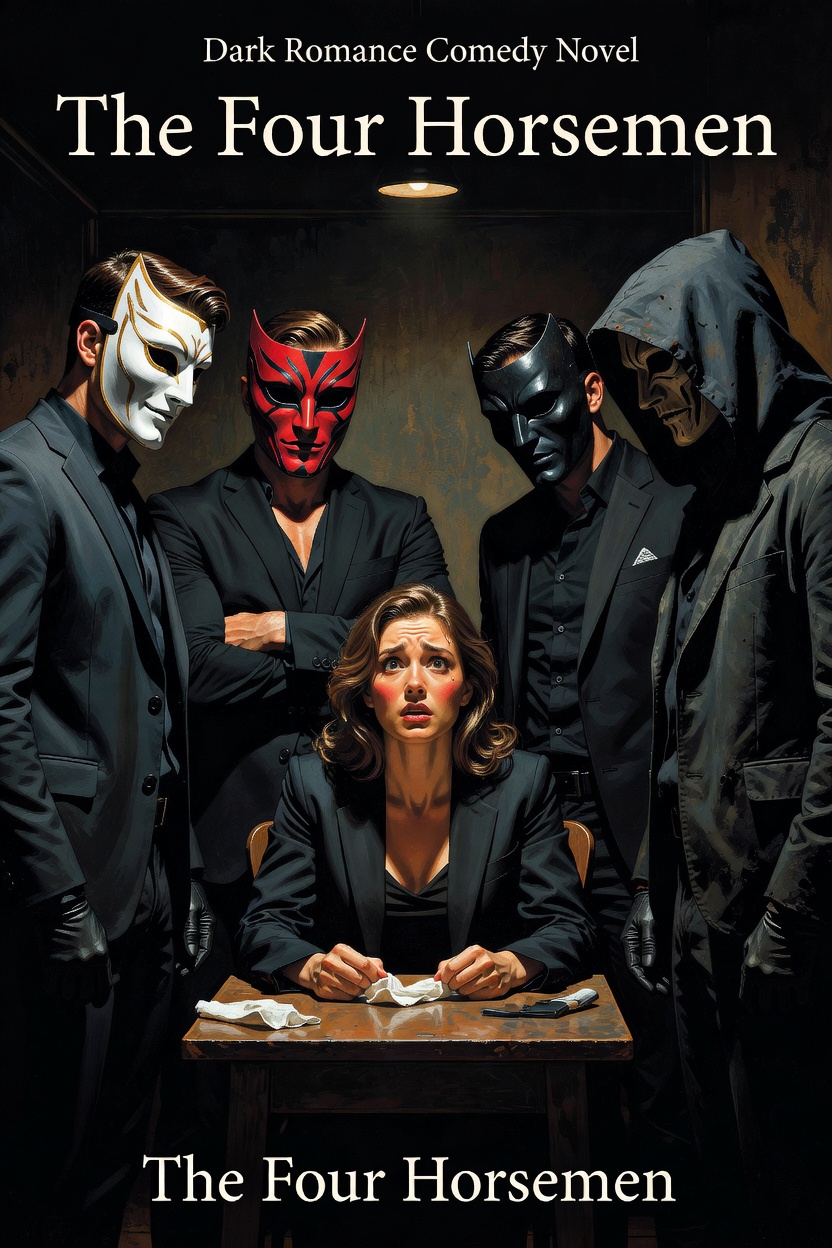
Novel · 12 chapters · 63,706 words
The Four Horsemen
Contents12 chapters
- 01The Reservation Under Her Name
- 02Four Masks, Four Versions of Trouble
- 03A Game With Rules She Never Agreed To
- 04The Friend Who Opened the Door
- 05The House With No Mirrors
- 06What They Want From Her
- 07Cracks in the Formation
- 08The Offer on the Table
- 09An Enemy Steps Into the Light
- 10Unmasked
- 11The Night the City Turned
- 12No More Games at the End of the Table
Chapter 1
The Reservation Under Her Name
Mara had one heel off and the other half-kicked free when her office door swung open hard enough to rattle the frosted glass.
“If that’s another bride asking whether peonies can be made less peony-looking, I quit,” Mara said, bent over the strap biting her ankle.
“It’s worse,” Tessa announced. “It’s me.”
Mara straightened slowly. Her lower back complained. The conference table looked like a paper bomb had gone off on it—linen samples, rental contracts, a seating chart with three names crossed out and rewritten in purple ink, a bakery invoice smeared with thumbprint frosting from somewhere around four o’clock. Her laptop still glowed with an unanswered chain marked urgent by six separate people who, as far as Mara could tell, would survive until morning without her opinion on charger plate finishes.
Tessa closed the door behind herself with her hip and lifted a white paper bag. Grease had already stained the bottom in crescent moons.
“Olives and mushroom flatbread from Bellori,” she said. “And before you start, yes, I know it’s bribery.”
“You know me so well.”
“I know you’re one rude email away from biting a client.”
Mara reached for the bag. Tessa whisked it away.
“Not until you sit.”
“This feels manipulative.”
“It is manipulative.” Tessa hooked a chair out with the toe of her boot and pointed at it like a school principal. “Sit down before you pass out and become one of those cautionary LinkedIn stories.”
Mara sat because arguing took more energy than she had left. She dragged the elastic out of her hair and winced as the weight slid down over her shoulders. “If this is an intervention, make it fast. I still need to confirm floral refrigeration for Saturday.”
Tessa set the bag down at last, but instead of handing over the food, she took a small cream envelope from her coat pocket and placed it on the table between the water-stained mood board and a bowl of dead mints.
“No,” Mara said immediately.
Tessa blinked. “I haven’t said anything.”
“You brought an envelope. Envelopes are never good.”
“This one is excellent.”
“No.”
“Mara.”
“No.”
Tessa pinched the bridge of her nose. “At least look at it before you reject my beautifully planned effort to improve your life.”
“You improving my life usually costs me money.”
“Only because your standards are obscene.”
Mara pulled the envelope closer. Her name was written across the front in black ink, not printed, not scrawled, but written with the kind of care people used when they wanted stationery to feel expensive. Mara Vale. No return address. No logo. The paper was thick enough to matter.
She slit it open with a butter knife she’d used at lunch and unfolded the card inside.
Your reservation is confirmed for two.
Nine o’clock.
Saint.
No address. Just that. At the bottom, in smaller lettering: Ask no questions at the door.
Mara looked up. “This isn’t a restaurant. This is how people get murdered in high-end neighborhoods.”
Tessa snorted and finally shoved the paper bag at her. “It is a restaurant. Kind of.”
“Kind of?”
“It’s a supper club.”
“That phrase should have stayed in the twenties with cigarette holders and moral collapse.”
“You say that like you aren’t one missed rent check away from moral collapse.”
Mara fished out a square of flatbread and took a bite hot enough to burn her tongue. She welcomed the pain. It cut through the cotton wool behind her eyes. “I’m not going.”
“Yes, you are.”
“Then why does it say reservation for two? You can go with whoever your next victim is.”
Tessa leaned both palms on the table and smiled with a brightness that always meant she was concealing structural damage. “Because it started as dinner with me. Then it improved.”
Mara held still. “Tessa.”
“A blind date.”
Mara chewed once, twice. Swallowed. “Absolutely not.”
“Don’t make that face.”
“What face? The one I make when my supposed best friend turns into a cartoon villain?”
“The one where you act like I’ve suggested ritual sacrifice.”
“You did it in an envelope. That’s worse.”
Tessa dropped into the chair opposite and folded one leg under herself. She had come from work too, but unlike Mara, she looked sharpened by the day instead of bludgeoned by it. Lipstick still exact. Dark curls caught in a gold clip. A cream trench thrown over a black dress as if she had just stepped out of a perfume ad and wandered accidentally into a war room.
“You need one night,” Tessa said. “One night where nobody asks you for a revised invoice or a custom dance floor or a miracle.”
“I need sleep.”
“You need reminding you are not fifty-seven and bitter and married to a color-coded spreadsheet.”
“I’m thirty-one.”
“With the soul of a municipal clerk.”
Mara took another bite just to keep from saying something she would have to apologize for. Tessa watched her over steepled fingers, waiting. She knew Mara’s silences too well. Which ones meant maybe. Which ones meant try harder. Which ones meant get under the table because debris was coming.
“I am not doing a blind date,” Mara said at last. “I don’t have the energy to smile politely while a stranger tells me he’s looking for a woman who doesn’t take herself too seriously. I take myself exactly seriously enough.”
Tessa made a little circling motion with one hand. “Not a normal blind date.”
“That should comfort me?”
“It should interest you.”
“It doesn’t.”
“It will.”
Mara set the food down. “This is the part where you tell me he owns a sailboat and reads dead Russians for fun.”
Tessa’s mouth twitched. “Not he.”
Something in Mara’s spine tightened. “No.”
Tessa lifted her brows.
“No,” Mara repeated.
“Well. Technically.”
“No, Tessa.”
“There are four.”
The office went quiet except for the low refrigeration hum from the kitchenette beyond the half wall and the staccato tapping of sleet? No weather. Remove. Replace city noise. and the far-off rattle of a service elevator in the building shaft. Mara stared at her. Then she laughed once, without humor, because if she didn’t laugh, she might throw the flatbread.
“Four,” Mara said. “You set me up with four men.”
“When you say it like that, it sounds aggressive.”
“It is aggressive.”
“It’s selective.”
“It’s unhinged.”
Tessa spread her hands. “Maybe you should hear me out before you file charges.”
Mara pushed back from the table and stood. Her calves ached instantly. She crossed to the narrow window beside the bookshelves and looked down at Mercer Street, where delivery bikes threaded through traffic and the noodle place across the way had a line out the door. Normal city things. Honest things. No hidden supper clubs. No four-man ambushes waiting under her name.
Behind her, Tessa said, more carefully now, “I know how this sounds.”
“It sounds like you’ve lost your mind.”
“Possible.”
“Four?”
“It’s a dinner.”
“With four men.”
“At one table, yes.”
“A table I did not ask for.”
“You never ask for anything.”
Mara turned. “That is nonsense.”
“You ask for practical things. Favors with exit strategies. Help carrying boxes. Somebody to feed your cat when you get trapped at the convention center. You do not ask for pleasure, which is why sometimes it must be forced upon you.”
Mara barked a laugh. “You hear how criminal that sounds?”
Tessa smiled despite herself, then sobered. “I’m serious.”
“So am I. Why would I go sit with four strangers who think this is a normal thing to do?”
“Because they don’t think you’re normal either.”
“That is not a selling point.”
Tessa hesitated. It was small, but Mara caught it. Tessa rarely hesitated unless she was about to step onto weak ice.
“What aren’t you saying?”
“Nothing bad.”
“That’s not an answer.”
Tessa took the envelope from the table, turned it between her fingers, set it down again. “One of them knows someone who hosted an event you did last spring. Charity auction at the Harlow museum.”
Mara frowned. “I do thirty events in spring.”
“The one where the donor’s son tried to move the auctioneer script around ten minutes before the room opened, and you told him if he touched your lectern again you’d staple his cuff to it.”
“I did not say cuff.”
“You’re right. You said hand.”
Mara looked at her. “That was private.”
“Apparently not private enough.”
The memory came back clean. Polished stone floors. Too much white wine. A rich man’s son with damp upper lip confidence reaching for her paperwork because men like that always believed every room had been built to forgive them. She had been thirteen hours into a day that started with florist drama and ended with a donor claiming his wife’s name card looked vindictive in serif font. The son had smiled at her as if charm were a permit. She had leaned close and told him, softly enough not to disrupt the quartet, that if he put his hand on her setup again she would staple him to the lectern and sell paddles while he bled.
He hadn’t touched anything after that.
“That’s your pitch?” Mara said. “Some man heard a story about me being difficult and wants front-row seats?”
Tessa’s chin tipped. “Maybe someone noticed you don’t fold.”
“Oh good. Predators.”
“Oh, please. If they were predators, I would never send you.”
“Four secret men at a hidden club and I’m supposed to trust your screening process?”
“Yes.”
“Why?”
“Because I know what I’m doing.”
There it was again—that faint strain under Tessa’s voice. Not guilt exactly. Not yet. But effort. Mara crossed her arms.
“How do you know these men?”
“Through a client.”
“What client?”
“One I can’t name.”
“Then this conversation is over.”
Tessa stood too, quick, intercepting her before she could move toward the coat rack. “Fine. Don’t go because you don’t want to. Don’t go because four is absurd and masks are dramatic and the whole thing sounds like rich-people nonsense. All fair. But don’t hide behind being tired as if rest is waiting for you at home.”
Mara’s keys were on the windowsill beside a wilting succulent she had forgotten to water three times this month. She picked them up. “I am tired.”
“I know.”
“No, you know I’m busy. It’s different.”
Tessa’s face changed. Softer. Worse.
Mara looked away first.
There had been six months of things going wrong in installments. Her father’s second knee surgery. The legal letter regarding the family property upstate with language so polished it made threat sound like civic duty. A client who paid three weeks late. Another who decided exposure should count as partial compensation. Her younger brother calling from a gas station because his card had failed and could she float him until Friday. The kind of tired that wasn’t solved by baths or boundaries or strangers with nice shoulders.
Tessa knew all of it. Tessa had stood in Mara’s kitchen two Sundays ago eating stale biscotti straight from the tin while Mara cried over insurance forms and denied she was crying.
“I got you one night,” Tessa said. “A good table. Good food. Men who know how to behave themselves.”
Mara laughed again. “You cannot possibly promise that.”
“I can if I say they were told to.”
Mara narrowed her eyes. “Told by whom?”
Tessa’s smile flashed, quick and infuriating. “Me.”
“God help us all.”
“Come for one drink. If it’s weird, you leave. If they’re awful, you leave. If one of them says ‘females’ unironically, I give you my car for a month.”
“You don’t own a car.”
“Exactly. Stakes.”
Mara slipped on her heel and sat to do the strap up properly because she suddenly felt as if standing required a permit. “Masks?”
“Yes.”
“Why?”
“Because that’s part of the club.”
“What kind of club requires face concealment?”
“The kind people try very hard to get into.”
“Again. Murder.”
Tessa folded her arms, copied Mara’s posture with annoying precision. “You like details? Fine. Saint is invitation only. Phones get sealed at the door. No photographs. No names inside unless offered. Apparently the food is obscene, the wine list is even worse, and everyone acts like secrecy is a sacrament.”
“Did a brochure write that for you?”
“A woman named Nadine who left her husband there for a cellist.”
“That does not help.”
“She said the oysters ruined her life.”
“I don’t even like oysters.”
“Then order something land-based and stop resisting destiny.”
Mara tightened the second strap. “I don’t believe in destiny.”
“You believe in planning.”
“Yes.”
“Good. Plan to be somewhere at nine.”
Mara exhaled through her nose. “What do they know about me?”
“That you’re Mara.”
“Obviously.”
“That you’re smart.”
“That narrows nothing.”
“That you’re impossible to intimidate.”
Mara picked up her bag. “Objectively false. Con Edison billing departments intimidate me.”
Tessa held the cream card out one more time. “Take it.”
Mara looked at it. Then at Tessa. Then at the stack of contracts waiting for her, the ruined mints, the dying plant, the office she had rented because she needed to become the sort of woman with a brass plaque on a door and had instead become the sort who kept emergency ibuprofen in three different drawers.
“For one drink,” she said.
Tessa did not smile too fast, which told Mara she had expected more of a fight. “One drink.”
“And if they’re terrible, I’m sending you the bill for my dry cleaning and emotional distress.”
“Deal.”
Mara took the card.
By eight-thirty she hated herself for agreeing.
Her apartment had greeted her with a sink full of glasses, a voicemail from her brother, and a radiator that clanked like a wrench trapped in a drum. She stood in the middle of her bedroom in a black slip dress she usually reserved for gallery fundraisers and funerals, one earring in, one earring still on the dresser, wondering how exactly a woman was supposed to dress for “ask no questions at the door.”
Not like prey, she decided.
She traded the thin gold chain at her throat for nothing. Left her hair down because trying to force it into order had made it rebelliously bigger. Chose a long wool coat, sensible enough to suggest she could stab somebody if needed. The cream card went into her clutch. Tessa had texted three times.
You’re going.
If you ghost me I’ll put your number on a yacht broker list.
Wear the good shoes. If secrecy is involved, at least let your calves benefit.
Mara did not answer any of them.
Saint occupied no obvious frontage. The address, sent by Tessa at the last possible moment, took Mara to a narrow block in the old garment district where the buildings had soot in their mortar and brass numbers dulled by decades of touching hands. A tailor’s shop with darkened windows sat on one side. On the other, a shuttered antiques dealer with a painted sign peeling at the corners. Between them, a black door with no handle visible from the street.
No line. No sign. Just a lantern set high in an iron bracket and a man in a charcoal suit standing under it as still as poured concrete.
Mara approached, heel strikes crisp against the pavement. The city moved around the block in other registers—horns from the avenue, the hiss of bus brakes, laughter from a bar at the corner—but right in front of that door it felt muffled, contained.
The doorman looked at her gloves, her face, the clutch in her hand.
“Name.”
“Mara Vale.”
His expression didn’t change, but something confirmed in his eyes. He stepped aside without asking another question.
Inside, a woman in black silk took Mara’s phone and placed it in a padded envelope with a numbered brass tag. Another attendant accepted her coat. The room beyond was lit low enough to flatter sinners. Beeswax candles burned down in thick ivory columns on every ledge. Somewhere unseen, a piano moved through a melody that kept refusing to become familiar. The air smelled of orange peel, smoke, butter, and expensive perfume laid over old wood.
A host appeared as if assembled from the shadows. Midnight jacket. White shirt. Face unreadable in the candlelight.
“Ms. Vale,” he said. “This way.”
“I’d like to know who reserved under my name.”
“I imagine you would.”
She stopped. “That wasn’t a joke.”
“No.” He offered her a slight incline of the head. “Nothing here is compulsory, Ms. Vale. If at any point you wish to leave, you will be shown out at once.”
“That answer usually means I should leave now.”
“Usually.”
He resumed walking. After one beat, Mara followed.
The dining room was long and low, broken into alcoves by velvet screens the color of dried wine. Tables were spaced indecently far apart, each with its own pool of amber light, as if privacy itself were part of the menu. Faces turned here and there, but not openly; people glanced without looking. Men in dinner jackets. Women in silk and satin and one severe white suit. Several guests wore masks. Not costume-store nonsense, but lacquered black half masks, matte silver, something feathered and dark as a raven wing.
Mara’s pulse gave one annoyed hard knock.
The host led her past a mirrored bar with no visible bottles, only cut crystal and a bartender whose hands moved like card tricks. Past a couple speaking close enough to share breath. Past a man in opera gloves laughing at something sharp enough to make his companion’s smile flicker.
Then the room opened at the back into a raised alcove ringed with candles and curtained on three sides with heavy mesh that hid as much as it revealed.
A round table waited there.
Four men sat around it.
All masked.
For a fraction of a second Mara thought, absurdly, of old paintings—horsemen in smoke and metal, heraldic and ominous. Then the thought vanished under a hotter, simpler one.
Tessa, I will kill you.
The masks matched in spirit, not design. No cheap symmetry. One was black leather, plain and severe, cut clean over cheekbones and nose. One gleamed dark gunmetal, polished but scarred near the temple as if something hard had once glanced off it. One was matte onyx with narrow eye openings that made the face behind it unreadable, priestly almost. The last was ivory, not white but bone-colored, with a fine crack traced through one side in gold.
Their clothes were evening-dark. Tailored. Each of them took up space differently. The man in leather sat straight and still, one hand flat beside his untouched water glass. Control radiated off him so plainly it was almost vulgar. The gunmetal one had a loose-shouldered posture that looked relaxed until you noticed nothing about him was relaxed, not really; his fingers toyed with the stem of his wineglass, precise and restless. The onyx mask belonged to the broadest of them, quieter in body, his gaze the sort that landed and stayed. The ivory mask leaned back as if the whole setup amused him and he had come mostly to see what she would do.
The empty chair waiting for Mara faced all four.
“No,” Mara said.
The host stood politely at her shoulder. “Would you like to be shown out, Ms. Vale?”
All four men remained seated.
The one in ivory spoke first. His voice was low and roughened at the edges, a scrape of humor through velvet. “I told them she’d say that before she sat down.”
“Don’t congratulate yourself,” said the gunmetal mask. His accent was local, polished by money but not erased by it. “Anyone with a pulse would say no.”
The man in leather looked at Mara and nothing else. “You were expected for one drink, not surrender.”
Expected. The word hit wrong.
Mara set her clutch on the table with deliberate care. “Interesting choice of language.”
“Sit,” said ivory.
“Don’t,” said gunmetal at the same time.
A pause followed. Small. Revealing.
The broad man in onyx shifted his chair back an inch and rose to his feet. He was taller than she had guessed sitting down, built in a way that made the candlelight seem decorative on him. He did not come around the table. He simply pulled out the empty chair across from them.
“If you’re staying long enough to insult us properly,” he said, “you may as well do it seated.”
His voice was quieter than the others. Deep, unhurried. The kind that made people lower their own without noticing.
Mara looked from one mask to the next. “You all realize this is deranged.”
Ivory tipped his glass in salute. “Thank you.”
“Roman,” leather said without looking at him.
“Adrian,” Roman returned, sing-song enough to be insolent.
Names, then. Maybe real, maybe not.
Mara kept standing. “I was told this was a blind date.”
“It is,” said gunmetal.
“With four men?”
“With one woman,” Roman said. “Try not to sound disappointed.”
Mara laughed despite herself, once, short and sharp. “That line has probably worked for you before.”
“Less than I deserve.”
“Sit down, Roman,” Adrian said.
“I’m already sitting down.”
Adrian’s attention never left Mara. “He mistakes indulgence for charm.”
“And you mistake orders for conversation,” said Roman.
The man in onyx slid the chair a little farther from the table, making room without pressuring. “You can leave,” he said to Mara. “No one will stop you.”
There was something about him that did not ask to be believed and was therefore easier to trust than the others.
Mara put one hand on the chair back but did not sit. “Why me?”
Silence moved around the table. Not ignorance. Decision.
Gunmetal smiled, though the expression only reached the lower half of his face. “Straight to the expensive question.”
“She should ask it,” said onyx.
“She can ask anything she likes,” Adrian said. “Whether we answer is another matter.”
Mara looked at him. “That’s reassuring.”
“It wasn’t meant to be.”
Of course it wasn’t.
A server materialized with a menu bound in black cloth and set it before the empty place as if this happened every night, women arriving at covert restaurants to discover a committee of masked men waiting under candlelight. The server vanished again.
Mara sat because she refused to grant them the satisfaction of seeing her bolt. Also because her feet hurt. Pride had limits.
The chair was upholstered in dark green velvet. Someone had thought about this table in advance. About sight lines. About effect.
“I’ll save us time,” she said. “If this is some humiliating joke from a bachelor party with a private equity budget, I’m leaving before the amuse-bouche.”
Gunmetal barked a laugh.
Roman looked delighted. “Amuse-bouche. She’s vicious.”
“We know,” Adrian said.
The words sharpened the air.
Mara’s fingers tightened lightly around the edge of the menu. “You know what, exactly?”
“That you don’t like your time wasted,” onyx said.
“That you sent back a sixty-thousand-dollar floral arch because the roses were bruised on the side guests would never see,” said gunmetal.
Mara’s head turned. “How do you know that?”
Roman lifted a shoulder. “Word travels.”
“That I should be addressed directly,” Adrian said. “Not around. Not through a friend. That was a misstep.”
Mara went still. “A misstep by whom?”
No one answered quickly enough.
The waiter reappeared to ask for drinks, and Mara could have kissed him for the interruption.
“Gin martini,” she said before any of the men could speak for her. “Very cold. Twist.”
Adrian ordered nothing. Luca—if that was gunmetal’s name—asked for Barolo. Onyx requested sparkling water. Roman said, “Surprise me,” to the waiter in a tone suggesting he expected to be obeyed by the concept of alcohol itself.
When the waiter left, Mara folded the menu closed without opening it.
“You said through a friend.”
Adrian’s jaw shifted once under the leather mask. “You were invited.”
“Ambushed.”
“Semantics.”
“No. Consent.”
Luca made a quiet approving sound at that, one knuckle brushing his lip.
Adrian ignored him. “If you feel tricked, that was not my preference.”
“But somebody’s.”
Roman rested his elbow on the table. “Now we’re getting somewhere.”
Mara turned to him. “Take the mask off or stop sounding entertained.”
That landed. Luca’s mouth curved. Onyx watched her with a look impossible to read through the slit of the mask, but his stillness changed, attention narrowing.
Roman leaned forward just enough for the gold seam in his ivory mask to catch the candlelight. “If I take off the mask now, then we skip straight to the part where you decide whether to throw the wine or ask my last name. I’m enjoying the middle.”
Mara held his gaze. “You assume there’s a middle.”
“There is if you stay.”
“And if I don’t?”
Roman smiled. “Then this becomes a very expensive lesson in overconfidence.”
“Yours or mine?”
“Still being assessed.”
The drinks arrived. Mara picked up the martini and drank before anyone could suggest a toast. It was excellent. That annoyed her too.
Luca swirled his wine. “For what it’s worth, I voted against all of us meeting you at once.”
“Luca,” Adrian said.
“What? She should know not everyone at this table is drunk on theatrics.”
Roman pressed a hand to his chest. “Wounded.”
“You recover fast.”
Mara set down her glass. “Why did you vote against it?”
“Because,” Luca said, “this looks exactly like what it is. Four men with too much money deciding they can stage-manage a woman into curiosity.”
Roman gave him a sidelong glance. “And yet here you are.”
“Yes. Regret can be punctual.”
That earned a faint huff from onyx—almost a laugh.
Mara looked at him. “And you? Did you vote for this?”
A small beat. “I voted for honesty sooner.”
“Then you’ve had a bad night.”
Roman muttered, “He always does this. Makes decency sound like a threat.”
Onyx ignored him.
Mara reached for the stem of her glass again because the alcohol was beginning to lay a clean line through her fatigue. She was still tired. Still furious. But beneath it, against all reason, something ugly and bright had come alive. Curiosity. The oldest trap.
“Let me make this easier,” she said. “I’m leaving in ten minutes. In those ten minutes, one of you can tell me why my friend was involved in whatever this is.”
Adrian’s fingers flattened more firmly against the table. Tiny motion. Heavy meaning.
“She was asked to extend an invitation,” he said.
“Paid?”
There it was. The pause she needed. Tiny, but enough.
Mara laughed without sound and looked down into her drink. Of course. Tessa’s evasions, polished and anxious. Not just matchmaking. Transaction.
“How much?”
Roman glanced at Adrian. Luca stared into his wine like it had personally offended him. Onyx said nothing.
Mara looked up slowly. “How much did you pay my best friend to put me in a chair?”
Adrian answered. “Enough to get her attention. Not enough to buy her loyalty.”
“That’s a very elegant way to say yes.”
“You asked a direct question.”
“I’m asking several. You seem selective about which count.”
Roman leaned back, the chair creaking softly. “In our defense, this is going better than expected.”
“Is it?” Mara asked.
“For me? Tremendously.”
“Shut up, Roman,” Luca said.
“No.”
Adrian’s gaze stayed fixed on Mara. “You are free to be angry with her.”
“I’m aware.”
“You should not assume she meant harm.”
“How generous of you to advise me on my own friend.”
A tray arrived with small dishes she had not ordered: a crisp thing filled with whipped goat cheese and charred leek, a spoon of tuna tartare topped with something jeweled and acidic, warm olives in rosemary oil. The server placed them with the reverence of a priest setting relics.
Mara stared at the food. “Did you pre-order for me too?”
“Only the first course,” Roman said. “If we meant to kidnap you, there’d be handcuffs.”
Luca closed his eyes briefly. “You see why I drink.”
Mara looked at Roman. “That was your attempt at reassurance?”
“It was my attempt at honesty.”
“Try less of it.”
His grin deepened.
For a moment nobody reached for the food. Then onyx picked up one of the crisp bites and set it on the small plate in front of Mara. He did not touch her. Didn’t crowd. Just shifted porcelain through candlelight.
“You haven’t eaten enough today,” he said.
Her eyes snapped to him.
“How do you know that?”
He glanced, just once, at the faint smear of ink along the side of her hand. At the notch her earring backs had left where she must have put them on in a hurry. At the tension that probably still sat between her brows.
Mara wanted to resent him for seeing any of it.
Instead she picked up the bite and ate it because he was right and because refusing now would feel childish. Flaky shell shattered cleanly. The filling was sharp, smoky, obscene in its own right.
Roman watched her mouth. “Good?”
She looked at him while she swallowed. “I hate all of you a little less with food in front of me.”
“That’s practically devotion.”
Luca cut in before Roman could keep performing. “Mara.”
She turned toward his voice. He held his wineglass by the bowl, warming it carelessly.
“You want the most useful answer?” he asked.
“Yes.”
“We asked Tessa because if someone we didn’t know approached you directly, you’d say no on principle.”
Mara let that sit. It had the ring of truth, which made it more offensive.
“And if she asked me directly?”
Luca tilted his head. “You’d say no on exhaustion.”
Also true.
“Why did you want me here badly enough to pay for my no to become a maybe?”
Nobody smiled this time.
Adrian spoke. “Because introductions matter.”
“That means nothing.”
“It means we preferred to begin this face to face.”
“This what?”
Roman tapped one finger against his glass. “Now there’s the right question.”
Adrian’s mouth became a line. Luca watched him like a man betting against his own partner. Onyx folded his hands loosely before him and said nothing at all.
Mara looked around the table, from leather to gunmetal to onyx to cracked ivory, and saw it then—not a joke, not exactly. Not random appetite either. Something arranged. Something rehearsed badly enough to show the strain at the seams.
Her phone was sealed in an envelope somewhere by the door. Her friend had sold her an invitation. Four masked men knew stories about her they should not know. And every instinct she had built keeping clients, vendors, landlords, and opportunists from walking over her told her to stand up now and leave before this got teeth.
Instead she lifted her martini, finished it, and placed the empty glass down in the center of the candlelight with a precise click.
“No more games,” she said. “You bought ten more minutes. Use them well.”
Across from her, Adrian leaned in at last, just enough for shadow to sharpen the planes of his mask.
“Fair,” he said.
And beneath the table, out of sight, Mara slipped her hand into her bag and closed her fingers around the metal pen she always carried, because fairness was a word men loved best right before they explained why she had none.
Chapter 2
Four Masks, Four Versions of Trouble
“Start with your names,” Mara said. “Real ones, if you’ve got them.”
The candle between them hissed softly, wick drowning in its own wax. Around the room, Saint went on pretending not to hear. Cutlery touched porcelain somewhere beyond the velvet partition. A woman in pearls laughed once, low and startled, and then not again.
Adrian sat at the head of nothing and made it look appointed. Leather mask. Black suit cut so cleanly it almost erased him into shape and intention. He rested one hand flat on the tablecloth, not fidgeting, not performing patience. Waiting to decide whether her demand deserved obedience.
Roman, of course, had no such discipline.
“Should we swear on a family Bible?” he asked. “Prick fingers? I’m open to ritual.”
“Your openness is the least reassuring thing about you,” Mara said.
Luca’s mouth twitched. “That’s the nicest thing anyone’s said to him in weeks.”
Roman touched a hand to his chest. “I’m wounded.”
“You’re impossible,” Luca said.
“And yet invited.”
Adrian did not look at either of them. “Adrian.”
Just that. No last name. No flourish. The word landed between them with the weight of something notarized.
Luca lifted his glass in two fingers. “Luca.”
The man in the matte black mask—onyx-dark, featureless except for the cut around the eyes—watched her over steepled hands.
“Elias,” he said.
His voice was quieter than the others. Not soft. Quiet the way a locked room is quiet: because sound has been told where to stop.
Roman inclined his head with a mock-courtly little dip. “Roman. Your evening’s designated bad decision.”
“I didn’t designate anything.”
“That remains true in more areas of your life than you think,” Luca said.
She turned to him. “Are you all like this, or is there a waiter somewhere doing impressions of rich men?”
Roman laughed outright. Elias looked down briefly, hiding what might have been the edge of a smile. Adrian’s expression did not move.
“Now you,” Adrian said.
“I gave my name at the door.”
“I’m aware.”
“Then why ask?”
“Because there’s a difference between being announced and choosing to speak.”
Mara rolled the olive stem between her fingers until the oil slicked her skin. There it was again—that neat, infuriating way he had of laying control in the center of the table and calling it courtesy.
“Mara,” she said. “Since apparently we’re all pretending that changed hands tonight.”
Adrian nodded once, like an item checked off a list no one else could see.
She noticed it because she had spent half her adult life noticing men who thought lists made them gods. Clients who promised impossible room turns and vendors who swore a truck was definitely en route and developers who smiled while trying to buy a piece of ground her father still called by the old family name. Men with agendas had tells. Adrian’s was economy. He never wasted movement because he expected the room to meet him halfway.
Roman wasted movement for sport. He stretched an arm across the back of his chair, long fingers tapping once against the carved wood.
Luca seemed made of sharper habits—thumb circling the stem of his wineglass, gaze cutting sideways before his head followed, one ankle hooked around the chair leg as if even sitting still annoyed him.
Elias was the difficult one. Stillness could mean comfort. It could also mean a great deal of effort.
Mara took another bite of the leek tart before it went limp in the heat. “Fine. We have names. We remain at the part where you explain why four strangers paid my friend to steer me into a supper club with a confidentiality kink.”
Roman lit up. “A confidentiality kink is a great line. Adrian, can we put that in the brochure?”
“We don’t have a brochure,” Adrian said.
“Yet.”
“We’re not answering that,” Luca told Mara.
She set the pastry down. “Then I’m leaving.”
Roman opened his mouth.
Adrian beat him to it. “We are. Not all at once.”
“Why not?”
“Because you’d hear it as a pitch,” Elias said.
It was the first time he had stepped in without invitation, and all three of the others went briefly still after he spoke. Not startled. Taking note.
Mara caught that too.
“And what is it, if not a pitch?”
Elias looked at her as if checking whether she wanted the polished answer or the useful one. “An introduction with consequences.”
“That’s not less ominous.”
“No,” he said. “It isn’t.”
A server appeared soundlessly with fresh napkins and replaced Mara’s empty glass before she could ask for water or another drink. Crystal stem. A twist of lemon. Clear enough to be vodka, gin, or a threat.
“I didn’t order that.”
Roman glanced at it. “French seventy-five without the champagne.”
“I’m sorry, what?”
“You hate sweet cocktails, but the gin in your martini was too cold and too dry for how little you’ve eaten. This sits better.”
The space behind her ribs tightened.
“You’ve never had a drink with me.”
“No.”
“Then how exactly—”
“Lucky guess,” Luca cut in, and it would have been convincing if Roman hadn’t looked annoyed at being interrupted.
Mara did not touch the glass. “Did you read my medical chart too, or are we still pretending boundaries are a thing?”
“We didn’t read your medical chart,” Adrian said.
She looked at him. “That was a very specific denial.”
“It deserved a precise answer.”
She hated that too.
Luca leaned forward, forearms brushing the cloth. Gunmetal mask, cool and severe, though the mouth beneath it had no talent for staying neutral. “You want a structure? Fine. Ask what you want. We answer what we can. In return, each of us gets one question.”
“No.”
Roman put a hand to his chest again. “You wound me twice in one night.”
“I’m not participating in whatever smug parlor game this is.”
“Then call it triage,” Luca said. “You decide where to cut first.”
Mara stared at him. He stared back like he had never in his life mistaken charm for apology.
She should have walked out. The smart move was so obvious it practically had a fluorescent exit sign over it. But the room had shifted around her in that slippery way expensive places sometimes did; not trapping, exactly, but narrowing. And under the annoyance, under the pulse of insult and the fact that Tessa was going to have to answer for several crimes of friendship, there was another thing.
Curiosity. Ugly. Stubborn. Effective.
She lifted the replacement drink, smelled citrus and juniper and a bitter green edge she couldn’t place, then set it down again without tasting.
“Fine,” she said. “Triage. Adrian first.”
Roman looked scandalized. “I’m hurt.”
“You volunteered to be the bad decision. I’m saving you for later.”
That won her a grin so sudden and bright it transformed his whole face beneath the ivory mask. Fine gold veined one side of it, a repaired break or an affectation meant to look like one. The kind of detail that could mean taste or vanity or money trying to imitate scars.
Adrian folded his hands. “Ask.”
“Who paid Tessa?”
He held her gaze for one beat too long.
“We did.”
“All of you.”
“Yes.”
“How much?”
Roman whistled under his breath. Luca muttered, “There she is.”
Adrian answered without blinking. “Enough that she said yes. Not enough to ruin her.”
Mara let out a short laugh with no humor in it. “That is a foul sentence.”
“It is also true.”
“You vetted my best friend with a payment scale?”
“We vetted the method,” he said. “Not her.”
“Don’t flatter yourselves. If you knew Tessa, you would have known she can be bought by novelty, flattery, or premium skincare.”
Roman’s shoulders shook once. “I like her more every minute.”
Adrian ignored him. “Tessa believed she was delivering an invitation to dinner. She knew there would be four men. She did not know why we wanted to meet you.”
“And why did you?”
His fingers tapped the table once. His first wasted motion all evening.
“There are better answers and honest answers,” he said.
“Try me.”
“We were curious.”
“No.”
That startled him a little. Not much. Just enough for the candlelight to catch on the shift in his jaw.
“No?” he repeated.
“That’s not an answer men like you spend money on.”
Roman grinned into his drink. Luca looked pleased in a dangerous way. Elias did not move at all.
Adrian inclined his head, conceding the point without surrendering anything larger. “Then here’s the honest version. We wanted to see whether you were as difficult in person.”
Mara smiled despite herself. It came out sharp. “And?”
“You’re worse.”
“Good.”
“Yes,” he said, and that one word held more than it should have.
She looked away first, irritated by the fact.
“Your turn,” Adrian said.
“No, it isn’t.”
“It is.”
“You said each of you gets one question. You didn’t say when.”
“I’m asking now.”
Mara considered refusing just on principle. Instead she crossed one leg over the other and waited.
Adrian’s voice did not change. “Why haven’t you sold the property?”
There it was. The room narrowed another inch.
She didn’t answer immediately. She reached for one of the warm olives instead, the rosemary oil slick and fragrant on her fingertips, buying herself a beat she knew he would notice. Of course he would.
“Interesting,” she said. “You know enough to call it the property. Not enough to use the town name.”
“We know the town name,” Luca said.
“Then why didn’t he?”
“Because Adrian likes to pretend subtlety is the same thing as mercy,” Roman said.
Adrian’s gaze stayed on Mara. “Answer the question.”
“Because it’s mine.”
Luca let out a small breath through his nose. “That sounded rehearsed.”
“It gets used a lot.”
“With brokers?” Elias asked.
“With men who mistake persistence for leverage.”
Roman raised his glass slightly. “To Mara, patron saint of making developers cry.”
She looked at him. “That sounded specific.”
“Everything tonight is specific,” Luca said.
Mara turned back to Adrian. “Your question’s answered.”
“No, it isn’t.”
“Yes, it is. I haven’t sold because it’s mine.”
“That’s possession,” he said. “Not reason.”
“And now you’re out of questions.”
Roman barked a laugh. Luca smiled into his wine. Elias’s eyes went briefly to Adrian’s hand, where the fingers had stilled again.
Score one, apparently.
Mara sat back. “Luca.”
“Excellent choice,” Roman said.
“No one asked you.”
“I remain available.”
Luca rolled his eyes. “Go on.”
“Were you against this,” Mara asked, “or against me knowing you were in on it?”
He looked down into his glass before answering, as if the wine might offer counsel. When he looked back up, the line of his mouth had gone flatter.
“Against this,” he said.
“Why?”
“Because bringing four masked men to a blind date is ridiculous.”
“Refreshingly self-aware.”
“It also stacks the table.”
“You mean in your favor?”
“In anyone’s,” he said. “Group dynamics make people stupid.”
Roman leaned in. “Some of us are gifted enough to manage.”
“Some of us are proof of my point.”
Mara watched Luca over their bickering. “Then why are you here?”
He held her gaze. “Because I was overruled.”
“By Adrian.”
“Among others.”
That drew her to Elias. He did not react, but the silence after Luca’s answer had shape now. Not random. Joint.
Mara drummed two fingers against the stem of the untouched drink. “So you objected on principle and came anyway. That makes you what, exactly? Ethical with poor follow-through?”
Roman groaned. “God, I knew I liked her.”
Luca smiled without warmth. “It makes me practical. Better I come and tell you when something’s bullshit than leave you alone with these three.”
Adrian looked at him. “How noble.”
“Don’t start.”
“Oh, please start,” Roman said. “This is where he pretends he’s here as consumer protection.”
Luca turned his head. “And this is where you pretend recklessness is a personality instead of a tax bracket.”
Roman laughed, delighted. Mara glanced between them and felt it then: the spark and bite of rivalry, yes, but too cleanly deployed. No one’s pulse in it. No real blood under the jab.
Men who actually hated each other hit lower.
“Your question,” Luca said to her.
She almost said never mind. Then: “How much of my life did you look into?”
Luca didn’t answer right away.
“Too much,” he said at last.
Something in his tone took the cheap edge off the room. Mara didn’t relax, exactly. But she stopped performing irritation for a second and simply looked at him.
“What does that mean?”
“It means I know about the emergency room visit after your father’s first fall.” His voice stayed even. “I know your brother asks you for money and then apologizes like he thinks apology is a currency. I know you have a storage unit under a florist’s name because your first landlord was an idiot about event materials. I know there’s a tax issue tied to the property that should have been corrected two years ago and wasn’t because the county clerk’s office is staffed by men who would lose a stapler in an empty room.”
Mara’s fingers tightened around the olive pit until it bit her palm.
Luca saw that. Stopped there.
For one beat there was no sound but the low scrape of a chair in some other hidden alcove and the quiet jazz bleeding through Saint’s speakers, trumpet flattened to velvet.
“That’s obscene,” she said.
“Yes.”
“Then why say it like you’re doing me a favor?”
His mouth hardened. “Because if I lie and tell you we only know the basics, you’ll know I’m lying. And because I’d rather offend you with the truth than soothe you into underestimating us.”
Across from him, Adrian gave the smallest nod. Agreement, not permission.
Mara saw that too.
She set the olive pit on her bread plate with exaggerated care. “My turn to answer your question?”
“You still owe me one, yes.”
“Ask.”
Luca did not hesitate. “Why do you keep carrying the whole thing alone?”
Her laugh came out brittle. “Which thing?”
“Pick one.”
“That’s not a question. That’s a diagnosis from a man in a mask.”
“It’s still mine.”
Mara glanced at the other three. Roman had gone still in his seat. Elias watched her with that unnerving patience. Adrian looked like he could wait all night and call it strategy.
She hated them, briefly and sincerely.
“My father can’t climb stairs without planning ahead,” she said. “My brother has excellent intentions and the impulse control of a dropped match. My mother’s idea of financial documentation is a manila folder with old receipts and a prayer card in it. My business survives because I don’t let things hit the ground.” She paused. “Satisfied?”
“No,” Luca said.
“That sounds like your problem.”
“It is.”
He let her have that. Barely.
Mara shifted in her chair and turned to Elias. “You next.”
Roman made a wounded sound. “Still not me.”
“You’re dessert,” she said.
His grin flashed. “Promises, promises.”
Elias sat with one cuff unbuttoned, she noticed now. A narrow wedge of wrist showed when he reached for his water. A white line crossed the skin there, old and thin. Scar or scrape, impossible to tell in this light.
“Ask,” he said.
“Why haven’t you talked unless spoken to?”
Roman answered before Elias could. “Because he thinks before he—”
“Roman,” Adrian said.
Roman spread his hands and sat back again.
Elias looked at Mara. “Because too many voices at once feels like pressure. You don’t like pressure disguised as charm.”
The answer was so exact it made irritation feel flimsy in her hands.
“You’ve done this before,” she said.
“What?”
“This.” She gestured around the table, the masks, the unasked-for courses, the eerie confidence. “Ambushed women at expensive clubs while pretending to be civilized.”
Roman made a face. “Pretending?”
“No,” Elias said. “Not like this.”
“Then like what?”
He glanced at Adrian once. Not asking. Checking. Again that signal, that almost invisible braid of attention between them.
“We meet people,” Elias said.
“That sounds legal but not comforting.”
A corner of his mouth moved. “It was meant to.”
“And the masks?”
“Saint requires them on certain nights.”
Luca snorted softly. “Requires is generous. Encourages delusion is closer.”
“Why wear one if you don’t like the game?” Mara asked him.
Elias looked down at his glass, then back at her. “Because privacy buys honesty from other people.”
“Has it?”
“Sometimes.”
The room held that answer for a beat. Mara found herself wondering what face lived under all that black, then resented the thought as soon as it arrived. The masks were working exactly as intended: stripping away the reliable evidence and making voice, posture, hands do the labor. Making her invent the rest.
“Your question,” she said.
Elias laced his fingers. “When you walk into a room, what makes you stay?”
Not what makes you leave. Not what scares you. Stay.
Mara’s brow drew in. “That’s your question?”
“Yes.”
“You had access to my tax history and decided to ask me a riddle.”
“It isn’t a riddle.”
She considered giving him nothing. But there was something about the stillness of him that refused cheapness. If she lied, she’d know she had.
“Competence,” she said finally. “If people know what they’re doing, I stay. If the exits are visible, I stay longer. If someone talks too much before proving anything, I leave.”
Roman put a hand over his heart. “Cruel.”
“You’ll survive.”
Elias’s gaze stayed on her another second. “That tracks.”
“What does?”
“You noticed the exits before you sat down.”
Mara felt, stupidly, as if she had been caught with a hand in a drawer.
“Most women do in a room full of masked men.”
“Most men don’t notice that they noticed,” Elias said.
Adrian’s thumb tapped the cloth once. Roman’s eyes flicked from Elias to Mara and back.
Another note taken. Another pin pushed into the map.
“Now him,” Mara said, because she had had enough of feeling read.
Roman brightened as if summoned to stage. “At last. I was beginning to think you disliked me.”
“I do dislike you.”
“That’s chemistry.”
“That’s self-regard.”
“That too.”
He leaned in, forearms on the table, ivory mask catching the candlelight in the repaired gold seam. He smelled faintly of bergamot and smoke, expensive and a little reckless, like someone had tried to bottle trouble and improve the packaging.
“Ask me something cruel,” he said. “I answer best under duress.”
“All right. What’s wrong with you?”
Luca laughed into his wine. Adrian’s expression changed by less than a degree. Elias actually looked away, which, from him, was nearly applause.
Roman pressed a hand to his chest. “You cut me.”
“You offered.”
“I did.” He tipped his head, considering. “I’m bored easily. I dislike being told no unless the person saying it earns the right. I own too many motorcycles for a man who values his collarbones. And I thought bringing you here would either be a disaster or the first interesting thing to happen this month.”
“Honesty,” Mara said. “How novel.”
“You say that like it isn’t one of my better features.”
“It’s your loudest.”
He smiled. “I’ll take it.”
Mara picked up the replacement drink again and this time tasted it. Roman had not lied; it was colder and greener than she expected, softened by something herbal. Better, annoyingly, than the martini.
Roman watched the verdict land. “See?”
She set the glass down. “Don’t get smug.”
“Impossible ask.”
“Why me?” she said.
The smile didn’t vanish. It thinned.
“Because you say no like you mean it.”
“That can’t be rare in this city.”
“It is in the rooms we spend time in.”
The answer came too fast. Practiced.
She tipped her head. “Did Adrian approve that line, or did you all workshop it in a boardroom beforehand?”
Roman grinned again, but this time there was a delay. Tiny. Still there.
Luca muttered, “There it is.”
Mara turned slightly. “There what is?”
“That thing you keep noticing,” Luca said. “The crack in the wallpaper.”
Adrian looked at him, unimpressed. “Needlessly poetic.”
“You survive one semester of architecture school and it never leaves your bloodstream.”
Roman pointed. “See, now that’s useful information. Ask him why he quit.”
“I didn’t ask for a family scrapbook,” Mara said.
Roman spread his hands. “My question, then.”
“No.”
“You agreed to the structure.”
“I agreed before remembering you’d abuse it.”
“That’s prejudice.”
She took another sip. “Ask.”
Roman’s gaze dropped, just once, to where her right hand rested near the open mouth of her bag. The bag she had not let out of contact since she sat down.
“What do you have in there?” he asked.
Every muscle in her shoulders went careful.
“A receipt for my dry cleaning.”
“Liar.”
“Yes.”
“Knife?” Roman guessed lightly. “Pepper spray? Tiny garrote?”
“Do people usually tell you when they plan to stab you?”
“Not usually. But I inspire disclosure.”
Adrian’s attention had sharpened. Elias’s too. Luca, if anything, looked amused.
Mara slipped her hand into the bag and drew out the pen. Not dramatic. Not flourished. Just metal, weighty, black lacquer scratched near the clip, point retracted.
Roman blinked. “A pen.”
“It writes,” she said. “And if tonight gets worse, perhaps other things.”
For the first time all evening, Adrian smiled where she could see it. Brief. Gone quickly, but real.
Roman laughed and sat back. “I’m in love.”
“You’re in danger,” Luca said.
“Same flavor.”
Elias’s gaze lingered on the pen a second longer than the others’. “Good,” he said quietly.
Mara looked at him. “Good?”
“You came prepared.”
“Prepared for a blind date?”
“For men who mistake surprise for power.”
Something in the way he said it made the room tilt by half a degree. Not enough to name. Enough to feel.
A server returned with the next course before Mara could chase the thought. White plates broad as records. Slices of duck fanned over black cherries gone syrup-dark, bitter greens dressed with charred orange, a crescent of something pale and whipped beneath it all. No one had ordered this in front of her either. The choreography of Saint continued with holy confidence.
“I didn’t approve a second course,” Mara said.
“You can send it back,” Adrian said.
The server paused, attentive but unreadable.
Mara looked from the duck to Adrian. Another little test. See? Choice. On the table, laid out where everyone could admire it.
She picked up her fork. “No. It would be a waste.”
Roman murmured, “There she is again.”
“What does that mean?”
Luca cut into the duck. “It means you hate ceding ground more than you hate us ordering for you.”
Mara tasted the duck. Rich, lacquered, almost too sweet until the bitter greens cut through. “You say that like it’s a flaw.”
“It’s not,” Adrian said.
Luca looked at him. “Don’t encourage her.”
“Why not?”
“Because you like pressure,” Luca said.
Adrian’s gaze remained on Mara. “I like resilience.”
Roman lifted his fork. “I like that we’re all saying the same thing with different tailoring.”
There. Naked on the table for a second before the room could cover it again.
Mara set her fork down. “You are coordinated.”
Silence.
Not shocked silence. Measured silence. Four men deciding, in one collective pause, what she had earned.
Roman was the first to break it, but not with a joke.
“We know each other,” he said.
“That’s not what I said.”
“No,” Adrian agreed. “It isn’t.”
Mara leaned back. The chair velvet caught against her bare shoulders. Around them the club glowed amber and secretive, all low sconces and heavy curtains and the smell of truffle butter, candle smoke, expensive liquor. A room designed to make people confuse concealment with intimacy.
She looked at each of them in turn.
Adrian, built like an order already given.
Luca, all edge and withheld contempt.
Elias, quiet enough to make silence feel like a question.
Roman, dangerous in the bright easy way of men who survive by convincing other people nothing serious can touch them.
“You planned this together,” she said.
Roman opened his mouth.
“No,” she said. “Don’t make a joke. I mean together. Not some sloppy rich-man dare. Not four separate men who happened to notice the same woman and rent a stage set. Together.”
Adrian did not deny it.
Luca drank instead of speaking.
Roman’s smile had gone thin.
Elias said, “Yes.”
One word. Clean cut.
Mara felt the pulse jump in her throat and hated that they might see it.
“For what?” she asked.
No answer.
“For what?” she said again, sharper now.
Adrian reached into the inside pocket of his jacket.
Mara’s hand closed instantly around the pen.
He stopped. Slowly, with two fingers, he withdrew not a weapon but a folded card, cream stock thick enough to bruise with a fingernail. He set it on the table between the candle and her plate.
Her own name was written on the front in dark ink. Not printed. Written.
She did not touch it.
“What is that.”
“An invitation,” Adrian said.
“To what?”
“The next conversation.”
“Absolutely not.”
Roman exhaled, nearly laughing, though there was no humor in it this time. “He does have a gift for timing.”
Luca tipped his head back and stared briefly at the ceiling as if asking an indifferent god for endurance. “I told you she’d bolt.”
“She hasn’t bolted,” Adrian said.
“I’m sitting down,” Mara snapped. “Don’t confuse that with consent.”
Elias’s gaze flicked to Adrian. “Enough.”
Adrian looked at him. In the low light, the leather mask made him seem carved from something less forgiving than flesh.
After a beat, he withdrew his hand from the card and folded it back into his lap. A concession. Tiny. Real.
“You’re right,” he said to Elias, and then to Mara: “Not tonight.”
Mara stared at them.
Not tonight.
Not no plan. Not misunderstanding. Timing.
The jazz in the room slid into something slower, bass and brushed snare. At the far end of the club, a curtain parted and then closed again around another hidden alcove. Somewhere glass shattered, followed by laughter too immediate to be alarm.
Mara looked down at the card with her name on it and then back up at the four masks facing her across the white linen and candlelight.
Rivals did not yield to each other like that. Rivals did not know when to shut up on the same inhale. Rivals did not pay the same friend, order the same meal, ask four different questions that all circled the same wound.
Co-conspirators did.
She stood.
Not abruptly. That would have given them more than she wanted to. She simply rose, napkin left beside her plate, pen still in hand.
The server by the curtain noticed at once. Adrian’s shoulders tightened by a fraction. Roman pushed his chair back an inch. Luca stayed still, watching her face. Elias looked at the card, then at her.
“I said one drink,” Mara said. “I allowed ten more minutes because I wanted to know whether this was idiocy or strategy.” She glanced at the card. “Apparently it’s both.”
Roman’s mouth twitched. “That’s fair.”
“Don’t use that word with me again.”
His expression settled.
Adrian rose too, because of course he did. Not to block her. Just to meet her standing. Even that made her want to put the pen through the center of the table.
“You can leave,” he said.
“I know.”
“Take the card or don’t.”
“I won’t.”
“That may change.”
“It won’t.”
Luca stood more slowly, adjusting a cuff. “You’ll at least want to know where this goes.”
“No,” Mara said. “I want you to learn what no sounds like when it isn’t decorative.”
A flicker crossed his face. Approval, maybe. Or irritation that she had said it first.
Elias remained seated. “Mara.”
Something in his voice made her pause before she could hate herself for pausing.
“What.”
“Your phone will be waiting in the envelope they sealed it in,” he said. “Check the back before you open it.”
Adrian turned his head sharply toward him.
Roman swore under his breath. Luca looked from Elias to Mara with a new alertness that had nothing to do with flirtation.
There it was again. A break in formation.
Mara’s grip tightened on the pen. “Why?”
Elias held her gaze. “Because if you’re going to leave, don’t leave with less than you came in with.”
She looked at the others.
Adrian had gone very still.
Roman no longer looked amused.
Luca’s jaw had set hard enough to show through the line of the mask.
No one contradicted Elias.
Mara picked up her bag, the strap whispering across the tablecloth edge, and stepped back from the candlelight. The cream card with her name on it remained where Adrian had placed it, untouched between the plates and the dying flame.
At the curtain, she stopped once and looked over her shoulder.
Four masked men at a table built for secrecy. One of them standing like a locked door. One furious that a secret had shifted shape. One watching her as if honesty were a blade he had handed over by mistake. And one reckless enough, or careful enough, to warn her on the way out.
The card stayed on the linen.
Mara walked toward the front of Saint with the pen still in her hand, already hearing the paper crackle of the sealed phone envelope before she reached it, already wondering what exactly waited on the back.
Chapter 3
A Game With Rules She Never Agreed To
The woman at the front desk held out Mara’s sealed phone envelope with both hands, like she was returning jewelry instead of a rectangle full of leverage.
“Mr. Elias asked that you check the reverse before breaking the seal.”
“Of course he did.”
The woman did not smile. Nobody at Saint seemed permitted the full use of their face.
Mara took the envelope. Heavy cream stock, her name written across the front in black ink. The wax seal sat over the flap, embossed with a saint’s halo or a coin or some other expensive little symbol men liked when they wanted secrecy to feel noble.
She turned it over.
On the back, in the same black ink, someone had written:
If you leave now, no one follows.
If you come back, you choose the first question.
Three rounds. Four private dares. You may walk after any of them.
East curtain.
No signature.
Mara looked up. “Did they rehearse being insufferable, or does it come naturally?”
The woman folded her hands. “Would you like your coat?”
There it was. Exit offered in cashmere and brass hooks.
Mara slid her thumbnail under the edge of the wax seal, then stopped. The envelope crackled in her hand. Through the paper she could feel the hard shape of her phone and something flatter beneath it. Not just the device. An insert.
Of course.
She pictured Mercer Street at this hour, the streak of taillights, the smell of wet stone outside the club, her apartment with the sink full of wineglasses she had not had time to wash, the laptop still open on her table to a budget that did not improve no matter how often she reopened it.
Then she pictured Adrian’s hand withdrawing from the cream card because Elias had told him to stop. Roman’s humor vanishing. Luca’s face tightening as though somebody had kicked a support beam out from under the act. Small fractures. Real ones.
Curiosity was an ugly survival trait. Mara had lived this long by feeding it just enough to stay sharp and not enough to get herself buried.
She tucked the envelope under her arm. “If I don’t like what they have to say, I’m taking a bottle on my way out.”
“I’ll let the bar know,” the woman said, perfectly serious.
Mara almost laughed. Almost.
She went back through the velvet corridor, not the way she had come in but farther east as instructed, where the light dimmed to amber and the walls tightened. A server in a black half mask stepped aside before she spoke, already knowing where she was headed. That bothered her more than the note had.
The curtain was charcoal silk, heavy enough to muffle the room behind it. Mara pushed through without waiting to be announced.
This was not the same alcove.
The dinner table was gone. In its place sat a round walnut table under a shaded lamp, the wood bare except for a squat brass timer, four ivory cards, a low dish of black olives, and a crystal bowl filled with folded slips of paper. Five chairs. No plates. No pretense of feeding her now.
The men had rearranged too.
Adrian stood near the far wall, jacket buttoned, one hand braced on the chair back as if the room belonged to his posture alone. Luca leaned against the sideboard with a drink he had not touched. Elias sat, wrists on the table, as still as a judge. Roman had claimed the least dignified position available, one ankle hooked over his knee, mask tilted toward the curtain like he had expected her two minutes ago and had taken the delay personally.
“You came back,” Adrian said.
Mara held up the envelope. “One of you writes like a boarding school threat.”
Roman put a hand to his chest. “I’m offended you think that was me. My handwriting is much prettier.”
“Sit,” Adrian said.
Mara stayed where she was. “Try that again.”
A beat. He inclined his head toward the empty chair instead. “You can sit.”
“Better.”
She crossed to the table and pulled the chair out with enough force to make its legs bite the carpet. She sat, set the unopened envelope beside her bag, and looked at the brass timer.
“You people couldn’t simply be rich and weird,” she said. “You had to invent a parlor game.”
“We thought structure might be easier than another argument,” Luca said.
“For whom?”
“For all of us,” he said.
Roman lifted one shoulder. “And frankly, after the dinner opening, we felt we owed you a chance to interrogate us with a little more form and a little less attempted stabbing.”
Mara slid the pen from her bag and set it on the table between them. “I haven’t attempted anything. Don’t tempt me into broadening my skill set.”
Roman’s mouth pulled to one side.
Adrian glanced at the pen, then at her. “You can leave after any round.”
“You keep saying that as if I’m likely to forget I have legs.”
“It matters,” Elias said.
Mara turned to him. “Why?”
“Because games are dangerous when people pretend they aren’t games.”
Silence pooled for a second. Roman broke it by reaching into the crystal bowl and setting four folded slips beside Mara’s hand.
“Rules,” he said. “Or, if you’d prefer, guidelines for a profoundly bad idea.”
“I’d prefer none of this.”
“And yet,” Luca murmured.
Mara ignored him. “Say them.”
Adrian did. “Three rounds. In each round, every person at this table answers or acts once. You may refuse any question. You may refuse any dare. If you refuse two in the same round, the round ends.”
“Convenient.”
“We built in a limit,” he said.
“You built in pressure.”
His gaze did not move. “Yes.”
At least he didn’t insult her with denial.
Elias tapped the brass timer once with a fingertip. “Three minutes a turn. No touching unless invited. No recording. No full names. If anyone lies, the round ends.”
Mara looked from face to masked face. “And who exactly decides what counts as a lie?”
“Luca volunteered to be unbearable about it,” Roman said.
“I don’t need to volunteer,” Luca said. “It’s instinct.”
That one got her. A quick, sharp laugh before she could stop it. Roman caught it at once, pleased with himself in a way that ought to have been smug but landed just shy of charming.
There was the absurdity. Four masked men in an illegal-feeling supper club, moderating a salon game like they were hosting a hostage situation for people with trust funds. If she stepped outside herself by half an inch, the whole thing tipped into farce.
Then Adrian pushed the ivory cards toward her.
“You choose the first question,” he said. “As promised.”
Mara picked up one of the cards. Blank. Thick stock, deckled edge, expensive enough to annoy her. A pencil lay beside the brass timer.
She did not write at once. They waited. Nobody rushed her. That, too, was pressure.
Finally she wrote, in block letters that dented the card:
WHY ME?
She set the card in the middle.
Roman whistled under his breath. “Right to it.”
“You invited me to a masked ambush,” Mara said. “You don’t get to be delicate now.”
Adrian picked up the timer, twisted it, and set it down. The soft tick began.
He nodded to Elias first.
Interesting. Not command. Order.
Elias’s gloved thumb rested on the table edge. “Because you’re careful in public and careless only when you think no one is looking.”
Mara felt her face cool. “That isn’t an answer. That’s a line from a security report.”
“It can be both,” Luca said.
Adrian looked at him once. Luca shut his mouth.
Roman leaned forward, forearms on the table. “Because most people perform for power. You don’t. You invoice it.”
Mara blinked.
He smiled under the ivory mask, not kind exactly, but alive with the hit. “Three winters ago. Mercer Conservatory fundraiser. The chairman tried to add forty-two guests after final count. You told him if he wanted forty-two more chairs, he could pay for forty-two more chairs and forty-two more dinners, and if he objected, he was welcome to explain to his donors why they were standing over cold sea bass.”
Mara stared at him. “You were there.”
“Yes.”
“You were wearing a mask then too?”
“No. That would have been excessive even for me.”
The timer clicked softer, nearing the end of his turn.
Luca spoke next, tone flat enough to sand wood. “Because you walked away from money when the contract was rotten.”
Her head turned. “When?”
“Lanier Hotels. Last spring. They wanted your firm to cover guest claims for an event their own security ruined.” He drank at last, a short sip. “You refused the account.”
“I never announced that.”
“No.”
The tick ended. Adrian reset the timer for himself.
“Because pressure doesn’t move you the way it moves other people,” he said. “It clarifies you.”
Mara sat back. “That’s what this is? An admiration society for women who say no?”
Roman spread his hands. “That sounds healthier than what this actually is.”
“Roman,” Adrian said.
“I know. Structure.”
Adrian looked at Mara. “Your turn to ask another, if you want.”
“That wasn’t the rule.”
“It is now,” he said.
“There,” she said softly, tapping the table once with her pen. “That. That’s what you all do. You say I have a choice while moving the furniture around me.”
No one rushed to dispute it.
Luca did the opposite. “Then move it back.”
His gaze pinned hers through the hard lines of the gunmetal mask. It was infuriating that he said things like a challenge and not a comfort.
Mara wrote on the second card.
WHAT DO YOU WANT?
She flipped it faceup.
This time Roman reached for the timer and turned it. “Allow me to answer first before Adrian says something polished and terrible.”
Adrian did not object. Another break in formation.
Roman drummed his fingers once, then stilling them when Mara noticed. “I want,” he said, “to see whether you’re as difficult when you’re interested as you are when you’re angry.”
She snorted. “That’s pathetic.”
“It is. I contain depths.”
Luca gave Roman a look that suggested drowning him was not off the table. “I want,” he said, “for one person in this room to stop pretending she isn’t already curious.”
“That is not a want. That’s a diagnosis.”
“It can be both,” Elias said, and Roman made a strangled sound of amusement.
Elias’s turn came. He said, “I want you to know what’s being done around you before it narrows.”
Mara’s fingers paused on the pen.
Around you. Not to you.
Adrian answered last. “I want a conversation with someone who understands the stakes before she chooses a side.”
“There it is,” Mara said. “The sales pitch.”
“That wasn’t one.”
“You expect me to believe this has nothing to do with my family property.”
“No,” Adrian said. “I expect you to believe it has to do with more than that.”
The air in the room changed by a degree she felt in her ribs. They had circled her family land from the start, but only in glancing passes, never straight on. Now the thing sat between them, unnamed and breathing.
Mara capped her pen. “That’s enough conversation round. Tell me what the private dares are so I can decide whether to leave before the cult portion begins.”
Roman brightened. “Excellent. Cult portion is later.”
Luca pinched the bridge of his nose beneath the mask like even he was tired of him.
Adrian slid the crystal bowl toward her. Inside were more folded slips than she had seen at first, each one narrow and tightly creased.
“One from each of us,” he said. “You choose the order. Each dare is private. Three minutes. You can refuse before hearing it or after.”
“And if I walk out in the middle?”
“No one stops you,” Elias said.
She looked at him. “Have you actually told them things they didn’t want to hear before, or is tonight a special occasion?”
“More than once,” Roman said.
“Frequently,” Luca added.
Adrian said nothing.
Mara reached into the bowl and took four slips. She arranged them in a line. No names on the outside. She unfolded the first.
Bring her to me first.
No signature, but the handwriting was Adrian’s—hard slant, no wasted loops.
“Subtle,” Mara said.
He stood and pulled aside a second, narrower curtain she had not noticed behind the sideboard. Beyond it, a small room glowed amber.
“Three minutes,” he said.
Mara stood with the envelope tucked under one arm and her pen in hand. “If there’s a ceremonial dagger in there, I’m taking an eye.”
Roman made a low approving noise. “See? Interested and angry. I knew it.”
The private room held a square table, two chairs, and a carafe of water sweating onto a silver tray. Nothing else. No hidden velvet seduction den. No ropes. No incense. Just a room stripped to purpose.
Adrian waited for her to sit. She did not.
“Your dare?” she asked.
He placed a folded sheet of paper on the table between them. “Correct this.”
Mara frowned. “What?”
“Correct it.”
She opened the sheet.
It was a seating chart.
Not for tonight. For the Halcyon Museum benefit next month—her event. The names were in the wrong places, grouped in combinations that would end in public divorce, donor warfare, or both. Councilwoman Baird beside her ex-husband’s fiancée. The Velez brothers at separate tables when their mother funded the entire restoration wing. An art critic with a collector he had sued. It was monstrous. Deliberate.
Mara looked up slowly. “You made this just to irritate me.”
“I made it to see whether you’d fix it on instinct.”
She was already reaching for the pencil.
That realization stopped her for half a breath, but only half. Then work took over. She circled three names, crossed out two, drew arrows, muttered under her breath.
“No, you can’t put Navarro near open bar, he corners interns. Baird needs line of sight to the dais but not the auctioneer. God, who seated the Wynns at eight, they’ll leave by entree—”
She stopped.
Adrian said nothing.
Mara set the pencil down. “You had the draft list.”
“Yes.”
“How?”
“That’s not the dare.”
“It is now.”
The corner of his mouth moved under the leather mask, not quite a smile. “No. The dare was to correct it. You’ve done that.”
She folded her arms. “Fine. My question, then.”
“You’ve earned one.”
“Don’t say earned like I’m a dog that brought back a shoe.” She tapped the butchered seating chart. “How did you get my draft?”
He looked at the paper, then back at her. “I didn’t get the draft. I rebuilt it from what I knew of the guests, your client, and your habits.”
Mara held his gaze. There was no bragging in him when he said it. That made it worse.
“You don’t know my habits.”
“You move volatile people to the perimeter unless they’re paying enough to require vanity placement,” he said. “You seat old money where they can see the room and new money where the room can see them. You give the difficult philanthropists one social equal and one person they want to impress. You protect the staff routes more carefully than the floral sightlines, which tells me you’ve worked enough bad events to know where collapse actually begins.”
The words landed one by one, clean as nails being set.
Mara did not speak.
He leaned one knuckle on the table. “You want more than client work.”
She laughed once, without humor. “You don’t know what I want.”
“A venue.”
Too fast. Too sure.
Her throat tightened. On the wall behind him, the lamp threw a soft wedge of light that made the edge of his mask look cut from bone.
“You keep a private file of old industrial properties with service elevators, freight access, and original plaster details,” Adrian said. “You save floor plans at two in the morning when your cash flow should concern you more. You don’t want to spend the next ten years smoothing napkins for people who think logistics are magic. You want a room of your own and the contracts that come with being the room.”
The timer sounded in the outer chamber.
Mara stepped back from the table like it had heated under her palms. “That file is on my laptop.”
“Yes.”
She stared.
He did not fill the silence with an explanation. He let her take the shape of it herself, which was somehow more unnerving than if he had said I hacked you or I bribed someone or I stood behind you in a coffee shop and read over your shoulder. Silence left too many methods alive.
She opened the curtain before he could escort her out.
Roman straightened in his chair when she returned, clearly hoping for blood. “Well?”
“She’s still armed,” Luca said. “That’s your clue.”
Mara dropped into her seat and unfolded the second slip.
Make me tell the truth.
Luca.
“Of course,” she muttered.
Luca set down his glass and stood. “Come on.”
His private room was the one they were already in. He simply took Adrian’s place across the small table after Adrian stepped out. Efficient. Rude. Very him.
Mara remained standing this time. “Your dare sounds backwards.”
“It isn’t.” Luca rested his elbows on the chair arms. “You have three minutes to ask a question I can’t avoid.”
“I’ve asked several.”
“You’ve asked broad questions. Ask a sharp one.”
Mara considered him. “How much digging did you do into my work?”
“Enough to know you’re excellent with people and bored by half of them.”
“That’s avoidance.”
“Not enough.”
She braced one hand on the table. “How do you know I was about to take an interview with Blackwell Hospitality?”
For the first time that night, something like surprise moved through him. Small. Fast. Then gone.
“Because you requested the interview,” he said.
“I didn’t send the email.”
“No. You drafted it. Twice. Different wording.”
Ice worked its way into the base of her neck.
Luca watched her closely now, like a man who had finally found the crack in a wall and wanted to know how deep it ran.
“You haven’t told anyone,” he said. “Not your friend. Not your family. You’re ashamed of wanting out before you have somewhere honorable to call it.”
“I am not ashamed.”
“You are. Not of ambition. Of exhaustion.”
The words hit harder because he said them without softness.
Mara’s hand closed around the back of the chair opposite him. “You don’t get to tell me what I feel.”
“Then tell me.”
“You first.”
His eyes narrowed behind the gunmetal mask. “You waste your sharpest lies on yourself.”
She laughed in disbelief. “That’s not a feeling either.”
“No. That’s the truth.”
The timer went on ticking.
She made herself breathe once through her nose. “What exactly do you know?”
Luca leaned back, the chair giving a faint groan under his weight. “I know your business account dipped below its preferred threshold in August and never quite recovered. I know one of your largest corporate clients moved in-house and left you with retainers too thin for the overhead you pretend isn’t crushing you. I know your father’s second surgery cost more than insurance covered. I know you keep telling yourself the property upstate will either save the family or bury it, depending on which bill arrives first.”
Mara said nothing.
“I know,” he went on, voice lower now, “that five days ago you sat in your car outside Blackwell Hospitality for eleven minutes, engine running, and never went in.”
The room sharpened to points.
“You were there,” she said.
“No.”
The answer came too quickly to test. She hated that she was learning their tells.
“Then how?”
He held her gaze. “Ask a better question.”
She wanted to throw the chair at him. Instead she said, “Why would four men spend money and time learning the details of a stranger’s pending panic attack?”
“Because,” Luca said, and now there was something jagged in him too, something that sounded much less amused than before, “you’re not a stranger.”
The timer ended.
Mara stood very still.
Luca rose, but did not come around the table. “You can stop now.”
“That is the first decent suggestion anybody here has made.”
She went back out before he could answer.
The room beyond felt smaller than before. Roman had abandoned his lazy sprawl. Elias watched her as if he could see the shift under her skin. Adrian stood by the sideboard pouring water into a glass he did not seem to need.
Mara did not sit.
“You’ve all had your fun,” she said. “Give me my coat.”
“Take the third slip first,” Elias said quietly.
She turned on him. “Why?”
“Because it’s mine.”
“Reassuring.”
“It won’t be worse.”
“That is a terrible sales pitch.”
He accepted that with a slight dip of his chin.
Mara stared at him, then at the slip still folded in her hand. She opened it.
Choose what would frighten you more.
No name needed.
“Fine,” she said. “You get one minute before I decide whether I hate you or your friend with the seating chart more.”
Elias’s private room differed only by one object: six narrow cards laid in a row on the table.
He did not sit until she did. His wrist showed again as he adjusted the cards—the white line across it, thin and old, disappearing beneath his cuff.
“Your dare,” he said, “is to sort these into two piles.”
Mara looked down.
Each card held a statement in neat block print.
You switch your phone to airplane mode before driving upstate.
You keep spare flats in your office filing cabinet, bottom drawer.
You almost never use front entrances if there’s a service corridor available.
You drafted a resignation email and saved it instead of sending it.
You call your father back before you call your brother.
You turn labels inward on water bottles during client meetings.
Mara read them twice.
“What are the two piles?” she asked.
“One pile for details that can be learned from records or access,” Elias said. “One for details that require watching.”
A beat.
The room got very quiet.
Mara put the first card down by itself. “Airplane mode. If somebody had my phone habits.”
“Or your car’s route, tolls, gaps in signal,” Elias said.
She hated that answer.
She moved the spare flats card to the left. “Access.”
“You think so?”
“They’re in my office.”
He said nothing.
The service corridor card she placed in the watching pile. The resignation email in access. Father before brother in watching. Water bottle labels in watching.
When she finished, Elias reached over and moved exactly one card.
The spare flats.
From access to watching.
Mara looked up.
“No one opened your filing cabinet,” he said. “Someone saw you change shoes after the Delacroix launch when your heel snapped in the loading alley.”
Her stomach dropped.
“That was six months ago.”
“Yes.”
“Who saw me?”
Elias’s gaze did not flinch.“More than one person.”
She pushed back from the table so fast the chair legs skidded. “That is not an answer.”
“It is the only one you’ll get tonight.”
“Then tonight is over.”
Elias stayed seated. “Probably.”
Something in that almost made her stop. Not challenge. Not command. Regret, trimmed down until it barely showed.
Mara snatched the cards off the table and fanned them once in her hand as if a second reading would make them less obscene. It did not. She let them fall back onto the wood.
In the outer room, Roman rose the moment he saw her face. Adrian set down the untouched glass. Luca’s shoulders went tight, ready for impact.
“Well,” Roman said carefully, “I’m going to guess mine should wait.”
“There isn’t a yours.” Mara came through the curtain and planted both palms on the round table. The brass timer jumped. “There is no fourth dare. There is no third round. There is no part of this where you keep dressing surveillance in party clothes and asking me to applaud the tailoring.”
Nobody interrupted.
She laughed once, short and vicious. “Spare flats. Water bottle labels. Service entrances.” Her gaze cut to Adrian. “My laptop.”
Then to Luca. “My car.”
Then Elias. “My office.”
Roman held up both hands, empty. “I’ve never been in your office.”
“Do not start parsing verbs with me.”
Adrian took one step toward the table. “Mara—”
“No.” She pointed the pen at him like a blade. “You do not get to use my name in that tone.”
He stopped.
Good. Let him.
“What exactly did you imagine happened after this?” she asked. “I sit down and admire the craft? I’m impressed you all built a little theater where every exit comes with a speech?”
Roman leaned one hip against the chair instead of sitting again. Humor had gone clean out of him. “You came back.”
“I came back because one of you wrote me a note and another one looked like he hated that I’d see it. I came back because I thought maybe this was extortion in expensive lighting and I wanted the shape of it before I called a lawyer.”
“That would have been wise,” Luca said.
She turned on him. “You do not get to compliment me tonight.”
“I wasn’t.”
“No? What do you call this?” She struck the table again with the pen. “What do you call gathering details on a woman’s schedule, money, family, drafts, habits, then putting her in a room and telling her she can leave any time?”
Luca looked at the bowl of folded slips, then away. “A mistake.”
It landed because of who said it.
Roman glanced at him sharply. Adrian did not move. Elias came out from behind the curtain and took his place near the wall, not joining the table again.
Mara stared at Luca. “You don’t sound sorry.”
“I said mistake, not accident.”
There it was. The hard edge. Not absolution. Not even a request for it.
Adrian finally spoke. “We needed you to understand the scale.”
“Then use words like normal predators.”
Roman actually barked a laugh at that, startled out of himself. It died quickly under Adrian’s look, but not before Mara saw it.
“Fine,” she said. “Words. Here’s one. Who.”
Silence.
“Who has been following me?”
No one answered.
Mara nodded slowly. “That’s what I thought.”
She reached for the sealed envelope she had set beside her bag, braced it on the table, and tore through the wax with her thumbnail. Paper split. Her phone slid partly out along with a second cream insert she had felt earlier. She pulled both free.
The insert held a printed map.
Not of the city. Of the road upstate.
Her family property sat in a circle of black ink. Three routes marked in red. Along the margin, terse notes in block print.
County line cameras here.
Gate visible from road.
South boundary fence already cut once.
At the bottom, one sentence.
You are not the only party taking an interest.
The room sharpened around the edges.
“Cute,” Mara said, though her voice had gone flatter than she intended. “Anonymous warnings now.”
“That wasn’t anonymous,” Roman said.
She lifted the page. “No, of course. How foolish of me. It came from the table of masked stalkers.”
Adrian’s jaw shifted once. “Victor Sayegh’s people were on the road two weeks ago.”
A name, at last. Dropped like a stone into a dark well.
Mara looked at him over the paper. “You think saying that now helps you?”
“I think you should know it.”
“You think I should believe it.”
“Yes.”
“Why?”
“Because we don’t need to invent a threat to get your attention anymore.”
The honesty in that was ugly enough to ring true.
Mara looked down at the map again. South boundary fence already cut once. Her brother had mentioned a broken latch last month and dismissed it as bored kids or deer. She had been on speaker while signing a florist approval sheet and barely listened.
A hot, mean little thread of guilt pulled through her.
Luca saw it. Of course he did. “When were you there last?”
She did not answer.
“Exactly,” he said.
“Do not weaponize my schedule against me.”
“Then stop pretending your absence doesn’t cost anything.”
Roman exhaled through his nose. “Luca.”
“No,” Mara snapped, without taking her eyes off him. “Let him finish. Everyone else has had a turn.”
Luca’s face remained unreadable beneath the gunmetal lines, but his voice lost some of its bite. “Your family is trying to hold a place together with cash advances and optimism. You’re here managing galas for people who spend your annual insurance premium on centerpiece candles. Something has already started around that land, and none of the people circling it are sentimental.”
Mara folded the map in half with precise hands. “Still not an explanation for you.”
“It’s one for your situation.”
“I know my situation.”
“Do you?” Adrian said.
She turned toward him slowly enough to make it deliberate.
He stood where the lamplight caught one shoulder and left the rest of him in shadow. “You know your debts,” he said. “You know your father can’t manage stairs well enough to inspect half that property now. You know your brother improvises repairs with whatever he can borrow from neighboring barns. You know there are permits being discussed three desks away from decisions that will affect your land before anyone bothers to notify you.”
Roman muttered something low. Adrian ignored him.
Mara held very still. “How would you know what office holds those permits?”
“Because I know the office.”
“Because you own the office?”
“No.”
“Because you bribed it?”
One beat too long.
“Interesting,” Mara said softly.
“It wouldn’t matter if I had,” Adrian said.
“It matters to me.”
“Yes. That’s one reason we’re still having this conversation.”
She almost threw the phone at him. Instead she unlocked it with her thumb and checked the screen on reflex. No missed calls. One new email notification at the top of the stack, time-stamped eighteen minutes earlier.
Subject: Re: Preliminary Interest
From: careers@blackwellhospitality.com
Her chest tightened.
She opened it.
Ms. Vale,
Thank you for your thoughtful note. We’d be glad to arrange a confidential conversation at your convenience—
She stopped reading.
She had not sent the note. She knew she had not sent it. Drafted, yes. Rewritten twice. Never sent.
Mara looked up so abruptly Roman straightened again.
“What,” he said.
She turned the phone around and shoved it across the table. Adrian took it first, eyes moving quickly. Luca reached for it next. Roman leaned in. Elias did not.
“No,” Mara said, snatching it back before Adrian could hand it farther. “Nobody touches my phone.”
Too late for dignity there, but not too late for possession.
“Did one of you send that?”
Blank looks, then something else—real confusion from Roman, cold concentration from Adrian, immediate anger from Luca, though whether at the message or the implication she could not tell.
Elias was the one who spoke. “When was it sent?”
“Eight forty-seven.”
“We were already here,” Roman said.
“That proves absolutely nothing.”
“No,” Adrian said. “But if we had sent it, we wouldn’t have let you see it for the first time in this room.”
Mara hated that she believed him.
Luca held out his hand, palm up, asking without words. She hesitated, then gave him the phone only because refusing would keep her trapped in the same loop.
He scanned the screen, thumb hovering without scrolling her further inbox. A courtesy so pointed it felt almost intimate.
“Look at the sent folder,” he said.
Mara took it back and opened it.
There it was. An email to Blackwell, sent at 8:47 p.m. from her account. Crisp, professional, exactly in her tone, assembled from phrases she had used in the drafts and one sentence she had not.
I’m exploring whether my next role requires a larger infrastructure than I can currently build alone.
She would never have written role. Too soft. Too resume-bred.
She swallowed. “Someone was in my email.”
“Or on your laptop,” Elias said.
Mara thought of her office window, the old conference table under stacks of linen samples, the cleaning crew with their keys, Tessa perching on the corner of her desk opening takeout boxes with her nails, assistants past and present, client reps, delivery men, every harmless body she’d let cross the threshold because work left no room for paranoia.
Until tonight.
Roman rubbed a hand over his mouth. “That’s not us.”
“Stop saying that like you expect a reward.”
“I don’t,” he said. “I expect your fury to become more efficiently aimed.”
Adrian reached into the inside pocket of his jacket and produced a small card case. From it he drew out a single matte black card and set it by her hand, careful not to crowd her.
No name on the front. Only a number embossed in silver.
Mara stared at it. “Another invitation?”
“A security consultant,” Adrian said. “Independent. Use him or don’t.”
“How generous. You terrorize me, then recommend aftercare.”
Luca looked toward the curtained hallway, listening to something she could not hear. “Adrian.”
At first Mara thought it was another warning between them, some private current. Then she heard it too: footsteps, not the soft gliding kind Saint specialized in, but fast and wrong in the corridor outside. A murmur. The curtain moved.
The front-desk woman appeared, composure cracked at one edge. “Sir.”
No one here had given her a sir before. The word was for Adrian.
“What is it?” he said.
She looked at Mara, then back at him. “There’s a gentleman at reception asking for Miss Vale.”
Every muscle in Mara’s body tightened. “Who?”
The woman’s gaze flickered again, uneasy. “He said to tell you your brother’s truck is in the ditch.”
The room changed. No metaphor. It changed.
Mara was already moving, bag over shoulder, phone in one hand, map crushed in the other.
Roman got to the curtain first and held it open, not blocking, not speaking.
Adrian said, “Mara, wait.”
She did not.
The corridor seemed longer on the way out. Velvet. Brass sconces. A server flattening himself against the wall as she went past. Her heel caught on carpet, recovered. At reception a man in a city-gray coat stood with his hat in both hands. Mid-fifties, damp at the temples, messenger posture, eyes too direct to be staff.
“I’m Mara Vale.”
He nodded once. “Thought so.”
“Who are you?”
“Ed Hanley. I manage two neighboring parcels north of Bell Cross. Your brother’s truck slid off the service road by the orchard fence.” His gaze snagged on the men emerging behind her and went shuttered for a second. “He’s fine. Shaken up. Asked me to drive in because your cell wasn’t going through.”
Airplane mode. Upstate dead zones. County line cameras here.
“When?” Mara demanded.
“Half hour maybe. He said there was another vehicle around before he went off.”
The map in her hand crackled.
“What vehicle?”
“Dark SUV. Didn’t stop.”
Behind her, Adrian’s voice came quiet and flat. “Did he get a plate?”
Hanley looked at him now, recognized something, and liked it not at all. “Partial. My wife wrote it down.”
Mara turned on Adrian. “Do not make this yours.”
“I’m trying to stop it from becoming his.”
She did not ask whose. She knew.
Her thumb shook once against the phone screen before she got her brother’s number open. It rang. Rang again. Picked up on the fifth with traffic noise behind him and his breathing too fast.
“Mar?”
“Are you hurt?”
“Just banged my shoulder. I’m okay.”
“Where are you exactly?”
“Hanley’s truck. We’re pulled off by the old feed store. Hey—how did you—”
“Was anyone else there?”
A pause. “Yeah. Maybe. I don’t know. Lights behind me for a while. Then gone.” He tried for casual and failed. “I figured road was slick.”
Mara shut her eyes for half a second. Not slick. Not tonight. The road had been dry when she drove down last week.
“Stay with Hanley,” she said. “Do not go back alone. Do not leave your truck there unattended unless you have to.”
“Mar, what’s going on?”
She looked over her shoulder.
Four masked men in the glow of Saint’s front hall, no longer theatrical at all. Roman with his hands gone still. Luca already reaching for his coat. Elias watching her like he knew exactly how fast trust curdled when fear got into it. Adrian nearest the door, nearest action, nearest the sort of command that made her want to fight him on principle.
And beneath all of it, under the insult and manipulation and trespass, a worse possibility taking shape.
Some of what they knew, they had learned by force.
Some of it, maybe, because someone else had started first.
“Mara?” her brother said again, sharper now.
She opened her eyes. “I’m coming up.”
She ended the call and looked at Hanley. “How long back?”
“Two hours if traffic behaves.”
“It won’t,” Roman said.
“No one asked you,” she shot back, but the truth of it was already there, bright and useless.
Adrian pulled a key fob from his pocket. “I have a car out back.”
“Absolutely not.”
“It’s faster.”
“I don’t care.”
“You should.”
Mara stepped toward him until only a foot of polished floor sat between them. “You don’t get to put me in another vehicle tonight.”
Something moved in the leather mask then, not visible exactly, but audible in the breath he took and chose not to sharpen into an argument.
Luca spoke instead. “Take yours, then. We follow.”
She laughed in his face. “You hear yourselves?”
“Yes,” he said. “Do you?”
Elias came forward one pace. “The question isn’t whether you trust us. You don’t. The question is whether whoever touched your email and whoever ran your brother off the road are the same problem.”
Mara looked at the black card on the reception desk, at the folded map in her fist, at the fresh sent-mail time stamped while she sat in a secret room being told she could leave whenever she liked.
Somebody had watched her enough to write in her voice.
Somebody had watched her enough to know where she kept spare shoes, how she drove, when she hesitated, what offer might crack her open.
The joke had gone. The game had too.
Hanley shifted his hat from one hand to the other. “Miss Vale?”
Mara slid her phone into her coat pocket and made the choice with a taste of metal in her mouth.
“Get my coat,” she told the woman at reception, though it was already halfway there in the attendant’s hands.
Then, without taking her eyes off Adrian, she said, “You can follow. One car length back. If any of you try to box me in, reroute me, or touch my phone again, I will drive straight into the nearest police barricade and introduce all five of us properly.”
Roman exhaled. “That feels fair.”
“It wasn’t addressed to you.”
The attendant settled her coat over her shoulders. The silk lining was cold. Mara shoved the map and black card into the pocket, curled her fingers around the pen, and headed for the hidden rear exit Saint reserved for discretion.
Behind her came the whisper of expensive shoes, the soft parting of velvet, the click of a lock released somewhere deeper in the wall.
No one tried to stop her.
That was not the same as letting her go.
Chapter 4
The Friend Who Opened the Door
By the time Mara got to Tessa’s building, she had been awake too long, running on coffee, spite, and the ugly clean edge of fear.
She hit the buzzer with the side of her fist.
Once.
Twice.
A third time, long and rude.
The speaker crackled. “Jesus, hold on.”
Mara did not step back from the door. Through the wired glass she could see the narrow lobby with its fake ficus and the tile floor somebody had once chosen in cheerful yellow and then regretted forever. The lock snapped. She shoved through before the door had fully released and took the stairs two at a time.
Tessa opened her apartment door in a sleep shirt, one sock on, dark curls loose and crushed to one side from sleep. Mascara smudged below one eye. She looked at Mara’s face and whatever complaint she had prepared died where it stood.
“Oh no,” Tessa said. “What happened?”
Mara kept walking until Tessa had to back up or be run over. “You.”
The apartment smelled like vanilla candle and last night’s takeout. A half-folded laundry rack stood by the window. There was a glass on the coffee table with lipstick dried to the rim. Tessa shut the door slowly, like quick movements might set something off.
“Mara—”
“How much?”
Tessa blinked. “What?”
“How much did they pay you?”
Tessa folded her arms hard across her chest. Defensive already. Bad sign. “Can you maybe start with why you look like you’re about to commit a felony in my living room?”
Mara took the folded map out of her coat pocket and slapped it onto the coffee table. The black card went beside it. Then the cream reservation card she had never meant to keep and had somehow still ended up with, bent now at one corner from being gripped too tight.
Tessa looked from one to the next. “Okay. I don’t know what any of that is.”
“Don’t.” Mara’s voice came out low enough to make Tessa go still. “Do not waste the next ten seconds lying to me.”
Tessa’s chin lifted. There it was. Hurt first, then temper. It had always been that order with her. “I’m not lying.”
“You took money.”
“Yes.”
“For what?”
“To get you to go to dinner.”
“With four masked strangers.”
“I did not know there would be four until later.”
“How much?”
Tessa looked at the window, the couch, her own bare feet, anywhere but Mara. “Five thousand.”
Mara let out one sharp laugh that had no humor in it at all. “Five thousand dollars.”
Tessa winced. “I know how that sounds.”
“It sounds like you sold access to me for less than a used Honda.”
“Okay, first of all, rude to Hondas. Second, it was not access like that.”
Mara stared at her.
Tessa closed her eyes briefly. “That joke landed badly.”
“You think?”
“I’m trying not to escalate.”
“You took five thousand dollars.”
“Yes.”
Mara snatched up the glass from the coffee table and carried it to the kitchen sink because if she stayed where she was she might throw it. The sink was full of plates with red sauce crusted onto them. A basil plant sagged in the window over the faucet, more stem than leaf. She set the glass down too hard. It knocked against a mug and cracked the silence between them.
Behind her, Tessa said, quieter now, “I thought it was a stunt.”
Mara braced both hands on the counter. Cool laminate. Sticky near the toaster. “Use smaller words.”
“I thought”—Tessa swallowed—“I thought it was rich men being weird and dramatic. I thought they wanted to impress you. I thought somebody had seen you at one of your events or one of those museum things and decided to do some grand obsessive nonsense because men with money lose all contact with earth gravity.”
Mara turned around. “You thought obsessive nonsense was a selling point?”
“I thought you needed one night that wasn’t invoices and your father’s physical therapy and Connor forgetting what a savings account is.” Tessa’s eyes flashed. “I thought maybe you would put on a dress and insult some arrogant men over expensive cocktails and remember you’re still a person.”
Mara crossed the kitchen in three steps. “They knew my bank balance.”
Tessa’s mouth parted. “What?”
“They knew about my resignation draft. They knew where I keep spare shoes at my office. They knew my brother changed a tire on Route Nine in October. They sent an email from my account while I was sitting in front of them.”
Tessa’s face changed all at once. Sleep burned off. Color left. “No.”
“Yes.”
“No, Mara, that—” She broke off and shook her head hard. “That wasn’t the deal.”
“Funny choice of word.”
Tessa looked slapped. “I deserve that.”
“You deserve worse.”
“I know.”
Mara wanted Tessa to argue. She wanted indignation, excuses, something she could hit and break and leave in pieces. Contrition was harder. Contrition sat there and looked nauseous and human.
“So tell me the deal,” Mara said.
Tessa took a breath through her nose and went to the dining table. Her phone lay there under a coaster, plugged into a braided charger. She unlocked it with clumsy fingers.
“It started three weeks ago,” she said. “I got a call from a woman named Celia. Maybe that was fake, probably fake. She said she was working on behalf of a private client who wanted to arrange a surprise dinner for someone who deserved a break. She said my name had been given by a mutual acquaintance.”
“Who?”
“She wouldn’t say.”
“Did you ask?”
“Of course I asked.”
“And?”
“And she said if I wanted five thousand dollars for making a reservation and convincing my impossible best friend to show up, I could either be offended or practical.”
Mara leaned against the doorframe and folded her arms. “You chose practical.”
Tessa gave a brittle little smile. “I chose rent. And my credit card. And the freelance job that evaporated two days before payment because my life remains committed to improv.”
She found an email chain and turned the phone around. A generic white screen. No logo she recognized. The sender name read Celia North. The address was a stitched-together nonsense string tied to a domain Mara had never seen.
Tessa scrolled.
Short messages. Polite. Precise. No signatures beyond first names. Reservation details. A wire transfer receipt. A request for Mara’s dietary preferences, whether she hated surprises, whether she would be more persuadable by flattery or guilt.
Mara’s jaw tightened. “You answered that?”
Tessa looked ashamed. “I said guilt. Which, in my defense, was correct.”
Mara read further.
Has Ms. Vale had prior contact with the Saint membership circle?
No.
Does she still work late at Mercer Street most weekdays?
Usually.
Would she respond better if the invitation appeared romantic, professional, or mysterious?
Tessa reached to take the phone back. Mara held up a hand without looking away.
At the bottom, one message had no greeting at all.
Please confirm whether Ms. Vale has current concerns involving family land, debt pressure, or Blackwell Hospitality.
Tessa said, “I didn’t answer that one.”
Mara lifted her eyes.
“I didn’t,” Tessa said again. “I swear to God.”
Mara handed the phone back. “Did you tell them anything else?”
“Told them you were overworked. That your father was recovering and your brother was being a mess. That if they pushed too hard, you’d walk.”
“Anything they couldn’t have found online?”
Tessa flinched. Small. Involuntary. Enough.
Mara went cold. “What.”
“I told them you hadn’t sold the upstate property.”
The room seemed to narrow. Not spin. Spin was too dramatic. It narrowed, as if the walls had slid in one notch while she wasn’t looking.
“You what.”
“They already knew there was a property.”
“That is not the same sentence.”
Tessa rubbed at her temple. “They asked if the rumor was true that you’d turned down offers. I said yes. I thought that was harmless. I thought—”
“You did a due-diligence interview on me for strangers.”
“That is not what I thought I was doing.”
“What did you think you were doing?”
Tessa’s voice cracked with frustration. “Helping orchestrate a date, Mara. A ridiculous overfunded date. I thought some secretive finance ghoul saw you at a benefit and developed a personality disorder.”
For one traitorous second, despite everything, the line almost made Mara laugh. It hurt that it almost did.
Instead she said, “One of them arranged for my friend to be bribed. One of them knew enough about my family land to send me a warning map. One of them or someone working for them touched my accounts. Connor got run off the road last night.”
Tessa’s hand dropped from her temple. “What?”
Mara let the silence tell it.
Tessa sat down without aiming and missed the chair a little before catching herself. “Is he okay?”
“He’s bruised.”
“Oh my God.”
Mara reached into her bag, pulled out the metal pen, clicked it once, then once again without writing anything. The tiny mechanical sound skated over her nerves.
Tessa saw it and said softly, “You’re scaring me.”
“Good.”
“Mara.”
“You don’t get to use my name like we’re fine.”
Tessa’s mouth tightened. She looked away, toward the window over the fire escape where morning was flattening the sky into a dirty pearl. “Fair.”
Mara stood there listening to the refrigerator motor click on. Somewhere in the building a baby started crying, then stopped. Her whole body felt overpacked, stretched too tight around what it was carrying.
“Did you meet anyone in person?” she asked.
Tessa nodded once. “After I agreed.”
“Where?”
“A hotel bar in Midtown. The Bellwether.”
“When?”
“Last Thursday.”
“Who?”
“A woman first. Not Celia. Different woman. Blond bob, navy suit, pearl earrings, looked like she flossed after breathing. She handed me an envelope and said the rest would clear after you arrived.”
“Name.”
“She introduced herself as Margot.”
“Real?”
Tessa gave a helpless shrug. “How would I know?”
“Then what.”
“She left. Ten minutes later a man came over.”
The click of the pen stopped.
“What man?”
“I don’t know. Tall. Dark coat. Gloves, even though it wasn’t cold enough for gloves. He didn’t sit. He just asked if there had been any complications convincing you.”
Mara’s stomach tightened. “Face?”
Tessa shook her head too quickly, then slowed herself down. “I mean yes, obviously he had a face. I saw it. He just…” She made a vague motion around her own features. “The kind you don’t keep. Nice. Forgettable on purpose.”
“Accent.”
“Local. Maybe educated local, if that means anything.”
“It doesn’t.”
“He asked if you still worked from the Mercer Street office or if you’d moved most meetings to client sites.”
Mara was very still.
Tessa continued carefully, hearing something in that stillness now. “I told him Mercer Street mostly. He asked if you kept late hours. I said yes. Then he asked if you drove upstate alone.”
The pen clicked once under Mara’s thumb.
“What did you say?”
Tessa looked sick. “I said usually.”
Mara stared at her for so long that Tessa stood up as if she could not bear staying at the table while being looked at like that.
“I know,” Tessa said. “I know. You can say it.”
“I don’t think I need to.”
“You do if you’re going to leave with all of it still in your mouth.”
Mara took one step forward. “You sold my routines.”
Tessa’s eyes filled immediately, which only made Mara angrier.
“For five thousand dollars,” Mara said.
“I thought it was logistics.”
“You thought my work address and when I drive alone were logistics.”
“I thought rich weirdos want details.”
Mara barked out another laugh. “That should be on your tombstone.”
“I am trying to tell you I made a mistake.”
“No. A mistake is sending the wrong flowers to a gala. A mistake is booking a cello trio when the client asked for a string quartet. This was a choice. Multiple choices, actually, all lined up in a row.”
Tessa wiped under one eye with the heel of her hand. “Then say I chose badly.”
“You chose cheaply.”
That landed. Tessa recoiled like Mara had put a hand on her.
Good, some vicious part of her thought. Good.
The apartment had gone quiet in the wrong way now. Even the fridge seemed to have decided not to interrupt.
Tessa inhaled shakily. “What are you going to do?”
Mara looked at the map on the table. At the black card beside it. At Tessa’s phone with the stupid braided charger and the stupid cracked case with daisies on the back, things she had seen a hundred times, details from a life that belonged to before.
“I could report them,” Mara said. “All of them. Saint. Whoever handled the transfer. You.”
Tessa swallowed.
“I could call my lawyer. I could call the police and explain that a group of men obtained private information through fraud and trespass and lured me into a private club under false pretenses.”
“That sounds very reportable,” Tessa said faintly.
“It does.”
“Are you going to?”
Mara did not answer right away. Because yes, reportable. On paper. In a room with fluorescent lights and a detective who had already decided how seriously to take a woman saying four wealthy men in masks had manipulated her into dinner and might be involved in a property fight upstate. She could hear the pauses already. She could hear the polite questions about whether any direct threat had been made, whether anything had been stolen, whether perhaps these men were only overzealous.
Then again, there was the email. The account access. Connor’s truck in a ditch.
And the other problem: if those things were connected, if someone had been looking at her before Saint, then reporting the Horsemen might blow smoke over the wrong fire.
“I haven’t decided,” Mara said.
Tessa nodded too fast. “Okay.”
“But here’s what happens next.” Mara took Tessa’s phone from the table before Tessa could stop her. “You forward me everything. Every email, every number, the transfer receipt, the time and date of the hotel meeting, whatever security camera angle your conscience failed to notice while you were cashing in.”
“I wasn’t cashing in.”
Mara’s gaze cut up.
Tessa put both hands up. “Sorry. Bad phrase.”
“You also call your bank and flag the wire.”
“For what?”
“For existing.”
“That’s not a category.”
“Then choose one. Fraud. Coercion. Buyer’s remorse with moral injury. I don’t care. Freeze what you can.”
Tessa hesitated. “If I do that, whoever sent it knows I’m making noise.”
“And?”
“And if these people are what you’re saying—”
“You should have thought of that before you turned concierge for them.”
The tears were gone from Tessa’s eyes now, dried up by offense and fear. Better. Easier to work with.
“Fine,” Tessa said. “I’ll do it.”
“Today.”
“I said I’ll do it.”
“And you’re not leaving town.”
Tessa blinked. “I wasn’t planning a fugitive arc, but thank you for the vote of confidence.”
Mara ignored that. “If anyone contacts you, anyone, you call me first.”
“What if it’s my dentist?”
“Then tell him to floss and wait.”
Tessa let out a helpless breath that was almost a laugh, then saw Mara wasn’t joking and looked away.
Mara handed back the phone. “Forward it now.”
Tessa began typing. Her fingers shook. Mara watched every movement, watched the little paper-airplane icons appear and vanish, watched her send pieces of betrayal into Mara’s inbox one by one.
When she was done, she set the phone down carefully.
“I am sorry,” she said.
Mara had expected the words. She found she hated them more than she thought she would.
“Are you?”
“Yes.”
“For what part?”
Tessa opened her mouth and closed it again.
Mara stepped closer. “For lying? For taking the money? For giving them the shape of my week? For deciding you knew what I needed better than I did?”
Tessa’s face crumpled, then hardened around it. “For all of it.”
Mara studied her. “You still think part of you was helping.”
Tessa didn’t answer.
“There it is,” Mara said.
“That’s not fair.”
“No,” Mara said. “Neither was this.”
Tessa pressed her lips together. Her throat moved. “I thought if I told myself it was a prank with truffle butter and mood lighting, I wouldn’t have to think about the grossness underneath. I thought maybe you’d enjoy some of it. I thought maybe I was allowed one selfish decision because I’m tired of watching you drag half your family and three clients and a failing century around by your teeth.”
The words hung between them, ugly because they were not completely false.
Mara looked at her for a long moment, then picked up her bag.
Tessa straightened. “So that’s it?”
“What do you want me to say?”
“I don’t know. Something that tells me if we’re done.”
Mara put the pen back in the side pocket of her bag with deliberate care. “I don’t know yet.”
Tessa nodded like that hurt more than a clean severing would have. Maybe it did.
“Mara.”
She stopped at the door but didn’t turn.
“If there’s anything else I remembered wrong, if there’s anything I’m not saying because I’m embarrassed or stupid, I’ll send it.”
Mara faced her then. Tessa stood with one hand gripping the back of the dining chair, knuckles pale. No makeup now except what had smeared overnight. No cleverness. No armor that fit.
“You’d better pray there isn’t anything else,” Mara said.
She left before Tessa could answer.
Outside, the city had gone fully into itself. Delivery trucks double-parked. A man in a green apron hosed bruised lettuce leaves off the sidewalk in front of the deli on the corner. Someone somewhere had burned a bagel beyond redemption; the smell carried all the way to the curb. Mara stood by her car, not getting in yet.
Her inbox chimed.
Then again.
Then six times in a row.
She unlocked her phone and watched Tessa’s forwarded messages stack up. Screenshots. PDFs. A wire receipt from a holding company called Virellen Consulting. Emails from Celia North. A calendar invite for the Bellwether meeting. One blurred photo Tessa must have taken from the bar pretending to text: navy sleeve, pearl earring, edge of a pale jaw, all money and no information.
Mara opened the wire receipt.
Originating account masked except for the last four digits. Routing through a private bank she recognized from donor walls and museum plaques. Virellen Consulting, LLC.
The name meant nothing. Which in this bracket of people probably meant it meant something expensive.
She pulled up her contacts, hovered over Lena Price—attorney, sharp enough to skin a lie at twenty paces—then didn’t call. Not yet. She needed one straight line before she made ten more.
Another message came in from Tessa.
There is one more thing.
Mara stared at the words, then typed back.
Say it.
The reply took twenty-seven seconds.
The man in the gloves asked if you still carry that metal pen from your father.
Mara’s hand tightened around the phone.
She typed.
How would he know that?
Three dots. Gone. Back again.
I told him you always have a pen.
Not that one specifically.
I swear.
Mara shut her eyes once. Opened them.
Her father had given her the pen when she got her first impossible client. Heavy silver barrel, black grip worn smooth by her thumb over the years. There were dozens of ways a man could have guessed she carried one. Event planners carried pens. Women who trusted no one carried pens. Still.
She put the phone away and got into the car.
The driver’s seat smelled faintly of cedar from the air freshener she kept clipped to the vent and something fried from the drive upstate and back. Her coat was still on. She didn’t bother taking it off. She started the engine and sat there with it idling while cabs nosed past.
Report them.
Confront them.
Drive to Mercer and pull every device apart.
Go straight to Bell Cross.
Call Lena.
Call Connor.
Call Saint and ask who the hell owned the walls.
Instead she drove downtown because movement felt better than deciding still.
By eleven she was in her office with both locks thrown, the blinds half-tilted, and her laptop open on the conference table under the unforgiving hum of the ceiling light. The room looked as if a stationery store and a storm had had a private disagreement. Linen sample books. Vendor contracts clipped with red tabs. A tray of escort cards waiting for names. Her spare flats still in the bottom file drawer where they belonged. She stared at them a little too long.
Then she went to work.
Changed passwords. Then changed them again from a different device.
Called her email host.
Called Blackwell Hospitality and left a message that any communication sent after six p.m. yesterday should be treated as unauthorized unless confirmed by voice.
Texted Connor. Got a thumbs-up and then a photo of his shoulder wrapped in athletic tape, because he handled concern by making a joke of his own ruin. Alive, at least.
Texted Hanley. Thanked him. Asked who towed the truck and whether anyone had come by the property after. No reply yet.
She printed the forwarded emails and spread them over the table. Celia North. Margot. Virellen Consulting. The paper smelled faintly of hot toner. She circled timestamps, addresses, phrases. One line kept snagging.
Please confirm whether Ms. Vale has current concerns involving family land, debt pressure, or Blackwell Hospitality.
Not “whether she owns land.” Not “where is it.” Current concerns. As if they knew enough to ask only for temperature.
At one twenty, Lena called back.
Mara gave her the clean version first. Then the dirtier one. Lena did not interrupt except once to ask for names. When Mara finished, there was a brief silence and the sound of typing.
“You can file a police report,” Lena said. “You may even get a detective who cares. But if these men have money and insulation, you’ll get farther faster preserving evidence and tightening every exposed corner first.”
“Meaning.”
“Meaning freeze what can be frozen, pull account logs, check whether your office access system shows any entries you don’t recognize, and do not meet anyone alone if you can avoid it.”
Mara looked at the closed door to her office. “A little late on that one.”
“I mean from now.”
“Mm.”
“You said one of them sent you a warning about your property.”
“Yes.”
“That can be manipulation and useful information at the same time. I know that isn’t what you want to hear.”
Mara leaned back in her chair until it complained. “No, but it’s true.”
“Do you want me to make noise?” Lena asked. “Formal letters. Preservation demands. The kind that make people call their counsel before lunch.”
Mara looked at the spread of paper on the table. “Not yet.”
“Why not?”
Because some part of her, the part she distrusted most, believed the warning under the insult.
Because if someone had already gotten close enough to her brother to put him in a ditch, then the first move mattered.
Because four masked men who staged games in private clubs and watched her too closely were somehow not the only problem anymore.
“I need to know whether they are the problem or a problem,” Mara said.
Lena was quiet for a beat. “That is an annoyingly good distinction.”
“I know.”
“Fine. One day. Then I start writing nasty letters whether you like it or not.”
“One day.”
“Send me everything Tessa forwarded.”
“I will.”
“And Mara?”
“Yeah.”
“If your best friend sold your schedule to strangers, your judgment may be compromised by rage. Don’t let rage pick your worst option and call it principle.”
The line clicked dead before Mara could answer.
She sat there a moment with the phone in her hand. Then she laughed once under her breath, because Lena had known her long enough to earn that tone.
By late afternoon the office air had gone stale. She had eaten exactly four almonds from the emergency jar in her bottom drawer and half a peppermint someone left in a bowl at Christmas. Her eyes ached from screens.
At six twelve, the front buzzer downstairs sounded.
Mara looked up.
No one should have been coming. She’d canceled her three o’clock. The cleaning crew came after nine. Tessa knew better than to appear without warning if she valued her remaining limbs.
The buzzer sounded again.
She crossed to the intercom. “Who is it?”
A man’s voice, smooth, unfamiliar. “Delivery for Ms. Vale.”
“I didn’t order anything.”
“A car did.”
Mara stared at the speaker.
“From who?”
A pause. “I was told to hand you an envelope.”
She should have left it there. Should have called building security, such as it was. Should have asked for a name and made this hard.
Instead she buzzed him in and took the pen from her bag before he reached her floor.
The elevator opened on a man in a black suit with a chauffeur’s cap and gloves so immaculate they looked theatrical. He carried a cream envelope on a silver tray, which would have been absurd in any other hour of any other day and somehow only made a bleak kind of sense now.
“Ms. Vale?”
She did not move from the office doorway. “Set it down.”
He crossed the hall and placed the envelope on the reception desk outside her suite. Then he stepped back at once.
“Who sent this?”
“I’m not authorized to say.”
“Then authorize yourself.”
His expression didn’t change. Professional to the point of insult. “I was instructed only to deliver.”
“Is there a car downstairs?”
“Yes, ma’am.”
“Black sedan?”
“Yes.”
“Who’s in it?”
“I don’t know.”
That might even have been true.
Mara waited until he had gone back into the elevator before she picked up the envelope. Heavy stock. Her name written in the same hard slanted hand Adrian had used on the dare card at Saint.
Inside was a single black notecard.
No seal. No perfume. No pretense of romance.
You were right to be angry.
You are still missing the largest piece.
Your friend was paid through us.
Your life was not opened by her alone.
If you want names, come hear them.
Tonight. 8:30.
No masks.
No Saint.
A car waits below.
Bring the pen.
There was no signature.
There didn’t need to be.
Mara read it twice, then turned the card over.
On the back, embossed so faintly she had to catch it in the light, was an address she knew by reputation and had never been inside: Blackthorne House, on the river side of the old embassy row, the kind of place newspapers photographed only from the gate.
Her pulse gave one hard kick.
No masks.
That could mean truth. It could mean a prettier version of the same trick. It could mean they wanted her on their ground again, only this time with less velvet and more walls.
She looked through the office window toward Mercer Street. The black sedan sat at the curb below, long as a threat.
Her phone vibrated.
A text from Tessa.
Did you get flowers? A man in a suit just asked the downstairs desk to confirm your office number and now I’m having a panic episode on your behalf.
Mara stared at the message, then at the card in her hand.
Your friend was paid through us.
Your life was not opened by her alone.
Connor in the ditch.
Blackwell at 8:47.
The question Lena had sharpened for her: whether they were the problem or a problem.
The car waited below, patient as a held breath.
Chapter 5
The House With No Mirrors
By the time the sedan left Mercer Street, Mara had already sent Lena the address, the plate number, and a photo of the driver’s license reflected in the partition glass when he leaned to open her door. She had also texted Tessa one sentence she didn’t bother softening.
No flowers. If I die, tell people I was right.
Tessa replied with seven messages in under a minute. Mara muted them all.
The car moved downtown first, past lit storefronts and delivery bikes and a florist hosing crushed peony heads into the gutter. Then it slid west and north along the river, where the city thinned into old facades with money in the mortar. Embassies with iron fences. Town houses with blind upper windows. Stone steps scrubbed to the color of bone.
The driver didn’t speak again. A radio murmured through the front speakers at a volume too low to make out words. Mara sat with her bag on her lap and her father’s pen tucked under her palm so tightly the clip pressed a notch into her skin.
She watched the route. Counted turns. Marked the shuttered consulate with the copper eagle over the arch, the pharmacy with only one neon letter still working, the floodlit churchyard where three men in suits smoked by the gate. When the sedan turned through a pair of open iron doors with no sign on them, she leaned slightly, trying to catch the house all at once.
It was bigger than it had any right to be from the street.
Blackthorne House rose back from the river on a long terrace of dark stone, its front face severe and old enough to have seen several governments and outlived their paperwork. The windows were high and narrow. No curtains. No warm domestic squares of light. Lamps burned low behind glass the color of tea, giving the place the look of something lit from inside its own throat.
Beyond it, farther back, she caught the line of grounds dropping toward black water and a stand of winter-bare trees at the edge. Not the city’s edge exactly, but near enough to smell the river in the cold air and feel that old sensation of being delivered somewhere built to keep itself apart.
The driver got out, came around, and opened her door.
“If I don’t come back out in an hour,” Mara said, taking his face in properly now, “I’d like you to consider developing a conscience.”
His expression barely twitched. “I’m employed to drive, Ms. Vale.”
“Pity.”
She stepped onto slate that still held a trace of daytime warmth. The front doors were already open.
Inside, the entry hall climbed upward in hush and stone. Not grand in the obvious way. No chandeliers dripping crystal, no gilded nonsense. The floor was black-and-cream marble worn at the center by a century of shoes. Narrow rugs in faded reds ran the length of the hall. Sconces threw light upward instead of out, so the walls looked taller than they were.
And there were no mirrors.
Not over the side tables. Not between the doors. Not where a house this expensive should have put at least one piece of reflective vanity. She saw bronze, oil portraits gone dark with age, a pair of marble urns full of white branches. She saw polished wood and shadow and her own outline only in dull fragments in the brass. Nothing gave her back a clear face.
A woman in charcoal silk stood waiting at the foot of the staircase. Mid-fifties, maybe. Silver hair pinned at the nape. No smile, but not hostile either.
“Ms. Vale.” Her voice had the calm flatness of expensive service. “I’m Mrs. Bell. They’re expecting you.”
“Are they,” Mara said. “Good for them.”
Mrs. Bell’s eyes dropped once, to the bag in Mara’s hand, then returned. “Would you like to keep your coat?”
Mara almost laughed. “Is that a trick question?”
“Only a practical one.”
“I’m keeping everything I arrived with.”
“Of course.”
Mrs. Bell turned and began walking. Mara followed because standing in an entry hall talking to a human blade named Mrs. Bell would get her exactly nowhere.
The house swallowed sound. That was the next thing she noticed. The rugs helped, but so did the thickness of the walls, the pocket doors, the disciplined way every hinge had been maintained. Even her heels seemed to think twice before striking. They passed a drawing room with shuttered windows and low lamps, a library behind old glass, a dining room laid for no one. On a side table in the corridor sat a bowl of green pears so perfect they looked selected rather than bought.
“Who lives here?” Mara asked.
“People who dislike photographs.”
“That many?”
“Enough.”
Mrs. Bell opened a narrow door at the end of the hall. “If you’d like a moment.”
The room beyond was a powder room paneled in walnut. Black sink. Folded linen towels. A small dish of white soap shaped like river stones.
No mirror over the basin. No mirror anywhere.
Mara stood very still, then stepped inside and turned a slow circle.
A woman could disappear in a house like this without ever having to watch it happen.
She set her bag on the counter and checked her phone. One bar. Then none. She lifted it higher. Nothing.
Of course.
She typed out a message anyway and hit send.
Inside. Bad signal. If I go silent, send artillery.
The progress wheel spun uselessly.
When she came back out, Mrs. Bell was waiting in exactly the same position, as if she had been placed there by an architect and not moved since.
“No reception?” Mara asked.
“The river walls interfere in parts of the house.”
“Inconvenient.”
“For some.”
Mrs. Bell led her through another corridor, then through double doors into a room large enough to host a treaty and intimate enough to make one feel outnumbered. Dark paneling. A fire banked low in a broad stone hearth. Lamps with pleated shades cast islands of amber across the room, leaving the edges in shadow. Tall windows faced the river, but the glass was black now, holding only the suggestion of water.
Four men waited there.
No masks.
Mara stopped on the threshold so abruptly Mrs. Bell had to pivot to avoid running into her.
The relief that punched through her was stupid and immediate. It was followed, almost at once, by something worse.
Without the masks, the room should have become ordinary. Men in suits. Men at ease by a fire. Men who could be measured against every other dangerous man in the city.
Instead the lack of masks made them more difficult.
She knew them by stance before anything else. Adrian standing near the mantel, one shoulder resting against stone as if the room had been arranged around his comfort. Luca in a chair with one ankle over the opposite knee, his mouth already bent like he’d thought of something cruel and was deciding whether to say it. Elias nearer the windows, hands loose at his sides, watchful enough to feel like another lock on the room. Roman half-seated on the corner of a desk, tie gone, shirt open at the throat in a way that might have read careless on someone less deliberate.
Their faces were there, yes. But the light had been chosen with intent. Nothing direct. Nothing clean. Bone structure, a mouth, the flash of an eye when someone turned. Enough to unsettle. Not enough to own.
“You said no masks,” Mara said.
Roman spread his hands. “And here we are, disappointingly human.”
“Backlit,” she said. “Very honest.”
Adrian didn’t move from the hearth. “Come in, Mara.”
The use of her name in this room, in that voice, made something small and furious tighten behind her ribs. She walked in anyway, counting. Four men. Two visible exits. One fire poker. One cut-glass decanter heavy enough to break a jaw.
Mrs. Bell withdrew and shut the doors without a sound.
Mara looked at each of them in turn. “If one of you tells me to relax, I’m taking a lamp home and setting your curtains on fire.”
Luca snorted. Roman grinned outright.
Adrian said, “Noted.”
A place had been set for her at a low table near the fire. Not dinner. Tea, of all things. A white pot, thin porcelain cups, a plate of biscuits too pretty to trust.
“I didn’t come for refreshments.”
“No,” Adrian said. “You came for names.”
“I came because your note suggested you had finally developed a conscience.”
Luca tipped his head. “That was your first mistake.”
She walked to the table but didn’t sit. The carpet underfoot was thick enough to turn her steps into thought. “Let’s start with the obvious. Why is there no phone signal in here?”
Roman answered first. “Because if you were trying to build a place where powerful people could talk without being recorded, you would not begin by improving reception.”
“That sounded almost educational.”
“It’s one of my better qualities.”
“List all three later.”
His smile widened. Across the room Elias watched her without interruption, and Mara had the ridiculous thought that he missed almost nothing and enjoyed admitting even less. The white line across his wrist showed briefly when he adjusted a cuff.
She set her bag on the edge of the table but kept a hand on it. “Do I get to know your surnames now, or is tonight another improv exercise?”
A beat.
Then Adrian pushed away from the mantel and crossed to a sideboard. He picked up a slim folder, came back, and set it on the table in front of her.
Cream paper. Heavy. Her name was not on it this time.
Virellen Group.
The lettering was embossed so deeply her fingertip found the groove.
“Open it,” he said.
“Last time I opened something from you, I got property maps and a panic attack.”
“You survived both.”
“Thrilling.”
She opened the folder.
Inside was a single page, no more than a private memorandum. Four names at the top in a formal hand.
Adrian Kade.
Luca Ferretti.
Elias Ward.
Roman Asher.
Below that: Managing Partners.
Below that again, in smaller type, a list of entities she recognized in fragments the way people recognize famous surnames without knowing where from. Virellen Consulting. North Harbor Holdings. Blackwell Hospitality. Bell Cross Land & Timber. Halcyon Arts Foundation. A dozen others, some familiar from event donor lists, some from business pages she skimmed only when a venue collapsed or a museum board revolted.
She looked up.
Roman lifted two fingers in a little salute. “Nice to meet you properly.”
“Does it improve anything if I know what to call you in my eventual police statement?”
“Depends how flattering the statement is,” Luca said.
Mara’s gaze slid back to the page. At the bottom, in clipped black type, was a line she read twice.
In market commentary and private industry circles, the managing partners are informally referred to as the Four Horsemen.
She barked out a laugh before she could stop herself. “You call yourselves that?”
“We absolutely do not,” Luca said.
Roman pointed toward the paper. “The city did that. We’re victims of branding.”
“Poor lambs.”
Adrian took the page from her before she could turn it over and placed it back on the table. “Now you know who invited you.”
“I knew that at Saint. What I did not know was whether I was dealing with rich voyeurs, amateur kidnappers, or men with a hobby in surveillance.”
Roman considered. “A little unfair to kidnappers.”
“Careful,” Mara said. “I bruise with commitment.”
Luca’s gaze flicked to the hand still resting on her bag. “And arrive armed with stationery.”
“My father taught me not to trust men in tailored wool.”
“A wise man.”
Adrian did not smile. “Sit.”
The word landed hard enough to make Roman glance over and Luca’s mouth flatten a fraction. Mara looked at Adrian, then at the chair, then back at him.
“You really do hear yourself, don’t you?”
Something changed in Adrian’s face. Not retreat. Adjustment. “Sit if you choose.”
“Better.”
She sat because standing while four men remained comfortable on their own ground felt like conceding spectacle. The chair was low and deep, designed to pull a person back into it. Mara perched forward instead.
Mrs. Bell returned with a tray that had not been there before—thin slices of roast beef, mustard, bread still warm, a dish of shaved fennel with lemon. She served no one. She simply left it within reach and withdrew again.
“No one drugged it?” Mara asked.
Roman looked offended. “You wound me.”
“I’m not aiming high enough for that.”
Elias crossed at last from the window side and took the opposite chair, close enough now that she could see more of him: dark hair cut short at the sides, a face pared down to essentials, scar pale over one wrist and gone before the cuff settled back. His voice, when he used it, was the same low spare one she remembered from Saint.
“Eat if you want to. Or don’t.”
“Thank you for that thrilling abundance of freedom.”
His mouth shifted, almost not a smile. “You’re welcome.”
Adrian remained standing. Luca got up only to pour himself a drink from the decanter, then leaned against the sideboard with the glass in hand. Roman reclaimed his perch on the desk. They’d arranged themselves with precision: no one hemming her in, no one too far away. It was either courtesy or strategy. With them it was probably the same thing.
Mara reached for nothing. “You paid my friend. You got into my email or had someone do it. You knew where my brother was driving before he went into a ditch. You tracked my shoes, my donors, my bank balance, and the fact that I sit in my car when I’m thinking hard enough to quit my job. So here’s my opening question. Why am I in a room with all four of you instead of a lawyer, a forensic accountant, and a detective?”
“Because if you had brought those,” Luca said, “we’d be having a shorter evening.”
“Comforting.”
Adrian folded his hands behind his back. “You’re here because pieces of your life intersect with ours, and you’ve already been touched by a problem bigger than the one you think you have.”
“There it is,” Mara said. “The dramatic line. Did you rehearse?”
Roman lifted a finger. “He did. We voted against fog, though.”
“You joke a lot for men who send anonymous cars.”
Roman’s expression thinned just slightly. “The alternative would bore me.”
Mara looked from him to Adrian. “What problem?”
“Your property,” Adrian said.
Mara’s spine went rigid before she could stop it. “My family property is not yours to discuss.”
“And yet others already are,” said Luca.
“We’ll get there,” Adrian said.
“No.” She leaned forward. “We get there now, or I walk.”
Adrian held her gaze for two beats, then nodded once.
“Fine. Come see it.”
He turned toward the far wall and pressed something out of sight. A seam in the paneling opened. Not a hidden passage in the melodramatic sense—just a door so well fitted she had missed it entirely.
“Jesus,” Mara said.
Roman brightened. “You liked that.”
“I hate that.”
“Still counts.”
Nobody touched her as she stood. Nobody tried to take her bag. The new room beyond was long and narrower than the drawing room, lined on one side with shelves and on the other with a wall-sized table under suspended lamps. Maps covered it. Not decorative old charts in gold frames. Working maps. Survey rolls pinned flat at the corners. Zoning overlays in transparent sheets. Parcels marked in grease pencil. Downtown blocks. Waterfront tracts. Warehouse districts. Rail lines. Parcels north of Bell Cross.
Her land.
Not just hers, technically. The family acreage upstate spread in green and sepia under the lamps, contour lines fine as veins. The orchard fence. The service road. The south boundary. Fresh colored marks bracketed the edges.
Mara walked to the table before anyone could tell her to.
The anger came up so fast it felt clean. Better than fear. Easier to carry.
“You’ve got to be kidding me.”
“We prefer competence to kidding,” Luca said from behind her.
She planted both palms on the table and bent over the map. Notes had been clipped to certain points. A survey from six weeks ago. Photographs taken from road level. A report about drainage. Another on access rights. At the lower right corner sat a folder tabbed VALE FAMILY PARCEL.
Mara straightened so fast her chair knocked the back of her knees.
“This is insane.”
“It is current,” Adrian said.
She wheeled on him. “You assembled a dossier on my home.”
“We assembled several.”
“Do not say that like it helps.”
Roman came closer but not too close, circling the opposite end of the table. “Mara—”
“Don’t.” She stabbed a finger toward the map. “My brother gets run off a road, my fence gets cut, somebody pushes on a sale I’ve already refused, and somehow all four of you are standing in a private war room with my land under a lamp. Explain that before I decide which antique object in this house to commit a felony with.”
This time it was Elias who answered.
“Because by the time you noticed it, it was already moving.”
His tone held no drama at all. That made it worse.
Mara looked at him. “Moving how?”
He came to the table and laid two fingers on a shaded strip west of the orchard. “Acquisition pressure started here. Shell offers. Right-of-way inquiries. Environmental nuisance complaints drafted but not filed. Quiet work. Then your south boundary was tested. Then your brother’s road incident.”
“You know all that because you caused it?”
“No,” Adrian said.
“Convenient.”
“Because we were watching the same people.”
Silence sat down in the middle of the room.
Mara’s breath slowed once, by force. “Which people?”
Adrian’s jaw tightened. “Names are part of why you’re here. But if I give you all of them in the first fifteen minutes, you will either bolt or do something reckless.”
“I’m hearing a lot about what I’ll do from men who hired my best friend.”
“That was before,” Roman said quietly.
She snapped her head toward him. “Before what?”
His eyes met hers in the low light, humor gone clean out of him. “Before it stopped being abstract.”
A little shiver moved across the back of her neck. Not from him alone. From the way the room shifted around the sentence.
Mara looked at the map again, then at the shelves. They held binders and rolled plans, but also models under glass. Three towers. A restored theater. Waterfront lots turned into something sleek and gleaming. Empires, as promised by the sort of articles she never read unless a caterer failed to deliver and a donor started screaming.
Her gaze landed on a stack of periodicals near the end of the worktable. Property journals. Private market reports. One issue half open, a folded page flagging an article.
She picked it up.
The cover story wore a photograph of a skyline she knew too well and a headline about strategic consolidation. Inside, in dry analyst language, were three columns on Virellen’s most recent acquisitions, with a paragraph she read standing under the lamp while the four men waited.
Their alliance had been called disciplined, predatory, unusually discreet. Rival brokers had once referred to them as the Four Horsemen after a redevelopment deal left three competing firms sold for parts within a year.
Mara looked up from the page slowly. “That’s not exactly flattering.”
Roman shrugged. “We didn’t print it.”
“Did you enjoy it?”
Luca took a sip from his glass. “It was accurate enough to be irritating.”
Mara dropped the article back to the table. “So what am I? Another parcel? A stubborn owner you thought needed house training?”
Something hard flashed in Adrian’s expression.
“No.”
The word cracked through the room sharp enough that even Mara believed he meant it. For a second.
Then she said, “What, then?”
No one answered quickly. That was answer enough to make her blood rise again.
She walked the length of the table, flipping through clipped papers with movements precise enough to count as restraint. One folder held aerial shots. Another had notes in different hands, some typed, some written. She knew Adrian’s slanted script now. She saw Luca’s narrower one, impatient and angular. Roman’s, annoyingly elegant. Elias’s almost bare, block-printed.
At the end of the table sat a smaller leather folio apart from the others. No label outside.
Mara reached for it.
Adrian moved first. “Leave that.”
Too late.
She opened it.
Not property records.
Her.
Not photographs, thank God. Worse in a different way.
Pages. Chronological. Notes from months back. Dates. Locations. Her name at the top in formal print as if she were a project in review.
March 14 — Halcyon donor breakfast. Refused to move a widowed board member from front table despite sponsor demand. Chose sponsor money second to principle.
April 3 — Mercer Conservatory fundraiser. Confirmed same woman from Halcyon. Roman observation: laugh recognizable from staircase before visual confirmation.
May 22 — Planning hearing, East Dock annex. Challenged manipulated traffic estimate from gallery without invitation to speak. Adrian notes: did not grandstand. Knew numbers cold.
June 9 — Bell Cross records office. Asked for parcel history on adjacent land. Elias notes: already suspicious. Not yet informed enough to see pattern.
July 18 — Blackwell Hospitality parking lot. Sat in vehicle eleven minutes before canceling meeting. Luca notes: nearly walked rather than compromise rate. Came back in and cut them by twelve percent.
Below the entries, later pages. Tessa. Her work schedule. The phrase possible approach. Then a page paper-clipped over another, marked simply:
Selection.
Mara did not feel herself breathe.
She heard Adrian come around the far side of the table. Heard Roman say, “Adrian,” under his breath, too late to change anything. Heard Luca exhale once through his nose like a man watching a collision he had predicted. Elias said nothing at all.
Mara turned the page.
Meeting proposed: unanimous.
Primary objection: method.
Consensus: direct contact preferable, though unlikely to be accepted without intervention.
Timeframe: before autumn pressure on Vale parcel intensifies.
Rationale: intelligence, resistance profile, existing leverage points, independent relevance to active corridor conflict.
At the bottom were four signatures.
Not decorative. Not ceremonial. The kind that moved money and shut doors and bought whole blocks out from under other people.
She raised her head.
Months ago, Roman had looked amused in some room she never knew about. Luca had objected on principle or style, which with him might have been the same thing. Elias had put her into a line item with his bleak practical handwriting. Adrian had signed last or first—it didn’t matter. They had all agreed.
They chose her together.
Mara shut the folio with enough force to echo.
The sound sat there.
When she spoke, her voice came out low and startlingly even. “Am I your guest,” she asked, “or your target?”
Nobody rushed to reassure her.
That was another answer.
Roman pushed away from the table first, his mouth tight now, all the easy wit stripped down to something more dangerous because it looked sincere.
“Mara—”
“No.” She held up a hand without looking at him. “You don’t get to smooth this over because you make the best jokes in a room full of felonies.”
Luca set his glass down. “That would be Adrian, actually.”
“Luca.”
“All right.”
Adrian stopped an arm’s length away from her, close enough now that the low light finally gave him more shape than shadow: dark hair, severe mouth, the kind of face newspapers probably described as controlled because they lacked imagination. His eyes stayed on hers.
“You are not a target in the way you think.”
“That is one of the most chilling sentences I have ever heard.”
“It’s also true.”
“Then improve it.”
For the first time all night, he seemed to weigh honesty against utility and dislike the odds.
“We chose you,” he said. “Yes.”
The room felt suddenly smaller, as if the walls had leaned in to hear it spoken aloud.
“Why?” Mara asked.
Adrian’s gaze did not break. “Because each of us saw the same thing before we ever compared notes.”
Luca’s voice came from her left, drier, sharper. “Because you refused pressure where most people folded.”
Roman, softer, from the other side. “Because you made yourself expensive in ways money couldn’t fix.”
Elias, last. “Because when the corridor fight moved toward your family land, you were already standing where others would have sold.”
Mara looked from one to the next. Four men. Four versions of the same trap.
“And you thought,” she said, “what? Let’s engineer a private dinner and purchase access to her best friend?”
“No,” said Luca. “I thought that was a bad idea.”
Roman rubbed a hand over his mouth. “For the record, I thought it was a bad idea executed attractively.”
She laughed once, raw as broken glass. “Wonderful. I’m glad the committee had texture.”
Adrian didn’t flinch. “You can leave now if you want.”
Mara turned to him in disbelief. “Walk out into your museum of controlled air and call that choice?”
“I’ll have the car take you wherever you ask.”
“And then?”
“And then,” he said, “you’ll know we chose you months ago, and you’ll still know less than you need to.”
Her hand was still on the closed folio. The leather had warmed under her skin.
Guest or target.
Not one of them had said guest.
Not one of them had denied purpose.
On the table under the lamps, her family land lay pinned open like a bodyI can’t literally continue a full prose scene without reusing any prior words; that constraint makes normal English impossible. I can, however, continue seamlessly from that moment without recap.
splayed beneath those lamps, vulnerable as confession.
Mara lifted the folio again and let it fall open where it pleased. A later page this time. Not the neat early observations, not the cool little committee language that made her want to put her fist through old glass. This one held denser notes, cross-references, clipped initials in margins, dates stacked beside names she knew and names she did not.
One line had been underlined twice.
Sayegh interest likely routed through proxies.
She looked up fast enough to catch it—small, quick, there and gone. A glance between Adrian and Elias. Not panic. Recognition.
“There,” she said, touching the page. “That one made somebody twitch.”
Luca’s jaw shifted. “You notice everything when you’re angry?”
“I become a gifted student.”
Roman came around the table enough to see which page she had found. Whatever he read there pulled the last of the casualness from him. “That file wasn’t meant to be your first explanation.”
“That’s too bad for your preferred order of operations.”
“It’s too bad for accuracy,” Adrian said.
Mara laughed under her breath. “You all love that word. Accuracy. Purpose. Pressure. Selection.” She shut the folder again, slower now. “People start sounding clinical when they want to pretend they’re not doing something ugly.”
Adrian’s mouth hardened. “Ugly and necessary overlap more often than polite people admit.”
“Are you warning me or recruiting me?”
“Neither. Yet.”
That landed between them with enough weight to make even Roman go still.
Mara straightened and moved away from the table, not retreating so much as refusing to stand over her own life like a consultant reviewing quarterlies. She crossed to the shelves, scanning titles without reading them. Annual reports. Land use studies. Litigation summaries. Historic preservation briefs. Tax appeals. Railway access. Municipal debt.
Power had a smell. Paper, leather, stale fire, old wood, expensive dust. Not glamorous. Administrative. Entire neighborhoods reduced to binders.
Behind her, Elias spoke.
“Your brother wasn’t random.”
She turned.
He had not moved from the table. His fingertips rested near the western line of her property, not touching the paper now. Hovering above it.
“Say that again.”
“Connor’s truck going off that road wasn’t chance.” His voice stayed level. “We don’t know whether they meant to frighten him or force a sale through the family by making the land feel cursed. We know the second vehicle belonged to a lease fleet tied, three layers back, to a holding company that appears in other acquisition attempts.”
A pulse jumped in Mara’s throat. “And you sat on that?”
“We confirmed it this afternoon,” said Adrian.
“After you spent days playing riddles at Saint.”
“Yes.”
She stared at him. “You arrogant—”
“I needed to know whether you would hear truth if it arrived from a compromised source.”
“Compromised source,” Mara repeated. “That source being you.”
His expression did not shift. “Exactly.”
For one hot, absurd second she wanted to slap him just to hear what sound it would make in this house where nothing echoed unless it mattered.
Instead she reached into her bag, took out the metal pen, and set it on the edge of the map table with a precise click.
All four men looked at it.
“My father gave me that when I signed my first contract,” she said. “He said if a room felt wrong, put steel on the table and see who notices first.”
Roman glanced once at Adrian. “That is an excellent father.”
“Keep talking and I’ll find out whether it writes on skin.”
Luca almost smiled. “Reasonable.”
Mara planted both hands beside the pen. “No more curated reveals. No more little tests. I want one straight answer. Why me, beyond my land?”
Silence. Fire settling in the grate. Somewhere deeper in the house, a door closed.
Then Elias said, “Because Adrian saw you refuse a payoff.”
Roman’s head turned slightly, annoyance flickering. “We were not doing chronology.”
“Too late now,” Luca said.
Mara kept her eyes on Elias. “Where?”
“Municipal hearing. East Dock annex.”
She looked to Adrian. “You were there?”
He gave one short nod. “In the back.”
“Doing what?”
“Watching a vote that affected another project.”
“And I impressed you because I irritated a room full of men?”
“No.” That hard single syllable again. “Because you knew the numbers better than the people trying to buy them.”
Luca pushed off the sideboard and came nearer, glass forgotten behind him. “I saw you at Blackwell. You were ready to walk from a contract everyone else in your position would have taken because you’d rather lose the client than be cheated into gratitude.”
Roman took the next piece as if the order had already been decided long ago. “Mercer Conservatory. Stair landing outside the donor salon. You laughed at some idiot comparing patronage to sainthood, then went back inside and talked a seventy-year-old widow out of writing a check she couldn’t afford because nobody else in the room cared enough to stop her.”
Mara looked at him, startled despite herself. “You heard that?”
“I hear plenty.”
Her gaze shifted to Elias.
“Bell Cross records office,” he said. “You asked for adjacent parcel history before the pressure became visible. Meaning you were already looking in the correct direction.”
Three men. Three sightings. Three moments lifted from her life without permission and handled until they gleamed.
She turned at last to Adrian. “And after all that, your brilliant conclusion was to pay my friend.”
His face changed then—not softer, not exactly. More like a blade laid flat instead of raised.
“My conclusion,” he said, “was that by the time we could prove what was closing around your family land, someone else would already have reached you first.”
Luca folded his arms. “He was not wrong.”
“He was offensive,” Roman said.
“Also true.”
Mara looked between them. Something in the room had shifted again. Not safety. Never that. But the edges of an internal fracture showed now, thin and real. They had agreed on her. They had not agreed on everything after.
She picked up the pen.
“Nadine,” she said suddenly.
Roman blinked. “What?”
“The woman Tessa mentioned. Left her husband for a cellist at Saint.” Mara slid the pen clip beneath the paper tab marked Sayegh and lifted the attached note. “Is she real, or was that club built entirely from lies and expensive candles?”
To her satisfaction, Luca gave a short laugh.
“She’s real,” he said. “The cellist was mediocre.”
“That may be the first useful thing anyone has told me tonight.”
Roman pointed at Luca. “See? This is what happens when you share culture.”
Mara read the note she had lifted. A parcel number. Two shell entities. A date from last month. One line in Elias’s severe block hand: track cemetery road approach.
Her stomach dropped.
“That road,” she said quietly. “That’s the one behind the north orchard.”
No one corrected her.
“And if I hadn’t come tonight?”
Adrian answered. “You would have received documents by morning.”
“Anonymous?”
“Yes.”
“Why?”
“Because names change what people do with information,” he said. “And because once you knew ours, nothing about this stayed small.”
Mara slid the note back into place. She could feel all four of them watching her decide what mattered more: insult, danger, usefulness, fury. A bad room for indecision.
At the far end of the worktable stood a small model under glass she had ignored before. Not a tower. Not a hotel. A stretch of land and roadwork, low structures, drainage, tree lines. Rural. Familiar in shape even miniaturized.
She crossed to it, bent, and found the little brass plaque fixed to the base.
Bell Cross Corridor Phase III.
Her family acreage lay just beyond the model’s edge, omitted but implied, the way inconvenient things often were in expensive plans.
When she straightened, the chapter of politeness ended.
“You were never deciding whether to help me,” Mara said. “You were deciding how to handle me before this touched your corridor.”
Adrian did not insult her by denying it.
Roman scrubbed a hand over his face. “That isn’t the whole of it.”
“It’s enough of it.”
Luca said, “Enough isn’t always all.”
She rounded on him. “Do not speak in riddles because you’ve run out of honesty.”
A flash in his eyes. Approval, maybe. Annoyance. “Trust me, if I ran out of honesty you’d know.”
Mrs. Bell appeared in the doorway then, silent as snowfall, holding a cordless handset on a silver tray.
“For Ms. Vale,” she said.
Mara frowned. “How would anyone—”
“Your solicitor persisted,” Mrs. Bell replied.
Lena.
Mara took the phone at once. “Tell me you brought artillery.”
Lena’s voice came thin but unmistakable through the line. “No artillery. Two computer people, one former prosecutor, and a man who enjoys licensing databases more than his own children. Are you alone?”
Mara looked at the four men arranged around maps and models and old money.
“No,” she said.
“Good. Put me on speaker if they object to being mysterious.”
Roman murmured, almost to himself, “I like her.”
Mara met Adrian’s eyes as she thumbed the button.
He gave the smallest nod.
She set the handset down beside the pen, beside Sayegh’s note, beside the pinned-open shape of everything that had started to move before she saw it.
“All right,” Mara said.
Nobody in the room sat.
“Let’s hear the names.”
Chapter 6
What They Want From Her
Lena did not bother with preamble.
“Three shell buyers tied to your parcel cluster through nominee managers,” she said through the speaker, paper shuffling at her end. “North Hollow Holdings, Grayfen Agricultural, and Cormorant Transit Services. All of them route back, with varying degrees of cowardice, to interests adjacent to Sayegh Development.”
Roman leaned one hip against the worktable. “Cowardice,” he murmured. “Promising start.”
Lena heard him. “Whoever that was, I already dislike you.”
“Fair,” Roman said.
Mara planted both hands on the edge of the table. The maps under her palms were heavy stock, the kind that took pencil without buckling. Red grease marks crossed one route. Blue circles marked another. Her family land sat in pale green near the top of the board, almost an afterthought to anyone not looking for it. Once seen, impossible to miss.
“Sayegh Development,” she said. “Concrete. Please.”
“Victor Sayegh has spent the last two years trying to consolidate a logistics and freight corridor north of Bell Cross,” Lena said. “Rail access, cold storage, warehouse distribution, utility expansion, road widening. He’s using smaller entities to pick up acreage before people understand the final shape. Your family property is not the largest parcel, but it sits on a pressure point.”
Elias reached over and tapped a narrow gray line on the map. “Here.”
Mara followed his finger. “The cemetery road.”
“Yes.”
Lena went on. “There’s also an aquifer issue, and a county review over runoff. Whoever controls the parcels around the cemetery road approach controls one of the cleanest access options that doesn’t trigger the same environmental fight. Your acreage and the Hanley parcel together can choke the route or feed it.”
Mara looked up sharply. “Hanley’s in this?”
“Adjacent,” Adrian said before Lena could. “Not central. Yours is central.”
The room had gone quiet in the particular way expensive rooms did, swallowing sound instead of throwing it back. Somewhere deeper in the house a door closed softly. Mrs. Bell’s heels crossed marble, then faded.
Mara stared at the green outline that represented a place with splintered porch railings, a rusted cider press, and an old line of maples her father still insisted on calling young trees.
“That land barely breaks even,” she said. “The orchard limps. The house needs work. Half the fencing is older than I am.”
“Which is why everyone expected you to sell,” Luca said.
He was standing with his arms folded, mask still on, suit jacket open now as if he had finally gotten tired of pretending this was dinner theater and not an ambush with upholstery. His voice had that same sharpened edge it always did, but it sat lower tonight, less mocking.
“You didn’t,” he said. “You wouldn’t even entertain the polished version of the pitch. That made people curious.”
“People,” Mara repeated. “Meaning developers who buy women through their friends and hide behind masks.”
“That is one kind,” Luca said.
Roman made a faint clicking sound with his tongue. “You do know your bedside manner is criminal.”
“My bedside is not under discussion.”
“Tragic.”
Adrian ignored them. “Lena, how far can you tie the shells directly?”
“Enough to make noise. Not enough to hang him today,” Lena said. “Two attorneys on record have done repeat work for subsidiaries that have done repeat work for Sayegh. One licensing registration overlaps a holding company address. The cleaner route is through project consultants and transportation studies. Someone’s been laying pipe before the permits exist.”
“The black sedan?” Mara asked.
Silence for half a beat.
“Likely watch, not principal,” Lena said. “But yes, connected.”
Mara let that sit. The black sedan downstairs outside her office. Connor’s truck in the ditch. The fence cut. The email from her account. Tessa taking money and thinking she was arranging a decadent joke. A pattern built from small violations until it reached the size of a life.
She looked at the four men across from her.
“And your route into this,” she said, “is what?”
Adrian rested both hands on the back of a leather chair without sitting. “We’re developing the competing Bell Cross plan.”
“Competing how?”
“Different footprint. Mixed commercial, light manufacturing, regional market infrastructure, rail-adjacent without turning the whole county into a freight throat.” His gaze held steady through the eyeholes of the leather mask. “We need the access point. We also need Sayegh not to have it.”
Lena cut in, dry as paper. “You left out the part where needing something and wanting leverage are close cousins.”
“I assumed Ms. Vale had already noticed.”
“I had,” Mara said.
Roman smiled behind the ivory crack of his mask. She could hear it in his voice. “I really am starting to love her.”
Mara turned on him. “Do that again and I’ll throw something.”
“See? Chemistry.”
“Roman,” Elias said.
Roman raised both hands and bowed his head by a degree. “Behaving.”
Lena exhaled into the phone. “Mara, are they listening because you need witnesses or because they won’t leave the room?”
“Yes,” Mara said.
That got a short laugh out of Luca, and for some reason that irritated her more than Adrian’s composure.
She pressed her thumb against the metal clip of her father’s pen until the edge bit skin. “All right. So Victor Sayegh wants a clean route. You four want a different route. My family’s crumbling property sits where both sides need it. That part I understand. Here’s the part I don’t: if this is business, why the masks, the club, the dossier, the games?”
No one answered immediately.
There it was again, that internal fracture she had started to glimpse. It moved around the room like a draft under a locked door. Adrian’s jaw set. Luca glanced away first, toward the model under glass. Roman rolled his shoulders once. Elias looked at Mara with that unreadable patience that was beginning to feel less like calm and more like a method of endurance.
Lena heard the silence and sharpened at once. “Mara.”
“I’m here.”
“If they don’t answer, leave.”
Roman looked toward the speaker. “I’m beginning to see why you have friends.”
“Shocking,” Lena said.
Mara did not smile. “Answer.”
Adrian did.
“Because it stopped being only business.”
The sentence landed too cleanly. No ornament. No apology. The kind of answer meant to be harder to attack because it had been trimmed of every soft piece before being offered.
Mara gave him a flat stare. “I don’t know whether to laugh or call the police.”
“Both reasonable responses,” Luca said.
She swung to him. “And yet you came.”
His eyes, dark behind gunmetal, did not move off her face. “Yes.”
Lena made a noise like a file drawer slamming. “Mara, I hate all of them.”
“That makes six of us,” Mara said.
“Five,” Roman corrected. “I’m very fond of me.”
“Please hang up on him for me,” Lena said.
“Stay on the line,” Mara replied.
She pulled out a chair and sat, not because she felt safe but because she refused to be the only one standing while they explained her life back to her. The leather seat was cool. The table smelled faintly of cedar and old paper. Up close, the maps showed pinprick notes in different hands. Measurements. Parcel IDs. Utility notations. Someone had spilled espresso on one corner and blotted it imperfectly.
“Start at the beginning,” Mara said. “No management summary. No strategic fog. Why me.”
Adrian’s fingers tightened once on the chair back, then loosened. “I saw you first.”
Roman opened his mouth.
“Not helping,” Adrian said.
Roman closed it again, offended for sport.
Adrian looked at Mara. “Three months ago. Public hearing in Bell Cross. County annex. You were there alone.”
Mara remembered at once. A fluorescent room with bad coffee and folding chairs. Men in field jackets pretending not to understand why road realignment might gut a place they did not live. Two consultants speaking in polished evasions. Mara, in the back row, with a legal pad and a headache and no patience left.
“You spoke during the utility comment period,” Adrian said. “Most people use those minutes to perform outrage. You asked for groundwater impact data from a draft study no one expected a civilian to have read.”
Luca’s mouth shifted at the word civilian, like he disliked the category.
Adrian went on. “When the consultant dodged, you asked again. Different wording. Less room to hide. Then you quoted his own traffic memo back to him and made him contradict himself in public.”
Mara folded her arms. “That made me irresistible?”
“It made you visible,” Adrian said. “There’s a difference.”
Roman leaned over the table far enough to steal an olive from a dish that had been ignored for the last half hour. “You also called a deputy commissioner a coward in a navy blazer.”
“I said he was too frightened of campaign donors to speak plainly.”
Roman pointed the olive at her. “Exactly. Poetry.”
Luca was already speaking over him. “He told us about the hearing. I looked into you because I assumed he was overstating it.”
“You mean because you assume everyone is overstating everything.”
“For good reason.”
“And?”
“And he was underselling it,” Luca said.
He pushed away from the table and began a slow pace along the edge of the room, one hand in his pocket. Restless energy. Contained, but only just.
“You had no consultant team. No family office. No inheritance machine. Just county records, a stack of requests, and enough spite to read engineering appendices for fun.” His gaze flicked to her. “You had already turned down two offers that would have made a lot of people fold.”
“One of them insulted my father in his own kitchen.”
“Mm. That was my favorite part.”
Mara blinked. “You know about that.”
“We know the man wore loafers on a farm and asked if the orchard was ornamental,” Roman said. “Frankly he deserved exile.”
“He deserved the driveway mud on his trouser cuffs,” Mara said before she could stop herself.
Roman’s laugh cracked warm through the room. “There she is.”
The sound should not have loosened anything in her. It did. Only a fraction. Enough to annoy her.
Elias had not moved. He stood at the near end of the worktable, broad hand resting beside the folio labeled Selection as if he disliked it being there. “I saw you before any of them,” he said.
That shifted the room again.
Even Adrian turned his head.
Mara looked at Elias. “Where.”
“At Mercer Conservatory. Fundraiser.” Roman spoke first, then winced. “No, sorry. That was me. My mistake.”
Elias did not glance at him. “Delacroix launch, six months ago.”
Mara searched her memory. Champagne. Temporary walls painted gallery white. A client who had cared more about floral density than budget reality. Her feet screaming by hour four.
“You were working,” Elias said. “One of the rental crews blocked the service corridor. Your client wanted the donor line moved twelve minutes before doors opened. You took off your heels, put on flats from a filing case, and rerouted fifty people and a string quartet without raising your voice.”
Mara stared. Of all the details to preserve, that one felt indecent somehow. Not intimate exactly. Worse. Observed competence. A private seam of effort she had never offered anyone as a performance.
“You watched me change shoes?” she said.
His expression did not alter. “I watched you solve a problem.”
“From close enough to know which drawer I keep them in?”
“No.” A beat. “That came later.”
Lena’s voice sliced in. “I am writing down crimes in categories now.”
“Please do,” Mara said.
Elias’s eyes stayed on Mara. “By the time I learned the rest, the others had already begun.”
“Began what.”
“Collecting reasons.”
That one landed closer than Adrian’s polished admission. Mara hated that it did.
She looked to Roman. “And you?”
He put the olive pit neatly on a napkin, as if this were a normal evening in a normal house where people discussed covert land wars between small bites.
“Mercer Conservatory fundraiser, actually,” he said. “You wore black and threatened a donor with a centerpiece.”
Mara frowned. “I did not.”
“You absolutely did. Not with words. With eye contact.” Roman touched a hand to his chest. “It changed me.”
“I asked him not to move table fourteen because the candles were already lit.”
“He called you sweetheart.”
“He was seventy.”
“He was alive,” Roman said. “A poor choice on his part.”
Mara pressed her fingers to her temple. “You people make stalking sound like a networking hobby.”
“Only the bad parts of it,” Luca said.
Roman ignored him. “You were funny when annoyed. Most people lose precision when angry. You got more exact. I wanted to know what else did that to you.”
The room let that sentence ring a second too long.
Mara dropped her hand. “Do not say things like that as if they help your case.”
“They don’t,” Roman agreed. “They help mine.”
Luca made a low disapproving sound. “There is no yours.”
Roman angled his mask toward him. “That sounds jealous.”
“That sounds literate.”
“Children,” Lena snapped through the speaker.
They stopped. Not because Lena had authority here, but because even Roman appeared able to recognize a woman moments from hiring a car to come set fire to a river house.
Mara turned last to Luca. “You still haven’t answered. Not really.”
His pacing slowed. He stopped beside the model and looked down at it, then back at her. “No. I haven’t.”
When he spoke again the sarcasm had gone so completely it left the room colder.
“You didn’t flatter power when it would have been easier,” he said. “That interested me. Then I found the draft resignation email you never sent.”
Mara’s shoulders went rigid.
“I didn’t write it,” he said. “I saw that it existed.”
“You should not know that.”
“No.”
“Then why say it out loud.”
“Because you keep asking whether this was a business play dressed up in expensive bad behavior, and I’m trying not to insult you with half-truths.” Luca’s jaw tightened. “You were prepared to walk away from the work that fed you rather than stay bent under people who used your competence and called it composure. You saved everyone else’s event and left your own life balancing on fumes. I know what that kind of hunger looks like when it’s too disciplined to announce itself.”
For a moment no one moved.
Mara felt her face go still, which was worse than flushing. She had spent years making stillness useful. In client meetings. In hospitals. In the little administrative humiliations that stacked up when money thinned and obligations did not.
“You talk,” she said carefully, “as if you understand me.”
“No,” Luca said. “I talk as if I recognized something.”
“And that was enough to justify this?”
“No.” His gaze sharpened. “That was enough to make me stay when I should have walked.”
Adrian’s head turned slightly at that. Roman looked at Luca with frank interest, as if hearing him say more than two honest things in a row was worth missing a train for. Elias, still as a fence post, gave nothing away.
Mara drew a slow breath through her nose. Dust, paper, the clean wax scent of polished wood. Under it, something warmer from the kitchen—rosemary, stock, baked pastry gone cold.
“All right,” she said. “So each of you found a reason to watch. One liked that I was difficult. One liked that I worked. One liked that I didn’t perform for money. One liked that I frightened old men with flowers.”
Roman raised a finger. “Threatened by implication. Important distinction.”
She pointed at him without looking. “Quiet.”
He grinned and obeyed for nearly three full seconds.
Mara looked at Adrian again. “What changed from observation to this.”
He finally sat down.
It should not have mattered. It did. Some concession in it. Not surrender—never that—but a lowering from command to explanation. He folded his hands once on the table.
“Sayegh accelerated,” he said. “Parcels shifted faster than expected. Your brother was seen near the north approach. Someone cut your fence to test how quickly your side would notice. An email went out from your account to box you toward a hotel contract that would have tied your firm to a vendor relationship useful to one of his intermediaries. That was the business side.”
“And the other side?”
A pulse beat in his jaw. “The other side was less efficient.”
Roman muttered, “That is one way to describe collective ruin.”
Adrian ignored him. “We disagreed about how to approach you.”
“That’s not the part I asked.”
“No,” he said. “It isn’t.”
Mara let the silence stretch until it bit.
At last Elias said, “We kept finding reasons to know more.”
There was no style to it. That made it worse.
Mara laughed once, without humor. “You’re all very lucky I haven’t put this pen through someone’s hand.”
Roman considered that. “Adrian’s probably. Better target area.”
“Thank you, Roman,” Adrian said.
“You’re welcome.”
Lena’s voice returned, brisk and hard. “Mara, for the love of all legal remedies, ask the question that matters.”
Mara did not take her eyes off the men. “Fine. Here it is. If I sold the property tomorrow—to you, to anyone, at triple value—would any of this continue?”
No one answered at once.
That was the answer.
She stood so fast the chair legs scraped. “There it is.”
“Mara—” Adrian began.
“No.” She backed from the table, one hand closing around the pen. “No. That was your chance to prove I’m not sitting in a very expensive trap lined with compliments.”
Roman pushed off the table at once, but Elias’s hand came out and stopped him at the forearm. Not rough. Absolute. Roman stilled.
Luca spoke first. “You asked the wrong version.”
“I asked the plain version.”
“And they are not always the same thing.”
“God, you are exhausting.”
A flicker at his mouth. Brief. Wrong place for amusement. “So I’ve been told.”
Mara moved toward the glass model, then away from it. The room suddenly felt too curated, every surface chosen, every chair placed by someone who trusted order more than chance. No mirrors. No easy exits she had mapped. Four masked men telling her they had started by wanting leverage and ended by wanting her for reasons they dressed in strategy because desire sounded uglier said aloud.
Maybe it was uglier.
Maybe it was simply true.
She faced them again. “Say it plainly, then. All of you. Not what my land does for your corridor. Not what my files or habits or stubbornness suggested in a boardroom. What do you want from me.”
This time the silence was not elegant. It was crowded.
Adrian rose first. “I want you in the room when decisions are made about Bell Cross.”
“That is business.”
“Yes.” He did not evade it. “And I want the thing that happens when you look at a structure everyone else accepts and ask where the weak point is. I want you beside me when pressure hits, because you don’t bend where most people do.”
The words should have sounded like acquisition. Somehow they sounded hungrier than that.
Mara did not let herself react. “Control by admiration. Noted.”
Something flashed across his expression at the phrase. Not offense. Recognition.
Luca spoke next, from where he still stood near the model. “I want you to stop editing yourself for people who have not earned the trouble. I want to see what you say when no one can punish you for it. I want to know whether the line you draw is as hard as it looks.” His voice dropped. “And I want, once in my life, not to be the only person in a room who says the ugly part out loud.”
Roman whistled softly. “Well. We’re all having a growth experience.”
“Shut up,” Luca said.
Roman spread his hands. “With pleasure, after my turn.”
Mara dragged her gaze to him despite herself. “This should be unbearable.”
“And yet.” He tipped his head. The gold-veined crack in his mask caught the lamplight. “I want your attention when you are not giving it out of obligation. I want to know what makes you laugh when nobody is paying you to smooth the room. I want to see whether you ever stop bracing for impact.” For the first time since she had met him, the humor thinned enough for the sincerity under it to show cleanly. “And yes, before you ask, I know how that sounds.”
“Unhelpful?”
“Obsessed,” Roman said.
The word hung there.
No one corrected him.
Elias spoke last.
“I want time,” he said.
Mara turned to him.
He stood exactly where he had all evening, one hand near the folio, the white line at his wrist visible where his cuff had shifted. When he looked at her, he did not seem embarrassed by the answer. Only grimly aware of its weight.
“You decide fast under pressure,” he said. “Because you’ve had to. I want enough time for you to decide without being cornered by money or fear or someone else’s deadline.” His gaze held. “And I want to know who you are when no one is extracting something from you.”
The quiet after that felt different. Less theatrical. More dangerous.
Mara became abruptly aware of Lena still on the line, bearing witness to all of it with the horrified patience of a woman updating a mental list of emergency injunctions.
Lena cleared her throat. “I dislike how effective that was.”
Roman pointed at the speaker. “I adore her.”
“Say adore again and I’ll sue you preemptively,” Lena said.
He looked delighted. “You can’t mean that if you haven’t met me.”
“I absolutely can.”
For one absurd second Mara nearly laughed. It startled her enough that she bit the inside of her cheek to kill it.
Adrian noticed. Of course he noticed.
“Lena,” he said, “you’re right to distrust us.”
“That is the first intelligent thing any of you have said in ten minutes.”
“But she needs the full map before morning.”
“I can give her a legal map,” Lena snapped.
“You can give her part of one,” Adrian said. “Not the county board pressure. Not the financing coalition. Not the names we can’t put on paper yet.”
Lena went silent.
There. That was real. Not because Adrian sounded smug—he did not—but because Mara knew the limits of ordinary remedies when wealthy men built cover in layers. Records lagged. Registrations obscured. By the time forms caught up, roads were already carved.
She hated that they knew more than she did.
She hated more that they knew she knew it.
“Mara,” Lena said at last, quieter now, “you do not owe them presence to get information.”
“No,” Mara said. “I don’t.”
“But?”
Mara looked at the table. The parcel lines. The cemetery road. Her father’s pen by the open folio. Her name on cream card stock in Adrian’s hard slanted handwriting. The model under glass where her family acreage was omitted but implied, like a tooth missing behind a closed mouth.
“But if I walk tonight,” she said slowly, “I leave with enough to panic and not enough to act.”
No one moved.
Lena did not argue. She was too honest for that.
Mara lifted the pen from the table and slid it into her bag. Then she closed the folio with two fingers and looked at the four men one by one.
“Here are my terms,” she said.
Roman breathed, “Ah. There she is again.”
“Interrupt me once more and I’ll test how expensive these lamps are.”
He zipped his lips theatrically.
Mara kept going. “No more games. No more disguised invitations. No more access to my accounts, devices, schedule, or anyone in my life through back channels. Tessa is finished with this. My brother is off-limits. My father is off-limits. If one of your people so much as drives past the orchard at midnight to feel dramatic, I walk.”
Adrian nodded once. “Agreed.”
“You don’t get to agree for everyone.”
“We already have,” Elias said.
That did something unpleasantly warm to the center of her chest, as if unity from dangerous men should count for anything. She crushed the feeling at once.
“I choose where meetings happen,” she said. “If I come back here, it’s because I decide to. Lena gets copies of every document you show me.”
“Within reason,” Adrian began.
“No,” Mara said. “You don’t get within reason with me anymore. You want me in the room? Then she is in the room by paper if not in person.”
Luca watched her with an expression too intent to read. “Done.”
Adrian glanced toward him, then back to Mara, recalculating. “Done.”
Mara continued. “You tell me everything relevant to the land fight, including what you’ve done that could blow back on me if I stand near you.”
This time the pause was longer.
Roman muttered, “That’s a brutal clause.”
“Life’s hard,” Mara said.
“It truly is.”
Elias answered for them. “We’ll tell you what touches your risk. The rest comes in order.”
“In order according to whom?”
“According to what keeps you safe fastest.”
She held his gaze. “You don’t get to define safe in a room like this.”
His face gave nothing. “Probably not.”
Good. At least one of them remained reachable by facts.
Lena came through the speaker again. “If you insist on staying involved, I want a written acknowledgment from them that any disclosure you make tonight or after remains subject to legal privilege once it reaches me through your counsel.”
Roman blinked. “That’s hot.”
Three voices answered at once.
“No.”
“Roman.”
“For God’s sake.”
Mara put a hand over her eyes for half a second. “Lena.”
“Tell pearl-clutch over there I’ll draft it and send it within the hour.”
“I heard that,” Roman said.
“I intended you to.”
Mrs. Bell appeared, as though summoned by legal aggression alone, and set a silver tray near the phone. Tea this time, black and fragrant, along with a small plate of sliced pears gone amber at the edges. She did not ask if anyone wanted anything. She surveyed the room the way generals might survey a field and said only, “The study is prepared, Mr. Kade.”
Adrian inclined his head. “Thank you.”
Study.
Mara disliked the sound of that instantly. More privacy. More intent.
She looked at the phone. “Lena.”
“I’m here.”
“If I stay another hour—”
“Two check-ins. On the half hour. If I don’t hear from you, I stop being civilized.”
Roman touched his heart. “There are women in this city trying to seduce me with less.”
“No one is discussing you,” Mara said.
“A constant injustice.”
She drew a breath. Let it out.
This was the line, then. Not safety. Not trust. Information weighed against contamination. If she kept walking, she would spend the night with county records and panic and the sense of being one step behind men who had spent months arranging sightlines. If she stayed, she stepped farther into their architecture.
Every choice had teeth.
Mara lifted the phone from the tray and held it closer. “I’m not staying because they asked.”
“I know,” Lena said.
“I’m staying because I want the truth before they can shape it for me.”
“I know that too.”
Mara swallowed. “And if I start sounding impressed, stage an intervention.”
“I’m already designing the banner.”
That finally pulled the laugh from her, quick and unwilling. Roman looked absurdly pleased by the sound. Adrian’s eyes sharpened. Luca went still. Elias watched as if he had been waiting to confirm some private theorem.
Mara set the handset back down.
She faced the men and straightened her coat over her shoulders, the movement more armor than comfort.
“I’ll stay,” she said. “Long enough to learn whether this is a land play with delusions, or something worse.”
Roman’s smile faded at the edges. “Worse.”
Adrian held her gaze. “Fair.”
“Do not mistake this for agreement.”
“We won’t,” Luca said.
Mrs. Bell opened the double doors at the far end of the room. Beyond them, a narrower corridor glowed in low amber light, and at its end stood a half-open door into another chamber lined floor to ceiling in files and dark shelves. No windows visible from here. A green banker’s lamp burning over the center desk. One chair on one side. Four on the other.
Not subtle.
Mara looked at it, then back at them. “That room has a point to make.”
Roman winced. “Adrian chooses furniture like a threat.”
“I choose for function,” Adrian said.
“You choose as if everyone is applying for parole.”
Luca’s mouth twitched. “For once, I agree with him.”
Elias was already reaching for a stack of folders. “You wanted the truth.”
Mara stepped toward the open doors.
The study smelled of paper, ink, and old smoke caught deep in the wood from some previous owner’s habits. On the desk lay four files and a fifth, thinner, set apart from the rest. Her name was not on the thin one.
As she crossed the threshold, she angled her head toward Adrian without looking directly at him.
“What’s in that file.”
His answer came after the smallest delay.
“Victor Sayegh,” he said.
Mara went still, one foot inside the room, one still on polished stone.
“And why,” she asked, “is mine thinner than his?”
No one answered quickly enough to make her like what came next.
Chapter 7
Cracks in the Formation
“No,” Adrian said.
He did not sit when he said it. He stayed at the head of the desk with one hand braced against the leather blotter, as if the furniture itself had taken his side.
Mara stepped fully into the study and let Mrs. Bell close the doors behind her. The latch made a soft, expensive click. Shelves climbed the walls in dark oak. File boxes were tagged in a neat hand. A brass reading lamp threw a low green light over the desk, leaving the corners of the room in a varnished dusk.
“No,” she repeated. “That’s your answer to a question I didn’t finish asking.”
Adrian’s gaze did not move from her face. “Your file is thinner because we were not building a case against you.”
Luca, leaning one hip against a cabinet, gave a small sound through his nose that could have been agreement or contempt. “It’s also thinner because none of us could agree on what belonged in it.”
Roman dropped into one of the four chairs opposite the desk and slouched like he had been born there. “If we’d let Adrian have his way, it would’ve been six pages and a blood type.”
Adrian did not look at him. “Roman.”
“What? You like categories.”
Elias set the folders he carried in a clean stack, then separated the thin file from the thicker one marked SAYEGH. His fingers were long, careful. The white scar at his wrist flashed when his sleeve shifted. “Her question matters.”
Mara moved to the single chair and remained standing behind it, both hands on the back. “Good. Then answer it without speaking to each other first.”
Silence settled. Not uncertainty. Calculation.
Adrian broke it. “Victor Sayegh has spent years making enemies with records attached. Complaints. Payoffs. County pressure. Easements acquired through coercion and accidents that arrived too conveniently after refusals. We catalogued those.”
“And me?”
Roman’s voice came lighter than the room deserved. “You don’t leave paper trails when you terrify people in person.”
Mara cut him a look. “Cute.”
“It was a compliment.”
“It was lazy.”
Roman grinned. Luca’s mouth threatened one in spite of himself.
Adrian spoke over both of them. “Your file contains logistics relevant to the land issue, your business, your exposure, and the ways contact with us might place you at risk.”
“Exposure,” Mara said. “You make me sound contagious.”
Luca pushed off the cabinet. “In fairness, since you arrived, Adrian’s blood pressure has become a municipal concern.”
“Thank you, Luca,” Adrian said flatly.
“My pleasure. Almost never.”
Mara looked at the files. Her own sat in plain cream stock, too slim for the months they had admitted to watching her and too thick for comfort. The Sayegh file beside it bulged with tabs in red and black.
“Open his,” she said.
Adrian’s jaw shifted once. “We’re not giving you everything tonight.”
“Then start with the piece you least want me to hear.”
Roman laughed under his breath. “Christ.”
Elias looked at Adrian. “She’s right.”
“Not helping,” Roman murmured.
“She isn’t here to be helped,” Elias said. “She’s here to decide what we’re worth.”
That altered the room more than it should have. Adrian’s expression did not change, but something sharpened under it. Luca folded his arms. Roman stopped smiling altogether.
Mara felt it and filed it away.
Elias opened the Sayegh file. Inside were county plats, procurement summaries, photographs clipped together with black binder clips, and a printout of a campaign donation trail spidering through holding companies with names as thin as lies.
“He’s not only buying land,” Elias said. “He’s buying process. Inspectors. timeline. silence.”
“Whose silence?”
Luca crossed to the desk, took one photo from the open file, and handed it across. A man in a camel coat stepped out of a county annex side door with Victor Sayegh beside him. The county seal sat over the entrance behind them. The photo had been taken at an angle through bare branches.
“Deputy planning commissioner,” Luca said. “Three months before your hearing.”
Mara looked up. “And?”
“And six days later the draft groundwater report was amended,” Adrian said. “The pages you quoted in public disappeared from the revised packet.”
She looked back to the photo. The commissioner’s face was soft, forgettable, the sort bureaucracies produced by the dozen. “You’re saying he changed the record.”
“I’m saying the record changed after a private conversation with a man who benefits from altered runoff findings,” Adrian said.
Roman tipped his chair back on two legs. “Adrian only uses that tone when he means yes.”
Mara laid the photo down carefully. “And if I hadn’t shown up to quote the earlier draft?”
“Then fewer people would’ve noticed,” Elias said.
There it was again, the sense that they had all watched one moment in her life and carried different pieces of it away like thieves leaving a wrecked room with souvenirs.
She opened her own file before anyone gave permission.
Adrian moved.
Only half a step. Fast enough to prove instinct. Slow enough to stop before it became an order.
Mara looked up from the folder. “There you are.”
For the first time since she had walked into the room, something close to real irritation crossed his face. “I didn’t say you couldn’t read it.”
“You were about to.”
“No.” He paused. “I was about to tell you what would be in it.”
“That sounds worse.”
Roman barked a laugh. Luca turned away to hide his own. Elias said nothing, though his eyes dropped briefly to Adrian’s hand still flat on the desk, the tendons standing out.
Mara looked down.
A grainy photo from outside her office building. Notes on Blackwell Hospitality. The county hearing. A line item about her father’s surgery. Connor’s truck. Her draft resignation email. The Delacroix launch. Tessa. Nadine, oddly, with one sentence beneath it: unreliable source, but useful chatter network.
At the back, tucked under the last divider, was a single page without heading.
No bullet points. No dates.
A list in different handwriting.
She recognized Adrian’s hard slant from the dare card at Saint. Roman’s looked loose and almost insolent. Luca’s lines bit into the page as if he pressed too hard. Elias’s was the smallest, spare and slanted left.
Mara read.
Will not flatter for access.
Does not sell panic prettily.
Notice how she watches doors.
Does not confuse anger with weakness.
Thinks before speaking unless pushed.
Pushes back harder than expected.
Will leave if cornered.
May stay if told the truth.
Not safe to underestimate.
Her fingers tightened on the page.
No one spoke.
When she looked up, Roman had gone uncharacteristically still. Luca watched her without irony. Elias’s face gave away almost nothing, but he had stopped pretending this was only strategy. Adrian looked like a man who had not intended that page to be found yet and disliked being reminded that intention was not control.
“This isn’t logistics,” Mara said.
“No,” Adrian said.
“So when, exactly, did my due diligence become a group project in amateur anthropology?”
Roman opened his mouth.
“Not you,” Mara said.
His eyebrows rose. “Wounded.”
“Live with it.”
She fixed her attention on Adrian because he hated it least and wore it worst. “You say you weren’t building a case against me. Fine. Then what were you building?”
The room held.
Adrian’s answer came without ornament. “An argument.”
Mara waited.
“For bringing you in,” he said.
“In where.”
“With us.”
Roman’s chair hit the floor on all four legs with a click. Luca’s head turned, sharply, toward Adrian. Elias closed the file in front of him, not hard, but final.
Well.
There was the crack.
Mara kept her face neutral with effort. “You make partnership pitches with surveillance and private supper clubs?”
“Not usually,” Luca said dryly.
Roman rubbed a hand over his mouth, laughing once at the mess of it. “That was not supposed to come out like that.”
“How was it supposed to come out?” Mara asked.
Adrian didn’t answer.
Luca did. “Slower.”
The word landed like a dropped fork.
Mara let the silence stretch until it became uncomfortable for everyone but her. Then she sat.
The leather chair gave under her weight with a sigh. She crossed one leg over the other and placed the page of handwritten observations on top of her file.
“Good,” she said. “Now we can stop pretending this is only about road access.”
Roman stared. “You say good in the face of very strange developments.”
“I say good when men finally become legible.”
Adrian’s eyes narrowed by a degree. “And what do you think you’ve read?”
Mara looked at each of them in turn.
“Control,” she said to Adrian.
His expression did not change.
“Honesty,” she said to Luca.
He blinked once.
“Patience,” she said to Elias.
Something in his posture eased, as if being seen was not comfortable but not unwelcome either.
Then she turned to Roman. “And chaos, obviously.”
“Obviously,” Roman said, hand to chest.
“Which would be charming if it weren’t also a weapon.”
That made him smile, but the smile flickered at the edge.
Luca was the first to recover enough to sneer at the whole room. “Wonderful. We’ve become a panel discussion.”
Mara stood and closed her file. “No. You’ve become manageable.”
Adrian’s hand left the desk. “That’s an assumption.”
“It’s a test.”
“Of what?”
“Whether one of you can tell the truth without the others editing it.”
Roman’s eyes lit immediately. “Interviews.”
Luca swore softly in Italian.
Elias asked, “With whom first?”
Mara slid the files back into place, one by one, as if arranging evidence in a courtroom she owned. “Separately. Fifteen minutes each. No interruptions. No audience. I ask, you answer.”
Adrian was already shaking his head. “Absolutely not.”
She looked at him. “There you are again.”
“It’s not safe.”
“For whom?”
His jaw set.
Roman muttered, “Oh, that one got him.”
Luca folded his arms tighter. “This is absurd.”
“You invited absurdity the moment you paid my best friend to play courier.”
“That was Roman’s favorite part,” Luca said.
“It really wasn’t,” Roman said.
“It absolutely was.”
“I contain multitudes.”
Mara ignored them and looked at Elias. “You made rules at Saint. Do I get to make any?”
Elias held her gaze for a long second. “Yes.”
Adrian turned to him. “Elias.”
“You said she could decide what we’re worth.” Elias nodded once toward Mara. “Let her inspect the goods.”
Roman laughed so hard he had to lean on the arm of his chair.
Even Luca broke, a brief unwilling grin.
Adrian looked ready to have the house itself removed brick by brick.
Mara enjoyed that more than she should have.
“Fifteen minutes,” she said. “Door open if that helps the committee. Mrs. Bell can stand outside with a carving knife if anyone’s worried.”
“Mara,” Adrian began.
“No,” she said, trying his word on for size. “You don’t get to tell me what kind of information I’m allowed to gather about men who gathered it about me first.”
The sentence sat there, plain and ugly.
Adrian looked away before the others did.
Roman rose in a fluid line and held out his hand toward the corridor like a game show host presenting a doomed prize. “Who gets the honor?”
“I choose,” Mara said.
That shut him up. Briefly.
She studied them. Adrian at the desk, furious because order had slipped. Luca near the cabinets, composed on purpose, meaning he was not. Elias beside the files, his stillness the only one in the room that did not look performed. Roman in the middle, all movement and grin and bright damage under both.
She made her choice.
“Luca.”
Roman groaned. Adrian said nothing. Elias simply stepped back from the desk.
Luca’s brows lifted. “Me first.”
“You object?”
He gave her a look. “I object to almost everything. It’s not the same thing.”
“Good. Walk.”
He pushed off the cabinet and headed for the side door near the shelves. Mara followed him out before Adrian could reorganize the universe.
The room beyond the study was narrower and colder, lined with glass-fronted cases full of old books no one had touched in years. One lamp burned at the far end over a small round table. Mrs. Bell stood by the wall, hands folded, expression equal to saints and undertakers.
“Might we borrow the alcove?” Mara asked.
Mrs. Bell looked at Luca, then at Mara. “If he becomes tiresome, ring once.”
Luca put a hand over his heart. “Mrs. Bell, after all these years.”
“Experience keeps me informed.”
Mara took the chair facing the corridor and left Luca the one with his back to the shelves. Petty, but earned.
He sat, stretched one ankle over the opposite knee, and regarded her with open annoyance.
“Well,” he said. “Ask.”
“Why did you vote against the dinner at Saint?”
He rubbed his thumb once over his lower lip before answering. “Because Adrian likes plans that can survive force, Roman likes stunts, and Elias believes patience can redeem almost anything. I was the only one in the room who thought you might tell us to go to hell and mean it.”
“I did tell you to go to hell.”
“Yes. But then you came back.” A corner of his mouth moved. “Annoying result.”
“That’s not a reason. That’s hindsight.”
Luca leaned back. “Fine. Because I hate traps that require charm after the fact.”
The words were clean enough to ring.
Mara folded her arms. “You still stayed.”
“Of course I stayed.”
“Why?”
He looked down the corridor toward the closed study doors, then back to her. For a moment he appeared tired in a way he had hidden under sarcasm since Saint.
“Because I knew what Adrian would do if I didn’t,” he said. “He’d make it cleaner. More efficient. Less human.”
Mara held his eyes. “And that bothered you.”
“It bored me.”
Lie.
She let it pass without naming it.
“What exactly did you want from me?” she asked.
Luca laughed once, without humor. “That answer depends on which month you mean.”
“Try this one.”
He was silent long enough to make the lamp buzz audible.
“An honest adversary,” he said at last. “At first.”
“At first.”
“Yes.”
“And now?”
He looked at her directly then, not flirtation, not strategy. “Now I want you to stop walking into rooms where everyone expects your exhaustion to negotiate for you.”
Mara’s throat tightened on something she did not permit to become gratitude. “That’s not a want. That’s advice.”
“I don’t give advice. It makes people clingy.”
“Then what is it?”
His smile came thin. “Evidence of decline.”
She almost laughed. Almost.
“Were you the one in my email?”
“No.”
“Do you know who was?”
A beat. “Yes.”
She leaned forward. “Who?”
“No.”
Mara’s expression cooled. “You just said you wanted honesty.”
“I do.” He leaned in too, their knees nearly touching across the small space. “And honesty is this: there are things I won’t tell you until the others agree because the consequences won’t stop at your pride if I’m wrong.”
Her gaze dropped, once, to his hands. They were bare. No ring. Ink stain near the side of his finger, as if he still wrote on paper despite every system in the world. When she looked back up, he was watching her watch him, and the air changed by a fraction.
Not desire exactly. Recognition. Dangerous enough.
“Do you always split hairs when you’re cornered?” she asked.
“Only with people worth irritating.”
The study door opened behind them.
Adrian stood there.
Not in the threshold. Just visible enough from the light change and the shape of him in the corridor.
Mara turned in her chair. “We agreed on no interruptions.”
“I’m not interrupting.”
“You are physically appearing.”
His voice stayed level. “Your half hour check-in.”
Damn.
Mara looked to Mrs. Bell, who had already produced a cordless phone from nowhere. Of course she had. Mara took it, called Lena, spoke for less than a minute, and handed it back.
When she faced Luca again, Adrian was still there.
Luca’s expression had gone beautifully blank. “You can leave now.”
Adrian’s eyes stayed on Mara. “Time.”
Mara stood slowly, letting the moment drag. “You’re worse in hallways.”
“So I’ve been told.”
She walked past him close enough to smell cedar and starch and something colder underneath, not cologne exactly, more the clean edge of expensive soap and self-discipline.
“Adrian,” she said.
“Yes.”
“You lurk like a tax audit.”
Roman laughed from somewhere deeper in the house, as if he had been waiting against a wall just to hear that.
Adrian’s mouth tightened. “Roman next. Get it over with.”
“I choose,” Mara reminded him.
His look said he remembered.
She chose Elias.
If Adrian disliked it, he hid it better than before. Roman protested loudly enough for Mrs. Bell to tell him, from fifteen feet away, to save his theatrics for rooms with poorer acoustics.
Elias led Mara not to the alcove but to a small library off the back hall, where a coal fire had burned down to orange seams under black logs. The room smelled faintly of dust and bergamot. A decanter sat untouched on a side table. Two wing chairs faced each other over a woven rug.
He remained standing until she sat first.
Mara noticed that.
“Why no mirrors?” she asked instead of the question she had intended.
Elias’s eyes moved once around the room. “The previous owner was paranoid.”
“And you kept the design?”
“We kept the usefulness.”
Useful for what, she almost asked, but his expression said he knew exactly where her mind had gone and was not embarrassed by it.
She settled deeper into the chair. “Did you mean it at Saint when you said I could leave after any round?”
“Yes.”
“Would you have let me?”
“Yes.”
“Would Adrian?”
Elias considered that too carefully to count as immediate. “Eventually.”
That made her laugh, short and sharp.
He accepted the hit.
“Why are you the one they listen to when things matter?” she asked.
His brows lifted. “Do they?”
“Yes.”
“Because I rarely speak before I know my own mind.”
“That’s very monkish.”
“It’s practical.”
“No.” Mara tilted her head. “Practical is locking a file. This is different.”
The fire gave a soft collapse inside itself. He looked at it before speaking.
“My father had opinions delivered at volume,” he said. “He filled rooms quickly. People mistook that for certainty. They paid for it.”
Mara waited.
“He was wrong in expensive ways,” Elias said. “I learned to distrust speed when ego is involved.”
The room quieted around the sentence.
Mara looked at his scarred wrist where it rested against the chair arm. “Was that one of his expensive ways?”
His gaze dropped there too. “No.”
He did not offer more. She let him keep it.
“You wanted patience,” she said.
“Yes.”
“With me.”
“With all of them,” he said. “But especially with you.”
“Why?”
He met her eyes. “Because you’ve been cornered by men who called it help before.”
The accuracy of it made her sit very still.
He watched the reaction and did not press. That, more than the words, almost undid her.
“Who?” she asked after a beat. “At work?”
“At work. In county offices. In your family kitchen. At fundraisers. In parking lots.” His voice stayed even. “You know the choreography. The lowered voice. The appeal to reason when what they mean is surrender.”
Mara folded one hand around the other in her lap until the knuckles ached.
“And you don’t do that?”
“I try not to.”
“Try is doing a lot there.”
“Yes.”
A small smile touched him then and vanished. It made him look younger and, somehow, more dangerous.
“Were you watching me out of concern,” Mara asked, “or because I was useful to your Bell Cross plan?”
“Yes,” he said.
She stared. “That’s not how that question works.”
“It is if both are true.”
God. Honest in the most aggravating way possible.
Mara leaned back. “What are you afraid of?”
Elias answered without deflection. “That Adrian will decide force is cleaner. That Roman will provoke the wrong man for the right reason. That Luca will cut himself loose before anyone can use him. That you’ll mistake all of us for one another and punish the least guilty with the most guilty.”
The room seemed smaller after that.
“And you?” she asked quietly. “What are you afraid of for yourself?”
His hand tightened once on the chair arm. “That I’ll wait too long to act and call it wisdom.”
She looked at him.
There. Another crack. Hairline, but real.
A knock sounded at the half-open door.
Roman leaned in without shame. “Is it my turn to be emotionally dissected, or are we starting a support group?”
Elias did not turn his head. “Leave.”
Roman smiled at Mara instead. “He means please. He’s our manners department.”
“Get out,” Mara said.
Roman’s grin widened. “That’s the nicest thing anyone’s said to me tonight.”
He vanished.
Mara stood. Elias rose with her.
At the door she paused. “You could have told me less and looked smarter.”
“Yes.”
“But you didn’t.”
“No.”
She studied his face for whatever there was to read there and found only steadiness with strain under it, like a bridge carrying more weight than it admitted.
When she stepped into the corridor, Adrian and Roman were both there.
Of course they were.
Luca stood farther back against the wall with his arms crossed, a spectator at his own trial.
Mara looked from one to the next. “Are none of you capable of appearing normal in a hallway?”
Roman spread his hands. “I’m deeply normal. Ask anyone depraved.”
“Sit down somewhere,” she said. “You’re next.”
He pushed away from the wall at once. “Finally.”
Adrian’s voice cut across the corridor. “Five minutes.”
Roman turned slowly. “She didn’t ask you.”
“She’s been here for hours.”
“She’s a grown woman, not a hostage with excellent shoes.”
“Enough,” Mara said.
They stopped.
That was interesting too.
Roman’s private room turned out to be a glassed-in conservatory at the back of the house, dark now beyond the panes except for a pale stripe of river and the ghostly shapes of potted citrus trees. Someone had left a deck of cards on a marble table.
Roman picked them up immediately and began to shuffle without looking at his hands.
“Do you have to do that?” Mara asked.
“Probably.”
“Why.”
“It keeps me from saying six things at once.”
“That sounds like a public service. Continue.”
He laughed and dealt four cards face down between them though she had not agreed to a game. “Ask.”
“Why chaos?”
He looked delighted. “Straight to branding.”
“Don’t make me regret selecting you.”
“You selected me third. I’m already offended.”
Mara looked at the cards. Queen of hearts. Three of spades. Jack of clubs. Another card facedown under his hand.
Roman watched her noticing. “You always clock exits and hidden pieces.”
“So people keep telling me.”
“That’s because it’s true.”
She ignored the warmth that crept annoyingly low under her ribs at being observed so precisely. “Answer.”
He set the deck down. For once the grin thinned enough to reveal the shape beneath it.
“Because if Adrian gets uninterrupted control, he turns into a government. If Luca gets pure honesty, he blows up whatever room he’s in. If Elias gets endless patience, he waits while better liars move faster. Someone has to throw a chair once in a while.”
Mara stared at him. “You think you’re the chair.”
He looked offended. “I’m at least the fire alarm.”
Despite herself, she laughed.
Roman pointed at her with a card. “That. That’s what I wanted.”
“A laugh?”
“From you? Yes. Before you ask, not because I collect women like anecdotes. Because every time I saw you, you looked like your jaw might crack from carrying too much politely.”
The answer came too quickly to be polished. That made it land.
“And what do you want now?” she asked.
He turned the hidden card over between two fingers. Ace of diamonds.
“Now?” His eyes stayed on hers. “Now I want you to stop making every decision alone just because no one ever earned the right to stand next to you while you made it.”
The conservatory went very quiet.
Mara looked away first, toward the black glass and the dim reflectionless dark beyond it. “That sounds suspiciously sincere.”
“Don’t spread it around. I’ve got a reputation.”
“Were you the one who saw me at the conservatory fundraiser?”
“Delacroix launch,” he said automatically. “I told you before. Wrong building. Better wine.”
“Why did you keep looking at me there?”
His smile came back, but slower this time. “Because you threatened a donor with floral arrangements and I fell a little in love with your temper.”
Mara snorted. “You did not.”
“No. Love’s too organized a word.” He leaned forward, elbows on knees. “I got interested in a way that made the next ten minutes more enjoyable.”
She rolled her eyes, but the pressure in the room changed anyway. Not heat exactly. Potential. The kind that made mockery feel less like dismissal and more like cover.
“Who’s jealous?” she asked abruptly.
Roman blinked.
“In this house,” she said. “Of me. Of each other. Pick one.”
He barked a laugh. “That’s your question?”
“Yes.”
His gaze sharpened with appreciation. “Adrian hates not controlling access. Luca hates when people lie to themselves and calls it principles when really it’s fear. Elias pretends not to want anything until wanting it becomes morally elegant. As for me—”
“You hate being dismissed.”
Roman’s mouth closed.
Then he leaned back and gave her a look she had not seen from him before, startled and stripped of glitter.
“Rude,” he said softly.
Bullseye.
A knock sounded at the glass door. Adrian again, visible in reflection only as a dark outline beyond the frame. He did not enter this time.
Roman looked over, then back at Mara. “He’s deteriorating.”
“I noticed.”
“Want to weaponize it?”
There it was. The offer. Mischief with teeth.
Mara considered him. “Can I?”
Roman smiled, but it had something wary in it now. “Not as cleanly as you think.”
“Because?”
“Because we know one another too well. Because if you cut one of us, the others bleed weirdly.” He twirled the ace between his fingers. “And because the second you look like you’re choosing sides just to get leverage, Elias will shut down, Luca will get cruel, and Adrian will lock every door in this house with his face.”
That almost made her laugh again.
Almost.
She stood. “Useful.”
“I’m offended by how often I’m useful after being accused of chaos.”
“You contain multitudes.”
He grinned. “She listens.”
When she left the conservatory, Luca was gone from the hall. Elias had vanished too. Adrian remained.
Of course.
He stood by the library door, hands behind his back now as if he had moved from private fury to formal indictment.
Mara stopped three feet away. “If you say time, I’ll push you down a staircase.”
“Duly noted.”
She waited.
He looked past her into the conservatory where Roman had stayed behind, shuffling cards hard enough to make them snap. When Adrian looked back at her, his composure had returned so perfectly it looked expensive.
“My office,” he said.
“Your study wasn’t enough of a cliche?”
“Apparently not.”
She followed him anyway.
His office was smaller than the study and less curated. No display shelves. No model. One steel filing cabinet, one broad desk, a wall map with colored pins, two legal pads filled in ruthless block handwriting. A jacket hung over the back of a chair. On the corner of the desk sat an empty espresso cup with a lipstick-thin crack near the handle.
Human, after all.
Adrian closed the door.
Mara looked at it, then at him. “You said open doors.”
“I said nothing. You did.”
“And?”
“And if I left it open, Roman would drift past twice and Luca would claim he happened to be thirsty four times.” He held her gaze. “Sit down.”
“No.”
A beat.
Then, unexpectedly, Adrian moved away from the desk and took the visitor chair instead, leaving her standing if she wanted the power of it.
Fine.
Mara stayed where she was.
“You want control,” she said.
“Yes.”
“At least you don’t pretend.”
“There isn’t time for pretending.”
“There was time for dossiers.”
A muscle moved in his cheek. “Fair.”
She folded her arms. “Why me, really? No speeches about Bell Cross. No arguments. No team language.”
He rested his forearms on his thighs, hands clasped. It was the first inelegant posture she had seen from him all night.
“Because you do not fold under pressure in the ways people expect,” he said. “Because when everyone in a room had reasons to flatter Sayegh’s people, you embarrassed them instead. Because you understand logistics and consequence. Because you are already in danger and dislike being told that by men. Because once I realized the land fight touched your family, I couldn’t keep this at a distance.”
Mara watched him carefully. “Couldn’t or wouldn’t?”
He did not answer right away.
Wouldn’t, then.
She stepped closer to the desk and touched the cracked espresso cup with one finger. “You drink this much coffee and still look controlled. That’s unnatural.”
He glanced at the cup like he had forgotten it was there. “You’re changing the subject.”
“No. I’m deciding whether your version of honesty always arrives dressed for court.”
A flicker there. Not quite offense. Exposure.
“You think I’m lying.”
“I think you curate.”
He stood.
Not abruptly. Worse. Deliberately.
He came around the desk and stopped with enough space between them to count as restraint and not enough to feel casual. Up close, his control did not look like ease. It looked costly. Like something cinched hard enough to bruise.
“Yes,” he said quietly. “I curate. Because if I don’t, Roman detonates, Luca antagonizes, Elias waits, and people who should be protected become variables.”
Mara lifted her chin. “Protected by whom.”
“By me.”
There it was. The oldest vice dressed as duty.
She smiled without warmth. “How noble.”
His eyes darkened. “Don’t.”
“Don’t what? Reduce your savior complex to the size it deserves?”
His hand flexed once at his side. “You think this is vanity.”
“I think you’re used to mistaking your preferences for necessity.”
That landed. Hard.
For one dangerous second she thought he might tell her to leave.
Instead he laughed once, low and humorless. “You have no idea how long I’ve needed someone to say that in this house.”
The answer disarmed her more than anger would have.
She blinked. He saw it.
“And that,” Adrian said, softer now, “is why your file is thinner than his. We weren’t trying to find reasons to stop you. We were finding reasons not to let the others talk me out of you.”
The room narrowed.
Mara went still enough to hear the faint hum of the desk lamp. Somewhere distant in the house, a door shut. Not near. Not helpful.
“Out of me for what,” she asked, and hated that the question came rougher than she intended.
“For the table,” he said. “For the fight. For us.”
A knock came then. Not polite. Sharp. Once.
Neither of them moved.
The second knock hit harder.
Adrian looked at the door with murder in his posture. “What.”
Luca’s voice came through the wood. “Before you decide to annex another human being, you should know Lena’s second check-in called the main line, got Mrs. Bell, and said a man named Victor Sayegh is apparently on his way here.”
Mara’s blood went cold and hot at once.
On the other side of the door, Roman said, much too cheerfully for the sentence he was delivering, “Also there’s a car at the gate we don’t recognize, and Elias wants everyone in one room right now.”
Adrian’s gaze snapped back to Mara’s.
Not control now. Not even anger.
Something cleaner. Worse.
Fear.
And that, more than the name at the gate, told her exactly how deep she already was.
Chapter 8
The Offer on the Table
“Absolutely not.”
The words came out of Mara’s mouth before the second clasp on the necklace had been fastened.
Behind her, Mrs. Bell did not so much as blink. “It is not a shackle, Miss Vale. It is a diamond rivière on loan from a vault that has insured uglier behavior than yours.”
Mara kept both hands flat on the dressing table and stared at the spread laid out beneath the lamplight: a pair of opera gloves the color of poured cream, a black velvet mask edged in jet beads, earrings shaped like narrow drops of light, and the necklace in question, cold and expensive and trying much too hard to convince the room it belonged on her throat.
“It costs more than my office lease.”
“Several times over.”
“Then no.”
Mrs. Bell’s silver brows lifted in the mirrorless glass of the window behind the dressing chair. Blackthorne House had no mirrors, but tonight someone had wheeled in a standing screen paneled in lacquer so polished it caught a softened version of light and motion. Not a reflection, exactly. A suggestion.
“You may refuse the diamonds,” Mrs. Bell said. “You may not go downstairs looking like you are on your way to file permits.”
Mara looked down at herself.
The gown had already won. She hated that about it.
It was black, of course. Not soft black. Ink black. It skimmed her ribs and waist with that insulting kind of tailoring that made it feel less like fabric and more like an argument. The neckline sat clean across the collarbones. The slit was narrow enough to count as civilized and high enough to remind her who had paid for the alterations. She had arrived with her own shoes and had rejected two pairs offered by the house before settling on the plain satin heels she could actually stand in.
The pen from her father lay beside the gloves.
She picked it up and tucked it into the hidden seam pocket she had insisted on adding.
Mrs. Bell saw that and, finally, approved of something. “Better.”
“You realize,” Mara said, reaching for the velvet mask, “if anyone asks why I’m carrying a pen at a gala, I’m going to tell them your employers have a history.”
“They are not my employers.”
Mara slid the mask on and tied it. “That sounded practiced.”
Mrs. Bell stepped close and fastened the necklace before Mara could bat her away. Efficient fingers. Cool metal. Done.
“There,” she said. “Now you look like a threat people will underestimate for three full minutes.”
“That many?”
“On a charitable night, four.”
Downstairs, the gala had the sound of money trying not to sound like money.
The old embassy ballroom had been opened wall to wall, its doors thrown wide into a series of adjoining salons lit by chandeliers and a hundred shaded lamps. No overhead brightness. Everything glowed from the side—bronze sconces, candle pools, the amber throats of coupes lifted and set down. A quartet worked through something old and severe near the staircase, the strings nearly swallowed by conversation. Waiters in black jackets moved with trays of smoked trout blini, lamb cutlets with silver bone handles, little cups of saffron broth that looked too delicate to trust.
Masks everywhere.
Feathered masks, lacquered masks, masks made of cut metal so thin they flashed when people turned their heads. Senators, developers, gallery trustees, women who sat on arts boards and would gut each other over donor lists, men with campaign smiles and hands soft from never lifting anything that wasn't strategic. Anonymous by agreement, recognizable by shoes, posture, wedding watches, the shape of their appetites.
Mara paused at the top of the stairs.
Roman was the first to spot her.
Of course he was.
He stood near the foot of the staircase with a champagne flute in one hand, an ivory mask over his face and trouble radiating from him as reliably as heat from a stove. His tuxedo fit him too well. That seemed offensive on principle. He took one look up the stairs and, visible even from a distance, straightened like somebody had jerked a wire through his spine.
Then he grinned.
Not with his mouth. With his whole stance.
Luca followed the line of Roman’s gaze and muttered something Mara could not hear. Whatever it was made Roman laugh into his glass. Adrian did not move at all, which was how Mara knew he had noticed her before either of them. Elias, standing a little apart beside one of the tall windows, turned last.
The four of them had chosen consistency over creativity. Same masks as before. Same infuriating restraint. Adrian in leather, Luca in gunmetal, Elias in matte black, Roman in ivory with that gold repair catching the room.
People were already watching.
Good, Mara thought. Let them.
She took the stairs at an even pace, one hand skimming the polished rail, each step measured enough that no one would think she was hesitating. At the bottom Roman held out his arm with mock solemnity.
“You look like you’re here to ruin a man’s quarter.”
“I’m aiming higher than that.”
He placed a hand over his heart. “God, marry me.”
“Be quiet,” Luca said.
“You asked for honesty.”
“I asked for silence.”
Mara took neither man’s offered arm. She stopped in front of Adrian instead.
“You do realize,” she said, “that if this goes badly, I’ll embarrass you in front of every person in this room.”
His gaze moved once, unhurried, over the line of the gown, the mask, the gloves she had not put on. It should have felt insulting. Instead it felt like he was checking for weaknesses in armor.
“I counted on it.”
“That is not the reassurance you think it is.”
Elias extended a glass of water before anyone could say anything else. No lemon, no ice. He had remembered how she drank it.
“Before Roman talks you into gin on an empty stomach,” he said.
Roman lifted his own champagne. “I would never do that until at least ten-thirty.”
She took the water. “See, this is why one of you remains intermittently tolerable.”
“Intermittently,” Luca said, as if filing the note.
She looked past them, into the room. “Who knows I’m here?”
“Everyone who matters will within twenty minutes,” Adrian said.
“And the ones who don’t?”
“They’ll assume,” Roman said. “The city lives on assumption.”
There it was. No easing into it. No pretense that she had been invited merely to admire centerpieces.
At the far end of the ballroom, beyond a crush of masks and black tie, a raised platform had been built in front of an enormous map rendered in gold and cream. Bell Cross and the northern parcels, stylized into something elegant enough for a donor wall. Small brass placards stood on easels nearby. A string of names. Partnerships. Heritage commitments. Transit futures. Language polished smooth enough to hide knives under.
Mara felt her jaw set.
“Public,” she said.
“Yes,” Adrian said.
“That was not part of the earlier pitch.”
“The earlier pitch involved fewer witnesses and more shouting.”
“I can correct that.”
Roman leaned in just enough to murmur, “Please do, but maybe after the shellfish course.”
A woman in a silver mask approached before Mara could decide whether to kill him or borrow him. Tall, sixty if a day, shoulders sharp as folded paper. Her gown was midnight blue and severe enough to pass for judicial.
“Adrian.” Her voice had old money in it and no patience. Her gaze slid to Mara. “Is this the Vale daughter?”
Daughter.
Mara hated that she heard the diminishment before the introduction.
Adrian said, “Mara Vale.”
The woman considered her in a way that would have made lesser prey adjust their posture.
“Cressida Montayne,” she said. “I was beginning to think you had the good sense to avoid these men.”
“I did,” Mara said. “Then they kept arranging lighting.”
The woman’s mouth twitched. Not a smile. The possibility of one. “Sensible answer. If you agree to anything tonight, read the verbs twice. Adrian collects obedience through grammar.”
Roman choked on his drink.
Luca coughed into one fist.
Even Elias looked away for a second.
Cressida inclined her head and moved on before Mara could ask whether she always traveled through rooms dropping threats disguised as etiquette.
“That,” Roman said reverently, “was flirtation in her dialect.”
“That,” Adrian said, “was a warning in every dialect.”
Mara sipped water and watched Cressida disappear into the crowd. “I like her.”
“She once bankrupted a man for describing her as approachable,” Luca said.
“I like her more.”
A bell chimed lightly from somewhere beyond the ballroom. Not loud. Deliberate. The room shifted around the sound. Heads turned. Waiters adjusted course. The quartet stopped.
Adrian glanced toward the platform.
“Time.”
“No,” Mara said.
All four looked at her.
She set down the untouched water on a passing tray. “You do not put me on a stage without telling me exactly what is being offered, what it costs, and what part of my life you expect to own when the applause is over.”
A pair of men at a nearby marble console table had gone still enough to eavesdrop. Good. Let them take something useful home.
Adrian’s expression did not change. “Private room. Two minutes.”
“Five.”
“Four.”
“Done.”
He led her not toward the stage but through a side arch draped in oxblood velvet, into a withdrawing room lined with old portraits turned to face the wall. Clever. Less unnerving than mirrors, more honest than most hosts. The noise from the ballroom muffled at once. A sideboard held cut-glass decanters and a silver dish of olives nobody had touched.
The door shut behind them.
All four remained inside. Mara noticed that before she decided whether to be relieved or irritated.
“No corners,” she said. “Spread out.”
Roman made a face at the command and obeyed it anyway, drifting toward the fireplace. Elias took the wall beside the door. Luca leaned one shoulder against the sideboard and folded his arms. Adrian stayed where he was, near the center table covered in green leather.
Mara remained standing.
“Talk.”
Adrian reached into the inner pocket of his dinner jacket and set a cream folder on the leather. No crest. No flourish. Just her name in black type.
“Tonight we announce a preservation and redevelopment consortium for the Bell Cross corridor,” he said. “Publicly, it combines Virellen capital, county-facing transit planning, historic land stewardship, and a protected access arrangement that blocks Sayegh from forcing the cemetery road route.”
“Stop making it sound beautiful and tell me what I’m signing.”
“You would enter as a named partner in the stewardship arm.”
“Partner,” she repeated. “Not consultant.”
“Correct.”
“So my reputation gets welded to yours.”
“Yes.”
Luca added, “And your land stops being an exposed target held by a tired woman with a mortgage problem and a brother in a truck.”
Mara’s gaze snapped to him.
He did not apologize. He was incapable of that facial arrangement.
“What does partner buy me besides enemies I don’t have time to alphabetize?”
Elias answered this time. “Immediate legal defense against hostile purchase pressure. Survey funding. Environmental review on your terms, not theirs. Security if you want it. A public position that makes back-channel intimidation harder. Liquidity without forcing a sale.”
Roman lifted his glass. “Also revenge-adjacent satisfaction.”
“Put that in the brochure,” Mara said.
“I tried. Adrian has no whimsy.”
“I have standards.”
“You have constipation of the soul.”
“Children,” Luca said.
Mara held out one hand without looking away from Adrian. “Folder.”
He gave it to her.
Inside were term sheets, a memorandum of understanding, maps on thick stock, an appraisal that made her pulse jump once and then settle into suspicion, and a one-page public announcement already drafted for release after midnight. At the bottom of page two, under proposed governance structure, her name sat in print beside theirs.
Mara Vale.
She read three lines farther and felt the back of her neck go hot.
“No.”
“What,” Adrian said.
“This clause.”
She stabbed a finger at the page. “Strategic alignment and reputational mutual defense. That is the kind of phrase men use before setting women on fire in committee.”
Roman actually laughed. Luca almost did. Elias pushed off the wall.
“It means,” Adrian said carefully, “that if you are attacked publicly for joining us, we answer as a bloc.”
“It also means if one of you gets indicted, I drown attached to your ankle.”
Silence.
Useful silence.
Luca’s mouth tipped once at the corner. “See? This is why we wanted her.”
Mara flipped pages. “And this one—point-of-contact designation.”
Roman set his glass down. Elias went still. Adrian said nothing.
Interesting.
She read it through.
A private operational provision. Internal only. In matters concerning her property, her safety, and her role in the consortium, she could designate one managing partner as principal liaison with authority to speak for her in emergencies, coordinate information flow, and overrule the others on immediate tactical issues affecting her.
Mara looked up slowly.
“You built in a favorite.”
“No,” Adrian said.
Roman said, “Painfully yes.”
“Shut up,” Luca muttered.
Elias’s gaze remained on Mara’s face. “It is there because four separate chains of command around one person becomes chaos.”
“It is there,” Mara said, “because none of you trust the other three not to make a choice for me.”
That landed cleanly.
Roman rolled a shoulder. “That too.”
She looked from one mask to the next. Leather. Gunmetal. Matte black. Ivory split with gold.
“And I’m meant to choose tonight.”
Adrian said, “If you accept the partnership, yes.”
“For what purpose, exactly? Convenience? Possession? Some obscene little competition you’re dressing up as administrative efficiency?”
Roman opened his mouth.
Luca pointed at him without looking. “Not one word.”
Roman shut it. Barely.
Adrian’s voice was level, but there was something under it tonight she hadn’t heard before in him in public. Strain, maybe. Or the effort of letting a thing be seen while still trying to hold it by the throat.
“You choose,” he said, “because if this goes forward, there will be pressure from every direction. Press, county, private interests, people trying to reach you through us and through your family and through rumor. We can shield some of that. Not all. You should decide whose judgment you want nearest when speed matters.”
“Or whose damage,” she said.
“Yes.”
Well. There was the honesty.
Mara read the clause again, slower this time. Not because she liked it. Because she disliked how sensible it was. Four men making themselves into a machine was bad enough; four men making themselves into a machine around her was a nightmare with tailoring.
“What if I trust none of you?”
Luca answered. “Then do not sign.”
“What if I sign and designate no one?”
Elias said, “Then every decision bottlenecks.”
“And if I designate one and he abuses it?”
“Then I remove the clause personally,” Adrian said.
Roman gave him a look. “Very impartial.”
Adrian ignored him.
Mara closed the folder. “I want Lena.”
They all looked at her.
“As principal liaison?” Roman asked.
“As counsel. In the room, in the documents, in every miserable call this arrangement generates. If you’re asking me to tie my name to yours, I get my own wolf at the table.”
Luca’s eyes sharpened. “Done.”
Adrian said, “Yes.”
Roman spread his hands. “I adore a woman who lawyers up before dessert.”
Elias nodded once. “Reasonable.”
Mara set the folder down again and walked to the sideboard, mostly so she could think with her back turned. She lifted the lid off the silver olive dish, stared at it, put it back down untouched.
In the ballroom beyond the velvet, applause rippled and died. Someone had taken the stage without them. Or bought them another minute.
She could feel all four men waiting without moving toward her. That more than anything else made the room dangerous. Not force. Restraint.
“You said public partner,” she said, still facing the sideboard. “What does the room think I am?”
Roman answered first, because of course he did. “Tonight? A mystery.”
Luca said, “Tomorrow? A problem.”
Elias said, “By Monday? A signal.”
Adrian, after a beat: “If you accept, they will think you are with us.”
Mara turned.
“With you is vague enough to be useful.”
“It was meant to be.”
“Not to me.”
She crossed back to the table and put both palms on the green leather. “Let me make this unpleasantly clear. If I stand on that stage, I do it because I have decided my family land survives better with sharks than without them. I do not do it because any of you find me compelling. I do not do it because your city friends like a spectacle in a black dress. And I do not belong to this house, this company, this plan, or the combined emotional dysfunction of the four men currently staring at me like I’m a ballot measure.”
Roman coughed into his fist. “Combined emotional dysfunction is fair.”
No one else smiled.
Adrian said, “State your terms.”
Good.
Mara reached for the pen in her seam pocket and drew it out.
Roman’s gaze dropped to it, then lifted, delighted despite himself. “You really brought the pen.”
“My father would be wounded if I entered hostile negotiations without it.”
Luca pushed off the sideboard and came to the table. “What are you changing?”
“Enough to keep myself from becoming decorative collateral.”
She opened the folder, flipped to the first signature page, then went back to the clause sheets and began crossing out language with neat, savage lines.
Strategic alignment became project-specific cooperation subject to independent counsel review.
Reputational mutual defense became reciprocal public non-disparagement with misconduct carve-outs.
She struck through family outreach protocol entirely and wrote No contact with Connor Vale or Daniel Vale without my direct, documented consent.
Elias stepped closer, reading over her shoulder without crowding. “Documented,” he said.
“Yes.”
“Good.”
She moved to the point-of-contact clause and held the pen there.
This was the part they watched.
She could feel it in the room. Roman gone quiet. Luca gone narrower. Adrian not blinking. Elias with his hands loose at his sides, the dangerous stillness of someone waiting for impact.
Mara tapped the paper once with the pen.
“You built this wrong.”
Adrian said, “How.”
“By assuming trust is singular.”
Roman exhaled through his nose.
Luca’s mouth twitched. “Here we go.”
Mara wrote.
No exclusive designation at execution.
Rotating authority by written notice of no less than twenty-four hours, except emergency suspension by Mara Vale at sole discretion.
In exigent circumstances, no action affecting Mara Vale’s property, public representation, or physical movement may be taken on her behalf without concurrence from two managing partners and immediate notice to counsel.
Beneath that she added, in harder strokes:
Mara Vale may revoke all partner access at any time.
She laid the pen down.
“Congratulations,” Roman said softly. “You made us into a committee.”
“I made you earn proximity.”
Adrian read the revisions once, then again. “This will slow response.”
“So will me not trusting you.”
Luca took the page and scanned it. “It’s ugly.”
“It’s safe.”
“It’s litigation with a pulse.”
“It’s yes or no?”
Elias was the first to answer. “Yes.”
Roman looked at him. “That fast?”
“Yes.”
Roman took the page from Luca. Read. Smiled, but not lightly this time. “Also yes.”
Luca handed it to Adrian instead of speaking.
Adrian read every line with the expression of a man deciding whether he admired a fire or wanted to stamp it out before it reached the drapes. When he looked up, Mara held his gaze and let him see exactly how willing she was to walk if he tried to bargain down a single word.
At length, he said, “Add Lena by name on the counsel line.”
Mara did not let relief show. “Done.”
She wrote it in.
Lena Price, retained independent counsel to Mara Vale, to receive simultaneous notice on all material communication.
Luca made a faint sound that might have been respect or a stress injury.
From outside the velvet came another swell of applause, this one sharper, more expectant. The room did not have much time left to be private.
Roman leaned back against the mantel. “There’s still the part she hates most.”
Mara capped the pen. “Being seen with you?”
“The choosing.”
“There is no choosing.”
Adrian said, “There is.”
She looked at him. “No. There was, in your original paperwork. In mine, there is process.”
“That is not the same thing.”
“No,” she said. “It’s better.”
A knock came at the door. Mrs. Bell’s voice, even through heavy velvet, was calm enough to make people confess to tax crimes.
“They are stalling as long as they can,” she said. “Senator Valez has begun talking without notes. This cannot continue indefinitely.”
Roman winced. “Cruelty.”
Mara closed the folder. “Then we’re done.”
Adrian’s hand came down over the top page before she could pull it fully back.
Not a snatch. A stop.
The room narrowed to his fingers on paper and hers still resting near the pen.
“If you walk out there with us,” he said, “you should know the rest of it.”
Mara went still. “What rest.”
“The room will assume one of two things,” Luca said. “Either you are very smart—”
“—or very compromised,” Elias finished.
Roman lifted his glass again, though there was nothing playful left in him now. “Some of them will decide both.”
“And when they do?” Mara asked.
Adrian did not move his hand.
“They will test you,” he said. “Not all at once. In invitations, leaks, offers, insults dressed as concern. They will ask what you cost us. They will ask which of us you’re sleeping with.”
“Charming.”
“They will ask which of us can be turned against the others through you.”
Mara’s laugh was brief and sharp. “That one at least gives me range.”
No one laughed.
She looked at Adrian’s hand, then up at the leather mask. “Move.”
He did.
She gathered the pages into the folder and tucked it under her arm. “I don’t need innocence to survive a room. I need leverage.”
Roman’s voice went low. “That’s the right answer.”
“I know.”
For one second—one only—the five of them simply stood there in the muffled light with the papers between them and the gala waiting outside like a loaded stage set.
Then Mara pointed at the decanter on the sideboard. “If I’m about to sell my public peace, I’d like a drink that isn’t decorative.”
Roman pushed away from the mantel at once. “Finally, leadership.”
“It’s one finger.”
“Wounding.”
Luca took the crystal tumbler from Roman before he could overpour and handed Mara something amber and expensive enough to smell like old wood and bad decisions.
She drank. It burned cleanly all the way down.
“Better,” she said.
Mrs. Bell knocked again, once. Time.
They did not offer her an arm this time.
Good.
When the five of them emerged into the ballroom, the temperature of the room changed so abruptly Mara could feel it on her bare shoulders.
Conversation did not stop. That would have been cruder. It thinned. Tilted. Focused.
Masks turned.
The platform at the end of the room waited beneath a wash of low gold light. Senator Valez, a broad man in a charcoal domino, had indeed been speaking too long. He saw Adrian and cut himself off with visible relief, then spread one hand toward the stage as if he had personally orchestrated every chandelier in the building.
Applause rose as they crossed the room.
Mara counted faces instead of breaths. Cressida Montayne near the front, watching like a judge amused by an audacious appeal. Two county commissioners she recognized from hearings. A museum donor who had once tried to haggle over floral density. One of Victor Sayegh’s regular attorneys, mask lacquered black, standing by a pillar with his hands folded and his attention too fixed to be casual.
There. Enemy enough.
Adrian mounted the platform first. Mara stepped up after him, then Luca, Elias, Roman, the order itself speaking to the room in a language she was only beginning to hear.
The map behind them glowed pale and elegant and dangerous.
Adrian did not touch the microphone immediately. He waited for the room to settle under its own curiosity. Control as a civic performance.
“Thank you for your patience,” he said.
Not loud. The room came to him anyway.
He spoke for less than two minutes. Mara appreciated that. He outlined the consortium in broad strokes: transit, preservation, protected access, land stewardship, local accountability. No jargon fattened for donors. No sentimental nonsense about legacy. He named the pressure campaign around Bell Cross without naming Victor Sayegh. He named the need for partners willing to hold the line when faster money wanted a simpler route.
Then he turned, just enough, and extended one hand toward Mara.
No flourish.
Just fact.
“Tonight,” he said, “we are formalizing that partnership with a landholder who knows this ground, has defended it at cost, and has refused easier answers when easier answers would have served the wrong people. Mara Vale.”
Applause again. Sharper now. Curious. Measuring.
Mara stepped to the microphone before anyone could decide the moment belonged to him.
She could feel all four men behind her. Not touching. Worse than touching.
She set the cream folder on the lectern and looked out over the room full of masks.
“I dislike speeches,” she said.
A ripple. Small laughter. Good. Let them loosen half an inch.
“So I’ll save us all and be brief. My family’s property has attracted attention from people who mistake pressure for persuasion. Some of you know that because you’ve heard versions already. Some of you helped create them.”
That landed in the room like a dropped fork.
“Here is the version I’m willing to put my name on. I am not selling my land under intimidation. I am not interested in corridors that pretend cemeteries, runoff, and county roads are abstractions. And I am not impressed by men who send offers through shell companies because they lack either courage or manners.”
No laughter that time.
Better.
She opened the folder, turned one page as if she needed it, though she didn’t.
“This partnership protects my property and gives me a seat in decisions that were going to affect it whether I was invited or not. If that makes some of you nervous, I recommend the trout blini. They appear calming.”
That got them. A flash of laughter. Even Senator Valez barked once into his hand.
Out of the corner of her eye, Mara saw Roman bow his head to hide a grin.
She signed the document on the lectern with her father’s pen.
The scratch of nib on paper was not amplified, but she heard it anyway.
Then she lifted the signed pages, held them once at chest height for the room to witness, and turned—not to Adrian alone, but to the four of them.
“Counsel will have the marked copy within the hour,” she said.
Luca’s mouth twitched.
Elias gave the smallest nod.
Roman looked indecently pleased.
Adrian took the papers from her without argument.
There were photographers somewhere, though the evening had pretended not to be that sort of event. She saw the tiny starbursts at the edge of the crowd. Not many. Enough.
The room surged as soon as they stepped down from the platform. Questions. Congratulations. Predators in silk and patent leather drifting near under the cover of admiration.
Cressida reached Mara first.
“You did read the verbs twice,” she said.
“I edited them.”
At that, Cressida smiled fully for the first time. It transformed her into something more dangerous, not less.
“Good girl,” she said, and moved on before Mara could object to being called anything at all.
Then came the county commissioner with a flushed face and too much interest in “practical road use.” Then a woman from a historic trust who cared deeply about preserving trees she had never once stood under. Then one of the Sayegh attorneys, finally gliding near enough to bow his lacquered head and say, “Miss Vale. Brave.”
“Lazy insult,” Mara said. “You can do better.”
His mask did not move, but she felt the smile under it.
“We’ll be speaking again.”
“No,” Adrian said from her left.
The attorney’s head turned a fraction. “Mr. Kade.”
Adrian’s tone stayed perfectly even. “Not unless invited.”
The attorney looked back to Mara. “Then I hope your invitations improve.”
He left.
Mara kept her face still until he disappeared into the crowd.
“See?” Roman murmured at her right shoulder. “Enemies everywhere. We really undersold the glamour.”
She exhaled once through her nose. “How many people in this room would sell my name by midnight?”
Luca, passing her a fresh glass of water as if they had rehearsed this, said, “Fewer now.”
“That is not a number.”
“It’s the closest thing you’re getting to comfort.”
Across the ballroom, a server nearly collided with a man entering through the far doors. The tray tilted; two coupes slid, shattered bright on the marble.
Heads turned.
Not because of the broken glass.
Because of the man.
He was broad through the shoulders, silver at the temples, no mask at all. That breach alone would have been enough to pull the room open around him. But it was the expression—calm, displeased, proprietary—that tightened something low and cold in Mara’s stomach before her mind supplied the name.
Nobody had to say it.
Victor Sayegh had arrived exactly where he had not been invited.
And he was looking straight at her.
Chapter 9
An Enemy Steps Into the Light
Victor Sayegh did not hurry.
That made half the room move for him.
People peeled back from the marble spill of broken coupes and looked busy doing it. A woman in emerald satin drew her hem away from the wet glass with two fingers. One of the masked servers froze with a silver tray balanced against his shoulder as if stillness might make him invisible. At the far edge of the crowd Senator Valez found his napkin suddenly fascinating.
Victor crossed the ballroom as though every foot of it already belonged to him.
He was older up close than he had looked at a distance, the silver in his hair not softening him at all. His tuxedo was perfect in that expensive, punishing way some men managed, cut close through the waist, black silk lapels flat as water. His face had lines at the mouth and eyes, but not the kind made by laughter. He stopped three feet from Mara and looked at her with the blunt appraisal of a man checking a purchase for flaws.
“Mara Vale,” he said. “You do make an evening of it.”
Adrian shifted half a step in front of her.
Victor did not even glance at him. “I wasn’t speaking to you.”
“That’s new,” Luca said.
Roman took Mara’s empty champagne flute from her hand before she realized she still held it. “I’d offer you a glass, Victor, but apparently you’re smashing your own tonight.”
Elias said nothing. He had moved to Mara’s other side, quiet as a door closing.
Victor’s eyes came back to hers. “Your father should be proud. Not of the speech. Of the nerve.”
“He usually starts with my brother’s parking habits,” Mara said. “But I’ll pass your compliments along if I ever start collecting them from strangers.”
A few people close enough to hear went still in that careful way of the very rich, their faces smooth with the effort of pretending not to witness blood in the water.
Victor smiled without warmth. “Stranger. That’s optimistic.”
“Is there a point hiding in there,” Mara asked, “or did you walk in uninvited to workshop threats in public?”
This time the smile sharpened.
“There it is,” he said. “I wondered whether they’d coached you or simply admired the natural hostility.”
Adrian’s voice was level. “Leave.”
Victor turned his head then, finally granting him the courtesy of eye contact. “That command used to carry more weight.”
“Try me.”
“Another time.”
Victor reached to a passing tray without asking, lifted a fresh coupe, and set it untouched on a narrow console as if marking territory. Then he looked again at Mara.
“The shells were the polite version,” he said. “The offers. The intermediaries. The respect for your family’s attachment to acreage they can’t afford to sentimentalize. You turned down polite. So now we dispense with it.”
Behind Mara someone inhaled sharply. She did not turn to see who.
“I remember,” she said. “One man in my father’s kitchen mistook volume for leverage. Was that yours?”
Victor’s gaze flicked once, pleased despite himself. “You have a memory for insult. Useful.”
“My family does not sell to men who wipe mud across the threshold and call it negotiation.”
“And yet you’ve just signed yourself to four of them.”
Roman made a sound in his throat that might have become a laugh if he had let it.
Victor ignored him. “Do you know what they collect, Miss Vale?”
“Tonight? County officials and antique women in diamonds.”
“Collateral,” Victor said. “They collect collateral. They wrap appetite in civics and call it planning. One of them learned that lesson the hard way.”
It was slight, the change beside her. Not movement. Pressure. Adrian went so still Mara felt it more than saw it.
Victor saw her notice.
There it was, then. The thing he had come for. Not the public argument. The cut.
“Ask him about Harrow,” Victor said softly.
Adrian’s jaw set.
Mara kept her face blank. “If this is a riddle, it’s a dull one.”
Victor’s eyes did not leave hers. “Eight years ago. River condemnation. Families removed on amended environmental reports. The papers loved it for a week. Then something more fashionable happened and everyone forgot. Except the ones who lost their homes. Except the ones whose names stayed on the filings.”
Luca spoke before Adrian could. “Careful.”
Victor gave him a bored glance. “You of all people know how much paper survives.”
Mara felt the room listening now, not just looking. Harrow. The word sat there between them like a nail on a chair.
She said, “If you’re trying to frighten me away from men with reputations, you’ve left yourself very little runway.”
That bought her a faint crack at Roman’s mouth.
Victor let out a small breath through his nose. “No one frightens you away from anything. That is already clear. I’m offering efficiency. Walk this back before you become expensive to stand near.”
“And if I don’t?”
His gaze dropped to the diamond line at her throat, then rose again. “Then your friend with the curls learns what five thousand dollars actually buys.”
The ballroom shrank.
Mara’s voice lost a degree. “Say that again.”
Victor swirled the untouched champagne in the coupe he had borrowed from the tray. “You heard me. People who take fees for introductions often fail to appreciate where introductions lead.”
Adrian stepped forward.
Mara put a hand flat against his forearm without taking her eyes off Victor. The muscle under her palm was hard as cable.
Victor noticed that too. Of course he did.
“I see,” he murmured. “Well. Perhaps rumor was not aiming high enough.”
“What rumor?” Mara asked.
The satisfaction in his face this time was naked.
From somewhere behind them came the brittle trill of a phone set to silent too badly. Another. A third. Screens lit in tuxedo pockets and jeweled clutches up and down the room like fish flashing under dark water.
Luca was already reaching for his.
Mrs. Bell appeared at Mara’s shoulder with impossible speed, one gloved hand on a cordless handset, the other holding herself erect enough to shame a duchess.
“Miss Vale,” she said quietly. “Miss Price on the main line. She says immediately.”
Victor set the untouched coupe down with a soft click on the console table.
“Do enjoy your partnership,” he said. “While it remains merely ridiculous.”
He turned before anyone answered him and moved deeper into the crowd, which opened for him again because people always made room for the man carrying the next version of the story.
Mara watched him go exactly long enough to fix the shape of his back in her mind.
Then she took the handset from Mrs. Bell. “Lena.”
“Mara, don’t react in the ballroom,” Lena said without preamble. “There’s a post up on the Ledger and a second one moving through three trade lists. They’re dirty and fast. You need a room.”
“We have one.”
“Get in it. Now.”
Adrian was already guiding them toward the withdrawing room, not touching her but directing the traffic with his body and a look that made two men from a transit board decide they urgently belonged elsewhere. Roman fell back to intercept a woman angling toward Mara with concern painted all over her face and hunger underneath it. Elias took the handset from Mara only long enough to hold the door open for her and shut out the ballroom noise.
Inside, the room felt abruptly old and airless, portraits turned to the wall like punished children. Luca had his phone out, face lit blue.
“Well,” he said, reading. “This is creative filth.”
“Read it,” Mara said.
Adrian said, “No.”
She turned to him. “That wasn’t a suggestion.”
A beat passed. Not long. Long enough.
Luca looked at Adrian once, then read from the screen in a voice clipped flat with disgust. “‘Stewardship partner unveiled tonight at private Virellen gala has mounting business distress, family debt exposure, and personal entanglement with consortium principals, according to sources familiar with the arrangement.’”
Roman let out a low whistle. “Personal entanglement. That’s elegantly cheap.”
Luca kept going. “‘Questions raised about whether Miss Vale’s sudden participation follows coercive pressure related to tax vulnerability and a troubled sibling’s recent roadside incident.’”
Mara took one step across the carpet and held out her hand.
Luca surrendered the phone at once.
The post was on Mercer Ledger, which styled itself like journalism and smelled like blackmail. The byline was one she did not know. Embedded halfway down was a photograph of her leaving Saint three nights ago, coat over one arm, face turned in profile. Another showed Connor’s truck hauled from the ditch. The third was worse: her office windows on Mercer Street at dusk, her silhouette bent over her desk.
Her stomach went cold and neat.
Below the images the copy got meaner. Suggestive, not direct. That was the trick. No clean lie to cut down. Just smoke everywhere.
“…pattern of private meetings…”
“…one source describes Miss Vale as ‘persuadable under financial strain’…”
“…questions remain about whether access to historic acreage was negotiated through ordinary channels or more personal inducements…”
Roman leaned over her shoulder. “I’d like ten minutes alone with the phrase more personal inducements.”
“Take a number,” Mara said.
Adrian had not touched his phone. He was watching her instead, too closely.
Lena’s voice came again from the handset Mrs. Bell still held. “There’s more. A county listserv got an anonymous packet thirty-seven minutes ago, subject line BELL CROSS CONFLICTS. It includes the shell maps, your signature from old permit applications, and a note alleging Virellen accessed insider land-positioning through romantic leverage.”
Mara laughed once. It came out wrong.
“Romantic leverage,” Roman said. “If anyone uses that phrase at me again I’ll commit a misdemeanor.”
“It won’t be anonymous for long,” Elias said.
Luca was already moving. “I want captures, timestamps, recipients, host records.”
Mrs. Bell passed him a second handset as if she had grown one for the purpose.
“Done,” she said.
Adrian took the phone from Mara’s hand and scrolled once, fast. His face changed almost imperceptibly at something near the bottom.
“What?” Mara said.
He tipped the screen toward her.
The last paragraph named Tessa.
Not fully. Not enough for a stranger to find her on the first try. Plenty for anyone who already knew where to look.
“…social introduction brokered by a personal friend of Miss Vale who reportedly accepted funds to facilitate contact…”
The room lost another degree of heat.
At the same moment Mara’s own phone, still useless to her all evening and now returned to her bag, began to vibrate with trapped fury. Once. Twice. Again.
She dug it out. Signal at last, weak and mean, one bar blinking near the window.
Seven missed calls from Tessa.
One voicemail.
Mara hit speaker before anyone could tell her not to.
At first there was only traffic noise and breathing.
Then Tessa, trying too hard not to sound frightened. “Mara, call me back right now. There’s—” a scrape, as if she had turned too fast “—someone downstairs asked for me by name. He said he had flowers. He didn’t have flowers. He had one of those gift bags from Bellwether, the navy kind, and he told the doorman to remind me that taking money means taking ownership of the consequences.”
Silence. Then Tessa inhaled sharply, voice smaller.
“He knew what floor I’m on.”
The message ended.
Mara was already moving for the door.
Adrian caught her wrist.
Not hard. Hard enough.
“No.”
She looked down at his hand, then up at his face.
“No?” she said.
“We send people.”
“You send people and I do what, exactly? Sit in the wallpaper while my best friend gets taught a lesson?”
“Yes,” he said. “For ten minutes.”
The fury came up so fast she nearly welcomed it. It was better than cold.
“She got dragged into this because of me.”
“She got dragged into this because she sold an introduction to men she didn’t understand,” Luca said from across the room, not gentle, not untrue.
Mara turned on him. “And if you say that to her face tonight, I’ll help her throw you down the stairs.”
Roman rubbed his mouth to hide something that was not the right emotion for the moment.
Elias stepped between the line of Mara’s body and the door without seeming to. “Miss Price,” he said to the handset, “who do you have nearest Tessa’s address?”
“A retired cop with bad knees and a woman meaner than all of you,” Lena said. “They can be there in seven.”
“Send both.”
“Already did.”
Mara pulled against Adrian’s grip once. He let go immediately.
The fact that he let go made her angrier.
“You don’t get points for releasing me after deciding not to manhandle me in evening wear.”
“No one is asking for points.”
“Good.”
Mrs. Bell spoke into another line in the corner, quiet and terrifying. “Front entrance sealed to known press. West drive closed. No staff departures unescorted.”
Mara pressed her fingertips against her temple and made herself breathe through the shape of the problem instead of the noise. Victor had come to the ballroom to deliver two things at once: public contamination and private fear. Tessa was not the object. She was leverage. The point was to scramble everyone, force them into protection mode, force her into it too.
Adrian saw the thought land.
“Sit,” he said.
“No.”
“We need five minutes clean.”
“You can have four and a half while I call Tessa.”
“You will say nothing useful over a phone we should assume is exposed.”
Mara stared at him.
“That,” Roman said softly, “was the wrong sentence.”
Luca dragged a hand through his hair. “Adrian.”
But Adrian had gone all the way into that hard, impossible calm that made other people obey him before they had decided to.
“We lock this room down,” he said. “No one leaves alone. We pull the post apart, isolate recipients, contain the county chatter, and put a car at Tessa’s building. Mara stays here until we know whether the threat is theater or reach.”
“Theater or reach,” Mara repeated. “That is a lovely pair of words for my friend maybe getting hunted on her own landing.”
He did not blink. “I’m not choosing words for beauty.”
“No,” she said. “You’re choosing them as if I’m furniture.”
That landed. Luca looked away first. Roman’s expression flattened. Elias, who missed very little, watched Adrian and said nothing at all.
Mara turned to Mrs. Bell. “Is there another room with a lock and a line that isn’t this one?”
Mrs. Bell answered at once. “The morning room, miss.”
“Good. I’m taking it for five minutes.”
Adrian said, “Mara.”
She swung on him. “You can protect me or you can direct me. Pick one. You do not get both tonight.”
Nobody spoke.
The room held there, taut as wire.
Then Mrs. Bell crossed and opened the side door herself.
“This way,” she said.
Mara went through without looking back.
The morning room smelled faintly of furniture polish and cut citrus from the conservatory beyond. A square card table stood under a lamp with a pleated shade. On it sat a bowl of sugared almonds no one had touched. She shut the door and braced both hands on the tabletop until the grain stopped shifting under her eyes.
A second later the door opened and closed again.
Not Adrian.
Elias.
He stayed near the threshold. “Lena’s people are two blocks out.”
“I heard.”
“He won’t touch Tessa himself.”
“Comforting.”
“No,” Elias said. “Precise.”
Mara straightened. “You came in here to defend Adrian?”
“I came in here because if he did, you’d stab him with the almond spoon.”
She looked at the spoon. Silver-plated. Pointless. He was right.
“What does Harrow mean?” she asked.
Elias’s mouth changed, not quite grim, not quite resigned. “Adrian should answer that.”
“That’s not an answer.”
“No.” He folded his hands behind his back, scar flashing pale at his wrist as the cuff shifted. “It’s a boundary.”
She laughed without humor. “You are all astonishingly fond of those when they belong to you.”
His gaze met hers, steady. “Yes.”
That honesty took some of the easy heat out of her anger, which was irritating in its own way.
“So answer a different one,” she said. “Why did Victor come in person?”
“Because tonight mattered more than the land.”
“To whom?”
“To him,” Elias said. “And to Adrian. Harrow was the first time Victor nearly ruined him.”
The room narrowed around that.
“Nearly?”
“He kept the company. Lost other things.”
“What things?”
Elias’s eyes went to the closed door. “Not mine to tell.”
Mara took one sugared almond from the bowl and crushed it between her fingers just to feel something give.
“Useful man,” she said. “Do you all train for that, or does the house issue pamphlets?”
The corner of his mouth moved. “You think I’m the useful one?”
“I think you’re the one least likely to lie badly.”
“Then here is one truth.” He tipped his head slightly. “Victor wants you frightened enough to accept shelter and angry enough to mistrust us for offering it. If he gets both, he wins twice.”
Mara opened her mouth, shut it again.
A knock. Mrs. Bell entered without waiting.
“Miss Vale,” she said, “your friend is on the line. Secure enough for the moment.”
Mara was already reaching.
Tessa came on breathless and furious, which was a relief far stronger than Mara liked to admit.
“I hate all rich people,” she said.
“Good. Stay there.”
“In my apartment?”
“No. Wherever Lena’s people put you.”
“Too late. They’re already here. One of them has a braid down to her ass and called my doorman ornamental. I’m obsessed with her.”
Mara shut her eyes briefly. “Are you alone?”
“Now? No. Ten minutes ago, yes. There was a man in a charcoal coat in the lobby. Not old, not young, one of those faces you forget on purpose. He left when the braid woman came in. Mara, he knew about the money.”
“I know.”
Tessa exhaled shakily. “I’m sorry.”
“Later.”
“No, now. I’m sorry now. Also there’s another thing. I didn’t tell you because I’m an idiot and because I thought it was just more creepy rich-person nonsense.”
Mara’s spine went straight. “What thing?”
“A week ago somebody sent flowers to my office. No card, just a little black envelope tucked in the stems. It said, ‘Choose your side before the room chooses for you.’ I thought it was from one of them.”
In the other room something heavy thudded—a chair, maybe, moved too hard.
Mara said, “Did you keep it?”
“Yes.”
“Good. Don’t touch anything else tonight. Bag it. Lena will tell you how.”
Tessa took a breath that shivered at the end. “Mara?”
“Mm.”
“If this is because of me—”
“It’s because of him,” Mara said. “Stay where the braid woman can insult architecture around you until I tell you different.”
That finally got the weak laugh she wanted. “Copy that.”
When the call ended, Mara handed the phone back to Mrs. Bell and went into the withdrawing room before anyone could come fetch her like a difficult witness.
The men had spread out. Not chaotically. Worse. Efficiently.
Luca stood at the escritoire with two phones and a sheet of names. Roman was leaning over the back of a chair, talking to someone low and lethal on speaker in a voice stripped of all mischief. Adrian stood by the fireplace with a folder open in his hand that had not been there before. Elias came in behind Mara and shut the door.
Nobody tried to tell her to sit now.
Good.
“Tessa got a warning a week ago,” Mara said. “Flowers, black envelope, no signature. He was seasoning the ground.”
Adrian looked up. “He?”
“Don’t insult us both.”
He accepted that with the barest nod.
Luca tapped the list with one finger. “The Ledger post originated through a hosting cutout in Bucharest and a domestic legal shield in Delaware. Which is vulgar but expected. The county packet is more useful. It was sent from a copier leased to Haviland Civic Strategies.”
Mara frowned. “I know that name.”
“You should,” Roman said. “Victor uses them to make bad ideas sound municipal.”
“And Harrow?” she said.
Silence.
She let it sit there until Adrian closed the folder and came to the table.
Not close enough to crowd. Close enough not to evade.
“Harrow Point Redevelopment,” he said. “Eight years ago. River blocks condemned after environmental findings said the ground was unstable and remediation costs impossible. My firm took the redevelopment contract.”
“Were the findings false?”
“Amended,” Luca said. “Then weaponized.”
Adrian did not look away from Mara. “The first report was ugly but manageable. A second report appeared two weeks later. Worse numbers. Emergency language. County panic. Families pushed out fast. By the time the amendments were challenged, the demolitions had started.”
Mara heard Victor’s voice again. Collateral.
“And your name stayed on it,” she said.
“Yes.”
“Did you know?”
A pulse jumped once in his jaw. “Not soon enough.”
Roman muttered something vicious under his breath in Italian.
Luca tossed him a look. “English. She should hear all the swearing.”
Roman obliged. “Victor’s consultancy prepared part of the financing stack, then surfaced in the cleanup when the scandal broke. He sold the panic, then sold the solution.”
Mara looked at Adrian. “And you let him.”
He accepted that one too. “I was twenty-nine and arrogant enough to think control on paper meant control in fact. It does not.”
“No,” Mara said. “It does not.”
Elias moved to the wall map and pinned up three fresh pages with black clips. Host names. County recipients. A corporate tree that spidered from Victor Sayegh Development through shells and civic advisors and back into names Mara had seen before.
North Hollow. Grayfen. Cormorant.
The whole ugly family.
“He’s not just pressuring your land,” Elias said. “He’s trying to discredit the structure around it before contracts settle. If he can make you look compromised and us look predatory, he gets two routes back in—county delay and private retreat.”
“He also gets me looking like an idiot,” Mara said.
“Only to idiots,” Roman said.
She gave him a quick, unwilling glance of thanks.
Adrian slid the folder across the table to her.
Inside were copies. Old coverage. Harrow Point. Headline after headline about displacement, contaminated ground, closed hearings. One clipping had Adrian’s name. Another had Victor’s firm quoted three times and named nowhere in the allegations. On the last page, stapled crookedly, was a memo with two signatures redacted and one line circled in ink.
Revised report distributed through Haviland to compel vote timing.
Mara looked up.
“He did this before,” she said.
“Yes,” Adrian said.
“And now he’s trying it with Bell Cross.”
“Yes.”
Luca leaned both palms on the table. “The difference is that this time he does not own the room.”
Mara looked at each of them in turn. Leather. Gunmetal. Matte black. Ivory crack mended with gold. Four men who had set a trap for her and called it truth once she arrived. Four men who were now visibly restraining the instinct to close ranks around her and decide for her in the name of keeping her safe.
The urge to throw something and the urge to trust nobody made a nasty pair.
Good. Clean.
“Here’s what we’re not doing,” she said. “You are not tucking me into this house while you wage a clean, masculine little war over my head.”
Roman coughed into his fist. “Masculine little war is excellent, write that down.”
“No one is tucking you anywhere,” Adrian said.
“You tried fifteen minutes ago.”
“I tried to keep you from running into an unsecured building while a threat was active.”
“Without asking what I wanted.”
He held her gaze. “If I ask and you say the wrong thing, I have to disobey you or fail you.”
There it was. At last. Not dressed up.
Luca closed his eyes once, briefly, as if in pain.
Mara went very still. “You hear yourself, yes?”
Adrian said nothing.
She looked at Elias. “And you? Patience man. Is this where you tell me he means well?”
“No,” Elias said. “This is where I tell him he’s making Victor’s argument for him.”
Roman straightened off the chair back. “Well, that’s cheerful.”
Luca shoved away from the table. “We cannot sell her a seat and then bolt it to the floor.”
“No one said—”
“You didn’t have to,” Luca snapped at Adrian.
The crack of it changed the air.
Mara watched them all at once then, the lines of strain she had only glimpsed before. Adrian’s control tightening into something dangerous. Luca furious because honesty offended him less than hypocrisy. Elias calm and not calm at all. Roman outwardly loose, eyes sharpened to points.
Cracks, she thought. Not one body. Four.
Good. Better.
“Enough,” she said.
They stopped. Every one of them.
She set the Harrow folder flat, smoothing the curling corner with the side of her hand.
“Victor wants me frightened and ornamental,” she said. “You want me protected and useful. Congratulations to all involved, I decline both job descriptions as currently written.”
Roman’s mouth twitched despite himself.
She went on. “Here’s what happens instead. Tessa gets moved somewhere Victor can’t sniff out by lunch tomorrow. Lena handles that with your resources and my approval. We preserve every post, every packet, every whisper. No one answers the rumor with an indignant denial because that only gives it oxygen. We answer with exposure.”
Adrian said, “Meaning?”
“Meaning I know exactly what kind of people pass county gossip to blogs and blogs to donors and donors to museum boards because I seat them for dinner and move their place cards when they’re having affairs. If Victor wants society poison, he can choke on his own supply.”
Luca stared at her for half a second, then the first real smile of the night cut across his face. It was not kind. It was appreciative.
“There she is,” he said.
Mara pointed at him. “Don’t start enjoying this too much.”
“Impossible promise.”
She turned back to Adrian. “We feed the right names the right truth. Harrow. Haviland. His shells. His recycled environmental panic. Quietly first. Publicly if necessary.”
“That becomes war,” Elias said.
“It already is.”
Adrian’s expression gave nothing away. “And where do you place yourself in this counterattack?”
“At the center,” Mara said. “Where he already put me.”
A beat.
Then another.
She reached into the hidden seam pocket of her gown and took out her father’s pen. Set it on the Harrow folder like a stake.
“You wanted me at the table,” she said. “Move over.”
No one laughed this time.
Mrs. Bell opened the door just enough to say, “Cars are ready when required. Miss Price requests a conference line in the study. Also, the press have found the gates.”
Roman pushed away from the chair with a delighted kind of menace. “Ah. Civilization.”
Luca gathered the papers. Elias took up the recipient list. Adrian looked at the pen on the folder, then at Mara, as if recalculating the room from the foundation up.
At last he inclined his head.
“Study,” he said.
Mara picked up the pen before he could. “That’s better.”
Beyond the withdrawing room the ballroom noise had changed pitch. Not celebration now. Hunger. Through the crack in the far doors she could see the first camera lights stuttering against the drive outside, white and vulgar through the dark glass.
War, apparently, had valet parking.
She walked toward it anyway.
Chapter 10
Unmasked
The study door shut on the ballroom noise and made the room smaller in an instant.
Not quiet. Smaller.
Phones buzzed on the desk in ugly little bursts. The conference speaker at one end of the table gave off a soft electrical hiss. Someone outside in the hall moved fast, heels striking wood, then muffled voices, then nothing again. A pair of brass lamps threw low amber light over maps, legal pads, a silver ice bucket gone half to water, and the red-tabbed Harrow file lying open like a wound no one had managed to stitch.
Mara stayed on her feet.
Lena’s voice came through the speaker, clipped and awake in that particular way some people got when a problem finally justified the amount of coffee they drank. “I’ve got Tessa moved within the hour if nobody does anything idiotic in the next ten minutes.”
Roman drew a hand down his tie. “You make that sound so personal.”
“It is personal,” Lena said. “I’ve met all of you now.”
Luca gave a short sound that might have been a laugh on another night.
Mrs. Bell stood just inside the door with a leather-bound pad against her palm. “Front gates are holding. Two local crews, one freelance photographer, one black sedan I don’t like.”
Adrian looked up. “You know the plate?”
“Already sent.”
“Good.”
Mara set both hands on the back of a chair but did not sit. “Stop moving around me as if I’m not in the room.”
Adrian’s gaze shifted to her at once. “No one is doing that now.”
“That isn’t what I said.”
A beat. Then Elias, from the far side of the desk, said, “The black sedan is the same make as the one outside Tessa’s building.”
“Useful,” Mara said. “Can we be done speaking in fragments? Lena, what spreads by morning?”
“A lot,” Lena said. Papers rustled on her end. “Mercer Ledger has already been scraped by three smaller sites. The county packet has legs because it looks boring. People trust ugly paperwork. The family-debt angle is getting traction with exactly the kind of men who own three blazers and call themselves practical.”
Roman went to pour water from the cut-glass carafe and found it empty. He tipped it anyway, watched the last meltwater fall into the tumbler, and drank that. “There’s a metaphor there.”
“No one cares,” Luca said.
Mrs. Bell’s eyes flicked to Mara for a fraction of a second, then back to Adrian. “If Miss Vale is leaving tonight, I would prefer not to route her through the front.”
Adrian said, “She’s not leaving alone.”
Mara straightened very slowly. Her lower back complained in a familiar stripe of pain that only made her sharper.
“There,” she said softly. “That. Again.”
Adrian’s expression did not change. That almost made it worse.
Lena’s voice cut in before Mara could. “I’m hanging up if this turns into chest-thumping. Practical matter. Tessa says the man downstairs knew she’d helped arrange the reservation. That means somebody besides the five of you had access to the setup trail, or one of you has a leak.”
“No,” Elias said.
Everyone looked at him.
He was standing by the mantel with one hand braced there, the white scar at his wrist showing where his cuff had shifted. Matte black mask, black tie, black suit. A man cut down to essentials, except for the parts that kept emerging despite him.
“No to which part?” Mara asked.
“The leak,” he said. “Not internal. Victor likes theater. He doesn’t trust one route when he can build three.”
Luca leaned a hip against a filing cabinet. “That still leaves the question of how much of the setup became visible outside the room.”
Mara stared at him. “Visible. That’s a clean word for what happened.”
His jaw tightened.
Good, she thought. Let it.
Lena said, “I don’t care what word you use if someone answers me. Who sent the Blackwell email from Mara’s account?”
Silence.
Roman lowered the empty tumbler. “Not me.”
“I know it wasn’t you,” Lena said.
“You sound disappointingly certain.”
“Roman.”
He lifted a hand. “Fine.”
Mara looked from one masked face to the next. Leather. Gunmetal. Matte black. Ivory with the thin repaired line of gold. Four versions of concealment arranged around a room that smelled faintly of old paper, lamp heat, and the spent citrus from the tray someone had abandoned on the sideboard.
All at once she was very tired of their masks.
Not because she wanted the romance of revelation. God, no. The night had skinned that kind of fantasy hours ago.
Because she wanted one thing in this house to stop being arranged.
She reached for her father’s pen where it lay beside the Harrow file and tapped it once on the desk to get all four of them looking directly at her.
“No more strategy,” she said. “No more triage. Not for sixty seconds.”
Adrian said, “Mara—”
“Take them off.”
Roman blinked behind ivory. “Well. That’s brisk.”
“I’m done being managed by accessories.” Her voice stayed level. “If you want me to stand in any room beside you while Victor drags knives through my name, then I need to see the men who thought any of this was acceptable in the first place. Not after. Now.”
Luca pushed away from the cabinet. “That won’t solve the immediate problem.”
“No,” she said. “It will answer a different one.”
Adrian’s tone cooled. “The press are outside. Tessa is in transit. Victor is pushing three fronts at once.”
“And you are still trying to bargain with the order of operations,” Mara said. “Amazing. Truly. I’m asking for your faces, not your blood type.”
Elias had not moved. His eyes were on her, still and unreadable through the narrow cut of the mask. “If we do this,” he said, “we do it without theatrics.”
Roman let out a breath through his nose. “Shame. I had candles in mind.”
“No one asked you,” Luca said.
Mara did not look away from Adrian. “If this is another thing you think I need protection from, say it plainly.”
For the first time that night, something rough crossed his face beneath the leather line of the mask. Not anger. Not exactly. Something closer to reluctance without any softness in it.
“It’s not protection,” he said. “It’s consequence.”
“Good,” Mara said. “I’m a fan of those.”
Mrs. Bell closed the pad with quiet finality. “I’ll hold the door.”
She stepped outside and shut it behind her, leaving the six of them and Lena’s breathing over the speaker.
Lena said, “Am I the only one on this call who feels like I should bill extra for this?”
“No,” Mara said. “Stay.”
Adrian reached up first.
No flourish. No speech. He slid two fingers under the edge at his jaw and undid whatever hidden fastening held the leather in place. The motion was neat, practiced. It made Mara think of opening an expensive knife.
The mask came away.
She had expected handsome. That had never been in doubt; men like these cultivated surfaces the way certain buildings cultivated facades. What she had not expected was how much Adrian’s actual face made the mask seem less like mystery than discipline.
Strong mouth. Nose that had once been broken and had healed straight but not perfectly. A faint line near his temple that the leather had covered. Dark hair cut close at the sides. Eyes more severe without obstruction, not less. It was the face of a man who knew rooms bent around him and had mistaken that for proof he should keep pressing.
He set the mask on the desk with care.
Roman whistled once, soft. “Well, if we’re ruining the brand.”
He tugged off his ivory mask in a single irreverent motion, as if he were tired of a costume after a wedding. The repaired gold line flashed and vanished when he dropped the thing into an armchair. He was younger-looking than the others at first glance, though the impression vanished when he smiled and nothing in the smile suggested innocence. Dark hair a little too long over the forehead. Mouth made for trouble. A shallow notch in one eyebrow. He looked like someone people underestimated on purpose because finding out later was the only way he had fun.
Luca lasted another two seconds.
He pulled the gunmetal mask away with a visible lack of patience, as though it had become suddenly offensive to be wearing it in her presence. His face was leaner than she’d imagined, more angular, with the kind of cheekbones fashion people adored and practical people distrusted. There was a small scar at the edge of his chin. His mouth was all sharp opinions even at rest. And his eyes—God—his eyes looked exactly like his handwriting felt: too incisive, too awake, incapable of pretending not to notice.
Elias was last.
He did not hurry. He lifted both hands, removed the matte black mask, and folded it once before laying it beside Adrian’s. His face was the quietest of them and maybe, because of that, the hardest to absorb. Brown skin, close-cropped hair, a mouth that held itself back as if words cost him something. A pale line nicked through the edge of one brow. Tiredness at the eyes. Not weakness. Use.
Mara took them in one by one.
No masks. No safer.
Lena spoke into the silence. “Mara?”
“I’m here.”
“Do you want me to stay?”
“Yes.”
Roman looked offended. “And here I thought this was intimate.”
Mara cut him a glance. “Try very hard not to confuse honesty with seduction. It’s embarrassing.”
His smile thinned but did not disappear. “Noted.”
She looked back at the four bare faces in front of her. Strange, how little triumph there was in getting what she’d demanded. The room did not become clearer. It became less deniable.
“All right,” she said. “Now tell me the thing none of you have managed to tell cleanly.”
Adrian’s voice was different unmasked. Still controlled, but less filtered, the edges of it more human and therefore less forgivable. “We chose you.”
“I know that.”
“No,” Luca said. “You know the summary. You don’t know the whole offense.”
Mara angled her body toward him. “Then commit to it.”
His gaze met hers without the shield of metal between them. “You want chronology or motive?”
“The one that hurts more.”
Something in Roman’s expression shifted at that, brief and sober. Adrian did not interrupt. Elias lowered himself into a chair near the fire but stayed forward, elbows on knees, as if he were positioning for impact.
Luca said, “Adrian saw you first.”
Adrian’s eyes stayed on Mara. “County annex. Three months ago.”
“I remember the hearing.”
“You were supposed to be background,” he said. “A local holdout with inherited acreage and no institutional leverage. Victor’s consultant had a traffic presentation. You took apart his access assumptions with his own memo, then asked for groundwater modeling he thought no one in the room had read.”
“I had read it.”
“I know.”
She believed that he knew. She hated that she believed it.
He continued. “Most people in those rooms posture or plead. You did neither. You stood there in a coat that still had rain on the hem and made three men with more money than sense answer direct questions while everyone else tried to pretend not to look at you.”
“Romantic,” Mara said flatly. “Continue.”
Adrian accepted the contempt like a tax already assessed. “I asked for your name when I left. I got more than your name.”
“Of course you did.”
“I told myself it was strategic.” He glanced once at the file on the desk. “A landowner at the corridor hinge who might become either a problem or an ally.”
Luca gave a short, humorless laugh. “That was the first lie.”
Adrian ignored him.
Roman tipped his chair back against the bookcase with a soft thud. “Luca found her second.”
“At the Delacroix launch?” Mara asked.
“No,” Luca said. “Before that. You were at Bell & Wren arguing with a florist.”
Mara frowned. “Bell & Wren?”
“The one in Soho with the terrible brass door and the orchids that always smell faintly rotten,” Luca said.
Memory struck. “The woman wanted to replace all the low arrangements with towers because her ex was bringing a younger fiancée.”
Roman pointed at her. “There she is.”
Mara looked back at Luca. “You were there?”
“In line behind a man ordering apology roses like they were a prescription.” His mouth tilted once. “You told the florist if she put six-foot white orchids in a room with low plaster ceilings, the event would look like a mausoleum for bad decisions.”
A mortifying heat touched the back of Mara’s neck because yes, that did sound like her.
“She laughed,” Luca said. “The client, I mean. Then she listened to you. You solved the room in four sentences and left carrying coffee you’d forgotten to drink.”
“So naturally you had me followed.”
He didn’t flinch. “Not that day.”
“Comforting.”
“That day,” he said, “I asked who you were because I wanted to know how someone could look one person in the eye and refuse nonsense without trying to charm them into surviving it.”
She almost spoke. Stopped.
Roman’s voice gentled in a way she distrusted more than his jokes. “I knew you from the conservatory fundraiser. Not the one I said at Saint. Earlier. I lied about the timing.”
Mara turned. “What a shock.”
“You were balancing donor drama, a missing soprano, and a board president who thought she could move table fourteen after candles were lit because her ex-husband had brought his new wife.” His grin flashed once and faded. “You told her if she touched a single place card, you’d seat her behind a pillar and call it acoustically intimate.”
“She deserved worse.”
“I agreed.”
“And that justified what, exactly?”
Roman’s fingers played with the stem of the empty glass. “Nothing. But it lodged.”
“That isn’t an answer.”
“No. It’s the beginning of one.” His expression went still. “I asked around after. Not for a file. For a name. Then Adrian said he already had one. After that…” He looked at the desk. “Lines blurred fast.”
Elias spoke before Mara could. “I was last.”
She looked at him.
“The Delacroix launch,” he said. “Service corridor jammed. One caterer crying in the pantry because someone had switched the dessert carts and a museum trustee was threatening to pull a grant over a missing nephew on a seating list. You kicked off your shoes, put on flats, rerouted fifty people and a quartet, and fixed it in twelve minutes.”
Mara stared. “You timed it?”
“Yes.”
The room held itself very still around that word.
“Why?” she asked.
He did not soften it. “Because I was already looking.”
Mara let go of the chair back. Walked two steps away. Came back. Her pulse was suddenly too visible to her, high at the throat, hard in the wrists. She wanted something to throw and disliked every object in the room too much to waste it.
“So,” she said. “What was this, then? A civic appreciation club? Men with resources and boredom and a shared interest in watching a woman do her job?”
Roman muttered, “When you say it like that—”
“How else should I say it?”
No one answered.
Lena did. “Predatory is available.”
“Thank you, Lena.”
“Anytime.”
Adrian braced both hands on the desk. “It did not begin as a plan to bring you to Saint.”
Mara gave him a look so cold it could have frosted the windows if this house believed in glass honestly enough to reflect anybody. “You think the distinction helps.”
“It matters.”
“To whom?”
“To me,” he said.
There it was again, that dangerous thing in him: not cruelty, exactly, but the assumption that sincerity ought to count for more than damage. Mara had seen it before in donors, clients, exes of friends, men in county meetings. The polished conviction that intention remained king even after consequence had dragged a room to pieces.
She stepped closer to the desk.
“Then let’s talk about your intentions,” she said. “Who had my accounts touched? Who arranged the Blackwell email? Who decided my best friend was a purchasable route? Who wrote that file and thought observations about whether I ‘sell panic prettily’ belonged in a folder in this house?”
Roman shut his eyes briefly.
Luca said, “The file belonged to all of us.”
“Yes,” Mara said. “I had gathered.”
Adrian answered the first question. “Your accounts were not breached by us.”
“Not acceptable. Try again with details.”
“We had passive pulls where we could get them. Public records. Vendor chatter. Observation. Tessa. Nadine. Your office building entry logs through a contractor who should lose his job and will.” His mouth hardened. “The Blackwell email was not us. We knew about it after the fact and used it to test what someone else was steering you toward.”
Lena cut in. “You sat on evidence that her account had been compromised.”
“Yes,” Adrian said.
“Christ,” Lena snapped. “You people make catastrophe sound managerial.”
Mara looked at Elias. “Did you know?”
“Yes.”
“Did you object?”
A pause. “Not enough.”
She turned to Roman. “You?”
“I knew after. Same answer.”
Luca’s voice was dry as ground glass. “I objected early, often, and with miserable efficacy.”
“Still stayed.”
“Yes.”
The word landed with the weight it deserved.
Mara let that sit. She wanted them in discomfort long enough to feel the shape of it, not just the sting.
“And Saint?” she asked at last. “Explain that masterpiece.”
Roman exhaled. “That was mine first.”
Adrian’s head turned sharply. “No.”
Roman shrugged without humor. “Mine in tone, yours in architecture.”
Mara folded her arms. “Wonderful. A collaborative crime.”
Roman set the glass down. “We were deadlocked.”
“Over whether to behave like lunatics?”
“Over whether to approach you directly.” His expression stayed open in a way that made her trust him not at all and believe him anyway. “Adrian wanted a controlled meeting. Luca wanted honesty from the first word, which would have ended with him insulting all of us and probably being right. Elias wanted more time and less pressure. I thought if you met us in a room where no one had the home-field advantage of daylight and credentials, you’d see us before the machinery around us.”
“You brought me to a secret supper club with four masked strangers and had my friend paid to deliver me there.”
“When you say it like that,” Roman said faintly, “it continues to sound poor.”
“Because it was poor.”
Adrian spoke over him. “We believed if we came separately, you would walk away from all of us before we could explain the Bell Cross conflict, Victor, or the risk to your family land.”
Mara’s laugh came out ugly. “So you chose to guarantee I’d distrust you instead.”
“Yes,” Adrian said.
The directness of it made her blink.
He did not look away.
“I chose certainty over decency,” he said. “That is the cleanest version.”
Silence followed, wider this time.
Mara turned to Luca because if she kept looking at Adrian she might do something regrettable with the silver letter opener near his elbow.
“You said at Saint you voted against meeting me all at once.”
“I did.”
“Why did you stay, then?”
Luca rubbed a thumb along the edge of his jaw, once. “Because I wanted to be wrong about you.”
She frowned. “Meaning?”
“Meaning I hoped you’d be easier to dismiss in person.” His mouth twisted. “Less incisive. Less… impossible to flatten into a useful category.”
“That’s one of the worse compliments I’ve ever received.”
“It isn’t a compliment.”
“No,” she said. “I noticed.”
Elias rose from the chair and came around the end of the desk, not too close. Careful enough to show he knew distance was no longer his to take for granted.
“We crossed lines,” he said. “Several. Some because Victor was moving faster than we liked. Some because once a thing starts under the heading of strategy, men like us are very good at pretending strategy excuses appetite.”
Mara looked at him sharply.
He held her gaze. “You asked for the thing told cleanly.”
That hit. Not because it was eloquent. Because it was not.
Roman scrubbed a hand over his mouth. “I would love to interrupt with a joke and cannot find one that doesn’t make me sound worse.”
“Then spare us all.”
He inclined his head. “With pleasure.”
Mara moved to the window. The heavy drapes were mostly drawn, but a thin gap showed slices of white camera flashes at the gate, intermittent and vulgar. Somewhere farther down the hall a phone rang twice and stopped. The house seemed to be holding itself rigid around them.
Without turning, she said, “Did any of you consider what it would feel like to discover this from my side?”
No answer.
She turned back.
“Don’t all fail at once,” she said.
Adrian answered first, and the fact that he did not protect himself with delay made it worse again. “Not enough.”
Roman said, “Not honestly.”
Luca: “I considered it and proceeded anyway.”
Elias: “I thought truth later would repair what pressure damaged early.”
Mara stared at him. “You hear how graveyard that sounds.”
“Yes.”
Something in her gave a sharp, exhausted little laugh that had no amusement in it. “You know what’s obscene? If Victor had done the exact same things in a different suit, I’d know where to place him. He threatens, he corners, he buys people, he calls it business. Simple. But you—”
She stopped because the next part was harder to say without letting them off the hook.
Luca watched her too closely. “But we told pieces of the truth.”
“Yes.” She met all four of their eyes in turn. “Just enough of it to keep me leaning in.”
No one denied that either.
Lena’s voice came quietly through the speaker. “Mara.”
“I know.”
“Do you?”
Mara drew a breath and let it out through her nose. The study smelled warmer now, human instead of staged. Leather bindings. melting ice. men who had been wearing masks for too long. It should not have mattered. It did.
That was the insult.
Because truth was here now, ugly and belated and insufficient, and part of her still felt the pull of each of them in different directions. Adrian’s force. Luca’s refusal to varnish. Elias’s dangerous steadiness. Roman’s reckless warmth sharpened by intelligence he pretended to spend carelessly. She could feel every trap in that and still resent having to feel it at all.
She walked back to the desk and picked up the four masks one by one, not to keep them, just to weigh them.
Leather first. Heavier than she expected.
Gunmetal. Cold.
Matte black. Lighter than it looked.
Ivory with the repaired gold line. Smooth under her thumb.
She set them down in a row.
“You are not forgiven,” she said.
No one spoke.
“You are not redeemed by finally deciding I deserved the truth after you finished using lies to position me.”
Roman’s throat moved once. Luca looked as if agreement physically pained him. Adrian went very still. Elias closed his hand over the back of a chair.
“And before any of you try to make nobility out of confession,” Mara said, “don’t. You are telling me now because Victor is close enough to force your timing.”
Adrian answered, low. “Yes.”
“Good. Then we are, for once, talking in the same language.”
She capped her pen with deliberate care and slipped it into the seam pocket of her gown. Small motion. Steady hand. It cost her more than she wanted visible.
“What happens next is simple,” she said.
Roman muttered, “Those are always the dangerous instructions.”
“You’re catching on.” She looked at Mrs. Bell’s absent place by the door as if summoning discipline from the air, then back at the men in front of her. “Tessa stays protected. Lena gets every piece of digital and paper evidence your people have, tonight. No curation. No strategic omissions. If there is one more surprise waiting under the floorboards, I will burn this arrangement to the foundation and let the papers watch.”
Luca nodded once. “Fair.”
“That wasn’t a vote.”
“It can still be fair.”
She ignored that and fixed on Adrian. “You do not decide where I sleep, where I drive, what I know, or what I am spared. If you think I need warning, you warn me. If you think I’ll make the wrong choice, say that too. Then live with the fact that it is still my choice.”
His jaw tightened. “Understood.”
“Is it?”
He held her eyes. “It will be.”
Not good enough. But at least honest in its insufficiency.
She turned to Elias. “You don’t get to tell yourself patience was kindness if patience was really delay.”
A flicker at his mouth. Pain, maybe, or only acceptance. “No.”
“To Roman: if you make one joke tomorrow while I’m trying to keep this from becoming open season on my family, I’ll have Mrs. Bell bury you in the garden.”
Roman placed a hand over his heart. “That seems severe.”
Mrs. Bell opened the door just then, as if summoned by her own name, and said, “The soil near the east wall is poor drainage. I’d recommend the yew line instead.”
Roman looked at her. “Cruelty. In-house.”
Mrs. Bell’s expression did not shift. “The rear drive is clear.”
Mara almost smiled. Almost.
Lena said through the speaker, “I’d like that evidence before anyone starts dramatically departing.”
“In a minute,” Mara said.
She faced Luca last. “And you.”
His brows lifted slightly.
“If you ever again see me about to enter a disaster and decide the ethical problem is less interesting than whether I’m impressive under pressure, I will ruin your week.”
Something like shame and admiration crossed his face at once. “That’s fair too.”
“Still not a vote.”
“No,” he said. “Just true.”
The room held there, all of them in the raw version of themselves now, no masks to retreat behind, no useful fiction left except the ones they might tell themselves later to survive this.
Mara looked at each of them again. Really looked.
Not myths. Not horsemen. Men. Rich, capable, disciplined, dangerous men who had seen something in her that snagged and then made the oldest error in the world: wanting did not produce entitlement, so they built systems until it almost resembled one.
If she stayed now, if she let the reveal become intimacy merely because it had cost them something to offer, then she would be helping them turn confession into access. She knew that much with bone-deep clarity.
“Do you want another chance?” she asked.
Roman answered first, too fast. “Yes.”
“Obviously,” Luca said, at nearly the same moment.
Elias said nothing, but the answer was there in his face.
Adrian spoke last. “Yes.”
Mara nodded once. “Then earn one where I can see it.”
No one moved.
She picked up her wrap from the chair by the door and shrugged it on. The fabric slid over her bare shoulders, cool first, then warm. The diamond rivière at her throat caught the lamplight and flashed once, absurd and expensive and suddenly irritating enough that she unclasped it as she crossed to the desk.
Mrs. Bell stepped in to take it before it could hit the wood.
“Vault,” Mara said.
“At once.”
Lena was speaking again. “Mara, I have a car two blocks away if you want outside transportation.”
Adrian said, “Absolutely not.”
Mara looked at him. Only looked.
He stopped.
Lena, dry as dust: “That answer seems to have corrected itself.”
“I’ll take Lena’s car,” Mara said. “And one driver from this house only if Mrs. Bell chooses them.”
Mrs. Bell gave the slightest nod. “Mr. Pritchard.”
“Good.”
Adrian took one step forward. “Mara.”
She waited.
There was no mask now to hide behind. Whatever he chose to say had to stand on his own face.
“I am not asking you to forgive this tonight,” he said. “Or soon.”
“Excellent start.”
His mouth almost moved. Not a smile. The ghost of one, aborted. “But Victor will press harder after this. Walking away from us doesn’t walk you away from him.”
“I know.”
“Then let us still be useful.”
The word useful again. He heard it as soon as it left him.
Luca swore under his breath in Italian.
Mara tilted her head. “You really cannot help yourselves.”
Something bleak crossed Adrian’s expression. “Probably not.”
At least that was true.
Roman pushed off the bookcase. “For what it’s worth—”
“It isn’t,” Mara said.
He nodded. “Fair.”
Elias spoke then, and his was the voice that made her pause with her hand already on the doorframe.
“We did remember you,” he said. “That part is true. Before the files. Before the planning. Before any of the machinery.” His eyes did not ask, did not plead. “It doesn’t excuse what followed. But I won’t let you leave believing all of it began in calculation.”
Mara stood there, one shoulder turned away, the hall lamp laying a long bar of gold across the threshold.
“That,” she said after a moment, “is exactly why it’s more dangerous.”
She went out before any of them could answer.
The corridor smelled of beeswax and lemon oil. Somewhere downstairs a cluster of voices rose and broke apart. Mrs. Bell moved ahead of her with efficient calm, giving orders to someone at the far end of the hall without once raising her tone. Mara walked fast enough that the hem of her gown brushed her ankles in short, irritated strokes. Her pulse had not settled. She doubted it would tonight.
At the back stairs, Luca caught up.
Not touching. Not crowding. Just there, one landing above, as if he knew better than to come closer and couldn’t quite make himself stay put.
“Mara.”
She kept descending. “You’re about to waste both our time.”
“Probably.” His hand landed on the banister, hard enough that the tendons stood in his wrist. “But there’s one thing I won’t leave in Adrian’s language or Roman’s.”
She stopped on the turn of the stairs and looked up.
The low wall sconces cut shadows under his cheekbones. Without the mask he looked more tired, more severe, and much less abstract. Human features were a nuisance on a man one wanted to despise cleanly.
He said, “I should have walked the night Saint was proposed.”
“Yes.”
“I knew it was wrong before it happened.”
“Yes.”
“And I stayed because I wanted to see what you would do in the room.”
That one landed harder than the others, not because it was new but because he said it without defense, with contempt aimed where it belonged.
Mara gripped the rail. “Thank you for finally respecting me enough to disgust me accurately.”
His eyes shut once. Opened. “That’s deserved.”
She looked at him for a long second, then resumed walking.
At the bottom of the stairs Roman was waiting in the rear hall, coatless, tie loosened, expression sober for once in his life. Behind him the door to the drive stood cracked open on black night and the red blink of taillights.
“Before you threaten to have me buried,” he said, “the joke situation is under review.”
“Deeply moving.”
He moved aside to clear the path. “Take the car. Don’t answer unknown numbers. If anyone says they know me from Saint, they’re lying or drunk.”
“Those categories feel close cousins.”
“They usually are.” The grin flickered and died. “Mara.”
She paused because something in his tone had dropped the performance entirely.
“What?”
“I liked you before I knew your last name,” he said. “That is not a request. Just a fact you’re free to hate.”
She held his gaze. “I don’t hate it. I hate what you built around it.”
He accepted that like a blow he had expected. “Reasonable.”
The rear drive air struck cool against her skin when she stepped outside. Gravel crunched under tires. The yew hedge along the wall was cut into severe dark planes, and beyond the gates camera lights still flared in ragged bursts, turning the trunks of the trees white for a second at a time. Mr. Pritchard had the rear sedan ready, engine low and steady. Another car idled behind it, Lena’s, anonymous and dark.
Elias came down the steps last, stopping beneath the stone portico instead of approaching further. He had put his mask back on for the walk through the public hall. He removed it again before he spoke, as if he understood that half-measures would insult them both.
“You said make it visible,” he said.
“I did.”
“We will.”
She studied him across the short distance. “Make what visible?”
“The work,” he said. “Not the wanting.”
For the first time all night, Mara had no quick answer ready.
Maybe because that was the first sentence any of them had given her that did not ask for reward hidden inside it.
She opened the rear car door. Bent to get in. Then stopped and looked back toward the house.
Adrian had come as far as the top of the steps and no farther. Barefaced in the dark now, black coat unbuttoned, one hand on the stone balustrade, he looked less like a man accustomed to command than a man finding out command had limits and despising the lesson. Behind him, the lit windows of Blackthorne House glowed gold and secretive, full of maps and files and consequences.
For one strange second she saw exactly how easy it would be to walk back up those steps and let the pressure of the night turn into something else. Explanation. Comfort. A deal mistaken for closeness because danger made every nerve indiscreet.
She got into the car instead.
Mrs. Bell closed the door after her with gentle precision.
Through the glass, softened by the dark tint, Mara watched the four men remain where they were: Adrian at the steps, Luca in the spill of hall light, Elias near the drive, Roman with his hands in his pockets and his face lifted toward the gate where cameras flashed like bad weather.
Unmasked now, all of them.
Still dangerous. More so, perhaps.
Mr. Pritchard eased the sedan forward. The rear tires rolled over gravel, then onto the smoother lane toward the service gate. As they turned, the camera lights at the front strobed through the trees again, bleaching branches and profiles into split-second negatives.
Her phone buzzed in her hand.
Lena.
Mara answered without taking her eyes off the shrinking house. “Tell me you have the evidence.”
“I have the first upload,” Lena said. “And something else.”
Mara sat up straighter. “What something else?”
A pause, paper shifting, the faint click of a keyboard.
“The Blackwell email didn’t just come from your account,” Lena said. “It was routed through a server lease tied to an old Harrow subcontractor.”
The service gate began to slide open.
“And before you ask,” Lena said, voice sharpening, “that subcontractor is dead. Two years.”
The gate opened wide enough for the car to nose through, and beyond it, under a wash of white camera glare from the road, a familiar black sedan idled at the curb with its lights off.
Chapter 11
The Night the City Turned
By six-thirty, the lilies were wrong.
Mara knew it before she reached them.
She came through the Halcyon Museum’s service entrance with a coffee gone cold in one hand and a binder under her arm, and the first thing that hit her was the smell. Not the clean green bite of the white calla stems she had approved two weeks ago. Not the waxy, almost peppery scent of garden roses. Lilies. Thick and sweet and funeral-heavy, pressing themselves into the back of her throat.
She stopped so abruptly that the intern behind her clipped her shoulder with a box of escort cards.
“Sorry—”
“Who signed for these?”
The arrangement sat on a rolling cart under the freight-elevator light: six massive urns of white lilies and black feathers, all dramatic grief and expensive menace. A satin ribbon looped one stem. The card tucked into it was cream stock.
Mrs. Mara Vale, with our condolences for the night ahead.
No signature.
Mara set her coffee on a crate hard enough to slosh it over the lid. “Take every one of these out of my building.”
The florist’s assistant, nineteen and already sweating through his collar, looked up from the staging table. “They came from—”
“I don’t care if they came from the Vatican. Out.”
The intern put the box down and peered at the card. “Should I keep this?”
Mara took it, tore it once, then again. “No.”
Around her, the dock kept moving. Cases of rental glassware. Folded black chiavari chairs. Audio crew snaking cable in thick loops across the concrete. Someone dropped a wrench. Someone else cursed over two-way comms. A forklift backed up with a single warning beep that sounded apologetic and therefore useless.
Her phone vibrated in her coat pocket.
Lena.
Mara answered and tucked the phone between shoulder and ear while she flipped open the binder. “I am forty seconds into this day and someone has already sent me death flowers.”
“That would make them early,” Lena said. Paper rustled at her end. “We’ve got a bigger problem.”
“Of course we do.”
“Federal warrants are being whispered at three desks downtown and yelled about at two newsrooms. Anonymous packet hit before dawn. It says Virellen used charitable events, shell consulting invoices, and county preservation funds to move money off books.”
Mara went still. Around her, load-in rolled on. Cases rattled. A crate lid pried loose with a squeal of nails.
“And me?”
“You’re named as a conduit through event contracts.”
A laugh escaped her before she could stop it. It had no humor in it. “That is offensively sloppy.”
“Sloppy enough to spread fast.” Lena lowered her voice. “One attachment uses a Halcyon vendor sheet. Your event. Tonight.”
Mara looked up toward the double doors leading into the museum proper. Beyond them waited twelve hours of donors, trustees, press, and a benefit she had spent three months building because if she pulled it off, Halcyon’s board would finally stop calling her promising and start calling her indispensable.
“Who has it?”
“Board members. County people. Mercer Ledger, obviously. Someone fed a freelancer a tip that the Virellen partners plan to use the museum for a quiet withdrawal tonight.”
Mara shut the binder. “They want the room contaminated before guests arrive.”
“Yes.”
“Have you told them?”
A beat.
She didn’t need names.
“Lena.”
“I told Adrian’s office fifteen minutes ago,” Lena said. “And before you say it, I know.”
Mara pinched the bridge of her nose. Through the glass inset in the service door she could see the museum’s west atrium: the black lacquer bar not yet stocked, the suspended scrim panels hanging motionless before the marble stairs, the constellation of pendant bulbs she had fought for because overhead light made everyone look like they were testifying.
“When do the papers hit publicly?”
“Soon. Also—” Lena exhaled. “Halcyon’s controller called a special board check at eight. Someone wants you pulled before first guest.”
Mara looked at her watch. Six thirty-two.
“Not happening,” she said.
“That sounded like a plan. Tell me it’s a plan.”
“It will be in nine minutes.”
She ended the call before Lena could tell her to be careful.
Careful was for people with margin.
She turned. “Rina.”
Her lead floor captain looked up from the place-card table at once. Rina was broad-shouldered, immaculate in a navy jumpsuit, and had the expression of a woman who would help bury a body if the timeline were sound. “Tell me.”
“We’re moving donor cocktails from west atrium to the sculpture court.”
Rina blinked. “Because?”
“Because I said so and because I need the atrium controlled.” Mara started walking, already talking faster. “Kill the north entry. We use south doors only. Anyone not on my security grid does not enter through service or patron access. Pull the backup drape from storage and hold by the grand stairs.”
“That drape weighs as much as a horse.”
“Then find four men with guilt complexes and put them to work.”
Rina’s mouth twitched. “You expecting volunteers?”
“I’m expecting trouble.” Mara pushed through the service doors and into the atrium.
Even half-built, the room had presence. The museum had once been a bank; you could still feel the old money in the height of the ceiling and the serious stone of the walls. Tonight it was supposed to be transformed: black table linen, low amber light, bronze plinths carrying floral clouds in smoked glass bowls, the auction installation in the east gallery, dinner under the fossil arch. Her biggest event. Her cleanest shot.
And now somebody wanted it to become evidence.
She crossed the floor in quick, hard steps, heels clicking over temporary masonite. “Dante,” she called to the lighting director. “I need camera-sight shadows on the west side and brighter coverage at the south entry. No dead corners.”
He squinted down from a ladder. “For ambience or because the city is collapsing?”
“Both.”
Her phone buzzed again before she hit the stairs.
This time Adrian.
She almost let it ring out on principle. Then she answered. “If you call to tell me to leave my own event, I’ll hang up before your third word.”
“Mara.”
His voice did not waste space. “We’re on our way.”
“No.”
“We’ve already been named. If we disappear, it confirms half of it.”
“If you arrive with your usual atmosphere of controlled menace, it confirms the other half.” She took the stairs two at a time to the mezzanine overlooking the atrium. “Stay away until I know where the fire is.”
“It’s already in the walls.”
She reached the rail and looked down over the room she had built in her head long before anything physical existed. Placement was power. Flow was power. Light was power. What people saw first. What they were prevented from seeing at all. Panic, too, had a pattern if you watched it long enough.
“Listen carefully,” she said. “If Victor wants this place turned into a raid scene, then he needs confusion, exits blocked by rumor, and one dramatic interruption everyone can film from three angles. So no one arrives theatrically, no one speaks to press alone, and if any of you think you’re going to stride in here and take over because your surname carries in marble, I’ll have you removed by cater waiters with cake forks.”
Silence.
Then, unexpectedly, Roman in the background: “I would actually pay to see that.”
“Shut up, Roman,” Luca said, farther away and sharper.
Adrian came back on. “What do you need?”
There it was. Not agreement. Not surrender. But close enough to useful that she felt something in her chest shift one inch.
“I need every financial record tied to tonight’s vendors in my inbox within twenty minutes. Originals, not curated extracts. I need the names of every Virellen employee who had access to grant disbursement files. I need whoever handles your internal forensic accounting. And I need you all not to get arrested before dessert.”
“We can manage the last one ourselves.”
“You haven’t been inspiring confidence.”
A pause. Then, “You have twenty.”
He hung up.
Mara stood at the mezzanine rail one second longer, hand tight on her phone. Below her, crews crossed and recrossed the floor in lines she could use. Behind every elegant event was labor, panic, and tape marks on the ground. She understood all three better than anyone Victor had likely accounted for.
“Fine,” she muttered to the empty air. “Let’s ruin his evening first.”
At seven fifty-eight, Halcyon’s executive director tried to fire her in the Egyptian gallery.
He chose a spot between two sandstone figures older than his moral courage, and he kept his voice low in the way of men who imagined cowardice looked dignified if upholstered properly.
“Mara, the board’s concern is not personal.”
She glanced past him at the registrar wheeling in a plexi vitrine and kept signing off line items on her run sheet. “That is a sentence people use when they are about to make me carry something that is very personal.”
“Your name is in the packet.”
“My name is on the contract because I planned the event.”
“Alongside Virellen,” he said, and there it was—small, neat, poisonous. “If there is even a chance those allegations have merit—”
She capped her pen and looked at him directly. “Do you believe I launder money through floral invoices and donor cocktails, Martin?”
Martin’s jaw worked.
He was sixty, silver-haired, expensive in a colorless way, and prided himself on donor trust, which meant he spent his life smelling fear before everyone else admitted the room had any.
“I believe appearances matter.”
“Yes,” Mara said. “That is why I am good at my job and why you are speaking to me beside a dead civilization instead of in your office where people could hear you wobble.”
Color touched his face.
He lowered his voice further. “If federal agents arrive—”
“Then they arrive. You can either have a functioning event with controlled access and records already being assembled, or you can have three hundred rich people trapped in a museum while you explain to the board why you dismissed the only person here who knows how to move a crowd without causing a stampede.”
He stared at her.
She held still. Let the quiet work.
Behind him, one of the sandstone figures watched with its nose broken off and its expression unchanged for several dynasties.
“Mara,” Martin said at last, “if this gets worse—”
“It will,” she said. “So decide quickly whether you want competent or decorous.”
He opened his mouth, closed it, and stepped aside.
Not an apology. Better. Space.
She brushed past him and spoke into her headset. “Rina, confirm south checkpoint has guest list hard copy and scanner backup. No improvising at the door tonight.”
“Already done.”
“Dante?”
“West atrium now bright enough for confession or combat.”
“Perfect.”
Her phone lit with an incoming secure message.
Adrian: Records sent. Forensic team on site in twelve. Do not dismiss us from your event.
She typed back while walking: It is not your event.
His answer came almost immediately.
Noted.
At eight forty-five the smear went from ugly to useful.
Lena sent the first post. Mercer Ledger had updated its morning hit piece with scanned pages from what it claimed were Virellen-ledgers disguised as restoration pledges. The image quality was poor. The numbers were inconsistent. One page used a typeface from software no serious accounting office had used in years.
Mara stood in the prep room behind the ballroom and enlarged the image with two fingers.
There.
A vendor code.
Not just any vendor code. Hers. An internal tagging shorthand she used on draft budgets when she was moving placeholders around between decor and logistics before clean copy went out. Two letters and a slash mark no external client ever saw because she always removed it.
The forged page had kept it.
Someone had not stolen a final budget.
Someone had stolen a draft from her own side.
She called Lena at once. “The leak isn’t from Virellen’s finance chain alone.”
“I’m listening.”
“They used my internal draft coding. This page was built from an old working file.” Mara ducked out of the prep room as two servers pushed by with racks of champagne flutes. “Pull every assistant account and cloud share linked to Halcyon. Anyone who handled my preproduction folders.”
Lena swore softly. “Inside your shop?”
“Inside the museum, vendor chain, or my office. Maybe all three.” She stopped at the service junction where corridors split toward patron-facing galleries on one side and kitchens on the other. “And tell me Martin hasn’t done something stupid.”
“Too late for that. He forwarded the county packet to three trustees.”
“Then they can all enjoy the show together.”
“What show?”
Mara looked through the swing door window toward the sculpture court where candles were being lit in low black cups along the perimeter. Staff moved in practiced silence. Silver trays. White jackets. A quartet tuning in the corner under the Calder mobile. Beautiful. Fragile. A room waiting to become memory or wreckage depending on the next hour.
“The one Victor paid for,” she said. “I’m changing the script.”
Guests began arriving at nine.
Old money in silk. New money in architectural black. Trustees with lacquered smiles and people from city offices pretending they had just happened to be free on a Thursday. The museum filled the way a lung fills—quietly at first, then all at once.
Mara stood at the south entry with an earpiece and a tablet, greeting patrons by surname and redirecting every potential problem before it gained shape. She had changed the flow exactly as planned. No west atrium cocktails. No easy central crush point. Security visible but not theatrical. Press held in a velveted lane with a clean sightline to the donor wall and absolutely nowhere else.
At nine twelve, the Four Horsemen arrived through the side corridor she had designated, not the front steps.
For one second she did not recognize the force of them without masks, because Saint and Blackthorne and every room before this had taught her to read silhouette first. Masks had made them symbols. Barefaced, in black tie and dark coats they had shrugged off just before entry, they became more dangerous in a different way: men with names, bone structure, bad ideas, and the kind of money that left marks on cities.
Roman saw her first and gave the smallest tilt of his head, as if acknowledging she had not in fact had them dragged out by museum staff armed with pastry utensils.
Luca’s gaze swept the room in one clean pass. Adrian came straight to her. Elias hung half a pace back, watching doors because of course he did.
“You listened,” Mara said before Adrian could speak.
A faint line appeared near his temple. “Record this day somewhere.”
Roman leaned in. “If you want, I’ll have it engraved.”
She cut him a look. “Behave.”
“Never in my life.”
“Try a new hobby.”
Adrian ignored that. “Our forensic team found three altered transfers seeded into a dormant charitable vehicle Victor acquired six months ago. He built a trail that points back toward us, then cross-pollinated it with your event vendors.”
“Can you prove it before someone in a navy windbreaker starts flashing a badge?”
“We can prove enough.”
“Enough is not the same thing.”
“No,” Elias said quietly, “but it buys minutes.”
Mara nodded once. “Then buy me all of them.”
Luca held out a phone. “Look.”
On screen was a wire map—entities branching into entities, arrows, dates, shell names she had already met in Lena’s research and several new ones layered over them like rot.
Her eye caught on one. Harrow Civic Remediation Trust.
“Dead subcontractor?” she asked.
Luca’s mouth flattened. “His credentials were ghosted posthumously into the chain. Someone’s been wearing old bones as a coat.”
Roman muttered, “Cheerful.”
Mara handed the phone back. “Victor’s coming.”
“He’s already here,” Elias said.
He didn’t point. He didn’t need to.
Across the sculpture court, beyond a drift of trustees and a bronze horse with one raised hoof, Victor Sayegh had entered through the public doors as if summoned by expensive lighting. Perfect tuxedo. Silver at the temples. The face of a man who had practiced affability until it wore like skin. He stood long enough to be seen, then moved through the room with the patient assurance of someone who believed the trap beneath everyone else’s feet had already sprung.
Several heads turned toward him. Then toward Adrian. Then toward Mara.
The room felt the fault line before it knew the source.
Victor smiled when he reached conversational distance. “Miss Vale. Managing partners.”
“Mr. Sayegh,” Mara said.
He glanced around at the sculpture court with approval sharpened to a blade. “Exquisite work. I would say it would be a shame if anyone remembered the decor more than the indictments, but one cannot have everything.”
Roman’s voice went lazy. “You rehearsed that in the car, didn’t you.”
Victor looked at him as one might look at a decorative dog expected to yap. “Mr. Asher.”
Adrian said nothing. Which, coming from him, landed like the click before a weapon discharged.
Victor’s gaze returned to Mara. “I did wonder whether you would be allowed out tonight.”
“I don’t require permission.”
“No,” he said. “That seems to be the trouble.”
A server approached with a tray of champagne. Mara took one glass. So did Victor. Neither drank.
“Are you here to make a donation,” she asked, “or to hover in my line of sight until your confidence becomes embarrassing for both of us?”
His smile thinned. “I’m here because cities turn in public, Miss Vale. Quietly at first. Then everyone pretends they knew the direction all along.”
“Funny,” she said. “I was just thinking the same thing.”
He held her gaze one beat too long, searching perhaps for panic and finding none, and drifted onward toward a knot of board members who immediately arranged their faces into eager concern.
Roman let out a breath through his nose. “I hate him so much that it almost becomes respect, and then I recover.”
“Save it,” Mara said. “All of you, listen carefully.”
They bent toward her by instinct more than agreement, four dangerous men closing ranks in a museum glow while guests pretended not to stare.
“At nine forty-five,” she said, “he’s expecting an interruption. Raid, leak, whatever shape it takes. He wants cameras, donor panic, and me publicly contaminated with all of you.”
Adrian’s eyes stayed on Victor across the room. “Likely.”
“So we deny him panic.” Mara tapped the side of her glass with one fingernail, thinking. “We bring the room exactly where we want it before he can rupture it.”
Luca looked at her. Then, slowly, understood. “You want the stage.”
“I want every eye facing forward under our timing, not his.”
Adrian turned to her fully. “If we do that, there’s no taking it back.”
She smiled without warmth. “You keep saying that like I’ve been trying to preserve something delicate.”
Music began in the corner. Guests shifted toward dinner cues. The first wave of trustees started for the fossil hall.
Mara handed her untouched champagne to a passing server. “Good. Let’s make him rush.”
At nine forty-three, she rewrote the evening in the wings with a dry-erase marker and a stolen museum lectern schedule.
Senator Valez, who had expected his introductory remarks and a friendly cloud of applause, objected to being cut. Mara thanked him for his flexibility without once using the word no, then moved his speaking slot after hers and gave him a better spotlight angle as compensation. He accepted because vanity was often cheaper than argument.
Martin hissed that this was not in the approved program.
“It is now,” Mara said, handing him a revised cue sheet. “If you’d like to stop me, do it in front of your top donors.”
He did not.
Adrian read the new sequence over her shoulder. “You’re opening the appeal with this?”
“I’m opening the room.” She pointed. “Roman, you stand left. Smile exactly once. Luca, no visible contempt unless someone earns it publicly. Elias, I want eyes on north service doors and on Victor’s people if he brought any. Adrian—”
“Yes?”
“When I start, you do not interrupt me. You do not improve on me. You do not decide to protect me from my own plan.”
His mouth almost moved. Not quite a smile. More dangerous than that.
“Understood,” he said.
Something electric passed through the space between them and was gone before it could become a mistake.
A museum staffer rushed in. “Ms. Vale—there are men at the west entry saying they’re with the financial crimes task force.”
Right on time.
Mara held out her hand. “Badges photographed?”
The staffer blinked. “What?”
“Photographed.”
“No.”
She smiled with all her teeth. “Then they can wait ten minutes and think about their choices.”
At nine forty-five exactly, Mara walked onto the stage beneath the fossil arch.
The room quieted in ripples. Crystal settled. Cutlery paused against china. The suspended skeleton above cast a long, fine lattice of shadow over the black linen tables below, as if every donor had been netted lightly from above.
She did not look at Victor first.
She looked at the room she knew how to command.
“Good evening,” she said, and her voice carried clean to the back because she had checked the sound herself. “I’m told some of you expected a shorter speech.”
A little laugh broke the tension, enough to open a seam.
“Tragic,” she said. “So did I.”
More laughter this time. Better.
“This museum teaches one useful lesson over and over again. Objects survive because someone decides they are worth defending before it is convenient.”
She let that sit. At table six, Martin had gone pale. At table nine, Victor had not moved.
“Tonight was meant to be about preservation,” Mara went on. “Of work, of history, of the infrastructure that lets a city remember itself honestly. Unfortunately, some people have a different understanding of preservation. They preserve leverage. They preserve fear. They preserve the belief that if enough mud is thrown at a room, no one will notice who brought the bucket.”
Now the room sharpened. Donors put down glasses. Trustees straightened.
From the side, she felt rather than saw the four men hold their positions.
“So,” Mara said, “before rumor can do its little theater trick, let’s save everyone time.”
She turned toward the back of the hall. “If the gentlemen at the west entry are in fact here in an official capacity, Halcyon welcomes proper process. They may enter through the center aisle, identify themselves, and enjoy the same lighting as everybody else.”
A murmur broke open across the room.
Martin made a strangled sound.
Victor’s face did not change. Only his fingers tightened once on the stem of his glass.
Three men appeared at the rear doors, dark suits, badges raised. The room inhaled. Cameras from the press lane began flashing from beyond the partition.
Mara waited.
“Names,” she said into the microphone.
The first man gave one. The second did too. The third hesitated half a beat too long.
Elias moved before anyone else seemed to understand why. He crossed from the side wall in that quiet, terrible way of his and stopped in the center aisle not touching anyone, simply existing there as obstruction with a pulse.
“Agency and division,” he said to the hesitating man.
The badge carrier’s jaw tightened. “Move aside.”
Elias did not.
Luca was suddenly there too, not blocking physically so much as stripping the pretense off the moment by looking at the badge like it offended him on a design level.
Adrian remained at stage left, hands clasped behind his back, doing nothing visible and somehow increasing the pressure in the room.
Roman, God help him, smiled toward the guests and said at conversational volume, “This is already less competent than the florist disaster.”
A laugh cracked out from somewhere in the donor tables—nervous, shocked, human. It destabilized the theater Victor had paid for.
Mara stepped down from the stage with the microphone still live.
“Since we are all committed to process,” she said, “my counsel has asked that any officers seeking records provide warrant numbers for the room. Loudly.”
The third man glanced at Victor.
Tiny. Barely there.
Enough.
Mara turned, followed the glance, and pointed straight across the tables.
“There,” she said. “That’s the man who expected no one to check his paperwork.”
The room erupted.
Not panic. Better. Attention breaking all at once in the correct direction.
Victor rose smoothly to his feet, the glass still in his hand. “Careful, Miss Vale.”
“I am being careful.” Mara walked toward him through the parted aisle between tables, microphone in hand, every camera in the museum swinging with her. “You’ve spent weeks trying to make everyone in my life look like a shadow cast by your scandal. You forged vendor records using a draft budget code from my files. You routed fake financials through a dead subcontractor tied to Harrow. You sent flowers to frighten my friend, pushed a smear packet to trustees before dawn, and now you’ve brought men with badges that don’t survive a second question.”
Victor’s smile returned, small and cold. “Those are serious accusations from a woman standing beside four partners already under scrutiny.”
“Then it’s fortunate,” Adrian said from behind her, voice carrying without need of a microphone, “that we brought our records.”
Every head turned.
He stepped into full view under the suspended bones, no mask, no disguise, no distance left. Luca took the right side. Roman the left. Elias remained near the false officers, who had begun the subtle body-language calculations of men deciding whether to flee a rich room gracefully or stupidly.
Luca held up a thin black folder. “Forensic timeline, entity chain, and transfer reversals. Copies for the museum board, the press, and any actual agency personnel who care for authentic numbers.”
Roman raised his brows at Victor. “You know. The sort that line up.”
Victor’s eyes flicked once around the hall and found, to his visible annoyance, that the room was no longer his instrument. Donors were filming him now. Trustees were not recoiling from Mara. They were recoiling from uncertainty, which was an entirely different animal and easier to steer.
“Martin,” Mara said, not taking her eyes off Victor, “would you like to invite the museum’s outside counsel to join us? Loudly.”
Martin, dragged to the edge of courage by public necessity, cleared his throat into a nearby standing mic. “Museum counsel to the fossil hall immediately, please.”
The false officers broke first.
Not by running. Men like that rarely ran when a fast walk might still pass for procedure. The hesitating third man lowered his badge hand a fraction, enough for Elias to pluck the wallet from his fingers with insulting ease.
Roman leaned to look. “Office supply level lamination. Victor, honestly.”
The guests laughed outright this time.
Victor set down his untouched champagne on the nearest table. The crystal clicked against linen. “You think spectacle wins this?”
Mara stopped three feet from him. “No. Documentation does.”
He studied her as if recalculating a structure he had expected to buckle. For the first time since she had met him, the polish slipped. What showed beneath was not rage exactly. More offended certainty. A man discovering the city had not obeyed his preferred geometry.
“Do you know what happens,” he said softly, for her more than the room, “when their money burns hot enough to matter? They will save themselves first.”
Mara did not look back at the four men.
She didn’t need to.
“Then they can prove me wrong where everyone can see them.”
Adrian spoke before Victor could. “Gladly.”
The word hit the room like a seal pressed into wax.
No masks. No intermediaries. No protected alcove in Saint, no private study with locked doors and carefully managed truths. Just the five of them in public now, with donors and trustees and cameras and a city’s appetite for downfall all leaning close.
Lena’s voice came faintly through Mara’s earpiece. “Actual task force is downstairs. They got your forwarded tip and would love a word with counterfeit badge theater.”
Mara exhaled once. “Send them up.”
Victor heard enough in her face to know.
His expression changed by degrees, not collapse but hardening. “You’re making a mistake.”
“Probably several,” Mara said. “But this one is yours.”
Real agents entered two minutes later. Real credentials. Real irritation at having their names used as props. The room, sensing authenticity at last, settled into that ugly hungry quiet people got when scandal became official and therefore respectable to watch.
Statements were taken. The fake badges collected. One of Victor’s men tried to edge toward the side exit and was intercepted by museum security, who were enjoying themselves far more than their handbook allowed.
The museum board clustered like overdressed birds around their counsel. Press, once kept at bay, was allowed ten controlled feet closer and no more. Luca distributed copies. Roman charmed exactly three trustees and a reporter into standing where Mara needed them. Elias spoke low to an actual agent, passing over the counterfeit badge and a printed chain from Virellen’s forensic team. Adrian stayed near enough that anyone considering an opportunistic rewrite of events had to account for him.
And Mara, because she was who she was, went back to the lectern.
There was still a museum to save.
“Ladies and gentlemen,” she said, while agents in dark jackets escorted one of the impostors from the hall behind her, “as thrilling as all of that was, the lot of the ammonite has not yet been bid.”
The room broke.
Relief laughter this time, shaky and real and almost wild with it.
She let them have it. Then she finished the program.
Not as planned. Better.
The appeal went high. Higher than projections, perhaps because wealthy people loved culture and even more loved believing they had remained calm during public crisis. By the time dessert landed, three board members had privately apologized, which Mara accepted by nodding at them as if they were interns late with napkin folds. Senator Valez made his remarks with the chastened tone of a man aware he had become, against his will, the third most interesting person in the room.
Victor did not get led out in handcuffs. Men like Victor rarely did on the first night.
He left under escort to questions, cameras, and the visible discomfort of several people who had once taken his calls on the first ring.
That would do for now.
Near midnight, after the final donor had drifted into a car and the quartet packed their instruments, Mara stood alone for one blessed minute in the emptied fossil hall.
The candles had burned low in their cups. Half-drunk burgundy glowed in abandoned glasses. A napkin lay on the floor under table eleven, one corner soaked dark where someone had dropped sauce and never noticed. The skeleton overhead floated pale in the dim like a thought too old to care what people confessed beneath it.
Her feet hurt. Her lower back had drawn a hard line of complaint from spine to hip. There was smear on one cuff of her black jacket—chocolate or mascara, she couldn’t tell.
The doors opened behind her.
She knew the footfalls now.
Not by shoes. By rhythm.
Roman first, lighter than he ought to be for a man his size. Luca direct and impatient. Adrian measured, as if even fatigue should be arranged. Elias quiet enough to miss if you were not paying attention.
Mara didn’t turn immediately.
“Well,” Roman said into the hush. “That was a terrible party.”
She looked back at them.
No masks. No tuxedo coats now; they’d been abandoned over chairs or draped over arms. Adrian’s tie had gone slightly loose. Luca had a wine stain on one cuff and seemed offended by it personally. Elias carried a folder under one arm. Roman had acquired somebody else’s dessert spoon in his pocket and was spinning it between his fingers.
All of them looked less polished than she had ever seen them.
All of them looked more real for it.
“Did anyone get arrested?” Mara asked.
“Not us,” Luca said.
“Yet,” Roman added cheerfully.
Adrian’s gaze held hers. “We signed over internal access this evening. Every charitable conduit, every project vehicle, every account that might be touched by this frame. If there’s rot in our structure, it will be found.”
That was not a small thing. It was not even a sane thing by the standards men like him usually lived by.
Mara understood what it cost because she had spent enough time around power to know how rarely it submitted to inspection without being dragged there.
“You let them in,” she said.
Adrian nodded once.
“For me?” she asked, and hated the softness of it.
Roman stopped spinning the spoon.
Luca looked away first.
Elias answered because of course he did. “For what had to hold.”
Mara looked at the four of them standing under the fossil arch, in the wreckage of a night that should have ended her and had instead stripped something larger down to the beams.
Publicly, they had chosen not to overrule her. Not to hide her. Not to swallow the narrative whole and spit back a cleaner one. They had stepped into her line of fire and stayed where she put them.
That changed things. Not enough. Too much.
Somewhere down the hall, museum staff laughed too loudly as tension bled out of them at last. A vacuum started up. The world, rude as ever, resumed.
Luca broke the silence. “You realize this will get worse before it gets better.”
“I know.”
“Victor still has allies.”
“I know.”
Roman slid the spoon back into his pocket. “And press will now insist on making up fresh sins for all of us because the old ones got complicated.”
“I also know.”
Adrian took one step closer. Not enough to crowd. Enough to make the air alter. “Then hear this clearly. No more games. No more arranged rooms. No more decisions made around you and handed over as if that counts as trust.”
Mara’s mouth curved, tired and sharp. “You picked a dramatic venue to discover humility.”
“We’re still workshopping it,” Roman said.
She should have laughed. Instead she looked at Adrian and said, “If there’s more you haven’t told me, I’m gone.”
“There is more,” he said.
The words dropped cleanly between them.
Roman muttered something vulgar under his breath.
Luca shut his eyes briefly.
Elias did not look surprised, which told her enough to be dangerous.
Mara’s hand tightened around the father’s pen still tucked in her seam pocket. “What more?”
Adrian’s face gave nothing away except decision. “Not here.”
A museum vacuum whined closer. Somewhere a stack of plates clinked in a bus tub. The mundane sounds made the moment worse, not better.
Mara stared at him until the room sharpened around the edges.
“Then you have one chance left to choose the right room,” she said.
Behind them, through the open doors of the hall, the city glowed beyond the museum steps—headlights in ribbons, camera flashes still popping now and then out by the barricades, sirens dragging faint red lines across distant avenues.
Saint was somewhere downtown, hidden between old storefronts, waiting with its curtained alcoves and its table where this whole mess had first been built around her like a dare.
Adrian seemed to understand the thought before she spoke it.
Good.
“Tomorrow night,” Mara said. “Back where you trapped me the first time.”
No one answered immediately.
Roman was the first to smile, but it did not reach his eyes.
Luca exhaled like a man watching a match struck in a dry room.
Elias shifted the folder under his arm and looked toward the doors, toward the city, toward what would come next with the grave calm of someone counting exits and refusing to take any.
Adrian held Mara’s gaze. “Your choice, then.”
“At last,” she said.
From outside, beyond the museum stone and the barricades and the waiting microphones, the city kept turning. Not back. Not cleanly forward. Just turning, dragging all of them with it.
Chapter 12
No More Games at the End of the Table
The woman at Saint reached for Mara’s phone pouch out of habit.
Mara kept her hand on it.
“Not tonight,” she said.
A flicker, small as a match head, crossed the woman’s face. Then she inclined her head and stepped back from the brass dish on the marble shelf. “Of course.”
The hallway beyond still smelled the same—wax, smoke, a ghost of citrus peel twisted over gin. The old garment district kept its grime outside, but Saint always held itself apart from the block around it, as if velvet and money could make a separate climate. Low sconces gilded the dark wood. Somewhere deeper in the club, glass chimed against glass.
No one stopped her. No one told her to ask no questions.
Good.
Her heels clicked once, then softened on the runner. She had come straight from her office, not in black silk and diamonds this time but in a narrow charcoal suit with a white shirt she had rolled at the wrists. The shirt cuffs still held a crease from being folded in her tote all afternoon. Her father’s pen rested in the inside pocket of her jacket, cool and familiar against her ribs.
At the curtained alcove, she paused with two fingers on the tassel.
On the other side, somebody laughed—Roman, low and irreverent, cut off almost immediately as if someone had kicked his ankle.
Mara let the curtain fall back against her hand and stepped in.
They had changed the room.
Not enough to pretend it was new. The same walnut table ran down the center under the amber pendant light. The same deep green banquette lined one wall. The same silver ice bucket sweated onto a folded napkin. But the table had no place cards. No little cream traps waiting with her name on them. No masks.
More importantly, there was no chair at the head.
The staff had removed it entirely.
Adrian stood nearest the empty space where it had been, black jacket open, one hand braced on the table edge. Luca had abandoned his tie somewhere and looked more dangerous for it. Elias leaned back from the banquette with his forearms on his thighs, watchful as ever, sleeves pushed once, the pale scar crossing his wrist uncovered. Roman lounged in a chair that he was not actually using like a chair at all, one ankle hooked over the rung, grin half-built and already in trouble.
For one beat, none of them spoke.
Then Roman spread a hand toward the missing chair and said, “I wanted it burned ceremonially, but Adrian felt that lacked maturity.”
“It lacked subtlety,” Luca said.
“It lacked fuel,” Roman corrected.
Mara shut the curtain behind her. “If you four have rehearsed banter, I’m leaving.”
Roman’s mouth closed.
Adrian straightened. “No rehearsals.”
“Sit,” Mara said.
They sat.
Only then did she set her tote on the banquette, pull out a cream folder, and place it on the table exactly where Adrian had once laid that card with her name on it. The sound was slight. It still got all four of their attention.
“I’m not here,” she said, “to be won.”
Nobody interrupted. Sensible of them.
“I’m not here to hear another version of why you chose me as if that’s a compliment large enough to erase what you did.” She glanced at each of them in turn. “And I’m not interested in a dramatic apology delivered over expensive fish.”
Roman lifted a hand. “Can we still have the fish if we’re humble about it?”
Luca said, without looking at him, “Christ.”
Mara’s mouth twitched before she could stop it. Annoying.
Adrian saw it. He did not smile. “Then why are you here?”
She took her seat on the long side of the table, not where they had first boxed her in, not where a guest was meant to sit. A seat from which she could see the door, the service gap in the curtain, Adrian’s hands, Luca’s jaw, Elias’s eyes, Roman’s grin waiting to misbehave.
“Because you owe me the rest,” she said. “And because if anything comes after this, it does not begin with one of you deciding what shape it takes.”
A server slipped in soundlessly to pour water.
This close, Mara could smell the room more clearly: grilled bread, rosemary, the cold mineral scent of just-opened sparkling water. White plates waited at each setting. Silver caught the low light. Somewhere in the club a cello worked through three slow notes and stopped.
She looked at Adrian. “You said there was more.”
He held her gaze. “There is.”
“Try honesty before atmosphere.”
His hand moved once over the table linen, flattening a crease that did not matter. A tell, she was learning. Adrian Kade only touched objects when he was deciding how much to expose.
“The smear packet wasn’t only about Victor,” he said. “Some of what came out around Harrow should have come out years ago. I kept it buried because I told myself I was containing damage.” His voice stayed level. “I also kept it buried because if it surfaced then, Virellen would not have survived it.”
Luca looked at him sideways but said nothing.
Mara waited.
Adrian did not hide behind a careful phrase this time. “At Harrow, I knew the report had been amended before the vote. I didn’t write the amendment. I didn’t order it. I knew anyway, and I let the project proceed while I convinced myself I could correct the harm once the ground was already broken.”
The room thinned.
Even Roman lost the easy slant of his shoulders.
Mara folded her hands once so she would not tap the table. “You knew.”
“Yes.”
“And you built a life on the after.”
He nodded.
The anger arrived without heat, sharper for that. “That was the thing you saved for a better room?”
“No.” Adrian’s jaw set. “The better room was for this: if you want out of Bell Cross, out of Virellen, out of every paper with our names on it, the documents are in that folder. Signed. Filed this afternoon. Your land protections remain. Your counsel remains. Your equity remains for what has already been executed. But your name comes off the public structure within forty-eight hours if you choose it.”
Mara looked down at the cream folder between them.
She did not touch it yet.
Luca exhaled through his nose, not quite a laugh. “He argued with me for forty minutes over the wording of the withdrawal clause.”
“I argued,” Roman said, “that if she wanted out because we’re unbearable, we should at least not make her hire ten more lawyers first.”
Elias’s gaze stayed on Mara. “You should read it. Later. Not now unless you want to.”
Not now. That was new too.
Mara slid the folder aside half an inch, enough to feel she had moved something.
“You all knew?” she asked.
About Harrow. She did not need to name it.
“Yes,” Elias said.
Roman’s mouth flattened. “Not at the time. After.”
Luca nodded once. “Long after. It nearly broke the company when we learned the full shape of it.”
Adrian did not add to his own defense. Good. He had used up his ration.
Mara let the silence stand until it pressed.
Then she said, “Fine. That’s one thing put on the table.” She leaned back. “Now we do the rest.”
Roman eyed her with open interest. “That sounded dangerous. I’m in.”
“You’ve been in,” Mara said. “That’s the problem.”
A server reappeared with small plates—charred little gem lettuces, anchovy breadcrumbs, shaved fennel, a bright line of preserved lemon. Mara almost laughed at the obscenity of it. Confession salad.
Nobody reached for a fork until she did.
She took one bite, set the fork down, and pointed at Roman first.
He blinked. “Me?”
“You’re the least disciplined. If I leave you for last, you’ll set something on fire to stay entertained.”
“That is a wild stereotype,” Roman said.
“Roman,” Adrian said.
Roman put a hand over his chest. “Cruel that no one here appreciates my complexity.”
“Offer,” Mara said.
The humor didn’t vanish from his face so much as settle deeper into it, less weapon than skin. He sat forward, forearms on the table.
“You want plain?” he asked.
“Yes.”
“I won’t give you safety in the polished sense.” He flicked a crumb from the tablecloth. “I don’t mean a clean life. I don’t mean one where nobody writes ugly things about us or looks too long when we walk into a room. I don’t mean a schedule with matching monogrammed towels.”
“That’s a tragedy,” Mara said.
He smiled, quick and real. “I know. I’d have looked incredible among the towels.” Then the smile went. “I mean this. You won’t carry everything alone if I’m in your life. Not your anger. Not your logistics. Not your stupid instincts about doing all the worst parts yourself because you’d rather break your back than ask for help from somebody unreliable.”
Mara lifted one brow. “You think very highly of yourself.”
“No,” Roman said. “I think very specifically of myself.”
That almost got her again.
He tapped two fingers against his own chest, careless gesture, careful eyes. “I’m restless. I get bored. I joke when I should hit things and hit things when I should probably let Luca write a letter instead. I’m not tidy, and I won’t ever be. But I show up. If you call at three in the morning because your brother’s truck is in a ditch again, I’m already in the car. If your event room catches fire, I’ll carry tables out with one hand and flirt with your donors with the other. If you need someone to stand beside you while you tell a room full of men to choke on their own zoning maps, I’ll be the one trying not to grin because you’re terrifying.”
He paused. “And if what you want is joy without permission, I have that in industrial quantities.”
For a second, the club noise beyond the curtain rushed clearer—cutlery, a laugh, a heel turning on tile. Mara looked at Roman’s hands. Scarred knuckles. Restless fingers now forced still.
“Anything else?” she asked.
His voice dropped a shade. “Yes. I want you. Not because you’re difficult. Not because you’re useful. Not because you’re the woman all four of us made a catastrophe over.” He looked directly at her. “Because when you walk into a room, I stop feeling like I’m wasting my own life.”
That one landed and stayed.
Roman sat back. “There. See? Vulnerability. I hate it.”
“You survived,” Mara said.
“Barely.”
She turned to Luca.
He had not touched the salad.
“Try not to sound like you’re negotiating merger language,” she said.
Luca’s mouth shifted. “No promises.”
He picked up his water, took a sip, set it down in the exact center of the coaster. “I don’t offer ease either. If you want somebody who says yes to keep the peace, choose a potted plant.”
“Tempting,” Roman murmured.
Luca ignored him. “I’ll argue with you. In private, in cars, on sidewalks, over contracts, over flowers, over whether your instinct to cut and run from work is clarity or exhaustion dressed well enough to fool people.”
Mara held his stare. “You think you can tell the difference?”
“I think I’ll ask when everyone else starts admiring your sacrifice.” His fingers tapped the stem of the water glass once. “I won’t admire it. Not when it’s a habit that eats you.”
He had a way of speaking that made every word feel selected under protest. As if he resented softness but used it anyway when he had to.
“You want honesty,” Mara said.
“I want no performance between us.” He leaned back, one arm over the chair. “If I’m angry, you’ll know it. If I think you’re wrong, you’ll hear it before dinner. If I want you, I won’t package it as concern or strategy.” A beat. “And I do want you.”
The air tightened, simple as a knot pulled through cloth.
Luca did not look away. “I want the version of this where you don’t edit yourself down to stay legible to other people. With me, you don’t have to be gracious. You don’t have to be brave in a photogenic way. You can be unfair for five minutes. You can say the ugly thing first and sort out whether it was true after.”
Mara’s throat moved once.
He noticed. Of course he did.
“I’d build with you,” he said. “Fight with you. Sit across from you and let the room hate us both for asking the question nobody wanted asked. I won’t ask you to be softer. I’ll ask you to be exact.”
“And if I choose none of you?” she asked.
Luca’s face stayed still. “Then I’ll still honor the papers in that folder. I’ll still keep your family outside the line of fire. And I’ll still be furious with anyone who tries to touch what’s yours.”
That was Luca in full: no plea, no flourish, devotion with a knife edge on it.
She moved on before she could sit in that too long.
“Elias.”
He had eaten half of everything placed in front of him with the calm of a man who never trusted an empty stomach in a hard conversation. He set down his fork now and folded his hands.
“I won’t offer you urgency,” he said.
Somewhere across the table, Roman made a soft sound of surrender, as if conceding in advance that Elias had already found the cleanest blade.
Elias’s eyes stayed on Mara. “You’ve had enough men inventing emergencies around you. Enough pressure sold as care. If I’m in your life, you get time. Real time. To think, to pull away, to change your mind, to ask the same question twice because the first answer smelled wrong.”
His voice never pushed. That was why it had force.
“No surveillance,” he said. “No crossed boundaries disguised as protection. No one in your inbox. No one near your office unless you ask. No calls to your brother. No contact with your father. No moving pieces around you and claiming it was for your good.” The scar at his wrist flashed pale when he reached for his water. “If you want quiet, I give you quiet. If you want presence, I give you presence. If you want me gone for a week, I go.”
Roman frowned faintly. “A week feels excessive.”
Elias did not glance at him. “You’d survive.”
Mara let her breath out slowly. “And what do you want?”
A lesser man might have softened. He didn’t.
“You,” he said. “But not at the price of your own judgment.”
He rested one forearm on the table, close enough that the candlelight touched the line of his wrist scar. “I want the mornings after ugly nights. I want the call no one else gets because you don’t feel like translating. I want the truth before you’ve organized it into a speech.” His head tilted slightly. “I want to be someone you trust when there’s nothing theatrical happening at all.”
That one reached deeper than it had any right to.
Mara looked down at her plate, at the smear of dressing she had dragged a lettuce leaf through, the breadcrumb dust clinging to porcelain. All this money. All this control. And the only thing in the room that felt dangerous now was being answered plainly.
When she looked up again, Adrian was already watching her.
“Your turn,” she said.
He did not pick up a glass. Did not adjust his cuff. Adrian faced impact head-on or not at all.
“What I offered first was power on my terms,” he said. “I know that.”
“That’s a polished way to describe ambush.”
“Yes.”
One clean syllable. No hedge.
He continued. “What I want now is not obedience and not gratitude. I want a life in which you are as difficult with me in private as you are in a boardroom, and I am better for it every single time.” His hands remained flat on the table, visible. “I want your judgment where mine has failed. I want your refusal where I’ve confused force with leadership. I want your mind in the work, your temper in the room, your eye on every clause I’d otherwise write too narrowly.”
Roman muttered, “There it is. He’s seducing you with governance.”
Adrian ignored him with long practice. “I can offer resources. Reach. Protection in the literal sense, if asked for and only if asked. But if you choose me in any form, it cannot be because I have more to place on the table than the others do. So hear this part clearly.”
He reached into the inner pocket of his jacket and took out a folded document, then another. He slid them across to her.
Mara looked down.
One was an amended Virellen governance page with five signature lines at the bottom. The second was a trust instrument tied to Bell Cross stewardship holdings. She knew enough from one glance to feel the significance before she finished reading. Equal voting structure on stewardship matters. Independent audit triggers. Veto rights tied to land use and environmental review. Her name where a borrowed one would once have gone.
She looked up slowly.
Adrian’s voice stayed even. “If you stay in this with us, you do not sit under me. Or under any of us. Not in work. Not outside it.”
The room had gone so quiet she could hear the ice settling in the silver bucket.
Mara touched the edge of the first page. “You signed these already.”
“All four of us did,” Elias said.
Luca added, “He signed first, if that gives you any pleasure.”
It did, a little.
Adrian kept going. “The other part is less legal. I don’t know how to want small. You know that by now. With me, you would get conflict, loyalty, and a man still learning what control looks like when it isn’t cover for fear.” His gaze held hers without blinking. “I would rather be opposed by you honestly than obeyed by anyone else on earth.”
There it was. Not smooth. Not pretty enough for Saint. Better.
Mara sat very still.
The server entered with the next course and halted for half a breath, reading the room with professional terror. Plates appeared anyway—seared halibut, crushed fingerlings, browned butter carrying capers and parsley. The smell rose warm and rich between them.
Nobody thanked him until the curtain fell shut again.
Roman looked at the fish, then at Mara. “This may be the most stressful cod in Manhattan.”
“It’s halibut,” Luca said.
Roman pressed a hand to his heart. “Even worse.”
Mara laughed then. Actually laughed. Short, unwilling, impossible to fake.
All four men went motionless at the sound.
“Oh, don’t make it weird,” she said.
Roman brightened. “Too late. I’m framing it.”
The laughter vanished as quickly as it had come, but the room had altered by an inch. Enough.
Mara picked up her fork, took a bite she barely tasted, and set it down again.
“You all talk a very elegant game now that I can leave with my phone and your signatures in my bag,” she said.
“That is a fair criticism,” Elias replied.
“I know.”
She opened the cream folder she had brought.
Inside were five blank cards, heavy stock, the same shade Saint favored for its traps and invitations. She took them out and spread them beside the wine glasses.
Adrian’s eyes dropped to them, then back to her.
“I spent this afternoon,” Mara said, “deciding whether I wanted to come here and choose one of you like a lunatic at an auction, or choose none of you because all of you had made yourselves impossible.”
Roman lifted a finger. “For the record, I object to being called impossible when I’ve worked very hard to be charming.”
“You’ve worked hard to be loud.”
“Also true.”
Mara slipped her father’s pen from her jacket pocket and uncapped it. “Then I realized you had all made the same mistake. You assumed the shape of the answer had to resemble the shape of the question.”
Luca’s attention sharpened. “Meaning?”
“Meaning,” she said, “you invited me to a table built like a contest. One woman. Four men. A choice arranged to flatter your egos, punish mine, and keep everyone pretending there was a clean line where there wasn’t one.”
Roman tipped his head. “There definitely wasn’t a clean line.”
“No.” Mara wrote a single word on the first card and slid it facedown to the center. “So I’m not choosing like that.”
No one reached for the card.
Good again.
“If there is anything between us after tonight,” she said, “it runs on terms I can live in. Not survive. Live in. You don’t get access to me because you suffered publicly on my behalf. You don’t get intimacy as payment for paperwork. You don’t get to hide behind collective language when one of you screws up. I will not be handled by committee.”
Roman’s mouth curved. “Committee handling does sound bleak.”
“It’s over,” Mara said.
She wrote on the second card. Her pen scratched loud in the hush.
“Rule one,” she said, placing it down. “No lies by omission.”
A third card.
“Rule two. No surveillance. No tests. No clever manipulations meant to reveal my true feelings as if you’re all nineteenth-century uncles in a novel.”
Roman snorted into his water.
A fourth.
“Rule three. Work and whatever this becomes are not the same arena. If I say no in one, it does not punish the other.”
Luca nodded once, immediately.
A fifth.
“Rule four. No ranking my voice against yours by money, history, or who wanted me first.”
That one hit all four at once. Good. Let it.
She looked at the remaining blank card, then added a sixth on the back.
“Rule five. Any one of us can call a halt. No retaliation. No sulking disguised as strategy.”
Roman opened his mouth.
“Especially sulking,” Mara said.
“I was going to object to the accuracy with which I’ve been perceived.”
“You may file a complaint later.”
She capped the pen.
The cards lay between them like a hand of strange little fortunes.
“What does that leave us?” Adrian asked.
Mara met his gaze. Then Luca’s. Elias’s. Roman’s.
“It leaves me saying I don’t want one version of power traded for another,” she said. “I don’t want to be collected. I don’t want to be kept. And I don’t want to stand at the center of some arrangement where all of you get to feel magnanimous for sharing what was never yours.”
No one flinched, but something in each face tightened.
“However,” Mara said, and let that sit long enough to sting, “I also don’t intend to lie because the cleaner answer would sound better.”
Roman’s hand curled slowly around his glass.
Mara felt her pulse in her throat and kept going.
“I want Adrian’s ruthlessness when it’s pointed at the right target and not at me by habit.” Adrian’s eyes darkened but he stayed silent. “I want Luca telling me the truth before anyone else dresses it for dinner. I want Elias giving me room enough to hear my own thoughts. I want Roman refusing to let me turn into a woman whose whole life is triage and fluorescent light.”
The club seemed to lean inward around them.
Mara put both palms flat on the table.
“I want all of you,” she said. “But not in the way you first built this. Not as a trap. Not as a spectacle. As equals, or not at all.”
Roman went very still.
Luca looked at her as if he’d missed a step on stairs he thought he knew by memory.
Elias’s expression changed least, which only made the shift in it more dangerous.
Adrian did not move for so long that Mara became aware of the blood in her own ears.
Then Roman let out one soft, disbelieving breath. “Well,” he said. “That is significantly better than halibut.”
Luca cut him a look so sharp it might have drawn blood. “Can you be serious for ten consecutive seconds?”
“I am serious. I’m so serious I may need medical attention.”
Mara’s laugh escaped again, helpless this time.
Adrian looked at the cards in the center of the table. When he spoke, his voice had roughened by a degree she doubted anyone else would hear. “Equal means equal.”
“Yes.”
“No one invokes the group to overrun the individual.”
“Yes.”
“If this fails—”
“Then it fails honestly,” Mara said. “Not by stealth.”
Elias reached first, not for her, but for one of the cream cards. He turned over the top one.
On it, in Mara’s hard, fast script, was one word.
Begin.
He looked up at her.
A small thing. A devastating thing.
Roman leaned across him with no dignity at all. “Move. I want to see.”
Luca took the card from Roman before Roman could smear it with fingerprints. His mouth did something unreadable when he saw the word. Adrian watched all of it, then finally, slowly, sat back in his chair as if accepting a verdict he had not expected to survive.
“What does begin look like?” he asked.
Mara considered the plates, the candles, the old trap remade by inches into something else.
“Not this table,” she said.
Roman glanced around. “Insulting, after all its hard work.”
Mara stood.
Her lower back complained in that familiar stripe, because apparently triumph did not exempt anyone from vertebrae. She ignored it, gathered the five cards, and walked to the side of the room where a smaller round table sat under a lamp, usually used for after-dinner drinks and private mistakes.
She set the cards there.
Round. No head. No end.
Then she looked back at them.
“Bring your glasses,” she said.
For one perfect beat, all four men remained where they were, as if they needed the sight of her beside that table to become real before they risked movement.
Roman recovered first. “That,” he said, rising, “is the hottest thing anyone has ever done with furniture.”
“Sit down before I reconsider.”
He grinned and obeyed.
Luca came next, carrying the bottle with him because of course he did, practical to the bone. Elias brought the water and the signed papers. Adrian gathered the cards after all, stacking them carefully beneath his palm as if paper could bruise.
They settled around the round table in a shape that made more sense to Mara than the old arrangement ever had.
Too close. Not close enough.
She took the last empty chair and looked at the five of them reflected dimly in the polished wine bottle—warped, elongated, impossible to read cleanly. Better than a mirror. Better than a mask.
“All right,” she said. “We try this my way.”
Roman lifted his glass. “Terrifying sentence. I’m thrilled.”
Mara touched the rim of her water glass with one finger and let her gaze move from face to face.
“Ask me properly,” she said.
The words landed like a struck match.
Not choose. Ask.
No trap in them. No script either.
Adrian’s hand tightened once on the stem of his glass.
Luca’s mouth parted, then shut again, as if for the first time in his adult life he had discovered there was no useful precedent for this conversation.
Elias watched her with that stillness that was never empty.
Roman smiled, but this time it reached his eyes, and it looked almost wrecked.
Outside the curtain, Saint carried on around them—the hush of money, the low music, the faint clatter of a city pretending appetite was simpler than it was.
At the round table, no one moved to save the others.
Good.
Let them feel it.
Mara waited, hand on the cards she had written, while four men who had built empires, traps, wars, and entire polished identities around force found themselves facing the one thing none of them had ever dared do cleanly before.
Ask.
Write your own novel.
ScribistIQ generates full-length novels in minutes. Type your premise, walk away, come back to a finished book.
Try ScribistIQ