
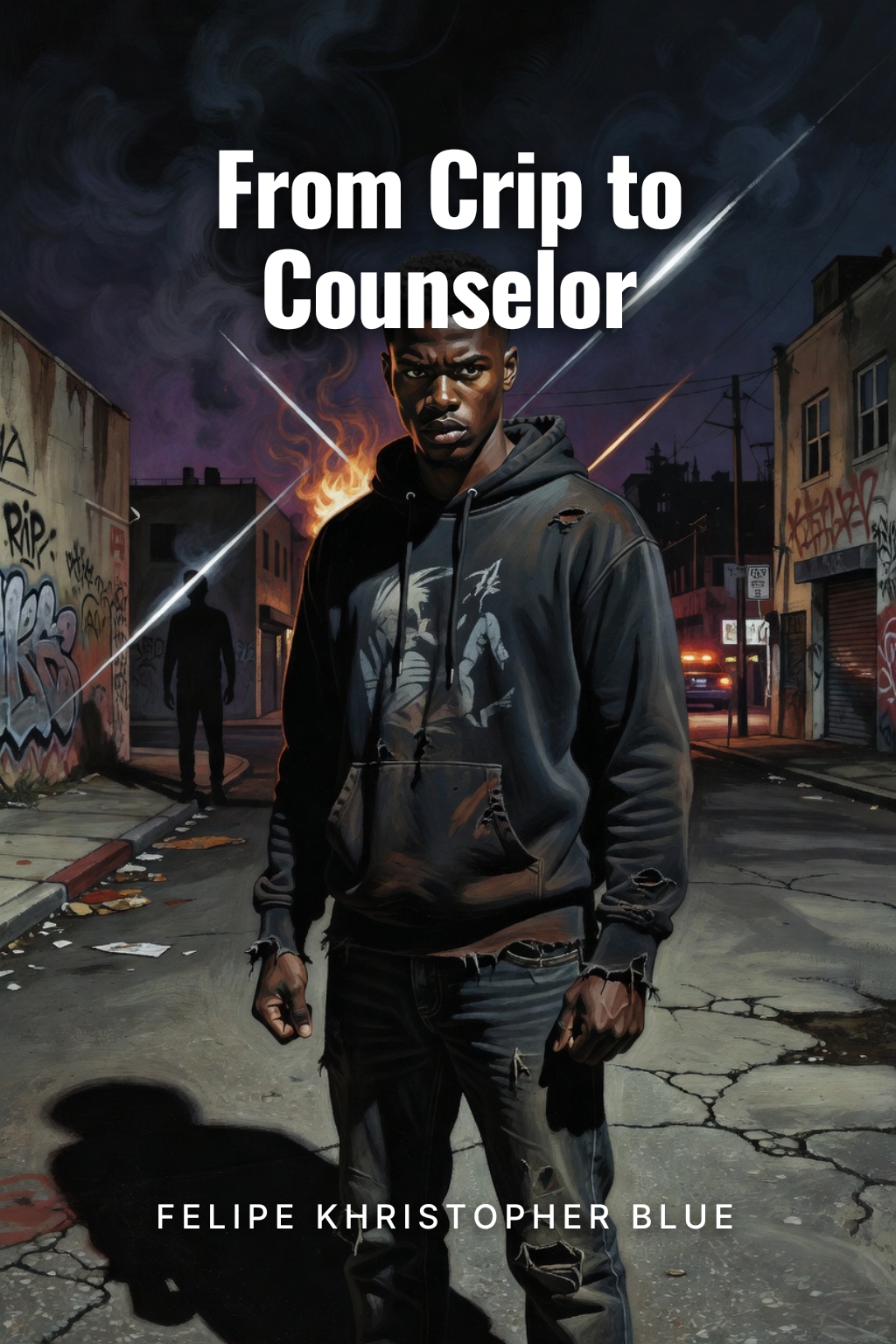
Book · 8 chapters · 28,358 words
From Crip to Counselor
Contents8 chapters
Chapter 1
The Night I Chose the Gun
The first time I decided my life was worth less than my rage, I was sitting on the hood of a faded Cutlass with a pistol tucked in my waistband and my brother laid out cold across town.
That sentence still hits me hard, even now. I can dress the story up if I want to. I can talk about pain, trauma, the cycle, the pressure, the codes boys inherit before they know what they’re agreeing to. All of that is true. None of it changes the picture. I was nineteen, maybe twenty depending on how you count a life that moved by sirens and funerals instead of birthdays, and I had one thought beating in my head so loud it drowned everything else: somebody had to pay.
Compton had trained that reflex into me early. Not with speeches. With repetition. Helicopter blades chopping the night over apartment roofs. Candle wax running down glass bottles on the curb where somebody got left. Older dudes leaning against chain-link fences, talking low, eyes always moving. The click of a car door shutting too fast. The way your stomach tightened when a stranger slowed near your block. By the time I was old enough to understand fear, I had already learned the only acceptable shape for it was anger.
My brother knew that language too. We all did. He wasn’t some headline to me, not some lesson wrapped up neatly for a reader. He was a real man with a laugh that came out sudden and sharp, like he was surprised by his own joke. He liked his food hot enough to make his eyes water. He would slap the steering wheel when his song came on and rap the whole verse like the artist owed him money. When they told me he was gone, that’s what flashed first. Not blood. Not the street. Him grinning with hot sauce on his lip.
Then came the rest.
News like that doesn’t arrive soft. It tears through a room. It changes the oxygen. One minute people are talking over each other, pacing, grabbing keys, asking who heard what; the next, there’s a silence so heavy it feels like furniture. I remember somebody punching a wall. I remember a woman crying from the gut, that deep animal cry that makes everybody else stare at the floor. I remember wanting to smash every glass thing in reach just to hear something break outside of me.
But grief didn’t get much room where I came from. Grief was dangerous if it made you look weak, and weakness got studied. So the sadness hardened fast. It drew up into something clean and hot. Revenge is simple when you’re drowning. It gives you a task. A direction. Names. Corners. Cars to look for. It keeps your hands busy so your heart doesn’t have to tell the truth.
That night the block smelled like fried grease, hot rubber, and cut grass somebody had watered too late. A porch light flickered two houses down. Somewhere a baby was crying, steady as a metronome. I remember all of it because I was so keyed up my senses felt peeled open. Every passing engine made my shoulders lock. Every pair of headlights looked like a message.
The homies around me weren’t talking big. That’s how you know it was real. No joking, no extra movement, no trying to impress anybody. One checked the chamber and stared at the street. Another kept making calls from a pay phone by the liquor store, feeding quarters into it with his jaw tight. A third sat in the driver’s seat with both hands on the wheel, as still as a man posing for a casket photo. We were beyond performance. We had crossed into decision.
And I wanted it. That part matters.
People like their redemption stories clean. They want the before and after separated neat as church clothes from prison khakis. They want to believe the counselor I became was hiding inside me the whole time, just waiting for a chance. He wasn’t. Not that night. That night I was a young man fully available to darkness. If you had looked in my face, you would not have seen healing there. You would have seen permission.
Then the car rolled up slow.
It was a brown sedan, dirty along the doors, bass low in the trunk, moving with the careful crawl of somebody who either belonged there or wanted badly to seem like he did. The streetlight caught the driver’s cheekbone for half a second. Somebody beside me said a name I had been waiting to hear.
My hand went to the gun.
And that should have been the end of my life as I know it now, because once I slid off that hood and stepped into the street, there was no room left for a second version of me.
But then I saw who was in the back seat.
Chapter 2
The Back Seat Witness
It was Yolanda in the back seat.
Not somebody who just looked like her in bad light. Not some shape my mind turned soft on because I was scared to do what I had come to do. It was her. My brother’s girl. The mother of his baby. Her face came into view between the front seats when she leaned forward, and the whole night shifted under me like bad pavement.
My hand stayed on the gun, but it stopped moving.
She had one hand up near her mouth like she had been chewing a nail down to skin. Her hair was wrapped, but loose strands had come out around her face. She looked tired in a way people only look after death visits a house. Not sleepy. Hollow. Drained out through the eyes. I had seen her that same look before, standing in our kitchen while my brother laughed at something burnt on the stove, pretending he wasn’t the reason smoke filled the room. She knew my mother’s front room. She knew where we kept extra forks. She knew which one of us slammed doors when we got hot. She was not supposed to be in that car.
Everything in me had been built toward motion. Slide off the hood. Step up to the door. Raise the pistol. Finish what rage had written. But her being there put a body in the way that wasn’t just a body. If I opened up on that sedan, I wasn’t just shooting at a man I believed had a hand in my brother’s death. I was gambling with her life too. And if I hit her, I would be adding another casket to the same family grief that had already split us open.
My homie nearest me didn’t know what I was seeing yet. He said the driver’s name again, low and sharp, like a command. “That’s him.”
I heard him. I had been hearing that name in my blood for days.
The brown sedan idled at the curb. The bass was still knocking low under the floorboards, but nobody inside was moving with music. The driver kept both hands where I could see them, one at the top of the wheel, one low near the gear shift. He didn’t smile. He didn’t act tough either. That almost made him more dangerous. Men who are sure the night belongs to them usually put on a show. He wasn’t showing me anything.
He cracked the window a little more.
“You see who with me,” he said.
His voice was flat, but I heard strain under it. Not fear exactly. Pressure. Like he knew one wrong word could get everybody in that car killed.
I stepped off the hood and came closer. Gravel popped under my shoes. Every set of eyes on the block narrowed down to the space between me and that door. Porch conversations died. A curtain moved in one upstairs window, then went still. Even the baby I had heard earlier seemed to stop crying. That’s how memory works on nights like that. It edits around the center.
Yolanda leaned toward the crack in the back window. “Don’t do this right here,” she said.
Her voice got to me worse than seeing her face. It was rough from crying. Real crying. Not performance. The kind that swells your eyelids and leaves your nose raw. For one second, not enough to save me from what I would become after, I saw all of us as we actually were: young, grieving, stupid with pain, making life-and-death choices in a parking-lot kind of darkness because nobody had taught us another way to carry loss.
Then my anger came back and shoved that thought aside.
“What you doing in his car?” I asked her.
I didn’t yell. That surprised me later. I thought I would remember myself screaming, cussing, beating on the glass. But my voice came out low. Hard. Almost calm. Sometimes that is the worst kind of anger. The kind that has stopped burning and started cutting.
She looked at the driver, then back at me. “Just listen first.”
One of the homies behind me made a sound through his teeth. He was already offended by that sentence. Listen first was not street language where I stood. Not on a night like that. Not after blood had already been spilled.
The driver turned his head enough for me to see his profile. Streetlight caught his jaw and the little scar near his ear. I knew his face before I knew his heart. We had crossed paths too many times for that. Parties. Parking lots. Liquor stores. Corners where everybody acted relaxed and nobody really was. He had never been my friend, but he wasn’t a stranger either, and that made it worse. Real hatred grows best when there is a little familiarity in it.
“I ain’t come here to play with you,” he said. “I came ‘cause folks got my name wrong.”
“Wrong?” My hand tightened on the grip in my waistband. “My brother dead.”
“I know he dead.”
That answer almost made me draw right there. Not because it was disrespectful. Because it was true, plain and unwrapped. Sometimes a plain true sentence lands harder than an insult. My brother dead. I know he dead. The words sat between us with no place to go.
The homie by the pay phone had made it back by then. I felt him come up on my left shoulder. He smelled like cigarettes and metal from coins. “We ain’t gotta hear this,” he muttered.
Maybe we didn’t. Maybe the cleanest street version of the night would have been not hearing anything at all. A man gets named, he pays. Nobody asks for footnotes. Nobody pauses long enough to let complication breathe. But life is meaner than movies. It sends truth in crooked and late.
“Say what you got to say,” I told the driver.
I still don’t know if I said that because I wanted facts or because I wanted one more second before choosing a side of myself I could never get back from.
He looked past me at the others, counting bodies, measuring distance, reading the set of shoulders and hands. Then he looked at me again.
“I was there,” he said. “I wasn’t the one that hit your brother.”
Behind me somebody snapped, “Man—”
I lifted a hand without turning around. That little move cost me something with the homies. I knew it even then. On those blocks, stopping your own people from pressing the gas could look a lot like softness. But I needed the noise behind me to shut up.
The driver kept going.
“Your brother got boxed in by the wash spot,” he said. “Two cars, not one. Dudes jumped out. It went left fast.”
“How you know all that if you wasn’t in it?”
“Because I was there.”
“That ain’t an answer.”
“It’s the one I got.”
His voice stayed level, but his eyes had sharpened. He was tired too. I could see that now. Everybody in that car looked like they had not slept since the shooting. Yolanda in back. Another guy I half recognized in the passenger seat, staring dead ahead like his neck had locked. And the driver himself, with that careful way of talking men use when they are trying to cross a minefield they helped bury.
Yolanda leaned in again, almost putting her face in the gap. “He drove him,” she said. “After.”
“After what?”
“After he got hit.”
That sentence landed strange because it gave me a picture my anger had not allowed. I had imagined my brother’s death one way: enemy spots him, enemy kills him, enemy leaves. Straight line. Simple target. But now there was another image pushing at it. Cars. Confusion. Somebody driving. Somebody not shooting but still there. Somebody touching the scene without owning the trigger. Street stories hate detail because detail ruins clean revenge.
I looked at the driver. “You expect me to believe you was helping him?”
“I expect you to know I could’ve stayed gone if I was trying to duck you.”
He had a point, and I hated him for making it.
Men guilty in a certain kind of way do disappear. They stop coming to familiar corners. They send messages through three other mouths. They let rumor do what rumor does. Pulling up on my block with Yolanda in the back seat was either the boldest lie I had ever seen or the kind of risk a man takes when he knows his name is about to get him killed for something he didn’t do exactly the way people said.
That “exactly” matters. I learned later that the streets live on half-truths because half-truths are enough to start funerals.
“Who was there?” I asked.
He shook his head once. “I’m not doing names in the street.”
That answer sent heat through my chest again.
“So you came here to clear yourself but not say who did it?”
“I came here so you don’t crash out on the wrong man.”
The phrase hit ugly because it named what I was in danger of doing. Crash out. Throw your whole life into one hot second and call it loyalty. People said it like slang. They should have said it like a warning.
My homie at my shoulder stepped up now, unable to hold it. “He lying to you. Pull him out.”
The driver’s eyes flicked to him, then back to me. The passenger finally moved, just enough to make my body tense. I yanked my shirt clear of the gun. The whole car froze again. I saw Yolanda shut her eyes.
That is the part I remember most sharply: not a threat, not a curse, but her shutting her eyes like she was bracing for glass.
I have asked myself more than once why that image stopped me as much as it did. Maybe because she already knew how this kind of night ended. Maybe because my brother’s child still needed her. Maybe because I had seen too much innocent blood paid out in the language of “they were just there.” Whatever the reason, my arm would not complete the job my anger had assigned it.
I bent lower to the driver’s window.
“You should be gone then,” I said. “If you know what this look like, you should’ve stayed far from me.”
“I know,” he said. “But your people saying my name means I’m dead anyway unless I say something.”
“Maybe you dead anyway.”
He nodded once, like he had made peace with that before pulling up. “Maybe.”
There was no drama in him when he said it. That chilled me more than talking tough would have. Men who are bluffing usually decorate their fear. He looked like a man who had already run the numbers and found none of them good.
“Tell me straight,” I said. “Did you set him up?”
“No.”
“Did you bring the ones that did it?”
“No.”
“Did you know it was coming?”
He took a beat too long.
That was enough to make every muscle in me tighten.
“You knew something,” I said.
“I knew there was heat,” he answered. “I didn’t know it was going there.”
That was not innocence. It was street innocence, which is a different crooked thing. A man says he didn’t know exactly what would happen, only that something ugly was in the air. He tells himself that counts. Sometimes the law may parse that. A grieving brother does not.
“You let him walk into it.”
“I told him don’t go.”
Yolanda made a small sound from the back seat then, like she had heard that argument before and was sick of it. Not because it was false. Because truth was too small to help now.
“You told him?” I said. “That’s what you got?”
“That’s what happened.”
I stared at him and saw how ugly grief makes negotiation. If he had bragged, I could have hated him clean. If he had begged, I could have despised him easier. But he sat there giving me a thin, unsatisfying version of maybe-truth, and maybe-truth is harder to shoot through than a lie. A lie hardens you. Uncertainty weakens the hand at the worst possible moment.
One of the homies moved around toward the passenger side. I didn’t like that. Neither did the driver. His shoulders lifted a fraction. The passenger’s hand disappeared below the dash.
“Don’t,” I barked, not sure whether I was talking to my people or theirs.
The whole block had become one long held breath.
Yolanda spoke again, and this time she used my name the way only people from before all the armor can say it.
“Your brother would not want me hit in this.”
That sentence cut cleaner than anything else said that night.
People speak for the dead too much. They use them like tools. I know that. I do it less now because counseling taught me how often grief puts words in mouths that can no longer answer. But right then, hearing her say that, I didn’t feel manipulated. I felt exposed. Because she was right about one thing at least: my brother loved her, and if I lit that car up with her in it, I would be breaking something even rage could not excuse.
The homie near me cursed under his breath. “Man, she knew what she was getting in.”
Maybe. That’s another street sentence people use to make almost anything okay. He knew what he signed up for. She knew what she was getting into. Wrong place, wrong car, wrong hour. It sounds cold because it is. It lets everybody keep moving. It keeps conscience from getting too loud.
But I looked at Yolanda and could not turn her into collateral just because the block expected me to act like a machine.
I asked her one question. “Was he there when it happened?”
She nodded.
“Was he one of them?”
She shook her head.
“Did he help after?”
Another nod.
It was not enough to clear him. It was enough to stop me.
That is the kind of truth people do not respect in the moment. A pause can save a life and still get read as weakness by everybody watching. I could feel the judgment forming around me before the car even moved. My homies didn’t have to say it yet. Their bodies said it. Their silence said it. Men who came prepared for one ending do not like it when conscience enters the room late.
The driver must have felt the shift too. He put the car in gear but kept his foot on the brake.
“You find out the full of it,” he said, “you’ll know I’m not who they telling you.”
That line made me angry all over again because it put homework on grief. Find out. Ask around. Piece together. As if my brother’s body hadn’t already hit the ground while everybody else played their angles with truth.
“You better be right,” I said.
He held my stare. “I know.”
Then the sedan started rolling.
Not fast. He didn’t peel out. That would have brought gunfire for sure. He just let the car ease away from the curb, tires crunching over broken glass and gravel. Yolanda looked at me through the back window as they pulled off. She didn’t wave. She didn’t mouth anything. Her face looked wrecked, and then the streetlight passed over the roof and she was gone into the dark.
My hand was still on the gun.
That felt important. The fact that I had not let go. Like some part of me wanted credit for almost doing it. That is how twisted pride can get. You can tell yourself you kept your soul because you didn’t pull the trigger, while ignoring the truth that you had been ready. Ready enough to feel the empty burn of not firing.
The second the car cleared the corner, everything around me got loud.
My homie spun on me first. “What was that?”
I didn’t answer.
“He served himself up and you let him leave.”
I kept staring down the block where the taillights had vanished. My heart was slamming so hard it made my fingers twitch. Adrenaline with nowhere to go feels like poison. It sits in your arms. Your jaw. The backs of your knees. It makes your skin too tight.
Another one said, “She played you.”
Maybe she did. Maybe all of them did. That possibility came at me quick and mean. I wanted certainty more than anything in that moment, but certainty had left in a brown sedan. All I had now was a story I didn’t trust and a conscience I couldn’t mute.
“If he lying,” the first one said, “he just bought time to get us first.”
That part was true enough to matter.
Street life does not reward hesitation. A pause can read as mercy to one person and opportunity to another. Every second after that sedan left, the math around me changed. We were exposed now. We had showed our hand without closing it. That made my chest fill with a new kind of fear, one I would not have named fear back then. I called it staying alert. Being ready. Watching my back. It was fear with a harder haircut.
I finally spoke. “I wasn’t shooting with her in there.”
One of them laughed once, no humor in it. “Since when you care who in the back seat?”
That was a cruel question, but it wasn’t random. In the world we came from, civilians got talked about like weather. Unfortunate. Inconvenient. Not enough to stop the program. Me drawing a line that night sounded to them like I had discovered morals at the worst possible hour.
“Since it’s her,” I said.
That quieted them for a second.
Everybody knew who she was to my brother. Everybody knew whose child she tucked in at night. Her face changed the equation for them too, even if pride wouldn’t let them admit it clean. But not enough to wash away their frustration.
“So what now?” one asked.
That was the ugliest question of the night because I had no answer.
Revenge feels powerful only while it is simple. Once facts get muddy, you are left standing in your own anger with no clean place to pour it. I wanted somebody to point a finger I could trust. I wanted a version where violence still felt straight. Instead I had a driver who might have known and not warned enough, a woman I couldn’t dismiss, and my brother still dead at the center of all it.
I sat back down on the hood of the Cutlass because my legs had started to feel unsteady. The metal was still warm from the day, but cooling fast. Somebody cussed and kicked at a bottle cap in the gutter. Somebody else kept scanning the corner like the sedan might circle back. The porch light two houses down still flickered. Far off, a siren rose and faded.
Nobody said my brother’s name.
That struck me hard in the quiet after. We had all been using his death like gasoline, but for those few minutes after the car pulled off, his actual name disappeared. What stayed was reputation, response, expectation. That is one of the dirtiest things street grief does. It turns a person you loved into a task list.
I did not know then that this was the first real crack in the story I had built to survive him dying. Before that night, revenge had given me something clean to hold. After that night, I had to admit another truth: sometimes the man in front of you is guilty, but not in the way you need him to be. And if you kill him anyway, you don’t bring clarity. You just add weight.
I wish I could tell you that realization made me stop. It didn’t. It made me madder. Mad at him. Mad at the people who had spread his name. Mad at my homies for pressing me. Mad at myself for freezing. Mad at Yolanda for being there. Most of all, mad that conscience had chosen such a dangerous time to wake up.
That’s the thing people miss when they talk about changing your life. Conscience does not arrive like a choir. Sometimes it shows up as hesitation, and hesitation can feel humiliating before it feels holy. It can make you look weak before it saves you from becoming worse.
That night, I did not feel saved.
I felt split down the middle.
Part of me still wanted blood before sunrise. Another part knew that if I had shot into that car, I would have carried Yolanda’s face inside me forever right next to my brother’s. I did not have language for trauma then. I did not know how memory brands itself into the body. I only knew there was a line in front of me, and for once my rage had not been strong enough to step over it.
The block did not care about any of that.
The block cared that a named man had rolled up, spoken through a cracked window, and rolled away breathing.
By morning, I knew people would have their version. They always do. He punked you. You let him talk. You went soft. She saved him. He played dead-man chess and bought another day. Every telling would shave off what it felt like to stand there and choose not to spray a car with somebody my brother loved sitting in back. Every telling would make the moment flatter and uglier.
That is another lesson I carry now into counseling rooms: what the outside names weakness is sometimes the first surviving part of your humanity refusing to die.
I didn’t know that then. I just knew I was still angry, still armed, and no closer to peace than I had been before the sedan came.
Maybe less.
Because before that car rolled up, I had one enemy. After it left, I had doubt. And doubt is harder to kill than a man.
Chapter 3
Retaliation Without Sleep
By the third night, I had stopped taking my shoes off.
I would lie across a bedspread in jeans and a T-shirt, one arm over my eyes, and listen for engines. A car door two buildings over could bring me upright. A dog barking hard at two in the morning could send my hand toward metal before I was even fully awake. Sleep did not leave all at once. It broke apart. Ten minutes here. Twenty there. Then a whole long stretch of staring at the ceiling with my jaw tight, hearing my brother’s name in my head like somebody knocking from inside a wall.
Grief had turned into a shift I never clocked out from.
In daylight, people moved around me like they were attending two funerals at once. One was for my brother. The other was for whatever I was becoming. Women who had known us since we were kids would lower their voices when I came near. Older men would look at me too long, not out of care but out of measurement, as if they were checking whether I had crossed from hurt into hazard. Young dudes watched different. They watched for clues. Was I moving? Was I letting it slide? Was I still who they thought I was?
The streets ask those questions without mercy.
I answered them with motion.
I rode all over Compton that week with the windows cracked and my nerves stretched thin as wire. We circled blocks we already knew by memory: alleys where trash bins leaned crooked, apartment courtyards with kids’ bikes laid on their side, corner stores with men standing outside pretending not to see who passed. Daytime didn’t make anything safer. It just made the fear easier to hide behind regular life. Somebody hosing down a driveway. Somebody carrying groceries. Somebody pushing a stroller while two houses over a man sat on a porch relaying names, colors, cars, rumors.
I started living off fragments of information.
A cousin’s friend heard this.
A girl said that.
Somebody’s little brother saw a car near such-and-such.
One name would rise by noon and fall apart by dinner. Another would come in after dark, carried by a breathless voice through a screen door or over a pay phone with static on the line. Every piece sounded urgent. Half of it was poison. That did not stop us from treating it like scripture when it fit what we needed.
That is what revenge does to the mind. It makes bad information feel useful if it points toward action.
The men around me were grieving too, but not all grief looks like tears. Some of it looked like pacing with a 40-ounce in your hand. Some of it looked like punching a palm so hard your knuckles swelled. Some of it looked like volunteering a car, or a place to hide, or a story to tell if police asked questions. A death in the neighborhood pulled everybody into orbit. Real friends came close because they loved him. Others came close because violence creates gravity. It makes some people feel important just to stand near it.
I did not know how to sort one kind from the other then.
I remember one afternoon parked behind a market with two homies, the air inside the car hot and stale from old smoke, each of us waiting on a person who never came. Flies kept hitting the windshield and falling. A helicopter chopped far overhead. One of my boys kept checking the side mirror even though nothing had moved for twenty minutes. The other sat with his elbow on the door and fed my anger sentence by sentence.
“They think you ain’t gone do nothing.”
That line hit because it was built to hit. It had almost nothing to do with my brother. It was about me, my standing, my image on the block. But when you are hurting, pride can put on your loved one’s face. It can speak in his voice. It can tell you that your rage is loyalty and your caution is betrayal.
I swallowed that lie whole.
By then I had built a routine around retaliation. Not a healthy routine. A sick one. Mornings, if I slept, I slept after sunrise with the TV low and one ear still open. By afternoon I was back outside. Somebody would pull up. Somebody would say they heard something. Somebody would want to ride. Nights stretched into hunting and waiting, waiting and hunting, with no real line between them. Hunger came and went. My stomach would cramp and I would realize I had eaten a bag of chips all day. Then somebody’s auntie would press a paper plate into my hand and I would force down a few bites because refusing her would raise questions.
The body keeps score even when the mind has no words for it.
My shoulders stayed high. My teeth hurt from clenching. My eyes burned. I startled easy and calmed down slow. If a car slowed beside us, every muscle in me lit up. If a stranger stared too long at a gas station, I noticed his shoes, his hands, who was with him, what direction he had come from. I had become excellent at reading threat and terrible at reading anything else.
That kind of vigilance feels sharp. It is actually a narrowing.
We made moves I am not proud of. Some were small and ugly. Some were bigger. All of them came from the same rotten root: the belief that pain could be balanced if enough fear changed addresses. I rode on missions that felt righteous before they started and empty before they ended. I helped put people in motion. I pointed toward houses, toward corners, toward names that had been passed to me half-proven and hot. I did things that kept other people’s mothers awake. That is the part revenge stories leave out when men tell them like legends. The harm does not stay in one lane. It spills.
I saw that spill in windows.
You can tell when a neighborhood knows violence is circling back. Curtains move more than usual. Kids get called inside earlier. Men who like to linger on porches start standing closer to their doors. Mothers keep one hand on the knob while they talk through the screen. Everybody is still outside because heat and habit keep them there, but nobody is relaxed. The whole block seems to breathe from the chest instead of the stomach.
Compton taught me early how fast news moves without ever touching paper.
By the end of that week, versions of my brother’s death were traveling ahead of the truth and right alongside my name. In one telling, he had been set up. In another, he had swung first. In another, somebody else was the real target and he just got caught in it. In one version I had already handled everything. In another I had missed on purpose. In another I was out of control and willing to hit anybody tied by blood, love, or rumor.
Some people spread lies for protection. Some spread them for sport. Some do it because being the one who knows makes them feel less scared.
Rumor hardened the ground under my feet.
Once people think you are moving a certain way, they move around you that way. Doors stay shut. Faces go blank. Conversations stop when you walk up. Men test your mood with jokes they can later call harmless. Girls you grew up around stop asking how you are and start asking who you were with last night. Even kindness changes shape. A person handing you a drink might also be trying to hear from your own mouth what they can repeat by sunset.
I grew suspicious of everybody.
That suspicion was not all paranoia. Police pressure was rising too. You could feel it in the slow rolls. Black-and-whites crawled past with that lazy look that isn’t lazy at all. Detectives showed up at houses in plain clothes and hard eyes, asking names they already knew, trying to turn grief into statements. Patrol cars parked where they could watch two corners at once. If we gathered too long outside a building, eventually a cruiser would slide through and break the shape of us up.
I learned then that law enforcement and street rumor feed each other.
Police would ask questions in a way that let the whole block know they were asking. Then people would fill the silence with their own answers. Somebody seen talking to detectives became a snitch by dinner. Somebody who ducked inside when the car rolled up became suspicious too. Everybody was reading everybody. Nobody was reading clean.
I got stopped twice that month for little things that were not little.
Once, an officer pulled us over and said our brake light looked dim. It was daylight. We all knew that was not the reason. He leaned down, smelled the car, scanned our faces, asked where we were headed and where we had been. The questions came casual. The eyes did not. My heartbeat hit so hard I could feel it in my throat, but I kept my face flat. On the street, too much calm can look guilty. Too much attitude can get you yanked out of the car. You learn to perform a very narrow kind of manhood for armed strangers.
I hated how good I was getting at that too.
The second stop was on foot. They spread us on the hood, patted us down, made a show of it because other people were watching. The metal under my palms had been sitting in the sun and burned through my skin. One officer called me by my last name like we were familiar. That chilled me more than his hands. It meant they were building files in their heads. It meant I was not just one more kid on one more corner. I had become a person of interest in my own neighborhood.
I walked away from that stop meaner than I had been before it.
Humiliation is fuel if you do not know what else to do with it.
There was a night, maybe around the second week, when everything in me should have gone home. I was tired enough to see movement where there was none. We had been circling for hours, hitting one side of the city, then another, then doubling back because somebody swore a certain person had been spotted near a liquor store off a cross street we all knew. The dashboard lights made everybody’s face look sick. My homie driving had started talking too much, which was his sign of nerves. The other one had gone quiet, which was his.
We parked near a row of apartments and watched a doorway that stayed dark.
After a while a woman came out carrying a baby on her shoulder, the child limp with sleep, head tucked into her neck. She stood under the porch light bouncing that baby while she looked up and down the street, not scared exactly, but alert in the way women get when men have made the night unstable. Then she went back inside and pulled the security door shut behind her.
That sight landed on me harder than any sermon could have.
My brother had a child too.
Yolanda had said what she said in that car because she was not only trying to save a man in the front seat. She was trying to keep another child from losing a parent to our war. I understood that for about thirty seconds in that parked car, clear as clean glass. Then somebody said maybe the target was inside after all, and the glass clouded over again.
When you are committed to revenge, truth has to fight to stay heard.
I did not turn around that night. I wish I had. I kept going. That is part of why I can speak on this now without pretending I was better than I was. I was not standing outside violence offering commentary. I was inside it, helping it breathe. My better instincts existed, but they were outnumbered and exhausted.
The strange thing is that even while I was doing all that, I kept telling myself I was honoring my brother.
I used that word like it was clean.
Honor.
As if stalking, plotting, and feeding fear could sit under the same roof as love.
As if my brother’s laugh had anything to do with the ugliness taking over my days.
As if his daughter would be protected by more funerals.
That is one of the hardest truths I had to accept later: people in pain can dress destruction in sacred language. We call it love. We call it loyalty. We call it respect. Those words can cover a lot of rot.
My brother deserved mourning. I was giving him momentum.
There is a difference.
Mourning says, This mattered.
Retaliation says, Now watch what I do with the damage.
Back then I could not have put it that plain. I only felt a growing split between the story I was telling and the man I was becoming. The story said I was a brother standing up. The man I was becoming jumped at shadows, trusted rumors, and measured every block by who might need to pay.
That man had no peace in him.
Families felt the heat too. That is another truth. Violence does not stay between young men who think they signed up for it. Aunties answer doors with their mouths set hard. Grandmothers sit closer to the window than they used to. Little cousins get told not to wear certain colors, not to visit certain friends, not to walk home the long way. Mourning families are expected to absorb all this quietly, as if the neighborhood owes them sympathy and also demands performance from them at the same time.
I watched grown women grieve while still cooking, cleaning, answering phones, and telling boys to be careful. Men got to turn rage into movement. Women had to carry fear and keep the house breathing.
I did not appreciate that then. I see it now.
One evening I stopped by a relative’s place and caught my reflection in a darkened window before I knocked. My face looked older than it had a month before. Not wiser. Worn. My eyes were flat and overactive at the same time. The way I stood told its own story too, weight forward, neck tight, ready for nothing good. For a second I did not look like a grieving younger brother. I looked like the type of man mothers pull children away from in parking lots.
That shook me because it was true.
Inside, people spoke softly around me. Somebody asked if I had eaten. Somebody else asked if I was staying there that night. I lied and said maybe. I already knew I wasn’t. The streets had me by the throat. Leaving even for a full night felt like surrender, and surrender felt impossible while my brother was still fresh in everybody’s mouth.
Street pressure is not always somebody directly saying do it.
Sometimes it is the fear of what silence will say about you.
Sometimes it is the look on another man’s face when he says, “You good?”
Sometimes it is your own pride replaying a moment of hesitation until it sounds like failure.
I carried that pause from the car with Yolanda everywhere after that. I acted like I was making up for it. Every ride-out, every late-night meeting, every ugly plan had some of that shame mixed in. I did not just want justice for my brother. I wanted to erase the image of myself choosing not to fire. I wanted the block to see movement so nobody could name me soft.
That is how a moment of restraint can get twisted into another reason for violence if a man has no healthy place to put his humiliation.
The hardest thing to admit is that revenge did not make me feel closer to my brother. It moved him farther away.
At first I had remembered his voice. The exact shape of his grin when food was good. The way he laughed from deep in his chest when something really caught him. But as the days filled with retaliation, those memories started getting crowded out by logistics. Who was where. Which car was seen. Who said what. Who might flip. Who might already be talking. My brother’s life got swallowed by the management of his death.
That robbed me twice.
It robbed me of him, and then it robbed me of grieving him honestly.
I think that is why so many men crash later, once the smoke clears. During the revenge period, you are flooded with task and adrenaline. You call that strength because it keeps you upright. Then one day the movement slows, the crowd thins, the phone rings less, and you are left in a room with the original wound still open, only now you have added fresh guilt on top of it.
I was heading toward that wall fast.
I did not know it yet, but people were already talking to police. Some out of fear. Some out of self-protection. Some because pressure had found the weak boards in their spirit. That is another thing young street soldiers get wrong. They think a shared code is stronger than terror, stronger than self-interest, stronger than the threat of prison. Sometimes it is. Many times it is not. Cases get built while everybody still thinks they are invisible.
I could feel the net tightening before I saw it.
Certain faces disappeared.
Certain cars stopped coming around.
People I expected to be solid became harder to reach.
Others suddenly wanted to know where I had been on nights they had no business asking about.
I began to understand that revenge did not simplify life. It multiplied danger. Now I had grief, enemies, rumor, police attention, and the possibility that somebody standing shoulder to shoulder with me might save himself by giving me away.
There is no rest in that kind of life.
Only rotation.
Car to porch.
Porch to alley.
Alley to somebody’s living room.
Living room to another car.
Always moving, as if motion itself could outrun consequence.
It cannot.
One dawn I finally walked home with the sky turning that washed-out gray that makes everything look tired. Sprinklers clicked on somewhere down the block. A newspaper landed on a driveway with a flat slap. Birds had the nerve to sing like the world was regular. I remember standing outside for a second before going in, smelling wet grass and old concrete, and feeling emptier than I had the night I first sat on that Cutlass with a gun in my waistband.
That surprised me.
I had done all this moving. I had fed all this anger. I had chased all these names. But my brother was still gone, and I was not one ounce closer to peace. If anything, I was harder, dirtier inside, less able to hear whatever good sense had tried to stop me when Yolanda looked out that back seat window.
Revenge had promised relief.
What it gave me was corrosion.
It ate sleep first.
Then appetite.
Then judgment.
Then memory.
A man can keep functioning a long time while those things disappear one by one. People will even praise him for being tough. They will say he stayed on business. They will say he held it down. They will say he didn’t fold.
They will not say he was disappearing in front of them.
I was.
Not all at once. Not in a dramatic collapse. Piece by piece. A laugh gone. A prayer skipped. A meal untouched. A lie told easier than before. A stranger’s fear no longer registering as a warning. That is how a soul erodes on the street. Small losses disguised as normal.
If you are reading this because you come from places like I come from, I want you to hold on to one fact. Lack of sleep and a loaded grievance can make any bad idea feel like duty. Do not trust every thought you have in that condition. Exhaustion is not clarity. Adrenaline is not wisdom. Hurt is not always telling the truth.
I did not know how to tell myself that then.
Back then, sunrise just meant another day had started and I had survived the night without settling what I thought still needed settling. That felt like failure, so I kept going. I kept letting grief wear revenge’s clothes. I kept feeding a machine that had no setting for enough.
And every day it ran, it took another bite out of me.
Chapter 4
The Courtroom and the Ghost
They arrested me in daylight.
Not in some dramatic sweep with helicopters over the block and guns drawn for the cameras. It was meaner than that. Smaller. A pair of detectives and two uniformed officers caught me when the sun was up and people were outside doing regular things. A woman was shaking a rug over her porch rail. Somebody farther down the street had a radio playing old soul music too low to make out the words. A kid pedaled past on a bent bike and slowed just enough to see what was happening.
That was part of the punishment.
They want your people to watch.
One detective called my name like he already owned it. The other one stood half a step behind him with his hand resting near his belt, not nervous, just practiced. They told me to turn around. One of them took my wrists and brought them behind my back. The cuffs bit fast, metal on bone, and then they tightened once more as if to make a point. I remember the smell of sun-baked dust off the curb and the heat rising from the hood of a parked car beside me. I remember seeing my reflection in the side window of that car for a second: jaw hard, shoulders up, trying to look untouched while getting locked up in front of everybody.
The detective read the charges in a voice so flat it almost sounded bored. Murder. Attempted murder. Assault with a firearm. Conspiracy. Street words turned into county words. Everything I had been running from and feeding at the same time had finally been typed onto paper.
I did not ask questions.
That was another street habit. By then I already knew the first rule of being taken: do not help them settle into the version of you they want. I kept my mouth shut. I let them walk me to the car. The back seat smelled like old vinyl, sweat, and that stale chemical clean they use when they know blood, puke, and fear have all ridden there before.
As they drove, Compton looked insultingly normal.
People were carrying grocery bags. A man in coveralls was washing his truck with a green hose, water running down the gutter in thin muddy ribbons. Two girls in school uniforms stood at a bus stop leaning into each other, laughing at something private and harmless. A dog barked from behind a chain-link fence like barking itself might matter. I sat handcuffed in the back of that car thinking how strange it was that your world could be ending while the block kept acting like Tuesday.
That is one of the first hard lessons of loss and trouble.
Your disaster does not stop traffic.
At the station they emptied my pockets into a tray. Keys. Some folded cash. A receipt. A lighter. The little ordinary pieces of a life that had gotten far from ordinary. They took my belt. They took my shoelaces. They took my watch. Every small thing they removed made me feel less like a man and more like a file. They asked the same kinds of questions men in those rooms have asked forever. Name. Address. Tattoos. Gang affiliation. Next of kin. I gave them what I had to give and nothing extra.
Then they put me in a holding cell under fluorescent lights that hummed like insects.
There is a particular loneliness to a holding cell in the middle of the day. Night lockup has its own ugliness, but daylight in custody does something else to you. It strips away whatever street drama you had wrapped around yourself. In there, no one cares how fierce you were on a corner. No one cares who feared you. You sit on a hard bench bolted to the wall, and time stops pretending to move kindly.
The cell smelled like bleach on top of urine that had sunk too deep to ever leave. The toilet in the corner had no seat. Somebody had scratched names and half-finished threats into the paint. One man paced in short bursts, heel to toe, heel to toe, muttering under his breath. Another slept with his arms folded tight across his chest like he was trying to hold himself in one piece. Every few minutes keys rattled somewhere outside the bars and all of us looked up at once, not because we expected freedom, but because noise was something to break the waiting.
I sat down and tried to make my face blank.
Inside, my mind was racing stupid.
Who talked?
How much did they know?
Which night?
Which car?
Who else did they pick up?
That is how fear works when you come from the street. It does not arrive clean. It comes mixed with inventory. You start counting weak spots. You start replaying conversations. You hear old sentences with new meaning. A question somebody asked you three weeks ago suddenly sounds like a setup. A favor someone refused now feels like distance. A person missing from the block starts to look less like coincidence and more like cooperation.
I had thought the pressure before arrest was heavy. It was nothing compared to the pressure of sitting still while other people built a story around your life.
Hours later they moved me again. County jail had its own machinery. Buzzing doors. Commands barked without eye contact. Hands on walls. Step here. Face there. Wait. Move. Sit. Stand. The whole system was designed to teach your body compliance whether your mind agreed or not. Men who had spent years acting untouchable got reduced to numbers, bunks, plastic trays, and the volume of their own nerves.
I saw familiar faces in there, some from my neighborhood, some from others, all of us pretending we were reading each other the same way we did outside. But jail changes the reading. In there, everybody wants to know what you caught, who was with you, how hot your case is, who might be telling, what your lawyer says, whether the papers mentioned your name. Information becomes food. Men survive on rumor when they cannot survive on freedom.
I learned fast that my case had already started walking ahead of me.
Some brothers nodded with respect because the charges sounded serious. Some looked at me like I carried a sickness. A murder case pulls both reactions. In certain circles it can raise your stock. In wiser circles it marks you as danger to be kept at arm’s length. I did not have the maturity then to prefer the wiser circle. Back then, part of me still took pride in being seen as someone who had gone all the way. That is ugly to admit now, but true. Street poison does not leave your system just because you are behind bars.
My public defender met me first through thick glass.
He had a tie loosened at the neck and a stack of folders under one arm. He looked tired in the way working people look tired, not from chasing the night but from fighting systems all day. He told me the state was putting together a retaliation case. He used words like witness statements, firearm enhancement, gang allegation, possible exposure. He said if the jury believed the version they were building, I could lose years I could not imagine giving up. Maybe the rest of my young life.
I listened, but one sentence cut through all the rest.
They think they can put you at the scene.
That was the sentence that settled in my stomach like ice.
The state did not need to know every truth. They just needed enough people saying enough things in the right order. That is what many young men misunderstand. They think a case has to be clean to be deadly. It does not. It has to be believable. It has to be simple enough for strangers to hold in their minds and fearful enough for them to want distance from the person accused.
A grieving gang member.
A dead brother.
Retaliation.
Shots.
Witnesses.
That story can convict a man even before all the facts show up.
I did not tell my lawyer much at first. I gave him the bare pieces, then clammed up. Some of that was street training. Some of it was mistrust. Some of it was the dumb belief that silence by itself could save me. Silence matters, but silence without strategy is just another form of fear. He pressed me to help him understand timelines, names, where I had been, what could be disproved, who had motives to lie. I kept holding back, as if he and the prosecutor worked for the same office. He did not. But when you have lived suspicious for long enough, everybody starts to look connected.
Jail gave me time to think about my brother in a place not built for tenderness.
That is where the ghost came in.
I do not mean I saw him standing at the foot of my bunk in some movie scene. I mean he was with me all the time. In the pause before count. In the clatter of trays at chow. In the cold little hour before daylight when men around you finally stop talking and the unit settles into coughs, snores, and distant toilet flushes. My brother kept showing up exactly where the noise left room for him.
He was not the version of him I had used in revenge.
That version was simplified. Flattened into a reason, a banner, a wound I could wave around while doing ugly things. The ghost that came to me in jail was more complete than that. I remembered him laughing too hard at something that was only halfway funny. I remembered how he ate spicy food like pain from peppers was proof of being alive. I remembered him being irritated over small things, generous over others, tired, hopeful, broke, joking, human. Jail stripped me of motion, and without motion I could no longer keep reducing him to the cause of my rage.
That hurt worse.
Because once a dead person becomes human again in your mind, you have to admit what you have done in their name.
The first time they brought me to court, they chained us all together for transport, waist chains and shackles, men moving in a line with that short awkward shuffle restraints force on you. The bus smelled like diesel fumes and old sweat. Nobody spoke above a murmur. Some men prayed under their breath. Some stared straight ahead. Some tried to look amused, which is another way men hide fear.
The courthouse was cold in the artificial way certain public buildings are cold. Not fresh. Not clean. Just over-air-conditioned and lit by fluorescent bulbs that flattened every face. Hallways waxed to a dull shine. Benches hard enough to keep you from relaxing. Deputies moving people around like luggage. Families waiting with paper cups of coffee and folded jackets over their arms. Lawyers walking fast with legal pads and no time in their eyes for anybody else.
That building taught me another truth.
Street violence does not disappear when it reaches court. It changes clothes.
In the neighborhood, danger looks like headlights slowing near the curb, whispers by the liquor store, somebody posted at the corner pretending not to watch. In court, danger wears a suit, carries a file, and asks for a sidebar. It enters as testimony. It arrives in photographs passed hand to hand. It lands when a witness points across the room without quite looking at you. Same danger. Different language.
I saw my mother there one day, and that nearly broke me.
Not because she screamed or fell apart. She did the opposite. She sat still in clothes chosen for court, hands folded too tightly in her lap, trying to give me strength with her face alone. Parents from our neighborhoods learn early how to look calm in violent weather. They have to. I watched her nod at me once, small and controlled, and I felt shame hotter than anything the prosecutor said. My brother was dead. I was chained in a courtroom. She had to divide her grief between one son in the ground and another one on trial.
No mother deserves that work.
Witnesses came in unevenly. Some were confident on direct examination, then shaky on cross. Some remembered too much. Some suddenly remembered less when pressed for detail. A few had that look people get when they are trying to help themselves as much as the truth. I learned to watch hands more than faces. Hands tell on people. Fidgeting with a sleeve. Gripping the rail. Touching the throat before answering. Tapping one finger into the palm when a question gets too close.
I also learned how flimsy certainty can sound when a good lawyer starts pulling at it.
Could you actually see the shooter from where you stood?
How far were you?
What was the light like?
How much had you had to drink?
Did you tell the detective the same thing the first time?
Why does this report say something different?
What I had treated on the street as solid—somebody said this, somebody knows that, word is he did it—looked ragged under courtroom light. Rumor hates cross-examination. So does fear. So does revenge. None of those things line up neatly once they have to survive details.
That did not make me innocent.
It made the case weak.
There is a difference, and I need to say it plainly because too many men hide inside legal language and call that growth. An acquittal is not always a cleansing. Sometimes it only means the state failed to prove what it charged. Sometimes witnesses buckled. Sometimes timelines did not hold. Sometimes evidence got contaminated by panic, bad police work, or neighborhood lies. Sometimes a man walks because the case leaks too much to carry the weight the prosecution put on it.
Walking free and being clean are not the same thing.
I felt that distinction forming before the verdict ever came.
The prosecutor tried to paint motive with my brother’s death and the weeks after. On that part, he did not need to invent much. Anybody who looked at me then could see I was moving like a man eaten up with grievance. Police had watched. People had talked. Cars had been noted. Names had circulated. The state tried to stack all of that into a simple picture: grieving brother turns avenger, avenger goes hunting, hunting leads to violence. Jurors understand a story like that because it fits what people already think they know about young Black men from places like mine.
My lawyer kept working the fractures.
No physical evidence tying me directly.
Inconsistent witness descriptions.
Muddy times.
People with their own reasons to shift blame.
He was not defending a saint. He was attacking certainty. In court, that can be enough.
During breaks I sat in side rooms with cinderblock walls and old magazines no one read. Deputies watched us with that professional boredom officers get when your life is the tenth crisis they have handled that week. I drank water from paper cones that collapsed if you squeezed them wrong. I stared at scuffed floors and thought about how fast a life can narrow. A few months earlier I had been roaming blocks convinced motion was power. Now my whole future could turn on whether twelve strangers believed hesitation in someone else’s memory.
At night back in the cell, men asked how court went.
You good?
What they got?
Who testified?
Anybody fold?
The questions came casual, but nothing about them was casual. Cases make men study one another for survival lessons. I answered as little as possible. Then I lay awake listening to the tier settle and felt my brother near again.
His ghost changed in that season.
At first he had come as memory and accusation. Later he came as a question I could not dodge: If all this was for me, then why do you look farther away from me than ever?
That question had no easy defense.
Revenge had been sold to me as loyalty. Jail let me see the invoice. My brother was still gone. My family was more hurt. My name was stained. My body was under state control. My spirit was meaner and hollower than before. Whatever code I thought I was honoring had not protected him, and it was not protecting me.
The day the verdict came, the courtroom felt smaller than usual.
Maybe every courtroom shrinks when your future is about to be spoken aloud. Even the coughs sounded louder. Paper moved like dry leaves. The clerk’s voice had that official carefulness people use when language has consequences. I looked at the jury one by one and tried not to read too much into faces trained by days of duty to reveal nothing.
Not guilty.
Then again on the next count.
And again.
Words people dream about when they are locked up.
Words families cry over.
Words that can make your knees weaken even if you have spent years teaching your face not to show relief.
I did feel relief. Let me not lie about that. A flood of it. My lungs opened. My shoulders dropped without permission. My mother cried. Somebody behind me whispered thank you, Jesus. My lawyer put a hand on my arm and nodded once like a man who had done his job and knew not to overplay it.
But relief was not the only thing in me.
I also felt something stranger. Something colder.
I did not feel innocent.
I felt spared.
That is a different sensation altogether. Innocence stands upright. It wants sunlight. It carries indignation. Being spared feels like slipping through a closing gate sideways, shirt caught on metal, heart pounding because you know exactly how near you came to being trapped on the other side. You do not walk out thinking, I am clean. You walk out thinking, I got through.
And once that feeling settles, another one follows close behind.
Now what?
Outside the courthouse, people met me with different eyes.
Some congratulated me like I had won something. They slapped my back, grinned hard, said I beat it, said they knew I would come home, said the system tried and failed. In the street imagination, acquittal can look like victory. It can raise a man’s legend. It can make him seem chosen, protected, too solid to fall. I heard that tone in a few voices and felt how dangerous it was. Glory is one of the worst lies trouble tells young men.
Others looked at me with caution sharpened by what the trial had aired out. They did not need a conviction to decide I was dangerous to stand too close to. Charges alone can brand you. Testimony can stain you. Stories told in court travel faster than verdicts. Some people saw me and thought survivor. Some thought threat. A few thought both.
They were not entirely wrong.
I had survived the case, but I was still carrying the man grief had turned me into.
That man walked out of court with me.
The state had not convicted him away. The jury had not erased him. He was still in my posture, in the speed of my anger, in how quickly my eyes checked parked cars, in how little I trusted good news to stay good. Acquittal did not remove the street from my nervous system. It did not return my brother. It did not give back the sleep I had burned away or the pieces of conscience I had ignored.
That afternoon I stood outside under a bright sky that made the courthouse steps look almost clean. Traffic moved. A siren passed somewhere distant. Somebody nearby opened a bag of fast food and the smell of fries drifted across the concrete, ordinary and greasy and weirdly vivid. Freedom returns first through little things like smell and air on your face. But even then I could not fully settle into it.
I kept thinking how close prison had come.
Not prison as a word.
Prison as years.
Prison as my mother aging while I counted seasons by visitation schedule.
Prison as my brother’s child growing up with me reduced to stories and collect calls.
Prison as another generation of our family learning to measure love through glass.
That thought hit me harder than the verdict itself.
I went home that night to people glad I was back, and still I could not shake the ghost.
If anything, he sat with me more heavily.
The chapter of retaliation had reached a legal ending, but not a moral one. The court had asked whether the state proved its case. That is a narrow question. Life asks wider ones. What kind of man had I become? What had my brother’s death released in me? What would happen if I stayed where every hurt had a map back to another hurt? How long before another rumor, another challenge, another funeral, another gun, another fluorescent room?
I had treated prison as the worst possible outcome.
The acquittal forced me to consider another possibility: staying the same.
That might have killed me slower, but just as surely.
Many people think a close call changes you in one clean flash. Sometimes it does not. Sometimes it leaves you with a splinter you cannot stop touching. That verdict did not instantly make me wise. I did not walk down those courthouse steps reborn. I still had old pride in me. I still had habits built for war. I still had people around me who measured manhood by retaliation and silence. But something had cracked. The old story I told myself—that I was simply doing what had to be done for my brother—could not survive intact anymore.
Court had exposed too much.
I had seen mothers waiting on benches.
I had seen men in county blues trying to laugh away decades.
I had seen how memory bends under pressure.
I had seen how little room there is between street bravado and a bunk under fluorescent lights.
Most of all, I had seen that being spared creates debt.
Not legal debt. Soul debt.
If your life slips through a hole it should not have fit through, you owe that fact some honesty. You do not have to know your purpose that same day. I did not. But you do have to admit the question has been put to you. Why are you still here? Why did you get another shot? What are you going to do with the years you almost handed away?
For a while I had no answer.
Only unease.
Only the sense that Compton, which had made me and sharpened me and nearly buried me, could no longer be the only frame around my life. Every corner held memory. Every familiar street carried both love and a trap. I could feel the pull of old routines even after the verdict. People wanted to celebrate. People wanted to spin the case into reputation. People wanted to fold me right back into the same gravity that had brought me to that courtroom in the first place.
I knew enough by then to be afraid of applause.
Applause can send a man back to the cliff that almost took him.
So when people hugged me and said I beat it, I nodded. When they smiled like I had won, I tried to smile back. But deep down I kept hearing a harder sentence.
No. You survived it.
And survival, if it means anything, has to become a change in direction.
I did not have that direction yet. I only had the first thin outline of it, the shape of a truth I could not unlearn: if I stayed exactly who I had become after my brother died, the courthouse would not be the last place my life got weighed. Next time I might not walk out. Next time the case might be stronger. Next time I might not even make it to trial. The street had already taken one son from my family. It had nearly made my mother bury or lose another.
That ghost stayed with me long after the verdict.
Not haunting me to destroy me.
Haunting me to tell the truth.
Your brother is dead, it said. You are still alive. Those are not the same thing as being right.
That was the beginning of a harder kind of fear than jail had given me.
Jail taught me to fear cages.
The acquittal taught me to fear wasting the life that had slipped past one.
Chapter 5
Leaving Compton Alive
The first thing I noticed at the Greyhound station was how naked my waist felt.
For so long I had checked that spot without thinking, palm brushing the place where metal usually sat under my shirt. That morning there was nothing there but a cheap belt, a white T-shirt gone gray at the collar, and a stomach pulled tight from not eating. People moved around me with paper cups, crying kids, grocery bags tied in knots, men half asleep on molded plastic seats. A television hung in one corner with the sound turned low. Somewhere close by, a mop slapped dirty water across tile. Diesel drifted in every time the door opened.
I had one duffel bag at my feet and a one-way ticket in my pocket.
That ticket felt heavier than any gun I had ever carried.
Leaving did not feel brave. It felt like I was sneaking away from a fire while people I loved were still inside it. It felt like betrayal. It felt like admitting that the block had more claim on me than I had strength to resist if I stayed. I was not leaving because I had won something. I was leaving because I finally understood I was in danger of becoming permanent in the worst version of myself.
A man in a Raiders jacket slept with his chin on his chest two seats down from me. Every few seconds I looked at the entrance, out of old habit. I kept expecting somebody I knew to walk in and laugh.
You leaving? For real?
That was the part I could not explain without sounding weak to the code I had grown up on. On the street, staying put gets called solid. Leaving gets called scared, or soft, or like you are running from smoke you helped make. But there is a kind of staying that is just slow suicide with witnesses. I knew that by then. I knew it in my bones. I just hated having to live like I knew it.
A week after the verdict, the block had already started trying to pull me back into shape.
Not with speeches. With the regular stuff. A car slowing down where I stood. Somebody tossing me a beer before noon. A joke about how the county blues had not fit me. A man clapping my shoulder too hard and telling me I had beat the system. Another one smiling like my acquittal had put points on the board for all of us.
People kept trying to turn my near ruin into a story with shine on it.
I could feel what they wanted from me. They wanted me to stand there hard-faced and unbent so everybody could tell themselves the machine did not matter, the jail did not matter, the funerals did not matter, the mothers crying on benches did not matter. They wanted me to put the old mask back on so they would not have to look too close at their own lives.
That mask had almost buried me.
Once you know that, applause starts sounding ugly.
The hardest part was that part of me still liked it. I am not going to lie and act like I was instantly above it. I knew exactly what it meant when heads nodded at me, when a rumor about my case came back sharpened in my favor, when somebody said my name with that extra charge in it. Reputation is a drug if you grew up starved for safety. On the block, fear and respect get mixed together until you cannot tell which one you are chasing.
I had spent years learning to live inside that mix.
Now I was supposed to walk away from it and become what? A nobody somewhere else?
That question sat in me like a stone.
The final push came on an ordinary afternoon.
That is how danger often comes. Not under lightning. Not with movie music. Just bright sun, a barking dog behind a chain-link fence, the smell of hot asphalt, and somebody saying something careless enough to wake the whole old machine back up.
I was outside an apartment building, leaning against a car and talking with two homies when a younger dude came up excited, talking too fast. He had heard that one of the names tied to my brother’s death had been seen at a certain spot, at a certain time, with only one other person. He said it the way people announce a sale, like he was bringing me good news. He wanted to be useful. He wanted proximity to revenge. He wanted a piece of the heat without carrying all of it.
As he talked, I felt my body change before my mind made a decision.
My shoulders tightened. My hearing sharpened. The whole world narrowed into route, timing, access, angle. I started calculating who had a car, who had a phone, who might be willing. It happened fast, like muscle memory. I could almost see myself getting swallowed by the same week all over again, except this time with more attention on me, more pressure, more eyes, and less mercy.
I remember going quiet while he talked.
One of the homies noticed and smiled a little. He thought my silence meant I was locking in.
Maybe it did.
That scared me more than the rumor.
Because the truth was I had not healed. I had not become peaceful. I had not grown wise in one clean week. I was still close enough to my old self that one hot piece of information could make my blood start marching. If I stayed in Compton, people would keep bringing me those pieces. Even if I refused ten of them, I might say yes to the eleventh. Even if I did nothing, somebody else might move in my name and drag me under with them. Around there, your reputation can commit a crime before you do.
I went home that evening with my nerves buzzing. My mother was in the kitchen, moving quietly, rinsing dishes. I stood there longer than I needed to before I said anything. Water ran over a plate. The radio played low. She looked tired in the way grief makes people tired, down in the bones, not the kind sleep fixes.
I told her I could not stay.
She did not ask what I meant.
She turned off the water and dried her hands on a towel. Then she looked at me the way mothers do when they have already had the conversation with God and are just waiting for their child to catch up.
“You need to go,” she said.
No drama. No long pause. No surprise.
Just truth.
That hurt me worse than an argument would have.
Because it meant she had been sitting with that fear by herself. It meant she had been watching the same signs I had been watching. It meant that even after the acquittal, she had not relaxed. She had only moved from one nightmare to another. First she feared prison. Then she feared a casket. Mothers from where I come from get forced into terrible kinds of math.
We sat at the kitchen table and talked plain.
Not about dreams. Not about “finding myself.” Nothing that soft. We talked survival. We talked about who I could stay with for a while outside California. We talked about how little money I had. We talked about whether leaving would make people think I was ducking smoke. We talked about whether it mattered what they thought if staying got me killed.
The refrigerator hummed between sentences.
She said something I still carry. She said, “Pride does not visit graves.”
That line cut clean because it was true. A lot of what young men call pride is just fear of being seen choosing life. We will risk prison, paralysis, addiction, and death before we risk looking shook. We will throw away years to avoid five seconds of somebody else’s opinion. That is not strength. That is captivity with swagger on it.
I wish I had learned that younger. I learned it late, but not too late.
The next days were full of small humiliations.
Leaving sounds dramatic when people tell it later. In real time, it involves borrowed luggage, awkward phone calls, and trying to decide what parts of your life can fit in one bag. I did not own much worth taking. Some clothes. A few pictures. Papers. Things that smelled like old rooms and cigarette smoke. I moved through my stuff and kept finding versions of myself I could not use where I was going. Certain shirts. Certain hats. Pages with phone numbers on them. Little objects tied to old meanings.
I threw some things away. I gave some away. Some I held too long before letting go.
Every item felt like a small argument.
You still need this.
No, you only needed this there.
One of the strangest parts of leaving was how many people treated it like a temporary mood.
They said I would be back in a month. Two weeks. By the next holiday. They said no place else would understand me. They said I would get bored. They said I would miss the action. They said I was built for this life whether I liked it or not.
That last one was the most dangerous because I half believed it.
When you grow up inside one code, it starts to feel like human nature instead of local culture. The set becomes the weather. You stop seeing it as one way of being among many. You think this is just what men are. This is just how respect works. This is just what grief demands. This is just what loyalty costs.
Distance was the first thing that challenged that lie.
I left before dawn. My mother hugged me too long. Neither of us said much at the curb. I did not trust my voice. A bag went into the trunk. The sky was still dark enough that streetlights mattered. On the drive out, familiar blocks slid by the window in pieces: a liquor store gate half raised, a stray dog nosing a torn bag, a man hosing down concrete in front of a shop, palm trees black against the coming light.
I kept looking out like I needed to memorize it, even though it was already burned into me.
Compton had made me. That is true.
It had also nearly taken everything from me.
Both things can be true at once. Love for a place does not cancel what that place can do to you if you never leave its rules.
The bus ride gave me too much time with my own head. Once the city loosened and the freeway stretched out, there was nothing to do but sit there and feel every layer of what I had done. Relief came in flashes. So did panic. I slept in broken pieces, waking up every time the bus hissed at a stop. At rest areas I scanned people without meaning to. I judged distances, exits, hands, waistbands. Hypervigilance does not care that you bought a ticket to somewhere safer. It climbs on the bus with you.
That was one of my first lessons: changing your address is not the same as changing your nervous system.
I arrived in a city where nobody knew my name and found out how thin I was without it.
That kind of anonymity can save your life, but first it bruises your ego. Back home, even danger had a map. I knew who stared too long. I knew which gas station was safe enough at certain hours. I knew the sounds of my own neighborhood. I knew how to walk into a space and read it in seconds. In the new place, all of that was gone. I did not know the streets. I did not know who belonged to who. I did not know how people dressed, moved, joked, or tested one another. I did not know where to buy a toothbrush without feeling watched.
I stayed at first with family who were kind to me in a practical way. They gave me a couch, a plate, and rules.
That last part was harder than I expected.
Street life teaches you that no rule applies if you have enough nerve and enough backup. A working household teaches something else. Close the door quietly. Be in at a set time. Call if you are late. Wash your dish. Don’t leave lights on. If you borrow the car, put gas in it. Those rules sound small. To me, they were a different language of order. Nobody there cared who I had been in Compton. Nobody was impressed that I had survived anything. The rent was due when it was due. Trash had to go out on trash day. A child had homework at the kitchen table. Real life kept moving without any interest in my reputation.
That was good for me.
It was also hard on my pride.
I remember one morning standing in a grocery store aisle staring at cereal like I had landed in another country. Not because cereal is complicated. Because I felt stripped. In Compton I knew how to be alert, convincing, useful in dangerous moments, hard when hardness was the currency. In that grocery store I was just another young Black man trying not to look lost while choosing between brands. I had no script for ordinary peace. I did not know how much of myself existed when nobody needed me ready for violence.
The answer, at first, was: not enough.
That emptiness frightened me.
A lot of men never leave the life because they love it too much. Some stay because they do not know who they are without an enemy, a crew, a neighborhood identity, a set of grudges to inherit. Chaos may be miserable, but at least it tells you what role to play. Peace can feel like a mirror with no face in it if you have spent years surviving instead of building.
I had to admit that I did not just miss home. I missed instruction. I missed knowing what counted. I missed the quick certainty of the old code, even though that code had led me to a courtroom and nearly to a grave.
Once I saw that, I could stop lying to myself.
I was not only homesick. I was in withdrawal.
The first real step I took was not dramatic. I enrolled in school because I needed structure and because people around me kept saying some version of the same thing: if you are serious about not going back, you need something to do every day that is stronger than your memories.
That was right.
Idleness is dangerous when your old life is still waiting with open arms.
I went to a campus office with forms in my hand and felt dumber than I had ever felt on any street. The woman behind the desk asked normal questions in a normal tone. Transcripts. Identification. Residency. Deadlines. I knew almost none of what I needed. She was not rude. That somehow made it worse. I could not even turn her into an enemy to protect my pride. She was just doing her job while I stood there exposed by simple paperwork.
I had survived police stops, county holding cells, retaliation rumors, and nights riding armed through Compton.
Now a missing document had me sweating.
That is not a joke. Reinvention often starts with paperwork and shame.
Nobody tells young men that.
They tell us big stories about transformation. They do not tell us about sitting in your cousin’s apartment trying to understand a course catalog. They do not tell us about placement tests that make you realize you let whole parts of your mind go unused. They do not tell us about the embarrassment of asking for help with things other people learned at seventeen. They do not tell us that a man can feel more exposed in a classroom than in a fight.
I felt that exposure every day.
The first weeks of school were rough on me in ways I had not expected. I was older than some students and more guarded than all of them. I sat where I could see the door. I watched people too closely. A dropped backpack could spike my nerves. Laughter behind me sometimes felt aimed at me even when it had nothing to do with me. If a teacher corrected me, my body read it as challenge before my mind caught up and translated it into instruction.
Trauma is like that. It keeps using old maps after the terrain changes.
Back then I did not have that language yet. I only knew that ordinary settings could exhaust me. Two hours in class could leave me as tense as a whole night on the streets because my system did not know how to stand down. I had left retaliation, but retaliation had not fully left me.
Still, I kept going.
That matters. Not because I was noble. Because repetition builds new muscle. I got up. I caught buses. I found classrooms. I learned teachers’ names. I bought notebooks. I read things twice because my mind wandered. I sat in parking lots before class and had to talk myself through going inside. Then I went in anyway.
That is what beginning again looked like.
Not a miracle. A schedule.
I also got a job, small and unglamorous, because bills do not pause while you rebuild. Work taught me things the streets never could. Show up on time. Do what you said you would do. Speak to people who owe you nothing. Take correction without turning it into disrespect. Finish boring tasks. Save a little money. These are not flashy skills. They are life skills. If you never learned them clean, they can feel harder than surviving danger because they ask for steadiness instead of adrenaline.
I was used to intensity.
Steadiness felt foreign.
Some nights I still missed the old life in ways that embarrassed me. Not the funerals. Not the handcuffs. Not the fear in my mother’s face. But the certainty. The instant belonging. The way you never had to introduce yourself to your own block. The way every gesture had a known meaning. In the new city, I was anonymous enough to be safe and lonely enough to ache.
That loneliness did work on me.
It made me sit with myself instead of always bouncing off noise. It made me notice what memories rose up when there was no one around to drown them out. My brother came back to me differently there. Not only as the reason I had picked up retaliation, but as a fuller person. I would be walking across campus or stocking something at work and suddenly remember how he laughed from deep in his chest, or the way he ate spicy food like pain was part of the flavor, or some regular small thing I had not let myself think about when rage was crowding everything else.
Distance did not erase grief. It unwrapped it.
That was painful, but it was cleaner than revenge. Revenge had turned my brother into a flag I waved while destroying myself. Grief, once I finally let some of it in, made him my brother again. A man. A son. A father. A person I loved, not just a wound I carried loaded.
I did not arrive at that truth all at once. I came to it in fragments.
A quiet bus ride.
A worksheet spread across a table.
A call home where my mother said my voice sounded different.
A moment of realizing I had gone a whole day without checking every passing car.
Those changes were small enough to miss if you were looking for fireworks.
I have learned to respect small changes. They are often the only kind that lasts.
One of the biggest shifts happened when I stopped asking whether school made me look soft and started asking whether the old life had made me stupid about what strength was. That question changed a lot. It let me see discipline where I used to see weakness. It let me see patience as power. It let me understand that starting over without reputation, without money, without certainty, and without your usual mask takes more nerve than most street performances ever do.
Anybody can act hard inside the role they were handed.
Try being teachable where nobody owes your past any respect. That takes a different backbone.
I do not want to romanticize leaving. It hurt. I lost people. Some stopped calling because distance broke the habit. Some resented me. Some thought I was judging them by going. Some were swallowed by the same system I was trying to escape. There is no clean exit from a place that raised you. Even when leaving saves your life, it tears something. I carried guilt about my mother being back there without me. I carried guilt about getting a chance my brother did not get. I carried guilt about the idea of building anything while his child had to grow up with absence. Those feelings did not vanish because I enrolled in classes.
But guilt is not always a reason to stay where you are dying.
Sometimes guilt is the tax on choosing life.
If I could hand one lesson from that season to somebody younger, it would be this: do not wait until you feel fully ready to leave what is killing you. Readiness is a luxury many dangerous places never give. I did not leave with confidence. I left with fear, confusion, and half a plan. What saved me was not certainty. It was willingness. Willingness to be embarrassed. Willingness to be unknown. Willingness to ask dumb questions. Willingness to build a schedule before I built a self-image. Willingness to let a quieter life feel strange long enough for it to become real.
That willingness kept me alive.
At the station where my new life began, no one announced anything about destiny. Nobody looked at me and saw a future counselor. Nobody knew the war I had just stepped out of. I was one more young man with a bag, a tired face, and not much money.
That was the truth of it.
I did not leave Compton as a transformed man. I left as a dangerous man trying not to become dead or caged. I left as somebody whose old instincts still fired fast. I left as somebody who did not yet know the names for his own grief, trauma, and guilt. I left with more damage than wisdom.
But I left.
Sometimes that is the first holy thing a person does for his own life.
Not because leaving solves everything.
Because it gives change a place to start.
Chapter 6
Learning a New Language for Pain
The first time I heard somebody use the word trauma about a person like me, I almost laughed in her face.
I was sitting in a hard plastic chair in a campus counseling office that smelled faintly like dust and lemon cleaner. A box of tissues sat on the corner of the desk like a prop from a world I did not belong to. The counselor was a middle-aged Black woman with low glasses and a voice that never tried too hard. She had asked me a few plain questions about sleep, concentration, and why I kept dropping classes the week after I signed up for them. I had come because an advisor told me I looked “stressed” and handed me a brochure. I only went because I was tired of being tired.
When she said, “Some of what you’re describing sounds like trauma,” I leaned back and crossed my arms.
Trauma, to me then, sounded like a word people used when they wanted to turn hard living into a soft excuse. It sounded expensive. It sounded suburban. It sounded like something said by people with enough time to sit around discussing their feelings while other people worked and survived.
I did not say all that out loud, but she saw enough of it on my face to keep going.
“You don’t have to like the word,” she said. “I’m more interested in whether the shoe fits.”
That annoyed me.
I had come in there expecting one of two things. Either she was going to tell me to work harder, or she was going to pity me. I was ready to reject both. What I was not ready for was somebody calmly describing the way my body had been living.
She asked me how I slept.
I told her I slept light.
She asked what that meant.
I told her it meant I woke up at sounds other people slept through. Car doors. Sirens in the distance. Feet running past an apartment. Somebody knocking on the wrong door. Raised voices outside. The sudden cut-off of music. Too much quiet. I told her I liked the bed closest to the exit, and in classrooms I preferred the seat where I could see the door and most of the room. I told her grocery stores made me tense because I did not like not knowing who was behind me in an aisle. I told her I hated when strangers got too close too fast. I told her there were days my chest tightened before I could even explain why. I told her anger came quicker than words.
She nodded like she had heard this language before, even if I had not.
“That sounds like a nervous system that learned to stay ready,” she said.
That phrase stayed with me because it did not insult me. It did not make me sound crazy, and it did not pretend what I lived through was nothing. It described a condition without disrespecting the reason for it.
A nervous system that learned to stay ready.
I had never thought of myself that way. I thought in street terms. Sharp. On point. Not lacking. Not asleep. Not slippin. The way she said it gave me another angle. It suggested that what had kept me alive in one place could be wearing me out somewhere else.
That was my first real lesson. The old names I had for myself were not the only names available.
School helped press that lesson deeper, though I fought it.
I was not one of those students who arrived on campus hungry for ideas. I arrived suspicious. The buildings looked too clean. The bulletin boards were crowded with smiling flyers. People walked slow with backpacks hanging open and coffee cups in their hands like nobody in the world had reason to look over a shoulder. I kept waiting to find the trap in all of it.
The first classes that got under my skin were not the ones I expected. I thought a psychology class would be easy nonsense, something I could sit through and dismiss. Instead it started describing people I knew.
The instructor talked about grief not always looking like crying. She talked about irritability, numbness, risk-taking, poor concentration, sudden anger, and the way loss can come out sideways when a person thinks direct pain is too dangerous. She talked about how some people become restless after death, not because they do not care, but because sitting still lets the truth catch up.
I stopped taking notes for a minute.
I remember the fluorescent lights humming overhead. I remember somebody behind me tapping a pencil against the desk. I remember the stale air from the vent. The room stayed ordinary, but inside me something shifted hard enough to make me sit straighter.
Until then, I had treated my reaction to my brother’s death as if it began the moment I got the news. That class made me start asking a different question. What if the explosion was real, but the powder had been laid down years before? What if I had not become something new when he died? What if his death had ripped the cover off things I had already been carrying?
I did not like that question.
Questions like that threaten the image a man has built of himself. I had spent years believing my anger was clean. Not pleasant, but clean. Reasonable. Earned. A direct answer to what had happened around me. It was easier to believe that than to admit rage had older roots. Fear. Humiliation. Loss that had stacked up. Nights hearing gunshots too close. Funerals where everybody pretended not to memorize who sat where. The discipline of not crying. The way boys in my world learned early that pain could get used against you if it showed on your face.
If anger had roots, then so did my idea of strength.
That part took longer.
At work, nobody cared about my old life, and that turned out to be useful medicine.
I stocked shelves and did whatever the shift needed. Break down boxes. Sweep. Help customers find things. Drag pallets. Smile when managers walked by. Show up on time. Keep moving. There was dignity in that, but there was also irritation. In the streets, reputation enters the room before you do. At that job, I was just another young man in a work shirt with a name tag. If I did well, the reward was more work. If I did badly, I heard about it. Nobody was impressed by silence. Nobody was afraid of my stare. Nobody cared who I had been in Compton.
At first that felt like disrespect.
Then I understood it as freedom.
There is relief in a place where your past has no market value. You can hate that feeling, but it can still save you. It forced me to build worth out of action instead of image. Get there when you said you would. Finish what you started. Learn the system. Ask the question before you make a bigger mess. Take correction without turning it into an ego battle. That kind of discipline is boring from the outside. From the inside, it can rebuild a life.
Work also showed me how much of my old wiring was still running.
One afternoon a stack of canned goods fell in an aisle and hit the floor in a burst of metal clatter. Before I could think, my whole body jerked tight. My heart slammed once, hard. My head snapped toward the sound and my hands came up empty, searching for something that was not there. I was already moving before I knew what I was moving for.
A woman at the end of the aisle just looked startled by the noise.
I felt stupid and exposed.
That night I sat in my room and replayed it. Not because canned goods were terrifying. Because my body had reacted like danger was already in the room. That was hard evidence. Not theory. Not soft language. Evidence.
The counselor had a word for moments like that. Trigger.
I hated that word too when I first heard it. It sounded flimsy to me, overused. But once I stripped my attitude off it, I saw its usefulness. A trigger was not magic. It was not a free pass. It was a cue. A smell, a sound, a phrase, a face, a tone, a date on the calendar, a silence at the wrong time. Something that hit the body before the mind finished catching up. Once I understood that, I could quit acting shocked every time I got set off by things that seemed small to other people.
A car idling too long outside at night.
Fireworks popping in a parking lot.
A man pacing and talking too loud with one hand buried in a sweatshirt pocket.
A phone call after midnight.
A certain kind of rumor-heavy voice saying, “You heard what happened?”
Those things did not just remind me. They activated me. There is a difference. A reminder stays in thought. Activation floods the body.
Learning that difference helped me cut down on shame.
Shame had been one of the quietest problems in that season. I knew the loud emotions. Anger. Restlessness. Grief. What took longer to name was the shame of not adjusting faster, the shame of being older than some students and less prepared than all of them, the shame of needing help with forms, the shame of realizing my body could not relax in safe places, the shame of seeing how much damage I had mistaken for normal.
Shame is gasoline if you do not name it.
It makes a man hide from the very things that could help him. It tells him to skip class after one embarrassing answer. It tells him to act bored when he is confused. It tells him to quit counseling because he does not want somebody else hearing how scared he really is. It tells him to return to old habits because at least there he knows the language.
I almost listened.
There were sessions when I sat across from that counselor and gave her nothing but shoulder shrugs and one-word answers. There were days I walked to the building, stood outside, then kept going. There were classes where I felt heat crawl up my neck because everybody else seemed to know how to speak in complete paragraphs without sounding defensive. There were nights I nearly called people back home not because I missed them, but because I wanted the old version of myself to feel close again.
Change does not only hurt because it is hard. It hurts because it embarrasses you.
The counselor did something wise with my resistance. She did not attack it head-on.
If she had told me, “You need to open up,” I probably would have closed down harder. Instead she asked for specifics. What happened in your body this week. What did you do after. What do you avoid. What do you think would happen if you did not avoid it. Those questions annoyed me in a productive way. They moved the conversation out of performance and into observation.
Observation became another new language.
I started keeping track of patterns the way I used to keep track of streets. I noticed I got restless in crowds where I could not read people’s faces. I noticed I snapped quickest when I was tired. I noticed grief hit hardest in ordinary moments, not dramatic ones. A father and son at a bus stop. A commercial with a family around a table. A little boy running ahead of his mother in a parking lot. Those moments reached under whatever armor I had on that day and touched the raw part.
I also noticed depression for the first time, though I would not have used that word at the start.
I thought depression meant a person stayed in bed crying and unable to function. What I had looked different. It looked like heaviness. It looked like staring too long at nothing. It looked like losing interest in food I usually liked. It looked like going silent for whole evenings. It looked like doing what needed to be done but feeling no real connection to any of it. It looked like fatigue that sleep did not fix. It looked like the private belief that maybe joy was for other people.
When the counselor asked if I had been feeling down, I almost said no out of habit.
Then I caught myself.
The truth was not dramatic, but it was plain. Yes. I had been carrying a gray weight around with me. I had called it being tired, being serious, being focused, being in transition. Some of that was true. It was also true that sorrow had sunk lower into me than I wanted to admit.
That admission mattered because unnamed pain tends to choose its own behavior.
A man who cannot say “I am hurt” will often say it another way. He will say it with his fists, with reckless driving, with a bottle, with disappearing, with cheating sleep, with picking fights, with quitting before he can fail, with laughing at other people’s vulnerability, with cruelty, with numbness so thick he mistakes it for control.
I knew those dialects well. I had spoken several of them myself.
Education gave me more than terms. It gave me cause and effect.
In one class we discussed survival responses. Fight was the one I recognized immediately. That had been my pride for years. If pressure came, I moved toward it. If disrespect came, I met it. If pain came, I armored up and looked for a target. Fight had gotten me through situations where freezing might have cost me blood.
But the more I listened, the more I saw the others in me too.
Flight was not just running away. It was leaving rooms before I felt exposed. It was skipping hard conversations. It was dropping a class I could have passed because one bad grade made me feel stupid. It was changing the subject when my brother came up too directly.
Freeze was not weakness either. Freeze was what happened when too many demands hit at once and my mind went blank. A simple form could do that if I already felt behind. A teacher asking me to read aloud unexpectedly could do that. A conversation getting too close to home could lock me up so fast I would give a flat face and say, “I’m good,” while my thoughts jammed.
Once I saw those patterns, I could not unsee them.
That was uncomfortable, but it was useful. If you know your habits, you can interrupt them. Not perfectly. Not overnight. But enough to make different choices.
One of the hardest choices was telling the truth without dressing it up.
The counselor asked me one day, “What do you miss when you are not angry?”
I sat there a long time.
The hum of the vent filled the room. Somewhere in the hall somebody laughed. A door clicked shut. Her office was still except for the little movement of her pen in her hand.
I wanted to give a smart answer. I wanted to stay tough. I wanted to say I did not miss anything, that anger had been useful and clean and maybe even necessary.
But that question had found the gap.
“I miss my brother,” I said.
Not the version of him I had turned into a reason for violence. Not the symbol. Not the grave-site speech version. I missed him. His laugh. His appetite. The way he occupied space when he was in a good mood. The ordinary fact of him being reachable. I missed the future that got cut off. I missed the chance to know what kind of father he would have kept becoming. I missed the arguments we would have had. I missed hearing him react to something stupid on TV. I missed the plain ongoingness of him.
Once I said that, anger lost some of its throne.
That does not mean it disappeared. I am careful with stories that imply one good cry washes a person clean. That is not how it went. I still had hard days. I still got activated. I still felt old reflexes rise in me like they had legal rights. But grief started to move where rage had been blocking the doorway.
That was healthier, but it was also scarier.
Rage makes a person feel active. Grief makes a person feel the wound.
A lot of men choose the first because the second feels too much like dying.
I understand that choice. I lived inside it. I also know now that refusing grief does not cancel it. It just sends it underground, where it starts coming out through violence, panic, addiction, or emotional deadness. Pain denied does not become harmless. It becomes sneaky.
That was another lesson I kept.
The mentors who helped me most did not flatter me.
One instructor told me after class that I argued like somebody protecting more than a point. He did not say it in front of everybody. He just caught me while people were filing out, papers shuffling, chairs scraping. He said, “You don’t have to win every discussion to learn something from it.”
That irritated me because it was true.
Another person at work, a supervisor old enough to be my uncle, taught me a quieter lesson. If I got corrected, he did not raise his voice, and he did not chase me if I got defensive. He would just repeat the task plainly and expect me to do it right the next time. That kind of steady expectation was new for me. No threat. No ego contest. No speech. Just accountability without humiliation. I took that in more than I knew then.
Healthy people can feel strange when you were trained by chaos.
At first I mistrusted calm. I thought calm meant fake, weak, or naive. Sometimes it does. Often it does not. Sometimes calm is what strength looks like when it does not need witnesses.
That discovery mattered because it changed what I wanted to become.
Up to that point, most of my rebuilding had been practical. Stay out of trouble. Keep a schedule. Pass the class. Show up to work. Do not go back. Those were big steps, and they were necessary. But somewhere in that period another question took root. What if my life was not only supposed to be less destructive? What if it could be useful to other people?
I did not arrive at the answer in one shining moment. It came slowly, the way a picture develops. A class discussion about family systems. A counseling session where I heard my own story differently. A moment realizing I could explain something about hypervigilance to another student because I was not just reading the chapter; I had lived the chapter. A sense that all this pain, if examined honestly, might become more than private wreckage.
That possibility humbled me.
It also scared me, because helping people sounds noble until you realize it requires you to keep dealing with yourself. You cannot guide another person through honest ground while living in total dishonesty about your own. That did not mean I had to become perfect. Thank God for that. It meant I had to stop treating self-knowledge like an insult.
The old me heard correction as disrespect. The healthier me had to learn to hear it as information.
That shift changed school for me.
I began going to office hours. Even writing that still makes me smile a little, because younger me would have mocked the idea. I asked questions when I did not understand something. I rewrote papers instead of tossing them aside if the first grade bruised my ego. I read slower and with more humility. I started seeing education not as performance but as training. If I wanted a different life, I needed different tools. Pride could not keep being the foreman on every job.
I also took counseling more seriously.
That meant I started telling the truth faster. Not all at once, but faster. I said when I was having dreams that left me sweating. I said when anger had started to feel safer than sadness. I said when I felt guilt for surviving, guilt for leaving, guilt for trying to build a future my brother never got. I said when I missed the certainty of old roles even though those roles nearly buried me. The more exact I got, the more useful the help became.
Vague pain is hard to treat. Specific pain gives you somewhere to work.
That may be the simplest lesson in this whole chapter.
Say the thing plainly.
Not “I’m trippin.”
Say, “I have not slept right in four nights.”
Not “People get on my nerves.”
Say, “When somebody walks up behind me, my body reacts before my mind does.”
Not “I’m just tired.”
Say, “I have been carrying sadness so long it feels normal.”
Plain truth does not solve everything. It opens the right door.
By then I had started to understand that the language I once mocked was not made to make people soft. It was made to make suffering legible. If you can name a pattern, you have a better chance of interrupting it. If you can name a wound, you stop bleeding all over people while insisting you are fine. If you can name a survival response, you can thank it for getting you here and still decide whether it belongs in your life now.
That is what those years gave me: a new vocabulary, yes, but more than that, a new honesty.
I learned that rage can be armor and prison at the same time.
I learned that grief ignored becomes violence somewhere.
I learned that the body keeps score even when the mouth stays shut.
I learned that discipline is not the enemy of healing. It is often the structure that lets healing happen.
I learned that asking for help is easier after you stop pretending confusion is strength.
I learned that surviving one environment does not automatically teach you how to live in another.
Most of all, I learned that my brother’s death had not created all my pain. It had torn open a house already full of it.
That realization could have crushed me if it came at the wrong time. Instead it sobered me. It made revenge look smaller. Not small in consequence. Small in intelligence. Too narrow for what was actually broken. Retaliation had promised me relief while leaving the roots untouched. Education and counseling were slower, less glamorous, and harder on my pride. They also reached deeper.
That depth is what changed my life.
I did not know then exactly where it would lead. I did not yet see licenses, clients, offices, treatment plans, and all the rest. I only knew this: the more honest I became about my own pain, the less interested I was in performing hardness for people who could not save me. The more I understood what grief, trauma, shame, and survival had done inside me, the more I wanted language that could help instead of destroy. I had spent enough years around men who could diagnose disrespect from half a glance but could not recognize depression in themselves. I had been one of them.
I did not want to stay one of them.
So I kept showing up.
To class.
To work.
To counseling.
To the ugly truth on the days it made me want to turn around.
That was not a dramatic conversion. It was repetition. A man sits down. A man listens. A man admits what hurts. A man studies. A man practices another response. A man does it again the next week.
That kind of work does not impress the streets.
It can still save your life.
And in my case, it did more than save it. It began to give it purpose.
Chapter 7
From Crip to Counselor
The first time a young man called me a square to my face, I almost laughed.
He was slumped low in the chair across from my desk, hood up though it was warm in the office, one knee bouncing fast enough to shake the leg of the plastic seat. He had come in late, looked at the clock on the wall like I had personally invented time, and kept his body angled toward the door. He was nineteen, maybe twenty. Same age I had been when grief and pride took me by the throat and dragged me into the street with a gun in my waistband.
He looked around my office like it was a setup. The box of tissues. The second chair. The cheap landscape print with a creek running through rocks. The pen in my hand. The degree on the wall.
“You probably ain’t even from nowhere,” he said.
I let him have that.
He studied my face, waiting for the flinch. When it did not come, he leaned back harder and tried again.
“For real. You one of them counselors. Y’all always got some little words for everything. Trauma. Anger issues. All that. You don’t know what this is.”
I knew that tone. It was not just disrespect. It was protection. If he could make me soft in his mind, he would not have to risk being seen by me.
So I told him the truth.
“I know what it is to sit with your back to the wall,” I said. “I know what it is to check every car that passes. I know what it is to feel more normal holding anger than telling the truth. And I know what it is to think nobody in a room like this could understand you.”
He stopped bouncing his knee for half a second.
That was enough to begin.
By the time I became licensed, I had spent years learning how to sit still in rooms that would once have made me restless. Classrooms first. Counseling offices. Internship sites. Supervision meetings where somebody asked me why I reacted to certain clients with tightness in my shoulders and heat in my jaw. Training taught me technique, ethics, boundaries, diagnosis, documentation, treatment plans, and all the clean words systems like to use. But the deeper training came from somewhere else. It came from surviving long enough to stop lying to myself.
A license mattered. I am not disrespecting that. I worked for it. I studied for it after long days and short paychecks. I sat for exams with my stomach tight and my hands cold. I logged hours. I made mistakes and got corrected. I learned that good intentions are not the same as good care. I learned that being able to relate to someone is not the same as being able to help them.
But when I finally held that license in my hand, what hit me hardest was not pride.
It was disbelief.
Not the kind that makes you shout. The quiet kind. The kind that sits in your chest and says, You lived long enough for this?
I thought about the county jail. The holding cell smell. The Greyhound station. The little campus office where I did not even know how to ask the right questions yet. I thought about all the ways my life could have narrowed and ended. A casket. A sentence. A body shaped forever around revenge. Instead I was holding permission from the state to sit with other people in pain and not waste their pain.
That mattered to me.
The office where I first worked as a counselor was nothing glamorous. Fluorescent lights hummed overhead. The carpet had that old, baked-in smell of coffee and dust. Somebody down the hall was always heating noodles or burnt popcorn. The chairs did not match. The printer jammed at least twice a week. Kids dragged in from probation appointments, mothers came in worn down from holding whole households together, men came in because a judge, a partner, a school, or a last thin thread of fear had pushed them through the door.
I loved that place.
Not because it was pretty. Because it was real.
Pain did not come in there dressed up for a brochure. It came in irritated, suspicious, sleepy, loud, ashamed, medicated, defensive, half-honest, and hungry. It came with court papers folded in back pockets. It came with ankle monitor straps under jeans. It came with school suspensions, panic attacks, weed smoke in jackets, eviction notices, old bruises inside the mind, and grief nobody in the family knew how to name.
It came the way I had come into helping spaces in the beginning: not ready, just cornered.
That is important. A lot of people think healing starts when somebody is willing. Sometimes it starts when they are tired. Sometimes it starts because all the exits they trust have failed. You take the opening you get.
I worked with a lot of young men because young men found me before they trusted the process.
They would clock me fast. Shoes. Watch. Posture. The way I said certain words. Whether I looked scared of them. Whether I got too eager. Whether I tried to impress them with slang that did not belong in my mouth anymore. Whether I treated them like a problem to manage or a person to know.
Young men raised around violence can smell fraud quick.
I did not try to outdo them. I did not give speeches about where I came from in the first five minutes. I did not turn sessions into old war stories. That would have been about me, not them. What I did instead was listen hard, ask plain questions, and refuse to be shocked by the parts of them they had learned to hide or weaponize.
If a young man told me he had not slept right in a week because every little sound felt like a threat, I did not call him crazy.
I said, “When did your body learn that night is dangerous?”
If he told me he kept getting into fights over “respect,” I did not let the word stay that vague.
I said, “Tell me what happened right before your hands moved.”
If he said, “I don’t care,” and his jaw was locked so tight you could see the muscle jumping, I did not argue with the sentence.
I said, “Your face says something different.”
That kind of work sounds simple when you write it down. It is not simple in the room. Timing matters. Tone matters. A man who has lived his whole life getting corrected by people who do not love him can hear one bad sentence and shut down for a month. You have to be honest without making honesty feel like humiliation.
I learned that from my own life first.
One of the hardest things I had to learn as a counselor was not to rush in because I recognized the terrain.
When somebody started talking about retaliation, my body knew that road before my clinical brain finished catching up. I knew the narrowness of it. The false clarity. The way grief can disguise itself as duty. The way other people stand around it and call it heart, loyalty, manhood, or love when really they are helping build a coffin.
In those moments I had to slow myself down.
Not every young man with rage in his voice was me at nineteen. Not every conflict was a funeral in the making. Not every silence meant danger. If I projected my past onto his present, I would stop seeing him. Good counseling requires more discipline than identification. You use what you know, but you do not force another person to wear your story.
Still, sometimes the echo was so close it felt like somebody had knocked on an old wall inside me.
I remember one client who stared at the floor for three sessions before he said anything useful. His people had sent him because he “kept trippin.” That was the family language. That can mean anything. Depression. Trauma. Fear. Weed. Anger. Shame. Grief. A nervous system on fire. Nobody knew yet because nobody had asked him well.
On the fourth session he said, without looking up, “My brother got killed and everybody acting like I’m supposed to be normal.”
The room went very still.
I knew better than to make that sentence about our similarity. I did not say me too. I did not tell him my history. I asked him when it happened. I asked him what people expected from him after. I asked him what “normal” looked like in his house, on his block, in his body. I asked him where he felt it most when people told him to move on.
He put a fist against his chest.
“Right here,” he said. “Like I can’t breathe good.”
That was the work. Right there. Not some grand insight. A fist against a chest. A young man finding one exact place in himself and naming what happened there.
I have seen men survive shootings and still not know how to do that.
People think counseling is mostly advice. It is not. Advice has a very short life if the person hearing it does not yet have language for what is happening inside them. A man says he is “mad,” but underneath that is panic. Or shame. Or grief. Or humiliation. Or exhaustion. If all he can name is mad, then mad is the only tool he can reach for.
A lot of the young men I worked with had five words for disrespect and none for sorrow.
That is not because they were stupid. That is because their training had been brutal and specific. Their environment taught them what could get them hurt, embarrassed, used, left, or tested. It did not teach them what to do with fear once it entered the body. It did not teach them how grief can come out as snapping at your girl, not sleeping, driving too fast, drinking too much, or laughing at a funeral because your nerves do not know where else to go.
So I taught what I had to learn late.
I taught them to get concrete.
Not “I’m cool.”
Say, “I haven’t eaten today.”
Not “I blacked out.”
Say, “When he said that, my ears started ringing and I stopped hearing everything else.”
Not “I don’t mess with nobody.”
Say, “I don’t trust people when they ask me too many questions because I think they’re trying to use what I say.”
When a person gets precise, treatment can begin to do its job. Before that, everybody is shadowboxing.
I also taught them that the body is not the enemy.
That took time, especially with men. A lot of us were raised to treat the body like a machine that better not fail. If your chest gets tight, ignore it. If your sleep goes bad, smoke something. If your stomach knots up before a confrontation, call it instinct and feed it. If your hands shake after hearing bad news, hide them.
But the body tells the truth early.
It tells the truth when your mouth is still performing.
I would watch a client say he was fine while his foot tapped so fast the lace slapped the floor. I would watch another grin through a story while the skin around his eyes stayed flat and dead. I would watch shoulders rise when somebody mentioned a father, an enemy, a dead friend, a son they barely saw.
Then I would say, “Your body changed just now. What happened?”
That question opened doors.
Not always right then. Sometimes three sessions later. Sometimes after an argument, a missed appointment, a probation scare, a breakup, or a panic attack in a grocery store parking lot. But enough men came back and said, “I noticed what you were talking about,” that I kept trusting the method.
You cannot heal what you only know as trouble.
You have to know its shape.
My brother stayed with me in all of this, but not in the old way.
For a long time his memory had been linked to motion. To urgency. To the need to do something. Find somebody. Answer something. Carry something heavy and dangerous because standing still felt like betrayal.
That changed.
Not all at once. Grief almost never changes all at once. It loosens where you do not expect and tightens where you thought you were free. But over the years, my brother began to show up less as a command and more as a companion. A laugh in memory. The way he used to eat. A sideways look. A sentence I could hear him saying if he were in the room watching me work.
Sometimes after a hard session with a young man and his mother, I would sit alone for a minute after they left and think about my own mother. How much she carried. How plain she had been when she told me to go. No speech. No dramatic tears used as persuasion. Just truth and urgency. Live somewhere else if you want to keep living at all.
Sometimes when a young father came in guarded and ashamed because he did not know how to hold both rage and tenderness in the same life, I would think about my brother’s child. About Yolanda in that back seat. About how close violence had come to making one more baby grow up around stories instead of a man.
That memory did not just make me sad.
It made me careful.
That is one of the gifts grief can become when it is worked on honestly. It can make you softer in the right places without making you weak. It can take some of the performance out of you. It can teach you that every room holds more history than people say out loud.
I became a different kind of witness than the one I had once been.
In the streets, witness can be a dangerous word. Somebody sees too much. Somebody talks. Somebody gets labeled. Silence becomes currency. Information becomes risk. Men train themselves not to know what they know.
Counseling taught me another kind of witness.
A witness can be somebody who stays when the truth gets specific.
A witness can be somebody who does not turn away when pain stops being tidy.
A witness can be somebody who says, in effect, I believe that your reactions make sense in light of what happened to you, and I am still going to help you take responsibility for what you do next.
That last part matters.
I was not in the business of excusing harm because pain existed first. Pain explains a lot. It does not excuse everything. Some of my clients had hurt people. Some had scared people. Some had lied, stolen, swung, threatened, disappeared, relapsed, violated probation, broken trust, neglected their kids, or sabotaged every good thing offered to them because chaos felt more familiar than care.
I was not there to pat all that on the head and call it woundedness.
I was there to help them tell the truth about the chain.
What happened to you?
What did you learn from it?
How is that learning still running your life?
What is it costing you?
What would another response require?
That sequence can change a man if he stays with it.
Not because the questions are magic. Because they force ownership without stripping context. Street culture often gives you one of two bad choices: either you are a victim and therefore weak, or you are in control and therefore accountable for nothing underneath your behavior. Both lies keep people stuck. Real healing asks more from you than either one. It says yes, what happened to you matters. And yes, what you do with it matters too.
I needed that message myself before I could offer it cleanly to anyone else.
There were days the work felt holy to me, and I do not use that word lightly.
A teenage boy who had only ever answered adults with shrugs looked up and said, “I think I stay mad because if I get sad I’ma fall apart.”
A man who had missed six appointments came in on the seventh and said, “When my girl leave the house mad, my whole body think she ain’t coming back.”
A father fresh out of jail started crying in my office because his little daughter had flinched when he raised his voice, and for the first time he understood that fear had become the family language.
Those were not neat moments. They did not come with movie music. Sometimes the chairs squeaked. Sometimes the air conditioner rattled. Sometimes I still had three notes to finish and a supervisor asking for paperwork by five. But I knew what I was seeing.
I was seeing people recover their own meanings.
I was seeing men taught to be weapons begin, sentence by sentence, to become interpreters of themselves.
That mattered because I knew the alternative. I knew what happens when a man cannot read his own pain. He hands the translation job to anger. Anger is fast. Anger is blunt. Anger makes promises it cannot keep. It offers control and usually leaves wreckage.
I had lived that.
I had almost died inside that.
So when I sat across from somebody still trapped there, I did not feel above him. I felt responsible to the opportunity.
That is the difference.
A lot of people want distance from their past because they are ashamed of it. I understand that. Shame can make you want to bleach your own story until you barely recognize it. But the longer I worked, the more I understood that my past was not only something I survived. It was also part of my equipment, once it had been examined, humbled, and put in its place.
Unhealed experience is a bad counselor. It reacts too fast, needs too much, and confuses personal relief with professional care.
Healed experience can serve.
It can help you hear what somebody means beneath the words they have available.
It can help you recognize danger signs early.
It can help you avoid cheap moralizing.
It can help you offer hope without sounding like a brochure.
That last one matters more than people think. The men I worked with did not need slogans. They needed believable hope. Hope with scar tissue. Hope that did not talk down to them. Hope that knew relapse, rage, pride, grief, and old habits do not disappear because one good session happened on a Tuesday.
So I gave them what I could honestly stand behind.
I told them change is slower than adrenaline.
I told them your body may still react to old danger after your life changes.
I told them naming something does not make it weaker right away, but it gives you a handle.
I told them apology without practice is just another performance.
I told them if you want a different life, you need different repetitions.
And I told them that survival skills are not sins. They are often outdated strengths. The problem comes when you keep using them in every room, whether they fit or not.
That idea landed for a lot of people.
It had landed for me first.
Hypervigilance had helped keep me alive in one environment. It also made classrooms exhausting, relationships brittle, and peace feel suspicious. Numbness had helped me function around death. It also shut down tenderness. Aggression had protected me from being read as weak. It also kept me close to cages, courtrooms, and funerals.
Once I saw those responses clearly, I could stop worshiping them.
I could thank them and retire them where possible.
That is part of what becoming a counselor meant for me. Not becoming harmless in some fake, polished sense. Not forgetting where I came from. Not acting like Compton was just a lesson plan God sent me. I do not disrespect the dead that way. Too much blood hit too much concrete for me to romanticize any of it.
Becoming a counselor meant I stopped letting my worst training be the highest wisdom in my life.
It meant I learned another kind of authority.
Not fear.
Not reputation.
Not the authority of being the one who might do something.
The authority of steadiness.
The authority of staying in the room.
The authority of asking the next true question.
The authority of not needing to dominate a hurting person in order to feel like a man.
When I think about my younger self now, I do not hate him.
I fear for him. I grieve him a little. I understand him more than he understood himself. I know how flooded he was, how praised for the wrong instincts, how trapped inside a narrow script of manhood and loyalty and grief. I know how alive he felt when danger gave him a job. I know how suspicious he would have been of the man I became.
A counselor? He would have laughed first. Or pretended to.
Then he would have looked closer.
Because even back then, under all that rage, there was a part of me that wanted the truth more than the performance. I did not have language for it yet. I had not met enough people who could hold truth without weaponizing it. But the hunger was there. That is why school got through to me. That is why counseling got through to me. That is why structure, honesty, and repetition slowly did what revenge never could.
They gave my pain somewhere useful to go.
I cannot rewrite what happened in Compton.
I cannot give my mother her son back.
I cannot make my brother old.
I cannot climb back into that brown night, take the gun out of my waistband, and return everybody to the version of life that existed before one death set so many others in motion.
That is gone.
Anybody honest about loss has to say that plainly.
But gone is not the same as wasted.
That is the truth I have staked my life on.
My brother’s death could have become one more inheritance of damage. In some ways it did. It marked all of us. It pushed me toward choices that still ache to remember. It showed me how quickly grief can recruit violence if a man has no other altar to bring it to.
But that is not the whole story.
The whole story is that I left.
I learned.
I stayed long enough to be taught.
I let people help me name what was happening inside me.
I submitted my mind to study and my pride to correction.
I sat with my own pain until it became less theatrical and more truthful.
Then I turned around and started offering that labor to others.
Not because I am pure.
Not because I solved sorrow.
Not because every client changed and every session ended with light pouring through the blinds.
I did it because service is one way survival earns its keep.
That is what this life means to me now.
I am still my brother’s brother.
I am still from where I am from.
I am still a man who knows what a siren does to the body at night, what rumor can do to a block, what it means to mistake vengeance for love.
But I am also a counselor.
A licensed one.
A man who sits across from pain and does not immediately ask it for a target.
A man who knows some wounds need witness before they will accept instruction.
A man who believes language can interrupt violence.
A man who has seen hard faces crack open around one exact sentence spoken at the right time.
A man who has learned that healing does not erase history. It changes what history is allowed to produce.
My younger self would not have believed all that.
Maybe yours does not either.
I understand that.
All I can say is this: I have lived both versions. I have lived as a young man whose hurt made him dangerous, and I have lived long enough to become a man whose hurt, worked on honestly, made him useful. Between those two lives stood many things—my mother’s blunt love, distance, school, counseling, work, failure, repetition, grace—but one choice kept showing up inside all of them.
Tell the truth, then build from there.
That choice saved me.
Then it gave me a profession.
Then, deeper than that, it gave me a purpose I could respect when nobody was clapping.
I once thought being a witness meant keeping my mouth shut and my eyes hard.
Now I know better.
A real witness helps name what happened.
A real guide helps point toward what can happen next.
A real healer does not pretend the wound never existed.
He learns how to work with steady hands.
That is the man I became.
Not in one night. Not by accident. Not without fear.
But truly.
And for a boy who once believed the gun was the clearest language available to him, that is no small miracle.
Chapter 8
Turbulent Times as a Therapist
The first time I understood that danger could wear a badge and an email signature, I was sitting in a staff meeting with a plastic pen in my hand and a headache building behind my eyes.
The room was too cold. Somebody had brought in grocery-store cookies and set them near a stack of photocopied agendas no one was reading. On the wall hung a framed mission statement for Freedom House Recovery Center. The words were the kind people trust on sight: healing, dignity, community, recovery. If you did not work there, you might have felt reassured just looking at them. If you did work there, you learned to look past them.
A supervisor stood at the front with a dry-erase marker and talked about productivity.
Not care. Not judgment. Not clinical need. Productivity.
She wrote numbers on the board and circled them hard enough to make the marker squeak. Billable hours. Show rates. Caseload targets. The language was clean and official, but the feeling in the room was older and uglier. Pressure. Threat. A warning dressed up as management. I had known that feeling on streets where men checked your face before they checked your words. This was different in costume, not in effect. Somebody wanted something from you, and if you did not give it, they would make you pay.
That startled me more than I wanted to admit.
By then I was licensed. I had worked too hard to get there to say that title lightly. I had done the schooling, the supervision, the testing, the hours nobody sees. I had sat with clients in pain and learned how to slow my own body enough to be useful to theirs. I had built a life that did not depend on fear to organize it. So when I walked into Freedom House, part of me believed I had crossed into a different kind of world.
I had not.
I had only entered a cleaner version of one truth: any field that handles pain can also attract people who want power over the hurting and over the helpers.
Freedom House served people who needed real care. That is what made the place so painful to write about. If it had been all fake, all emptiness, the story would be simpler. It was not simple. Clients came in carrying relapse, grief, court pressure, panic, family damage, voices they could not quiet, sleep they could not catch, and shame so thick you could feel it before they sat down. Some were trying with both hands. Some were there because probation or a judge had pushed them through the door. Some did not trust us, and they had good reasons not to trust systems in general.
Those clients deserved steadiness.
Instead, the staff often got chaos from above, and chaos rolls downhill.
My caseload changed so fast it felt alive. One week I was full to the point of swallowing lunch in ten-minute bites between sessions. The next week the schedule would get scrambled by intakes nobody had prepared for, crisis walk-ins, no-shows, and reassignments that seemed less clinical than political. You would spend time building trust with a client only to find out somebody higher up had moved the case, changed the reporting line, or added a requirement that made no sense in the treatment plan. It was like trying to build a house while somebody kept kicking the frame.
That kind of instability does not stay on paper. It gets into the body.
I started waking in the night again, not with the same street fear I had known in Compton, but with a related sensation: that I was responsible for too much, that something had been overlooked, that someone was about to say I failed at a task nobody had clearly assigned in the first place. The old hypervigilance had learned new furniture. Instead of headlights and engine sounds, I watched inboxes, compliance notes, calendar changes, and the stiff set of a supervisor’s jaw when she passed my office.
What made it worse was the split between what was said publicly and what was done privately.
In public, leaders spoke about compassion, trauma-informed care, team support, and service. In private, staff were pushed toward decisions shaped more by billing and appearance than by the actual pace of recovery. We were assigned tasks that had little to do with good clinical work and everything to do with feeding the machine. Paper had to shine. Numbers had to shine. The agency had to look efficient even when the inside was fraying.
Anybody who has worked in a troubled organization knows the smell of that split. It is not one smell, exactly. It is burned coffee, stale carpet, copier heat, cold air from vents, and the metallic taste in your mouth when you understand people are lying politely. Meetings go long. Questions get answered sideways. Staff begin talking in parking lots instead of conference rooms. Everybody learns which truths are safe to say out loud and which ones will mark you.
I did not come from a background that made me good at pretending not to see.
That helped me as a counselor. It hurt me as an employee.
I saw clinicians carrying more than they should have. I saw shortcuts treated like innovation. I saw ethical concerns raised and then softened, rerouted, buried in process, or technically “addressed” without changing the conditions that produced them. There is a special kind of frustration in doing things the proper way and watching that proper way get turned into a script. A complaint would be filed. An internal review would happen. People would use serious voices. Then the result would come back: unsubstantiated.
That word can make a person feel crazy.
Unsubstantiated does not always mean untrue. Sometimes it means the people with authority did not want to admit what they were looking at. Sometimes it means the record was shaped before the facts were. Sometimes it means the standard for proof was set in a way that protected the wrong people. I learned that lesson there with more force than I wanted.
I do not want to paint myself as pure in this story.
I was not easy to manage in every moment. I carried a strong sense of right and wrong, and that can become sharp if you are not careful. I had already lived enough life to know when something smelled off, and I did not always dress my concern in soft language. There were times I spoke plainly in places where plain speech was treated as aggression, especially from a Black man who did not know how to perform gratitude for being overworked. I can own that. Tone matters. Timing matters. Delivery matters.
But those truths do not erase the larger one.
The larger one is that the system around us rewarded obedience over honesty.
That became clear in the way productivity was enforced.
A healthy agency asks whether a counselor has enough time to think, document carefully, consult when needed, rest between crises, and stay ethically grounded. Freedom House, as I experienced it, asked a different set of questions. How many clients did you see? How fast could you complete the notes? Could you take one more intake? Could you shift this person here, add that group there, squeeze this assessment into that opening, make the day look fuller, cleaner, better monetized? The human cost of that pressure rarely showed up on the whiteboard.
But it showed up in staff faces.
You could see it in the slump after lunch. In the quick door-closing before a clinician cried for five minutes and came back out composed. In the brittle jokes. In the way good workers stopped decorating their offices because they no longer believed they would be there long. In the way some people began talking about clients like chores instead of people, not because they were cruel by nature but because a crushed worker reaches for numbness the way a drowning person reaches for air.
I fought that numbness because I knew where numbness can lead.
My own history made me careful with people who had learned to hide behind hardness. When a young man sat across from me cussing at probation, the court, his girl, his mom, and everybody else, I could hear fear under the performance. When a woman came in furious and late for the third time, I knew lateness might be disrespect but might also be survival. When a client relapsed after promising he was done, I knew shame was already beating him before I said a word. That kind of work takes time. It takes room. It takes judgment that cannot be measured only by a spreadsheet.
I was trying to practice that way inside a place that often acted as if care could be stretched without consequence.
Then money entered the story more sharply.
Counseling is noble work. Nobility does not pay rent.
I had a heavy caseload and low pay. Both things were true at once, and that combination will humble you. People imagine that once you become licensed, the struggle is over. Sometimes licensing is only the point where your responsibilities become more expensive. There are fees, continuing education, professional clothing, gas, food between sessions, the ordinary bills of adult life, and the private cost of carrying other people’s pain all week while trying to keep your own house steady.
I did what many working people do when one job does not fully cover life.
I looked for supplemental income.
There was nothing scandalous in that. I was not trying to abandon clients or sell secrets or run some side hustle in the dark. I was trying to survive honestly. But at Freedom House, that decision was treated less like reality and more like betrayal. The very place that benefited from my labor began to act as though my need to earn more money proved some defect in my commitment.
That move was strategic.
If an organization can make your practical need sound like a moral failure, it gains leverage. Now the issue is no longer low pay or unsound demands. Now the issue is your character. Your loyalty. Your professionalism. Your supposed lack of dedication. I had seen versions of that logic before in other settings. Change the story so the person under pressure becomes the problem.
I should say this plainly because people in helping professions need to hear it.
A workplace can use the language of ethics as a weapon.
That does not mean ethics are fake. It means people can misuse them.
At Freedom House, concerns around my seeking additional income became part of a narrative that was bigger than the facts. Conversations changed tone. Scrutiny increased. Ordinary tensions became loaded. What could have been handled through direct discussion grew teeth. I began to feel watched in a way that had little to do with support and everything to do with building a case.
That feeling took me back in an instant.
I do not mean I thought I was back on the block. I knew where I was. I knew I had degrees, a license, office keys, passwords, a caseload, a badge clipped to my shirt. But the body keeps old dictionaries. Mine recognized the pattern before my mind wanted to name it. Be careful. They are collecting. Do not give them extra. Watch the room. Listen past the words.
I hated that recognition.
I had worked so hard to build a life where my alertness served healing instead of survival. Now I was learning that institutions can activate old reflexes just as quickly as sirens can. Trauma does not care whether the threat wears khaki pants and cites policy.
The report to the licensing board came like a blow from an angle I had not fully protected.
I remember the physical sensation first. Heat in my face. A hard drop in the stomach. The strange thin sound in my ears when bad news lands and the room seems to pull back half an inch from where it was. My training stayed with me enough that I read carefully. I told myself to slow down. I sat with the paper in my hand and felt something between disbelief and insult. After all the work I had done to become a licensed counselor, after all the shifts inside myself that it took to get there, I was now being placed under suspicion by the very professional structure I had respected.
That kind of accusation touches more than employment.
It touches identity.
For someone else, a board complaint might have been a bad professional event. For me, it was that and more. I had built this career as part of my moral repair. Counseling was not just my paycheck. It was evidence that my life had changed direction. It was proof, to myself as much as anyone, that pain did not have to end in harm. So when that career came under threat, the attack landed in deep places. Old shame woke up fast. Old fears about being marked, judged, reduced to the worst version of a story—they all came to the surface.
I was no longer a young man waiting on a hood with a gun in my waistband.
But I knew the taste of being accused inside a machine larger than me.
That history did not make the licensing process easier.
The board process had its own coldness. Documents. timelines. responses. formal language that somehow makes your life sound both smaller and more dangerous than it feels from the inside. You learn quickly that truth alone does not calm the body. Even if you believe you can answer the allegations, the fact of review changes your breathing. I checked the mail with dread. I replayed conversations. I asked myself if I had missed a step, trusted the wrong person, stayed too long, spoken too bluntly, failed to understand the rules of a place that was never acting clean to begin with.
Those are lonely questions.
People around you may say, “If you did nothing wrong, you’ll be fine.” That sentence means well. It is also childish. Plenty of people who did not deserve trouble have still had trouble. Process itself can injure. Investigation itself can stain. Even a suspended disciplinary action leaves a mark that can rise up later in rooms where you are trying to introduce yourself as competent, stable, and worthy of trust.
That is what happened to me.
I received a six-month disciplinary action, but it was suspended.
Some people hear suspended and think no harm done.
That was not my experience.
Suspended meant I was not barred in the way I had feared. For that I was grateful. I did not lose the career I had built. I kept my license. I kept working. I kept showing up for clients. On paper, that may sound like a manageable ending. In lived reality, it was more complicated. The action existed. It was attached to my name. It entered the record. It became one more thing I had to explain, one more cloud passing over interviews, applications, professional conversations, and my own confidence.
Records do not need to shout to follow you.
They can travel quietly.
Years later, in moments when I should have only been discussing skill, fit, or experience, I could feel that old matter standing in the corner of the room like a person who had arrived before me. Sometimes it was explicit. Sometimes it was not. Sometimes nobody said the thing directly, but I knew from the air that they knew. A pause lasted too long. A question came dressed as neutral but carried suspicion in its posture. I had lived enough life to recognize when I was being re-read through an old file.
That can make a man defensive if he lets it.
I had to decide, more than once, what I wanted this experience to produce in me.
That question mattered because bitterness would have been easy.
I had grounds for it. I had seen leadership fail its own mission statement. I had watched complaints disappear into the word unsubstantiated. I had learned how vulnerable ethical language becomes when controlled by unethical people. I had been penalized in a way that did not reflect the full truth of what happened. If ever there was a setup for cynicism, this was one.
But cynicism is only armor with a better vocabulary.
I already knew what living armored all the time does to a person.
It narrows him.
So I tried to make myself learn the harder lesson. I asked what this season was teaching me that I would need if I wanted to remain both ethical and effective in the field. The first answer was simple: never confuse an agency with the profession itself. A workplace can be sick without the work being worthless. That mattered. If I had merged Freedom House with counseling as a whole, I might have walked away from the field in disgust. I am glad I did not.
The second lesson was just as important: document carefully, even when you think trust exists.
I do not mean write from paranoia. I mean respect reality. If you work in systems, memory is not enough. Good intent is not enough. Handshake understandings are not enough. Dates matter. emails matter. supervision notes matter. who said what matters. what policy existed at the time matters. The more emotionally charged an environment becomes, the more important clean records are. Street life taught me to read danger in faces. Professional life taught me to answer danger in writing.
The third lesson hurt the most: being good with clients does not guarantee safety at work.
That one cut because I wanted merit to protect me. I wanted service to count more than office politics. I wanted the care I gave to speak for itself. Sometimes it does. Sometimes it does not. Sometimes the issue is not whether you helped people. Sometimes the issue is whether your presence fits what power wants around it. Once I accepted that, I stopped being surprised by certain kinds of behavior. Disappointed, yes. Surprised, no.
I also learned something about the way old wounds try to recruit new pain.
When the board matter was active, I could feel parts of myself wanting to slip into old postures. Distrust everybody. Reveal nothing. Strike first verbally. Treat every question as an attack. Those reflexes once helped keep me alive. In a professional crisis, they would have made things worse. So I had to practice the very thing I taught clients: pause, name what is happening in the body, separate the current threat from the old one, then choose instead of react. I did not do that perfectly. But I did it enough to get through.
That is one of the strange gifts of becoming a counselor after a life like mine.
The tools are not abstract to me.
When I tell a client to breathe slower, check the facts, notice the story his fear is telling, and not hand the steering wheel to shame, I am not offering classroom advice. I am naming labor I have had to perform myself in offices, in hearings, in interviews, in parking lots before work, sitting behind the wheel with my hands on the dashboard until my pulse dropped low enough for me to walk in and act like a professional.
Some mornings that was the victory.
Not winning. Not clearing my name in some dramatic speech. Not receiving perfect justice. Just walking in steady enough not to let somebody else’s distortion become my identity.
I want to be careful here.
I am not saying people should tolerate unethical workplaces in silence. I am not saying every complaint against a system is sour grapes from a wounded employee. I am saying two things at once. First, institutions can fail badly while speaking the language of service. Second, if you plan to stay in helping work, you must build an inner life stronger than any one organization’s opinion of you.
That inner life saved me again.
It did not save me the way a movie saves somebody, with music rising and the villain exposed. It saved me in slower ways. I kept my discipline. I sought counsel. I reviewed my actions honestly. I admitted what I could have done better without swallowing blame that was not mine. I kept learning. I kept working. I refused to let one agency write the entire meaning of my career.
That refusal mattered.
So did humility.
I had to face the fact that a suspended disciplinary action, even when I believed the larger situation was mishandled, still meant I needed to become sharper. Clearer. More exact. Less willing to assume fairness. Better at protecting both clients and myself. Pain can either make you reactive or make you precise. I wanted precision.
The man I used to be thought survival meant never bending.
The man I became learned that survival sometimes means adjusting without lying, learning without collapsing, and carrying a scar without worshipping it.
Freedom House left a scar.
I do not bless what happened there. I do not think the agency’s failures were small. I do not think mission statements should be allowed to float above conduct like decorations while workers burn out below them. I do not think low pay and crushing caseloads should be normalized in a field built around human recovery. And I do not think reporting a worker to a licensing board should ever become a pressure tactic.
But I also refuse to let that chapter be the whole verdict on my life as a therapist.
It was a hard chapter. A humiliating chapter. At times, a frightening chapter.
It was not the final one.
If anything, it forced me to deepen the split between image and substance. I stopped being impressed by polished talk about values unless the practice matched. I listened harder to line staff. I paid attention to how organizations treated people with less power. I learned to ask better questions before joining systems. Who gets protected here? Who gets blamed? What happens when someone raises a concern? What is rewarded besides appearance? Those questions are not cynical. They are responsible.
Clients taught me to value truth.
Freedom House taught me to inspect the container truth is being asked to live inside.
That is not the lesson I wanted, but it is one I kept.
And that six-month suspended disciplinary action, though it followed me, never fully owned me. It stayed in my paperwork. It showed up in my story. It forced explanations I should not always have had to give. That part is true. Another part is also true: I kept going. I continued building a career. I continued helping people. I continued becoming the kind of clinician who knew, not from theory but from bruised experience, that systems can wound and people can still do honest work inside or beyond them.
That knowledge made me steadier with clients who had been harmed by institutions.
When someone sat across from me and said, “They made me feel like I was the problem,” I knew how serious that sentence was. When a client described being smiled at and mishandled in the same breath, I did not rush to clean it up. When somebody struggled to trust a program, a supervisor, a caseworker, a doctor, a court, I did not treat that mistrust as ignorance. Sometimes mistrust is wisdom learned the hard way. The work is not to shame it. The work is to help a person test where it still belongs and where it can loosen.
I had to do that work myself.
That is the truth of that season.
I entered the field believing my roughest battles were behind me. Then I found out some fights happen under fluorescent lights, in business casual, with policy language and cheerful logos. I found out that helping professions are still run by human beings, and human beings can be vain, scared, controlling, self-protective, and unethical no matter how healing their brochure sounds. I found out that a license can open a door and still leave you exposed inside the room.
I also found out I was stronger than one agency’s distortion.
Not untouched. Not unhurt. Stronger.
That distinction matters.
Being strong does not mean a thing failed to wound you. It means the wound did not get to become your master. It means you kept enough truth in your mouth to name what happened without turning into it. It means you learned, adjusted, and continued.
That is what I did.
And if there is something useful to carry from that period, maybe it is this: do not confuse being called ethical with being ethical, and do not confuse being accused with being defined. Watch conduct. Keep records. Protect your mind. Tell the truth early. Tell it clearly. And when a system tries to shrink your whole life to one allegation, one mark, one file, remember that paper is powerful, but it is not God.
I learned that in Freedom House.
I learned it the hard way.
Still, I learned it.
Write your own novel.
ScribistIQ generates full-length novels in minutes. Type your premise, walk away, come back to a finished book.
Try ScribistIQ