
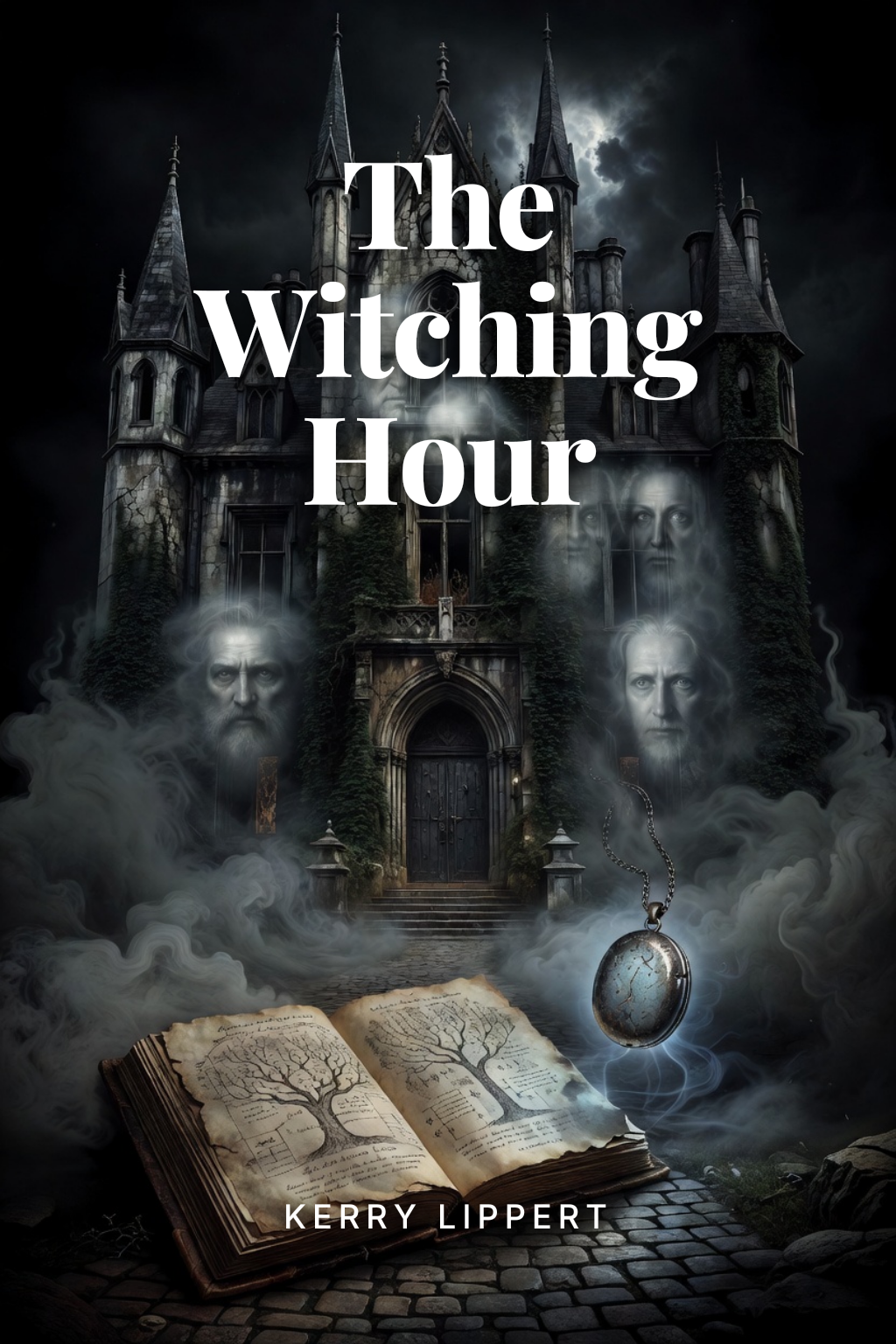
Novel · 6 chapters · 21,402 words
The Witching Hour
Contents6 chapters
Chapter 1
The Thirteenth Name
The lawyer came at dusk with a leather case chained to his wrist and mud on the hem of his trousers, as if the road itself had tried to keep him from this house.
I watched from the front gallery while Celie let him in. She did not ask his business. She looked once at the chain, once at his face, and stepped aside with the sort of care people use around loaded guns and dying men. Below us, First Street hummed with carriage wheels and the cry of a shrimp seller heading toward the river, but inside the house every sound turned soft. Rugs swallowed footsteps. Velvet curtains drank the light. The tall clock in the hall gave a dry tick, as if its throat were full of dust.
“Miss Mayfair?” he called, not loudly.
Nobody answered at first.
That was a mistake. In this house, silence was never empty. It listened back.
I came in from the gallery and closed the door behind me. “You’ve found one,” I said.
He turned too quickly. Young, for a man carrying a dead woman’s papers. Thirty at most, with a pale stripe across his jaw where a barber had missed his soap. His eyes moved over the hall—the black walnut staircase, the saints in tarnished frames, the gasoliers waiting unlit—and settled on me as if trying to decide whether I was a servant or trouble.
“Miss Mayfair,” he said again, choosing caution now.
“Which one?”
His hand went to the case by reflex. “I was instructed to place this in the hands of the eldest living daughter of this branch of the family.”
“Then you’ve come late. The eldest living daughter was buried yesterday.”
That landed. He had known there’d been a death. He had not known the dirt was still loose on the grave.
From the morning room, a chair leg scraped. My aunt Carlotta appeared in the doorway, thin as a hatpin in her black crepe, a rosary looped around one wrist hard enough to leave marks. She never hurried; she arrived. “State your name,” she said.
“Edwin Rourke. Pellerin and Sanz, attorneys-at-law.” He fumbled in his pocket, produced a card, and offered it as if to a queen who might have him whipped. “I represent an estate in San Francisco.”
Carlotta did not take the card. “Whose estate?”
He hesitated. His thumb rubbed the edge of the pasteboard until it bent. “That is for the family.”
“For which family?” I asked.
His eyes met mine then slid away, toward the landing above us.
Everyone who entered this house looked up sooner or later. The staircase climbed in a dark curve, polished by a century of Mayfair hands. At the turn there hung the portrait nobody would move: a woman in silver satin with one bare shoulder and an expression both amused and tired, as if she knew the end of your story and found no reason to spoil it. Her painted fingers rested on the carved arm of a chair. On the chair’s far side, half in shadow, the artist had suggested the shape of someone standing close behind her. Not a face. Never a face. Only darkness given form.
Mr. Rourke stared at it like a churchgoer caught blinking at an icon.
Carlotta saw where he looked and snapped, “Keep your eyes on the living.”
The lawyer swallowed. “The document concerns a direct blood heir of Suzanne Mayfair.”
The hall seemed to tighten around us.
Celie made the sign of the cross so fast her knuckles clicked against her chin.
Carlotta’s rosary beads stilled. “There are no documents concerning Suzanne that have not already done their damage.”
“So my employer believed,” Rourke said. “Until a trunk was opened after the death of Miss Katherine Mayfair of California.”
My aunt moved before I did. One step, two, then her hand was out, not for the card now but for the case itself. The chain snapped taut between them with a little metal cry.
“You will leave that and go,” she said.
“I cannot. I was given strict instructions. It must be opened in the presence of—”
A sound came from upstairs.
Not a footstep. Not the settling creak old houses make to remind you they are heavier than your prayers. This was the soft drag of something crossing the landing above our heads, slow and certain, like a fingertip drawn through dust.
Rourke heard it. So did Celie. Her mouth dropped open.
Carlotta did not look up. That was how I knew she was afraid.
“Who else is in the house?” the lawyer whispered.
No one answered him.
The gaslight from the street reached through the fanlight over the door and laid a weak gold bar across the floorboards. It stopped at the first stair. Above that, the landing remained dark.
Then, from the shadows over the portrait, a man’s voice said my name.
Chapter 2
The Man Behind the Portrait
My name in that voice did not sound spoken. It sounded remembered.
“Don’t move,” Carlotta said.
She meant me. She always meant me when she used that tone, as if the whole house might be managed through the proper pinning down of one girl. Her hand came out without looking, the black beads of her rosary caught between her fingers, and found only air because I was already stepping past the lawyer.
“Clara,” she said again, sharper now.
The first stair gave under my weight with the familiar inward sigh of old cypress. I knew every complaint this staircase could make. This one was not warning. It was witness.
Behind me, Mr. Rourke said, “Miss Mayfair, I strongly advise—”
“Then stay where you’re useful,” I said, and kept climbing.
Below, no one followed at once. That gave me the whole broad curve of the stair, the banister cold and smooth under my palm, the smell of beeswax and old linen and the faint medicinal trace of camphor that never left the upper hall because some aunt or another had always believed decay could be corrected by proper storage. Street noise thinned behind the front curtains. The shrimp seller’s cry had gone on down First Street. Somewhere two doors off, a mule kicked a trace chain. In our house, every small outside sound arrived weakened, as if crossing water.
The portrait waited at the turn.
By daylight the woman’s satin had a silver luster and her mouth held something almost kind. In the dusk she was all throat and hands and that fixed, private amusement. The darkness behind her right shoulder thickened as I came level with her, the painter’s trick suddenly not a trick at all but a place where the eye slid and found no purchase. I stopped there, one hand on the newel post carved with acanthus leaves slick from generations of polishing.
“Who’s there?” I asked.
Not loudly. I didn’t need to. The air had gone taut enough to carry a whisper.
No answer came. Yet I was not alone.
The landing above me was empty clear to the long runner and the table with the Chinese bowl full of dead lavender heads. The doors to the blue room and the schoolroom stood closed. Moonlight did not reach this side of the house. The only light was the weak rise of evening from below and the small, tremulous flame of one wall sconce Carlotta had neglected to have lit properly; it gave more smell than brightness, a thread of hot gas and singed dust.
I took another step.
Then the house altered.
Not in any way I could have pointed to a carpenter or priest. The boards did not shake. No curtain stirred. But the space before me deepened and drew a breath. The hair along my arms rose at once, hard and cold. The skin at the back of my neck tightened as if a gaze had fallen there. I knew, with the swift certainty one has before a hand closes over one’s mouth, that a man stood near me.
Not seen. Not touched. Near.
The scent reached me a beat later.
Old roses. Not fresh-cut, not the clean green smell of a garden after pruning. This was darker, crushed into cloth long ago, kept in drawers with gloves and mourning ribbons until the sweetness had gone dense and faintly spoiled. The smell of a prayerbook found under a bed. The smell of a dress lifted from a cedar chest after thirty years.
My mouth went dry.
“Show yourself,” I said, and heard in my own voice that I had used my sister’s manner by mistake—the flat, imperious note that admitted no mockery.
Something moved just beyond the portrait’s painted shoulder.
It was not a body passing. It was the impression a body leaves when it has just stood somewhere and shifted its weight. A pressure displaced. A vacancy changing shape. I saw no coat, no hand, no face emerging from the dark. I saw only the dark gather, and the whole landing went close and charged around me, as before lightning when the silver spoons in a drawer begin to hum.
Down below, Celie gave a small cry.
Carlotta said, “Come down this instant.”
I put out my hand, not toward the stair but toward the shadow beside the portrait. The air struck it back. Not a blow. More like walking chest-first into deep water that is colder than expected. My fingers went numb to the wrist. For one impossible instant there was the sense of another hand hovering a breath from mine, larger, patient, almost amused.
Then the wall sconce hissed and flared blue.
The portrait’s varnish caught the light like wet skin. The woman’s painted eyes seemed to turn—not toward me, but to that obscured shape at her shoulder, as if she listened for him still.
I jerked back so sharply my elbow hit the frame. It answered with a hollow knock. At once a sound came from inside the house, not above or below but through it: a low shuddering thump, as if a door far away had been shut with two hands.
Mr. Rourke swore.
Metal rattled. The chain on the case, I thought.
Then Carlotta’s voice rose, not frightened now but furious in the particular way fear makes her. “You fool, do not open—”
The rest was drowned in the scrape of wood on wood and the hard, decisive snap of a lock giving way.
I looked down from the landing.
Rourke had dragged the leather case onto the hall table beneath the gilt mirror. His hat lay on the floor, crushed under one foot. With both hands he was fitting a small key into the brass escutcheon at the case’s throat. The chain hung loose now, its links still twitching. Celie had backed against the umbrella stand, one fist to her mouth. Carlotta was on him, one hand clawed in his sleeve, the other raised as if she meant to strike or seize the papers before they saw light.
“Now?” she said. “Now, because a floorboard moans, you choose to play courier?”
He did not look at her. His face had gone the color of candle grease. “That was no floorboard.”
“No,” I said from above.
All three looked up.
Something in my face must have told them enough. Even Carlotta’s mouth changed. Just a little. The old bloodless firmness gone for a second.
“Come down,” she said, quieter.
I did. My knees were weak and full of pins, but I came down with my head high because the alternative was to clutch the rail like a child.
When I reached the hall, the rose scent came with me and settled there among us. Celie noticed first. Her eyes widened. She crossed herself once, twice, then began to whisper a prayer under her breath too fast to distinguish.
Rourke opened the case.
The leather was black and crazed at the hinge. The lining inside had once been green baize, now worn bald in the corners. A packet lay neatly arranged within, held by two faded straps: one folded document on heavy cream stock, an envelope sealed in red wax and addressed in a slanted woman’s hand, and beneath these a narrow sheaf tied with blue ribbon gone almost gray. There was no jewelry, no miniature, no deed with a handsome seal. Nothing theatrical. Papers only. That made it worse.
Rourke lifted them out with care that looked like fear trying to dress itself as professionalism.
“Who is Katherine Mayfair?” I asked.
Carlotta shot me a glance as if the question itself were treachery. “A woman who should have burned what she found.”
Rourke set the papers on the table. “Miss Katherine Mayfair resided in California for more than forty years. She died six weeks ago. Her effects included a locked trunk inherited, according to a memorandum enclosed with it, through maternal lines from one of Suzanne Mayfair’s daughters. The trunk contained genealogical material, letters, and instructions that this affidavit be conveyed to the eldest living female descendant of this branch if certain conditions—”
“Spare us your office recital,” Carlotta said.
His jaw tightened. He unfolded the cream document anyway.
The paper gave a dry, fibrous crackle. His finger moved down lines of dense script and formal witnessing clauses. The room drew in around his voice.
“I, Katherine Anne Mayfair, being of sound mind and under no coercion, do swear and affirm before witness the following descent from Suzanne Mayfair, said descent having been maintained in private record among the women of the family and corrected by my own hand where burial records, marriage licenses, and church books permit...” He looked up. “It proceeds by direct female issue. There are thirteen names.”
Celie made a small sound at that, a wet intake, and stared at Carlotta.
Carlotta said nothing. Her fingers worked the rosary beads until they clicked like tiny bones.
“Read them,” I said.
“No,” said Carlotta.
Rourke read them.
“Suzanne Mayfair.” His voice steadied as law-house habits took hold. “Deborah. Angelique. Marie Claudette. Marguerite. Jeanne Louise. Katherine Marie. Charlotte Ann. Euphemia. Stella. Anna Lee. Vivian. Helena.” He stopped there and looked to the tied sheaf beneath his hand, where another page protruded. His thumb eased it free.
A column of names, each in brown ink, each with dates and notations in a cramped but elegant script.
The twelfth was there. My sister’s name. Drawn through with one clean line.
Below it, written later and more heavily, as if the pen had bitten the paper: Clara.
I took a step nearer.
There are moments when grief comes back not as sorrow but as insult. My sister had been under earth one day and already reduced to ink ruled through by a woman three thousand miles away who had perhaps never seen her face. I wanted to snatch the page, tear it, ask by what right the dead were counted and shifted like figures in a household account. Instead I stood very still and read my own name until the letters lost shape.
Rourke lowered the sheet. He had seen enough to know he should prefer ignorance.
“What does ‘thirteenth name’ mean?” I asked.
No one answered.
The gas in the sconce gave another faint spit.
It was Celie, of all people, who spoke first. “Miss Helena heard him,” she said to the floor. “Not plain as a living person. But enough. Last month in the east gallery she turned white as linen and said somebody was walking behind her though she could hear no shoes.” Celie lifted her eyes to me, miserable and eager with the burden of having held a thing too long. “And yesterday before the fever took her speech, she said don’t let Clara answer if he calls.”
Carlotta wheeled on her. “Hold your tongue.”
But Celie had begun and could not stop. “I thought it was the sickness talking.”
“There is no useful moment,” Carlotta said, “for servants to decide they’ve become confessors.”
“I’m not a servant,” Celie said, so low one might have missed it, yet the words landed hard.
Carlotta’s nostrils flared. Then she turned to the sealed envelope as if it had offended her by existing. “Burn the letter.”
“No,” I said.
“Yes.”
“It has my name under hers.”
“It has worse than your name under hers.”
Rourke laid his hand on the envelope before either of us could take it. “My instructions were explicit. The letter is to be opened in the presence of the designated heir.”
Carlotta smiled without humor. “And who designated her? A dead woman in California? Or the thing upstairs?”
“The affidavit designates succession,” he said. “The letter is addressed simply ‘To the next who must know.’”
“That means me,” I said.
Carlotta’s gaze snapped to mine. “It means whichever poor fool has not yet learned to refuse.”
I reached past Rourke and touched the wax.
It had once borne a seal, perhaps a ring impression, but heat or time had softened it. The crest was a blur. Under my fingertip it was faintly greasy, and cold. The envelope paper was heavier than common stationery, the kind bought by women who intended their correspondence to outlive them. Across the front, in dark brown ink faded at the edges, were three words only: Open alone if possible.
“Not possible,” said Rourke.
“No,” Carlotta said. “Not permitted.”
I slid a letter knife from the standish on the hall table. Silver handle, mother-of-pearl cracked near the rivet. It had belonged to my grandfather and was sharp enough still. Carlotta caught my wrist.
Her fingers were wiry and hard as bundled twigs. “Listen to me once in your life,” she said. “There are papers that make a road where none existed before. Some names are safer unsaid.”
“He said my name.”
She let go at that. Not because she yielded. Because she had no answer.
I broke the seal.
Inside were four closely written pages folded into thirds. The paper smelled of dry cedar and violet water gone nearly to dust. Katherine Mayfair’s hand slanted forward with a determined pressure that tore the nib at downward strokes. She wrote as women do who have spent years making copies for themselves because no one else could be trusted to keep the original.
I did not offer it around. I unfolded the first page and read.
To the next who must know, if God has not in mercy prevented it—
Carlotta made a sound like contempt, but she listened.
If this reaches you, the line has failed where I prayed it might hold. I write plainly because there has been too much piety and too little honesty among us. The family’s so-called protector was never a protector. He was attached to Suzanne from the first by desire, vanity, and invitation, and every generation that fed him called his appetite devotion, luck, patronage, or grace according to what lie best suited the day.
The hall had gone so quiet that I could hear the clock’s mechanism catch before each tick.
I read on.
He gives. This is true. Money where there should be none, marriages turned, enemies checked, children spared in one bed while another dies. He is skillful. He will seem tender. He will seem chosen by Heaven when he is only chosen by habit. What he takes is less visible at first: freedom, judgment, the ordinary loves, the chance to belong to one’s own life without an unseen hand forever on the latch.
Rourke looked from me to Carlotta and then away again with the expression of a man who has walked into a family quarrel and found a grave open in the middle of it.
Celie had begun to cry without noise. Tears tracked down the deep lines around her mouth and disappeared into the loosened collar of her dress.
The second page shook in my hand, though whether from fear or anger I could not have said.
By the old accounting there are thirteen who carry the burden directly in this branch, though not all bear it equally and some are spared by distance, wit, or ugliness of circumstance. Do not trust that sparing. It is only delay. The thing attached to Suzanne learns the doors in a family and tries each one in turn. He prefers the eldest daughter where he can have her. If she cannot hear him, he presses harder. If she dies, he turns. If the thirteenth name fails, he will seek the next woman of the blood who can hear him.
I stopped.
No one spoke.
From upstairs came a soft, unmistakable sound: one board on the landing complaining under weight. Not a settling groan. A foot placed with care.
Celie whimpered and looked toward the stair.
Rourke said, too quickly, “There is no one else in the house?”
“No living intruder,” I said.
The lawyer flinched as if I had put a cold key down his collar.
Carlotta held out her hand. “Enough. Give me the letter.”
I kept reading.
If you have already heard him, do not answer in kindness, loneliness, vanity, or curiosity. Curiosity has ruined better women than lust. He may use the voice of one you love or the manner of one longed for. He may appear as assistance when all human help has failed you. Refuse him any promise. Refuse secrecy. Make records. Seek the old materials hidden where mourning furniture stood in New Orleans, for one before me tried to leave a truer account than the holy frauds preserved by our pious jailers.
Carlotta’s face changed at that. The color left even the thin rims of her nostrils.
“What old materials?” I asked at once.
“It is a dead woman’s nonsense,” she said.
The lie came so fast it was almost admirable.
I lowered the page. “You know where.”
“You will not go rattling through this house after old blasphemies because some western spinster—”
“Some western spinster knew my sister was dead before this man crossed our threshold.”
Rourke spread his hands helplessly. “I knew only that the eldest living daughter was to receive the case. I had no report of a death this week.”
“Yet the name is struck through,” I said.
He swallowed. “The notation may have been added by another hand before dispatch.”
“Whose hand?” Carlotta demanded.
He looked toward the ceiling, as if any answer in the room might be waiting there.
I read the last page.
I was told in youth that he guarded our women. I believed it because I was young and because I had just seen a creditor ruined and an illness pass from one child to another. We are greedy for patterns when frightened. Hear me now: no guardian asks to be hidden; no guardian thrives on obedience; no guardian fattens on one family’s fear for centuries. If you doubt me, follow the names, follow the marriages, follow the graves of the daughters who were most beloved. You will see what price was paid.
I send the list because numbering has become our superstition and may also be our clue. There are thirteen because we made thirteen of them in record and ritual, not because God set the count. If the count breaks, perhaps the old road breaks with it. Or perhaps it only seeks another crossing. I cannot say. I have done what I should have done thirty years ago and placed this where it may offend the living.
Do not be alone with him if you can help it.
K.M.
The signature was firm. No trembling deathbed testament there. Whoever Katherine had been, she had died with enough strength to accuse the dead and instruct the endangered.
I folded the pages once more but did not return them to the envelope.
Carlotta stood very straight. Her rosary hung forgotten at her side. “A bad woman wrote that.”
“Did she lie?”
“Yes.”
“Which part?”
“All of it.”
“Then tell me the truth.”
She looked at me with naked hatred for half a second—not hatred of me precisely, but of the necessity of me. Of my asking while standing in my mother’s jaw and my sister’s place. Then the look closed.
“The truth,” she said, “is that women who imagine they can command what they do not understand invite ruin. The truth is that pride has spoken in this family with many tongues, and one of them sounded very much like freedom. Your Katherine wanted to cast herself as the only honest soul among a line of fools. There is vanity in that too.”
“That isn’t an answer.”
“It is the only one you are fit to hear tonight.”
Above us, the footstep came again.
Slow. Deliberate.
Not crossing now. Waiting.
Mr. Rourke reached for the bottle of brandy on the sideboard, found it with his eyes, then thought better of touching anything unoffered in that house. “Miss Mayfair,” he said to me, “whatever this concerns, I recommend witnesses, copies, perhaps immediate consultation with—”
“A priest?” Carlotta said.
“A doctor,” he said stiffly, though he did not sound convinced.
Celie let out a rough laugh made ugly by tears. “Will a doctor give a powder for that smell?” she asked. “It’s stronger now.”
It was. The roses had thickened until even Rourke could not pretend otherwise. Sweetness lay on the tongue. Under it, something metallic. Like the scent left on fingers after touching old coins.
The hall clock struck the quarter. One thin bell. The note traveled up the stair and failed, swallowed whole.
I laid Katherine’s letter on the table beside the affidavit and put my finger on my own name where it stood beneath my sister’s. “You said there were papers in trunks and records women kept for themselves,” I said to Carlotta. “Where are they?”
She looked beyond me to the portrait on the landing.
For the first time that evening she answered without a dodge. “Hidden.”
“By whom?”
“By someone who learned too late.”
“Where?”
Her mouth compressed. She would have lied again if the house had allowed her time.
Instead the front door, though bolted, gave a sudden violent shake against its frame as if a gust had struck it from the gallery. The fanlight rattled. Celie screamed. Rourke spun round. The gas flames bent low and all but went out.
At the same instant something passed above us.
Not visible. Never visible. But swift now, no longer patient. A downward sweep along the curve of the stair, accompanied by that cold inward pressure and the ruinous perfume of dead roses flung open at the throat of the house. My skin seized. The papers on the hall table lifted at their corners. Katherine’s pages slid. The list of names skated free and struck the floor at my feet.
Across my own name, in a smear no human pen had made, the ink spread dark as if newly wetted.
Carlotta whispered, “Mother of God.”
No one moved.
The page lay between us on the rug, the struck-through dead above, my name below, and over both the shadow from the staircase banister falling like bars. Upstairs, beside the portrait, the single wall flame steadied itself and burned straight blue, as if some unseen hand had cupped it.
Chapter 3
Carlotta's Vigil
“Pick it up,” Carlotta said.
No one bent.
The page lay on the Aubusson rug with its corners twitching in a draft no one could locate. My name had become a bruise in the paper. The blue flame on the landing burned narrow as a needle. Somewhere above, in one of the shut rooms, a latch clicked.
Carlotta took one step forward, then another. Her skirt whispered over the carpet. She stooped with the stiffness of a woman who expected something to strike at her face, lifted the genealogical sheet by two fingers, and held it away from her body as if it were a bloodied rag.
“Not another word from any of you,” she said. “Not till that table is cleared and the door bars are checked.”
Mr. Rourke gave a disbelieving little laugh. “Madam, if you suppose I shall submit to orders in a private house where—”
She turned on him so fast the beads at her wrist snapped against one another. “You opened what you were told to bring. Now be useful.”
He stopped. Whatever answer he had prepared died. Even Celie, who feared Carlotta less than she feared the things Carlotta feared, moved at once toward the front door. I heard the lower bolt shove hard into its socket. Then the upper one. The brass shook under her hand before settling.
Rourke gathered the scattered papers from the floor and the hall table, flattening them with his palm. He did not look at the stairs.
I did. The portrait on the landing hung in its usual place between the two doors, all amber varnish and old gloom. The woman in silver satin stood turned half away, one hand on the carved back of a chair. Her waist was absurdly narrow, her neck pale, her hair dressed high and powdered. Beside her, in the painting’s depth where the curtain fell into shadow, the darkness seemed heavier than paint ought to be. I had noticed it as a child and been told I was fanciful. Tonight it looked occupied.
“Come into the morning room,” Carlotta said. “Not here.”
“No,” I said.
She closed her eyes. “Clara.”
“If you have lied to me once more, do it where the lies started.”
Celie made a small sound, almost a moan. Mr. Rourke looked from me to Carlotta and understood enough to regret having entered the house at all.
Carlotta folded the marked page once, carefully, not creasing my name. “Then sit,” she said.
We sat where we stood. There was a horsehair settee against the wall beneath the hat pegs; Celie took the far end of it and kept twisting her apron hem between her fingers. Rourke remained by the table, perhaps because an attorney likes the support of furniture when the room itself has become unreliable. Carlotta chose the straight chair under the gas bracket, putting the light on her own face and the staircase at her back. I stayed where I was, one hand on the newel post at the foot of the stairs. The wood felt cold and a little damp.
For a few moments she said nothing. She drew a handkerchief from her sleeve, unfolded it, refolded it. The hall clock ticked with dry insistence. From First Street came the blurred clatter of a cart and then, further off, the sing-song cry of somebody selling oranges before the night closed in. The ordinary city noises sounded indecent.
“What did your Katherine tell you?” Carlotta asked at last.
“You were here.”
“Tell me what you understood.”
“That there is something attached to Suzanne’s line. That it chooses, or listens for, the eldest daughters. That we are not to answer when it speaks.”
“That?” Carlotta gave a hard little breath. “Those are nursery cautions dressed as revelation.”
“Then undress them.”
Her eyes sharpened. I had struck where I meant to.
“It began before Suzanne if you go hunting for roots,” she said. “Everything begins before the person foolish enough to be blamed for it. But Suzanne is where this branch was marked. She was young, stubborn, vain, and afraid of being poor. She was also clever, which is a more dangerous thing in a woman than beauty, though she had both. There was talk of second sight in the family even then, odd moments, warnings, names spoken before messengers arrived. Nothing that could not be dressed in piety by daylight. Then came him.”
She did not say his name. Not yet.
Celie crossed herself. Rourke glanced up, startled, though no sound had come from the stairs.
“Him where?” I asked.
“In the house first. Then everywhere.” Carlotta smoothed the handkerchief over her knee. “So the old papers said. A voice before a shape. A shape before a touch. He came when called and when uncalled once the road was made. He found Suzanne willing to hear. He offered what such things always offer in one disguise or another: advantage. A warning before a rival moved. A name of a buyer. A marriage to cultivate. Which field would flood and which note should not be signed. Whose child had fever and whose servant stole. Little truths first. Harmless-seeming. Useful.”
Mr. Rourke said quietly, “You speak as though you believe this.”
Carlotta turned her head and looked at him with the full weariness of a woman who has spent decades arguing with the wrong kind of man. “Believe? No, sir. I have outlived belief. I account.”
He colored and said nothing more.
Carlotta went on. “The family prospered. That much can be entered plainly in any ledger. Money came where money should not have come. Lands held when other houses lost theirs. A judge was swayed; a debt was called at the favorable hour; a daughter married above herself; a son escaped a duel because a wheel broke under another man’s carriage at precisely the turn needed. Fortune, influence, knowledge of the sort no decent priest would bless. And in return—”
She stopped.
The room listened.
“In return?” I said.
“Obedience first.” Her fingers tightened on the handkerchief until the knuckles showed white. “Not public obedience. He was no ghost out of a chapbook asking candles and hymns. He wanted private things. A woman to go when called. To keep certain objects. To permit certain habits in a household. To wait upon the hour he preferred. To accept his presence not as affliction but as right.”
Celie whispered, “Sweet Jesus.”
Carlotta did not look at her. “Then births.”
A carriage passed outside. The window glass gave a faint vibration. Inside the house, no one moved.
“What does that mean?” Rourke asked.
“It means what you think it means, if you have enough shame not to ask me to say it more crudely.”
His mouth shut.
I said, “Children.”
“Yes.”
“His?”
Her face altered then, not with modesty but with disgust old enough to have become bone-deep. “That question has broken women in this family for two hundred years. Some swore no. Some swore yes. Some said he touched them only in dreams and yet bore children with eyes that fixed too soon on corners where no one stood. Some miscarried till they agreed to whatever bargain was asked. Some went untouched in body and still lost infants one after another while the house fattened and the wine cellar filled. There were women who begged him for a child and women who begged to be spared one. There were women who heard him before bleeding and after. That is what I mean.”
A flash went through the fanlight over the front door, white and soundless. Summer lightning, far off yet. A second later the gaslight shivered. The storm had turned over the river and was coming our way.
“And madness,” I said.
“Yes.” This came quickly, almost gratefully, as if that price at least could be named in clean terms. “Fits of hearing. Nights without sleep. Rages. Delusions grand and pious. A habit of standing in hallways talking softly when no one else was awake. Women who would not marry, women who married twice, women who drowned, women who shut themselves up with account books and burned them, women who saw the dead in mirrors, women who laughed in church. Not every sorrow belongs to him. That is his best shelter. Families breed enough misery on their own to hide any devil in comfort. But there is a pattern if you look long enough. Katherine looked. So did I.”
“And yet you stayed.” The words came before I could sweeten them.
She took the blow without flinching. “Yes.”
“Why?”
“Because someone had to stay and say no where others had said yes.”
The first low roll of thunder reached us then, not loud, but deep enough to travel through the floor. Celie looked toward the shuttered front windows and pressed her lips together.
I said, “You recognized the voice.”
Carlotta’s head lifted. “Who told you that?”
“No one had to. You knew it before the smell thickened. You knew it when he spoke my name.”
For the first time that night, fear moved visibly through her. It was small, the way a fish passes under dark water and leaves only a shift on the surface. But I saw it.
“Yes,” she said.
“From when?”
“From your mother’s room.”
The words landed with a force greater than any shout.
My mother had been dead seven years. People said consumption because people prefer an illness with a proper name, one that keeps the rest of life clean. I remembered the spoon on the bedside plate, the napkin marked with blood no one let me touch, the stale odor of medicines, the heavy curtains kept half drawn. I remembered as well—though no one had ever confirmed it—the nights when I woke and heard low talking through the wall, one voice hers and one not.
Carlotta kept her eyes on me. “It began before the coughing worsened. She would answer from sleep. Not loudly. As if to a caller at the bedside. Once I went in and found her sitting up in the dark with her hand stretched out, smiling. Smiling, Clara. Your mother had not smiled in weeks. She said she was not alone and need never be afraid again.”
Lightning flashed once more. This time the thunder answered closer.
“Who was he to her?” I asked.
“What he is to all of them when they are tired of being afraid. Consolation. Flattery. Permission. He knew exactly which room in a woman’s heart had gone cold and sat there warming himself.”
“You let him near her?”
“I fought him.” Her voice sharpened. “Do not speak as if I welcomed it. I changed priests till one would come at midnight. I took mirrors from the walls. I burned letters. I sat up with a crucifix in my hand till dawn and heard him laugh in the passage. Your mother begged me to leave her in peace. She called me cruel. On the last night she was lucid enough to tell me that something stood in the corner and waited for me to die before it took you and your sister proper.”
Celie began crying then, silently, the tears slipping down her face without change of expression.
I heard my own voice ask, “And my sister?”
Carlotta looked down at the handkerchief in her lap. There was a tiny hemstitched C in one corner. Not hers. My mother’s, perhaps.
“It had already begun with her,” she said.
“She was fevered.”
“Yes.”
“That is what killed her.”
“Yes.” She looked up again. “And no.”
The thunder came harder. Somewhere on the roof a branch scratched once across the slates.
“She told Celie not to let me answer if it called,” I said. “Yesterday.”
Carlotta nodded.
“So she heard it before she died.”
“She heard him three nights running.”
Rourke shifted his weight but did not interrupt. He stood very still now, his hands spread on the edge of the hall table among the papers he had brought. Attorney no longer. Witness.
Carlotta spoke to me, but not as she usually did. There was no command in it. Only exhaustion stripped bare. “Your sister was not herself the last two days. She said the room breathed. She said a gentleman in black stood by the washstand and knew all our names. At noon she laughed and asked why I was angry with a friend of the family. At dusk she cried till she choked because he would not show his face in full. Then she slept, and every time the quarter struck she sat bolt upright as if a string had yanked her.”
A drop hit the fanlight. Then another.
“I buried her fast,” Carlotta said, “because I wanted her under consecrated ground before nightfall. I did not wait for all the cousins. I did not wait for proper lace. Let them judge me. The disturbances had begun in the walls before she was washed and dressed. Helena knew it. Celie knew it. I knew if the house kept her one more night there would be no rest in it.”
“What disturbances?”
“The knocking in the chimney behind the blue room when there was no fire laid. The nursery bell ringing though the wire was cut years ago. Steps above your room when no one was on that floor. And the portrait.”
My skin prickled. I looked again at the landing.
“What of it?”
“The dark changed.”
That sounded absurd enough to be true.
“When that painting was done,” Carlotta said, “the family told the artist he had made a grand fool of himself. He was a Frenchman with more talent than prudence, brought through New Orleans by somebody’s husband who wanted a likeness to prove his wife could rival any salon beauty in Europe. He painted the silver gown well enough, the pearls, the little bruise of blue vein at the temple. But in the curtain-shadow to her left he laid in a figure. Not complete. No face one could point to. Only height, a shoulder, the weight of a man standing too near. The family raged. They said he had invented obscenity. He said, according to the account, that he had painted what made the lady keep turning her head while he worked.”
“Who was the woman?” Rourke asked.
“Ann Mayfair. Not that it matters. There were several by then who might have stood in satin while he looked over their shoulder.”
“And they left the painting hanging?” I said.
“They tried to varnish over the dark. Then to scrape it down. The more they tampered with it, the more plainly it returned. At last one woman swore it was safer to keep the likeness where the thing recognized itself. Whether she was wise or mad, I cannot say. Since then, that portrait has watched generations climb past it trying not to look.”
The rain began in earnest, hard and abrupt, drumming on the gallery roof and slanting against the shutters. The gas hissed. The house seemed to draw in around us, every door, every stair turn, every closed room pressing its silence toward the hall.
I held out my hand. “The letter.”
Carlotta’s fingers moved over the folded pages on the table before Rourke could touch them. “You have heard enough for one night.”
“No.”
“It names things that should not be spoken aloud in a storm.”
“That is a child’s rule.”
“It is an old one.”
“I am done keeping old rules that kept me ignorant.”
Her gaze flicked to the staircase, then back to me. She knew she was losing ground and hated me for making the loss visible. “The parts you read were the parts meant for counsel.”
“I will read the rest.”
Rourke cleared his throat. “If the document is addressed to Miss Clara Mayfair by name, I must say—legally—”
“Give it here,” I said.
He did.
The paper felt dry and warm from his hand. Katherine’s writing ran close and firm, no wasted loops, no sentiment. The broken seal had torn only the outer fold; there were pages nested inside that I had not yet opened. Carlotta half rose from her chair. I stepped back toward the hall lamp where the light was best and unfolded the rest.
“Read it,” she said suddenly. “If you insist, read it aloud. Let there be no secrets in corners.”
That was not generosity. It was fear. She wanted every word heard, perhaps because words shared become less intimate, less likely to root in one listener alone.
So I read.
If you are come to this point, the earlier warnings have failed, or else those charged with them have preferred silence to scandal. You must now know what was kept from me until too late. There are material remnants and there are forms of speech. Destroy what can be destroyed. Refuse the speech.
In the old house there is, or was when I last had knowledge of it, a trunk of cypress boards bound in black iron. It was said to have come by river from upriver country in Suzanne’s time, though no inventory names it directly. During one period it stood in the room called the mourning chamber after the child who was laid out there. Later it was moved and concealed again by those who feared both discovery and disposal. The compartment sought is not the trunk entire but a false bottom beneath the lining boards. Look for hand-forged nails set at unequal intervals. One lifts; the others are decoys.
Celie gave a little cry at the words mourning chamber and covered her mouth.
I went on.
Within should be found, if vermin and damp have spared them, Suzanne’s prayerbook, certain leaves in her hand, and a list of renunciations copied by one Marguerite and added to by Jeanne Louise. You will think this impossible if you have been fed the family romance of power inherited like silver plate. It is not impossible. At least three women tried to sever the compact. One fled before the rite, one bargained in the middle of it, and Suzanne herself commenced the renunciation but did not complete it.
Carlotta made a quick involuntary sign of the cross.
“What rite?” Rourke asked.
“Hush,” she snapped.
The rain hammered harder. The shutters gave a single blow under wind and held.
The conditions, as I have them from papers sent to me and from one witness now dead, are these: it must be undertaken by the living female heir of Suzanne’s direct line while a death in the house has unsettled his hold. This may be superstition; I record it because the old women agreed on little else. The names must be spoken backward from the present inheritor to Suzanne. The gifts must be named as gifts and refused one by one: money not earned, warning not asked, influence purchased in whispers, lust dressed as protection, knowledge bought with blood. Then the promise must be broken in explicit terms. He is to be denied hospitality, denied obedience, denied issue, denied remembrance. Most falter at the last. They fear to deny remembrance because he has lived in the family memory like a saint in a niche. Yet that line is said to matter.
My voice sounded foreign in the hall. Not mine. Older.
If any object remains by which he was especially admitted—ring, lock of hair, image, key, written invitation—it should be burned before dawn in a room above ground and the ashes cast at a crossing where no kin resides. Do not attempt this alone if you can help it, though women often have been maneuvered into solitude by design. He prefers witness when he wishes to boast and loneliness when he wishes to persuade.
There followed a paragraph in which Katherine named several women unknown to me and condemned half the family with such cold exactness that even Carlotta did not interrupt. Then near the end:
Be warned that a portrait in the stair hall was once accounted an anchor by those who courted him and a warning by those who did not. If it still hangs, cover it before the renunciation, but do not destroy it first. One account states that damage to the image before refusal merely drives him to the nearest living vessel of the line.
The last lines were brief.
I failed in courage once and have paid for it in years. Do not spare the living by silence. It is how he survives us.
K.M.
The paper shook in my hand, though I had not noticed my hand shaking until then.
No one spoke.
The rain roared above the gallery so fiercely it made a kind of surf around the house. Another flash whitened the fanlight. Thunder struck close enough that the silver on the sideboard rang faintly.
At last Rourke said, very softly, “Good God.”
Carlotta sat down again as if her knees had given way under her. She had grown older in the space of ten minutes. The hard shell of her piety, which had always seemed to me nearly metallic, now showed dents beneath it.
“You knew about the trunk,” I said.
She did not answer.
“You knew about the mourning chamber.”
Still nothing.
“Did you hide it?”
“No.” Her voice came rough. “I found it once. Long ago. Not the compartment. Only the trunk itself, shoved behind old bedsteads and cracked screens in the upper rooms. I had it moved and thought that was enough. Thought distance was a form of rule. I was wrong.”
“Who hid the compartment?”
“One of the women before me. Or one before her.” She looked up. “Do you imagine they all welcomed him? Some fought in the only ways allowed to them. Concealment. Delay. Half-finished prayers. Marriages made in haste. Children sent away. One woman had the stair carpet changed because she said his steps favored the older weave. We inherit follies too.”
I folded the letter along its old creases and laid it atop the rest of Katherine’s papers. “Then we go upstairs.”
Celie made a choking sound. “Now?”
“Yes.”
“In this?” Her eyes darted toward the storm-dark windows, then up the stair where the portrait waited in its blur of gaslight and shadow.
“Now,” I said again.
Carlotta rose. “You will not set foot in that room tonight.”
“I will.”
“I forbid it.”
The old note had returned to her voice, the command sharpened on years of being obeyed. For one instant I almost yielded from habit. Then the house itself answered for me.
From above us came the slow tread again.
Not on the landing this time.
Further back.
Three measured steps, as if crossing a room with carpet enough to soften all but intention.
Then a pause.
Then, distinct through rain and thunder, the sound of wood hollow under weight.
Not floorboards. A lid, perhaps. Or boards laid over a cavity.
Carlotta’s face emptied.
Celie whispered, “Dear Mother save us.”
The tread came once more, directly over the part of the upper floor where the old mourning chamber lay shuttered and unused.
Something there knew we had spoken of the hidden place.
The gas flame under the bracket bent sideways toward the stairs and held, thin and blue, as if the house itself had turned its head to listen.
Chapter 4
The Trunk Under the Mourning Bed
I took the lamp before Carlotta could forbid me again.
Its chimney was warm under my fingers, and the little brass ring at the crown clicked faintly as I lifted it from the morning-room table. Rourke started as though I had taken up a pistol. Celie made a noise in her throat and caught at Carlotta’s sleeve. But Carlotta saw, I think, that the hour for ordering had gone by. She snatched the other lamp herself, squared the wick with a fingernail, and said only, “Then stay close. If any door stands open that should be shut, no one enters first but me.”
“By all means,” said Rourke, trying for dryness and missing it by a mile.
He had stuffed Katherine’s letter into his inner pocket as if paper could be safer there than on the table. The chained case lay open and empty behind him like a mouth.
We went up in a line. The stair runner gave under our feet with that old-house softness that never quite muffles one’s own heartbeat. The portrait at the turn had already been draped; Carlotta must have done it years ago or meant to, for a square of dark serge hung from two tarnished brass tacks over the gilt frame. Yet even covered, it altered the air around it. The cloth bellied out once, lightly, as if someone behind it had breathed.
Celie crossed herself without taking the lamp from under her chin. The light threw her face yellow and deeply lined, all the fear in it stripped plain.
“Don’t look,” she whispered.
“I can’t see through wool,” said Rourke.
“Not with your eyes,” she said.
No one answered that. We climbed.
The upper hall smelled of shut linen, dust that had lain through summers, and underneath it a faint sweetness gone bad, like flowers left too long in a closed church. The shutters were fastened. Every door wore a skim of darkness around its panels. Rain drummed on the roof somewhere above and slid along the gutters in full streams, but here the house held the sound back until it seemed to come from inside the walls.
Katherine’s directions were folded in my hand. I had read them twice below, and now the lines lived in me:
the room last used for the dead girl,
iron mourning bedstead,
look not to the chest first but under the bed,
center board between the casters,
the screw not visible to the eye but found by the finger where the grain is broken.
The dead girl. That was how the practical-minded write when they cannot bear to set down a name.
My sister’s door stood at the far end of the passage, opposite the nursery that had not been a nursery in twenty years. Carlotta paused before it. Her lamp made a hard glint on the key already in the lock.
“Who’s been here since—” I began.
“No one,” she said.
She turned the key.
The room kept its stale grief like a body keeps fever. Even before the door swung wide I caught the odors of camphor, extinguished beeswax, the sour trace of medicine spilled into spoon bowls and onto sheets. The curtains had been pinned shut. A black crepe streamer still hung from the mirror and ticked faintly against the glass when a draft found it. On the dressing table stood a silver-backed brush with three pale hairs left in it. My sister’s rosary lay coiled beside a saucer marked with the brown ring of some untouched tisane.
Celie stopped on the threshold and would not step farther.
“I sat with her there,” she said, staring at the bed. “Miss Clara, I can’t—”
“Then hold the hall,” Carlotta said.
Celie nodded too quickly, grateful for the order. She turned so that one shoulder faced us and one faced the corridor, as if danger had the decency to announce from one side only.
The bed stood narrow and high, the iron painted once in cream and now yellowed to old bone. A black scarf had been knotted around the headboard where some pious fool thought to make mourning visible. The mattress was stripped, but the shape of the body seemed still pressed into the ticking. I did not let myself look long.
Rourke cleared his throat. “What precisely am I to do?”
“Lift when told,” said Carlotta.
She set her lamp on the washstand, took my letter from me without asking, and read the lines with her lips moving. I knelt. The floorboards were hidden by a faded Aubusson rug gone thin at the center from years of bedposts grinding into it. When I rolled the rug back, dust rose, carrying the smell of dead wool and old ashes. The casters of the bed had scored circles into the boards.
“Here,” I said.
Carlotta crouched with more stiffness than dignity and passed her fingers over the center plank between the front and rear legs. Her hand paused. She looked at me, unwillingly impressed.
“There.”
I felt it then myself: not a screw head, as Katherine had written, but a place where the wood had been plugged over, the grain interrupted by a thumb-sized knot smoother than the rest. Rourke fetched his penknife. The blade clicked open too loudly.
“If this floor gives way and I break my neck in a haunted chamber,” he muttered, “let it be entered in the record that I objected from the first.”
“Use the tip,” I said.
He worked at the plug while Carlotta held the lamp low. The little circle of wood came up in crumbs. Beneath it was iron after all, black with age. He dug the blade into the slot and turned. The screw resisted, then yielded with a dry shriek.
All of us flinched.
From the hall Celie said, “What was that?”
“Only a screw,” Rourke said.
Something answered from farther up the passage: one soft knock. Not at a door. Inside a wall.
Rourke’s hand shook visibly now. He backed away from the bed, and I took his place. Together Carlotta and I pried at the board until it rose at one end. The cavity beneath exhaled cold.
Not cool. Cold in the way of cellars and opened tombs, a temperature with intention in it.
Carlotta made the sign of the cross. I had not seen her do so since I was a child.
The compartment was shallower than I expected, lined with cedar gone nearly black. Inside lay a packet wrapped in oilcloth, a small book in ruined leather, and a narrow ribboned bundle no bigger than a lady’s glove. All had been placed with care. Nothing loose, nothing accidental. A hand had lowered them here and laid them side by side, expecting another hand one day to find them.
“Take them out,” Carlotta said, but she did not move to touch any of it.
I reached in. The cold bit through the skin of my wrist. The prayerbook came first, its clasp missing, the edges furred white with mildew. The leather had once been red, I think, though now it had gone the color of dried liver. The ribboned bundle was next. Black silk, stiff with age. Human hair slid out from one torn fold of it, pale in our lamplight, not yellow exactly but the dim silver-blond one sees in old children’s portraits. Last the oilcloth packet, heavier than papers ought to be from damp and years.
The moment I set the hair on the bed, a man’s voice said close to my left ear, “That was hers before it was mine.”
I dropped it.
The ribboned lock struck the floorboards with almost no sound, yet Celie cried out in the hall as if she had seen blood.
Carlotta spun. “What is it?”
I had turned too. There was no one at my shoulder, only the washstand with its pitcher, the dark mirror draped in crepe, Rourke standing by the door with both hands lifted from his sides like a man proving he has touched nothing.
But the voice had not come from the room in general. It had come to me. Into me. Low and male, amused by my startle, intimate in a way that made intimacy itself seem filthy.
“Did you hear that?” I asked.
Carlotta’s face shut at once. “Hear what?”
Rourke said, “I heard you drop the thing.”
The silence that followed was answer enough.
I bent, picked up the lock of hair again, and this time my fingers would not quite steady. It felt coarser than I expected. Not dead, exactly. Merely waiting.
“Open the papers,” I said.
“No,” said Carlotta at once.
I looked at her.
“If there’s writing there, it comes last,” she said. “First the book.”
The book came apart almost gratefully, as if it had wanted opening for a century. A pressed sprig of rue shattered between the pages. The print was French and Latin mixed, the prayers of a Catholic woman with small hands and a practical soul: offices for the dead, petitions against storms, St. Michael, the Virgin of Seven Sorrows. But in margins and flyleaves another text had grown. Notes in brown ink, corrections, names, sudden slanting phrases crowded where no prayer allowed them.
I knew the name before I found it written whole. Suzanne. The hand did not resemble Katherine’s neat severity or Carlotta’s cramped upright script. This one had flourish in it, a confidence that bordered on vanity.
On the front blank was written:
Suzanne Mayfair, widow by God’s will and not by man’s mercy.
Below that, in another ink much faded:
He came first on the evening of St. John’s, though I had felt him before in corners and at windows.
Rourke had come nearer despite himself. He stood opposite me at the bed while Carlotta watched from the side as if guarding a patient from bad news.
“Read aloud,” he said.
Carlotta snapped, “No.”
The voice by my ear said, “Read to me. They have read me for years without knowing.”
I ignored it and turned the page. More notes. Snatches. Not diary exactly, but entries made in haste, with dates only some of the time.
He moves what is too heavy for one servant and too light for a devil.
Mother says say nothing. Mother says a woman is lucky to have warning before favor arrives.
Told him no before sunset. He laughed after dark.
On another page, tucked under a psalm for deliverance from enemies, a fragment nearly rubbed away:
I asked for justice and received advantage. That is how it begins.
Carlotta reached out. “Enough.”
I pulled the book back before I knew I meant to. Her hand hung in the air between us.
The voice said, soft as breath over skin, “She burned three letters from your mother before you ever saw them.”
My head came up.
Carlotta’s face had changed by no visible degree, yet I knew at once the words had found a place in me that was already weak. My mother. Carlotta had ruled that subject all my life like a parish under interdict. What we were told, what we were not, whom we might ask, which drawer remained locked. There were old injuries in this house fitted so neatly into the walls one forgot they were man-made.
“You look as she looked,” the voice said. “When she learned obedience is only fear taught proper manners.”
“Who burned what?” I asked.
Carlotta stared at me. “This is his method.”
“Answer me.”
“No.”
Rourke took one startled step back. Celie whispered from the hall, “Miss Clara?”
The lamp flame thinned. Every shadow in the room sharpened its edge.
Carlotta lowered her hand. “Open the packet if you must. But hear me first. Whatever he says to you now, he says because he has entry. Not because he has truth.”
“Entry from what?” I said.
Her eyes flicked to the lock of hair.
I understood before she spoke. Invitation. Object. Memory. Some old admittance preserved and hidden. Not ended, only put away.
I unwrapped the oilcloth.
Inside were folded pages bound with discolored tape, and beneath them a small key black with tarnish. The paper smelled of vinegar, old ink, and that sweet rot of trunks closed against damp climates. At the top of the first page stood no prayer and no legal flourish either, but a declaration:
Account of the first favor and terms agreed, set down that my daughters may know the cost if ever they seek the same.
Below: Suzanne Mayfair.
The script was firmer here. Deliberate. She had meant to be read.
I began.
She wrote of a plantation upriver, of lawsuits after her husband’s death, of men who smiled at a widow while measuring her acreage with their eyes. She wrote of loneliness too, though not plaintively. More as one records a season’s flood or worm blight: a fact, destructive if neglected. The man—or presence, or whatever word gives one courage—had first shown himself not as a shape entire but as helps. A key found where she had not left it. A horse gone lame on the morning an enemy meant to ride to court. Figures added correctly in a ledger after a clerk had spoiled them. A child soothed by no hand she could see.
“Conveniences,” murmured Rourke.
“Baits,” said Carlotta.
Suzanne had known it, at least in part. Her words darkened as the pages went on.
I did not call him at first. Let it be recorded. I denied him in my prayers and would not speak to air. Yet each advantage came with such exactness that pride dressed itself as prudence. I said if Heaven would not defend a woman what sin was there in using what stood already at the threshold? That was the first lie.
Then:
He asked not worship but place. Not blood but leave. Not vows, but silence before others and speech when alone. I thought these smaller than the bargains men ask openly.
A page later:
He thrives by invitation, by secrecy, and by the hungry wish in us to exceed our appointed share.
I heard myself draw breath.
The voice laughed. “Hungry wish. She knew herself.”
Objects in the room gave tiny reports of strain. The pitcher on the washstand creaked against the basin. One caster of the bed turned a fraction on its own pin. The silver-backed brush on the dressing table slid an inch and stopped.
Rourke saw that. He did not pretend not to. He said, very fast and very carefully, “Miss Mayfair, perhaps the remainder can be reviewed below.”
“Don’t move,” said Carlotta.
The voice ignored him all the more for his fear.
“She left out the pretty parts,” it told me. “How quickly they prospered. How each man who meant to take from her found his hand closing on dust. How she loved being feared once she could name fear in others.”
On the page before me Suzanne’s hand had indeed grown evasive. Whole lines crossed out. Then again the blunt truth breaking through:
I believed mastery possible if one never named love. I believed command stronger than need. Women are taught to hide appetite, and so we mistake our hiddenness for control.
A draft moved across the bed and turned two pages at once. The prayerbook snapped shut.
Celie cried out again from the hall. The corridor lamp went dark with a sucking sound. Her face vanished, then returned in the spill from ours, ghastly and distant.
“Come in,” said Carlotta sharply.
“I won’t,” Celie said, and I had never heard that word from her to Carlotta in my life. “I won’t stand in that hall alone.”
She entered backwards, dragging her lamp though it was dead. Her skirt caught on the threshold and tore with a dry rip she did not seem to feel.
The voice came now not always at my ear but from wherever my attention rested. From the papers in my hand. From the bedstead. From the dark behind the pinned curtains.
“Tell them about the convent,” it said to Carlotta. “Tell her where you sent the first one.”
Carlotta’s jaw clenched.
I looked up sharply. “The first what?”
“Child,” said the voice. “Girl-child hearing me before her milk teeth were gone. Carlotta sent her away with a fever and a saint’s medal and never said her name in this house again.”
“That is a lie,” Carlotta said.
Too quick.
“Whose child?” I said.
“No one living you need concern yourself with.”
“Whose?”
“She was kin.”
The room contracted around that. Not by magic. By omission.
My mother’s hidden letters. Some child sent away. Names cut out of speech. Each family has its locked drawers; ours seemed built entirely of them.
“Ask her what she did when your sister begged not to sleep alone,” the voice said.
This struck home more cruelly because I already knew some portion of it. I had heard my sister in the nights lately, moving, praying, once weeping through her teeth so as not to be heard. Carlotta had called it nerves and disobedience and made the servants keep to their own rooms after dark.
“Be still,” Carlotta said, though whether to me or to the room I could not tell.
I read on because reading gave my hands a task.
Suzanne’s account had gone from benefits to terms. He desired notice. He desired private address. He desired that gifts not be refused in anger but accepted with acknowledgment. Most of all he desired continuation. Not merely children—though there were references there, ugly in their prudence, to daughters, lines, and the strength of firstborn girls—but repetition. The pattern itself was his nourishment. Secret, promise, advantage, silence. Again. Again.
Toward the end the script grew ragged.
I attempted refusal once and lacked perseverance. At the hour of denial I permitted one remembrance and undid myself. Let this stand warning: he enters deepest where pity opens what greed began.
There, in the margin, a later hand had written a single word beside Suzanne’s line. Katherine’s hand, I thought.
Lasher.
It was the first time I saw the name. The first time I knew the thing in the house had consented, somewhere along the line, to be called.
The room responded as if the name had been spoken aloud, though I had not said it. Both lamps fluttered wildly. The dead lamp in Celie’s hand burst alive for an instant with a blue tongue and went out again. The crepe streamer on the mirror whipped straight out. The pitcher toppled and shattered in the basin, sending a wash of stale water and white shards across the washstand.
Rourke swore and backed against the wall. Celie dropped the dead lamp with a clang that left us all blinking in the single remaining light—Carlotta’s, still standing stubbornly on the washstand among the broken porcelain.
In that narrowed circle the room altered.
It was not that I saw a man plainly. I did not. Yet every object began to arrange itself around the fact of one. Empty space took on shoulders. The dark near the foot of the bed possessed height. The black scarf tied to the iron headboard lifted at one end and settled as if touched. On the stripped mattress, where no body lay, a depression formed as though someone had sat down to watch me read.
“Clara,” he said.
No one else heard. I knew it from their faces. They watched me only.
He had stopped pretending distance. The voice was warm now. Cultivated. Not the wild call from the landing nor the rush on the stairs, but a speaker choosing his best tone for a private room.
“You have wanted the truth more than prayer ever comforted you. I can tell you how each one died with my name in mind or shut deliberately out. I can tell you which of them bargained, which only suffered, which was sacrificed by fear in this house and called holy for the trouble.”
My mouth had gone dry. “Don’t answer,” Carlotta said, reading something in me.
“I haven’t.”
“You needn’t speak aloud,” he said. “She will hear disobedience even in your breathing.”
Carlotta took one step toward me. The light hit her cheek and showed a tremor there. Not age. Rage perhaps, or terror straining to look like rage.
“He told your mother to mistrust me,” she said. “He told her every correction was cruelty, every limit theft. He flatters injury because injured people open doors.”
“My mother wrote to me?”
Carlotta shut her eyes once. Opened them. “Yes.”
“How many letters?”
“It doesn’t matter.”
“It matters to me.”
“She was not fit then to guide a child.”
“Fit by whose judgment?”
“Mine,” she said.
There it was.
No thunder marked it. No portrait fell from its wall. Yet the word landed harder than any miracle. Mine. Not doctor, priest, husband, court. Hers. She had taken that power and worn it so long she no longer heard its weight.
Lasher—for now in my mind I gave him the name from the margin—murmured with satisfaction. “There. That is a truer page than Suzanne wrote.”
Carlotta’s lamp guttered lower but held. The broken basin dripped steadily onto the floor.
“Read the last page,” he said. “Read what she dared not finish.”
My fingers turned the remaining leaves. One had stuck to another with damp; I teased them apart. Near the end Suzanne’s writing altered again, hurried, sloping downward into the margin.
If any daughter of mine would end this, let her not parley. Let her deny him not in pride but in full witness, and let the admitted thing be burned. Yet I confess I knew not whether I wrote for deliverance or to preserve the means of return, for I feared his loss even while I feared him.
Below that, as if added later in a sharper, angrier stroke:
Bury these beneath the bed of mourning, where love and death make equal liars.
No one spoke for several seconds.
Then Celie said, from a far place in herself, “Miss Clara, we ought to leave this room.”
Lasher answered before I could. “Leave, and she will hide it again. Leave, and she will decide for you whose sins deserve memory.”
Rourke found enough nerve to say, “Miss Mayfair, if an act is required by the instructions, I suggest we ascertain its elements now while all parties are present.”
It was lawyer’s language put up like a tin pan against a flood, but I loved him for trying.
“The items,” I said. “The renunciation needs the admitted objects. The letter said ring, hair, image, key, written invitation. We have hair. Key. Writings. And the portrait covered downstairs.”
Carlotta said, “Not downstairs. Stair hall.”
I looked at her. She understood and gave the tiniest nod. We were thinking together despite all else: above ground, witness, before dawn. The things were assembling whether we wished it or not.
Lasher moved then with open impatience. The dressing-table drawer shot out and struck the stop. Hairpins rattled across the wood. The silver brush flew from the table and hit the floor hard enough to dent. The pinned curtains ballooned inward though the shutters were fastened. A smell rose, sudden and rank beneath the dead roses and medicine—the hot mineral scent before lightning strikes close, mixed with something older, furred and sweet as the inside of a sealed crypt.
Celie screamed outright. Rourke seized her arm. Carlotta snatched up the prayerbook and thrust it at me.
“Take it,” she said. “If he wants witness, we give witness. But not his kind.”
The depression on the mattress deepened.
I did not see a face. I saw the place where one would be if he chose. I saw darkness learn the shape of attention. My skin tightened from scalp to heel.
“Clara,” he said, and now there was no mistaking the seduction in it, not coarse but devastatingly patient. “You need not be ruled by her failures. Suzanne wanted crudely. Katherine feared too late. You can ask cleanly. One question for one truth. Was your sister alone when she died? Did your mother try to return? Which child was sent away? Ask.”
The cruelty of it lay in how nearly reasonable it sounded.
One question. One truth. The old terms stripped to silk.
My hand closed on the lock of hair, the ribbon cutting my palm. It seemed impossible that so little a thing could have carried so much across so many years. Yet I felt in it an old consent, braided and preserved. Not merely Suzanne’s perhaps. Others after her. Kept, hidden, passed along by denial itself.
Carlotta saw where I looked. “Do not bargain for knowledge,” she said. “That is still bargain.”
“And your silence is what?” I asked.
She took the blow without flinching, which I had not expected. “Also sin.”
Lasher laughed softly, delighted.
The single lamp flame narrowed to a pin. Every other light in the room had died. The hall beyond was black. Even the rain seemed to step back and listen.
In that one diminished circle stood Carlotta with her mouth set as if under sentence, Rourke pale and sweating with Celie clinging to his sleeve, the stripped bed with the hidden place gaping open beneath it, Suzanne’s pages spread like evidence over the coverlet, and in the air before me the pressure of a presence that no longer asked to be doubted.
I understood then that all my caution below had been childish. Refusing to answer a voice from the stairs had belonged to an earlier hour. The house had carried us past that. I was no longer choosing whether to believe. I was choosing only which inheritance to accept: the old compact disguised as knowledge, or the refusal that had failed in Suzanne’s hands and come round again looking for mine.
“Ask,” Lasher said.
Carlotta said nothing now. Perhaps she knew commands had no purchase left. Perhaps she was praying. Her lips moved once, but no sound came.
I bent and gathered the pages, the key, the prayerbook, and the lock of hair. The ribbon stained my skin black where damp age had run from it. When I straightened, the shape on the bed seemed to lean closer, though no weight changed in the mattress that I could swear to.
“Below?” Rourke whispered.
“No,” I said.
My own voice startled me with its steadiness.
The lamp burned lower. The crepe at the mirror lifted and pointed toward the door. Somewhere in the stair hall beneath us, from behind the woolen covering on the portrait, came one deliberate tap, as though a fingernail had struck glass from the inside.
I took the first step toward it.
Chapter 5
The Hour Between Lamps
The knocking came again before I reached the landing, not loud now but neat and intimate, three taps spaced as if by thought rather than hand.
I stopped on the stair with the lamp lifted. The wool serge over the portrait hung straight as a priest’s pall. Nothing showed beneath it except the lower edge of the frame and the brass ring from which the cloth had been fixed years ago. Yet the sound had come from inside the covering. Not behind it. Inside.
Carlotta came up beside me with one of the silver candlesticks from the hall, her thumb pressed hard against the stem to keep the trembling out of the flame. Rourke followed with Celie, though Celie would have stayed below if fear had made any difference at all. Her hand worried the little tin crucifix at her throat so fiercely the chain had twisted into her skin.
“No one touches it until I say,” Carlotta said.
The house answered her with a small settling groan from the upper joists. It sounded almost like assent.
We stood in the stale odor of shut rooms and extinguished gas. The stair hall was darker than it ought to have been. The lamp in my hand cast a weak amber skin over the newel and the striped runner, but beyond that the corners held themselves back. The oval mirror opposite the stairs, usually a dull glimmer, had gone nearly black. When I glanced toward it, I thought for one instant I saw a man standing in the glass where no man stood in the hall. Not features. Height only. The line of shoulders. Then the wick fluttered and there was nothing.
Rourke saw me look. “What is it?”
“You know what it is.”
His mouth worked once. He had left off protesting an hour before; now he clung to legal phrases the way drowning people take hold of furniture. “Miss Mayfair, if there is any formal act to be done, the instructions should be followed exactly. We are beyond prudence.”
Carlotta let out one flat breath. “At last.”
She took the pages from me—Suzanne’s hand, Katherine’s notes cramped in the margins, the folded sheet that carried the prayer in pieces where the ink had browned and eaten through. She looked old in the candlelight in a way I had not let myself see before. Not weak. Worn down by long labor, as stone steps are worn by the same foot upon the same rise year after year.
“Celie,” she said, “bring the ash bowl from the morning room mantel. And the little dish of salt. Not the kitchen salt—the blessed salt by the saint’s image. You know the one.”
Celie stared.
“Go.”
Celie fled down the stairs, grateful for an errand.
Carlotta turned to me. “The ring is wanting.”
“We have no ring.”
“We have the place where it dwelt,” she said, tapping Suzanne’s page. “Hair, image, key, written invitation. Blood heir willing. That is enough if the words are spoken whole.”
“Spoken by whom?”
She met my eyes at last. “By you.”
Behind the serge the portrait gave a single thud, as if someone had laid his palm flat against the glass.
Rourke stepped backward so fast his heel slid on the runner. The sound he made was not a word. He looked from the draped frame to the black mirror and back again, trying to find an arrangement of common facts that would hold. There was none left. I felt no pity for him. He had come in from First Street carrying a chain and a case and a notion that families could be opened by instrument. Now he stood in the instrument.
“Tell me before I speak anything,” I said to Carlotta. “All of it.”
“There is no time.”
“There has been time for generations.”
The cloth over the portrait stirred from within, a slight outward bulge at the height of a face. Not enough to move the hem. Enough.
Carlotta did not look at it. She had spent too many years refusing its invitations to waste terror on this one. “If you know all, you may refuse the act itself.”
“Then perhaps it deserves refusing.”
“You think refusal is clean?” She laughed once, without mirth. “There is no clean place in this house.”
Celie came back with the ash bowl hugged to her apron and the small china dish of gray salt. She nearly dropped both when another draft passed us, quick and cold and carrying that dead-rose sweetness turned sour. The lamp flame bent horizontal. The candle in Carlotta’s hand guttered blue, recovered, then bent again toward the portrait as though drawn.
Carlotta set the bowl on the floor before the stairs. It was an old bowl, white once, now crazed with hairline cracks and smoke-dark in the bottom from other uses I did not care to guess. She poured the salt in a narrow circle around it, then broke the line and carried two fingers of salt to the threshold of the hall. Another pinch went across the base of the draped portrait. Another to the mirror.
“Do not waste your tricks on doorways,” Lasher said.
The voice came from nowhere I could point to. It slipped along the banister and under the landing and breathed from the folds of the serge. It was also in the mirror, though the glass did not move. Rourke made the sign of the cross so violently he struck his own chin.
Carlotta never paused. “Set the prayerbook open.”
I knelt and laid Suzanne’s book on the runner. Its leather was soft as old skin. The pages had a damp odor of cedar and hidden linen. A pressed leaf, black with age, fell from between the leaves and landed near the ash bowl.
“Key,” Carlotta said.
I gave it to her. She laid it beside the bowl.
“Hair.”
The ribbon had stained my palm. I set the lock down and it curled upon itself with a life that made Celie whimper.
“Written invitation.”
Suzanne’s account pages. Katherine’s warnings. The genealogy with my name struck and inked again. Carlotta placed them under the key.
Rourke found his voice. “That paper must not be destroyed. It concerns title.”
Carlotta lifted her head slowly and looked at him. “If this house burns to the foundations before dawn, Mr. Rourke, I will still count it profit.”
He shut his mouth.
“Image,” I said.
She glanced at the portrait.
The serge puffed outward once, violently this time, and a shape struck from the inside. Glass rang under the cloth.
“No,” Carlotta said. “Not yet.”
Lasher laughed softly. “He still thinks he may keep his papers. She still thinks prayer is stronger than appetite. And you—” The voice turned toward me so intimately I felt it at the base of my throat. “You want plain facts. I can give them. Your mother did return. She stood across this very hall and listened for you breathing. Your aunt sent her away.”
Celie gasped and covered her mouth.
I said nothing. If there was a weakness in me he knew it well enough to press there first.
Carlotta’s face changed by less than a blink, yet I saw the blow land. “He says whatever opens the nearest wound.”
“Did she come back?”
“Once.”
The word fell heavy as a dropped iron.
The hall seemed to contract. Even the staircase behind us felt steeper, less passable. I heard the street very far away—a cart wheel, some man calling to another—and it made the house tighter, not looser, as if ordinary life had withdrawn and barred us out.
“You told me she abandoned us.”
“She did.”
“After she came.”
Carlotta kept her eyes on the bowl. “After.”
“How old was I?”
“You were asleep in the nursery. Your sister had the fever then.” Carlotta’s voice had gone dry and exact, as if she were reading inventory. “Your mother came after midnight. She said she had broken with him. She said she wanted both of you and would take whatever hell followed. She had marks on her arms from where she’d torn at herself. She could not keep her thoughts in line ten seconds together. One moment she begged, next she smiled at empty air. He was with her, thick as summer flies. I would not let her cross the nursery threshold.”
“Would not,” Lasher murmured, pleased. “Hear the sainted language.”
Celie whispered, “Miss Carlotta…”
“I sent her away before dawn,” Carlotta said. “I sent your mother away from her own children because if she stayed, he stayed openly, and there’d have been no wall left in this house at all.”
There it was. Not excuse. Not repentance. The fact as she had lived by it.
“And my sister?” I asked.
He came to me before Carlotta could speak. The draft touched my cheek like a mouth close by my ear.
“She was not alone.”
Every nerve in me drew taut. “You promised one truth for one question. I did not ask.”
“Then let her ask instead,” he said.
The mirror across the hall silvered in a flash. In it I saw not the four of us but the room of my sister’s death laid open bright as noon: the drawn curtains, the washstand, the little china basin with pink water, the outline in the bed where a child had been. At the bedside stood a man in black, graceful and patient, one hand resting on the rail as if waiting for permission to lean nearer. The image held no longer than a held breath. Then the mirror darkened again and showed only our hall and our frightened faces.
Rourke swore. It burst out of him like blood from a bitten tongue. He put both hands over his eyes, then dragged them down as if to scrape away what he’d seen.
“Enough,” Carlotta said. She rounded on me so abruptly the candle wax spilled over her fingers and she did not notice. “You wanted the last truth? Here. We have not beaten him. Not once. Not Suzanne. Not the ones after. We hid him, starved him, denied him, married daughters away, lied to priests, lied to lawyers, burned letters, shut doors, and when all that failed we handed him on. From the eldest to the next. From the dying to the living. We called it guarding the family. We called it preserving the line. But the line was only the road he walked.”
No one moved. The confession did not echo. It lay in the hall with the objects at our feet and altered their weight.
Celie began to cry in little silent jerks.
Rourke looked sick. “My God.”
Carlotta’s mouth twisted. “Your God had many invitations to interfere.”
I felt something inside me go still. Not calmer. Stripped. So this was the architecture under all her rules and piety and management: not war, but transfer. Not salvation, but postponement. A bucket line carrying fire from room to room and naming it housekeeping.
Lasher approved with a low murmur. “And still the silver came in. Still the fields fattened, the papers thickened, the houses multiplied. Do not pretend I brought only graves. I made widows rich and daughters hard to crush. I filled purses while men in broadcloth smiled and waited for failure. I taught your women where power lies.”
“In debt,” Carlotta said.
“In use,” he answered.
The portrait struck again from within. The serge snapped at its hooks. Somewhere upstairs a nursery bell began to jangle with tiny hysterical insistence, though no hand touched its pull. Rourke whipped toward the sound, then toward the front of the house as if calculating flight.
“Stand where you are,” Carlotta said. “If anyone breaks the salt before the words are done, he’ll have the room.”
I said, “Why did you keep me here?”
A vein beat once in her temple. “Because I thought if I could keep you obedient, unmarried, prayerful, plain as dust, he might pass you by and wither for want.”
“You knew he wouldn’t.”
“I hoped.”
Lasher gave a sigh of almost tender amusement. “Hope. Such a small vice compared with the others.”
He came then in greater force. We all felt it. The air pressed downward as though another story of the house had been lowered onto ours. The hall clock below, unheard for half an hour, struck once and then lost its voice. The mirror filmed over from the center outward, black varnish spreading under the glass like ink dropped in water. In the darkened surface shapes moved not as reflections but as inhabitants—hands, sleeves, a white brow, gone. The serge over the portrait sank inward as if someone had stepped away from it and at the same instant the exposed varnished edge of the frame began to sweat a thick brown wetness. Old varnish softening, I thought wildly, though no heat was near enough for it.
Rourke whispered, “There is a man there.”
“Yes,” I said.
I do not know whether I meant in the portrait or in the house or in the blood.
Carlotta knelt before the bowl. “Listen carefully, Clara. The words in Suzanne’s hand fail where hers failed. Katherine supplied what she could from copies and memory. But the prayer is not only prayer. It is renunciation of right. That is the hinge.”
“Speak plain.”
“You must forswear not merely him but every gain claimed through him. Not the houses and bonds on paper—those are already in the world—but your personal claim on whatever he offers. Sight. luck. command. The little certainties. The accidents bending your way. You must refuse him when he names them. If there is greed or curiosity left unspoken in you, he will take the opening.”
“And if I refuse?”
“He may still strike. He may cling to the walls, to the rooms, to the old image. But he cannot lawfully call himself yours.”
“Lawfully,” Rourke repeated, almost laughing with dread.
“Do lawyers own the word?”
I bent and took up Suzanne’s page. The prayer had been written in a hand both forceful and hurried, lines patched with substitutions, one clause crossed through so hard the paper was cut. Katherine’s additions rode the margins like scaffold. It was ugly work. Desperate work. No shining ritual passed whole from elder to child; only this salvage.
Lasher spoke at my shoulder. “Before you cast aside what you have not even tested, hear what your aunt denied you. Ask about the child sent away. Ask what became of your mother after she left these stairs. Ask who stood at your sister’s bed and who called the doctor too late. I can open every locked room for you.”
“You can open them because you were in them.”
“Exactly.”
Carlotta closed her eyes for one instant. “Do not answer him.”
But I was not looking at him. I was looking at her. “Who was the child?”
Her eyelids lifted. The candle made two hollows under her brow. “Your mother bore a son before she came back the last time.”
Celie made the sign of the cross with both hands.
“No one told me of any brother.”
“No one told anyone. He was born in secret. Your mother swore the child was conceived before—before she gave herself over. I did not believe her. I still do not know. A family in St. Bernard took him first under another name. Later arrangements were made. Money sent through three hands. Records altered.”
“Alive?”
“If God allowed.”
Lasher’s voice slid through hers, overlapping so that for a second they seemed to speak from one mouth. “Alive enough. Clever. Wronged. Looking already toward his own door.”
The overlap broke. Carlotta flinched and pressed her knuckles to her lips until color left them.
There was more to ask. A thousand corrupt bright things. Where he was. Whether he knew us. What my mother had done, and suffered, and whether she died wanting return. Whether my sister had seen him at the bed-foot. Whether the odd escapes, the fortunate offers, the settled debts of our branch had all carried his fingerprint. Wealth itself suddenly seemed unclean in the house, though it sat downstairs in teak cabinets and ledger books and legal envelopes as inert as stone. Perhaps that was his sharpest talent: to make corruption look like family custom.
He knew the direction of my thought and entered it.
“Refuse me and you refuse more than whispers,” he said. “The line fattens where I stand near it. Men think themselves masters until one of your women lifts a hand and changes the room. Contracts turn. Judges soften. Rivals die at sea. Children live who should not. Coins gather. Doors open. You think all that came of breeding and caution?”
“Say the rest,” I said.
He sounded almost smiling. “And yes, some die. And some go mad. Nothing worth keeping is kept without breakage.”
Rourke stared at the dark mirror, at the sweating frame, at the cloth that moved with no wind. He swallowed hard. “Miss Mayfair,” he said, and every formal address in him had turned to plea, “if there is a chance to dismiss—dismiss this agency—then for God’s sake do it.”
The nursery bell overhead rang faster, then stopped all at once. In the silence after, a child’s marble rolled somewhere across the upper floorboards, struck a wall, and lay still.
Carlotta handed me the prayerbook. “Kneel.”
I knelt inside the broken salt line. She stood over me with the candle and held the page where I could read. Celie dropped to her knees behind us without being told. Rourke remained standing only because fear had locked his joints.
Carlotta began, her voice rough and low. “Witnessed before God, before the dead who repented late, before the house that kept what it should have cast out—”
The lamp went out.
We had only the candle now, and the bluish light rising from the mirror, and some faint seam of moonless city light at the shutters below. My own hands looked strange in it, long and bloodless.
“—let the blood heir speak freely,” Carlotta said.
Freely. That word sat before me like a blade.
Lasher moved down the stair behind us without step or sound. The nape of my neck tightened. He was no longer teasing from corners. He stood close enough that had he worn a body I might have felt the heat of it. Instead there was cold and sweetness and the sick mineral odor of storm trapped in plaster.
He said, very gently, “If you send me out, you send out your mother’s last witness. No one else heard what she said on the road when she knew she was dying.”
My mouth opened.
Carlotta slapped the page with the back of her hand. “Not to him.”
The shock of it recalled me. I looked down and found the line.
“I speak,” I said, and my voice sounded deeper than usual, as if the hall had lent it boards and echo. “I speak for myself and not by coercion, seduction, inheritance, fear, debt, hunger, promise, or blood claim.”
The mirror gave a dull booming crack from somewhere inside the wall, but the glass held.
“I renounce—” I faltered. The next words had been crossed and supplied again in another hand. “I renounce all invitation given before me by mother, aunt, sister, widow, daughter, or wife in the line of Suzanne Mayfair.”
Lasher laughed softly. “Not all, Clara. Some invitations were deliciously meant.”
“I renounce all invitation,” I said again.
Carlotta’s finger moved down.
“I renounce all bargain for knowledge hidden, for wealth increased, for issue favored, for enemies hindered, for accidents bent, for doors unbarred by unseen hand.”
At “wealth” the floor under us shivered. Downstairs somewhere a cabinet door flew open and china burst in a cascading smash. Celie cried out but did not rise.
“At ‘issue favored,’” Lasher said near my left ear, “you cast off your dead sister too. Careful.”
The cruelty nearly caught me. I tasted iron where I had bitten my lip.
Carlotta said, “Continue.”
“I renounce the familiar claim, the false guardianship, the flattering voice, the hand that gives to keep account.”
The candle flame lengthened, narrowed, and turned black at the tip.
“You cannot mean that,” he whispered. “Not after so little life. You haven’t seen what men do when a woman has no force behind her. You haven’t seen poverty eat piety to the bone. Ask your aunt how holy she felt paying doctors with pawned silver.”
Her hand jerked once. He had hit her too.
I read on. “I name no spirit kin who was not born of woman and answerable to God.”
The serge covering the portrait tore straight down the middle.
Not all the way. Just enough. The rent opened from top to center with the hideous sound of stout cloth giving under a hidden blade. Behind it the portrait showed through in strips: a dark background, a pallid hand painted on a chair arm, a slice of a man’s coat that should not have been there at all because the portrait was of a woman alone.
Rourke made a strangled noise and backed into the wall.
Carlotta’s face went gray but she did not let me stop. “The last clause. Say it whole.”
I looked at the gap in the serge. The varnish across the exposed paint had clouded until the woman’s face was almost gone, drowned beneath a deeper image trying to rise. A man’s eyes, not painted but present, looked through the brown surface with patient fury.
I said, “Lasher, called protector, called friend, called fortune, called by other names in lies and secrecy—I name you no kin of mine. No right of entry have you by my blood, my mouth, my body, my future issue, my threshold, or my consent.”
The name struck him. The hall jumped with it. Not metaphor. The boards beneath my knees bucked like planks over a wave.
“Enough,” he said.
Not loud. Worse for being quiet.
I heard the front bolts draw back by themselves downstairs. One. Then the other.
Carlotta shouted, “Finish!”
“I order you from this house and from every claim laid in me by inheritance or fear. I cast back every gift not freely of God. I close every invitation spoken or hidden. By the broken prayer of Suzanne who knew too late, by the witness of Katherine who warned, by the living blood that refuses, go.”
For a fraction of a second nothing happened.
Then the portrait burst.
Glass did not merely crack. It came outward in a white bellied blast, punching through the torn serge and flinging splinters across the hall. The candle went out. Celie screamed. Rourke threw up his arms. Something hit my cheek and burned there. In the dark a force struck through us—not a body, not air, but rage made motion. It slammed Carlotta into the banister hard enough to jar the spindles. The ash bowl leapt and shattered, smearing soot and salt over the runner. The prayerbook tore from my hands and pages whipped past my face like trapped birds.
I was on one knee, one hand on the stair post, blind except for the blue sheen pouring now from the broken frame. In that impossible light I saw him not complete but in blows and fragments: sleeve, hand, a turn of head, the white bridge of a brow, blackness where the mouth should have been. He was in the hall and not in it, in the glass shards, in the black mirror opposite where cracks crawled from edge to edge, in the drafts ripping down the staircase and up from the lower rooms together so that the house seemed to breathe both ways at once.
“Clara!” Carlotta cried.
I turned toward her voice and something seized the lock of hair where it had fallen. The ribbon snaked across the runner toward the broken portrait as if reeled in by invisible fingers.
I flung myself after it and caught the end just as the front door below banged wide open and the whole dark house filled with the sound of feet running in from emptiness.
Chapter 6
What the House Kept
The ribbon burned in my fist like a live thing.
Feet hammered the lower hall, struck the marble border at the foot of the stairs, then stopped all at once as though the dark itself had ordered them still. For one blind instant I thought he had gathered shape again and come at us through other bodies. Then a lantern beam swung wild across the wallpaper below, caught the umbrella stand, the hat tree, the gilt edge of the console table, and shook there.
“Miss Carlotta!” a man shouted. “Miss Carlotta!”
Not Lasher. Flesh. Breath. Panic.
Celie answered with a sob that broke in the middle. “Here! Lord God, here!”
The front door banged against the wall in the draft. Rain smell came up from below with street mud and wet horse and the sour wool of men dragged from their beds. Two of the coachmen from next door stood in the entrance hall in shirtsleeves under hastily buttoned coats, and behind them old Baptiste from the kitchen yard held a stable lantern so high the flame guttered in the glass. Their faces, tilted upward, had the look of men staring into the gallery of a church after hearing something fall from the dome.
No one moved toward us.
The blue light had already begun to fail. It leaked out of the broken frame and the split mirror in pulses, weaker each time, while splinters of glass settled over the runner with little dry clicks. Beside me the torn prayerbook shivered once as if caught in a draft no one else could feel. Then it lay still.
Carlotta had both hands on the banister. One sleeve was ripped at the elbow. Blood ran from a cut at her temple into the furrow beside her nose, but she stood upright. I had never seen her look uncertain. Not afraid—she had always had fear in her, sharpened and ruled like a knife. Uncertain was worse.
“Stay where you are,” she called down.
The nearest coachman crossed himself.
Rourke came away from the wall by inches. His hair was stuck to his forehead and one lens of his spectacles was starred from some blow it had taken. “Are we—” He stopped, swallowed, began again. “Is there any further danger?”
No one answered him because at that moment the house gave a long inward groan.
It was not the cry of boards under strain, nor the shake of passing carriage wheels. The sound rose through the stairwell from foundations to roof, a deep timbers’ complaint such as I had heard only when old river barges were hauled too hard against their moorings. The men below flinched. The lantern dipped. Somewhere overhead, in the closed upper rooms, something heavy shifted and settled.
Then the rain let go of the windows in one immense descending sheet.
Not the fitful battering it had kept up all night. A clean break. As if a hand had opened.
The pressure in the hall changed with it. My ears popped. The drafts that had been running in contrary streams through the stairs and passages ceased so sharply that the hem of Carlotta’s dress, which had been lifting and snapping around her ankles, dropped straight. The salt on the runner stopped skittering. The ribbon in my hand went limp.
Nothing came after.
No voice in my ear. No tread on the landing. No stirring behind the ruined canvas.
There was only rain outside and the frightened breathing of the living.
Celie made a small sound and sat down where she was, hard, on the step behind me. “Blessed Mother,” she whispered. “Blessed Mother.”
Carlotta kept her gaze fixed on the portrait. “Baptiste,” she said, not loudly, “close that door.”
He hesitated. “Miss Carlotta, if I may say—”
“Close it.”
He obeyed. The wet night was cut off. The latch struck home. The ordinary weight of the house returned around us, though it felt altered, as a room feels altered after the dead have been carried out of it.
I rose carefully. My knees were full of glass. Blood had run down into one slipper and dried tacky between my toes. When I opened my hand, the ribbon lay across my palm dark with soot, its little lock of hair tangled and filthy but still bound. Such a poor relic. Such a thin one.
Rourke stared at it as if it were an affidavit just delivered from the other side of the grave.
Carlotta saw it too. “Don’t drop it.”
“I had no intention.”
“Put it in your pocket. Not exposed.”
Her voice was ragged now. Command still in it, but the iron worn through. I did as she said and slid the ribbon into the bodice lining where the cloth was least torn. Only after it was hidden did I look fully at the shattered portrait.
The serge hung in strips. Behind it the painted woman had reappeared in pieces—one hand, the black curve of a sleeve, a shoulder under varnish gone milky from the blast. But the depth that had looked back through the paint was gone. No second set of eyes waited there. No coat sleeve intruded where none should be. The hole in the canvas near the center showed stretcher board and darkness only. Bare wood. Dust.
A ridiculous emptiness, and terrible.
Carlotta saw me looking. “Don’t go near it yet.”
“Yet?” I asked.
She lowered herself one step at a time until she could sit. The effort it cost her showed in the twitch along her jaw. “If he is torn off, there may be fragments. Remains of the attachment. Echoes. I don’t know.” She put the heel of her hand against her brow and found blood there, then looked at it without interest. “I don’t know.”
Those words, from her, startled me more than the blast had.
Baptiste and the coachmen hovered below, still unwilling to mount. Rourke turned to them with a lawyer’s instinct for arrangement even when his hands were shaking. “It appears,” he said, “that Miss Mayfair is not in need of—of outside intervention at present. If one of you would fetch brandy, and clean cloths, and perhaps another lamp—”
“I’ll do it,” Baptiste said too quickly, eager for duty that took him from sight of the stairs. He vanished through the rear passage at a half run.
The others remained.
Carlotta glanced down. “You can go home. Tell no one what you heard.”
One of the coachmen, red-haired and broad through the chest, shifted his cap between his hands. “Begging pardon, miss, but all First Street heard something. Sounded like a cannon in the house.”
“Then tell them a frame came down and broke a mirror. Which is true.”
He looked from her to the wreckage over our heads and decided not to pursue any argument with truth in that shape. “Yes, miss.”
They backed away almost ceremoniously. Men leave wakes even in fear; one smelled of hay and one of tobacco and wet leather. Then they were gone. The front hall took on that peculiar stillness houses have after strangers pass through, the carpets holding the last of their steps.
Rourke climbed two stairs and stopped below us as though uncertain whose permission he required next. “Miss Clara,” he said, “I believe you are bleeding.”
“So are we all.”
He opened his mouth, shut it, and gave a jerky nod. It was the first sensible exchange we had had since dusk.
Baptiste came back with a tray that rattled so violently the glasses chimed against the decanter. Behind him trotted one of the kitchen girls, white-eyed, carrying folded towels and a basin. Carlotta directed them briskly enough, though she never once took her eyes off the landing while they set things down in the lower hall and retreated. We cleaned ourselves there on the stairs like soldiers after a skirmish, no one willing to separate from the others or turn a back on the broken frame.
The cut on my cheek was shallow. Carlotta’s temple bled more than it warranted, as scalp wounds do. Rourke’s hand had a long slice across the knuckles where glass had taken him. Celie had no wound at all that could be seen, yet she trembled so hard the water in her glass rang against her teeth.
At last Carlotta said, “Take her down to the morning room.”
Celie clutched my sleeve. “Don’t send me by myself.”
“You won’t be by yourself,” I said, and helped her up.
We crossed the hall under the dead gaze of the ruined portrait. I expected some last breath of sweetness gone foul, some pressure change, some sly stirring at the edge of hearing. There was nothing. Even the nursery bell that had so often given a little wanton tinkle in the walls when no cord was touched remained mute.
The morning room looked smaller than it had hours before. Or perhaps we had grown, fear making everything else childish around it. The lamp there still burned. The tea things Celie had never cleared stood on the low table as if waiting for company who had merely stepped into another room. One cup was overturned on its saucer, the black tea dried to a brown crescent. The sight of it pierced me with a sudden exhaustion more dangerous than panic. Common objects insist upon cost.
Carlotta went straight to the escritoire and opened the lower cabinet with a key from her chatelaine. She brought out a squat green bottle, poured into three glasses without asking, and handed one to me, one to Rourke, one to Celie. She took none herself.
“Drink,” she said.
Rourke obeyed at once and coughed like a novice. Celie sipped and made a face. I swallowed mine in a single draft and felt it strike my empty stomach.
“You should take some,” I said to Carlotta.
She set the bottle down. “If I start just now, I won’t stop at one.”
It was so unlike the pieties she usually chose that for a moment no one spoke.
Rain washed steadily at the shutters. The house made its old little after-midnight sounds—the click in the west wall where plaster always gave when damp, the distant metallic settling of stove pipe, the mice behind the service passage. Sounds I had known since childhood. Sounds beneath which there had always been another register, fainter but more insistent, waiting. Now that second current was absent. The lack of it opened under us like a missing stair.
Celie was the first to say what all of us felt. “It’s quiet.”
No one contradicted her.
Carlotta went to the hearth and stood with one hand on the marble shelf. “Yes.”
“Is he gone?” Rourke asked.
She answered after too long a pause. “Not in the sense prayer books promise. Nothing with that much use made of it goes cleanly. But what tied him here”—she touched her own chest with two fingers, then lowered her hand—“what gave him standing through this branch, through the eldest girl, through habit and fear and agreement, that has been cut.”
“You sound doubtful,” I said.
“I am doubtful of every triumph that leaves splinters in the walls.”
Her eyes went to the papers I still held, crumpled and damp from my grip: Katherine’s letter, the descendant list, Suzanne’s copied clauses, all warped now and peppered with ash. Rourke saw it too and, with surprising care, began to gather the scattered sheets from the table where we had laid them.
“I think,” he said, “those ought to be dried and put in order before they are damaged beyond use.”
“Use,” Carlotta repeated. “There is a lawyer’s word for it.”
He lifted his chin a little. “Paper is what remains when everyone who can deny it has died.”
The remark went through the room like a pin.
Carlotta gave a breath that might once have been a laugh. “Very well, Mr. Rourke. Save the papers.”
So we did. It was absurd labor after what had happened, and precisely for that reason necessary. We spread the pages across the green baize writing table, weighed the corners with paper knives and a bronze paperweight in the shape of a greyhound, separated leaves stuck together by rain and brandy and blood. Celie fetched blotting sheets and a second lamp. Rourke, recovering as men do when given a task with edges to it, arranged documents by hand and seal and date. Carlotta sat at last and watched us with a fatigue so naked I had to look away.
When the worst of the disorder had been righted, I found among the folded materials a final envelope I had not seen before, sealed not with family wax but with plain red wafer. It bore no name on the outside, only Rourke’s own in a narrow clerkly script and below it the words To be delivered if required.
I held it up.
He startled. “Ah. Yes.”
“You neglected to mention this.”
“I was instructed not to mention it unless—” He stopped, glanced at Carlotta, then corrected himself. “Unless the event necessitated it.”
Carlotta’s mouth hardened, but from habit rather than force. “Open it, then. We are well past delicacy.”
He reached for it, then paused. “No. If you please, Miss Clara, I believe it concerns you.”
The wafer cracked dryly under my thumbnail. Inside was a single sheet written in a hand I did not know, cleaner and less sprawling than Katherine’s, with none of Suzanne’s scratch. Perhaps a man’s hand. Perhaps simply one trained to economy. I read aloud because secrecy had had enough of us.
If the designated heir elects continuance, the enclosed record may be copied under legal supervision and abstracted into estate custody.
If the designated heir elects renunciation, no copy is to be made by any attorney, clerk, priest, physician, or collateral relation. The original record, with all annexed family writings and annotations, passes entire into her sole keeping.
If she has refused, the refusal itself becomes part of the record and must be entered by her own hand, not another’s.
Witness may attest delivery only.
No signature. Only initials worked into the lower corner and blotted there, as though the writer had changed his mind even while writing them.
Carlotta held out her hand. “Give me that.”
I folded it once and kept it. “No.”
Her stare met mine. Before tonight I would have yielded, or fought with explanation. Tonight I only sat with the paper against my palm and let her see that I would not pass it over.
Something old in her gathered for battle and found no purchase. She looked down instead at her own hands. Without the commands in them, they were small hands, lined and work-marked, with a burn scar along one thumb where hot preserving sugar had once splashed. I remembered her binding up accounts there, cuffing boys away from the fig arbor, trimming candlewicks, turning mattress edges, all the respectable tyrannies by which a house is kept decent while worse things move through it.
“At least hear me before you decide what to do with any of it,” she said.
“I’m hearing.”
She did not speak at once. The room held only rain and the whisper of pages easing flat as they dried. Then she said, “You think I kept this buried because I loved power.”
“You did love power.”
“I loved control. There is a difference.”
Celie muttered, “A sharp one.”
Carlotta ignored her. “There were years when money appeared where there should have been none. Illness diverted. Men who meant harm changed course. Marriages made at the exact useful moment. Lawsuits decided by absurd luck. Crops recovered after blight. You grow up under such repetitions and call them Providence if you’re honest, influence if you’re not, and family gift if you’re a fool.” Her gaze came up to mine. “But every favor carried a hook, and the hook was always in the girl.”
She looked toward the shuttered window, though there was nothing to see there now but the faint gray beginning inside the cracks.
“I wanted it broken,” she said. “God knows I wanted it. Yet I’d be lying if I said I do not also fear what life looks like to this family without the hand that tipped scales. Luck is a habit too. Houses get used to winning. So do names.”
It was the closest she had ever come to confession.
Rourke, who had resumed putting papers in order, stopped with one hand on the affidavit. “Then you believe the family fortunes were materially affected by this—association?”
Carlotta gave him a dry glance. “Materially? Mr. Rourke, half the silver in this room may have been bought by it, and the fever coffin upstairs may have been bought by it too.”
That silenced him.
I thought of the dead sister laid out yesterday, of my mother sent away before dawn as Lasher had hissed, of a brother hidden under another name, walking perhaps somewhere under the same sky without one word of the blood that made him. Wealth and damage, favor and debt. We had pretended these things arrived separately because no one wanted the full bill.
Celie suddenly covered her face and wept—not loudly, but with the spent, ashamed sobbing of one who has worked too long through fear to spare tears for it. Carlotta started to rise, thought better of ordering comfort into existence, and remained where she was. I went to Celie and put my arm around her shoulders. She smelled of lamp smoke and starch and old violets from the sachet she kept in her drawer.
“It’s over enough for tonight,” I said.
“For tonight,” she echoed, which was wiser.
By the time the clock in the front hall struck four, the rain had moved off toward the lake. The house, emptied of strain, seemed to be listening to itself. Rourke asked once whether he ought to remain until daylight. Carlotta said yes before I could answer, and he accepted the ruling with gratitude too plain to hide. Baptiste made up the sofa in the library for him, though I doubted any of us would sleep.
I did not.
Toward dawn I went back to the stair hall alone.
The lamps had burned down. A gray wash had entered through the fanlight above the front door and the cracks around the shutters, enough to draw edges from shadow. The runner was still salted white in streaks and smudges. A shard of mirror lay on the third step and held a little piece of morning, colorless and hard.
The portrait waited above.
I stood before it longer than I meant to before lifting what remained of the serge. Dust came off on my fingers. The fabric had protected almost nothing. The canvas was punctured, the glass mostly gone, the frame split at one corner where gilt over gesso had burst apart to show the raw pine beneath. The painted woman’s face had been abraded by age long before tonight; now a web of cracks crossed her throat and bodice. Yet she was wholly herself again. A severe mouth. Dark hair dressed high. One hand on the carved chair arm. No intrusion beside her. No male shape swimming up from the varnish. Whatever vacancy remained in the picture was only the vacancy of old paint.
I touched the lower frame. Cold wood. No answering pulse.
Behind me Carlotta said, “Do you feel anything?”
She had come soundlessly despite her age and bruises. Dawn made her look both older and more ordinary, which may be the saddest transformation of all.
“No,” I said.
She nodded once. There was relief in it, and bereavement.
“We should take it down,” she said.
“Yes.”
“But not yet?”
“Not yet.”
She came to stand beside me. We looked at the damaged portrait as women inspect a room after a sickbed has been removed from it, taking account not only of what remains but of what shape the suffering left in the wallpaper.
After a while she said, “What will you do?”
I had already begun to know.
The papers lay stacked in the morning room. Suzanne’s prayerbook, swollen from damp, waited under blotters. Katherine’s warnings. The affidavit with my name scored, smeared, marked, restored. The final instruction in its plain hand. All night the house had felt as though something torn out of it might call to be packed away with the linen of the dead, hidden in cedar, shut from light. That was the old motion. It rose in me now with the force of inheritance: cover it, deny it, bury it where only one frightened woman may find it when too much harm has already been done.
I looked at the portrait and thought: no.
“I’ll keep every page,” I said. “I’ll make copies with dates and names and whose hand wrote what. I’ll set down tonight exactly as it was, and the older accounts too—the bargains, the births, the lies, the money, the deaths. I’ll write what you told me and what you refused to tell me, and where the refusals begin. I’ll mark rumor as rumor and witness as witness. Nothing burned. Nothing tucked under bedsteads for another desperate girl to find in the dark.”
Carlotta’s face tightened. “You would make a chronicle of disgrace.”
“I would make a record.”
“It may be read by those with no right.”
“That is how rights change.”
She gave me a hard look then, measuring whether this was youth speaking for the pleasure of defiance. Perhaps she found something else. Perhaps only that I was too tired to decorate resolve.
“If you write it,” she said, “write that not all who concealed were cowards.”
“I know.”
“Write that some of us hid the knife because we’d seen what happened when children took hold of it by the blade.”
“I know that too.”
The words cost her. So did the next. “And write that I was wrong where I was wrong.”
It was the nearest thing to absolution I would ever get from her, and not absolution at all.
“I’ll write what happened,” I said.
Below us a door opened softly. Rourke, punctual even in ruin, appeared in the hall with his collar unfastened and his valise in hand. He had washed, though not shaved; the nicked lens was gone from his spectacles, leaving the frame oddly incomplete. He halted when he saw us by the wrecked portrait and removed his hat at once, as if before an altar damaged by fire.
“I did not intend to intrude.”
“You’re leaving,” Carlotta said.
“I think I must, before the street fills with curiosity.”
He came up three steps only and no farther. “Miss Clara, the papers are bundled in oilcloth on the morning room table. I have left my card among them. If any question of probate or possession arises, you may send for me. Though”—he glanced at the portrait and then away—“I confess there are aspects of this matter beyond my education.”
“There are aspects beyond everyone’s,” I said.
He accepted that. “Then let me at least be exact in what pertains to my office. I am witness to delivery, as required. I have made no copy. I shall make none. Whatever those documents become now is at your determination alone.”
Carlotta said, “You’ll keep silent?”
“Madam, I value both my profession and my sleep. Silence favors each.”
That drew, from somewhere deep and nearly gone, the ghost of a smile from her.
Rourke put on his hat. “One further thing. The gentleman who retained me”—again that small hesitation, as though the title itself were doubtful—“impressed upon me that records concealed breed impostors. He spoke from experience, I think. He said that if the heir chose refusal, then truth, however damaging, would be safer in one honest hand than in any locked archive.”
“Did he name himself?” I asked.
“No. Payment came properly through banking channels, and the letters through an intermediary in San Francisco. I am sorry.”
I believed him. There are men who like mysteries because they give them power; Rourke liked none of this.
He bowed, not quite to either of us but to the household itself, as if in taking leave he recognized it had been more actor than setting all night long. Then he went down the stairs. We heard the front latch lift, the pause of a man stepping out into washed morning, and the door close carefully behind him.
Carlotta’s hand found the banister. “I must lie down.”
It sounded less like permission than surrender. I did not offer help until she asked for it, and she did not ask. Pride will carry some women longer than blood. She went toward her room with measured steps, one hand brushing the wall once when she thought I would not see.
I remained.
The house had begun to wake in the old lawful way. Far off, in the rear quarters, a stove lid clanged. Someone drew water. A cart passed on First Street, wheels hissing over wet shell. Morning made claims upon every object. It shone on the cracked mirror, the torn runner, the ash ground into the stair carpet, the burst frame with its emptied image. None of it looked holy. None of it looked grand. That pleased me.
When at last I turned from the portrait, I did so not because I was done with it, but because there was work.
In the morning room I unwrapped the oilcloth bundle. The papers gave off a smell of damp rag pulp, sealing wax, smoke, and the faint medicinal sweetness of old trunks opened after long years. I laid them out by the light strengthening at the shutters. Suzanne first. Katherine after. The affidavit. The anonymous instruction. The loose sheets with marginal notes in three generations of women’s hands, each script carrying its own temper—eager, cramped, furious, resigned.
I found a new ledger in the escritoire, unused except for the stationer’s pasted label. Blue marbled boards. Red leather spine. Thick cream pages with a faint ruling. For household accounts, no doubt. Sugar, coal, lamp oil, wages. Carlotta would have approved that economy of purpose. I took up a penknife, cut the first gathering open where it still held to the sewing, and uncorked the ink.
For a little while I sat without writing, listening to the nib tick once against the lip of the bottle. The first sentence mattered less than the refusal to stop after it. Houses keep what is put into them. Trunks keep what is hidden. Blood keeps worse. If I wrote, the keeping changed shape.
At the top of the first page I set down the date. Beneath it I wrote my name in full.
Then I began with Suzanne.
Outside, the clouds were breaking in long white rents above First Street. The light on the shutters sharpened. Somewhere in the upper hall, where the ruined portrait still hung waiting to be taken down, a last grain of glass let go from the frame and fell. I heard it strike wood, small and final, and kept writing.
Write your own novel.
ScribistIQ generates full-length novels in minutes. Type your premise, walk away, come back to a finished book.
Try ScribistIQ