
Novel · 5 chapters · 8,275 words
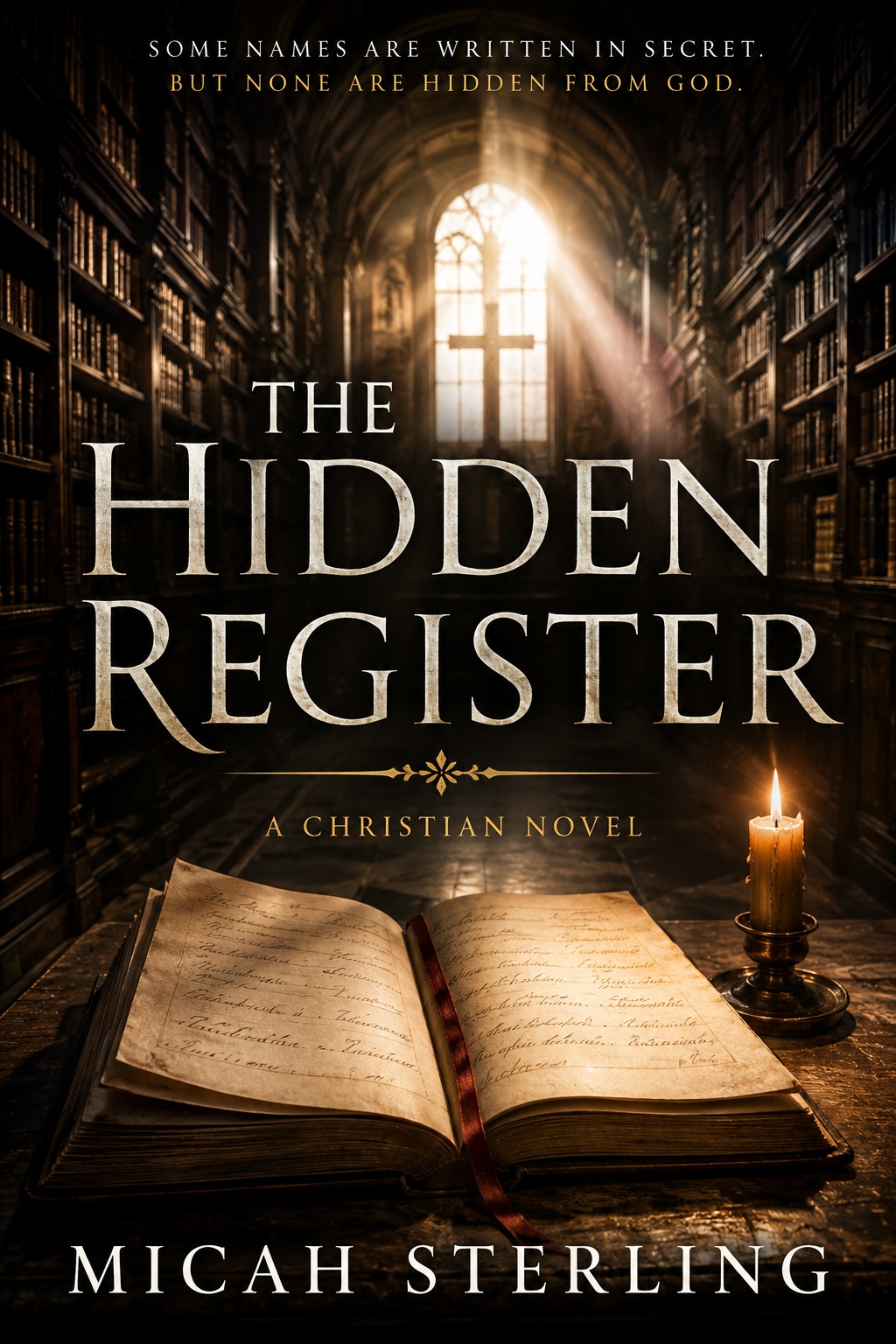
The Hidden Register
Contents5 chapters
Chapter 1
Chapter 1: The Wall Behind the Pulpit
The first knock came after supper, hard enough to shake the latch on the parsonage door.
Elias Mercer had been bent over Sunday notes with his spectacles low on his nose and a cold cup of coffee by his elbow. At the sound, he looked up toward the narrow front hall, listening. The second knock carried with it a burst of voices and the scrape of boots on the porch.
He opened the door to three men from the church, shoulders dark with rain, hats dripping onto the planks. Ben Haskins, who kept the feed store, held his lantern high.
"Reverend, the east window's gone in," he said. "Wind must've thrown a branch. We got water coming through the meetinghouse."
Elias reached for his coat without another question. "Has anyone moved the hymnals?"
"What they could. Come quick."
He stepped into the night and pulled the door behind him. Rain drove sideways through the street, flattening the dust into black paste. The river below town made a long, swollen sound between the warehouses and sycamores, and every few moments lightning showed the church hill in a white cut of light, the steeple leaning out of the dark like a finger raised in warning.
By the time he crossed the yard and climbed the church steps, his cuffs were soaked. The front doors stood open. Inside, lanterns swung in nervous hands. Water struck the floorboards in a steady sheet beneath the broken window, and one of the younger men was dragging a barrel under the worst of it.
"Mind the organ," Elias said, shrugging out of his coat. "Lift the bench too. Jacob, get those lesson papers off the table."
He moved from pew to pew, gathering Bibles, stacking them on the dry side of the sanctuary. The room smelled of wet pine, lamp smoke, and plaster turned soft by water. A blue flash lit the rafters overhead. Then came a crack so violent the men ducked where they stood.
Something had struck the rear side of the church.
"Back wall," Ben said.
Elias took a lantern and went down the side aisle. Rain hissed through the broken pane behind him. At the rear of the sanctuary, near the small door that led to the vestry, flakes of lime and splinters lay across the floor. He held the lantern close. A section of the wainscot had pulled loose from the wall, one corner hanging open where some beam or branch must have jarred the outer boards.
"Leave the front to them," he said over his shoulder. "I've got this."
He set the lantern on a pew and pulled at the loosened panel. The nails came reluctantly with little cries in the wood. When the board fell away, it showed not brick or lath, but a narrow cavity between studs, deeper than he expected. A strip of oilcloth had been wedged there, dark with age.
Elias frowned. He reached in up to the wrist and drew out a parcel no larger than a family Bible, wrapped twice in the stiffened cloth and tied with faded twine.
For a moment he only stared at it, rain thudding on the roof, voices carrying from the front. The parcel left grit on his hands. Whoever had placed it there had done so long ago and with care.
He carried it to the vestry table and untied the cord.
Inside lay a Bible in black leather, small enough to fit in both hands. Its spine had no title left on it, only a ghost where gold leaf had once been. When Elias opened it, the front pages crumbled slightly at the hinge. Much of the center had been cut away with a blade, every leaf hollowed into a rectangular well.
Within that hollow rested a single folded page and a torn scrap of map paper.
The page was covered in writing so cramped it looked at first like account marks. He drew the lantern nearer. Not account marks. Letters, but arranged in columns, broken by numbers and stray verse references. At the top, in a hand more forceful than the rest, someone had written: LUKE 8, MATTHEW 13, JOHN 10.
The map fragment was worse for wear, one edge burned black and another rotted through where damp had bitten it. He could make out a river line, a ridge, and an inked cross beside words written in blunt block letters.
NEW WORLD.
He read the words again, not trusting the first impression.
"Reverend?"
He looked up sharply. Jacob Teal stood in the doorway, seventeen and wet to the skin, his hair stuck flat to his forehead. "You all right?"
Elias turned the page over before the boy could see. "Yes. Fetch me another lamp. This one smokes."
Jacob did not move at once. His eyes had caught on the opened parcel, curiosity plain as sunrise. Elias held out his hand.
"The lamp, Jacob."
The boy nodded and disappeared.
Elias folded the ciphered page and the map fragment inside his pocket Bible, then slipped the hollowed volume back into the oilcloth. He was not a secretive man by habit. His sermons were plain, his accounts open, his visits in daylight. Yet as he tucked the parcel beneath his arm, he felt with complete certainty that if he laid these things on the vestry table for all to inspect, they would be carried from hand to hand until whatever meaning they held was muddied beyond repair.
And there was the phrase itself. New World. Not scripture. Not any church committee title he knew. Something named, hidden, and sealed inside the wall behind his own pulpit.
The rest of the work passed in pieces. Men climbed ladders to tack canvas across the broken window. Women from neighboring houses arrived with rags and blankets to save the pew cushions. Rain pressed on until near midnight, then slackened to a cold dripping from the eaves.
When the last lantern was put out, Elias remained.
He told the others he meant to check for leaks in the vestry roof. Ben Haskins offered to stay. Elias thanked him and sent him home to his wife.
Alone at last, he bolted the front doors and carried the smoking lamp into his study behind the sanctuary. The room was small, lined with shelves and a potbellied stove gone cold. On the desk lay the membership ledger, a stack of tracts, and a china cup holding three pen nibs. He shut the door, sat down, and brought the hidden papers into the circle of light.
The coded page resisted him at once. Every line contained a sequence of letters broken by scripture citations. Some words were plain enough—field, gate, lamp, valley—while others were strings that made no language he knew. The numbers might have been chapter and verse, or a key, or a decoy. The hand itself was old-fashioned, likely from before the war. He compared several lines, murmuring them under his breath.
"John ten... gate... shepherd... no. Matthew thirteen... field, treasure."
He looked to the map. The river bend drawn there resembled the local course, but the fragment was too incomplete to fix with confidence. The ridge could have been any of a dozen spurs west of town. A tiny notation near one torn edge appeared to begin with the letters B-E-L, and then vanished where the paper was missing.
Bell? Below? Belief? He rubbed at his brow.
The church clock in the sanctuary struck one with a thin, uncertain tone. He leaned back and let his eyes close for a moment.
That was when he remembered Old Silas Boone.
Not because the cipher made sense, but because of the possible word fragment and the place where the parcel had been found. Silas had rung the church bell since Elias first came to town seven years before. He had done it in sickness and in heat, with those long rope-burned hands and his stooped shoulders, never missing a funeral toll or Sunday peal unless fever kept him to his bed. He was older than any man in the congregation by at least a decade, and if there remained in town a memory older than the church walls, it likely sat behind Silas's eyes.
Yet Silas was dying.
Elias had seen him that very week in the little room he rented behind the cooper's shed, wrapped in quilts and diminished almost to his bones. The physician had said there was fluid in his lungs. The man could barely climb the church steps now.
Elias spread the map flat again and turned the lamp wick lower. A thought came unwelcome and stayed: if Silas knew anything, time had narrowed to a crack.
He rose, paced once the width of the study, then stopped before the shelf where the church archives were kept. The older record books sat on the lower board, calfskin and canvas ledgers inherited from ministers dead before his birth. He knelt, lifting one after another. Baptisms, marriages, discipline cases, donations for roof slate and coal. He found no mention of New World. No map. No note tucked between pages.
At the back of the shelf stood a cedar box containing loose papers from the founding years of the congregation. Most were routine—receipts, land descriptions, committee lists faded brown. But beneath them lay a small broadside, folded into quarters. He opened it carefully.
A notice for a day of fasting after the valley fire of 1848.
The valley fire.
He read the short announcement twice. It named no dead. It asked prayer for "those displaced by the grievous burning and the trials that followed." There was no location, only the date and the church seal impressed weakly at the bottom.
Elias set the broadside beside the map. Outside, the dripping had nearly stopped. He could hear the river more clearly now, heavy and tireless in the dark.
Someone had hidden a carved-out Bible inside the church wall. Someone had linked it to certain gospel passages, to a map fragment, and to the words New World. The old records held a single dry mention of a fire fifty years gone. And the one man in town who might have heard the story from those who lived it was losing his breath by inches.
He gathered the papers, wrapped the hollowed Bible again, and locked all of it in the bottom drawer of his desk. The key he put in his vest pocket.
Before leaving, he stood in the doorway to the sanctuary. Moonlight, thin after the storm, showed the wet sheen of the floor where the window had broken. The pulpit rose at the far end, modest and scarred by years of hands. Behind it, the wall gaped dark where the panel had come free.
His church, he thought. His charge. A house he had believed he knew board by board.
He extinguished the lamp, then changed his mind and lit it again.
Instead of going home, he took his hat from the peg, locked the church, and started down the hill toward the row of cottages behind the cooper's yard, where Old Silas Boone lay waiting in the last hours before dawn.
Chapter 2
Chapter 2: The Bell-Ringer's Last Account
Mara Wren's schoolroom smelled of chalk, lamp oil, and apples stored too long in a crate beneath the window.
By noon the day after the storm, the children had gone, leaving their copybooks stacked by size and a row of slates drying near the stove. Mara stood at the front table with her sleeves turned once at the wrist, reading the ciphered page without blinking. She was a woman who gave full attention to the thing in front of her, whether it was a misspelled lesson or a widow's fence line dispute. Elias had always admired that in her, though he seldom said so.
"It isn't nonsense," she said at last.
"That much I had gathered."
She gave him a brief look over the page. "You had gathered that it troubles you. That's different."
He accepted the rebuke. He had come to her after an hour at Silas Boone's bedside that morning had yielded only coughing, muttering, and one repeated plea for water. The old man had known him, perhaps, but his eyes were clouded with pain and fever. Elias had left with no answer except a stronger sense that he was already late.
Mara spread the page flat with both hands. She had lost her husband three winters earlier when a timber raft overturned on the river. Since then she had worn plain dark dresses, taught six grades in one room, and developed a reputation for seeing through excuses before they finished being spoken.
"Read me the headings again," she said.
"Luke eight. Matthew thirteen. John ten."
"Parables and the shepherd." She traced one column with the end of a pencil. "And here the writer repeats the word field, though not in a plain sequence. Here also hidden, lamp, under, hear. If the gospel references are keys, perhaps each verse provides a letter. Or perhaps the order of the words matters more than the cipher itself."
Elias pulled a Bible from the shelf by her desk. She turned to Luke first, then Matthew, then John, moving quickly but not carelessly. Once she tucked a strand of dark hair behind her ear and bent nearer the page until the lamp gloss touched her cheek.
"Listen," she said. "What if the citations are not to be read by chapter alone, but by repeated words? Hidden things. Seed on good ground. The fold and the gate. These are not random passages. They're thematically linked. Whoever made this expected the reader to know scripture well enough to sort by image."
"A preacher's puzzle," Elias said.
"Or a preacher's warning. Hand me your pencil."
For the next hour they worked in near silence except when one or the other read a verse aloud. Mara made a list of recurring terms: lamp, hill, fold, door, field, stone, hear, gather. She matched them to odd letter groups on the page, striking out false attempts with crisp, decisive lines. Elias copied from the map fragment and tried to reconcile its ridge marks with what he remembered of the county survey hanging in Judge Vale's office.
At last Mara leaned back.
"There. Not complete, but enough."
She turned the paper toward him. Out of the muddle of letters and references she had drawn a rough instruction:
FOLLOW THE BELL / ASK THE KEEPER / FIRE TOOK THE VALLEY / THE LIVING WENT ABOVE / SEEK THE SECOND REGISTER.
Elias read it once, then again more slowly. "The keeper is Silas."
"If he is able to speak plainly." Mara tapped the line about the second register. "This interests me more. Churches keep a main register. A second one is either a copy or a secret."
"And the living went above," Elias said. "Into the mountains."
Mara folded the paper. "Then we should go to Silas Boone now, before the physician arrives and turns us out."
They found the old bell-ringer in his room behind the cooper's shed, where the air was sour with mustard plaster and damp wool. A basin sat untouched on the chair. Through the thin wall came the dull thump of barrel hoops being set in place, steady as a slow heart.
Silas lay propped against two pillows, his face drawn down around the mouth, gray beard spread crooked over the blanket. His chest worked visibly. A Bible rested on the table beside him, not open for reading but placed there like a family member.
When Elias stepped near, Silas's eyes shifted and settled on him with effort.
"You came back," the old man whispered.
"I did. And I've brought Mrs. Wren. She may help us keep things straight."
Silas gave the smallest motion that might have been assent. Mara moved the chair close but did not sit until he looked at her directly.
Elias drew the folded cipher from his coat and held it where Silas could see. "This was hidden in the church wall. We believe it points to something called New World."
At the sight of the page, a change came over the old man so swift it seemed to strip years from him. His hand lifted off the blanket, trembled in the air, and fell again.
"I told them bury it deeper," he said. The whisper frayed on the last word. "Not in God's house. Men tear at walls when storms come. Men pry."
Mara sat down. "Who told you?"
Silas wet his lips. Elias poured a little water from the pitcher and raised his head while he drank. When the fit of coughing passed, Silas stared toward the low ceiling as if reading from a place above it.
"My father was there after the burning," he said. "Boy of twelve, carrying bread in a flour sack. His mother had kin among them. He told me when I was a grown man and made me swear I'd never hand the thing to the likes of Amos Vale's people. Said the founders lied before God and called it order."
Elias felt Mara turn toward him at the name.
"What burning?" Elias asked.
"Valley settlement west fork side. Not this town. Before your time. Before mine, near enough. Families worshiped apart. Too poor, some said. Too stubborn, said the others. They had a preacher no committee approved, and men in town disliked what they couldn't govern. Then came the fire."
He stopped, chest hitching.
"Accident?" Mara said quietly.
Silas's eyes found hers. "That's what was preached over the ashes."
The cooper's hammering next door ceased. The sudden stillness made the room seem to tilt around the bed.
"Survivors?" Elias asked.
"A handful. Mothers, children, two old men, one deacon with half a hand. Others joined later. They were taken up by night into the ridges and hidden in a place known only to three founders of this church and one surveyor. Hidden to keep them safe, so they said. Hidden till tempers cooled, till claims could be settled. Only the claims got settled without them. Land filed over. Names stricken. Offerings redirected. Town prospered. The hidden folk waited."
Mara's jaw set. "And this place was called New World?"
Silas nodded weakly. "Mocking at first. Then true. They had to build life from nothing. Chapel, root cellar, spring-house, tunnel in rock for winter stores. They kept their own register because the town books had already begun to forget them."
Elias thought of the phrase on the page: the living went above. "Did they remain there?"
"For years. Maybe longer. I never saw it." He coughed again, and this time there was red in the cloth Elias pressed into his hand. Silas looked at the stain with mild surprise. "My father carried messages twice. After that, no more. One founder died. Another lost nerve. The third took control of all papers left in town. Vale blood."
The room tightened around the name. Judge Amos Vale, who sat in the magistrate's chair by election and in every committee room by habit, whose grandfather had built the courthouse wing and endowed the school stove fund, whose family graveyard rose in marble above the common plots.
"You are certain?" Elias asked.
Silas shut his eyes. "Certain enough to fear them fifty years."
Mara leaned forward. "The cipher mentions a second register. Where is it?"
Silas worked his tongue against dry lips. "Not with me. Didn't trust my own roof. The first clues were hid in the wall by Reverend Pike, after he learned enough to be sorry. Said if truth could not be preached then, it might be found later. Second register..." He paused so long Elias thought he had drifted away. Then the old man said, very softly, "Vale kept what he could seize. But not all in church books. Search where law pretends to be memory."
Mara frowned. "The judge's office."
Silas opened his eyes once more and fixed Elias with an intensity the fever had not burned away. "You mind your flock," he whispered. "Men like Vale call that peace, when a flock is penned small enough not to see the hill fire that made them. If you find New World, don't let them sell it, don't let them turn prayer into a claim deed. Promise me."
Elias took the old man's hand. It felt light as bundled twigs. "I promise to tell the truth of it."
Silas's fingers closed weakly, then released. "Bell rope in my hands forty year," he said. "Thought if I rang long enough maybe somebody honest would hear the wrong note in the story."
His gaze wandered past them, toward the room's dim corner. "Hear that?"
Neither Elias nor Mara heard anything but the cooper resuming his work.
Silas smiled faintly. "Sunday peal. Fool thing. Ain't Sunday."
The physician arrived a quarter hour later and ushered them out with the impatience of a man who had too many patients and no medicine fit to save them. On the path beside the shed, Mara tied her bonnet strings against the wind left over from the storm. Her face was composed, but her eyes were bright with anger.
"He said enough," she murmured.
"Enough to accuse a dead generation and the living heir of it," Elias said.
"And enough to know why the matter was hidden." She looked toward the courthouse cupola rising above the town roofs. "If a congregation was erased from the record, the record itself is part of the theft."
They walked uphill in silence. Wagons rattled through mud on Main Street. A pair of boys floated sticks in the gutter stream. Life had resumed its ordinary motions, and this made Elias uneasy. He had spent years telling people that truth did not lose its force because the market opened and the riverboats came and children tracked dirt onto the church floor. Yet now a buried past had pushed through the boards and he found himself resenting every common sound around it.
At the church gate, Mara stopped.
"What will you do?"
He looked at the steeple. In daylight it seemed no more mysterious than it had the week before. The broken east window had been boarded over. Ben Haskins's wagon stood out front with replacement glass. Two women carried in dry cushions. The church was mending itself while he watched.
"I will look at the archives again," he said. "Then I will speak with Judge Vale if I must."
Mara considered him. "If you speak with him before you know where the second register lies, he will know what to hide."
"He may know already."
"Then do not give him the measure of your ignorance."
It was a practical thing to say, and he almost smiled. "You make deceit sound like housekeeping."
"No. Housekeeping is easier."
She started down the lane toward her cottage, then turned back. "If Silas dies before evening, the bell should ring for him. But I wonder whether anyone will hear what else is tolling."
Elias watched her go. He thought of the hollow Bible in his desk, the map torn at the edge, the words New World written in a hand that had expected secrecy to survive half a century. He thought of the judge's office and the locked cabinets there, full of deeds and probate files and the calm official language by which one man's loss became another man's lawful inheritance.
Behind him, inside the church, a hammer tapped glass into place.
He put his hand on the gatepost and stood very still, because from the road below came the slow approach of a black carriage with Judge Amos Vale's driver on the box, climbing the hill toward the church as if summoned by the same secret.
Chapter 3
Chapter 3: The Judge's Locked Cabinet
Judge Amos Vale did not come to the church often except on public occasions, but when he did he carried the place around him as if every room had already been entered in his family papers.
His carriage stopped at the gate. The driver jumped down with an umbrella though the rain had long since passed. Vale emerged carefully, one polished boot to the step, then the other, his coat fitting him too well for country tailoring. He was a broad man gone heavy at the middle, clean-shaven except for a trimmed gray moustache, with pale eyes that seldom rested anywhere without seeming to appraise its use.
Elias met him on the church steps.
"Judge."
"Reverend Mercer." Vale removed one glove finger by finger. "I was told there was storm damage. Unfortunate. The trustees should have attended to the east sash in spring. Neglect is expensive."
"We have the repairs in hand."
"So I see." Vale glanced beyond Elias into the vestibule. "I should like a word about the archives."
The directness of it stiffened Elias at once, though he kept his expression even. "Come into my study."
Inside, Vale remained standing. He looked over the shelves, the desk, the open account ledger, and finally the patched section of wall visible through the doorway to the sanctuary.
"News spreads quickly after a storm," he said.
"In a town this size, it does."
Vale folded his gloves and laid them on the desk without asking. "Certain old church records are not in proper condition to be kept here. Moisture, mice, careless hands. There are matters of title and founding interest mixed among them. As magistrate and chairman of the historical committee, I will have the archives transferred to the courthouse for safekeeping until they may be sorted."
Elias heard the words, but beneath them he heard Silas Boone: search where law pretends to be memory.
"These books belong to the church," he said.
"Many things belong to the church that the church has shown itself poor at guarding. I mean no insult. Only prudence." Vale's gaze settled on him with mild civility. "A shepherd, Reverend, looks after souls. Papers are another discipline."
The phrase landed with deliberate neatness. Elias said, "If there are legal instruments among our records, copies may be made. The originals need not leave."
Vale smiled slightly. "Need has little to do with it." He picked up his gloves. "My clerk will arrive this afternoon. I advise cooperation. Public quarrels over custody invite speculation, and speculation has a way of unsettling simple people."
Then he nodded as if the matter had been arranged by mutual consent and walked out.
By three o'clock two courthouse men came with crates and a written order bearing the county seal. One was the clerk, who avoided Elias's eyes. The other was a deputy with a walnut baton at his hip and no visible pleasure in the errand. The trustees, summoned in haste, muttered among themselves but bent before the seal and the judge's position. Elias protested on record, which the clerk noted in a hand so fine it looked apologetic.
Shelf by shelf, the church's memory went into boxes.
Mara arrived in time to see the last crate carried out. She stood in the study doorway with her satchel in one hand and watched until the wagon rolled away.
"You spoke with him before you knew enough," she said.
"He spoke with me."
"Yes. And he has measured you now."
Elias shut the empty cabinet door harder than he intended. "If you came to say I should have been a more cunning man, you waste both our time."
Mara set her satchel down on the desk. "I came because one of my older boys sweeps the courthouse steps after classes. He says Judge Vale himself carried a bundle from his private office to the records room before your crates arrived, and he locked the inner cabinet with the brass key he wears on his watch chain. He does not always do his own carrying."
His temper cooled at once. "Then something there mattered enough to move."
"Likely before the church books could expose the gap around it." She opened her satchel and drew out a sheet folded from foolscap. "I copied a rough plan of the courthouse when the roof fund was assessed. The judge's office has one exterior window facing the alley and a connecting door to the records room."
Elias stared at the drawing. "You are suggesting I break into the courthouse."
"I am observing that if a false record was used to bury living people, the truth will not walk politely into your hands because you ask after it."
He turned away and braced both hands on the windowsill. Outside, women were hanging wash behind the houses beyond the churchyard. One white sheet snapped in the sun. This was the hour when he might have been preparing a pastoral call or revising a sermon illustration. Instead he was considering theft.
"I have spent my life telling men that right means something before convenience enters," he said.
Mara's answer came after a beat. "Then decide whether a locked cabinet can make a lie righteous."
Old Silas Boone died before dusk.
The bell had to be rung by Jacob Teal, who pulled awkwardly and too fast, making the sound uneven. Elias stood below in the tower stair and listened to the iron tongue strike. Each note shivered through the timbers and down into the floor under his feet. Men removed their hats in the street. Women paused at pumps and porches. The town heard the death of its bell-ringer and marked it in the customary way.
At the supper table that evening Elias could not swallow much. He ate two bites of cold ham and left the plate. In his sitting room the lamp drew a small yellow circle over Mara's courthouse sketch and the decoded page. The line kept returning to him: seek the second register.
Near nine o'clock he rose, put on his coat, and slipped the house key into his pocket.
The courthouse square lay mostly dark. A single gas lamp burned near the front steps, and the watchman's route would not bring him around again for at least half an hour. Elias cut through the side lane, boots silent in the packed mud. The alley wall of the judge's office was brick to shoulder height and then clapboard under the eaves where the addition had been built some years after the original structure. The exterior window sat narrow and high, but not too high.
He stood beneath it and listened. No sound inside.
The sash was latched. He had come hoping for negligence and found none. He looked along the alley, saw an empty barrel and a stack of split kindling by the neighboring print shop, and after a moment's hesitation carried the barrel beneath the window. He climbed onto it, pressed a pocketknife blade between the meeting rails, and worked slowly until the old putty gave with a dry crack. One pane loosened enough to shift. He caught it before it fell, set it aside, and reached in to lift the latch.
A minute later he was inside Judge Vale's office with sawdust on his sleeves and his pulse hammering in his throat.
The room smelled of leather, tobacco, and iron gall ink. Moonlight from the window laid a pale bar across the carpet. He did not light a lamp. He moved by memory of Mara's sketch and what little he had seen when called there for civic meetings. The judge's desk stood near the center. Shelves lined one wall. At the back, the door to the records room was shut.
On a peg beside the desk hung Vale's overcoat. No key chain.
Elias opened drawers one by one, wincing at every scrape. Petitions, correspondence, a packet of cigars, county warrants tied in blue ribbon. In the lower right drawer he found a ring of duplicate keys on a plain wire loop. His hand closed over them so quickly he nearly laughed from relief.
The inner cabinet stood against the far wall, walnut with brass pulls polished by use. The third key fit. He turned it carefully and opened both doors.
Inside were ledger books, deed abstracts, and three wrapped bundles of loose papers. He set them on the floor and searched in order, forcing himself not to hurry. Names flickered past in the moonlight: timber claims, widow allowances, tax sales, road petitions. Then, behind two county assessment ledgers, he found a narrow register in dark red cloth with no title on the spine.
He opened it.
The first page bore the church seal. Beneath it, in an older hand than any current clerk's, were the words: Supplemental Register of Members Removed to Upper Settlement, 1848.
His mouth went dry.
He turned pages fast, then slower when he understood what he held. Names of families. Baptisms entered after the valley fire. Deaths marked during winters in hiding. Notes on provisions delivered, sermons preached in a mountain chapel, disputes settled among the exiles. Beside certain names stood comments in another hand, sharper and darker: to remain omitted from public book; claim transferred; lot entered under temporary stewardship.
Temporary stewardship.
The phrase was a clean glove over a dirty hand.
Folded into the back cover lay a single sheet of heavier paper. Elias drew it out. It was a signed memorandum by three church founders and a county surveyor, agreeing that the survivors of the burned congregation would be sheltered "in the upper basin known privately as New World" until such time as their return could be managed without unrest. Below that, in a later margin note likely written years after, someone had added: Remaining parties not returned. Holdings regularized by consent of committee.
No names of the consenting parties. No witness for those hidden in the mountains.
A floorboard cracked in the outer corridor.
Elias froze, register open in his hands.
Another sound followed: the distinct metal click of the front entrance downstairs.
He slid the memorandum back inside, closed the register, and looked around for somewhere to conceal himself. The judge's desk offered little cover. The records-room door at the back stood his best chance if it was unlocked.
He crossed to it in three steps, tried the handle, and felt it give.
Voices drifted faintly up from below. One belonged to the watchman. The other was deeper, measured, unmistakable.
Judge Amos Vale had come back at night.
Chapter 4
Chapter 4: The Chapel Under Stone
The records room was colder than the judge's office and thick with the smell of old paper.
Elias slipped inside and eased the door until only a finger's width remained open. Through that gap he saw a strip of carpet and the lower edge of Vale's desk. He heard footsteps, then the hiss of a match. Lamp light spread over the office floor.
"You may go," Vale said.
The watchman muttered something obedient. A few moments later the outer door shut again. Vale remained.
Elias stood between shelving cases, the hidden register pressed under his coat. Dust tickled the back of his throat. He dared not cough.
Papers rustled. A drawer opened, then another. Vale moved with increasing impatience. Once a chair leg scraped. Then silence. Elias imagined the judge looking at the cabinet, seeing the changed angle of a ledger or the slight swing of one brass door. He did not breathe until footsteps crossed the office and stopped near the records-room door.
The handle turned.
But the door did not open. In his haste Elias had let it rest against the jamb without fully latching, and perhaps by mercy or chance the catch had caught just enough to resist. Vale rattled it once.
"Damn fool clerk," he muttered.
The footsteps receded. Elias heard the cabinet doors shut hard, keys ring faintly, then the lamp wick lowered. At last came the sound of the office window being tested from inside.
Elias understood then that Vale feared intrusion enough to check every exit with his own hands.
When darkness had sat long enough to feel solid again, he counted fifty breaths before moving. He left by the records-room stair at the rear, crossed the yard behind the courthouse, and did not stop until the church rose before him out of the dark.
Mara was waiting on the parsonage porch with a shawl around her shoulders and a lamp at her feet.
"I had nearly decided to send for the constable," she said.
Elias held up the register.
That ended talk until they were inside with the curtains drawn.
They read at his dining table until the lamp burned low and the coffee turned bitter on the hob. The red-cloth register was plain in style and damning in substance. It named thirty-two souls carried into the upper basin after the valley fire. It recorded births over eleven years, six burials, the purchase of mule tack and seed corn delivered by unnamed friends, and sermons copied from memory when no ordained minister reached them in winter.
Near the back, a different hand entered directions in abbreviated form, likely for trusted couriers: from Bell Creek gap to split rock, then north by three white pines, then through old chapel cut. The map fragment from the hollowed Bible matched these notations where it could.
Mara laid both papers side by side. "Bell Creek. That must be the B-E-L on the torn edge."
Elias nodded. "And old chapel cut may mean a pass or a landmark."
She turned three pages farther and found a later entry. "Listen to this. 'Stores secured below the prayer room by stone passage against snow and seizure.' Below the prayer room." Her eyes lifted. "A tunnel."
He rubbed at the place between his brows. Fatigue pulled at him, but underneath it ran a hard current of resolve. "If New World still stands in any form, the records will be there."
"If Vale does not reach it first."
The thought made decision immediate. By dawn they had arranged what provisions they could carry and sent Jacob Teal with a note to a man named Caleb Rusk, one of the few guides in town who knew the upper trails well enough to hire himself to timber crews and hunters both. He arrived by midmorning: long-limbed, red-bearded, wary of church errands but willing when Mara named a sum and Elias added another.
"Bell Creek gap," Caleb said, studying the copied directions. "I can take you near enough. Beyond that the mountain chooses what it shows."
Judge Vale sent for Elias at noon. Elias sent back word that funeral duties for Old Silas Boone occupied him till the following day. This was not entirely false. The old bell-ringer's body did rest in the church under a quilted pall, and the town's grief was sincere. Yet while women arranged candles and men measured the grave, Elias packed hard bread, dried apples, and the register wrapped in oilcloth.
They left before first light the next morning, slipping west beyond the last houses while smoke still lay low over the chimneys. Mara rode a sure-footed bay mare borrowed from her brother's widow. Elias and Caleb went on mules. The path rose from river mud to laurel thicket and then into firmer mountain ground where the air sharpened.
By afternoon the town had dropped away behind folds of ridge. They crossed Bell Creek at a ford cluttered with slick stones, then followed its narrowing run toward a gap where the banks steepened and the light turned green under hemlock. Caleb spoke little except to point out bear sign and warn where the trail shelved off into a ravine.
At a split boulder he reined in. "There's your rock," he said.
The stone stood shoulder-high, cleaved down the middle as if by an axe from heaven, though Elias was not given to such phrases lightly. Three pale pines rose on the north slope beyond it, their bark strikingly white among darker trunks.
Mara touched the copied note tucked in her pocket. "Then we are on the line."
From there the way ceased to be a proper trail. They climbed through brush and loose shale, leading the animals one at a time. Once Mara slipped and caught herself on both hands. Elias offered help; she waved him on and stood under her own strength, dirt streaked across her palm. Caleb found an old blaze mark nearly swallowed by bark and followed it uphill to a narrow cut between rocks where cold air breathed steadily from shadow.
"Old chapel cut," he said.
On the far side the basin opened suddenly, hidden from every approach by ridges folding around it like knuckles around a coin. The place held a meadow gone wild with waist-high grass, several low stone outlines black with moss, and at the center, half caved and swallowed by vine, a small clapboard chapel listing under its own roof.
No one spoke for a while.
The silence there was not empty. It had the dense quality of a room recently left, though the boards were silver with age and one corner of the belfry had fallen in long ago. Elias dismounted and walked forward on legs that felt uncertain. Under the grass he found the straight line of a lane. Near the chapel, a square depression marked where a cellar had sunk.
"They made a settlement," Mara said quietly. Not surprise. Recognition.
The chapel door had warped but not rotted through. Caleb put his shoulder to it and it gave with a groan, spilling stale air and a scatter of leaves. Inside stood two rows of benches, one broken, one intact. At the front rose a lectern fashioned from local poplar, plain as any frontier church furnishing. Sun came through gaps in the roof and fell on the floor in clean bars.
Elias went to the lectern. A Bible lay there, its cover gone, pages fused by damp. Beside it sat a clay inkwell and a rusted pair of spectacles. He touched neither at first. To disturb them felt like interrupting prayer.
Mara had already begun to inspect the room in practical fashion. She knelt near the front boards where the register's note had suggested something below the prayer room. "Here," she said. "See the wear? More feet passed this way than toward the benches."
Caleb used the butt of his knife to tap the planks. One answered hollow.
Together they cleared debris and pried up a square of flooring fitted more neatly than the rest. Beneath it a narrow stone stair dropped into blackness.
Air rose cold and mineral from below.
Caleb took the lamp. "I'll go first."
The passage under the chapel had been cut partly through earth and partly through rock, reinforced in places with timber now bent but holding. It ran no more than twenty yards before widening into a chamber lined with shelves. On those shelves stood crocks sealed with wax, bundles wrapped in cloth, a child's shoe gone stiff with time, and boxes of papers stacked inside a crude cabinet built against the driest wall.
Mara exhaled sharply. "Records and relics."
Elias set his hand on the cabinet and felt how carefully it had been made. Not a hiding place thrown up in fear for a week or two, but a store meant to outlast winters.
They opened the first box. Inside lay hymn sheets copied by hand, letters never posted, and a second register more complete than the one taken from Vale's office. The writing inside this book was steady and personal, noting not merely names but weather for planting, sermons preached by laymen when no minister could reach them, births welcomed with borrowed blankets, and grievances against those in town who had promised return and sent only silence.
In another box they found carved communion cups, blackened at the rim by use, and a packet of affidavits signed with marks by settlers who could not write their names. One statement named specific men who diverted supplies and filed claims over abandoned valley lots. A Vale appeared among them.
Caleb lifted a lantern toward the far wall. "You should look here."
Chiseled into the stone was a list of dates. The last one came eleven years after the fire, followed by a line: WE GO EAST AT THAW. No further entry followed.
"So they left," Mara said.
"Or meant to," Elias answered.
The question of where they had gone settled over them like dust. Back to town under assumed names? Farther over the range? Into other counties where their record thinned and vanished?
From somewhere above came a sound.
A board, disturbed under weight.
Caleb set down the box without noise and reached for the rifle slung on his back. Mara closed the register at once. Elias turned toward the stair.
Another step creaked overhead, slow and deliberate, followed by the scrape of the chapel door opening wider.
They were not alone in New World.
Chapter 5
Chapter 5: The Vault of Names
Caleb raised the lamp wick with his thumb until the chamber sharpened around them.
"Stay behind me," he said.
Elias did not. He took the fuller register under one arm and moved to the foot of the stone stair, listening. Voices filtered down now, muddied by boards and distance. One he did not know. The other carried the flat authority of a man accustomed to speaking where dissent was costly.
Judge Amos Vale.
Mara came to stand beside Elias with the packet of affidavits tucked into her satchel. Her face had gone very still.
"How many?" she whispered.
Caleb tilted his head. "At least two. Maybe three."
They heard the floor hatch shift. Boots crossed overhead. Someone cursed at the smell of damp below. Then Vale's voice, clearer now:
"Bring the lamp down and mind the boxes. We take the books first."
So that was his purpose laid bare. Not preservation. Possession.
Elias looked at the shelves around him—the hand-copied hymns, the household ledger, the carved cups worn by hidden worship, the names entered so they would not be erased. To leave by some rear fissure, if one existed, would save his skin and cost the truth. He felt fear in him, plain and bodily. He also felt a steadiness underneath it, the kind that had come to him only a few times in life: beside deathbeds, in storm-split nights, once when baptizing a man who had wronged his own brother and came to the river shaking.
"No shots unless he gives cause," Elias said quietly to Caleb.
Caleb grimaced but nodded.
They climbed the stair together.
Judge Vale stood in the chapel above with a lantern in one hand and a revolver in the other. Behind him was his deputy, the same thick-shouldered man who had helped seize the church archives. A third fellow, likely hired from outside town, hovered near the door. Wind moved through the broken roof and stirred dust in the lantern glow.
Vale's eyes widened only a fraction when Elias rose from the opening in the floor. Then his expression settled back into control.
"Reverend Mercer," he said. "You persist in making poor choices."
Elias stepped onto the boards. Mara came up after him. Caleb remained one stair lower, not hidden but not yet fully exposed.
"You followed us," Elias said.
"You stole from my office," Vale replied. "I corrected for your lack of judgment. Hand me the register."
Mara gave a short sound that was not quite a laugh. "Your office? That book names your family's theft as neatly as any title abstract."
The deputy shifted at that. Vale did not look at him.
"Mrs. Wren should guard her tongue," he said. "Rumor is one thing. Libel another. Those records are unverified relics from a confused period. Whatever happened here happened under pressures none of you understand. If disorder was prevented, the town owes thanks, not scandal."
Elias looked past him through the chapel door. The basin lay gray in the late afternoon light, grass bending in long strokes. It struck him then that generations had labored to produce the smooth public story of his town: founders noble, church steadfast, losses borne equally. And all the while this room under the floor had kept its own witness like a coal banked under ash.
"A congregation burned out of its valley," Elias said, "then hidden until its land could be regularized. Those are your family's words, Judge. I have read them."
Vale lifted the revolver an inch. Not aiming yet. Emphasizing. "And I have read enough law to know the dead cannot contest settled claims. Nor can a preacher unmake a county by brandishing old grief. Think. If this goes home with you, every title between the river and west fork will be challenged. Men who did no wrong will pay for bones in the ground. The church will be dragged through courts. Your flock will fracture."
The argument had force because it touched what Elias feared most. He pictured widows whose plots were thin and hard won, shopkeepers with small deeds, families who had inherited in innocence. Truth, once opened, would not sort the guilty neatly from the merely descended.
Mara seemed to read the struggle in his face. She said into the pause, "If peace depends on a lie, it already has cracks in it."
Vale's gaze cut toward her, sharpened. "You have always mistaken impertinence for courage."
Before she could answer, the deputy spoke. "Judge."
Vale did not turn. "What is it, Harrod?"
The deputy cleared his throat. "If the papers say what they say, I'd rather hear it plain before we start hauling boxes."
That, more than any sermon might have, shifted the balance in the room. Vale's control rested on other men doing the next thing without forcing him to name its cost. Now the cost had a witness's face.
Elias drew the memorandum from the register and held it open. "Come read it, if you dare."
Vale took one step forward, then stopped when Caleb mounted the last stair behind Elias with his rifle angled down but visible. The hired man by the door muttered and backed half a pace into the daylight.
No one moved for several breaths.
At last Elias began to read aloud.
He read the founders' agreement to remove the survivors to the upper basin called privately New World. He read the promise of temporary shelter. He read the margin note by which return had been quietly abandoned and holdings absorbed under committee consent. Then he opened the fuller register and read names. Children baptized in exile. A woman buried in February after fever. A deacon petitioning for news of his valley field and receiving none. A line from a lay sermon copied there by some forgotten hand: Better an honest wilderness than a furnished lie.
The words changed the room. Even the wind seemed to pause between the roof slats.
Deputy Harrod lowered his eyes. The hired man took off his hat. Vale's face did not alter much, but color had receded from it until his skin looked waxed.
"Rhetoric," he said. "A few pages of grievance and piety. Hardly proof fit for court."
Mara opened her satchel and held up the packet of affidavits. "Then perhaps marked statements naming diverted provisions and forged claim stewardship will interest a court more." She turned to Harrod. "Would you care to carry them yourself, deputy, and be known as the first honest officer in this matter?"
Harrod looked from her to Vale, then to Elias. He was not a brave man by appearance, but shame can make a spine where none was evident before.
"Judge," he said slowly, "I won't help burn papers. And I won't draw on the reverend."
Vale's mouth tightened. "You think this ends with applause? You fool. It ends with suits, ruin, grandstanding ministers, newspapers from Knoxville sniffing around every grave marker in the county."
"Maybe," Elias said. "But it will end in daylight."
Something in that answer broke the last useful fiction between them. Vale raised the revolver.
Caleb moved faster. He brought the rifle stock up under Vale's wrist, striking the gun aside as it fired. The shot tore splinters from the chapel wall. Mara flinched but did not cry out. Harrod lunged from the side, catching Vale around the shoulders. All three men crashed into the front bench, which collapsed under them with a crack of old wood.
The revolver spun across the floor and slid to Elias's boot.
He kicked it back toward the stair opening and stood over it while Harrod wrestled the judge's arms behind him. Vale fought with surprising strength for a heavy man, then sagged, breathing harshly.
Dust hung in the air. Through a hole in the roof a strip of evening light fell across the ruined bench.
No one spoke for a few moments.
Then Vale lifted his head and looked straight at Elias. The old assurance had gone from his face. What remained was uglier and more tired.
"Do you think truth makes men clean?" he said. "It only gives them new weapons."
Elias answered after a pause. "That may be. But it also gives the robbed their names back."
They bound Vale's wrists with a mule lead and sat him against the chapel wall. Harrod, pale and sweating, agreed to return with them under witness and place the judge before circuit authorities rather than the local bench. The hired man wanted no part of county scandal and fled downslope before anyone could stop him.
In the chamber below, Elias and Mara gathered the most crucial records first: the fuller register, affidavits, the founders' memorandum, and enough corroborating documents to withstand any claim of forgery. The carved cups and household relics they left boxed where they were, taking care to conceal the stair again as best they could. New World had been hidden too long, but it need not be stripped bare in one frightened hour.
Night met them halfway down the mountain. They made camp only long enough to tie Vale and set watches in turn. He said little after dark. Once Elias saw him staring into the fire with such fixed bitterness it seemed he was watching not the flames before him but some inheritance burning farther back.
They reached town by late morning to a stir that outran them from the edge of the road. News of the judge's absence had already spread. So had word, by Harrod's own strained telling, that papers had been found in the mountains. Men gathered at the courthouse steps. Women stood in knots along the boardwalks. When Elias dismounted in front of the church, the bell for Silas Boone's burial was just beginning to sound, this time rung by Ben Haskins with solemn care.
It was fitting, Elias thought, though painful, that the old bell-ringer's funeral and the return of the hidden record should meet at the same hour.
He did not mount the pulpit that day to announce triumph. He placed the registers on the communion table in full view, their worn covers plain under the sanctuary windows. He told the congregation only what he could support: that a concealed settlement had existed in the mountains after the valley fire, that church founders had aided survivors and then failed them grievously, that legal review must follow, and that no relic or land would be sold, parceled, or exploited under his ministry. A lawful search party, including county officers from outside the district, church trustees, and witnesses from the town, would return to New World in due order.
There were gasps, tears, hard looks, whispered denials. Some faces closed against him at once. Others opened in grief. Mara stood near the front pew, steady as a post. Harrod remained at the back in borrowed plain clothes, hat in both hands. On the table, the old names waited to be read.
After the service, people filed past in uneven silence. A few touched the register covers with their fingertips. One old woman stopped and began to weep before she reached them. She told Mara her grandmother had been "sent off over the ridge for a season" and had never spoken clearly of where.
By evening the church was fuller than on any revival Sunday Elias had seen. Not with peace. With reckoning.
When the last question for the hour had been asked and no answer yet could satisfy it, Elias carried the fuller register back to the communion table and opened to the first page of names. He looked out at his flock—frightened, doubtful, hungry for certainty he could not honestly give.
Beyond the windows the mountain line stood dark against the fading sky, and somewhere beyond it the hidden basin waited with its chapel, its stone passage, and the rest of its witness still under floorboards and rock.
Elias set his finger beside the first name and began to read, while outside the church door a fresh group from town pressed in to hear who had been missing all along.
Write your own novel.
ScribistIQ generates full-length novels in minutes. Type your premise, walk away, come back to a finished book.
Try ScribistIQ