
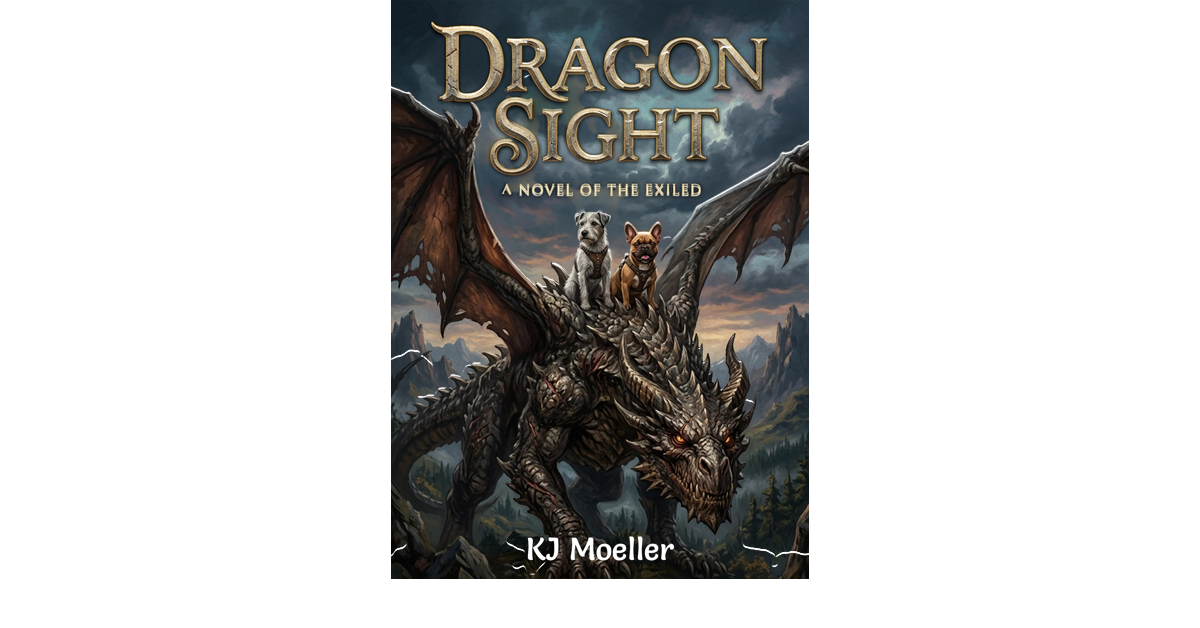
Novel · 12 chapters · 55,695 words
Dragon's Sight
Contents12 chapters
- 01The Dragon in the Quarry
- 02The Night of Cinders
- 03A Map Drawn in Bark and Scent
- 04The Pass That Answered Back
- 05The Hut with Sea Glass Windows
- 06Four Paws, Two Riders, One Dragon
- 07The Market of Masks and Feathers
- 08Salt on the Wind
- 09The Bell Tower Trap
- 10Where the Caves Sing
- 11The Valley That Would Not Open
- 12A Home Large Enough
Chapter 1
The Dragon in the Quarry
The sheep carcass had gone sour around the ribs.
Jeffrey knew it before his claws touched it. Flies worked the split hide in a thick, patient shimmer, and the wind carried that wet, spoiled sweetness that meant the meat had been dead too long in the sun. He crouched in the shadow of the quarry wall and lowered his head anyway, because spoiled was still food and because hunger made poor bargains sound reasonable.
The quarry around him was a bowl of white stone gnawed out of the earth. Broken ramps slanted down into it. Piles of slate chips and chalk dust sat where men had abandoned them months ago, maybe years. At one end a crane arm leaned crooked over nothing, its rope dangling and clicking softly against the timber frame. Jeffrey had learned every sound the place made when it was empty. Pebbles sliding under a rabbit. Wind whistling through drill holes. The dry clack of ravens hopping on cut stone.
Human feet sounded different.
He froze with one foreclaw hooked under the carcass. Above, near the thorn scrub at the lip of the quarry, gravel ticked and shifted. Light steps. Then a second set, heavier in a clumsy, irregular way, followed by an explosive snort.
“Keep your nose out of that,” said a voice, old and rough as bark.
“I can’t,” said another voice at once, breathless with conviction. “It’s attached to my face.”
Jeffrey did not move. Dust settled on the ridges of his back. The flies rose, annoyed, then returned to their feast.
Dogs.
He exhaled carefully through his nostrils. Dogs from the village came sometimes, usually in packs and never alone. They ran the quarry edge barking themselves brave, then fled at the first scrape of his scales. These two sounded too close. Too unworried.
A white muzzle appeared over the rim.
It belonged to a small dog with a square chest and lean legs, old but not frail. His coat, where it wasn’t stained with travel, had the clean hard white of bone. One ear stood up. The other folded at the tip as if it had long ago given up arguing. He took in the quarry at a glance that seemed longer than it could have been. His eyes skimmed the broken crane, the spill of stones, the dark cleft where Jeffrey stood, and for one odd moment Jeffrey had the feeling of being measured rather than discovered.
The second dog launched over the rim before the first could stop him.
He was compact and brown and mud-splattered to the ears, all chest and enthusiasm. He landed in a spray of pale dust, sneezed so violently he nearly somersaulted, then sprang back up with a rattling snuffle.
“Smells like ten thousand interesting mistakes,” he announced.
“It smells,” said the white dog, picking his way down after him, “like death and poor choices.”
The brown one was already trotting deeper into the quarry, nails ticking on stone. He followed the scent trail of the carcass in wild loops, nose down, tail twisting with such vigor that his whole hindquarters wagged. The white dog moved more slowly. He did not call out again. He did not bark.
Jeffrey drew his wings tighter to his sides. At his full height he could have looked over the quarry rim. Here, folded into the notch in the wall, he managed only to seem like a landslide with teeth. Men had once called that a mercy. Men had called many things a mercy while carrying spears.
The brown dog saw the carcass first.
“Oh,” he said in a tone of reverence, then, with equal reverence: “Oh no.”
He crept toward it, nose working furiously. The white dog reached him and stopped, expression flat.
“Sheep,” said the white dog.
“Former sheep,” said the brown one.
“Leave it.”
“I only want to understand it.”
“You understand plenty. It’s rotten.”
The brown dog glanced up. “Rotten means someone else doesn’t want it. That’s not the same as useless.”
The white dog considered this, then sighed. “Punki, you are living proof that appetite can survive without wisdom.”
Punki beamed. “Thank you.”
Jeffrey’s talon shifted against the stone. It was a small sound, no louder than two pebbles touched together, but it cut through the quarry.
Both dogs snapped around.
There were many ways creatures reacted to him when they first truly saw him. Horses screamed. Men reached for weapons and whatever prayers came easiest. Sheep became stupid with stillness. Dogs usually barked first and thought later.
Punki did nothing for a heartbeat. Then his ears pitched forward and he took three quick steps toward the dark cleft in the wall.
Bernie, for Jeffrey assumed this one with the old voice could be nothing else, moved in front of him so fast the action was almost invisible. Every line in the small white body went taut.
Out in the open, Jeffrey let the shape of himself be seen.
A horn curved back from one side of his head with a chipped tip white as old ivory. The other bore a scar where something sharp had once sliced along the base and left a pale seam through the scales. His hide held the color of storm clouds over deep water: dark, bruised, faintly silver where the light struck it. He was broader than the quarry path, longer than the wagon shed in the village below, with claws that could split granite and teeth made for tearing oxen in half.
He had not done either thing in years.
Punki’s mouth opened. No bark came out.
Bernie did not move. “Stay behind me,” he said.
“With respect,” said Punki in a tiny voice, “you’re the size of a loaf.”
“Then I shall be an obstructive loaf.”
Jeffrey stared at them. Hunger pinched behind his ribs. The smell of dog—warm fur, mud, road dust, stale pond water—rose bright and immediate over the rot of the carcass. Small creatures. Easy to catch. Easier still where the quarry narrowed and trapped sound.
He lifted his head a little higher.
Punki made a noise like a hiccup.
Bernie said, more softly, “If you were going to eat us, I expect we’d be dead already.”
Jeffrey had not heard speech directed at him in months. Not screams, not curses lobbed from a distance, not warnings shouted from behind village gates. Speech. Calm and shaped and almost conversational. It unsettled him more than panic would have.
His own voice came rusty from disuse, scraping the walls of the quarry. “Perhaps I am deciding.”
Punki let out the bark he had been storing. It flew straight upward and bounced off the stone in a ridiculous echo. Then, because some part of him had not yet received the message from the rest, he added two shorter barks and a growl that sounded like a boot full of marbles.
Bernie did not look away from Jeffrey. “Punki.”
“I know,” said Punki through clenched teeth. “I heard myself.”
Jeffrey’s mouth twitched before he could stop it. The movement exposed more teeth than he intended. Punki’s eyes bulged.
“Was that a smile?” Punki whispered.
“No,” said Bernie. “I think that was a geological event.”
Jeffrey closed his mouth. “You are in my shelter.”
Bernie’s ear tipped. “So we are.”
Punki peered around him. “You live here?”
Jeffrey glanced at the quarry wall, at the shelf of stone where he slept, at the little hoard of practical things gathered from places too frightened to claim them back: a dented cauldron large enough to catch rainwater, a length of chain, three wool blankets snagged on a jut of rock, a rake with no handle, a lantern without glass. “I remain here.”
“That’s not the same,” said Bernie.
The dragon’s gaze dropped to the old dog. “No.”
Silence moved in. Far above, a raven croaked. The crane rope clicked against wood. Dust tickled Jeffrey’s nostrils, but he did not sneeze. Sneezing around smaller creatures had never improved first meetings.
Punki, astonishingly, stepped around Bernie.
“Punki,” Bernie said.
“I know, I know. I’m staying behind you while being a little to the side of you.”
He stood with his squat paws planted wide and his mud-spattered chest thrust out in a gesture that might have been courage if his back legs were not trembling. His nose worked. He smelled Jeffrey, the old ash caught in his scales, the metallic tang of blood from small half-healed cuts along his flank, the chalk dust, the hunger. Punki’s eyes narrowed not with suspicion but concentration.
“You smell lonely,” he said.
Bernie shut his eyes.
Jeffrey’s wings twitched, scraping stone. No one had ever said anything like that to him. Not because it was false. Because it was impolite. Because it was true enough to hurt.
Punki seemed to realize, one beat late, that he had stepped into something deep. “That came out of my mouth wrong,” he said. “I mean, not wrong-wrong. Just… loud.”
“It was accurate,” Jeffrey said.
Bernie looked up again. Cautious, still ready to spring, yet there was no hatred in him that Jeffrey could scent. Only weariness and thought. “We didn’t come hunting dragons.”
“No one ever does,” said Jeffrey.
That landed between them heavier than it should have, perhaps because all three knew the shape of the thing under it and none of them touched it.
Punki’s attention slid toward the carcass. “Is that yours?”
Jeffrey lowered one claw protectively over the sheep. “Yes.”
“Rotten though,” Punki said.
Bernie gave him a sharp glance. “We are not critiquing the dragon’s supper.”
“I’m not critiquing. I’m observing.” Punki swallowed. “I’m also hungry.”
Something almost ordinary stirred in Jeffrey then, some old habit from before the quarry, before the village learned his outline against the hills and spread stories faster than smoke. A cave in the north. Rain steaming off his scales. His mother dropping half a deer at his feet and saying nothing at all because care, among dragons, was often wordless.
He hooked the carcass with one talon and shoved it farther out into the open. “If you can stomach it.”
Bernie blinked. Punki’s head snapped around so fast his ears slapped his cheeks.
“Really?”
“It is spoiled,” said Jeffrey.
“We’ve met spoiled before,” said Punki, then, catching Bernie’s stare, added, “In food. I meant in food.”
Bernie approached the sheep with stately suspicion. He sniffed once and recoiled. “Absolutely not.”
Punki circled the carcass, reverent again, then sneezed directly into the fleece and leaped back in betrayal. “You were right. This is awful.”
Jeffrey, despite himself, made that dangerous near-smile again. “I did say so.”
Punki stared. “You did laugh.”
“I did no such thing.”
Bernie sat down at last, though not close. “If he wishes to pretend otherwise, let him keep his dignity.”
Jeffrey lowered himself inch by inch until his belly touched stone. Even that careful movement sent a shiver through the quarry floor. The dogs felt it under their paws. He saw them feel it. Such small lives, with bones like bird cages and necks thin enough to snap between his teeth. The fact that they remained where they were seemed less like bravery the longer he looked and more like a certain kind of damage.
“Why are you here?” he asked.
Punki licked dust from his nose. “We got put out.”
“Asked to leave,” Bernie corrected.
“We were ejected with feeling,” said Punki.
Bernie shot him a look that held history. “The bakery boy left the side gate open. You went in.”
“There were sausages hanging at eye level. That’s entrapment.”
“You knocked over a tray of saffron buns, bit the mayor in the ankle, and got your head stuck in a flour bin.”
“He grabbed first.”
“You insulted his hat.”
“I sneezed on his hat.”
“Three times.”
Punki sat down hard. “It was a provocative hat.”
Jeffrey listened with the slack stillness of a creature who has not expected company and does not yet know how to wear it. Down in the village, beyond the quarry ridge, he could sometimes hear market noise on good days: handcarts, bells, goats, arguments. Snatches only. Enough to remind him there were lives being lived in clusters, close and inconvenient and warm, while he kept to his bowl of stone and timed his scavenging by when doors were barred.
“Are they hunting you?” he asked.
Bernie’s whiskers twitched. “Not with discipline. More in the spirit of outrage.”
“Which can last for days,” said Punki, worried now.
Jeffrey understood that. Fear and outrage were cousins. Both fed well on repetition.
A dry wind dragged through the quarry and lifted the smell of the village: yeast, soot, pig pens, cabbage leaves, lamp oil. Beneath it came the sharper thread of people turning toward evening tasks. Water from pumps. Pans struck clean. Stable muck. Nothing in those scents said mob. Not yet.
“You may stay until dark,” Jeffrey said.
Punki frowned. “What happens at dark?”
“You decide whether you prefer the road or being seen leaving my shelter by villagers who already dislike you.”
Bernie’s eyes rested on him a long moment. “And what do you prefer?”
Jeffrey turned his head away as if studying the quarry wall. “I prefer not to have trouble dragged here.”
“Trouble drags itself,” Bernie said.
Punki had wandered to a puddle collected in a drill depression. He peered at his reflection, sneezed at it, and then began lapping greedily. Bernie, with a sigh that suggested this was common, joined him. Jeffrey watched them drink. He had rainwater pooled in the cauldron and a trickle seep that ran cold after sundown, but the little rock hollows caught sweeter water after a dry spell.
When they had finished, Punki climbed onto a fallen block of limestone and looked around as if inventorying a new house.
There were old tool marks all over the quarry face, thin parallel grooves where wedges had once bitten. Tufts of wiry grass grew from cracks. A rusted wheel rim lay half buried near the crane. Jeffrey had arranged the shelter out of instinct rather than comfort: one side for sleeping, one for bones and scraps, one where the wind didn’t drive smoke when he dared a low fire from scavenged roots. There was room enough for no one and nothing tidy.
Punki hopped down and trotted toward the wool blankets. He buried his face in them and emerged sneezing more chalk. “These smell like wet sheep and dragon.”
“They were abandoned from a wagon,” said Jeffrey.
“Do you use blankets?” Punki asked.
“Yes.”
Punki considered this with solemn interest. “That’s sensible.”
Bernie got to his feet and paced nearer, every step deliberate. Close enough now to touch, if he chose. Jeffrey could smell the old dog’s joints, the medicinal bitterness of chewed willow bark somewhere in his recent past, and the clean stale smell of a creature used to making do. Bernie examined the dragon’s forepaw, the chipped claws, the raw split along one knuckle where stone had caught and torn.
“That should be washed,” Bernie said.
Jeffrey almost laughed for real this time. “With what? Advice?”
“With water, to begin.”
Punki perked up. “I can carry water.”
“You can spill water,” said Bernie.
“I can spill it in his direction.”
Jeffrey looked at them both. “Why?”
Bernie met his eyes without flinching. “Because someone should.”
That answer had no trick in it. Jeffrey searched for one and found none. It left him oddly off balance. Suspicion was easier. Fear was easiest of all. Kindness from strangers was a badly made bridge; he did not trust his weight on it.
Still, when Punki seized the glassless lantern by its bent ring and attempted to use it as a bucket, Jeffrey stopped him and tipped the cauldron gently instead, letting a runnel of collected rainwater pour over the split knuckle. The shock of cool clean water made his claw tighten against the stone.
Punki danced backward to avoid the splash and succeeded only in planting both front paws in the rotten sheep. “Oh, indignity!”
Bernie shut his eyes. “You aim for it. At this point I’m sure you do.”
Punki shook one paw, then another, spraying flecks everywhere. Some landed on Jeffrey’s muzzle. He stared.
Punki went still. “I can explain.”
“You cannot,” said Bernie.
For one perilous second the quarry held its breath. Then Jeffrey sneezed.
The blast sent chalk dust gusting from the wall, rattled the crane rope, and flipped Punki straight onto his backside. The brown dog skidded three feet, blinking in astonishment. Bernie, who had lowered himself against the wind with veteran good sense, sat back up slowly with his ears flattened in annoyance.
Punki began to laugh.
It was a ridiculous sound, half snort, half bark, impossible to resist. Against every habit of his solitary months, against the old caution stitched into him by stones thrown from village boys and pikes leveled by grown men, Jeffrey let out a low rumble that was laughter’s larger cousin.
The sound rolled through the quarry walls and came back softened.
Bernie looked from one to the other and gave in at last, not laughing so much as allowing his stern face to crack around the edges.
After that, the distance changed.
Not vanished. Jeffrey did not forget what he was to them, nor what they were to him. But the air lost some of its brittle strain. Punki, emboldened by surviving the sneeze, conducted a full inspection of the shelter while Bernie asked practical questions in the dry tone of a magistrate taking statements.
How long had Jeffrey been here? Long enough.
Did villagers come near? Less now than before.
Was there another exit from the quarry? A narrow cut on the east side, hidden by scree, too steep for carts and good for leaving unnoticed.
Did he hunt? Not near the village.
“What do you eat then?” Punki asked.
“What I find,” said Jeffrey.
“That’s a poor system,” Bernie muttered.
“It has kept me alive.”
“Barely, by the look of you.”
Jeffrey lifted his head. Few creatures spoke to him that way. Fewer still survived it through sheer irrelevance to menace. Yet Bernie’s bluntness felt less like insult than refusal to pretend. It was an old dog’s courtesy, perhaps, stripped of ceremony.
Dusk crept into the quarry by stages. The stone turned from white to pearl to the color of old ashes. Shadows filled the drill holes. Somewhere up on the ridge, goats rang their bells as they were brought in. Jeffrey knew then the dogs could no longer safely cross the open ground to the road without being noticed. Bernie knew it too; Jeffrey could see him calculating sightlines and distances, nose lifted toward the village.
“We’ve stayed longer than wise,” Bernie said.
Punki, who had discovered a beetle under the wheel rim and was trying to negotiate with it, looked up. “So we stay the night.”
Bernie’s eyes moved to Jeffrey.
The dragon felt the old instinct to refuse, to protect the small harsh routine that had become his life by letting no one enter it. One night made tracks. One kindness invited another. Creatures left. They always left, if they were lucky enough to have somewhere else to go.
“You snore,” Jeffrey said to Punki.
Punki gasped. “How do you know?”
“You breathe like a punctured bellows while awake. I extrapolated.”
Bernie’s mouth twitched. “A fair deduction.”
Punki bounded in a circle. “That means yes. That definitely means yes.”
“It means,” said Jeffrey, “that if you stay, you keep quiet after moonrise.”
Punki skidded to a halt. “Why?”
Jeffrey turned his head toward the village lights beginning to prick to life beyond the ridge. “Because they listen for reasons.”
No one spoke for a while after that.
The dogs settled by degrees. Bernie chose a place near the quarry wall where he could see both the rim and Jeffrey. Punki tried three spots, then five, before collapsing on one of the wool blankets with a groan of theatrical suffering. Jeffrey fed a few roots and scraps of dry wood into his shallow fire hollow and breathed just enough heat to coax a bed of red coals. Flame was too visible. Coals gave warmth and little light. He had learned that rule early.
Punki watched, spellbound. “Do it again.”
“No.”
“Just a tiny one.”
“No.”
Bernie lay with paws crossed. “He’s not a parlor trick.”
“I didn’t say he was. I said he was excellent.”
Jeffrey kept one eye on the quarry rim and one on the glow between the stones. Fire always cost him. Not much, for a spark like that, but enough that his chest felt scraped if he used it often on an empty belly. There had been a time when he could set dead trees ablaze for the joy of seeing the sparks rise. Now he measured every breath of heat against need.
Punki inched closer to the coals, belly dragging. “Do dragons like being dragons?”
The question was so guileless that Jeffrey almost dismissed it. Then he looked at Punki’s broad hopeful face and understood that this was how the little brute moved through life: charging nose-first into places everyone else stepped around.
“Sometimes,” he said.
“When not?”
“When everyone else has opinions about it.”
Bernie gave a quiet huff that might have been agreement.
Punki tucked his paws under himself. “I like being a dog.”
“That is apparent,” Bernie said.
“Except for baths. And stairs when my legs are tired. And doors with knobs.”
Jeffrey found himself asking, “Why were you together?”
Bernie answered before Punki could chase some side path through memory. “He followed me.”
Punki looked offended. “I joined you.”
“You attached yourself to my tail in the turnip market.”
“You knew where things were.”
“I knew where one butcher dropped gristle.”
“Exactly. Wisdom.”
Bernie shifted, settling old bones. The coals painted one side of his muzzle copper. “I had a person once. A cobbler. He talked too much and burned onions every third supper. When he died, his nephews sold the shop and threw out what they could not price. I was among the unprofitable items.”
He said it without ceremony. Jeffrey stared into the coals because looking directly at such plain hurt felt like intruding.
Punki spoke more quietly than before. “I belonged to everybody and nobody. Behind the fish sheds, near the wash lines, under carts. People fed me when they remembered. Kicked me when they didn’t. Then Bernie told me I’d get flattened sleeping in the middle of a lane, so I slept near him instead. He complained the whole time.”
“I was accurate the whole time,” Bernie said.
“You still let me.”
Bernie did not answer. He didn’t need to.
The quarry settled around them. Night insects started up in the scrub. Far off, an owl made a single dropping note. Jeffrey listened to the dogs breathe, each with his own rhythm: Bernie steady and shallow, Punki fluttering and emphatic even at rest. The sounds slipped into the empty places the quarry usually amplified. Strange, how quickly a silence could be replaced.
Perhaps because the night made honesty feel safer, or perhaps because the question had been waiting against his teeth for too long, Bernie said, “Why spare us?”
Jeffrey watched a coal collapse inward on itself. “Because you were hungry.”
Punki murmured, half asleep already, “So were you.”
“Yes.”
Bernie’s gaze held. “That’s not enough.”
No. It wasn’t.
Jeffrey lifted one foreclaw and studied the split knuckle now drying clean. “Because you looked at me and did not begin by reaching for stones.”
Bernie lowered his head to his paws. “Not much of a standard.”
“It is what I have.”
The old dog let that sit. Then, very soft, “For now.”
Jeffrey did not know what answer such hope required.
Later, when the moon had climbed and the coals had sunk low, Punki began to snore exactly as Jeffrey had predicted: in bursts, with little squeaking catches that suggested he was trying to inhale the whole night. Bernie nudged him twice. Punki rolled onto his back, paws twitching. The snoring changed key but did not stop.
Jeffrey should have been annoyed. Instead he found himself listening for it whenever it paused.
A sound came from above.
Not the harmless spill of loose gravel this time. A scrape. Then another. Careful weight. Human weight.
Jeffrey’s spine locked. The membranes of his ears flared to catch more.
Bernie was on his feet at once, silent despite his age. He did not bark. He looked to Jeffrey, and in that instant of shared alertness the space between stranger and ally narrowed to a thread.
Punki snorted awake. “What?”
Jeffrey raised one claw for quiet.
From the quarry rim came a low murmur, then the wink of lantern light hooded by a hand. It slid across the scrub and vanished. Another answered farther off near the road.
Searching.
Perhaps not for him. Perhaps for two troublesome dogs. Perhaps for trouble itself. Villagers seldom cared to sort the difference once fear got moving.
Punki crept to Bernie’s side, suddenly all sense. “Do they know?”
Jeffrey looked at the faint moving lights above, at the black cut of the east path, at the dogs who had meant to stay one night and had somehow placed themselves inside his danger.
“Not yet,” he said.
The lantern glow returned, stronger now, and somewhere on the ridge a man’s voice called into the dark, “Check the quarry.”
Chapter 2
The Night of Cinders
The voice rolled down the quarry wall and broke itself on stone.
“Check the quarry.”
Jeffrey moved before the echo died. He hooked one foreclaw around Punki’s middle and set him behind the slab of fallen limestone that made the back of his shelter. With the other foreclaw he nudged Bernie after him. The old dog went without protest, lean body low, eyes on the rim.
Lantern light skimmed the chalk-white ledges above, then vanished behind a thorn bush.
“There’s no second way out,” Bernie said.
“There is a goat path,” Jeffrey murmured.
Punki peered around his wrist-claw. “Goats are bad at deciding what death means.”
“It crumbles,” Jeffrey said. “And it’s open.”
Bernie listened. More scrapes. More than one pair of boots. “How many?”
Jeffrey’s ear membranes tightened. Leather creaking. A panicked breath. The dull tap of wood against rock. “Seven on the north rim. Two by the road. More farther back.”
“More,” Punki said, as if the word itself had burrs.
Above them, somebody hissed, “Lower it careful, you fool.”
A rope rasped against stone.
Jeffrey looked up. He could not see over the lip from where he stood, but he pictured it anyway: a bucket lantern being lowered, shielded by a coat, swinging over the dark.
“Stay here,” he said.
Bernie snapped, “Don’t be stupid.”
Jeffrey almost laughed at that. It came out as a rough exhale through his nose, hot enough to stir ash. “I am difficult to misplace.”
The lantern descended another body-length. Its yellow spread reached the floor now, laying a weak coin of light over shale and old wagon ruts and the black patch where the cooking fire had been. The bucket swung. Shadows slid and stretched across Jeffrey’s forelegs.
A man’s voice from above, trembly with forced courage: “Dragon!”
And then the quarry changed.
Noise dropped into it all at once—boots skidding on scree, somebody shouting for pikes, a woman yelling to keep back, the frantic clatter of stones kicked loose. Fear had a smell. Jeffrey knew it. Sour armpits, lamp oil, spit, hot iron. He knew, too, what it did to people once it found company.
He stepped out from the shelter because hiding would turn pursuit into certainty. The lantern’s light touched his chest scales and jumped. He heard the breath go out of the men at the rim.
“Look at the size of it.”
“Saints preserve us.”
“Told you the sheep were only the start—”
“It hasn’t come near the village,” Bernie said sharply, though only Jeffrey heard him.
A child’s piping voice, too far back on the road: “Da?”
Then another voice, older and shrill, “Who brought the boy? Get him out!”
Jeffrey lifted his head. “Leave,” he called.
His voice filled the quarry. Dust shivered down from a crack in the wall. The lowered lantern swung hard and banged rock.
Somebody whimpered. Someone else, perhaps ashamed of it, shouted louder than necessary. “Hear it threaten!”
“I said leave.”
A pike point appeared over the rim, then another. Two men began easing themselves down the switchback cut used by quarry carts long ago, boots sliding in the grit. Their courage was no sturdier than green wood, but there they came, because others watched.
Behind the slab, Punki made a thin, furious sound deep in his throat.
Bernie kept his body pressed to the stone. “If they believe themselves heroes, words won’t help.”
Jeffrey knew that too. Yet words were what he had left before fire.
The first firepot came sooner than he expected. He smelled pitch a blink before he heard it. Clay spun through the air trailing sparks. It burst against the limestone near his shoulder, shattering into bright pieces and a wash of burning tar that stuck to rock and crawled downward in black, glossy streams.
Punki yelped.
The men on the path flinched at their own side’s attack. One nearly lost his footing.
“Who threw that?” someone bawled from above.
“Not me!”
“Wait for the signal!”
“There was no signal!”
Jeffrey stepped sideways, putting his bulk between the shelter and the open floor. Heat licked his scales. Fire did not frighten him the way it did men; it belonged, in part, to him. But tar burned different from brushwood or dry grass. It clung.
Another pot smashed lower, burst wide, and sent a sheet of orange crawling through old straw and broken brush. Smoke began to pool, bitter and oily.
“Out!” cried a woman from the rim. “Drive it out before it flies!”
“I don’t—” one of the men on the path started, and Jeffrey heard the rest lost as his companion shoved him onward.
If Jeffrey had wanted to kill them, the quarry would have been a bowl and they pebbles in it. One rush. One sweep of tail. One breath drawn deep enough to turn the lowered lantern to rain and the men to shouting torches. He felt the old machinery in his body stir at the thought—not desire, exactly, but memory. Muscles remembering their purpose. A furnace answering fear with heat.
He clenched his jaw until the ache reached his horns.
“Jeffrey,” Bernie said.
Just his name. Gravelly, level, close to the ground.
Jeffrey set one foot back. Then another. Shield first. Think later.
The villagers took retreat for menace.
“It’s coming!”
A third firepot burst against Jeffrey’s chest. Pitch spattered his scales and flamed there in sticky islands. He hissed at the pain. A roar wanted out behind the hiss. He swallowed it. Smoke seared the back of his throat.
The men on the path were running now as much down as along, fear finally faster than caution. One dropped his pike. It clanged from ledge to ledge, bounced off the quarry wall, and skittered across the floor to Jeffrey’s feet.
Punki barked from behind the slab, high and sharp. “Left! Left! The one with the beard has another pot!”
Jeffrey shifted without thinking, and a clay jar burst where his foreleg had been. Flame climbed the fallen pike.
The bearded man swore. “Dog’s with it!”
That changed something. Jeffrey felt it like a hinge turn in the dark. A dragon was one horror. Dogs from the village in a dragon’s den made another shape in frightened minds. Collusion. Luring. Omen.
Bernie heard it too. “Quiet, Punki.”
But Punki had never been designed for quiet. “They started it!”
A woman gasped above. “That’s Mrs. Bell’s squat brown one. The bakery menace.”
“Witch-beast,” muttered somebody else.
Jeffrey’s lip lifted despite himself. Witch-beast. Punki, behind the stone, muttered, “I’d wear a hat that said that.”
Then the first arrow came.
It was not a war arrow. Quarry villages did not keep elegant things. This was a goose-feathered shaft from some hunting bow, its point hammered broad by a smith who mostly shod donkeys. It struck Jeffrey beneath the ridge of his shoulder scale and punched in just enough to hurt.
He jerked.
The crowd above took his movement for rage.
Arrows followed, badly aimed but plentiful. Most clattered harmlessly off his hide or slapped stone. One lodged in the membrane of his wing where it met his side. Another nicked his neck. The men on the path ducked and cursed their own kin, trapped between dragon and panic.
“Stop shooting when we’re below!” one of them screamed.
Someone screamed back, “Then get clear!”
A body tumbled. Jeffrey did not see it; he heard boot leather scrabble, then the heavy, sickening series of impacts as the man bounced off the switchback edge and hit the quarry floor near the burning pike. He lay groaning, breath bubbling.
Everything paused around that sound.
Even fear had its moments of surprise.
Jeffrey looked at the fallen man. Young by the smell of him. Sweat, stale cider, wool singed at the cuff. One ankle bent wrong beneath him.
“Tom?” a voice cried from the rim.
The young man tried to answer and could not make enough air.
Jeffrey moved toward him.
The quarry erupted again.
“It’s going for him!”
“Kill it!”
A spear, not a pike but a sharpened hay fork lashed to a shaft, sailed down and struck Jeffrey across the muzzle. Pain flashed white. He reared, not from threat but because the blow had landed where scar tissue ran thin at the base of his horn. That was enough. Men shrieked that he was rising to attack. More pots came. One burst on his left wing. Fire spread in bright ropes.
Behind the slab, Bernie made his choice.
“Punki,” he said, voice clipped to the bone, “to Jeffrey. Now.”
Punki did not hesitate. He streaked out, low and ridiculous and brave, skidding between burning patches, ears flattened to his muddy head. Bernie followed less quickly but no less surely. Jeffrey felt them before he saw them—small impacts against his foreleg, claws finding scale seams.
“Move!” Punki barked. “Move, move, move!”
Jeffrey lowered himself on instinct so they could climb. Bernie got a grip against the notch of his shoulder. Punki scrambled and scrabbled and somehow made it to the ridge between Jeffrey’s neck spines, panting soot.
“They’ll bury us if we stay in the bowl,” Bernie said into Jeffrey’s ear. “East wall. Goat path.”
“Open,” Jeffrey said again.
“Open beats cooked.”
Jeffrey cast one last look toward the groaning young man. Men were already half-running, half-sliding down from the path to drag him away. Good. Let them save their own.
He turned toward the east wall.
The quarry floor had become a field of separate fires, each small on its own, together enough to force choices. He picked his line and lumbered into motion. Arrows hissed past. A pot burst under his hindfoot and sent hot tar up between his scales. The smell of his own scorched hide filled his nose.
“Two steps right,” Bernie said. “Boulder ahead.”
“Jump the dark bit!” Punki yelled.
“It’s a trench, not an abyss,” Bernie snapped.
Jeffrey stepped over the trench. Loose shale shifted under his weight. The east wall loomed: pale, cracked, rising in layers like stacked bread cut by a giant knife. The goat path was less a path than a bad idea worn by hooves over years. A diagonal crease. One place wide enough for him to set half a foot. One place not.
The villagers saw where he meant to go.
“Don’t let it climb!”
“Bring the hooks!”
Hooks? Jeffrey had no time to wonder. He put his foreclaws into the first hold and heaved.
Stone grated under his weight. Chips rained down.
“Up,” Bernie urged, as if Jeffrey required the concept explained.
“I am aware of direction,” Jeffrey said, and because the absurdity of saying it in that moment struck all three of them at once, Punki bark-laughed. The sound came out wild.
Something with a chain attached struck Jeffrey’s flank and bit between scales. A butcher’s hook. It held for one brutal heartbeat, then tore free as Jeffrey surged. Pain ripped across his side. He bellowed.
This time some part of fire answered.
Heat surged up through his chest and throat before thought caught it. He clamped his mouth shut so hard his teeth shrieked against each other. Thin lines of smoke leaked from between them. His vision swam with the effort.
“Jeffrey,” Bernie said again, lower now. Not command. Reminder.
Another hook flew and missed, clanging down the wall.
Below, someone shouted, “He’s got smoke in him!”
“Back! Back!”
Jeffrey gained two more body-lengths. The path narrowed. His right hindfoot slipped and punched a shelf loose. Limestone broke free in a slab the size of a cart, crashing down through lantern light and yelling men. The cries that followed were not all fear; some were pain.
He froze.
That was enough for three arrows to find him at once. One glanced off a horn. One buried itself in the meat of his upper foreleg. The third—
The third entered his left eye.
It happened with a soft wet thunk, almost delicate after all the clamor.
Then there was only pain.
Not pain as he knew it in claw or scale or singed wing. This was invasion. White exploded behind his brow. The world lurched sideways. Jeffrey roared, and the roar tore out of him raw enough to shake grit from every ledge in the quarry.
Punki flattened himself against Jeffrey’s neck, screaming something Jeffrey could not hear.
Bernie dug claws in and shouted near his ear, “Hold. Hold, you great ruin, hold!”
Jeffrey tore his head back on reflex. The shaft snapped against the rock wall, driving the point deeper. Fresh agony burst through him so hard his forelegs lost sense. He scrabbled blindly. The path vanished beneath one hand.
He could have breathed then. The furnace was wide open. Pain wanted company. Fear wanted answer. Below him were men with jars of pitch and farm-forged points and mouths shaped around his death. He opened his jaws and felt the first blaze gather, pressure building along his tongue.
Bernie bit him.
Not hard enough to wound through scale, but hard enough to shock. Right on the ridge behind his ear where the hide was thinner.
“Not them,” Bernie shouted. “Us.”
That reached him.
Jeffrey snapped his jaws shut. Fire went back down in a scorching gulp that made him choke smoke. He hung there, one foreclaw slipping, one eye a ruined sun, dogs plastered to him, while the villagers below cowered and rallied and cowered again.
Then something smashed into his other eye.
Not an arrow. A stone in a sling, flung from the rim with all the strength in a terrified man’s arm. It struck square. Jeffrey heard the sound inside his skull. For an instant the quarry turned to silver threads. Then the threads tore.
Darkness came down like a dropped curtain.
He did not know he had fallen until stone hit him.
The east wall took him in pieces. Shoulder. Ribs. Hip. Wing. He crashed through the remnants of the goat path, bringing half of it with him. Ledges sheared away under his weight. The dogs lost hold—he felt them go and could do nothing—and then the quarry floor rose in a single monstrous blow that drove air, thought, and name out of him.
Rock followed.
A rain of limestone slabs and fist-sized chunks hammered his back and haunches. One mass hit his wing and pinned it. Another covered his tail. Dust surged into his nostrils, thick enough to chew. Somewhere nearby men yelled, but they sounded far, muffled as if through a door.
Jeffrey tried to lift his head. It moved an inch and stopped. Something heavy lay across the base of his neck.
He could not see.
He blinked against the black and found no difference.
The knowledge settled with unnatural calm at first, too large to enter all at once. No lantern glimmer through lids. No fire reflected in stone. No shape, no line, no motion. He opened his good eye—if there was a good eye left. Nothing. Closed it. Nothing changed.
He drew breath to test himself and pain lit every rib.
“Bernie,” he said, or thought he said.
Dust answered.
Then, faint and frantic, “Jeffrey!”
Punki. Somewhere to the left. Alive.
Another voice, coughing between words. “Here. Here, you fool. Under his jaw.”
Claws scratched stone close to his cheek. Small bodies thudded against him. One of them sneezed violently.
“Don’t sneeze on a catastrophe,” Bernie muttered.
“I got quarry in my nose!”
“Then have less.”
Jeffrey almost laughed and turned it into a groan.
Punki’s hot breath touched his muzzle. “Jeffrey? Jeffrey, say a thing.”
“A thing,” Jeffrey rasped.
Punki made a sound halfway between a sob and a bark. “Good. Good. You’re horrible, but good.”
Above, the villagers were not advancing. Jeffrey heard them in clumps: low voices, one man moaning, someone saying not to go close, another insisting it was trapped, another asking if it was dead. Fire still crackled on the quarry floor. A lantern glass burst with a sharp pop.
“He can hear us,” Bernie said softly.
“Yes.” Jeffrey tasted blood. And tar. And the chalk grit of shattered stone. “Can you move?”
Bernie shifted somewhere near his snout. “Mostly. Bruised pride. Wrenched shoulder. Punki?”
“My back leg hates me, but that’s its business.”
“Good. Listen.” Bernie climbed, claws ticking against Jeffrey’s scales until he reached the ridge of his face. Jeffrey felt a tentative paw on his brow, then the old dog’s breath changed. Stopped. Started again.
What Bernie saw, he did not say at once.
Jeffrey did not need him to. “Both?”
Bernie was quiet too long.
“Bernie,” Punki whispered.
“Yes,” Bernie said finally, and if he made the word plain, Jeffrey still heard the break in it. “Both.”
Something inside Jeffrey went still.
Not shattered. Not even sinking. Just still, as a pond goes still when the stone reaches the bottom.
The quarry voices sharpened.
“Get more rope.”
“If it wakes proper—”
“It’s blind now, look at it.”
That last voice carried a note Jeffrey knew. Relief made cruel.
Punki heard it too. His growl was ridiculous against men with hooks and pikes, but it was honest. “I’ll bite his ankles off.”
“You’ll bite one trouser hem and be kicked into next week,” Bernie said. “Save your mouth.”
“Save yours.”
“I do. It’s attached to my judgment.”
Jeffrey’s sides trembled once. Breath or grief; he could not tell.
A stone clinked near his nose. Testing distance. Another struck his buried wing. Men edging courage back into themselves now that the monster lay under rubble.
Bernie’s voice hardened. “They’ll come closer.”
“They think I am finished,” Jeffrey said.
“Aren’t you?”
It was a cruel question from anyone else. From Bernie it was practical. Jeffrey searched his body. Front legs free to the elbow. Right wing trapped. Left hindleg numb where rock pinned it. Tail immovable. Fire in his face. Dark everywhere. He could kill some of them if he chose. Perhaps many. Even half-buried, a dragon remained a weapon. That was the trouble.
“No,” Jeffrey said. “Not if I stop being careful.”
Punki understood first. His breathing changed. “Oh.”
The villagers were closer now. Jeffrey heard boot soles crush shale within three body-lengths. Heard the little metallic knock as a pike butt touched stone. Smelled fresh fear riding over stale smoke. Fear with purpose this time.
“Prod it,” someone said.
“You prod it.”
“It can’t see.”
“Then it can still bite, idiot.”
A hook scraped over stone and caught on Jeffrey’s scales, searching for purchase.
Bernie scrambled down to his mouth. “Listen to me.”
Jeffrey waited.
“If you do what they expect, they’ll be right forever.”
The hook bit and tugged.
Jeffrey said, very low, “If I do nothing, we die.”
“Then do enough. Not more.”
The old dog had a genius for asking impossible things in a tone that made them sound overdue.
Punki wedged himself against Jeffrey’s jaw. “I don’t want you dead,” he said, words tumbling. “I also don’t want them cooked. Mostly because then they smell terrible and the screaming gets in your ears for days. Also because then you’ll feel awful after, and I’m already busy.”
A nervous laugh cracked from one of the villagers and vanished quickly, ashamed to exist there.
The hook tugged again. Harder.
Jeffrey inhaled.
Not deep. Deep would have been murder.
He drew in enough air to feed the furnace, enough to let heat collect bright and punishing at the back of his tongue. Then he turned his ruined face toward the sound of the closest boots and let go a narrow stream no wider than a man’s arm.
Fire struck the ground before them and ran in a line, fast as spilled spirits. It did not touch flesh. It reached the fallen pike, the sticky tar, the shards of clay soaked in pitch. All of it bloomed at once.
The villagers broke.
Shouts turned inside out. Boots pounded away. Someone fell. Someone else dropped rope. The hook jerked free and clattered off. A man shrieked, “It spat! It spat!” as though denied the full blaze that might have proved his story.
Jeffrey coughed smoke. Pain scraped through his chest. That little stream had cost more than it should have. Fire used breath, and breath was suddenly scarce.
“Again?” Punki asked hopefully.
“No,” Bernie said. “That bought us moments. Use them.”
The quarry rim grew louder with retreat than it had been with attack. Orders contradicted each other. Take the injured. Watch the east side. No, the road. Bring Father Mern. Bring water. Leave the beast till morning. The word morning passed through them like permission. Men were always braver with daylight imagined.
“We move now,” Bernie said.
Jeffrey gathered himself under the rubble.
“On three?” Punki suggested.
“There is no number that improves this,” Bernie said, but Jeffrey felt him brace anyway, tiny body set against stone far too large for him.
Jeffrey pushed.
The rock across his neck shifted half an inch and came back. White pain lanced through his pinned hindleg.
Again. He dug his foreclaws into the quarry floor, found purchase in packed chalk, and shoved with his shoulders. A slab slid off his back and smashed beside his cheek.
“Yes!” Punki barked. “Again!”
Jeffrey did. Muscles along his spine bunched and shook. The trapped wing screamed. He got his chest up enough to breathe deeper. Dust poured off him. Smaller stones pattered away.
“Left hip’s still buried,” Bernie said, climbing over him as if he were inspecting a cart axle. “Wing pinned under a block. Tail too.”
“Can you move the block?” Jeffrey asked.
Bernie laughed once, short and bleak. “With what, my convictions?”
Punki scrabbled at rubble with his front paws, sending pebbles backward. “I’m helping!”
“You are landscaping.”
But Bernie joined him. Jeffrey heard both dogs digging furiously at the stones trapping the base of his wing. Futile work by size. Necessary work by heart.
Boots sounded again at the far end of the quarry. Not close yet. Men testing whether the fire-line meant anything now.
“Hurry,” Punki panted.
Jeffrey reached inward for the old strength he had spent years folding smaller. It was there, reluctant and hurt but present. He set his foreclaws, exhaled once, and drove upward with everything not pinned.
The block over his wing lurched. Bernie yelped and leapt clear. Punki was not as quick. The stone rolled, trapped his paw for an instant, and he barked in pain.
“Punki!”
“I’m fine, I’m fine, I’m—ow—less fine!”
Jeffrey roared, not at the villagers but at the rock itself, and heaved again. The slab toppled free. His wing came loose in a sheet of grinding agony so bright it nearly emptied him.
“Can you stand?” Bernie asked.
“I can try.”
“Try smaller. Stand.”
Jeffrey planted one forefoot. Then the other. The hindleg under the worst weight dragged numb for a moment before pins and needles of returning blood made him gasp. He lurched, almost pitched forward, caught himself.
Darkness did not sway with him. It stayed absolute.
The fact of it hit harder on his feet than it had on the ground. A dragon stood to know the room he was in, the reach of his body, the nearness of walls. Now the quarry was only smell, sound, and memory. Vastness without edges.
Punki pressed himself against Jeffrey’s foreleg, panting through pain. “Okay. Good. Great. New plan. We become wall-sniffers.”
Bernie was already thinking ahead. Jeffrey could hear it in the clipped pace of his words. “North rim’s busy. Main path watched. East wall collapsed, but there may be a gap where the spoil slope meets the brush. If we can get you to the pine scrub beyond—”
“I cannot see the gap,” Jeffrey said.
“No,” Bernie said. “You cannot.”
For one bare second none of them spoke. The villagers’ voices carried from above and to the west, spreading like spilled grain. Morning, one had said. Leave the beast till morning.
Jeffrey lowered his head until his muzzle almost touched the ground. “Go,” he said. “Both of you. While they gather themselves.”
Punki made an offended choking sound. Bernie did not waste time on disbelief.
“No.”
“You owe me nothing.”
“We are past debts,” Bernie said.
“You will die here if you stay.”
“Likewise.”
Jeffrey turned his ruined face toward the old dog’s voice. “I am slower now.”
“Yes.”
“I am larger than the gap.”
“Possibly.”
“I cannot protect you.”
That, at last, brought silence from Bernie. Not agreement. Calculation.
Then Punki, voice small and fierce at once: “You did.”
Jeffrey held still.
Punki climbed, limping, up the slope of his foreleg until he could press his blunt face against Jeffrey’s jaw. “You did when they threw fire. You did when you could’ve made them all run screaming forever. You did when you fell and the mountain tried to eat you. So now it’s our turn.”
Bernie exhaled through his nose. Jeffrey could picture him, square chest dusty white, one ear up and one folded, glaring at circumstances as though they were personally insolent. “I am too old to start over with another fool. Punki would get himself wedged in a drain by noon without supervision. So here is what will happen. We will get you out of this pit. Later, if we are all still unreasonable enough to keep breathing, we will discuss terms.”
Above, a lantern scraped along the rim. Someone called, “There! I heard them.”
Jeffrey’s heart thudded once, hard.
Bernie leapt onto his foreleg, then his shoulder, claws sure despite the dust. “Lower your head.”
Jeffrey obeyed.
Punki scrambled after, less graceful, muttering, “Everything is pointier on dragons than advertised.”
Bernie settled near the base of Jeffrey’s right horn, where the scales made a rough seat. Punki planted himself on the opposite side and nearly slid off before catching a spine.
“What are you doing?” Jeffrey asked.
“Preventing an idiotic conversation from repeating,” Bernie said. “Listen carefully. Three paces forward. Slow. There is a fallen slab in front of your left foot. When I say left, you go left. When he says stop, you stop, because his eyes are closer to the ground.”
Punki puffed with sudden importance. “I can do stop. I’m excellent at stop when things are bad.”
“An untested claim,” Bernie said. Then, quieter, into the skin at Jeffrey’s neck: “Can you trust directions you cannot check?”
Jeffrey tasted blood and smoke and the last of his swallowed fire. Behind him the quarry that had hidden him was no longer shelter, only a trap with walls. Ahead was dark he could not measure.
From the rim came the rattle of more stones, more men, more courage borrowed from numbers.
Jeffrey lifted one foot and held it there, waiting on the voices of two small creatures balanced against his scales.
“Yes,” he said.
“Good,” Bernie replied. “Forward.”
And Punki, ears flapping as he stared into the smoke and scattered flames below, barked into the black ahead of them, “Tiny step, enormous lizard. There’s a world right there, and it’s full of things trying very hard to be in the way.”
Chapter 3
A Map Drawn in Bark and Scent
“Stop!”
Jeffrey did, but too late. His foreclaw came down on the edge of a loose slab and skidded. Stone grated under his weight. Punki yelped from somewhere near Jeffrey’s neck. Bernie dug in with all four feet and barked, sharp as struck flint.
“Right. Right now.”
“I do not know where right is,” Jeffrey said through his teeth.
“The other right, then,” Punki cried.
Jeffrey lurched anyway, shoving off with his hindquarters. The slab tipped. Pebbles hissed downslope. For one sick instant the dark around him had pitch and tilt, a drop opening where he had thought there was ground, and then his shoulder slammed into brush hard enough to shower him with needles.
Above them, men shouted.
“There he goes!”
“Into the scrub—”
“Mind the edge, you fool!”
A lantern clanged on rock. Someone cursed. The sound stayed on the rim instead of descending. Jeffrey stood shaking in a tangle of pine saplings, chest heaving smoke through split lips.
Bernie’s voice came from high by his horn, clipped but steady. “Still standing. Remarkable. Three steps forward. There’s brush under your chin and a stump to the left.”
Punki had gone very quiet. Jeffrey could feel the little dog’s body flattened along the ridge of his spine, claws sunk between scales.
“Punki?”
A faint voice answered from somewhere behind his ear. “I am becoming part of the dragon forever.”
“You are fine,” Bernie said.
“I looked down by accident.”
“Then stop doing that.”
Jeffrey moved when Bernie told him, slow enough that every joint complained. Branches combed along his flanks. Resin opened in the broken twigs, thick and clean after the quarry dust and cinders. Ahead, the ground softened from stone to old needles and damp earth. The voices behind them blurred. Not gone. Just farther away.
He listened for the quarry’s open bowl and heard instead trunks catching the night in narrow columns, a woodcock bursting up from cover with a machine of wings, the far drip of water over stones. Each sound arrived unmoored. A dragon knew distance by eye and heat and shadow. Now everything came at once.
“Left,” said Bernie.
Jeffrey obeyed.
“Not that much left!”
Jeffrey checked himself so fast Punki squealed. A low branch scraped one ruined eyelid. Pain flashed white in a place that had no more sight in it, and his back legs nearly folded.
Bernie swore under his breath. He climbed down from Jeffrey’s neck to the skull ridge between his horns and put one paw against the scarred hide there as though he could hold the whole enormous head together by will. “Easy.”
Jeffrey had stopped breathing. He let the air out in a hard gust that smelled of ash and old blood.
“No branches near the face,” Bernie said, more to himself than anyone. “Fine. New rule. I call low things earlier. Punki calls ground.”
“I can call ground,” Punki said, voice returning in little shakes. “Ground is terrible and everywhere.”
They pressed on. The slope eased. The noises of pursuit thinned until only one voice carried now and then from the quarry road, distant and angry in a human way that sounded smaller once trees got between it and the listener. Jeffrey did not trust that smallness. Fire could be carried. Fear walked farther than good sense.
After a time Bernie said, “There’s a fallen log ahead. Knee height for me. Less than a toe for you. Step over.”
Jeffrey reached with his forefoot and touched bark ridged with lichen.
“That’s it,” Bernie said.
Punki whispered, “Please do not turn into a landslide while I’m up here.”
Jeffrey stepped. His hind foot clipped the log and snapped it in two. Something fled from inside the rotten center, legs skittering.
“Millipedes,” said Bernie.
“Good,” said Punki faintly. “If I die, they inherit me.”
Jeffrey might once have laughed with fire. Now it came out a rough exhale. Even that hurt. His left foreleg dragged more than he liked. The right side of his face throbbed with every heartbeat. There was blood drying in the scales beneath both eyes, tight as paint.
At last Bernie said, “Enough. There’s a hollow here.”
Jeffrey stood listening. He heard a ring of trunks around a space cleared by an old fallen giant. Ferns brushed his ankles. The air held wet moss, mushrooms, and the mineral thread of running water nearby.
“Down,” Bernie ordered Punki.
“I prefer altitude now. It’s the only thing between me and several forms of disappointment.”
“Down.”
Punki slid, scrabbled, slid more, and finally landed with a grunt. Bernie came after him with less fuss. Jeffrey lowered himself by feel, folding knees, settling his belly onto a bed of needles and matted fern stalks. The forest floor accepted his weight with a deep sigh.
No one spoke for a while.
The stream was not far. Jeffrey could hear stones clicking softly beneath it. Somewhere overhead, wind passed through the pines and made them answer one another with a long dry whisper. It came and went. Came and went. The mountain breathing in its sleep.
Punki drank first because Punki did everything first or not at all. Jeffrey heard the frantic splash, then the coughing because the little fool had thrust his whole face in too fast. Bernie lapped with the measured sounds of an old professional.
When Jeffrey crawled the short distance to the bank, the mud cooled his torn pads. He lowered his muzzle until the current touched his nostrils. The water was bitter with iron and leaf mold. He drank and drank until his ribs hurt with it.
When he lifted his head, Bernie was near his forepaw.
“Let me hear it,” the old dog said.
Jeffrey went still. “Hear what.”
“The leg. And your breathing. You sound like a broken bellows.”
“I am large. Everything about me sounds excessive.”
Bernie snorted. “That is not wit. That is evasion.”
Jeffrey felt a nose press carefully along the injured foreleg, stopping when he flinched. Bernie did not apologize. He sniffed higher, then moved to the side of Jeffrey’s face where the stone strike had done its work. Punki returned with his paws splashing and his nose cold from the stream.
“Does it look awful?” Punki asked.
“Yes,” said Bernie.
“How awful?”
“You want a scale from ripe plum to butchered turnip?”
“I don’t know either of those numbers.”
Jeffrey lowered his head to the mud. “Let it alone.”
Neither dog answered at once. Nearby, the stream kept on with its small unconcern.
Then Bernie said, “Can you smell us?”
“Yes.”
“Can you tell where I’m standing?”
Jeffrey listened. The old dog’s nails clicked once on a stone. There, near the forefoot. “At my right leg.”
Bernie walked three paces away through the needles. “Now?”
Jeffrey turned his head. The motion tugged at the scabbed flesh around his ruined eyes. He hated the instinct in it, the way his body still sought a sightline to use and found nothing. “Ahead. Slightly left.”
“Good. Punki.”
Punki galloped in a wild loop for no purpose Jeffrey could detect except that running existed. “I’m everywhere!”
“No, you are intolerable,” Bernie said. “Stand still.”
After much rustling and one sneeze, Punki stopped. Jeffrey listened, sorting the quick damp pant, the tiny whistle one nostril made after exertion, the smell of mud and streamwater and dog. “Behind Bernie. A little farther back.”
Punki gasped. “He’s magic.”
“He is not,” Bernie said. “He is a dragon.”
A pause.
Then Punki, softening into the truth of it: “That too.”
Bernie came close again. “You can still make a map. Not with your eyes. With the rest.”
Jeffrey said nothing.
It was almost dawn by the feel of the air. The cold had thinned. Birds were beginning one by one, test notes from different distances, each species claiming its rung of the morning. Under that, far off, came the clunk of something man-made from the road below the quarry. A wagon? A gate? He could not tell.
“I cannot fight blind,” Jeffrey said at last.
“No,” Bernie said.
“I cannot fly blind.”
“No.”
“I nearly crushed you twice in one stretch of woods shorter than my tail.”
“Yes.”
The agreement was worse than comfort. Jeffrey pressed his claws into the bank until mud filled the crescent marks. “You should leave before daylight.”
Punki made a dismayed sound, but Bernie spoke first.
“You keep trying to send us away as though repetition improves the idea.”
“You stayed because there were torches and men with pikes on the rim. That necessity has changed.”
“Has it.” Bernie moved; Jeffrey felt rather than saw him sit down, an old dog placing himself like a fact. “Listen to me. By midday the village will have a story with teeth. The dragon carried off the dogs. The dragon bewitched the dogs. The dragon means to burn the granary. Humans can season anything into a stew that suits them. If we trot back now, we return as proof that they were right to throw stones at all of us.”
Punki huffed. “Also Mrs. Bell will bathe me in vinegar for getting singed.”
“An additional horror,” Bernie agreed.
Jeffrey turned his head toward the stream. Water touched the edge of his lower jaw. “Then go elsewhere. Without me.”
“No,” said Punki at once.
Bernie took longer. Jeffrey could hear him thinking, setting one hard little truth against another. “You heard the men. They were going to bring Father Mern in the morning. Bells, blessings, a crowd to feel righteous together. They will search farther than the quarry. A blind dragon leaves a trail fit for a tax collector. If we split, you die alone and we die separately for being fools nearby. I dislike all versions.”
The word alone entered Jeffrey like another arrow. He did not move.
Punki came and leaned his compact warm weight against Jeffrey’s uninjured paw. “Also,” he said, trying for casual and missing, “you smell worse when you’re sad. It’s sort of metallic.”
“Thank you,” said Jeffrey.
“You’re welcome.”
Morning came pale through the pines, though Jeffrey only knew it by the waking of wings and the changing temperature on his scales. They slept in turns, badly. Once, a red squirrel scolded them from a branch until Punki barked back with such offended energy that it dropped a cone on his head and fled. Jeffrey almost smiled.
By full day hunger had sharpened from ache to temper.
Bernie found blackberries gone to wrinkled skins at the bramble edge and bullied Punki into eating the ones without mold. Punki found a vole nest and ruined it completely, but caught nothing except leaves. Jeffrey scented rabbits twice and failed both times. He could hear the little thud of them bolting from fern to root-shadow. In the quarry he had waited, used the walls to pen things, taken what wandered too near. Here the world had exits on every side.
By noon the dogs had developed a plan, which was how trouble announced itself when it wore their faces.
“It needs signals,” Bernie said.
Jeffrey lay with his chin on crossed forelegs, pretending not to hear because hearing it made it more real.
“Simple ones,” Bernie went on. “One tap for left. Two for right. Scrape for stop.”
Punki, already climbing Jeffrey’s shoulder with the clumsy certainty of a creature born to ignore consequences, said, “Can I do emergency howling?”
“You do emergency everything.”
“I mean formally.”
Jeffrey lifted his head. “No.”
Both dogs froze.
“I will not carry you,” he said.
“That is exactly what you are for,” Punki said before caution caught up with him.
Bernie bit his ear.
“Ow! I meant temporarily. Strategically. With dignity.”
Jeffrey’s tail thudded once against the needles. “I am not a cart horse.”
“No one said you were,” Bernie replied. “Though at present your objections are suspiciously similar.”
Jeffrey unfolded to standing because lying down while they discussed the use of his back felt somehow worse. The dogs stepped away from his rising shoulders. He sensed their little bodies circling, measuring.
Bernie said, “On the ground, we cannot both see the same thing at once. One of us warns your feet, the other your head, and between us we miss what matters. Up high, we might be worth the trouble we’re causing.”
“Might,” Jeffrey repeated.
Punki puffed his chest. “I can be useful from a height. I have a commanding bark.”
“You have several,” Bernie said.
Jeffrey did not answer. The forest around them was full of patient sounds: needles dropping, stream over stones, a jay imitating somebody else’s alarm call badly. Somewhere on the lower slope, an axe bit wood. Human. Not close. Too close.
Bernie heard it too. “We need to move before the day fills up with men.”
Jeffrey’s ruined eyes burned. He wished, with a force that embarrassed him, for the quarry’s white walls and known angles. Even terror had been familiar there. This was worse: the need to trust and the certainty that trust could crush the trusted if he stumbled wrong.
Punki had crept toward his shoulder again. Jeffrey felt tiny claws testing the overlap of scales. “I don’t like this,” Punki admitted in a rush. “From down there you are gigantic in a sensible way. From up here you are gigantic in a personal way.”
Bernie made a sound suspiciously close to a laugh. “Excellent. You may begin by not shrieking directly into his ear unless death is real and immediate.”
Punki swallowed audibly. “What if it’s medium immediate?”
“We’ll improvise.”
They spent the next stretch of daylight proving how much improvisation resembled disaster.
First Bernie insisted on proper positions. He chose the place between Jeffrey’s shoulders for himself, where the ridges were broad and the old dog could brace like a sailor on a deck. Punki was assigned farther back, near the base of the neck, “so your eyes are not wasted staring at his horn all day.” Punki objected. Punki objected with passion. Punki objected while backing away from the offered climb as though Jeffrey’s spine were a row of chopping blocks.
“It moves,” he said.
“Yes,” said Bernie.
“It moves while being high.”
“That is the nature of being on a thing.”
“I preferred him when he was stationary and tragic.”
Jeffrey lowered his side near a mossy bank to make the climb easier. He did it carefully, trying not to betray that he was trying. Punki approached, retreated, circled, and finally made a heroic leap that would have cleared a puddle and nothing more. He hit Jeffrey’s ribs, scrabbled, slid down two feet, yelped, and attached himself sideways.
Bernie, from above, said, “Dignified.”
“I changed my mind,” Punki panted. “I live here now.”
Jeffrey reached back with one hind foot by instinct to steady him, thought better of that instantly, and froze.
“Hold still,” Bernie snapped, though whether at Jeffrey or Punki was unclear.
With a series of offended grunts and nail-scrapes, Punki managed to climb by using Jeffrey’s scales like irregular steps. When he finally flopped across Jeffrey’s neck, he was trembling.
“I hate altitude,” he announced.
“You hate moments,” Bernie said. “Forward.”
Jeffrey obeyed.
Three steps later Punki shrieked, “Too much forward!”
Jeffrey stopped so abruptly Bernie shot half a length toward his horns and had to jam his paws under a scale edge to save himself.
“Not every sentence of yours requires an exclamation,” Bernie said through clenched teeth.
“There was a hole.”
“A depression.”
“It looked committed.”
They revised. Bernie would handle direction and obstacles above the knee. Punki would call roots, dips, low stones, streams, and “any suspicious mud with ambitions.” They tried taps—left shoulder, right shoulder—but Jeffrey’s hide was thick there, and in motion the taps blurred with the sway of the dogs and the brush of branches. Bernie resorted to claws. One rake left, two right. A sharp jab meant stop. Punki contributed by shouting.
“Root! Root-root-root—too late.”
Jeffrey stumbled, caught himself, and sent both dogs bouncing.
“Less poetry,” Bernie barked.
Punki, now breathless with panic and excitement, said, “Tiny ditch! Fern! Bigger fern! Unexpected stick!”
“All sticks are expected,” Bernie said.
“They are to you because you’re old.”
“Age is not magical. It is observational.”
A pine trunk arrived where Jeffrey did not expect one and should have, because expecting anything had become guesswork. He clipped it with his shoulder hard enough to flay bark and shower them with dry cones.
Punki screamed. Bernie bit back a curse. Jeffrey backed up too quickly, stepped into a patch of slick needles on stone, and sat down with appalling force.
Both dogs vanished over his side.
There was a silence of one heartbeat.
Then Punki erupted from a cluster of huckleberry bushes sputtering leaves. “I have died! Repeatedly!”
Bernie limped out behind him carrying a twig between his whiskers and the full dignity of a magistrate thrown from a wagon. He spat the twig aside. “Again.”
Jeffrey’s chest tightened. “No.”
Bernie planted his feet. “Again.”
“I dropped you.”
“Yes.”
“I could have killed you.”
“You didn’t.”
“This is nonsense.”
“This,” Bernie said, “is practice.”
Jeffrey lifted his head toward the old dog’s voice. “You think a new word improves it?”
“No. I think quitting now means you remain a wounded beast blundering through the nearest ravine while men from the village spread outward and winter waits up the mountain. I would rather be bruised than stupid.”
Punki shook berries from his ears. “I vote bruised. Stupid has terrible long-term prospects.”
Jeffrey stayed where he was a long moment, listening to their breathing. Bernie’s was a touch rougher than before. Punki’s came in quick blasts, but that was often true even at the best of times. Neither had run.
At last Jeffrey lowered himself again beside the bank.
This time Punki asked if he could use Bernie as a step.
“No.”
“What if I’m very respectful about it?”
“No.”
He climbed anyway. Their second attempt lasted longer. Then a branch hooked under Bernie’s belly and plucked him backward; only Jeffrey’s fast duck kept the old dog from being swept clean off. Their third went better until Punki barked “left” at a grouse explosion no one needed directions for, and Jeffrey obeyed the word rather than the situation, which put one hind foot into the stream.
The bank gave way.
Cold took him to the knee, then the chest. Water slammed his bruised side. He roared more in astonishment than pain, and the roar startled the dogs into fresh chaos. Bernie scrambled toward his horns. Punki went in.
There was a splash, a choking snort, and a stream of language from Punki so inventive that if Jeffrey had been able to see he might have blushed on principle.
“Punki!” Bernie barked.
“I’m downstream! Everything is wet! Why is water moving?”
Jeffrey lunged toward the voice and nearly made things worse; the current, narrow as it was, shoved hard around his legs and changed the shape of the stones beneath him. Blindness turned every shift underfoot into betrayal. He spread his claws for grip and heard Punki scrambling against the bank.
“Stay where you are,” Jeffrey said, and the command came out in dragon voice, iron and thunder.
Punki went dead silent.
“Speak,” Bernie ordered.
“Here,” Punki squeaked from very close by, shivering violently. “I found land. It was trying to leave.”
Jeffrey lowered his muzzle, searching with scent and breath until dog and stream and uprooted moss separated into their pieces. There. Punki plastered against a root knot, paws splayed, eyes no doubt round enough to show moon in daylight. Jeffrey nosed him upward as gently as he could. Punki climbed his snout with all the grace of a panicked loaf of bread and collapsed between Jeffrey’s horns, drenched and trembling.
Bernie, dripping to the ankles from a rescue attempt he’d made and failed to need, stood on a stone near Jeffrey’s shoulder and laughed once. It was short and rusty and so unexpected that Jeffrey stared sightlessly at the sound.
Punki was offended. “I nearly became soup.”
“Stream-flavored,” Bernie said.
“I am serious.”
“So am I. Hold on.”
Jeffrey found the bank by inches, hauled himself out, and stood with water pouring from his scales in bright cold sheets. The stream behind him went on as though it had not just insulted a dragon. Punki clung above, every claw engaged.
After that the forest seemed to understand them better, or perhaps they had been humbled into listening. They changed the system again.
Bernie abandoned left and right as words too easy to lose in panic. He used place instead.
“Head to me.”
“Hips away.”
“Lift front.”
“Short step.”
“Duck.”
For Jeffrey, those made bodily sense. Punki, chattering between cold teeth despite the sun, took the lower world.
“Rock under the next foot. Slippery one. No, the next-next foot. Mud. More mud. Very rude puddle. Root making a liar of the ground. Tiny drop. Tiny drop. Bigger than advertised—stop!”
They added signals with sound. One sharp bark from Bernie meant freeze. Two from Punki meant hazard below. A whistled trill—Punki’s invention, somehow produced around his smashed little face—meant water ahead. Jeffrey learned the weight shifts too: Bernie leaning meant turn toward him; Punki scooting backward meant drop or dip at the front. None of it was elegant. It worked anyway, in patches, then longer stretches.
The afternoon wore on through pine stands and over granite ribs furred with moss. Once they crossed a place where the trees thinned and the ground lifted open toward the mountain. Jeffrey felt the air change there, colder and wider. The Whispering Range stood somewhere ahead, its long stone shoulders holding back half the sky. He could not see it, but he heard it in the wind that came off those heights and made the pines speak from one slope to the next.
They found food in scraps and chances. Punki flushed a rabbit by accident and Jeffrey caught it because the rabbit chose the wrong direction and because Bernie shouted “Now!” with such authority that every muscle in Jeffrey obeyed before doubt could intervene. The kill was quick. The eating was quieter than the stream had been.
Later they came on a birch with strips of bark peeled away, low and recent. Deer sign. Hoof cuts in the soft earth. Jeffrey touched them with a claw while Bernie sniffed the wind.
“Northbound,” Bernie said. “Several. Hours old.”
Jeffrey raised his head and sorted the scents: deer musk, crushed fern, the green wet smell where bark had been stripped. Beyond that, far fainter, smoke not from the village. Woodsmoke with juniper in it. Campfire. Human again, but not close.
Punki, recovered enough to be troublesome, said, “Maybe kind humans?”
Bernie’s silence answered first.
Then Jeffrey said, “I would rather meet the deer.”
By evening their clumsy arrangement had become something near a partnership. Jeffrey no longer flinched at every direction. Bernie had learned the limit of what his old body could shout in one day and saved the force of his voice for when it mattered. Punki discovered that terror and usefulness could ride side by side if given enough things to complain about.
They proved it on a fallen beech spanning a washout.
Bernie spotted it from above and went rigid. “Stop. There’s a cut in the ground. Three body lengths across. Old flood bite.”
Jeffrey felt the edge ahead, the emptiness cooling the air under his chin. “Can I go around?”
Punki scrambled dangerously for a better look and then thought better of it, flattening again. “Maybe. Lots of bramble. Also one side smells like foxes and bad opinions.”
Bernie paced a step on Jeffrey’s shoulders, claws ticking faintly. “There’s a trunk over it. Thick enough, I think. Bark mostly on. Angled a little downslope.”
“I think,” Jeffrey repeated.
“Would you like certainty? I left mine back at the quarry.”
Jeffrey stood at the lip listening to the washout. Loose dirt trickled somewhere below. A brook muttered at the bottom, hidden under stones. The old him would have spread his wings and crossed without thought. The old him belonged to yesterday.
Punki’s voice came small but game from between Jeffrey’s neck ridges. “I can get down and look closer.”
“No,” Jeffrey and Bernie said together.
That startled all three of them.
Then Punki laughed first—one bark, then another, ridiculous and alive. Bernie huffed. Jeffrey felt something ease in his chest that had nothing to do with air.
Bernie said, “All right. Front paws straight. I’ll line your head. Punki, call the edges on the trunk. If he slips, shout before the world ends, not after.”
“I am excellent before the world ends,” Punki said.
Jeffrey put one forefoot on the beech trunk. Bark rough under claw. Solid. The second found it beside the first. The wood bowed with his weight and held. He eased forward, every tendon drawn taut. The washout breathed cold beneath his belly.
“True,” Bernie said. “A hair to me. Good. Hold. Back feet up.”
Punki had stopped joking. “Left edge near your hind. No, your other hind. Tiny bit. Tiny-tiny. Good. Please keep being that exact forever.”
Jeffrey drew his back legs under and pushed. The trunk creaked. Dirt slithered from the bark into the cut below.
“Forward,” Bernie snapped.
Jeffrey went. Three heartbeats later solid ground took his foreclaws. He lunged the rest of the way and landed hard among sedges on the far side.
For a moment none of them moved.
Then Punki let out a victorious howl so exuberant it startled crows from the next stand of pines.
Bernie, breathing hard, said, “Again, less triumph. More ears.”
But he did not sound displeased.
Jeffrey lowered himself enough for them to climb down if they wished. Neither did.
The air had the stretched feeling of late day. Resin warmed on bark. Crushed mint underfoot released itself where his claws had torn a patch. Somewhere nearby, hidden in alder, a thrush poured out a long silver line of song that seemed impossible from such a small body.
“We can do it,” Punki said, sounding surprised by his own conclusion.
Bernie sat back on Jeffrey’s shoulders. “Sometimes. Under protest.”
Jeffrey looked—or tried to look—toward the mountain wind. “Do what?”
“Go on,” Bernie said.
They did not say where at first. The place ahead existed only in scraps: mutters behind fish sheds, gossip dropped under market carts, old dog-heard things about a valley tucked beyond the range where creatures too odd, too maimed, too troublesome, too hunted had made a settlement no map admitted to. The kind of story stray animals kept because it was better than teeth and rain.
Punki said it as though speaking too loudly might scare it off. “The place where no one chases you out.”
Bernie’s tail thumped once against Jeffrey’s scale. “Rumored,” he said.
“Rumored is more than nothing,” Punki replied.
Jeffrey tasted the word sanctuary without saying it. It had softness in it he did not trust. Still. The village behind them had offered certainty enough.
“And if it is only a story?” he asked.
Bernie did not answer immediately. A cone dropped somewhere. The mountain wind passed through again, and the trees on the higher slope answered, one after another, a dry whisper running upslope into stone.
“Then we follow the story until it becomes food or shelter or a better road than the one behind us,” Bernie said. “That is what stories are for, when they are any good.”
Punki wriggled forward until he could put one paw against the base of Jeffrey’s horn. “Also if there are outcasts there, I will finally meet creatures with standards low enough to admire me.”
Jeffrey let out a breath that almost became a laugh. Almost.
He bent his neck. “Then stay on. Both of you.”
Punki swallowed. “All the way on purpose?”
“All the way until dark. Then farther if we must.”
Bernie got to his feet. Jeffrey felt the old dog square himself, gathering whatever remained in his joints, his bark, his stubbornness. “Head upslope,” he said quietly. “There’s a game path to the east. Narrow, but passable if the pines haven’t dropped another tree across it.”
Jeffrey turned toward the voice.
Punki leaned, uncertain but trying. “A little more to me. Good. There’s a stump ahead that looks judgmental.”
“Everything looks judgmental to you,” Bernie said.
“It’s because I have a gift.”
Jeffrey took the first step. Then the next. Needle duff softened the sound of his claws. Sap scented the evening. Behind him the lower woods ran toward roads and fields and men with ash on their boots. Ahead the mountain waited, full of heights he could not see.
They had gone perhaps two hundred paces when Bernie froze so suddenly Jeffrey felt it through his spine.
“Stop,” the old dog said.
Jeffrey stopped.
No one breathed for a moment. Then, faint but distinct through the pines ahead, came the clink of metal against metal. Harness rings. A mule’s damp snort. Human voices, not the village kind, talking low and close.
Punki whispered, “That’s not deer.”
“No,” said Bernie.
The voices were above them on the very path they needed, and drawing nearer.
Chapter 4
The Pass That Answered Back
“Off the path,” Bernie breathed.
Jeffrey lowered himself at once, belly close to the needled ground. Pine boughs dragged across his back. Punki flattened so hard against Jeffrey’s neck that his jowls spread sideways.
The voices came nearer, threaded through with the clink of chain and the blunt, patient tread of a mule. Not village voices. These held no panic. No shouted prayers. Just the tired roughness of people with miles in them.
“—told you the upper cut saves time.”
“It saves funerals.”
A mule blew through its nose. Leather creaked. One of the humans spat.
Jeffrey held still. Stillness had never fit his body well. Even at rest he was a landform with lungs. The torn places around his eyes throbbed with each heartbeat. Sap stuck to his foreclaws. His bad leg trembled from the beech crossing, and he hated that Bernie might feel it.
Boots scraped stone above them. The path lay only a little higher on the slope, hidden by brush and the rise of earth. Jeffrey could smell wet wool, mule sweat, onion, iron, old smoke trapped in a coat. One traveler carried something sharp with spirits in it—juniper, perhaps, from a corked flask.
“Quiet down,” a woman said.
“We are quiet.”
“You think with your mouth.”
A small bell tapped once against mule tack.
Punki whispered, “They’ve got dried sausage.”
Bernie did not even turn. “If you launch yourself at a stranger for sausage, I will let nature complete its work.”
“I’m only noticing.”
Jeffrey listened as hard as he could, sorting sound from sound. There were three humans, he thought. No, two. No—one voice doubled oddly against stone. The mountain gave things back in pieces. A footstep seemed to come from uphill and then from behind. A harness ring chimed in two places at once.
The travelers stopped.
Jeffrey felt the stop like a held breath in the trees.
“That again,” the first man said quietly.
A pause. Then the woman: “Bear?”
“Too heavy.”
“Don’t start.”
Their mule sidled. Pebbles pattered down from the path into the brush below.
Jeffrey kept his mouth shut and his fire banked deep. If he exhaled wrong, steam would tell on them. His chest hurt with the effort of being small enough for hope.
Then Punki’s nose betrayed him. Jeffrey felt the little dog’s whole body tighten, the rapid intake, the doomed sneeze gathering.
Bernie slapped a paw over Punki’s muzzle.
It came out as a strangled honk.
Silence.
The mule gave a scandalized bray.
Brush cracked as one of the travelers stepped off the path. Jeffrey smelled oiled wood, arrow fletching, stale cheese.
“There,” the man said.
Bernie stood up on Jeffrey’s shoulders before anyone could part the branches below. His old bark tore into the hush like an ax into kindling.
“Lost dogs,” he barked. “Private conversation. Move along.”
There was a beat of disbelief so complete Jeffrey could almost feel the strangers blinking.
Then the woman laughed once, short and startled. “By the saints. There’s a dog up a tree.”
“I am on a rise,” Bernie said coldly. “Your eye is at fault.”
Punki wriggled out from under Bernie’s paw and barked twice for authority he did not possess. “And we’re busy.”
Boots slid in the brush. Whoever had stepped down did not come farther. The smell of the humans shifted—wariness now, but not the hot acid panic Jeffrey knew too well.
“See anybody else with you?” the woman asked.
“No one worth your concern,” Bernie said.
The man in the brush muttered, “No dog talks like that and means ordinary.”
“Neither do smugglers,” said the woman. “And yet here we are.”
She moved again, but not toward them. Her hand, Jeffrey guessed, had gone to the mule’s lead. “Listen to me, voices in the bushes. The upper pass is shedding stone today. If you’re headed for the switchback stairs, don’t. The echo cut is worse. Sound turns men around in there.”
Another voice, younger and farther back than the others had seemed, said, “Tell them about the cairns.”
“That wasn’t the cairns,” the first man snapped. “That was Pella not listening.”
“I was listening,” the younger voice said. “The mountain answered in your voice.”
Nobody replied to that.
A crow called somewhere above. Its cry came back thin and wrong from farther up the slope.
The woman said, “You heard me. Stay low till morning, or take the shepherd’s traverse if you’ve got more caution than pride.”
“Where?” Bernie asked at once.
A boot scuffed. “Fork ahead beneath the split cedar,” the woman said. “Left branch climbs gentler, though gentler is a courtesy. Narrow ledges. Old drift fences. Better than being buried in the cut.”
The brush shifted again. Jeffrey smelled the travelers re-forming themselves around their mule, the small practical movements of people deciding not to investigate trouble that was not theirs.
Then Punki, because he could not leave even mercy uncomplicated, called, “You truly do have sausage, though.”
A snort. A hand reached through needles and dropped something. It landed in the duff with a soft thud and rolled against Jeffrey’s foreclaw.
“Take it and be cursed,” the woman said.
The mule bells moved on.
For a while the sounds stayed near, except they did not. The mountain toyed with distance. One voice seemed suddenly beside Jeffrey’s ear. The bell jumped uphill and then below, then was swallowed by pines altogether.
No one in the brush moved until even the echoes had gone thin.
Bernie let out his breath first. “Well. That was nearly competent.”
Punki scrambled down Jeffrey’s neck to root under a fern. “Sausage! This is how civilization apologizes.”
Jeffrey raised his head carefully. “Did they see me?”
Bernie hopped down to the ground. “Not enough. There’s a lump of path up there they took for a shadow, and your witless friend for an omen. Hold still.”
He nosed around Jeffrey’s foreclaw, found the dropped gift, and dragged it free. It smelled of garlic, pepper, and old fat, wrapped in a square of waxed cloth. Punki made a noise usually heard from drainpipes.
Bernie said, “We divide it later.”
“We could divide it now,” Punki said.
“We could also walk into a mountain cut famous for swallowing people, if we are collecting poor ideas.”
Punki sat down. “You don’t have to make them sound equal.”
Jeffrey eased himself upright. Pine twigs whispered off his scales. “The woman said left branch. Shepherd’s traverse.”
Bernie was already thinking. Jeffrey could hear it in the way the old dog went still, paws planted, head slightly turned as if staring at a map only he could smell. “She also said narrow ledges,” Bernie said. “And old fences. Which means exposure, rot, and opportunities for you to become geology.”
“Thank you,” said Jeffrey.
“You’re welcome. Forward a little. Slowly. We find the cedar.”
The split cedar stood where the forest thinned and the mountain began speaking in stone. Jeffrey knew it by smell before they reached it: dry bark, old lightning, a seam of resin healed over years ago. One side of the trunk was dead and silvered; the other still breathed green. Its roots gripped a shoulder of rock, and from there the land fell away from soil into broken shelves and wind.
“Stop,” Bernie said, then, after a moment, softer: “No. Stay. Just feel where we are.”
Jeffrey did.
The ground no longer gave like forest duff. It held its cold through the soles of his feet. Air moved open around him, not channeled between trunks but passing clean and long over distances he could not measure. Somewhere below, water knocked faintly in a gorge. Somewhere far above, a raven turned a rusty croak into emptiness.
Punki had gone very quiet.
Bernie climbed back to Jeffrey’s shoulders. “Right fork drops to the echo cut. We’re not taking it. Left branch begins close to the cedar, almost hidden. There’s a leaning fence post and a strip of old wool caught on it.”
“Color?” Jeffrey asked, then could have bitten off the word.
Punki, instead of laughing, said, “Smells like sheep and rain and old armpit.”
“That helps more, honestly,” Jeffrey muttered.
They took the left branch.
It was less a path than a stubborn idea scraped into the mountain by hooves and men who had no better options. Stone shelves slanted outward. Tufts of grass grew from cracks. Twice Jeffrey’s hind claws slid grit into nothing and he heard the little avalanches bounce and bounce and not strike bottom for far too long.
“Closer to the wall,” Bernie said.
“There is not enough wall,” Jeffrey said through his teeth.
“There is enough if you stop arguing with the mountain and put your shoulder where I tell you.”
Punki had discovered a talent for this kind of going. Perched between Jeffrey’s horns, he peered over the edge with indecent interest and called hazards before Jeffrey reached them.
“Broken patch ahead. Tiny broken patch. Well, tiny if you’re me. Catastrophic if you’re him.”
“Around or over?” Bernie asked.
“Around. No, wait. Over if he hugs in. There’s a tooth of rock that juts out like—”
“Don’t compare everything to food,” Bernie said.
“I wasn’t going to. I was going to say Mrs. Bell’s nose.”
Bernie paused. “Over, then.”
Jeffrey moved one foot at a time. He found the jutting rock with his chest, then his shoulder, then his cheek scales. Its edge rasped him. He hated every blind inch of it. The world existed only where it struck him: grit under claw, cold seam of stone against ribs, the small firm pressure of Bernie’s paw taps, Punki’s breath quick with concentration.
“Good,” Bernie said.
Jeffrey took another step.
The mountain answered in Bernie’s voice, from somewhere off the empty side: “Good.”
Jeffrey lurched.
His back foot skated. Pebbles burst away. Punki squealed. Bernie’s claws dug hard into Jeffrey’s hide.
“Hold!” Bernie barked directly into his ear.
Jeffrey slammed his weight inward. Pain flashed up his bad foreleg, hot and white. For one hideous moment he felt all his size tilt toward absence. Then his claws found purchase.
Below, stones clicked down through distances that never ended.
Nobody spoke until the last pebble had finished its long falling.
Then Punki said faintly, “The mountain is rude.”
Jeffrey’s breath came harsh. “That was not you?”
“No,” Bernie said. “And this is the part where you do not answer anything unless it comes with either a paw on your neck or hot spit from Punki’s mouth. The place throws sound. The travelers warned us.”
Jeffrey swallowed blood taste where he had bitten the inside of his mouth. “It sounded like you.”
“I am better company than a cliff. Learn the difference.”
They went on. The path narrowed, broadened, broke, returned. Old drift fences appeared in stretches—three rails weathered to gray, some still standing, some collapsed outward over the drop. The sheep that had once needed them were long gone. Their smell lingered in ghost traces among lichen and sun-baked dung.
By full dark they had gained enough height that the trees below smelled distant. The air had a clean severity to it now. No rot. No rich earth. Only stone, crushed thyme under hoof-old steps, and old snow hiding in cracks where sunlight missed.
They could not safely continue without moon or luck, and neither seemed dependable.
Bernie found them a shelf under a leaning overhang where meltwater had hollowed the rock back into a shallow lip. Jeffrey had to fold himself with care to fit. Punki circled six times, then declared the place “dramatic but acceptable.”
They ate the sausage in exact thirds. Punki inhaled his and spent the next minute staring at Bernie’s mouth as if justice might reverse itself.
The night brought noises Jeffrey could not settle. Wind crossing a cleft and returning as a whistle. A stone shifting somewhere above and being answered by another below. Twice he woke himself with his head raised, sure someone had spoken his name. Each time Bernie, not asleep despite appearances, said only, “No,” and that had to be enough.
Before dawn the wind changed. It came colder, sharper, carrying the mineral smell of fresh-broken rock.
Bernie was awake at once. “Up.”
Jeffrey needed no urging. The mountain felt different under him, tense in ways he had no better word for.
Punki sneezed, snorted, and then his tone altered completely. “I don’t like that smell.”
“No one does,” Bernie said. “Move.”
They set off in thin gray light Jeffrey could not use. The path climbed toward the pass proper. He knew when they were near because the air stopped behaving. Gusts came from two directions. Sound doubled more often. Their own footfalls returned beneath them, then ahead, then from high off the walls as if another party traveled just out of reach.
At a bend where the stone opened wide for a little while, Jeffrey heard water close by and turned toward it instinctively.
“Straight,” Bernie snapped.
“I hear a stream.”
“There is no stream.”
It was there. Clear as anything. Over rock, lively, near enough to drink.
Punki leaned over Jeffrey’s brow ridge. “That’s from below. Very far below. The pass is pitching it up at us.”
Jeffrey made himself face forward again. Shame burned hotter than effort. Once he had crossed valleys by moonlight without looking where to place a foot. Once whole roads had emptied at the rumor of his shadow. Now he could be lured off a cliff by water he could not touch.
As if feeling the turn in him, Bernie said, not unkindly, “Do not wrestle pride on a ledge. Save your strength for staying alive.”
A little later Punki spotted the first cairn.
“Stacked stones, left side,” he called. “Waist high on a person. Looks like it’s had pieces stolen by storms.”
“Marker,” Bernie said.
“For what?”
“So fools know where other fools walked.”
The cairns came one by one, each farther apart than good sense would have preferred. Sometimes a section of path had slumped away between them and been crudely recut. Sometimes an old step broke under Jeffrey’s weight and he had to haul himself up by chest and foreclaws while both dogs shouted entirely different instructions at once.
Then the pass narrowed into true echo country.
Walls rose on either side, close enough that wind stopped being wind and became voice. Not words, not exactly. Frayed syllables. Hums. The hiss of their own breaths returned stretched and whispering. Punki’s tags—he had no tags, Jeffrey reminded himself wildly; that had been long ago—no, not tags, loose grit under claw sounded like little chimes. Bernie’s bark bounced ahead and struck back thin as a stranger’s.
“Close in,” Bernie said. “There’s a split in the floor. Step where I tap.”
He moved from Jeffrey’s shoulders down to his neck, then to the ridge between shoulder blades, where his paws could signal more sharply through scale. One tap for left. Two for right. Scrape for stop. They had made the system in a forest. Here, where the mountain lied, it became law.
Punki ranged ahead only in bursts now, scampering to the next visible turn and back. Each time his nails scratched stone, Jeffrey tracked him by sound until five Punkis seemed to be running at once.
“Actual me coming back!” Punki yelped once, and collided into Jeffrey’s muzzle because the echo had made him misjudge his own position.
Jeffrey jerked, then lowered his head at once. “Are you hurt?”
“Only spiritually.”
“Use your eyes,” Bernie said.
“I am using all of them.”
A crack like a snapped tree trunk split the air.
This time it was not an echo.
All three froze.
The sound came again, deeper, followed by a long grinding somewhere above and ahead. Tiny grains began to patter down the wall to Jeffrey’s right. One struck his horn. Another bounced off Punki’s back.
Bernie’s voice went flat with urgency. “Run.”
Jeffrey did not ask where.
Forward. The path sloped under him, then dipped. The pass threw the grinding in every direction at once. Punki raced ahead barking, “Fast-fast-fast, left foot there, hole, no hole, now hole, jump the—”
“Clear calls!” Bernie roared.
“Big rock! Big rock coming!”
The mountain let go.
It started with fist-sized stones rattling over the lip. Then one struck the path ahead with a crack and split. Then the whole upper wall seemed to come apart. Jeffrey could hear boulders tearing loose from old beds, the scrape of them gathering others, the booming collision as they bounded into the throat of the pass.
“Right side!” Bernie barked, claws punching twice into Jeffrey’s hide.
Jeffrey swerved toward the wall just as something huge slammed down to his left where open air must have been. The impact shook through his bones. Dust burst over them, chalky and thick.
“I can’t hear!” Punki coughed.
Another strike. Smaller rocks peppered Jeffrey’s back and flanks. One clipped his wounded foreleg and nearly folded it.
“Shelter?” Jeffrey shouted.
“No shelter if it all comes down,” Bernie yelled back. “Keep moving!”
The path under Jeffrey’s next step wasn’t path at all. It crumbled. His forequarters plunged. Stone sheared under his weight and dropped away.
Punki screamed.
Jeffrey caught himself by one foreclaw and both hind feet. His injured leg swung into emptiness. Dust filled his nostrils. The roar above turned the pass into the inside of a drum.
“Stop!” Bernie’s scrape signal came with it, hard enough to sting. “Do not thrash!”
Easy for him to say. Jeffrey’s chest hung half over a fresh break. He could feel the edge cutting into the scales behind his elbows. Below: nothing. Or everything. Wind. Falling rubble. The deep blind mouth of the gorge.
“Bernie—”
“I know where you are.” The old dog’s voice was suddenly right by Jeffrey’s ear, fierce and steady. “Listen to me. Your right foreclaw is on sound stone. Test inward with the left shoulder. Do not reach down. In.”
Punki was not screaming anymore. Good. No—that was worse. Jeffrey heard frantic scratching, heard the little dog skidding over loose grit somewhere ahead and to the side.
“Punki!”
“Found a notch!” Punki barked back, voice high with terror and triumph. “Maybe! It might be a notch! It’s definitely not air!”
Another boulder hit behind them. Shards stung Jeffrey’s haunches. The ledge quivered.
“In,” Bernie repeated.
Jeffrey shoved with his shoulder. Stone. A little. Not enough.
“Again,” Bernie said. “Trust the wall.”
Trust the wall, thought Jeffrey, to the mountain trying to kill him.
But the voice was Bernie’s true one, close enough that Jeffrey could feel the breath of it. He pushed again, angling not outward where instinct dragged him but inward where the old dog insisted. His left shoulder struck a slant hidden beneath the broken edge. A shelf. Narrow, but there.
“Good,” Bernie said, and the word this time did not come back from the mountain at all. “Now bring the left forefoot to Punki’s notch. Slow.”
“I cannot feel it.”
“You don’t need to. He does.”
Punki scrambled nearer. Jeffrey felt tiny paws on his snout, absurd in the middle of catastrophe. “Here, here, here,” Punki cried, slapping the rock with both front feet. “Step where my toes are not because of course don’t step where my toes are but right there next to them. Half a paw down. No, your paw. Big paw. Jeffrey paw.”
Stone smashed somewhere so near it burst air against Jeffrey’s side.
He moved.
For one impossible instant his weight balanced on nothing certain. Then his left foreclaw found a wedge in the torn face of the path. He hauled inward. His chest scraped over the lip. His hind legs kicked showering grit. Bernie dug in. Punki vanished from in front of him, then reappeared to his right, barking himself hoarse.
Jeffrey surged and landed fully on the path just as the broken outer edge collapsed after him with a cracking sigh.
There was no pause to recover. More rock thundered down ahead.
“Forward!” Bernie shouted.
They ran bent beneath the storm, close enough to the wall that Jeffrey’s scales grated on it. Dust turned the air to paste. Jeffrey’s blind eyes ached as if they still expected to see and resented the attempt. He could smell fresh stone now, harsh and cold, and an older smell beneath it: deep earth opened after a long shut.
Punki darted ahead again, coughing between calls. “Gap! No—filled! We can go over! Taller step!”
“Take it,” Bernie said.
Jeffrey gathered himself and lunged over a heap of new-fallen rock. A stone the size of a barrel clipped his tail and spun away. Pain lit his spine, but his feet held.
The roaring began to thin. Not end, only move past them downslope into the gorge. Pebbles still rattled from above. Dust drifted in choking veils. Then, by slow degrees, the mountain spent its violence.
“Stop,” Bernie said at last, and this time it was a mercy.
Jeffrey stopped because his body stopped for him. His sides heaved. Blood ran somewhere along his left flank. One wing joint burned. He stood braced, expecting the ground to vanish out from under him any second.
Nothing did.
Punki coughed, spat, sneezed, and then, because he was Punki, said, “I hated all of that.”
Bernie climbed carefully down Jeffrey’s shoulder. “Stay upright.”
“I am trying.”
“You are shaking.”
“So are you.”
Bernie did not deny it. He moved over Jeffrey’s forefeet, nosing the edges of stone, checking what remained. “We made the choke,” he said after a moment. “The pass widens ahead. I can smell open space again.”
Jeffrey let out a breath that shuddered on the way out.
Punki jumped from rock to rock and came back dust-white except for his muddy ears. “There’s sunlight ahead,” he said, startled into softness. “A lot of it.”
Jeffrey lowered his head until the base of one horn touched the wall. The stone was cold enough to pull heat from him. Under his ribs, something had come loose—not fear exactly, though there was fear enough. Something more stubborn. The knowledge of how close he had been to dropping into the mountain and being scattered through it where no one would ever gather him back.
He said, because he could not bear not to, “I would have fallen without you.”
Bernie was quiet.
Punki, who usually rushed in where thought might have improved matters, did not speak at once either. The pass hummed softly around them with settling grit and far water.
At last Bernie said, “Yes.”
The word landed without softness. It also landed without triumph.
Jeffrey swallowed. “I used to cross places like this alone.”
“Used to,” Bernie said.
Jeffrey waited for the sting in it. There was none.
Punki came and leaned his square little body against Jeffrey’s foreleg. “You also used to be able to see cliffs. It’s cheating to compare.”
Jeffrey made a sound halfway between a cough and a laugh.
Bernie came closer then, placing one paw briefly on the battered scales above Jeffrey’s claws. “Listen carefully, because I dislike repeating myself when sentiment threatens. Falling alone proves only that one has fallen alone. Not falling because someone told you where to place your foot is not a lesser sort of not falling.”
Punki nodded vigorously. “Exactly. Group success. Shared glory. Distributed panic.”
A stone clicked down somewhere behind them, and all three flinched on the same beat.
Bernie snorted. “We are not staying here to hold a ceremony. Move while the slope decides against a second opinion.”
The widened part of the pass felt immense after the choke, though Jeffrey only knew it through the way air opened around him and sunlight warmed more of his hide at once. The ground leveled enough for him to walk without measuring every inch. Dust coated his tongue. Punki drank greedily from a trickle running under a rock and came back with his chin soaked.
“Better,” Bernie said. He sounded tired now, old in the honest way of bones used too hard. “There should be a crest soon.”
“How do you know?”
“The wind changed.”
It had. Jeffrey noticed it when Bernie said the words. The current against his face no longer smelled only of stone and old snow. There was something else in it—faint, almost absurd at this height. Salt? No. Impossible.
He stopped dead.
Punki nearly somersaulted over one horn. “Why are we stopping? Is there another cliff? If there is, I object.”
Jeffrey lifted his head, tasting the air through parted teeth. There it was again, so far off it was more memory than scent. Salt, yes, and something green and sun-warmed beneath it. Not pines. Not mountain herbs. A different country waiting on the other side.
Bernie had gone still too. “I smell it,” he said.
“What is it?” Punki asked.
Before either of them could answer, a new sound came over the crest ahead: thin, bright, and irregular. Not bells exactly. Not water. A scatter of little knocks and sings as if wind were troubling hard, fragile things hung close together.
All three listened.
The sound came again. Glass, perhaps. Or shells. Something touched by wind and answering it.
Punki stood on Jeffrey’s head as if height would improve his understanding. “That,” he declared, “is either a miracle or a very suspicious lunch.”
Bernie’s voice had narrowed into focus. “Forward. Quietly.”
Jeffrey stepped toward the sound.
The wind freshened, bringing salt more clearly now—and smoke. Woodsmoke, recent. Not from a campsite gone cold, but a chimney or cookfire tended by someone who meant to stay put.
Another few paces and the mountain dropped its echoing tricks. Sound came from where it belonged. Jeffrey heard a gull cry, impossibly far inland yet unmistakable. Heard those bright clinking notes once more, arranged now by the turn of wind into something almost like music.
A dwelling, then. Human or otherwise. Shelter or danger.
Bernie drew in a breath through his teeth.
“What?” Jeffrey asked.
The old dog did not answer immediately.
When he did, his voice was very low. “There’s a hut on the far slope. Sea-glass in the windows. And someone is standing outside it, looking straight at us.”
Chapter 5
The Hut with Sea Glass Windows
“No sudden nonsense,” Bernie said.
Jeffrey almost asked which kind he meant, because with Punki there were categories, but the smell of smoke ahead had changed. Near now. Oak, maybe, and something sweeter under it—dried orange peel scorched at the edges, or herbs dropped onto coals. Not camp smoke. House smoke. Chosen smoke.
He held still on the widening path, head raised. Below the wind, below the tiny clicking music of the hanging things Bernie had mentioned, he found another layer: wool damp from sea air, old timber, dog, iron, lamp oil, and a person who had handled onions recently and pine pitch before that. Human.
His ribs tightened as if some old strap had been pulled.
Punki, balanced between Jeffrey’s shoulders, whispered much too loudly, “If she shoots us, I want it understood I preferred the quarry.”
“Quiet,” Bernie snapped.
The mountain path crunched under approaching steps. Not hurried. Not hiding. Someone descending two or three paces, then stopping. Jeffrey heard a wooden staff touch stone.
A woman’s voice came down the slope. “If you mean to eat me, I’d appreciate a little warning. I’ve got a kettle on.”
It was not a brave voice, exactly. It shook on the edges. But it stayed where it was.
Bernie barked once, sharp and official. “We don’t mean to eat anyone.”
A pause.
Then: “Good. Saves time.”
Punki made a sound of delight. “I like her.”
Jeffrey did not. Liking was a quick thing, and quick things had teeth. He smelled no panic-sweat sharpened to violence, but he knew too well how fast fear could sour. A lantern seen at the wrong angle. One cry. One thrown stone. Fire next.
The staff clicked again. Boots scraped. The woman came closer, enough that Jeffrey could hear cloth rubbing at her knees in the wind.
“I can see two dogs,” she said. “And unless the mountain has become very creative, there’s a dragon behind them.”
No pike-thud on the ground. No crackle of readied flame. Just the staff, planted.
Jeffrey’s jaw tightened. “There is.”
“You’re hurt.”
Bernie said, “So are we all. State your business.”
“My business,” the woman said, “is that you’re standing on my path looking as if the next hard shove from life might put all three of you into a ditch. There’s water at the hut. Soup if you can pretend not to be fussy. Linen. Salve. I’ve also got enough sense to keep my hands where you can hear them.”
She lifted them then, or perhaps spread them; Jeffrey caught the whisper of sleeves, the shift of balance.
Punki peered. “She did. Also she has a face like a weathered apple.”
“Punki,” Bernie muttered.
“What? It’s respectful. Apples are useful.”
The woman laughed once through her nose. “Brown one, if you come any closer at that speed, mind the wire basket. Gooseberry cuttings. I’m fond of them.”
Punki froze, claws scritching on scale. “She sees everything.”
“There’s no everything about it,” she said. “You’re practically vibrating.”
Jeffrey’s foreleg trembled. He hated that she could likely see that too. The torn flesh around his eyes stung where mountain dust had dried into it. He smelled his own blood again, stale and metallic beneath the cleaner scents of pine and wind. He felt large in the ugliest way—too much body, too much ruin, no place to put either.
Bernie’s claws tapped once against Jeffrey’s neck. Stop. Think.
The woman spoke again, and this time she aimed it at Jeffrey, not at the dogs. “You can stay there if you prefer. I won’t come closer. But your face needs washing before it goes bad.”
Goes bad. Not ruined. Not pitiful. Practical words.
Jeffrey said nothing.
A new sound reached him: fast feet over packed ground, then a heavier body skidding to a halt. A dog. Large. Breath open and happy, tail threshing air. The scent rolled up at once—gold fur, burrs, cold ashes, rabbit droppings, and the green stink of something recently retrieved from a pond and proudly carried.
The dog did not bark. He inhaled in long astonished pulls.
“Oh no,” the woman said. “Tally. Stay.”
The tail kept beating. One step. Another.
Bernie stiffened. “Hold him.”
“I am trying.”
“Is he sensible?” Punki asked.
“Not especially,” the woman said.
“Excellent.”
Jeffrey lowered his head by instinct, body angling between the unseen newcomer and the dogs on his back. Pain flashed through his face. He heard the other dog circle left, nails ticking on stone, then stop just beyond reach of Jeffrey’s foreclaw. The air filled with concentrated sniffing so earnest it was almost devotional.
Then the big dog sneezed.
Punki snorted laughter. Bernie did not move.
A warm nose touched the very edge of Jeffrey’s scaled foreleg, then retreated at once as if to say pardon me, checking.
“Tally,” the woman warned again.
This time the dog gave a low, uncertain woof. Not alarm. Announcement.
Punki had lost all caution. “Hello! I’m Punki. We have crossed a mountain. Do you live here? You smell like feathers and soup.”
Bernie said, “Punki.”
“What? Diplomacy.”
The large dog’s tail resumed. He took two quick bounds, ignoring whatever hand or command tried to stop him, and in the next moment Punki yelped—not from pain, but surprise.
“He licked me,” Punki said, scandalized and thrilled. “On the entire side.”
That broke something open in the air.
The woman made an exasperated sound. “Traitor.”
Bernie let out a breath through his nose. Jeffrey felt it against his scales.
The other dog—Tally, then—was speaking now in the heedless, wholehearted way of a creature who had already decided the central fact. “You’re mountain dogs,” he said. “And a dragon. I’ve never had dragon visitors. Destiny said we might get peddlers before snow, but you’re better. Are you staying for bones? There’s a gull wing under the step I’m saving in case of feelings.”
“Do all your thoughts come directly out of your mouth?” Bernie asked.
“Yes,” Tally said cheerfully.
“Dangerous habit.”
“Destiny says that too.”
Jeffrey listened to them and stood inside his own hesitation like a cold pool. Human. Hut. Smoke. Kettle. If he stepped forward, he would be seen in full, all damage and size together. If he stayed on the path, he could keep the old rule—distance first, always. It had preserved him badly, but preserved him.
Then the woman said, quieter, “I’m Destiny.”
The name settled plainly between them.
She went on, “If you want to know whether I’m alone, mostly. If you want to know whether I’ve got neighbors waiting with ropes, no. If you want to know whether I’ve ever seen a dragon before, not this close, and not blind.” She shifted the staff in her hand. “If you want to know whether I’m frightened, I am. But I’m more frightened of infection than of you at the moment.”
Jeffrey turned his ruined eyes toward the voice. “Why?”
A little silence. Wind bells—or glass, or shells—answered for her from somewhere above the hut.
“Because infection is stupid,” Destiny said. “It kills things after the impressive part is already over.”
Punki made a thoughtful hum. “That is very well said.”
Bernie scratched twice behind Jeffrey’s horn. Not a command. A question, perhaps. Your choice.
Jeffrey tasted smoke again, and under it the salted promise from beyond the pass, a place he had never smelled before. His leg hurt. His face hurt. His whole body had become a collection of hurts with scales over them. He was tired clear through.
“Tell me where the ditch is,” he said.
Destiny seemed to understand what he meant. “There isn’t one if you stay exactly where you are for three steps, then angle right at my voice. The slope opens after that. Slow. Tally, beside me. No heroics.”
Tally trotted back, still leaking happiness. “I can do beside. I’m excellent at beside.”
“Only when witnessed,” Destiny said.
Jeffrey moved.
The ground changed underfoot from broken pass stone to a packed path edged with coarse grass. He felt the drop of the slope beside him through the open air, but it was no cliff-edge knife at his side; it widened into hillside. Bernie murmured distances. Punki, now flattening himself low with unusual discipline, called out a basket to the left, a stump to the right, hanging things overhead.
The clinking music brightened. Sea glass, maybe. Shells. Bone. Bits of old crockery. Wind passing through objects saved from somewhere else.
“Three more paces,” Destiny said. “Now stop.”
Jeffrey obeyed.
The smells came all at once. Wet earth in planters. Lavender gone woody. Fish brine baked into old netting. A sodden doormat of rope. Tar. Faint mildew. A hut weathered to the shape of the slope, close enough now that he could hear the tiny mutter of flame inside.
No one moved for a heartbeat.
Then Tally, apparently deciding that introductions had become unreasonably formal, stepped toward Bernie and offered his shoulder to be sniffed with solemn generosity. Bernie accepted after a decent interval. Punki slid halfway down Jeffrey’s neck so he could put his face directly into Tally’s fur.
“You are enormous,” Punki said.
“So are you, in a compact emotional way,” Tally replied.
Destiny huffed a laugh. “Come on, then. Dogs first if that makes everyone less likely to bolt.”
“It does,” Bernie said.
Jeffrey heard paws on wood. A door opened inward with a scrape. The scents of the hut spilled out—lentils, old paper, beeswax, damp wool drying, sage, rust, leather, dog sleep.
He stopped again.
Inside a building meant walls. Walls meant corners. Corners meant no room to turn if panic took hold—hers or his.
Destiny must have read something in his stillness. “You’re not fitting through the door,” she said matter-of-factly. “Not unless I take a saw to half the place, and I’ve got a sentimental attachment to the frame. There’s an overhang on the lee side and a cistern there. I can bring what’s needed out to you.”
Bernie jumped down first. Punki followed with less grace and more sound effects. Tally escorted them in a flurry of nails and wagging body. Destiny remained outside.
“I’m setting my staff down,” she said, and did so. “Now I’m taking one step closer with empty hands.”
Jeffrey made himself stay.
She stopped near enough that he could hear the rasp of her breath from climbing and the small crackle in one knee when she shifted weight. Her clothes smelled of smoke and brine and old rain. Not perfumed. Not clean in the village sense. Honest use.
“I’d like to look at your eyes,” she said.
Jeffrey’s mouth thinned. “There is nothing to be done.”
“There is cleaning to be done. That counts.” When he didn’t answer, she added, “If you can’t stand being touched, say so. I’m not vain about being bitten.”
He almost said no. The word reached the back of his tongue and waited there. Then from inside the hut Punki shouted, “There are hanging fish and three kinds of biscuit and a map on the table with crumbs on the west side, which suggests prior confidence!”
Bernie shouted back, “Get your paws off her shelves.”
Destiny sighed without surprise. “If I lose the fennel tin, I’ll hold all of you responsible.”
Jeffrey heard his own voice, rough and lower than he intended. “Do what you can.”
“All right.”
She moved away again, boots crossing the threshold. Crockery touched crockery. Water sloshed into a basin. A drawer stuck, then came free with a tug. Jeffrey stood under the eave, feeling the hut’s shadow stripe one side of his face, while inside small domestic noises arranged themselves into a shape he had not been near in years.
He had forgotten how strange a lived-in place could sound when nobody was hiding in it. A lid set aside. Dog tails thumping furniture. A spoon dropped and not feared. Someone muttering because they could not find the clean bandage they themselves had put somewhere sensible.
Tally narrated everything.
“Destiny’s getting the blue cloth, not the good linen because she says dragons are large and honesty matters. Bernie has discovered the chair with the missing rung. Punki is smelling every object in sequence. I am supervising.”
“No, you are underfoot,” Destiny said.
“I can supervise there too.”
She came back with a basin and what sounded like half her cupboards balanced in her arms. The door thudded shut behind her. She set things down on a bench or crate, close enough that Jeffrey heard glass knock wood.
“Lower your head as far as you can,” she said. “Bernie, if he objects, tell me before I lose a hand.”
“He’ll tell you himself,” Bernie said from the doorway.
Jeffrey bent.
The first touch of the cloth was a sting so bright his hind claws scored the dirt. He jerked back with a hiss that tasted of old ash.
Destiny did not snatch her hand away. She only said, “Yes. Again.”
No soothing nonsense. No apology to the pain. Just the work.
He lowered his head once more.
Warm water ran into the torn furrows around his eyes, carrying grit and crust away. Destiny cleaned with patient economy, wringing out the cloth, changing angle, pausing whenever his breath sharpened too hard. Once her knuckles brushed the base of his chipped horn and he flinched for reasons not entirely current.
“Left side first,” she murmured, perhaps to herself. “This one’s worse. Arrow?”
Jeffrey’s throat moved. “And stone.”
“Mm.”
She smelled faintly now of the salve she opened—comfrey, resin, something bitter-green. Not enough to fix what had been taken. Enough, perhaps, to keep rot from setting up house in the wounds.
Bernie had come back outside. Jeffrey could hear him settle near the basin, one shoulder favoring itself when he turned. Punki remained in the doorway until he could no longer bear exclusion and came bustling over.
“Is he being very heroic?” Punki asked.
“No,” Jeffrey said.
“Yes,” Destiny said at the same time.
Punki seemed pleased by the contradiction. “Good.”
Tally flopped down so hard that his tags—or perhaps some bent bit of metal tied into his collar—clicked on the packed earth. “I brought moral support.”
“You brought half the doorstep with your fur,” Destiny said.
“Also that.”
She moved to Jeffrey’s right eye. The ruined one had a numbness in its center worse than pain, but the flesh around it still burned. When the salve touched there, he inhaled too fast.
“You can crack a beam if you must,” Destiny said. “The overhang needs replacing by spring anyway.”
He let the breath out through his teeth instead.
After a while she stepped back. “That is what I can do today.”
Jeffrey kept his head lowered a moment longer, not from obedience but because lifting it felt larger somehow, and he was not yet ready for that. The cool salve began to settle. The raw fire in his face eased to a tolerable throb.
Destiny poured the basin out into the scrub beside the hut. “Now the leg.”
“It works,” he said.
“Badly.”
He almost refused again. Instead he said, “Not the shoulder.”
That made her go quiet for half a beat. She had heard the shape of an old trouble there and left it untouched. “Foreleg only, then.”
She examined the dragging left foreleg with brisk hands and a mutter about strain rather than break if he was putting weight through it at all. She bound a poultice around one swollen place with strips of linen that smelled formerly of flour sack. When she cinched the knot, Punki winced in sympathy and leaned against Tally, who accepted this as another supervisory task.
By the time she finished, the hut had taken them all into its orbit. Bernie drank water from a dented copper bowl. Punki had somehow acquired half a biscuit and crumbs on his nose. Tally, deeply invested in hospitality, kept nudging a buried gull wing closer to the visitors one inch at a time as if unveiling treasure. Destiny finally noticed and kicked it back under the step without looking.
“Not in front of guests.”
“He might appreciate it,” Tally said, offended on Jeffrey’s behalf.
“He does not need a week-dead wing.”
Jeffrey surprised himself by saying, “Thank you.”
Destiny wiped her hands on her skirt. “For what?”
He did not answer quickly enough.
Bernie said, “For not being an idiot, I expect.”
“That’s setting the bar low,” Destiny said.
“Most people do not clear it.”
“Fair.”
She opened the hut door with her foot. “Soup, then. I’ve got lentil with smoked haddock if nobody plans to collapse theatrically over fish.”
Punki shot inside as if launched. “I have never collapsed over fish in my life.”
Bernie followed at a more respectable pace. Tally nearly went headfirst into the jamb and recovered without shame.
Jeffrey remained under the eave.
Destiny stood in the doorway a moment, then came back with a blackened pot and a wide pan for cooling. She set both on a flat stone near him. Steam brought up onion, pepper, the dark mineral smell of lentils, fish oil, bay leaf.
“You can manage?” she asked.
“Yes.”
“That was not a challenge to your dignity. I only own one useful ladle, and I’d rather not lose it under a claw.”
With some care, and more awkwardness than he liked, Jeffrey hooked the pot toward himself and drank directly from its rim when it had cooled enough. The soup was thick and smoky and hot enough to force attention out of memory and into the mouth, the throat, the plain animal business of taking in what was offered.
Inside, voices moved among shelves and table legs.
The hut sounded crowded in a way that did not press. Tally’s tail hit things. Punki asked questions with no ranking system at all. Bernie asked fewer and sharper ones. Destiny answered while fetching more bowls, opening shutters, rattling jars.
“You made all this alone?” Bernie said.
“Depends what you count as making. The hut was already sulking here when I found it.”
“What happened to the person before you?” Bernie asked.
Destiny snorted. “Still writes me letters from a town inland where she claims roofs don’t mildew and herring aren’t conversational.”
“Are herring conversational?”
“Everything is if you leave it hanging long enough.”
Punki bark-laughed.
Jeffrey listened while he ate, not because he mistrusted the quiet exactly, but because he had forgotten the habit of listening to ordinary life without searching it for the moment it would turn.
He heard shelves lined with rolled charts tied in faded ribbon. Heard small hard things shifting in jars—buttons, pins, fishhooks. Heard the ceaseless tiny clink outside the window where the wind stirred hanging strings of sea glass and shell. Heard Destiny cross the floor with one foot heavier than the other. Heard Tally lie down, rise again immediately, then lie somewhere else with equal conviction.
“And you?” Destiny called from inside, directing the question outward without making it an interrogation. “Where were you bound before my path got in the way?”
Jeffrey set the pot down carefully.
Bernie answered first. “Away.”
“That narrows the map.”
“We’re looking for a place,” Punki said through what sounded like his third biscuit. “A rumored place. For misfits, strays, difficult temperaments, social casualties, and possibly people with unusual ears.”
“I do not have unusual ears,” Bernie said.
“One folds,” Punki said. “It adds distinction.”
Destiny was quiet long enough that even Tally’s shifting slowed.
Then she said, “Who told you there was such a place?”
“Nobody told us,” Bernie said. “We heard enough scraps from enough mouths to suspect the scraps all came from something.”
Jeffrey lifted his head a little. The salt smell from far below kept threading up the slope between the hut’s boards. He had not intended to ask. He asked anyway.
“Do you know of it?”
Inside, a chair creaked. Destiny did not answer at once. When she did, her voice had altered slightly—not frightened, not evasive, but careful in a different direction.
“I know a rumor,” she said. “Rumors are scavenger birds. They pick flesh off truth and leave the bones scattered.”
Bernie said, “We can sort bones.”
“Can you? Good.” A drawer slid. Paper rustled. “Come in here if you want to hear it properly, or I can shout through the door like a fool.”
Jeffrey did not move.
Destiny did not press. Instead she stepped to the threshold and continued from there, words pitched for him as much as the room. “A long time ago—long enough for details to go slippery—there were coves on the Sapphire Coast used by smugglers, wreck thieves, hermits, fugitives, and one or two saints who’d made administrative errors. Most of those stories are nonsense. But some speak of an inlet hidden by cliffs and tide caves, a place you’d miss from sea and miss from land unless you knew where to stand and when to wait.”
Punki came to the doorway, snout shiny with soup. “Is it full of bones?”
“Probably,” Destiny said. “Anywhere worth finding usually is.”
Bernie appeared beside him, eyes narrowed in concentration. “And the people there?”
“Depending who’s telling it, they’re either monsters, invalids, escaped servants, scholars with the wrong patrons, beasts too odd for market, or a cooperative of thieves who got sentimental in old age.”
Tally gasped softly. “That sounds wonderful.”
“It sounds impossible,” Jeffrey said.
Destiny leaned one shoulder against the frame. “So does a blind dragon crossing the Whispering Range with two village dogs giving directions, but here you are dripping soup on my stone.”
He had, in fact, dripped soup on her stone. He did not apologize.
Bernie asked, “Why haven’t others gone?”
“Oh, many have,” Destiny said. “Some came back with stories that didn’t match. Some never came back at all, which proves nothing except cliffs remain cliffs. Routes shift. Tides matter. Some mouths lie for sport. And hidden places, if they mean to stay hidden, grow protective habits.”
She stepped back inside. Paper sounded again. “There’s one old chart I’ve got that marks a chapel ruin above a reach of coast where the cliffs are honeycombed. The writing on it is half mildew and half arrogance, so I can’t swear to more than that.”
“Show me,” Bernie said at once.
“You can’t read.”
“I can inspect.”
“I can read maps,” Punki said.
Bernie stared at him. “No, you can admire maps.”
“Lines imply possibility.”
“Sit down.”
Tally bounded up. “I know where the crumb map is.”
“The what?” Destiny said.
“The west-side crumb map.”
“That is not a category.”
Jeffrey listened to the shuffle and bustle inside and heard, under it, a note that was almost dangerous: hope arriving too fast. He knew how quickly a body could lunge toward the sound of an open door and break itself on what was actually there.
He should have said caution. He should have said rumor is not refuge. He should have stayed outside the hut and outside wanting.
Instead he asked, “Why tell us?”
The room went still enough that the wind chimes outside became individually countable.
Destiny answered from nearer than before. She had come back to the threshold, perhaps carrying the map; he smelled old paper and dust. “Because once, years ago, someone gave me a direction instead of a sermon. Because your dogs look at every door as if it might open. Because if I send you down the wrong coast road, I’ll think about it whenever gulls start up at dusk.”
She hesitated, then added, “And because hiding a thing from frightened people has never made the thing safer. It only makes them desperate.”
Jeffrey had no ready reply to that.
A silence stretched, not empty. In it he heard Bernie hop onto a chair, claws clicking wood. Heard Punki scramble up after him and be shoved bodily to one side. Heard Tally pant over everyone’s shoulder with the concentration of someone attempting literacy by affection alone.
Destiny spread paper on the table. The sound was unmistakable: brittle edges, one corner weighted down by a mug. “Here,” she said. “See this headland? No, not your paw, Tally. The inked bit.”
“I was pointing with enthusiasm.”
Bernie said, “There’s a road from the market towns.”
“There is, but it’s watched in summer and drowned in winter. This mark here—if it means what I think—could be an older approach. Monastery path. Bell tower on the rise above it.” She traced something with a fingernail. “And these little hatchings might be cave mouths or might be the cartographer showing off.”
Punki said, reverent, “A bell tower.”
“Do not start imagining treasure,” Bernie said.
“I’m imagining stairs. Treasure came later.”
Jeffrey lowered himself, carefully, onto his haunches outside the hut. The exertion sent a throb through his bound leg, but it let him rest his head near the doorway. He could not see the map, yet the room had begun to shape itself in his mind from sound alone: table at the center, shelves to the back wall, iron stove left of the chimney, one window where the glass pieces clinked in their lead lines when the gusts hit.
Tally padded out and lay beside Jeffrey’s forepaw with the easy confidence of someone who had accepted the dragon problem and moved on to fellowship.
“You smell less wounded now,” Tally said.
“That is because your person scrubbed the mountain out of me.”
“She does that.” Tally rested his chin on Jeffrey’s claws as if this were the most ordinary arrangement in the world. “She found me in a ditch.”
Jeffrey went still.
Tally continued, untroubled by his own lack of drama. “I was small then. Damp. I bit her thumb. She said some educational things and wrapped me in a sailcloth anyway. Since then I keep watch and also carry sticks that are too large for doorways.”
Inside, Destiny said sharply, “Not the whole story, Tally.”
“It is the important story,” he called back.
Destiny muttered something about traitors being a household condition.
The dogs in the hut bent over the chart. Questions flew, were answered, corrected, asked again. Distances. Landmarks. A harbor called Bluehook where they ought not linger. A trader’s road. Cliffs where voices carried strangely from below. A monastery abandoned after its lower stairs gave way in an earthquake, if earthquake was to be believed over tax dispute.
Jeffrey let their voices wash through him and found, with some unease, that his body was easing by fractions. The salve cooled. The soup sat warm in his middle. The human in the hut had not once asked what he had done to deserve his wounds.
That, more than the food, felt dangerous.
Bernie jumped down from the chair at last. “If the chart is right, how far?”
“Days,” Destiny said. “More if you’re avoiding roads. Less if you’re foolish.”
Punki said, “We are often efficient by accident.”
“Yes, I’ve met your type.”
“Can we keep the map?” Bernie asked.
“No.”
Punki sounded scandalized. “After soup?”
“You may copy what matters.”
“With what?” Bernie said.
Destiny opened another drawer. “Charcoal. Bark sheets. And before you complain, yes, I know bark bends. So do plans.”
The scrape of supplies on the table followed. Punki groaned in delight as though offered jewels.
Jeffrey listened to them begin, and for the first time since the quarry he let the next day exist as more than escape. Coast. Bell tower. Caves, maybe. Hidden inlet. It was too much to trust. Still it arrived.
Then, through the drift of voices and the hut’s many little household sounds, he caught something else.
Not close. Farther upslope, back toward the pass. Metal striking metal in a dull, irregular pattern. Not the sea-glass window. Not Tally’s collar. Harness, perhaps. Mule tack. More than one animal. Human voices blurred by distance.
His body locked before thought did.
Tally felt it at once and lifted his head.
Bernie was out the door an instant later, ears up, muzzle pointed toward the path. “What is it?”
Jeffrey’s throat tightened around the old answer. Too late. Trouble.
He listened again. The wind shifted. There—faint, but real. A man calling to another. Hoof on stone. Something wooden bumping against rock as it climbed.
Destiny came to the doorway behind Bernie, chart still in one hand. “That road sees traders,” she said, but her voice had sharpened.
“They’re on the pass,” Jeffrey said.
Punki appeared beneath her elbow, charcoal streaked across his brow like a war mark made by an idiot. “How many?”
Jeffrey angled his head, counting through distance and echo. “At least two mules. Three voices. Maybe four.”
Bernie looked up at Destiny. “Can they see the hut from the bend?”
“Soon.”
Tally was already on his feet, fur bristling for the first time. Not fear. Readiness. He put himself squarely in front of Destiny’s knees.
The woman set the chart on the doorframe, thinking fast enough that Jeffrey could hear it in the way she stopped breathing for one beat and then started again. “If they’re salt men, they’ll want water. If they’re peddlers, they’ll want gossip. If they saw you on the slope—”
She did not finish.
No one needed her to.
Bernie’s voice went flint-hard. “Choose quickly. Do we hide him, send him downslope, or lie to armed strangers from five paces?”
Destiny looked from the path to the dragon she had just treated, to her own doorway crowded now with dogs and map and the first shape of a promise. The metal sounds climbed nearer.
She said, “Inside is impossible. Down the slope is worse. So if we’re lying, we’d better get good at it before they round that bend.”
Chapter 6
Four Paws, Two Riders, One Dragon
“Breathe through your mouth,” Destiny said. “And if either of you starts barking for the love of mercy, make it sound cheerful.”
“Cheerful is not my register,” Bernie said.
Punki was already trying and failing not to pant. The charcoal stripe across his forehead had smeared into one eyebrow, giving him the look of a priest who had run headfirst into a pantry shelf.
Destiny moved fast. She snatched a horse blanket from a peg, a length of patched sailcloth from a trunk, and a wicker fish crate with one broken corner. “Jeffrey, crouch.”
He folded himself beside the hut’s lee wall. Sea-glass chimes clicked over his head. The place smelled of nettle smoke, lamp oil, wet wool, and the sharp green of crushed sage beneath someone’s boot. Tally planted himself at Destiny’s thigh, chest out, tail beating the doorpost so hard the latch rattled.
“No thumping,” Bernie hissed.
“I am standing bravely,” Tally whispered, while continuing to thump.
Destiny flung the horse blanket over Jeffrey’s head and shoulders, then the sailcloth over that, arranging the folds so his horn stubs and the ridge of his skull became, from a little distance, an ugly stack of bundled gear. She stuffed the fish crate near his foreclaw and kicked a chipped bucket beside it. The whole arrangement would not have fooled a sober person from three steps away.
The problem, Jeffrey suspected, was that most people were less observant when a thing scared them and also stayed still.
The sounds on the path climbed nearer: mule shoes striking stone, harness rings clicking, men talking in the flat tired way of people who had spent the day with loads that did not care if they reached shelter before dark.
Destiny bent and put one hand flat against Jeffrey’s bandaged cheek through the blanket. Audible. Deliberate.
“If they ask,” she murmured, “you are a hauling brute with a face full of lime burn and a temper I do not care to test.”
“I have never hauled anything in my life,” Jeffrey said.
“Then look insulted. That part will be true.”
Bernie hopped onto Jeffrey’s covered shoulder, then thought better of it and sprang down again. “If they get close enough to inspect his temper, the lie has failed.”
“Good,” Destiny said. “Then help me keep them thirsty and in a hurry.”
The first mule rounded the bend. Its bell gave a dull clonk against the breast strap. Behind it came a man in a tarred cape carrying a lead rope and a crooked stick. Two more followed with the second mule, both broad-shouldered and road-grimed, one with a scarf tied over his ears despite the climb. The mules smelled of old hay, iron, and damp sackcloth. The men smelled of brine, onions, and rain trapped in wool from some earlier country.
Watermen, Jeffrey thought. Or carriers from a port. He kept still enough that the strain burned.
Destiny stepped out as if she had every right to be interrupted at her own door and no wish at all to extend the encounter. “Evening.”
“We saw smoke,” said the man in front. He looked past her toward the eaves. “And heard your glass rattling. Thought we’d ask for water.”
“You can ask.” Destiny took up a pail. “Whether you’ll praise the taste is another matter. Snowmelt’s got grit in it this week.”
The man with the ear scarf peered around her. His gaze snagged on the blanket-slung bulk against the wall and stayed there. “What’s that?”
Tally let out a booming bark before anyone else could speak.
Destiny did not even glance down. “That,” she said over the noise, “is why I am not inviting strangers close to the house after dusk.”
“What is it?”
“Mean,” she said, and passed the pail to the first mule.
The man laughed once through his nose. “Looks expensive.”
“Only in salves.”
Punki, who had vanished, popped up beneath the mule’s nose and barked joyfully at its whiskers. The mule jerked back, offended. The lead man cursed and hauled on the rope.
“Sorry!” Punki cried. “I thought his face was loose.”
Bernie shut his eyes for one pained beat.
Destiny seized the interruption. “Punki, inside.”
“I’m assisting.”
“You are underfoot.”
“I am under many things,” Punki said, but he trotted in a guilty semicircle and ended up by Jeffrey’s covered foreleg.
The man with the scarf kept staring. “It sick?”
“Half blind and foul-tempered,” Destiny said. “Took a rockslide wrong. Doesn’t like voices after dark.”
Jeffrey almost snorted at the invention and managed to turn it into a wet, congested breath that made the nearest mule flatten its ears.
That helped.
One of the men stepped back. “Don’t much care for its shape.”
“Neither do I,” Destiny said. “Drink your fill and move on.”
The oldest of them, the one who had said least, looked at her properly then. Not at the hut. Not at the covered dragon. At her. Jeffrey heard the tiny pause in his breathing and understood before the words came that the man was counting oddnesses and choosing whether to trouble himself with them.
“You alone up here?” he asked.
Tally moved closer to Destiny’s knee until their fur and skirt brushed.
“No.”
The man’s mouth tightened at that. It was not disappointment. It was caution. Jeffrey knew the scent that followed such questions when the answer did not go where the asker wanted. A stale, thwarted thing.
The first man wiped his mouth with the back of his hand. “Any peddlers come through ahead of us? We were told to watch for a red cart with feather trim.”
“Not today.”
“Priest?”
“No.”
“Trouble?”
Destiny tipped the pail toward the second mule. “Depends what you brought with you.”
The scarfed man laughed. The others did not. Leather creaked. One of the mules stamped.
Then the oldest man said, “Road below washed where the shale gave way. If you’re moving stock, take the alder cut instead of the wheel track.”
Destiny nodded once. “Noted.”
A few more gulps of water. A few more glances. Then the ropes tightened and the bells moved on. The sound faded by degrees along the pass.
No one spoke until it was properly gone.
Then Punki burst upward like a cork from a shaken bottle. “I was magnificent.”
“You were one inch from being kicked into another season,” Bernie said.
“I knew the risks.”
“You did not.”
“I knew there were legs.”
Destiny pulled the blanket off Jeffrey’s head. Cold air slid across the salved skin around his ruined eyes. He had not realized how rigid he’d gone until his neck trembled with the effort of lifting.
Tally gazed after the vanished men and said with earnest satisfaction, “I barked exactly when needed.”
“You barked at the word what,” Bernie said.
“Yes,” Tally replied. “A suspicious word.”
Destiny leaned one hand against Jeffrey’s jaw to steady herself as much as him. Her palm smelled of comfrey and soot. “That bought us a little time, nothing more. If those men speak at the next fire, by tomorrow I’ve got a mountain tale growing antlers.”
Bernie sat down hard on the worn threshold stone. “Then time is what we train with.”
Jeffrey turned his head toward him. “Train?”
Bernie’s claws clicked as he stood again. “You cannot keep walking because we love you and happen to be shouting from useful angles. We nearly put you through a mountain.”
“Technically the mountain helped,” Punki said.
“You,” Bernie told him, “are the mountain in social form.”
Destiny looked from the path to the dragon, to the dogs, to the chart still lying half-curled on the doorframe with a charcoal nub across it. Then she squared her shoulders in a way Jeffrey was starting to recognize. It meant a decision had already happened and the rest of them were about to hear of it.
“In the morning,” she said, “we begin again from the ground up.”
Punki groaned. “I hate the ground. It is where accidents keep their tools.”
“Good,” said Destiny. “Then you’ll be motivated.”
By noon the next day Jeffrey had stepped on a wash tub, flattened a basket of onions, and nearly backed into the rain barrel because Punki had spotted a hawk and forgotten the difference between sky and path.
The yard behind Destiny’s hut had once belonged to someone who liked fences. There were fences for goats long dead, fences for herbs now gone to fennel and dock, and a line of chest-high posts capped with iron rings that might once have held a drying net. Destiny turned all of it into a lesson.
She dragged out old pack straps, wool padding, two boat cushions with split seams, and a broad leather girth from a saddle too rotten to trust on a horse. With a cobbler’s concentration that made Bernie stare in professional respect, she cut, threaded, knotted, and muttered until she had fashioned a harness that lay across Jeffrey’s shoulders and behind the base of his neck without rubbing the worst of his wounds.
“It isn’t pretty,” she said.
“It looks like a bed lost a fight with a tack room,” Bernie said.
“It will keep you from sliding under his chin and being stepped on. Hold still.”
Jeffrey held still while she tightened the girth beneath the thick front of his chest. The pressure was strange but not painful. There were two padded standing places worked into the harness, one just behind the ridge of his neck and one farther back between his shoulder blades. Each had a strap-loop to brace small paws against. A pair of lines, braided from sail cord and soft enough not to burn, ran from either side toward the front platform.
“Bernie rides here,” Destiny said, patting the front. “Best view. He calls the path. Punki takes the rear where he can see his feet and tail swing and shout about stumps or loose stones.”
“I prefer to think of it as a command perch,” Punki said, scrambling onto it before being invited.
He slid immediately sideways and lodged under one strap.
Tally galloped over, seized the end of the trailing line in his mouth, and backed away in what he clearly believed was aid. Punki yelped as the strap tightened around his middle.
“Not drag!” Destiny cried.
Tally dropped it, horrified. “I am learning too fast.”
Bernie climbed up with less ceremony and more dignity. He tested the front perch, claws finding the leather loops. One ear up, one bent, muzzle set, he looked exactly like a small magistrate reluctantly taking charge of a doomed district.
“Head up a little, Jeffrey,” he said.
Jeffrey obeyed.
“Short step forward.”
Jeffrey obeyed that too, with such care that everyone in the yard became very still, waiting to see whether the system would hold.
It did. The harness creaked. Bernie swayed, corrected, then settled. Punki, still half trapped, said from somewhere near Jeffrey’s right side, “I would like my command perch to stop commanding me.”
By the third circuit of the yard they had words for things that had, until now, been panic.
“Tree-side” and “drop-side” replaced left and right, since mountains cared nothing for handedness and people under fear forgot which was which.
“Neck low” meant branches.
“Step short” meant edge, hole, loose stones, or anything else that demanded care.
“Still” meant every body in the company ceased doing its own idea of helping.
“Back one” meant exactly that, not two, not many, not a philosophical retreat from the situation.
For Jeffrey’s part, there was “Ready,” which he had to say before moving after any stop, because twice in the first hour Punki had been looking the wrong way and once Bernie had been drinking from a bucket while still on duty.
“I had delegated rear watch,” Bernie said.
“To whom?” Destiny asked.
Bernie looked toward Punki, who was barking furiously at a beetle.
“Poorly,” Bernie said.
After the rain barrel incident Destiny drove a row of stakes into the yard and hung from them anything noisy she could spare: tin cups, old spoons, bits of chain, a cracked ladle, a gull bell from some wrecked skiff. Then she led Jeffrey through with the dogs calling the gaps.
“Why make it louder?” Jeffrey asked as the first spoon clinked against the post.
“Because the world will not quiet itself to suit us,” she said.
He moved in. Metal chattered. The sounds bounced off hut wall, shed roof, stone bank. His ruined eyes ached from habit alone, as if some old part of him still tried to see. Bernie barked, “Tree-side, two short.”
Punki yelled, “Duck! No, not duck. The other one. Head low!”
Jeffrey lowered his head too late. The cracked ladle knocked off one horn and clanged down his neck. Tally, who had appointed himself the moving flank, sprang after it barking triumph as though he had brought down prey.
“Still,” Bernie snapped.
Jeffrey froze.
Punki did not. “There’s a chicken behind the herb bed!”
“There are no chickens,” Destiny said.
“There could be,” Punki said darkly.
Jeffrey breathed resin from the fence posts, wet earth, Tally’s clean dog smell, the onion mash he himself had made earlier, and beneath all of it the steady mineral scent of stone warmed by afternoon. He listened hard enough that the world seemed made of separate threads. Tally’s paws in the dust. Destiny shifting her weight. Wind through the sea-glass strips. A fly worrying the mule skull nailed above the shed door.
“Again,” he said.
They did it again. And again.
By evening he could pass through the hanging metal without striking more than one or two pieces, and only when Punki lost himself to irrelevance.
That happened often.
A lizard on the wall.
A drifting thistle head.
The memory of a pastry.
A cloud that looked, according to Punki, “too much like a suspicious aunt.”
“Concentrate,” Bernie said, after the third false alarm in ten minutes.
“I am concentrating on all available dangers.”
“That one is fluff.”
“Fluff develops.”
Tally trotted circles around the whole operation, eager enough to split into two dogs if nature had only offered him the option. When Destiny made him lie down, he lay down with such vibrating compliance that dust hopped at his elbows. The moment she turned to adjust a strap, he was up again, nose pressed into every knot.
“At least let me carry something,” he pleaded.
Destiny finally tied a folded blanket roll across his back with kitchen string. Tally straightened at once beneath the weight of his office.
“I am pack support,” he announced.
“You are decorative freight,” Bernie said.
“Freight is support in waiting.”
Late that afternoon Destiny tested them on the spring path. It dropped behind the hut in a rude zigzag between thorn scrub and exposed stone, too narrow for a wagon, awkward even for goats. Jeffrey had come up it by pain and luck. Going down under instruction was something else.
Destiny walked ahead with a hazel stick, tapping roots and speaking only if the dogs failed. Tally followed at her heel wearing his blanket bundle like a military disgrace. Bernie stood braced at Jeffrey’s neck. Punki crouched at the rear platform, every wrinkle in his little face sharpened by seriousness.
“Ready,” Jeffrey said.
“Drop-side, three steps,” Bernie called.
Jeffrey took them.
“Neck low,” Bernie said.
A juniper bough brushed his horn tip instead of raking his face. Good.
“Step short,” Punki called. “Loose rock. Loose rock. Loose rock. Also smell of rabbit but that is separate.”
Jeffrey found the uncertain patch beneath one forefoot and shifted his weight before it slid. Pebbles went ticking downslope.
Destiny glanced back. Jeffrey heard the little huff of surprise she let out through her nose.
Then Punki shouted, “Still!”
Jeffrey stopped so abruptly that Bernie lurched against the neck strap.
“What is it?” Destiny asked.
Punki had gone rigid. “Snake.”
Tally puffed himself full and gave a warning woof at the undergrowth.
Jeffrey tasted the air. Dry scales, dust, old sun. There. Coiled near a warm stone.
“Where?” Destiny asked.
“Two steps ahead, tree-side,” Bernie said.
It was the first time they had all answered a danger in the same shape. No tripping over each other’s words. No guessing. No crash of correction after the mistake had already happened.
Destiny tapped the ground with her stick. The snake slid away with a whispering drag through leaves.
“Go on,” she said quietly.
When they reached the spring, Punki let out such a victorious shriek that two crows rose from the alder roots below and cursed them from a branch.
Jeffrey lowered his head until he could smell the water before he drank. Iron, moss, cold. He swallowed and lifted again. The dogs shifted on their platforms, no longer clinging quite so hard.
“That,” Bernie said, breathing fast, “was almost competence.”
“It was competence,” Punki objected.
“It was almost elegance.”
“Oh, now we’ve moved the target.”
Tally slurped from the seepage at the spring’s edge and came up with a mud moustache. “I could do the rear platform.”
“No,” everyone said.
That night they ate thick oatcakes from a pan blackened to silver at the edges, and the hut smelled of smoke, mutton fat, and damp leather drying by the hearth. Destiny spread the chart again and weighted the corners with a stone pestle, a spoon crock, and one smooth green bottle neck worn by years of sea.
Jeffrey remained outside under the overhang, too large for her doorway and too used to walls he could leave in a hurry. Through the open door he heard the scratch of charcoal as Bernie copied landmarks onto bark sheets. Punki dictated unhelpfully.
“Draw the road like a worm but less trustworthy.”
“Roads are already less trustworthy,” Bernie said.
“Then a priest worm.”
Destiny snorted despite herself. Tally, full of supper and purpose, rested his chin on the bench and watched every line as if his gaze might improve the map.
After a while Destiny came to the doorway and leaned against the frame. Her hands were blackened with charcoal dust. One thumbnail still bore a dark crescent of comfrey salve. “You’ve got the basics,” she said.
Bernie did not look up. “Basics are what keep you from dying stupidly.”
“Yes. But lower down you’ll have roads, market noise, gulls, children, carts, and half a county’s bad opinions. The mountain was clean compared to what comes next.”
Punki looked up from trying to steal a crust off Tally’s plate. “You are making outside sound rude.”
“It is rude.”
Jeffrey turned his head toward her voice. “Then we avoid it.”
“Until you can’t.” She stepped out beneath the overhang. The sea-glass wind pieces shifted overhead with a dry, shell-like clink. “There’s a toll bridge on the best route, a salt town on the second, and on the third you’ll pass so close to farm lanes that every child with a pebble arm will know by supper what shape moved through the alder break.”
Silence sat a moment. Fire cracked inside. Somewhere downhill a nightjar started up, its call like a stick worrying a fence wire.
Bernie asked, “What would you choose?”
“The ugly sheep path to Red Mill, then the alder cut the mule men mentioned. From there I’d swing west before Bluehook and come at the coast from above.” She paused. “If I were not attached to a hut held together by stubbornness and salvage.”
Tally lifted his head at once. “We can attach the stubbornness to us.”
Destiny laughed once without much mirth. “Can you.”
Jeffrey listened to her breathing. Not hesitant. Weighed. There was a difference.
“You want to come,” he said.
Destiny took her time answering. “Want is an expensive word.”
Inside, chair legs scraped. Bernie had stopped drawing. Punki stopped too, which for him was like weather pausing.
“At the coast,” Destiny said, still looking out into the dark Jeffrey could not see, “people forget your name if you move often enough. Up here they don’t ask and I’ve been grateful for that. But grateful is not the same as rooted.”
She rubbed her thumb along the doorframe, once, back and forth over a notch worn there by years of use. “I know men in Red Mill who’ll trade fair if I’m standing there to watch the scale. I know a widow near the lower bridge who owes me a favor and another who owes me two. I know which ferryman drinks and which one prays and which one does both. You do not.”
Bernie hopped down from the bench and came to the threshold. “You also know you’ve just put salve on a dragon and lied to mountain traders without blinking.”
“That too.”
Punki trotted out beside him. “Come with us,” he said at once. “You have soup and practical rage and pockets full of useful string.”
Tally nearly burst with hope. “And me.”
Destiny looked down at him. “Yes. And you.”
Jeffrey lowered his head until his jaw nearly touched the packed dirt. It was not a bow exactly. Dragons did not, in his experience, do much of that. But it was the shape his body found for asking.
“I can guard the road,” he said. “I cannot bargain with it.”
Something in the doorway shifted. Jeffrey heard the old boards creak beneath Destiny’s weight as she leaned harder into them, then pushed away.
“If I come,” she said, “it is not all the way. I will not promise a coast I have only guessed at from a spoiled chart and six bad stories.”
“Part of the road is still road,” Bernie said.
“Then part of the road,” she answered.
Tally gave one strangled noise of joy and spun so fast the blanket roll flew off his back and hit Punki in the face.
“I accept,” Punki said from under it.
Morning turned the hut into a list of things being finished whether ready or not.
Destiny packed two satchels with wrapped oatcakes, dried apples, smoked haddock, salve pots corked with wax, needles, a whetstone, spare cord, flint, and the bark map sealed between thin boards. She shuttered the sea-glass windows from inside and barred them with ash poles. She buried a jar of salt beneath the hearthstone, cussed when Tally tried to “help” by retrieving it again, and left three notes in three different places in three different tones, depending on who found them.
For honest trade: Gone downhill. Mind the kettle.
For thieves: I know your brother.
For men with pious questions: No.
Jeffrey stood in the yard while they loaded what could be carried. The harness sat better on him now. The pads smelled of lanolin, old canvas, and dog. Bernie climbed to the front place with less stiffness than yesterday. Punki bounded to the rear and, after one wobble, settled with a look of outrageous self-importance. Tally wore a proper pack this time: two little panniers cut from feed sacks and a strap crossing his chest. He could barely stop prancing.
Destiny came last. Jeffrey heard her move through the empty hut one final time. Cupboard. Hearth. Table edge. Door latch. Not lingering. Counting.
Then she stepped out and pulled the door shut. The iron key turned once in the lock.
She stood there a breath with her hand on the wood.
Bernie did not interrupt her. Neither did Jeffrey.
At last she slipped the key onto a cord around her neck and tucked it under her shirt. “All right,” she said. “No heroics, no wandering, no chasing geese, and if I say down, you get down fast enough to offend me.”
Punki raised a paw. “Clarification. If the goose begins it—”
“No geese.”
Tally nodded gravely. “Understood. Negotiations with geese only through management.”
Destiny took up her hazel stick and started for the path.
Jeffrey felt the line of the yard under his feet for what might be the last time: ruts by the woodpile, soft ash near the wash stones, the flat slate by the threshold worn hollow in the center. The hut breathed smoke and nettle and old sea from the chimes above. Safe things. Temporary things.
Bernie shifted on the front perch. “Ready check.”
“Rear ready,” Punki said at once.
“Ground ready,” Tally said.
Destiny snorted. “Human ready.”
Jeffrey drew one slow breath. Pine pitch. packed dirt. oatcake in Tally’s left pannier. The long fall of the mountain below.
“Ready,” he said.
“Forward,” Bernie called.
Jeffrey stepped out of the yard.
Behind them the sea-glass chimes stirred and clicked together in the empty doorway like small bones in a patient wind. Ahead, somewhere below the first turn, came the thin far ring of another mule bell on the road they meant to take.
Chapter 7
The Market of Masks and Feathers
“Again,” Destiny said, and tightened the last strap until the leather creaked. “If anyone speaks to you, you do not answer, you do not turn your head toward the voice, and you do not decide you’ve had enough of civilization and set fire to a cooper’s yard.”
Jeffrey stood in the lee of a cart shed with his wings bound close under layered canvas. The canvas smelled of rain kept too long in storage, lanolin, stale grain, and mule. Over that Destiny had thrown a drab hauling cloth patched in six places, then a net of small brass bells and clappers that would ring with every heavy step. A wooden yoke, empty of any true burden, lay across his shoulders to change the line of him. It did not make him smaller. Nothing could do that. But it broke up the silhouette of horns and ridge and folded him into the rough category of worked animal, which human eyes often preferred to truth.
The bells gave a cautious chime as he shifted his weight. He hated the sound.
“You have hung a music shop on me,” he muttered.
“So people hear bells before they think too hard,” Destiny said. “Thinking is where trouble starts.”
Punki, perched on the rear standing pad, wriggled under a strip of sacking painted with mill marks. Two slits had been cut for his eyes. “I can’t see properly.”
“That is the point,” Bernie said from the front pad. He was wearing a child’s discarded felt cap with one torn earhole, as if that might make him look less like himself. It did not. He looked like Bernie in a hat, which was somehow more severe than Bernie without one.
Tally sat on the ground while Destiny tied a faded ribbon around his neck and rubbed soot into the bright gold of his coat along the shoulders. Tally held still with the heroic expression of a dog enduring medicine for the sake of the group.
“How do I look?” he asked.
“Less likely to be stolen,” Destiny said.
Tally brightened. “Excellent.”
They had stopped above the town in a stand of alder where the road bent and dropped toward roofs and smoke. From here Jeffrey could smell it all before the others named it. Tallow. Wet wool. Horse piss. Coal smoke from a forge. Apples bruising in crates. Fish brine sharp enough to pinch the back of his throat. Human crowd-smell, warm and restless, layered over boards baked by sun and the sour runnels behind inns.
Bluehook, Destiny had called it when the bell towers first carried up the slope and the road began to fill with wheel ruts. A trade town that lay between mountain lanes and the coast road, fed by drovers, millers, feather men, tinkers, charcoal burners, two ferries, and every liar who could turn a turnip into profit if given a bench to stand on. On market days, she had said, half the place came masked from habit or superstition or debt. Hide your face and bargain cleaner. Hide your face and no one need admit they’d sold their winter geese too early. Hide your face and perhaps the tax clerk will remember someone else.
Jeffrey heard that last buckle pull through. Destiny stepped back, boots crunching in the grit.
“There.” Her hazel stick tapped his foreleg. “Head lower.”
He lowered it.
“More.”
“I have a neck, not a hinge.”
“Use what you’ve got.”
With a long exhale he brought his head down until his jaw nearly brushed the shafts of the false yoke. The bells trembled. Canvas rasped over scales.
Bernie tested the front strap-loops with neat, suspicious paws. “If this fails in the middle of town, I shall write a harsh review.”
“Do that after we live through it,” Destiny said. She took Jeffrey’s muzzle between both hands so he would feel where she stood. Her palms smelled of soot, comfrey, and oat flour. “Listen to me. Once we pass the lower gate, you are mine. Hired. Ugly. Expensive. You don’t belong to anyone else and you don’t take instructions from the crowd. If a child throws a rind at you, endure it. If a drunk brays at you, endure that too. If someone offers to buy you, let me do the insulting.”
“And if someone looks too closely?” Jeffrey asked.
Destiny’s fingers tightened once, then released. “Then we keep moving.”
Punki leaned out from under the sacking. “I excel at moving.”
“You excel at ruining plans at speed,” Bernie said.
“Which is still speed.”
Destiny pointed her stick downhill. “Scout order.”
Tally sprang up first. “Ground left.”
“Ground right,” Punki said, though he was plainly not on the ground at all.
“You are rear,” Bernie said.
“I am spiritually right.”
Bernie sighed. “Front.”
Jeffrey felt him settle between the horn stubs where the front pad had been fixed. One small claw tapped the base of his skull. Ready.
They took the road.
The bells did their work. Before Jeffrey’s size could announce itself, the thin jingle reached people ahead and set their minds toward harness, cargo, team, trade. He heard the shift in them. Not absence of fear—fear had a smell all its own, peppery and quick—but the tidy, practiced caution reserved for things already fitted with straps.
The road widened between ditches lined with bottlebrush grass. Carts groaned uphill. A mule shook flies from its ears and rang its collar. Somebody drove geese with a forked stick; their feet pattered like rain on hard dirt. Children ran beside wheel rims, whacking them with willow rods. By the time Bluehook opened around them, Jeffrey had counted three blacksmiths by smell, a tannery by the sting in his eyes where no sight lived any longer, and one bakery doing onion buns.
The town gate was not a gate so much as two stone posts with an iron bar swung back and a man in a leather half-mask taking pennies from wagoners. Feathers had been sewn along the mask’s brow, dusty green and crow-black, so when he nodded they stirred over his face.
“Market toll,” he said. “One for the woman. One for the hauling beast. Dogs free if tied.”
“Dogs are working,” Destiny said.
The man’s quill scratched. “Everything’s working.”
Destiny laid two coins on his board. “Then be grateful mine step around your post instead of through it.”
He snorted, which might have been amusement. Jeffrey heard the faint scrape of the quill stopping. The toll man came closer. A brass ring on his finger clicked against Jeffrey’s yoke.
“Big brute,” he said.
“Ugly too,” Destiny replied. “Lost half his wits in a quarry slide. Mind his face.”
“Didn’t ask to kiss him.”
“Lucky him.”
A few people laughed. The toll man moved back. “Go on, then.”
Jeffrey passed under the stone posts feeling every hair along his spine try to lift beneath the canvas. The town swallowed them in noise.
Bluehook’s main street had planks laid over the worst of the mud, but they floated and slapped under cart wheels, and beneath them water sucked greedily at boots. Stalls crowded both sides under striped awnings. Someone had hung strings of carp scales that flashed and rattled in the air. Piles of dyed feathers rose from wicker baskets like captured weather—kingfisher blue, gull gray, marsh white, rust red. Mask sellers stood behind poles hung with fox-faced masks of stitched felt, narrow wood masks painted with saints’ teeth, broad festival masks made of reeds and paper, some plain enough to hide in, some loud enough to announce a shame from three streets away.
Punki made a noise from the back pad that was half gasp, half squeal. “Masks.”
“Feathers,” Tally said from somewhere near Jeffrey’s left knee.
“Focus,” Bernie snapped.
“I am focusing on the feathers.”
Destiny kept one hand on Jeffrey’s harness line and used her stick like a needle through cloth, parting people, touching shoulders, tapping wheel rims, steering them through. “Steady,” she said under her breath. “Left rut. Step. Good. Barrel ahead. Step. Hold.”
Jeffrey obeyed because her voice made the chaos into separate pieces. A hanging cage of pigeons brushed his canvas flank. A butcher laughed too near his wounded side. Somewhere a woman argued over lamp oil in a tone that suggested family history would soon enter the negotiation. From an alley came the yeast-thick smell of beer and a burst of fiddle music. Above it all, bells on his own disguise chirped their false harmlessness.
He missed the wild honesty of the pass so fiercely it almost made him stumble.
Bernie felt it at once. One claw pressed the scar at the base of Jeffrey’s horn.
“Breathe from the ground up,” he said quietly.
“I am breathing.”
“Not well.”
Jeffrey let the air all the way down into his chest, tasted cabbage leaves underfoot, felt the firmness of the street through plank and mud. Ahead, Destiny’s boots kept their metronome on the boards. Punki, despite everything, had gone silent. Even that helped. A little.
They turned into a narrower lane where awnings leaned so low the canvas brushed Jeffrey’s back and whispered over the bells. Destiny stopped beside a cooper’s yard fenced in split ash.
“We split here,” she said without looking up. “Better chance of buying what we need and asking questions if we don’t trail a mountain through the middle of the market.”
Jeffrey’s head came up a fraction before he checked it. “No.”
“Only for an hour.”
“No.”
People passed close. A woman with radishes tied in bunches. A man carrying wicker traps. The smell of live hens from the yard.
Destiny turned then, quick and flat-eyed beneath the brim of her cap. “Listen. We need a coast road no one watches, and my spoiled chart isn’t enough. We need word on the chapel ruin and the tide caves. We need shoe nails, lamp wick, one better waterskin, and if we can steal a moment, a look at any shipping board or drover’s map posted near the square. We cannot ask half of that while everyone stares at you.”
“Then ask nothing.”
Bernie spoke before Destiny could answer. “Jeffrey.”
It was only his name, but Jeffrey heard the rest in it: the quarry, the rubble, the first blind step, the beech trunk spanning the washout, the spring path. Trust us.
Jeffrey’s torn eyelids burned with the memory of firepots. He kept his voice low enough that only they could hear it. “If you leave me in this place and the crowd changes—”
“It won’t change quickly,” Destiny said. “Tally stays. So do I.”
Tally thumped his tail once against the fence, ready already. “I can stand on anyone who tries nonsense.”
Punki could not bear being left out of offense or heroism. “I can bite a purse and vanish into legend.”
“You are scouting with me,” Bernie said. “Because if I send you alone, I’ll find you sold for three pies and a turnip.”
Punki considered. “An excellent price, to be fair.”
Destiny touched Jeffrey’s yoke. “We put you in a line of drays in the cooper’s yard. Head down. Bells quiet. If anybody asks, you’re waiting on casks. We are gone and back before your patience rots.”
Jeffrey hated every word of it. Hated the shape of being parked. Hated worse that he knew why she was right.
At last he said, “If I call?”
“We come,” Destiny answered.
Not if. Not try. We come.
That was enough to let the others move.
The cooper’s yard held three ox teams, a swaybacked mule, stacks of barrel staves, and the wet sweet smell of fresh-shaved oak. A boy with a hoop stopped dead when Jeffrey came through the gate. Destiny tossed him a copper before fear could become speech.
“Master Brigg said I could stand my brute here while I shop,” she said.
The coin vanished. “Aye, miss.”
“See that no fool pokes him.”
The boy nodded hard enough to rattle his teeth.
They backed Jeffrey into the shade of a lean-to where casks towered around him like blunt wooden sentries. Destiny looped the lead through an iron staple, not tight, not truly confining, but enough to look ordinary. Then she placed Tally at Jeffrey’s forefoot and pressed his chest.
“Stay with him.”
“Obviously,” Tally said.
She looked up toward Bernie’s pad. “Front down.”
Bernie hopped to the fence rail, then the ground. Punki attempted the same maneuver with less dignity, got one hind foot caught in the sacking, spun, and landed on his side in a drift of curls and dust.
“I meant that,” he announced.
“Of course you did,” Bernie said.
Destiny crouched so all three dogs could hear. “Questions first. Swagger second. If anyone notices you lot know more than dogs should, let them think it’s a trick for handouts.”
“That will not be difficult,” Punki said.
She pointed to Bernie. “Maps.”
Then Punki. “Noise, if needed.”
Then, reluctantly, Tally. “No following strangers with sausages.”
Tally looked insulted. “I have more depth than that.”
“Good. Prove it.”
They went.
Jeffrey listened until the particular sounds of them dissolved into Bluehook’s larger grind. Bernie’s brisk nails on plank. Punki’s snorting hurry. Destiny’s stick. Then only market.
Tally leaned against Jeffrey’s leg. He smelled of soot over dog, of old sailcloth and earnestness.
“You all right?” Tally asked.
“No.”
“That seems fair.”
Jeffrey stood with his head low and forced stillness into each part of himself. Around him the cooper’s yard worked on. Adzes bit wood. Hoops rang. Water sloshed from a bucket. Men grunted as they rolled a half-made tun. The boy with the hoop circled close, then closer, then retreated every time Jeffrey’s bells whispered.
At length Tally said, “If it helps, Destiny only leaves things she expects to find again.”
Jeffrey turned one ruined eye socket toward the voice. “Am I a kettle to her?”
Tally considered this deeply. “No. You’re more of a siege tower with feelings.”
Against his will, Jeffrey let out a breath that could almost have become a laugh.
Across town, a bell rang three times. Somewhere a flock of caged starlings burst into chatter. Voices swelled, shifted, came on again. Jeffrey sorted them because he could not help it. Bargain. Curse. Joke. False cheer. Sharp interest. He heard the town’s little evasions as clearly as he smelled its drains. Bluehook was full of covered things. Faces behind masks. Goods under cloth. Debts tucked beneath politeness. Men calling old fish fresh. Women praising fabric while pinching its flaws. Everyone offering less truth than they had in hand.
It made him nervous in the way a bramble patch made cloth nervous.
Hoofbeats entered the lane outside. Not the uneven clop of market carts. Better shod. Better fed. A wagon stopped. Harness jingled. A man got down with boots that landed too carefully to belong to a laborer.
He did not come in at once. Jeffrey heard him pause at the gate, speaking to the cooper’s boy.
“What’s that under the bells?”
The boy, bless the copper, said, “Hauler, sir. For casks.”
“Whose?”
“Woman up market.”
The man stepped into the yard. Fine wool coat, if cloth-swish could be trusted. Oil on the gloves. A thread of scent followed him—bird musk, saddle soap, and the bitter herb some people chewed to sweeten stale breath. Rings on two fingers. Confidence without weight.
He stopped three paces from Jeffrey. Tally rose.
“Afternoon,” the man said, voice smooth as polished ash. “Remarkable brute.”
“He bites,” Tally said.
The man paused. “Does he.”
“That too,” said Tally.
Jeffrey felt the attention move between them. Stillness. Then, very softly, a smile in the voice.
“Well now.”
Tally realized a beat too late what had happened. Jeffrey heard him set his paws wider.
The man came closer. One gloved hand tapped the bell net, then the edge of the hauling cloth. He did not touch skin. Not yet.
“Easy there,” he murmured, but it was not to Jeffrey. It was to himself, savoring caution. “Let’s see what makes you worth hiding.”
Tally barked, sharp and official. Men at the barrels looked up and then, seeing only a woman’s tied beast and a dog defending it, looked away again. Market men cultivated blindness when other people’s trouble had not yet become profitable.
The newcomer made a kiss-click sound with his teeth. “I know dogs, friend. They don’t hold a watch unless taught.”
Jeffrey lowered his head another inch. Bells chimed. Every muscle in his shoulders drew tight beneath the canvas.
“Best move along,” Tally said, trying for menace and landing somewhere near polite alarm.
“Animal man?” called one cooper lazily.
The man answered without taking his eyes off Jeffrey. “Only passing.”
Animal man. The scent fit now. Not a butcher. Not a drover. Something narrower. Buyer and seller. Cages. Contracts. Creatures as arithmetic.
He walked slowly around Jeffrey’s left side. Jeffrey tracked him by boot scrape and cloth whisper. The man sucked in breath once when he reached the shoulder.
“Hm,” he said. “Too broad through the chest for any ox strain I know. Head carriage wrong. Hindquarters wrong. Bells to draw the eye. Canvas to hide the line.” A finger flicked one of the brass clappers. “And dogs with table manners.”
Tally let out a growl he plainly hoped sounded larger than golden retriever. It almost did.
The man laughed under his breath. “Quiet, or I’ll value you too.”
He walked away then, bootheels crisp on the yard boards. Jeffrey listened, waiting for the call, the alarm, the sudden turning of the lane.
Instead the man said to someone beyond the gate, “Nessa. Find where the woman with the mountain brute has gone. Short dark coat, stick in hand. Three dogs. Do not lose them.”
A second voice, younger and nasal through a mask, answered, “Aye, Master Vale.”
Jeffrey fixed the name at once.
Vale.
The wagon creaked as the man climbed back up. “And tell Hobb to bring the measuring chain.”
Tally swore. It did not suit him, which made it memorable.
Before Jeffrey could choose between stillness and violence, the boy with the hoop came skidding around the nearest barrel stack. His breath smelled of green apple and panic.
“Sir,” he whispered to Jeffrey, though his whisper to a thing his size was nearly a squeak, “the white dog said if anyone started sniffing, I was to tell by the pigeon shed. There’s a pigeon shed.”
“Where?” Tally demanded.
“Square side. Behind the feather stalls.”
Tally looked up at Jeffrey. Jeffrey could feel the dog's indecision like heat. Stay, or warn. Duty split three ways.
“Go,” Jeffrey said.
“I am meant to stay.”
“You are meant to help.”
That decided him. Tally bounded after the boy, then returned two steps to say, “Don’t let anyone measure you,” as if Jeffrey had planned to.
Then he was gone.
The yard seemed instantly thinner.
Jeffrey stood in the smell of shaved oak and waited. Somewhere beyond the lane a mule screamed at being overloaded. Hammer strikes rang from a smithy. Vale’s wagon remained outside. Not hidden now. Waiting.
On the far side of the market, Bernie found the feather rows by smell long before he saw them. Bird stink, dye vats, dust shaken from old plumage. Men sold sacks of goose down by the scoop, women stitched capons’ tail feathers into parade crests, and children darted under elbows with strips of painted reeds tied across their faces. Above the stalls fluttered prayer ribbons, trap line, washing, and on one high crosspiece a row of gull wings spread for bleaching so that the street seemed roofed with pale, listening hands.
“This place would give a sensible nose up to philosophy,” Bernie muttered.
Punki had already vanished under a skirted table and emerged with a stale fritter in his mouth. “Trade requires sacrifices.”
“Spit that out. We have work.”
Punki swallowed heroically. “Done.”
Destiny moved beside them without haste, which in a crowd was a kind of stealth. Her stick clicked at uneven intervals. She had bought two lengths of lamp wick and a stopper of pine pitch on the way, because the best cover for looking was buying. They had checked one public notice board already—ferry times, mule hire, one wanted poster for a thief with no front teeth, one sermon nailed on top of a sausage advertisement—and gotten nothing but mildew and lies.
The second board stood beside the feather rows near the bird market. A carter was reading aloud for three old women who could not read and distrusted anyone who pretended otherwise. Bernie trotted in small circles, waiting for a gap.
“Shipping notices,” Destiny murmured. “Salt barges. Fish rates. Hm.”
Punki was no help whatsoever. “Mask man has eels.”
“Eyes here,” Bernie said.
There. Half-hidden under a curled broadside for patent boot grease. A hand-drawn coast sheet, posted crooked with two bent nails. Not official. Private copy or trader’s guide. Cliff line marked in brown ink, shoals stippled, a chapel symbol above a hooked reach of shore. A note beside it, crabbed and faded: bell tower fallen / landing only at low spill tide.
Destiny went very still.
Bernie saw it too. “That’s ours.”
“It was ours before we knew it,” she said.
A shadow fell over the board.
“Well,” said a voice behind them, “there you are.”
Destiny did not turn immediately. That bought her one heartbeat to think and none more. When she did face him, the man had a half-mask of black lacquer pushed up onto his brow and a pheasant feather pinned through the band of his hat. His face beneath was narrow and interested. Not alarmed. Interested was worse.
Master Vale.
At his shoulder stood a woman in a woven reed mask, one eye hole cracked. She held a measuring chain coiled in her fist. Behind them, market traffic thinned without seeming to. People always sensed the edge of spectacle.
Vale’s gaze dropped to Bernie, then Punki. “Found them. Clever little workers.”
Punki sat down abruptly and scratched his neck with such devotion he almost toppled.
Bernie said, “Move.”
Vale ignored him, all his courtesy for Destiny. “You should have brought that beast to me at once. Bluehook licenses unusual stock.”
“I didn’t know I’d wandered into a kingdom,” Destiny said.
His smile did not move. “Call it prudence. There are taxes. Inspections. Hazards to public safety.”
“Then inspect the geese. They menace everyone.”
A few nearby snorts. Vale didn’t spare them a glance.
“I buy for collectors,” he said mildly. “Households, menageries, certain estates inland. Good rates for rarity, better for obedience. Yours appears to possess both.”
Destiny shifted just enough to block the board with her body. “Mine appears to possess no interest in your trade.”
He looked past her at the posted coast sheet. “And yet you stand before a note most people take for bait.”
Bernie’s ears rose. Too much. He knows too much.
Vale spread one gloved hand. “Don’t bristle. I admire enterprise. A mountain brute hidden under bells. Dogs taught to signal. You’re headed coastward. Why? Smugglers’ work? Salvage? Or have you heard the prettier stories?”
Punki stopped scratching.
Destiny said, “If you’ve a point, sharpen it.”
“My point is simple.” Vale’s eyes flicked from her to the chart again. “That coast sheet is mine. Copied from an older source at cost. You can tear it down and run if you like. But the lower road, the ferry, the cliff lanes—you’ll meet men who know my wagons before sunset. So let us save each other the strain. I inspect the beast. If it is what I think, we discuss terms. If it is less, you pay a nuisance fee and go.”
“Or?” Bernie asked.
Vale looked at him then, and that little pause before he answered said he had never been spoken to by a dog in public and would dine out on it for weeks if he lived long enough.
“Or,” he said, “I call the square’s watch and ask why a woman is hauling an unregistered monster through Bluehook under disguise.”
The market around them inhaled.
Destiny’s grip on her stick whitened. Bernie saw three bad choices and no good one. Turn and bolt, and Vale’s people would chase before they reached the cooper’s lane. Stay and argue, and the watch would come. Let Jeffrey be inspected, and whatever remained of ordinary road vanished for all of them.
Punki’s eyes went bright with the expression he wore just before catastrophe.
“No,” Bernie said.
Too late.
Punki launched himself under the feather stall.
The whole front of it shuddered. Baskets tipped. Goose plumes burst upward in a white storm. Dyed cockerel tails flew loose in crimson and bottle-green sprays. Punki vanished beneath hanging masks, hit the leg of the next table, and sent a crate of live pigeons crashing sideways. The latch snapped. Wings detonated into the lane.
People yelled. Someone laughed. Someone else shouted, “My eyes!” for no reason Bernie could determine except general civic enthusiasm.
Vale wheeled. “Catch that dog!”
Nessa lunged after Punki and got a reed mask full of pigeon. Bernie moved at once.
He sprang, front paws hitting the notice board just below the coast sheet. Teeth found paper, then the edge of the curling broadside over it. He yanked. Nails squealed free. The whole mess came down in his face in a slap of damp paper and splinters.
“Take it!” he barked.
Destiny snatched the fallen sheets, not sorting them, just stuffing the lot inside her coat. Then she swung her stick low at Vale’s measuring chain. It cracked against his wrist. The chain spilled in bright loops across the boards.
“Run,” she said.
They ran.
Through feathers. Through pigeons. Under a rack of saint masks spinning on one hook. Punki shot from beneath a pickle barrel with three market children cheering him on as if chaos had always been the day’s intended entertainment. Bernie heard Tally somewhere ahead giving his big carrying bark. Good. He’d found them.
Behind, Vale was shouting names now, not threats. Organized pursuit.
“Lane!” Destiny snapped.
They cut into a side alley reeking of onion skins and damp ash. A washerwoman cursed and lifted her lines too slowly; wet shirts slapped over Destiny’s face and wrapped Punki entirely. He burst through them like a furious ghost. Bernie veered around a stack of eel pots, barked once for left, and heard the answer he needed—not from Destiny.
Jeffrey.
A single low thunder from the chest, held in, not full dragon sound, but enough to find him by.
The alley spit them behind the cooper’s yard. Tally met them at a dead run, tongue lolling, soot stripe smeared into one eye.
“He’s cross,” Tally reported.
“Reasonably,” Bernie said.
They came through the gate all at once. Jeffrey was no longer tucked meekly between casks. He had shifted half around, lead rope drawn taut to the staple, bells muttering with each breath. The canvas over one shoulder had slipped, exposing a ridge of storm-dark scale the size of a paving stone. The boy with the hoop was nowhere in sight, which was wise of him.
Destiny did not waste time with thanks or explanation. She slashed the rope free with a cooper’s drawknife left in a stump and grabbed the harness line.
“Head down,” she said. “Fast walk. No more pretending you’re tame than necessary.”
“Behind us?” Jeffrey asked.
“Yes.”
“How many?”
“Enough.”
That was all he needed.
They plunged back through the rear lane before Vale’s people could round the front. Jeffrey’s bells no longer sounded harmless. In haste they became a warning, bright and urgent. Carts backed poorly out of their way. A woman carrying fennel dropped the whole bundle. Tally and Punki barked crossings. Bernie called turns from the front pad as Jeffrey climbed back into the harness on the move. Destiny ran at his shoulder, breath shortening but steady.
“Boardwalk ahead,” Bernie barked. “Then a drop.”
“Smell water,” Punki shouted from the rear. “Fish guts. Tar. Also regret.”
They hit the lower quarter where the town tilted toward the river slip. Here Bluehook’s houses leaned shoulder to shoulder above storage yards, and the road narrowed between net sheds and piled cordwood. Men hauling salt sacks flattened themselves into doorways as Jeffrey passed. Someone screamed dragon, perhaps seeing more than cloth at last. That word moved differently through a crowd. It did not need repeating many times.
“Left,” Bernie snapped. “No, your other left.”
“I have only the one body,” Jeffrey growled.
A whistle shrilled behind them. Another answered.
Vale had dogs too, then. Or boys with whistles. Either way, the chase had found lungs.
Destiny slapped Jeffrey’s flank twice. “Through the laundry gap.”
“There is no gap,” Tally said, then, after one look ahead, “There is now.”
Jeffrey lowered his shoulders and went through lines of wet sailcloth strung between two sheds. Pegs popped. Sheets wrapped his horns and bells and face. For one blinding, impossible moment of cloth on ruined eyes, the quarry came back so hard he nearly stopped.
Bernie bit his ear.
Not hard. Hard enough.
“Now,” Bernie said.
Jeffrey shook the sheets free and burst out the far side into racket and gulls. River smell opened under them—mud, rope hemp, tarred hulls, dead scales. Ahead stood the loading slip, crowded with barrows, fish baskets, and a flatbed wagon stacked with wicker poultry crates.
Punki saw the same thing Jeffrey smelled. “If we hit that, there will be consequences.”
“We are past consequences,” Destiny said.
Vale’s voice rang from the mouth of the lane behind them. “Ten crowns for the dogs! Twenty for the woman! The beast alive!”
Alive. Jeffrey stored that too. Not fear, then. Appetite.
Destiny heard it as well. Her hand on the harness line went briefly colder. “Bernie?”
He had already made the choice. “Wagon. Straight through. Then river stairs.”
“Those stairs are for people,” Tally said.
“So become people quickly.”
Jeffrey gathered himself.
The flatbed driver turned at the bells and had time to form one round, unbelieving O with his mouth before a disguised dragon came through the side of his load. Wicker crates burst like dry reeds. Hens exploded upward in a red and white storm, shrieking outrage to heaven. The wagon lurched, one wheel dropping from the planks into mud. Men dived. Feathers filled the air so thick the world became beating wings and curse words.
Punki barked in ecstasy. “I helped!”
“Less pride,” Bernie shouted. “More right!”
Jeffrey struck the river stairs on the angle, claws scraping stone slick with slime. Water slapped pilings below. One bad slip and he would go down into barges, ropes, panicked men, maybe bring half the slip with him. He felt each stair edge through his forefeet as if counting with bone. Destiny had one hand on the side strap, the other braced against his shoulder to feel his timing. Tally and Punki fell silent at last. Bernie did not.
“Short step. Good. Again. Again. Hold.”
They reached the bottom amid piles of oyster shell and coils of chain. To their right, under the quay, a drain arch opened where low water had sucked the mud clear. Not large for Jeffrey. Large enough if he crouched and hated it.
Destiny smelled it when he did. “There.”
“You want me in a sewer,” Jeffrey said.
“I want you not sold.”
Behind them the river stair erupted with shouts and running feet.
Jeffrey folded. Canvas snagged on stone. Bells scraped, then tore loose in a scatter of brass. He shoved forward into rank cool dark smelling of algae, iron seep, and every secret Bluehook washed away after market. Water lapped his claws. The arch compressed his ribs until breathing felt borrowed. Bernie flattened to his neck. Punki wheezed with excitement and claustrophobia in equal parts. Tally had to swim the last yard, sputtering, before hauling himself onto Jeffrey’s tail base.
Behind them, at the mouth of the drain, voices.
“Can he fit?”
“Nothing that size—”
Then Vale, much nearer than Jeffrey liked. “Lantern.”
Light did not matter to Jeffrey anymore, but heat on air did. He felt it skim the water just outside.
“Tracks in,” said Nessa. “No tracks out.”
There was a long moment then, filled only by drip and the soft nasty movement of water around pilings. Jeffrey did not move. Even breath he took in pieces.
Vale spoke again, thoughtful now, as if already arranging the pursuit on a board inside his head. “Not a brute. Not any longer. Something better.”
Destiny’s fingers closed around the damp paper hidden inside her coat.
“Mark the roads south,” he said. “The ferries, the cliff lanes, the salt track if the tide’s out. And send word to Bell Tower Reach.” He let the name fall lightly, almost affectionate. “If they’re chasing chapel stories, they’ll come there.”
Bernie felt Destiny go rigid.
Footsteps receded. Not all of them. Some remained above, shifting, waiting, men set like traps where land resumed.
Inside the drain, water dripped from Jeffrey’s torn canvas. One of the broken bells rolled somewhere in the dark and came to rest with a tiny, useless note.
Punki was the first to whisper.
“We stole the right paper,” he said.
No one answered.
Ahead, the drain bent toward the river mouth and the coast beyond, and Jeffrey could smell the first faint iron-blue breath of the sea.
Chapter 8
Salt on the Wind
The drain spat them out into a strip of black mud under the quay, where barnacles crusted the pilings in pale rinds and the tide sucked at Jeffrey’s claws like a thing trying to pull him back by the feet.
“Don’t stand still,” Destiny said.
She was already knee-deep, boots making wet kisses in the muck as she hauled at the loose canvas hanging from Jeffrey’s shoulder. The disguise had become more trap than cover. Bells were gone. One of the patched cloths had wrapped itself around his hind leg and dragged like a drowned sail. Bernie had climbed onto the ridge between Jeffrey’s shoulders and was peering toward the river mouth, cap lost somewhere in the market chaos. Punki stood braced on the rear platform, sides pumping, while Tally shook river water from his coat so hard his harness straps slapped.
Jeffrey crouched lower and pushed. Mud sighed under his weight. The drain behind them breathed out its rank, shut-in stink. Ahead lay a wider smell, clean and harsh enough to sting the back of his throat.
Salt.
Not the stale salt of fish sheds or curing rooms. Open salt. Moving salt. It came with weed, tar, distant kelp rot, gull droppings baked on stone, and something bright in it that no inland smell ever held.
“The sea,” Punki whispered, suddenly reverent.
“As deduced by the scent, the water, and the gulls,” said Bernie. “Forward.”
Jeffrey took another step and the mud gave way to round stones. They rolled under him in a slippery clatter. He caught himself, wing joints scraping a piling, and heard Destiny suck air through her teeth.
“Easy,” she said. “We’ve got to get past the slip before the watch on the quay thinks to look underneath.”
“There’s a watch?” Tally asked.
“There is always a watch after you break through poultry.”
That seemed to satisfy him.
They edged under the wharf in darkness laced by the slats of daylight above. Boots thudded overhead now and then, cart wheels rattled, a man cursed at a rope gone foul. Jeffrey moved by echoes and cold. Every piling was a tree that smelled of tide. Every rope breathed hemp and river slime. The dogs had gone quiet in the way they did only when they understood the stakes without having to be told.
At the end of the pilings, the river widened and lost itself in the sound of waves. The stones underfoot turned dry. Wind reached them full in the face.
Jeffrey stopped dead.
It was too much all at once. Space. He could feel it, absurd as that was. The air no longer bounded close by walls or trunks or lanes. It opened and opened until his ears had nothing to strike against but distance. The surf came in long folded lines, each one breaking with a collapse and hiss. Gulls wheeled overhead, their cries crossing and recrossing the shore. Somewhere farther off, wooden hulls knocked together with hollow, patient thunks.
Destiny’s hand rested against the harness near his neck, not urging him. Just there.
“What is it?” Punki said.
Jeffrey drew in another breath, deep enough to taste the foam on it. “There is too much room.”
Bernie glanced back. “You object to room now?”
“I cannot feel the edges.”
No one spoke for a moment. Then Destiny moved closer, boots grinding shell grit. “You don’t need all the edges. Only the next one.”
She picked up his foreclaw and set it down on a band of packed sand just beyond the stones. “Here. Flat ground. Tide’s pulling out.”
Punki found his voice again. “Also there is something dead to the left.”
“Not now,” Bernie said.
“It might be useful dead.”
Jeffrey stepped where she had placed him. Sand firmed under his weight, cool and faintly ridged. Another step. Another. The surf paced him on his right, or what he thought was right until Bernie tapped correction against his neck.
“Sea side,” Bernie said. “Keep the crash there. Cliffs inland. They bounce the gulls back.”
Jeffrey turned his head slightly toward the water. The sound settled into place. One line of certainty. Then another: the wind struck his scales clean from the open shore and came back muddied from the landward side, carrying broom, thrift, rabbit, distant smoke, and the sweet mineral smell of crumbling stone. Cliffs, then. Grass above. Paths somewhere on top.
He went on.
Bluehook thinned behind them into a scatter of noises. A bell buoy knocked in the channel. Men shouted from boats. A dog barked itself hoarse and was answered by none of its kind. Then even that fell away, and there was only the long margin of the coast.
They did not stay on the open sand where any eye from the cliff road could mark them. Destiny led them between weed-slick boulders and shelves of stone exposed by the low tide. Twice Jeffrey had to belly his way under overhangs while the dogs flattened against him and the water licked cold at his claws. Once Punki insisted they pause because he had found a crab shell “of uncommon dignity,” which Bernie took from him and flung into the sea with no ceremony.
By noon the shore changed. The river’s brown breath was gone. The sea smell sharpened and turned greener. The cliff face beside them rose in chalky layers streaked with black flint. Above, grasses whispered. Below, little tide pools held their own weather: tiny snaps from trapped shrimp, soft glugs where weed bladders bobbed, the dry ticking of periwinkles on stone.
They rounded a spur of rock and found a beach wide enough to stand on without crouching.
Destiny let out a sound that might have been relief if she had been a person given to it. “We stop here.”
Jeffrey lowered himself carefully. His bad foreleg had begun to tremble. The bandaging around his eyes itched where old blood and salve had stiffened together. As soon as his body settled, Punki leaped down and tore off across the sand, then came tearing back with equal urgency.
“Sea foam!” he barked. “It vanishes when bitten. Also there are birds standing on one leg for no reason. Also the dead thing was only half dead and objected.”
Tally had gone to the waterline and was barking at each retreating wave as though personally offended by its refusal to remain where thrown.
Bernie remained where he was, sitting on Jeffrey’s shoulder with that square old chest lifted into the wind. “I hate to say it, but the little idiot may be right to like this.”
Jeffrey listened to the wash and draw of the sea. “It is loud.”
“Yes.”
“It never stops.”
Bernie tipped one ear toward the surf. “That’s one of its better qualities.”
Destiny had gone to work with practical violence. She stripped off the last of the hauling cloth, cut tangled straps free where needed, and rolled the wet canvas into a mean tight bundle. From her pack came a loaf hard as brick, a packet of dried fish, and a dented flask that smelled of fennel and clean water. She checked Jeffrey’s leg with brisk fingers, muttered at the swelling, then handed Bernie a strip of smoked eel skin to chew.
“That for him?” Punki said, appearing instantly.
“It was,” Bernie said, and swallowed.
By the time Punki had located his own portion and inhaled it, two figures had appeared at the far end of the beach.
Bernie stiffened. Destiny’s knife made a small sound leaving its sheath.
Jeffrey lifted his head. “How many?”
“Two people,” Destiny said. “One carrying a pole across the shoulders. Something hanging from it. Birds, I think.”
“And the other?”
“Boy? No. Small woman. Hard to tell from here.”
“They smell of feathers,” Punki said, thrilled.
“Quiet,” Bernie told him.
The figures did not come straight at them. They approached as those used to being driven off always did: angled slightly aside, slow enough to allow refusal, empty hands visible. As they neared, Jeffrey made out more. One was indeed a woman, bent nearly double but quick in the feet, with a hood made from pieced sailcloth. The taller one carried a shoulder yoke from which hung three wicker cages draped in netting. Birds shifted inside with dry rustles and occasional low whistles.
The woman stopped well out of reach. “That yours?” she asked Destiny.
“No,” Destiny said.
The old woman snorted. “Good answer. Means you’ve got some sense.”
The cage-bearer set down his pole. He was not young after all, only lean as a heron and weathered until age had blurred. One eye was milk-blue. The other watched Jeffrey without widening.
“Blind?” he said.
“Yes,” Destiny said.
“Bites?”
“Not without reason.”
He nodded as if that were entirely sensible. One of the draped cages clicked softly from within.
Bernie stood up on Jeffrey’s back. “If you’re here to sell news, choose a different trade.”
The old woman’s gaze dropped to him, then to Punki, then Tally, and returned to Jeffrey. “Bird-keepers,” she said. “Not bounty men. We buy hurt gulls from boys who break wings for sport, keep what heals, loose what doesn’t want us. Sleep where we can. Eat where we can’t be seen. If I’d wanted a reward, I’d have brought six men and lies.”
“That is persuasive in its way,” Bernie said.
The one-eyed man crouched and untied a skin from his belt. He set it on the sand and slid it forward with two fingers. “Fresh water.”
Punki was halfway to it before Destiny caught him by the harness loop.
“You first?” the man asked Jeffrey.
Jeffrey hesitated. The sea beat and withdrew. In a cage, a bird gave a bubbling call like water in a bottle. At last Jeffrey lowered his head. Destiny took the skin, held the neck to his mouth, and let him drink. The water was cool and faintly smoky, as if stored in old oak.
“Thank you,” Jeffrey said.
The old woman glanced at Destiny. “Well. It speaks better than most men.”
“This is Jeffrey,” said Punki proudly, deciding the moment safe. “I’m Punki. That’s Bernie. That’s Tally, who is large but means little by it. This is Destiny, who carries the knives and therefore remains in charge. What kind of birds?”
“Cormorants and one curlew too foolish to leave,” said the old woman. “I’m Wren. That’s Sedge.”
“Wren the bird-keeper?” Punki said. “That’s extremely on the nose.”
“It wasn’t my first name.”
Sedge’s blind eye remained fixed somewhere over Jeffrey’s left shoulder while the seeing one studied the bandages. “You keeping to the beaches?”
“If the tides permit,” Destiny said.
“Then mind Red Tooth Point. Cliffs there pinch off at high water. Folk get trapped and swear the sea stole them personally.” He dug in a pouch and drew out a flat shell scratched with lines. “Tide marks. Crude but enough if you can read.”
Destiny took it. “Why help us?”
Wren shrugged one narrow shoulder. “Because someone once told us where not to drown.”
Sedge glanced inland. “And because a man in a lacquer half-mask came through the lower road this morning asking after a blind hauling brute too ugly to hide. He’s spreading coin ahead of him.”
The beach seemed to pull tighter around them.
“Vale,” Destiny said.
“You know him, then.”
“Too well.”
Wren spat neatly into the sand. “He’s bought ears from fishwives and ferrymen both. Told a pair of lads at Gull Steps there’d be silver for the first sighting and more for anyone who slowed you down without getting eaten.”
Tally had padded back from the surf and was listening with earnest alarm. “Can a person be slowed down accidentally?” he asked. “I ask for planning.”
Bernie groaned. “You can, certainly.”
Sedge retied his water skin. “Stay off the upper track where it’s narrow. Men can roll stones down and call it nature.”
“And the beaches?” Destiny asked.
“Safer till they aren’t. Sea has fewer opinions than people, but it keeps stricter appointments.”
He lifted his yoke again. The cages creaked. Inside one, a bird struck wicker once, twice, then settled.
Wren gave Jeffrey a final long look, not pitying, not admiring. Taking measure, perhaps. “If you get to the white arch by sundown, there’s a hut tucked under it. Door hangs crooked. Fisher woman named Maud uses it in mackerel season. She won’t mind if you leave the place better than found.”
She and Sedge moved on along the edge of the tide, bird cages swinging, the old woman’s crooked shadow joined to the taller man’s like paired driftwood. Punki watched them go with unusual silence.
After a while he said, “I liked them.”
“Because they carried birds,” Bernie said.
“Yes. And because they looked like we do.”
Bernie’s ear flicked. “Ragged?”
“Outside things.”
No one argued.
They moved again when the sun had shifted far enough for the shell marks to matter. Destiny compared Sedge’s scratches with the actual lip of weed and wetness on the stones, then chose the lower route under the cliffs. The coast unrolled in pieces. A strand of pale sand where oyster catchers piped and probed. A shelf of honey-colored rock pocked with pools. A tumble of boulders where Jeffrey had to place each foot by Bernie’s taps and Punki’s excited shrieks about limpets.
For Jeffrey, the shore became a set of laws.
Keep the hiss-and-crash on one side. Keep the grass-sweet rebound on the other. When the gulls wheel low and ragged, something dead lies ahead or a fishing place sits above. When the stones ring hollow under claw, there is a shelf; step shorter. When the air cools suddenly and grows wet though the sun still warms your back, a cut in the cliff is opening ahead.
He learned them because he had to, and because the sea repeated itself without malice. It did not trick him the way the pass had. A wave broke where a wave should break. Wind shifted honestly. Salt came straight on.
Once, on a long smooth beach where the sand hummed with tiny shells, Punki scampered down from the harness and trotted ahead, then doubled back.
“There are people,” he said. “Only one of them smells worried. The rest smell like fish and rope and old tea.”
Destiny drew Jeffrey up behind a rib of rock. “How many?”
“Three. One is a mule with one eye.”
“A mule is not people,” Bernie said.
“He carries himself with authority.”
The caravan came into hearing before it came into scent for Jeffrey: harness buckles chiming dully, leather creaking, the steady blump of a beast placing broad hooves on sand. Voices followed—two men and a woman, all tired enough not to waste words.
They turned the rock and stopped. Jeffrey felt the pause like a held breath.
Then the mule snorted and said, in the flat offended voice mules reserve for existence, “That is unnecessarily large.”
Tally barked delightedly. “Hello!”
The woman laughed once under her breath. “Well. If that don’t beat every story from Bluehook.”
Destiny remained standing in front of Jeffrey’s shoulder, one hand low near her knife. “We don’t want trouble.”
“Trouble’s behind us too,” said one of the men. He was close enough now for Jeffrey to smell tarred rope, stale cider, and the peppery tang of sheep wool. “We’re only hauling tins and net floats.”
The mule’s harness jingled as he turned his head. “And onions. Important distinction.”
“Name’s Brigg,” said the man. “This is Lysa, and my brother Fen. Mule’s called Minister though none of us know why.”
“Because I judge,” said Minister.
Lysa stepped nearer by one pace. Her skirt smelled of herring scales. “You the beast folk are talking about?”
“That depends,” Destiny said. “What are they saying?”
“That there’s a blind dragon worth more alive than dead and a buyer half-crazed to own it.” She shifted a sack on her back. “Also that it ate seven men, smashed a wagon train, and carries plague in its mouth, but market talk grows antlers by supper.”
“Two men,” Punki whispered to Bernie. “And certainly no plague. That would make the fish less practical.”
Brigg took off his hat and wiped his brow. “We don’t care what you are if you don’t block the path long. But don’t take the upper lane by Cormorant Nook. Vale’s left word at the shepherd huts there.”
Destiny’s voice went flat. “How much word?”
“Three silver to point. Ten if pointing leads to rope on something that size.” Brigg hesitated. “No one honest liked the sound of it.”
Fen, who had not spoken yet, came forward with a bundle and dropped it on the sand. Dried cod, by the smell, and something dense and yeasted. “Bread’s gone sour but not bad,” he muttered. “Mule won’t eat it.”
“Because it tastes of sackcloth and your thumb,” Minister said.
Tally was staring at the mule in open admiration. “You talk a lot.”
“I have survived by commentary.”
Bernie, perhaps despite himself, let some of the hardness out of his shoulders. “A strategy with merit.”
Lysa had stepped farther aside now, trying to catch Jeffrey’s face without seeming to stare. Most people failed at that. Jeffrey had known the old recoil all his life: the breath clipped short, the involuntary shudder, the look darted away too late. He waited for it.
It did not come.
Instead she said, very matter-of-fact, “If you’re going south, there’s a spring above the white arch, but the path down to it is narrow. Better send a dog.”
“I volunteer,” said Punki instantly, though no one had asked.
“You volunteer for combustion if it sounds eventful,” Bernie said.
Brigg reached into Minister’s side pack and pulled out a little jar. “Goose grease with pennywort. Good for strap rub or cracked pads.”
Destiny stared at the jar in his palm as if it were something more dangerous than a knife. “Why?”
Brigg looked almost offended. “Because you need it.”
“No price?”
“We’re not peddlers.”
Minister rolled his one eye. “They are, in fact, peddlers. They simply lack discipline.”
Lysa gave a short whistle and the mule caravan began to move again. Sand squeaked under loaded hooves. As they passed, Minister turned his head enough to direct his good eye at Jeffrey.
“Keep your large feet off kelp-black stones,” he said. “They lie.”
Then they were gone, the harness jingles dwindling up the beach.
Destiny stood for a beat longer before exhaling. She tucked the goose-grease jar into her coat without comment.
Jeffrey said, “Not everyone wants to sell me.”
“No,” she said.
It came out rougher than the simple word deserved. He turned his head a little toward her.
Destiny rubbed a thumb along the side of the jar in her pocket. “I know. I heard myself too.”
They found the white arch at the end of afternoon, just as the light turned the cliff face hot behind Jeffrey’s blind eyes. He could not see the place, but he felt it in the air: the land opening overhead into a stone curve that changed the wind’s note, broadening it, and in the cooler patch beneath, the tarry smell of old netting and smoked fish.
The hut under the arch had one hinge failing and a roof patched with sailcloth, exactly as Wren had promised. Maud was there before them, not at the hut but on the rocks below, gutting mackerel into a pail with quick silver sounds of blade on spine. She did not start when Tally bounded up and announced their presence in three joyful barks. She only wiped her knife on her apron and climbed the path.
“Don’t let that one knock over my brine crock,” she said, jerking her chin at Punki. “Lost enough to pilfering gulls.”
“That seems prejudicial,” Punki said.
“Earn a better reputation, then.”
Maud was broad in the hand and sun-dark in the face, with hair tied under a scarf the color of mussel shells. She smelled of seaweed, old wool, and fish oil. Her gaze passed over Destiny, the dogs, the harness, and finally Jeffrey. It stayed there a while. Not long enough to insult. Long enough to understand the size of the thing before her.
“Hmm,” she said at last. “You’ll have to sleep half outside.”
Bernie blinked. “That’s all?”
“What did you want? Poetry?”
She walked straight up to Jeffrey’s foreleg, squatted, and pressed a thumb gently near the swelling. Jeffrey flinched.
“Sorry,” she said, without much sorrow in the tone. “Hotter than it should be. You been overusing it.”
“We’ve all been overusing everything,” Bernie muttered.
Maud stood. “There’s a rain barrel by the hut. Spring path’s up the left side of the arch. Don’t touch the lines with the split floats—those are mine. And if anyone asks, I saw a landslip and three very confused sheep.”
Destiny said, “What if they ask with money?”
Maud gave her a look. “Then I tell the lie slower.”
There was fish stew that night, if a meal taken under a stone arch with one ear tuned for pursuit could be called night in any peaceful sense. Maud traded bowls of it for labor. Fen’s sour bread was revived on the hearthstone. Tally fetched driftwood with solemn heroism. Punki supervised the cleaning of shellfish and stole exactly enough to be slapped away twice and forgiven the third time. Bernie and Destiny studied the coast sheet from Bluehook by the light of a squat lamp that smelled of seal oil.
Jeffrey lay with his forequarters under the arch and the rest of him in the sea wind. The stone above held the day’s warmth. Surf boomed below the rocks in a slow, chest-deep rhythm. For the first time since the quarry, nothing pressed immediately at his back. No wall. No crowd. No falling stone.
Maud sat on an overturned fish crate near his shoulder, mending net with a bone shuttle. The click and pull of it made a clean, useful music.
After a while she said, “My brother had a face that sent children under tables.”
Jeffrey turned one ear toward her.
“Burned in a smokehouse when we were young. Folk stared at him till he stopped coming ashore. Took to live-aboard fishing instead.” She bit a knot tight. “He used to say a thing doesn’t stop hurting because you expect it.”
Jeffrey said nothing.
“Also said people can learn, though usually too slow to be convenient.” She tugged another loop through. “He was right less often than he thought, but not wrong there.”
Across the hut, Punki had discovered that one could fit one’s entire face into an empty whelk basket and was testing the theory with dedication. Tally tried to help and became wedged up to the eyebrows. Destiny did not look up from the map when she said, “If either of you drowns in basketry, I’ll leave you to enrich the tide pools.”
Bernie, bent over the paper, said, “Bell tower, spill tide, fallen landing. If Vale has men ahead on the road, he’ll also put men near the obvious ruin.”
“Which is why obvious may still be useful,” Destiny said. “Everyone will be watching the path to it. Fewer will watch what the tide uncovers below.”
Maud’s net shuttle paused. “Bell Tower Reach?”
Destiny looked up sharply. “You know it?”
“I know where boys go to break their necks for gull eggs. Know the old monastery too. Half the cliff took it years back.” She considered the map from where she sat. “There’s a ledge under the western face that shows only at dead low. Slick as lamp fat. If your big friend can smell the caves, he might find them sooner than any sighted fool.”
Jeffrey listened. “The chart says low spill tide.”
“It would,” Maud said. “That’s when most people notice rock and think themselves clever. Dead low is meaner. Better, if you survive it.”
Destiny reached for a bit of charcoal and marked the paper.
Outside the arch, a gull landed and shuffled. Somewhere up on the cliff top a cart rolled by, the wheels faint and far. Jeffrey let the sounds stack and sort themselves. Sea below. Dogs snuffling by the hearth. Net cord clicking through Maud’s hands. Destiny’s charcoal tapping the chart. A life could be built, perhaps, from small exact noises like these.
Then Tally, who had finally freed himself from the basket and gone to investigate the path above, froze so hard his tags rang once.
“Someone’s there,” he said.
Everything in the arch changed shape at once.
Destiny snuffed the lamp with her fingers. Maud set down the net and took up the gutting knife from beside her knee. Bernie sprang to Jeffrey’s shoulder. Punki abandoned the basket and scrambled for the harness loop. Outside, the sea kept breathing, unconcerned.
Jeffrey lifted his head. Wind from above brought down the smell before the footsteps reached them properly.
Horse sweat. Oiled leather. Cheap rose pomade trying and failing to cover old tobacco. And iron links dragged against a saddle bow.
Chain.
More than one horse. Three? No. Four. Men with them. One he knew by scent even after river slime and market dust and coast wind had altered the edges.
“Vale,” Jeffrey said.
From the cliff path overhead came a voice, easy as if calling on a neighbor.
“Fisher Maud,” Master Vale said, “forgive the hour. I’m looking for a very particular animal.”
Under the arch, no one moved.
Above them, another sound joined the horses: the hollow clink of something metal being uncoiled, length by patient length, as the sea struck the rocks below and dragged back, counting.
Chapter 9
The Bell Tower Trap
The bell lay on its side in a bed of nettles, greened by salt and years, big as a fishing skiff and split from lip to shoulder. Punki was halfway up it, paws scrabbling on the crusted bronze, barking into the crack because the sound came back to him in a deep, saintly boof that he found irresistible.
“Stop announcing us to history,” Bernie said.
“I am consulting the bell.”
“The bell is dead.”
“It’s still got opinions.”
Their voices bounced off stone and came back shaved thin. Above them, the monastery climbed in pieces from the cliff: a roofless chapel with ribs of beam still lodged in the walls, a square tower bitten open on one side, cloisters full of windblown grass, and cells no bigger than cupboards set along a passage that smelled of lime dust and wet moss. Seabirds had claimed the upper ledges. Their droppings streaked the white stone. Rusted gutter chains tapped and clicked.
Jeffrey stood in the old outer court where the paving had lifted into humps. His claws found mortar lines, broken steps, a fallen length of carved molding. Salt lived in every crack. So did old damp, guano, fennel growing wild in the warm spots, and beneath it all the sea, working patiently under the cliff. Bernie was on the front platform of the harness, steady as a nail. Tally shifted his weight behind, pack straps creaking. Punki finally slid down the bell with a dramatic grunt and landed in a scatter of nettles.
Destiny had gone ahead with the coast sheet rolled in one hand and Maud’s directions in the other, to look for the western face and whatever the chart had meant by landing only at low spill tide. She moved lightly for a woman carrying too much: a bedroll, a hooked staff, a satchel that clinked with lamp things and nails. Jeffrey kept one ear on her footfalls while pretending not to.
“Courtyard ahead,” Bernie said. “Three arches on the right. One blocked. One open to a passage.”
“Smells like old birds,” Jeffrey said.
“That too.”
Tally leaned forward till his tags brushed Jeffrey’s scales. “I can go look.”
“You can remain where your feet already are,” Destiny called from somewhere under the archway. “And that includes you, Punki.”
Punki, who had already started trotting after her, sat down in offended fragments. “She has a gift for spotting initiative.”
“Because your initiative sounds like a dropped pan,” Bernie said.
Destiny came back carrying something that rasped when she brushed it against the wall. Seaweed, drying on a split stick. “Monks marked the tide line,” she said. “Old, but there are newer scratches over it. Someone else checked this place not long ago.”
Bernie went still. “Vale?”
“Maybe. Maybe egg thieves. Maybe boys with knives and no mother nearby.” She looked up toward the broken tower where gulls circled. “But the newer cuts are measured. Not idle.”
Jeffrey lifted his head. The court answered with its usual pieces: gulls, chain tap, the thud of surf under rock. Nothing human close by. And yet the place had that unsettled feel some valleys had after a wolf passed through—the shape of attention without the body.
Destiny unrolled the coast sheet across a slanted slab that might once have been an altar table dragged outside. The paper crackled. Bernie hopped down to it. Punki planted both front feet on one corner at once, flattening it and smearing one paw with old ink.
“Excellent,” said Bernie. “Now if we become lost, we can track ourselves by stupidity.”
Tally peered over the edge of the slab as if he could read by loyalty. “What are we looking for?”
“Where the cliff lets go,” Destiny said. “The chart marks the fallen bell tower, the dead-low ledge under the west face, and a chapel reach. If there’s a route into the tide caves, it starts here.”
Jeffrey said, “And if there isn’t?”
“No point fretting before we’re disappointed.”
She said it dryly, but Jeffrey heard the thread under it. Tiredness. Hope made too sharp by use. He lowered his muzzle and touched the edge of the slab with one claw. The paper smelled of mildew, lampblack, and the drain under Bluehook where they had stolen it back from panic and mud.
Bernie traced with his nose. “Courtyard. Cloister. Tower. Then this mark here.”
“That mark may mean steps,” Destiny said.
“It may mean a priest sneezed.”
“Also possible.”
Punki had abandoned the map in favor of a line of fish bones left by gulls. He mouthed one delicately, then sneezed out a feather. “I found evidence of holiness.”
“Leave the relics,” Destiny said. “Jeffrey, forward three paces. Slow.”
He obeyed, placing each foot where Bernie called. The old drills lived in him now, if still awkwardly: Bernie’s taps near the neck ridge, Punki’s sharp trill for water or sudden drop, Tally’s lower bark from the rear when space narrowed behind his wings. Jeffrey had hated the first harness. Hated needing it more. Now the leather smelled of all of them, and when it settled across his shoulders he felt less like a wound moving through the world.
They worked through the monastery by trial, command, and patient irritation. An arch. Two worn steps. Turn toward the sea. Stop. Punki shot ahead through a gap in the wall and reappeared instantly, ears flat.
“Big down,” he announced.
“Sea?” said Tally.
“Very much sea.”
Destiny went to look. Jeffrey heard pebbles skitter over the cliff and count down a long way before the surf took them. She gave a low whistle.
“Western face,” she said. “The tower used to stand right over it. Half the base is gone. There’s a ledge lower down, but you wouldn’t want to trust it blind.”
Bernie glanced up at Jeffrey though he knew Jeffrey could not meet it. “Could smell it, perhaps.”
“Perhaps,” Destiny said, which was not yes.
They spent the next hour testing the place. That was how it felt to Jeffrey, as if the monastery were testing them back with every wall and turn. He learned the hollow places where sound pooled and the narrow ones where it sprang straight back. He learned that the chapel floor held a seam where tiles gave way to rotten boards. He learned the south court smelled of sage and dead crab because storm water ran there from the cliff. He learned the tower stair, or what remained of it, by the way Destiny’s boots changed from stone to grit to a more careful scrape.
At the highest point she called down, her voice roughened by wind. “There’s a path on the inland side. Cart-rutted. Recent.”
Bernie’s head came up. “How recent?”
A pause. Jeffrey pictured her crouched in the gap, fingers in dust.
“Hoof marks not yet blown soft.”
No one said anything for a beat. Then Punki said, too cheerfully, “Wonderful. Visitors are so educational.”
Destiny climbed down faster than she had gone up. When she hit the court her breathing was shorter. “We move now. We take a look at the ledge and if the caves are there, we go. If not, we leave before our admirers arrive.”
“Can you get him down that cliff?” Bernie asked.
Destiny looked at Jeffrey, at the blindfolded ruin of his face, the bandages gone old at the edges no matter how often she changed them, the foreleg that still favored itself after every hard mile.
“I don’t know,” she said.
Jeffrey did not flinch. He had become practiced at hearing what people dared not pad for him.
He said, “Then let us fail quickly.”
They crossed the chapel court to the western edge. The paving there had dropped and tilted where the landslip had taken half the cliff years ago. Wind came up hard enough to rattle the bells in Jeffrey’s disguise pack, though the canvas and yoke had long since been stripped away. Salt collected on his tongue. Below, hidden by stone and angle, the sea boomed inside caves.
Punki gave the low, thin trill they had made for a drop. Not fear this time. Measure.
“Step,” Bernie said. Tap for left. “Another. Edge two lengths ahead.”
Destiny stood near Jeffrey’s shoulder with one hand flat to his scales, not guiding so much as witnessing. “There’s a broken wall on your right, chest height. Keep it there. Good.”
He felt the old stones with whisker, shoulder, claw. The wall ended in a jag of rubble. Beyond it air opened, enormous and cold. On the cliff below, water breathed in and out of rock throats.
“Ledge?” Bernie asked.
“Here,” Destiny said. “But narrow. Too narrow for a cart horse. Maybe not for him if he folds his wings tight and if the rock holds.”
“If,” muttered Bernie.
Tally swallowed audibly. “I can walk behind and tell him if he slips.”
“That is not how slipping works,” Bernie said.
Punki had gone strangely quiet. Jeffrey could feel the little dog’s tension in the harness through the rear lines. Usually Punki overflowed himself. Silence from him meant all his noise had turned inward.
Jeffrey said, “Punki.”
“It smells like wet knives,” Punki said at once. “And men.”
Destiny froze.
Bernie’s ears pricked hard enough to creak. “Where?”
Punki spun, nose working. “Up. Inland. Horse. Sweat. And chain grease and—” His voice sharpened. “Mask man.”
The first sound Jeffrey caught was not hoofbeats but a stone dislodged somewhere above the outer wall. Then another. Then the faint metal complaint of a bit ring checked too quickly.
Destiny rolled the chart one-handed and shoved it into her satchel. “Inside,” she said. “Now.”
They turned. Too slow.
A voice drifted over the roofless cloister, light and pleased. “There you are.”
Master Vale did not shout. He did not need to. The monastery threw his words around until they seemed to come from every arch at once. Then the answering sounds began: boots on stone from the inland path, another pair in the south court, the clink of chain dragged through a ring, a horse snorting beyond the gate.
Jeffrey stood still to hear better. Bernie went flat against his neck ridge. Tally made a sound in his throat and bit it off. Punki swore with inventive compactness.
Vale stepped into the court wearing the same black half-mask pushed above his brow and a coat too fine for the place, dark green with brass frogs at the chest. Salt had marked the hem. The pheasant feather in his hat had been replaced by a gull pin, white enamel with one black eye. Two men came with him through the arch: one lean and bowlegged with a hook-ended spear, one broad in the shoulder carrying a coiled length of chain with a collar ring fixed to it. Another pair showed themselves on the opposite side a moment later, one with a crossbow cradled low and one with a cudgel tucked beneath his arm like a bundle of kindling.
“Hired saints,” Bernie said under his breath.
Vale smiled when he heard the voice. “And the little philosopher. Delightful. I had hoped the dogs were not an exaggeration.”
Destiny shifted a half-step until she stood between Vale and the open western drop. “You’ve found a ruin,” she said. “Congratulations.”
“I have found my property delayed by stubborn weather and sentimental interference.” His gaze moved over Jeffrey in open appraisal. “More magnificent up close.”
Jeffrey smelled satisfaction on him like hot coin.
“I am not yours,” Jeffrey said.
Vale’s brows lifted. “Oh, you speak. Better and better.”
The broad man with the chain gave a short laugh and stopped when Vale did not join it.
Destiny planted her staff. “You’re out of your road, Master Vale.”
“My road improves wherever profit walks.” He looked around the courtyard with theatrical regret. “You might have sold him to me in Bluehook and spared everyone a great deal of scrambling.”
Punki barked, “You smell like damp pockets.”
“Punki,” Bernie said.
“No, let him continue,” Vale said. “The one with the crushed face has spirit.”
Tally’s lip went up. “Don’t call him that.”
“How touching.”
The men spread without hurrying. They knew the walls. That told Jeffrey enough. Someone had been here first and taken the measure of every gate and turn. One man moved toward the south cloister. Another edged along the bell court. The horse outside stamped and jingled.
Bernie said softly, “Three exits we’ve used. Likely blocked. Western ledge behind us. Bad odds.”
Destiny’s thumb rasped the grain of her staff. Jeffrey heard it. So did, perhaps, no one else.
Vale gestured toward the chain. “I have no wish to damage him further. Blind stock fetches less, though there are buyers for oddities.” He said it conversationally, as if discussing casks. “Take the dogs if they interfere. Leave the woman if she has sense enough to stand clear.”
No one stood clear.
The first move was small: Punki launched himself off the rear platform not at a man but at a hanging gutter chain against the wall. He hit it midlength. Iron clattered wildly through the court. Every bird in the tower erupted at once, wings beating dust from the stones.
Jeffrey had no plan yet, only the learned rule that confusion belonged to whoever used it first.
He roared.
At close range the sound did what claws could not. It struck the courtyard walls and came back in slabs. Men cursed. One dropped the crossbow. A horse outside screamed and kicked. Tally barked from high and deep. Bernie hammered stop-stop-left against Jeffrey’s neck just as a quarrel snapped past and hit stone where Jeffrey’s head had been.
“Forward!” Destiny shouted. “Arch, three strides!”
Jeffrey went. His bad foreleg protested. Broken paving shifted under his weight. Something brushed his shoulder—a wall or man or both. The broad hunter with the chain lunged. Iron whipped across Jeffrey’s chest and snagged on a harness ring instead of his throat. The jerk nearly spun Bernie off.
“Hold!” Bernie barked.
Jeffrey dropped low and twisted. The old harness took the strain with a scream of leather. Tally, still on the rear platform, did the unthinkable and threw his weight backward, bracing four paws against the wooden pad. It bought half a heartbeat. Punki, coming out of the storm of birds and iron, bit the chain man full in the wrist.
The man howled. Chain spilled. Destiny drove the butt of her staff into his knee with a crack like split kindling.
“Passage!” Bernie shouted. Tap right, scrape stop, two quick taps left. Jeffrey ducked under a sagging arch, horns grazing stone. The world tightened around him. Sound sharpened. Good. Open spaces lied more.
They burst into the cloister walk—a narrow covered run with cells on one side and the courtyard on the other through a row of low arches. Jeffrey could not fit cleanly. His shoulder clipped a column. Masonry burst down in chunks.
Behind them Vale snapped, “Drive him to the west court! Don’t let him reach the inland gate.”
“Too late for tidy,” Destiny muttered. She vaulted fallen stone with less grace than speed. “Jeffrey, straight. Cell doors left. Open arches right. At the end, turn by me.”
Boots pounded from ahead. So one of the blocked exits, then.
Bernie rose on the platform and barked full force into the cloister. “Punki!”
“Already troublesome!”
A crash answered from somewhere in front: clay jars toppled, then a man swearing as if his shins had met the pieces. Punki had gone ahead into the cells. Jeffrey smelled old lamp oil, mouse nests, and newly broken pottery. The little dog reappeared under Jeffrey’s chin at impossible speed.
“End blocked. There’s a prayer room with no roof. Window out the side. Also one angry man with a beard.”
“Very useful,” Bernie said. “Lose the commentary.”
The bearded man came through the arch at the far end carrying a hooked pole meant, Jeffrey guessed, for snaring neck or leg. Jeffrey did not wait to be catalogued. He reared as much as the cloister allowed and slammed both forefeet down. Stone jumped. The man stumbled sideways. Tally shouted from behind, “Pillar!” and Jeffrey twisted just before taking the roof beam across the head.
Destiny seized the moment. “Into the chapter room,” she said. “Now. Punki, window.”
“What size window?”
“Dog size.”
“I approve.”
They veered left through a wide opening. The room beyond was round and cooler, with a floor sunk a step down and benches built into the wall. Somewhere water dripped. The window Punki meant was a low breach where time had eaten out stone near the sea side. Light and salt poured through it. Too small for Jeffrey by half.
“No good,” Bernie said.
“Wait,” Destiny said sharply.
Jeffrey held while the hunters closed in. Vale did not hurry them. That was the worst part. He knew the shape of the ruin and thought patience enough.
Destiny ran her hand over the inner wall of the chapter room, then the outer. “This side’s cracked,” she said. “Landslip hollowed behind it. Jeffrey—shoulder here. Hard.”
Bernie did not waste a question. “Do it.”
Jeffrey drove sideways into the wall. Pain ran along his ribs. Stone groaned but held.
“Again!”
He hit harder. Mortar puffed. One block shifted.
Behind them boots reached the cloister mouth. The chain man, wrist wrapped in bloodied cloth, said, “Cornered now.”
Punki put his face through the dog-sized breach and shrilled, “Sea very close! Also excellent drop! Also perhaps not this plan!”
“Third time,” Destiny said.
Jeffrey backed one pace, found the line by her voice, and threw his full shoulder into the crack. The wall gave with a wet, ancient cough. Blocks toppled outward. Wind knifed in. So did daylight and the full boom of the cave below. The opening was ugly and raw and still too tight for comfort, but it was not a window anymore.
“Go!” Destiny shouted.
He climbed through the broken wall into a sliver of open ground no wider than a cart, hemmed by cliff on one side and the monastery’s outer face on the other. Pebbles sprayed into the sea. Bernie clung low. Tally flattened himself so thoroughly he resembled a rug with convictions.
Punki shot ahead, then stopped so abruptly his claws sang on stone. “Path left! No, path down-left! No, both terrible!”
Destiny came after Jeffrey as the first hunter lunged through the broken wall behind them. She shoved a loose block backward with her staff. It struck shin. A man cursed and fell into someone else.
“Move!” she said.
The ledge angled downward under the west face exactly where Maud had promised and exactly as badly. It was not truly a path, only a seam in the cliff where collapse had left enough footing for desperate creatures and gulls. Jeffrey smelled black weed below, then a cave breath colder than the rest. The sea sucked and boomed in chambers hidden under the rock.
“Single line,” Bernie said, voice clipped. “Wall to your right now. Open left. Small steps.”
“Small are not among my gifts.”
“Borrow some.”
Behind them iron rang on stone. The hunters had found the breach. Someone said, “He can’t take this drop blind,” and laughed before he knew whether it was true.
Jeffrey placed one forefoot, then the next. Rock slime gave under the claws. Destiny moved just ahead and to the side, one palm on the wall. “My boot,” she said. “Aim for the scrape. There.”
He listened for it: scrape, pause, scrape. Bernie translated the wider shifts. Tally watched the rear, reporting with grim devotion every man who stepped onto the ledge behind them.
“Two,” Tally said. “No, three. Chain man first. He is not graceful.”
“Blessings on that,” said Punki from somewhere too near the edge for anyone’s comfort.
The ledge bent around the tower’s fallen base. Here the cliff overhung, turning sound blunt. Jeffrey lost the open court behind and gained the caves under him, closer now, breathing through grates in the rock. Salt spray found his face. His ruined eyes stung.
A crossbow string twanged.
Tally yelped.
Jeffrey’s hindquarters bunched. “Hit?”
“Pack only!” Tally said, furious with relief. “It pinned my biscuit bag to the strap.”
“An outrage,” Punki called. “Retaliate.”
“Later,” Bernie snapped. “Bend ahead.”
The bend was bad. Jeffrey felt it in the way Bernie’s paws tightened and Destiny stopped joking entirely. The ledge narrowed where part of it had sheared away, leaving a slanted section little wider than Jeffrey’s own chest. Below, the cave struck back at the sea with a hollow clang. Perhaps the lost bell was not the only one.
“Listen to me now,” Destiny said. Her voice had flattened into the tone she used for difficult knots. “There’s a spike of rock on the wall side. If your wing catches it, you’re going over. Fold tight. Tighter. Good. There’s a dip under your front right. Step long over it. Then there’s room enough.”
“Define room,” Jeffrey said.
“For your front feet.”
“Reassuring.”
He drew his wings in until the old bound-muscle ache lit between his shoulders. One step. Another. The wall brushed scales from his side in a dry hiss. His front right found no stone for half a breath and then did. He shifted weight too quickly. Slime skated under the bad foreleg.
Bernie barked, “Hold!”
Jeffrey froze, body bowed over emptiness.
Then a new sound split the ledge: not sea, not chain, not men. A sharp crack from above. Stone giving way under too much weight.
“Run it!” Destiny shouted.
He lunged the last pace clear as a slice of ledge the size of a wash basin broke free under his hind claws and exploded into the cave below. The shock of it traveled up his bones. Tally lost footing and would have gone if Jeffrey had not flared one wing on instinct against the cliff, pinning them both in place hard enough to drive grit into his hide.
Destiny caught the rear strap and hauled. “Up!”
Tally scrambled back onto the pad with a choked sound he would later pretend he had not made. Behind them came a cry and then a long diminishing clatter. One of the hunters had trusted the same patch of stone and been argued with.
Vale’s voice, farther back now, cut through the mess. “Stop crowding him! Take the upper stair! Meet them at the lower court!”
“He’s sending men around,” Bernie said.
“Then the caves,” Destiny said. “They’re below this turn. They have to be.”
Punki barked once, high and fierce. “Found them!”
The little dog stood where the ledge broadened into a shelf under the fallen tower. A crack opened there in the cliff, waist-high on Destiny, black as a shut mouth and breathing cold air that smelled of kelp, wet limestone, and something older, mineral and stale. The tide hissed somewhere in its dark.
Destiny dropped to one knee and felt the edge. “Not a crack. A door. Hidden by the collapse.”
Jeffrey lowered his head. The cave breathed against his nostrils. Deep enough to take him. Maybe.
Behind them on the upper levels of the monastery, boots were already hammering down another route. Vale had guessed the lower court, if not the cave itself.
“Can he fit?” Tally asked.
“Only if we open more,” Destiny said.
“With what?” Bernie said.
The answer arrived as a crossbow quarrel striking stone beside her hand. Chips stung. Another hit Jeffrey’s shoulder and glanced off scale with a nasty ring.
“Inside what you can,” Destiny said. “Jeffrey, kneel.”
He dropped at once. Bernie leapt down. Tally followed, then turned and took his place by Destiny without being asked. Punki vanished into the cave mouth and barked from within, voice muffled. “It widens after three dragon noses!”
“Standard measure,” Bernie muttered.
Destiny pulled the small hammer from her pack—the one she used on pegs and mule-shy repairs—and thrust it into Bernie’s mouth. “Take that in.”
Bernie glared around the handle but obeyed. She snatched the pry iron next and shoved it at Tally. “You too.”
He looked alarmed and proud in equal portions.
Another quarrel struck. This one came lower.
Destiny made a sound between breath and grunt and sat down hard on the stone.
For an instant nobody understood. Then Jeffrey smelled blood.
Not much. Enough.
“Took the leg,” she said through her teeth. “Below the knee. Through and out, I think. Fine. Fine enough. Go.”
It was not fine. Jeffrey knew the smell of puncture: raw iron, wool wetting, the first hot seep. Tally dropped the pry bar with a clang and pressed against her. Punki shot out of the cave mouth so fast he nearly somersaulted over his own chest.
“No,” he said. “No, she comes.”
“She does,” Bernie said, voice suddenly very old and very hard. “Question is how.”
Footsteps neared from above and from the ledge behind. Two directions. Trap closing.
Destiny broke the quarrel shaft, once, cleanly, and hissed through her teeth at the jolt. “Listen to me. There are two choices and neither wants admiring. Safer road is back inland through the lower court if we can force it. Wider footing, less chance of drowning. Vale has men there now, but men can be discouraged.”
“Dangerous one?” Jeffrey asked.
She put a blood-slick hand on the cave mouth. “This. If Maud was right, the cave threads under the cliff and out beyond the reach. Tight in places. Tide turning in under an hour. If it floods before we clear the throat, it packs you against the roof and keeps what it catches.”
Silence. Surf boomed inside the dark like a giant breathing through teeth.
“And your leg?” Bernie said.
Destiny looked at the blood already traveling into her sock. “My leg is not consulted.”
From the ledge came the scrape of the chain being gathered for another cast. From above, Vale called down, not loud, not strained, as if from a theater box.
“You can bring him out blind and limping, Mistress Destiny, and I will pay enough for the trouble that you needn’t mend nets for fishwives again. Keep the dogs if you’re attached. Leave me the beast.”
Tally bared all his teeth toward the voice though the man could not see him. Punki spat into the sea. Bernie set the little hammer down carefully on the shelf between them, as if laying a piece on a game board.
Jeffrey turned his ruined face toward the cave and listened. Water. Rock. A narrow place ahead where the echoes squeezed thin, then a chamber beyond, then something lower and long where tide licked at stone teeth. He could hear it, perhaps because he had no sight to distract him. Perhaps because the dark ahead and the dark behind were, to him, not so different.
He lowered himself further so Destiny could climb if needed. Blood tapped from her boot onto the stone and ran in a bright small line toward the cliff edge.
“Choose,” Bernie said.
And in the cave mouth the cold breath of the earth kept coming, patient as the sea.
Chapter 10
Where the Caves Sing
Jeffrey did not answer with words.
He folded himself lower until his shoulder lay level with Destiny’s hip. The stone shelf under them was no wider than a cart plank in places. Sea hissed below, then struck the cliff with a slap that sent cold spray up through the dark. Behind, another quarrel hit and skittered into the water.
Destiny braced one hand on Tally’s neck and swung herself across Jeffrey’s back. The motion was clean until the wounded leg came after it. Then her breath went sharp and thin. Tally shoved under her elbow. Bernie caught a strap with his teeth and hauled as if he weighed more than he did. Punki, inside the cave, barked, “Come on, come on, come on, the cave is being terribly cave-like in here!”
Jeffrey rose.
The shift of her weight settled over his spine, familiar already despite being new—human, dog, satchel, iron, pain. Tally scrambled onto the rear platform without waiting for permission. Bernie leapt for the front place, claws ticking on harness wood. Punki backed in from the throat of the cave and sprang up to his station, breathing hard and smelling of salt and panic.
The next cast of chain scraped the shelf where Jeffrey’s hind claws had been.
“Head low,” Bernie snapped. “Forward three paces. Then down.”
Jeffrey moved into the split in the stone.
The cave took him one scale at a time. Shoulder ridges brushed wet rock. Canvas wrappings left from Bluehook dragged and caught, then ripped free with small wet sounds. His horns grated. The smell changed at once from open sea to trapped brine, old weed, guano, and the faint sour trace of things drowned long ago.
Behind them, Master Vale called, “If he wedges in there, you’ll drown in a dragon-shaped cork.”
No one answered him. Jeffrey heard a boot slip on the ledge, heard a man curse, heard another say not that way, not blind. Good, he thought without liking the thought. Let them be afraid of the dark for once.
“Down step,” Punki yelped.
Jeffrey found it with his foreclaw and lowered himself. Water slapped his toes. The cave narrowed again at chest height, then opened just enough that sound stopped choking. He paused.
“Why are we pausing?” Punki said, climbing halfway up Bernie in agitation.
“Because he heard something,” Bernie said.
Jeffrey turned his ruined face toward the black ahead.
There. A low runnel to the right, thin and quick. A larger pulse dead ahead. Higher up, a drip with a hollow under it, meaning a pocket or shaft. And behind those, fainter, almost hidden by the breathing of the sea, a long note that trembled in the stone and came back wrong—as though the cave went on farther than sight, farther than ordinary sense, and the water inside it had room to speak.
He stepped right.
“Are you certain?” Destiny asked through clenched teeth.
“No,” Jeffrey said. “But the left fills harder.”
That was enough for Bernie. “Right it is.”
They angled into the passage. It forced Jeffrey to turn one shoulder and then the other, like easing a wagon through a gate built by misers. Twice his bandaged cheek rubbed rock. Once Tally’s pack thumped the ceiling and showered cold grit down Destiny’s neck. Punki narrated every offense committed by geology in a furious whisper.
Then the throat gave way and the cave widened.
Not much. Enough to breathe.
Water ran over the floor in braided sheets. Somewhere above, invisible, a colony of cave swallows shifted and clicked in their sleep. The air deepened. Jeffrey could feel it against his face, wider now, and cooler in the middle, which meant space.
“Lamp,” Destiny said.
“No,” Jeffrey said, more sharply than he meant.
Silence.
He lowered his head. “No light yet. Please.”
Destiny did not ask why. Perhaps she heard what he heard. Perhaps she heard that he needed this one thing not taken from him by kindness.
“Fine,” she said. “Save the wick.”
He moved on.
The cave taught him quickly. Open places had a bloom to them; tight ones pinched sound until even Punki’s panting came back clipped and close. Stone shelves changed the note of the surf. Channels underfoot pulled at his claws in different ways depending on whether they emptied seaward or inland. Once he stopped them before a drop none of the others had sensed. It was small, only shoulder-high to a man, but its lip was under water and slick as eel skin.
“How?” Bernie asked, before checking himself.
Jeffrey listened to the water pour over the edge in ribbons. “It did not return.”
“That means nothing to me,” Punki said.
“It means,” Bernie said, “that when he listened, there wasn’t any wall for the sound to hit.”
“Oh.” Punki considered this. “Useful. Disturbing. Wonderful.”
Destiny slid from Jeffrey’s back with Tally and Bernie anchoring her. Her injured leg shook when it took weight. She felt for the edge with the hooked staff and swore softly. “He’s right.”
They worked by touch. Tally carried the pry iron in his mouth and laid it where Destiny could reach. Bernie brought the little hammer. Jeffrey braced one forefoot below while Destiny, kneeling on one good knee, wedged the iron into a seam and levered loose a slab broad enough to make a slant. The sound boomed around them. Everyone froze.
Nothing answered except a distant clap of water in some unseen chamber.
“Move,” Destiny said.
They got her down. Then Tally. Punki nearly launched himself by enthusiasm alone and had to be caught by Bernie at the scruff. Jeffrey eased after them, claws testing, shoulder pressing, chest dragging for an ugly moment before the stone accepted him.
The cave went on.
Sometimes it tightened to a crawl of rock and scrape. Sometimes it opened into chambers where the sea had carved pillars from the cliff’s bones, and water swirled black around them with white froth whispering at the bases. In one place the roof dropped low enough that Bernie had to flatten his ears to stay on Jeffrey’s neck. In another, the floor vanished under a deep pool cold as buried metal.
Destiny remembered things in pieces.
“There should be a split ahead,” she said once. “Years back I heard of smugglers tying blue rags on the left wall, only the rags would be long gone.”
“Would smugglers tie rags in a wet cave?” Punki asked.
“Bad smugglers would.”
“Then perhaps that’s why they stopped.”
At the split Jeffrey stood listening while the others heard only the wash of water and the thin complaints of swallows overhead. One branch boomed broad and false, all easy invitation. The other whispered over teeth.
“Left sounds larger,” Bernie said.
“It falls,” Jeffrey said.
Destiny leaned, listening uselessly with her whole face. “And the other?”
“Tighter. Climbing.”
She let out a breath she’d been keeping behind her teeth. “Smugglers prefer not drowning.”
“So do I,” said Tally.
They took the tighter branch. Fifty paces later the broad, easy tunnel behind them filled with a concussion like a giant hand slapping a barrel. Water rushed through it with sudden force.
Punki made a noise as if all four of his paws wanted to be elsewhere. “I would like it noted that Jeffrey is frighteningly good at this.”
“I’m making a list,” Bernie said.
Jeffrey kept moving because if he thought too long about being right, he might think also of being wrong next time.
The wound in Destiny’s leg worsened as they climbed. He could smell it under salt and mineral—a hotter blood now, worked by use. At the next chamber he stopped without being told and crouched to let her down. The chamber roof rose high. Drips fell from somewhere far overhead in patient intervals. The air had a green smell to it, not sunlight exactly, but the memory of roots.
Tally nosed Destiny’s hand until she put weight on his neck. Bernie inspected the bandage by nose and touch. Punki pattered anxious circles until he stepped in a tide pool and barked at his own reflection though he could not see it.
“How bad?” Destiny asked.
“Bad enough to matter,” Bernie said.
“Useful answer.”
“It is bleeding through.”
She sat against a pillar and untied the wrapping with fingers gone clumsy. “Lantern now.”
This time Jeffrey said nothing. The flint struck. Wick caught. A low yellow light swelled in the chamber, tiny against the dark yet brutal after so much black. Jeffrey saw none of it, but he heard the others’ breathing change as the walls sprang into shape around them.
Punki gasped. “Oh, it’s hideous.”
“Thank you,” said the cave, through Bernie’s dry voice.
“No, I mean beautiful-hideous. Like fish bones made a church.”
The lantern smell mixed with tallow, smoke, and rust. Destiny looked at the wound. He heard the silence in her before she said, “Clean through.”
“Can you walk?” Bernie asked.
She gave a small laugh with no mirth in it. “I can complain and walk at the same time. It’s one of my strongest gifts.”
Tally pressed close while she repacked the hole with linen. When she tied the bandage, her breath stuttered twice but her hands held. Jeffrey lowered his head until his snout nearly touched the stone beside her.
“You should ride,” he said.
“I am riding.”
“All of it.”
Her hand found the ridge above his nostril, rested there a moment, then moved away. “If I put all of it on you, and you need to leap or brace, we all pay.”
“That is not a no,” Punki said.
“That,” Destiny said, “is me deciding later.”
She lifted the lantern.
The chamber walls answered by coming alive.
Not with creatures. With marks.
“Here,” she said. “Bernie, look.”
Bernie jumped down and paced where the light aimed. “Cuts in the stone.”
“Not natural,” she said. “See the repetition? Three short, one long. Then the hook.”
Tally peered over her shoulder. “I don’t see repetition. I see scratches.”
“Old sign,” Destiny said. “Smugglers or wreck-lifters. Means fresh water above, if memory serves. Or a shaft where fresh water drops through.”
Jeffrey lifted his head. He had smelled that already, the green note hidden in mineral cold. “Up there.”
“You heard a shaft?” Bernie asked.
“I heard water falling where sea is not.”
Destiny made an approving sound low in her throat. “Then the old thieves knew their business after all.”
They drank where the fresh water found the stone. It came down from a crack no wider than a finger, sweet and icy, threading the salty reek out of their mouths for a moment. Tally sneezed into it and apologized to everyone, including the crack.
The lantern light showed more signs farther on: hash marks blackened by old smoke, a chalk arrow ghosting on the wall where no chalk ought to have survived unless protected by overhang, and once the stump of a rotten peg hammered into a seam at shoulder height. Human hands had come this way often enough to leave habits behind.
“Why would smugglers go inland from a sea cave?” Punki asked.
“Because customs men seldom start by climbing into holes that stink of kelp,” Destiny said. “And because anyone who had a hidden cove worth using also wanted a way out that was not the same way in.”
“Do you know where it ends?” Tally asked.
“No.”
That settled honestly among them.
Far behind, faint as memory, came the clang of iron on stone.
Vale.
Jeffrey stopped dead. So did the others.
Again: a distant striking, then voices stretched thin by turns in the rock.
“They came in,” Bernie said.
“Some of them,” Destiny answered.
“Do they know the way?”
“No.”
“They can hear us?” Tally asked.
That question mattered enough to chill the chamber. Jeffrey listened. Their own movements traveled oddly here. A bark near one wall skated along the roof and vanished. A claw tap by the water returned from three directions. Human voices behind were mush in the distance, but not absent.
“Yes,” Jeffrey said. “Sometimes.”
Bernie was already climbing back to his place. “Then let’s stop donating information.”
They moved faster. Faster, with Destiny hurt, meant ragged and expensive. She rode fully now, one arm hooked through a strap, jaw locked hard enough that her words came flat. The lantern was hooded to a slit. Jeffrey took the lead without being told, and the others obeyed him with a cleanness that would have startled him once. Step. Wait. Duck. Right shoulder. Quiet. Their trust settled over his back almost heavier than Destiny had.
The cave began to sing in earnest.
At first it was only the wind of the tide in narrow cracks, making bottle notes. Then came deeper voices: a humming underfoot where water coursed through hidden channels, a low chord in the walls when the surf struck some distant chamber just so, a plucked sound as drops fell into hollows of different depths. The stone was not still. It was an instrument too large to see.
“Do you hear that?” Punki whispered.
“We all hear it,” Bernie said.
“No, I mean hear-hear it. It’s doing a song. A horrible one. I like it.”
Jeffrey heard more than song. He heard instruction.
A passage ahead moaned on the inhale of the sea and clicked on the out. Hollow bridge. Another place answered with no undertone at all: solid floor. Somewhere to the left, the water had begun slapping higher against stone than before.
“The tide is coming,” Destiny said quietly.
“Yes,” Jeffrey said.
“How long?”
He wished he knew the language well enough for time. “Less than before.”
Punki muttered, “Reassuring.”
The next obstacle came suddenly. The tunnel roof had not fallen all at once but in pieces over years, making a field of slabs and jammed boulders with water driving between them. The old route, if route there had been, was choked.
Destiny opened the lantern wider. Light touched fractured rock, mussel shells stranded far from open shore, and dark stains where storms had once driven wrack high enough to mark the ceiling.
“No room through,” Tally said, crestfallen.
“There is always room through,” Bernie said. “The argument is about whether we fit.”
Jeffrey listened. Water ran beneath the collapse in several threads. One vanished under a stone and came back amplified. Another drummed in a pocket too shallow to matter. He turned his head slowly, hunting the lines of space by echo and air.
“There,” he said at last, toward a wedge where two slabs leaned together.
Punki stared into the narrow black. “That is a crack.”
“It breathes,” Jeffrey said.
Destiny held the lantern to it. The flame bent inward.
Bernie’s tail gave one hard wag. “Good enough for me.”
They set to work. This was no neat labor. Tally heaved with all the cheer of a creature born to believe large problems were solved by leaning on them. Bernie and Punki wriggled into places no human or dragon could fit, pushing loose fist-sized stones out with their shoulders and forepaws. Destiny used the pry iron left-handed because the right shook when she put too much into it. Jeffrey braced the largest slab with his good foreleg and shoulder while smaller rubble was cleared from underneath. Grit poured into his scales. Once the rock shifted and everyone went still as prey.
“Hold,” Destiny whispered.
“I am,” Jeffrey said, and found that he was.
The slab settled without dropping.
A gap opened, first fit for Punki, then Tally, then Destiny crawling on elbows with a bitten-off cry when her injured leg dragged through. Bernie went through backward so he could keep talking. Jeffrey came last. He exhaled every scrap of air from his chest, folded one wing tighter than the bandages liked, and shoved.
Stone raked his spine. Harness snagged. For one obscene instant he thought Vale had been right after all: dragon-shaped cork.
Then Punki yelled from ahead, “Wiggle with dignity!”
Jeffrey did not know how to do that, but he pushed harder and burst through into a chamber beyond, scraping half the cave with him.
The sound that met them was enormous.
Not loud exactly. Vast.
A chamber opened high and round, with water far below booming against hidden walls and sending up a resonance so deep Jeffrey felt it in his ribs. The lantern showed only fragments: a black reach overhead studded with mineral teeth, a ledge curving along one side, and across the chamber, an arch of stone through which pale gray seeped like watered milk.
Daylight.
Tally made a sound that was almost a sob and then pretended it was a cough.
“There,” Destiny said, voice gone soft with fatigue and something sharper. “That should be the inland throat. If the old stories were true.”
“Should?” Bernie said.
“Nothing’s perfect.”
“An astonishing philosophy from a woman leaking through the leg.”
They crossed the ledge single file because there was no other way. Jeffrey took it slowly, feeling the drop open beside him like a mouth. The chamber sang around them, every footfall added to the tone and altered it. Midway across, a crack snapped somewhere behind.
Then another.
Jeffrey froze. The ledge under his hind claws gave a shiver.
“Move,” he said.
He did not raise his voice. He did not need to. Everyone heard what he heard now—the dry ticking run of small stones beginning to travel.
They ran as much as the ledge allowed. Destiny rode low, clutching a strap. Bernie crouched flat. Punki had abandoned commentary altogether, which scared Jeffrey more than the cracking. Tally, at the rear, kept twisting to look back.
“Don’t look,” Bernie barked. “Use your feet.”
The collapse began behind them with a roar like surf made of stone. Air shoved at their backs. Pebbles stung Jeffrey’s flanks. Something larger struck his tail and bounced into the deep.
“Jump break ahead!” Punki screamed.
Jeffrey heard it a breath later: the ledge broken by a gap where old stone had fallen away. Not wide. Wide enough.
He gathered and sprang.
For one hanging instant the chamber dropped out from under him, all sound widening into a single great note. Then his foreclaws found rock. Hind feet scrabbled, slipped, caught. Destiny slammed against his spine with a cry. Tally hit the rear platform so hard the harness groaned.
Behind them the ledge they had left ceased to be.
The collapse poured into the chamber. Stones struck water far below in plunging detonations. Dust and salt and old rot filled the air. When the noise thinned enough to breathe through, there was no going back. Only a ragged edge and falling grit where the path had been.
Punki inhaled to say something and sneezed for thirty seconds.
Jeffrey stepped through the arch.
At once the sound changed.
The sea did not vanish, but it dropped behind them, dimmed, became memory muttering in the rock. Ahead lay a tunnel sloping upward underfoot, dry in the center with damp ribs at the edges. The air smelled of earth now. Fern. Clay. Bat droppings. And something else—woodsmoke, very old and very faint, or else the place where smoke had lived often enough to stain stone long after fire was gone.
Destiny saw it first in the lantern light: grooves cut across the tunnel floor at regular intervals, shallow and worn.
“Drag marks,” she said. “No. Sled runners. Someone hauled things through here.”
“Recently?” Bernie asked.
She crouched as far as her leg allowed and touched the groove. “Not recently. But after the smugglers, I think. Too even.”
The tunnel bent. The gray ahead sharpened. Jeffrey felt warmth on his snout, almost imagined, and heard a new thing—wind in leaves.
Not outside leaves. Many leaves. Sheltered ones. The soft, innumerable speech of a place with growing things.
Punki began to vibrate where he stood. “Do you hear that? Tell me you hear that. That’s not cave. That’s definitely not cave.”
Tally’s tail beat the harness boards. “Grass,” he said, as if naming a miracle.
The tunnel mouth opened not onto a beach or cliff shelf but onto a high stone slot above a valley hidden inside the land.
Jeffrey stopped because the others did.
Even blind, he felt the space. Wide, cupped, enclosed. The wind came up cool and carrying layers—a pond somewhere below, orchard fruit, chickens, sheep lanolin, hearth smoke, damp moss, cut wood, manure, rosemary. So many lives in one bowl of earth that for a heartbeat he could not sort them. Bells rang faintly, not alarm bells but goat bells or grazing bells. Wings fluttered from some roofline. A child shouted far away. Another voice answered.
Home, said every smell at once.
Destiny lowered the lantern though daylight now made it weak. “Well,” she said.
Bernie climbed to the front edge of Jeffrey’s shoulder and stared. His voice, when it came, had none of its usual gravelly bite. “Would you look at that.”
Punki was already halfway off his platform. “I would like to run in twelve directions.”
“You’ll do none,” Bernie said automatically, but without force.
The valley floor lay below in terraces and tucked corners: orchards netted against birds, cottages built partly into the hillsides, burrow doors painted blue and green, sheds roofed with turf, little footbridges over a stream that flashed through alders. The place had made room for different sizes and shapes. Paths split around low tunnels and rose into ramps broad enough for hooves or wheels. On one high shelf stood a long hall built under the overhang of a cliff, its front all timber and stone. Beyond it, pens. Beyond that, kitchen gardens striped with cabbages.
And at the valley’s mouth, where the slot widened enough to admit a cart if the gate were open, stood a gate not open at all.
It was no flimsy thing. Two leaves of blackened oak bound in iron straps, fitted between stone piers. Above it ran a walkway cut into the rock. Bell ropes hung ready. Arrow slits marked the wall to either side where the natural cliff had been improved by practical hands. The whole entrance could not be seen from the outer world unless one knew precisely where to stand. Clever. Careful. Afraid.
They had been seen already.
A bell rang once from the wall. Not grazing now. Warning.
Figures moved along the walkway. A horn sounded below, short and low. Gates that had stood open within the valley—small pen gates, yard gates, garden wickets—began shutting one after another with distant knocks and bangs that carried up the stone. Dogs barked below. Birds erupted from an orchard net in a silver flutter.
“Ah,” Destiny said, very dry. “There’s the rest of it.”
The first voice came from above the gate. Woman’s voice. Strong. Used to carrying.
“Stand where you are.”
Punki, who had no gift for standing where he was, froze from pure surprise.
Bernie barked back, “We’ve come for shelter.”
“No one comes by the throat unless they’re led or hunting.”
Destiny stepped forward as far as the slot allowed and lifted her empty hand. The lantern hung dark from the other. “Neither. We came under pressure and with poor alternatives.”
Movement on the wall. Someone drawing a bow. Jeffrey smelled pitch from prepared braziers, old but serviceable. He also smelled fear, fresh and honest. Not panic. The colder kind.
“How many behind you?” the woman called.
Destiny turned her head slightly toward Jeffrey. He listened. Deep in the cave at their backs, far, far behind and muffled by collapses and stone turns, there was nothing he could swear to. Nothing human. Yet.
“Maybe no one,” Destiny said. “Maybe too many if you waste time.”
A murmur traveled the wall walk. Another voice, male and older, said something too low to catch. Then the woman again.
“We closed after Harrow Week. We do not admit strangers by surprise.”
Bernie’s ears twitched. “Harrow Week?”
“Later,” Destiny murmured.
Jeffrey took one step forward, then stopped when three bowstrings tightened above him in answer.
He lowered his head, not in submission exactly, but to make less of his height. “We are not here to take your valley.”
The words came out rougher than he intended. His voice always did this to people. He heard it land among them anyway. A hitch of breath above. Someone whispered dragon.
The woman on the wall did not flinch in her voice. “No? Then why bring one to our gate?”
“Because he brought us here,” Punki burst out, unable to contain it. “Also because he’s Jeffrey and not a package.”
“Hush,” Bernie said.
“No, I won’t hush, they should know he can hear caves and also not eat everyone, though this is a poor order to explain it in—”
Tally clapped a paw over Punki’s muzzle from behind. Punki’s indignation came out as nose-snorts.
Destiny shaded her eyes and looked up. “Who’s speaking?”
A pause. “Mara.”
“Then, Mara, my name is Destiny Pike. I know coast roads from Bluehook to Red Tooth and the old glass tracks in the hills. I know Maud under the white arch, if she still draws breath, and Brigg with the onion mule, and if your lower pasture still floods in spring, there’ll be sedge enough by the western ditch to thatch a chapel. Let us in before the men behind us learn the throat exists.”
Silence.
Then that low male voice again, closer this time, not calling but speaking to the others on the wall. Debate. Suspicion. A name Jeffrey did not know. Another name—Vale—spat like a fish bone from someone’s mouth below.
Good. They knew him.
Bad. They knew him.
Mara leaned over the wall enough that her next words came down cleaner. “If you know Maud, what hangs above her table?”
Destiny did not hesitate. “A gull carved from shipbone, and a horseshoe she claims belonged to a smuggler king.”
A rustle above. Not belief yet. Adjustment.
“And what did she tell you about pain?” Mara asked.
“That expected doesn’t mean ended.”
That one hit. Jeffrey heard it in the valley below—a stilling, as if a hand had gone up in some yard and everyone obeyed.
“Who’s hurt?” Mara asked, voice changed now, not warmer but less purely guarded.
“Me,” Destiny said. “Leg. Through-shot. He”—she touched Jeffrey’s neck—“has old eye wounds and a bad foreleg. The rest are dogs, which is not an injury but resembles one at moments.”
Punki managed to get Tally’s paw off. “I object.”
“Noted,” Bernie said.
The older male voice came clear at last. “Ask about the bell.”
“The bell?” Mara said.
“The monastery bell,” he answered.
Destiny exhaled through her nose. “Split and lying in nettles when we found it.”
No one spoke for three full heartbeats.
Then Jeffrey heard it: not from the wall, but from somewhere deeper in the valley. A mechanical complaint. Timber under strain. Chains moving over a drum.
The gate was not opening.
It was being reinforced.
A second bar dropped into place with a heavy, final thunk.
Punki stared. “Oh, come on.”
Mara’s face, or what little of it Jeffrey could sense from the change in her voice, had gone harder again. “You may know the coast. You may know Maud. That proves you traveled. It proves nothing else.”
Destiny’s hand tightened on the lantern handle.
“We were betrayed twice in one season,” Mara said. “Once by a peddler with a saint’s medallion and once by a family who cried at our gate and sold the path a week later. Vale has asked after this valley before. Others have too. We do not open because strangers speak well.”
Behind them, from the cave throat, there came a distant clatter. Not close. Close enough.
Jeffrey turned his head.
He heard it this time without doubt: stone shifted by human boots. A call muffled by bends in the passage. Someone in the caves after all.
Mara heard the change in him if not the sound itself. “How many?” she demanded.
“I don’t know yet,” Jeffrey said.
The wall murmured. Bows creaked.
The valley lay before them full of smoke and bread and animal warmth. The gate stayed shut. Behind them the cave breathed out darkness and pursuit together.
Then the hidden bells along the wall began to ring in a quick hard pattern, and somewhere inside the closed valley a child started crying.
Chapter 11
The Valley That Would Not Open
The bells on the wall were small bells, not church bells—goat bells, hand bells, bits of brass and iron strung under the parapet so that a tug on one rope answered with three different notes. They rang in a clipped pattern that made the valley tighten all at once.
Jeffrey heard it happen.
A bucket dropped somewhere inside and hit hard ground with a flat clap. A flock of hens burst into noise beneath that. Someone shouted from orchard to yard, from yard to lane. Hooves thudded on tamped earth. A latch snapped back. Then the crying child again, thin and frightened, cut off halfway as if somebody had scooped him up.
Behind Jeffrey, the cave throat gave back the scrape of men trying to hurry where there was no room to hurry.
“Two,” he said. He lifted his ruined face toward the black opening and listened harder. “No. Three in front. More farther back. One drags a boot.”
The wall went quiet enough for him to hear bowstrings taking strain.
Mara called down, “Can they see the gate?”
“Not yet,” Destiny said.
“Yet,” Bernie muttered. “Useful word, that.”
The older man above said, “How close?”
Jeffrey sorted echoes from water-drip, from Tally’s breathing, from Punki shifting on the harness platform because standing still for fear was, to Punki, a kind of torture. “At the turn before the shelf. A lantern shuttered. Metal knocking stone.”
Destiny tipped her head up. “If you mean to leave us out here, choose quickly. If they take us, they’ll take your throat after.”
“That assumes we need your warning,” the man said.
“And it assumes we don’t smell blood,” Bernie shot back. “Your side included.”
A rustle traveled the wall. Men and women shifting stance. A spear butt tapped stone. Somewhere along the parapet, a nervous hand ran over fletching.
Punki could not hold his tongue any longer. “You’ve got pears,” he barked at them. “And bread. And I smelled rabbits and soap and something with cinnamon. If you built all this for creatures and people nobody else wanted, why are you acting like everybody else?”
“Punki,” Destiny said.
“No, let him bark,” said Mara, though there was grit in it. “He’s not wrong. He’s only early.”
Jeffrey heard her move then, leather at the wall-walk, the creak of a bow being lowered rather than raised. “Torren,” she said to the older man, “if Vale’s there himself, he’ll want the dragon breathing.”
Torren. So that was his name.
“And if he forces the gate?” someone else asked from above. Younger. Male. Voice pitched tight enough to split.
“Then he learns our hinges bite,” Torren said.
Jeffrey smelled the lamp oil before he heard the flame. Destiny had unshuttered the lantern. It hissed softly at her knee. The light meant nothing to him. The heat did.
“Can you stand?” Bernie asked without looking at him. Bernie never wasted words on pity. His paws clicked twice against Jeffrey’s shoulder—steady, not signal, just presence.
“Yes.”
“Can you hold ground?”
Jeffrey let his claws find the packed dirt. He tasted iron at the back of his throat from old hurts, salt from the caves, the pitchy tang of the gate timbers in front of him. “Yes.”
“Good,” said Bernie. “Because if they come round that bend, looking decorative will not be enough.”
Tally gave a low woof of agreement. He was behind Jeffrey on the rear platform, weight balanced for once instead of exuberantly wrong. Even now he smelled of dog and sailcloth and the grease Destiny had used on the harness buckles. Under that was the sour edge of worry.
Destiny drew a breath through her teeth. “Mara.”
“Yes.”
“I need a healer or a clean table or both before this leg stops being a leg.”
That landed. Jeffrey heard it in the silence after: not mercy, exactly, but arithmetic. A wounded stranger was one thing. A wounded stranger who knew your hidden road and might die with that knowledge inside your wall was another.
Torren made the calculation first. “Wicket,” he called. “Only the woman.”
“No,” said Destiny at once.
The answer came so fast and flat the wall stirred.
Torren said, “You’d refuse a clean bandage out of principle?”
“I’d refuse splitting the group where your fear can do the sorting for you.”
“That dragon cannot come in.”
“He got me here.”
“He’ll get all of Vale in after him.”
Jeffrey lowered his head. “I can wait outside.”
Everybody heard him. Nobody answered at once.
Bernie’s claws dug through the harness pad and into scale just enough to sting. Punki made a sound like a kettle trying not to whistle. Tally said, “Jeffrey,” in a tone that managed loyalty and dismay together.
Destiny did not turn around. “No.”
“It makes sense,” Jeffrey said. He kept his voice level because large things speaking softly frightened people less. Sometimes. “Take her. Take the dogs. Bar the gate again.”
Mara asked, “And leave you to Vale?”
“If that keeps him from your valley.”
Torren said, “A dragon offering terms as if he were a shepherd.”
Punki erupted. “He is not offering terms, you boiled turnip, he’s trying to save everyone because that’s what he does when people are awful to him.”
“Punki,” Bernie snapped.
“No, I’m doing it on purpose.”
The scrape in the cave drew nearer. Men, definitely now. One of them hissed for silence and got ignored by the one with the dragging boot.
Mara swore under her breath. “Wicket. The woman and the dogs.”
“No,” said Destiny again.
This time Torren’s patience showed its teeth. “You think I’ll gamble every burrow, roost, and cradle we’ve built because you brought a beast to my gate?”
Jeffrey heard the word hit Bernie before Bernie answered. The old dog’s voice went clipped and cold. “Careful with beast. We’ve traveled with enough men to know how that word spreads.”
A new sound came from the wall’s left side: quick feet along planks, then a breathless voice saying, “Runners from the upper orchard. Five riders on the ridge road. They’ve left the horses and come down on foot.”
“How many at the throat?” Mara asked.
“Couldn’t see. Lantern blink twice. Might be signal.”
Torren spat over the wall. “So he did find it.”
Destiny lifted the lantern high. “Now choose. You can keep distrusting us while he puts chain on your gate, or you can use what’s in front of you.”
Below his forepaw, Jeffrey felt the earth tremble faintly—not from magic, not from him, just the small hard rhythm of men carrying weight through stone. Chain, maybe. Pry bar. Sledge head wrapped in cloth to muffle it. Vale did not come to ask twice.
Mara said, “What can the dragon do?”
Torren made a rough sound. “Burn us all by accident.”
Jeffrey answered before Destiny could. “Not in this throat. The cave would carry it. Anyone near the mouth would die.”
That silence was different. Fear sharpened by respect, unwillingly earned.
“You know that?” Mara asked.
“Yes.”
“Then what can you do?”
He lifted one foreclaw and set it against the gate. Oak, banded in iron. Good wood. Scarred, repaired, good wood. “Hold.”
Torren gave a humorless bark of laughter. “Against chain?”
“Against men.”
Mara was thinking fast now. Jeffrey could hear the turn of it in her breathing. “If we open the wicket, can your dogs carry orders?”
“They can,” said Bernie.
“Can they understand them?” Torren asked.
“No,” said Punki. “But we make up for that with style.”
Even Torren’s breath hitched at that, half-snort, half-disbelief.
Another shout from within the valley: “Mara! South pens asking if they should loose stock.”
“Not yet,” she shouted back.
Destiny lowered the lantern and spoke in a voice meant for business, not comfort. “Listen to me. Vale wants Jeffrey alive, and he wants a path into your valley if there’s profit in it. He won’t start by killing what he means to sell. He’ll start by driving panic, splitting your defenders, and making somebody inside do something stupid. That gives you one advantage: he’ll come close.”
Torren said, “How do you know him so well?”
“Because men who put prices on living things all think they invented greed.”
The cave behind them coughed up a pebble, then a bootstep, then another.
Mara decided.
“Wicket for the dogs,” she called. “The woman if she can stand. Not the dragon.”
Torren started, “Mara—”
“Do it.”
Something heavy shifted within the gate. Not the bars. Lower. A square hatch no wider than a flour chest dragged back. Air poured through from the valley—warm loam, sheep lanolin, cabbage soup, woodsmoke, apples stored in straw, old feathers, rabbit musk, beeswax. Home-smells. Jeffrey had almost forgotten how many scents that word could carry.
The opening was low and dark. A hand reached through first with a hooked pole to test for trickery, found only dirt, and withdrew.
Destiny leaned against Jeffrey’s shoulder to steady herself. “In,” she said to the dogs.
“No,” Bernie said.
She went still. “What?”
“No one splits.” His nails tapped once on Jeffrey’s hide. “Not now.”
Mara snapped, “This is not a bargaining stall, dog.”
“No,” Bernie said. “It’s a wall built by frightened people. I know the difference.”
Punki sprang down from the harness and landed crooked, favoring his hind leg for one hop before sheer outrage corrected him. He trotted to the wicket, put his smashed little face into the warm draft, then backed out and planted himself between the opening and Jeffrey’s foreclaw.
“I’m small,” he said. “That means I can be difficult in narrow places.”
Tally clambered down after him and, after a moment’s thought that visibly taxed him, sat beside Punki. His tail swept once over the dust. “Destiny stays where I stay.”
Torren said something rude and muffled to somebody beside him.
The first lantern rounded the bend in the cave.
Even blind, Jeffrey felt it: warmth hitting the stone, a change in the cave’s breath, the tiny dry fizz of flame moving behind horn panes. Men followed it, their boots cautious now, their mutters not cautious at all.
“There!” one called. “At the gate!”
Vale’s voice came after, smoother because smoothness was one of the tools he kept polished. “Easy. Easy. No one need break anything expensive.”
Punki bared all his teeth. “Oh, I hate him.”
“So do I,” Bernie said. “Useful to know we agree on the fundamentals.”
Mara barked orders overhead. The wall came alive. Men and women ran the parapet. A crank turned somewhere to the right, ratcheting hard; perhaps a shutter over a firing slit, perhaps some older defense Jeffrey could not guess. From farther in, residents shouted to one another across lanes. No one was panicking now. Fear had work to do.
Vale stepped close enough for Jeffrey to smell leather cleaned with clove oil, wool damp from cave spray, and the faint sweet metal scent of coins handled often. The lacquer of his half-mask held a sharper odor, like warmed shellac.
“Well,” Vale said. “You have talent after all. A hidden gate.”
“Nobody likes you, Vale,” Destiny called.
“My dear Madam Pike,” he said. “Still collecting trouble.”
“One of us has to.”
The men behind him laughed because they were supposed to. Jeffrey counted six at least in the throat, maybe seven if the far echo was true. Chain links whispered against stone. Someone set down something heavy, rectangular. Ram head? No. Bar with hooks. Gate gear.
Torren called from above, “Turn back.”
Vale gave the wall a courteous pause. “Ah. Hosts. Good evening. I am looking for stolen property and a woman who obstructed lawful purchase.”
“Nothing lawful about you,” Mara said.
“That is often said by those with weak paperwork.”
Jeffrey heard him step closer and angle his voice toward the gate. “Dragon. You know your value better than these cliff mice do. Come quietly and I can promise poultices, meat, and a roof high enough for your shoulders.”
Jeffrey put more weight against the timbers. “No.”
Vale let out a small sigh, as if disappointed in the quality of service at an inn. “Then perhaps the dogs. I hear one belongs to Mrs. Bell.”
Punki’s growl came up from somewhere very deep for so compact a body.
Destiny said, “Leave his name out of your mouth.”
“Oh, names are exactly what I trade in.” Vale clicked his tongue. “I know yours, Mara of the closed valley. I know Maud under the white arch, and Brigg with the onion mule, and the widow by the lower bridge. One thread catches another. You know how cloth works.”
That made the wall stir ugly. Not fear alone now; anger at hearing their edges named by a stranger.
Mara did not take the bait. “You know enough to leave.”
“No,” Vale said. “I know enough to open.”
Metal rang. Men lifted the chain.
Jeffrey set both forefeet and lowered his shoulder against the gate just as the first throw came.
The chain hit with a crash and slither, iron biting wood, hooks searching seam and hinge. A man cursed when one caught skin instead of plank. Another heaved. The gate shuddered. Its timbers groaned against Jeffrey’s scales.
Above, Mara shouted, “Loose!”
Arrows hissed down.
One struck the gate in front of Jeffrey’s jaw with a hard thunk. Another glanced off chain. A man screamed; a second yelped and stumbled back into someone else. Vale swore for the first time, sharp and unvarnished.
“Again!” Torren roared.
The second volley came heavier. Not many archers, Jeffrey judged from the pattern, but enough if they aimed low where the cave narrowed and men had nowhere clean to dodge.
“Shield the lantern!” Vale snapped. “You fools, shield it!”
Punki jumped in place, ecstatic with fury. “Yes, shield your stupid face while you’re at it!”
“Punki,” Bernie said, “jobs.”
That word reached him. Punki spun around. Bernie’s mind was already three moves farther on.
“You,” Bernie barked up at the wicket, “whoever’s listening—send for every hand that can carry stone, water, sand, and nails. Not tomorrow. Now.”
A face appeared briefly in the opening, young, freckled, frightened. “Why?”
“Because a man who comes with chain came with other toys too.”
The face vanished.
Tally threw his shoulder against the wicket frame and boomed, “Also because Bernie is right a lot, which is tiresome but useful!”
That had enough force behind it that somebody inside yelped, “We heard you!”
Destiny had gone pale under the cave dust, but her voice cut clean. “Mara! Do you have roof tiles stacked, broken crockery, anything with an edge?”
“Yes.”
“Bring it to the wall-walk above the throat. He can’t wear a helmet on all seven parts of himself.”
Vale laughed softly. “Madam Pike, your bedside manner remains terrible.”
“Live through this and write a complaint.”
The chain jerked again. Men grunted in unison. They were trying to set purchase and pull the gate outward from the hinge side. Good method in open ground. Bad in a throat with arrows dropping in your lap. Jeffrey braced harder. Wood and iron pressed into him. The left foreleg shook with the strain, old injury singing all the way up into his shoulder.
He did not move.
A hammer began behind Vale’s voice—three quick blows against metal. Not the gate. Piton into stone, perhaps, to anchor the chain. Clever. Jeffrey hated clever men.
“Bernie,” he said quietly.
“I hear it.”
“Right wall, knee height.”
Bernie leaped from Jeffrey’s shoulder to the ground, old body landing cleaner than it had any right to. “Punki.”
“I know, I know, low stupid man-work.” Punki shot off along the cave edge where the wall dampened scent. Tally bounded after him, not because he had been told but because Tally considered being absent from events a moral failure.
The next arrow flight came mixed with other things. Pottery shards, roof slate, fist-sized stones. They clattered and smashed down through the dark. A man howled with genuine pain this time. Another lost hold of the chain. The lantern bobbed crazily.
“Back!” Vale snapped. “Back two paces, damn you.”
Mara called, “Who’s got hands for the lower lane? I need buckets at the gate! Keep the thatch wet on this side!”
Torren shouted another set of orders Jeffrey could not catch, then a child’s crying passed near the wall and farther away, carried fast. Families being moved. Good.
Destiny touched Jeffrey’s neck. Her hand was cold. “If he lights pitch—”
“I know.”
“Can you keep from answering it?”
There it was. The hard ask under the practical one.
He remembered the quarry. Firepots bursting. Men yelling because they were frightened of what they had made. The back of his throat tightened. Heat gathered there of its own old habit, easy as breath, dreadful as memory.
“Yes,” he said.
The answer cost him.
Punki’s bark came from the dark off to the right, ferocious and triumphant. Tally’s much larger voice boomed after it. Then a metallic shriek rang through the cave.
“Anchor’s loose!” somebody yelled among Vale’s men.
“Hold it, you witless—”
Another shriek, then a crash. Piton out of stone. Chain slackened.
“Good boys!” Destiny shouted.
“No praise yet,” Bernie snapped from somewhere ahead. “Move!”
He burst back into Jeffrey’s range a second later, nails scraping stone as he swerved. Punki came with him, ears flattened, eyes bright, one side smeared with cave mud. Tally backed in last, dragging a length of chain half as long as himself while three men shouted and lunged after it.
Jeffrey heard them and acted before he thought.
He swung one forefoot sideways and slammed it down.
Stone cracked. Men fell back. The chain pinned under his claw clanged and went dead.
Everything stopped for one beat.
Then Vale said very softly, “There he is.”
No one had ever spoken of Jeffrey with less fear.
Arrows hissed again from the wall. One of Vale’s men cursed and dropped. Another dragged him by the collar out of the line. The lantern light shifted; Vale had taken it himself now, or ordered it closer, because Jeffrey felt the warmth squarely on his chest.
“You could have done that in Bluehook,” Vale said. “In the market. You could have broken six men then.”
“I didn’t want to.”
“No.” Vale sounded almost pleased. “You wanted to be thought gentle.”
Jeffrey held the gate and said nothing.
Vale came another step nearer. “Do you know what they hear when you say that? Not virtue. Leashability.”
Bernie’s voice sliced in. “Big word for a man carrying chain.”
The wall above rattled with activity. Buckets sloshed. Someone hauled a crate. Someone else was sick over the parapet between shots and then apologized before nocking another arrow. Life under pressure. Nobody noble in it. Only busy.
From the wicket, hands began pushing things out—not people, not yet, but supplies. A sack of sand. A coil of rope. A crock with its neck broken off to make a jagged mouth. Another sack that smelled of old lime.
Mara called down, “If you’re clever, prove it.”
Destiny laughed once, startled out of herself despite the pain. “There’s the welcome.”
She dropped to one knee with a hiss through clenched teeth and began feeling through the pile. “Bernie—lime to the right side seam. If they bring hooks again, blind them. Punki, take the rope to Tally. We’ll foul the chain if he frees it.”
“I’m excellent with fouling,” Punki said, already gone.
“Torren!” Destiny shouted upward. “Can you spare three bodies at the wicket?”
A beat. Then Torren, grudging and loud: “Three!”
Three people crawled through one after another—small enough to fit, armed with mallets, pry bars, and expressions that said they disliked this arrangement deeply. Their smells came first: rabbit fur, lamp tallow, sour wool, and one sharp medicinal scent that marked the healer before she spoke.
“Where’s the shot leg?” she demanded.
“Still attached,” Destiny said.
“For now,” the healer replied.
She was brisk-handed and unceremonious, pressing cloth to Destiny’s wound even as she looked past her at Jeffrey’s shoulder braced to the gate. “If he falls, he’ll crush all of us.”
“Then let’s not have that,” Bernie said.
The woman made a noise that might have been approval.
Vale had drawn back his first line. Jeffrey heard the rearrangement in the cave—boots shifting to the sides, men breathing harder, chain being reeled in link by link. Retreat, but not departure. Vale did not waste pursuit just because a first bite missed.
Mara knew it too. “What’s he doing?”
Torren answered before anyone below could. “Thinking.”
“That never improves him,” Destiny muttered.
One of the three from the wicket, a broad-shouldered woman with feathers braided into her hair, crawled close enough to put her ear to the gate. “He’s moving left,” she said. “No—splitting. Two left, two right.”
“Second mouth?” Bernie asked Jeffrey.
Jeffrey listened. Water. Stone drip. Breath. Cloth. Metal touching rock where rock bulged inward. “There’s a shelf halfway back on the left. Narrow. A man could climb it.”
Mara swore. “They’ll try the wall.”
Torren shouted down the parapet at once. Footsteps pounded away.
Vale’s voice floated back up the throat, mild as cream. “Mara, this can end with trade instead of damage. I take the dragon and the woman. You keep your ditch.”
Punki barked a laugh so contemptuous it almost counted as elegant. “Your ditch hates you!”
“No deal,” Mara said.
“Then the first roof that burns is on you.”
Jeffrey felt it before he saw it in his mind. Pitch. Torch. Not at the gate. At the valley. A spark lobbed high enough over the wall into dry thatch or stacked hay. Force defenders to split. Draw the dragon into fire or guilt.
“Buckets to the roofs!” Bernie roared upward.
Too late for the order to be his, but he took it anyway. People ran.
A hiss cut the air.
Not one torch. Three.
They arced over the wall trailing sparks.
Jeffrey turned his head uselessly toward the sound. Residents shouted inside. One torch struck stone and burst apart. Another landed in something soft and was muffled fast. The third sailed farther, deeper into the valley, where a goat screamed and someone yelled, “By the roost!”
Mara’s voice cracked like a split branch. “South lane! South lane!”
The pressure at the gate changed. Defenders peeling away. Vale had done his sums.
Jeffrey’s throat burned.
He could answer. One breath through the cave and men would die screaming against chain and stone. He knew exactly how the air would take it. He knew, too, what would happen then. The cave would become an oven mouth. Anyone too slow behind Vale would die. So would anyone foolish enough to rush the wicket in panic. Fire was simple. Fire solved the wrong thing very well.
Destiny knew what he was wrestling because her hand found the edge of his harness and gripped.
“Jeffrey.”
Another torch hissed upward.
This one clipped the parapet and fell back among Vale’s own men. Cursing. Scramble. Brief chaos.
“Now,” Bernie barked.
Jeffrey moved.
Not forward through the gate. Sideways.
He tore one foreclaw free of the chain, hooked it around the lower edge of the wicket frame, and dragged his bulk across the front of the gate until his body covered hatch and seam both. Scales scraped iron. The bandaged ruin of his face knocked timber hard enough to rattle the bars within. He spread one wing—not fully, there was no room, but enough that the canvas remnants and scarred membrane made a shield over the low opening and the people crouched by it.
Hooks slammed into him instead of wood.
A spear glanced off his shoulder and skidded away.
The chain came again, thrown high, and wrapped across his back with a metallic whip. Men hauled. Jeffrey locked every limb and held.
From inside the valley there rose a new sound—not panic now, not scattered shouting, but many feet answering one another. Residents coming to the wall. Buckets, poles, slings, whatever hands had found. The place was deciding itself in motion before it decided itself in words.
Mara saw it too. Her next order came with astonishment buried under command. “All wall stations, on me. Leave the south lane to the bucket line. Archers low. Make them pay for every stone.”
Something heavy rolled above, then dropped.
Not a rock. A log section studded with old nails.
It smashed into the cave floor among Vale’s front rank with a sound like crockery shattering in a cupboard. Men screamed. The chain jerked loose again.
Tally whooped. Punki lost all remaining restraint and began barking insults so fast they blurred into pure morale.
Beside Jeffrey’s foreleg, the healer finished binding Destiny’s leg hard enough to make Destiny bite off whatever word she had planned. “If you faint, I’ll be offended,” the healer said.
“I’ll do my best to spare you,” Destiny replied, sweat-slick and pale.
Torren’s voice boomed from the wall, closer now. “Dragon!”
Jeffrey kept his shoulder in the gate. “Yes?”
A pause. Then, gruff as a gatepost: “Hold.”
It was not thanks. It was as near as Torren could get with men at his wall and pride still in his mouth.
Jeffrey did.
Vale had retreated beyond easy arrow drop. His voice came dimmer, further back in the throat. “You cannot keep him there all night, Mara. You cannot feed him. You cannot hide this valley once I’ve seen the road.”
“No,” Mara called back. “But I can make you wish your mother had sat on you harder.”
That won a harsh scatter of laughter from the wall and, to Jeffrey’s surprise, from one of the three who had crawled through the wicket as well.
A new voice took up beside Mara’s, high and reedy with age. “Bring the hornet skeps!”
Torren barked, “No!”
Too late. Somewhere on the parapet lids were pried off woven hives. The air changed at once with furious vibration.
“Oh, that’s clever,” Destiny said, admiring despite herself.
“It is also terrible,” Bernie said.
The bees went down the throat like thrown gravel made of anger.
Pandemonium answered. Men shouted, slapped, dropped gear, stumbled over one another in the dark. Vale abandoned smoothness altogether and yelled for withdrawal. Boots hammered stone away from the gate. One man shrieked with a pitch that suggested bee, eye, or both.
The wall loosed one more arrow volley after them, not to kill so much as to hurry. Then Mara shouted cease, and the sounds thinned into retreat, curses echoing farther and farther down the cave until only dripping remained and one abandoned hook ticking itself still against rock.
No one moved for a moment.
The valley had not gone quiet. Fires were still being beaten out inside. People were still running. Somewhere a mule brayed in offended astonishment. But at the gate itself, in the throat, everybody held the shape of what had nearly happened.
Jeffrey’s legs began to shake.
The danger in that came not from fear but from aftermath. Once his body understood it might stop, it wanted to stop all at once. He kept himself upright by will and stubbornness and the simple fact that there were people under part of his wing.
Mara said from above, much lower now, “Are they gone?”
Jeffrey listened. Cave drip. Bee hum fading. A man moaning far back. No organized return. No chain. “For now.”
“For now,” Bernie echoed, because there were days when that was the largest promise available.
The wicket behind Jeffrey thudded once. A hand, then two, pressed from inside against the small of his armored side as if testing whether he would allow touch. He stayed still.
Torren said, “We need the south lane checked.”
“We also need him off the hatch if we mean to bring the wounded in,” Mara answered.
Nobody said the next thought. The hatch was under Jeffrey.
Destiny looked up at the wall and then at the healer and then, finally, at Jeffrey’s blind face.
“If you open for me,” she said, “you open for all of us.”
Torren made a tired sound full of splinters.
Mara did not answer quickly. She was listening inward now, not to the cave but to her own valley—to the bucket line, the frightened child, the old one with bee skeps, the people who had just watched a dragon take hooks meant for their gate and not answer with flame.
Jeffrey kept his body where it was. He would move if asked. He would stay if asked. He had learned there were kinds of waiting that hurt more than wounds.
At last Mara said, “Lift the first bar.”
Inside the gate, wood complained. Iron shifted against staple and bracket.
Torren said, “Mara.”
“Lift it.”
The first bar came up.
Not the second.
Jeffrey felt the difference through the timbers before anyone spoke it. A gate half-decided. A refuge with one hand on the latch and the other still on the knife.
Then, from deep in the cave behind Vale’s retreat, there came a sound no one in the throat mistook: not men falling back, not bees dispersing, but many boots, disciplined this time, and the ring of metal carried in number.
Vale had not been alone.
Mara heard it at the same instant Jeffrey did.
“Second line,” she said.
And the untouched bar above the lifted one waited where it was.
Chapter 12
A Home Large Enough
“Hold,” Mara snapped, and the whole throat obeyed her, even the bees still zigzagging in mean little drunken loops above the dark.
The new line of sound came on: boots in step, iron knocking iron, leather creaking under load. Jeffrey set his claws deeper into the rock by the wicket and listened until the cave sorted itself for him. Vale’s men were ragged in retreat, limping and swearing and slapping at stings. These others moved around them instead of with them.
Not soldiers, exactly.
Too much clutter. A pan lid banging against someone’s hip. A mule bit chinking. One dragging pole. One person breathing through the nose with a whistle in it. Another whose left boot had a patch of loose sole that flapped on the lift.
Destiny heard it too. “That’s not one crew.”
From the wall Torren said, “Makes no difference if they all mean to take the same gate.”
A voice drifted out of the black, sharp as vinegar. “If somebody looses arrows at me, I’ll be offended.”
Maud.
Punki made a noise like a kettle boiling over. “I know that old one. She fed me fish head mash.”
“Quiet,” Bernie said, but there was astonishment under it.
Another voice followed, broad and practical. “Mind the rut, Minister. No, not there. There.”
The mule answered with a long disgusted bray that no one who had heard it before could mistake.
Brigg, then. And Minister.
The dark beyond the bee-thick air filled with people Jeffrey knew only by footfall and smell. Salt crust on wet wool. Bird droppings and feather dust. Tar. Onion. Horse grease. Cold ash. Seaweed rope. The widow from the lower bridge spoke next, her voice thin and cutting. Wren laughed once under her breath. Sedge coughed.
Master Vale found his smoothness again in a hurry, the way a man snatches up a dropped hat and pretends he meant to bow.
“You took your time,” he called. “Careful. The creature is at the gate.”
“The creature,” said Maud, nearer now, “didn’t set children’s roofs alight.”
Something shifted out there, not charge but reordering. Jeffrey heard men step aside to let mules through, heard the scrape of a staff butt and the clatter of metal rings against wood. No battle shout came with it. No rush.
Mara leaned over the parapet. “Names.”
“Maud under White Arch,” Maud answered at once. “Brigg with three mules, one of them opinionated. Widow Hester by the lower bridge. Wren and Sedge, bird-keepers. Lysa and Fen from the coast road. Two lads from Gull Steps who’ve more curiosity than sense, and if they’re dead I’ll not claim them.”
“And why,” Mara said, “are you in my cave?”
“Because this peacock has been buying trouble all along the shore,” Maud said. “Because he said he wanted a beast and meant a person. Because he offered silver for slowing travelers and fire for the rest. Because some things become everybody’s business whether they ought to or not.”
Vale’s shellac-scented mask turned, Jeffrey could hear the slight crisp of lacquer when the man moved. “Mara, if you mean to bargain, choose your company better.”
Sedge’s one rough laugh bounced off the stone. “Oh, hush.”
Then Minister the mule let out a stomping snort and, by the sound of it, planted both hind feet into something expensive.
Vale cursed. A man yelped.
Punki barked, delighted. “Civilization is apologizing again!”
It happened all at once after that, though Jeffrey would remember each piece separately: Maud shouting, “Now then”; a pole striking rock; Brigg hauling on a lead rope; the widow Hester telling somebody in language fit to peel paint exactly where to put his chain; wings of panic beating in cages as Wren’s birds exploded into alarm; and above it all Mara giving one order, then another, crisp enough to cut twine.
“Archers hold. Don’t hit Maud’s people. Torren, watch the left wall. Gate crew ready.”
Vale did not run. Men like him rarely did first. He lunged for control instead.
“Take the dragon!” he shouted. “The valley’s behind him—”
Jeffrey opened his jaws and gave the cave the sound he had denied it all night.
Not fire. Never that.
Just the full stone-shaking roar of a creature the dark had made larger.
The throat caught it and hurled it back on itself. Birds screamed. Mules plunged. Men ducked on instinct whether they wanted to or not. The roar went through the bars into the valley yard, up the wall, through Jeffrey’s ribs and sore foreleg and ruined face. It tasted of old blood and salt and the refusal to be handled.
When it broke off, somebody outside was sobbing with fright. Somebody else had dropped a chain. Minister, offended beyond measure, kicked again.
Maud yelled, “There, you fool, you wanted him alive, now you’ve got his opinion!”
A body hit rock hard. Not Jeffrey’s. Vale’s hat skittered with its pinned feather scratching stone. Then Brigg bellowed, “Fen, on his arm! Wren, bag that hand, he’s got a knife.”
More scuffling. Short, ugly. Practical as slaughter work.
Then Hester’s voice, satisfied and breathless: “Got him.”
The cave held the silence after violence the way a cup holds the last swallow.
Mara said, “Explain.”
Bootsteps approached but stopped well beyond arrow drop. Not fear, exactly. Respect for range. For walls. For what had nearly gone wrong.
Brigg answered first. “Word runs quicker than wagons. He came past offering coin and threats in the same mouth. We compared notes.”
“We being people who do not enjoy being leaned on,” Maud said. “Nor sold. Nor burned.”
Sedge added, “Nor paid late.”
A few nervous laughs answered that from the dark.
“Vale said there was a dangerous animal,” Wren called. “Left out the dangerous part was him.”
The widow Hester clicked her tongue. “He also forgot to mention the wounded woman.”
Destiny, who was leaning so hard against Jeffrey’s side he could feel her shake now that the danger had shifted shape, said, “I’m flattered by the concern.”
“You’ll be flatter if you stay standing on that leg,” the healer muttered from the wicket.
Torren spoke at last. “Mara.”
He did not finish. He did not need to. Jeffrey felt the words he had not said move through the timber: too many witnesses, too many names, too many eyes on the road.
The valley was no longer secret in the old way.
Mara made them all wait while she looked at the truth of that.
Then she said, “Lift the second bar.”
Inside the gate, wood groaned upward. Iron thudded clear.
No one cheered. The sound was too large for that.
Jeffrey did not move until he felt Bernie step higher on the front harness and put one paw, light and exact, against the base of his neck.
“Straight in,” Bernie said. His voice had gone rough with age, strain, and something he would not call relief if dragged behind a cart. “Mind the threshold. It rises an inch in the middle.”
Punki scrambled up the ridge between Jeffrey’s shoulders, panting excitement into one ear. “You hear that? We’ve become indoors.”
Tally, from the rear stand, gave a low encouraging woof for Destiny’s sake rather than Jeffrey’s. Destiny put a hand on Jeffrey’s bandaged cheek, making the cloth smell briefly of comfrey, smoke, and her own worn skin.
“Go on,” she said.
Jeffrey stepped backward off the hatch first, careful not to crush the healer, then turned by the line cues Bernie and Punki gave him and entered the valley through a gate made for carts, not dragons. His shoulders brushed both sides. One horn stump scraped the upper beam with a dry rasp. He tucked his wing joints as tight as pain allowed. The air changed the instant he crossed the threshold.
Pear skins. Wet soil. Rabbit droppings. Beeswax. Boiled barley. Goat hair. Laundry soap. Lavender crushed under somebody’s shoe. Fright, yes, bright and sour from the crowd beyond the yard. But not only that. Not only that.
The gate shut behind him on the outer world’s noise.
Inside, people had gathered in a ragged half-circle and then thought better of standing quite so close. Jeffrey heard cloth whisper as they gave ground. Somewhere a child inhaled sharply and hid their face against an adult’s apron. Somebody dropped a wooden pail; it rolled, hollow and quick, until it struck a wall.
He stood very still.
“Mind his leg,” Destiny said, as if she brought dragons through fortified gates every week and expected common courtesy about it.
That changed something. A snort here. A disbelieving huff there.
The healer took charge with the ferocity of those whose authority comes from bandages and clean water. “Bench. Now. You—lamp. You—boil more linen. If he falls in my passage I’ll have all your ears.”
“What about the dragon?” someone whispered.
“What about him?” the healer snapped. “He bleeds.”
That changed something too.
They took Destiny first. Of course they did. Jeffrey lowered himself by inches in the gate yard while hands guided her from the harness and Tally climbed down after her, nearly taking a strap buckle with him in his hurry. The golden retriever whined once—high, unhappy—until Destiny caught his ruff.
“I’m here,” she told him. “Don’t drown us both.”
Bernie slid to the ground as if he had never been born with old bones at all. Punki came after him less gracefully, hit the packed earth, sneezed from the dust, and announced to the nearest set of human ankles, “This place smells like pie and livestock and prejudice.”
“Punki,” Bernie said.
“What? It does.”
Jeffrey might have laughed, if laughter had not lived so close tonight to a crack that would become something else.
They led him at last not to a stable, not to an outer pen, but to an orchard edge just inside the wall where the ground sloped soft with fallen leaves. Someone spread old sailcloth under his chest so his injured foreleg would not grind on gravel. Someone else brought a half-barrel of water and then another when the first proved too little. He heard the hesitation in every approach, the held breath before each hand set down a bucket, but the buckets came all the same.
Beyond him, in a long low room that smelled of vinegar and lamp oil, Destiny was being cut out of her blood-stiff trouser leg while she insulted the quality of valley scissors. Tally stationed himself outside the door and refused entry to anyone who moved too fast. Punki went in anyway, because Punki considered doors suggestions. Bernie remained with Jeffrey and watched the yard.
“Well,” Bernie said after a time, settling against the dragon’s forepaw. “You’ve put your nose into local politics.”
Jeffrey lowered his head until his bandaged face rested on his own wrist. “I should not have come.”
Bernie did not answer quickly. In the room behind them Destiny hissed between her teeth as the healer probed the wound.
At last the old dog said, “That is not the same sentence as I should go.”
From farther off came voices gathering weight: Mara’s, Torren’s, others joining one by one. Not panic now. Argument. Jeffrey could pick out the shape of a council from tone alone: those who wanted the old rules because old rules at least had edges; those who wanted gratitude; those who wanted caution wrapped in kind words so it might pass for kindness.
One said, “They brought him and the attack with them.”
Another answered, “He also stood in the hatch while torches came.”
A third: “If Vale knows the road, others will.”
Then Maud’s cracked seacoast voice, newly arrived within the walls. “Others always do, eventually. The only question is who gets told no and who gets told come in out of the rain.”
Jeffrey shut his ruined eyes harder under the cloth, as if blindness could be doubled and made useful.
Toward midnight, when the yard had thinned and the valley had settled into the exhausted clatter of aftermath—buckets stacked, shutters checked, low voices at hearths, an infant woken by all the carrying-on and not pleased about it—Mara came to the orchard.
He knew her by the brisk heel, the leather guard on one wrist, the smell of bow wax and pear leaves.
She stopped several paces away. Did not pretend not to measure the space between them.
“The council will sit at first light,” she said.
Jeffrey kept his head down. “You have enough from me already.”
“That isn’t modesty,” Mara said. “It’s retreat.”
He could not deny it.
She shifted her weight. “Torren says if you stay, word will spread faster. Some here think that means we become a target. Some think we were already one and simply had the manners not to say so aloud.”
“And you?”
“I think hidden things rot if all they do is hide.” She blew out a breath through her nose. “I also think walls are not foolish. We buried people after Harrow Week. I remember each name.”
The orchard night held them with its bruised-fruit sweetness.
Jeffrey said, “If the choice is made easier by my leaving, I will leave.”
Mara’s answer came hard enough to strike. “There. That. Everyone offering noble sacrifices no one asked for. The woman did it too, from the healer’s table.”
He lifted his head a little.
“She said if admitting her and the dogs costs too much, she’ll go once she can stand. Torren told her he’d tie her to the bed if she tried. Then the little brown one bit his boot.”
“That was probably fair,” Bernie said from the dark.
Mara did not start. She had already learned that in this company opinions came from below knee height as often as above it.
“You’ll speak at dawn,” she said to Jeffrey.
“I am not good at speaking to crowds.”
“Neither am I. That’s why I shout.”
She turned to go, then paused. “There’s a child in the upper row named Elsi who can’t see past shapes on bright days. Her brother leads her by whistling from one fence post to the next. When she heard what you did in the caves, she asked whether a dragon could learn the same trick.”
Jeffrey’s throat worked once around nothing.
Mara went away before he could decide what to do with that.
By dawn the valley smelled of bread crust, damp ash, and mended resolve. Chickens had resumed their offended remarks. A hammer rang somewhere on iron staples. Life had the indecency to continue.
They held the council in the long packing shed beside the cider press because it was the only roof large enough for argument and, with the doors thrown wide, large enough for Jeffrey’s head and shoulders if not the whole of him. He remained outside on the hard-packed lane, chest to the threshold, while Bernie sat between his forepaws like a magistrate in miniature and Punki trotted everywhere he was not wanted. Tally stayed pressed to Destiny’s uninjured side, wearing concern like a second coat.
Destiny had been washed, stitched, and propped on a grain sack cushion with her wounded leg stretched out and wrapped clean. Color had come back to her voice if not her face.
Torren stood near a post with one hand on the brace as if he could physically hold the valley’s shape together.
Mara wasted no time on throat-clearing. “We can pretend the old arrangement still stands. It does not. Vale knows the path. So do those who came after him. So do the people who helped stop him. Say your piece plain.”
They did.
A beekeeper with swollen fingers said a dragon at the gate yesterday did not guarantee a dragon at the gate next year would be Jeffrey and not worse. A cobbler missing two toes said walls meant little if trouble could be bought in market towns. Hester argued that if the valley meant to call itself refuge, it ought to stop flinching when refuge arrived ugly. Brigg pointed out that roads were gossip with ruts in them; once a secret rode a mule, it was no longer a secret. Maud said if anyone objected to that proverb she would improve it with a ladle.
Laughter cracked the strain but did not disperse it.
At last Torren said, “Fine words. Fine gratitude. But grain is counted by sacks, not sentiments. Winter comes. We have roofs sized for people and beasts we know how to stable. We have children. If more come because the dragon stayed—”
“Then more come because the dragon lived,” Destiny cut in. “Say it that way at least.”
Torren looked at her a long time. “You ask much of a place you found yesterday.”
“I ask it to decide what it already claims to be.”
Jeffrey felt every eye, even sighted and unsighted alike, shift toward where his ruined face rested just outside the doorway.
He had not meant to speak first. He did anyway.
“When I was smaller,” he said, and that made Punki snort because even now Jeffrey’s head alone blocked half the entrance, “I learned that people prefer a monster at a distance. If it is close, it must either entertain them, serve them, or shrink until they forget to fear it. I can do one useful thing for this valley. I can leave.”
Bernie made a displeased sound but did not interrupt.
Jeffrey kept going because if he stopped there he would turn his own wound into virtue, and he was tired of wounds pretending to be noble.
“I cannot make myself little enough for your comfort. I cannot see your children to avoid frightening them. I take meat. I take room. I bring notice with me now whether I wish it or not.” He breathed in cider mash, lanolin, old pine boards, human unease. “If home requires that I hide under cloth and answer to beast and hauling brute and keep beyond the wall until dark, then I know how to do that. I have had practice. But I will not call it belonging.”
No one moved. A press like that has its own sound: cloth creak, one swallow too loud, someone’s thumbnail on rough wood.
Punki broke it first, as nature intended.
“That is the most sensible stupid thing you’ve said,” he declared.
A few people blinked. One of the children laughed before being hushed.
Punki marched to the middle of the shed on his bowed little legs and looked around as if he had summoned them all for this purpose. Mud still lived in one crease above his nose despite the valley’s attempts at cleaning him. His ears stood wrong. His chest puffed out.
“He is large,” Punki said. “This has been inconvenient in several places, especially stairs. He snores like loose shutters. He smells metallic when sad and hot stone when worried. He steps where I tell him not to and then says sorry to bushes. He is terrible at being hidden. But he listened when no one else did. He carried us when he was hurt and blind and miserable. So if your refuge only works for tidy people and neat dogs and creatures you can fit through a polite doorway, it is not much of a refuge. It is a cupboard.”
Silence again.
Then, from somewhere near the back, a child’s solemn voice asked, “What’s wrong with cupboards?”
Without missing a beat Punki said, “You cannot run in them.”
The shed breathed out laughter. Not all at once. Enough.
Bernie rose. His old joints clicked. “I had a person once,” he said, and because he spoke quietly people leaned to hear. “A cobbler. Fine hands. Poor temper. He used to say shoes fail in the same place they’re tightest. I have been thinking about that for some time.”
Torren rubbed his mouth.
Bernie went on. “A refuge that makes itself so narrow only the already-fitting may enter has mistaken safety for goodness. Safety matters. Doors matter. Stores matter. Counting sacks matters. But all those are tools. They are not the point of the house.”
Mara’s palm flattened on the cider press frame. Not fidgeting. Feeling the grain of it as if it might answer.
Destiny said, “No one’s asking you to throw the gate wide to every cart rogue on the road. Ask questions. Post watches. Turn away liars. But don’t build your whole life around the worst hand that ever knocked.”
From just beyond Jeffrey’s shoulder came a soft whistle: two notes, pause, one note, bright and careful. A child’s attempt.
Jeffrey angled one ear.
Another whistle answered from the lane’s far side. Then another.
Mara looked past him. “Elsi. Finn. Closer if you’re coming. Not under his feet.”
Small shoes scuffed near. Two heartbeats quick as sparrows. Elsi smelled of milk soap and nettle sting rubbed on a shin. Finn smelled like straw and plum jam.
Finn said to Jeffrey with impressive bravery, “Can you hear where she is?”
Jeffrey listened. Elsi’s breath quivered left of the doorpost. Her fingertips worried the hem of a shirt. “By the rain barrel,” he said.
Elsi inhaled. “Can you hear farther?”
“Usually.”
She considered this. “Could you hear if someone was sad in the orchard?”
The shed went so still Jeffrey could hear Torren’s sleeve rasp the post.
“I can hear many things,” Jeffrey said. “Not all of them are mine to name.”
Elsi accepted that at once, more readily than most adults ever had. “If you stayed,” she said, “you could learn the rows.”
Mara shut her eyes for a moment.
When she opened them, the decision was already in her stance. She did not ask for hands or votes. Some matters could be counted. Others had to be taken in the chest and borne.
“This valley was closed after betrayal,” she said. “That was not cowardice. It was wound.” Her gaze moved over her people, over Maud and Brigg and Hester and the bird-keepers who stood now within the same walls as those who had once feared any stranger. “But a wound is not a law.”
Torren looked at her. Not surrendering. Measuring.
Mara faced him fully. “You were right to keep us alive. I’ll say that before all of them. But if we make fear our only craft, we hand Vale the shape of us even with his hands tied.”
“His hands are tied?” Punki said with interest.
“Metaphorically,” Mara said.
From outside the shed Maud called, “Not entirely.”
That caused a stir. Brigg, who had gone to see to the mules, reappeared at the door grinning under his beard. “Nessa brought him round by the side path with his wrists in bird line. Says he’d sooner face the valley than the coast folk he cheated.”
“Good,” said Hester. “Then he can face both.”
Even Torren’s mouth twitched at that, though he fought it.
Mara lifted her chin. “We keep the gate. We keep the watches. We make new signals for the cliff road and the cave throat. We send word, chosen word, by chosen hands, to those who need such a place and can be trusted with its road. Not a secret for profit. A shelter with sense.”
Her gaze settled on Jeffrey.
“And no one staying here will be asked to pretend they are smaller than they are.”
It was not applause that followed. This was not a hall for it. It was the rougher sound of people shifting their weight from one foot to another and discovering the ground still held. Agreement came in mutters, in a bench shoved back, in Torren’s long exhale.
At last he said, gruff as bark, “Then we’ll need a larger awning at the south sheds.”
That did it. Laughter, fuller this time.
Destiny put a hand over her eyes, then dragged it down her face as if she had no business being moved by sensible carpentry and could not help it.
Tally, taking the room’s change for pure celebration, barked once and tried to lick her ear. She shoved him away by the nose.
The rest took work. Of course it did.
Home, Jeffrey learned, was not made by one speech and a clean ending. It was made by repeated particulars.
By Mara walking the orchard rows with him that afternoon, teaching him the scrape of the wall, the dip near the old fig roots, the notch in the lower post before the rabbit pens. By Elsi whistling from fence to fence until he could place each corner of the upper meadow by her breath alone. By Torren arriving with three carpenters, six lengths of ash pole, and a muttered complaint about impossible measurements, then spending half the day building Jeffrey a shelter lean-to against the wall anyway.
By Destiny taking over a room near the infirmary because the healer said her leg needed watching and because Tally would not have tolerated being put farther off. By Maud staying two nights and insulting the valley’s fish curing until someone begged her to teach them properly. By Brigg trading onions and lamp tins for cider vinegar and a promise that next time he passed, the gate would have a signal board instead of an argument.
By Bernie drawing, with claw marks in damp earth, a map Jeffrey could feel: storehouse, well, bake oven, wall turn, bath shed, south lane, gate. By Punki discovering he had an uncanny gift for hearing which hens were about to slip their fence and being praised for it instead of chased off with a broom.
There were stumbles. Jeffrey knocked over two drying racks and a rain butt in his first three days. One woman still crossed herself when his shadow moved over her doorway. A goat bit Tally on the ear and Tally forgave it too soon. The valley children dared one another to touch Jeffrey’s tail and run, which ended only when he curled the tip gently around three of them and deposited them back at their mothers’ skirts amid shrieks of triumph.
Word began to move, because of course it did. Not shouted from market carts, not pinned on church doors. Passed hand to hand. A widow near a bridge. A bird-keeper. A hut under an arch. Red thread on a milestone if the way was safe; white shell hung upside down if it was not. Questions at the gate. Names checked twice. Liars sent off hungry and watched until they were well clear. The valley did not stop being careful. It stopped mistaking carefulness for fear.
Weeks later, when the first strangers came by that new choosing—a girl with a scarred scalp under her cap, an old man with one arm and three finches, a family who had slept too long in hedges—Jeffrey heard the gate bars lift and did not tense for battle.
He stood in the south lane beneath the ash-pole awning Torren had insisted was still temporary despite having shingled it properly, with Bernie on the front stand, Punki on the rear, and Tally below worrying a dropped apple as if it had insulted Destiny. Destiny herself leaned on a stick near the gate, leg not yet right but strong enough to make her dangerous again.
“Left a touch,” Bernie said.
Jeffrey obeyed.
“More left,” Punki said.
“That is the same command louder,” Bernie informed him.
“It helps.”
Ahead, the gate opened on its hinges, oak and iron and good repaired wood. Voices entered with the daylight. Cautious. Hopeful. Frightened. Hungry. Human. Not only human.
Jeffrey lifted his head.
He could smell bread cooling in the bakehouse, soap on washed sheets, pears ripening against a wall. He could hear Elsi somewhere in the upper rows, whistling her post-to-post song. He could hear Mara on the parapet asking names, and Torren below her asking practical questions about blankets and whether anyone in the new party had cart skills. He could hear Destiny laugh once, low and unbelieving still, as if the fact of this had not worn smooth yet.
Home was not hidden now. Not the way it had been.
It was defended. It was chosen. It was being built large enough, board by board, answer by answer.
“Forward,” Bernie said.
Jeffrey stepped toward the voices, and the gate stood open.
Write your own novel.
ScribistIQ generates full-length novels in minutes. Type your premise, walk away, come back to a finished book.
Try ScribistIQ