
Novel · 1 chapters · 3,599 words
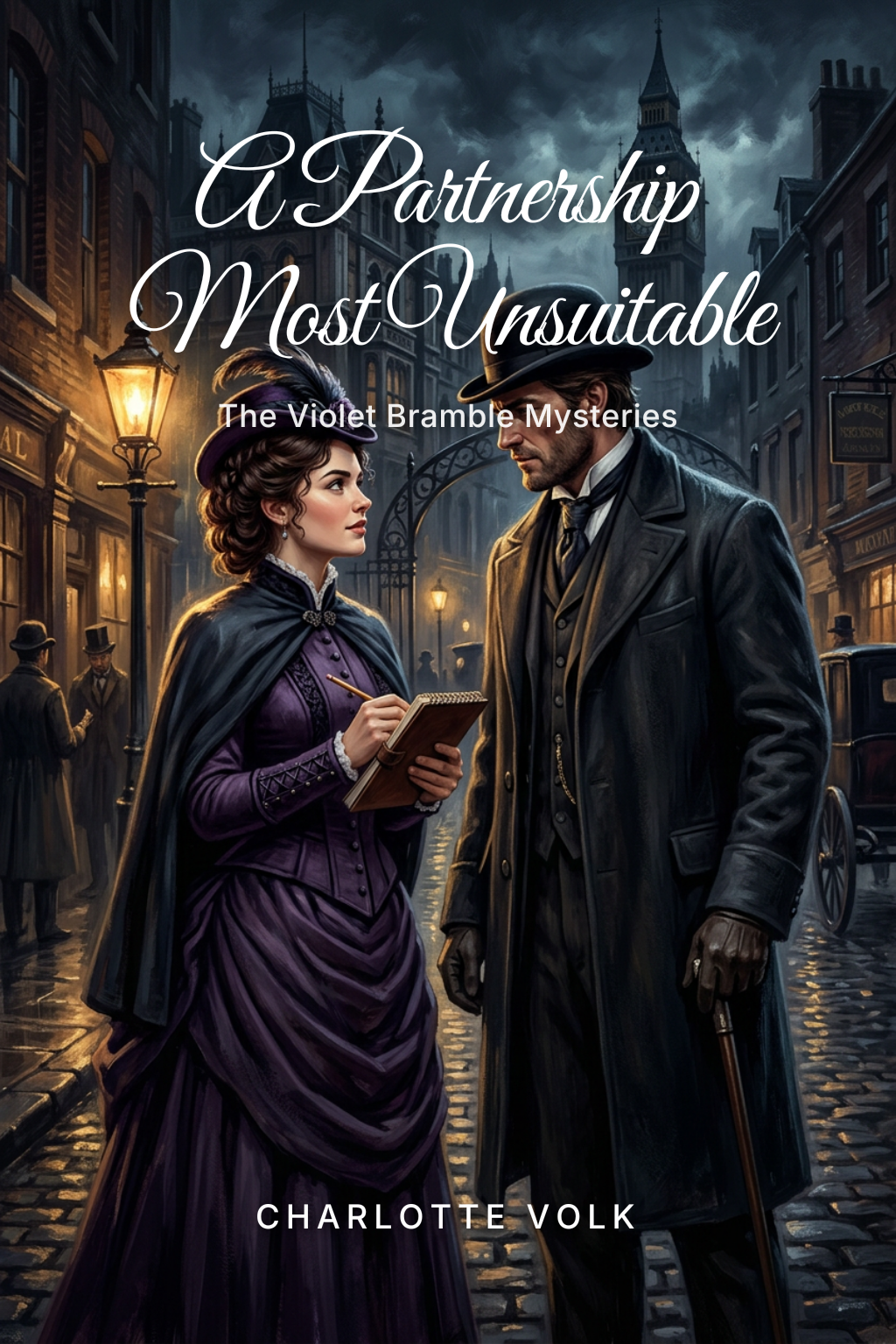
The Violet Bramble Mysteries, Book 1 A Partnership Most Unsuitable
Chapter 1
The Woman in the Yard
A Partnership Most Unsuitable
Chapter 1 The Woman at the Window on Cresswell Square
The cup struck the saucer with a hard white click.
“Do stop leaning so far, Violet,” said her aunt from the sofa. “If one must observe unpleasantness, one need not appear eager for it.”
Violet did not turn. Below the drawing-room window the square had altered in the space of half a minute from an orderly prospect of railings, clipped shrubs, and carriage doors to that peculiar London spectacle in which five idle persons become twenty simply by remaining where they are. A maid with a market basket had halted at the corner. Two errand boys stood shoulder to shoulder with the solemnity of jurymen. The butcher’s assistant, still in his blue apron, craned over the railings of Number Nine as if meat had taught him to distinguish every calamity worth seeing.
Something lay black against the pale stone by the basement steps.
“Eager is not the word,” Violet said. “Interested, perhaps.”
“That is usually your word when another woman would say horrified.”
“That is usually because another woman has been instructed to value the appearance of feeling above the use of it.”
Her aunt gave the faint, dry sound that passed in her for a sigh. Mrs. Wetherby had spent thirty years preserving a house in Cresswell Square from draughts, vulgarity, and opinions; she had not expected to inherit, even for a season, a niece who admitted opinions as if they were callers of quality.
Daisy Mason came in carrying the silver toast-rack and saw at once where Violet stood. Daisy had the broad, capable hands of a woman who believed linen, silver, and moral disorder could all be set right if met promptly enough.
“What now?” she said, coming to the window. “Lord save us. Someone’s down.”
“Quite down,” said Violet.
Daisy set the rack on the table and peered past her. “That’s a crowd if ever I saw one. Mrs. Pelham’s cook will know before the body’s cold, and from her every scullery in the square. Best shut the casement, or we’ll have the lot of it shouted up to us.”
Violet had already unlatched it. Cold air breathed in, tinged with soot and damp stone and the faint green smell of the square after recent rain. It brought voices.
“—drunk, I tell you—”
“—slipped—”
“—no, there’s blood, don’t be stupid—”
“—Number Nine, of all houses—”
The body lay on its side, one arm folded awkwardly beneath it, the other thrown out so that the hand almost touched the bottom rail. The hat had rolled a little way off and rested crown-down in the gutter. A clerk, very likely, from the cut of the dark coat and the narrow shoulders inside it. Young. Even from the height of the first floor one could see youth in the spare line of him and in the neck, which had not yet thickened into a man’s.
A constable pushed through the little ring of spectators and bent. The crowd pressed nearer with that greed which always pretended concern.
“Can you see his face?” Daisy asked.
“Not yet.”
Mrs. Wetherby’s spoon stirred again, a cool little circle in china. “If he has chosen to expire at Number Nine, I dare say there was no good to be expected of him.”
Violet glanced back. “Aunt, your moral system is so efficient. It relieves one of the labour of evidence.”
“It relieves one,” said Mrs. Wetherby, “of a great many unsuitable acquaintances.”
Below, a second constable appeared, then a man in shirtsleeves from Number Nine’s basement area, pale and vehement, gesturing with both hands toward the body as though disclaiming it. The front door opened. A lady’s maid, cap askew, came out and stopped at once, one hand to her mouth. Behind her a gentleman with mutton-chop whiskers swore under his breath and was instantly looked at with pleasure by three separate bystanders.
Violet leaned farther. The clerk’s coat had ridden up at the back. There was mud on the skirt and at one elbow, not merely street filth but a heavier clay worked with a greyish grit. London mud had local manners, if one looked at it long enough. That on the paving of Cresswell Square was fine and dark, mixed with horse droppings, coal dust, and the sweepings of genteel houses. This was not that. Nor were the boots.
“Daisy.”
“Yes?”
“Do you see the boots?”
Daisy squinted. “I see he’s wearing them, which is more than can be said for some poor creatures dragged from the river.”
“No, look at the edges. The leather is chalked. And there are burrs in the laces.”
Daisy looked again, then at Violet. “You can see burrs from here?”
“I can see enough to want a nearer view.”
“That, naturally, is the one thing no decent woman can have,” said Daisy.
Mrs. Wetherby set down her cup. “No decent woman wants it.”
Violet smiled without pleasure. “How fortunate, then, that I have never built my life on impossibilities.”
She took up the lorgnette from the side table. It had belonged to an aunt of better eyesight and worse principles, and was the only useful legacy the lady had left behind. Through its small round lens the clerk came nearer. The mud dried in ridges at the hem of his coat. There was a scuff on the right cuff, a streak on the left shoulder as though he had been handled or had brushed hard against something rough. His hair, dark and flattened on one side, showed a line of moisture no drizzle had lately provided. Not rain. Splash.
And the boots were all wrong indeed: thick-soled, serviceable, with traces of pale silt at the welt. Not boots for a man who had walked from an office in the Strand to call in Mayfair. Boots for streets nearer the water, or lanes where carts cut ruts and the paving gave up in places to raw ground.
The constable knelt lower. Someone in the crowd cried out that the man was dead. This useful conclusion went through the square at once, enlarged and embellished on its way. Mrs. Pelham’s cook would presently have him stabbed, bankrupt, and secretly married.
“Miss Bramble,” Daisy said quietly.
A carriage had come in through the mouth of the square and stopped short of the gathering. Not a private carriage. A hansom. The gentleman who stepped down paid the driver with the impatience of a man to whom every delay was personal. He was tall, broad through the chest without heaviness, and dressed with that plain exactness which marks either very good judgement or very little vanity. His coat was dark and well brushed, his hat set low. When he moved, the crowd gave way before he had spoken.
“Police,” Daisy murmured, though there was no need.
He crossed to the railings with a swift economy that suggested he disliked public scenes not from delicacy but because they multiplied fools. One of the constables straightened at once.
Mrs. Wetherby, who disapproved of nearly everyone but respected official authority when it wore clean linen, leaned forward. “Who is that?”
“I do not know,” Violet said, though she meant to know within ten minutes.
The gentleman removed one glove with his teeth, bent to the body, and touched two fingers to the throat. His face, in profile, was severe without being handsome in the ordinary arrangement; it was the sort of face one trusted to remember facts and not to forgive nonsense. When he rose, he said something brief to the constable and looked once around the square. Not carelessly. Measuring it.
His gaze travelled up the houses. For the smallest instant it met Violet’s at the open casement.
Men did not like seeing intelligence in a woman unless they had first summoned it.
He looked away at once and turned to the front steps of Number Nine, where the gentleman with whiskers had begun speaking in aggrieved bursts. Violet saw the officer listen, interrupt, then shift his attention to the maid, who was trembling and eager to be relieved of her knowledge. Sensible. Servants saw what ladies missed and gentlemen ignored.
“What are you about?” asked Mrs. Wetherby sharply, for Violet had already moved from the window.
“Going downstairs.”
“You will do nothing so extraordinary.”
“I assure you, in this house it is almost my only recreation.”
Daisy caught up with her in the hall as Violet reached for her gloves. “If you mean to put your head among constables and footmen, at least take a veil.”
“I mean to put my eyes there, not my head.”
“That has never been your distinction.”
But Daisy fetched the dark net veil from the stand and held it while Violet tied it over her hat. The front hall smelled faintly of beeswax and hyacinths. Through the fanlight above the door, the square beyond had gone milky with breath and motion.
Mrs. Wetherby’s voice rang from the drawing room. “If anyone asks, I am not at home.”
“Your principles remain admirable,” Violet called back.
Outside, the air was colder than it had seemed at the window. The stone flags held the damp. People always made room for a well-dressed woman and then resented her for occupying it; Violet used both facts equally. She crossed without haste and paused just beyond the nearest cluster of onlookers.
The dead clerk’s face had been turned upward. He could not have been more than five-and-twenty. Clean-shaven. Thin mouth. One temple marked darkly where the skin had split. There was blood, but less than the crowd had hoped. Death had left his expression blank rather than dramatic, which was a disappointment to several present.
The police officer stood at the foot of the area steps with his notebook open, taking the statement of the man from Number Nine. Up close, his reserve appeared less like coldness and more like concentration under pressure, though Violet was not inclined to grant him too much.
She let her glance drop again to the boots. The left sole carried a crescent of yellowish clay. River stairs, perhaps; or one of those service lanes behind warehouses where carts brought goods inland from the wharves. Not this square. Not anywhere west of Grosvenor Place.
“Miss, you must stand back.”
The constable who said it was young enough to blush as he recognized the quality of her clothes.
“Must I?” Violet asked. “You have not yet told me why.”
He opened his mouth, shut it, and looked over her shoulder for support. None came. His superior was still occupied. Violet bent, not enough to be indecorous but enough to inspect the coat cuff more closely. There, near the seam, a faint thread of blue. Dyer’s blue? No. Copying ink, perhaps, transferred by a sleeve across damp cloth.
“Miss.”
This time the voice came from her right.
She straightened. The officer had turned from Number Nine and was looking directly at her. His eyes were grey, steady, and wholly unenchanted.
“I am afraid you cannot remain here.”
“No?” said Violet.
“No.”
“A difficulty. I have already remained here for nearly a minute.”
The nearest two spectators made appreciative noises, as people do when they expect another person’s humiliation and are not particular whose. The officer spared them one glance and they found sudden interest in a passing dogcart.
“This is a police inquiry,” he said. “Not a promenade.”
“Then perhaps you should move it somewhere less public.”
His mouth altered very slightly. Not a smile. Not yet. “Madam—”
“Miss.”
“Miss. You will oblige me by returning to your house.”
“I should be more inclined to oblige you if you had not mistaken me for a person who obeys any man merely because he lowers his voice.”
The constable stared fixedly at the body. The maid from Number Nine, who had edged within hearing, looked scandalized and delighted in equal measure.
The officer shut his notebook. “Inspector Reeves,” he said, as though identification might do what reason had not.
“Miss Violet Bramble.”
He inclined his head with the barest correctness. “Miss Bramble.”
There are forms of civility more combative than insult. Violet knew the species well.
“I live opposite,” she said. “I witnessed the discovery from the first-floor window.”
“Did you observe the deceased fall?”
“No. He was already on the pavement when my attention was drawn.”
“Then I have no need of your statement at present.”
“At present,” she repeated. “How provident of you to leave the door open by half an inch.”
Inspector Reeves’s patience was plainly not ornamental and plainly not inexhaustible. “If you have material information, you may give it to the constable.”
“I would rather not. He appears overmatched by my existence.”
The young constable reddened to the ears.
Reeves looked at her for one beat too long. It was not admiration. It was assessment, and perhaps the first thread of annoyance with which she was familiar from schoolrooms, dinners, and drawing rooms all her life: the instant when a man understood that she would not perform simplicity for his comfort.
“Very well,” he said. “What information?”
She let a little silence sit between them. He wanted brevity; she wanted to establish terms.
“The man did not come here by the route people are already assigning him,” she said. “His boots carry pale clay and edge-silt. The mud on his coat is from lower ground than this square, and wetter than the paving has been since yesterday afternoon. If he walked here from an office district, he chose a singular path.”
His expression did not change.
“Anything more?” he asked.
“Yes. There is blue staining at the cuff. Ink, I think, though whether from his own occupation or another person’s hand I cannot say from this distance.”
“We are standing over the body, Miss Bramble. The distance is not considerable.”
“How kind of you to admit it.”
He ignored that. “You have some experience in such distinctions?”
“A habit of looking where I am not expected to look.”
“A dangerous recreation.”
“For whom?”
Something passed in his eyes then, quickly veiled. Not approval. A note taken.
He bent without answering and examined the boots himself. One gloved finger touched the dried clay. He rubbed it between finger and thumb. The movement was economical, reluctant. A man who disliked finding use in other people’s remarks.
When he rose, he addressed the constable, not her. “See that no one comes nearer. And send for the divisional surgeon again. I want the pockets listed before removal.”
“Yes, sir.”
Violet waited. So did Reeves, though one would have thought waiting a personal affront to him.
“Well?” she said.
“Well what?”
“You have either concluded I am fanciful or not.”
“I have concluded,” he said, “that even accurate observations do not entitle a stranger to interfere in a police matter.”
“A stranger. How rapidly men promote themselves to proprietorship.”
The maid from Number Nine gave a small squeak and pretended to cough.
Reeves lowered his voice. “Miss Bramble, if you persist in making a spectacle of this, I shall ask a constable to escort you home.”
“And if I comply at once, shall you ask one anyway, for the novelty?”
He drew in breath through his nose, very controlled. “Why does this concern you?”
Violet looked down at the dead clerk. “Because he is dead in front of my aunt’s house, because half the square has already invented him badly, and because he has come from somewhere no one here is presently considering.”
Reeves said, “You speak as if the case were yours.”
“Not yours either, surely. The dead have prior claim.”
For the first time, his face gave way to something dangerously near irritation. Good, she thought. Better irritation than condescension. One could work with irritation.
A man in plain clothes had come up behind Reeves and murmured something. Reeves listened, nodded once, and turned back to her with the expression of someone placing a troublesome object on a shelf he may later need to examine.
“If you recall anything directly relevant,” he said, “you may send word to the station in Mount Street.”
“How comforting to know the route.”
He touched the brim of his hat, not in courtesy but in conclusion, and moved away toward Number Nine. Dismissed.
Violet stood where she was for another moment. The crowd had shifted again, disappointed by the lack of blood and by the apparent refusal of the police to arrest anyone immediately. Across the square a nursery maid whispered into another’s bonnet. A groom carried news to a waiting carriage with relish. Number Nine’s area railings, painted black enough to suggest fresh varnish, threw up a faint metallic smell.
At the curb a small figure with a broom under one arm watched everything.
He was one of the crossing-sweepers who haunted the broader roads after rain, ready to clear a lady’s path for halfpence and abuse. Twelve, perhaps. Thirteen at the outside. Thin as cane, with a patched jacket too short at the wrists and a cap pulled down over one eye. What fixed Violet’s attention was not the broom, nor the boy’s quick ferret face, but the boot in his hand.
He held it by the heel. Not wearing it. Holding it.
The boot was dark, gentleman’s, and much too large for him.
Their eyes met. In an instant he shoved the boot behind his back.
A constable barked at the crowd to move on. The boy slipped sideways between two spectators with the fluid skill of London’s unclaimed children and was gone round the corner before anyone had thought him worth stopping.
Violet turned toward Reeves at once. He was on the steps of Number Nine speaking to the butler now, his attention fixed inward, upon the house. She could cross, call out, insist. He would resent it, the crowd would feast on it, and a wary boy with a stolen or found boot would be six streets away before the inspector finished disliking her.
She went home instead.
Daisy met her in the hall with arms folded beneath her apron. “Well?”
“Well,” said Violet, removing her gloves finger by finger, “the police possess an inspector whose manners are severe, whose intelligence is likely genuine, and whose opinion of me is poor.”
“That last should save him from disappointment.”
Violet handed over the gloves. “A crossing-sweeper boy was carrying a gentleman’s boot.”
Daisy’s face sharpened. “From the dead one?”
“I cannot swear it, but I would lay money at good odds. He hid it when I looked at him.”
“Did you tell your inspector?”
“He was occupied in preventing ladies from contaminating his profession.”
Daisy snorted. “And what now?”
Violet had already gone into the morning room, where a writing table stood near the fire. The room was smaller than the drawing room and much more companionable. There were violets in a narrow-necked glass, a stack of unanswered invitations under a paperweight, and on the corner shelf three volumes of Gibbon that her aunt admired for their bindings and never opened. Violet sat, drew the blotter toward her, and selected a sheet of thick cream paper.
Daisy came to stand beside her. “No name?”
“Certainly no name.”
“That will please him.”
“I have no desire to please him.”
“No,” said Daisy. “Only to be obeyed in secret.”
Violet dipped the pen. The nib scratched once on the tray before taking the ink properly. She wrote in a hand so neat it had often been called masculine by persons who believed accuracy an offence in women.
Inspector—
The crossing-sweeper boy who works the corner of Cresswell Square and Bruton Street was seen leaving the crowd with a gentleman’s boot hidden beneath his jacket. If found quickly, he may tell you whether it was taken from the dead man or found before the body was noticed. The boots deserve your attention. They do not belong to the route presently supposed.
She paused, then added no more. Anything further would sound like triumph, and triumph was never persuasive to a man already on his guard. She folded the note and addressed it simply to Detective Inspector Reeves, Mount Street Station.
Daisy watched her sand it, shake the grains away, and seal it.
“You mean to send this by hand?”
“Yes.”
“By whom?”
Violet rang the bell.
The maid who answered was young enough to be impressed by sealed messages and old enough to conceal it badly. Violet gave instructions in a tone that invited no embroidery: a commission to be delivered at once to a messenger known to Daisy, one who asked no questions and repeated fewer.
When the maid had gone, Daisy said, “If he dislikes interference now, wait until he dislikes invisible interference.”
Violet looked toward the window. Across the square the little crowd still clung in tatters to Number Nine, though the centre of interest had begun to travel elsewhere, as it always did. A square resumed respectability by degrees. A body departed; conversation remained.
“He may dislike what he pleases,” she said.
But she was not looking at Number Nine now. She was looking toward the corner where the boy had vanished, broom under one arm and a dead clerk’s boot in his fist, and at the place beneath that image where curiosity ceased to be a habit and became a decision.
By the time Inspector Reeves broke the seal, the boy might be found, or lost. And if he was found first by someone else, the missing boot would not be the only thing in danger of disappearing.
AI assistant
Write your own novel.
ScribistIQ generates full-length novels in minutes. Type your premise, walk away, come back to a finished book.
Try ScribistIQ