
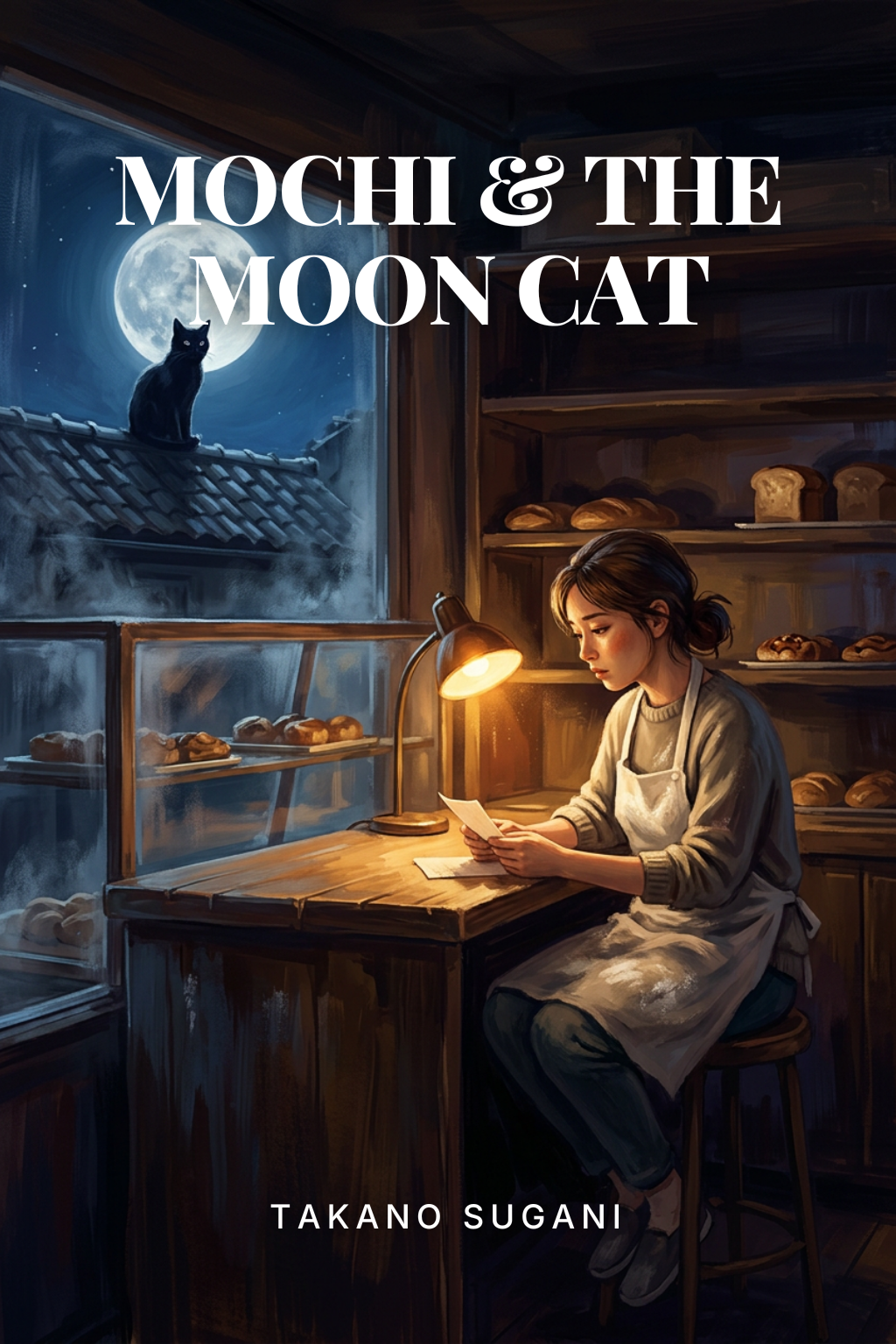
Novel · 3 chapters · 4,103 words
MOCHI & THE MOON CAT MOCHI & THE MOON CAT MOCHI &
Contents3 chapters
Chapter 1
Chapter 1: The Cat at the Counter
By midnight, the neighborhood had gone soft around the edges.
Mochi kept the front light on anyway. The sign above the door buzzed with one dead letter, making MOCHI’S BAKERY look like MOCHI S BAKERY if you stood across the street and squinted. He had stopped caring three months ago. Caring had not kept the rent paid.
He slid a tray of custard buns from the oven and set it on the cooling rack with the others. The bakery smelled like sugar browning at the edges, butter, yeast, and the lemon cleaner he used on the counter because the landlord once said the place had to “feel fresh” for the evening crowd. The evening crowd had become a handful of cab drivers, two nurses from Saint Brigid’s, and a student who always bought one red bean bun and ate it on the curb.
Mochi wiped his hands on his apron and listened.
Not with his ears. That part came later. First there was the low, restless murmur that lived behind his eyes whenever a cat got near. A kind of pressure. Then words, thin and sharp and not meant for him.
The tabby from the alley was out by the alley door now, sitting on a milk crate and thinking very hard about a mouse that had gotten away.
Not tonight, Mog. Too wet. Too cold. Your bones are not made for this kind of nonsense.
Mochi snorted and set a saucer of water down for him. The tabby flicked an ear, offended to be understood.
“You’re welcome,” Mochi muttered.
The bell over the front door gave one tired jingle.
A cat stood on the mat and shook rain from its fur in a fine silver spray. It was the color of a spoon left too long in moonlight, all pale fur and black ears and eyes like glass marbles. Water clung to its whiskers. It looked at the display case, then at Mochi, with the bored confidence of a creature that had never once in its life had to ask permission.
Mochi felt the thought before it arrived like a note struck in the dark.
The bun with custard. Not the one with the red bean. The human smells like sleep and old sugar.
He blinked. Cats thought plenty of odd things. Most of it had the shape of hunger. This was different. This was neat and clear, almost smug.
The silver cat hopped onto the stool at the counter, shook one last time, and sat with its tail wrapped around its feet.
Mochi cleared his throat. “We’re not a cat café.”
The cat stared at him.
You are very observant, it thought.
Mochi put both hands flat on the counter. “I can hear you.”
The cat’s ears tipped forward.
Yes, the cat thought. That is why I came.
Something cold moved between Mochi’s shoulders.
He looked around the bakery. The old clock over the sink ticked on. The steam from the kettle trembled. Outside, a bus hissed past the corner, its tires throwing water against the curb. No one else was in the shop. No one else had the look of being about to explain the impossible.
The cat lifted one paw, examined it, and placed it neatly back on the stool.
“I’d like a custard bun,” it said.
Mochi stared.
The voice was not quite a voice. It sounded like a bell heard from another room. Clear enough to understand. Unmistakably not human.
“...You just spoke.”
I did.
“Cats don’t speak.”
This one does.
Mochi looked at the rain tracking down the front window. Then at the cat. Then at the tray of custard buns cooling under a mesh cover, each one glossy from the egg wash, the tops split just enough to show a seam of pale filling.
He reached for a paper bag and stopped. “You’re serious.”
The cat’s tail gave a single impatient twitch.
I am wet, hungry, and in a city I do not know. Seriousness is not my weakest quality.
Mochi gave a short laugh that came out wrong. He hated that it was working at all, whatever this was. He slid one bun onto a plate.
“Do you—” He paused. “Can you eat sugar?”
The cat looked insulted.
I can do many things, said the thought. The question is whether you can keep up.
Mochi set the plate down. The cat leaned forward and sniffed it, then took a tiny bite. Custard clung to one whisker. It chewed with maddening politeness.
Mochi found himself watching the door, half expecting someone to laugh and say this was a prank, a setup for a video, a joke his brain had decided to play because he had been alone too long and sleeping too little. But the cat ate the bun in three careful bites and licked the crumbs from the plate.
Then it sat up straight, as if satisfied with its own first impression.
“My name is Tsuki,” it said.
Mochi gave the counter a look, as if it might explain things to him. “That means moon.”
It means moon, Tsuki agreed. You know enough words.
“I know the word for cat, too,” Mochi said.
Then use it correctly.
He barked out another laugh, this one real. It surprised him. It had been a long time since the bakery had heard one.
Tsuki watched him with bright, unblinking eyes.
You are not as miserable as you pretend to be.
Mochi crossed his arms. “I’m not pretending.”
The cat’s gaze dropped, briefly, to the stack of unopened bills tucked under the register.
You are doing a very poor job of hiding it.
Mochi turned to the sink so the cat would not see his face. He rinsed a bowl that was already clean. The faucet rattled in the pipes. One of the overhead bulbs buzzed and then steadied.
When he looked back, Tsuki had climbed from the stool to the top of the display case. He moved with the easy balance of something that knew exactly where every ledge and edge in the room was.
“Why are you here?” Mochi asked.
Tsuki sat down. The rain hissed against the glass.
I fell out of the moon.
Mochi just looked at him.
It was a stupid sentence. It was also, somehow, the least strange thing in the bakery tonight.
“I’m not drunk,” Mochi said.
I would hope not, Tsuki thought. Your hands smell of yeast.
“That’s not an answer.”
It is the only one you have.
Mochi rubbed a thumb across the bridge of his nose. His head felt too full and too empty at once.
“Fine. Fell out of the moon. Sure. And I’m supposed to just—what? Clap?”
Tsuki’s tail moved once, slow and deliberate.
No. You are supposed to help me return.
Mochi let that sit there between them.
A truck rumbled past outside. The front window shivered in its frame. Somewhere in the back, the oven timer clicked off with a tiny metallic ring.
“You’re asking the wrong person,” Mochi said at last.
No, Tsuki thought. I am not.
The certainty in that answer made Mochi’s mouth go dry.
He folded a dish towel in half, then half again, making it square and flat. “Why me?”
Tsuki looked toward the alley door, as if listening to something beyond the wall.
Because you hear us, he thought. Because you are lonely enough to listen. Because the city has chewed up everyone else and you are still standing.
Mochi didn’t answer. He could have denied it. Instead he reached for the plate and found only a smear of custard and a few damp crumbs.
Tsuki’s ears angled back.
There is one more thing, he thought.
Mochi waited.
I do not have much time.
The words landed with the same quiet weight as the first bite of a hot bun: small, simple, and suddenly serious.
“How much time?” Mochi asked.
Until the next full moon.
Mochi glanced at the calendar taped beside the fridge. He didn’t need to check it to know what it said. He looked anyway. The next circle of red marker was seven days away.
Outside, rain ran down the window in silver lines.
Mochi set both hands on the counter, breathed in sugar and rain and something stranger, and heard his own voice go thin.
“And if you don’t make it back?”
Tsuki’s gaze did not move.
Then I become something else.
Mochi tried to swallow and couldn’t.
The bakery door rattled once in the wind. The bell gave a small, nervous jingle.
Tsuki jumped lightly from the display case to the counter and looked up at him as if they had already agreed on everything that mattered.
You will help me, he thought.
Mochi should have said no. He should have asked questions, or demanded an explanation that made sense, or called someone who knew what to do when a moon cat walked into your bakery and asked for a custard bun. Instead he looked at the silver animal sitting in the spill of warm light, small and sure of itself, and felt something in him shift position after years of staying fixed.
He pulled a fresh bun from the tray and set it down.
“Eat first,” he said.
Tsuki blinked once.
Then, very carefully, he lowered his head to the custard bun and took another bite.
And Mochi, for the first time in months, did not think about closing early.
Chapter 2
Chapter 2: The Map Under the Flour Sack
Morning came thin and gray through the front window, but Mochi had been awake long before that. He sat at the prep table with a cup of tea gone cold in his hands and watched Tsuki circle the bakery like a small, silvery inspector.
The cat had already climbed the shelves, sniffed the flour, rejected the rice cooker with a flick of disdain, and spent a full minute staring at the broom as if it had insulted him personally.
Mochi should have been tired. Instead he felt stripped clean, as if the night had scraped away every ordinary thought and left only the impossible behind.
Tsuki leaped onto the back of the battered armchair by the window and curled one paw over the edge.
Your ceiling leaks near the sink, he thought.
“Tell me something I don’t know,” Mochi said.
Your landlord is a thief.
“That one I know too.”
Tsuki tipped his head. He was cleaner now that he’d dried, though his fur still held a faint metallic sheen when it caught the light. There was a small smear of custard at the corner of his mouth. Mochi had tried to wipe it off with a napkin. Tsuki had fixed him with a stare so severe Mochi had backed off immediately.
The bell over the door rang, and both of them froze.
Mochi’s chest tightened. For one ridiculous second he expected the sky to have sent someone after the cat. A man in a suit. A priest. An old woman with a broom.
Instead it was Mrs. Alvarez from the second floor, bundled in her green coat, carrying a dented thermos and a paper bag.
“Mochi?” she called. “You open?”
He forced his face into something resembling normal. “Come in.”
Mrs. Alvarez was one of his regulars, which meant she was used to seeing him at strange hours and half expected him to be more awake than he ever was. She set the thermos on the counter and peered into the display case.
“Your buns sold out?”
“Mostly.”
She nodded, satisfied, and reached into the paper bag. “I brought extra orange peels. For the candied ones. My grandson won’t touch them if they taste too bitter.”
Mochi took the bag. “You didn’t have to.”
“Yes, I did. You fed me three nights in a row when my stove went out.” She sniffed, and then her eyes narrowed a fraction. “You got a cat?”
Mochi’s spine went tight.
Tsuki, from the armchair: She notices everything.
“No,” Mochi said too quickly.
Mrs. Alvarez looked around anyway. Her gaze passed over the baking racks, the sink, the stack of delivery boxes, and settled briefly on the armchair by the window. Tsuki had gone still as a carved figurine.
She cannot see me, Tsuki thought, but she is looking in the right direction.
Mochi made a sound that might have been a cough. “Tea?”
Mrs. Alvarez handed him a coin for a bun and gave him the kind of look that suggested she had known him since he was fifteen and still burned cinnamon rolls. “If you’re lying, it’s probably about money or a cat. Both would be on brand.”
She left with her thermos and a bag of warm red bean buns, and the bell shut behind her like a held breath released.
Mochi stared at the front door until the street outside blurred back into itself.
Tsuki hopped down from the chair and landed soundlessly on the prep table.
You are not subtle, he thought.
“Neither are you.”
I am a cat.
“That doesn’t count as a defense.”
Tsuki ignored him and fixed his gaze on the back room.
What is in there?
“Boxes. Old pans. A sink that leaks.”
And under the flour sack?
Mochi stopped.
He set the thermos Mrs. Alvarez had brought onto the stove and looked at Tsuki. “What flour sack?”
The one by the wall.
Mochi hadn’t touched that sack in weeks. It had tipped against the shelves behind the cooling rack, half-hidden under a stack of empty takeout boxes. The paper had gone soft along the bottom from a spill he’d never gotten around to cleaning up.
He walked over slowly and crouched. Tsuki sat on the table and watched.
Mochi pulled the sack forward.
Something slid out from beneath it and thumped onto the tile.
It was a flat envelope, yellowed at the edges, sealed with old tape. His name was written on the front in his mother’s narrow, slanted hand.
He stared at it so long the room seemed to fold in around the edges.
Tsuki jumped to the floor and approached without a sound.
You did not know it was there, he thought.
“No.” Mochi’s voice came out rough. He turned the envelope over but didn’t open it yet. “I thought I’d thrown everything from her room away.”
Not everything.
Mochi looked down at the handwriting. The last time he had seen it, his mother had been seated at the kitchen table with her reading glasses pushed up into her hair, writing labels for jars of plum jam. The memory came so sharp it almost cut.
He slid one finger under the tape.
Inside was a folded sheet of paper and a little brass key tied to it with red thread.
No note. No explanation. Just the key.
Mochi turned the paper open. It wasn’t a letter. It was a rough sketch of the city from above, a child's map drawn with firm lines and little landmarks marked in the margins: the fish market, the train bridge, the statue in Queens Park, the old observatory on Bell Street. Someone had circled the observatory three times. Underneath, in smaller writing, were three words.
For when it’s needed.
Mochi laughed once, but there was no humor in it. “Needed for what?”
Tsuki padded up beside his shoe and peered at the map.
That, he thought, is useful.
“You can read it?”
I can read many things.
Mochi looked at the key. It was old brass, the teeth worn smooth. Tiny moon shapes had been stamped into the bow, half-hidden by tarnish. He had no idea how he had missed it in his mother’s things. Then again, he had missed a lot after she died. The house had become a place full of closed drawers and unasked questions.
He sat down hard on the stool by the prep table.
Tsuki watched him with narrowed eyes.
This is from your mother, he thought.
“Apparently.”
She knew something.
Mochi folded the map carefully. “She knew plenty of things.”
More than she told you.
He looked up sharply, but Tsuki had already turned toward the window. Outside, a delivery bike shot past, tires hissing on the damp street. The city was waking up in bits and pieces: a metal gate rattling open, a line cook carrying crates through a side door, a man in a knit cap dragging a trash bin to the curb.
Mochi placed the key beside the register.
“If this is some sort of trick—”
It is not.
“You expect me to trust that?”
No, Tsuki thought. I expect you to come with me.
Mochi barked out a laugh, then rubbed a hand over his face. “Where?”
The cat jumped up onto the counter and sat directly in front of him.
To the observatory.
“The one on Bell Street?”
Yes.
“That place has been locked for years.”
Then it is time someone opened it.
Mochi stared at the key. His mother’s key. The little map. The circled observatory. He could almost hear her voice telling him not to leave cups on the windowsill, not to eat hot bread too fast, not to believe every strange thing that came through a door just because it had a sad face.
He looked at Tsuki.
The cat looked back without blinking.
“You said I was the only human who could help you,” Mochi said.
Yes.
“How do you know that?”
Tsuki’s ears angled back. For the first time, something like discomfort moved through his thoughts.
Because the moon said so, he thought.
Mochi let out a slow breath. “That’s not an answer either.”
It is the one you have.
He hated how often the cat was right.
The bakery clock clicked toward noon. Somewhere in the back room a pipe knocked once, a small metallic sound like a finger tapping on a door from the other side.
Mochi stood and went to the sink. He ran water over a tray, even though there was nothing on it. The motions steadied him. Clean the pan. Wipe the counter. Fold the towel. Put things in order because nothing else would stay still.
Behind him, Tsuki leaped onto the windowsill and sat with his tail wrapped around his paws.
What will you do if you do not come?
Mochi did not turn around. “Close the bakery.”
That is not what I asked.
“I don’t know.” He scrubbed at a stubborn patch of batter on the tray until the steel shone. “I haven’t thought that far.”
Tsuki was silent for a moment.
Then: That is a bad habit.
Mochi snorted. “Says the cat falling out of the moon.”
Tsuki’s whiskers twitched, almost a smile.
You will come tonight.
It wasn’t a question. Mochi set the tray in the drying rack and finally turned. The cat was framed in the window light, the city reflected faintly in the glass behind him. For an instant he looked less like a stray and more like something that had stepped out of a story and forgotten to bring the rest of it with him.
Mochi picked up his coat from the hook by the door.
“On one condition,” he said.
Tsuki waited.
“If we’re doing this, you stop acting like you own the place.”
The cat considered him.
I make no promises.
“Then I make none either.”
Tsuki jumped from the sill and landed neatly on the floor.
Good, he thought. You are learning.
Mochi looked at the map one more time, then at the brass key, and then at the little silver cat who had somehow turned his failing bakery into the center of something much larger and harder to ignore.
He slid the key into his pocket.
By evening, the rain had stopped, and Bell Street glistened under the traffic lights like it had been polished for something important.
Chapter 3
Chapter 3: The Locked Door on Bell Street
Bell Street did not look important.
That was the first thing Mochi noticed. Not the observatory, which sat at the end of the block behind a wrought-iron fence gone rust-red at the hinges, but the street itself: a locksmith with a broken chair on the sidewalk, a laundromat with one bright flickering sign, a noodle shop closing early because the cook had a dentist appointment, a dead newspaper box shoved beside a pole plastered with concert flyers. The city had no interest in making the place feel enchanted. It just stood there, damp and ordinary, while the sky went dark over the rooftops.
Tsuki rode in Mochi’s coat pocket with only his head out, which Mochi insisted was ridiculous and Tsuki insisted was practical.
I am not a parcel, the cat had thought on the bus over.
“Could’ve fooled me,” Mochi had muttered, and the old woman across the aisle had smiled into her shopping bag like she thought they were a couple arguing about takeout.
Now they stood before the observatory gate.
The brass key was warm in Mochi’s pocket. He had checked it three times since leaving the bakery, as if it might vanish if he stopped paying attention. The sky had cleared to a hard, clean black, and somewhere above the streetlights the moon hung thin and white, not yet full but close enough to make the back of his neck prickle.
Tsuki pushed his head farther out of the pocket and stared up at the building.
Home, he thought.
Mochi looked at him. “You’re sure about that?”
No, said Tsuki. But we have arrived, which is the next best thing.
The observatory was smaller than Mochi expected. Its round dome rose over a stone base with narrow windows and a heavy oak door banded in iron. A plaque beside it had been scratched nearly smooth by years of weather and bad company. He could just make out a date from the old engraving. The place had been shuttered for so long people had stopped seeing it.
He climbed the three worn steps to the door and tested the lock.
It was stiff, but the brass key turned anyway with a sound like a throat clearing.
Mochi paused. “That’s not ominous at all.”
Tsuki’s ears flattened. Open it.
Mochi pulled the door.
Cold air moved out from the dark inside, carrying the smell of dust, old stone, and something clean underneath it, like rain caught in a jar. He hesitated only a second, then stepped in and shut the door behind them.
The observatory foyer was narrow and nearly bare. A broken umbrella stand sat in one corner. A strip of faded runner carpet led to a spiral stair. Moonlight bled through the high windows and laid pale rectangles on the floor.
Tsuki leaped from Mochi’s pocket to the ground and padded forward.
“Wait,” Mochi whispered.
The cat turned, annoyed.
Mochi crouched and pointed at the floorboards. There were chalk marks here, nearly erased, a circle inside a circle with little dots like stars around the edge. He had never seen a symbol like it before, but his skin knew it with the same certainty it knew his mother’s handwriting.
He swallowed.
“This is from her too?”
Tsuki’s gaze moved over the marks.
Not only her.
Mochi rose slowly. His pulse was loud in his ears. He had spent years pretending the odd scraps from his mother’s life were just another set of things he’d never understand: the bell-shaped charm sewn into a coat lining, the little packets of salt hidden in drawers, the nights she would stand at the kitchen sink staring out at nothing as if waiting for a train that never came.
The spiral stair groaned under their feet as they climbed.
At the top was the dome room. Glass panes curved overhead, some cracked, some blacked out from age. The telescope at the center was draped in a dust sheet that had gone gray and soft at the edges. Someone had been here recently; the floor was swept clean in places, and one workbench held a stack of notebooks tied with twine.
Mochi walked to the bench and touched the top notebook.
Tsuki sprang onto a low stool and looked around with sharp, uneasy attention. His tail did not move.
You can feel it, can’t you? he thought.
Mochi looked up. “Feel what?”
The pull.
Before Mochi could answer, a sound came from the far side of the room. Not footsteps. Not exactly. A soft scrape, like something heavy shifting against stone.
He went still.
Tsuki’s fur rose a little along his back.
Do not speak, he thought.
Mochi did not need to be told twice.
The scrape came again, then a click.
One of the dark windows along the dome unlatched itself and swung open an inch, letting in a slice of cold air. A shape pressed against the gap from the other side. Too large to be a bird. Too smooth to be a hand.
Mochi’s mouth went dry.
Tsuki jumped from the stool and landed in front of him.
Stay behind me, he thought.
Mochi almost laughed at that. Almost.
The shape slipped through the window.
It landed with a quiet thump on the floorboards and unfolded itself into a cat, though not one Mochi had ever seen. Its fur was blacker than the inside of a kettle. Around its neck hung a cord threaded with tiny shells and dull silver beads. Its eyes were pale, nearly white, and when it looked at Tsuki, the air in the room seemed to tighten.
Tsuki did not move.
You are late, said the black cat.
Tsuki’s ears flicked once.
I was delayed.
The black cat’s tail gave a contemptuous sweep.
By a bakery.
Tsuki said nothing.
Mochi stared from one cat to the other. He had no idea whether he was supposed to speak, or run, or sit down until his heart remembered how to act. The black cat turned its gaze on him. He felt the thought arrive like a blade laid flat against skin.
You are the human.
Mochi found his voice by accident. “And you are not.”
The cat’s whiskers twitched.
No.
Tsuki stepped forward one pace.
This is Oto, he thought reluctantly. A keeper.
“Oto,” Mochi repeated.
The black cat’s eyes narrowed. It did not bother answering aloud.
It has one task, Tsuki thought. It failed to keep watch.
Mochi glanced at Tsuki. “Watch what?”
Neither cat answered him at first. Then Oto looked toward the dome above, where the moonlight made a pale circle on the floorboards.
A path.
Mochi followed the gaze and saw, for the first time, that the circle of moonlight was not stationary. It drifted, inch by inch, across the floor toward the telescope. Under it, the dust seemed to vanish.
Tsuki’s voice came softer than before.
The door between here and there opens only when the moon is full.
“Here and where?” Mochi asked.
But he already knew the answer was not simple enough to fit into any room he knew.
Oto padded to the telescope, circled it once, and sat.
If Tsuki does not return by the full moon, he thought, the door closes with him on this side.
Mochi looked at Tsuki. “You said you’d become something else.”
Tsuki held his stare.
I did not say I would enjoy it.
The black cat gave a low, rough sound that might have been disdain. Oto lifted one paw and struck the leg of the telescope once. The metal rang in the high room.
The old notebooks on the bench stirred, though there was no breeze.
Mochi took one of them, untied the twine, and opened it.
The pages were filled with his mother’s handwriting. Smaller notes in the margins. Measurements. Moon phases. A list of foods in neat columns, with check marks beside custard buns, grilled fish, sweet potato, rice with salt, and one line that made him stop.
For the cat who fell.
His throat tightened.
He turned a few pages and found sketches. The observatory dome from below. The city rooftops. The bakery front on a corner he knew too well. A silver cat perched on a windowsill. A human figure with dark hair and rolled sleeves, drawn in a way that made his chest ache because the shape of him looked lonely and familiar.
“She knew,” he said quietly.
Yes, Tsuki thought.
“She knew you?”
Not me alone.
Mochi shut the notebook. “Then tell me what she was doing.”
The room fell silent.
Tsuki’s gaze moved to the moonlit circle on the floor. It had reached the telescope now. The light pooled around the base, brightening the dust until it looked like powdered glass.
Oto stood.
There is no time for the full story, he thought. But you can still open the way.
Mochi stared at the old telescope. At the circle of light. At the little brass key in his pocket that suddenly felt heavier than a pocket should allow.
“What do I do?”
Tsuki stepped close enough that Mochi could see the pale line of white fur under his jaw.
You trust what your mother left you.
Mochi almost said he did not know how. Instead he pulled the key out and looked at the worn moon stamps on its bow. His hand was shaking, but only a little.
He found the brass slot on the side of the telescope’s mount, half-hidden under a layer of dust.
Of course.
He fit the key in.
The metal resisted, then gave with a soft click that seemed to travel through the whole observatory. Somewhere beneath the floor, something answered. A low hum rose through the boards, deep enough to feel in the soles of his shoes.
Tsuki’s fur lifted along his spine.
Oto backed away from the telescope and sat very still.
Moonlight poured across the room in a brighter wash, as if the glass above had opened wider than it should.
Mochi took one breath.
Then another.
The hum grew into a note, and the floor beneath them shivered.
Tsuki looked at him, eyes bright as cut glass.
Now, he thought.
And the dome overhead began to turn.
Write your own novel.
ScribistIQ generates full-length novels in minutes. Type your premise, walk away, come back to a finished book.
Try ScribistIQ