
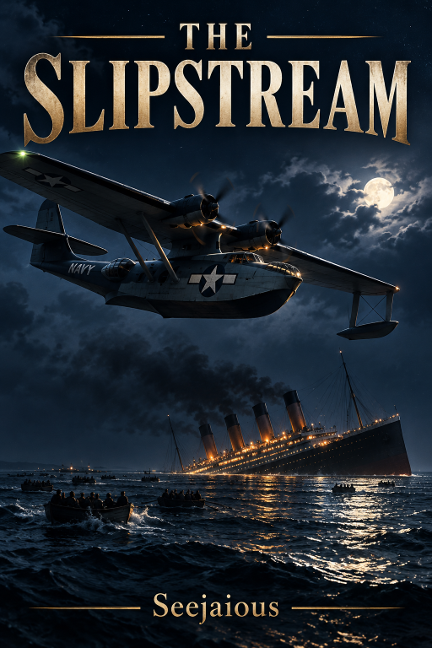
Novel · 13 chapters · 10,847 words
The Slipstream
Contents13 chapters
Chapter 1
The Briefing
The Briefing
The rain had started before dawn.
By six o’clock it had settled over the naval air station in a steady gray curtain, turning the runway into a sheet of black water beneath the floodlights.
Ensign Dale Eugene Croxton stood beneath the overhang outside the operations building and watched mechanics moving around the aircraft.
The seaplane was enormous.
Four engines.
Two large floats beneath the wings.
A broad fuselage designed to carry a crew into places where there were no runways and no guarantees of coming back.
Croxton had spent enough time around the aircraft to know every sound it made.
The cough of an engine starting.
The metallic rattle of a loose panel.
The high-pitched whine that meant something wasn’t right.
He trusted machines more than he trusted people.
Machines had reasons for what they did.
People sometimes didn’t.
“Ensign Croxton.”
Croxton turned.
Lieutenant Harris stood in the doorway.
“Sir.”
“Briefing room.”
Croxton nodded.
He followed Harris inside.
The room smelled of coffee, wet wool, cigarette smoke, and mimeograph ink.
Several men were already seated around the table.
Croxton recognized most of them.
Chief Petty Officer Walter Jones was sitting near the back with his arms folded across his chest.
Jones was the aircraft’s senior enlisted mechanic and one of the few men Croxton had learned to trust completely.
The pilot sat at the head of the table.
Lieutenant Commander Thomas Mercer.
Mercer looked tired.
Everyone did.
The war had a way of doing that.
Harris closed the door.
“Gentlemen, we’ve got a reconnaissance assignment.”
A map was spread across the table.
The Pacific.
Croxton immediately recognized the area.
Harris pointed to a small section of ocean.
“Enemy activity has increased in this sector over the last forty-eight hours.”
He placed a photograph on the table.
“Two of our surface groups reported aircraft activity here.”
Another photograph.
“Yesterday afternoon, one of our patrol aircraft failed to return.”
Nobody spoke.
Harris continued.
“We need confirmation of enemy movement.”
Mercer leaned forward.
“Strength?”
“Unknown.”
“Aircraft?”
“Unknown.”
Jones muttered:
“That’s a lot of unknown.”
Harris looked at him.
“That’s why you’re going.”
Jones nodded.
Croxton studied the map.
“What altitude?”
“Cruising altitude will depend on conditions. You’ll be operating low enough to identify surface activity but high enough to avoid unnecessary exposure.”
Croxton looked at the plotted course.
“How long?”
“Approximately six hours.”
“Radio contact?”
“Maintain contact as long as possible.”
Croxton nodded.
Harris looked around the table.
“This is reconnaissance. Not an attack mission.”
Mercer nodded.
“Understood.”
“If you encounter enemy aircraft, you disengage.”
Jones smiled faintly.
“That sounds easy.”
Harris looked at him.
“It isn’t.”
The room became quiet.
Harris gathered the photographs.
“You leave at 0730.”
The briefing was over.
The men began standing.
Croxton remained seated.
He looked at the map.
Something about the route bothered him.
Mercer noticed.
Croxton pointed.
“This heading.”
“What about it?”
“If we get pushed east by weather, we’re going to be farther from the patrol corridor than planned.”
Mercer looked at the map.
“How much?”
“Twenty miles. Maybe more.”
Mercer nodded.
“Can you compensate?”
“Then compensate.”
Croxton folded the map.
As the others left, Jones stopped beside him.
“You ever notice how every mission starts with somebody saying it’s going to be simple?”
Croxton looked up.
Jones smiled.
“That’s because you’re too serious.”
Croxton stood.
“And you’re not serious enough.”
Jones laughed.
“See you on the airplane.”
Croxton watched him leave.
Then he looked once more at the map.
The weather outside had gotten worse.
He didn’t like it.
But weather was something he understood.
The unknown was something else.
Chapter 2
The Crew
The Crew
By 0715, the aircraft was ready.
The rain had weakened, but the wind had picked up.
Croxton climbed aboard and secured his navigation equipment.
His chart case went beside him.
Compass.
Chronometer.
Plotting tools.
Pencils.
Dividers.
Everything had a place.
He checked each item twice.
Jones climbed through the hatch carrying a toolbox.
“Morning.”
Croxton looked up.
“Morning.”
“You sleep?”
“Enough.”
Jones grunted.
“That’s not what I asked.”
Croxton ignored him.
Jones put the toolbox down.
“Engine three has a vibration.”
Croxton looked toward the cockpit.
“How bad?”
“Not bad enough to abort.”
Croxton gave him a look.
Jones shrugged.
“You wanted honesty.”
“I did.”
“There it is.”
The pilot entered the cockpit.
“Everyone aboard?”
Croxton checked the crew.
Mercer nodded.
“Let’s go.”
The engines came alive one after another.
The aircraft shook beneath them.
Croxton felt the familiar vibration through the floor.
There was something reassuring about it.
Something mechanical.
Predictable.
He checked the compass.
Steady.
The chronometer.
Steady.
The aircraft began moving.
The water opened beneath the hull.
Mercer pushed the throttles forward.
The engines roared.
The aircraft accelerated.
Croxton looked through the side window as the naval air station disappeared behind them.
Within minutes, they were over open water.
The rain ended.
Clouds broke apart.
Sunlight appeared.
Jones stepped into the navigation compartment.
“Everything good?”
Croxton checked his calculations.
“So far.”
Jones leaned against the bulkhead.
“You know, most people would call that encouraging.”
Croxton looked at him.
“Most people aren’t navigators.”
Jones laughed.
“That’s exactly what I mean.”
Croxton returned to his work.
For the next several hours, the mission was uneventful.
Almost boring.
That was how Croxton preferred missions.
Boring meant predictable.
Predictable meant alive.
He took readings.
Adjusted their heading.
Checked their position.
Recorded the time.
At 1030, they reached the patrol corridor.
Croxton looked through the observation window.
Nothing.
No ships.
No aircraft.
Only ocean.
Mercer came over the intercom.
“Anything?”
“Nothing yet.”
“Keep looking.”
Croxton did.
At 1117, the radio operator received a transmission.
He looked toward Mercer.
“Possible enemy aircraft in the area.”
Mercer immediately straightened.
“Bearing?”
The radio operator gave it.
Croxton plotted it.
His eyes narrowed.
“They’re coming toward us.”
Mercer looked at him.
“How many?”
“Unknown.”
Jones appeared in the compartment.
“Well.”
Croxton looked up.
“Get ready.”
Jones smiled without humor.
“I was afraid you’d say that.”
Chapter 3
The Battle
The Battle
The first aircraft appeared twelve minutes later.
Then another.
Then another.
Three enemy fighters dropped from the clouds.
Mercer saw them first.
“Here they come.”
The crew moved quickly.
The aircraft’s defensive guns came alive.
Croxton remained at his station.
His job was navigation.
But he could hear everything.
The engines.
The gunfire.
The shouting.
The metallic impact of rounds striking the fuselage.
Mercer banked hard.
Croxton grabbed the navigation table.
“Heading!”
Croxton checked the compass.
“Southwest!”
Mercer pulled the aircraft around.
Another burst of gunfire passed behind them.
Jones shouted from the rear compartment.
“Number two’s taking hits!”
Mercer swore.
Croxton recalculated.
“We need to turn east!”
“Why?”
“Enemy aircraft are cutting us off!”
Mercer looked through the cockpit window.
He saw them.
“East!”
The aircraft banked.
Croxton’s instruments swung violently.
The compass needle jumped.
He frowned.
That wasn’t right.
The needle settled.
Then jumped again.
Croxton leaned closer.
“Compass is fluctuating.”
Mercer shouted over the engines.
“Compass!”
“Can you navigate?”
“Yes!”
“Then do it!”
Croxton grabbed the chart.
He took a visual bearing.
Then another.
Something was wrong.
The aircraft’s heading didn’t match the compass.
He looked outside.
The horizon tilted sharply.
Mercer was throwing the aircraft into another turn.
Enemy fire ripped through the air.
A round struck the fuselage.
Another punched through a window.
Someone screamed.
Croxton held onto the navigation table.
The compass began spinning.
Clockwise.
Then counterclockwise.
Croxton stared.
“That’s not possible.”
He looked toward Mercer.
“The compass.”
Mercer glanced back.
“What about it?”
“It isn’t reading.”
Another burst of gunfire.
Mercer pulled harder on the controls.
“Forget the damn compass!”
Croxton tried.
He couldn’t.
Because something was happening.
The air outside the aircraft looked wrong.
The clouds had stopped moving.
The ocean appeared unnaturally still.
Croxton blinked.
The enemy aircraft seemed to hang motionless in the distance.
“Sir?”
Mercer didn’t answer.
Croxton looked toward the cockpit.
“Sir!”
Mercer was staring straight ahead.
“Hold on!”
The aircraft banked violently.
Croxton’s shoulder slammed against the fuselage.
His pencil flew from his hand.
The compass spun faster.
Then stopped.
The needle pointed straight down.
Croxton stared at it.
“That isn’t north.”
The engines suddenly became silent.
Not quieter.
Silent.
Croxton opened his mouth.
Nothing came out.
He could see Mercer’s hands on the controls.
He could see Jones across the compartment.
Everything was frozen.
Even the water.
The ocean below them had become a sheet of glass.
Croxton slowly turned toward the window.
The sky was changing.
The clouds disappeared.
The blue sky darkened.
Stars appeared.
In broad daylight.
Croxton stared.
He knew those stars.
But they were wrong.
The constellations were in places they shouldn’t have been.
He reached for his chart.
His hand passed through it.
For one terrible second, Croxton thought he was falling.
Then the aircraft dropped.
Sound returned.
The engines screamed.
Mercer shouted.
The ocean rushed toward them.
Croxton slammed against his restraints.
The compass needle snapped violently north.
Then the aircraft leveled.
Everything became normal.
The engines were roaring.
The ocean was moving.
The clouds were back.
The enemy aircraft were gone.
Croxton sat motionless.
Mercer looked back.
“Everyone alive?”
One by one, the crew answered.
“I’m good.”
“Okay.”
Jones climbed toward the cockpit.
“What the hell just happened?”
Mercer shook his head.
“I don’t know.”
Croxton looked at the compass.
It was steady.
He checked the chronometer.
It was still running.
He checked the radio.
Nothing.
“Radio’s dead,” the operator reported.
Mercer frowned.
“Try again.”
Static.
Nothing.
Croxton picked up his pencil.
His hand was shaking.
He forced it to stop.
He checked the chart.
Then his calculations.
Then the chart again.
Mercer watched him.
“Well?”
Croxton didn’t answer.
“Ensign?”
Croxton looked at the compass.
Then at the sun.
Then at his chronometer.
Something was wrong.
Very wrong.
“Where are we?”
Mercer stared at him.
“That’s your department.”
Croxton began taking readings.
Sun angle.
Heading.
Speed.
Wind.
He wrote everything down.
Then he calculated.
He checked it again.
The answer remained the same.
His stomach tightened.
Jones leaned over his shoulder.
Croxton looked at him.
“I don’t know.”
Jones frowned.
“You don’t know where we are?”
Croxton looked through the window.
There was nothing but ocean.
No enemy aircraft.
No smoke.
No ships.
No sign of the battle.
“We aren’t where we were.”
Mercer looked back.
“How far off?”
Croxton didn’t answer.
He checked the chronometer.
Then the date.
His face went pale.
Mercer noticed.
“What is it?”
Croxton stared at the date.
April 15.
He looked at the year.
He blinked.
Then checked it again.
His voice was barely audible.
“April fifteenth.”
Jones frowned.
“So?”
Croxton looked up.
“1912.”
Nobody spoke.
For several seconds, the only sound inside the aircraft was the engines.
Mercer finally said:
“Say that again.”
Croxton looked at the ocean.
“We’re not in 1943.”
Jones stared at him.
“Then where the hell are we?”
Croxton lifted the binoculars.
Something was visible on the horizon.
A ship.
Large.
Very large.
He raised the binoculars.
Four funnels.
A massive hull.
Lights along the decks.
Croxton’s breath caught.
Mercer looked at him.
Croxton couldn’t speak.
He lowered the binoculars.
Then raised them again.
The name was painted across the bow.
He read it silently.
Then aloud.
“Titanic.”
Jones stared at him.
Croxton handed him the binoculars.
Jones looked.
His face changed.
The pilot turned around.
“Give me those.”
Jones handed them over.
Mercer looked through them.
For several seconds, he said nothing.
Then:
“That’s impossible.”
Croxton looked at his navigation log.
The date stared back at him.
April 15, 1912.
He looked toward the ship again.
The Titanic was alive.
For the moment.
But something was terribly wrong.
The ship was already beginning to sink.
Croxton slowly lowered the binoculars.
And for the first time in his life, he found himself facing a problem no chart, compass, or calculation could solve.
They had traveled backward through time.
And they had arrived on the worst night in maritime history.
End of Act One
THE SLIPSTREAM
ACT TWO
The Ship in the Darkness
Chapter 4
The Decision
The Decision
“Bring us around.”
Lieutenant Commander Thomas Mercer kept his eyes on the ship.
“Ensign, I need to know how close we can get without putting this aircraft into the water.”
Croxton looked at the instruments.
“Under these conditions? We can put her down, but I wouldn’t recommend trying to take off again without inspecting the floats.”
“That wasn’t my question.”
Croxton looked through the window.
The Titanic filled more of the horizon with every passing minute. Her four funnels stood against the darkness, and the lights along her decks made her appear almost impossibly large.
He had seen photographs of the ship in books. He remembered the illustrations of her sinking, the drawings of her stern rising out of the water, the familiar black-and-white pictures of passengers standing aboard her decks.
Those images had always belonged to the past.
Now the ship was directly ahead of him.
“Sir,” Croxton said, “we need to establish our position before we do anything else.”
Mercer looked at him.
“Can you do that?”
“I can establish where we are geographically. I cannot explain how we got here.”
“Then establish what you can.”
Croxton returned to his instruments.
He took another reading, checked the chronometer, and compared the results against his charts. The figures remained consistent. Whatever had happened during the strange turn, it had not left him with the usual signs of navigational error.
The problem was that every instrument agreed with a conclusion that should have been impossible.
They were in the North Atlantic.
They were on April 15, 1912.
And the Titanic was sinking.
“Sir,” Croxton said quietly, “we’re going to have to put her down.”
Mercer turned.
“Explain.”
“The port engine is losing pressure. I don’t know whether the instrument damage is giving us a false reading, but we can’t maintain this altitude indefinitely. The starboard float may also be damaged. We need to get on the water before something else fails.”
Mercer studied him.
“Can we land without sinking?”
“I believe so.”
“Believe?”
Croxton met his eyes.
“It’s the best estimate I can give you, sir.”
Mercer nodded.
“Very well. Prepare the crew.”
Jones appeared in the passageway.
He had been listening.
“You’re actually putting us down beside that ship?”
“We have a failing engine,” Mercer replied. “Unless you’ve found a way to repair it in flight, yes.”
Jones glanced toward the window.
“Then we’d better hope the Atlantic is feeling charitable.”
Croxton returned to the chart.
“We’ll land downwind of the ship and keep clear of the lifeboats.”
Jones looked at him.
“Lifeboats?”
Croxton didn’t answer.
Jones moved closer to the window.
Now he could see them.
Small boats were scattered around the Titanic, some already carrying passengers away from the liner. The ship’s lights illuminated sections of the water, and the movement of the boats was unmistakable.
Jones’s expression changed.
“How many?”
“We don’t know,” Croxton said.
“How many boats?”
“I’m not sure.”
Jones stared at him.
“That’s a lot of people in the water.”
“Chief,” Mercer said, “we have our own emergency to deal with.”
Jones looked at the pilot, then at Croxton.
He said nothing more.
The aircraft descended.
The Titanic grew larger.
Croxton could make out the white superstructure, the rows of illuminated windows, and the figures moving along the decks.
He could not hear them.
The distance was too great, and the engines drowned out everything else.
But he knew what was happening.
He had studied the disaster.
He knew that the ship had struck an iceberg late on the previous evening. He knew the damage had extended across several forward compartments. He knew the ship’s designers had believed the vessel could remain afloat with several compartments flooded, but the damage had exceeded that limit.
He knew the bow was going down because the forward compartments were filling with water.
He knew the ship would eventually founder.
What he did not know was why his aircraft had arrived here.
And that question would have to wait.
“Water ahead,” Mercer called.
Croxton secured his chart case.
“Clear to land.”
The aircraft hit the surface hard.
The first impact threw Croxton forward against his restraints. The second sent a violent shudder through the fuselage.
Metal screamed.
The port side dropped.
The aircraft slewed sideways, and Croxton heard a sharp crack from somewhere beneath the floor.
Then the seaplane settled.
For several seconds, nobody moved.
Mercer kept his hands on the controls.
“Report!”
The crew answered one by one.
Croxton checked himself, then looked toward the cockpit.
“I’m all right.”
Jones appeared in the passageway.
“Not sure I can say the same for your airplane.”
Mercer killed the engines.
The sudden silence was almost painful.
Water slapped against the damaged hull.
Croxton unbuckled himself and went to inspect the damage.
The port float had been torn open. One section of its supporting structure was bent, and the aircraft was sitting lower on that side than it should have been.
Jones crouched beside the damaged compartment.
“Well, that’s bad.”
“How bad?” Mercer asked.
Jones ran his hand along the damaged metal.
“Bad enough that we aren’t taking off until I fix it.”
“How long?”
Jones looked at the sinking liner.
Then back at the aircraft.
“That depends on how much you want to know.”
Mercer stared at him.
“Chief.”
“A few hours if the damage is limited. Longer if the structure underneath is bent.”
Croxton looked toward the Titanic.
The ship’s bow was lower now.
The forward deck was beginning to disappear beneath the water.
He checked his chronometer.
They had arrived late in the disaster.
There was no question about that.
And if the historical accounts were accurate, they had very little time before the ship went down completely.
Jones followed his gaze.
“We ought to do something.”
Croxton looked at him.
Jones turned.
“You don’t even know what I was going to say.”
“Yes, I do.”
“Then tell me.”
Croxton looked toward the lifeboats.
“You want to help them.”
Jones’s face tightened.
“Can you blame me?”
“Then why are you refusing?”
Croxton took a breath.
“Because we don’t belong here.”
Jones stared at him.
“We’re sitting in the Atlantic in a damaged Navy aircraft from thirty-one years in the future. I think we’ve established that.”
“Chief—”
“Those people are going to die.”
Croxton looked him directly in the eyes.
“I know.”
“And you’re telling me we should sit here and watch?”
The word sounded terrible even to Croxton.
Jones stepped back as if Croxton had struck him.
Mercer came out of the cockpit.
“What’s going on?”
Jones answered without looking away from Croxton.
“Your navigator has decided that watching people die is part of our mission.”
Mercer’s expression hardened.
“That’s enough.”
“No, sir, it isn’t.”
Jones pointed toward the Titanic.
“We have a boat. We have men. We could take people off that ship.”
“And then what?” Mercer asked.
Jones stopped.
Mercer continued.
“We take them aboard a Navy aircraft that doesn’t exist yet? We explain where we came from? We tell them about the next thirty years? We leave them on some other ship and hope nobody asks questions?”
“We could save them.”
“Yes,” Mercer said. “We could.”
He looked toward the Titanic.
“And if we do, what happens afterward?”
Jones had no answer.
Mercer looked at Croxton.
“Ensign, I want your assessment.”
Croxton swallowed.
“My assessment is that any deliberate intervention risks changing the historical record. We know the Titanic sank. We know the rescue ship arrived. We know the survivors were taken to New York. We don’t know what consequences would follow if we changed any of those events.”
Jones shook his head.
“We don’t know what consequences follow from doing nothing, either.”
Croxton felt that one.
He had no argument against it.
Only a belief.
And a belief was all he had left.
Mercer looked at the ship again.
“Chief, I understand your concern. But our first responsibility is to keep this crew alive and get this aircraft operational.”
Jones stared at him.
He turned toward the damaged float.
Croxton watched him go.
The argument was over.
The question was not.
And as the Titanic sank lower into the Atlantic, Croxton understood that the hardest part of preserving history might not be knowing what had happened.
It might be standing close enough to hear it happen again.
Chapter 5
The Price of Time
The Price of Time
The cold became worse after midnight.
It worked through Croxton’s uniform, through his undershirt, and into his bones. Every movement became an effort. His fingers were stiff, and his pencil kept slipping from his grip.
The crew had secured the aircraft as best they could.
They had no proper workshop, no dry hangar, and no spare parts. They had only the tools aboard the seaplane, the materials that had survived the landing, and Jones’s determination to keep the machine from sinking.
Croxton stood beside the damaged float with a flashlight.
Jones was lying partly beneath the wing, examining the supporting structure.
“Hold that light steady.”
Croxton adjusted the beam.
“Here?”
“Down a little.”
Croxton moved it.
“Here?”
“Perfect.”
Jones ran his fingers along the damaged joint.
“That’s the trouble.”
“What is?”
“The brace is bent. If I straighten it without reinforcing it, it’ll bend again the first time we put weight on the float.”
“Can you reinforce it?”
“With what?”
Croxton looked around.
Jones gave him a tired smile.
“Exactly.”
They had already salvaged a section of metal from an internal aircraft fitting. It was not designed for this purpose, but it was the closest thing they had to a replacement brace.
Jones intended to cut it to length and bolt it across the damaged section.
It might work.
It might also fail the instant they attempted to take off.
“Could we use the spare fittings from the equipment compartment?” Croxton asked.
Jones considered it.
“Some of them. Not all. I still need something to seal the float.”
Croxton looked toward the cockpit.
“There’s a repair kit aboard.”
“Not one designed for this.”
“It’s still a repair kit.”
Jones laughed without humor.
“Ensign, if I could repair this with a tube of sealant, I’d have done it already.”
Croxton didn’t respond.
Jones returned to the work.
For a while, they said nothing.
Then Jones spoke.
“You know what bothers me?”
Croxton kept the flashlight steady.
“I’ve spent my entire career fixing aircraft so other people can fly them. I know how to replace an engine component, repair a damaged line, patch a float, and get a machine back into service after someone has put it somewhere it shouldn’t be.”
He paused.
“But I’ve never had to repair an airplane while the Titanic was sinking beside me.”
Croxton looked down at him.
“Neither have I.”
Jones grunted.
“That’s comforting.”
A distant sound carried across the water.
Croxton looked up.
The Titanic’s whistles had become familiar over the preceding hour. Each blast seemed to hang in the cold air long after the sound should have faded.
He watched the liner.
More lights were disappearing.
Jones followed his gaze.
“She’s going down.”
Croxton looked away.
“Keep working.”
Jones sat up.
“Do you ever listen to yourself?”
Croxton turned.
“You keep giving orders as if we were still on the mission.”
“We are on a mission.”
“To do what?”
“Get home.”
Jones looked at the aircraft.
“And how exactly are we going to do that if the plane sinks?”
“We’ll keep it afloat.”
“And if the repair fails?”
“We’ll repair it again.”
Jones shook his head.
“You really don’t know how to quit.”
Croxton turned back toward the ocean.
“Neither do you.”
For the first time that night, Jones smiled.
“Fair point.”
They continued working.
By one o’clock, the replacement brace was secured.
Jones tightened the final bolt and inspected the joint.
“That’s the best I can do.”
Croxton lowered the flashlight.
“Will it hold?”
Jones stood slowly, rubbing his back.
“It should hold long enough for us to find out whether it holds.”
Croxton stared at him.
“That is not reassuring.”
“I’m a mechanic, not a miracle worker.”
Jones looked toward the Titanic.
“And miracles appear to be in short supply tonight.”
Croxton checked the chronometer.
They had less than three hours before the Carpathia was expected to reach the lifeboats.
The exact timing could vary, but the historical record placed the rescue ship’s arrival at approximately four in the morning.
Croxton knew what that meant.
They had to be gone before then.
He turned toward the crew.
“Prepare the engine compartment for inspection. I want every line checked and every fitting secured.”
Jones looked at him.
“We’re not ready to fly.”
“We will be.”
“Ensign—”
“Chief, how long?”
Jones studied him.
“An hour, perhaps two. If the engine hasn’t suffered more damage than I think.”
Croxton nodded.
“Then we have an hour.”
Jones stared at him.
“You’re asking me to make a damaged aircraft seaworthy, repair an engine, and prepare for takeoff in the middle of the Atlantic, all before a passenger liner arrives to pick up the survivors of the Titanic.”
Jones shook his head.
“You know, there are days I miss working on ordinary airplanes.”
Croxton returned to the cockpit.
“Get to work, Chief.”
Jones watched him go.
Then he picked up his tools.
“Ordinary airplanes,” he muttered. “What a beautiful idea.”
Chapter 6
The Argument
The Argument
At one forty-five in the morning, the engine was ready for its first test.
The crew had reinforced the damaged float, repaired the worst of the structural damage, and sealed the largest openings they could reach. The engine’s oil line had been secured, and Jones had replaced a damaged fitting using parts from the aircraft’s own equipment.
It was a desperate repair.
It was also the only repair available.
Mercer took his seat at the controls.
Croxton secured himself at the navigation station.
Jones stood beside the engine compartment, listening.
“Ready?” Mercer called.
Jones raised his hand.
“Start it.”
The starter engaged.
The engine turned.
Coughed.
Then roared to life.
The aircraft shook violently.
Croxton watched the instruments.
Oil pressure rose.
Temperature began climbing.
The engine settled into a rough idle.
Jones listened for several seconds.
Then he raised his hand.
“Shut it down.”
Mercer cut the engine.
The sudden silence returned.
Jones climbed into the compartment and inspected the repair.
Croxton followed him.
“Well?”
Jones wiped his hands.
“It runs.”
“Can we fly?”
Jones hesitated.
“We can try.”
Croxton looked at him.
“That’s all I need.”
“No, it isn’t.”
Jones pointed at the engine.
“This is not a normal takeoff. We’ve got structural damage, an improvised float repair, and a propeller that isn’t in the condition I’d like. We need to keep the aircraft light and get airborne cleanly.”
“How long?”
“Another half hour to inspect everything.”
Croxton nodded.
“Do it.”
Jones looked toward the Titanic.
The ship was now visibly lower in the water.
Her stern had begun to rise.
Jones stood motionless.
Croxton followed his gaze.
Neither man spoke for several seconds.
Then Jones said, “They’re running out of time.”
Croxton’s jaw tightened.
“We could still do something.”
“Just one boatload.”
Croxton turned sharply.
Jones faced him.
“You don’t have to like it. You don’t have to approve of it. But you could let us try.”
Croxton’s voice dropped.
“Chief, I will not give that order.”
“Then give me another one.”
“Order me to stay with the aircraft. Order me to repair the engine. Order me to do anything you need. But don’t tell me you don’t care what happens over there.”
Croxton stared at him.
“I never said I didn’t care.”
“You act like it.”
Croxton looked toward the Titanic.
He could see people gathered along the stern now. The deck was at an angle, and the ship’s lights illuminated the figures standing against the rail.
He remembered reading the accounts of the sinking.
The passengers who had believed the ship was unsinkable.
The crew who had worked to lower the lifeboats.
The people who had waited too long to understand that the vessel was doomed.
He knew what happened next.
He had always thought that knowing the ending made the story easier to understand.
It did not.
It made it worse.
“Chief,” Croxton said, “if we change this, we change more than one night.”
Jones looked at him.
“You don’t know that.”
“No. I don’t.”
“Then how can you be certain we’re doing the right thing?”
Croxton had no answer.
Jones continued.
“You keep talking about history as though it’s a machine. Change one part, and the whole thing breaks. But people aren’t parts, Ensign. They’re people.”
“I know that.”
“Do you?”
Croxton’s expression hardened.
“Then look at them.”
Croxton looked.
The Titanic’s stern was rising higher.
The lifeboats were scattered around the ship, their occupants waiting in the darkness.
The water below the stern was black.
Jones’s voice softened.
“We could save somebody.”
Croxton swallowed.
“And what happens afterward?”
Jones shook his head.
“I don’t know.”
“Neither do I.”
Croxton stepped closer.
“That is the point. We don’t know what our actions would mean. We don’t know whether we could get those people to safety. We don’t know whether we could explain our presence. We don’t know what would happen if survivors began talking about a Navy aircraft that wouldn’t exist for decades.”
Jones looked at the seaplane.
“We could leave them with the Carpathia.”
“And explain what to the Carpathia’s captain?”
“We could say we were lost.”
“In an aircraft that has no business existing in 1912?”
Jones said nothing.
Croxton continued.
“And what if the rescue ship changes course because of us? What if the crew sees us and follows us? What if we interfere with the rescue itself?”
Jones looked away.
For the first time, he seemed uncertain.
Croxton pressed on.
“We have no reliable way of knowing what happens if we interfere. We know what happened in history. We don’t know what happens if we change it.”
Jones looked at him.
“And you think that’s enough?”
“I think it’s all we have.”
The two men stood in silence.
Then Jones nodded once.
“Very well, Ensign.”
He turned away.
Croxton watched him go.
“Chief.”
Jones stopped.
Croxton struggled to find the words.
“I know what I’m asking.”
Jones didn’t turn around.
“No, sir. You know what you’re ordering.”
He walked back to the engine compartment.
Croxton remained beside the aircraft.
The Titanic was sinking.
And he had made his decision.
He would not help.
Not because he believed the deaths were unimportant.
Because he believed that changing the past could cost more lives than they could ever count.
Whether that belief was right or wrong, he would have to live with it.
Chapter 7
Two Twenty
Two Twenty
At two o’clock, the Titanic’s stern was rising steeply.
Croxton stood beside the aircraft, watching.
The crew had finished the last inspection. The engines were ready, the fuel had been checked, and the aircraft was as seaworthy as Jones could make it.
They could attempt a takeoff.
But they could not afford another failure.
Mercer joined Croxton.
“Chief says we’re ready.”
Croxton nodded.
“Then we’ll go.”
Mercer looked toward the Titanic.
“Not yet.”
Croxton turned.
“Sir?”
Mercer studied the ship.
“I want to know when she’s gone.”
Croxton looked at him.
“Why?”
Mercer did not answer immediately.
“Because if we’re going to remember this, I want to remember it correctly.”
Croxton said nothing.
They stood together.
The Titanic’s stern continued to rise.
The ship’s lights were still burning.
Then, one by one, they began to disappear.
Croxton watched the great liner tilt into the darkness.
He could not hear the people aboard her.
He could not distinguish individual faces.
But he knew that thousands of people had boarded the ship believing they were embarking on a voyage across the Atlantic.
Most had expected to arrive in New York.
Some had been traveling to begin new lives.
Others were returning home.
Now the ship was going down.
At approximately two twenty in the morning, the Titanic disappeared beneath the surface.
The ocean closed over her.
For several seconds, nobody moved.
Then Jones spoke from behind them.
“She’s gone.”
Croxton nodded.
Jones looked at him.
“That’s what you wanted, isn’t it? The timeline preserved.”
Croxton turned.
Jones stared at him.
Croxton’s voice was quiet.
“I wanted us to leave without changing it.”
He looked toward the empty water.
“I never wanted this to happen.”
Jones’s expression softened, but only slightly.
“Then let’s get out of here.”
Mercer turned toward the aircraft.
“Everyone aboard.”
The crew moved quickly.
Croxton climbed into his station and secured the navigation equipment.
He checked the compass.
Steady.
The chronometer.
Still running.
He checked the heading.
Then the engine readings.
Mercer took his seat.
“Start the engines.”
The aircraft came alive.
The engines roared across the Atlantic.
Jones stood near the damaged float, watching the waterline.
“Easy on the power,” he shouted. “We don’t know how much that repair can take.”
Mercer acknowledged him.
The aircraft began moving.
Slowly at first.
Then faster.
Water sprayed across the damaged float.
Croxton gripped the navigation table.
The aircraft shuddered.
Jones watched the repaired structure.
“Come on,” he muttered.
The speed increased.
The nose began to rise.
For one awful moment, the aircraft seemed to hesitate.
Then the floats broke free of the water.
The seaplane climbed.
Jones scrambled aboard.
The pilot pulled the aircraft into a shallow ascent.
Croxton looked back.
The Titanic’s final position was already disappearing beneath the darkness.
They had escaped.
But they were not yet safe.
Chapter 8
The Carpathia
The Carpathia
The aircraft climbed slowly into the night.
Mercer kept the climb shallow, unwilling to put unnecessary strain on the damaged structure.
Croxton checked the instruments.
The engine temperatures were rising.
Oil pressure remained within limits.
The compass was steady.
For the first time since the time displacement, the aircraft appeared to be behaving normally.
But Croxton did not trust normal anymore.
Jones entered the navigation compartment.
“How are we doing?”
Croxton checked the readings.
“Still flying.”
Jones nodded.
“I’ll take that.”
He sat down opposite Croxton.
For a while, neither spoke.
Then Jones said, “You think the Carpathia will see us?”
Croxton looked through the window.
“Not if we maintain our heading.”
“That’s not what I asked.”
Croxton understood.
The Carpathia was racing toward the Titanic’s reported position. The ship’s crew had received the distress calls and altered course to assist.
Historically, the rescue ship would reach the lifeboats at approximately four in the morning.
Croxton checked his chronometer.
They had roughly an hour and a half before that point.
“We need to be clear of the area,” he said.
Jones nodded.
“And then?”
“Then we find out where we are.”
Jones looked at him.
“You still believe we can get home?”
Croxton stared at the instruments.
“Why?”
“Because we got here.”
Jones considered that.
“That’s the most optimistic thing you’ve said all night.”
Croxton almost smiled.
Then the radio crackled.
Both men froze.
Static filled the compartment.
Croxton reached for the receiver.
A faint voice emerged.
“…any vessel…”
He looked at Jones.
The transmission continued.
“…Titanic…”
Croxton adjusted the receiver.
The voice became clearer.
“…distress…”
Jones went pale.
“That’s the ship.”
Croxton shook his head.
He listened.
The transmission faded, then returned.
It was not a voice from the past.
It was a recording of something they had already heard.
A distress signal.
The Titanic’s radio operator had transmitted calls for help throughout the disaster. The signal had been received by nearby ships, including the Carpathia.
Croxton knew that.
But hearing it now, while flying away from the sinking site, made the event feel immediate all over again.
He switched frequencies.
Static.
Nothing.
Then the radio operator called from the cockpit.
“Ensign! I’ve got something!”
Croxton climbed forward.
The operator pointed to the receiver.
A faint signal was coming through.
“…Carpathia…”
Croxton leaned closer.
The transmission was weak, but he could make out the call sign.
The Carpathia was communicating with other vessels.
Mercer looked at him.
“Can you establish contact?”
Croxton shook his head.
“Not without identifying ourselves.”
Mercer nodded.
“Then don’t.”
Croxton returned to his station.
The radio crackled again.
“…proceeding to position…”
The Carpathia was on its way.
Croxton checked the time.
Three fifteen.
They were still too close.
“Alter course ten degrees east,” he ordered.
Mercer looked back.
“Reason?”
“To avoid the rescue ship’s approach.”
Mercer nodded.
“Make it so.”
The aircraft banked gently.
Croxton watched the compass.
It remained steady.
The strange phenomenon had not returned.
He should have been relieved.
Instead, he felt an uneasy emptiness.
They had escaped the disaster.
They had not changed the outcome.
The Carpathia would arrive at the lifeboats.
The survivors would be rescued.
The ship would sink.
History would continue.
But Croxton could no longer think of the Titanic as a story in a book.
He had seen the lights go out.
He had watched the ship disappear.
He had heard Jones ask him to help.
And he had refused.
Jones sat quietly across from him.
Finally, he said, “You know what I think?”
Croxton looked up.
“I think you’re going to remember every minute of tonight.”
Croxton looked through the window.
Jones nodded.
“So am I.”
The radio crackled again.
The Carpathia’s signal was growing stronger.
Croxton checked the heading.
They were moving away from the sinking site.
The aircraft was damaged, but flying.
The rescue ship would arrive as history recorded.
And the crew of the seaplane would be gone before anyone aboard the Carpathia could see them.
Croxton closed his navigation log.
For the first time since the strange turn, he allowed himself to believe they might survive.
But he knew one thing with absolute certainty.
He would never again read the history of the Titanic without remembering the night he had watched it sink.
And the night he had chosen not to help.
End of Act Two
THE SLIPSTREAM
ACT THREE: THE WORLD THEY LEFT BEHIND
Chapter 9
The Wrong Sky
The first thing Ensign Dale Eugene Croxton noticed was the stars.
They were wrong.
Not the stars themselves. The familiar constellations were there, scattered across the black Atlantic sky, but the positions were subtly different. The North Star sat where it belonged, yet the sky seemed unfamiliar in a way he could not explain. He had spent enough nights navigating by celestial observations to recognize when something was off.
The second thing he noticed was the compass.
It had settled down.
After hours of erratic swings, the needle now held a steady heading. The radio crackled with the ordinary hiss of atmospheric interference. The engine ran rough but consistently, a rattling, uneven rhythm that vibrated through the airframe and into Croxton’s boots.
Behind him, Chief Petty Officer Walter Jones worked by the dim glow of a covered flashlight, checking the emergency repairs he’d made beside the sinking Titanic.
“How long until we reach friendly airspace?” the pilot called.
Croxton glanced at the navigation instruments.
“That depends on where the hell we are.”
“That’s not an answer.”
“It’s the only one I’ve got.”
The pilot eased the aircraft into a shallow climb. They were flying low to conserve what remained of their damaged engine, leaving the black Atlantic beneath them and the Titanic’s final moments behind.
Croxton had watched the ship disappear.
He had seen the last lights vanish, seen the ocean swallow the great liner, and heard the voices over the water. He could still hear them in his mind. There were sounds a man could not forget, even if he spent the rest of his life trying.
Jones had not spoken since they climbed aboard.
That worried Croxton more than the argument had.
“Jones,” he said, turning slightly. “How’s the repair holding?”
“It isn’t.”
Croxton looked back.
Jones kept his eyes on the engine housing. “It’s holding together. That’s different. The strut we reinforced is carrying more load than it should, the float patch is temporary, and the engine is running hotter than I like. If we hit rough water again, we may not get airborne a second time.”
“Can you keep it running?”
“Did I say I couldn’t?”
“Then quit asking questions you don’t want the answers to.”
Croxton turned forward again.
The pilot glanced over his shoulder. “You two finished?”
“No, sir,” Jones said. “Not even close.”
Croxton closed his eyes for one second.
He had been prepared to argue about the Titanic. He had been prepared to defend his decision, to explain the impossibility of changing history, to remind Jones that a handful of men with a damaged aircraft could not rewrite the past.
He had not been prepared for what came afterward.
Because now they had a different problem.
They had to get home.
And none of their instruments could tell them where home was.
Croxton unfolded the navigation chart and checked their estimated position. The numbers did not make sense. Their last reliable fix placed them over the Atlantic, but the compass heading and elapsed time suggested they should have reached a familiar set of landmarks by now.
There was nothing.
No shipping lanes they recognized. No radio traffic they expected. No reassuring voice from a friendly station.
He adjusted the receiver.
Static.
He tried another frequency.
More static.
Then, faintly, a voice emerged through the noise.
“…United States Navy aircraft… identify yourself…”
Croxton froze.
He recognized the cadence. Military radio procedure. The same clipped, disciplined phrasing he had heard throughout the war.
He leaned toward the microphone.
“This is a United States Navy aircraft. Requesting identification of your station. We have suffered engine damage and require navigational assistance.”
The reply came almost immediately.
“Aircraft, repeat your identification. We have no record of your call sign.”
Croxton gave their designation.
Silence.
Then the voice returned.
“Aircraft, your identification is not recognized. State your position and mission.”
Croxton gave their estimated position, carefully qualifying it as uncertain.
The radio operator’s answer made his blood run cold.
“Aircraft, your position is inconsistent with current charts. Repeat your position.”
Croxton did.
This time the reply was different.
“Aircraft, identify your unit and commanding officer.”
Croxton supplied the information.
A long pause followed.
Then the voice said, “Stand by.”
Jones moved closer to the cockpit.
“What is it?”
“They don’t recognize our designation.”
“Maybe the radio’s damaged.”
“Maybe.”
But Croxton knew the difference between a weak signal and a man on the other end who had just heard something he couldn’t explain.
The radio crackled again.
“Aircraft, we require your date of departure.”
Croxton stared at the microphone.
The pilot said nothing.
Jones stopped moving.
Croxton slowly reached for the radio.
“Our date of departure is classified.”
“Aircraft, this is not a request for mission details. We require your date of departure for flight coordination.”
Croxton could hear his own breathing.
He glanced at the navigation clock. It continued to tick with stubborn indifference, measuring seconds in a world that no longer seemed to obey them.
He had spent the entire night trying to preserve the timeline.
Now he had to find out whether there was still a timeline left to preserve.
“Station,” he said carefully, “what is today’s date?”
The response was immediate.
“October seventeenth, nineteen forty-three.”
Croxton felt the blood drain from his face.
October seventeenth.
They had departed on a mission in the autumn of 1943. They had flown into combat, made an impossible turn, and fallen out of the sky into April 1912.
And now they were back.
Or something close enough to back that the radio station believed it.
“Confirm the year,” Croxton said.
“Nineteen forty-three. Aircraft, your transmission is becoming difficult to understand. Confirm your condition.”
Croxton looked at the pilot.
The pilot nodded once.
“Station, this aircraft has sustained damage. We request a heading to the nearest suitable naval air station.”
The response came with a new urgency.
“Aircraft, maintain present heading. Assistance is being coordinated. Do not deviate.”
Croxton released the microphone.
For several seconds, nobody spoke.
Then Jones gave a short, humorless laugh.
“Well,” he said. “That answers one question.”
Croxton looked at him.
“Which one?”
“Whether we were going to get home.”
Jones turned toward the damaged engine.
“Now we just have to find out what home is.”
Chapter 10
The Debriefing
They landed shortly before dawn.
The damaged aircraft came down hard on the water, bounced once, and settled with a shudder that made Croxton brace for the sound of breaking metal. The floats held. The engine coughed, sputtered, and finally died.
For a moment, the silence was absolute.
Then the rescue boat appeared.
Men in Navy uniforms hauled them aboard and secured the aircraft for towing. Their questions began before Croxton had both feet on the deck.
“What happened to your engine?”
“Where have you been?”
“Why weren’t you responding to calls?”
“What’s your mission designation?”
Croxton answered what he could. Engine damage. Navigation failure. Communications problems. Emergency landing.
He left out the Titanic.
He did not mention the date on the ship’s distress signals, the passengers in the water, or the final lights disappearing beneath the Atlantic.
Jones said nothing at all.
By the time they reached shore, an officer was waiting to escort them to a secure facility. Their personal effects were collected. Their weapons were inventoried. Their aircraft was placed under guard.
The officer who questioned them introduced himself as Commander Whitaker.
He was a square-built man with tired eyes and the kind of expression that suggested he had never once enjoyed being surprised.
“Ensign Croxton,” he said, looking at the folder in front of him. “Chief Petty Officer Jones. Your aircraft was reported missing during a reconnaissance mission. You were presumed lost.”
Croxton sat upright.
“How long were we missing, sir?”
Whitaker looked up.
“According to our records, approximately eleven hours.”
Croxton exchanged a glance with Jones.
Eleven hours.
That was all.
The commander continued. “Your aircraft returned with damage inconsistent with the weather conditions reported along your assigned route. Your radio transmissions were irregular. You also requested navigational assistance from a station that had no record of your flight plan.”
“Can you explain that?”
“Not yet, sir.”
Whitaker studied him.
“That is an unusual answer from a navigator.”
“It’s an unusual situation, sir.”
The commander leaned back.
“Let’s start at the beginning. Describe the engagement.”
Croxton did.
He described the enemy aircraft, the incoming fire, the sudden maneuver, the loss of stable instruments, and the strange conditions that followed. He reported the engine trouble and the emergency landing. He described the ocean, the darkness, and the difficulty of maintaining the aircraft.
Every word was technically true.
He simply omitted the part that made the rest impossible.
Whitaker listened without interrupting.
When Croxton finished, the commander closed the folder.
“You’re telling me that your instruments failed, your radio became unreliable, and you made an emergency landing in unfamiliar waters.”
“And you have no explanation for the discrepancy in your position.”
“Not one I can support with evidence, sir.”
Whitaker’s eyes narrowed.
“That sounds carefully phrased.”
“It is, sir.”
For the first time, the commander almost smiled.
Then he opened the folder again.
“Your aircraft has been impounded. Your crew will remain available for questioning. You will not discuss this mission outside authorized channels. Do you understand?”
“Good. You’re dismissed.”
Croxton rose.
Jones followed him out.
They walked down a long corridor without speaking. The building smelled of floor wax, damp wool, and cigarette smoke. Somewhere beyond the walls, telephones rang and typewriters clattered. Men moved through the halls carrying folders, maps, and coffee.
The ordinary world had resumed its business.
That should have been comforting.
Instead, it made Croxton feel as though the Atlantic had opened beneath his feet all over again.
Jones stopped at a window overlooking the base.
“Croxton.”
“Yes?”
“You told him about the maneuver. The instruments. The landing.”
“You didn’t tell him about the ship.”
“Why?”
Croxton looked out at the gray morning.
“Because I don’t know what happened to us. I don’t know why we went there, and I don’t know how we came back. If I tell them we watched the Titanic sink in 1912, they’ll either think we’re lying or decide we’ve lost our minds.”
“And if they believe us?”
Croxton had no answer.
Jones nodded slowly.
“That’s what I thought.”
He turned away from the window.
“There’s something else.”
Croxton waited.
“While we were on the water, before we took off, I checked the radio one last time.”
Croxton felt his stomach tighten.
“What did you hear?”
“Nothing useful. Just the distress traffic fading out. But I wrote down the time.”
Jones reached into his pocket and produced a folded scrap of paper. It was damp, creased, and stained with grease.
Croxton took it.
Two numbers had been written in block letters.
2:20 A.M.
Beneath them, Jones had added a short note.
Ship gone.
Croxton stared at the paper.
“I thought you destroyed your notes.”
“I destroyed the ones that might get us into trouble.”
“And this?”
Jones met his eyes.
“This one gets us into trouble if I don’t keep it.”
Croxton folded the paper and returned it.
“Keep it hidden.”
“Planning to deny it happened?”
“Then what are you planning to do?”
Croxton looked down the corridor toward the interrogation room.
“Find out whether we brought anything back with us.”
Chapter 11
The Evidence
The first official inspection of the aircraft began that afternoon.
Croxton and Jones were not permitted to attend, but Jones had spent enough years working on aircraft to know what the inspection team would find. The emergency repairs were crude. The structural reinforcement was obvious. The damage to the float was undeniable.
What worried him was the metal.
The aircraft had been damaged during the engagement, but some of the marks along the fuselage looked different from the damage caused by bullets. Several panels had shallow, irregular distortions, as if the metal had been subjected to pressure from several directions at once.
Jones had seen metal fatigue. He had seen heat damage, shrapnel strikes, and the ugly twisting left by a hard landing.
He had never seen anything quite like this.
The inspection team took photographs, collected samples, and recorded every discrepancy. Then the aircraft was moved into a secured hangar.
Jones was ordered to remain in his quarters.
Croxton was summoned to another interview.
This time, Commander Whitaker was not alone.
A naval intelligence officer sat beside him, thin-faced and immaculate, with a notebook already open on the table.
“Ensign Croxton,” Whitaker said, “we’ve received the preliminary report on your aircraft.”
Croxton waited.
“The damage is inconsistent with the account you provided.”
“Which damage, sir?”
“Several areas of the fuselage appear to have been subjected to extreme mechanical stress. There are also irregularities in the metal surface that our inspectors cannot explain.”
Croxton kept his expression neutral.
“Could it have occurred during the maneuver?”
“That’s what we’re trying to determine.”
The intelligence officer finally spoke.
“Your radio transmissions are also a concern. You gave a position that placed you outside the area covered by your assigned route. You then asked a naval station to confirm the date.”
Croxton said nothing.
“Why did you ask that question?”
“Our navigation equipment was unreliable, sir.”
“That doesn’t explain why you needed the date.”
“It was a means of establishing our position.”
The officer studied him.
“Did you believe you had traveled through time?”
The question landed with such precision that Croxton nearly reacted.
Nearly.
“No, sir.”
“Then you have another explanation.”
“I have several possibilities. None is supported by sufficient evidence.”
The intelligence officer closed his notebook.
“You understand the importance of honesty in this room, Ensign.”
“Then I suggest you reconsider your answer.”
Croxton met his gaze.
“I am telling you what I can substantiate.”
The silence that followed was long enough to become uncomfortable.
Whitaker finally intervened.
“That will be all for now.”
Croxton stood, saluted, and left.
He found Jones waiting outside the building.
“They’re asking questions,” Croxton said.
“Of course they are.”
“Questions we can’t answer.”
Jones gave him a hard look.
“We can answer them. We just can’t prove the answers.”
They walked toward the hangar area, stopping when a guard blocked the road. The aircraft was visible beyond the fence, its wings folded and its floats resting on supports. Men moved around it beneath the lights.
Croxton watched them for a moment.
“Do you think it was the maneuver?” he asked.
Jones shrugged.
“We were under fire. You put the aircraft into a bank hard enough to keep us alive. Something happened. Whether the turn caused it or just put us in the wrong place at the wrong time, I couldn’t tell you.”
“The instruments all failed together.”
“Then came back together.”
“The compass. The clock. The radio.”
Jones nodded.
“And the date.”
Croxton turned toward him.
“What about it?”
Jones looked back at the aircraft.
“Have you checked your watch?”
Croxton glanced down.
His wristwatch had been damaged during the emergency landing. The crystal was cracked, and the hands had stopped at 2:20.
He had noticed it before, but he had assumed the impact had broken the mechanism.
Jones reached into his pocket and took out his own watch.
It was running.
“Mine stopped at the same time,” Jones said. “I wound it again after we got back. It runs fine now.”
Croxton stared at the broken watch on his wrist.
“That could be a coincidence.”
“Sure.”
Jones slipped his watch away.
“Everything could be a coincidence, if you pile enough of them on top of each other.”
Neither man spoke for a while.
Then Croxton said, “We need the flight instruments examined independently.”
“They won’t let us near the aircraft.”
“Then we wait.”
“For what?”
Croxton watched the men moving around the plane.
“For something that doesn’t fit.”
Chapter 12
The Date on the Chart
Three days passed.
The Navy’s official position remained that the aircraft had suffered an unexplained navigational and mechanical failure during a combat mission. The crew was questioned repeatedly. Their statements were compared, challenged, and recorded. Their aircraft remained under guard.
Croxton and Jones kept their story consistent.
Neither mentioned the Titanic.
On the fourth day, Croxton received an unexpected summons to Commander Whitaker’s office.
The commander stood behind his desk, holding a sheet of paper.
“Sit down, Ensign.”
Croxton did.
Whitaker placed the paper on the desk.
“One of the inspectors found something in the aircraft’s navigation compartment.”
Croxton looked down.
It was a chart.
Not the chart he remembered carrying. This one was a small section of a British Admiralty chart, folded into a narrow rectangle and tucked behind a panel near the navigator’s station.
Croxton recognized the coastline immediately.
The chart showed part of the North Atlantic shipping routes. Pencil marks indicated a position near the location where the Titanic had gone down.
He felt his throat tighten.
“Where was this found?” he asked.
“Behind the navigation panel.”
“It doesn’t belong to our equipment.”
“That is apparent.”
Whitaker tapped the chart.
“Can you explain the markings?”
Croxton studied them. The pencil line was faint, but the notation beside it was clear.
RMS TITANIC — 2:20 A.M.
Below that, in handwriting he recognized as his own, were the words:
No contact. No intervention. Timeline preserved.
Croxton did not move.
He remembered writing the words. Not on the chart, but in the small notebook he had kept during the flight. He had written them in the darkness while the aircraft rocked on the water, as if recording them could make his decision easier to bear.
He had believed he destroyed the notebook before takeoff.
Apparently, he had not.
“Ensign?”
Croxton looked up.
“I don’t know how it got there, sir.”
Whitaker’s expression hardened.
“That is not an answer.”
“No, sir.”
“Do you know what the notation means?”
Croxton could have lied.
He could have said the chart was a fragment from a training exercise, or that the notation referred to a hypothetical navigation problem. He could have given Whitaker something plausible enough to end the questioning.
But the words on the chart were his.
And for the first time since returning, Croxton wondered whether silence was protecting anyone.
“Sir,” he said carefully, “I believe our aircraft experienced an event we cannot explain. I cannot provide evidence that would satisfy a scientific investigation. I cannot tell you how it happened or why. I can only tell you that our instruments failed, our position became impossible, and we encountered circumstances that should not have existed.”
Whitaker watched him closely.
“What circumstances?”
Croxton looked down at the chart.
“A ship.”
“What ship?”
He lifted his eyes.
“The Titanic.”
The room went silent.
Whitaker did not speak for several seconds.
Then he sat down.
“Start at the beginning.”
So Croxton did.
He described the lights on the horizon. The shape of the liner. The distress signals. The lifeboats in the water. The voices carried over the waves. He explained the emergency landing and the damage to the aircraft. He told Whitaker about Jones’s argument, his own refusal, and the decision to depart before the Carpathia arrived.
He did not make himself sound noble.
He did not claim that his decision had been easy.
He told the story as it had happened.
When he finished, Whitaker remained motionless.
Finally, the commander looked at the chart again.
“You expect me to believe you traveled back thirty-one years.”
“No, sir. I expect you to investigate what happened to our aircraft. What you believe about the rest is your decision.”
Whitaker leaned back.
“And your decision not to help those people?”
Croxton felt the question more sharply than any of the others.
“I believed that interfering could change events we did not understand. We had no way to know what consequences our actions might cause.”
“That isn’t the same as saying you were right.”
“No, sir.”
“Would you make the same decision again?”
Croxton opened his mouth.
Nothing came out.
He thought of the voices in the water. He thought of Jones standing beside him on the float, looking at the lifeboats and demanding that they do something. He thought of the people who had never known there was an aircraft beside them, an aircraft that might have carried a few more survivors away from the cold.
Then he thought of the men who had died in the war, the battles that had yet to be fought, and the millions of lives tied to events that had not yet happened in 1912.
“I don’t know, sir,” he said.
It was the first answer he had given that felt entirely honest.
Whitaker folded the chart.
“This conversation does not leave this room. You will not discuss it with anyone unless authorized. Do you understand?”
“You’re dismissed.”
Croxton stood.
At the door, Whitaker spoke again.
“Ensign.”
Croxton turned.
“Whatever happened out there, I hope you understand that a decision can be necessary without being painless.”
Croxton gave a short nod.
He left the room carrying no proof, no explanation, and no certainty that he had done the right thing.
Only the knowledge that the past had not stayed behind.
And neither had the choice he made.
Chapter 13
The Slipstream
The aircraft was returned to service after six weeks of repairs.
The Navy’s report attributed the damage to combat stress, a forced landing, and a series of mechanical failures that could not be conclusively reconstructed. The irregularities in the metal were recorded, photographed, and eventually filed away under a classification that neither Croxton nor Jones was permitted to see.
The crew was reassigned.
The war continued.
They flew other missions, crossed other stretches of ocean, and learned to live with the questions that had no answers. Croxton returned to navigation. Jones returned to his engines. The pilot returned to the cockpit.
They did not speak about the Titanic in front of other men.
But the silence between them never became comfortable.
One evening, several months after the incident, Croxton found Jones working alone in a hangar. The aircraft stood beneath the lights, its repaired floats gleaming faintly against the concrete floor.
Jones was checking a panel near the engine mount.
“Thought you might be here,” Croxton said.
Jones glanced over.
“Couldn’t sleep.”
“Something wrong with the aircraft?”
“Not this one.”
Croxton leaned against a workbench.
For a while, they listened to the distant rumble of engines outside.
Then Jones wiped his hands on a rag.
“I’ve been thinking about what happened.”
“So have I.”
“Do you still believe we did the right thing?”
Croxton looked at the aircraft.
“I believe we made the decision we thought we had to make.”
“That wasn’t my question.”
Jones waited.
Croxton took a slow breath.
“I don’t know if it was right.”
Jones nodded once, as if that was the answer he had expected.
“I keep thinking about those people in the water,” he said. “Not the ones in the lifeboats. The ones who never made it into them.”
Croxton said nothing.
“I know what you were worried about. The timeline. The war. Everything that might change if we interfered.” Jones folded the rag and set it down. “Maybe you were right. Maybe we could have changed something we had no business changing.”
He looked directly at Croxton.
“But don’t ever tell yourself we did nothing because there was nothing we could do.”
Croxton felt the words settle between them.
“I won’t.”
Jones returned to the engine panel.
“Good.”
Croxton started toward the door, then stopped.
“Jones?”
“Yeah?”
“If it happens again—”
Jones turned around.
Croxton struggled to finish the sentence.
If the sky twisted again. If the instruments failed. If the ocean changed beneath them and the world on the other side belonged to another century.
If they found themselves looking at another moment that history had already decided was finished.
What then?
Jones seemed to understand.
“We’ll deal with it when it happens.”
Croxton gave a faint, tired smile.
“That’s your solution to everything.”
“No. It’s my solution to things I can’t fix with a wrench.”
For the first time in months, Croxton laughed.
It was brief, and it did not make the memory disappear. But it was a sound that belonged to the present, and that mattered.
He left Jones in the hangar and walked out into the cold night.
Above the airfield, the stars shone in their familiar positions. The world was steady. The wind was ordinary. Somewhere beyond the horizon, the Atlantic rolled beneath the darkness, hiding the place where a great ship had gone down more than thirty years earlier.
Croxton stopped and looked up.
He had once believed history was a fixed line, a sequence of events that could be studied, recorded, and preserved. He still believed that the past mattered. He still believed that choices had consequences beyond the reach of any one man.
But he no longer believed that understanding the rules meant understanding the world.
Whatever had happened to their aircraft, it had carried them beyond the limits of their knowledge. It had shown them a moment that belonged to another time, then returned them to their own.
There had been no explanation.
No machine to examine. No formula to calculate. No way to summon the phenomenon again.
Only a turn made under fire.
A sudden distortion in the sky.
And a slipstream that had carried them where they did not belong.
Croxton lowered his eyes and continued toward the barracks.
Behind him, the hangar lights remained on, illuminating the aircraft that had brought them home.
The war waited for them in the morning.
And history, as far as anyone could tell, remained unchanged.
END OF ACT THREE
THE SLIPSTREAM
One impossible flight. One night that changed history. One decision that could change everything.
October 1943. Ensign Dale Eugene Croxton and his U.S. Navy seaplane crew are on a routine reconnaissance mission over the Atlantic when enemy fire forces them into a desperate maneuver. For a moment, the sky twists around them. Their instruments fail. Their bearings vanish. And when the world finally steadies, the war is gone.
Below them lies the RMS Titanic.
It is April 15, 1912. The great liner is dying in the freezing Atlantic, and hundreds of passengers are fighting for their lives. Croxton and his crew have stumbled into one of history’s most infamous disasters, decades before their own time.
But their arrival comes at a terrible cost. Their aircraft is damaged, their fuel is limited, and the ocean offers few places to land. To get home, they must make emergency repairs and escape before anyone discovers they were ever there.
Chief Petty Officer Walter Jones sees people who could still be saved. Croxton sees a timeline that must not be disturbed. Every instinct tells them to act, but every action could carry consequences they cannot begin to understand.
As the Titanic slips beneath the waves, the crew faces a question that will follow them long after they return to their own war: Is preserving history worth the lives they leave behind?
In The Slipstream, Seejaious weaves military aviation, historical tragedy, and the unbreakable weight of duty into a gripping tale of men caught between two eras—and forced to live with an impossible choice.
History has already recorded what happened that night. It has no record of the men who watched it happen.
Write your own novel.
ScribistIQ generates full-length novels in minutes. Type your premise, walk away, come back to a finished book.
Try ScribistIQ