
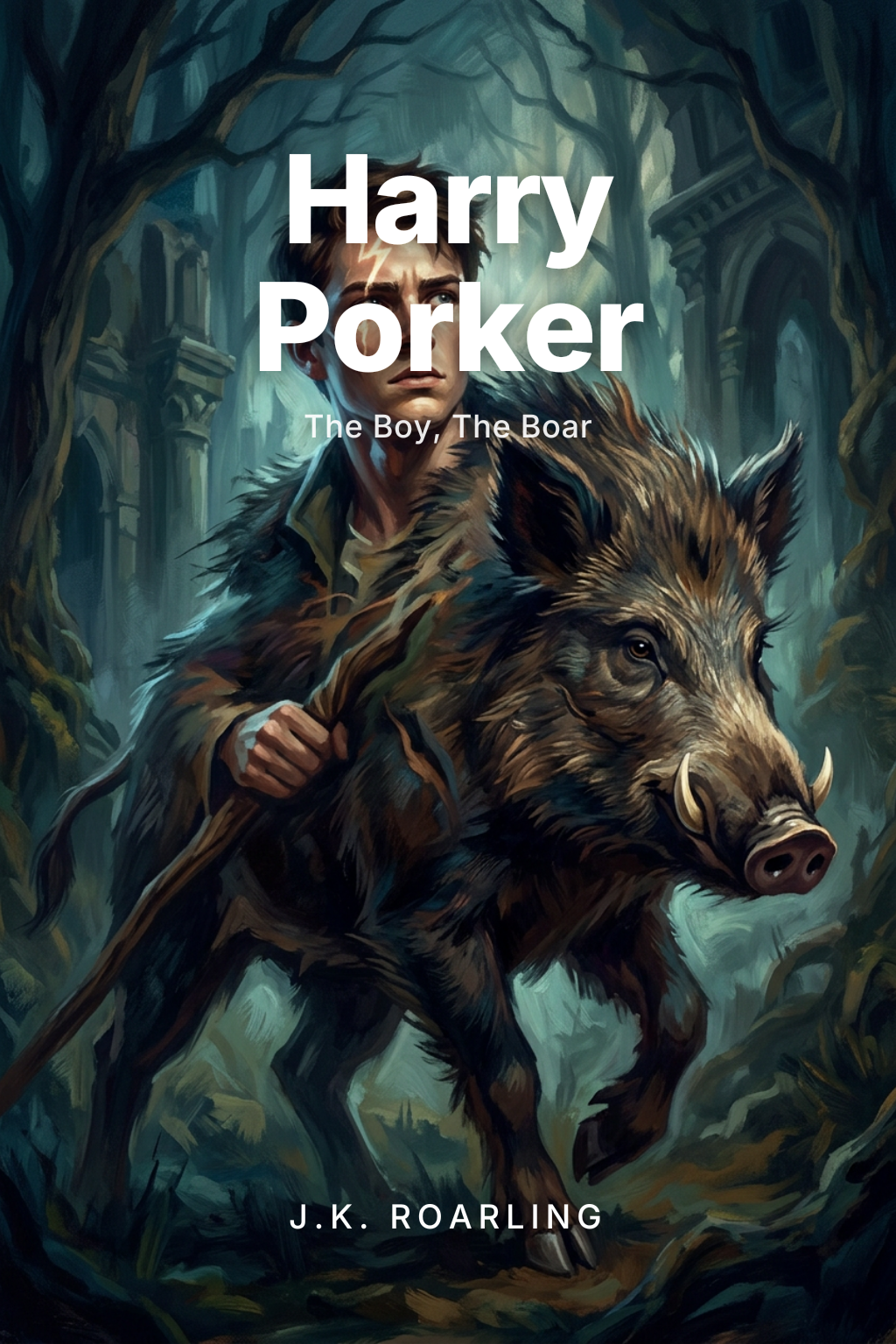
Novel · 5 chapters · 8,800 words
Write Harry Porker, a book about a special boy wit
Contents5 chapters
Chapter 1
Chapter 1: The Boy in the Cracked Mirror
Harry Porker first learned what his scar could do on a Tuesday afternoon, though no one in the house would have called it a proper learning, because Uncle Harlan was shouting from the shed and Aunt Mavis was slamming cupboards in the kitchen and the whole place smelled of boiled cabbage and damp socks.
Harry sat at the bottom of the stairs with his knees tucked up and the ends of his jeans torn where he had caught them on the fence wire behind the coop. The scar on his forehead, a crooked lightning bolt that had been there as long as he could remember, itched in a way it never had before. He scratched at it with a dirty fingernail and felt a strange answering thrum deep in his chest, low and warm, like a drum struck under a floorboard.
“Boy!” Uncle Harlan barked from the back door. “If you’re not useless, you’ll come help with the feed sacks.”
Harry stood. The stairs creaked under his weight. He was thin in the way some boys were thin when they lived on leftovers and bad temper. His hair was mousy and cut crooked. There was a patch on one knee and a splinter in the palm of his hand that he kept meaning to pull out.
He crossed the yard to the shed, where the air was thick with the sweet rot of apples and the sharp stink of mash. The pigs in the pens nosed the rails and snorted. Uncle Harlan stood with one boot on a sack of meal, red-faced and sweating through his vest.
“Lift,” he said.
Harry bent, took the sack, and hauled it up against his hip. It was heavier than it looked. He staggered one step and nearly went over in the mud.
“Careful,” said Aunt Mavis from behind him. Not kindly. Nothing in her voice was kind. She had a dish towel in one hand and a look in her eye that said she had already found fault with the day and planned to spread it around.
Harry shifted his grip. The sack scraped against the raw skin at his wrist. He clenched his teeth. The little pain snapped something tight inside him, and the scar on his forehead burned hot enough to make him blink.
Then the world lurched.
His fingers thickened first. He felt the bones in them shove and spread, the nails flattening and hardening into pale hooves. He made a sound that was half gasp, half grunt, and that sound came out rougher than before, deeper, as if someone had scooped out his voice and filled the space with gravel.
Uncle Harlan dropped the feed scoop.
Harry looked down. Brown bristles were pushing through the skin of his forearms. His elbows had gone strange and broad. His nose was swelling, lengthening, the air suddenly full of itself, every smell punched into sharpness: sour mash, wet rope, mud, old wood, the sweat on his own shirt, the fear on Uncle Harlan’s breath.
He stumbled back and nearly tripped over a bucket. His feet had changed too. Hooves split the toe caps of his shoes with a crack.
Aunt Mavis screamed.
Harry turned his head and saw his own face reflected in the shed window, and he almost screamed with her. Where the boy’s face had been was a wild boar’s head, dark and bristled, eyes wide and white-rimmed, the lightning scar still there above the brow like someone had drawn it with a white-hot nail.
He snorted. A real snort. It steamed out into the cold afternoon.
“Get back,” Uncle Harlan said, but he was already backing away. His face had gone the color of old porridge.
Harry had no plan. His whole body was new and wrong and furious with strength. He lifted his foreleg, felt the power in it, and brought it down on the feed sack. It burst open. Grain sprayed over the mud in a golden spill. The pigs in the nearest pen went wild, squealing and battering at the slats.
That sound did it.
Harry bolted.
He smashed through the open gate at the far end of the yard, scattering chickens. He hit the lane at a gallop, hooves churning the wet earth. Wind slapped his bristled face. The world was all scent and motion and the hammering of his own heart. He ran past the blackthorn hedge, past the broken cart wheel, past Mrs. Dottle’s wall where a length of washing flapped like surrender flags. Dogs barked. A man shouted. Someone dropped a pail.
Harry did not stop until he reached the riverbank, where the reeds bent low and the water moved dark and fast between the stones.
He stood there heaving, sides shaking, foam gathering at the corners of his mouth. Then, just as abruptly as it had begun, the heat in his scar cooled. His shoulders drew in. His snout shortened. Fingers came back one by one with a tingling ache. He buckled onto the mud in his own skin, naked and trembling except for the remains of his torn shirt hanging off one shoulder.
For a long minute he only breathed.
When he could think again, he crawled to the water and looked down.
The face in the river was his own. Pale. Freckled. Scared. The lightning scar sat on his forehead like a little white crack in the world.
He had never liked that scar. The truth was, he had always hated it, because the children in the village stared at it and called him names behind their hands, and because Uncle Harlan said it made him look touched in the head, and because Aunt Mavis crossed herself whenever he got too near the pantry as if bad luck might rub off on the jam. But now, with the ache still humming in his bones, the scar looked different. Not cursed. Not merely ugly. It looked awake.
A twig snapped behind him.
Harry spun. A boy stood on the path above the bank, one he had never seen before. He was about Harry’s age, though better fed, with a sharp face and a black coat that seemed too fine for the mud around his boots. He held a walking stick in one gloved hand and wore no hat despite the cold. There was something odd about his stillness. He did not fidget or sway. He watched Harry as if he had expected to find him there.
“You managed it quickly,” the boy said.
Harry scrambled to his feet, clutching his torn shirt closed at the waist. “Who are you?”
The boy looked him over, taking in the bare feet, the mud, the scar. His mouth twitched, not quite a smile.
“Name’s Pip,” he said. “Pip Puddlewick. And if you’ve any sense, you’ll come with me before they do.”
“Who’s they?”
Pip glanced toward the lane. In the distance, Harry heard shouting. A dog was barking in frantic bursts.
“The people who don’t like boys turning into boars in public,” said Pip. “Particularly boys with that scar.”
Harry frowned. “You know about it?”
“I know enough.” Pip tapped the end of his stick against a stone. “And I know you’ve got about two minutes before your uncle gets here with a pitchfork and a very poor idea.”
Harry looked back up the path. For one mad moment he wanted to stay by the river forever, to crawl into the reeds and become nothing at all. But the shouting was getting closer, and the thought of Uncle Harlan’s face, purple with rage, made his skin crawl.
“Come on, then,” Harry said.
Pip turned and led him along the river path without another word.
They walked fast, slipping between hedges and ducking under a low ash bough until the village was behind them. Harry had to keep one hand on his torn shirt and the other on a rib that still ached from the change. The path climbed toward a broken stone wall and a stand of yews beyond it. At the top, tucked behind the trees, stood a narrow house with crooked chimneys and a door painted the color of dried blood.
Pip rapped the knocker three times. Waited. Rapped again.
The door opened at once.
A woman stood in the doorway wearing a patched green coat and spectacles that sat at the end of her nose. She had silver hair wound into a knot at the back of her head and a foxlike face full of hard lines. Her gaze landed on Harry and sharpened.
“So,” she said. “It’s begun.”
Harry looked at Pip. “Who is she?”
Pip’s expression changed in a way Harry couldn’t read. Respect, maybe. Or nervousness.
“Miss Bristle,” he said. “And if you live long enough, you’ll call her trouble.”
The woman stepped aside. “Inside,” she said. “Now. If the wrong ears hear you, we’ll be dealing with more than a frightened farm family.”
Harry hesitated only a second before stepping over the threshold.
The room beyond was warm and crowded with shelves. Bones in glass jars. Bundles of dried herbs. Maps pinned under brass weights. A cracked enamel kettle on the stove. A boar’s tusk mounted above the mantel. The whole place smelled of smoke, rosemary, and old paper.
Miss Bristle shut the door behind him.
Then she took off her spectacles, polished them with the edge of her sleeve, and looked straight at the scar on Harry’s forehead.
“Your mother had one just like it,” she said.
Harry went very still.
He had never been told much about his mother. Aunt Mavis spat out the name only when she was angry, and Uncle Harlan never said it at all. On the rare occasions Harry had asked, he was told she had died. That was the end of it. Dead was dead. Questions were for greedy children.
“What do you mean?” he asked.
Miss Bristle folded her spectacles and set them on the table. “I mean your mother knew what your scar was for. I mean she trusted me with a message for the day it woke. I mean the man you need to fear most in the world will be very interested that you’ve turned into a boar on your own before supper.”
Pip shut the door latch and leaned against it, suddenly less sure of himself.
Harry took one step back. “I don’t know what you’re talking about.”
“No,” said Miss Bristle. “But you will.”
She crossed the room, opened a drawer with a squeal of wood, and took out a small object wrapped in linen. She placed it on the table and unwrapped it carefully.
Inside was a coin-sized medallion made of dull silver, stamped with the image of a boar charging through a ring of flames.
“When the time comes,” she said, “you’ll need this. And you’ll need courage. You have one of those in shorter supply.”
Harry stared at the medallion. It looked cold enough to burn.
Outside, somewhere down the hill, a bell began to ring, fast and panicked.
Miss Bristle turned her head toward the window. Her mouth flattened.
“They’ve started the search,” she said. “So we have very little time.”
Harry looked from her to Pip and back again. His heart was still thudding in his chest like a trapped bird. He did not understand any of it. He understood only that his life had cracked open in the shed, and there was no sealing it shut again.
“Who’s Voldeboar?” he asked.
At the name, Pip went pale.
Miss Bristle did not answer at once. She reached for the kettle, set it on the stove with a solid clank, and only then spoke.
“The worst man who ever learned the same trick you just did,” she said. “And he’s been looking for you for a very long time.”
Chapter 2
Chapter 2: The House with the Tusk Above the Door
Harry slept badly in the house with the tusk above the door. Every time he drifted off, he woke again with the memory of hooves cracking through his shoes and the taste of mud in his mouth. Once he dreamed he was running through a field of black grass while something large and heavy crashed after him, breathing through a snout like a bellows. He woke with his fists clenched and his shirt damp with sweat.
Morning came in a narrow strip through the curtains. He lay on a narrow cot in a room lined with shelves of jars and labeled bundles. On a table beside him sat a mug of tea gone cold and a plate with half a heel of bread. Nobody had touched the bread. Harry stared at it for a while, then ate it in three bites.
Downstairs, voices murmured.
He dressed in yesterday’s torn clothes and crept to the top of the stairs. Pip was in the kitchen, sitting sideways on a chair with his boots on the rung, making a face at a cup of tea. Miss Bristle stood by the stove in her green coat, sleeves rolled, stirring porridge with one hand and flipping through a pile of yellowed letters with the other.
“Too much salt,” Pip was saying.
“It’s porridge, not pudding,” said Miss Bristle.
“It tastes like the bottom of a boot.”
“Then perhaps you’ve had boot porridge before.”
Harry came into the room and both of them looked up.
Pip straightened at once, as if he had been caught being lazy by a schoolmaster. Miss Bristle only set the spoon down and nodded at Harry’s bare feet.
“You’ll want shoes that can survive a change,” she said. “Mine in the hall may fit.”
Harry glanced at the mug. “I don’t want to change again.”
“No one does at first.” She folded one of the letters and tucked it into her coat. “Eat. Then we’ll talk properly.”
Harry sat. The chair wobbled under him. Pip watched him over the rim of his cup.
“What?” Harry said.
Pip shrugged. “Nothing. You’re smaller than I thought.”
Harry gave him a look. “You’re not much taller.”
“I’m taller in a dignified way.”
Miss Bristle snorted softly. It was the closest thing to laughter Harry had heard from her.
When he had eaten, she drew three chairs to the table and spread a map between them. It was a hand-drawn map, inked in dark lines, with little notes in the margins and several places crossed out in red. Harry saw the village where he had lived all his life, then the river, then roads leading outward to towns he had never visited. In the far corner, beyond the edge of the page, someone had written in a sharp hand: THE OLD PEN.
“What is that?” Harry asked.
Miss Bristle placed one finger on the map. “A place where people with our condition were once kept.”
“Our condition?” said Harry.
Pip made a face. “He means boarfolk.”
Harry stared. “That’s not a thing.”
“It is when enough people agree it is,” Miss Bristle said. “Long ago, a number of families carried the same gift. Some called it a curse. Some called it a blessing. Most outsiders called it dangerous and locked them away if they could.”
Harry looked from one to the other. “You’re saying there are more like me?”
“Were,” said Miss Bristle. “Perhaps some still hide. It’s been years since I saw another turn in the open.”
Pip tapped the map. “You mean besides him.”
Miss Bristle’s mouth tightened. She reached for a small wooden box on the mantel and opened it with a click. Inside lay a stack of photographs, their edges curled. She slid one out and pushed it across the table.
Harry leaned forward.
The picture was old and grainy, but the face in it was unmistakable. A man stood in a formal coat before a stone building, one hand on a cane, the other tucked behind his back. He was handsome in the way foxes are handsome, all sharp cheek and narrow eyes. His hair was slicked down. His smile was not a smile at all, only a careful showing of teeth.
On his forehead, in place of a scar, was a dark, twisting mark like a burnt knot.
Harry looked up. “Who is he?”
“Voldeboar,” said Pip.
Harry waited for more, but that seemed to be enough for Pip to shiver and sit back.
Miss Bristle took the photograph away. “His name was once Edrin Vale,” she said. “He came from money. Clever, cruel, charming in public, unpleasant in private. The usual sort. Then he discovered he could change.”
Harry frowned. “Like me?”
“No,” said Miss Bristle. “Not like you.”
She took a breath, as though she disliked the memory. “The change comes in many forms. Some are broad and clumsy. Some keep the mind sharp. Some don’t. Voldeboar’s gift twisted him badly. The first time it happened, he broke a boy’s arm just to hear the sound. After that, he began experimenting.”
Pip made a small noise of disgust.
“With what?” Harry asked.
Miss Bristle looked at him for a long moment. “With fear,” she said. “With pain. With blood. He believed the right conditions could make the change stronger, more obedient. He built his own little cult around the idea. People vanished. Some came back wrong. Some didn’t come back at all.”
Harry’s stomach tightened.
“Then he disappeared,” Miss Bristle said. “For years. Everyone thought he was dead.”
Pip said, “But he wasn’t.”
“No,” she said. “He was waiting.”
The kitchen went quiet except for the tick of a clock on the wall and the soft scrape of Harry’s fingers against the table edge.
He looked at the map again. The Old Pen. The red marks. The crossed-out roads.
“Why me?” he asked.
Miss Bristle’s hand rested on the table, knuckles pale beneath the skin. “Because your mother kept you hidden. Because she believed he would come looking for you. Because your scar is not merely a mark of the gift. It is a key.”
“A key to what?”
“She never told me that part.”
Pip sat up. “That’s not very helpful.”
Miss Bristle gave him a dry look. “Neither are your opinions, yet we keep them around.”
Harry traced the edge of the photograph without touching it. “You said my mother left a message.”
“She did.” Miss Bristle opened the box again and took out a folded slip of paper sealed in wax. The seal had cracked with age, but the impression was still visible: a boar’s head under a crescent moon. She held it out, then paused.
“When you open this,” she said, “there is no unlearning what you find.”
Harry took the paper. His hands were shaking, though he tried to stop them.
The seal broke with a faint snap.
Inside was a line written in neat, slanted script.
If he comes, do not let him take you to the dark pen.
Harry read it twice.
“That’s it?” he said.
Miss Bristle nodded once. “That’s all she sent.”
Pip leaned in. “What’s the dark pen?”
Miss Bristle did not answer. She took the letter back, folded it, and slid it into her coat pocket as though putting away a knife.
Harry stood and went to the window. Outside, the garden was untidy and overgrown, with beanpoles leaning at odd angles and a line of cabbages chewed by slugs. Beyond the wall, the yews pressed dark and close. There was a narrow lane leading down toward the village, and from this angle he could see a few people moving there in a hurry. Tiny figures. One of them had a pitchfork.
He swallowed.
“What if I don’t want this?” he asked.
Pip answered before Miss Bristle could. “You think any of us did?”
Harry turned. Pip was not joking now. His mouth had gone flat and tired.
Miss Bristle folded her arms. “Want has very little to do with it. But if you’re asking whether you can refuse to help while Voldeboar is hunting you, the answer is no. He won’t stop. He never has.”
“Why?”
“Because you are something he cannot control.”
Harry stared at the floor. The boards were scarred and rubbed pale by years of use. Control. The word had teeth in it. Uncle Harlan liked control too. So did Aunt Mavis. It was the way they held a room, the way they made everyone smaller so they could feel bigger.
“Then what do I do?” he said.
Miss Bristle moved to the wall and took down a narrow coat with a torn lining. From one pocket she drew a small leather pouch and tossed it to him.
Harry caught it. It was heavier than it looked. Inside was a strange coin, the same silver medallion he had seen the day before, and a folded note with a list of names.
“Find the others,” she said. “The scar is one sign. There may be more. A girl in the north who can hear lies in the shape of bells. A boy in the marsh towns who turns to boar when the moon is new. A woman in the city who has not changed in years but still bears the mark.”
Pip frowned. “That sounds impossible.”
Miss Bristle said, “That is because most useful things do.”
Harry looked down at the names. There were four in all, each with a place written beside it. One line had been crossed out so hard the paper nearly tore.
And beneath the list, in smaller handwriting, was one final instruction.
Do not trust anyone who asks you to come quietly.
Harry felt his face go hot. He thought of Uncle Harlan. Aunt Mavis. The village constable. Men with firm voices and heavy hands. He thought of the way adults said quiet when they meant obey.
A knock came at the front door.
All three of them froze.
The knock came again, louder this time, followed by a man’s voice calling, “Miss Bristle? We’ve business in the lane.”
Pip was already moving. He snatched up a poker from beside the stove and edged toward the hall.
Miss Bristle lifted one finger. “No heroics,” she said.
Pip stared at her. “You say that like you’ve ever stopped me.”
The knock came a third time. This one rattled the frame.
Harry’s chest tightened. He could hear more voices outside now, low and urgent. Boots on the gravel. The scrape of metal against stone.
Miss Bristle crossed to the hearth, took down a plain walking stick from the wall, and pressed it into Harry’s hand.
“Stick close,” she said.
Harry gripped the wood. It was smooth and worn, warm from the room. He looked at the front door, then at the hall, then at Pip, who had gone very still.
“What do they want?” Harry asked.
Miss Bristle smiled without showing teeth. “If I know men, they want to pretend this is all very orderly.”
The door shook under another blow.
Then, from the other side, someone called Harry’s name.
Not his aunt’s voice. Not his uncle’s.
A stranger. Calm. Familiar in the worst way.
Harry did not know the voice, but his scar did. It flared hot beneath his skin, and before anyone could stop him he stumbled backward, and the room around him seemed to rush in tight and close.
The change hit hard.
His spine bent. His ribs spread. The stick dropped from his hand as his fingers turned thick and hooved again. He crashed against the chair, sending it over. Pip shouted. Miss Bristle cursed.
The door burst open.
Harry, half-boar and blind with panic, caught only pieces of the figure in the doorway: a black coat, polished boots, a gloved hand resting on a cane, and a face half hidden in the shadow of a wide-brimmed hat.
The man’s voice was soft, almost pleased.
“There you are,” he said.
Harry lowered his head and charged.
Chapter 3
Chapter 3: The Coal Tunnel Under Ash Gate
Harry’s shoulder hit the man in the doorway squarely in the chest. The stranger flew backward through the hall with a sound like breath leaving a bellows. Harry crashed after him, hooves skidding on the runner rug, splintering the hall table with one tremendous blow of his flank. A lamp fell. Oil spilled. Pip shouted something that was lost in the clatter.
The man caught himself against the wall with one hand. Even half thrown across the hall, he moved with a strange steadiness. He was tall, narrow, and dressed too neatly for a house in a hurry. His cane had tipped from his grasp and lay at his feet. Harry saw the face now: pale, smooth, almost handsome, with eyes so dark they swallowed the light around them.
The lightning-shaped mark on his forehead was not a scar like Harry’s. It looked burned in, black and raised, as if the skin had been branded.
Voldeboar smiled.
Harry snorted and lunged again, but Miss Bristle shouted, “Left!”
Something struck Harry in the ribs. Not hard enough to hurt, just enough to jar him sideways. Pip had swung the poker at the man’s knee. Voldeboar turned on him with a flash of irritation.
Pip leapt back, nearly tripping over the umbrella stand.
“Bad idea,” he muttered, though no one had asked.
Voldeboar stepped forward. “You’ve grown bold in my absence, Agatha.”
Miss Bristle came into the hall with a coal scuttle in one hand and a look on her face Harry had never seen before. Not fear. Anger. She hurled the coal straight at Voldeboar’s face. He jerked aside, and the black lumps smashed into the glass of the front door, peppering the entry with grit.
“Get him out,” she said to Pip. “Now.”
“I’m trying!” Pip snapped back.
Harry’s body strained toward the stranger again, every muscle ready to charge. Voldeboar’s gaze settled on him. Up close his eyes were worse than from a distance. Flat. Appraising. Like a butcher deciding where to cut.
“So,” he said softly. “The boy lives.”
Harry lowered his head. A snort rumbled in his throat.
Voldeboar’s mouth twitched. “And turns well, too.”
At that, Harry charged.
The man moved out of the way so quickly Harry barely saw it. One moment the hall was full of him, the next he was beside the stair rail, cloak swishing. Harry’s tusks clipped the banister and sent a shower of chips into the air.
“Through the kitchen!” Miss Bristle cried.
Pip grabbed Harry by the bristle along his shoulder, which was a foolish thing to do to a boar, but he pulled hard enough that Harry skidded toward the back of the house instead of into the front room again. The kitchen door swung open. A saucepan flew from the stove as Miss Bristle shoved the latch open with her elbow.
They burst into the yard through the back gate, Harry still half-changed, his mind full of wild scent and the angry hammering of his heart.
The air outside was thick with smoke from the chimney and the sour smell of the pig pens below the slope. Two men in dark coats were already coming around the side of the house. One had a net. The other held a short iron rod that sparked at the tip, as if a coal had been trapped inside.
“Run!” Miss Bristle shouted.
Harry ran.
The three of them tore down the back path, through a row of gooseberry bushes that scratched at Harry’s flank and snagged Pip’s coat. Behind them, voices called. The sound of boots hit the packed earth. A whistle shrieked from somewhere near the lane.
“Where are we going?” Harry panted, though what came out sounded more like a grunt than a question.
“Under Ash Gate,” said Pip, not slowing. “If we reach the old service tunnel, we can lose them in the coal yards.”
Harry did not know what Ash Gate was, but the name sounded like something with a locked door on it, which was better than being caught by the men in black coats. He barreled after Pip through a narrow alley between stone walls. The passage smelled of wet brick and chimney soot. A cat shot out in front of him and vanished under a barrel.
At the alley’s end stood a rusted iron gate with a broken sign above it. Ash Gate was painted in peeling letters over a disused coal store. Beyond it, the ground dropped away into a yard cluttered with crates and sacks.
Pip stopped, glanced around, and kicked at a loose paving stone.
Harry’s change was beginning to ease. His forelegs trembled. The snout drew in a fraction. He braced himself with a heave, fighting the collapse that came after. It always felt like falling through a trapdoor inside his own bones.
The paving stone shifted. Pip lifted a finger ring hidden beneath the edge and hauled. A square of iron in the ground rose with a groan.
“Down,” he said.
Harry stumbled to the opening and stared at the darkness below.
Miss Bristle was already there, gathering her coat with one hand and holding a small lantern shielded in the other. “If you mean to hesitate, do it somewhere less exposed.”
Harry took a breath, then climbed down the ladder bolted to the wall.
The tunnel beneath Ash Gate was cramped and smelled of earth, old coal dust, and rust. The ceiling sweated. Water dripped steadily from a crack overhead. Harry had to crouch as he moved along the passage. Each step echoed too loud. Behind him, Pip dropped the iron hatch and slid a bolt into place.
For a moment they stood in the dark, listening.
Boots passed over their heads. Voices called. A sharp knock rattled the hatch once, then stopped.
“Good,” said Pip.
“Don’t sound so pleased,” said Miss Bristle. “They’ll think harder if you encourage them.”
Harry’s breathing slowed. The last of the boar shape drained from him, leaving him shaky and sore. He leaned a hand against the damp wall. The stone was cold enough to sting.
“Who were those men?” he asked.
“Collectors,” said Miss Bristle. “Voldeboar uses them to retrieve things he wants kept out of sight.”
“People,” said Harry.
“Yes.”
“Am I a thing to him?”
Pip’s face changed. He opened his mouth, shut it again, then said, “You know he is not a good sort, right?”
Harry stared at the tunnel floor.
Miss Bristle lit the lantern fully and held it low. The light made sharp shadows of her face. “He wants what your mother hid,” she said. “And if he can get it from you, he won’t care whether you live.”
Harry swallowed. “What is it?”
“If I knew, we would not be crouching under a coal yard.”
They moved on.
The tunnel split and narrowed, then widened into an older section lined with bricks blackened by soot. Here there were rusted hooks on the walls and a line of discarded carts half sunk into the floor. Someone had once worked this place hard. Now it was a buried artery, forgotten by everyone except those who needed a way through.
Pip led the way with surprising confidence. He kept one hand on the wall, his fingers brushing over shallow markings cut into the brick: a boar’s head, a crescent, a small star. Harry noticed the same marks repeated again and again as they went.
“What are those?” he asked.
“Old signs,” said Pip. “For people who knew where to hide.”
Miss Bristle glanced at him. “You’ve been down here before.”
Pip’s ears reddened. “Only once.”
“That was once too many.”
They came to a chamber with a brick archway and a broken bench along one wall. In the center stood a shallow stone basin filled with stale water. Harry peered into it and saw, for a moment, not his own reflection but the face of a man with a boar’s snout and a ring of keys at his belt.
He jerked back. The image vanished.
“What was that?”
Miss Bristle came to stand beside him. She did not look into the basin. “A memory impression,” she said.
Pip made a face. “That’s a terrible name.”
“It is what it is.”
Harry reached toward the water, then thought better of it. “Whose memory?”
“Somebody who worked these tunnels,” said Miss Bristle. “The old wardens left traces in stone and water. Useful, if you know what to look for.”
She placed two fingers on the basin’s rim. The water shivered. A ring of pale light spread outward, and the chamber changed.
Not physically. Not like a door opening. More like a layer being lifted.
Harry saw, overlaid on the darkness, shapes of people in rough coats carrying crates marked with a boar and a flame. He heard distant voices. A child crying. A man laughing from somewhere deeper in the tunnel.
Then the vision snapped away.
Harry grabbed the edge of the basin. “What was that?”
Miss Bristle’s face had gone harder. “A warning.”
Pip had gone pale. “Did you hear that laugh?”
Harry had. It had been low and pleased, as if someone nearby had just had a good meal.
Miss Bristle straightened. “We move.”
They went on through the tunnel until the stone gave way to timber bracing and the air changed from damp earth to machine oil. The sounds of the town above faded. In their place came the clank and rattle of the coal yards beyond, carts groaning on rails and men calling to one another in muffled bursts.
At last Miss Bristle stopped before a wall of stacked crates.
“This way,” she said.
She reached up, tugged a cord hidden behind a beam, and the crates shifted on concealed hinges to reveal a narrow door.
Harry stared. “You have a door behind crates in a tunnel under a coal yard.”
Miss Bristle shrugged. “It’s useful.”
Pip said, “She says that about everything and then acts surprised when it causes trouble.”
The door opened into a little room lit by a single lamp. There was a table, three chairs, and a shelf lined with boots. On the far wall hung a coat rack and, beside it, a map pinned under a knife. A kettle hissed on a small iron stove.
Harry stepped in and nearly laughed from relief.
It was not a safe place. It was cramped and dusty and full of old secrets. But it was a place with a lock on the door.
Miss Bristle shut them in and bolted it. Then she took off her coat, hung it neatly, and rolled up her sleeves.
“Listen carefully,” she said. “Voldeboar knows you’ve slipped his net. He won’t waste time with the village now. He’ll widen the search. Ports. Rail lines. Coaching inns. Anywhere a boy might go to ground.”
“Why not send more of those men?” asked Harry.
“Because he does not trust ordinary muscle with this matter,” she said. “He will come himself if need be.”
Harry’s stomach turned over. “He was here. He looked at me like… like I was already his.”
Pip looked down at the floorboards.
Miss Bristle’s voice went flat. “He did not get you. That is the only thing worth saying about him today.”
She reached into the pocket of her coat and drew out Harry’s mother’s folded note, the one with the warning about the dark pen. She laid it on the table and pressed it flat.
“We begin tonight,” she said. “If we are doing this at all, we do it before the trail cools. You’ll need better boots. Food. A name that isn’t Porker if we’re to avoid foolish questions.”
Harry blinked. “What’s wrong with Porker?”
Pip made a choking sound that might have been laughter. Miss Bristle’s mouth twitched.
“Nothing,” she said. “Nothing at all.”
She opened the stove and put the kettle on again, as if the world had not gone mad upstairs. Harry watched the water begin to warm.
Then, from somewhere far above, came the deep clang of the coal yard bell.
Once. Twice.
Then a shout. Another. The scrape of running feet.
Miss Bristle went still.
Pip moved first, to the window slit. He looked out, then leaned back with a swear under his breath.
“What is it?” Harry asked.
Pip swallowed.
“They found something,” he said. “And I don’t think it’s the tunnel.”
Chapter 4
Chapter 4: The Bell Tower at Bracken Cross
By the time they reached Bracken Cross, Harry had changed twice and was beginning to understand that the second time was always easier than the first, though only a little. The first change came sudden and brutal, all bones cracking and skin pulling tight. The second arrived with a warning in his scar, a hot prickling under the hair that gave him just enough time to brace his feet and clench his jaw before the boar came through.
That did not make it pleasant. Nothing about it was pleasant. But it kept him from falling flat in front of people, which was useful.
They traveled by cart with a canvas sheet over the back and sacks of turnips stacked around Harry’s legs. Miss Bristle had bartered passage with a woman in a brown shawl who asked no questions after being given three coins and a jar of pickled onions. Pip sat up front beside the driver, pretending not to know any of them. He was good at pretending. Harry had already noticed that about him.
Bracken Cross sat where three roads met and looked, from a distance, like any hard-working market town trying not to be shabby. There was a square with a dry fountain in the middle, a butcher’s row smelling of blood and salt, a chapel with chipped stone saints, and a tall bell tower rising above the roofs like a finger pointing at the sky. The streets were crowded with carts, boys with trays of eels, women carrying bundles of cloth, and men in aprons shouting over one another.
Miss Bristle pulled the canvas down and pointed.
“Do not stare,” she said.
Harry was already staring at the tower. “Why’s the bell ringing in the daytime?”
Pip peered upward. “It’s not.”
The bell tower stood silent. What Harry had heard was a thin metallic chiming from somewhere inside the stone, not a call to service but a warning tone, faint and uneasy.
“Someone knows we’re here,” said Miss Bristle.
Harry’s mouth went dry. “How?”
“Because Voldeboar is not subtle when he wants a place searched.” She tugged the reins once, and the cart jolted to a stop near the edge of the square. “Stay close. We need answers before sundown.”
“Answers from who?” said Pip.
Miss Bristle glanced toward the chapel, then the bell tower. “Someone who has been expecting trouble for years.”
They entered the square on foot. Harry had his cap pulled low and his collar turned up. Miss Bristle had given him a coat too large in the shoulders and a pair of boots with worn heels. He felt dressed like a stranger, which was perhaps the point. Still, he was sure every pair of eyes settled on him for a beat too long.
They crossed to a narrow alley behind the chapel where a signboard hung over a low arched door. The board showed a black bell and, beneath it, three painted words:
ADJUSTMENTS MADE HERE.
Pip stared. “That’s either a tailor or a threat.”
Miss Bristle pushed the door open.
The shop inside was packed wall to wall with clocks, bells, springs, and old radio sets stripped open like carcasses. A thin man with wire spectacles was bent over a workbench, his hands moving with the quick, careful precision of a watchmaker. He looked up only when they were already inside.
His eyes widened at the sight of Miss Bristle.
“Well,” he said. “That’s an unpleasant surprise.”
“Good afternoon to you too, Felix,” said Miss Bristle.
Felix straightened and wiped his hands on a rag. He was long-faced and stooped, with a collar that needed washing and a scar across one knuckle from some long-ago accident. He looked at Harry, then at Pip, then back at Miss Bristle.
“You brought the boy,” he said quietly.
Harry stiffened. “What boy?”
“The one with the scar,” Felix said. “I can see him.”
Pip pointed at his own chest. “There are two boys here, actually.”
Felix ignored him and moved closer to Harry, peering with the sharp concentration of a man inspecting a cracked lens. “Let me see your forehead.”
Harry did not like the sound of that.
Miss Bristle said, “Be kind.”
“I am being kind. If I were unkind, I’d make him stand under the bell.”
Harry looked up. “What bell?”
Felix pushed aside a curtain of hanging chimes and led them through to a back room where a heavy rope descended through the ceiling. Above it, hidden in the rafters, hung a small bronze bell no bigger than Harry’s head.
The instant Harry stepped beneath it, the bell gave a tiny, sharp ring.
Harry flinched.
Felix went still. “There.”
Miss Bristle’s jaw tightened. “A marker?”
“No,” said Felix. “A warning.” He stared at Harry. “You’re carrying a live trace.”
Pip spread his hands. “That sounds worse than it is.”
“It’s exactly as bad as it sounds,” Felix replied.
Harry rubbed the scar with the heel of his hand. “What does that mean?”
Felix reached into a drawer and brought out a little brass disc pierced through the center, then set it on the table. It vibrated faintly, just enough to make a soft hum against the wood.
“When certain marks are awakened,” he said, “they call to one another. Not by magic, exactly. By resonance. By pattern. The same shape in the same blood. Things answer.”
Harry looked at Miss Bristle. “You said key. This is getting worse.”
“It often does before it gets better,” she said.
Pip said, “That is not reassuring.”
Felix took a breath and rubbed his face. “Why are you here, Agatha? If he’s in town, you should have stayed hidden.”
“He found the boy in the village. I won’t leave him where Vale can reach him.”
Felix’s expression changed when she said Vale. Not surprise. Recognition. Fear that had been held in check too long.
So Harry did what he had begun to do whenever adults started looking at each other with the wrong kind of silence. He asked the question they did not want.
“How do you know Voldeboar?”
The room seemed to tighten.
Felix looked away first.
“I worked for him,” he said.
Pip made a sharp, disbelieving noise. “You what?”
“Not by choice,” Felix snapped. “And not for long. I was younger. Stupid. He paid in coin and lies, which is still too much for some men. I kept records. Inventories. Locations. The sort of things boys like you don’t think matter until they do.”
Harry watched him. The man’s hands had begun to shake, just slightly, and he clasped them behind his back to hide it.
“What kind of locations?” Harry asked.
Felix hesitated. Miss Bristle gave him a look sharp enough to cut string.
“Facilities,” he said at last. “Training sites. Holding rooms. The old pens, before they were abandoned. He had a network once. It broke apart after the first crackdown, but not entirely. Some of us got out. Some stayed because we were cowards. Some because we thought we could do more from inside.”
“Did you?” said Harry.
Felix’s face closed. “No.”
Pip muttered, “At least he’s honest about it.”
Felix ignored him. He turned to the workbench and lifted a cloth from a small device like a pocket watch enlarged to the size of a saucer. Its face was cracked. Three needles spun under glass.
“What is that?” Harry asked.
“A tracker,” said Felix. “I made it years ago from notes I should have burned. It points toward the strongest mark within a mile. I haven’t had reason to use it in half a decade.”
Miss Bristle stepped forward. “And now?”
Felix set the device on the table. The longest needle twitched, then swung with a violent little jerk toward the wall behind Harry.
Not toward Harry.
Toward the bell tower.
Pip looked up toward the ceiling as if he might see through the roof to the square beyond. “He’s here.”
Felix nodded once. “Or one of his people is. Either way, he’s close enough.”
Harry felt a chill run across his shoulders. “What does he want in the bell tower?”
Miss Bristle said nothing at first. She crossed to the back window, peered through the cracked glass, and watched the square below. Her fingers tightened on the sill.
Then she said, “The old way in.”
Felix closed his eyes. “You mean he’s opened the lower crypt?”
“Not yet. But he will if he gets the key.”
Harry looked at the two of them. “I keep hearing that word.”
Miss Bristle turned. “Because it’s true.”
She took the medallion from her pocket and held it in her palm. In the close light of the room, the boar on the coin looked as if it might break into a run.
“When your mother hid you,” she said, “she hid more than a child. She hid access. Your scar is one half of a seal. The other half is somewhere beneath the bell tower, in an old chamber called the Hollow Vault.”
Pip blinked. “That sounds dreadful.”
“It was built to be dreadful,” said Felix.
Harry looked at the medallion, then at the tower outside. The bell in the rafters gave a tiny quiver as if someone had touched the rope from above.
“Why there?” he asked.
Miss Bristle’s eyes did not leave the window. “Because the first boarfolk leaders were buried under the tower. Because Voldeboar was one of them once. Because whatever he is looking for has been there longer than any of us.”
Felix took off his spectacles and wiped them with trembling fingers. “And because the chamber can only be opened by a living mark.”
Harry looked down at his hands.
A living mark.
Something about that made him angry all at once. Not because it was true, but because his whole life other people had been opening and closing doors around him without asking what he wanted. Uncle Harlan. Aunt Mavis. Now this stranger with polished boots and a brand on his forehead.
“I’m not a lock,” he said.
“No,” said Miss Bristle. “You’re the one thing he can’t pick.”
Pip shifted from one foot to the other. “We could maybe discuss this after we’re not being hunted through a town with one bell tower and several narrow alleys.”
The bell in the shop gave one hard peal.
Everyone froze.
Then a sound came from outside: boots in the square, too many and too even to belong to ordinary shoppers. A woman screamed. Someone shouted for the constable. Another bell began to ring, this one in the distance, and then another farther off.
Felix moved fast then. He swept the device into a drawer, shoved the brass disc into Harry’s hand, and pulled a canvas sheet off the back wall, revealing a narrow stair leading down.
“This way,” he said. “Under the chapel crypt. If they’re searching the tower, they won’t expect the passage from here.”
Miss Bristle was already at the stair. “Pip, with me.”
Pip pointed at himself. “Naturally.”
Harry clutched the brass disc. It was warm in his palm, as if it had been waiting for him.
He looked once more through the front window. In the square, a dark-coated figure stood with his face turned toward the chapel, one hand resting lightly on a cane.
Even from this distance, Harry knew the shape of that stillness.
Voldeboar had found the town.
And he was smiling.
Chapter 5
Chapter 5: The Hollow Vault Beneath the Tower
The passage under the chapel crypt smelled of damp stone and candle wax gone stale. Water dripped somewhere in the dark, slow and patient. Harry followed the others down the narrow steps, one hand on the wall, the brass disc clenched in the other. The disc had gone colder as they descended, the edge biting into his skin.
Above them, the sounds of the town had turned sharp and disordered. Boots. Shouts. A bell’s panicked clanging. Then a burst of glass. Someone was trying very hard not to sound frightened and failing.
Pip walked ahead with a lantern borrowed from Felix, though he kept glancing back as if expecting the ceiling to drop on them. Miss Bristle brought up the rear, her walking stick tapping the step edges in a steady, deliberate rhythm. Felix had remained in the shop to misdirect the search, or so he claimed. Harry suspected he had remained because he was too old to run well and too guilty to be useful anywhere else.
The stairs opened into a round chamber beneath the bell tower. The floor was paved with black stone slick with moisture. Old niches lined the walls, most empty. At the chamber’s center stood a waist-high pedestal carved in the shape of a root knot, and set into that pedestal was a shallow groove in the exact shape of Harry’s scar.
Harry stopped dead.
Pip looked at him, then at the pedestal. “That is unpleasantly on the nose.”
Miss Bristle stepped forward and held up the medallion. “This was his mother’s,” she said. “There should be a second piece here.”
Harry approached the pedestal slowly. The brass disc in his hand began to tremble.
He set it into the groove.
Nothing happened.
For a moment he thought they had been led through half the town for nothing. Then the disc sank half a finger’s width into the stone with a soft click, and the scar on Harry’s forehead flared so hot he winced.
The chamber answered.
A low hum filled the room, growing into a vibration under their feet. The black stone of the floor lit with thin lines, not bright enough to call light but bright enough to show a pattern of rings and branching marks spread across the chamber like roots under soil. The pedestal split down the middle.
Pip took one step back. “That’s new.”
Harry’s scar throbbed in time with the hum. He pressed a hand to it and felt the shape beneath his skin, as if the mark were a little door trying to swing open.
Miss Bristle’s face had gone white.
“What is it?” Harry asked.
Before she could answer, the chamber door at the top of the stairs slammed open.
Voldeboar entered without hurry.
He had removed his hat. His black coat was dusted with chalk from the town streets, but otherwise he looked untouched by the chase outside. Two collectors followed behind him and stopped at the top step, not daring to come farther. His eyes found Harry at once, then the pedestal, then the glowing lines in the floor.
“Well,” he said, “you’ve saved me some time.”
Pip snatched up the lantern and held it like a club. “Stay there.”
Voldeboar glanced at him with mild annoyance. “You’re the friendlier one, I think.”
“Don’t talk to him,” said Miss Bristle.
Voldeboar smiled toward her. “Agatha. Always the same tone, even now.”
“You should have died the first time.”
He spread his hands. “And miss all this?”
Harry stood between them, his heart hammering hard enough to hurt. The room seemed to bend around the man at the stairs. Voldeboar had the awful gift of appearing calm while making every other person feel clumsy and exposed.
“What do you want?” Harry said.
Voldeboar’s gaze moved to him. “You already know.”
“No, I don’t.”
“You know enough.” He tapped the side of his cane against the stone. “Your mother stole a thing from me. She hid it in this chamber and tied it to your blood. I would like it back.”
Miss Bristle said, “You never deserved it.”
Voldeboar’s expression hardened only for an instant. Then it smoothed again. “Deserve has little to do with inheritance.”
Pip said, “That sounds like something a villain would say.”
Voldeboar looked at him. “You are too young to use that word with authority.”
Harry felt the hum beneath his feet grow stronger. The lines in the floor were brightening, linking one to the next like sparks traveling along wire. Somewhere deep below, something heavy shifted.
Miss Bristle saw it too.
“Harry,” she said, not taking her eyes off Voldeboar, “do not let him make you change.”
Voldeboar laughed softly. “Oh, that choice is already his, I’m afraid. This chamber was built to answer the living mark. Once it wakes fully, he will turn whether he likes it or not.”
Harry backed up a step. “I can choose.”
“Can you?” said Voldeboar. “Then choose to come to me.”
His voice had changed. Still soft, but threaded now with something that scraped against the inside of Harry’s head. The scar burned. The room tilted. His fingers twitched.
Pip shouted, “Harry, don’t listen to him!”
Voldeboar turned the cane in his gloved hand. “You see, boy, your kind has always mistaken freedom for clumsiness. The boar is a blunt creature. Strong. Direct. Honest, in its way. That is why it can be taught.”
Harry’s jaw tightened. He hated the man’s voice. Hated the way he spoke about being a boar as if it were a tool, something made for obedience. Heat rushed into Harry’s face. His pulse beat at the scar. The change gathered under his skin.
Miss Bristle stepped closer to him, just enough that he could hear her through the thrum. “Listen to me. You are not his.”
Voldeboar’s smile sharpened. “She says that because she needs you to believe it.”
Then he lifted his cane and brought the knob down on the stone.
The sound cracked through the chamber like a gunshot.
The floor erupted in light.
Harry doubled over as the transformation tore through him. It was worse than before, far worse. He felt the chamber itself pulling at his bones, urging them outward. His ribs spread. His spine arched. His skin prickled and thickened. The boar shape surged through him with the force of floodwater.
He stumbled, hit the pedestal, and nearly split his head on the stone edge.
Voldeboar moved.
He was fast now too. Faster than the man in the doorway days before. He leapt the first three steps in one bound, coat flaring behind him, one hand reaching not for Harry’s throat but for the medallion set in the pedestal.
Pip hurled the lantern.
It smashed against the stair rail, oil flaring in a brief burst of flame. One collector shouted and flinched back from the heat. The other slipped on the wet stone.
Miss Bristle struck at Voldeboar with her stick. He caught it mid-swing and twisted. Wood cracked. She staggered but did not fall.
Harry changed fully.
He hit the floor on all fours, a wild boar with white-rimmed eyes and steam rolling from his snout. The chamber’s glow painted him in pale gold. The strange thing was that he did not feel lost inside the boar body this time. Frightened, yes. Angry, very. But not gone. He was still there, tucked behind the rush of muscle and scent and sound.
And he understood, in a flash that was not words but knowing, what the chamber wanted.
Not obedience.
Answer.
The pedestal was not a lock. It was a test.
Voldeboar reached the center chamber just as Harry did. He lunged for the medallion. Harry shoved him with his shoulder and sent him crashing into the stone ring at the floor’s edge. The man struck hard, grunted, and caught the rim with both hands.
The chamber shuddered.
Pip shouted, “What do we do?”
Miss Bristle, breathing hard, looked not at Voldeboar but at Harry. “If that seal opens wrong, we’ll be buried alive.”
Voldeboar lifted his head from the stone. His cheek was split. For the first time, Harry saw actual fury on his face, raw and ugly and close to panic.
“Stop him,” the man hissed.
To who, Harry did not know. One of the collectors had taken a step forward. The other was dragging the fallen lantern away from the dry straw near the stair.
The hum in the chamber had become a deep roar. The glowing lines on the floor were now bright enough to cast shadows. In the center of the pedestal, where the brass disc sat, a hollow opened like a mouth.
Inside was not treasure.
It was a black stone case lined with brass, no larger than a child’s coffin. Harry stared, and the chamber around him seemed to go still for one heartbeat.
Miss Bristle whispered, “That’s it.”
Voldeboar heard her. His face changed completely.
“No,” he said.
Harry understood then what he had come for.
Not gold. Not some family heirloom. Not even power, though he would have taken that if it lay nearby.
He had come for what was inside the case.
Harry did not know what was in it. But he knew Voldeboar’s fear, and that was enough.
The boar in him lowered its head.
He charged.
He hit Voldeboar square in the chest and drove him back from the pedestal. The man grabbed for Harry’s tusks and missed. They skidded across the glowing stone. One collector slipped down the stair in a tangle of boots and curses.
Pip shouted, “The lid!”
Miss Bristle grabbed the brass disc with both hands and wrenched. It came free with a grinding snap. The chamber’s hum pitched high, then faltered.
The stone case did not open.
It waited.
Harry had a sudden, terrible certainty that it would only open if he wanted it to.
Voldeboar, bruised and breathing hard, stared at the case with naked hatred now, the careful man stripped away. He looked smaller like this. Meaner, too.
Harry snorted and planted himself in front of it.
The man straightened slowly. He wiped blood from his lip with the back of a glove.
“You think this is victory?” he said.
Harry held his ground.
Voldeboar’s eyes flicked to Miss Bristle, then to Pip, then back to Harry. “You have no idea what she kept from you.”
“Leave him,” said Miss Bristle.
Voldeboar smiled again, though the smile was ruined now. “Oh, I will.”
He backed toward the stairs, and something in his manner made Harry’s scar prickle. Not surrender. Not exactly. Calculation.
At the top of the steps, Voldeboar paused and looked down one last time.
“This chamber has been opened,” he said. “That’s all I needed.”
Then he turned and vanished into the smoke and noise above.
The room was suddenly too quiet.
Pip let out a breath like a deflating bellows and dropped his lantern-hand to his side. “I hate that man.”
Miss Bristle walked to the pedestal and set one hand on the sealed case. Her face had gone pale again, but now the look in it was not fear.
It was grief.
Harry changed back slowly. His knees gave first, then his hands. He sat on the stone floor, shaking and wet with sweat. His scar throbbed, but no longer with pain. With recognition, almost.
“What is it?” he asked.
Miss Bristle did not answer at once. She opened a fold of paper from inside her coat and placed it on the case. It was the message Harry’s mother had left.
Do not let him take you to the dark pen.
She pressed her fingers to the brass lid.
“It’s where he was made,” she said quietly. “And where he means to make the world answer to him.”
Pip stared at the case. “That doesn’t explain the coffin.”
“No,” said Miss Bristle. “It doesn’t.”
Harry looked from her to the sealed box and felt something cold move under his ribs.
Outside, somewhere above the tower, the bells began to ring all at once.
Not one bell. Many.
And from the chamber ceiling, fine dust began to drift down in a thin gray veil, like the first sign of a ceiling giving way.
Write your own novel.
ScribistIQ generates full-length novels in minutes. Type your premise, walk away, come back to a finished book.
Try ScribistIQ