
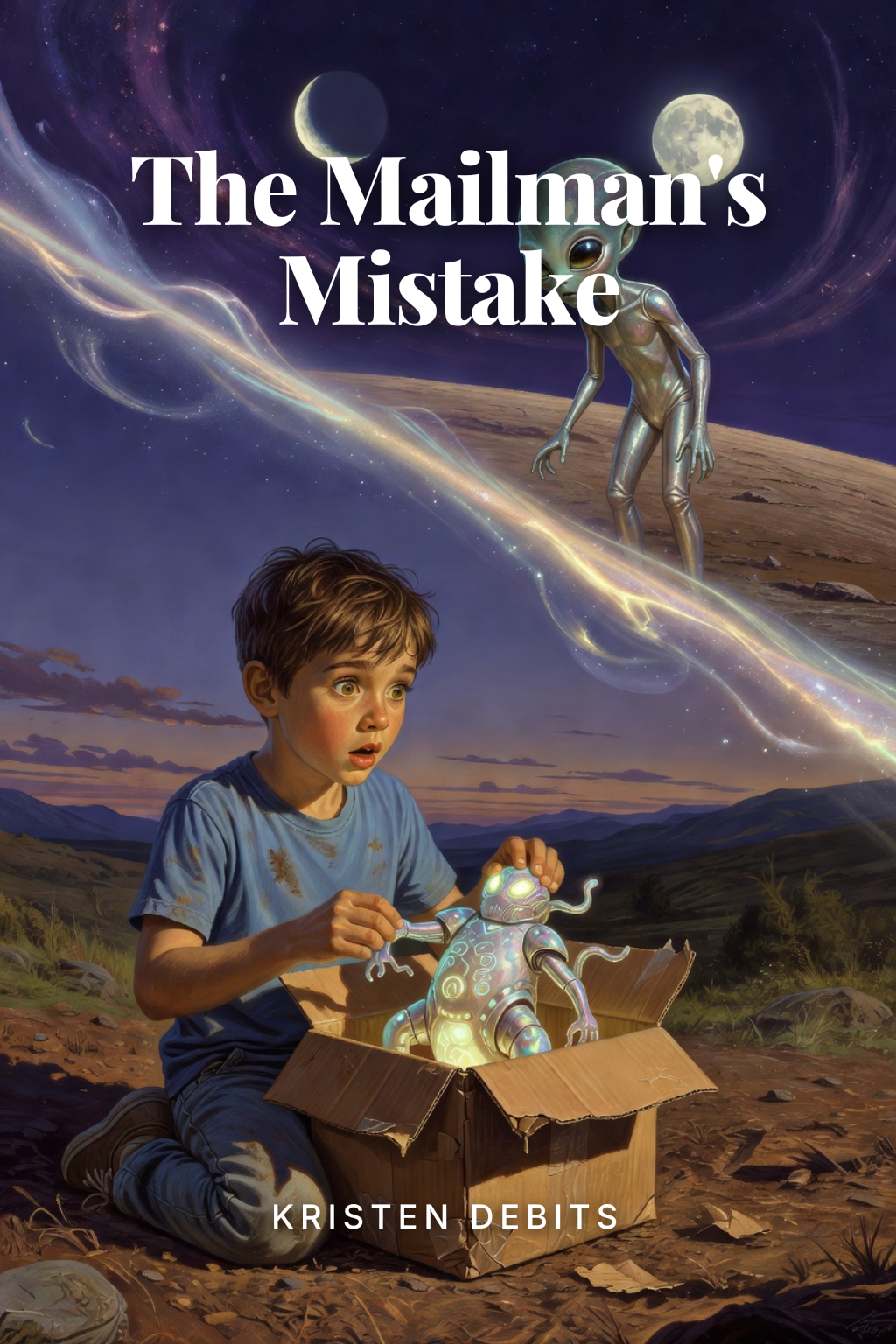
Novel · 8 chapters · 25,018 words
The Mailman's MIstake
Contents8 chapters
Chapter 1
The Parcel with No Country
By the time Leo got to the front window, Mr. Caste had already set the thing down in the middle of the path and stepped back from it.
The postman stood with both hands on his hips, breathing through his mouth. His red waterproof jacket hung open, showing his blue shirt darkened under the arms. At his feet, among the clipped privet and the black bins lined up like sentries, sat a metal parcel the size of a shoebox. One corner was stove in. The lid bulged a little, as if something inside had swelled in heat. It made a faint sound Leo first took for the ring in his own ears after running downstairs too fast.
Then it came again. A dry, steady hum. Not electric. More like a wasp trapped under a glass.
From the kitchen his mother called, “If that’s for next door, tell him she’s at dialysis till one.”
“It’s Mr. Caste,” Leo said, but he was already unlocking the front door.
The smell of wet tarmac and damp leaves came in at once. Their estate was three short rows of pebble-dashed terraces around a square of patchy grass and one leaning willow. Cars slept under beaded rain. Somewhere a radio muttered through an open upstairs window. Normal morning. School shoes on the mat. Sink full of cups. Postman wrestling an object from nowhere.
Mr. Caste looked up when Leo came out. “Don’t touch it yet.”
That was enough, of course, to make Leo lean in.
There was no label. No customs sticker, no orange-framed AIR MAIL, no barcode, no white strip printed by a machine. The metal wasn’t silver or steel but a dull colour in between, with a skin of scratches that caught the light and lost it again. Along the top ran a seam without hinges. On one broad side, a set of marks crawled over the surface in pale blue, rearranging themselves as he watched. They weren’t blinking. They were changing place, patient as small animals settling.
“Who’s it for?” Leo said.
Mr. Caste wiped rain off his forehead with the back of his wrist. “That’s what I’d like to know. It was in the bottom cage at the depot. Not manifest, not scanned, not signed in. Just there.”
Leo crouched. The humming thickened near the parcel, enough to feel in his teeth.
“Didn’t come on your van?”
“Son, if this came on my van, I’d have noticed.”
His mother appeared behind the glass in her work blouse, still fastening one cuff. When she saw the open door she frowned, then saw the parcel and came out onto the step. She had the look she got when a direct debit bounced or the washing machine made a new noise: shoulders still, eyes quick.
“What’s that?”
“Mis-sort,” Mr. Caste said. “Or some kind of stunt.”
“Don’t say bomb in front of him,” she said.
“I didn’t say bomb.”
“You thought it loud enough.”
Mr. Caste gave a tired shrug. He was a wide man with a face furrowed like folded paper, and he had known Leo since he still waved at the post van from a buggy. Now he bent, more cautious than before, and nudged the parcel with the toe of his boot. The humming rose half a note. He took his foot back.
“Feels warm,” he said. “Was warmer in the bag.”
His mother stepped down one step. “Leave it and ring somebody.”
“I’ve rung the depot. Depot rang district. District said if there’s no label and no scan, I’m to bring it back.”
“Then bring it back.”
Mr. Caste gave her a look. “You bring it back.”
That made Leo grin, though nobody else did.
The shifting marks on the side had slowed. They gathered into three stacked lines, then slid apart again. One symbol looked almost like a bent ladder. Another like a fish skeleton with too many ribs. He put out a finger before either adult could stop him.
The metal under his skin went from bath-hot to cool in a breath.
All three of them froze.
The hum cut off. Not faded—stopped.
A bead of rain slid from Leo’s sleeve and hit the parcel with a tick. Beneath the stacked blue marks, new characters came up out of the metal, as if ink were soaking through from underneath. These ones did not crawl. They settled and held.
LEO MARR
His mother caught his wrist and pulled him back so sharply he nearly sat down on the path. “What did you do?”
“I didn’t do anything.”
“You touched it.”
“That’s not doing anything.”
Mr. Caste had gone pale under the rain. “Well,” he said after a moment, “that’s not ideal.”
Leo stared at his name. Same capitals as the labels on his school exercise books. Same spacing even, with the O round and the R legged properly, not like his own handwriting. Beneath it, smaller marks flickered in the blue script and went still again.
His mother said, “No. Absolutely not.”
“To what?” Leo said.
“To this coming in my house.”
Mr. Caste made a doubtful sound. “I can’t exactly leave it in the road.”
“Take it to the police.”
“With what paperwork?”
“The point of the police is not paperwork.”
“The point of the police,” said Mr. Caste, “is they’ll ask why I accepted an unlogged item from nowhere, and then I’ll be having a conversation I do not want before lunch.”
Leo crouched again despite his mother’s grip. The parcel sat quiet now, almost ordinary, if a shoebox could look stubborn. His name on it made his chest feel odd. Not pride exactly. More like when the headteacher called you into assembly and you hadn’t done anything you could remember.
“Maybe it’s one of those promos,” he said. “For a game. They make stuff weird on purpose.”
“Promos have labels,” his mother said.
“Maybe someone made it.”
She looked at him. “In what shed?”
Mr. Caste bent to read the side without touching it. “It’s definitely taken a liking to you.”
“That’s not helping,” she said.
A bus sighed at the far end of the estate. Leo’s mother glanced toward the time in her head. Hospital shift. She was already late. Leo saw the arithmetic pass over her face: leave child with object that knew his name, or miss the bus and lose the hour and annoy Sandra on ward seven who kept track of such things as if she were paid per resentment.
“Right,” she said at last, clipped and brisk, which was how she talked when frightened and refusing to grant it rights. “Put it in the porch. On the floor. No one opens anything. I’m calling from work. If it makes another sound, you go to Mrs. Hargreaves next door and you ring me. If anyone asks, Mr. Caste brought a wrong parcel and took it away.”
“I haven’t taken it away.”
“You will in a minute.”
Mr. Caste looked at the object, then at Leo’s name on the side, and did not move.
His mother saw that too. She shut her mouth, opened it again. “Fine. Porch. Then someone official can collect it.”
They did not carry it so much as escort it. Mr. Caste used both hands at arm’s length. The parcel was heavier than it looked; his knees complained. In the narrow porch, with the smell of damp shoes and old tennis balls and the cracked umbrella stand, he lowered it onto the coir mat and straightened slowly.
It made no sound.
Leo’s mother crouched to his height and took his chin between finger and thumb until he had to look straight at her. “You do not open it. I don’t care if it starts singing hymns. You wait for me.”
“It literally has my name on it.”
“That is not the argument you think it is.”
She kissed the top of his head, fast and distracted, then was gone down the path with her bag tucked under her arm, heels choosing the dry spots without looking. Mr. Caste lingered another few seconds.
“If district asks, I was never here,” he said.
Leo smiled because he thought it was a joke.
Mr. Caste did not smile back. “I mean that exactly.” Then he tugged his cap lower and went out through the estate gate, shoulders hunched against more than the rain.
Leo shut the front door and leaned on it a moment. The house sounded house-like: fridge motor, clock over the cooker, a tap not fully turned off. The parcel sat in the porch as if it had always belonged among school bags and junk mail. His name remained on the side.
He went to school on time in theory and not at all in practice. He took off one shoe, put it back on, went to the kitchen for toast, forgot to put the bread in, came back to the porch and crouched beside the parcel again.
Up close, the metal held faint shallow dents, little crescents and pinpricks as if it had knocked through a long journey among harder things. There was no visible latch. Along one edge, though, he found three small depressions in a row, each no bigger than a shirt button. He pressed one. Nothing. Pressed two at once. Nothing. Put his thumb where his name was printed.
The seam around the lid gave a soft click.
Leo sat back on his heels.
He waited. The house waited with him.
Another click, deeper in the box. The seam brightened from within, not with light exactly but with a paler shade of the metal, and the lid rose half an inch. Air came out carrying a smell he couldn’t place. Not perfume, not oil. Dry stone after heat. Library dust. The inside of a toolbox left in sun.
He looked toward the kitchen, as if his mother might materialize out of the steam from a kettle she had already boiled and gone. Nothing. Only the cracked enamel kettle on the hob and yesterday’s spaghetti pan in the sink.
“Don’t open anything,” she had said.
He slid his fingers under the lid and lifted.
Inside, everything was fitted so neatly it took him a second to understand there were three objects, not one machine. Grey padding lined the parcel—except it wasn’t foam. It was layered in thin scales like pressed leaves, each one flexing away from his hand and settling back.
At the left lay a brass thing in a nested frame, all rings and pivots and a central disk the size of a biscuit. It looked like an astrolabe from one of the library books about old ships, except the markings around the rims were too fine to be decorative and there were tiny clear beads set at intervals that rolled by themselves when he tilted the box. A toy, he thought at first, because he was eleven and everything with moving parts wanted to be touched. Then he picked it up and felt the weight. Not toy weight. Tool weight.
Under it the scales of padding tightened, as if remembering its shape.
In the middle rested a book so thin it seemed impossible there could be pages in it. No cover title. No spine print. Just a stack of white sheets bound along one side with a thread so dark it swallowed light. When he lifted it, the pages made no papery riffle. They slid against each other like skin. He opened to the middle and found lines of the same shifting symbols he had seen outside, except these stayed still unless he looked away. Then the pattern of the page was different when he looked back.
At the right, in a narrow compartment, lay a folded message sealed with a hard red drop of something like wax and something like stone. Impressed into the seal was a mark of two crescents crossing.
The front of the message did not have his name. The writing there changed once, twice, then held long enough for him to sound it in his head.
Iri, it looked like. Then a break. Then more marks that became Red Orchard after he had stared too long to be sure whether he’d read them or guessed. Beneath that, one word settled clear as a bruise.
Nhal.
He said it aloud, because saying strange words gave them edges. “Nhal.”
At once the book in his other hand twitched.
Not much. A tightening, like a trapped moth beating once against a lampshade.
Leo nearly dropped it. He put the sealed message back in the box and opened the book to the first page. The symbols there were rearranging themselves, faster now, flowing into rows and breaking apart. He turned to the next page. Same. By the third page he was breathing too quickly.
“Stop that,” he said.
The page went blank.
He stared. In the kitchen, the tap dripped into the sink. Somewhere outside, tyres hissed on the road beyond the estate. The blank page shone with a faint grain like frost on glass.
Leo licked his lips and tried the strange word again, quieter. “Nhal.”
Ink came up through the page in a narrow line.
Not English. Not yet. The symbols assembled, shed pieces, assembled again, as if testing fits. Leo turned back to the front. On the first page, where there had been only the strange script, one line now sat beneath it in awkward block letters:
RECIPIENT ROUTE DISPLACED
He read it twice before it made sense. Then three times more, because it still didn’t.
The next line surfaced slowly.
IF YOU CAN READ THIS—
The letters blurred, sank, returned altered.
IF THIS READS YOU
“What does that even mean?” Leo whispered.
He looked at the sealed note addressed to Iri. The red seal held firm, slightly warm-looking, as if the wax had only just set years ago. A wrong parcel. A joke. A science thing somebody at school had hidden. Yet nobody at school could make metal print his name. Nobody on the estate could make a book hesitate like it had to choose a language.
The brass instrument in his lap gave a dry tick.
One of its rings had moved.
He hadn’t touched it. He was sure of that. The outermost band had turned a few degrees and now pointed not north, not at the door, but straight toward the back of the house. Toward the kitchen wall, the narrow yard, the alley beyond the bins.
Leo set the book down carefully on the mat and picked up the brass thing with both hands. It was colder than before. Fine markings ran around each ring: lines, dots, little cut shapes, and one notch filled with black. At the center, under the pivot, a pale bead floated in a cup of clear liquid and nudged itself against the black notch, wanting alignment.
A wayfinder, he thought, though he had never heard the word before.
The front gate clicked.
Leo flinched so hard the instrument slipped and knocked the parcel’s rim. The book shut itself. He shoved the brass piece back into the box, dropped the message beside it, and pulled the lid down just as the letterbox snapped and footsteps came up the path.
Not his mother. Too heavy.
He stood.
Three firm knocks hit the front door.
“Parcel inquiry,” a man called through the wood. Not loud. Certain. “Open up.”
Leo looked at the porch floor.
His name was still on the metal, but underneath it new writing had appeared in a line too quick to catch. The letters formed in English just as his hand went to the latch.
DO NOT SIGN.
Chapter 2
The Book That Learns His Name
Leo took his hand off the latch.
The man knocked again, not harder, just with the confidence of somebody used to doors obeying him. Through the patterned glass beside the frame Leo could make out only a dark sleeve and the blur of a head.
“Parcel inquiry,” the voice said. “You’ll need to sign acknowledgment.”
The metal box sat at Leo’s feet on the coir mat, saying what it said.
DO NOT SIGN.
He swallowed. “My mum’s not here.”
A pause. “Then fetch an adult from inside.”
“There isn’t one.”
Another pause. Rainwater ticked from the porch gutter into the cracked plastic planter by the step. Leo could hear the man breathing through the door, patient as a machine.
“State your name.”
Leo looked down again, as if the parcel might answer for him. The letters had gone still. Only the brushed metal showed, dull and dented where it had knocked against Mr. Caste’s van.
“Why?” Leo said.
“To confirm chain of receipt.”
That sounded like something learned by heart. Leo pictured a tie, a clipboard, thin lips. Instead of opening the door he backed one step away from it.
“We didn’t order anything,” he said.
“That is not what I asked.”
From next door came the scrape of a sash window. Mrs. Janek, who watched the estate the way cats watched gardens, called out, “You all right there, Leo?”
The man on the step moved at once. His shadow shifted off the glass.
“Routine inquiry,” he called back, smooth now. “Postal matter.”
Mrs. Janek made a doubtful sound. “Mr. Caste already been.”
No answer to that. Leo heard one quick tread on the concrete path, then another. By the time he dared lean and look through the side glass, the step was empty. The gate clicked a moment later.
He stood still long enough for his knees to ache. Then he lifted the parcel, shut the inner door with his heel, and carried the whole thing upstairs to his room.
He slid it under the bed behind a shoebox of old comics and a dead controller. The brass instrument he tucked into the bottom drawer under socks. The book and the sealed message went inside his school atlas, which was so fat and boring no one touched it but him. Then he sat on the edge of the bed and listened to the house.
Pipe knock. Fridge hum. A motorbike on the road. Nothing else.
Downstairs, on the hall table, his mother had left the unpaid things in two neat piles held under a blue mug: gas, electric, council tax, one red window envelope from the hospital credit union. Next to them sat the shopping list in her square writing: milk, bread, cereal, bin bags, toothpaste if on offer. Ordinary paper, ordinary debt, ordinary Wednesday. It seemed to Leo that the hidden objects upstairs listened through the floorboards with him.
He did not touch them again until morning.
At school he got two long divisions wrong and wrote “Nhal” in the margin of his science book where he had meant to write “nickel.” Mrs. Pritchard tapped the page with the cap of her red pen.
“Private planet, is it?”
The class laughed because they laughed at anything if a teacher started it. Leo shrugged and bent over his work. His ears burned. In the row ahead, Aaron Bell turned halfway around and mouthed, What’s that? Leo shook his head once.
At break he checked his bag though he knew perfectly well he had left the atlas at home. At lunch he queued for chips, changed his mind, and bought nothing. The smell of vinegar turned his stomach. All afternoon words slid off the board before he could hold them. He kept seeing the line in the book altering itself under his eyes, as if reading was not a thing he did to it but a thing it did back.
The bus home was late and came full, so he stood by the rear doors with his rucksack between his knees and condensation on the window at shoulder height. The estate went by in pieces: wet brick, satellite dishes, a blue tarp on scaffolding, the butcher’s striped awning with one stripe split and flapping. An old man in a brown suit slept two seats ahead with a bag of leeks on his lap. No one looked twice at Leo. This steadied him a little.
When he got in, his mother was at the kitchen table in her uniform trousers and a grey vest, one shoe on and one shoe off, steaming a microwaved shepherd’s pie with a fork. Her hair was twisted up with a biro through it. The bills were spread around her now, each opened and flattened with the heel of her hand.
“You’re late.”
“Bus.”
“There’s pasta if you want it. Don’t say there isn’t because there is.”
He put his bag down. “I’m not hungry.”
That made her look up. Not sharply. More like she had heard a glass crack in another room.
“You sick?”
“No.”
She ate another forkful, eyes back on the paper in front of her. “Mr. Caste put a card through. Said he’d ring the depot again.”
Leo’s fingers found the edge of the counter and held it. “What did you tell him?”
“That I was at work because I was at work.” She reached for the red window envelope, tore it wider with her thumb, scanned it, exhaled through her nose. “And that if anyone asks, a parcel was misdelivered and collected. Was it?”
The kitchen smelled of mince, washing powder, and the hot metallic tang from the radiator. In the sink a cracked enamel kettle sat full of cold water with a teaspoon left inside it. Leo opened the fridge for something to do.
“I put it where no one’d trip over it.”
“That’s not what I asked.”
He took out the milk, put it back. “No one collected it.”
She pinched the bridge of her nose. “Leo.”
“It’s just still here.”
She stared at him for a moment. Then she set down her fork. “Still where?”
“Porch.”
That was a lie so small it almost passed for arrangement. He knew she heard it for what it was. He also knew she had twelve minutes before the bus and that the late shift docked pay if you were late by three. She measured him against the clock and did not like either option.
“After I’m gone, you are not opening anything, moving anything, posting anything, or showing anything to your mates. If it’s there when I get back, I’ll deal with it in the morning.”
He nodded.
She stood, shoved her foot into the other shoe, and crossed to the sink to rinse the fork. “And if someone knocks asking after it, you do not sign for a thing. You hear me?”
His head came up too fast. “Why?”
“Because I said so.”
She flicked the water off her fingers, grabbed her lanyard and cardigan, and then, almost as an afterthought, touched the side of his face with the backs of those same damp fingers. “Door locked after six. Mrs. Janek if there’s any nonsense.”
Then she was gone in the smell of rain and hospital hand cream, clattering down the path while she shrugged into her cardigan, and a minute later he heard the bus’s brakes sigh at the end of the road.
Leo counted to fifty. Then he went upstairs.
The atlas gave when he pulled it from the shelf, heavier than paper ought to be. He shut his bedroom door, sat cross-legged on the carpet, and laid out the things in a row: sealed message, thin book, brass wayfinder. The afternoon light through his curtains had the colour of dishwater. Somewhere in the building a baby began to cry, was hushed, began again.
He picked up the message first. The red seal was cool now, dull as dried blood. The writing on the front drifted before settling.
Iri
Red Orchard
Nhal
He said the words under his breath, one at a time, careful with them.
The book opened itself by a thumb’s width.
Leo jerked back, then leaned in again.
“All right,” he said to it, because if he did not talk he thought he might start shaking. “You do that, then.”
He opened it fully. Symbols crowded the first pages, restless as gnats over water. He put the message beside it and read from the front again, louder.
“Iri. Red Orchard. Nhal.”
The symbols slowed. A line of English rose beneath them in cramped capitals, each letter hardening as he watched.
LINK ESTABLISHED BY VOICE MATCH
The next line followed after a beat.
PLEASE STATE CUSTODIAN NAME
He stared.
Then, because the house was empty and there was no one to see how ridiculous it was, he said, “Leo Marr.”
The page shivered. Ink gathered, thinned, gathered again.
LEO MARR ACCEPTED AS INTERIM CUSTODIAN
Another line.
OPENING THE PARCEL CONSTITUTES CONTACT
He let out a breath he had not realised he was holding. “So that’s bad, is it?”
The page waited, blank and pale. He felt foolish, then tried again. “Can I just put it back?”
Words came one after another, not hurried, not slow.
UNSEALED CONTACT CANNOT BE UNDONE BY REPACKING
RETURN MAY STILL BE POSSIBLE
“Possible how?”
He touched the edge of the page. It was warm, almost skin-warm. The book did not respond until he looked back at the message and read the destination aloud once more. Then more English formed.
ENCLOSED DEVICE: WAYFINDER
PURPOSE: FIRST ROUTE CUSTOM OF NHAL CHILDREN
STATUS: DISPLACED
He frowned at the brass rings on the carpet. “Children do what with it?”
The answer arrived in the same practical hand.
AT THE CUSTOMARY AGE A CHILD WALKS THE MARKED ROAD FROM HOUSEHOLD TO RECORD
THE WAYFINDER CONFIRMS IDENTITY, KIN-TIE, AND ARRIVAL
WITHOUT COMPLETION THE RECIPIENT REMAINS UNENTERED
The room seemed suddenly too small. Leo pictured some boy he could not imagine properly, on some place called Red Orchard, waiting beside adults who would not explain anything except that the thing had not come.
“How old?” Leo asked.
No response. He remembered and read again from the message, feeling daft and obedient at once. “Iri. Red Orchard. Nhal.”
AT NEXT TURNING OF THE SKY-LANES RECIPIENT WINDOW CLOSES
“What does that mean?”
UNKNOWN TO CURRENT CUSTODIAN REFERENCE
“Helpful.”
The book ignored that.
DELIVERY ERRORS MUST BE CORRECTED BEFORE CLOSURE
Leo rubbed his thumb hard against the brass instrument’s outer ring. It moved with a dry click under pressure, then dragged itself back the instant he let go, the pale bead inside nudging after some alignment he could not see. “If I take this to the post office?”
NOT SUFFICIENT
“To the depot?”
NOT SUFFICIENT
“To Mr. Caste?”
NO LOCAL CARRIER HAS ROUTE AUTHORITY
He sat back on his heels. Downstairs the fridge cycled on. A moped buzzed past outside, faded. The page in front of him looked as calm as a school notice.
“Then what am I meant to do?”
This time the answer took longer. The letters appeared, dissolved, came back in a different order before holding.
QUIET TRANSFER ADVISED
AVOID SIGNATURE LOGS
AVOID ROUTINE SCAN
He thought of the man at the door asking for chain of receipt in that flat voice. “Because of him?”
The page blanked. Then:
QUERY NOT CLEAR
Leo laughed once, without humour. “No, course not.”
He looked at the sealed message again. The seal’s crossed crescents had deep grooves pressed into them, as if made by an engraved die. Without thinking he touched one crescent with the nail of his little finger.
The wax-stone seal gave a tiny pulse under his touch.
The book’s page flooded black and reset.
MESSAGE MAY NOW BE READ BY INTERIM CUSTODIAN
He snatched his hand back. “I didn’t open it.”
AUTHORIZATION UPDATED BY CONTACT
“That’s not fair.”
No answer. Fair had nothing to do with it.
He broke the seal.
It parted not with a crack but with a soft grainy sigh, like sugar crust on top of burnt pudding. Inside was a single folded sheet thinner than onion skin. The writing across it was the same shifting script. He unfolded it carefully, half afraid it would tear, and read the first line aloud because by now that seemed to be the rule.
“To the child named Iri—”
The letters changed under his voice. English chased his words from left to right.
If this reaches you late, begin anyway.
He stopped. Read it again. More lines arranged themselves.
The wayfinder does not show the whole road until it has your name and your floor.
Walk where it marks.
Do not ask an elder to carry it for you.
At the record place, say your household and the orchard quarter.
If the lane is crossed or displaced, wait for the carrier light and do not step into unmarked dark.
Leo looked up from the page to the square of carpet between his knees as though something might already be there.
Under the first lines, more words came.
If another reads this, be gentle with the instrument.
It startles easily after transit.
He stared at that until a laugh escaped him, small and unbelieving.
“The instrument startles easily,” he said to the empty room.
Below it, the final lines formed with less certainty, ink wavering.
A route fault has touched this parcel.
If you are not Iri, return the child’s beginning before next turning.
If you have opened the parcel, the route may have taken hold of you.
Check whether the book learns your name.
“It has,” Leo said.
As if in answer, the book turned three pages by itself. New text settled there, smaller, denser.
LEO MARR
INTERIM CUSTODIAN
VOICE LINK STABLE
FLOOR LINK PENDING NIGHT
“Floor link?”
No response at first. Then, after he repeated Red Orchard and Nhal like a key in a lock:
WAYFINDER MAPS ONLY AFTER SUNFALL LOCAL
COST: ONE FIXED START POINT
DO NOT MOVE DEVICE DURING PROJECTION
INTERRUPTION REQUIRES RESTART AT NEXT NIGHTFALL
Cost. The word sat differently from the others. Less polite.
He looked around his room as though deciding which part of it he could afford to lose. A narrow bed with a chipped pine headboard. Wardrobe with one door that stuck in damp weather. Poster of a goalkeeper diving left. Carpet worn white near the radiator where he stood to dress. None of it looked sacred enough for a machine to care about, but machines often cared about the wrong things.
He spent the next hours doing the ordinary pieces because there was nothing else to do and because doing them made the world hold. He took the washing off the line in the box room before the damp set in. He ate reheated pasta standing up at the counter. He put thirty pence in the electric key tin because his mother always forgot where she’d left change. He watched the numbers on the microwave clock go from 6:12 to 7:03 to 8:41 and did not turn the bedroom light on until he had to.
At half past nine he took the parcel things out again.
The estate was quieter by then. Television glow shifted blue behind curtains across the square. A bus changed gears on the high road and faded toward town. From below came the muffled burst of someone laughing too loudly, then a shushing wall-thump, then quiet.
Leo set the brass wayfinder in the middle of his bedroom floorboards where the carpet had worn thin to backing near the bed. The bead in its clear cup was no longer pale. In the dark it held a faint green light, swampy and patient.
He put the book beside it and the message above it, then switched off the lamp.
For a moment nothing happened.
Then the brass rings began to turn.
Not fast. Each moved with its own small authority, clicking past marks finer than pin-scratches. The bead spun loose in the cup, settled, spun again. A thread of light climbed from the center post no thicker than sewing cotton. It rose a foot, two, then bent down and touched the floor.
Where it touched, a line appeared.
Not projected exactly. More like the boards themselves remembered another grain and showed it. The line ran across the carpet, over the skirting board without caring about the change in surface, and stopped at the wall under his desk. Then another line branched from it, and another, pale green and precise, drawing angles and curves that had nothing to do with his room. Symbols budded at intervals. A cluster of shapes flared near the wardrobe, folded into what might have been steps or terraces. A wider band opened across the floorboards, shimmering faintly as water in moonlight, though the curtains were shut.
Leo knelt without meaning to. The map touched his bare toes with cold.
The book opened on its own.
Text ran across the page too quickly to read, broke apart, settled. Leo bent over it in the dark, lips moving as he followed the lines.
ROUTE PREVIEW
START CONFIRMED: LEO MARR / UPPER FRONT ROOM / EAST WALL / EARTH LOCAL
His mouth went dry at the last two words.
The message beside it crinkled.
He turned. New writing had appeared under the lines addressed to Iri, this time in the same steadier English as the book, as if the page had given up trying to hide where he could not help seeing.
INTENDED RECIPIENT CANNOT PROCEED ALONE
SECOND WALKER REQUIRED
Below that, after a pause long enough for him to think it was finished, one final line pressed itself into being.
BY OPENING, YOU WERE ENTERED.
The green road on his floor went on drawing itself straight into the wall.
Chapter 3
Red Orchard Under Two Moons
The green line did not stop at the plaster.
It passed into the wall under Leo’s desk as though brick and paint were a curtain somebody else had forgotten to close. The brass rings kept turning. On the floorboards, new marks flowered and fixed: a square, then a smaller square inside it, then four short strokes at the corners like nails.
Leo stayed on his knees a moment longer, one hand on the carpet, feeling the cold seep up through his palm.
“Floor link,” he said.
The book gave him nothing. The wayfinder clicked once, sharply, as if impatient.
He looked at the bedroom door. Half-open. Beyond it, the landing strip of dark, the banister, the stairs down to the sitting room where his mother’s cardigan still hung over the sofa arm. She would be on shift till morning. Mrs. Janek next door would hear if he shouted. The route on the floor had no interest in any of that.
Leo slid the book shut, tucked the message inside it, and put both under his arm. The wayfinder was warm when he picked it up. At once the line on the floor vanished, and the brass bead flared hard green, accusing.
He nearly dropped it.
Text flashed across the cover of the book, visible even in the dark.
PROJECTION BROKEN
RESTART NEXT NIGHTFALL
“No, no.”
He set the wayfinder back exactly where it had been, not on the same marks because he could not see them now, just where he thought. The rings spun faster than before. For three long seconds nothing happened. Then the line sprang up again from the center post and rushed over the floor to the wall with a speed that made him flinch.
The book opened under his elbow.
ESCORT MAY CARRY WAYFINDER AFTER THRESHOLD FORMS
“After,” Leo muttered. “That would’ve been useful first.”
He crouched there watching the green square on the floor become a square on the wall, each corner stitched into place by narrow bars of light. The plaster inside it darkened, not black exactly but deep, like water seen from a quay at night. The room around it remained itself: chipped desk, peeling football sticker, socks under the radiator. Inside the square there was depth. A smell reached him a second later—wet stone, leaves crushed in warm hands, something metallic and sweet beneath.
Not his house. Not even close.
The rectangle widened soundlessly until it was the size of the back door downstairs. A ripple crossed its surface. Somewhere beyond, water moved.
Leo stood. His legs felt hollow. He took the wayfinder in one hand, the book under his arm, and stepped nearer until the toes of his socks touched the skirting board beneath the opening. Cold came off it. Not winter cold. Cellar cold.
He put out one finger.
The dark gave way around it with the yielding resistance of a soap bubble. His fingertip vanished. When he pulled it back there was no mark, but it smelled faintly of green things.
He went downstairs first.
He did it quickly, angry with himself for doing it at all, and checked the back lock, checked the front, checked the chain though nobody had touched it. In the kitchen the cracked enamel kettle sat in the sink with two forks and the pasta pan. The clock over the cooker said 9:47. He found the pad by the phone and wrote, Went to Mrs Janek’s if you ring, back soon, and hated the sentence as soon as he’d written it. He did not leave it. He tore the page off, folded it into a square, and put it in his pocket.
Upstairs again. The room had not changed except that the dark doorway looked more certain now, less like an event and more like an entrance waiting for him to stop fussing.
Leo took his trainers off. He was not sure why. Then he put them back on. He stepped through.
For a beat there was no floor, only pressure around him and the hard smell of struck flint. The wayfinder buzzed in his grip. Then his right foot came down on stone worn into a shallow trough by many other feet, and he staggered out into an alley narrow as a throat.
Behind him, where his bedroom should have been, stood a doorway of pale green light fitted neatly into a wall of brown stone. The wall belonged to no building he knew. It leaned above him in a run of old masonry patched with white mortar and rooted here and there with wiry plants. The doorway shrank even as he watched, its edges drawing inward like an eye closing. By the time he reached back a hand, there was only a slab wall cool under his fingers.
The alley smelled of damp rock, woodsmoke, and fruit beginning to split on the branch.
Ahead, it opened by three steps into a lane. Light spilled across the paving from somewhere high and diffuse, not streetlamp light. Leo climbed the steps and stopped.
The town sat in terraces cut into the side of a broad valley. Houses of stone and timber climbed one above another, their roofs weighted with dark tiles and shallow trays of growing herbs. Water ran everywhere: in channels at the lane edges, in waist-high troughs crossing small squares, in aqueducts thrown from one retaining wall to the next. The water in them glowed from within, a milk-green shine that lit the undersides of arches and the wet rims of jars left out by doors. Beyond the town, the valley opened into ordered bands of trees bearing crimson fruit, row on row up the slopes, each terrace held by stone. Higher still, black hills stood against a sky the colour of ash diluted in water.
Two moons hung there. One broad and low, yellow-white and scarred. The other smaller, sharp as a clipped nail.
Someone passed him carrying a wicker crate against one hip. She glanced at him, at the wayfinder in his hand, and moved on. A child in a quilted vest trotted after her with three tin spoons looped through his fingers. No one stopped. No one pointed. Somewhere below, metal struck metal in a patient rhythm.
Leo had expected astonishment. Alarm, at least. He got a lane with wet flags and people doing what they were already doing.
A voice from behind him said, “You came in wrong.”
Leo turned so fast the book slid from under his arm and thumped against his leg.
The speaker was about his height, perhaps a little shorter, though the set of his face made him seem older. He had a narrow brown face, a cap of close black hair cut blunt at the jawline, and a coat tied with a cord at the waist over trousers tucked into soft boots. On one wrist he wore a strip of red cloth wound several times round. He looked first at Leo’s face, then at the wayfinder, then at the dead stone where the green door had been.
“You’re late,” he said. “And you broke it.”
Leo swallowed. “Are you Iri?”
The boy’s mouth tightened. “I asked first.”
“I didn’t mean to break anything. It came to my house. On Earth.”
Iri made a small dismissive movement with his fingers, as though Earth was not the important part of that sentence. “Of course it came to your house. You’re holding it.”
“It had my name on it.”
That landed. Iri’s eyes sharpened.
“Say that again.”
“It put my name on the outside. Leo Marr.” He lifted the book a little. “It says I’m interim custodian. I opened it by accident. Well. Not exactly by accident.”
“No.” Iri stared at him for a moment, not friendly, not curious. Measuring damage. “Not exactly.”
He stepped forward and snatched the book from Leo’s arm before Leo could object. His fingers were long, quick, stained faintly at the tips with something rust-coloured. He opened the cover, scanned the first page, then the second. His face did not change much, but the line between his brows deepened.
“You’re entered,” he said.
“I know.”
“That means the route touched you.” Iri shut the book with one flat smack and handed it back. “It should not have done that.”
“Sorry.”
Iri looked offended by the word itself. “What would I do with your sorry?”
From the lane above them a woman called something Leo could not understand. Iri answered without looking away. His reply was short and clipped. The woman did not call again.
“I was meant to cross before the higher moon thinned,” Iri said. “Three nights ago. The packet was to be brought to me sealed. My mother’s mother’s name is added this season. I carry it to the hill path with the others, and then my line is spoken properly among our dead. That is the rule. No parcel, no crossing.” He gave the wayfinder a look of dislike so clean it seemed polished. “Instead the post sent itself to another world and put its mouth on you.”
Leo shifted his grip on the brass device. “I’m here now.”
“Yes.” Iri’s voice was flat. “You are.”
A man carrying a bundle of split cane poles brushed by them, his shoulder grazing the wall. “If you stand in a throat, expect choking,” he said mildly in passing.
Iri moved at once, jerking his head for Leo to follow. “Come on.”
They went down through the lane and then across another, steeper one where the paving stones had grooves worn in them to catch cart wheels. Leo had to watch his feet. Water crossed underfoot in bright channels covered at intervals by grates of fitted stone. The houses were close-set, most with deep lintels and doors painted with simple marks—three lines, a handprint, a crescent broken by a dot. From one open kitchen came the smell of onions frying in fat and something sour-sweet he could not place. From another came singing, low and off-key, accompanied by the slap of dough.
He wanted to ask everything. Where are we. What are those moons called. Why does the water shine. Why isn’t anyone surprised. Instead he said, “You knew where I’d come through.”
“The back route has only three legal mouths in town and one has been bricked since my aunt’s fall. That wall had a marker on it this afternoon.” Iri took a right turn down a covered stair with no rail. “The postkeeper sent word to watch. She said if the route had any decency left, it would vomit the mistake into the alley and be done.”
“Postkeeper?”
“The person who keeps the post.”
Leo almost said, Obviously, but there was no room in Iri’s back for jokes.
They came out into a wider street where the town seemed to gather itself. A long trough of glowing water ran down the middle, crossed by stone bridges at every ten paces. Shops faced it with shutters half-down. Under one awning a woman sorted pale roots into baskets by size. Under another, a man burned symbols onto thin wood tags with a heated pin, the smoke smelling sharp and resinous.
At the far side stood a house with a red-tiled roof and a fig tree trained flat against the wall. Iri went in without knocking.
The front room was low-ceilinged and warm. Hooks by the door held three weather capes and a net bag of glossy fruit. A round table sat under a hanging lamp made of layered shell. On the hearth a pot steamed gently, and above it a line of small clay plaques had been set into the mantel, each incised with names Leo could not read. A woman at the table looked up from trimming stems into a bowl.
She was Iri’s face older and finer, with a wide mouth and tired eyes. She took in Leo, the wayfinder, and the fact that her son had brought him straight inside. Her hands stilled. One still held the knife.
“You found him,” she said.
“The route spat him out behind Keth’s wash wall,” Iri said. “It entered him.”
That made her stand. Not quickly. More carefully than quickly. “Give me the device.”
Leo hesitated. Iri made an exasperated sound.
“She asked for the device, not your blood.”
Leo handed it over. The woman cradled the wayfinder in both palms as if its weight might change. The green bead brightened at her touch and one of the outer rings ticked a quarter turn.
She did not seem pleased. “You opened the packet.”
“Yes.”
“Read the letter.”
“Yes.”
“Spoke the route words.”
“I suppose.”
At that, one corner of her mouth twitched despite herself. “You suppose.” She set the wayfinder on the table very gently. “I’m Sena.”
“Leo.”
“I know.” She glanced toward Iri. “Did anyone follow?”
“No.”
“Did anyone see the mouth close?”
“Kesh’s little one, maybe.”
Sena nodded as if that was manageable. She poured water from a blue jug into a cup and held it out to Leo. He took it. The cup was warm, the water cool and faintly mineral.
“You’ll eat in a minute,” she said. “First we go to the posthouse before Talar shutters the ledger.”
Iri’s head came up. “Now?”
“Now.” She had already crossed to the peg by the door and was taking down her cape. “If the route has touched him, I want the mark read while it’s fresh.”
Iri looked at Leo with renewed irritation, as though even standing still he was causing delays. “I told you.”
Leo put the cup down too quickly and slopped a crescent of water onto the table. “I can just give it to you. The parcel. The book. Whatever it is. Then I go back.”
Silence sat for half a breath.
Sena fastened the cape at her throat. “If the route lets you.”
That was the first answer all evening that felt like a door shutting.
The posthouse stood near the lower market where the valley wind could get at the street. Its front was all old stone and newer wood, repaired so often that nothing lined up exactly. A bronze slot shaped like an open beak jutted from the wall beside the door. Above it hung a board painted with seven route marks in fading blue.
Inside, the room was brighter than the street. Shelves rose to the ceiling, stuffed with wrapped packets, rolled papers, knotted cord tags, and shallow drawers labeled in a neat hand. The air smelled of dust, wax, and damp wool drying by the stove. At a high desk near the back, a woman with grey braided close to her scalp was lowering shutters over a wall of pigeonholes.
She did not turn at once when they entered. “If it’s salt accounts, leave them. If it’s condolence wire, I’m closed.”
“It’s the wrong boy,” Sena said.
The woman turned.
Her face was lined deeply around the mouth, not soft lines but ones laid down by holding too much in place. She looked at Leo without any particular surprise. Then at the wayfinder on Sena’s palms. Then at Iri, who stood braced and silent beside the door.
“So,” she said. “It managed a boy after all.”
She came around the desk wiping her hands on a cloth. One thumbnail was blackened with ink clear to the cuticle. “Talar.” Her gaze settled on Leo’s face. “Earth, is it?”
Leo nodded.
“Show me your left hand.”
He did. She took it in her dry, cool fingers and turned it palm-up under the lamp. For a moment he thought she was looking at nothing. Then he saw, faint as pressure marks after sleep, a pattern across his skin: a square linked to a line, and under it three tiny curved strokes.
Iri took a step forward. “That wasn’t there before.”
“No,” Talar said. “It wasn’t.”
She let go of Leo’s hand and went to the high desk. From a drawer she took a flat ledger bound in dark hide. No title on the cover. Only a metal clasp burnished by years of use. She opened it in the middle. The pages were thick and cream-coloured, crowded with columns and route signs, each line written in the same dark brown ink.
Talar licked her thumb, turned two leaves, stopped. Her brows rose. She turned one page back, then forward again. The room had gone very still except for the stove ticking to itself.
“What?” Sena said.
Talar did not answer. She leaned closer to the page, then set her cloth down and touched one entry with the side of her thumb as though confirming it would not smear. When she finally looked up, some reserve had left her face.
“Who else has handled the packet?” she asked Leo.
“Me. The postman. Maybe the man at the door who wanted me to sign, but I didn’t let him.”
“What man?”
“I don’t know.”
Talar’s mouth flattened. “Of course not.”
Iri moved round the desk before anyone stopped him. He looked down at the ledger. Leo could not read the script, but he saw what had caught them: one line darker than the rest, as if written later over scraped skin. Beside it, where there should have been one route mark, there were two. One had been crossed through with three hard strokes.
Sena said quietly, “That’s not a correction hand.”
“No,” said Talar. “It is not.”
Iri looked up. “Read it.”
Talar kept her eyes on the page. “Original dispatch: ceremonial packet, Sen household, Red Orchard rise, hand delivery at third bell, recipient Iri Sen, second walker pre-cleared.” She tapped the darker line beneath with one knuckle. “Altered dispatch: interim reassignment, Earth local, Leo Marr, hold for signature.”
Leo felt the skin between his shoulders go tight.
“I never signed,” he said.
“That is not the worst part.” Talar shut the ledger halfway, then opened it again as if hoping the page would have repented while closed. It had not. “Ledger ink does not alter after entry. Not by hand. Not by rank. If a route is wrong, we append, we do not replace. Everybody with a seal knows this. Everybody with sense knows why.”
“Then who did?” Iri asked.
Talar looked from the page to the faint mark in Leo’s palm, and for the first time something close to unease showed plainly in her.
“The line itself was rewritten,” she said. “Inside the record.”
Outside, from somewhere up the street, came the hollow call of a horn—one low note, then two, carrying over stone and water. Talar snapped the ledger shut. The sound had changed the room. Iri’s chin lifted. Sena’s hand went at once to her son’s shoulder and stayed there.
Leo looked at the closed book, the brass wayfinder, the ink under Talar’s nail.
“What does that mean?” he said.
Talar slid the clasp through on the ledger with a click.
“It means,” she said, “your arrival is not the mistake we thought.”
Chapter 4
The Dead Letter Office at the Edge of the Sky
The horn sounded again, nearer now, and Talar moved before anyone asked her to. She crossed to the door and slid the bronze beak-bolt into place, then pinched out the lamp by the ledger as if darkness made paper safer.
“Lower the front shade,” she said.
Iri was already at the window. He caught the reed blind and let it down over the glass in one hard pull. The room thinned to stove-glow and the pale wash from the wayfinder lying on the desk.
Leo said, “Who is it?”
“Inspection,” Sena said.
She did not say it like rescue.
The knock that followed was not loud. Three measured taps. Then one, after a pause, placed exactly in the middle of the door.
Talar stood with her hand on the ledger clasp. “If it were market watch, they would pound.”
Another pause. Then a voice from outside, old and dry and unsurprised: “If you make me stand here longer, Talar, I’ll assume you’re either dead or balancing accounts. Both are rude.”
Talar breathed out through her nose. “Open it.”
Iri lifted the bolt.
The man who came in had to duck the lintel though he was not especially tall; it was the way he carried years, stooped from one shoulder as if some satchel had hung there too long and never quite come off. His coat was blue once and had gone to the colour of river slate, patched at both elbows with waxed leather. Rain or dust had crusted the hem. Around his throat was a collar of route tabs no bigger than thumbnails, stamped in tin, bone, old shell. They clicked faintly when he moved.
He took in the room in a glance: Sena, Iri, Leo, the shut blind, the hidden lamp, the wayfinder on the desk.
“Well,” he said. “You’ve all put on faces for me. That saves time.”
“This is Ossa,” Talar said to Leo, with no more ceremony than if naming a broom. “Route inspector, when the routes still tolerate inspection.”
Ossa’s eyes stopped on Leo. Grey, watered by age but not softened.
“Earth,” he said.
Leo nodded.
“Thought so. You’ve got the wrong gravity in your knees.”
He set a narrow case on the desk and unclasped it. Inside lay folded slips, a lead stylus, and a little brass instrument like a pair of insect jaws. He took up the ledger without asking and held his palm over the cover. The metal clasp gave a small hot tick against his skin.
“Opened recently,” he said.
“Read recently,” Talar corrected. “Altered long before that.”
Ossa glanced at her. “By whose courage?”
“If I knew, I’d have charged for the knowledge.”
He opened to the page. His expression did not change while he read, but one of the route tabs at his throat began to tremble against the next. He touched the crossed-out mark with the blunt tip of one finger, then lifted his hand and sniffed it, like checking whether milk had turned.
“That’s authority ash,” he said.
Sena’s hand tightened on Iri’s shoulder. “No.”
“Yes.”
Talar came round the desk. “You’re sure?”
Ossa gave her a look. “I’m old, not decorative.”
He turned the book toward the stove so the page caught the orange light. Leo could see almost nothing in the writing itself, only the darker stripe where one line had replaced another. Ossa angled it further. A second sheen came out of the paper then, dull silver under the brown ink, like fish scales hidden beneath mud.
“Orders sealed from high sorting burn a trace into the fibres,” he said. “Most people never learn to see it because most people never need to.” He shut the ledger again with care this time. “If this line was replaced with ash authority, the old entry won’t be in town copy anymore.”
“Then where?” Iri said.
Ossa looked at the wayfinder. “At the edge.”
No one answered him for a moment. Outside, something rattled down the lane—a handcart, perhaps, or a loose shutter. The ordinary noise made the room feel smaller.
Sena said, “You’re not taking him there.”
“I’m not taking him anywhere,” Ossa said. “The route already did that. I’m deciding whether to follow after it.”
He reached for Leo’s left hand without warning. Leo flinched, then held still. Ossa turned the palm under the stove light. The faint square and line looked a little darker than before, as if pressed up from under the skin. Ossa grunted.
“Fresh mark. Untidy edges. The line laid itself in a hurry.”
“Can it be removed?” Sena asked.
“Everything can be removed if you damage enough around it.”
“Helpful,” Talar said.
Ossa let Leo’s hand go. “He shouldn’t stay in one place long. Not if signatures are being hunted.”
Leo heard that and then heard, a beat later, what lay under it. “The man at my door.”
Ossa’s face turned to him. “Describe him.”
“I couldn’t see properly. Patterned glass. He wanted me to sign for the parcel.”
“Voice?”
“Normal.” Leo hated how foolish that sounded. “Not old. Not young.”
“Coat?”
“I don’t know.”
Ossa nodded as though ignorance itself was useful. “Good. That means he was meant to be forgettable.”
Iri said, “To who?”
“To anybody who opened to him.”
Talar made a small impatient sound. “Save the tricks. Say plainly what you think.”
Ossa folded the ledger under his arm. “I think this packet was not misplaced. I think it was pulled. There’s a difference. Misplacement is rot. Pulling is a hand.”
He looked again at Leo. “And if someone reached far enough to pull a sealed child’s packet across worlds and lay an Earth signature over the record, then the dead letter office may already be muttering about it.”
“The dead office mutters about everything,” Talar said.
“Yes. That is why it exists.”
Sena had not taken her hand from Iri’s shoulder. “You mean to walk my son into a canyon archive because paper has gone strange.”
“I mean,” Ossa said, “that if the original record has been burned out here, the nearest surviving skin of it will be there. You asked what your boy was caught in. That is the place where undelivered things go when the rest of us pretend nothing is wrong.”
He took up his case. “Come, or don’t. But choose before second bell. After that the ferry ropes freeze.”
The journey down from Red Orchard was done mostly in silence, which suited Leo. Nhal had too much detail for easy questions. Stone stairs sweated light from the aqueduct running inside them. Women in market aprons tipped wash water into slots cut along the lane and the water sang away under grilles. A child with a split fig in one hand watched Leo pass with the frank interest one might give a lame goat or a foreign tool.
Iri walked beside him carrying the wayfinder wrapped in cloth. Sena had insisted on the cloth, then stopped insisting on everything else. She had not come. At the lane mouth she had pressed her forehead briefly to Iri’s and said, “Do not let officials make you useful.” To Leo she said only, “If he runs, you run too.”
Now they followed Ossa through lower streets where the houses leaned over narrow channels and the smell changed from fruit and smoke to iron, salt, cold algae. The town spread apart at the edge. Beyond the last sheds the land broke.
Leo stopped without meaning to.
The canyon was so wide at first his eyes read it as distance rather than depth. Then he saw the far wall dropping away in ledges and black seams, and the thin white ropeways spanning over emptiness. Wind moved inside it like a thing with lungs. Below, far below, a river flashed and vanished between shelves of stone.
Suspended from the canyon’s opposite side by chains and ribbed bridges hung the archive.
It was not one building but a cluster of long dark bodies linked together, each with windows glazed in milk-white panels, each swinging just enough to remind the eye of its hanging. Beneath them, nets of wire and bone held sacks, crates, tubes, cages. Around the whole structure wheeled hundreds of pale shapes.
At first Leo thought birds. Then one passed close enough over the ropeway landing for him to see folded paper edges, lacquered shells, ink-dark seals. Letters. Packets no bigger than hands. Thin brass cylinders. They banked and settled along the rails in murmuring flurries, then lifted again.
“Do they bite?” Leo said.
Iri glanced at him. “Only if stamped urgent.”
Ossa snorted. “That was once funny.”
At the ropeway platform a ferryman sat on an upturned crate mending glove leather. He wore two coats and had no visible concern about the drop. Ossa gave him a small round token stamped with a six-point route mark.
“Three,” Ossa said.
The ferryman looked up at Leo and at the wrapped wayfinder under Iri’s arm. “That many?”
“Unless you’d like to carry one on your lap.”
The ferryman shrugged, rose, and set his weight against the brake wheel. The carrier that came creaking along the rope was little more than a plank-sided cage with a mesh floor. Through the mesh Leo could see open air and, farther down, a wedge of the river.
He got in anyway.
Halfway across, the wind hit. It shoved the cage sideways with a scream out of the pulleys. Leo grabbed the rail. Below them the canyon dropped on forever. Around the archive the undelivered things circled in loose gyres, turning in the currents as if they knew the shape of the place better than anything living did.
Iri stood without holding on. Ossa, planted wide in his cracked boots, watched the archive draw near.
“They’re louder today,” he said.
Leo listened. Beneath the pulley grind and wind there was another sound, faint but constant—the dry chitter of paper striking paper, the click of sealed tubes touching, a thousand small unresolved contacts.
Inside, the dead letter office smelled of dust, hot metal, and the sweet old scent of gum arabic. The entry hall was narrow and high. Slots climbed the walls three storeys up. Ladders ran on brass rails. In the centre hung a mobile of returned seals, each rotating slowly over a coal brazier whose heat kept damp out of the room.
No one stared at Leo for long. Two clerks in ash-coloured aprons glanced once and went on sorting a drift of thin green envelopes into bins marked with route signs. A woman with one lens over her left eye took a tube from a hovering wire basket, shook it by the ear, and marked something on her cuff. The ordinary business of failed delivery went on with weary competence.
Ossa took them through a side passage where the floor changed from planked timber to iron grille. Through it Leo could see a lower chamber in which tied bundles of correspondence hung from hooks and turned gently in the draft. He kept his eyes up after that.
The records room sat at the outermost end of the structure, over the canyon face itself. Three of its walls were paper pigeonholes and locking drawers. The fourth was window. The sky outside had gone white with height. Messages crossed it in loops and arcs, near enough now that their shadows passed over the floor.
At a desk bolted to the boards sat a woman with a shaved head and red wax on two fingers. She looked up, saw Ossa, and did not bother with welcome.
“You brought weather.”
“I bring work,” Ossa said.
“Same damage.”
He set Talar’s ledger down. “Need original skin on an ash-overwritten town copy. Ceremonial packet. Red Orchard rise.”
The woman laid her hand flat on the ledger cover but did not open it. “Who authorized?”
“You can read my tabs.”
“I can read them falling off.”
Ossa’s mouth twitched. “Leth, this is the touched boy.”
That changed her. Not dramatically. Her eyes just shifted and settled on Leo with more exactness, as though bringing a troublesome line into focus.
“Show me,” she said.
By now he was tired of strangers wanting his hand. He gave it anyway. Leth’s thumb brushed the mark once and withdrew at once, as if testing heat from a pan.
“There’s drift all through the middle lanes,” she said to Ossa. “Three names assigned wrong in salt quarter this week. A burial notice routed to a child not yet born in Thesk. Two debt ledgers exchanged between people with the same grandmother but different centuries. We’ve had manifest skins arrive blank except for the carrier’s blood print. And yesterday a pension summons found a dead woman and held there, knocking, until sunset.”
Leo said, “How can a letter knock?”
Leth looked at him. “How can a boy from Earth ask me that while standing here?”
She pulled open a drawer and took out a narrow tray of black dust, smooth as flour. Into this she pressed a square metal frame. Then she unclasped Talar’s ledger, opened to the altered page, and lowered the sheet face-down over the frame. The dust gave off a smell like struck flint.
“Authority ash burns away the visible line,” she said, mostly to the tray. “Not the pressure of its having been there. If the record wants to be found, it rises. If it doesn’t, we get soot.”
“What if someone ordered it not to rise?” Iri asked.
“Then we learn who outranks honesty.”
She set both thumbs at the page corners and breathed once onto the back of the paper. The dust beneath brightened, not with flame but with a dull interior red. Fine silver lines bled through the sheet, branching, crossing, gathering at one point like roots around buried water.
Ossa leaned in. “There.”
Leth read under her breath, too quickly for Leo to follow even if he had known the script. Then her lips stopped moving.
“Well?” Ossa said.
Leth took the page away. In the black dust below, an impression remained: old writing in mirror image, thin as frost.
“Original dispatch was entered correctly,” she said. “Recipient Iri Sen. Red Orchard rise. Second walker marked but unnamed pending bell witness.” She tapped the dust where a section had been smeared clean. “And here. Here is the authority burn. Complete removal of sender field. Complete removal of purpose field. Replacement order appended from First Sorting seal.”
Ossa went still.
“First Sorting?” Iri said. “Why would the mountain care about my packet?”
No one answered at once.
Leth slid the tray away from accidental hands. “More than one packet,” she said. “Look.”
She crossed to a wall cabinet and opened it with two keys used in sequence. Inside were rolled skins tied with colour thread. She selected four and spread them on the desk. Even Leo could see the pattern then. On each, a section had been scorched or scraped away and overwritten in a darker hand. Different worlds. Different marks. One recipient line had turned a grandmother into a cooper’s apprentice. Another had moved a survey crate from some place called Fell to a singer in a flood district. Each wrongness seemed petty until you laid them side by side.
“Routes drift,” Ossa said softly. “People correct. It happens.”
“This isn’t drift,” Leth said. “Drift frays at edges. This is selection.”
Leo looked at the erased fields. “Why take the sender’s name out?”
“To stop the reply,” Ossa said.
“And the purpose?”
“To stop anyone knowing why it mattered enough to hide.”
Iri put the wrapped wayfinder on the desk and unrolled the cloth. The brass rings caught the white room light and gave back a tired green pulse.
“If the packet was for me,” he said, “and the route dragged him into it instead—”
“Then either the route was trying to save the delivery,” Leth said, “or someone tried to make the wrong child legally receive it. Once a signature lands, a lie becomes a record.”
Leo thought of the man outside the patterned glass, patient and ordinary and insistent. He felt cold all along his jaw.
Leth was already moving again. “There’s more.” She went to the far shelf, where manifests were stacked in long pigeonholes under carved route signs. “If Earth was named in the replacement, I want carrier cross-reference.”
She drew out a bundle and thumped it on the desk. Dust rose. The papers were stiff, their edges furred by time. Ossa began sorting them with practised hands, flicking through columns, carrier marks, departure stamps. Iri leaned in beside him. Leo stood where he could and watched names go by in scripts he couldn’t read.
Then a line of letters struck him sideways.
MARR.
Not many letters. Just enough.
He reached before thinking. “That one.”
Ossa’s hand stopped over the page. “You can read this?”
“No. But that.” Leo pointed. “That’s my name. My surname.”
Leth turned the manifest toward the window. “Trade tongue annotation,” she said. “For outer carriers.” Her finger moved down the line. “Carrier adjunct. Thomas Marr.”
The room lost weight for a second. Leo had the strange clear feeling that if he lifted his heels he might not come down again.
Ossa looked from the page to Leo. “Your father?”
Leo swallowed. “Maybe.”
Maybe, though there was no maybe in the shape of it. Marr. Thomas. The name his mother did not say unless she was angriest or most tired. The man in the one photograph still kept in a kitchen drawer under takeaway menus and dead batteries, smiling against sunlight with one hand up as if refusing the camera.
Leth read on. “Adjunct signatory. Temporary Earth liaison, south-coast lane. Manifest acknowledged at low gate nineteen years ago.” Her nail tapped the next column. “Interworld carrier class.”
Iri said, very carefully, “Your father carried between worlds?”
Leo heard him and not much else.
Ossa took the sheet. “Show me departure note.”
Leth turned the lower corner. There, impressed shallowly into the paper, was a seal mark unlike the others: a small open door within a circle.
“Not a full carrier,” Ossa said. “Adjunct only. Ground-side sign. Could have loaded, witnessed, sealed receipts.”
Leo stared at the name until it blurred, then sharpened again. “He left when I was little.”
“Or was said to have,” Leth murmured.
She looked up. Ossa had gone intent in the way old dogs do when they catch a scent under stronger smells.
“What date?” he asked.
She told him.
He counted once on his fingers, route tabs clicking faintly at his throat. “That’s three years before the first reported middle-lane shears.”
“And?” Leth said.
“And nothing,” he said too quickly. “And maybe something.”
He took the manifest from her and laid it beside the ash-burned packet record. One child’s erased sender. One Earth man’s old signature. The papers did not touch, but Leo could feel the line trying to draw between them.
Outside the great window the circling undelivered things changed course all at once, as if the sky itself had been nudged. A flock of lacquered message shells swung hard left. Somewhere deeper in the archive a bell began to strike, fast and uneven.
Leth went to the window. “No scheduled surge.”
Ossa was already packing the manifests. “Then schedule has fallen behind events.”
“What events?” Iri said.
Before Ossa could answer, something hit the outer glass.
Not hard enough to break it. Hard enough to make every head turn.
A packet clung there, flattened by its own force against the pane. Thin metal, shoebox-sized. Dented at one corner. Blue marks moving over its skin like fish in deep water.
On its side, where all of them could read it, a name resolved in a cold bright line.
LEO MARR
No one in the room moved.
Then the packet wrote again.
RETURN TO SENDER.
Chapter 5
Names Filed Under Ash
Ossa moved first.
Not toward the window. Toward the lamp.
He pinched the flame down with two fingers and a spit of brass, plunging the records room into the greenish light from the canyon outside. The packet still clung to the glass, blue writing shivering across its skin.
“Don’t open that shade,” Leth said.
“I wasn’t going to.”
“Good. If it sees a clerk look directly at it, it will count that as witness.”
Leo had no idea how a box could see, but nobody in the room laughed. Iri had gone very still beside him, one hand closed on the edge of the manifest table until his knuckles showed pale.
The packet wrote again.
RETURN TO SENDER
UNSIGNED
CLAIM IN PROGRESS
Ossa slipped the old manifest with Thomas Marr’s name into his coat. “Leth. Vault.”
She hesitated. It was small, but he saw it. So did Ossa.
“If I take children below on that evidence and a warden catches us,” she said, “I lose more than a stool.”
“If a warden catches us with that on the glass, you lose the stool anyway.”
The packet made a noise then, not a hum but a thin metallic clearing of its throat. Leo’s skin tightened.
Leth swore under her breath, crossed the room in three quick steps, and lifted a hooked ring from beneath her desk. A section of shelving swung inward, wood scraping stone. Air came out of the opening dry and warm, carrying an old smell—burnt paper, iron, something like a doused hearth the next morning.
“Down,” she said. “And don’t touch the walls.”
They went single file. Ossa last, closing the shelf behind them until the room and the window and the waiting box were cut off as neatly as a lid shut on a tin.
The stairs were steep and shallow. Leo had to place his feet sideways. His left palm, the marked one, had begun to itch again. The sensation was familiar now: not pain exactly, but the feeling of having held a radiator too close for too long. Ahead of him, Iri moved with easy certainty, one hand trailing a guide groove carved into the center post. The dark did not trouble him. Of course it didn’t. This was his world.
At the bottom, Leth struck flint into a basin no bigger than a washbowl. Coals woke in layers, first a red crust, then orange underneath. The room around them emerged.
Ash-vault, Leo thought, and the name fit too neatly to be made up.
Drawers lined the walls from knee height to ceiling, each one notched and labeled with charred little tags. The stone floor was blackened in rings around three braziers. A long table stood in the middle, slate-topped, with iron channels cut along its edges. Hooks held brushes made of stiff grey hair. Flat tongs lay in rows. On one shelf were sealed jars of ash in shades from pearl to soot.
No dust. No casual mess. Everything had the clean, scorched order of a place where mistakes would show.
Leth set her ring of keys on the table. “Only burned records come here,” she said, not to explain but because her hands needed saying to go with doing. “Heat lifts what fire spared. Memory lifts what heat misses.” She looked at Leo. “You will not speak over a reading.”
He nodded.
Ossa took out the ash-burned record they had seen upstairs and laid it on the slate. Then, after one beat more, he put Thomas Marr’s manifest beside it.
Leth’s eyes flicked up. “That’s not burned.”
“It touched the same hand that touched the replacement.”
“That’s not the same thing.”
“Tonight it is.”
She made a face that belonged to an old argument and gave it up. “Fine. If the sheet blackens, it’s yours.”
Iri had moved to the shelves, reading tags with his head tilted. “What are you looking for?” Leo asked quietly.
“Names.”
Leth heard him anyway. “He’s looking for witness ash. Better than route ash if you need a human imprint.”
Iri drew out a narrow drawer and came back with a packet folded in skin-paper. “This?”
Leth checked the tag. “Dock ledger fire, lower west annex. Yes.” She unfolded it onto a dish. The ash inside was pale and fine, with glitter in it like ground shell. “Witnesses. Eight of them. Most frightened.” She added a pinch to a copper spoon, then another from a darker jar. “Memory ash. Burned oath cloth. That helps if the page was ordered false.”
She held the spoon over the brazier. A sweet, foul smell rose at once, almost like sugar left too long in a pan. Leo’s mouth flooded. Iri turned his face away.
Leth let the ash fall over the burned record. It darkened in thin branching veins, then lay still.
“Now heat,” she said.
She slid the sheet over a grate above the coals and moved it back and forth with the tongs. For a moment nothing happened. Leo heard the tiny settling sounds of the brazier, the grainy rub of Ossa’s thumb against his route tabs, Iri breathing through his nose.
Then lines began to surface.
Not ink. More like pressure returning to a bruise. Words rose from the blackened paper in a red-brown gleam. Leth adjusted the distance with minute care. Too close and the paper would curl. Too far and the letters faded.
She read under her breath first, lips moving, then stopped.
Ossa said, “Say it.”
She ignored him, shifted the page, and a second set of lines came up beneath the replacement text they had already seen.
Original recipient: Iri Sen, Red Orchard, Nhal.
That much they knew. Below it, where sender and purpose had been burned away, new words stuttered into view and vanished. Leth hissed and changed the angle. The words returned in pieces.
Pairing instrument.
Cross-ledger confirmation.
Juvenile hand-transfer only.
Leo felt the room narrow.
“Read that again,” Ossa said.
Leth did, slower this time. “Pairing instrument. Cross-ledger confirmation. Juvenile hand-transfer only.”
Iri looked at Leo for one quick hard second, then back to the page. “Not ceremonial,” he said.
“No,” said Ossa.
Leth kept heating. More lines came and went, some lost where the burn had eaten through. She caught them like fish near the surface.
“In event of lane-shear… no, wait… in event of lane-shear or authority failure, instrument to be… entrusted to paired names…” She swore softly. “The middle is gone.”
“Paired names what?” Iri said.
“Resonant,” Leo said before he could stop himself.
They all looked at him.
He put his marked hand flat against his thigh. “The book.” His voice sounded too loud in the vault. “One of the lines, when I opened the message. It said something about route drift and… and name accord. I didn’t understand it then.”
Ossa turned to him fully. “Say it correctly if you can.”
Leo shut his eyes. The letters had been in English by then, but not English he’d ever heard anyone use. “Route continuity degrades under forced singular authority. Cross-ledger accord restores local trust.” He opened his eyes. “Then something about pairing if drift exceeds tolerance.”
Leth was staring at him the way people did when a child repeated a sentence from another room. “Why did you not say that upstairs?”
“I didn’t know it mattered.”
“That sentence is why mountains have staff.”
Ossa leaned both palms on the table. His coat smelled of cold metal and canyon wind. “Continue.”
Leth heated the lower edge of the record. A seal impression surfaced: not the regular posthouse marks Leo had seen, but a design of two small circles joined by a straight line. Beneath it, nearly gone, three words appeared one after another as the paper breathed over the coals.
Earth
Nhal
Stabilization
Nobody said anything for several beats.
The brazier clicked.
Above them, far through stone, there came a muffled thump. Then another. The packet at the window, still insisting on itself.
Ossa looked at the seal. “I know that mark.”
“You should,” Leth said. “You were trained older than me.”
He did not take the bait. “First Sorting provisional.”
Iri frowned. “That mountain order again.”
“Older than the order that runs the mountain now,” Ossa said. “Before they started calling everything by authority numbers and route classes. When lanes were laid, they weren’t trusted to one world’s clerks. Too much pride. Too much appetite. So the early makers used paired witnesses.”
“Adults?” Leo asked.
“No.” Leth was still reading the page with her face close to the heat. “Juvenile transfer. Juvenile receipt. There it is again.”
“Why children?” Iri said, the way someone might ask why bridges needed stone.
Ossa gave the answer like something unpleasant but ordinary. “Because children have less authority to corrupt. Their names settle faster in a clean ledger. Fewer prior claims. Fewer oaths. Adults drag too many roads behind them.”
Leo thought of school forms, signatures, the way grown people wrote themselves into things and made them stick. It made a rough kind of sense.
Leth shifted to Thomas Marr’s manifest. “If this goes wrong, you owe me three winters of lamp oil.”
“It won’t go wrong.”
“It always goes wrong.”
She brushed witness ash lightly across the old manifest and held it over the second brazier, lower heat. The page yellowed, then steadied. A note impressed beneath the visible writing began to bloom.
Temporary Earth liaison. Adjunct signatory. That was already there. Underneath, in a different hand, faint as smoke:
Secondary line held in trust pending issue.
Resonant child not yet entered.
Leo’s throat closed a little.
“Resonant child,” Iri said. “That’s you.”
Leth tapped the line. “Or someone they expected to come from this signer’s line.”
Ossa’s jaw worked once. “If Thomas Marr knew enough to hold a secondary line, then Earth wasn’t accidental. It was parked.”
“Parked where?” Leo asked.
Ossa looked at him. “With him. Or through him. Until a child on that line could answer.”
Leo thought of the kitchen drawer with the photograph in it. His mother sliding it shut with more force than necessary when she found him looking. The part of his life that had always been presented as already-decided now had paperwork under it.
Leth returned to the burned packet record. “There’s more buried deeper. Help me.”
Ossa came around the table. Together they took the page at opposite corners and held it over the hottest brazier while Leth dusted a darker ash across the center seam. The smell changed at once—wet stone after lightning, hot copper, a singe of hair. Leo’s marked palm flared. Iri sucked in air through his teeth and grabbed his own wrist.
“You too?” Leo said.
Iri nodded without looking away from the page. “My name’s being called.”
That frightened Leo more than the pain.
The letters that rose this time were jagged and incomplete, as if written through a burn. But enough remained.
If lane authority consolidates to single-seat control, paired ledgering may be suppressed.
Retain wayfinder.
Deliver by resonance, not office.
In event of interception, consult origin skin at—
The line broke in a charred hole.
“Consult origin skin at where?” Ossa snapped, as if volume might force the missing words back.
Leth moved the page. Another fragment surfaced lower down.
First Sorting House
under maker’s seal
Then the rest blackened and fell inward like old pastry collapsing.
For a second nobody moved.
Leo heard only the blood in his ears and the small animal sound the coals made as they settled. The wayfinder in his pocket had grown hot enough to be a presence all by itself.
Iri said, very flatly, “Suppressed.”
“Maybe,” Ossa said.
Leth gave him a look sharp enough to shave bark. “Don’t start.”
“Maybe suppressed to keep control,” Iri said, and now he was looking at Ossa, not Leth. “Or maybe hidden because if every clerk with a stamp knew routes could be steadied without them, mountains would start falling.”
Ossa met his stare. “That is also true.”
“Which is it?”
Ossa spread his fingers on the table. His nails were ridged and blue at the beds, an old worker’s hands. “Both can be true at once.”
It was such an adult answer that Leo nearly hated it. But nobody in the room argued, which made it worse.
A new sound entered the vault then. Not from the braziers. From above.
Boots.
Several sets, heavy and even, crossing the floorboards overhead. Then the hard ring of something metal striking metal. A voice, muffled through stone but carrying authority in the shape of it.
Leth closed her eyes once. “Wardens.”
“How many?” Ossa said.
“Enough.”
The voice above again, clearer now near the records desk. “Archive custody warrant. Open the internal shelves.”
Another voice, different. “Seize all displaced matter. Inspector Ossa named for unauthorized ash access and route tampering.”
Leo felt his stomach drop. Iri was already moving, quick and noiseless, scooping the heated sheets off the slate before they could curl further.
“Not that one,” Leth snapped, but he had the right one: the half-burned record with the surviving fragments.
Ossa caught up Thomas Marr’s manifest and thrust it at Leo. “Inside your shirt.”
Leo did it without question. The paper was dry and warm against his chest.
Above them came a crash of wood. The hidden shelf.
Leth was at the far wall, keys in hand. She did not go to the stairs. She opened a low drawer, pulled out a flat tin tube capped in wax, and slammed it onto the table. “Map skin,” she said. “Not complete. I never said I had it.”
“You had this and said nothing?” Ossa said.
“I say lots of useful things. People hear half.”
She snapped the wax with her thumbnail and drew out a strip of treated hide, stiff with age and char along one side. When she held it near the brazier, pale lines came alive: a mountain section, stacked gates, route channels like veins in stone. Several portions were gone. What remained was enough to show a central shaft and a ringed mark at its root.
“First Sorting House,” Ossa said.
“Or a piece of it.”
“Good enough.”
The crash above became pounding on the stair door. A bolt screamed.
Leth thrust the skin at Iri, then changed her mind and gave it to Leo. “You fold flatter.”
“Come with us,” Iri said.
She laughed once, not because anything was funny. “I belong to my stool, child. Someone has to keep a ledger here after they finish pretending they never burned one.”
Ossa was already at the back wall, kicking aside a crate of spent ash jars. Behind it a narrow iron door showed itself, painted the same soot-black as the stone. He wrenched the wheel. It stuck. He put his shoulder in and the wheel turned with a groan.
“Drain passage,” Leth said. “You’ll hate it.”
The stair bolt above snapped.
Wardens’ feet hit the upper steps.
Ossa shoved Iri toward the iron door. “Go.”
Iri went. Leo followed, ducking as the passage dropped at once to half height. The smell in there was old water, mineral rot, the clean bite of cold iron. Behind him he heard Ossa pause.
“Leth—”
“Get out of my vault.”
The first warden reached the bottom of the stairs as Leo turned in the passage and saw the room one last time in a slice: braziers glowing red, Leth standing square behind the table with ash on her fingers, Ossa in the iron doorway, and three wardens in lacquered dark coats descending into the heat. Their collars were stiff with metal tabs. One carried a hooked seizure rod. Another held the dented packet from the window in a clamp like tongs for a dangerous animal. Blue writing crawled over its side.
RETURN TO SENDER
CLAIMANTS PRESENT
“Inspector Ossa,” said the lead warden, “by mountain warrant—”
Leth slapped both palms onto the slate table.
Ash rose in a grey sheet.
Not an explosion. A memory. The air itself thickened with old burn, and for one blind second the vault was full of things that had once been destroyed: the outline of shelves no longer there, voices in a language Leo did not know, the heat-image of people bending over records that had turned to smoke years before. The wardens coughed and reeled. The packet shrilled.
Ossa slammed the iron door.
Darkness. Then the scrape of his boots behind them as he wedged the wheel shut and came after.
The passage forced them bent double for ten yards, then spilled them into a sloping runnel hardly wider than a coffin stood on edge. Water moved under a skin of mineral crust, making the stones treacherous. Leo slid at once, caught himself on the wall, and nearly crushed the map skin inside his shirt.
“Keep one hand high,” Ossa said behind him. “If the lower channel drops, you’ll feel the draft first.”
“That is not helpful,” Leo said.
“It’s very helpful.”
Iri, ahead, gave a brief sound that might have been laughter if things had been less bad. “Here. Step where I step.”
They moved that way then, clumsy and fast. Iri’s bare ankles flashed pale in the dark. Ossa’s breath stayed even, but Leo could hear the cost of it in the little catches when the slope steepened. Somewhere behind them metal rang on metal. The wardens had found the wheel.
The passage opened at last into a maintenance throat where old sorting tubes crossed overhead like organ pipes. A chain of dim bowls burned blue along the wall. Enough light to see each other.
Ossa stopped there and bent, hands braced on his thighs. “Show me the skin.”
Leo pulled it out. The hide had warmed to him. When Ossa took one end and Iri the other, the pale lines brightened faintly, as if the map approved of being held by more than one hand.
All three of them saw it.
Ossa looked from the skin to Leo, then to Iri. “Resonance.”
Iri swallowed. “It knows both.”
The brightening spread along one broken route line and halted at the ringed mark near the mountain root. Beside it, in writing too faded to fully read, one phrase remained.
FIRST SORTING
And below that, only a single surviving instruction, thin as a scratch in bone:
bring the pair
Behind them the iron somewhere far back in the drain gave way with a hollow boom.
Ossa straightened.
“Good,” he said, though nothing about his face was relieved. “Now we know what they’re afraid of.”
He folded the map once, very carefully, and put it back into Leo’s hand as the blue fire in the wall bowls trembled with approaching steps.
Chapter 6
The Road the Letters Remember
The blue bowls along the wall fluttered as if someone had breathed on them.
Ossa took one look over his shoulder and pushed Leo toward the left-hand branch where the throat narrowed between ribbed pipes. “Not the lit way.”
“There are only lit ways,” Leo said.
“Then choose the darker one.”
Iri had already dropped to one knee beside a rusted valve wheel set low in the stone. He shoved his fingers behind it, felt for something, and came up with a length of black cord slick with old grease. He yanked. Somewhere overhead, shutters banged shut inside the sorting tubes. The blue fire in two bowls pinched out.
“What did that do?” Leo asked.
“Made us rude,” Iri said, breathing hard. “Move.”
They ran half-blind through the service branch while, behind them, boots struck the wrong corridor and kept going. Ossa gave a short grunt of approval. The sound surprised Leo; he had not known until then that he wanted it.
The floor changed underfoot from wet stone to salt-encrusted boards. Leo skidded on a lip and caught himself on a wall lined with dead speaking pipes, each mouthpiece tagged in tin. Some were stamped with town names. Some with marks he could not read. One had been split open and stuffed with cloth long ago. The place smelled of lime, old brine, and machine oil gone sweet.
Ahead, a square of grey showed itself.
They came out behind a leaning retaining wall and into a brightness so broad Leo stopped dead.
The land beyond the maintenance cut was white and flat and terrible. Salt stretched to the horizon in plates and ridges, glazed in places like cracked crockery. Here and there dark posts rose from it carrying rope lines, and far off, almost wavering in the heat despite the cold bite of the air, stood towers—thin, skeletal things with sorting vanes at their tops, all of them still.
No canyon walls. No market noise. No Red Orchard. Just distance.
Ossa caught Leo by the shoulder before he could step onto a crust that looked solid and wasn’t. A shallow pan of water lay under it, black as iron.
“Follow the pegged line,” Ossa said. “If you leave it, the flats will take a shoe first, then a leg, then your patience.”
Iri squinted at the nearest posts. “South ferry route.”
“Used to be.” Ossa looked at the map skin in Leo’s hand. “Now it’s whatever this says.”
Leo spread it again. The skin stayed dull.
Iri took the opposite edge without being asked.
At once a pale route line kindled across the surface. It did not draw a road so much as remember one. A line went from the mark of the archive, skated over a field of fine scratches, then bent toward three ringed towers and a hanging sign like a hook. Beside the sign, writing came up in thin milk-white strokes.
cross by witness
“Witness?” Leo said. “That’s all?”
Iri was already turning, scanning the salt posts. “It means the ferry won’t carry one.”
“There’s no ferry.”
“Then there’s a ferry.”
That was the kind of answer Leo hated on Earth and no less here. He almost said so. Instead he shut his mouth and looked harder. Between two rows of leaning posts, a bundle hung slack over the white distance: braided ropes drooping into the glare. At this end sat a platform half hidden under salt bloom, with a capstan and a pair of narrow standing boards. Not a boat. A hanging cradle without walls.
Ossa swore softly. “No upkeep in years.”
“Can it hold three?” Leo said.
Ossa was silent just long enough to answer the question.
“No,” he said. “It was never meant to.”
Iri looked from the rope cradle to the line of towers and then back to the bowls of blue fire guttering in the maintenance cut behind them. He did not say what Leo was already thinking.
Ossa made the choice for them.
“You two cross. I pull the line back and spoil the pegs.”
“What?” Leo said.
“If they gain the ferry clean, they’ll be on you before the second tower. If they have to test the flats, you buy an hour.”
“You’re coming.”
“No.”
Iri set his jaw. “Inspector—”
“I am not a child, and I am not resonant.” Ossa held out his hand. “The skin.”
Leo did not give it to him.
The refusal sat there between them. Salt hissed faintly under the crust as trapped water shifted.
Ossa looked at Leo’s hand around the folded hide, then at Leo’s face. Whatever he had expected, it was not that.
“Good,” he said at last. “Keep disobeying only when it matters.”
He dug in his coat and brought out the brass wayfinder, its rings tight and dim. Leo had forgotten Ossa had pocketed it in the vault. The inspector pressed it into Iri’s palm instead.
“His questions,” Ossa said, nodding at Leo. “Your manners. Between the two of you, perhaps the old road will mistake you for competence.”
Iri let out one breath through his nose, almost a laugh, almost not. He tucked the wayfinder into his sash.
Ossa turned them by both shoulders and marched them to the hanging cradle before either could answer. Up close, the ropes were furred with salt and age. The standing boards were no wider than shelf planks. A brass clip hung at chest height with a slot for a token that was no longer there.
“Cross by witness,” Leo said. “How?”
Iri touched the clip, then the wood, then the rope above his head. His fingers moved with a speed that made it look remembered rather than thought out. He put his right fist over his left shoulder, then opened his hand toward Leo.
“Take the line with me,” he said. “Two names. Not titles.”
“What names?”
“Ours.”
“That’s it?”
“That’s never it. But it starts there.”
Behind them, from far back in the throat, a metal report cracked sharp and flat. Wardens. Closer now.
Leo stepped onto the first board. It dipped sickeningly under his weight.
Iri got on the other board, facing him across the clip. Their shoulders almost touched. The whole cradle swayed over the white glare.
“Now,” Iri said.
He put his hand to the brass clip. Leo did the same. The metal was cold enough to ache.
“Iri sen Toval, witnessed,” Iri said.
Leo fumbled. “Leo Marr. Witnessed.”
Nothing.
Iri’s mouth tightened. “Not like a school register.”
Another crack from behind. A voice carried thinly across the salt.
Ossa was already kicking at the pegged path, sending marker slats skittering into soft crust.
Iri looked straight at Leo. “Mean it.”
Leo had no idea what that meant. But he thought of the book writing his name where it should not have been, and his mother saying don’t sign anything, and the man at the door wanting his hand on the wrong thing. He thought of Ossa standing alone on the white edge.
He gripped the clip harder.
“Leo Marr,” he said, and heard his own voice change, flatten, steady. “I see Iri.”
Iri’s eyes widened. He answered at once. “Iri sen Toval. I see Leo.”
The brass clip gave a hard internal click.
Rope sang.
The cradle lurched out over the flats.
Leo bit back a shout. Salt glare rushed under them in blinding sheets. The ropes above creaked and spat crystals. Behind, Ossa had become a blue-dark shape by the maintenance cut, one hand raised not in farewell but in command: go.
The crossing was longer than it looked and less simple. Halfway out, the right-hand support rope began to jerk in uneven catches.
“What’s that?” Leo said.
Iri glanced upward and went pale. “They’re on the return wheel.”
“They can do that?”
“They can do anything badly.”
The cradle twisted. One board dropped lower than the other, forcing Leo to seize the side rope with both hands. Salt crystals bit his palms. Below, the crust showed dark seams where water waited.
“Can we stop it?”
“Can you fly?”
“No.”
“Then lean left.”
Leo leaned left. The cradle righted a little. Iri reached one foot across and jammed the toe of his sandal against the lower board to brace them both. It was an awkward, ugly position, and it worked.
“Don’t let go,” Iri said.
“I wasn’t planning to.”
“You look like you were composing a complaint.”
Leo barked a laugh despite himself. It shook fear loose just enough to be useful.
They hit the far platform hard enough to rattle the capstan. Leo stumbled off and turned in time to see the cradle whip back, empty now, as someone at the near side cranked it wrong. Ossa was no longer visible.
He opened his mouth.
Iri touched his arm once. Not comfort. Direction. “Run first.”
So they ran.
The path beyond the ferry was marked by knee-high stone buoys punched through the salt. The towers ahead grew larger with each minute, revealing themselves as sorting structures gone to ruin: iron ladders hanging free, vane cages jammed with nests, chute mouths boarded over with warped planks. On one tower a faded enamel sign still clung to the crossbeam.
SECOND RURAL TRANSFER
PAIRS PRIORITY AT DUSK
Leo pointed at it while they passed. “Pairs again.”
Iri kept his eyes on the line of buoys. “Old custom. New procedure grew over it.”
“What does that mean?”
“It means things start as promises and end as rules.”
That sounded like something someone’s grandfather would say over a bad radio. Leo was about to tell him so when the map skin, tucked under his shirt, warmed suddenly against his chest.
They ducked into the shadow of the first tower and pulled it out together. The skin brightened more strongly than before. A new branch had appeared, curling away from the marked road toward the tower’s boarded chute. Beside it, another line of writing lifted itself from the hide.
release seal under relay bell
“What seal?” Leo said, then remembered the thin book hidden under his coat. He had carried it so long it had become another layer of him, no stranger than ribs. He took it out.
Its cover, which had sat blank since the ash-vault, now showed a narrow raised line around the back board, almost invisible until the tower shadow hit it. A final seam.
Iri crouched under the tower struts and looked up. High above them hung a bell green with age, its clapper tied off in courier cord.
“Relay bell,” he said.
Leo turned the book over in his hands. “How do we open it?”
Iri held out the brass wayfinder. “With what came with it.”
The rings had shifted on their own. What Leo had first taken for an instrument needle now sat aligned with three tiny notches around the central boss. He pressed his thumb there. Nothing.
“Question it properly,” Iri said.
“That is not how tools work.”
“Not official ones. Old ones listen for courtesy because they were made before authority trusted locks.”
Leo looked at him. “That’s a sentence no one should ever have to say.”
“Ask, then.”
It was absurd. The tower smelled of hot iron and bird droppings. Somewhere out over the flats men were hunting them. Leo put the wayfinder tip to the seam on the book and said, feeling ridiculous, “Open.”
Nothing happened.
Iri rolled his eyes. “Not like you’re cross with a cupboard.”
Leo swallowed his temper and tried again. “Please.”
The brass tool warmed. The seam gave.
Both boys flinched back.
The back of the book unfolded not into pages but into a shallow cavity lined with dark felt. Inside lay a disk no larger than a biscuit, black glass rimmed in copper. At its center was a thumbprint-sized hollow.
Iri reached for it, then stopped. “Witness.”
Leo understood before he meant to. They both put a thumb in the hollow together.
Above them, without anyone touching it, the relay bell struck once.
The disk woke.
A voice came out of it thin and grainy, like a recording played through old tape, but the English was immediate enough to make Leo’s scalp prickle.
“If this opens,” the voice said, “then the wrong children have done the right thing.”
Leo knew the voice before he admitted it to himself. Not from memory exactly. From old cassettes in a drawer his mother never threw out. From one Christmas video with a man off camera laughing as the picture shook. From a shape his own mouth sometimes made when he was thinking.
Thomas Marr cleared his throat in the little speaker.
“I don’t know your name,” he said. “Maybe that’s mercy. Maybe it’s failure. If you’re hearing me, the pair was hidden and then found again, and the mountain has begun choosing for itself.”
Iri went very still.
Leo sank onto his heels without meaning to.
His father went on in a voice trying hard not to sound frightened and failing just enough to tell the truth.
“We told ourselves pairing was a safeguard. Two children. Two lines of witness. No route could be seized by one authority if opening required accord between lives that answered differently. That was the promise. Then they learned to use the same system to mark, sort, and hold whole worlds in waiting. To decide which names were early, which were useful, which could be parked.”
The tower above them ticked in the heat.
“I helped bury it,” the voice said. “There’s no cleaner way to say that. I thought hiding the method would keep them from forcing more children into it. Instead it left the roads to people who like obedience more than repair.”
Leo’s hand had gone white around the edge of the book. He made himself loosen it.
“There should have been records in ash and skins in duplicate,” Thomas said. “They burned what they could. What survives should answer to a pair, not to a warrant. If you have the wayfinder, do not deliver it upward. Bring it to First Sorting. Wake the root record if it will wake. If it asks for compliance, ask who benefits. If it asks for lineage, refuse titles. If it asks whether the road may be mended by order, say no.”
A hiss of static cut across the next words, then cleared.
“And if you are my son,” he said, quieter now, as if he had leaned close to the machine, “I’m sorry I left you to inherit a thing I helped hide.”
Leo shut his eyes.
No hand touched him. No one said his name. Iri sat beside him under the tower struts, close enough that their shoulders nearly met and not making anything of it.
The voice roughened once and steadied.
“Any child hearing this: choose repair over obedience. The road remembers better than the people guarding it. Trust the one who can witness you back. Then run.”
The disk went dark.
For a few seconds there was only the tower creaking and the far murmur of wind crossing salt.
Leo opened his eyes. “That’s it?”
Iri was looking at the black glass as if it might speak again. “For men who ruin things, apologies are often brief.”
Leo gave a hard, involuntary laugh that turned, at the edge of it, into something else. He swallowed that down.
“You knew about this?” he said.
“Not this.” Iri glanced at him. “The old customs, yes. Not why they were buried.”
Leo stared out through the tower legs toward the white flats. A movement far behind caught his eye: three dark figures at the ferry line, small as insects at this distance, and one glint of metal where sun hit a seizure rod.
“They’re across,” he said.
Iri looked once and stood up. “Then we run.”
Leo rose too, but this time when he shoved the book under his coat and tucked the disk safe, he did it without fumbling. Iri already had the map skin out. Leo took the opposite edge before being asked.
The route line flared bright.
Not one line now. Several. Some ended in gouged breaks. Some wandered off into whiteness and vanished. One pulsed faintly beneath the rest, older and steadier, leading not along the marked buoys but through the second tower and beyond it toward a low bruise on the horizon where the land lifted.
Iri frowned. “That’s not the official road.”
Leo looked at the broken brighter paths, then at the thin stubborn one beneath. “Official seems to be the problem.”
“It also keeps people from dying in salt pans.”
“Does it?”
Iri did not answer.
The map gave another pulse. Under the old line, letters showed themselves one by one, as if written by pressure from underneath.
inhabited branches at risk
root failure spreading
Far out to the east, where the flats met the sky, a pale vertical slit opened for a moment and closed again. Through it Leo glimpsed something impossible and ordinary at once: the corner of a room, a hanging lamp, somebody’s table. Then it was gone, leaving only glare.
Iri had seen it too. His face changed.
“That was a live branch,” he said.
Another slit flickered much closer, only waist high this time. It opened on a rain-dark street Leo knew down in his bones before the image collapsed into a twist of salt mist. Brick wall. Yellow bus line. Earth.
The seizure rod flashed again behind them.
Iri folded the skin with sharp care. “No more official roads,” he said.
They started for the abandoned tower mouth where the old line entered darkness. The boards over the chute had rotted at the nails. Leo wedged his fingers under one and tore it back. Dust, old grain, mouse droppings. A drop into black.
“After you,” he said.
Iri gave him a look. “You question rules and yet not gravity.”
“Fine. Together.”
That, too, needed no arguing. They lowered themselves through the broken chute side by side, boots finding ladder rungs in the dark, the tower swallowing them while white light shrank overhead.
Below, somewhere deep in the old transfer works, a bell began to ring out of time with itself, as if different roads were striking it from different worlds.
Chapter 7
The First Sorting House
The ladder ended on iron instead of stone.
Leo’s boots rang when he stepped off, and the sound went away too quickly, swallowed by the dark ahead. The chute had opened into a round service chamber ribbed with brass. Teeth the size of dinner plates turned behind grilles in the wall. A chain ran upward through the center, disappearing into black, each link glazed with old grease and a skin of glittering salt. The bell they had heard below them was louder here and wronger too, not one strike but several, arriving a breath apart, as if the same metal were being hit in different rooms that did not agree on time.
Iri crouched by the hatch and put two fingers to the floor.
“It’s live,” he said.
Leo looked at the plate under his hand. It seemed dead enough: iron, bolt heads furred green, a seam packed with grit. Then a line of ink slid out from the crack and touched Iri’s knuckle. It was black at first. Then blue. Then a color Leo had no name for, wet and deep and faintly lit from within.
Iri drew his hand back. The line hung for a moment, tasting the air, and wrote a word across the floor.
service-born not admitted
“Rude place,” Leo muttered.
“It’s only accurate.”
Another line joined the first. It wrote in a tighter hand, letters spined and formal.
witness pair pending
route disturbance above
“Above, then,” Leo said.
The room answered with a jerk in the chain overhead. Somewhere beyond the walls a gate clapped shut.
Iri did not argue this time. He had the folded map skin tucked into his belt and the brass wayfinder under one arm, its nested rings giving off a slow, patient click like a watch being wound by a careful hand. Leo kept the book inside his coat. He had learned not to hold it openly unless he wanted every surface around him to start reading back.
There were three doors from the chamber. One had no handle and was plated over with riveted brass. One stood ajar on a wedge of stone. The third was marked by ink that crawled over the lintel in a script too bony to be anything like the neat Nhal hand he’d begun to recognize.
Iri squinted up at it. “Old ridge language.”
“Can you read it?”
“Not enough.”
Leo touched the nearest character with one finger. It chilled at once, then warmed. The book inside his coat gave a soft twitch against his ribs.
The ink flexed and changed under his nail.
children’s registry, it said.
Iri’s head turned sharply. “Don’t do that where the house can feel you.”
“I think the house already can.”
The bell struck again. This time the service-born door eased wider of its own accord.
They went through.
The corridor beyond was high and narrow and built on a curve, as if they were walking the inside of a huge brass throat. Slots in the walls held panes of glass darkened by old smoke. Behind them, things moved: paper wings, flurries of white, a sudden beak of folded copper. Air breathed up through the grating underfoot, cold enough to smell snow somewhere far above the mountain rock. Every ten paces a plaque had been set into the wall. Some carried extinct scripts that bristled and forked. Some had been scratched through and overwritten in the same severe modern hand.
Leo did not need the book for all of them. Some were plain enough.
SOUTHERN FOG LANES had been scored out and replaced with CONSOLIDATED WESTERN.
LOW AQUEDUCT CHAIN had become TEMPORARILY SILENT.
CHILD-WITNESS ACCESS had been covered by a strip of black enamel.
“Temporary,” Leo said.
Iri made a sound through his nose.
At the bend ahead the corridor opened suddenly and the mountain showed its insides.
Leo stopped.
The place was not one hall but many, stacked and turning around a central shaft that fell out of sight below and vanished into white machinery above. Bridges crossed open air. Wheels taller than houses ticked and meshed with a steady iron patience. Gates hung in rows along the walls, some round, some rectangular, some no bigger than windows, some broad enough for carts. A few stood open on lit scenes that shifted while he watched—a dune line under a green sky, a market with hanging lamps, rain on brick. Most were shuttered. Ink traveled the railings and lintels in streaming bands, sorting, counting, correcting itself. Couriers in brown and slate moved along the bridges with bundles under their arms, not running but not dawdling either. This was a place accustomed to emergency and to pretending it was only work.
Far across the shaft, on a platform broad as a station concourse, rose a structure of black wood and brass grilles like an office built inside a cage. Above it, letters six feet high burned in living ink.
FIRST SORTING
Iri let out one breath. “There.”
A whistle shrilled above them.
Heads lifted on the bridges. Not all at once. One clerk near a pulley frame looked over, then another farther up. A woman carrying a tray of inkstones turned it neatly and went the other way. Men at a gate station pulled a shutter down with the clean haste of people following orders they had been waiting to hear.
Leo saw the pattern a beat too late.
“They know.”
“They knew when you translated the corridor,” Iri said, already moving.
They ran.
The bridge flexed under them. Brass mesh clanged under Leo’s soles. On either side of the handrail the shaft dropped away through webs of machinery and levels of moving paper, and he did not look down because looking down would put his stomach somewhere useless. Ahead, two wardens in dark coats came through a side arch with seizure rods angled low.
Iri snatched the wayfinder free and thumbed one ring left. It clicked, clicked, stopped. The bridge lamp nearest the wardens flared green-white.
Both men flinched. Not much. Enough.
Leo hit the nearer one shoulder first. They crashed into the rail. The rod went skittering under the mesh with a bright metallic clatter that took a long time to stop. The second warden caught Iri by the sleeve. Cloth tore. Iri twisted, drove the hard brass rim of the wayfinder into the man’s mouth, and left blood on the rail.
They ran again, breath loud, boots louder.
The cage-office at the center had a stair up to it and no door that Leo could see. Just a curtain of black hanging threads, each one beaded with dried ink. The platform before it was empty except for a single desk the length of a bed, a ledger spread open on it, and a man standing with his hand laid lightly on the page.
Postmaster Vael was not built like the wardens. No thick shoulders. No rod. His coat was plain charcoal, too well brushed to shine. He had narrow hands, one ringless finger stained black to the first joint, and a face that looked bloodless only because the light in the shaft was blue. Grey hair tied back at the nape. Eyes Leo disliked at once: the sort that had already placed you in a drawer.
“You took your time,” Vael said.
He did not raise his voice. It carried anyway.
Iri stopped first. Leo half-stumbled beside him.
Behind them, on the bridge mouth, wardens gathered but did not advance. Not yet.
Vael’s gaze passed over Leo’s face, paused, moved to Iri, then to the wayfinder in his hand.
“There you are,” he said to it, almost kindly. “You have made a very expensive week.”
“No one asked you to steal children for it,” Iri said.
Vael’s mouth moved in something too small to count as a smile. “Steal? The old arrangement sent instruments to children because children kept the older rites and asked fewer structural questions. Charming. Also disastrous. Every generation, a little more drift. A missed witness here. A broken lane there. Worlds speaking past one another. Houses starving because a ferry token failed to arrive in flood season. A medicine run delayed because two boys quarreled under a moon and would not say each other’s names correctly. You call that trust?”
He tapped the ledger. Ink jumped under his finger.
“I call it negligence decorated as custom.”
Leo heard himself say, “So you burned names out.”
Vael turned to him as if this was the first interesting thing in the room.
“I removed bottlenecks. I centralized authority. When a road fails, sentiment does not mend it.” He looked at the shaft, the turning gates, the clerks waiting with their pens held still. “Command does.”
“And when command fails?” Leo said.
Vael tilted his head. “Then at least it fails in one place. Efficiently.”
The living ink over FIRST SORTING darkened, then brightened to a hard blue. Along the shaft, gate after gate began to shutter with a rapid percussion like giant books being slammed.
Iri took one step forward. “Stop that.”
“I’m doing the opposite.” Vael laid his whole palm on the ledger now. “Unstable branches are sealing. Witness access will be suspended. Existing traffic will be rerouted through managed channels. The surviving worlds will hate me for ten years and thank me for fifty.”
“Surviving,” Leo said.
Vael looked at him again, patient as a schoolmaster. “Do you think every branch can be kept? The road was not built for mercy. It was built for continuity.”
Leo felt the book warming through his coat. Not hot. Alert. The wayfinder’s rings had begun to tremble in Iri’s grip.
Vael saw that too.
“Give me the instrument,” he said. “You’ve both been used enough.”
“No,” Leo said.
“Your father said no with more information than you have. He still helped build the lock.”
The words landed cleanly and did their damage. Leo knew that was why Vael had used them.
Iri moved half a step in front of him, not enough to hide him, just enough to alter the line of things.
“You keep speaking to one and not the other,” he said. “That’s a habit of men who break pairs on purpose.”
At that Vael’s calm changed, just slightly. Not surprise. Recognition, perhaps, that he had been answered in the right language.
“The pair,” he said. “Yes. The sacred little hinge. Mutual recognition. I see you, you see me, and therefore the world remains deliverable.” He spread his stained fingers. “Beautiful. Until someone lies. Until someone is absent. Until a child dies crossing salt because a rite mattered more than a bridge.”
The bridge behind them gave a hard metallic thump.
Leo turned.
Ossa stood there with two wardens down and a third trying to rise at her feet. Her blue coat was split at one shoulder and one side of her face shone with blood, but she still held herself in that dry, balanced way of hers, as if she had merely interrupted a queue. In one hand she carried a seizure rod. In the other, a long brass key with teeth like a saw.
“I told you not to let officials make him useful,” she said to Iri, and nodded once at Leo. “Too late, obviously.”
Wardens crowded the bridge behind her. She slammed the brass key into a slot by the rail.
A lock engaged somewhere deep in the machinery. Three bridges leading toward the central platform folded upward at once, not gently. Men shouted. A tray of glass vials broke in a bright scatter. A gate on the west wall froze half-open on a field of red reeds and stayed there, trembling.
“Ossa,” Vael said, and now there was no patience in him at all. “Step away from the registry.”
“Can’t,” she said. “I’ve put my name in the teeth.”
She had. Leo saw it then: a thin wire running from the key to a clipped tag at her wrist, impressed with route marks and the inspector’s seal. If she moved wrong, the mechanism would not just lock. It would take whatever the tag was tied to.
Vael saw him seeing and answered without being asked.
“She has linked her ledger place to the diversion gear,” he said. “Crude.”
Ossa spat blood over the side. “Effective.”
The shuttering gates continued. One, two, five. The sound rolled around the shaft.
“Leo,” Ossa said. “Stop listening to him and do the old thing.”
“We don’t know the whole rite,” Leo said.
“You know enough. The house does the rest if it still remembers itself.”
Vael lifted one hand. The wardens behind Ossa leveled their rods.
“If either of you speaks the witness before the registry is under seal,” he said, “I will strike the inspector out completely. Not suspension. Not censure. Erasure. No road will remember her.”
Ossa’s expression did not shift. Only one finger twitched against the brass key.
“That threat used to work better on me,” she said.
It worked on Leo. He felt it in his chest like a hand.
Iri did too. Leo could tell by the stillness that came into him, the way all his quickness narrowed into one held line.
Vael took a step toward the desk. Ink rose around his wrist like a sleeve.
“This is not cruelty,” he said. “Look at the shaft. Look at the failures. The old design distributed trust so widely that no one can repair it without first seizing it. I am seizing it. Hate the method if you like. History often does.”
“And children?” Leo said.
Vael’s eyes came back to him. “Children are where systems hide their costs.”
For a second nobody moved. The bells rang out of time below. A gate somewhere high overhead opened on darkness and did not close.
Then Ossa said, very mildly, “That will do,” and pulled the key a quarter turn.
The whole house lurched.
Not metaphor. Not feeling. Brass screamed through the walls. Ink leaped in every groove. The desk ledger blew half its pages upward like startled birds and slammed them back down. The wardens lost their footing. One rod discharged into the mesh and sent a white branch of light spidering under everyone’s boots.
Ossa’s tag flashed red.
Vael struck the ledger with his stained hand and shouted a word that wasn’t any language Leo knew but made the ink obey. It lashed across the platform toward Ossa in a dozen cords.
“Now,” she said.
Iri thrust the wayfinder at Leo, not to give it away but to join hands on it. Brass met skin. The rings were ice-cold.
“What do I say?” Leo said.
“The truth.”
“That is not a helpful ritual instruction.”
Iri’s mouth bared for an instant. “Then be useful and witness me.”
The cords of ink caught Ossa around the chest and throat. She leaned into them, buying inches, no more.
Leo gripped the wayfinder’s outer ring. It bit his palm. “I see Iri sen Toval,” he said, voice cracking in the middle and holding anyway. “I see him entered and not assigned.”
The brass rang.
Not loud. Exact.
Iri’s hand tightened over his. “I see Leo Marr,” he said. “I see him touched by the road and not owned by it.”
The inner rings spun once, fast enough to blur. A needle drove out and scored both their thumbs before Leo could flinch back. Blood beaded, bright and mean.
“Again,” Iri said through his teeth.
Vael came around the desk. The ink cords holding Ossa thickened, black now, pulling her to one knee. Behind him the great ledger had begun writing by itself in lines too fast to follow.
“I witness Leo Marr,” Iri said, louder. “Not by title. Not by claimed line. By his own name.”
Leo understood then, not the whole rite, not the mountain’s old law, but the shape of the refusal inside it. No lineage. No office. No father’s debt. No postmaster’s drawer.
He looked straight at Iri, at the torn sleeve and salt on his cuffs and the cut drying at his lip where the warden had split it open, and said, “I witness Iri sen Toval. Not by receipt. Not by use. By his own name.”
The wayfinder opened.
Its rings did not merely separate. They flowered outward into a shape too large for the instrument that made it, circles within circles of green-gold script suspended between them like wire in sunlight. The blood on their thumbs lifted in two thin threads and touched the center point.
The house inhaled.
Every ink line in sight stopped.
Vael halted three paces from them. For the first time his face was bare of argument. Not fear exactly. The shock of a man who has spent years insisting a machine is his and has just heard it answer someone else.
Across the shaft, over every gate and plaque and rail, writing burst alive.
Not the severe corrected hand. Under that. Beneath it. Through it.
Erased names came back. Burned destinations showed through black enamel. Whole lane chains unscored themselves in streaming columns of scripts Leo could not read and somehow felt anyhow: marsh routes, high ferries, winter bridges, orchard transfers, river mouth packets, mourning dispatches, medicine seals, juvenile witness lines, branch to branch to branch. Worlds lit up where silence had been imposed. Red marks spread with them—tamper signs, hundreds, then thousands, each one attached to a route, an order, a seizure, a consolidation.
The shaft blazed like a cut hive opened to sun.
Cries went up on the bridges. Clerks stared at their own ledgers as the same red signs bled through the pages. Shuttered gates bucked against their seals. One snapped open on a storm coast. Another showed a dim schoolroom with tiny desks. Another, a market under strings of glass fruit. Voices spilled through in fragments, layered over one another, a pressure of worlds coming back into hearing.
Vael moved at last, lunging not for the boys but for the ledger.
Ossa made a sound Leo had never heard from her and tore one arm free of the ink. Skin came with it. She seized the seizure rod she had dropped at her feet, drove its metal fork into the brass slot beside the key, and the platform shuddered again.
A line of fire ran up the wire from her wrist tag.
The tag blackened. The smell hit a second later—burned enamel, hot copper, something sharper that made Leo think of singed hair and old paper.
Vael’s hand missed the ledger by an inch as the desk jumped.
“Ossa!” Iri shouted.
She looked at neither of them. Her eyes were on the shaft, on the returning routes, on the red marks multiplying like wounds finally visible.
“Good,” she said, almost to herself.
Then the tag at her wrist turned to ash.
It did not take her hand. It took something less visible and somehow worse. The inspector’s seals down her sleeve went blank one by one. The black cords around her slackened and slid away as if they no longer found a name to hold. For an instant she stood unsupported, swaying.
Vael stared at her with real horror now. “You fool. You’ve cut yourself out.”
Ossa gave him a tired, contemptuous look. “Only from your version.”
The house bells changed.
Not the broken stagger from below. A true peal, huge and layered, rolling through the mountain until the gear teeth shook it back in bronze waves. The living ink over FIRST SORTING rewrote itself in front of them, the old title shedding the newer hand like skin.
root record awake
All around the shaft, locks unfastened.
Not all. Not safely. Some gates only trembled. Some opened a crack and showed darkness where a branch had already gone thin. But the sealed silence Vael had built into the place was broken. People on the bridges were no longer waiting for orders. They were shouting across rails, dragging shutters, catching pages, calling destinations aloud to test which worlds answered back.
Vael put one hand flat on the desk to steady himself. The composed man had not vanished. He had only become more dangerous by dropping the performance.
“This reveals damage,” he said to Leo, low and intent, as if they stood alone. “It does not mend it. You have made panic.”
Leo’s thumbs stung. Blood ran down into his palms and dried in the grooves of the brass. He could feel the wayfinder now not as an object but as pressure extending through the floor and the bridges and the hundreds of marked lanes. Too much. Vast and frayed and alive.
“No,” he said. “You made panic quiet.”
Vael’s gaze flicked to the opened gates, the red tamper signs, the blank place on Ossa’s sleeve where her office had been. Then back to the boys holding the awakened instrument between them.
“You think the house belongs to witnesses,” he said.
Iri answered before Leo could. “We think it remembers when you lie.”
Below them, from some lower bridge or returning branch, a shout went up that carried clear through all the bell-ringing.
“West chain collapse!”
Another voice, closer: “Seal thirteen is failing!”
The root record’s fresh ink spread over the rail at Leo’s elbow and wrote a single line in a hand that seemed older than the house around it.
repair requires pair in origin chamber
Vael saw it. So did the wardens. So did every clerk in sight with enough angle to read.
The central shaft, loud as a struck organ, began to turn faster.
And somewhere deep in the mountain, something sealed for a very long time started to open.
Chapter 8
Signed for at Last
The floor under the desk split on a seam so fine Leo had taken it for a scratch in the brass.
Not a crack. A join.
Ink ran to it from all four corners of the platform, red and black twined together, and the desk beneath Vael’s hand gave a cough like a locked chest opening after years of damp. Somewhere lower in the mountain, gears took hold of one another with a long iron complaint.
“Origin chamber,” Iri said.
He did not say it to Leo. He said it to the house, the way someone says a name at a sickbed to keep a person from going away.
A bridge below them folded out from the shaft wall with a violence that threw two clerks to their knees. Paper streamed off it in white strips. At its far end, beyond a cage of old railwork, a narrow stair turned downward into the mountain’s middle. No sign hung over it. The plaques had been pried off long ago, leaving bright scars where the screws had sat.
Vael saw the stair and moved.
So did everyone else.
Wardens came in from the west bridge with seizure rods raised. One clerk in a grey sleeve threw himself in their way and took a blow meant for the boys; he hit the rail, spat blood into the shaft, and shouted at somebody below to shut seal thirteen by hand. Another simply ran. Bells battered the air. The opened gates flashed with pieces of places and then went dark as shutters half-caught.
Ossa got her feet under her. The blank place on her sleeve looked worse now that the rest of the cloth still carried its old creases, as if something had been cut out and the fabric had not yet learned it was missing.
“Go,” she said.
Vael was already coming around the desk.
Leo bent and snatched up the wayfinder. Hot brass bit his palms. Iri grabbed the book from where it had slid among the splinters of a broken vial, and then they were over the rail and onto the folding bridge as it shivered under their weight. Below them the shaft turned faster, all its chains in motion now, the sound no longer a mechanism but an argument.
Halfway across, Leo looked back once.
Ossa had taken the forked rod from the slot and turned it sideways like a bar across her body. She was not trying to beat the wardens. She was buying seconds in expensive coin. Vael did not waste time on her. He was following the boys with his face set and his coat unfastened, no longer interested in dignity.
The stair was narrower than it had looked, cut into the wall and worn smooth in the middle by generations of feet, or wheels, or some older traffic that moved more often than people did. The air changed as they went down. The sharp smell of hot ink thinned. Under it came wet stone, old ash, the penny tang of worked copper.
The house was quieter here.
Not silent. The bells still reached them, shaken thin by depth, and the chains thudded within the wall. But the noise had distance. It was like standing under a floor where a family was fighting.
Iri touched the wall as he went. Once, twice, as if counting by fingertips.
“You know this place?” Leo asked.
“No.”
That was all. Then, after another turn: “It knows me.”
At the bottom, the stair ended at a round door no higher than Ossa’s shoulders. No handle. No hinge showing. Just a brass face dulled green at the edges, stamped with a mark Leo recognized from his palm: square, line, three curves.
The book in Iri’s hand squirmed and tried to open.
Leo put the wayfinder against the center of the mark.
Nothing happened.
Then the brass warmed, and a line wrote itself around the door in ink that sank into the metal like rain into dust.
pair acknowledged
witness incomplete
delivery unresolved
Iri looked at Leo.
Through the railwork above, feet hammered the stair. More than one set.
“Open it,” Leo said.
“It already told us how.”
He was right, and Leo hated that he was right. The parcel. The whole stupid impossible thing had begun because he had opened what was not his.
He set the wayfinder down in the crook of one arm and dragged his sleeve across his face. Blood from his thumb had dried in dark flakes at the base of his palm. He pressed that hand to the square mark on the door. Iri put his own beside it.
The brass shuddered under their skin. Somewhere inside it, catches threw back in a sequence too quick to follow.
The door sank inward.
The chamber beyond was not grand. That struck Leo hardest. After the height and machinery and shouted orders above, he had expected something theatrical—vaulted stone, wheels the size of houses, a throne for whatever counted as the first postmaster in a place like this. Instead it was a room built to be used.
Round. Low. Whitewashed stone gone smoke-grey at the crown. A central table of black wood banded in brass. Three wall niches holding ledgers laid flat under wire mesh. A rack of sealed tubes. A basin fed by a thin trickle of water through the wall. On the far side, no larger than an ordinary kitchen hatch, a square aperture covered by a shutter of polished horn.
The only light came from the table.
Its surface had a skin stretched over it, pale and taut as onion paper, with lines moving beneath it like fish in shallow water.
Iri went to it without asking leave.
The book snapped fully open in his hands. Its pages riffled, found a place, steadied. The writing on the table brightened and arranged itself into columns. Leo saw names. Destinations. Marks of witness, all in different hands, none of them English until his eyes touched one line and then, as before, the sense bent toward him.
Earth: parked by secondary trust pending juvenile issue
Below it, another line surfaced.
Thomas Marr: adjunct signatory, volunteer retention, line held open at cost of return
Leo read it twice. The second time more slowly.
At the stair mouth behind them, a rod struck brass.
Vael’s voice came thin through the closing turns. “Do not touch the root.”
Iri looked up. “Little late.”
On the wall beside the basin, ink began to write in a hand older and steadier than the frantic notices upstairs.
repair options:
seal branch
lawful narrow
open drift
Under each phrase a blank circle waited.
Leo swallowed. “That’s it?”
“That’s enough,” Iri said.
Another blow sounded on the outer door. Someone had reached the round seal and was trying force before understanding. Good. Let them.
Leo went closer to the table. Beneath the skin, the lines moved and crossed. Some thinned to hair. Some pulsed thick and dark. One lay under his hand when he placed it there—cold at first, then warming to his touch. Earth, he thought. Or whatever of Earth the house could feel.
“Open drift means what?”
Iri turned a page. Read. His mouth tightened.
“It means old witness law restored wherever there is any surviving claim. Unsealed lanes. Unchecked crossings. Things finding one another whether wanted or not.”
“Bad.”
“Very.”
“And seal branch.”
Iri did not answer at once.
“It closes the parked world as damaged goods,” he said. “No lawful route. No return except by breach, if any remains.”
Leo heard again the man at the patterned glass asking for a signature. He saw their porch mat with the metal parcel on it. His mother tying her hair with one hand because the other was already in her coat sleeve, late again, tired enough to speak sharply because sharp was quicker than kind when she was rushing to the bus. Earth had not felt like a world to him then. Just home. Cracked lino. Condensation on his bedroom window. Chips wrapped in paper that turned translucent at the corners.
No lawful route.
He thought of his father not as a name in a record but as an empty chair never admitted as such.
On the stair above, Vael’s voice changed pitch. Not pleading. Working. “Leo. Listen to me.”
Leo did not turn.
“The branch was parked for a reason,” Vael said. “Its people cannot consent to what they do not know. A narrow passage becomes a leak. A leak becomes a trade. Then a hunt. Then a market. You think witness law protects children? It made them useful.”
“Your way didn’t stop that,” Leo said.
“No. It hid it. There is a difference.”
That landed because it was partly true.
Iri’s hand flattened against the book to steady a page that was trying to turn itself. “Lawful narrow requires named endpoints, witnessed keepers, and declared recipient line,” he said. “It can be revoked if abused.”
“How narrow?”
“One address to one address,” said Ossa from the stair.
Leo spun. She had come down without anyone noticing, which was a skill or a symptom. Her sleeve was burned through at the cuff where the tag had gone. One side of her face was grey with ash. Behind her, in the turns of the stair, came the clatter of pursuit held up by argument.
“Vael’s got half the house shouting procedure at the other half,” she said. “Enjoy it while it lasts.”
She looked at the writing on the wall and gave the smallest snort. “Of course it offers the polite answer last.”
“Can they force it?” Iri asked.
“Not if the pair chooses first.” She leaned one hand to the wall. For a moment Leo thought she might slide down it. She didn’t. “But choose fast.”
Vael appeared two turns above her, coat torn at one shoulder, a warden behind him and another lower down. He had stopped trying to look harmless. That helped.
“Ossa,” he said, and there was real weariness in it now. “You of all people know what a lawful aperture becomes once named.”
“A record,” she said.
“A temptation.”
“The same can be said of bread.”
He ignored that. His eyes stayed on Leo. “If you leave a sanctioned line, there will be pressure on it from every office above and below this one. Petitions. Exceptions. Hidden riders. You will spend your life shutting the door on things cleverer than you.”
“Then I’ll shut it,” Leo said.
Vael almost smiled. Not kindly. “And when your mother asks where it leads?”
That hit harder than the other things because it was ordinary, and ordinary had always had the best aim.
Leo looked at the shuttered square in the wall. At his own scraped knuckles reflected in the polished horn. He could lie. He had become fairly good at it in the last few days. Parcel? No, never came. Strange man? Don’t know. Writing in the atlas? Must have been pen through the page.
Or he could tell one true thing and let it make room for the others.
He turned to Iri. “If it’s narrow. Named endpoints. It has to be delivered first?”
Iri stared at him as if the answer ought to be painful. “Yes.”
“Properly.”
“Yes.”
Leo lifted the wayfinder. “Then we still haven’t done the one thing we were meant to do.”
For the first time since they had entered, the chamber seemed to lean toward him. The table skin tightened with a dry little sound. In the wall rack, one of the sealed tubes knocked once against its bracket.
Iri closed the book and held it against his chest. “Red Orchard,” he said.
Ossa’s laugh was only air. “Good. Do the work before the argument.”
Vael stepped down one stair. The wardens behind him waited for an order he did not give.
“If you leave that room with the root still taking instruction from your names,” he said, “you may never be free of its notices.”
Leo thought of the book learning him. Of ink finding him at a school desk, in a bedroom, across a world. He thought, too, of silence built on crossed-out names.
“Then it can write,” he said.
He put the brass point of the wayfinder into the circle beside lawful narrow.
Iri laid two fingers over his hand and pressed.
The mark filled black.
At once the shutter of horn in the far wall flew upward. Not onto a mechanism, not onto some grand branch-road, but onto a square of night and damp stone no bigger than a serving hatch. Leo smelled woodsmoke, wet fruit, the mineral scent of Red Orchard’s water channels. Two moons cast a rinsed light over the alley beyond.
“Go,” said Ossa.
Vael moved then, fast enough to prove he had been saving himself. He came down the last steps in three strides and caught Leo by the shoulder just as Leo reached the opening. Not enough to pull him back. Enough to turn him.
“Boy,” Vael said, low, urgent, all the grand arguments stripped off. “If you keep one line, keep it hidden. The first people who ask politely are never the worst ones.”
Then Ossa’s rod slammed across his wrist, and he let go.
Leo climbed through the hatch. Iri followed with the book tucked under his shirt. Behind them, in the chamber, somebody shouted. The shutter dropped as soon as Iri’s heels cleared it, cutting off the sound like a knife.
They stood in the Red Orchard alley where Leo had first arrived wrong.
Nothing announced the importance of the place. Damp between the paving stones. A crate of split crimson fruit left under a window. Water going through the channel with its soft glassy noise. From somewhere higher on the terraces, a dog barked twice and was answered by another.
Iri let out a breath through his nose.
“You all right?” Leo asked.
“No.”
That made Leo grin in spite of himself.
It did not last. There was still the parcel.
They went up through the throat passage, past the wall where moss made a dark pelt over the stone, into the yard behind Sena’s house. Lamps had been lit under the eaves. Sena came out before they reached the step, as if she had heard the shape of Iri’s tread from inside. She looked first at her son’s face, then at Leo, then at the wayfinder, and whatever question she had been about to ask folded itself and went away.
“You have brought noise home,” she said.
“Yes,” Iri said.
She nodded once. “Then shut the gate.”
Inside, Talar was already there, ink on one thumb, spectacles hanging from one hand by their cord. No one made Leo explain himself. That was mercy. They cleared the table. Sena set down a shallow bowl of water and a cloth and pushed both toward Leo without remark. He wiped his hands because she had told him to, not because it helped.
The metal parcel came out of his satchel dented but intact, still carrying the bruised look of having passed through too many wrong places. Under the lamplight its shifting marks moved restlessly, searching.
Talar laid a ledger open beside it. “Witness present,” he said.
“Sena of Red Orchard,” said Sena.
“Talar of the lower posthouse.”
“Iri sen Toval,” said Iri, very steady.
Leo’s throat tightened. He put both hands on the parcel and felt the old hum begin under his skin, faint as a trapped bee.
“Leo Marr,” he said. “Interim custodian.”
The writing on the lid blurred, then cleared.
recipient confirmed
The seam found itself under his thumbs. He opened it carefully. Brass, book, the emptied message skin; all the pieces that had made so much trouble sat where he had first seen them. Formality altered them more than travel had. They looked less like stolen things and more like tools returned to use.
Leo lifted the wayfinder first. It warmed, then cooled as if leaving him. He set it into Iri’s hands.
The mark on Iri’s wrist brightened.
Then the book. Its cover gave a small flex, almost relief. Iri took that too.
At last Leo picked up the message skin, now unsealed and transparent in places from too much handling. He laid it across Iri’s palms over the other objects and said, because the words came from somewhere older than he was, “Delivered in witness. Not opened on your behalf. Opened before, and answered for.”
Silence held a moment.
Then the parcel lid shut itself with a neat click.
On its surface, where all the warnings had been, one line wrote itself and stayed.
signed for at last
Sena looked away first.
Not out of embarrassment. To give them room.
Iri swallowed once. “Thank you,” he said, and because neither of them liked anything too plain, he added, “You were a terrible courier.”
Leo laughed, sudden and helpless. Talar did too, a short bark into his knuckles.
“What happens now?” Leo asked.
Iri looked at the things in his hands. “Now I begin where I was meant to.”
Not tonight, maybe. Or maybe before dawn under the higher moon, with whatever crossing had been interrupted now set back on its feet. Leo did not need the whole ritual explained. The room had changed around Iri already, making space for him.
Sena disappeared briefly and came back with a flat wrapped packet tied in grey cord. She held it out to Leo.
“For your mother,” she said.
He blinked. “What is it?”
“Proof,” said Talar.
Inside the wrapping, later, he would find a thin brass plate stamped with Thomas Marr’s adjunct seal and a folded copy skin from the origin table, translated in a clerk’s careful hand. volunteer retention, line held open at cost of return. Beneath it, another line not meant for ledgers at all, preserved in the margin from some attached note or spoken addendum that had bled through in ash memory:
Tell him I did not leave by lessening him.
That one would hurt in a new place.
For now Leo only took the packet.
Iri walked him back down to the alley. No ceremony. Just the ordinary kindness of not sending someone off alone after they had carried something heavy to your door.
At the blind end, where the damp wall had once opened wrong, a brass plate no bigger than a hand had appeared between two stones. Fresh-fixed. On it, in both scripts, was an address:
upper front room, desk-wall
leo marr
earth
Below it:
red orchard west terrace
iri sen toval
nhal
Lawful narrow, Leo thought.
“So it stays,” he said.
“So long as neither end is abused.”
“That sounds like something Ossa would say.”
Iri’s face shifted. “If she still exists in enough places, she’ll say worse.”
Above them the two moons stood apart in a rinsed black sky. Somewhere in the terrace houses, somebody began singing under their breath while washing pans. Water moved in the channels. The ordinary world kept on.
Leo put his fingers to the brass plate. It was cool.
“I’ll have to tell her something,” he said.
“Your mother?”
“Yeah.”
Iri considered that with the seriousness due a difficult route. “Tell the part that can be carried.”
Leo nodded.
The wall gave under his palm like a curtain of cold air. Through it he saw his bedroom desk, the chipped corner, the atlas shoved sideways on the carpet where he had left it days ago and somehow yesterday. The grey light from the estate lamps lay across his floorboards in narrow bars.
He looked back once.
Iri stood in the alley with the wayfinder held close, not as a prize but as a thing returned to its proper weather. Behind him the Red Orchard steps climbed under the moons, and the brass address plate caught one blade of light.
“Leo,” Iri said.
“Yeah?”
“When something comes wrong again—because it will—knock first.”
Leo grinned. “No promises.”
Then he stepped through, and the wall closed with the faint sound of a letter slot settling back into place.
Write your own novel.
ScribistIQ generates full-length novels in minutes. Type your premise, walk away, come back to a finished book.
Try ScribistIQ