
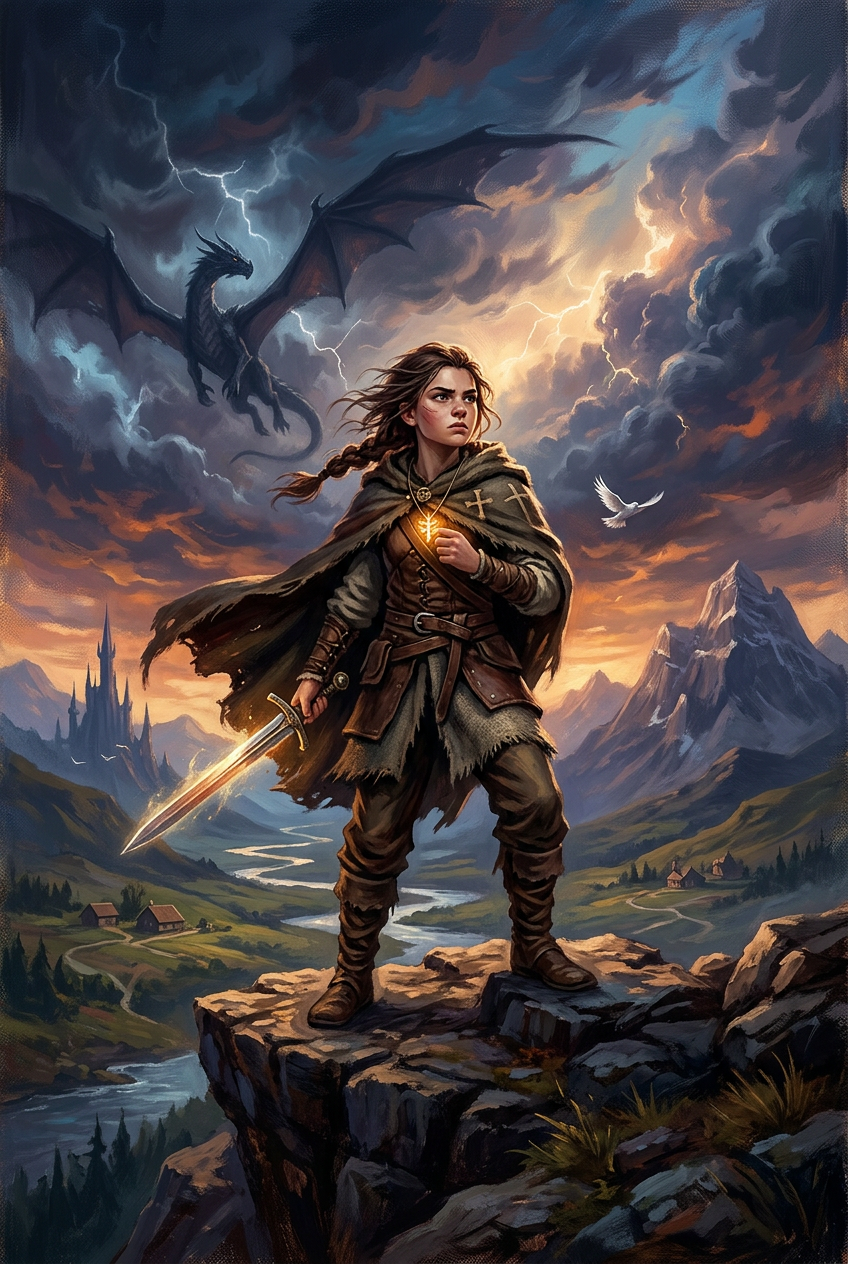
Book · 8 chapters · 25,668 words
Mercies Wind
Contents8 chapters
Chapter 1
Wind Over Dry Fields
The hoe struck hard ground with a sound like bone.
Wren stopped, pushed the hair out of her eyes with a dusty wrist, and brought the blade down again. The field gave her almost nothing back. Last spring, this strip behind the cottage had turned dark and soft after rain. You could sink your fingers to the second knuckle and come up with cool black soil under your nails. Now the earth had the color of old bread crust. It broke in plates. It split in long cracks. Even the weeds looked thin.
“Don’t chop at it,” her father called from three rows over. “Cut and lift. You’re wasting your strength.”
“I know how,” Wren said, though not loud.
She reset her feet and did it his way, driving the hoe in at an angle, levering up the roots of the bitter grass that had dared to grow where barley had failed. Her palms burned. The wood handle had a smooth place where her hand always gripped and a splinter near the end that caught her skin if she slid too far.
A lark sang somewhere over the field. The sound was too cheerful for such a day.
Barrow Fen lay low and flat under a white sky. From the rise near the road you could see the whole village at once: cottages with patched roofs, a sagging granary, the small stone meeting house, the smithy with its crooked chimney, and beyond all that the marsh reeds, pale and still. In better years the fields around it shone green in bands. This year they looked moth-eaten. Here a strip of barley no taller than a hand. There beans that flowered and then gave up. A potato patch blackened at the edges as if fire had breathed over it in the night.
Wren was twelve, and old enough now to know the names of things adults tried not to say in front of children. Debt was one of them. Levy was another. Seizure was the one that made her mother go quiet.
Her father, Tobin, worked in the row with his shoulders bent and his hat pulled low. He had grown thinner since winter. His shirt hung on him. When he straightened, he pressed one hand to his side for a breath before returning to the work. He thought no one saw that part.
Wren saw most things.
At the edge of the field, her little brother Elian sat on the fence rail and swung his heels against the post. He should have been chasing beetles or throwing clods at stumps, but he was trying to be good. Their mother had told him not to wander. When times turned sharp, even a six-year-old could feel it in the house like a draft under the door.
Elian cupped his hands around his mouth. “Wren, there’s a cloud shaped like a goat.”
“Then ask it to rain,” she said.
“I did.”
“And?”
“It’s a proud goat.”
That pulled a dry laugh from her father. It was small, but it was there.
Wren kept working. Sweat ran down her neck and soaked the collar of her dress. Gnats drifted around her face. The day smelled of dust, crushed nettle, and the faint sour tang of the ditch at the end of the property. She tried not to look toward the road. The collector would come by the road if he came at all.
At noon her mother brought out a crock of watered milk and a heel of rye bread wrapped in cloth. Mara’s apron was streaked with flour, and there was ash on one cheek where she had brushed at sweat with the back of her hand. She divided the bread with care that tried to look casual.
“Elian gets the bigger bit,” Wren said.
“He’s growing,” Mara answered.
“So am I.”
“You’ll survive a day of injustice.”
Wren took the smaller piece and bit it. It was stale enough to fight back. She sat in the narrow shade of the cart while her father drank, and her mother stood with one arm around herself, looking over the fields the way a person looks at a sick bed.
“He came to Hobb’s place this morning,” Mara said at last.
Tobin did not ask who. “What did he take?”
“The copper kettle. Two sacks of seed they had put by. Jorin Hobb tried to argue the measure on the books, and the man told him if he had breath for arguing, he had breath for prison.”
Elian had gone silent on the fence rail. Wren saw his face tighten around words he did not understand enough to repeat.
Tobin wiped his mouth with the back of his hand. “He won’t get much from us.”
“That won’t stop him wanting it,” Mara said.
No one spoke after that. A fly walked across the rim of the crock. Somewhere near the ditch, frogs started up in a rough little chorus and stopped again.
When the break ended, the day seemed hotter, not cooler. Heat pressed down from above and rose off the ground in waves that made the far scarecrow shake and blur. Wren’s arms moved by habit. Chop. Lift. Shake the roots loose. Step. Chop again. She let her mind drift because the body knew the work.
It drifted, as it often did, to church days in the meeting house when old Bran the elder read from the worn leather book about Yahwe, who made the world by his word and held every living thing in his hand. Bran’s voice was cracked and slow, but some lines stayed bright in Wren’s head. Yahwe saw. Yahwe remembered. Yahwe spoke names and the names mattered.
That last thought came to her now for no reason she could name. She paused with the hoe raised.
The field had gone still.
Not quiet. Still.
The lark was gone. The gnats had vanished as if swept away. Even Elian’s heels had stopped knocking the fence post. Wren lowered the hoe very slowly and looked up.
Her father was still working.
Her mother, who had gone back toward the cottage, was lifting washing from the line.
Nothing had changed, and everything had.
A breeze touched the back of Wren’s neck.
It came from the east, from the old orchard beyond the barley strip. That was wrong already. The wind usually crossed from the marsh. This one moved against the day’s habit, cool and fine as water poured through fingers. It slid over the field in a long pale ribbon. Dust did not rise under it. The dry barley bent as if something bright had passed its hand over the heads.
Wren stared.
The wind shone.
Not like fire. Not like the sun on the pond. This was softer and stranger, silver laid through clear air, threads of light moving low over the ground. They streamed between the rows, touched the fence, slipped around the cart wheels. For one dizzy blink she thought the whole field had been netted in glass.
“Elian?” she called.
He squinted at her from the rail. “What?”
Her skin prickled. “Do you see that?”
“See what?”
The shining current reached her boots. Cold ran through the worn leather and up her legs. The dust at her feet trembled, then settled in a circle as neat as a plate rim. Wren forgot the heat. Forgot the hoe in her hands. The air smelled suddenly clean, like rain striking stone after a long dry spell. Under that came another scent, faint but sharp: green apples, though no apples had grown in the old orchard for years.
The silver wind gathered around her.
It did not push. It waited.
Then a voice spoke her name.
“Wren.”
She gasped and turned so fast the hoe slipped from her fingers and hit the ground.
Her father looked up. “What are you about?”
She searched the field. No one stood there. No one near enough to whisper at her ear.
The voice had not come from one place. It seemed to move through the shining air itself, low and clear, as if a mouth had formed inside the wind and spoken with great care.
“Wren.”
This time the sound held no threat. That frightened her more.
“I heard it,” she said.
“Heard what?” her father asked.
She looked at him. He had gone back to leaning on his hoe, annoyed but only annoyed. No awe. No fear. No sign that he saw silver moving through the field or felt cold around his boots. Elian had started knocking his heels again.
“There,” Wren said, pointing toward the orchard. “It said my name.”
Mara, halfway to the cottage door, turned around. “Who said your name?”
Wren opened her mouth and closed it. The wind circled once at her knees and drew away across the field in streaming lines. Where it passed, the barley lifted and shivered. Then the brightness thinned. The clean scent faded. Heat dropped back over everything like a blanket flung from a line.
It was gone.
Tobin watched her a moment longer. “You’ve had too much sun.”
“I haven’t.”
“Then less staring and more weeding.”
His tone was not cruel. That almost made it worse.
Wren bent to pick up the hoe, but her hands shook. She tried to work again and missed the row twice. The dirt seemed different now, as if something below it had shifted. The old orchard stood at the far end of the property with its bent trunks and nettles and deadfall branches. Once, long before Wren was born, it had fed three families. Now it gave wasps a home and boys a place to dare one another after dark.
She kept looking toward it.
At last her mother crossed back through the field carrying an empty basket. “Go fetch water,” Mara said quietly. “And wash your face while you’re there.”
Wren knew a rescue when she heard one. She nodded, took the bucket, and headed toward the well near the lane. The packed dirt path led close enough to the orchard that she could hear leaves stirring, though the rest of the world felt windless again.
Behind her, Mara said in a low voice to Tobin, “She looked white as linen.”
“And girls of twelve never make fancies from heat and hunger?”
“You heard her.”
“I heard a child shout at empty air.”
Wren walked faster so she would not hear more.
The village well sat under a leaning ash tree with its bark split pale along one side. Two women stood there already with their yokes and buckets, talking over the rope creak. They nodded to Wren. One asked after Mara. The other complained that her onions had bolted too soon. Their voices sounded ordinary in a way that made Wren feel less ordinary by the step.
She drew water, watched the bucket sink black and come up glittering, and splashed her face. The water was warm near the top, cool beneath. Mud streaked down her wrists. She wanted to ask, Did the air shine in your fields? Did a voice call your name? Instead she kept her mouth shut. In Barrow Fen, strange stories traveled faster than geese.
When she turned back home, she did not take the open path. She cut around the ash tree and slipped through the gap in the old stone wall toward the orchard.
The grass there reached her knees. Burrs clung to her stockings at once. Apple trees stood in crooked lines, gray bark patched with moss, branches twisted and half bare. A few hard little fruits, no bigger than marbles, hid among the leaves. Most had been pecked by birds. Fallen apples lay in the grass, split and sweet-rotten, drawing yellow jackets that lifted and settled with a papery hum.
The air in the orchard felt cooler than the field. Wren moved slowly, listening. A branch scraped another branch with a dry wooden sigh. Somewhere farther in, something rustled once and then held still.
“Hello?” she said before she could stop herself.
No answer came. She almost laughed at her own foolishness.
Then she saw it.
On the ground between two old trees lay a track in the grass, narrow and clear, as if something had passed low over it without touching. The bent stems glittered at the edges. Not wet. Not dew. Just a faint dust of brightness that did not belong to any field she knew. It led toward the center of the orchard, where the oldest tree grew.
Wren followed.
This tree had a trunk wide enough that Elian could not have wrapped both arms around it. Lightning had struck it years ago, leaving a black seam down one side. Children said it was hollow and housed foxes, spirits, or thieves depending on who was telling the tale. Wren had never dared go close alone. Now she walked right up to it.
The shining dust ended at the roots.
There the ground had been disturbed. Soil lay freshly turned in a shallow scrape beneath nettles and windfallen leaves. Wren crouched and set the bucket down. Her heartbeat thudded in her throat. She brushed aside leaves with one hand.
At first she found only dirt, dry on top and cool beneath. A beetle flashed away from the light. Then her fingers struck something smooth.
She dug more carefully.
The object came free with a soft tearing sound as roots let go of it. It was longer than her hand and curved like a feather, but no feather ever held such weight. It flashed when daylight hit it, a clean silver with a pale blue line through the center. Fine ribs ran from shaft to edge. One side was sharp enough to catch at her thumb. The other felt warm, though it had lain under soil.
Wren drew in her breath.
A scale, she thought first, because it gleamed like fish skin or old coins. But it narrowed too delicately. A feather, she thought next, except birds did not grow metal. It was both things at once, a piece made by no hen, goose, hawk, or swan that nested near Barrow Fen.
Dragon.
The word did not enter her mind like a tale. It landed with weight.
She had heard stories, of course. Every child in the Fen had. Dragons over the high mountains. Dragons in the old wars. Dragons that served Yahwe’s faithful and dragons gone wild in the black years before the valley was settled. Most people told such stories with the same voice they used for giants, sea monsters, and cities paved in gold. Interesting, far off, and safe because they were far off.
This silver thing in her hand was not far off.
A breeze moved through the orchard. Leaves flicked their pale undersides. Wren looked up sharply.
Between the branches she saw nothing but light and leaf shadow. Yet she felt watched. Not hunted. Seen.
The same clean scent of rain on stone touched the air.
“Wren.”
The voice came again, gentler than before and so near it raised the tiny hairs on her arms.
She stood too fast and nearly lost her balance. The bucket tipped, sloshing water dark over the roots. “Who’s there?”
A blackbird burst from a branch above her head and flew off in outrage. Wren flinched, then felt foolish, then stopped feeling foolish because the silver feather-scale in her hand was real enough to cut her if she gripped it harder.
She backed away from the tree. One step. Two. The orchard seemed full of listening. Every twisted branch held a shape for half a blink before turning back into wood.
“Show yourself,” she whispered, and hated how small it sounded.
Nothing showed itself.
From the field beyond the wall, her mother’s voice rang out, sharp with worry now. “Wren!”
Wren looked toward the sound.
When she looked back, the orchard had gone plain again. Just old bark, flies, rotten apples, nettles. The strange brightness had sunk into the day as if it had never been.
Except for the thing in her hand.
She wrapped it in the corner of her apron before she could think better of it, lifted the bucket, and hurried home through the grass. Water bumped her leg at every step. Once she glanced behind her and saw only the open gap in the wall, the ash tree, and beyond it the white road.
Her mother waited by the kitchen door with flour on her arms to the elbow. “I sent you for water, not wandering.”
“Sorry.”
Mara took one look at her face and lowered her voice. “Did you go to the orchard?”
Wren nodded.
“Why?”
Because the wind called me. Because something in the old tree knows my name. Because I found a piece of a dragon buried under roots. None of those sounded like words that would live well in daylight.
“I wanted to see,” Wren said.
“That place is thick with holes and snakes. Don’t go there alone.”
“Yes, Mam.”
Mara studied her one heartbeat longer, then took the bucket. “Set the table. Your father will come in soon.”
Inside the cottage, the air held the smell of onion, broth, and bread crust warming by the hearth. Elian had arranged three spoons and one carving knife in a proud crooked line. Wren straightened them. Her fingers kept returning to the knot she had tied in her apron corner.
At supper Tobin ate as if the bowl might be snatched away before he finished. Elian told the goat-cloud story again and added a knight this time. Mara listened with half an ear and asked Tobin if he would mend the north fence tomorrow. No one mentioned the shining wind. Wren waited for one of them to say, Did you truly hear something? Tell us what happened. No one did.
The collector came just before dusk.
His cart wheels rasped on the road outside. Every spoon stopped. Tobin set his bowl down with care and stood. Through the small window Wren saw a narrow man in a dark coat, clean boots gray with road dust, a ledger tucked under one arm as if it were a child he favored. Another man sat on the cart seat with a switch across his knees.
Mara rose too, wiping her hands on her apron though they were not wet. Elian slid from his stool and moved close to Wren.
The collector did not come in. He preferred to speak from the yard, making families stand in their own dirt while he read their losses at them. Tobin went out first. Mara followed. Wren edged near the door but did not cross the sill.
Names. Measures. Dates. The man’s voice carried in a dry droning stream. Tobin answered short. Once the collector laughed, and the sound made Wren’s teeth clench.
“We can grant another week,” he said at last. “No more than that. Grain or goods. If neither, the draft mare will cover part.”
Mara made a sound at that, small and broken before she swallowed it.
The draft mare was old and swaybacked, but she was the reason their plow moved at all.
Tobin said, “You’ll have your due.”
“I always do,” said the collector.
The cart rolled off into evening. Only when the sound had gone did the house seem to breathe again.
Night came slow and red over the fields. Wren helped wash bowls in a pan of cloudy water. She fed scraps to the hens. She put Elian to bed on his straw tick and listened while he asked if clouds slept and whether Yahwe counted every star by hand. She answered as best she could. When the cottage quieted, she climbed to the loft where she slept under the rafters.
There, in the last gray light from the small window, she untied the corner of her apron.
The silver feather-scale lay in her palm.
It caught what little light remained and kept it. Not much. Just enough to make its edges clear. Looking at it made the loft seem too small, the roof too low, the village too thin against the dark beyond the fields. This thing belonged to a wider story than debts and broken fences and dry barley. Wren did not know whether that thought brought comfort or fear.
She touched the blue line running down its center. Warm again.
A voice drifted up from below. Bran the elder, in meeting house light, saying that Yahwe’s mercies often arrive in forms the fearful mistake for trouble. Another line followed, one her mother liked: When he calls, he does not call by accident.
Wren folded her fingers around the silver piece and listened to the night outside. Frogs in the ditch. A dog barking far off. The creak of the rafters cooling. Ordinary sounds. Safe sounds.
Yet beneath them, as steady as a hidden spring under stone, ran the memory of the shining wind and the clear voice speaking her name.
Something powerful had crossed the dry fields of Barrow Fen that day.
It had not crossed by mistake.
And somehow, though she could not have said why, Wren knew it would come again.
Chapter 2
The Dragon in the Orchard
Wren woke before the light and knew at once that the scale was gone from where she had tucked it under her blanket.
For one hard blink she thought someone had taken it. Then she saw it lying on the floorboards near the loft ladder, faint as frost in moonlight, as if it had moved there by itself in the night.
She crouched and picked it up. The silver surface felt warmer than her hand. When she held still, the blue line down its middle gave one thin pulse. Then another.
A summons.
Below her, Tobin coughed awake. Mara stirred the banked coals. Elian mumbled in sleep. The cottage settled into morning sounds, but Wren stayed kneeling with the scale in her palm and felt its tiny living heat.
It pulled.
Not by string or hook. By knowing. The way a bucket knows the drop of a well rope. The way smoke knows to climb.
Wren tucked the scale into her apron pocket and went down the ladder.
Mara had already tied her hair up. “You’re up early.”
“Could feed the hens,” Wren said.
“Do that. Then mash what potatoes are left.”
Tobin sat on the stool by the hearth, bending to drag on his boots. He looked older in the half-dark, with one hand braced on his knee before he stood. “Field first today.”
“Yes, Da.”
Wren kept her face plain. That was the trick when you meant to do a thing no one had allowed. Speak little. Move as usual. Do not let your eyes run toward the door too often.
Outside, dawn spread thin and gray over Barrow Fen. The marsh beyond the village breathed out its cold wet smell. The hens clucked at her ankles. The mare stamped in her lean-to and flicked her tail at flies that were not yet awake enough to bite. Everything looked common. Everything looked poor.
The scale warmed again.
Wren fed the hens, set the mash pot near the hearth, and carried the slop bucket to the back patch. Tobin had gone ahead with the hoe. Mara stood at the table kneading the last of the coarse flour into a tight mean loaf.
“Fetch another pail before the sun climbs,” Mara said without looking up. “And mind you come back by the straight path.”
“Yes, Mam.”
Wren took the yoke and two buckets. She walked toward the well until the cottage wall hid her. Then she cut left through the barley strip, heart hammering so loudly she felt sure the whole village must hear it.
The orchard waited beyond the broken stone wall. In morning light it looked worse than it had yesterday—low twisted trees, bare limbs, bark split and silvered by old weather. Nettles crowded the roots. Fallen apples from last autumn had rotted into dark cups in the grass. No bird sang there.
Wren climbed through the gap in the wall and stopped.
The scale in her pocket grew hot.
She drew it out. The blue line shone sharper now, a thread of sky caught in metal, and when she turned her wrist it angled toward the oldest tree, the one split by lightning. Not just the tree. Beyond it. Deeper in.
Wren swallowed.
Stories about dragons had lived in Barrow Fen longer than the people had. Old tales. Fire. Teeth. Fields blackened in one pass of a wing. Children eaten for wandering. Mothers in the village still used dragons the way they used bog-men or winter wolves: as a warning to bring little ones in before dark.
But stories told in kitchens were one thing. A warm scale tugging in her palm was another.
She stepped forward.
The grass in the orchard brushed wet against her ankles. A branch snagged her sleeve. She passed the lightning tree and found a narrow way through the growth where something heavy had pushed through more than once. Bent weeds. Crushed fern. One place where bark had been scraped from a trunk in pale fresh ribbons.
Then she smelled it.
Not smoke exactly. Not rot. Iron, rain, and something sharp like struck flint.
Wren froze.
Ahead, behind a tangle of fallen limbs and wild briar, something moved.
The branches shifted with a dry crackle. A long shape drew in on itself, trying to hide. Silver showed first—dull in shadow, then bright where a blade of sun reached it. A curved flank. A ridged shoulder. One folded wing, thin and torn like cloth that had snagged on nails.
A dragon lay in the hollow beyond the brush.
Wren forgot to breathe.
It was not as large as the beasts in old carvings on the meeting-house doors. Not house-sized, not war-sized. Young, though still bigger than the family mare. Its body was built like a cat’s and a hawk’s and a lizard’s somehow made true at once. Silver scales covered it, each one edged in pearl. Along its neck ran a narrow mane of pale spines that lifted and settled with pain. One hind leg was trapped under its own weight at a bad angle. Blood, dark and sticky, clotted along the joint and stained the grass.
Its head rose.
Its eyes found her.
They were blue.
Not soft blue. Not kind, at first glance. Bright and clear as a deep winter sky, set under bony silver brows. The slit pupils narrowed. Its nostrils flared, taking her scent. Wren saw teeth when it pulled back its lips—small swords, neat and white.
Every good sense she owned told her to run.
Her feet stayed.
The dragon spoke in a voice rough as stones rubbed underwater. “You brought my scale.”
Wren nearly dropped it. “You talk.”
The dragon blinked once. “So do you.”
Wren’s mouth opened and shut. It was a poor answer, but it was the only one she had.
The dragon shifted and a tremor ran through its flank. Pain changed its face at once. Wren knew that look. She had seen it on the mare when the harness rubbed raw and on Mara when she thought no one watched her hand press against the ache in her back.
“You’re hurt,” Wren said.
“Yes.”
“Did—” Her throat tightened. “Did someone do that to you?”
The dragon’s gaze slid toward the orchard edge, toward the village beyond. “Servants of the devourer. Men in black leather. Hounds bred from smoke. I outflew them for a time.”
Wren did not know the word devourer, not as a name, but she knew what it meant. Bran the elder spoke sometimes of the evil one without speaking the name too freely, as if names were doors. The devourer. The enemy. The serpent who wanted all things bent away from Yahwe and back toward hunger.
Wren took one backward step before she could stop herself.
The dragon saw it.
Something shuttered in its face. Not anger. Worse. Expecting it.
“You should go,” it said. “If they catch your scent here, they will search your home.”
That should have made leaving easy. Instead it pinned her where she stood.
If she ran now, she would be safe for one more hour perhaps, one more day. And the creature in the briars would bleed alone because everybody in Barrow Fen feared the shape of it more than the wound in it.
Wren thought of Bran saying mercy often arrived in forms the fearful mistook for trouble.
Her fingers tightened around the scale until its edge bit her skin.
“What is your name?” she asked.
The dragon’s neck lifted a little. “Mercy.”
Wren stared.
It almost might have been funny, if there had been less blood.
“That’s a strange name for a dragon.”
“It was given to me.” A pause. “What is yours?”
“Wren.”
“Then the wind spoke true.”
Cold ran down her back. “You know about that?”
“I sent it.”
The orchard seemed to tilt under her feet. “You called me?”
Mercy let its head sink lower onto crossed foreclaws, as if even speech cost strength. “I had one scale to spare and little power left. I asked the wind to carry it to the one I was sent to find. It brought you.”
Sent. Find.
Wren looked behind her, half expecting grown men or black hounds to step from the trees. “No. You have the wrong girl.”
Mercy said nothing.
“I’m from here,” Wren went on, hearing the smallness of it in her own voice and hating it. “My da owes grain he does not have. My mam cuts old shirts into patches because we can’t trade for cloth. I fetch water. I weed. That is all.”
Mercy’s blue eyes did not leave her. “Yahwe does not ask poor soil whether rain may fall on it.”
Wren had no answer to that either.
The dragon shut its eyes for a moment. When it opened them again, the bright look had dulled around the edges. Weakness. “Go home, Wren. If you choose to forget this place, forget it quickly.”
That should have ended it.
Instead Wren heard herself say, “You need water.”
Mercy’s nostrils widened.
“And cloth.” Wren glanced at the hind leg. “Clean cloth if we have any.” She almost laughed at the foolishness of that. They had no clean cloth to spare. They barely had cloth. “Maybe boiled strips. Yarrow too, if there’s some by the ditch. Mara uses it for cuts.”
“Why?”
The question was plain. So was the answer, once it came.
“Because you’re hurt.”
Mercy watched her for one long heartbeat. “Humans fear dragons.”
“Mostly they fear stories.”
“That has not always saved us from them.”
Wren nodded once. “No.”
Mercy lowered its head again. “If you return, return alone.”
Wren backed away this time on purpose, never turning until the briars hid the silver curve of the dragon’s body. Then she ran.
She did fetch water from the well, because coming home with empty buckets would have undone everything. Her hands shook so badly that the rope banged the stone curb. Old Nella Pike, waiting with her crock, peered at Wren and said, “You look peaked.”
“Ran there,” Wren muttered.
“Fool thing to do in this heat.”
Wren nodded and carried the sloshing buckets home.
The day dragged like a cart in mud. Tobin set her to work in the field. The sun climbed. Dust coated her shins. Every time she struck the hoe into the brittle ground, she saw again the dark blood around Mercy’s leg. When Mara sent her in to slice the noon loaf, Wren’s eyes went to the rag basket under the table. Mostly scraps too worn for use. One strip of old linen still strong enough to bind. Not much, but better than nothing.
She waited.
That was the hardest part. Not the fear. The waiting inside the fear.
At dinner Tobin counted under his breath what grain might be sold, what must be kept, whether the mare could still pull the plow if he traded harness leather for seed. Mara said little. Elian spilled broth on himself and cried when the hot splash hit his leg. Wren fetched the cloth and soothed him and all the while kept hearing Mercy’s voice: If they catch your scent here, they will search your home.
By late afternoon Mara sent her to gather sticks near the ditch.
Wren took the basket, the old linen hidden under the sticks, and slipped a small crock half-full of water beneath the kindling. At the ditch she found yarrow in a pale cluster by the bank and pulled it up by the roots, trying to remember how Mara cleaned and bruised the leaves before binding them on a cut.
The orchard felt different the second time. Not more dangerous exactly. More true. Once a thing has shown itself, you cannot go back to fearing only the shadow of it.
Mercy was where she had left it, though now its breathing came harder. One wing had spread partway, perhaps to cool itself. Under the silver scales along its ribs, heat shimmered faintly.
“I came back,” Wren said, and hated how proud that sounded.
Mercy opened one eye. “I see that.”
Wren set down the basket and water crock. “Can you drink from this?”
Mercy stretched its neck, sniffed, and then, with surprising care, lapped from the crock. Its tongue was narrow and dark. The water was gone in moments.
“I can bring more.”
“Do not risk too much.”
Wren looked at the wounded leg. “That depends what too much is.”
Mercy gave a low sound, almost a rumble. It took Wren a moment to realize the dragon had laughed, a little.
That steadied her more than anything.
“Show me,” she said.
Mercy shifted enough for her to see the wound clearly. The leg had been slashed, not bitten. A deep cut above the joint, and another puncture lower down where something narrow had gone in. The flesh around it was swollen. Black ash clung to the scales nearby.
“What did they use?”
“A hooked spear,” Mercy said. “And poison smoke.”
Wren unwrapped the linen. “This will hurt.”
“It already does.”
She knelt in the grass. Up close, the scales were not smooth like fish scales. They had fine ridges in them, a grain like leaves. Dirt had dried in the seams. One loose silver scale near the wound hung crooked. Wren thought of the one under her blanket. Same shape. Same blue line. She touched the edge of the cut with wet linen and Mercy’s whole body tensed, but the dragon did not snap or strike.
“Sorry,” Wren whispered.
She cleaned until the cloth came away less dark. She crushed the yarrow between her palms the way she had seen Mara do and packed it around the shallower cut. The puncture worried her. Too deep to help much from the outside. She bound what she could with the linen, wrapping between scales and under the joint.
Her fingers were clumsy, but they finished the job.
Mercy let out a long breath. “You have done this before.”
“On goats.”
“That explains the knot.”
Wren sat back on her heels. “The knot will hold.”
“I did not say it would not.”
For a moment, despite everything, Wren grinned.
Then the grin went from her when she remembered the rest. “You said you were sent to find me.”
Mercy’s face sobered. “Yes.”
“By who?”
“By those who still serve Yahwe openly. There are watchfires in the high places. Riders. Keepers of the old words. They have waited and watched for signs.”
Wren shook her head at once. “That has nothing to do with me.”
Mercy lowered its voice, though they were alone. “The enemy searches this valley because a child marked for war will rise from it.”
Wren felt the orchard close in.
“No.”
“The servants of the devourer do not know the name. Not yet. They know only this: Yahwe has set his mercy on one here, and if that child lives to stand, much will be broken from the enemy’s hand.”
Wren stood too fast and nearly stumbled. “Stop.”
Mercy stopped.
Wren pressed both hands to her head as if that could keep the words out. Chosen children belonged in meeting-house stories and Bran’s winter readings. They did not belong to girls with dirt under their nails and patched hems and a father bargaining week by week against ruin.
“You have the wrong village,” she said. “The wrong valley. The wrong everything.”
Mercy did not argue at once. The dragon only watched her, which was somehow harder to bear.
At last Mercy said, “Perhaps. But the wind went where it was told. And you came.”
That was the worst part. She had come.
Not because she was brave. Not because she believed. Because the scale had warmed in the dark, and because something in her had answered before the rest of her could be sensible.
“If they are searching,” Wren said slowly, “then they’ll come here.”
“They may already be near.”
The orchard went very quiet.
Wren heard, all at once, the things beneath silence: flies over fallen fruit, leaves ticking against one another, the far creak of a cart from the village road.
“My family,” she said.
“Yes,” Mercy said.
The single word held no comfort. Only fact.
Wren looked toward the gap in the wall, seeing in her mind Mara at the kneading board, Tobin in the field, Elian chasing chickens with bare dusty feet. She had wanted one strange thing in her life, one bright secret to crack the shell of hunger and debt and sameness. Now the secret had teeth and blood and enemies.
“I should tell Bran,” she said.
“Maybe.” Mercy shifted, wincing. “Tell no one you do not trust to die before they speak under pain.”
Wren stared at the dragon.
Mercy’s eyes did not soften. “I do not say that to frighten you. I say it because the enemy uses fear well.”
Wren believed that at once.
She picked up the empty crock. “I’ll bring more water tonight if I can.”
“You have already risked enough.”
“That’s for me to judge.”
Mercy inclined its head, a small grave motion that felt older than the orchard. “Then hear this in return. If black smoke moves without wind, run from it. If hounds come and make no sound, climb stone if you can. And if you hear your own name spoken by a voice that feels empty, do not answer.”
Wren held the crock tighter.
Mercy went on. “The mark of Yahwe is not yet plain, or I would see it. But the enemy smells the promise of it, as wolves smell lambing time before the first cry. That is why they hunt.”
A shiver passed over her skin in the hot afternoon.
“Why tell me?” she asked. “Why not leave?”
Mercy looked at the torn wing, the bound leg, the blood-dark grass beneath its body. “Because I could not outfly them. Because I was sent. Because mercy sometimes arrives wounded.”
Wren stood with that.
It was too big for her. Too heavy. Yet she could not set it down.
At last she nodded once.
Then she left the orchard with the empty crock under her arm, the smell of dragon and blood still in her hair, and the whole poor valley changed around her though it looked exactly the same.
Chapter 3
The Mark of Yahwe
Wren woke because Elian was whimpering.
At first she thought he had kicked his blanket off again. The loft was dark except for a strip of moonlight through the crooked shutter, and the house made its usual night sounds: timber settling, a mouse somewhere in the wall, her father’s low cough from below. Then she heard what had woken Elian.
Someone was calling her name.
“Wren.”
It came thinly through the dark, almost gentle. Not from the yard. Not from the lane. It seemed to slip along the rafters and under the blanket and into her ear.
Every hair on her arms lifted.
Mercy’s warning struck her so hard she went cold all at once. If you hear your own name spoken by a voice that feels empty, do not answer.
“Wren,” the voice said again.
Elian rolled toward her in the straw mattress, his little face hot and damp. “Did Mam call?”
Wren put a hand over his mouth before he could say more. “No.”
His eyes went wide at that. He had never liked her doing things in a hurry. It made the world feel wrong.
Below them, the hens in the side pen gave a sudden frantic flutter. A pot clinked in the kitchen. Then came the sound of Mara’s feet crossing the floor and stopping.
“Tobin,” she whispered.
Her father was awake in an instant. Wren heard the scrape of his stool legs, then the dull thud of him taking down the ash stave he kept by the door in lambing season. Nobody spoke loud after that.
The voice came a third time, nearer now.
“Wren.”
It was not a person’s voice. It used the shape of one, that was all. There was no breath in it. No strain in the throat. No life.
Wren slid from the mattress and pulled Elian with her. “Quiet,” she breathed into his hair.
The silver scale lay under her blanket where she had hidden it again after dark. She snatched it up without thinking. It felt cool, then warm, then hot as a coal beginning.
Below, the latch lifted.
“No,” Mara hissed.
Too late. Tobin had opened the door.
The house filled at once with a smell like a doused hearth and rotted reeds. Not smoke from wood. Something fouler. Wren edged to the loft ladder and looked down through the gap between the boards.
The doorway was black.
Not dark. Black.
It moved against the moonlit yard in thick, folding coils, as if a chimney cloud had learned how to bend and look. Two pale points shone inside it, not like eyes exactly, but like wet ash holding heat. Another shape slid behind it. Then another.
Mara grabbed Tobin’s arm and dragged him back as the first thing crossed the threshold without touching it.
Elian made a small choked sound against Wren’s palm.
The creature had no feet. Its lower half unraveled and gathered and unraveled again, brushing over the floorboards without weight. Where it passed, frost filmed the wood white for a blink and vanished. The kitchen dimmed around it. Even the moonlight from the open door seemed to thin.
Tobin swung the ash stave with both hands. The blow went through the thing and struck the doorframe hard enough to crack. The creature shuddered, split around the wood like smoke around a rake, and re-formed on the other side.
“Out!” Mara shouted up toward the loft. “Wren, take him and run!”
The black shape turned its pale heat toward the ladder.
Wren did not wait.
She hauled Elian after her across the loft boards to the far end where Tobin kept sacks and old harness. There was a little hatch there, no bigger than a grain lid, used in summer to throw spoiled straw down into the back patch. Tobin had mended the hinge with wire; it stuck unless shoved hard.
Wren shoved hard.
Cold night air hit her face. Elian started crying in earnest then, soundless at first, only his mouth open. She pushed him feet-first through the gap.
“Drop,” she said.
“It’s dark.”
“Do it.”
He slid and disappeared. She heard the soft thump of his bare feet in the weeds below. Then something struck the loft ladder behind her with a dry, crackling sound. She did not look back. She wriggled through the hatch, caught her apron on a nail, tore free, and dropped into the yard.
The world outside had gone wrong.
Black smoke moved between the cottages.
It flowed low over the ground and rose in columns by the fences and poured through gaps where no body should fit. Dogs were barking all over the village, except the barks kept breaking off sharp, as if cut with a knife. A horse screamed from somewhere near Hobb’s place. Light flared in windows and vanished. People shouted names. A child was wailing. From the far lane came a sound like geese taking wing, only there were no geese in it. Only fear.
Elian clutched her leg.
Wren caught his hand and ran.
“Where’s Mam?” he cried.
“Come on.”
“Where’s Da?”
“Come on!”
She dragged him around the back of the cottage, through the bean patch, past the leaning ash stump where Mara split kindling. Smoke rolled over the roof behind them and spilled from the open front door. She saw her mother for one instant through the window, snatching the iron poker from the hearth. Then the glass blackened over as if soot had been slapped across it from inside.
Wren ran harder.
The lane to the well was already full of people. Jorin Hobb stumbled past with one sleeve burned off and his face gray as dough. Old Pella from the end cottage had no kerchief on, her white hair streaming loose. Two boys from the reed huts were beating at a smoke-shape with fishing poles that met nothing solid. Bran the elder stood in the lane with the meeting-house lantern high in one hand and his walking staff in the other, shouting for people to come to the stone.
“To the meeting house!” he cried. “Stone walls, all of you! Stay together!”
One of the black creatures rose behind him.
Wren shouted before she knew she meant to. “Bran!”
He half turned. The lantern flame flashed gold across the thing as it leaned over him. Not a face. Never a face. Yet it gathered itself where a mouth might be, and from it came a whisper that scraped Wren raw.
“Wren.”
Bran swung his staff. The thing jerked back from the lantern instead, folding away from the light with a hiss like fat dropped in water. Bran saw it then. He stumbled and nearly went down.
“Run!” Wren screamed.
That reached him. He lurched toward the square, shouting again. More villagers poured after him, bent low, carrying babies, dragging blankets, weeping, praying.
Wren tried to follow, but Elian had stopped dead.
The well stood in the middle of the square under the old ash tree, pale in moonlight. Around its stones, three smoke creatures had gathered. They circled slowly, as if scenting. One lifted itself and poured a long arm of darkness toward the bucket rope. The rope shriveled and snapped. The bucket dropped, and a hollow splash came up from the dark.
Elian made a frightened sound and jerked backward.
Too late.
One of the creatures turned.
It felt Wren. She knew it in the pit of her stomach. The pale heat within it fixed on her and sharpened. The other two turned as well, all at once, like crows wheeling to one grain.
“Behind me,” she said.
Elian hid against her back, both fists knotting in her dress.
The square had emptied too fast. Bran was already at the meeting-house steps, waving people inside. Jorin Hobb was helping his wife. Mara and Tobin were nowhere. The creatures between Wren and the meeting house thickened, stretching taller.
Her hand closed around the silver scale in her apron pocket. It burned so hot she nearly dropped it.
She backed toward the well stones because stone, Mercy had said. Climb stone if you can.
The well curb came against the backs of her knees. There was nowhere else to go.
The first creature drifted nearer. Moonlight failed where it passed. Frost silvered the grass around its edge. Wren could hear something inside it, a faint crackling, as if twigs were burning in a far-off fire.
Then the voice came from it again, soft as soot.
“Wren.”
Elian started to answer out of habit. She whipped her hand back and covered his mouth without taking her eyes from the thing.
The second creature slid wide, trying to flank them. The third rose almost straight up and spread like spilled ink in water. Wren’s heart hammered so hard she thought it might tear loose. She had no stave. No knife. Nothing but a child behind her and a dragon scale searing her palm.
“I am not answering you,” she said, and hated how thin her voice sounded.
The first creature lunged.
It did not leap. It poured forward in a rush, cold and black and swift as tipped pitch.
Wren threw up her left hand on pure fear, as if she could block smoke.
Something answered.
Heat flashed through her palm, fierce and clean. Not the scale. Deeper. Brighter. A line of white-gold fire sprang across her skin, then another crossing it, then a circle flaring around both. For one blinding instant the mark burned clear on the back of her hand: sharp as hammered light, living as flame, and yet it did not consume her.
The square burst bright.
The creature struck that brightness and screamed.
The sound was not loud. That made it worse. It was a tearing inside the ear, a dry hate split open. The black body flew backward from her hand as if a plow team had kicked it. Shreds of smoke ripped off it and vanished in sparks. The other two recoiled at once, writhing. Light spilled from Wren’s hand over the well stones, over Elian’s hair, over the ash roots, pure as noon on water.
Elian buried his face in her back and sobbed.
Wren could not move.
The mark burned and burned. It should have hurt. Instead it felt like standing too near the bread oven on a winter morning: fierce, yes, but alive, wholesome, full of force. The silver scale in her palm had gone white-hot, yet she still held it.
The first smoke-creature tried again, gathering itself low. Wren turned toward it without thinking and the thing shrank back. It made that torn sound once more, then fled across the square, unraveling as it went.
The other two broke after it.
They did not simply drift away. They scattered. The blackness shredded into streamers and fled through lanes, over roofs, through the orchard side of the village and out toward the marsh. All across Barrow Fen other cries went up as more shapes pulled away, recoiling from whatever had blazed into the night. Dogs began barking again, wild and ragged. A baby cried. Someone shouted, “They’re going!” in a voice cracked with astonishment.
Wren lowered her hand at last.
The mark remained.
Not as bright now. Not enough to blind. But it shone through soot and moonlight alike, a white-gold sign clear on her skin.
People were staring.
Bran the elder came first, breathless, lantern shaking in his grip. Two men followed him with hoes raised like spears, though their knuckles were white and useless-looking. Mara came behind them, hair half down, the iron poker black in her hand. Tobin limped beside her, ash stave splintered at one end.
Mara reached Elian before she reached Wren. She dropped the poker and snatched the boy up, feeling his arms, his face, his ribs as if counting them. Then she looked at Wren and stopped dead.
Tobin stopped too.
Nobody spoke.
Wren became aware all at once of the silence that had fallen over the square. Doors hung open. Lamps trembled in windows. Villagers stood in little clumps, staring from the lane and meeting-house steps and garden gates. One woman was still kneeling in the mud where she had evidently fallen. A man had blood on his temple. A child clung to a blanket and sucked two fingers, eyes huge.
Bran lifted the lantern higher.
Its yellow light met the white-gold on Wren’s hand and seemed dull beside it.
“Let me see,” he said.
Wren did not want to move toward him. She did not want anybody touching her. She was shaking hard now that the danger had stepped back. Yet Bran’s face held no hunger in it, no fear sharpened into cruelty. Only shock, and something under the shock that looked a great deal like grief.
She held out her hand.
Bran set the lantern on the well curb and bent close. He did not touch at first. He only looked. The lines of the mark had settled into the skin without breaking it: a bright crossed shape within a ring, fine and exact, as if written there by light itself.
Bran whispered a prayer Wren had heard him use at gravesides. Then he looked up at her, and the old man’s eyes were wet.
“Child,” he said, “where did this come from?”
Wren almost laughed, because the answer was too large and too strange and too frightening to fit in the square with neighbors and broken ropes and spilled mud.
“It came when they came,” she said.
“That I can see.”
Mara found her voice first. “What is it?”
Bran straightened slowly. The whole village seemed to lean with him, waiting.
“It is no witch-mark,” he said, loud enough for the others to hear. “Let nobody speak that lie.”
A murmur moved through the square and died again.
Bran kept his eyes on Wren’s hand. “I have seen this sign only once before. In a painted page, long years ago, before damp spoiled the book. The mark of Yahwe’s claiming.”
Nobody breathed.
Tobin’s face had gone slack, as if someone had struck him behind the eyes. Mara clutched Elian tighter. The little boy peered over her shoulder, tears drying on his dirty cheeks, and stared at Wren as though she had become both sister and stranger in one body.
“No,” Mara said softly.
Bran looked at her, and his old voice gentled. “I did not ask for it either, Mara.”
Wren wished he had said it was a mistake. She wished he had laughed, even kindly. She wished the light would wash off and leave only her own hand: scratched knuckles, bitten nails, a burn scar from the bread pan.
Instead the mark remained.
A sound broke from the edge of the square. Not a cry this time. A moan.
People turned. Near the lane, bent against a trough, stood the collector’s hired man—the one who had come with the ledger two nights before. Wren had not even seen him in the chaos. He had a strip of blackness up one side of his coat where a smoke-creature had brushed him, and his face was gray with terror.
He looked from the mark to Bran and back again. “What did she do?”
Bran’s head came up. “Held.”
The man swallowed.
“She drove them off,” someone said from the meeting-house steps.
“With a hand,” said another, almost unbelieving.
“With Yahwe’s hand,” Bran said.
No one argued with him.
The square stayed still for another beat, as if the whole village had reached the edge of one life and could not yet step into the next. Then ordinary need returned in a rush. Somebody called for bandages. A woman fainted clean away into her husband’s arms. Tobin put a hand to his side and winced. A shutter banged loose in the night wind. Children began crying now that their fear had room.
Bran took hold of himself and started giving orders.
“Bring the hurt into the meeting house. Lanterns at every door. Keep to stone until dawn. No one alone, do you hear me? No one.” He turned to Jorin Hobb. “Count who’s missing.” To Mara: “Hot water if you have any left.” To Tobin: “Sit before you fall, man.”
Then he faced Wren again.
“You come with me.”
Mara stepped between them at once. “She comes with us.”
Bran did not harden, but he did not yield either. “She can stay under your roof if you must have that. But before the sun is high tomorrow, I speak with her. Alone if she consents, with you near if she does not. What came tonight will come again.”
Wren felt that sentence settle through the square like ash.
He was right. She knew he was right. Mercy had known it before any of them.
Mara looked at the shining hand and then at her daughter’s face. Whatever protest she had died there. Fear remained. So did love. Wren saw both plain as day.
“All right,” Mara said at last, but the words sounded torn from her.
Bran nodded once. “Cover the mark if you can, but do not bind it tight. And child—”
He stopped.
Wren waited.
His gaze flicked, very briefly, toward the orchard dark beyond the last cottages, as though some old thought had risen in him and gone silent again.
“Do not answer any voice in the night,” he said.
Wren’s throat tightened. “I won’t.”
He studied her as if he heard more in that than she had spoken. Then he picked up the lantern and went to help the others.
Tobin came to her at last. He smelled of sweat, smoke, and split wood. He looked at the mark only once before putting his rough hand on the back of her head, not quite an embrace, not quite not one.
“You saved him,” he said, meaning Elian. Meaning perhaps more.
Wren nodded because she could not trust her mouth.
He squeezed once and let go.
Their cottage door hung crooked on one hinge. The front room stank of cold smoke, and the cracked doorframe showed where his stave had struck. Mara settled Elian on the bed below instead of sending him back to the loft. He would not let go of her sleeve. Tobin dragged the table against the broken doorway and wedged it there with sacks. Outside, lanterns moved through Barrow Fen till near dawn, small yellow lights bobbing among black fields and wounded houses.
Wren sat on the stool by the hearth and watched the mark shine in the dark.
When she closed her fingers over it, light bled between them.
She thought of Mercy under the orchard tree. She thought of the empty voice saying her name. She thought of Bran’s wet eyes over her hand and of the painted page in a ruined book. The room felt too small to hold any of it.
At last Mara knelt in front of her and took her face between flour-rough palms.
“You are my girl,” she said.
Wren broke then. Not loudly. Just enough for tears to come hot and fast after all the cold. Mara held her, and for a little while Wren let herself be twelve, and tired, and afraid.
But even with her face against her mother’s shoulder, she could see the light from her own hand through the cloth of Mara’s sleeve.
It did not fade.
Chapter 4
Leaving Barrow Fen
Bran laid the map on Mara’s table as if it were a live coal.
It was no grand thing. Not a captain’s chart on clean parchment, not a temple scroll with painted edges. Just a piece of old skin, brown with age, curled at the corners and stitched once down a torn side with red thread. Damp had puckered it. Smoke had darkened one edge. Yet the moment Bran unfolded it, the kitchen changed. The room still smelled of ashes, wet wool, and yesterday’s barley crust, but something harder came into it too. Decision.
Tobin stayed standing. He had one hand pressed to his ribs where the smoke-creature had struck him in the night. Mara did not sit either. She held Elian against her skirts, though he was awake now and cross from fear and too little sleep. Wren stood near the hearth with her marked hand wrapped in a strip of linen that did nothing at all to hide the pale gold shining through.
Morning had come thin and ugly over Barrow Fen. From the doorway Wren could see two broken fences, Hobb’s roof patched with a sheet, and three men carrying a charred gate away like a body. Nobody in the village moved alone. Even the dogs stayed tucked against people’s legs.
Bran put one blunt finger on the map.
“There is a road here once called the ash road,” he said. “It runs east through the burned hills. If you keep it, and if Yahwe grants you life, it will turn north at the split stones. Beyond that lie the high ways. And beyond those—Mount Sered.”
Wren stared at the ink lines. They meant little to her. Her world had been fields, marsh, orchard, well, lane. A mountain sanctuary might as well have been the moon.
Mara found her voice first. “No.”
Bran looked at her with tired kindness. “Listen through before you refuse me.”
“I heard enough in one word.”
Elian dug his face into her apron. Tobin’s jaw worked once, hard.
Bran did not raise his own voice. He almost never did. That made him harder to fight. “The thing that marked her did not do so for hiding in a cottage. What came last night came for the girl. It will come again. Next time it may bring worse.”
“Then we hide her better,” Mara said. “We keep watch. We send for men from the south lane. We do not send a child walking into open country with devils after her.”
Wren’s stomach turned, because part of her wanted exactly that. Bar the door. Stay by the hearth. Sleep with Elian breathing beside her and Mara’s tread below in the night. Let the world be small again.
Bran tapped the map.
“There are people at Sered who know this mark. People who have stood against the devourer before. If she stays, Barrow Fen becomes the place they strike until they take her. If she goes, there is at least a road toward help.”
At that, Tobin finally spoke. “You speak as if the road itself does not kill.”
“It may,” Bran said.
Plain. No softening.
Wren looked from one face to another. Mara’s anger was bright because fear sat under it. Tobin’s face had gone still in that way she knew from bad harvests and debt talk, when the blow had landed and he was measuring what remained. Bran looked older than yesterday. The skin beneath his eyes hung loose. He had likely not slept at all.
Wren said, “How do you know about this place?”
Bran turned to her, and for a moment she thought he might dodge. He did not.
“Because I was shown this map when I was younger than your father is now. There were riders once who passed through the Fen in secret. One of them left this with my elder before me.” He touched the red-stitched tear. “He said if ever Yahwe’s claim appeared plain in this village, the child must be sent east. Not after a month. Not after the crops. At once.”
The room went quiet enough to hear grease hiss on the cold pan by the wall where none had been cooking.
Mara stared. “You kept that from us.”
“I prayed I would die before needing it.”
That shut her for a beat.
Wren felt the silver scale against her chest beneath her dress, warm as skin. Mercy. She had not told them all of it, not yet. Bran knew there was more; she had seen that in his eyes last night. Now he looked at her hand, then at the door, then back again.
“You are not going alone,” he said carefully.
Mara’s head lifted, sudden hope and suspicion both. “Who then?”
Wren swallowed. The lie had grown too large to carry. “Mercy.”
No one spoke.
Wren could hear Elian breathing. Outside, a hammer struck twice on something split.
Bran did not flinch. He only shut his eyes once, briefly, as if setting an old piece into place. Tobin frowned. Mara went pale.
“Mercy who?” Tobin asked.
Wren touched the scale through the cloth. “The dragon.”
Elian’s head came up at once. “A real one?”
Mara turned on Wren so fast the stool legs scraped. “You went back.”
Wren nodded.
“How long?”
“Since yesterday morning.”
Mara took two steps away from her, then back, then pressed the heel of her hand to her mouth. Anger wanted room, but terror beat it to the ground. “You found a dragon. You hid a dragon. After what we told you.”
“She was hurt,” Wren said. “And hunted. She said the wind brought the scale to me. She said I was the one she was sent to find.”
Tobin let out a breath through his nose, rough and unbelieving. “Sent by who?”
“Yahwe,” Wren said, and because the word felt too large in her own mouth, she added, “I think.”
Bran gave one slow nod. “Yes.”
Mara looked at him as if betrayal had put on his face. “Yes?”
He spread his hands a little. “Not that I knew the beast sat under our orchard trees. But I wondered. Child, can it bear weight?”
“Not yet far,” Wren said. “Her wing is torn. I bound it.”
Tobin stared at her then in a new way. Not as if she were strange. As if he had looked down one day and found a road running through his own daughter that he had never seen before.
“Show me this mark,” Bran said.
Wren unwound the linen. White-gold shone across the back of her hand like a branch of fire beneath skin. No shape stayed fixed for long. It shifted when she breathed. Mara could not quite look at it and could not quite look away.
Bran bowed his head over it, not touching. “They will hunt openly now,” he said. “The smoke-things failed. Flesh will come next.”
“Collector’s men?” Tobin asked.
“Maybe. Worse maybe.” Bran straightened. “Varek’s kind, if rumor is true.”
The name meant nothing to Wren, but it chilled the room anyway.
Mara’s eyes filled all at once, furious tears she would have hidden on any other day. “She is twelve.”
“I know,” Bran said.
“No, you do not. You know a sign. I know the child who still leaves wet shoes by the bed and tears her hem on thorns and cannot sleep when wind rattles the shutter.”
Wren wanted to say I can sleep, I am not a little thing, but the protest died. Mara was not wrong. That made it hurt worse.
Bran slid the map across the table. “Then love her by letting her live long enough to grow older.”
No one answered him.
The silence broke when Elian wriggled free and came to Wren. He peered at the mark with solemn round eyes. “Will the smoke men come if you stay?”
“Yes,” Wren said.
“And if you go?”
“They’ll go after me.”
He thought about that with the grave care children give to simple terrors. “Then go far,” he said. “So they don’t know where I sleep.”
Mara made a sound then, half laugh and half sob, and pulled him back to her.
That decided more than Bran’s map had.
By noon, the cottage had become a place of packing.
There was little to pack, which made the work quick and cruel. Mara chose the better loaf, though it meant the family would keep the stale heel. She wrapped a nub of hard cheese, two onions, and a twist of salt in cloth. Tobin found his old knife, the one with the antler handle gone smooth, and sharpened it on the doorstep stone until the edge whispered. Bran returned with a water skin, flint, and a wool cloak too large for Wren but sound at the seams. Someone had once dyed it blue; years and weather had taken the pride out of it.
Wren stood in the middle of it, useful and useless by turns. She rolled the blanket. She tied the food bundle twice because her fingers shook. She fetched the patched boots from under the bed. Then she stopped and looked at the shelf where Elian’s carved reed whistle lay, and her own cracked cup, and the bunch of dried pennyroyal Mara had hung by the window, and her throat closed up as if she were choking on wool.
Leaving, she found, was not one act. It was a hundred little cuttings.
Bran drew her aside while Mara kneaded the loaf cloth tight.
“The orchard?” he asked.
“She’s there.”
“Can she travel today?”
“She said she must.”
He accepted that. “Good. Keep off the main ruts when you can. If anyone asks where you go, say you carry word to kin in the east marsh. Say it plain and dull. People believe dull things.”
Wren nodded.
He put the map in her hands. Up close she could see more on it than lines. A little inked tower. Three strokes for pines. A place where someone had marked water with a blue dot that had faded almost to nothing.
“I cannot come with you,” Bran said. “The village needs every steady back. But I can tell you this. Fear is not always a stop sign. Sometimes it is a bell. Hear it. Then choose.”
Wren folded the map carefully.
“Did you always know?” she asked. “About me?”
“No.” He gave a faint sad smile. “But I knew Yahwe wastes nothing. Not poor places. Not poor children.”
When he left, the room felt emptier at once.
Tobin came in from the yard carrying a length of ash wood, as long as Wren’s arm and shod at one end with old iron. “Walking staff,” he said. “And if a man gets too close, use the iron first and ask his pardon later.”
Wren took it. It had weight. That helped.
He cleared his throat. “Keep your feet dry if you can. Wet feet make fools of strong people.”
She almost smiled. “All right.”
“And eat before you are empty, not after. A hungry body lies to the mind.”
“All right.”
He nodded, then nodded again, as if the second one might carry the things the first could not.
Mara tied Wren’s hair back tight with a strip torn from an old apron. Her hands were brisk. Her face was not. She tucked the silver scale on its cord beneath Wren’s dress where it would not flash in open light.
“You will listen when told,” Mara said. “If the dragon says down, you get down. If Bran’s map says left, you do not wander right because berries look ripe.” She straightened the too-large cloak. “You do not give your real name to strangers if you can help it.”
“All right,” Wren whispered.
Mara’s hands came up to cup her cheeks, exactly as they had in the dark before dawn. “And if there is any honest road back to me, you take it.”
That was the hardest order because Wren did not know if she could keep it.
They waited until the village had settled into its bruised daytime work. Less notice that way. Fewer eyes to stop them. Even so, when Wren stepped into the lane with pack, staff, and map tucked under her cloak, people saw. Barrow Fen was too small for departures to go unseen.
Jorin Hobb lifted a hand from his broken fence. His wife crossed herself and said nothing. Two boys stopped carrying thatch and stared. A woman Wren barely knew pressed a small dried apple into her palm without a word and walked away before thanks could catch her. Nobody called her chosen. Nobody called her blessed. Their faces held the plainer truth. If she left, danger might leave with her. They were ashamed to hope it. They hoped it anyway.
Wren did not blame them. That almost made her cry again.
At the edge of the village, by the gap in the broken stone wall that led toward the orchard, she stopped.
This was the place where going became gone.
Elian flung himself at her legs before Mara could stop him. He hit hard and held tight. “Bring me a dragon tooth,” he said into her skirt.
“If she has one to spare.”
“A small one.”
“I’ll see.”
He drew back then, face blotched and brave. “Don’t die.”
It was such a child’s sentence that it broke all the careful holding in her. Wren crouched and hugged him with the pack digging between her shoulders.
“I’ll try very hard not to,” she said.
Tobin laid his hand on Elian’s head, then on Wren’s shoulder. “Look at me.”
She did.
His eyes were red-rimmed from smoke or grief or both. “You owe no shame for going,” he said. “Hear me plain. This is not running off. This is work set before you. Harder work than fields, that’s all.”
The words went into her like bread.
Mara kissed her forehead. She had not done that in years. “Yahwe keep you,” she said, and her voice shook on the last word.
“And keep you,” Wren answered.
Then if she had waited one breath longer, she would not have gone at all. She turned and slipped through the wall gap into the orchard.
The dead grass brushed her shins. Nettles caught her hem. The air changed under the trees. It held rot, damp bark, and the faint sharp scent of dragon—clean like rain on stone, with iron under it. Wren moved quickly toward the lightning-scarred tree.
Mercy waited in the hollow shadow beyond it.
The young dragon had dragged herself partly into the light. Her silver hide was duller than when Wren first saw her, but not by much. Blue eyes fixed on Wren at once, then on the pack, then beyond her to where the village lay hidden by branches.
“You told them,” Mercy said.
“Yes.”
“How did they answer?”
Wren set down the pack because it suddenly weighed a great deal. “Like people who did not want to let me go and knew they must.”
Mercy lowered her head a little. “That is a costly kindness.”
The bandage on her wing was stained but holding. The wound in her leg had begun to close around the edges. She rose carefully, favoring one side. Even hurt, she seemed made of some stronger law than the orchard around her.
“I can walk,” Mercy said. “I can run short bursts. I cannot fly high yet.”
“We have a map.”
Mercy’s nostrils widened. “Good. We will need more than hope.”
Wren almost said I have that too, but hope felt thin beside the trees and the road and the things that hunted names in the dark.
Mercy looked at her hand where the linen had slipped back. “The mark brightened.”
“It hasn’t stopped since last night.”
“It will draw eyes.” Mercy glanced east. “We should move before sunset. Shadow-servants love the hour when one thing becomes another.”
Wren nodded, then looked once over her shoulder though she could no longer see the cottage, or Mara’s apron, or Tobin’s bent hat by the field, or Elian with his bare knees and solemn face. She could only see trees, broken trunks, and a patch of white sky.
Loyalty, she thought, had seemed simple when it meant staying close. Carry wood. Weed rows. Hold your brother’s hand crossing muck. Come when called. But that was not the only shape loyalty took. Sometimes it walked away crying. Sometimes it took the road so that home might still be there when the road was done.
She picked up the pack and staff.
“I’m ready,” she said, though she was not. Perhaps no one ever was.
Mercy stepped from the hollow. Silver scales caught what little light the dead orchard gave and sent it back cold and clean.
Together they moved through the last trees and out toward the open land east of Barrow Fen.
Behind them, the village crouched low under its smoke and debts and hurt. Ahead, the ash road ran like a scar into the burned hills.
By the time Wren reached the first rise and turned for one last look, a wind had begun to move across the dry fields.
It smelled of rain.
She could not tell if that was mercy or warning. So she gripped her staff harder, kept pace beside the dragon, and went on before the hunters learned the road she had taken.
Chapter 5
Ash Road Ambush
The first arrow struck the road in front of Wren hard enough to spit gray dust over her shoes.
She stopped so fast her pack knocked between her shoulders. Mercy made a sound low in her throat, not quite a growl, and slammed against Wren’s side. The second arrow hit where Wren had been a breath before.
“Down,” Mercy snapped.
Wren dropped into the ditch as a third shaft hissed over her head.
The ash road had looked empty from the rise. That had been its trick. It ran pale and dead through the burned hills, with old black stumps on either side and long patches of scrub too thin to hide a rabbit, or so Wren had thought. But men had tucked themselves into the folds of the land where the road bent between two mounds of char and stone. Now she saw them in pieces: a dark sleeve, a bow limb, the edge of a boot.
Mercy crouched over her in the ditch. Her silver sides shivered. The bandaged wing stuck out at a wrong angle, and the wound in her leg had opened enough to wet the cloth dark.
“Can you fly?” Wren whispered.
“No.”
That one word landed cold.
A man stepped out onto the road ahead of them as calmly as if he were greeting market folk. He wore black leather crusted with old mud and metal scales sewn over the chest. His beard was clipped close. A scar tugged one corner of his mouth into a shape that looked like a smile only from far away. He carried no bow. He held a spear with a hooked blade beneath the point.
Mercy’s claws bit the dirt.
“Him,” she said.
Wren did not need to ask. The hooked blade told her before the dragon did.
The man planted the spear butt in the road and looked straight into the ditch. His eyes were pale and steady and mean in a patient way. This was not rage. This was trade.
“Dragon,” he called, “you have cost me three hounds and two decent riders. I dislike waste.”
Mercy bared her teeth.
He shifted his gaze to Wren. It settled on the linen wrapped around her hand.
“And there she is.”
Wren pulled the cloth tighter without meaning to.
The man noticed that too. “Marked,” he said, almost pleased. “Alive, then.”
A flutter started in Wren’s chest. It was not courage. It was the quick, sick beating of an animal that smells the snare close.
Mercy leaned nearer. “When I move, run left. Not the road. The stones.”
“There are archers.”
“There are always teeth somewhere,” Mercy said. “Run.”
The man on the road lifted one hand. Archers rose from both sides, six that Wren could count, maybe more. One had a looped rope in place of a bow. Another held a forked pole like the kind used for wild dogs, only thicker, iron-tipped.
The captain’s gaze stayed on Wren. “My name is Varek. You may keep yours. Come out and I will not have you dragged.”
Wren did not answer.
“That is wise,” he said. “Children who bargain often think themselves clever.”
Mercy’s shoulders bunched.
Varek saw. “If the dragon charges, lame her. If the girl bolts, net her. Do not scar the hand.”
The men moved at once. They had done this before.
Mercy lunged out of the ditch with a scream that turned the dry air sharp. She went for Varek, jaws wide. An arrow thudded into the ground beside her foreclaw. Another grazed her flank. She struck the spear aside, but the effort twisted her bad leg under her.
“Run!” she roared.
Wren scrambled up the ditch bank and plunged left into the broken ground.
She did not run neatly. Stones slid under her soles. Thorn scrub caught her skirt. Once she nearly pitched forward and only saved herself with the staff. Behind her men shouted. One whistle cut high and shrill. Another answered from farther out. They had spread wider than she had thought.
She looked back once and hated herself for it. Mercy had reached Varek and snapped at his shoulder, but the iron fork had jammed against her neck. Two men hauled on ropes. A third swung a weighted line that wrapped around her hind legs. She tore one man off his feet. Varek drove the hooked spear down, not to kill—Wren saw the control in it—but to pin Mercy’s wing to the road.
Mercy shrieked.
The sound hit Wren in the spine. She turned without thinking, took two running steps back—
A rope whipped over her head and dropped across her shoulders.
She screamed and threw herself sideways. The rope tightened, burning through her dress into skin. A man in the scrub yanked hard. Wren crashed to the ground with ash in her mouth.
“Got her!”
She rolled, choking, and saw boots coming. Rough hands reached.
Then the mark on her hand flashed through the linen.
Not gentle. Not soft. White-gold fire burst between cloth threads and lit the man’s face from below. He yelled and snatched back as if he had touched a stove plate. Another man cursed and raised an arm against the glare.
Wren tore the wrapping loose. The mark shone like wet metal in sunlight, lines branching over the back of her hand in the shape Mercy had named before—a sign both strange and right, as if it had always waited under her skin.
The rope-man stumbled away. “Captain!”
Varek looked up.
For one beat, all the noise thinned. Wren thought, foolishly and fiercely, Now. Now I become what the stories mean.
She thrust out her hand at the nearest attacker.
Nothing happened except light.
The man squinted, swore, and came on with a club.
Wren barely got the staff up in time. Wood cracked against wood. The blow jarred her arms to the shoulder. He hit harder than Tobin splitting roots, and he did not pause because she was small. The second strike knocked the staff from her grip.
Truth arrived then, plain and ugly. A mark was not the same thing as skill. Being chosen was not the same thing as being ready.
The man grabbed for her.
Wren did the only useful thing she knew. She bit him.
He howled. She drove her heel into his shin, snatched up a fist of ash and dirt, and flung it into his eyes. He reeled, cursing, and she ran again.
This time she did not look back.
The burned hills opened ahead in ribs of black stone and shallow gullies full of old cinders. Nothing grew tall. Nothing hid her well. She could hear men crashing after her, hear Varek somewhere behind them giving short, flat orders.
“Spread.”
“Right side.”
“Take the cut.”
He sounded close and unhurried, which was worse than shouting.
Wren’s breath scraped her throat raw. The pack hammered her back. She reached to steady it and felt a sick slackness.
The flap hung open.
The map.
She stopped dead and clawed behind her. Bread, linen, the little knife Mara had wrapped in cloth, but no oilskin packet.
She saw it at once in her mind: the pack jolting when the rope took her, the tie loosening, Bran’s damp red-stitched map sliding out into the ash.
For a moment panic rose so fast it seemed to fill her ears with water. If Varek had it—
“Wren.”
The voice came light as wind over grain.
She spun so hard she slipped.
No one stood there. Only a split boulder and a wash of gray slope beyond it.
“Wren.”
Mercy had warned her. Never answer your name from an empty voice.
Her mouth closed with a click. She backed away, heart wild. The voice came a third time, not from one place but from the air itself. Not the dead, hollow call from the night of smoke-creatures. This one carried the clean scent she had known in the field behind home, rain and brightness over dust.
Silver wind.
It moved a ribbon of ash along the ground, not toward the open gully where her feet had already pointed, but toward a narrow cut between two fallen shelves of stone almost hidden by shadow.
Wren stared one beat too long.
A rider appeared on the ridge to her right.
He was black against the white sky, horse tossing its head, bow already lifting.
She ran for the cut.
The arrow struck stone behind her and split into chips. She flung herself into the gap just as another shaft hissed past. The passage was scarcely wider than her shoulders in places. It twisted between rocks and dropped steeply. Loose ash made the footing treacherous, but the bend hid her from the ridge.
She scrambled down, sliding on one hip, grabbing at stone hot from the day. The air changed below. Cooler. Damp.
At the bottom lay a narrow cleft where old water had once run. A trickle still moved there under black rock, so thin it only silvered the dark. On Bran’s map there had been a blue dot beyond the first long rise. She had not thought about it since morning. Now she understood. Water cut ways through land that roads ignored.
Voices shouted above.
“She went in!”
“Other side!”
Varek again: “Hold the ridge. She’ll choose daylight over a crack.”
Wren pressed herself into the shadowed cleft and forced her breath small. The mark still glowed. She shoved her hand under her apron fold, then under the edge of her cloak, hiding the worst of it. Dust drifted down from bootsteps overhead. Someone began climbing into the passage from the top.
She could flee deeper, but the cleft narrowed ahead into dark. She could stay and be found. She could pray.
She had prayed before over bread, before sleep, in meeting house words she knew by habit. This was not like that. This was stripped down to need.
Yahwe, help me.
No thunder answered. No shining figure stepped into the rocks. But the little trickle at her feet tapped against stone, and when she looked down she saw that the water slipped beneath a low shelf into a slit almost lost in shadow.
Too small, she thought.
Then she heard a man’s boots in the passage above and changed her mind.
She dropped to her belly and shoved the pack ahead of her into the slit. Mud soaked her front. Stone scraped her ribs. The space smelled of mineral cold and trapped water. She had to turn her face sideways to breathe. Behind her a hand-sized rock clattered as someone descended.
“There’s room below,” a voice called.
Wren wriggled forward, pushing with her toes. Panic pressed hard again when the stone grazed her back and caught her cloak. For one blind instant she could not move. She bit her lip so hard she tasted blood.
Do not thrash, she told herself. Thrashing gets you stuck.
Tobin’s voice came back to her then, from some small day in a muddy ditch with a trapped lamb: steady first, strength after.
She exhaled. Tugged the cloak free. Reached farther. The slit widened by inches. Water slicked the stone and let her slide.
Behind her, the man above said, “Captain, I see tracks.”
Wren gave one last desperate shove and spilled out onto gravel on the far side of the rock shelf, into a pocket gully hidden from the passage mouth. She snatched up the pack and crawled on hands and knees through reeds no higher than her waist, fed by that thin secret water.
A shadow crossed the gap behind her. Someone had reached the slit and seen the dark opening.
“Here!”
Wren lurched up and ran bent double along the trickle-bed.
The gully curved sharply and opened without warning onto the backside of the hill, where charred boulders leaned over one another like broken teeth. No men waited there. The ridge had hidden this side from the road. The silver wind brushed her cheek once, cool as a wet hand, then was gone.
She kept moving until her legs shook so hard she nearly fell.
Only then did she dare look back.
From this side she could see a strip of the ash road far below.
Mercy was on it.
Pinned.
Three ropes held her: one on the forelegs, one cinched behind the wings, one at the throat attached to a team of men braced like oxen. Varek stood near her head. He had lost his spear helmet-strap or hood—something dark flapped loose at his neck—but his stance remained easy. He held something in one hand.
Oilskin.
The map packet.
Even at that distance Wren knew it by the fold of it.
He crouched, opened it, and flattened the red-stitched cloth across his thigh. One of his men pointed east. Varek studied the marks a long moment, then looked up toward the farther hills, toward where the road would split and climb.
Mount Sered.
The word beat in Wren’s mind though she could not hear him speak it. Maybe he read it. Maybe he guessed. Maybe he knew already and only wanted proof. Whatever the reason, the map had told him enough.
Mercy moved then, sudden and violent. She twisted, snapped one rope, and nearly caught a man’s arm. The line at her throat jerked tight. Varek stepped in close and struck her with the haft, once, precise behind the jaw. Not wild. Not cruel for noise. Cruel like a craftsman.
Mercy sagged.
Wren’s knees went weak.
She should go back, some part of her screamed. She should do something. Throw stones. Rush down. Die next to her rather than leave her.
But another part, smaller and harder, asked what use dead loyalty would be.
Mercy had told her to run. Bran had sent her east. Mara had put food in the pack with shaking hands. Tobin had called it work set before her. If Varek wanted the marked girl alive, then her staying free still mattered, perhaps more now than before.
Wren crouched among the black rocks and wept once, soundless, with both fists against her mouth. Then she made herself stop.
Below, Varek rolled the map and tucked it through his belt. He turned slowly, scanning the hills, and for one terrible second Wren thought he looked directly at her. She flattened against stone and dared not blink.
At last he called an order. Men mounted. Others dragged ropes into place. They were not chasing uphill now. They were reforming, choosing the road, choosing speed over search. He had learned where she meant to go. That was enough for him.
Not enough, Wren thought. Not if Yahwe keeps me ahead of you.
The thought did not feel grand. It felt like gripping a fence post in floodwater. Small, necessary, the only thing in reach.
She waited until the last of them moved east with Mercy bound among them, the silver of her hide dulled by dust and distance.
When the road lay empty again, evening had begun to lower into the burned land. Heat bled out of the stones. A hawk circled once over the ridge and went west.
Wren sat back on her heels and checked the pack with clumsy hands. Food, yes. Water flask half-full. Knife. Spare linen. Staff somehow still tied under the flap. No map.
She looked at the land ahead and tried to remember every line Bran’s finger had traced on the cloth at Mara’s table. Ash road east. Split stones. Turn north for high ways and Mount Sered. A blue dot for water. Burned hills first. Then harsher country.
Not much. Enough to start.
Her hand had dimmed now, though the mark still shone faint beneath the skin. It did not make her strong. It had not taught her to fight in an instant. It had not saved Mercy from ropes or kept the map in her pack.
But it had not left her either.
Wren rose. Every part of her hurt. Dust caked her mouth. Fear still knocked softly inside her ribs, asking to be let large again. She shifted the pack higher, took up the staff, and faced east.
“I’m still going,” she said aloud, because the empty land needed hearing and because she did.
The wind answered by stirring the reeds at the trickle-bed.
That was enough.
So Wren left the hiding gully and kept to the rough ground above the road, where a child on foot might pass unseen if night came quickly and Yahwe was kind. Behind her lay the place where courage had not arrived like lightning. Ahead lay the place where she would have to learn it one step at a time.
Chapter 6
The Mountain of Banners
The first banner appeared at noon, far above her, snapping red against the stone.
Wren stopped so hard the loose shale slid under her shoes. For a moment she thought the cloth itself was on fire. Then the wind changed, and she saw the stitched white mark upon it—bright as her own hand when the light caught it. Not flame. A sign.
Mount Sered rose behind it in long gray walls, not one peak but many shoulders of rock standing together. Ledges cut across its face. Narrow stairs clung where no stairs ought to be. Above them hung more banners, some red, some white, some silver-gray, all pulling hard in the mountain wind. Tiny shapes moved between them.
People.
She had made it.
The thought did not bring the rush she had imagined. It brought weakness. Her legs shook. The strap of the pack had rubbed one shoulder raw. Her lips were split from dry air and too little water. She had spent the last cold dark tucked under a shelf of stone with her staff across her knees, waking at each pebble-skitter and scrap of wind. Now the place Bran had named stood in front of her, real and stern and far too large to care whether a village girl had found it.
Wren took one more step uphill and nearly fell.
A voice called from above. “Stand where you are.”
She froze.
Two figures came down a stair she had not seen. They moved quickly, sure-footed over stone. Both wore dark travel coats belted close, with leather on forearm and chest. The taller one carried a short spear. The other had a bow already strung, though not drawn. Neither looked surprised to find a child alone on the slope. That somehow frightened Wren more.
The spear-bearer stopped ten paces off. She was a woman with brown skin darkened more by sun, a straight nose, and hair braided tight against her head. A scar crossed one eyebrow and disappeared into her hairline. Her eyes went first to Wren’s face, then to her hands, then to the land behind her.
“Name,” she said.
“Wren.”
“From where?”
“Barrow Fen.”
The woman’s gaze sharpened, and the archer shifted.
“Who comes with you?”
“No one.” The word snagged in Wren’s throat. “I came with a dragon. Mercy. But men took her on the ash road.”
The bow lifted half an inch.
The woman held out her hand. “Show me your right hand.”
Wren uncurled stiff fingers.
The mark lay pale under the skin, faint in daylight, white-gold with the shape of something winged hidden in it like fire seen through cloth.
Both watchers grew still.
The woman dropped at once to one knee, not in fear but in respect so sudden it made Wren flinch. The archer lowered his bow and bowed his head.
“Marked of Yahwe,” the woman said. “Forgive the test. I am Captain Adah of Sered’s lower watch. You are expected, though not by hour.” She stood. “Can you climb?”
“I think so.”
“Good. Think less and use your feet. Jalen, take the pack.”
“I can carry it.”
Adah took one look at the blood on Wren’s shoulder seam and said, “No. You can arrive alive. That is enough.”
Jalen, the archer, came and lifted the pack away before Wren could protest again. Without it she nearly swayed off balance. He was younger than Adah, perhaps not so old as Mara had been when Wren was born. He gave her one quick, unreadable look, then slung the pack over his own back.
“Stay inside the red marks on the stair,” Adah said. “Do not reach for the edges. Do not look down unless I tell you. If I say kneel, kneel. If I say run, run.”
“Why?”
“Because sometimes what hunts men can fly.”
That was answer enough.
The climb hurt more than the road.
The stair was not really a stair in places, only old cut steps smoothed by weather and many boots. In one stretch iron pegs had been driven into the cliff with chains between them. In another the path passed under an overhang blackened by old smoke. Wren smelled horses somewhere above, and baking bread, and the sharp clean stink of dragon that made her chest tighten.
Mercy.
She swallowed and kept climbing.
At the final turn the mountain opened.
Mount Sered held a whole hidden world behind its outer face: a broad shelf of land cradled by stone, large enough for long barracks, cisterns, sheds, fenced yards, kitchens with smoke rising clean, and an open training ground beaten flat by many feet. Caves had been cut deeper and faced with fitted stone. Water ran in a narrow channel from higher up, singing over rock. Men and women moved everywhere with purpose—hauling sacks, carrying buckets, brushing horses, mending harness, drilling with staffs in pairs.
And dragons.
Not many, but enough to make Wren stop breathing.
One bronze lay folded on a ledge with its head on its forefeet, eyes half shut like a great cat in sun. Another, green-dark and lean, paced near a rail while a man checked a buckle under one wing. Overhead, a silver shape crossed between the banners, high and swift, and the shadow passed over Wren’s face before she could look up fully.
“Keep walking,” Adah said, not unkindly.
People had begun to notice her now. Not everyone stared. That was worse. Some looked once, saw the mark on her hand when the sleeve shifted, and then looked away with the sober faces people wore in the meeting house when Bran read names of the dead.
A boy hardly older than Wren whispered, “That’s her,” before his teacher cuffed the back of his arm lightly and sent him on.
Adah led her to a stone basin and made her wash. Then she handed Wren a heel of dark bread and a cup of broth so rich with onions and bone that Wren had to grip the basin edge to keep from gulping it too fast.
“Slow,” Adah said. “If you empty a starved belly all at once, it rebels.”
Wren obeyed, though the smell alone made her dizzy.
Only after bread and broth and a long drink of cold water did Adah bring her up the inner yard to a hall built against the cliff. The doors stood open. Inside, maps hung from pegs. Spears leaned in ordered racks. A pair of riders argued quietly over a strip of leather.
At the far table stood an old man in a plain ash-colored robe with no weapon on him at all.
He was not tall. Nothing grand clung to him. But the room bent toward him anyway. Men who looked born to command lowered their voices near him. A silver-haired dragon crouched in the shade beyond the doorway, and one golden eye rested on him as if waiting.
The old man turned before Adah spoke.
His face was lined deep. A white beard lay close to his chest. His hands were scarred across the knuckles like a man who had worked with tools all his life. When his gaze met Wren’s, she felt no weighing in it. He looked at her as Mara had when fever broke in Elian and he lived through the night: careful, relieved, and sorry for the cost already paid.
“Wren of Barrow Fen,” he said.
She nodded.
“I am Seraph, keeper here.”
Keeper, not lord. The word lodged in her mind.
Adah said, “She came alone from the lower road. She reports the young silver called Mercy captured by Varek’s men.”
At Varek’s name, the room tightened. Seraph closed his eyes once.
“Thank you, Captain. Leave us.”
Adah bowed and went.
Wren stood with her dirty hem, cracked hands, and dust still in the seams of her skin, feeling the polished floor under her feet and the size of everything she did not know.
Seraph came around the table and stopped near enough to see her mark clearly. He did not touch it.
“You have walked hard.”
“Yes.”
“You have lost much already.”
At that, to her shame, her eyes burned. “He took the map. And Mercy. I should’ve done something.”
“You did,” Seraph said. “You survived to bring warning.”
“That isn’t enough.”
“No,” he said, and his voice stayed gentle. “It is not enough to save your friend. But it is enough to obey the next thing.”
Wren frowned. The words felt too small for her grief.
Seraph seemed to read it. “You want a greater answer. Most do. What Yahwe often gives is the next faithful step. Come.”
He brought her through the hall and out again to a smaller yard where children and youths trained under watch. Some were village-born like her by the look of them; others wore better boots and moved like they had ridden horses since they could walk. None of that mattered to the woman drilling them. She barked the same commands at all.
“This is Mistress Iven,” Seraph said. “Wren stays under your hand until further notice.”
Mistress Iven had arms thick as mill beams and gray shot through her black hair. She looked Wren up and down and said, “Can you hold a staff?”
“Yes.”
“Can you fall?”
“I don’t know.”
“You will.”
So training began before Wren had even slept.
The first lesson was balance. It should have been easy. Stand on the beam. Walk heel to toe. Keep the staff level. Do not look at your feet.
Wren looked at her feet. She slipped on the second step and landed hard enough to bite her tongue.
The other children did not laugh loudly, which was somehow worse than if they had. A red-haired girl nearest her winced in sympathy and then quickly looked away when Mistress Iven shouted, “Again.”
Wren climbed back up.
She fell six more times before the horn for the midday meal.
The second lesson was breathing while striking. Hold the staff low, turn the hips, step, strike the sack. Wren hit with her arms only. The sack barely moved.
“Again,” said Iven.
Wren struck harder, face hot.
“Again.”
By the end her palms were blistered and the sack still swung less than the smallest boy’s had.
The third lesson was not to freeze when rushed.
Iven paired them and sent one child forward with a padded rod while the other had to block and move. Wren saw the rod coming and forgot every word said to her. She flinched, shut one eye, and took the blow in the ribs. Air left her body in a grunt.
“Again.”
The next strike caught her thigh. The next her shoulder. By then tears of pain and fury blurred the yard.
At supper she could hardly lift the spoon.
Nobody praised her for being marked.
Nobody expected the glowing sign on her hand to teach her where to place her feet or how to set her stance. The mark did not stop her from dropping the practice knife in the dust. It did not keep her from being the slowest at knot-tying, or from turning the wrong way when called to line.
By the second day she hated the beam.
By the third day she hated the look on some faces when they glanced at her hand and then watched her fail.
Not mocking. That she could have fought. Pity sat worse.
The red-haired girl spoke to her at the water trough that evening.
“I’m Lysa,” she said. “You’re not the only one who fell.”
“I fell more.”
Lysa shrugged. “Then you had more practice getting up.”
Wren gave a short unwilling snort. Lysa grinned and offered her a strip of salve cloth for her blistered palm.
That night Wren lay on a narrow cot in the girls’ sleeping cave, listening to quiet breaths and the far calls of dragons outside, and thought of Elian asking for a tooth. Thought of Mara tying food in the bag. Thought of Mercy sagging when Varek struck her.
By morning her chest felt scraped hollow.
She made it through drills, through climbing, through lessons in reading trail signs on stone, through scripture recited in the cold chapel cave before dawn. She learned where the cisterns lay, how the banners signaled weather, how to keep clear of a dragon’s blind side, and never to walk behind a tethered war-horse.
She did not learn fast enough.
On the fifth day Seraph came to watch the yard.
That was the day Wren lost her temper.
Iven set them to spar in a circle. Nothing fierce. Touch to shoulder or thigh counted. Guard up, feet moving, no wild swings.
Wren faced a broad boy named Oren who had been at Sered for two years and knew exactly how green she was. He tapped her wrist. Tap to knee. Tap to shoulder. Not cruelly. Efficiently. Each touch said the same thing: too slow, too open, too angry.
The watching ring murmured.
On the fourth pass Wren lunged without thinking. Oren stepped aside. She overreached, lost balance, and went to one knee in the dirt.
Heat flooded her face. Before Iven could call halt, Wren sprang up and swung hard, both hands tight, all hurt and shame in it.
Oren blocked, but the force knocked the practice staff from his grip and clipped his cheek besides. He stumbled back, eyes wide. The yard went silent.
Mistress Iven crossed the ring in three strides and took Wren’s staff away.
“What was that?”
Wren panted. Dust stuck to the wet corners of her eyes. “He kept—”
“I saw what he kept doing. I asked what you did.”
Wren had no answer.
Iven pointed to the edge of the yard. “Out.”
Wren stood there through the rest of training with her face burning and her marked hand hidden in her sleeve.
Afterward Seraph found her by the outer wall where the wind snapped the banners above and the valley fell away below in gray folds.
“You are hurt,” he said.
“I’m fine.”
“No,” he said. “You are ashamed. Different wound.”
Wren hugged her elbows. “I thought this place would make sense when I got here. I thought maybe the mark meant I would know what to do.”
Seraph leaned on the wall beside her. “Did you?”
“No.”
“Good.”
She stared at him. “Good?”
“Child, if power came to you before obedience, it would ruin you.” He looked out toward the long lands east where haze hid the lower roads. “Many wish to be chosen. Few wish to be ruled.”
“I’m trying.”
“You are trying to win. That is not yet the same.”
The words stung because they were true.
Seraph nodded toward a narrow cleft in the rock behind the hall. “There is a chapel cave above the spring. Go there before the evening meal. Stay until you have spoken honestly.”
“To you?”
“To Yahwe.”
The cleft opened into a small cave she had passed twice without noticing. Someone had smoothed the floor. A single lamp burned near the back wall. Water ticked somewhere in the stone and made the silence feel alive rather than empty. On the wall, cut shallow by careful hands, was the sign from the banners.
Wren stood in the middle of the cave and felt foolish at once.
How did one speak honestly to the Maker of mountains? Bran had prayed aloud before meals, plain and steady. Mara’s prayers over fever and debt had come quick and fierce like someone knotting rope in a storm. Wren had prayed on the ash road too, but mostly in panic.
Now there was no smoke-creature at the door. No arrow in flight. Only herself, and that was worse.
At last she knelt because standing felt stubborn.
“I don’t know how to do this,” she said.
The words did not break the cave. The lamp kept burning. Water kept ticking.
Wren let out a breath.
“I thought if You marked me, I would be brave.” Her voice shook. “Or strong. Or… different from before. But I’m still me. I get scared. I get angry. I keep wanting to prove I’m not small.”
She wiped her nose on her sleeve and glanced around, embarrassed even alone.
“Mercy told me to run and I ran. Seraph says that was obedience. It felt like leaving her.” Tears came then, hot and tired. “If Varek hurts her because I lived, what am I supposed to do with that?”
The cave gave back no answer she could hear.
But in the quiet she remembered other things. Tobin saying work set before you. Mara pressing bread into the bag though her hands trembled. Bran unrolling the red-stitched map because the command on it was clear. Mercy, wounded and hunted, still ordering Wren to hide when the men came. None of them had done the largest thing they wished. Each had done the thing in front of them.
Wren bowed her head lower.
“I keep wanting to be the kind of girl who strikes once and wins.” A wet laugh escaped her. “That would be easier.”
She drew her marked hand from her sleeve and laid it on the stone floor.
“If You want a warrior, I don’t think I am one yet.” She swallowed. “But I can obey. At least the next thing. If You tell me the next thing, I’ll do it.”
No wind entered the cave. No blaze lit the walls. The mark on her hand did not flare grandly.
It only warmed.
Not hot. Not magic for show. Warm like sun on a stone kept through evening.
Wren shut her eyes.
Peace did not pour over her like a river. Something firmer came instead. A settling. A straightening inside. The fear was still there, but it no longer owned the whole room of her.
The next thing, she thought.
Stand when told. Breathe before striking. Guard others. Tell the truth. Learn. Wait. Obey.
When she rose, her knees hurt and her face felt blotchy from crying, but her thoughts had gone quiet in a new way.
At the meal Oren sat across from her with a faint red line on his cheek. Wren set down her bowl and said, “I struck in anger. I’m sorry.”
Oren touched the mark lightly with one finger as if checking whether it still smarted. “You hit hard for someone with bad footing.”
Lysa kicked him under the bench.
He winced and looked at Wren again, this time less guarded. “I’m sorry too. I was showing off.”
Wren nodded. It was enough.
The next morning she climbed the beam again.
She did not glide across it. She wobbled at the middle. But when the drop pulled at her stomach, she bent her knees, fixed her eyes on the far post, and kept the staff level because that was the task given. One step. Then one more.
At the end Mistress Iven only grunted. Yet the grunt carried more approval than any soft praise.
Days settled into a hard rhythm. Dawn prayer. Running the upper path. Drill. Chores. Scripture. More drill. Wren learned to fall without panic, to roll and rise with the staff already in hand. She learned to listen before moving. Once, when a dragon rider named Hadrik let the younger trainees brush tack in the lower stable yard, Wren stood near enough to a broad white dragoness to feel the heat of her body and hear the deep furnace-breath in her chest. The creature lowered one pearl-pale eye to Wren’s marked hand and then away, calm as if she had smelled a true thing.
Nobody told Wren she was ready.
That helped more than if they had.
One evening the high horns sounded from the outer watch. Not alarm. Return.
People turned toward the western air.
Three dragons came over the rim of the mountain, riders low against their necks. The first was bronze, the second green, the third dark silver almost black with distance. They circled down in widening turns. Yard hands ran to clear the landing shelf.
Wren found herself on tiptoe among the others, heart suddenly hard against her ribs.
Not Mercy. Too large, too scarred, too sure in the air. And yet the sight of silver wings in the lowering sun struck hope through her so sharply it hurt.
The dragons landed in a thunder of dust and wind. Riders slid down, shouting reports before their boots had fully steadied. Captain Adah strode in. Seraph listened.
Wren could not hear all of it from where she stood.
Only pieces.
“…road patrol broken…”
“…Varek sighted east of the lower pass…”
“…young silver captive seen two days past…”
Mercy alive.
The words reached her like water to a dry root.
Seraph looked across the yard then, directly at Wren. He did not smile. This was not a smiling matter. But he gave one grave nod.
Alive.
That night, lying on her cot while banners cracked outside in the dark, Wren touched the mark on her hand and understood something small and sharp.
She had come to Sered wanting to become dangerous quickly. Wanting the mark to lift her out of fear like a hand lifts a child over mud.
Instead Yahwe had set her among beams and bruises, correction and waiting, apology and prayer. He had not shamed her by that. He had begun to build her.
A frightened child could still obey.
And if she obeyed today’s hard thing, and tomorrow’s, and the next one after that, then perhaps one day when the hour came and Mercy needed her and evil stood near enough to smell, she would not need pride to carry her.
She would have practice.
Outside, a dragon called once into the mountain night. Another answered from farther up the cliff.
Wren closed her fingers over the warmth in her hand and listened until sleep took her.
Chapter 7
Night at the Broken Gate
The first stone fell just after moonrise.
Wren heard it in her sleep as a deep crack under the mountain, not like dropped crockery or a slammed door, but like something old giving way. She sat up on her cot before the second sound came. Around her, girls jerked awake in the dark sleeping cave. Someone gasped. Someone else said, “What was that?”
Then the horns began.
Not the clean returning call she had learned in the yard. These came in hard bursts that cut the air to pieces. Alarm. Alarm. Alarm.
Wren hit the floor barefoot, already reaching for her boots. Lysa was beside her, dragging on a tunic with both hands shaking.
“The lower gate,” Lysa said.
Nobody had to explain. Another crash rolled up through the rock under them. Dust sifted from the cave roof in a fine dry sprinkle and caught in Wren’s throat.
Outside, Mount Sered had changed shape. The ordered yard she knew by daylight was all running shadows, torch flame bent flat in the wind, men and women shouting from stair to stair. The banners overhead snapped so hard they sounded like cloth whipping skin. From below, out beyond the lit edges of the lower wall, came a noise Wren had never heard before and hoped never to hear again.
Not wolves. Not dogs.
Too many throats. Too eager.
Shadow beasts.
Captain Adah strode through the yard with her sword belt half-buckled and her hair unbound, barking orders as if she had been awake for hours instead of heartbeats. “Archers to the west line. Shield teams down. Move the young ones now. No bunching on the stairs.”
Jalen ran past with a sheaf of arrows under one arm. He saw Wren, checked for one stride, and pointed with two fingers. “Training cave. Stay there until called.”
Wren’s mark had already started to glow. She felt the heat of it in her right hand, a living warmth under the skin. Stay there, she told herself. Obey.
Then a dragon screamed.
Not from the wild dark below. From inside Sered’s walls.
Wren turned so fast her shoulder slammed Lysa’s. On the far landing shelf, lanterns leaped high around a silver body thrashing against tether posts. Mercy.
For one foolish instant Wren’s heart rose so hard it hurt. Mercy was back. Not whole—one wing still banded, one hind leg moving stiffly—but back. Two riders and three stable hands fought to calm her as she snapped at the empty air and tried to wrench free toward the lower dark.
“She came in at dusk,” Lysa shouted over the horns, as if Wren’s face had asked the question for her. “Patrol cut her loose from a transport string. I thought you knew.”
Wren had not known. There had been supper, then chores, then bed. Mercy had been somewhere below, being seen to in the stable yard while Wren slept above like a fool.
Another impact shook the mountain. This one came with a splintering roar, then the unmistakable cry of human pain.
Adah wheeled. “The gate’s hit. Move!”
People ran in three directions at once. Older trainees were shoving frightened children from the lower dormitory into a line for the inner stair. Two gray-haired elders from the scripture rooms stood bewildered in nightrobes while a kitchen woman wrapped blankets around their shoulders and pushed them along. Smoke, or something close to smoke, was already dragging over the lower wall in black streamers.
Wren took one step toward the line she had been ordered to join.
Then she saw what the attack truly was.
Down at the broken gate, torches flared and vanished. Between the stone teeth of the breach something huge forced inward, low to the ground and fast, with a back like moving coal and eyes the color of banked fire. One archer on the wall loosed at it. The shaft vanished into black hide as if into pond water. The beast climbed the rubble anyway.
Behind it came more.
And behind them, slower, upright, and terribly steady, came Varek.
Even at this distance Wren knew him. The scar on the side of his face caught the torchlight as pale as fish belly. He did not hurry. Men with black leather harnesses moved around him. Shadow poured at their feet as if it wanted to keep company with them.
“He came faster than Seraph thought,” someone near Wren said.
“He came for the sword,” someone else answered.
The words struck her colder than the wind.
Sered’s sacred sword hung in the hall above the command maps, old as the mountain stories, plain in shape and bright in a way that never seemed to depend on lamp or sun. Wren had seen it only twice from a distance. Nobody let trainees near it. Yahwe’s mercy had marked it too, Lysa once whispered, though nobody knew whether that was exactly true.
If Varek wanted that sword, then this was not just a raid. This was a taking.
Seraph’s voice carried from the hall steps, low and hard and impossible to miss. “Children and elders to the upper chapel stair. Adah, hold the breach if you can. If you cannot, you buy time and fall back by call. Nobody dies to save stone.”
Nobody dies to save stone.
The next crash said the stone did not care.
Part of the lower gatehouse front gave way in a spray of broken blocks. A gust of foul air rolled uphill. It smelled of wet ash, old meat, and the rank reeds from the creatures that had entered Wren’s cottage in Barrow Fen. Men on the wall coughed and staggered.
Mercy screamed again and snapped a tether rope.
Wren ran to her.
A stable hand tried to bar the way. “No.”
“She knows me.”
“She’s half-mad with pain.”
Mercy’s blue eyes found Wren over the man’s shoulder. Not mad. Afraid. Furious. Alive.
“Let me through,” Wren said.
The man hesitated just long enough for Mercy to lunge, not at him, but toward Wren, dragging one loose rope post behind her. The post banged over the stones.
“That’s your answer,” Wren said, and the man jumped aside.
Mercy lowered her head fast, nearly knocking Wren over. Her scales smelled of rain and hot metal under the sour sting of salve. One side of her neck bore a raw rope burn. Her bandaged wing trembled.
You are late, Mercy said into Wren’s mind and ears together, her voice rough as gravel. I have had an ugly day.
Wren put both hands against the dragon’s face for one fierce heartbeat. “I thought you were dead.”
Not tonight.
Captain Adah came at a run and stopped dead at the sight of them. “No.”
Wren turned. “They need time.”
“You are not ready.”
“No.” Wren swallowed. “But I can help them get it.”
Adah looked toward the breach. Another beast had climbed through. Men were falling back in a ragged line now, shields up, boots sliding on broken stone. Past them, the file of children on the inner stair had stalled in fear. One small boy had sat down and was crying too hard to move.
The choice crossed Adah’s face like shadow over water. Hate it. Count it. Take it anyway.
“You do not chase glory,” Adah said.
“I know.”
“You hold where told, then fall back when called.”
“Yes.”
“If Mercy turns lame, you get off and run.”
Mercy snorted smoke through her nose. I dislike that order.
Adah slapped the side of Wren’s staff into her hand and seized her shoulders once, hard. “Protect the stair. Nothing passes you if you can stop it. Nothing.”
Then she boosted Wren up.
Riding Mercy was nothing like the daydreams Wren had built in the field behind her cottage while hunger gnawed and the wind moved the barley. It was heat, muscle, and terror. It was clinging to the ridge before the first shoulder spike while Mercy launched forward with one damaged wing half-spread for balance. It was the world dropping away in jumps and impacts as silver claws struck stone.
They did not fly. Mercy could not. They ran.
Down the yard slope, across the torchlight, straight toward the broken gate.
Archers on the wall shouted and drew aside. A shadow beast sprang at them from the rubble, long as a calf and lean as famine. Wren saw teeth first, too many and too white. Mercy met it with one sweep of her foreclaw that tore black hide open from shoulder to belly. What spilled out was not blood but dark smoke that writhed on the stones and vanished.
No time to stare. Another came.
Wren remembered Iven’s voice because fear left room for nothing else. Keep the staff between your body and its mouth. Step where you mean to live.
She struck downward as the beast leaped. The staff hit its snout with a crack that numbed both her arms. It twisted in the air and clipped her leg with a paw. Pain flashed white. Then Mercy slammed it sideways into the gate ruin and crushed its neck beneath one hind foot.
“Left!” Wren shouted, though Mercy had already seen.
They reached the narrow place just above the breach where the broken gate opened into the stair approach. If shadow beasts got there, they would pour straight toward the children and elders climbing behind.
This was the place.
Adah’s shield line bent back toward them. “Hold!”
Mercy planted herself across the path, silver chest heaving. Wren slid half down her shoulder so she could stand braced against Mercy’s side, one hand on warm scales, one on the staff. Broken stone shifted under her boots. The drop to the lower dark yawned just beyond the shattered gate lip. Wind shoved ash into her eyes.
The first beast came low. Wren jabbed for its face and missed. Mercy caught it with her jaws and flung it off the path. The second came over the first, and this time Wren planted the staff exactly as Iven had made her do a hundred hated times. The beast hit wood, bit down, and drove her backward until her heels skidded on grit. Mercy’s tail snapped across and knocked it into the wall.
Behind them, children were crying. Someone old was praying aloud in a wavering voice. Boots thudded on steps. Good, Wren thought wildly. Go. Go faster.
A man from Adah’s line stumbled back with his arm hanging wrong. Wren knew him from the cistern. He had once shown her how to tie a rope bucket knot. A shadow beast landed on him before he could rise.
Wren moved without deciding.
She screamed and brought the staff down with both hands on the beast’s spine. It was like striking bundled roots. The thing turned from the fallen man toward her, mouth opening. Its breath smelled like the marsh ditch in midsummer when dead things rose.
The mark on her hand blazed.
Not a beam. Not a thunderstroke. Just a fierce white-gold flare along her skin and into the wood she held. The beast shrieked as if burned, flinched, and Mercy tore it away.
The cistern man crawled clear, white-faced and shaking.
That was all the miracle bought. Breath. An instant. Enough.
Enough mattered.
The battle shrank to pieces after that. A paw. A set of teeth. Adah shouting from somewhere to Wren’s right. Jalen on the wall above, loosing down so fast the bowstring hummed like an insect. Mercy lunging, slipping, recovering. Wren’s hands blistering open under the staff grip. Once she looked back and saw the last of the children vanish up the stair with two elders between them, and relief almost folded her.
Then Varek himself stepped through the dark below.
He had waited.
Of course he had. He had let the beasts spend themselves first, let the defenders fix on the breach, let Sered’s strength rush downward while he kept his own purpose clean. He stood on the broken stones in that foul wind as calm as he had stood on the ash road.
His gaze found Wren at once.
“There you are,” he said.
He did not shout. He never needed to.
“Come then,” Wren heard herself answer, though her mouth had gone dry as dust.
Varek smiled a little, not kindly. He signaled with two fingers.
Three smoke-creatures uncoiled from the blackness behind him, taller than the ones that had entered her village house. Their edges frayed like torn cloth. Empty voices whispered her name from all three mouths at once.
Wren’s stomach turned to ice.
Do not answer night voices, Bran had said.
She clamped her jaw so hard it hurt.
The creatures came fast. Mercy snapped at one and bit only smoke. Another streamed past her shoulder toward Wren’s face. Wren threw up her marked hand by blind fear more than courage. White-gold light burst again, stronger now, and the creature blew apart into shreds that hissed out on the wind.
The second struck Mercy’s bandaged wing. Mercy screamed and dropped to one knee.
“Mercy!” Wren caught herself on the dragon’s neck ridge as the world lurched. The third creature arrowed past them both toward the open path behind.
Toward the stair.
Wren ran.
Her bad leg nearly folded on the first stride. She kept going. The smoke-creature skimmed over the stones with horrible speed, reaching for the gap where the last elders had gone. Wren dove and swung the staff two-handed from the side, not a yard drill anymore, just all she had. The marked hand struck the wood at the same instant. Light ran the length of it. The blow cut the creature across its middle.
It came apart like black wool teased loose by fire.
Wren hit the ground hard enough to knock the breath from herself. The world flashed and dimmed. Pebbles bit her cheek. Somewhere above, Adah roared, “Fall back! Fall back now!”
But Varek was no longer below the breach.
He had vanished from the stones.
A different cry rose from above, from the hall.
Seraph.
Wren looked up.
Through the open upper arch she saw torchlight leaping inside the command hall and shapes fighting in the doorway. Varek had never meant to force the stair. The beasts had only fixed all eyes on the gate while he took another way.
“The sword,” Wren rasped.
Mercy shoved herself upright, one wing dragging, and Wren scrambled onto her back because there was no other way to go fast enough. They drove uphill through the retreating line. Men flattened themselves against the wall to let them pass. One of them was Oren, blood running from his scalp into one eye, still on his feet with a spear in hand.
“Go!” he shouted at her, furious and scared at once.
They burst into the upper yard too late.
Seraph was on one knee at the hall threshold, one arm hanging useless, the other braced on the stone. Two guards lay still nearby. The map table had overturned. Scrolls and oilskins fluttered in the draught. And in Varek’s hand, bright even in all that ruin, was the sacred sword.
He had wrapped the hilt in black cloth, but the blade still shone pale as winter water. It made the darkness around him look dishonest.
Wren slid off Mercy before the dragon had fully stopped. “Put it down.”
Varek turned. For the first time since she had seen him, he looked less than perfectly composed. Not frightened. Angry. The sword seemed to dislike him. Light crawled under the black cloth at the grip and seared thin lines through it.
“You are always where the trouble gathers,” he said.
Mercy lunged.
Varek moved with ugly skill. He slashed not at Mercy’s throat but at her wounded wing. The blade’s bright edge did not bite like common steel, yet the stroke drove Mercy back with a cry that tore Wren’s heart. Jalen’s arrow hissed from somewhere across the yard. Varek caught it on the stolen blade and sent it skittering away.
He was not here to finish them. He had what he came for.
“Barrow Fen,” he said to Wren, and this time the small smile returned. “If you want what is yours, come home.”
Then one of his men hurled a black glass pot at the stones.
It shattered in a burst of greasy smoke. Wren coughed blind, tears streaming. By the time the air thinned enough to see, Varek and the sword were gone into the night passage beyond the east wall, taking the lower escape road.
Toward the valley.
Toward home.
All around her, Sered groaned like a wounded body. Men shouted for water, for bandages, for litters. Somewhere a child still cried in frightened hiccups though the upper stair had held. Mercy leaned against the wall, shaking with pain but upright. Seraph pushed himself to his feet one-handed and looked not at the broken hall, not at the dead, but east, where the dark had swallowed Varek.
“He’ll use the valley,” Seraph said.
Wren understood at once. Barrow Fen sat low and open. Roads crossed it. Marsh winds trapped smoke. A stolen holy blade in Varek’s hands there would not only wound her family. It would darken everything around it.
Her own fear came back then, not small but full-sized, cold and honest. People had bled tonight. Stone had broken. She had nearly died three times that she knew of and perhaps more. Training bruises had not prepared her for the sound a man makes when a beast tears his shoulder open, or the stink of smoke-creatures burning under holy light, or the weight of deciding to run toward danger because someone slower was behind you.
But one thing had changed.
She had not run.
Seraph’s gaze found her. His face was gray with pain. “You bought us time.”
Wren looked at the upper stair where children and elders had survived because the lower path had held. She looked at Adah below, still moving among the wounded. At Oren, sitting now because his legs had finally remembered he was hurt. At Mercy, alive, battered, and watching her with those fierce blue eyes.
The cost was real. That did not make the work less true.
“When do we leave?” Wren asked.
Wind tore across the broken gate below and climbed the mountain with the smell of ash and rain.
No one in the yard mistook that wind for ordinary.
Chapter 8
Mercies Wind
The first thing Wren saw of home was the marsh light going wrong.
Barrow Fen should have lain pale under morning, all low roofs, reed smoke, and flat wet shine beyond the fields. Instead a bruise-colored shadow sat over the valley as if somebody had lowered a dirty glass bowl across it. The sun still burned above the hills behind them, but down over the Fen the light thinned and spoiled. Even from the ridge, Wren could see the barley patches bent the wrong way, pressed by a wind that did not move the grass outside the valley at all.
Mercy stopped beside her and lifted her nose.
“He has started,” the dragon said.
Wren swallowed. Her mouth tasted of old fear and iron. She had ridden through half the night with Mercy and the others behind them on the lower road, every jolt driving the ache deeper into her legs. She was tired enough to shake. Home still looked close enough to touch. That made it worse.
Captain Adah came up the slope on foot, breathing hard but steady, Jalen a few paces behind with three more from Sered. They were all that could come fast. Seraph had stayed with the wounded and sent them on with his blessing and one command: do not let the sword root itself in the valley.
Adah looked down at the dark spread over Barrow Fen and did not waste words.
“Where?”
Wren pointed with her staff. “The well.”
It sat near the middle of the village under the old ash tree. Roads crossed there. People gathered there. If Varek wanted the whole valley to drink fear, that was where he would stand.
Mercy’s blue eyes fixed on the village. “Smoke already.”
Wren saw it then. Not chimney smoke. Thick, black strands moved through the lanes in slow ropes, touching doorways, slipping along walls, sinking over the fields. Where it dragged, the ground looked sick.
Adah turned at once. “Jalen, take the north side. Cut off archers if he set them. Harl, with me. No one chases the sword alone.” Her gaze landed on Wren. “You stay where Mercy can reach you.”
Wren nodded, though both of them knew that promise would last only until it could not.
They went down the slope fast. Loose stones skittered under boots and claws. The air changed as they descended. It grew colder first, then damp, then foul, carrying the smell Wren remembered from the night the smoke-creatures came into the cottage: rotted reeds, old soot, something dead in standing water.
At the edge of the first field she saw movement near a fence line and almost struck before she knew who it was.
Tobin straightened from the ditch with a pruning hook in his hand.
For one wild second Wren was small again and wanted only to run into him. Then she saw the ash on his face, the split in his sleeve, and the way his eyes went first to the mark on her hand and then to Mercy behind her, as if he had no time left for surprise.
“You came,” he said.
Mara was crouched behind the broken fence with Elian and three neighbors, pressed low under old sacks darkened by damp. Elian made a choked sound when he saw Wren and then bit it back because Mara’s hand had already clapped over his mouth.
“What happened?” Wren asked.
Mara answered quickly. “He came before dawn with men and beasts both. Called everyone to the square. Said if we obeyed, only one child was wanted.” Her voice shook once and hardened. “No one answered him.”
Tobin spat into the grass. “Then he cut the bucket rope and drove that sword into the well curb like a stake.”
Wren’s stomach tightened. She could picture it too easily: pale blade jammed into old village stone, turning water bitter by touch alone.
“Bran?” Adah asked.
“Alive,” Mara said. “At the meeting house with those who could still move. But the black things are thick near the square. They don’t like daylight, yet they’re staying.”
“They will stay while the sword anchors them,” Mercy said.
Elian wriggled free of Mara’s grip and stared up at the dragon with huge eyes. He looked thinner than when Wren had left. “I told them you’d come back,” he whispered.
Wren crouched and touched his hair once. It was rough with soot. “Stay with Mam.”
She almost said more. She almost promised she would be careful, or that everything would be all right, and both would have been foolish. So she stood instead.
Adah made the choice plain. “We split him from the sword, or we die in pieces.”
That was something Wren could hold.
They crossed between cottages by the back ways, keeping low behind sheds and little stone walls. Barrow Fen sounded wrong. No hens scratched. No hammer rang. No one called from one doorway to another. The village had the held breath of a place under a storm, except the storm stood still.
At the last alley before the square, Bran leaned against the meeting-house wall with a spear too heavy for him. His white hair had come loose over his brow. Blood crusted one side of his collar.
When he saw Wren, his face changed. Not with relief. With recognition, as if he had expected this road since before she was born.
“Child,” he said, and then, more firmly, “Warrior.”
Wren did not feel like either one.
“What do I do?” she asked.
Bran looked past her to the square. “Not what he wants.”
That angered her at once because it was too little and too true.
She risked a glance around the alley mouth.
Varek stood on the well curb as if it were a platform built for him. Black cloth still bound the stolen hilt, but the sacred sword burned through it in thin white lines. He had driven the blade point-first into the stone rim. Dark vapor poured down into the well and climbed back out in slow twisting veils. Three smoke-creatures circled below him like dogs around a butcher’s table. Two shadow beasts crouched by the ash tree, shoulders high as ponies, eyes like banked coals.
Villagers knelt in the mud before him with hands tied or heads bowed under spearpoints. Among them Wren saw Jorin Hobb, old Nessa Pike, Bran’s niece with a baby wrapped under her cloak. Varek’s men ringed the square with bows and hooked spears. One of them was the collector’s yard man, the one who had stood by while debts were read out. Wren knew him by his narrow chin and neat beard. He looked smaller now beside true evil, but no cleaner.
Varek’s voice carried in the dead air.
“She will come,” he said. “Mercy always draws the marked.”
His men shifted. One laughed too quickly.
Wren’s fingers tightened on her staff. She wanted to charge him. She wanted to strike until the scar on his mouth split wide. The want was hot and simple. It would also get people killed before she reached the well.
Mercy lowered her great head beside Wren’s shoulder. “You are loud inside.”
“I know.”
“He wants that too.”
Wren shut her eyes for one hard breath. The mark in her hand gave off a low warmth, not fierce yet, just present. She remembered the chapel cave above the spring at Sered. Seraph’s tired face. Power without obedience would ruin her.
“What does he want most?” she whispered.
Mercy answered at once. “You choosing his shape of the fight.”
That landed like a stone in clear water. Wren opened her eyes.
Varek did not need only to kill her. He needed to pull her into fear, rage, and showing-off strength. He needed her to think Yahwe’s gift was hers to swing like a club.
Wren looked at Bran. “If the sword comes free from the stone, does it stop?”
“Not at once,” Bran said. “But it can be taken from him then.”
Adah checked the square in one sharp sweep. “Jalen has the roofline. I can break the west edge if Mercy scatters the beasts. But once we move, he’ll use the villagers.”
Of course he would.
Wren looked at the kneeling people, then at the well. Old stone. Deep water. The ash tree above it. Rope gone. Bucket gone. A sword stabbing down into darkness.
Not what he wants, Bran had said.
A memory came back with such force it almost made her sway: a dry field behind the cottage, cracked hard under her hoe. Then the silver wind crossing it against all habit, carrying rain-scent where there had been none. Wren. It had not come to show her how strong she was. It had come to fetch her.
Mercy felt her change and drew back enough to watch her face.
“Can you reach the well?” Wren asked.
“With flame, yes. Not cleanly.”
“Not flame then.” Wren turned to Adah. “When I go out, he’ll look at me.”
“He will.”
“You take his men.”
Adah’s jaw tightened. “That leaves you with Varek.”
“It leaves me with the choice,” Wren said, surprising herself by how steady it sounded.
Before anyone could stop her, she stepped into the square.
Gasps broke from the kneeling villagers. Varek’s head came up at once. The small smile he had worn at Sered returned like a knife slid from a sheath.
“There you are.”
Wren walked until she stood clear in the open mud with the mark-hand bare for all to see. The white-gold lines had begun to shine through the valley gloom.
“You wanted me,” she said. “Let them go.”
Varek laughed softly. “Children always begin with bargains.”
Behind him the smoke thickened, pleased.
Wren did not lift the staff. “You came for me. Not them.”
“I came for what can be made through you.” He touched the wrapped hilt with one scarred hand. “Claim the gift rightly, and this valley kneels without burning. Fight me in your own small strength, and it drowns.”
The sword’s light shivered under the black cloth, sickened by his grip.
Wren felt every watching eye in the square. She heard Elian somewhere crying despite himself. She heard Mara hush him. She heard one shadow beast scrape claws on stone.
“Wren,” Varek said, and now his voice changed. Softer. Nearer. Like someone speaking from the cottage doorway at night. “Come here.”
The old warning flashed through her: do not answer the empty voice.
She stopped three steps from the well and said nothing.
His expression cooled. “Still teachable, then.”
He yanked the sword free.
The square seemed to lurch. Black smoke burst upward from the well mouth in a hard spinning column. It spread under the ash branches and rolled out across the ground. Villagers screamed. Archers lifted bows. Mercy roared, and Adah shouted from the alley.
Everything broke at once.
Jalen’s first arrow dropped a bowman from the roofline. Adah and her two fighters slammed into the west ring of spearmen. Mercy came over the low wall like thrown silver, hitting one shadow beast broadside so hard both of them smashed a cart to splinters.
Wren ran for the well.
Varek met her before she reached it. The sacred sword flashed down, pale as winter water. Wren caught the stroke on her staff and felt the shock ring through her arms to her teeth. The staff charred where holy light met black cloth and evil will. She stumbled sideways, boots skidding in mud.
He was faster than any yard fighter at Sered. He did not waste motion. He cut, stepped, turned, always driving her where he wanted—back from the well, into the smoke, into blind panic if he could manage it.
Wren gave ground and nearly fell over a body. Nessa Pike’s grandson. Alive, tied, crawling. She kicked his rope-cutting knife toward him without looking. Varek saw that too and smiled, because mercy cost time.
“You cannot save them with a stick,” he said.
“No,” Wren said, breathless. “Not with that.”
She let the staff go.
For one instant his surprise showed plain. He had expected clutching, not surrender. The burnt staff dropped into the mud between them.
Wren raised her empty marked hand.
Not at him.
At Yahwe.
The prayer tore out of her without shape first, more need than sentence. “Help me.”
Varek moved to strike before the plea finished.
Wind hit the square.
It did not come from any side Wren knew. It dropped through the valley like a door had opened in the sky. Clean rain smell smashed through soot and marsh stink. The ash tree bent till branches cracked. Black smoke ripped sideways in long streaming ropes. Men shouted and covered their faces. The shadow beast on Mercy’s left lost footing and rolled.
The mark on Wren’s hand blazed.
This was not the hard flare from the well that had driven creatures back in fright. This was larger, steadier, almost too bright to bear, and yet it did not burn her. Light poured through her fingers and down her arm, through her chest and feet, into the churned mud of Barrow Fen itself. Every root, stone, and hidden water-run under the village seemed to answer.
Varek struck anyway.
The sword stopped short of her throat as if it had hit unseen iron.
His face changed then. Real fear at last.
“No,” he said.
Wren heard Mercy cry out above the gale, not in pain but in fierce joy. Dragon fire burst gold-white across the square, not touching the kneeling villagers, only the smoke-creatures crowding behind Varek. They burned like oily rags flung in a furnace. Jalen’s arrows kept coming. Adah’s people broke the last ring of spearmen. Bound villagers rolled free and crawled clear.
But Wren’s eyes were on Varek.
He fought the light with both hands on the stolen sword. Black cloth burned away in strips. The hilt showed beneath, plain and old and holy. It did not belong to him. That fact grew visible by the heartbeat. The blade shook in his grip like a bridled thing trying to throw a cruel rider.
“You are mine,” he snarled at Wren, though it sounded less certain now.
Wren tasted rain on the wind though the sky had not yet opened. She could force, perhaps. She could throw the light at him as she had at the smoke-creatures. The urge came strong.
Then she understood the last thing.
This had never been only about beating him down. Yahwe had not marked her so she could become another hard hand in the dark. He had claimed her so mercy could move through a place everyone else had already begun to surrender.
Even now, in the middle of the square, with Varek before her and home choking behind her, the work was still trust.
Wren took one step closer.
“Yahwe,” she said, and now the prayer had words, “what is Yours, keep. What is foul, drive out. What is broken here, wash clean.”
The wind answered.
It screamed down the well mouth and rose back shining. Water exploded upward around the sword point in a white column that drenched Varek to the skin. Where it touched the black stain creeping from him, steam burst. He cried out and lost his grip.
The sacred sword flew from his hands.
Mercy lunged past Wren, huge and terrible. She did not burn him. She struck him with her shoulder and claws and flung him from the well curb into the mud hard enough to crack breath from him. Adah was there at once, boot on his sword arm, spear at his throat before he could rise.
The two remaining shadow beasts broke and ran.
The wind chased them down the lane and shredded them into cinders against the stone wall.
Then rain finally came.
It fell in one sudden silver sheet over all of Barrow Fen. Smoke collapsed under it. The black ropes in the lanes melted and ran like dirty dye. The bruised bowl over the valley broke apart. Sunlight struck through the rain in pale bars. The fields beyond the cottages lifted their heads. Wren smelled wet earth, real earth, not rot. The well overflowed clear.
Nobody moved for a long moment.
Then the village began to breathe again.
People sobbed. Coughed. Called names. Mara ran across the square and seized Elian so fiercely he yelped. Tobin bent over with both hands on his knees as if he had forgotten how to stand when not braced for loss. Bran sank to the meeting-house step and laughed once, astonished and ragged.
Adah picked up the sacred sword using her cloak-wrapped hands and held it away from Varek. In clean rain, the blade looked simple. Bright. True.
Varek lay in the mud, one side of his face ground bloody, his scar filling with rainwater. He looked smaller than before. Not harmless. Never that. But smaller.
He stared at Wren with naked hatred. “This changes nothing.”
Wren stood over him, soaked through, hair plastered to her cheeks, hand still lit faintly gold.
“It changes Barrow Fen,” she said.
That was enough.
Jalen and Harl bound Varek with chain taken from the beast tackle. This time nobody used rope alone. The collector’s yard man tried to bolt and took a villager’s hoe-handle across the shin for his trouble. Old Nessa Pike herself spat on him. That improved the square more than a speech could have.
Mercy lowered herself beside the well, sides heaving. Her wounded wing dragged, and fresh blood marked one foreleg, but her eyes were bright as summer sky after a storm.
Wren went to her and put both hands against the dragon’s neck.
“You came back,” Wren whispered.
Mercy gave a low rumble. “So did you.”
Rain thinned to a soft fall. Around them villagers were already lifting one another, cutting bonds, righting toppled benches. Barrow Fen did not become rich because smoke had gone. Broken doors still hung broken. Crops still stood thin in places. Debt did not vanish like ash in water.
But the land no longer felt held by a throat.
That mattered.
Bran came at last and stood before Wren in the mud. He looked at her hand, then at her face, then beyond her to the washed fields.
“You asked once what you were to do,” he said.
Wren remembered the question. It felt like it belonged to another girl and also exactly to her.
“I still don’t know all of it,” she admitted.
“Good,” Bran said. “Children who think they know all of Yahwe’s road become dangerous.”
Despite everything, she laughed.
Adah approached with the sword carried carefully in both hands. “Seraph will want this returned fast.” She studied Wren for a beat. “And he will want you returned too.”
Wren looked over the village square. Mara was speaking with neighbors already, organizing water, cloth, a place for the hurt. Tobin had found Elian, who kept acting out the shape of Mercy’s charge with both arms while no one listened properly because they were too busy crying and laughing at once. Smoke stains marked the cottage walls. Rain washed them in thin streams.
Home had been saved.
Home had also changed.
So had she.
Wren touched the mark on her hand with the fingers of the other. It was warm, quiet now, settled deep as if it had sunk roots into her bones. She knew with a clear and sober kind of certainty that today was not the end of danger. Varek had served something larger than himself. Other roads waited. Other battles. Other frightened people in other dark places.
The thought did not thrill her. It straightened her.
She looked at Mercy. At Adah. At the clean rain falling over Barrow Fen.
“When the wounded are tended,” Wren said, “I’ll go.”
Mara heard that and turned. For a moment pain crossed her face sharp as a knife. Then she came and laid one wet hand against Wren’s cheek.
“You will,” she said. “And you will remember to eat when told.”
Tobin snorted. “And sharpen your staff before you need it, not after.”
Elian threw his arms around Wren’s waist hard enough to stagger her. “Bring me a dragon tooth this time.”
Mercy bared several very large teeth in what might have been amusement.
Wren held them all in one long look: her family, her village, the well under the ash tree, the fields beyond, bright now under clearing sky. Then she lifted her face into the last of the rain and let herself feel what Yahwe had done.
Not because she was fearless.
Not because she was strong enough alone.
Because when the valley darkened and evil named her, she had answered a better voice.
The wind moved through Barrow Fen again, silver in the sunlight, smelling of rain and clean things. This time everyone felt it.
Write your own novel.
ScribistIQ generates full-length novels in minutes. Type your premise, walk away, come back to a finished book.
Try ScribistIQ