
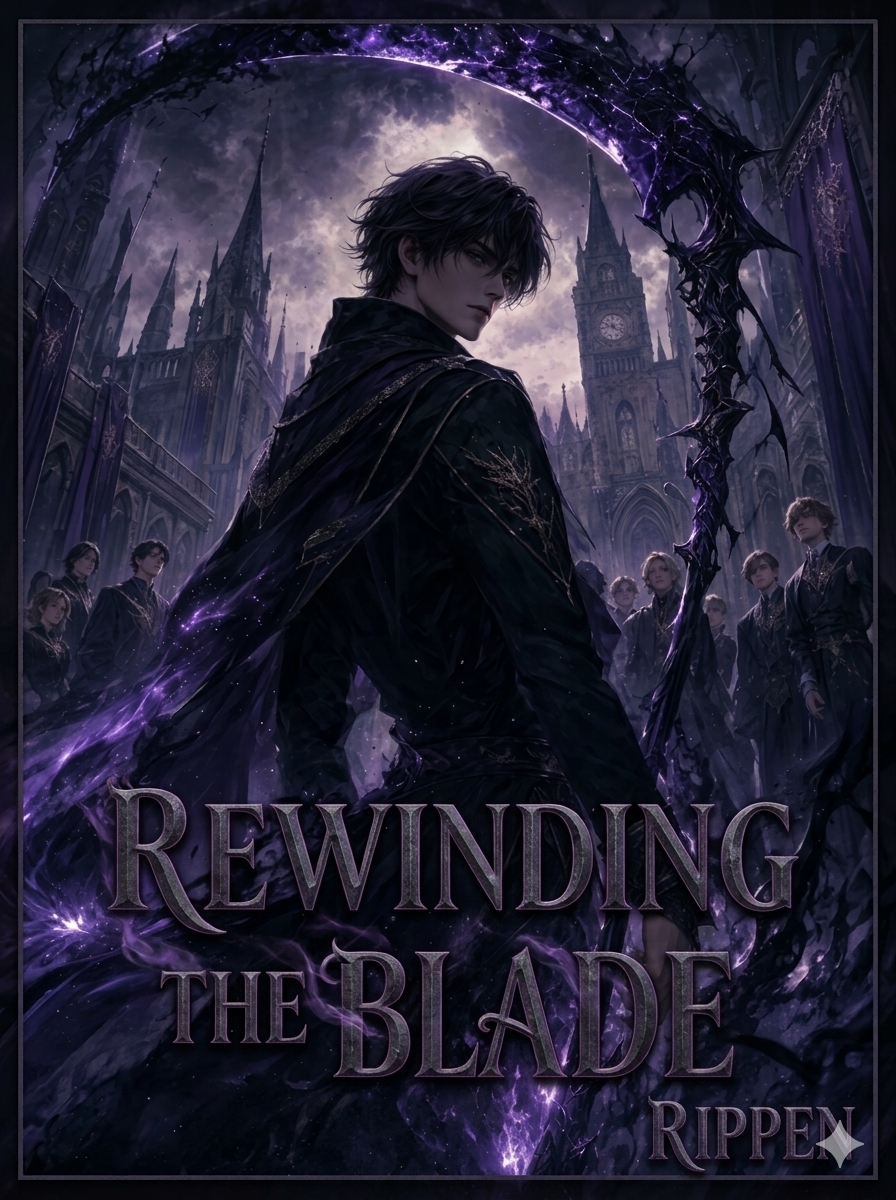
Novel · 7 chapters · 24,599 words
Rewinding the blade
Contents7 chapters
Chapter 1
The Bell Below the Hill
The first thing Cassian Nyx noticed was the bell.
Not the sound of it—the sound came a heartbeat later, a bronze-throated toll rolling up through stone and timber—but the absence around it. No screams. No iron stink of blood baking on flagstones. No smoke clawing at the rafters.
Just the bell.
He stood very still in the middle of a narrow dormitory aisle, one hand braced on the footboard of a bed too small for the man he had become. Wool blankets. Twelve cots. Trunks shoved beneath them, lids scarred by boots and bad tempers. Someone had left a heel of black bread on the windowsill. A fly worried at it.
The bell sounded again.
Below the hill, he thought at once.
His fingers tightened on the wood until it creaked.
That bell only rang at Blackmere Academy before dawn on Assessment Day. New stock driven in through the lower gate. Names taken. Aptitudes measured. Futures cut to shape.
Cassian turned his wrist over.
The brand was gone.
No crescent scar burned into the flesh above his pulse. No silver-black traceries stitched under the skin from years of binding spells. His forearm was smooth except for a pale nick near the elbow, one he remembered getting at thirteen from a kitchen knife while gutting river fish behind his father’s shop.
Thirteen.
He lifted his gaze to the window. The glass was bubbled and greenish, wavering the courtyard beyond. Boys in grey novice coats crossed between buildings with satchels bumping against their hips. One was limping. One was laughing. Laughing.
He knew where that laugh ended. In a ravine east of the frontier, throat opened because Dorian Vale had smiled and said orders were orders.
Cassian’s jaw locked.
On the bed nearest him, a boy sat up with a groan and scrubbed both hands over his face. Rowan, all elbows and sleep-tangled hair, blinked toward Cassian. “You’re up already?”
Rowan.
A dozen memories moved at once. Rowan whispering routes through servant passages. Rowan taking a caning meant for Cassian. Rowan on his knees in the Hall of Glass, blood threading from his mouth while Headmaster Soren asked, almost kindly, who had helped steal the ledger.
Cassian had answered with silence then too.
Rowan squinted. “You look sick.”
Cassian looked at him until Rowan shifted.
“What?”
There was no version of this morning in the life he had lived where Rowan survived the winter. Cassian knew the bruise-colored birthmark under Rowan’s left shoulder blade. Knew he snored when exhausted. Knew the exact wet crack an execution wand made when overloaded.
The bell rang a third time. Shorter. Sharper.
Move.
He crossed to his trunk and dropped to one knee. Cheap iron latch. Splintered corner. Inside lay folded novice greys, a primer on elementary sigils, socks darned with coarse blue thread. At the bottom, wrapped in cloth, the only thing his father had managed to send with him: a bone-handled carving knife with a chipped guard, useless in a duel, priceless in a place where everything could be taken except what no one thought worth stealing.
Cassian slid it into his sleeve.
Rowan swung his legs off the cot. “If Matron sees that—”
Cassian looked up.
Whatever Rowan had meant to say stuck in his throat. Cassian had spent six years teaching his face to be unreadable under interrogation, under pain, under praise. It seemed thirteen was old enough for the skill to survive the fall through time.
Rowan stood more slowly. “Fine,” he muttered. “Don’t answer. You never answer.”
He was wrong. Cassian answered all the time. Just never out loud.
From the corridor came the slap of hard soles and the rattle of keys. Someone barked, “Line up, carrion.”
Matron Vey.
Cassian rose in one smooth motion, every muscle in his body remembering her before his mind could stop it: the copper rods she favored, the medicinal syrup she poured before punishments so no one would faint too early, the ring with the emerald scarab that left a square bruise when she backhanded boys across the mouth.
She entered without knocking. Thin as a switch, hair scraped into a knot, apron white as fresh teeth. The scarab ring flashed as she pointed to the door.
“Outside. Assessment in the lower hall. No delays.”
Her eyes passed over Cassian, then returned.
A small pause. Barely there.
Even at thirteen, he had unsettled people. At twenty-three, he had learned how to use it.
Matron Vey’s mouth thinned. “You. Come here.”
The other boys began filing out. Rowan hesitated near the threshold, glancing back once before a shove from behind sent him into the corridor. Boots thudded away. The dormitory shrank around the silence.
Matron Vey closed the door.
From her apron pocket, she drew not a rod, not a ledger, but a folded strip of black waxed cloth bound with gold thread—the kind the headmaster’s inner circle used for private summons.
She held it between two fingers.
“The Headmaster,” she said, “has asked to see you before the sorting.”
Chapter 2
Ash Behind the Headmaster’s Eyes
Matron Vey did not wait for obedience. She turned at once, skirts snapping against her shins, and expected him behind her.
Cassian followed.
The corridor outside the dormitory smelled of lye, damp wool, and the sweet medicinal reek they used on split scalps after cane practice. Boys in grey shuffled toward the stairwell in a bent line, shoulders tucked in, some still fastening collars with clumsy fingers. Rowan was three places from the rear. He looked back once.
Matron Vey struck the wall with her ring.
The crack of emerald on stone made every head jump. “Eyes front.”
Rowan obeyed. Cassian kept walking.
She took him the wrong way for the lower hall.
The novice stair dropped toward noise—the scrape of benches, barked names, the churn of bodies funneling toward humiliation. Matron Vey steered instead through a narrow side door bound in black iron. It clicked shut behind them with a heavier sound than its size should have made, as if the stone itself had sealed.
The passage beyond was colder.
No windows. No draft from the courtyard. Only slit lamps set into niches at shoulder height, each one caged in smoked glass that turned the flame the color of old bruises. The floor changed from the dormitory’s rough plank to fitted slate worn smooth in the middle. Servants used these arteries. So did instructors who preferred not to be seen crossing with ledgers under their arms or blood on their cuffs.
Cassian knew each bend before it came.
His body wanted to count doors. It did anyway. Three on the left. One blind arch. A stair of seven steps, then eleven. At the landing, a crack in the mortar like a forked branch. Years before—years ahead—he had waited in that crack’s shadow while Rowan lifted a key from a drunk registrar’s belt.
Matron Vey glanced back as he stepped over the third stair from the top without looking down.
Her mouth barely moved. “Have you been in the inner ways before, Nyx?”
He gave her nothing.
Silence had weight. In Blackmere, it could pass for stupidity if offered with the right face, insolence if offered at the wrong time, or fear if a person wanted to believe in fear. Matron Vey wanted categories she could carry to someone else. Cassian let her sort air.
They passed a narrow grate high on the wall. Warm kitchen steam breathed through it, carrying boiled onion and tallow. A pan clanged somewhere below. Then the scent was gone, replaced by dust and cold candle wax and something metallic buried deeper in the stone—a mineral smell, old and bitter, like coins kept in a wet mouth.
Magic lived in that smell.
Blackmere had been built on it.
At the second turn they passed a pair of doors banded in copper. Faint chalk sigils filmed the lintel, nearly wiped away by years of handling. Assessment cells. Detainment if a novice sparked fire the wrong color or called something from beneath the floors that answered too quickly. Cassian had been inside the third one once for nineteen hours, wrists locked above his head, while Master Helion explained endurance with a bowl of water set just beyond reach.
He did not slow.
Matron Vey slowed for him.
That alone would have been enough to sharpen him. Matron Vey never yielded corridor space, not to boys, not to servants, not to junior magisters with ink under their nails. She looked at him sidelong, measuring, then resumed her pace.
“The Headmaster is extending a courtesy,” she said.
Courtesy. The word almost made him bare his teeth.
“Most novices see him at a distance for the first time from their knees. You will remember the distinction and behave accordingly.”
The ring on her hand flashed again as she adjusted the keyring at her waist. Brass teeth whispered against one another.
Cassian remembered another keyring. Another morning. Matron Vey lying in a washroom with one eye swollen shut and her ring finger bent the wrong way because she had tried to shout.
His hand twitched once inside his sleeve, bone knife pressing against his forearm.
Not yet.
The passage widened near the heart of the hill. Here the stonework changed. The slate underfoot was veined with pale quartz, not local, hauled at expense from the northern cliffs to impress donors and frighten children. The walls carried carvings too shallow to notice from a distance—eyes, bells, sheaves of reeds bound by cords. Blackmere’s founders had loved symbols almost as much as punishments.
Ahead, a pair of novices in green-trimmed livery stood outside an intersection, each with a polearm too tall for him. Their ears reddened when Matron Vey approached.
“Open,” she said.
One of them reached for the latch. His hand slipped. The shaft of his weapon struck the floor with a wooden knock.
Matron Vey’s face changed less than a candle flame in moving air, but the boy blanched all the same. “Sorry, Matron.”
“No breakfast for you.”
The door opened.
Beyond lay one of the academy’s old cloisters, roofed over generations ago with leaded glass. Light seeped down in a green cast, thin as pond water. Statues stood in alcoves between the pillars: saints, kings, benefactors, all with their noses rubbed pale by superstition or malice. The floor was a mosaic of black fish circling a silver bell.
Cassian’s steps kept even time.
The first time he had crossed this cloister, he had been fifteen and bleeding through his shirt from a switch laid across his back. Headmaster Soren had watched from the gallery above while two masters discussed whether pain made discipline easier to bind into the bones. Soren had said very little. Soren’s silences had always done the cutting for him.
Today the gallery was empty.
Matron Vey led him under it anyway, through an arch worked with thorn-vines in stone, and stopped before a walnut door polished so often the grain looked like trapped smoke.
She turned then, truly turned, and looked at him as if trying to fit him to a rumor.
“Do not force me to repeat instructions in there.”
Cassian met her eyes.
She leaned in a fraction. “If he asks whether you hear anything strange beneath the bells, you answer truthfully.”
That landed.
Not because of the warning. Because she had not said if. She had said when disguised as if.
Her scarab ring touched the latch. For a breath her thumb rested on the emerald’s back, a private habit. Fear, maybe. Reverence. The two often shared a seam.
Then she opened the door.
Headmaster Soren’s chamber had changed less than the grave.
The room was long and high, warmed by a tiled hearth built into the north wall. Shelves climbed to the ceiling, burdened with ledgers, sealed caskets, brass astrolabes, and black-spined codices chained at the corners. Three windows overlooked the inner court through glass so clear it seemed absent, each pane crossed by iron tracery in the shape of descending reeds. A globe of smoked crystal turned slowly on a stand by the fire, though no hand touched it.
At the far end, behind a broad desk of dark yew, sat Soren.
He looked younger only if a person had never known him.
The hair at his temples held more black than silver. The skin of his hands was firmer, veins less raised. The long scholar’s face had not yet thinned to a blade. But his eyes were the same washed grey, pale enough to seem colorless until light struck them and found steel. Ash behind glass. A banked furnace pretending to be stone.
No papers lay open before him. No pen. He had been waiting.
At his right stood a woman Cassian did not know from this age and knew too well from another: Magister Elowen Thrice, then not yet called Mistress of Measures, with her narrow wrists and severe mouth and the black cord of a rank she had not earned in the remembered years until much later. A silver basin rested on a tripod beside her. The water inside was still.
So. Not merely a summons. An assessment hidden inside privacy.
Soren did not bid him kneel.
That was the first cut.
Most men performed power loudly when boys were brought before them. They enjoyed seeing what fear could be made to do to the spine. Soren only folded his hands and studied him as if reading script burned into wood.
Matron Vey closed the door at Cassian’s back. The latch settled. She took her place beside it.
“Cassian Nyx,” Soren said.
His voice had not changed either. Soft enough to require attention. Precise. A voice built for chapels and confessions.
Cassian stood without bowing.
A pause opened.
Matron Vey inhaled through her nose. Elowen’s gaze flicked to Soren, waiting for correction.
Soren only said, “Come forward.”
Cassian crossed the carpet. It muffled his steps so thoroughly he could hear the crystal globe’s faint turning, a tiny grind like ice against glass. He stopped at the edge of the desk.
Up close, the chamber carried other smells under the beeswax and hearth smoke: vellum, lamp oil, dried mint, and that same mineral taint from the walls, stronger here, threaded with ash. Burned bell-metal. He knew it from beneath the school. From the lower chambers no novice should have seen.
Soren’s eyes rested on Cassian’s bare wrist where the cuff had shifted.
Not on the knife hidden in his sleeve. Not at first.
“Matron Vey informs me,” Soren said, “that you presented no mark upon intake.”
Presented. As if Cassian had chosen it like dress.
Soren’s fingers tapped once against the desk. Not impatience. Calculation. “Records indicate a provisional binding was set at the border station three nights ago.”
The records would indicate more than that if they matched the life Cassian had lived. Traceries. Compliance etching. Preliminary conditioning. The first black roots of what they had turned him into. Those things were gone from his skin and, it seemed, from their paperwork as well—or hidden. Hidden by whom was the question with teeth.
Soren continued to watch his wrist. “Yet there is nothing.”
Cassian gave him silence.
Elowen moved at last. “Headmaster, if the boy is simple—”
“No,” Soren said.
The word was mild. Elowen’s mouth shut on it hard enough to show white at the corners.
Soren leaned back a little in his chair. “Simple boys do not enter a room like a witness entering court.”
There it was.
Recognition, though he should not have had a shape for it yet. Not memory exactly. Something adjacent and worse. A shiver between pattern and certainty.
Cassian kept his face still and let his pulse settle lower. He had lied under spellfire before. He had held names under knives. He could survive a room.
Soren reached for a small bell on the desk.
Cassian’s shoulders locked before he could stop them.
The headmaster noticed.
Of course he noticed.
But Soren did not ring it. He only lifted the bell by its stem and turned it once between his fingers. Tarnished silver. No clapper visible within the mouth. Its surface was etched with reeds bent in the same downward pattern as the window iron.
“You reacted,” Soren said.
The room cooled.
Cassian could feel Matron Vey’s attention sharpening behind him, eager as a dog scenting blood. Elowen shifted closer to the basin. The water remained still, but not naturally still now. It had the strained look of a held breath.
Soren set the bell down. “Why?”
A dozen falsehoods rose. None were safe. Too much ignorance would read as crafted. Too much knowledge would be worse.
Cassian lowered his gaze the smallest degree, not submission but calculation disguised as it, and touched two fingers to the inside of his left wrist where the absent brand should have been.
Matron Vey made a soft sound. Not pity. Recognition of a wound expected and not found.
Soren’s eyes changed. Not with sympathy. With interest.
“Pain without scar,” he said quietly.
Cassian held his hand there.
“Phantom memory,” Elowen said. “That is common after rough transit and border work. The flesh forgets slower than the nerves.”
“Perhaps,” Soren said.
He looked at Cassian too long for perhaps.
Then he rose.
Soren was taller than most men and built deceptively spare, all line and economy. His black coat fell plain and severe to the knee. No jeweled chain, no stitched sigils on the cuff. Blackmere’s worst men had never needed ornament. He came around the desk and stopped an arm’s length away.
From this close, the ash in his eyes showed plainly. Tiny dark spokes around the pupil, like something had once flared there and left soot in the iris. Cassian had never seen them before because he had never stood this near without blood between them.
“Look at me,” Soren said.
Cassian did.
The headmaster lifted a hand and hovered two fingers near Cassian’s temple without touching. Warmth spread through the air before contact came, dry and fine as dust blown from a furnace vent. A reading charm. Delicate, if the caster wished. It could become less delicate very quickly.
Cassian did not flinch.
The pressure entered his skull like a nail easing into old wood.
No color flashed. No dramatic blaze. Soren worked cleanly. Sensation moved behind Cassian’s eyes, then downward along the hinge of his jaw, across his throat, into the sternum. It searched by association—fear points, memory ridges, habitual lies, the stale seams left by former spells. The empty places where brands had been should have read as untouched flesh.
They did not.
Cassian saw the moment Soren found one of the ghosts.
A hitch in the breath. Small. His pupils narrowed.
The dry warmth sharpened. Elowen straightened. The basin water trembled in concentric rings.
Not erased, then. Hidden badly or hidden from the wrong hands. Whatever had dragged Cassian back had peeled the visible work off him but left impressions deeper down, scars in the place spellcraft touched when it wanted obedience.
Worse: Soren could feel them.
The headmaster withdrew his hand at once, too quickly for a man who valued control. Ash moved behind his eyes like something stirred under cinders.
“When were you branded?” he asked.
Cassian stayed motionless.
“Not by date,” Soren said. “By experience. Before the border station? On the road? Earlier?”
Silence.
“Who touched you?” Elowen demanded.
Soren raised one finger without looking at her. She fell quiet.
Cassian watched the headmaster think.
This was not the old interview. In the life he had lived, Soren had first taken notice years later, after results impossible for a novice, after the ravine, after deaths enough to make utility glow brighter than pity. Here, too early, Soren was seeing a contradiction he could not fit into his ledgers. Contradictions drew him like blood drew flies.
Soren stepped back half a pace. “Matron, the intake sheet.”
Vey crossed the room and placed a folded paper in his hand. Her eyes touched Cassian’s face once, searching for the crack. He gave her none.
Soren opened the sheet. His gaze skimmed. “Born in Duskport. Father a river butcher by trade. Mother dead.” He turned a page. “No registered lineage. No declared sponsor. Preliminary notation: low vocal compliance.”
Matron Vey said, “He refuses instruction with silence.”
“He follows it,” Soren said.
“When watched.”
Soren looked up from the paper. “And when not watched?”
That question belonged to Vey. He had aimed it at Cassian.
Cassian did not move.
A breath passed. The crystal globe turned on its stand.
Then Soren smiled.
Not kindly. Never that. It was the expression of a man who had found a knot worth teasing apart with a knife. “There. That is the first honest answer.”
Elowen frowned. “Headmaster—”
“A child who cowers can be trained by any brute with a strap. A child who withholds chooses his own shape first.” Soren folded the paper once and laid it aside. “Choice interests me more than fear.”
He returned to his chair, but he did not sit immediately. Instead he rested one hand on the desk and regarded Cassian as if adjusting a lens.
“Do you know what Blackmere is for, Cassian Nyx?”
The academy’s public answer was talent, discipline, service to crown and province, the refinement of gift into civil use. Its private answer was harvest. Useful children taken young, measured, separated, pared down, redirected, weaponized, hidden under robes or sent out in velvet or chain depending on what needed quiet killing.
Cassian had lived the answer in every scar the world had just denied him.
He kept his mouth closed.
Soren sat. “No. Not what the pamphlets say. Not what the village clerks tell parents who still imagine halls of learning. What is a school for, in truth?”
The question was bait, but not simple bait. Soren wanted the contour of the boy’s thinking. Whether he reached for piety, ambition, resentment. Whether his silence came from emptiness or active refusal.
Cassian let his gaze move once around the room: ledgers, bell, basin, globe, fire. He stopped on the window iron bent like reeds under pressure, then looked back to Soren.
Soren’s smile deepened by the width of a thread. “To sort,” he said. “To discover what a thing does when pressure is correctly applied.”
Elowen murmured, “Affinity, discipline, obedience.”
“Those are the names we use in the hall,” Soren said. “Names comfort people. Pressure tells the truth.”
He gestured toward the basin. “Magister.”
Elowen stepped forward with visible relief at having something procedural to do. She dipped two fingers into the basin and spoke a phrase too low for Matron Vey to catch and too old for her to want. The water darkened, then cleared. Its surface became mirror-bright.
“Your hand,” she said.
Cassian did not move.
Matron Vey took one step from the door.
Soren spoke before she could touch him. “If force were needed, Matron, he would already have made us need it.”
Vey stopped.
That sentence did two things at once. It restrained the matron. It also named Cassian as a mind in the room, not baggage. Dangerous courtesy.
Cassian extended his right hand.
The basin water was colder than meltwater. Silver prickled up his fingers when he submerged them to the knuckles. Sigil-reading, then, but modified. The old lower hall assessment used stone discs and blood heat and public display. This was finer, private, made to catch deviations before the school announced what category a child belonged in.
Elowen watched the surface. “Breathe naturally.”
Cassian ignored her.
Light kindled under the water, dim at first, then branching in thin lines around his fingertips. Most novices showed quickly—heat bloom for ember-work, pale green for growth threads, iron-grey for shaping, blue-violet for thought disciplines. Even nulls clouded the basin one way or another. Some flared too hard and left nosebleeds on the tiles.
Cassian’s water remained almost clear.
Almost.
At the edges of his reflection, black threads appeared and vanished too fast to settle. Not smoke. Not ink. More like cracks seen under deep ice—there and gone, branching where light should have run smoothly. Elowen leaned in. Her own reflection bent around his hand like a knife blade.
“That is not an affinity pattern.”
Soren said nothing.
The black threads returned, this time higher, crossing over the reflection of Cassian’s wrist where no mark lay. The basin gave a faint sound, a tiny clicking from within the silver as if grit had found the seams.
Elowen’s breath shortened. “Headmaster.”
The room’s hearth snapped.
Cassian felt it then, not through the water first but through the floor. A note beneath hearing, too low to be sound and too distinct to be imagination. Not the bell itself. The place where the bell’s echo lived in the hill, old as ore and less forgiving. It pressed once against the soles of his feet and climbed his bones like remembered winter.
His fingers clenched by reflex.
The basin shuddered. Water lapped the rim. One black line shot across the surface and struck the opposite edge with a hiss.
Elowen jerked back. “Remove him.”
Soren was already on his feet.
Cassian withdrew his hand. Droplets struck the carpet dark as oil. For one impossible heartbeat the water in the basin did not settle. It stood in the shape of his fingers after they had gone, five hollows held in silver by nothing at all.
Then it collapsed flat.
No one spoke.
Matron Vey’s face had lost color under the skin. Elowen was staring at the basin as if it had spoken her true name aloud. Soren looked only at Cassian.
There was fear there.
Very little. Very controlled. But real.
It changed everything.
Headmaster Soren feared almost nothing that could be touched, cataloged, punished, or owned. Fear in him meant either memory or desire pointed toward something larger than his methods.
Cassian let that sit between them.
Soren reached for composure the way other men reached for prayer. By the time he spoke, his voice had smoothed again. “Leave us, Magister.”
Elowen turned to him, startled. “With respect, that result should be witnessed and recorded at once. The basin—”
“Leave us.”
This time the room obeyed the iron under the silk. Elowen swallowed whatever argument might have saved her pride, bowed stiffly, and gathered the basin in both hands. The silver still showed tiny dark veins beneath the waterline. She tried not to touch them. Matron Vey opened the door for her. Neither woman left quickly enough to hide unease.
Then Cassian and Soren were alone.
The door shut. Fire whispered in the grate.
Soren came around the desk once more, but not as before. There was more distance in him now, though he was standing closer.
“You have heard it,” he said.
Not a question.
Cassian’s face remained blank.
“The thing under the hill.” Soren watched for denial and did not receive it. “Most who are taken by it break into seizures or prayer. A few go deaf. One chewed off his own tongue when the ringing would not stop. But you—”
He stopped.
Something had nearly risen in his expression. Recognition again, or memory with no rightful source. It slipped away too fast to name.
Cassian studied him. In the remembered years, Soren had sought the hidden chambers beneath Blackmere with a scholar’s patience and a butcher’s willingness to spend lives. He had never spoken of hearing the buried bell himself. He had sent others down. Always others. That caution had seemed cold then. It looked different now. Personal.
Soren’s left hand tightened behind his back. An old habit when a thought struck close.
“You should not exist in this condition,” he said softly.
That was as near to truth as either of them had come.
Cassian kept still.
Soren gave a short, humorless exhale. “No, silence will not help you here.”
The sentence hit harder because it was true.
Soren looked past him, not at the door but through stone, toward the deep places under the academy. “There are marks the flesh displays and marks the spirit carries after contact with certain forces. Erasure of the first does not always cleanse the second.” He returned his gaze to Cassian. “Whoever tampered with you was either careless or interrupted.”
Whoever had sent him back. Whoever had rewritten skin and left the rest. Soren was circling it without seeing it, and perhaps seeing more than he should.
“Listen carefully,” the headmaster said. “You are not to speak of this assessment in the lower hall. Not to your cohort. Not to instructors. If Magister Elowen asks questions later, you will answer only what I have heard: that the water clouded and cleared. Nothing more.”
Cassian did not nod.
Soren’s mouth tightened. “You think silence is resistance. Sometimes it is only another way to be handled.”
He turned and went back to the desk. From a drawer he withdrew a narrow strip of black cloth and set it atop the wood. Gold thread had been stitched through one end in the shape of a bell throat cut open. Not an official seal. A private one.
“If this token is shown to you by any servant, matron, or magister, you will come where summoned. Immediately.”
Cassian looked at the cloth, then at Soren.
The trap was obvious. That did not make it avoidable.
“What are you?” Soren asked.
A lesser man would have asked who. Soren wanted category before name. Weapon before child. Proof before mercy.
Cassian’s gaze did not flicker.
Soren leaned both hands on the desk. “If you are a vessel, I need to know for what. If you are a breach, I need to know where it opens. If you are merely damaged, that may be simpler, though I suspect not by much.”
Need.
Not want. Not intend to discover. Need. The word opened another thin fracture in the day. Soren was hunting something. Not just in Cassian. Through him, perhaps. Toward the same hidden force that had torn time at its seam and dropped him back above the hill with his scars stripped and his dead still breathing.
Cassian understood then that he had not returned to a clean board. Pieces had already been touched. The game had remembered fingerprints.
Soren watched him absorb that. “There are powers in this school,” he said, “older than doctrine and less obedient than the men who claim stewardship over them. Most should remain sleeping. Some cannot.”
His eyes lowered, just once, to Cassian’s wrist.
“When the lower hall names your station, accept it. Do not excel today. Do not fail extravagantly either. There are eyes on all new stock, but some categories draw more appetite than others.”
Advice from a wolf about where to stand among hounds.
Yet buried in it was real utility. Too bright a showing would bring the handlers early. Too poor a showing would draw punishments designed to strip deception to the bone. Soren was preserving an uncertainty around him—for study, for control, for reasons not yet visible.
Cassian glanced at the black token again.
Soren saw. “Keep it hidden.”
He pushed it across the desk with two fingers.
Cassian did not take it.
The headmaster’s gaze sharpened. “If you refuse me, others will notice. If others notice, they will test what I would prefer to examine intact.”
There. The cleanest truth in the room so far.
Cassian picked up the cloth.
It was warmer than it should have been, as if held near skin. The gold stitching prickled his thumb. A spell lay in it, low and patient, not active until answered. A leash disguised as privilege.
He folded it once and slid it into his sleeve beside the bone-handled knife.
Soren’s eyes dropped minutely to the motion.
This time he did notice the hidden weight there. A knife at thirteen would not trouble him. A child entering his chamber armed and silent while strange magic cracked a basin did.
“Your father sent something with you,” Soren said.
Not a question. He had seen enough of the shape under cloth.
Cassian’s face did not move.
“A useful lesson,” Soren murmured. “People smuggle love in forms that survive inspection.”
For the first time, something like genuine fatigue touched him. It made him look older than the decade between this room and the man Cassian remembered. “Go to sorting. Matron Vey will take you down by the west stair. You will stand where told. You will let the hall think it has seen you.”
The latch clicked before anyone touched it.
Matron Vey had heard her cue through more than wood. She entered at once, eyes darting from Soren to Cassian to the desk. Whatever she saw there—or did not—made her shoulders pull tighter.
“The lower hall is assembled,” she said.
Soren did not look at her. “Take him.”
Matron Vey reached for Cassian’s arm.
He stepped just enough that her fingers closed on empty air.
The room sharpened around that small refusal. Vey’s nostrils flared. Soren watched.
Cassian moved toward the door under his own will.
Matron Vey recovered quickly and led on, fury held thin and functional. They crossed the threshold. The walnut door swung inward behind them.
Just before it shut, Soren spoke.
“Cassian.”
The use of his given name alone halted him more surely than a hand would have.
He looked back.
Headmaster Soren stood in the gap between firelight and windowlight, one side of his face warm, the other cut pale. His expression had gone unreadable again. Only the eyes betrayed him, ash shifting in them where no wind touched.
“When it speaks next,” Soren said, “listen to what it asks for.”
The door closed.
Matron Vey’s hand came down hard on his shoulder blade, steering him into the passage. “Walk.”
He walked.
The west stair wound narrower than the route in, a servant spiral hidden between walls thick enough to muffle the school’s clamor to a distant animal noise. Somewhere below, the lower hall boomed with shouted names and the scrape of benches. Somewhere deeper than that, under stone and slate and root, the buried note he had felt in the basin seemed to linger in his marrow.
At the last turn, a slit window opened over the assembly floor.
Cassian saw rows of novices packed shoulder to shoulder in their grey coats. Lantern smoke hung under the beams. Masters in dark robes stood along the perimeter like posts driven into a killing field. Rowan was there in the third line, pale and stiff, his face tipped toward the dais.
On the dais waited the public instruments of sorting—stone discs, iron rods, the great slate ledger—and an empty basin of black glass he did not remember from the first life.
Not clean, then. Not even close.
Matron Vey yanked open the door to the hall’s side entrance. Heat, smoke, and a hundred held breaths struck his face. Every head nearest the wall began to turn.
Inside his sleeve, the bone knife pressed one wrist and Soren’s black token pressed the other, two different promises against the skin.
Then from below the floor, faint as a pulse under a thumb, the bellless ringing came again.
Chapter 3
The Sorting That Should Have Broken Him
The side door banged the wall hard enough to rattle the iron sconces.
Heat rolled over Cassian with the smell of lamp oil, wet wool, and the old chalk stink that lived in Blackmere’s lower rooms. The hall had been carved broad out of the hill, beams blackened by generations of smoke, the stone floor worn into shallow dimples where lines of children had stood and shifted and trembled before him before they had become names in ledgers, ghosts in corridors, bones in ravines.
Matron Vey’s hand stayed flat between his shoulder blades.
“Forward.”
He gave her that much.
Faces turned in bands. First the nearest novices, then the farther rows, then the masters stationed along the walls in robes the color of ink and soot. A murmur ran and died. The boys in grey coats had the stiff look of livestock already counting gates. Some stared openly at the side entrance and the woman escorting him from the headmaster’s inner stair. Some looked away at once, which was worse. They had already learned enough to fear notice.
On the raised platform at the front, the instruments of sorting waited under hanging lamps.
Three stone discs had been sunk into separate plinths, each veined with metals that caught the light in dull threads: copper, silver, black iron. Beside them stood a rack of rods capped with different sigils, a long slate ledger set on a slanted desk, and the basin of black glass, wide as a wash bowl and too still, its surface swallowing flame rather than reflecting it. Behind all of it sat the masters’ table, where Headmaster Soren had resumed a public face so smooth it might have been carved for him. Magister Elowen stood at his right, narrow-shouldered and watchful, one hand tucked in the opposite sleeve. At Soren’s left lounged a heavy man with a butcher’s wrists and a ring of keys at his belt. Cassian knew him older, thicker, and smiling over blood. Master Hadrik Bale. Discipline ward.
So the teeth were here early.
Vey marched Cassian down the wall instead of sending him to the rear line. That, too, was deliberate. Every eye tracked him as she halted him apart from the others, near the dais but not on it, as if he had already been set aside.
Rowan stood in the third line where Cassian had seen him through the stair slit, pale beneath his freckles, his mouth held in a hard straight line. The crowd had jostled him half a shoulder out of place. He was trying not to flinch whenever anyone brushed him. One of the bigger boys ahead of him—a square-faced novice with a cropped yellow head—kept leaning back just enough to crowd him farther.
Cassian met Rowan’s eyes for an instant.
Relief flashed there first, then confusion, then something like warning. Rowan’s glance flicked toward the masters’ table and away. He knew enough to be frightened of special treatment too.
A silver hammer struck wood on the dais. The hall cinched quiet.
Headmaster Soren rose. At this distance he looked merely severe: black coat, narrow cuffs, a scholar’s mouth. Only someone who had watched him choose where a knife would go would have known what lived under that calm.
“Assessment Day,” Soren said, and his voice carried without strain to the back beams, “is not a festival, though some of you arrive with family fables in your heads. It is not punishment, though some of you have been raised to expect only that. It is function. Blackmere exists to discover use.”
He let the word settle.
“Affinity determines where your power inclines. Discipline determines whether you can hold it without harming this house. Obedience determines whether this house can trust you with what it teaches.”
One or two boys shifted at that last word. A girl in the second row, shaved temple gleaming under the lamps, did not move at all. Her hands were clasped behind her back, knuckles scarred. Cassian did not know her face from the first life. Either she had left before his years narrowed into training corridors, or she had died before he learned to count the dead.
Soren looked over the hall, and when his gaze passed over Cassian it did not pause.
“Those who pass cleanly will be housed and assigned. Those who do not will be corrected. Those who fail correction will not remain.”
No one asked where they went.
The hammer struck again. A robed clerk at the ledger dipped his pen.
“Begin with the first line.”
The line nearest the dais shuffled forward one novice at a time. Names were called. Each child crossed to the first stone disc and placed both hands on it while one of the masters watched for color or tremor or whatever flash of answer the disc gave. Some drew a pale green sheen through the silver veining and were sent left. Some brought a rust-red pulse through the copper and were sent right. One boy produced nothing for so long that Matron Vey moved toward him with a face already tightening, but then the black-iron threads in the stone woke in a sudden web beneath his palms. The watching masters made notes.
Affinity first.
Cassian remembered too well what each answer meant in practice, not in the language printed in academy pamphlets or spoken to donors above ground. Green and silver fed the record halls, cipher chambers, herb rooms, and the subtler schools of warding and seeing. Copper and red stocked battle studies, shield lines, punitive rites. Black iron, when it ran deep enough and paired with the wrong results later, went below. Those children were called rare. They were called valuable. They learned quickly that both words meant the same thing as disposable when spoken by the right mouth.
The second trial used the rods. Novices gripped them while a master chanted a measured sequence and increased the pressure of magic through the metal. Most shook. Some cried out. One girl bit the inside of her cheek so hard blood brightened her teeth, but she kept her hand closed until told to release. The masters liked that sort.
Discipline.
The third trial was done on a ring marked into the floor in white mineral dust, a circle half rubbed away by shoes. A command was spoken there, sometimes simple, sometimes barbed. Kneel. Step back. Offer your hand. Speak your mother’s name. Hold still while pain touched the skin. Obedience was recorded less by whether a novice complied than by how the will bent in the first breath before compliance. A body could resist while a mind yielded. Blackmere cared most about the mind.
Cassian watched the patterns as if he had not already memorized them once.
Students who showed soft silver at the first disc and low pain-threshold discipline were marked for scribal branches unless they failed obedience too sharply. Those with strong red and iron steadiness went to martial houses. The dangerous sort—the useful sort—were those with black-iron affinity, high discipline under pain, and a hesitation in obedience that could be broken rather than erased. Those were Bale’s prey. Those were sent to the Hollow Court under the hill, where training stripped away everything but function and grudge.
Where Cassian had gone.
Names filled the slate ledger in chalk and ink. Beside some, the clerk made simple house marks. Beside others he added dots, hooks, tiny coded scratches only certain staff could read at a glance. Recommendations. Warnings. Acquisitions.
Cassian studied the clerk’s hand, the spacing, the habits. Same man as before. Same swelling finger joints, same tendency to blot on leftward downstrokes. The ledger itself was not the deeper book he needed, but what entered here would decide who vanished from common sight before supper.
That could be moved.
The first real crack came with a child named Pell Ardis, called from the second line. Narrow chest, soot in the seams of his ears, probably from the foundries south of the marsh. Cassian remembered him only because the boy had died retching blood in an assessment cell two nights after sorting, his affinity misread and then forced.
Pell laid his hands on the first disc.
Nothing.
Master Bale made a patient little motion with two fingers. “Press.”
The boy obeyed. The tendons in his neck stood out. A thread of silver appeared under his right palm, then faltered. Under the left, black iron flashed so dark it looked wet. The hall murmured again.
“Split,” said one of the perimeter masters.
“Unstable,” said another.
Pell snatched his hands back as if burned. “I didn’t—”
Vey seized his wrist and dragged him to the rod stand.
Not yet, Cassian thought. Not like that.
He could see the shape of it before it happened. Bale would choose the forked rod rather than the plain one, tell the hall it was for clarity, and drive too much current through the boy’s channels to force an answer. Pell’s nose would start bleeding halfway through. By evening they would say his weakness had always been there.
Bale’s hand hovered over the rods and closed on the forked one.
Cassian moved.
He did not rush. He simply stepped out from the wall and into the line of sight between the dais and the hall, enough to break the clean flow of the moment. Vey jerked her head toward him, already prepared to snarl, but the interruption had done what he needed. Elowen’s attention sharpened. Soren’s did too.
Bale looked up. “Stand where you were put.”
Cassian did not.
Silence gathered. He felt every face tighten toward him, waiting for punishment.
Bale smiled without warmth. “Perhaps the special audience has confused you.”
Cassian lifted his right hand and tapped two fingers against the inside of his own left wrist.
It was a small gesture. To most of the hall it meant nothing. To a reader of pulse practice and channel strain, it was a correction. Forked conduction over split response. Risk of inversion.
Elowen saw it. Her chin rose a fraction.
Bale’s smile thinned. “Do you imagine yourself a lecturer, boy?”
Cassian held Bale’s gaze, then looked at the rod in the man’s hand and let his own mouth curl by the smallest degree. Not insolence exactly. Recognition.
Predators hated being recognized.
Elowen spoke before Bale could. “The plain iron, Master Bale.”
Bale did not turn toward her. “I have sorted for twelve years without needing gestures from the floor.”
“And I have watched three inversion fevers this term alone,” Elowen said. “The plain iron.”
Soren had not moved. “Use the plain iron.”
There it was. Public enough to sting.
Bale replaced the forked rod with a click that carried across the room. He chose a smooth black one instead and thrust it at Pell. “Grip.”
The boy’s hand shook around the metal. Bale began the sequence. The sigils on the rod lit in a dull chain, one after another. Pell’s shoulders locked. Sweat sprang under his hairline. The black-iron threads in the first disc hummed faintly in answer—but no blood came from his nose, no seizure snapped through him, no collapse.
“Release,” Bale said at last.
Pell dropped the rod and stumbled.
Elowen was already speaking to the clerk. “Mixed affinity. Low threshold. Record him for Wards Annex under supervision, not lower cells.”
The clerk hesitated, pen poised. Bale’s face had gone heavy and expressionless.
Soren nodded once.
Ink scratched.
Pell stared as if he had been reprieved from a sentence he had not known the words for. Vey shoved him toward the left side benches reserved for those already assigned, but not with enough force to knock him down.
One life. Small. Breathing.
Cassian stepped back to the wall.
The hall had changed around him by a hair’s width. Not softer. Never that. But a line had been drawn where there had not been one a minute earlier. Students looked at him differently now, with fear sharpened by the possibility that fear might not be all he was worth. Bale looked at him as a man looked at a trap after it had closed on empty air.
A possible ally had shown her hand. Or one corner of it.
Elowen did not glance his way again.
The sorting resumed. Names. Hands on stone. Rods. Commands. Notes. Every minute built the machine further. Cassian watched for the points that mattered.
There—Dorian Vale, broad brow, clean boots, arrived with someone’s money stitched into his coat though the grey cloth tried to hide it. In the old life Dorian had gone to a martial house after posting excellent discipline and eager obedience, then learned enough cruelty to make himself useful to older boys with ambition. Years later he had laughed at the ravine edge.
At the first disc, Dorian drew copper so bright it sang through the veins of the stone. The second trial hardly shook him. He held the rod steady and lifted his chin at pain as if he thought spectators made him taller.
In the obedience circle, Master Bale gave the command.
“Kneel.”
Dorian dropped at once.
The speed of it pleased the table. Bale’s mouth relaxed. The clerk made a hooked notation beside the name.
Not yet, Cassian thought. That path needed changing too, though not for mercy.
When Dorian returned to the benches, Cassian shifted just enough that one of the waiting novices had to sidestep. The movement rippled through the line. Rowan, three places back, was forced half a pace out, and the shaved-temple girl behind him took the gap at once with the reflex of someone used to protecting space. Dorian, looking over his shoulder with that eager-predatory habit he had even at thirteen, barked at the reshuffle from the benches.
“Keep order, gutter stock.”
Several novices flinched. Rowan did not answer. The shaved-temple girl looked straight at Dorian until he looked elsewhere.
Small movements. Different proximities. Different future grudges.
Then Rowan’s name was called.
Something in Cassian’s chest went cold and exact.
Rowan crossed to the first disc trying to hide his limp. He failed. Bale saw everything. So did Vey. Weakness interested them only when it could be exploited.
Hands down.
At first the stone showed nothing. Rowan swallowed. His shoulders had gone high and rigid. Then a bloom of dim silver spread under his right palm, thin but clean. Under the left, after a pause long enough to tighten every watching throat, black iron answered with a low pulse.
Cassian remembered that pulse from another morning. Not the hall—later, below, when they had dragged Rowan to a side trial because a mixed reading made someone curious. He had bled there too. He had taken a punishment meant for Cassian not long after, and in the first life the ledger mark from this hour had helped set him on the path to the ravine.
Bale’s eyes brightened. He hid it poorly.
“Again,” he said.
Rowan put his hands back.
The black pulse came faster this time, stronger.
“A useful split,” Bale murmured.
Rowan looked at the masters’ table, then to where Cassian stood near the wall. He did not ask for help. Rowan never had. He only looked as if checking whether the world still contained one familiar object.
“Rod,” said Soren.
Bale chose the plain iron this time, but too thick. Not enough to kill, enough to shake loose a stronger reaction. He wanted confirmation for the mark he intended.
Rowan gripped the rod. The chant began.
The first surge hit. Rowan’s jaw clenched.
Second surge. His knees loosened but held.
Third. The silver in him guttered; the black answered like a struck vein. Cassian saw it in the rod’s tip, in the way the sigils climbed brighter than they should have. Rowan was feeding the test back. If Bale pushed a step further, the hall would take it for discipline. The hidden notation would say excellent pain retention, responsive under stress. Bale would have him.
Cassian spoke for the first time that day.
“Enough.”
His voice was low from disuse and old scar, rough as stone dragged over stone. The single word cut harder for its rarity than any shout would have.
The hall froze around it.
Rowan’s eyes snapped toward him.
Matron Vey made a sound like a snake’s first breath. “You do not speak unless—”
“The rod is feeding,” Elowen said sharply.
Light had climbed almost to Rowan’s elbow. Bale swore and broke the sequence with his thumb over the cap sigil. The glow died. Rowan staggered forward, catching himself with one hand on the edge of the plinth.
A burn mark smoked in his palm.
Not fatal. Not clean either.
Bale turned slowly to Cassian. “Remarkable. He has found a tongue.”
Cassian said nothing more. He did not need to. The warning had already landed where he wanted it.
Soren’s expression never altered, but he was watching Rowan now with a different calculation. Not prey alone. Variable.
Elowen crossed the dais and took Rowan’s hand before Vey could seize him. She examined the burn, then looked back at the clerk.
“Record moderate silver, reactive iron, poor rod isolation. Archive wing or infirmary support. Keep him out of lower drills until his channels settle.”
Bale laughed once through his nose. “For a kitchen scrap with an echo in his bones? Wasteful.”
“For a novice you nearly overran in public?” Elowen said.
The shaved-temple girl on the line watched the exchange without blinking. Dorian Vale watched too, mouth tight with the particular dislike that came when someone else’s place in the order became uncertain. So did others. In Blackmere, children learned quickly that power often entered a room disguised as paperwork.
The clerk looked from Bale to Soren.
Soren rested two fingers on the table. “Archive wing.”
There. Another line redrawn.
Rowan stared as if he had not understood the words. Archive wing meant upper corridors, dust, indexing, errands to older students, cold fingers and long hours—but not Bale’s house, not the undercells, not the first cut of the blade. Not yet.
Vey took his arm anyway, rough enough to remind him mercy had not entered the building. As she steered him toward the left benches, Rowan looked once over his shoulder at Cassian.
Gratitude was too soft a name for what crossed his face. It looked more like shock forced to wear relief’s coat.
Bale addressed the room before the silence could settle kindly. “Distraction,” he said, “has a cost.”
He stepped down from the dais and pointed to Cassian.
“Into the circle.”
The white-marked ring on the floor seemed smaller than Cassian remembered. It had a chip near the southern edge now, a place where some old command had cracked stone. He walked to it while the hall opened around him in a hard crescent of attention.
This was where they had first measured how far his will would bend.
The bone-handled knife rode warm against his wrist. On the other arm, hidden in his sleeve, the bell-throat token pressed like a pulse not his own.
Bale stopped just outside the ring. Up close his breath smelled of clove tincture and old meat.
“Let us see,” he said, too pleasantly, “whether privilege comes with manners.”
Obedience trials usually came third. Bale was making a show of changing the order.
Soren allowed it.
Cassian stood with his hands at his sides.
Bale raised one palm, black sigils glimmering between his fingers. The circle’s white dust smoked faintly. “Kneel.”
The command struck like a downward hook behind the sternum. Half the children in the hall leaned with it in sympathy, their own bodies reading old authority. Cassian remembered what it had done to him the first time. He remembered kneecaps hitting stone. He remembered deciding then that survival and submission were identical enough to borrow each other’s clothing.
This time he bent one knee.
Only one.
Not refusal. Not compliance. An ugly middle ground teachers hated because it could not be easily categorized.
A murmur stirred the back rows.
Bale’s nostrils widened. “Both.”
Cassian set the other knee down more slowly, as if after consideration rather than compulsion.
The clerk wrote.
Good, Cassian thought. Let him write hesitation without open defiance. Let them think reluctance where there was calculation.
“Rise,” Bale said.
Cassian rose before the last thread of the command finished settling.
Another notation.
“Offer your left hand.”
Cassian extended the right.
A few masters smiled at that. A few did not. Bale’s face remained still.
“I said left.”
Cassian switched hands.
Again: not rebellion, merely abrasion.
Bale took the offered hand and dragged a thumb across the bare inner wrist where no visible brand lay. To the watching hall it would look like intimidation, maybe examination. To Cassian it felt like a dog nosing at a buried bone.
“Speak your full name,” Bale said.
Cassian let a beat pass.
The silence had weight now because he had already spoken once. Everyone knew he could.
“Cassian Nyx,” he said.
The buried ringing under the floor gave one faint turn at the edges of hearing.
Soren’s hand tightened almost invisibly on the table.
Bale heard nothing or pretended not to. “Louder.”
Cassian repeated it without raising his voice.
Something in the hall strained toward him. Not affection. Not yet. Recognition perhaps, from the children who had already guessed that speech was a resource to be spent, not a habit.
Bale released his wrist with a slight shove. “Affinity,” he said.
The first stone disc waited.
Cassian laid both hands on it.
He knew what would happen if he gave the stone everything true. The black iron would surge through all three veins of the plinth. The silver might answer too, though differently now than before. The hall would smell blood before the second trial even started. Soren would have no room left to hide him. Bale would own the next move.
So Cassian thought of other things.
He thought of the dormitory window’s green bubble glass. Of his father’s carving knife wrapped in rough cloth among novice things. Of bread gone stale on a sill. Of Rowan laughing once—once only, in another year—through a split lip because pain had failed to impress him. He let those sit forward in the mind, bright and harmless, while deeper wells stayed covered.
The stone warmed under his palms.
Silver came first, a narrow wash like moonlight on wet slate.
Several brows lifted. That was not the reading Bale wanted.
Then black iron rose under it, slower and more reluctant than truth, threading the silver rather than swallowing it.
A mixed answer. Real enough to hold. Reduced enough to mislead.
Elowen watched his face more than the stone.
“Interesting,” said one of the wall masters.
“Conflicted,” said another.
Bale’s mouth barely moved. “Again.”
Cassian pressed harder, feeding the silver just enough to cloud the black. The disc answered near the same.
The clerk made a mark that was not one of the simple house signs.
There would be side review later. Good. Side review meant corridors, opportunities, fewer clean chains of command.
“Rod,” Bale said.
This time Elowen herself selected it before Bale could lay claim. She chose a thin silver-capped iron used for sensitivity rather than endurance and offered it across the distance.
Cassian took it.
He let the first pulse shiver up his hand. Let the second catch at the elbow. At the third he tightened his grip until his knuckles blanched, then eased, as if managing strain with effort rather than contempt. He could have held ten times worse. He did not.
The rod hummed. The buried bell answered, too faint for anyone but him and perhaps Soren.
“Release,” Elowen said.
Cassian did.
No collapse. No flourish. Merely a controlled finish.
Bale had seen enough to know there was more hidden. Cassian saw that certainty settle in him like a nail set with one tap. Good. A known predator was safer than an unwitting one.
The clerk waited.
“Discipline above average,” Elowen said. “Modulated.”
“Concealed,” Bale corrected.
Soren did not look at either of them. “Proceed.”
They saved the basin for last, though public sorting did not always use it. That alone tightened the hall into a smaller, meaner quiet. Black glass in Blackmere was never ornamental.
Vey carried it down from the dais and set it on a stand within the obedience circle so the hall could see. Its surface held no reflection of the lamps now. It looked like a hole cut level into stone.
“Hand,” Bale said.
Cassian crouched and put his fingertips to the rim.
Cold bit clean through the skin.
For an instant the basin stayed inert. Then darkness in it loosened and unwound into threads, thin as horsehair in deep water. They reached toward the hidden scars in his wrists. Not visible to all eyes perhaps, but enough that several masters leaned forward.
No. Not here.
Cassian shifted one finger by half a width and let the pad of his thumb drag across the inside edge where a nick in the glass caught flesh. A bright bead of blood welled and fell.
The basin reacted to blood first.
The threads turned, hungry and simple, mistaking the offering for the answer. They flowered red-black, then spread into a crude fan that suggested violence affinity, edgecraft, direct channels—the sort of result Blackmere understood and mishandled with confidence. Much better than the bell beneath the hill seeing him naked through public glass.
The hall exhaled as one body.
Bale smiled at last. “There.”
Predator and proof.
Elowen did not smile. Her eyes had narrowed at the exact moment of the blood. She had seen a trick, if not the whole of it.
Soren rose before anyone else could claim the result.
“Enough for the morning.”
He descended one step from the dais, robe hem whispering over stone. “Cassian Nyx will be held from immediate house assignment pending faculty review.”
A buzz started at once.
Held from assignment meant danger, favor, or both. It also meant no single branch could take him before the headmaster decided otherwise.
Bale inclined his head just enough to look respectful from a distance. “And the others?”
“Continue standard placement,” Soren said.
The machine lurched back into motion, but not as before. Every child in that room had seen two things Blackmere did not usually display together: a novice interrupting the process and surviving, and masters disagreeing in public. It would grow in the telling before noon. By dusk it would have become a shape everyone had to account for.
Cassian stepped out of the circle.
As Vey reached for him, the shaved-temple girl was called to the first disc. She crossed the floor with the economy of someone who wasted nothing, laid down both hands, and drew clean silver threaded with pale blue so rare that the perimeter masters actually stirred. Not a common affinity. Speechwork, perhaps. Binding or unbinding through name.
Her gaze flicked to Cassian only once.
Not gratitude. Assessment.
Possible ally, then, if ambition and need lined up in the same direction.
Or something worse.
At the benches, Rowan had been placed two seats farther from Dorian Vale than he should have been if the original line had held. Small. Important. Dorian was already leaning toward another group now, building a new ladder under himself with sneers and eager obedience. Pell Ardis sat rigid at the far end, alive and bewildered, as if waiting for someone to correct the administrative mistake of his continued breathing.
Vey’s fingers closed on Cassian’s sleeve.
“Back to the wall,” she said under her breath. “Until he decides what box to nail shut around you.”
Cassian let her drag him two steps.
At the center of the hall, the black basin still sat on its stand.
Its surface had gone smooth again. Yet just before Vey yanked him into place, a single ring crossed that darkness from no visible touch, spreading outward in silence like something below had heard his name and was answering.
Chapter 4
Ledger of Names Not Yet Dead
The latch gave under the pressure of the knife, not with a click but with a tired metal sigh that only someone listening for danger would have heard.
Cassian held the narrow pantry door a finger’s width open and waited.
Beyond it, the service passage lay black except for a low stripe of tallow light leaking under the far bend. The air smelled of damp limewash, turnip peel, and lamp smoke that never quite left the stone. Somewhere above, feet crossed a corridor in brisk, official rhythm. Two sets. A pause. Then the smaller sound of keys striking against a belt.
He counted to twenty.
No shout came. No hand closed on the door.
He slipped through and let the panel rest back into place behind him.
Blackmere had two kinds of hidden ways. There were the old ones the hill had swallowed as the school expanded—bricked arches, half-stairs cut to nowhere, dry wells capped with slate. And there were the practical ones, made by living hands for coal scuttles, laundry hampers, records, food, punishments moved discreetly where children could not watch. The practical ones mattered more. They connected kitchens to hall, hall to infirmary, infirmary to the lower stores, and the lower stores to rooms that officially did not exist.
He had learned them bleeding.
His shoes made almost no sound on the flagstones. Novice issue, hard leather, too stiff in the tongue and too thin in the sole, but he knew where the floor dipped and where the mortar lines had crumbled to grit. He moved along the wall where the dark held fuller. The bone-handled knife rested flat against his forearm inside the sleeve, warm now from skin.
Held from assignment had bought him exactly one thing: uncertainty.
Not safety. Never that.
Without a house mark or branch colors on his shoulder, no master quite owned him by midday, and that had opened a thin seam in Blackmere’s habits. Servants had hesitated over where to send his noon tray. Vey had been called away twice by Bale’s messengers. A novice with no place did not fit the afternoon machinery. By second bell after meal, Cassian had been told to wait in a side chamber off the lower library stairs until summoned.
He had gone to the side chamber. He had counted Vey’s footsteps retreating. He had waited through twenty breaths and lifted the rusted vent grate behind the coal scuttle exactly where it used to be.
Blackmere changed children faster than it changed stone.
At the first bend, the passage narrowed so sharply that his shoulder brushed the wall. Old moisture had raised pimples in the plaster. His fingertips found the notch cut into the corner post—a stableboy’s mark from years before, three slashes and a crude fish-tail. Still there. Good.
He reached the stair and began to descend.
The steps were rough slate worn concave at the center. On the seventh there was the same hairline split crossing left to right. On the twelfth, a hollow behind the riser where mice nested in winter. At the bottom, a door of blackened oak bound in narrow copper straps. No visible lock. The lock sat in the jamb. Bale liked hidden mechanisms. He thought they made fear more elegant.
Cassian crouched and ran his thumb under the frame until he found the iron stud the size of a lentil. He pressed once, then again harder. Something shifted within the wood. The door opened inward.
The room beyond had no windows and no hearth. Shelves climbed all four walls and bent under account books, attendance rolls, punishment logs, supply tallies, copied decrees, requisition slips, sealed packets, and bundled student records tied with dyed cord. The smell struck first: old vellum, dust, mildew, iron gall ink, mouse droppings, dried glue. He had once spent three nights locked in a room like this after Bale decided deprivation sharpened memory. He remembered drinking condensation from a cracked cistern pipe and reciting names to stay awake.
This was not that room.
This one belonged to the lower administration office, though most of Blackmere would have called it a storeroom and thought no more of it. But records were never kept far from discipline. Paper turned rumor into order. Order killed more cleanly than blades.
He eased the door shut and stood still until the dark resolved into shape.
A single lamp burned on the central table beneath a smoked chimney, flame turned low. Someone had left in a hurry or intended to return. On the table lay a sand shaker, a block of red wax, two sharpened reed pens, and an open ledger with weighted corners. Beside it sat a bowl of cooling broth filmed with fat and a heel of rye bread gone hard at one side. No clerk who expected absence would have left food uncovered.
Good. Someone was nearby. Better to know the room was used than to waste time in relics.
Cassian crossed to the table and did not touch the open book first. He checked the door opposite instead.
Locked.
He put his ear to it.
Nothing beyond but the muffled body-sounds of a larger building: a faint pipe knock, distant movement, the soft carry of a bell through layers of stone. Not the bell below. A handbell above. Change of lesson.
He turned back to the table.
The ledger open beneath the lamp was no death list. Kitchen flour allotments. Soap bars to bathhouse. Sooting rods replaced in the west stacks. Ordinary things meant to hide extraordinary ones. He flipped three pages with care, keeping pressure near the spine. More household entries, the handwriting neat and narrow. Then a change in ink halfway down a page. A second hand, broader, impatient.
Transfer authority—Lower instruction stock held pending cull review—
No. Not cull. Cut.
The stroke over the word had nearly hidden it, but not enough.
Cassian looked at the shelf labels, each tag inked on parchment and pinned crookedly to the wood. Larders. Linen. Hall Repairs. Intake. Discipline. Holdings. A plain arrangement for anyone who believed plainness was innocence.
He went to Intake first.
Three shelves. New volumes on top, older ones below. Year marks, quarter marks, ribbon colors for seasonal terms. Assessment Day lists. Parent contracts. Debt assignments. Donation placements. A school took children in many ways; Blackmere kept every route if a future demand required proof.
He slid out a volume from the current year and set it beside the lamp.
Names. Ages. Origin villages. Payment terms. Notes on observed affinity if tested before entry. Most notations were short: miller’s son, fever scar, left-handed, no letters, copper hint, likely sturdy, debt in lieu of fee. The neatness was a cruelty in itself. Whole futures compressed into clerk’s script and twine.
He found Rowan on the third page.
Rowan Ashmere. Approx. twelve. River ward bond indenture. Shoulder mark noted. Literate enough. Cautious manner. Transfer through merchant petition, countersigned.
Cassian read the countersignature twice.
Not Soren. Not Vey. Not Bale.
D. Vale, acting witness.
The ink had browned with a year’s settling, but the hand looked too sure to belong to a child. Long downward pressure. A habit of clipping the curve from capital letters. Not Dorian’s boyish script from later academy exercises, all hard angles and deliberate neatness. This hand belonged to someone older.
Or to Dorian taught by someone whose hand he had copied.
Cassian turned the page and found another entry.
Pell Ardis. Parish levy. Maternal release after crop failure. Weak chest in winter. Unstable response reported by village hedge.
Countersigned by the same hand.
A chill passed through him so cleanly it might have been thought. He took another volume from the shelf, previous quarter, then another. Two more names he recognized from the ravine. A girl who had lost two fingers to frost. The laughing boy from the courtyard window. Both had passed through “merchant petition” or “special witness transfer.” Both bore the same clipped capital D.
Dorian Vale had not simply arrived when Cassian first noticed him. The name was in the machinery earlier, upstream from the blood.
He replaced the intake book exactly where he had found it and moved to Holdings.
This shelf carried newer leather, tighter stitching. Less touched by daily use. He opened one and found inventories of uniforms, blankets, iron practice rods, chalk, altar salt. Another held disciplinary articles: collar lengths, ankle weights, manacle repairs, cauterizing braziers listed as “medical irons.” Another, sealed with twine, recorded “special instruction assets” by number only.
Stock.
He had been stock. So had the others.
The pulse behind his hidden wrist scars gave one hard beat. For an instant the sensation from the basin threatened to return, that silent outward ring from beneath the hall, but the room stayed still. Only lamp hiss. Only the soft scratch of rats inside a wall.
He took the twine between finger and thumb and tested its knot.
Freshly retied.
Not old storage, then. Active use.
The knot loosened under his nail. Inside sat folded sheets in mixed hands, not a bound ledger at all but a working packet—movements, recommendations, costs, marks against numbers. The first page listed novices without names. Height, weight, evident affinity, injury tolerance, family reclaim risk. The second page cross-referenced numbers with initials. The third used names.
There.
Rowan Ashmere—defer lower drills—retain under archive cover until transit route confirmed.
Pell Ardis—unreliable; omit from second list unless Bell answer changes.
Dorian Vale—continue outer errands; maintain deniability within novice ranks.
Cassian stopped reading because the letters had gone too sharp.
Outer errands.
Years before Dorian should have mattered. Years before the boy built himself into the ladder-climbing brute Cassian remembered. Dorian had already been useful enough to earn notation in a private packet tied under false inventory.
Cassian turned to the next page.
A map sketch of roads east of Blackmere. Ravine not named, but the shape of the split ridge and stream fork made it plain. Three circles in red ink. One beside the academy’s lower cart path. One at the old ash bridge. One at the shelf of rock where bodies had later been arranged like discarded tools.
His thumb pressed so hard at the margin the vellum creaked.
No memory came in full. Only pieces, because the worst nights in his old life had been chopped apart inside him on purpose. Rope wet from sleet. Rowan’s shoulder against his own. Dorian’s voice carrying in the dark with eager cruelty borrowed from older men. Bale not present, though Bale’s methods were in everything. Someone laughing once, then not again.
He looked at the last page in the packet.
A column headed Bell Responses. Blank except for three entries and a question mark.
Asset 9 — none.
Asset 14 — fracture only.
Nyx — pending.
The room seemed to tilt around that name.
Someone had written it before he had ever officially become what they wanted. Not a child’s name on a school roll. Not a novice under assessment. A future category already waiting to be filled.
He heard the faint scuff outside the hidden door.
Cassian gathered the packet in one hand and extinguished the lamp with two wetted fingers.
Dark fell hard.
He moved before the afterimage died, setting the open flour ledger crookedly as if a clerk had left in irritation, returning the twine bundle to the shelf but thinner by three pages slipped under his shirt. He closed the hidden packet, retied the knot in darkness by feel, and crossed to the rear of the room where stacked coal sacks hid a low vent opening near the floor.
The visible door latch turned.
He dropped flat and slid behind the sacks as the door opened and yellow light entered in a bar across the floor.
“Fenn?” a voice said. Young. Male. Irritated in the way of someone made to fetch what others had forgotten. “If the rats have got into the broth again, it’s your own fault.”
Cassian stilled his breath against cloth and coal grit. One hand held the knife. The other covered the pages under his shirt.
Boots entered. A lamp was set down.
The newcomer muttered, shuffled paper, sucked air through teeth. “Idiot left the intake shelf open.”
Not a clerk, then. A student or lower assistant drafted into record work. Cassian angled one eye through the gap between sacks.
Dorian Vale stood in the room, two years younger than the face lodged in Cassian’s worst memories and somehow already entirely himself.
He had the same narrow jaw and carefully parted dark hair, the same look of hard attention used to flatter authority and inventory weakness. He wore novice grey with no branch trim yet, but a brass key hung on a cord beneath his collar. Not decorative. Functional. His fingers moved over the table, straightening the flour book, checking the wax, touching the bowl with distaste.
Then Dorian went to the Holdings shelf without hesitation.
He knew where to look.
Cassian watched him lift the twine packet, weigh it, and frown. The boy untied it fast, less careful than before. Sheets rustled.
“Three,” Dorian said softly.
Not surprise. Count.
He knew exactly how many pages were missing.
Cassian’s grip tightened until the bone handle bit his palm.
Dorian looked toward the hidden door. Then toward the dark corners. He did not call for help at once. He set the packet down and smiled to himself in a way that made the room colder than the unlit stone warranted.
“Well then,” he said to the empty shelves, voice barely above a murmur. “That gives shape to the bait.”
He snuffed his own lamp.
The black swallowed him.
Cassian heard the boy retreat, not hurriedly, but with measured care. Door open. Door close. Key turning once in the outer lock.
A trap laid over a trap.
Cassian counted to fifty before moving. When he reached the door, it did not yield. The hidden catch on this side had been disabled. Clever enough. Not enough.
He went to the rear vent instead.
The opening was less than two feet high and half blocked by an old iron grille screwed into rotting wood. He wedged the knife point under one screw head and turned until old fibers gave. The second stripped, then tore free with the wood around it. Coal dust filled his nose and mouth. He pulled the grille loose and listened.
Silence, except for distant water.
He crawled in.
The vent descended in a dirt-choked slope, stone at shoulder and spine. At one point the tunnel narrowed so tightly his ribcage dragged; he exhaled, pushed, and felt his shirt catch on some jag of rust. The stolen pages rasped against his skin. Ahead came the smell of wet mineral and candle tallow. Behind him, somewhere above and through walls, a bell rang the quarter change.
No pursuit yet.
The vent opened into a dead cistern under the old cloister, exactly where he had hoped. The cistern floor held a thin skin of black water and fragments of lime scale broken from the dome. He dropped the last foot silently, crouched, and listened again. The cloister overhead carried a different kind of sound than the lower rooms. Voices softened by height. A shoe squeak on mosaic. Wind worrying leaded panes.
He crossed the cistern and found the maintenance hatch in the wall behind a collapsed rack of old pipes.
Stuck.
He braced both hands and shoved with his shoulder.
The hatch sprang open so suddenly he nearly fell through onto the cloister service stair beyond. He caught himself on the jamb and froze.
A figure stood three steps up in the spill of greenish window light.
Not a master. Too slight. Not Rowan. Taller, and held differently.
The shaved-temple girl from the sorting hall watched him with one hand resting on the stair rail and the other wrapped around a bundle of tied reeds and copied folios against her chest. Her face stayed unreadable in the half-light. One side of her scalp showed the dark grain of recent stubble. The rest of her hair, black and straight, had been bound at the nape with plain cord. Archive grey, but newer than Rowan’s assignment sash. No surprise on her face. Only confirmation.
Cassian came up from the hatch already moving the knife into line with his wrist.
Her gaze dropped to the blade, then returned to his eyes.
“If the choice is shouting or bleeding,” she said, “the stair will stain less than the cloister.”
Her voice was low and level, shaped with the same precise economy she had shown crossing the sorting floor. Name-work, perhaps. Breath held in clean lengths. Dangerous in ways he did not yet understand.
Cassian did not lower the knife.
She looked past him into the cistern dark, noted the broken grille in his sleeve, the coal dust across his front, the shape of something hidden under his shirt. Her mouth moved once in what might have become a smile if she had allowed it to live.
“Then not flour tallies,” she said.
He stepped fully onto the stair and let the hatch settle almost shut behind him.
She shifted her folios under one arm and fished in her pocket with two fingers. He expected powder, ward-thread, a whistle. She brought out instead a folded strip of waxed linen and held it by one corner.
“Your hand,” she said.
Blood from the basin cut had dried in a dark line over his thumb and reopened somewhere in the vent crawl. He had not noticed. A fresh drop ran toward the knife hilt.
He did not take the cloth.
She sighed once, impatient rather than offended, and crouched to lay it on the step between them before standing back. “As preferred.”
Still he did not move.
She studied him for a moment. “Dorian Vale went to the lower records ten minutes after he was told the clerk had left soup to skin over. Either he was eager for broth, which seemed unlikely, or he was checking a thing only he expected to have changed. Then Matron Vey was sent to the lower library where you were not. Then Bale’s page went looking in the wrong corridor first.” Her eyes flicked toward the hatch. “That made this the sensible stair.”
Nothing in her tone asked for praise.
Cassian stooped with his free hand, took the linen, wrapped his thumb once, and tied it with his teeth.
“Good,” she said softly. “That means stubborn does not outrank practical in you.”
He wanted her name and did not want to ask. Names gave shape. Shape gave purchase. But ignorance had its own risks.
As if hearing the absence, she supplied it anyway. “Mira Quill.”
He knew it then. Not from his first life as someone central, but from scraps. A voice on upper corridors. A rumor of a girl moved from speechwork to archives because she heard too much in names and repeated too little. In the old line of time she had vanished before the ravine mattered to him. Discarded, perhaps. Or clever enough to flee. Her not surviving in memory made her more useful now.
She glanced toward the cloister arch. “If Vale returns with company, the choice to stand here armed and wordless will become less elegant by the breath.”
Cassian slid the knife back into his sleeve.
Not trust. Calculation.
Mira nodded as if some private tally had shifted a mark. She turned and began up the stair without waiting to see if he followed.
He followed.
The stair rose into the old cloister’s side gallery, under a roof of green leaded panes furred at the seams with age. Below, the mosaic floor spread in fish scales and broken bells, silver tesserae dulled by decades of wax and shoes. Statues in wall alcoves watched through chipped noses and lichen-dark stains. Evening lesson change had emptied the walk for the moment. Only one distant servant crossed the far arch carrying folded table linen.
Mira did not hurry. Haste drew eyes. She set a pace meant to belong.
At the second alcove she stepped in beside a weather-worn saint holding a missing book and spoke without looking at him. “If those pages are what Vale expected missing, he will not report theft at once.”
Cassian leaned one shoulder against stone, listening.
“He will want to see who reads them,” she said. “Reporting closes hands. Watching opens them.”
He already knew. Hearing it from her changed little and too much.
“Bale will report,” she went on. “But not to the same person, and not for the same reason. Headmaster Soren will be told only after both of them think the shape of the damage can be made useful.”
Her fingers tapped once against her folios. Ink stains marked the side of her thumb. “That gives perhaps an hour before corridors begin narrowing in ways even servants notice.”
She finally looked at him directly. Her eyes were not pale as he had first thought from the hall. They were a dense brown with a ring of amber close to the pupil, hawk-like only in how little they gave away.
“You need a place to read,” she said. “And somewhere no one will think to search first.”
Cassian’s silence lengthened.
He had killed men for less than the risk standing in front of him. He had also once survived by believing help was bait until bait became hunger and hunger became chains. Every lesson under Bale had sharpened one law into the bone: anyone who offered a hand wanted something hidden in the palm.
Mira seemed to see the thought pass without knowing its source. “If betrayal were the plan, Matron Vey would already be on this stair with irons.”
He did not move.
Her mouth flattened. “Or perhaps not. Perhaps she would bring Bale, if the point were pain instead of order.” A beat passed. “Either way, this part would be needless.”
She shifted the folios again and drew one loose sheet from the bundle. Not a threat. A copied roster. She held it out for him to see without offering it.
At the top was the day’s Archive placements in clerk’s hand.
Rowan Ashmere’s name sat there among older novices assigned indexing rotations.
Below it, in a thinner later ink, a note had been added.
Temporary reassignment pending route instruction.
No signature. No branch stamp. Just the same clipped capital D tucked at the margin.
Cassian took the page from her so hard it crackled.
“When?” she asked quietly.
It was not an idle question. Her gaze had gone to his face after he saw the note, as if she were measuring not the fact but the depth of recognition.
He set the page back into her hand because keeping it changed nothing. He touched two fingers to his own wrist where the hidden scars lay, then pointed once toward the floor beneath them.
To the lower records. To what he had taken.
Understanding sharpened her expression. Not all the way. Enough.
“Rowan?” she said.
Cassian gave one short nod.
Mira breathed out through her nose. “Then the hour is shorter.”
She tucked the roster away. “There is a binding room above the west catalog loft. Nobody uses it because the paste stove smokes and the window sticks. I have a key because the index mistress hates stairs and sends me where she will not climb.”
She reached into her sleeve and showed him a narrow black key, then closed her fingers over it again. No flourish. No coaxing.
A trust offered plainly was stranger than any trick he knew how to counter.
From the cloister below came the sound of voices entering from the south arch. One belonged to Bale’s page, nasal and overeager. Another, unmistakable even softened by stone, belonged to Dorian.
“—said the library chamber was empty—”
“Because you looked with your eyes,” Dorian said. “Try with your brain.”
Mira’s head tilted a fraction, listening. No fear. Fast measure.
She stepped out of the alcove. “Choose.”
The word landed without softness.
To go with her meant placing his back before someone he did not know and admitting need while enemies were already adjusting their hunt. To refuse meant keeping only to old habits in a school that had begun slipping sideways from memory the moment he woke in it changed. Revenge needed proof. Proof needed time. Time sometimes required another pair of hands.
He thought of Rowan’s name under temporary reassignment. Thought of the red circles on the ravine map. Thought of Dorian counting missing pages in the dark with satisfaction instead of surprise.
Cassian moved to Mira’s side.
Together they crossed the gallery as the voices below came nearer. At the far end she unlocked a narrow door hidden in the paneling between two saint alcoves and ushered him into a wedge of stale air and old paste.
The room beyond was barely larger than a cell. Shelves of thread, leather scraps, awls, glue pots gone chalky at the lip. A slanted worktable under a stuck casement filmed in green dust. The place smelled of paper rot, vinegar, and mouse nests in the walls. Perfect.
Mira shut the door and dropped the bar.
For the first time since the records room, Cassian pulled the stolen pages from under his shirt and spread them on the table.
Mira came close enough to read but not close enough to crowd him. Her hand flattened the curling edge of the road sketch. Her finger stopped over the red circle at the ridge shelf.
“That place,” she said.
Cassian looked at her.
She kept her eyes on the page. “My brother was sent on a transport detail last winter with two upper boys and one wagon. He returned without the wagon and was told not to speak of why the wheels came back cleaner than they left.”
Her jaw tightened once and eased. “He no longer works transport.”
Dead, then. Or disappeared into a cleaner word.
Neither of them said it.
Below and beyond the walls, footsteps multiplied in the corridor outside, then split in opposite directions. Search pattern. Fast now.
Mira touched the page bearing Bell Responses, and her brow furrowed. “Nyx.”
He stilled.
She did not ask whether it was him. She had eyes.
Instead she said, “If Vale knows these pages are loose, then he knows whoever took them has seen too much to leave unattended.”
From somewhere lower in the building came the strike of a handbell and, beneath it, so faint he might have thought it memory if the lamp flame on the table had not shivered at the same moment, the soundless pressure of a ring moving through stone from far below the hill.
The pages stirred under no wind.
Mira’s head snapped up.
Cassian laid his palm flat over the ledger leaf with his own name on it as the second pulse came, weaker than the basin’s, but aimed. Not random. Seeking.
Outside the binding room door, someone stopped.
A key touched metal on the other side and tested the lock once, delicately, as if the hand holding it already suspected exactly who had chosen this room.
Chapter 5
The Ravine Refuses Its Dead
The key turned a hair’s breadth and stopped.
Cassian slid the stolen pages off the table and into the dead space behind the binding press in one motion, flattening himself to the wall beside the door before the latch could try again. The knife from his sleeve settled into his palm as if it had been waiting there all morning.
Mira did not gasp. She snatched up a rag stiff with old glue, smeared her fingers with paste from a crock gone skin-thick at the top, and pulled the bar up herself.
The latch clicked. The door opened inward the width of a hand.
An index mistress stood outside with a bunch of keys and a face pinched by stairs. Her cap strings had come loose, and one iron-grey braid had escaped by her ear. Behind her, half a corridor away, Bale’s page lingered with a slate under his arm and his nose in everybody’s business.
“You,” the mistress said to Mira. “I sent for gut thread, not idleness.”
Mira held up her sticky hands. “The red pot split on the shelf. If it dries in the boards you’ll smell it till Frostwane.”
The older woman’s nose wrinkled on cue. The room needed no acting; the paste stove had its own witness. She peered past Mira’s shoulder into the dimness. Her glance crossed Cassian without stopping on him. Boys in grey smocks vanished easily among shelves if a person expected clutter and found it.
Then the page called from the corridor. “Mistress Fen, all novices under review are to report east yard. Master Bale’s order.”
Something small changed in Mira’s face. Not fear. Arithmetic.
“Under review?” the mistress said sharply.
“Any not lodged in house rolls,” the page recited, eager with borrowed authority. “And Archive transfers held for correction. Discipline demonstration after the noon bell.”
Archive transfers.
Cassian’s hand tightened once around the knife.
Mistress Fen muttered at the nuisance of other people’s decisions and stepped back. “Then take the boy if he’s one of yours. Shut that stove vent before it kills us all.”
Her keys jangled away. The page gave Mira a suspicious look he had not yet earned the nerve to press, then trotted after her.
Mira shut the door softly. The corridor swallowed the sound.
“Archive transfers held for correction,” she said.
Cassian was already moving. He dragged the binding press an inch, reached into the shadowed slot behind it, and pulled the pages free again. There was no time to hide them properly, no time to think about who had remembered Rowan’s name and why. He folded the leaves twice and bound them flat against his ribs with a strip torn from a linen wrapper on the shelf.
Mira watched his hands. “East yard means the old training cut.”
He looked up.
“The groundsmen call it the goat road because nothing but goats should trust that slope.” She wiped her fingers on her apron and crossed to the window. Green dust filmed the pane. “If Bale has holdovers and corrected placements together, he wants witnesses. Or numbers.”
Cassian came to the casement and peered through the gap where the wood had warped from the frame. The west side gave only a slice of inner yard and a roofline, no eastern descent, but below in the corridor boots had begun to strike faster, converging, then passing on. Something had shifted in the school’s rhythm. Not a search now. A gathering.
The map page against his chest seemed warmer than cloth should be.
He pictured the red circles. Ridge shelf. Switchback turn. The old stand of thorn yew near the drop where stone changed color under the lichen. He had seen those places years later under moonlight and blood, though not by daylight, and never with a slate calling it a lesson.
Mira read enough in his stillness.
“You know where they’re sending them,” she said.
He gave one nod.
“How many die there?”
He looked at her then. Her mouth had gone flat, but she did not flinch from the answer living in his face.
Too many was not a number, and he would not waste the breath to fake one. He held up a hand instead and bent three fingers down, leaving them folded into the palm.
Her eyes sharpened. “That many remain?”
The difference between dead and left alive. She understood at once.
Voices cut through the corridor again, closer now, naming names. Pell Ardis. Toma Renn. Jory Pike. Rowan Ashmere.
Cassian turned for the door.
Mira caught his sleeve. “If he sees you with those pages—”
Cassian touched the cloth over his ribs, then touched two fingers to the knife hilt at his wrist. Not reassurance. Fact.
For a second she looked much younger than her competence, all fury and no place to put it. Then she reached under the thread shelf and yanked free a short roll of waxed twine, thin as a bootlace and blackened by soot.
“The eastern cut has marker posts where the path narrows,” she said. “They string lesson lines there in storm months so idiots don’t walk off the side.”
She pressed the twine into his palm. “It bears weight better than it looks.”
He took it.
“And if Rowan lives,” she said, already lifting the bar, “he comes to the loft after dark, not before.”
The corridor outside smelled of dust and warm tallow. By the time they reached the stair landing, the school had started to feed its chosen children downward.
Bale had arranged them in two files under the south arch as if tidiness could bleach intent. A dozen boys in academy grey, some still soot-smeared from sorting, some with fresh striping on their cuffs that marked provisional placement. Pell stood near the back with his ears red and one shoelace untied. Rowan was three places ahead, jaw set, a packet of copied folios clutched under one arm as though someone had dragged him straight out of the Archive wing and left him no chance to ask why.
Dorian Vale held the slate.
That struck harder than Bale’s presence. Bale belonged anywhere cruelty could be called correction. Dorian, with his clean collar and clipped handwriting, belonged behind desks, under lamps, in the dry rooms where names were turned into instructions. Yet there he stood at the mouth of the line, reading the list in an even voice while three lower-yard monitors watched the boys with ash staves in hand.
He looked up and saw Cassian.
Recognition moved over his face with no surprise in it. Only a narrowing, small and cold, as if a weight had been placed more exactly on a scale.
“Nyx,” Dorian said. “Convenient.”
Bale turned. The master’s shoulders filled the archway. He had changed his outer robe for a belted field coat of black wool, and the key-ring at his hip chimed softly when he moved. “There you are. Since the school insists on preserving useful disruptions, the disruption may exercise with the rest.”
Cassian took his place in line without being told twice. Better to be counted where the blade would fall than hear of it after.
Rowan half-turned, relief and alarm colliding in his eyes. His gaze flicked from Cassian’s face to Mira behind him to Dorian’s slate and back again. Questions crowded there. Cassian gave him none to grab.
“Hands clear,” Bale said. “No speaking unless addressed. This is a discipline route, not a picnic.”
The line moved.
They crossed the eastern yard between a rain barrel crusted with green and the low wall where old practice swords hung in racks. The flagstones ended at the postern gate. Beyond it the hill fell away in terraces of rock and bent grass, cut through by a path barely wide enough for two men abreast. Thorn yew hunched along the slope like dark old women. Lower still, half hidden by scrub, the ravine opened its mouth.
Memory put moon over it. Daylight made no difference.
Cassian counted boys, then counted instructors. Bale. Dorian. Two monitors from the lower court. Matron Vey absent. Elowen absent. Soren absent. Not enough authority for an official lesson; more than enough for disposal.
At the first turn Bale set a punishing pace, forcing slips and breathlessness early. Pell stumbled once and got the butt of a stave between the shoulders for it. Rowan offered an elbow on reflex, then drew it back before the monitor could accuse him of coddling. Dorian marked something on the slate each time a boy faltered.
Cassian watched the path.
Marker posts stood where Mira had promised: waist-high stumps with iron rings hammered into the top. Most were old and silvered by weather. Two were fresher cuts, bark still pale under the scrape, each set with a twist of copper wire at the base.
Not lesson lines. Anchors.
At the second switchback a flat stone had been dug up and reset upside down. On its exposed underside, chalk and iron gall had been worked into a sigil beneath a skin of dirt thin enough to fool boys, not eyes trained to notice where wards hid their seams. The shape reached for containment, then broke itself at one corner and turned hungry.
Half remembered. Not from Blackmere lessons. From rooms with shuttered windows and men who taught children how to walk through traps by building them first.
Fracture only, one ledger column had said.
He felt the words with his teeth.
At the next bend the ravine wind reached them and brought the smell of wet stone from below. The boys grew quieter. Even Dorian stopped writing for a while. Sound behaved badly here. It came up in scraps—the rattle of loose shale, a crow somewhere out of sight, the thin ring of iron against iron from farther down the path where nobody ought to have been working.
Bale stopped at a shelf of level ground carved into the slope above the drop. “Form a half-circle.”
The boys shuffled into place.
The shelf was wider than it looked from above. On one side, the hillside rose in a bank of roots and exposed clay. On the other, the ground fell away in a steep tumble of dark stone to the ravine floor. Four marker posts ringed the shelf. A fifth sat by the trail mouth behind them. On each post, someone had looped plain training cord. On the ground between posts, faint lines lay under the dust like old scars.
Cassian knew where the blood had pooled here. He knew it before he saw it.
Not yet, memory said. Soon.
Bale paced before them with his hands behind his back. “Blackmere produces too many boys who think obedience is standing still until shouted at. Today concerns motion under command. Boundaries. Response. You will run the marked line when ordered. You will stop when ordered. If any boy goes beyond the cord, the fault is his.”
The monitors uncoiled the rope from the posts.
As they drew it taut, the faint ground lines woke. A glimmer moved through them the color of an old bruise.
Pell saw it and blanched. “Master—”
“Silence.”
Dorian stepped to one side of the shelf with his slate tucked under his arm. He held a copper striker now, no larger than a spoon handle, and tapped it once against the nearest post.
The answering note was wrong. Too low for copper. Too deep for anything that thin.
Cassian’s pulse lurched with it. Far below the hill, farther even than the ravine’s stone, something seemed to answer in the root of his bones.
Bell response.
The line was not here to test running feet. It was here to see which names called back when pressed near a break. Which children flared. Which died usefully.
He looked for Rowan. Rowan had drifted to the left edge of the half-circle, nearest the outer drop. Not by chance. A boy with one silver-black reading and an inconvenient rescue in the sorting hall. Dorian had remembered.
Cassian let his weight shift as if adjusting his stance. His shoulder struck Toma Renn lightly. Toma cursed under his breath and stepped wider to avoid contact, bumping the next boy. The half-circle rippled. Rowan moved a pace inward to make room without thinking.
Dorian’s eyes flicked up at once.
Too late.
Bale raised a hand. “On my mark, first four—”
Cassian dropped.
He went down to one knee as if seized by a cramp, palm slapping the dust over the nearest buried line. The shape under his hand burned cold. Instinct and memory met there, ugly brothers. His thumb, still split from the records room, opened fresh against the grit. Blood wet the sigil.
Then he dragged one sharp stroke through the hungry corner and broke its mouth.
The shelf kicked.
One of the monitors shouted. Rope snapped taut between the posts, not around the boys but inward, yanked by force from the lines beneath. Light ran wrong through the ward marks. Instead of arcing across the half-circle, it slammed toward the center where Bale stood.
Bale lurched back with a snarl and threw up his arm. The first lash of power wrapped his sleeve and blackened the wool to smoke.
“Hold him!” Dorian barked.
Too many things happened at once.
The second monitor lunged for Cassian. Cassian came up under the man’s reach, drove the knife hilt into his throat, and caught the ash stave as it fell. Rowan shouted his name. Pell shrieked outright as one of the outer posts tore free of the ground and whipped on its line like a flail.
The warped sigil screamed in the air with no sound ears should have heard. Dust burst upward. One boy near the edge slipped and pinwheeled toward the drop; Rowan seized the back of his smock and hauled him down hard enough to bruise them both.
Bale ripped himself loose of the first backlash and began speaking over the chaos, his voice clipped into command syllables. The ground answered him. So did the rope.
Cassian saw then what the exercise had truly been meant to do. The boys were not the targets. They were the keys. Enough fear, enough impact, a little blood, a little bell-strain—then the ward would split along the old fracture line and take the shelf with everyone standing on it. A clean lesson. Loose stone. Tragic footing.
Unless the path had been fed a different shape.
Cassian flung the waxed twine Mira had given him.
It caught the nearest copper ring and hissed as if plunged in oil. He wrapped the free end around the ash stave, jammed the stave crosswise between two posts, and pulled with all his weight. The twine blackened, tightened, and dragged the live line out of true.
The ward bucked sideways.
This time the shelf edge cracked under Dorian.
He dropped the slate and flung himself backward, arms windmilling. The slate skidded once and vanished over the side. For one naked instant his composure broke, and the thing beneath it showed its teeth: not fear of falling, but fury that the wrong body had been offered the drop.
“Nyx!” he snapped, and the name in his mouth was not a student’s name at all.
The sound of it brought back a room with no windows, the sting of iron ink under skin, a man beyond a screen saying asset status as though discussing lamp oil. Cassian moved before thought. He seized the loose marker post by the copper-wired base and drove its butt into the revised sigil.
Wood split. Copper rang. The whole shelf flashed with black-veined light.
The old fracture line answered from deeper in the slope.
Stone boomed below them. A seam opened twenty feet downslope instead of under the children’s feet, shearing loose a tongue of shale and brush that crashed into the ravine in a roaring slide. Dust rose in a choking wall. Thorn yew tore free by the roots. One monitor disappeared to the knee where the path behind them gave way and trapped him screaming between broken slabs.
The boys broke formation all at once.
Some ran uphill. Some dropped where they stood and covered their heads. Pell clung to a post and sobbed into his sleeve. Rowan still had hold of the boy he had saved and was shoving him toward the path with brutal practicality that looked nothing like the archive.
Bale came through the dust like a struck bull, one sleeve smoking, his face marked by a line of blood where flying stone had opened the brow. He no longer bothered to look like a teacher. He reached for the command cadence again, this time aiming it straight at Cassian.
“Kneel.”
The word hit with trained force. Boys nearby folded at once, dropping as though their tendons had been cut. Cassian felt the pressure catch in the hidden scars around his wrist, bite there, and slide.
Not gone, those marks. Buried.
He did not kneel.
Bale saw that and understood too much.
The master’s expression changed in a way Cassian had seen on handlers before, in the instant a locked box answered to the wrong key. “You.”
The ash stave came down toward Cassian’s head.
Rowan met it.
He moved with no school polish, only speed and fury, driving shoulder-first into Bale’s side hard enough to spoil the blow. The stave clipped Cassian’s temple instead of crushing it. White pain lit his sight. Rowan bounced off the larger man and nearly went over on the scree, but the interruption bought a heartbeat.
A heartbeat was enough.
Cassian stepped inside Bale’s reach and slashed low, not deep enough to kill through the heavy coat, just enough to open the thigh. Bale grunted and staggered. Cassian caught the man’s wrist, turned with it, and drove the copper-strung fragment of post into the bell of keys at Bale’s hip.
Metal shrieked.
The ring of keys flared with ward-light as if each one had swallowed a spark. Every locked intention Bale had dragged over these children sparked through him at once. He roared and tore away, dropping two keys and the copper striker Dorian had used on the path.
Dorian had not fled.
He stood near the shelf’s inner bank with dust whitening his dark hair and one hand outstretched, fingers stained at the tips with ink and something brighter. Blood. Not his. Sigil blood, prepared. His neat life had chambers under it after all.
“Enough,” he said, and his voice carried strangely through the dust. “Take him alive.”
Shapes moved on the upper path.
Not monitors. Not masters. Men in plain travelling coats the color of old bark, too broad in the shoulder and too silent in the feet to belong to any lesson. One had a scarf wrapped over the lower half of his face. Another carried a hooked pole used for wagon loads. Merchant hands. Transport hands. The hill had opened its mouth wider than Blackmere.
The first open move.
Cassian felt the world narrow and sharpen, every distance exact. One man at the path mouth. One trying to circle the shelf. Dorian behind them. Bale half-blinded and bleeding. Six boys still in reach of danger. Rowan upright. Pell not.
He snatched the fallen copper striker from the dust.
The thing thrummed in his palm. He did not know how he knew what to do with it. The knowledge sat in the body older than choice.
He hit the striker against the ash stave.
The note tore through the shelf.
Below, from under stone and old roots and the black mouth of the ravine, an answering pressure surged upward. Not sound. Worse. The men on the path flinched as if a hand had closed around their spines. The living sigil remnants in the dirt convulsed. Cassian drove the striker down again, this time against the copper-wired ruin of the post.
The shelf spat light.
It ran not into the children but through the anchors and outward, snapping along every prepared line the hidden men had laid on the route. Cassian saw them then in a rush of exposed geometry: hooks under dirt, chalk marks beneath stones, copper tags nailed into roots, all the careful work of a cull disguised as instruction. The backlash found each one.
A man on the upper path screamed as his own ward line cinched around his ankle and jerked him off balance. Another dropped the hooked pole and clawed at his throat as if smoke had gone inside him. Dorian threw up his arm too late; black threads bit across his sleeve and ripped the cuff open to the wrist.
Bale bellowed for order. No one listened.
“Up!” Rowan shouted at the nearest boys, his voice cracked but carrying. “Up the path, now!”
They obeyed him before they obeyed the master.
That, more than anything, broke the shape of the trap. Panic turned into direction. Toma hauled Pell by the collar. Jory Pike, trembling so badly his teeth clicked, grabbed the trapped monitor under the arms and helped drag his leg free of the cracked path. The boys became bodies in motion instead of bodies waiting to be counted.
Cassian saw Dorian measure the loss.
Only for a blink. Then the older boy’s face smoothed again, though one eye twitched where dust or rage had gotten in. “This changes nothing,” he said.
It was almost conversational. That made it worse.
Cassian went for him.
Dorian stepped back and made a sign with his bleeding hand. The dirt between them erupted in a curtain of sharp stones. Cassian turned his face and felt cuts stripe his cheek. By the time the stones fell, Dorian had retreated to the upper path where the surviving transport men closed around him.
Not protectively. Possessively.
Useful, that.
One of them seized Bale under the arm when the master stumbled. Another hissed, “Not here.”
So Bale was not the top hand either. Cassian filed it away behind blood and dust and motion.
The men withdrew uphill with Dorian between them, not in flight exactly, but in the hard economy of people abandoning a spoiled kill. Bale fought them for a second, snarling to be released, then looked back at the shelf, at the boys still moving, at Cassian standing where the ward should have buried him, and yielded to survival.
Cowardice dressed fast.
They were gone around the bend before the school bells began to ring in earnest from above.
Real bells this time. Alarm. Too late, too loud.
The dust settled by degrees. Beneath it came the smaller sounds: a boy retching behind a thorn bush, the trapped monitor sobbing curses into the dirt, loose stones still ticking down the ravine. Cassian stood in the center of the ruined shelf with the copper striker in one hand and the knife in the other, chest heaving once, then locking itself down again.
He counted.
Not from hope. From habit.
One, two, three—twelve novices. Both monitors. Rowan. Pell. The boy Rowan had caught. Jory. Toma. Even the one whose face Cassian did not know because memory had only ever learned him as a shape at the bottom of a drop.
Alive.
The dead refused the old tally.
Rowan reached him first.
Blood from the glancing stave blow had run into Cassian’s eyebrow and along the bridge of his nose. Rowan looked at it, then at the split post, the burnt lines in the dirt, the path where the men had retreated, and finally at Cassian’s face. He was breathing hard. Dust clung to his lashes and made his eyes look lighter.
“What are you?” Rowan said.
Around them, the boys were starting to understand enough to stare.
Cassian did not answer. He wiped the blood from his eye with the back of his wrist and bent to pick up the dropped keys Bale had lost. Two plain iron. One narrow and black.
From above came the hammering of boots—faculty at last, pages, yard men, whatever Blackmere sent when a lesson turned loud enough to threaten its walls. Mira’s warning throbbed at the back of his skull. Witnesses. Numbers.
Rowan saw the keys in his hand.
He saw too much. Not just the speed, not just the trap undone, but the shape of intention beneath it. Cassian could read the moment in him like a blade catching light. Rowan was putting pieces together—sorting hall corrections, ledger pages he had not seen, a ravine he had perhaps dreamed badly before without knowing why.
Then Rowan did a dangerous thing.
He stepped sideways, placing himself between Cassian and the boys staring from the path.
Not shielding exactly. Not yet.
Choosing where to stand.
Above them, voices shouted. Dorian’s name was not among them. Bale’s was. So was Cassian’s, already sharpened by panic into accusation.
Rowan’s gaze never left Cassian’s face. “When they ask,” he said, very low, “do they hear what happened, or what you need?”
The first of the black-robed masters appeared at the bend with ward light blazing at his staff tip.
Cassian closed his fingers around the narrow black key until its edges bit the skin, and for one suspended beat the ravine below seemed to wait with him, holding its new count like a secret not yet safe.
Chapter 6
What the Blade Was Rewound For
The first staff light came knifing around the bend, blue-white and angry, and Headmaster Soren was behind it.
Not hurrying. That was the first wrongness.
Men who arrived too late and meant to look innocent usually came in breathless, with outrage already arranged on their faces. Soren descended the broken path with his black robes hitched clear of the dust, one hand bare on the polished ash staff, his expression held in the same grave stillness he had worn above a basin of black glass. Magister Elowen came beside him with her skirts dirt-marked at the hem. Matron Vey followed with two yard men and a page carrying a coil of chain.
The chain said more than any alarm bell.
Around Cassian, boys coughed grit from their lungs and stared with the blank astonishment of people not yet able to fit survival into the shape prepared for them. Pell sat on a stone with both hands over his mouth. One monitor still lay pinned where the shelf had split, whimpering each time he tried to move his leg. Rowan had not shifted from his place slightly in front of Cassian. Dust silvered the dark hair at his temple.
Soren took in the ravine in one sweep. The torn ward lines. The scorched marker posts. The missing dead.
Then his gaze landed on the copper striker in Cassian’s fist, the knife in the other hand, and the narrow black key slick with blood in his palm.
Something old and sour moved behind the headmaster’s eyes.
“Matron,” Soren said, very calm. “No one leaves this cut.”
Vey moved at once, snapping orders at the yard men, pushing boys into a rough line away from the broken shelf. Her emerald scarab flashed green each time she pointed. Elowen knelt by the trapped monitor, laid two fingers to his throat, and glanced up sharply at Soren.
“His leg is gone if it stays under.”
“It will stay under until the line is witnessed.” Soren looked not at the monitor, but at the earth where the ward had failed. “Bale?”
No one answered.
Of course no one answered. Bale had gone uphill with the transport men like spoiled cargo.
A lie had to be chosen quickly or it curdled in the mouth. Cassian watched Soren make his choice.
“Attack from the lower scrub,” Soren said, loud enough for the boys. “Smugglers or vagrants. They struck Master Bale’s route and triggered unstable ground. You are all fortunate to be living.”
Rowan turned his head a fraction, enough for Cassian to see the hard line of his cheek. He heard the lie. He swallowed it anyway.
Elowen rose from the pinned monitor with dirt on her knees. “There are cut ward traces here.”
Soren’s eyes touched hers. Not long. Long enough.
“Then we will discover whose negligence placed them,” he said.
Vey had reached Cassian by then. Her fingers closed around his wrist above the hidden knife, found the tendons, and pressed until the hand wanted to open.
“Give me the key.”
Cassian looked at her ring instead. A beetle with spread legs and a cabochon back. The same ring that had struck boys across the mouth when they did not answer fast enough. The green stone held dust in its edges now.
He did not move.
Rowan spoke before Vey could twist harder. “Master Bale dropped it.”
Too quick. Too smooth. The first lie Rowan had ever told for him in public.
Several faces turned. Soren’s among them.
The headmaster studied Rowan with a brightness so brief it might have been imagined, then returned his attention to Cassian. “You will surrender what is in your hand, Nyx.”
The bellless ringing stirred low under the hill.
Cassian felt it in his wrist scars first. Not on the skin. Deeper. A pull, as if something buried had found the old hook in him and tugged once to test the hold. He looked past Soren toward the cut stone of the ravine wall. Beneath the dust and root tang there was another smell now, old metal dampened after years underground.
The chamber below had opened.
That, more than Soren’s face, made the pattern close.
This had not been the end of today’s work. The ravine had been collection. The school had another mouth.
Vey tightened her grip again. “Boy.”
Soren lifted a hand. “Enough.”
He stepped closer himself, robes brushing shale, and for the first time since coming into view he lowered his voice.
“If you understand what has happened here, then you understand this is larger than Bale’s vanity.” His gaze flicked toward the line of boys, toward Rowan, back to Cassian. “Do not make me drag the answer out of you in front of them.”
Cassian thought of the hidden pages against his ribs. Asset control. Bell responses. Fracture only.
He opened his hand.
Vey moved instantly to snatch the black key, but Cassian let the copper striker fall with it. Metal struck stone. Her attention broke for half a beat. That was enough. He turned his wrist inside her hold, drove the bone handle of the sleeve knife hard against the root of her thumb, and tore free.
Shouts broke around them.
Cassian was already moving downslope, not uphill. Not toward escape. Toward the split shelf where the earth had sheared open and left a dark seam beneath the exposed ward posts.
Soren’s staff struck stone.
A command word cracked across the ravine. Force slammed into Cassian’s spine and staggered him to one knee. Dust burst from the ground under his palms. His muscles locked, every old obedience scar waking where no mark showed. For one instant the years between novice and weapon vanished; there was only a voice in his bones and the trained reflex to submit before pain flowered further.
Then another body hit him from the side.
Rowan.
It was not elegant. It was not brave in the polished storybook way. Rowan simply hurled himself into the angle of the spell and spoiled it with flesh and weight. They rolled together into thorn and loose dirt while Vey shouted and the boys behind them began to break formation all over again.
Cassian came up with dirt in his teeth. Rowan’s sleeve had burned black where the command force had clipped him. He was swearing under his breath, one hand scrabbling for purchase on the cracked ledge.
“You had better have a reason,” Rowan said.
Cassian looked at him.
The seam below the shelf breathed cold air into their faces. Down in that black, something gave a single, waiting note no human ear had heard and no one could mistake.
Rowan heard it. His eyes widened once. That was all.
“Fine,” he said, and grabbed a root.
They went into the crack feetfirst as ward-light flashed over the lip above.
The gap was narrower than it had looked from the shelf. Stone scraped Cassian’s shoulders raw through novice wool. A wash of stale air rose from below carrying rust, lamp oil, and the rank sweetness of old blood in mortar. Rowan slipped once and nearly took both of them sideways. Cassian caught his wrist, found a jut of rock, lowered them by inches into darkness while voices muffled overhead.
A yard man shouted that they had gone under.
Soren answered with a word too blurred by stone to catch. Then silence fell in the ravine above. Not natural silence. Held silence.
He was sealing the break behind them.
The shaft widened after twelve feet into a throat of dressed stone. Cassian dropped the rest of the way, bent his knees on landing, and reached up in time for Rowan to jump the last stretch. Rowan hit hard, grunted, and stared into the dark.
There was no true black in the chamber beyond. Low green fire burned in wall dishes the size of begging bowls, showing wet mineral sheen and a passage cut by tools older than the academy above. The floor sloped inward. Iron grooves ran along it in pairs like tracks for something dragged often and washed badly.
Rowan breathed through his mouth once, caught the smell, and stopped.
Cassian started forward.
“Cassian.”
His name, low and immediate. Rowan’s first use of it without distance.
Cassian turned.
Rowan stood with one palm braced on the wall. Dust streaked his face. Fear lived there plainly and had not made him step back. “If this is the part where he expected you,” he said, “then he expected someone with you too.”
Cassian thought of ledger columns. Corrected placements. Rowan’s name rerouted beside his own.
Yes.
He reached under his shirt, pulled the folded pages free, and pushed them into Rowan’s hand.
Rowan unfolded one by instinct, eyes moving across clipped letters and route marks. Even in the bad light Cassian saw the moment recognition struck. His own name. Cassian’s. Red circles along the goat road and beyond.
“That’s why,” Rowan said.
Cassian nodded once.
Above them, stone thudded. A seal finishing.
The corridor ahead bent left and dropped. There was no choice left in the path. Only in what he would do at the end of it.
They went down together.
The passage opened into a chamber large enough to swallow the lower hall.
Blackmere had been built over a wound.
The room under the hill was all old work and later theft layered together. The oldest part was the bell itself—not a hanging bell, not any tower shape, but a colossal bronze throat buried upright in stone, its mouth sealed by iron bars sunk into the floor. Runes had been hammered around the lip centuries apart in different hands. Some were worn to threads. Some looked cut yesterday. Chains thick as a man’s thigh ran from the bell’s rim into the walls where newer engines had been built onto it: copper arms, wheeled drums, silvered conduits, and a ring of standing stones engraved with names that had been chiseled over so many times the faces of them looked skinned.
A narrow bridge crossed the chamber to a platform before the barred mouth.
On that platform stood Soren.
He had changed robes. The black headmaster’s outer mantle was gone; beneath it he wore a fitted coat stitched with dull silver lines that matched the grooves in the floor. Elowen stood at one side of the bridge with a bundle of rods and a ledger clasped shut against her chest. Vey stood at the other, thumb wrapped in linen where Cassian had struck her. Dorian leaned against a pillar farther back with his left hand bandaged and his expression pale from blood loss. Bale sat tied to a chair beside one of the standing stones, mouth wet with fury, one leg braced crookedly. He looked less like a master than something hauled in from a ditch and propped upright out of spite.
So there it was. The circle complete.
Mira was not among them.
That absence kept one thing in the world from sinking entirely.
“Bring him forward,” Soren said.
His voice carried strangely in the chamber, taken and returned by the metal throat at his back. Men could have lied for years in that room and still sounded as though something else was speaking under them.
Cassian did not move onto the bridge.
Neither did Rowan.
Soren regarded the pages in Rowan’s hand, then the two of them standing side by side at the passage mouth. “That is unfortunate,” he said. “I had hoped to spare explanations.”
Bale spat blood at the floor. “Spare them? Spare him?” His laugh broke in the middle. “You should have cut his tongue at eight.”
“Silence,” Elowen said sharply.
Bale laughed again, uglier this time. “There. Hear her? She only finds her courage when the room is locked.”
Rowan’s grip on the pages whitened. Dorian watched him with the flat interest of a clerk verifying stock.
Soren’s eyes never left Cassian. “There are moments,” he said, “when truth becomes cheaper than secrecy. This is one of them.”
He rested his hand on the iron bar over the bell’s sealed mouth.
“The hill was old before Blackmere. Kingdoms buried their dead around it because they heard sound in the ground and mistook it for prophecy. What lay here was not prophecy. It was craft. A war spell made to remember names, to answer command, and to turn fear into force. The bell fed on pattern—obedience, pain, repetition, blood. It slept badly. Schools were built over it to civilize what kings once used openly.”
Civilize. The word landed like grease.
Elowen looked down at the ledger she carried. Dorian smiled faintly at nothing. Vey’s face showed no change at all.
Soren went on. “The first masters learned the bell woke most cleanly to children brought young enough to take shaping. Affinities could be honed. Traumas selected. Bonds placed under the skin to carry command without outward scarring visible to patrons or inspectors. Most broke. A few did not. Those few became useful.”
Living weapons. The phrase from no page and every page.
Cassian looked at Bale. The master met his gaze with a cracked grin and raised his bound hands as far as the rope allowed.
“There,” Bale said. “Now he knows what he was for.”
Was.
Cassian’s hands felt cold and steady.
Soren’s expression tightened, not at the accusation, but at the word. “You mistake means for purpose. The border principalities would have overrun this valley three times in my tenure if Blackmere had not supplied what it supplies. Containment has a cost.”
“Containment,” Rowan said.
His voice cut across the chamber thin and raw from dust. Everyone looked at him. He kept looking at Soren.
“My mother sold seed by the outer gate,” Rowan said. “She thought this place taught letters and wardcraft. Did containment buy the boys at market too, or only after?”
For the first time, something like fatigue touched Elowen’s mouth.
Soren did not answer Rowan. He answered Cassian, as if only one will in the room finally mattered.
“When they brought you to me years ago, the bell answered before the brands were even finished. Nyx blood does that. Rarely. Not safely.” His fingers pressed the iron bar. “Your line had carried one of the old resonances and diluted it for generations. We found what remained. We refined it. You survived what others did not. You became extraordinary.”
Every betrayal in the old life shifted then, not in shape but in scale. The punishments. The engineered friendships. The missions that had required obedience wrapped in gratitude. The final narrowing until everyone around him either served the hand above or died proving they had tried to step aside from it. It had not been rot spreading through a school. It had been design from the floorstone up.
Dorian spoke without lifting his eyes from Cassian. “He also became expensive.”
Bale bared his teeth. “And disobedient.”
“Human,” Elowen said, too fast.
The word hung there.
Soren ignored them all. “When the ravine fracture failed in your first cycle, the bell took the force meant to break you and answered according to its oldest law. It called its finest edge back to the last point at which the pattern could still be corrected.” His gaze dropped to Cassian’s wrists. “The surface brands did not come with you because they had not yet been laid. The deeper channels had already formed. The bell remembered them.”
So that was it.
No mercy. No miracle. A mechanism correcting a flaw in its own manufacture.
The room sharpened. Cassian could hear the drip of water somewhere inside the wall, the faint rattle in Bale’s bad breath, the paper shifting under Rowan’s fingers. Under all of it, the buried bell gave its soundless hunger.
Soren drew the gold-stitched bell-throat token from his sleeve and held it up between two fingers. “You know what must happen now. The academy is exposed. The outer routes are compromised. The bell is unstable after the failed ravine release. It can still be steadied, but not without the proper key.” He tilted the token toward Cassian. “Come here. Take your place. I will end Bale. I will burn the records you choose. Rowan lives. The others live. The machine remains where it is needed, with new terms.”
Clean revenge.
Cassian saw how easy it would be.
Step onto the bridge. Get close enough. Split Soren’s throat with the bone-handled knife. Drive steel into Dorian’s eye on the turn. Let Bale watch. Let Vey bleed where she stood. Let Elowen drown in the ledger she had helped write. Then leave Rowan breathing and the engine under the school chained for some other hand to use later. Some other clever man with a calm voice and a reason.
The old assassin in him knew the line of that work and liked its clarity.
Rowan looked at him.
No plea. No grand appeal. Only a face gone very still, as though Rowan knew choice when it entered a room and dared not touch it.
Soren lowered the token a fraction. “Nyx.”
The bell under the bars trembled. Cassian felt the answering pull in his blood. It wanted completion. It wanted the pattern shut.
He stepped onto the bridge.
Rowan made a sound under his breath and followed before anyone told him he could not.
Vey moved to intercept, but Soren lifted a hand. “Leave him. The pairing was written.”
Written. Of course it had been.
The bridge rang faintly under their feet. Iron beneath wood. Old reinforcement for old weight. Cassian walked to the center and stopped. Below, the sealed mouth of the bell breathed up cold that smelled of pennies and grave soil. The standing stones around it were cut with names in layered scripts. Near the nearest base, half hidden by verdigris, he saw a familiar clipped D beside older marks.
Dorian had not founded anything. He had inherited bookkeeping.
Soren extended the token across the last few feet.
Cassian took it.
The gold stitching pricked his skin like static. The bell surged under the floor, eager enough to hurt.
“Good,” Soren said softly. “Now—”
Cassian drove the token’s sharpened edge into the groove of the nearest standing stone instead of taking the final step.
For one beat no one understood.
Then the chamber screamed.
It was not a sound made by a throat. The gold thread lit white. The groove in the stone split with a jagged flash. Every engraved name around the ring flared at once, old and new, and the sealed bell answered with a concussion that threw Rowan sideways and dropped Elowen to her knees.
Cassian had guessed one thing and gambled the rest: a command key fit two locks.
The standing stones were not only anchors. They were records. Break the record, and the engine lost its neat story of itself.
Soren’s face changed at last. Real fear. “Stop him!”
Vey came first, faster than Bale or Dorian ever had been, skirts gathered in one fist and a short iron rod in the other. Cassian met her on the bridge where there was no room for flourish. Her rod cracked his forearm numb. He shoved inside the second strike, took the blow on his shoulder, and drove the knife low under her ribs. Her eyes widened not with pain but insult. She struck him in the face with the emerald scarab ring hard enough to split skin. Then Rowan hit her from the side with both hands and all his weight.
They went over the bridge rail together.
Vey caught a support chain. Rowan caught Vey.
For a hideous instant they hung there above the barred mouth, her bandaged hand slipping on iron, Rowan’s burned sleeve tearing stitch by stitch.
Cassian dropped flat and caught Rowan’s wrist.
Below them the bell gave another voiceless shudder.
“Let go,” Vey gasped at Rowan, not pleading, commanding to the end. “You stupid little—”
Rowan looked down at her face.
Then he opened his hand.
She fell without elegance, struck the bars once, and vanished between them into dark bronze throat.
The bell rang.
This time everyone heard it.
The note tore through the chamber like hot metal through ice. Bale screamed. Elowen dropped the ledger and clapped both hands over her ears. Blood burst from Dorian’s nose. Soren staggered back against the platform rail, one hand at his temple as though the sound had gone in there and hooked.
Cassian hauled Rowan back onto the bridge. Rowan rolled, coughed, stared at the bars below, then at Cassian. Whatever he meant to say vanished when the nearest standing stone cracked from top to base.
“Cassian!”
Mira’s voice.
She was in the passage mouth behind them with a lamp in one hand and a pry bar in the other, two soot-faced archive boys at her back and the trapped monitor from the ravine half-carried between them. She took in the chamber in one sweep and did not waste time on shock.
“So much for secrecy,” she said, and hurled the pry bar at Elowen’s rods.
It clanged through silver and copper, scattering them across the floor.
Soren recovered first. Of course he did. Men like him built themselves around recovery. He raised the ash staff and slammed its butt into the platform.
Lines lit under the bridge. Not ward lines from the ravine—deeper, older channels set in the stone. Rowan’s name flared pale where he stood. Cassian’s flared black-red beside it.
The pairing was written.
Soren’s voice filled the chamber. “Bind.”
Force clamped around Rowan like closing iron. He jerked upright, eyes wide and blind, both feet locking to the bridge. Silver-black light crawled up his legs. The bell dragged at the answering pattern in him, trying to fit him into the place carved years before by a death that had not happened.
There it was. The old tally reaching again.
Cassian moved for Soren.
Dorian cut across with a knife of his own, quick despite the blood on his face. He had never been the stronger boy. He had always been the cleaner one. Their blades struck once, twice, close enough for Cassian to smell clove on his breath and old ink in his cuffs. Dorian slashed for the wrist scars. He knew where command lived.
Cassian let the cut come shallow, trapped Dorian’s sleeve with his off hand, and drove the bone handle up under his chin. Teeth snapped shut. Dorian reeled. Cassian took him by the back of the neck and smashed his face into the lit groove on the bridge rail.
The groove answered like acid. Dorian’s scream ended in smoke.
Cassian left him there and went on.
Soren thrust the staff forward. Air thickened, grinding like millstone teeth. Cassian’s knees hit wood. Every command ever driven into him reached up from memory and tried to drag him flat before the man who had signed them. Submission offered itself as relief. The old body knew that trick. Pain enough, and kneeling started to look like choice.
Across the chamber Rowan made a strangled sound as the light climbed his chest.
Cassian looked at him. Not at Soren. Not at the staff.
Rowan was still there inside it, fighting the lock with nothing but stubborn breath and a heart that had already chosen once where to stand.
That was enough to break the old reflex.
Cassian surged up through the pressure and said his first deliberate word in days.
“No.”
It came rough and low and full of blood.
The bell heard him.
Not the headmaster. Not the room. The thing under the bars.
Its next note did not strike outward. It turned inward on the machinery that fed it. Copper arms burst from their rivets. One chain ripped free of the wall and scythed across the platform, taking Soren’s ash staff in the middle. Wood split. The command force vanished.
Rowan collapsed to one knee, gasping, but the light still held to his skin like solder.
Soren stared at the broken staff in his hand as if his own fingers had betrayed him. Then, finally, he looked old. “You fool,” he said. “Without the ring the bell will feed on all of it.”
“All of it” included the school overhead. The wards. The records. The very pattern that had made Blackmere useful and terrible. The chamber was shaking now. Dust sifted from the ceiling in fine streams.
Clean revenge was gone. The only choice left was where to cut deepest.
Cassian leapt the final distance to the platform.
Soren drew a narrow blade from inside his coat. No staff now, no voice amplified by institution—just a practiced hand and a man’s real speed. He was good. Better than his age should have allowed. He cut for the throat, the liver, the tendon behind the knee. Cassian turned two, took one across the ribs, and felt wet heat spill under his shirt. Soren came again with no wasted anger in him, only intent. That made him dangerous to the last inch.
Behind them, Mira shouted for everyone to get back. Stone split. Elowen crawled for the fallen ledger and then, with a sound like disgust at herself, kicked it into the widening crack instead.
Soren saw that and faltered.
Just enough.
Cassian caught his knife wrist, slammed it down onto the iron bar of the bell, and drove the bone-handled blade through Soren’s palm into metal.
Soren gasped. The sound had more surprise than pain in it.
Cassian put his mouth close to the headmaster’s ear.
“What was my father’s name?”
Soren’s pupils widened.
He knew. Of course he knew. The records had names for everything.
But when he opened his mouth, what came out was not a name. “Necessary,” he whispered.
Cassian tore the blade free and shoved him backward into the standing stone split by the token. The cracked surface gave way. Light swallowed him to the waist, then to the chest. His face remained visible one last instant, ash-pale and unbelieving, before the stone folded in on him with a noise like a kiln door sealing.
The bridge lurched.
Rowan was on his feet again, one arm wrapped around himself, the false light fading in ugly threads from his skin. He looked at Cassian, at the bars over the bell, at the chamber coming apart around them.
The surviving chain thrashed loose from the wall and whipped toward the passage where Mira and the others stood. Cassian moved without thought and caught it around his forearm. Links bit to bone. The jerk nearly tore him off the platform, but it turned the sweep enough that it smashed into the bridge rail instead of the children in the passage.
Rowan was suddenly there with both hands on the chain, helping drag it down.
“Leave it,” Cassian said.
A second deliberate word. He felt Rowan hear it like a strike.
Rowan did not leave it.
Together they heaved the chain down into the bars of the bell throat, jamming bronze, iron, and breaking machinery into one snarled knot. The next sound the bell tried to make choked in itself. The recoil ran through the chamber like a living thing denied air. Every engraved standing stone lit, flared white, and exploded.
Light went everywhere.
When it cleared, the bars over the bell had buckled inward. The great bronze throat below was split along one side from lip to depth, a black wound opening through old metal. Heat poured from it, but no sound. No pull. The pressure that had lived under the hill for generations thinned all at once, like a fist uncurling after death.
Above them came another noise, distant and immense.
Not one bell.
Many.
Across the valley, across the ridges beyond, towers and chapels and gate houses were answering what had just died or been born beneath Blackmere. A chain of alarm too broad for this one school to own.
Mira heard it too. Her face went tight. “We need to go.”
She was right. Evidence lay everywhere and nowhere—broken engines, dead names, surviving witnesses. More dangerous than secrecy now was hunger from outside it. Other hands would hear those bells and come looking for what had been lost under this hill.
Cassian crossed the bridge in three strides, grabbed Rowan by the back of his scorched sleeve when he stumbled, and shoved him toward the passage. Elowen was there against the wall, blood at one ear, staring at the split chamber as if trying to account for her life and failing.
Mira pointed the pry bar at her. “Move or stay.”
Elowen pushed herself upright and came.
Bale was still tied to the chair, cursing through a face striped with tears and dust. His eyes found Cassian’s and blazed with naked animal hatred.
There was the clean revenge again, small enough now to fit inside one hand. A cut. A moment. Debt paid to a single throat.
The chamber shuddered. Stone cracked above Bale’s head. He flinched against the ropes he could not escape.
Cassian turned away.
That, more than killing would have, made Bale understand what had happened to him. His scream followed them into the passage.
They climbed through dust and heat while the hidden room broke behind them. The shaft up to the ravine had sealed, so Mira led them by another way, through a miners’ crawl with salt bloom on the walls, up a ladder of iron pegs slick with age, into the dead cistern beneath the cloister. By the time they shoved through the cracked grating into green light again, Blackmere above was no longer pretending calm.
Masters ran the galleries with open staves. Pages shouted conflicting orders. Boys in grey crowded the yard in clots around overturned carts and water troughs, all eyes on the hill as if they could see through stone to the wound under it. The main tower bells were still hammering. Farther off, beyond the outer walls, other bells answered from places Cassian could not name.
The school had not fallen. Not yet.
That would come later, by inquiry or siege or men arriving with seals and armies and pious mouths. Systems like Blackmere did not die neatly. They bled into roads, into ledgers, into respectable houses that sent coin and looked away. He knew that now in the marrow.
Rowan leaned against the cistern wall and pressed a hand over his ribs, breathing hard. The silver-black residue under his skin had faded to a bruise-colored web at the throat and wrist. Alive. Still here.
He looked up and found Cassian watching him.
“Did it work?” Rowan asked.
Below them, under all the alarm, the hill was quiet.
Not healed. Not harmless. Quiet.
Cassian gave the smallest nod.
Rowan shut his eyes once. When he opened them again, there was a tremor in him from pain or aftermath or both, but he did not step away. “Good,” he said. “Then the rest can be ugly later.”
From the yard below came a shout—Cassian’s name, carried sharp on panic and accusation. Another answered with Rowan’s. Somewhere a gate chain was being hauled. Somewhere else, hooves struck stone.
Mira glanced over the cloister rail and swore. “Outer riders.”
Not Blackmere’s.
Cassian drew the stolen pages from where Rowan had tucked them back into his hand. Dust clung to the clipped letters. Names not yet dead. Some were alive now because the count had broken. Others were still somewhere on roads and in wagons and under false placements waiting to be made into use.
He folded the pages once and slid them inside his shirt.
Below, the academy roared like a kicked hive. Beyond the walls, the answering bells kept speaking to one another over the dark valley, carrying news of a broken engine and a missing blade.
Rowan pushed off the wall and came to stand beside him before either of them was ready.
The hill under their feet held. For the moment.
Cassian looked toward the gate, where black-coated riders were just beginning to pour through, and closed his hand around the papers until the edges bit deep.
Chapter 7
Untitled Chapter
Write your own novel.
ScribistIQ generates full-length novels in minutes. Type your premise, walk away, come back to a finished book.
Try ScribistIQ