
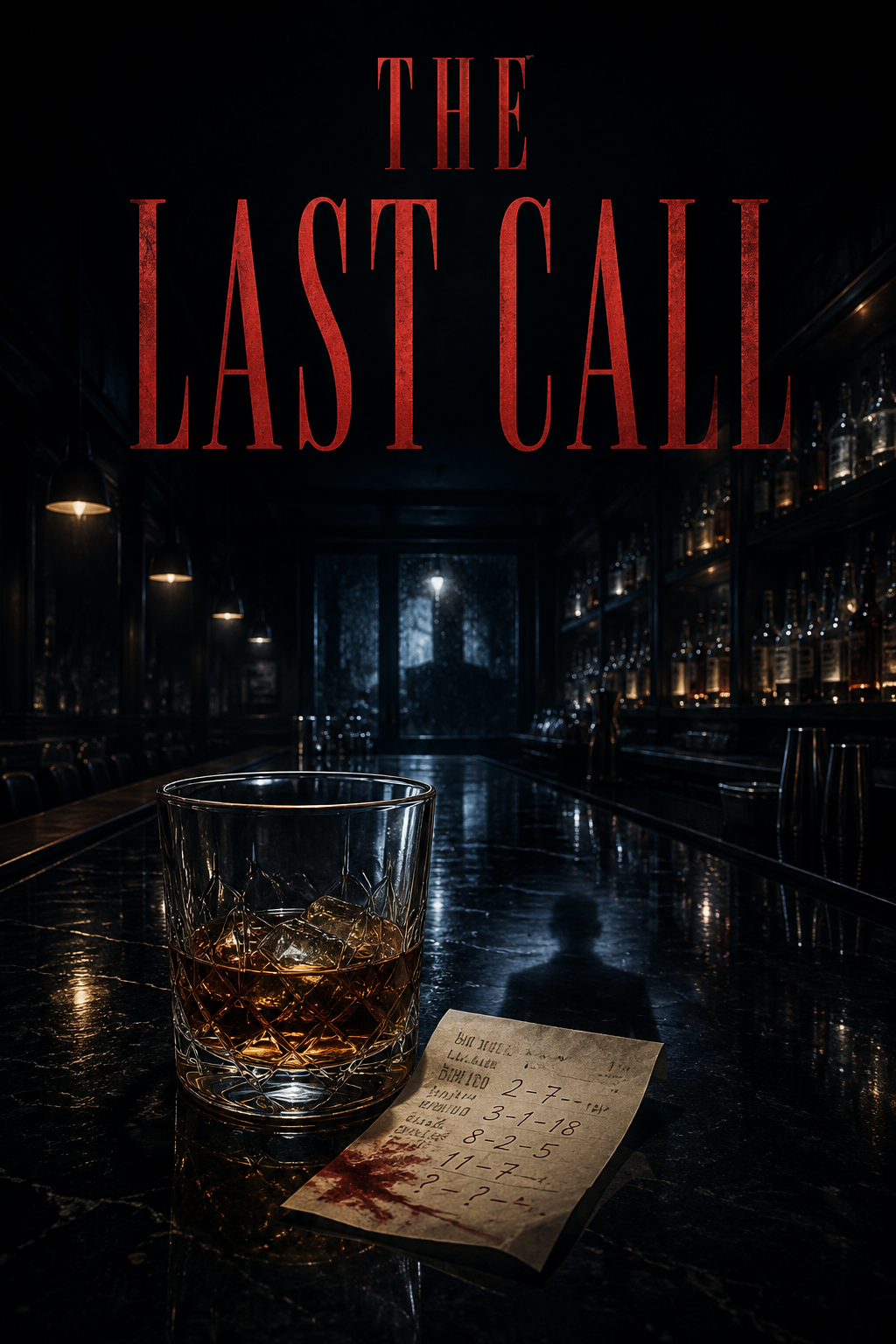
Novel · 15 chapters · 49,017 words
The last call
Contents15 chapters
- 01Last Pour
- 02The Empty Stools
- 03What the Dead Ordered
- 04A Name in the Glass
- 05No Safe Hour
- 06The Room Behind the Bottles
- 07Small Town, Closed Mouths
- 08The Sheriff’s Smile
- 09Husband of the Damned
- 10Closing Time Trap
- 11The Voice in the Wall
- 12After Last Call
- 13County Line Morning
- 14What Becca Saw
- 15The Bar with No Walls
Chapter 1
Last Pour
By half past midnight, the Black Lantern had the smell it only got after last call: beer gone flat in the drip tray, lemon peel bruised under a heel, wet wool steaming by the door, old wood breathing out the day’s damp. Mara Vale stood with her forearms on the bar and watched Eli Mercer turn his empty glass in slow circles as if he could read something in the ring it left.
He had been there since nine. He was never a fast drinker. Eli treated whiskey the way some men treated church—out of habit, with a look that said he no longer expected much from it but kept showing up anyway. Tonight he had nursed two bourbons and left half of the second one warm.
“You don’t have to marry it,” Mara said.
Usually that got a dry smile out of him. Not tonight.
The chairs were already up on half the tables. The neon lantern in the front window buzzed and threw a red seam across the bottles. Ruth, the owner, had gone home an hour ago with her cash bag under one arm and a warning not to forget the side lock. Cal from the kitchen had scraped the grill clean and left through the back. The bar had narrowed to the two of them: Mara, wiping down the same patch of oak twice, and Eli in the far end booth seat he liked even when he wasn’t in the booth, shoulders hunched like a man trying to make himself harder to hit.
Outside, rain tapped the front glass, then steadied into a hard silver sheet.
“You closing on me?” Eli asked.
“I’ve been closing on you for twenty minutes.”
He looked toward the clock over the mirror. “Thought it was earlier.”
“It always is in here.”
That earned her a glance. His eyes were bloodshot but not loose. He wasn’t drunk enough for self-pity. He was in some sharper place than that, wired down to the bone.
Mara reached for his glass. He put two fingers over the rim.
“One more.”
“No.” She held his gaze. “Not if you’re going to stare at it like it insulted your mother.”
His hand fell away. He rubbed at the heel of his palm as if it hurt. Eli worked maintenance over at the middle school. Boiler room, lights, things with bolts and bad timing. He had broad hands, split knuckles in winter, a habit of smelling faintly of machine oil even scrubbed clean. Tonight another smell clung to him under the whiskey and rain: cold air and fear.
Mara had learned the difference. Sad men slumped. Angry men leaned forward. Men about to lie to their wives smiled too much at their phones. Fear sat high in the chest and made the eyes keep finding the door.
“You want coffee?” she asked.
He let out a sound with no humor in it. “That your professional opinion?”
“My professional opinion is you’re no good company like this.”
He nodded once, almost grateful for the roughness of it. She set a mug under the machine anyway and drew him a short black coffee. The machine gave its tired cough. She slid the mug across. Eli wrapped both hands around it without drinking.
The Black Lantern had been a feed store before it was a bar, and even after the remodel it kept some of that shape: long room, pressed-tin ceiling stained brown over the years, support posts thick as tree trunks, back corridor too narrow for two people to pass without turning sideways. The regulars said the place listened. It held sound oddly. A laugh from the pool table carried clean to the cash register. A whisper from the back booth sometimes reached Mara in pieces, as if the walls liked some words better than others.
She did not like that thought tonight.
“You waiting on someone?” she asked.
“No.”
“You checking for someone?”
His thumb moved along the mug handle. “Maybe.”
Mara stopped wiping. “Eli.”
He swallowed and looked at her, really looked at her for the first time all night, with the stunned, bare expression people sometimes wore right before they told her something they’d spent months holding behind their teeth. Bars trained you to hear a lot and keep your face still. Marriage trained you even better. Mara had heard about affairs, pills stolen from medicine cabinets, deer poached out by Miller Road, a son who wasn’t speaking to his father, a father who shouldn’t have been speaking to his daughter the way he did. People handed bartenders the versions of themselves they couldn’t carry home.
Most of it went nowhere. That was the agreement, spoken or not. Pour, listen, forget.
But sometimes someone looked at you the way Eli looked now, and forgetting felt less like courtesy than neglect.
“He said nobody would believe me if I changed my mind,” Eli said.
Mara kept her hands flat on the bar. “Who said that?”
Eli did not answer. Rain rattled the window harder. Somewhere in the building the ice machine dumped a tray with a crack like a dropped plate, and Eli flinched.
“That bad?” Mara asked softly.
His jaw worked. “Worse because I let it get bad.”
There it was: not a complaint, not a grudge. Guilt.
Mara had known him seven years, maybe eight. He came in every Thursday after his late shift and every other Sunday if the game was on. He tipped exact on bad weeks and over on good ones. He complained about the school board, about his truck, about the way all coffee tasted burnt after fifty. He never cried. He never touched anyone when he talked. He never, ever lowered his voice unless it mattered.
Now he leaned in over the coffee and spoke to the wood.
“I did something unforgivable.”
The room seemed to cinch smaller around the sentence.
Mara knew better than to rush at words like that. If you crowded a confession, people sealed back up from shame or fear or both. So she took the towel, folded it once, and set it aside.
“Tell me what kind of unforgivable,” she said.
He gave her a bleak little smile. “There are kinds?”
“There are accidents. There are lies. There are things people call unforgivable because they need a harder word than stupid.” She let that sit. “And then there’s the other kind.”
Eli’s fingers tightened around the mug.
“The other kind,” he said.
Mara felt a pulse begin in the base of her throat. “Did you hurt someone?”
He looked toward the mirror behind her, but not at himself. At the rows of bottles, the low light, the room reflected back wrong and thinner than it was.
“I helped,” he said. “That’s worse in some ways. You stand there and tell yourself you’re not the hand, just the glove.”
A gust pushed rain against the door. Mara glanced at the deadbolt. It was set. She had locked it after the last couple left. The CLOSED sign hung crooked in the glass.
“Helped who?”
He wet his lips. “I can’t say that here.”
“Why here?”
His eyes flicked upward, then toward the back of the room.
It was such a small movement most people would have missed it. Mara didn’t. She followed his glance past the shelves of gin and rye, past the old mirror foxed at the edges, to the dark gap near the storage corridor. Nothing there but stacked cases and a mop bucket with the handle leaning like a shoulder. Still, she felt the quick skin-prickle of being observed.
She almost laughed at herself. Long shift, bad weather, a frightened man. That was all.
“Eli,” she said, quieter now. “If you’re in trouble, you need more than a bartender.”
“I know.”
“Then let me call somebody.”
“Who? Sheriff Dunne?” The name came out with a bitter snap. “No.”
That landed.
Dunne was the kind of sheriff small towns grew by habit: wide smile, flat eyes, knew everybody’s truck by sound and everybody’s father by first name. Men liked him because he remembered their hunting stories. Women liked him until they needed something from him. Mara had seen him in the Lantern enough times to know he drank club soda and listened more than he spoke.
“You think this is about Dunne?” she asked.
Eli stared into the coffee. “I think nothing stays buried around here. I think some men keep shovels in their hands even when they’re smiling.”
Mara was about to press him when he said, “Can I ask you something strange?”
“You can ask.”
“If I order one more drink, will you write it down on the ticket like usual?”
That made her pause. “Eli, I just told you no.”
“Not to drink.” He glanced up at her. “Just write it.”
The register screen still glowed at her elbow. Every order got punched in, even at the end of the night. Ruth counted inventory with a miser’s soul. Mara studied Eli’s face for some hint that this was drunken theater, some urge to be cryptic because the hour made everything feel heavier. What she saw instead was a man hanging onto method because panic was all around it.
“What kind of drink?” she asked.
His answer came too fast, as if he had rehearsed it.
“Rye. Two ounces. No ice. Three drops bitters. Twist, but no peel left in. In the short glass.” He stopped. “And a water back.”
Mara frowned. “You’ve had rye neat a hundred times in here. Since when do you care how many drops of bitters go in?”
“Will you write it?”
His voice thinned on the last word.
She turned to the register and keyed it in because sometimes the shortest road to the truth was through the odd little thing a person insisted on. Her fingers tapped the shorthand she always used: RYE 2 / BIT3 / TW-NP / SG / WB. She tore the ticket from the printer and set it face down on the bar.
“You want to explain why I’m making notes for a drink you’re not getting?”
Eli looked at the ticket but did not touch it. “No.”
“Then I’m throwing it out.”
He shook his head sharply. “Don’t.”
Mara’s patience thinned. “I’m not your mailbox, Eli.”
“I know what you are.”
The answer came so plain she stopped.
“You listen,” he said. “You remember things.”
It was not praise. It sounded more like a man naming the only tool within reach before the lights went out.
Mara folded her arms. “Then give me something worth remembering.”
Eli shut his eyes. For a second his face slackened with tiredness and showed his age. He had one of those faces built for decent weather—fair lashes, a broad nose, skin that reddened fast. Under the lantern light he looked ill, his cheeks blanched around two high spots of color.
“When I leave,” he said, “wait five minutes and look outside.”
“For what?”
“You’ll see whether I’m crazy.”
Before she could answer, he stood so abruptly the barstool legs barked against the floor. He tossed cash onto the bar beside the untouched coffee. More than enough. His hands shook as he buttoned his coat wrong, then righted it.
Mara stepped around the corner of the bar. “Eli, stop. If you think someone’s outside—”
He backed away from her, not violent, just wild-eyed and ashamed. “Please don’t.”
“Don’t what?”
“Make me say it where they can hear.”
The room went very quiet.
Mara heard the refrigerator kick on under the taps. Heard rain drumming the awning. Heard her own breath.
“They?” she said.
Eli looked again toward the back corridor. Then to the front door.
“Five minutes,” he repeated.
He opened the door before she could catch up to him. A stripe of wet wind blew in and lifted a stack of cocktail napkins. Then he was outside, hunched into the rain, one hand up against it, crossing the lot through the wash of yellow light from the streetlamp.
“Eli!”
He did not turn.
Mara stood in the doorway and watched him reach his truck, a dented blue Ford with rust over the wheel well. He got in. The brake lights flared red. For a moment the truck sat idling in the rain.
Then another pair of headlights came on across the street.
Mara stiffened.
A dark vehicle had been parked along the curb under the sycamore, nose angled toward the Lantern. She had not noticed it before, though maybe it had been there all evening and the rain had turned the windows to black. Headlights stayed low for a beat, then the vehicle rolled forward without hurry and took the turn after Eli’s truck when he pulled out.
Could have been anyone, she told herself. Could have been nothing. A late shift, a bad night, two cars on the same road in a town with three decent exits.
Still she counted under her breath all the way to sixty, then to three hundred because he had asked for five minutes and she had the ugly feeling that if she failed to do this one exact thing some part of the night would turn fixed and unrecoverable.
When the count was done, she locked the door again and stood with her back against it, looking at the rain-slick room.
The ticket lay where she had left it. Face down. White strip on dark wood.
Mara crossed to it and turned it over. The shorthand looked ordinary in the dull register print. She almost laughed. Rye. Bitters. Twist. Short glass. Water back. The usual bones of a drink, fussy in a way Eli had never been, but still just a drink.
She tucked the ticket under the till anyway.
Then she checked the back corridor.
The corridor led past the keg cooler to a storage room Ruth kept half-organized and always locked when she remembered. Cases of cheap vodka, tonic syrup, paper towels, old holiday decorations in plastic tubs. Mara flicked on the narrow overhead light. Nothing moved. Dust on the floor near the wall. One mop bucket. The metal vent above the shelving hummed faintly with trapped air.
She stood there longer than she needed to, embarrassed by the small hard beat in her chest. The place smelled like bleach and cardboard. No hidden men. No listening shadows. Just the stale back end of a bar after midnight and her nerves playing tricks.
She killed the light and finished closing.
It took another forty minutes. Cash counted. Bottles capped. Ice wells drained. She moved by habit, but Eli’s words kept snagging on her. I helped. The other kind. Don’t make me say it where they can hear.
By the time she pulled on her coat, the rain had eased from assault to steady fall. Her husband, Owen, had texted at eleven—You home soon?—and then not again. He kept early hours because he ran the municipal garage and claimed sunrise belonged to honest men and mechanics. Mara usually answered that sunrise belonged to nobody worth knowing. Tonight she had forgotten to write back.
She stepped outside, locked the side door, and stood a moment under the awning while the parking lot shone black around her. Water dripped off the gutters in a straight hard line. Across the street, the sycamore leaves twitched in the wind. No dark car now. No one idling.
At home, Owen was asleep on the couch with the television blue on his face and one boot still on. Mara nudged his shin with hers until he grunted awake enough to mutter an apology and stumble to bed. She brushed her teeth, washed cigarette smoke and citrus oil from her hands, and slid in beside him, but sleep came broken.
At four she woke certain she had heard the front door open. At five she dreamed of the bar’s back corridor stretching long as a tunnel, lined not with liquor cases but men standing shoulder to shoulder in the dark, each one turned away until she passed, and then each one whispering her name.
When her phone rang at six nineteen, she was already half awake and full of dread without cause.
The screen showed Ruth.
Mara answered with a dry mouth. “What’s wrong?”
Ruth did not waste time on hello. “Don’t come in through Main. Sheriff’s got the road half blocked by the bridge.”
Mara sat up. Owen made a soft annoyed sound and rolled away from the light.
“Why?” she asked.
A pause. Rain hissed against the bedroom window.
“There was an accident last night,” Ruth said. “Truck went off near the old mill turn.”
Mara’s hand tightened on the phone.
“Who?”
“You know him.” Ruth’s voice had gone careful. “Eli Mercer.”
For one second Mara saw him as he had been under the red bar light, two hands around black coffee, eyes cutting toward the back like an animal scenting fire.
“Is he hurt?” she asked, though some part of her already knew that was not the shape of this call.
Another pause. Then Ruth said, “He never made it home.”
Mara swung her feet to the floor. Owen had pushed himself up on one elbow now, watching her, face puffy with sleep.
“What do you mean never made it home?” she said.
“I mean they found the truck in the creek and Eli in it.” Ruth exhaled through her nose. “Dunne says it looks like he missed the turn in the rain.”
Mara stood too fast and the room tilted.
No ice. Three drops bitters. Twist, but no peel left in.
Five minutes, he had said. Wait five minutes and look outside.
She pressed her free hand against the dresser until the wood bit her palm. “He wasn’t that drunk.”
“What?”
“He had two drinks in three hours. Half the second still in the glass. He drank coffee before he left.”
Ruth went quiet in the way people do when they sense trouble but do not want it set down in their hands. “Mara, roads were slick. It was dark.”
“He thought someone was following him.”
Now Owen was fully awake. “Who?”
Mara held up one finger at him without looking.
Ruth said, “Did he tell you that?”
“He told me enough.”
Another pause, longer this time. Mara could hear sounds behind Ruth—car door, muffled voices, the morning already moving around a death.
“If Dunne asks,” Ruth said carefully, “you tell him exactly what you saw and not one ounce more than what you know.”
The line went dead before Mara could answer.
She stood with the phone in her hand, rain needling the glass, Owen staring at her from the bed.
“What happened?” he asked.
Mara turned toward him slowly.
“Eli Mercer is dead,” she said.
Owen’s face changed by degrees: sleep leaving, concern arriving, then something else too fast to name before it smoothed over. Maybe she imagined that part. Maybe she was already doing what fear does, fitting sharp edges onto ordinary reactions.
“He crash?” he asked.
“That’s what they’re saying.”
Owen rubbed a hand over his mouth. “Jesus.”
Mara looked past him toward the dim hall, toward the house they had lived in five years without secrets she could prove and many she could feel. On the chair by the door hung her bar apron. In the pocket, folded small, was the printed ticket Eli had wanted written down for no drink at all.
She thought of the dark car under the sycamore. Of Eli refusing to say names inside the Black Lantern. Of the odd steadiness in his voice when he said, You listen. You remember things.
Outside, a truck rolled by slow on the wet street, tires whispering over standing water. Mara waited for the sound to fade. It did, but the feeling remained.
Something had followed Eli into the rain.
And whatever it was, it had not finished with the people who listened.
Chapter 2
The Empty Stools
By noon, Eli Mercer’s death had already changed shape three times.
At Greer’s Market, he had swerved to miss a deer. At the gas pumps, he had been blind drunk and singing when he hit the turn. By the time Mara carried two cases of beer through the Black Lantern’s side door, someone had decided he had fallen asleep at the wheel with a bottle in his lap.
She knew how much Eli had actually drunk. That was the part that made the rest of it feel obscene.
The bar smelled wrong in daylight. Sour mop water. Old lemon rinds gone soft in the trash. The yeasty damp of beer that had seeped beneath the rubber mats and never really left. Mara set the cases down behind the counter and stood a moment with her hand on the cooler handle, listening.
The Black Lantern always had a way of holding sound after people were gone. A compressor kicked on in the back. Ice settled in the bin with a dry crackle. From the storage corridor came nothing at all, which somehow made it worse.
Ruth was in the office with the door open, cigarette burning over a chipped saucer, cash drawer spread before her.
“You look like hell,” Ruth said.
“Thanks.”
“You hear anything else?”
“Only what half the county’s already improved.”
Ruth snorted without humor and tapped ash into the saucer. “Dunne stopped by.”
That tightened something in Mara’s shoulders. “Why?”
“He wanted to know whether Eli seemed impaired.”
“And what did you tell him?”
“That he was quiet, paid cash, and left under his own steam.” Ruth slid a stack of small bills into line with the side of her hand. “Same as I’d tell anyone.”
Mara waited.
Ruth looked up then. Her face had that hard powdered look it got when she had slept too little and decided to treat the day like an insult. “If he asks you, keep it clean. No stories. No hunches.”
“He told me he thought someone was following him.”
“That a story or a hunch?”
“It’s a thing he said.”
Ruth pinched the bridge of her nose. “Mara, listen to me. A dead man says strange things in a bar after midnight, you do not build a church around it.”
Mara said nothing.
Ruth took in her face and seemed to think better of pushing. “Open up at four. We’ll keep the kitchen dark tonight. Cal called in. Says his kid’s sick.”
Mara nodded and moved away before Ruth could see how much that small fact bothered her too. Cal did not call in unless he was dying or jailed.
She spent the next hour polishing glasses that did not need it and setting bottles square to labels. The work steadied her hands, not her mind. Every few minutes she found herself glancing toward the till, where Eli’s ticket lay hidden beneath the tray at home in her apron pocket no longer, because she had brought it back with her and slipped it into the pocket of her jeans before coming inside, as if paper could burn a hole through cloth.
At three forty-five the first of the afternoon men came in for coffee and weather complaints. At four ten the usual stools began to fill. Dean Haskell took the one nearest the pinball machine and argued with the television before it was even on. Arlene Pike sat at the far end with tomato juice over ice and looked at everybody through the mirror instead of head-on. Two linemen from the co-op played pull-tabs and left silver shreds on the bar.
Eli’s stool stayed empty.
Mara told herself that was all it was. One empty place after a death. Towns had long memories for chairs and parking spots and coffee mugs. People left ghosts in their habits.
Then she noticed the others.
Nate Boulger had not been in for two weeks.
The thought came without warning, the way a splinter makes itself known only after skin swells around it. Nate always came in on Tuesdays and Fridays just after six, smelling of machine oil and cold air, and drank one bottled beer before switching to bourbon. He kept quarters in his left front pocket and rolled them across his knuckles when he was thinking. He had a laugh like he was surprised to still own it. Two weeks. Maybe a little more.
Mara dried a highball glass and looked toward the third stool from the service end, where he usually sat because he liked the angle of the television and hated drafts from the door.
Empty.
That by itself could still be nothing. Men missed nights. Men got the flu, took jobs out of county, went sour and drank at home. But Nate’s absence brought another with it.
Lou Garvey.
Lou favored the back booth on nights his knees were bad, barstool when they weren’t. He had sold feed for thirty years, knew every family’s business going back three generations, and cried only once in Mara’s presence, six months ago, after enough rye to loosen the knot in his throat. He had put both hands flat on the table and told her he had lied to his daughter so long he no longer knew which version of himself she loved. The next week he had come in with unusual cheer, ordered a drink so fussy she laughed and made him repeat it, then vanished from the room of regular things. She had assumed he was with family in Missouri. Somebody had said so. Or maybe she had supplied that fact herself because it fit.
She set the glass down too hard. Dean glanced over. “You break it, I’m drinking from the bottle.”
“You should be so lucky,” she said.
Her voice sounded normal. That almost angered her.
At five, a pair of highway men in orange jackets came in wet to the elbows and wanted drafts. At five thirty, Owen stepped through the front door in his work shirt, gray with darker sweat marks at the ribs, municipal seal over the pocket. He usually stopped in one or two nights a week, not because he liked the place but because he liked driving her home when weather was bad. Today his eyes went first to her face, then over the room, taking stock.
“You eating?” he asked.
“Eventually.”
He slid onto the end stool by the sink. Mara poured him coffee instead of asking. He accepted that without complaint.
“Folks are talking,” he said after a minute.
“They always are.”
He stirred in too much sugar. “At the garage this morning, Chet said Eli was found with his lights still on.”
“Chet was there?”
“No. His cousin’s wife heard it from a deputy.”
Mara gave him a flat look. “Solid chain.”
Owen’s mouth twitched, but not enough for a smile. “You okay?”
There it was again, that kind tone that sat on top of something she couldn’t quite place. She had loved him for his steadiness once. Lately it sometimes felt like a lid.
“I keep thinking about what he said.”
“About being followed?”
She had not told him that exact word this morning. Not plainly. Mara stopped wiping the bar.
“You told me enough,” Owen said, catching it at once. He looked down into his coffee. “I filled in the rest.”
Maybe he had. Maybe anyone would.
Ruth came out of the office before Mara had to answer. She nodded at Owen, checked the register, then said to no one in particular, “Sheriff might stop in later.”
The room changed a fraction. Dean looked into his beer. Arlene’s eyes moved to the mirror. One of the linemen folded his pull-tab pile into a neat square.
Mara hated that. Dunne had that effect even when he was not in the building yet.
Owen finished his coffee fast, as if suddenly late for something. “I’ll see you at home?”
“If I’m not too late.”
He touched two fingers to the bar, not quite touching her hand, and left.
The rush never really came. Rain kept people home. The televisions muttered above the bottles. The jukebox stayed dark. The door opened and shut in spells, each entrance trailing damp air and the smell of wet denim, diesel, cigarettes. Through it all Mara’s eyes kept returning to the same gaps. Nate’s stool. Lou’s booth.
At seven twenty she asked Arlene, casual as she could, “You seen Nate lately?”
Arlene drew a red lacquered nail around the rim of her glass. “Machine shop Nate?”
“There’s another one?”
“He came through the pharmacy last week. Or maybe the week before.” She frowned. “No. That was his brother. The bald one.”
“Nate is the bald one.”
Arlene shrugged. “Then not him.”
That should have been funny. It wasn’t.
Later Dean asked for another beer and said, “You hear Lou sold his trailer?”
Mara snapped the cap off with the opener. “No.”
“Thought I heard that.” Dean took the bottle and squinted at the label like it had wronged him. “Or maybe he was talking about it.”
“Who was?”
Dean blinked. “Lou.”
“When?”
He worked through the memory and failed in plain sight. “Hell if I know. While back.”
A man can disappear in a small town if everybody agrees to turn his absence into ordinary delay. Mara knew that suddenly and with a chill.
Near eight, between orders, she took an old server pad from beneath the register and wrote three names on the back page in the smallest print she could manage.
Eli.
Nate.
Lou.
She stared at them until the ink dried glossy.
What had Nate ordered that last night? She shut her eyes, summoned bottles, hand motions, his voice. Not bourbon first. That was the thing. He had come in already wound tight, refused a beer, asked instead for rye with one cube only, splash of water on the side, orange bitters—not Angostura, orange—and a cherry skewered but not dropped in. He had watched her write it because he wanted it right. She remembered that now because she had teased him for ordering like a man dictating terms to a florist. He had laughed once, brief and ugly, then said, “Just write it how I said it.”
And Lou.
Lou’s order had been stranger because he hardly ever changed. He drank rye, neat, no nonsense. But that last night he had leaned over the polished scarred wood of the booth and asked for gin in a whiskey glass, two olives, twist discarded, vermouth rinsed and dumped, heavy on the ice. He had repeated the part about the glass. “Whiskey glass, not a stem. You hear me?”
She heard it now so clearly she could have written it in his voice.
The hair along her arms lifted.
Not every odd order meant anything. People got notions. They copied something from a movie, wanted to impress a woman, decided one Tuesday they hated the drink they had loved all year. But three people she knew had each chosen one exacting, almost ceremonial order on a night they had shown her some torn piece of themselves. Eli with his black coffee hands and hunted eyes. Nate after he admitted he had taken cash to keep his mouth shut over a jobsite accident that hurt a man worse than the papers ever said. Lou whispering about lies and blood ties and the kind of guilt that settles into the joints.
Now one was dead.
Two were simply gone.
“Mara.”
She looked up hard enough to make her neck click.
The speaker was just Wade Tomlin, local electrician, thumb hooked in his bib overalls. “You got any pickled eggs left or we pretending that jar’s decorative?”
She let out a breath she had not known she was holding. “Top shelf cooler. If they’ve grown teeth, that’s on you.”
A few men laughed. The room moved again.
But something had shifted. From then on she felt observed in a way that had nothing to do with serving drinks. Not watched as a woman gets watched in a bar. This was narrower, colder. Attention with a purpose.
She tested it once by leaving the service end and walking to the back booth under the excuse of collecting empties. As she bent for the glasses, she let her gaze slide toward the short hallway leading to the restrooms and the storage corridor beyond. The bulb there was dim, yellowed by years of smoke. The door to storage stood shut. No one there.
Still, the skin between her shoulders tightened.
When she returned to the bar, the server pad was no longer exactly where she had left it. Only a quarter inch off the coaster stack, maybe less. That was enough. Mara knew her own stations the way a pianist knew keys in the dark.
She picked up the pad and flipped it casually.
The page with the three names remained. So did the faint indentation of what she had nearly written beneath them and stopped: orders.
No one spoke to her while she stood there, but she became aware of small evasions. Dean suddenly absorbed by baseball scores. Arlene studying her own drink. Ruth in the office doorway with a cigarette halfway raised and eyes unreadable. Two men at the end of the bar lowered their voices when Mara looked over, then raised them again on some harmless joke.
You’re spooking yourself, she thought.
Then the front door opened, and Sheriff Dunne came in wearing rain on his hat brim and that patient public smile he used at parades and wrecks.
Conversations thinned, then rearranged themselves around him.
Dunne took the center stool as if the room had been built to place him there. Big shoulders in a tan jacket, broad clean face gone ruddy from weather, silver at the temples that made older women trust him more than they should. He removed his hat, shook off rain, and set it crown-up on the bar.
“Evening, Mara.”
“Sheriff.”
He glanced at the bottles behind her, then at the televisions, then back to her. His eyes were pale and tired-looking until they fixed on something; then they sharpened all at once. “Long day?”
“You tell me.”
A soft chuckle. “I hear you were one of the last to see Eli alive.”
Ruth was suddenly beside the register counting singles that did not need counting.
Mara set a napkin in front of Dunne. “Coffee or trouble?”
“Coffee first.”
She poured.
He wrapped both hands around the mug but did not drink. “Ruth said Eli seemed sober enough.”
“He did.”
“He say where he was headed?”
“Home, I figured.”
“You figure much else?”
There it was, gentle as a thumb finding a bruise.
Mara put the pot down. “He paid. He left. That’s what I know.”
Dunne nodded, as if approving a child’s recitation. “That all?”
From the office doorway Ruth said, “Sheriff, unless you want a statement, she’s working.”
Dunne looked over with that same mild expression. “Nobody’s accusing anybody.”
“No,” Ruth said. “Not yet.”
He smiled at that and finally tasted the coffee. “Good as always.”
Mara wanted him gone. More than that, she wanted to know why Eli had refused to say certain things inside this room. She looked at Dunne’s broad hand around the mug, at the neat clipped nails, the wedding ring with the deep scratch across it, and felt the irrational certainty that if she told him about the ticket in her pocket he would somehow already know whether she was lying before she finished the sentence.
He stayed ten minutes, made three remarks about road conditions, asked after Cal’s sick child despite no one telling him Cal was out, and left a dollar under the cup.
After he was gone, the room exhaled.
Mara picked up the bill, folded it once, and put it in the tip jar like it might stain the counter otherwise.
The night dragged to close. Wade got his eggs. Dean lost twenty dollars on pull-tabs and blamed the state. Arlene left with her lipstick intact and the look of a woman who had heard enough to carry home and season. By eleven thirty only two stools were filled. By midnight they too were empty.
Ruth counted the drawer while Mara wiped bottles and killed the televisions.
“You asked around,” Ruth said without looking up.
“A little.”
“About Eli?”
“About others.”
Now Ruth looked up. “What others?”
Mara held the bar rag still in her hands. She did not trust Ruth enough to hand over the shape forming in her mind, not yet, maybe not ever. “Regulars I haven’t seen.”
Ruth slid the till shut. “People disappear from bars every day. Usually because they’ve found religion, a woman, or a cheaper bar.”
“And if it’s none of those?”
Ruth gave her a level stare. “Then don’t go making yourself the clerk of the dead.”
She carried the cash bag to the office and shut the door.
Mara finished alone.
She washed the last rocks glass. Locked the cooler. Killed the signs in the front window until only the red EXIT over the door and the low lamp by the mirrored shelves remained. In that half-light the room looked stripped and honest. Scars in the lacquer. Dust on the bottle shoulders. The deep groove worn into the brass rail where boots rested year after year.
She took the server pad from under the register and wrote the orders as best she remembered them.
Eli: rye, no ice. 3 drops bitters. twist, no peel left in.
Nate: rye. 1 cube. water side. orange bitters. cherry skewered, not in.
Lou: gin in whiskey glass. 2 olives. twist discarded. vermouth rinse dumped. heavy ice.
She read them over, feeling foolish and sick.
Nothing about the list explained itself. Nothing leapt out except the insistence of detail. Not drink recipes, exactly. Instructions. The kind a man gives when he wants a thing recorded, not consumed.
The mirror behind the bar gave back her face and the room behind her. For one second she thought she saw movement at the hall by the restrooms—a darker strip inside the dark. She turned so fast the rag flew from her hand.
Nobody.
Still, she went around the bar and crossed the floor. Her shoes made sticky sounds where old beer had dried despite the mop. She passed the booth where Eli had stared over her shoulder the night before. Passed the bathrooms with their swollen doors and cracked tile. Reached the narrow corridor that led to storage.
The air there felt cooler.
She stood without breathing and listened.
At first, nothing. Then a sound so small she might have invented it: the faint brush of rubber against concrete, as if someone farther in had shifted weight and stilled.
“Who’s there?” she said.
Her voice did not carry far. The corridor seemed to eat it.
No answer came.
Mara took one more step. The single bulb overhead hummed. Cases of tonic and napkins were stacked along the wall where the passage kinked right toward the locked storage room. Beyond that turn she could see only shadow.
She thought of Eli saying not here. She thought of her own name whispered in the dream tunnel before dawn. She thought, absurdly, of Owen asking whether she had eaten, of ordinary life waiting at home with wet boots by the door and a dish in the sink.
Then she backed out.
Not from weakness. From sense.
At the bar she tore the written page from the server pad and folded it small. She tucked it into her bra, not her apron, not the till. Somewhere no casual hand would find it. Then she finished locking up with every light in the place on until the last possible second.
Outside, rain had stopped. The parking lot shone black and empty under the security lamp. Her car sat alone except for Ruth’s, and beyond them the road ran wet as film toward town.
Mara locked the front door, tested it twice, and stood with her keys in her fist.
Across the street, under the bare-limbed sycamore by the laundromat, a vehicle idled with its lights off.
She could not make the model from that distance. Only the block of it. Dark body, low roofline, someone behind the windshield or maybe no one at all. As she watched, the ember of a cigarette flared inside and vanished.
Mara did not hurry to her car. She made herself walk at the same pace she always did, hearing each heel-click as if from far away.
When she pulled out, the dark vehicle stayed where it was.
But halfway home, she checked her mirror and saw headlights ease from a side street three blocks back, keeping steady distance in the wet dark.
When she finally reached the house, she sat in the driveway with the engine running and wrote one more line on the back of an old receipt before she lost the nerve or the exactness of it.
Write them all down.
Then she killed the engine and listened to it tick itself cool while, somewhere beyond the black yard and sleeping houses, another motor waited a beat too long before moving on.
Chapter 3
What the Dead Ordered
Mara let herself into the Black Lantern two hours before opening and locked the door behind her.
The room had the dead quiet bars get in daylight. No hum of talk to soften it. No clink of glass. Just the cooler cycling on and off and the faint tick from the beer sign Ruth always swore she had unplugged. Last night’s mop water had left a sharp lemon smell over the old beer in the floorboards. Dust floated in the stripe of light from the front windows and settled on the stools that should have held Eli, Nate, Lou.
She did not turn on the music.
She went straight behind the bar, reached into her shirt, and pulled out the folded page she had hidden there. The paper had gone damp at the edges from her skin. She flattened it on the register and read the three lines again.
Eli: rye, no ice. 3 drops bitters. twist, no peel left in.
Nate: rye. 1 cube. water side. orange bitters. cherry skewered, not in.
Lou: gin in whiskey glass. 2 olives. twist discarded. vermouth rinse dumped. heavy ice.
In daylight they looked even less like drinks.
Mara took the order pad and wrote them again, slower this time. Then she circled every piece that no normal man cared enough to insist on. Not at that hour. Not with that face. No peel left in. Water side. Cherry skewered, not in. Vermouth rinse dumped.
Instructions, she thought again.
For what.
She opened the till drawer though she knew there would be nothing there, then checked under the cash tray anyway. Ruth kept old slips in a dented metal box in the office until she got around to adding them up. Mara crossed to the office, nudged the door with her hip, and went in.
Ruth’s office smelled like cigarettes smoked near a cracked window and paper that had taken on damp over years. Invoices leaned in towers against one wall. Cases of napkins blocked half the file cabinet. The adding machine sat under a yellowed lace runner as if that made it churchworthy.
Mara knelt by the metal box and started sorting.
Tabs first. Then bottle invoices. Then the legal pads Ruth used for weekly inventory, each page crowded with her blocky handwriting. House rye. Well gin. Sweet vermouth. Bitters. Garnish. Glass breakage. Mara had helped with those sheets enough times to know the look of them without thinking. Ruth never wrote out full names if she could help it. She used bars’ shorthand, distributor shorthand, her own shorthand piled on top of both.
RY.
GN.
OB.
VMR.
WG.
TW.
OL.
CH.
Mara stopped with one inventory page in her hand.
She set it on the desk and pulled the orders beside it.
That was the first real catch of breath all morning.
Lou had asked for gin in a whiskey glass. Ruth’s sheet listed both on the same page: GN, WG. Nate had asked for orange bitters and a cherry skewered, not in. On the garnish line: OB, CH. Eli had asked for bitters and twist. BT, TW. The orders were built out of the same little chunks Ruth used when she counted stock every Tuesday.
That by itself could have meant nothing. Men sat at bars for years; they heard things, saw pads, watched bottles get marked off. They knew the language by osmosis. But Mara felt something in her gut go cold and solid.
She spread three inventory sheets over the desk and looked harder.
Ruth’s stock forms didn’t just list items. She grouped them in columns and marked amounts in tight pencil: full, half, gone. Beside some lines she put shelf numbers for the back room. Beside others she drew arrows if a bottle had moved. For garnish she used tray positions. Left crock, center tray, right rail. Glassware had rack marks. Ice had bin notes. It was ugly, practical handwriting meant only for the people who worked there.
Not for customers.
Unless the customers were trying to use what the room gave them.
Mara sat down in Ruth’s chair and looked from the order sheet to the stock sheets until the lines started to blur. Then she made herself stop and start plain.
Rye showed up in Eli’s order and Nate’s.
Gin showed up in Lou’s.
Bitters showed up twice, but one plain, one orange.
Twist showed up twice, once kept, once discarded.
Those weren’t flavors. Those were repeated pieces.
She found an old invoice with a blank back and began writing the inventory abbreviations in a column.
RY
GN
BT
OB
TW
OL
CH
VMR
WG
ICE
WTR
Then she wrote every modifier next to them.
no
1
2
3
side
discarded
dumped
not in
heavy
It looked stupid. A schoolgirl code. A thing twelve-year-olds would pass in study hall. Except Eli had died with mud in his lungs. Nate had not come back in two weeks. Lou’s stool stayed empty for a third straight night.
Mara pressed the pencil eraser to her lip and thought about how men talked when they wanted something remembered.
Not the words, Eli had said without saying it. The exact order.
She stood up so fast the chair legs scraped. “Recorded,” she said to the office air.
That had been the point. Not to drink it. To get it written down exactly in the house language.
She went back to the bar and pulled a bottle of house rye from the speed shelf. A strip of old masking tape clung to the base from the last inventory count. Ruth had written RY-3 on it in fading black marker. Mara took down the bitters. BT-2. The orange bitters had OB-4. On the garnish cooler the olive tray had a grease pencil O-2 on the lip. The cherry crock had C-3.
Her scalp prickled.
Ruth marked placement and count together when she stocked. Third rye position. Second bitters slot. Fourth orange bitters bottle in reserve. The notes meant something only because the room repeated itself year after year. Same shelves. Same rail. Same habits.
And the orders had numbers in them.
One cube. Two olives. Three drops.
Mara set the bottles on the bar and reached for the weekly stock clipboard hanging inside the service station. On the back, in her own hand from last month, she had copied Ruth’s map when they had shifted the garnish rail for the holiday rush.
Left to right:
twists
olives
cherries
Under that:
bitters
orange bitters
Under that, in the backup case by the sink:
water pitchers
vermouth
glass racks
Mara looked down at Lou’s order.
gin in whiskey glass. 2 olives. twist discarded. vermouth rinse dumped. heavy ice.
Two olives. Second position on the garnish rail was olives. Twist discarded. Ignore twists. Vermouth rinse dumped. Ignore vermouth. Gin in whiskey glass. Heavy ice.
Not ingredients. Keep, drop, keep, drop. A sorting rule.
She grabbed a clean bar napkin and began writing just the inventory pieces, then crossing out the ones the spoken order told her to throw away.
GN / WG / OL / TW / VMR / ICE
discard TW
dump VMR
left: GN / WG / OL / ICE
She stared.
Then she remembered Ruth’s other habit. When the order came in messy, Ruth stripped it to initials and read the outside in. “Ends first,” she always said, squinting at slips without her glasses. “Middle lies.”
Mara almost laughed from the mean little shock of it.
Outside in.
GN / WG / OL / ICE
Ends first gave her G and E. Then N and C. Then W and L. Then G and O.
GE NC WL GO.
Nothing.
She swore, tore the napkin in half, and started again.
Not the inventory abbreviations, she thought. The stock names Ruth used when she wrote them longhand on Tuesdays.
GIN
WHISKEYGLASS
OLIVES
ICE
Outside in on those gave G E I C N I O L… no. Too much. Wrong grain.
Mara shut her eyes.
What did they assume she would know? Not Ruth’s private quirks. Not some parlor trick. Something simpler. Something built from what sat in front of her every shift.
She opened her eyes and looked at Nate’s order instead.
rye. 1 cube. water side. orange bitters. cherry skewered, not in.
One cube. First letter of ICE.
Water side. Side letters of WATER.
Cherry skewered, not in. Take the outside of CHERRY, keep it out.
Orange bitters. Maybe all of it, maybe initials only.
It was ugly, but when she wrote it that way she got pieces. I. WR. CY. OB.
Fragments.
She laid Eli’s beside it.
rye, no ice. 3 drops bitters. twist, no peel left in.
No ice. Omit ICE.
Three drops bitters. Third letter of BITTERS: T.
Twist, no peel left in. TWIST without its peel—without the outer letters? WIS.
Mara’s hand stopped.
Without the outer letters.
She went back to Nate.
Water side. Side letters of WATER: W R.
Cherry skewered, not in. Inside letters of CHERRY if it was skewered but not placed in the drink: HERR? No. Or maybe outside because not in. C Y.
She cursed again, softer.
Then she looked at Lou.
Twist discarded. Throw away TWIST completely.
Vermouth rinse dumped. Throw away VERMOUTH.
Two olives. Second letter of OLIVES: L.
Heavy ice. Full word ICE.
Gin in whiskey glass.
In.
Inside whiskey glass.
Inside letters of WHISKEYGLASS if GIN went in it? The phrase was doing something to the next word, not itself.
She wrote WHISKEYGLASS and pulled out the letters GIN if they appeared. They didn’t.
She wrote GLASS and put GIN in it on paper, literally. G( GIN )LASS. It looked mad. She felt mad.
She pushed the papers away and stood with both hands flat on the bar, breathing through her nose. The room around her stayed stubbornly ordinary. Beer taps. neon signs turned dark. The brass rail worn thin where boots hit it. Outside, a feed truck rattled past on Main and the sound moved on.
The answer came from memory, not logic.
Ruth in a hurry on inventory day. Don’t write the whole damn thing, Mara. If it’s inside another thing, bracket it. If it’s on the side, hang it off. If it’s dumped, cross it out. If it’s heavy, double it.
That was it.
It was never a word game. It was markup.
Mara sat down again and rebuilt the orders the way Ruth would mark a stock sheet.
Eli:
RY
ICE crossed out
BT(3)
TW with outer letters gone if “peel” meant the outside
Nate:
RY
ICE(1)
WTR side letters
OB
CH not in
Lou:
GN in WG
OL(2)
TW crossed out
VMR crossed out
ICE doubled
She worked for twenty minutes without noticing time pass. She tried versions. Struck them through. Wrote them again. The office pencil smeared gray on the side of her hand. Once she heard the cooler kick on and nearly jumped out of her skin.
By the time she found the first clean piece of sense, her coffee had gone cold on Ruth’s desk.
It came from Eli’s line.
BT(3) gave T.
TW peeled to WI if outer letters were stripped.
RY was not rye on the stock list when Ruth wrote it long. It was OLD RYE. She had written it that way for years to tell it apart from the better bottle.
OLDRYE.
If the order wanted only the stock name, not the drink, then Eli’s line did not begin with rye. It began with OLD.
OLD + T + WI—
No. But close enough to make her flip through the previous inventory pages.
There it was on an older sheet in Ruth’s hand: OLD MILL RYE. A joke from the distributor naming the cheap house bottle after the nearby road. Ruth had shortened it later to OMRY when they switched reps, but the old pages still held the full thing.
Old Mill Rye.
Mara looked at the words until the skin between her shoulders tightened.
Eli had died at the old mill turn.
She pulled his line apart again with shaking fingers.
Old Mill Rye.
No ice.
Three drops bitters: third letter, T.
Twist with peel not left in: use the inner of TWIST, WIS, or just WI by Ruth’s clipping marks.
OLD MILL TWI—
Turn, she thought.
Not because the code gave it whole. Because Eli had told her to wait five minutes and look outside. Because he had died at the turn. Because he had been trying to warn her about where they took a man when they followed him.
Old mill turn.
She wrote it in block letters and sat back.
Maybe she was forcing it. Maybe grief and nerves could make a woman see a face in spilled beer. But once that phrase sat on the page, the others shifted under her hands and began to give.
Nate’s order fought harder. It gave her pieces before it gave her sense: WTR side became WR. ICE(1) gave I. OB could be read as orange bitters, but on Ruth’s old prep list OB was written over the note OUT BACK because she stored reserve bitters on the back shelf. CH not in became O—outer letter only if left out—until she pulled the earlier sheet and saw cherries had once sat under CARAFE hooks marked C/R on the rail map.
WR I OB C/R. Garbage, until she stopped trying to make one line become one sentence.
These were warnings, not polished notes. Fragments a frightened man could force through her pencil while somebody listened.
Watch rear.
Back.
Car.
That was what Nate’s line kept circling. Side. Out. Back shelf. Rear letters. He had not been confessing a sin to her over rye. He had been trying to say look behind you.
Lou’s line came last and worst.
Gin in whiskey glass.
Two olives.
Twist discarded.
Vermouth dumped.
Heavy ice.
Keep what is inside. Take the second letter. Throw away the garnish. Throw away the rinse. Double the cold.
Inside. L. Wall, she thought suddenly, because the back booth sat against the wall and the vent above it bled kitchen noise into the corridor if the fan was off. The word landed before the proof did. Wall. Listen.
She grabbed another inventory pad and went to the room itself, moving fast now. Past the restrooms. Past the booth where Eli had stared over her shoulder. Into the corridor where the air always felt cooler.
She looked up.
The vent sat high and rectangular over the bend, painted the same tired cream as the wall. Grease had darkened the slats. A man in the storage passage could stand beneath it and hear the booth if the room out front was loud enough to cover his shifting.
Mara did not know whether Lou’s order truly spelled WALL or whether her own dread supplied the missing letters. She did not need the code to be clean anymore.
The pieces were clean enough.
Old Mill Turn.
Watch rear car.
Wall.
Warnings. Not sins. Not names.
The dead had not come to her to unburden themselves. They had come because the bar kept paper, and paper kept shape. They had used the one language they thought might survive them if they did not.
A floorboard popped behind her.
Mara spun.
No one stood there. Only the stacked tonic cases and the thin stripe of office light reaching halfway down the hall. But her heart hit so hard she felt it in her gums.
She backed out of the corridor, not taking her eyes off the turn until she reached the bar.
On the counter lay the page with her block letters on it. OLD MILL TURN. WATCH REAR CAR. WALL.
Underneath, in smaller writing from whereshe had copied Lou’s phrasing almost without noticing.
Beneath those lines, pressed so hard the pencil had nearly torn the paper, Mara found another mark. Not writing at first glance. Just a dent, a drag, a set of strokes made by someone bearing down on the page above it.
She snatched the server pad from beside the register and held it slantwise to the light.
Indented there, faint as breath on glass, ran a fourth order.
Vodka.
Tall.
Lemon, rind off.
No salt.
Rosemary bruised.
Stir, not shake.
Mara read it once and felt nothing.
She read it again and the room seemed to tilt a fraction under her shoes.
Not because of the liquor. Not because of the garnish. Because of the shape of it. The same stiff exactness. The same ugly little commands. Another person had sat here and forced a message into a drink.
She whispered the words as if sound might change them. “Tall. Rind off. No salt. Bruised. Not shake.”
A woman’s order, maybe. Or someone trying to sound like one. It did not matter. The structure matched. Item. modifier. subtraction. instruction. Record this. Keep it exact. Let the bar write it down.
Tessa Lorne’s name had not entered Mara’s life yet, but the warning already had.
She carried the pad into the office, shut the door, and laid fresh paper over the indentations. With the side of Ruth’s soft carpenter pencil, she shaded until the letters rose dark from the page below. The order came up cleaner.
VODKA
TALL
LEMON, RIND OFF
NO SALT
ROSEMARY BRUISED
STIR, NOT SHAKE
Ruth’s prep lists gave vodka as VK. Tall glass as TG. Lemons by wedges and twists, rinds trimmed for kitchen garnish if the fruit turned. Salt lived in a crock only for the rare Bloody Mary or the tequila boys on Saturdays. Rosemary was not for drinks at all. Cal kept sprigs in the kitchen for potatoes and stew. If someone had used rosemary in an order, they had reached outside the usual bar language on purpose.
Mara looked toward the service window. Beyond it, the kitchen sat dark except for the thin blue shine from the prep cooler. A rosemary bundle hung near the dry rack, upside down, tied with string. She could smell it now that she thought of it. Pine and dust and old grease.
Bruised.
That was kitchen language too. Not bar. Bruise mint. Bruise basil. Hit it once to wake the oil.
Wake the oil.
Wake—no. Wrong track.
She made herself keep plain rules.
Take what belongs to the room. Use the house shorthand. Ignore what the order throws away. Keep what it points at.
Vodka. Tall. Lemon rind off. No salt. Rosemary bruised. Stir not shake.
No salt meant leave SALT out. Rind off meant take the inside of LEMON or trim its edge. Bruised rosemary might mean use crushed letters, or the herb’s stock hook in back. Stir not shake sounded like a rule about motion, maybe not mixing letters at all, maybe ordering them softly, as written.
Her eyes drifted to the inventory map again. Spirits front. Glass racks below. Kitchen herbs not listed with bar goods except on Ruth’s emergency prep sheet when they ran a holiday special.
She dug through the stack until she found it: CHRISTMAS WEEK / HOT TODDY / KITCHEN GARNISH. There, in cramped pencil:
LEM peel bin
RSMRY crate, shelf 6
salt crock right
tall stack top rack
Shelf 6.
Top rack.
Right.
Bin.
The code was less like spelling than leaving directions in the room. Not words to read. Places to look.
Mara stood very still.
Old mill turn had pointed outward, to a road and a death.
Watch rear car had pointed behind her.
Wall had pointed inward, to the vent.
This fourth one pointed around the building itself. Shelf six. Top rack. Right. Bin.
She moved before she could talk herself out of it.
Through the service door. Past the dead grill and hanging pans. Into the back prep area where onions lived in mesh sacks and potatoes sweated dirt on the concrete. The rosemary bundle brushed her shoulder as she passed. Its needles released a bitter green smell.
Ruth’s holiday crate sat on the top rack over the chest freezer, shoved behind paper cups and a box of cracked saucers. Mara dragged over the milk crate they used as a step, climbed up, and reached.
Her fingers closed on wood rough with splinters.
She pulled the crate forward.
Something small slid inside with a dry rasp.
Not herbs.
Paper.
Mara climbed down with the crate against her chest and set it on the prep table. Under a wilted bow from two Decembers ago lay a stack of receipt backs folded into quarters, bound by a red rubber band gone gummy with age.
Not old. Recent.
Each slip held bar handwriting. Her handwriting, mostly. A few in Ruth’s. Orders, dates, initials, tiny notes. Some ordinary. Some exact in the now-familiar way that made her stomach clench.
Scotch neat. Two waters untouched.
Draft in bottle glass. Foam skimmed.
Bourbon, rocks, melt half.
Tomato juice, pepper rim, celery split.
More of them than three. More than four.
She sat on the edge of the prep table and sorted with her thumb.
Names appeared on some tabs. Others only stool numbers. Men she knew. A woman from the feed store. A deacon’s wife who came in once every three months and drank white wine too fast. A contractor who had moved away, maybe. Or said he had. Dates ran back farther than Eli’s death, farther than Nate’s absence, farther than Lou’s last gin.
This had been going on for months.
Her hands started to shake so hard she had to put them flat on the table.
Someone had hidden the slips here. Someone who knew the building. Someone who could move from bar to kitchen to storage without notice. Someone patient enough to collect warnings from frightened people and tuck them away where only an inventory-minded person might ever think to look.
Not a random watcher under a sycamore. Not only that.
A listener with keys.
Mara heard the front latch rattle.
She killed the kitchen light by instinct and stood motionless.
The outer door thudded once, then again, a measured test. Not Ruth’s quick shove. Not Cal’s kick and curse. A hand feeling for weakness.
Mara slid the receipt bundle into her apron pocket and reached for the long chef’s knife from the magnet strip before she could think what a stupid thing that was. The steel came free with a clean, bright click loud as a bell in the dim.
The latch stilled.
Nothing moved after that.
No knock. No voice. No retreating steps she could catch over the cooler’s low hum.
She waited a full minute, then another.
When she finally crossed the kitchen and peered through the service gap toward the front, the room looked empty. Sunlight striped the bottles. Dust floated. The door held shut.
On the black rubber mat just inside the entrance lay a wet print from a boot heel.
Only one. Partial. Deep tread, fresh water drying around it.
Mara did not go closer.
She locked the kitchen door instead, though it had never once mattered before, then returned to the office and spread the found slips across Ruth’s desk. She worked through them like a triage nurse, not seeking full answers now, only pattern.
Every exact order split two ways.
One layer pointed to stock, shelf, rail, rack, corridor. Physical places. Things a person inside the Lantern could check.
The other layer warned without naming. Turn. Rear. Wall. Top rack. Right bin.
No confessions. No admission of guilt. The people who came to her booth had not wanted absolution. They had wanted a witness without saying so. A record without saying names aloud.
Because names spoken here were not safe.
That truth settled into her heavier than fear. It made old moments in the room shift shape: Ruth coming from the office exactly when voices dropped low at the back booth. The corridor’s cool draft. Cal leaving through the rear. Dunne asking too little, too neatly. Owen somehow knowing more than she had told him. Every place sound carried in this building now seemed built for betrayal.
She took one clean sheet and copied only what she trusted.
ELI — old mill turn
NATE — watch rear car
LOU — wall
UNKNOWN — top rack right bin
Then she added beneath them:
warnings, not secrets
She looked at those words until they steadied her.
A truck growled outside. Doors slammed. Ruth’s laugh carried in from the walk, low and sharp, then Cal’s voice answering. Opening time had come whether Mara wanted it or not. In minutes there would be ice scooped, stools dragged out, cash counted, beer poured. Ordinary motion would cover every rotten beam in the place.
She gathered the copied sheet, the shaded impression, and the rubber-banded stack of hidden slips.
The copies went into the lining of her handbag.
The original slips she wrapped in a dish towel and slid behind the false back of the paper-napkin drawer, a hiding place she had used once years ago for tip money when a drunk tried to grab the jar. She hated leaving them here. She hated carrying them more.
Then she washed her hands because they smelled like rosemary and metal and old dust, and she did not want Ruth smelling any of that on her.
When Ruth opened the office door without knocking, Mara was standing at the sink slicing lemons.
“You’re in early,” Ruth said.
“So are you.”
Ruth glanced once at the cutting board, once at Mara’s face. Her own stayed plain. “You look like hell.”
“Didn’t sleep.”
“Nobody slept after yesterday.”
Mara kept the knife moving. Pith. flesh. seed. “Find anything in the books for Eli?”
Ruth leaned against the doorjamb. “Should I have?”
It was a light answer. Too light.
Mara shook her head. “Just trying to square tabs.”
“Square tonight’s. Leave dead men to church and county.”
Ruth pushed off the jamb and headed for the register. Halfway there she paused. “Dunne may come by again.”
“About Eli?”
“About rumors.”
Mara set the blade down. “Whose?”
Ruth looked at her over one shoulder. “Around here? Pick any pocket and you’ll pull out three.”
Then she went out front.
Mara stood alone with lemon juice stinging a nick on her finger. Ruth had not asked why the kitchen light had been on. Had not asked why the holiday crate sat crooked on the top rack. Maybe she had not noticed. Maybe she noticed everything and preferred other people to volunteer.
Cal came in next, smelling of fryer oil and cold air, keys jangling. He gave Mara a nod and tied on his apron. “Ruth said get the stew pot up.”
“Fine.”
He reached for the rosemary bundle, snapped off two sprigs, bruised them against his palm, and dropped them into the stock.
The smell rose at once. Sharp. Resinous. Wakeful.
Mara watched the leaves darken in the steam and felt the unknown order settle somewhere ugly and unfinished inside her. Not solved. Not yet. Top rack right bin had led to the hidden cache. Good. But the rest of it remained waiting.
Vodka. Tall. Lemon rind off. No salt. Rosemary bruised. Stir, not shake.
A woman had left that. Or somebody thinking ahead to one.
Someone who had known enough to point Mara toward proof before Ruth or whoever else had time to clear it.
Someone who might still walk through the front door.
By six, the first regulars began to drift in under the dimmed lights. Dean with his newspaper folded to the obits before he ordered. Wade for pickled eggs and a lager. Two road-crew boys damp from drizzle, laughing too loud because silence felt wrong in town now. The room filled the way a wound scabs: thinly, unevenly, pretending at closure.
Mara worked the bottles, the till, the taps. Her hands knew the labor without asking her. But every time a stool scraped near the back booth, some hidden wire in her drew tight.
She had a code now, or the broken edge of one.
She had proof that people used it before they vanished.
She had a vent in the wall, a stash in the kitchen, and a sheriff sniffing at rumor without wanting truth.
And she had the meanest part still in front of her: whoever had listened long enough to fear those warnings was still listening.
Near dusk, when the windows went from mirror-bright to bruise-dark and the first neon sign buzzed alive, Mara caught her own reflection in the back bar glass.
For one breath she thought she saw another face just beyond her shoulder, standing in the corridor bend where the wall swallowed sound.
When she turned, nobody stood there.
Still, she set a fresh pad by the register and kept a sharpened pencil beside it.
This time, if anyone came with a drink too exact to be thirst, she meant to catch every word.
Chapter 4
A Name in the Glass
The woman came in at 11:43 with rain in her hair and the look of someone trying not to turn around.
Mara noticed that first. Not the coat, though it was good wool and wet through at the shoulders. Not the face, though the face was pale enough to seem powdered under the low amber lamps. It was the effort of her. The way she held herself still after the door shut behind her, as if any quick movement might count as a signal to whoever had followed her there.
The Black Lantern had thinned to the stubborn last of the night. Dean was gone. Wade had gone an hour ago. Two men from the feed store hunched over bottles near the television, pretending to watch a game with the sound off. Cal had left after the kitchen close. Ruth had already taken the first count and gone home with her keys and cash bag, saying she trusted Mara to lock up and meaning, as always, that trust cost less than wages.
Outside, rain pasted the parking lot black.
Inside, the neon beer sign in the front window gave off a red hum that made every face look one drink deeper than it was.
The woman stood just inside the door for a second too long. Mara wiped the bar with the same towel she had been folding and unfolding for ten minutes and waited. People who wanted attention took stools fast. People who needed something else measured the room first.
This one measured exits.
Then she crossed to the back booth.
Not the bar. Not a stool under the clean light. The back booth, where the wall vent sat high in the corridor bend beyond the paneling, where sound carried if a person knew the trick of listening through old plaster and ductwork. Mara felt the small hard click of recognition in her chest.
The woman slid into the bench with her purse on her lap.
Mara set down the towel and went to her.
“Kitchen’s closed,” she said, because ordinary words made a useful cover. “But I can still get you a drink.”
The woman looked up. Early thirties, maybe. Dark hair pinned badly and already slipping loose in damp strands against her cheeks. No makeup worth speaking of. A small scrape along one knuckle, fresh enough to redden. Her eyes kept doing the same thing her body had done at the door: checking past Mara’s shoulder.
“You’re Mara Vale,” she said.
It was not quite a question.
Mara did not answer at once. “Who’s asking?”
“Tessa.” She swallowed. “Tessa Lorne.”
The name meant nothing at first. Then maybe something faint and distant: church raffle flyer, one of the newer duplexes off Route 8, a husband in roofing or insurance or maybe no husband at all. Small towns stocked names the way bars stocked bottles—some labels familiar, some only seen from the corner of the eye.
“What can I get you, Tessa?”
Tessa pressed both hands flat on the table as if to stop them shaking. It did not work. “I need to say something first.”
Mara kept her face level. “Then say it.”
Tessa looked toward the front windows, where rain silvered the glass and turned the dark outside into a moving skin. “If somebody comes in, I wasn’t here.”
“That depends who asks.”
A bad answer for comfort. The true one.
Tessa’s mouth twitched once, not a smile. “That’s fair.”
One of the feed-store men barked a laugh at nothing. Ice shifted in somebody’s highball. The old cooler kicked on behind the bar with its sick compressor rattle. All the ordinary sounds went on, and because they went on, Mara could feel more sharply the thin place underneath them.
Tessa leaned forward.
“I’m being followed,” she said.
She spoke softly, but not softly enough to suggest drama. Soft the way people speak in waiting rooms and funeral homes, after they have found out volume changes nothing. “For three days that I know of. Maybe longer. A truck first. Then tonight a car. Dark. No plates on the front.”
Mara felt the back of her neck tighten.
“You tell the sheriff?”
Tessa let out one dry breath through her nose. “Would you?”
No.
Mara did not say it. She took the seat opposite her instead, half turned so she could still see the room. “What do they want?”
“I think they want to know what I told.” Tessa’s thumb worked at the edge of her purse strap until the leather creaked. “Or what I might tell.”
“To who?”
Tessa looked straight at her then. The eyes were gray. Wide with fatigue, not hysteria. “You.”
The word sat between them.
Mara heard, or thought she heard, a faint shift in the corridor. Not footsteps exactly. Just the old building answering itself. Still, she did not look toward the sound. She had learned that much. Looking gave watchers a shape they had not earned.
“I don’t know you,” Mara said.
“No. But I know what this place is for.”
“A bar?”
Tessa glanced up at the dark mirror behind the liquor shelves and then back to Mara. “A place where people say what they should’ve said sooner.”
That landed too cleanly to brush off.
Mara folded her hands on the table. “What did you wait too long to say?”
Tessa licked rainwater or nerves from her bottom lip. “Last winter my sister moved out near Calder Road. She rented half a farmhouse from Lou Garvey’s cousin. Cheap because the plumbing knocked and the windows leaked. She didn’t care. She said she wanted quiet.”
Lou. Missing.
Mara said nothing.
“One night in March,” Tessa went on, “she called me after midnight. Whispering. Said she’d seen headlights in the field behind the house and men by the barn. Not kids. Grown men. She heard arguing. Then something heavy dragged.”
The feed-store men stood, paid, and left. The front door opened and shut. Cold wet air breathed through the room and was gone. Tessa flinched so hard her purse slipped off her lap and thumped the bench.
Nobody else came in.
Mara waited until the silence settled again.
“What did your sister do?”
“She watched through the laundry-room window. She said one of them was Sheriff Dunne.”
Mara kept her expression still by force.
“And the other?”
“I don’t know. She didn’t know. She only saw the side of him. Tall. Dark jacket. He limped a little.” Tessa’s voice thinned. “Two days later she told me she must have been mistaken. Said it was rain and shadows and she’d worked herself up. She cried while she said it, but she still said it. Then she stopped answering me for a week.”
“What’s your sister’s name?”
“Becca.”
Mara searched for the name. Nothing.
“When I finally got in her house,” Tessa said, “she was packing boxes. Fast. Not like moving. Like clearing evidence. She said she was going to her ex in Indiana for a while.” Tessa shook her head. “She’s never been to Indiana in her life. She left a pan burning on the stove because she was so scared she forgot it existed. She made me promise not to ask around town. Not to ask Lou’s people. Not to ask the sheriff. She kept saying, ‘They hear more than you think.’”
More than you think.
Mara could almost feel the hidden slips in her handbag through the wall of leather.
“Did she tell you what was dragged?” Mara asked.
“No.”
“Then what did you tell?”
Tessa’s eyes dropped to her own hands. “I told my husband first. Stupid.” A humorless smile again. “He told his brother over cards. His brother told a woman he was trying to impress. Then I started getting those phone calls where nobody speaks, just breathes. Then the truck outside my duplex. Then tonight I found my back gate open.”
She pulled one hand into her sleeve and rubbed at her wrist with the other. “I should’ve come sooner.”
Mara believed her. Not because truth had a sound—truth didn’t—but because shame did, and Tessa had it packed into every sentence. Late truth often arrived wearing shame like a wet coat.
“What do you want from me?” Mara asked.
Tessa looked up hard, as if she had been waiting for the question. “I want you to write down a drink.”
The compressor cut off. In the hush after it, that line seemed to come from much farther away than the booth.
Mara did not move.
Tessa went on, lower now. “Exactly how I say it. Don’t repeat it back. Don’t make it. Just write it. Please.”
There it was. The same path. The same ritual shape.
Mara felt fear first, then a cold steadier thing beneath it. If this woman knew the method, then the hidden slips had not been an accident between three dead or missing men. It had spread. Passed hand to hand. A warning system built out of inventory and glassware and habit.
“Who told you to come to me?” Mara asked.
Tessa’s gaze flicked, quick as a fish, to the corridor and away. “No one I can name.”
“Can’t or won’t?”
“Yes.”
Mara let that sit.
Then she rose, crossed to the register, and took the fresh pad and sharpened pencil she had set there hours earlier. When she came back, Tessa watched her with the desperate concentration of a patient listening for the scrape of a tray in a hospital hall.
Mara kept the pad angled to her own body.
“Go on.”
Tessa closed her eyes once, opening them only when she had the line fixed.
“Bourbon,” she said. “Two fingers. Neat. In a wine glass.”
Mara wrote.
“Orange peel on. Cherry removed.”
Wrote.
“Three dashes bitters.”
Wrote.
“Tall water back with no ice.”
Wrote.
“Bar spoon left on the napkin. Don’t stir.”
Mara’s hand kept its pace though her pulse had jumped into the fingers.
That was too much structure to be chance. Glass, garnish, count, side, placement, action withheld. The code showed itself now without modesty.
Tessa watched the pencil move. “Read none of it now,” she said.
“I wasn’t planning to.”
“Good.”
Mara tore the sheet free, folded it once, and tucked it beneath the check rail without looking at it again.
“Who’s it for?” she asked.
Tessa did not answer.
“Is it a warning to you?”
Still nothing.
The front door latch clicked.
Both women turned.
The door opened inward on a gust of rain and a man’s shape in the red neon spill—broad shoulders, cap low, jacket dark with water.
Tessa made a sound so small Mara almost missed it, a breath hitched sharp at the teeth.
The man hesitated on the threshold, looking in as people do when they are deciding whether one more drink is worth the weather.
Mara half rose, but Tessa was already moving.
She snatched up her purse, slid hard across the bench, and went out the booth on the corridor side instead of the aisle, shoulder clipping the wall. “Don’t tell him,” she whispered, though she had not said who him was, and then she was through the side service door before Mara could reach her.
The man at the entrance stepped fully inside.
It was only Hank Rutter from the grain co-op, smelling of diesel and wet canvas. He stamped his boots, swore at the weather, and blinked at Mara as if her standing in the aisle like that was the strange thing in the room.
“You still pouring?” he asked.
Mara looked at the service door Tessa had vanished through. Beyond it lay the short hall past the restrooms, then the side exit to the lot. If Tessa had timed it right, she could already be in her car. If she had a car here. If she had come alone.
“Two minutes,” Mara said.
Hank grunted and took a stool.
Mara walked to the service door and cracked it just enough to see the black pane of the side exit window. No figure. No movement. Only rain lacing down the glass and a strip of parking lot reflecting security light.
Gone.
She closed the door.
For the next half hour she served Hank a beer and then another she hoped would be his last. She wiped the same clean stretch of bar three times. She kept one eye on the front windows and one on the folded order tucked under the rail. Once she thought she saw headlights pause beyond the lot, just out by the road where the sycamore stood like a soaked witness. When she looked straight on, there was nothing but rain.
Hank left at 12:21 with a wave and too much talk about washed-out culverts.
Then Mara locked the front door, killed the neon, and stood in the middle of the room listening.
The building answered in its usual pieces: ice settling, the hum from the cooler, a drip somewhere near the kitchen sink, the little tick of the wall clock over the taxidermied bass. No breathing in the corridor. No board creak. No muffled footfall where none should be.
Still, she checked.
She took the heavy flashlight from beneath the till and went first to the restrooms, then down the back passage. The beam slid over stacked syrup boxes, the mop sink, old holiday garland crushed in a milk crate, the locked storage door, the vent high in the wall. Dust silvered its slats. Freshly disturbed? Hard to tell. Everything back there looked touched by somebody and abandoned by everybody.
When she came back out front, she locked the service door too.
Only then did she take Tessa’s order from under the rail and spread it on the bar under the brightest pendant light.
Bourbon. Two fingers. Neat. In a wine glass.
Orange peel on. Cherry removed.
Three dashes bitters.
Tall water back with no ice.
Bar spoon left on the napkin. Don’t stir.
Mara stared until the words lost their drink-shape and turned into stock language, bar language, place language.
She got Ruth’s shorthand map from memory first, then tested it against the room. Spirit. Measure. Vessel. Garnish. Modifier. Count. Side. Tool. Action.
Bourbon could be B, but not always. In Ruth’s ordering book bourbon stock sat under OW because she grouped whiskey by distributor brand, Owen Ridge among them, a habit Mara had cursed a hundred times while doing inventory. Two fingers might mean second shelf, second position. Neat often meant no mixer, standalone, take the base word only. Wine glass—W or stem or house glass, depending context.
She pulled a clean bar napkin toward her and began marking possibilities.
OW.
2-2.
W.
Orange peel on. In Ruth’s shorthand orange was OR unless rind off, which stripped the last letter. On meant keep the full tag. Cherry removed meant strike CH. Sometimes removed meant subtract those letters from the line they attached to. Sometimes it meant ignore the garnish entirely. Nothing in this code stayed decent enough to choose one rule.
Three dashes bitters. Bitters sat as BTRS in the stock sheet, but dashes often worked as separators or count marks. Tall water back with no ice—water was WTR, back meant reverse or read from the rear, no ice meant no cube, no chill, leave out I or C depending the line.
Bar spoon left on the napkin. Don’t stir.
Left. Napkin. Don’t stir.
Placement mattered. Sequence mattered. She knew that now. The dead had used the bar’s grammar because it could hide under anybody’s thirst.
Mara closed her eyes and pictured Ruth’s inventory page. Bourbon brands listed by the old distributor codes. Owen Ridge. Black Flint. Mercer. Rye Gate. Owen Ridge had sat near the top because Ruth reordered it often for the winter crowd. She opened her eyes fast.
OWEN.
Not all at once. Not a miracle. A shape.
OW from the bourbon line. NE from neat. Wine glass for W.
OWEN.
She stopped breathing for a second.
No. Test it. Test everything.
Two fingers could mean second letter pair. Orange peel on might confirm O stays. Cherry removed might cancel a false lead elsewhere. Water back with no ice—backward without I. Stir withheld. Spoon left. She worked it again slower, palms flat on the bar to stop the tremor in them.
Bourbon under Owen Ridge: OW.
Neat: N or NE, depending form.
Wine glass: W, but only if vessel marked house stemware. That was wrong order unless read by line weight.
Three dashes bitters: three letters from BTRS.
Water back, no ice: WTR backward, no I irrelevant.
Spoon left: take left-side letters.
Don’t stir: do not mix the lines.
Do not mix.
Read separately.
Her eyes dropped to the first line. Bourbon. Two fingers. Neat. In a wine glass.
If she took only the stock root and service shorthand, the line resolved plain enough in Ruth’s clipped style: OW / EN.
Owen.
Mara sat down hard on the nearest stool.
For a moment the whole room seemed to tilt by an inch. Not enough to throw bottles, only enough to make them click faintly against one another on the shelves like teeth.
She looked at the rest of the order with new dread.
Orange peel on. Cherry removed.
ON. CH out.
Three dashes bitters.
Three marks after.
Tall water back with no ice.
Back route. No delay. Or watch rear, no one else.
Bar spoon left on the napkin. Don’t stir.
Left behind. Leave the note. Do not combine with others. A single target.
She hated how much could be forced from scraps once fear chose a direction. She hated more that this did not feel forced.
Owen.
Her husband’s name was not common in town, not now, not in any way that let her laugh this off. The code had named him. Whether as warning, accusation, destination, or bait, it had named him.
She pictured him at their kitchen table in his work shirt with one cuff dark from grease no detergent ever quite took out. Pictured the way he had looked at her that morning over coffee, too careful with his concern. Pictured him saying, before she had told him, more than he should have known about Eli being followed. A small thing then. Not small now.
The wall clock ticked once. Twice.
Mara rose and crossed to the front window, lifting one slat of the blind with two fingers.
The lot lay empty under the security lamp. Rain stitched silver lines through the light. At the far edge, past the last parking stripe, a pair of headlights came on.
They had been there dark all along.
The beams did not move toward the building. They just burned steady from the road shoulder beyond the sycamore, pointed almost but not quite at the bar.
Watching.
Mara let the blind fall.
Her first thought was to call Owen and tell him not to leave the house, not to answer the door, not to trust the road, not to trust anyone. Her second thought came colder: if somebody listened here, if somebody had listened every time, a phone call might travel exactly where fear expected it to.
She took out her own pad and wrote three words in block letters so hard the pencil tore the paper.
DO NOT GO
Then beneath it:
LOCK DOOR. WAIT FOR ME.
She folded the note and shoved it in her coat pocket.
The order sheet she folded smaller, then smaller still, until Owen’s name hid inside a square no bigger than a matchbook. That went into her bra, against skin gone cold despite the room’s stale heat.
At the bar, all the bottles stood where she had left them. The lemons dried at their cut edges. A cherry floated in the garnish tray like a bloodshot eye.
Mara killed the last light over the mirrors and took her keys.
By the time she reached the door, her fear had changed shape. It was not the loose fear of being watched anymore. It had found a point. A direction. Something it could stab toward.
Outside, the headlights by the sycamore went out.
Chapter 5
No Safe Hour
By the time Mara turned into her driveway, the porch light was on.
Owen never left it on unless he was waiting for her or drunk enough to forget it. Tonight the bulb burned steady over the sagging steps, throwing the wet boards into hard yellow lines. His truck sat crooked where he always parked it, one rear tire on the edge of the gravel. No other vehicle. No shape idling past the ditch. No headlights killed under the cottonwoods.
That should have calmed her. It did not.
She shut off the engine and listened.
Rain ticked on the hood. The house made its small night sounds: gutter drip, loose screen tapping, the low hum from the old refrigerator through the kitchen wall. Nothing else. No engine cooling where it should not be. No shoes on wet ground. Still she stayed in the car a moment longer with her hand on the note in her pocket and the folded square against her skin.
Then she got out and went up fast.
The kitchen smelled of coffee burnt down to tar and the sharp metal stink of the garage still caught in Owen’s work jacket. He sat at the table in his undershirt with both hands around a mug gone empty. He had not touched the sandwich she saw on a plate beside him. Ham curling at the edges. Mustard drying dark on the bread.
He looked up before she shut the door.
“You took your time.”
Mara slid the bolt home. “You were supposed to lock it.”
“I did. Then I heard you in the drive.”
“That isn’t what I wrote.”
His eyes dropped to her pocket. Not to her face. “What note?”
She took it out, unfolded it, and slapped it onto the table between them. DO NOT GO. LOCK DOOR. WAIT FOR ME. The pencil marks had scored through to the backing sheet. Owen read it without touching it. His mouth changed shape a little. Not surprise. Something closer to dread confirmed.
Mara stood over him with rainwater dripping off her coat hem onto the linoleum. “Why did a dead man’s code point to your name?”
He blinked once. “What?”
“Don’t do that with me. Not tonight.” She pulled out the chair across from him and sat down hard. “I know what I read.”
He looked at the note again as if the answer might be there instead of in him. “Mara, I don’t know what you’re talking about.”
“You knew more than I told you about Eli.”
“No.”
“Yes.” Her voice came out flatter than she meant it to. That made it worse. Anger would have been easier for both of them. “That morning, before I said anything clear, you said he thought somebody was following him. I never told you that. Not then.”
Owen rubbed at his jaw. He had missed a patch shaving and there was a gray crescent of stubble near his ear. “People were saying it already.”
“Who?”
“I don’t know. Around.”
“Around where?”
“The garage. Greer’s maybe. Jesus, Mara.”
“No.” She leaned in. “Don’t throw my own tone back at me. Answer me.”
He pushed the empty mug away. Ceramic scraped wood. “Eli came by the garage last week.”
That landed with a small, ugly force.
Mara kept her face still. “Why?”
“He needed air in a tire. Said he didn’t trust the station pump because it read low.”
“You fixed his truck?”
“I put air in one tire.”
“And?”
“And nothing.”
She waited.
He looked past her shoulder toward the dark over the sink. “He was jumpy. Kept checking the lot. Asked if I’d seen a dark sedan around town.”
“There it is.”
“I didn’t think—”
“You didn’t think to tell me the dead man who sat in my bar every night came to you scared and asking about a car?”
“He asked a hundred people things when he got spun up.”
“He wasn’t spun up.”
Owen gave a bitter little laugh with no humor in it. “You know that for sure because he drank in front of you?”
“I know fear when it’s sitting six feet away from me trying not to shake.”
That hit where she meant it to. He went quiet.
The refrigerator motor kicked on. Somewhere in the house a pipe knocked once.
Mara took the folded order from inside her shirt and set it on the table without opening it. She watched his eyes fix on it. “Tessa Lorne came in tonight.”
He frowned. “Who?”
“Don’t pretend you don’t know names either.”
“I know the name. I don’t know her.”
“She said she was being followed. She gave me an order to write down exactly. Same pattern as the others.”
“The others?”
She almost answered. Stopped. Felt the cliff edge there. Nate. Lou. The slips in the crate. The vent. Too much. Too soon. Maybe already too much said.
So she gave him the part that could not be helped. “I worked it out. It spelled your name.”
He stared at her for a long second, then reached for the paper. Mara put her hand over it first.
“No.”
“I need to see it.”
“Why?”
“Because it’s my name.”
“Exactly.”
His nostrils flared. “So what are you saying? That I sent a woman into your bar with a puzzle?”
“I’m saying I don’t know what I’m saying yet, because every answer I get peels back and there’s another one under it.”
“That’s not an answer.”
“It’s what you left me with.”
He stood up then, chair legs hitting the floor hard enough to make the plate jump. “You come in here after midnight talking in circles and looking at me like I’ve got blood on my hands.”
Mara stood too. They were not a shouting couple. Never had been. Their fights usually went cold instead, each sentence chosen too carefully and sharpened by that care. This felt older than shouting. It felt like opening a wall and finding rot where the paint had held.
“Have you?” she asked.
He stared at her.
She had not planned to say it that plain. Once it was out, it stayed between them with almost a physical weight.
Owen’s face changed by degrees. First anger, then hurt, then a kind of blankness that frightened her more because she had seen it only twice before: once when his father died under a truck at the co-op, and once the winter they lost the baby at ten weeks and he stood in the hospital parking lot with both hands dangling at his sides as if somebody had forgotten to tell him what arms were for.
“You think I killed Eli Mercer.”
“I think Eli was afraid. I think somebody watched him leave the Lantern. I think he ended up dead in a creek. I think another woman walked into my bar tonight and handed me your name hidden in a drink order. Tell me which part I should set aside so you feel better.”
He sat back down, but slower this time. All the air seemed to go out of him at once. “I didn’t kill anybody.”
Mara did not sit. “Were you with Dunne?”
“No.”
“Tonight.”
“No.”
“Any night.”
He hesitated.
That was enough to turn the room colder.
“Any night,” Mara said again.
Owen rubbed his mouth. “I’ve been with him. Sure. Same as half the town has been with him. Fish fry, council lot, snow pull, whatever you mean.”
“You know what I mean.”
He looked at the table. “Not like that.”
The answer slid sideways and made no clean shape.
Mara felt the first clean cut of fear through all the rest: not fear of strangers outside, but fear of how many versions of a man could live in one kitchen chair. “Who limps?”
He looked up sharply. “What?”
“Who around Dunne limps.”
“Why?”
“Answer.”
He gave a hard exhale through his nose. “Plenty of men limp. Old knees, bad backs, bad luck.”
“Don’t try to fog this up.”
“I’m not.”
“Yes, you are.”
He stood again, moved to the counter, then to the sink, then nowhere. A man who wanted motion because stillness put him too close to the thing in the room. “Dunne’s brother had a limp for a while after he rolled a four-wheeler. This was years ago.”
“Had?”
“I haven’t seen him lately.”
“What’s his name?”
Owen was silent.
Mara let that silence sit until it turned from resistance into refusal. “Why won’t you say it?”
“Because I don’t know what game you’re in.”
“I’m in my kitchen.”
“No,” he said, turning to face her. “You’re in one of those places you go when you won’t come all the way back out. You get one thing in your head and every loose thread in town ties itself to it.”
The cruelty in it was not loud. That made it sharper. He was reaching for the oldest weapon between them: her certainty. The way, once she got hold of an idea, she worried it down to bone. It had made her good at work. It had made her unbearable at home more than once.
“You don’t get to use that now,” she said.
His eyes went to the floor. “Maybe not.”
The sandwich on the plate had gone pale and damp. Mara suddenly remembered making him lunches in wax paper when they first married, writing his name on the outside in marker because the other men at the garage would steal anything not claimed. Owen used to bring the wax paper home folded square in his pocket because he knew she hated waste. That felt like somebody else’s marriage. A version left in another house.
“What did Eli tell you?” she asked.
“Nothing useful.”
“Tell me.”
Owen braced both hands on the counter edge. The tendons stood out under the skin. Grease had stayed in the cracks by his nails no matter how hard he scrubbed. “He asked if I ever felt like a thing could reach back years and still get you.”
Mara said nothing.
“He asked that like he was joking,” Owen said. “But he wasn’t. Then he asked if I still talked to anybody over at the county impound from when we hauled that flood mess, because he wanted to know if records ever got lost there.”
“Records of what?”
“I don’t know.”
“That’s a lie.”
“I don’t know,” he said louder, then lowered his voice at once, ashamed of the sound of it in the sleeping house. “I asked him what records. He said never mind. Said some things ought to stay buried if decent people wanted to keep being decent.”
Mara watched him. “And you let him walk away.”
“What was I supposed to do, tie him to a chair?”
“No. You were supposed to tell me.”
He laughed again, thin and tired. “So you could do what? Ask him at the bar after his fourth drink whether he meant county records or church records or graveyard plots?”
“Yes,” she said. “Exactly that.”
That almost made him smile. Almost. It vanished before it took.
Then Mara saw it.
Not in his face. In the drawer beside the fridge, hanging open by less than an inch. Owen always shut drawers with his hip. Never left them like that. A white corner showed inside.
She crossed the kitchen before he could ask what she was doing and yanked the drawer open.
Bills. Rubber bands. A church bulletin from Easter. Two sets of truck keys. Beneath them, a folded paper with the county credit union name at the top and FINAL NOTICE stamped in red.
Owen moved fast then. “Mara.”
She had it open before he reached her.
The amount was not enormous. That made it worse somehow. Big debts came with disasters you could point to: hospital, funeral, roof gone in hail. This was small enough to be hidden by pride and mean enough to poison a month. Past due. Then past due again. A signature line with Owen’s name on it. Another sheet behind it from a tire place in Bedford. Another from a man in town she knew by surname only, one of the sort who loaned quietly and collected in person.
She looked at the dates. Months.
“How much?” she asked.
He stopped two steps away. “Give me that.”
“How much total?”
“Not enough to matter now.”
Her laugh came out raw. “If it didn’t matter, you would have told me.”
“It was mine to fix.”
“Mine?” She shook the papers once in the air between them. “We have one checking account and a mortgage with both names on it and a leak over the back bedroom and your debt was yours?”
His face tightened. “I borrowed to cover the transmission.”
“What transmission?”
“In your car.”
She stared at him. “We paid for that.”
“We paid part.”
“No.” She searched back through memory. The cash envelope from under the flour tin. The tax refund. Two smaller checks. “We paid it.”
“You paid what I let you see.”
The words fell ugly and flat.
Mara set the papers down with deliberate care because if she did not, she would tear them. “What else?”
“Nothing else.”
“Stop saying that when it keeps not being true.”
He dragged a hand over his head. “I got behind after winter. The plow hours were cut. The garage changed overtime. Then your mom needed those prescriptions before the insurance sorted out, and I thought I could cover it and put it back.”
She did not soften. Not yet. Maybe not at all. “From the credit union, fine. What about him?” She tapped the paper from the private lender. “Why do you owe him?”
Owen’s eyes flicked to it and away. “Bridge money.”
“Bridge to what?”
“To payday.”
“No.” Mara pushed the paper toward him. “His kind of bridge goes one direction.”
He said nothing.
“Did Dunne send you?”
Owen looked honestly startled, and she hated that she still knew the shape of his honest face. “No.”
“Did Dunne know?”
“No.”
She waited.
“I don’t think so,” he amended.
There it was again. The sideways answer. The one that left room for every bad thing.
Mara folded her arms tight across herself. “Who else knows?”
“Nobody who matters.”
“Wrong answer.”
Owen sank back into the chair and put his hands over his eyes. His voice came muffled through his palms. “I didn’t tell you because every time money gets tight you look at me like I’m failing some exam I didn’t know we were taking.”
Mara felt that one hit because it was not wholly false.
After the miscarriage, after the doctor bills, after the second winter with the furnace coughing out, money had become the language under every other language in the house. She kept lists. Owen hated lists. She saved receipts. Owen shoved them in glove compartments and coat pockets until they went soft and unreadable. She called that carelessness. He called her counting a form of accusation.
Still.
“You lied,” she said.
“Yes.”
“You let me stand in this kitchen worrying about headlights outside and dead men and whatever else is circling us, and all the while there’s this sitting in a drawer.”
“Yes.”
“You understand why that matters.”
“Yes.”
The easy yes angered her more than denial would have. It asked for reasonableness. It asked to move forward before she had chosen whether forward was still a place she wanted to go with him.
She picked up the folded order slip from the table. Owen watched her hand close around it.
“What exactly does it say?” he asked.
Mara thought of Tessa’s wet hair, her white-knuckled grip on the booth edge, the way she had bolted at the sound of the front door. Thought of the vent above the booth. Thought of the hidden slips in the crate and the dark vehicle at the road shoulder and Ruth telling clean versions to dangerous men. Thought of Owen saying records, years, buried.
If she showed him all of it and he was frightened, he might do something stupid.
If she showed him all of it and he was lying, she would be handing him the map.
“It says enough,” Mara said.
He lowered his hands. “Mara.”
“No.”
“If somebody’s after me—”
“You still haven’t convinced me they are.”
His face went blank again. “You think I’m part of it.”
“I think you keep one truth in front of another like bottles on a shelf.” Her throat felt scraped raw. “I think maybe you’re scared. I think maybe you’re ashamed. I think maybe you’re protecting yourself. I do not know whether that makes you a target or an accomplice or just a man who got used to lying by inches.”
The refrigerator clicked off. The silence after it felt deep enough to step into.
Owen looked suddenly older than he had that morning. Not in years. In wear. In the slumped, mean little bargains a person makes with fear until they no longer remember when they started. “What do you want from me?”
“The truth.”
“I’ve given you what I have.”
“No,” Mara said softly. “You’ve given me what you can stand to lose.”
That landed. She saw it land.
For a few seconds neither of them moved.
Then Mara took her coat from the hook and draped it over the back of the chair. She would not sleep, and she knew he would not either. The note lay on the table between them, grubby now from his fingers and hers. The red stamp on the notice glared under the kitchen light.
“I’m going back early tomorrow,” she said.
“To the bar?”
“Yes.”
He opened his mouth, shut it, tried again. “You shouldn’t be there alone.”
Mara met his eyes. “I’m less alone there than I am if I don’t know who I’m sitting with here.”
The hurt on his face was plain. She let it be plain. Some debts did not come stamped in red.
She took the order slip and slid it into her apron hanging by the pantry door. Not in her pocket where he might find it if she slept. Not back against her skin where she would feel it and weaken. She left the rest of the papers on the table in a neat stack he had not earned.
Owen stayed in the chair.
Mara stood at the sink and looked out over the black yard, at the rain silvering the clothesline, at the ditch beyond the drive where headlights could sit invisible until they chose not to. Behind her, she could hear Owen breathing. Steady. Human. Known. Strange.
There were worse things than being watched from outside. One of them was learning how long a secret could live indoors.
By the time the coffee maker hissed its last burnt breath into the kitchen air, Mara had decided one thing cleanly.
Whatever was moving through the Black Lantern, through the wall vent and the coded orders and the dead man at the old mill turn, she would face it without handing Owen the pieces she still had left.
Not because she knew he was guilty.
Because she did not.
Chapter 6
The Room Behind the Bottles
The key turned harder than it should have.
Mara felt the hitch in the front lock before the bolt gave. A small catch, metal dragging metal, as if someone had used the door after close and not bothered with the gentle wrist-turn she always used to keep the old strike plate from chewing itself to pieces. She stood with her hand on the knob a second longer than she needed to, listening to the building.
The Black Lantern answered with its usual morning noises made strange by emptiness: the low electric hum from the beer coolers, a lazy tick from the neon clock over the register, one faint drip in the back sink that Cal always promised to tighten and never did. No voices. No radio. No clink of Ruth in her office. The place held stillness the way some houses hold smoke.
She locked the door behind her.
The air smelled stale and sour-sweet. Spilled lager in the floorboards. Last night’s bleach under it. Old fryer grease that had settled into the walls years ago and would outlive every person who worked there. Mara set her purse beneath the till, tied on her apron, and looked straight past the bar mirror to the rear booth.
From the front it looked harmless. Two benches of cracked red vinyl. Table bolted to the floor. One frosted bulb above it that threw weak yellow on the wood grain and left the corners dim. It was where people asked for another without wanting to be seen asking. It was where married men admitted things they would not say under the bright track lights. It was where Eli had lowered his voice. Where Tessa had sat with rain at the ends of her hair and kept glancing at the wall as if the wall had ears.
The wall had ears.
Mara did not think that in a dramatic way. She thought it the way a person thinks the burner is still hot after she has burned herself once. Plain. Useful. Needing proof.
She crossed behind the bar, ducked through the service opening, and went to the corridor door.
Ruth kept that door locked out of habit more than need. Cases of liquor. Paper goods. old holiday signs. A mop sink no one used because it backed up if you looked at it wrong. Mara had opened and shut it a hundred times over the years. This morning the padlock sat where it belonged, but the hasp beneath it showed bright new scratches in half-moon arcs. Fresh metal flashed through old brown paint.
She touched one with her thumbnail.
Not age. Not rust breaking loose. Recent.
She crouched to see the floor. The concrete just inside the threshold held a skin of gray dust where foot traffic usually failed to reach. Someone had crossed it anyway. Two partial heel prints. The edge of a work boot. Drag marks where a case had not been carried but nudged with a toe and shoved back again. Near the jamb lay a soft black curl no bigger than a fingernail clipping. Rubber, maybe. From a boot sole or the wheel of a cart.
Mara eased the lock free, lifted the hasp, and opened the door.
The corridor breathed out cool damp air. It always ran colder than the main room. No windows. Cinder block on one side, framed wall on the other. Pipes overhead wrapped in fraying insulation tape. Halfway down, the passage bent left toward storage. Before the bend, high up, sat the vent.
From the booth side it looked like nothing much. A painted rectangle near the ceiling. One of those practical things no customer notices unless the room is too hot. From the corridor side it was larger than she expected, set above eye level with its screws darkened by old grease and dust. If someone stood beneath it while people talked in the booth, he would not hear every word. But he would hear enough. Names if they were spoken plainly. Fear. The shape of a confession. The parts people think count least because they say them tired and half under their breath.
Mara stepped inside and shut the door behind her until the latch clicked. The enclosed sound made her flinch.
She waited. Heard only the compressors humming through the wall.
Then she looked properly.
Whoever had been here had not lived here. That struck her first. No chair, no crate set for sitting, no flashlight stashed in a corner. No theatrical little listening post. What she found was meaner than that. Signs of use. Temporary use. The sort that depends on no one looking too hard.
A milk crate stood under the vent. Not centered, but close enough. Cal kept two milk crates in the kitchen for canned tomatoes and onions. This one was empty and turned upside down. The plastic top bowed slightly in the middle, enough to show weight had stood on it more than once. Dust on the floor around it had been broken and smeared. On the wall beside the vent, shoulder height for a tall man or eye height for a shorter one on the crate, the paint carried a faint oily patch, as if a forehead or hair had rested there.
Mara moved the crate back an inch with her shoe and something crisp crackled under it.
She bent and picked up a torn matchbook cover. White cardboard, damp-soft at the corners, printed with the faded outline of a horseshoe and the words RIVER QUEEN LOUNGE. The River Queen had closed eight years ago. Before that it had been where the night shift drank after bars with decent reputations shut their doors. Owen used to say the place smelled like burnt sugar and urinal cakes. Mara had gone there twice in her life and remembered sticky floors, a woman in green eye shadow, and Ruth laughing too loud at a Christmas party long before she owned the Lantern.
She slipped the matchbook into her apron.
Near the baseboard sat three cigarette butts in a jelly jar lid. That stopped her. Ruth did not allow smoking inside, and Cal chewed sunflower seeds like a boy on a tractor but never smoked. The butts were pinched short and ground out neatly. Two had lipstickless filters yellowed almost brown. One had no filter at all, just twisted paper charred to the nub.
Mara leaned close. Not fresh. Old smoke went flat and papery. These still held a sharp bitter smell.
Somebody had stood in the cold corridor, listening, and smoked while doing it.
She lifted her gaze to the vent screws. One screw head shone brighter than the others.
She dragged the crate under it, climbed up carefully, and put her eye to the slats. From here she could see down into the booth at an angle: the top edge of the frosted bulb, the scar in the tabletop where Dean Haskell once stabbed at a knot with his pocketknife, the opposite bench where Tessa had sat with her hands folded so tightly the knuckles blanched white. If a person in the booth leaned in and lowered his voice, the sound would rise right into these slats.
Mara touched the vent cover. It shifted.
Not loose enough to fall. Loose enough that someone had taken it off before.
She climbed down, fetched a stubby bar screwdriver from the drawer beneath the register, and returned. Two turns on the bright screw. Three on the next. The cover came away in her hand with a cough of dust.
Inside the duct, just beyond reach, lay a strip of black felt no wider than two fingers. It had been wedged along the lower edge where metal met plaster. Sound baffle, maybe. Or a cushion to keep the grille from rattling when someone leaned against the wall. She hooked it with the screwdriver and drew it out. The felt came away carrying another thing with it: a curled shaving of pale wood.
Not from the wall. From a pencil.
She stared at the little spiral in her palm.
Someone had stood in this corridor and not only listened, but written.
The idea changed the room. Listening could be hunger. Gossip. Cowardice. Writing meant use.
Mara climbed down slowly. Her knees felt odd, watery and locked at once. She set the vent cover on the crate and went deeper into storage.
The room beyond had its usual clutter. Cases of tonic. syrup boxes. seasonal tubs with plastic spiders mashed under a carton of cocktail napkins. A hand truck leaned against the far wall. But the disorder had a shape now. Not neglect. Concealment. Someone had moved things with enough care to make the room look untouched from the doorway.
She walked the perimeter.
Behind the stack of old booster seats sat a narrow folding stool. Not Black Lantern property. The bar’s stools were all metal, all scarred, all painted black twenty years ago and chipped down to silver at the feet. This one was plain aluminum with a strip of red tape wrapped around one leg. Utility. Portable. The kind a maintenance man might keep in a truck. Or a cleaner. Or anybody who needed to stand in a place not meant for standing.
On the shelf above it lay a coffee cup turned upside down on a saucer. Thick diner china with a blue ring around the lip. Not from the Lantern either. Mara lifted it and saw the stain dried in the bottom. Coffee, gone tar-thick. A pale crescent marked the rim where someone with a nicked tooth or chipped mug habit had sipped from the same place more than once.
She checked the saucer. Grease grit had settled in a perfect ring around the foot. The cup had sat there long enough to collect dust. Somebody had made this spot into a waiting room.
By the rear service entrance, half hidden behind paper towel cases, she found the second thing that made her go cold.
The interior latch plate had fresh scrape marks around the screws. Below it, in the paint, a crescent bruise from metal striking metal. Somebody had opened this door from inside without using the proper key. A shim, maybe. Or one of those thin old keys that still worked after the lock was changed because the tumblers never quite caught.
Old keys.
Ruth had changed some locks the year after the break-in, but not all. Mara remembered the week because Ruth complained the locksmith overcharged and still failed to fix the office deadbolt. They had made a messy ring of duplicates then. Ruth, of course. Cal for deliveries before noon. Mara for opens and closes. The porter who came twice a week to strip floors and haul empties. Before him another porter, and before him Ruth’s cousin for a summer, and before that whoever had worked nights when the place stayed open later and drunker and meaner than it did now.
Keys spread in a town the way rumor does. One hand to another. Forgotten in junk drawers. Left on old rings under truck seats. Kept because someday they might still fit something.
Mara stood in the storage room with the pencil shaving in one hand and the felt strip in the other and began naming people without wanting to.
Ruth.
The name came first because it had to. Owner. Cash bag under her arm. Office door closed more often lately. Telling clean versions. Telling Mara what not to say. Ruth knew the inventory code better than anyone because she built it, and if coded orders had moved through the bar for months, then Ruth either saw them and understood nothing, or saw them and said nothing, or saw them and helped.
Mara put the felt in her apron and hated how quickly the next name followed.
Cal.
He had reason to be everywhere. Kitchen. prep shelves. rosemary bruised under his big square fingers. Deliveries at the back. Milk crates. Hand truck. He came in mornings when Mara had not yet arrived and stayed nights after she wiped the taps. He moved around the bar like a man no one noticed because his work gave him permission. People told secrets in front of invisible men all the time.
Then the porter.
His name was Vic Sayer now. Thin shoulders. gray moustache. Smelled of ammonia and wintergreen mints. Worked Mondays and Thursdays after close unless Ruth needed him extra before a holiday crowd. He kept his own key because Ruth said there was no point waiting up to let a man in to mop. Vic had been around the Black Lantern longer than Mara had. Longer than her marriage. He knew which floor tile rocked and where the back drain clogged and which exterior light had to be slapped to come on. If somebody wanted the corridor used without notice, Vic could do it in the time it took a bucket to fill.
Anyone with old keys.
That circle was worst because it had no shape. Former employees. Ruth’s nephew who once worked summers and stole from the till. The old barback with the prison tattoos who disappeared after a fight in the lot. Delivery men. Ex-boyfriends. A locksmith too lazy to collect his copies. Owen, even, years ago, when Mara first started and left her ring hanging by the calendar at home.
She shut that thought down so hard it felt physical.
A floorboard thudded in the front room.
Mara went still.
Another sound followed. The faint click of the main door, then a draft moving through the bar as it opened and closed again.
“Ruth?” Mara called, and hated the tightness in her voice.
No answer.
She crossed the storage room in four quick steps, slipped into the corridor, and paused at the bend. The bar beyond looked empty from here, only a slice of mirror and bottle necks catching the weak daylight through the front windows. She heard movement near the kitchen. A paper rustle. A drawer bump.
Mara gripped the screwdriver like a fool and came around the corner fast.
Cal looked up from the prep counter with both hands full of celery.
He blinked at her. “Jesus, Mara.”
She lowered the screwdriver but did not set it down. “You’re early.”
“So are you.” He glanced at the tool, at her face, then past her toward the corridor. Cal was broad in a way that made all his motions look slower than they were. He had flour on one forearm and a stain of tomato near his wrist. “Everything all right?”
“Why’d you come in the front?”
“Back jammed.” He nudged the service door with the heel of his boot to prove it. “Had to walk around.”
Mara studied him. His expression stayed open, mildly annoyed, mildly curious, exactly what a man’s face ought to do when a bartender jumps out of a dark hallway armed with a screwdriver at ten in the morning.
Then he said, “Ruth here?”
“No.”
“Huh.”
He set the celery in a hotel pan and washed his hands. Water hissed over steel. “She called me before eight. Asked if I’d seen a box of old invoices. Said don’t touch anything in storage if I ran across them.”
Mara felt a small movement inside herself, not relief and not fear alone. Something settling into a more dangerous shape.
“What old invoices?”
He shrugged. “Didn’t say. You know Ruth. Acts like paper’s the blood in her veins until tax time, then she’d burn the place down before filing straight.” He dried his hands and gave her a sharper look. “Why were you back there?”
“Looking for what’s been listening.”
Cal did not laugh. For a second he simply stood with the towel in his hands and let the sentence land. His eyes went toward the booth. Then toward the vent line on the wall, though from here the vent itself could not be seen.
“You found something?” he asked.
Mara held up the felt strip.
He frowned. “What is that?”
“From inside the vent.”
He took one step closer, not enough to touch it. She smelled onions on him, and the clean metallic scent of water from the sink. “Who’d do that?”
“That’s what I’m asking.”
Cal looked back toward the kitchen door, as if expecting Ruth to answer for herself from thin air. “Vic goes back there. Ruth. Me, for stock. You. Sometimes Dean if he helps haul in a keg, but not alone.” He rubbed his mouth. “Couple former folks still might have keys. Or think they do.”
“Who?”
“Lenny Krall had one when he bounced weekends. Never gave anything back in his life.” Cal ticked names off with damp fingers. “Ruth’s cousin Marcy. Old porter, Albin, before his stroke. Hell, maybe the beer reps if somebody copied one. The side lock’s been fussy for years.”
Mara watched him carefully. “And you?”
“And me what?”
“You ever stand in that corridor and listen to people in the booth?”
His face changed then. Not guilt, not exactly. Injury first. Then anger at being injured where he had not expected it.
“No,” he said.
“You’ve never heard anything from there.”
“I hear half this place whether I want to or not. That’s different.”
“Have you ever been under that vent?”
Cal looked at her long enough for silence to become an answer-shaped thing all by itself. “Once,” he said finally. “Maybe twice. Not to spy.”
“Then why?”
He gave the kind of exhale men give when they know a stupid truth sounds worse than a smart lie. “Because Lou Garvey came in back in February drunk as stump water and started crying in that booth. Full old-man crying. Not loud. Worse than loud. Ruth told me check if he was choking or asleep because she didn’t want him dying on the vinyl.” He wiped his hands again, though they were already dry. “I went into the corridor because I didn’t want to walk up on him if he was just being proud and pathetic. I listened for a minute. Heard him talking to himself. Then I went back to the grill.”
Mara said nothing.
“I didn’t write anything down,” Cal said. “I didn’t sit back there smoking like a creep. If that’s what you found, it wasn’t me.”
He looked honest. Mara mistrusted honesty on sight now, but still: he looked it.
“Did Ruth know you used the corridor that way?”
“She was the one told me to check.”
Mara let that settle.
The front door opened again, bells giving their cheap bright jangle. This time Ruth’s voice came right after.
“Mara? You in?”
Ruth entered carrying her canvas bag and a cardboard tray of coffees, all briskness and lipstick and damp wool coat. Her gaze found Mara, then Cal, then the screwdriver in Mara’s hand, then the open corridor door behind them.
The change in her face was small. That was what made it clear.
Not surprise. Calculation.
“Well,” Ruth said, setting the coffees down one by one on the bar. “You got there before me.”
Mara laid the screwdriver on the counter between them. “I did.”
Ruth smoothed one glove fingertip over the lid of a coffee as if centering it mattered. “Find your ghosts?”
“I found a crate under the vent. Cigarette butts. A stool in storage. Fresh marks on the back latch. And a loosened grille where somebody could hear every sad fool who sat in that booth and thought wood paneling kept him safe.”
Cal looked from one woman to the other and quietly took his coffee without asking if it was meant for him.
Ruth’s mouth flattened. “So somebody’s been snooping.”
“Somebody with access.”
“Yes.”
“You told Cal not to touch anything in storage this morning.”
“I was looking for invoices.”
“Why today?”
Ruth held her gaze. “Because after Eli died and Dunne started asking questions, today seemed like a good day to know what paper I do and do not have under my roof.”
That answer was too quick to trust and too sensible to dismiss.
Mara said, “Who has keys?”
Ruth named them the same way a person names the dead in church: owner, staff, old staff, porter, cousin, locksmith, maybe three more if the years were counted right. Every name widened the room. By the time she finished, the Black Lantern no longer felt like a workplace with hidden rot. It felt like a throat a dozen hands had touched.
“Change the locks,” Cal muttered.
Ruth shot him a look. “On what money?”
“On the money not spent letting strangers listen through your walls,” Mara said.
Ruth flinched then, very slightly, and anger sharpened her. “Do not talk to me like I built this thing for people to do evil in it.”
“No,” Mara said. “I think you built it for people to talk in. Maybe that was enough.”
No one answered that.
The bar hummed around them. Ice machine kicking on. Cooler fan rattling once before it steadied. Outside, a truck went by on Main with its chains clinking loose beneath the bed. Ordinary sounds. They made the three of them look posed, like figures in a diorama of a bad decision.
Ruth took off her gloves finger by finger. “All right,” she said. “Here is what we do. Nobody sits in that back booth until I say so. We keep the corridor locked. Vic’s key gets collected tonight. Cal, if you see anyone near storage, you tell me first. Mara, you stop playing sheriff in my building and give me anything you found on paper.”
Mara almost laughed.
“There it is,” she said softly. “The part where you try to own it.”
“It is my bar.”
“It is my wall. My booth. My regulars dead and missing out of that seat.”
Ruth’s chin lifted. “Then perhaps you should have gone to Dunne when you first decided drink orders were messages instead of feeding your own appetite for trouble.”
Cal stared at Ruth.
Mara felt the morning sharpen to a point. “How long have you known?”
Ruth’s face closed at once, too late.
Not everything, Mara thought. But enough.
Enough to fear paper in storage. Enough to know coded orders were not ordinary nonsense. Enough to want control more than truth.
She reached into her apron and closed her fingers around the matchbook, the pencil shaving, the felt strip. Small things. Cheap things. The kind people overlook until a whole life swings on one.
“Whoever used that corridor,” Mara said, “didn’t need to break in. They belonged there. Or they used to.”
No one denied it.
That was the worst answer yet. Not a face. Not a name. Just the narrowing fact that the watcher had stood among them, keys in pocket, known enough to move unseen, known enough to listen where shame always sat down last.
Opening time was still forty minutes away. Already the place felt crowded.
Chapter 7
Small Town, Closed Mouths
The waitress at Millie’s Diner remembered the bills before she remembered the men.
“Folded longways,” she said, wiping coffee from the lip of a mug with her thumb. “Not wallet money. Envelope money.”
Mara stood at the end of the counter with the door draft still cold in her coat. The diner smelled like fryer grease, wet wool, and the sweet burnt edge of old pie filling. A trucker in a seed cap worked through eggs behind her. Somebody had fed too many quarters into the wall jukebox and left it low, just enough for a sad steel guitar to leak under the room.
“Whose envelope?” Mara asked.
The waitress glanced toward the grill, though no one there had asked a thing. That was how people lied in town: first they checked whether the lie needed witnesses.
“I didn’t say envelope.”
“You said folded longways.”
The woman gave up a little, which was different from giving in. “Eli came in three mornings before he died. Coffee, ham on rye, didn’t eat half of it. Kept looking out at the pumps. He paid cash and left another stack under the saucer.”
“For who?”
She shook her head. “Not for me.”
Mara waited. Silence did work if you let it stand long enough. Behind the counter, plates knocked together; grease hissed; the trucker asked for more toast and got none. The waitress leaned closer without meaning to.
“Boy from the Lantern picked it up,” she said. “Sometimes not the same boy. That’s all.”
“What boy?”
“Connected. Delivery, stock, little jobs. You know the kind.”
Mara did know the kind. Every business in town had three men like that orbiting it. Men with keys once. Men who took cases in through side doors, hauled empties out, fixed a hinge, borrowed a dolly, knew which locks stuck in wet weather. Men nobody really employed and everybody used.
“Was it Vic?” Mara asked.
The waitress’s face tightened on the name and loosened just enough to answer it. “Once.”
Once was more than no.
“And the other times?”
“Not my business.”
Mara put a five under her empty mug though she had not ordered anything. “You just made it mine.”
The waitress looked down at the bill but did not touch it. “Lou Garvey came, too,” she said. “Tuesday before he stopped showing. Sat in the back by the pie case where he could see both doors. Asked if a green Buick had parked across from him the day before. I told him I wasn’t in the habit of memorizing Buicks. He laughed like I’d hurt him. Paid for coffee and left folded cash in a sugar caddy.”
“For a boy from the Lantern.”
The woman nodded once.
“Nate?”
At that, she hesitated longer. “Not here. At Kroll’s out on Route Nine. He ate there after second shift.”
Mara let that settle. Eli at Millie’s. Lou at Millie’s. Nate somewhere else. Same shape to the money. Same fear around the edges.
“Did any of them say why?”
The waitress looked offended by the question. “Men don’t say why they pass cash in this town. They say cover this for me, make sure he gets it, tell her I came by, keep the change. Then they die or disappear and everybody starts remembering detail like it’s charity.”
Mara thanked her and stepped back into the morning. The sky had the hard white look it got before more rain. Across Main, the hardware store had buckets of sidewalk salt stacked like blunt little tombstones. She stood under the diner awning and watched traffic slide by in a thin glaze. No dark sedan idled at the curb. No one obvious watched her. The absence felt staged.
She wrote in her pocket notebook with the paper braced against the brick: Eli—Millie’s, three mornings, folded cash, picked up by bar-connected boy. Lou—same. Nate—Kroll’s.
Then, because the thought would not leave her alone, she wrote another line beneath it: Cash is not just payment. Cash is secrecy you can hold.
Kroll’s sat farther out than most places worth driving to, a low cinderblock diner near the feed mill where men in mud-caked boots ate chili before dawn and pie after noon. Mara had not been there in months. The woman at the register knew her on sight anyway and knew not to smile.
“Nate Boulger,” Mara said.
The woman reached for a pot and topped off a state trooper’s cup before answering. “Machine-shop Nate or bald Nate?”
“Machine-shop. Tall. Quiet. Left-handed when he was tired.”
That got a small snort from the cook.
“Then yes,” the register woman said. “He was in. Couple times late. Wanted table by the pay phone.”
“When?”
“Week before last. Maybe the week before that.”
“Alone?”
She set the pot down. “At first.”
Mara felt it then, that old ugly tightening behind the ribs. Not fear exactly. The body’s cheaper cousin. The sense that the room already knew the story and had let her arrive late.
“Who joined him?”
“Deputy once.”
“Which deputy?”
The woman shrugged. “Brown hair. Belt too tight. The one who thinks flirting is asking whether you still live where you used to.”
Mara knew the one. Jace Pritchard. He worked under Dunne and wore his badge like a man testing a tooth with his tongue.
“What about the other times?”
The cook answered while scraping a grill. “Not a deputy. Guy with a limp.”
Mara turned.
He kept scraping. “River Queen matchbook fell out when he paid. I remember because my brother used to drink there till they shut it. Same blue crown on the cover. Man bent to pick it up and damn near tipped over.”
Her skin went cold under the coat.
“Did he take money from Nate?”
The cook finally looked at her. “Lady, people don’t trade recipes at one in the morning over liver and onions. Nate handed him something folded. Limping man counted with his thumb under the table.”
“Did you know him?”
“Nope.”
“Could you describe him?”
“Older than me, younger than dead. Work coat. Left leg stiff. Smoked the cheap kind that stink sweet.”
The same smell Mara had caught in old cigarette butts from the corridor was back in her nose before she could stop it. Cheap tobacco had a syrup rot to it. Once it got in a room, it clung.
“Did Nate seem scared?”
The register woman answered this time. “He seemed ashamed. That is not the same thing.”
Mara carried that line with her all the way back to the car.
By noon she was in the church basement under Saint Brigid’s, where the furnace clicked and old coffee sat in urns thick as soup. The room had cinderblock walls painted cream long ago, metal chairs, a stack of hymnals no one touched, and a bulletin board layered with notices for canned food drives, grief circles, and recovery meetings. The smell was mop water over mildew. Somewhere above, feet crossed the sanctuary in a measured hush.
Eli’s name was not on any public sheet, and neither were Lou’s or Nate’s. This town knew how to keep respectable secrets in plain places. Mara did not ask the secretary upstairs; she asked the janitor carrying a bucket down the side hall.
“Tuesday nights,” she said. “Men’s group?”
He looked at her shoes first, then her face. “Which one?”
“There’s more than one?”
He gave her the patient look men gave women when they thought they were explaining gravity. “There’s the drinking one and the talking one.”
“The talking one.”
His mouth shifted. “Then downstairs rear room. Not church-sponsored, if anybody asks. They rent space, they lock up after. Folks come in side entrance.”
“Eli Mercer came?”
“I don’t keep attendance.”
“But you remember.”
“I remember shoes,” he said. “Mercer wore those school-custodian slip-ons with the flattened heels. Garvey wore hunting boots no matter the month. Boulger wore machine grease into the tile.”
That was answer enough.
“Who runs it?”
He rinsed the mop in gray water. “Sometimes no one. Sometimes a fella named Orin Klee unlocks. Sometimes they just use the room.”
Mara searched the name. It took a second to place him. Orin Klee cut keys and sharpened skates in winter at the hardware annex, and now and then he patched door closers for businesses downtown. The kind of man who could talk to everybody because nobody noticed him speaking.
“Does he work at the church?”
“No.”
“At the sheriff’s office?”
The janitor gave a dry laugh. “Nobody honest works at the sheriff’s office for church money.”
“Does he work at the Black Lantern?”
That stopped him.
“Worked,” he said at last. “Years back. Hauled kegs when his back still let him. Why?”
“Because I asked.”
He pushed the bucket past her and did not look back. Mara stood alone beside the stacked chairs and listened to the furnace knock twice more. Worked. Past tense. Another old hand with a key-shaped life.
In the rear basement room she found almost nothing because almost nothing was meant to remain. Folding chairs, a scarred table, coffee rings darkened into wood, a box of pencils with half of them gone. On the corkboard beside the light switch someone had pinned index cards with first names only and phone numbers crossed out in pen. Under the table, stuck to one gum-black wad on the floor, Mara found a paper corner from a bank envelope. It had no writing left on it, just the pale blue security pattern inside. But it was enough to make the room feel less spiritual and more transactional.
Confession wanted an audience. Fear wanted a collector.
At the sheriff’s office, the waiting area smelled of old heat and copier toner. A plastic nativity scene still sat on the front shelf though Christmas had passed weeks ago; one wise man was missing and the lamb had been repaired with tape around the neck. Dunne’s receptionist wore readers at the end of her nose and a cardigan the color of wet sand. She recognized Mara and disliked having to show it.
“Sheriff’s out.”
“I didn’t ask for him.”
“That’s usually who people come for.”
“I’m looking for impound records.”
“For what vehicle?”
Mara smiled without warmth. “If I knew that, I wouldn’t need the records.”
The woman folded her hands. “Records request has to be written.”
“Then give me the form.”
The receptionist slid it over as if it cost her skin. Mara took a pen from the chain and stood at the ledge. She wrote slowly on purpose. Vehicle linked to old mill turn inquiries. Records requested by Eli Mercer prior to death. Any dark sedans in county impound released in last two years. Any release signed by deputy or outside contractor. She felt the receptionist reading over her shoulder and kept writing until the woman shifted in her seat.
“You can’t just ask for ‘any dark sedans,’” the receptionist said.
“I just did.”
“It’ll take time.”
“Good. Then if it disappears, I’ll know it had time to.”
The woman’s mouth thinned. “Is there a problem, Mrs. Vale?”
Mara set down the pen. “Depends. Do men usually come in scared and ask about vehicles before winding up dead in creeks?”
No answer.
“Did Eli Mercer come here?”
“I can’t discuss—”
“He came to my husband’s garage first. Then he came to my bar. Then he died. I’m not asking you about his tax return.”
The receptionist looked toward the hall beyond her desk. Doors shut. A radio muttered somewhere in back. Finally she lowered her voice.
“He came in,” she said. “He asked whether old release slips were destroyed after a period. I told him not by me. Deputy Pritchard spoke to him for maybe five minutes.”
“About what?”
“I was working.”
“Did Eli leave upset?”
“He arrived upset.”
“Did anyone follow him out?”
The woman did not answer, which was answer enough of the wrong kind.
“Was the limping man here?” Mara asked.
That landed. Not hard, but true.
“I don’t know what man you mean.”
“You do. Everyone does. They just prefer nouns without names.”
The receptionist pushed the request form into an inbox and straightened the pile though it had been straight. “You should be careful,” she said.
“Is that advice or a threat?”
“It is what people say before they decide they never saw you.”
Mara thanked her for the form and left before the room could close around her.
By three the town had gone flat and watchful. The laundromat windows reflected the street like dark water. Men outside the tire shop cut off their talk when she passed. At Gannon’s Pharmacy, Mrs. Bixby pretended to compare cough drops while studying Mara in the convex mirror. Every place she entered held a pause in it, as if a hand had just come off the volume knob.
She spent an hour making the dead and missing move again.
Eli: garage, sheriff’s office, Millie’s, the Black Lantern, the old mill turn.
Lou: church basement talking group, Millie’s, the Black Lantern, gone.
Nate: Kroll’s, deputy or limping man, church basement maybe, the Black Lantern, gone.
What tied them was not just confession. It was payment after confession. Cash passed hand to hand through side channels. Somebody heard what men were ashamed to say and taught them there was a fee for silence. Pay enough, maybe the secret rests. Stop paying, or threaten to speak, and the dark car appears at the curb.
Back at the Lantern, she went in through the side service door and found Ruth in the office with a pencil behind one ear and the day’s liquor invoice spread before her. The office smelled of carbon paper and the cold floral perfume Ruth wore when she wanted to seem composed.
“You look like hell,” Ruth said.
“Town tour does that.”
Ruth did not ask where. That alone told Mara she already knew more than she should.
Mara shut the office door behind her. “Who is Orin Klee to you?”
Ruth’s pencil stilled. “A man with a bad back and worse credit.”
“He worked here.”
“Half this town worked here at some point.”
“He had keys.”
“So did my dead uncle and three dishwashers who now live in Ohio. Be specific.”
Mara stepped closer. “Eli, Lou, and Nate all paid folded cash to someone connected to this bar. Pickups at diners. Meetings after shifts. Somebody using Lantern people as runners or collectors.”
Ruth’s eyes changed. Not surprise. Calculation again, stripped this time of any effort to hide it.
“You should not be saying that in my office.”
“Then correct me.”
Ruth looked at the invoice, not because she cared what was on it but because paper let her gather herself. “There are men in this town,” she said, “who pay to keep other men from talking. There are also men who pay to hear what they said anyway. Those are not the same business, though they share customers.”
Mara felt anger rise so fast it made her hands light. “You knew.”
“I knew enough to avoid names.”
“That’s just cowardice with good posture.”
Ruth took the insult without blinking. “You think I own a bar this long by dying for principles?”
“No. I think you own it by knowing which secrets have market value.”
Ruth stood then, slow and elegant and furious. “Listen to me carefully. Men came in here and poured out sins because liquor made them brave and because they thought a woman polishing glass was furniture. Some of them asked for messages to be passed. Some asked for money to be left for cousins, drivers, old debts, hunting leases, pills, women, God knows what. I do not audit every folded bill in this county.”
“But you know who could.”
Ruth did not answer.
Mara let the silence press until it hurt.
Finally Ruth said, “Vic used to carry envelopes. So did Orin, now and then. Cal once took a package of receipts to the distributor and came back with cash for petty expenses. This is a bar, Mara. Money moves in ugly ways when banks are closed and shame is awake.”
“Who collected for Dunne?”
Ruth’s face hardened. “I never said Dunne.”
“You didn’t have to.”
Ruth stepped around her and opened the office door as if the room itself had become unsafe. “If you are smart, you will stop before you decide every loose end ties to one hand. Towns like this don’t rot from one spot. They rot through.”
Mara followed her out to the bar. “Who profits?”
Ruth turned by the register. “Everybody, for a while. The sheriff gets leverage. Deputies get errands. Men with keys get side money. Business owners get peace if they don’t ask what the peace costs. Guilty men buy one more week of sleep. Afraid men buy the hope of being ignored.” She looked directly at Mara then. “And women like you get left standing in a room after the music stops, asking where everybody went.”
The front door opened before Mara could answer. Dean Haskell came in shaking rain from his cap. He took one look at their faces and nearly backed out again.
“Bad time?”
“No,” Ruth said at once, too smooth. “Perfect.”
Dean came to the bar and ordered a draft he did not want. Mara poured it while he kept glancing toward the windows.
“You hear about Lou’s trailer?” he asked, low.
“No.”
“Landlord let a man in two days before Garvey stopped showing. Said he had a spare key from Lou. Limped some.”
Mara set the glass down harder than she meant to.
“Did landlord know him?”
“Said he’d seen him at the Lantern before.”
There it was again. Not proof. Not enough for cuffs or headlines. Just the same muddy footprint in every room.
Dean swallowed foam and leaned in. “Folks are saying things, Mara.”
“They should start saying them louder.”
He looked sick at the idea. “That’s not how this place works.”
“I know exactly how this place works.” She wiped the spill with a rag and heard her own voice go flat. “That’s the problem.”
When Dean moved away to his stool, Mara took the old receipt slips from where she had hidden them under the register shelf and spread three of them side by side where only she could see. Eli. Lou. Nate. The dead ordered warnings because ordinary words were not safe in her bar. Now ordinary money was not ordinary either. It moved through diners and church basements and county offices, changing hands without receipts, buying silence from men who had done bad things and from men who only feared they might be next.
Outside, a dark sedan rolled slow past the front windows and did not stop. Mara watched it go by in the mirror behind the bottles, stretched and doubled by glass. For one second she saw herself with it: a woman in a bar full of polished surfaces, trying to catch the shape of a watcher from reflections.
She thought of the back booth. The vent above it. The stool waiting in the corridor. The pencil shaving. Somebody had listened there because the town had trained people to confess in half-whispers and pay in cash. Somebody had built a business out of guilt.
And somebody close enough to the Lantern to use its shadows had been collecting.
Chapter 8
The Sheriff’s Smile
Sheriff Dunne smiled like a man bringing soup to the sick.
He stood just inside the Black Lantern’s door before noon, hat in one hand, rain darkening the shoulders of his tan jacket, and let the room take him in. A few men at the rail turned and then turned back fast. Ruth was in the office with the adding machine clicking. Cal clanged pans in the kitchen. Mara had one hand inside the ice well and the other around a rocks glass she had been drying for too long. Dunne looked at her as if he had come for her and nobody else.
“Mrs. Vale,” he said. “Mind if we talk where it’s quiet?”
He did not say private. He did not need to.
Mara set the glass down. “You can talk here.”
His smile stayed put. “I’d rather not make a show of it.”
That was its own show. He knew that too.
He took a stool at the far end, under the television that no one had bothered to switch on, and waited with patient hands. Mara came down the bar because making him stand there would only draw every eye in the room tighter. Up close, he smelled of wet wool, coffee, and the faint clean bite of mint. His face looked slept in. Not tired exactly. Used.
“You’ve had a rough few days,” he said.
“So has half the town.”
“That’s true.” He rolled his hat brim once between his fingers. “But half the town isn’t stirring itself into a state.”
Mara said nothing.
“I heard you’ve been asking around. Diners. Saint Brigid’s. My office.” His tone was mild enough to pass for concern if you wanted it to. “People are starting to talk.”
“They were already talking. I just asked them to do it where I could hear.”
That got him a small breath through the nose. Not laughter. A note filed away.
He leaned one elbow on the bar. “I’m going to say this plainly. Eli Mercer drank too much too often, drove in weather he should not have driven in, and went into a creek. Nate Boulger has not been declared missing. Lou Garvey is a grown man with a habit of disappearing when rent catches up to him. That is the ground under your feet, whether you like it or not.”
“And the men who came in here scared?” Mara asked. “That ground too?”
“Fear doesn’t make a crime.”
“No. Sometimes it just means someone knows one is coming.”
His smile thinned. He looked past her shoulder toward the mirror behind the bottles, checking the room without turning his head. That, more than the smile, told her what he was. A man trained by habit to know where every listener sat.
“I can put a patrol by your street for a few nights,” he said. “If you’re worried about the car.”
She had not reported the car.
The ice under Mara’s hand burned cold. “What car?”
“The one you seem to think is following you.” He said it softly, as if sparing her embarrassment. “Dark sedan. Keeps distance. No plates that you could make out.”
The room did not change, yet it changed. Cal’s pan noise seemed farther away. Someone coughed at the other end of the bar. Rain ticked the front windows with insect patience.
“I never said anything about plates,” Mara said.
“You didn’t have to.” He lifted one shoulder. “Folks pass things along when they’re concerned.”
“Which folks?”
“Folks.”
That was how men like him won whole years at a time. They spoke in fog and expected everyone else to drown first.
Mara dried her wet hand on her apron. “You came in to offer me help, or to let me know how much you hear when I don’t speak to you?”
His eyes warmed a shade, false and practiced. “Protection and information tend to travel together.”
“Does that include what people say in the back booth?”
Something changed then, but only because she had been staring hard enough to catch it. The smile held. The eyes did not. They went still as buckshot.
“Your owner tells me you’ve been upsetting yourself over vents and inventory slips,” he said. “I’d leave codes to church ladies and crossword men.”
Mara felt her pulse in her throat. Ruth had not heard the whole of it. Mara had not told Dunne about the slips. She had not told him about the vent either, not directly. Yet here he was, selecting from a pile of details and laying them out with two fingers, not enough to admit knowledge, just enough to warn her he had it.
“You know about inventory slips now?” she asked.
“I know grief likes a pattern. If it can’t find one, it makes one.”
“That yours? Sheriff wisdom?”
“That’s experience.”
“With what? Men dying after they get scared in my bar?”
He let the silence sit. Men like Dunne trusted silence because most people rushed to fill it with apology or explanation. Mara had spent enough years listening across wood and glass to know silence could be worked the other way.
At last he said, “I know Eli came here upset. I know he left under his own power. I know you have decided his drink order meant more than a drink order. I know a woman came in late the other night and made a scene by the side door. Hank Rutter saw enough to mention it. And I know you went home after closing in a hurry that made your husband wait up under the porch light.”
Mara kept her face still by force.
He knew about Tessa.
Or knew enough to bluff and hoped she would tell him the rest.
“She didn’t make a scene,” Mara said.
“No?” His voice stayed easy. “Then why did you kill the lights and run?”
Because my husband’s name was hidden in a line of liquor and garnish. Because a frightened woman with rain in her hair used my order pad like a flare in the dark. Because men are dead and missing and your name keeps showing up in the corners.
Instead she said, “You tell me.”
He tapped the bar once with a fingernail. “I think you’re tired. I think you’re seeing meaning where there’s only local ugliness. Money passed around, favors called in, men too ashamed to admit what they owe. Small-town dirt. Ugly enough on its own without turning it into a murder hymn.”
The phrase landed too neatly. Murder hymn. He liked the sound of himself. He liked being the calm one while other people shook.
Mara thought of Eli asking her to wait five minutes and look outside. Thought of Lou crying in the booth. Thought of Nate with his folded cash and his shame and the limping man arriving after the deputy left. Small-town dirt did not explain the coded warnings. It did not explain why men who feared plain speech came to her bar and disguised names as rye and rosemary.
Dunne watched her think. That was another skill of his. He had the patience to let a person talk to herself while he stood by the door.
“What kind of protection?” she asked.
“I’ve got Deputy Pritchard swing by at close. Walk you to your car. Maybe keep a cruiser visible out front at night for a while.” He said it as if he were discussing weather stripping. “And if anyone comes in making odd claims, you call me before you start your own investigation.”
“Before I write anything down, you mean?”
He smiled again. “Before you spook good people with bad guesses.”
Good people.
Eli in a creek. Becca gone. Tessa running from headlights. Lou vanished. Nate vanished. Owen sleeping badly in a house that now felt made of windows.
“You mean before I ask the wrong person the right question.”
For the first time, his face lost its softness entirely. It did not harden. Hard was honest. It flattened.
“Mara,” he said, and hearing her first name from him felt like a hand on the back of the neck, “there are times when a sheriff keeps order by deciding which mess gets opened and which gets tied off. You may not like that. Most people don’t. But if I tell you something is headed toward harm, I expect you to trust I can see farther down the road than you can from behind a bar.”
There it was. Not failure. Control.
She leaned both palms on the wood. “And if the harm is wearing a badge?”
That should have drawn blood. Instead it brought the smile back, patient as a blade.
“Then God help us all,” he said.
Ruth appeared at the office door carrying a legal pad and a pen, as if she had just remembered numbers. Her face took in Dunne, took in Mara, and arranged itself into business.
“Sheriff,” she said. “Coffee?”
“I’m on my way out.”
He rose without hurry. Mara noticed then that his boots were clean along the sides and muddy only at the edges, as if he stepped around puddles because he expected the world to move for him. He set his hat back on and gave Mara a look meant to read as kindly warning.
“Take the patrol,” he said. “It’ll help folks sleep.”
“Which folks?”
“You and your husband, for a start.”
Then he left.
The bell over the door gave one thin complaint and settled.
Ruth came down the bar and set the legal pad beside the register. “What did he want?”
“To keep me safe.”
Ruth’s mouth tightened. “From what?”
“He didn’t say. Just from enough details he shouldn’t have had.”
Ruth glanced toward the windows. “You say too much in this town, people call it gossip. A man in a uniform repeats it back to you, people call it awareness.”
“Did you tell him about the slips?”
“No.”
“The vent?”
“No.”
“The woman the other night?”
“I knew there was a woman. Hank has a tongue. I didn’t know who.”
Mara believed half of that and had no use for the half she didn’t.
That evening the protection began.
Deputy Pritchard parked across the street at seven-thirty and sat in his cruiser with the engine running. The wet blue pulse from the dashboard screen washed his face in flashes each time he looked down. He came in once for coffee and once to use the restroom and each time lingered a beat too long at the far end of the bar, where he could see the back booth in the mirror. He wore friendliness like a new shirt he had not broken in yet.
“Sheriff just wants you feeling looked after,” he said, lifting the paper cup Mara handed him.
“Looked at is closer,” she said.
He gave her a grin that tried to turn her into a flirt, failed, and retreated. “You know how folks get when there’s a rumor and a body.”
“One body?”
He shrugged, too quick. “I meant Eli.”
Sure you did, she thought.
When he left, Dean muttered into his beer, “Funny kind of comfort.”
“Comfort isn’t the point,” Mara said.
“What is?”
She watched Pritchard settle back into the cruiser and did not answer.
By ten, men were drinking with one eye on the windows. Surveillance changes a room. It does not quiet people. It teaches them to talk around what matters. The bar sounded normal if you listened from the parking lot: glasses, laughter, stool legs scraping, the fryer hissing in the kitchen. Inside, every sentence came out trimmed. No one named names. No one finished stories. The back booth stayed empty all night like a church pew after a scandal.
At eleven-fifteen, Owen called the bar from home.
“You all right?” he asked.
His voice came thin through the wall phone by the register. Behind him Mara could hear the television low and the old floor vent clicking with the furnace.
“Dunne put a deputy outside.”
“That’s not all bad.”
“It’s not good either.”
A pause. “You think he’s watching you?”
“I think he wants me to know he can.”
Another pause, this one longer. “Mara.”
“What?”
“Truck came by the house twice this afternoon.”
Her grip tightened on the cord. “What kind?”
“Didn’t see enough. Dark. Slowed at the mailbox, kept going.”
“Why didn’t you tell me sooner?”
“Because I’m tired of every shadow turning into a sign.”
She almost snapped at him then, but his weariness reached through the line and stopped her. He was scared too. He just hated the shape of his fear.
“Lock the door,” she said.
“It’s locked.”
“Keep it that way.”
When she hung up, Pritchard’s cruiser was still there. If a truck had slowed at her house, the sheriff either did not know or did not care or had helped choose the route. The three possibilities sat side by side and each one stank.
Near midnight Ruth cut the music and cashed out. Cal had already left by the back with a sack of onions and tomorrow’s bread list in his hand. The last regulars went under the deputy’s lazy watch and climbed into their trucks with the pinched look of men borrowing public safety for one night only.
“You want me to stay while you lock up?” Ruth asked.
“No.”
Ruth studied her. “You sure?”
No, Mara thought. Not once in days.
“I’m sure.”
Ruth put on her coat. “Then set the alarm properly. And if you hear something in the corridor, don’t go hunting alone.”
“You mean like everybody else around here?”
Ruth’s gaze flickered. “I mean don’t give anyone an easy version of you.”
Then she left through the front and spoke briefly to Pritchard at the curb. Mara watched their mouths move and learned nothing from the shapes.
A quarter after twelve, the Lantern belonged to its true sounds again: refrigeration hum, the dull drip under the triple sink, the tiny settling pops from old wood and damp walls. Mara turned off the front sign and left only the low light over the register and the work lamp near the service station. In that dimness the bottle backs glowed like trapped weather.
She did not go home.
Instead she killed the last visible light, slipped into the narrow dark between the end of the bar and the corridor door, and waited.
The plan was simple enough to feel stupid. Stay inside after close. See who came when they thought no one would. Her legs cramped within ten minutes. Dust tickled her nose. Somewhere in the building a compressor kicked on with a mechanical sigh. Through the front glass she could make out the street in pieces: the pale wash under the security lamp, rainwater in the gutter, the black seam of the sycamore trunk across from the laundromat.
Pritchard’s cruiser left at twelve-thirty.
He did not even roll slowly. He just pulled away.
Mara counted to one hundred after his taillights disappeared. Then to one hundred again.
The town emptied itself. A distant dog barked once. Tires hissed far off on Main. A freight horn floated up from the tracks and thinned in the damp air.
At 12:57, a shape moved at the front door.
Mara held her breath so hard her chest hurt.
Sheriff Dunne stood under the weak spill from the streetlamp, hatless now, his face pale and blunt in the glass reflection. He looked up and down the street once, not like a thief but like a homeowner checking weather. Then he put one hand into his coat pocket.
He took out a key.
Not a slim jim. Not a tool. A key on a ring with two others and a brass tag that flashed once when it caught the light.
He fit it to the Black Lantern’s front lock without hesitation.
The bolt turned on the first try.
Dunne opened the door and stepped inside as if he had every right in the world.
Chapter 9
Husband of the Damned
“Tell me about Lou Garvey’s green Buick.”
Mara said it before she took off her coat.
Owen stood at the sink with both hands braced on the enamel edge, staring into a coffee cup gone cold enough to skin over. Dawn had not fully broken. The kitchen window held a flat gray pane of morning and the yard beyond it looked drowned. He turned slowly, not startled, not even angry. Just used up.
“I don’t know what you mean,” he said.
She set her keys on the table with more force than she meant to. Metal snapped against wood. “That’s not good enough now.”
His eyes moved to her face, then to the pocket of her coat, as if he could see the folded order slips through the wool. He had always done that when he was nervous. He looked at the place a thing might be hidden instead of at the thing itself.
“Mara, you’ve been awake too long.”
“So have you.”
He did not answer.
She crossed the kitchen and pulled out a chair. The legs scraped loud in the small room. “Sit down.”
“I have to get to the garage.”
“You’re not going anywhere.”
The words came out hard enough that he stopped. She had seen men obey gentler orders behind the bar. Shame often listened faster than fear.
He sat.
Mara stayed standing a moment longer, palms on the table, leaning toward him. His face looked older in this light. There was dark grit under one fingernail. Grease had sunk into the lines around his knuckles. He had not slept. Maybe he had not slept since she left him with that note and half the truth.
She pulled one folded slip from her pocket and set it between them.
“Owen,” she said. “That came to me written in a drink order from a woman who thought she was being hunted.”
He looked at the paper but did not touch it.
“I know.”
Her throat tightened. “You know what?”
“I knew my name would come up.”
The furnace clicked under the floor. Somewhere in the house a pipe knocked once. Mara felt both sounds in her teeth.
“You knew,” she said carefully, “and you still let me stand in that bar night after night not knowing what the hell I was standing in.”
He rubbed a hand over his mouth. “I kept thinking if I didn’t say it out loud, maybe it would stay where it was.”
“Buried?”
His eyes lifted to hers then, and the look in them made her stomach go cold. Not because it was cruel. Because it was the look of a man who had already rehearsed losing everything.
“Yes,” he said.
Mara sat across from him.
“Start plain,” she said. “No trimming. No protecting me. No protecting yourself. Start with Lou.”
Owen stared at the seam in the tabletop. “It wasn’t Lou driving.”
“But it was his car.”
“Yes.”
“When?”
He swallowed. “Six years ago. End of October. Cold, no snow yet. Harvest mostly in. There was a fundraiser out at the volunteer hall for the fire roof. Cards, beer, bad pie. Half the town was there.”
Mara knew the hall. Low cinderblock building by Route Nine. Tin gutters that rattled in wind. She could see it without trying.
“Lou had the Buick,” Owen said. “That ugly green one he kept too long because the heater still worked and he trusted old cars more than people. Reed Dunne was there too.”
Mara said nothing.
Owen went on. “Reed had already been drinking when he arrived. Lou had more. Nate was there. Eli too. Not together exactly. Just in the same room. Same kind of men always end up at the same edges.”
“Reed is Dunne’s brother.”
“You know that.”
“I know he limps. I know he’s been seen collecting envelopes. I know people go quiet when his name gets too near the middle of a sentence. Keep going.”
Owen nodded once. “Near midnight Reed wanted to leave. Sheriff wasn’t there then. Reed had come in a truck that was near bald in the rear and had one light out. Lou tossed him the Buick keys. Maybe because he was trying to get rid of him. Maybe because he was too drunk to judge it. Nate went out with them. Eli came after because he thought they’d hit the ditch before the county line.”
“And did they?”
“No.”
The word landed like a bolt dropped on concrete.
“They took Old Mill Turn too fast,” Owen said. “There was a man walking home from the plant road. Name was Curtis Valey. Worked feed deliveries when there was work. Walked when there wasn’t. Reed clipped him with the right front first, then caught him full when he overcorrected.”
Mara shut her eyes for one beat. The old mill turn again. Wet shoulder. Dark ditch. A body where no one would see it until morning if no one stopped.
“Did Curtis die there?”
“Yes.”
“You know that how?”
“Because Eli came for me.”
She opened her eyes.
Owen’s voice had gone dull, the way voices do when they finally stop trying to survive what they’re saying.
“He banged on our old apartment door around one-thirty. Back when we lived above the upholstery shop. Said there’d been an accident and I needed to come now. I thought tow chain, axle, drunk in a ditch. I took my coat and went.”
“And?”
“And when I got there Curtis was on the shoulder with one shoe off and his head turned wrong. The Buick was fifty yards ahead in the weeds. Hood crumpled. Windshield starred on the passenger side. Lou was crying. Nate was throwing up. Reed kept saying it came out of nowhere, it came out of nowhere, like the man was an animal.”
Mara felt the room contract around that sentence.
“Where was Dunne?” she asked.
“Not there yet. He came after me.”
“Who called him?”
“Reed did. Not the office. Him direct.”
That fit too neatly. Of course it did. Families like that built private doors inside public ones.
Mara looked at Owen’s face. “What did Dunne do?”
Owen let out a breath through his nose. “He looked at his brother first. Not the dead man. Not Lou. Not me. His brother. Checked him for blood, checked his hands, checked whether he could stand. Then he walked over to Curtis and stood there maybe ten seconds. Maybe less.”
She waited.
“Then he said, ‘Nobody here calls this in.’”
The kitchen felt suddenly airless.
“He said the county would eat Reed alive if a deputy report named him drunk behind the wheel. Said Lou had priors and Nate had a suspended license and Eli would lose his school job if anybody put him at a body on a roadside after midnight. He had everybody’s weak spot ready. Like he’d been storing them.”
Mara thought of the envelopes at diners. The back booth. The vent. Men coming in to hand over the softest part of themselves because somewhere they had learned secrets could be currency long before they became weapons.
“What weak spot did he use on you?” she asked.
Owen’s jaw worked once. “He didn’t need one at first. I told myself I was only helping move the car so the road stayed clear. Then I told myself I was only helping because Reed was drunk and a clean report would keep it from becoming circus talk. Then it was too late for the lies to stay small.”
“That isn’t an answer.”
He looked at her. “I had stolen parts out of county inventory that year. Little things. Filters. belts. sold some on the side when work went thin. Dunne knew. Or guessed close enough. He said if I wanted to stay employed and uncharged, I’d help.”
Mara leaned back in her chair as if distance might keep the nausea from reaching her.
“What did you do?”
“I drove the Buick to the municipal bay before dawn. Through the rear gate. No lights. Nate followed with Lou. Eli stayed with Curtis until Dunne’s people came.”
“His people?”
“Jace wasn’t a deputy yet. There were two volunteers and Reed besides Dunne. They put Curtis in the sheriff’s truck and later the report said he was found roadside after an apparent unknown strike. No witness. No vehicle at scene.”
Her fingers dug into her own wrists under the table.
“And in the bay?”
Owen stared at the cold coffee again. “I pulled the bumper. The right headlight trim. The cracked marker lens. There was hair in the seam by the grille. I burned my hands getting it out because I was shaking and the shop salamander was running too hot. Nate hammered what he could straighten. Lou signed a work order saying deer strike on private land. Dunne arranged an impound release that never hit open records right. Eli came later with a county solvent can and helped wipe blood from the wheel well.”
“The other kind,” Mara said softly.
Owen nodded without looking up. “That’s what he meant.”
The room went still.
For a moment Mara could only hear the refrigerator hum and the slow wet tick of rain slipping off the eaves outside. She pictured Eli at her bar with his exacting voice and raw hands around a glass he never intended to drink. She pictured Lou asking questions about a green Buick after years of swallowing that memory. Nate at Kroll’s with his shame laid out beside his eggs. Not random men. Not separate ghosts. A knot.
“Why now?” she asked. “Why would they start talking now?”
“Because Reed got sloppy.”
That answer came fast, too fast to be new.
Mara narrowed her eyes. “Explain.”
Owen rubbed the back of his neck. “A few months ago Reed started collecting harder. Not just envelope money, not just keep-your-mouth-shut money. He started reminding people what they owed Dunne. Saying times were changing. Saying if one man panicked they’d all go under. Lou told me Reed showed up at his trailer half-drunk and laughing, asked if he still dreamed about the shoe in the ditch. That’s not collection. That’s bait.”
“Nate too?”
“Yes. Nate came by the garage once. Didn’t even get out. Just rolled down the window and asked whether old work orders ever truly disappeared.”
“And Eli?”
“He came after that. You know part of it. Asked about tires, dark sedans, county impound. He wasn’t asking blind. He’d seen something.”
Mara thought of the dark vehicle outside the Lantern, outside her house. “What?”
Owen hesitated.
She slapped the table once. Not hard, but enough.
“What did he see?”
“He saw Reed in a sedan at the old county barn with boxes from records storage. Eli had gone there for school paint kept off-book. He saw Reed and Dunne burning papers in a barrel. He told me he recognized one of the release forms by the pink carbon edge.”
The sheriff’s office. The impound slips. Eli had not only remembered. He had seen the past hauled out and fed to fire.
“So somebody else saw too,” Mara said.
“Maybe. Or somebody realized the men were getting scared enough to speak. Lou was drinking earlier. Nate missed work. Eli started asking questions. Once one talks, the rest become risk.”
Mara unfolded the slip with Owen’s name again, smoothing it flat with her thumb.
“Then why send me this?” she asked. “Why not just come for him?”
Owen’s face changed then. Fear stripped the weariness off it and showed the bone beneath.
“Because I kept something.”
The sentence hit harder than if he had shouted.
“What?”
He stood abruptly, chair scraping back. Mara half rose with him, every nerve lit, but he only crossed to the pantry. He reached behind a sack of flour on the top shelf and pulled down an old biscuit tin with blue paint chipped from the lid.
He set it on the table between them.
Inside lay a stained invoice folded into quarters, a county release slip with a faded carbon stripe, and a small plastic evidence tag with no evidence attached.
Mara touched none of it.
“I told myself I kept it in case Dunne ever came for me,” Owen said. “Something to prove I wasn’t the only one in it. Something that named Lou’s Buick by VIN, named the release time, named the bay number where I worked on it. I took the copies before Dunne could burn them all.”
“Does he know?”
“I prayed he didn’t.”
“That’s not an answer either.”
Owen’s mouth tightened. “Reed might. Lou might have guessed. Eli knew I still had a paper trail. That’s why he came. He wanted to know if records stayed records after all these years. He was trying to judge whether confession bought anything.”
“And it didn’t.”
“No.”
Mara looked down at the release slip. The paper had gone soft at the folds. Owen’s signature sat at the bottom in younger, firmer pen strokes. Above it, the vehicle description. 1991 Buick Century. Green. Front-end damage. Released before report completion.
The proof was ugly because it was ordinary.
“So your name is in the code because you’re the hinge,” she said.
He nodded.
“If Lou talks, you prove the car. If Eli talks, you prove the cleanup. If Nate talks, you prove the repair. If Reed turns on anybody, you prove Dunne buried it.”
“Yes.”
“And now someone is making them confess first.”
“I think so.”
“To me.”
“Yes.”
She understood that part with a fresh sick clarity. The Black Lantern was not chosen because it was dark or private. It was chosen because Mara wrote things down. Men trusted her hands with what they could not carry alone. The code used her memory as a dead drop.
“They needed a witness who wasn’t in it,” she said.
Owen did not answer, but his silence agreed.
Mara picked up the evidence tag. The plastic had yellowed. A thin wire loop still clung to one end.
“What was on this?”
“The broken marker lens. I couldn’t bring myself to keep that too. I threw it in the river two days later.”
“Good,” she said, though nothing about any of it was good.
He sat again, slowly this time. He looked smaller now, not because the guilt was less, but because it had finally taken shape in the room where she could see it.
“I was going to tell you,” he said.
She gave him a flat look.
“No,” she said. “You were going to keep not telling me until the choice got made for you.”
He flinched. Fairly.
After a while he said, “You should leave me out of whatever you do next.”
She almost laughed, and there was no humor in it. “That chance is gone.”
Rain thickened against the window. The first truck of morning passed on the road out front, tires hissing on wet pavement. Somewhere beyond this kitchen, beyond the soaked yards and sagging porches and men already waking with dread in their throats, somebody had built a machine out of shame and patience and was now feeding it names.
Mara gathered the papers into one stack.
“Owen.”
He lifted his head.
“From this point on, you don’t decide what keeps me safe by hiding it.”
He looked at the papers in her hand, then at the slip with his own name on it. “Do you still think I’m in danger?”
She thought of Eli in the creek, Lou gone, Nate gone, Tessa bolt-eyed in the booth, Dunne opening the Black Lantern’s door with a key like a man checking his own house.
“Yes,” she said. “I think you’re exactly in danger. I think that’s why they sent you to me in a glass.”
He closed his eyes.
“And I think,” Mara said, rising with the papers, “whoever has been listening knows this town is full of men who only tell the truth when they believe it will be the last thing anyone hears.”
She carried the biscuit tin to the counter, found a dish towel, and wrapped the papers inside it.
Behind her, Owen said, “Mara.”
She stopped.
“If Dunne asks, I never showed you that.”
She turned and looked at him until he had to look away.
“That’s over too,” she said. “You don’t get an if-Dunne-asks life anymore.”
Then she put the bundle under her arm and went to dress for the day, because fear did not stop the clock, and whoever had started this was not finished yet.
Chapter 10
Closing Time Trap
By four that afternoon, Mara had decided that if the Black Lantern had been used as a mouth, she could use it as bait.
She stood alone in the back booth with the dish-towel bundle under her hand and looked up at the vent where men had poured out their shame in careful, coded ounces. The cover sat back in place, but not well. One screw was newer than the others. Somebody had put it back fast and crooked. The booth still smelled faintly of stale beer, lemon peel, wet wool. She could almost place each man in the vinyl dip of the seat: Eli with his twitching fingers; Lou breathing hard through his nose; Nate staring at the table grain as if it might open.
She said, to the empty air, “You wanted a witness. Fine.”
Then she went to work.
First she moved what mattered.
She took the biscuit tin papers out of the dish towel and slid them into a flour sack in the kitchen, beneath a split bag of onions where no one would reach unless they meant to cook. She kept only one piece with her: the evidence tag with the yellowed wire loop. Worthless by itself unless you knew what had once hung from it. Perfect for show.
Then she changed the room.
She left the front half of the bar exactly as Ruth liked it—glasses polished, mats straight, napkin caddies squared—but she loosened the corridor hasp so it would open without a key. Not wide. Just enough that a patient hand could ease in and out. She set two fresh ashtrays near the back booth though no one had used them there in months. She turned one slightly off-center. A watcher noticed shifts. She wanted to know if this one did too.
At five-thirty Cal came through the kitchen door carrying bread in a paper sack and stopped when he saw her on the step stool, wiping the bottles above the booth.
“You’re at it early,” he said.
“I’m at it angry,” Mara said.
He gave her a narrow look. “That usually costs somebody.”
“Maybe.”
Cal set the bread down. Celery tops stuck from another sack like green hair. He watched her climb down.
“You hear anything from Lou?” Mara asked.
“No.”
“Nate?”
He shook his head.
She let the silence sit one beat too long. “Owen’s talking stupid.”
Cal’s face did not change, but his hands did. The right one flattened on the prep table. “How stupid?”
“He thinks he should drive out tonight. South first, then maybe over state line by morning. Says if people are dying because of old paper, paper shouldn’t stay here.”
Cal looked toward the bar without meaning to. That was enough.
Mara turned away as if the subject bored her. “Men always think wheels make them invisible.”
“You letting him?”
“I don’t know yet.”
That was the line she wanted carried.
By six-fifteen Dean Haskell had his beer and his usual end stool, and Hank Rutter came in wanting a burger they did not serve and stayed anyway. Mara took their orders, topped Dean’s glass, and said to no one in particular, “If Owen asks for you boys and I’m not here, tell him the county road by the quarry floods first.”
Dean blinked. “He going somewhere?”
She kept her face tired. “He’d better not be.”
Hank heard exactly what he was meant to hear. His eyes brightened with the cheap thrill of bad news. “Trouble at home?”
“Trouble everywhere,” Mara said, and walked off before he could feed on it.
Word in a town like theirs did not need legs. It moved on thirst alone.
By seven-thirty the room had its ordinary noise, which made the fear worse. Pool balls cracked in the side room. Somebody laughed too loud at something not funny. Ruth worked the register for twenty minutes, jaw set, then vanished to her office with invoices under one arm. Deputy Pritchard’s cruiser rolled by once, slow enough for Mara to see his profile in the windshield. He did not stop.
At eight, Mara called home from the kitchen wall phone.
Owen picked up on the second ring. “You all right?”
“No.” She kept her voice flat. “Listen carefully. Don’t call back unless the house is on fire.”
A pause. Then, lower: “Did you tell people?”
“Yes.”
“Jesus, Mara.”
“Stay inside. Curtains shut. Truck keys on you. If anybody knocks, you do not open it unless it’s me and I say the word.”
“What word?”
She looked down at the yellow evidence tag in her hand. “Marker.”
He breathed out once. “This is a bad plan.”
“It’s the only plan we have that brings them to me instead of you.”
“That isn’t true.”
“It is now.”
He started to say something else, then stopped. When he spoke again, he sounded far away, as if he had turned his head toward the dark window over their sink. “There was a car just went by.”
“What kind?”
“Didn’t catch it. No lights till the mailbox.”
Mara closed her eyes for a second. “Stay put.”
“I hate this.”
“I know.”
She hung up before he could hear how badly her hand had begun to shake.
At nine, she laid the trap.
She took a fresh order pad, a pen that scratched loudly, and a half-full bottle of rye to the back booth. Dean saw her go. Hank saw Dean see her. Good. She slid into the seat facing the room so anyone watching from the vent could hear her voice angle upward.
For a full minute she did nothing but pour rye into a water glass and let the ice crack. Then she put the evidence tag on the table and began to speak as if someone sat across from her.
“You should’ve told me six years ago,” she said.
She left a gap as though receiving an answer.
“No. Don’t do that. Don’t say you were protecting me.”
Another gap.
“I know whose car it was.”
The jukebox in the front room clicked over. For a moment she heard only an old country singer and the compressor’s hum and somebody clearing his throat at the bar. Then, faint above her, the tiniest dry tick. A shoe? A pencil? The sound disappeared so fast she could have imagined it.
She kept going.
“Owen says he’s done,” she said, louder now. “He says he kept enough to prove Reed drove and Dunne buried it. He says he’s taking the papers tonight.”
Her own pulse beat thick in her ears. She wrote as she talked, making a show of notes she did not need.
“No, not tomorrow. Tonight. After close.”
Another pause. She tilted her head as if listening to a man confess.
“The quarry road first, then the old state route.”
At the vent something brushed metal.
Mara did not look up. She took a sip from the water glass and let her mouth twist as if from whiskey.
“He thinks running buys him one more day,” she said. “I told him he’s waited too long for days to matter.”
A shape darkened the narrow crack where corridor door met frame. Not much. A shift. Human height. Then gone.
She finished with the line she had saved.
“If anybody wants him,” she said into the booth’s scarred wood, “they’ll have one shot before one in the morning.”
She sat there another minute, breathing through her nose, pen moving. Then she tore the top sheet from the pad, folded it twice, and tucked it into her apron as if it named the route.
When she rose, Ruth was standing near the end of the bar with both palms on the varnish.
“You done talking to ghosts?” Ruth asked.
Mara kept her face blank. “Depends who’s listening.”
Ruth’s eyes flicked once toward the back hall, then back to Mara. The look was small enough that another person might have missed it. Mara had lived too many nights on too little sleep to miss anything that small.
“You’re spooking the room,” Ruth said.
“Then send them home.”
“I’d rather send you home.”
Mara came around the booth. “Not tonight.”
Ruth looked at the order pad in her hand. “What did you write down?”
“Nothing you want to read.”
That was true for several reasons.
The crowd thinned by ten-thirty. Dean left with his collar turned up. Hank stayed long enough to ask, “You need me to look in on Owen later?” in a tone so eager it almost showed teeth.
“No,” Mara said. “Do less.”
He grinned as if they shared a joke and took that grin out into the rain.
At eleven, Mara checked the kitchen hiding place. The flour sack sat undisturbed. Onion skins crackled under her hand. She listened at the back door and heard only water dripping from the gutter.
On her way out, she found the ashtray near the booth had been nudged half an inch. Not by accident. It now sat centered with the table edge.
The watcher had answered.
At eleven-forty, the lights in the front room dipped, steadied, then dipped again.
Every head in the place turned upward.
“Storm’s back on us,” Cal said from the kitchen pass.
“There isn’t one,” Mara said.
Ruth snapped, “Transformer’s been bad all month.”
But Mara had already heard the other sound under the flicker: a door touching frame in the corridor, very soft.
Midnight brought the last two men cashing out and leaving under their jackets. Ruth counted the till. Cal took trash through the back. Mara cleaned with slow, deliberate motions and watched reflections. Ruth said she had a headache and was going upstairs to the office to finish invoices. Mara listened to her steps on the narrow back stair until they faded.
At twelve-twelve, Mara called home again.
No answer.
She let it ring six times, hung up, waited, dialed once more.
Nothing.
A coldness moved through her that had nothing to do with fear and everything to do with recognition. This was the moment in every bad story when someone thought they still had another five minutes.
She grabbed her coat from the hook, then stopped herself. Too soon and she lost the trap. Too late and she lost Owen. Her throat tightened so hard it hurt.
From the front windows she could see the street slick and empty under the town’s weak lamps. No cruiser. No pickup. No dark sedan. The whole block looked abandoned except for the bar’s own glow.
Then the glow died.
The room went black so cleanly that for one second she thought she had gone blind.
Glass ticked somewhere as it cooled. The beer signs went dead. The refrigerator hum cut out. In the sudden dark, the building revealed its older sounds—the settling timber, the rain gutter clicking, a mouse or roach in the wall, and from behind the bottles the scrape of a shoe stopping short.
Mara did not scream. She moved.
She went low behind the bar, one hand on wood, the other fishing the heavy flashlight from beneath the register. She thumbed it on. The beam hit mirrored shelves and broke into shards of white. Bottles flashed back at her like eyes.
“Owen?” she said before she could stop herself, though he was not there.
No answer.
Then, from the back corridor, a whisper of motion. Fast. Retreating.
Mara vaulted the service gate and ran.
The flashlight beam jerked over floor mats, chair legs, the booth edge. She hit the corridor door with her shoulder. It swung inward at once. She had left it loose; now it gaped like a mouth.
The storage hall smelled of dust, cigarettes, and the wet-copper scent of old metal. Her light found the stool under the vent, the cup on its saucer, the shelves, the drag marks on concrete—and a figure at the far end where the hall doglegged toward the rear exit.
“Stop,” she shouted.
The figure bolted.
Mara chased, shoulder clipping stacked paper goods hard enough to send napkins slewing down around her shoes. The beam jumped up a dark coat, a bent elbow, the flash of a hand on the back latch. Then the rear door banged open and a wash of night air hit her face.
She reached the threshold in time to catch only the afterimage of someone cutting across the alley. Medium height. Quick. Nothing more. No face. No limp. No certainty.
Past the alley mouth, an engine turned over.
Not one of the bar’s engines. Not nearby. Farther off, toward the street.
She ran into the rain-sour dark, slipped on the slick concrete, caught herself on the jamb, and heard tires spin once and take hold.
By the time she hit the corner, all she saw was a pair of taillights sliding away at the far end of the block, then turning left.
She stood there breathing hard, flashlight beam shaking over trash cans and wet brick, and knew with a dead, practical clarity that the trap had sprung somewhere else.
She ran back inside for the phone. Dead.
Of course.
She grabbed her purse, the car keys, the order pad, then stopped with her hand on the counter because something white sat where it had not sat before: a folded receipt tucked under the rye bottle she had used in the booth.
She snatched it up and hit it with the flashlight.
Not her handwriting.
Just one line, written in fast block letters with a dull pencil.
TOO LATE.
Below it, smaller: MARKER.
Her stomach dropped so sharply she almost gagged.
They had heard the word.
She did not remember crossing the room. One moment she was by the bar, the next she was in the parking lot with rain needling her face and her keys in her fist hard enough to hurt. Her car door stuck before giving way. She slid behind the wheel and turned the ignition so fast it ground.
The drive home took less than five minutes and stretched like a punishment. Every dark mailbox looked like a man. Every set of headlights made her chest lock. She took the corner too fast by the feed store and felt the rear end slide, corrected, kept going.
Their porch light was on.
The front door stood open three inches.
Mara stopped in the driveway so hard the car rocked.
“Owen!”
She was out before the engine died.
The house answered with the thin banging of the screen door and the low, stupid sound of the television still talking to an empty room.
She hit the porch and shoved inside. The kitchen light burned yellow over the table. One chair lay on its side. Owen’s mug had shattered by the sink; coffee and ceramic grit spread in a fan across the floor. The back curtain breathed in through the open window over the basin.
“Owen!”
Nothing.
She went through the rooms at a run. Bedroom, bath, front room, utility. No body. No blood. No note. In the bedroom the dresser drawer where he kept his socks hung open like a mouth. In the driveway his truck was gone.
For one wild second relief nearly broke her knees. Gone could mean alive. Gone could mean he had run.
Then she saw what sat on the kitchen table under the sugar bowl.
A square torn from her own order pad.
She knew the paper by the blue top edge. The sheet she had pantomimed folding in the booth. The bait route. The quarry road. The old state route. Somebody had taken it from her apron without her feeling a thing, or switched it before she ever tucked it away.
On the back, in Owen’s hurried hand, were three words.
Not gone by choice.
Mara stared until the letters doubled.
The television muttered in the other room about weather in the next county. The sink window curtain lifted and fell. Outside, tires hissed far off on wet blacktop, moving away.
She put one hand flat on the table to steady herself and felt the grain press into her palm. Her trap had not failed. It had worked too well. She had drawn the hunter out.
She had just drawn him to Owen first.
Chapter 11
The Voice in the Wall
Mara went back to the Black Lantern because there was nowhere else the night made sense.
The sheriff’s office would put her in a chair and smooth everything flat until it looked like panic. The house had already been emptied of the one person she had meant to protect. The bar, at least, still held the shape of the lie she had told and the hand that had reached in to steal it.
She did not bother with the front lot. She killed her headlights before the alley and rolled the last stretch in the dark, gravel ticking under the tires. The rear door still hung not quite shut from when the figure had fled. Rain had weakened to a mist so fine it sat on her face instead of falling. Somewhere behind the feed store a dog barked once and stopped.
Inside, the kitchen smelled of wet cardboard, fryer grease gone cold, and the metallic tang that comes after a breaker hiccup. Her flashlight beam found the prep table, the onions Cal had forgotten, the knife block, the service shelves. Everything ordinary. That was the ugliest part of the room. Things meant for soup and beer and wiping up spills stayed where they belonged while her life had slipped its pin and fallen apart.
She stood still long enough to listen.
Cooler motor. Ice settling in the well. Water tapping somewhere in the wall.
Then something else.
A voice, not clear enough for words. A soft scrape of speech, pressed thin by plaster and wood. Close. Then gone.
Mara turned off the flashlight.
Dark snapped shut around her. At once the building woke up in a different way. Sound traveled farther without the beam. The little house-noises sorted themselves. Pipe click. Sign chain tapping the front glass. A faint draft moving through the corridor.
And there again. A whisper.
Not from the barroom. Not the alley. In the wall.
She moved toward the service passage with one hand out, fingers brushing the shelf edge, then the jamb. She knew this route by shin and hip, by all the nights she had made it half asleep with a case of beer against her shoulder. The corridor air felt colder. The smell changed too. Dust. Old mop water. Cigarettes. Cheap sweet tobacco under it, stale and sunk into the wood.
The same smell Dean had named when he talked about the limping man.
She stopped under the vent above the back booth.
“...took it home,” a man’s voice said, blurred by the duct.
Dunne.
She knew the shape of it before she knew the words. That quiet, trained calm. The sort of voice that never hurried because it was used to other people hurrying first.
Another voice answered, low and raw around the edges.
Ruth.
Mara’s hand went slick on the flashlight.
She had not let herself build that picture. Suspicion, yes. Half-thoughts. Ruth managing access. Ruth saying too little and too much in the same breath. But hearing her there, beyond the wall, in the old low register she used only when she was angry enough not to waste charm, made something drop through Mara clean as a stone.
“You told me she’d stay at the bar,” Ruth said.
“She did.”
“Then why’d he disappear from the house instead of the road?”
“Because your bartender decided to get clever.”
The words passed through the duct and struck her with a mean little precision. Your bartender. Not Mara. Not the woman who had opened and closed this place for years. A possession and a complaint in one.
Mara crouched and eased the vent cover with her fingers. She had loosened it before. Tonight it came free without a sound. A thread of light lay inside the duct—a pencil-thin stripe from somewhere farther down the passage. Enough to make out the dark throat of metal and the felt strip curled back like a tongue.
She pressed one eye to the gap.
At first all she had was slices. The side of the aluminum stool. The edge of the storage room door. Dunne’s trouser leg. Then he shifted and she saw him in pieces: shoulder, jaw, one hand holding a key ring that caught the weak light.
Ruth stood opposite him with her raincoat still on over her blouse. Her office keys hung from one finger. She was not frightened. She was furious.
“You should’ve taken the papers from him days ago,” she said.
“You should’ve kept your room cleaner,” Dunne said. “We can divide blame after.”
Ruth made a sound like a laugh with no humor in it. “After what? After your brother’s old mess finally eats through the floorboards?”
Dunne’s face stayed still. “Reed is not tonight’s problem.”
“Everything is Reed’s problem.”
Mara felt her pulse in her gums. Reed. So the limp, the sweet smoke, the old Buick, the men driven into confession and collection—no loose cloud of town filth after all. A line. A family line.
Dunne stepped closer to Ruth, not threatening exactly. Worse. Familiar. “Lower your voice.”
“This building is empty.”
“No,” he said. “It never is.”
The words turned the passage colder.
Ruth looked toward the vent without seeing her. “That used to be useful.”
There it was. Plain enough that Mara almost missed it for the shock of how little Ruth bothered to hide it. Used to. Useful. Like a shelf, like a cooler, like a till drawer.
Mara shifted her eye to widen the angle.
There was more in the room than she had guessed. A crate dragged under the far wall. Two old ledger boxes. A small tape recorder on top of one, cassette lid open. Beside it lay receipt backs, folded tabs, matchbooks, and two server pads bound by a rubber band. One of them was hers. The missing one from weeks ago, with the bent top corner she worried when the room got too loud.
Ruth followed her gaze without knowing it, turning toward the boxes. “We should burn those.”
“We burn nothing else tonight,” Dunne said. “Too many fires start rumors.”
“You were less careful at the county barn.”
His expression changed then, only a degree. But Mara saw it. The line in his cheek tightened.
“So Eli saw more than he should have,” Ruth went on. “Then Nate got religion. Lou got drunk enough to cry. Tessa came in shaking and wanted salvation written on a bar ticket. They all sat in that booth because she”—a jerk of Ruth’s chin toward the unseen bar—“made it into a confessional.”
Dunne said nothing.
Ruth did not need him to. She had been collecting this speech for a while.
“She listens,” Ruth said. “That’s what you never understood. Men don’t speak because they’re brave. They speak because one person acts like the worst thing about them can be held for a minute without disgust. She did that for them. She made them soft. She made them think saying a thing out loud changed what came after.”
Mara had thought herself braced for anger, accusation, even betrayal. She had not been ready for the intimacy of Ruth’s contempt.
She remembered winter mornings with Ruth counting singles in the office, both of them yawning into burnt coffee. Ruth pressing an aspirin across the desk when Mara had a migraine. Ruth handing over the keys the first time and saying, Don’t make me regret trusting you. Years of small, work-worn things. All of them still true in the meanest way. Ruth had trusted her. Just not for the reasons Mara believed.
Dunne bent, picked up one of the folded receipts, and set it down again. “Trust was the mechanism.”
Ruth snapped back, “And death was yours.”
Silence followed that. Full and ugly.
It told Mara more than any confession could have.
Dunne had gathered. Ruth had sorted. One listened, one translated. Secrets into names, names into debts, debts into pressure. If a man could pay, he paid. If he could be steered, he was steered. If he turned stubborn or scared enough to threaten the old hit-and-run, then fear became pursuit, pursuit became an accident, a disappearance, a lesson. The Black Lantern had not just been where people hid. It had been the funnel.
Mara rose too fast and the vent cover rang softly against the wall.
Both heads turned.
For one suspended beat no one moved.
Then Dunne went for the light switch in the storage room and Ruth said, sharply, “Mara.”
Not surprise. Recognition.
Mara shoved the vent cover in hard, backed out of the corridor, and clicked on her flashlight. The beam cut across shelves, mop handles, the old stool. Dunne came through the storage door already reaching inside his coat.
“Don’t,” Mara said.
Her own voice sounded steadier than she felt.
Dunne stopped. Not because of the flashlight. Because the revolver in Mara’s hand had found him before the beam did.
It was Owen’s. She had taken it from the bedroom lockbox when she ran back through the house the second time for keys and the biscuit tin bundle. She had never fired it at anything living. Right now that hardly mattered. She held it with both hands and kept it aimed at the center of his chest.
Ruth stepped into the corridor behind him, face pale and set. “Jesus, Mara.”
“No.” Mara’s mouth had gone dry. “No Jesus in this room. Start with Owen.”
Dunne looked at the gun and then at her face. “If I wanted your husband dead, he’d be dead.”
“Where is he?”
“Safe enough,” Ruth said.
Mara swung the light toward her. “You don’t get to use words like safe.”
Ruth flinched from the beam, more annoyed than afraid. “He’s alive. For the moment, which is more than I can promise if you keep standing there playing deputy.”
The corridor seemed to narrow around that sentence. Alive. The words hit with a relief so violent it nearly buckled her knees, and then at once turned barbed. For the moment.
“Why him?” Mara asked.
Dunne answered this time. “Because the papers were with him. Because he sat on a body of proof for six years and chose marriage over truth.”
Mara barked a laugh that scraped her throat. “You don’t get to speak on truth either.”
“No,” Dunne said. “But I know the price of delay.”
Ruth leaned against the jamb as if she were tired. In that tiredness Mara finally saw the real woman who owned the bar—not the hard-working widow-made-good story, not the practical boss with the invoice box and the cautionary tone. This one had been awake for years, weighing people by use.
“You want to know who listened?” Ruth said. “Everybody, once. Cal for a bit. Orin when he still thought talk could save him. Reed from the corridor when his leg acted up and he didn’t want to be seen. Boys from the diner, men from the church room, whoever needed a scrap they could trade. But the steady work was ours.”
“Ours,” Mara repeated.
Ruth looked at Dunne, then back at her. “He had the badge. I had the room. That’s all small towns ever are.”
Mara kept the gun on Dunne because he was the one most likely to move, but it was Ruth she could not stop looking at. “And Eli?”
Dunne’s jaw shifted once.
Ruth answered, still flat. “Eli panicked. He saw papers burned he recognized from impound tags and release slips. He came here already half broken. He wanted someone to tell him confession meant rescue. It didn’t.”
“So you followed him.”
Dunne said, “He drove too fast in rain.”
“Don’t.” Mara took one step forward. “Don’t insult me with neat edges.”
He met her eyes. “Reed pressed him. I told Reed to leave him alone. Reed doesn’t hear no well. Eli overcorrected at the turn. We made use of what happened after.”
Not a denial. Not an admission clean enough for court. Just the sheriff’s craft: split guilt into pieces until no one can hold the whole.
“Nate?” Mara asked.
Ruth rubbed her forehead with thumb and forefinger. “Gone south, if he has any sense. We made him choose. Money and silence, or Reed. He chose the road.”
“Lou?”
A smaller pause. This one belonged to Ruth.
“Lou tried to bargain twice,” she said. “Second time, badly.”
The answer sat there with all the blood drained out of it. Mara did not need the rest. She saw Lou’s stool, the whiskey glass with gin because he liked the feel of weight in his hand, the red veins in his nose, the tremor when he asked for exact words like they could make a railing under his feet. Gone, then. Not missing. Not coming back.
Her arm began to shake. She adjusted her grip without lowering the gun.
Ruth saw it and stepped in, voice gentler now in a way that made Mara hate her more. “You should put that down before you do something permanent for a man who already built his own ruin.”
“Owen built his,” Mara said. “You built a mill to feed it.”
Ruth’s mouth tightened. “Your husband helped cover a dead man on the shoulder of Old Mill Turn. He let me pour him drinks after and called me ma’am while I watched his hands shake. Don’t dress him white because he sleeps in your bed.”
“I’m not.”
“No?” Ruth took another step, and Dunne put out an arm to stop her. She brushed it aside. “Then hear me plain. Owen is alive because I said he was worth more breathing. Because he can still tell us where the copies are, who else got them, what he told you that you haven’t written down. That buys time. Not grace.”
Mara felt the biscuit tin parcel in her coat pocket like a second heart.
Dunne’s eyes flicked there. Tiny movement. Enough.
He knows, she thought. Or guessed. Either way.
“Where is Reed?” she said.
“Not here,” Dunne said.
“Where is Owen?”
No answer.
Ruth gave one long exhale through her nose. “Upstairs.”
Mara blinked.
Ruth nodded toward the dark above the storage room. “Old office over the stock loft. He’s tied to a chair and Reed is with him, and before you swing that gun at me, hear this: Reed scares easy when cornered, and when Reed scares easy, he hurts first. So if you want your husband with a pulse, stop shouting through the pantry.”
Dunne turned on Ruth with real anger now. “You weren’t supposed to bring her into this.”
Ruth’s laugh came back, sharp as broken glass. “I didn’t. She walked herself in years ago and made herself the patron saint of damaged men. I only sold the candles.”
The line landed because it was cruel and because some ugly part of it was true. Men had told Mara things. She had taken pride in being the person they chose, in keeping her face still, in pouring one more drink and not making them smaller than they already felt. She had called it decency. In this room, with the boxes of tabs and tapes and traded grief laid bare, decency looked perilously close to supply.
Ruth saw the hit and pressed harder.
“You taught them to trust the wrong bartender,” she said. “They came to you to be soothed, then left their fear on my paper, under my roof, in my walls. Did you really think listening was neutral? In a place like this? Every sorrow is currency if somebody can count.”
Mara wanted to deny it, spit back, pull the trigger, do something simple and hot and final.
Instead she heard Owen’s note in her head. Not gone by choice.
Upstairs.
Alive for the moment.
She shifted the gun an inch higher. “Move,” she said to Dunne.
He did not.
“I won’t warn you twice.”
“You already are.” His voice stayed low. “If you go up there wild, Reed will hear you before you see him.”
Ruth looked between them, calculating. Always calculating. “The loft stairs are through the bottled-goods cage. Left at the service sink. He’ll have the utility lamp on.”
Mara backed toward the kitchen entrance, keeping both of them in front of her. “You first.”
Dunne smiled then. Not broad. Not kind. The same smile he wore in daylight when handing out reassurances like parking tickets. The smile that said he knew the size of the cage and had measured it long before you stepped in.
“That’s the trouble with finally learning the truth,” he said. “By the time you know who the voices belong to, you’re already standing where they wanted you.”
From above them, faint through wood and pipe and old insulation, came a thud. Then a man’s muffled cry cut short.
Owen.
Everything in Mara’s body went cold and precise.
“Move,” she said again.
This time, Sheriff Dunne did.
Chapter 12
After Last Call
The stairs to the loft were narrower than Mara remembered, built for cases of rye and gin, not for a woman with a revolver in one hand and a pulse hammering in her teeth.
Dunne went first because she made him. His shoulders filled the stairwell. The service sink below them gave off the old smell of bleach and onions and wet mop rope. Above, a weak utility lamp burned through slats and dust, turning the air a tired yellow. Somewhere overhead, wood creaked once. Then stillness.
“Call to him,” Mara said.
Dunne kept climbing. “Reed’s jumpy.”
“Call to him.”
“Owen,” Dunne said, not loud. “It’s me.”
A scrape answered. Chair leg on floorboards. Then a muffled sound, gagged off.
Mara’s whole body leaned toward it.
At the top, the loft opened in pieces. Stacked liquor boxes. A wire cage for bottled goods. The old office door hanging crooked on one hinge where years of damp had eaten the frame. The utility lamp sat on a crate, cord dragged across the floor. Its light left half the room in grainy shadow.
Owen was in the chair.
His wrists were tied behind the slats with extension cord. More cord bound his chest to the back. A dish towel had been pulled down around his neck; blood had dried dark at one corner of his mouth. One eye was swelling shut. He was alive. Mara knew it before she let herself feel it, by the small hard movement in his throat, by the way his knees strained against the rope when he saw her.
Reed stood behind him with one hand buried in Owen’s hair and the other holding a box cutter low against Owen’s neck.
The limp was worse than she had imagined. One boot turned out. He leaned into the good leg and let the bad one drag half a beat behind. He had Lou’s age around the mouth and Dunne’s eyes, pale and emptied out by some old permission. Sweet cheap tobacco hung around him. The same smell from Lou’s trailer, from Dean’s story, from the corridor where men had been reduced to voices in a wall.
Ruth stood by the desk with Mara’s missing server pad open in front of her and the tape recorder beside it. She had already threaded in a cassette. The red record tab looked almost pretty.
“There,” Ruth said. Calm as a woman balancing till drawers. “Now we can stop inventing and do business.”
Mara brought the gun up on Reed first. “Let him go.”
Reed pressed the blade enough to raise a bead. Owen shut his eyes.
“No,” Ruth said. “You don’t have the order of things.”
“The order of things,” Mara said. Her mouth tasted metallic. “You mean whose turn it is to lie.”
Ruth touched the server pad with two fingers. “I mean whose words will still matter at daylight.”
Dunne shifted his weight one inch. Mara caught it.
“Stay where you are.”
He lifted his hands a little, smile gone now. “You shoot in here, you may as well burn the place after.”
“Maybe I will.”
Ruth glanced at him, annoyed. “Don’t start with theater.” Then back to Mara. “Listen. Reed wants out. I want clean books. The sheriff wants this closed before county men take an interest and start opening cabinets they don’t understand. Your husband can give us that.”
Owen made a sound through split lips. Not assent. Not fear. Warning.
Ruth picked up the pencil from the desk. “All he has to do is place one order. Exact phrasing. Your pad, your handwriting, his voice on tape. We leave it where it will be found with the other slips, and by noon every fool in this town will nod and say of course, of course, it was the guilty one panicking all along.”
Mara looked at the pad. Ruth had already written the first line in her clipped block script. Spirit. Glass. Modifier. Placement. A drink that was not a drink. Inventory words arranged to point where bodies, papers, money might be “found.” Enough to turn every death toward Owen and nail him there.
“It won’t hold,” Mara said.
“It doesn’t have to hold forever,” Ruth said. “It has to hold through morning.”
That was the heart of it. Morning was all they ever needed. A first story. A sheriff’s version. A widow too tired to fight. Men at the diner repeating what they’d heard because it fit the grooves already worn in them. By the time truth arrived, if it arrived, it would be late and small and badly dressed.
Ruth clicked on the recorder. Its motor whirred faintly, intimate as breathing.
“Read the order,” she told Owen.
He stared at her with the one eye he could open.
Reed yanked his head back. The blade flashed in the lamp light. “Read it.”
Mara stepped left for a cleaner angle and Dunne moved at the same time, not at her but enough. Enough to break her sight line. Enough to show which brother he was still trying to save.
“Don’t,” she said.
“Then put the gun down,” Dunne said. “We can sort this.”
“You’ve been sorting for years.”
She fired.
The shot split the loft apart. Glass burst somewhere behind Dunne. He went sideways with a curse, clutching his arm, and the lamp rocked on its crate. Reed flinched on instinct, cutter lifting from Owen’s throat. Owen drove his chair backward with everything tied in him and smashed the rear legs into Reed’s shin.
The cry Reed made was half rage, half pure hurt.
Mara crossed the room.
Ruth lunged for the recorder, not away from it but toward. Protect the tape. Protect the words. Mara understood that with a force almost funny. Ruth would sooner save the machine than herself. Mara kicked the desk. The recorder flew, hit the floor, and kept spinning, one reel whining loose.
Reed caught Mara high in the ribs before she reached Owen. The impact threw her into stacked boxes. Bottles crashed inside cardboard and one burst, whiskey running sharp and sweet over her sleeve. The gun skidded under the desk.
Reed came down on her bad side, box cutter chopping in short ugly strikes meant for soft places. Mara grabbed his wrist with both hands. The blade sliced her palm and heat opened there at once. He smelled of smoke, sweat trapped in wool, and some medicinal rub on the bad leg. His face was close enough now to see shaving nicks under the jaw.
“You should’ve stayed behind the bar,” he said.
She drove her forehead into his nose.
Bone gave. Reed howled and rocked back. Mara snatched the broken whiskey bottle neck from the floor and held it up, amber glass jagged with foam and blood. He stopped. Not from fear. From surprise.
Across the room, Dunne had his other hand inside his coat.
“Sheriff,” Mara said, breathing hard. “Don’t.”
He brought out not a gun but a key ring heavy enough to bruise with. Black Lantern front. Office. Corridor. Maybe Lou’s trailer. Maybe half the town. He looked at the ring as if he hated having to see it.
“You think a box of papers saves you?” he said. “You think anybody here wants the whole thing opened? Men told what they did in this building because they knew there was a price and a gate. Take that away, you don’t get truth. You get fire.”
Ruth had gone to one knee by the fallen recorder. She was trying to smooth the tape with steady fingers. Even now. Even now.
Mara laughed once, a torn sound. “It was already fire.”
Owen made another muffled noise, urgent this time, eyes fixed not on Reed but on the desk.
The pad.
Mara saw it then. Beside Ruth’s written order lay the loose ledger sheet she had dragged up from behind the prep room. Names down one side. Amounts. Dates. Marks beside them. Some paid. Some not. Some crossed through. Sheriff, deputy, landlord, owner, runner, collector. Small-town gravity in blue ink.
Ruth saw Mara see it and moved at last like a cornered thing. She snatched the ledger page and turned for the lamp.
No.
Mara threw the bottle.
It struck Ruth’s wrist. Glass burst. The ledger sheet fluttered free, speckled dark. The lamp toppled off the crate and hit the floor. Light spun wild across rafters, desk, Owen’s tied legs, Dunne’s face, then went out.
Dark came down whole.
For one second nobody moved. Mara heard only the recorder motor still whirring somewhere low, tape slapping itself into ruin.
Then Reed crashed into boxes by feel. Dunne swore. Ruth gasped through clenched teeth. Owen kicked his chair against the boards in three hard knocks that gave Mara a line toward him.
She dropped and crawled.
Her knees found splinters. Her cut palm smeared something sticky across the floor. A boot scraped past her ear. She rolled and felt air move where Reed’s hand struck empty. Then she found Owen’s ankle, then the chair leg, then the extension cord knot.
“Hold still,” she whispered.
He made the smallest sound to tell her he heard.
The box cutter had gone somewhere. Mara dug in her apron by blind instinct and found the wine key she had carried every shift for ten years. Not enough, not good, but steel. She sawed at the extension cord while the loft thrashed around them in blackness.
Below, from the bar, came the deep sudden clang of the front door being blown open.
Not blown. Unlocked.
Voices spilled in. More than one. Then the sharp feedback squeal of a microphone taking current.
Cal, she thought wildly. Or Dean. Or nobody helpful at all.
Ruth heard it too. “No,” she said into the dark, and there was naked fear in it for the first time.
Mara remembered the old floor microphone by the band nook, dead most nights but still patched through the house speakers when the amp behaved. Remembered, too, what she had done hours ago while baiting the trap: dragged the hidden cassette machine’s output cable down through the wall chase because she’d wanted proof if she got proof. She had left it connected in case she needed one chance.
Somewhere below, a voice boomed out across the empty bar, rough with static, giant in the dark.
“—Ruth, I want clean books. The sheriff wants this closed—”
Their own words.
The loft froze around the sound of itself.
The tape had fed through.
Mara cut the last of the cord at Owen’s wrist.
He lurched forward, caught himself, tore the towel off with both hands, sucked air like he had to relearn it. “Get the ledger,” he rasped.
Dunne moved first. Mara heard the rush of him going for the floorboards where the page had fallen. She shoved off the chair and hit him low. They went down together hard enough to shake dust from the rafters. His injured arm failed him. His good hand found her throat anyway.
Below them, the speakers crackled on.
“—your husband can give us that—”
“—it has to hold through morning—”
“—Reed wants out—”
Voices from the wall, no place left to hide them. The bar itself speaking.
Dunne’s thumb drove under Mara’s jaw. Her vision flashed white. He was stronger than he looked. Years of lifting dead weight, maybe. Years of deciding where men would fall. She clawed at his wrist and found the key ring still looped there. She twisted it with everything left in her hand.
The longest key went into his cheek like a fishhook.
He bellowed and let go.
Mara rolled clear, coughing, and her fingers closed on paper. Ledger. She shoved it under herself as Reed lunged through the dark toward the speaker noise, as if he could stop a building from remembering.
Owen met him.
Not cleanly. Not like in stories. Two ruined men crashed together among cases of rum and dented cans of cherries. Owen was half numb from the cords and took the first blow badly. Reed had the box cutter again; Mara saw a brief silver wink from the window over the loft, where the first dirty hint of dawn had begun to thin the glass.
Then Ruth screamed.
Mara turned. Ruth had found the gun under the desk. She had it by the barrel, using it as a club because she did not trust herself to fire. She swung at Mara’s head. Mara raised her cut hand too late; pain blew through her wrist. The ledger slid free. Ruth kicked it toward the stair opening.
Mara dived and caught one corner.
For one insane second both women held it, tugging over the top step while the speakers downstairs played the black heart of the room to anyone now standing in the bar.
“—men were allowed to confess and be sorted—”
Paper tore.
Ruth stumbled backward with the smaller half.
Mara kept the side with names.
Ruth looked down at the ragged sheet in her hand and seemed to understand, all at once, that accounting had failed her. All the lines no longer met.
Behind them, Owen made a sound Mara had never heard from him. Reed had the cutter buried somewhere in him. Mara could not see where. Owen locked both hands on Reed’s wrist anyway and drove them both straight into the loft window.
Glass burst outward into the alley light.
Cold dawn rushed in.
Reed went through first in a spray of shards and rotten frame wood. Owen hit the sill and vanished after him.
Mara reached the window in time to see the two bodies strike the awning over the side delivery door. Canvas split. Metal shrieked. Then both men slammed down into the alley.
No movement from Reed.
Owen moved once.
Just once, curling toward himself.
She was down the stairs before thought caught up. Past the bar where the speakers still spat fragments into a room no longer empty—Cal by the kitchen threshold, white as flour; Dean at the front with his hat in both hands; Deputy Pritchard just inside the blown-open door, staring up at the ceiling as if the building had accused him by name. The tape kept turning. The whole town would have it by breakfast if somebody ran fast enough.
In the alley, dawn had the color of dishwater.
Owen lay in broken glass and wet cardboard, one hand pressed to his side. Blood pulsed between his fingers, too dark, too much. Reed had landed twisted near the drain and would not rise again.
Mara dropped to her knees.
“No,” she said, as if refusal had weight. “No. Stay with me.”
Owen looked at her. Truly looked. Past fear, past secrecy, past the stubbornness that had built so much damage between them. He was cold already around the mouth.
“You got it out,” he whispered.
She held the ledger half against her chest like a child. “We’ll get you up.”
He gave the faintest shake of his head. Blood touched his teeth when he tried to swallow. “Don’t let Dunne take morning.”
Behind her, feet pounded in the bar. Voices rose. Ruth shouting for quiet. Dunne calling orders with that old authority, even now. But beneath them was a new sound in town—the thin quick spread of people hearing something they were never meant to hear and not being able to unhear it.
Mara bent close because his breath was leaving.
“I won’t,” she said.
His hand found her coat pocket weakly, where the biscuit tin papers still sat wrapped in dish towel. “Use all of it.”
Then the grip went.
He did not speak again.
Mara stayed over him through the first minute because bodies lie. They pause. They bargain. They collect themselves for one more word. Owen did none of that. The alley smelled of ruptured beer, dust, cold iron, and the salt of her own face.
When she stood, her knees worked badly.
She walked back through the side door carrying the ledger half in one hand and Owen’s blood on both.
Inside, the Black Lantern had changed shape. Not physically. The stools were where they had always been. Bottles lit the shelves in gray morning. The mirror behind the bar still held every tired face and doubled it. But the room had lost its claim to being only a room. People knew now. They could hear the hidden machinery in it.
Ruth stood by the office, hair fallen loose, one sleeve dark with blood from the wrist Mara had cut. Dunne had a dish towel pressed to his face and his arm hanging wrong. Pritchard had not drawn his weapon. Cal had the tape recorder in his hands as if carrying a bomb.
“Give me that,” Dunne said.
Nobody moved.
Mara stepped behind the bar because that was still the one place in town where people looked when she meant to be heard.
“That machine,” she said, her voice raw but carrying, “came from the wall over the back booth. There are more tapes in the storage room. Boxes. My missing pads. Their ledger.” She held up the torn sheet. Names showed even from a distance. “Ruth kept accounts. The sheriff collected. Men paid to confess and paid to keep other men’s confessions buried. And when burial failed, people vanished.”
Dean sat down hard on a stool that had belonged to Lou.
Cal did not look at Ruth. “I heard my own voice on one of those,” he said softly, more to the room than to Mara. “In the back. February.”
That did it. Not the sheriff. Not the body in the alley yet unseen by most. A man admitting he had been one of the voices trapped in the walls. The spell broke in ordinary pieces.
Pritchard took one step away from Dunne.
Ruth drew herself up despite everything. “You think this absolves any of you? You think hearing rot makes you clean? This town built us. Every one of you wanted a place where sin could be priced and folded away.”
Maybe she was right. Maybe that was why it landed so hard. Mara looked at the faces in the mirror and saw not innocence but recognition.
“No,” Mara said. “It doesn’t make anybody clean.”
She put the ledger on the bar top where all of them could see.
“It just means you don’t get to call it dark anymore.”
Outside, more cars were pulling in. Church basement men. Breakfast shift women. Whoever had heard the speakers through the street, or heard from somebody who had. Dawn widened in the front windows and laid its pale truth over every sticky ring in the wood.
By full morning there would be county men, state men maybe, newspapers from two towns over, stories colliding, denials, cousins protecting cousins, people claiming they had always suspected and people swearing they never knew. Some of that would be honest. Some wouldn’t. Mara understood that truth did not arrive neat. It limped in. It lost pages. It came stained by the hands that carried it.
But the wall had spoken.
The ledger was open.
And Owen, for all his silence and guilt and ruin, would not be left wearing all the dead alone.
Mara stood in the place where she had poured last calls for years and watched the town begin the ugly work of hearing itself.
Chapter 13
County Line Morning
By six-thirty the parking lot looked like a sale day gone wrong.
Pickups angled over the lines. A county sedan nosed in crooked beside Dean’s rust-red Ford. Two state police cruisers came fast enough to spit gravel at the curb, light bars dead but authority loud anyway. Men in windbreakers stepped out carrying clipboards, evidence cases, coffee in paper cups that steamed in the cold air coming off the road. A woman with a county badge pinned to her belt got halfway to the door before she stopped and looked past the crowd toward the alley.
Nobody had moved Owen.
Mara saw the moment the officials understood there was a body and not a rumor. Their stride changed. Professional. Careful. Hungry, in the way people get when a scene begins to belong to them.
Inside, the room held on by noise alone. Chairs scraped. Somebody at the end of the bar was crying quietly into a napkin. The speakers in the walls had gone silent, but silence now worked like a witness. It sat there with everybody.
Dunne had found his voice again.
“All right,” he said, one hand pressed to the towel at his cheek, the other lifted for order. “Nobody leaves. Nobody touches a goddamn thing. Deputy—secure the front and back. We’ll do this correctly.”
Pritchard looked at him, then at Mara, then toward the front where the county people were shouldering in. He did not move.
Dunne saw that and changed tone without even taking a breath. Softer. Sadder. The practiced shape of public grief.
“We’ve had a terrible night,” he said to the room. “A violent incident. Folks are upset. I need calm now. I need cooperation. We owe the dead that much.”
The dead.
As if Owen had become an inconvenience in grammar.
Mara kept one hand on the ledger half lying open on the bar and the other against her coat pocket where the biscuit-tin papers pressed sharp through the lining. She had not let either out of reach. Blood had dried in the seams of her knuckles. When the first county investigator stepped in, she turned toward him before Dunne could claim the introduction.
“You write your name down before anybody touches this room,” she said.
The man blinked once, not from fear but from being met head-on. Mid-forties, tan jacket, county investigator badge on a chain, thinning hair clipped too close at the temples. He glanced at Dunne.
Dunne said, “Investigator Sorrell, local jurisdiction is already—”
“No,” Mara said.
It cut clean through him. Through all of them.
Sorrell looked back at her. “Ma’am, we need to secure evidence.”
“You’ll secure it after it’s witnessed.” She tapped the ledger with two fingers. “This stays where everybody can see it until there’s a written inventory with names attached. Same for the papers in my pocket. Same for whatever’s in that storage room. He does not take custody first.”
Dunne took one step forward. “Mara.”
She looked at him. Really looked. Dish towel spotted dark at his face. Arm hanging stiff. The little smile trying to form anyway, because he still believed there was a version of morning where he could talk his way back onto the horse.
“You say my name again like we’re on the same side,” she said, “and I’ll start reading from the ledger out loud before your county friend uncaps his pen.”
That landed.
The room tightened around it. Dean lifted his head. Cal, pale as flour under the kitchen lights, stopped worrying the edge of a coaster with his thumb. Ruth stood near the office door with her wounded wrist wrapped in a bar rag gone brown at the edges. She looked older now, though maybe it was only that the neatness had come off her.
Sorrell set his coffee on a table and pulled a small notebook from his pocket.
“Fine,” he said. “Witnessed inventory. Name’s Alan Sorrell, county investigations.” He nodded toward the woman at the door. “Marcy Velez, same office. Troopers are state support pending scene review. Sheriff, for the moment, I need a straight answer from you. Is there an active threat inside this building?”
Dunne hesitated just a fraction. Too long.
Mara said, “Not unless he counts.”
Nobody laughed. But Pritchard looked down.
Sorrell heard that too. He turned to the deputy. “You armed?”
“Yes, sir.”
“You going to follow my instructions?”
Another pause. Then: “Yes, sir.”
“All right. Front door stays open. Back stays covered. Nobody removes anything.”
Dunne started again with authority. “County doesn’t supersede—”
“Save it,” Sorrell said, still writing. “I have a dead man in your alley and half a town saying your bar was wired for recordings. You can explain your position when I ask for it.”
It was the first time Mara had heard somebody talk over Dunne without apology. The effect on the room was immediate. Not courage exactly. More like people remembering they had spines.
Dean slid off his stool and came closer to the bar. He kept his hat in both hands, crushing the brim. “I saw that ledger on the bar before county got here,” he said. His voice shook but held. “Saw her put it down. Sheriff asked for it. She didn’t give it.”
Sorrell nodded and wrote.
Cal swallowed. “I saw the tape machine too. In my hands.” He rubbed his palm against his apron as if the recorder still left grit there. “And I heard my own voice come out through the wall speakers.”
“Date?”
“February sometime. Snowmelt. Lou was still coming in regular.”
Sorrell wrote that down too.
Mara took the biscuit-tin bundle from her pocket and set it beside the ledger, still wrapped in the dish towel from her kitchen. She did not open it.
“These get listed before they get touched.”
Marcy Velez moved up then, brisk, dark hair pulled back hard enough to sharpen her face. She took out forms from a folder and flattened them on the bar with the heel of her hand.
“We can do chain of custody here,” she said. “Who found what, who handled what, approximate time, current condition. You understand this doesn’t stop seizure.”
“It stops disappearance,” Mara said.
Velez met her eyes. Something there flickered. Respect or irritation. It didn’t matter. “Start talking.”
So Mara did.
Not everything. Not the shape of every fear. But enough. She gave times where she had them, places where she knew them, names when a name belonged to a hand she had seen touch the thing itself. Velez wrote fast. Sorrell listened and occasionally broke in to pin something down.
“When did you first recover the hidden papers from the kitchen shelf?”
“How many receipt backs?”
“Who knew of the corridor vent before this morning?”
“Who had access to keys?”
At that, the room shifted again.
Keys.
Ruth made a small sound, not quite a laugh.
Dunne snapped toward her. “Don’t.”
Ruth ignored him. “You should ask who made them,” she said.
Sorrell’s pen stopped. “All right. Who made them?”
Ruth looked around the room before answering, as if measuring how much ruin remained to spend. “Orin cut some. Years ago. Not all. Enough.” Her voice was dry and steady. “Back when the River Queen shut down and pieces of it got sold off through three hands and a lie. Locks, speaker wire, wall plates, two old reel cabinets, one patched cassette deck, a box of service keys that fit nothing until they fit something.”
Cal stared at her. “Jesus.”
“No,” Ruth said. “Only local.”
Dunne took a step toward her. Pritchard moved without being told and blocked him with one arm. It was not dramatic. Just a body in the way. Still, people saw it. Mara saw Dunne register it.
Ruth lifted her bandaged wrist a little, winced, and let it drop. “The River Queen used to run floor mics for the stage and private-room speakers for management. Crude setup, but usable. Once the walls are open, most things are usable.”
Sorrell said, “Who installed it here?”
“Not one man,” Ruth said. “That would’ve been simpler. Wires got added in winters when business was slow. Storage walls came out, went back in. A contractor who drank too much and needed cash. Orin for keys. Reed for hauling. Cal once moved boxes and didn’t know what was in them.”
Cal’s face went hard. “I moved liquor.”
“You moved what was put in front of you,” Ruth said. “That was the point of this town for years.”
Velez said, “Start at the room.”
Ruth closed her eyes once. Opened them. “Behind the prep wall. Narrow access. Shelves in front of the latch. One dead bolt, one slide catch. Ledgers in produce boxes with false bottoms. Tapes in dry-goods cartons marked vinegar. Server pads bundled with old invoices. Some still in her handwriting.” She nodded toward Mara. “Some in mine.”
Dunne’s voice came thin with anger. “You are making this sound like an enterprise.”
Ruth turned to him then. Not afraid. Past afraid.
“What word would you like? Charity?”
Nobody said anything.
Outside, more people were pressing near the windows. Mara recognized church-basement men standing shoulder to shoulder with diner waitresses in their work shoes and a road-crew boy still in his reflective vest. News traveled quickest where shame had already cleared a path.
Sorrell asked, “Purpose.”
Ruth gave him a flat look. “You know the purpose.”
“Say it.”
She wet her lips. For the first time her composure slipped, only a little, like porcelain crazing under heat.
“Men talk when they think nobody keeps it,” she said. “They talk easier if they’ve paid first. Easier still if they think the person hearing them is tired, kind, or worse off than they are. The booth did the rest. Then you sort what matters. Debt. Violence. Affairs. Missing property. Old accidents. Who can be squeezed, who can be spared, who’s bluffing, who’s ready to break. Some paid to bury their own words. Some paid to hear whether another man had spoken. You call it management if you need a cleaner noun.”
Dean had stopped crushing his hat. He was tearing the brim now.
“And if somebody wouldn’t pay?” he asked.
Ruth looked at him and didn’t answer.
That was answer enough.
Sorrell motioned to one of the troopers. “Open the room.”
Dunne said sharply, “You don’t have—”
Sorrell rounded on him. “Sheriff, either sit down or I’ll have state walk you outside while we establish scene integrity. I’ve been patient because of your office. Don’t mistake that for dependence.”
Dunne held his ground for one second too long. Then he smiled that same public smile he wore at fundraisers and fish fries, the one that said he was the adult among excitable people.
“Of course,” he said. “I only want this done right.”
Mara almost admired the stamina of his lying.
Cal led the way toward the prep wall because he knew the shelves best. Troopers moved crates aside: canned tomatoes, fryer oil, a sack of onions with one split skin spilling sharp smell into the room. Behind them, exactly where Ruth said, a flush seam showed in the paneling. Velez photographed everything before touching it. Sorrell read items into a handheld recorder. Pritchard stood at the corridor mouth and watched as if guarding a grave he had helped dig.
“Visible latch point,” Velez said.
“Slide catch above shoulder height,” the trooper answered.
He popped the catch with a gloved hand. The panel stuck, then gave with a sound like a breath pulled through teeth.
The room behind it was not large. Mara had imagined something grander, nastier, more deliberate. Instead it looked like what evil becomes when it lives inside routine: cramped shelves, dust on wire, a milk crate of cassettes with dates in grease pencil, server pads stacked under a ledger book warped from damp, a folding stool, a saucer with an old coffee ring, two torn River Queen matchbooks, and speaker leads webbed through drilled studs into the walls she touched every day without knowing what listened back.
For a moment nobody moved.
Then Velez began.
“Photograph one: concealed access room, south prep wall. Photograph two: audio cassettes in crate. Photograph three: paper materials. Photograph four: wiring run.”
Her voice steadied the air.
Sorrell leaned in, careful not to touch. “Label on first cassette.”
Velez squinted. “‘February, booth two, Cal.’”
Cal made a sound deep in his throat and backed into the counter behind him.
Mara saw her missing server pad halfway down the stack. Blue cover, grease smudged at the corner, pages bent where her thumb always braced it. Something in her chest went cold at the sight. The theft of it had felt abstract while everything else was burning. There it was now, ordinary as a spoon, and that made it worse.
Dunne tried one more time.
“This proves collection,” he said. “Not homicide. Not coercion. Not whatever story she’s built from grief.”
Mara turned so fast the room blurred. “Say grief again.”
Sorrell stepped between them before she could close the space. “Enough.”
“No,” Mara said, and pointed at the crate, at the pads, at the wires in the wall. “He wants nouns. Here’s one. Extortion. Here’s another. Conspiracy. Here’s another. Evidence. And if you need one for my husband in the alley, try his name.”
The crowd at the kitchen door murmured. Not loud. Worse. Agreement passing body to body.
Dunne heard it. You could see him hear it. The town was slipping. Not all at once, not nobly, but in inches. Pritchard not backing his play. Dean speaking up. Cal admitting what he heard. County writing everything down where ten witnesses could watch the ink dry. Women from breakfast shift peering in from the hall with aprons still on, seeing enough to carry it to every booth in two counties by noon. Too many ears. Too many versions beyond his hand now.
He straightened, trying for official distance. “Given my injury,” he said, “I’ll provide formal statement at the office.”
Sorrell said, “No. You’ll provide it outside, to state, right now.”
A trooper had already stepped to either side of him. Again, not heroics. No tackle, no drawn gun. Just placement. Procedure becoming a fence.
Dunne looked to Pritchard one last time.
The deputy did not help him. He reached slowly to his own chest, unclipped his badge tab from his shirt pocket, and set it on the prep counter beside a box of vinegar labels.
The sound was tiny. Metal on laminate.
Dunne stared at it as if it were obscene.
Pritchard said, not loudly, “I’ll give my statement too.”
No one in the room breathed for a beat.
Then Marcy Velez said, “Sheriff, step outside.”
He did not move.
Sorrell nodded to the troopers. They took his good arm and his bad one carefully, almost politely. Dunne let himself be turned, but not before fixing Mara with a look so stripped of charm it seemed to come from a deeper and older face than the one on his campaign signs.
“This town will eat you for this,” he said.
Mara stood beside the opened wall and the exposed wire and the crate of taped voices. “Then it can choke.”
They walked him out through the kitchen, past the onions, past the service door, past the people parting just enough to make a lane and not enough to make it easy. Ruth watched him go without expression. Whatever had been between them had reached its use-by date.
Outside, the lot swelled with sound. Questions. Engines idling. Somebody saying Reed’s name. Somebody else saying Owen’s. The county woman with the forms called for another evidence envelope. A trooper at the alley lifted the yellow tape and ducked under it. The day had climbed high enough to show every smear on the Black Lantern’s windows.
Sorrell looked at Mara. “We’re going to need the rest from you. Everything. Today.”
She nodded once.
Then Ruth spoke from the doorway behind them.
“There’s another place,” she said.
Every head turned.
Ruth had one hand braced against the frame. Her face had gone chalky, but her voice held. “Not here. Farmhouse west of county line. Becca Lorne saw too much there before she ran. Reed kept overflow there when this room filled up. Boxes. Maybe more tapes if he didn’t move them.” She swallowed. “There’s a pump shed out back with a floor hatch under feed sacks. If you want what survived the sorting, that’s where you look.”
Mara felt the name hit her like a reopened bruise.
Becca.
Not dead then. Not just vanished into the town’s convenient dark. Seen. Run.
“Why tell that now?” Sorrell asked.
Ruth looked past him, past all of them, to the opened wall. “Because this one’s done.”
Mara stepped toward her. “Where exactly?”
Ruth’s eyes shifted to Mara’s face, and for the first time since the night broke open they showed something close to remorse. Or maybe only fatigue.
“Ask Tessa which road their father never used in winter,” she said. “She’ll know the house.”
Mara stared at her. The crowd pressed in. County men were already calling for maps, for names, for someone to get the Lorne girl if she could be found. Behind them, through the front windows, Mara saw the state troopers guiding Dunne toward a cruiser while he kept talking over his shoulder to anyone who would still hear him.
Too many people hearing too much at once, Owen had said without saying it.
Now there was more.
A farmhouse west of the line. A sister who saw and ran. A hatch under feed sacks.
Mara looked at the stacked tapes, at her server pad buried among the others, at the little metal badge tab Pritchard had left on the counter like a molted thing. Then she looked toward the road beyond the lot, where county dust hung pale in the morning light.
“How fast can you get me to Tessa?” she asked.
No one answered quickly enough.
Chapter 14
What Becca Saw
Tessa Lorne came through the crowd like somebody slipping a fence.
Mara saw her first by the sleeve—a dark green coat gone shiny at the elbows, damp with sweat and road dust, not rain—and then by the face under it: pinched, sleepless, set hard enough to keep from coming apart. Two troopers moved to block her at the lot entrance until she said something Mara couldn’t hear. One of them looked toward Sorrell. The other looked toward the bar, where too many people were already learning how fast a town could change its story when uniforms from somewhere else started writing things down.
Mara was moving before anyone called her name.
“Tessa.”
Tessa’s eyes found her and held there. Not relief. Not exactly. More like she had picked a direction and refused to let herself see the drop on either side.
“You asked how fast,” she said. Her breathing was shallow, hitching at the top. “I’m here.”
Sorrell came out from behind a county sedan with Marcy Velez at his shoulder, clipboard in hand, camera strap knocking against her hip. Pritchard stood a few yards back, no badge on his shirt now, only sweat darkening the cloth under the arms. Ruth watched from the service door with one hand around the frame as if the building might try to shut her out after all.
Mara said, “Which road?”
Tessa looked past her, to the windows of the Black Lantern, to the alley beyond them where yellow tape stirred and Owen lay somewhere she could not bear to turn toward. Then she looked back.
“County Line West to the old quarry cut,” she said. “There’s a lane nobody takes once the frost starts because the north ditch drifts over and the plow skips it. My father used to say a man with any sense had no business on it after November.” Her mouth twitched, not humor. “Ruth knew I’d know it that way.”
Sorrell was already calling for keys, for another vehicle, for evidence kits and a lock cutter. Velez asked Tessa to repeat the directions while she wrote fast in a small, square hand. A state trooper unfolded a county map against the hood of a cruiser. The morning had become machinery. Doors slamming. Radios clipping in and out. Gravel snapping under tires. Somebody from state asking who had authority west of the line; somebody else answering that county would notify ahead and sort it when they got there.
Mara took one step toward the parking lot.
Sorrell said, “You ride with us.”
Not a suggestion.
She nodded. She didn’t trust herself to speak.
Tessa flinched when Marcy reached toward her elbow with the gentleness people use around the shocked. “I’m not staying here.”
“You’re not,” Marcy said. “You’re coming too.”
The drive west ran past places Mara had known all her life and could not have named if pressed. Feed store. Church lot. The collapsed billboard with half a smiling woman still offering skin cream to no one. A school bus turning empty toward the depot. Grief had done something ugly to scale. The county seemed too small to hold what had been hidden in it and too wide for any one person to have stopped.
She rode in the back of Sorrell’s SUV with Tessa beside her and a banker’s box of evidence envelopes strapped in behind the seat. The heater blew stale dust and old coffee through the vents. Tessa kept rubbing the heel of her thumb over the ridge of one fingernail until the skin went white.
“You should’ve left town,” Mara said.
Tessa gave a quick, flat look. “And gone where?”
Mara had no answer for that.
Ahead, Sorrell spoke into the radio clipped to his shoulder. “Advise line county we’re en route to a secondary storage site associated with homicide and documentary evidence. Possible structural hazards. Possible additional victims.” He listened, grunted once, and put the radio down.
At the word victims, Tessa shut her eyes.
Mara said quietly, “What did Becca tell you?”
Tessa took time. Outside, the road narrowed and the shoulder gave up pretending to be one.
“She didn’t tell me in order,” Tessa said. “That was the worst part. She’d start in the middle and then jump back and swear she shouldn’t have said anything. One night she told me she’d gone out there with a man she thought was buying old fixtures from the property. She was helping him load. Said the pump shed door was chained wrong, like somebody had opened and reset it in a hurry.”
Her voice roughened. She swallowed and kept going.
“She heard men before she saw them. One was Reed. She knew him by the laugh. The other one she said walked like his leg had gone stiff from the hip down.” Tessa glanced at Mara. “Not Sheriff Dunne. She was clear on that. She said the sheriff came later, in a different truck.”
Pritchard, in the front passenger seat of a second county vehicle behind them, couldn’t hear. Still, Mara lowered her own voice.
“What did she see?”
Tessa pressed her lips together so hard they blanched. “Boxes first. Stacks of cassette cases in milk crates. A county tag roll. File jackets tied in twine. She thought somebody was running records out there. Then she saw Reed carrying a manila envelope with Lou Garvey’s name on it. And another one with Nate Boulger. She said there were words written across the tabs like somebody sorting feed lots. Pay. Hold. Push.” She looked down at her hands. “And then she saw a car part. Headlight housing. Broken, with red-brown still in the seam.”
Mara felt the inside of her chest pull tight.
“She asked Reed what kind of junk business needed sheriff’s forms and blood,” Tessa said. “That’s when he looked at her proper.”
The SUV turned onto blacktop so rough it sounded like a deck of cards in the tires. No one spoke for a minute.
Tessa said, “After that she started packing.”
The lane announced itself by absence. One mailbox with no flag. A rusted culvert. Two cottonwoods leaning over a ditch full of ironweed and beer cans. The county grader had touched the main road weeks ago and ignored this one entirely. Sorrell slowed, then took the turn. Branches scraped the doors with a fingernail sound.
The farmhouse sat back from the lane under a stand of neglected pines that had grown thick enough to hide half the roofline. White once, maybe. Now the siding had gone the color of dishwater, and one upstairs window was boarded from inside with plywood that bowed in the middle. To the right stood a pump shed, squat and sheeted in corrugated tin, its roof mottled orange with rust. Beyond that: a sagging machine barn and a dead patch where trucks had cut the grass to dirt.
No one rushed the house. That was the first grown-up thing the morning had done.
Troopers spread. One circled wide toward the barn. Another took the rear with a hand on his holster but did not draw. Velez started shooting photographs before her feet had even settled. Sorrell told everyone twice to watch the ground for spent casings, bones, paper, whatever the place had decided to spit up.
Mara got out and stood still long enough to smell it.
Old fuel. Wet pine bark. Mouse droppings baking under tin. The faint sweet rot of something long gone in a wall.
Tessa pointed at the pump shed. “There.”
“Stay by the vehicle,” Sorrell said.
“No,” she said.
He measured her, then the shed. “You touch nothing.”
They crossed the yard with the grass dragging at their shins. Mara’s shoes sank in a place where water had stood and left only black muck under a green skin. At the shed door, the chain hung through the latch but not locked, exactly as if somebody had wanted it to look locked from ten feet away. Sorrell eased it free. The hinges gave with a cry that sent a starling out of the machine barn roof.
Inside was a pump, a coil of stiff hose, feed sacks gone hard at the bottom from damp. Velez photographed everything in squares, methodical as sewing. Sorrell nudged the sacks aside with his boot and found the ring set into the floor hatch.
He looked at Mara once before he lifted it. A habit now. Not permission. Just witness.
The hatch came up dragging dirt with it. Cold air breathed out of the dark below, carrying paper mold and something metallic.
A ladder went down six rungs to a root-cellar-sized pit lined in concrete block. Shelves ran the walls. Bankers’ boxes. Milk crates. Two plastic tubs with lids warped from heat. A steel file cabinet on its side, one drawer half open. Not a panic hide. A working archive.
“Jesus,” one of the troopers said softly.
Sorrell went first. Mara came after him before anyone could stop her.
The bulb overhead had been yanked long ago. Flashlight beams did the work. Dust moved in them like stirred flour. Along one shelf sat rows of cassettes in cracked jewel cases, each labeled in grease pencil. Initials. Dates. Places: Lantern Booth, St. Brigid Back Room, Kroll’s lot, Millie’s booth three. On the next shelf were envelopes with county release slips folded inside, some carbon copies purple with age, others newer and pale. Velez knelt over a box and swore under her breath.
“What?”
She held up a stack in gloved fingers. “Vehicle release records. Impound transfers. Municipal bay notations. Some of these have been clipped together by plate number.”
Sorrell set a flashlight between his teeth and took the top packet. Mara saw the names upside down first. Garvey, Lou. County impound release. Then another underneath: Mercer, Eli. Inquiry note paper-clipped to a partial copy. Another: Boulger, Nathan. Towed vehicle disposition, unsigned. Another with no full name, only C. Valey typed on a coroner transmittal stub and a handwritten note in the margin: no direct vehicle at scene.
The room seemed to tilt for a second without moving.
Mara put one hand on the shelf. “They kept all of it.”
“Not all,” Tessa said from the ladder. Her voice came small and strange from above. “The parts they needed.”
On the floor beside the file cabinet sat a cardboard carton collapsed on one side. Inside it were ledgers, or what was left of them: loose pages, curled at the corners, water stained and mouse-nipped. Mara crouched and lifted the top page carefully.
Columns. Names. Dates. Amounts. Not just money. Some entries had symbols beside them—a circle, a slash, a black square. Notes in the margin. told wife enough. no more after route scare. church boy hears but won’t carry now. burn duplicate. Under Lou Garvey: bargained twice; trailer key worked; resolve before fair week. Under Nate Boulger: pay failed; route south; tell mother he found work. Under Eli Mercer: saw barrel at county barn; agitated; check garage contact. Under Owen’s name, a line had been scratched through so hard the pen had nearly gone through the paper.
Mara stopped breathing long enough to hear blood in her ears.
Sorrell took the page from her when her hand started to shake. Not unkindly. “We’ll bag this.”
“There’s more,” Velez said.
She had opened the file cabinet drawer. Inside were bundles of index cards bound with rubber bands gone brittle. Each card held a name and under it a list of what that person had said, where they had said it, and what could be used. Debt. Affair. Theft. Daughter. Drunk driving. Hiding cash from wife. Hit dog and buried. Took county copper. Men had come into booths and church basements and parked cars to spill the worst thing they thought they’d ever done, and somebody had turned confession into inventory.
A small town’s true books.
Tessa climbed down the ladder then, disobeying the order she’d been given with the numb certainty of someone already past obedience. She moved toward a shelf in the back corner as if she knew it before she reached it.
“Here,” she said.
A flowered pillowcase sat under a crate of tapes. Cheap fabric, yellowed at the fold, blue cornflowers faded to ghosts. Tessa pulled it free and opened it on the floor.
Inside were women’s things packed fast. A pair of jeans rolled inside out. Three socks, none matching. A hairbrush with brown hair still caught in the bristles. A pharmacy bottle with the label half peeled away. A folded grocery receipt. And on top, wrapped in a dish towel printed with peaches, a spiral notebook.
Tessa did not touch that last part again.
Mara knelt and unfolded the towel herself. The notebook cover was bent back. Feed store logo on the front. Becca’s name written inside in block letters and then crossed out as if she’d thought better of claiming it.
Not a diary. Lists.
Gas stations with mile markers.
Indiana towns underlined, then crossed through.
phone numbers copied twice.
things to take if there is time.
things to leave if there isn’t.
A final page had been torn halfway and then abandoned, still hanging by a strip. On it, in writing that slanted harder the farther down it went:
If anything happens, I went because they showed me the cards. Curtis wasn’t the first thing, only the one that tied the rest. They keep pieces on everybody. Reed said nobody disappears in a county this size unless people agree not to see. Sheriff didn’t deny it. He only said I could make it easier by being smart.
Below that, a line scratched out so fiercely it could not be read.
Then: If Tess gets this, burn the names after giving them to someone outside.
Tessa made a sound Mara had never heard from another grown woman. Not a sob. The body’s older answer to pain than that.
Marcy Velez, who had been all procedure and shutter clicks till now, took off one glove and laid a bare hand between Tessa’s shoulder blades. Just once. Then she put the glove back on and went back to work.
“Photograph before removal,” Sorrell said, but his voice had lost some of its edges.
Mara picked up the grocery receipt. On the back, Becca had written two plate numbers and a note: green Buick moved after barn fire; dark sedan on county release list not junked. Underneath, one more line: Eli saw. Told wrong man.
Mara closed her eyes.
There it was. Curtis on the road. The Buick altered and cleaned. Release slips preserved because paper can outlive fear if it lands in the wrong drawer. Eli seeing records burned at the barn and understanding enough to become dangerous. Lou trying to buy his way free after years of carrying guilt like a stone in his gut. Nate squeezed until leaving looked safer than staying, then turned into another useful story told over coffee—found work south. Good for him.
Not separate after all. One rope. Pulled through years.
Behind her, one of the troopers called down, “We’ve got drag marks in the barn and old burn pits out back.”
Sorrell answered without taking his eyes off the cabinet. “Flag them. Don’t speculate.”
He was right, and Mara hated him for being right. Speculation was all this place had fed on. Rumor where records should have been. Shrugs where names should have been. Men learning they could live if they paid and other men learning they could rule if they listened.
Velez held up another packet. “Duplicates of cassette logs. Cross-reference sheet.” Her eyes moved as she scanned. “They indexed by threat level. Red marks are family exposure. Blue are county property. Black is fatal risk.”
“Fatal risk,” Mara said.
No one answered.
Tessa had gone still over the pillowcase. She reached into it again and brought out a key on a motel tag from Richmond, Indiana. Room 12 written in black marker.
“That’s where she meant to go,” she said. “She’d never been there. She picked it because it was on a brochure rack and far enough to feel invented.”
Mara looked at the key, at the little square of blue plastic worn pale at the edges from being handled. Becca had not vanished into folklore. She had planned. She had sorted. She had tried to turn herself into a road and gotten stopped before she trusted the road enough to take it. Whether they had dragged her back, scared her into another direction, or done worse, the town had been feeding on that gap ever since.
Sorrell said, “Bag the notebook separately. And the key.”
Tessa curled her hand around the motel tag.
Marcy said quietly, “Tessa.”
After a moment, Tessa opened her fist.
From above came the crunch of tires in the yard. More vehicles. More state, maybe line county. Word had outrun them.
Sorrell swore under his breath and climbed the ladder two rungs to look out, then back down at Mara. “This gets bigger before lunch.”
“It was already bigger,” she said.
He nodded once. He had the decency not to soften it.
Mara’s flashlight found one last shelf at the back, partly hidden by a warped panel of pegboard. Behind it sat a gray document box with a broken clasp. No label. She pulled it forward. Inside, beneath duplicate tapes and a nest of extension cords, lay a thin ledger wrapped in butcher paper gone translucent with oil.
The handwriting inside wasn’t Ruth’s and wasn’t Reed’s. Cleaner than both. Deliberate. County office script.
Dunne’s.
Notations of meetings. Initials that matched men from the wall tapes. Amounts split three ways. one for room / one for carry / one for hold. Beside some names: clear through office. Beside others: brother handles. On one page, clipped with a rusting fastener, sat a typed memorandum about vehicle release destruction schedules, signed years earlier by a clerk whose name Mara recognized from funerals and bake sales.
A whole economy, balanced and fed.
Not only secrets sold back to the men who told them, but county machinery bent to keep those secrets useful. Release slips delayed. Records copied before burning. Tows misdated. Evidence tags wandering. Every humiliation given a drawer and a price.
Sorrell saw her face and took the box.
“What?”
She turned the book so he could read for himself.
His jaw worked once. “Marcy.”
Velez came over, saw the first page, and went hard in the expressionless way professionals do when they’ve stepped from bad into institutional. “Photograph every leaf in place.”
A radio crackled overhead. Somebody outside asking if they should call the attorney general’s office yet or wait for supervisory approval. Somebody else saying they had media already sniffing the line road. The world widening, and not in any way that felt like relief.
Tessa was staring at the Dunne ledger like it might spit.
“My sister said fear was the cheapest thing they owned,” she said.
Mara looked at her.
Tessa wiped her face with the heel of her hand, angry at the wetness there. “I thought she meant Reed. His temper. The truck. Men standing in your yard after dark. But she meant this.” She gestured at the shelves, the cards, the tapes, the paperwork stacked like feed sacks. “Make people afraid enough of what can be told about them and they’ll carry the rope for you.”
No one in the room disagreed.
Above them, a car door slammed. Then another. Voices. Too many already.
Mara thought of the Black Lantern walls opened at last, of Owen in the alley, of all the men who had talked because they wanted one hour lighter than the rest of their lives and found somebody weighing that hour in the dark. She thought of Becca packing socks and gas station names, trying to outrun a county that had learned how to convert witness into collateral.
Sorrell climbed out to start making calls that would cross more than one jurisdiction now. Velez stayed below, photographing page after page, the flash turning the concrete room white and then dim again. Tessa sat on the bottom rung with the empty pillowcase in her lap like a surrendered flag.
Mara stood in the middle of the cellar and listened to the place breathe through its cracks.
Somewhere above, one of the new arrivals asked, “How many names we talking?”
Sorrell answered, but the words blurred.
Mara looked at the notebook again, at Becca’s unfinished last page, at the line where she had written If Tess gets this—
Not if anyone. Not if the sheriff. Not if the state.
Tess.
Which meant Becca had expected one thing to fail before all the others: the law nearest home.
Marcy glanced up from the camera. “Mara.”
“What.”
“There’s another set of initials in these duplicate logs.” She turned the page so Mara could see. “Not Reed. Not Ruth. Not Dunne.”
Beside three entries tied to the Black Lantern booth, the church room, and Owen’s garage, someone had marked the transcriptions with the same neat letter: K.
Not Orin’s old scrawl. Not Cal’s block print. A single angled hand Mara had seen before without placing it.
Then she placed it.
On a diner chit.
On a plate number copied in the sheriff’s office waiting room.
On the inventory request someone had slid back across the counter while pretending not to notice her reading.
Klee had cut keys. Dunne had kept books. Reed had done the hurting.
But somebody else had sorted the voices into use.
Above them, another radio barked. A man said, sharper now, “Sir, you need to step away from the perimeter.”
Mara looked up toward the square of light at the hatch.
“Who’s K?” she said.
And from somewhere in the yard, just beyond the rim of the opening, a woman’s voice answered before anyone below could.
“I can tell you that.”
Chapter 15
The Bar with No Walls
“They’re lining up at the front now,” Dean said from the doorway. “Not customers.”
Mara kept her hand flat on the ledger page until the paper stopped trying to curl. The office smelled of dust, hot wiring, old syrup, and blood gone metallic in the grain of the floorboards. Below, the bar was no longer a bar. It had become a place where men stood with hats crushed in both hands and women spoke too carefully, as if the wrong volume might make the walls start answering back again.
“Which ones?” she said.
Dean looked over his shoulder before he answered, though there was no reason to whisper anymore. “Reporter from Terre Haute. Mrs. Garvey’s sister. Nate Boulger’s cousin. Pastor from Brigid’s. Two men from county prosecutor’s office. And Hank Rutter, who thinks this still makes him helpful.”
“Let them wait.”
“They are.”
He lingered, one shoulder against the jamb. His apron was gone. He looked smaller without it, as if the cloth had been doing more work than anybody noticed.
“You need anything?”
Mara glanced at the half-boxed recorder cassettes, the evidence envelopes, the yellow tags looped through things that had once lived in her hands every night without meaning anything more than business. Server pads. Key rings. A stack of diner chits bound with a rubber band. The little machines had been unplugged from the wall and laid bare on the desk like organs after a bad surgery.
“Coffee,” she said.
Dean nodded. “From where?”
That nearly got her. She put two fingers against the bridge of her nose until the sting passed.
“Anywhere but here.”
He left. Mara turned another page.
The prosecutor’s woman sat across from her ten minutes later, hair pinned so tightly it seemed to pull the rest of her face into order. Her name was Felton. She had a yellow legal pad, two sharpened pencils, and the kind of patience that made refusal feel childish.
“We can stop whenever you need,” Felton said.
“If I stop, I won’t start again.”
Felton nodded once and waited.
Mara looked past her through the office window into the stripped bar. County men had already taken down part of the south prep wall, leaving the studs exposed. Wiring drooped like roots. Somebody had chalked item numbers directly onto the floor where the hidden speaker boxes had been found. Cal sat at the far end on an upturned keg, elbows on knees, speaking to another investigator with the stunned, obedient face of a man hearing his own life translated into evidence.
Mara said, “Owen helped cover a death.”
Felton’s pencil touched paper.
“He changed parts. He kept quiet. He let a lie harden because Dunne had him by the throat and Reed had everybody else by fear. That doesn’t make him clean.” Mara swallowed. “Write it that way.”
Felton wrote.
“But he kept papers.” Mara pulled the wrapped packet toward her and opened it again though they had all seen it twice already. The release slip, the stained invoice, the tag. “He held on to things that could have buried him because he knew what they were for. He didn’t bring them in when he should have. He didn’t tell me when he should have. He still kept them.”
“Why?”
“Pick one.” Mara stared at the invoice until the numbers blurred. “Shame. Insurance. A piece of conscience he didn’t know how to use. Maybe all three.”
Felton’s pencil moved.
“When did you first see these?”
“Dawn yesterday.”
“And before that you had suspicions tied to coded drink orders?”
“Yes.”
“Who created the code?”
Mara let out a dry breath. “Not one person. That’s the point, isn’t it? Men borrow a thing once it works. Eli used what Lou used. Tessa bent it to warn me. Ruth used my own pad to try to frame my husband. Everybody fed off the same trick because the room taught them how.”
Felton looked up. “The room?”
“The booth. The vent. The idea that if you leaned in far enough and kept your voice low enough, there would be mercy on the other side.” Mara looked at the gutted wall again. “There wasn’t mercy. There was inventory.”
Felton did not write that down right away. When she did, she slowed.
Hours took shape around her in fragments. A deputy brought in photographs for identification. Sorrell came through twice with updates from the yard, from the county line property, from the hospital where Ruth was being held under guard until they moved her. Marcy Velez entered with a banker’s box and laid out copies of transcriptions Pritchard had signed after giving his statement.
That got the room’s attention.
“Read this section,” Velez said.
Felton slid the pages over. Mara took them.
Pritchard’s name stood square at the top, the signature below it hard enough to press through three sheets. He had listed dates. Deliveries. How Dunne had kept a key not as sheriff but as Reed’s brother and as a man who considered every door in town a door he could open. He named the old county barn. He named the volunteer hall story that never matched the file. He named release requests that vanished, duplicate logs, favors run through diners and church basements and the Lantern’s back booth. He put his own part in there too—small at first, then larger as the pages went on. What he heard, what he ignored, what he told himself was only rumor until it had a body attached.
Mara read one paragraph twice.
“What?” Velez said.
“He knew about Eli asking for destruction schedules.”
“He admits that.”
“He spoke to him and did nothing.”
“He admits that too.”
Mara set the papers down carefully. “Convenient, all these men discovering honesty when there are investigators from outside the county.”
Velez’s expression didn’t shift. “It’s still useful honesty.”
“Is it?”
“It becomes record,” Velez said. “That matters.”
Mara looked at Pritchard’s name again. Useful honesty. The phrase sat in her mouth like aspirin.
By evening the first denials had learned to walk upright.
Not from the men in cuffs. They had less room for elegance. It came from cousins, landlords, choir women, the owner of the feed mill, a retired clerk who insisted her signature could have been lifted from anything, from people who kept beginning with I never knew and meaning I never wanted to know in a way that cost me.
In the barroom, voices rose and flattened and rose again.
Mrs. Garvey’s sister stood near the old jukebox saying Lou was weak but not wicked, that somebody must have pushed him into whatever happened later. Nate Boulger’s cousin wanted it stated three separate times that Nate had been simple-hearted, not involved, not a planner, as if the law made room for those categories once bodies entered the conversation. Hank Rutter told anyone who would hold still that he’d always said something was off about the sheriff’s smile.
Mara moved through it with a legal pad of her own and a county badge clipped temporarily to her blouse so people would stop treating her like part ghost, part furniture.
At the edge of the room Tessa sat with both palms around a paper cup she wasn’t drinking. Her eyes looked sanded raw.
“Any word?” Mara asked.
Tessa shook her head. “About Becca? No.”
The answer was too fast, which meant there had been word about something else.
“What.”
“They moved Ruth.”
“Where.”
“Regional lockup till arraignment.” Tessa’s mouth tightened. “She asked if I’d come see her.”
Mara leaned one hip against the bar. The top had been stripped in patches where technicians lifted prints and fibers. Circles remained where glasses used to sweat through long nights.
“And?”
“I told them she can write me from hell.”
Mara nearly smiled. Nearly.
Tessa looked toward the open wall where men were bagging insulation and speaker wire. “Do you think she believed any of it? The sorting, the collecting, all of it. Do you think she ever thought it was something besides feeding on people?”
“She believed in ledgers,” Mara said. “Some people mistake that for morality.”
Tessa looked at her then, hard and exhausted. “And Owen?”
There it was. Not accusation. Not absolution. Just the name set down between them.
Mara watched Dean carry a crate of seized liquor toward the storeroom, escorted by a state trooper as if a bottle might decide to testify.
“Owen knew what he did,” she said. “He lived with it because living with it was easier than tearing the roof off his own head. Later it stopped being easier. Later doesn’t erase earlier.”
Tessa nodded once. “That’ll make some people hate you.”
“They’re welcome to take a number.”
At dusk they walked Ruth out through the front.
No one announced it. The room simply changed temperature, attention drawing toward the entrance before the deputies even appeared. Ruth came between two women officers in a tan jail smock and her own shoes, laces removed. Without lipstick and jewelry, with her hair tied back in a rubber band, she looked older and at the same time more exact, as if all the finishing details had been distractions and this hard outline was the true one.
She saw Mara before Mara moved.
For a second neither of them spoke. The bar had gone almost silent except for a camera shutter near the door and somebody outside asking if this was her, was this the woman.
Ruth said, “They’ll make you a symbol if you let them.”
Mara stayed where she was.
“I’m not available.”
Ruth’s gaze shifted to the opened wall, the dangling wires, the bare cavity where the voice system had lived. Something crossed her face then—grief, maybe, though not for people.
“They’ll tear it all down and call that cleansing,” Ruth said.
“They can call it plumbing for all I care.”
One of the officers touched Ruth’s elbow. Ruth did not resist. As they turned her toward the door, she looked back once more.
“You think daylight fixes appetite?”
Mara said nothing.
Ruth gave a small, private nod, as if some last bookkeeping entry had balanced in her own head, and let them take her outside into the flash of cameras.
Three days later Dunne was charged.
Not at his office. Not with dignity. They picked him up from his sister-in-law’s carport two counties over, where he had gone to “rest” according to the woman from the prosecutor’s office, though everyone in town understood the old language for what it was. Hiding until the story chose its shape.
This one chose record.
Pritchard’s testimony did more than rumor ever could. He gave them dates, keys, names, chain of custody broken and remade, recordings moved from the Lantern to the farmhouse, cash pickups masked as errands, and the standing instruction that certain men were to be squeezed, not saved. He sat for ten hours, then came back the next day and gave them three more when Marcy found a discrepancy in an impound log and slid it across the table without blinking.
After that, the town had less room to pretend it was only gossip swollen by tragedy.
Less room was not no room.
At the grocery, Mara heard two women by the freezer case saying Owen got what men like that get. At the gas station, an old farmer told Cal they ought to bulldoze the Lantern and salt the slab. Dean received three anonymous notes in one week—one calling him brave, one calling him a traitor, one telling him to keep his mouth shut if he wanted to keep his windows.
The funerals came in a row. Owen’s was thin and tight-lipped. Lou’s was angry. Reed’s had deputies posted at the back.
Mara went to one.
Not Owen’s. She had buried him already in the alley in every way that mattered before the ground took over the job.
Weeks passed. Work crews came through with pry bars and contractor bags. County released the building in stages. The booth went first.
Mara stood and watched them remove it.
Without the high-backed bench and the carved divider, the corner looked foolishly small. Just a patch of worn floor and a rectangle of lighter wall where the vinyl had blocked the smoke for years. One worker found another wire tucked under the trim and cursed softly. Another pulled down the vent cover above it and shook out a drift of pencil shavings, dead flies, plaster grit.
“Want me to save this?” he asked, holding the metal grate by two fingers.
Mara looked at it. All those nights men believed they were speaking into softness.
“No,” she said.
He dropped it into the demolition bin. The clang rang through the room.
They opened the wall channels after that. Small black speakers came out one by one, each no bigger than a hand, wrapped in dusty insulation. A nest of patched cable ran behind the liquor shelves and under the sink line and up along a beam painted over so many times it had become part of the building’s lie. By the second week the Black Lantern sounded different. No trapped hum. No hidden buzz under the compressor. Just open room noise, blunt and ordinary.
On a Tuesday morning, with the last of the county tags removed and the windows washed clean enough to show the street instead of only reflecting it, Mara stood alone behind the bar and tried to decide whether to kill it.
The bottles were back, fewer than before. The mirrored shelf had been taken down for evidence and returned with a crack through one corner. She left it that way. Sunlight came straight through the front windows and landed on the scarred wood in flat gold bars that moved slow as thought.
Dean came in carrying a box of receipt rolls and found her staring at the stools.
“Well?” he said.
“Well what.”
“Are we having a funeral or a grand reopening?”
She rubbed her thumb over a gouge in the bar top where somebody, years ago, had carved an initial and then sanded it half away.
“There are arguments for both.”
Dean set the box down. “I’ve heard them. Cal says torch it and collect the insurance if there is any. Hank says turn it into a sandwich shop and never serve another drink. My sister says sell to a church. Tessa says keep it open just to spite the dead.”
Mara looked toward the place where the booth had been.
“And you?”
Dean shrugged. “I think empty buildings still listen.”
That sat between them.
Outside, a county truck rolled past slow, the driver turning his head to look in. People still did that. As if the place might reveal new evidence on sight alone.
Mara reached under the bar for the sign she’d painted the night before on a scrap of primed board. The letters weren’t pretty. She had no interest in pretty.
Dean leaned to read it.
DAYLIGHT HOURS ONLY
NO RESERVED BOOTHS
NO CLOSED CURTAINS
NO TAB WITHOUT NAME
Below that, in smaller paint:
WHAT YOU SAY HERE STAYS IN THE AIR
Dean let out a breath through his nose. “Subtle.”
“I’m fresh out of lace.”
“You’re taking the back booth out entirely?”
“It’s gone.”
“And the side hall?”
“Locked from my side only. Storage stays storage.”
He looked at the sign again. “No whispered orders.”
“No whispered anything.”
Dean nodded. “People won’t like it.”
“Good.”
He picked up the sign, tested its weight, and set it in the front window facing the street.
They worked the rest of the morning without talking much. He stocked clean glasses. She wrote a short menu in chalk—soup, sandwiches, pie if there was pie, coffee all day, beer only after noon. No hard liquor before dusk and maybe not even then. She hadn’t decided. There were things a person could postpone and call prudence.
At eleven-fifty she unlocked the front door.
No one rushed in. That would have been too easy, too much like blessing.
Mrs. Alvarez from the pharmacy came first and asked for coffee to go, then stayed to drink it in the sunlight. A lineman from the co-op ordered soup and took a stool in plain view of the windows. Tessa arrived and sat where the booth used to be, at a small square table with no cover and no shadows, and drank iced tea with both hands around the glass.
By one o’clock there were seven people inside. By one-thirty, eleven.
They spoke at normal volume because there was nowhere to tuck a confession now, nowhere to lean and make a private altar of a corner. The room resisted secrecy. Forks clicked. Chairs scraped. Someone laughed too loud and then looked embarrassed and laughed again. Every word had to survive daylight.
Mara poured coffee, wiped spills, rang up pie, and watched the street through the broad front windows.
At two-twenty a county sedan eased to the curb.
She knew the shape of official hesitation by then. The car idled. A woman got out, not in uniform. Medium height. Dark skirt, flat shoes, a file box held against her hip. She stood for a moment on the sidewalk reading the sign in the window.
Tessa saw her too. Her glass stopped halfway to her mouth.
Dean came up beside Mara with a clean towel over one shoulder. “You know her?”
Mara did not answer.
The woman shifted the file box and looked up. Through the glass, her face came clear enough to strike memory loose all at once—not from the farmhouse, not from the sheriff’s office, not from the church basement. A counter at Kroll’s. A hand sliding a chit back. Neat angled printing in blue ink.
K.
The woman opened the door and stepped into the room as the bell gave one hard note overhead.
Mara set the coffee pot down.
“What can I get you?” she said.
Write your own novel.
ScribistIQ generates full-length novels in minutes. Type your premise, walk away, come back to a finished book.
Try ScribistIQ