
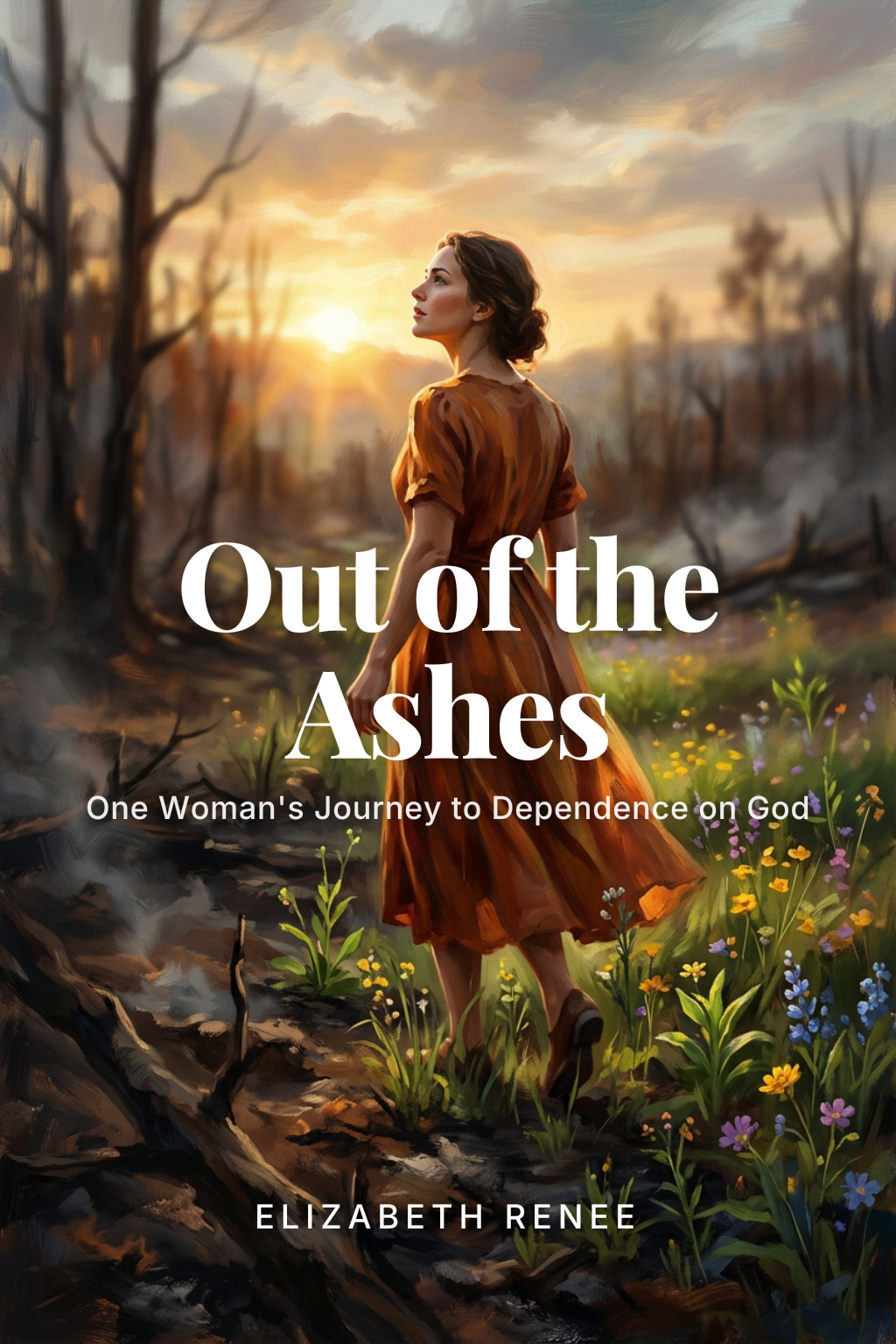
Novel · 8 chapters · 34,273 words
Out of the Ashes
Contents8 chapters
Chapter 1
The Day Leigh Walked Out
The television was loud enough to make the windows buzz.
Cartoons flashed blue and yellow across the screen, their voices bright and silly, but the room behind me carried another kind of noise—the hard scrape of a kitchen chair, a cabinet shut too fast, my mother’s voice trying to stay level and failing at the edges. I sat cross-legged on the brown carpet with one sock on and one sock missing, a plastic doll face-down near my knee, and tried to keep my eyes on the dancing figures on the screen.
Children learn the weight of a house before they learn its words. I did not know phrases like walking on eggshells. I did not know addiction, or volatility, or abuse. I only knew when the air changed. I knew when laughter from one room did not mean safety. I knew the sound of my father’s steps when he was just crossing the floor and when he was coming in hot. I knew my mother’s silence had different kinds. There was tired silence. There was angry silence. And there was the silence that went still, as if every lamp in the house had stopped breathing.
That night it was that kind.
My mother, Leigh, moved from the kitchen into the living room with a dish towel still in her hand. She was young then—far younger than I understand now when I look back—and already carrying more than one woman should have to carry. Her hair had slipped loose around her face. She had the look she often wore at the end of bad days, not defeated exactly, but braced. My father, Mitchell, came after her.
He was handsome in the way some storms are handsome from a distance. Up close was another matter. His jaw was tight. His eyes had that bright, restless shine I would later come to recognize in people who are not fully where they stand. He said her name once, sharp as a snapped twig.
She did not answer him right away. She glanced at me. It was quick, but I remember it. Mothers can say whole sentences with one look. Stay where you are. Be quiet. Please don’t make this worse. I turned back to the television because obedience felt like the only thing small enough for me to hold.
The cartoon characters kept singing. Somewhere in the kitchen, water dripped from the faucet into the sink. My doll’s yellow hair was caught under my heel. Behind me, my father said something low and ugly. My mother answered, “Not in front of her.”
I did not know then that adults often say a child’s presence ought to matter more than it does.
He stepped around the couch and came into my line of sight, blocking the screen with his body. One moment there were bright colors and singing animals; the next there was denim, belt buckle, and the shape of a man taking up all the light. I leaned first left, then right, trying to see around him.
“Daddy,” I said, because that is what children do. We call people by the names our hearts have given them, even when those names tremble in our mouths. “I can’t see.”
My mother moved fast, reaching for his arm. “Mitchell.”
What happened next stayed with me in a way some whole years did not.
He turned and slapped her across the left cheek.
The sound was flat and terrible. Not like in movies. Not dramatic. Worse. A human sound. Skin struck in a room with a child in it. My mother’s head snapped to the side. The dish towel fell from her hand. For half a second everything seemed to freeze—the cartoon voices still chirping, the faucet dripping, the television light flickering over his face and hers.
Then I was on my feet.
At four years old, I had no plan. No courage to claim as my own. Just something hot and sudden rising in me before fear could catch up.
“Stop it!” I shouted.
My little voice rang out in the living room, thin but clear. It surprised me. It surprised him too.
He looked at me then. Really looked. The room changed again.
I remember his expression more than his exact features, because terror blurs and sharpens at the same time. His face closed. His anger, which had been pointed at her, swung toward me like a door slammed open. He took one step in my direction.
My mother got between us.
She did not think about it. There was no pause. No dramatic speech. She moved with the speed of somebody whose body had already learned what danger requires. One second I could see him; the next all I could see was her back, the faded flowered shirt she wore, one shoulder slightly raised as if she could shield me with bone alone.
“Don’t you dare,” she said.
Her voice was different now. Not pleading. Not trying to smooth things over. Iron had entered it.
He kept coming until they were only inches apart. I could not see his whole face around her, only the side of it, flushed and rigid. He said something through clenched teeth. I do not remember the words. Maybe God has mercy even in memory. Some things are taken from us gently. Some are withheld.
But I remember my mother’s hand finding me behind her without looking. Her fingers touched my wrist, then gripped tight. That touch told me two things at once: she knew exactly where I was, and she had made up her mind.
When I think now of deliverance, I do not always picture seas splitting. Sometimes I picture a woman in a dim living room with one hand behind her back, reaching for her child.
The adults who hurt us often imagine their cruelty is the biggest thing in the room. They do not know how God can enter quietly and make another will stronger.
My mother did not argue long. Maybe she knew there was no argument left to win. Maybe she was too tired. Maybe when she saw his anger turn toward me, something old in her broke and something newer, fiercer, stood up. I cannot tell you all that happened inside her in that instant. I can only tell you what happened next.
She backed us away.
“Go get your shoes,” she said to me, still not turning around.
Children ask questions about everything except the moments when they know not to. I ran down the hall with one sock on and one bare foot slapping the linoleum, past the bathroom with the chipped sink, past the bedroom where a dresser drawer never shut all the way, into the room where my little shoes waited beside the bed. My hands shook so hard I put the left shoe on the right foot first. I yanked it off and tried again.
In the living room my father’s voice rose, followed by my mother’s, then by silence heavy enough to hear.
I grabbed the wrong sweater from the floor. It smelled like laundry soap and the inside of a drawer. By the time I made it back to the hall, my mother was there with her purse over one shoulder and a set of keys in her hand. Her cheek was reddening. I stared at it because children stare at what they do not understand and cannot fix.
“Come on,” she said.
My father was behind her in the living room, one hand braced on the back of the couch. “You’re being ridiculous.”
She did not answer.
“I said you’re being ridiculous, Leigh.”
Still she did not answer. She bent and scooped up the little jacket I had outgrown in the sleeves but still wore because we had it. She shoved my arms through it too fast, then tugged the zipper halfway and left it there.
He followed us to the front door.
I can still see details as small as pins from that moment. The brass lock with fingerprints clouding its shine. The dust gathered in the corners of the entry rug. The smell of cigarettes clinging to the room even though no one was smoking right then. My mother’s keys rattling in her hand. My own breath loud inside my ears.
“You walk out that door,” he said, “don’t bother coming back.”
That line belongs to thousands of houses. It has been spoken by men who thought leaving was the threat and not staying.
My mother opened the door.
Night waited on the other side, black and cold. The porch light had burned out days before. I remember that because the first step down disappeared into shadow, and she tightened her grip on me before we took it. Gravel crunched under her shoes. Somewhere a dog barked, then barked again. The air smelled like damp dirt and old leaves.
My father came as far as the doorway. “Leigh.”
Something in his voice changed. Not gentleness. Not repentance. Just calculation, quick and hard, as if he were trying to decide whether to pull us back or let us go and punish us later another way.
My mother didn’t look back.
We crossed the yard to the car, an older one with a stubborn passenger door that had to be slammed twice. She got me inside and leaned across me to lock my door with a sharp push of her thumb. Her hair fell forward, brushing my cheek. I smelled dish soap on her skin. Her breathing was fast and shallow.
Then she ran back to the house.
That part is a blur of panic in me even now. I remember pressing both palms to the car window, leaving fog prints on the glass. I remember crying, not big dramatic cries, but frightened little hiccuping ones because I thought she had left me, or that he would stop her from coming back. The front door stood open, pouring a rectangle of weak yellow light into the dark yard. Their shadows moved across it.
She came out carrying a laundry basket with clothes spilling over one side and a brown paper sack tucked under her arm. She loaded both into the back seat, shut the door with her hip, and stood still for half a breath as if listening to something no one else could hear.
Then she climbed behind the wheel.
My father appeared again on the porch. “You’ll be back.”
It was not said like hope. It was said like ownership.
My mother started the engine. It coughed once, then caught. The dashboard lights came on green and amber. Her hands shook on the steering wheel. She put the car in reverse and looked over her shoulder, her cheek swelling now in the dim interior light. I watched her mouth. She was praying.
I could not hear all of it. Just pieces.
“Lord, help me.” “Please.” “Please.”
That is enough theology for a whole life, if it is said from the bottom of a breaking heart.
We backed down the drive. Gravel popped under the tires. My father grew smaller in the rear window but did not move. He stayed in the porch lightless dark, one shape among shadows, until the road bent and took him away.
Only then did my mother let out a sound. Not a sob exactly. More like the body’s confession when strength has been carrying too much weight. She kept one hand on the wheel and reached the other across the seat until she found my leg.
“It’s okay,” she said.
It was not okay. But sometimes what a mother means is, I am still here.
I put my hand over hers. Her knuckles were cold.
The roads at night looked different when you were little. Familiar places turned strange after dark. The gas station with its humming sign looked lonely. The church parking lot seemed bigger than daytime. Porch lights sat far back from the road like watchful eyes. I did not know where we were going. I did not ask. The paper sack in the backseat rustled each time we turned. A hanger clicked against the window.
My mother drove with her jaw set, eyes fixed ahead. Every so often she glanced in the mirror. Once, she reached up and touched her cheek as if checking whether it was real. Then she gripped the wheel tighter.
As an adult, I have thought often about that drive and the thousand practical fears that must have crowded her mind. Where do I go tonight? How long can we stay? How much money do I have? Will he come after us? What do I say tomorrow? How do I make a life from this hour? Fear always brings cousins with it. Shame. Doubt. Exhaustion. But rescue does not wait until every question has an answer. Sometimes rescue is simply a car moving away from one house and toward an unknown mercy.
I did not know to call it God then. I only knew the feel of motion. The miracle of distance increasing.
At a red light, my mother finally looked at me full on. The glow from the signal washed the inside of the car in red. Her cheek had a handprint blooming under the skin.
“You listen to me,” she said softly. “None of that was your fault.”
There are sentences spoken over a child that become beams in the frame of a life. I have returned to that one more than once. None of that was your fault.
I nodded though I was crying again.
“You hear me?”
“Yes, ma’am.”
She swallowed hard, looked out through the windshield, then back at me. “You were brave.”
No one had called me that before.
I had only yelled two words. I had only been scared. But my mother, who had just stepped between me and danger, gave me a name better than fear. I think now that this too was mercy. The Lord knows how quickly children make false covenants with guilt. He knows how we take what happened around us and tuck it into ourselves as if we caused it, deserved it, invited it. He sends truth by whatever mouth is willing.
The light turned green. We drove on.
I do not remember every street. Trauma is strange that way; it preserves the color of a dish towel and erases whole miles. But I remember where we ended up first: my grandparents’ place, where the porch boards creaked in a familiar pattern and a light came on before we were fully parked, as if somebody had been awake waiting for trouble to make itself known.
My grandmother Caroline opened the door in her housecoat, already tying the belt. Behind her, my grandfather Theodore stood in the hall pulling on a pair of work pants over his undershirt. Neither asked the kind of questions that waste the first minutes of a crisis.
“Oh, baby,” my grandmother said when she saw my mother’s face.
That was all. No speech. No disbelief. She stepped back and held the door wide.
Warm air met us first, then the smell of coffee that had sat too long on the burner and Ivory soap from the bathroom down the hall. Their living room lamp threw a yellow circle across the braided rug. A Bible lay open on the side table next to my grandfather’s chair, his glasses folded neatly on top of a page as if he had only just set them down.
My mother bent to unbuckle me. Her fingers fumbled at the clasp. My grandfather came out to carry the laundry basket and paper sack from the back seat without comment. That simple act—an older man lifting our scattered things and bringing them inside—still moves me. Where one man used his hands to wound, another used his to make room.
In the kitchen, my grandmother pressed a bag of frozen peas wrapped in a dish towel into my mother’s hand. My mother laughed once through her nose at the sight of it, not because anything was funny, but because some grief comes out sideways.
“Sit down,” Caroline said.
“I’m okay.”
“Sit.”
And she did.
I climbed into my grandmother’s lap though I was getting a little big for it. She let me anyway. Her housecoat was soft from a hundred washings. I tucked my face into the crook of her neck and smelled of White Diamonds perfume. She rocked me without rocking, only a slight motion, enough to tell my body it was being held.
From there I watched my mother at the table, frozen peas against her cheek, one hand over her mouth. My grandfather stood at the counter, not hovering but not leaving either. He poured coffee into a mug, thought better of it, and emptied it into the sink. Then he filled a glass with water and set it near her elbow.
“He touch her?” he asked quietly, nodding toward me.
My mother’s head came up fast. “No.”
That one word held gratitude and fury together so tightly I could feel both.
He nodded once. Not relaxed. Not at ease. Just informed.
My grandmother’s hand moved over my back in steady passes. “You’re here now,” she murmured, more to my mother than to me. “That’s enough for tonight. You’re here now.”
I wish I could tell you all fear leaves when a safe door closes behind you. It doesn’t. Safety after danger feels thin at first, like glass that might break if you breathe wrong. Every car outside makes you stiffen. Every ring of the phone sounds like trouble finding your number. Deliverance can begin in a moment; healing often takes longer.
The phone did ring that night.
All three adults looked at it before the second ring.
My grandfather reached it first. He listened, his face going still. “No,” he said into the receiver. “You’re not coming over here tonight.” A pause. “I said no.” Another pause, longer this time. “You can talk when you’ve got sense enough to do it sober.”
He hung up and rested his hand on the wall for a second before turning around.
My mother stared at the tabletop. A wood grain knot sat directly beneath her gaze. She looked as if she had gone somewhere deep inside herself and was deciding whether to come back out.
“He knows where we are,” she said.
“Let him know,” Theodore answered. “He comes here acting a fool, he’ll leave different than he arrived.”
My grandmother shot him a look that asked for less steel in front of the child. He softened his mouth, not his meaning.
I did not understand all of it, but I knew enough. My father was not just left behind. He was still out there, beyond the lit windows, somewhere in the dark. And dark has a way of feeling larger to children when they know danger has a name.
My grandmother stood and carried me down the hall to the room where she kept extra blankets folded at the foot of the bed. She sat me on the quilt and tugged off my shoes.
“You stay put with me a minute,” she said. “Can you do that?”
I nodded.
From the kitchen came the murmur of voices, low and urgent. Cupboards opened. Water ran. A chair scraped. Life, in its ordinary tasks, kept moving. I think that matters. In houses where harm has ruled, ordinary things can become holy: a lamp switched on, a blanket spread, a glass of water set down by a shaking hand. God does not only meet us in cathedrals. He comes into kitchens at midnight and stands near the sink.
My grandmother brought me one of my mother’s old T-shirts to sleep in, the cotton thin as paper. While she changed me, I asked the question I had been holding like a stone in my mouth.
“Is Daddy mad at me?”
She stopped with the shirt halfway over my head.
“Oh, honey.” She crouched so we were eye to eye. Her hands smoothed my hair back from my forehead. “Your daddy’s choices are his own. You understand? His mad is his. It does not belong to you.”
I did not fully understand. Children rarely do the first time truth is spoken to them. But truth is a seed before it is a shelter.
“Your mama did the right thing,” she said.
“Are we staying here forever?”
Her face changed a little at that. Not because the question was silly, but because it was too big. Grown people often lie when children ask forever-questions. My grandmother did not.
“We’re staying here tonight,” she said. “Tomorrow will come tomorrow.”
There is faith in that kind of answer too.
She tucked me under the quilt and left the door cracked. Hall light spilled in, making a pale stripe across the floorboards. I could hear my mother moving around in the next room, the familiar cadence of her steps altered by weariness. Once I heard her cry, quickly muffled. Once I heard my grandfather say, “You don’t have to decide everything tonight.” Once I heard my grandmother pray from the hallway, so low it was almost a breath.
“Lord, cover this house.”
I have returned to those words often. Cover this house. She was not asking for fancy things. Not for explanations. Not for justice arranged neatly by morning. Just covering. A hand over us. Mercy at the door. Angels, if needed, posted thick around the place.
Years later, I would be able to say with confidence that God saved me that night from a life of abuse. Not because every sorrow ended there. It did not. Not because all fear vanished. It did not. But because rescue began when my mother chose the door. The hand of God was not absent because the slap landed. His hand was present in what happened next. In the cry that rose out of a little girl. In the body that stepped between. In the keys found fast. In the engine turning over. In grandparents who opened before they asked. In a child being told, before shame could root too deep, none of that was your fault.
That night, though, I only knew I was in a strange-safe bed listening for footsteps.
Sometime past midnight, my mother came into the room. I could tell by the shape of her in the doorway. She thought I was asleep. She stood there a moment, one hand against the jamb, as if she needed the wood to hold her up. Then she crossed the room and sat on the edge of the bed so carefully the springs barely sighed.
Her fingers touched my hair.
“I’m sorry,” she whispered.
Children hear apologies and often think they are being asked to forgive what was never theirs to carry. I kept my eyes closed, not because I wanted to pretend, but because even at four I understood this was one of those moments adults have with God more than with us.
“I should’ve gone sooner,” she said into the dark.
Silence answered her, but not emptiness. I know that now.
She drew a shaky breath. “I’m going now.”
The mattress lifted as she stood. Her footsteps moved to the door. Then they stopped.
“Lord,” she whispered, “I need You to help me keep going.”
There it was again. Not polished. Not church language. Need and help. The old words. The true ones.
The hall light stayed on after she left, laying that narrow gold strip across the floor. I watched it with my eyes open this time. Beyond the bedroom window was only black glass and my own faint reflection, small and still beneath the quilt. Somewhere in the house, the phone might ring again. Somewhere on some road, my father might be driving, or raging, or promising himself we would return. Tomorrow was waiting with all its unmade demands.
But between where I had been and whatever came next, a door had closed, and another had opened, and in that thin band of light across the floor I could feel, even before I had words for it, that Somebody had come with us into the dark.
Chapter 2
Alive Through the Impact
The car came out of nowhere I could name.
One minute I was thinking about something small—whether I had enough time to get where I was going, whether I had remembered to call somebody back, the ordinary scraps of a day—and the next there was a hard streak of motion at my left side and a sound like the whole world splitting open.
Metal did not crunch the way it does in movies. It screamed.
The driver’s door caved toward me. Glass burst across my lap and into my hair. My head snapped, then everything lurched sideways with such violence my teeth clacked together. For a second the air itself seemed to leave the car. I remember the steering wheel under my hands. I remember the smell—burned rubber, hot antifreeze, that sharp powdery scent from the airbag. I remember trying to pull in a breath and getting only half of one.
Then stillness, but not peace. The kind of stillness that comes right after damage.
My radio was still on. Some song I had not been listening to kept playing through a speaker that crackled now, warped and thin. The windshield was starred at one corner. A strip of weather seal hung loose near the frame of the door. Somewhere outside, a horn blared and would not stop.
I tried to move.
Pain lit through my hips so bright it almost had color. I gasped and fell back against the seat. My left leg would not do what I told it. Neither would the rest of me, not really. Shock is a strange mercy. It lets you know enough to be afraid but not enough to feel everything at once.
A face appeared at the passenger-side window, blurred at first, then sharpening into a woman with both hands pressed to the glass.
“Don’t move,” she mouthed.
I hadn’t planned to.
The passenger door jerked open from the outside. Cold air rushed in carrying the smell of oil and wet pavement. Voices pressed around me.
“She’s trapped.”
“Don’t let her move.”
“Somebody tell them we need another unit.”
I remember looking down at my shirt and expecting blood. There are moments when you decide very quickly what counts as a miracle. I saw no red blooming across me. My hands were shaking so hard my fingers seemed borrowed, but they were moving. I touched my face. My cheek stung from flying glass. That was all.
“Can you hear me?” a man asked from somewhere near my right shoulder.
“Yes,” I said, though it came out thin.
“What’s your name?”
I told him.
“Good. Stay with me. Where are you hurting?”
“My hip,” I said, and then, because the pain kept spreading lower and wider, “My pelvis. I think. I don’t know. I can’t move.”
He leaned far enough into the car that I could see the badge clipped to his belt. Not much older than a boy. Freckles over the bridge of his nose. Calm voice practiced into place.
“Okay. Don’t try. Help’s here.”
Help’s here.
Some sentences feel small when they are spoken and large when you live inside them.
People love to talk about the dramatic miracles, the sea-parting kind. I believe in those. But I have also learned to honor the quieter mercies: the person who stops, the stranger who keeps her voice steady, the way breath keeps coming after terror has every reason to seize it. The hand of God does not always arrive like thunder. Sometimes it kneels in broken glass and says, Stay with me.
I turned my head as far as I could. The other car sat crooked a short distance away, front end crushed, steam hissing from under the hood. Someone was crying near it. Someone else was cursing. Traffic had gathered itself into a stunned half-circle around the wreck, drivers standing outside their vehicles, arms folded tight across their chests as if watching from there could somehow undo what had happened.
A siren rose, then another.
The young officer kept talking to me. Questions meant to anchor me. Did I know what day it was. Did I lose consciousness. Did I hit my head. I answered what I could. Between his words I heard the small ugly noises of damaged machinery cooling down. Tick. Hiss. Drip.
Then came the medics with their clipped movements and orange bags and the backboard that suddenly made everything very serious in a way the wreck itself had not yet managed to do. One of them shone a light in my eyes. Another slipped a neck brace around me. They spoke over and around me in quick shorthand.
“Door intrusion on the driver’s side.”
“Vitals?”
“She’s alert.”
“Ma’am, we’re going to get you out, but you need to be still.”
I nearly laughed. Still was all I had.
Getting me out took time. Time stretched strange in that car. The responders worked with tools that bit and whined against twisted metal. Every vibration ran through the frame and into my bones. I fixed my eyes on one thing—the dangling pine-tree air freshener swaying from the mirror stem, absurd and green amid all that ruin—and tried not to panic.
“Look at me,” the medic said when he saw it climbing my throat. “Not at that. At me.”
So I did.
When they finally lifted me free, the sky flashed above me in broken pieces through the hands and shoulders of strangers. The pain came full then, no longer filtered. It was deep and grinding, the kind that makes your body know before your mind does that something is wrong in the center of you.
I cried out.
“It’s okay,” somebody said, though of course it was not okay.
They slid me into the ambulance. Doors slammed. The world narrowed to white cabinets, clear tubing, a blood pressure cuff squeezing my arm, the medic’s gloved hands pressing, adjusting, checking. Through the front partition I could hear the low static of a radio and words fed into it in numbers and abbreviations.
I lay there and stared at the ceiling light bolted above me. It buzzed faintly. I thought, clear as a bell, I could have died.
Not in the abstract. Not the way teenagers sometimes talk about death like it belongs to older people or bad neighborhoods or headline stories. I mean I understood, with sudden bodily certainty, that I had come within inches of not being here anymore. If that car had struck a little differently. If the metal had folded a little farther. If some hidden thing inside me had torn instead of bruised and broken.
Alive is a very plain word until it almost isn’t yours.
At the hospital they cut my clothes where they needed to. Bright lights. The cold edge of a trauma room. Questions again. Where does it hurt. Any allergies. Are you sure you weren’t pregnant. That question would mean something different later. At the time it was only routine.
X-rays. Waiting. More pain than I knew how to hold without trembling.
A doctor with tired eyes and a clipped mustache came in at last and put the films where light could pass through them. He pointed with a capped pen.
“You’ve got multiple pelvic fracture.”
I watched his pen touch the pale branches of bone on the image. He might as well have been pointing at a stranger.
“Will it need surgery?” I asked.
“Not if it stays stable.” He looked back at me. “You’re fortunate.”
There are ways doctors say the word fortunate that mean You should have fared worse.
I swallowed. “How long?”
“A while,” he said. “Healing won’t be quick.”
No, it would not.
Pain rearranges a life fast. Before the wreck, a body is something you mostly spend without thinking. Walk there. Lift that. Climb in. Get up. Sit down. Hurry. Afterward, every motion submits its own invoice. Turning in bed. Standing up. Lowering onto a toilet seat. Pulling on a pair of jeans. Coughing. Laughing, even. Especially laughing.
For weeks my world shrank to what I could reach and what I could endure.
There was wheelchair for three months, then crutches for a while, then the slow humiliating education of learning how to trust my weight again. Hallways looked longer. Stairs became negotiations. Sleep came in scraps because any wrong angle woke me. Bruises spread purple and yellow along my side. My skin carried tiny glittering grains of glass that kept surfacing days later as if the wreck wanted to leave reminders.
And yet.
I was alive.
That fact sat at the center of everything, stubborn and bright. I did not always feel grateful in a polished, church-lady way. Some days I felt sore and irritable and tired of asking for help. Some days I wanted my old ease back and did not care one bit whether such wanting sounded spiritual. But gratitude does not have to come dressed up to be real. Sometimes it is only this: I am still here. Thank You. Sometimes it is spoken through tears. Sometimes through gritted teeth. God can hear both.
I wish I could tell you the wreck changed me overnight, made me instantly wise, instantly holy, instantly aware of the value of every breath. That is not how most of us grow. A brush with death may wake you, but it does not finish the work. I still had plenty of youth in me after that. Plenty of foolishness. Plenty of fear.
Still, something had been marked.
I had seen how quickly ordinary can split apart. I had felt the thinness between one life and another. And somewhere under all the noise of recovery, under the inconvenience and pain and paperwork and explanations, a quieter knowing had started to form: God had spared me for a reason I could not yet see.
That reason did not reveal itself in some shining, easy path.
It came with two pink lines.
I was fifteen when I found out I was pregnant.
Not suspected. Not worried I might be. Not late and trying to bargain with my own body. Found out. There is a before to that moment and an after, and they do not belong to the same girl.
I stood in a bathroom holding the test with both hands, as if steadier fingers might change what it said. The room was too small for the news it contained. A towel hung crooked from the ring by the sink. There was a bottle of cheap peach hand soap on the counter and a toothpaste cap I had meant to throw away. I remember details like that because shock reaches for objects. It wants the ordinary to rescue it.
Pregnant.
The word did not fit in my mouth. It felt adult and enormous and impossible. I was still in school. Still young enough for people to tell me where to be and when. I had barely figured out who I was, and now my life was dividing cleanly into before and after again.
I sat down on the closed toilet lid because my knees had gone weak.
Fear came first. Not gentle fear. Not the sort that can be reasoned with. Fear with sharp elbows. Fear of what people would say. Fear of the look on faces. Fear of disappointing everyone who had hoped I would have an easier road. Shame tried to walk in right behind it, carrying all the words the world keeps ready for girls in trouble.
You ruined your life. You should have known better. This is what happens. This is who you are now.
The enemy is not creative. He is repetitive. He takes a hard thing and offers you a name for yourself inside it.
I cried until my nose stopped up and my chest hurt. Then I washed my face with cold water and stared at myself, not in some dramatic way, just long enough to see that no visible thing had changed and yet everything had.
My mother was the one I had to tell.
I found her in the kitchen. She was standing at the counter with a grocery receipt unrolled beside her, circling prices with a pen that had “Bank” printed on the side. Supper dishes were still in the sink. The overhead light made a pale triangle on the linoleum.
She looked up once and stopped writing.
“What is it?”
Mothers know by the face.
I opened my mouth and nothing came out. The test was in my pocket wrapped in toilet paper, as if that made it less real. My throat tightened so hard it burned.
“Patsy,” she said, quieter now.
I pulled the test out and set it on the counter between us.
For a second she did not touch it. Her eyes moved from me to it and back again. She pressed her lips together. I saw a flash of a dozen things in her face—shock, hurt, calculation, the immediate rearranging of a future she had not chosen either.
Then she drew in a breath and put her hand flat on the countertop.
“Are you sure?”
I nodded.
“How long have you known?”
“Just now.”
She looked away toward the sink. Out the window above it, dark had already settled. Her shoulders rose and fell once.
I braced myself for anger. Maybe I deserved some. Maybe she did not have the strength left in her for softness. Life had already handed her enough.
Instead she asked, “Have you told anybody else?”
“No.”
“All right.” She took the test and wrapped it back up without looking at it again. “We’ll make a doctor’s appointment.”
That was all, and it was not all. There are moments when love does not look tender. It looks like a woman refusing to collapse because if she does, both of you will go down.
I started crying harder then, because her calm made room for what I had been holding.
“I’m sorry,” I said.
She came around the counter and put her arms around me. I felt her chin rest on my head just for a second.
“I know,” she said.
Not It’s fine. Not Don’t worry. Not a lie.
Just I know.
That is one of the ways God keeps people alive—through the person who does not abandon you in the doorway of your worst news.
The days after that were full of practical things. Appointments. Forms. Counting weeks. Telling who had to be told. Each step made it more real. The clinic smelled like disinfectant and paper gowns and stale coffee from a machine in the corner of the waiting room. Women sat with their purses in their laps and looked anywhere but at each other. A daytime talk show played low on a television bolted near the ceiling.
When the nurse called my name, I followed her past laminated posters of fetal development and warnings about smoking. She checked my blood pressure, my weight, my chart. All the while I felt split down the middle—young enough to want someone to say this was all a mistake, old enough to understand it was not.
At school, news travels with legs.
Some people were kind in that careful, almost embarrassed way people are when they don’t know what kind of kindness you can bear. Some avoided me. Some looked too long. Some said exactly what shame would say if it had a mouth and a locker down the hall.
I learned quickly that public opinion is a terrible savior.
One afternoon a girl I barely knew caught up with me between classes, books hugged to her chest. We had algebra together, I think. She was not a close friend. Maybe that is why her words have lasted.
She said, “People are talking.”
“I know.”
She shifted her books and looked straight at me. “They always do.”
Then she walked on.
It was such a small sentence, but it loosened something in me. They always do. About one thing or another. If it isn’t this, it’s that. If not your failure, then your family. If not your family, then your money, your body, your marriage, your grief. Crowds have never struggled to find a stone. Knowing that did not make the whispers pleasant. It did remind me they were not God.
God dealt with me differently.
Not through thunder. Not through a voice from the ceiling. Through steadier things. A Scripture heard at the right time. A song catching in my chest while I sat alone. My mother showing up again and again in the stubborn language of meals, rides, appointments, and bills. A teacher sliding extra work across a desk and saying, “If you want to finish, I’ll help you finish.”
That teacher’s room smelled faintly of dry-erase marker and old paper. She wore sensible shoes and kept peppermint candies in a cut-glass dish by the attendance sheets. I can still see her tapping a stack of assignments square on her desk.
“You’ve missed some days,” she said.
I looked at the floor. “I know.”
She waited until I raised my eyes.
“I didn’t ask whether you knew. I asked whether you want to graduate.”
The question landed heavier than the packet she handed me.
“Yes,” I said.
“Then start here.”
I took the papers. They seemed impossible. So did most worthwhile things at first glance.
There is a lie young mothers hear, especially young mothers with people watching for them to fail. It says, This is the end. Another lie says, Because this happened, nothing good can happen now. But God has never required a clean beginning before He can write grace into a life. He is not frightened by a mess. He is not wringing His hands over what people said in the hallway. He steps into wreckage all the time. That is half the Gospel.
My life then was not neat. I was carrying a child while still carrying homework, still trying to make sense of myself, still learning how to stand under the weight of consequence without letting it become my whole identity. I got tired. I got scared. There were nights I stared at the ceiling and counted costs instead of sheep. Diapers. Formula. Where would I live. How would I finish school. What kind of mother could a girl be when she still felt, in some corners of herself, like somebody’s child?
I asked God questions I did not know how to decorate.
What am I supposed to do? How am I going to do this? Did I ruin everything? Are You still here?
The answer to the last one came before the others.
Yes.
Sometimes that yes was all I had. It did not explain. It did not erase consequences. It did not magically remove hard conversations or hard looks or hard math. But it kept me from drowning in the lie that I had been left alone with the wreckage.
As my body changed, so did my sense of time. Pregnancy measures life in weeks, in appointments, in growth. School measures it in semesters, report cards, due dates. I was living inside both clocks at once.
There were mornings I sat at a desk trying to focus on a worksheet while nausea turned my stomach inside out. There were afternoons I walked halls with one hand pressed low against my abdomen, not because there was movement yet, but because some instinct in me had already started guarding what I carried. I became aware of every stair, every chair, every long wait. Girls my age talked about dances and weekend plans and whose truck was in whose driveway. I worried about whether I would have enough money for baby things and whether I could finish assignments before another appointment took me out of class.
Still I kept going.
That phrase can sound small until you consider how many people stop. Kept going to school. Kept going to appointments. Kept getting up when I wanted to pull the blanket over my head and disappear from everybody’s sight. Kept believing, however shakily, that God had not brought me through one collision only to leave me in the next.
By sixteen, I was carrying more than a backpack.
Graduation came in a room that smelled like floor wax and hot lights. Folding chairs lined the space in stubborn rows. Tassels brushed cheeks. Families fanned themselves with programs because too many bodies and too much waiting had turned the air close. Somewhere a baby cried, then quieted. Someone’s aunt laughed too loudly in the back before being shushed.
I stood in the cap and gown they had handed me and felt the oddness of it all. Sixteen years old. Pregnant. About to graduate. Not the path anyone had planned. Not the path I had planned either.
When my name was called, it sounded both familiar and strange over the microphone. I walked across the stage careful and steady, aware of my body in a way I had been since the wreck. Aware too that there had been more than one moment when this crossing might not have happened at all. If the car in 2003 had hit a little differently. If shame had convinced me to disappear. If exhaustion had won. If I had listened more to voices in hallways than to the quiet persistence of God.
The diploma cover they put in my hand was lighter than I expected.
I looked out once, quick, toward the crowd. Found my mother. Tears on her face, though she was smiling. A grandmother’s hand near her shoulder. Family who knew more than the people clapping politely around them. Family who understood that some victories do not come draped in perfect circumstances. Some arrive limping. Some arrive with stretch marks and overdue assignments and a heart that has been scared half to death. They count anyway.
Especially those.
After the ceremony, people spilled into the parking lot in clusters, carrying flowers in cellophane and taking pictures under a sky going gold at the edges. My cap felt itchy. My shoes pinched. Somebody handed me a bouquet from the grocery store, carnations and baby’s breath tied with ribbon that kept twisting in the breeze.
My mother touched the side of my face.
“You did it,” she said.
I smiled, but tears had already risen. “I almost didn’t.”
“But you did.”
That is the kind of sentence the Lord has repeated to me in different forms all my life.
You almost died in that car, but you didn’t. You almost let shame name you, but it didn’t. You almost quit, but you didn’t.
Not because I was so strong on my own. I was not. Sometimes I was held together by prayer and stubbornness and the fact that morning keeps coming whether you feel ready for it or not. Sometimes I was carried by the faith of other people until mine could walk on its own feet again. Sometimes all I had was enough grace for the next hour.
That is still grace.
We took pictures anyway. Me holding flowers. Me beside my mother. Me in the dark blue gown, one hand under the curve of my belly without thinking about it. In every photograph from that night there is joy and strain sharing the same frame. That feels honest to me now.
Because encouragement is not pretending hard things are easy.
Encouragement is saying God was there too.
He was there in the wreck when metal folded and I lived. He was there in the months after, when healing came slow. He was there in the bathroom with the test in my shaking hands. He was there in my mother’s kitchen when she chose help over rejection. He was there in classrooms, clinics, whispered prayers, and late-night fears. He was there when my name was called and I crossed a stage I had every reason not to reach.
If you had looked at me then, you might not have called me victorious. You might have called me young, frightened, complicated, maybe even foolish. Some of that would have been true. But heaven has always recognized things earth overlooks. A bruised reed. A girl trying to keep going. A life that looks off-course to everybody but God.
That evening, after the pictures and congratulations and the scraping of chairs being folded and stacked, I carried my gown over one arm and walked slowly to the car. The parking lot was thinning out. Engines started. Headlights blinked on. Somewhere behind me, laughter lifted and drifted away.
I slid into the passenger seat and set the flowers in my lap.
For a moment I sat without shutting the door.
The smell of carnations rose sweet and peppery from the bouquet. My lower back ached. My future felt larger than I knew how to hold. Graduation had not solved anything, not really. There would still be a baby. Bills. Sleeplessness. Need. More growing up than I had expected to do so soon. The diploma was not an ending. It was proof of passage and a threshold at the same time.
Across the parking lot, a row of seniors leaned against their cars, bright and loud, shouting plans into the warm dusk as if the road ahead were theirs for the taking.
I remember touching the edge of the diploma cover with one hand and my stomach with the other.
Behind me was wreckage I had survived. Ahead of me was a child I had not yet met.
And between those two mercies, with the car door still open and the noise of everybody else’s future carrying across the lot, I heard my mother call my name and saw her standing beside our car, keys in hand, waiting for me to decide whether I was ready to be driven home—or whether this was the moment I would have to start learning how to carry both fear and promise into the dark at once.
Chapter 3
Henry’s Borrowed Breath
By the time they started speaking in shorter sentences, I knew something had shifted.
Until then the room had been all motion with a kind of practiced calm to it—the rustle of paper, the click of metal trays, a nurse adjusting a monitor without looking at it, another one smoothing my blanket as if neat corners could steady a body that had already decided it was done being managed. Labor has its own sound. Not loud, exactly. More like waves hitting different parts of the same shore. Breath. Footsteps. Rubber soles. A voice saying, “Again.” Another saying, “Stay with me.”
Then the doctor looked up, and whatever was in her face made the air thin.
“Patsy,” she said, “I need you to listen.”
I remember the fluorescent lights first. I remember how one of them had a faint buzz, high and constant, and how strange it was that I could hear that when so much bigger was happening inside my own body. I remember the scent of antiseptic and warm linen and the sharp iron smell that had begun to rise under everything else.
Some part of me already knew before she said it.
“The placenta is not releasing the way it should.”
She did not rush the words. Doctors know when a sentence needs to land.
I had heard enough in previous pregnancies to know what she meant, or at least enough to fear it. Placenta accreta. The placenta growing where it should not grow, clinging where it should let go. A thing meant to nourish becoming a danger by refusing to leave.
Someone moved near my left shoulder. Someone else tightened a blood pressure cuff around my arm until my fingers tingled.
“Is my baby okay?” I asked.
That is what mothers ask first, even while the edges of the room begin to blur.
“We’re working on him,” she said. “I need you to stay with us.”
Working on him.
Those words have stayed in me all these years because of what they meant and because of what they did not. Not he’s crying. Not he looks good. Not congratulations.
Working on him.
My son, who had not yet drawn a breath.
The room split then. Not in half, exactly. More like my mind did. One part of me stayed pinned to that bed, feeling the pull and pressure and pain, hearing instruments laid down and picked up again, feeling hands where I could not see them. The other part of me strained toward the corner of the room where they had taken Henry.
I could not see his face from where I was. Only movement. A nurse stepping aside. A respiratory therapist leaning in. The warmer light cast over that area was yellower than the ceiling light, and under it I could see the shape of a tiny body, still too still.
No cry.
If you have never waited for a baby to cry, you may think of silence as the absence of sound.
It is not.
It is its own force. It presses. It crowds. It has weight.
I heard someone say, “Come on.”
Another voice: “Still no respirations.”
Then, “One minute.”
One minute is nothing in ordinary life. A stoplight. A microwave. A voicemail you decide not to leave.
One minute while your child does not breathe is an ocean.
I turned my head as far as I could. “Why isn’t he crying?”
No one answered me right away, which was answer enough.
My hands were cold. Cold in that unnatural hospital way, though sweat dampened the back of my neck and my hairline. I started praying before I knew I had begun.
Jesus.
Jesus, please.
Please.
Not polished prayer. Not church prayer. Not the kind you say aloud when people nod and murmur amen. This was the prayer of a woman on a table, cut down to one need.
Give him breath.
The doctor at my bedside said my name again. There was urgency in her voice now, though she kept it low. “We need to stop the bleeding.”
I wanted to tell her she could do whatever she needed to do as long as my baby breathed. I wanted to climb off that bed and crawl to him if I had to. Instead I lay there with monitors clipped to me and fear moving through me in hard, hot waves.
Somebody called out, “Two minutes.”
I have been through frightening things in my life. I had already learned by then that disaster can arrive without asking permission. But there is a helplessness in childbirth when things go wrong that is particular to itself. You are split open by love and weakness at the same time. Your body is no longer private. Your prayers no longer sound like anything you would have written down ahead of time.
There were voices all around me, but I kept listening for one voice only.
A cry.
Nothing.
“Bag him again.”
Three minutes.
The room narrowed until there was almost nothing left in it but the corner where my son lay and the pounding inside my own chest. My mouth was dry. My vision kept swimming at the edges. I remember one nurse touching my shoulder, not to restrain me but to anchor me there.
“Talk to him,” she said softly.
I do not know if she meant for Henry or for me.
“Baby,” I said, and my voice cracked on the one word. “Henry. Mama’s here. Henry, breathe.”
Four minutes.
People talk about miracles as if they always arrive with brightness on them, as if everyone in the room knows in the moment what they are witnessing. That is not how it was. There was no music. No sudden stillness. No golden sweep of certainty.
There was a small, rough sound.
Then another.
Then a cry, thin at first, indignant and ragged, but a cry all the same.
I cannot explain to you what that cry did to me. My whole body broke with it. Tears came out of me hard and immediate. I turned my face toward the pillow and sobbed as if I had been holding back a flood and some merciful hand had finally opened the gate.
“Thank You,” I said.
I said it again.
And again.
Across the room someone laughed once in relief, breath leaving fast. Another voice said, “There we go.” There were still things wrong. I knew that from the movement that continued around him and around me, from the clipped voices and the pressure in my abdomen and the blood they still had not fully gotten under control. But my son had entered the world breathing, even if late, even if by what looked to men like a thread.
The doctor leaned over me. Her mask was on, but her eyes had changed.
“He’s here,” she said.
Here.
Not gone. Not almost. Not lost.
Here.
I did not get to hold him right away. That is another thing people do not always tell you about hard births. Sometimes the pictures in your mind are handed back to you in pieces. You imagine skin to skin, a baby tucked under your chin, the first count of fingers and toes. Instead there may be distance. Machines. A nurse carrying your child past you with purpose in her steps.
I caught a glimpse of his face then. Damp dark hair plastered close. A mouth open in complaint. Eyes squeezed shut against the assault of light. He was alive enough to protest being here, and I loved him so quickly it felt less like a beginning than a recognition.
Then he was gone to be checked, and I was left with the other emergency—my own body still refusing to close the door behind birth.
They worked on me while they worked on him.
I will not dress that part up. It was frightening. There was too much blood. Too many hands. Too many instructions I could not quite follow because I kept trying to listen beyond the curtain of noise for signs of my baby. But God gave me a strange steadiness in the middle of it. Not peace exactly. Peace sounds softer than what it was. This was something firmer. A rod driven down through panic. A knowing that I was not alone on that table, not even there.
When they finally let me see him up close, he was swaddled tighter than I expected, as if the world had already made rough demands on him and somebody was trying to gather him back together. His face was pinker by then. His breathing was not pretty. It had a labor to it, a little hitch between efforts, but it was there.
I put one finger against the edge of his hand.
He curled around it.
That was all. One grasp. One tiny fist around my finger.
And I remember thinking, You fought to get here.
I did not know then how many more fights there would be.
The weeks after Henry’s birth did not settle into ordinary life the way I wanted them to. Some babies come home and seem to fit the world as if they had always been intended for it. Henry was never casual about surviving. Even as an infant, there was a kind of hard-won quality to him, as though every good report had to be reached for, every quiet day received as a gift rather than assumed as a right.
There were appointments. Questions. Little worries that became bigger ones and then, sometimes, folded back down into watch-and-wait. If you have had a medically fragile child, you know that phrase. It sounds passive. It is not. It is its own labor. You watch the color of their lips. You count breaths. You learn the meaning of words you never wanted added to your vocabulary. You keep diaper bags packed with more than diapers. You memorize the layout of waiting rooms. You get used to saying, “Something just doesn’t seem right,” even when you cannot yet prove it.
At four months old, Henry and I went with Michael to a doctor’s appointment that was not even for Henry.
That is how quickly a day can change.
The pediatric office sat in a squat brick building with a faded mural of zoo animals in the waiting room. The giraffe’s neck had a chip in the paint near the ceiling. The toy box in the corner held three headless action figures, a board book with teeth marks on the cover, and a plastic stethoscope that had not worked in years. Somebody had tried to make the place cheerful with primary colors and cloud-shaped decals, but all doctor’s offices smell faintly the same—bleach, paper, hand sanitizer, old carpet.
Michael was there for his own appointment, and I had Henry with me because that is what mothers do. We carry one child to tend another and call it normal. Henry was in his car seat, bundled lightly. I remember brushing my knuckle across his cheek while we waited and noticing that his breathing sounded louder than it had that morning. Not wheezing exactly. More like each inhale had to travel farther than it should.
When the nurse called us back, I lifted the carrier and felt that little warning tighten in my chest.
In the exam room, while Michael sat swinging his legs from the edge of the table paper, Henry made a soft grunting sound.
The doctor looked over.
“Has he been doing that long?”
I glanced down. “He’s had a cough. He’s been a little congested.”
The doctor stepped closer, then crouched to Henry’s level. He put two fingers against the blanket, not touching Henry at first, just watching him. There are moments when a professional face goes still in a way that empties the room.
“Take his shirt off,” he said.
I unsnapped the tiny buttons with clumsy fingers. Henry’s chest was pulling in under his ribs every time he breathed.
Retracting.
I did not know that word yet, but I understood the look on the doctor’s face.
He turned to me, direct and quick. “You need to take him to the emergency room right now.”
My stomach dropped. “How serious is it?”
“Don’t go home first. Don’t stop anywhere. Go now.”
Something in me went cold and sharp. Mothers recognize that tone. It is the tone that strips denial off a situation and leaves only what must be done next.
I gathered Michael, gathered Henry, gathered papers I do not remember seeing, and got us to the car with my heart banging against my ribs hard enough to hurt. Michael asked questions on the way and I answered the way mothers answer while fear rides shotgun.
“His breathing needs checking.”
“We’re going to let the doctors help him.”
“It’s going to be okay.”
The last one I said by faith, not evidence.
The emergency room moved fast once they saw him. Faster than I liked. Faster than I was ready for. A pulse ox clipped to his tiny foot. A nurse frowning at a screen. Another hand already reaching for oxygen. The fluorescent lights there were harsher than at the pediatrician’s office, and the curtain around us never seemed fully shut. Voices drifted in from the hall—someone asking for labs, a child crying two rooms down, a phone ringing unanswered and then answered on the fourth or fifth ring.
A respiratory therapist listened to Henry’s chest and looked at the doctor. They did not say much in front of me. They did not need to.
Then one of them said, “We’re sending him to Children’s.”
The word sending did something to me. It made it real in a new way.
“By ambulance?” I asked.
“Yes.”
I remember signing papers with a hand that did not feel attached to me. I remember calling family. I remember trying to arrange where Michael would go because crises do not clear your ordinary responsibilities; they pile on top of them. I remember Henry’s little nostrils flaring with each breath, his chest working so hard for air that it seemed impossible a body so small was being asked to labor that much.
The ambulance ride to Children’s Hospital was all siren and vibration and the smell of plastic tubing. I rode with Henry. There was no room in that compartment for the luxury of falling apart. The paramedic adjusted his oxygen and watched the monitor over Henry’s head. I watched Henry.
His eyes looked wrong to me—not unfocused, exactly, but too tired. Four months old and tired in a way no baby should be.
“Stay with us, little man,” the paramedic said.
I put my hand on Henry’s leg through the blanket and prayed without stopping.
Lord, You gave him breath once.
Do not let it leave him now.
Children’s Hospital was bright in that way some hospitals are, as if brightness itself might fight despair. Automatic doors. Waxed floors. Cartoon fish painted along a hallway wall. A volunteer at a desk. Families carrying overnight bags that told on them before they ever spoke. All around me were people who had learned the same lesson: when your child is sick enough, the world narrows to hallways and numbers and whether a doctor uses the word stable.
Within minutes of arriving, Henry’s airway collapsed.
There are scenes that never leave your body. This is one of mine.
They had just brought us in. Somebody was still asking me questions—birth history, symptoms, how long he had been sick—and then the rhythm of the room changed. Henry’s breathing, which had already been bad, stopped sounding like breathing and started sounding like a failing attempt at it.
A nurse leaned over him. Another one called for help. The monitor alarmed in quick sharp bursts that cut right through thought.
Then people came from everywhere.
Hands. Scrubs. Masks. Orders I could not process fast enough.
Move here.
Give me that.
Get respiratory.
Now.
One second I was at the bedside, the next I was backed against the wall because there was simply no space left for me in the circle around my son. I hated that wall. I hated every inch of tile and paint behind me. I wanted to tear through all of them and get to him, but all I could do was press my own fist against my mouth and watch strangers fight for my baby.
His little body disappeared under adult hands.
Someone fitted a mask over his face. Someone else tilted his chin. The doctor’s voice was level, which made it more frightening, not less.
“Come on, Henry.”
That was the first time I remember hearing one of them say his name.
I started crying then—not loudly, not dramatically, just tears spilling while I stood there useless except for prayer. I said Jesus under my breath so many times it stopped feeling like a word and became a rope.
A nurse touched my arm once, briefly. “We’re helping him.”
I nodded because I could not speak.
Then, after what may have been seconds or hours—I still could not tell you—the panic in the room shifted downward a notch. Not gone. Just altered. They had gotten air moving again. Not enough to send anybody home, not enough to let me unclench, but enough to keep him with us.
“He’s going to PICU,” somebody said.
The Pediatric Intensive Care Unit is its own country. It has its own sounds, its own light, its own way of teaching you what matters and what does not. In the PICU, the curtain between ordinary life and crisis is gone. Machines breathe, beep, pump, pulse. Nurses notice things before monitors do. Parents sleep sitting up, if they sleep. Time is no longer measured by meals or errands but by medication schedules, oxygen levels, and whether the next blood gas is better or worse than the last one.
Henry was put on bi-pap.
Until then I had not known how violent help can look. The mask seemed too big for his face. The straps around his head looked severe. The machine pushed air into him with a rhythm that was mechanical and merciful all at once. Every few seconds it gave a soft forceful sigh, and his tiny chest moved with it.
He hated it.
Of course he did. He cried under the mask at first, a muffled, outraged sound that made my own chest ache. I put my hand against the top of his head where the straps did not cover and stroked the damp hair there.
“It’s okay,” I whispered, though I knew enough to stop using the words like a promise. “Mama’s here. I’m here.”
Hours bled into one another. Daylight and night took turns at the window and I barely registered either. Nurses came in with syringes, suction, charting computers on rolling stands. The room smelled like sanitizer, warmed formula, adhesive, and that dry cold hospital air that seems to wick moisture out of everything human. I learned to read the monitor before anyone taught me. Heart rate. Oxygen saturation. Respiratory rate. Green line. Blue number. The tyranny of decimal places.
When they would let me, I held his hand. When they would not, I touched his foot, his arm, the edge of his blanket. A mother becomes fluent in contact by fragments.
Family came and went. Prayers came by phone, by text, by whispered circles in waiting rooms, by church people who showed up carrying coffee and casseroles and those careful faces believers wear when they want to say God is good without stepping on your fear. Some of them said the right things. Some did not. I learned to accept love even when it arrived clumsy.
One night in the PICU, after the unit had dimmed but not quieted, I stood by Henry’s bed and watched the bi-pap lift and release, lift and release. His eyelashes lay dark against cheeks that looked too thin under hospital light. A cartoon muted on the wall flickered blue and green over the room though no one was watching it. Somewhere down the hall a child cried out in pain, and then stopped.
I bowed my head over the rail of his bed.
“Lord,” I said, so quietly only God and maybe the machines could hear me, “I know You can heal him. I know You can. But if You are going to ask me to keep trusting You minute by minute, then You will have to help me do that too.”
That may be the truest prayer of my motherhood.
Not just heal him.
Help me trust You while I wait.
Because faith sounds strong when we tell the story later. In the middle of it, faith can look like a woman who has not brushed her hair in two days, whispering Scripture she only half-remembers while staring at a monitor she wishes she had never learned to read. It can look like thanking God for an oxygen number rising from eighty-eight to ninety-two. It can look like choosing not to borrow grief from an hour that has not yet come.
The days in PICU taught me a kind of daily manna. Not enough for next month. Not enough for a lifetime. Enough for the next doctor rounding. Enough for the next set of vitals. Enough to sit through the next procedure without dissolving.
Henry stayed there eight days.
Eight days of alarms and updates. Eight days of watching his little body labor and then, slowly, labor less. Eight days of hearing terms that made him sound like a case before he sounded like a baby: RSV, airway compromise, respiratory distress. Eight days of seeing God hide mercy inside technology and training and timing.
Because timing mattered too. If that doctor had not noticed the retractions at Michael’s appointment. If I had gone home first. If I had waited to see whether Henry improved on his own. If the ambulance had been delayed. If Children’s had not been ready.
We call those details circumstances.
I call them provision.
By the time he came off bi-pap, I had almost forgotten how his face looked unobstructed. They replaced the mask with other support, then less support, then less again. The first time I saw him take a fuller breath on his own, I cried as hard as I had the day he was born. Not because I thought the road was over. By then I knew better. I cried because I had seen too closely how little separated us from loss, and still the Lord had placed one more day in my hands.
Not long after that season, one of the doctors said something to me I have never forgotten.
He was not trying to preach. He was speaking from medicine, from data, from what did and did not make sense in the charts and scans and outcomes. His coat pocket was heavy with pens. He had the tired eyes of someone who had seen many children hurt and some children not make it.
“There is no scientific reason,” he said, “that this child should be alive.”
He meant it plainly.
I received it as testimony.
Because science can tell you what should have happened.
It cannot overrule God about what did.
I do not say that lightly. I thank God for doctors. I thank Him for respiratory therapists, ambulances, monitors, medicine, and every trained hand that touched my son. I believe the Lord works through those things. But I also know the difference between treatment and breath. Between intervention and life. Between what medicine can explain and what only mercy can account for.
Henry’s life has never let me keep God at a distance. His story refused that from the beginning. Four minutes without breath at birth. A collapsing airway at four months old. A doctor looking at the facts and admitting they did not add up.
There are people who only know how to believe in God when life arranges itself politely. Then there are those of us who met Him where the numbers fell wrong and the room filled with urgent voices and still, somehow, our child stayed.
I wish I could tell you that after those eight days I stopped being afraid. I did not. Love leaves you open, and motherhood most of all. There were more diagnoses ahead, more hospital rooms, more reasons to grip the edge of a chair and pray. But something settled in me during those first battles over Henry’s breath. Not confidence in outcomes. Something better.
Confidence in God’s nearness.
Not a guarantee that every story on earth ends the way I want it to. I know too much to say that carelessly. But a certainty that no monitor beeps outside His hearing. No ambulance moves beyond His sight. No mother stands in a PICU alone, no matter how lonely the room feels at three in the morning.
That conviction did not make me less human. I still asked questions. I still cried in hospital bathrooms. I still watched nurses’ faces for clues before they ever spoke. But under all of that ran a deeper current: God had already met Henry at the edge of life more than once, and if He chose to keep carrying us, He would not grow tired halfway through.
On the day we left the hospital, I buckled Henry into his car seat with the careful slowness of someone handling treasure. The discharge papers were thick. The instructions were many. I nodded through them all and held them like they might flutter apart if I loosened my grip. Henry looked impossibly small in that seat, as if eight days of machines and alarms should have made him larger, or older, or more equal to what he had endured.
Instead he yawned.
Just that. A baby yawn. Ordinary and holy enough to undo me.
In the parking garage, the sound of our footsteps echoed off concrete. I loaded the seat into the car and stood with one hand on the door before getting in. For a moment I just watched him through the rearview mirror. His chest rose. Fell. Rose again.
Breath, doing what breath was made to do.
I should have felt only relief. Instead I felt relief braided with something sharper, because by then I understood that miracles do not always come as endings. Sometimes they come as continuations. Not the close of danger, but permission to keep walking inside it with God.
I started the car.
In the back seat, Henry slept under the hospital blanket they let us take home, his face turned slightly toward the window, his breath too precious now to ignore and too regular to trust without gratitude. I drove out past the gate arm and into the road carrying discharge instructions, leftover fear, and a child a doctor could not explain, and before the hospital disappeared in my mirror I heard myself say aloud into that small moving space, “Lord, if You’ve kept him this far, what are You keeping him for?”
Chapter 4
The Boy Who Kept Coming Back
By the time Henry was four, I had learned the sound of danger in more than one form.
There was the sharp, machine-made kind I knew from hospitals. The flat alarms. The clipped voices that got quieter, not louder, when a room turned serious.
And then there was the sound that came at home, ordinary until it wasn’t.
A spill.
A cry.
A silence one beat too long before the scream.
I remember the smell first. Not smoke. Hot grease.
It had that thick kitchen smell that clings to the curtains and settles into your hair, the smell of supper halfway made and life moving in six directions at once. A pan sat on the stove. Somebody needed a drink. Somebody else was talking over somebody. I was doing what mothers do—turning from one need to the next, believing I could hold all the pieces because it was just another day.
Then Henry screamed.
Not a startled cry. Not a bumped-knee cry. This was different. It tore straight through the house and landed in my chest before my mind caught up.
I ran.
What happened next lives in me in flashes, not in a neat line. The pan. The splash. Henry crumpling inward toward the pain. My own voice, too loud and not loud enough at the same time. The way every other child in the room went still because children know, faster than adults sometimes, when something has shifted past normal.
I got to him and saw his leg.
There are things a mother sees once and never forgets. I will not try to decorate that moment with language. It was bad. Bad enough that my hands shook. Bad enough that every instinct in me rose up wild and useless, wanting to trade places with him, wanting to rewind one minute, wanting to be somebody who had prevented this.
“Get the keys,” I said to whoever was nearest. “Now.”
My voice sounded strange, like it belonged to a woman standing beside me.
Henry was crying so hard he could barely pull air between sounds. I scooped him up as carefully as I could, afraid to touch him and afraid not to. The heat from the burn seemed to radiate through everything. He clung and bucked and cried for me, and I kept saying his name because it was the only thing I could think to give him.
“It’s okay. Mama’s here. Mama’s here.”
It was not okay. But I was there.
The drive blurred. Red lights. My grip on the steering wheel. Henry’s cries turning ragged in the back seat, then rising again when the car jolted over railroad tracks. I prayed out loud the way people do when they no longer care whether their sentences are polished.
“Jesus, help him.
Jesus, help me think.
Jesus, please.”
At the hospital, the automatic doors opened on cold air and disinfectant and fluorescent light. I carried him to the desk, and whatever my face looked like did the explaining for me before I got the words out.
“He’s burned. His leg—please.”
They moved fast. A nurse met us with a wheelchair I did not need, another with towels, another asking questions while trying not to ask them all at once.
“How old?”
“What happened?”
“When did it happen?”
“Any allergies?”
Four years old. Hot grease. Just now. No, none that I knew of.
Henry had gone from screaming to shuddering. That scared me more.
A doctor in blue scrubs bent over his leg with the grave attention of someone trying not to waste a second. The room smelled like sterile water and ointment. Wrappers tore open. Metal clinked against metal. A monitor was rolled in though his trouble was not his breathing this time, and I remember noticing the absurd comfort of hearing numbers appear anyway. Heart rate. Oxygen. Proof that his body was still working at the things it was supposed to do.
“He’s got second and third degree burns,” the doctor said.
He said it directly, because there are moments when plain words are kinder than soft ones.
My stomach dropped so hard it felt physical.
“Will he be okay?”
He did not answer right away. He was studying the area behind Henry’s knee, and I watched his face the way I had watched so many faces before his. Looking for the part they didn’t say aloud first.
“The concern,” he said, “is location as much as severity.”
I knew enough by then to hear the rest without him giving it to me. Joints. Movement. Healing wrong. Skin tightening as it repaired. A child growing into a scar that would not stretch with him.
He touched the place gently and Henry cried out.
“If this contracts behind the knee,” the doctor said, “it can affect function. He may need follow-up with a burn specialist. We’ll treat him, dress it, and we’ll talk through wound care. But I want you prepared that this may be a long road.”
Prepared.
As if any mother is ever prepared.
They gave him pain medicine. They cleaned what needed cleaning. They wrapped his leg in white layers that made the injury disappear from sight without making it less real. Henry finally sagged against me with those exhausted little hiccups children get after deep crying, his eyelashes stuck together, his cheeks blotchy and damp.
I sat on the hospital bed with him in my lap and nodded while people explained things. Dressing changes. Infection watch. Follow-up appointments. Range of motion. What to do if fever started. What healthy healing looked like. What bad healing looked like.
I heard every word and felt like I was underwater.
At home, the burn supplies gathered on the counter like a second pantry. Gauze, tape, ointment, scissors, little packets that had to be torn with clean hands. The routine of care took over the rhythm of our days. There is a particular kind of ache in being the one who has to hurt your child a little in order to help him heal. Unwrapping. Cleaning. Rewrapping. Telling him, “I know, baby, I know,” and meaning it only partly because I did not know his pain, only my own helplessness in the face of it.
He dreaded the dressing changes. I dreaded his dread.
Sometimes he would bargain.
“Can we do it later?”
“No, honey. We have to do it now.”
“Just five minutes.”
“I know. But now.”
Sometimes he would clamp his jaw shut and turn his face away before I even touched the bandage. Sometimes he would cry. Sometimes he would be so brave it nearly undid me worse than the crying did.
And all through it was that one fear: behind the knee.
At every visit I watched the doctors assess the skin, the healing, the bend of his leg. I watched them look for limits. I looked too. A mother becomes a student of small movement when enough has been threatened. I learned to notice what other people would miss—the angle of a step, the hesitation before bending, the guarded way he lowered himself to sit.
One afternoon, farther into healing than I had dared hope, the specialist had him stand and bend.
“Again,” he said.
Henry did.
“Straighten it.”
He did.
The doctor glanced at me over his chart.
“No contracture.”
I stared at him.
“I’m sorry?”
“No contracture behind the knee.” He touched the page with his pen. “Given the depth and where the burn was, I would have expected more restriction. But he’s bending well. Better than expected.”
Better than expected.
Those words had found me in more than one hospital. They never lost their power.
I looked at Henry then, all skinny legs and serious eyes and healing skin, and I felt the old familiar collision inside me—gratitude and fatigue and awe and the leftover tremor of fear. I knew what the chart would call it. Good healing. Favorable outcome. Preserved range of motion.
I knew what I called it.
Mercy.
Not because I believe God only shows up when a doctor is surprised. He is present in the ordinary too. In quiet recoveries. In medicine doing exactly what it was designed to do. But there are moments when the edge is close enough that you can still see it after you have stepped back, and those moments mark you. They teach you to stop speaking of life as if it belongs to chance.
You would think, after enough of those moments, a person would stop being shocked.
I did not.
Pain changed shape as Henry grew.
At first it was the kind you could point to. A leg. Lungs. A fever. A visible thing, something that either swelled or crackled or reddened or showed up where I could put my hand on it and say, Here. Right here.
Then came the headaches.
They started as interruptions. That is the best way I know to say it. A child playing and then going quiet. A hand to the forehead. A request to lie down. A squint at the light. Complaints that came and went enough to make you question yourself.
Maybe he was tired.
Maybe dehydrated.
Maybe just prone to headaches.
Children get headaches. Mothers tell themselves that because children do get headaches, and because no one can live in full alarm every day and survive it. You learn, especially with a child who has already needed so much, that if you run at every shadow you will wear grooves in your own spirit. So I watched. I kept count. I made mental notes. I offered water, rest, ibuprofen when appropriate, darker rooms, less screen time, more sleep.
Then the pattern stopped being easy to explain away.
He would wake with a headache. He would have one before bed. He would rub at his temples and close one eye against the light. Sometimes nausea came with it. Sometimes he wanted the room hushed in that careful way sick children do, as if noise itself had weight.
“How bad is it?” I would ask.
He’d hold up a hand and spread the fingers wide.
“All of them.”
It sounds almost sweet now, written on a page. It was not sweet then. It was a little boy trying to quantify pain with the only scale he had.
We went to doctors. More than one. Questions again. Family history. Symptoms. Frequency. Vision changes. Vomiting. Balance. Did it happen after activity? Did it wake him from sleep? Had anything else changed?
I answered, and answered, and answered.
Tests led to more tests. Referrals led to waiting rooms with vinyl chairs and old magazines and fish tanks meant to soothe people who were not soothed. By then I had become practiced in carrying folders. Insurance cards in one pocket, snacks in another, a pen clipped to the front, a running list in my head of every detail I did not want to forget when someone finally asked the right question.
Henry was six when we came to the appointment that changed those headaches from complaint to diagnosis.
The exam room had cheerful decals on the wall—balloons, clouds, some cartoon sun with a lopsided smile. Children’s offices do that, as if stickers can make hard words gentler. The neurologist was kind but not casual. He listened. He examined. He asked Henry questions directly instead of only through me, and I appreciated that.
At one point he rolled his stool back and folded his hands.
“I’m concerned about pressure.”
My own pressure rose with the words.
“What do you mean?”
“Pressure inside the skull.” He kept his tone even. “There’s a condition called idiopathic intracranial hypertension.”
That word, idiopathic. Doctors use it when they mean they do not know why. I have always found that both honest and unsettling. A name for the problem. No reason attached.
I looked at Henry, sitting there swinging one sneaker a little because he was six and because six-year-olds do not know when their lives are being divided into before and after.
“What happens now?” I asked.
“We need to confirm it,” he said. “And if that pressure is elevated, we need to relieve it. He will likely need a lumbar puncture.”
Everything in me tightened.
Some procedures sound frightening because they are unfamiliar. That one sounds frightening because you understand enough immediately. Needle. Spine. Pressure on the brain. A child held still.
Henry was listening.
“Am I getting a shot?”
The doctor’s face softened. “A procedure. We’ll take care of you.”
That is what medical people say when they are telling the truth and still cannot promise you the thing you most want.
The day of the lumbar puncture, the hospital smelled like coffee from a distant kiosk and floor cleaner and warmed blankets. Parents in waiting rooms know how to spot one another without speaking. The clutch of forms. The overpacked bags. The way they check the clock and then pretend not to.
Henry wore a bracelet too large for his wrist. He kept twisting it and reading his own name.
“Does it hurt?” he asked me.
There are questions children ask that leave no perfect answer.
“It may for a little bit,” I said. “But they’re going to help you, and I’ll be right here.”
He watched my face hard enough to tell if I was lying.
When they took him back, I had to let someone else carry what I could not. I had done this before in different forms, and it never became natural. There is a violence to handing your child over even when you know it is for his good. Especially then. Love wants to shield. Wisdom sometimes has to unclench those fingers one by one.
In the waiting area I prayed the same way I always do when I have run out of polished prayers.
Lord, steady his little body.
Guide their hands.
Let this help.
Please.
Time in hospitals is deceitful. Ten minutes can become an hour. An hour can vanish in a blur of updates and signatures and one cup of coffee gone cold in your hand.
When the doctor came to speak to me afterward, I stood before he reached me. I could not help it.
“The opening pressure was high,” he said.
There it was. Confirmation.
He continued, explaining numbers, explaining that they had removed fluid to reduce the pressure, explaining next steps and monitoring and follow-up. I heard him, but I also saw Henry in my mind before I saw him in the room again: my six-year-old boy with a headache no one else could see, carrying pain inside his own skull because pressure had built where it should not have.
When they brought him out, he looked pale and small in the bed, his hair flattened, his voice sleepy.
“Is it done?” he whispered.
“It’s done, baby.”
He blinked slowly.
“Can we go home?”
Not yet, I told him. Soon.
I sat beside him and smoothed my hand over his arm while the fluids ran and the nurses checked on him. Machines hummed softly. Somewhere down the hall a child laughed at a cartoon and then coughed so hard the laugh turned into something else. The world does not pause its other stories when yours becomes hard. That used to offend me a little. Later I came to see it as mercy too. Joy and pain share hallways all the time.
The diagnosis gave us a framework. It did not give us ease.
Henry’s headaches became part of our family vocabulary. Medicines. Monitoring. Warning signs. Follow-up appointments. Days lost to dark rooms and washcloths and canceled plans. Sometimes he would be himself by afternoon. Sometimes he would not. Sometimes I could tell by his eyes before he said a word.
I wish faith erased fatigue. It does not.
There were afternoons when I sat in a parked car after an appointment and gripped the steering wheel with both hands before turning the key because I needed one minute without anyone asking me anything. There were nights when I looked at the lineup of pill bottles on the counter and felt angry at sickness itself, angry at how much room it took up in a child’s life, angry at the way every answer seemed to arrive carrying two new questions.
But anger was never the deepest thing.
Underneath it was the old lesson returning, sometimes softly, sometimes like a bell struck hard: God was not absent because the story had not become easy.
I had proof of that already. In the labor room. In the PICU. In the burn clinic. And now here too, in a neurology office, in procedure rooms, in the plain fluorescent places where people wait for relief. The Lord does not only meet us at altars. He meets us in registration lines, in imaging departments, in chairs pulled too close to vending machines, in the silence after a doctor says a long diagnosis and slides a tissue box a little nearer without comment.
Years passed. Children grow even inside medical stories.
Henry got taller. His voice changed. He developed the long-boned awkwardness of teenage boys and the quiet humor that could sneak up on you. He also carried a history his body had written early, and every now and then that history would underline itself again.
When he was fourteen, the migraine started and did not stop.
The first day, it looked like one of those episodes we had already learned to manage. Light sensitivity. Head pain. He withdrew to a darker room. We did the usual things. Medicine. Fluids. Rest. Quiet.
The second day, I was concerned.
By the third, concern had sharpened.
Migraine can wear a person down fast. It sands away appetite, patience, focus. It makes simple things—light through a window, a television in the next room, somebody unloading the dishwasher—feel aggressive. Henry moved through those days like every sound was arriving too hard.
“How bad?” I asked him.
He barely opened his eyes. “Still there.”
Day four.
Day five.
By then I was counting the hours, not just the days. I knew his history. I knew enough not to treat persistence lightly. We called doctors. We got instructions. We tried what they said to try. When something failed, we moved to the next thing. At home, the curtains stayed pulled. The house adjusted itself around his pain.
There is a particular strain that settles over a family when one person has been sick long enough that everyone begins listening through walls. Even laughter gets edited. Even footsteps change. The healthy children keep living because they must, but they do it with one ear turned toward the closed bedroom door.
By day seven I could feel fear trying to become prophecy in my mind.
What if this is the one we don’t get through?
What if we missed something?
What if this is more than migraine?
What if this is pressure again?
What if, what if, what if—
Fear is repetitive. It does not create; it circles.
God’s voice does not circle like that.
I do not mean I heard an audible voice. I mean there was a steadier truth beneath the panic, one I had to return to again and again with intention: he belongs to God more than he belongs to me. I am called to care for him, to fight for him, to take him where he needs to go, to ask questions, to insist when needed, to stay awake when mothers stay awake. But I am not the final keeper of his breath, his brain, his pulse, his future. That place is occupied already.
That truth did not make me passive. It made me move.
By day eleven, we were in the hospital.
The emergency department had the same hard shine they all have—floors reflecting ceiling light, cords tucked and untucked, the smell of hand sanitizer everywhere. Henry looked too old for pediatric vulnerability and too young for the exhaustion on his face. Fourteen is a strange age to be that sick. Childhood still clings to them in the curve of their cheek, but suffering asks them to hold themselves with an older kind of endurance.
The admitting nurse placed the blood pressure cuff around his arm and clipped the monitor on. She asked him questions in a calm voice while the machine did its work.
Then she glanced at the screen and looked back at him.
“Is he athletic?” she asked me.
The question seemed to come from nowhere.
“He’s active,” I said carefully. “Why?”
She pressed her lips together in that professional way that means she is deciding how much to say before a doctor sees it.
“His heart rate is low.”
Low can be relative. I knew that. Healthy athletes can run low. Sleeping bodies run low. Relaxed people run low.
Henry was not sleeping.
He was not relaxed.
And he had an eleven-day migraine.
A few minutes later another set of eyes checked the monitor. Then another. An EKG was ordered. Electrodes appeared. Paper printed out in that quick mechanical chatter that always sounds more casual than the moment deserves.
The doctor came in with the EKG in hand.
“We’re seeing bradycardia,” he said.
Another new word in a growing list.
“How low?” I asked.
He told me.
The number landed cold.
He began explaining possibilities, what they knew and did not know yet, what migraine can do, what medications can do, what dehydration can do, what needed watching. He talked about admission. Monitoring. Specialists.
I looked at the monitor over his shoulder. Numbers can become tyrants if you let them. They shrink a child to data points. Yet they matter. Ask any mother who has ever learned to read an oxygen saturation from across a room. Ask any parent who has watched a heart rate drop and waited for context to arrive.
Henry lay there under the thin hospital blanket, trying not to move more than necessary because movement worsened the pain. Even speaking looked costly.
“You okay?” I asked him.
He gave me the faintest half-shrug. Teenager for I don’t know, for not really, for I’m trying.
They admitted him for five days.
Hospital time returns old reflexes quickly. You learn the route to the ice machine. Which chair reclines and which only pretends to. What the overnight monitor sounds like when a lead loosens versus when a nurse will come in fast. How to sleep without sleeping. How to answer the same timeline for a new specialist at 6:15 in the morning before coffee has had a chance to work mercy on you.
Migraine treatment happened in steps. One medication. Then another. Fluids. Dark room. Neuro checks. Questions about vision, pain level, nausea. Questions about dizziness. Questions about whether the headache had changed character. The heart monitor kept its own witness while all of it unfolded.
At one point, in the dim light of his room, I watched the green tracing move across the screen and thought of all the ways Henry had frightened me over the years. Breath absent. Breath collapsing. Skin burned. Pressure building unseen. Pain stretching past what seemed reasonable. Heart slowing now too.
How many edges can one child stand near?
The wrong answer would have been bitterness.
Another wrong answer would have been pretending none of it scared me anymore.
The true answer came quieter: as many as God allows, and not one alone.
I did not arrive at that sentence cheaply. It was paid for in waiting rooms and ambulance sirens and soaked pillowcases and whispered prayers over sleeping children. It was paid for by a God who kept meeting me before I had enough strength for the next thing. Not after. Before.
One evening during that hospitalization, the room had gone that strange hospital-blue that comes when daylight disappears but the hallway never does. Henry was finally sleeping, if you can call that medication-heavy drifting sleep. I stepped into the hall to call home, to check on the other kids, to hear normal household sounds for sixty seconds.
When I came back, the monitor light washed his face in green and gold. He looked younger asleep. The machines always make them look younger somehow. Or maybe illness does.
I pulled the chair close and opened my Bible on my lap. Not because I was having a shining spiritual moment. Because I needed anchoring. There is a difference.
My eyes fell to Psalm 46. God is our refuge and strength, a very present help in trouble.
Very present.
Not theoretical help. Not distant concern. Present help.
I sat there with that verse while my son’s heart rate flickered on the screen and his migraine held on and the future stayed uncooperative. And I realized something I had been learning all along through Henry, though I might not have been able to say it this plainly before:
Grace is not only God stepping in after disaster.
Grace is God sustaining you while the answer is still pending.
It is the strength to ask one more question when you are tired of asking.
It is the clarity to notice when something is wrong.
It is the restraint not to collapse under every imagined outcome.
It is the help that comes through nurses, specialists, medicine, timing, instinct, Scripture, and the stubborn refusal of hope to die even when fear has good reasons for speaking.
Henry improved enough, eventually, for discharge. The migraine eased. Not all at once. Not dramatically. More like a vise loosening notch by notch. His heart, too, gave doctors enough reassurance for us to go home with instructions, follow-up plans, and one more category of vigilance added to the life we were already living.
By then, instructions no longer intimidated me the way they once had. I knew the drill. Papers in hand. Pharmacy run. Call this if that happens. Return if these symptoms worsen. Schedule with this specialist. Monitor for that.
The familiar work of carrying a child through what comes next.
But familiarity is not the same as numbness.
On the drive home, Henry leaned his head against the window and closed his eyes. The late light striped across his face every time we passed a stand of trees. In the back seat beside him sat a hospital bag with charger cords, half-used toiletries, crushed snack wrappers, and pages of discharge paperwork. Evidence. That was what it felt like. Not clutter. Evidence.
Evidence that he had been here again.
Evidence that God had met us here again.
Evidence that survival had become part of this child’s language.
There are people who hear repeated hardship and assume it must produce only weariness. It does produce weariness. I will not lie about that. But if God is in the story—and He is—then weariness is not the whole harvest.
Another thing grows there too.
Recognition.
I began to recognize the shape of grace in places I once would have named only as interruption. The burn that should have tightened but didn’t. The pressure found and relieved. The migraine that exposed a slowing heart before something worse did. Even the frightening discoveries carried mercy inside them, because hidden things were being brought into light while there was still time to respond.
That is not chance to me.
That is the hand of God, sometimes gentle, sometimes firm, always exact.
And still, knowing that does not make a mother quit asking questions. If anything, it sharpens them. Not Why us? as much as Lord, what are You doing? What are You building in this boy? What purpose keeps unfolding each time death, damage, or disorder tries to write a different ending?
I did not have a full answer then. I do not claim one now.
I only know this: a doctor once told me there was no scientific reason Henry should be alive, and year after year my son kept offering fresh proof that the Lord had not misspoken when He spared him. Henry kept coming back—from breathlessness, from burning, from pressure, from pain, from numbers on screens that made rooms quiet.
Coming back, and back, and back.
Not untouched. Not unscarred. But here.
Even now, I can still see one particular image from that last hospitalization. The room was dark except for the monitor. The pulse number glowed against the black screen, dipped, rose, held, dipped again. I sat forward every time it changed, as if my watching could steady it. My Bible lay open but unread in my lap for a while. My hands were clasped so tightly the knuckles ached. Henry slept in fits, his face drawn, the IV line curving from his arm like a pale thread.
I looked from the monitor to my son and back again.
Then I whispered the question I had asked in one form or another for years, the question grief and gratitude keep asking together when they kneel before God over the same child:
How many more times, Lord?
The number blinked lower.
And I waited for morning.
Chapter 5
What Stayed After They Left
The phone rang while I was rinsing spaghetti sauce off a wooden spoon.
I remember that much because the water in the sink had turned pink with grease and tomato, and Mason was fussing in the high chair, slapping one hand against the tray because his cup had rolled just out of reach. Michael and Kayleigh were in the living room arguing over the remote. Henry, still small enough then that illness always seemed to live one room over from us whether it was active or not, sat on the floor with a toy truck and a blanket over his legs.
The phone kept ringing.
Not a normal ring, not to me. There are calls that sound ordinary before you answer them, and there are calls that seem to come into the room with a weight of their own. I wiped my hand on a dish towel and grabbed it off the counter.
The voice on the other end did not waste time softening what had happened.
There had been a wreck.
My friend was gone.
For a second, everything in the kitchen stayed exactly where it was and yet nothing was where it had been a moment earlier. The spoon slid from my fingers back into the sink. Mason started crying harder. Somebody in the living room laughed at something on television, and that sound felt wrong, offensive almost, like the house had missed the memo and gone on being itself.
I said, “No,” before I said anything else.
Not because I had facts to argue with. Just because no was the only word my body could find fast enough.
They kept talking. I heard pieces. Highway. Immediate. Didn’t make it. Pray for the family.
I do not remember ending the call.
I do remember leaning both hands on the counter and looking out the kitchen window over the sink at a stretch of patchy yard and a rusting swing set, as if the right thing to do after hearing terrible news was to locate something still standing. There was sauce drying on the stove. A crayon under the table. One of Henry’s breathing treatment masks soaking in a bowl by the dish rack. Ordinary things. That was the cruelty of it. One life could stop on a road somewhere, and another kitchen would still need wiping down.
Michael came to the doorway first. “Mom?”
I turned too quickly and had to grab the edge of the counter.
He looked past me at Mason, then at the pot on the stove, then back at my face. Children know before you tell them. Maybe not what happened. But they know the room has changed shape.
“What is it?”
I swallowed once. Twice. “One of Mommy’s friends got hurt.”
The sentence was a cowardly one. I knew it while I said it. But it was all I had in me.
Kayleigh appeared behind him. Henry twisted around on the floor and watched me with those serious eyes that always seemed older than his years. Mason cried until Michael reached over and found the dropped cup and put it back on the tray.
I turned the burner off. Then I turned it back on because I had not meant to. Then off again.
That night, after the kids were fed and bathed and finally bedded down, after the dishes were stacked and the house took on that used-up silence that comes only when children are asleep in every room, I sat at the kitchen table under the yellowed light over the stove and stared at my Bible without opening it.
Its pages looked too thin for what I wanted from them.
I wanted explanation, and Scripture rarely offers that to the grieving in the blunt form we ask for. It offers presence. It offers truth. It offers a God who remains God when roads split open beneath people we love. But explanation? Usually not.
I slid the Bible away from me.
The next Sunday I did not go to church.
The Sunday after that, I found a reason not to go again.
Some of my reasons were practical enough to pass inspection. Henry had this. Mason needed that. Somebody had a runny nose. Laundry had multiplied. I was tired, and not the kind of tired fixed by a nap. The inside kind. The kind that makes even worship feel like lifting something heavier than you can carry without resentment.
Some reasons were uglier.
I did not want to sing songs about God’s goodness while a fresh grave sat in the ground.
I did not want someone in the church foyer putting a hand on my elbow and saying, “She’s in a better place,” as if geography was the point.
I did not want to hear one more person mean well at me.
So I stayed home.
At first, I called it taking time.
Then time took me.
Sunday mornings changed shape. Instead of ironing little church clothes or hunting for one shoe under the couch, I would leave pancakes too long on the griddle and let the kids watch cartoons in pajamas. I would tell myself we needed the rest. Sometimes that was true. Sometimes it was just easier to look at a syrup bottle than a sanctuary.
God did not leave because I stopped showing up.
That matters to say plainly.
I was the one who drifted, but He did not.
He still met me in a sink full of bottles and sippy cups. He still steadied me in pediatric waiting rooms and grocery store checkout lines when my card ran too close to zero for comfort. He still gave me enough patience for one more bedtime story, one more breathing treatment, one more load of school forms. But I was not leaning toward Him. Not the way I had before. I was surviving in the direction of Him, which is not the same thing.
Grief can make a person quiet in all the wrong places.
Then 2014 came and brought a different kind of leaving.
I knew, before that day in the driveway, that something in my marriage to Dallas had thinned to a dangerous point. You do not usually arrive at abandonment with no warning at all. There are signs. Drawers closed too carefully. Answers too short. A look that slides away too fast. Long absences that are not explained so much as defended. You can feel a person already stepping backward while he is still in the room.
But knowing something is wrong is not the same as expecting the exact moment it breaks open.
That afternoon I had all four kids in the car. Michael was talking about something from school. Kayleigh had one sock off and one sock on because she never saw a reason to finish a task if she could simply drift to another one. Henry was asking for a snack. Mason was half asleep, his face marked from the car seat strap, holding a plastic dinosaur by the tail.
I turned into the driveway and saw Dallas’s car first.
The trunk was up.
At first I thought maybe he was reorganizing something. Looking for a tool. Putting away groceries. It is strange what the mind will offer you in the second before it accepts the truth standing in front of it.
Then I saw the bags.
Black trash bags tied at the top. A laundry basket. A duffel with the zipper split near one corner. Hangers poking out through the back window. His boots on the floorboard of the passenger seat. Not a trip. Not work. A leaving.
I put the car in park so hard the whole vehicle jerked.
Michael looked up. “What’s Daddy doing?”
Dallas slammed the trunk.
He had seen us. Of course he had. He looked straight at the windshield and then away from it, which somehow was worse than if he had looked through me. I opened my door before I had any plan for what I was going to say.
The gravel shifted under my shoes.
“Dallas.”
He came around the back of his car but not close enough to touch. That distance was deliberate. It drew a line.
“What is this?”
He rubbed one hand over his mouth. “I can’t do this anymore.”
I laughed once, a flat little sound with no humor in it at all. “Do what anymore?”
His jaw worked. He looked toward the house. Toward my car. Anywhere but my face. “This. All of it.”
The kids were still inside my car. I could feel them there, watching through glass.
I took a step closer. “You’re leaving?”
He did not answer in the form of a man answering his wife. He answered like somebody trying to outrun his own guilt with speed. “It’s better this way.”
“For who?”
He shoved his keys deeper into his hand. “Patsy, don’t start.”
That almost took my breath away, the nerve of it. Don’t start, as if I had interrupted some ordinary errand and not caught him driving out of our life with his things packed.
“Don’t start?” I said. “The children are in the car.”
He flinched at that. Good. He should have.
Kayleigh had unbuckled by then. Her small face appeared at the window. Michael leaned across the seat belt to see better. Henry pressed both hands to the glass. Mason had woken up and started crying because everyone else was too still.
Dallas glanced over and then looked back at me with something hard and panicked mixed together. “I can’t be what everybody wants.”
“I want you to stay.”
There. Plain. Humiliating in its plainness, maybe, but true.
His eyes shut for half a second. “I’m done.”
The word sat between us like dropped metal.
From the back seat Henry called, “Momma?”
I turned my head. “Stay in the car, baby.”
When I looked back at Dallas, I saw it. Not doubt. Not even indecision. Relief trying to get loose before decency could stop it. Whatever had still connected him to us had already been cut somewhere I could not reach.
I lowered my voice because the children were right there, because dignity was slipping and I wanted to save at least a scrap of it. “You’re really going to do this with them watching?”
He did not answer. He got into the car.
I moved toward the driver’s side. Not enough to block him. Enough to make him see me. “Dallas.”
His hand gripped the wheel. He stared over my shoulder.
I put one hand on the open window frame. “Look at me.”
He did, finally.
I wish I could tell you he cried. I wish I could say something broke through at the last second and he climbed out and unpacked the trunk and chose us. That is not what happened.
He said, “Take care of them.”
Then he put the car in reverse.
I stepped back because children were close and bumpers are unforgiving and some instincts outrun heartbreak. Gravel sprayed. He backed into the road, shifted, and drove away.
Michael opened the car door before the dust had settled.
“Why is Daddy leaving?”
I looked past him down the road until his car disappeared between two mailboxes and a stand of pines.
“I don’t know,” I said.
It was the truest thing available.
That evening, the house seemed to have extra corners in it. Empty ones.
His toothbrush still leaned in the cup by the sink. A belt hung on the closet knob. There were shirts in drawers and a coffee mug with a chipped handle by the couch where he had left it. Things stayed. People did not.
The children asked their questions in shifts.
Michael asked direct ones. When is he coming back? Did you have a fight? Did I do something?
Kayleigh asked sideways, with tears already on her face. Can I sleep in your bed? Can we leave the hall light on? Who’s going to come to my school thing?
Henry asked the same question more than once because little boys test painful facts like loose teeth. “Daddy gone?”
Mason was too small to shape it all into words, but he knew enough to become clingy and restless, climbing into my lap every time I sat down and crying if I put him down too fast.
I answered what I could and refused what I would not give the enemy of our home. I did not poison them against their father. I did not hand children the burden of adult failure and call it honesty. But I also did not dress abandonment up in pretty language.
“Daddy left.”
That was enough truth for one night.
After they were in bed, I stood in the doorway of the room the boys shared and listened to the old box fan rattle on the dresser. Michael had one arm flung over his eyes. Henry slept curled toward the wall, thin knees tucked up. Mason had turned sideways in the crib and kicked his blanket loose.
I picked it up and laid it over him.
Then I went to the bathroom, shut the door, sat on the closed toilet lid, and cried into a hand towel so hard I bit the cloth.
Not graceful. Not composed. Just broken enough to run out of posture.
A thought came then, clear as a bell in the middle of all that noise: You are not alone in this room.
I do not mean I heard an audible voice. I mean the Lord did what He has always done for those who call on Him from floors, from fields, from cells, from sickbeds, from shut bathrooms where no one wants the children to hear them fall apart. He came near.
I cried anyway. His presence did not cancel pain. It kept pain from becoming the only thing there.
The next months were measured in bills, school drop-offs, medication schedules, grocery arithmetic, and the deep fatigue of making every decision myself. Single motherhood is made of large burdens, yes, but it is also made of a thousand small selections no one sees. Which child gets the new shoes first. How much gas can wait until payday. Whether the milk is enough for breakfast tomorrow if you use the last of it tonight. Which call to return first. Which worry to answer and which one to set down because your hands have run out.
I learned where every dollar went because every dollar had to report to me.
I learned to keep a pad of paper by the phone and write due dates in the margin of junk mail envelopes.
I learned that the cereal on the top shelf was safe from small hands for about three days before somebody dragged a kitchen chair over and defeated me.
I learned that children can survive more than you think if they are loved steadily and if somebody keeps showing up with supper and clean socks and the truth.
Sometimes provision came in money. A bill paid at the exact right time. An envelope. A refund larger than expected. Overtime. A church member I had not seen in too long sending groceries without making me perform gratitude in person. Those things mattered.
But just as often, provision came in strength shaped like plainness.
Waking up when I had not slept enough.
Packing lunches.
Laughing at something Michael said at the table when I would have preferred to disappear for an hour.
Combing Kayleigh’s hair while she winced and complained and then turned around to ask if I thought her bow looked pretty.
Sitting with Henry through hard nights.
Rocking Mason when he wanted the same song three times in a row.
Continuing.
That word does not sound dramatic, but many holy things do not.
Somewhere in that season, I found myself praying again without the carefulness I had tried to use with God after my friend died. Grief had made me stiff with Him; abandonment made me needy enough to stop pretending I could preserve dignity. Need can be a mercy if it drives you to the right feet.
I would stand at the sink and pray in fragments.
Lord, help me with this boy.
Please stretch this money.
Give me patience before they wake up.
I do not know what to do next.
You will have to be enough today because I am not.
He was.
Not always in ways that looked shiny from the outside. Very often in ways so practical they could be overlooked by anyone determined to call them coincidence. But I had lived too much by then to call steady bread and steady breath a random arrangement.
Then I became pregnant with Evie.
By that point in my life, I had lost any taste for pretending that every new beginning arrives dressed in ideal circumstances. Some babies enter tidy stories. Mine often came with more fear around them than people knew what to say to. Even joy had to elbow its way into the room.
Charles was not there in the ways a woman hopes a father will be. During the pregnancy, absence became its own answer. He was around just enough to prove he could have been around more. There is a particular loneliness in that. A person who is gone completely leaves a clean ache; a person who appears in fragments keeps reopening the wound.
I went to appointments with paperwork folded in my purse and cracker crumbs in the bottom of it from one of the kids. I sat under exam-room paper that stuck to the backs of my legs and listened to fetal heartbeat through static and machine hiss and thanked God right there, even while the rest of my life looked unfinished. Maybe especially then.
The children had opinions before Evie was born.
Kayleigh wanted to know if the baby would have bows.
Michael wanted to know where the crib would fit.
Henry, solemn as ever, pressed his hand against my stomach and waited for movement like he was listening for a secret through a wall.
Mason mostly wanted to know if babies could eat chicken nuggets.
Their questions made room for hope before I was brave enough to name it.
By the time I went into labor in 2015, I had enough experience with hospitals to know the smell before the doors opened. Antiseptic, coffee from some staff station down the hall, warm linen, something faintly metallic under all of it. I had enough experience with fear, too, to know that it shows up even on blessed days and tries to introduce itself as wisdom.
I did not let it lead.
When they laid Evie in my arms, the room narrowed the way it always does when heaven lets you hold a new life and understand afresh that God still believes in beginnings. She was small and warm and louder than her size suggested. A full head of dark hair. Tiny furrow in her brow as if she had arrived already evaluating us all.
I laughed through tears.
“Hey, baby girl,” I whispered.
No grand speech. No polished revelation. Just a mother greeting a daughter who had not asked for the complications surrounding her but had come all the same as gift, not burden.
Charles saw her only a handful of times.
That sentence covers more disappointment than it seems like it should.
A handful of times means some waiting with no result. It means changing clothes on a baby because maybe today will be the day and then taking the outfit back off because nobody came. It means learning not to tell the older children every possibility because children build hope fast and grief has enough practice in a house already. It means a baby eventually not searching for what was never steadily given.
And still. Evie smiled. Grew. Reached for her brothers and sister. Wrapped her fist around my finger and held on with all the authority of the very young, as if to remind me that what stays can be stronger than what leaves.
People did leave. That was true.
My friend was gone.
Dallas drove away.
Charles remained mostly absent.
But absence, for all its damage, did not get the final word over my house.
What stayed?
The children stayed.
Not just their bodies in bedrooms and booster seats and school drop-off lines. Their personhood. Their humor. Their need. Their noise. Their questions at the wrong times and their arms around my neck at the right ones. The reason to get up stayed.
God stayed.
When I was angry. When I was numb. When I had no church clothes laid out and no song in me. When I came back in pieces rather than with some triumphant return. When I doubted, when I pleaded, when I thanked Him over a pack of diapers and half a tank of gas and a healthy heartbeat on an ultrasound screen. He stayed.
Work stayed.
Responsibility stayed.
The need to put one foot in front of another stayed.
And under all of that, something else remained too. Not untouched faith. Not innocent faith. Something better, though it did not feel better while it was being formed. A faith that had lost some softness and gained some weight. A faith that did not depend on who called, who remained, who promised, who broke promise, who returned, who didn’t.
I do not say that as a woman who floated through those years smiling. I did not. There were nights I sat at the edge of my bed with a stack of bills and felt the walls lean in. There were days I snapped at a child for spilling juice when the juice was not the real issue and then had to kneel down and ask forgiveness with a throat full of shame. There were holidays that looked patched together from clearance-bin wrapping paper and determination. There were school events where I stood by myself and kept my face composed for the kids’ sake. There were Sundays when I drove past church and could not make myself turn in.
But God is not frightened by patched-together things.
He has always worked with loaves that were not enough, jars that looked nearly empty, widows, wanderers, women with too much history and not enough help. He has a long record of showing Himself strong in houses where everyone else assumed the story had narrowed too far.
Mine was one of those houses.
I began to see it in flashes.
A refrigerator with just enough in it.
A child laughing from the back seat at a joke I had not meant to make.
Henry breathing easy through a whole night.
Evie sleeping against my chest while the older four bickered over a board game on the floor.
Michael carrying groceries in without being asked.
Kayleigh trying to mother the baby with all the seriousness of a little girl whose heart was too tender for her age.
Mason dragging a blanket down the hall behind him like a train.
Not perfect. Present.
One evening, after everybody had finally settled, I stood barefoot in the kitchen with a bottle warming in a mug of hot water and looked around at the evidence of our life. Backpacks slumped against the wall. A single marker with no cap. A dish towel fallen half off the oven handle. Tiny socks in a clean laundry pile waiting to be matched. A baby swing in the corner. On the refrigerator door, held up by alphabet magnets, a school paper, an appointment card, and a verse someone had once written down for me: I will never leave thee, nor forsake thee.
I had read it before. Many times.
But that night it did not sound embroidered and distant. It sounded expensive. Proven.
Evie stirred in the other room. Henry coughed once in his sleep. Someone—Mason, probably—thumped a heel against a wall and then went still again.
I took the bottle out of the mug and tested a drop on my wrist.
Warm. Not too hot.
That was my life then. Not easy. Not neat. Warm enough to keep somebody fed. Strong enough to keep somebody safe till morning. Humble mercies stacked in plain sight if I would call them what they were.
A few years earlier, if you had asked me what survives after loss, I might have answered too quickly. I might have named grit. Stubbornness. Maternal instinct. Those things have their place. But they are poor gods. They run out. I know because mine did.
What survived was not my strength.
What survived was the faithfulness of God, carrying me even in seasons when I was too bruised to call myself faithful back.
And because He carried me, I carried them.
That season did not end all at once. There was no bright movie scene where the music swelled and every empty chair filled. Life moved by increments. A bill paid. A child healed. A laugh returning before I trusted it. A Sunday when I finally walked into church again and sat near the back because that was all I could manage. A realization, sometime after, that I had started expecting goodness in small forms again.
That is how resurrection often comes to ordinary people. Not as spectacle first. As breath. As appetite. As enough light to take the next step.
By the time someone later suggested I get out of the house one night, just for a little while, I nearly said no before she finished asking. The children needed things. There was always laundry. Money was better spent elsewhere. Bars were not where I went looking for a turn in my story, and karaoke sounded like something cheerful people did without me.
She kept pressing.
“Come on,” she said. “You need one night.”
I stood in my room with the phone against my ear and looked at the open closet. Most of what hung there was practical. Work clothes. Church things. A few tops that had survived years of wash cycles and still qualified as presentable if I tugged them straight.
In the living room, the kids were loud over some game. Evie’s little voice rose above the rest for a second, bright and bossy. Life, still insisting.
I touched one hanger, then another.
On the other end of the line my friend waited, not talking now, giving me room to decide.
For years I had learned how to endure what left.
I stood there with my hand on the closet rod and wondered, for the first time in a long time, what it might mean to say yes to something that had not happened yet.
Chapter 6
A Kiss at Karaoke
By the time Damon stepped into the hula hoop contest, I was already laughing hard enough to forget I had almost stayed home.
The bar was the kind of place that looked better after dark. Neon beer signs buzzed over the mirrors. The stage lights threw pink and blue over everybody’s faces and made even tired people look temporary, as if all of us had been given a borrowed shine for the evening. The carpet had that old, sticky give to it near the dance floor, and somewhere under the smell of fried pickles, cheap perfume, and spilled draft beer was the steady tang of bleach from somebody’s half-hearted mopping.
A woman in rhinestone boots had just lost her hoop to her ankles and kicked it away with a curse that made the DJ laugh into the microphone. My friend beside me slapped my arm.
“You better get up there,” she said. “You’ve got mom hips. That’s an advantage.”
“I am not using that as a compliment.”
“It is one.”
I should have been embarrassed. Instead I surprised myself and handed her my purse.
That alone felt like a small miracle.
I had almost not come. I had stood too long in front of my closet, then changed shirts twice, then almost called and made up a reason. One kid needed something signed. Another needed to know where his charger was. Somebody had argued about whose turn it was to feed the dog. The sink had not been empty. The laundry had not been done. None of life had paused to make room for one silly night.
But I came anyway.
So I climbed onto that little square of floor near the stage where the DJ was hollering names and the crowd was already half-invested in strangers failing. They handed me a bright green hoop scarred with duct tape and old scratches. Music started up—something with a heavy beat and no subtlety at all—and I let it drop around my waist and began to move.
The first girl out lasted maybe fifteen seconds.
The second one tried too hard, shoulders tight, face red, like she needed to defeat the hoop by force. Hers slapped the floor and skittered under a table.
Mine kept going.
People started shouting.
I heard my friend’s laugh above everybody else. Heard somebody near the bar yell, “Come on, mama.” I ought to have minded that. I didn’t. For once I wasn’t holding up anybody’s grief or groceries or doctor appointments. I wasn’t checking a medicine schedule. I wasn’t counting bills in my head. I was keeping a hula hoop up in a karaoke bar while strangers cheered, and if that sounds small, then you have never lived long on duty. Play can feel holy when you have gone without it.
The DJ raised his hand for quiet, grinning as if he had discovered me himself.
“Well now,” he said. “Looks like she’s the one to beat. Anybody else think they can take her?”
There were catcalls. Somebody booed. Somebody volunteered his friend, who refused with both hands up.
Then a man I had not noticed before stepped away from a high-top near the back.
He wasn’t flashy. No cowboy hat, no chain, no practiced strut. Jeans, boots, black T-shirt, broad shoulders. He moved with the kind of confidence that comes from deciding first and explaining later. As he made his way toward the floor, a couple of people who seemed to know him started making enough noise to suggest this was not his first bad idea in public.
My friend leaned toward me. “Well. Here we go.”
He took the spare hoop from the DJ and gave me one quick look, not rude, not shy either. Measuring, maybe. Or amused. He had a strong jaw, dark hair cropped close, and eyes that looked like they noticed more than he planned to say.
“You tired yet?” he asked.
“Not enough to lose.”
The corner of his mouth moved.
“Guess we’ll see.”
The music changed. The crowd tightened. Somebody banged on a table in rhythm.
We started.
I had enough pride in me to want badly to beat him. Maybe too much. That has always been true. If life backed me into a corner, I came out swinging even when no swinging was required. Back then I would have called it strength without asking what else it was made of.
For the first minute we were both steady. The hoops blurred, thumping against denim and hips in time with the bass. People cheered whenever one of us stumbled and recovered. He was good. Annoyingly good. Relaxed in it. Like he had one hand on the wheel while I was white-knuckled and pretending not to be.
“You practice this professionally?” I shot at him between breaths.
“Only on serious occasions.”
The crowd laughed.
I adjusted, pushed harder, felt the burn starting low in my sides. He shifted his weight and kept going.
I do not know how long it lasted. Long enough for my hair to stick to the back of my neck. Long enough for the green hoop to feel heavier than plastic had any right to feel. Long enough for the room to narrow until there was only music and noise and the infuriating fact that he was still standing there.
Then mine clipped wrong, dipped, and slid.
I caught it once at my knees and brought it up, and the room erupted.
He grinned then, full and quick, and for a second I grinned back before remembering I was trying to defeat him.
A few beats later my hoop dropped for good.
It hit the floor and rolled in a lazy circle away from me.
The place roared. Damon’s hoop kept spinning for another five seconds, maybe ten, just enough to make the victory undeniable, and then he let it fall on purpose.
He handed it to the DJ, walked straight toward me, and before I could decide whether I was irritated or impressed, he put one hand lightly at my jaw and kissed me.
Not a stolen, reckless thing. Not the kind that asks permission in words, either. Brief. Certain. Like he had arrived at an answer before I knew there was a question.
The whole bar lost its mind.
My friend was cackling. Somebody wolf-whistled. The DJ shouted something I never did catch. Damon stepped back just far enough to look at me, and I know what I should say here is that the room changed color or sparks flew or some other line people use when they want to make a beginning sound fated.
What I remember is more ordinary than that.
His hand was warm.
My heart tripped once hard in my chest.
And I stood there with a hula hoop at my feet and thought, Well. That happened.
“You always celebrate like that?” I asked.
“Only when I win.”
“You barely won.”
“Still counts.”
I ought to have walked off. I had children at home, common sense somewhere in the building, and enough hard history to know charm can hide all kinds of trouble. Instead I laughed. That was the first opening.
He bought me a Diet Coke because I was not drinking. I liked that he did not make it a joke or try to talk me out of it. We stood near the bar while one brave soul murdered a Journey song on stage. Up close, he smelled like soap and a little bit of sawdust, as if he had come from work and changed his shirt in a hurry. He told me his name. I told him mine. He asked if I came there often, and I gave him the look that question deserved.
“Do I seem like I come here often?”
He glanced at the stage, the crowd, the rhinestone boots now abandoned under a chair. “No. You seem like somebody talked you into it.”
“That obvious?”
“A little.”
He leaned an elbow on the bar and looked at me again, not in the appraising way some men do, but with attention. There is a difference. Women know it when it happens.
“What about you?” I asked. “You just travel around entering hoop contests?”
“I go where I’m needed.”
I laughed despite myself. “That confidence is going to get on my nerves.”
“Probably.”
He said it easily, as if it would not bother him if it did.
We talked through three songs and half a basket of fries my friend kept reaching between us for. I learned he could be funny without working at it. Learned he was quick with people but not polished. Learned there was a roughness under him he wasn’t trying to hide. Not mystery. More like weathered boards on an old porch—plain to the eye, likely to splinter if you ran your hand the wrong direction.
When I mentioned my children, he did not flinch. That mattered. Men can say they do not mind, but their faces tell the truth a second earlier than their mouths do. His didn’t.
“How many?”
“Five.”
He let out one low whistle. “You don’t do anything halfway.”
“No,” I said. “I really don’t.”
That should have told him enough about me right there.
By the end of the night, he had my number. I gave it to him against the advice of the wiser version of myself, the one who knew that attention can feel like relief when you have gone too long without being seen. But there are seasons when the heart is both tired and hopeful, and that is not always a safe combination.
He texted before I got home.
Made it out alive, hula hoop champ?
I sat in my parked car in front of the house, porch light throwing a weak yellow onto the steps, and stared at the screen.
Barely, I wrote back.
A second later: Worth it.
Inside, the house smelled like baby shampoo and whatever frozen pizza the sitter had made the kids. One sneaker in the hall. A cup with a bent straw on the end table. I stood in the kitchen with my phone in my hand while the quiet of sleeping children settled all around me, and I felt something I had not let myself feel much in a long time.
Not certainty.
Interest.
Sometimes hope first comes in wearing ridiculous clothes.
He kept calling. That mattered too.
Not every hour, not in a way that made me feel watched. But steady. He asked about my day and actually listened to the answer. He remembered things. Which child had an appointment. Which one hated peas. Which one had said something funny. If I sounded worn thin, he heard it. If I was short with him, he gave me room and called back later.
When he came by the house the first time, he did not swagger in like a man doing me a favor. He stood on the porch with his hands empty and his shoulders squared like he understood he was being measured by more than one person.
He was.
Michael studied him first, old enough to decide whether a man was safe before he decided whether he was likable. Kayleigh hung back but listened to everything. Henry climbed onto the couch with that direct stare he had when he was trying to solve somebody. Mason orbited, half-curious, half-feral. Evie, little then, cared mainly whether anyone brought snacks.
Damon sat where I told him to sit. He answered their questions. He did not overreach. He did not call himself anything he had not earned. When Mason brought him a broken toy truck and asked if it could be fixed, Damon took it apart on the living room floor with a butter knife and put the axle back in while the boys watched as if he were performing surgery.
That, too, mattered.
A woman with children notices whether a man knows how to enter a house he did not build.
At first it felt easy in spots I had not expected. He could make me laugh when I was wound too tight to know I needed it. He would send me a picture of some absurd thing at work and say, Thought you’d appreciate the chaos, and I would. He liked my strength until he didn’t know what to do with it. I liked his intensity until I learned how fast it could turn hot.
The first time I saw his anger up close, it arrived over almost nothing.
We were in his truck outside a grocery store. One of the kids had called me from inside with a question about what cereal to get, then another called before I had hung up with the first, and by the time I got off the phone I had missed whatever Damon had just said.
“Can you repeat that?” I asked.
He stared through the windshield a second too long. “Never mind.”
“I didn’t hear you.”
“I said never mind.”
There are people who know how to leave tension alone and let it die. I have not often been one of them.
“Why are you acting like that?”
His hand hit the steering wheel. Not at me. Not even close. But hard enough to crack through the cab like a gunshot.
I went still.
He looked at me then and saw it—that old flinch that had outrun time and lodged itself deep, the one I hated because it made me feel four years old and trapped in a room I had not chosen. His face changed immediately.
“Patsy—”
“No.”
I had my seat belt off before he finished. I got out of the truck, shut the door behind me, and walked into the store on legs that felt half-numb. I was not crying. I was too angry to cry. Angry at him for the outburst. Angry at myself for the reaction. Angry that the body remembers what the mind has already judged and shelved and preached over.
He found me standing in the detergent aisle pretending to compare prices on something I did not need.
“I wasn’t mad at you,” he said quietly.
“You hit the steering wheel.”
“I know.”
“That’s supposed to help?”
He dragged a hand over his mouth. “I know.”
He did not excuse it. That is one reason I stayed as long as I did through hard parts. He could admit wrong. Sometimes right away. Sometimes after making a mess first. But admission and change are not the same thing, and wounded people often confuse one for the other because confession sounds so much like progress.
“I don’t do yelling,” I said.
He looked at me with something like shame and something like frustration knotted together. “Neither do I.”
But he did. Not every day. Not all the time. Enough.
And I—if I am telling it true—was no soft place myself. Independence had kept my children fed and my house running and my head above water. It had also taught me to clutch control so hard my fingers cramped around it. I was used to deciding, solving, carrying, staying on my feet when nobody came through. When Damon stepped into my life, he did not find some gentle woman waiting to be led. He found a woman who had learned to survive without leaning, and survival habits do not retire just because love enters the room.
If he pushed, I pushed back.
If he shut down, I got sharper.
If he raised his voice, I raised mine or went cold enough to cut.
Neither of us came to that relationship clean.
People looking from the outside like to sort couples into neat piles. Good one, bad one. Strong one, weak one. Victim, villain. Life under a roof is rarely so tidy. Sin has a way of changing clothes depending on who is wearing it. His anger was real. So was my pride. His temper could fill a room. So could my refusal to bend. We could turn one disagreement into a whole bonfire and stand there blaming the other person for the smoke.
Still, love was in it. That is what made it complicated.
Not love as excuse. Not love as blindness. Love as the stubborn fact that two damaged people can tell the truth badly, ask forgiveness clumsily, and still mean it when they say, I do not want to lose you.
There were bright places.
A school program where he sat through off-key singing and recorded every second like the child on stage had sold out an arena.
A Saturday he helped Michael with something broken in the yard and never once talked down to him.
An evening at my kitchen counter when he peeled potatoes while Evie stood on a chair “helping” and covered the floor in skins.
There were also nights when silence spread across the house like gasoline, and all it took was one spark. A slammed cabinet. A tone. A sentence with the wrong edge on it. The children would go quiet in the way children do when they are listening for the shape of danger, and every time I saw that, something inside me clenched with old resolve.
Not this, Lord. Not again.
I prayed that prayer in pieces.
Over dishwater.
In the car line.
Standing barefoot on cold linoleum after everybody was asleep.
I prayed for him. I prayed against him. I prayed against myself. Sometimes all I had was, Help us before we ruin what You are trying to do.
There is a kind of Christian story people like better than the truer kind. In the polished version, a person meets Jesus and every crooked board in the house straightens by morning. Temper gone. Pride gone. Triggers gone. Fear gone. But most of us are not changed that way. Most of us meet God in the middle of our unfinishedness and then spend years being confronted by what still rises up when we are squeezed.
That was us.
God had not handed me Damon as a reward for surviving. He was not a medal. Not a rescue boat either. He was a man. I was a woman. Both of us had cuts we knew about and some we didn’t. And the Lord, in His mercy, was not asking me to pretend brokenness was holiness. He was asking for truth.
That truth got harder, not easier, as time went on.
When Damon and I married in 2023, there were people who smiled with relief, as if a ring might settle what strain had not. I understood the hope. I shared some of it. We stood there before God and witnesses and promised things we wanted to mean with our whole lives. I believed the vows when I said them. So did he.
My dress brushed my ankles when I walked. Somebody had pinned flowers together that morning with more love than budget. The children looked beautiful and restless and proud. I remember Damon’s face when he saw me. I remember my own hands, steady for once. I remember thinking, Let this be made clean. Let what starts rough not stay rough forever.
Marriage gave shape. It did not give magic.
We brought ourselves into it. The same mouths. The same memories. The same reflexes waiting under the skin.
One night, not long after, we stood in the kitchen arguing over something so small I could not now tell you where it started. Money maybe. Schedules. Tone. It is strange how often destruction begins at the level of crumbs. He said I acted like I didn’t need anybody. I said that was because too often I hadn’t had anybody to need. He told me not every disagreement was an attack. I told him not every raised voice was normal.
The overhead light hummed. A pan still sat in the sink with grease cooling in it. Down the hall a bedroom door clicked shut.
Then we both heard it—the silence of children who had gone still.
Damon stopped talking first.
So did I.
That silence will preach if you let it.
He looked toward the hallway, then back at me, and something in his face gave way. Not weakness. Recognition. The ugly kind. The kind that comes when you see your own damage reaching beyond you.
“We can’t do this,” he said.
I folded my arms tighter, because softness is not always what rises first when truth enters the room. “Then don’t.”
“That’s not what I mean.”
“Then say what you mean.”
He took a step back from the counter and put both hands there, head lowered. When he spoke again his voice was quieter.
“I mean this way. We can’t keep doing it this way.”
That landed because it was true enough to hurt.
I wish I could tell you that was the night everything changed. It wasn’t. We had that realization more than once before we learned how expensive real change is. Seeing your sin is not the same as surrendering it. Being sorry does not teach you new habits by breakfast. But it was one of the moments when the Lord held up a mirror neither of us could knock from His hand.
The children came down the hall one by one after that, pretending they needed water, needed chargers, needed nothing at all. I answered too brightly. Damon stepped outside for air. Through the kitchen window I could see him in the yard under the porch light, shoulders pulled tight, one hand at the back of his neck.
I stood at the sink with my palms flat on the counter and felt the old temptation rise—the familiar, cold one. Fine. I will carry it myself. Fine. I will not need. Fine. I will shut every door I can reach before someone else slams one first.
That temptation has always sounded practical to me.
Sometimes self-protection comes dressed like wisdom.
But God was after more than keeping me standing. He was after making me honest enough to kneel. Honest enough to admit that my strength, useful as it had been, could also become its own idol. Honest enough to say that loving a man with anger would require more than endurance, and being a woman with steel in her spine did not make me righteous by default.
There were nights we prayed awkwardly, each of us too aware of the fresh scrape between us. There were mornings we acted normal in front of the children before we had finished the harder work underneath. There were apologies that went deep and apologies that barely skimmed the surface. Sometimes we made progress. Sometimes we circled old ground wearing deeper ruts into it.
Yet even there, God did not withdraw.
That is one of the mercies I want never to forget.
The Lord does not wait only in tidy places. He shows up in living rooms after sharp words. In vehicles gone quiet after tempers flare. In kitchens where two people stand with crossed arms and throats tight and still, somehow, there is room for conviction. Room for restraint where there used to be none. Room for one sentence said softer than the last one. Room for a hand not taken yet, but not refused forever either.
If our beginning at that karaoke bar had been all glitter and easy music, maybe I would have mistaken excitement for redemption. Maybe I would have thought joy meant safety and chemistry meant peace. But God loved me too much to let me build on that kind of lie.
What He gave instead was stranger and harder.
A beginning with laughter in it.
A man who could be tender and reckless, generous and raw.
A woman who knew how to survive but not always how to yield.
A love that was real enough to expose what was still broken.
That is not the polished version of hope. It is the truer one.
Not that everything shines. That light enters anyway.
One evening, months after we married, I came home from dispatch with my headset lines still pressed into my hair and found Damon in the kitchen trying to help Henry with homework while stirring spaghetti sauce at the same time. The sauce had started to catch at the bottom. Henry was frustrated. Evie was singing to herself on the floor with a fistful of crayons. Mason had one sock on. Kayleigh was looking for a folder she insisted someone had moved. Michael was opening and shutting the freezer for reasons known only to him.
“Don’t nobody ask me another thing for five minutes,” Damon said, and then immediately, because life under one roof honors no declarations, three people asked him things at once.
I should have laughed. Instead, tired hit tired the wrong way.
“You were supposed to start the noodles already.”
He turned, spoon in hand. “I’m one person.”
“And I’m late because I was working.”
“I know that.”
“Then why are the noodles not—”
He dropped the spoon into the sink too hard. Sauce flecked the backsplash. The room changed.
Not by much. Just enough.
Children glanced up.
My chest tightened. His jaw locked. Everybody in that kitchen felt the old enemies take their places.
Then from the scanner app still murmuring faintly on my phone in my scrub pocket came the clipped, urgent voice of somebody else’s emergency spilling into our ordinary supper.
Address. Age. Breathing status.
I stood there with my purse still on my shoulder, looking at the red sauce on the wall, at Henry bent over his paper, at Damon staring at the sink as if it had personally accused him, and I felt that sharp, familiar knowledge that trouble can break into a house in more than one form, and sometimes you hear it before you understand whose life it is about to reach.
Chapter 7
The Call I Should Never Have Taken
“County 911. What is the address of your emergency?”
The woman on the other end was trying not to panic, and that always had a sound to it. Breath pulled high. Words too careful. Papers moving in the background. Somebody close by saying, “Tell them she’s clammy. Tell them she’s sweating.”
I swiveled toward my screen and started typing.
“It’s at the doctor’s office,” she said, then gave me the address.
I entered it without thinking about anything except speed and accuracy. We were trained for that. Location first. Nature second. Get the trucks moving. Keep the line open. Strip the fear off the call until what is left is useful.
“What’s going on with the patient?”
“She came in for an appointment and said her chest hurt. Now she’s slumped over. She’s not responding right.”
“How old is she?”
“Fifty-seven.”
The number went into the call notes. My fingers knew where to go before my mind did.
In the room around me, headsets crackled, chairs rolled, keyboards tapped in quick dry bursts. A radio voice asked for a traffic stop to be checked. Somebody two consoles down muted and coughed. One of the fluorescent lights over the north wall had a faint stutter to it. It had been doing that for weeks.
“Is she awake now?” I asked.
“No. No, ma’am.”
“Is she breathing?”
A pause. Confusion on the line. Then somebody else, farther from the phone, louder: “I can’t tell. Get her on the floor. Get her on the floor.”
I sent the call. EMS. Fire. The units dropped almost at once, their identifiers blinking across my screen.
“Listen carefully,” I said, my voice going into that calm place dispatchers borrow when the caller cannot find any calm of their own. “Lay her flat on her back if you can do it safely. Tell me if her chest is moving.”
What I heard next was office chaos—the scrape of a rolling stool, the slap of shoes on linoleum, a woman crying, drawers opening and shutting.
“No, I don’t think she is,” the caller said.
“All right. We’re going to start CPR.”
Once the instructions begin, you do not get to have a private reaction. You count. You coach. You become a metronome for somebody else’s worst day.
“Put the heel of your hand in the center of her chest. Put your other hand on top. Push hard and fast. I’m going to count with you.”
I counted. The caller panted and counted with me, stumbling every few numbers. Somewhere behind her, another voice said, “They’re here, they’re here.”
I heard the rush that comes when a door opens and trained people enter. A clipped male voice. The metal clink of equipment. Then the caller was gone from me because the responders had taken over.
I disconnected, updated the notes, moved to the next thing.
That is how it works.
A bad call can slide under the next one before the adrenaline has even left your hands. Somebody locked out of a car. A welfare check. A dog in the roadway. A domestic where nobody wants to give a name. You keep going because the line keeps lighting up.
I do not know how many minutes passed before my cell phone buzzed against the desk.
We were not supposed to be on personal calls in the middle of shift unless something mattered. I glanced down and saw my mother’s husband’s name on the screen.
Something in me tightened before I even answered.
“What is it?”
His voice was thin in a way I had never heard before. “They’re taking your mama to the hospital. They think she’s having a heart attack.”
For a second the room around me stayed exactly the same. Same radios. Same screens. Same half-drunk styrofoam cup by my keyboard. But it all moved far away from me, like I was suddenly hearing it from underwater.
“What hospital?” I asked.
He told me.
Then he kept talking—I think he did—but a hard, bright realization had already gone through me.
Doctor’s office.
Fifty-seven years old.
Chest pain.
Slumped over.
The address.
I pushed back from my console so fast my chair hit the partition behind me.
One of the girls beside me looked over. “Patsy?”
I grabbed my things. Not neatly. Not in any order that made sense. My keys almost slipped from my hand. My headset cord snagged on my sleeve and jerked me back for one stupid, infuriating second before it came free.
“It’s my mom,” I heard myself say, but even to me it sounded far away.
Somebody stood up. Somebody else said my name again. I was already moving.
I do not remember crossing the parking lot.
I remember the steering wheel under my palms. I remember the highway blurring past in bands of gray and green. I remember my own breathing, fast and shallow, as if I could somehow outrun what had already happened.
Halfway there, the thing I had been refusing to name finally named itself.
Not heart attack.
Cardiac arrest.
I knew because of how they were taking her.
I called back. “How are they transporting?”
He answered, confused by the question, and I asked it again, sharper this time. He did not know. He had only followed, had only seen movement and people and panic.
So I did the thing dispatchers do when we need facts more than comfort. I called one of my coworkers.
“It’s my mom,” I said the moment she picked up. “The call from the doctor’s office. Tell me how they’re taking her.”
There was a beat. Paper shuffling. Radio traffic in her background.
Then: “They’re taking her code three.”
“Tell me exactly.”
A longer pause. She knew what I was asking. She also knew what the answer would do.
“Code three,” she said quietly. “ With a fire rider.”
I gripped the wheel so hard my hand cramped.
A fire rider. Extra hands in the back. CPR in motion. Not a patient riding to the hospital. A body being fought for.
I said thank you because training is training, because manners survive odd things. Then I hung up and called my grandmother Caroline.
She answered on the second ring. “Hello?”
“Mom’s in cardiac arrest. .”
Silence. Not empty silence. Shocked silence. The kind that goes stiff.
“What hospital?” she asked.
I told her.
“I'm on my way.,” she said.
I do not remember ending that call either.
The highway signs came and went. An eighteen-wheeler drifted too close in the next lane and I jerked away from it. Every siren I heard belonged to her. Every red light felt obscene. I prayed in pieces because that was all I had. Lord, no. Lord, please. Lord, not my mama. Lord, you can stop this. Lord, let me get there.
People like to say in a crisis that time slows down. Sometimes it does. Sometimes it breaks into jagged pieces. Mine came that day in flashes.
The parking deck.
My shoes hitting concrete.
The sharp smell of hospital sanitizer before the sliding doors had even fully opened.
A nurse at the desk saying, “Can I help—”
“My mother came in by ambulance from—” I gave the doctor’s office name.
She looked up sharply and pointed. “Emergency. Through there.”
I ran.
At the ambulance bay doors, everything in me stopped at once.
They were wheeling her in.
My mother’s face was gray in that awful hospital light. There were people on both sides of the stretcher moving as they pushed, all speed and purpose and clipped language. Tubing looped. A bag valve mask pumped. And on her chest the Lucas device was rising and falling, rising and falling, its mechanical arms doing what human arms get too tired to do.
The sound of it is what I cannot forget. Not loud. Rhythmic. Relentless. A machine pressing life into somebody you love.
“Mom,” I said, but there was no room in that hallway for daughters.
They swept past me into the trauma room. Someone held an arm out to stop me at the threshold.
“Family has to wait here.”
“I work dispatch,” I said, as if that changed anything, as if knowledge could buy me access.
It did not.
The doors closed and the window became my punishment.
I later learned she twenty-three. Twenty-three times they shocked her in that room to get a rhythm to stay.
My grandmother got there. My mother’s husband stood with a face I barely recognized. Damon arrived sometime after that. I know he did because I remember his hand at the back of my neck, warm and anchoring, while I stared through the glass and tried not to come apart in public.
Nobody knew what to say.
People think faith gives you polished words for moments like that. It does not. Sometimes all faith gives you is somewhere to throw your helplessness.
So I prayed angry prayers. Bargaining prayers. Scripture half remembered and half sobbed. I pressed my knuckles against my mouth and begged God to leave her here.
After what felt like hours but may have been less, a doctor in navy scrubs came out with creases around his eyes from his mask.
“Are you the family?”
We moved toward him as one body.
“We have a pulse back,” he said.
Nobody celebrated. We had all seen enough by then to know a pulse is not the same thing as a rescue.
“She was in cardiac arrest. It took prolonged resuscitation. We are stabilizing her, but she is critically ill. We need to transfer her for higher-level care. She will need life support.”
“What caused it?” I asked.
“We don’t know everything yet.”
“Did she know us? Was she awake at all?”
He looked at me, and that look answered before his mouth did. “No.”
They transferred the cardiac ICU. More waiting rooms. More glass. More machines. That first night blurred into the next day so thoroughly I could not have told you where one ended and the other began.
She was placed on ECMO, and if you have never loved someone on ECMO, I hope you never do. The machine stood beside her bed with its tubing and pumps and numbers, doing work her own body could not manage. Blood left her, moved through that circuit, and returned. It looked impossible and holy and terrible all at once. The ventilator hissed. Medications dripped in clear lines. Tape fixed tubes to skin that did not look like her skin anymore.
The ICU had its own language. Saturations. Pressors. Perfusion. Sedation. Neuro status. Lactate. Rhythm changes. We learned those words because people will learn any language if someone they love is on the other side of it.
I would stand at her bedside and look for my mother in the parts left uncovered. Her hands. The shape of her ears. The line of her brow under tape and swelling. I rubbed lotion into her knuckles one evening because they looked dry and because it gave me something to do that felt like mothering my mother back.
“You can let her hear your voice,” a nurse told us.
So we did.
I talked to her about ordinary things at first because the ordinary felt brave. I told her the kids loved her. I told her what day it was. I told her Grandma was there. I told her I had taken her call without knowing and how sorry I was for that, though sorry made no sense because none of it was my fault. Guilt is not always logical. It is often just looking for a chair to sit in.
My grandmother prayed at the bedside in the old plain way she had, no performance in it, just truth. “Lord, you gave her to us, and she has always been yours.”
Damon fetched coffees none of us finished.
The days accumulated.
On the day after my birthday, she had another heart attack.
There is something cruel about the calendar continuing to flip when your family is caught in one room, one bed, one set of numbers on a monitor. Birthdays become meaningless. Meals become mechanical. Phone chargers multiply. Somebody always needs to update somebody else.
The second heart attack carved whatever fragile hope we had into thinner pieces. The doctors moved faster. More people came into the room. Her medications changed. One of the machines began alarming in a tone I can still hear if I let myself sit too long in quiet.
“Is this it?” I asked one physician in the hall.
He did not lie. I appreciated him for that.
“She is very, very sick.”
On the seventh day she had a GI bleed.
Blood where there should not be blood changes a room. Nurses who had learned our faces got even quieter. The doctor explained risks, complications, what the blood thinners necessary for one thing could do to another thing, how every attempt to save one system threatened to injure another. It felt like standing in front of a dam with bare hands, plugging one breach while three more opened.
By then my body had become one long wire pulled tight.
I was not sleeping. Not really. I would close my eyes and wake with a jerk, sure I had missed a call. I was checking my phone every few minutes even while standing ten feet from the nurses’ station. I could not keep food down half the time. I would walk the corridor outside her room, pass the same framed print of a sailboat again and again, then come back because leaving even for five minutes felt disloyal.
I kept thinking if I stayed close enough, prayed hard enough, watched carefully enough, loved fiercely enough, maybe I could lean my weight onto the scale.
But love does not run the universe.
God does.
That sounds simple written down. It did not feel simple in that ICU.
On the morning of the twenty-seventh, eight days after this all began, her rhythm turned deadly.
I knew enough from dispatch and enough from the monitors by then to understand before anyone finished explaining. The numbers changed. Staff came in quickly. Orders were given. More medication. More urgency. But not the same kind of urgency as the ER. This was a room full of skilled people reaching the edge of what skilled people can do.
A doctor asked us to step into the consult room.
Those rooms are always too small. Tissue box on the table. Four chairs against one wall. A dry erase board nobody remembers to erase all the way. Bad places for sacred decisions.
The physician folded his hands for a moment before speaking. “We need to talk about goals of care.”
Nobody answered him.
He explained what was failing, what interventions had already been used, what her chances were now. Not broad chances. Not hopeful chances. Real ones.
My mother’s husband bowed his head. My grandmother’s mouth trembled once and then steadied.
“What happens if we keep going?” I asked.
“We continue what we are doing,” he said gently. “More support. More medication. But I do not believe we are changing the outcome.”
“And if we stop?”
He looked at each of us before he answered. “We would focus on her comfort. We would remove the support that is keeping her here artificially, and we would allow a natural death.”
Allow.
That word lodged like a stone.
I excused myself before I could say something sharp and stupid to a man who did not deserve it.
My pastor came to the hospital later. I found him in a side hallway near a vending machine with two rows of peanut crackers and one burnt-out button. I had called him because I needed someone who loved God and was not inside my family’s panic.
I was crying before I got the words out.
“If we take her off life support, it feels like we’re playing God.”
He did not answer quickly. He let the sentence stand there between us, ugly and heavy. Then he said something I knew as soon as I heard it had come straight through him from the Lord.
“But you are playing God.”
I looked at him, hurt first, because truth often lands that way.
He went on quietly. “Patsy, God has already numbered your mother’s days. These machines did not create her life, and they cannot secure her future. What you are calling love may partly be love. But part of it is the fear of letting go. Part of it is trying to hold authority that was never ours.”
I leaned against the wall because my knees had gone weak.
He was not telling me to stop loving her. He was telling me the opposite. Love my mother enough to release her to the God who loved her first. Love her enough not to confuse medical extension with mercy if mercy had changed shape.
I stood there with my face wet and my chest shaking and knew he was right. I hated that he was right. I needed him to be right.
When I walked back into the ICU waiting area, my family looked up at me.
I sat down beside my grandmother. “I talked to Pastor.”
Nobody interrupted.
I swallowed. “Keeping her on all of this… it’s not faith anymore. It’s us trying to keep doing what only God gets to decide.”
My mother’s husband covered his eyes with one hand.
Caroline nodded before the tears started.
The decision was not clean. I want to say that plainly. It did not arrive wrapped in peace and certainty all at once. We were torn open making it. We circled the same words more than once. Are we sure. What if. Maybe if we wait one more hour. Maybe if this medication works. Maybe if God is about to—
But every maybe ran into the same wall.
She was not coming back to us through those machines.
The nurse asked if there were people we wanted present. We chose who would be in the room. The lights were softened. Alarms were silenced where they could be. There is mercy in good ICU nurses. Do not let anyone tell you otherwise.
I stood near her left side.
Her hand was warmer than I expected.
I told her I loved her. I told her she had been a good mom. I thanked her for all the rides, all the late-night talks, all the times she had carried more than she should have and still made room for us. My grandmother prayed again, low and steady. My mother’s husband bent over her and whispered something.
The respiratory therapist explained what he was going to do. I nodded as if I was capable of receiving instructions.
Then the supports began to come away.
Not all at once. Piece by piece. The room did not become dramatic. It became tender. That was somehow harder.
You wait for a moment like that to feel thunderous. Often it is quiet enough that your own breathing feels disrespectful.
I had been anxious every minute of those eight days. Not ordinary worry. Something bigger. A live thing in my chest. It had sat behind my ribs while I drove, while I stood, while I tried to eat, while I answered texts, while I prayed. It was there when I closed my eyes and there when I opened them. A constant pressure, as if my whole body had become a fist.
And then there came a moment—I cannot tell you the exact second, only that it was real—when I knew she was with Jesus.
No monitor had to explain it to me.
My anxiety vanished.
Vanished.
Not lessened. Not managed. Gone.
One instant it was there, the next it was not, and in its place was a stillness so sudden and so complete it startled me. I was still crying. I was still grieving. My mother was still gone from me in this world. But that gnawing, crushing, unrelenting torment left the room the moment she did.
That was God.
I will spend the rest of my life believing that with my whole chest.
Because nothing in me was capable of manufacturing peace in that hour. I had no emotional reserve left. No spiritual performance left. No tidy church answer left. If comfort came, it came from outside me.
Afterward, the room looked wrong in the way all rooms of the dead do. The machines remained. The tubing remained. The chair where I had sat remained. But the person had gone elsewhere, and everything left behind was suddenly only equipment.
A nurse asked if we wanted more time.
We did.
My grandmother smoothed my mother’s hair back from her forehead. My mother’s husband stood bowed at the waist, all the strength out of him. I kissed her cheek and it was the last time I would do that on this side of heaven.
Outside the hospital, evening had started leaning down over the parking lot. Cars moved in and out as if the world had not split. A woman in purple scrubs laughed at something on her phone while crossing toward the employee entrance. A helicopter thudded somewhere far off. My own hands looked strange to me when I lifted them for my keys.
I stood there between the sliding doors and the long rows of cars, not wanting to get in, not wanting to stay, not knowing yet how to be a daughter to a woman who was no longer in reach.
God had saved me before by preserving life.
This time He had saved me by carrying me through death.
I did not understand all of that then. I only knew that when I took my next breath, it did not scrape going down the way it had for eight days, and that frightened me almost as much as it relieved me. What would a life without that fear feel like? What would a faith without my mother’s voice inside it sound like? And if God had met me here too—here of all places—what was He going to ask of me?
Chapter 8
When the Ashes Began to Glow
By the time Damon backed down the driveway on August 22, 2025, there was not much left to throw.
That is what people do not always understand about a breaking point. They imagine one grand explosion, one slammed door, one sentence said so hard it splits the whole house in two. Sometimes it is that. Sometimes it is stranger. The real damage has already been done in a hundred smaller impacts—sharp words over dishes, long silences in the truck, a phone turned face down, an apology offered too late to stop the bleeding, pride dressed up as strength. By the end, the room is almost tidy. The wreckage is mostly invisible.
I was standing in the kitchen when I heard his trunk shut.
The dishwasher was open. A cereal bowl with milk drying in the bottom sat beside the sink. Evie had left one pink sandal in the hallway like a dropped petal. I remember these things because grief brands ordinary objects. You think you will remember the speech. What you remember is the bowl. The sandal. The hum of the refrigerator and the way the clock above the stove sounded louder than it should have.
I walked to the window over the sink and pushed the curtain aside with two fingers.
Damon did not look up toward the house.
He opened the driver’s door, stood there a second with one hand on the roof of the car, then got in and pulled out like a man leaving a grocery store parking lot. Not fast. Not angry. Just gone. I could see the side of his face for one brief second as he turned onto the road, and what hit me hardest was not rage.
It was blankness.
As if the life inside these walls—the folded laundry at the foot of our bed, the frying pan he preferred, the shoes by the back door, the half-finished plans, the vows said before God—had all gone flat to him.
I stood there long enough for the engine noise to disappear.
Then Michael said, from behind me, “Did he leave again?”
Not Daddy. Not Damon. Again.
Children can smell patterns before adults will name them.
I let the curtain fall. “Yes.”
He did not ask anything after that. He just looked down the hall toward the bedrooms where the younger ones were and nodded once, like somebody receiving a job assignment he did not want. That small motion nearly took my knees out from under me.
Kayleigh came in next. “Is he coming back tonight?”
“No.”
She swallowed and pressed her lips together. “Okay.”
It was the okay of somebody trying not to make me hold her feelings too.
Henry was in the den chair with one leg tucked under him, pale in the afternoon light, a blanket over his lap though the house was warm. Years of hospitals had made him read rooms fast. He did not ask right away. He watched my face first. Then he said, “Where’d he go?”
I could have lied. I could have softened it into space, time, confusion, something adult and vague. But lies rot in families. I had seen enough rot.
“He left us,” I said. “And right now he is not choosing this house.”
Henry looked down at the seam in the blanket and rubbed it between his fingers. “Is he with somebody else?”
There are moments when you feel the mercy of God not because He removes the pain but because He tells you not to insult it.
“Yes,” I said.
Mason kicked the leg of the coffee table so hard the remote jumped. “I hate him.”
“Don’t.” The word came out too quickly.
Mason’s eyes flashed. “Why not?”
Because hate burns the hand that holds it. Because I had already watched anger take too much from too many people. Because little boys can make a home for poison if nobody helps them empty it out. Because I knew what it was to inherit fire.
I sat down on the arm of the couch and opened my hands toward him. “Because I don’t want that growing in you.”
He did not come to me. He stood there breathing through his mouth, fists opening and closing.
Evie appeared at the end of the hall with tangled hair and one of my old shirts hanging off one shoulder. “Where’s Damon going?”
Nobody spoke.
Children feel silence the way dogs hear whistles.
I patted the cushion beside me. She climbed up and leaned all her weight against my side. I kissed the top of her head and tasted shampoo and sweat and outside dust from where she had been playing. “He’s not staying here right now.”
“Did he get mad?”
I closed my eyes for a beat. “I don’t know what all he is. But I know God sees us.”
It sounded too small even as I said it. One of those sentences Christians say because it is true, though truth can feel terribly thin in a room that has just been emptied out.
That night the house looked offended by his absence. His boots were gone from the mat. Two shirts were missing from the closet rod. The charger he kept by the bed had been unplugged and taken. I kept noticing spaces shaped like him. The children moved carefully, as if one wrong noise might make the whole place collapse.
After they were in bed, I sat on the floor between my side of the mattress and the dresser and listened to the ice maker drop cubes into the tray downstairs. My phone lay faceup beside me. No message. No call. I wanted one and did not want one. I wanted him repentant. I wanted him exposed. I wanted him miserable. I wanted him home. I wanted not to want him at all.
That is one of the ugliest parts of heartbreak—the contradictory prayers.
I pressed my forehead against the bedspread and spoke into the quilted edge. “Lord, I cannot carry one more leaving.”
No thunder answered.
No verse floated down framed in gold.
But after a while I became aware of one thing: I had not fallen apart alone. Not really. The Lord I had met in ER waiting rooms and dispatch headsets and funeral clothes was in that bedroom too. Not making excuses. Not pretending sin was less than sin. Just present. Firm. Unmoved by the chaos that moved me.
I slept little that first week. I went to work. Packed lunches. Answered questions I did not know how to answer. Paid bills. Folded towels. Cried at stoplights. There are griefs that look dramatic from the outside, and there are griefs that look like signing a school paper while trying not to shake.
People mean well when they say, “You’re so strong.”
Most of the time what they mean is, You are still standing where I expected to find a crater.
I was not strong. I was held.
There is a difference.
Damon and I spoke in fragments at first. Some practical. Some raw. Sometimes he sounded sure of himself, which made me want to throw the phone. Sometimes he sounded hollow enough that I would have needed a harder heart than mine not to hear it. I did not trust every word. I had learned better than that. Tears do not equal repentance. Missing home does not equal change. Regret is not surrender.
One evening, a month in, I stood at the stove stirring taco meat while the children argued over shredded cheese. My phone buzzed on the counter. His name lit the screen.
I let it ring twice before answering.
“What?”
He exhaled. I could hear traffic on his end. “I’m outside the church.”
I looked at the skillet, at the spoon in my hand, at grease popping along the edge. “And?”
“I can’t go in.”
“Then go home.”
Silence.
Not to me, I thought, and nearly said. Not to me. To the other woman. To whatever bed or couch or borrowed arrangement had seemed worth destroying us for.
Instead I turned the burner down.
“I drove here,” he said, “because I didn’t know where else to go.”
The children were still bickering in the next room. Evie started singing to herself off-key. A cabinet door shut. My life was split, one half standing over supper, the other half listening to the wreckage of a man I loved and had every reason to distrust.
“What do you want me to say?” I asked.
“I want to come home.”
The word home landed between us and did not soften anything.
“You had one,” I said.
“I know.”
“Do you?”
He did not answer right away. I heard a car pass. Somewhere in the background, a bell from the church door opened and shut. “No,” he said finally. “Not the way I should.”
That was the first honest thing he had said to me in a while.
I leaned against the counter and closed my eyes. “Coming back is not the same thing as coming changed.”
“I know.”
“You keep saying that.”
“Because it’s true even if you don’t believe me yet.”
I opened my eyes and watched the grease collect in bright circles around the browned meat. “Belief is expensive.”
He made a sound then—not quite a sob, not quite a laugh. “I’m finding that out.”
We did not solve our marriage on that phone call. I do not trust stories that clean themselves up too quickly. He did not return with a Bible under his arm and a halo over his head. I did not greet him at the door with instant trust and a fresh pie cooling on the counter. Real life is stubborn. Wounds have memory. Houses remember voices raised inside them.
But something had begun to crack in him that was different from embarrassment and different from fear of consequences. Pride had started losing blood.
On September 22, 2025, he came home.
I knew the date because I had stared at calendars all month like they were capable of prophecy.
The children were at school except Evie, who was coloring at the table with green marker all over the side of her hand. I heard tires in the driveway and did not move at first. My body had learned caution before my mind gave the order.
Evie looked out the front window and gasped. “He’s here.”
I set down the dish towel.
Through the screen door I could see him standing by the truck, not walking up yet. He wore the same gray work shirt he’d had on a hundred times before, but he looked smaller inside it somehow. Not physically. Lowered. A man can carry defeat in his shoulders.
“Stay inside with your picture,” I told Evie.
She frowned. “Am I in trouble?”
“No, baby. I just need a minute.”
I stepped onto the porch and pulled the door closed behind me.
For a second neither of us spoke. The porch boards creaked under my weight. Somebody down the road was mowing. The hanging fern by the rail had gone half-brown because I had forgotten to water it again.
Damon looked at me, then down at his hands.
“I don’t deserve to be here,” he said.
“No,” I said. “You don’t.”
He nodded once, receiving it.
There are moments when the truth itself is mercy because at least no one is pretending anymore.
“I’ve sinned against God,” he said. “And against you. And against these kids.”
I crossed my arms, not out of defiance but because I needed something to hold together. “You have.”
He looked up then, eyes red-rimmed and steady. “I’m not asking you to act like it didn’t happen.”
“Good.”
“I’m asking if you’ll let me do the hard part. The long part. The part where I prove I mean it.”
My first impulse was to protect myself with sharpness. To say, You should have thought of that before. To list every face inside this house that had paid for his selfishness. To wound because I had been wounded. There is a satisfaction in that for about half a second.
Then I remembered another porch. Another leaving. Another woman gathering up a child and stepping away from harm because God had made a path where there was none. My whole life had been marked by departures—my mother leaving abuse, cars leaving the road, oxygen leaving small lungs, fathers leaving homes, my mother leaving this earth. Maybe that is why this moment felt so sober to me. I knew what leaving costs. I also knew what it takes for God to rebuild anything after fire has touched it.
“Do you understand,” I asked, “that coming back here does not restore trust in one afternoon?”
“Yes.”
“That some days I may look at you and remember exactly what you did?”
“Yes.”
“That the children may not know what to do with you being here.”
“Yes.”
“That if Christ is not at the center of this, we are wasting time.”
He swallowed. “Yes.”
I waited.
He took one slow breath. “I started reading the Word every morning before work. Not because it fixes me fast. Because I’ve been full of myself for too long, and I don’t want my own voice to be the loudest one in my head anymore.”
The screen door clicked softly behind me in the wind. I looked at him—really looked. Shame was there. Weariness too. But I did not see performance in that moment. Performance hurries. It reaches for effect. This felt plainer than that.
“I’m not promising you easy,” I said.
“I’m not asking for easy.”
I stepped aside.
That was all. No music. No movie ending. Just enough room made on a porch for a man to walk through the consequences of his own choices and begin the slow work of repentance.
When the children came home, the air changed at once.
Michael stood in the doorway with his backpack hanging from one shoulder and stared past me into the living room, where Damon was sitting on the edge of the couch, hands clasped, waiting. Kayleigh stopped short so suddenly Evie bumped into her from behind. Mason’s face went blank in that dangerous way children’s faces sometimes do when they are deciding whether hope is safe. Henry held the strap of his bag tighter but kept his eyes on Damon.
Nobody rushed him.
That mattered.
Damon stood. “Hey.”
Silence.
Then Michael asked the question that had been sitting in every room for a month. “Are you staying?”
Damon did not glance at me for help. “If your mom allows it, yes. And if you all will give me time.”
Michael nodded like a little old man. “Okay.”
Kayleigh set her backpack down carefully on the floor. “Don’t leave again.”
The sentence was so direct it took the breath out of the room.
Damon’s mouth tightened. “That is my intention.”
Kayleigh’s eyes narrowed. “That’s not what I asked.”
I nearly stepped in. Damon raised one hand slightly, asking me without words to let it stand.
“No,” he said to her. “I don’t want to leave again. And I am asking God to change me enough that I don’t.”
That was better.
Not polished. Not perfect. But better.
Mason dropped his bag and crossed his arms. “You hurt my mom.”
“I know.”
“I was mad at you.”
“I know that too.”
Mason looked as if he wanted to stay mad right there in the entryway forever. Then Evie, because she was Evie, marched up to Damon and shoved a paper at him. “I drew a horse.”
He took it with both hands like it was something holy. “It’s a good horse.”
“It’s a unicorn.”
“Even better.”
Something in the room loosened by one inch.
That is often how resurrection begins—not all at once, not with trumpets, but with one inch of softened ground where yesterday everything was hard.
The weeks after that were not clean. We had conversations at the table after the children were in bed that left both of us raw. We prayed awkward prayers. Sometimes one of us cried and the other did not know what to do with it. He began going with me to church not as a man showing up to be seen, but as a man hungry not to stay who he had been. We started reading Scripture together in the mornings, coffee going cold while the house was still quiet. Some days the verses hit like balm. Some days they hit like a blade, cutting through excuses we had both cherished.
I had my own repenting to do.
Not for his sin. Hear me clearly on that. I was not responsible for his betrayal. But I had built whole rooms inside myself out of self-protection and control. Fierce independence had helped me survive a lot. It had paid bills, loaded children in cars, signed hospital forms, worked shifts, carried grief, and kept moving when help was thin. But survival tools do not always make good marriage tools. I did not know how to need gently. I did not know how to lower my guard without feeling foolish. If I am honest, I often trusted my own ability to manage more than I trusted the Lord to provide.
God does not expose those things to shame us. He exposes them to free us.
There is a verse in Isaiah that says beauty for ashes. I have heard it quoted for years, printed on wall art and church bulletins until it can start to sound decorative. But ashes are what is left after something has burned. Real ashes are gray and messy and bitter-smelling. They get under your fingernails. They mark your clothes. They are evidence that there was a fire here.
I have had ashes.
A little girl standing up in a living room because her father raised a hand against her mother.
A crushed car door and broken bone.
A fifteen-year-old trying to carry both fear and a future.
A newborn who would not breathe.
Hospital bracelets.
Burn dressings.
A spinal tap tray.
A son on monitors.
A phone call that ended one friendship.
A driveway departure.
An empty chair at my mother’s table.
A hospital room where machines kept time with dread.
Another driveway departure.
If you laid it all out, you might think the story was only this: loss, threat, grief, survival, repeat.
For a long time I sometimes thought so too.
But that is not the whole pattern.
The whole pattern is this: God was there.
He was there the night my mother chose the road out instead of one more apology in the dark.
He was there in twisted metal when I should have died and did not.
He was there when shame tried to tell a pregnant teenager that her life was over before it had properly begun.
He was there over Henry’s crib, over Henry’s hospital bed, over every inhale that medicine could not fully explain.
He was there in burn units and neurology appointments and those long parental watches where you learn the language of machines whether you want to or not.
He was there when my friend died and grief made church music feel unbearable.
He was there when Dallas left and the children still needed supper that same evening.
He was there when Evie was born into a situation far less neat than I would have chosen for her.
He was there the night a hula hoop spun under bar lights and something like laughter found me again.
He was there when my marriage with Damon turned rough and ugly in places.
He was there in a dispatch headset when my own mother’s life hung in the balance while my voice tried to serve a stranger before I knew she was mine.
He was there when we took my mother off life support and peace rushed in where panic had sat for eight days.
And He was there when my husband walked back up the porch steps humbled, stripped of excuses, asking not for applause but for the chance to practice repentance in plain sight.
That is the part I do not want anybody reading this book to miss.
God’s presence is not proven only by the stories where everybody lives, everybody stays, everybody gets healed on schedule, and every prayer is answered in the shape we requested. If that were the only way to measure His faithfulness, then many of us would have to say He failed us.
He did not.
Sometimes He saves by parting the sea. Sometimes He saves by giving you strength to put one sock on a child and answer one more question and sign one more form while your heart feels like a dropped dish. Sometimes He saves by preserving life. Sometimes He saves by carrying you through death. Sometimes He saves a marriage not by pretending the fire never happened, but by teaching two proud people to kneel in the ash and ask Him to breathe there again.
That is what I mean when I say the ashes began to glow.
Not disappear.
Glow.
A coal after the blaze is not loud. It does not announce itself. But if you lean close, there is heat in it still. Under all that gray, a living red. Enough for relight. Enough to prove the fire is not only a thing that destroys. In God’s hands, it can also become a thing that purifies, reveals, and remakes.
There are mornings now when Damon reads from his Bible at the kitchen table and pauses halfway through a verse because the words have gotten personal. There are nights when we pray over our house in voices still rough from the day. There are times when old habits tap at the door, and sometimes we answer too slowly. We are not a polished testimony. We are a true one.
I think that matters.
Because somebody reading this may already feel tired of neat church stories where every ending comes wrapped and labeled. Maybe your life does not look wrapped. Maybe it looks singed. Maybe the person who should have stayed left. Maybe the body you trusted failed. Maybe the child you fight for keeps needing fought for. Maybe grief moved into your house and ate the language off the walls. Maybe you love Jesus and still feel disappointed enough to flinch when somebody says trust Him.
I will not insult you with easy lines.
I will tell you what I know.
Ashes are not the end of the story when God is still breathing.
If you have nothing left but ruin, then bring Him ruin. If you have questions, bring Him questions. If all you can say is, Lord, I do not see what You are doing and I am afraid of what comes next, then say exactly that. He does not require your prettiness. He asks for your truth.
There were seasons when I thought the holiest people were the ones who never shook.
I do not think that anymore.
Sometimes the holiest thing a person can do is stay. Stay with God long enough to tell the whole truth. Stay long enough to discover that disappointment is not stronger than His mercy. Stay long enough to watch one blackened place in your life put out a little red heat again.
I think of my mother sometimes, of that one decision that changed everything for me before I was old enough to understand it. She walked out carrying more fear than luggage, and God met her on the road. What if she had believed that violent house was the end of her story? What if I had believed the wreck was? Or the teenage pregnancy? Or the diagnosis? Or the funeral? Or the abandonment? Or the ICU?
What if you are believing that now about your own life?
What if the place you are most tempted to name dead is the very ground where God means to show you He still raises things?
I cannot promise you which prayer He will answer yes, no, or not yet. I cannot tell you who will stay, who will leave, which body will heal, which prodigal will come back, or how long your night will last. I have lived too much life to make those claims.
But I can tell you this with my whole chest: He is not absent in the ash.
Look again.
Look at the place that burned you. Look at the place that emptied you. Look at the thing you stopped expecting God to touch because it has been gray for so long. Look honestly, not pretending. Then ask Him for eyes to see what He sees.
Because sometimes, before the flame returns, before the morning fully breaks, before the marriage steadies or the grief softens or the fear lets go, there is first this—
a faint red under the ruin,
a stubborn heat under the gray,
the first quiet proof that God has not finished with your life.
Write your own novel.
ScribistIQ generates full-length novels in minutes. Type your premise, walk away, come back to a finished book.
Try ScribistIQ