
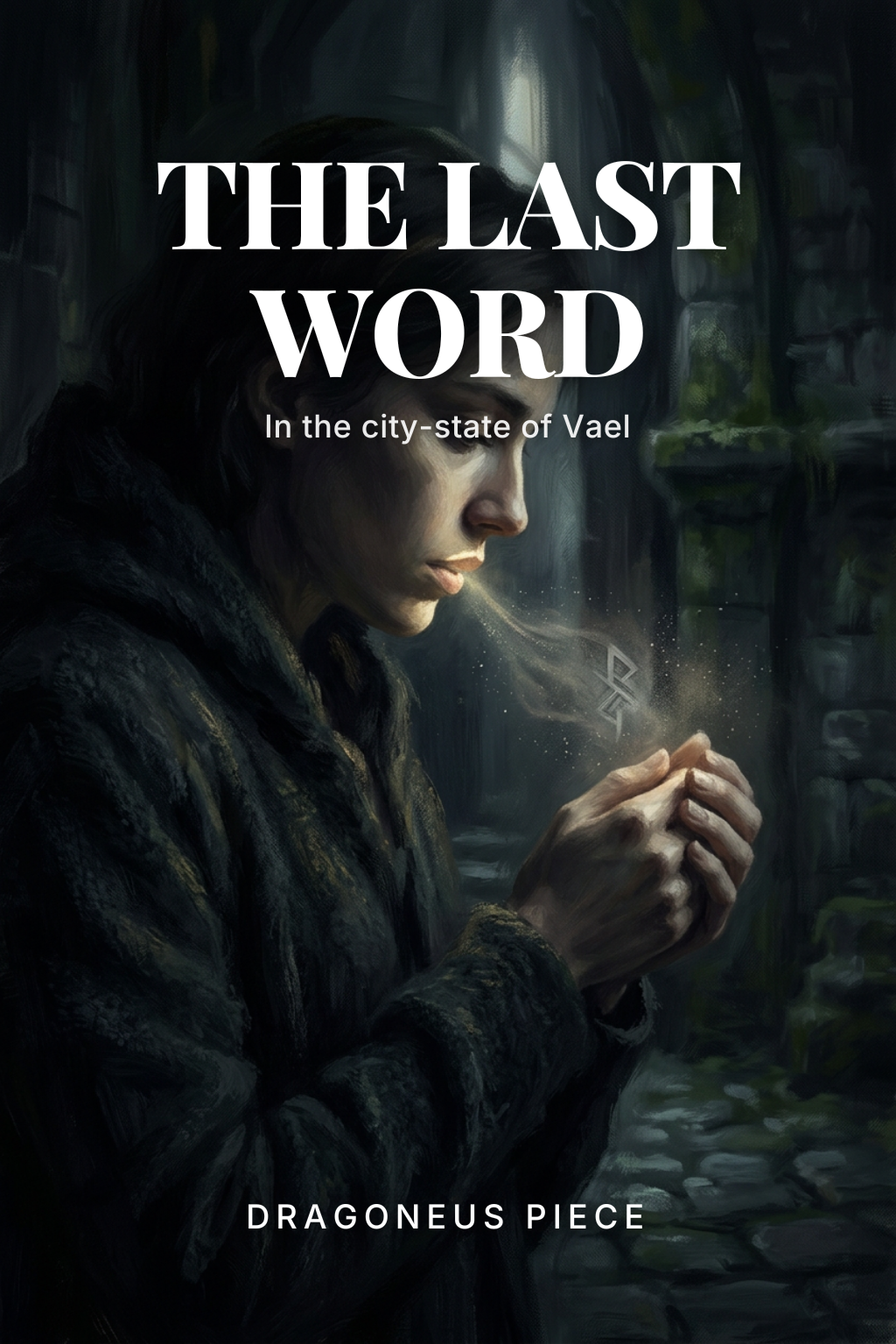
Novel · 3 chapters · 4,200 words
THE LAST WORD In the city-state of Vael, every new
Contents3 chapters
Chapter 1
Chapter 1: The Ledger That Should Have Burned
Ines found the ledger under a stack of worm-eaten tax rolls in the Archive of Minor Petitions, where the windows stuck and the dust tasted like chalk. She had been sent to sort condemned papers for the afternoon watch, which meant carrying bundles from one shelf to another until her shoulders burned and her fingers went gray with old ash. No one watched the junior archivists closely. That was how things slipped through.
The book was bound in dark leather gone slick at the corners, with no title on the spine, no seal, no docket ribbon. It had been wedged behind a box of censures from the Third House, pressed so flat into the wall of records she almost missed it. When she pulled it free, the leather gave a small dry sigh, like something waking up after a long time with its mouth shut.
She should have put it on the cart and called for a senior clerk. She knew that. Instead she turned it over in her hands and saw the pages were made from something finer than paper, smooth and pale, with a faint sheen like fish belly. No watermark. No stain. No marginalia. Just the names.
One per line. One syllable each. Thousands of them.
At first she thought it was a private index, some old House record copied by hand and hidden away. Then she read a line near the middle of the page and felt her throat tighten.
Ives.
Her brother had been Ives for fifteen years before the fever took him. She had stood beside his body in the paupers’ row while the chanter from the Ninth District whispered the legal words and the body was carried off to the stone ovens. She had no reason to remember a dead brother’s name in a book of names, not unless the book had swallowed the shape of the world and spat it back wrong.
She turned another page. More names. The dates beside them stretched backward in a single run of years that made her eyes blur. Present reign. Old reign. Founding year. The entries did not stop where all other records stopped, at the city’s kept history six centuries deep. They kept going. The same tidy hand, every line steady, every ink line the same black-brown sheen, as though one clerk had sat at one desk for six hundred years without eating, sleeping, or once changing the pen.
A cart wheel clattered in the hall beyond the door. Ines shut the ledger so hard dust burst from the cover seam.
Her pulse hammered in her wrists. She listened. Boots passed. A cough. The squeak of a ledger trolley. No one came in.
She opened it again, slower this time, and counted ten names before she found another she knew: Mera, the girl from the fish market with the split lip. Then Joric Venn, who had carved saints’ faces into bone handles and sold them to pilgrims. Then the pale baker’s wife from Lime Street. People she had seen in the city, alive this morning, bargaining and spitting and carrying onions in string net bags. Names written down with the same patient stroke as the dead.
Not a register of the dead, then.
A record of everyone.
Her mouth went dry. She turned pages with one finger at the edge, careful as if the ledger might bite. Names from every district. Every house quarter. Servants, overseers, dockmen, warders, a prince’s cousin, a chimney girl she had seen asleep on a stair, the basilica bell-ringer with the scarred hand. All of them. Hundreds of years. The city compressed into a book no one was meant to touch.
At the bottom of one page she saw the same family name repeated, line after line, through generations. Vael’s Houses. Serin. Halvek. Orthe. Lume. Seven of them, with gaps where a branch had ended in disgrace or blood. Those names she knew. Those names ruled what she was allowed to read. That part made sense in the sour way all power made sense.
What did not make sense was the hand.
She had copied enough ledgers to know old ink when she saw it. This was not old. It lay on the page with a damp shine, as if it had been laid down an hour ago. She rubbed at one line with the pad of her thumb. Nothing smeared.
A sound came from the end of the aisle. A wheeled stool scraping stone.
Ines shut the book and slid it under her arm. She did it without thinking, or perhaps thinking too quickly to feel the thought. She pushed the tax rolls back in place, but they no longer sat right. The shelf gap looked naked. She jammed a broken census rod across the front and stepped away.
“Archive clerk.”
The voice was flat, not loud. She turned.
A woman stood at the aisle mouth in a brown service robe, hair pinned up in a plain knot, hands folded at the waist. Her face was ordinary in a way that made it hard to hold in memory. That should have helped. It did not.
“Yes?” Ines said.
“You’re in the wrong section.”
“I was sent for tax condemnations.”
“By whom?”
“Master Pell.”
The woman’s gaze moved once, very small, to the lump under Ines’s arm. “Set that down.”
Ines tightened her grip. “What is it?”
“You don’t need to know.”
The words landed like a slap. For a second Ines could only stare. No one in the Archive spoke to juniors that way unless they were about to be struck or dismissed. The woman did neither. She simply stood with her hands folded and waited.
Ines heard herself say, “If it isn’t for me, why was it hidden?”
The woman took one step forward.
Ines backed up.
The aisle was narrow. Shelves rose on both sides, packed with petitions, death claims, inheritance squabbles, shipping tallies. Paper walls. Paper centuries. The woman came on without hurry. No alarm, no shout. That frightened Ines more than a shout would have.
At the far end of the aisle, a bell rang once, deep in the Archive’s inner chambers.
The woman stopped. Her head tilted, as if listening for something only she could hear. Then she smiled, and the smile was wrong. Too small. Too late.
Ines ran.
She slammed shoulder first into the side door, nearly tearing the ledger from her grip. The latch stuck. She hit it again with her hip. The door gave way and she spilled into the records stairwell, where the air smelled of lamp oil and damp stone. Behind her came footsteps now, quick and light.
Not the woman’s.
Others.
Ines took the stairs three at a time. The ledger thudded against her ribs. Voices rose below, not calling out but speaking in short, clipped bursts she could not make out. She knew the Archive’s back routes. She knew the blind passages where canceled records were wheeled to burn. She knew which corridor lamps were dead and which doors stuck in summer. She did not know why any of this mattered until she heard a voice from below say, very plainly, “She has it.”
She almost tripped.
No one in the Archive should have known what she had. No one should have cared.
At the landing she turned left, into the maintenance passage used for hauling ash. The walls were lined with soot-black brick. The floor sloped down toward the furnace doors. She pushed through hanging strips of cured hide and came out by the ash chute, where a sliver of afternoon light lay across the floor like a blade.
A boy sat there on an overturned crate with his knees apart and a knife in his hand, peeling an apple in one long ribbon. He looked up at her as if he had been expecting her all day.
Ines stopped so hard her heel skidded.
He was too well dressed for the Archive and not dressed enough for the street. His coat was cut in dark blue wool with tarnished silver buttons, sleeves turned back at the wrist. Hair black and loose. One boot polished, the other scuffed. He had the bored, alert face of someone who had never once been told no and had spent his life testing how far the world would bend before it snapped.
“You’re late,” he said, and took another bite of apple.
Ines tightened both hands on the ledger. “Who are you?”
He swallowed, then tipped his head toward the stairs behind her. “Do you want to answer that before they come through, or after?”
She heard boots on stone. Close.
The boy stood. He was taller than she had thought, all sharp elbows and a narrow waist beneath the good coat. He held up two fingers to his mouth, then spoke a word so softly she almost missed it.
Something in the air shifted.
The footsteps above faltered. A man’s voice barked a question. Then another voice answered, confused. The pressure in the stairwell changed, like a hand lifting from a wound.
The boy glanced at her. “Go,” he said. “Unless you’d rather stay and explain why the nameless men are after you.”
Ines stared at him. “Nameless men?”
A second later the first of the pursuers hit the door above and the frame shuddered.
The boy’s mouth tightened. “Now would be excellent.”
She did not know him. She did not know why he had spoken a word into the air like a challenge. She did not know what the ledger was, only that it had changed the air around her and that the people behind her were moving closer through the Archive with the silent certainty of wolves. She ran because there was nothing else to do. He fell in beside her as if he belonged there, apple in one hand, knife in the other, and together they took the ash passage toward the back exit while behind them the first door splintered open.
Chapter 2
Chapter 2: The Prince Who Spoke at Dawn
The back exit of the Archive opened onto a service lane between tannery walls, where the smell of lime and old hides caught in the throat. Ines ran until her lungs burned, then kept running because stopping felt like being found. The boy did not speak. He kept pace beside her, using the ledger only as a thing to guide his eyes when she stumbled.
At the corner of Tallow Street he caught her wrist and pulled her into a fruit seller’s awning just as three figures crossed the lane ahead. They wore plain gray coats with no House colors, no badges, no visible weapons. That was somehow worse than swords. Their faces were covered with pale cloth masks tied behind the head. One of them paused, turned slightly, and listened.
Ines held her breath until stars crowded the edges of her sight.
When they moved on, the boy let go. “Those are the ones who heard you,” he said.
“I didn’t say anything.”
“You don’t have to. The ledger does enough.” He looked at her then, properly, taking in the ripped cuff, the ink on her fingers, the way she had folded herself around the book. “You read it.”
“Yes.”
“You shouldn’t have.”
She gave him a hard look. “That’s useful.”
“It is.” He started walking again and she had to follow or be left standing under the awning like a fool. “You can call me Cato.”
“That’s not a House name.”
“No. Thank God.”
They crossed into the spice district, where the stalls were hung with drying peppers and bundled sage, and the paving stones shone with old grease. Ines kept her head down. Every few steps she felt the ledger press through her coat like a second spine.
Cato led her through back lanes and half-hidden courts until the district gave way to a wedge of formal stone and iron gates. A palace quarter. She would have turned around if she had been alone, but the route was already decided by the guards at each gate, who looked past Cato and did not stop him. He did not carry a writ. He did not need one.
Only when they reached a narrow side entrance in the eastern wall did she stop dead.
“You live there.”
Cato glanced at her. “Sometimes.”
“That’s the prince’s wing.”
“That’s the prince’s house, yes.”
“You’re the prince?”
He looked offended in a way that was almost convincing. “Not the useful one.”
She stared until he sighed.
“Fine,” he said. “I’m the heretic prince. The family embarrassment. The one they let keep his head because it amuses the court to see whether I’ll insult myself in public before someone else does it for me.”
He pushed the side door open. Warm air breathed out, carrying beeswax, candle smoke, and something metallic under it. Ines stepped in because the street behind her felt less safe than any palace room.
Inside, the corridor was lined with cracked blue tiles that showed ships and saints. Servants moved at the far end with their eyes down. No one spoke. At the first turn, Cato stopped before a shallow brass basin set on a stone plinth. He set the apple core on the edge, then drew a knife from his sleeve and laid it beside the basin as if marking the end of something.
“Watch,” he said.
He took a breath and spoke a single word.
It was not loud. It was barely more than a whisper, but the air seemed to tighten around it. Ines felt it in her teeth. The basin gave a low note, like struck glass. For a moment the corridor beyond seemed to lean toward him. Then whatever had sharpened in the air eased again.
Cato exhaled. “There. Still mine.”
Ines looked at him as if he had slapped a royal seal onto his own throat. “You just said your True Name.”
“Yes.”
“Why would anyone do that?”
“Because if I can speak it and stay upright, then no one else owns it.” He picked up the knife again. “Or so I like to pretend.”
“Do you mean that literally?”
He smiled without humor. “You brought a stolen ledger full of impossible names into my house and you’re asking me that?”
Before she could answer, a bell sounded somewhere in the inner court. Not an alarm. A summons. Cato’s expression changed at once, the little looseness gone from his face.
“Stay here,” he said.
“No.”
“I wasn’t asking.”
She had the ledger, which made her braver than she ought to have been. “Then stop speaking as if I belong in your corridor.”
For a moment he looked as if he might laugh, but the sound did not come. Instead he rubbed the bridge of his nose and said, more quietly, “If they catch you with that book, they won’t ask questions. Not the court. Not the Houses. Not the people in masks. So when I tell you to stay, understand that I’m being rude for your benefit.”
“Why help me?”
He looked at the ledger in her arms, then at her face, and something guarded moved behind his eyes. “Because I already know what’s in it.”
That chilled her more than the alley had.
Before she could press him, he took her through a side passage into a small room that smelled of wax and old parchment. A narrow bed. Two chairs. A washstand. A plain basin in which a dead fly floated belly up. On the wall above the mantel, someone had pinned a list of names and crossed each one out in charcoal.
Ines stopped at the sight of it.
Cato noticed. “House guests,” he said. “Or prisoners, depending who’s telling the story.”
“What are these?”
“The people who die around me when the court gets nervous.”
She looked back at him. He was leaning one hip against the table as if he had nowhere better to be. “That’s not funny.”
“It isn’t meant to be.”
He crossed to the mantel and took down a jar of black salt. “Open the ledger.”
Ines hesitated only a breath, then did. The pages gave off that same faint chemical scent she had noticed in the Archive, sharp and clean beneath the dust. Cato lifted the ledger with both hands and turned to a marked page near the back.
There, among the lines of names, were marks she had not seen before. Tiny slashes in the margin. One beside a date six hundred years old. Then another. A chain of them, always at intervals too regular to be random.
“What is that?” she asked.
“Counting.”
“Counting what?”
He did not answer at once. Instead he ran one finger along the line of names until he found a small gap, a place where one entry had been smudged and overwritten. “This book has been revised,” he said. “By the same hand. Every entry. Every correction. It’s not a ledger in the ordinary sense. It’s a lock.”
Ines frowned. “A lock on what?”
“On the thing that listens.”
The room seemed to narrow around his words.
She had no reply for that. The city had always had its rules: every child whispered into the dark after birth, every House guarding the syllable that could drop a rival dead, every official pretending the peace was stable because the alternative was too expensive to name. There were stories, too, in kitchens and taverns. Things under the cisterns. Ghosts in the choir vaults. But this was a different sort of fear. This had a shelf mark.
Cato set the ledger on the table, then reached for the basin. “Six centuries ago,” he said, “the Houses did not invent this system. They inherited it. They claimed the Names were enough to keep the city from tearing itself apart. Maybe they were right for a while. But something older was already here. Something that learned each time a mouth made a sound it had no right to hear.”
Ines stared at the page. “Then why keep writing the names?”
“Because someone thought recording them would keep the thing busy.” He gave a short, ugly laugh. “Or because someone wanted to know when it ate.”
A knock came at the outer door.
Cato’s head lifted.
Another knock, harder.
Then a voice, female and crisp, from the other side. “Your Highness. Open up.”
He swore under his breath. “That’s my sister.”
“She’ll help us?”
He shot her a look. “No.”
The door was opened without waiting for permission. A woman entered in a riding coat the color of old blood, boots still dusty from the outer roads. She had Cato’s face in the bones of it, though narrower, more exact, with hair braided close to the scalp and a scar at the chin. Around her neck hung the House seal of the reigning line.
Princess Serel looked at Ines once, then at the ledger, and did not bother hiding her displeasure.
“So,” she said. “You’ve finally found someone interesting enough to ruin.”
Cato straightened from the basin. “You always did know how to greet a guest.”
“You’re not the guest.” Serel’s gaze stayed on the book. “That is.”
Ines clutched it harder.
Serel stepped farther into the room, closing the door behind her with careful fingers. No servants followed. No guards. That was either mercy or confidence. “There are masked men in the lower lanes,” she said. “They killed two messengers from House Halvek before noon. One of them had time to tell me your archivist was carrying a forbidden record.”
“Then you know why I’m here,” Cato said.
“I know you’re meddling.”
He went still. “And you’re not?”
Serel’s eyes flicked to him, then back to Ines. “If that book is what you think it is, then we all are.”
The silence that followed was not empty. Ines felt it pressed full of things no one would say in a room with a royal seal on the wall.
Serel held out her hand. “Give it to me.”
Ines did not move.
“Don’t,” Cato said quietly.
“Why? Because you trust her?” Serel gave a thin smile. “You should know better.”
“I know exactly who she is.”
Serel’s mouth tightened. “Then you know better than to stand between the Houses and a weapon.”
Ines looked from one sibling to the other and understood suddenly that whatever game she had stumbled into had started long before her. The ledger in her hands felt heavier than paper, heavier than iron.
Outside, somewhere in the palace corridors, a bell rang again. This time it was not alone. More bells answered, and then the shouting began.
Cato moved first, shoving the basin aside with one hand and thrusting the ledger toward Ines with the other. “Take the back stair,” he said. “If you hear anyone say your name, do not answer.”
Serel drew a short blade from her boot. “Too late for that.”
The door struck the wall as someone hit it from the other side.
Ines ran.
Chapter 3
Chapter 3: The Name Under the Silence
The back stair was narrow and bitter with old smoke. Ines took it two steps at a time, one hand on the wall, the ledger pinned to her side. Below her, the palace shook with running feet and shouted orders. Above, somewhere beyond the roofline, bells kept striking in ragged sequence, as if the city itself had started counting down.
At the stair’s bend she nearly collided with a servant girl carrying a tray of glass cups. The girl saw the ledger, saw Ines’s face, and dropped the tray without a word. Glass burst across the steps. Ines vaulted over it, coat snagging on a shard. She kept going.
The corridor at the landing opened into the servant galleries that ran behind the formal chambers. Paint flaked from the walls here. A cracked fresco of the city’s founding showed seven crowned figures kneeling around a flame. Someone had scratched out one of the faces with a knife. Maybe more than one. The palace had the look of a place that had been corrected too many times.
She heard footsteps behind her and turned into the first open door she found, a storage room crowded with folded linen and silver trays wrapped in cloth. Dark. Quiet. She pulled the door shut just as voices passed outside.
Not voices. Whispers.
They moved along the hall in a thin seam of sound, each word too soft to catch, and yet the back of her neck prickled as if someone had breathed into her ear. Ines stood with her hand over her mouth, listening to the whisper pass the door, then stop.
A beat.
Another.
Then, very close, the same flat voice she had heard in the Archive: “She’s here.”
Ines looked down at the ledger as if it might explain itself. It did not. The pages were open to the last section, where the entries no longer held dates, only names and narrow marks in the margin. Near the bottom, the final page had been cut by half a line, as if some hand had tried to stop writing and failed.
Then she saw the new mark.
Beside her own name.
Not written in the steady ink of the rest. Fresh. Dark. Her full name, the one no clerk had ever asked to record in public, set down in that same disciplined hand. In the margin beside it, a tiny stroke. A listening mark. A tally.
She nearly dropped the book.
The thing in the palace had already heard her. Maybe the thing in the city had heard her the moment she opened the ledger. The thought came with a cold clarity that made her stomach turn.
A sound came from the corridor latch.
Someone testing the handle.
Ines backed away from the door and found herself at a slit window overlooking the inner court. Far below, torchlight moved between colonnades. Guards ran in clusters, but not toward the main gates. Toward the old chapel at the far end of the court, the one sealed after the Ash Riot twenty years ago. She had copied its closure order once. Three pages of legal language, then a blank line where the cause should have been.
The door opened.
Not fully. Just enough for a gloved hand to slip in and feel along the wall.
Ines snatched a silver tray from the stack and hurled it at the hand. Metal rang. A man cursed. She bolted through the opposite door into a narrow passage full of hanging tapestries that smelled of dust and mouse droppings. Heavy fabric slapped her shoulders as she pushed through. She could hear pursuit now, close and uneven, several sets of feet trying to move without making noise and failing.
At the end of the passage a side gallery opened over the chapel court. She stopped short.
Cato stood below in the courtyard, bareheaded, one hand pressed to his chest as if steadying his breathing. Serel stood beside him with her blade out. Between them and the chapel steps lay three bodies in plain gray coats, masks dark with blood. Not all dead. One man was still moving, trying to crawl away with both hands dragging over the stones. A servant with a lamp stared from a balcony and then wisely vanished.
Cato looked up and saw her.
“Down,” he called.
The word came too sharp. One of the masked men nearest the chapel twitched at the sound and then stopped. Not dead. Listening.
Ines stared. “What did you do?”
“Nothing,” Cato shouted back. “That’s the problem.”
Serel followed his gaze upward, found Ines at the gallery rail, and waved once, hard. “If you’re going to stand there, at least come with the ledger.”
“No one is coming near the chapel,” Cato said.
“Because you’ve decided that?”
“Because it’s open.”
That made no sense until she looked at the chapel doors. The great bronze panels stood ajar by a finger’s width. The seals hanging on them had been cut.
The old order order. The blank line. The thing no one had bothered to write down.
The gallery behind Ines shuddered with footsteps.
She did not think. She climbed the rail and dropped.
Pain shot through her ankle on landing, bright and sickening. She nearly went down. Cato caught her elbow and hauled her upright, the movement fast and certain, as if he had done it before in another life. Serel grabbed the ledger from her hands and tucked it under one arm without asking.
“Excellent,” Serel said. “You’re bleeding already.”
“Always an encouraging sign,” Cato said.
Ines glared at both of them, partly from fear, partly because the two of them behaved like this was an inconvenience rather than the center of the world. “Why is the chapel open?” she said.
Neither answered right away.
They moved her inside before the question could be repeated. The chapel smelled of cold ash and old wax. Every pew had been stripped out long ago, leaving only the stone floor and the altar platform. The stained glass above the north wall showed a saint with no face. Someone had taken a hammer to it. Light spilled in through the cracks in red and blue strips.
At the altar, Serel set the ledger down and opened it to the final pages. Cato lit a lamp with shaking fingers, then stood over the book as if expecting it to bite.
“This is the end,” he said.
Ines snorted once. “That’s not helpful.”
“No, listen.” He kept his gaze fixed on the page. “The ledger doesn’t only record names. It records the sequence. The order in which the city was taught to speak itself. The first names were not whispered into babies. They were spoken into the dark under this chapel.”
“By who?”
Serel answered. “By the founders.”
“No,” Cato said. “By something they found.”
She turned to him. He looked pale under the chapel light, his mouth set too hard. “The Houses have lied about the origin because they had to. If the people knew what lay beneath the naming rite, the peace would have ended before it started.”
Ines stared at the page. A line of symbols sat in the margin beneath the final entry, half scratched out. Not letters she recognized, but a shape repeated so often it became a rhythm. The same hand. Always the same hand.
A whisper breathed through the chapel.
All three of them went still.
It did not come from the doors. It did not come from the windows. It came from the stone itself, from the cracks between slabs and the seam under the altar steps. A sound with no body. A listening sound.
Serel put out a hand as if to steady the air. “It’s here.”
Ines felt the hair rise on her forearms. The thing in the silence was not a story. It was not a spirit or a curse. It was patient. It had been in the city longer than any House, longer than the chapel, and every whispered True Name had fed it the shape of a world.
“Why does it want us?” she whispered.
Cato answered without looking at her. “Because it can’t name itself.”
The whisper in the stone sharpened.
Ines thought of the ledger’s final page, of the line beside her own name, of six hundred years of the same hand writing the same syllables into the same book while the city pretended that control was the same as safety. She thought of the nameless killers in gray cloth. Not men. Not people. Something made to move through the gaps where names should be. She thought of Cato standing each morning and speaking his own true syllable into the basin like a dare.
“Then what is its name?” she asked.
No one answered.
The chapel doors slammed shut.
The impact made the lamp jump. Dust fell from the rafters. Outside, figures moved across the red glass. Too many. The masked men had found them. Or been led to them. Or had never needed to search at all.
Serel took one step toward the altar. “Ines. The last page.”
She looked at the ledger.
On the bottom line, beneath her own name, was a single word in the same hand, written smaller than the rest. Not a city name. Not a House name. Not a person’s name she had ever heard. One syllable, maybe. One broken sound. The letters were old enough to have forgotten the alphabet that made them.
The whisper in the floor turned hungry.
Ines reached for the page, and the chapel filled with the scrape of knives drawn all at once.
Write your own novel.
ScribistIQ generates full-length novels in minutes. Type your premise, walk away, come back to a finished book.
Try ScribistIQ