
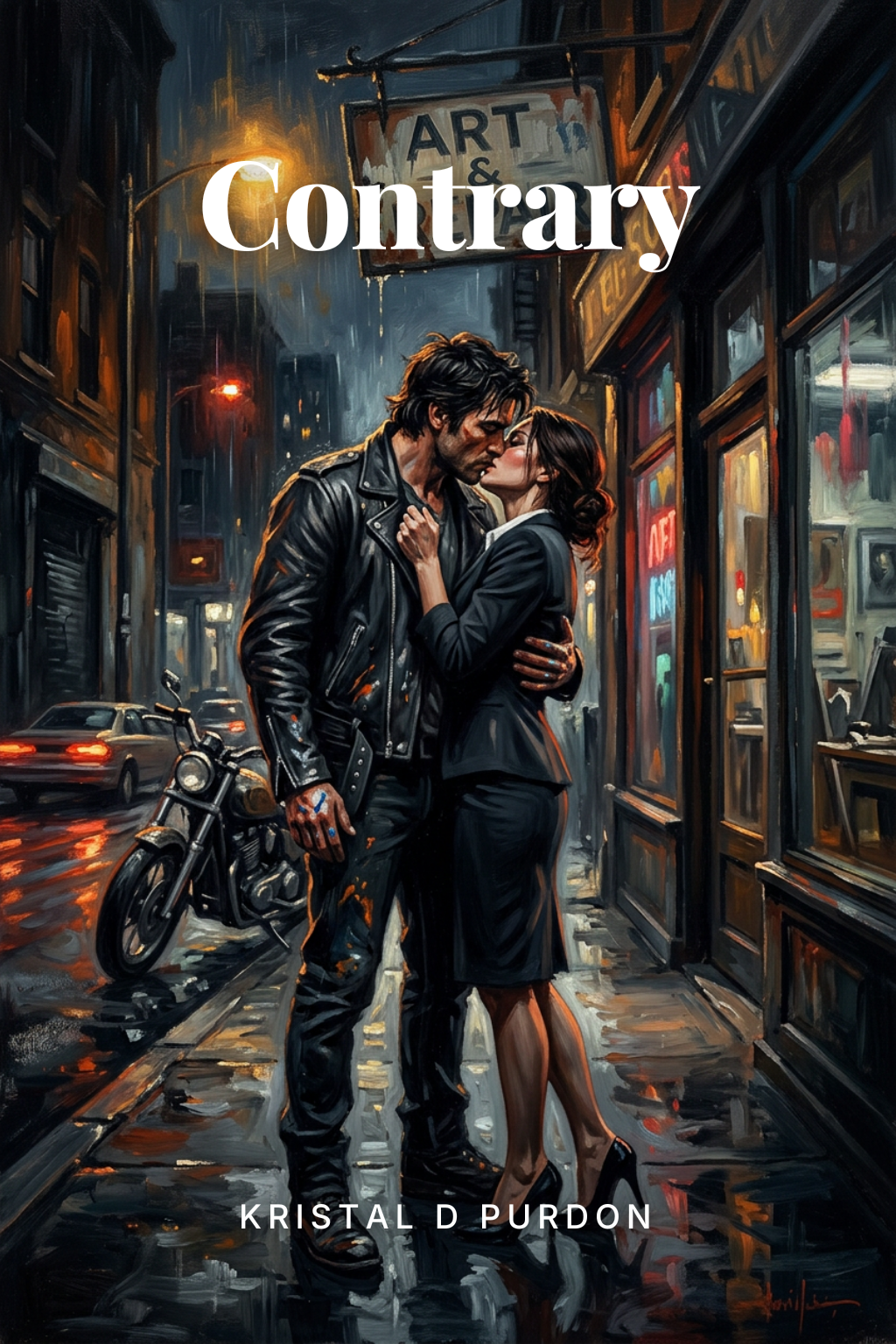
Novel · 8 chapters · 41,079 words
Contrary
Contents8 chapters
Chapter 1
Paint Under the Nails
The stapler jammed on the third invoice, and Mara hit it once against the lip of her desk hard enough to wake the loose blinds in the front office.
“Come on.”
The machine gave up the twisted staple with a metallic cough. She pinched it free, flung it toward the trash, missed, and kept moving. A phone rang two desks over where nobody sat anymore. The old copier near the file wall shuddered through a set of manifests with the patience of a dying mule. Somewhere out in the warehouse, a forklift backed up in long, scolding beeps.
Mara stabbed the stapler through the packet and slid it into the outbound tray. One down. Twenty-three to go.
The office at Harlan Freight had been beige once. Now it was the color of nicotine and winter dishwater. A map of the interstate corridor still hung on the far wall with pins marking routes the company no longer ran, their little plastic heads faded to a family of weak colors. Her metal desk had one drawer that only opened if she lifted with her knee first. The fan on top of the filing cabinet rotated in reluctant jerks, pushing around hot paper smell, diesel grit tracked in from the loading bay, and the burnt-coffee breath of the machine that had been left on since six.
She worked with her sleeves rolled to the elbows and a blue streak of enamel still tucked in the cuticle of her thumb from last night. She’d scrubbed with citrus thinner and lava soap until the skin went tender. The paint had stayed.
“Voss.”
She didn’t look up yet. If it was Tommy from dispatch, he wanted a favor. If it was Gail from billing, she wanted sympathy. If it was—
“Voss.”
That was Nolan Pierce, and there went the morning.
Mara set down her pen and lifted her eyes.
Nolan stood in the doorway of his glass-front office with a sheaf of papers in one hand and his tie already loosened though it wasn’t even ten. He was the kind of man who looked polished from a distance and sticky up close. White teeth, hair clipped neat, shoes that caught the fluorescent light. He smiled as if he’d thought of it in a mirror first.
“In here,” he said.
Mara took her legal pad and stood. Her chair made its usual dying-gull squeak.
Inside Nolan’s office, the air was two degrees cooler from the private unit under his window. A framed safety award hung behind him crooked by half an inch; it bothered her every time she came in. He laid the papers on his desk and tapped them square.
“Invoice reconciliation for the Pritchard account,” he said. “We’ve got a discrepancy.”
“We had one last month too. Billing applied a fuel surcharge twice.”
“This isn’t that.”
He turned the packet toward her. Three invoices paper-clipped together, each marked paid, each bearing signatures she didn’t recognize from pickup. The numbers were wrong in that quiet way bad numbers could be wrong: not enough to ring like an alarm, enough to bleed.
Mara glanced over them. “These were entered under my code?”
“Processed through your desk.”
“That isn’t the same thing.”
Nolan spread his hands. “I’m not saying it is. I’m saying I need answers before corporate starts asking louder questions.”
There it was. Not an accusation. Something slicker. A suggestion placed carefully between them like a knife laid flat on a table.
Mara read the line items again. Route 18B. Machine parts from Laredo. Delivery timestamps too close together to make sense. The handwriting on the signatures sloped differently on each page, trying too hard not to.
“Who pulled these?” she asked.
“Accounting sent them over.”
“Who entered them into the system?”
He tilted his head. “Mara.”
She met his eyes. “That’s not what I asked.”
For one second his smile thinned enough to show bone under it. Then it came back. “You’re good at this. That’s why I lean on you. Track it down.”
She set the packet on his desk instead of taking it. “I’ve got outbound to close before noon and three drivers screaming for revised manifests because dispatch double-booked dock space.”
“Then work faster.”
He said it mildly, which was his favorite way to be cruel.
Mara picked up the invoices after all. “Anything else?”
“Actually.” He glanced at her hands. “You still doing arts and crafts over there after hours?”
She went still.
The blue smear at her thumb suddenly felt bright as a siren.
“My life after five isn’t your business.”
He laughed under his breath. “Relax. I’m asking because Harlan’s family day is in six weeks and someone suggested repainting the old yard sign out front. You know, if you’re looking for a little side money.”
She thought of the plywood sign by the highway with its sun-peeled logo and bullet crack in one corner. Thought of spending a Saturday making a logistics company look proud of itself.
“No,” she said.
Nolan blinked, surprised by the clean edge of it. “No?”
“I’m not looking for side money from you.”
The silence stretched. Out in the main office, the copier clunked to a stop.
He leaned back in his chair. “Close the door on your way out.”
Mara did not close it gently.
At eleven forty-eight, Gail from billing appeared with a yogurt cup and gossip already loaded in her expression.
“You’ve got that look,” Gail said, perching one hip on the corner of Mara’s desk. “Did Prince Nolan bless you with a special project?”
“He found discrepancies.”
“He always finds discrepancies right before he needs somebody to blame for them.”
Mara kept stamping received dates onto a stack of bills of lading. Red ink. Thump, thump, thump. “That would imply he caused them.”
Gail peeled back the foil lid on her yogurt. “If I say yes out loud, are you going to put me down as a witness when they drag us all into the parking lot and start shooting?”
“Depends what flavor that is.”
“Peach.”
“Then no.”
Gail snorted. “Fair.” She lowered her voice. “You hear from the bank?”
Mara kept the stamp moving though the question landed square in her ribs.
“No.”
“You were supposed to yesterday.”
“Yeah.”
Gail let that sit. They weren’t close in the sentimental sense; nobody in that office had energy left for friendship with upholstery. But Gail had slipped Mara leftover lasagna twice last winter and once covered the front desk when Mara had to rush across town for a plumbing leak at the shop. That counted.
“My cousin refinanced through Valley Mutual,” Gail said. “They’ll work with you if there’s collateral.”
“There isn’t.”
“What about the building?”
“It is the collateral.”
Gail made a face into her spoon. “Right.”
The phone on Mara’s desk rang. She snatched it up before Gail could offer more kindness than she had room for.
“Harlan Freight.”
She listened, scribbled down a trailer number, and spent the next four minutes walking a driver through the concept of parking in bay four instead of bay six. When she hung up, Gail had gone. In her place was a yellow message slip weighted under the tape dispenser.
BANK CALLED. MR. ELLISON. 1:15.
Mara looked at the time. 12:07.
For a moment all the office sounds sharpened and flattened at once: the fluorescent hum, the forklift outside, the ugly laugh from dispatch, the click of someone’s acrylic nails over a keyboard. Her father’s shop rose in her mind whole and exact—the front windows clouded at the corners, the display boards with letter styles nobody asked for anymore, the drafting table scarred with blade marks, the back room where the good brushes lived in coffee tins because no one had gotten around to buying proper jars after he died. She had been thirteen when he showed her how to pull a line in one breath. Don’t pet it, he’d said, standing behind her with his rough hand over hers. A line can smell fear.
She put the message slip in the top drawer beneath a rubber band ball, a flashlight, and three receipts she meant to enter into her tax folder.
At 1:14 she took the call standing in the narrow strip beside the filing cabinet where the office camera couldn’t see her face.
Mr. Ellison from Valley Federal had the apologetic voice of a man who had practiced it often and considered that a virtue.
“I know this isn’t the outcome you hoped for, Ms. Voss.”
“What outcome is it?”
A beat. Paper shifting.
“Given the delinquency period and the prior extension already granted, the loan is being referred to foreclosure review. There may still be options if the arrearage is cured immediately.”
Immediately.
Mara looked through the front office glass to the yard, where a driver in a red cap was smoking beside a stack of dented pallets.
“How much?”
He told her.
The number was not impossible. That was the worst part. Impossible would have let her go cold. This was close enough to tease. Close enough to invite humiliation.
“And how long do I have?”
“Formally, you’ll receive notice within ten business days. Informally—Ms. Voss, if funds are coming, the sooner the better.”
Funds are coming.
She thanked him in a voice she did not recognize and hung up.
Her reflection in the dark file cabinet window looked like somebody else’s cousin: dark hair shoved up with two pencils, plain gray work shirt, mouth set too hard. Thirty-two years old and wearing bargain sneakers with lacquer dust in the seams. A woman who knew the freight rates to Omaha and the difference between squirrel-hair quills and synthetic stripers. A woman with two jobs and one building slipping out from under her.
She went back to her desk and finished the outbound packets.
At five sixteen she locked the front office, ignored Nolan’s “Tomorrow, first thing,” and crossed the lot to her truck.
The truck was a faded green Ford with a bench seat split open along the seam and a passenger door that only opened from inside. Her father had bought it from a church handyman twenty years ago because the bed could haul sign blanks and ladders. The AM radio only got one station clean, all old country and local ads for bankruptcy attorneys. She drove it past the chain pharmacies and payday lenders of the west side, past the bait shop with the hand-painted shad on the sign she’d done at nineteen, past a mural on the side of a cinderblock tire place that had once been bright oranges and cobalt and was now mostly sunburn.
Voss Signs sat on Mercer, three blocks off the old downtown square where half the storefronts were antique malls and the other half were “coming soon” in vinyl letters curling at the edges. The shop took up the first floor of a brick building with a narrow apartment above that she hadn’t rented out in years because the wiring was temperamental and she didn’t need a tenant discovering how much of the ceiling plaster came down if you slammed the bathroom door.
The front windows held ghosts of old gold leaf on the glass: PHONE NUMBERS, OPEN, custom work. Inside, the bell over the door gave its rusty snap when she entered.
Dust and mineral spirits greeted her. Not bad smells. Honest ones. The front room was dim except for the wash of evening coming through the windows. Rolls of vinyl leaned in a wire bin by the wall though she hardly touched them. A carousel of paint chips stood near the register. Under the counter sat ledgers in her father’s cramped block print, jobs from years when local businesses still wanted hand-cut plywood signs, parade banners, truck doors lettered one at a time.
Mara dropped her bag on the counter and went straight to the back.
The workshop was where the shop still had a pulse. A long bench under task lamps. A rack of mahlsticks. Drawers of pounce wheels, chalk, sable liners wrapped in paper sleeves. Enamel cans on shelves with their lids ringed shut by old drips. Her father’s drafting table angled beneath a bank of pinned sketches. A hot plate in the corner for coffee she should not keep making on it and did anyway.
She changed out of her office shirt and into an old black tee already stained with maroon, ivory, and one comet swipe of silver leaf size. She turned on the radio. Fiddle music hissed up from a station farther north than this town deserved.
Tonight’s job waited on the center stand: a pair of helmets for a father and son who raced dirt bikes out past Dry Creek. Matte black, cheap shells, but Mara could make them sing enough for a county fair. She had sketched a pair of running foxes with tails curling around the back ridge. The transfer was already on. She mixed vermilion with a touch of brown to knock the toy brightness out of it, stirred with a coffee stirrer, loaded her brush, and pulled the first line.
This was the cleanest part of her day. No one interrupting to ask where a pallet jack had gone or why fuel was up again or whether she had “a minute.” The point of the brush finding the edge of the charcoal guide. The small drag through enamel. The way the wrist had to relax or the line would tattle.
By seven the foxes had their backs and ears and one bright eye each. By seven-thirty she had forgotten Nolan Pierce’s tie, the bank’s soft-voiced threat, everything except the red shape waking on black.
The bell at the front snapped.
Mara set down the brush without swearing only because she had wet paint open. Customers who came this late were usually one of three things: drunk, desperate, or related to neither work nor money and therefore dangerous in a different way.
She wiped her hands on a rag and walked through the dark front room.
The man standing just inside the door was broad through the shoulders and very still. That stillness hit her first. Most men who wore leather came into a room announcing themselves with noise—keys, swagger, some little theater of boots. This one stood as if he had already measured the place and chosen not to disturb anything until he had to.
He took in the windows, the display boards, the high shelf with old porcelain signs stacked on edge. Then he looked at her.
“You open?” he asked.
His voice was low and even, with the scrape of cigarettes not yet winning.
“Depends what you need.”
His mouth shifted, not quite a smile. “That a yes or a warning?”
Mara leaned one hip against the counter. “Both.”
Up close he was older than she’d thought through the glass. Mid-thirties, maybe. Dark hair shaved short at the sides and longer on top, not styled, just cut for function. Stubble shadowed his jaw. A pale scar crossed one eyebrow, disappearing into the hairline. He wore a black T-shirt under a weathered riding vest with no colors on the front, only a small patch over the chest pocket: CONTRARY in white letters curved above a winged wheel.
There it was.
Everybody in this town knew the name. The Contrary Riders ran salvage, custom bikes, occasional charity runs, and a steady current of rumor. Depending who was talking, they were patriots, parasites, or one bad Friday from an indictment. Mara knew enough to distrust all three versions.
His left hand rested on the counter. Burn marks stippled the knuckles. Mechanic’s hands. Clean at the fingertips tonight, but oil lived in the cracks.
“You Mara Voss?” he asked.
“Who’s asking?”
“Levi Rane.”
She had heard the name before, though not from anyone she liked. At Harlan, drivers passed stories around loading docks the way old women once traded recipes. Levi Rane had rebuilt a shovelhead from frame-up in a shed with no heat. Levi Rane had put a man through the windshield of a Pontiac outside a roadhouse near Mason County. Levi Rane had ridden ninety miles on a torn tire because he wouldn’t let one of his brothers go back alone. The stories never agreed except on one point: if Levi Rane wanted something, he did not tend to leave without it.
Mara crossed her arms. “What can I do for you, Mr. Rane?”
He reached into the crook of one elbow where he’d been carrying something under a folded canvas and set a motorcycle fuel tank on the counter between them.
Not new. Old steel. Peanut shape, stripped and primed in dull gray, with the filler neck masked off in blue tape. Good metal under the primer, from the look of it. Somebody had done the prep right.
“I need this painted,” he said.
“You and half the county.”
“I need it hand-lettered.”
“That narrows it.”
“Need a helmet too. Maybe side covers if the first part goes right.”
Mara did not touch the tank yet. “What kind of design?”
“Not flames.”
“Brave of you to say in a sign shop.”
One corner of his mouth moved again. There, then gone. “Everybody else already said no.”
“Everybody else in town makes vinyl banners for tax services and graduation parties.”
“They also said no.”
That interested her despite herself. “Why?”
He looked toward the dark back room, where the task lamps threw a sliver of white across the floor. “Because it’s for me.”
“You giving me a reason to join them?”
Levi’s gaze returned to her face. It was a direct look, but not the kind that felt like a hand where it hadn’t been invited. More like he was deciding whether to tell the truth and resented needing to.
“It’s going on my bike,” he said. “I want a serpent wrapped around the word Contrary. Wings worked in somehow. Black field, old gold, bone white. No skulls. No pinup girls. No crossed pistons. Nothing that tries too hard.”
The picture sprang almost whole in her head before he finished. Not literal wings on the snake—too cheap. Something leaner. A body coiled into the letterforms, scales implied with breaks in line, the wing shapes there if you stepped back. Gold leaf could make it dangerous if handled right.
She hated that she liked it immediately.
“You got reference?” she asked.
He pulled a folded sheet from his back pocket and opened it on the counter. Not a drawing, exactly. More a mechanic’s page crowded with notes: a few shapes, arrows, words like not symmetrical and leave room for scars. On one corner he’d drawn three versions of the C, crossing them out until the last one had a blade to it.
Mara glanced up. “You did this?”
“Enough to be dangerous.”
“Hm.”
That sound seemed to irritate him. “You can do it or not.”
Mara laid two fingers on the tank at last. The primer was smooth as eggshell. Whoever had blocked it had cared.
“How soon?” she asked.
“Soon.”
“That’s not a date.”
“Bike’s down now. I’d like it back in two weeks.”
She laughed once. “Then you’d like a miracle.”
“How long?”
“With sketch approval, surface cure, leaf if I use it, clear if you insist on clear—three weeks minimum.”
His jaw set. “Two and a half.”
“This isn’t a burger order.”
“Two and a half.”
She should have said no then on principle. Instead she picked up the tank, testing weight, eyeing the seam. She found a small ripple near the underside where the metal had been persuaded back from some old damage. Nicely done. Not factory. Personal.
“You did the bodywork,” she said.
“Yes.”
“It’ll need to stay here.”
“I figured.”
“No deposit, no schedule.”
Levi reached into his back pocket again and set a folded stack of bills beside the tank.
Mara did not touch those either. “I haven’t quoted you.”
“Quote it.”
She named a number high enough to punish urgency and the patch on his vest.
He didn’t blink. “That all?”
“No. That’s labor and materials for the tank. Helmet extra. Rush fee extra.”
“Add them.”
She said the second number.
He slid another bill onto the stack.
It was more money than the fox helmets would bring her. More than three window jobs and a pair of truck doors. Not enough to cure the bank by itself. Enough to make the bank sound less like a guillotine and more like a clock.
Mara looked at the cash. Old hundreds, flattened but not crisp, folded the same direction.
“People usually argue first,” she said.
“I’m not people?”
“You know what I mean.”
Levi rested his knuckles lightly on the tank. “I know what folks in this town say when they mean something else.”
That landed close enough to bruise.
Through the front windows, Mercer Street rolled past in reflected streaks of headlights. A bus sighed at the corner. In the workshop radio, the fiddle had given way to an ad for soybean equipment.
Mara tapped the paper with his rough sketch. “Why me?”
“You still use a sword brush.”
She frowned. “What?”
“In the window.” He nodded toward the front display glass where one of her old practice boards leaned behind a sun-faded sample sign. “The black script on cream card. Stroke taper says sword, not quill. And those flourishes on the J—your hand knows when to stop. Most shops don’t.”
The room quieted around that.
No one at Harlan knew what a sword brush was. Half her occasional customers thought hand-lettering meant she printed something off and traced it. Even men who admired the work often did it with the vacant praise reserved for pies and babies.
Mara felt a strange small opening under her ribs, as if some hidden latch had given.
“You talk like a painter,” she said.
“My old man lettered race cars for beer money before he got wise and became a welder.”
“You paint?”
“No.”
“Then how do you know about taper?”
He shrugged one shoulder. “Watched.”
She studied him again. The stillness. The competent tank. The sketch that wasn’t pretty but understood hierarchy and space. Not stupid. Not reckless in the loud obvious way. More dangerous than that, maybe.
“You said everybody else refused because it’s for you,” she said. “What happens after I say yes?”
His expression changed by a degree. Enough to see the truth arrive and decide whether it would stay.
“Some people won’t like it,” he said.
“That’s not an answer.”
“It’s the one I’ve got.”
“Is someone going to put a brick through my window over a paint job?”
“No.”
The answer came too fast.
Mara let the silence push on him.
Levi’s eyes dropped once to the cash, then back to her. “Not over the paint job.”
There it was.
She almost smiled. “Better.”
“You asked.”
“I did.”
He looked toward the back room again, at the cut of work light across the floor. “You doing helmets tonight?”
“Maybe.”
“For a kid?”
“For a man who pays and his son who watches.”
His face eased a fraction. “All right.”
The bell over the door rattled as someone yanked it open from outside without bothering to knock first.
A man in a grease-dark denim jacket stepped in carrying motion with him like a bad smell. Thick neck, shaved head, beard trimmed with the kind of care that wanted credit for not being vanity. He saw Levi and stopped short.
“There you are,” he said. Then his gaze found Mara and lingered one beat too long on the wrong details. “Shop’s open late.”
Levi did not turn. “Deke.”
So this was not some errand boy.
The name hung there. Deke. Mara had heard that one too.
Deke came farther inside anyway, boots ticking grit over the old tile. “I called you twice.”
“My phone’s in the truck.”
“I figured. Since you weren’t answering.” His eyes cut to the tank on the counter and the cash beside it. “This the place?”
Mara straightened away from the counter. “You need something, you can ask me.”
Deke smiled at that, and the smile was all teeth and no amusement. “I know how counters work, sweetheart.”
Levi turned then.
He did not raise his voice. He did not step close enough to count as a threat to anyone who hadn’t seen men square off before. Still, the air in the room changed so sharply Mara felt it along her forearms.
“Don’t,” Levi said.
Deke held his gaze another second, then spread his hands. “Just talking.”
“No,” Mara said. “You weren’t.”
Deke looked at her again, perhaps expecting a retreat now that the bigger animal had shown its teeth. Mara gave him nothing but the face she used on truckers who thought late invoices were a flirting opportunity.
Levi picked up the folded sketch from the counter and refolded it carefully. “We’re done here.”
Deke laughed once under his breath. “You taking custom paint bids now? That where your attention’s at?”
“My attention’s where I put it.”
“Club could use that attention tonight.”
“That sounds like a club problem.”
Mara watched Deke absorb that. There was history in it. More than history. Rank, maybe. Debt. Something sharp and old.
Deke’s gaze dropped to the vest on Levi’s chest and then to the patch. “You forget what that says?”
“No.”
“Funny.”
Levi put one hand on the tank, staking no more than ownership. “Step outside.”
Deke smiled again, but the smile had gone thin. “Why? So she can think you’re noble?”
Mara was suddenly very tired of men carrying unfinished arguments into her shop as if she were furniture.
“You can both step outside,” she said. “Or I can decide I don’t paint for either of you.”
That brought Deke’s attention back to her in full. He looked surprised. Then entertained. Then something else.
Levi did not glance at her, but she saw the muscle jump once in his jaw.
Deke rocked back on his heels. “There it is.”
“Out,” Mara said.
A car passed on Mercer with bass thudding through the windows. From somewhere down the block came the rattle of a roll-up gate closing for the night.
For a second Mara thought Deke might keep pushing simply because he could. Then he looked at Levi, saw whatever was set in him, and gave a little nod as if filing something away.
He backed toward the door. “Don’t take all month with your vanity project,” he said.
Levi said nothing.
Deke let the door slam behind him hard enough to make the old glass buzz in its frame.
The quiet after him felt occupied.
Mara exhaled through her nose. “You bring that kind of traffic often?”
Levi kept his eyes on the door another beat. Then he turned back to her and, to her irritation, to the tank as well, as if checking both were intact.
“Not here,” he said.
“Compelling distinction.”
“You should say no.”
The sentence was so unexpected she almost missed it.
“What?”
He looked at the cash between them. “To the job.”
Mara laughed without humor. “That your apology?”
“It’s me telling you the easier thing.”
“Easier for who?”
His gaze met hers. There was no swagger in it now, none of the dry edge. Just a hard kind of honesty that made a worse mess than charm would have.
“For you.”
Mara stared at him.
She thought of the phone call by the filing cabinet. Of Mr. Ellison’s careful voice. Of the cracked plaster upstairs in the apartment she couldn’t afford to rewire. Of her father in this room with a mahlstick tucked under one arm, saying if you’re going to make signs for a living, girl, understand this early: everybody wants to borrow your hand without paying what it costs to keep it steady.
She put her palm flat over the cash and drew it toward her.
“No,” she said.
Levi’s eyes narrowed slightly. “No, you won’t?”
“No, I won’t say no.”
She lifted the tank and set it on the work cart beside the counter with a clang that settled the matter better than any speech.
“You want it done,” she said, “you leave the helmet tomorrow, approve my sketch when I call, and you don’t bring your friends in here to posture at my walls. If somebody so much as breathes on my windows because your project exists, I keep the deposit and the tank goes back to you in gray primer. Clear?”
For the first time since he’d walked in, Levi looked caught off guard.
Not softened. Not undone. Just briefly, cleanly surprised.
Then he nodded once. “Clear.”
Mara pulled a carbon-paper order pad from under the register, wrote his name, phone number, tank, helmet pending, deposit received. Her handwriting stayed precise even with her pulse still running hot.
She tore off his copy and held it out.
When he took it, his fingers brushed the side of her hand. Nothing dramatic. A dry touch, warm from outside air, gone at once.
Still, something in her tightened and then sharpened.
Levi folded the slip and put it in his pocket. “I’ll bring the helmet by noon.”
“I’m at my day job till five.”
“Then I’ll wait.”
“You don’t know where that is.”
A pause.
“I can find out.”
Mara looked up slowly. “Don’t.”
That brought back the almost-smile, smaller than before but real enough to alter his whole face. It made him look younger and far less safe.
“Shop by six,” he said.
He headed for the door, then stopped with his hand on it and glanced back toward the dim line of the workshop.
“What’s on the helmets?” he asked.
“Foxes.”
“Red?”
“Something like.”
He nodded as if that answered more than color. Then he left.
The bell snapped. The door shut. His engine did not start right away. Through the front window Mara saw his shape cross the sidewalk to a black bike parked under the busted neon of the laundromat sign next door. Low bars. Long tank. Primer on the side covers to match the one now in her shop. He stood there a second with one hand on the seat, head bent as if listening to something only he could hear.
Then the bike fired.
The sound hit the glass and rolled through the room, not the bratty scream of a tuned-up sport machine, but a deep iron pulse with a rough edge under it. It moved through her sternum before it moved down the street. She watched the red of his taillight slide past the pawn shop and vanish at the corner.
Only then did Mara realize she was still holding the order pad open to his page, looking at the pressure of his pen where he’d written his number.
From the alley beside the shop came the scrape of a boot on gravel.
She went still.
Another sound. Light. Deliberate. Not Levi’s bike. Not traffic.
Mara crossed to the lamp by the front window and clicked it off. The room dropped into streetlit dimness. She stood listening with one hand under the counter where the shop kept a box cutter, a flashlight, and, because her father had believed in practical arrangements, a short hickory club worn smooth at the grip.
The scrape came again, closer to the side door this time.
On the work cart behind her, Levi Rane’s gray-primed tank caught the weak light from Mercer Street and held it like a waiting thing.
Chapter 2
The Tank in the Window
Mara waited until the scrape came a third time before she moved.
She took the flashlight and the hickory stick from beneath the counter, thumbed the beam off, and crossed the shop with her steps placed between the complaining boards. The side door had a square of ribbed glass at eye level, painted over on the inside years ago; at the bottom edge, where the paint had chipped, a thin line of alley light leaked through.
Another sound. Not a forced latch. Not a man trying to make himself scary.
A wet snuffling drag.
Mara set the stick against her shoulder and unbolted the door fast enough to make whoever was out there jump back.
What stared at her was a brindled dog with one torn ear, rainwater-dark eyes, and Levi Rane’s paper coffee cup caught guiltily between its teeth.
For one blank second she just looked at it.
Then she let out a breath through her nose that was too close to a laugh to be respectable. “You little bastard.”
The dog backed three steps, still holding the cup. Its ribs showed under a dirty coat. It watched her the way strays did—hopeful and prepared to be kicked in the same heartbeat.
Farther down the alley, beside the laundromat dumpster, a bike engine came low and brief, then cut. Headlight washed brick, vanished. A boot hit gravel.
Levi came around the corner carrying his helmet by the chin bar.
He stopped when he saw her framed in the doorway with the stick in one hand and the dog in front of her.
“I came back for this,” he said, and held up a folded page. “Left my notes on your counter.”
The dog chose that moment to drop the coffee cup and nose at Mara’s boot.
She looked from the dog to Levi. “Your terrifying accomplice nearly got clubbed.”
He glanced down. “He’s not mine.”
“He had your cup.”
“He steals from anybody with bad judgment.”
The dog wagged once, cautious, then sat.
Levi crouched without looking at Mara, held out his hand, and made a clicking sound with his tongue. The dog did not go to him. Levi smiled a little, as if this was fair.
“See?” Mara said. “Knows character.”
Levi straightened. “Or he’s smarter than both of us.”
She kept the stick in hand another beat, then stepped aside and reached behind the door for the page he’d left on the sill inside. “This it?”
He came up under the weak alley light and took it from her. Close, she caught machine oil and cigarette smoke in his jacket, and something cleaner under it, like plain soap. Not cologne. That would have annoyed her. The scar over his brow was white in the dark.
“Yeah,” he said. “Didn’t want you working off memory.”
“You think I forgot ‘leave room for scars’ that quickly?”
His eyes flicked to hers. “No.”
The dog nosed past Mara and into the shop as if invited.
She turned. “Oh, no, absolutely not.”
Levi leaned a shoulder to the jamb, not moving to help. “Looks like he disagrees.”
“Then he can disagree in the alley.”
She bent for the dog. It danced away from her hand and went deeper inside, toenails ticking on the floorboards, sniffing coffee tins, drop cloths, the leg of the work cart where Levi’s tank sat under the lamp.
Levi said, “You name all intruders this fast?”
“I’m deciding between Mugger and Rabies.”
The dog sneezed.
Levi stepped around her at last, set his helmet on the counter, and with two quiet movements cornered the animal between the old compressor and a stack of sign blanks. He did not lunge. He did not make a production of it. He simply lowered himself, palm down, and waited.
After a few seconds the dog crept forward and put its nose to Levi’s burned knuckles.
“Well,” Mara said. “Traitor.”
Levi scratched behind the torn ear. “He’s got standards. You got anything he can eat?”
She should have said no. She had exactly one heel of wheat bread upstairs and half a jar of mustard to see her through until payday. Instead she went to the minifridge under the back bench, took out a wrapped piece of bologna she had meant for tomorrow’s lunch, and tossed it to him.
He caught it one-handed without looking up. “I’ll replace that.”
“You’ll replace it with what, another dog?”
He tore the meat into strips and fed the animal from his palm. The dog took each piece as if it expected the hand to close first.
Something in Mara’s chest shifted against her will.
Levi looked over. “You still planning to brain me with that stick?”
“Depends how the sketch goes.”
A corner of his mouth moved. “Fair.”
By the time the dog finished eating, it had accepted a bowl of water and a folded drop cloth in the far corner. Levi washed his hands in the utility sink with a sliver of orange grit soap that had probably been there since Mara’s father was alive. He dried them on his jeans, picked up his helmet, and paused by the work cart.
“You really can see it already?” he asked.
“The tank?” Mara slid the notes from his fingers and flattened them beside the primered metal. “I can see when something’s trying too hard. This one isn’t.”
He stood there while she looked over the page. The notes were rough but not stupid—arrowed margins, proportion marks, a list of colors, the word Contrary written three different ways until one version leaned into itself with the right amount of refusal.
Most men who swaggered in asking for custom work wanted flames or skulls or something with tits and chrome teeth. Levi had brought her a serpent with wings and enough empty space around the lettering to matter.
“You drew this?” she asked.
“Some.”
“That’s not an answer.”
“One of the guys had an old tattoo flash card with a snake shape I liked. The lettering’s mine. Wing note too.”
“And the scars?”
His gaze stayed on the tank. “Bike’s been down before.”
“I noticed.”
“Didn’t want you hiding it under pretty.”
Mara looked at him for another second, then nodded once. “Come back tomorrow night. I’ll have a rough on paper.”
He took up his helmet. “You lock that door?”
“Usually.”
“Lock it tonight.”
There were six different ways she could have answered that. She chose, “You saying this because of your cup-thief, or because of the men who arrive in my shop to grunt at each other?”
Levi’s face gave away almost nothing. “Because Mercer gets stupid after midnight.”
He whistled once. The dog opened one eye from the drop cloth but didn’t rise.
“You leave him,” Mara said. “He’ll piss on something expensive.”
“Then throw him out.”
“He listens to you even less than he listens to me.”
Levi looked from the dog to her and made a decision that seemed to irritate him on principle. “I’ll come by early.”
“Are you in the habit of appointing yourself to things?”
“Only where necessary.”
She folded her arms. “That a thin pretext?”
“Could be.”
The answer landed cleaner than flirtation had any right to. He knew it too. She saw it in the stillness that followed.
Then he gave a slight nod, as if ending a conversation they had not quite admitted was happening, and went out to his bike.
Mara bolted the door after him. The engine started, sat idling a second, then rolled off into the dark. In the corner, the dog sighed and tucked its nose beneath its tail.
The next evening, she laid tracing paper over Bristol board, pinned the corners with chipped magnets, and started with the spine.
A serpent had to move even when it was still. Her father had taught her that with fish, foxes, arrows, script. The line needed intent before it had detail. You gave it a destination and the hand followed.
She pulled the curve in one long breath, feeling where the coil would tighten around the word. One wing lifted from the shoulder like a torn banner. The head turned back over itself, not striking but warning. Not decorative. Defiant was the word she did not write down.
At six-twenty the bell over the front door snapped.
Levi came in carrying a brown paper sack and the helmet under his arm.
“Thought you said six,” Mara said without looking up.
“It is six somewhere.”
“That line should have died before it reached you.”
He set the sack on the counter. Grease spots were already blooming through the paper. “Burger and fries from Ellery’s. Unless you’d rather eat paint thinner again.”
She looked up then. “You don’t know what I was going to eat.”
“I know what was in your fridge.”
“You inspected my fridge now?”
“You opened it. I have eyes.”
He put the helmet down gently on the cleared section of counter, not where wet enamel samples lay. She noticed that too.
The helmet was old, heavy, and worth saving. The shell had been stripped and primed. A crack in the edge had been repaired cleanly from inside.
“Sit,” he said, nodding toward the stool.
“I’m working.”
“You shake when you haven’t eaten.”
Mara stilled with the pencil in her hand. “From one glance?”
“From last night when you handed me bologna like it cost you blood.”
She held his gaze a moment longer than was wise, then capped the pencil and crossed to the counter. “This is not concern. This is you protecting your deadline.”
“Sure,” he said.
The burger was still hot. She hated that she tasted pickle first and gratitude second.
He stayed near the work cart while she ate and studied the sketch without touching it. Most men hovered and filled silence with opinions. Levi just stood there with one boot crossed over the other and his thumbs hooked in his vest pockets, reading the thing.
Finally he said, “Wing’s right.”
Mara chewed, swallowed. “Only the wing?”
“The coil too. Head maybe meaner.”
“It’s not snarling because I’m not painting a carnival ride.”
“That’s what I like about it.”
She wiped her fingers and went to stand beside him. On paper the design had begun to gather force. The word Contrary sat low and long in old gold block letters with split shading marked in notes. The serpent wrapped through and around it, bone white belly plates catching imaginary light, black scales swallowing the field where the tank would disappear beneath the image.
Levi pointed, not touching. “Can you leave this section a little open?”
“At the tail?”
“So from ten feet it reads as a break, then up close you see it isn’t.”
Mara frowned at the drawing, then saw it. Negative space where the tail crossed behind the R. A breath in the composition. It would keep the whole thing from choking itself.
She reached for a pencil. “Here?”
“Mm.”
She redrew the line. Better.
“You’ve done this before,” she said.
“I’ve looked at a lot of bad paint.”
“That doesn’t answer it either.”
He tipped his head. “My old man pinstriped stock cars for side money.”
She glanced over. “Did he teach you?”
“Enough to know when a line’s dead.”
“Did he teach you to talk in riddles because that part seems advanced.”
A low sound came out of him then, almost a laugh. It startled her more than if he had put a hand on her.
He picked up the helmet. “Show me what you were thinking for this.”
She did, because the burger sat warm in her stomach and because he had asked like someone who would actually listen. She spread out the tracing of the foxes, the russet backs stylized into motion, white-tipped tails flaring along the curve of the shell. He turned the helmet in his hands as carefully as if it belonged to somebody sleeping.
“Kid’s gonna love these,” he said.
“Father and son. They race out past Dry Creek.”
Levi nodded. “I know the track.”
“You race?”
“Not dirt.”
“Road, then.”
“Sometimes.”
There was a pause packed with questions she did not intend to ask. She heard herself say, “And sometimes not?”
He set the helmet down. “Sometimes a bike’s for leaving.”
The bell jangled again before she could answer. Gail from billing pushed in wearing a lilac windbreaker and a face made sharp by curiosity.
“Well,” Gail said, taking in the room in one bright sweep: Mara, the biker, the spread of drawings, the food sack. “I was just dropping off your purse. You left it under your desk.”
Mara’s stomach tightened. She had, in fact, left the purse. She had not expected Gail to make a civic mission out of it.
“Thanks,” Mara said.
Gail held the purse out to her, but her eyes were on Levi’s vest patch. CONTRARY in arched letters over a winged wheel. “You’re the tank man.”
“That’s me,” Levi said.
“You all making signs for clubs now, Mara?”
“Custom paint,” Mara said. “Same as always.”
Gail smiled in a way that wanted a hallway later. “Right. Well. Nolan was asking where you went in such a hurry.”
Mara took the purse. “Home.”
Gail’s smile widened just enough to show she did not believe in simple answers. “Of course. See you tomorrow.”
The bell snapped after her.
Levi watched Mara set the purse under the counter with more care than it required. “That trouble?”
“Gail’s not trouble. Gail is weather. She goes wherever people left a window cracked.”
“She going to talk?”
“She came here specifically so she could.”
Levi picked up his helmet. “Then I should go.”
Mara surprised herself by saying, “If you leave every time somebody gossips, you’ll spend your life in parking lots.”
That stopped him at the door.
She immediately wished for the sentence back.
Instead of taking it, he leaned one shoulder against the frame and looked at her as if he had found a fresh edge to something.
“Parking lots I’m used to,” he said. “You?”
She turned back to the sketch. “I prefer rooms with decent light.”
His boots stayed where they were another beat. Then he said, “I’ll be back tomorrow.”
“Thin pretext?”
“Thinner.”
After he left, the dog—who had adopted the back corner by the compressor and refused all attempts at eviction—lifted its head, listened to the engine fade, and went back to sleep.
At Harlan Freight the next morning, the copier jammed twice, a driver shouted about a missing bill of lading, and Nolan Pierce appeared at Mara’s desk at ten-fifteen with his tie already loosened and a manila folder tucked under one arm.
“Walk with me,” he said.
That was never a request. Mara rose, took her notepad, and followed him past dispatch and the stale coffee station into his office, where the crooked safety award watched over everything like an embarrassed relative.
Nolan shut the door with two fingers. “Corporate’s doing regional reviews next quarter.”
“Congratulations to corporate.”
He smiled without warmth. “I put your name forward for operations lead.”
Mara blinked once. “You what?”
“Informal. Don’t get excited.” He sat, gestured her to the chair opposite. “You know this office better than anybody. Ellery in Knoxville retired. Position may open here after reorg.”
The words hit her in pieces. More money. Better title. A chance to breathe. Also Nolan, saying it now, for a reason.
“What’s the catch?” she asked.
“No catch. Just optics.”
There it was.
He opened the manila folder. Inside were printouts she could not yet see and one glossy photo facedown. “Harlan moves freight for manufacturers who care about image, insurance exposure, public headaches. They hear an employee has side ties to a motorcycle club with a file as long as a bridge span, they start asking whether judgment is part of our hiring process.”
Mara did not move. “Side ties.”
Nolan turned the photo around with one finger.
It was her front window on Mercer, taken from the curb, Levi’s bike visible in the glass reflection while he stood inside at the counter. Someone had snapped it after dark. Grainy but enough.
She felt her pulse at the base of her throat. “Who took this?”
Nolan spread his hands. “Does it matter?”
“It does to me.”
He ignored that. “I’m trying to do you a favor, Mara. You keep the sign work quiet, fine. People moonlight. But if one of those Riders becomes a regular fixture in your shop, and if his name gets linked to yours in the wrong ears, then I can’t sell you as stable.”
The word stable nearly made her laugh in his face.
Instead she said, “You had me followed?”
“No one followed you. People notice things. Especially when they think they’re protecting the company.”
“From paint?”
“From liability.” Nolan leaned back, steepling his fingers. “I’m not your enemy. But promotion goes to somebody who doesn’t come with attachments.”
Mara looked at the photo again. Levi’s head was bent over the sketch. Her own body angled toward him in a way she had not known from outside. Seen through glass, they looked private.
She reached out and flipped the picture facedown.
“My work after hours is my own,” she said.
“Until it spills into mine.”
“Has it?”
His jaw shifted. “Don’t be difficult.”
That, from Nolan Pierce, whose whole management style was the assumption that people existed to be pressed into shape.
Mara rose with the notepad still blank in her hand. “If you’ve got a promotion, put it in writing. If you’ve got a warning, do that too. Otherwise I’ve got inbound freight to clear.”
His voice followed her to the door. “This is me trying to keep your future from getting smaller.”
Mara opened the door. “Then stop standing in front of it.”
She spent the rest of the day with her teeth set against each hour. At lunch Gail drifted by and said, “I didn’t know you liked motorcycles,” in a tone that meant half the office would by three. Mara answered with a silence so flat Gail finally wandered off to brighter prey.
By six-twenty she was at the shop, changing out of office flats into paint-stained boots, when Levi came in carrying a quart can of black urethane and a sack of dog food.
“You look murderous,” he said.
“You bring tribute now?”
“You said he’d piss on something expensive if I left him. Thought I’d improve the arrangement.”
He set the dog food by the compressor. The stray rose, tail making cautious half-circles, and bumped its head once against Levi’s knee. Progress.
Mara took the quart can from him. “This is the good black.”
“You needed depth.”
“You don’t know what I needed.”
“You wrote it on your pad last night. Right there.” He tapped the order slip copy pinned by the register. “Field needs better black than I own.”
She had forgotten she wrote that. Or that he had seen.
She opened the can and looked at the ink-dark surface within. Expensive. He had not cheaped out.
Levi watched her face, then glanced around the shop. “What happened?”
“What makes you think something happened?”
“Your shoulders are up around your ears.”
She set the lid back on more sharply than required. “My office boss thinks any association with your charming organization could cost me a promotion I wasn’t supposed to know about.”
Levi went still.
“Interesting,” Mara said. “That expression implies you know exactly how charming your organization looks from outside.”
He took off his gloves finger by finger. “What did he say?”
“That bikers are bad for optics.” She lifted a shoulder. “In fairness, he used more corporate words than that.”
Levi’s mouth hardened. “He threaten you?”
“He showed me a photo of my shop window.”
That landed. She saw it in the way his focus narrowed.
“Who took it?” he asked.
“Nolan declined to confess.”
Levi looked toward the front glass as if distance were all that kept him from stepping back out into the street to settle something simple with his hands.
“Don’t,” Mara said.
He cut his eyes to her. “Don’t what?”
“Go make this worse in a way that would satisfy you for six minutes and punish me for six months.”
The dog nosed at the food sack. Neither of them moved.
Finally Levi said, “I wasn’t going to.”
It might even have been true. That irritated her more.
“Right,” she said.
He came to the workbench and laid his gloves down. “Mara.”
She was unscrewing the tank from its stand to reposition it. “What?”
“I know the difference between a man I can scare and a man who wants to use being scared.”
That made her look at him.
He stood with the same economy he did everything else, no theatrics in him now, just a flat steadiness that did not ask to be admired. “If I touch your office life at all,” he said, “it’ll be because you ask me to. Clear enough?”
The answer should not have gone through her like that. But all day she had been talked around, warned, cornered, managed. The plainness of this struck hard.
“Clear,” she said.
He nodded once. “Good. What needs masking?”
They worked until the windows turned mirror-black.
He cut frisket film with surprising patience. Held the tank while she marked centerline. Mixed reducer exactly to ratio after reading the label once. When she asked for the squirrel-hair sword brush, he handed the right tin without fumbling. Not because he knew the names. Because he had paid attention.
“You keep doing that,” she said.
“Doing what?”
“Knowing where things are.”
He glanced at the bench. “Shop tells on itself.”
“That is either very smart or very annoying.”
“Probably both.”
The first coat went down slick and lightless, black so deep it swallowed the primer entirely. Under the lamps the tank looked cut from a midnight pond. They set it to flash off and ate fries from the paper sack with paint thinner and ozone in the air.
At nine the first thunder rolled somewhere over the rail yard.
Mara looked toward the front glass. “Damn it.”
“Problem?”
“My upstairs leaks over the back stair when rain comes hard enough.”
Another roll, closer. Then the lights flicked once.
Levi set down his fry. “What do you need?”
She wanted to say nothing. Instead she found herself dragging a dented aluminum ladder from beside the vinyl rolls while he moved to take the heavy end without being asked.
Rain hit the windows in a single sudden sheet, hard enough to blur Mercer Street into gray streaks. The old neon from the laundromat next door sputtered pink and died. Then the power dropped out completely.
The shop fell dark except for streetlight and the thin white bars of passing headlights.
“Stay there,” Mara said.
“I’m holding a ladder in the dark. I don’t have many options.”
She found the emergency lantern by memory, clicked it on, and the room came back in a jaundiced glow. The dog barked once at the thunder and wedged itself under the counter.
Water began ticking somewhere overhead.
“Back stairs,” Mara muttered.
They hauled two buckets up through the narrow hall to the apartment landing. The place smelled of dust, cold plaster, and shut-up rooms. Mara had not rented it in years because the wiring was a lawsuit waiting to happen. Old wallpaper curled from the corners. Her father’s kitchen table still sat under a drop cloth, square shape ghosting through.
A brown stain spread on the ceiling by the stairwell, then darkened to a drip.
Levi set a bucket under it just before the first cold plink hit the bottom.
“Anything else?” he asked.
Mara listened. Rain hammered the roof. Another drip started by the sink. She put the second bucket there.
For a minute they stood in the lantern light with the storm beating around the building and the apartment full of the things she had not had money or courage enough to clear out. A rusted fan on the counter. A jar of dried brushes gone stiff as broom straws. One of her father’s enamel signs propped against the wall, half-finished and never picked up.
Levi looked around but did not snoop. That, too, she noticed.
“Sorry,” she said, and hated it at once.
“For what?”
“This.”
His brow drew slightly. “It’s a roof leak, not a moral failure.”
She gave a short, humorless laugh. “You should hear the bank.”
He rested one hand on the back of a chair beneath the drop cloth. “And what do they call it?”
“Delinquency. Review. Notice within ten business days.” Saying it aloud in this dead apartment made the words feel even uglier.
Thunder shook the window glass.
Levi’s voice came quieter. “How much?”
She looked at him. “No.”
“I didn’t offer.”
“You were going to.”
“Maybe I was going to ask what kind of work gets you out from under it.”
Mara crossed her arms against a sudden chill that had nothing to do with rain. “Too much, too fast. The building note, rewiring upstairs, and whatever Harlan decides to do if Nolan gets bored enough to ruin me.”
Levi took that in without a quick answer. “You should leave Harlan.”
“And live on sentiment?”
“No. On being good at this.”
She almost snapped something back. Then the storm cracked overhead and the whole building seemed to flinch around them, and she was too tired to perform disbelief for a man who plainly meant what he said.
“This,” she said, gesturing at the dim apartment, the buckets, the years piled in corners, “is not exactly the storefront of a thriving empire.”
“No.” He met her eyes. “It’s the bones of one.”
The sentence went through her slow as warmth.
She looked away first.
Downstairs, the dog barked again. The sound loosened the room. Mara exhaled. “Come on. If the power’s out long enough, I’ll lose my timing on the clear.”
They went back to the shop and found the lantern making long ugly shadows over the black tank. Rain beat the windows. Water crawled under the front door in a thin silver line. Levi fetched rags without being told and shoved them against the threshold.
“Storm’s not letting up,” he said.
“No kidding.”
“You got candles?”
“In the drawer under the register.”
He brought them. She lit three and set them in old coffee mugs. Their small flames threw gold along the fresh black paint, turning the tank into a dark animal breathing under cloth.
For a while they worked by lantern and candlelight because there was nothing else to do. Mara pounced the transfer pattern for the lettering onto the cured surface. Levi held the vellum taut at the corners. Their heads bent close enough that she could feel the heat from his skin every time he spoke.
“Higher on the Y?” he asked.
“No. The tail of it carries the weight.”
He looked where she pointed. “You’re right.”
She set down the pounce wheel. “You know, most men would pretend they saw it from the start.”
“Most men don’t want a crooked Y on their tank.”
“Your faith in masculinity is touching.”
He laughed, real this time, low and brief. Candlelight cut a warm line over the scar at his brow and softened nothing else about him. If anything it made the hard planes of his face look more dangerous.
That should have helped.
Instead Mara became acutely aware of the room. Solvent in the air. Rain drumming on the glass. The dog asleep under the counter. Levi’s hand spread on the vellum beside hers, broad and scarred and very still.
She said, because silence had become too alive, “So why do you keep coming back?”
His gaze lifted to hers.
“For the tank,” he said.
“Liar.”
He did not smile. “You ask everybody that direct?”
“Only when they keep bringing dinner and premium paint under flimsy excuses.”
“And if I said I wanted to make sure the work was right?”
“I’d say you could do that in two visits, not five.”
He held her eyes another moment. Outside, lightning whitened the windows and left them blacker after.
Then he said, “Because if I don’t come back, I think about coming back.”
There it was. No flourish. No reach for charm.
Mara felt the pulse in her throat again. “That sounds inconvenient.”
“It is.”
She could have stepped away then. Could have made a joke sharp enough to put them back where they had been—safe behind work, behind banter, behind all the reasons this was a bad idea.
Instead she heard herself ask, “And if you come back?”
Levi’s hand moved off the vellum. Not toward her. Just away, as if even that inch required discipline.
“Then I think about staying.”
The room narrowed.
Rain hammered harder. Somewhere down the street a transformer popped blue against the dark. The candles jumped.
Mara set the pounce wheel down with more care than she could feel in her fingers. “You have a reputation,” she said.
“So do you.”
“For what?”
“For not bending.”
She almost smiled. “That from observation or gossip?”
“Observation.”
The answer left no place to hide.
He was close enough now that if she wanted, very little distance remained to be crossed. Her whole body knew it before her mind finished objecting. Nolan’s warning. The photo. The foreclosure notice on its way. Deke’s face in her shop. The absurdity of wanting anything complicated when she was one letter from losing the building under her feet.
And beneath all that, simple as a live wire: wanting him.
Mara said, “This is a stupid time.”
“Yeah.”
“A bad idea.”
“Probably.”
“You’re trouble.”
His mouth tipped, not quite a smile. “That one’s exaggerated.”
“It isn’t.”
“No,” he said. “Maybe not.”
The honesty of that undid the last defense she had ready.
She put one paint-smudged hand flat against the edge of the bench to steady herself. “I am not interested in being one more woman who mistakes danger for depth.”
Levi’s eyes did not leave hers. “Good.”
“Good?”
“I’m not interested in being mistaken for a man I’m not.”
It was so quiet after that she could hear the bucket upstairs take another drop.
Mara had the absurd thought that if she kissed him, the candles might go out from the force of the storm drawing breath.
Instead she said, “You make this very hard to ignore.”
Levi looked at her mouth once, then back at her eyes, and the control in that nearly hurt more than if he had taken what wasn’t offered.
“I know,” he said.
That was the moment it stopped being pretense.
She reached first.
Not dramatically. No lunge, no gasp, no broken-glass soundtrack in her head. Just her hand catching the front of his vest and drawing him the last inch because she was tired of standing inside a fire and calling it weather.
When his mouth met hers, it was with the same restraint he had used in every other dangerous thing so far—held back until he was certain, then not gentle exactly, but careful in all the places that mattered. Warm. Solid. A hand at her jaw, another braced on the bench beside her instead of hauling her in like a claim.
The kiss changed anyway. Of course it did. The second one always tells the truth.
Mara felt the whole long week of herself—office dust, bank dread, stubbornness, hunger, the ache of carrying everything alone—tilt and answer. She kissed him back hard enough to mean it.
When they broke apart, both of them stayed where they were, foreheads almost touching, breathing paint and rain and each other.
“Well,” Mara said, voice rougher than usual.
“Yeah,” Levi said.
“That did not help.”
“No.”
Outside, thunder rolled over Mercer like something heavy dragged across a roof.
Levi’s hand dropped from her jaw. He stepped back first, which might have been the sexiest decent thing any man had ever done in her shop.
Mara hated the relief of it almost as much as she appreciated it.
He looked at the tank, at the scattered tools, at the dark windows. “Tell me what comes next.”
The question was careful. Not what are we. Not can I stay. Just this.
Mara turned to the workbench because if she kept looking at him she might make choices she could not afford tonight. The transfer dots for the word Contrary waited in pale rows across the black field. The serpent’s body, still only chalk and intent, looped around empty letters that would soon become gold.
“What comes next,” she said, reaching for her brush, “is I paint your damned tank before the power comes back and reality starts talking again.”
He was quiet for one beat.
Then he moved to her side, took up the lantern, and angled the light where she needed it.
“Tell reality,” he said, “it can wait its turn.”
Mara set the tip of the brush to black metal, and outside the storm kept its hand on the door.
Chapter 3
White Lines and Bad Roads
The first thing Mara saw was her own linework breathing in daylight.
Levi killed the engine in front of the shop and let the bike settle under him, one boot planted in the gutter, the other still on the peg. The black tank caught the late sun and gave it back meanly. Bone-white letters leaned long and clean across the curve—Contrary, old gold shadow tucked under each stroke so the word seemed to rise from the metal. The serpent wrapped the name exactly where she had wanted it to wrap, wings half-open, body scaled in black-on-black patterning that only showed when light moved. Around one side she had left a seam of scarred paint deliberately rough beneath the clear, the place his note had asked for. Leave room for scars.
For a second she forgot the whole rest of the street.
Levi watched her over the handlebars, saying nothing. He had shaved that morning; the scar through his eyebrow stood out pale as chalk. He wore a black T-shirt instead of the cut she had first seen him in, but the vest was strapped to the sissy bar behind him, CONTRARY patch visible in the rolled leather and tools.
Mara stepped off the curb and around the bike slowly, not touching it yet.
“You pinstriped the cap,” she said.
“You looked like you wanted to.”
“I did.”
“So I let you.”
The cap wore a fine gold loop she had almost added and then denied herself for fear of fussing it to death. Seeing it there anyway, exact and spare, pleased her more than it should have.
She put her fingertips against the tank at last. The clearcoat had cured hard and cool. Under it the lettering felt like no raised edge at all, just image fused into shape. Her reflection slid over the black in pieces—dark hair twisted up, one pencil still jammed through it, paint on the side of her hand she had missed washing off.
“Well?” Levi said.
“It’s good.”
“That all?”
She looked up at him. “Do you want praise or truth?”
“You think those are different things?”
“Usually.”
His mouth moved at one corner. “Give me the hard version.”
She took one more slow circle around the bike, because he had asked and because he deserved a real answer. The front fender bore old stone nicks under the fresh polish. The pipes had been blued by heat. The frame was black powder coat scarred at one lower rail, boots and gravel and use. Nothing on the bike was ornamental except the paint, and even that had teeth.
“The serpent sits right,” she said. “Doesn’t look pasted on. The gold reads from ten feet and doesn’t go gaudy. White’s balanced. If anybody tells you the scales are too subtle, they’re an idiot with no eye. The left side’s stronger than the right because of the fill over the seam, but it needed that. And if anyone ever lays this down in a parking lot, I’ll kill him.”
Levi nodded once, accepting sentence and blessing alike. “That sounds closer.”
Mara folded her arms. “Where’d you ride it from?”
“Storage unit out by Pine Cut.”
“You put this much shine on a bike and left it in a storage unit?”
“I put the shine on this morning.”
There was a beat.
Then, “Get your jacket,” he said.
She narrowed her eyes. “No.”
“I didn’t ask.”
“No, you assumed.”
“Fair.”
He killed the distance between them with two steps, not crowding, just standing close enough that she had to tilt her chin to keep the whole of him in view. The bike ticked and cooled beside them.
“There’s a rally twenty miles south,” he said. “Roadside joint off Route 6, gravel lot, bad coffee, too much chrome. Tank ought to be seen on the bike and not under your fluorescent hum. I want you there when they see it.”
Mara glanced at the painted tank again, then at him. “Who’s they.”
“My people.”
“That sounds like a sentence a sensible woman declines.”
“You’re not that sensible.”
“No,” she said. “I’m sensible enough to know better than walking blind into a pack of strangers wearing knives and opinions.”
“Nobody’s going to put a hand on you.”
“That’s not the only way a room can go bad.”
His face changed a fraction at that—acknowledgment, not argument.
From inside the shop Mercer barked once, then twice more in the manner of a dog who had recently decided this building and everyone associated with it existed to answer him promptly.
Levi looked toward the noise. “He’s healed up enough to think he runs things.”
“He thinks that because men keep arriving and proving it.”
Levi huffed a laugh. “Get your jacket, Mara.”
She should have said no. There were reasons stacked all the way to the ceiling. Nolan Pierce’s warning still sat under her skin like a splinter. Monday waited with its beige walls and fluorescent spite. Valley Federal had not forgotten her, and neither had the leak over the back stair or the wiring upstairs that crackled when the hot plate and radio ran together. Deke’s face was not a memory she wanted freshened.
Instead she heard herself say, “If I hate every second of it, I’ll tell you in detail on the ride home.”
“That’s fine.”
“I’m not climbing on behind you in shop jeans.”
His eyes dropped to said jeans, paint on one thigh and a rip near the pocket, then came back up. “You looked like this when you painted it. Seems appropriate.”
“You want your sign painter there or not?”
He held up both hands. “Five minutes.”
“Ten.”
“I’ll start worrying at twelve.”
“You can practice disappointment.”
Inside, Mercer met her at the door with a rope in his mouth and mud on one foreleg. Mara took the rope away, shut him into the office with a dented water bowl and the fan, then climbed the back stairs two at a time. The apartment smelled of plaster dust, old rain, and the coffee she had left grounds for but not made. She changed into black jeans without paint on them, boots with a decent heel, a faded white T-shirt, and the brown leather jacket she had owned long enough for the elbows to go soft. After a moment’s indecision, she took her father’s silver ring from the dish near the sink and put it on her right hand.
Downstairs, Levi was leaning against the bike with his helmet in one hand and hers in the other.
Mara stopped halfway across the shop. “I do not own a helmet.”
“You do now.”
It was old but cared for: black, full-face, visor clean, liner replaced recently enough to still smell faintly of foam and soap. She turned it over, saw no cracks.
“I’m not asking where this came from,” she said.
“Good.”
“Because I won’t like the answer.”
“Probably not.”
He took the jacket from the back of a chair and held it while she slid her arms into it, the gesture too domestic for the amount of pulse it kicked loose in her. Then they were out on Mercer Street with the shop locked behind them, evening settling low and gold over the strip of vacant storefronts and tire places and the laundromat with three dead letters in its sign.
Mara climbed on carefully. She had ridden before, years ago, nothing like this and not often enough to claim confidence. The bike moved under her with a contained animal force even at stillness. She settled her hands at Levi’s waist because pretending otherwise would be stupid. His shirt was warm. The muscles under it tightened when he thumbed the starter.
“Lean with me,” he said over his shoulder. “If I tap your leg, hold on.”
“That was the plan.”
He looked back once, visor up. “You scared?”
“Yes.”
“Good. Means you’ll listen.”
Then they were gone.
Route 6 ran white and hot at first, the lane markers flashing under them in quick regular dashes, roadside grass silvered by wind. Trucks shouldered past in the opposite lane. A pickup with ladders strapped crooked in the bed threw a gravel hiss against the shoulder. Mara kept her body close to Levi’s and let the fear do what it did until it burned clean into attention. The engine’s vibration came up through her knees and spine. The smell changed every mile—sun-struck tar, cut hay, fryer grease from a bait shack, creosote near the railroad overpass, honeysuckle in the low ditch outside Franklin where somebody had planted it and forgotten it.
Levi rode without showing off. That was the first thing she noticed once she got over the fact of movement. No weaving. No unnecessary bursts. He took curves with a patience that respected weight and road. He checked mirrors. He gave a wide berth to the tractor easing off a feeder lane and slowed where the county had patched the pavement badly so the bike wouldn’t buck over the tar ridges.
By the time the neon beer signs of the roadside place came into view through a row of sycamores, Mara’s fear had become something else she was less eager to name.
The rally was less a rally than a temporary small nation built out of noise.
Bikes lined the gravel shoulder and spilled around the cinderblock building in rows of chrome, black paint, bare metal, rusted rat work, candy red flames, polished tanks reflecting one another in warped strips. A smoker trailer puffed blue hickory near a picnic shelter. Music from a jukebox inside fought with the staggered thunder of engines still arriving. Men in cuts stood around oil-stained barrels turned into ash cans. Women in denim and boots watched everything with the stillness of people used to not being surprised. A little hand-painted sign by the entrance offered brisket, beer, and catfish on Fridays. Somebody had crossed out catfish and written if Earl remembers.
Levi parked at the edge first, cut the engine, and took off his helmet. Mara did the same more slowly, her hair flattened and tugged loose around her face.
The talking nearby did not stop, exactly. It changed shape. A glance here, another there, heads angling toward the tank, toward Levi, toward her.
“Friendly,” Mara said.
“Curious.”
“That’s not the word I’d pick.”
Levi got off the bike and held out a hand. She ignored the hand and climbed down on her own.
His expression said he noticed. His mouth did not.
“Stay near me for the first five minutes,” he said quietly.
“Why five?”
“That’s how long they take to sort a thing.”
“What am I. A thing?”
He considered, too honest to dodge cleanly. “A surprise.”
Mara set her helmet on the seat and looked over the crowd. “I was starting to gather.”
Three people detached themselves from the cluster near the smoker and came over. The first was a rangy woman in a sleeveless denim vest over a black thermal despite the warmth, iron-gray hair braided down her back, forearms lined with old pale scars that looked more work than fight. The second was a broad man with a reddish beard trimmed close and a cast on two fingers wrapped in black tape. The third, younger than the other two but older than Mara by a little, wore mirrored sunglasses though the sun had nearly dropped and had the compact watchful build of a man who checked exits automatically.
The woman stopped at the tank and gave a low whistle. “Hell.”
“That from observation or gossip?” Levi said.
Mara shot him a look. He did not quite smile.
The woman’s eyes moved from the paint to Mara and stayed there long enough to make courtesy optional and assessment obvious. “You did this?”
“I did.”
“Name?”
“Mara Voss.”
The woman offered a hand. “Ruth Calder.”
Her grip was dry and hard, sign-painter to sign-painter except there was no paint under Ruth’s nails, only grease and nicotine stain.
“Boone,” said the red-bearded man, offering his taped hand less for shaking than acknowledgment.
“Jace,” said the one in sunglasses.
“Do all introductions here sound like prison intake?” Mara asked.
Boone barked a laugh before he could help it. Jace’s mouth twitched. Ruth’s expression gave up one degree of frost.
Levi tipped his head toward the tank. “Told you she doesn’t bend.”
Ruth circled the bike, bent to catch the black-on-black scale work in the side light, and gave Mara a nod that meant more than any gush could have. “That’s hand,” she said. “Not stencil pretending to be hand.”
“I charge extra for pretending.”
Boone moved closer, admiring openly. “You leave that rough patch by the seam on purpose?”
“Yeah.”
“Smart.”
Jace kept his attention less on the paint than on the lot around them. “Deke’s here.”
The sentence sat between all of them like a dropped wrench.
Levi did not turn. “Saw his truck?”
“Back row by the cottonwoods.”
Ruth’s jaw shifted once. “He’s already drunk enough to think memory favors him.”
Mara folded her arms. “I’m touched you brought me to such a gracious event.”
Levi looked at her. “We can leave.”
Every part of her that knew how trouble spread told her yes. Another part, smaller and more aggravating, had not come twenty miles on the back of a bike to run before anyone had spoken a word to her face.
She lifted one shoulder. “If I go now, I’ll never know which of these people were about to hate me.”
Boone laughed again, more openly. “Christ, Rane.”
“She always like this?” Ruth asked.
“So far.”
Ruth grunted as if filing that away. “Come get a plate before Earl runs out of meat and dignity.”
They had barely made it to the picnic shelter when the lot changed pitch. Mara felt it before she saw why. Conversations thinned. Faces angled toward the building. A man came out carrying trouble like some men carry weather ahead of them.
Deke Fallon was broader than Levi and going soft under the leather, but not enough to weaken the force of him. His cut hung open over a dark henley stretched at the gut; old patches had left sun-faded shadows where newer ones sat crooked. His hair, gone more iron than black, was tied back at the nape. The hostility in his face sharpened the second he spotted Levi by the shelter, and sharpened again when he saw Mara.
He came down the concrete step with a bottle neck glinting amber in his fist.
“Well,” he said, loud enough to gather listeners he did not need to ask for. “Look who came to show off.”
No one answered. Gravel clicked under his boots.
Levi set his untouched paper plate on the picnic table. “Evening, Deke.”
“Evening, my ass.” Deke stopped by the bike first and stared at the tank. His lip curled. “You spent money on this?”
Levi said nothing.
Deke leaned in close to the lettering, exaggerated his inspection like a man sniffing spoiled meat. “What is it now? You gone fancy on us? Gold paint and a storybook snake?”
“It’s a serpent,” Mara said.
His head snapped toward her. “I wasn’t talking to you.”
“No,” she said. “You were embarrassing yourself to a fuel tank. I thought I’d help.”
A few people nearby went still in the way people do when they smell blood and don’t yet know whose.
Deke looked her up and down, dismissive and deliberate. “This your artist, Rane?”
Levi moved half a step, not in front of her exactly but near enough to make line and choice both visible. “Yeah.”
“Should’ve gone to someone who knows what machine paint is for.”
Mara’s temper rose clean and cold. “Please educate me.”
Deke spread his arms toward the bike as if presenting evidence. “A tank’s supposed to look mean. Fast. Hungry. Not like something a county-fair pinup girl wins for guessing the weight of a hog.”
Boone made a rough sound that might have been a laugh swallowed too late. Ruth shot him a warning glance.
Mara looked back at the tank, took her time, then at Deke. “That’s interesting.”
“Is it.”
“It is. Because every man who doesn’t know the difference between decoration and design says some version of that before he reveals he’s afraid of being seen clearly.”
His face darkened. “You got a smart mouth.”
“And you’ve got poor taste. Lucky for both of us only one of those can be fixed.”
Levi’s hand brushed once, quick, against the back of hers. Not a restraint. A check: stay sharp.
Deke ignored it. Or pretended to. He stepped to the bike, jabbed a finger at the gold shadowing. “Too clean. No soul in clean. You want road on a bike, not a goddamn wedding invitation.”
Mara’s pulse thudded once in her throat. Public insults she could take; every person who made things for money learned that early. But there was contempt in his voice broader than paint, and everyone there knew it. This was not critique. This was pecking order with witnesses.
So she gave him the one thing men like Deke hated most: not outrage, but exactness.
“You see the cap stripe?” she asked.
He frowned despite himself.
“The loop’s weighted to pull the eye forward when the bike’s still. The white lays over old gold because Levi wanted the name legible at speed. The black scales disappear until sunlight catches the side panel, which means from a distance the serpent reads as motion, not decal. The rough seam you keep sneering at is there because this machine has been down and got back up, and pretending otherwise would be the county-fair part. Mean isn’t flames and skulls and all the other things men pick when they want strangers to do their imagining for them. Mean is knowing exactly what you are looking at and not looking away.”
Silence held for half a breath after she finished.
Then somebody at the smoker said, “Damn,” under his breath.
Deke’s eyes went to Levi. “This what you do now? Let your woman talk for you?”
The lot tightened.
Levi’s voice when it came was flat enough to scrape. “Watch your mouth.”
“Or what.” Deke took another swallow from the bottle and wiped his mouth with the back of his hand. “You gonna tell these people I’m wrong? You gonna tell them why you’ve got enough cash for custom work after six months of ducking what you owe?”
There it was. Not paint. Debt.
Mara felt Levi go still beside her in a way that was somehow louder than if he had moved.
Ruth set down her fork. Jace shifted his weight, eyes sweeping the edges of the crowd. Boone looked at the ground.
Deke smiled, mean and pleased with himself. “Thought so.”
Mara turned her head slowly toward Levi. He was looking at Deke, not at her.
“What debt,” she said.
Levi answered without taking his eyes off the other man. “Not now.”
Deke barked a laugh. “No, now’s perfect. Girl ought to know what kind of man’s bringing her around.”
“That enough,” Ruth said.
Deke didn’t spare her a glance. “You ran after your brother got picked up,” he said to Levi. “Club held what it could, paid what had to be paid, buried what needed burying. Then you disappear, leave me eating the cost, and come back with a pretty tank and a shop girl.”
The last two words hit the air like spit.
Before Mara could answer, Levi did.
He stepped forward once. Not a lunge. Not a bluff. Just enough that every old instinct in the lot woke up. Deke straightened, bottle lowering a fraction.
“Don’t,” Levi said.
The warning was quiet. That made it worse.
Deke grinned, but there was edge under it now. “Or what, brother?”
“You know I’m not your brother.”
Nobody moved.
Mara saw it then, not the details but the shape of the old damage. This wasn’t about money only. Maybe money at all was the least of it. Deke had history in him like rust in a frame, and Levi had once stood close enough to catch it.
Deke tipped his chin toward the tank again, dragging the crowd back with him by force. “Fine. Let’s keep it simple. You want to know if the thing’s any good?” He raised his voice to the shelter, the lot, the knots of riders by the road. “What do you all think? This the bike of a man who rides, or the bike of a man asking to be looked at?”
There were mutters. Some approving. Some not. Most cautious.
It was ugly because it asked for sides.
Mara felt the heat rise in her neck. Not shame—something meaner. She had worked too hard for too many years in rooms where men treated competence like a trick to be exposed. She knew this script. Smile it off, and they called you thin-skinned. Fight, and they called you difficult. Either way, the work paid for their sport.
Levi said, “You got issue with me, take it there.”
Deke spread his hands. “I am. She just painted it where everyone can see.”
That might have become a fist, a bottle, boots in gravel. Mara felt it tilting that way.
Instead she walked past Levi and put her hand on the tank.
The metal was still warm from the ride.
Every eye in the lot came to her. She could feel it like heat off asphalt.
“You asked whether this is a bike for riding,” she said, not to Deke alone now but to all of them. “It got here under its own power. I saw the stone chips under the polish. I painted around places other men would’ve filled because they mattered to the machine and the man on it. If you think all this”—she tapped the gold-shadowed lettering with one fingernail—“makes it softer, that tells me more about you than it does about the bike.”
Nobody interrupted. Even the jukebox from inside seemed to drop back.
Mara looked at Levi then, deliberately, and kept her hand where it was.
“I stand by the work,” she said. “And I stand by the man who asked for it.”
The sentence hung there.
Not his woman. Not a shrug. Not a retreat.
Beside the smoker, somebody nodded once. Boone. Then Ruth, slow and public enough to count. Jace took off his sunglasses at last and hooked them into his collar, the gesture small but unmistakable: witnessed.
Deke’s expression changed in a way Mara did not like. The mockery thinned. What showed under it was older and uglier.
“There’s the trouble,” he said softly. “You still make people pick you.”
Levi’s face gave away nothing. “No one’s picking me. They’re picking whether you get to keep talking like this.”
The words landed. Deke read the lot around him then—Ruth’s set jaw, Boone’s square shoulders, three younger riders hanging back but not stepping in on his side, the bartender in the doorway with arms folded and no patience for broken furniture.
For one nasty second Mara thought he might smash the bottle on the picnic table anyway just to force the issue.
Instead he smiled with his teeth and took one backward step.
“That debt’s still there,” he said to Levi. “Paint doesn’t cover it. Neither does applause.”
Levi did not answer.
Deke’s gaze slid to Mara one last time. “You should ask him what happened on Miller Cut before you start deciding where to stand.”
Then he turned and walked toward the back row where the trucks were parked under the cottonwoods, bottle loose in his hand, men parting around him because they knew enough to let a bad mood pass if it meant to keep moving.
The lot let out one collective breath disguised as motion. Voices resumed in low bursts. Someone restarted a bike near the road. Earl himself, apparently, emerged from the kitchen window with a tray of paper boats full of fries and shouted at nobody in particular that if anyone bled on his concrete he’d charge extra.
Boone scratched his beard. “Well,” he said. “That was cheerful.”
Ruth looked at Mara, then at the hand still resting on the tank. “You can take that off now if you want. Point’s made.”
Mara became aware of her own pulse in her palm and took the hand away.
Levi turned to her at last. “You didn’t have to do that.”
“No,” she said. “He wanted me small. I object on principle.”
A flicker crossed his face—gratitude, worry, something heavier than both. “Still.”
“Don’t make me regret it by getting noble.”
Ruth snorted. Boone grinned openly. Jace’s mouth twitched again.
Levi looked past Mara toward the darkening road where Deke had gone, and whatever he saw there put a harder line into his shoulders.
“Miller Cut,” Mara said quietly.
His eyes came back to hers. “Not here.”
“Then somewhere.”
“Yeah,” he said.
Behind them, a younger rider with a baby face and grease under both thumbnails edged close enough to the bike to admire the tank outright. “It’s killer,” he said to Mara, almost sheepish. “The way the scales only show sideways? That’s killer.”
“Thank you,” she said.
He nodded too fast and escaped with his plate.
The brief, absurd urge to laugh nearly got her.
Instead Mara picked up her helmet from the seat and set it on the table. Across the lot, beyond the rows of parked bikes, she could see the white lane lines of Route 6 flashing in the dark as cars passed. Out there it was only road. In here, it was accounts carried in blood and favor and memory, debts with names she did not know yet.
Levi put one hand on the bars and looked at her like he was measuring whether to ask, whether to warn, whether to start telling the truth or give her a cleaner chance to leave before she heard it.
Before he could choose, a pickup tore too fast into the gravel lot from the highway, headlights swinging wild across chrome and faces. Jace was moving before the truck fully stopped. Ruth straightened. Boone’s plate hit the table.
Levi’s gaze cut to the truck, then back to Mara once, sharp and immediate.
“Stay behind me,” he said.
The driver’s door opened.
Chapter 4
Invoices, Fists, and Promises
The driver came out of the truck fast enough to make half the lot shift their weight.
Not Deke.
A man in a tan uniform shirt with the sleeves rolled, a deputy’s badge flashing dull in the headlights, one hand up already as if he was walking into a fight he had no wish to referee.
“Everybody settle down,” he said, which was a foolish opening and got him exactly what it deserved: three men talking at once, one bike revving in protest, Earl swearing from the service window, and Ruth standing there with her arms folded like she’d seen a hundred badges and been impressed by none.
The deputy’s gaze skimmed over the crowd and landed on Levi. Stayed there.
“Rane.”
Levi did not move. “Keller.”
Mara, behind his shoulder, saw the tiny change in the deputy’s face at the sight of her. Not surprise. Calculation.
“You want to tell your people to quit scattering every time I ask a question?” Keller said. “Would save us all fuel.”
Boone barked a laugh with no humor in it. “Your questions got a funny way of arriving after sunset.”
Keller ignored him. “I’m looking for Deke Fallon.”
Silence worked outward in small circles. Somebody at the edge of the lot slipped a beer bottle under a bench with the side of his boot.
Levi said, “Then you missed him.”
“I keep hearing that.”
“Maybe get better timing.”
Jace had gone still in the particular way watchful men do. Mara noticed he had moved half a step to the side, opening his line to the truck and the road at once. Ruth kept her eyes on Keller’s hands.
The deputy looked past Levi to Mara again. “You brought company.”
“That a crime now?” she said.
“No.” His mouth twitched, almost a smile but too thin to count. “Depends on the company.”
Levi’s shoulder hardened in front of her. “Ask your question, Keller.”
Keller let a breath out through his nose. “There was a call from Franklin. Gas station on 6. Clerk says Fallon came through with two other men, one of them bleeding from the mouth, all three drunk enough to lean on the ice freezer. Then Fallon gets a phone call and tears out west. Ten minutes later I get another call that your little social hour is getting loud.”
“Any of that concern me?” Levi asked.
“It concerns you if Fallon’s looking to settle club business in public again.” Keller’s eyes flicked over the black tank, the gold on it dim under the lot lights. “Especially with civilians around.”
Mara disliked the word on principle.
Ruth spoke before Levi could. “You done taking attendance? Because if you’re here to prevent trouble, you’re late. If you’re here to stir it, you’re obvious.”
Keller gave her the respectful nod men reserved for people they knew better than to needle. “Evening, Ruth.”
“Don’t evening me.”
Boone snorted into his beard.
Keller dragged his gaze back to Levi. “If Fallon comes back through here tonight, call it in before he puts somebody in the hospital.”
Levi said, “You asking me to do your job?”
“I’m reminding you what happens if you don’t.”
There it was. Not quite a threat. Close enough to smell.
Mara looked at Levi’s profile in the wash of the truck lights and saw that he knew something she did not. Not about the deputy in the broad sense; anybody with eyes could read old bad blood there. Something narrower. More immediate. Keller was waiting for a misstep with prepared patience, the kind a man uses when he believes the pieces are already arranged and all he lacks is one signature, one witness, one body in the wrong truck bed.
Keller stepped back toward his door. “Enjoy your night.”
“Working on it,” Boone muttered.
The deputy got in, backed out with gravel spitting under his tires, and was gone as abruptly as he had come.
Noise returned, but not naturally. Voices came back in pieces. A laugh started and quit halfway. Earl slammed his kitchen window down harder than necessary.
Mara let out the breath she had been holding. “Friend of yours?”
“No,” Levi said.
“Fan, then.”
That got the nearest thing to a smile out of him, brief and grim. “Something like.”
Ruth came closer. “That wasn’t about noise complaints.”
“No,” Levi said again.
She studied him for one long second. “You still heading north tonight?”
“I am.”
“With her?”
Mara felt the question land between them. Not insult. Inventory.
Levi looked at Mara before he answered. “If she still wants the ride.”
It was such a careful way to put it that it made her chest tighten a little.
“I’m not asking Deke for permission to leave a parking lot,” she said.
Boone’s grin returned. “There she is.”
Ruth’s eyes moved from Mara to Levi and back, measuring what had shifted since sundown. “Then don’t linger.”
They didn’t. Levi swung his leg over the bike, and Mara put on the old black helmet that still held a trace of his soap and road dust in the liner. The lot watched them go, some openly, some pretending not to.
Out on Route 6 the white lane marks strobed beneath them. The night had sharpened; hay fields gave off that dry green smell they keep after dark, and somewhere somebody was burning brush because the smoke came in low bitter ribbons across the road. Mara sat close enough to feel the set of Levi’s breathing through his jacket.
He did not take her straight home.
At the turnoff where Mercer Street would have been easiest, he kept going another mile and a half, then rolled down onto the shoulder beside a shut produce stand with a corrugated roof and a hand-painted sign for peaches long since out of season. The stand sat empty except for stacked bushel crates gone silver with age and a Coke machine with its front panel kicked in.
Levi cut the engine. Night rushed into the space it left.
Mara took off the helmet. “If this is where you murder me, you picked a depressing venue.”
He leaned on the bars, not looking at her yet. “Keller was fishing.”
“You say that like he already knows what kind of bait he wants.”
“He does.”
She waited.
He scrubbed a hand over his mouth. “I need a minute to decide how much to tell you.”
“That’s not how this goes anymore.”
He nodded once, as if he’d expected that answer and was tired enough to be relieved by it. “Fair.”
A truck passed on the highway and lit the side of his face, the scar in his brow, the hard line in his jaw, then moved on.
“He’s been leaning on Fallon for months,” Levi said. “Not to clean anything up. To turn pieces of it useful. Tips, names, routes. Enough to make an arrest when it suits him and look the other way when it doesn’t.”
“Deputies don’t usually collect gossip in gravel lots.”
“Keller’s cousin runs impound over in Franklin. Bikes go missing there. Parts too.” Levi’s fingers tapped once against the clutch lever. “Money changes shape.”
Mara thought about the deputy’s eyes on the tank. On her. On Levi. “And Deke?”
“Deke likes leverage more than loyalty. Keller likes leverage more than law. They understand each other.”
A colder silence followed that than the night deserved.
“You were going to tell me this when?” she asked.
“When I knew whether it touched you.”
“It touches me if it’s standing three feet away and looking at my license plate.”
He closed his eyes briefly. “Yeah.”
That one syllable held admission and apology at once. He turned then and looked at her full on. “I didn’t bring you there to put you in front of that.”
“No. You brought me there because you wanted me seen.”
He took that without flinching. “Also yes.”
Mara stared toward the dark fields. Crickets. Tire hiss on pavement. A loose edge of the produce sign knocking softly in the wind each time a bigger truck went by.
“Miller Cut,” she said.
His hands tightened on the bars.
“Now,” she said.
He was quiet long enough that she thought for a moment he might refuse. Then he swung off the bike and walked two paces away, not dramatic about it, just making room to say what had to be said standing up.
“My brother Caleb ran freight for the Riders sometimes,” he said. “Nothing fancy. Parts. Tools. Cash when cash needed moving. He drank too much and thought luck was a skill. Deke used that.”
Levi bent, picked up a stone from the shoulder, and threw it into the weeds where it made no sound worth keeping.
“Six months ago Deke set up a transfer out near Miller Cut. Said it was simple. Meet a truck, move two duffels, done. Caleb got nervous. Called me from a mile out and said something felt off.”
Mara stayed still.
“I went anyway. By the time I got there, one of Keller’s units was already on the road below the cut with lights off. Not random. Waiting.” Levi’s voice had gone flatter, and that made it worse. “Truck was there, Deke was there, Caleb was trying to back his bike around, and everybody started shouting at once.”
“What was in the bags?”
“Cash. Pills. Doesn’t matter. Enough.”
“It matters.”
He nodded. “Enough to put my brother away and enough to make somebody worth selling out.”
The highway gave them another wash of light and took it away again.
“Keller moved in,” Levi said. “Caleb panicked. Deke bailed the second he saw badges. Left us there.”
“And your brother got picked up.”
“Yeah.”
“What about you?”
A muscle jumped in his cheek. “I didn’t get caught.”
That was not an answer. It was, however, the edge of one.
Mara stepped off the bike. Gravel shifted under her boots. “Levi.”
He looked at her.
“What happened?”
For a moment she thought he might lie anyway, not outright, but in the careful male way that cuts out the worst angle and hands you a cleaner version. Instead he said, “Keller came at Caleb first. I got between them. His mouth hit my handlebar when he swung at me.”
Mara blinked. “You punched a deputy with a motorcycle.”
“He was not a deputy to me in that second.”
“Christ.”
“Yeah.”
“And he’s been waiting ever since.”
“He’d like me in cuffs. Deke would like me owing. They can be patient when it pays.”
Mara put the helmet on the seat. Her pulse had shifted into a steadier kind of dread, less theatrical than fear and harder to ignore.
“You said you needed to know whether it touched me,” she said. “Start there.”
Levi faced her squarely now, all of him present for it. “Deke came by the garage this week. Not the shop. The old machine shed off Keller Road where Boone lets me use a bay sometimes. He said debt can be paid in money, labor, or usefulness.”
“I can guess which one he prefers.”
“He said your sign business has clean books. Real invoices. Real deposits. Small enough nobody at the county level blinks at a few odd jobs getting buried in the stack.”
The night seemed to pull in close around them.
Mara did not speak.
Levi went on because there was nothing else for him to do now. “He wants me to route cash through your accounts. Dummy orders, overpayments, refunds, restoration work that doesn’t exist. Enough to wash what he’s moving and hand him paper if Keller starts asking.”
For one ugly second she could not feel her hands.
“And you?” she said.
“I told him no.”
“Once?”
“Every way I had.”
Her laugh came out sharp enough to scrape. “Men always think quantity counts.”
His expression did not change. “He said if I was stupid enough to get precious over a woman I barely knew, he’d make it my problem until I stopped.”
The produce sign knocked against its post again. Somewhere in the weeds, a night insect whirred.
Mara folded her arms because they needed containing. “You should have told me before tonight.”
“Yes.”
“You should have told me before I painted your goddamn tank and put my name in everybody’s mouth.”
“Yes.”
“And instead you decided to manage the risk yourself.”
He accepted that too. “I was trying to keep your business out of it.”
“By not mentioning the plan to use my business.”
“I know how bad it sounds.”
She looked at him a long time. Not because she doubted the truth of what he had finally said. Because she believed it, and belief changed the size of the room.
“If Deke knows enough about my books to say they’re clean,” she said, “then somebody has been talking.”
Levi’s eyes narrowed. “From where?”
“Could be anywhere. County records, gossip, the bank, Harlan Freight if somebody there knows I still keep business accounts open under Voss Signs.” She pressed her thumb hard into the opposite palm. Paint had long since worn from the cuticle, but the habit remained. “Or Nolan.”
“The man with the tie.”
“You remember him.”
“I remember his face when he came into your shop and pretended he wasn’t measuring me for trouble.”
That was too accurate to dismiss. Mara looked down the road toward town, where there was nothing to see but the suggestion of distant light.
“Harlan’s missing paperwork,” she said.
Levi waited.
She realized, with a kind of bitter amusement, that this was her turn with the stone in her hand and the ditch to throw it into. Keep some. Tell some. Preserve a little dignity and invite a bigger danger.
No.
Not anymore.
“There’s a shipper account called Pritchard Ag Supply,” she said. “Regular volume. Seed, fertilizer, small equipment crates in spring. I handled a discrepancy last week that shouldn’t have existed. Two invoices on the same load number, one entered, one vanished. Nolan brushed it off, then called me into his office and acted like he was doing me a favor by noticing.”
“Why you?”
“Because my login touched the account after Gail handed me the batch.” She started pacing the narrow shoulder, three steps one way, three back. “Today—well, yesterday now—I went looking before I left. The physical copies for three Pritchard shipments in June are gone from the cabinet.”
“Missing, or moved?”
“Missing. Tabs still there. Sequence broken.”
“Who has access?”
“Nolan. Me. Gail when she files. Accounts receivable upstairs, if somebody asks for backup. Mr. Kersey from audits once a month, but he signs things out because he likes forms more than people.”
Levi watched her pace.
“There’s more,” she said. “Wire confirmations were printed for one refund to a vendor that never should have had a refund. Amount wasn’t huge. Just big enough to disappear if nobody lined up paper against paper.”
“How much?”
“Forty-two hundred and change.”
His head tipped slightly. “You say that like it isn’t the whole month’s oxygen.”
“It is the whole month’s oxygen.” She stopped. “That’s why it scares me. Not because it’s huge. Because it’s just small enough to repeat.”
The produce stand creaked. Mara thought of the beige office at Harlan with the humming fluorescent light over Gail’s desk and Nolan’s crooked safety award on the wall, all that stale paper order, and suddenly saw how easy it would be to build theft inside routine. One invoice misfiled. One duplicate load number. One woman with two jobs and a building note due, convenient to blame for sloppiness or side deals if someone needed a fall.
“Nolan put my name forward for operations lead,” she said.
Levi’s mouth flattened. “That a reward or a leash?”
“I can’t tell.”
“You can.”
She met his eyes. He was right, and she hated him a little for the clean line of it.
“A leash,” she said.
There it was, once spoken.
“What’s he get if you take it?” Levi asked.
“Closer control. More hours. Access broad enough to make any discrepancy mine before I even know it exists.” She blew air out hard. “And if I turn it down after he’s made a show of helping me, I look ungrateful, defensive, maybe guilty.”
Levi leaned back against the bike seat, arms loose at his sides, thinking. He did not interrupt with advice too soon, which was one of the reasons she had not thrown him off a bridge yet.
“You think Nolan’s in it?” he asked.
“I think Nolan likes corners. I think he likes finding people who need things. Promotion, money, discretion. I think he photographed my shop window and came to me with the printout because he wanted me off balance.” She shook her head. “I don’t know yet if he’s stealing, covering for somebody who is, or just saw a chance to own a problem.”
Levi looked toward town, then back to her. “And if dirty money is already moving around your day job, Deke hearing that your side business has clean books might not be random.”
The idea hit so cleanly she went cold. “You think they’re connected.”
“I think men like Nolan and men like Deke don’t have to know each other personally to pass opportunities hand to hand.”
Mara let that sit. Pritchard invoices. Bank pressure. Nolan’s photo. Deke’s sudden interest in her accounts. Keller sniffing the edges. It made an ugly shape.
“You should walk away,” Levi said.
She actually laughed. “From which one?”
“From me first.”
“No.”
His eyes sharpened. “Mara.”
“You don’t get to confess this and then decide the moral act is leaving before consequences attach. That’s vanity with better posture.”
For the first time that night, he had no immediate answer.
She stepped closer. “Do you understand what telling me did?”
“Yes.”
“Say it.”
“It means if Deke tries to use your business, you’ll see it coming.”
“More.”
“It means if Keller circles you, you’ll know why.”
“More.”
His jaw worked once. “It means if this goes bad, you can say I brought danger to your door and not be wrong.”
Mara held his gaze. “It means you trusted me with the part that made you look worst.”
That landed harder than accusation would have. She saw it in the slight drop of his shoulders, as if he had been carrying for hours against a blow and got something else instead.
“I’m not asking for absolution,” he said.
“Good. I haven’t got any spare.”
A car went by toward Franklin, radio bass leaking through closed windows. The red taillights dwindled.
When she spoke again, her voice had lowered without her deciding to lower it. “I should have told you about the office when Nolan showed me the picture.”
“I figured there was more than a picture.”
“I didn’t want to sound scared.”
He gave her a look almost unbearably steady. “You don’t.”
That was worse. That was kinder. Mara looked away.
“My father used to say if you pull a line while your hand’s shaking, pull it anyway,” she said. “The trick is not pretending the shake isn’t there. The trick is keeping the brush moving before everybody watching starts to enjoy it.”
Levi’s expression changed, softened at the edges and got no less intent for it. “Sounds like him.”
“It sounds like rent overdue and no patience for drama.”
“Also that.”
She stood with him in the roadside dark and felt something settle into place that had less to do with romance than with recognition, though it fed the same fire. Not safety. Not yet. Something starker. The knowledge that if she stepped one inch deeper into this with him, she would no longer be able to pretend their problems ran on separate tracks.
“What did you promise Deke?” she asked.
“Nothing.”
“Levi.”
He held her eyes. “Nothing he accepted. I told him if he came near your shop or touched your books through anybody else, I’d make him regret having hands.”
That was not swagger. It was worse than swagger because it sounded practical.
“And he said?”
“That I should remember what happened to men who got righteous over family debts.”
Mara thought of Caleb somewhere in county custody or already transferred farther off. “Your brother knows any of this?”
“Not your part.”
“But the pressure.”
“He knows Deke sells people if the math improves.” Levi looked down at his knuckles, the old burn stippling there. “Caleb always thought blood bought him a discount.”
“It usually buys markup.”
His mouth twitched once in agreement.
She went back to the bike and picked up the helmet. Set it down again. She needed her hands free to think. “All right.”
He watched her carefully. “All right what?”
“All right, we stop withholding things because we think we’re protecting the other one from ugly details.” She pointed at him once, sharp. “You hear from Deke, you tell me.”
“I can do that.”
“I find anything at Harlan that smells wrong, I tell you.”
He nodded.
“And if either of us thinks the other is about to do something noble and stupid alone—”
“That one’s harder,” he said.
“It was not a menu item.”
Something like the ghost of laughter moved through him and vanished. “All right.”
She drew a breath. “Say it plain.”
His eyes stayed on hers. “I won’t keep Deke from you by keeping you ignorant.”
The sentence slid under her ribs and stayed there.
She answered with one of her own. “I won’t let Harlan hang this on me without showing you where the rope starts.”
For a second neither of them moved. The highway hissed. The old produce sign knocked its rhythm. Then Levi stepped in close enough that she could smell road heat still lifting off the engine and the cedar soap at the base of his throat.
He touched her jaw with work-rough fingers, paused there like a man checking whether he still had permission, and kissed her once. No performance in it. No audience. Just the hard-earned quiet after truth spoken ugly and plain.
When he drew back, she was the one who stayed near.
“Don’t make promises to me you can’t keep,” she said.
“I don’t.” He glanced toward town. “But I may have to make one now.”
“What kind?”
“The kind that gets said before we’re interrupted.”
He reached into the inside pocket of his vest and brought out a folded square of paper, creased enough times to have lived there a while. He handed it to her.
Mara unfolded it under the weak spill of the bike’s gauge light. Two columns of names and numbers in blue pen. Dates. Dollar amounts. Beside three of them, a small drawn circle. At the top, in a hand she did not know: Voss.
Her stomach dropped.
“What is this?”
“Deke dropped it on my workbench like he was doing me a favor.”
She scanned the page again. One line read Mercer—2,800. Another said repaint sign family day—1,100. Harlan appeared twice, not as the company name but as shorthand wrapped around amounts and arrows she did not yet understand.
“Nolan,” she said, before she meant to say it.
“Maybe.”
“This isn’t a maybe.” She jabbed a finger at the page. “He mentioned repainting the yard sign for Harlan’s family day. That was his idea. And this—” She stopped at another note. “‘Window shot.’”
Levi’s face went still. “You’re sure?”
“He showed me a photo of my front window.”
The pieces did not merely fit; they clicked.
A truck engine sounded in the distance, turning off the highway. Not passing. Slowing.
Levi’s head came up first. Mara heard it half a second later: tires on gravel where there should have been none, somewhere behind the produce stand on the old service road that fed into the orchard rows.
He took the paper from her, folded it once, and shoved it back into his vest. All softness left him.
“Helmet,” he said.
“Who is it?”
“Don’t know yet.”
The gravel crunch grew louder. Headlights did not show, which was its own answer.
Mara grabbed the helmet. “You said interrupted.”
“I know.”
A dark shape eased around the back corner of the stand, engine idling low. Bigger than a bike. Smaller than a farm truck. She caught the square outline of an older sedan with one dead headlamp and primer on the passenger door.
Levi put himself between her and the car without flourish, hand dropping not to a weapon—she had never seen one on him—but to the length of chain looped under the bike seat for roadside fixes.
The sedan stopped ten yards away.
Driver’s door opened.
Nolan Pierce climbed out in his office slacks and loosened tie, shoes dusted white from country gravel, as if men from freight offices appeared after midnight on service roads every day and expected to be received politely.
He looked from Levi to Mara and then to the bike, taking inventory with those pale careful eyes.
“Well,” he said. “That saves me time.”
Chapter 5
The Girl Who Wouldn't Duck
Nolan stopped with the sedan door open behind him and one hand still on the frame, like he had stepped out of a board meeting instead of onto a dead service road after midnight.
“That saves me time,” he said again.
Levi did not move. Mara had seen men square up before—loading docks, bars, the alley behind the shop when somebody thought a woman alone meant easy—but Levi’s stillness had a different edge to it. He stood with his weight low and his eyes empty of anything Nolan could use.
“You followed me?” Mara said.
Nolan’s gaze slid to her, mild as milk gone only just sour. “I followed a problem.”
“Funny,” she said. “I thought problems usually came in office slacks.”
A little smile. There and gone. “Mara, get on the bike and go home.”
Levi laughed once under his breath. No amusement in it.
Nolan’s jaw tightened. “This doesn’t concern him.”
“It concerns whoever wrote Voss across the top of a payment list,” Mara said.
That landed. Not hard enough to knock him back, but hard enough that he stopped arranging his face.
“I wondered how long it would take you to understand what you were looking at,” he said.
The old produce stand creaked somewhere above them. From the orchard rows came the insect hum of late summer and the hot-metal tick of Levi’s cooling engine. Nolan shut the sedan door with his hip and took two measured steps forward.
“Let me save all of us some trouble,” he said. “There are things happening at Harlan that are larger than your desk, larger than a few stray invoices, and certainly larger than your side business on Mercer. I’ve done what I can to keep your name in the clean column.”
“By taking photos through my window?”
“By warning you.”
Mara folded her arms, mostly to keep from reaching for the nearest piece of broken crate. “You don’t drive out to a service road in the middle of the night to warn people.”
“No,” Nolan said. “I drive out here because Deke Fallon is a blunt instrument, and blunt instruments break what they’re handed.”
Levi’s head turned a degree. “You know Deke now.”
“I know enough men like him.”
“That wasn’t my question.”
Nolan ignored him. He was looking at Mara again, choosing that on purpose. “Your login touched the Pritchard account. The missing copies came through your batch. If corporate wants a body to lay this at, the paperwork says they have one.”
“So you put my name at the top of your list to protect me?” she asked.
“Because names on paper can mean a great many things.”
“Then explain the numbers.”
Nolan took a breath through his nose. Lost patience with himself for doing it. “Money moved through refunds. Small enough not to flare in audits, regular enough to matter. Pritchard was useful. So were a few others. Some of it stayed inside Harlan. Some of it didn’t.”
“Didn’t,” Levi said. “Meaning Deke.”
Nolan flicked him a look sharp as a blade’s flat. “Meaning people who handle cash better than banks do.”
The chain under Levi’s hand gave a soft metal clink.
Mara heard it and saw the moment Nolan heard it too. The road had gotten too narrow for his polish. He adjusted course.
“Mara,” he said, and now he put concern into her name like he was setting a glass down gently. “You are not built for what comes next if you keep standing here. Go home. Go to work tomorrow. Let me do what I have been trying to do.”
“What is that?”
“Keep you promotable.”
She almost laughed. “That your mercy? You rob the place and hand me a better title over the hole in the floor?”
His expression cooled. “You think this town rewards clean hands? Your father knew better.”
That was the first real mistake he made.
Levi shifted before Mara did, a small movement, but enough that the space changed shape. Mara stepped around him anyway.
“Don’t,” Levi said quietly.
“No.” She kept her eyes on Nolan. “You do not get to use him.”
Nolan lifted his palms half an inch. “I’m talking business.”
“My father’s dead,” she said. “He’s not a prop.”
The orchard hummed. A truck on Route 6 went by in the distance, the sound long and flat. Nolan glanced toward the highway and back, measuring time.
“All right,” he said. “Plain, then. Deke thinks your shop can wash what Harlan leaks. I told him that was a bad idea. I told him you were too visible. I told him you were too stubborn to be guided. He thinks Rane’s attachment to you makes you useful anyway.”
Levi’s mouth hardened. “You been giving him my attachments now?”
“I’ve been keeping him from deciding for himself.” Nolan looked at Mara. “If you keep digging, he’ll stop listening to me.”
“Then stop talking to him.”
That got the first honest thing out of Nolan all night: contempt. “You think there is a stop to any of this?”
Mara held his gaze. “I think there’s a paper trail.”
For a second she saw the man beneath the office tie. Predatory was too clean a word for it. This was appetite made careful.
Then he looked past her at Levi. “He can’t protect you from every bad choice.”
Levi answered before she could. “And you can?”
Nolan did not bother with the soft voice now. “I can still keep your brother breathing easier than Deke can.”
Silence hit the road hard.
Mara looked at Levi. He had gone still in a way that was worse than anger.
Nolan saw he had something and pressed. “You know where Caleb is because I made sure you knew where not to look. You know he wasn’t charged with half the things he could have been charged with because Keller likes neat arrangements. Men like Fallon don’t make neat arrangements. Men like Fallon dig holes.”
“Get in your car,” Levi said.
“Listen to me.”
“Get in your car.”
“Mara, tomorrow you will come to my office with whatever invoices you’ve pulled. We will make this manageable. Or you can stand here and let him blow smoke at loyalty while your business burns around you.”
Levi took one step forward.
Nolan stopped talking.
It was not dramatic. Levi did not shout. He just closed the space enough that Nolan had to decide whether he believed his own control would hold. Behind them the bike’s gauge light threw a faint green smear over chrome and Mara’s wrist.
“You say my brother again,” Levi said, “and I pull you through that dead Coke machine.”
Nolan’s throat moved. He looked at Mara as if expecting her to smooth this over, as if office hierarchy extended to gravel and darkness and men who had buried too many things.
She said, “Get in your car.”
He held her eyes a second longer than he should have. Then he stepped back, opened the sedan, and paused with one hand on the roof.
“You have until noon,” he said. “After that, whatever happens lands where it lands.”
He got in. The car reversed in a spray of grit, turned ugly in the dark, and went back the way it came with one headlamp and no courtesy.
Only when the taillight disappeared past the orchard did Levi let the chain hang loose again.
Mara let out air she had not known she was holding. “You all right?”
He was staring at the road Nolan had taken. “No.”
That answer, plain and unpretty, went through her cleaner than comfort would have.
She touched his arm. Heat under denim. Coiled muscle. “Then don’t lie to me on the ride home.”
His eyes came to hers at last. “I won’t.”
They rode back without talking. Route 6 unspooled white under the headlamp, lane markers flashing by like counted breaths. Mara kept one hand around his middle and felt every change in him through his back—the moments he eased off, the moments he almost didn’t. When they reached Mercer Street, he killed the engine in front of the shop and neither of them moved right away.
Upstairs, the apartment windows were black. Down here, the sign shop sat dark behind the glass, gold leaf samples and old poster board dim shapes beyond the door. Mercer barked once from inside, then again, offended and relieved.
Levi took off his helmet. “Nolan’s right about one thing.”
“That there’s no stop?”
“That Deke won’t wait for me to decide where I stand.”
Mara got off the bike. “Then we decide faster.”
He looked at her, tired and dangerous both. “You should run from this while there’s still road.”
She unlocked the shop and shoved the door open against Mercer’s frantic body. The dog pushed between her knees and Levi’s boots, whining, checking them both for damage. Mara crouched, rubbed one torn ear, and stood again.
“You’re hearing me wrong,” she said. “I said we.”
By eight-thirty the next morning, Harlan Freight smelled like burnt coffee, copy toner, and old carpet glue warming under thin sun. Gail was at billing with fresh lipstick and a face shining with information she had not yet been able to spend.
“Mara.” She lowered her voice badly. “Nolan’s been in since seven. Corporate called. He shut his door twice.”
Mara set her purse in the bottom drawer and powered on her terminal. “Did he.”
“You sound like you swallowed nails.”
“Could be breakfast.”
Gail hovered. “You hear from the bank again?”
“No.”
“That man from the bike—”
Mara looked up. Gail shut her mouth, offended by her own survival instinct.
The file room key hung where it always hung on the side board. That was almost enough to make Mara laugh. Men built schemes and still trusted hooks.
She waited through two calls, one dispatch correction, and a forklift complaint from a driver in Knoxville. She stamped three proofs she barely saw, carried a stack to receiving, and came back when she heard Nolan’s office door open.
He stood in the doorway with a mug in one hand and his tie drawn proper today, no looseness left in it. He looked polished enough to sell insurance over a flooded church.
“Mara.”
She walked in and shut the door behind her.
He set down the mug. “I’m glad you came to work.”
“I like to keep surprising you.”
His desk was clear except for a yellow legal pad, a calculator, and a family-day mockup from some cheap print shop. Outside the window, trucks nosed into bays and backed with their beepers chirping.
“What did you do with the paper?” she asked.
“What paper?”
“The list.”
He smiled without warmth. “If you brought me in here to accuse me, at least close the distance between accusation and proof.”
She took the chair and sat. “Fine. Let’s start simple. Three physical invoices missing from Pritchard. Refunds kicked small and often. My login touching batches Gail handed me. Photo of my shop in your pocket. Deke Fallon somehow knowing enough about my books to ask for them. Somewhere in there, your concern for my career blooms like mold in a bathroom.”
His eyes sharpened at the mention of Deke, then smoothed again. “You’ve always had a flair for phrasing.”
“You told me noon.”
“I told you there was still a way to avoid public blood.”
“There you go with mercy again.”
He leaned back. “You aren’t hearing the right danger. Corporate doesn’t care whether I like you. Keller doesn’t care whether you’re innocent. If this opens ugly, they need somebody available. Somebody who touched the records and can’t afford lawyers.”
“That speech work on other women?”
He was quiet a beat too long. “You’re angry.”
“Write that down somewhere.”
His hand moved to the legal pad. Not to write. To cover the top page.
Mara watched it happen and then looked at his cuff, at the little clean line where expensive shirts stop being office and start being costume, and had the sudden hard certainty that men like Nolan did not improvise as much as they liked to seem to.
“I want the Pritchard cabinet key,” she said.
“No.”
“That wasn’t a request.”
“It should be.”
Mara stood. So did he.
For a second the office was small as a throat.
Then Gail’s laugh carried down the hall, bright and foolish, and the sound broke the moment enough for Mara to move first. She reached across the desk not for Nolan but for the key ring clipped just inside the middle drawer where she had seen him put it a hundred times.
His fingers caught her wrist.
Not hard enough to bruise if a bruise was all he meant.
“Sit down,” he said.
Mara looked at his hand on her. Then at his face. “Take your hand off me.”
He did. Immediate. Smart.
“Don’t do that again,” he said.
“Then don’t touch me again.”
She opened the drawer before he could stop her. The ring was there among dry pens and a stale mint tin. She took the small brass file key and stepped back.
His voice changed. Not louder. Meaner. “You have no idea what you’re stepping in.”
She held up the key. “I know enough.”
The file room was cold from the struggling vent and smelled of dust, carbon paper, and cardboard. Mara locked the door behind her and went straight to P. Pritchard Ag Supply sat where it ought to sit, thick and ordinary, a whole year’s worth of shipments in order.
Too orderly.
She pulled the folder, set it on the metal table, and went page by page. Copy numbers. Weight slips. Signatures. Staple holes with no staples. A ledger printout with one line slightly darker where toner had bitten twice. At the back she found three invoice jackets empty except for pink routing tabs and ghost rectangles where papers had once rested.
Her heart kicked once, hard.
In the drawer below sat refund request carbon copies. Not filed by client, by date. She thumbed through until she found the sequence near the amount she remembered. Forty-two hundred and change. There. Then another, three weeks later, just under thirty-eight hundred. Same authorization initials. N.P.
She took out her phone and photographed everything. Then she stopped, thought of Nolan’s warning, thought of Keller, thought of how phones disappeared easier than paper, and dragged the whole stack to the copier instead.
By lunch she had copies folded inside the lining of her purse, two in her bra, one in the back waistband of her skirt because panic made practical women inventive.
When she came back to her desk, Nolan was speaking softly into the phone. He saw her, went silent, then said into the receiver, “No. Not yet.”
His eyes stayed on her until he hung up.
At five-ten she left by the rear door with her purse heavy and her shoulders loose on purpose. She walked to her truck without hurrying, checked the mirror before she pulled out, took one wrong turn through the feed store lot, and only breathed easier when no sedan followed.
At the shop, Levi was already there.
He stood at the bench in the back room with his vest off, sleeves pushed above his forearms, reading one of her old estimate pads as if it mattered. Mercer lay under the paint table with his chin on his paws, but his tail thumped once when Mara came in.
Levi looked up and saw her face. “Bad?”
She shut the deadbolt. “Useful.”
He waited until she dropped the purse on the counter and started taking papers out in flattened, furious handfuls.
The butcher paper came down from the rack with a rip loud as cloth tearing. She spread it over the center table, shoved aside mahl sticks, tape rolls, a jar of squirrel-hair quills, and weighed the corners with paint cans. Levi brought the clamp lamp closer. Its cone of light cut the room cleanly in two: bright white over paper, amber dim beyond, where the shop window reflected them like conspirators in another life.
Mara laid out copies in rows.
“These are refunds,” she said. “These are shipping corrections. These are the missing invoice jackets. He initialed both refunds.” She tapped the paper with an enamel-stained nail. “And this sequence number here? It should have a freight damage report attached. Doesn’t.”
Levi bent over the pages, one hand braced on the table. “How much?”
“In what I copied? A little over eleven grand. Enough to matter. Not enough to make headlines.”
“Repeat it long enough and it does.”
“Exactly.”
He looked at the list he had brought from Deke, then at her copies. “Harlan on this paper isn’t a company. It’s a spigot.”
“And my shop?”
He glanced toward the front room. “Next bucket under it.”
Mara’s mouth turned hard. “Not happening.”
Levi watched her a moment. “Good.”
There was dried black urethane under one of his fingernails from the tank. Gold dust still clung to a crease in the skin by his thumb knuckle. Evidence of their other work, the work that had felt clean. Mara reached for a grease pencil and began drawing lines between names, dates, amounts.
Nolan. Pritchard. Mercer. Family day. Window shot.
Levi added another from memory: Keller.
She looked up. “You think the deputy’s in on it?”
“I think he likes leverage. That doesn’t make him paid. Could make him worse.”
For an hour they worked the paper until it looked like the inside of a mechanic’s mind—circles, arrows, notes in margins, crossed-out guesses, three possibilities boxed and abandoned. Mercer got up once, nosed Levi’s knee, and got absentminded scratches between the ears without either of them losing their place.
At some point Mara realized she was no longer cold.
Levi straightened, rubbed a hand over his mouth. “Deke will come at this from his side first.”
“What does that mean in plain English?”
“He’ll ask for obedience one last time. In front of people.”
“Ruth?”
“Maybe with me. Maybe not.”
“Boone?”
A shrug with history in it. “Boone likes me fine till liking me costs him.”
Mara leaned both palms on the butcher paper. “Then we stop waiting.”
He looked at her. “How?”
She thought of Nolan’s hand on her wrist. The careful threat in his office. Deke’s bottle, his grin, the way men like that mistook fear for weather and assumed everyone had to stand in it.
“We make copies of everything,” she said. “We put one set somewhere off Mercer. We put one in the bank if they’ll still take me inside the building without a guard dog. We give one to somebody who hates Nolan. One to somebody who hates Deke. Then if either of them decides to get brave, they don’t know which fire they’re stepping into.”
Levi’s eyes changed on her, not soft exactly. Respect, and something built on top of it.
“You’ve wanted to hit somebody all day,” he said.
“Yes.”
He nodded toward the front room. “Come here.”
She frowned. “That sounded suspicious.”
“Come here, Mara.”
He led her past the workbench to the tank mounted on its stand, black field cured to a deep shine, old gold and bone-white serpent coiled around Contrary with its wings spread like trouble chosen on purpose. Under the lamp it looked almost wet.
He handed her the striping sword.
She stared. “No.”
“You said yes to the job. Finish one line.”
“My hand’s not steady enough.”
“It is when you’re mad.”
That nearly made her laugh. Nearly. She dipped the brush in gold, braced her wrist on the stick, and pulled a thin line along the lower curve of the C. The paint laid down clean as breath.
“There,” Levi said. “Again.”
By the third stroke her shoulders had dropped. By the fifth, her mouth had unclenched. He stood close enough for heat, not touching, talking only when necessary. A little more pressure. Let the curve carry you. Don’t correct till the end.
When she set the brush down, he took her paint-stained fingers in his and looked at the gold on her skin as if it were proof of something.
“You’re dangerous like this,” he said.
“How’s that?”
“Decided.”
She could have stepped back. Didn’t. “You say that like it’s new.”
“It is new for me to watch.”
His thumb rubbed once over the side of her hand. The room smelled of reducer, dust, dog, and the faint cedar soap he used. Outside, a truck went by on Mercer and rattled the front glass in its frame.
She said, “If you’re going to kiss me, do it before one of us remembers the paper on the table.”
He did.
It was not careful anymore. Not rough for show either. Pressure and answer. His hand at the back of her neck, hers fisted in his shirt where the cotton pulled across his chest. She tasted coffee gone old and the clean bite of mint and the simple human fact of a man who had been holding too much and was tired of it.
Mercer made a low, complaining noise from under the counter.
Mara laughed against Levi’s mouth. He rested his forehead to hers once, brief, almost wrecked by the sound.
Then his phone buzzed in the vest he had left on the chair.
They both froze.
He stepped back first, reached for the phone, looked at the screen, and all the warmth went out of him so fast Mara felt the room cool.
“Who?”
“Boone.”
He answered. “Yeah.”
Boone’s voice came through faint and fast, tinny in the shop. Levi said nothing for the first ten seconds. Mara watched his face lock itself shut piece by piece.
“No,” he said at last. “Tell him I’m done being summoned.”
Boone’s voice again, sharper.
Levi turned away a little, staring at the dark front window. “Then he can say it with his whole chest when he sees me.”
He listened. “I said no.”
He hung up.
Mara waited. “That the obedience request?”
“Deke wants me at the old quarry lot in an hour.” Levi shoved the phone in his pocket. “Wants witnesses.”
“You going?”
“Yes.”
She opened her mouth.
“He expects me alone,” Levi said. “And this is mine to put words on first.”
“Mine touches yours now.”
He came back to her, put both hands around her upper arms, not restraining, anchoring. “I know. That’s why you stay here with the copies and lock the damn door.”
She hated how right he sounded. Hated more that fear had already started moving under her ribs.
“Come back,” she said.
“I intend to.”
“That isn’t the same.”
His mouth shifted, tired and grim. “It’s what I have.”
He left ten minutes later with one paper copy folded in his inner pocket and the chain under his bike seat where it had been before. Mara watched his taillight vanish down Mercer, then she turned every lock the place owned and carried the copies upstairs.
The quarry lot, as Levi had known it would, smelled of limestone dust, spilled beer, and old loyalties turning rank. Bikes stood in a ragged line under a dead yard light wired to a generator that coughed every few seconds. Deke leaned against the hood of a primer-gray pickup with his bottle hanging from two fingers. Ruth stood apart in the wash of light, arms crossed. Boone was there. Jace too, mirrored glasses gone now in the dark, his face bare and watchful.
“You came,” Deke said.
Levi killed the engine and stayed seated a moment longer than politeness called for. “Talk.”
Deke smiled. “Hear that? Like he’s got a schedule.”
“No,” Levi said. “Like I’ve got better company than yours.”
That brought a small sound from Boone that he buried in a cough. Deke heard it anyway.
“This about the sign girl?” Deke asked. “You throwing six months of old road away over paint and a mouth on her?”
Levi got off the bike. “This is about you saying her name like you own any part of it.”
Deke pushed off the truck hood. “What I own is the debt your brother left wet in my hands.”
Ruth’s voice cut in. “Say the number or stop dressing it up.”
Deke shot her a look. “You asked for council now, Ruth?”
“I asked for arithmetic.”
Levi looked at her once in thanks and back at Deke. “Name it.”
“Not money tonight.”
“Then you’ve already lost.”
Deke’s mouth flattened. “I want the shop books. One quarter through them. Enough to clean what needs cleaning. After that, you and me are square enough to share air again.”
“No.”
Boone muttered something under his breath. Jace shifted his stance, attention moving toward the road and back. Ruth did not move at all.
Deke took a swallow from the bottle. “You didn’t hear the rest.”
“I heard enough.”
“The rest is your brother doesn’t like county food. Keller can be reminded of things. Charges can grow teeth.”
Levi felt the old rage rise up hot and useless, the one Caleb had always counted on other men to pay for. He kept his voice level by force. “You use Caleb one more time and I stop speaking.”
“Maybe stop, then.”
Levi took the folded paper from inside his vest and held it up. “This your handwriting?”
Deke’s eyes narrowed.
“Thought not,” Levi said. “Nolan Pierce gave you names and amounts. He pointed you at Mara because he wanted another hand between him and Harlan. You let a freight-office weasel make you his runner.”
The insult hit where Levi meant it to. Boone looked at Deke. So did Jace. Ruth’s face stayed unreadable, which was its own attention.
Deke barked a laugh too loud. “You come here to sell me office gossip?”
“I came to tell you no in front of whoever still mistakes you for a leader.”
Silence rang off the quarry walls.
Then Deke moved.
Not at Levi. At the paper.
Levi was ready for that. He stepped back, Deke’s hand missed, and the bottle came up instead, fast and ugly. Ruth swore. Boone lunged half a beat late. Glass smashed off the bike seat, spraying beer and shards. Levi hit Deke once to the body and once to the jaw. Deke staggered, came back with a wild hook, and then they were in it proper, boots grinding pale dust, men shouting, the generator coughing and whining under all of it.
Boone grabbed Levi from behind and then let go again almost at once, as if he had remembered something too late. Jace got between Ruth and the pickup when she moved in. Deke came in low, Levi shoved him off, and Deke slipped on broken glass and went to one knee.
Levi stood over him breathing hard.
“No,” Ruth snapped to somebody—Boone, maybe both of them.
Deke spat red into the dust and laughed up at Levi. “You just burned your old road, brother.”
Levi wiped his mouth with the back of his hand. “It was rotten lumber.”
When he rode back to Mercer, the shop windows were dark.
Too dark.
Not the ordinary dark of a business closed after hours. Wrong dark. Empty dark. The kind that should have held the low lamp in back if Mara was still working and did not.
He was off the bike before it fully settled.
The front door stood shut but not latched. The glass pane had a white star in one corner where something had struck and not quite punched through. Mercer was barking from inside, not angry now. Desperate.
Levi shoved the door open.
The smell hit first.
Smoke. Solvent. Wet ash.
“Mara!”
“In back!”
He ran through the front room. Hand-lettered boards were down off the wall, one split across the floor. The small display rack had been kicked over. In the workroom, Mara stood by the wash sink with the hose running black into the basin and a fire extinguisher dead at her feet. Her hair had come down from the pencils entirely. Soot streaked one cheek. Mercer circled her legs wild-eyed and black-smudged along one flank.
The center table was a ruin.
Their butcher paper map had burned to warped gray curls. The edges of copied invoices glowed dull red in a metal tray where somebody had piled them and lit them. The finished sample boards stacked below had caught too. One still smoked from its corners. The wall above the table was feathered with dark.
Levi grabbed a rag, drenched it, and slapped it over the tray until the last ember hissed out.
“Were you here?” he said.
“Yes.”
He turned so fast the words nearly broke. “Were you hurt?”
She shook her head once. “I was upstairs hiding the second set.”
He looked at the blackened room, then at her again. “You were here.”
“I heard glass.” Her voice was steady only because she was forcing it to be. “By the time I got down, whoever it was had already gone out the back. They dumped thinner over the table and threw a match or a rag—I don’t know. Mercer started barking before I smelled it.”
Levi looked toward the rear door. The latch hung bent. His hands closed and opened.
“What’s gone?”
She swallowed. “Not all of it.”
He made himself stand still.
Mara bent, reached under the sink cabinet, and dragged out an old galvanized bread box with paint freckles all over the lid. She set it on the one clear patch of counter and opened it.
Inside lay a neat stack of papers in a plastic bag, dry and whole.
Levi stared at her.
She wiped soot off her wrist with the heel of her hand. “My father used to keep cash in there when he didn’t trust banks.”
Despite everything, something like fierce relief hit him so hard it hurt.
Then he saw past her to the tank.
The Contrary tank had been on the stand nearest the table. Now it lay on its side on the concrete, one wing of the serpent blistered and smoked where heat had caught the fresh clear. Gold curled at the edge like burned skin.
Mara followed his eyes.
For the first time since he came through the door, her face gave way. Not crying. Worse. The kind of stillness that costs.
“They knew exactly what to hit,” she said.
On the floor near the back threshold lay a matchbook, damp around the edges from the hose. Levi picked it up with two fingers. Route 6 Bar & Grill. Earl’s place. One of the rally spots. Local enough to mean nothing. Specific enough to mean somebody wanted it seen.
Outside, somewhere on Mercer, a truck slowed and then moved on.
Mara took the bread box papers and held them to her chest. Ash floated down between them in thin gray threads.
“They burned my work,” she said, voice gone low and strange. “They came into my father’s shop and burned my work.”
Levi looked at the blistered tank, the black handprint smeared on the rear door, the star-cracked front glass, the dog shaking with adrenaline under the sink. Every road behind him narrowed to this room.
Then Mara lifted her head and met his eyes with soot on her cheek and fury rising clean through shock.
“Call nobody yet,” she said. “Not Keller. Not Nolan. Nobody who gets to arrive first and name what this was.”
She held up the saved papers in the plastic bag.
“Because if they want to make this fire the story, they’re too late.”
From the alley behind the shop came the scrape of a boot on gravel. Not memory. Not settling wood. Fresh.
Levi reached for the hickory club under the counter at the exact moment the back doorknob turned from the outside.
Chapter 6
Ashes in the Lettering
The knob gave once, hard, then again with a metal complaint.
Levi had the hickory club in his hand before the second turn finished. Mara shoved the bread box back under the sink with her foot and snatched the dead extinguisher by the neck like weight mattered more than powder. Mercer dropped low, fur lifted along his spine, a sound working in him that was not quite a bark.
A shadow crossed the wired glass.
“Open it,” a woman said from outside. “Unless you’d rather I break another door tonight.”
Ruth.
Levi did not lower the club right away. He put his eye to the narrow pane first. Ruth stood in the alley light with one hand flat on the jamb and the other holding a helmet by the strap. Boone was behind her, broad in the shoulders, one side of his mouth split purple. Jace stayed farther back where the alley emptied toward Mercer, sunglasses gone now, face pale and bare under the yard lamp.
Levi cracked the door two inches.
Ruth looked past him and saw enough. Her jaw set. “Jesus.”
He opened it the rest of the way.
Boone came in first, boots crunching over broken safety glass. He stopped just inside the workroom and let out a breath through his nose. “They did a number.”
“No kidding,” Mara said.
Ruth’s eyes moved once around the room—blackened wall, curled paper, blistered tank—then landed on Mara’s cheek, on the soot, on the hand still wrapped around the extinguisher. “You burned?”
“No.”
“You bleeding?”
“No.”
“Good.” Ruth nodded once. “Then don’t stand there acting dead.”
Mara set the extinguisher down so abruptly it rang against the concrete. “Did Deke send you to look at his work?”
Boone lifted both hands. “Easy.”
“Nothing about tonight has earned easy,” Mara said.
Jace had not stepped fully inside. He watched the alley as he spoke. “Saw a truck cut past the mouth and kill lights by the lumber lot when I came up. Could’ve been nothing. Could’ve been a spotter. I walked it half a block and lost it.”
Levi’s grip tightened on the club. “What truck?”
“Dark pickup. Older Chevy, maybe. Left taillight taped.”
Ruth crouched by the rear threshold. Her fingers hovered over the bent latch, then over the wet matchbook on the floor where Levi had dropped it to get the door. “That from here?”
“Found it by the door,” Mara said.
Ruth read the print and gave Boone a look. Boone’s split mouth flattened.
“Earl gives those out by the bowl,” Boone said. “Half the county’s got one in a pocket.”
“Half the county wasn’t at the quarry tonight,” Ruth said.
No one answered that.
Mercer edged forward to sniff Boone’s hand, then retreated under the counter again. Boone scratched once behind the dog’s torn ear without looking down.
Ruth straightened. “Keller’ll hear before dawn.”
Mara’s head came up. “From who?”
“From Deke, if Deke thinks getting there first helps him. From Earl if somebody bragged in his kitchen. From a neighbor who smelled smoke. Pick a road.”
“I said no law before they decide what my story is.”
Ruth’s expression didn’t change. “And you were right.” She hooked her helmet to a nail by the door. “So for the next hour, we do your story.”
Boone went for a push broom. Jace slipped back outside and took up post where he could see both ends of the alley. Ruth hauled the split display rack off the floor and leaned it against the wall. Nobody asked permission. They just moved.
Levi looked at Mara. “We need to get the papers somewhere else.”
“I know.”
“Not upstairs.”
“I know that too.”
Ruth heard and said, “My place.”
Mara hesitated.
Ruth wiped black grit from her palms onto her jeans. “You don’t have to like me enough to trust me. You just have to dislike the alternatives.”
That almost got something like a laugh out of Mara, but it died before it reached her mouth. She crouched, dragged the bread box out again, and set the plastic-wrapped stack into Ruth’s waiting hands. Ruth tucked it inside her jacket without opening it.
Levi moved to the tank and stopped. Up close the damage was worse. The clear had puckered over one coil of the serpent. Bone-white scales had gone tea-brown at the edges. Where gold leaf had lain smooth as breath, it had wrinkled into tiny ridges.
Mara saw him looking.
“Don’t,” she said.
He looked at her instead.
“Don’t make that face over the tank,” she said. “Not before the rest.”
He took that like a blow because it was one. “All right.”
Ruth said, “Levi. Outside.”
He started to say no. Something in her tone shut it.
The alley smelled of wet cinders and sour beer from the bar dumpsters two blocks over. Jace stayed by the corner, shoulders angled to the street. Boone’s broom rasped inside. Through the broken front pane, Mercer’s shape crossed and recrossed the room.
Ruth did not waste time. “He’s saying you brought this to her.”
Levi stared at the gravel. “Did you come out to tell me that?”
“I came out to tell you it won’t just be him saying it by breakfast.”
He looked up.
She tipped her chin toward the lit window, toward Mara inside among the dark marks and ruin. “You know what she is now? A woman with a burned shop, a biker in her books, and freight office trouble already circling. Every decent thing between you stops mattering the minute somebody writes the report wrong.”
Levi’s hand was still around the club. He set it carefully against the wall before he split it in two. “I know.”
“Do you.” Ruth’s eyes stayed on him. “Then stop riding at this like it’s only your debt. It’s her neck now too.”
He wanted to tell her he knew that with every scraped nerve in him. He wanted to tell her he had known it the first night Deke walked through the shop door and saw Mara standing under the task light with a mahl stick in one hand and no fear where fear should have been. What came out was, “If Deke touched this, I’ll put him in the ground.”
Ruth’s mouth went thin. “That would save him some talking.”
Inside, something metal clattered. Mara swore under her breath. Levi turned for the door.
Ruth caught his sleeve. “Proof first.”
He shook her off, not rough, not gentle either. “Get the papers to your place.”
“Done.”
“And if Keller comes?”
“I say I got there after.” She looked once at the bruise darkening across his knuckles. “You look half-feral, Levi. Try not to hand them what they need.”
By six-thirty the next morning the shop smelled less like fire and more like wet plaster, scorched lacquer, and the bleach Mara had sloshed over the sink to cut the black runoff. Nothing looked saved. Things were simply less ruined than they had been.
Levi had left before dawn with a sheet of plywood strapped to his bike and came back with another for the front window. He measured, sawed, and drove screws while Mara stood inside and held the panel steady. Their hands met once at the edge. She pulled hers back first.
When he finished, the front of Voss Signs looked blind.
Mara washed her face in the tiny bathroom sink and changed in the supply closet into the office clothes she kept rolled in a garment bag against wrinkles: charcoal skirt, cream blouse, low black shoes. Smoke had gotten into everything anyway. The blouse carried a faint burnt sweetness from the room. She pinned her hair up with one of the surviving pencils and found soot still caked under one nail.
“You don’t have to go in,” Levi said.
She buttoned her cuff. “I do.”
“You could call.”
“And sound frightened? No.”
He leaned one shoulder to the scarred doorframe. He had not gone home. Ash traced the seam of his vest. “I can come with you.”
That made her laugh once, flat and brief. “To Harlan Freight.”
“I can wait outside.”
“So Pierce can look through the glass and see exactly what story to tell corporate?”
He said nothing.
Mara picked up her bag. “Feed Mercer at noon if I’m not back.”
“You will be back.”
She looked at him then. Tiredness had carved him sharper overnight. Bruising had come out along one cheekbone from the quarry. There was black urethane still ghosted at the edge of one thumbnail.
A few nights ago his hands had steadied her wrist under lantern light so she could lay a gold line true across curved metal. Now every part of him seemed to make the room smaller.
“Since you came through that door the first time,” she said, “I have had one quiet day.”
He took that without blinking. Maybe he had expected worse.
“Mara—”
“No. Not now.”
She went around him and down the front step into the morning traffic on Mercer, shoulders straight, smoke in her hair.
At Harlan, Gail looked up from billing and forgot to hide the pity fast enough.
“Oh, honey.”
Mara kept walking. “Don’t.”
Gail rose anyway and hurried after her between the filing cabinets. “They’ve got Nolan in the conference room with two people from corporate. And a man from security, I think. He’s got one of those hard little laptop bags. They said for you to go straight in when you came.”
“Did they.”
Gail reached for Mara’s sleeve and thought better of it. “There’s talk about your access logs.”
Mara set her bag down on her dented desk long enough to see that someone had already been in it. Drawer not quite shut. Stapler moved. Her father’s silver ring mark in the dust where she sometimes set it while typing. Gone clean.
She straightened slowly. “Who touched this?”
Gail’s mouth pinched. “Mara—”
“Who.”
“I don’t know if it was Nolan or the security man. They were in early. Nolan’s been here since seven.”
Of course he had.
The conference room glass had blinds half-drawn. Through the gap she could see Nolan at the end of the table, tie tightened now, hair slicked into obedience. Beside him sat a woman in a navy jacket with a legal pad and a man with the hard laptop bag Gail had mentioned. The crooked safety award from Nolan’s office had been brought in and propped against the credenza for family day planning, absurd and shining in the fluorescent light.
Nolan rose when she came in. “Mara. Shut the door, please.”
She stayed standing. “You’ve been in my desk.”
The woman in navy said, “I’m Denise Weller from corporate HR.”
The man added, “Sam Bickert, regional security.”
Nolan gave Mara a patient look he had not earned. “We need to address several concerns quickly.”
“Start with my desk.”
Bickert folded his hands on the laptop. “Company property was reviewed as part of a records integrity inquiry.”
“My bag is not company property.”
That landed. Tiny, but it landed. Nolan intervened before either of the others could answer.
“There was a fire at your shop last night,” he said. “I’m sorry for that. Truly. But given the existing questions around the Pritchard account, your after-hours association with certain individuals, and the possibility of document removal—”
“Document removal by who?”
Nolan spread his hands. “That is what we’re trying to establish.”
Mara looked at the HR woman. “Are you suspending me?”
Denise Weller lifted her pen. “Pending investigation, yes. Administrative leave without access to company systems or files.”
“Paid?”
A pause. “At this time, no.”
Something hot flashed white behind Mara’s eyes and passed. She took the nearest chair and sat because standing was suddenly a risk. “On whose recommendation.”
Nolan started, “Mara—”
She cut across him. “Not your sympathetic voice. Your answer.”
Bickert slid a printed sheet toward her. Login records. Timestamps. Her credentials touching Pritchard on mornings she knew she had. Also nights she had not. Two entries after ten p.m. on dates she had been in the shop with paint to her wrists.
She looked up. “This is impossible.”
Bickert gave the bland face of a man paid to mistrust other people’s certainty. “Your user ID accessed the account.”
“I’m not even in the building after six.”
Nolan said, “Then perhaps you shared a password you shouldn’t have.”
Mara stared at him. There it was. Not accusation exactly. Worse. Invitation.
Denise folded her hands over the pad. “We need your office keys, your badge, and any company documents in your possession.”
Mara reached into her bag and set down the badge first. Then the keys. The lanyard left a faint crescent of sweat on the table.
Nolan softened his mouth. “If there’s anything you need to tell us now that could clarify how your name has become connected to this, now would be the time.”
There were a hundred answers in her throat. None of them useful. Outside the conference room, a forklift beeped backing by the loading doors. Somebody laughed near dispatch. Normal office noise. A world still pretending to be itself.
“You put my name forward for operations lead,” she said to Nolan quietly. “Why.”
He blinked. “Because you’re competent.”
“Try again.”
Denise shifted, impatient. Bickert watched.
Nolan’s face barely moved. “I thought a promotion might help your financial situation and keep you focused on your future here.”
Help your financial situation.
Mara held his gaze until he looked away first.
When she stood, the chair legs scraped sharp across the tile. “You should have practiced that.”
She took her bag and went out. Gail was half out of her own chair pretending not to listen. Mara didn’t stop. At her desk she opened the top drawer, took the coffee tin that held three sable liners and her father’s old ruling pen, and closed it again. Nothing else.
“Mara,” Gail whispered.
Mara looked at her.
Gail swallowed. “I didn’t say anything to anybody. About the shop. About him.”
“I know,” Mara said.
It surprised them both.
Outside, the sun on the parking lot felt vulgar.
Levi found Earl behind the smoker trailer with a hose in one hand and a cigarette dead from his lip. Lunch prep had not started yet. The gravel lot was empty except for a faded bread truck and Earl’s grandson rolling racks of buns toward the back door.
Earl eyed the bike, then Levi. “Too early for a burger.”
“I’m not here to eat.”
“Shame. Best thing I do.” Earl pinched off the hose and let it drop. “What’d you come to ask that you shouldn’t?”
Levi held up the damp matchbook between two fingers.
Earl squinted. “I got a box of those under the register.”
“This one was dropped at Mara’s shop after somebody lit the place.”
Earl’s expression stayed still a beat too long. Then he plucked the cigarette out and flicked it into the mud. “You accusing my business of arson now.”
“I’m asking who you handed these to last night.”
“My business is hospitality. I hand them to anybody who wants one.”
Levi stepped closer. “Try again.”
Earl’s grandson looked over from the back door. Earl jerked his chin and the boy disappeared inside.
“You don’t get to loom at me because you’re mad,” Earl said.
“Then answer faster.”
A truck roared by on Route 6. Earl wiped wet hands on his apron, leaving dark streaks. “Your friend Fallon was here.”
“Who with.”
“People come and go.”
Levi waited.
Earl gave in first. “He had that slick office bird with him once before. Not last night. Week and a half ago maybe. Button-down shirt, tie loosened, looked like smoke offended him personally. Sat in the back booth and didn’t touch the fries. I remember because men like that don’t usually meet men like Fallon where my dishwasher can hear them.”
Nolan.
“What’d they talk about.”
Earl barked a humorless laugh. “You think I pour sweet tea and get invited into secrets?”
“You hear anything.”
“Enough pieces to know money was moving and somebody clean was needed. Fallon said, You said she’d bend. Tie man said, She’s under pressure. That part I heard plain because they were arguing by then.” Earl looked at the matchbook in Levi’s hand. “I figured they meant somebody’s ex-wife or some clerk. Didn’t know it was your sign girl.”
Levi’s jaw locked so hard it hurt.
Earl lifted one shoulder. “That all?”
“No.”
Levi took a folded sheet from inside his vest—the one he had carried since the quarry, creased almost white at the seams. Names and amounts. He tapped one number. “You ever see this?”
Earl glanced, then away. “No.”
Levi held the paper out again. “Look.”
Earl did. His brows drew together. “Could be bar tabs. Could be propane invoices. Could be church raffle totals.”
“It’s not any of those.”
“Then why’d you ask me?”
Because he was running roads with too few doors left to knock on. Because every answer kept narrowing toward the same men. Because Mara had walked into Harlan smelling like smoke while he was out here collecting scraps.
He put the paper away. “If Fallon comes in—”
“I call you? That what this is?”
“You call me.”
Earl shook his head. “And if Fallon asks where you are, I suppose I should become deaf on principle.”
Levi leaned close enough to smell onions, coffee, old grease in Earl’s shirt. “You should become careful.”
Then he was gone in a snarl of engine before the old man answered.
Mara was halfway back to Mercer when she saw Levi’s bike outside the county annex and almost kept driving.
Instead she braked hard enough to jar her teeth and watched from across the street as he came down the concrete steps with his helmet under his arm and a face she could not read through the windshield glare. County annex. Jail transfers, paperwork, visitation windows. Caleb. Keller. Any of it.
He did not see her. He kicked the bike alive and cut toward the east road out of town.
Mara sat with both hands on the wheel until the fan belt in the old Ford squealed.
So he was doing things alone now. Good to know.
Back at the shop she found the front boarded, the back latch replaced with a temporary hasp, and Mercer asleep under the counter as if exhaustion had finally claimed him in one hard drop. On the worktable lay a sack from the hardware store—screws, a new hinge, cheap work gloves—and beside it a paper bag from the diner with a sandwich gone cold and a wedge of lemon pie sweating in wax paper.
No note.
She threw the sandwich away. Left the pie untouched.
Three bank envelopes waited on the mail slot ledge. One from Valley Federal. One utility notice in violent red print. One from the city about compliance on the upstairs wiring if the apartment was ever to be rented. She slit the bank envelope with a palette knife and read the first line only before setting it down.
Foreclosure review in process.
The room tilted and righted.
By dusk Levi came back carrying dust from roads east of town and something else in him she did not like. Not triumph. Not relief. A hard kind of purpose.
“You went to the annex,” she said before he got both feet inside.
He stopped. “How’d you know.”
“I have eyes.” She folded the bank letter in half, then half again until the paper resisted. “Did you see your brother.”
“Yes.”
“Did you see Keller.”
“No.”
She believed him on that one. It annoyed her.
Levi set his helmet on the counter and crouched to rub Mercer’s chest. The dog rolled instantly into him, traitor and fool. “I got something.”
“Do I get to hear it, or are we working by installments now?”
He straightened slowly. “Earl saw Nolan with Deke. Back booth. Talking about somebody clean. Somebody under pressure.”
“That narrows it to every woman in freight and half the county.”
“There’s more.”
“Then say it.”
He looked at the boarded window instead of her. “Caleb kept notes when he got scared.”
The room went still around that.
Mara moved closer. “What notes.”
“Transfer dates. Drop spots. Who was supposed to show and who showed instead. He never meant to keep them. He just—Caleb writes things when he thinks writing makes them less slippery.” Levi’s mouth tightened. “He hid copies.”
“Where.”
“A storage locker outside Franklin.”
“And you went.”
“Yes.”
“What did you find.”
A beat too long. “Enough.”
That landed wrong. Mara felt it at once, like a stair missing in the dark.
“Enough what.”
“Enough to know Nolan’s not floating above this. Enough to know Deke’s been using freight refunds and outside accounts to wash small money clean. Enough to bury both if I can line it up right.”
If I can line it up right.
Mara looked at him the way she looked at a letterform gone crooked under the mahl stick, not angry yet, but very close. “What didn’t you bring back.”
His face shut.
“Levi.”
“I brought what mattered.”
“Don’t answer me like I’m twelve.”
Mercer got to his feet and moved away from both of them.
Levi reached into his vest and pulled out an envelope, thick, creased, unsealed. He handed it over. Inside were photocopied deposit slips, three handwritten pages in a cramped nervous script she guessed had to be Caleb’s, and a business card for Nolan Pierce with a cell number written on the back. One deposit slip held an account name she recognized from Harlan. Another listed a shell company out of Lexington. Caleb’s notes named dates that matched the missing Pritchard jackets.
Mara flipped pages faster. “This is good. This is enough if we copy it and—”
She stopped.
There was a gap. Caleb’s third page referenced “the valley paper Nolan brought” and “the woman’s shop if Rane won’t do it.” But that page was not here.
Mara looked up.
Levi’s expression gave him away before his mouth did.
“You held something back.”
“It was one page.”
She laughed then, short and bright with disbelief. “Of course it was.”
“Mara, listen to me.”
“No, you listen.” She shook the envelope once, paper cracking inside it. “I walked into work today and they took my badge, my keys, and half my name. They already have me on their table. And you decided there was a page I was too delicate or too stupid to see?”
“That’s not what this is.”
“Then what is it.”
He took a breath and failed to make it enough. “It had your building loan information on it. Valley Federal letterhead. Past due amounts. Nolan must’ve got it from somewhere and handed it to Deke so they’d know how hard they could squeeze. Caleb wrote that if I wouldn’t move money through your books, they’d build it another way and make it look like you asked for help.”
Mara stared.
He kept going because he knew stopping would look worse. “There was also a routing draft with Voss Signs typed at the top. Not signed. Nothing final. But if Keller or corporate or anybody saw that before we had the rest locked down, they’d say your shop was in it from the start.”
“They’re already saying that.”
“Not with paper.”
“You lied to my face.”
“I was trying to keep you clean.”
The silence after that was ugly and wide.
Mara set the envelope down very carefully on the counter. “You do not get to decide what I can survive.”
He stepped toward her. “I’m deciding what they can use.”
“By becoming one more man who hides things for my own good.”
“That’s not fair.”
Her head came up. “Fair.”
He knew as soon as the word left him it had no business in the room.
She moved around him to the sink, then back, too keyed to stand still. Soot still lived in the cracks of the floor no matter how much she had mopped. The damaged tank on its stand caught the light with its ruined wing.
“You know what Pierce asked me in that conference room?” she said. “He asked if there was anything I needed to tell them now. He sat there with my access logs printed out and his tie straight and waited for me to hand him my throat. And I still came back here ready to fight with what we had.” She jabbed a finger at the envelope. “What we had. Except we did not have it, because you had already chosen.”
Levi took the missing page from inside his jacket then, as if bringing it out now might redeem the hours before. Folded once, then again. The Valley Federal letterhead stared blue at the top edge. Beneath it, typed clean and fatal, VOSS SIGNS contingency route.
Mara did not take it.
He said, quieter now, “I went to Franklin and sat in that storage locker with dust in my teeth reading your name on things you never touched. I saw how easy it would be for them to bury you under paperwork. I thought if I kept this back until I had every other piece—”
“You thought wrong.”
“I know.”
“No.” She shook her head once. “I don’t think you do.”
He put the page on the counter beside the rest. “Then tell me.”
The worst of it was that he meant it. The worst of it was that part of her still wanted to touch the bruise on his cheek and ask whether Caleb looked him in the eye through the glass and whether he had eaten anything all day and whether the fear in her own ribs had his name on it because she loved him or because he was ruining her life. Maybe both. Maybe there had stopped being a clean line between them some time back under lantern light and the first coat of black.
Instead she pointed at the door.
His shoulders went still.
“Mara.”
“Get out.”
He did not move. “Don’t do this while you’re burning.”
A sound came out of her that might have been a laugh if laughter had teeth. “My shop burned last night. My job burned this morning. You do not get to tell me what heat I’m speaking from.”
Mercer whined once and looked from one to the other.
Levi’s voice dropped. “If I walk out now, you’re here with a boarded front, a broken back lock, and men who know your name.”
“If you stay, I’m here with one more.”
That hit. She watched it hit.
He looked at the wounded tank, the papers, the dog, the woman standing in the middle of what was left. For one moment she thought he might refuse and she almost wanted him to, just to have something solid enough to break against.
Instead he picked up his helmet.
“I’ll be across the street,” he said. “Or at Ruth’s. If anything moves outside—”
She stepped forward and opened the door herself. Evening traffic hissed on Mercer. The boarded window made the room dimmer behind her.
“Out.”
He went past her close enough that she could smell road dust and engine heat and the faint clean soap from some earlier life in the day. On the threshold he stopped like he wanted to turn back, like there were a hundred things not worth saying and one worth saying too much.
He chose none of them.
His boots went down the step. The bike key flashed once in his hand.
Mara shut the door before he reached the curb.
Through the plywood seams, thin bars of streetlight cut into the shop. Mercer padded to the door and stood there, ears pricked, not scratching, just listening.
On the counter the missing page lay faceup now.
At the very bottom, below the account draft and Caleb’s shaking notes, one line in Nolan Pierce’s clipped hand ran diagonal across the margin.
If Voss resists, use Rane. He’ll come where she won’t.
Mara read it twice.
Then someone outside rapped once against the fresh plywood—knuckles, not fists—and a man’s voice, muffled by wood, said her name like he already knew she was alone.
Chapter 7
Contrary by Blood
The knock came again, patient this time.
Mercer stood at the door with his torn ear pitched forward and a sound low in his throat that was not quite a growl. Mara slid the hickory club out from beside the sink and stepped through the dim cut by the plywood seams.
“Who.”
“Deputy Keller.”
Not Levi, then. Not any better.
She kept one hand on the club when she cracked the door. The new plywood covered the front glass from waist height up, leaving her a narrow wedge at the jamb. Keller stood on the step in a tan shirt with the sleeves rolled to his forearms, a yellow pad folded under one hand. He smelled of coffee gone cold in a patrol thermos and the dust that lived in county cars.
His gaze dropped once, took in the club, came back to her face.
“You alone?”
“Yes.”
“That so.”
“It is if you’re staying on the porch.”
A corner of his mouth moved without becoming anything like a smile. His eyes went past her shoulder anyway, measuring the dark room, the wounded tank on its stand, the line of coffee tins on the shelf, Mercer’s shape at her calf.
“He here earlier?”
She did not ask who. “No.”
“Rane’s bike was across the street ten minutes ago.”
“Then maybe ask the street.”
Keller tapped the folded pad against his palm. “You’ve got a hearing at eleven with Harlan. Denise Weller called county to say there might be a disturbance. Corporate people hear the word disturbance and go soft in the knees.” He glanced at the char on the interior trim. “Can’t imagine why.”
Mara said nothing.
He looked at her longer than courtesy required. “I also came because there was a quarry fight last night, a fire on Mercer, and Fallon’s name sitting in the middle of both. If I’m going to get handed a neat package later, I prefer to know where the corners are.”
“You came to help me?”
“I didn’t say that.”
“No.”
The pad stopped tapping. “If Pierce pushes you into saying Rane tampered with those records, he’ll write it down before the sentence is finished. You understand me?”
The club felt smooth and worn where her father’s hand had darkened the wood years ago. She shifted it once. “I understand men who arrive early to hear one story before the room fills.”
That landed somewhere. Keller’s jaw worked once, small and tight.
“Bring whatever you think keeps your neck clear,” he said. “And don’t decide to disappear. It plays bad.”
“Am I under orders?”
“Not yet.”
He reached into his pocket and produced a card, county seal on one side, cell number on the other in block pen. She did not take it. He set it on the doorframe instead.
On the walk down he paused with one boot on the second step. “If Fallon contacts you before eleven, you call me.”
She leaned on the door with the club braced against her thigh. “If Fallon contacts me before eleven, Deputy, I’ll be busy.”
Keller looked back once, not liking the answer because he understood it too well. Then he went to his cruiser and pulled away.
Mara shut the door, slid the bolt, and stood there listening to the engine fade.
The shop had the smell of wet ash and scorched plastic still hidden in the walls. She set the club down, crossed to the counter, and laid out what was left in straight lines: copied Pritchard refunds, the singed Valley Federal page Caleb had hidden, Nolan’s margin note, her own carbon invoice book from Voss Signs, the order sheet for Levi’s tank with his deposit in her father’s old ledger, supplier slips for black urethane and gold size, the little receipt where she had written paid across the bottom in hard pencil. She pulled a steel ruler from the drawer and squared the stack by tapping the edges against the counter.
Precision first. Panic later.
At Harlan she wore the charcoal skirt again because it had not been smoked through, a cream blouse because it buttoned high and clean, her dark hair pinned up with one of the surviving pencils. Soot had come out of her skin everywhere but the half-moons at the base of two nails. She left Mercer in the back office with water and the box fan on low. He hated it. So did she.
Gail was waiting by the time clock with a mouth made thin by everything she had heard and everything she was afraid to say. The office had that suspended feel bad places get when everyone has been told to keep working.
“Denise is in the conference room,” Gail murmured. “Sam too. Nolan’s been pacing since nine.”
Mara kept walking.
Gail caught her sleeve once. “Your desk’s already cleaned.”
“Of course it is.”
“Mara—” Gail’s fingers tightened, then released. “I printed something for you.”
A folded sheet appeared under the edge of a billing packet. Gail pushed it into Mara’s file without looking at her. “I shouldn’t have.”
Mara slid it deeper without opening it. “You shouldn’t say that out loud either.”
The conference room held chilled air and coffee that had sat too long on a warming plate. Denise Weller sat at the near end in a navy jacket with a legal pad squared to the table. Sam Bickert had a stack of access logs clipped in exact order. Nolan stood at the window in a fresh tie that made him look more tired rather than less. The crooked safety award from his office was gone from the wall out there; the rectangle of clean paint it had covered showed in the hall when she passed.
“Ms. Voss,” Denise said. “Have a seat.”
Mara set her accordion file on the table but remained standing long enough to pull out the chair without hurry. Nolan watched the file with a twitch at one temple.
Sam folded his hands. “This is an internal review regarding unauthorized access, document irregularities, and potential financial misconduct tied to the Pritchard Ag Supply account and associated refunds.”
“Associated with me,” Mara said.
Denise gave a brief corporate smile meant to look humane. “This is your opportunity to clarify facts.”
Mara sat. “Then let’s be factual.”
Sam slid the first packet over. “Your credentials touched the account on six dates outside your assigned batch times. Two late evenings. One early morning. Three weekend entries.”
He named the timestamps one by one.
Mara listened without interrupting. When he finished, she opened her own file and set a yellow carbon sheet beside his first page.
“This is a work order from Voss Signs,” she said. “Custom motorcycle tank. Client name Levi Rane. Deposit taken on the first late evening you just listed. My handwriting. My carbon. Time noted because he argued the rush and paid cash in mixed bills, and I do not trust my memory with mixed bills.”
Nolan shifted at the window.
She placed a second slip beside it. “Paint supply receipt. Same project. Signed at my shop nineteen minutes after the second evening access you’ve attributed to me.”
Sam glanced down. “These could be created after the fact.”
“Then so could yours.”
Denise cut in, voice still smooth. “Ms. Voss—”
“No.” Mara put a fingertip on the log. “You asked for clarity. Clarity means we stop pretending one stack of paper arrived immaculate from God and the other came out of my apron pocket.”
Nolan turned from the window. “Watch your tone.”
She did not even look at him. “Or what.”
That left a silence in the room with edges on it.
Sam picked up one receipt, scanned it, set it down carefully. “Even if these establish you were elsewhere on some dates, they don’t explain why your login touched refund authorizations.”
“They explain enough to require better questions,” Mara said. “Such as who had reason to use my credentials after I flagged missing physical jackets. Or why the same authorization initials appear on the first refund I found and the second.” She looked at Nolan now. “N.P.”
Nolan’s expression did not change quickly enough. Denise saw it. Sam did too.
“N.P. can indicate any number of internal coding—” Nolan began.
“It can indicate your hand.” Mara pulled a copied refund page from her file and laid it flat. “Because you wrote the notation on the yard sign estimate six weeks out. Same slant on the P. Same clipped foot on the N. You told me to repaint a sign while someone was lifting forty-two hundred and change.”
Denise reached for the page. Nolan moved before she did, then stopped himself.
Sam said, “Handwriting comparison is not conclusive.”
“No,” Mara said. “But a pattern is.”
She opened Gail’s folded sheet under the table edge and saw at once what Gail had risked. Door-access report. Badge entries. Nolan Pierce, after-hours, three of the same nights Sam had just named. Mara felt something inside her go very still.
She set the page on top of the stack.
Sam’s head came up. Denise’s pen stopped.
“Where did you get that,” Nolan said.
Gail, Mara thought. Never give Gail.
“From the same building you work in,” Mara said. “Read the times.”
Denise took the sheet before Sam could. Her face altered by a degree. “Nolan?”
He spread his hands. “Operations lead candidate. I was training her up. I was in and out constantly.”
“At nine thirty-seven p.m. on a Saturday?”
“It’s freight.”
Mara leaned back. “Then let’s talk freight.”
On the side credenza, under a half-empty box of pastries nobody had touched, sat a clipboard with that morning’s outbound gate sheet. She had clocked it when she came in because years of office work had taught her to see paper before furniture. One line near the bottom had snagged her eye at once: PRT-AG / trailer 8416 / special release.
Pritchard was supposed to be frozen. Sam himself had said so last week.
She nodded toward it. “Why is there a Pritchard release on today’s gate?”
Sam did not turn. “There isn’t.”
“There is.”
Nolan said, too fast, “That’s unrelated.”
“Then bring it here.”
Denise looked from one to the other. “Sam?”
He stayed still one beat too long, then crossed to the credenza and took the clipboard. When he handed it over, his face had gone careful.
Mara read the line and felt the hairs lift along her arms. Trailer 8416. The number from Caleb’s page, written shaky beside noon and dock three.
Associated. Bigger than either of them had known.
She put the sheet on the table and tapped the line with her pencil. “You’re holding a hearing to pin theft on me while a frozen account is leaving your yard before lunch.”
“That code may not mean what you think it means,” Sam said.
“Then say what it means.”
“We don’t discuss live loads in an internal personnel matter.”
Nolan moved toward the head of the table. “This is done. Denise, she’s making theatrical accusations because she knows where this is headed.”
Mara turned her head and finally gave him her full attention. “Where is it headed, Nolan?”
His mouth tightened.
She took the singed Valley Federal page from her file and slid it into the center of the table. Blue letterhead. VOSS SIGNS contingency route. Caleb’s wavering notes in the margin.
Denise frowned. Sam went pale around the lips.
“You tell me,” Mara said. “Why is my building a contingency route on a freight note hidden in a locker outside Franklin? Why is my clean bookkeeping valuable enough to burn for? Why does your margin note say use Rane if Voss resists?”
Nolan lunged this time, a quick grab, but Mara’s hand was already on the page. She drew it back. Denise rose.
“Sit down,” Denise snapped.
No one had ever spoken to Nolan that way in this building. Surprise cracked him wider than anger had. He did not sit, but he stopped.
Sam stared at the page like it had bitten him. “What is this.”
“A reason not to let trailer 8416 leave,” Mara said.
Outside, somewhere beyond the conference-room glass, an engine note changed and multiplied. Not truck diesel. Sharper. Several of them.
Nolan heard it too. His eyes cut to the lot.
Levi found them at Ruth’s shed behind the body shop on the edge of Franklin, where old fenders leaned in weeds and a stripped Camaro shell sat up on blocks like a carcass the birds had missed. Boone was there with his split mouth and taped fingers, Jace with his mirrored lenses on even in shade, two more Riders from the rally, and Ruth standing by an oil drum with both hands in the back pockets of her jeans.
Deke arrived last.
He came off his bike hard, bottle absent for once, hair tied back, face still marked where Levi had put him down at the quarry. He did not look at anyone but Levi.
“You wanted a crowd,” he said. “Here.”
Levi took Caleb’s papers from inside his vest. His bruised cheek had gone yellow at the edges overnight. Ash still lived in the seam of the patch on his shoulder.
“This is what my brother carried for you,” he said.
Deke barked a laugh. “Your brother carried his own bad hands.”
Ruth said, “Let him finish.”
Levi laid the deposit slips on the drum one by one. Franklin branch. Cash drops. Account numbers partial but enough. He set Caleb’s notes beside them, the names, the trailer code, noon, dock three, Pierce, Keller, Pritchard.
Boone leaned in first. Jace after him.
Deke did not move.
Levi spoke to the whole ring, not just the man across from him. “He told us debt. Club debt. Brotherhood debt. He told us Caleb left it wet in his hands.” Levi tapped the notes. “This is what was wet. Office money. Freight money. Paper run in trailer noses and saddlebags. Caleb got picked up because Fallon liked using family till family broke.”
Deke’s voice turned flat. “You got proof of all that besides a deadhead junkie’s scratchings?”
“My brother was not a junkie.”
“Then call him stupid. It fits better.”
Levi moved half a step. Ruth’s hand came up, stopping nothing and everybody at once.
Jace lifted one slip. “These drops are too regular for side gambling.”
Boone squinted at the trailer number. “Dock three at noon.”
Deke spread his arms. “So ride down and see a load leave a dock. Freight yard does freight yard things. Hell of a revelation.”
Levi kept his eyes on him. “Then come with us.”
“What for.”
“So when the office man and the county man start talking around your name, you don’t get to say you weren’t there.”
That touched the edge of something in the group. Men shifted. One of the younger Riders spat in the dirt.
Ruth looked at Deke, not Levi. “You been meeting Pierce?”
Deke smiled without humor. “Everybody meets somebody in a town this small.”
“At Earl’s back booth,” Levi said. “About who needed to be clean.”
Boone’s head came up. Jace took off his sunglasses and folded them into his shirt pocket.
Deke’s gaze went cold. “Careful.”
Levi said, “I was careful. That’s why we’re not at the quarry.”
He let that sit. His reputation did the rest: Levi Rane did not call witnesses for bluster. He did not drag club business into daylight unless the dark had already rotted through.
“If I’m wrong,” he said, “you get to look me in the face in front of all of them and say it. If I’m right, nobody says my brother’s debt again.”
Ruth reached for her helmet where it rested on the Camaro roof. “I’ll ride.”
Boone wiped at his mouth with the back of his wrist. “Me too.”
Jace shrugged once. “I hate freight offices.”
Deke looked around and saw it happening—the slight lean away, the first hairline fracture in confidence. He could still refuse, but refusal in front of Riders calcified into memory. Levi watched him understand that.
Deke jammed a hand into his vest pocket, came up empty, jaw working. “Fine. Let’s go watch office people shuffle paper.”
At Harlan, Denise stood now, both palms on the table.
“Nobody is leaving this room,” she said.
Mara rose with her file in hand. “Then watch from the window while the evidence drives off.”
Nolan moved for the door. Sam caught his sleeve by reflex more than courage. Outside in the yard the motorcycles rolled in like a thrown chain, engines chopping the noon air. Office girls had left their desks. Warehouse men were turning in the dock doors. A forklift stopped mid-lane.
Denise said, “Security. Now.”
“There isn’t time,” Mara said, and opened the door herself.
The heat outside slapped after the conference-room chill. Diesel hung under everything. The yard spread in sun-bleached concrete and striped bays, dock three halfway down the line.where trailer 8416 sat backed in, doors sealed, tractor idling with a tremor through the metal skin.
Levi came through the gate astride the black bike with Mara’s serpent blazing bone and old gold across the tank, Ruth on his left, Boone and Jace behind, Deke boxed in by his own people before he quite understood it. Heads turned toward the paint first. Then toward the man riding it. Then toward who rode with him.
Nolan stopped dead at the top of the short steps.
“You cannot bring them in here,” he snapped.
Levi killed the engine and let the silence after it hit harder than the noise had. He swung off, helmet in hand, brow scar white in the glare, and looked up at Nolan like he was something posted on a fence.
“Looks like I just did.”
Two dockhands had come out to stare. One still held a pallet jack handle. Beyond them, the driver in trailer 8416 leaned from his cab window, cigarette forgotten between his fingers.
Denise had followed Mara into the yard, Sam right behind her. Keller’s cruiser nosed through the open gate at the far end almost at once, gravel popping under the tires. Mara saw Nolan see it and go pale a shade you only got when a bluff found the wall.
Keller stepped out before the car had fully settled. He took in the motorcycles, the corporate cluster on the steps, the live truck at dock three, and said, very dry, “Well. Disturbance.”
Mara did not waste breath. She walked straight past Nolan and pointed her pencil at the trailer number.
“That one.”
Sam found his voice first. “Deputy, this is an internal issue being inflated by a disgruntled employee and known associates—”
“Save it,” Keller said. “Who authorized that release?”
No one answered.
The driver flicked his cigarette and started to pull his door shut. Jace saw it and barked, “Stay in that cab.”
The driver froze halfway, looking from leather vests to badge to office suits and deciding all options had costs.
Denise turned sharply toward Sam. “You told me that account was under review.”
“It is,” Sam said.
“Then why is equipment on a live door?”
Sam looked at Nolan. Just that. Brief. Fatal.
Mara saw Denise see it too.
Levi came to stand three feet off her shoulder, not touching, close enough that she could feel the heat off his arm. He looked at Keller.
“Get the seal number before somebody decides memory’s easier.”
Keller pointed at one of the warehouse men. “You. Read it.”
The man swallowed and jogged to the trailer latch. He called the numbers back. Keller wrote them down. Mara opened her file and, from between the carbon copies, pulled Caleb’s note with the same trailer marked beside dock three, noon. She handed it over.
Keller read it once, then again. “Where’d this come from?”
“Storage locker outside Franklin,” Levi said. “My brother’s.”
Deke, who had held his tongue up to now, laughed once through his nose. “Your brother wrote all kinds of nonsense when he thought it made him look smarter.”
Ruth turned on him. “Then say why Pierce is on it.”
Deke didn’t.
People were gathering now from every corner of the yard. Dispatch girls in sensible shoes. Mechanics with red shop rags tucked into back pockets. Gail near the office door with both hands pressed flat to the glass as if she had forgotten she could come outside.
Mara looked straight at Nolan. “Tell them what contingency route means.”
He went for contempt and landed closer to panic. “I don’t owe this circus an explanation.”
“Then I will.” She raised her voice just enough to carry. Years at the front counter had taught her exactly how to cut through machine noise without screaming. “A contingency route is where stolen money gets washed if the first path fails. My business books were meant to be that route. My loan made me vulnerable. My login made me convenient. The fire was meant to destroy paper. The suspension was meant to bury me under access logs while this load walked out.”
Murmurs moved through the workers like a wind through corn.
Sam took a step down from the stairs. “There is no evidence this load is improper.”
Levi held up one of Mara’s Voss Signs ledger copies between two fingers. “Custom paint record. Cash deposit. Dates. Times. She was in her shop when your logs say she was ghosting through Pritchard.” He looked at the people gathered, then back to Sam. “That tank got burned because somebody realized paper exists outside offices.”
Boone added, loud as a hammer strike, “And Fallon here wanted the shop books one quarter through.”
Every eye swung to Deke.
Deke smiled with too many teeth. “Boone, you’d swear your own mother sold whiskey if the crowd leaned right.”
Boone took one pace forward. Ruth’s hand hit his chest and held him there.
Keller climbed the steps until he stood level with Nolan and Sam. “Open the trailer.”
Sam said, “You need cause.”
Keller held up Caleb’s note in one hand and the seal number in the other. “I’ve got enough to look stupid doing nothing.”
The driver shouted from the cab, “I don’t break a seal without dispatch clearance.”
Denise said, crisp and cold now, “You have corporate clearance. Break it.”
That shook Sam more than Keller had.
The dockman cut the seal with snips from his belt. The metal tag fell and rang against the concrete. For one second nobody moved. Then the doors came open.
Pallets, wrapped in cloudy plastic. Feed bags on the first row, neat and dull as any other agricultural load. Sam exhaled, almost smiled.
Mara did not. “Forklift.”
The man at the pallet jack looked at Keller, then Denise, then ran for the lift.
“Ms. Voss,” Denise said, strained, “if this is some attempt at spectacle—”
“Pritchard Ag doesn’t ship feed in mixed-height stacks,” Mara said. “They use standard forty-eight loads because their receiving bay in Mason has low rails. I filed their complaints for two years.”
Silence.
The forklift tines slid under the front pallet and brought it out. Feed bags, yes. Real enough. Torn corner. Grain smell. Dust.
Mara crossed the concrete in her low black shoes and put her hand on the wrap. The plastic was tighter than it should have been across the rear, puckered over hard corners no sack would make. She took Keller’s pocketknife when he offered it and slit down the side.
Under the first rank of feed sat banker boxes.
Not one. Six.
No one spoke.
Keller cut deeper and dragged away more wrap. Brown cardboard, file labels stripped. One lid had split at a corner from rough handling. Inside sat manila jackets banded together and a bank bag with its zipper tag still attached.
Sam made a sound like he’d been punched.
Nolan turned and bolted.
Levi moved before the thought finished forming in anybody else. Helmet dropped. Boots hit concrete. He caught Nolan at the bottom of the steps with one hand in the back of the tie and the other on his shoulder, swung him hard against the metal rail, and held him there while Keller came down fast, cursing.
“Easy,” Keller barked, though he sounded grateful.
Levi let go only when the cuffs clicked shut.
Nolan gasped, face gone wet and furious. “You have no idea what you’re doing.”
Mara stood by the opened pallet with the knife still in hand and looked at him across the yard. “That’s the first honest thing you’ve said.”
Keller passed Nolan to another deputy just arriving through the gate, then turned to Sam. “Don’t make me run twice.”
Sam didn’t run. He seemed to collapse inward, as if some inner brace had finally snapped. He sat down on the steps like his knees had quit.
Denise Weller stared at the exposed boxes, then at Mara. All her polished neutrality had burned off. “How many people knew?”
Mara gave a short, humorless breath. “Enough to set my shop on fire.”
Keller crouched by the banker boxes and opened the bank bag. Deposit slips. Photocopies. Loose checks. A flash of blue letterhead from Valley Federal. He looked up at Mara and Levi both.
“This is bigger than county.”
Deke had backed half a pace during the reveal, then another, reading the yard, reading exits. Ruth saw him angle away and stepped into his path.
“Not yet,” she said.
He glared at her. “Move.”
“You buried it as club debt.”
“It was money. Everybody takes money.”
“Not through him.” She cut a glance toward Levi. “Not through her.”
He lowered his voice. “You think these office people won’t roll your names in with mine?”
Levi heard that and came back across the concrete slow now, the dangerous slow. Nolan was cuffed. Sam was sunk on the steps. The public part had teeth. Deke was what remained.
“You said my brother left something wet in your hands,” Levi said.
Deke squared up because there was still nothing else to do. “He did.”
Levi stopped an arm’s length away. “Say what.”
Deke’s eyes flicked to the deputies, to Keller, to the ring of Riders, to the warehouse crew hanging on every syllable. Reputation could trap a man same as ropes if the wrong ears were listening.
He tried a sneer. “He dropped a route.”
“No.” Levi’s voice stayed even. “Say what it was.”
Deke kept his mouth shut.
Ruth said, “You don’t answer now, you answer later without friends.”
That did it.
Deke spat to the side and wiped his mouth with the back of his hand. “Pierce needed clean paper. Harlan needed shrink to disappear someplace it wouldn’t point back quick. Caleb moved packets, cash, slips. Just courier work. He got scared near Miller Cut, thought Keller’s people were on him, dumped wrong, got picked up. After that everything cost more.”
Levi’s face changed less than Mara expected. That was the worst part. He had perhaps already known it would sound exactly this ugly when said plain.
Keller looked at Deke sharply. “My people?”
Deke laughed in his face. “Don’t act fresh. You leaned where it bought you noise and quiet where it bought you favors.”
Keller’s expression hardened to stone. Whatever truth lived in that accusation, this was not the place he would answer it.
Mara stepped closer to the opened boxes. She could see labels now on several file tabs through the bands: Pritchard. Valley Federal. Misc. Vendor Credits. A smaller bundle marked Insurance Claims. There were dates running back farther than six months.
“How long,” she said.
Sam lifted his head from the steps, eyes bloodshot already, though she had not seen him drink a thing. “Eighteen months.”
Everyone turned.
Denise said, very softly, “What.”
Sam gave a laugh that almost broke on the way out. “You wanted regional margins cleaned before the acquisition review. Pierce said we could move losses into duplicated refunds and idle-credit reversals, then close the books before audit. Fallon had cash channels. The bank pressure on Mercer made Voss useful. Then Caleb got grabbed and everything started slipping.”
Mara did not blink. “The fire?”
Sam’s gaze slid to Deke, then away.
Deke said nothing.
Levi did not hit him. Mara saw the want go through his shoulders like a current, saw him lock it down because this was better, because fists bruised and paperwork buried and public words stayed. That, more than anything, told her how far they had both come from lantern light and the first coat of black.
Denise looked ill. “You’re confessing this in front of half the yard.”
Sam rubbed both hands over his face. “You think I don’t know that.”
Keller started issuing orders then, the practical ones, calling for state fraud, freezing the trailer, collecting names. The yard burst into motion around the still center of the pallet. Deputies separated Nolan, Sam, and Deke. One of the warehouse men began crying quietly without seeming to know it, just standing there with dust on his boots and tears on his face because he had probably signed what people told him to sign for a year and was only now seeing the shape of it.
Gail finally came down the steps. She went straight to Mara and stopped a foot away, uncertain, then reached out and smoothed the corner of the cream blouse where it had twisted under the file strap. Such a small office gesture it nearly undid her.
“I printed two copies,” Gail whispered. “One’s still in my car.”
“Good,” Mara said. Her throat had gone rough. “Keep it.”
Gail nodded hard and stepped back before crying could start.
Across the yard, Ruth stood with her helmet tucked under one arm, watching Deke as if she meant to remember exactly what he looked like stripped of swagger. Boone was talking to Jace in quick clipped bursts, both of them glancing at Levi and then away again, recalculating him.
Levi came to Mara when nobody could stop him and nobody much wanted to try. There was noise all around them—radios, engines being shut down, Denise demanding someone from legal, Keller swearing into a phone—but the space between them felt oddly clean.
He looked at the file in her hands, then at the knife still caught in her fingers.
“You all right?”
“No,” she said.
His mouth shifted once, the nearest thing to a smile either of them could manage in that yard. “Fair.”
She handed Keller’s knife back as he passed, then set her accordion file on the hood of a parked forklift and opened it again. Papers. Always papers. Her father had taught her to pull a line straight even if the board underneath was warped. Same rule, different tools.
She took out the original Voss Signs order sheet for Levi’s tank and the supplier receipts and separated them from the rest.
Levi frowned. “What are you doing.”
“Keeping what is mine away from evidence boxes that may vanish for convenience.”
Keller, hearing that, snorted once despite himself. “Give me copies. Keep your originals.”
“Already planned on it.”
He looked at her a second longer, then nodded as if some private argument had ended. “Ms. Voss, you’ll need to make a statement.”
“I know.”
“Rane, you too.”
Levi’s eyes stayed on Mara. “I know.”
Keller lowered his voice. “And for what it’s worth, if anybody so much as leans toward Mercer Street tonight, I’d advise against it.”
“Because you’ll stop them?” Mara asked.
“Because too many people saw this.”
That was answer enough.
By the time state investigators were called and the first local reporter rolled up hoping for smoke where there was only scandal, the shape of the day had set hard. Nolan in cuffs in the rear of a cruiser. Sam under guard on the steps with his tie pulled loose and his whole career hanging open. Deke not arrested yet, which meant danger had changed form, not vanished. Riders in small knots, talking low. Harlan workers staring at the trailer like it had grown teeth.
Denise approached Mara once more, heels clicking sharp on the concrete.
“Your suspension,” she began.
Mara lifted a hand. “Don’t.”
Denise actually stopped.
“You can mail whatever language legal gives you,” Mara said. “If you need a forwarding address, try the building you almost helped sink.”
A flush climbed Denise’s neck. She swallowed it and turned away.
Levi watched her go. “That felt good?”
“A little.”
“Good.”
She looked at him then, really looked. Bruise across the cheekbone. Ash still trapped near the seam of his vest. Black urethane ghost at the edge of one thumbnail. The same man she had put out the door last night. The same man who had come anyway, not to force himself back into her room but to stand in a yard full of witnesses and make the truth choose daylight.
“You used your reputation,” she said.
He glanced toward the Riders. “Might’ve spent it.”
“Might’ve spent it right.”
Ruth wandered over in time to hear that. “You did,” she said. “Don’t get vain about it.”
Boone came with her, split mouth and all. He tipped his chin toward Mara. “Hell of a thing, office girl.”
Mara slid the papers back into her file. “Sign painter.”
Boone grinned and immediately regretted it, hand flying to the purple corner of his mouth. “Right. That too.”
Jace, replacing his mirrored sunglasses at last, said, “Fallon’s finished with us. Not with the world maybe. But with us.”
Ruth’s gaze stayed on Deke. “He should’ve been years ago.”
Levi said nothing. He didn’t need to. The fracture had happened in public. Club things lived or died by witness.
A deputy came for Mara’s statement. Another for Levi’s. They were pulled apart again, but not the way they had been last night—no slammed door between them now, no plywood and hurt and guessed loyalties. Just distance with people walking through it, official pads, names spelled out slowly, times nailed down.
When Mara finished, the sun had shifted west enough to throw long slats of shadow from the trailers across the yard. The opened pallet still sat under guard. One of the banker boxes had been sealed in evidence tape. Another remained open, and from where she stood she could see the top sheet in it: Valley Federal, her building’s address, red stamp pending.
Pending. The whole damn town seemed to run on that word.
Levi was finishing with Keller by the gate. When he came back, he held out Nolan’s business card with the cell number on the reverse.
“Found it by the steps when they cuffed him,” he said.
She took it. “You keeping souvenirs now?”
“Evidence.”
“Right.”
For a moment neither moved. The freight yard buzzed around them, but the edge had gone quieter.
He said, “I should’ve given you that page the minute I had it.”
“Yes.”
“I know.”
She looked at the card in her hand, then folded it once and tucked it into her file. “Good.”
He waited.
She let him.
Finally she said, “I was wrong about one thing too.”
His brow shifted. “Only one?”
“Don’t get greedy.” Her fingers tightened on the file handle. “When I said if you stayed I’d be here with one more problem.”
“And?”
“You were already the reason they thought they could move me. Which means you’re also part of why they’re breaking.”
He exhaled through his nose. No smile this time. Something rougher. “That isn’t forgiveness.”
“No.”
“Is it the road to it?”
Mara looked past him to the bike, to the serpent on the tank she had lettered by lantern and candlelight, wings spread over the word that had turned out to be less decoration than prophecy. Contrary. Against grain. Against order. Against what men with ledgers and fists had arranged for her.
“It’s me not shutting the door yet,” she said.
That hit him harder than if she had touched him.
A shout rose from the far end of the yard. Everyone turned.
Deke, half-escorted toward a deputy’s car, had wrenched free and driven his shoulder into the officer nearest him. Not to escape clean—there was nowhere clean left to go—but to make damage on the way down. Boone lunged. Jace cut him off. Keller swore and drew his baton. For one ugly second it looked like the whole day might tip back into fists and blood.
Then Ruth stepped in front of Deke herself.
Not fast. Not theatrical. Just planted.
He stopped because running through her would cost him the last shred of witness he had.
“You do one more stupid thing,” she said, carrying clear across the concrete, “and every mouth in the Riders says your name with thief after it until you die.”
The yard went silent.
Deke stared at her. At Levi. At the men who did not come to back him. At Mara standing by the evidence pallet with papers under one arm like a woman who had already survived his best shot.
Whatever he saw there emptied him. His shoulders dropped a fraction. Enough.
The deputies took him then.
No one cheered. That would have cheapened it.
Keller holstered the baton and blew out a breath. “Hell of a town.”
Mara watched Deke disappear into the cruiser’s back seat. Watched the door shut. Watched her own reflection blur for an instant in the glass beside his.
Then she turned to Levi.
“Come with me after this,” she said.
His eyes sharpened. “Where.”
“To Valley Federal.”
He blinked once. “Now?”
“Before somebody decides my foreclosure file belongs in a box on a trailer.”
That brought the first real smile to his face, brief and hard-earned.
“Yeah,” he said. “All right.”
She started toward the gate without waiting to see if he followed. She knew he would. Halfway there she heard the distinct idle of his bike being wheeled around behind her, heard Ruth calling something to Boone, heard Keller barking for copies and chain of custody and every other nail that had to be hammered before dark.
Mercer Street still waited. The boarded shop still waited. The bank still waited. Ruin had not politely withdrawn because one trap had sprung in daylight.
But the papers were out. The names were said aloud. And all across the yard, men and women who had been meant to keep their heads down were looking up at last.
When she reached the gate, Mara glanced back once.
The serpent on Levi’s tank flashed in the sun like a live thing uncoiling.
Chapter 8
Gold Leaf on Black
“The file should have been flagged six months ago.”
The man in the bank office said it without looking at either of them, which was somehow worse. He wore rimless glasses and a striped tie that sat too tight at the collar. On his desk lay three neat stacks: Mara’s loan file, a yellow legal pad full of his own notes, and a spread of copied records from Harlan Freight and the trailer at dock three, clipped and tabbed by hands that had finally decided to care.
Mara sat in one of the vinyl guest chairs with her file case upright against her shin. Levi stood by the office window because he had not fit into the chair from the minute they came in and because sitting while bankers talked over her debt would have made him dangerous.
The office smelled like toner, old carpet, and the stale sweetness of powdered creamer. Through the glass wall, tellers moved under the Valley Federal sign as if nothing in the county had shifted that day.
The bank man turned a page. “The contingency route note tied to your building should never have been attached to a commercial review without direct notification to you.”
“No,” Mara said.
He cleared his throat, disliked the flatness in her voice, and pressed on anyway. “There are references here to accelerated recovery based on instability of revenue. Those references appear to rely on information supplied from outside the bank. Information that”—he lifted one of the copied pages with two fingers—“was materially false.”
Levi’s reflection in the glass moved before he did. “Then say it plain.”
The banker glanced at him. “Mr. Rane—”
“Say it plain.”
Mara kept her eyes on the desk. If she looked at Levi right then she might either stop him or make it worse. She did neither.
The man set the paper down with care. “Your foreclosure review is being frozen pending internal investigation. Late fees and accelerated action are suspended. Given the fraudulent pressure brought through collateral communication and the criminal inquiry tied to Harlan Freight, Valley Federal will review a hardship restructure.”
Mara heard the words, every one of them, and still did not trust them. She had spent too many nights doing arithmetic on envelope backs to trust relief that came in polished shoes.
“What does review mean?” she asked.
“It means,” he said, “if your building has insurable salvage value and if your current revenue can be documented, we can likely move the past-due amount to the end of term and rework the monthly note.”
Likely. Can. If.
He slid a single sheet toward her. Across the top, in heavy type: Temporary Suspension of Foreclosure Action.
The paper trembled once where it touched her fingers. She flattened it.
“How long?” she asked.
“Thirty days for the initial hold. Longer if examiners from regional need statements.”
Levi made a sound low in his throat. Not a threat exactly. More the memory of one.
The banker looked at Mara again, choosing his audience. “Ms. Voss, I’m also required to tell you the upstairs residence remains a liability exposure if the wiring is not brought to code.”
“There it is,” she said.
“I’m sorry?”
“The hook.” She tapped the paper once. “You never hand somebody air without putting a weight on the string.”
A faint stain rose at his neck. “I’m explaining the conditions.”
“And I’m hearing them.”
Silence sat in the room for a beat. A printer spat somewhere beyond the glass. Coins clinked into a drawer.
Finally he folded his hands. “You do have one other option. Given the insurance question and the operational interruption, if you prefer to liquidate the Mercer property voluntarily, there may be buyers interested in the lot. That could relieve the debt entirely.”
Levi turned from the window then.
Mara did not need to look at him to know his face had gone still. That was the dangerous stillness, not the loud kind.
She said, “No.”
The banker spread his fingers a fraction. “I’m not urging a sale. I’m obligated to present—”
“No,” she said again, and this time the word landed with shape.
She lifted the temporary suspension sheet, folded it cleanly, and slid it into her file. Then she took the pen from the desk cup without asking and signed where he indicated for release of records to the investigators and for the restructure review.
When she stood, the vinyl chair gave a little squeal on the floor.
“I want copies of everything attached to the foreclosure action,” she said. “Every internal note that used my business, my job status, or outside recommendation. I want dates.”
“We can prepare those.”
“Today.”
He hesitated. “Some of that may require—”
“Today.”
Levi had said nothing for nearly a full minute, which made the banker answer her instead of him.
“I’ll have my assistant compile what can be released before close of business.”
“Good.”
She took her file case. Levi opened the office door before she touched it.
At the teller line, an old man in a feed cap was arguing over a money order. A woman with a baby on one hip filled out a deposit slip using the chain pen and her own bent over her work like it mattered. It did. All of it did. Money was never numbers only. It was keys and roofs and whether you bought mustard or didn’t.
Outside, the bank’s concrete steps held heat. The cruiser from Harlan was gone. A cigarette butt smoldered in a crack by the handrail. The afternoon traffic on Main pushed past in fits—grain truck, dented Buick, a landscaper’s trailer with one mower strapped wrong.
Mara stopped halfway down.
Levi waited beside her, helmet hanging from two fingers.
“Well?” he said.
She laughed once. It came out hard and short enough to scrape. Then it broke somewhere in the middle and turned into something else. She put the file case on the step before she dropped it.
He caught her elbow because she had gone light all at once.
“Hey.”
“I know.” She pressed the heel of her hand to her mouth and stood there, breathing through it. “I know.”
He did not say it was okay. He did not say calm down. He stayed put and let her lean exactly as much as she wanted and no more.
After a moment she straightened, furious at tears she had not invited. “If you tell anybody I cried on bank property, I’ll deny it.”
“I won’t tell them where.”
That got a real sound out of her. Small, but real.
She picked up the file case again. “I need to get back.”
“To the shop?”
“To what’s left of it.”
He watched her for a second. “You going to let me come?”
She started down the rest of the steps. “You keep asking like I’ve had success getting rid of you.”
By the time they reached Mercer, someone had nailed fresh plywood over the worst of the broken front pane. The scorched trim above the display window wore a sooty crescent where the heat had licked and failed to finish the job. The hand-painted VOSS SIGNS on the glass door had survived in two gold letters and the ghost of an S.
Boone’s truck was at the curb. Ruth’s bike leaned on its stand by the alley mouth, helmet dangling from the bars. Jace stood on the ladder under the old projecting sign, one mirrored lens catching the light, prying loose the warped metal brackets with a ratchet.
Mara got off the bike before Levi had killed the engine all the way.
Boone looked up from the stack of wet drywall he was hauling into the truck bed. “There she is.”
Ruth came out through the side door carrying a cardboard box full of curled sample books and blackened enamel tins. Her braid was damp at the temples. “Bank?”
“Thirty-day hold,” Mara said.
Boone let out a whistle.
Ruth nodded once as if that was acceptable and therefore not to be made sentimental. “Good.”
Jace called down from the ladder, “This sign’s done.”
Mara stepped back onto the sidewalk and looked up.
The hanging sign had once been white with navy lettering, her father’s hand from before she could pull a line straight. The fire had blistered one corner and the years before that had taken the rest in slower ways. From the street, the word SIGNS was still readable if you already knew what it said. The rest was weather and habit.
Levi came to stand beside her.
“You want to save it?” he asked.
She stared at the old board a long moment. Her father had painted that sign on sawhorses behind the shop with a radio balanced in the open window and a cigarette burning down in the ashtray while she rinsed brushes in a coffee can. She could still remember how his thumb left a crescent in the edge where the paint had not cured.
He was dead. The sign was wood and paint and damage. Those things were not the same.
“No,” she said.
Ruth shifted the box to one hip.
Mara looked at Jace. “Take it down.”
Jace’s ratchet resumed with a metal click-click-click. Boone grinned once, brief and a little fierce.
They worked until the light slanted amber over the brick fronts across the street. Boone hauled debris. Jace wrestled the old hanging sign down and leaned it against the alley wall. Ruth sorted what could be cleaned from what should stop pretending. Levi pulled charred shelving away from the back wall with a pry bar and his jaw set hard enough to ache just looking at him.
Mara moved through the shop with a carpenter’s pencil behind her ear and a legal pad in hand, making lists while soot smudged her knuckles gray.
Salvage:
striping sword brushes, twelve
gilding tips, six if cleaned
mahogany layout table—scarred but sound
compressor maybe
one neon pattern book spared by dumb luck
helmets from Dry Creek order smoke-stung but usable
coffee tins
Losses:
front display
easel rack
upstairs back stair plaster
half stock of One Shot
window sign portfolio
lantern glass
tank stand
When she found the coffee tins under the counter where she had shoved them on instinct the night of the fire, she sat back on her heels a moment and held one in both hands. The tin had once held Danish butter cookies. Her father had kept nails in it until she took it over for sable liners.
Levi saw her stop and came toward her slower than before, pry bar loose in his hand.
“You all right?”
She put the tin on the counter. “I will be if one more man doesn’t ask me that every twenty minutes.”
His mouth twitched. “That sounded almost grateful.”
“Don’t push your luck.”
He leaned the pry bar against the wall. “Too late.”
Ruth came in then with a ring of keys and a folded sheet of paper. “Keller stopped by while you were at the bank. Left this.”
Mara unfolded it. A receipt for property seized in connection with the Harlan case. Banker boxes, trailer contents, personal ledger from Nolan Pierce’s desk, miscellaneous cash bags, one revolver, one set of duplicate building keys tagged MERCER.
Her eyes caught on the last item.
“Duplicate keys,” she said.
Ruth nodded. “Looks like somebody had copies made off your shop set somewhere along the line.”
Mara thought of the times she had set her bag under the desk at Harlan, of keys left in a tray by the copy room, of the easy thefts that looked like nothing until they did.
Levi took the receipt from her and read it, his face narrowing at the same line.
Boone came in wiping sweat from his neck with his T-shirt collar. “Keller said more?”
Ruth tipped her chin. “Enough. Bickert’s talking to save his own hide. Pierce is lawyered up. Deke made a statement, then tried to walk half of it back when he sobered.”
“Figures,” Boone said.
Levi handed the receipt back to Mara. “And Keller?”
“He asked where you were,” Ruth said.
“Why.”
“He didn’t say.”
Boone snorted. “That means he’s got a favor dressed up like a question.”
Jace ducked in through the front carrying the old sign panel on one shoulder. “Where you want the corpse?”
“Back wall,” Mara said.
He set it there gently despite the joke.
For a little while, only work.
Dust in the throat. Nails in a coffee can. The scrape of a shovel over wet insulation. Traffic going by outside, slowing just enough to gawk at the damage and the bikes and the people inside choosing not to fold.
Near six, Gail appeared at the door in office flats and a yellow cardigan too bright for the wreckage.
She stood on the threshold gripping her purse straps with both hands. “I brought sandwiches.”
Everyone turned.
Gail’s eyes widened at the whole room of Riders and tools and ruin. Then she saw Mara and squared herself by an inch. “Turkey. And egg salad. The deli was almost out.”
Mara took a breath through her nose. “Come in before Boone starts looking at you like a suspicious package.”
Boone, chewing a toothpick, said, “Too late.”
Gail shot him a look and stepped over a strip of masking tape and broken lath. She set the white paper sack on the least dirty stretch of counter she could find.
“I also brought this.” She fished an envelope from her purse and handed it to Mara. Harlan Freight return address.
Mara did not open it yet.
Gail watched her face like a person waiting on a medical result. “Denise called me after you left. Said they’re preparing a formal reinstatement offer pending the district review. New role. Different reporting line. Better salary. Not under Pierce, obviously.” Her mouth tightened. “Not under a viper in loafers, anyway.”
Boone barked a laugh. Ruth looked briefly impressed.
Mara turned the envelope in her hands.
Gail rushed on. “Corporate wants to look decisive now. Clean. They’re calling it a retention and trust measure, which is disgusting, but there it is.”
Levi had gone very still again.
Mara felt it without looking.
Gail noticed him too, because Gail noticed everything worth surviving. She lowered her voice a little. “I figured you should hear it from somebody who isn’t trying to polish the knife.”
“Thanks,” Mara said.
Gail nodded, relieved to have hit the mark. “Also, the rumor already started that you found the whole thing because you’re impossible and don’t mind making men sweat through their ties.”
“Finally,” Mara said. “Some truth at Harlan.”
They ate standing up among the wreckage, off wax paper and paper napkins. Egg salad for Boone because he claimed turkey was dry by nature and a moral failing. Ruth ate half a sandwich in six efficient bites and asked Mara what the electrical estimate might run if the upstairs were brought to code. Gail found a relatively clean stool and gave them names of two local contractors, one honest and slow, one fast and probably drunk. Jace, on his second turkey half, offered to run wire if she sourced the materials because his cousin did industrial maintenance and owed him after a transmission job gone wrong.
“Your cousin licensed?” Mara asked.
Jace shrugged. “Depends who’s asking.”
“No.”
“Then no.”
Levi ate nothing until Mara pushed half her sandwich into his hand without looking at him.
Later, after Gail left and Boone took the last load of trash, Keller arrived in his tan shirt with the sleeves rolled and a paper sack darkening at the bottom from takeout grease.
He stood in the doorway and took in the four of them, the half-gutted shop, Levi with a pry bar, Ruth with her helmet in one hand.
“Smells like wet smoke and mayonnaise,” he said.
“That your opening line?” Ruth asked.
Keller set the sack on the counter. “Fried chicken. Earl overcooked it, so I figured it was safe enough to bring.” He nodded at Mara. “You got a minute?”
She wiped her hands on her jeans. “Depends what kind.”
“The kind where no one swings on anybody.”
Boone muttered, “Then he shouldn’t have come in uniform.”
Keller ignored him. He looked at Levi. “You too.”
They stepped into the alley where the late light had gone copper on the brick. Someone down the block was running an angle grinder. The sparks flashed blue-white in a garage mouth and vanished.
Keller took off his hat and rubbed the back of his neck. “Pierce will make bond, probably by tomorrow. White-collar boys usually do.”
Mara’s fingers tightened around the folded Harlan envelope still in her back pocket. “Good to know.”
“Deke won’t be out as quick.”
“That’s not because of justice,” Levi said.
“No.” Keller met his eyes. “It’s because he’s got priors and because he’s got enemies now he used to call brothers.”
Ruth, from inside, laughed once at something Boone said. The sound came thin through the busted side window.
Keller shifted his weight. “Riders need a point person.”
Levi said nothing.
Mara leaned one shoulder against the brick and looked at Keller as if he’d just produced a dead fish.
“That sounds like your headache,” she said.
“Mine too,” he agreed. “But not only mine.”
He faced Levi square. “Calder’s respected. So’re Boone and Jace, in different ways. But none of them sit in the slot you do. Fallon used fear and owed money to keep men lined up. That’s over. For the minute. Which is when somebody either takes hold or the whole thing breaks into little mean pieces.”
Levi’s face gave away nothing. “You asking me to run a club or keep it in one place where you can see it.”
Keller’s jaw moved once. “Both can be true.”
“Then no.”
The answer came too fast to be thought through. Honest answers often do.
Keller studied him. “You sure.”
“No.”
Mara looked at Levi then.
He kept his eyes on Keller.
The deputy nodded as if he expected that answer and hated that he did. “All right. Think on it till tomorrow. Ruth’ll tell you the same thing in rougher language.”
“She usually does,” Levi said.
Keller turned to Mara. “And Harlan?”
She pulled the envelope from her pocket, slit it on the flap with her thumb, and unfolded the letter there in the alley while both men waited. Corporate letterhead. Clean language. Offer of reinstatement effective immediately pending final review, upgraded salary, operations manager track, relocation possibility after six months to regional if desired.
Regional. Air-conditioning. Safety. A desk that did not smell like smoke or solvent. Benefits. Distance.
She read it twice.
“Well?” Keller said.
She refolded the paper. “They want me back.”
Levi said, “You sound surprised.”
“I’m surprised they put it in writing before sunset.”
Keller gave a humorless smile. “Institutions love a redemption story when they can invoice it.”
Mara slipped the letter back into the envelope.
No one said take it.
No one said don’t.
That was somehow harder.
After Keller left, the work sputtered out on its own. Ruth went to make calls. Boone drove Jace to fetch tarps and locksets. Levi stood in the center of the shop among the stripped walls and looked like a man trying not to crowd a choice before it had a chance to breathe.
Mara climbed the back stairs with a flashlight and the Harlan letter tucked under her arm.
The upstairs apartment smelled of plaster dust, old books, and rain trapped in wood. The bucket by the wall still held three inches of brown leak water from the storm days ago. In the kitchen, a saucer sat upside down over the drain to keep the roaches honest. The iron bed in the next room wore its folded quilt like a challenge.
She set the flashlight on the table and spread the Harlan letter beside the bank suspension sheet.
One promised a cleaner life if she agreed to become neat enough for other people.
The other gave her a month to prove a burned building still counted.
Levi’s boots sounded on the stairs, not sneaking because he knew better.
“You decent?”
“No. Come up anyway.”
He stopped just inside the kitchen doorway. The room made him look too large and too temporary. His hand brushed the doorframe black where soot still lifted from it.
She handed him the Harlan letter.
He read slower than the bankers did, mouth setting at the relocation line. When he finished, he gave it back carefully, by the edges.
“Good money,” he said.
“Yes.”
“Safer.”
“Probably.”
He looked through the open arch at the next room, the bed, the rolltop desk with one broken handle, the stack of old sign blanks against the wall. “You want it?”
That was the right question. Not should. Want.
Mara sat at the kitchen table and put both papers side by side again. The table rocked on one short leg. She steadied it with her knee.
“I wanted not to drown,” she said. “For a long time I got those confused.”
He stayed standing.
She tapped the Harlan letter. “This is a way back to who I was before things got loud.”
“And the other paper.”
“This is thirty days to prove I don’t have to go back.”
He breathed out through his nose. “Those don’t sound like the same thing.”
“No.”
She looked up at him then. Truly looked.
The bruising on his cheekbone had yellowed at the edges. There was still black paint caught under one thumbnail from the tank, as stubborn as ever. He had that expression he wore when something mattered enough that he might ruin it by reaching.
“Keller asked you to take Deke’s place,” she said.
“Not his place.”
“Don’t play word games with me in my own kitchen.”
One corner of his mouth moved despite himself. “He asked me to hold the Riders together.”
“Will you?”
He leaned his shoulder to the jamb. “I spent half my life keeping distance from men who wanted to tell me what I was for. Last thing I want is a room full of them waiting on my say.”
“But.”
“But if nobody does it, Fallon’s leftovers start carving for what’s left.” He looked past her at the dark window over the sink. “Ruth could. Might even be better at it. She’s got no patience for bullshit.”
“Which is leadership in most places.”
“Yeah.”
She folded and unfolded the corner of the bank paper. “And you?”
“I know what fear does to a group. I know the tricks. I know who’ll start skimming, who’ll start swinging, who’ll start selling people to keep gas in the tank.” He rubbed a thumb over his brow scar without noticing. “That doesn’t mean I want to spend my life babysitting the wreckage.”
“No,” she said softly.
They went quiet.
Down on Mercer, a bike went by too fast, engine high and thin. Somewhere farther off, a train laid one long note across town.
Mara rose, gathered both papers, and crossed the small kitchen to the cabinet above the sink. She opened it. Three chipped mugs. Mustard. A jar with four dollars in change. A box of roofing nails where dishes should have been.
Levi watched her.
She shut the cabinet and turned back.
“When my father was alive,” she said, “he kept saying one good contract would straighten the whole place out. Better storefront, bigger jobs, maybe a helper who came on time and didn’t steal thinner.” Her smile was brief. “He was always one job away from fixing the roof.”
Levi said nothing.
“He died with invoices in a cigar box and the upstairs wiring held together by prayer and bad decisions. Then I spent years trying to become the sort of woman who earned enough someplace else to carry his place like a wounded thing.” She looked around the apartment, at the sagging linoleum, the stained ceiling, the old life paused upstairs while she lived downstairs with work. “I’m tired of carrying it.”
He straightened a little, not understanding yet and maybe afraid to.
“I want to build it,” she said.
The room changed on him.
Not much. Just enough.
He pushed off the doorframe. “Say that again.”
“Not the office. Not just enough sign jobs to limp. I want the shop open proper.” She heard her own voice gaining ground and let it. “Custom tanks. helmets. windows. gold leaf if somebody can pay for it and if they can’t, plain lettering that still deserves a straight line. I want the front rebuilt so people can see the work from the sidewalk. I want the upstairs wired right and rented or lived in, but used. I want a place that isn’t apology and isn’t survival only.”
He stared at her.
“I can do the books,” she said. “God knows I can do the books. I can chase estimates and file permits and tell customers no when no is the right answer. But I can’t run every ladder and every piece of body prep and every install by myself forever.”
He took one step toward her. “Mara.”
“So if Harlan wants me back, they can want.” She put the letter on the table and laid her palm over it once, flat. “I’m not saying no because I’m proud. I’m saying no because for the first time in years there’s something I want more.”
He looked at the letter like it had personally insulted him, then back to her.
“And what am I in that plan?” he asked.
There it was. Not asked lightly.
Not answered lightly either.
She crossed the space between them until the toes of her boots touched his. “You tell me.”
His eyes flicked to her mouth and away. “That’s not fair.”
“No. It’s honest.”
His laugh was rough and low. “You really don’t know how to make this easy.”
“I’m not offering easy.”
“Good.”
He reached up like he meant to touch her face, stopped, then did it anyway, knuckles brushing the soot-smudged edge of her cheek. “If you build it, I’m in. Prep, installs, runs, chasing deadbeats, hauling sheet stock, sweeping, whatever needs doing. I can paint enough not to embarrass the place, and I know men with bikes and bad taste who’d pay to have you fix them.”
“That is almost romantic.”
“I’m not done.” His hand stayed at her jaw, thumb near her ear. “If the Riders want something from me, they get it around that. Not instead of it. I’ll hold the line till the rot’s cut out. Then somebody else can wear the patch with the headache sewn in.”
She let that settle. “You mean that?”
He smiled without softness. “Mara, I am standing in your leaking apartment offering to work in a half-burned sign shop under a name that nearly got us both buried. How much clearer do you need.”
She caught his wrist and held it there a second. The pulse beat hard beneath her fingers.
“Clear enough,” she said.
He kissed her then.
No hurry in it. No storm, no interruption, no somebody at the doorknob. Just his mouth on hers in the sour little kitchen with the bank paper on the table and the future still missing half its boards. It felt steadier than anything loud.
When they drew apart, he rested his forehead to hers once, a brief brace.
“Contrary Customs,” he said.
She blinked. “What.”
“For the sign.”
She laughed against his mouth. “That is a terrible name.”
“It’s the perfect name.”
“It sounds like a garage run by a man who throws wrenches.”
“I do throw wrenches.”
“Exactly my point.”
He kissed the corner of her mouth, already knowing he was wearing her down. “Voss & Rane?”
“Sounds like a law firm for bar fights.”
“That’s also accurate.”
From downstairs came the slam of a truck door and Boone bellowing, “If either of you fell through the rotten floor, I’m not carrying you out delicate.”
Mara closed her eyes for one second. “There goes the mood.”
Levi grinned for real now. “Did we have one?”
She drew a carpenter’s pencil from behind her ear and turned to the wall beside the sink where the smoke had left a dark film over old cream paint. In one quick movement she wrote on the plaster in block letters big enough to read from the table.
CONTRARY
Below it she drew a line and, after the smallest pause, added:
Custom Lettering • Signs • Paint
Levi looked at the wall as if it were a prayer written in a language he actually trusted.
“You’re keeping it,” he said.
“I’m taking it back.”
Downstairs Boone shouted again, “I brought locksets, tarps, and beer. Prioritize.”
Mara looked from the penciled word on the wall to the letters from bank and freight on the table.
Then she tore the Harlan offer cleanly in half.
Levi watched her tear it again. And again. She dropped the pieces into the leak bucket by the wall where they floated among the old rain.
“That,” he said, “was romantic.”
“Shut up and help me move a bed if you want to impress me.”
He did.
An hour later the upstairs front room held the iron bed shoved against a safer wall, the broken rolltop desk dragged to the hall, and two tarps spread downstairs over what remained of the layout table and racks. Ruth, when told the new plan, only nodded and said she knew a glazier in Franklin who still believed in cash. Jace offered two days of labor if she let him design his own helmet next spring. Boone said the opening party had to involve meat and noise or he would take it as a personal insult.
Night settled in layers outside the shop windows. The temporary plywood on the front gave the room a strange muffled cave-dark, broken by work lights plugged into an extension from Boone’s truck.
At some point Keller came back past and saw the old hanging sign laid against the alley wall.
“You throwing that out?” he asked.
Mara looked at the weathered board, her father’s hand almost gone under soot and years.
“No,” she said. “I’m saving the back.”
Keller nodded once like he understood exactly what she meant and kept walking.
Near midnight, when only Levi remained with her in the workroom, she propped the old sign panel on sawhorses. The front face was too far gone. The reverse was rough but sound enough once sanded.
She stood with a rag in one hand and looked at the blank possibility of it.
Levi rolled up his sleeves and reached for the scraper. “We start now?”
She glanced at the boarded window, the scorched trim, the floor still striped with ash and clean patches where they had fought for inches of future. Mercer snored under the counter with one ear twitching in his sleep. Outside, a bike engine slowed, idled, then moved on.
“Yeah,” she said. “We start now.”
He set the scraper to the board. Dry paint curled up in pale ribbons. She opened a tin of black enamel that had survived the fire and stirred it slowly with a clean stick until the skin broke and the gloss came back from underneath, dark and thick as fresh tar.
On the bench beside it lay a packet of gold leaf booklets, edges catching the work light.
She picked one up between careful fingers.
Through the plywood seams at the front, narrow threads of streetlight cut into the room, thin as blades. Outside, somebody stopped at the curb. A car door shut. Then another.
Levi heard it too. His head came up.
Mara set the gold leaf down.
The knock on the boarded front was deliberate. Three hits. Not drunk. Not shy.
They looked at each other across the sawhorses and the ruined room and the black paint waiting open between them.
Then a voice came through the plywood.
Not Keller.
Not Boone.
Not anyone either of them had expected to hear again.
“Levi,” it said. “Open up. It’s Caleb.”
Write your own novel.
ScribistIQ generates full-length novels in minutes. Type your premise, walk away, come back to a finished book.
Try ScribistIQ