
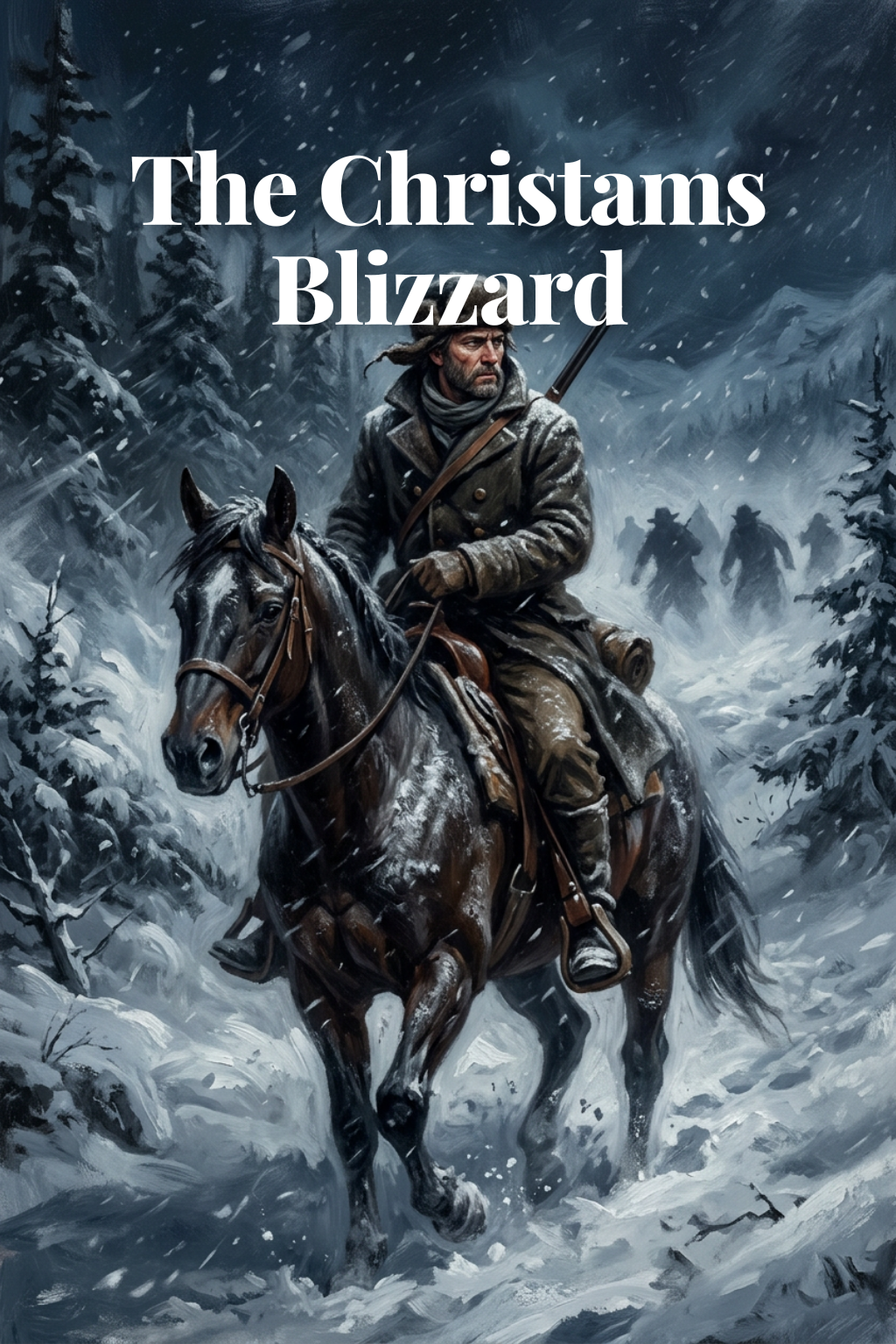
Novel · 5 chapters · 11,426 words
The Christams Blizzard
Contents5 chapters
Chapter 1
The Morning Before the Feast
The kitchen table had been pushed close to the stove to make room for all the hands. Caroline stood at one end with a crock of dough and flour on her cuffs, working in more meal a little at a time while Martha Reed cut strips of dried apple for pies. The children had been sent to the far side of the room with scraps of paper and bits of red thread to keep them from the hot iron and the knives. Every few moments one of them forgot and drifted back toward the table, drawn by the smell of cinnamon and yeast, and Martha would turn without looking and say, “Back by the chest, all of you,” in the tone of a woman who had already said it six times that morning.
The house carried the full sound of Christmas coming whether they had much for it or not. A kettle lid rattled softly. A chair scraped. From outside came the knock of Daniel’s axe at the woodpile and the short stamp of horses in the yard. A length of salt pork hung near the door, wrapped in cloth against the draft. Evergreen boughs Daniel had cut the day before lay across the mantel and above the window, their sharp smell mixing with bread and smoke.
Caroline pressed her fist into the dough and looked up as the back door opened.
Daniel came in with cold on his coat and a string of rabbit carcasses in one hand. He set them on the bench, shut the door with his heel, and stood for a moment warming his fingers over the stove. He was a broad man, not heavy, with the look of someone built by work rather than fed into size. Snow clung in a thin line along the brim of his hat. He took it off and nodded toward the pies.
“Smells like a proper feast already.”
“Wait until it’s done before you praise it,” Caroline said. “You’ll get only the trimmings if you start stealing now.”
He gave a small grin. “I know my place.”
Martha did not look up from the apples. “Your place is by the shed. You promised more wood before dinner.”
“I brought in the rabbits first.”
“And I am grateful,” Martha said, in a voice that made plain she would be more grateful when he was outside again.
The children laughed because it was safe to laugh when Martha meant no harm. Daniel crossed the room, bent to kiss Caroline once on the temple, and reached for a crust end cooling on a cloth. She slapped his knuckles lightly with the back of her wrist before he could take it.
“Out,” she said.
He stole the crust anyway and went, chewing.
Caroline watched the door settle shut behind him. She did not smile until she turned back to the dough. It had been a lean year in places and a hard one in others, but there was enough in the house for both families to sit at table on Christmas Day. That fact had weight to it. She felt it in her shoulders and in the steady way Martha worked beside her.
Their father was due by noon if the road held, bringing their mother and what little remained of the cranberries from the creek bottoms near his place. Daniel’s older brother Amos had sent word that he would come after chores with his wife and boys before evening and stay the night if the cold sharpened. There would be pallets on the floor and boots lined under benches and too many elbows at supper. Caroline wanted that noise. A crowded house felt like a wall against winter.
She set the dough under a cloth to rise and went to the window. Beyond the glass the yard lay hard and bright. The sky had a pale cast to the south that she did not like, though there was no wind yet. Daniel was at the chopping block, splitting kindling fine enough to catch from a single coal. He worked with his coat off now, shirt sleeves rolled and steam lifting from his back in the cold.
Martha slid a pan aside and followed Caroline’s glance. “You’re looking at the sky.”
“I am.”
“Then stop. It will do what it means to do whether you look or not.”
Caroline turned. “You say that as if you never watch it.”
“I watch it. I just don’t pretend the watching helps.”
One of the younger boys began to cry over a torn scrap of paper. Martha wiped her hands, went to him, and mended the thing with a touch gentler than her voice. Caroline went back to her work.
By late morning the house had taken on the close heat of many bodies. Their parents arrived first in a wagon with the blankets lashed high and frost silvering the mule’s harness. Caroline’s mother came in carrying a tin box of cranberries and complaining that the road had ruts under the snow deep enough to snap an axle. Her father followed with a sack of turnips over one shoulder and bent at once to thaw his mustache by the stove. There were greetings, chairs pulled near, questions about the trip, and the first telling over of who had not yet arrived and when they could be expected.
Daniel came in behind them with another armload of wood and shook hands with Caroline’s father, whose grip seemed always to test a man before welcoming him.
“You’ve got enough fuel for a siege,” the older man said, eyeing the stacked logs by the wall.
Daniel set the wood down. “If my wife has her way, we’ll outlast an army.”
“She’ll need to,” Martha said from the table.
Dinner was plain and quick: beans warmed with onion, bread from the morning before, coffee for the adults and milk for the rest. They ate in shifts because the room would not hold everyone at once. While Caroline was clearing bowls, she heard hoofbeats in the yard at a hard pace.
Daniel heard them too. His head came up before the sound had fully reached the door.
A man came in without waiting to be asked, stamping snow from his boots. It was Will Tandy from the lower settlement, his scarf white at the edge with frost and his face set with the kind of hurry that leaves no room for courtesy until after the news is told.
“Burk,” he said, seeing Daniel. “I was told I’d find you home.”
Daniel put down the bowl in his hands. “You did. What is it?”
Tandy glanced around the room, taking in the women, the old folks, the children. His voice dropped but not enough to keep anyone from hearing. “Four riders went through Mason’s place before sunup. Took flour, cartridges, and his bay gelding. Smashed his hand when he tried to hold the barn door. Pete Lorrin says they match the men seen west last week. One of them’s Vance. Elias Vance.”
The room changed at the name. Not in any grand way. No one cried out. But forks stopped. Martha straightened. Caroline’s mother set down the dish towel she had been folding. Even the children felt something in the air and went quiet.
Daniel asked, “Which direction?”
“North by east from Mason’s. Cutting toward the old freight trace, if I read it right. I stopped at Harlan’s on the way. They’re warning who they can. Sheriff’s two hours off at best and may not come till tomorrow if he’s drunk or snowed in.” Tandy looked back toward the yard. “Tracks are fresh enough if a man rides now.”
Caroline dried her hands on her apron and stood still. She knew the look that had settled on Daniel’s face. It was the look he wore when a thing unpleasant had become simple by being necessary.
Her father spoke first. “This is not your charge.”
“No,” Daniel said. “But Mason’s place is five miles from here, and Amos comes this road before dusk.”
“Amos can fend for himself,” Martha said.
Daniel looked at her. “And the next farm? And the one after that?”
Tandy shifted. “I need men willing to ride. I’ve got one waiting with my horse at the lane and maybe another at Harlan’s if he finds his backbone. If no one goes, those four will help themselves till the storm closes the roads.”
Caroline heard the word and turned to him. “Storm?”
Tandy nodded toward the window. “You can’t smell it in here? Air’s changed. Clouds are building behind the ridge. Might be nothing but wind. Might be more.”
Her father made a low sound in his throat. “Then the foolish thing would be to chase four armed men into open country with weather turning.”
Daniel said nothing at first. He crossed to the peg by the door and took down his coat. He moved without haste. That was what Caroline noticed most: he was not worked up, not eager. Only decided.
She came around the table to face him. “How many are you?”
“Tandy, one more if he comes, and me.”
“For four men who’ve already stolen a horse and broken a hand.”
Daniel slid his arms into his coat. “Four men who think the settlements are spread thin because of the holiday. If they’re checked now, they may turn off. If not, they’ll keep taking.”
“And if you find them?”
“Then I’ll see what can be done.”
Her mother murmured, “Caroline.”
But Caroline kept her eyes on her husband. “You say that as if it were a fence post to mend.”
Daniel reached for his scarf. “I say it because waiting inside won’t make them less dangerous.”
Martha stood at the stove with a spoon in her hand, looking from one to the other. “Let Tandy fetch the sheriff.”
“Tandy is fetching who he can,” Daniel said.
Tandy, perhaps hearing his chance thinning, added, “Mason’s boy rode to the crossing already, but that road’s longer than mine. If Vance gets a lead and the sky comes down, there won’t be any trail worth reading by dark.”
Daniel tied the scarf at his throat. Caroline saw then that argument would not stop him, not because he thought himself brave but because he had set the matter beside his own comfort and found it smaller. That was one of the things she loved in him and one of the things that angered her most.
She stepped close enough to straighten the collar he had turned under. Her fingers worked at the wool a moment longer than they needed to.
“At least take the gray mare,” she said. “She sees her footing better than the chestnut.”
He nodded. “I will.”
“And your heavy gloves. Not the worn pair.”
A faint line touched his mouth. “Yes.”
“Daniel.”
He waited.
“Be home before the meal is spoiled from all this fuss.”
It was not what she wanted to say. The room was too full for the other words. He knew it anyway. He put his rough hand over hers once, a pressure brief enough to pass before anyone made notice of it.
“I’ll do what I can.”
That was as much promise as he would give.
The house broke into motion around him. Tandy went out to check saddles. Daniel took his rifle from above the hearth and tested the load by habit. Caroline fetched the heavy gloves and a wrapped packet of biscuits left from breakfast. Martha filled a flask with coffee and stoppered it hard. Their father muttered that the whole thing was madness while helping cinch the bedroll behind the saddle, which was his way of giving in. Outside, the air had gone flat and sharp. The stock in the pen shifted and showed the whites of their eyes.
Amos had not yet arrived.
That troubled Caroline more than the rest, though she said nothing of it. She watched Daniel buckle the rifle scabbard and check the girth again with mittened hands. The sky to the south had thickened to a dull sheet, and the light over the far ground looked smeared, as if someone had dragged a gray thumb across it. In the open, sound carried too clearly. She could hear Tandy speaking low to the other rider by the gate and the creak of leather when Daniel set his boot in the stirrup.
He looked back once toward the house. Not at the whole of it. At the window where he knew she stood.
Caroline lifted a hand.
He mounted, turned the mare toward the lane, and rode out with the others, their horses throwing up powder from the packed snow. The children crowded beside Caroline at the window until Martha shooed them back from the draft. They watched the riders pass the cottonwoods and shorten against the pale fields, three dark marks moving north by east.
For a while they remained visible.
Then the land itself seemed to begin closing. A loose skirl of snow ran low across the ground where no wind had been a half hour before. The line of fence posts at the edge of the meadow blurred one by one. Caroline stood with the biscuits still warm in the cloth on her palm, though Daniel had taken his share. Far off, where the riders had gone, the plain was turning the color of old tin.
Behind her, the room filled again with voices trying to be ordinary. Her mother asking where the cranberries should be set. Martha calling for more water. One of the boys wanting to know if Uncle Amos would bring the carved whistle he had promised. Life pressing on because it had to.
Caroline set the cloth down and turned from the window. “Martha,” she said, “bring in every stick from the lean-to. And have the boys fill the kettles now, before the pump goes stiff.”
Martha studied her face for a beat, then nodded.
Outside, beyond the yard and the last post of the lane, Daniel and the others were gone from sight. Only the track remained, already thinning under the first dry sweep of snow.
Chapter 2
Four Riders on the Trail
The three riders kept to the north trace until Mason’s fence line showed through the rise. By then the wind had begun in earnest, not strong yet, but steady enough to comb the top of the snow and send it whispering over the ground. Daniel rode a little ahead of the others. The gray mare held her ears forward and picked her way with care, nostrils dark and damp in the cold.
Mason’s barn door hung crooked on one hinge.
Tandy swung down before his horse had fully stopped and strode across the yard. Daniel followed him to the trampled place between the house and the barn. There was no need to ask if the account had been true. Hoofprints churned the snow into a hard black mess over the frozen mud. A sack had burst near the wall, and a white scatter of flour lay blown thin across the yard. One of the shutters on the house was split.
Pete Lorrin came out of the barn fastening his coat with clumsy fingers. He was a narrow man with a red nose and a way of glancing over his shoulder even when no one was behind him.
“You’re late,” he said, though not with blame so much as fear. “They’ve had a good lead.”
“How long?” Daniel asked.
“Hour and a half. Maybe less. They didn’t linger once they got what they wanted.”
Tandy pointed at the barn. “Mason?”
“Inside. Hand’s swelling like a boiled ham. His wife’s got him wrapped in cloth.” Pete looked at Daniel. “You riding after them?”
“Yes.”
Pete hesitated, then jerked his chin toward the back lot. “Trail cuts out that way. Four horses. One heavy sorrel with a cracked near shoe. I marked it because it strikes crooked.”
Daniel went around the barn. The tracks were plain enough there. Four mounts had come in from the west, milled only a moment, then left north by east. The stolen gelding showed among them, a cleaner print with sharp edges and a longer stride than the others, driven hard. One set of tracks did indeed bite unevenly into the crust. Daniel dismounted and crouched for a closer look. The broken shoe had left a notch like a missing tooth at the back of each print.
He straightened and looked at the sky.
The gray lid he had seen from home had spread fast. It flattened the light until distance went strange. What should have seemed far off looked near, and what lay near had already begun to lose its edge. He could still read the trail now. In an hour he might not.
Tandy came up beside him. “Well?”
Daniel pointed with his glove. “That lame strike there. Keep your eye on it if the rest go soft.”
Pete spat into the snow. “You’ll need more than a good eye soon.”
“You coming?” Tandy asked him.
Pete’s mouth drew tight. “I came this far.”
It was not agreement. It was apology in advance.
Daniel mounted again. “Then come farther.”
They left Mason’s place at a trot, the three of them strung out behind the bandits’ line. The trail held to open country first, across a long shallow swale where bunchgrass stuck through the snow in stiff yellow clumps. The four men ahead had not bothered to hide their passing. Why should they? No lawman was close, and men with stolen goods often counted on the cold to do half their work for them. A man delayed at his own hearth was no pursuer at all.
Daniel kept his eyes low, reading what he could. One rider favored his left side in the saddle; that horse’s prints bit deeper on the right. Another mount was smaller and quick stepping. The horse with the cracked shoe threw that same crooked mark every few yards, a useful thing while the trail remained clean. The men had crossed a frozen drainage and climbed toward a line of low ridges where cedar and scrub oak took hold in better seasons.
“Vance rides with his head down,” Tandy called from behind, as if the land itself might hear and answer. “That’s what I was told. Black hat. Scar by the mouth.”
Daniel did not turn. “If we catch sight of them, save your breath for your horse.”
They topped the first ridge and found where the bandits had paused. Ashes from a cigarette darkened the snow beside a boot print. One rider had turned in the saddle to look back the way they had come; the heel mark showed where he had dug in and twisted. From there the trail split around a stand of cedar and joined again on the far side.
Pete came up breathing hard. “They knew no one was on them then.”
“Maybe,” Daniel said.
“Or they heard about Tandy raising half the county.”
Tandy snorted. “Half the county would still be at table arguing whose turn it was to fetch a rifle.”
They pressed on.
By midafternoon the country had opened again, the ridges falling away into broad white ground broken only by old creek beds and the dark skeletons of cottonwoods. The wind freshened another degree. It no longer whispered over the snow. It hissed. Fine grains struck Daniel’s cheeks where his scarf had slipped. He pulled it higher.
The tracks ahead had begun to blur at the edges.
He urged the gray mare into a canter where the footing allowed. Tandy followed after a moment. Pete did not. Daniel heard the lag in hoofbeats behind him and checked back long enough to see Pete’s horse stumbling through a drifted patch.
“Keep up or turn around,” Tandy shouted.
Pete raised an arm in a gesture that might have meant either.
Daniel drew rein at a narrow cut where the bandits had crossed single file. Here the wind had less reach, and the prints showed deep in the sheltered snow. He counted them again to be sure. Four. No more. The horse with the broken shoe was still third in line. One man had dropped something small and bright near the bank. Daniel bent and picked it out of the crust: a brass button with thread still clinging to the holes.
“Coat caught on brush,” Tandy said.
Daniel turned the button over in his palm, then pocketed it. “Or he was in a hurry.”
When they climbed from the cut, the world had shortened. A line of willows fifty yards off showed and vanished by turns as the snow drove between. The horizon was gone. Sky and ground had come together in a single white field with no seam in it.
Pete reached them and did not bother to hide his fear now. “This is bad country for losing a trail.”
Daniel looked ahead. The bandits had angled east, perhaps for the old freight trace Pete had named, perhaps only because the ground there ran firmer under a thin crust. Their prints stretched before him in a dim row, each one filling as he watched.
“We keep on,” Daniel said.
Pete stared at him. “For how long?”
“Till we see them, or lose them, or have reason enough to stop.”
“That’s no answer.”
“It’s the only one there is.”
Tandy nodded toward the east. “If they mean for the trace, there’s a bad washout beyond it and some broken country. They might hole up there.”
“Then we stay close enough to know it.”
Pete looked back over his shoulder toward the way home, though home was no longer visible. “And if the storm comes full on?”
Daniel settled his hat lower. “Then standing still out here will not improve our chances.”
He moved on before either man could answer. After a beat, Tandy came after him. Pete followed because the alternative was to be left alone on the plain.
The next mile cost them more than the last three. Snow began to fall from above as well as rise from below, dry and mean, stinging the eyes. Daniel had to bend low over the mare’s neck and look down along her ears to hold the line of prints. Sometimes he lost it for ten yards and found it again by the crooked strike of the cracked shoe. Once he found where one of the bandits’ horses had slipped on a hard patch and gone to one knee. The mark was fresh enough that loose snow had not yet softened the edge. They were gaining, or had been not long ago.
He raised a hand for the others to halt.
“What is it?” Tandy said.
Daniel pointed. Ahead, on the lee side of a long swell in the land, dark specks moved in and out of the white.
For one hard second he thought they were the riders.
Then the specks lifted all at once and scattered: crows feeding at some carcass, startled by the horses.
Pete swore under his breath.
They rode to the place and found a dead calf, hide stripped ragged by teeth and weather. The bandits’ trail curved around it. One set of horse droppings steamed faintly in the cold.
“Close,” Tandy said.
Daniel did not answer. He was listening. Through the wind there came, or seemed to come, a dull sound ahead. Not thunder. Not hooves either. More like timber knocking against itself. He turned his horse east and peered into the whiteness.
There. A shape. Then another. Low, black, fixed.
“Cottonwoods,” he said. “Creek bed.”
The trail dipped toward them.
They reached the bank and found some shelter from the direct push of the wind. The creek itself was frozen under a skin of drifted snow. The bandits had crossed single file and climbed out on the far side. One horse had scrambled, cutting a deep furrow with both hind legs. Daniel leaned from the saddle to study it. Fresh. Very fresh. Snow had not yet begun to settle in the claw marks.
Tandy saw it too. “They’re just ahead.”
Pete licked his lips. “Then maybe they’ve taken cover in those trees.”
Daniel scanned the opposite bank. The cottonwoods stood in a ragged line, trunks black with old scars, branches clicking overhead. Beyond them the land rose again into broken ground. If Elias Vance had sense, he would use that rise to hide his men and wait for fools to ride into him blind.
Daniel slipped his rifle free of the scabbard and laid it across his saddle.
“Tandy,” he said, “stay off my right. Pete, hold back enough not to bunch us.”
Pete gave a short laugh with no humor in it. “You speak as if I were eager to crowd you.”
Daniel urged the mare across the creek. Ice thudded under her hooves beneath the snow. She climbed the far bank and stood blowing hard.
The prints led into the cottonwoods, then out again, then vanished on a stretch of ground where the wind had swept bare patches of frozen earth between drifts. Daniel circled once, twice, keeping the mare’s head low, hunting for sign. There—a single half print beside a root. Twenty feet farther, another. The broken shoe. Still east.
He followed it into rougher country where the swells sharpened into draws and low bluffs. The storm thickened another turn. Snow came in sheets now. Tandy was no more than a moving shadow at his back. Pete had dropped so far behind that Daniel could not see him at all.
“Tandy,” he called.
“Here.”
“Pete?”
No answer.
Tandy’s horse drew alongside at last, flanks white with driven snow. “He’s there somewhere.”
Daniel looked back and saw nothing but white and the dark poles of the cottonwoods fading behind them.
For the first time, doubt pressed at him, not about turning after the bandits, but about the space already opening between this place and home. Caroline would be measuring the light by now. Amos, if he had reached the house at all, would have come in under a darkening sky. The storm had moved quicker than any of them had guessed.
Then the mare stopped of her own accord and threw up her head.
Ahead, half-hidden in the blowing snow at the mouth of a narrow draw, a horse stood riderless with its reins trailing. Its sorrel coat was powdered white. Even at this distance Daniel saw the near fore shoe strike crooked when it shifted weight.
The broken shoe.
He tightened his grip on the rifle and looked into the draw, where the snow blew sideways between the banks like smoke from a gun, and whatever waited inside did not move.
Chapter 3
Whiteout on the Plains
Daniel slid from the saddle with the rifle in his hand and the reins looped once over his wrist. The gray mare stood uneasy, shifting under him, her breath gusting white and thick. Tandy brought his own horse in close enough that the two animals pressed flank to flank.
“You see anyone?” Tandy asked.
“No.”
The sorrel at the mouth of the draw had one stirrup hanging low and empty. Its saddle was dark with snow. A bedroll had been lashed badly behind it, one strap loose and knocking against the cantle each time the horse moved. Daniel stepped toward it with care, his boots sinking through the crust where the drift had piled deeper along the bank.
The draw itself was narrow, cut into the land like an old wound. Brush clung in patches to its sides, half buried. Snow drove through the opening in hard slanting lines, then spun and settled in hollows where the wind could not strip it away. Daniel listened. No voices. No crack of a branch. No horse moving out of sight.
He caught the trailing reins and laid a gloved hand against the sorrel’s neck. The animal was trembling.
Tandy looked into the draw and then back over his shoulder into the white behind them. “Could be a trick.”
“It could.”
“And if it is?”
Daniel looked down. A set of boot marks showed near the sorrel, already softening. One man had dismounted in haste. Another track, dragged at the toe, led a few feet into the draw and disappeared where snow had blown over it.
“He went in there on foot,” Daniel said.
“Or was pulled.”
Daniel handed Tandy the sorrel’s reins. “Hold both.”
Tandy opened his mouth as if to protest, then thought better of it.
Daniel moved along the edge of the draw first, not dropping into it, watching the bottom from above. Thirty feet in, he saw a dark shape against the bank. He raised the rifle, then lowered it again and climbed down.
A man lay half on his side with one arm bent under him. Snow had crusted on his coat and hat brim. Daniel turned him over with his boot first, then crouched.
Not Elias Vance.
The man was younger than Daniel had expected, with a narrow face gone gray from cold and a line of old beard on his jaw. Blood had dried dark over one temple where he had struck stone or frozen ground. His eyes were open but blind with daze.
“You hear me?” Daniel said.
The man’s lips moved. No words came out.
Tandy slid down the bank behind him. “Alive?”
“For now.”
Tandy gave a short breath that might have been relief or disgust. “Leave him, then. He’s one of them.”
Daniel looked at the man’s hands. The right glove was gone. Fingers already stiffening. If he stayed where he was much longer, Vance would not need to worry about him again.
“He may know where the others turned.”
“He may also put a knife in your ribs once he wakes.”
Daniel reached inside the man’s coat and found a revolver tucked loose in the waistband. He took it and stood. “Then he wakes without this.”
Tandy frowned through the driven snow. “You mean to carry him?”
“I mean to get him under cover before he freezes solid. If the others left him, they had reason.”
“That reason could be fifty yards off with a rifle.”
Daniel scanned the banks again. The storm had shortened the world to the length of the draw and no more. If Vance and the others were near, they were blind too unless they had sheltered deeper in the rough ground. Chasing them farther now would mean riding into broken country with no trail fit to read and one half-dead prisoner to account for.
He did not like the choice. That was no measure of it. The choice remained.
“There’s no track worth trusting in ten minutes,” he said. “We take what we have.”
Tandy understood at once and did not like it either. His mouth tightened. “So that’s it.”
“For now.”
“For now loses men.”
“It also keeps them from freezing in their saddles.”
Tandy said nothing.
Together they hauled the injured bandit up the bank. The man found his feet once, staggered, and nearly went down again. Daniel got an arm under him and felt how little heat was left in him. Not enough. They would need shelter soon, and not the poor lee of a bank.
Pete appeared out of the white as they reached the horses. His eyes went first to the prisoner, then to Daniel’s face.
“I lost you,” he said.
“We found one,” Tandy answered.
Pete stared at the riderless sorrel. “Where are the others?”
“Gone on,” Daniel said. “Or waiting.”
Pete looked east into the storm and gave a hard shake of his head. “No. No more of this. We need a roof, any roof. There’s a trapper’s cutbank cabin south of here if it still stands. I passed it once two winters ago.”
“How far?”
“Less than a mile if we hit it right. More if we don’t.”
Daniel weighed the ground in his mind. South would take them off the bandits’ line and farther from home. East was blindness. North was no better. He looked once at the faint marks leading on from the draw, already filling level under the sweep of snow.
Then he turned the mare’s head south. “Take us there.”
Pete did not argue after that. He led at once, hunched low in the saddle, as if afraid Daniel might change his mind and send them back after the missing trail. The prisoner rode slumped before Tandy, tied to him at the waist with a length of bedroll strap. Twice the man sagged so badly Daniel thought he had gone dead, but each time a rough breath came through his cracked lips.
The land gave no sign of distance. One rise looked like the next. Snow crossed their tracks as soon as they made them. Daniel kept glancing behind, not because he believed Vance was on them, but because a man alone in such weather could vanish between one look and the next. He imagined, against his will, the road to the homestead gone smooth under drift, the lane lost, Caroline standing at the window until there was no use in it.
Pete finally lifted an arm. “There.”
Daniel saw nothing at first. Then a darker line showed low against a bank where the earth had sheared away years before. They rode toward it and found a shack tucked into the cut, built half from logs and half from scavenged boards silvered with age. One shutter hung loose. The door leaned inward at the top. But it stood.
They got the horses under the lee side first and tied them nose to tail, blankets pulled up as far as the saddles allowed. Inside, the place smelled of old ash, mouse droppings, and damp wood. A fireplace of rough stone occupied one wall. Someone had left a stack of split cottonwood under the bunk frame, gray but dry enough at the core.
Daniel knelt and struck a match cupped deep in both hands until flame took the shavings. Smoke rolled low a moment, then found the flue. Heat, thin as it was, changed the room at once.
They lowered the injured bandit onto the floor near the hearth. Tandy rubbed his hands hard and looked down at him. “If he dies, we’ve made ourselves porters for nothing.”
“If he dies,” Daniel said, “he still dies inside instead of out.”
Pete closed the door against the wind and set his shoulder to it until the latch caught. “That won’t stop much.”
“It stops some.”
Daniel crouched by the man on the floor and opened his coat. Around the neck hung a strip of red wool tied like a scarf. In one pocket he found a handful of cartridges and a crust of bread gone stiff. In the other, folded once and damp through, a playing card with a queen of hearts printed on it. Nothing useful. The man’s eyelids fluttered.
“Where did Vance go?” Daniel asked.
No answer.
He tried again, sharper. “How many with him now?”
The man’s mouth worked. Daniel leaned close to catch it.
“Three,” he whispered.
Tandy barked a humorless laugh. “We knew that much.”
Daniel kept his eyes on the man. “Where?”
The answer came in pieces, each word dragged. “Camp... wash... north fork.”
Pete straightened from the door. “North fork of what?”
But the man had spent what little sense he had. His eyes rolled away. He said something else that might have been a name or only a groan.
Daniel sat back on his heels. A wash. North fork. Broken country ahead held plenty of both. It was something and almost nothing.
Tandy stared into the weak fire. “By morning they’ll be gone.”
“If there is a morning fit to travel,” Pete said.
Daniel rose and went to the door. When he opened it a hand’s width, snow blew in at once, dry as flour. The world beyond the threshold had erased itself. He could not see the horses though they stood only yards away.
He shut the door again.
At the homestead, the first news came not from Daniel but from Amos.
Caroline heard the wagon before anyone else did, a slow wooden complaint under the wind. She had been near the stove counting sacks aloud with Martha so the older children would think it no more than household order. Flour, meal, beans, salt pork, apples, coffee. Enough if measured. Not enough if the storm settled in for days.
She went to the door before Martha reached for her shawl. The cold pushed in so hard it felt alive.
Amos came through it bent and white with snow. His beard was caked stiff. Behind him his wife, Lena, hurried the boys from the wagon and into the house, each child carrying some bundle or pan wrapped in cloth against the weather. The youngest had begun to cry from cold before his boots hit the floorboards.
“Shut it fast,” Martha said, already taking blankets from them.
Caroline closed the door and turned to Daniel’s brother. “You saw him?”
Amos pulled off one mitten with his teeth. “Not since noon. Tandy’s boy came by Harlan’s while I was there and said Daniel had gone after Vance with the others.” He looked around the room, reading what had already been understood. “I came as quick as I could after that. Road’s near gone.”
Their father rose from his chair by the stove with a face gone old and hard. “Then he’s still out.”
“Yes.”
The room fell quiet enough that the hiss in the stove could be heard plainly.
Caroline did not let the silence sit. “Martha, take Lena and put all the wet things by the far wall, not against the stove. Amos, there’s room in the lean-to for your team if we clear the broken sled runners. Boys, no one opens that door again unless an adult says so.”
The children listened because her voice gave them something firm to hold. Even the little one stopped crying long enough to watch her.
Amos stamped his boots clean of the worst of the snow. “I can go back out with a lantern once I’ve seen to the horses.”
“No,” Caroline said.
He looked at her, surprised.
She tied her apron tighter around her waist though there was no need. “No one is finding anyone in this dark. We’ll lose two men where one is enough.”
Amos glanced toward the window where snow scratched across the glass. He knew she was right. That did not make him easier under it.
Martha came up beside Caroline with a scrap of paper and the nub of a pencil. “I’ve marked what’s in the pantry.”
“Good. Cut supper smaller than planned.”
Lena, cheeks red from cold, said at once, “The children need feeding.”
“And they’ll have it,” Caroline answered. “But not feast portions. Not tonight.”
No one argued. That was almost worse.
They worked by lamplight while the storm built. Amos and Caroline’s father brought in the last of the wood from the lean-to by rope, each man holding one end so neither would lose the house in the white crossing from yard to door. Martha set the older girls to slicing bread thin. Lena warmed broth and stretched it with water and onion. Caroline moved from task to task, not quickly, not slowly, refusing any hurry that might spread to the others.
Twice she went to the window and saw nothing but the lamp’s own reflection on the pane and snow rushing past beyond it.
By full dark the house felt smaller than it had that morning. Wet clothes steamed by the wall. Children sat close under blankets and asked in low voices whether Christmas would still come if the road stayed shut. Caroline answered yes each time, as if the question had only one plain answer. Her mother threaded a needle by the lamp and mended a cuff she did not need to mend. Amos cleaned Daniel’s spare rifle and kept stopping to listen.
At supper the bowls went around light but hot. No one said grace longer than usual. No one mentioned empty chairs.
Afterward, when the younger children had been set with scraps of cloth and string to keep their hands busy, Amos came to Caroline near the pantry door.
“If dawn gives us even half a clearing, I’m going after him,” he said quietly.
She met his eyes. He was Daniel’s brother enough in the set of his jaw and the way decision came into him.
“If dawn gives you a road,” she said. “Not before.”
He nodded once.
From the far side of the room, Martha called, “Caroline.”
She went. Martha stood by the back door, head tilted. For a moment Caroline heard only wind and the creak of the house taking the storm. Then, underneath it, faint and uncertain, came another sound.
A dull thud. Then another.
Not at the door.
From outside the wall. From the yard. Something striking wood in the dark.
Chapter 4
The House Holds Its Breath
The thud came again, lower this time, followed by a scrape along the boards.
Amos set down the rifle rag and was at the door before anyone else moved. Caroline caught his sleeve.
“Not wide,” she said.
He nodded and lifted the latch a crack. Wind shoved hard at once. Snow needled through the opening and spun across the floor. Amos leaned his shoulder into it and peered out.
“It’s the shutter from the shed,” he said. “Blown loose.”
Another strike answered him, wood on wood.
Their father rose halfway from his chair. “If it tears free, it’ll take the hinges off the whole side.”
Amos looked at Caroline. “I can tie it.”
She looked past him into the white. There was no yard anymore, only a shifting brightness where the lantern light died in a few feet. But if the shutter kept hammering, it might break the shed wall, and the shed held kindling, tools, and the last sack of feed not yet brought in.
“I’ll hold the door,” she said. “Take a line around your waist.”
Martha had already found one and was pushing it into his hands. Amos looped it fast, gave the end to Caroline and their father together, and went out bent nearly double. The storm took him at once. For three seconds she could see his shape, then only the rope moving.
The house had gone quiet behind her. Even the children watched without speaking.
The rope jerked hard once, then twice. A dim shape loomed and vanished. There came the knock of wood, a muffled curse, then the high rasp of a line being pulled through frozen fingers. Caroline braced her heels on the floorboards and held. Her father leaned in with her shoulder to shoulder.
At last Amos lurched back through the door carrying half the storm on him. They dragged him in and slammed it shut. Snow clung thick to his coat and beard. His hands shook when he untied the rope.
“It’ll hold till morning,” he said.
Martha took one look at his face and pushed him toward the stove. “Then sit before you fall over and make more work.”
That earned a few weak smiles. Caroline was grateful for them.
She stooped with the broom and pushed the blown snow back toward the door. Her fingers had gone numb on the rope. The cold had found the seams in the house now. It crept under the sill and around the window frames and through places no one noticed when the air was still.
Martha came to her with the scrap of pantry figures again. “If this keeps another day, we’ll have to open the smoked ham.”
Caroline looked over the marks by lamplight. Flour lower than she liked. Beans enough for three meals if stretched. Coffee nearly gone. Molasses low. Salt safe. The bigger worry was lamp oil.
“How much kerosene?”
“Two lamps full and what’s in the can. If we keep all three burning through the night, not enough.”
Caroline folded the paper once. “Then we don’t keep all three.”
Martha’s mouth tightened. “The little ones won’t like the dark.”
“The little ones can sit close to one another.”
She said it evenly, but the choice scraped at her. Every small cutting away did.
Across the room Lena was trying to settle the youngest boy, who had gone from crying to whining and now asked every few breaths when they would eat pie. One of the older girls snapped at him to hush. Then two more children began bickering over a strip of red cloth. It spread fast, that thin restless edge. They had been shut in too long, too many bodies and too much listening.
Caroline crossed to the table and picked up the box of scraps and thread.
“All right,” she said. “If hands must be busy, let them be useful. We’re making ties for the pantry jars and patches for mittens. Straight strips only. No one wastes the cloth.”
A few groans answered her. She ignored them.
The children gathered with bad grace at first, then with interest when Martha showed them how to knot the thread tight without tearing the weave. Even the boy who wanted pie became intent on making his strip the longest. Caroline moved among them correcting fingers, separating quarrels before they became tears. It was not cheer she meant to preserve. Only order. Order was close enough.
Still, as she bent over one child’s clumsy stitching, she felt the fear in her own chest like a second pulse. Daniel had been gone too long. She did not ask the clock for it. The storm itself was measure enough.
At the cutbank cabin, Daniel woke the injured bandit before dawn by rubbing snowmelt against his face. The man flinched and cursed, which Daniel took for a good sign.
“Name,” Daniel said.
The bandit blinked up at him from where he lay wrapped in an old blanket near the hearth. Firelight made his skin look the color of tallow.
“Neal,” he muttered.
“Neal what?”
He hesitated. “Foster.”
Tandy, sitting on the bunk with his boots near the coals, said, “Maybe true. Maybe not.”
Daniel did not look at him. “Where did Vance go?”
Foster swallowed. His cracked lips bled a little when they parted. “He left.”
“That I know.”
“Left me too.”
“Why?”
Foster’s good eye found the ceiling. Shame sat plain on his face, stronger than fear for the moment. “Horse rolled in the draw. Took my leg under. I slowed them.”
Daniel pulled the blanket back enough to see. The left leg was swollen badly above the boot. Not broken clean, perhaps, but useless for riding at speed. Vance had done the math and ridden on.
“With the flour from Mason’s?” Daniel asked.
Foster nodded once.
“And the stolen gelding?”
Another nod.
Pete, huddled near the door under his coat, gave a sound of disgust. “Fine company you keep.”
Foster shut his eyes.
Daniel reached for the man’s boot and tugged the trouser leg higher. Something dark had been caught in the folded cuff. He pinched it free.
A sprig of cedar, broken fresh.
He looked up. “Where did you camp last?”
Foster opened his eyes again. “Why?”
“Because this came from somewhere.”
Foster saw the bit of green between Daniel’s fingers. His mouth twitched before he could stop it. Daniel caught the look.
“Where?”
“There’s a stand,” Foster said at last. “North and west. Little bowl in the ground. Some rock on one side. You can’t see it till you’re near on top of it.”
Tandy straightened. “Why head there if you meant east?”
Foster did not answer. Daniel thought he knew. Men ran crooked when they feared pursuit, laying a line one way before turning another. In weather like this the trick might have bought Vance hours.
“How far?” Daniel asked.
“Couple miles from the draw. Maybe less.”
“In this storm?”
A dry laugh came from Foster’s split lips. “Storm wasn’t this when we turned.”
Daniel stood and went to the door. Gray light pressed at the cracks. The wind had slackened some from the worst of the night, though snow still drove low and steady. Enough to move, perhaps. Enough to miss what lay ten yards off too.
He opened the door and stepped outside. The horses stood with heads down, iced along mane and tail. Beyond them the world had shape again, but only just. The nearest rise showed. Nothing after.
Tandy came out behind him. “You’re thinking of that camp.”
“I am.”
“And if he’s lying?”
“Then we spend an hour and lose it.”
Tandy looked south, where home lay somewhere under the same white. “And if he’s not?”
Daniel turned the cedar sprig in his fingers. It smelled sharp and clean even in the cold. There was little cedar on the open line they had ridden. More toward the broken ground leading back west. If Vance had bent that way in the night, he might be cutting not east at all but wide around toward the settled places again, using the storm to cover it. That thought sat badly.
He thought then of Caroline’s face at the door before he had left, steady because the room had required it. He had ridden out to keep danger from spreading to other homes. If Vance had turned broad and loose in the storm, then the straightest duty might no longer be the same as the first one.
“We look,” Daniel said. “Quickly.”
Pete groaned when he heard it but came all the same. Foster they left in the cabin with a cup of melted snow, the revolver gone and his wrists tied to a bedpost with rawhide. He looked too weak to do much more than curse them, but Daniel tied the knots tight.
The three men rode north and west with Pete leading by memory. Twice he admitted he had none to trust and stopped to squint at the land as if it might confess. Then, on the far side of a low ridge, cedar showed through the snow, dark and close set.
“There,” Daniel said.
The bowl lay hidden exactly as Foster had claimed. From above it looked like nothing, just another drifted fold in the ground. Then they tipped over the lip and saw black circles on the snow where two fires had burned down into the crust. A canvas lean-to, slashed and collapsed. Boot marks everywhere, blurred but plentiful. The camp was abandoned.
Tandy swore softly.
Daniel dismounted and moved through it. A coffee pot lay on its side under a drift. One blanket had been left rolled tight, frozen stiff where it sat. Crumbs of hard biscuit showed in the ashes near one fire, mixed with a scatter of beans. Men had left in haste.
He found the first clear sign beside a cedar trunk where the wind had been blocked. Hoofprints. Three horses only. All shod. One the stolen gelding by the sharper cut of its shoes. Another the broken-shoe sorrel no longer with them. The third heavy and broad. The tracks pointed south.
“South,” Tandy said, seeing it.
Daniel crouched lower. The prints did not just point. They had depth from driven speed. Vance had left this place meaning to make miles. And with the storm behind him, south did not mean random country. South meant farms. The nearest line of them included the lane to Daniel’s own house.
Pete had gone pale under his beard. “Maybe they only circled for shelter.”
“Maybe,” Daniel said.
But he did not believe it.
Under the fallen edge of the canvas he found one more thing: a torn strip of flour sack with Mason’s mill mark stamped faint on it, and caught in the seam a thread of red wool.
Not from Vance’s camp stores. From some other bundle, some other house. A child’s mitten perhaps, or a woman’s scarf. Small enough to mean nothing. Sharp enough to strike.
Daniel stood. “We’re going back.”
Tandy looked at the sky as if to judge the cost. “On this trail?”
“While there is one.”
Pete did not argue now. Fear had chosen its object.
They left the cabin at once after collecting Foster. The prisoner could barely mount, so they lashed him to the sorrel and led the animal behind. Daniel took the lead on the southbound tracks out of the cedar bowl. Once on open ground he had to work to keep them in sight. The wind worried every edge. The world brightened a little as the day rose, but there was no sun to help by. Only a broad white light with no warmth in it.
He rode faster than was wise. He knew that. The mare knew it too and tossed her head but obeyed. Every time the trail blurred he felt a hard pressure under his ribs. Vance had hours still, perhaps more. Daniel counted distance not in miles but in fences, wells, sheds, doors. If the bandits reached any one of them ahead of warning, another family would open to strangers in storm and find rifles at their breast.
Behind him Foster spoke once through chattering teeth. “He won’t stop long anywhere.”
Daniel did not turn. “You know his mind now?”
“I know he hates being chased.”
“That makes two of us,” Tandy muttered.
By midday the snow eased enough to show the low lines of the country again. Here and there, a fence post stood out of the drifts like a charred stake. Daniel knew this land better now. Not exactly, but in the bones of it. A shallow draw to the east. A rise with split stone near the top. A pair of cottonwoods twisted together by an old lightning strike. Home lay farther on.
The tracks veered west around the draw, then south again. Not the shortest path to any place, but the path of men trying not to be seen while still making ground.
They topped another rise. Below them, through thin veils of blowing snow, lay the remains of an older trail half erased by winters and neglect. Wagon ruts, faint under the white. Daniel knew it at once.
The freight trace.
And beyond it, though distance and storm made shapes uncertain, stood a black thread of timber marking the creek that ran less than two miles from the Burk homestead.
Tandy saw it too. “If they keep this line—”
“They come near my house,” Daniel said.
No one answered that.
He put his heels to the mare and sent her down the slope after the three southbound tracks, toward the trace, the creek, and whatever waited beyond the next veil of snow.
Chapter 5
Tracks Back to the Door
Daniel knew the freight trace before he saw it clearly. The land dipped in a way he had crossed too many times to mistake, and the line of scrub along the old ruts sat where his memory said it should. Beyond that lay the creek, then the rise toward home.
The tracks ahead were fresh enough to hold shape under the drift. Three horses. One man riding a little heavier in the saddle than the others. Vance, perhaps. Or any one of them. It no longer mattered which one carried the name.
Tandy came up on his left, face raw from cold. “If they’ve seen the houses from the ridge, they may already have turned in.”
Daniel did not answer. He was looking at the snow off to the right of the trace. Something dark showed there between two half-buried sage clumps.
He angled the mare down and found the first horse.
It was the stolen gelding from Mason’s place, down on its side with the reins wound under one foreleg. Snow had gathered along its neck and flank. The animal was dead, whether from a broken leg or a gunshot Daniel could not tell at a glance. The saddle was gone.
A little farther on lay a flour sack ripped open and emptied by the wind.
Pete crossed himself without thinking. “They’re shedding weight.”
“Or fighting,” Tandy said.
Daniel slid from the saddle and crouched over the tracks around the dead horse. Boot marks cut across one another in a churned patch. One man had gone to a knee. Another had dragged something heavy a short distance, then left it. There were spots of blood on the snow, not much, already turned brown.
He stood. “Two horses now.”
They followed on. The line of tracks changed after the dead gelding. Two mounts only, both pressed hard. A third set of boot marks staggered south for a while beside them, then vanished where the rider had been taken up behind one of the others or had dropped away. Daniel did not waste time guessing. Home was closer now. So was whoever remained.
At the creek they found the next sign.
The crossing there was usually plain, a low place with stones under the water in summer and a smoother freeze in winter. Now the banks were drifted high. One horse had scrambled badly coming out, striking and sliding. The other had made it clean. On the far side, in the shelter of the cut bank, a man sat slumped against the snow.
Pete made a low sound. “Another.”
Daniel approached with the rifle raised. The man did not move. His hat was gone. One sleeve was dark with blood from shoulder to cuff. When Daniel nudged him with his boot, his head rolled and showed a face gone waxy with cold.
Not Vance.
A bullet had taken him along the upper arm and likely more besides. His eyes were open on nothing. One hand still clutched a saddle strap. Whatever bargain he had hoped to make with the storm had run out here.
Tandy looked down at the body and then south toward the rise. “That leaves one.”
“Or two if one rode double only partway.”
Daniel studied the bank. One horse had gone on alone. The other track did not continue.
“He left this one,” he said.
There, half under the drifted edge of the creek, was a scatter of gear. A blanket. A tin cup. A saddle thrown down in haste. A man stripping weight because the horse left to him could not carry more through the deep snow.
Tandy’s eyes met Daniel’s. “Vance.”
Daniel was already moving.
He left Pete with the prisoner and the dead man and took the rise at a pace that made the gray mare labor for breath. The wind had fallen through the morning, but the storm still lay over everything in a long white glare. The house would be visible from the next height if sight held.
It did.
The homestead stood where it always had, small and dark against the snow, smoke rising straight from the chimney now that the air had gone stiller. The shed roof was white to the eaves. The lane had nearly disappeared. Daniel saw no movement at first, and for one hard moment that frightened him more than any tracks.
Then, below the rise and cutting across toward the house from the west, he saw a single rider.
The man was bent low over a dark horse, urging it through drifts already belly-deep in places. He was not following the lane. He was making straight for the buildings, counting on the weather and the hour and whatever weakness he hoped to find inside.
Daniel did not need a clear view of the face.
He raised the rifle and shouted once.
The rider turned in the saddle. Even at that distance Daniel caught the pale line of a scar by the mouth.
Elias Vance wheeled his horse and fired from under his arm. The shot went wild and flat over the snow. Daniel’s mare jumped. He steadied her, brought the rifle to his shoulder, and fired back.
He could not say if he hit the man or only the horse. The distance and the cold and his own pounding pulse blurred the moment. But Vance’s mount lurched sideways, lost footing in a drift, and went down to the chest. The rider fought to free it, cursing, hauling on the reins.
Daniel rode straight at him.
The front door of the house opened then, a small black shape against the wall. Someone had seen them. Daniel wanted to shout for them to stay inside, but there was no time and too much space. Vance had gotten the horse partway up and was dragging it toward the lee of the shed, perhaps for cover, perhaps only from desperation.
Daniel jumped from the mare before she had fully stopped and used her body for a rest. “Leave it,” he called. “You’re done.”
Vance looked back. Snow had rimed his beard. His coat hung open where a button was gone. The scar at his mouth pulled tight when he grinned.
“Done?” he said, though the wind took half the word.
He reached for his revolver.
Daniel fired first.
Vance dropped hard against the horse’s neck, slid, and disappeared in the drift beside it. The horse struggled up without him and stumbled three more steps before standing with its head low.
For a second nothing moved but the horse and Daniel’s own breath. Then Tandy came over the rise behind him, shouting something Daniel did not hear.
He advanced with the rifle ready. Vance was on his back in the snow, one arm flung wide, revolver a few feet from his hand. Blood spread slowly through the front of his coat. His eyes were open. He tried once to lift his head and failed.
Daniel stopped just beyond the reach of a dying man’s last effort.
Vance looked past him toward the house. “Near enough,” he said.
Then he was still.
Tandy rode up and swung down, chest heaving. He looked from Vance to Daniel and then toward the open door of the house.
“You hit?”
“I’m all right.”
“You certain?”
Daniel nodded once.
The doorway had filled now. Amos first, rifle in his hands, then Caroline behind him with Martha and the others crowded farther back in the dark. Amos started forward.
“Stay there,” Daniel called.
Not because of danger now. Because he needed one moment more to be sure it was over. He bent, took Vance’s revolver, and kicked it farther off into the drift. Then he looked around the yard, the shed, the lane, the fields beyond. No other riders. No movement. Only the scarred plain after a storm, and the marks the storm had not yet taken back.
He lowered the rifle.
Amos came then, not waiting for more permission, and took Daniel by the shoulder in a grip that was closer to holding him up than greeting. Up close, Daniel saw how bad his brother looked. Beard full of ice. Eyes bloodshot from a night without sleep.
“You damn fool,” Amos said quietly.
Daniel gave the breath that might have been a laugh if he had any left in him. “You too.”
Caroline did not run. He noticed that later, and it seemed true to her. She crossed the yard in her heavy coat with careful steps through the drift, as if haste would break something thin and necessary in the air. When she reached him she put both hands on his face, cold gloves against colder skin, and searched him for blood that might still be his.
“You’re late,” she said.
“I know.”
Her mouth tightened once. Then she leaned her forehead against his coat for the length of a breath and stepped back before the children or the others could make too much of it. That restraint struck him harder than tears would have.
Tandy cleared his throat. “There’s one prisoner and another dead by the creek. Pete’s with them.”
Amos turned at once. “I’ll fetch a sled.”
Their father came down from the porch fastening his coat, already asking where ropes were kept and whether the storm had closed enough to bring the sheriff from the crossing. Life had resumed its plain demands before the blood in the snow had gone dark.
That was right too.
Inside, the house hit Daniel like a wall. Heat. Smoke. Onion broth. Wet wool. Children. He had imagined it through the night and still had not remembered it well enough. His knees threatened him for the first time when the door shut behind him and the wind was cut off.
Martha set a chair near the stove with no fuss at all. “Sit before you fall.”
He sat.
Someone put a mug in his hands. Coffee, thin but hot. Lena dragged a blanket over his shoulders. The younger children stood in a knot near the table staring at him as if he had come up out of the snow itself. One of Amos’s boys finally asked, “Did you catch them?”
Daniel looked at the cup a moment before answering. “Enough of them.”
No one asked for more while he drank.
The rest of the day went to necessary things. Amos and Tandy fetched in the bodies before night could harden them into the drifts. Pete arrived later with the prisoner and a face that said he had seen enough of other men’s business for a long while. Daniel gave his account twice, once to the family and once again when, near dusk, the sheriff finally reached the homestead with two deputies and a beard full of frozen breath. Statements were taken. Vance’s body was searched. Mason’s horse was identified by the brand. Foster, pale and shivering on the settle, named names when he understood his leader was dead.
By then the storm had spent itself. The sky beyond the west window cleared in a hard band, and a late light touched the snowfields until they looked almost smooth and blameless.
Only then did the house loosen.
Caroline saw it happen in small ways first. The children spoke above a murmur again. Lena laughed once at nothing much. Their mother brought out the cranberries as if the right moment had finally come. Martha opened the smoked ham without asking whether they ought to save it. Amos, washing his hands at the basin, said to no one in particular, “It is Christmas Eve still, near enough.”
“Near enough counts,” Martha said.
Caroline looked at Daniel across the room. He was at the table with a fresh bandage around one hand she had not known was cut, listening while their father retold for the sheriff’s benefit how the shed shutter had nearly torn loose in the night. Daniel’s face was drawn with exhaustion. There was ice still in the stitching of his coat where it had not fully thawed. But he was there to hear it.
That was enough to begin from.
She went to the shelf over the hearth and brought down the wrapped packet she had set aside three days before: the small candles saved for the table, two twists of red ribbon, and the little tin stars the children had punched from old lamp metal. She laid them beside the plates.
Martha watched her and understood at once. “Now?”
“Yes,” Caroline said.
Outside, the yard still held the marks of the day—the sled runners, the trampled drift by the shed, the dark place in the snow where men had stood with rifles and waited to see who would rise again. Those things would remain in the morning. There would be work then. Burial. Repairs. Word carried to neighbors. Questions from children once the fear wore down enough to leave room for them.
But the danger had passed.
Caroline tied one red ribbon around the neck of the coffee pot because there was nowhere finer to put it, and one of the girls laughed to see it. Amos lifted the little cedar sprig Daniel had brought in from his pocket and set it in a cracked cup at the center of the table. The children hung the tin stars from its branches with thread that did not quite match and did not need to.
Daniel watched them, his mug warming both hands.
“What kind of tree is that?” the youngest boy asked.
Daniel looked at the crooked green sprig, no taller than a man’s finger, and then at Caroline.
“It’s the one we’ve got,” he said.
No one found fault with that. The plates came down. The ham was cut. Candles were set ready for lighting. Beyond the windows the plains lay buried and bright under the first clean sky in two days, and in the middle of that wide white silence the house gathered itself around the table.
Write your own novel.
ScribistIQ generates full-length novels in minutes. Type your premise, walk away, come back to a finished book.
Try ScribistIQ