
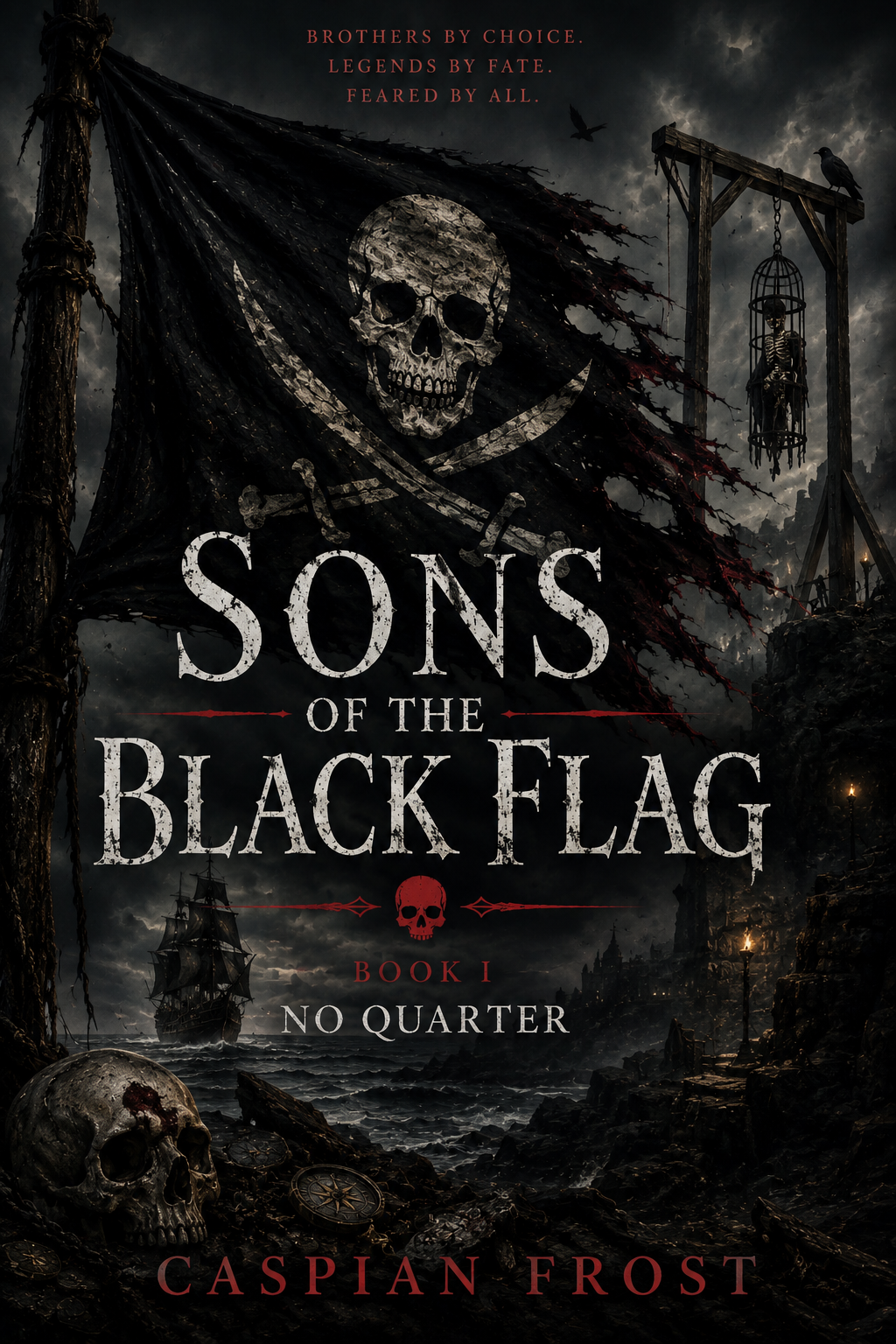
Book · 16 chapters · 57,432 words
Sons of the Black Flag
Contents16 chapters
- 01Bread for the Hanged Man
- 02The Son They Spat On
- 03The Hold Beneath La Concorde's Ghost
- 04No Flag Left to Fly
- 05Mama Colette's Harbor of Bones
- 06The Woman in the Crimson Coat
- 07Songs in the Fog
- 08The Head in the Glass
- 09Daughters and Sons of Monsters
- 10Where the Sharks Keep Watch
- 11Blackbeard's Blood
- 12The Tide Chooses Its Own
- 13The Names Men Drown For
- 14The Gibbet Above Port Royal
- 15Black Glass and Crimson Fire
- 16No Flag for the Living
Chapter 1
Bread for the Hanged Man
By the time Charlie reached the last shelf of rock, the bread was warm and damp beneath his shirt, and his calves burned from the climb.
Below him, Port Royal spread around the harbor in a hard white glare—warehouses, tavern roofs, church spire, the crooked streets already busy with carts and curses and the slap of laundry in yard basins. The smell rose all the way to the cliff: tar, horse piss, salt, fish guts, molasses gone sour in the sun. Beyond the town lay the water, bright as a blade. Ships rode at anchor with their masts pricking the sky. Men on deck looked no bigger than ants.
Above all that hung the cage.
It jutted from the cliff face on a thick timber spar, swung out over empty air so every ship entering the harbor might see what waited for pirates at the edge of the Empire. The iron had once been painted black. Salt and rain had chewed it to a brown-red crust. Gulls stood on the top hoops as if it were part of the headland itself.
Inside, Captain Elias Carter moved when the chain creaked.
Charlie stopped with one hand braced against the stone. For a moment he only listened to his own breathing and the sea striking far below. He came every Sunday, and still the sight caught him in the chest each time. His father had grown smaller inside the iron. The cage had not.
“Da,” he called.
The man in the gibbet lifted his head.
One eye was swollen from where some fool in town had thrown a stone high enough to strike him two days earlier. His beard had gone mostly grey in the months since they had hanged him up there alive. Salt had whitened it at the ends. His face was all bone now, sharp at the cheeks and temples, but the old breadth in him remained. Even starving, Elias Carter looked like a man made for storms.
“Well,” Elias said, voice dry as scraped wood, “if it ain’t the only honest soul in Port Royal.”
Charlie grinned before he meant to. “I brought bread.”
“You always say that first, as if I’d rather hear of the weather.”
“You ask of the weather after.”
“That’s because the weather matters after bread.”
Charlie edged along the narrow path until he reached the post driven into the rock beneath the gibbet. Someone long ago had fixed a block and line there so the jailer could haul water up for the condemned when it pleased him. The jailer had not used it in three days. Charlie tied his small bundle into the sling with careful fingers. A heel of bread. Two limes. A flask stoppered with rag.
He tugged the rope twice.
Elias began to haul, hand over hand, slow but steady. The chain above him clinked with each movement. Charlie watched his father’s wrists. The skin there was rubbed raw to meat. He looked away and spat over the edge instead.
From the beach below came shouting. A handful of boys had gathered near the shallows where the cliff path began. One of them pointed upward.
“Feedin’ the crow!” he yelled.
Another cupped his hands and called, “Ask your pirate father where he buried the Devil’s silver!”
Charlie knew their faces. Brickmaker’s sons. A cooper’s nephew. Boys who would not have dared say a word if he were on level ground with them. He picked up a loose stone the size of an egg and weighed it in his hand.
“Leave it,” Elias said above him.
“I could hit the fat one from here.”
“I know you could. Leave it.”
Charlie put the stone down.
Elias dragged the bundle into the cage and sat back against the bars to catch his breath. For a while he only held the bread between both hands, feeling its warmth. His fingers trembled and then steadied. Charlie pretended not to notice.
“Your mother?” Elias asked.
“At the washhouse.”
“Still workin’ for Mrs. Bell?”
“And for two houses beside.”
Elias gave a short sound that might have been a laugh in a healthier man. “That woman starches her collars as if the King himself means to wear them.”
Charlie sat on the rock with his knees up. “Ma says the King’s neck is no cleaner than any other man’s.”
“That’s your mother. God keep her sharp tongue from gettin’ her hanged alongside me.”
He tore the bread and ate as though he had trained himself to chew slowly. He made the limes last even longer, sucking each segment down to the pith. When he drank, he closed his eyes.
Charlie watched the harbor. He had learned not to look too long at his father while he ate. Hunger ought to be private, even in a cage.
A brig was beating in from the east, sails full, trying to clear the reef before noon tide turned foul. Charlie studied the set of her canvas, then the dark water beyond the harbor mouth where small lines of chop ran crosswise to the wind.
“She’ll come in hard to larboard,” he said.
Elias licked bread from his thumb. “Will she?”
“Current’s pushin’ her wrong.”
“The wind’s with her.”
“The wind lies.”
At that, Elias smiled. It changed his whole ruined face for an instant. “Aye. That it does. What told you?”
Charlie pointed. “Not the ship. The terns.”
Three white birds wheeled over the harbor mouth, then sheared inland, then back out again as if unable to agree with the breeze.
“And?”
“The little rip there.” Charlie leaned forward. “See it? Where the water darkens in a crooked line. Tide’s running out stronger than it looks from shore.”
Elias followed his finger. “Good. You’re watchin’ the water instead of admirin’ it. That’s the first difference between a living sailor and a dead fool.”
The brig reached the mouth and, just as Charlie had said, swung wider than her helmsman intended. Men shouted aboard her. A topsail snapped. She missed the outer shoal by no more than a yard.
Charlie tried not to look pleased. “Near enough.”
“Near enough gets a man splinters in his coffin.” Elias shifted against the bars and glanced up at the sky. “What moon did we have last night?”
“Three nights past half.”
“Name her shape proper.”
“Waxing gibbous.”
“Say it like you own it, boy. Not like a parson made you borrow the word.”
Charlie repeated it with more force. “Waxing gibbous.”
“And what does she do to spring tide?”
Charlie frowned. “Builds it.”
“How?”
“She drags more water.”
Elias chewed once, thinking. “No. Not drags. The sea ain’t a sled. Try again.”
Charlie scratched at the salt on his forearm. He hated when Elias did this—pushed and pushed until the right words came clean. Then again, he loved it too. Nobody else in Port Royal spoke to him like he had a mind worth sharpening.
“She pulls,” Charlie said. “Moon and sun together, when they line right. Stronger at new and full. Less at quarter.”
“There now.” Elias nodded. “Words matter. A captain gives the wrong word once and a mast goes over the side.”
Charlie picked at a seam in his sleeve. “I’m not to be a captain.”
“No?”
“No. I’ll hunt pirates.”
The gulls cried over them. Far below, the harbor boomed once with a cask dropped on a quay.
Elias wiped his mouth on the back of his hand. “Will you?”
Charlie lifted his chin. “Yes.”
“To please the governor?”
“No.”
“To please those little bastards below?”
“No.”
“Then why?”
Charlie turned to the water because the truth sat ugly in him when spoken plain. “Because of what they call Ma. Because of what they call me. Because you’re up there and the men who sailed with you are not.”
That last part hung between them.
Elias looked out over the harbor. His good eye lost its humor. “That is nearer honest.”
Charlie said nothing.
Elias rested his head against the iron. “Listen to me, and listen hard. Men ashore think piracy is noise. Pistols. Silk coats. Barrels of stolen sugar. They’re children staring at bright paint. The true trade is hunger, fear, lies, and men measuring each other by candlelight to see who’ll cut whose throat first.”
“I know.”
“No, boy. You know the words. That’s not the same thing.” He gripped the bars until his knuckles showed pale through grime. “A pirate crew will call itself brotherhood till the gold grows thin or the noose swings near. Then comes the reckonin’. One man bargains. Another points. A third swears he had no choice. Mark me.”
Charlie looked up.
Elias held his gaze. “Never trust any man who sails beneath the Black Flag.”
The words came out hard enough to scrape blood.
Charlie swallowed. “Not even you?”
A wind moved off the sea and turned the cage a little on its chain. It made the iron moan.
“Least of all me,” Elias said.
For a moment Charlie wished he had thrown the stone at the boys after all. Or at the gibbet. Or at the town. Anywhere but here. His ears felt hot. “Then why teach me any of it?”
“Because the sea’s older than the men who foul it.” Elias lifted one hand toward the horizon. “A rogue may carry a chart. That does not make north a liar. A thief may steer by stars. That does not stain the stars.”
Charlie let that settle.
His father tore off another bit of bread, but instead of eating it, he crumbled it through the bars. Gulls dipped and snatched the pieces on the drop.
“You know the north star,” Elias said. “Show me south.”
“It’s daytime.”
“You think south goes away with the sun?”
Charlie rolled his eyes and then stood. He turned his back on Port Royal and faced the sea. The sky was washed pale near the zenith. Harder by day, but not impossible if a man remembered enough. Elias had taught him to find directions from the sun’s road, from shadows, from swell, from the side of old trade wind weather on a mast.
He planted his feet and pointed. “There. More or less.”
“More or less is for cooks. How do you know?”
“The sun climbed there.” Charlie traced with his hand. “And the swell’s striking from east-southeast past the reef. If the wind hadn’t shifted in the night it would’ve—”
“It did shift.”
Charlie stopped.
“How do you know?” Elias asked.
Charlie listened, annoyed. He closed his eyes. Wind touched the right side of his face, warm and dry off the town. Lower down, he could hear palms rubbing one another with a different sound than they made during sea breeze.
“Land wind this mornin’,” he said at last. “But not for long.”
“Good.” Elias nodded. “When does it turn?”
“Near midday.”
“And if you’re in a narrow channel when it does?”
Charlie answered at once. “Get clear before the breath changes or row like hell.”
Elias laughed outright then, and the laugh broke into a cough that bent him double.
It went on too long.
Charlie stood beneath the cage with both hands clenched at his sides. “Da?”
Elias coughed again, then spat through the bars. The gob of it struck the rock near Charlie’s boot, pink in the middle.
Charlie stared at it.
His father looked away as if he had dropped a spoon.
The sun pressed hotter against the cliff. Somewhere down the path a lizard skittered over dry leaves. Charlie heard each tiny sound too clearly. “I can fetch the doctor.”
“The doctor can fetch himself to hell.”
“He could bleed you. Or—”
“Bleed me?” Elias’s mouth twitched. “Aye, there’s a bright remedy for a man who’s half dead already.”
Charlie bit his lip until he tasted iron.
Elias softened his tone. “Come closer.”
Charlie stepped under the gibbet so he stood in the moving shadow of the cage. Rust dust drifted down when Elias shifted. It freckled Charlie’s shoulders and hair.
“There’s somethin’ else,” Elias said.
From inside his torn shirt he drew a strip of cloth no wider than two fingers. It had once been blue. Sweat and weather had worn it nearly grey. Something small was knotted inside.
“How long have you had that?” Charlie asked.
“Long enough.” Elias fed it through the bars. “Hide it.”
Charlie took it quickly and tucked it into his waistband. The knot held a bit of metal, thin and hard-edged beneath the cloth.
“What is it?”
“A piece of a chart.”
Charlie blinked. “A chart?”
“Not one any admiral ever drew. Listen and keep it in your skull.” Elias wet his lips. “There’s an island no captain marks honest. Some know of it. Few find it twice. Water blue as a kingfisher’s back on one side, black as a priest’s sleeve on the other. Teeth of stone all around. Sharks thick enough to stir the surface.”
Charlie forgot the heat. “Treasure?”
“Aye, treasure.” Elias’s eye narrowed. “And bones. Men speak more readily of gold than bones, but islands keep both.”
“Did you bury it?”
“My crew did.”
“Where?”
Elias gave him a look worn thin by years of foolish questions from other men. “If I tell you where, you’ll be dead before you grow whiskers. So I’ll tell you how.”
He shifted again, gathering breath.
“When you find a cove that smells sweet at low tide, though no flowers grow there, count three cliffs inland. One split like a bishop’s cap, one bare as a skull, and one with a fig tree clutchin’ the face of it. Wait till the moon is dark. The sea will show you a path the land hides by day.”
Charlie repeated it under his breath. “Sweet at low tide. Three cliffs. Bishop. Skull. Fig.”
“Good. And beneath the fig—”
Elias stopped. His face changed.
Charlie had seen men go still when a cramp seized them. This was not that. It was as though some hand inside his father had reached up and clutched his heart.
“Da.”
Elias drew in a sharp breath and lost half of it to another cough. This time the blood came darker. It ran through his beard.
Charlie grabbed the bars though they scraped his palms raw. “Da!”
Elias opened his eye again, and for a terrible moment he did not seem to know where he was. Then he found Charlie below him and forced himself back into the world.
“Listen,” he rasped.
“I’m listening.”
“No priest. You hear me? Don’t let them put a priest’s mouth on my soul after all this.”
“I won’t.”
“Take care of your mother.”
“Yes.”
“And do not—” He coughed, swallowed, tried again. “Do not spend your life lettin’ smaller men tell you what blood you carry.”
Charlie’s throat tightened. “You’ll tell me the rest when I come next Sunday.”
Elias’s eye flickered with pity, and Charlie hated it.
“There may be no next Sunday.”
“There will.”
“Boy.”
“No.”
The word came out so fierce it startled even him.
Below, the town went on with itself. A bell rang from somewhere inland. A woman shouted over the price of fish. The harbor glittered. Nothing in the world paused for the man in the cage.
Elias looked past Charlie then, out over the water he had once ruled in his own lawless way. Wind pulled at the rags of his shirt. His lips moved as if counting.
“What is it?” Charlie asked.
“Afternoon breeze,” Elias murmured.
“It hasn’t turned yet.”
“It will soon.” He swallowed with effort. “Watch the frigate near the sandbar.”
Charlie glanced toward the harbor. A Royal Navy frigate rode at anchor beyond the town, proud and square, her pennant hanging slack for the moment.
“The pennant will twitch first,” Elias said. “Then the cat’s-paws. Dark little strokes over the surface. Then every fool in harbor’ll claim he felt it comin’ in his bones.”
Charlie looked back up quickly. “Da, don’t talk.”
“That’s all I’ve left to give you.”
Charlie said nothing because if he opened his mouth he thought he might begin to cry, and he would not do that with the town below and the sun overhead and his father looking down from iron like some butchered saint.
So Elias spoke, and Charlie listened as if each word were coin.
He spoke of clouds with flat iron bases that meant squalls before dusk. He spoke of petrels vanishing ahead of heavy weather and of the way long swells could come marching from storms a man had no hope of seeing yet. He spoke of moon halos and copper sunsets and the smell a mangrove creek gave off before flood tide shoved back through it. He spoke until his voice frayed to a whisper.
At last he stopped and turned his head toward the harbor.
There it was.
The frigate’s pennant stirred.
Only a little. Then again, stronger. Out past the anchorage, dark ripples chased one another over the bright water.
Charlie felt the new wind touch his cheek.
His father smiled without looking at him. “There. Now you know before the others.”
Charlie looked up with sudden desperate triumph, wanting to say something—anything—that would hold him there. But Elias’s head had tipped back against the bars. His mouth was slightly open. The lines of pain had gone out of his face all at once, and that was the worst part of it. He looked easier dead than he had looked alive for months.
“Da?”
No answer.
Charlie climbed the post like a monkey, toes searching old footholds hacked by sailors and jailers before him. He hauled himself high enough to grip the lower bars and shake them.
“Da.”
The cage swung with his effort. Elias did not move.
A gull flapped off the top hoop, offended by the noise.
Charlie stayed there hanging against the iron until his arms gave way. Then he slid down and landed badly on one ankle. He did not feel it. He stood beneath the gibbet with his hands open at his sides while the new breeze freshened over the harbor and set the cage to a slow, easy turning.
Below, the boys on the beach had gone quiet. Even from that height they knew death when they saw it.
Charlie bent and picked up the stone he had spared them earlier. It fit his palm neatly. He stared at it until the edges blurred, then threw it with all his strength out over the sea. It vanished in the glitter without a splash he could hear.
When he wiped his face, he did it with the heel of his hand, angry at the wet there.
At his waist, beneath his shirt, the knotted strip of cloth pressed against his skin.
Sweet water smell at low tide. Three cliffs inland. Bishop. Skull. Fig.
And one thing clearer than the rest, sharp as iron.
Never trust any man who sails beneath the Black Flag.
Charlie looked up once more at the body in the cage. Then he turned and began the climb down toward Port Royal, toward his mother, toward the town that would laugh by supper and forget by Monday.
The wind had changed. He could feel it now without trying.
Chapter 2
The Son They Spat On
The spit hit Charlie on the cheek just as he took the mooring line.
It slid warm through the salt already on his skin.
He did not look up at once. He passed the wet hemp round the dock post, pulled it hard, and felt the sloop settle against the pilings with a wooden sigh. Only then did he lift his head.
The customs clerk stood above him on the wharf in a hat too fine for the heat and shoes too clean for Port Royal. He had a narrow face, a damp upper lip, and the sort of courage some men only found when standing on dry planks with soldiers behind them.
“That for your father,” the clerk said.
Charlie wiped his cheek with his thumb and flicked the mess into the water.
“No,” he said. “That’s from you.”
The two marines behind the clerk shifted, half hopeful. Men in Port Royal liked a public beating almost as much as they liked a hanging. Charlie saw the little turn of heads along the quay—the coopers, the fishwives, the Negro porters bent beneath sugar sacks, a one-legged sailor on a cask with a pipe in his mouth. They all felt the pause.
Charlie stepped up from the boat to the dock.
He had grown into his father’s height and then some. The years had cut the softness off him. Work had done the rest. His coat was old navy wool gone pale at the seams. His hands were roped with tendon and scar. The line across the back of his right hand came from a coral cut that had gone foul in the summer rains. The neat white mark near his wrist came from a cook’s knife in a Kingston tavern. His face gave away less than it had when he was twelve.
The clerk’s chin lifted, but only a little. “Mind your tone.”
“You owe me six shillings for the pilotage and two for warping her in through the shoal water,” Charlie said. “You may call me bastard, pirate’s get, gallows-breed, or whatever helps your dinner settle. But you’ll pay me before I leave this dock.”
A laugh barked out somewhere behind the fish barrels. One of the marines hid a grin and then lost it when the clerk glanced back.
The man dug in his purse with angry fingers. Coins rang in Charlie’s palm.
“There,” the clerk said. “Take your King’s silver and be grateful the harbor tolerates you.”
Charlie closed his fist over the money. “The harbor tolerates any man who knows where the reefs are.”
He turned before the clerk could find another insult worth speaking.
That was how it had gone for years. Men spat. Women drew their children aside if they were the pious kind, or looked twice if they were not. Boys who had once thrown stones at the cage had grown into drunks with missing teeth and the same poor aim. Charlie let most of it pass. He had learned young that anger spent in the street bought a man nothing except bloodied knuckles and a magistrate’s whip.
He saved his anger.
That was the difference.
By twenty-eight, Charlie knew the harbor mouths from Port Royal to Morant better than most captains who claimed command of them. He could smell river water before dawn and tell which channel had shifted after a storm by the color of the wash over the bar. Merchants hired him when they needed a vessel brought in fast and whole. Naval lieutenants used him when pride gave way to prudence. Once, a Spanish brigantine with a sprung foremast had nearly killed three men trying to stand off the reef in dirty weather until Charlie rowed out with six harbor hands and cursed the lot of them into obedience.
He took their money. He kept his head down. He watched.
At night he made lists.
Not on paper. Paper could be stolen. Fire could take it. Drink could loosen another man’s tongue. Charlie kept the names behind his eyes instead.
Ned Gower, who had served under Elias and turned King’s witness when the noose showed itself.
Tom Blease, quartermaster once, then informer.
Isaac Vane, who had known where Elias anchored, where he watered, which coves he trusted, and had sold that knowledge for pardon and prize shares.
There were others. Men’s names reached shore in pieces. A bosun in Antigua heard one thing, a cooper from Nassau another. A body drifted up on a beach with a tattoo someone remembered from an old crew. A whore in Kingston heard a boast in the dark and passed it to the wrong ear by morning. Charlie gathered what he could and fitted it together. Most were dead. The sea took her cut. Gallows took more.
Three, perhaps four, still lived.
That morning the heat sat low and mean over the harbor. Tar softened in the seams. Flies worried the fish stalls. Charlie crossed the square with the clerk’s coins in his pocket and a coil of line over one shoulder, heading for Rourke’s chandlery where a Barbadian schooner needed a sounding man for a run west.
“Charlie!”
He knew the voice before he turned.
Benjamin Diggs shoved through the foot traffic with the carelessness of a man too broad to slip anywhere neat. He had become enormous in the years since boyhood, not fat now but built like a capstan. His beard had gone thick and sandy over a face the sun had burned the color of old leather. There were laugh lines at his eyes even when he was not laughing, which was often.
He caught Charlie by the shoulder. “If you keep striding at that pace, I’ll need a horse to speak with you.”
Charlie looked him over. “You’ve stolen a better shirt than last I saw.”
Ben spread his arms to display a linen shirt only slightly stained and a waistcoat with two good buttons still attached. “Prosperity.”
“Whose?”
“Mine, if God and fools remain kind.” Ben’s grin flashed. Then he lowered his voice. “You heard?”
“Heard what?”
Ben’s expression shifted. He enjoyed withholding a thing for half a breath if it improved the taste of telling it.
“Letter of marque,” he said. “Fresh signed. Brig out of Kingston fitting at this very hour. Legal work. Pirate hunting.”
Charlie did not move.
Around them the square pressed and sweltered. A donkey brayed. Somewhere a cooper hammered iron bands onto a cask. But in Charlie’s mind the noise narrowed to one point.
“Whose command?” he asked.
“Captain Alistair Vale.”
Charlie’s mouth tightened. He knew the name. Vale had fought the Spanish as a private man and the pirates as a public one, depending on who had paid him. Hard captain. Clean books. No gibbet scandals clinging to his coat.
Ben saw the doubt. “Aye, he’s a bastard,” he said cheerfully. “But he’s a lawful bastard, which is the point.”
“Lawful men hang others for less than they do themselves.”
“That may be,” Ben said, “but a lawful commission lets us put cannon behind our grievance.”
Us. Ben said it as if there had never been any question.
Charlie studied him. They had been boys together under the same hard sun. Ben had once stood bleeding in the sand because he had put himself between Charlie and a gang of dock children who thought the son of a hanged pirate fair sport. Charlie had repaid him over the years in smaller ways: pulling him out of a tavern fight before a knife found his gut, finding him work after a merchant mate cheated him of wages, hauling him half senseless from a whorehouse roof in Spanish Town. Friendship had not needed naming between them. It had simply remained.
“You’ve signed on already,” Charlie said.
Ben’s grin turned sheepish. “Not yet. I thought I’d try one mad thing first and ask whether you meant to come.”
Charlie looked past him toward the water.
A legal commission. A King’s paper. A hunt with names entered neat in an officer’s ledger instead of whispered over rum. He had imagined such a thing in younger years more often than he cared to admit. Not glory. Never that. Permission. Permission to kill the right men and call it service.
Ben leaned closer. “There’s more.”
Charlie looked back.
“Rumor says Vale’s not just cruising blind. A merchant snow came up from the Mosquito Coast three nights ago. Master swears two men took turtle with him near the cays off Cape Tiburón. Old hands. One with half an ear gone. One with a burn scar down his neck. They were drinking under false names and asking after pardons in New Providence.”
Charlie felt something small and cold pass through him.
“Who told you this?”
“The master told a factor. The factor told a clerk. The clerk told a whore he was clever. The whore told me because I had more coin than he did.” Ben shrugged. “Port Royal runs on loose knots.”
“Half an ear,” Charlie said.
Ben nodded once.
Tom Blease had lost the top of his left ear to a swivel gun splinter at sea fifteen years before. Charlie remembered his father laughing about it. Said Blease heard better after, not worse.
“And the scar?”
“Ned Gower, maybe,” Ben said. “Or not. The merchant had no cause to care.”
Charlie’s jaw worked. “Cape Tiburón is a wide sea.”
“Aye.”
“New Providence wider still.”
“Aye again.”
Ben waited. He knew better than to crowd the next second.
Charlie had spent half his life swearing he would never serve under the black flag. He had meant every word. He had also spent half his life learning how clean law could look while doing dirty work. Customs men stole. governors lied. naval officers pocketed prize money from cargo they had not taken. Men who had dined with judges in Jamaica had sold Africans in Barbados and called it trade. The world did not grow honest because it used seals and signatures.
But a signed commission could still put him on the same water as Tom Blease.
That was enough.
“When does Vale sail?” Charlie asked.
Ben exhaled through his nose. “Tomorrow with the tide, if he can get the last of his powder aboard and keep his men sober.”
Charlie nodded. “Then let us see whether he wants a pilot who knows every coral tooth between here and Hispaniola.”
Ben slapped his shoulder once. “There he is.”
Vale took them in the afternoon aboard a brig called the Resolute, though nothing about her looked especially resolved except the way her guns sat run in behind clean ports.
She was lean in the hull and quick by the eye. Not large enough to stand against a proper warship, but more than enough for cutters, pirate sloops, and anything too slow to choose its own fight. Men crossed her decks in a steady clatter carrying powder tubs, coiled shot garlands, salted beef, casks of fresh water, and bundles of spare sailcloth. The smell aboard was oak, pitch, sweat, and iron.
Captain Alistair Vale waited by the quarterdeck ladder with his hat under one arm. He wore his hair tied back plain, no powder, no lace worth speaking of. His face had the weathered, patient look of a man who trusted his own judgment and very little else.
Ben did the talking first. He always knew when Charlie’s silence could be mistaken for insolence.
“Captain Vale,” Ben said. “Benjamin Diggs. We spoke ashore.”
Vale’s gaze moved to Charlie. “And this is Carter.”
Not a question.
Charlie met it. “It is.”
“I know who your father was.”
“So does every dock rat in Jamaica.”
One corner of Vale’s mouth twitched. Not quite approval. Not offense either.
“I need a man who can read shoal water better than my second mate,” Vale said. “Diggs says you can.”
“Diggs flatters those he likes,” Charlie said.
“I do,” Ben put in. “But not in matters that may sink me.”
Vale let that pass. “If I take you aboard, I take your name with you. Some men may object.”
“Then do not take me for their comfort,” Charlie said. “Take me because I can put this brig where they cannot.”
Vale studied him a moment longer. “And because you have private cause to hate the men we may find.”
Charlie said nothing.
“That cuts two ways,” Vale went on. “A man with vengeance in him may fight well. He may also forget orders.”
“I do not forget orders,” Charlie said.
“No?”
“No. I decide whether to obey them.”
Ben shut his eyes briefly as if asking patience of heaven.
Vale laughed once, low in the throat. “At least you speak plain. Good. I prefer that to pious lies.” He shifted his attention between them. “You’ll have shares like the rest if we take lawful prize. You’ll answer to me at sea. You’ll keep sober on watch. You’ll not stir mutiny, draw steel aboard without cause, or take liberty with prisoners until I have done with them. Agree to that and you can sign.”
Charlie’s eyes narrowed at the last.
Vale saw it. “If we catch pirates, I mean to question them before they swing.”
“Question them how long?” Charlie asked.
“As long as they remain useful.”
Charlie held his stare another beat, then nodded.
They signed.
That evening the sun went down red through a haze of cooking smoke and sailcloth dust. Charlie sat on the larboard rail with a whetstone in his hand and his cutlass laid across his knees. The blade was not fancy. Good steel, curved enough to work in close quarters, grip darkened by years of use. He sharpened with slow strokes, more from habit than need.
Ben came up beside him carrying a tin cup. “Rum watered proper. I thought I’d spare you from whatever they’re serving plain.”
Charlie took it. “My thanks.”
Below them the harbor shifted from labor to vice. Lanterns began to wake along the waterfront. Music rose from taverns in broken starts—fiddle, drum, voices already too drunk for tune. The tide sucked softly under the pilings.
“You’re thinking hard,” Ben said.
“I generally do.”
“Aye. Nasty trait.”
Charlie drank and handed the cup back. “What do you know of Vale?”
“Less than I pretended. Enough to say he keeps discipline and pays what he owes. Shot a man once for striking a prisoner after surrender.”
Charlie glanced at him.
Ben lifted one shoulder. “Also flogged two hands near to death for theft.”
“So he has principles when they suit him.”
“Like any captain.”
A silence passed between them, comfortable for all that lay under it.
Ben rested his forearms on the rail. “You still mean to stay clean of it, then.”
“Of what?”
“The flag. The life. All of it.”
Charlie looked out across the darkening roadstead where masts made a black forest against the afterglow.
“My father died in iron,” he said. “The men who sold him wore silk to court after. Pirates toast brotherhood until a pardon is offered. Then they sell each other by the pound.”
Ben rubbed his beard. “And Englishmen?”
“Englishmen sell you first and write a receipt.”
That got a laugh.
“But you signed today,” Ben said.
“For the names.”
“That’s what I thought.”
Charlie’s thumb rested along the flat of the blade. “If the law brings me to them, I’ll use the law. If it steps aside, I’ll not mourn.”
Ben did not answer at once. He looked down toward the waist of the ship where men were finishing the last of the stores under the mate’s curses.
“When we were boys,” he said at last, “I thought revenge would look hotter. More shouting. More smashed furniture.”
“It may yet.”
“No,” Ben said. “With you it won’t. You’ve gone cold around it.”
Charlie considered that.
He had. The hatred remained, but it had narrowed and hardened until it felt less like fire than a blade kept wrapped in oilcloth. He did not dream of killing every pirate in the Caribbean anymore. That was a child’s oath. He wanted particular men. Particular voices. He wanted to look into the eyes of those who had stood on Elias Carter’s deck, taken his bread, shared his danger, and sold him when the Crown dangled mercy.
Below, somebody started singing a filthy song about a widow and a bishop. Laughter followed.
Ben tipped his head toward the quay. “You going ashore?”
“No.”
“Wise. You’ve got that look men mistake for invitation.”
“I always have that look.”
“Aye,” Ben said. “You truly do.”
They slept little. Before dawn the crew hove off lines and warped the Resolute clear. The world was still blue-black, the harbor lamps paling, when Charlie took the forechains and peered ahead at the channel. The tide was with them. A faint land breeze pressed from inland, enough to carry the stink of the town one last time—ash, bilge, molasses, piss, dead fish, wet rope, unwashed men.
Home.
He called soundings while the leadsman worked. The reef edges showed themselves by degree, first as ghost-pale smears under the surface, then as darker ridges where the water shouldered and changed its mind. Charlie watched not just the sea but the birds above it and the set of ripples against the morning light. A channel never stayed exactly what a map said it was. Storms shifted sand. Anchors tore coral. One wreck in the wrong place could make a liar of yesterday’s wisdom.
“Starboard a spoke,” he called.
The helmsman answered.
“Steady now. Keep her there.”
Vale stood behind with his glass under one arm, saying nothing. Charlie approved of that. The best captains knew when not to improve a skilled man with noise.
They slipped through as the first strip of sun broke over the low shore.
Outside the harbor the sea opened blue and hard and clean. The Resolute took the swell under her bow and began to move as if relieved to have quit company with land.
Charlie turned once to look back.
Port Royal lay squat and bright already in the growing light, all white walls, warehouses, church tower, and lies. The cliff was farther east and out of sight from here, but he did not need to see it. He knew where it stood. Knew the line of it against the sky. Knew where the cage had hung and turned in the trade wind until iron and bone became one shape.
Ben came up beside him, bracing easily as the brig found her sea legs.
“Well?” Ben said.
Charlie kept his eyes on the horizon.
“Well what?”
“Are we respectable now?”
Charlie almost smiled. “No.”
“That’s a comfort.”
A gull wheeled astern and then gave up on them.
Ahead lay Hispaniola, the Windward Passage, private coves, false names, pardoned liars, and perhaps—if rumor had not done what rumor often did—two men who had once watched Captain Elias Carter dragged away in chains and decided to live with it.
The land breeze faded. The true wind took hold.
Charlie set his jaw and faced west. The law had given him a deck to stand on and guns at his back. Whether it would give him justice was another matter entirely. But the sea between him and the men he sought had begun to shorten, and for the first time in years that felt like something a man could hold.
Chapter 3
The Hold Beneath La Concorde's Ghost
The smell hit before the hail did.
Charlie stood in the forechains with spray drying white on his boots and turned his head into the wind like a dog catching blood. Tar, bilge, wet hemp, old salt—those belonged to any vessel. This was fouler than that. Sweet in the wrong way. Rot under heat. Human waste cooked into timber.
Ahead, the stranger rode west by south under Dutch colors that had once been bright and were now scabbed pale by weather. She was a broad-bellied ship, French in the lines of her bow though somebody had cut her trim down and made her plainer. She sat too low for a vessel showing so little cargo on deck. Her topsails hung slack and dirty. No one moved with the briskness of honest trade.
Ben came up beside him and spat over the rail.
“She stinks from here.”
“Aye.”
“What d’you make of her?”
Charlie watched the wake. Narrow. Labored. The sea took hold of her stern and kept trying to pull it sideways.
“Too much weight below,” he said. “And not barrels.”
Captain Vale lowered his glass. The sun flashed along its brass.
“Signal her,” he told the master.
The flags climbed. The stranger answered slow, as though every motion aboard cost somebody a beating. Her name, when at last they read it, had been painted over twice. The old letters still showed beneath the new if the light struck right. Charlie could not make all of them, only the ghost of a French ending near the stern: . . .corde.
“La Concorde’s ghost,” Ben muttered. “That thing looks risen.”
“Steady,” Vale said.
They ran her down by noon.
The Resolute was cleaner in every line and livelier under sail. She came up on the stranger’s quarter with guns run out and matches ready. Vale hailed her and demanded papers in the King’s name. A man in a faded coat answered from the other deck in poor English and much offense, claiming lawful passage from Saint-Domingue to Cartagena, timber and dyewood in hold, passengers ill with fever, delay an outrage, search unnecessary.
Vale smiled without warmth.
“Then you’ll not object to proving it.”
He sent Charlie, Ben, six armed hands, and Mr. Pritchard the mate across in the launch.
The stranger’s side was streaked black where scuppers had run for weeks without proper scrubbing. Flies clustered at the gunports. A sailor leaning over to receive them had a split lip, one eye gone yellow with old bruising, and the flat look of a man too tired to hate.
Charlie took the ladder first. The planks beneath his hands felt greasy.
On deck the heat rose off the boards hard enough to make his eyes smart. A few bundles of dyewood had been stacked in plain view to satisfy fools. They did not begin to explain the ship’s burden. The crew stood in a line under the eye of their officers, Spanish and French mixed among them, all thin in one way and fat in another—the starved faces of men whose officers had taken the better part.
Then Charlie heard it.
Not one voice. Many.
A low crowded sound from under the gratings, like cattle in a storm pen if cattle prayed.
Pritchard had heard it too. His jaw tightened, but he kept his face orderly.
“Papers,” he said.
The captain of the stranger produced them with a little bow. He was a narrow man with lace gone brown at the cuff and hair tied in a ribbon that might once have been black. His boots were polished. His hands were clean. Charlie disliked him at once.
While Pritchard bent over the documents, Charlie crossed the deck toward the main hatch.
A burly officer stepped into his path. “No.”
Charlie looked past him at the grating. Through the slats came heat like breath from an oven.
“What cargo makes that sound?”
“Passengers.”
“Passengers chained in the dark?”
The officer rested a hand on his pistol. “You were told no.”
Ben had moved to Charlie’s shoulder without seeming to. “Best answer him,” he said mildly. “He grows stubborn when men get mysterious.”
Pritchard straightened with the papers in hand. He had gone pale beneath his sunburn.
“Mr. Carter.”
Charlie did not turn.
“Mr. Carter,” Pritchard said again, sharper now, “stand off.”
That was enough to tell him.
He put his hand on the hatch bar anyway.
The burly officer caught his wrist.
Charlie hit him with his left hand before thought could catch up. Knuckles cracked against teeth. The man stumbled back cursing. Ben drove an elbow into another sailor’s throat as pistols cleared leather all over the deck at once.
“Hold!” Pritchard shouted. “Hold, damn you!”
For one stretched second nobody moved.
Then Vale’s voice came from the rail above, cold as a nail. “Mr. Carter. Step away from that hatch.”
Vale had come over from the brig with two marines and stood watching from the entry port. He took in the bared steel, the blood on the officer’s mouth, the strain in Charlie’s shoulders. He did not look surprised. That was the worst of it.
Charlie let go of the bar.
The hatch was opened under orders, not his.
Three men lifted it. The smell that burst up made one of the marines turn aside and retch over the scupper.
Below was darkness first. Then eyes.
Layer upon layer of them.
Men packed on shelves and planks too low to sit upright. Women along the far side with children pressed to them. Ankles locked in irons. Wrists bruised raw. Skin shining with sweat in the dim. A tin cup rolled in the foul water sloshing over the deck below and knocked softly against a heel. Somebody coughed with the dry deep bark of a dying lung. Somebody else whispered in a language Charlie did not know, fast and hoarse and furious.
A little girl near the ladder stared up without blinking. Her lower lip was cracked white. One hand still rested on the shoulder of the woman beside her.
The woman was dead.
Ben made a sound in his throat and stopped himself.
Vale stood a long moment with the papers in his hand and the hatch open at his feet.
The slaver captain spread his hands. “Licensed cargo,” he said. “Acquired proper. Bound for lawful sale under crown authority. You interfere, you answer above your station, Captain.”
Charlie turned.
“Lawful.”
Vale’s face closed. “These waters are full of things I cannot mend by feeling strongly.”
“You mean to send them on.”
“I mean to take the ship to port and let the court decide.”
The laughter that came from the slaver captain was almost polite.
“By the time a court decides,” Charlie said, “half will be dead.”
Vale met his eyes. “That is not an order you are given power to change.”
A boy below began crying. Not loudly. That was what lodged in Charlie’s chest. He did not even have the strength for loud.
The dead woman’s head shifted with the ship’s roll and knocked once against the timber beside her.
Vale gave brisk instructions then, because briskness made horror feel smaller. The slaver would be sent under escort to Port Royal. Pritchard would remain aboard with a prize crew. Charlie and Ben were to transfer as well, the better to assist with the passage and keep order. The hatch would remain opened by watch for air and closed in weather. No one below was to be unchained without express order. Water would be issued according to inventory.
According to inventory.
Charlie said nothing more on deck because if he had spoken he would have struck somebody, and he was not yet done needing his hands.
By dusk the Resolute had fallen off their larboard quarter, keeping station. The stranger wallowed ahead under shortened sail with Charlie at the rail and a taste in his mouth like old copper. The sea had gone glassy with evening. Flying fish skipped low and silver from the bow wave. Above, the first stars came clean and indifferent.
Behind him, in the waist, one of the slaver’s officers was laughing over cards with Pritchard.
Beneath his boots, a shipful of people cooked in darkness.
Ben came to stand beside him. He carried a water bucket they had not been told to carry.
“You look murderous,” he said.
“I am thinking.”
“That’s worse.”
Charlie glanced toward the hatch. “How many with us?”
“Six from Resolute, counting Pritchard. Eight of theirs still able. Perhaps more if they choose courage over wages.”
“And Vale?”
“Within cannon shout.”
Charlie let the silence stretch.
“You know what this is if we do it,” Ben said at last.
“Aye.”
“No more marque. No more lawful edges. We cut loose tonight and every navy from here to Spain will call us thieves.”
Charlie watched the eastern sky darken. His father had taught him to read weather in the skin of water, in birds, in the shape of cloud after sunset. Tonight the sea said no storm. No miracle. No excuse. Only choice.
“The Crown hanged my father in iron,” he said. “I told myself that was justice wearing an ugly face. I told myself men under the Black Flag were the filth, and law was the rope that cleaned it. If this is law, then law stinks worse than any pirate I ever hunted.”
Ben blew out through his nose. “Good. I was hoping you’d say something useful.”
They waited for the middle watch.
Charlie took the first step by carrying water below.
Pritchard objected. Charlie reminded him that dead cargo fetched poorer argument before a court. That moved him. Profit often did what mercy would not. A lantern was brought. Two guards followed. Ben came with the bucket and another besides.
The heat under the hatch struck like a fist. The deck there was slick with spilled water, vomit, waste, and the long grind of too many bodies against rough boards. Flies crept at eyes. The lantern light showed sores along ankles where iron had eaten through skin.
Josiah King was the first to speak to Charlie in English.
He sat chained near the center beam with one shoulder against the post and a grin that had no business surviving in that place.
“Well now,” he said softly, “either heaven has sent us a dark angel with a Jamaican tongue, or hell has improved its staff.”
Charlie crouched. “You speak English.”
“Unfortunately.”
His face was thin but lively, eyes bright under a crust of sweat and grime. Beside him a giant of a man lifted his head from the gloom. He was broad as a hatch cover, scalp shaved, shoulders marked with raised patterns Charlie did not know. The irons around his wrists looked indecently small.
“This one understands some,” Josiah said, nodding toward him. “Better than he lets these swine know.”
The big man’s gaze settled on Charlie and did not waver. There was nothing pleading in it. Nothing broken. Only measure.
“What is your name?” Charlie asked.
“Kofi Katakyie,” Josiah translated after the man answered in a rolling language Charlie did not know. “And if you’re here to count us like casks, best be quick before I become rude on his behalf.”
Charlie set the bucket down.
“I am here to get you out.”
Josiah stared at him a beat, then looked upward as if consulting the planks. “Lord, if that is one of Your jokes, I ask respectfully for a clearer line.”
Kofi spoke once, low.
“He says prove it,” Josiah said.
So Charlie did. While the guards cursed at the smell and hurried the water, he palmed a small marlinspike into Josiah’s hand and let Kofi see the keys hanging from the belt of the nearer guard. Then he explained in a whisper, plain and quick.
At the next bell Ben would start a fight at the card table with the officer whose teeth Charlie had bloodied. While eyes turned, Charlie would put a knife into the guard by the hatch and drop the keys. Josiah would free Kofi first. Kofi would free the nearest strong backs and seize whatever came to hand—chains, bars, splintered boards. No shouting before steel struck. No rush for the rail. Kill the officers. Take the deck. Then the guns.
Josiah listened with his head bent.
“And if your own men fire into us?” he asked.
“Then I was wrong to trust them.”
Kofi said something else. Short. Final.
Josiah looked at Charlie. “He says if you betray us, he will find you in the next life and finish the matter there.”
“That seems fair.”
Josiah’s grin flashed once in the lantern light. “I like you a little now.”
They went back on deck with the empty buckets.
The night settled thick and hot. The moon had not yet risen. The Resolute showed off their quarter as a darker shape against dark water, her lanterns hooded. Pritchard drank with the slaver captain near the mizzen. Men loosened in their joints the way men do when they think the worst thing aboard has already been accepted.
Ben picked his moment well.
He accused the burly officer of palming a card. The officer called him an English sow. Ben hit him with a belaying pin hard enough to send teeth skittering across the deck. Men surged upright. Pritchard shouted. Somebody grabbed for a musket.
Charlie moved the other way.
He took the hatch guard under the jaw with his knife and caught the man before he struck the deck. Hot blood slicked his fingers. The second guard half-turned, confused by the brawl, and Charlie shot him through the chest from a yard away. The flash lit faces all across the waist in white shock.
“Now!” Charlie roared.
The keys hit the deck by the hatch.
The boards below answered with a sound he would remember until he died: iron jerking free, chain dragged hard, many voices rising at once not in fear but fury.
Kofi came up the ladder first.
He did not climb so much as arrive.
One moment he was below; the next he had both hands around a sailor’s throat and was driving him backward into the mast with enough force to crack the man’s skull against the wood. Josiah followed with a length of chain wound round one fist like a saint’s halo gone wicked. He laughed once, wild and disbelieving, and smashed the chain across an officer’s mouth.
Then the hatch vomited men.
Some were too weak to stand. Enough were not.
The deck became close work—pistols fired into faces, knives sawing at belts and flesh, splintered spars used as clubs, men slipping in blood and lamp oil. Ben went through the card table like a charging bull and put his shoulder into Pritchard, sending both of them sprawling. Pritchard clawed for a pistol. Ben stamped his wrist flat and took the weapon for his own.
The slaver captain drew a slender sword and came for Charlie with better skill than Charlie had hoped. They traded two hard passes in the dark among screaming men and fallen bodies. The captain cut Charlie across the forearm. Charlie felt the sting, smelled his own blood, and answered by firing his second pistol into the man’s belly so close the coat caught flame before the body hit the deck.
Kofi fought without waste. No flourish, no rage to blind him. He used a broken chain in one hand and a boarding axe in the other, clearing a path toward the quarterdeck where the helmsman and mate were trying to swing the ship off course. When the mate raised a musket, Kofi took the shot through the meat of his upper arm as if pain were news for later, then buried the axe in the man’s collarbone.
Josiah snatched keys, flung them to hands still climbing, and shouted in three tongues for the women to stay low until the deck was theirs. A sailor slashed at him from behind. Josiah ducked by some grace born before this night and drove his chain into the man’s knee with a sound like firewood split.
Pritchard got to his feet at last with blood in his beard.
“Mr. Carter!” he shouted over the chaos. “Stand down! In God’s name, stand down!”
Charlie looked at him across the bodies and smoke.
“No.”
Pritchard saw then that the thing had already passed beyond command. He reached for the rail and bellowed toward the darkness, trying to hail the Resolute.
That saved Charlie from having to choose.
A freed captive no older than sixteen sprang from the shadows and opened Pritchard’s throat with the mate’s own knife. The cry to the brig broke wet and unfinished.
A gun boomed across the water.
The Resolute had seen enough.
Round shot screamed over their deck and smashed through the foretopsail yard, showering splinters. Men ducked. One of the women below cried out. The ship lurched as the helmsman died with Kofi’s hand on him.
“Take the wheel!” Charlie shouted.
Ben did. Josiah and two others hauled at lines under Charlie’s curses. The slaver answered slow, heavy, stubborn under damage, but she answered. Charlie cut the lantern at the stern and darkness swallowed them harder. Another gun flashed from the brig. This one fell short, punching water into pale pillars off the larboard beam.
“Don’t let her cross our stern!” Charlie yelled.
He did not know if he meant the brig or fate.
The freed men who still had strength ran where he pointed because movement with purpose felt nearer life than terror did. Kofi came to the helm bleeding down one arm and laid his great hand over the spoke Ben fought.
He said something in his own tongue to the stars above them. A prayer perhaps. Or a warning.
Then he helped drive the ship into darkness.
By the time the moon shouldered up, the Resolute was only a distant lantern and then not even that.
The sea widened around them. The deck stank of powder, blood, and opened bowels. The dead lay where they had fallen, officers and sailors tangled alike. From below came the ragged sound of surviving people drawing breath as if they had not been sure they would ever be allowed to do it again.
Charlie stood at the rail with his cut sleeve tied off and watched Jamaica sink into the black east.
He had boarded that ship under the King’s authority.
He now stood upon her as a thief, a killer, and—by every court that mattered ashore—a pirate.
Ben came beside him, chest heaving.
“Well,” he said after a while, “we are certainly not respectable now.”
Charlie looked back at the hatch where Josiah was helping women climb into air and where Kofi, despite the blood soaking his side, was breaking the last of the irons with a hammer.
“No,” Charlie said.
He watched the open water ahead. There was no road there. No pardon. Only darkness, wind, and what a man chose when nobody clean would have him.
“No,” he said again, more quietly. “Now we’re honest.”
Chapter 4
No Flag Left to Fly
The first woman he buried had silver rings scarred into both ankles where the irons had eaten her raw.
They put her over the side at dawn because the heat had already begun to take her. The sea lay flat and bright as hammered tin. Flies worried the blood in the scuppers. Charlie stood bareheaded near the rail while Josiah spoke a prayer half from Scripture and half from whatever scraps a man gathered when Scripture alone seemed too small for the thing in front of him.
The woman’s body was wrapped in sailcloth. No weight but a length of chain at her feet.
When they tipped the plank, she slid without sound.
One of the little girls on deck began to cry then—not loud, not wild, only as if some last wall inside her had come down. A woman pulled the child close and turned her face into her shoulder. Kofi watched the body sink until it went green, then dim, then was gone.
Charlie kept his hand on the rail until the wood printed into his palm.
There were forty-three souls alive aboard if he counted himself, Ben, Kofi, and Josiah among them. Too many for the water casks they had. Too many for the meal left in the lockers. Too many for any lawful port to welcome once word outran them. The ship still carried the stink of slaving beneath the pitch and brine, as if the planks had learned cruelty and would not easily forget it.
Ben came up beside him, rubbing sleep from one eye with a knuckle blackened by powder.
“How bad?”
Charlie did not ask what he meant.
“Water for three days if nobody drinks proper. Four if they hate me. Salt beef enough for the sailors that ran this tub, not for us. Worm-shot biscuit. Two kegs of powder spoiled where that shot came through the larboard side. Main topsail wants mending. We’re down a boat.”
Ben blew out a slow breath.
“That all?”
Charlie glanced at him.
“For the moment.”
Ben rested his forearms on the rail and looked at the morning. “Well. Better than hanging.”
“Give it time.”
From the quarterdeck Josiah was trying to sort the living from the hurt. He had torn strips from shirts and petticoats alike. Kofi sat on an overturned cask while a woman stitched the musket wound in his arm with fishing gut. He did not so much as wince. A boy held a cup for him when his own hand would not stay steady.
No man aboard had chosen Charlie by vote or oath. Circumstance had thrown them into his hands the way a wave throws wreckage onto a reef. That sort of command did not last unless it turned quickly into something else.
He pushed off from the rail.
“Get everyone shade if you can,” he said to Ben. “Air below, but not too many at once. Throw every iron we don’t need into the sea.”
Ben nodded. “And the cargo?”
Charlie looked aft toward the stacked bundles of dyewood and the locked afterhold where the slaver captain had kept papers, trade goods, and whatever profit could be wrung from misery.
“We take what feeds people,” he said. “The rest waits.”
Ben studied him a moment. “There’s money in some of that rest.”
“There’s blood in it too.”
Ben’s face did not change, but something in it settled. “Aye,” he said. “There is.”
By noon they found the brands.
Not on the ship. On the people.
Charlie had seen whip marks before. He had seen dockside punishments, plantation drivers with cart whips, sailors flayed for theft. This was different only in amount. There was too much of it. Backs laddered with scars, shoulders burned by irons, wrists crusted green where rust had gotten into open flesh. One man had lost two toes to rot. An older woman carried a puckered brand high on her breast, done there because her owner must have wanted the shame where no shirt could hide it.
Charlie moved among them with the surgeon’s chest cracked open before him, though he was no surgeon. Vinegar. Needles. Salve gone rancid in the pot. Linen that wanted boiling. He worked because hands working kept the mind from going where it wished.
A woman with cropped hair and a split lip watched him bind her grandson’s ankle.
“You a pirate, then?” she asked.
Her English carried the islands in it, old and worn smooth.
Charlie tied off the strip. “Seems I am.”
She looked at his face as if weighing whether he knew what the word cost.
“You gone sell us again?”
The deck noises around him kept on—rope rasp, gull cry, Ben cursing at a jammed block—but the question itself sat in the air like a pistol held level.
“No.”
She waited.
“No port we can reach will thank us for taking you free,” Charlie said. “Some will pay well to see you chained again. I’ll not take their silver.”
The old woman nodded once. She did not smile. A woman who had crossed this much dark water had likely spent her smiles on better chances than men’s promises. Still, when he rose, she touched two fingers to her forehead in thanks or blessing.
That afternoon they searched the stern lockers and captain’s cabin. The dead slaver had kept his wealth close. Spanish coin wrapped in oilcloth. A carved ivory saint. Casks of indigo. Bolt upon bolt of linen. Two chests of trade muskets. And papers. Bills. Licenses signed by men ashore who would kneel in church on Sunday and speak of order.
Josiah whistled low as he thumbed through the coin.
“This buys food.”
“It also buys attention,” Ben said.
“It buys both,” Josiah answered. “And one of those is useful.”
Charlie stood over the captain’s desk with a damp chart spread beneath his hand. Their part of the Caribbean lay there in neat lines made by men who never smelled the places they named. Ports marked in proud ink. Shoals guessed at. Islands reduced to shapes a clerk could master.
“There’s no harbor in Jamaica for us,” Ben said. “No English one anywhere now Vale has talked, and he will if he’s breathing.”
“He’s breathing,” Charlie said.
Josiah glanced up. “You so sure?”
“Vale’s too hard to die by other men’s foolishness.”
Kofi came in then, his arm bound from shoulder to elbow, and ducked the lintel by habit though there was room enough for any ordinary man.
He looked at the coin, then at Charlie. “Silver makes men deaf.”
“That it does,” Josiah said.
Kofi’s gaze stayed on Charlie. “What do you mean to buy?”
The question had weight because Kofi asked it plainly. Not what do you mean to do, but what do you mean to buy. A ship could purchase many kinds of company. Fear. Greed. Hunger. Loyalty was dearer, and most captains were too poor in themselves to afford it.
Charlie tapped the chart.
“Time.”
“From whom?” Ben asked.
“The navy. Privateers. Anyone fast enough to think us trapped.”
He spread the papers farther. Among the slaver’s records was a manifest naming a rendezvous off the south coast of Cuba where a smaller vessel was to meet them for fresh water and fruit before the final crossing. The slaver would not be arriving, but men who served such trade seldom assumed disaster first. They assumed profit delayed.
Josiah read over his shoulder. “You want to take the water meant for the men who meant to chain us.”
“I do.”
“And if they come armed?”
Charlie looked at the afternoon light falling through the stern windows. The sun had shifted west. By night the moon would rise late and thin. Clear weather if the high mare’s tails above them held honest.
“Then we meet them after dark,” he said.
They spent the remaining daylight cleaning the deck, because filth broke courage faster than fear. The dead went over wrapped or unwrapped according to what cloth remained. The women cooked what rice could be scraped from the galley bins. Ben got two casks of sweet water out of the lower hold that the slaver crew had kept from their human cargo. When the first cups went among the freed people instead of the sailors, eyes followed Charlie in a different way than before.
He felt it and disliked it.
A man could get drunk on being looked at as if he were better than he was.
Near sunset, an argument broke out by the mainmast. Two of the former deckhands from the slaver—Frenchmen who had thrown down their knives once the captives took the ship—had been kept alive because hands were hands and because Charlie had not yet decided whether he was judge enough to hang men at sea. Now one of them had cornered a young woman by the water butt and caught her wrist.
Kofi crossed the deck in three strides and bounced the man’s head off the mast hard enough to fold him. Ben seized the other before he could run. The crew gathered in a ragged ring.
The woman stood trembling, jaw set so hard the muscles fluttered in her cheeks.
Charlie looked down at the sailor gasping on the planks.
“You think because you changed masters you kept your rights?” Charlie asked.
The man spat blood and curses in broken English.
Charlie took the pistol from his belt, thumbed back the cock, and handed it to the woman.
The deck went still.
She stared at the weapon, then at him.
“He touched you,” Charlie said. “You decide.”
The Frenchman’s bravado failed at last. He began to plead. Not for innocence. Only for life.
The woman took the pistol in both hands. They shook. For a long moment Charlie thought she might turn it on the sea, or on him, or simply drop it and walk away.
Instead she stepped close and put the muzzle under the sailor’s chin.
The shot deafened everyone near.
When the smoke cleared, the gulls had risen in a white burst from the wake. The second Frenchman fell to his knees without being told.
Charlie took back the pistol and looked at the ring of faces around him.
“No man or woman aboard this ship belongs to another,” he said. “Try it once and you answer for it.”
He did not raise his voice. He did not need to.
That night they ran dark.
No stern lantern. No galley fire once the rice was done. Charlie kept only a hooded light near the binnacle and spent more time with his head lifted than on the compass. His father had taught him the sky when Charlie was small enough to stand beneath the gibbet and still believe iron could be argued with.
Polaris sat low and mean above the horizon. The trade wind held steady off the quarter. He took their line from stars whenever cloud breathed over the moon. He knew where the rendezvous must lie by dead reckoning and by the slaver’s own papers, but papers lied more often than stars.
Ben came to the helm in the middle watch.
“You trust that scribble?”
“No.”
“Good. I’d hate for outlawry to make you stupid.”
Charlie nodded toward the black water off starboard. “See that pale lane?”
Ben squinted. “I see sea.”
“There.”
After a moment Ben grunted. “Aye. Like oil on cloth.”
“Current edge. It’ll set us north if we let it. Keep her just shy of it.”
Ben gave him a sideways look. “I forget sometimes that you’re unnatural.”
“Only at night.”
Before dawn they saw the other vessel. A sloop, low and neat, riding easy under reefed sail with one lantern screened at the stern and another shown twice, then dark. A signal for expected company.
Josiah smiled without mirth. “Seems they were hoping to make friends.”
Charlie studied the angle of her to the wind, the set of the faint loom behind her where land must lie many miles off, and the paling east. Dawn would betray them if they closed openly. Full dark favored surprise, but the wrong approach would silhouette them against the coming light.
He watched the last stars.
Then he saw it—the moon’s thin hook sinking west and the way its weak path silvered only one run of water, leaving the rest dull as slate.
“Bring us downwind of her,” he said.
Ben frowned. “That puts us broad to the light.”
“Not if we wait.”
He counted in his head with the slow patience Elias had beaten into him. Clouds moved high and narrow. The moon dropped lower. For a short stretch before dawn, the sloop would be looking east toward first grey while Charlie’s ship came up from the west out of the darker seam where moon-glare failed.
Kofi said, “You want them half blind.”
“I want them certain we are not there until we are.”
He set men and women at stations as best he could from what strength they had. Not all could fight. Some could load. Some could carry water to the guns. Some could only crouch and pray and stay out from under feet, which was service enough.
When the moment came, Charlie gave no speech.
He only dropped his hand.
The mainsail bellied. Ben drove the helm over. Jamaica—still bearing that hated painted name on her stern, though Charlie had begun to think of her by no name at all—slid from shadow like something the sea had kept.
At fifty yards the sloop hailed them in Spanish.
Charlie answered with the slaver captain’s trumpet, one blast long.
Confusion bought him the next ten heartbeats. It was enough. Kofi and three others cut loose the grapnel. It flew, bit, and held. The first musket fire from the sloop went high because their gunners had turned toward the false dawn, not the dark at their lee.
Charlie crossed with the boarders before the hulls had finished thudding together. The sloop was smaller, cleaner, and better run than the slaver had been. Her master wore a red sash and came at him with a hanger in one fist. Charlie parried, felt the jar up his arm, and saw over the man’s shoulder two casks marked with fresh-water chalk and baskets heaped with plantains and limes.
That sight gave him more fury than the sword did.
He fought quickly after that.
Ben crashed into the melee like a dropped anvil. Josiah vaulted the rail with a boarding pike and a psalm in his mouth. Kofi seemed to arrive everywhere at once, his bandaged arm useless for fine work but terrifying for blunt force. The sloop’s crew broke harder than Charlie expected once three of them were down and their master bleeding from a cut across the eyes.
It was not courage they lacked. It was reason. They had not signed on to die for another man’s water.
Within minutes it was done.
The surviving sailors knelt by the mast with hands on heads. The master cursed them all by saints and mothers. Charlie ignored him and went first to inspect the casks. Full. Sweet.
He laughed once from relief and hated the sound of it.
Ben wiped blood from his beard. “We can’t keep prisoners.”
“No.”
The sloop’s master heard that and went pale.
Charlie faced the bound crew. “Listen plain. You take your boat. You take your hurt. You keep enough food to reach shore. The rest stays.”
The master spat at his boots. “Thief.”
“Yes.”
“Pirate.”
Charlie met his eyes. “Yes.”
The man looked past him to the people coming across from the bigger ship—women with cups, boys carrying fruit like treasure, old men touching the water casks as if to make sure they were real.
Then the master understood the one trade Charlie would not make.
“There is bounty on them,” he said softly. “More than on you.”
Charlie’s hand closed on the hilt at his side.
“There may be,” he said. “You’ll not collect it.”
He let them go in their boat with one cask and a sack of biscuit. Ben thought it foolish. Josiah thought it Christian. Kofi said nothing, which meant he was still deciding.
By afternoon, with fresh water below and fruit passed hand to hand across the deck, the ship felt less like a stolen pen and more like a vessel carrying human beings. They scraped off the slaver’s painted marks. One of the women took a bucket of pitch and blackened the place where the old company sign had been on the longboat. The act pleased Charlie more than coin would have.
Toward evening, as they lay hidden in the lee of a low cay no chart named worthily, a canoe came out from the mangroves with three men in it and a woman in a patched blue coat steering by scull. They had seen the fight from far off, they said. Fisherfolk, smugglers, castoffs, and one runaway cooper among them. Hard faces. Hungry faces. The kind that knew how quickly empire forgot your name once it had used you.
The woman in the blue coat looked Charlie up and down.
“You the one refused silver for flesh?”
“I am.”
She spat into the sea. “Good. I’ve served under men who’d sell their own mothers by the pound. Need hands?”
Charlie glanced at Ben. Ben gave the smallest shrug in the world, which was agreement enough.
“Can you reef in a blow?” Charlie asked her.
“I can reef, steer, shoot, stitch, cheat at cards, and gut a magistrate if the law grows tiresome.”
Josiah grinned. “Well, now. A woman of many graces.”
Her mouth twitched. “I don’t sing, if that troubles you.”
“It does, terribly.”
One by one, in that mean shelter of mangrove and coral, they came. Not many. Never many at first. A gunner with one ear split. Two brothers who had jumped a privateer over stolen shares. A Maroon pilot who knew hidden creeks on the Cuban shore. A widow from Tortuga who carried a knife in each boot and claimed she had buried two husbands and preferred the sea because it asked fewer questions.
They did not come for plunder alone. Charlie could see the difference. Plunder made a man’s eyes bright and shallow. These men and women watched first for how he treated the weak, how he divided water, whether he struck in temper, whether his friends feared him when he turned away.
At sunset Charlie stood on the quarterdeck while the new hands and the freed people moved below him in a hundred uneasy patterns of beginning. The cay smelled of salt mud and crushed mangrove leaves. Mosquitoes found every patch of skin not covered by cloth. Over the western water the sky burned down through brass to blood to a purple so deep it was nearly black.
Ben came to stand near him.
“You look sick.”
“I’m counting.”
“Regretting?”
Charlie watched Kofi help rig a better sling for his own wounded arm because he would not ask another man to fuss over him. Josiah had found three children and was teaching them a game with shells as if games might make a deck less strange. The old woman who had asked whether he would sell them again sat beside a water cask with her grandson asleep in her lap and did not once look over her shoulder.
“Yes,” Charlie said. “A little.”
Ben scratched his beard. “That’s healthy. Captains without regret are the devils.”
“I did not mean the killing.”
“No. I know.”
Charlie looked out to sea. Somewhere beyond that dark line were frigates, cutters, privateers, governors, judges, and all the clean men who would call him savage while taking money from the trade he had broken. Somewhere too were the names he still carried like hooks in his flesh—Blease, Gower, Vane, and the rest. The work that had begun with his father’s bones had not vanished. It had only changed shape.
Below, someone laughed. A raw, unbelieving laugh, as if the body had remembered joy before the mind agreed.
Charlie listened to it.
“No port wants us,” Ben said.
“No.”
“No king neither.”
“No.”
Ben leaned both elbows on the rail. “Then what flag do we fly?”
Charlie was quiet a long while.
The last light caught on the water and died. Above them the first stars came out, faint and hard, the old fixed fires his father had trusted more than any man’s oath. He lifted his face to them and felt, not comfort, exactly, but measure.
Then he looked down at the ship crowded with the unwanted.
“None,” he said.
Ben turned to him.
Charlie’s voice stayed low. “No king’s colors. No black flag either. Let every bastard at sea wonder what’s coming for him.”
Ben smiled slowly. “That is a fine way to make enemies.”
“We have those already.”
“Aye.”
Below them, hands kept working in the dark. Not a crew yet. Not a nation, nor any noble thing songs might later pretend. Only people with nowhere ashore and little mercy behind them, gathered on a stolen hull under a man the world had named pirate before he had named himself anything at all.
Charlie rested his palm on the weathered rail and felt the ship answer with a small living creak.
He had wanted law once.
Now law wanted him dead.
So be it.
When the moon rose late and thin above the cay, there was still no banner at their masthead. Only bare rope stirring in the wind, and beneath it a vessel full of men and women who had begun, against all reason, to choose one another.
Chapter 5
Mama Colette's Harbor of Bones
By midnight the sea had turned mean.
It did not come on with thunder first, nor with one grand black wall any fool could point to and name. It began in the small betrayals Charlie trusted most: the swell running crosswise to the wind, the air going suddenly warm as breath from a beast’s mouth, the stars whitening and then vanishing behind a skin of cloud so thin it scarcely looked real. He had seen ugly weather before. This had the feel of something that had been waiting.
“Hands to the mains’l!” Ben bawled, already soaked to the waist.
The bare rope at the masthead snapped in the dark like a whip.
Charlie stood at the quarterdeck rail with one hand braced hard enough to sting. Rain struck slantwise, sharp as thrown sand. Below, men and women hauled together in the yellow smear of a shielded lantern, faces shining, teeth bright, shirts plastered to backs and shoulders. The freed children had been driven below with the weakest. Kofi refused to go down despite the wound in his arm and stood by the lee braces, huge and black against the stormlight, saying nothing, only setting his good shoulder into the work until others found their courage in it.
Then the first sea came over.
It broke across the bows in a white smash and ran aft knee-deep, taking a bucket, a coil of line, and one screaming goat they had taken on the cay before anyone could catch it. Josiah slammed against the mainmast, clung there, spat a prayer, and laughed once through the water in his beard as if shame might keep fear from spreading.
Charlie looked east and saw, for a heartbeat, the black shape of land where no land ought to be.
Not an island clear and known. Only a darker dark, low and humped, gone again when the ship plunged.
“Larboard two points,” he snapped.
Ben swung to stare at him. “There’s reef there if your guess is wrong.”
“It ain’t a guess.”
Ben did not waste another word. He shoved the helmsman aside and took the tiller himself.
The ship fell off, groaning from stem to stern. Another sea struck, and another. Charlie counted between them. Not with numbers alone. With the pull under the hull. With the way the wind shifted after each blow. With the smell that came through the rain at last—wet earth, crushed leaves, woodsmoke gone cold. Land.
They ran for it like thieves.
The inlet did not show itself until they were nearly on the teeth of it. One moment there was only surf hammering black rock. The next, a slit appeared between cliffs veiled in rain, narrow enough to hide a knife. Charlie saw dead trees standing white at the mouth, stripped bare and upright as bones in a giant’s jaw.
“There,” he said.
Ben swore. “That?”
“That.”
They shot between the cliffs with yards to spare. The surf reached for them and missed. Inside, the water changed at once. Not calm, not safe, but held. Mangroves crowded the banks. Dark roots gripped the mud like clenched hands. The wind dropped from a scream to a hard moan overhead where the cliffs pinched the storm and sent it elsewhere. The ship staggered forward another cable’s length and settled into the hidden basin beyond.
Only then did Charlie breathe.
Lanterns began to bloom one by one along the shore.
Not many. Three. Then five. Low yellow flames among palms and rock, appearing so quietly they might have risen from the earth itself.
Ben wiped rain from his face. “Were they waiting for us?”
Charlie did not answer.
He was looking at the white things strung beneath the nearest overhang.
Skulls. Goat and pig, maybe one or two too old and weathered to name. Rib cages. Jawbones. Fish spines hung in loops with shells and bottles, all clacking softly in the storm’s dying breath. The whole inlet whispered.
Josiah came up beside him, chest heaving. He squinted shoreward and crossed himself without thinking.
“Well,” he said. “Either we’ve found harbor or the devil’s pantry.”
Kofi climbed the quarterdeck ladder slow but unbent. Rain ran from his shaved head. The bandage on his arm had bled through again.
“This place sees us,” he said.
Charlie heard the difference in it. Not fear. A kind of caution deeper than that.
“Aye,” he said. “It does.”
They dropped anchor in twelve feet over soft mud. No gun answered them from shore. No hail came. The lanterns only watched.
By dawn the storm had passed west. It left the basin washed clean and shining beneath a hard blue sky. The inlet looked smaller by day, and stranger. Black cliff on either side, undercut by old water. A strip of beach no wider than a yard in places. Dense green climbing everywhere it could. Crabs moved in the muck beneath the mangroves, bright as spilled blood. The bones along the overhangs were no threat after all, only signs, charms, warnings. Some had beadwork tied to them. Some were painted white.
The ship looked rougher than Charlie had hoped. Split rail forward. Torn canvas. One smashed longboat. Two men limping. Three with hands flayed raw by wet rope. Kofi’s wound had gone hot in the night.
“He needs a proper hand,” Ben said, low. “And so do the rest of us.”
Charlie nodded toward the shore. “There’s one here.”
Ben looked at him sideways. “You know that?”
“My father did.”
That shut him up.
Charlie took only Ben and Josiah ashore, though Kofi plainly disliked being left. The skiff grounded in black mud under a stand of mangroves where glass floats, shells, and knucklebones hung from the branches on twine. They clicked together with each stir of air. Ahead, a path of broken shell wound upward through palms and broad-leaf plants whose wet green smell filled the throat. Somewhere unseen, someone beat clothes against rock or skin against a drum. The sound came and went.
They found the house where the path ended against the cliff.
House was too simple a word for it. It had started as a hut, perhaps, years ago. Then other parts had been added as need and weather required: a lean-to of driftwood poles, a cooking shed roofed in palm, a walled garden ringed with bottles thrust neck-down into the earth. Blue glass, green glass, clear. Sun caught them and turned the border into a low line of fire.
Bundles of drying herbs hung beneath the eaves. So did little sacks tied shut with red cord, strings of peppers, and a row of tiny carved boats no longer than a hand. On a bench by the door sat a woman shelling peas into her apron as if she had expected no company and none could trouble her all the same.
She was old in the way sea rocks are old—worn, not diminished. Dark skin lined and sun-marked. Long silver braids hung thick over each shoulder, threaded with blue beads, cowries, bits of copper. Her dress had once been white and now held the color of smoke. Her bare feet rested flat in the dust. Beside her on the bench lay a knife for peas and another knife for other things.
She did not look up when they came into the yard.
“You tied poor in the blow,” she said in French-creased English. “Your stern anchor near parted. Next hard weather, she drag if you do not mend that splice.”
Ben stopped dead.
Josiah raised his brows. Charlie said nothing.
The old woman shelled another pea, then another. “One man on your ship got fever starting in the wound. One woman has a babe not yet showing but soon. Three of your people stole cassava from my lower patch before sunrise, and one of those had the decency to leave a copper in the dirt. So I know you are not all thieves.”
At that she lifted her eyes.
Charlie had seen shrewd eyes before. Traders had them. Judges. Men at cards. These were not that sort. Her gaze hit him and held as if she had opened a drawer in herself where his face had been waiting all these years.
“Eh,” she said softly.
The peas stopped in her hand.
For a long moment nobody moved. Even the sound from deeper in the trees seemed to pause.
Then she set the apron aside, rose with more care than weakness, and came down the two steps into the yard.
“You got his mouth,” she said. “Not the shape. The habit of it. Like you keeping back three bad answers at once.”
Charlie felt his throat tighten before he could stop it. “You knew Elias Carter.”
She gave him a look of pure annoyance. “Knew him? Boy, I kept him from dying six times, maybe seven, if you count a knife wound he said was nothing and near bled to death from pride. Let me see you.”
She took his chin in cool, dry fingers and turned his face into the light. No gentleness in it. No apology either. Her thumb brushed the scar at his brow, the set of his beard, the line beside his mouth that had come too early.
“I buried your father in my head when the English put him in that cage,” she said. “Now here you stand up in the flesh. The sea got jokes.”
Ben found his voice first. “You’re Mama Colette, then.”
“I am the woman standing in front of you. Whether I mother anybody depends how foolish they are.” Her eyes moved to Josiah. “That one talks when he should not.”
Josiah bowed a little. “Often.”
“I can tell.” She pointed with her chin toward the path. “Bring me the wounded giant before noon. And the rest of your hurt. Leave armed watch if that comforts you, but no man spits in my yard, and nobody touches them bottles.”
Ben glanced at the ring of glass. “What happens if they do?”
She picked up the other knife from the bench. “We all learn something.”
Charlie almost smiled.
Then her face changed. It did not soften. It sharpened.
“You came for more than salve,” she said.
It was no question. He felt Ben and Josiah look at him, though both knew enough now to keep silent when silence might serve.
Charlie reached inside his coat and took out the oilcloth packet he had kept dry through storm and blood and sleep. The knots were old from use. He loosened them with care and laid the chart fragment in his palm.
Blue gone grey. A ragged edge. Marks that meant nothing to another eye and too much to his.
Mama Colette did not touch it.
“Where you got that, I know already,” she said. “What I want to know is why you opened your father’s grave now.”
“He gave it me before he died.”
“I know that too.”
“Then tell me whether it’s truth,” Charlie said. “Treasure. The island. The rest of his crew. All of it. Or whether a dying man put dreams in my hand to keep me climbing that hill.”
Colette looked at the chart. Wind shifted the herbs beneath her eaves and set them whispering.
“When a man is dying,” she said, “he lies less often than the living. Costs too much breath.”
She turned and went back to the bench. “Sit.”
No one argued.
She took her place again and drew the pea bowl into her lap, though she did not shell more. The knife for peas lay across her knee like a pointer.
“Your father did bury silver,” she said. “And gold. Pearls too, and church plate, and Spanish things tore from rich houses whose owners had never once considered the people polishing them. Pirates always bury something if they get lucky enough and stupid enough. That part is plain. But Elias was not talking only of coin.”
Charlie sat very still.
“He and the others found the island by bad fortune first,” she said. “Storm shoved them south of any chart they trusted. They went in for fresh water. One man died before sundown with half his leg gone. Another heard singing where there was no woman. By morning the sharks had filled the sound around that place so thick their backs cut the water like wet stones.”
Josiah’s grin had gone. Ben’s broad hands rested on his knees, quiet.
Colette’s gaze drifted past them to the sea below the cliff, as if she still saw another deck there.
“Your father knew weather and current better than most men I ever sailed with. He did not scare easy. But he came off that beach pale around the mouth. Said the island was wrong. Said the land watched from the tree line and the water waited too close. There was a cave inland where the rock breathed cold even at noon. In that cave they found old carving older than any fort, older than any king whose language now rides these islands in chains and cannon.”
“What carving?” Charlie asked.
She clicked her tongue. “You ask like an English clerk. Marks. Teeth. moons. A ring of mouths. Things men make when they need to speak to what they cannot order.”
Ben shifted. “You mean native work.”
“I mean old work,” Colette said. “Older than your little categories. Some places are claimed long before maps. Men go there anyway because greed makes them deaf.”
She leaned forward.
“Listen well now. Elias’s crew buried their plunder there because no naval captain would chase them through shark water and reef. That was the practical part. The foolish part came after. They took from the cave. Not all. Just enough to prove themselves idiots. A carved idol no longer than this bowl. Gold beads set in a skull. A stone disc cut with a crescent and teeth. Men started dreaming bad. One walked into the surf at moonrise and never came back. One swore he heard his dead wife calling from inside dry rock. Another slit his own throat because he said something stood at the foot of his hammock every night and dripped seawater on his face.”
Josiah muttered a prayer under his breath.
Charlie kept his eyes on Colette. “My father believed this?”
“Your father believed what he saw. That was always his blessing and his trouble.” She tapped the chart with one finger now, finally touching it. “He wanted the cache moved. Wanted the cave sealed. Said they had mixed ordinary sin with older offense and would pay for both. The others laughed. Then men began talking to English factors. Talking to Spanish priests. Talking to each other in corners.”
“The betrayal,” Charlie said.
Colette nodded once.
“Not all betrayals are for pardon money. Some are for fear. Some men thought if the Crown took Elias, the rest of the curse would follow him. He was captain, after all. Easy to heap blame onto the man standing highest when rot has climbed through every plank.”
Ben’s jaw hardened. “Names.”
“I know some.” She looked at Charlie. “You know some too. Enough to keep rage warm.”
“Blease. Gower. Vane.”
At Isaac Vane’s name, Colette’s mouth flattened.
“That snake would sell rain in a drought and water in a flood. Yes. Him.” She sat back. “But hear me plain: the island is not only where your enemies hid silver. It is where your father failed to shut a door.”
Charlie felt the morning press close around him. The clink of bottle glass in the garden. The harsh cry of a gull below. Sweat drying on his shirt and turning cold.
“What door?”
Colette looked at him for so long he almost spoke again.
Then she said, very quietly, “The sea around you is listening.”
Ben let out a breath through his nose. “With respect, ma’am—”
She cut him off without raising her voice. “You think because you cannot hear a thing it is deaf? Since this boy was little, water has leaned toward him. It did so for Elias before him. Some bloodlines take to land. Some to trade. Some to prayer. Yours”—she pointed at Charlie with the pea knife—“draws what moves under moon and tide. That is inheritance too.”
Charlie thought of the cliff. Of his father teaching him to trust birds, current lines, the twitch of a pennant. He thought of the storm last night and the slit in the rock opening at the exact heartbeat between ruin and shelter.
“That sounds like fancy,” he said, though not strongly.
Colette gave a brief, humorless smile. “Everything sounds like fancy to men until it bites them.”
She rose. “Come.”
She led them behind the house to the walled garden. Herbs crowded the beds in ranks and tangles both: fever grass, basil, mint, plants Charlie knew by smell only, roots hanging to dry on strings. In the middle stood a shallow basin made from a broad conch shell set in stone. Rainwater had collected in it from the night storm. The surface lay still despite the breeze.
“Put your hand above it,” she said.
Charlie did.
“Not in.”
He held it there.
At first he felt nothing but the cool of water. Then the skin across his knuckles tightened. The basin trembled. Not much. A shiver no bigger than a breath crossing candle flame. Yet there was no wind inside the garden at all. The beadwork in Colette’s braids remained motionless.
The water rippled once toward him.
Ben swore softly.
Kofi’s voice came from the path behind them. “I told you this place sees us.”
They turned. He stood there swaying a little from pain, one hand against the wall, his wounded arm held close. Two of the women from the ship had helped him up and now watched with wide, unreadable faces.
Colette made an irritated sound. “Good. The mountain walks to me.”
She took one look at his wound and all mystery dropped from her face, replaced by the hard plain skill of a working healer.
“You, inside,” she said. “The rest of you fetch hot water. Clean cloth. Not the dirty rag tied on him now unless you want his arm buried separate.”
Kofi obeyed.
As they moved, Colette caught Charlie’s sleeve.
“One more thing,” she said.
He stopped.
“When you go after your father’s island, do not go on a full moon.”
He stared at her.
“Why?”
“Because that is when the mouths open widest.” Her eyes held his without wavering. “And because if you hear a voice from shore calling you by love, grief, or your own true name, you do not answer it. Not once. Not even if it sounds like Elias himself.”
She released him and turned away.
Inside the house, Kofi ducked under the lintel and vanished into the dim herb-scented room. Colette followed with her knives and her satchels and the authority of a woman who had ordered worse things than men. Ben stood in the garden with the shell basin at his feet, suddenly careful not to touch anything. Josiah looked toward the inlet below where the ship rode at anchor under bare rope and bright sun, hidden for now from the world’s law.
Charlie folded the chart and slid it back inside his coat.
Treasure, then. Yes.
But not only that.
Below them, from somewhere beyond the mangroves and black stone, the sea gave back a sound against the cliff that might have been surf and might not. Charlie felt it in his ribs more than he heard it.
Listening, Colette had said.
For the first time since the gibbet, he believed his father had left him something heavier than revenge.
Chapter 6
The Woman in the Crimson Coat
The first gun spoke from the headland before sunrise.
Its boom rolled across the gray water and came back off the cliffs in two hard echoes. Men on Charlie’s deck jerked awake where they had slept beside coils of wet rope and half-mended sail. A gull rose from the mangroves. Down in the hidden basin, their ship gave a small tug at her anchor as if the sound had reached into her timbers and stirred her.
Charlie was already on his feet.
He had slept badly and lightly, one hand on the chart inside his coat and his dreams full of teeth in black water. The light had only just begun to thin the eastern dark. Mist hung low over the inlet mouth. He heard no second shot.
“That weren’t for us,” Ben said, coming up from the companion with one boot unlaced and his beard flattened to one side.
“No,” Charlie said. “Too clean. Signal gun.”
Kofi emerged after him, his wounded arm bound fresh in white cloth that looked too bright against his skin. He still moved stiffly, but the fever-gloss had left his eyes. Josiah came last, fastening his belt and still half in prayer.
On shore, Mama Colette stood on the path above the landing in a blue wrapper and no headscarf, as if she had expected the noise before any of them. One of her silver braids lay over her shoulder. She pointed not toward the sea but toward a narrow cut in the cliff where a goat path climbed to a lookout.
“Up,” she called. “If men fire signals this early, somebody rich is trying not to stay rich much longer.”
They climbed through damp stone and thorn scrub while the island woke under them. The air smelled of wet earth, crushed basil, and last night’s rot shaken loose by rain. Charlie reached the top first and dropped to a crouch among scrub palms bent flat by old trade winds.
Beyond the headland the sea opened wide and blue-black under the lifting dawn.
Three ships lay off the coast to the west.
One was a fat Spanish snow with painted galleries and a stern built for vanity rather than weather. Even at this distance Charlie could see the drag in her line and the way she sat low, heavy in the waist. Silver, coin, church plate, payroll chests—it did not matter which. Weight was weight.
To seaward, keeping watch over her, stood two escorting sloops of war.
And farther east, just visible where the morning haze thinned, ran another vessel under easy sail, coming fast with the wind quartering over her larboard bow.
Ben squinted. “Friend?”
Charlie did not answer at once.
The stranger was long and low and moved like a blade. Her hull showed dark, but the first light caught something red high at her stern.
Then the sun lifted another finger above the sea, and a coat the color of fresh blood flashed on the quarterdeck.
Colette made a soft sound in her throat.
“Ah,” she said. “That one.”
Charlie looked at her. “You know her?”
“I know of women men curse too often.” Colette folded her arms. “Marie Milano.”
Josiah let out a breath. “The Golden Buccaneer.”
Ben whistled once. “Thought she was a tale told by drunkards.”
“Most dangerous things are,” Colette said.
Charlie’s mouth had gone dry, though he could not have said why. The woman on the quarterdeck was too far off to make out clearly. He saw only the straight line of her back, the bright slash of the coat, and a pale glint where morning struck her hair.
Below them the Spanish snow fired again, not at an enemy but in alarm. The report puffed white from her side. One of the escort sloops answered with a hoarse call on a speaking trumpet.
“They’ve sighted her,” Ben said.
“They’ve sighted us too if they’ve any eyes worth keeping,” Charlie said.
He measured distance, current, reef, and wind by habit faster than thought. The basin hid their mast tops from low sea level, but not from a man with a glass on a warship quarterdeck. The current set west along the coast. The escorting sloops would stand off any attacker long enough for the snow to clear the shoals and gain room. Unless someone struck first from closer water.
His pulse changed.
“There’s a cut between those outer rocks,” he said. “See the pale water there? Runs deep enough at half tide. If we go now, hugging the black stone, we can come out under their lee before they know our size.”
Ben grinned despite himself. “You sound pleased.”
“I sound awake. Get them moving.”
He turned to Colette. “If we’re not back by dark—”
“You will be back by dark,” she said. “In one shape or another.”
That was all the blessing she gave.
They ran downslope with loose stone kicking under their boots. Men and women were already hauling at the capstan when Charlie reached the landing. Somebody had sensed the change in him. Orders moved faster when he did. The bare rope still flew from the masthead, limp in the damp air, belonging to no king and no pirate brotherhood either.
Kofi took the deck crew. Ben saw to the cable. Josiah laid out powder with the solemn care of a churchman setting bread and wine.
Charlie put the glass to his eye as they warped the ship from the basin.
The crimson-coated woman had altered course.
Not toward the convoy.
Toward the shore.
He smiled then, sharp and involuntary.
“She sees the same road,” he said.
“Can we beat her to it?” Ben asked.
Charlie lowered the glass. “We can try.”
They came out of the inlet on a falling swell with the morning sun at their backs. Charlie kept them close under the cliff where the sea changed color from bottle green to ink and back again over broken shelves of rock. Twice Ben muttered that they were standing too near ruin. Twice Charlie ignored him. Pelicans skimmed low ahead. White water burst over a hidden tooth not thirty yards off their starboard beam, then sank back with a hiss.
“Steady,” Charlie said.
No one spoke after that. Even the new hands had learned that his quiet voice meant danger more than shouting ever could.
Out beyond the rocks, the Spanish escorts had spread apart to guard the snow. Their captains expected a bold attack from open water. Charlie had no wish to give them one. He kept his course until the cliff seemed almost to lean over them, then put them through the narrow cut he had marked from above.
The sea inside it ran dark and smooth as oil.
They burst out on the far side in full sight of the convoy, much closer than any of the Spaniards had expected. Trumpets blared at once. Men scampered over the snow’s decks. One escort sloop wore round, trying to bring her broadside to bear. The other stood off, uncertain whether to guard the prize or challenge the new threat.
Charlie felt the old bright cold come over him.
Not bloodlust. Not joy. Something cleaner. The world narrowed into rope, canvas, water, guns, and the shape of what men would do next.
“Run straight for the snow,” he said. “Make them think we’re fools.”
Ben barked a laugh. “A thing we do well.”
They drove on.
The first Spanish shots fell short, plumes leaping white. The second ranged closer. A ball screamed overhead and smashed chips from the mast. One of the women at the gun crews spat over the side and touched the little charm tied at her wrist. Kofi stood by the rail like carved wood, watching the lead escort with an expression of patient hatred.
Then Marie Milano struck.
Her ship came out of the eastern glare under a press of sail that made no decent sense. She should have been too far off. She should have needed another quarter hour to gain the convoy. Instead she cut across the seaward side with reckless grace, guns run out, forcing both escorts to choose between her and Charlie at once.
She gave them neither time nor comfort.
Her first broadside did not aim to sink. It aimed to blind.
Chain shot and langrage tore through the fore-rigging of the outer escort in a storm of whistling iron. Spars cracked. A topsail yard came down in a burst of canvas and splinters. Men scattered. Before the smoke cleared, her helm went over and she slid past their stern so close Charlie saw gilt work on her quarter and a row of grinning faces at the rail.
At their center stood the woman in the crimson coat.
She was taller than he had guessed, fair-haired, sun-browned, and composed in the middle of flying splinters as if battle were merely weather she had chosen to wear. She looked across the water straight at Charlie’s ship.
Then she lifted two fingers from the brim of her hat in mock salute.
The insolence of it made Ben swear aloud.
Charlie felt something answer in him that was not anger at all.
“Damn her,” he said softly.
“Oh, gladly,” Ben replied, and then ducked as another ball took a bite from the rail.
The damaged escort fell away in confusion. The second turned too late toward Marie, leaving the Spanish snow exposed between them like a hog between two dogs.
Charlie saw her thought and nearly laughed.
“She’s not after the warships,” he said. “She’s after the fat one.”
“So are we,” Ben snapped.
“Aye. Which means we’re the warships now. Bring us across the snow’s bow.”
Their ship heeled hard. Men hauled. Wood groaned. Charlie timed the swell, the drift, the panic already taking root aboard the Spanish prize. He meant to rake her once, cut her way off, then board before Marie could come round for the same.
He almost had it.
Almost.
The trouble with a clever enemy was not that she did the unexpected. It was that she made you feel expected yourself.
The Spanish snow, seeing Charlie bear down, put her helm over clumsily to avoid being crossed. It was the foolish move he had counted on. But Marie had counted on him counting on it. Instead of circling wide to seize the opening he left, she threw her ship into the very patch of shoal water any sane captain would shun.
Ben shouted a warning.
Charlie saw the trick one heartbeat too late.
There was a pale boil under Marie’s bow, then a long hidden ridge of sand and coral just beneath the skin of the sea. She skimmed over it with inches to spare, using the morning tide at its peak. The Spanish snow, deeper and slower, dared not follow. Charlie’s own ship could not risk it from his angle without gutting herself.
Marie shot across the shoal like an arrow through a keyhole and came up on the snow’s undefended quarter.
“Bloody hell,” Ben said, awe roughening his voice.
Charlie could only grin through his frustration. “That’s well done.”
“She’s stealing your prize.”
“I noticed.”
Marie’s guns fired once more, this time low and mean. Not into the hull. Into the rudder chains and stern windows. Glass exploded inward. The Spanish captain vanished in a haze of splinters and smoke. Hooks flew. Her boarders went over with a speed that spoke of drill, not luck.
Charlie had no choice now but to deal with the second escort before it could smash into Marie’s flank or else smash into his own. He swung to meet it.
The two ships closed with ugly force.
Their guns went off almost muzzle to muzzle. The noise hammered the air flat. Charlie tasted sulfur and burnt rope. A Spanish marine pitched backward with half his face gone. One of Charlie’s men screamed from the waist where a splinter had opened him to the ribs. Kofi led the boarding party before the hulls had even settled from impact. He went over the rail with his cutlass in his good hand and his bad arm tucked close, and the space around him became instantly terrible.
Charlie followed.
The enemy deck was slick already. He shot one officer through the chest at three paces and used the empty pistol like a club on another. A boatswain swung at his head with a boarding axe. Charlie slipped it, felt the wind of the blade at his cheek, and answered with steel under the ribs. Somewhere to his left Josiah was praying in a hoarse voice while loading for the gunners as calmly as if he stood in church.
The fight lasted minutes. It felt made of separate bright seconds.
When the Spanish colors came down at last, Charlie turned at once for the snow.
Too late.
Marie’s men had her.
He saw them swarming the quarterdeck, stripping weapons from surrendered officers, hauling lines, driving the surviving crew forward at pistol point. The crimson-coated captain stood on the poop with one boot on the rail, calling orders in a voice too low to reach him across the water. Yet her people answered as if the words had been cracked like a whip.
Then she looked back and saw him standing on the captured escort with blood on his sleeve and smoke all around him.
Even at that distance, he knew she smiled.
She put a speaking trumpet to her mouth.
“Mr. Carter,” she called across the gap.
His men looked at him in surprise. So she knew him already.
Charlie stepped onto the rail, balancing with easy insolence of his own. “Captain Milano.”
Her hair flashed gold in the sun now full upon the sea. “You are useful. I thank you for clearing the road.”
A laugh went up from her deck.
Charlie spread his hands. “If gratitude sits heavy on you, send over half the silver.”
“Half?” she said, scandalized. “Sir, your greed offends me.”
“My greed? You’ve robbed me in broad daylight.”
“Yes,” Marie said. “And very prettily.”
Even Ben barked a helpless laugh at that.
Charlie shaded his eyes. “You know my name. Seems only fair I know how I’ve been cheated.”
She dipped her head a fraction, all court grace in the middle of wreckage. “Marie Milano.”
“The Golden Buccaneer.”
“I see gossip sails faster than most ships.”
Charlie let his gaze travel openly over her vessel, her gun crews, the clean order with which she had taken the Spanish snow, and back to her face. “You do not disappoint.”
“No,” she said. “You do.”
That landed cleaner than a blade.
On her deck, one of her lieutenants called out sharply. Men bent to heaving at something heavy. Charlie saw then that they were not trying to carry off the whole prize. Too slow. Too cumbersome. Too obvious with damaged escorts nearby and Spanish ports within call.
They were stripping the payroll chests and moving them by whip and tackle onto their own deck.
Of course they were.
“She’s not stealing the ship,” Ben said, dawning admiration in his voice despite himself. “Only the heart of it.”
Charlie measured the water, the state of his own people, the damaged masts around him, and the surviving Spanish hands still armed in pockets below. He could try to close with her.
He might even reach her.
And in that time the untouched escort, though crippled, could limp close enough to make them all sorry.
Marie knew he knew it.
She rested both hands on the speaking trumpet and regarded him with frank amusement. “You may fire after me if pride requires it.”
“My pride isn’t foolish.”
“Then we shall get on.”
“Or we shall kill each other later.”
“That too.”
For the first time, her expression altered. Not softer. If anything, sharper. Interested. As if he had at last said one useful thing.
“Later suits me,” she called.
Then she turned from him before he was done looking.
That, more than anything, stung.
Her crew cast off. Sails filled. The captured payroll chests swung aboard in a last rattling cluster. She had worked the whole affair to the minute: use Charlie to split the convoy, maim one escort, let him occupy the second, gut the prize, and leave before either side could mend itself enough to stop her.
Ben came up beside Charlie on the rail. “Well.”
“Well,” Charlie said.
“You’ve got the look.”
“What look?”
“The one you had before you punched that customs clerk for spitting near your boots. Half murder, half courtship.”
Charlie snorted.
Below them, Kofi wiped his blade and looked up at the departing ship with grave approval. “She thinks with both hands,” he said.
Josiah crossed himself toward the bright wake she left behind. “Lord save us from clever beautiful people.”
Charlie watched Marie Milano’s ship draw away under white sail and a crimson flicker on the quarterdeck until distance thinned her to color and shape again. She did not look back a second time.
A Spanish sailor groaned at his feet. Somewhere rigging slapped loose against a mast. The day’s work still lay all around him: wounded to bind, prisoners to sort, a crippled escort to either keep or burn, and whatever scraps remained in the snow after the Golden Buccaneer had taken her due.
Yet his blood still ran with the force of the thing.
Not defeat exactly.
Recognition.
He had spent years among braggarts, butchers, slavers, liars, drunks, and men who mistook cruelty for command. Marie Milano was none of those. She had read sea and nerve together, and where he had seen a fight, she had seen a shape inside it and cut along that line.
Ben nudged his shoulder. “If you sigh, I’ll throw you overboard.”
“I was thinking.”
“Worse.”
Charlie smiled despite the ache in his side where a splinter had grazed him. “Get a boat over to the snow. If she left the plate and paper, we’ll take both. Kofi can choose twenty men to clear the lower deck. Any Spaniard still willing to stab after surrender goes to the deep.”
Kofi nodded once.
“And Ben,” Charlie said.
“Aye?”
“If any man aboard starts speaking of her as if she’s some tavern fantasy with breasts and a sword, I want his teeth in a pouch.”
Ben’s eyebrows rose. “Protective already.”
“Disciplined,” Charlie said.
Ben grinned. “Of course.”
By noon they had learned how complete Marie’s theft had been. The payroll strongroom stood open and nearly bare, stripped of coin chests and ledgers alike. She had even taken the seals. All Charlie got for his labor was a little plate in the officers’ pantry, two casks of good wine, a bag of letters from frightened bureaucrats, and the wounded escort he had taken by force.
He accepted it without complaint, which unsettled Ben more than cursing would have.
As they cast the last useless wreckage overboard and set about jury work on their own bruised rigging, Charlie climbed to the quarterdeck and looked once more east where Marie had gone.
Only blue water answered him now.
He put his hand inside his coat and felt the folded chart against his ribs, dry and secret and waiting. Treasure, curse, blood, and whatever listened in the dark around his father’s island—those remained. So did the men who had sold Elias Carter to the Crown.
But another thing had entered his life before noon and changed its balance.
Not an ally.
Not yet an enemy.
Something more dangerous than either.
Charlie rested his forearms on the rail and watched the sea shine hard under the sun.
“She stole my silver,” he said.
Josiah, passing with a bundle of sailcloth on his shoulder, heard him and smiled without slowing. “Aye, Captain. And I reckon she did worse.”
Charlie did not answer.
He was smiling too.
Chapter 7
Songs in the Fog
The fog came up so fast it looked poured.
One moment the sea lay open and black under a starless sky, the next the bowsprit had no end to it and the foremast seemed to rise into milk. Sound changed with it. The creak of blocks went flat. Men’s voices stopped carrying. Even the slap of water against the hull turned close and secret, as if the ship had been wrapped in wet wool.
Charlie stood at the weather rail and held his palm up to feel what his eyes could no longer trust. The wind that had pressed them west an hour before had thinned to a breath. Not gone. Waiting.
“No lanterns above the waist,” he said.
Ben passed the order without raising his voice. In the fog, a shout felt like an invitation.
They had left Mama Colette’s harbor at dusk on her counsel and Charlie’s reading both. The moon was down to a broken shaving and would be gone entirely by tomorrow night. Elias had spoken of a dark-moon path. Colette had spat into the dirt when Charlie named it and told him that some waters preferred men blind. She had come aboard before dawn with her satchels, her bottles, and three little bundles of bone and seed tied in red thread. She had hung one at the helm, one by the mainmast, and one above the hatch to the lower deck.
“Do not touch those,” she had said.
Nobody had.
Now she stood barefoot near the binnacle, one hand on the charm above it, silver braids dampening in the mist. She looked less like an old woman than a post driven into the world before the world was finished.
Charlie watched the water for current lines and saw none. That unsettled him more than the fog.
Sea always told on itself. Even in dark. Even in foul weather. A patch where wind brushed one way and swell another. A soft hiss along a reef edge. A different lift beneath the keel. Here there was only a slow oily heave, like breathing under a blanket.
Kofi came aft with six men behind him, all barefoot, all silent.
“The men forward say they hear rowing,” he said.
Charlie listened.
At first he heard nothing. Then, very far off—or very near, he could not tell—came a dull dip and pull, dip and pull, regular as work in a harbor at dawn.
Ben frowned into the white. “No boat could keep station in this blind.”
“Yet one does,” Kofi said.
Josiah emerged from the companionway with a Bible tucked into his coat, though Charlie had never once seen him open it in weather. He crossed himself, then seemed to think better of that gesture alone and touched two fingers to the rail as well, as if making treaty with both heaven and oak.
“I know that sound,” Josiah said softly. “I heard it on the coast once when I was a boy. Men said there were canoes out beyond the surf. Come daylight there were none. Only three sets of footprints headed into the sea.”
Ben gave him a look. “You could keep that to yourself.”
“I tried,” Josiah said. “It would not stay there.”
Charlie kept his face still. He did not want his crew borrowing fear from one another. Fear bred shape where there was none. He had seen men turn a loose spar into a masthead watcher, moonlight into gunmetal, spray into smoke from imaginary guns. He believed in panic. He believed in dark. He believed in men telling lies because their senses had failed them.
He did not believe water could want.
“Lead and line,” he said. “Slow and steady.”
The leadsman moved forward. A moment later the line hissed out.
“By the mark—seven!”
Not a reef shelf then. Not yet.
Charlie counted heartbeats. The ship drifted. Fog beaded in his beard and on his lashes. Somewhere off larboard came the rowing again, and this time another sound with it. Not words. A hum no louder than a throat clearing in church.
He turned before he meant to.
So did half the men on deck.
It came from nowhere a man could point to. A woman’s voice, low and easy, carrying no strain at all through air that swallowed every honest sound.
Charlie felt the skin between his shoulders tighten.
The voice said, very gently, “Charles.”
Not Captain. Not boy. Not bastard. Charles.
Nobody on this ship called him that.
Ben looked at him.
Charlie said nothing.
The voice came again, closer now, and with it the smell of starch and boiled soap, impossible and plain. For one wild beat he saw not fog but a wash line in Port Royal snapping in heat, his mother’s bent back over the basin, the red skin of her hands in lye water.
“Come help me, love,” the voice said. “I can’t lift it.”
His mouth went dry.
Mrs. Carter had been dead four years. Fever took her in a week and left him with her wooden comb, two spoons, and a room that shrank after sundown.
He heard Ben swear under his breath. The big man’s face had gone queer and pale.
“What do you hear?” Charlie asked.
Ben did not answer at once. When he did, shame roughened the words. “My sister.”
Ben had never spoken of a sister.
Forward, one of the new hands gave a sound like a sob and took two steps toward the bow.
Kofi caught him by the collar and threw him hard to the deck.
“Eyes down,” Kofi said.
The man fought him like a fish on a line. “Let me go. It’s my wife. She says—”
Kofi struck him once behind the ear. Clean. The man sagged.
The humming thickened. One voice became two, then five, then a loose braid of them, all soft, all patient, each seeming meant for one listener alone. Charlie heard laughter from his own childhood woven through them. He heard Elias coughing and then strong again, calling from high on the cliff as if iron had never touched him.
Boy, over here.
His fingers locked on the rail.
That one was wrong. Elias had never called him boy that way. His father’s affection had come disguised as mockery, correction, command. The voice knew the timber but not the joinery.
Mama Colette moved at last. She took a pinch of powder from a leather pouch and cast it into the brazier by the binnacle. The coal spat green. Bitter smoke rolled out sharp as burnt herbs.
“Do not answer what knows your name,” she said.
Her voice cut better than the others because it asked nothing.
Josiah began to pray. Not loud. Not for show. Just a steady plain recitation, each word laid down like a footstep. Kofi took it up in another tongue, lower and slower still. The two sounds ran beside one another without meeting, and because they did not strive, they held.
Charlie breathed through the herb smoke and forced his mind to work.
If voices lay men open, then work must close them.
“Hands to stations,” he said. “No one stands alone. Pair off and tie wrists.”
A few stared at him.
“Do it,” he snapped.
That reached them. Men seized lines and bound themselves in twos and threes to ringbolts, to mast hoops, to one another. Ugly, clumsy knots. Good enough. Ben tied his own wrist to the rail and then caught Charlie’s look.
“Don’t flatter yourself,” Ben said, fumbling the knot one-handed. “I’d hate to drown without company.”
The fog ahead changed color. Not lighter. Dirtier.
Something loomed.
At first Charlie took it for cliff or cloud until the shape sharpened into angles no weather ever made. A bow. A stempost black with slime. Then a whole ship slid out of the white ten yards off, drifting across their nose so quietly that no man aboard had heard timber against water before seeing it.
“Christ,” Ben breathed.
She was a brig once, maybe a little larger than their own. Her foretopsail hung in strips. Weed draped from her chains. The figurehead had lost its face. No lantern burned. No watch stood. Her yards were canted at sick angles, and one shroud dragged in the sea like long wet hair.
Yet she moved against the breath of wind.
Charlie saw no one on deck. Then he saw too many.
Not people. Marks of them. A shoe by the scupper. A cup rolling side to side with the slow lift. Dark stains up the hatch combing. Deep gouges in the rail where fingers—or hooks—had bitten wood.
As the dead brig crossed before them, the voices sweetened.
A woman began singing somewhere aboard her. The tune had no rise to it, no true melody, but the men on Charlie’s deck leaned toward it the way grass leans in a current.
One of the recruits aft tore free of his knot, vaulted the quarter rail, and vanished without a cry.
The splash came a second later.
Then another from the waist.
“Cut no lines!” Charlie shouted. “Nobody goes after them!”
Every decent part of him hated giving that order. He gave it anyway.
Men already dead could not be saved by adding the living.
Kofi had three fellows pinned to the deck by force of hands and knees alone. Josiah moved among the others with one hand on shoulders, praying in a voice now hoarse from use. Mama Colette drew a chalk-white line across the deck planks before the mainmast and ordered no one past it. Charlie would have laughed at that on any other night.
On this one, no man crossed it who was not dragged.
The dead brig came so near he could smell her: rot, old bilge, and something sweet underneath, rank as flowers left too long in church.
He had to choose in a heartbeat. If she fouled their bowsprit or rigging in this blind, both ships might kiss together and hold. If that happened, men would board her because men always stepped where there was timber underfoot, even into damnation.
“Port two points,” he said.
Ben was already turning the helm.
The ship answered slow. Too slow.
The brig kept sliding toward them.
Charlie saw then that her mainsail, though furled, bulged once from within as if something behind it had pressed outward and let go.
Cold took him under the ribs.
Not fear exactly.
The sick knowledge that reason had reached its edge and found more country.
“Mainsail aback,” he shouted. “Now.”
The hands nearest were shaking, deaf with song, but Kofi roared and they moved because his voice still belonged to the world. Canvas thudded. Yard creaked. Their ship shivered, lost way, and the dead brig passed so close Charlie could have laid his palm on her rail.
He did not.
As she went by, the singing stopped.
In the silence after it, something thumped below the brig’s deck. Then again. Many things. Irregular. Like fists in a box.
Nobody aboard Charlie’s ship spoke until the ghost was swallowed astern.
Then all at once the voices returned, furious now, no longer coaxing. They called men cowards. Called them ungrateful sons. Called them by pet names no shipmate should know. One voice near Charlie turned harsh and male and said in Elias’s cracked drawl, If you’d climbed faster I’d not have died in irons.
That struck home because it found the wound under all the others.
Charlie shut his eyes once, hard.
When he opened them, Mama Colette stood directly before him. He had not seen her cross the deck. In one hand she held a small bottle sealed with wax and stuffed round its neck with chicken feathers gone greasy from use.
“Break it,” she said.
“With what?”
“With your hand.”
Glass bit deep when he crushed it on the rail. Rum, herbs, and something fouler spilled hot over his knuckles. Colette smeared the mess across his forehead before he could object.
“Now you look like something they need not eat,” she said.
She did the same to Ben, to Josiah, to Kofi, and then the bottle was empty.
The fog brightened a little. Not from moon. From below.
A pale light moved under the water off starboard, then another, then a line of them, wavering like lanterns carried down a street beneath a floor of black glass.
Men began to whimper.
The lights circled.
With them came shapes. White arms first, or what the eye took for arms. Faces just below the surface, beautiful at the first glance because they were smooth and wrong in all the ways fear likes best. Hair streamed behind them in ropes. Their mouths were small until they opened.
Then Charlie saw the teeth.
Not rows like a shark. Human teeth, too many of them, too closely set.
One rose beside the hull, upright in the water as if standing on stairs no man could see. It wore the face of a girl of sixteen and the eyes of a drowned goat. She smiled at Charlie and spoke in his mother’s voice.
“You always were slow to come when called.”
Ben made a strangled sound and tried to wrench toward the rail. Charlie caught his coat and hauled him back. The thing in the water turned its head with birdlike quickness and now spoke in a child’s voice Charlie did not know. Somewhere forward another answered in a man’s baritone, and another beyond that laughed like a tavern full at midnight.
Kofi stepped to the rail with a gaff hook in both hands.
“Do not listen,” he said.
The creature nearest him lifted one pale hand. Around its wrist hung a scrap of chain.
Kofi’s face changed so little that Charlie almost missed it. But he saw the flare in the first mate’s nostrils, the set of his jaw. This voice, too, had found its mark.
It said something in Kofi’s own tongue.
Kofi shut his eyes.
Then he drove the gaff down with both arms.
The hook struck not flesh but something harder. The creature screamed. The sound was no woman’s sound now. It rasped up through the planks and into men’s teeth. Black water thrashed white. More shapes surfaced all along the beam, mouths opening, voices breaking apart into shrieks.
“Buckets!” Charlie shouted, seizing the first stupid useful thing his mind could reach. “Pitch and ash—over the side!”
Men stared.
“Move!”
They had cleaned the galley fires that evening. Buckets of cold ash still sat by the mast. Two casks of slaver pitch remained from old repairs. Under ordinary sense the order meant nothing.
Tonight it gave the hands a task and therefore a wall.
They heaved the muck overboard. Ash spread across the water in grey blooms. Pitch broke in black slicks. The creatures recoiled from both, darting just below the surface like eels avoiding torchlight. One thrashed so close its shoulder rose clear and Charlie saw no scales there, only skin stretched too tight over bones that seemed made for another shape entirely.
Josiah’s prayer had become a shout now. Not panicked. Furious. He rebuked the sea as if it were a sinner in his meeting house. Men joined him because rage was easier to hold than dread.
The lights under the water wavered and began to sink.
Then from somewhere out in the white came one last call, clear as a bell.
“Charlie.”
Marie’s voice.
That nearly undid him.
Not because he loved her. He did not. Not yet. But because the thing had stolen a voice from this very world, fresh and warm and mocking, and used it with perfect confidence. It meant there were no sacred places in a man’s mind. It meant memory itself was a door.
He took one step toward the sound before Ben crashed shoulder-first into him.
“Don’t be a fool,” Ben barked, half terrified, half enraged.
Charlie blinked as if waking.
The fog moved.
A wind he had been waiting for all night came in a single long breath from the northeast. It touched his wet face, touched the sails, touched the sea. The white mass began to tear apart in strips.
“There you are,” Charlie said to it, almost tender.
He had not lost the world entirely. It had only been hidden from him.
“Trim for it!” he cried.
This time the crew answered like living men. Canvas filled. The ship heeled. Water changed voice along the hull from slop to rush. The shapes below fell behind. The dead brig did not return.
Within minutes the fog thinned enough to show stars above it, hard and cold and ordinary as nails.
No one cheered.
They counted instead.
Two men gone overboard. A third had bitten through half his own tongue and would live if fever spared him. A fourth lay with his skull cracked where Kofi had clubbed him away from the rail. He breathed badly. One of the younger recruits sat rocking by the mainmast with both ears bleeding, though no blow had touched him.
Charlie washed the bottle stink and blood from his hands in a bucket and watched the pink water spill between the scuppers.
He felt older than he had at sunset.
Mama Colette sat on a coil of rope, suddenly small again, and retied the charm above the helm where spray had loosened it. Josiah knelt by the wounded man and prayed quieter now. Kofi stood at the rail looking astern, the gaff still in his hand.
Charlie went to him.
“You heard someone,” Charlie said.
Kofi did not glance over. “Yes.”
“Who?”
“My brother,” Kofi said.
Charlie waited.
Kofi’s gaze stayed on the black water. “I buried him with my own hands before white men ever touched me. Yet tonight he called as if from just over the rail.” He rested the butt of the gaff on the deck. “A spear is still a spear whether iron comes from my village or from a Dutch forge. The thing that kills you need not be understood to be real.”
Charlie looked up at the stars his father had taught him. They were in their places. North low, trade wind returning, swell beginning to sort itself proper under the keel again. All the old truths still held. They had simply not held alone.
Josiah joined them after a time, wiping his mouth with the back of his hand. “You all right, Captain?”
“No,” Charlie said.
Josiah nodded as if that were the only sensible answer.
Charlie watched the last strips of fog drag west across the water like torn muslin. Somewhere beyond them lay the sweet-smelling cove, the three inland heights, the island that had eaten his father’s crew from the inside out. He had thought charts and tide and nerve might be enough to meet it.
Now he knew better.
He went to Mama Colette and crouched before her.
“You were right,” he said.
She gave him a dry look. “About which wicked thing? I am old. I am right often.”
He almost smiled. “About all of it.”
“No,” she said. “Not all. You were right too.”
He frowned.
She tapped his chest with one bent finger. “You held to work when fear wanted worship. Good. A ship needs that. But do not make the mistake white priests make and give one name to every power. Some things are storm. Some things are reef. Some things sing to eat. Learn the difference.”
Charlie let that sit.
Behind him, Ben began assigning double watches in a voice still rough from what he had heard. Men moved slower than before, but they moved. They checked knots. They trimmed wet sail. They wiped the deck where the ash had turned to streaked paste. Seamanship again. Plain labor under the stars.
Yet not the same seamanship as yesterday.
Charlie rose and looked once more into the dark astern.
He no longer thought folklore belonged to old women, churchyards, or drunk men at dock fires. It belonged here, with lead line and compass, with storm signs and reef color, with every hard lesson that kept wood afloat and flesh alive. Another body of knowledge. Paid for the same way. In blood, if ignored.
“Set the watch,” he said.
Then, after a beat: “And leave Colette’s charms where they hang.”
No man argued.
Chapter 8
The Head in the Glass
The first shot came from somewhere inside the rain.
Charlie heard it before he saw the squall. A hard, low boom. Then another, farther off and higher, followed by the flat ugly crack of a mast going.
He turned from the compass and climbed the weather shrouds three ratlines at a time. The afternoon had been bright a moment ago, all hammered silver water and trade wind, but now the western horizon had gone bruise-dark. Rain dragged beneath the cloud in thick grey cords. Through it he caught broken shapes—canvas, smoke, the white kick of gunfire.
Ben looked up from the quarterdeck. “Trouble?”
Charlie put a hand above his eyes and squinted into the weather.
“Three sail,” he said. “No. Four.”
Kofi was already shouting for the men to stand by. Bare feet thudded on wet plank. A powder monkey ran with cartridges tucked in his shirt. Josiah crossed himself once, quick and private, then began helping run out the larboard guns.
Charlie stayed where he was a heartbeat longer.
The sea beneath the squall had a different color. Not merely dark from shade. It looked bruised green, cut through with pale seams where hidden water moved under the surface. Shoals. Or reef teeth. The three nearer ships were handling badly for the room they had. One brig stood off to the south with her foretopsail split and flogging. A sloop had too much helm over and was skidding leeward. Between them a heavier vessel tried to wear, missed the wind, and hung stupid for a moment with her broadside exposed to the rain.
Then the fourth ship came out.
She did not emerge cleanly. First Charlie saw only her bowsprit, black and dripping, thrusting through the curtain of weather like a spear through bed linen. Then the figurehead, half seen. Then the whole hull in one impossible dark mass, taller than the others, carrying more canvas than she ought in that gusting squall and somehow making it answer. Her gunports showed red as fresh meat.
Ben gave a low whistle that did not sound like admiration so much as dread.
Charlie climbed down fast enough to burn his palms. “Hands to it. Keep us east of that dirty water. I want sea room.”
“What is she?” Ben asked.
Charlie had no answer ready. He looked again as the black ship crossed the stern of the heavy vessel and fired.
The broadside went in so low it seemed meant for the sea itself. For an instant Charlie saw nothing but smoke punched flat by rain. Then the other ship opened along the waterline. Not burst—opened. A row of black mouths smashed through her planking. Men disappeared. A gun carriage broke loose and came crashing out through its own side into daylight. The ship sagged in the middle as if a giant hand had folded her.
No man on Charlie’s deck spoke.
The black ship wore through the smoke before it thinned. She had no business turning that neatly in such weather. Her stern swung clear of the dying vessel by yards that looked like inches, and now Charlie saw her name in gilt beneath the counter where rain washed over it:
QUEEN ANNE’S REVENGE
Josiah said, very softly, “Lord keep us.”
Even Kofi stared.
Every sailor in the Caribbean knew that name, whether he believed the dead kept title to their ships or not. Blackbeard had gone into the earth years ago. His head had been cut from him. His flagship had sunk. Those were facts. Facts did not usually come back under full sail.
Yet there she was.
Another flash of gunfire tore from her starboard battery. The sloop that had been trying to claw off lost her foremast so cleanly it might have been sliced by an axe. Men leapt from the wreckage before it even hit the deck. The mast carried rigging, sail, and screaming bodies over the side in one dragging knot. The black ship passed on, indifferent as weather.
Then Charlie saw why the brig to the south had stood off instead of running.
“Signal flags,” he said.
Ben looked.
The brig had hung out a string from her mizzen. A trap, then. They had not been fighting one another. They had been closing a mouth around someone else. Around Charlie.
He felt the old cold inside him. Not panic. Arithmetic.
“Who’d set that for us?” Ben asked.
“Anyone with ink enough to write our name on a warrant.”
“Charming.”
The answer did not matter now. The trap had sprung on the wrong beast.
Rain hit them a breath later, hard enough to flatten the sea. Charlie wiped water from his face and watched the Queen Anne’s Revenge take the brig by the bow with a raking fire that ran stem to stern. Men vanished from the forecastle. The brig’s mainsail sagged in ribbons. She tried to answer and discharged one wild gun into cloud.
“Captain,” Kofi said, “if she finishes them, she sees us next.”
“She already sees us.”
The thing that unsettled Charlie was not the slaughter. He had seen ships broken before. It was the manner of it. The black ship never seemed hurried. She did not chase mistakes; she arrived where they would be made. She turned before enemy helms committed. She spared shoals by a yard without sounding. She took gusts as if she had sent for them herself.
Mama Colette came up from the waist with her skirts tucked and her silver braids tied back in red cloth. Rain glazed her face.
“That one is wrong,” she said.
Charlie did not take his eyes off the battle. “Wrong how?”
She looked at the black ship the way old women looked at graves that had not stayed shut.
“Like a drumskin stretched with something that should not be used.”
That was all she gave him.
The Queen Anne’s Revenge finished the brig in another two passes. By then the heavy vessel had settled enough to list, her deck awash and men clinging to nettings. The first sloop was dismasted. The second, trying at last to flee, ran herself onto one of the pale seams Charlie had marked under the squall. Her bottom struck. He heard the crash across the water like crockery smashed in a kitchen.
The black ship slowed.
Not by much. Just enough.
Charlie felt it then as plainly as if someone had touched the back of his neck. Their turn had come.
Sofía Calderón stood quarterdeck watch beneath no umbrella and no fuss. Rain slicked her black hair to the dark coat on her shoulders. Crimson thread flashed at cuff and collar when lightning found it. She had one hand behind her back and the other laid lightly on the rail, as if she were listening to a recital rather than overseeing murder.
“Flag?” Ben asked.
“None,” Charlie said.
“We have none.”
“Then keep having none.”
He snatched the speaking trumpet. “Starboard a point. Keep us off that shoal water. Run out the larboard guns but hold till I say. If she means to cross our bow, I want chain loaded in the two forward pieces.”
Men moved at once. Nobody needed cheering now.
The Queen Anne’s Revenge altered course.
So did Charlie.
She altered again.
He swore under his breath.
It felt less like being chased than being measured.
Rain thinned in streaks. Between them he saw more of her. Her topsails were patched but strong. Her shrouds were crowded with men. The muzzles at her battery were black-rimmed and steady. On her quarterdeck the woman in the dark coat had not shifted at all.
“Bring us up,” Charlie said. “Let her think we yield the wind.”
Ben glanced over, read the rest in Charlie’s face, and grinned without humor. “Mad enough.”
The Jamaica eased. Canvas shook. The black ship came on exactly as expected—except faster.
“Now,” Charlie snapped.
The helm came over. Their bow swung. The larboard guns fired in a staggered cough, two with chain and one with round shot. Charlie had aimed for her fore-rigging, hoping to lame the brute enough to buy water room.
Sofía had already changed her angle.
The chain screamed through empty rain where her headsails had been a blink before. She had braced round just ahead of the shot. One ball clipped spar and sent splinters flying, but not enough. Her answer came almost at once.
“Down!” Ben roared.
The broadside struck high. Charlie threw himself flat as oak and iron burst over his head. A man at the waist spun backward without his jaw. The binnacle shattered. One of the after guns broke free and slammed across the deck, taking a knee from a sailor who screamed once and then bit it off.
Smoke, rain, blood, splintered wood. The usual hell. Yet beneath it Charlie felt something else gathering—anger sharpened to a point.
She knew too much.
“Grapnels!” he shouted.
Ben stared. “You cannot be serious.”
“If she sees every move from a distance, we’ll put our knives in her ribs and blind her with nearness.”
That, at least, made a kind of savage sense.
Kofi bared his teeth. “Good.”
They closed under ragged canvas and crossfire. The two ships slammed together with a crack that threw men from their feet. Hooks bit rail. Lines went taut. Pistols flashed at arm’s length through smoke. Someone on the black ship hurled a jar of sand or lime that burst across Charlie’s foredeck and sent three men clawing at their eyes.
Charlie vaulted first.
His boots hit the enemy rail, then deck. He drove his cutlass into the throat of the man in front of him before the fellow finished raising a boarding axe. Kofi came over beside him like a dropped gate, smashing a musketeer across the face with the butt of a pistol and hurling another bodily into the shrouds. Ben landed harder and swearing, then shot a man at such close range the powder marked his own beard.
The deck of the Queen Anne’s Revenge was wider than Charlie’s by enough to feel wrong beneath his feet. Red paint showed through boot scuffs near the guns. Rainwater ran pink to the scuppers. The smell aboard her was pitch, salt, powder, and something sweeter underneath. Rum. Herbs too, though he could not place them.
Men came at him in hard knots, not the loose screaming rush he expected from common pirates. These fought drilled and close. Spanish in some faces, English in others, Black and brown and pale men together, none of them drunk, none of them uncertain. Their captain had made them into a tool.
Charlie cut one across the belly, parried a hanger, drove his shoulder into another man’s chest, and heard Ben somewhere to the left shouting for the hooks to hold. A gun went off near Charlie’s ear and left the world muffled. He kept moving because stopping was death.
Then he saw her.
Sofía stepped down from the quarterdeck without haste, rapier in one hand, a flintlock in the other. She moved through her own men and they opened around her at once. She was tall enough to look Charlie level in the eye from ten paces. Rain hung from her lashes. At her throat, above the dark coat, gleamed a gold medallion stamped with a crest he did not know.
She took in the deck in one sweep—the blood, the broken line near the larboard guns, Kofi pressing her men aft, Charlie coming straight for her—and her gaze flicked once, not to Charlie, but toward the cabin companion behind her.
Just once.
Then she fired.
Charlie twisted. The ball tore through his sleeve and scored the flesh beneath. Pain flashed hot and clean. By the time he felt it she had thrown the empty pistol to a waiting hand and met him steel to steel.
She was quicker than rumor.
Her blade did not batter. It asked questions and killed men who answered wrongly. Charlie cut hard from the right. She caught it, slid him wide, and would have laid his cheek open if he had not turned his head at the last instant. The point traced from ear to jaw in a line of fire.
He laughed once, breathless and mean. “So you are real.”
“So are you,” she said, and her voice was low, almost civil. “That disappoints many.”
He lunged. She was gone from where his cutlass aimed. Not fast enough to be impossible. Fast enough to make impossibility seem lazy by comparison.
Behind her, the companionway door banged open under a body hitting it. One of Charlie’s men, dead already, tumbled halfway down the steps. The impact flung the door wider.
Charlie saw into the great cabin for no more than a blink.
Charts lay pinned beneath knives on a table. A stern lantern swung. And lashed in a wooden cradle beside the aft windows stood a thick glass vessel filled with dark liquor and floating herbs.
Inside it rested a severed head.
Black hair drifted around the pale ruin of the face. Beard, black as kelp. Skin drawn tight in death. The mouth slightly open as if caught between insult and laughter.
The eyes were not dead enough.
One lid came down.
It opened again.
Charlie missed a stroke for the first time in years.
Sofía nearly took his hand for it.
He gave ground, shocked less by the head itself than by the small intimate certainty that it had looked back at him. Rain lashed the quarterdeck. Men screamed. Kofi broke a pike over someone’s spine. Yet for one rotten instant the whole ship narrowed to that glass vessel in the dim cabin light and the impossible blink inside it.
Sofía saw where he had looked.
Something changed in her face. Not fear. Not shame. Irritation, perhaps, that he had been allowed the glimpse.
“You should not have seen that,” she said.
“I do not think it wished my leave.”
Her mouth almost moved. Not a smile. Something nearer contempt with a private joke beneath it.
She attacked then in earnest.
Charlie had fought men stronger and men faster. He had fought officers trained in London yards and killers who had learned on wharves. Sofía fought like someone who had read books by candlelight and then spent years proving them on living flesh. More than once she moved before he had quite chosen. He shifted grip for a knife and she knocked his wrist aside before the blade cleared. He feinted low and she did not buy the lie because she seemed to know the truth ahead of him. Once, while their steel locked close, her eyes slid past his shoulder toward the rigging and she said sharply, in Spanish, “Now.”
A gun fired from above. The line beside Charlie’s head parted. A block crashed down where he would have stepped next if she had kept him occupied one heartbeat longer.
Ben bellowed his name.
Charlie broke away just enough to see why. The Jamaica had started to drift off under the pounding sea. Two grapnels had been cut. Another line burned where someone on the enemy deck had poured powder over it and touched flame. If they lost contact now, half his boarders would die here and the rest would drown between hulls.
“Kofi!” Charlie shouted. “Back!”
Kofi heard command through the battle and began giving it shape with his own voice. He seized one of their men by the collar and flung him bodily toward the rail. Josiah, blood down one temple, was dragging a wounded sailor by both arms. Ben shot the powder man and hacked at the snarled line with his hanger.
Charlie yielded three steps. Sofía followed exactly two and stopped.
That told him almost as much as the head had.
She did not press for the kill when she could have made the deck too crowded for retreat. She wanted them off. Or wanted them gone alive.
“Why spare me?” he asked, backing toward the rail with his cutlass still up.
Rain ran from her chin. “You give the sea work.”
It was a strange answer. Stranger still was the brief turn of her head toward the open companion as if another voice had spoken near her shoulder.
Then the Queen Anne’s Revenge fired her starboard guns into the wreck of the trapped brig as coolly as if Charlie and his men were not ten paces away. The blast shook both vessels. Smoke boiled across the deck. Men coughed blind.
“Go!” Ben shouted.
Charlie did.
He jumped the rail as the ships parted. For one weightless second he hung over churning black water between hulls broad as houses. Then Kofi’s hand caught his coat from the Jamaica’s side and slammed him half over the rail while two others dragged his legs in after him.
A moment later the grapnels let go.
The Queen Anne’s Revenge sheered off clean, sails filling dark against the torn edge of the squall. She might have chased. She did not. She only passed across their bow at a distance just insulting enough to prove the choice was hers, not theirs.
On her quarterdeck Sofía stood where he had first seen her, one hand on the rail, coat snapping in the wet wind. She lifted two fingers in something too slight to call a salute.
Then she was gone into rain, taking the dead ship’s name with her.
No man on the Jamaica spoke for a long stretch after.
They worked because they had to. They cut away shattered timber, smothered sparks, bound wounds, and shoved the dead aside beneath sailcloth. Charlie leaned against the mizzen bitts while Josiah wrapped his arm and Ben swore at the damage in a tired monotone.
At last Mama Colette came to him.
“You saw something,” she said.
He looked west where the squall had swallowed the black ship whole. “Aye.”
“Tell me.”
Charlie thought of the glass, the floating herbs, the beard suspended in dark liquor, and that lid closing once like a man acknowledging another across a room.
He did not frighten easily. He had grown up beneath a corpse cage over Port Royal. He had watched men turn cruel for coin and holy for fear. He knew how rumor fattened itself on salt air.
This was not rumor.
“In her cabin,” he said, “there was a head in a jar.”
Colette’s eyes sharpened.
“Whose?”
Charlie swallowed rain and blood.
“Blackbeard’s,” he said. “And if I am mad, then it blinked at me.”
Chapter 9
Daughters and Sons of Monsters
The first mast showed at dawn like a splinter pushed up through the edge of the world.
Charlie saw it between two teeth of black rock while the Jamaica rose and fell in the gut of a narrow channel. For one blink it was only that—topmast, pale sail, morning light on canvas. Then the hull lifted behind it. Then another ship to larboard. Then another farther out where the sea darkened over deep water.
Ben lowered the glass very slowly.
“Well,” he said. “That is foul luck dressed proper.”
Charlie took the glass from him and looked again.
Not luck. Work.
The lead ship wore British colors and held the outer water with the patient steadiness of a man keeping a dog from bolting too soon. To the west, a smaller sloop drifted across the mouth of the wider passage. Behind the first, half-hulled by haze, he counted at least two more. No merchant moved like that. No naval line wasted dawn for pleasure.
Some bastard had told them where to wait.
The reef country around Elias’s island did not forgive mistakes. Long white scars of surf broke over hidden ridges. Green shallows flashed glass-bright above coral heads that would stove in a hull as easy as a mallet cracking a crab shell. The safe water lay in crooked runs no chart admitted plain. His father had taught him the signs from a cage over Port Royal; Mama Colette had given the old names; the chart scrap rode oiled and wrapped beneath Charlie’s shirt.
And now the King’s ships sat outside the gate.
Kofi stood by the rail with his wounded arm strapped close to his chest. “How many?”
“Enough,” Charlie said.
Josiah peered into the glare and muttered, “Lord preserve fools and fugitives, for we are both in abundance.”
Behind them the crew had gone still in the way men did when fear stopped pretending to be talk. Bare feet on wet planks. A block tapping once against the mast. Somewhere near the galley, a child coughed in her sleep. They were too crowded still, too patched, too alive in the wrong places to fight a clean naval action. Charlie knew every weak seam in the Jamaica. He also knew the English would hang any man they took from her and sell any soul they thought could be sold.
Ben rubbed his beard and looked east.
“She’ll be near.”
Charlie did not ask who.
A gull dipped low over the channel, crying sharp and ugly, and then a gun sounded from beyond the outer reef.
Not British. Lighter. Quicker.
A second later a crimson pennant flashed above a fast-rising foremast east of the squadron. Marie Milano came on with the morning behind her as if she had borrowed her color from the sun itself. Her ship cut hard through the chop, sharp-bowed and neat, canvas trimmed close, hull heeled just enough to show she was being driven by someone who liked risk but did not waste motion on it.
Ben exhaled through his nose. “There’s your other trouble.”
Charlie watched her through the glass. On her quarterdeck the crimson coat was plain even at distance. She stood one hand on the rail, hair bound back, head turned not toward him but toward the British line, already measuring.
Then she raised a speaking trumpet.
Her voice came thin over wind and water, but the mockery in it carried clean.
“Carter! Have you brought me the whole Royal Navy for breakfast?”
A few men near the foremast laughed because they were frightened and she had given them permission.
Charlie lifted his own trumpet. “If I had, I’d have warned them you eat officers first.”
“That depends,” she called back. “Are they tender?”
The nearest British brig fired a warning shot well wide. White water leapt beyond Marie’s bow.
Her answer was to turn half a point closer to danger.
Charlie lowered the trumpet. He hated that he liked her nerve.
Kofi’s gaze moved from the British ships to Marie’s and back again. “Will she fight them?”
“For herself,” Charlie said.
Mama Colette came up from the companionway carrying a damp cloth bag that smelled of camphor and bitter roots. Her silver braids were tied high off her neck. She did not bother with the ships first. She looked at Charlie.
“You are being pinched.”
“Aye.”
“And the black one?”
He scanned the western glare, then farther south where the sea darkened into weather-stained blue.
Nothing.
That told him less than if he had seen her.
“Not here yet,” he said.
Colette’s mouth tightened. “That woman never comes first to the table. She waits to see who bleeds on the cloth.”
Another gun boomed. This time the splash fell closer, across Marie’s intended path.
The British commodore had chosen his moment. The outer ships began to close their mouths.
Charlie saw the shape of it all at once. The sloop to the west was not there to fight but to herd. The lead brig would press inward. The ships astern would stand off enough to force him either deeper among the reefs or back into Marie’s guns. If he turned for open water, they would rake him. If he froze in the channel, they would anchor beyond carronade range and send boats.
The Crown had learned patience.
Ben said, quietly now, “Orders?”
Charlie was still looking at Marie. She had to see it too. He watched her ship fall off a little, then come up, testing room. No panic. No waste.
His father’s voice came to him as clear as if iron bars still stood between them.
Never trust a man beneath the Black Flag.
Marie did not fly black. She flew her own colors when she chose and nothing at all when she did not. It was a fool’s distinction and yet his mind caught on it.
He lifted the trumpet again.
“Milano!” he shouted. “You can fight me later or hang with me now. Your choice.”
She did not answer at once. She turned, spoke to her helmsman, then faced him again.
“At last,” she called, “a proper invitation.”
Her ship altered course and came in toward the channel under the threat of British guns.
Ben gave Charlie a sidelong look. “You do know this is how many men die. By saying something clever to a beautiful woman.”
“Then try not to die beautifully,” Charlie said.
The work began at once.
Charlie put men in the chains with the leadline and boys aloft to watch the color of the water. Pale green meant death. Brownish green with catspaws across it meant broken coral near the skin. Indigo lanes, narrow and mean as knife cuts, were the road. He used his father’s marks more than the chart now: the bishop-capped cliff inland, the bare one like a skull, the fig-covered shoulder lower down and farther east. Morning haze hid and revealed them by turns, but they were there.
Marie’s vessel came abeam on their starboard quarter, too close for comfort and still not close enough to touch.
“Do not like this,” Kofi said.
“No,” Charlie answered. “Nor do I.”
A roundshot screamed overhead. Splinters kicked from the water beyond the stern.
The British had stopped warning.
“Helm two points to larboard,” Charlie snapped. “Keep her in the dark seam. Ben, if she grounds, cut the longboat free before the guns find it.”
Marie’s trumpet rang again. “Carter! There’s a spur reef ahead to your left.”
“I know it.”
“Good. I’d hate to think I’m saving you alone.”
Then she fired her larboard stern chasers at the nearest brig without turning enough to lose speed. The guns barked flat over the water. Charlie saw one ball strike spray near the enemy bow and another smash into hammock netting high on the forecastle. Not much damage. Just insolence.
The British brig answered with a full-throated broadside that it could not afford. Half the shot plunged into reef water short. One ball clipped Marie’s mizzen gaff. Another struck the channel behind her and skipped like a stone.
Charlie saw the opening at the same moment she did.
The brig had committed too far into uncertain ground.
“Now,” he said.
The Jamaica swung as tight as her tired timbers allowed. Ben roared at the men on the braces. Kofi drove boarders down from the weather rail so they would not be cut apart by random iron. Charlie brought the bow across a channel so narrow he could see coral heads moving below like pale animal backs beneath green glass.
Marie crossed his stern by less than a cable and together they poured fire into the British brig from two different angles. Charlie’s guns hammered low. Marie’s struck high, cruelly raking the quarterdeck. Smoke blew flat in the morning wind. Through it he glimpsed red coats running, one tumbling over the rail, another spinning backward without his hat.
The brig tried to answer and found no room to bear.
“Again!” Charlie shouted.
They did not need to. The English captain chose life and wore off hard toward safer water, ceding the mouth of the channel for one precious minute.
One minute was enough to matter.
Then Ben grabbed Charlie’s sleeve.
“Look there.”
He pointed not toward the enemy but toward the waist of their own ship, where two sailors grappled beside the water casks. At first Charlie thought it common battle confusion. Then he saw the flash of a knife. Ben was moving before he had time to speak.
They crashed through men carrying powder and ducked a swinging tackle. The taller of the two sailors tried to break away. Ben caught him by the collar and slammed him into the mast so hard the back of his skull cracked wood. The other man—little Evans, one of the cay recruits with a pockmarked cheek and a habit of bowing too quick—dropped to his knees with both hands over his face.
“I told him not now,” Evans cried. “I told him not with the guns on us—”
Ben kicked him flat.
The tall sailor rolled and came up with the knife, but Kofi was there as if he had stepped out of the plank itself. He caught the man’s wrist in his good hand and twisted until the knife clattered away. The man made a noise like a gull with its neck under a boot.
Charlie knew him then. Pike. One of the later additions from the mangroves. Useful hand, quiet oarsman, always a little too ready with any rumor from shore.
Ben hauled Evans upright by his hair.
“He was at my chest,” Ben said, breathing hard. “Trying the lock whilst all eyes were on the guns.”
Charlie’s blood went cold.
Ben’s chest held more than coin and papers. It held scraps taken from the Spanish payroll strongroom after Marie had stripped most of it. Useless-looking things to any man who did not know what he sought. A coast pilot’s torn margin. A seal impression in wax. A folded note copied from a Spanish clerk’s hand. Small pieces, but Charlie had spent nights fitting them against Elias’s chart and Colette’s warnings until a shape emerged. Tides. Moonless water. A second mark near the shark-ringed island.
A last key, if a man wanted to call it that.
“Search him,” Charlie said.
Ben did. From Pike’s shirt he pulled a small oilskin packet, no bigger than a palm. Inside lay two silver coins, a folded sliver of paper, and a strip of blue ribbon marked with wax.
Not theirs.
Charlie opened the paper. The writing was cramped and ugly, but the meaning stood plain enough: Carter steering for the old reef passages. Black ship seen in company before. Reward expected on confirmation.
Josiah stared at it and shut his eyes once. “Ah.”
Evans had begun to shake. “I only passed word in ports,” he said. “Only rumors. Nothing certain. They pay for names now, don’t they? They pay for sightings. I never meant—”
Ben struck him with the back of his hand so hard he spat blood.
“You never meant what?” Ben said. “To sell us? To sell the women? The children? Kofi’s people? Pick one and lie plain.”
A gunshot cracked close enough to shower them with reef water. The British were coming round again. Marie’s ship had taken station just off their starboard bow, blocking a lane of fire that would have cut the Jamaica open.
She could have sheered away and left them. She did not.
Charlie felt that fact like grit in his teeth.
“Bind them,” he said.
Ben looked at him. “That’s all?”
“That’s all till we live through the next five minutes.”
Ben obeyed, though not gladly. Kofi lashed Pike’s wrists with one hard jerk and dragged both prisoners forward under guard.
The sea tightened around them. The channel split ahead, one branch whitening with bad water, the other dark but narrow enough that a frightened helmsman would miss it. Inland, through the haze, Charlie saw the three cliffs at last in their proper relation. Bishop. Skull. Fig. His father’s dead hand closed over his memory and turned it.
“Starboard branch,” he said. “Hold her. Hold her. Hold—now.”
The Jamaica slipped into the darker run with inches to spare.
Behind them the British sloop tried to follow and struck.
The sound carried through timber and bone both: a deep tearing grind, then the sharp report of a mast shuddering under strain. Men screamed. The sloop heeled sickeningly to larboard and stuck fast on coral, her stern swinging broad to the swell.
Josiah crossed himself on reflex. “Mercy.”
“Save it,” Ben said. “They’ll not.”
Charlie turned to find Marie paralleling them outside the wrecked sloop’s guns, close enough to draw fire, far enough to deny grapnels. She looked across the gap and touched two fingers to her brow in dry acknowledgment, as if to say yes, I saw the same water you did.
He hated that as well.
Then the sunlight failed.
Not from cloud. From canvas.
A shadow passed across the opening beyond the grounded sloop, black and immense and deliberate. The ship behind it rose from blue water as if the sea had been keeping her down for effect. High stern. Dark hull. Gunports like shut mouths. The Queen Anne’s Revenge did not hurry. She did not need to. Sofía Calderón had chosen the line of deepest water behind both pirate ships and just outside the British arc, where only a captain who knew more than charts ought to know could stand so calmly.
On her quarterdeck the dark coat moved like a knife blade.
“Christ keep us,” Josiah whispered.
Mama Colette did not whisper. “No. Eyes open.”
Charlie snatched up the glass. Sofía stood with one hand behind her back. Her face at that distance showed nothing. Then, impossibly, she inclined her head toward him as if they had kept an appointment.
Blackbeard’s daughter or Blackbeard’s madness—whatever rode with her had patience enough to let others clear the room.
“She waited,” Ben said.
“Aye,” Charlie answered.
Marie saw it too. Her ship altered at once, trying to close the space between herself and the Jamaica before Sofía could cut one away from the other. Charlie gave the same order on his own deck. For one strange heartbeat the two of them moved in concert without speech, like dancers who hated one another less than they hated the floor collapsing beneath them.
Sofía fired first.
Not at Charlie. Not at Marie. At the grounded British sloop.
The broadside smashed into the stranded vessel’s exposed quarter. Splinters blew thirty feet high. Smoke rolled white and thick. The wrecked sloop sagged lower on the reef, broken and howling, and in the same instant the blast covered the water between all three ships.
“A screen,” Charlie said.
He knew it and was already too late.
Out of the smoke shot two longboats, low and black, pulled hard by muffled oars. They had been hidden on the Revenge’s far side until the broadside veiled them. One drove not for his ladder, nor Marie’s, but straight for the patch of water where a battered buoy marker bobbed near the channel edge—a marker Charlie himself had laid at dawn from memory and caution, weighted with stone.
No common buoy. Beneath it, sunk in a tarred jar against search and spray, he had hidden the copied Spanish note and the wax seal from Ben’s chest before daylight, meaning to retrieve them once clear of battle. If the Jamaica was taken, the key would not be.
Sofía had not needed his deck. She had needed his secret.
“Boat to starboard!” Charlie shouted. “Shoot them! Shoot—”
Marie fired before his musketeers were set.
Her forward swivel barked. One of Sofía’s oarsmen flew backward into the sea. The longboat slewed, recovered, came on. The second boat laid suppressing musket fire across both pirate decks, sharp and disciplined. A man beside Charlie pitched over the rail without a sound.
Ben seized a musket and fired into the smoke.
Charlie saw the first boat reach the buoy. A dark figure leaned over with a boathook, hauled up the line, and cut the jar free in one clean motion. No fumbling. No search. They knew exactly where to put their hand.
Sofía stood on her quarterdeck and watched.
Marie’s ship surged closer, reckless now. Her bow crossed the Jamaica’s wake so near Charlie thought for sure they would foul, but instead her men cast a line and dragged one of Sofía’s screening boats half sideways under their guns. Marie herself stood at the rail with a carbine braced and fired down into the boat until the man holding the jar fell across it.
For an instant Charlie thought they had stopped the theft.
Then a second figure snatched up the dripping tarred jar and dove overboard.
Not toward the Jamaica. Not toward Marie. Away, into a slot of deep water between coral ridges where no sane swimmer would go unless a line waited there.
A line did wait. Thin. Nearly invisible. Drawn from the shadowed side of the Queen Anne’s Revenge.
The swimmer vanished in spray. A heartbeat later the line came taut and the jar skimmed under foam toward Sofía’s hull like a fish taken on a hook.
“Damn her,” Ben said softly.
No one shot true enough to stop it. The smoke, the wreck, the reef, the roll of all three ships—too much moved at once. By the time the white haze tore open, the jar was gone.
Sofía did not salute this time. She only turned away and gave some small order no one else could hear.
The Queen Anne’s Revenge bore off into deeper water with maddening ease, taking the stolen key and leaving British wreckage, powder smoke, and two angry pirate captains in her wake.
Marie came alongside close enough at last for Charlie to see the powder blacking on her cheek and the rip in one crimson sleeve. She looked at the receding black ship, then at him.
“Well,” she said. “That was rude.”
Charlie let out one hard breath that might have been almost a laugh if there had been anything kind in it.
“You had a chance to run,” he said.
“So did you.”
“That is not an answer.”
“It is the one you are getting.”
Behind him, Pike groaned where Kofi had thrown him down. Evans wept quietly through a broken mouth. Ahead, beyond the reef passages and the haze, lay the island where Elias Carter had buried silver, gold, and whatever old wrong still kept men and monsters in business.
Charlie looked from Marie to the black ship fading offshore and felt his father’s warning sit heavy as iron in his chest.
Never trust a man beneath the Black Flag.
Perhaps not, he thought.
But the sea had a spiteful humor. Sometimes the pirate who kept faith under fire was the one in the crimson coat, and the ruin came from your own deck with an English coin in its pocket.
“Ben,” he said.
“Aye?”
“Lock our friends below till I can decide whether to hang them or hand them to Kofi.”
Kofi showed no expression at that, which was expression enough.
Charlie faced inland again. The bishop cliff stood plain now. The skull beside it. And there, lower and greener than the rest, the shoulder of fig trees above whatever waited beyond.
Marie rested her hand on the rail and followed his gaze.
“We go on?” she asked.
Charlie did not answer at once.
Trust had already cost him once that morning. Distrust had nearly cost him more. Sofía now held the missing piece and would be moving for the island by some route of her own. If he broke with Marie here, the British might recover, the reef might close, and the black ship would reach the treasure first.
So he gave the only answer the sea had left him.
“For now,” he said.
Marie’s mouth tipped in the faintest hint of satisfaction. Not triumph. Something more dangerous.
Agreement.
Then both captains turned to their wounded ships and the narrow water ahead, while behind them the British cursed on the reef and out beyond the passages the black hull of the Queen Anne’s Revenge thinned into heat and distance, carrying the last key toward whatever waited where sharks kept watch.
Chapter 10
Where the Sharks Keep Watch
The first shark struck the oar hard enough to jar the teeth in Charlie’s head.
Not a bite. A blunt, testing blow from below, as if the thing had rammed the wood with its snout to learn whether it lived. The yawl rocked. Ben swore and nearly lost his grip. Black water slapped low against the planks, and something pale rolled just under the surface off the stern—belly, scar, then gone.
“Keep the blades inboard,” Charlie said.
“That advice would have warmed me sooner,” Ben muttered, hauling his oar clear.
The three ships lay off as best they could in the uneasy water beyond the reef seam, each riding its own patch of bad temper. The Jamaica sat furthest west under shortened sail, her hull scarred and salt-streaked. Marie’s vessel held nearer the outer rock teeth, crimson pennant tied down, her people quick and quiet at the braces. Further off, black as a threat even in full day, the Queen Anne’s Revenge kept to deeper blue water where the swell lifted her slow and steady. She looked patient. Charlie mistrusted patience more than cannon.
Between them and the island stretched a chaos of coral heads, knife-backed stone, and narrow lanes of water too dark to trust. Surf burst white over hidden ridges and then vanished into sudden blue pits. Here and there the sea showed living motion that was not wave and not current. Fins cut the glare and were gone. One long grey shape crossed beneath the yawl with the calm ownership of something that had never once in its life hurried for food.
Above all of it stood the land Elias had marked for him with a dying hand.
The bishop cliff rose first, high-backed and white at the crown where bird droppings had bleached the stone. To its right sat the skull, barer and lower, with two black hollows that from seaward did indeed resemble eyes. And below them, greener than the rest, the shoulder of fig trees spilled down in a thick dark mass that looked soft from a distance and would not be soft at all.
Marie stood in her own boat’s stern sheets, one boot up on the bench, coat stripped off for ease of movement, a pistol stuck through her sash. She had tied her hair back in a rough knot, and the heat had brought color into her face. She caught Charlie looking and raised two fingers, not quite a salute.
“Try not to drown before I arrive,” she called across the water.
“I was about to say the same,” Charlie said.
Her mouth twitched.
Out beyond them, Sofía’s launch dropped from the side of the Queen Anne’s Revenge with a clean splash. No wasted motion. Six oars. Four armed hands besides. Sofía herself stepped down last in a dark coat fit too fine for this ugly work, though she wore it as though she had been born in it. Sun touched the gold medallion at her throat and threw it back hard enough to sting the eye.
She did not call out. She only looked once toward Charlie, then toward the island, and gave the order to pull.
Kofi watched her boat gather way. “She means to win with speed.”
“She means to win with confidence,” said Mama Colette from the Jamaica’s waist, where she stood near the rail with a hand on one of her hanging satchels. “Confidence kills as many as haste.”
Josiah, climbing down into the yawl after Ben, looked from the water to the reef and then to the water again. “If we are choosing among the manners of dying, I prefer the one that keeps my legs attached.”
“You will have both,” Charlie said. “If you sit still and do as I say.”
Josiah gave him a look. “That is a speech fit for a husband, not a captain.”
Even now Ben laughed once through his nose. It helped. A little.
Charlie stepped into the yawl and felt it settle beneath his weight. He had brought the chart scrap in oilcloth, though he scarcely needed it now. Elias had not drawn a proper map. He had left a memory trap. You had to know what to look at and when. Landmarks by day. Passage by tide. And the last turn not by shoreline at all, but by the heavens.
He looked up.
The sun was still climbing, bright and mean. Above it, faint as a rubbed-out mark, the moon lingered in daylight—a thin white shaving tilted toward the west. Elias had taught him that too. Not just where a moon sat, but how she leaned. Which horn took the light. Which way the tide would favor stone and shoal.
“Pull on my mark,” Charlie said.
They shoved off.
The first lane looked wide enough and was not. Charlie saw the false color in it just in time, a yellow-green brightness under the chop where coral lay too close to the skin of the sea.
“Starboard oar hold. Port pull.”
The yawl slewed and missed the shelf by a yard.
Something struck the water where they would have been. Not surf. A tail. Big enough to throw spray over Ben’s sleeve.
“Christ,” Ben said.
“Not Him,” said Josiah automatically. “One of the older management.”
Charlie nearly smiled, but the next breath brought him the smell Elias had promised years ago: sweet, rotting, heavy. Not flowers exactly. Fruit gone soft in heat. The cove. Hidden still, but near enough now for the air to change.
He turned and found the bishop cliff lined with the moon’s pale shoulder just as Elias had described. Not overhead. Not by dark. By this false hour when most men would trust noon and get themselves killed. The safe seam did not run toward the sweetest water. It ran away from it first, then doubled back under the fig shoulder where a drowned ridge split the current.
“There,” Charlie said, pointing at a patch of water no different to Ben’s eye than any other patch in God’s bad basin. “Aim for the dark band. Not the shine beside it.”
Ben squinted. “That?”
“The darker one.”
“There are six darker ones.”
“The one not moving against the swell.”
Ben swore softly, then bent to it.
To larboard, Marie’s boat had chosen a bolder line and was skimming near a pair of black rocks where white water sucked in and out like breath between teeth. Her men rowed well. She did not waste time second-guessing herself. That made her dangerous here.
To seaward, Sofía’s launch came fast on the outer curve, trying to cut both of them and land first. Charlie saw one of her bowmen lift his musket and then lower it again when the boat pitched over a hidden swell. Good. Let them think of shooting and reefs at once. The sea would punish divided minds.
The yawl crossed into colder water. Charlie felt it through the soles of his boots before he saw the reason. The bottom fell away. The blue below them deepened at once to ink, and along that edge shadows moved—more than one, and too large for barracuda.
A dorsal fin surfaced beside them, no more than ten feet off, tall and dark and nicked at the trailing edge. Then another behind it. Then a third further on where blood-flecked foam spun in a little eddy around something already half eaten.
Ben went still.
“Keep rowing,” Charlie said.
“That thing looked at me.”
“It looks at everything.”
“Yes, and I disliked being included.”
The yawl slid on. Charlie forced himself not to watch the fins. The sea liked that too, men giving their eyes to one danger while the ground opened beneath them. He took the bishop, the skull, the fig shoulder, the moon, and the tilt of the swell and laid them over one another in his head until Elias’s old rasp seemed almost beside his ear.
Not the brightest water, boy. Bright water lies.
Find the place where the sea seems tired.
There.
A long strip of dark rippled across the glare, not because it was shallow but because it was deep enough to hold its color. The chop lay flatter over it. The surge that broke on either side only hissed along its edges.
“Straight through,” Charlie said.
The yawl entered the lane between two coral horns that could have torn out her belly with one wrong stroke. Surf burst white on both sides. One shark rolled in the foam to starboard, all slate back and white mouth, taking some ragged red thing under and out of sight.
Then they were through.
Ahead lay a low bite in the island, hidden until the last moment by the fig-covered shoulder. A strip of black sand. Stone shelves. A narrow place where fresh water dribbled from rock. And above it, half veiled by hanging roots and creepers, a dark mouth in the cliff.
“The cave,” said Josiah.
“No,” Mama Colette had said before they left. “The first mouth is only a throat. Men die mistaking throats for hearts.”
Charlie looked once behind them. Marie had seen the lane and turned into it on his wake, close enough now that he could hear one of her oarsmen grunting with the pull. Sofía came wider and faster still, trusting speed to carry her through the same opening. It nearly worked. Then her bow lifted sharply and slammed sideways. Her launch scraped stone with a sound like a knife dragged across plate.
One of her men went over.
He surfaced once, shouting in Spanish. A fin broke behind him before the second word left his mouth. The water turned over itself. By the time the launch backed clear, there was only red wash and a floating hat.
No one in either of the other boats spoke.
Sofía did not so much as look down. She stood braced with one hand on the stern rail, face unreadable, and pointed her people onward.
“Cold bitch,” Ben breathed.
“No,” Charlie said quietly, watching her. “Busy.”
They grounded hard on the black sand. Charlie jumped out, boots sinking to the ankle, and dragged the yawl higher with Kofi’s absence felt like a missing wall at his back. He had left Kofi aboard with the ships and the prisoners because somebody had to hold what was already won. Charlie would have preferred his first mate here all the same.
Ben came after him with pistols and cutlass. Josiah slung the satchel of powder and spare shot over one shoulder and looked up at the hanging green mouth in the rock with open dislike. Marie’s boat struck shore moments later. She was out before it stopped moving.
“We settle this after?” she said, coming up beside Charlie, breath even.
“If there is an after.”
She nodded once. Good enough.
Behind them Sofía’s launch reached the sand, but her people had farther to run and one less oar. Charlie took the gift and spent it.
The climb from the beach was steeper than it had looked from the water. Stone sweated under moss. Fig roots twisted like rope across the path and tried to roll an ankle at every third step. The sweet smell thickened in the heat until it turned rank. Flies found them. Somewhere inland birds were screaming over carrion.
They passed the first cave mouth, broad and low and wet with trickling water. Charlie did not slow.
Josiah said, “You are certain?”
“No.”
“That reassures me greatly.”
Charlie kept moving. Elias had said bones by the false mouth, silver by the listening dark, truth under the place where no stars should shine. It had sounded like a dying man’s nonsense when Charlie was twelve. It did not now.
The second opening sat higher up under an overhang of stone split by a narrow crack. From outside it looked too small to matter. Cool air breathed from it with a smell of earth and old salt trapped long inland.
“This one,” Charlie said.
They entered bent near double. The rock scraped shoulders. Damp grit slid underfoot. The passage narrowed, twisted, then opened so suddenly that Ben almost walked straight out into empty air.
He caught himself with a curse.
The chamber below was bigger than any church Charlie had known.
Light fell into it from above through a crack in the roof no wider than a hatch split, a shaft of white day slanting down through drifting dust. In that light stood old chests green with damp, stacked casks burst at the hoops, rusting iron, and heaps of coin spilled long ago and never gathered back. Silver glimmered under filth. Gold flashed dull and heavy where it lay among rotted cloth and blackened plate. Muskets leaned in bundles against the wall. In another corner sat ivory, indigo bales gone to mold, and crates whose broken lids showed strings of beads, brass manacles, and trade goods fit for the coast of Africa.
But the treasure was not what stopped Charlie.
It was the table.
A rough plank trestle had somehow lasted where finer things had rotted. On it lay oilskin packets, sealed ledgers, folded charts, and a brass-bound box no bigger than a Bible chest. Someone had packed them with care against damp and wrapped them in waxed cloth and sharkskin. Elias had not hidden only plunder. He had hidden memory.
Marie came up on one side of him without speaking. Ben on the other.
Josiah exhaled softly. “Dear Lord.”
Charlie crossed to the table and put his hand on the nearest packet. His fingers shook once and then steadied. He cut the cord.
Inside lay names.
Not a list of loot. Not shares. Names, dates, anchorages, cargoes, marks paid and by whom. Vessels met in coves with no customs eye. Governors’ factors. Plantation men. merchants who bought flesh under one flag and sold sugar under another. Pirate captains who took coin to spare certain routes and raid others. Secret watering places. Reef passes. Bribed clerks. False manifests. Ships that flew Dutch colors with English papers and Spanish silver in the hold. And threaded through it all, hand after hand in different ink, were the names Charlie had carried for years like hot iron.
Isaac Vane.
Ned Gower.
Tom Blease.
Beside them, in Elias Carter’s own rough script, were shorter notes.
Vane sold the north cove for pardon.
Gower took merchant gold.
Blease gave numbers of souls and water count.
Charlie read that line twice.
Numbers of souls.
The next packet held route charts. Not treasure maps. Slave tracks. Departures from West Africa. Turn points. hidden inlets through the islands where slavers could reprovision, shift papers, swap flags, bury the dead, mend hulls, avoid inspection. Some of the marks matched what he had seen aboard the stolen slaver. Some matched Colette’s warnings. The buried cache on this island had not been silver alone. Elias and his crew had taken records that could ruin men richer than governors and more dangerous than common pirates. Men who fed on the trade and paid to keep their names out of church and court.
“Sweet Mary,” Ben said. “This is not plunder. This is a noose.”
Marie reached for another bundle and opened it cleanly. Her face changed as she read. Not pale. Harder.
“He buried this?” she said.
“He died for it,” Charlie answered.
He opened the brass-bound box last.
Inside, wrapped in faded blue cloth, lay a seal, several signet rings, folded letters with broken wax, and one final sheet in Elias’s hand addressed to no one by name.
If you are blood enough to find this, then know I was a fool before I was a corpse. We took gold and thought gold was the weight of it. It was not. The true cargo was paper. Men kill for coin in anger. They kill for names with patience. I meant to sell this to buy my crew clear of every king in the Caribbean. Half my men meant to sell me first.
Charlie stood very still.
Behind them, a musket cocked.
“Step away from the table,” Sofía said.
Her voice carried oddly in the chamber, soft and sharp at once. Charlie turned.
She had reached the inner ledge with four of her people behind her and pistols already leveled. Damp had darkened the hem of her coat. One sleeve bore a tear from the reef passage. She looked less like a lady now and more like what she was—a captain who had come too far to leave empty-handed.
Her gaze moved over the coins, the trade goods, the packets on the table. It stopped there. Of course it did.
“Gold is heavy,” she said. “Paper travels.”
Marie shifted half a pace, enough to bring herself nearer Charlie and slightly off-angle from Sofía’s first shot. “How wise of you to arrive in time to state the obvious.”
Sofía ignored her.
Charlie held Elias’s letter in one hand and the opened packet in the other. “This is what my father buried.”
“Yes,” Sofía said. “And now you know why he was sold.”
For a moment no one moved. Water dripped somewhere in the dark beyond the shaft of light. Far off, through stone, came the deep dull boom of surf and perhaps cannon too distant to swear to.
Then Charlie understood the ugliest part.
Not just that Elias’s men had betrayed him for money.
They had betrayed him because this cache was worth more than any chest. More dangerous too. Any governor named here would hang a pirate gladly. But a governor named in trade with slavers, smugglers, and men under black flag? That governor would burn a whole harbor to erase the paper.
Ben saw it on his face. “Charlie.”
He nodded once.
“We cannot carry it all,” Charlie said.
“No,” said Sofía. “But we can decide who leaves with the part that matters.”
Marie drew her cutlass in one smooth whisper of steel.
And from somewhere above, from the crack that let daylight into the chamber, came a thin scatter of pebbles and a sound like voices outside in the heat—distant, many, and getting nearer.
Chapter 11
Blackbeard's Blood
“Step away from the table,” Sofía said again.
She did not raise her voice. She did not need to. Four pistols behind her and the set of her face did the work.
Charlie let Elias’s letter hang at his side. The paper had gone soft with cave damp and sweat from his hand. Marie stood near enough that the heat of her shoulder reached him. Ben had one palm flat on the table, as though to steady the ledgers from shaking loose into the dust. Josiah, farther back in the half-dark, held a lantern low and stared at the pistols with the expression of a man counting graves before they were dug.
Pebbles ticked down from the crack in the roof again.
Not many. Enough.
Somebody was moving above them.
Charlie said, “You came for this before you knew what it was.”
“I knew enough.”
“And now?”
Sofía’s eyes moved once over the bundles of paper, the rings, the seal, the coins gone green at the edges. “Now I know your father was less foolish than mine.”
Marie gave a short laugh with no warmth in it. “Your father left you a ship and a pickled ghost. His errors were generous.”
One of Sofía’s men glanced sideways at her, nervous at the jest. Sofía never did.
“My father left me warning,” she said. “I learned the rest myself.”
Charlie watched her as he had watched weather all his life: not for what it showed first, but for the smaller thing under it. Her sleeve was torn. Salt had dried white on her cuff. A dark streak ran from one boot where some reef stone had cut leather. She had crossed shark water and cannon reach for these papers. Not for gold. For this.
That mattered.
“Who told you where to look?” Charlie asked.
“The dead are excellent guides,” she said.
Ben muttered, “I’d rather trust a drunkard.”
Josiah crossed himself without meaning to.
Marie’s blade shifted a fraction in her hand. “If we are speaking honestly now, Señora, then say it plain. Does the head truly talk, or do you merely enjoy the effect?”
Sofía’s mouth thinned. “You have seen stranger things than a dead man keeping counsel.”
“That was not an answer.”
“No.” Sofía’s gaze stayed on Charlie. “It was not for you.”
The cave seemed to draw in tighter around them. The shaft of daylight from the roof lit dust, damp, and the edge of Sofía’s medallion where it hung against her coat. Gold, old worked gold, not a cheap saint stamped by a dockside smith. Charlie had noticed it before aboard the Queen Anne’s Revenge. Now Mama Colette, who had said nothing since Sofía came in, made a sound so small it might have been a breath catching.
Charlie glanced at her.
She had gone still as bone.
Her old eyes had fixed on the medallion and would not come away from it.
“Sofía,” Colette said.
The Spanish captain turned at last.
“Who gave you that crest?”
For the first time since entering the cave, something altered in Sofía’s face. Not fear. Not quite. Something guarded slid hard into place.
“My mother.”
Colette took one step forward. Ben put out a hand to stop her and thought better of it halfway there. Her chin lifted. Shells in her braids clicked softly.
“No,” Colette said. “Your mother kept it. A man gave it first.”
Sofía’s pistols did not waver, but one of her brows moved. “You know it.”
“I know the hand that wore it on a chain black with tar and powder.” Colette’s voice had gone low, almost gentle, which frightened Charlie more than if she had shouted. “I know the fool who thought no woman noticed what he tucked beneath his shirt when he wished to hide a thing dear to him.”
The cave held stillness the way a held lung keeps air.
Charlie looked from one woman to the other. Marie did the same.
Sofía said, “Say the name.”
“Edward Teach.”
The words landed like dropped iron.
Even the men behind Sofía shifted.
Josiah whispered, “Lord preserve us.”
Sofía did not blink. “Many men wore stolen gold.”
“Not with that mark,” Colette said. “Not that beast with two tails and the broken star above it. I stitched the leather backing on the chain myself in Tortuga because the clasp had rubbed his neck raw. He cursed me for mothering him. Then he asked me to mend it better.”
Charlie felt the cold of the cave through his coat.
He looked at the medallion again. At the unfamiliar crest. At Sofía’s face, which was calm by force now, not nature.
Marie said it first. “No.”
But Colette was already nodding.
“Yes.”
Sofía’s men glanced at her openly now. One of them, a narrow-faced gunner with a split lip, made the mistake of looking frightened. Sofía heard it in the scrape of his shoe if not the breath in his throat.
“Eyes front,” she said.
He obeyed.
Charlie said, “Blackbeard.”
Sofía’s gaze came back to him.
“My father sailed under that name,” she said.
Not said. Cut.
For one beat nobody moved.
Then Ben let out a hard breath through his nose. “Christ.”
Marie stared at Sofía as though measuring her all over again and finding new angles where none had been before. “You expect us to believe Edward Teach fathered a daughter in secret and sent his head back to instruct her after death?”
Sofía’s mouth almost twitched. “Sent? No. Nothing about him was so tidy.”
“Then how?”
The question came from Charlie. He had not meant to ask it. It came anyway.
Sofía looked at him for a long moment. The cave dripped. Above, the voices were closer now, boots or stones scraping overhead, impossible to tell.
At last she said, “My mother was born in the Spanish islands. Her family had a name worth keeping quiet and a husband chosen for her. Before that choice held, a ship came in for water and repairs. Its captain was a devil in ribbons and smoke, half brute and half actor, and every fool in the harbor watched him as though he were a saint stepping from a painting. He left silver, lies, and a child.”
Colette closed her eyes once.
Sofía went on. “My mother kept the medallion and never spoke his name. She died before she could. Years later I learned enough to unbury the rest. I heard stories. I traced crews. I paid the right drunks and threatened the right clerks. And after Ocracoke, when the British thought themselves clever for cutting off his head, I found what remained before they could set him on a pike for London applause.”
Ben said, “Found it where?”
Sofía gave him a look. “Wouldn’t you like to know.”
Charlie remembered the jar in the stern light. The liquor dark around the floating face. The eyes that had not gone to rot like a proper dead man’s ought.
“And it spoke,” he said.
“Yes.”
“To you alone.”
“Yes.”
“Why?”
Sofía’s jaw tightened. It was not a thing she enjoyed saying aloud. That much was plain. “Because blood knows blood.”
Marie scoffed, but it lacked force.
Sofía turned that cold amber gaze on her. “Laugh if you like. I did. The first night I thought grief or rum had broken my wits. The second night he told me where a Carolina shoal broke clean enough to gut a heavier pursuer. The third he described a hidden anchorage under limestone overhangs that no chart I owned showed. He called storms before they rose. He named men before they betrayed me. He knew the old anchorages of every cutthroat from New Providence to Cartagena. I tested him. I doubted him. He was insufferable. He was also right.”
Colette said, “He knows you because you are his.”
Sofía gave the old woman a thin smile sharpened by old hurt. “At last, someone here can keep pace.”
Charlie heard Elias in memory then. Not the dying man in chains, but the dry old mockery under it. Boy, the sea leaves marks in all directions. You just pray you know which ones are yours.
He looked at Sofía and saw, with a sick unwillingness, the shape of it.
A child left with a relic of a pirate father.
A child taught after death.
A child who had made knowledge into a weapon because softness had long ago been priced beyond sense.
The likeness angered him.
It also made him careful.
“What did he tell you about this island?” Charlie asked.
“That your father was dangerous because he had stopped caring about gold.”
“He was trying to buy men free.”
“He was trying to purchase power with proof,” Sofía said. “Do not dress it prettier than it was.”
“And you?”
Now she did smile, though only with one side of her mouth.
“I mean to finish the lesson.”
Behind Charlie, Josiah murmured, “That is not a comfortin’ answer.”
Sofía ignored him. Her gaze stayed on Charlie as if the others were weather and he the coast itself.
“You have read enough to understand,” she said. “Empires are not built on crowns. They are built on routes. Water. Sugar. Guns. Bodies. Names hidden in ledgers. A governor may lose coin and survive. A merchant may lose a ship and send out another. But let the right names be dragged into daylight—names tied to slavers, navy men, judges, customs houses, plantations, insurers, bishops—and whole islands begin to tremble.”
Marie said, “Blackmail, then.”
“Rule,” Sofía said.
The word sat there.
Plain. Unashamed.
“I can make ports close,” she went on. “Open them too. I can turn privateers against one another, starve forts of powder, burn the paper that condemns some men and preserve the paper that condemns others. I can carve out a belt of sea no governor touches without paying for the privilege. No king. No company. No court. A dominion built on fear and proof.”
Ben’s face had gone hard. “And who hangs under that dominion when you need an example?”
“Those who earn it.”
Josiah said, “That is what every tyrant says before breakfast.”
Sofía spared him half a glance. “Then do not earn it before noon.”
Marie’s blade lifted a little higher. “You wish to become an empire to break empires. How novel.”
Sofía’s voice stayed level. “Do not pretend your own hands are clean of ambition, Marie.”
“No,” Marie said. “Only honest. I prefer gold because gold does not preach.”
Charlie heard none of that as sharply as he heard Elias’s letter in his mind.
Men kill for coin in anger. They kill for names with patience.
This was what Sofía wanted. Not riches. A hold on the throat of the whole sea.
And part of him, the cold part made by watching kings and pirates and merchants eat the weak by different names, knew she was not wrong about the weight of it.
That was the worst of it.
“You think you can make a just realm with a knife at every neck,” Charlie said.
“I think justice is a word men use once someone stronger has settled the argument.”
“And you would be that someone.”
“If I must.”
Charlie almost laughed then, though there was nothing merry in it. “That is what men like our fathers always said.”
Something flashed in her eyes. True anger this time.
“Do not compare him to yours as if they were brothers in soul,” she said. “Your father hid records to buy men clear. Mine took what he wished and called terror a style.”
“Yet you carry him in a jar.”
“I carry what remains useful.”
Colette’s voice slid in before Charlie could answer. “Lie sweeter, child. That one was bitter.”
Sofía’s head turned.
The old woman stood in the thin light with her hands loose at her sides, looking not afraid at all. She might have been in her herb yard chiding a girl for wasting rosemary.
“You can hate him,” Colette said. “You can use him. But you do not drag a dead man’s head across the sea in glass unless some part of you still wants a father to answer.”
The split-lipped gunner made a rough sign against evil. Sofía did not look at him. She looked only at Colette, and for the first time her stillness showed strain beneath it.
Charlie saw then how tired she was. Not weak. Never that. But worn in the places no coat covers.
Sofía said, “Enough.”
“No,” Colette said. “Not enough. He speaks to you because blood opens what death shut for others. That is true. But blood also carries hunger. Be wary whose hunger you call your own.”
From above came a dull crack. Then another.
Musket fire.
Farther off than the roof, but on the island. Near the shore.
Kofi.
Charlie’s head snapped toward the cave mouth.
Ben heard it too. “That was outside.”
Another shot answered, then the faint roar of many men all trying to be louder than fear.
Marie cursed in Italian under her breath.
Sofía’s men shifted at once, half turning toward the passage. It was enough. Just enough.
Charlie moved.
He caught Ben’s shoulder and slammed him sideways into the table as he dove left. Marie went the other way in a slash of crimson and steel. Sofía fired. The pistol-flash burst white in the dim and smashed stone where Charlie’s head had been, showering grit into his hair. Ben heaved the table up on one edge. Ledgers spilled. Coins danced and rang. Josiah dropped the lantern and kicked it aside before oil could spread, then hurled himself behind a rock outcrop with a prayer torn in half by the noise.
Marie’s cutlass bit a pistol from one of Sofía’s crew before the man could fire. Kofi would have killed him clean. Marie simply drove her hilt into his mouth and sent him reeling. Ben bellowed as another shot tore through the table plank near his hand. Charlie hit the ground shoulder-first, rolled, and came up behind a limestone tooth with one pistol out and Elias’s letter still crumpled in his fist.
He nearly laughed at that too.
Sofía had already moved. She was fast even in close dark, folding from gunfire into command without waste.
“Take the packets!” she snapped. “Leave the coin!”
One of her men lunged for the ledgers. Charlie shot him through the chest. The sound in the cave was a fist to the ears. The man fell backward across the brass-bound box, fingers clawing at papers he would never read.
Marie kicked the box toward herself and Charlie both. “If she wants paper, she shall bloody work for it.”
Another musket boomed from outside. Closer now. Shouting after it. British voices, Charlie thought. Hard to tell under the stone, but not Kofi’s and not island ghosts either.
Colette had not moved from the light.
That was the mad part.
She stood while men fired around her, dipped once, and snatched the gold medallion from where Sofía’s earlier motion had tugged it partly free of her coat. The chain snapped.
Sofía wheeled so sharply it seemed a blade had hooked her spine. “Give me that.”
Colette held it up between finger and thumb. Old gold winked in the roof-light.
“Your father wore it dirty,” Colette said. “It looks better on you.”
Then she flung it.
Not away. To Charlie.
He caught it by instinct more than thought. Heavy. Warm from another body.
Sofía stared at him.
In that instant everything else in the cave seemed to pull back. Gun smoke. Dust. Men cursing. Marie fighting in the edge-dark. All of it narrowed to Sofía and Charlie and the medallion in his hand.
“Now you know,” she said.
Her voice was low again. Steadier than before because something had broken loose and left only the hard core.
“Yes,” Charlie said.
“And now you know why I cannot leave this here.”
Outside, another ragged volley cracked through the island air.
Charlie closed his fist around the crest. He thought of Elias in the cage over Port Royal, ribs showing through skin, teaching him moon and tide as if knowledge were bread that might keep after the body failed. He thought of the blinking head in the jar. Of a Spanish girl grown into iron by rumors, absence, and a dead pirate’s muttered counsel from dark rum.
A mirror, bent and cruel.
Close enough to be dangerous.
“You’re not the only child a pirate left work to,” Charlie said.
Sofía’s eyes held his.
“No,” she said. “That is why you are still alive.”
Then the cave mouth flashed bright with daylight cut by movement, and a new voice from the passage shouted in English for surrender, close enough now to shake dust from the stone.
Chapter 12
The Tide Chooses Its Own
The voice in the passage had barely finished the word surrender when Charlie fired at the light.
Not to kill. To blind.
The ball smashed stone just inside the mouth and burst chalk and sparks back into the passage. Men shouted. One screamed as flying rock took his eye or his cheek. The cave answered with a sound deeper than gunfire, a low cracked groan that came up through the floor under Charlie’s knees.
“Down!” Mama Colette barked.
A slab broke loose somewhere in the dark behind them and hit with a blow that shook dust from the roof crack. The old cave had listened long enough. Now it had begun to answer.
Ben coughed hard through the grit. “That’s no good.”
“No,” Charlie said. “It is not.”
Another musket fired from the passage. The flash lit red coats for an instant beyond the dust. British. Not ghosts. Not island tricks. Real men with powder and orders and the sort of courage that came easier when one believed a rope waited for the losing side.
“Take what you can carry,” Sofía said.
Marie laughed once, sharp as a snapped rigging line. “At last we agree on something.”
They moved because there was nothing else to do.
Ben and Josiah fell on the packets first, snatching wax-sealed bundles from the split chest and stuffing them into sailcloth and coats. Marie kicked ledgers across the floor to Charlie. He caught two, lost one in the dark, seized another. Sofía’s remaining man made for the coin. She struck him across the face with the barrel of her pistol so hard he spun.
“I said paper.”
Outside, shouting climbed. Charlie heard another voice through it and knew the man before the words came clear.
“Carter!”
Vale.
The name hit him like a hand to the chest.
“Charles Carter!” Captain Alistair Vale’s voice rang flat and hard off the limestone. “Throw out your arms and come forth! I can still put this to lawful account!”
Ben spat blood and dust. “That’s a mercy late in coming.”
Charlie did not answer. He could picture Vale in the mouth of the cave with pistol drawn, boots wet from the landing, still clean enough in the soul to think law and mercy might yet sit at one table.
The roof cracked again.
Pebbles came first. Then a seam opened along one wall and spilled a curtain of sand over the hoard. Gold gave back a dull, ugly glimmer under the dust.
Elias had buried silver and names in the same dark, and the names had turned out heavier.
Charlie shoved the medallion into his coat and seized the nearest packet. “Leave the loose coin. Box what’s bound. Move.”
A British ball slammed into the passage mouth and ricocheted whining through the chamber. Vale’s men were firing blind now. One of Sofía’s crew answered. The flash showed the cave in jolts: Colette bent under a sack of papers, Josiah crossing himself and grabbing another, Marie with her braid loose and face white with dust, Sofía standing in the middle of ruin as calm as a priest before an altar.
Then the sea spoke.
It came up from somewhere beneath the chamber, a deep booming rush through hidden stone. Charlie felt the change in the air before he understood it. The tide was turning under them, driving into the cave’s lower guts.
Colette saw his face. “The throat is filling.”
That decided it.
“There’s another way out,” Charlie said.
Marie’s eyes narrowed. “You know that now?”
“My father liked keeping the last piece for himself.”
Vale shouted again from the passage. Closer. “Carter!”
Charlie pointed toward the back wall where darkness sat thicker under a low shelf of rock. “There.”
Sofía looked once, measured the floor, the roof, the sound under the stone, and believed him at once. Good. He did not have time to argue with fools.
Ben grabbed the edge of the split chest. “And this?”
Charlie looked at the brass-bound box, at the coins scattered around it, at the silver cups and candlesticks and church plate and all the hard bright proof of how men taught themselves to kneel before metal. The ledgers mattered. The names mattered. The rest was bait for kings.
“Tip it.”
Ben grinned through the dirt, savage and tired. “Gladly.”
Together he and Kofi’s absence-in-shape—no, not Kofi, damn it, Kofi was on the shore—together Ben and Marie heaved the chest onto its side. Coins poured and rang like broken bells. Charlie kicked the spill toward the widening seam in the floor where black water had begun to spit up in gulps. Sofía stared at him once, startled despite herself.
“You’re throwing away a kingdom,” she said.
“I’m drowning a claim.”
The first rush took silver spoons and doubloons and a small carved saint. The second sucked loose coin into the dark with a clatter like teeth.
British soldiers burst into the passage mouth.
Vale came with them, sword in one hand, pistol in the other, face streaked by sweat and cave dust. He stopped just long enough to take in the chamber, the falling roof, the women, the packets, the flood boiling up through the floor.
“Jesus,” he said softly.
Then duty took him again. “Stand! All of you!”
Nobody stood.
Marie fired first. Not at Vale. At the lantern behind him. Glass burst. Flame dropped and died in water and dust. The passage went half-dark. Ben roared and flung the overturned table into the first redcoat through the mouth. Charlie caught Colette by the arm and drove toward the rear shelf.
Sofía moved with him.
For one sharp second they were side by side, two children of dead pirates running under a mountain while crowns and curses tried to crush them flat. He could have put a knife into her there. The thought came clear and cold. End her now. End the black ship. End the head in the glass and the amber eyes and the future trouble of her.
She felt him look.
“You hesitate too much,” she said.
“No,” Charlie said. “Only at the right moments.”
The slit behind the shelf was no true passage at all until one got close enough to feel air blowing wet and salt through it. Elias had hidden it with a fall of junk years ago—rotted canvas, broken cask hoops, a mound of old spoil that now shifted under Charlie’s boots. He kicked through and found the gap behind.
Sea-light.
Thin, green, living sea-light.
“Here!”
They shoved the packets through first. Josiah crawled after them on his belly with a prayer rasping between his teeth. Colette went next with surprising speed for a woman her age, silver beads clicking in her braids. Ben pushed two ledgers into Charlie’s hands and turned to cover the slit with his pistol while Marie backed toward them, cutlass working in tight bright circles every time a British face showed through the dark.
Vale saw the opening then. Charlie knew it by the change in his voice.
“Carter, no!”
Charlie looked back once.
Vale stood amid falling grit with two men left upright near him. He looked less like a hunter now than a man watching a gate close that he had meant to pass through his whole life. There was anger in him, yes. And disbelief. And something close to pity. For Charlie, perhaps. For himself.
“You should have come below that flag with clean hands,” Charlie said.
Vale’s jaw tightened. “I gave you a lawful road.”
“You gave me a rope with better manners.”
Stone broke between them.
A section of roof dropped just inside the chamber and smashed the floor open. Black water erupted through it in a full surge. One redcoat vanished to the waist at once, then entirely. Vale stumbled back as the chamber tilted into chaos.
Marie reached the slit and shoved Ben hard. “Move, ox.”
He wedged himself through with language that would have blistered paint. Charlie thrust the ledgers after him, then turned and found Sofía still in the chamber with one packet under her arm and the other hand empty.
“Go!” he shouted.
She was looking beyond him, not at him.
Toward the treasure.
Or rather toward what sat half hidden under the spill of gold and dust at the edge of the flooding floor: a glass vessel, thick and dark, rolling slowly from where some hidden cache within the hoard had broken open.
Blackbeard’s head stared through the rum.
One pale eye turned.
Even at that distance Charlie saw it.
Sofía did not speak. She simply went.
Of course she did.
The cave lurched. Charlie swore and lunged after her because damn her, because if she died there he would never know whether he had spared a woman or condemned a future, because blood called to blood and trouble knew its own kin. She reached the jar just as the flood hit again. The force knocked her sideways. Charlie caught her coat, slammed shoulder-first into stone, and nearly lost his own footing as the water dragged at both of them.
The head knocked against the glass with a thick muffled thud.
“Take your father and be done with it!” Charlie snarled.
She snatched up the jar with both arms and for the first time since he had known her looked almost young. Not softer. Only younger. Like a wound before it scarred over.
Another crack split the chamber.
Charlie shoved her toward the slit. She went without thanks.
He followed as the cave gave way behind them.
The crawlspace pitched downward through wet stone and ended in a chimney barely wide enough for a man with his shoulders turned. Sea hammered somewhere beyond. Green light flashed, vanished, flashed again. Charlie came out onto a ledge no broader than a hatch cover above a hidden cove on the seaward side of the island.
Below, the water churned white between black rocks.
Beyond that, all hell had reached the beach.
British longboats crowded the strip of sand under the bluff. Redcoats fired uphill toward mangroves and boulders where Kofi and the shore party had made a killing place of the landing. Charlie saw Kofi at once by his height, bare head shining with spray, musket in hand like a club now that powder had gone to confusion. He drove one soldier into the wash and took another by the throat. Sharks cut the surf beyond the boats in dark sickles, drawn by blood and noise. One longboat had already drifted half-swamped and empty, its wake pink.
Farther out, over the reef line, the sea was thick with canvas.
British hulls stood off the channel mouths, guns flashing in bitter white puffs. The Jamaica lay heeled and alive between two coral shoulders, answering with her own broadside. Ben’s people on deck worked her like madmen. Nearer the outer water Marie’s ship came across the wind in a red slash, firing as she ran. And farther still, black and immense against the afternoon glare, the Queen Anne’s Revenge waited just beyond range like a crow on a fencepost.
“Saints preserve us,” Josiah whispered beside Charlie.
“They never have,” said Marie, hauling herself up from the slit.
There was no path down from the ledge except a narrow goat track cut into the cliff and half broken by time. Charlie took one look and knew Elias had chosen it for the same reason he chose all hard roads: because fools avoided what frightened them.
He turned to the others. “Packets first. Then Colette. Then Josiah. Keep low and use the vine roots. If you fall, you pray on the way.”
Ben barked a laugh from below where he had already gained the track. “That’s comfort.”
Sofía cradled the jar under one arm and the packet under the other as if both weighed the same. “Your ship cannot clear the channel with the squadron waiting.”
“No,” Charlie said. “Not by the channel they’re watching.”
That drew Marie’s head around. So did Sofía’s.
Charlie looked out over the reef, judging sun, tide, the set of white water over the eastern horn. Elias had taught him as a starving man teaches prayer: with no patience for error. There was a run there. Not marked by depth alone but by the way the breakers leaned and recovered, by the pale wash that vanished every seventh pulse, by the black backs of rocks that did not show until the water emptied from them. A mad passage. A killing one at the wrong minute.
At the right minute, a door.
“The tide’s falling harder on the east side,” he said. “It will open a seam under the bluff for less than ten minutes.”
Ben, halfway down, looked up and cursed in admiration. “You mean to sail through that?”
“I mean to ask the sea whether my father taught me true.”
Kofi saw them then and gave a great shout. Men on the beach answered. The fight there bent toward them at once.
The descent became another battle. Redcoats tried the track and died on it. One slipped on weed-slick stone and cartwheeled into the surf where a shark turned the water over him like kicked cloth. Kofi reached the foot of the path and stood there until Colette was down, then Josiah, then Ben with packets tied across his chest. Charlie came last but one.
Marie caught his arm before he went.
Everything around them was noise—muskets, surf, men crying out, a distant gun from the ships—yet the moment sat strangely still.
Her blue eyes were bright and furious and alive. Salt and powder had marked her face. A thread of blood ran from one ear down her neck and into the collar of her crimson coat.
“You are insufferable,” she said.
“I hear that often.”
“And still I think of you before sleep. That is a humiliation I mean to cure.”
He smiled despite the blood in his mouth. “You’ll need practice.”
She kissed him then.
Not gently. Not for comfort. A hard, brief kiss, as if sealing a wager neither of them meant to lose. When she drew back there was something near laughter in her face and something more dangerous beneath it.
“Get your ship clear, Charlie Carter,” she said. “Next time I steal from you, I prefer witnesses.”
He touched her wrist once. “Come with me.”
“No.” Her smile turned thin. “Not while I still have my own name.”
Fair enough. More than fair.
He went down the track.
On the beach he found Kofi bleeding from the scalp and steady as stone. “Boats?” Charlie asked.
“Two,” Kofi said. “One broken. One frightened.”
“That is enough.”
They ran the packets and ledgers through waist-deep wash to the yawl while British musket fire snapped from the rocks. Sofía did not join them. She had already gone seaward with three of her own, making for a hidden cut where a launch from the Queen Anne’s Revenge now nosed in through spray to fetch her. She looked back once with the jar braced to her chest. Charlie could not read her face at that distance. He raised no hand. Neither did she.
Then she was gone into the white water and black oars.
Charlie shoved off with Kofi and Ben and half a dozen others, pulling hard for the Jamaica. The falling tide seized them and slung the boat sideways through coral teeth. Twice the keel kissed stone. Once a fin sliced so near the stern that Josiah yelped and hauled both feet clear of the bilge.
The Jamaica loomed above them with scars all along her side, bare rope at the mast still flying where no king’s colors and no black banner gave answer to the guns around them. Hands dragged them aboard in a rush. Charlie hit the deck running.
“Cut the stern kedge!” he shouted. “Hands to braces! Mr. Diggs, with me!”
Ben was already there.
The British captains outside the reef thought him trapped. He could see it in the way they held their line, muzzles trained on the known water, waiting for him to try the broad passage or strike. Marie’s ship had drawn two of them west in a dance of insolence and shot. The Queen Anne’s Revenge was turning away south with her prize of blood and paper and whatever else lived in that jar.
Good.
Let each crown and outlaw think on the wrong move for one minute more.
Charlie took the wheel himself. He waited through one breaker. Two. Three. On the fourth the pale boil under the eastern bluff vanished exactly as Elias had promised it would under a moon-lean and falling tide.
“Now!”
The Jamaica heeled so hard men grabbed rail and rope together. Her bow missed the first black tooth by less than a yard. Foam burst over the foredeck. Under them came the long grating hiss of stone almost touching keel and then not touching, by grace or judgment or both. British guns fired too late. Shot smashed water astern and shattered coral where the Jamaica had been.
“Hold her!” Ben bellowed.
Charlie held her.
The seam opened, narrowed, opened again. The ship slid through white chaos into sudden deep blue water on the island’s far side, and for one heartbeat there was no one before them but open sea and the long hunted future.
Behind, a British brig tried to follow.
It struck almost at once.
Her hull split on the hidden horn. Men flew forward. Masts went wild. The sea took her with the same indifference it had shown coin, saints, and liars.
No one cheered. There was no room in the throat for it.
By dusk the island had fallen astern into haze. Marie’s crimson sail showed once on the western horizon, small as a cut in the light, then turned away on her own road. The Queen Anne’s Revenge was nowhere to be seen. Only the broad breathing sea remained, and the packets drying under canvas in Charlie’s cabin, and the knowledge that every empire in these waters would now want his neck for what he carried and what he had refused to surrender.
Ben came to stand beside him at the wheel as the first stars showed.
“Well,” Ben said. “We are done pretending, then.”
Charlie looked up.
His father had given him the old lessons in a cage above Port Royal while gulls screamed and the harbor laughed below. Moon. tide. birds. the lie of wind against current. Trust the stars when men failed. Trust almost no man under black cloth. Perhaps not under any cloth at all.
He set the course by memory and by heaven.
“No,” he said.
The word went out over the deck quiet and plain. Men heard it. Women heard it. Kofi, with his arm bound fresh and his great silhouette black against the darkening sea, heard it too. Josiah bowed his head. Mama Colette watched Charlie as if she had seen this answer years before and merely waited for him to arrive at it.
“No,” Charlie said again. “We begin.”
He kept one hand on the wheel and the other near the coat where Blackbeard’s medallion lay warm from his body. Not a king’s relic. Not a blessing. Only proof that dead men left work behind and living sons and daughters had to choose what sort they would do.
Ahead, the night opened.
Charlie Carter turned his ship into it as captain.
Chapter 13
The Names Men Drown For
The lookout cried sail before the sun was fully up.
Charlie was already awake. He had not truly slept. He came out of his cabin with his shirt open at the throat and the medallion cold against his chest, and the first thing he saw was the hard white slash of morning on the sea and Ben at the rail with a glass to one eye.
“How many?” Charlie asked.
Ben did not lower the glass.
“Three plain. Maybe four if that smudge astern is what I think.”
Charlie took the glass and steadied his elbow against the shrouds. The light was still low and mean. It made honest distances look false. He found the first ship quickly enough, a brig carrying more sail than prudence advised. The second sat wider south, slower but heavy in the water. The third was little more than a dark stitch on the horizon. The fourth, if it was there at all, came and went with the heave of the sea.
Not merchants, then.
Merchants did not rise with the same patience on a wake. Merchants chose profit over endurance. These kept the line.
Kofi came up from the waist with his wounded arm bound close and dry. He looked once at Charlie’s face, then out to sea.
“They hold to us,” he said.
“Aye.”
“British?”
“Likely.”
“Then likely hungry,” Ben muttered. “No man gives up this much morning for his health.”
The Jamaica moved well enough, but she still carried hurts. Her larboard side had been patched in haste with timber that did not match. One topsail showed old repairs and one new. They had water. They had food enough for some days if no hand grew foolish with it. They had powder, though not as much as Charlie liked. And under his feet, in the cabin that still smelled of damp paper, mold, salt, and rum, they had the reason those ships had risen on their line like hounds scenting blood.
Charlie handed the glass back to Ben.
“Keep us east by north two points till noon. If they crowd, wake me sooner than the guns do.”
Ben snorted. “Generous.”
Charlie turned toward the companionway.
Kofi said, “You will open them now.”
It was not a question. Charlie paused with one hand on the hatch rail.
“Yes.”
Kofi looked over his shoulder toward the waking deck, where women were rolling casks secure and a boy not yet whiskered was coiling line with too much haste and too little sense.
“Then do not open them alone.”
The cabin was close by full day. Canvas had been rigged above the stern windows to keep the sun from baking the room into a kiln, but heat still gathered in the boards and the brass and the wet leather. The packets lay on the table where Charlie had left them through the night: wax-sealed bundles, ledger books swollen with damp, folded letters stiff with old salt, and one cracked wooden box no bigger than a Bible chest, its lock broken in the cave and tied shut now with cord.
Mama Colette came last. She did not ask leave. She never did, not when the truth mattered. She lowered herself into the stern bench with a soft sound in her knees, set one palm on the table as if feeling whether the wood itself meant to lie, and looked at the packets.
“Open the dead man’s mouth,” she said.
Josiah crossed himself out of habit more than fear. “You do say sweet things in the morning, Mama.”
“I say useful things,” she replied.
Charlie cut the first cord with his knife.
What came out at first did not look like the sort of thing that could sink men. It looked like clerk’s labor. Figures in columns. Dates. Quantities. Marks beside marks. Names repeated with the steadiness of commerce. Cargo entered and cleared from one port to another under different flags and different false masters. Charlestown. Kingston. Nassau. Santiago de Cuba. Tortuga. Smaller anchorages too, coves and roads and unnamed beaches noted by bearings and moon and reef shape.
Ben turned a page and frowned.
“These are not pirate shares.”
“No,” Charlie said.
He ran a finger down a neat French hand and then across a rougher English one added later in darker ink. Rum. Iron bars. Powder. Cloth. Sugar in return. Indigo in return. Mahogany in return. Then, in a shorthand so practiced it might have passed unnoticed by anyone not looking for it: eighty-three pieces transferred below declaration. Forty sound. Nine spoiled. Eleven dead before watering.
Josiah stopped moving.
“Read that again.”
Charlie did not want to, but he did.
The cabin fell still enough to hear the creak of the tiller ropes overhead.
Kofi drew the ledger toward himself. He read English slowly, sounding none of it aloud, his brow tightening only once before smoothing again into something harder than anger. He turned the book and tapped a line with one blunt finger.
“They count people like split casks.”
“Yes,” Charlie said.
“No,” Kofi said. “Worse. A cask that spoils is spoiled by chance. This is done by men and entered clean.”
Mama Colette reached for another packet. “Keep going.”
They opened three more bundles before the pattern showed its full teeth.
Elias had not hidden stolen coin. He had hidden the machine behind the coin.
Licenses bore governor’s seals. Contracts named merchants in London, Bristol, Kingston, and Havana with tidy percentages and safer names for filth. Naval victualling orders had duplicate tallies, one honest enough to survive inspection and another carried folded into private correspondence. Harbor fees had been waived by note. Searches had been delayed by request. Complaints from priests and surgeons had been answered with courtesy and buried with the rest.
There were letters between men who called one another Your Excellency and dear sir and faithful servant. There were memoranda from customs men promising cleared passage so long as the right hull entered at the right hour under the right color. There were receipts signed by factors who sold shackles, bolts, and thumbscrews in the same plain hand with which they sold lamp oil.
Ben read one page, then another, and set both down as though they had dirtied his fingers.
“Christ.”
Josiah looked up sharply.
“Do not spend His name on them.”
“I was not spending it. I was asking where He has gone.”
No one answered.
Charlie broke the wax on a sealed sheaf wrapped in oilskin. The outer page bore no cargo marks at all, only names.
He knew the first one before he finished the line.
Isaac Vane.
The second sat under it.
Ned Gower.
The third.
Tom Blease.
The same names Elias had written in the cave letter with a hand failing toward the end. Not guesses. Not grief naming enemies at random. Confirmations. Dates. Amounts paid. Witness notations. A place off Dry Harbor. Another near Crooked Island. An agreement made aboard a sloop called Mercy’s Hand under lantern light with two Crown men present though neither appeared in the official record.
Ben leaned over Charlie’s shoulder.
“That is the lot of them, then.”
“Not all,” Charlie said.
He kept reading.
There was Elias Carter’s name, not as captain in command of a crew but as article in a bargain. Delivered location of holding. Condition: armed, though reduced. Preferred outcome: public execution at Port Royal for effect. Additional encouragement recommended regarding body display as discouragement to coastal sympathizers.
Beneath that, in a narrow legal hand, a witness line.
A. Vale, lieutenant, by order received and relayed.
Ben’s mouth opened, then shut.
Josiah drew breath through his teeth. “No.”
Charlie read it again because he had to be certain, and the letters did not change.
It was not Captain Alistair Vale’s hand as Charlie knew it now. The date stood years back, before command, before broad shoulders and clipped orders and all the rest of it. Young then. A lieutenant. Signing not as architect but as a man moving papers from one hand to another.
Kofi watched Charlie’s face.
“The man who hunted you at the cave.”
“Yes.”
“Your childhood man.”
“Yes.”
“Will you tell me he did not know?”
Charlie laid the page flat.
“He knew enough to sign.”
Mama Colette made a low sound in her throat, not surprise, not quite vindication either.
“A message-runner still chooses which road he walks.”
Ben braced both hands on the table. “If Vale signed your father over to a gibbet, why in God’s teeth did he look sick when we found those chained people on that ship? Why play at law? Why not put a ball through your head the first night and save himself trouble?”
“Because men are seldom one thing,” Josiah said softly.
Ben rounded on him. “That is a comfort fit for a funeral.”
“It is still true.”
Charlie said nothing.
He could see Vale in the cave mouth with water rising at his boots and daylight behind him. Lawful surrender, he had called it, as if there were such a thing after all that had been done under law’s seal. He could hear the restraint in the man’s voice the first night they opened the slaver’s hatch. Could hear it fray and break by degrees. A man who had lived inside the king’s frame so long he could no longer tell where the wood ended and his own bones began.
Mama Colette pulled another folded letter free and slit it with Charlie’s knife before he could reach for it. Her eyes moved quickly. Then more slowly. Then they sharpened.
“This one matters.”
She passed it across.
The letter was from Kingston. The hand was elegant and cold, the sort of hand taught by a tutor who had struck the wrist each time the pen wandered. It addressed a rear admiral by title. It spoke of unfortunate leakages and sensitive papers associated with the late outlaw Carter and certain regrettable shipping practices long contained by necessity of trade. It advised immediate suppression of any claimant, relation, or surviving associate attempting to make use of such matter in civil or ecclesiastical court. It named no court preferred because no court was to be allowed. It recommended seizure at sea if possible. Final line: Public trial is contraindicated.
Ben gave a short, unbelieving laugh.
“Contraindicated.”
Josiah said, “What does it mean?”
“It means,” Charlie said, “they would sooner kill us in deep water than hear one honest witness in daylight.”
Kofi took the letter from him and read it with care. “And this is signed?”
“It is.”
He showed the bottom of the page.
There was a merchant crest pressed in black wax and a signature below it, and below that again, in a quicker hand, an acknowledgment by office received. Another name. Another man with powder on his cuffs and a salary from the Crown. Another nail in the same door.
Ben swore under his breath.
“What did your father do,” he said, “once he had all this?”
“Stole it,” Mama Colette said.
Charlie looked up.
She did not blink.
“He stole their mirror. Men forgive gold easier than reflection. Gold can be got again. A name once stripped never sits right on a man afterward.”
Charlie sat back. Sweat ran between his shoulder blades. The cabin seemed smaller now, tighter in the lungs. Paper covered the table in drifts and ordered stacks. Ink made the whole thing look tame, but beneath the ink lay dead women in holds, missing children, men bought by the pound and listed as spoilage, captains protected, magistrates bribed, patrols turned aside, gallows raised for the wrong neck.
He opened the cracked wooden box at last.
Inside lay a smaller ledger wrapped in faded blue cloth and a handful of loose papers folded around a brass key gone green with age. The ledger had been kept by Elias himself. Charlie knew the hand before he saw the full page. Those long slanting strokes had once drawn stars for him in dirt and gull feathers on old sailcloth.
He touched the page with two fingers.
The first entries concerned silver, cannon, sailcloth, and men’s shares. Ordinary pirate business, ugly but expected. Then the tone changed. Elias began naming ships not as prizes but as black carriers, naming who escorted them, who bought silence, who sold anchorages. He noted his own disgust with a bluntness that made Ben glance away, as if the dead should be given privacy even now. He wrote of objecting. Wrote of being overruled by his own quartermaster and by Vane, Gower, Blease, and others who preferred profit to any remnant of line they once claimed. Wrote that he had taken the papers as insurance first and then as judgment when he understood how far the rot had spread ashore.
Near the middle, an entry had been scored hard enough to nearly cut through.
They have chosen to sell not cargo but the sea itself.
Below it: If I am taken, the papers go where teeth and tide can keep them till blood returns for them.
Charlie read that line twice.
Ben noticed.
“What is it?”
“Nothing new,” Charlie lied.
Mama Colette’s gaze said she knew it was a lie and was charitable enough not to strip it bare.
They found the betrayal laid out plain before noon.
A meeting. A split in the crew. Elias refusing a voyage out of Bonny Coast terms after discovering children listed as reserve ballast against mortality. Vane calling him sentimental. Gower calling him soft from fatherhood. Blease proposing compromise while bargaining behind his back with Kingston buyers. Elias moving the packets inland with two men he believed true. One of those men dying later in a knife fight not unrelated. The other disappearing.
Then the final account. Vane sold Elias’s route to the Crown through merchant brokers. Gower supplied the exact cove and sounding marks. Blease insisted on the gibbet over hanging ashore because fear traveled farther when crows carried it.
Josiah shut his eyes.
“They left him up there for theater.”
“Yes,” Charlie said.
Ben’s knuckles whitened around the edge of the table.
“And the town watched.”
“Yes.”
Charlie’s voice did not rise. That was the worst of it. He heard himself answer in the same tone with which he might have discussed weather and found that steadiness almost obscene. But the anger had gone too deep for noise. It sat packed behind his ribs like shot in a gun, waiting on shape.
A call came overhead. Ben half turned toward the hatch.
“Leave it,” Charlie said. “If guns are not firing, they can hold their line another minute.”
Ben stayed.
Mama Colette gathered several of the worst pages into one stack and tapped them square.
“So. Now we ask the living question.”
Josiah gave her a look. “There are so many.”
“There is only one first.” She looked to Charlie. “Do you sell fear back to the men who made it?”
Sofía’s voice seemed to move in the heat of the cabin, calm as a knife sliding free. Paper travels. Names are coin. Use them and men bend.
Charlie had understood the temptation the instant he saw the signatures. A governor shown his own hand on a slaving license would open ports. A merchant faced with proof of child cargo would pay any ransom to make the page vanish. An admiral whose office had acknowledged suppression orders would sink his own allies to bury the trail. With these packets a careful captain could buy safe harbor from one island to the next and rule half the sea through private terror.
He hated how sensible it looked for half a breath.
Then he pictured the hold beneath that false Dutch ship. The old woman with cropped hair asking if he meant to sell them again. The girl in the blue patched coat. Kofi’s grandson’s branded skin. Bodies pushed overboard to improve numbers. If he used the names like a purse, then all he had changed was ownership.
“No,” Charlie said.
Ben looked at him. “No to what part?”
“No to blackmail.”
Kofi nodded once, as if he had expected nothing else and would have been disappointed but not surprised by less.
Ben was not so quickly soothed. “Charlie, listen to me before you grow noble enough to kill us all. I am not saying sell the truth. I am saying use it. Make passage. Buy time. Put knives at the throats that have earned them. We have three, maybe four warships on our wake, every fort likely warned, and papers enough in this room to hang men who own judges.”
“Then judges are the wrong first door,” Josiah said.
Ben threw up a hand. “Excellent. So now we are hunted and devout.”
Josiah’s mouth twitched despite himself. “I have been both before.”
Mama Colette leaned back, beads at the ends of her braids ticking softly against her shoulders.
“The English boy is not wrong about danger. The praying one is not wrong about rot. Speak straight, Charlie.”
Charlie set both palms on the table. Damp paper, splintered grain, the smell of old mold and sea-salt and sealing wax.
“If we trade names for safety, we join the same market. Only the goods change. One harbor today, another tomorrow, and by year’s end we are no better than any smiling dog ashore who took coin for chained children.”
Ben held his stare. “And if we do not?”
“Then we break it open.”
Ben barked a laugh that had no mirth in it. “Break it where? Off the taffrail? Shall I read out the signatures to the porpoises?”
“In public.”
The cabin quieted.
Even the sea seemed to pause between one board-creak and the next.
Josiah was first to understand. His eyes widened a little, then not at all. “No.”
Mama Colette did not move.
Kofi said, “Say the harbor.”
Charlie met his gaze. “Port Royal.”
Ben spoke a single word and made it sound like a prayer against lightning.
“Madness.”
“It is the right place,” Charlie said.
“It is the place they know your face.”
“It is the place they hung my father.”
Ben slapped the table hard enough to jump the papers. “Exactly.”
Charlie did not flinch.
Ben dragged a hand through his beard and began pacing what little room the cabin allowed. He had to turn every three steps, which only sharpened his frustration.
“You cannot mean to sail into the one port in the Indies where your name is already half a curse and half a hanging song.”
Charlie’s expression changed very slightly at that. The hanging songs. Children had made them from almost nothing. A cage on a cliff, a pirate drying in the sun, and his bastard son climbing with bread. Port Royal had always known how to make sport from misery if the misery was visible enough.
“That is why,” Charlie said.
Ben stared.
Charlie went on, “If we carry these papers to some small magistrate in a quiet place, they vanish. If we hand them to a priest in some village chapel, he dies with his sermons unwitnessed. If we bargain privately, we become thieves of truth. But Port Royal…” He looked down at Elias’s hand, at the line about blood returning. “Port Royal taught me what fear is used for. Let it learn what it costs.”
Kofi rested his good hand on the pommel of his blade, not in threat but in thought.
“In my country,” he said, “a thing brought before the stool is not hidden afterward. It enters mouths. It walks village to village. Men may deny, but they deny before ears. You mean something like this.”
“Yes.”
Ben said, “Port Royal is not a village stool. It is a nest of clerks, redcoats, merchants, and drunks. Half the men there would slit their own mother’s purse if she wore better silk than they did.”
“Then there will be plenty to listen,” Charlie said.
Josiah rubbed both hands over his face. “You are speaking of reaching a court that does not wish to sit, a governor who may be named in the very pages brought to him, and a town where Captain Vale and every officer under him may clap irons on you before you have one foot on the wharf.”
“Yes.”
“And yet you still mean it.”
“Yes.”
Josiah lowered his hands. “Then I would like a minute to object more thoroughly.”
That won a breath of rough amusement from Ben, and the tension shifted just enough that no one put a knife through the table.
Mama Colette took up the black-sealed letter again and held it by one corner.
“They fear court. Good. That means court is not useless. It means public words still make them itch.”
“They may simply shoot us at anchor,” Ben said.
“They may,” Charlie answered.
“Or fire us in the narrows.”
“They may.”
“Or call us pirates and liars and wave your father’s name in the air till every decent fool in the town cheers the rope.”
Charlie looked toward the stern windows. Bright water flashed there, then darkened as the ship rolled.
“When I was a boy,” he said, “I climbed to that cage every Sunday. I did it in heat that would boil your thoughts and in rain that made the cliff mud slick as eel skin. Men laughed from below. Some spat. Some told me to let the old devil starve. I went anyway.”
No one interrupted him.
“The first place I learned the sky was there. Not on deck. Not under easy sail. On a cliff above the harbor where they’d hung him to warn men off. He taught me moon rise between bars. Tide turn by the cut of foam below the rocks. Which gulls meant fish and which meant storm-blown carrion. He made a school of his own punishment.”
Ben had stopped pacing.
Charlie said, “If I am to bring his truth anywhere, I will bring it there.”
A long moment passed.
Outside, feet pounded overhead. Someone shouted for more hands on a brace. The pursuing ships had not ceased to exist because conscience needed room.
Kofi reached for the sorted stacks.
“Then we make two truths,” he said. “One for the world to see. One to survive long enough to show it.”
Charlie nodded. “Copies.”
Ben was already there ahead of him. “Aye. Split the proof. Never all in one place. If one chest burns, another lives. If one boat sinks, another speaks.”
Josiah pointed to the thickest ledger. “And plain summaries. Not all men read clerk’s poison with ease. If this is to be made public, it must be made simple enough for common ears and sharp enough that no magistrate may shrug it off as sea-scrawl.”
Charlie looked at him with fresh respect. “Good.”
Josiah lifted one shoulder. “The Gospel is not only for scholars. Sin should suffer the same indignity.”
Mama Colette smiled without showing teeth.
“There. Now you sound useful.”
Ben exhaled and put both hands on the table again, but this time not in anger.
“If we are doing this mad thing, we do it with craft. We do not simply sail in under our own face and ask the harbor kindly to hang itself. We choose weather. We choose hour. We choose where the first packet lands and whose hands touch it first.”
Charlie’s mind had already begun to move in those grooves. Harbor habits. Tides under the point. Which batteries watched honestly and which grew lazy near a storm front. Which Sunday traffic differed from market-day traffic. Which cliff paths still ran behind storehouses. Whether the old gibbet track remained passable or had gone to ruin.
“We approach under disguise,” he said. “Storm light if we can get it. Local trim. Mud on the hull if needed. We do not seek the governor first.”
“Who then?” Josiah asked.
“Printers, if any still possess courage. Clergymen with busy congregations. Dock men who carry talk faster than packets. Any officer not high enough in the rot to feel safe.”
Ben grimaced. “You ask a lot of mankind before dinner.”
Kofi gathered the incriminating letters into neat piles with solemn care, as if each page were a bone that had to be placed correctly to name the dead.
“I ask less of mankind than these men did,” Charlie said.
That ended the argument for a while.
They worked through the afternoon under way and under pressure. Ben sent down ink, more candles, dry cloth, and two of the steadier hands who could shape letters cleanly. Josiah drafted plain copies in a hand fit for reading aloud. Charlie chose which pages mattered most: signed orders, seals, lists of undeclared human cargo, letters proving suppression, the witness line tying Vale’s office to Elias’s delivery, the names of governors and factors, the routes and dates that made denial impossible. Kofi sat beside him and marked each packet with his own system of knots and cuts so that even if ink ran or pages scattered, order could be rebuilt. Mama Colette sorted with an instinct no clerk could match. She knew corruption by smell before the signature arrived.
At one point Ben returned from deck with fresh sweat on him and salt drying in his beard.
“They gain a little in the lulls,” he said. “Not enough yet. If wind holds after dark we keep our teeth.”
Charlie nodded without looking up.
Ben watched him for a second.
“You are very calm for a man choosing to walk back into his own ghost.”
Charlie finished sealing a smaller packet before he answered.
“I am not calm.”
“No?”
“No. I am certain.”
Ben stood with that, weighing it. Then he gave the smallest nod.
“More dangerous,” he said, and went back on deck.
Near evening Charlie unfolded Elias’s own ledger once more and found, tucked in its back, a scrap he had missed. No more than three lines. The ink had bled a little, but the words stood.
If the sea spares him and shame does not break him, the boy will know where to bring daylight.
No name beneath it. No date. Nothing but that.
Charlie sat very still.
Mama Colette, beside him, did not ask what he had read. She simply laid her old hand over his wrist for one breath and took it away.
By sunset the cabin had changed shape. It no longer looked like a grave of old paper. It looked like a powder room. Small bundles ready to burst. Names copied into three hands. Seals wrapped separate. Originals split between oilskin satchels. One packet for immediate use. One for concealment. One for loss, because the sea always took a share.
Charlie stepped back on deck into wind gone red with the dying light.
The three ships still held there astern, patient as debt.
Far off, the clouds over the west built upward in dark towers with saffron fire under their bellies. Good. Storm sign. Maybe enough by tomorrow, maybe not. The Jamaica’s bare rope snapped at the masthead. No king. No black flag. Only the hard fact of those aboard and what they carried.
Kofi came to stand beside him at the quarterdeck rail.
“In the morning,” Kofi said, “some will fear your choice more than the ships behind us.”
“They already do.”
“Fear is not always refusal.”
Charlie looked at him.
Kofi’s face remained quiet. “When they chained us below, many feared to stand. We stood.”
Below them, Josiah’s voice rose from the waist, reading one of the copied summaries aloud to those who could not come below to see. Plain words. Clear names. Murmurs spread after each line, low and dangerous. Not the heat of a mob. Something steadier. Recognition finding target.
Ben shouted an order from forward. Canvas cracked. The Jamaica leaned into the freshening evening wind and began to pull a little harder from the ships astern.
Charlie let his eyes go to the first star opening above the dark.
Port Royal lay days away yet. The cliff would still be there unless storm or earthquake had thrown it down. The path too, perhaps. The harbor mouth. The batteries. The smell of tar, molasses, bilge, and dung baking together in the heat. Men who had known him as a boy might know him still. Men who had laughed beneath the gibbet might look up and see not a child with bread but a captain bringing their hidden commerce home like plague in a sealed cup.
Good.
Let them look.
Charlie rested one hand near the coat where Blackbeard’s medallion lay hidden and the other on the worn rail of his own ship.
The noose had taught him the sky before any man taught him justice. Now the sky would have to guide him back to the place where both had first put their hands on him.
He watched the west darken, measured the wind by cheek and ear, and chose his harbor in silence.
Chapter 14
The Gibbet Above Port Royal
Rain came in hard silver slants and flattened the harbor lights until Port Royal looked half drowned already.
Charlie stood under the break of the quarterdeck and watched the town through wet darkness, not as a captain coming to take a port, but as a son measuring an old wound. The long spit lay low and black beneath the storm, with the fort lamps guttering amber near the waterline and the town itself crouched behind them in a smear of roofs, masts, and chimneys. Lightning moved somewhere behind the inland hills and showed the place in brief white bones. Then all was dark again save for lanterns dragging in the gusts and the red wink of some tavern window where men were still drinking against the weather.
“It has not improved,” Ben said beside him.
“It was never obliged to.”
The Jamaica wore another face tonight. They had furled and dirtied what canvas they could, shifted lamp placement, and hung cheap trade nets and cork floats where a hard-used coaster might show them. One gunport on the larboard side was left looking splintered and half repaired. Fruit casks stood openly by the rail to suggest petty cargo. Their better arms were covered. Their people were not dressed as one crew. Some looked like fisherfolk. Some like dock laborers. Some like nothing lawful in any port under heaven, which near enough suited Port Royal.
Ahead, the harbor mouth opened and shut with weather, now visible, now erased by rain. Charlie knew its habits the way a man knew a scar under his shirt. He had come through it in skiffs, in canoes, in a rotten shore boat with one missing thwart, and once in a stolen oyster smack at twelve years old because he had missed the Sunday tide and would not leave Elias thirsty one day longer. The English had changed batteries and watch patterns since then. They had not changed the water.
He crouched by the rail and looked not at the lamps but at the black between them. Tide ran with a slight shoulder along the eastern edge, pressed there by wind and the shape of the spit. Soundings shoaled faster toward the nearer flats after rain. The outer watchboat would be off station a little because no man in weather like this held exact place for long unless fear pinned him there harder than rain drove him off.
He tasted the air and said, “Starboard two points. Then hold. No more.”
The helmsman moved.
Ben glanced toward the harbor mouth. “You can see that in this?”
“I can smell the mud from here.”
Ben gave him the look he reserved for absurd truths.
Kofi came up from below with his left arm still wrapped and darkened fresh at the edge where the wound had troubled him through the afternoon. He carried himself the same as ever—quiet, tall, spare in motion—but storm water shone on his shaved scalp and beaded the scars across his chest where his shirt hung open at the throat.
“The boats are ready,” he said. “Those who go ashore have their packets and cover stories.”
“No fire tubes unless needed,” Charlie said.
Kofi nodded once. “If needed, then needed.”
Below them, Mama Colette moved among the gathered people with no haste and full command. She had changed nothing about herself for the port. The old woman had too much sense to think disguise always meant hiding. Sometimes the eye slid past what looked rooted and certain. Her braids, silver with beads and shells, knocked softly at her shoulders as she handed things out: a prayer book with three folded leaves worked into the spine, a basket lined with fish and beneath the fish a waxed packet wrapped in sailmaker’s cloth, a seam in an old jacket where names had been stitched under patched canvas, a child’s rag doll with paper rolled in the stuffing. She gave each thing to a different pair of hands and made them repeat where they would go.
“Churchyard first if the street grows bad,” she told a young woman in a patched blue coat. “Men do not search grief with clean hands unless they must.”
To an old man with one eye she said, “You sit by the market wall and curse the weather. When someone asks what you sell, you sell mackerel. When someone asks too closely, you weep for your sister and drop the basket.”
To Josiah, who held six copies wrapped inside a torn psalter, she said, “You find ears before you find doors. If they hear the names once, the paper need only prove what the mouth has begun.”
Josiah pressed the book to his chest. “I know the kind.”
“You do. Avoid the brave ones. They get others killed.”
He almost smiled. “That instruction reaches me too late by some years.”
Charlie watched them and thought: if one packet burned, another would travel; if one mouth was stopped, ten more might open from spite alone. Soft work, Colette’s work. Harder to kill than a chest of coin. Harder to seize than a single captain. Elias had hidden paper because paper could spread. Charlie understood that now with a bitterness that felt nearly like pride.
A dim shape lifted on the black water off their bow, then dropped again.
“Watchboat,” Ben muttered.
Charlie raised one hand. No lantern. No call. Let the rain do part of the lying.
The shape came on, a low government boat with a hooded lamp and three men bent in it. They would expect a coaster late, or a fisherman driven wrong, or a fool. Port Royal fattened on fools. One of the rowers shouted, but the wind took half the words.
Ben answered first in the rough bored tone of a shore trader sick of custom officers.
“Salt fish and bad luck,” he called back. “Blew our mains’l half to hell off Morant side. You’ll get no fee worth the soaking.”
The lamp swung. A face showed beneath a slick hat, pale in the rain.
“Hold for inspection.”
Ben leaned over the rail and spat into the dark.
“Then come take fish and storm water both.”
Charlie stayed where the light would not catch him. He let his shoulders soften. Let the ship look tired. Let them smell fruit and wet rope and bilge.
The watchboat came nearer than he liked. One of the men stood, caught the rail, peered up, then swore at the rain in his eyes. Charlie saw the shape of a musket, the brass button at a cuff, the hesitation of a man who wanted his duty done but wanted dry clothing more.
Ben flicked a coin. It rang once against the watchboat thwart.
“Buy yourselves rum,” he said. “And tell the gate we’ve three casks gone sour and a sick child besides. If they board us tonight they’ll regret both.”
That brought laughter, sharp and ugly and easy. The standing man stooped, found the coin, bit it by habit even in rain, and called, “South side anchorage till morning. No landing without docket.”
“Aye,” Ben said, in the tone of a man agreeing to what he had no plan to obey.
The watchboat slid away.
Nobody breathed for a few seconds after it vanished.
Then Charlie said, “Now.”
The Jamaica did not head for the anchorage. She let herself seem to sag that way a while, then under cover of a harder squall and a shift in wind she edged instead toward the less watched shoalward side where the marsh crept in black tongues and no respectable merchant captain wanted to ground his keel. Charlie gave depth by memory and ear more than lead. He knew where the water changed note under rain. He knew where the mud smell rose sour. He knew where the mangroves leaned like listening old women.
“Here,” he said softly.
Anchor would speak too loudly on a night like this. They used sweeps and muffled line and brought the vessel into a shallow gut behind reeds and broken stone where the hull settled with hardly a complaint. Rain drummed on the deck. Frogs worked in the marsh beyond. Port Royal’s lamps shone through it all, near enough now for him to distinguish fort from tavern, quay from warehouse, the place where the butchers washed blood into the runnels and the lane where as a boy he had once been kicked in the ribs for reaching after an apple fallen from a cart.
Kofi took the first boat.
He went over the side with twelve chosen hands, among them two women from the liberated hold who moved through dark and wet with the calm of people long finished with fearing discomfort, the patched-blue-coat woman with a pistol tucked at her back, and three of the cay recruits Charlie trusted exactly as far as Kofi’s eyes could hold them. Each boat carried packets hidden under trade filth: fish offal, cracked crockery, sailcloth, damp cassava sacks. Men hunting for silver pawed badly through such things. Men hunting for paper never thought to.
Charlie caught Kofi’s sound arm before the boat pushed off.
“Marsh path first,” he said. “Then stone. Not the lane.”
Kofi looked once toward the town and then back at him. “I know.”
He did know. Charlie had shown him on scraps and by gesture and with the patience of a man handing over old bones. The marsh path skirted the low back of the town where wash and kitchen rot drained away. It stank in heat and swallowed boots to the ankle. Tonight the rain would cover footmarks and drive patrols inward. Beyond it, a broken run of limestone rose toward the old cliff track Charlie had climbed as a boy with bread under his shirt. That path still mattered. It could put men above the harbor, behind the batteries, behind the gaze of anyone expecting danger from sea level.
Kofi stepped into the boat. “If they are waiting there for dawn,” he said, “you will see them first from above.”
Charlie let go. “And if you hear church bells before sun?”
“Then I move faster.”
The boat vanished into rain.
Two more followed with quieter burdens. One toward the wharf quarter where dockmen gossiped before they worked and believed bad news quickest if it wore tar on its sleeves. One toward the market edge where women opened stalls before first light and spread rumor as deftly as plantain leaves. Mama Colette sent each with names, false kin, and places to run if soldiers showed.
She herself did not go first. She waited, stood at the rail with the harbor damp on her face, and watched those boats vanish.
“You should stay aboard,” Charlie said.
She snorted. “And let boys carry old truths badly?”
“It may grow hot before morning.”
“It is already hot.” She touched the packet hidden inside her bodice. “I am going where old women go when kingdoms rot. Among candles, graves, births, and kitchens. Men with epaulets do not see half the world that cooks for them.”
“Vale might.”
“Vale sees himself. That is enough blindness.”
She descended to the boat with Josiah beside her, the psalter under his coat and a strip of black cloth tied round one wrist like mourning. He had made himself into a useful sort of grief, neither beggar nor clerk, the kind of man allowed near the edges of trouble because nobody feared him until too late.
Before he stepped down, he looked back at Charlie.
“If this goes badly,” Josiah said, “I shall say something righteous and useless from a safe distance.”
“Make it sound expensive.”
“I always do.”
They disappeared into rain after Kofi.
Ben waited longest because Ben’s work needed doors open and throats wet. Port Royal trusted tavern lies more than any proclamation nailed to a post. He had shaved the beard at the edges and dirtied his cuffs to pass for a ship’s sergeant gone a little to seed rather than the Jamaica’s quartermaster. Coins sat in separate places on him, by amount and use. Small silver for boatmen. Better metal for tavern keepers. One gold piece stitched into his belt for the sort of conversation a man only bought once.
“You remember every den in this place?” Ben asked.
“Every one I was too young to enter and every one I later entered to spite that fact.”
“Comforting.”
Charlie pointed toward a line of dim roofs by the quay. “The Green Eel if sailors have started it. Widow Marr’s if officers wish their vices quieter. The cooperage yard behind Bell Lane if soldiers are grumbling unpaid. And find who has not shown his face these two days. Fear leaves gaps.”
Ben nodded.
“Which names first?”
“Vale first. Then Blease if he’s in port. Any clerk attached to customs. Any lieutenant who drinks like a man suddenly favored.”
Ben scratched rain from his brow and looked at the town again, slower this time.
“You know what happens if I’m recognized.”
“Yes.”
“You know I was a bad liar at fifteen.”
“You are a better thief now.”
That got him half a grin.
Then the grin faded. “And you? Where do you go first?”
Charlie looked up toward where the cliff would be beyond black and weather.
“Home,” he said.
Ben did not answer at once. His big hand settled briefly on Charlie’s shoulder, heavy and plain.
“Try not to let your home shoot you before breakfast.”
“No promise.”
Then Ben went down the side and into the last boat.
By the time Charlie left the Jamaica, the deck felt stripped of its usual shape. Too much of his will had been divided among little craft and hidden paper. He took only three with him for the first climb—one narrow boy from the cay who could move on wet rock like a crab, one freed man named Samuel who had worked the harbor years ago and knew where watchmen slacked when rain made them mean, and Charlie himself carrying no lantern. He left the ship under trusted hands with orders to drift if discovered, ground if needed, and never wait for him under cannon.
The marsh took them first.
Mud sucked at boots. Mosquitoes rose even in rain, whining at ears and eyelids. The runoff from town carried filth through the reeds: old cabbage, blood, chamber slops, fish scales, ash. Charlie went bent nearly double for part of it, hands on stone where the path narrowed. Once they froze flat while two soldiers cursed past along a raised way twenty yards off, cloaks snapping, one carrying a lantern hooded against the weather.
“Bloody fool watch,” one said.
“Dawn business, they said.”
“Whose?”
“Captain Vale’s. Up the cliff.”
The words slid through Charlie like a cold knife.
The soldiers passed on.
Samuel breathed, “That is no common watch.”
“No,” Charlie said.
They left the marsh for stone.
The cliff path had shrunk since boyhood. Or perhaps he had grown too large to imagine it the same. Wet limestone showed pale whenever lightning opened the sky. Goats had cut half the ledges deeper, and rain had broken one corner away where he used to crouch before the last rise so children below would not see him climb. His hands found old holds from memory before his eyes saw them. Here the rock bulged. Here a fig root came through and held. Here the path narrowed by a black seam where once he had scraped both knees bloody and gone on because Elias was waiting thirsty in irons and no hurt counted beside that.
He remembered the smell before he reached the top. Salt, rust, bird dung, and that old dead tang the sea never fully cleaned away.
The gibbet stood above the harbor like a mast built by hatred.
Even empty, it owned the cliff. The cage hung black and long from its timber arm, chains furred with rust, iron bars eaten thin and rough where years had taken them. Lightning flashed and made it shine a sick white for an instant. Charlie stopped with rain on his face and looked at the place where he had once stood Sunday after Sunday with bread wrapped in cloth and a water bottle banging his leg.
He saw two times at once.
The boy climbing, breathless and stubborn.
The man under the cage, boots planted in mud and rock, shoulders broader than memory, with a pistol in one coat and proof of governors’ crimes hidden in a dozen corners of the town below.
Samuel touched his sleeve.
Charlie had already seen them.
Men were here, though not many yet. Four in red coats kept to the lee side of the rise with muskets wrapped in oilskin. A carpenter’s trestle lay under a tarp. Beside it stood a fresh post and a new coil of rope, pale against the dark. No court made ready at midnight in storm for some common prisoner. This was theater. This was meant to be witnessed.
Farther off, nearer the path from town, a sergeant sheltered by the remains of an old signal wall smoked under his cape while two laborers argued over footing for some platform they meant to finish by dawn. Charlie crouched lower and listened.
“…said right beneath it,” one laborer muttered. “If they mean hanging there, the ground’s poor.”
“Not hanging,” said the sergeant. “Reading first, then chain if the captain gets his way.”
“Chain a live man there?”
The sergeant blew smoke. “Chain whatever’s left. Orders are orders.”
“And if he does not come?”
“He’ll come. Men like that always come to hear their own name.”
Charlie felt the old cliff under his palms and thought: Vale, you vain bastard, you think me made of your own kind of pride.
He watched longer.
A horse blew in the dark below and tack jingled. Someone had brought more than soldiers. A wagon perhaps. Something covered. Something for show. Port Royal liked a spectacle if it could call it justice and drink afterward without shame.
The narrow boy beside him whispered, “We can go back.”
Charlie kept his eyes on the gibbet. “No.”
He said it softly. The word had no heat in it. Only shape.
He crawled back down from the lip of the rise and led the other two to a shelf below the top where a crack opened into a pocket of stone dry enough to crouch in. He knew the place from childhood storms. He had hidden there once with his cheek against the wall while boys above shouted and threw pebbles into the dark hoping to hear him cry out. They had missed. Tonight the pocket held only an old gull nest and a smell of damp mineral.
“Wait here,” he told them. “If I do not return before the sky pales, go to Kofi at the old lime kilns.”
Samuel frowned. “You will not leave us blind.”
“I will leave you breathing if I can.”
He moved alone then, lower along the back of the rise where scrub and broken stone gave cover. The path from town curled up there. He found the prints of wheels in the mud and crouched by them. Fresh. Deep. The wagon had come loaded. Near the wall he found a scrap of paper pasted half into the wet ground. He peeled it up. The ink had run but not wholly. Enough remained.
By order of Captain Alistair Vale—
—pirate Charles Carter to be taken at first light—
—public warning against sedition, unlawful assembly, and the spread of false accusations—
He stared at the words a long moment. Not Charlie. Charles. The proper name for the printed lie. Enough officials still feared the ledgers to move before sunrise. Enough troops still answered Vale to stage an arrest before truth had time to root.
Good.
That meant Ben must find uncertainty below. It meant the papers had already begun to trouble men. A captain wholly secure did not build a dawn pageant in storm.
He folded the scrap and tucked it away.
When he raised his head again, the cage hung above him and creaked in the wind.
He stood.
For a second he was not the captain of the Jamaica or the man Marie had kissed on a beach while a cave drowned behind them or the one who had seen Blackbeard’s eyes blink in liquor. He was only the boy who had come too late the final Sunday and found gulls on the bars and no answer inside when he spoke.
Rain ran down his face. He put one hand on the old iron.
It was colder than the air.
“Da,” he said, the word nearly lost in weather.
No voice answered from fog or grave. No ghost leaned down with wisdom. Only the harbor below, the fort lamps, the smell of wet cannon earth, and the knowledge in his own blood that Elias had been right in one thing: men under flags lied best when they called it law.
Charlie stood there until the feeling passed from grief into use.
Then he began to count.
Distance from the rise to the town path. Muskets visible. Number of laborers. Places where a crowd might gather without seeing the flanking route from the marsh. How dawn light would strike the cage and blind men looking upward from below. Where Josiah could stand and read. Where Mama Colette might seed mourners and market women among the onlookers. Where Kofi could bring hard hands through stone and brush to seize the soldiers before they fixed bayonets. Where Ben, if he had done his work, could have dockmen roaring one set of names while clerks still decided whether to flee or kneel.
The dead place did not need mourning. It needed witnesses.
By the time he climbed back down to the shelf, he carried a plan clear as rigging in frost.
Samuel saw it in his face and stopped asking questions.
“What now?” the man said.
“Now,” Charlie answered, “we make them keep their appointment.”
He sent the narrow boy first, slipping by goat trace and runoff cut toward the lime kilns where Kofi would rally those ashore. The message was simple and exact. Bring thirty if he had them. More if quiet. No shots unless all was lost. Up the marsh path before dawn. Hold below the rise till bell or shout. Take the soldiers from the side, not the front.
Samuel he sent toward the lower lanes with two names and three places. Find Josiah near the churchyard wall if he had not moved already. Find Mama Colette among the women who sold before daylight. Tell them the reading would happen on the cliff, and copies must bloom below at the same moment like sparks from one struck stone.
“And Ben?” Samuel asked.
“If Ben is breathing, he will smell this from half the town away.”
They went.
Charlie remained another few moments alone beneath the gibbet. The storm had shifted. Rain came less heavily now, but the wind sharpened and turned the harbor black glass between white rips. Down in the town a bell rang once and stopped. Somewhere a dog barked and would not quit. Lanterns moved where night men crossed the quay with shoulders hunched against wet.
He looked at the new rope under the tarp, at the fresh post, at the empty cage where Port Royal had once displayed his father until flesh and weather settled their argument.
Vale wanted symbol. He would have it.
But not as he intended.
Charlie touched the hidden weight of Blackbeard’s medallion under his coat, then the folded paper naming his own arrest, then the rock itself. He knew where the crowd would stand because he had stood there as a child. He knew where boys threw stones. He knew where officers liked their boots clean. He knew which path a frightened clerk would take downhill if names began to ring out over the harbor and which lane led fastest to the printers, to the wharves, to the men unloading flour before sunup with no love for governors.
By the time the east turned grey, Port Royal would think it was coming to watch one man taken.
Charlie gave the cage one last look.
Then he turned from his father’s iron grave and went down into the dark to gather the living.
Chapter 15
Black Glass and Crimson Fire
The first bell had not yet finished sounding when the soldiers brought the rope out from under the tarp.
Charlie watched from the stone pocket below the rise, rain drying to mist on his coat, and counted eight redcoats at the post, four more nearer the wagon, two by the path down to town, and a sergeant who kept touching the wet brim of his hat as if that might make him look less cold. The harbor behind them held its breath in the grey before sunrise. Fort lamps burned low. Masts stood black and still. Even the gulls had not begun.
Vale came up the path with three officers and a clerk carrying a leather folio under his coat.
He was bareheaded despite the weather, his powdered queue darkened by damp, boots polished to a shine no honest road should have allowed. He glanced once at the old cage and not at all at the cliff edge beneath it. Men like him never looked where things had fallen.
The sergeant saluted. Vale gave him a word too low to hear. The clerk unwrapped a folded paper and squinted toward the road below, already preparing his face for public reading.
Charlie did not move.
Below the rise, hidden in scrub and stone, Kofi waited with thirty men gathered by whisper and darkness: dock hands, fishermen, two runaway field men Mama Colette had put into plain shirts, three sailors from the Jamaica, and a pair of market porters with clubs cut from green wood. They would come in from the side when the shouting began. Josiah had the copies near the churchyard wall. Mama Colette had the women and old men who could turn a curious knot of onlookers into a crowd. Ben, if God still suffered him in taverns, had the wharf quarter.
The dead place wanted witnesses.
Charlie heard them before he saw them: feet on wet chalk, coughs, mutters, the low drift of people climbing because a hanging was promised and Port Royal had always loved a morning cruelty if it cost nothing. Men came first. Bare-legged laborers. Sailors with tar still in the seams of their hands. A cooper. Two clerks in plain coats. Then women in shawls and market wraps, heads bent against the wind. A priest in black, face pinched with disapproval yet present all the same. Boys slipped among them like rats.
No one looked toward the stone pocket.
Vale waited until he had enough eyes.
Then he stepped beneath the gibbet and turned to the gathering below.
“By authority of the Crown,” he called, his voice carrying clean in the damp air, “this morning we take into lawful custody the pirate Charles Carter, calling himself captain, for mutiny, murder, theft upon the sea, conspiracy against the King’s officers, and sundry acts of rebellion—”
“Then read the names proper,” Josiah said.
His voice rose from below the rise, not loud at first, but clear enough to cut the clerk’s droning line in two.
Heads turned.
Josiah stood near the path with a torn psalter in one hand and a sheaf wrapped in oilcloth in the other. He wore the mourning strip on his wrist, rain-dark and plain. Beside him stood two women Mama Colette had chosen, one selling wilted greens from a basket, the other cradling a sleeping child that was not asleep at all. Samuel was there too, narrow and sharp-eyed.
The sergeant barked, “You there—”
Josiah did not stop.
“Read Lieutenant Alistair Vale’s hand of years past,” he said, louder now. “Read where he signs for delivery and spectacle. Read where he asks for the hanging above Port Royal and delay of any court that might hear a condemned man speak.”
A stir ran through the crowd, quick as wind crossing cane.
Vale’s face did not change. That was the dangerous part of him. He merely turned to the sergeant and said, “Seize that man.”
The two soldiers at the lower path started down.
Mama Colette chose that instant to let the papers flower.
Women who had come with yams and cassava drew folded sheets from under baskets. A dockman pulled one from inside his shirt. The priest in black snatched another from a girl who thrust it at him and opened it by reflex before he could refuse. Names moved hand to hand. Wax cracked. Damp thumbprints spread the ink. One clerk below the rise saw his own employer’s mark and went white as fish belly.
“Seize all of them,” Vale snapped.
Then Charlie rose.
He came over the stone lip straight at the two soldiers by the path and hit the first before the man understood a shape had detached from the cliff. His shoulder drove into the soldier’s chest. They went down in mud and shale. Charlie tore the musket aside as it fired. The ball smashed sparks from rock. He rammed the butt into the second soldier’s mouth and heard teeth go. Shouting burst across the rise.
Kofi came out of the brush with the hard men at his back.
They did not charge as a crowd. They came in knots of two and three, from the side as ordered, low and fast, clubs and knives and bare hands in the wet grass. One redcoat got his bayonet down and found a fish porter on it for half a heartbeat before Kofi’s club crushed the side of his head. Another tried to wheel and reload; Samuel sprang on him from behind like a cat and rode him to the ground.
The cliff became all slips and bodies and smoke.
Vale stumbled back as his orderly drew a pistol. Charlie snatched up the fallen musket by the barrel and swung it. The stock broke against the orderly’s wrist with a wet crack. The pistol fired into the air.
“Take him!” somebody shouted.
“Take the papers!”
“Read!” Josiah roared over all of it, and did—voice gone rough, words tumbling out in strips of proof. “Payments rendered under customs seal—names of shipmasters carrying human cargo under false bill—Governor’s clerk witness—Tom Blease—Ned Gower—Lieutenant Vale—”
A woman below began repeating the names as if they were the chorus of a hymn. Others took them up badly, then better. It did not matter if they understood every line. They understood enough. Important men had hidden their trade under law. Elias Carter had not swung alone.
Vale saw the turn. Charlie saw him see it.
The captain drew his sword and pointed not at Charlie but at the crowd.
“Fire into them.”
Even his own sergeant hesitated.
That breath of hesitation saved a dozen lives and damned the rest of the morning.
The first volley went ragged. Two muskets flashed high. One ball tore through a basket of fruit and sent green limes bouncing down the path. Another struck the priest in the shoulder and spun him to his knees with a cry more surprised than pained. Then the crowd broke apart screaming, and with the breaking came the harbor’s answer.
A gun boomed from the water so hard the cliff itself seemed to jump.
Everyone froze and looked seaward.
Out in the greying mouth of the harbor, beyond the moored traders and the inward watch, a black ship lay under shortened canvas like a piece of storm cut loose from the sky. Her sides caught the first dead light in a sheen like wet pitch. Her ports flashed one by one, measured, cold.
Queen Anne’s Revenge.
The shot struck a battery embrasure below the fort and burst stone outward over the gun crew. A second followed so quickly it sounded like the same thought spoken twice.
“What devil—” the sergeant began.
Then the fort answered, and all quiet ended.
Guns woke from quay to wall. Smoke drove low in the damp air and smeared the harbor white. Men on the cliff ducked by instinct though the fire was not yet for them. Bells began clamoring from town. The sound came wild and out of time. Orders flew from three directions and met in nonsense.
Vale stood in it bareheaded and furious, staring toward the black ship.
Charlie used the moment. He lunged through the smoke and caught Vale around the middle. They crashed together into the fresh post beneath the gibbet. The rope swung above them. Vale fought with a strength Charlie had not expected; not a parade man after all. He drove an elbow into Charlie’s neck and reached for the dropped pistol. Charlie trapped his wrist, slammed his forehead into Vale’s face, and felt cartilage give. Blood sheeted down the captain’s mouth.
Vale spat red and hissed, “Your father begged.”
Charlie hit him again for the lie.
He might have killed him there if Kofi had not bellowed from ten feet away, “Charlie!”
More soldiers were coming up the town path. Not a handful this time. A file of redcoats, muskets leveled, led by a lieutenant half-dressed and raging. Behind them the town itself had begun to boil. People ran in all directions carrying paper, bundles, children, clubs. A mule cart overturned. Someone below was shouting that the Spanish were in the harbor. Someone else answered that Blackbeard had returned. Neither was useful. Both spread.
Charlie left Vale bleeding against the post and ran.
He, Kofi, Samuel, and the nearest men broke down the slope by the back path as musket fire cracked after them. Wet earth slid under boots. Thorn scrub tore sleeves. One ball clipped stone beside Charlie’s head and sprayed his cheek with chips. Another hit the market porter behind him and took the man in the thigh; he went down screaming and still tried to crawl with his club in hand until two others dragged him.
At the lower lane they burst into the edge of town and found Port Royal already changing shape.
Street barriers were going up at both ends of the main quay—wagon beds, casks, rope coils, overturned handcarts—thrown together by sailors under naval officers’ pistols. Marines ran toward the batteries. Customs men tried to lock counting houses and were knocked aside by their own clerks. Enslaved dockworkers who had taken copies from Josiah’s runners moved not away from the confusion but through it, fast and purposeful, vanishing with folded sheets into store yards and kitchens and lofts where officers never thought to look.
That was how truth lived once it got loose. Not in speeches. In hands.
Charlie ducked under a swinging sign and nearly collided with Ben Diggs coming the other way with three dockmen and a bottle still clutched by the neck as if he had forgotten to put it down.
Ben’s beard was wet, his left eye swelling, and he looked pleased enough to be at a wedding.
“There you are,” he said. “Town’s gone mad.”
“You did your work.”
“I did everybody’s. Vale’s closed Front Street. Marines at the fish market. Battery lane blocked. Also, two Dutch captains, a Jewish factor, the French priest from the lower quarter, and half the stevedores now know your father was not the only villain in the old story.”
He glanced uphill at the gun thunder and winced. “And I think we’ve company offshore.”
Another blast rolled through the harbor. Then, from farther east, a different answer came quick and fierce—a running broadside that tore across the water with a sharper bark.
Crimson showed through smoke.
Marie’s ship came in under hard sail between a naval brig and the outer moorings, her captain’s coat a streak of dark red at the quarterdeck rail. She drove too deep for prudence and knew it. A fort gun fired across her bows; she ignored it. Her larboard guns opened into the brig at pistol range. Splinters flew high as birds. Men tumbled from the enemy’s waist. The brig yawed off, fouled its own anchor line, and slewed broadside into the channel.
“She’s mad,” Ben said, admiringly.
“No,” Charlie said.
He watched the angle of her turn, the space she had chosen, the way she used the stricken brig as moving cover against the fort. “She’s in a temper.”
A runner came pelting down the lane toward them. Not one of theirs. A cabin boy from the Jamaica by the look of him, shirt open, feet bare.
“Mr. Diggs! Sir—Josiah says now or never. Packets near the cooper’s yard. Foreign skippers are askin’ which copies bear true seal.”
Ben swore softly.
Charlie grabbed the boy’s shoulder. “How many ships ready?”
“Five, maybe six if the church sloop casts off. One turtle boat too.”
“Good.” He let the boy go. “Tell Josiah anything that floats and leaves this harbor carries paper before powder. Go.”
The boy ran.
Kofi pointed down toward the quay. “Redcoats.”
A line of marines had turned into the lane from the waterfront, bayonets up, driving civilians before them with flat-shouted orders. Behind them came a lieutenant Charlie did not know, and behind him two sailors lugging a chest that could only be confiscated copies.
Charlie made the choice before the thought fully formed.
“Kofi, with me. Ben, get to Josiah. Take Samuel. Move the packets. Don’t wait for me.”
Ben did not argue long. That was why Charlie loved him.
“You hold the quay?”
“Long enough.”
Ben gripped his forearm once, hard, then vanished into the alley with Samuel and the boy.
Charlie stepped into the lane as the marines saw him.
“There!” the lieutenant shouted. “Carter!”
Charlie fired one pistol and took the man through the hat brim and scalp, not dead but down. Kofi hit the front rank a breath later with a stolen boarding axe and the lane became a crush too tight for muskets. Bayonets struck wall and barrel and flesh at arm’s length. Charlie slashed across one marine’s knuckles and drove his shoulder into another’s chest, pinning him against a doorframe. A woman inside the house thrust a boiling pot through the shutters and emptied it onto the third man’s neck. He screamed and fell clawing himself.
The lane gave them thirty ugly yards, no more.
Then the waterfront opened before them in smoke and red light and the whole harbor showed its teeth.
Boats crisscrossed the basin under fire—launches, longboats, lighters cut loose from wharves, skiffs packed beyond sense. Men rowed with heads ducked while musket balls stitched the water around them. A customs house window burned. The fort wall spat guns toward the harbor mouth. Queen Anne’s Revenge stood off beyond the nearer merchantmen and fired with deliberate patience, not wasting iron where panic would do. One of the watch sloops was already down by the stern. Another drifted afire toward the mudbank.
And moving in from the black ship through shot and smoke came a launch no sane officer would have chosen to notice twice.
At first Charlie thought the upright shape in her stern sheets was only a lantern wrapped against weather. Then the launch rose on a chop and he saw glass catch fire from the guns.
Sofía stood in the boat in a dark coat stitched with crimson and gold, one hand on the tiller rail, the other bracing a thick glass vessel against her hip as if it were a child, a saint, or a king’s colors. Dark liquor sloshed within. Herbs drifted. The severed head inside turned with the sea’s motion, beard floating like weed. Even at that distance the face seemed to watch.
Men near the quay saw it too.
Some crossed themselves. One dropped his musket outright. Another fell to his knees as if old stories had climbed out of the water bodily and come back for account.
Sofía’s launch struck the pier hard. Her people leapt out before it settled—disciplined, armed, not many but enough. She came ashore among them with Blackbeard’s head held up in the crook of her arm, not hiding it now. No need. Fear did the carrying.
She looked once over the riot of quay and smoke and then found Charlie as if the harbor had been built to frame him.
“Well,” she said across the distance, calm as a parlor. “You have become expensive.”
Charlie laughed despite himself. It came out hard and short.
“You’re late.”
“Am I?” She glanced at the papers blowing loose underfoot, one plastering itself wet against a bollard with Tom Blease’s name showing clear as scripture. “No. I am merely no longer first.”
That struck home. He saw it in the slight narrowing of her eyes as a stevedore snatched up the sheet and ran with it, and another man ran with another, and a clerk from some counting room shoved one into the coat of a Danish mate while pretending to fight him for it. Sofía had built her power on possession. On being the single throat through which a truth must pass. But the names had gone plural now. That kind of thing could not be put back in a jar.
A pistol flashed from somewhere to Charlie’s left. Sofía twisted. The ball shattered the glass shoulder of the vessel and sprayed rum and shards into the air.
For one frozen beat everyone on the quay saw the same thing: dark liquor pouring down Sofía’s sleeve, herbs hanging in it, and Blackbeard’s head lolling against the cracked side with one filmed eye suddenly clear.
Then that eye blinked.
The man who had fired made a sound like an animal and stumbled backward into the water.
Sofía did not look at the jar. She passed it at once to one of her crew and drew her rapier.
“Take Carter,” she said. “Burn the rest if you must.”
Marie’s answer came in flame.
Her ship, having ripped the naval brig open, drove close enough to the quay that men could see the gold in her hair even through smoke. She had no business bringing a vessel that deep under battery, and every gunner on shore knew it. Yet before they could settle and fire, her bow-chasers smashed the marine line forming near the fish sheds. She swung her stern, dropped grapnels to a moored naval cutter, and let her boarders pour down the lines screaming Italian, French, English, and things with no nation left in them.
Marie herself came over the cutter’s rail and onto the quay as if she had been shot there from a cannon. Crimson coat. Pistols already empty. Jeweled cutlass wet black to the hilt. She saw Sofía, saw Charlie, saw the marines closing from both ends, and chose violence without the least sign of strain.
“No one hangs him today,” she said.
Sofía’s mouth bent by half a degree. “How romantic.”
Marie shot one of Sofía’s men through the throat and answered, “How tedious.”
Then they were all together in it.
Charlie and Kofi hit the marines trying to close the wharf. Marie’s boarders slammed into the customs men and sailors around the seized chest. Sofía’s crew cut for the center, aiming not at slaughter but at the packet carriers slipping between sheds and moorings. Over all of it the guns went on from ship and wall, each concussion thudding through ribs and wet planks. Smoke rolled low enough to hide knees. Fire climbed tarred rope. Horses screamed somewhere inland.
Charlie fought beside Marie for ten brutal minutes that felt made of separate small eternities.
He remembered a marine’s frightened freckles before the man lunged. He remembered Marie catching a bayonet on her cutlass guard and stepping inside it so close her face nearly brushed the soldier’s cheek before she opened him under the ribs. He remembered Kofi lifting a man bodily off his feet and throwing him into three others. He remembered slipping on a page gone to pulp under his boot and looking down long enough to see the name Vale spread in black water across the boards.
“Left!” Marie shouted.
He turned in time to take a saber cut on his pistol barrel instead of his neck. He shot the sailor in the belly and shoved him over the edge between pier piles.
Sofía came through the smoke then, not aiming at Charlie’s life but at his hands. Her rapier struck twice, quick as thought, nicking his knuckles and slicing the cuff from his sleeve. She still fought like a woman taught from books by men who expected obedience. The terrible thing was how well she had improved on them.
“You should have let me keep the papers,” she said.
“You should have come for men instead of leverage.”
She almost smiled. “Men disappoint. Paper remembers.”
Marie entered that exchange with a cut meant to split Sofía’s shoulder, and the Spanish captain gave back three steps without ever losing poise. Their blades met with a bright, furious neatness wholly unlike the quay’s muddier work. Charlie had one second to see it—a duel fit for courts being fought ankle-deep in fish scales and blood—before a musket ball punched through the post beside his head and showered him with splinters.
“Charlie!” Ben’s voice boomed from farther down the waterfront.
Charlie turned.
At the cooper’s yard gate Ben stood atop a cask like a preacher, waving a packet over his head while Josiah and two boys shoved sealed copies into the hands of men climbing aboard anything that would drift free. A church sloop had already cast off with her sail only half raised. A Dutch trader was warping frantically from the next berth while one of Ben’s dockmen hacked at the mooring with an axe. A turtle boat, low and ugly, sat so deep with cargo and bodies it looked ready to sink on principle. Papers vanished into jackets, biscuit sacks, powder kegs, under hats, into the bodices of women and the prayer books of clergy. One black sailor stripped to the waist and tied a packet in oilcloth atop his head before diving straight into the harbor to reach a lighter shoving off beyond musket range.
That was the moment Charlie knew Vale had already lost, no matter how many men still carried his commission.
The names were water now.
Vale must have known it too, because he appeared at the head of the quay with marines packed around him and fury stripped bare at last. Blood had dried at his mouth. One side of his face was swelling from Charlie’s blows. He looked less like a magistrate than a hanged man walking backward from his own future.
“Bring me the bastard!” he shouted, and pointed with his sword not only at Charlie but at Ben, at Josiah, at the departing boats, at all of it. “Sink every vessel that leaves! Fire the yard!”
The fort gun crews obeyed the easiest part first.
A battery on the wall swung and loosed toward the cooper’s yard. The ball took the gatepost, burst the stacked staves apart, and killed one of Ben’s men so completely he seemed to vanish into timber. Josiah dropped flat, then got back up at once and kept handing packets to a French mate whose hands shook too badly to tie them.
Charlie started for them.
Vale saw and drove down the quay.
Kofi met the marine rush head-on. Marie, laughing once like a curse, seized a dropped flagstaff and rammed it through a cart wheel to make a barrier where none had been. Sofía stood for one breath with Blackbeard’s cracked jar behind her and the harbor’s whole confusion before her, weighing profit against ruin.
Then she chose with cold honesty.
“To the ships,” she ordered her people. “Take what copies you can. The rest is smoke.”
It was the first time Charlie had heard defeat in her voice, and even now it was disciplined.
One of her crew handed her the jar. Rum dripped from the cracked glass down her wrist. The head within had rolled askew, beard webbed with green herb. Its open eye seemed fixed on Charlie with old rude amusement.
Sofía met his gaze across the boards.
“This is not done,” she said.
“No,” Charlie answered. “It’s begun.”
She gave him a look almost like respect, turned, and withdrew through the smoke toward her launch while her rearguard fired neat, murderous shots to slow pursuit. Marie made as if to go after her, then checked when the battery captain on the wall began hauling his second gun down toward Ben’s yard.
“Damn her,” Marie said, and wheeled instead toward the fort line. “Hold them!”
Together they did.
Charlie reached Ben and Josiah as the second gun primed.
“How many?” he shouted.
“Six gone!” Ben roared back. “Maybe seven if that church fool knows his tide!”
Josiah thrust the last small bundle into Charlie’s hand. “For the printer if one lives!”
Charlie shoved it inside his coat.
The fort gun flashed.
Marie fired first. She had climbed the cask opposite Ben’s as though taking a ballroom step, seized a marine musket from a dead man, and put her ball through the battery captain’s neck at the instant before he could drop his linstock. The great gun went off wild, taking only mast tops and sky. Her boarders cheered from the cutter and died for the cheer a second later when the marines reached them.
“Now!” Charlie shouted.
Ben kicked the remaining casks into the lane. Kofi and the dockmen heaved the broken chest after them, spilling wet papers and decoy ledgers across the boards. Marines tripped, cursed, stooped by instinct to seize what they thought was salvage. That moment of greed broke their line cleaner than cannon.
Charlie, Marie, Kofi, Ben, and Josiah drove through the gap and toward the water stairs where the last boat from the Jamaica waited hidden in smoke between two burning lighters.
Vale saw them go.
He ran onto the quay after them with sword drawn and no men near enough to matter. For one instant the whole harbor narrowed to the two sons of the old lie: the officer who had helped hang Elias Carter in law’s name, and the boy who had grown into the thing law now feared.
Vale slashed first. Charlie parried and felt his own arm jar to the shoulder. Vale was tired, wounded, and still dangerous. He cut in short hateful lines, trying to drive Charlie back from the stairs. Charlie gave ground once, twice, then let Vale overreach on the wet planks and hammered his pistol butt into the captain’s temple. Vale dropped to one knee.
“You should have stayed buried with him,” Vale gasped.
Charlie put the muzzle under his jaw.
He could end it there. One pull. Rope for rope. Cliff for quay.
But behind Vale, beyond smoke and fire and all this morning’s blood, a Dutch trader was clearing the harbor mouth under patched sail. The church sloop had made the outer line. The turtle boat, absurd and stubborn, wallowed after them with packets hidden among live cargo and salt meat. A black sailor on the lighter raised one hand in grim salute as he drifted free with papers bound under tarred canvas. Names were leaving. Names would arrive elsewhere by noon, by dusk, by days following. Kingston. Santiago. Tortuga. Nassau. Anywhere a man could read aloud and another could repeat.
Charlie lowered the pistol.
“Live with it,” he said.
Then he struck Vale across the head and left him sprawling in blood and harbor filth.
They got to the stairs under musket fire. One ball took the oar from the waiting boatman’s hands. Another tore through Charlie’s coat. Kofi shoved Josiah bodily into the stern and nearly upset them all. Ben came last but one, dragging a wounded boy by the collar. Marie covered the boarding with both pistols empty, cutlass red, until the boat shoved off and there was no room for her.
She stood on the lowest step with water slapping her boots and looked up at Charlie.
For all the noise around them, the look was very still.
“You owe me a ship,” she said.
“I owe you worse than that.”
“Yes,” she said. “You do.”
Then she turned and went back into the smoke before he could answer, charging uphill toward her own people as the quay burned behind her crimson coat.
The boat pulled hard for the Jamaica.
Behind them Port Royal had become a black bowl full of fire, smoke, and rumor. Queen Anne’s Revenge was already standing off beyond range, her dark hull fading into the bruised morning with the cracked jar still somewhere aboard her. Marie’s ship fought to clear the inner harbor after taking two chains across the rigging. Fort guns kept firing, but not well. Too many targets. Too much confusion. Too many hands now carrying the same truth.
Ben sat bent over, breathing through his teeth, one hand pressed to his side.
Josiah cradled the torn psalter and laughed once in disbelief, then crossed himself for shame at the laugh and did it again.
Kofi looked back at the town and said, “They cannot close that.”
Charlie turned too.
He saw papers pasted wet against piling and wall. He saw a sailor on a rooftop reading aloud to men in the lane below. He saw a woman slap a customs officer with a folded sheet and keep moving. He saw the priest with the wounded shoulder leaning against a doorway while a boy read over him from one of Josiah’s summaries in a voice too loud to stop. He saw the harbor’s gossip made flesh and given teeth.
“No,” Charlie said.
The Jamaica’s men hauled them up the side as more guns opened from shore. By the time Charlie reached the quarterdeck, the first of the copy-bearing ships was already beyond the headland and gone.
Suppression had missed its tide.
Chapter 16
No Flag for the Living
The first light came gray through powder smoke.
From the quarterdeck Charlie watched Port Royal tear itself open by the seams. Bells still rang, but not in any order a church would claim. Men shouted from windows and wharf roofs. Boats crossed and recrossed the basin like frightened beetles skittering in lamp oil. Twice he saw papers held up against the wet dawn and read aloud to knots of dockmen while soldiers tried and failed to take them back. The rain had thinned. That made it worse. Smoke stood lower. Faces showed.
Ben came up with a rag pressed under his coat at the ribs.
“They’re turning on each other ashore,” he said. “Customs men fighting marines. Saw one clerk throw his own satchel into the harbor.”
Charlie said nothing.
He had not yet spent the shaking in his hands. It lived there still, deep in the bones, though his face had gone quiet again. He looked toward the cliff above the town where the gibbet stood black against the brightening sky. Even at this distance he could make out the shape of it. The old post. The cage. The place every child in Port Royal knew how to point at with a laugh.
Kofi climbed the ladder slower than usual. His bound arm was dark through with fresh blood, but his eyes were clear.
“The fort has stopped firing at ships,” he said. “Now it fires to keep the streets.”
“That means they’ve lost the harbor,” Ben muttered.
“No,” said Charlie. “It means they know where they’re bleeding.”
Below them, Josiah sat on an upturned cask near the mainmast with three copies of the summaries spread over his knees, drying them as best he could in the weak wind. He had blood on one cuff that was not his own. Mama Colette knelt beside a sailor with half an ear and a split scalp, tying clean cloth around his head with hands that never hurried even when the world did.
The Jamaica rolled lightly on the harbor wash, her patched rigging twitching. She had powder enough for a fight and not enough for a war. Half the crew bore cuts, burns, or ugly bruises. Two of the freed Akan men from the hold of La Concorde’s ghost stood by the rail with muskets in hand, watching the town that would have sold them twice over if it could. One of them spat into the water each time the bells rang.
Charlie rested both hands on the quarterdeck rail and watched a longboat shove off from shore flying a white rag tied to an oar.
Ben saw it too. “Well. Here comes sense, or what passes for it.”
“No,” said Colette without looking up from her knot. “Here comes fear dressed clean.”
The boat pulled hard through floating ash and broken planks. There were six oars, four redcoats, one naval officer in a soaked blue coat, and between them a clerk shielding a leather case under his chest like a baby. None of them looked pleased to be where they were.
Charlie did not call beat to quarters. He did not need to. Men drifted into place with weapons in reach and eyes hard.
When the boat came under the Jamaica’s quarter, the officer rose and took off his hat.
“Captain Carter,” he called.
Charlie let the title hang there.
The officer swallowed and tried again. “Mister Carter, on behalf of the acting governor’s office and His Majesty’s naval command presently resident in Port Royal—”
“Presently hiding in Port Royal,” Ben said.
The officer ignored him with effort that showed.
“—I request parley regarding the disturbances of this morning, the conduct of Lieutenant Vale, and certain documents presently in circulation whose authenticity—”
“Is proven by the signatures your friends are trying to burn,” Charlie said.
A murmur moved through the men in the boat. The clerk stared harder at his leather case.
The officer lifted his chin. “If you will hear terms—”
“Read them.”
The clerk opened the case with fingers that slipped once on the buckle. He drew out a folded paper and read in the flat dry voice of a man who wished he were already gone.
“In recognition of services rendered in exposing abuses and unlawful private dealings among certain parties under inquiry, the bearer Charles Carter and his known associates may present themselves under temporary safe conduct to answer for acts of piracy, smuggling, assault upon officers of the Crown, theft of goods, unlawful seizure of vessels, and—”
Ben barked a laugh sharp enough to hurt himself. He bent a little and clamped harder at his side.
Charlie said, “There’s the hook.”
The clerk read on. “—with consideration for clemency and possible remission should material cooperation be given, to include surrender of all original packets, ledgers, seals, and related testimony not yet dispersed.”
“Possible remission,” Josiah said from the mast. “How kind of thieves to offer daylight in measured spoonfuls.”
The officer raised his voice. “Lieutenant Vale is under arrest.”
That did move something on deck. Not hope. Attention.
“By whom?” Charlie asked.
“By order of the council and the senior naval command now remaining.”
“Remaining,” Ben repeated. “A useful word today.”
The officer kept his face set. “The matter has gone beyond him.”
Charlie looked toward shore again. A fresh roar rose from the town, then spread outward in scraps. He could not make out the words, but he knew the shape of a crowd when it found a name and bit down.
“Has Blease been taken?” he asked.
The officer hesitated.
“Has Gower?”
Another hesitation. Telling enough.
“Has Vane?”
“We are in the process—”
“No,” Charlie said.
The clerk lowered the page.
The officer drew a breath through his nose. “You refuse parley?”
“I refuse your leash.” Charlie’s voice did not rise. “You had law when my father hung in chains above that harbor for years. You had courts when men were sold under licenses stamped and signed by the same hands now begging private terms. I’ve put the names in the streets. That is all the bargain you are getting.”
The officer’s face hardened. “You leave us little choice.”
Kofi smiled at that, though not pleasantly.
Charlie leaned on the rail and looked directly down into the boat. “That sentence has failed you all morning. Don’t wear it out.”
For a moment no one moved. Harbor water slapped the hull. A page of something charred drifted past the longboat and stuck to an oar blade before slipping free again.
Then the officer did a sensible thing. He bowed once, short and stiff.
“If you remain in harbor by noon, others may not ask first.”
“I do not intend to remain,” Charlie said.
The boat shoved away.
Ben watched it go. “Clemency.”
He said the word as if it smelled bad.
“They offer pardon the same way they offer bread to a chained man,” said Colette. “Only after they have taken his teeth.”
Charlie turned from the rail. “How long to ready the ship?”
“Ready?” Ben said. “She’s as ready as this poor old sinner gets. But if you mean clear, watered, and pointed where we choose, give me an hour. Two if you want miracles.”
“I want a cutter’s party.”
Ben’s eyes narrowed. “For what?”
Charlie looked once more at the cliff.
“For my father.”
No one argued.
They chose twelve because more would draw eyes and fewer would strain the lift.
Kofi insisted on coming with one good arm and a pistol tucked into his sash. Ben insisted because he had known the climb as a boy, though he had cursed it every time. Josiah came because he said a man ought not be brought down from iron without prayer near at hand, and because no one could stop him once he had that look. Mama Colette came because Elias Carter had once been her captain and she would not let strange hands do the work while she still breathed.
They left the Jamaica under a ragged trader’s ensign that meant nothing now and rowed for the marsh side where the muck swallowed sound.
Port Royal looked different in full morning. Fire had burned itself low in places and found new roofs in others. The quay was strewn with split crates, dropped hats, one dead mule in harness, and papers gone to paste in the gutter. Men with muskets stood at corners in knots too small to matter. Women moved faster than soldiers and carried news better. Twice Charlie heard his own name spoken not with contempt but with the rough hard interest towns reserve for a man who has done the thing they had not believed possible. That sat strange on him. He left it alone.
Near the fish market they passed a customs runner tied to a post with one of Josiah’s summaries stuffed in his mouth. Ben snorted through his nose.
“Bit theatrical.”
“Town likes a picture,” Josiah said.
At the church wall a crowd had formed around a broadside nailed crookedly to the stone. Men were reading it aloud in turns because not everyone there could read and because hearing is its own kind of proof. Charlie caught the names Vane and Blease in the recitation, then Vale’s, and then an intake of breath that passed through the listeners almost sweetly.
No one stopped them on the marsh path. By then the morning had outrun command. Orders were things shouted by men no one meant to obey until they knew which way the fear would settle.
The climb bit harder than Charlie remembered.
As a boy he had gone up it on Sundays with bread under his shirt and water tied in cloth, driven by stubbornness and the need of one face looking down through rust. As a man he felt every slick stone and root through his boots. Rain had made the track greasy. Mud took hold and tried to pull at their steps. Once Ben slipped and caught himself on both hands with a curse that sent little pebbles skittering into the brush below.
“Still hate this hill,” he muttered.
“You would complain climbing toward heaven,” said Colette.
“I expect poor footing there too.”
They reached the stone pocket below the rise where Charlie had crouched in the dark only hours before. The smell found them first. Not fresh death. Older. Salt, rust, birds, wet hemp, and that dry sweet rot that seemed impossible above so much sea wind and yet never fully left such places.
The gibbet stood empty of guards.
The soldiers Vale had placed there had either run to town or been called down into it. One musket lay abandoned in the grass. A cap-box had spilled and gone muddy. The fresh rope for Charlie’s morning death still hung from the new post, swaying lightly.
But the old cage remained where it had always been.
For a moment Charlie could not move.
It had seemed enormous when he was small. A hanging room in the sky. A kingdom of iron and shame. Now he saw what salt and years had done. The bars were flaked thin as old bone. One hinge had opened away from the frame and frozen there in red scale. The chains above had worn bright where wind kept rubbing one link against the next. Gulls had whitened half the top. What remained of Elias Carter inside was less a man than a hard dark arrangement of ribs, coat remnants, and ropey hair still caught at the skull.
Ben stood still beside him. For once he had no words ready.
Josiah took off his hat.
Kofi looked up with the grave attention he gave to old trees and the dead.
Colette went nearest. Her eyes did not soften. They deepened.
“You took too long,” she said quietly to the cage. “But he took longer. So we call it even.”
Charlie stepped forward at last.
He had feared rage. He had feared some loud breaking in himself, some child’s howl belated by twenty years. But what came was smaller and crueler. He noticed details. A gull feather trapped in rust. A strip of blue cloth he remembered from a coat Elias had worn the last wet season before the cloth gave up. The way the cage had worn a groove in the rock when high wind pushed it inward. One of the finger bones hooked through the bar as though still holding on.
“Get the block under it,” he said.
They worked without ceremony because such work needs hands more than grief.
Kofi and Ben set a rope over the newer post and rigged a lowering line. Two men braced below with gloved hands. Charlie climbed the ladder nailed into the old timbers, testing each rung before trusting it. Rust came off under his palms and marked him red-brown. At the top he stood level with what remained of his father and for a heartbeat the years folded badly. He was twelve again with a loaf in cloth. He was a boy squinting into salt wind while a voice from behind bars told him where to find north when cloud hid the stars.
“You watch the moon’s pull in daylight too,” Elias had said once, lips cracked, one eye swollen half shut from some thrown stone. “Fools wait for dark to learn the sky.”
Charlie put one hand on the cage.
The iron shivered faintly.
“I came back,” he said.
No one below spoke.
The lock had long ago become a single fur of corrosion. Charlie set a chisel into it and hammered with the butt of his knife. The first blows did nothing. The fourth split the crust. The fifth sent the hasp free and the door sagged open with a sound like an old throat clearing.
Bones shifted inside.
Charlie swallowed once, hard, then reached in.
The coat remnants came away first. Then cord. Then what was left of Elias Carter himself, light as driftwood and twice as stubborn in the joints. Charlie did not let the bones fall. He passed them out piece by piece into the canvas waiting below, as carefully as if he were dressing a wound. Skull. ribs. long bones. hands. A few links of chain. A little leather purse rotted shut that had hung under one side and now broke apart at his touch, spilling nothing but black dust and a corroded button.
When the cage was empty, he climbed down.
Colette knelt by the wrapped remains and laid both hands over the canvas. Her lips moved in words Charlie did not know and did not interrupt. When she finished, Josiah spoke his own prayer in a low plain voice, asking rest for the dead, judgment upon liars, mercy for the sold, and enough courage for the living to keep faith with what had been opened. Kofi added a sentence in his own tongue and touched the cloth once with two fingers.
Ben cleared his throat and failed to master it. “He was uglier when he had flesh.”
Charlie almost smiled. It hurt, and was real.
They cut the cage loose next.
That was Charlie’s order, and he gave it before he could think too much on the weight of it. The old chains screeched. The gibbet arms trembled. Rust burst in red flakes. Then the cage dropped and struck the cliff rock below with a sound heard all the way down the path. One side broke open at once. Bars bent. Iron that had held a warning over Port Royal for half a generation became wreckage in the grass.
Men below the cliff shouted up in surprise.
“Good,” Charlie said.
They left the shattered cage where it lay.
By the time they came down, the town had found fresh prey.
Lieutenant Vale had not held arrest for long. They learned that before reaching the shore. A cooper’s apprentice, wild-eyed with delight and terror both, blurted it to Josiah at the market corner: the council had seized Vale to quiet the streets; then sailors and dockmen had tried to drag him out again; then some officer from the fort had put marines around him and carried him off under guard to save him for trial or hanging, depending who won the day. Blease had vanished. Gower was said to be hiding in a warehouse loft. Vane had tried for a boat and been beaten back with his own account book by a teamster’s wife who recognized his name from the papers.
None of it felt settled. That was the point. The names were out now. They would breed trouble in every tavern and countinghouse between there and Nassau. A sealed order could stop one witness. It could not stop a dozen copies already under sail and a hundred mouths making the same list.
At the water stairs near the marsh landing, a boat waited that was not theirs.
It lay easy in the chop, painted deep red at the strakes, with four armed hands in it and a woman standing in the stern as if every harbor in the Caribbean had been built for her convenience. Her coat was crimson, darkened now by damp but still bright enough to find the eye first. Her hair was tied back. Her face held no trace of haste.
Marie Milano looked up at Charlie and the bundled canvas in Kofi’s hands, and her expression changed by one careful degree.
“So,” she said. “You did that before taking their pardon, I hope.”
“I didn’t take it,” Charlie said.
“I know.” She smiled a little. “I wished to hear you say it.”
Ben muttered, “Christ preserve us. Two of them in one week and both need the last word.”
Marie ignored him.
Charlie stepped down the wet stones until he stood near enough to smell powder and rain on her coat. “You came back.”
“I said you owed me a ship.”
“I recall that.”
“And I am in a generous mood. I have decided not to collect today.”
He looked past her toward the harbor mouth. “Can you clear it?”
“I can clear anything that floats.” She glanced at the wrapped remains and then at him again. “Will you?”
“Not under a crown.”
“Wise.”
“Not under black either.”
That amused her less than he expected. She studied him. “No?”
“No flag for the living,” he said. “Not that one.”
Something in her face sharpened then softened. “Your father would hate the poetry and approve the stubbornness.”
“You knew him?”
“I knew of him enough.” She shifted one hand on the tiller. “And I know what men become when they start believing a cloth makes them clean of what they do beneath it.”
The harbor guns boomed once far off, not at ships this time but as noise for frightened authority’s sake.
Charlie said, “What will you do?”
“What I always do. Take from men who call theft law. Sell to those I prefer. Burn what needs burning. Kiss badly chosen captains when occasion demands.” Her eyes flicked to his mouth and away. “You?”
“Hunt slavers.”
“Only them?”
“For now.” He did not smile. “The list is long enough.”
Marie accepted that.
She reached into her coat and drew out a folded packet sealed in dark wax with no mark on it. “One of my harbor friends took this from a clerk too slow to run. It names two safe warehouses in Kingston and a factor in Santiago who buys children under church paper. I thought it suited your new honesty.”
Charlie took it. Their fingers met once, briefly, and the contact ran through him harder than any cut he had taken that morning.
“You could come with us,” he said.
Ben looked away toward the harbor as if giving privacy to a knife fight.
Marie’s mouth bent. “No. I could come alongside. Never under.” She leaned one shoulder against the sternpost and regarded him with open steadiness. “Do not mistake me for the reward at the end of your good behavior, Charlie Carter.”
“I haven’t.”
“No. That is why I kissed you.” She nodded toward the Jamaica. “Go while the town is still busy with its own throat. If we are both difficult enough, perhaps the sea will throw us together again.”
“And if it doesn’t?”
“Then we remain what we are now.” She gave the smallest shrug. “A danger unfinished.”
It was not tenderness. It was better.
He bent and kissed her once, quick and salt-cold, there on the harbor step while armed men pretended not to notice and Ben made a pained sound from somewhere between scandal and approval.
When Charlie straightened, Marie’s eyes were bright and merciless.
“Now go,” she said. “Before I improve my judgment.”
She pushed off first.
Her boat cut away toward the inner anchorage where her people waited among prizes and wreckage. Charlie watched her until a burned lighter drifted between them.
They carried Elias out beyond the headland by noon.
The harbor was still behind them then, a smudge of smoke and pale walls under a clearing sky. The Jamaica rode easier in open water. Wind came east-southeast, clean and steady. The crew had changed watches with that hushed purpose men sometimes carry after battle when the thing they are doing next matters more than boasting of the last. Freed men stood beside old hands. Witnesses huddled under spare sailcloth by the waist—two clerks who had fled shore with copies, a priest with one arm bound, three dockmen willing to swear to what they had read and seen, and a woman from the market who had hidden packets under fish baskets and now refused to go back until names were answered for elsewhere too.
No one raised a flag.
The halyards at the stern remained bare.
Ben had asked, once, practical as ever, whether they ought at least to show something decent enough to confuse pursuit. Charlie had said later. He had not said what later meant. Ben, after looking at him a long second, had nodded and let the mast stand clean.
They wrapped Elias in sailcloth stitched at the feet and shoulders. Charlie placed inside the folds what little had come down with him that was still itself: the corroded button, two chain links, and the piece of blue cloth. Mama Colette added a small packet of herbs. Kofi laid a carved bead from his own wrist cord beside the bones. Josiah tucked in a scrap from the psalter, not for doctrine but because paper had become part of their dead as much as salt and rope.
The sun had broken through by then, but Charlie waited.
He knew why without needing to say it. This belonged to evening, to first star, to the kind of sky Elias had taught through bars and cloud and fever. So the body lay under canvas near the mainmast while the Jamaica stood farther south on easy sail. Men worked softly around it. No one stumbled over it. No one joked.
At dusk the sea turned lead-blue and then darkened. One by one the first stars came clear above the westward glow left by Jamaica’s coast. Charlie stood by the shrouds and looked up until the old lessons settled where they should. There. The north he would never sail by in these waters, but knew. There the line Elias had shown him using two fingers through iron. There the moon’s pull, even before moonrise, written in the set of current against swell.
He nodded once.
They brought the body to the rail.
No drum. No chaplain. No volley. The men gathered close enough to witness and far enough to give room. Ben and Kofi held the board. Josiah stood near Charlie with his hat in both hands. Colette’s silver braids stirred in the breeze like little chains with a different history.
Charlie put his palm flat on the sailcloth over the skull.
“When I was a boy,” he said, and his voice carried because the sea had gone kind for once, “I thought I climbed that cliff to keep you alive.”
He paused.
“But what you gave me there was not life. Not yours. Mine.” He glanced up at the stars and then back to the wrapped shape. “You taught me what the sea tells before men do. You taught me where lies leave marks. You taught me to read a sky no empire can own.”
No one shifted.
“I hated you once for the name,” he said. “Then I hated the men who used it to chain me where they’d chained you. I thought I would be made clean by hunting every black flag I saw.” His mouth tightened faintly. “You knew better than I did. The cloth was never the thing.”
A little wind pressed the sailcloth against the bones beneath, shaping them for an instant.
“I won’t carry your trade,” Charlie said. “And I won’t carry their pardon. But I’ll carry the truth they meant to bury with you, and I’ll take it where it hurts.”
He looked at Kofi, at Ben, at Josiah, at Colette, at the freed men and the witnesses and the hard-faced sailors who had become something other than a crew of convenience.
“We go after the ships that steal breath and names. We cut routes, burn papers, break holds, and answer any man who grows rich on chained flesh. That is the work now.”
He put his hand back on the shroud.
“Fair tide, Da.”
Kofi and Ben tipped the board.
The body slid cleanly and struck the water with a sound softer than any of them wanted. For one heartbeat the white sailcloth showed just below the surface, lantern-pale in the dark. Then the weights took hold and Elias Carter went down into black water under stars he had once pointed out through rusted bars.
No one spoke for a while after.
The sea closed as if it had practice.
Later, when the men drifted back to duty and Josiah began quietly helping the priest settle below, Charlie remained at the rail. Port Royal was gone behind the curve. Ahead lay only night water and the long low shine of starlight on swell.
Mama Colette came to stand beside him.
“You chose,” she said.
“Yes.”
“Does it hurt?”
“Yes.”
She nodded, satisfied. “Good. Men who choose easy choose wrong.”
He touched the medallion under his shirt—the one Colette had thrown him in the cave, Blackbeard’s crest warm now from his skin. “What of Sofía?”
Colette looked out into the dark where no ship showed. “She will do what daughters do when fathers leave them poor gifts. She will make a kingdom of spite, wisdom, or both.” A brief smile crossed her mouth. “And the old head will keep insulting her from the glass.”
“You think she’s done with us?”
“No.” Colette’s bright eyes turned toward him. “Nor you with her. But she learned today that a secret in one hand is weaker than a name in a thousand mouths. That cuts proud people deep. It may yet save her.”
Charlie let that sit.
Somewhere aft, Ben was explaining to a new witness why he was not to touch anything tied with blue twine unless he wanted Kofi’s good hand around his neck. The witness answered unwisely. Laughter followed, brief and tired and real.
The bare stern halyard clicked softly against the mast.
Charlie looked back at it.
No flag climbed there. No king’s colors. No black cloth. Only rope, empty and sounding in the wind.
For now that was enough.
He drew a slow breath of salt, tar, blood, and the faint herb smoke that always seemed to cling wherever Colette had prayed. Then he turned from the rail and went to his people.
By morning, the copies would be farther than cannon.
By week’s turn, men in ports he had never seen would be saying Vale’s name and Blease’s and Gower’s and Vane’s with spit in their mouths. By month’s end, some would hide, some would run, some would hang others to save themselves, and some would arm harder. Slaving captains would change routes. Factors would burn ledgers. Governors would pretend surprise. Clerks would vanish. Witnesses would need moving. Ships would need taking.
Good, Charlie thought.
Let them all move.
He knew how to read a wake.
Write your own novel.
ScribistIQ generates full-length novels in minutes. Type your premise, walk away, come back to a finished book.
Try ScribistIQ