
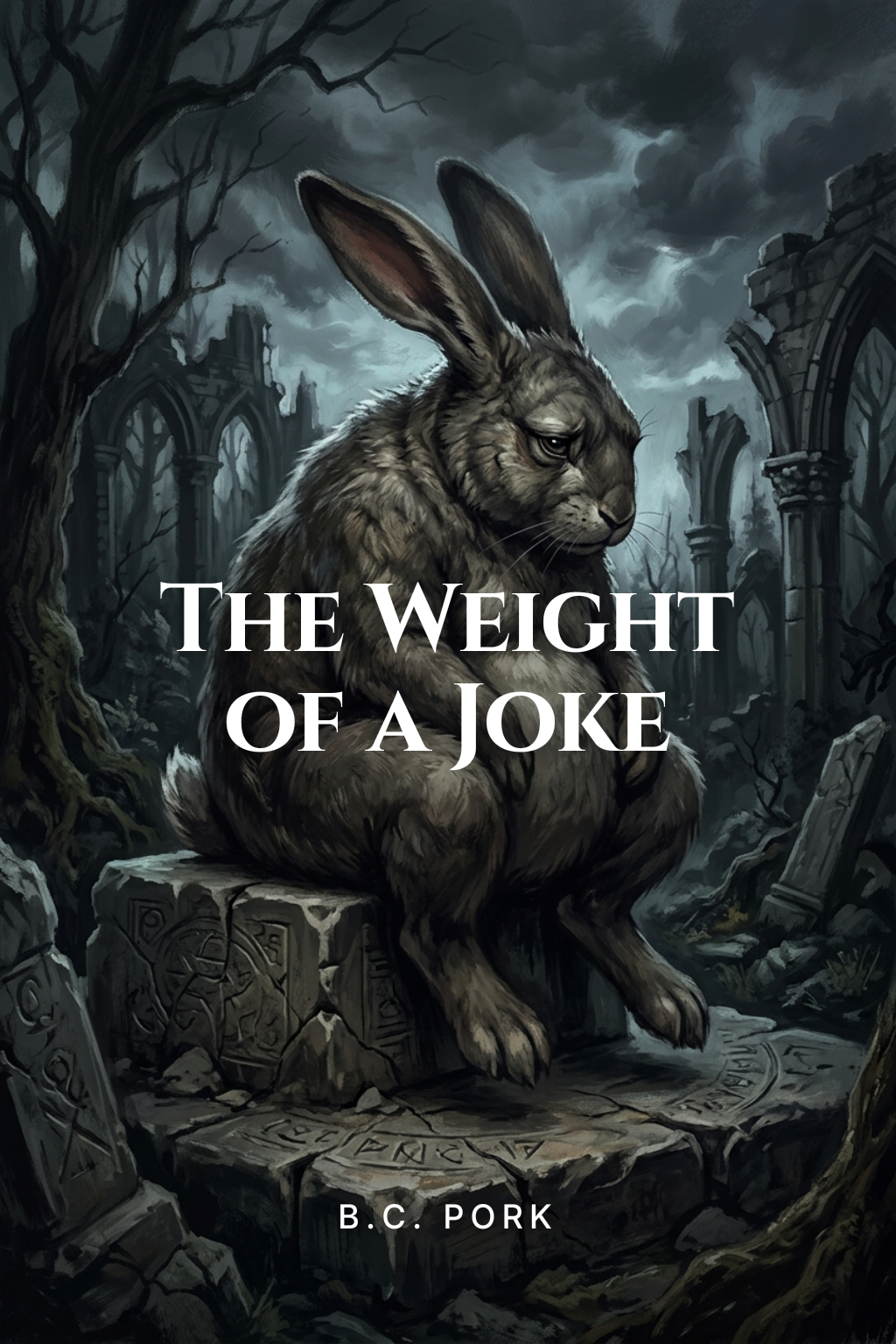
Book · 4 chapters · 8,016 words
The Weight of a Joke
Contents4 chapters
Chapter 1
Chapter 1: The Rabbit on the Screen
The first time most people saw Big Chungus, they did not know they were looking at a joke with a future. The image was small, low-resolution, and stupid in the old, perfect sense of the word. Bugs Bunny, blown up into a round, overfed parody of himself, stands with his belly out and his arms stuck wide. He looks less like a cartoon character than a punchline that escaped the frame and started living on its own.
The image spread the way so many modern jokes spread: fast, uneven, and without much instruction. No one needed a caption for long. The shape did the work. The name did even more. “Big Chungus” sounds like a phrase found at the bottom of a cereal box in a universe with no adults. It has the grunt of playground slang and the dumb confidence of something that knows it is funny before anyone else agrees.
That was part of the power. The joke did not depend on subtlety. It did not ask for context, and it did not reward expertise. Anyone could look at it and get the point. Bugs, but huge. Bugs, but wrong. Bugs, but if he had been kept too long in a cartoon fridge. The thing was immediate. That mattered.
Old jokes had to travel through magazines, late-night television, or word of mouth. Big Chungus moved through the internet, where jokes are not so much told as copied, adjusted, and fired back into the crowd. One person posts it. Another steals it. A third adds a new caption. Then it appears on a page that has no relation to the first two except the shared urge to make the same thing circulate again. The joke becomes less like a line and more like a coin rubbed so often the face on it changes.
The internet rewards images that do not need to explain themselves. That is why Big Chungus worked. It had no backstory that mattered. It did not require a setup from a comedian, a plot point from Warner Bros., or a deep cut from old animation fans. It came with a built-in distortion. People could use it as a reaction image, a post, a punchline, a threat, a compliment, or a complete refusal of sense. That flexibility is what gives a meme its legs.
The first mistake people make about memes is to treat them like throwaway jokes. Most are. Some are not. The ones that last are the ones that can be stripped of meaning and still keep a pulse. Big Chungus had that. It could be funny on its own, but it also carried a strange energy of excess. It was too much rabbit. Too much body. Too much of something familiar pushed past the point of recognition.
That excess mattered because the internet had already trained people to enjoy things that looked wrong in a precise way. A meme often works by breaking scale, taste, or expectation. Big Chungus breaks scale first. Bugs Bunny is known for being slim, quick, and smug. The Chungus version is the opposite. He is slowed down by his own size. The sight gag is simple: the celebrated trickster has been made heavy. But behind the gag is a deeper joke about the internet itself, which loves to stretch, inflate, distort, and remix until the original form gives up and becomes a blob of references.
Warner Bros. did not create Big Chungus as a character in any planned sense. It emerged from a frame in a cartoon, then from fans, then from the machine of repetition. That path is important. It shows how culture can be made in public, by people with no permission and no central script. A studio built Bugs Bunny in the 1940s. Decades later, anonymous users on message boards and social feeds gave him a new body and a new life. The old character became raw material.
That would have been hard to imagine in the age of network television, when the line between producer and audience stayed mostly fixed. On the internet, the audience presses its thumb into the clay. Sometimes the thumbprint matters more than the original sculpture. Big Chungus is one of those thumbprints. It is not polished. It is not clean. That roughness is part of why it stuck.
It also arrived at a time when people were already fluent in ironic affection. A joke could be dumb on purpose and still sincere enough to keep. Big Chungus lives in that space. No one had to argue that it was art. People just kept posting it. The repetition became the point. If you saw it once, it was a joke. If you saw it fifty times, it became a kind of emblem. If you saw it enough, you started to understand that the joke was not only about Bugs Bunny. It was about how a crowd can agree, for no reason that will survive inspection, that a ridiculous thing deserves to keep existing.
That is not trivial. Modern attention is scarce. Most images vanish in hours. Most jokes do not survive the week. Big Chungus did because it could be re-used without getting old too fast. It had no thin edge that could be worn through. It was already a joke about overgrowth, about too much of a good thing. There was room inside it for further exaggeration.
The name helped. “Big Chungus” was not tested by a marketing team. It sounded accidental, which made it feel found rather than manufactured. People trust found things online more than polished ones. They like the sense that a joke has slipped out from under control. Big Chungus did not feel designed to perform authenticity. It felt like an error that had learned to smile.
And then, once it took hold, it stopped belonging to the first people who used it. That is how internet culture works when it works at all. The origin becomes trivia. The spread becomes the story. The meme enters circulation and starts to mean whatever the crowd needs it to mean. In that sense, Big Chungus is not just a rabbit. It is a case study in how a joke becomes property of strangers.
That is why the image still matters. Not because it is profound, but because it is so plainly not. It shows how little it sometimes takes for a crowd to decide that something is worth carrying forward. A round Bugs Bunny. A nonsense name. A shared grin. Then a thousand copies, and then ten thousand, and then a place in the strange archive of online life, where a joke can become as real as the thing it mocks.
Big Chungus began as a visual gag. It became a social object. People used it to signal membership in a joke economy that runs on speed, repetition, and knowing misuse. It was never supposed to become anything larger than a laugh. That is precisely why it did.
And yet even now, the joke keeps its original shape. It is still funny partly because it is too big, too dumb, too earnest about being dumb. The image asks for nothing. It does not explain itself, and it does not need to. That is a rare thing online, where so much content arrives already polished into a position. Big Chungus is just there, heavy with its own uselessness.
Maybe that is the closest thing to its meaning. It survives because it is easy to repeat and hard to exhaust. Each time it returns, it carries the same blank charge, the same invitation to laugh at how quickly an ordinary meaningless thing can acquire history.A rabbit: white fur, loose lines, nothing hidden but the joke. It does not change when people stare. Still, it is only a joke.But the crowd has done the rest. The next step was predictable in hindsight. Once a meme proves it can hold attention, other systems move in. Platforms sort and recommend it. News sites explain it to people who missed the first wave. Retailers print it on shirts. A joke that circulated because it seemed ownerless starts leaving receipts. By 2018, Big Chungus had moved far enough from its source that parents knew the image from children, children knew it from YouTube compilations, and people who had never seen a full Bugs Bunny short could still recognize the swollen face and the name. The rabbit had crossed from a niche reference into low-grade public awareness.
That shift matters because it changes what the joke is doing. Inside a small group, repetition can feel intimate, like a password. At scale, the same repetition becomes infrastructure. It gives strangers a quick way to test whether they are looking at the same internet. Big Chungus worked well in that role because almost nothing about it needed translation. You did not need a political position, a fandom, or a paragraph of context. You needed one second. The image hit first. The explanation, if it came at all, came later.
So before anyone tried to pin a larger theory onto it, Big Chungus had already demonstrated something simple and useful. A joke did not need sharpness to spread. It did not need novelty for long. It needed a shape people could lift together. That is a small fact, but it says a lot about the online world that made it: how quickly nonsense can harden into reference, how a crowd can turn a passing frame into a durable object, and how the things that last are often the things that began with the least ambition. It was easy to miss how odd that was until the joke left the screen. In a kitchen, on a lunchbox, on a T-shirt in a grocery store aisle, the rabbit looked less like a post and more like an object someone had decided to keep. The setting changed the weight of it. What had once flashed past in a feed now sat under fluorescent light, among cereal boxes and plastic produce bags, as if it had always belonged there. The same round face that had needed no explanation online now had to coexist with coupons, shopping lists, and a child tugging at a sleeve to ask what it meant.
That was part of the new life of the image. It no longer needed the first audience to keep it going. It could appear in a bedroom on a laptop, then again in a school hallway, then again in a waiting room, each time with less of its original joke attached and more of its shape alone. A thing that starts in private circulation can end up in plain sight, where people who never shared the joke still know enough to recognize it. By then, Big Chungus was not only a meme. It was a piece of common clutter, the sort of image that can hang around long after its first purpose has gone. In that new setting, the joke behaved differently. On a phone, Big Chungus asked for a reaction and then disappeared under the next post. In a classroom notebook margin or on the side of a cheap backpack, it stayed put. Someone had drawn the belly too round, the grin too flat, but the distortion still read at once. The rabbit’s usefulness did not depend on accuracy. It depended on recognition. A copied image in black pen could do almost the same work as the original low-resolution frame because the basic change was so blunt: Bugs Bunny, made too wide to ignore.
That was when the meme entered a slower kind of circulation. Not posting but carrying. Not remixing through software but repeating by hand, by memory, by purchase. A child could say the name on a bus and another child would laugh without needing the cartoon, the frame, or the early boards where the image first took hold. The phrase had become detachable. It sounded like nonsense, but sturdy nonsense, the sort that fit easily into teasing, praise, or simple noise. Big Chungus could be a joke, an insult, a mascot, a way of filling a silence. Old memes often waited in that state, neither dead nor active, ready to be pulled back when some new crowd found use for them.
Seen from there, the rabbit’s afterlife made a rough kind of sense. Internet culture kept far more than it needed, and what it kept was not always the finest or the smartest material. Sometimes it kept the broadest shape, the easiest name, the image that could survive theft and compression and bad printing and still look like itself. Big Chungus had that durability. It could leave the screen, lose most of its history, and continue anyway. The joke thinned out. The object remained.
There was also a smaller secret inside its success, one that the later explanations tended to smooth over. Big Chungus did not survive because people understood it especially well. It survived because people could use it before they understood it. A parent might first meet the name on a knockoff shirt, a younger brother might hear it shouted across a game lobby, a student might write it in the corner of a worksheet just to see if someone nearby reacted. In each case the recognition came ahead of the source. That sequence mattered. Plenty of jokes asked to be learned; this one let people join first and ask questions afterward. By the time someone went looking for where it came from, the phrase had already done its work.
That gap between use and knowledge helped keep the rabbit loose. Once a meme could function without its own history, no one had much reason to protect the original frame, or even to keep Bugs Bunny clearly visible inside it. The belly could get bigger, the ears shorter, the face more vacant. Cheap prints blurred the outlines. Search results mixed licensed art, fan edits, fake game covers, and screenshots from explanation articles. None of that damage weakened it much. If anything, the confusion gave it room. The image no longer belonged only to the cartoon, or to the boards that had repeated it into prominence. It belonged to whoever needed a fast, ridiculous shape and a name that felt good to say out loud. That was the hidden economy of the thing: not preservation, but slippage. The meme kept living because it was easy to get wrong.
Chapter 2
Chapter 2: How a Joke Learned to Eat
Big Chungus did not stay a simple image for long. That was never likely. Online jokes survive by being used, and use changes them. The first version of a meme is often the least interesting one. The crowd does not care much about fidelity. It cares whether the thing can be made useful again. Big Chungus could. So people stretched it, dressed it up, and gave it jobs.
One of those jobs was to stand in for excess itself. If a game was bloated, if a movie had too much content, if a celebrity seemed larger than life, Big Chungus could be called in as shorthand. That is how a meme gets power: it becomes a shortcut for a shared judgment. You do not need a paragraph if everyone already knows the joke. You just post the rabbit.
The image also had the rare gift of being a little ugly in a way that invited affection. A polished mascot can be admired. A grotesque one can be mocked. Big Chungus sits in between. He is funny because he is wrong, but not so wrong that you turn away. There is a softness to him. The roundness matters. He looks like he could roll downhill. He looks like he has been fed by hand. That makes the joke warmer than pure ridicule.
This matters because internet culture often divides into two modes: cruelty and cuddle. Big Chungus belongs to the second camp, even when used ironically. The joke does not stab. It swells. People could project harmless stupidity onto it and still keep a fondness for the result. That is one reason the meme traveled beyond the circles that first made it. You did not have to be an expert in animation history or game culture. You only had to understand that a rabbit was too big and that was funny.
The meme also benefited from the way the internet flattens old and new media. Bugs Bunny is an old character, forged in the studio system, but Big Chungus belongs to the network age. He moved into video clips, reaction posts, image macros, edits, and comment threads. A single frame from a mid-century cartoon became raw material for postmodern nonsense. That jump is not an accident of style. It reflects the way digital culture treats archives. Anything stored can be dug up. Anything dug up can be altered. Nothing is safe from being repurposed.
That repurposing has economics behind it. Platforms reward the things that keep people looking. A familiar image with a fresh twist often performs better than original material no one recognizes. Big Chungus arrived with recognition already built in. Bugs Bunny was a known face. The joke needed only a twist, and the twist was visible in an instant. That made it cheap to share and cheap to understand. Those two qualities are often what decide whether a meme goes far.
There is another reason it lasted: it was easy to name. Names matter online because they become handles for memory. “Big Chungus” is awkward in a useful way. It sounds like a thing you should not say in public, which makes it ideal for private circles trying to amuse themselves. It also sounds almost childish, which lowers the barrier to adoption. You do not need to explain why it is funny to say. It just is.
Once the name spread, the image began to detach from its source even more. People who had never seen the original cartoon used the phrase. That is a classic meme move. A joke starts as a reference, then becomes an object that can survive without the reference. At that point, it has changed categories. It is no longer an inside joke. It is a public token that carries the feeling of insider status without requiring the original knowledge.
That shift tells you something about how people want to belong online. They want the reward of being in on the thing without doing homework. Big Chungus offered that. You could smile at it whether or not you knew where it came from. If you did know, you got a second layer of amusement: the recognition that a random cartoon frame had become a cultural event, however small. If you did not, you still got a fat rabbit and a dumb name. That is efficient comedy.
The meme also thrived because it invited escalation. A joke that cannot be pushed further tends to die quickly. Big Chungus could be made bigger, thicker, more absurd. It could be placed in situations where it had no business being. It could be compared to political figures, food portions, game bosses, or abstract ideas of power. The more impossible the pairing, the better the result. The meme did not resist abuse. It seemed to enjoy it.
That quality made it useful in the larger culture of remix. Online, nothing stays in one form. A joke image becomes a sticker. A sticker becomes a T-shirt. A T-shirt becomes merchandise, then irony merch, then something a child wears because they found it in a bin. Big Chungus went through similar drift. It appeared in fan art, videos, jokes about absurd size, and references inside references. Each use chipped away at the original and left behind a thicker legend.
There was also the simple fact that people like a mascot they do not have to take seriously. Big Chungus could be invoked as a symbol of plenty, laziness, power, or appetite without any one meaning sticking too hard. That looseness is useful. A fixed symbol gets exhausted. A loose one keeps breathing. Big Chungus had no official doctrine. It was open to misreadings, and that openness kept it alive.
If that sounds accidental, it is. But accident is part of the story. The internet is crowded with things that were never planned to last. Most do not. A few catch on because they hit a nerve in the crowd. Big Chungus hit the nerve that likes scale jokes, old cartoons, and nonsense names. Then it kept hitting because people needed a common object for shared silliness.
That is the deeper lesson. A meme is not just an image. It is a social arrangement. It tells people how to laugh together, how to repeat, how to signal that they know the rule without needing it written down. Big Chungus made that rule easy. Post the rabbit. Know the rabbit. Enjoy the rabbit. The simplicity is part of the machine.
And like many good internet objects, it became more durable than it had any right to be. Not because it was rich in meaning, but because it was rich in use. People did not need to agree on what Big Chungus stood for. They only had to agree that it belonged in the stream. Once that happened, the joke had already won.
Chapter 3
Chapter 3: The Afterlife of a Fat Rabbit
Big Chungus outlived the moment that made him famous. That is the test. A joke that burns hot for a week is common. A joke that keeps turning up years later is something else. It has entered the afterlife of internet culture, where old memes are not dead so much as waiting in drawers, ready to be brought out when the crowd needs a familiar face.
When people return to Big Chungus now, they are often doing more than repeating a punchline. They are summoning a period of online life that already feels slightly distant. The meme carries the smell of a specific internet era: the years when image boards, ironic fandom, and algorithm-driven sharing began to merge into one noisy current. Big Chungus belongs to that middle zone, after the early web but before the current age of total platform control. He feels old enough to be nostalgic and recent enough to still be stupid in the present tense.
That combination is rare. Most internet jokes age badly because they depend on a moment, a platform, or a trend that vanishes. Big Chungus survives because it is not tied to one event. It is tied to a shape. A big rabbit is a big rabbit. The joke does not require a date stamp. It can be revived any time someone wants to mock inflation, abundance, or sheer bodily scale.
There is also a kind of accidental dignity in that persistence. The meme began as nonsense, then accumulated uses, then became a thing people could point to when talking about how memes work. That is a familiar path. The internet takes things that are not supposed to last and makes them into examples. Big Chungus is now cited, referenced, and remembered in the same breath as far more serious cultural forms. It lives in essays, lists, videos, and arguments about what counts as a meme. It has become a case, which is another word for survival.
But the real story is less about fame than about repetition. Big Chungus lasted because people kept choosing it. Not because an institution protected it, and not because it stood for a deep truth. They kept choosing it because it remained available as a unit of shared silliness. In a culture that often feels crowded with outrage, that kind of shared silliness has value. It lets people agree on something without needing to agree on much else.
That is why the meme can feel almost wholesome, despite its absurdity. It does not ask for a victim. It does not demand a target, though it can be pointed at one. Mostly it asks for attention and a grin. The body joke is broad enough to fit many moods. You can use Big Chungus to express delight, boredom, disbelief, or contempt for something overblown. The image flexes with the user.
The flexibility also explains why the meme has become shorthand for the internet’s appetite for surreal scale. A rabbit that is too large to be normal is a small version of the internet itself: too large, too full, too eager to multiply. The joke is funny because it is dumb. It endures because it says something obvious about digital culture without pretending to be wise. The web likes swelling things. It likes turning one joke into a hundred copies. It likes excess more than restraint. Big Chungus is a mascot for that appetite, whether anyone asked for one or not.
There is no clean ending to that story. Memes do not die in neat ways. They fade, return, get pasted into new contexts, and survive as bad references in the mouths of people who half remember them. Big Chungus will likely keep doing that. A new generation will discover him, make him larger, and use him to signal the same thing older users once signaled: I know the joke, and I know that the joke is stupid, and I like it anyway.
That final part matters. Liking the joke anyway is the whole secret. Big Chungus is not admired because he is elegant. He is loved because he makes room for stupidity without shame. He is a fat cartoon rabbit with a name that sounds like a sneeze. The image should have collapsed under its own weight. Instead it became a durable piece of shared nonsense.
That durability says something useful about how culture works now. Not everything that lasts does so because it is deep. Some things last because they are easy to carry. A simple image. A strange name. A joke anyone can repeat. Big Chungus fit those conditions so well that he slipped from gag to artifact.
And that is where he belongs, not as a grand symbol, but as proof that online life is built from small agreements. People decide together to keep looking at the fat rabbit. They decide together to laugh. They decide, for a little while, that the absurd deserves a home. The rabbit is huge, but the idea behind him is small and practical: if enough people repeat a joke, the joke becomes part of the furniture.
Big Chungus became furniture. He is the kind you do not notice until you stub your toe on it, then laugh because it was always there. That is a strange fate for a cartoon frame. It is also a very internet fate. A thing made for a laugh becomes a landmark. A nonsense phrase becomes a shared language. A fat rabbit learns how to live longer than he was meant to.
Chapter 4
Chapter 4: Mungus Chungus
By 2018, a parent could hear the word “Chungus” from a back seat and have at least a fair chance of knowing what it meant. That was the strange proof. Not the message board post, not the cropped screenshot, not even the fake game case that helped push the image outward. The proof was recognition leaking into ordinary rooms. A child said the name because it sounded funny. An older sibling rolled their eyes. An adult, against all odds, had seen the rabbit somewhere before.
That kind of recognition changed the joke without improving it. Big Chungus did not become sharper when more people knew him. He became flatter, sturdier, easier to point at. The image lost some of the surprise that came from seeing a familiar cartoon body turned grossly round. In return, it gained the blunt force of common reference. Once enough people recognized the rabbit, users no longer had to introduce him. They could drop him into a thread about oversized trucks, inflated game files, giant sandwiches, bloated movie runtimes, or a politician speaking too long, and trust that the point would land before anyone explained it.
That was one of the internet’s basic trades. A joke gave up freshness and got portability in exchange.
The portability mattered more than the source. Many people who used Big Chungus at his widest moment did not know the old cartoon frame. They knew the meme image, the name, and the rough feeling it carried. That was enough. Online culture often worked that way. The copy became the original for most of the audience. What mattered was not pedigree but function. Could the image be recognized at a glance? Could it be cut out, captioned, and thrown into a new argument in under a minute? Could it survive compression, reposting, bad cropping, and theft? Big Chungus could.
He was built for rough handling. The rabbit’s outline held up even when the file got muddy. The belly stayed readable. The broad face stayed readable. The arms, thrust out from the sides, still looked absurd when the pixels broke into soft blocks. A lot of images died when they got chewed up by reposting. Fine detail vanished. Facial expression went vague. The joke slipped away with the clarity. Big Chungus did not depend on fine detail. He was all silhouette and bulk. He could be screenshotted off a screen, saved again, then posted with a smeared caption, and he would still do his job.
That job was simple: he made overstatement visible.
Plenty of memes tried to express “too much.” Big Chungus did it with almost no labor from the viewer. Put the rabbit next to something swollen, inflated, overfunded, overdesigned, or overpraised, and the scale joke clicked shut. The comparison did not need logic. It needed shape. This was one reason the meme slipped so easily across subjects. It could mock a giant fast-food burger in one post and a sprawling software update in the next. It could stand in for affection as well. Someone posted a picture of an exceptionally round pet and called it Chungus. Someone else used the word for a baggy object, a thick textbook, a heavily layered winter coat. The name detached from the rabbit and became a loose label for bulky presence.
That looseness was a sign of success. When a meme turned into a word, or half a word, it had moved past the image bank and into speech. People did not need to post the rabbit each time. They could just say “absolute chungus” about a large tomato, a heavy laptop, a badly proportioned statue, a friend’s enormous cat stretched across a sofa. The phrase worked because it sounded unserious. It refused dignity. Other slang for largeness often borrowed from technical language, gym language, or car talk. “Chungus” came from nowhere respectable. It sounded as if a child had made it up in the moment and everyone else had agreed to keep it.
That childishness protected the joke from some forms of fatigue. A meme often died when users demanded too much from it. They made it carry politics, identity, expertise, bitterness, self-consciousness. Big Chungus could be used for all of those things in passing, but none of them fit him well enough to stick. He resisted interpretation by remaining a swollen rabbit with a ridiculous name. That gave him a low center of gravity. People could drag him into grander fights, yet he kept sliding back toward nonsense.
This was not innocence. The internet rarely granted innocence for long. Any widely shared image would be pulled into mockery, tribal signaling, bait, and boredom. Big Chungus saw all of that. Users posted him to annoy people who disliked meme culture. They used him to pad out low-effort pages. They ran him into the ground on purpose, repeating the image past the point of humor because overuse itself had become part of the joke. Some posted the rabbit as if testing a room: who would respond, who would cringe, who would reveal themselves as too earnest or too late. The meme became social sonar.
That, too, was common. A joke did not only say something about its object. It sorted the audience.
Big Chungus sorted people in a mild way. He was not a fierce password. One did not need special knowledge to recognize him, especially once the image spread beyond small online circles. But there were still layers of recognition. Someone might know only the rabbit. Someone else knew the name and the fake box art that circulated around it. Another person knew the earlier life of the image on boards and remix pages. Another understood the whole thing as an example of how internet culture liked to preserve junk and then act surprised when the junk turned durable. Each layer changed the laugh a little. The same picture could produce a child’s giggle, a teenager’s detached smirk, a bored adult’s sighing “I remember this,” or an analyst’s interest in transmission and reuse.
A durable meme often had that stack built into it. It could meet different people at different depths.
The fake game case mattered here not because it was uniquely clever, but because it showed how strongly people wanted objects. The internet had circulated countless images that stayed on screens and went no farther. Big Chungus briefly crossed a line from visible joke to pretend product. The invented case wrapped the rabbit in the language of shelves, boxes, ratings, logos, and release culture. It made him look purchasable. That was funny in the narrow sense. It was also instructive. Once a meme looked like a thing someone could buy, even as a gag, it picked up another kind of reality. A person could imagine finding it in a store bin. A child could imagine asking for it. A parent could imagine refusing. The joke entered the physical habits of consumer life without ever needing to become a real object.
That movement from screen to shelf, even as parody, was one of the clearest signs that internet nonsense had changed its status in public life. Earlier online jokes often stayed fenced inside the devices and forums that carried them. Big Chungus appeared during a period when the fence had already thinned. Screens traveled in pockets. Platforms fed one another. A post on one site became an image on another, then a reaction picture in chat, then a printout, then a novelty gift, then a mention in conversation. The path was short. A low-resolution rabbit could enter the kitchen with very little resistance.
Once he got there, he stopped belonging only to the internet.
That did not mean he became profound. It meant he became available for offline use in the same cheap, flexible way he had been available online. A person might draw the rabbit badly on a whiteboard at school. Someone might stick the name on a group chat title. A brother might nickname another brother Chungus after a heavy meal. A friend might send a plush rabbit photo with the caption “biggest chungus alive.” These uses were not archival. They left almost no record. They still mattered. Memes lived not only where they could be scraped and counted, but where they were repeated out loud, misremembered, and attached to people or objects in the room.
If the internet gave the joke speed, ordinary speech gave it thickness.
That thickness explained why Big Chungus lingered after his peak. He was no longer only an image waiting for the next repost. He had become a handy shape in thought. When people needed a fast, unserious way to describe bloat, there he was. This is how many memes survived their own timelines. They stopped being events and became adjectives. Some turned into reaction faces. Some turned into sentence rhythms. Big Chungus turned into a noun, then a nickname, then a general-purpose tag for oversized absurdity.
The conversion looked trivial because it was trivial. That was part of the lesson. Cultural staying power did not always announce itself with manifestos or institutions. Sometimes it arrived as a lazy word people kept finding useful. “Chungus” stayed in circulation because it filled a narrow slot. It named largeness while keeping the tone light. “Huge” had no joke in it. “Obese” sounded clinical or cruel. “Massive” could sound admiring. “Chungus” sounded dumb on purpose. It gave the speaker distance from seriousness.
That distance had value online, where seriousness often arrived in bulk.
A great many posts in the late 2010s and after were built from overstatement. The platform voice itself pushed in that direction. Everything was the worst, the biggest, the most broken, the most cursed, the most essential, the most humiliating, the most insane thing anyone had ever seen. Big Chungus fit that climate because he compressed overstatement into one body. He was an answer to inflation made in the language of inflation. The rabbit did not argue against excess. He performed it.
That performance made him useful in a media environment full of swelling forms. Files got larger. Franchises got larger. Menus got larger. Trucks sat higher. Headphones grew more features. Streaming libraries expanded until choice itself felt heavy. None of these things required Big Chungus in order to be criticized or enjoyed. But the meme offered an easy visual shorthand for the feeling that scale had become detached from need. Here was your giant collector’s edition, your overbuilt gadget, your sandwich with too many layers, your map cluttered with icons, your sequel stuffed with lore. The rabbit stood nearby, smug and round, saying nothing.
Silence helped. Big Chungus was stronger as an image than as a sentence. Memes that depended on a precise line often thinned out once the wording got lost or copied badly. Big Chungus could carry no text at all. He was a body joke, and body jokes crossed platform borders well. In one corner of the internet, users pasted his face onto other bodies. In another, they enlarged him further until the absurdity tipped into abstraction. In another, they stripped everything away and posted just the original image as if no embellishment could improve it. All of these were forms of confidence in the source material. A good visual meme gave users room to do less.
He also benefited from not being too polished. A slick image sometimes invited slick treatment. Brands copied it too eagerly. Pages sharpened it into something dead. Big Chungus came from a warped old frame and wore that rough birth openly. Even when recut, outlined, or cleaned up, he retained some of the cheap feel of found media. That cheapness mattered. It told users that the meme was theirs to handle carelessly. They did not have to protect it. They could steal it, distort it, staple it to another joke, and move on.
This was one reason the meme never sat comfortably with official polish. When institutions tried to borrow internet humor, they often sanded off the roughness that made it move. Big Chungus did not need reverence, and reverence made him heavy in the wrong way. He worked best when someone grabbed him quickly, with bad timing and modest effort, and tossed him into circulation. The rabbit came from a culture of reposting, not curation.
That distinction mattered for how the joke aged.
A curated object often aged by being placed behind glass. People admired it, cited it, restored it, and gently removed it from everyday use. A reposted object aged by being scuffed. It remained alive through mishandling. Big Chungus kept his place because users continued to mistreat him in familiar ways. They used him in stale formats. They pushed him into conversations where he barely fit. They revived him after months of silence just to see whether anyone still reacted. In another medium, this would count as disrespect. Online, it was maintenance.
The internet’s afterlife for jokes was full of this rough care. Old memes waited in folders, in saved images, in search bars, in the back shelves of memory. A user would pull one down when the mood or subject matched. Some old memes returned because nostalgia had market value. Others returned because they still worked. Big Chungus often came back for the second reason. If the subject was bloat, abundance, grotesque size, or a shamelessly stupid register, the rabbit remained serviceable. He had not been outmoded by better technology or finer wit. He still fit the slot he had filled before.
That usefulness made him one of the cleaner examples of how internet culture treated the past. The web did not preserve only what was best. It preserved what stayed handy.
This could seem disappointing to anyone who wanted culture to reward depth. Yet there was something honest in it. People kept what they used. They reused what was easy to remember, easy to recognize, easy to bend without breaking. Big Chungus met all three tests. The image was blunt enough to survive memory. The name was odd enough to stick in the mouth. The joke was broad enough to cover many objects without becoming precise. That combination was not noble. It was practical.
Practical jokes tended to travel farther than elegant ones.
There was a lesson in the rabbit for anyone trying to understand why certain pieces of online nonsense escaped their moment. The first lesson was visual. A strong silhouette beat detail. If a joke stayed readable in the corner of a small screen, it had a better chance. The second lesson was tonal. A lightly foolish name gave people permission to use it in low-stakes ways. The third was social. A meme that did not require a full explanation could jump between age groups, platforms, and levels of internet literacy. The fourth was structural. Reuse mattered more than originality after the first burst. A meme lasted when people could put it to work over and over.
Big Chungus was not the only example of these rules, but he showed them cleanly because so little else got in the way. There was no difficult lore to memorize. There was no verbal punch line to preserve intact. There was no hidden thesis. A familiar rabbit had been made preposterously large. Fans and users kept repeating that fact until it became a durable cultural object.
The chapter could stop there and leave the matter tidy. But the rabbit carried one more small point, and it was worth keeping.
The point was about permission.
Many jokes online asked the audience to prove something: quickness, irony, cruelty, politics, fluency, detachment. Big Chungus asked for less. He asked whether the viewer was willing to accept a low-grade laugh from a swollen cartoon body. That was all. For some people, this made the meme beneath notice. For others, it made the meme pleasant company. Not every shared thing had to sharpen the mind or mark a side. Sometimes people wanted a common object that did not ask them to defend much. Big Chungus provided that common object often enough to become memorable.
This was not a moral triumph. It was a social convenience.
Social convenience should not be underrated. Large parts of online life were built from tiny, low-cost agreements. A reaction image told others how to read a moment. A repeated phrase let a group bond without saying anything important. A familiar meme gave strangers a safe patch of common ground before the conversation moved elsewhere. Big Chungus served these functions because he arrived with little baggage and clear intention. He was silly. He was excessive. He was known. That was enough to open or soften an exchange.
One could see this in the way the meme often appeared at the edge of conversations rather than the center. A user replied with the rabbit and no text. Someone dropped the word “chungus” as a tag under a photo of an oversized object. A thread wandered toward absurd scale, and the rabbit surfaced almost automatically. These were not moments of creative breakthrough. They were moments of maintenance, small acts that kept a shared language warm.
The internet needed that warmth more than it admitted.
A culture built on endless posting could become cold with speed. Attention was sharp, fast, and often punitive. Users learned to perform alertness. Under those conditions, foolish repetition could offer a small release. Big Chungus gave people a way to be unserious together without much risk. The meme was broad, old enough to be familiar, and empty enough to leave room for projection. One person saw nostalgia. Another saw anti-hype. Another saw simply a fat rabbit. The image did not force a single reading. It sat there, wide and patient, waiting to be used again.
That patience might be the most surprising thing about the meme’s long life. Big Chungus never needed to dominate the feed. He only needed to remain available. Availability was often more powerful than intensity. A joke that could be revived at will might outlast a joke that burned brighter. The rabbit’s afterlife depended on this plain fact. He did not require a season. He required an occasion, and occasions for mocking bloat were endless.
That was true online because online systems favored more. More updates, more content, more add-ons, more posts, more reaction, more recirculation. It was also true outside the screen, where modern consumer life presented excess at every turn. Big Chungus could point at either world. He could point at both at once. A joke born from distortion became a portable way to talk about things that had grown too large for their purpose.
There was something fitting in that. The meme had always been about scale broken out of proportion. As it spread, it became part of a culture that rewarded the same break in scale. Bigger feeds. Bigger audiences. Bigger archives of trash. The rabbit did not stand outside that process. He rode inside it, one swollen passenger among many, gaining strength from the systems that also made online life feel unwieldy. If he looked like a mascot for digital excess, it was because digital excess had fed him.
And still he stayed manageable. That was the final trick. Big Chungus translated large, vague feelings into a small, graspable joke. Bloat became a rabbit. Overkill became a rabbit. Public familiarity became a rabbit. The internet did this often: it took a diffuse condition and pinned it to a face, a catchphrase, a still image. The simplification was part of the relief. One could laugh at the rabbit instead of describing the whole machinery of amplification, repetition, and scale. The laugh was not a solution. It was a handle.
Handles were useful. People reached for them when systems grew too large to see all at once.
That was why the meme still had life left, and likely would for some time. New users would meet the image with no memory of its first rounds. Some would treat it as a stale relic, which was fair. Others would find that the old rabbit still fit a very current annoyance. An app update became too large to download. A car grille looked like armor. A snack came in a bag mostly filled with air. A sequel returned fatter than its own idea. Somewhere, the rabbit would be posted again.
He would not need ceremony. Someone would save the image from a repost of a repost. Someone else would type the name in lowercase. The joke would land or fail in a few seconds. Then the feed would move on.
That modesty was part of his weight. Big Chungus mattered only a little at any given moment, which was one reason he could matter for so long. He never demanded to become a monument. People made him into furniture because furniture is what gets used. A grand artwork waits for the right mood. A chair does not. Neither does a meme built from a fat rabbit and a stupid name.
So the untitled part of the story was plain. The joke had already done what most jokes fail to do. It had left its birthplace without losing its shape. It had entered speech without becoming formal. It had survived overuse without requiring rescue. It had become a tool for pointing at excess in a culture that kept manufacturing more of it.
That was enough. The rabbit did not need a deeper ending than the one he had earned.
He remained a swollen Bugs Bunny parody with his belly out and his arms wide, as if presenting himself to the room. Users kept deciding what he meant in each new moment. Usually he meant that something had become too much. Sometimes he meant only that someone wanted to be stupid in public for a second. The line between those meanings was thin. On the internet, it often was.
Big Chungus lasted because he made that thin line easy to cross.
Write your own novel.
ScribistIQ generates full-length novels in minutes. Type your premise, walk away, come back to a finished book.
Try ScribistIQ