
Novel · 12 chapters · 38,644 words
The Princess and the heart seed
Contents12 chapters
- 01Found Beneath the Starwell Oak
- 02The Blanket with No Dust
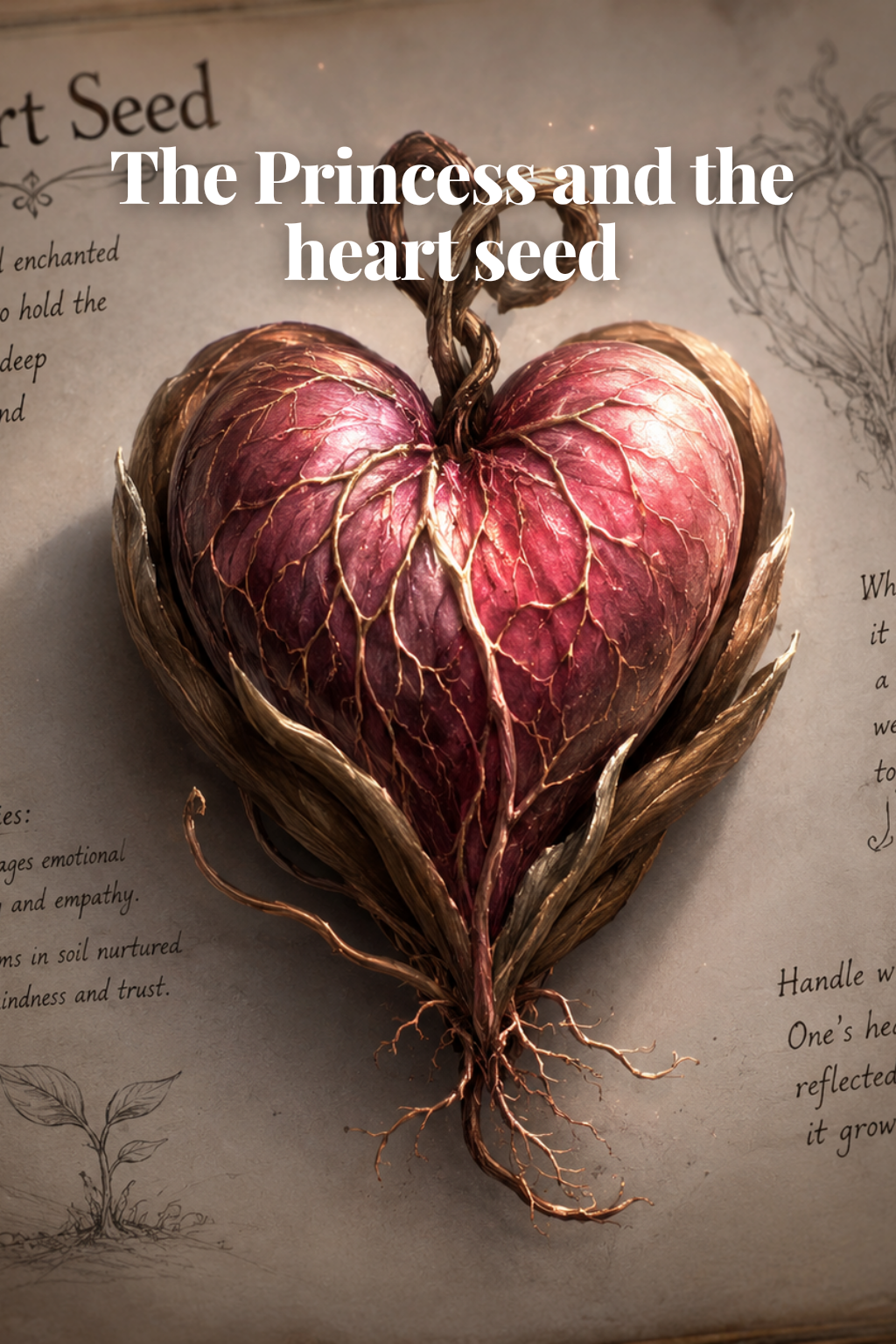
- 03The Seed That Beats Like a Heart
- 04Ash in the Telescope Lenses
- 05The City Above the Clouds
- 06A Name Spoken in the Hall of Feathers
- 07The Garden Under the Palace
- 08The Regent’s Astronomy
- 09Flight Through the Engine Vaults
- 10What the Seed Demands
- 11The Planting in Open War
- 12A Crown of Living Branches
Chapter 1
Found Beneath the Starwell Oak
The bell in the oak rang three thin notes, then stopped.
Every hand in the dome lifted from what it was doing. Maelin held his breath with the others and listened. Sap hissed in the copper pipes beneath the stone floor. Charcoal ticked in the braziers. Then the bell sounded again, not by rope or striker but by the tremor running through the trunk itself, a small shiver in old wood.
“Rootward,” said Sera, already stripping off the waxed gloves she used for handling hot lenses.
No one asked whether it was the shower. No one asked whether it was an omen. The Circle had lived under the Starwell Oak for six generations, and the tree spoke when it chose.
The observatory dome stood in the crook of the hill like an eggshell set into bark. Its slit roof was open to the black above, where the first of the falling lights had begun to score the sky—brief white cuts, too quick to wish on. Novices abandoned slates and sighting rods. An acolyte nearly upset the basin of darkwater used for reflections and caught it with both hands, swearing under his breath. Maelin took his staff from where it leaned beside the great brass armillary and went last, which was his habit. If a thing wished to be found, haste rarely helped.
Outside, the roots of the oak rose from the hill in ridges broader than a man was tall. Lamps burned in blue glass hooks along the pathways, each with a pinch of glowmoss floating in oil. Their light stroked the bark silver-green. Above, the branches spread farther than the eye could hold, carrying platforms, ladders, weather vanes, and the old hanging chambers used for solitary vigils. Tonight their undersides were lit in flashes by the meteor shower, as if fish scales turned in deep water.
The bell sounded a third time.
“There,” said one of the novices.
At the northern roots, where offerings were left in spring and ashes buried in winter, a pale knot lay in the hollow between two buttresses of wood.
For a moment it looked no larger than a dropped parcel.
Then it moved.
Sera was down the root-slope first, skirts bunched in one fist. She had broad shoulders and a healer’s blunt hands, scarred by needle burns and herb knives. Maelin heard her intake of breath before he reached her.
Not a parcel. A child.
The infant was wrapped so tightly only the face showed—a round pale face, beak small and pearl-gray, eyes closed in sleep or exhaustion. Down lay soft against the brow, white as milk. One wing had worked free of the blanket enough to show feathers tipped in a dusky violet that drank the lamplight. Even folded, the little jointed limb looked too fine-boned for the cold earth it had been laid on.
An Owlin child, Maelin thought, and then, more sharply: here.
At the base of the bundle, tucked close against the infant’s belly, lay a sprig of starwort and a disk of river shell bored through for hanging. No note. No seal broken for reading. Whoever had brought her had trusted the roots to speak for them.
Sera touched the blanket first, not the child. Her thumb pressed, rubbed, tested. Her eyes narrowed.
“Feel this.”
Maelin crouched with a crack in his knees and laid two fingers on the cloth. It was soft enough to slide under the skin like water. Not wool. Not any silk he knew. The threads held their own faint sheen though there was dirt beneath the bundle and damp in the hollow. No burrs clung to it. No leaf-mold marked it.
“A court weave,” said Tovin behind him. Tovin kept the archives and had once spent a season in the market city at Vale, where, according to him, rich men wiped their mouths on fabric finer than most folk were buried in. “And not bought openly.”
“Turn back the edge,” Maelin said.
Sera did, carefully. Along the inner hem, worked so subtly it only appeared when the cloth bent, ran a pattern in silver thread: repeating feather-eyes enclosed in crescents, then broken by a knot of stars. Not decorative wandering. Heraldry.
One of the novices whispered, “Oh.”
The child opened her eyes.
They were gold. Not the amber-brown common in owls that hunted the lower woods, but a lucid hammered gold, startling as metal fresh from a mold. She looked at Sera without crying. Her gaze moved, found the lantern hanging from a root knob, fixed there. In the next breath, a meteor passed over the canopy split and lit the hollow white. The infant blinked once, as if recognizing a thing she had expected to see.
Sera slid her hands beneath the bundle.
“No,” Maelin said.
She looked up at him. “She’s cold.”
“You don’t know what’s tied to her.”
“I know her feet are cold through three layers.”
Another streak burned overhead. Then another, fainter and green at the tail. The shower had thickened. Around them the younger druids shifted from foot to foot, faces turned between sky and child as if uncertain which was the true event.
Maelin set the ferrule of his staff into the dirt and closed his eyes. He listened past the people, past the insects in the grass and the far slap of the waterwheel at the herb sheds, to the oak. The old work was not hearing with ears. It was pressure, memory, consent. A tree that had taken roof beams, coffins, prayer strips, and blood into itself over centuries did not mistake burdens. Its roots had felt the placing of the infant. Its bell had spoken.
Under his palm the nearest ridge of bark held steady. No recoil. No warning.
Sera had already gathered the child by the time he opened his eyes. The blanket was lighter than it should have been, hanging from her arms in deep folds without any sign of damp. The infant’s face tucked under Sera’s chin with an economy that said she had found warmth and intended to keep it.
Tovin exhaled. “If that sigil is what I think it is, half the cloud courts would kill to own the proof of it.”
“Then let them form a queue at the lower gate,” Sera said.
Maelin rose slowly. His back objected. Age had made him deliberate, and office had made everyone around him mistake that for doubt. He looked from the silver-threaded hem to the shell charm left with the child. Common river shell. A peasant token. Deliberate, or all they had.
“Inside,” he said.
They took her not to the infirmary but to the counting chamber behind the dome, because it had only one door and stone walls thick enough to muffle rumor for a little while. The room smelled of beeswax, vellum, and dried orange peel. A chart of the winter constellations hung weighted at the corners with lead stars. Sera laid the child on the long cedar table usually used for sorting sky records and unwound the blanket.
Several of the novices had never seen an Owlin up close. They stared despite themselves. The infant had limbs like any child’s, though slimmer at the wrist and ankle, and the chest was covered in the softest down Maelin had ever seen, the white broken at the shoulders by a faint lavender wash that would likely deepen with age along the wings. Tiny claws flexed at the ends of her fingers. Her feet were strong, four-toed and scaled pale gray, each talon translucent at the tip. Someone had tucked warmed seed paste into a cloth pellet near her mouth at some point in the evening; she smelled faintly of anise and milk.
“Well fed,” Sera murmured, checking the fontanel, the mouth, the belly. “No rash. No fever. Listen.”
The baby made a sound then—not a full cry, only a displeased clicking chirrup at the cooler air now that the blanket was open. It was a healthy protest. She kicked once, hard enough to shift herself on the cedar.
“Hours old?” asked Tovin.
Sera shook her head. “Weeks. Six, maybe seven.”
“That blanket’s not for a farm loft or a roadside ditch,” Tovin said. “Someone carried her with care.”
“And left her at our roots,” Sera said.
Maelin stood at the end of the table, staff across both palms, and looked at the hem again. The sigils bothered him not because he knew them precisely but because he knew enough. Feather-eye. Crescent enclosure. The knot of stars spliced through the sequence. House work. High work. Not merchant vanity.
Behind him, in the dome beyond the chamber door, a murmur had started. News had moved faster than feet. It always did in cloistered places.
“Shut that,” he said, and one of the acolytes eased the door nearly closed.
Sera rewrapped the child in a plain warming cloth from the infirmary and left the costly blanket folded on the cedar, as if it might stain by touching anything common. The infant caught one edge in her claws before it could be moved away.
“She knows it,” Sera said.
“Or it’s the warmest thing under her hand,” Maelin said.
Sera gave him a flat look. “You don’t need to harden every thought before speaking it.”
“No. Only the useful ones.”
She slipped a finger into the baby’s grip. The little claws curled carefully around it, not pricking skin.
Tovin leaned over the folded blanket without touching. “If this comes from Ithravel—”
“We do not know that it does,” Maelin said.
“Then from one of the lesser rookeries that copy their fashions badly, though I doubt it. Either way, a child of standing abandoned under our tree in the middle of a shower? That is not happenstance. If word leaves this hill, it will bring questions with teeth.”
Sera straightened. “Then keep word on the hill.”
“That has never once worked,” Tovin said.
One of the younger druids, Eiden, who had come to the Circle after bandits burnt his father’s granary and therefore believed all difficulties were best met by putting a wall between them and oneself, said, “We could send her to the nuns at Salt Mere. No one asks what arrives there.”
Sera turned on him with such force he stepped back from the table. “You can send your own blood to strangers if you like. This child was set under the Starwell Oak.”
“So was a dead fox once,” Eiden muttered.
“By boys proving they had no mothers,” Sera snapped.
The infant began to fuss at the raised voices, beak opening with a small outraged peep. Sera gathered her up before the sound could swell.
Maelin let the room heat and tighten. Better to hear what each would say while afraid. Outside, through the slit in the door, white light kept flickering across the dome floor. The shower was reaching its height. Each year the Circle mapped the fall, marked changes, read drift and omen in the radiant. Tonight the heavens had sent them a problem instead.
He moved to the small shelf by the wall where votive bowls were kept and took down a blue clay dish. In it lay ash from cedar prayers and a little packet of dried moonmint. He crushed the leaves into the ash with his thumb, added a drop of oil from the lamp, and made a paste. Then he stepped back to the table.
“If this child was given into the tree’s protection,” he said, “the tree may answer whether it accepts the charge.”
No one argued with that. Not even Eiden.
Sera lowered the infant enough for Maelin to touch the paste to the center of the blanket’s folded hem. The moonmint stung sharp in the room. He spoke no grand invocation, only the oldest petition of the Circle, plain as work clothes: What comes here under sky and root, let it be named true or cast out.
Then he laid his palm over the mark.
The silver-threaded sigils did not flare. There was no thunder, no stirring wind. The cloth simply warmed under his hand, first to body heat, then beyond it, the warmth of stone left all day in sun. The shell charm on the table rattled once against cedar. From outside, far below in the root halls, another of the tree-bells answered with a low note.
Sera’s face changed, not softening exactly but settling.
Eiden crossed himself in the old field fashion before remembering where he was.
Tovin let out a breath through his nose. “Accepted, then.”
“Witnessed,” Maelin said. He did not like certainty in sacred matters. Certainty made fools bold. “That is enough.”
The child, warmed by the contact or soothed by the voices dropping, fell still. Her gold eyes found Maelin’s face. He had spent forty years reading skies so distant their light arrived old, but her stare held him more uncomfortably than any star chart. There was no accusation in it. That would have been easier.
A knock sounded, rapid and official, before anyone had invited interruption. Brother Fen from the gatehouse stepped in without waiting. He was narrow as a walking stick and carried himself as if all messages were weight he resented lifting.
“Lantern on the east road,” he said. “Riders.”
“How many?”
“Three seen. Perhaps more behind the bend.”
At once the room changed. Not panic. The Circle had survived tax collectors, press gangs, winter wolves, and once an amateur prophet with thirty armed followers. But everyone’s hands found tools, belts, sleeves. Sera drew the infant tighter to her chest. Tovin swore softly.
“Colors?” Maelin asked.
“Too far. Covered lamps.”
Of course covered. No honest traveler climbed the hill during a shower unless desperate, devout, or sent.
Sera said, “They tracked whoever left her.”
“Or they are whoever left her,” Tovin said.
“No one leaves a child in the roots and then knocks on the gate.”
“People do more foolish things than that before midnight.”
Maelin went to the slit window and looked downslope. Through the black trunks, far off beyond the herb terraces, three lanterns winked between the trees, hooded and unhooded by movement. Not a peasant cart. Too steady. Horseback.
He turned back. “Ring no alarm. Bar the lower stores. Put the archives chest in the inner crawl.” Tovin was already moving before the list was done. “Eiden, take two to the west path and watch for more lights. Fen, tell the gatehouse to admit no one until I stand there myself.”
“And the child?” Sera asked.
That was the center of it, stripped clean. Not what sign she bore, nor what court might claim her, nor what danger climbed toward them under hooded lamps. The child.
The old answer rose first: conceal, delay, pray for daylight. It was the answer of keepers, and keepers lasted by not being noticed.
But the oak had rung its bells. Half the order had seen the bundle under the roots. By dawn every charcoal burner and herb widow in the valley would have a version of the tale, most of them wrong. Secrecy would buy an hour and cost them authority. Worse, if the riders were hunting proof of abandonment, hidden things looked stolen.
Maelin looked at Sera. Moonmint ash streaked her knuckles. The infant’s white head fit beneath her chin as if it had always belonged there. Sera met his gaze without pleading. She had argued her side. She would not beg.
Beyond the window, another meteor tore down the sky, brighter than the others, and for a heartbeat the whole hill stood in chalk-white relief: root ridges, prayer poles, the line of the east road like a scar through the pines.
“Bring the bell rope,” Maelin said.
Fen blinked. “The high bell?”
“The high bell.”
Tovin, halfway to the door, stopped dead. “You’re calling witness?”
“I’m refusing theft.”
Silence followed that, brief and charged.
Then Maelin stepped into the dome. The novices parted at once. Above them the open slit framed a river of falling light. He could feel the entire order listening from the galleries, the stairwells, the outer chambers cut into living wood. He planted his staff at the center mark where they read the sky each equinox and lifted his voice.
“All gather.”
The words carried strangely under the dome, taken and given back by brass and stone. Feet thundered from the ladders. Robes rustled. Someone began hauling the high bell rope from its wall cleat with both hands.
Sera came to stand at Maelin’s right, the infant in her arms wrapped now in the plain cloth, though the princely blanket lay folded across them both like a standard not yet raised. Tovin stood on the left, pale and dissatisfied, which was near enough to assent from him. The rest of the Circle formed in a half-ring, eyes bright in the blue lampglow.
The bell overhead gave one immense stroke. Another. The sound rolled out through the oak and down the hill to the gate, to the riders on the road, to every hut in the valley.
Maelin waited until the last vibration thinned.
“Under the Starwell Oak,” he said, “a child was laid in our keeping.”
A stir moved through the assembly. He did not lift a hand for silence; he let it settle on its own.
“She bears the marks of a house above our station and beyond our governance. That is for other tongues to make use of. This much is ours: she was given to root and sky, and the tree answered.”
He turned, and Sera drew back the edge of the plain wrapping just enough for the gathered order to see the infant’s face. Gold eyes. White down. The small violet tips at the folded wing.
Not all surprise looks the same. On some faces it was wonder. On others calculation. On one or two, fear sharpened into almost hunger at the thought of what this meant. Maelin marked them and kept going.
“We will not hide her in shame as if mercy were a crime. We will not surrender her to any hand that names blood and forgets duty. Before witness of the Circle and the falling fires, I claim her as ward of this order.”
Sera drew a breath, as if she had been holding it since the bell first rang.
At the back of the dome, the outer door boomed once under a fist or a hilt. The riders had reached the hill.
Maelin heard it, and so did everyone else. He spoke over the second blow.
“She will have a name.”
He looked at the infant. She looked back, solemn as an elder, one fist bunched in the fold of the rich blanket.
“Alara,” he said.
Sera repeated it at once, low and firm. “Alara.”
The Circle took it up unevenly at first, then together. “Alara.”
The pounding came again, harder.
Maelin lifted his staff, and every voice cut off.
“By root below and star above,” he said, “we raise her beyond the reach of any court that cast her out.”
The oath passed through them, not shouted but spoken with the weight of use, old words laid into old grooves. Even Tovin said them. Even Eiden, late by half a beat.
At the door, the iron latch screamed.
Maelin did not turn. “Sera,” he said quietly, while the last line of the oath still trembled in the dome, “take Alara to the inner stair.”
Sera shifted the child higher against her chest.
“And if they demand her?”
The latch jumped again. Wood splintered.
Maelin lowered his staff until its tip rang once against stone.
“Then let them demand her by name.”
Chapter 2
The Blanket with No Dust
Alara caught the falling marker before it struck the chart table.
It clicked once against her thumbnail, a little brass dart no longer than a pine needle, and she set it back in the groove without looking down. Her eyes were on the slit of night above the dome, where the sky showed through as a hard black river crowded with stars.
“That is not where the Lantern hangs in third watch,” Brother Eiden said.
“It is tonight.”
Eiden folded his arms into his sleeves and peered up as if suspicion alone could shift the heavens. Around the ring table, the other novices tried not to grin. Wax smoked in the low bowls. A coal hissed under one of the brass warming pans. The whole dome smelled of lamp fat, chalk dust, and the resin they used on the instrument joints to keep them from sticking in damp weather.
Alara reached past the marker and turned the outer wheel of the armillary a finger’s width. Copper rings murmured against one another. She tapped the chart at a cluster of inked points shaped like a shepherd’s crook.
“The Lantern is there in midsummer if the haze is thick over the southern marsh,” she said. “But the air’s clean. You can see the dim pair under it. That makes it this line, not yours.”
Eiden’s mouth thinned. He was not old, but in Alara’s life he had always seemed to have been born disapproving.
“And the drift?”
“Half a degree east since sunset.”
“By what reading?”
She looked at him then. “By having eyes.”
A cough escaped someone at the table and had to be strangled into a sleeve.
Eiden pointed, not at the sky but at the slate board where the evening’s notations had been copied. “The Circle keeps records so that we are not ruled by clever children and their confidence.”
“That is why I corrected the record before it became tomorrow’s mistake.”
Another muffled laugh. Eiden’s ears reddened.
He opened his mouth, perhaps to set her to scrubbing chamberpots or reciting declensions until dawn, but Maelin’s staff rang once on the stone threshold.
“Enough theater,” the elder said. “The stars have no use for it.”
He came in carrying a stack of bark tablets against his ribs. Age had bent him only a little. His beard had gone from iron to ash over the years, but his eyes remained alert in the seamed folds of his face, and when he crossed the floor the novices shifted for him without being told. He laid the tablets near Eiden’s elbow and glanced at the chart.
“She is right.”
Eiden did not move. “Her manner could use pruning.”
“So could your guesswork.”
A few heads dropped quickly over notes. Maelin set his palm beside the corrected marker and looked up through the roof slit. For a moment Alara saw what he always seemed to see: not points of light but relations, histories, old arguments written in motion.
“Lantern,” he said. “Dim pair below. Eastward creep from the ridge wind. Mark it.”
“I already did,” Alara said.
“I can read, child.”
That drew the grin from her before she could stop it.
Class broke not long after. Eiden assigned copying work with the clipped malice of a man forced to concede a point in public, and the others spilled down the side stairs in twos and threes, talking low. Alara stayed behind to cap the ink and cover the brass instruments with their felt wraps. She liked the dome best in the minute after lesson, when voices had gone and the place settled into itself again. The oak held the room in a slow living grip. If she laid her hand against the inner wall she could sometimes feel the faintest stirring in the wood, not movement exactly, more like the memory of sap.
“You bait him on purpose,” Maelin said.
Alara was draping cloth over the sighting frame. “Only when he deserves it.”
“He always deserves it. That is not a standard.”
She turned. He was sorting the bark tablets into a leather case, long fingers careful with each one. His staff leaned against the table. The silver star nailed below its crook had worn almost smooth from years of use.
“You said I was right.”
“I did.”
“You might have said it sooner.”
“I did not wish to deprive Eiden of the chance to be wrong in full.”
That made her laugh, and he allowed himself the shape of a smile before it went away.
From below came the sounds of the hill at evening: spoons against bowls in the kitchen hollow, the clack of a pail hook, someone on the lower stair singing three notes of a hymn and forgetting the fourth. Familiar things. Ground things. Alara listened to them with half her mind while the other half drifted, as it had been drifting more and more these past months, toward the chamber under the west roots where the order kept old offerings, brittle scrolls, saint bones that might or might not be saint bones, and one sealed cedar coffer that did not belong among any of it.
Maelin closed the case and watched her watching nothing.
“What have you stolen this week?” he asked.
She blinked at him. “Only time.”
“A poor answer. You are better at theft than that.”
Color climbed into her face. That meant he knew, or guessed close enough.
“I haven’t taken it,” she said.
“Taken what?”
She did not answer. He waited. He was very good at waiting.
At last she said, “The west-root key hangs in Tovin’s chest room behind three account seals and a nasty little bell-wire. If I had taken anything from the reliquary, he would have made a feast of my hide.”
“And yet you have thought through the process.”
“I think through many processes.”
“Yes. That is one of your more exhausting gifts.”
He slid the leather case shut and tied it. “Come after moonrise. Quietly.”
Her feathers lifted at the nape before she could smooth them back. “To the reliquary?”
“To sweep it.”
She stared.
Maelin picked up his staff. “If you arrive with that expression, Tovin will hear it from three corridors away.”
He left her with the covered instruments and the smell of lamp smoke.
She came after moonrise by the narrow passage behind the chart archive, the one used in winter when the outer steps iced over. The bark of the inner walls had been polished by generations of sleeves and shoulders, and the air grew cooler as she descended. Somewhere above, a water clock tipped and reset with a soft ceramic knock.
The west-root chamber lay beyond a door banded in blackened iron. Tovin prized locks the way some men prized relics. This one had three wards and a copper tongue that clicked like teeth when Maelin turned the key.
“You did not tell Tovin?” Alara asked.
Maelin pushed the door inward. “Tovin tells himself enough for everyone.”
The reliquary breathed out cedar, old paper, beeswax, and the dry mineral smell of deep earth. Lamps burned low in blue glass cups fixed to the walls. Their light made the chamber look submerged. Shelves rose from floor to lintel, holding bone tubes, wrapped bundles, stone jars sealed with pitch, a fox skull wired with silver thread, and the mended remains of an astrolabe so ancient its markings had worn almost blank.
At the far end stood the cedar coffer.
It was plain, which was one of the things that troubled Alara. Plain wood, plain brass hasp, plain linen seal tied across the lid. Tovin had written the inventory mark in his crabbed hand: FOUNDLING WRAP, ORIGIN DISPUTED, DO NOT HANDLE WITHOUT ELDER’S LEAVE.
Dust lay on the lid, in the hinges, along the shelf edges nearby. Not much. Tovin’s rooms were kept too obsessively for thick neglect. But there was always some. A skin of the world settling on all things left long enough in one place.
Not on the blanket.
Even through cedar and linen, even after years, it remained free of it. The first time Alara had noticed that she had been ten and small enough to crawl behind Tovin’s sorting table when he sent her for labels. Since then she had carried the fact like a splinter.
Maelin set his lamp down beside the coffer. “You may open it.”
She moved before he finished the sentence, then checked herself and lifted the seal carefully. The brass hasp was cold. Cedar sighed when the lid rose.
The blanket lay folded as she had always seen it, pale as cream in the blue lamplight. Expensive had been one of her earliest words for it, though she had not known what expense meant. She knew now. The cloth held its own sheen without oil. The woven field was dense enough to turn a thorn and soft enough that when she touched the edge with two fingers it yielded like breast-feathers at the throat. The old sigils glimmered when the light caught them: feather-eye, star-knot, a line of small hooked crescents she had once mistaken for waves.
She did not lift it at once. She never did. The thing always struck her first with the force of her own absence. Someone had wrapped her in this. Someone with money, skill, access to a loom no village possessed. Someone who had folded it around a child and left.
Maelin waited.
Alara slid both hands under the upper fold and raised it from the cedar. The blanket gave off no moth smell, no cellar damp. Instead there lingered the faintest trace of something clean and unfamiliar, not flower, not spice. Air after lightning, almost. Or stone that had never known mud.
“I hate it,” she said softly.
Maelin leaned on his staff. “No, you don’t.”
She ran her thumb over one of the woven sigils. “I hate what it asks.”
“That is closer.”
He nodded toward the table bolted to the wall. “Spread it.”
She did. The cloth unrolled in silence until most of the tabletop disappeared beneath it. Its border was worked more finely than the center, tiny thread-raised patterns too subtle to catch unless the light struck sideways. Alara bent low. She had done this before with stolen glimpses and hurried fingers. Tonight she had the lamp, and permission, and Maelin beside her.
The permission made her more nervous than the theft would have.
“What am I looking for?” she asked.
“What have you already seen?”
She traced the border with one nail. “The feather-eyes repeat every seven hands. The star-knots every three. They’re not decorative. They count something.”
“Good.”
“And here.” She shifted the lamp. In the changed angle, another line emerged from the pale weave, nearly invisible: a thread of muted violet crossing the cream and diving beneath it again. “This was worked after the first pattern. Not by the loom. By hand.”
Maelin’s brows lifted. “I missed that the first time.”
“The first time you were deciding whether I was bait for armed men.”
“That will sharpen or dull a person, depending on the sort of person.”
She followed the violet line with both forefingers. It crossed two feather-eyes, slipped under a knot, reappeared near one corner. There the thread thickened into a shape no larger than a thumbnail, hidden so neatly in the border that once folded it would vanish.
Alara lowered her face until her nose nearly touched the cloth.
“It’s been clipped,” she said.
“Yes.”
Not cut raggedly. Not frayed by age. Clipped clean with tiny scissors or a blade point, threads tucked and pressed down. Something had been removed.
Her stomach tightened. “You knew.”
“I suspected. Tonight I wished to know whether you could find it.”
She straightened and looked at him. “Why all this? Why now?”
Maelin’s hand rested on the table edge. The skin there was knotted and thin, freckled with age. “Because you are old enough to ask better questions than the ones you asked at eight.”
“I asked them then too.”
“You asked whether you had been thrown away.” He said it plainly, not unkindly. “That is a child’s wound. Necessary, but blunt. The cloth can answer more than that if we let it.”
He reached into his sleeve and drew out a narrow lens set in horn, the sort used for reading minute script on old bark. He offered it to her. “Look at the selvedge.”
She obeyed. Under the lens, the edge of the blanket became another country. Threads twisted around one another in pairs and trios, cream around silver, silver around cream, with occasional stitches of that same muted violet. Near one corner, barely larger than gnats’ legs, were three tiny knots tied into the silver.
“Maker’s marks,” Alara murmured.
“And?”
She held her breath and studied the spacing. Something about it nagged at her memory: not from clothwork, which she learned badly, but from charts, from notations in the oldest sky ledgers.
“Not marks,” she said slowly. “Letters.”
Maelin said nothing.
She shifted the lens, angling it to catch the lamp. The knots resolved. Not trade script. Not druid tally. Curved strokes reduced to thread and pressure, built to be read by someone who knew how to expect them.
Her heart gave one hard thud.
“Ith…” She swallowed. “Ithr.”
Maelin inclined his head. “Go on.”
“Ithravel.”
The name sat strange and bright in the cellar.
She knew it the way valley children knew storm-birds and glacier saints: from songs, from passing merchants, from the margins of almanacs where impossible places tended to collect. The city above cloudline. The rookeries of white stone. Hanging gardens. Engines suspended under terraces like bronze fruit. Half story, half geography, and all of it far beyond the marshes and pines of the valley.
Her fingers tightened around the lens.
“You knew that too?”
“Not with certainty.”
“You let me think it might be anything. Any rich household. Any court.”
“Yes.”
She set the lens down with care because she wanted, for one savage moment, to fling it. “Why?”
“Because a child told she is nothing can survive it,” Maelin said. “A child told she is too much may not.”
The anger faltered on that. She looked back at the cloth.
“Ithravel,” she repeated.
The faint clean scent rose from the weave when she bent close again. Not lightning. High cold air, perhaps. Stone terraces wet with cloud. She had no real measure for such things, so her mind made myths of them.
“And the royal house?” she asked.
Maelin reached to one of the clipped corners and tapped beside the missing section. “This border pattern appears in three old embassy gifts kept in the lower archive. Tovin did not mean for you to see them, which naturally ensured that you had.”
Alara kept her face innocent.
“It is reserved work,” Maelin said. “Not merely urban. Not merely noble. The feather-eye with star-knot chain belongs to the house that sits the high eyrie.”
She heard herself ask it as if from farther away. “A prince’s blanket?”
“A royal nursery blanket,” he said. “Woven for a child of that line.”
For a few beats the cellar held only the quiet lick of lamp flames.
Alara laid both palms flat on the cloth.
Not thrown away.
The thought came first, sharp enough to hurt. Not some servant’s accident. Not a hurried shame hidden in expensive wrapping. Someone had meant this blanket to speak after they were gone. Someone had left her not in rags but in declaration.
Relief rushed in, wild and humiliating. It was followed so fast by its twin that she almost laughed.
Royal child.
Hidden in the roots of a hill order half a continent below the clouds.
She looked up. “That isn’t better.”
“No.”
“It’s worse.”
“Considerably.”
She began pacing the width of the small chamber, three steps one way, three back, wings held close to keep from brushing shelves. “If they wanted me found, why hide the mark?”
“If they wanted you dead, why wrap you at all?”
She turned on him. “You’ve had years with this. Don’t start speaking like a riddle-carver now.”
Maelin accepted that without offense. “Then plain speech. Whoever brought you here had enough time and skill to alter the border without ruining it. They wanted the blanket recognized by some eyes and not by others.”
“By yours?”
“Perhaps by any learned hand outside court reach. Perhaps by no one at all until it was safe. We do not know.”
Alara stopped at the shelf with the broken astrolabe. The silver-wire fox skull regarded her with one empty socket and one bead eye.
“And the shell charm?” she said. “Did it mean anything after all?”
Maelin’s expression changed by a degree. Not surprise. More caution.
“It meant someone wished you tied to the sea roads, or wished us to think so. Tovin still believes it came from the western coves.”
“You don’t.”
“No.”
“Then what do you believe?”
“That belief is a luxury when evidence is thin.” He looked at the blanket, not at her. “I believe only this: you were not abandoned cheaply.”
The line was so dry it might have passed for humor in another mouth. Here it landed like a stone.
Alara went back to the table. The clipped corner drew her eye again and again. A missing sign. A cut-out truth. She slid her finger beneath the fold at that edge and felt, not in the visible border but in the inner turn of the hem, a slight resistance.
“There’s more.”
Maelin straightened.
She bent the corner toward the lamp. Inside the hem, where the double cloth had been joined with impossibly fine stitches, one section stood thicker than the rest by the breadth of a straw. Not enough to show unless handled by a suspicious person with patience.
Maelin swore under his breath, softly enough that the oath seemed meant only for the cedar.
“Can we open it?” Alara asked.
He did not answer at once. His thumb rubbed once over the head of his staff, a habit she had seen when he was weighing cost. “If we cut the seam, Tovin will know.”
“Tovin knows when someone exhales in the archive.”
“Yes. But if this was concealed, cutting it may destroy what was preserved.”
“You brought me here for truth.”
“I brought you here for as much truth as could be reached without waste.”
She could feel her pulse in the heel of her hand against the blanket. The hidden thickness in the hem might be nothing: a reinforcing thread, a weaver’s knot, old dirt compacted by years. Or not nothing.
Maelin looked at her, and for the first time that night she saw not only care and calculation but something closer to reluctance. He had kept this from her as long as he thought he could. Perhaps from himself as well.
“If word of Ithravel leaves this room,” he said, “it will travel faster than we can.”
“I know.”
“No, you know only that you are restless. That is not the same.”
She met his gaze. “Then tell me what you fear.”
“That whoever looked for you once may look again if given reason. That courts do not misplace royal infants without blood under it. That if we pull on this seam, the cloth may answer with a history large enough to tear the Circle open.”
Alara’s hand remained on the hidden ridge in the hem.
Above them, far up in the living oak, a bell gave one low stroke. Not alarm. Not prayer hour. A single note, as if the tree had shifted in its sleep and struck thought against bronze.
Both of them looked up.
The sound faded into the wood.
Maelin reached for the small knife he kept at his belt for trimming quills and cutting graft cord. He set it on the table between them, beside the pale folded edge with its secret stitched shut.
“Then choose carefully,” he said.
Chapter 3
The Seed That Beats Like a Heart
Resin smoke curled under the slit of the dome and caught in the brass rings overhead, turning them ghost-pale. Alara stood barefoot on the packed black soil inside the observatory circle, her talons pressing crescents into earth that had been turned at dusk and mixed with ground chalk, ash, and the powder of dried starwort. Twelve lamps burned low around the edge. Their blue wicks barely moved.
“Left hand open,” said Sera from behind her. “No, not like you’re about to steal from the altar. Like you’re willing to receive something that may embarrass you.”
Alara flattened her palm.
“Better.”
Across the circle, Brother Eiden knelt with his jaw set hard enough to show in the lampglow. He fed another pinch of powdered mica into the censer bowl and looked nowhere near her face. Tovin stood beside one of the cedar chests with a wax tablet hugged to his ribs, as if inventory could defend against mystery. Maelin had taken his place at the north mark beneath the oldest branch that thrust through the stone aperture in the wall and entered the dome like a dark bent arm.
It was midsummer. The rite was an old one, older than the brass instruments and the water clock and the shelf labels in Tovin’s hand. Once each year the Circle opened the floor over the rootwell, turned the sacred bed, and invited whatever crossed between deep earth and the high fires to speak. Most years it answered with nothing more than a changed pattern in the drift of ash. Sometimes a bit of sky-metal. Once, when Alara was nine, a knot of green fungus had pushed up overnight in the shape of a man’s hand and everyone had been disappointed.
Maelin lifted his staff. The inlaid silver on the wood caught one clean thread of starlight from the roof slit.
“We begin.”
The order answered him in the old cadence, not loud, not theatrical. Voices worn by use. Names of fixed lights. Names of the dark between. Requests, not commands. The dome answered in its own way: a faint reply in the bronzework, a tremor underfoot from the oak roots clasping the hill.
Alara spoke with them, though her attention slipped. She knew the sequence by blood and bone. Offer salt. Offer ash. Offer water held overnight under open sky. Name what was lost. Name what remained. She did each thing in turn. Her wing brushed the back of Sera’s sleeve as they passed the bowl. Sera did not correct her for it. That, more than anything, told Alara the older woman was uneasy.
They had not opened the thick seam in the blanket.
It sat two chambers away in its cedar coffer, stitched secret within secret, while Maelin had spent the last six days either in counsel or in silence, which were near enough the same thing in him. He had not forbidden her questions. He had only answered them with work. Copy this table. Reclean the armillary pivots. Count the lantern-line discrepancies in the old records from autumn forty-three years past. He had given her labor like a man throwing boards over a hole.
Now the whole order stood around a patch of turned earth and pretended this was the only thing on anyone’s mind.
Maelin brought the butt of his staff down once. The sound went through the soil.
“Witness,” he said.
The word settled.
Above, the roof slit held a clean swath of night. Summer stars. No clouds to soften them. The great wheeling belt over the south ridge already angled toward midnight. Alara knew where each one would be before the bells. She could have charted them with her eyes half closed. Yet tonight one point troubled her. Not because it moved—stars moved, all of them did, if you watched honestly enough—but because it moved wrong.
She lifted her head.
There.
A white spark low in the east, too bright for height, too steady for ember. It crossed under the known line of three and did not dim. Instead it swelled, sharpened, then trailed something like a filament behind it, not fire exactly, more like a wet thread taking light.
Alara forgot the cadence and stepped out of place.
“Stay the line,” Eiden hissed.
Maelin had already seen it. His voice cut the dome. “Hold.”
The rite stopped mid-breath. Sand whispered from somewhere high in the stone. The white thing descended without hurry, which was worse than if it had blazed. Meteors burned, shouted, spent themselves. This came as if directed. It slid through the roof slit with impossible neatness, missing brass rings, missing lamps, missing every raised hand, and struck the center of the turned bed.
Not struck. Entered.
The soil gave with a sound like a thumb pressed into wet bread. A small fountain of black earth leapt up. Blue lampflame canted inward all at once. The censer bowl sang on its chain, a thin metal cry.
Then stillness.
No fire. No smoke beyond the resin already burning. Just a hole in the sacred bed no wider than Alara’s wrist and a faint radiance under the soil, moving deeper.
Nobody spoke for three heartbeats.
Then Tovin said, “Do not touch it.”
Which, from Tovin, covered terror, awe, and at least half the practical concerns in the room.
Maelin crossed the circle first. He did not hurry. The others made space. He crouched by the hole, held his palm above it, and closed his eyes.
“Warm?” Sera said.
“Yes.”
“Burning?”
“No.”
Eiden rose from his knees, ash on the hem of his robe. “Sky-metal?”
Maelin opened his eyes. “No metal that I know.”
Alara had moved before deciding to. The soil was loose underfoot where it had been turned. She came to stand opposite Maelin, the hole between them. Light breathed under the dark dirt. It was not bright enough to illuminate the room, but it made the edges of the grains distinct, each mote briefly silvered from below.
Tovin made a choking sound of disapproval. “Elder.”
Maelin held out a hand without looking back. Silence.
He put two fingers into the hole and dug carefully. The dirt yielded too easily for root-bed packed over decades. Clods broke warm in his hand. Six inches down, then eight. His shoulders tightened. He withdrew his fingers and there was pale gold on the skin, not dust, not sap. It clung in filaments between knuckles.
Sera crouched beside him and sniffed. “Not rot. Not resin.”
“No.” Maelin scraped the substance onto the edge of a shard tile. It trembled there, alive with a minute inward contraction.
Alara felt her own pulse answer in her throat.
“Fetch the bone sieve,” Maelin said.
Nobody moved except Eiden, who went hard and quick to the tool shelf and returned with a shallow tray laced with pale deer rib. Maelin set it over the hole and began lifting earth into it by hand. Sera took the other side. Soil sifted through in warm soft streams. Roots no thicker than thread curled and recoiled from the light as if shrinking from a knife.
The thing below them shifted.
Not upward. Not away. It turned, slow as something sleeping.
Tovin had abandoned the wax tablet. It lay facedown on the floor. “Elder,” he said again, this time lower. “There is a record.”
Maelin did not look up. “Speak.”
“In the north chest. Fragmentary. Seed vessels from the upper dark. Received in famine years. Buried under ward earth until—”
“Until what?”
Tovin swallowed. “Until touched by a claimant.”
Eiden laughed once, sharply, because sometimes disbelief came out wearing that shape. “A claimant to what?”
Tovin spread his hands at the hole. “To whatever the vessel carries.”
“That is not an answer.”
“It is the record we have.”
Maelin scraped aside another layer. Light brightened against his wrists. Then the earth in the sieve suddenly fell away all at once, not dropping but parting, and something round and slick rolled into his palm.
Every lamp in the dome guttered blue-white.
It was the size of a plover’s egg, though not egg-shaped. More nearly a seed from some impossible tree: tapered at one end, fuller at the middle, veined all over with lines of pearly light that flexed beneath a skin the color of fresh chestnut split open. Tiny rootlets furred one side, not with growth but with searching motion, tasting air. Steam lifted where cool night met its heat.
Sera made the sign against grief without seeming to know she had done it.
Maelin stared. For once he looked not old but caught off guard, which sat strangely on him. “Heart seed,” he said.
No one repeated him. The name stood by itself.
Alara knew the phrase only from fragments in the star annals, usually next to words like before, failing, and never again. Children had been told stories with kinder edges: seeds that saved orchards, seeds that brought springs back, seeds that made dead hills green. Adults, when they thought children were out of earshot, used another tone. Realms, they said. Whole realms had fed on them or been fed by them. Cities in high places. Roots that ran under sea basins. Engines that drank sap-light. Old things.
Eiden found his voice first. “That belongs in warding.”
Tovin rounded on him. “Under what lock? Show me the lock that keeps a thing from choosing.”
Sera’s gaze snapped to Tovin, then to Maelin’s hand.
The seed moved.
Not a twitch. A beat.
Its whole body drew in, then eased. Again. Not rapid. Strong. As if a thumb had pressed from within and released.
Alara heard someone behind her whisper a prayer too old to have a fixed god attached.
Maelin remained kneeling, hand open, the heart seed cupped in his palm. The pearly veins brightened once with each contraction and dimmed between. He watched three beats, four. Then he did something that made half the room inhale at once: he turned his hand and offered the seed outward to the circle.
“Witness clearly,” he said.
Tovin went pale. “Maelin—”
“If it is what we think, none of us will be able later to claim we did not see.”
His eyes moved around the ring of faces and settled, last, on Alara.
No summons. No gesture.
Just that.
She should have stayed where she was. She knew it. Knew, too, that Sera’s body had shifted slightly, ready either to stop her or steady her, which meant Sera knew exactly what was about to happen and hated that she knew it.
“Alara,” Maelin said.
Her bare feet were black with root-soil by the time she reached him. Up close, the heat of the seed touched her skin before she touched it, the way sun-warmed stone gives itself away in the dark. Its rootlets combed the air. One of them lifted and bent toward her wrist.
“Do not take it if you feel refusal,” Sera said, each word clipped and clean.
Eiden muttered, “This is folly.”
Tovin snapped, “Be quiet, unless you have a better manuscript than memory.”
Alara looked at Maelin. “Why me?”
His face did not soften. “Because it is already reaching.”
That was true. The rootlet had found the pulse in her wrist without contact. It hovered there, trembling.
She thought of the hidden seam in the blanket. Of clipped sigils. Of riders on an east road she could not remember and had never entirely stopped imagining. Of a name stitched small enough to hide and clear enough to wound. She thought, too, of the Circle itself: of damp stone in winter passages, of chalk under her nails, of Sera’s hand on her fevered head when she was seven, of Maelin correcting her by asking harder questions, of Tovin pretending not to save the good ink for her copying.
If she stepped back now, the room would change anyway.
She held out both hands.
Maelin lowered the seed onto her palms.
It was heavier than it looked. Not by much, but enough to feel deliberate. Heat bit through first, almost pain. Then the beat struck.
Not against her skin.
In it.
Her fingers clenched by reflex. The seed gave one hard pulse and a line of white-gold shot through the inside of her wrist to her elbow, branch-fine and blinding. She heard herself make a short sound. The dome vanished in light.
There were roots.
No, not roots only. Vast cords of living matter braided with channels of luminous fluid, descending through black soil deeper than any hill ought to possess. Above them hung masses that might have been stone islands or cities or seedpods grown to the size of weather. Towers with open ribs. Bridges like pinned wings. A thousand windows lit and going dark, lit and going dark. Somewhere high, metal hummed. Somewhere lower, water ran through pipes lined with moss and silver leaf. A whole structure labored to stay aloft while underneath it a garden the size of a kingdom burned thin from overharvest.
Hunger moved through it.
Then another image: white feathers in lamplight. Cloth gathered in desperate hands. A shell charm tied once, twice. A woman’s voice saying something Alara could not hear because blood hammered too loudly.
The light broke.
She staggered. Strong hands caught her shoulders—Sera on one side, someone else on the other. The seed was no longer in her palms.
For one animal instant panic seized her. Then she looked down.
It was in the center of her chest.
Not embedded through bone. Not grotesque. Worse, in a way, because it looked so clean. The seed sat just beneath the skin at the hollow between sternum and throat, visible through flesh as if through pale amber. Its pearled veins had threaded outward in six fine lines, then sunk deeper. With every beat they shone and faded.
The rhythm matched the pounding in her ears.
No one in the dome moved.
Maelin was on his feet now, but he had taken a step back. Eiden stared as if he had witnessed blasphemy or proof, and had not yet chosen which. Tovin’s mouth hung slightly open. One of the younger acolytes near the west lamp began to cry without sound.
Sera put two fingers to the skin above the visible seed, testing. Alara hissed through her teeth but did not pull away.
“Can you feel my hand?” Sera asked.
“Yes.”
“Can you breathe?”
“Yes.”
“Pain?”
Alara considered lying and did not. “Enough.”
Sera nodded once, professional even now. “Any numbness in the wings?”
Alara flexed them. White feathers with violet tips rustled in the charged air. “No.”
Maelin spoke into the hush. “Alara. Look at me.”
She did.
“What did you see?”
Everyone leaned without seeming to.
Pieces only. She could not have given them the whole if she had wanted to; it still flashed and broke apart behind her eyes. Towers above emptiness. Pipes. A garden being eaten alive. Hands tying a charm. Hunger. She said the last word aloud before she meant to.
Maelin’s expression changed.
Tovin recovered enough to ask, “Whose hunger?”
“I don’t know.” Her voice sounded scraped. “Something large. A place. It was—” She stopped, because saying dying in the dome felt like a kind of conjuring.
Eiden found anger as a shield. “This proves nothing except contact. Bonds can be cut.”
“No,” said Maelin.
One word. Flat as a door bar dropped into place.
Eiden swung toward him. “You cannot know that.”
“I can know the old accounts agree on one point.” Maelin’s gaze stayed on the light beneath Alara’s skin. “A heart seed does not mistake a bearer. It enters or it does not. If forced from one body to another, it dies.”
Tovin whispered, horrified despite himself, “Then it has named her.”
The lamps steadied. Outside, somewhere in the trunk, one of the oak bells sounded. Then another answered higher up, then a third. Not the alarm peal. Not prayer. Recognition, maybe, if wood and bronze could do such a thing. The notes moved through the hill and into their feet.
Nobody knelt. The Circle was not theatrical. Yet heads lowered all around the ring, almost against will.
Alara stood with Sera’s fingers still at her shoulder and felt the seed beating inside her as if it had always been trying to arrive.
Maelin inhaled once, slow. Decision gathered in him. “Close the dome,” he said.
Tovin jumped as if struck. “Now?”
“Now.”
“The slit gear will shriek if drawn this fast.”
“Let it.”
Eiden turned toward the roof mechanism at once, argument postponed by command. Two others followed him to the crank posts. Chains took strain. Brass teeth caught. The slit shutters began to drag inward over the night with a protesting grind that set everyone’s molars on edge.
Sera did not take her hand from Alara. “Can you walk?”
“Yes.”
“Don’t prove it by bolting.”
“That was not my plan.”
“Good. Because if you fall, I’ll be furious before I’m frightened.”
Despite everything, the edge of a laugh tried to rise in Alara and failed. She looked to Maelin. “You knew this could happen.”
“I knew it had happened once.”
“To me?”
He held her gaze for a beat too long. “To someone chosen under witness. That was enough.”
The answer had walls in it. She might have pressed him if not for the sound from outside the dome.
Not the shutters. Not the bells.
A horn, faint and far downslope, from beyond the lower gate.
Everyone in the observatory heard it. Faces turned. Another call followed, closer this time, thin through the trees but unmistakable. Not one of the Circle’s notes. Metal, military, carrying rank.
Tovin’s hand went to the cedar chest as if to protect records by reflex.
Eiden stopped at the crank and looked at Maelin.
The roof slit was half closed now. A stripe of stars remained, narrowing. Through it Alara saw a moving light on the east side of the hill, then another below it, then three together where no ritual lanterns should have been.
The seed in her chest gave one heavy, answering beat.
Chapter 4
Ash in the Telescope Lenses
The first shot took the east lens.
Glass sang. Not a shatter at first, but a hard bright note that went through the brass ribs of the dome and into everyone’s teeth. Then the telescope’s upper tube burst in a spray of silvered shards and black powder, and whatever struck it punched through the far wall with a puff of stone dust and hot metal stink.
Alara ducked on instinct, wings half flaring.
“Down,” Sera snapped, already dragging the younger acolyte away from the west lamp by the back of his robe.
Another impact hit lower, not the dome this time but the door ring. Oak boards boomed. Iron straps spat sparks.
Eiden left the roof crank and seized the nearest stave from the wall rack. “Lower gate’s breached.”
“No,” said a voice from the side arch. “Testing it.”
Thalen came in with soot on one sleeve and a hooked blade across his back, as if he had arrived out of the stone itself. He was broad through the shoulders, older than most of the Circle and harder in the face, one eye webbed at the corner with an old burn. He did not waste breath on ceremony. He crossed to the ruined lens, crouched by the black grit scattered among the glass, and touched it with one fingertip.
The tip hissed.
“Sky-metal,” he said. “Ground with charcoal and saltpeter, packed behind a dart head. Don’t touch your face.”
Tovin had touched his face already. He swore, wiped his hand on his robe, and then seemed to realize that was worse.
A third strike came through the narrowing roof slit. This one did not explode. It screamed. A narrow bolt of pale metal the length of Alara’s forearm punched into the ritual bed and stayed there trembling, hot enough to redden the soil around it.
The seed under her skin lurched once, as if answering.
Thalen’s head came up at that. He looked at Alara, then at Maelin. “They’ve got a finder.”
Nobody asked how he knew. The bolt in the dirt quivered, then slowly rotated until its point faced her.
Eiden said, too loudly, “Break it.”
“Not with your hands,” Thalen said.
Maelin had not moved from the center ring. The lamplight cut hollows under his cheekbones. He watched the bolt a moment longer, then said, “How long?”
“Minutes if they’re careful. Less if they stop caring what burns.” Thalen stood. “You have a route or I make one.”
“We have a route,” Maelin said.
Tovin made a small strangled noise. “No.”
Sera heard it and glanced over. “Not the time, Tovin.”
“It was sealed for reason.”
Thalen turned on him with a look flat as hammered iron. “Then be grateful someone had the sense to keep the key.”
Outside, a horn barked twice from the hill below. Not the formal call from before. Shorter. Workmanlike. Men placing each other in the dark.
Maelin pointed. “Sera, you take her. Thalen with you. Tovin, west-root chamber and no farther until I call. Eiden—”
“I’m not hiding in a cellar while they cut through the Circle.”
“Then hold the inner stair,” Maelin said, “and lose no one to pride.”
The words landed. Eiden’s mouth set hard. He nodded once.
Alara had not yet moved. The bolt in the dirt gave another insectile turn toward her throat. She could feel the seed pulsing against bone. “What is a finder?”
Thalen went to the wall, yanked down a folded wool cloak, and threw it at her. “A tuned piece of ore. Once it’s tasted what it hunts, it draws true within a certain reach. Very expensive. Very ugly. Put that on.”
She caught the cloak. “Tasted?”
“The first shot through the telescope,” he said. “Your blood was on that lens yesterday.”
She thought of long evenings bent over star charts, brow resting where generations had rested. Enough sweat, enough skin, perhaps enough of whatever the seed made of her now. The thought made her stomach go cold.
Sera took the cloak from Alara and settled it around her shoulders with brisk hands, hiding the light at her chest as best she could. “Can you run?”
“Yes.”
“If that changes, say so before you fall.”
The dome door jumped under a heavy blow. Dust puffed from the lintel.
Maelin strode to the north side of the observatory where the turned earth met the oldest root buttress. He knelt and put both palms to the wood. For one odd second it looked absurdly gentle, the old man at prayer while a siege started around him. Then the bells inside the oak answered his touch, low and close. Alara felt the notes in the arches of her feet.
Thalen moved to her side. “When he opens it, you stay exactly where I put you. Star paths don’t forgive wandering.”
The root seam split with a dry tearing sound. Not wide, just enough for a body to turn sideways through. Cold air rose from below, carrying damp stone, old sap, and a mineral smell like rain trapped underground for a century.
Tovin had gone gray. “Maelin.”
“I know the cost.”
“No, you know the records,” Tovin said. Fear had sharpened him. “The lower passages haven’t been walked since the sink years. Markings fail. The old lamps—”
Another shot struck the door. This time the wood cracked. Through the split came a thin rod of metal, no thicker than a knitting needle, trailing white smoke. It buried itself in a pillar and after one still beat went off with a concussive thump that threw splinters across the floor.
The younger acolyte by Sera screamed. Eiden shoved him toward the stair arch without taking his own eyes from the door.
Thalen drew the hooked blade from his back. The weapon looked farm-made until it moved; then the weight and edge showed themselves. “Enough. Go.”
Sera pushed Alara toward the opening. Thalen followed, backing them, blade up. Tovin hovered in torn misery between the coffer room and the root seam until Maelin caught his sleeve and said something too low for Alara to hear. Whatever it was sent him stumbling toward the west arch with tears on his face.
Alara reached the opening and looked back despite herself.
Maelin was already feeding copper tally discs into the groove at the root’s base. One by one. Each disc vanished into the wood with a sound like teeth taking coin. A mechanism older than the observatory woke somewhere below them. Stone shifted far underground.
Thalen put a hand between her shoulder blades and steered her down into black.
The passage swallowed the sounds above for three breaths, then returned them altered. Blows on doors became dull knocks through timber and earth. Horn calls arrived blurred, as if made underwater. Sera’s hand found Alara’s wrist. Thalen came behind, and then a shutter of wood folded back overhead with a grunt of roots sealing.
Darkness. Complete for an instant.
Then pale stars lit beneath their feet.
Alara stopped so suddenly Sera nearly collided with her. The path ahead was not paved with stars, nothing so grand. It was a run of old inlay sunk into stone—tiny chips of mica and bone and some milk-white mineral that held light after a touch. As the root door shut, hidden lenses somewhere caught the last of the dome lamps and sent it down through the floor marks. Constellation points woke in a line, then another, making a sequence rather than a road: step here, then there, then the next. Between them the stone was dark.
“Don’t improvise,” Thalen said from behind. “Only the marks.”
Sera squeezed Alara’s wrist once and stepped to the first lit point. Alara followed. The air was close and cool. Moisture beaded on the walls, and every few paces an old star sigil had been carved knee-high where a hand might find it in the dark. Some were worn nearly smooth.
“What happens off the line?” Alara asked.
“Depends which builder was feeling spiteful,” Thalen said.
Sera said, “Helpful as ever.”
“Last child I escorted through here, he asked if there were spiders. I told him yes. He walked faster.”
Alara almost asked whether there were spiders, then decided she preferred not to know.
Behind them something hit the sealed root above with enough force to shake dust into the passage. A second impact followed, then a volley, rapid and ugly.
Thalen listened with his head cocked. “They brought more powder than I hoped.”
“You’ve seen these before,” Alara said.
“Once at Far Knoll. Smugglers with better friends than sense.” His boots found each lit point without looking. “This many, with finders and drilled volleys, means pay from high tables.”
Ahead the passage dipped. Water crossed the floor in a thin runnel, black as wire. Sera hiked her robe and stepped cleanly over. Alara misjudged in the half-light, clipped the stream with one boot, and the cold went straight through the leather.
The seed thudded. Once. Again.
Sera felt it through Alara’s wrist. “Too fast.”
“I know.”
“Any heat?”
“At my chest.”
Thalen made a dissatisfied sound. “If they’ve got a second finder belowground, it’ll answer that pulse.”
“You said once it’s tasted what it hunts,” Alara said. “How would they taste this?”
He was quiet for two steps too many.
Sera looked back at him. “Say it.”
“Blood, cloth, or witness-work,” he said. “Something handled by the target, or someone who has seen the target marked and can tune the ore with proper names.”
The dark seemed to narrow around them.
Proper names.
Not a raid of chance, then. Not men following light in the sky and greed in their hands. Someone had sent them with enough of Alara to point a weapon through stone.
Ahead the path widened into a low chamber ribbed with roots. In the middle stood a basin cut from one piece of granite, dry now except for a skin of lime. Above it hung a chain of little bronze stars gone green with age. Sera halted there and turned to listen.
Far overhead, through earth and timber and the branching body of the oak, came a muffled roar.
Not one explosion. Several, close enough together to merge.
Dust sifted from the roots.
Alara took a half step back toward the sealed way. “Maelin.”
Thalen caught her cloak before she could turn. “If you go up, you die on the stairs and he gets nothing for it.”
Another sound rolled down after the first: not an explosion this time but a deep wooden groan, prolonged and terrible. The kind of sound made when something old and load-bearing decides it has carried enough.
Sera shut her eyes once. Opened them. “He’s dropping the dome.”
“How?” Alara said.
“The counterweight vault under the chart floor,” Thalen said. He had the voice of a man reciting tool use. Maybe it helped. “Those copper discs he fed the root? Release sequence. Observatory floor collapses inward, takes the slit gears, takes the upper chamber, buries the root door under half the hill.”
“You knew about this.”
“I built the second brace after the first one warped twenty years ago.”
A crack snapped overhead so sharply it felt like a branch breaking inside her own ribcage. Then came the long stone rush of collapse, tons of it, traveling through the roots in grinding stages. Somewhere men shouted, tiny through all that weight. One voice cut off so cleanly it might have been a lamp pinched between fingers.
Silence followed.
Not true silence. Water still ticked down the wall. Their breathing stayed. The seed beat under her skin. But the noise from above had changed. No more battering. No horn. Only the settling mutter of a place remade by force.
Alara stared at the basin because there was nowhere else to put her eyes. Its rim had been worn by hands long dead. Somebody had scratched a child’s height marks into one side in old charcoal and sealed them with wax. Mundane things remained, absurdly.
Sera let go of her wrist only to put both hands on her shoulders. “Listen to me.”
Alara did, because Sera had never once used that tone for comfort.
“He chose the timing. Do not steal that choice from him by turning it into yours.”
Alara swallowed. The back of her throat tasted of metal. “You speak as if he is already dead.”
“I speak,” Sera said, “as if the hill is down between us and the men who came to cut you open.”
Thalen had gone to one wall where the star marks split three ways. He touched each with the tip of his blade, thinking. “Main path to the river vent. Side branch to the ash pits. One to the old root ladders.” He glanced back. “If they had witness-work, they may have guessed the sealed routes existed. If they have tunnel men, the river path becomes a trap.”
Alara forced herself toward him. Her legs wanted to stay by the basin, as if grief obeyed location. “Then not the river.”
Thalen studied her for a beat, perhaps measuring whether she was in pieces yet. “Good. Choose while you still can.”
Sera looked down the black branches. “Ash pits come out near the charcoal terraces. Too close to the lower road.”
“Root ladders open in the north gullies,” Thalen said. “Steep climb. Tight gaps. Bad if pursued, good if not.”
“The gullies,” Alara said.
Thalen nodded once. Decision taken.
He moved first, touching the mark that began the branch. Only three floor stars answered this time, faint and reluctant, then a fourth farther on. The rest remained dark until they approached, saving what little hidden light still lived in the old mechanism.
As they entered the narrower way, Alara said, “You mentioned proper names.”
Thalen grunted.
“If someone can tune ore with them,” she said, “then someone gave mine.”
Sera said, “Later.”
“No.” The word came sharper than Alara intended. It scraped the passage. “If we wait for later, later arrives with knives.”
Thalen did not tell her she was wrong. That was answer enough. He ducked under a low root and said, “A finder can be rough-set from blood or cloth. For a clean draw, a tuner likes a name and station both.”
Station.
Not merely Alara, then. Not merely girl or ward or Owlin.
Something tighter pulled inside her, not the seed this time but memory—the blanket spread under lamplight, muted-violet thread, maker’s knots, a city name hidden in the hem. Ithravel.
Sera heard where her thoughts had gone because Sera missed little. “We do not know who sold the word.”
“No,” Alara said. “Only that they knew which word mattered.”
The passage bent. Far behind them, very faint, came a clink not made by dripping water. Metal touching stone. Then another.
Thalen stopped dead and put up a hand.
All three listened.
There. Again. Deliberate. Not close, but inside the roots.
He exhaled through his nose. “Tunnel men.”
Sera’s fingers went to the knife at her belt.
“How many?” Alara whispered.
“Enough.” Thalen eased his blade into a lower guard. “No more talking unless it buys breath.”
The next floor star woke ahead of them, pale as fish belly. Beyond it the passage pinched to a slit between two descending roots, barely wide enough for an Owlin’s folded wings. Bad ground for a fight. Good ground for a delay.
Behind them, from somewhere in the buried dark of the star paths, a point of cold silver light appeared and began to move toward them, steady as a star seen through a telescope.
Finder ore, hunting by her pulse.
Thalen looked from the narrowing gap to the light behind them and smiled without humor, like a man recognizing an old argument returning with better boots.
“Through,” he said. “Now.”
Chapter 5
The City Above the Clouds
The seam gave way on the third careful cut.
Alara held the blanket stretched across her knees while Sera worked the little bone blade under the thickened hem, lifting thread instead of severing it. They had taken shelter in a wayhouse built into a cliff face above the cloudline, a place of old cedar beams and iron pegs where wind knocked once in a while at the shutters and moved on. Thalen stood by the door with his back to them, listening to the stair, one hand on the knife at his belt. He had been doing that for two days in one room or another.
“Slow,” Alara said.
Sera did not look up. “Then stop breathing on my hands.”
“I am not—”
“You are.”
A few stitches loosened. The hem opened like a mouth. Something pale slid free and dropped into Alara’s palm.
Not jewels. Not a signet. Folded paper, thin as onion skin and stiff with old wax.
For a moment none of them moved. Even Thalen turned.
Alara unfolded it by the lamp, easing apart the creases with her thumb. The writing inside had been made with a brush so fine it seemed scratched by an insect leg. Most of it was gone to age and pressure. A few lines remained.
South service mooring, ninth bell.
Ask for Harn on the grain chain.
Bring no crest.
Below the words was a stamped mark in faint purple wax: not a full seal, only half of one. A feathered curve, and the point of a star.
Thalen crossed the room in three steps. “That’s not enough to trust.”
“It wasn’t meant for us,” Sera said.
Alara touched the wax. It flaked against her skin. “No. It was meant for someone who already knew the rest.”
The seed beneath her skin gave a small, unwelcome beat. Since leaving the buried root passages she had learned the difference between her own heart and the other rhythm. Her heart quickened with fear, anger, hunger, the strain of climbing; the seed kept a slower measure, as if listening for a song too low for blood. Now it pulsed once and settled.
Thalen noticed. He noticed everything he preferred not to discuss. “If this Harn still breathes, he’s old.”
“If he doesn’t,” Sera said, “we ask the next one.”
Thalen looked at the paper again. “In Ithravel, asking is how you get counted.”
Alara folded the note along its original lines. The blanket across her lap seemed heavier than cloth had any right to be. Costly weave, clipped border, hidden message. Not a keepsake then. Instructions. Someone had wrapped a child in directions and trusted time to keep them.
“Then let them count,” she said.
Thalen’s mouth made that brief, unwilling shape that might have been respect. “You say that because you’ve never seen a suspended city close.”
“Have you?”
“No.” He went back to the door. “I just know what falls when high people make mistakes.”
They reached Ithravel at midday on the fourth day, riding a grain barge whose crew asked no names because Thalen had paid too much and spoken too little. The city hung above a trough of cloud like something pinned there by a patient god: terraces of pale stone, rookeries stacked in crescents, bridges fine as reed stems, and beneath it all the dark bulk of engine housings ribbed with bronze. Great chains descended through the mist to anchors unseen below. Between the housings, shutters opened and closed in steady sequence. Each opening gave out a breath of warm air and a note too low to be music.
The hum lived in the teeth.
Alara stood at the prow under a salt-stiff sail and watched the city grow. Her wings itched where they pressed under her cloak. Around them, traffic moved in practiced lanes through the sky—mail skiffs with varnished hulls, hay floats slung between paired drakes, passenger litters hung from balloon silk, patrol craft with blue pennants snapping hard in the updrafts. No one pointed upward in wonder. No one crossed themselves at the engines. A place like this cured astonishment young.
Sera came to stand beside her. “If you stare with your beak open, they will charge us double.”
“I don’t have my beak open.”
“Close enough.”
But Sera was staring too. Her hand had found the rail, knuckles white against weathered wood.
The south service mooring proved not to be a grand harbor but a working underbelly. Barges nosed between winch towers. Sling crews shouted over the grind of pulleys. The smell was rope tar, grain dust, hot brass, and bird droppings baked on stone. The marble aviaries Alara had imagined from the blanket’s elegance were there, but above—clean colonnades gleaming in sun while below them workers heaved sacks and cursed at stuck axle pins.
A clerk with lacquered tablets met each incoming vessel. When he reached theirs, his eyes skimmed over Thalen, paused on Sera’s travel-worn green, and settled on Alara. White feathers. Violet-tipped pinions half-hidden in wool. Gold eyes. He did not start.
“Ward district or upper?” he asked.
Thalen said, “Grain chain.”
The clerk marked his tablet with a bronze stylus. “Three days’ berth if your fee is true. No hunting over civic roofs. No casting without lantern leave. Archive quarter closed on mourning bells. Next.”
That was all.
Alara stepped onto the mooring stones feeling oddly cheated. Somewhere in her had been a child’s ugly hope that the city would see her and stop. That bells would ring. That old women would drop baskets and whisper. Instead a crane creaked overhead and a boy in a leather apron nearly clipped her shoulder with a sack hook.
Thalen noticed the look on her face. “You wanted thunder?”
“No,” she said.
He lifted one shoulder. “Good. Thunder usually means they’ve found where to aim.”
The grain chain district climbed in shelves from the service moorings, all warehouses, roost stairs, pulley yards, and long galleries where account-keepers sat behind open screens with abacuses of black seed beads. Most folk there were Owlin, but not all. Human stevedores hauled rope beside broad-faced hill women in felt caps; two scaled porters worked a capstan with patient strength. Above them, runners crossed narrow bridges carrying message tubes clenched in their feet. The city had the look of wealth spent daily and without ceremony.
They found Harn in a loft that smelled of millet and lamp smoke.
At first Alara thought they had the wrong man. He was too ordinary: a narrow-shouldered elder with one wing gone ragged at the edge, seated on a stool beside a tally frame, sorting cracked grain from good with a speed that came from long habit. He wore no livery. His claws were blunted with work. Only his eyes gave him away. They sharpened when he saw the blanket.
He did not touch it.
“Shutters,” he said.
Thalen closed them. The room dimmed to amber.
Harn rose with a hitch in one knee and came nearer. His gaze went to the clipped border, then to Alara’s face, and stopped there as if he had struck some invisible wall.
“Turn,” he said.
She did not move.
Sera’s hand settled lightly at the small of Alara’s back. Not pressure. Permission to refuse.
Harn looked at Sera, then at Thalen, weighing what kind of people they were. “If she is not who I think, I lose only an old fear. If she is, we have spoken too long already.”
Alara turned.
The hood slipped. Light from the shutter seam touched the violet on her wing tips.
Harn sat down without meaning to. The stool knocked the wall. For a breath his face emptied of all craft.
“By the roost lamps,” he whispered. “They said the river took you.”
“No one has said anything to me,” Alara said.
That brought him back. He pressed his mouth flat and did not answer at once. “Then they have grown sloppier than I feared.”
“Who said it?” Thalen asked.
Harn gave him a cool glance. “The sort of men who survive by never saying. Who are you?”
“Not her enemies,” Sera said.
“That category narrows by the hour.”
Alara laid the folded note beside the blanket. “This was hidden in the hem. Did you write it?”
“No.” Harn touched the edge of the paper with one grain-dust finger. “But I know the hand. Your mother’s chamberwoman. Sylli. She had script like lace and no sense enough to keep herself safe.” His eyes lifted to Alara again. “How old were you when they found you?”
“Weeks.”
He shut his eyes a moment. “Then she got farther than I thought.”
“Who is my mother?”
He opened his eyes. “Queen Seris.”
The engines below the district kept their deep, measured hum. Somewhere outside, someone laughed in the lane. The sound was so normal that Alara nearly hated it.
“And my father?”
Harn made a small motion that could have meant too many things. grief, distaste, caution. “Dead before you could speak. Fever, officially. The court is full of official deaths.”
Sera said, very quiet, “And the queen?”
“Dead the same season the child vanished.”
Alara felt the seed pulse once, hard enough to hurt. “The same season.”
Harn gave a bare nod. “A sudden lung failure, so they said. Black coughing, no healer admitted after second bell. By dawn the regency patents were drawn and Lord Vaelor held the seal keys.”
“Vaelor,” Thalen said, as if testing the shape of the name against old rumor.
“The queen’s cousin through the west branch. Clever. Careful. Never loud.” Harn’s mouth thinned. “The kind who lets famine and repairs and border skirmishes explain every cruelty, because practical men are forgiven what monsters are not.”
Alara heard the gap before anyone named it. “If I vanished and she died that season—”
Harn looked at her. Really looked, as if trying to decide whether honesty would save or only wound. “Then either your disappearance made room for him, or it spoiled a cleaner plan. I do not know which.”
Silence filled with grain dust and engine thrum.
Thalen broke it first. “If the city thinks she drowned as an infant, why did no clerk blink at her face on the dock?”
“Because high houses do not keep secrets by denying them,” Harn said. “They keep them by arranging who may speak first. There have always been stories. A hidden daughter. A dead daughter. A child smuggled to a rookery inland. Servants talk. Midwives drink. Twenty years pass and rumor settles into furniture. If you arrived in silk with trumpets, half the city would say they expected you.”
“Comforting,” Sera said.
“It should not comfort you.”
He crossed to a shelf and took down a small wooden case. Inside lay three tokens: an archive chit punched in bronze, a strip of court servant’s blue, and a feather clasp of plain silver worn nearly smooth.
“Sylli sent the blanket out through laundry weights,” he said. “I passed it to a courier who owed me for cheating death at cards. After that, I knew nothing certain.” He hesitated, then held out the silver clasp to Alara. “This belonged to your nurse. She left it in the grain loft the night she came weeping. Take it, if you mean to go higher.”
Alara took it. The metal was warm from his hand and shaped like a folded wing.
“Archives first,” Thalen said.
Harn gave him a look almost amused. “You aren’t court. You think records tell truth.”
“They tell who wanted which lie written down.”
“That is a better answer.”
By dusk they were in the upper market under the aviaries.
If the grain chain was the city’s working jaw, this was its bright face. White arcades held shade over long rows of sellers: ink dealers with stoppered glass vials nestled in wool, feather dressers steaming bent primaries back into line, clocksmiths selling wind keys and brass balance teeth no bigger than fingernails, fruit stalls with cloud pears laid in blue paper. Water ran in narrow channels cut beside the paving, cooling the stone. Overhead, the aviary arches lifted in ribs of pale marble veined with gray. Swifts nested in the higher hollows and flickered in and out like thrown soot.
No one stared long at Alara here either, though more than one trader’s eye snagged on the silver clasp at her throat.
Harn had sent them to a copyist named Meren in the archive quarter, with the bronze chit and a warning not to use the main court entrance. “Old loyalty,” he had said, “wears plainer clothes than new power.”
Meren kept a stall between a seller of wax tablets and a woman who repaired inkstones. He was younger than Alara expected, broad around the middle, with elegant claws stained blue-black. He read Harn’s chit, looked at the three of them once, and began packing his tools.
“Walk,” he said. “If anyone asks, you are buying funerary indexes for a probate dispute.”
“I was hoping for something less inviting,” Thalen said.
“Then hope faster.”
The archive quarter sat behind the Hall of Measures, where stone passages kept cool even in sun and every second alcove held a bust of some dead magistrate with a cracked beak or chipped nose. Meren led them not to the front desk but through a side corridor where apprentices carried string-tied bundles and ignored him with professional loyalty.
They stopped at a locked grille.
Meren drew a key from the binding of his ledger. “You have ten minutes before my cousin finishes his piss and remembers duty.” He unlocked the grille and ushered them into a records room smelling of vellum paste and old cedar shelves. “What exactly are we proving?”
“That Queen Seris died when the child vanished,” Sera said.
Meren grimaced. “That is the easy part.” He moved along the shelves without a lamp, counting under his breath. “Deaths, deaths, flood assessments, east levies, there.” He pulled a folio bound in green skin and laid it open on a table scarred by generations of knife points.
The entry was neat, compact, official.
Seris of House Ithra, Queen-Regnant, deceased on the fourteenth night of Hearthwane following sudden pulmonary seizure. Witnessed by Regent-Appointed Physician Talren Voss, High Chamberlain Nor… the ink blurred where the page had been damp and dried badly. Below, a second entry. Regency sealed by emergency assent. Vaelor of the West Branch named Protector until succession certainty restored.
“Succession certainty,” Alara said.
Meren spread his hands. “You see the phrase.”
“Show me her birth register,” Thalen said.
“That is not how royal records work.”
“Then show me where it doesn’t work.”
Meren gave him an odd glance and went to another shelf. This folio took longer. When he found it, he laid it down more carefully than the first.
Queen issue, first hatch surviving, female, named—
A knife had gone through the page there. Not wildly. Precisely. Three short cuts that removed the line cleanly enough to make repair impossible. The surrounding parchment had browned with age.
Sera bent close. “Someone did that inside the binding.”
“Yes,” Meren said. “A long time ago.”
Alara touched the edge of the cutout. The parchment had been sanded after, to keep fingers from catching. Court work. Quiet work. A person took time with this.
“Who is permitted to alter line registers?” she asked.
Meren gave a brief laugh without humor. “Permitted? No one. Able? Chamberlain staff, seal officers, senior copyists, anyone holding a knife and confidence after midnight.”
Thalen looked toward the door. “We are spending our ten minutes like drunk heirs.”
“Then let me buy you an eleventh.” Meren reached past them for a packet of folded notices stacked beside the folio. “These were circulation drafts. Never sealed. Gossip with better penmanship.”
He found one and handed it to Alara.
Notice to quarter stewards: by order of the Protector, all mention of river-loss speculation concerning the former issue of the queen is to be corrected to infant decease without witness. Repetition of kidnapping rumors will be fined as sedition tending to civic panic.
Former issue.
Not daughter. Not princess. A legal phrase sharp enough to skin meaning off bone.
Alara read it twice. “He needed both versions alive.”
Meren nodded. “Dead child for the record. Missing child for the fearful. Depends which room he is speaking in.”
A noise came from beyond the grille: footsteps, then a man’s cough.
“My cousin has remembered duty,” Meren said. “Take what you can remember. You cannot take pages.”
Sera was already folding the language into herself with that healer’s discipline she used on symptoms and lies alike. Thalen had not moved, but his eyes were counting doors, bolts, distances.
Alara looked once more at the cut line where her name should have been.
Not should have been. Had been.
“Meren,” she said, “if this is known in pieces, why has no one spoken plainly?”
He relocked the grille behind them with quick hands. “Because plainly is expensive. Because people built lives under Vaelor’s peace. Because the engines still hum and the grain still rises and courts forgive theft if the roof stays up.” He glanced toward the distant upper arches, where evening light came down white and cold through stone lattice. “And because some of us suspected the child died the lucky death.”
They emerged into the market at bellfall. Sellers were shuttering their stalls. Lamps came alive one by one under the arcades, blue glass over clean flame. Above, along the highest terraces, other lights kindled in ordered ranks until the palace ridge stood outlined against the reddening sky: bridges, towers, and a central hall with long feathered banners hanging still in the thin air.
Alara stopped beneath an arch where water whispered through the stone channel at her feet. From here she could see the palace and, lower, the broad bronze housings of the engines beneath the city. Between them, narrow maintenance galleries ran like dark seams.
The seed under her skin beat once. Then again. Not with fear this time. Recognition.
Sera heard her breath catch. “What is it?”
Alara did not answer immediately. Her eyes were on the engine quarter. One shutter had opened wider than the rest. For a heartbeat she saw a depth behind it filled not with gears but with root-thick shadows and a wet glimmer like sap in moonlight.
Then the shutter slammed shut.
Thalen followed her gaze. “What did you see?”
Before she could speak, every bell in the upper tiers struck a single note.
Not alarm. Announcement.
Voices shifted all through the market. Heads lifted. Sellers straightened their aprons. Even Meren, already half-turned to leave them, went still.
Across the square, a boy came running with a stack of fresh notices under one arm, calling as he ran, “Hall summons at third bell tomorrow. Petitioners admitted by branch and blood. Regent receives claims of descent.”
He slapped the first notice against a pillar with his paste brush and sprinted on.
Meren swore under his breath.
Sera was already pulling the paper free before the paste set. Thalen took one look at the heading and his jaw hardened.
Alara read the first lines while the bells’ aftersound still lived in the stone.
By order of the Protector-Regent Vaelor, in light of recent disturbances and false personations—
She did not need the rest.
The city had heard they were here.
Above them, the palace windows shone one by one, and from somewhere under the marble and bronze and old official lies, the answering pulse beneath her breast began to quicken.
Chapter 6
A Name Spoken in the Hall of Feathers
The servant lift shuddered once and stopped between floors.
No one spoke.
They stood in a cage of bronze mesh and blackened pulleys, close enough to smell one another over the lift’s hot metal stink: Sera with both hands braced on the rail, knuckles pale; Thalen turned half-sideways to give his sword arm room if the gate opened on trouble; Alara in the middle, hood up, the silver feather clasp hidden in her sleeve where Harn had told her to keep it until the right eyes saw it.
Above them, somewhere in the stone, a bell chimed twice.
“Not summons,” Sera murmured.
“I know what a summons sounds like,” said the old man hauling the brake rope. He had introduced himself downstairs as Pel, though Harn had called him no such thing. His left ear was split at the rim, old rope burn gone shiny with age. “Quiet now.”
He spat on his palm, took hold of the release lever, and eased it.
The lift rose another body-height and juddered to a stop level with a narrow landing cut into the wall. Pel unlatched the inner gate. Cool air came in carrying wax smoke, old plaster, and a sweeter smell beneath it, green and damp and tired, like cut stems left too long in a vase.
“Out,” he said.
The landing was only a service throat in the palace stone: limewashed walls, a stack of folded table linens, a drip pan under a sweating pipe. Somewhere farther in, shoes crossed a polished floor with the clipped confidence of people who had always belonged there.
Pel led them through two turns and a low barrel-vault where painted stars peeled from the ceiling. At the end stood a door banded in iron. He did not knock. He pressed the latch with his thumb and looked at Alara, not Sera, not Thalen.
“If he calls,” he said, “I was never born.”
Thalen’s mouth twitched. “That can be arranged.”
Pel ignored him and opened the door.
The room beyond had no windows. It held ledgers, rolled inventories, a charcoal brazier burned down to red teeth, and a man so old he seemed arranged rather than seated. He sat beside a writing stand with both hands folded on a stick of dark wood. His robe was court grey gone thin at the elbows. What hair remained clung white and fine to the back of his skull. His beak was blunted with age, the keratin dulled, but his eyes were clear.
He did not look up at Pel. He looked straight at Alara.
Pel closed the door behind them.
For a moment the only sound was the coal settling in the brazier.
Then the old man said, “Take down your hood.”
Sera moved before Alara could, a physician’s reflex made protective. “We came for answers, not commands.”
His gaze flicked to her, then away. “If she is who Harn thinks she is, I do not have much time for gentleness. Child. Hood.”
Alara pulled it back.
The room had one lamp. It threw a hard oval over the desk and left the corners in amber dusk. Under that light her feathers showed what they always showed—white shot through with faint lavender at the wing tips, gold eyes too bright to hide. The old man took her in the way recordkeepers do, from brow to hands to the set of her shoulders, storing detail.
When his eyes found the shell charm at her throat, tied now on a plain cord, something in his face gave.
He stood too fast. The stick clattered against the stand. For an instant Alara thought he would fall, but he caught himself on the desk edge.
“No,” he said softly.
It was not denial. It sounded worse.
Sera took a half-step forward. Thalen did not move, but his hand settled on the grip at his hip.
The old man swallowed once. “Show me your right foot.”
Alara blinked. “What?”
“Take off the shoe.”
“This is absurd,” Sera said.
The old man looked at her with an exhaustion that had survived long past patience. “If Vaelor had forged an owl-child to bait me, he would have painted the face and missed the heel. Take off the shoe.”
Alara set one hand on Sera’s sleeve without looking away from him. Then she bent, unlaced the soft travel boot, and pulled it free.
On the inside of her right heel, where skin met feathering, there was a crescent birthmark the color of tea on porcelain.
The old man closed his eyes.
When he opened them, he went down to one knee with the terrible care of someone whose body objected to every inch. He bowed his head.
“My lady Alara,” he said. “Daughter of Seris, second queen of the high roost, issue recognized under the Hall Seal and wing-count witnessed. Forgive me.”
The room seemed to tilt, though the floor held still.
Alara heard Sera inhale. Thalen’s fingers loosened from his weapon but did not leave it. Pel, by the door, whispered something that might have been a prayer or an oath.
The old man remained kneeling.
“Stand up,” Alara said.
He did not.
She heard her own voice sharpen. “If you know my name, stand and look at me when you say the rest.”
That reached him. He pushed himself upright, slower this time, and retrieved his stick. Up close his robe smelled faintly of cedar chests and the bitter oil used on old joints.
“You are Princess Alara,” he said. “No rumor. No branch claimant. No forged descent bought off a dock. You were born in the south rookery chamber under first snow. Your mother named you before the bleeding stopped. There were six witnesses and one fool of an astrologer who insisted Mars favored your lungs.” His mouth shifted. “He was wrong. You favored your mother’s temper.”
“How would you know that?”
“I served her twelve years. I kept her private keys. I burned letters she wished burned and copied those she wished remembered. I held you once, long enough for the wet nurse to change her sleeve.” His eyes dropped to the shell charm. “And I tied that charm with my own hands because Her Grace believed warding should look poor if it meant to travel far.”
Sera spoke into the thick pause that followed. “Your name.”
“Norem Vale.” He did not give a title, but he said it like a man who had once been permitted one. “Chief chamberlain to Queen Seris. Under Vaelor, keeper of obsolete inventories and ceremonial storage no one else has patience to count.”
“Obsolete things can be useful,” Thalen said.
Norem’s glance moved over him, measured the road dust, the guard-carry, the scar crossing the thumb-web. “So can men who arrive through laundry lifts.”
Alara stepped closer to the desk. “Why was I sent away?”
He looked at her, and fear came into the room plain as a draft under a door.
Not fear of her. Fear of saying it.
Pel shifted his weight. “We should be quick.”
“We should be exact,” Norem said.
He reached to the writing stand and drew open a narrow drawer. Thalen’s hand flashed to his sword, but the old man only took out a key, black with age, and a flat lacquer box wrapped in oilcloth. He laid both on the desk without opening either.
“Vaelor receives claimants in the upper hall today so he may see who has grown foolish,” Norem said. “He will let the petty ones speak, shame them by lineage law, and hang two if he is in a practical mood. Meanwhile the useful doors are thinner than usual.” He touched the oilcloth. “I agreed to meet Harn because I am old enough to be spent. That is not the same as brave.”
“Then be spent usefully,” Alara said.
The corner of his mouth moved again, almost approval.
“When you were born,” he said, “the city was already hungrier than the court admitted. Not grain hunger. We know that sound. This was slower. Engine draw increased. Vent ash thickened. Orchard tiers failed in patches where no blight could be found. The lower cistern roots came up pale. Small things first. Always small. A city can survive a great wound if everyone sees it. It dies from ten thousand careful omissions.”
He untied the oilcloth and opened the box.
Inside lay a sheaf of narrow tablets, wax gone old and cloudy, and a ring set with a milky stone. Not jeweled display. Seal-work. Official.
Norem lifted one tablet and turned it so the lamplight crossed the scratched surface.
“Your mother noticed before the council did,” he said. “Or before they admitted noticing. The life-garden under the palace had begun to fail.”
Alara felt the pulse beneath her skin answer that phrase, one hard beat against her sternum.
Sera heard it too. Her eyes flicked to Alara’s throat and back.
“What is the life-garden?” Thalen asked.
Norem gave him an irritated look. “The reason this city flies. The reason the air towers sweeten. The reason terraces fruit and hens lay and the engines hold lift in dead calm. You think bronze alone keeps a kingdom in the sky?” He tapped the wax tablet with one veined finger. “There is a living core below the engine quarter. Root, chamber, cistern, fungal bed, pollen vault, old graft, older than the palace above it. Tended once. Bargained with, if you prefer the temple language. The engines were built to draw from its excess and return heat, water, mineral ash. Cycle and countercycle. That was the original design.”
“And now?” Alara said.
“Now they take more than they return.”
The brazier clicked softly.
Norem set down the tablet and chose another. “Vaelor came to power wrapped in emergency. Your father dead in a hunting fall no one examined too closely. Your mother isolated by grief and by those physicians who prescribe corridors instead of cures. Then the engine reports worsened. Lift variance. Sap pressure drop in the lower conduits. Three district collapses narrowly avoided because maintenance crews lied fast enough and bolted faster.” He spoke without haste, the way a man repeats what he has spent years trying not to hear in his own head. “Vaelor argued that any reduction in extraction would ground outer platforms, cut heat to winter quarters, starve half the city by the second season. He was not entirely wrong. He is rarely entirely wrong. That is what makes him costly.”
Thalen’s expression hardened into something flat. “So he bled the root to keep the marble bright.”
“He kept the city alive,” Norem said, and then, after a breath that sounded like it hurt, “by teaching it to eat its own heart.”
Silence sat down among them.
The seed in Alara’s chest beat again. Not like a human heart, not like an owl’s. Slower. Deliberate. As if listening for its name.
Sera folded her arms. “And the princess? What danger was an infant to an extraction scheme?”
Norem’s eyes moved to Alara and stayed there. “Your mother went below.”
Pel made a startled noise. “No one goes below.”
“Queens do when men stop answering.” Norem did not look at him. “She took three attendants, one engineer loyal to old protocols, and me because I kept keys. The lower garden was not dead. That was the terror of it. It was wounded. The central chambers still held pulse, but the root skin had begun to blacken where the extraction pipes bit deepest. There were places where sap rose in the dark and gave off its own light. There were places where whole galleries had gone dry. In the oldest chamber the queen found a node sealed under first-branch wards. Living tissue shaped around a cradle socket.”
Alara’s hand went, without thought, to the place beneath her collarbones.
Norem saw and looked away.
“There are old records,” he said, more quietly now, “older than dynastic law. The royal line was not merely crowned over the garden. It was bound to it in certain generations, lightly or deeply according to need and chance. Most of that knowledge was pared away, then ceremonialized, then mocked in private by men who still enjoyed the lift it gave them. Your mother had read enough to be dangerous. After your birth, she believed you had answered something in the lower chambers.”
“Because of the seed,” Alara said.
He stared. “What seed?”
Sera’s answer came at once. “Enough to know whether you are worth the rest.”
A flash of annoyance crossed Norem’s face. Then he noticed Alara’s fingers pressed at her chest, the involuntary guarding there, and his own expression altered into a colder kind of alarm.
“Harn said there had been disturbances,” he said. “He did not say—”
“He says only what buys him tomorrow,” Thalen cut in.
Norem took that, considered it, and let it pass. “Your mother believed Vaelor would never permit a child linked to the lower garden to live beyond his control. At first she tried to force council review. Then two of her attendants disappeared between dusk and first bell. Then the engineer broke under questioning and named the chamber. After that there was no council left to persuade.”
He picked up the ring from the box and rolled it once beneath his thumb. The milky stone flashed.
“The night you were taken out, Her Grace ordered the nursery stripped of crest-work. Borders cut from the blanket. Registry line separated from witness lines. She wrote no formal command because formal commands become archive property. She gave me the blanket, Sylli the child, and told us which service weights went to south mooring unsearched if the tally was right.” He looked at Alara directly. “You were feverish. Quiet, but feverish. The garden pulse had surged that evening. Your mother thought if the old bond had truly touched you, distance might hide you from those using instrument search.”
“The finders,” Alara said.
Norem’s brow drew. “Sky-metal?”
Thalen answered this time. “Used at the grove. Tuned.”
Norem shut his eyes for a moment, then opened them. “Then he has gone further than I knew.”
Alara leaned both hands on the desk. The wood was cold under her palms, wax scratched by generations of inventory marks. “Did my mother live after I was sent away?”
He did not answer quickly enough.
Sera shifted closer, not touching Alara, close enough to catch her if the answer struck hard.
Norem set the seal ring down with care. “Three days,” he said. “Officially, pulmonary seizure. Unofficially, confinement, then a physician whose loyalty rose with his appointments. I was not in the room at the end. That exclusion told me enough.”
The lamp hissed.
Alara felt a curious stillness inside herself, not calm, not shock. More like stepping onto ice and finding it held.
“And you stayed,” she said.
His face hardened, old pride or old shame, perhaps both. “Yes.”
“Why?”
“Because every other witness fled, bent knee, or vanished. Because records do not keep themselves honest by miracle. Because if the city fell while I was noble in exile, it would still be fallen.” His hand tightened on the stick. “Do not mistake endurance for innocence, my lady. I signed inventories that hid withdrawals. I resealed chambers after inspections I should have denounced. I told myself one more season bought the kitchens heat. One more season kept the lift from failing over school terraces. One more season mattered.” He looked at the box, at the tablets and ring he had hidden rather than used. “Seasons became years.”
Pel had gone white around the beak. “If he has a true claimant in the hall above, why summon others at all?”
“To smoke out anyone who still remembers how to kneel to the proper line,” Norem said. “And because Vaelor enjoys setting law on the table and watching men choke on it.”
A sound came through the wall then: muffled, but unmistakable. A long call drawn through silver tubes, three notes descending.
Norem’s head lifted sharply.
“That is inner corridor clearance,” he said. “He is moving from petition to private reception sooner than expected.”
Thalen was already at the door, listening. “How many ways out?”
“From here? Two, if you are servants. None, if you are seen.”
Alara touched the tablets. “What do I need?”
Norem looked at her hand on the wax, then at the hidden clasp in her sleeve where its edge showed. He made a choice. She saw it happen in the set of his jaw.
He gathered three tablets, the seal ring, and from the bottom of the box a folded strip of treated vellum gone soft at the creases.
“This is the nursery transfer list in my hand, never entered,” he said. “This lists service loads for that night with false linen count and true weight marks. This is the lower maintenance key sequence to the old garden galleries before Vaelor’s newer locks. It may not all still answer. The ring will open the chamberlain’s archive grille if the guard at it was trained before my disgrace, which some still were.” He held the vellum a heartbeat longer before giving it to her. “And this is your birth witness strip, cut from the register before the page was altered.”
Alara unfolded it carefully.
The writing was tiny, formal, unforgiving. Date. Hour. Chamber. Witness names. At the center, in darker ink than the rest, a line drawn by a hand that had not hurried:
Female issue living, named Alara by Seris in first declaration.
Her throat closed.
No one spoke.
Outside, the silver tubes sounded again, nearer now. Along with them came a vibration through the floor, faint but steady—the deep mechanical hum she had felt since entering the city. Under it, if she stood still enough, another rhythm lived and faltered and lived again.
The seed beneath her skin answered like a struck thing.
Norem heard her breath change. “You feel it.”
“Yes.”
His eyes sharpened. “Then listen to me. If what your mother suspected is true, the lower garden knows you in some fashion Vaelor has feared all these years. That means he may not only deny you. He may need you. Alive, if he can manage it. Openly dead if he cannot.” He stepped close enough that she could see the burst veins at the corners of his eyes. “Do not go to the hall and speak your name for his convenience. Go below before he understands what has come back to him.”
Sera took the tablets from Alara and tucked them inside her outer wrap. “Can you get us there?”
Norem’s laugh was a dry snap. “I can get you to a door I have not opened in seventeen years. After that, you will need better knees than mine.”
A knock struck the outer panel.
Not loud. Worse than loud.
Everyone froze.
A voice from beyond the door, smooth and trained, said, “Master Norem? The Protector asks whether the inventory of memorial plumes is complete.”
Norem did not look at them. “Behind the ledger racks,” he breathed.
Pel moved first, startlingly quick for his age, shoving aside a screen stacked with account boards. A slit of dark showed beyond.
The knock came again.
“Master Norem?”
He straightened his robe with one hand, wiped his mouth with the other, and called back, in a voice peevish and thin with exactly the right measure of official annoyance, “If the Protector wishes dead feathers counted faster, he may lend me younger eyes.”
A pause.
Then a soft chuckle from the corridor. “Shall I tell him so?”
“Tell him,” Norem said, “that grief is delayed by arithmetic.”
The latch stirred.
Norem’s gaze snapped to Alara. Not to hurry her. To command one last thing without words.
Go.
She slipped behind the racks with Sera and Thalen at her back, the birth strip warm in her hand, the seed under her skin beating hard enough now to shake her breath.
As the door began to open, she looked once over the spines of old ledgers and saw Norem set the seal ring in plain sight on the desk, like bait or confession.
Then the corridor light cut into the room, and a second shadow entered behind the first—tall, spare, and carrying, even in silhouette, the easy stillness of someone accustomed to obedience.
Chapter 7
The Garden Under the Palace
The slit behind the ledgers was narrower than it had looked, little more than a service chase between old stone and the back of the accounting wall. Pel shoved the screen back into place behind them with a careful hand, and the office vanished. Sound changed at once. Norem’s room, with its dry paper hush and brazier hiss, fell away; here there was only the close scrape of cloth on mortar, the faint tick of cooling pipes in the wall, and, beneath all of it, the long body-hum of the city.
Pel breathed through his teeth. “Down first. Then left where the lime flakes. Not the grated stair. If you hear water on metal, stop.”
“You’re not coming?” Sera whispered.
“I’m seen too easily.” He touched his forehead, then his lips, not quite a blessing. “He knew I’d show you this much.”
Thalen had already turned sideways and gone into the dark. Alara followed, the ledger dust catching in her throat. Her wings wanted space and found none. The soft tips brushed stone and wood slats, making a dry combing sound that seemed far too loud.
Ahead, Thalen struck no light. He felt his way by fingertips and boot edge, patient as a rat-catcher in a grain loft. Sera put one hand between Alara’s shoulder blades to steady her when the floor tilted down. Somewhere above, dulled by layers of wall, a door shut. Then another. Voices moved and blurred.
They descended by a ladder bolted into old brick. The rungs were hex-iron, worn smooth in the centers and rough with bloom at the sides. On the eighth rung Alara felt it again: not the engine thrum, but the other rhythm under it, the same broken answering pulse that had stalked her since they entered the city. The seed beneath her skin tightened until she had to stop and press her wrist against her sternum.
Sera’s hand found her ankle. “Pain?”
“Not pain.”
That was not true enough to satisfy Sera, but there was no room to argue. They kept going.
At the bottom, the passage bent into a duct high enough only for stooping. White salts furred one wall. The other sweated. Thalen let his fingers drift across the mortar until they met a patch where it had blistered and shelled away.
“Lime,” he said softly.
They turned left.
The duct ended at a service shelf above a shaft where three pipes dropped out of sight. One gave off chill. One heat. One smelled faintly of fern rot and metal filings. A bridge of riveted slats crossed to an opening in the far wall. Half the slats were missing.
Thalen crouched, testing the first with the flat of his dagger hilt. “Single steps. No rush.”
Sera looked down into the shaft and muttered something under her breath that Alara had heard her use over broken bones and breech births. Thalen crossed first, each foot placed with maddening care. The slats bowed and rang dully under his weight.
Alara went second. She fixed on the seam of his coat rather than the dark below. Midway across, the seed gave a hard beat, so strong her breath hitched. At the same instant, far under the shaft, something answered.
Not an echo. A living knock.
She nearly missed her footing. The slat rocked. Her wing struck the hot pipe, and pain flashed quick and bright along the feather shafts.
Thalen spun and caught her wrist before she could fall. His grip was iron-hard. “Eyes here.”
Below them, something began to move. Not up. Across. A slow chain-drag, followed by a whir and a wet sucking pull as if water were being hauled through roots.
Sera was already stepping onto the slats behind Alara. “Move.”
They crossed the rest in silence and slipped through the far opening into a round masonry throat ribbed with old root scars. Once, living wood had run through the wall here and been cut out. The cavities had been packed with mortar so old it had gone sugary at the edges.
Thalen finally shaded a sparkstone and coaxed a mean blue light from it. The glow picked out a passage veined with mica and threaded here and there by bronze conduits, all newer than the stone around them. Old work. New theft laid over it.
Norem’s first wax tablet came out of Sera’s wrap. She held it to the sparkstone. The impressed lines were tiny and cramped.
“Drainage gallery,” she murmured. “Then rootway seal. Sequence mark… two, four, one, three.”
“There,” Alara said.
She had not meant to speak. The word came because she knew. Twenty paces ahead on the right, hidden under grime, someone had cut four little notches beside a metal plate set flush in the wall. The second notch was worn deeper than the rest.
Thalen looked at her, then at the wall. “You’ve been here?”
“No.”
But her skin had gone cold.
The plate had no handle. Only four thumb-sized studs in a square and a slit below them blackened with old oil. Sera passed over the chamberlain’s ring. Thalen fitted its edge into the slit and leaned. Something inside clicked. He pressed the studs in Norem’s order.
For a moment nothing happened.
Then there came a release like an old chest exhaling. A seam opened around the plate. The wall drew inward one finger-width, then another, with a groan of seized stone.
Stale air rolled out.
It smelled like leaf mold under snow. Like cistern water trapped in cedar. Like something once green kept alive too long in darkness.
The opening beyond was low and natural, not made by masons. Roots had grown and fused into a tunnel, then petrified partway where mineral water had crept over them for years. Their old grain still showed in the walls, braided and muscular. Alara ducked inside first without waiting to be told. The seed pulled her.
The blue sparkstone turned the tunnel’s inner sheen to fish-belly silver. In places, threadlike filaments still lived in the damp creases and gave off a weak green light of their own. Alara touched one. It shrank from her skin, then slowly opened again.
“Garden work,” Sera said quietly. “Old strain.”
“Still fed somehow,” Thalen said.
Not enough, Alara thought, though she did not know how she knew that either.
The rootway widened by degrees. Cut ledges appeared in the walls. Hooks for lanterns. A basin grown from burl wood and lined with hammered copper, now split and dry. On the floor lay a child’s rake made of bone and hazel, the tines snapped. Nearby, half-buried in the dust of rotten leaves, a ceramic tag still tied to a dead stem: SOUTH TERRACE PEAR, WINTER GRAFT.
Sera stooped and touched the tag with one finger. She looked up at the tunnel ahead. Nothing in her face softened, but her mouth thinned.
“This fed the whole city,” she said.
The passage opened suddenly, and all three of them stopped.
The garden lay below in tiers sunk into the bedrock beneath the palace. Not a courtly pleasure grove, not trimmed hedges in marble rings, but a worked living engine vast enough to shame the word garden. Stone galleries circled a central hollow like balconies cut around a well. Rope bridges drooped between them, most broken. Chutes and channels radiated outward. Once there had been water in a thousand runnels. Now many were dry, their mineral rims chalk-white. Here and there shallow cisterns still held black reflective pools. Pale fungi sheeted the shaded walls. A few fruiting vines persisted on the lower terraces, growing from mats of old compost and root-fiber that no hand had turned in years.
At the center rose the tree.
Or what remained of it.
Its trunk was broader than the observatory dome back home, rising through the open core and vanishing into machinery hung around and through it. The bark, where visible, was silver-brown and deeply ridged, but whole sections had been flensed away. Iron collars bit into the living wood. Copper pipes vanished into bored apertures sealed with pitch. Great augers rested in housings against the trunk, worm-screws stained dark where sap had once run. Platforms ringed the tree at three levels, crowded with flywheels, pressure tanks, and siphon pumps. Slow belts moved overhead with a slapping sound. Every turn of them seemed indecent.
Alara made a small noise she did not know she could make.
The seed answered at once. Heat flooded under her breastbone and up her throat. The skin there lit pale gold beneath the feathers at her collar.
Down in the dark around the root flare, light moved in reply.
Not machinery. Not lantern. A pulse traveling through the buried veins of the tree, weak and delayed, as if coming from very far away inside a wounded body.
Sera caught Alara’s arm before she could start down the nearest stair. “Wait.”
On the far side of the chamber, below an iron catwalk, two men in soot aprons were working a valve wheel. Their lamp hung on a hook by one elbow. The valve wheel turned with a shriek. One man coughed, spat into the grate, and said, “Night draw should’ve been cut an hour ago.”
The other answered, “Then you tell the upper tables their lamps may dim.”
They were too far for faces, close enough for danger.
Thalen pulled them back into the shadow of the gallery wall and glanced over the drop, measuring distance and cover. “We go low and wide. No talking unless needed.”
Alara kept her eyes on the tree. On one side of the trunk, near the root crown, a vertical slit had been cut and widened over years into a wound the size of a doorway. Metal braces forced it open. Deep inside, something glimmered wetly.
The workers moved off with the lamp. When their footfalls thinned into the machinery noise, Thalen led them down a service stair crusted with old moss turned crisp under boot. Twice they had to flatten against the wall while carrying crews passed on upper catwalks above, heads down, shoulders bent, each man with the same used-up gait. None looked into the dark below the rail.
The lower terraces were warmer. Air came in breaths rather than drafts. It smelled of yeast, mineral water, sap heated in pipes. In the surviving beds, leaves had gone small and thick from neglect. A channel ran beside the path, not with water but with a trickle of milky fluid that caught the seed-light and shone pearl-gold.
Sera knelt and touched it. When she lifted her fingers, sticky threads joined them. “Not resin. Nutrient wash. Gods.”
“From the tree?” Alara asked.
“From what they take from it, and what they try to feed back.” Sera rubbed it off on stone. “Badly.”
They reached the root flare. Up close, the trunk dwarfed thought. Its living bark held warmth. Alara put both palms against it and felt a shudder pass through the wood, not imagined, not symbolic, but physical as the twitch of an exhausted muscle.
The slit cut into the trunk yawned to her left. Iron rungs had been driven into the inner wood. Beyond them, the heart of the tree had been hollowed into a chamber.
No one stopped her this time.
She climbed in.
The inner cavity had once been grown, not carved: smooth living walls, amber-dark, lined with channels where sap had flowed in clear seasons. Now bronze braces crossed the space in a cage around a central pit. Pumps drove with a slow clunk. Tubes descended into the pit and rose full of glowing liquid. At the very center stood what the seed had been hearing all this time.
A stump of living core, no higher than Alara’s waist.
It should have been the tree’s heartwood, a pillar rising through the center, but most of it was gone. Cut away. Bored through. All that remained was a twisted column of pale wood veined with gold, split down one side and clasped with bands to keep it from collapsing. It beat faintly, like an animal too tired to struggle.
The seed beneath her skin leapt toward it.
Alara dropped to one knee with a cry, hand flying to her chest. Light spilled through her fingers. The core answered, and the whole chamber changed. The pump noise receded as if a door had shut. The air thickened. She smelled sun-warmed leaves, fresh rain striking dust, crushed apple bark. Not memory. Something offered.
Sera’s voice came thinly from far off. “Alara.”
The gold under Alara’s skin spread in root-fine lines up her throat and down between her ribs. It did not burn. It opened. Her hand left her chest of its own accord and lifted toward the wounded core.
When she touched it, the vision took her cleanly.
She stood—not with feet, not exactly—in a place the size of the city. Roots arched through cloud and stone. Terraces hung from living limbs. Water ran clear through channels bright with fish. Air moved through leaves and came out sweet above white roofs. She felt weight borne, grain ripened, lungs eased, children fed. Every engine hum was once a song answered by sap and sunlight below. Then hands came with drills, blades, taps, hungry measures. Not evil hands. Desperate ones. Winter after winter, demand cut deeper. The living system tightened, adapted, failed, was forced again. What had been reciprocal became extraction. The great body dwindled.
At the center of it all lay an emptiness shaped exactly for what she carried.
Not a jewel. A graft.
Knowledge moved through her without words and yet with the certainty of a rule long obeyed. The seed was not treasure, not key, not weapon. It was a replacement heart-start, a living answer kept apart until blood and line and willingness met. It could take root in the wounded core. It could wake growth where machinery had made only endurance. It could bind the broken circuits. Water, air, lift, orchard, all of it might turn living again.
But nothing living rooted for free.
The place where the seed belonged opened also inside her. She saw the bond it asked: carrier to core, pulse to pulse, one life stitched into another. Not death in the instant. Worse, perhaps, for its length. A tether. Her body would become conduit and governor both. Distance would mean pain. Damage to the tree would strike her. The city’s hungers would pass through flesh that had once been only her own. And only blood of the house that first tended this root could close the graft without rejection. That was in the pattern as plainly as growth rings in cut wood.
She saw another thing then, fleeting and terrible.
A woman’s hands, elegant and dirt-scored, pressing against this same wounded core. A face only half-seen in the gold wash, mouth bloodless, hair damp to the temples. Not vision exactly. Residue. The echo of an attempt interrupted.
Mother, Alara thought, though the shape had no time to turn.
The chamber rushed back with a blow.
She was on both knees, forehead against the warm inner wall. Sera had one arm around her shoulders. Thalen stood at the cavity entrance, knife out, listening to something beyond the pumps.
“Talk,” he said without turning. “Now.”
Alara tried and failed. Her voice came on the second breath. “It can heal this place.”
Sera’s grip tightened once. “Can?”
“If planted.” The words tasted wrong, too small. “Not planted like grain. Joined. It belongs there.” She pointed to the split core. The light under her skin had not gone out; it pulsed visibly with the tree’s failing beat. “It was made for this.”
Thalen glanced back. “Then we know why they came hunting.”
Sera looked from the core to Alara’s throat. She did healer’s arithmetic in silence. “What does it cost?”
Alara met her eyes.
Sera went still in a way Alara had seen only when a wound was worse than first glance allowed.
“How much?” Sera asked.
“I don’t know the shape of the years.” Her own words sounded remote. “But it binds the life doing it to the tree. To the city through the tree. If it’s hurt, I feel it. If it fails—”
Sera shut her eyes once, briefly.
Thalen said, “Can another do the placing?”
“No.”
“Can it be forced?”
“I think that kills both.”
He nodded as if filing away a mechanism. Not mercy. Rule. That was his way.
From outside the cavity came the scrape of boot on stone.
All three turned.
A lantern glow crossed the slit in the trunk, wavered, then steadied. Voices approached, one bored, one sharp. The sharp one said, “Pressure drop again. I don’t care whose shift it is. Check the old seam and the lower uptake.”
Thalen extinguished the sparkstone with his thumb. Dark dropped hard and full, leaving only the gold pulse in Alara’s skin and the answering weakness of the core.
“Can you stop that?” he whispered.
“No.”
The lantern glow swelled nearer. Metal rang as someone put a hand on the iron rung outside the cavity. Sera’s fingers closed around Alara’s wrist, feeling the impossible beat there. Thalen shifted his knife into reverse grip and set his feet among the pipes, where there was room to kill one man quickly and not enough room to survive the noise after.
The gold in Alara’s chest brightened, not fading now but gathering, the wounded core answering with a deeper, more desperate thud, as if the tree itself had heard footsteps and chosen this moment to call her by name.
Chapter 8
The Regent’s Astronomy
The hand on the rung paused.
Whoever was outside had seen the gold.
“Hold,” said the sharp voice.
Lantern light narrowed, then flared white as a shutter was snapped open. It struck the slit in the trunk and poured through the cavity in a hard bar. Thalen moved inside it, fast enough that the first man only got his mouth open. Knife in under the jaw. A grunt cut short. The lantern swung wild and hit iron somewhere below with a clang that ran through the whole chamber.
The second man shouted. Sera drove her shoulder into him as he came through the opening, and all three of them jammed there together among the pump collars. Alara heard cloth rip, heard Thalen breathe once through his teeth, and then a crack like green wood splitting. Not wood. A baton striking bone.
“Alive,” someone barked from the gallery. “The girl alive.”
More boots.
Too many.
Thalen kicked the first body backward to foul the opening and seized the rung with his blood-slick hand, trying to make a choke point of the trunk mouth. For one moment it worked. A face appeared, vanished. A wrist. A blade. Then something hissed through the opening trailing silver sparks and struck the brace above Alara’s head.
The smell hit at once—bitter mineral, hot penny-metal, smoke with sweetness under it.
Sera cursed. “Cloth. Over your beak.”
Alara dragged her sleeve up, but the gold under her skin had gone from pulse to glare, and every beat from the wounded core came into her body like a fist. The chamber tipped. Thalen was still fighting at the slit, but his motion had shortened, become ugly and thick. Sera tried to pull Alara lower behind a pump housing and nearly fell with her.
The second hissing charge landed by the roots.
A man outside coughed once and laughed through it. “Regent said no marks to the face.”
Thalen made a sound Alara had never heard from him before, not pain exactly, but fury meeting bad arithmetic. He turned, reached blind for her shoulder, and missed by an inch.
“Run if it breaks,” he said, and the words came slurred.
There was nowhere to run.
A hook on a pole snaked through the slit and caught the back of his knee. Four hands hauled. Thalen slammed shoulder-first into the iron edge, fought, slipped, and went half through the opening with men piled on him. Sera lunged after him with a short blade out of her sleeve. Someone struck her across the temple with the shaft of a pike. She hit the trunk wall and stayed upright only because her palm smeared down it.
Alara tried to stand.
Her seed answered the core so violently that her chest seized. She got one breath, shallow and hot, and another man was in the cavity with a leather hood over his nose, staring straight at the light in her throat as if it were a lamp hung there for him.
“Here,” he called, almost triumphant. “Found.”
She clawed for the split core beside her. Not from reason. From instinct. If she touched it again, perhaps—
A weighted net fell over her wings and shoulders and drove her face to the floor.
By the time she tore enough of it aside to see, Thalen was on his knees in the gallery with two men holding each arm and blood running from his mouth onto his collar. Sera had been bound wrist to wrist with a copper locking band that bit the skin each time she tested it. Neither of them spoke. The men around them wore soot aprons over mail and leather hoods against the extraction smoke. Workers, then, and soldiers after. Palace truth.
A cane tapped once on the iron grating beyond the lanterns.
“Enough.”
No one shouted after that. They simply made room.
Vaelor came down the gallery as if he were crossing an account room. He wore no crown. Only a dark coat cut close through the body, the clasp at his throat plain bronze rather than gold, and gloves thin enough to turn ledger pages. His hair had gone iron-gray at the temples, his beak polished black, his eyes a pale hazel that gave very little back. He looked first at the wounded core, then at Alara under the net, then at Thalen’s knife on the floor.
“You’ve made work,” he said.
Thalen spat blood at his boot.
Vaelor stepped aside without haste. “That, at least, is a live response.”
He crouched before Alara. Not too near. He noticed the net tangled around her wings, nodded once, and one of the men lifted it clear.
“Princess,” he said.
No reverence in it. No mockery either. The way a steward might acknowledge a fact already entered into the record.
Alara pushed herself up on one elbow. “If you mean to kill me, do it here.”
Vaelor’s gaze went to the gold under her skin. It sharpened. “If I meant that, child, you would already be cooling.”
He stood and looked to Sera. “You are the healer. You’ll keep her breathing. If she convulses, tell Captain Oren before she bites through her tongue.”
Sera’s face was bloodless under the bruise rising at her temple. “Untie my hands.”
“When she is secured above.”
He gave one brief signal with two fingers. Men moved at once: two to Thalen, four to Alara, one to fetch the lantern that had rolled under the rung platform. No wasted motion. No gloating. The workers returned to their valve wheels as soon as the passage cleared, as if capture altered nothing in the next pressure count.
Alara twisted once when they took her up, more from the seed’s pain than from any hope of escape. The core answered her departure with a dull, dragging thud that made every pipe in the chamber tremble. Vaelor heard it. She saw that. He did not turn, but his gloved hand closed once around the head of his cane.
“Careful with the chest binding,” he said. “Not over the sternum.”
They led them through service galleries that smelled of old water and hot copper, up a freight lift whose mesh walls showed only streaks of brick and dark pulley void, and then through a corridor lined with lens cases. Alara had to keep count to stay upright: six turns, a stair of thirteen shallow risers, a bronze door with a scratched starburst seal, another stair spiraling so tight her shoulders brushed stone.
At the top the air changed.
Cold. Thin. Full of oil from polished mechanisms and the faint resinous breath of cedar boxes. The palace observatory opened around them in rings: brass arcs, weighted chains, eyepieces on gimbals, slotted shutters cut into the dome. This was not the hill observatory of her childhood with its worn tables and smoke-dark rafters. Everything here had been made by wages and decree. The floor was black slate inlaid with silver measurement lines. Overhead, the slit in the dome stood open to a sky washed with late light, and beyond the balustrade the city fell away in terraces and aviaries and engine towers trailing their constant hum into cloud.
She smelled scorched stone before she saw the apparatus at the center.
A chair had been bolted into a circular frame of brass hoops. Not a throne. A restraint disguised as instrument. Copper leads ran from it into a shallow basin packed with black crystal and powdered salts. Above it hung a lens assembly darkened around the edges as if something hotter than daylight had been brought through it many times.
The heart seed gave one hard beat against her ribs.
Vaelor noticed that too.
“Sit her there,” he said, indicating not the chair but a lower stool beside it.
That was worse.
To refuse the theater of cruelty, then keep it in view.
Sera was cut loose and shoved toward Alara. She went at once to her, fingers to jaw hinge, throat, pupils, wrists. “You breathe if it hurts,” she murmured without looking up. “You don’t hold it. Hear me?”
Alara nodded.
Thalen was tied standing to one of the support pillars with his wrists behind him. He had gone quiet in the dangerous way. Blood dried black at the corner of his beak. Vaelor took in the arrangement, adjusted one of the telescope vanes with his own hand, and only then dismissed everyone else with a slight turn of the head.
The guards withdrew to the outer ring. Not out of earshot. Far enough to be invisible unless called.
Vaelor removed his gloves finger by finger and laid them on a cedar case.
“I would prefer not to be forced into a crude exchange,” he said. “You ask, I answer where it serves, and perhaps we spare each other a great deal of misunderstanding.”
Alara looked at the chair, the leads, the burnt lens. “You hauled us underground with smoke and hooks so we wouldn’t misunderstand?”
“I hauled you underground because you were minutes from making a catastrophic decision in a system you do not yet comprehend.”
“You starved it.”
“I kept it from dying outright.”
Sera let out one short laugh that held no amusement. “And the body recites his own defense.”
Vaelor’s attention shifted to her, then returned. “Healers dislike triage when they were not the ones holding the knife.”
Thalen spoke for the first time. “Say what you want from her.”
Vaelor inclined his head, almost appreciative. “Efficiency. Good.”
He walked to the open slit in the dome. Wind touched the hem of his coat. Below them, bells struck the half-hour from some market tier, light and distant.
“When my sister’s line inherited Ithravel,” he said, “the city was already feeding on reserve. Not famine in the bowls and aviaries—those can be seen and measured by frightened merchants. I mean the deeper account. Root uptake down. Lift lag in the west spans. Condenser yield failing winter by winter. Your mother knew it. Norem knew enough to fear numbers. The old gardeners knew and had no answer they could make the council swallow.”
He touched the brass rail with two fingers. “A living engine is patient until it isn’t. By the time patience ends, reform is a prayer said over collapse.”
Alara watched his profile. “So you murdered her.”
“No.” He said it without heat. “I overruled her.”
That landed harder.
“She wanted reduction,” Vaelor went on. “Less load, fewer upper gardens, culling of ornamental districts, strict rationing of lift and water, perhaps even lowering entire habitation tiers to the ground over a decade. A merciful plan, if you prefer misery distributed politely. It would have torn the city apart before the first terraces were dismantled.”
“You chose this instead?” Sera said, glancing at the chair.
“I chose survival.”
He crossed to the central apparatus and laid a hand on one of the brass hoops. “There are disciplines kept out of respectable records for good reason. They injure what they use. They also work. Stellar extraction is one of them.”
Alara remembered the white thread dropping into the turned earth at midsummer. The finder dart turning toward her throat. The bitter smoke in the core chamber.
“You pull from the sky,” she said.
“I pull from what falls through it.” Vaelor corrected the alignment of the darkened lens by a hair. “Dust, fragment, charged residue, old fire trapped in stone and ice. There are strata to the upper currents where such matter gathers. Proper lenses, proper salts, proper angles, and one can draw it, concentrate it, carry its force down through crystal banks into the engine quarter.”
Sera looked at the scorched basin. “Into the tree.”
“Near enough to substitute.”
“Like pouring lamp oil into a wound.”
“If lamp oil kept the patient’s heart moving, yes.”
He met Alara’s eyes then. “Do not mistake me. I know the method is ugly. Ugly methods built the last twelve years of bread. Ugly methods held the eastern moorings through the sink season. Ugly methods kept school roofs over children who will never hear your mother’s better plan and would not thank it if they did.”
Alara’s chest hurt with each word, the seed answering something in the apparatus she did not understand. “And when the substitute fails?”
“Then we improve the substitute.”
He said it softly. That was the worst of him: not relish, not zeal. Practice.
Alara looked again at the bolted chair. “With me in it.”
“With you acknowledged,” Vaelor said. “There is a difference, and it matters.”
He came closer, stopping just beyond her reach. “You are not merely a vessel carrying a useful object. You are Seris’s daughter. Blood witnesses still live. Marks remain. If I present a foundling with a glowing throat and ask the city to abandon inheritance law for experimental salvage, the rookeries split within the week. Half call miracle, half call fraud, and all of them arm. If I produce Princess Alara restored, bearer of the old house’s sign, consenting before council to a renewal under regency—”
“Consenting?” Thalen said.
Vaelor’s mouth moved, not quite a smile. “Public forms are often kinder than their manufacture.”
Alara saw it then in full. Not just the seed. Not just the throne. He needed both halves of the equation. The thing living under her skin, and the body the city had once been taught to bow to. Without her, he had extraction and fear and a failing machine. With her, he could claim continuity. Duty. Blessing.
“You hunted me because you can’t take power naked anymore,” she said.
“Power is never naked. It is clothed in hunger, law, memory, or blood. The wise choose the garment people are least eager to burn.”
“And after?” she asked. “When the city is remade under your mercy. What becomes of me?”
That was the first question he took time over.
He went to the slit and looked out, not for drama but because the answer required choosing its weight.
“If the graft can be accomplished through mediation,” he said at last, “you live in seclusion and are honored. If direct bond is required, you live where the system demands and are honored. If your body cannot survive the joining, then you die serving the city that would otherwise have died without you, and are honored beyond correction.”
Sera made a noise low in her throat. Thalen strained once against the binding pillar hard enough to set the brass support humming.
Vaelor turned back. “Do not spend outrage on honesty. There are rulers who would dress that same end in hymns and motherhood and insult you with it.”
“You think naming a cruelty cleans it,” Alara said.
“No. I think naming it prevents wasted bargaining.”
He reached to a nearby table and unfolded something wrapped in waxed cloth. Her blanket. Pale as winter cream even under the observatory lamps, purple edge clipped where the old sigils had been cut away. He had it laid open between them with the same care Maelin once had.
“Your nurse sent you out with this because she believed blood should survive,” he said. “She was right. Blood did survive. But blood alone does not keep a city in the air. Look.”
From an inner pocket he produced a thin slate tally and set it atop the blanket. Figures, pressure marks, lift ratios, names of districts reduced to columns. Alara did not know all the notation, but she knew enough to see decline trending through every season. Condenser loss. Uptake deficit. Fuel substitution. Dead orchard counts.
“This is the kingdom as sentiment leaves it,” Vaelor said. “A beloved corpse, well remembered while it falls.”
“Why summon descent claims at all?” Alara asked. “Why not take me in secret and be done?”
“Because there are branches of the house that still imagine themselves useful. It is educational to bring them into one room and let them measure the absence between pedigree and capacity. Also,” he added, “I needed the rumor to draw you before lesser factions did. There are men in this city who would cut the seed out of you with dock knives and pray the result held.”
That, Alara believed.
He folded the tally shut again. “I am trying to preserve order while obtaining the only remedy left.”
“The only remedy that leaves you in command,” Sera said.
Vaelor gave her a direct look. “Of course.”
No apology. No disguise.
“I have spent twelve years learning every failing valve, every faction debt, every grain route, every captain who lies by habit and every magistrate who steals in units too small to alarm his clerk. If I hand salvation to council vote because a lost princess has returned wrapped in old romance, the city tears itself apart congratulating its virtue. Competence is not a sin because it is unsightly.”
“Neither is murder, by your accounting,” Thalen said.
A flicker, then. Brief. Real.
“My accounting includes consequence,” Vaelor said. “Yours includes injury done to those you can name. Useful at arm’s length. Dangerous at scale.”
Alara stood despite Sera’s hand trying to keep her down. The room swayed. The gold beneath her skin had brightened to a steady ember. “You keep talking as if the city and your rule are the same thing.”
“For now they nearly are.”
“No.”
He watched her with that cold attentiveness of his, and she understood he was measuring the pain in her posture, the distance she could cross before collapse, whether anger increased or weakened the seed’s pulse. Everything was an instrument to him if it could yield a reading.
“The tree does not want your crystal fire,” she said. “It knows me.”
Vaelor’s eyes sharpened again. “Yes.”
He said it too quickly to be performance.
Alara felt Sera go still beside her.
“You’ve taken it lower before,” Alara said. “Not me. Someone of the line.”
The pause this time was smaller than a breath, but enough.
Vaelor set the waxed cloth aside with great care. “Your mother descended once against instruction.”
“Against yours.”
“Yes.”
“What happened?”
He looked at the apparatus instead of at her. “She attempted an unmediated closure with too little preparation and too much conviction. The core answered. The strain was severe. She was removed before completion.”
“Alive?”
Silence.
Below the observatory, far down in the city, a horn called from one of the moorings. Another answered. Wind passed over the slit and made the hanging sight chains tick faintly against their hooks.
Vaelor put his gloves back on.
“That question,” he said, “belongs to another ledger.”
He nodded to the guards.
They stepped in at once, as if the whole exchange had been timed to the bell.
Sera moved in front of Alara. “If you seat her in that rig now, you’ll seize the pulse and lose the graft entirely.”
Vaelor halted with one glove half-buttoned. “Will I?”
“You know enough to keep her sternum clear. You know enough to drag me up here to keep her alive. So hear the rest. She has just come off core contact. Her rhythm’s unstable. Force it through a lens draw and the seed may clamp or flee deeper. Then all you have is a royal corpse and a city still starving.”
Vaelor studied Sera’s face like a chart whose symbols he disliked but had learned to respect.
“How long?” he asked.
Sera did not answer at once. Alara knew that look too. Arithmetic, risk, lie trimmed to usefulness.
“A few hours,” Sera said. “Less if she’s left quiet. More if you frighten her body into defense.”
Vaelor considered. Thalen’s hands were red where the binding cut into them. Alara could hear the observatory engine ticking as the lens cooled, each click distinct.
“At moonrise,” Vaelor said.
Sera’s jaw tightened. It was not enough time. It was more than none.
He pointed to the blanket. “Leave that with her.” Then, after the smallest hesitation: “And the clasp, if she has it.”
No one asked why.
The guards closed in. One took Alara’s arm too firmly and the seed flared in protest, gold showing bright through feathers and skin. Every instrument in the room answered at once. The dark lens gave a low singing hum. Crystal in the basin sparked blue. Somewhere below, very deep, the wounded core struck one immense beat that shuddered up through slate, brass, bone.
Everyone stopped.
Vaelor turned his head toward the floor as if listening through it.
Again.
Not a failing thud now. A summons.
Then from beyond the outer doors came the rapid peal of the upper alarm bell—three strokes, a break, then three more—and under it the unmistakable boom of something heavy hitting the palace gate from without.
One of the guards looked toward the stair despite himself. Another muttered, “No claimant party carries that.”
Thalen lifted his head. Blood had dried black along his throat, but his eyes were suddenly awake.
Sera’s hand found Alara’s wrist.
Vaelor did not move for one whole breath. Then he said, very quietly, “Bar the east stair. No one touches the apparatus until I return.”
The bell began again, louder now, and beneath it, rising through stone and mechanism alike, came a sound Alara knew from another night under another observatory dome:
the oak-bell note of living wood under strain,
answered from somewhere below by the heart of the city itself.
Chapter 9
Flight Through the Engine Vaults
The first guard to reach for her arm flinched before Alara moved.
It was not courage. It was the sound.
That deep wooden strike came up again through the observatory floor, a note too large for the room, and every brass ring in Vaelor’s apparatus answered with a thin sympathetic tremor. The guard’s fingers tightened anyway. Sera turned as if to intercept him, but the outer doors boomed a second time and all four men near the chair-frame looked toward the stair.
Thalen did not.
He went forward with both wrists still bound.
He used the chain between them like a garrote, throwing his weight across the nearest guard’s throat. The man slammed backward into the crystal basin. Blue shards spat from the powdered salts. At the same instant Sera drove her shoulder under the elbow of the one at Alara’s side and snapped his wrist against the chair arm hard enough to make him drop his cudgel.
Everything after that came apart at speed.
Alara stooped for the fallen cudgel and struck the third guard across the knee. He folded with a bark of breath. The fourth had his blade half out when the observatory darkened sharply; one of the hanging lens shutters dropped with a clang, then another, then all the rest, turning the room into bands of moonlight and metal shadow.
Thalen.
He had kicked loose the brake lever on the sight-chain rail. The heavy shutters, meant to protect the lenses during calibration, were sliding down in sequence.
A bell rang just outside the door. Not the alarm now, but a handbell, fast and frantic. Someone in the corridor shouted, “East stair’s gone! They’ve broken the lower ward!”
The wounded guard at the basin made a wet coughing sound. Thalen wrenched the chain free from his neck, stole the man’s knife, and sawed once at his own bindings. “Move.”
Sera caught Alara by the shoulder. “Blanket.”
For one stupid heartbeat Alara stared at her. Then she saw it where Vaelor had left it folded on the cedar stand, pale in the broken light, and the silver feather clasp beside it. She snatched both. The blanket was softer than anything had a right to be in a room of iron and glass. It smelled faintly of cedar and the old clean dryness of the west-root reliquary, as if it had carried its own air all these years.
The door burst inward.
A man in a soot-dark apron stood there with a stoker’s hook in his hand and two young women behind him carrying valve spanners. He took in the blood, the darkened apparatus, Thalen with his wrists half cut free, and said, with startling calm, “If you mean to get below, now.”
Nobody asked how he knew.
He turned and ran. The women did not wait for orders either. One jammed the handbell into the jamb to keep the door from swinging shut; the other seized the dropped cudgel and smashed the nearest wall lamp. Oil ran down the stone. The corridor fell into a smeared amber dimness.
Thalen came after them, still cutting at the last leather tie with the guard’s knife. “Who sent you?”
“Harn sent nobody,” the stoker said over his shoulder. “Word runs on its own when men are hungry.”
They plunged into the lens-case corridor. Cabinet doors stood open now, long brass tubes laid out like spare bones. Somewhere farther down, a squad was trying to form ranks in too narrow a space. Alara could hear the clatter of pikes striking plaster corners and an officer swearing at them to dress the line.
The stoker ducked through a side hatch so low even Sera had to bow. A painted numeral—9 in old service red—peeled on the wall beside it. Heat rolled through at once, carrying steam and hot oil and the mineral stink of worked copper. Behind them a guard shouted that the regent’s prisoners were moving west.
“Not west,” one of the women muttered, and hauled the hatch shut.
They had entered a maintenance throat no broader than a cart, brick sweating around iron pipes thick as trunks. Condensate dripped from joints wrapped in tarred cloth. The floor shook in quick pulses underfoot, not from impact now but from the regular labor of the city’s engine body. Alara’s seed answered each tremor with a smaller beat under her skin.
The stoker glanced back at the flare of gold beneath her throat hollow and looked away as if he had touched a live rail with his eyes.
“You’re her, then,” he said.
Alara kept moving. “If that matters, help me.”
“It matters.” He spat black phlegm into the gutter beside the pipe run. “Question is whether it matters enough.”
They came out above one of the engine vaults.
The space below opened in stacked depths, galleries bolted around a central cylinder of living wood armored in bronze collars. Belts ran from flywheels the size of mill ponds. Counterweight chains climbed into darkness, vanished, then descended with a hiss through guide housings. Work lamps burned behind mica screens along the catwalks. Men and women in aprons and boiled-leather gloves stared up from valve stations, from grease pits, from ladder cages. Nobody spoke. The city’s hum filled the hollow where voices should have been.
Then the woman with the spanner cupped her hands and shouted down, “They took the regent’s graft up top. He means to burn her into the draw!”
Faces turned. Not to Vaelor’s guards. To Alara.
A leverman on the nearest platform stopped cranking. An old guard with one sleeve pinned at the shoulder looked up from the catwalk rail and took his hand off the whistle at his neck.
Thalen reached the platform first. He cut the last of his own binding, then with the same knife slashed the drive-cord to the nearest signal gong. The hammer dropped useless. “Choose quickly,” he said to the old guard. “You can hold a stair for Vaelor or keep this city from eating its own lungs.”
The old guard looked at Alara for so long she thought he might call the alarm anyway.
He had a square face gone pale around the eyes, and the white scar at his jaw was old rope burn, not battle. Protector service, then. Discipline. He shifted his weight, heard something from the upper corridor, and made his choice with a disgusted little exhale.
“You.” He pointed to two younger guards at the wheel brake. “Lock the north lift at the third catch. If they force it, let it drop. You three—” now to the workers below “—kill all line bells from this vault to the mooring braces. Manual runners only.”
One of the young guards stared. “Sir—”
“You heard me.”
Resistance did not arrive like lightning. It spread in practical motions.
A woman in a leather cap unpinned the ring of key-tags from her belt and tossed it up to Sera. A boy at the oil gutter lifted a floor grate and pulled a wrapped bundle from beneath it—three short iron pry bars and a handful of old-pattern cartridges sealed in waxskin. Two valve tenders unhooked the chain that limited a pressure wheel and began backing steam into the west line until gauges rattled red. Somewhere out of sight a hammer struck copper three times, paused, then twice: not alarm, but message.
Alara stood on the catwalk with the blanket trapped under one arm and felt the room turning toward her, waiting for words she had not prepared.
If she promised too much, they would hear it. If she asked too little, they would stay where hurt was familiar.
“She went below,” Alara said, and her own voice surprised her by carrying. “My mother did. You know what was done after. You know what is being done still. I can’t ask you to trust my blood. I can ask you to trust what you’ve seen in these vaults with your own eyes.”
Nobody moved.
Sera had one hand braced against the rail, breathing hard from the fight, blood from someone else drying over her knuckles. Thalen watched the far bridge where boots were beginning to ring on iron. The old guard listened without looking at her, face turned toward the sound of approaching men.
“The city’s heart is not a basin to be scraped,” Alara said. “If I reach the garden, I may be able to stop what he has built around its throat. If I don’t, he will put me in that chair and call it continuity while the roots die under us. I’m going below. Help me if you mean to keep living here.”
That was all.
The quiet after it seemed absurdly small compared to what followed.
A woman from the lower wheel station ripped off her regent-issued shoulder badge and threw it into the gear trench. Another climbed the ladder with a crowbar and began shearing the teeth from a lock-hasp. The boy with the hidden cartridges grinned once, quick and frightened, and ran.
The old guard gave Alara a curt nod as if acknowledging a proper order at last. “Garden route through vault seven is sealed from the palace side. There’s a maintenance bypass, but the lattice gate will be barred by now.”
“Can it be opened?” Sera asked.
He looked at the blood on her sleeve, recalculated. “Opened, yes. Held, maybe.”
Thalen had his answer from the far bridge. “They’re coming.”
Across the vault, black-uniformed protectors spilled onto the opposite catwalk in a line made ragged by haste. Their captain shouted for surrender and got steam for it. One of the valve tenders wrenched the west wheel open and a white burst roared from a side vent across the bridge mouth. Men stumbled back with sleeves to their faces. Visibility vanished in an instant.
“Down,” Thalen snapped.
They ran.
Not upward toward the palace routes, but along the maintenance galleries that wrapped the central engine. The catwalk plates were slick with condensed vapor. Twice Alara’s talons skidded on rivet heads. Below them belts whipped and flywheels spun with a speed her eye could not comfortably hold. Every few spans a ladder dropped to another tier, then another, all of it stitched through with pipes, valve cages, inspection bridges, and the endless tuned murmur that kept Ithravel aloft.
The workers knew the place like a body.
A hatch would be waiting open before they reached it. A chain ladder would already be lowered. At one junction a pair of machinists swung a suspended ballast crate loose so that it crossed the corridor behind Alara with a shriek of pulley cable, smashing into the pursuing guard-file hard enough to tear men off their feet. At another, someone had emptied a drum of lampblack slurry across the iron stair. Two protectors hit it at speed and went down among the treads in a clamor of plate and curses.
Thalen kept count of distances under his breath. “Third brace. Left. Keep low here.”
“Why?” Pel’s voice—thin, breathless—came from behind. Alara had not seen him rejoin them, but there he was, wild-eyed, clutching a ledger knife far too small for any sensible defense.
The answer came as a wire snapped through the dark where their throats had been. It sang against the rail and vanished.
“Finder line,” Thalen said.
He dropped flat and crawled the next four steps to a wheel housing where a dead signal tube jutted from the wall. With the stolen knife he cut the tube’s lashings, yanked it loose, and fed it straight into the running cog train.
The effect took one second.
Somewhere above, a relay screamed. Gear teeth bit brass, balked, sheared. A whole rank of chain-driven indicator drums on the next level locked at once and then tore themselves apart in a rain of plates. The vault’s hum staggered, recovered, changed pitch.
Every worker in hearing distance froze to take that measure. Thalen looked up once, listening like a hunter reading wind.
“It’ll pull half their attention to the east housings,” he said. “For a little while.”
“You’ve done this before,” Sera said.
“I’ve thought about it before.”
They dropped another level by cage ladder, then crossed under the huge curved belly of an accumulator tank green with old condensation. The path narrowed to a service ledge no wider than Alara’s hips. On one side, stone wall slick with mineral bloom. On the other, empty shaft threaded by cable bundles disappearing down into heat shimmer.
Ahead, the old guard who had chosen them over the whistle waited beside a gate of bronze lattice sunk into the wall.
“This is the bypass,” he said. “There’s a corridor beyond, then the garden intake stair. I can unkey the first lock. The second’s a hand bar from the other side.”
“So we break it,” Thalen said.
“Not before they reach us.”
He was right. Behind them, the noise was catching up again. Boots. Orders. A whistle farther off where someone had restored a signal line. They had minutes at most.
The old guard fitted two iron teeth into the gate’s plate and turned. Inside the mechanism, tumblers clacked like knuckles. The lattice jumped. Sera and Pel hauled it open enough to slip through one by one.
Alara felt the garden before she saw anything of it: not sight, not sound exactly, but a pressure behind her breastbone, weak and urgent. Come lower. Come now.
Then the first bolt struck.
It hit the bronze just above her shoulder and burst in a spray of blue-white sparks. Sky-metal. The old guard swore and jerked back with his cheek cut open. A second bolt rang through the lattice and punched through Pel’s sleeve into the wall, fixing him there by cloth. He shrieked more from shock than pain.
“Inside!” Sera shouted.
Thalen turned and threw the pry bar like a short spear. It clanged off a guard’s breastplate on the far ledge, not enough to kill, enough to spoil the next shot. Workers behind them answered with tools. A wrench spun through the steam haze. Someone loosed one of the wax-sealed cartridges; the charge cracked and filled the ledge with yellow smoke that smelled of saltpetre and rancid tallow.
Alara caught Pel, tore his sleeve free from the bolt head, and shoved him through the opening. Sera had one hand on the inner bar already, testing it.
“No,” the old guard said.
He was looking at the gate, then at the narrowness of the ledge, then at Sera, who understood before Alara did. If they all stayed to fight the bar free, the corridor would choke with bodies and nobody would reach the stair. If they ran now, the protectors would be through the lattice before the second lock yielded.
“I can hold here,” he said.
“You can hold ten breaths,” Sera said.
“Then take ten breaths.”
She met his eyes. There was no wasted nobility in either face; only calculation, ugly and exact. Sera thrust the key-tags at Alara.
“When it opens, don’t stop for me.”
Alara grabbed her wrist. “Sera.”
But Sera was already moving. She snatched the old guard’s sidearm—a short hooked blade built for close corridor work—and drove herself back through the half-open lattice just as Thalen slammed it inward from their side to narrow the entry. The old guard stayed with her.
“What are you doing?” Pel said, voice breaking.
What they were doing became plain quickly enough.
The ledge beyond the lattice filled with smoke and men. Sera went into them before they could set pikes in the tight space. Hooked blade low, shoulder first, using the constriction. The old guard struck with his baton, not elegant, brutally efficient. A protector went over the rail without even shouting. Another got a bolt off at arm’s length. It took the old guard high in the chest and folded him against the lattice with a hollow metallic crack.
Sera did not look back.
“Bar!” she shouted.
Thalen and Alara heaved at the inner locking arm. It had not been moved in years. Rust held it like teeth. The first pull did nothing but skin Thalen’s palm. The second shifted it half an inch. Through the bronze pattern Alara saw Sera take a blow across the head, dip, recover, then plant one foot against the body of the fallen old guard and use him as leverage to jam the corridor.
Alara planted both feet, felt the seed strike hard under her sternum, and hauled.
The bar tore free with a shriek.
Thalen rammed it across. Iron caught iron. The second gate locked.
For one instant everything on their side went still except for breathing.
Then a sky-metal bolt punched through the lattice gap, through the old guard’s already-fallen body, and into Sera under the ribs.
She jerked as if pulled by a hidden line.
Alara heard herself make a sound she did not recognize.
Sera looked down once, almost annoyed, as if the wound were an interruption. Then she set both hands on the dead man’s shoulders and shoved him sideways into the narrowest part of the opening. It bought them another obstruction, another miserable wedge of time. Blood ran black over her belt and dripped through the grate into the depth below.
“Go,” she said.
Thalen was already at the wall lever for the intake stair. It stuck, then gave. Beyond the corridor a section of stone grated open, revealing a descending throat wrapped in root and old brick, air coming up from it cool and leaf-rotten and alive.
Alara would not move.
Sera’s face had gone pale beneath the blood at her temple. Behind her the protectors hammered uselessly at the locked gate, trying to find a line of fire through body, bronze, smoke, and her wings. She had room for perhaps three more breaths, perhaps five.
“Alara.” Sera’s voice cut clean through the noise. “If you waste this, I’ll come back to curse you myself.”
Pel was crying openly now. Thalen caught Alara by the shoulder hard enough to bruise. “She bought the route. Don’t throw it away.”
The pressure from below surged again, terrible in its need. Not words. Demand. The life-garden calling to its answer. Behind it all, through iron and blood and steam, the city’s great engine pulse stumbled once.
Alara stepped backward into the opened stair.
Sera saw that and gave the smallest nod, healer to patient, teacher to child, ward to ward. Then she turned her body sideways to make herself narrower in the choke and lifted the hooked blade again as the first of the protectors began sawing at the bronze with a spark tool.
Thalen dragged the stone panel lever down.
The wall started to close.
For a narrowing slice of sight Alara could still see Sera framed in smoke, one wing braced against bronze, blood bright at her side, holding the route with the stubborn, furious economy of someone who had decided the cost and paid it.
Then stone met stone.
The sound from the other side became pounding only.
No one spoke as they began to descend. The stair curled down through old masonry ribbed with roots thick as mooring rope. Behind the sealed wall, metal struck metal in a rhythm that would not stop. Ahead, the air deepened into mold, wet earth, and the faint green tang of things still trying to grow.
At the first landing, Alara put one hand to the wall to steady herself.
The seed under her skin was beating too fast.
Not with her.
For one sickening moment she thought it was Sera’s pulse she felt through it, failing at a distance. Then the pattern changed. Broader. Lower. The wounded core below, hammering now in panic or recognition, she could not tell which.
Thalen looked up from the stair’s next turn. His face was gray with exhaustion and smeared black from the vaults. “We’re close.”
Above them, through stone, came a muffled concussion that shook dust from the root ceiling. Someone had breached something. Gate, wall, or vault door; it no longer mattered.
Alara closed her fingers around the silver feather clasp until its edges bit her palm, and went down toward the thing that was calling her before the pounding overhead found another way through.
Chapter 10
What the Seed Demands
The stair ended in a wall of roots packed through old stone like clenched fingers. Thalen put his shoulder to a copper-strapped panel and made it move a handspan. Air came through at once—cold, green, mineral, with the rank sweetness of water that had sat too long under leaves.
Again.
The panel dragged wide enough for them to pass sideways. Pel slipped first, carrying the shielded lamp low. Alara followed and felt the place before she saw it: the answering pressure of the seed under her skin, no longer a blind hammering but a pull with direction in it.
They had come out on a broken ledge overlooking a chamber cut partly by tools and partly by growth. White rootwood arched overhead where masons had once made a proper vault. The carved work had split years ago. Half a ring of pillars leaned inward, their feathered capitals furred in pale fungus. Water ticked from somewhere unseen into a basin crusted with old salts. Across the floor, black soil had burst between paving stones and sent up ropes of vine as thick as wrists, only to dry where they reached the lightless air.
Not a machine room. Older than that. A place people had knelt in.
At the far side of the chamber, a bronze star-wheel bigger than a millstone lay on its edge against a fallen block. Someone had chalked fresh marks on it.
Thalen saw them too. He drew his knife at once.
“Not workers,” he said.
Pel lifted the lamp. “There.”
A man sat on the lower step of a split dais with his back against the stone, as if he had only paused to catch breath. His robe was gray with travel dust and torn at one shoulder. One sleeve had been cut away and the forearm beneath was wrapped in strips of cloth browned through at the edges. His hair, once bound, hung loose around his face. He had a brass sky-disc resting on his knees and one palm over it.
Maelin opened his eyes.
For one clean instant Alara did not believe what she saw. Then the disbelief went out of her body all at once and left something sharper behind.
“You took your time,” he said.
Her feet were moving before she had chosen it. She reached him in three strides and dropped to her knees so hard the stone stung through her skirt. His face was thinner. There was a split healing badly along his temple. Soot had worked into the lines at the corners of his mouth. He smelled of damp wool, old blood, and the bitter resin the Circle used on chest wounds.
She put both hands on him anyway, one at his shoulder, one against the side of his neck, feeling the stubborn warmth there.
“You were buried.”
“Briefly.”
His mouth twitched. It might have been meant for humor. It failed halfway.
Thalen did not lower the knife. “Who followed you?”
“No one living enough to matter.” Maelin looked past Alara toward the ledge they had entered from. “Where is Sera?”
No one answered. Pel looked down at the lamp chimney. Thalen set his jaw.
Maelin’s gaze rested on each of them in turn, took what it needed, and moved on. He did not ask again.
Above them, deep through stone and root, a dull impact traveled the chamber. Dust sifted from a broken cornice and stippled the basin water.
“Vaelor’s people are tearing up the upper galleries,” Thalen said. “Or someone is tearing up Vaelor’s people. We haven’t had the courtesy of sorting it out.”
Maelin nodded as if that, too, had been expected. “Help me up.”
Between Alara and Thalen they got him to his feet. He was lighter than he should have been and leaned more heavily than he wanted them to notice. Still, once upright, he gathered himself into shape. Elder again. Bone, will, and annoyance holding.
Pel held the lamp toward the chamber. “What is this place?”
“A first sanctuary,” Maelin said. “Before they armored the roots and caged the flow in pumps. House keepers came here when the tree still answered to hand and song before gauges.” He touched the bronze wheel with two fingers. “And this is why I am here.”
Alara looked more closely. The chalk marks were not random. Constellation points. Drift lines. Several had been crossed out hard enough to scrape pale scars into the green corrosion beneath.
“You’ve been working the old readings.”
“I’ve been correcting them.” He glanced at her. “You were not the only one taught to distrust official charts.”
That should have eased something. It did not. The seed had changed again since entering the chamber. The beat under her sternum now ran with an undertow that made breathing feel timed by an outside hand.
“It wants the core,” she said. “I’ve seen it. It can mend the split place if I join it.”
Maelin’s face closed for a moment. “No.”
Thalen turned. “No?”
“No such simple mercy has ever come from the stars.” Maelin braced one hand against the dais and coughed once, dry and vicious. When it passed he said, “Listen to me before the city shakes itself to pieces over our heads.”
He took the brass sky-disc from under his arm and set it on the broken altar stone. Its inlaid rings were dented. One spoke had been repaired with wire. Around its edge, old Owlin script had been scratched over by Circle annotation, notes packed into the margins over years by different hands. Alara knew Maelin’s narrow slant, Tovin’s cramped corrections, Sera’s clean block letters used when she had no patience for elegance. Fresh over all of them were three new marks cut so recently the metal still showed bright.
“I should have understood when the oak accepted you,” he said. “Then when the blanket named Ithravel. Then when the seed chose under witness. I had all the pieces and insisted they belonged to three different puzzles.”
Pel leaned in despite himself. “What does it say?”
Maelin tapped the outer ring. “Not what I was taught as a novice. Not what my elder taught him. We had copied one word wrongly for generations because we preferred the kinder reading.”
His finger moved to a cluster of tiny characters near a star etched like an eye.
“Not restore,” he said. “Answer.”
He looked at Alara as he spoke the next words in the old tongue, the syllables clipped and hollow in the ruined sanctuary.
“Heart calls heart. Root asks branch. The bearer does not command the gate. The bearer pays.”
The chamber seemed to quiet around that last word. Even the water tick from the basin receded.
Thalen shifted his grip on the knife. “Pays what?”
Maelin did not answer him at once. He looked to Alara’s chest instead, where the pulse visibly stirred the skin at the hollow of her throat.
“When a city grafts itself to a living core,” he said, “it enters debt. You cannot keep taking and call it stewardship. Seris knew that. Vaelor knows it too, for all he dresses it in ledgers. This—” He touched the bronze disc. “This was written for the first house that tended the root. Their heirs were never crowned because the blood made them holy. They were crowned because if the tree failed, one of them had to choose whether to feed it.”
Alara heard the shape of the choice before he named it and hated him for the pause.
“Choose what?”
Maelin lifted his eyes to hers.
“Name,” he said, “or span.”
No one moved.
Pel said blankly, “That means nothing.”
“It means exactly what it says.” Maelin’s voice was rough with fatigue but not with uncertainty. “A rightful heir may wake the seed fully in one of two ways. She may surrender claim—take herself out of rule by vow and witness, and the bond passes into the city itself rather than the crown. Or she may keep claim and feed the waking with years of her own unlived life. Not blood from the hand. Not a noble gesture and then recovery. Span. What she would have had.”
Pel stared. “How many years?”
Maelin’s mouth thinned. “Enough.”
Thalen swore under his breath.
Alara stepped back from the altar stone. The chamber had become too close, too full of old intent. Her heel struck a loose tile and sent it skidding. The sound cracked sharp under the root vault.
“No.” She shook her head once, angry at how thin the word came out. “That is not what I saw. It was hurt. Hungry. I can help it.”
“Yes.”
“That is different.”
“It is not.”
She put a hand over the seed as if she might force it still. It beat hard against her palm, indifferent. “You are telling me this now.”
“I am telling you as soon as I became certain.”
“You had prophecies in your reliquary the whole time.”
“I had fragments,” Maelin snapped, sudden iron in him. “And caution enough not to kill you by pretending fragments were wisdom.”
Thalen stepped between them before either said the next thing. “If she gives up the claim, what then? Vaelor keeps the city by fraud anyway.”
Maelin looked at him with old, tired impatience. “A claim is not a chair to sit in. In a rite like this it is standing recognized by the living system beneath us. If she releases it in the old form, no one can use her bloodline again to force closure through the throne. The root would take witness from house and city together. The old crown laws break with it.”
“And if she keeps it?”
“Then she wakes the seed as sovereign branch.” He did not soften the rest. “The cost enters her body.”
Alara thought of the observatory chair with copper leads at her wrists. Vaelor had wanted to use her and keep the shape of rule intact. Even here, even below all his brass and force, the tree demanded a tidier cruelty.
“How much life?” she asked.
Maelin spread one hand, palm up. “No text gives a count. They never wrote numbers when reverence would do. But the old warnings are plain enough. Weak closure takes vigor first—strength, fertility, healing. Full closure may take decades. In one account the bearer kept her throne and outlived two harvests after planting. In another she lived long enough to see peace hold, but not to grow old.”
Pel made a soft noise and looked away. Thalen said nothing at all.
Alara turned from them and walked to the basin. A skin of mineral filmed the water, showing her a warped pale face, gold eyes made stranger by the lamp. Not Seris’s face. Not Sera’s. Her own, whether she liked the ownership or not.
This was what had sat under every kindness the Circle had offered her: one day the world would ask for payment in a coin she could not counterfeit.
Behind her Maelin said more quietly, “I tracked the fall lines from the grove. The sky-thread did not end there. It crossed west, broke over the cloud routes, and bent toward this root. I came because I thought the danger was pursuit.” He let out a breath that shivered once. “It was, but not the kind I meant. I was wrong, Alara. About how much the old house had prepared for this. About what they bred into law.”
She thought of Norem making her bare her heel. Of the hidden seam in the blanket. Of the silver clasp warm in her fist from being gripped too long. Prepared. Hidden. Sent away. Every adult had called it protection and left the bill unpaid for her to find.
“What did my mother choose?” she asked.
Maelin was silent long enough that she turned.
He had gone very still. “I do not know that she completed a rite.”
“That isn’t what I asked.”
A pulse passed through the roots overhead, slow and sick, and all along the chamber wall tiny white fungal fans trembled.
Maelin braced both hands on the altar. “I think she meant to keep both.”
Thalen looked up sharply. “That was possible?”
“No.” Maelin’s answer was immediate. “But people reach for impossible things when the world narrows. She may have thought she could begin closure, stabilize the wound, then bargain for time. Or Vaelor interrupted her before the vow was sealed. The records were buried for a reason.”
Alara pictured a woman she barely knew except by fragments: hands in root-light, breath short, refusing the shape of the trap even while caught inside it. For the first time since entering Ithravel, the ache that came with the word mother did not feel ceremonial. It felt ordinary and mean.
“She sent me away,” Alara said.
“Yes.”
“So I could come back and finish it.”
“That may have been one fear.” Maelin’s eyes did not leave her face. “Or she sent you away because a child should not be made into a tool while there was any chance left to prevent it.”
A new impact rolled above, heavier than the last. Somewhere beyond the sanctuary, stone cracked. Pel flinched and nearly dropped the lamp.
“Any chance is gone,” Thalen said.
“No.” Maelin pushed himself upright again with an effort that showed. “There is still choice. That is the one mercy here, if you insist on using the word. The seed cannot be stolen into waking. Vaelor can butcher, extract, bolt, bind, make speeches to lineages and workers alike. He cannot make the true exchange without her consent.”
Alara gave a short laugh that held no amusement. “Consent with a city overhead.”
“Yes.”
“With Sera bleeding behind a wall.”
His face changed at that, not much, but enough.
“Yes.”
“With people I’ve never met deciding whether I should sit in a hall or die under it.”
Maelin’s gaze sharpened. “Then do not choose for them.”
The words struck harder than if he had raised his voice.
Thalen turned slightly toward her. “If you cast off the claim, Vaelor loses the old law. Anyone who still follows him by blood-right loses their excuse. Workers might hold the city long enough to make something else.”
“Might.”
“If you keep it,” he said, and swallowed whatever else came with the thought, “you could stop him and still take the hall after.”
After. If there was enough of her left for it.
Pel, who had been silent too long, said in a rush, “If you give it up, how do they know he won’t simply say you never had it? Burn the witnesses, mend the records, begin again?”
“Norem has witnesses.” Alara heard her own answer and knew it for fear shaped into practicality. “The strip. The chamberlain. Harn. Meren’s drafts.”
“And if they die before sunrise?”
No one rebuked him. Above them, somewhere in the stacked dark of the palace, men were already working on that question.
Maelin reached inside his torn robe and drew out a strip of cloth rolled around a thin cedar slat. He held it toward Alara. When she took it, she knew the weaving. Circle work. The edge had been marked in soot with one of their emergency ciphers.
“I sent word ahead where I could,” he said. “Not to courts. To hands that still answer the oak. There are a few in this city. Gardeners, lift-keepers, one bell-ringer with more loyalty than caution. I do not know if they can save the palace. I know they can carry witness.”
Thalen exhaled through his nose. “You brought a rebellion in a scrap of cloth.”
“I brought listeners. Rebellion is what hungry people call themselves after the first stone flies.”
Alara unrolled the strip. Inside, wrapped into the fabric, lay three little oak-wood tokens no bigger than fingernails, each burnt with a star notch. Message pieces. Proof to those who knew the touch of them.
The chamber beat again. Not the seed. The core below. Desperate now, and close.
Maelin heard it too. He looked toward a dark opening behind the broken dais where a set of shallow steps curved downward into root-shadow. Damp air flowed from there in slow breaths.
“That way,” he said. “The inner cradle.”
“You’ve seen it?”
“Enough to know this sanctuary was built above it.” He steadied himself on the altar and his sleeve slipped, showing the bruised ribs under the wrappings. “Enough to know we have very little time before others find another route below.”
Alara closed her hand over the tokens and the silver clasp together. Wood corners bit metal. Metal bit skin.
“Suppose I give up the claim,” she said. “Not because Vaelor wants it. Not because the court is rotten. Because I choose the city over the chair. What then am I?”
Pel looked at her quickly, as if the answer mattered to him more than any rite.
Maelin’s expression did not soften. It deepened.
“What you have been becoming since the oak answered,” he said. “Not owner. Keeper.”
The word moved through her like resistance and relief in equal parts.
“And if I keep it?”
“Then keep it with open eyes. Not for inheritance. Not because others died to set it before you. Keep it only if you are willing to pay for rule with your own years and call the bargain honest.”
Thalen went very still. In the lamp’s low light the cut along his jaw looked black.
“You’re asking her to decide between being used and being erased.”
“No,” Maelin said. “I am telling her the old house built a crown that always ate somebody. She may refuse its teeth. Or she may put it on knowing exactly what it costs. That difference matters.”
The pounding above changed. Not nearer. Broader. A whole section of the palace seemed to groan. Then, faint but clear through layers of root and stone, came the sound of bells—not the palace call she had heard at dusk, but a broken, urgent peal running out of sequence.
Pel whispered, “That’s the lower service line.”
Thalen was already turning toward the dark stair behind the dais. “They’ve reached another descent.”
Alara looked from him to Maelin, then to the shadowed opening where the cradle waited. The seed struck once, hard enough to steal her breath.
Name or span.
The old law had managed one final indecency: even its mercy was arranged as a mutilation. Yet underneath that, buried where Vaelor had not invented it and the house had not polished it, there remained one clean thing. The choice had to be hers. Not the regent’s. Not the dead queen’s. Not the Circle’s. Hers.
She slid the witness strip into her belt. Then she knelt and pressed the three oak tokens into Pel’s hand one by one.
“If the bells stop,” she said, “you take these upward. Find anyone who still knows the notch code. Meren if he lives. Harn if he can stand. Norem if they haven’t killed him. Tell them witness is to the city, not the hall.”
Pel’s fingers closed convulsively. “Alara—”
“Do it.”
He nodded because there was nothing else left.
Thalen watched her, reading ahead and failing to like what he saw. “What are you choosing?”
She looked at the black mouth of the descending stair. Somewhere below, something living and wounded waited with all the patience of roots and none of their calm.
“I’m choosing before he does,” she said.
It was not an answer, and he knew it.
Maelin pushed away from the altar. “Then go.”
Another bell peal cut through the stone. Closer now. Followed by a shout too muffled to make words of, and the chop of metal on rootwood.
Alara stepped to the stair and put her hand on the wall. The living grain beneath the slime-cold surface answered her touch, faint as a pulse under winter skin.
Behind her Pel drew one shaking breath. Thalen shifted his knife. Maelin, who had found her under one tree and brought her to another, said nothing more.
Below, in the dark, the heart of the city waited for her to tell it what kind of princess had come home.
Chapter 11
The Planting in Open War
The stair narrowed until Alara had to turn one shoulder and fold her wings close to keep the stone from scraping the feather shafts raw. Root-flesh pressed through the cut walls in pale ropes slick with seep water. It smelled of iron, wet bark, old lime, and the hot penny tang of overstressed metal somewhere below.
The beat under her skin had stopped matching her own heart.
It answered something deeper now. A slower strike. Enormous. Injured.
Behind her, above and far off, a violence of sounds moved through the palace: bells breaking cadence, men shouting through tube-horns, the dull concussion of charges set where charges should never be set. Once, so hard the stair shook under her feet, something struck from outside the city itself. A second later came the broad bronze complaint of engine housings taking strain.
Skyships, she thought, not because she could see them but because the whole city had that listening pause afterward, the one structure makes when force reaches it from the air.
“Alara.” Thalen’s voice carried thinly down from the sanctuary mouth. “You hear me?”
She did not turn. “If I say go back, you won’t.”
“No.”
“Then stop making me waste breath.”
A silence, then the sound of his boot shifting on stone. He was close enough to disobey well.
The stair opened without warning.
She came out onto a shelf of rootwood polished by generations of hands and then neglected by all of them. Below, the inner cradle descended in rings around a central wound. It had once been beautiful in a practical way: service ledges, bronze walkways, chain hoists, troughs cut for nutrient wash, inspection ladders driven into living grain. Now much of the metal had buckled from heat. Two galleries had dropped entirely, hanging bent by one side. Resin seeped in amber curtains down the split interior of the tree. In the middle, held open by a brace-cage and a forest of pipes, the city’s heart had been cut into and not allowed to heal.
The core rose from the cradle floor like a stump of moon-pale wood. Not dead. Worse than dead. Alive in pieces.
Copper augers had been sunk into it. Crystal rods trembled in sockets. Three thick extraction tubes ran from the split grain up through the ceiling, their joints chattering under pressure as they carried whatever the engines above had been taught to take. Each pulse through them made the whole chamber flinch.
At the foot of the inner ring stood a chair of bolted iron, half altar and half workshop. The old house had known how to ruin sacred things by measuring them.
The heart seed struck once in her throat hollow, hard enough to make her swallow blood.
Then voices reached her.
Not visions. Not ghosts. Memory held in matter the way heat stays in stone after sun leaves it.
Hands here. Lower. Again.
No more draw, she’ll kill it—
Better me than the city—
Open the line—
Her mother’s voice might have been among them. Or her own need had put it there. There was no time to sort one wound from another.
Thalen came out behind her with the knife still in his hand. His face had gone gray under the soot. Pel stumbled after him with the shielded lamp, Maelin one step behind, one hand braced to the wall each time the chamber shuddered.
Maelin saw the tubes and closed his eyes for the space of a breath.
“He’s burning it full,” he said.
The words had barely left him when a valve somewhere above slammed open. The extraction lines gave a shrill metal scream. Gold-white fluid flashed through the nearest crystal rod, and the core convulsed in its cage.
Alara was already moving.
She took the first ladder rather than the stairs and half slid the rungs, bark grit and verdigris under her palms. The seed dragged at her breastbone like a hook tied to something falling. At the bottom she landed badly, one knee striking rootwood, and the whole ring answered with a low note that went through her teeth.
The core knew her.
Not her face. Not her life. Blood and bearer and the thing she carried, yes. But beneath even that was a recognition older than house law. A fit. Grain to grain.
A side passage burst with light.
Men in protector coats came through at a run, helmets unbuckled, half-armored in their haste. Not ceremonial guard. Engine detail pulled to ground work. The first of them saw Alara and checked so sharply the man behind struck his back.
“There,” he shouted, and lifted a sky-metal thrower.
Thalen’s knife left his hand before the word finished. It took the man in the throat. Sera would have hated the waste of a blade; Thalen did not wait to mourn it. He snatched the fallen thrower as the others raised theirs, and Maelin seized Pel by the shoulder and dragged him down behind a pump plinth.
“Down!” Maelin barked.
The first bolt hit the brace-cage instead of Alara. Blue light skipped over bronze ribs. The second took a chunk from the ring wall by her hip and filled the air with bitter dust. Then everything became noise and work.
Thalen fired once and missed, once and hit. Pel, white-faced, slammed the shield off the lamp and flashed it full into the passage mouth. Men cursed and flinched. Maelin got hold of a hanging chain and yanked; an old maintenance gate dropped halfway with a shriek, catching one protector across the shoulders and pinning him bent over like a butchered thing.
Alara ran the other way around the ring.
Not toward safety. Toward the chair. Toward the core.
The floor there was scored with old channels. Blood had run in them before. Salts had been spread and burned into the wood. The iron clamps were lined with leather gone dark from use. On the platform edge, set into the railing where a working hand could reach them, she saw star marks cut with a hurried blade: not court work, not engineer’s notation.
North hook. Lantern drift. Open on second pulse.
Her breath caught. Maelin’s hand, years ago. Or someone taught by his order, trapped below and trying to leave one honest instruction in a place built for theft.
She put both palms against the split core.
Heat slammed through her.
Not fire. Growth forced backward. Roots trying to drink stone. Light buried and bent into labor until it forgot it had once fallen free through open sky. She saw terraces above with empty cisterns, aviaries with feed cut thin, engine quarters patched past safety. She saw Vaelor’s arithmetic laid over living wood like weights on the chest of a fevered patient. Take this much. Bleed this much. Hold one more season. One more.
And below the numbers, deeper than rule, the old arrangement waiting with an animal patience it no longer had strength to disguise.
Heart calls heart.
The bearer pays.
“Alara!”
Vaelor’s voice, close.
She turned.
He was crossing the west gallery with six protectors around him and two engine priests hauling a portable lens frame between them like pallbearers carrying a narrow coffin. He wore no ceremonial mantle now, only a dark coat buckled high and a breastplate fitted under it. Soot marked one cheek. His hair had come loose from its binding. He looked less like a ruler than the worst kind of overseer: a man still insisting on procedure while the roof burned.
Above them, far above, another impact rolled through the city. Through a tear in the cradle roof where an old access shaft had failed, she saw a stripe of night and then a bloom of orange fire moving across it. One skyship crossing another’s line.
Vaelor took in the chamber in a glance—the fallen gate, Thalen on the ring with stolen thrower in hand, Maelin crouched by Pel, Alara at the core—and made his choices quickly.
“Alive,” he said to his people, pointing at her. “The rest if necessary.”
“That remains your answer to everything,” Maelin called. His voice cracked but carried. “Necessary.”
Vaelor did not look at him. “Elder, if you had understood scarcity, we might have avoided this.”
“We?” Maelin spat the word back.
A protector fired. Thalen ducked and returned shot. The bolt hit the portable lens frame instead; crystal shattered with a bright, expensive sound. One of the priests screamed as splinters took his face.
Vaelor’s jaw tightened. “Princess,” he said, and now he looked only at Alara. “Listen to me. The city is under attack from three quarters. The mooring towers on the south face are burning. The west lift has dropped. You can still save what remains, but not by theater.”
He started down the ring toward her one measured step at a time.
“Come to the chair. We close the line properly. Witness can be arranged after.”
Alara glanced at Pel. He had one hand inside his coat, clutching whatever remained of the oak tokens. Good. Let him hear. Let whoever lived after hear.
“No,” she said.
Vaelor kept walking. “This is not a hall. You do not need to prove anything to frightened laborers.”
“Not to them.”
His gaze sharpened. He had heard the trap in that and not yet found it.
She climbed onto the low platform before the core, above the old blood channels, where anyone on the ring could see her. The chamber lurched under another hit from above. One of the extraction tubes gave way at a joint and sprayed gold-lit sap in an arc across the floorboards. A protector slipped in it and went down hard.
Alara drew the silver feather clasp from her fist and pinned it at her throat over the place where the seed beat like a second life.
“My name is Alara, child of Seris,” she said, and her voice surprised her by not shaking. “Witness it.”
The words went outward, struck bronze, came back changed.
Even Vaelor stopped.
“I was hidden to keep this house from devouring itself. I was hunted so others could hold it by force. I say now before whoever lives to repeat it: I renounce rule by possession.”
Somewhere on the ring, Pel made a sound like a man hit in the ribs. Not protest. Shock at hearing a sentence nobody in these walls had ever been allowed to say aloud.
Vaelor recovered first. “You cannot renounce blood.”
“No. But I can renounce what blood has been used for.”
He moved again, faster now. “Don’t make law while the engines fail.”
She put one hand to her sternum-throat hollow. Skin there shone gold through her fingers.
“I renounce the claim as chain. I refuse the chair that feeds by taking. Witness it.”
Maelin, from behind the pump plinth, said in a steady old ritual voice, “Witnessed.”
Pel swallowed and shouted, cracking on the second word, “Witnessed.”
Thalen, never made for rites and knowing it, bared his teeth and said it anyway. “Witnessed.”
The heart seed leapt to her palm.
Not cleanly. It tore.
Pain blanked the chamber white. She heard herself make a harsh animal cry and did not recognize it. When sight came back she was on one knee on the platform, both hands cupped around a thing no larger than an egg and bright enough to put moving shadows into the cage ribs. Blood ran between her fingers. The wound at her chest did not pour; it beat. Each pulse spilled one hot thread down her breastbone and then sealed around its own edges as if reluctant to let her keep what it had loaned.
The core answered with a blow that shook dust from the upper stone.
Vaelor lunged.
He reached the platform in three strides, one hand out not for her arm but for the seed itself. The air around his glove shimmered with a sky-metal brace worked into the cuff. Prepared. He had planned to seize it by force the instant it came free.
Thalen shouted. A bolt cracked past Vaelor’s shoulder. One protector tackled Thalen at the knees. Maelin went down under another man’s rush. The chamber broke apart into separate violences.
Alara had no separate life left to keep.
She drove both hands into the split grain of the core.
The seed entered the wound as water disappears into dry soil.
For one suspended instant nothing happened.
Then the cradle took breath.
Every ring, every pipe, every hanging chain drew inward on a single deep pull. The failed extraction tubes shuddered and burst from their sockets. Gold-white light ran not upward into the engine lines but downward, sideways, everywhere through the buried veins of the tree. Resin flamed clear. Dead-looking vines along the wall flexed and took hold.
Vaelor’s hand was still inside the split with hers.
He cried out once, more outrage than pain, and tried to wrench free. The core closed on his brace cuff to the wrist. Living wood swelled over sky-metal with a hiss like water on a forge plate. He struck at it with his other hand, clawing, then reached for Alara’s throat.
She caught his wrist.
His face was very near. Older than he carried it in court. Tired in the bone. Furious beyond speech for a heartbeat, and then speech came back all at once.
“You stupid girl,” he said through his teeth. “Do you think hunger leaves because you name it? This city will ask and ask and ask.”
“I know.”
“It will take you.”
“I know.”
He stared at her then as if this, of all things, he had not accounted for: that she had heard the price clearly and had not turned from it.
The core beat again.
Something moved through her arms into her chest and beyond it, not exactly pain, not exactly age, but the spending of held years. Summer stored in a ring of wood. Water pulled from marrow. She felt the seed’s new root take and keep taking. Her vision blurred at the edges. Feathers lifted along her shoulders though no wind moved.
Around them, the chamber came awake.
The split in the core sealed not smooth but branching, pale ridges knitting over old cuts and copper sockets alike. Roots thrust under the floorboards, cracking iron housings that had pressed too hard for too long. One struck the portable lens frame and snapped it in half. Another climbed the brace-cage itself, leafing as it rose, green so new it looked almost yellow in the battle light.
Protectors were falling back now, not from orders but instinct. One dropped his weapon and crossed himself with engineer’s signs. The surviving priest had gone to his knees outright.
Above, a different sound entered the tumult: not impact, not alarm. A run of bells finding each other.
Not palace sequence. Service bells. Yard bells. Lower quarter pull-lines. The city answering its own rumor.
Vaelor felt it too. Through the wood around his trapped arm or through the structure beyond; it hardly mattered. His face changed.
Not repentance. Recognition of defeat while the body still fought it.
With a broken snarl he drew a knife from his belt and slashed at Alara’s forearm, trying to make her lose grip, trying perhaps even now to cut into the joined line and tear the seed free before the healing took too deeply.
The blade bit.
Blood dropped onto the newly closing grain.
The core answered that blood like a doorbolt thrown back.
Light went through the chamber in a hard gold wave. Vaelor was hurled off the platform as if the tree itself had spat him out. His trapped cuff tore loose with him, leaving leather, metal, and some part of his sleeve buried in the sealed wound. He struck the ring rail, folded over it, and disappeared from Alara’s sight into the lower tangle of pipes.
She heard the body hit something below. Then the roots surged across that space and she heard nothing more.
“Alara!”
Thalen’s voice again, but distant now. Maelin calling something ritual and urgent. Pel sobbing or laughing; she could not tell. The chamber had become too bright to hold edges properly.
The cost arrived in full.
Her legs failed. She would have fallen face-first into the core if the new growth had not risen to meet her, not gently, not cruelly either, merely with the exactness of a thing completing its work. Branching ridges cradled her ribs. Fine rootlets, hair-thin and cold, spread under the skin around her throat wound and down along her collarbones. She tried to breathe and found the city breathing with her, drawing in from cistern and terrace and engine vent, exhaling through leaves unfurling in dark places that had known only soot.
Far above, through the cracked shaft, skyfire crossed the slit of night once more. Then one ship’s lantern line winked out, and another swung wide as if caught by a wind newly risen from below.
Maelin’s face appeared at the edge of her blurring sight, blood at one temple, mouth moving carefully around old words. Witness words. Binding words. Not to compel. To name what had been chosen.
Thalen reached the platform and put a hand on the wood near hers without touching the joined place. Smart enough. His other hand pressed his side. Blood had soaked through there badly.
“Stay with me,” he said, which was foolish, and because it was foolish it almost broke her.
She tried to answer. Sap-sweet air filled her mouth.
From somewhere beyond the chamber a roar rose—not one voice, not ten, but the sound a city makes when a fact can no longer be hidden from it.
Under Alara’s hands, under her ribs, through root and bronze and stone, Ithravel’s heart struck once, whole enough to shake the war.
Chapter 12
A Crown of Living Branches
The first terrace bell rang twice for falling pressure and then stopped mid-pull.
Men on the west maintenance gallery looked up together. The old reflex was still in their bodies; at that bell, hands went to brake levers, to valve wheels, to the iron hook where the emergency masks hung. But the wheel nearest the bell was no longer trembling. The bronze collar around the main root-cylinder, once hot enough to blister a palm through cloth, had gone merely warm. Moisture ran down it in clear tracks. Between the bolted seams, something pale and green had pushed out overnight and thickened in the hour since dawn—not moss, not weed, but strips of living cambium fitting themselves into gaps no machinist had ever managed to seal.
“Leave it,” said the stoker with the scorched eyebrow, as one of the younger men raised a pry bar.
“It’s in the housing.”
“It’s holding the housing.”
Above them the great shaft gave a slow, new breath. Not the old hammering drag of pumps forcing thin life upward. A drawing in. A settling. The city had a different weight now, and carried it without complaint.
Farther up, somewhere beyond the ironwork and turbine cages, rooks were making a racket in the vent towers. They had returned to the upper lattice before the smoke had even finished leaving the palace ridge. Now they bickered over fresh twigs and strips of packing straw, dropping bits through the mesh onto the men below.
A runner in torn service blue came along the gallery with his hand sliding the wall for balance.
“Lower pull-lines say east terraces are taking water again. Orchard channels too.” He swallowed, still short of breath. “And the upper aviary cistern cracked itself open. Roots did it. Broke the concrete lip clean through.”
“Any list from the palace?”
“Three lists,” the runner said. “Each contradicting the other.”
That earned a few hard laughs.
On the inner drum, where signal plates had once clicked in rigid sequence from the Hall, a vine as thick as a wrist had twined through the gears. It should have fouled them. Instead the plates were striking in a cleaner pattern than before, each brass tongue hitting true.
No one there said miracle. The city had been built around stranger bargains than this.
The stoker set his ear to the cylinder and closed his eyes. Under the bronze, under the old machinery and the rootwood and the miles of stone, there was a beat now that did not stutter.
“Send word to the upper yards,” he said. “Tell them cut no green thing they didn’t plant themselves.”
He straightened and wiped black grease down his apron. “And somebody tell the fools in white caps if they tap this with a drill, I’ll break their hands.”
By the time the message reached the palace, it had grown teeth.
Alara heard the city before she opened her eyes.
Not one sound. Too many. Water moving in channels that had run dry for years. Hoists taking load without the old shriek. Bell-lines passing from quarter to quarter with no command from above to order them. Her body sorted them without asking her leave. A pressure changed somewhere below the grain chain and she felt it along the fine root-cold threads spread under her collarbones. A sluice opened in the lower gardens and something in her chest answered.
She lay on a narrow bed in a room she did not know by sight, though the wood behind the plaster did know her. It carried its own map into her pulse. North wall load-bearing. Service hollow on the left. A water line in the floor under the brazier. Terrace-facing windows latched in three places.
When she tried to sit, pain took her under the breastbone and at the cut on her forearm both at once.
A hand came from the side and pressed her shoulder down.
“If you tear the join, I will bind you to the frame,” Sera said.
Her voice was roughened to half its usual edge. She was propped on a stool with one leg stretched out and splinted, her side bandaged under a plain linen wrap that had once been white. A bowl sat cooling beside her, brown at the rim from willow bark.
Alara looked at the bandage first.
“You’re alive.”
“Annoyingly.”
Sera lifted the bowl. “Drink.”
Alara pushed herself higher anyway, slower this time. The room tipped and righted. Leaded panes stood open a finger’s width, enough to let in terrace air carrying wet stone, bruised leaves, soot gone damp. Beyond them came the rustle of many voices, not frightened now, but fixed on work.
“How long?”
“A day and a half.” Sera held the bowl until Alara took it. “Thalen says two days. Maelin says time in a chamber under the city ought not be counted by clocks. They argued over you for an hour. It was restful.”
The brew was bitter enough to clench her jaw. Under it lay mint and a mineral taste from boiled cistern water.
“Thalen?”
“Still bleeding into clean bandages and calling it efficiency.”
That made Alara breathe something like a laugh, which hurt in six places.
She looked down. The skin at the hollow of her throat was no longer wholly skin. Fine pale lines lay there like roots seen through river ice, spreading under the feathers at her shoulders and disappearing beneath the cloth wrapped across her chest. When she put two fingers there, the beat that answered was not exactly her own.
Sera watched her do it and did not look away.
“Can you stand?” Alara asked.
“Can you?”
“I asked first.”
Sera’s mouth moved, not quite a smile. “Then yes. Which is a pity, because if one of us were sensibly confined I might have quiet.”
The door opened without ceremony and Thalen came in sideways, shoulder first, because his left arm was in a sling and he had not learned patience in the last two days. Pel slipped in behind him with a tray of folded papers and a heel of bread he had plainly stolen from somebody who needed it.
Thalen stopped when he saw Alara upright.
“Well,” he said. “There goes half my argument.”
“What half?”
“The half that involved bolting this door and telling the palace physicians you were contagious.”
Pel set the papers down and scrubbed at his face as if he had forgotten there was soot still on it. He looked smaller than he had underground. Not younger. Smaller in the way people do after terror when there is light again and no task large enough to keep the hands occupied.
He bowed because he could not seem to decide whether to embrace her or flee.
“Don’t do that,” Alara said.
He straightened at once. “Good. Because I hate it.”
Thalen crossed to the window and glanced out through the slit. “Crowds on the lower court. Workers mostly. Some branch elders. A pair of magistrates who look sick to be outdoors without escort. The Hall wants a sitting before dusk.”
“Let them want.” Sera took the tray from Pel and flicked through the papers. “Every district sent petitions in the night. Water shares. Lift authority. Release of stores. Disputes over who gave which orders after the bells changed.” She set aside one thicker packet sealed in green wax. “And this.”
Thalen turned. “From whom?”
“Norem.”
For a moment none of them spoke.
Sera broke the seal with her thumbnail and unfolded the narrow sheet. Her eyes moved once, twice. Then she handed it to Alara.
The script wavered, as if written by a hand that had lost blood and would not admit it.
The regent is found dead in the lower pipe tangle beneath west cradle access. Witnessed by three engine hands and one priest. I have put my own seal to the finding and surrendered the office keys to temporary civic keeping, not Protector keeping. If you intend to appear before the Hall, do not come as a hidden child retrieved for pity. Come named and witnessed, or they will build another silence around you before nightfall.
Below that, in a thinner line: The old crown can be altered. It should be.
Alara read it twice.
“Is he alive?” Pel asked.
Sera folded the letter. “Alive enough to write in complete sentences. Which has always been his preferred form of defiance.”
Outside, a shout rose from the lower court, then another, then the rolling carry of many voices taking up a name not yet quite rhythm, not yet chant.
Alara set her feet to the floor.
The room answered.
It was a small thing. A tremor through the wall studs and into the bedframe, the recognition of load changing. Yet everyone in the room felt it. Thalen’s head came up sharp. Pel stared at the floorboards. Sera shut her eyes briefly, not in fear; in calculation.
“You can’t walk the long stairs,” Sera said.
“I can.”
“You can reach the long stairs and collapse onto a clerk.”
“Then I’ll choose a better clerk.”
Thalen swore under his breath. “If you’re going, we don’t use the main rise. The east service ramp is shorter. Wider landings.”
“Protectors?”
He shifted his jaw. “Some. More workers than protectors now.”
That, more than anything, marked how much had changed.
Sera rose from her stool with care that would have enraged her on any other day. “Then listen closely. If your vision narrows, say so. If the pulse in your throat outruns your own, stop. If the room begins speaking to you in pipes and drains, keep that to yourself until after the legal portion.”
Pel made a small strangled sound that might have been laughter.
Alara stood.
The first step was worse than the rest because it taught her what standing had become. She was not light. The city was heavy in her. Every movement met answer from beyond muscle—stone remembering her weight, root sensing direction, channels tugging at some hidden line. By the time Thalen reached to steady her, she had already corrected for it.
“No,” she said.
He left his hand where it was for a breath longer, then let it fall. “Fine. Fall with dignity.”
They did not take her through the grand halls.
The east service ramp had been scrubbed in haste. Soot streaks still marked the lower walls where hands had braced running men. At one turn they passed two broken shields stacked by a drain mouth and a priest’s white cuff trampled into the mortar. At another, a root had split the stair edge and then curved aside as if unwilling to make the passage impossible.
People saw them anyway. A kitchen girl carrying copper pans flattened herself against the wall and stared at Alara’s throat. An engineer with a singed beard touched two fingers to his brow and then to the floor. In the lift-landing alcove, three old women from the upper aviary district stood with seed trays against their hips and looked at her with the measuring calm of gardeners considering weather.
By the time they reached the Hall of Feathers, no herald was needed.
The bronze doors stood open. Someone had unhooked one from its upper hinge, so it leaned crooked and scraped the threshold whenever the crowd shifted. Inside, the benches that had once ordered branch and blood by rank were half full of people who had no right to sit there under the old law: lift-keepers, quarter clerks, a bell-rope man with tar under his nails, two women in soot-dark aprons from the lower pumps, white-robed branch elders with their hems muddied, Meren pale and blinking in borrowed formal wear, Harn standing in the aisle because he refused a cushion when others had none.
At the far end, under the feathered vault, a table had been dragged crosswise and made into a speaking rail.
Norem Vale stood beside it with one arm in a sling and his office seal hanging openly at his breast as if daring anyone present to claim he had not chosen his side.
Conversation frayed and died as Alara crossed the threshold.
The old crown lay on the table.
Not on velvet. Bare wood. It was smaller than she had imagined and uglier too: beaten gold worked into rigid plumes, each feather-point set with a star crystal gone cloudy from handling. Its inner band was darkened where many foreheads had sweated beneath it. The front crest had been clipped and repaired more than once.
Norem saw her look and inclined his head, almost apologetic.
“It survived three usurpations and one fire,” he said. “Good metal. Poor philosophy.”
A breath of laughter moved through the hall, then stilled again.
“Do you ask claim?” one of the branch elders called. His voice held the old formality, but his hand was wrapped in work cloth and blood had seeped through at the thumb. “State it plain.”
Alara came to the rail and set both hands on it because her knees had begun a dangerous looseness. The wood under her palms was warm.
She saw, in the near rows, Pel clutching the witness strip so hard the edge had cut his finger. Thalen standing a pace behind her shoulder where he could see three exits. Sera leaning against a pillar with all her weight on the uninjured leg, face gone hard and pale from pain but eyes level as ever. Maelin farther back than the others, not at the front, not seeking any place of honor, his old robe stained with root-mold and ash, the oak tokens gone from his hand.
“I ask no claim by possession,” Alara said.
Her voice carried without effort. The hall’s shape helped it. So did something under the floor that favored truth spoken aloud.
A murmur moved and checked itself.
“I was hidden because men in this room’s lineage thought blood gave them the right to cut a city open and call it duty. I will not return under that same right.” She touched the rail once with her cut forearm, a brief bright sting. “I was born to this house. I do not deny it. Witness can prove it.”
Pel’s voice broke from the benches, higher than usual and shaking. “Witnessed.”
Then Maelin, clear and old: “Witnessed.”
Harn. Meren. The bell-rope man. One by one, and then in a tide, the hall answered.
Norem let it crest and fall. “If not by possession,” he said, “then say by what law you mean to stand.”
Alara looked at the crown.
“By care,” she said.
Too simple. The word landed and left silence behind it.
So she gave them the shape of it.
“Open records. Water tallies seen by the districts they bind. No extraction from the heart without public witness and consent of those fed by it. Seats in council for engine workers, terrace growers, and the Circle that kept what this house tried to bury.” She turned her head slightly toward Maelin without taking her hands from the rail. “No more children hidden to protect adult bargains.”
The branch elder with the bandaged hand shut his eyes once, receiving that where it struck.
“And the crown?” asked another voice from the side benches. Not hostile. Wary. “Will you take that and call the rest mended?”
“No.”
Alara straightened. The room swayed and steadied around her.
“Bring me a knife,” she said.
Thalen had his in her hand before the stir at the back could become objection.
Several people flinched when she reached for the crown. It was instinct. Gold, relic, symbol, all those old fears gathered in one object. She did not put it on. She cut the inner binding first, where the crown had been narrowed long ago for a brow that wanted tighter hold. The old repair wire snapped free. One star crystal dropped and rolled across the table, ticking to the edge.
Norem’s mouth twitched. “Careful. Some of those are older than our decencies.”
She set the knife tip under the clipped front crest and levered it out. Not broke—released. The metal gave with a groan. Beneath the repaired join, packed into the seam where a goldsmith had once hidden damage, lay a thread of dark dry matter no thicker than twine.
Root.
Not dead, either. Waiting.
The hall leaned forward as one body.
Alara laid her fingers over it. Warmth moved from her skin into the old filament. It drank, slowly at first. Then the crown shivered on the table. The gold feathers bent apart with a series of tiny clicks. Through the opened seams pale wood pushed, wet as split apple and veined with green. It grew along the band, not swallowing the metal but lacing through it, taking the stiff plumes and turning them into branch forms that held the old star crystals in their forks like fruit.
Somebody in the back began to cry softly and made no attempt to stop.
When the movement ceased, the thing on the table was still recognizably a crown. It was also plainly alive. Leaf buds trembled at three points along the rim. A smell of fresh sap rose into the hall and cut through blood, smoke, old wax.
Norem bowed first.
Not to the relic. To her.
Others followed badly, unevenly, workers too stiff in the knees for court motion and elders too proud to make it graceful. It did not matter. The hall had seen worse forms of obedience.
Sera spoke from the pillar, voice dry. “If anyone’s about to kneel for an hour, do it quickly. She’s fading.”
That broke the spell enough to save Alara from it. Thalen moved in at once, a steady presence at her back without touching the join beneath her collar. Pel came to her other side with both hands half-lifted, ready to catch what he could not possibly hold.
Norem took up the crown of living wood in both hands. For a moment he seemed to feel its weight shift of its own accord.
“Alara, daughter of Seris,” he said, and now the old forms served something truer than themselves, “will you bear rule as burden held in witness, not hunger hidden in stone?”
“I will,” she said.
“Will you bind house to garden, garden to city, and city to those who keep it living?”
“I will.”
He lowered the crown carefully onto her head.
It settled not like metal but like a branch finding a trellis it had been grown against. Cool at first. Then it took her measure. Fine tendrils touched feather and hair, not piercing, merely resting there, sure as a hand at the brow.
The hall exhaled.
Outside, from the terraces and the service courts and the engine galleries below, the bells began again—not alarm, not command. Answer.
Alara stood in it for one impossible breath, crowned and aching, with sap scent in her nose and the whole city ringing its own decision.
Then the pulse in her throat lurched hard against her own.
She caught the rail.
Thalen’s hand struck the wood beside hers. “Alara.”
“I know.”
The room had gone sharper, not dimmer. Somewhere below the Hall a pressure gate had failed to seat. Water was rising too fast in a newly opened channel under the rookery stairs. A west orchard wall, softened by roots breaking through old mortar, was beginning to give. She knew it with dreadful intimacy.
Rule, then. Not chair. Not decree. This.
She raised her head.
“Get the masons off the upper rookery retaining wall,” she said, breath thin but clear. “Not all of it. The west third. It’s hollow under the footings now. And send someone who can read root growth to the grain cistern branch before they cut the wrong line.”
The bell-rope man blinked. Harn was already turning.
Meren snatched for a slate.
Norem did not ask how she knew. Whatever argument remained in the room altered shape and became labor.
Sera pushed off from the pillar, grimacing. “There. Queening.”
“Not alone,” Alara said, and looked past the hall to Maelin.
He met her gaze from among workers and clerks and elders, his lined face unreadable for a beat too long. Then he came forward and put one soot-stained hand on the speaking rail opposite hers.
Not subject. Not elder over child. Witness.
“The Circle of Stars keeps its own sky,” he said.
“And shares its readings,” Alara answered.
A corner of his mouth bent. “At a price of better recordkeeping than your last lesson.”
Even now. It steadied her more than comfort would have.
Outside, a section of crowd cried for a proclamation. Another cried for bread. From farther down, faint but distinct, came the hammer knocks of men already sounding the rookery wall she had named.
The city had not become simple. It had become honest enough to be difficult in daylight.
Alara turned under the living crown toward the open doors and the noise beyond them. The leaves at her brow trembled in the air from the hall, small and new.
“Open the court,” she said. “All of it.”
No herald repeated her. None was needed. The words moved through the broken bronze doors, down the stair, into the packed terraces where workers stood with wet boots and soot on their cuffs, into the aviaries, the galleries, the markets not yet reopened, the engine rooms where green life was fitting itself through iron.
When she stepped forward, the city moved with her.
Not obedient. Not tamed.
Alive, and only beginning.
Write your own novel.
ScribistIQ generates full-length novels in minutes. Type your premise, walk away, come back to a finished book.
Try ScribistIQ